Who can discern his errors? Misdates, Errors, Deceptions, and other Variations in and about Hebrew Books, Intentional and Otherwise: Revisited

Who can discern his errors?
Misdates, Errors, Deceptions, and other Variations in and about Hebrew Books, Intentional and
Otherwise: Revisited[1]
by Marvin J. Heller

Marvin J. Heller is the award winning author of books and articles on early Hebrew printing and bibliography. Among
his books are the Printing the Talmud series, The Sixteenth and Seventeenth Century Hebrew Book(s): An Abridged Thesaurus, and collections of articles.

R. Eleazar once entered a privy, and a Persian [Roman] came and thrust him away. R. Eleazar got up and went out, and a serpent came and tore out the other’s gut. R. Eleazar applied to him the verse, “Therefore will I give a man (אָדָם adam) for thee (Isaiah 43:4).” Read not adam [a man] but אֱדֹם edom [an Edomite = a Roman] corrected by the censor to “but a Persian.” (Berakhot 62b)
 “R. Eleazar said: Any man who has no wife is no proper man; for it is said, Male and female created He them and called their
name Adam” corrected by the censor to “any Jew who is unmarried” (Yevamot 63a).[2]
Sensitivity to the contents of Jewish texts by non-Jews, and apostates in their employ, was a feature of Jewish life at various periods, one particularly notable and noxious time being in the sixteenth century when, during the counter-Reformation, the Church undertook to censor and correct those Hebrew books that were not placed on the index and banned in their entirety. In the first example, the understanding based on the reading of adam אָדָם as edom אֱדֹם (Rome) is completely lost by the substitution of Persian for Edom. In the second example “Any man who has no wife is no proper man” was deeply offensive to a Church that required an unmarried and celibate clergy. In both instances the text was altered to adhere to the Church’s sensibilities despite the fact that not only was the original intent lost but that, particularly in the first case, it ceased to be meaningful.
            Books, and even more so Hebrew books, often underwent modifications, textual changes, due to the vicissitudes and complexities of the Jewish condition, frequently involuntary. The subject of “Misdates, Errors, Deceptions, and other Variations in and about Hebrew Books, Intentional and Otherwise,” addresses textual changes, as well as other errors, intentional and unintentional, that may be found in Hebrew books. Addressed previously in Hakirah, this is a companion article, providing additional examples of book errors, variations, and discrepancies. As noted previously, errors “come in many shapes and forms. Some are significant, others are of little consequence; most are unintentional, others are purposeful. When found, errors may be corrected, left unchanged, or found in both corrected and uncorrected forms. . . . Other errors are not to be found in the book per se but rather in our understanding of the book. This article is concerned with errors in and about Hebrew books only. It is not intended to be and certainly is not comprehensive, but rather explores the variety of errors, some of consequence, most less so, providing several interesting examples for the reader’s edification and perhaps enjoyment.”[3]
Among the errors discussed in this article are 1) those dealing with the expurgation of the Talmud; 2) expurgation of other Hebrew works; 3) internal censorship, that is, of Hebrew books by Jews; 4) accusations of plagiarism and forgery; 5) misidentification of the place of printing; 6) confusion due to mispronunciations.
I
            Returning to the beginning of the article, the Talmud, initially banned in 1553 and placed on the Index librorum prohibitorum in 1559, was subsequently permitted by the Council of Trent in 1564, but only under restrictive and onerous conditions. Reprinted in greatly censored form, the introductory quote refers to modifications in the Basle Talmud (1578-81). A condition of the Basle Talmud was that the name “Talmud” be prohibited. Heinrich Graetz explains the Pope’s and Council’s considerations in forbidding the name.
the Council only approved the list of forbidden books previously made out in the
papal office, the opinion of the pope and those who surrounded him served as
a  guide in the treatment of Jewish writings. The decision of this point was left to the pope, who afterwards issued
a bull to the effect that the Talmud was indeed accursed – like Reuchlin’s ‘Augenspiegel
and Kabbalistic writings’ – but that it would be allowed to appear if the name
Talmud were omitted, and if before its publication the passages inimical to
Christianity were excised, that is to say, if it were submitted to censorship
(March 24th, 1564). Strange, indeed, that the pope should have allowed the
thing, and forbidden its name! He was afraid of public opinion, which would
have considered the contradiction too great between one pope, who had sought
out and burnt the Talmud, and the next, who was allowing it to go untouched. At
all events there was now a prospect that this written memorial, so
indispensable to all Jews, would once more be permitted to see the light,
although in a maimed condition.[4]
            Among the most egregious examples of censorship of the Talmud is Bava Kamma 38a. That amud (page) of the Talmud, dealing with financial relations between Jews and non-Jews, was expurgated, almost in its entirety. Prior to the much censored Basle Talmud (1578-1581) the text was completely printed, for example, in the 1519/20-23 Venice edition of the Talmud published by Daniel Bomberg. After the censored Basle Talmud was published, initially, rather than contract the text, large blank spaces were left, clearly indicating that text had been expurgated.
            Abraham Karp notes that in some editions of the Talmud “many expurgated passages are restored, and where deletions are retained, blank spaces are left to indicate the omission to the reader and, no doubt, to permit him to fill in by pen what they dared not to print.”[5] An example of the blank spaces can be seen from the Frankfurt an der Oder Talmud 1697-99, printed by Michael Gottschalk. Such omissions are to be found in almost all seventeenth and early eighteenth editions of the Talmud, a notable exception being the Benveniste edition (Amsterdam, 1644-47).[[6]  Rabbinovitch too notes that blank spaces were left for expurgated text, those omissions being consistent with the Basle Talmud. He adds, however, that this policy was followed until the 1835 Vilna Talmud. At that time government officials prohibited the practice so that the omissions would not be so obvious.[7]  In fact, text was consolidated much earlier, as evidenced, by the illustrations of Bava Kama 38a from the 1734‑39 Frankfurt an der Oder Talmud. This expurgated material is restored in current editions of the Talmud.
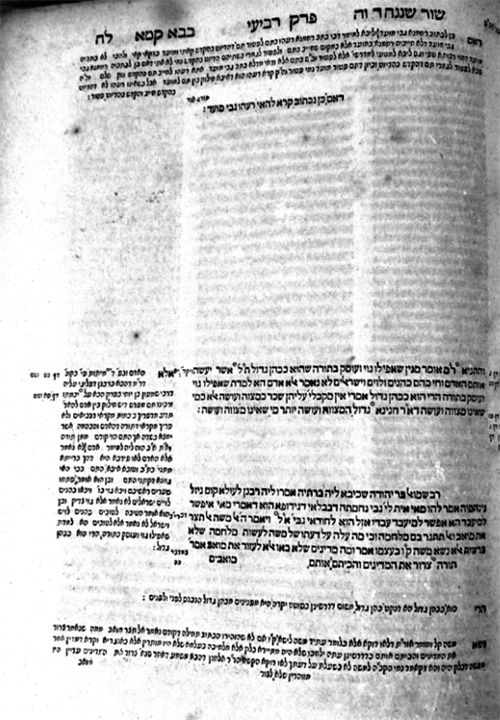
Frankfurt an der Oder – 1697-99
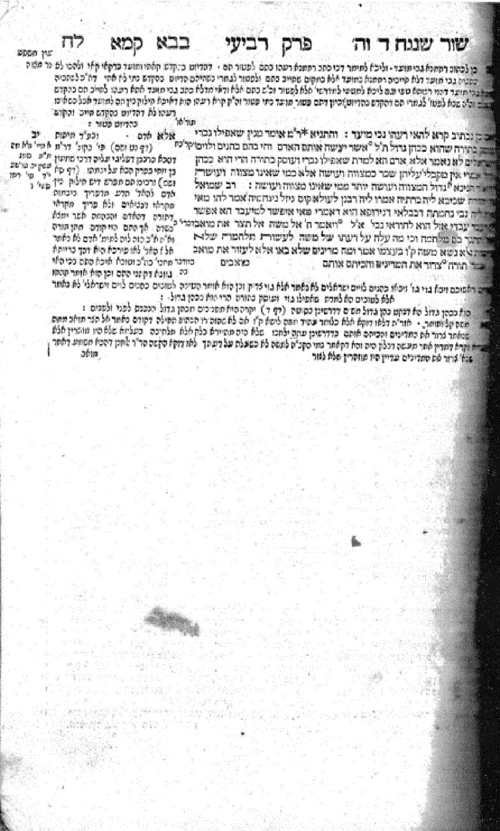
Frankfurt an der Oder – 1734-39

Another example of interest, one that has not fared as well, the text not yet restored in most editions of the Talmud, is to be found in Shabbat 104b and Sanhedrin 67a. The reference there is to Ben Satda, beginning, in the latter tractate “and so they did to Ben Satda
in Lod, and hung him on erev Pesah. Ben Satda? He was the son (ben) of Padera . . .”[8] Popper notes that Gershom Soncino, when publishing “a few of the Talmudic tracts at Soncino during the last decade of the fifteenth century, he took care not to restore any of the objectionable words in the MSS. from which he printed.”[9] Here too the text is complete in the Bomberg Talmud. Two subsequent exceptions in later editions of Sanhedrin where the Ben Satda entries do appear are in the Talmud printed by Immanuel Benveniste and in the edition of Sanhedrin printed in Sulzbach in or about 1696.

Sanhedrin 67a, Benveniste Talmud
However, in two complete editions of the Talmud (1755-63, 1766-70) printed in Sulzbach, the Ben Satda entries are omitted, as is the case of most modern editions of the Talmud.[10]
II
            The Talmud isn’t the only work to have been censored. Amnon Raz-Krakotzkin provides several examples of text in books
that were modified due to the censor’s ministrations. Among them is R. Abraham ben Jacob Saba’s (d. c. 1508) Zeror ha-Mor, a commentary on the Pentateuch based on kabbalistic and midrashic sources.[11] On the passage “They would slaughter to demons without power, gods whom they knew not, newcomers recently arrived, whom your ancestors did not dread” (Deuteronomy 32:17), referring to “Christians in general and priests in particular as ‘demons’ (shadim): ‘For as the nations of the world, all their abominations and vanities come from the power of demons, hence, the monks would shave the hair of their heads  and leave some at the top of the head as a stain.’” This passage continues, referring to bishops and popes, concluding that their entire heads are shaved like a marble with only a bit of hair about their ears, so that they have the appearance of demons, hairless, and like demons, provide no blessings, are like a fruitless tree, and “thus, it is fitting that they bear no sons of daughters.” Raz-Krakotzkin informs that this passage appeared in the first two editions of Zeror ha-Mor printed by Bomberg, and the Giustiniani edition (1545) but was already expurgated by the Cavalli edition (1566), a blank space in place of the text. That space subsequently disappeared and, although a Cracow edition based on the Bomberg Zeror ha-Mor restored the text it remains missing from most later editions.[12] Raz-Krakotzkin continues, citing additional examples.
            Early halakhic works were also subject to the ministrations of the censor.[13] Among them are such works as R. Samson ben Zadok’s (thirteenth century) Sefer Tashbez (Cremona, 1556). Samson was a student of R. Meir of Rothenburg (Maharam, c. 1220-1293). When the latter was imprisoned in the tower of Ensisheim, Samson visited him regularly, serving as his attendant and carefully recording in Tashbez Maharam’s teachings, customs, and daily rituals, as well as what he heard and observed, from the time Meir rose in the morning until he retired at night, on weekdays, Sabbaths, and festivals. Although a relatively small work (80: [6], 55 leaves), it consists of 590 entries beginning with Sabbath night (1-17), Sabbath day (18-98), followed by festivals, Sefer Torah, priestly benedictions, prayer, slumber, talis and tefillin, benedictions, issur ve-heter (dietary laws), redemption of the first born, hallah, vows, marriage and divorce, monetary laws, and piety. Expurgation by the censor of Tashbez was done sloppily, for terms such as meshumad and goy, normally excised, remain, but with a disclaimer near the end that they refer to idol worshipers only.[14]
III
Not all errors are due to the ministrations of the censor. Jews, too, at times, have taken their turns at modifying the text of books.
            A recent and perhaps quite surprising example of internal censorship is to be found in R. Solomon Ganzfried’s (1804–1886) Kizzur Shulḥan Arukh. First printed in 1864, that work an abridgement of the Shulhan Arukh for the average person, went through fourteen editions in the author’s lifetime, and numerous editions since then, as well as translations into many languages and has been the subject of glosses.[15] Marc B. Shapiro informs that in the Lublin (1904) edition of the Kizzur Shulḥan Arukh and several other editions the entry (201:4) that “apostates, informers, and heretics –for all these the rules of an onan and of mourners should not be observed. Their brothers and other next of kin should dress in white, eat, drink, and rejoice that enemies of the Almighty have perished,” the words “apostates, informers, and heretics” have been removed. In the Vilna edition (1915) the entire paragraph is removed and the sections renumbered from seven to six. In the Mossad Harav Kook vocalized edition a new halakhah was substituted, but that has since been corrected to reflect the original text. The reason, according to Shapiro, is that with the expansion of Jewish education to include girls, it was felt that schoolchildren, with assimilated relatives, would see this as referring to family members.[16] Several recent editions of the Kizzur Shulḥan Arukh that were examined, in both Hebrew and English, have the original text.
            R. Abraham Isaac Kook (1865–1935), chief rabbi of Jerusalem and first Ashkenazic chief rabbi in Israel (then Palestine),
was a profound, influential, and mystical thinker. Highly regarded by his contemporaries, his strongly Zionist views also resulted in some opposition, but even most of his contemporaries who disagreed with him held him in high regard. Shapiro notes that with time, Kook’s reputation changed. Despite the fact that such pre-eminent rabbis as R. Solomon Zalman Auerbach (1910-95) and R. Joseph Shalom Elyashiv (1910-2012) were unwavering in their high regard of Kook, strong anti-Kook sentiment developed later in religious anti-Zionist circles. Shapiro notes that “Kook has been the victim of more censorship and simple omission of fact for the sake of haredi ideology than any other figure. When books are reprinted by haredi and anti-Zionist publishers Kook’s approbations (hascomas) are routinely omitted.” One of several examples of this modified opinion Shapiro cites is a lengthy eulogy delivered by R. Isaac Kossowsky (1877-1951) praising Kook. When the eulogy was reprinted in She’elot Yitzhak, a collection of Kossowsky’s writings, the name of the subject of the eulogy, Rav Kook, was omitted. In the reprint of She’elot Yitzhak the eulogy is deleted in its entirety.[17]
            Shapiro’s observation about Rav Kook’s approbations is confirmed in several books. R. Eliezer Mansour Settehon’s (Sutton, 1860-1937) Notzar Adam: Hosafah Notzar Adam (Tiberius, 1930), discourses on spiritual development, has approbations from R. Abraham Abukzer, R. Moses Kliers, and R. Jacob Hai Zerihan, and R. Abraham Isaac ha-Kohen Kook. In a description of Notzar Adam in in Aleppo, City of Scholars (Brooklyn, 2005), Kook’s name, Kook’s name is omitted from a list of the book’s approbations.[18]

In a variation of this, two internet sites that reproduce the full text of Hebrew books both include Rav Isaac
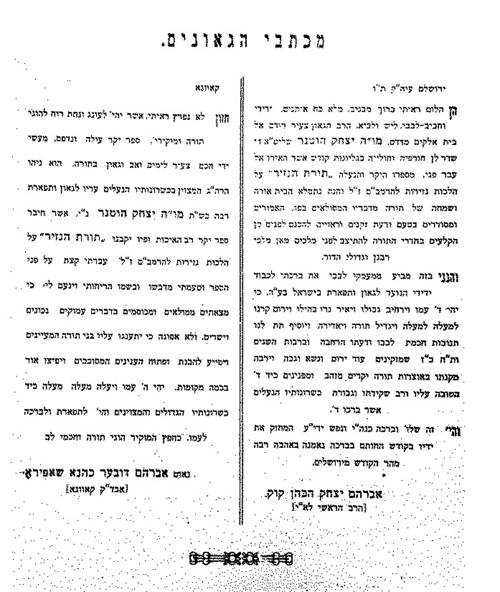
Hutner’s (1906-80) Torat ha-Nazir (Kovno, 1932). This, the first edition, has three approbations; a full page hascoma from R. Hayyim Ozer Grodzinski (1863–1940), and the following page two approbations, side by side, from R. Abraham Duber Kahana (1870–1943) and Rav Kook. The first internet site, with more than 53,000 books for free download, follows R. Grodzinski’s approbation with a blank page and then the text. The second, a subscription site with more than 76,000 scanned books, goes directly from R. Grodzinski’s hascoma to the text, dispensing with the blank page, also not reproducing the second page of approbations. It is not clear whether the copies scanned were faulty, the scanning incomplete, or the omission intentional. Nevertheless, to conclude this section on a positive note, surprisingly, given the omission of Rav Kook’s approbation in both scans of Torat ha-Nazir, both sites list and provide an extensive number of Rav Kook’s works.
IV
Accusations of plagiarism accompany the publication of two works by and/or attributed to R. Nathan Nata ben Samson Spira (Shapira, d. 1577). Spira, born to a distinguished family that was, according to the Ba’al Shem Tov, one of the three pure families throughout the generations in Israel (the others being Margulies and Horowitz), served as rabbi in Grodno (Horodno) until 1572, when he accepted a position in Posnan. His grandson was R. Nathan Nata ben Solomon Spira (Megalleh Amukkot, c. 1585-1633). Among Nathan Nata Spira’s works is Imrei Shefer (20: [1], 260 ff.), a super-commentary on Rashi and R. Elijah Mizrahi (c. 1450–1526). The book was brought to press by Spira’s son R. Isaac Spira (d. 1623), Rosh Yeshiva in Kovno and afterwards in Cracow. Work on Imrei Shefer began in Cracow in 1591 but before printing was finished Isaac Spira accepted a position in Lublin where publication was completed at the press of Kalonymus ben Mordecai Jaffe (1597).[19]
The title-pages states that Spira, “gives goodly words (Imrei Shefer)’ (Genesis 49:21) and he gives, ‘seed to the sower, and bread לזורע ולחם (357=1597) to the eater’ (Isaiah 55:10) of Torah.” In the introduction, Isaac informs that the work is entitled Imrei Shefer from the verse, “he gives goodly words” (and the word “he gives הנתן” in the Torah is without a vav), implying the name of the author [Nathan נתן] and Shefer שפר is language of Spira שפירא the family name of the author. Isaac then addresses the existence of an unauthorized and fraudulent edition ascribed to his father, printed in Venice (Be’urim, 1593),
found and brought out by men who lack the yoke of the kingdom of heaven. A work discovered, who knows the identity of the author, perhaps a boy wrote it and wanted to credit it to an authoritative source אילן גדול), [my father my lord]. God forbid that his holy mouth should bring forth words that have no substance, vain, worthless, and empty, a forgery, “[And, behold], it was all grown over with thorns, and nettles had covered it over” (Proverbs 24:31).
Isaac Spira took his complaint to the Va’ad Arba’ah Artzot (Council of the Four Lands), requesting they prohibit the distribution of the Be’urim in Poland. The response of the Va’ad is printed at the end of the introduction,
It has been declared, by consent of the rabbis, and the [communal] leaders of these lands,
that these books shall neither be sold nor introduced into [any Jewish] home in
any of these lands. Those who have [already] purchased them shall receive their
money back and not keep [such] an evil thing in their home.
What was and who wrote the Be’urim, the reputedly plagiarized copy of R. Nathan Nata ben Samson Spira’s Imrei Shefer? The title-page of the Be’urim (40: 180 ff.), printed in Venice in 1593 “for Bragadin Giustiniani by the partners Matteo Zanetti and Komin Parezino at the press of Matteo Zanetti,” states that it was written by ha-Rav, the renowned, the gaon, R. Nathan from Grodno in the year, “For you shall go out with joy בשמחה (353=1593), and be led forth with peace” (Isaiah 55:12). Be’urim does not have an introduction nor a colophon that provides any additional information.
Isaac Spira’s accusation that the Be’urim is a forgery, not to be ascribed to his father, but rather was written by an unknown young man who then attributed it to Spira, is confirmed by R. Issachar Baer Eylenburg (1550-1623), who writes in his responsa, Be’er Sheva (Venice, 1614) and also in his commentary on Rashi, Zeidah La-Derekh (Prague, 1623) that it is obvious that the Be’urim were not the work of the holy Spira, but rather of an erring student “who hung (attributed it) to himself, hanging it on a large tree” (cf. Pesahim 112a).[20]
Among the distinguished sages of medieval Sepharad is Rabbenu Bahya ben Asher ben Hlava (c. 1255-1340). Best known for his popular, multi-faceted, and much reprinted Torah commentary, written in 1291 and first published in Naples (1491),  Rabbenu Bahya was also the author of Kad ha-Kemaḥ (Constantinople, 1515) and Shulḥan shel Arba (Mantua, 1514). The former, Kad ha-Kemaḥ, is comprised of sixty discourses on varied subjects, among them festivals, prayer, faith, and charity, all infused with ethical content. Among the numerous editions of Kad ha-Kemaḥ is a scholarly edition entitled Kitvei Rabbenu Baḥya (Jerusalem, 1970) edited and with annotations by R. Hayyim Dov Chavel (1906–1982).
Among the essays in Kad ha-Kemaḥ is one entitled Kippurim, on Yom Kippur. Part of that discourse includes a commentary on the book of Jonah, read on Yom Kippur. Chavel, in the introduction to his annotations on Rabbenu Bahya’s commentary on Jonah, suggests that Rabbenu Bahya took his commentary from R. Abraham ben Ḥayya’s (d. c. 1136) Hegyon ha-Nefesh, first published by E. Freimann (Leipzig,
1860). Abraham ben Ḥayya, a resident of Barcelona, was a philosopher, mathematician, and astronomer, reflected in his several works, including translations from the Arabic. Hegyon ha-Nefesh “deals with creation, repentance, good and evil, and the saintly life. The emphasis is ethical, the approach is generally homiletical – based on the exposition of biblical passages – and it may have been designed for reading during the Ten Days of Penitence.”[21] Kitvei Rabbenu Baḥya and Hegyon ha-Nefesh are sufficiently alike to support Chavel’s contention that
Rabbenu utilized the Sefer Hegyon ha-Nefesh (or Sefer ha-Mussar) of the earlier sage R. Abraham ben Ḥayya ha-Nasi, known as ṣāḥib-al-shurṭa . . . In it is found this commentary on the book of Jonah. This was already noted by the author of Zaphat ha-Shemen – the usage by Rabbenu of this book is comparable to his use of other works: according to his needs. The reason that he does not mention it in his commentary is, perhaps, because the books of R. Abraham ha-Nasi were well known, and the leading sages, such as the Rambam, Ramban and other leading rabbis utilized it, comparable to “Joshua was sitting and delivering his discourse without mentioning names, and all knew that it was the Torah of Moses” (Yevamot 96b).[22].
We leave accusations of plagiarism and turn to forgery, a well-known case involving a person of repute, Saul Hirsch (Hirschel)
Berlin’s (1740-94) Besamim Rosh.[23] Berlin was a person of great promise; the son of R. Hirschel Levin (Ẓevi Hirsch, 1721–1800), chief rabbi of Berlin, ordained at the age of twenty and in 1768 av bet din in Frankfurt an der Oder. At some point Berlin became disillusioned with what he believed to be antiquated rabbinical authority. He gave up his official rabbinic position in Frankfurt, removing to Berlin. There Berlin was an associate of Moses Mendelssohn (1729–1786), providing, in 1778, an approbation for Mendelssohn’s Be’ur (Berlin, 1783) and was a supporter of the enlightenment figure Naphtali Herz Wessely (1725–1805), writing an anonymous pamphlet in defense of  Wessely’s
Divrei Shalom ve-Emet (Berlin, 1782) entitled Ketav Yosher (1794).[24]
An earlier forgery of Berlin, described by Dan Rabinowitz, this under the pseudonym of Ovadiah bar Barukh Ish Polanya, was Berlin’s Mitzpeh Yokteil (1789), a vicious attack on R. Raphael Kohen, rabbi of the three communities, Altona-Hamburg-Wansbeck, who had opposed Mendelssohn’s Be’ur, and on Kohen’s Torat Yekuteil (Amsterdam, 1772) on Yoreh Deah. The Communities’ beit din placed Ovadiah, the presumed author, under a ban. The ban’s proponents approached R. Tzevi Hirsch, the chief rabbi of Berlin and Saul Berlin’s father, seeking his signature on the ban.[25] It appears that Tzvi Hirsch initially concurred with the ban, but, as he was close to deciding in favor of signing the ban, someone whispered in his ear the verse “woe is me, my master, it is borrowed שאול” (II Kings 6:5), – which he understood to be a play on שאול (borrowed), referring to his son, Saul, the true author of Mitzpeh Yokteil.[26]
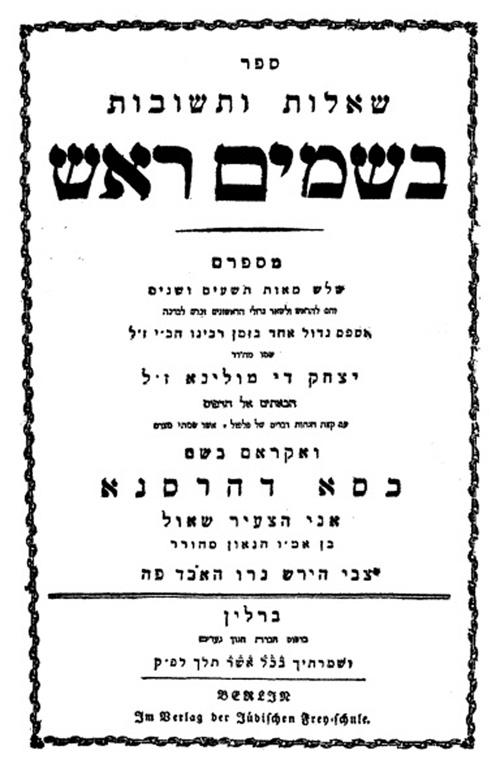
 

Turning to Besamim Rosh Saul Berlin’s infamous forgery, it claims to be the responsa of R. Asher ben Jehiel (Rosh, c. 1250–1327), among the most preeminent of medieval sages of European Jewry. The title-page describes it as the responsa Besamim Rosh, 392 responsa from books from the Rosh and other rishonim (early rabbinic sages) compiled by R. Isaac di Molina and with annotations Kasa de-Harshana by the young Saul ben R. Ẓevi Hirsch, av bet din, here (Berlin).[27] It is dated “and will keep you in all places where you goושמרתיך בכל אשר תלך   553 = 1793)” (Genesis 28:15), note Asher אשר in the date. In Besamim Rosh Berlin, having become an adherent of the haskalah, presents ideas inconsistent with and at variance with traditional halakhic positions. Among the novel responsa are removing the prohibition on suicide due to the difficult conditions of Jewish life; permitting shaving on Hol ha-Mo’ed; requiring a shohet to test the sharpness of his knife on his tongue; saying a blessing over non-kosher food; disregarding commandments that are upsetting; not taking Megillat Esther seriously; and that Jews beliefs can change. An example of the responsa, albeit a brief one and without Berlin’s Kasa de-Harshana, is the much quoted responsum concerning “legumes, rice, and millet which some Ashkenazic rabbis prohibit and is the practice in some communities. . .” (105b: no. 138): The responsum states:

This is very strange, for the Talmud permits it and no bet din is known to have made such an enactment. It is not for us to inquire why such an enactment was made and why it was followed by some. Possibly because of the exiles and the confused גירושים והבלבוחים, weighed down in poverty . . . and also due to the small community of Karaites in their midst who were also exiled. . . . unable to distinguish between bread and bread and all leavening from which it is possible to make flour and bread. But, God forbid, that we freely prohibit that which is permitted, and all the more because of the poor and needy, who lack sufficient meat and bread all the days of the festival. . . . “who eat [but] a litra of vegetables for at a meal” (Sanhedrin 94b). Also “a leap year is not intercalated in the year following a Sabbatical year for this reason.” All the more (kal ve-homer) to prohibit most types of food to the poor and needy on festivals and the overly strict (mahmerin) will have to answer on the day of judgement.
            How has Besamim Rosh been received? Soon after its publication R. Wolf Landsberg, in Ze’ev Yitrof (Frankfurt an der Oder, 1793), stated that Besamim Rosh was a forgery, and R. Mordecai Benet (1753-1829) wrote to Berlin’s father, that Besamim Rosh was “from head to foot only wounds and grievous abscesses from sinful, vile men.”[28] R. Hayyim Joseph David Azulai (Hida, 1724–1806) in his Shem ha-Gedolim, one of several works in which he mentions Besamim Rosh, states “I have heard ‘a voice of a great rushing’ (Ezekiel 3:12) that there are in this book strange things. . . . Therefore the reader should not rely on it.”[29] The Hatam Sofer (R. Moses Sofer, 1762–1839), based on the responsum on suicide, also concluded that Besamim Rosh was a forgery.[30] Among the varied modern authorities who quote Besamim Rosh, albeit critically, are R. Solomon Joseph Zevin (1885–1978) and R. Ovadia Yosef (1920-13) the latter writing an approbation for the 1984 edition of Besamim Rosh.[31]
How influential was Besamim Rosh? Fishman writes that “Besamim Rosh is of itself cast as a work of rabbinic literature, a Trojan horse of sorts, capable of injecting reformist viewpoints directly into the camp of halakhic discourse. Indeed, the sheer frequency with which Besamim Rosh has been cited in subsequent halakhic writings [documented by Samet] raises the question of whether the work may not have been effective in introducing unconventional perspectives into rabbinic thought.”[32] Similarly, Shmuel Feiner notes that “Some scholars
regard Besamim Rosh as the beginning of the reform of Judaism.”[33] Finally, knowledge that Besamim Rosh was a forgery was so widespread, that it is even so described in a book dealers catalogue, that of Jakob Ginzburg, in Listing of Rare and Valuable Books (Minsk, 1914), stating “565 Besamin Rosh attributed to the Rosh, poor condition Berlin, 1792, 50 1.”
V
Of less consequence is a common error, if it may be so described, that is, the misleading identification of the place of printing on the title-pages of late seventeenth through the early nineteenth century books. Amsterdam, from the early seventeenth century, was the foremost center of Hebrew printing in Europe. Its reputation was such that printers in other lands, often with the only the most tenuous, if any, connections with Amsterdam, attempted to associate their imprints with that city. In a wide variety of locations the actual place of printing is minimized; what is enlarged is that the letters are באותיות אמשטרדם Amsterdam letters. Mozes Heiman Gans describes this practice,
Amsterdam may have had an embarrassing lack of rabbinical training facilities, but thanks to the Hebrew printing works it nevertheless had a great name in the world of Jewish scholarship. Moreover, the haskamot (certificate of fitness) was also sought by Jewish printers abroad, and so highly-prized were books ‘printed in Amsterdam’ or ‘be-Amsterdam’ that cunning rivals invented the phrase ‘printed ke-Amsterdam’, i.e. in the manner of Amsterdam, hoping to deceive the readers by relying on the similarity of the Hebrew k and b.[34]
            An early example of this practice is in Dessau, where the court Jew, Moses Benjamin Wulff, established a Hebrew press in Anhalt-Dessau.[35] Approval for the press was given on December 14, 1695 by Princess Henriette Catherine of Orange, Prince Leopold I’s mother, acting as regent in her son’s frequent absences in the service of the Prussian army. The first books were published in 1696, among them R. Jacob ben Joseph Reischer’s (Jacob Backofen, c. 1670–1733) Hok Ya’akov and Solet le-Minhah ve-Shemen le-Minhah, and the following year R. Shabbetai ben Meir ha-Kohen’s (Shakh, 1621–1662) Gevurat Anashim, each with a title-page, with a pillared frame topped by an obelisk and the statement,
Printed here [in the holy congregation of] Dessau with AMSTERDAM letters
Under the rule of her ladyship, the praiseworthy and pious Duchess, of distinguished birth HENRIETTE CATHERINE [May her majesty be exalted]
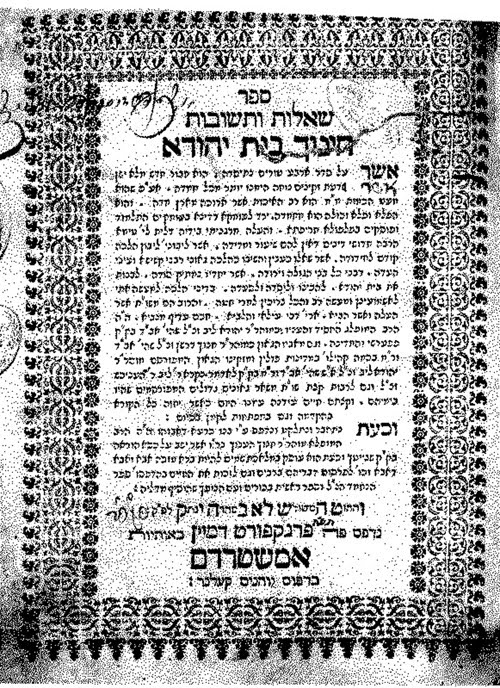
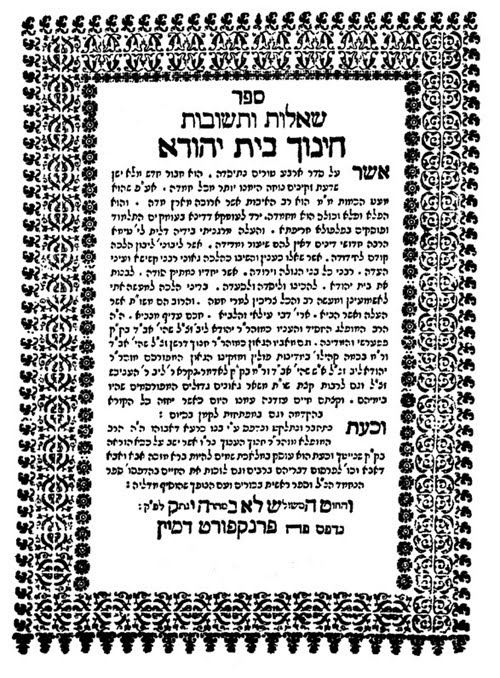
Another notable instance are the title-pages of R. Judah Leib ben Enoch Zundel’s (1645–1705) Hinnukh Beit Yehudah (Frankfurt am Main, 1708), a collection of one hundred forty-five responsa, among them several by the author. Zundel (1645–1705), who succeeded his father as rabbi of the district of Swabia in 1675, subsequently relocated to Pfersee, where he remained until his death. Judah Leib was also the author of Reshit Bikkurim (Frankfurt, 1708), homilies by Judah Leib and his father. The sermons in that work are on festivals and Sabbaths based upon R. Joseph Albo and includes excerpts from a commentary on the Bible which Judah Leib had intended publishing.[36]

 The publisher of these books was Johann Koelner, the distinguished Frankfurt am Main printer (1708-27), credited with publishing half of the Hebrew books printed in Frankfurt up to the middle of the nineteenth century as well as a fine edition of the Babylonian Talmud.[37] Koelner began printing with Hinnukh Beit Yehudah; it is unusual in that there are two title-pages for the book, one noting that it was printed in Frankfurt am Main, the other stating that Hinnukh Beit Yehudah was printed, in an enlarged font with, Amsterdam, in a smaller font, letters, and the place of printing, Frankfurt am Main, also set in a smaller font.[38]
Another way of emphasizing Amsterdam fonts rather than the city in which a book was printed is evident from R. Jacob Uri Shraga Feival’s ben Menahem Nachum’s Bet Ya’akov Esh (Frankfurt an der Oder, 1765) on Job. Here, somewhat unusually, even the reference to the source of the fonts is highlighted, saying with Amsterdam letters. The place of printing is given below in abbreviation in a slightly smaller font as printed here פ”פ דאדר (Frankfurt an der Oder).
In addition to several locations in Germany, such as Hamburg and Jessnitz, we also find this practice in such varied locations as in Zolkiew, for example, R. Aaron Moses ben Zevi Hirsch of Lvov (Lemberg) Ohel Moshe (1765) on grammar; in Lvov, on the title-page of R. Jacob ben Baruch of Tyczyn’s (c. 1640-1725) Birkat Yosef (1784) on Shulhan Arukh Hoshen Mishpat; and with a mahzor that states, in large red letters, that it was printed in Slavuta and, in a small font in German only, that is, it was printed (gedrukt) in Lemberg. We also find this done, somewhat far afield, in Livorno; the title-page of Seder Nezikin of the Jerusalem Talmud (1770), printed with a frame that is like but not exact of the Amsterdam edition of Seder Nashim (1754), by Carlo Giorgi, stating “printed here, Livorno, with Amsterdam letters.
            And then there are inadvertent errors, such as misreading a colophon. Popular books, frequently reprinted, go through numerous editions. At times it is difficult to identify early editions and, as might be expected, books are occasionally misidentified, attributed to the wrong press, misdated, and there are instances when editions are recorded that never existed. All of these errors can be found in R. Leon Modena’s (Judah Aryeh, 1571-1648) Sur me-Ra.[39]
Sur me-Ra, a popular and much reprinted tract opposing the snares and consequences of gambling, was written by Modena when, according to his autobiography, he was only twelve or thirteen years old. Paradoxically, Modena would later become a compulsive gambler, even gambling away his daughters’ dowries. Translated into Latin, German, Yiddish, French, and English, Sur me-Ra is not a straightforward denunciation of gambling but rather a dialogue between two friends, one opposed to games of chance, the other a proponent of such games, both positions well argued, accounting for its popularity. It was first published in Venice in the year בשמחה (with joy, [5]355 = 1594/95) by the Venetian press of Giovanni di Gara as an anonymous tract on the evils of gambling, Modena initially choosing to be anonymous. Sur me-Ra was republished, not long afterwards, twice, according to several bibliographic sources, in 1615. One edition, attributed to a Venice press, appears to be dubious, it not being recorded in any library collection and the sources that list it do so without descriptive details.[40]
The two 1615 Prague editions are recorded in a library listing, one published at the press of Moses ben Bezalel Katz, octavo in format, here consisting of ten unfoliated leaves. The second Prague edition, a bi-lingual Hebrew-Latin edition, is not so much dubious as mislabeled, having been printed several decades later and elsewhere. The Katz edition has an introduction from R. Jacob ben Mattias Treves which concludes “And it came to pass, because the midwives feared God, that he made them houses” (Exodus 1:21) at a goodly בשע”ה (375 = 1615) time, “a time to cast להשלי”ך (75 = 1615) away stones” (cf. Ecclesiastes 3:5).
A bi-lingual Hebrew-Latin edition of Sur me-Ra was purportedly printed in Wittenburg in 1665 by Johannis Haken. This edition is physically small, octavo in format, measuring 18 cm.; otherwise it is an expanded edition of Sur me-Ra, being comprised of [134] pp. and ending on quire Q3 followed by several index pages. There is a Latin title-page with a Hebrew heading, giving the place of printing, printer’s name, and date, followed by considerable preliminary matter in Latin. There is a second Hebrew-Latin title page, lacking all of these particulars about the edition and with a somewhat dissimilar briefer Latin text.
This Wittenburg edition of Sur me-Ra has been incorrectly recorded in at least one major library as a second 1615 Prague Hebrew-Latin edition of that work. The reason for the error appears to be twofold. First, the library copy lacks the first descriptive title-page and the second title page, as noted, lacks identifying information. Moreover, the introduction to the Prague edition is included, with its reference to Prague at the beginning and, at the end, two highlighted dates, although the first “at a goodly בשע”ה (375 = 1615) time” is not highlighted here and a close reading indicates that the second date was set improperly, that is, the Prague edition which concludes with the date “a time to cast להשלי”ך (375 = 1615)” here, reading להשלי”ך, the final khaf being emphasized as if to be included in the enumeration of the letters, which likely misled a reader looking at it too casually, as it results in a figure (395) too large for the Prague edition and too small for the Wittenburg edition.[41]
Another edition of Sur me-Ra was printed in Leiden by Johannes Gorgius Nisselius. An orientalist, Nisselius, poor and unable to obtain a post as a teacher, became a printer. The title-page is misdated תנ”ו (456 = 1696) instead of 1656, attributed by L. Fuks and R. G. Fuks‑Mansfeld to Nisselius’ unfamiliarity with Hebrew chronology, and causing Moritz Steinschneider to describe it as an “edition negligenitissime curate (a very slipshod edition).[42]
Three reported bi-lingual editions of Sur me-Ra, Hebrew with Latin translation, quarto format, are recorded in bibliographic sources. The dates given are 1698, 1702, and 1767. These editions are listed, without further details, in Julius Fürst’s Bibliotheca Judaica, Benjacob’s Otzar ha-Sefarim, and Vinograd’s Thesaurus of the Hebrew Book, each likely repeating the entries in the previous earlier work.[43] That three editions of Sur me-Ra were printed in Oxford within this time frame seems highly unlikely, given that from the first Hebrew book reported for Oxford, Maimonides’ commentary on Mishnayot, with Latin, printed in 1655, concluding with a Bible in 1790, only sixteen titles with Hebrew text are reported. One printing of Sur me-Ra seems reasonable, two less so, three unlikely.
VI
            Mispronunciations and misunderstandings are the source of numerous errors, a problem that persists from biblical times, as in the following passage from Judges (12:36)
And the Gileadites took the passages of Jordan before the Ephraimites; and it was so that when those Ephraimites who had escaped said, Let me cross over; that the men of Gilead said to him, Are you an Ephraimite? If he said, No; Then said they to him, Say now Shibboleth; and he said Sibboleth; for he could not pronounce it right. Then they took him, and slew him at the passages of Jordan; and there fell at that time of the Ephraimites forty two thousand.
R. David Cohen observes that not all typesetting errors can be attributed to the compositor selecting the wrong letters. In Kuntres ha-Akov le-Mishor: le-Taken ta’uyot ha-Defus shel ha-Shas Hotsa’at Vilna he observes that there are mistakes that can only be attributed to hearing. Many printers realized that it was possible to save hours of labor by having type set by a pair of workers, one reading to the setter, who either did not hear correctly or misunderstood due to different dialects. Cohen provides several examples from the 1880-86 Vilna Talmud, for example, פסח in place of פתח, and comments that much ink has been has been spent resolving apparent difficulties that are in reality nothing more than printers’ errors. Among the numerous examples are:[44]
Rosh HaShanah 14a: Rashi בקוביא (dice-playing) – a piece of עצם (bone) . . . other reading עצים (wood).
Megillah 14a: Many prophets arose for Israel מי-הוה, (it should say מיהוי) [double the number of [the Israelites]
who came out of Egypt].
Zevahim 48a: Rashi Midrasha – (Leviticus 4) . . . Should say 6.
           
Similarly, R. Menahem Mendel Brachfeld (Brakhfeld, 1917-84), in his two volume work, Yosef Halel, based on the Reggio di Calabria (1475) and other early editions, provides a lengthy listing of emendations to current texts of Rashi. He informs that numerous errors in more recent editions of Rashi are due to errors in transmission, frequently compounded by editors, printers, and the unkind modifications of censors. Indeed, R. Solomon Alkabetz, the grandfather of the eponymous author of Lekhah Dodi, in his edition of Rashi’s Torah commentary (Guadalajara, 1476), admittedly corrected it according to his own reasoning. Furthermore, explanations of Rashi are often based on these faulty editions.[45] At the beginning of each volume are the detailed emendations and at the end a brief summary of the changes, for example:
Leviticus 10: 16) The goat of the sin-offering, the goat of the additional service of the month and the three goats of sin-offering sacrificed on that day, the he-goat, the goat of Nahshon, and the goat of [Rosh Hodesh], etc. According to this version it is not clear what Rashi is suggesting by the he-goat. In the first edition (Reggio di Calabria) and the Alkabetz edition, the text is three goats of sin-offering sacrificed on that day, take a he-goat and the goat of Nahshon, etc. and with this Rashi alludes to the verse at the beginning of the parasha that speaks about the obligatory offerings of the day, writing take “a he-goat.”[46]
Leviticus 26: 21) Sevenfold according to your sins, seven other punishments, etc. Seven שבע is in the feminine,
and others ואחרים is male. In the first edition and in the Alkabetz edition the text is seven other punishments, as the number of your sins חטאתיכם.[47]
Our text
16) the he-goat, the goat of Nahshon,  and
the goat of [Rosh Hodesh].
21) Sevenfold according to your sins, seven other punishments,
Text first edition
16) take a he-goat and the goat (RH) of Nahshon, the goat of Rosh Hodesh.
21) seven other punishments as the number of your sins.[48]

            Another, quite different, inadvertent, error is of interest. In the late seventeenth- early eighteenth century a small number of printers of Hebrew books employed monograms, formed from the Latin initials of the Hebrew printer’s name, as their devices. Several were mirror-image monograms, which can be read directly and in reverse (mirror) image, resulting in more attractive and certainly more complex pressmarks than the simple interlacing of letters; perhaps graphic palindromes.[49] They are, however, often difficult to interpret; the undiscerning reader is often unaware that the mark is a signet rather than an ornamental device.
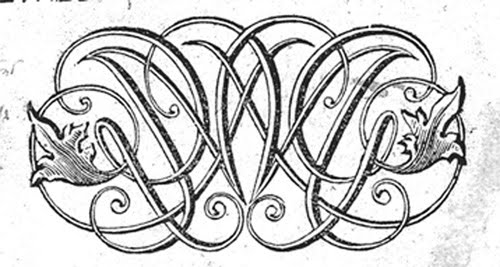
 

Gottschalk device correct usage – Frankfort am Main
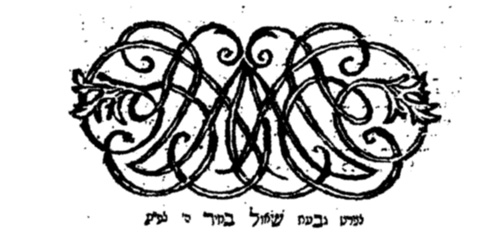
 Gottschalk device inverted – Zolkiew


The first usage of a monogram in a Hebrew book is that of the Frankfurt-am-Oder printer, Michael Gottschalk, noted above. Over several decades his mirror-image monogram appears in  all of his Talmud editions, in three forms, all consisting of Gottschalk’s initials interwoven in straight and mirror images (MG), that is, it can be read in straight and reverse images. The last of his mirror-image monograms, employed on the title-pages of the Berlin and Frankfurt an der Oder Talmud editions (1715‑22, 1734‑39) is an elongated form of his initials. Gottschalk’s place in Frankfurt was taken by Professor F. Grillo, who, in association with the Berlin printer Aaron ben Moses Rofe of Lissa, completed the third Talmud. The printer’s device on the title pages of this edition is the elongated Gottschalk Mirror-monogram.  It is correctly placed on most tractates but inverted on tractate Niddah.  The error was quickly corrected, for on the title page of Seder Tohorot, printed immediately after and bound with Niddah, the monogram is right side up. We also find the elongated Gottschalk monogram, inverted, employed in Zolkiew on the title-page of  the responsa of R. Saul ben Moses of Lonzo’s Givat Shaul (1774) by David ben Menahem, who, in this instance, likely did not realize that it was comprised of Gottschalk’s initials.[50]
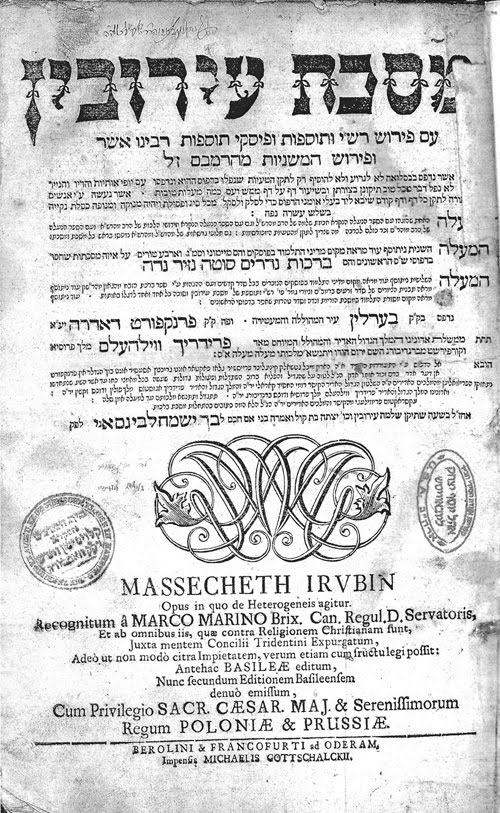
            At the beginning of the article it was stated that “this article is concerned with errors in and about Hebrew books only.” While the following example might tend to belie that statement, that is so only if the reader does not accept that the Bible is a Hebrew book, even if in translation. With that caveat, we bring an interesting and, from the printer’s perspective, an especially unfortunate error. For centuries the King James Bible was the authoritative English translation of the Bible by and for English speaking non-Jews. First published in 1611 by Robert Barker, it was reissued in 1631 by Barker, together with Martin Lucas, then the royal printers in London. This edition of the King James Bible is now best known as the Wicked Bible, but is also referred to as the Adulterous Bible or Sinners’ Bible. The error is in the Ten Commandments, in which the prohibition against adultery (Exodus 20:14; Heb. Bible 20:13) reads “Thou shalt commit adultery,” the “not” having been omitted, thus accounting for this edition of the King James Bible being referred to as the wicked Bible.
King Charles I was made acquainted with the error and the printers were called before the Star Chamber, where, upon the facts being proved, the printers were fined £3,000 about 34,000 pounds today). Subsequently, Barker and Lucas lost their printer’s licenses. The Archbishop of Canterbury, angered by the mistakes in this edition of the Bible, stated:
I knew the tyme
when great care was had about printing, the Bibles especially, good compositors
and the best correctors were gotten being grave and learned men, the paper and
the letter rare, and faire every way of the beste, but now the paper is nought,
the composers boyes, and the correctors unlearned.[51]
Printed in a press run of 1,000 copies, the wicked Bible was subsequently ordered destroyed; a handful of copies only are extant today.[52]
This article began with censorship, primarily of the Talmud and other Hebrew books, followed by internal censorship of Hebrew books, plagiarism and forgery, errors intentional (misleading) and unintentional, of varying levels of consequence. As noted in the previous article, “what they have in common is the consequence of inadvertently or deliberately misleading the reader. This is a subject that fascinates and certainly deserves further study. Nevertheless, even this overview should caution the reader that not everything in print, no matter how innocuous or well received, is necessarily so, for,”
Who can discern his errors? Clean me from hidden faults. Keep back Your servant also from presumptuous sins; let
them not have dominion over me; then shall I be blameless, and innocent of great transgression (Psalms 19:13-14).[53]


[1] I would like to express my appreciation to Eli
Genauer for reading the article and for his many corrections, my son-in-law, R.
Moshe Tepfer at the National Library of Israel, Israel Mizrahi of Mizrahi Book
Store, and R. Yitzhak Wilhelm and R. Zalman Levine, reading room librarians,
Chabad-Lubavitch Library for providing me with facsimiles of the rare books
described in this article.
[2] William
Popper, The Censorship of Hebrew Books (New York, 1899, reprint New
York, 1968), pp. 59, 60.
[3] “Who can
discern his errors? Misdates, Errors, and Deceptions, in and about Hebrew
Books, Intentional and Otherwise” Hakirah: The Flatbush Journal of Jewish
Law and Thought
12 (2011), pp. 269-91, reprinted in Further Studies in the Making of
the Early Hebrew Book
(Brill, Leiden/Boston, 2013), pp. 395-420.
[4] Heinrich
Graetz, History of the Jews IV (Philadelphia, 1956), p. 589.
[5] Abraham J. Karp, From
the Ends of the Earth. Judaic Treasures of the Library of Congress
(Washington,
1991), p. 47.
[6] Despite having a more accurate text than later seventeenth
and eighteenth editions, the Benveniste Talmud is, with exceptions, not always
highly regarded due to its small size. An
interesting early example of this relates to the handsome Lublin Talmud
(1617-39), from the perspective of the seventeenth century. In correspondence
between a representative of Duke Augustus the Young of Braunschweig [1635-66], founder
of the Ducal Library in Wolfenbuettel and R. Jacob ben Abraham Fidanque, author
of a super-commentary on the Abarbanel’s commentary on Nevi’im Rishonim and a dealer,
Fidanque writes “My lord’s letter arrived today, Wednesday, Erev Rosh Hodesh
Tevet, concerning the Lublin edition of the Talmud. I have one to sell, and it
is very fine in its beauty and its paper, in sixteen volumes and new. If my
lord wishes to give me 40R, that is, forty R. I will send it to him immediately
upon receipt of his response. I will sell it for less, but if my lord wants to
purchase an Amsterdam edition I will sell it for 14R. . . .” (K.
Wilkelm, “The Duke and the Talmud” Kiryat Sefer, XII (1936), p. 494
[Hebrew).
[7] Rabbinovicz, p.
100.
[8] Ben Satda, a
surname of Jesus of Nasereth, is, according to Marcus Jastrow, A Dictionary
of the Targumim, the Talmud Babli and Yerushalmi, and the Midrashic Literature

(Brooklyn, N.Y., n. d.), p. 972, probably of Greek origin. The section on Ben
Satda (Sanhedrin 67a) begins “and so they did to Ben Satda in Lod, and
hung him on erev Pesah. Ben Satda? He was the son (ben) of Padera . . .,
Padera being a name given to both the mother and father of Jesus.” As noted
above, neither this or comparable entries appear in many current editions of
the Talmud.
[9] Popper, p. 21.
[10] A somewhat inconsistent exception is
the Soncino translation of the Talmud. In the edition of Sanhedrin
published by the Traditional press (New York, n. d.) the Ben Satda entry is
omitted from both the Hebrew and English text. However, in the Judaic
and Soncino Classic Library (Judaica Press, Brooklyn, NY) edition, translator
David Kantrowitz, the Ben Satda entry is
available in Hebrew but not in English. However, in the Rebecca Bennet
Publications (1959) Soncino edition of Shabbat and the Judaic and
Soncino Classic Library edition of that tractate the Ben Satda text appears in both the Hebrew and in the English
translation, as well as in the Art Scroll Schottenstein edition of Shabbat.
That entry, however, is incomplete, and the Hebrew portion of the Judaic
and Soncino Classic Library edition notes that the censor has removed part of
the text.
[11] Abraham
Saba rewrote Zeror ha-Mor in Portugal from memory, having lost his writings
after the expulsionof the Jews from Spain.. Saba was imprisoned in Portugal for
refusing to accept baptism. Eventually released, he resettled in Morocco. Less
well known is what occurred afterwards. R. Hayyim Joseph David Azulai (Hida,
1724–1806) informs that Saba, after residing in Fez for ten years, traveled to
Verona, Italy. En route, a storm arose. The captain, in despair, requested Saba
pray for the ship’s safety. He agreed, but on the condition that, if he were to
die at sea, the captain should not bury him at sea, but rather take him to a
Jewish community for proper burial. The captain agreed, Abraham Saba’s prayed
and the storm abated. Two days later, on the eve of Yom Kippur, Saba died. The
captain took his body to Verona, where the Jewish community buried him with
great honor. (Hayyim Joseph David Azulai, Shem ha-gedolim ha-shalem with additions by Menachem Mendel Krengel
I (Jerusalem, 1979), pp. 13-14 [Hebrew].
[12] Amnon
Raz-Krakotzkin, The Censor, the Editor, and the Text: the Catholic
Church and the Shaping of the Jewish Canon in the Sixteenth Century
,
translated by Jackie Feldman (Philadelphia: University of Pennsylvania
Press, 2007), pp. 142. My edition of Zeror ha-Mor,
published by Heichel ha-Sefer (Benei Brak,1990) includes this passage.
[13] Among other censored halakhic works are R. Menahem ben Aaron ibn
Zerah’s (c. 1310-1385) Zeidah la-Derekh (Ferrara, 1554). The entry in Zeidah
la-Derekh
on malshinim (slanderers, informers), comprising almost an
entire leaf, was removed and the enumeration of the prayers comprising the Amidah
was correspondingly adjusted when the second edition (Sabbioneta, 1567) was
printed. The expurgated material has not been restored in subsequent editions. Another
contemporary halakhic work that was also censored is R. Isaac ben Joseph
of Corbeil (d. 1280) of the Ba’alei Tosafot’s Amudei Golah (Cremona,
1556), in which objectionable terms, and occasionally entire paragraphs, were
either substituted or suppressed. Concerning Zeidah la-Derekh and Amudei
Golah
see my “Concise and Succinct: Sixteenth Century Editions of Medieval
Halakhic Compendiums,” Hakirah: The Flatbush Journal of Jewish Law and
Thought
15 (2013), pp. 122-24 and 114-16 respectively.
[14] Isaiah
Sonne, “Expurgation of Hebrew Books,” in Hebrew Printng and Bibliography, Editor
Charles Berlin (New York, 1976), p. 231.
[15] Jacob S. Levinger, “Ganzfried, Solomon ben Joseph,” Encyclopaedia
Judaica
. Ed. Michael Berenbaum and Fred Skolnik, 7 (Detroit, 2007),
379-380.
[16] Marc B.
Shapiro, Changing the Immutable: How Orthodox Judaism Rewrites its History
(Oxford, Portland, 2015), p. 85-89.
[17] Shapiro, pp. 142 ff.
[18] David Sutton, Aleppo, City of Scholars
(Brooklyn, 2005), p. 334 no. 539.
[19] 1575, Birkat
ha-Mazon
, Lublin – Birkat ha-Mazon, facsimile reproduction
(Brooklyn, 2000), with introductions by Dovberush Weber and Eliezer Katzman,
pp. 6-23, 1-10 [Hebrew].
[20] Katzman, facsimile, p. 3; Meijer Marcus Roest, Catalogue
der Hebraica und Judaica Rosenthalishen
Bibliotek. Bearbetet von M. Roest,
with Anhang by Leeser Rosenthal (Amsterdam, 1875, reprint Amsterdam,
1966), II p. 42 n. 243  [Hebrew].
[21] Geoffrey Wigoder, “Abraham Bar Ḥiyya,” EJ 1, pp. 292-294.
[22] Hayyim Dov Chavel, “Kitvei Rabbenu Baḥya (Jerusalem, 1970), pp. 213-14 [Hebrew]. These remarks
are preceded by Chavel in the introduction to Kitvei Rabbenu Baḥya (p.
13), where he writes similarly that “the entire commentary on Jonah (in the
essay on Kippurim) is from this author (R. Abraham
ben Ḥayya). It is not clear to me why he concealed his name. Perhaps the reason
is that his books were very well known. . . .”
[23] Besamim
Rosh
was briefly referred to in “Who can discern his errors? . . .” in
footnote (25). It is addressed here in greater detail. Besamim Rosh has
been the subject of considerable interest. A sample biography includes the
following: Raymond Apple, “Saul Berlin (1740-1794) – Heretical Rabbi,”
Proceedings of the Australian Jewish Forum held at Mandelbaum House, University
of Sydney, 8-9 February 2004, Mandelbaum Studies in Judaica 12,
published by Mandelbaum House,
here; Samuel
Joseph Fuenn, Kiryah Ne’emanah (Vilna, 1860). pp. 295-98 [Hebrew];
Reuben Margaliot, “R. Saul Levin Forger of the book ‘Besamim Rosh’,” Areshet,
ed. Isaac Raphael, (1944) pp. 411-418 [Hebrew]; Moses Pelli, The age of
Haskalah, (Lanhan, 2010) pp. 171-89; idem., “Intimations of Religious
Reform in the German Hebrew Haskalah Literature” Jewish Social Studies 32:1
“(Jan. 1970), pp. 3-13); “No Besamim in this Rosh,” On the Main Line May
12, 2007, here; Dan
Rabinowitz, “Besamim Rosh,” The Seforim Blog, October 21, 2005, here;
Moshe Samet, “The Beginnings of Orthodoxy,” Modern Judaism, 8: 3
(1988), pp. 249-269;
[24] Abraham
David, “Berlin, Saul ben Ẓevi Hirsch Levin,” EJ 3, 459-460.
[25] The ban called for Mitzpeh Yokteil to be
burned  and destroyed with “great shame,”
and, in Berlin, it was so burned in the old synagogue courtyard (Israel
Zinberg, A History of Jewish Literature VIII (New York, 1975),
translated by Bernard Martin, p. 195.
[26] Dan
Rabinowitz, “Benefits
of the Internet: Besamim Rosh and its History
,” The Seforim Blog,
April 26, 2010, here.
[27] Talya
Fishman suggests that Berlin selected di Molina because little was known about
him and “it is probably of significance that this halakhist was ridiculed by
the Shulhan arukh’s (sic) author as one who failed to understand
the teachings of his predecessors and who said things of his own opinion, as if
‘prophetically, with no basis in Gemara or poskim [i.e. decisors]’.
Halakhically erudite readers of Besamim Rosh who learned that it was discovered
and compiled by R. Isaac di Molina might not have suspected the volume’s
dubious provenance, but they might well have been negatively prejudiced in
their assessment of its reliability as a legal source.” (Talya Fishman,
“Forging Jewish Memory, Besamim Rosh: and the Invention of
Pre-Emancipation Jewish Culture” in Jewish History and Jewish Memory: Essays
in Honor of Yosef Hayyim Yerushalmi
, ed. Elishiva
Carlebach
, John
M. Efron
, David
N. Myers
, pp. 78). Zinberg (p. 197) suggests that this
di Molina is a fabricated person, noting that the gematria
(numerical value) of di Molina equals di Satanow,
(137), a maskilic collaborator of Berlin.
[28] Zinberg, p. 197.
[29] Azulai, Shem
ha-Gedolim
II, p. 34 no. 127.
[30] Dan Rabinowitz, “Benefits
of the Internet.”
[31] Fishman, p. 75.
[32] Fishman, p. 81.
[33] Shmuel Feiner, The
Jewish Enlightenment
, tr. Chaya Naor (Philadelphia, 2011), p. 336.
[34] Mozes
Heiman Gans, Memorbook. History of Dutch Jewry from the Renaissance to 1940
with 1100 illustrations and text
(Baarn, Netherlands, 1977), p. 140.
[35] Concerning
Moses Benjamin Wulff see Marvin J. Heller, “Moses Benjamin Wulff – Court Jew in
Anhalt-Dessau,” European Judaism 33:2 (London, 2000), pp. 61-71,
reprinted in Studies in
the Making of the Early Hebrew Book
(hereafter Studies, Brill, Leiden/Boston,
2008), pp. 206-17.
[36]  Yehoshua Horowitz, “Judah Leib ben Enoch Zundel,” EJ 11.

[37] Richard Gottheil,
A. Freimann, Joseph Jacobs, M. Seligsohn,
“Frankfort-on-the-Main,” JE.

[38] The left
image is courtesy of Israel Mizrahi, Mizrahi Book Store.
[39] For a more detailed discussion of Leon (Judah Aryeh) Modena and Sur
me-Ra
see my “Sur me-Ra: Leone (Judah Aryeh) Modena’s Popular and
Much Reprinted Treatise Against Gambling” (Gutenberg-Jahrbuch, Mainz,
2015), pp. 105-22).
[40] Isaac Benjacob,
Otzar
ha-Sefarim: Sefer Arukh li-Tekhunat Sifre Yiśraʼel Nidpasim ṿe-Khitve Yad
(Vilna, 1880), p. 419, samekh 314 [Hebrew];
Ch. B. Friedberg, Bet Eked Sefarim, (Israel, n.d.), samekh
331 [Hebrew]; Yeshayahu Vinograd, Thesaurus of the Hebrew Book. Listing of
Books Printed in Hebrew Letters Since the Beginning of Printing circa 1469
through 1863
II (Jerusalem, 1993-95), p. 266 no. 1084 [Hebrew].
[41] The library in question was contacted and has since
modified their catalogue.
[42] L. Fuks
and R. G. Fuks‑Mansfeld, Hebrew Typography in the Northern Netherlands 1585
– 1815
(Leiden, 1984-87), I pp. 47-48 no. 53; Moritz Steinschneider, Catalogus Liborium Hebraeorum in Bibliotheca
Bodleiana
(CB, Berlin, 1852-60), no. 5745 col. 1351:24.
[43] Isaac Benjacob,
Otzar ha-Sefarim, p. 419, samekh
317 [Hebrew]; Julius Fürst, Bibliotheca Judaica: Bibliographisches Handbuch
der Gesammten Jüdischen Literatur . .
.II (1849-63, reprint Hildesheim,
1960), p. 384; Vinograd, Thesaurus of the Hebrew Book. II pp. 14-15 nos.
6, 8, 15.
[44] David
Cohen, Kuntres ha-Akov le-Mishor: le-Taken ta’uyot ha-Defus shel
ha-Shas Hotsa’at Vilna
(Brooklyn, 1983), pp. 4, 18, 22, 40.
[45] Menahem Mendel Brachfeld, Yosef Halel I (Brooklyn,
1987), pp. 8-9.
[46] Brachfeld, II p. 36. An accompanying footnote notes
that this is also the order in the Rome, Soncino, and Zamora editions, as well
as in many manuscripts on parchment.
[47] Brachfeld, II p. 102. The accompanying footnotes
states that this is also the text in the Rome and Zamora editions.
[48] Brachfeld, II, pp. 13, 33.
[49] A
palindrome is a word, line, verse, number, sentence, etc., reading the same backward as forward, for example, Madam, I’m Adam; able was I ere I saw Elba; and mom.
[50] Concerning
the usage mirror-image monograms see Marvin
J. Heller, “Mirror-image Monograms as Printers’ Devices on the Title
Pages of Hebrew Books Printed in the Seventeenth and Eighteenth Centuries,” Printing
History
40 (Rochester, N. Y., 2000), pp. 2-11, reprinted in Studies, pp. 33-43. The
title-page of Givat Shaul, as does other of works printed in various
locations, as noted above, states that it was printed, in Zolkiew, in small
letters, with fonts, again small letters, and then Amsterdam, in a very large
font.
[51] Louis Edward Ingelbart, Press
Freedoms: a Descriptive Calendar of Concepts, Interpretations, Events, and
Courts Actions, from 4000 B.C. to the Present
, (Greenwood Publishing,
1987), p. 40.
[52] A copy was
recently offered for sale for $99,500. here.
Among other errors in early editions of the Bible are the “Cannibal Bible,”
printed at Amsterdam in 1682, with the sentence “If the latter husband ate her
[for hate her], her former husband may not take her again” (Deuteronomy
24:3); a 1702 edition has the Psalmist complaining that “printers [princes]
have persecuted me without a cause” (Psalm 119:161); and  an edition published in Charles I’s reign,
reads “The fool hath said in his heart there is a God” (Psalm 14:1) here.
[53] Having pointed out the errors of others, I thought, in
all fairness, to note some errors in my own work, both those of consequence and
those less so. Those errors, however, in both categories, being too numerous,
might, given the length of this article, prove excessive and tedious for the
reader. They need, therefore, to be saved for a later day, for a possible
future article.


Comments on This and That, part 1

Comments on This and That, part 1
by Marc B. Shapiro

1. In this post I referred to R. Hayyim Hirschensohn’s Nimukei Rashi, and stated that I thought it was one of his best works. This led to some correspondence with readers regarding the commentary. I have no doubt that I could devote ten posts to Hirschensohn, but then what would happen to everything else I want to discuss? But there are people who want me to call attention to some more interesting comments from Hirschensohn. I know that among them are those who go to hebrewbooks.org and print out some of the sources I refer to and bring them to shul on Shabbat. That is fine, as long as you aren’t looking at it during the rabbi’s sermon. As it is, Hirschensohn writes a good deal about how the rabbis are not given proper respect, and how ignoramuses have all too much power. At least in one respect, however, things have gotten better since Hirschensohn’s day. In Nimukei Rashi, Bereshit, pp. 46a-46b, he speaks about how the people give more respect to the hazzan than to the rabbi. This doesn’t apply anymore because there are hardly any synagogues that still have a hazzan.

In response to requests, let me therefore mention one more very interesting passage in Hirschensohn’s Nimukei Rashi in this post (with more to come in future posts). But my real suggestion is to study it yourself, even though it might make for difficult reading at times. To paraphrase Chazal (Avot 5:22), “no pain, no gain.” Or as R. Tuvia Hanks put it: “It’s supposed to be hard. If it wasn’t hard, everyone would do it. The hard is what makes it great.”[1]

Before quoting the comment in Nimukei Rashi that I have promised, I also want to record one formulation of Hirschensohn that I think it is magnificent. While R. Soloveitchik undoubtedly would disagree with much of what Hirschensohn writes, if he would have heard the following, I know that he would have regarded it wonderful, expressing the essence of what real Torah learning is all about. In his Musagei Shav ve-Emet, Section Penei ha-Hamah, p. 64, Hirschensohn gives his definition of a lamdan. I am sure readers have their own definitions. Some will say that one who knows a few tractates is a lamdan, while other will say that one who gone through the Ketzot ha-Hoshen earns the title. Hirschensohn has his own approach:

אינני קורא למדן (שם זארגני על ת”ח גדול) רק את זה אשר רמב”ם קשה או רש”י סותרות או תוספות מופרך לא מניח לו לישון

When one can honestly say that a difficult Rambam or Rashi keeps you up at night, only then can you be called a lamdan. As I mentioned, this is a formulation that the Rav would have embraced, and he actually lived this way. I heard from Dr. David Fand, a student of the Rav from the 1940s, who studied in Boston’s Yeshivat Heichal Rabbenu Hayyim Halevi, that one night the Rav woke some students up in order to tell them a hiddush.

In Nimukei Rashi, Bereshit, p. 48b, Hirschensohn discusses the comment of Rashi, Gen. 26:8. The verse states that Abimelech looked out his window and saw that Isaac “was amusing himself with Rebekkah.” Upon this verse, Rashi, based on a Midrash, states that Abimelech saw them having marital relations. The question is, of course, obvious. How is this possible that Isaac and Rebekkah would do this in such a way that people could observe him? As Hirschensohn puts it:

ובאמת זה קשה מאד לחשוב כזאת על עולה תמימה כיצחק שיעשה דבר מגונה כזה ונגד היכל מלך

Hirschensohn therefore refuses to take this Midrash literally. He sees it as a mussar derash about how people living among those at a lower moral level can be negatively influenced by them. He offers his own example of this: elderly women in America. (By “elderly”, I think he means women over sixty.) In Europe they used to dress modestly but in America they were negatively influenced to dress in an inappropriate fashion. He continues:

ואינני חושב שחשבו חכמים שבאמת שימש יצחק מטתו ביום לפני חלון פתוח נגד היכל המלך, רק זה אחד מדרכי הדרוש המוסרי לקשור אותו לאיזה צלצול בלשון להפריז הדבר להגדיל את מוסרו.

Hirschensohn’s comment is not surprising. We have come to expect that anytime there is an unusual Midrash, or one that reflects poorly on a biblical figure, that one of the aharonim will argue that it is not meant to be taken literally. This is no different than the attempts to understand various strange Aggadot allegorically.[2] A good rule of thumb is if the Aggadah is strange, then someone will interpret it in a non-literal fashion. I opened up the Artscroll Rashi translation for the verse we are discussing and was therefore not surprised to find the following: “In truth, according to the Zohar, Isaac conducted himself modestly with Rebekkah. Abimelech did not see them in a physical sense; he understood through some astrological means that they were having relations (Maskil LeDavid).”

Regarding the character of Isaac, Hirschensohn writes:

על יצחק אשר ישב ארבעים שנה בלא אשה ולא שם עיניו על בנות הארץ וישב עשרים שנה עם אשתו בלא בנים ולא לקח אשה אחרת עליה אשר לזה הי’ דבר הרגיל מאד בכל איש שם להרבות נשים ופלגשים ושפחות, אות הוא שהי’ מצונן או מצדקתו משל ביצרו, ואיש כזה לא ישמש מטתו נגד חלון פתוח מול היכל מלך.

In dealing with the issue raised, Hirschensohn appears to be correct that there are only two options in describing Isaac. Either that he didn’t have a sexual drive or that he overcame it. Nevertheless, it does strike me as a bit strange to be speaking of the Patriarch in this fashion, although maybe this is just my own prudishness. Here, for example, is what R. Yehiel Michel of Glogau (died 1730) says about this episode with Isaac in his Nezer ha-Kodesh, vol. 3, p. 329a (64:5), a classic commentary on Bereshit Rabbah.

אע”ג דאמר ר”י המשמש מיטתו ביום ה”ז מגונה והיינו כמ”ש המפרשי’ דמיירי אפילו בבית אפל או במאפיל טליתו דאל”ה מה מגונה דקאמר הא אפילו איסורא איכא . . . ולא שרי בכה”ג בת”ח אלא לצורך שעה בראותו שיצר תאותו מתגבר עליו הרבה כדי שלא יבא לידי הוצא’ ש”ז לבטלה או הרהור רע אצ”ל דבאמת הוי נמי כה”ג ביצחק וזה רמז הכתו’ באומרו והיה כי ארכו לו שם הימים כלומר שאירע לו מקר’ כזה להתגבר יצר תאותו ע”י שארכו לו הימ’ שלא נזדווג לאשתו משו’ שמקמי הכי אפילו בצינעא בלילה לא שימש מיטתו פן תתעבר ויתפרסם הדבר לפני אבימלך ועמו אבל אז הי’ צורך שעה לכך ולזה לא נזהר מלשמש אף ביום.

The author might think he is helping Isaac’s reputation with his explanation, but I actually think just the opposite, that what he says reflects negatively on Isaac. Let’s remember who we are speaking about here. We are not talking about some average guy. We are speaking about the Patriarch Isaac, whom many sources portray as the holiest of the Patriarchs. And regarding him R. Yechiel Michel says that it was צורך שעה?! Does he really expect us to believe that it was such an emergency that Isaac couldn’t have waited until the night? With all due respect to the author, who certainly knew who Isaac was, I can’t understand how he could suggest this. Hirschensohn’s description of Isaac is thus much more in line with how the Tradition encourages us to view the Patriarchs. Of course, I understand what is driving R. Yechiel Michel, namely, the reality of Isaac having sexual relations in the daytime. Unless one is prepared to read this in a non-literal fashion, as did Hirschensohn, there is a real problem and I guess the answer he offered was the best one he could come up with.

I am sure most readers are with me in not feeling comfortable engaging in speculation about the sexual life of the Patriarchs, and yet the truth is that we find such speculation among the commentators. Let me give one example. The Torah states (Gen. 29:20): “And Jacob served seven years for Rachel; and they seemed unto him but a few days, for the love he had to her.” R. Hayyim Zev Rosenfeld, in his Sefer ha-Hayyim (London, 1922), p. 22, asks a very good question. If you love someone, and desperately want to be with her, then it is not seven years that will seem like a few days, but precisely the reverse. A few days would seem like seven years. So why does the Torah say that the years went by very quickly for Jacob? According to Rosenfeld, the answer is that Jacob’s love for Rachel had no sexual component.

Rosenfeld brings the following support for his contention. In blessing Reuben, Jacob says (Gen. 49:3): “Reuben, thou art my first-born, my might, and the first-fruits of my strength.” As a number of talmudic and midrashic passages explain, the sperm that impregnated Leah was the first one ever to leave Jacob’s body.[3] Since the Talmud tells us that a woman cannot become pregnant from the first intercourse, [4] how is it that Leah became pregnant? The Maharsha, Yevamot 34b, deals with the problem. In what can only be described as an exercise in original Midrash, Maharsha suggests that since Jacob was able to prevent any seminal emissions for more than eight decades, one can assume that in his first intercourse with Leah he also did not ejaculate (so that the sperm not be wasted). Therefore in truth, Leah did not become pregnant from the first intercourse.

Maharsha’s explanation, which shows how far removed Jacob was from carnal pleasures, is cited by Rosenfeld as support for his assumption that Jacob’s love for Rachel was entirely non-sexual:

שפיר נוכל לומר עליו באהבתו אותה שלא היה כונתו תאות המשגל

And since his love was non-sexual, that is why the long time waiting seemed like a short time.

(As is often the case with biblical commentaries, Rosenfeld’s question is better than his answer. We can all point to plenty of examples of non-sexual love in which a short time seems much longer [e.g., a parent longing for a child]. Just because Jacob’s love was non-sexual, why should that mean that seven years seemed like a few days?)

The Rashi dealing with Abimelech, Isaac, and Rebekkah reminds me of how in high school, when we first learnt Rashi intensively, we would sometimes come across texts which created all sorts of problems, and the teachers often didn’t deal with them properly. Would it have been so hard for the rebbe to acknowledge that yes, he too finds certain Midrashim strange? I specifically remember when we learnt Rashi to Gen. 25:26, which quotes a Midrash that explains why Esau was born first even though Jacob was conceived first. At the time, we were studying biology and knew that the biological description in this Rashi was incorrect. In what was for me a prologue to the Slifkin affair, one of the students raised this point. I also recall how his question was pushed aside, as if it was unimportant.[5] (Later, I was surprised to find that even in the nineteenth century R. Akiva Eger was clueless about the anatomy of pregnant women. Here is what he writes in his comment to Berakhot 63b, quoting a medieval source:

דז’ חדרים יש באשה שלשה מימין ושלשה משמאול ואחד באמצע אם תתעבר מימין יהיו זכרים ובשמאל נקבות ובאמצע טומטום או אנדרוגינוס)

Another Rashi which raised a problem, for me at least, was Gen. 24:2. Commenting on the biblical expression, שים נא ידך תחת ירכי, Rashi quotes the Midrash that Abraham asks Eliezer, in taking his oath, put his hands on Abraham’s circumcision.

לפי שהנשבע צריך שיטול בידו חפץ של מצוה, כגון ספר תורה או תפילין, והמילה היתה מצוה ראשונה לו ובאה לו על ידי צער והיתה חביבה עליו ונטלה

I remember in high school thinking that this was very strange. But I assumed that it was only since I was corrupted by modern values that I found this strange, and that those who had a pure “Torah hashkafah” would not even raise an eyebrow. I was even too embarrassed to ask the rebbe about this Rashi (which comes from Bereshit Rabbah).[6] It was only many years later that I found that the great R. Raphael Berdugo (1747-1821), known as the מלאך among Moroccan Jewry, had the same response as a fourteen-year-old American student. He does not hesitate to tell us that he finds this Midrash quite strange (Mesamhei Lev, ad loc.).

שהמילה אין בגופה קדושה אדרבה הוא מקום הבושת ואיך יקח בידו ערות חבירו ויזכיר שמו ית’ . . . גם אם רבינו הקדוש לא הניח ידו למטה מחגורו ק”ו אברהם אבינו ע”ה, גם מאכילת עץ הדעת יבושו בני אדם זה מזה וזילותא הוא לאדם נכבד שיחזיק אחר במבושיו

What this shows us is that when a rebbe is asked about this Rashi by one of his students, he should not put on an act and make believe that he too doesn’t find it strange. Instead, he should be honest, just like Berdugo, and acknowledge that this is indeed an unusual Midrash. Such an honest approach will earn the respect of the students and come in handy as the class comes to other strange Midrashim.[7]

Rosenfeld, whom we just cited, also deals with this passage and has a very interesting formulation (p. 21):

שים נא ידך תחת ירכי: כאשר רמזתי לעיל שהיה כלי הולדה קדוש בעיניו, אך משה אסר זאת בתורתו להיות קדושים.

In other words, the old way of taking an oath, which was acceptable in Abraham’s day, was later rendered invalid due to the heightened moral standards of the Torah. His comment, that Abraham regarded the genitals as holy, is explained by him as follows (p. 19):

שאצל אברהם היתה המילה תיקון הדת להקדיש כלי הולדה שהוא המקור מכל מין האנושית, ולכוף את תאותיו . . . וגם המילה היא מקור הולדה והשפע בא על ידו

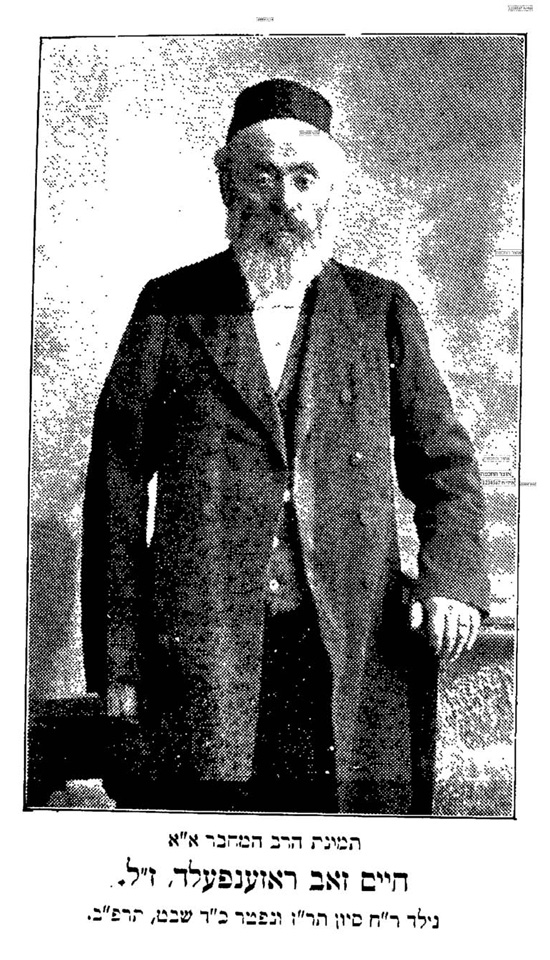
I will return in a future post to discuss Rosenfeld, who was very unconventional and expressed all sorts of provocative notions.[8] He was also unusual among those born in Eastern Europe in that he published many books in English. Here is his picture, which appears in his Sefer ha-Hayyim, showing that despite his unusual ideas he certainly had the rabbinic look.


2. I want to now go back to one of my earliest posts, from four years ago, in which I discussed the meaning of the word olam in the Bible and how the words Adon Olam should be translated. See here.

I received many e-mails after this post, and there were many important comments posted online. I told a number of people that I would try to mention their comments in a post. Although I can’t get to all of them, at least with regard to some, better late than never.

With regard to appearances of the word olam in the Torah where modern scholars say it means eternal (or something along those lines[9]) and traditional interpreters understand it to mean “world”, R. Nathan Kamenetsky called my attention to Gen. 21:33, where it is clear from Onkelos, Rashi, and Ramban that the word means “world.”[10] To this I will add that Maimonides also understands olam in this verse to mean “world”. See Mishneh Torah, Hilkhot Avodah Zarah 1:3 (Simon Glazer, in his translation, mistakenly renders it “Everlasting God” instead of “God of the World”, “God of the Universe” or something like that. Similarly, Eliyahu Touger, in his translation of this halakhah mistakenly renders it “eternal God”.) See also the index to Pines’ translation of the Guide under Gen. 21:33 for instances in the Guide where Maimonides refers to the verse, and also Schwartz’ edition of the Guide 2:13 n. 14. We must also translate Maimonides’ opening words of each of the three sections of the Guide (and elsewhere[11]) בשם ה’ א-ל עולם as “In the Name of the Lord, God of the World.”

As for what the words Adon Olam mean, in a comment to the original post, Kovner clinches the meaning, I think. He called attention to Berakhot 7b: “From the day that the Holy One, blessed be He, created the world (olam) there was no man that called the Holy One, blessed be He, Lord, until Abraham came and called Him Lord (adon).” I had forgotten about this passage, and I think it is obvious that the words Adon Olam are based on this text, meaning that the passage should be translated as “Master of the Universe”, or something along those lines. A very learned reader also pointed out to me that this same point is made by R. Pinchas Zebihi in his Mi-Zahav u-mi-Paz (Jerusalem, 1993), at the end where there is a commentary on Adon Olam. See also the online discussion here.

Responding to Kovner, R. Yitzhak Oratz e-mailed me that Kovner’s very point was approved by the Vilna Gaon and repeated by none other than the Brisker Rav. See Dov Eliach, Sefer ha-Gaon, vol. 1, pp. 425-426, where it states that the Gaon was shown this point in the siddur Magid Tzedek and said that the entire siddur was worthwhile for this one point. Ad kan R. Oratz.[12]

With regard to the word olam, it is true that in rabbinic literature it means “world”, but I would be remiss in not mentioning that the older meaning is found as well. Sometimes, it is unclear which the correct meaning is. For example, Mishnah Yadayim 3:5 reads:

אין כל העולם כולו כדאי כיום שניתן בו שיר השירים לישראל

Soncino translates: “The whole world is not as worthy as the day on which the Song of Songs was given to Israel.” Others translate similarly. Yet A. S. Halkin renders it: “All of time is not as worthy as the day on which the Song of Songs was given to Israel.”[13] Halkin’s opinion is noted in a comprehensive article devoted to the very issue here being discussed.[14] Fuderman and Gruber, the authors of this article, also point to two biblical texts “of Hellenistic date” in which they claim olam means “world.” One of them is Dan. 12:7: .חי העולם They translate this as “the life/vital force of the world,” and note that this usage is found in the Jewish liturgy where it has been transformed into חי העולמים, with the same meaning.

The other example they give is Eccl. 3:11: גם את העולם נתן בלבם. They are not the first to translate olam here as “world.” The old JPS also translated it this way: “He hath set the world in their heart.” But in the Soncino edition, which uses the old JPS, the commentary rejects this translation, commenting that “the only signification” olam has in the Bible is “eternity.” The translation would therefore have to read: “He hath set eternity [i.e., a sense of the future] in their heart.” Soncino’s note might be based on Ibn Ezra’s comment to this verse, where he says flatly that in the Bible the word olam only means “eternity,” not “world.” (He says likewise in his Short Commentary to Exodus 31:17; Commentary to Psalms 66:7, 89:4.) Daat Mikra agrees with Soncino, explaining the verse as follows: את העולם: את השאיפה לחיים עולם ונצחיות ולדעת את הנעלם, מה שהיה לפנים ומה שיהיה לאחור [15]

I will leave the meaning of olam in this verse to the biblical scholars to fight over. But I want to return to the point made by Fuderman and Gruber that Ecclesiastes was composed in the Hellenistic period, many centuries after Solomon. Based on this they don’t see it as at all incongruous that the word olam means “world” in this book because we are dealing with a later development of biblical Hebrew.[16] This relates to another interesting point.

At the beginning of the standard Vilna edition of the Mishnah there is an essay on R. Judah the Prince by R. Moses Kunitz. Here is the first page.

This essay is excerpted from Kunitz’ Beit Rabbi (Vienna 1805), most of which is actually a play in six acts.[17] Kunitz is best known for his Ben Yohai which is a valiant, if unsuccessful, defense of the ancient dating of the Zohar against R. Jacob Emden’s Mitpahat Sefarim. He was a very pious man and in his lifetime was treated with great respect.

In the next issue of Milin Havivin I will have information regarding this, so there is no need to repeat it here. Here is his picture.

Kunitz is also famous as one of the rabbis whose responsum to the early Reformers is printed in Nogah ha-Tzedek. This was from a time when the Reformers made it seem that all they were looking for was a more lenient halakhic approach. They also succeeded in receiving letters from two Italian rabbis. Just as these rabbis were not Reform in any way, neither was Kunitz. Not knowing who the Reformers were, he fell into their trap, which is perhaps the best way to put it. Yet as I mentioned, this didn’t greatly affect his standing in the rabbinic world, because people assumed that his was an innocent error. In fact, in all the polemics against the Reformers, none of the great rabbis of the day even mention Kunitz.[18]

A few years ago a new edition of the classic Vilna Mishnah was reprinted, and lo and behold, Kunitz’ essay is missing. The publisher was obviously told that there was some controversy around Kunitz, and he therefore just cut out the essay. Yet if the publisher wanted to censor, he missed the real thing. (I wouldn’t be surprised if following this post, future printings of the Mishnah also cut out what I will now discuss. That is the reason why I don’t call attention to various “interesting” books that have been put up on hebrewbooks.org [including Karaite literature], at least until they are also on Google books. I know that soon after I discuss them, they will be taken down. As it is, a number of anti-hasidic and Haskalah works have already been removed from the site. Sometimes these books have come down within a day or two of being put up, after someone has informed the site that they put up a “dangerous” volume. So you have to be quick when they post the new books and download anything you think might be removed.)

Immediately following Kunitz’ essay, there is another article on the grammar of Mishnaic Hebrew by Solomon Loewisohn. In the very first note he refers to the book of Ecclesiastes, and concludes his comment with והטעם ידוע למשכילי עם Here is the page.


What he is alluding to in this note is that Ecclesiastes is a late biblical book, and thus could not have been written by Solomon. To show this he points to the word חוץ, which in its usage in Ecclesiastes 2:25 is an Aramaism, and thus post-dates the biblical Hebrew of Solomon’s day.[19] To use an expression of the Sages, we live in an olam hafukh. Kunitz’ essay was thought worthy of censorship, and at the same time this note remains in every printing of the Vilna edition of the Mishnah. Yet as I mentioned above, let’s see how long it is before this note, or even the complete essay, is also removed.

Regarding the book of Ecclesiastes, in Limits, p. 26 n. 140, I referred to a comment of R. Israel Bruna which appears to say that Ecclesiastes was not divinely inspired. R. Yonasan Rosman (one of whose seforim I mentioned in an earlier post) has taken issue with me in this. However, he also points out that this is exactly what Maharsha seems to be saying in his commentary to Shabbat 30b. I also found that R. Zvi Hirsch Chajes, in his note to Berakhot 4a and in Kol Sifrei Maharatz Chajes, vol. 2, p. 927, states explicitly that Ecclesiastes was not divinely inspired. R. Michael Broyde has noted that this is also stated by R. David Ibn Zimra in his responsa, vol. 2, no. 722.[20]

Rosman also points out that Maimonides, Hilkhot She’ar Avot ha-Tum’ot 9:6, states that Ecclesiastes (and Song of Songs) are “words of wisdom”, with the implication that these books are not divinely inspired. This expression, “words of wisdom”, comes from Tosefta Yadayim 2:14, where it is explicitly contrasted with ruah ha-kodesh.

ר’ שמעון בן מנסיא אומר שיר השירים מטמא את הידים מפני שנאמרה ברוח הקדש. קהלת אינה מטמא את הידים מפני שהיא מחכמתו של שלמה.

Based on the passage just mentioned, I initially assumed that Maimonides is indeed saying that Ecclesiastes was not written with divine inspiration. I also found that the important commentator R. Masud Hai Rakah is of this opinion. Yet then there is a problem, because according to the Tosefta, Song of Songs was written with divine inspiration and yet Maimonides also refers to this book as “words of wisdom.” Rakah himself raises this problem and can offer no solution,[21] but it is likely that when Maimonides speaks of these books as being “words of wisdom” it does not mean that they are lacking in divine inspiration. We can see this from Hilkhot Talmud Torah 5:4, where he quotes Song of Songs and writes regarding it אמר שלמה בחכמתו. The same words are found in Hilkhot Yesodei ha-Torah 2:12 and Hilkhot Deot 3:3, 4:15, 19 and in these cases Maimonides is quoting verses from Proverbs. Maimonides believed that both Song of Songs and Proverbs were written with divine inspiration, and yet we see that he uses the term “wisdom” with regard to them. The truth is that this phraseology comes directly from the Talmud,[22] and need not have anything to do with whether the text being described is divinely inspired. This whole problem is dealt with by the brilliant R. Meshulam Roth in an article in Sinai 17 (1945) pp. 267ff. With his typical erudition, Roth shows that Maimonides indeed regarded Ecclesiastes as being divinely inspired and in fact states so explicitly in Guide 2:45. Roth also shows how in a few places he describes Solomon as a prophet.[23]

Many might find this entire discussion strange, for they assume that if a book is in the canon that means it must be regarded as having been divinely inspired. I have found such a conception in many books.[24] Yet it is incorrect, and as Shnayer Leiman has shown, the tanna R. Simeon ben Menasia, while he regarded Ecclesiastes as an uninspired book, also thought that it was canonical. Thus, while he states that Ecclesiastes does not defile the hands, he also expounded a verse from Ecclesiastes.[25]

As far as I know, the Sages never “decided” that Ecclesiastes is a divinely inspired book. It would therefore seem to be entirely acceptable for one to hold the position of R. Simeon ben Menasia, which was shared by Beit Shammai and R. Meir,[26] that the book is not a product of ruah ha-kodesh. Obviously, one who rejects the book, or any other biblical text, claiming that it was a mistake to have been included in the Canon, has to be regarded as a sectarian. However, here too I think that there is more room for personal opinions than people often think. For example, what about someone who accepts Ecclesiastes as part of the Canon but thinks that the Sages were wrong in this decision, and that they should have adopted the view that the ideas of this book are not fit to be included in the Bible? This was Samuel David Luzzatto’s early position, although he later became more sympathetic to Ecclesiastes. Yet despite this negative view, Luzzatto never rejected the canonical status of this book.[27]

Or what if someone thinks that the halakhah should have been decided in accordance with Samuel (as understood by a number of rishonim)[28] that the book of Esther should not have been included in the canon? As long as one accepts the halakhah as recorded by the Sages he is not to be regarded as a Zaken Mamre, which shows that acceptance of the halakhah in practice is what is important, but one doesn’t have to think that the Sages were correct. After all, in the story of the Oven of Akhnai (Bava Metzia 59b), while R. Eliezer was forced to accept R. Joshua’s viewpoint, I don’t think there can be any doubt that R. Eliezer still believed that he was correct. How could he not, when God Himself agreed with him? Yet the most R. Eliezer could hope for was that his decision would be adopted by a future beit din, and maybe only after the arrival of the Messianic era. Let us not forget that the Mishnah in Eduyot 1:5 explicitly tells us that minority opinions are recorded so that a later court can rely on them, meaning that there is no problem for one to argue the case of a rejected opinion, as long as one does not adopt it in practice (i.e., before a later court gives its imprimatur to do so).[29]

All this seem to be no different than someone who, after examining a talmudic dispute, thinks that the weight of the evidence shows that the halakhah should be in accordance with Abaye, and yet the Talmud decides the halakhah in accordance with Rava. Such a person accepts the practical halakhah, and this is no different than someone who thinks that the Shulhan Arukh decided the halakhah improperly, but who nevertheless follows the law as recorded. You can even argue that this is a very high level of commitment, namely, one who thinks the halakhah should be different, but nevertheless sublimates his personal feelings and accepts the law as we have it.[30]

Similarly, the assumptions of academic Talmud study lead, in theory, to the undermining of many talmudic conclusions. But the practitioners of this form of study have always insisted that since they don’t seek to change the accepted halakhic practice, there can be no religious objection to their approach.

The only reason the Song of Songs was included in the Canon is because it was interpreted in an allegorical fashion.[31] Does this mean that one must accept that this was the original meaning of the book? Jacob Barth (1851-1914) certainly didn’t think so. Barth was the son-in-law of R. Esriel Hildesheimer and one of the most brilliant Semitists of his day. In addition to teaching at the University of Berlin, he was also a long-time and revered faculty member at the Rabbinical Seminary of Berlin. Just to give one example of this, in discussing the great achievements of German Orthodoxy, R. Jehiel Jacob Weinberg lists the following four men as examples of what German Orthodoxy can be proud of: Hirsch, Hildesheimer, Hoffmann, and Barth.[32]

Here is a picture of Barth.


Barth argued—and taught his students at the Rabbinical Seminary of Berlin—that the Song of Songs was not originally intended as an allegory, but this was a later interpretation of the Rabbis, and as already mentioned it was precisely this interpretation that enabled the book to be included in the Canon.[33] Barth believed that the Song of Songs was actually a collection of different songs, composed in various periods.[34] They were designed to be sung at a wedding and the days of feasting, and give expression to marital happiness and love which are basic to the Jewish family. According to Barth, just like the Psalms were originally written by the Psalmist with specific circumstances in mind, but their meaning for the Jewish people throughout history is not tied to this original intent, the same can be said for the Song of Songs. What it originally meant is different than what it later came to mean for generations of Jews.[35]


To be continued
* * * *
In my last post, available here, I wrote about the issue of lo tehanem. As far as the Modern Orthodox are concerned, based on the Meiri and others, these laws are no longer regarded as applicable in modern times. (Although as I mentioned, the Centrists are trying to bring them back.) Someone sent me a link to Dov Bear’s post available here. Dov Baer included the following text that recently appeared (and highlighted certain sections).

I have already mentioned the Slifkin controversy in this post, and regarding matters of science and Torah there definitely are differences between the Modern Orthodox and the haredim. However, I think that when it comes to matters like lo tehanem, the divide is much more significant. If the haredi/ hasidic world really accepts the outlook of the page printed above, then its understanding of what “Jewish values” are all about is far removed from that of the Modern Orthodox.[36] We can also see how secure haredi Jews in America must feel in order for them to put this sort of material in the English language, for all to see.

In two posts from now, I will discuss a dispute currently taking place in the hasidic world in America about how to relate to non-Jews. For now I will simply note that a common theme among virtually all who abandon hasidic life, in explaining what they found objectionable in their former lifestyle, is the denigration of “the other” found in the hasidic world. In the forthcoming post, I will deal with a brave voice from that world who is putting forth a different approach.


[1] See here.
[2] Here is what Louis Ginzberg wrote about the unusual aggadot (On Jewish Law and Lore [New York, 1970], p. 77 (I thank Gershon Bacon for reminding me of this passage.) There is a lot one can say about this comment.

With your permission I shall commence my lecture by recounting an incident that happened to me. It is a memory from boyhood, which means the time when I had already been liberated from the hard discipline of the master of the heder, and, though yet a child of nine, had begun to study, in the traditional phrase, “by myself.” I was then studying the tractate Baba Bathra. When I reached the tales of Rabbah bar bar Hannah, doubts began to disturb my mind; my peace was particularly troubled by those geese who were so fat that they had streams of oil flowing from them and by the bird that was so big that the waters of the sea reached only to its ankles and its head split the heavens. My joy was great when I came across a book by one of the “enlightened” of the older generation (if my memory is correct it was the Maphteah by Shatzkes), from which I learned that these geese were neither fat nor thin and that the giant bird possessed neither feet nor wings, but that the whole tale was merely a flight of the imagination, or, as the ancients used to say, it was only a parable—the moral I have forgotten. I was a child then; but when I reached maturity I realized that in truth the geese of Rabbah bar bar Hannah were real geese and the giant bird was literally a bird. When regarded as natural creations of the folk imagination, they lost their strangeness and incomprehensibility. On the contrary, it would be all the more strange if we possessed no such tales; in that case it would be extremely difficult to explain so striking a difference between our people and all others, one involving so great a triumph of reason over imagination that the latter had become completely atrophied.


[3] See Torah Shelemah, Gen. ch. 49, note 47.
[4] Do any of the readers know where the Talmud picked up this piece of folklore? I assume it was a common notion in ancient times. See Bereshit Rabbah 45:5, where the matter is disputed. Noda bi-Yehudah, Even ha-Ezer no. 22, recognizes that there are women who do become pregnant after first intercourse, and therefore claims that the Talmud was only giving a general rule, but there are exceptions. See R. Neriah Gutel, Hishtanut ha-Tevaim (Jerusalem, 1995), pp. 88ff.
[5] I assume that the rebbe’s response was due to the fact that the passage quoted by Rashi is a Midrash. If it was Rashi’s own explanation, I don’t think he would have regarded it as a disrespectful question. In general, and readers can correct me if I am wrong, I don’t think that the opponents of Slifkin assume that together with Hazal the greatest rishonim are also infallible on scientific matters (the one exception perhaps being the Lubavitchers when it comes to the Rambam). When I was in yeshiva I never came across a rebbe who thought that, although I can’t remember anyone actually spending time on one of the rishonim and explaining why what he says is not correct scientifically, or, to take a different issue, that perhaps the rishon’s view of women doesn’t reflect how we currently think. Had they done so, it would have had an enormously positive influence on some of the students who instead came to believe that the Torah was out of date and not relevant to their lives.

To give one example of many, the online elucidation of Tosafot, available here, in discussing Tosafot, Shabbat 65b. s.v. sahada, offers the following preface:

Before we approach this Tosfos we must realize that during the times of the Reeshonim, there were very few if any maps in Europe of any of the areas that are being discussed in the G’moro. All the knowledge that they had about the rivers and places was what they gleaned from the G’moro or Midrosh about these places.

What forces the translator to add this comment is that Tosafot rejects Rashi’s explanation (which I will soon come to) and incorrectly states that all rivers flow from east to west. (Among European rivers, the Danube flows west to east.) It turns out that Rashi’s explanation is also geographically incorrect. Rashi, Shabbat 65b s.v. sahada, writes about the Euphrates: שהוא יורד מארץ ישראל לבבל

In other words, Rashi thought that the Euphrates originated in the Land of Israel, and flowed from there to Babylonia. Yet this is incorrect as the Euphrates is not within the Land of Israel. Artscroll recognizes the problem and states that the Euphrates is on the northern border of “Greater Israel,” i.e., the land promised to Abraham. I believe that this is an apologetic explanation. The Euphrates will only be part of the Land of Israel in messianic days. It was never a part of Israel during the First Temple, or during the Second Temple. Yet Rashi is speaking about the river as actually part of the Land of Israel. See Isaac Samuel Reggio, Ha-Torah ve-ha-Filosofyah (Vienna, 1827), p. 63.

[6] See also the various Midrashim cited in Torah Shelemah, Gen. 47:29, where Jacob is speaking to Joseph and he too says שים נא ידך תחת ירכי.
[7] There are other ways of dealing with the Midrash. See e.g., R. Paragi Alush, Ohev Mishpat (Djerba, 1928), vol. 1, no. 3, that Eliezer only touched the organ from outside of Abraham’s clothes. R. Eliyahu Katz, Amar ve-Amarta (Beer Sheva, 1994), Gen. 24:2, finds the Midrash so strange that he can’t take it literally, and even uses the term has ve-shalom with reference to the literal meaning. He does so even though, as far as I can tell, all the standard commentaries on the Midrash and Rashi do take it literally. Here are his words:

תמוה מאד שהמילה נחשבת כחפץ של מצוה. והרי אין בזה מן הצניעות . . . אך ודאי שאין הכוונה ח”ו כפשוטו, אלא הכוונה שהזכיר את המצוה כמו שאומר שנשבע בשם ה’.

[8] For now, here is one just one example. He assumes that Gen.36:31-43 is post-Mosaic.

ואלה המלכים אשר מלכו בארץ אדום לפני מלוך מלך לבני ישראל: מזה נראה כי זמן רב נכתבה פרשה זו, כי ידע כבר את מלכי ישראל.


[9] See Sacha Stern, Time and Process in Ancient Judaism (Oxford, 2003), pp. 75 n. 43, 109ff.
[10] Mordecai Spitz called my attention to Neh. 9:5, where the traditional commentaries also understand olam to mean world.
[11] See Saul Lieberman, Hilkhot ha-Yerushalmi, p. 5 n. 7.
[12] I should also mention that there is dispute about how the word חבלי should be translated in Adon Olam. According to Salomon Speier the meaning is “my portion” and not “my pain” See his note in Journal of Jewish Studies 4 (1953), pp. 40-41. Zebihi, Mi-Zahav u-mi-Paz, at the end, also argues for this understanding. None of the many translations I have checked agree with this. [S. of On the Main Line calls my attention to David Levi’s London 1794 Rosh Hashanah Machzor, where the passage is translated as “Rock of my portion in time of distress.”]
[13] The meaning of olam in Avot 1:2 – על שלשה דברים העולם עומד – has also been called into question. See Judah Goldin, Studies in Midrash and Related Literature (Philadelphia, 1988), p. 34.
[14] Kirsten A. Fudeman and Mayer I. Gruber, “’Eternal King/ King of the World’: From the Bronze Age to Modern Times” A Study in Lexical Semantics.”REJ 166 (2007), pp. 209-242.
[15] R. Elijah Benamozegh translates Ps. 106:48: ברוך ה’ אלקי ישראל מהעולם ועד העולם as “Blessed is the Lord, God of Israel, From World to World,” and Ps. 145:13 מלכותך מלכות כל עולמים as “Your kingship is a kingship of all worlds.” See Israel and Humanity, trans. Maxwell Luria (New York, 1995), p. 184. I wonder if Benamozegh meant these as scientific translations, or if this is to be regarded as derush.
[16] See also Robert Gordis, Koheleth—The Man and His World (New York, 1968), pp. 231-232.
[17] The version of Kunitz’ essay that appears in the Vilna Mishnayot is not identical to that which appears in Beit Rabbi. In particular, a few footnotes have been added. This is not the only example where the editors of the Vilna Mishnayot (Romm) tampered with texts. See Kalman Kahana, Heker ve-Iyun (Tel Aviv, 1960), vol. 1, p. 134 (called to my attention by Eliezer Brodt).
[18] Anyone who wants to visit Kunitz’ grave can find it in the Kozma cemetery in Budapest. For people looking to visit graves, the most famous in the Kozma cemetery is R. Shimon Oppenheim, and he is easy to find. He is not that well known and yet his grave is visited more than many other gedolim who were of much greater significance. This is because R. Shimon promised, as it states on his tombstone, that whoever comes to his grave and recites the Menuhah Nekhonah, his prayers will be answered. (The E-l Male Rachamim commonly recited is an abridged version of the Menuhah Nekhonah, which is found in the kabbalistic work Maavar Yabok) . Since this is a guarantee from a holy rabbi, it is not surprising that his grave would attract people.

So how to find Kunitz’ grave? Unfortunately, the computer print-out provided by the cemetery directs people to the wrong place. If you are standing at R. Shimon’s grave, the plot to the left is that of R. Israel Wahrmann. He was the first chief rabbi of Pest. His grandson, Mor Wahrmann, was the president of the Jewish community from 1883-1892 and a member of parliament from 1869. He was a proud Jew, no question about it. He once even had a duel with an anti-Semite. Neither was killed, but Wahrmann was sentenced to eight days in prison. See Kinga Frojimovics, et al, Jewish Budapest (Budapest, 1999), pp. 214ff., 260. However, he despised the Orthodox (and they detested him). During the debate in Parliament over the Orthodox request to create separate communities, he stood up and started reading sections of the Shulhan Arukh to show how foolish the Orthodox were. All three of his children ended up converting to Catholicism. See Jewish Budapest, p. 216 and R. Leopold Greenwald, Korot ha-Torah ve-ha-Emunah be-Hungaryah (Budapest, 1921), p. 78, and in Apriyon 2 (1925), p. 130.

Two graves to the right of R. Shimon’s is that of Kunitz. Unlike R. Shimon, no one has yet stepped forward to redo Kunitz’ tombstone, which is in bad condition. In another hundred years it will probably be entirely illegible. However, a good portion of it can still be read. This left me perplexed, as it is not the same inscription as that found in Greenwald’s Mekorot le-Korot Yisrael (Humenne, 1934), p. 27. How to explain this?

[19] See R. Meir Mazuz, Kovetz Ma’amarim (Bnei Brak, 2003), p. 60. There are a number of other unusual words in Ecclesiastes, such as pardes (2:5) and pitgam (8:11; both Persian loanwords), which academic scholars have pointed to to show that the book is post-Solomonic. (Pardes is also found in Song of Songs 4:13.) See Shadal in Otzar Nehmad 3 (1860), p. 19, who discusses this and among other points notes that the words כבר and ענין do not appear in any other biblical book. See also Robert Gordis, “Koheleth: Hebrew or Aramaic?” Journal of Biblical Literature 71 (1952), pp. 93-109. In Amos Hakham’s introduction to the Daat Mikra Shir ha-Shirim, pp. 12-13, he rejects the significance of Persian loanwords in dating the text.

Incidentally, R. Moses Isaac Ashkenazi, Ho’il Moshe: Hamesh Megilot ve-Sefer Mishlei (Livorno, 1880), pp. 80-81, states that you can also find some Aramaic words and expressions in Proverbs, as well as later Hebrew forms, none of which could originate in Solomon’s era. Yet this discovery did not trouble Ashkenazi in the slightest.

אין לתמוה אם נפלו בספר זה כמה תיבות ומליצות מל’ ארמי וגם איזו זרות בדקדוק הלשון כמו פעל נשתוה (סימן כ”ז ט”ו) בנין נתפעל ע”ד נשתנה נתרפא נצטרע ודומיהם בלשון חכמים . . . לפי שמפי שלמה יצאו המשלים בל’ מדויק, רק בעברם מפה אל פה דור אחר דור בעוד שקרבת ארם הכניסה בשפת ב”י [בני ישראל] תיבות ומליצות נכריות, נהיה שבבוא יום ונרשמו על ספר כבר הורגלו לאמרם כמו שנמצאו אצלנו, ואם היו מחליפים בהם דברים היו נגרעים מערכם, כי כן יארע לכל משל מאיזה לשון שיהיה שצריך לאמרו כמו שהוא בפי המון העם ואין לתקן בו או להוסיף עליו או לגרוע ממנו

[20] “Defilement of the Hands, Canonization of the Bible, and the Special Status of Esther, Ecclesiastes, and Song of Songs,” Judaism 44 (Winter 1995), p. 70.


[21] Ma’asah Rakah,ad loc.: לא ידעתי למה קרי שיר השירים דברי חכמה דהלא ברוח הקודש נאמר וקדש קדשים הוא He does not ask this question about Ecclesiastes, which shows that he assumes that according to Maimonides Ecclesiastes is only divrei hokhmah.
[22] See R. Zvi Hirsch Chajes, Kol Sifrei Maharatz Chajes, vol. 1, p. 439; Sid Z. Leiman, The Canonization of Hebrew Scripture (New Haven, 1991), p. 173 n. 317.
[23] For examples from the Talmud where Solomon is described in this fashion, see R. Betzalel Zev Safran, She’elot u-Teshuvot ha-Rabaz, vol. 1, Yoreh Deah no. 64 (in the note). Regarding R. Meshulam Roth, it is unfortunate that almost nothing has been written about him. The Tchebiner Rav is reported to have stated that had R. Meshulam been a member of Agudat Israel, the haredim would have crowned him gadol ha-dor. I hope to discuss him in a future segment of my Torah in Motion classes.
[24] Pretty much everyone also seems also to assume that a divinely inspired book included in the Canon had to be have been written in Hebrew. Yet Ibn Ezra, Job 2:11, thinks that the book of Job is a translation from another language, and that is why it is so difficult to understand.
[25] See Leiman, Canonization, p. 113.
[26] Megillah 7a.
[27] Shadal originally thought that Ecclesiastes taught heretical doctrines and was fraudulently attributed to King Solomon. Along these lines, I should note that there were talmudic sages who thought that Solomon had sinned so grievously that he lost his share in the World to Come. See Saul Lieberman, “Hearot le-Ferek Alef shel Kohelet Rabbah,” in Studies in Mysticism and Religion Presented to Gershom G. Scholem (Jerusalem, 1968), pp. 163ff. If someone today expressed agreement with this rabbinic position, I am certain that he would be roundly condemned.
[28] See Broyde, “Defilement of the Hands,” p. 68.
[29] By the same token, someone I know once commented that while in practice he accepts the halakhah as recorded in the Talmud and Shulhan Arukh, some of these halakhot relating to economic matters derive from a very different circumstance than what we have today. He assumes that a future Sanhedrin will revise some of these halakhot which are economically counterproductive and out of touch with how markets work.
[30] See Seridei Esh, vol. 3 no. 54 where R. Weinberg admits that a halakhah in the Shulhan Arukh causes him anguish.

ואודה על האמת, שאיסור זה גורם לי צער גדול

Weinberg was dealing with whether a woman whose father isn’t Jewish can marry a kohen. He would have liked to permit it, but the Shulhan Arukh ruled otherwise. What made the Shulhan Arukh’s ruling so frustrating to Weinberg is the fact that R. Joseph Karo went against his own principle and ruled in accordance with R. Asher, despite the fact that the Rif and Rambam ruled differently. Furthermore, the Vilna Gaon agreed with the Shulhan Arukh. So in the end, Weinberg felt that he must accept the Shulhan Arukh’s ruling. While Conservative halakhists are able, in cases like this, to fall back on conscience, which can trump even biblical law, Orthodox halakhists cannot do so. They must accept the halakhah even if they think it should have been decided differenttly.

[31] Interestingly, Daniel Boyarin has argued that the earliest rabbinic approach to the book was not allegory. He writes as follows:

According to the earliest strata of Rabbinic hermeneutics, the Song of Songs was not an allegory in the sense of paradigms projected onto the syntagmatic axis or concrete entities and events that signify abstractions. Rather it was an actual love dialogue spoken by God to Israel and Israel to God in concrete historical circumstances, or written by Solomon, as if spoken by Israel and God in those circumstances. . . . If the impulse of Origen is to spiritualize and allegorize physical love quite out of existence in the allegorical reading of the Song, the move of the midrash is to understand the love of God and Israel as an exquisite version of precisely that human erotic love. Reading the Song of Songs as a love dialogue between God and Israel is then no more allegorical than reading it as a love dialogue between King Solomon and the Queen of Sheba. The Song is not connected with an invisible meaning but with the text of the Torah and thus with concrete moments of historical memory.

See Boyarin, “The Eye in the Torah: Ocular Desire in Midrashic Hermeneutic,” Critical Inquiry 16 (1990), pp. 543, 549. See also Gerson D. Cohen, Studies in the Variety of Rabbinic Cultures (Philadelphia, 1991), pp. 3-17.
[32] Li-Frakim (1967 edition), pp. 232-233.
[33] “Hartzaotav shel Yaakov Barth al Sefer Yishayahu ba-Beit Midrash le-Rabanim be-Berlin” in Uriel Simon and Moshe Goshen-Gottstein, eds., Iyunei Mikra u-Farshanut (Ramat Gan, 1980), pp. 83-85. (Regarding the dating of Ecclesiastes, discussed earlier in this post, see ibid. for Barth’s view that Ecclesiastes was written ca. 200 BCE.) I have elsewhere discussed the controversy that broke out when R. Raphael Breuer published a commentary to the Song of Songs that interpreted the book in a literal fashion. See Between the Yeshiva World and Modern Orthodoxy, p. 83, and my article on the Frankfurt rabbinate in Milin Havivin 3 (2007), available here.

This commentary was one of the issues that led people to oppose Breuer inheriting his father’s position as rabbi of the Frankfurt separatist community. I find it hard to understand why this commentary aroused such opposition. After all, why can’t the Song of Songs be understood as describing a loving Jewish marriage? Breuer was not denying the allegorical interpretation, only adding an additional level of meaning.

Incidentally, once when a cantor at a wedding sang some words from Song of Songs as the bride walked around the groom, R. Soloveitchik “was not happy. This, after all, was a passuk [verse] in Shir Hashirim which he felt should not be applied to a man and woman in a literal sense.” See Heshie Billet, “Rav Yosef Dov HaLevi Soloveitchik (The Rov) ZT”L: Role Model Par Excellence,” in Zev Eleff, ed., Mentor of Generations (Jersey City, 2008), p. 152. The same opinion is expressed by R. Yosef Lieberman, Mishnat Yosef, vol. 7, no. 101. See also R. Moshe Feinstein, Iggerot Moshe, Yoreh Deah II, no. 142. In addition, Sanhedrin 101a states הקורא פסוק של שיר השירים ועושה אותו כמין זמר . . . מביא רעה לעולם (Avot de-Rabbi Nathan, ch. 36, states that such a person has no share in the World to Come.) However, Kallah Rabati: Baraita, ch. 1, explains this passage as follows: היכי דמי כמין זמר כגון דזמיר ביה ודעתיה על הרהור See also R. Jacob Emden’s note to Sanhedrin 101a:

הקורא פסוק של שיר השירים ועושה אותו כמין זמר נראה דהיינו שמשתמש בו לעשות ממנו זמר לחשוקה אילת אהבים ולחבר אותו לשיר עגבים

This means that there is no objection to singing a song from Shir ha-Shirim in a “kosher” fashion, such as at a wedding or if sung as praise of God. (Emden’s note was published from manuscript in the Wagschal Talmud, and does not appear in the standard editions. I learnt of this from R. David Teherani, Divrei David, vol. 2, Orah Hayyim no. 37.)

See R. Ovadiah Yosef, Yabia Omer, vol. 3, Orah Hayyim 15:5, that in Egypt the practice was to sing verses from Song of Songs in the synagogue between Passover and Shavuot. He also quotes R. Meir Abulafia, Yad Ramah, Sanhedrin 101a who writes:

ויש לפרש דהני מילי מאן דקרי ליה דרך שחוק אבל מאן דמיכוין לשבוחי ביה לקב”ה דרך ניגון שפיר דמי ומילתא צריכא עיונא

Returning to the Rav, it must be noted that he was opposed to all singing under the chupah. See Daniel Greer, “Ma’aseh Rav – V’dok,” in Eleff, ed., Mentor of Generations, p. 177, that at his wedding Rav stopped the cantor from singing Im Eshkochech Yerushalayim. (Others are opposed to all songs which use biblical verses, whether the words are taken whether the words are taken from Song of Songs or from any other biblical text. The only permission would be at a seudat mitzvah. See R. Ben Zion Abba Shaul, Or le-Tziyon, vol. 2, ch. 14 no. 35.) As for the Song of Songs, the Rav also stated that it is “forbidden” to interpret it literally. He even put this into a halakhic context:

בשיר השירים איכא הלכה שאין בו פשט אלא כפי הבנת הרמז הדרש והסוד. המקרא יוצא מידי פשוטו והדרש הופך להיות הפשט

See Reshimot Shiurim, Bava Kamma, ed. Reichman (New York, 2005), p. 494 (to Bava Kamma 83b). See also R. Hershel Schachter, Nefesh ha-Rav, pp. 289-290.

[34] אפריון and פרדס (3:9, 4:13) are among the late Hebrew words he points to show that some sections of the book were composed in the post-exilic period, many centuries after Solomon. R. Moses Isaac Ashkenazi, introduction to Ho’il Moshe: Hamesh Megilot ve-Sefer Mishlei, rejects the notion that based on a couple of individual words one can establish the book’s date. Yet while Ashkenazi defends the Solomonic authorship of Song of Songs and Proverbs (see above, n. 19), he does not believe that Ecclesiastes was written by Solomon. One of his proofs is from Eccl. 1:16: “Lo, I have gotten great wisdom, more also than all that were before me over Jerusalem.” According to Ashkenazi, since Solomon was only the second king to reign in Jerusalem, he never would have written in this fashion. See also 2:7. 9 where the author writes about how he differs “from all who were before me in Jerusalem.” Again, Jerusalem had not been in Israelite hands for that long so it is hard to see Solomon saying this. Ashkenazi also points to the numerous Aramaic words in the book as showing that it had to have post-dated Solomon.
[35] I found a difficult passage in the Netziv’s commentary on Song of Songs, (Metiv Shir). Commenting on the first verse, he writes:

וכן שיר אחות לנו קטנה נאמר בימי א”א [אברהם אבינו] כמבואר בב”ר פ’ לך, ויבואר במקומו, אבל שלמה אסף השירים ברוה”ק וגם הוסיף הרבה משלו ועשאן שיר נפלא אחד.

The Netziv states that the section of Song of Songs beginning with ch. 8:8 (“We have a little sister . . .”) was written in the days of Abraham. What is his proof? Bereshit Rabbah 39:1 states: “R. Berekhiah commenced: We have a little sister (ahot; Song of Songs 8:8), this refers to Abraham, who united (ihah) the whole world for us.” R. Berekhiah continues to find allusions to Abraham in the next couple of verses as well. In other words, R. Berekhiah offers a nice Midrash about how Song of Songs homiletically refers to Abraham. But how does the Netziv possibly derive from this that the verses were written in the days of Abraham? The very next section in Bereshit Rabbi cites a verse from Ecclesiastes and states: “this refers to Abraham.” Does the Netziv assume that this too was written in the days of Abraham? Midrash is full of this type of homiletic comment, so why here does the Netziv think that we can learn something historical from R. Berekhiah’s statement?

[36] See also my post here.


David Assaf – A Farewell to Eitam Henkin

A Farewell to Eitam Henkin
by David Assaf
Professor David Assaf is the Sir Isaac Wolfson Chair of Jewish Studies, the Chair of the Department of Jewish History, and the Director of the Institute for the History of Polish Jewry and Israel-Poland Relations, at Tel-Aviv University.
A Hebrew version of this essay appeared at the Oneg Shabbat blog (6 October 2015) (http://onegshabbat.blogspot.co.il/2015/10/blog-post.html), and was translated by Daniel Tabak of New York, with permission of Professor David Assaf.
This is his first contribution to the Seforim blog.
Eitam Henkin (1984-2015), who was cruelly murdered with his wife Na’ama on the third day of Hol Ha-Mo‘ed Sukkot (1 October 2015), was my student.
            Anyone who has read news about him in print media or on websites, which refer to him with the title “Rabbi,” may have gotten the impression that Eitam Henkin was just another rabbi, filling some rabbinic post or teaching Talmud in a kollel. While it is true that Eitam received ordination from the Chief Rabbinate, he did not at all view himself as a “rabbi,” and serving in a rabbinic post or supporting himself from one did not cross his mind. His studies for ordination (2007-2011) constituted a natural, intellectual outgrowth of his yeshiva studies; they formed part and parcel of a curiosity and erudition from which he was never satisfied. Eitam regarded himself first and foremost as an incipient academic scholar, who was training himself, through a deliberate but sure process of scholarly maturation, to become a social historian of the Jews of Eastern Europe. This was his greatest passion: it burned within him and moved him, and he devoted his career to it. Were it not for the evil hand that squeezed the gun’s trigger and took his young life, the world of Jewish studies undoubtedly would have had an outstanding, venerable scholar.
I spent that bitter and frenzied night outside the country.The terrible news reached me in the dead of night, hitting me hard like a sledgehammer. In my hotel room in Chernovich, Ukraine, so far from home, my thoughts wandered ceaselessly to those moments of sheer terror that Eitam and Na‘ama had to face, to the horror that unfolded before the eyes of the four children who saw their parents executed, and to the incomprehensible loss of someone with whom I had spoken just the other day and had developed plans, someone on whom I had pinned such high hopes. There was a man—look, he is no more . . .
The next day, I stood with my colleagues in Chernovich, near the house of Eliezer Steinbarg (1880-1932), a Yiddish author and poet mostly famous for his parables. In a shaky voice I read for them the fine parable about the bayonet and the needle—in the Hebrew translation of Hananiah Reichman—dedicating it to the memory of Eitam and his wife, who in those very moments were being laid to rest in Jerusalem.
The Bayonet and the Needle
A man (a Tom, a Dick, or some such epithet)
comes from the wars with a rifle and a bayonet,
and in a drawer he puts them prone,
where a thin little needle has lain alone.
“Now there’s a needle hugely made,”
the little needle ponders as it sees the blade.
“Out of iron or of tin, no doubt, it sews metal britches,
and quickly too, with Goliath stitches,
for a Gog Magog perhaps, or any big-time giant.”
But the bayonet is thoughtfully defiant.
“Hey, look! A bayonet! A little midget!
How come the town’s not all a-fidget
crowding round this tiny pup?
What a funny sight! I’ve to tease this bird!
Come, don’t be modest, pal! Is the rumor true? I heard
you’re a hot one. When you get mad the jig is up.
With one pierce, folks say, you do in seven flies!”
The needle cries, “Untruths and lies!
By the Torah’s coverlet I swear
that I pierce linen, linen only…It’s a sort of ware…”
“Ho ho,” the rifle fires off around of laughter.
“Ho ho ho! Stabs linen! It’s linen he’s after!”
“You expect me, then, to stitch through
tin?” the needle asks. “Ah, I feel if I like you
were bigger…”
“Oh, my barrel’s bursting,” roars the rifle. “My trigger—
it’s tripping! Oh me! Can’t take this sort of gaff.”
“Pardon me,” the needle says.“I meant no harm therein.
What then do you do? You don’t stitch linen, don’t stitch tin?”
“People! We stab people!” says the bayonet.
But now the needle starts to laugh,
and it may still be laughing yet.
With ha and hee and ho ho ho.
“When I pierce linen, one stitch, and then another, lo—’
I make a shirt, a sleeve, a dress, a hem.
But people you can pierce forever, what will you create from them?”
Eitam was a wunderkind. I first met him in 2007. At the time he was an avrekh meshi (by his own definition), a fine young yeshiva fellow,all of twenty-three years old. He was a student at Yeshivat Nir in Kiryat Arba, with a long list of publications in Torah journals already trailing him. He contacted me via e-mail, and after a few exchanges I invited him to meet. He came. We spoke at length, and I have cared about him ever since. From his articles and our many conversations I discerned right away that he had that certain je ne sais quoi. He had those qualities, the personality, and the capability—elusive, unquantifiable, and indefinable—of someone meant to be a historian, and a good historian at that.
          I did not have to press especially hard to convince him that his place—his destiny—did not lie between the walls of the yeshiva, and that he should not squander his talents on the niceties of halakha. He needed to enroll in university and train himself professionally for what truly interested him, for what he truly loved: critical historical scholarship.
          Eitam went on to register for studies at the Open University, and within three years(2009-2012), together with the completion of his studies at the yeshiva, he earned his bachelor’s degree with honors.Immediately afterwards he signed up for a master’s degree in Jewish history at Tel-Aviv University, and under my supervision completed an exemplary thesis in 2013 titled “From Hibbat Zion to Anti-Zionism: Changes in East-European Orthodoxy – Rabbi David Friedman of Karlin (1828-1915) as a Case Study.”
          Eitam, hailing from a world of traditional yeshiva study that is poles apart from the academic world, slid into his university studies effortlessly. He rapidly internalized academic discourse, with its patterns of thinking and writing, and began to taste the distinct savors of that world. To take one example, in July 2014 he participated in an academic conference—his very first—for early doctoral students,both Israeli and Polish, that took place in Wrocław, Poland. There he delivered (another first) a lecture in English, and got deep satisfaction from meeting other similarly-aged scholars working on topics that overlapped with his own. I asked him quite often whether as an observant Jew he found it difficult to study at the especially open and “secular” Tel-Aviv campus. He answered in the negative, saying that he never felt any difficulty whatsoever.
          I was deeply fond of him and respected him. I loved his easygoing and optimistic personality, his simple humility, the smile permanently spread across his face. I loved his positive approach to everything, and especially loved his sarcastic humor, his ability to laugh at himself, at his world, at the settlers (so far as I could sense he was very moderate and distant from political or messianic fervor), at the Orthodox world in which he lived, and at the ultra-Orthodox world that was his object of study. He was a man after my own heart, and I have the sense that the feeling was mutual. When I told him one time that I was prepared to be his adviser because I was a stickler for always having at least one doctoral student who was a religious settler, so as to avoid being criticized for being closed-minded and intolerant, he responded with a grin…
          More than my affection for him, I respected him for his vast knowledge, ability to learn, persistence, thoroughness, diligence, efficiency, original and critical manner of thinking, excellent writing style, ability to learn from one and all, and generosity in sharing his knowledge with everyone. In my heart of hearts I felt satisfaction and pride at having nabbed such a student.
          Immediately after finishing his master’s degree, Eitam registered for doctoral studies. 2014 was dedicated to fleshing out a topic and writing a proposal. Eitam was particularly interested in the status of the rabbinate in Jewish Lithuania at the end of the nineteenth century, and he collected a tremendously broad trove of material, sorted on note cards and his computer, on innumerable rabbis who served in many small towns. He endeavored to describe the social status of this unique class in order to get at the social types that comprised it in the towns and cities. In the end, however, for various reasons that I will not spell out here, we decided in unison to abandon the topic and search for another. I suggested that he write a critical biography of the Hafetz Hayyim , Rabbi Israel Meir Hakohen of Radin (1839-1933), the most venerated personality in the Haredi world of the twentieth century and, practically speaking, until today. (Just two weeks ago I wrote a blog post describing my own recent visit to Radin, wherein I quoted things from Eitam. Who could have imagined then what would happen a short time later?) Eitam was reticent at first. “What new things can possibly be said about the Hafetz Hayyim?” he asked skeptically, but as more time passed and he deepened his research he became convinced that it was in fact a suitable topic. As was his wont, he immersed himself in the topic and after a short time wrote a magnificent proposal. At the end of March 2015 his proposal was accepted to write a doctorate under my guidance, whose topic would be “Rabbi Israel Meir Hakohen (Hafetz Hayyim): A Biography.”
          A short time later I proposed Eitam as a nominee of Tel-Aviv University for a Nathan Rotenstreich scholarship, which is the most prestigious scholarship granted today to doctoral students in Israeli universities, and, needless to say, it is competitive. Of course, as I predicted, Eitam won it. He responded to the news with characteristic restraint, but his joy could not be contained. It was obvious when I gave him the news that he was the happiest man alive.In order to receive the Rotenstreich Scholarship, students must free themselves from all other pursuits and devote themselves solely to scholarship and completion of the doctorate within three years. Eitam promised to do so, and he undoubtedly would have made good on that promise. He would have received the first payment in November 2015. Now, tragically, we have all lost out on this tremendous opportunity.
          One could goon and on singing Eitam’s praises, and presumably others will yet do so. I feel satisfied by including a letter of recommendation that I wrote about him to my colleagues on the Rotenstreich Scholarship Committee. Recommenders typically tend to exaggerate in praising their nominees, but let heaven and earth be my witness that in this case I meant every single word that I wrote.
            May his memory be blessed.
[1] Eliezer Shtaynbarg, The Jewish Book of Fables: Selected Works, edited, translated from the Yiddish, and with an introduction by Curt Leviant, illustrated by Dana Craft (Syracuse, NY: Syracuse University Press, 2003), 20-23.
*          *          *          *
                                                                                                12 Nissan 5775 – 1 April 2015
RE: Recommendation for Mr. Eitam Henkin for the Rotenstreich Scholarship (22nd Cycle)
            I hereby warmly recommend, as it is customarily said, that my student Mr. Eitam Henkin be chosen as a nominee of the faculty and university for a Rotenstreich Scholarship for years 5776-5778..
            Henkin, who completed his Master’s studies at Tel-Aviv University with honors, and whose proposal was just now approved as a PhD candidate, is not the usual student of our institution, and would that there were many more of his caliber. One could say that I brought him to us with my own two hands, and I have invested significant time and much energy convincing him to register for academic studies so that at the end of the day he could write his doctorate under my guidance.
          Henkin is what people call a “yeshiva student,” and he has spent his adult life in national-religious Torah institutions, wherein he acquired his comprehensive Torah knowledge, assimilated analytic methodology, and even received rabbinic ordination. As a scion of a sprawling, pedigreed family of rabbis and scholars, he has also revealed within himself an indomitable inclination to diverge from the typical path of Torah and invest a serious amount of his energy in historical scholarship. Naturally, Henkin gravitates toward studies of the religious lives and worlds of rabbis, yeshiva deans, and spiritual trends among Eastern European Jews in the modern period. His enormous curiosity, creative thinking, and natural propensity for study and research with which he has been endowed, as well his impressive self-discipline and independence, assisted him in mastering broad fields of knowledge through his own abilities and without the help of experts. The scope of his knowledge of Jewish history more generally, and of the Jews of Eastern Europe more specifically, including familiarity with the scholarly literature in every language, is cause for astonishment.
          What is more, Henkin has already managed to publish twenty scholarly articles (!) and even a book (To Take Root: Rabbi Abraham Isaac Kook and the Jewish National Fund [Jerusalem, 2012], co-authored with Rabbi Avraham Wasserman, but in practice the research and writing were wholly Eitam’s). Most of them deal with varied perspectives on the spiritual and religious lives of the Jews of Eastern Europe in the nineteenth century. It may be true that these articles were published in Torah-academic journals, which we often refer to—not always with justification—as “not peer-reviewed,” but I can attest that the articles in question are scholarly in every sense; they could undoubtedly be published in recognized academic journals. I do not know many doctoral students whose baseline is as high and impressive as that of Eitam Henkin.
          Given that I see in Henkin a promising and very talented scholar, I have placed high hopes in the results of the research he has taken upon himself for his doctorate under my guidance: the writing of a critical biography on one of the most authoritative personalities—one could say without hesitation the most “iconic”—of the Haredi world of the last century, Israel Meir Hakohen of Radin, better known by his appellation (based on his famous book) “the Hafetz Hayyim.” We are speaking of a personality who lived relatively close to us in time (so there exists a relative abundance of sources), yet remains concealed under a thick cover of Orthodox hagiography. One cannot exaggerate the enormous influence of the Hafetz Hayyim on the halakhic formation, atmosphere, and lifestyle of the contemporary Haredi world, with all its factions and movements, and especially what is referred to as the “Litvish” world. Nevertheless, to this day no significant study exists that places this complex personality—with the stages of his life, his multifarious writings, communal activities, and the process of his “sanctification” after his death—against the background of his time and place from an academic, critical perspective that brings to bear various scholarly methodologies.
          Henkin’s doctoral proposal was approved literally a few days ago,and I am convinced that he will embark upon the process of research and writing with intense momentum, keeping pace with the timetable expected of him for completion of the doctorate.
          At this stage of his life, as he intends to dedicate all of his energy and time to academic studies, Henkin must struggle with providing for his household (he has four small children). He supports himself from part-time jobs of editing, writing, and teaching, but his heart is in scholarship and the great challenge that stands before him in writing his doctorate.
          Granting Eitam Henkin the Rotenstreich Scholarship would benefit him and the Scholarship. Not only would it enable him to free himself from the yoke of those minor, annoying jobs and dedicate all his time to scholarship, but it would also demonstrate the university’s recognition of his status as an outstanding student. I try to exercise restraint and minimize usage of a description like “outstanding,”and I certainly do not bestow it upon all of my students; Henkin, however, deserves it. The scholarship would assist him, without a doubt, in realizing his scholarly capabilities through writing a most important doctorate, which would add a sorely needed and lacking layer to our knowledge of the world of Torah, the rabbinate, and Jewish life in Eastern Europe of the preceding generations. As for my part, as Eitam’s adviser I obligate myself to furnish the matching amount of the scholarship from the research budgets at my disposal.
           
            Warm regards,
                       
            Professor David Assaf
            Department of Jewish History
            Head of the Institute for the History of Polish Jewry and Israel-Poland Relations
            Sir Isaac Wolfson Chair of Jewish Studies
*          *          *          *
In my archive I found a document that Eitam wrote (in Hebrew) for me in preparation for his submission for the Rotenstreich scholarship. He described himself with humility and good humor:
Scholarly “Autobiography”
by Eitam Henkin

            My name is Eitam Henkin. I was born in 5744 (1984) and raised in Religious Zionist Institutions. I studied in a hesder yeshiva and served in the Golani Brigade as an infantryman and squad leader.I married during my army service. After being discharged, I began to study in a kollel in order to receive ordination from the Chief Rabbinate of Israel (which I completed in 5771, 2011). At the same time, I began independent writing and research in the field of history out of a personal interest for this field that I have had as far back as I can remember (some describe this as “being bitten by the bug of history,” but with me perhaps we may be talking about a congenital predisposition).

            As things go, the fields of interest that I began to research fell within the boundaries closest to the world in which I was ensconced: the rabbinate and rabbis. I published my first articles in 5767-5768 (2007-2008) in an annual journal published (under my editorship) at the hesder yeshiva in which I studied. After about a year, I began publishing articles in outside publications linked to Religious Zionism, such as Akdamot and Ha-Ma’ayan.

            At the same time, I began to make my way into the world of academia. In the wake of an article I wrote about Rabbi Baruch Epstein’s memoirs Mekor Barukh and his attitude to Hasidism, I reached out (in 5767, 2007) to Prof. David Assaf for advice on aspects of the article, and on Prof. Assaf’s initiative the conversation turned into a meeting in which I was introduced to the possibility of entering the world of the professional historian, after which I took my first steps on my academic path.

            I pursued my bachelor’s degree in history at the Open University—a path that proved quite practical given my other activities, and after completing it (with honors) I registered for a master’s degree in the department of Jewish history at Tel-Aviv University, where I finished (in 5773, 2013) my thesis titled “‘From Hibbat Zion to Anti-Zionism: Changes in East-European Orthodoxy – Rabbi David Friedman of Karlin (1828-1915) as a Case Study,” which I wrote under the supervision of Prof. Assaf and which received a grade of 95. I subsequently signed up for doctoral studies, and very recently my doctoral proposal was accepted, with the topic “Rabbi Israel Meir Hakohen of Radin (Hafetz Hayyim): A Biography,” also under the supervision of Prof. Assaf.

            In tandem with my progress in academic studies (which have moved from being a side interest to being front and center in my life, even if not the only thing), I continued my historical research and writing independently, publishing articles in various journals, although they were not peer-reviewed. To this day, I have published in this manner over twenty articles on Jewish history, in which my research interest has focused on two fixed pieces: Jewish society in Imperial Russia at the end of the nineteenth and beginning of the twentieth century, which has been primary and central, and within that more specifically the Orthodox segment of the population and rabbinic circles; and the second piece is the life and times of Rabbi Abraham Isaac Hakohen Kook.

            My aforementioned thesis and the doctoral work I have begun relate to the first pieceAlso connected is the critical biography that I wrote on my own (before and during my first years of academic study) on Rabbi Yehiel Mikhl Halevi Epstein, author of the Arukh Ha-Shulhan, a biography that was accepted for publication by the academic press of Touro College in the United States and which is to appear in print over the coming year.

            Related to the second pieceaside from many articles, is my latest book, which I co-authored with Rabbi Avraham Wasserman by his invitation, titled To Take Root: Rabbi Abraham Isaac Kook and the Jewish National Fund. It was published in 5772 (2012) with the support and funding of the Jewish National Fund.

            Parallel to my academic studies and scholarly publications, these days I also serve out of personal interest as the section editor for historical articles in the journal Asif, put out by the Union of Hesder Yeshivot (continuing my build-up of editorial experience via additional projects in preceding years). Similarly, from 5770 (2010) on I have given lectures on the history of halakha at Midreshet Nishmat in Jerusalem. This year I am a doctoral fellow at the Kohelet Policy Forum. It should be self-evident, however, that I expect to concentrate my main interest and scholarly efforts in the coming years on my doctoral work on the Hafetz Hayyim.


וְהָאֱמֶת וְהַשָּׁלוֹם אֱהָבוּ; On Changing the Immutable by Marc B. Shapiro

וְהָאֱמֶת וְהַשָּׁלוֹם אֱהָבוּ; On Changing the Immutable by Marc B. Shapiro
By Yitzchok Stroh
Professor Marc Shapiro’s latest work, Changing the Immutable, contains considerable interesting and pertinent information for the student of Jewish history. As stated on the cover, the author attempts to reveal how the (Jewish) orthodox ‘establishment’ silences both past and present dissenting voices through “Orthodox Judaism Rewriting Its History.” I don’t intend this to be a review of the entire work (that would take a lot more time and space), however I did want to share some of my frustration here, because I sense that the author’s bias affected his objectivity, and I am afraid that many a reader will be left with an impression that in many ways does not reflect the reality of this complex topic. In this article, I would like to examine one passage of Shapiro’s work to illustrate this point. In chapter eight, entitled, “Is the truth really that important?” Shapiro writes:
Because my purpose in this chapter is to chart the outer limits of what has been viewed as acceptable when it comes to falsehood and deception. I will be focusing on the more ‘liberal’ positions. My aim is to show just how far some rabbinic decisors were willing to go in sanctioning deviations from the truth. One must bear in mind, however, that there are often views in opposition to the ones I shall be examining. Perhaps this knowledge can serve as a counterweight to the shock that many readers will experience upon learning of some of the positions I will mention.
One ‘liberal’ position was expressed by R. Moses Isserles, who went so far as to say that one can even slander someone for the sake of preserving the community. The particular case he was discussing concerned a terrible community dispute that had created the possibility that the Jewish population would be expelled from the city. In what many will find a problematic decision, Isserles offered the opinion, which was then put into action, that it was acceptable to provide false information about an individual whom the government suspected of wrongdoing, if this would alleviate the situation. Although the Talmud states, with regard to giving a man up for execution in response to a demand made by non-Jews, that this is not the way of the pious, Isserles defended his approach: “Even if we did not act in accord with the way of the pious, nevertheless, we acted in accord with the law. I have proven that it is permitted to speak leshon hara [slander] in order to preserve peace.”[1]
Here, Shapiro portrays the רמ”א, the primary codifier of halacha for Ashkenazic Jewry, to have ruled that for the sake of preserving the peace, it is acceptable to provide false information to non-Jewish authorities about a presumably innocent individual whom the government suspected of wrongdoing.
Shocking indeed.
Unfortunately, Shapiro fails to present the תשובה of the רמ”א thoroughly and accurately, and as a result, the reader is left with an erroneous understanding of the opinion of the רמ”א. Furthermore, Shapiro fails to present the relevant section of Talmud precisely, which may lead to further misunderstanding. I am not accusing Professor Shapiro of intentional distortion, but חז”ל do teach us הוי זהיר בתלמוד ששגגת תלמוד עולה זדון — so, with this in mind, I would like to offer a more careful presentation of the Rema’s position as a counterweight for those who’ve read this (inaccurately presented) ‘shocking’ position of the רמ”א.
סימן י”א in  שו”ת הרמ”א is written in complicated rabbinic style, and does not provide a full account of what transpired — but, as the רמ”א writes in the introduction to the תשובה, we should be able to extract sufficient background information as necessary for our purposes[2]:  
The תשובה is a כתב התנצלות[3] (a “writ of justification”) defending actions taken by the בית דין of the רמ”א in response to a local crisis, and as the  רמ”א makes it quite clear in his description of the events, the ensuing bitter results were unexpected and troubling:
 … הנה בכל אלה לשלום נתכוונו בעצם וראשונה, אף כי במקרה מרה היתה באחרונה, ואף מקצת עזי פנים היו בקרבנו ועכשיו מהפכים דברינו לתוהו ובהו. מיהו אנו לשם שמים נתכוונו, והכל נמשך אחר המחשבה והכוונה. אף כי אחריתו ראש ולענה. “Behold in this entire incident our intention was peace, first and foremost, even though by happenstance the end was bitter. There were also a few brazen individuals amongst us, who are now turning things into utter chaos. However, our intent was for the sake of Heaven, and ‘everything follows one’s thoughts and intentions’, even though the end was gall and wormwood.”

While it is probably impossible to reconstruct a precise account of the incident, the following is obvious from the details presented in the תשובה: (1) The government did not suspect anyone of any type of wrongdoing[4]. (2) It was not an individual that was slandered; it was a group of about one hundred respectable community leaders or activists that were slandered. (3) False information was never provided to non-Jewish authorities, and those slandered were not slandered publicly — they were slandered in a private ruling by the decision of a בית דין which was then recorded in a written document. (4) Furthermore, the document was fashioned in a manner which made it evident that the ruling was an exaggeration and not an actual account, and (5) it was drafted only to be used as a means of forcing two opposing sides to reconcile a community quarrel. Unfortunately, (6) the document did become public knowledge and its intention was misconstrued by unscrupulous individuals.[5] And (7) there were dire consequences, probably due to involvement of the non-Jewish authorities, but we do not know what those consequences were.
The actual events that led up to this action are described at length and can be summed up as follows:
A group of pretentious rabbinic and lay leaders[6] convened to place a ban on a certain individual, causing him great harm[7]. (The reason for the ban is not clear.) This individual then sought to take revenge upon those who had placed the ban upon him[8] and was joined by others who sympathized with his cause,[9] ultimately splitting the entire community between his supporters and his enemies[10]. This caused a tremendous desecration of G-d’s name as the strife continued to escalate[11], which led to placing the entire community in danger of being expelled by the authorities[12].
The רמ”א and his colleagues attempted to intercede with the individual’s opponents, but were completely ignored[13], and the matter escalated to the point of death threats against the man upon whom the ban had been placed[14]. In an attempt to resolve matters, the רמ”א and his partners decided to write a fictitious halachic ruling[15], containing exaggerated and slanderous accusations against the individual’s opponents, with the goal being that the individual in question would then use this document to extort the ruling written against him from his enemies, whereby both the documents would be exchanged and destroyed. 
Now, before you extrapolate from here that the רמ”א  had a flippant attitude towards honesty, please consider:
(1) The רמ”א and his colleagues were quite concerned about the possibility that this individual might use the document inappropriately (i.e. reveal its contents to the authorities), and to prevent this, they had him swear a strict oath that he would not show the document to anyone else, and that he would only use it to get his opponents to hand over their original חרם document to him[16]. Anyone familiar with the severity of an oath in Jewish law, and the general fear of swearing falsely at that time, will understand why the outcome was quite a surprise to the rabbis who signed this slanderous document. Furthermore, רמ”א had taken additional steps to insure that the document would be null and void if misused, and as the רמ”א concludes in his justification, “אבל לא נחתם להרע בו לשום אדם חלילה לנו מרשע” (…it was not signed to inflict harm upon any person; G-d forbid that we should do evil).
(2) Regardless of the fact that the slanderous ruling and the resulting document were extremely limited in nature and not meant to be seen by the public (and certainly not the government), the רמ”א was clearly still troubled by the elements of dishonesty. He makes it quite obvious that he felt that he had no choice, and that it was entirely out of concern for the safety of the community that made speaking and writing falsely and negatively about fellow Jews necessary in this case. It is this decision that the רמ”א is attempting to justify in his כתב התנצלות – and as we will see, this was hardly taken lightly.
The רמ”א goes on to quote various sources to support his decision, and proceeds, in rabbinic style, to argue the point by analyzing a Talmudic ruling. Shapiro, when he discusses the Talmudic ruling tells only half the story. Shapiro writes, “The Talmud states, with regard to giving a man up for execution in response to a demand made by non-Jews, that this is not the way of the pious.” However, as we shall see, giving a man up for execution in response to a demand made by non-Jews has nothing to do with the pious — indeed, it is strictly forbidden according to the Talmud. The Mishnah in תרומות rules that if non-Jews were to approach a group of Jewish women and demand that they hand over one of them be defiled or else they would defile all of them, that it is forbidden to hand over one of the women. The Talmud Yerushalmi adds that the same rule would apply in a situation where a non-Jew demands of a group of Jews that they hand over one Jew to be executed or else they would all be killed, that it is likewise forbidden to hand over one of them[17]. 
In this תשובה the רמ”א applies an analogy: Just as it is forbidden to save the lives or the innocence of all through giving over one individual to be defiled or killed, so too it would be forbidden to slander, ridicule, and deride one individual, or a group of individuals (even if no one ever became aware of the slander) in order to remove slander and ridicule from the entire community.
However, the רמ”א sees two distinctions between the cases: Firstly, the halachah that forbids giving someone over applies to a situation where it is done with an action, whereas if it is a matter of speech it would be permitted. Meaning that if the powers that be needed information with which they could kill one of the group, and they threatened that unless that information is provided they would kill them all, it would be permissible to give this information — since by merely providing information they are not directly participating in the action of murder, and therefore they would not be considered accomplices to the execution. So too in our situation, since slander is a matter of speech, the Talmud’s aforementioned rule would not apply. And secondly, the prohibition not to give someone over to the gentiles, is only in a case where they do not request a specific individual. However, were the non-Jews to demand a specific individual to defile or kill, and threaten that if he isn’t turned over they would defile or kill the entire group, then it would be permitted to turn him over. The רמ”א compared the situation in his city to a situation where specific individuals are being targeted; therefore he permitted falsehood and לשון הרע to be spoken.
Regarding this second limitation, the רמ”א questions his ruling based on the following anecdote related in the Talmud Yerushalmi: An individual was sought by the royal government, and he escaped to לוד. When the government surrounded the מדינה, ר’ יהושע בן לוי handed him over to them. Until this point in time it had been common for Eliyahu HaNavi to visit R. Yehoshua, but after this incident, אליהו הנביא ceased his visits. Subsequently, R. Yehoshua fasted many fasts, and Eliyahu appeared to him, and said, “Shall I reveal myself to a slanderer?” To which R’ Yehoshua responded, “But have I not acted according to the משנה?”  To this Eliyahu replied, “Can this be considered משנת חסידים?”
It is in response to this that the רמ”א states, “even if we did not act in accordance with ‘the way of the pious’, nevertheless, we acted in accordance with the law.” It seems reasonable to assume that since the slander recorded in the document written by the רמ”א and his colleagues was never meant to be seen by anyone and would have alleviated the threat of expulsion, the רמ”א felt that it was not necessary to follow “the ways of the pious” and was satisfied with following the letter of the law[18]. Hence, Shapiro’s claim in the name of the רמ”א “that it was acceptable to provide false information about an individual whom the government suspected of wrongdoing if this would alleviate the situation” is neither fair nor accurate.
In conclusion, I think it is fair to say that the position of the רמ”א in שו”ת הרמ”א סימן י”א does not represent a radical position which may shock many readers as being “on the outer limits of what has been viewed as acceptable when it comes to falsehood and deception”. Rather, there is no reason not to view this as the position of a responsible community leader of a high moral caliber, and it is unfortunate that he has been portrayed differently.
Postscript:
Although the following does not affect the above, I include it for whatever historical interest it may have: From the language of תשובה י”א in שו”ת הרמ”א (קהלתנו, עירנו, רחובותינו, = our community, our city, our streets) it seems almost certain that the case under discussion took place in the author’s city.  If the author was the רמ”א, that city would be Cracow, Poland where the רמ”א served as Rav from an extremely young age until his passing. However R. Asher Ziv, the Rema’s biographer and editor of his תשובות, suggests that the incident took place in the city of Prague in Bohemia[19]; a city plagued by strife and under the constant threat of expulsion. Since the five תשובות following סימן י”א in שו”ת הרמ”א were written by various rabbanim regarding problems in the city of Prague, it is not unlikely that תשובה י”א also concerns a dispute in Prague.
Based on the above, it would seem plausible to conclude that תשובה י”א was not even authored by the [20]רמ”א; rather it was sent to him by a colleague from Prague[21]. It is additionally possible that the תשובה was in no way connected to the רמ”א, however, since the תשובה was found among the other תשובות relating to Prague it was included accidently. This would not be all that surprising, since we do know that there are תשובות in שו”ת הרמ”א which were erroneously included in the collection[22].
   
Response by Marc B. Shapiro

Let me begin by thanking Rabbi Yitzchok Stroh and the many others who have read my book carefully, especially those who have sent comments. Some readers have pointed out errors or alternative ways to read passages and others have called attention to important new sources. I have already mentioned some of these in past posts and will continue to do so in future posts.
Stroh believes that my presentation of a responsum of R. Moses Isserles is inaccurate and suggests that it was my bias that led to my objectivity being affected. I am not sure what my bias would be in this case, presumably a desire to make use of an important source in support of my argument.
Stroh’s summary of the responsum is helpful, especially since as Stroh notes it is difficult to reconstruct exactly what happened. The beginning of the case was, as Stroh states:
A group of pretentious rabbinic and lay leaders convened to place a ban on a certain individual, causing him great harm. (The reason for the ban is not clear.)
In reading over the responsum, I think that the reason for the ban is explained on p. 56 in Siev’s edition. It states:
עליו נגזרה גזירה ונחתך עליו דין מסור הגמורה
I assume this means that they regarded him as a moser, and that is why he was placed under the ban. Earlier it states regarding this man ודמו להיות מותר which apparently alludes to the fact that a moser should be killed.
Stroh notes that I am mistaken in assuming that the government suspected one of the Jews of wrongdoing and that R. Isserles ruled that false information could be provided if this was the only way to save the community. He also states that contrary to my presentation, it was not one person who was to be slandered but numerous community leaders.
I have read over the responsum and I have to agree that the slander was not directed against one person but against a group, so I thank Stroh for this correction. In fact, I am not the only one to make this mistake, and am indeed in good company (not that this is in any way an excuse). Nachum Rakover also describes the case as being one of slander against an individual.[23]
מוציאי הדיבה קיוו, שאם “ישנו את טעמם”, כלומר ישקרו אודות מישהו מהקהילה, יעלה בידם להחזיר את השלום על כנו.
Based on this, Rakover then has an entire section dealing with if it is OK to sacrifice an individual to save the many.
R. Aryeh Pomeranchik writes:[24]
בתשו’ הרמ”א סי’ י”א למד מזה, דמותר להוציא שם רע על אחד מן הצבור כדי להשקיט בזה המריבה שנפלה בין הצבור ולעשות שלום
R. Aharon David Goldberg writes:[25]
אמנם בתשובות הרמ”א סי’ י”א מפורש דלא כדבריו, שדן בשאלה אם מותר להוציא שם רע על אחד מן הצבור כדי להשקיט מריבה
R. Yitzchak Zilberstein might also make this error (although it could be that he was simply not being exact in his description of the case, as his focus is on the underlying halakhah):[26]
ובתשובות הרמ”א (סימן יא) למד מזה, שמותר להוציא שם רע על אחד, כדי להשקיט בזה מריבה שנפלה בין הציבור ולעשות שלום.
It is certain, however, that R. Zilberstein is mistaken when he states[27] שלמעשה הרמ”א לא התיר, as the entire responsum is indeed a justification of the action which occurred, and R. Isserles states: “Even if we did not in accordance with ‘the way of the pious’, nevertheless, we acted in accordance with the law.”
What about the non-Jewish government? Again, I have to agree with Stroh that there is no evidence that the slander was ever directly reported to the government, although I still assume that R. Isserles would agree that to save the community, one would even be permitted to slander someone to the non-Jewish authorities, not merely to the Jewish community. As I see it, and please correct me if I am wrong, the entire logic of R. Isserles’ responsum leads to this result even if, in the case under discussion, the slander was intended to remain in the Jewish community. How else is one to understand his words (p. 53):
דמותר להוציא שם רע אם כוונתו לשמים ולתכלית טוב כדי לעשות שלום
I thank Rabbi Stroh for setting the record straight.
Regarding giving up a man for execution in response to a demand made by non-Jews, I thought I was clear that we were dealing with a demand for a specific person, the details of which Stroh properly explains. Yet I should have also mentioned that the case must be one where the entire community will itself be killed if they do not give up the man.[28]
In his conclusion, Stroh states that the position of R. Isserles should not be seen as radical. “Rather, there is no reason not to view this as the position of a responsible community leader.” Yet I still think that in the eyes of most people what R. Isserles agreed to will be seen as “on the outer limits of what has been viewed as acceptable.” In fact, R. Daniel Eidensohn, who translates some of R. Isserles’ responsum here, writes as follows: “As far as I know the ruling of the Rema was not accepted and is not cited with approval by anyone else. It is the thinking, however, of one our major poskim and illustrates how important community peace is.”
R. Israel Zev Minzberg finds the permission to slander another for the sake of peace incomprehensible, and states that one cannot rely on this ruling.[29]
דברי התשו’ הנז’ נפלאו ממני ולדעתי אין לסמוך ע”ז למעשה כלל וכלל.
R. Yitzhak Hutner also found the responsum unacceptable and stated that it was not written by R. Isserles.[30] In other words, contrary to Stroh, Rabbis Eidensohn, Minzberg and Hutner do find the conclusion of the responsum surprising, and indeed “on the outer limits”.
Finally, I must note that R. Zilberstein refers to the responsum of R. Isserles in another place where he discusses the following problem:[31] Reuven is a very good and God-fearing student. His brother Shimon is not, and causes Reuven all sorts of serious problems. The teacher of Reuven wants to stop Shimon from doing this, and the only way to do so is to tell Shimon’s father, Yaakov, that Shimon said that he was going to steal from Yaakov in order to hire some thugs who would attack Reuven. When Yaakov hears this, he will take steps against Shimon and this will stop Shimon’s harassment of Reuven. Is it permitted for the teacher to lie about Shimon in order to protect Reuven?[32]
R. Zilberstein concludes that it is permitted to tell Yaakov the falsehood about Shimon, since Shimon is a “ba’al mahaloket”. In addition to citing R. Isserles’ responsum, he also cites an opinion of the Hafetz Hayyim.[33] The Hafetz Hayyim states that if one sees that a certain individual will be a bad influence on his son or student, he should warn him to keep away from this individual. If, however, by telling the truth about this individual, it will not be enough to keep one’s son or student away, the Hafetz Hayyim states that “it is possible” that it is permitted to exaggerate the individual’s wrongdoing, on the condition that one does this le-shem shamayim and not because of any personal grudge.
ולענין הפרט שלא יגדל העולה יותר ממה שהיא אם יספר להם כאשר היא לא יתרחקו מאתו ויכול לבוא מזה ריעותא אפשר דמותר לגדל

Although the Hafetz Hayyim shows some hesitation as to whether this is permissible, R. Zilberstein has no such qualms and concludes that it is permitted to lie for the good purpose of helping Reuven.

This decision provides further proof for my point that there are many voices in the tradition that sanction departing from the truth when they deem it necessary.


[1] Shapiro, Changing the Immutable, p. 255.
[2] All excerpts from שו”ת הרמ”א are from R’ Asher Ziv’s 1970 edition. “יבינו הקורא מעצמו מתוך דברי ענין ההתנצלות בעצמו”. (שו”ת הרמ”א נ”ב ע”ב.)
[3] “כתב התנצלות בענין מעשה שנעשה בשנות טעמים מפני רדיפת שלום” (שם).
[4] כנראה שטעותו של שפירא נובע מב’ קטעים בתשובת הרמ”א, הא’ – ממה שכותב הרמ”א שם עמ’ נ”ד “ובנדון דידן ייחד לנו אחם מהם, שאומר האויב כי נפשותיהם של אלו היה מבקש כמו שנתבאר”, וכנראה ששפירא הבין שהמדובר הוא באויב אינו יהודי מאישי הממשלה, אבל ברור שה”אויב” הוא אותו היהודי שהיה מוחרם מתחלה כפי שמבואר בפירוש בהמשך התשובה שהוא היה האויב של קבוצת הקצינים שהחרימו אותו. עי’ בהמשך דברינו בפנים. 
הב’ – ממה שכותב הרמ”א “ולא היה לנו למסור נפש אחת מישראל …”  ושפירא הבין שהכוונה למסור נפש אחת מישראל לעכו”ם, אבל ברור הדבר כפי שכותב הרמ”א בהמשך דבריו שמדובר אודות מסירה ללעג ולקלס ולהוצאת שם רע כמו שכותב הרמ”א “ולא היה לנו למסור נפש אחת מישראל ללעג ולקלס ולהוציא עליו דברים אשר לא כן. כ”ש על חשובים כמאה מנהיגי המדיניה, כמו שעשו במעשה אשר אבאר למטה” וכפי מה שמבאר הרמ”א למטה לא היה מעולם מסירה לאינו יהודים.
וגם בהקטע שם נ”ה ע”א “דמצינו שפת יתר על קציני ארץ ליתן אותם לפני בני בליעל” כוונתו על המסירה לפני אויביהם היהודי הנ”ל וחביריו.
[5] שם עמ’  “… ומפרש בו (בהפסק דין) דברים זרים אשר לא עלו על לבנו מעולם, והתחברו אליו אנשים רקים … מוציאי דבה…”
[6] שמכנף הארץ שמענו שנתחברו יחד כתרנגולים של בית בוקיא, ועי’ ברש”י יבמות פ”ד ע”א שפי’ בקיאים וחריפים ואין מניחים תרנגול נכרי ביניהם.
[7] שם נ”ה ע”א “וזה המעשה אשר אירע לא ראינו מעשה מעולם כזה לרוע, שמכנף הארץ שמענו שנתחברו יחד כתרנגולים של בית בוקיא כל רועי ישראל האזינו גדולי ארץ גודרי פרץ פרשו מצודתם בנציבותינו על אחד ונלכד בחרמם ובמצודתם וכדגי הים יאסוף במצותם, ודמו להיות מותר וכסהו בעפר.”
[8] שם “הנ”ל רצה על אויביו שהמציאו עליו הדברים לנקום ובהם התעבר הצריח ואף התגבר.”
[9] שם “ונתחברו אליו אנשים לעזרתו, אשר היה להם צר בצרתו.”
[10] שם “ובסבת זה נחלקה הקהלה לשנים …”
[11] Apparently the strife came to be judged before the authorities as the רמ”א writes: “כמו שהיה ידוע מקדמות דנא לכל באי שער עירנו, המעשים הרעים שהיו נגד פנינו, ואויבינו היו פלילים. וכאן כנראה כוונתו לאויבים אינו יהודים כמאמר רז”ל המובא ברש”י ריש פרשת משפטים.  
[12] שם. “ובזה נתמוטטו עמודי ארץ ויסודיה. והיה לחוש בן יפוק ח”ו חורבא מיניה מאת פני המלך והשרים לגרש כל העם הזה כולו כהניה ושריה.”
[13] שם. “פתחנו לשלום ודברנו עם הצד שהיה מנגד להשלים אתו והיינו בעיניהם כמתעתע”
[14] שם. “[ואמרו] כי לא ישקטו עד אשר רצו להרוג אותו” (בדפוסים אחרים כתוב עד שרצו להרוג אותנו).
[15] שם עמ’ נ”ז: “גם מתוך השטר ניכר כי לא דינא עבדנו רק ע”ד גיזום … כי השטר מזויף מתוכו … השטר בטל ומבוטל … כי לא נתקן אלא מפני השלום …”
[16] שם נ”ו: “כי נשבע לנו שבועה חמורה שלא רצה לגלות השטר החתום לעולם ובשמנו לא יהא נקרא. רק שיוכל להתפאר בו שגם לו חתומים כאלה, באולי יכול להוציא ע”י זה השטר החתום עליו (כלומר שטר החרם) ויבואו על ידי זה להשלים אתו, ויבערו שני הצדדים השטרות מן העולם. ואם ככה היה עשה לנו לא היה בדבר אלא קדוש השם יתברך … אבל מעולם לא עשינו בכוונה אחרת כי אם להוציא את שלום. ואם לא קיבל עליו להחזיר לנו את חתימתנו.”
[17] כמובן שכל זה  מיירי אף כשברור הדבר שביכולתם להרוג את כולם, ולדוגמא אם נמצאו כמה יהודים בבנין ויש ביכולת הנכרים להרוג כולם ע”י שיפוצצו כל הבנין, והנכרים מבקשים למסור להם אחד מהיהודים אסור מן הדין למוסרו להם. וביאור הדבר הוא כי אף באם לא ימסרו אחד מהיהודים להנכרים יהיה אותו יהודי נהרג עם האחרים אך אין לנו רשות לברר מי הוא זה שיצא להריגה. אך כאשר הנכרים מבקשים איש פרטי אזי מעיקרא דדינא מותר למסור אותו אמנם עפ”י דברי הירושלמי אינה ממידת חסידות כי למעשה אנו מוסרים אותו להריגה וטוב לנו להניח הדבר בידי שמים אף שעל פי דרך הטבע מן הסתם יהיו כולם נהרגים.
[18] If one were to be מדייק in the language used by the רמ”א in formulating his ruling, he will notice that the רמ”א permits one to be משנה (alter) for the sake of peace, but he never allows one to be משקר (lie) for the sake of peace. This רמ”א would be proof to the opinion of the Lubavitcher Rebbe Ztz”l (שיחות קודש שבת פ’ עקב תשמ”א אות כ”ז עי”ש) who explains that one may be משנה (alter) for the sake of peace, but not be משקר (lie) for the sake of peace.
[19] הר’ זיו שם הערה 64, “אבל קרוב הדבר לומר שהכוונה פה לקהילת פראג העתיקה …”
[20] ואולי זהו הכוונה במש”כ בתוכן הענינים שנדפס בדפוס ראשון של שו”ת הרמ”א, כתב התנצלות בענין רדיפות שלום לגדול אחד, היינו שהתשובה הוא לגדול אחד ולא יצא מידי הרמ”א.
הר’ אשר זיו מילת אלו מתוכן הסימנים והעיר בשולי הגליון, בכל ההוצאות נוסף פה ‘לגדול אחד’. ואולי הבין שהכוונה הוא שהתשוב נכתב אל גדול אחד.
[21] אולם הר’ זיו לא הזכיר שתשובה זו אינו להרמ”א
[22] זיו בהמבוא לשו”ת הרמ”א עמ’ 30
[23] Matarah ha-Mekadeshet et ha-Emtza’im (Jerusalem, 2000), p. 176 (emphasis added here and in subsequent quotations).
[24] Emek Berakhah, p. 41.
[25] Shirat David, Bereshit-Shemot, p. 132.
[26] Hashukei Hemed, Sukkah, pp. 443-444.
[27] Ibid., p. 444.
[28] JT Terumot 8:4.
[29] She’erit Yisrael, Orah Hayyim no. 13.
[30] Sefer ha-Zikaron le-Maran Ba’al “Pahad Yitzhak”, p. 334.
[31] Hashukei Hemed, Makot 11a.
[32] One should not assume that this question, or any of the other strange questions in R. Zilberstein’s works, are actual cases. I think it is obvious that he makes them up in order to have a springboard to discuss various halakhic issues.
[33] Hafetz Hayyim, Kelal 4, Be’er Mayim Hayyim, no. 43.


Gelatin, Abraham Goldstein, R. Moses Isserles, and More, Part 2

 Gelatin, Abraham Goldstein, R. Moses Isserles, and More

Marc B. Shapiro

Continued from here

Among the matters I discussed in the previous post were gelatin and consumption of the human body as part of a medical cure. Believe it or not, consumption of human parts not in the context of medicine is mentioned in a short responsum of R. Joseph Kafih. R. Kafih was asked if it permissible to drink various non-Jewish milk products and also gelatin produced from non-kosher animals. He is strict when it comes to milk—and apparently unaware of the widespread rabbinic approval in the United States for regular milk—but lenient regarding gelatin.[1] Incredibly, he assumes that some gelatin comes from human bones, and he believes that it is halakhically preferable to consume this instead of gelatin from animals (although the latter is kosher as well).

Here is an image of the letter sent to R. Kafih and his reply, followed by a transcription of the relevant sections.

האם מותר לאכול כיום:

חלב עכוםאבקת חלב עכוםחמאת עכוםגלטין המיוצר מנבלות וטרפות (במיוחד במוצרים המיובאים מחול בהשגחת הרבנות הראשית)?

חלב גוים נאסר במניןואין להתירואמנם רבני אמעריקא התירו אבקת חלב בשעתווהרבנות כאן סמכה על כך בזמנואך אין להתיר חלב גוי על סמך התר זהחמאת גוים מותרת כמש הרמבם מפני שכבר הלכו צחצוחי חלב שבה. ”ג”לטין‟ לדעתי אין להחמיר בובפרט העשוי מעצמות אדםכי בשר האדם עצמו בעשה להרמבםולאחרים אפלו מצות ”פרוש‟ אין בווכל שכן עצמותיו.

In the comments to the last post, two people referred to the responsa of R. Nahum Zvi Kornmehl as a source regarding gelatin. In the first part of R. Kornmehl’s Tiferet Tzvi, vol. 1, there is a long discussion about gelatin, and it is here that R. Aharon Kotler’s responsum on the topic first appeared. R. Kotler’s letter and other letters found in the sefer also deal with a “kosher gelatin” that was produced by Barton’s candy. R. Kornmehl was the mashgiach of Barton’s so it makes sense that he would be involved in this halakhic issue. What many people might not realize is that R. Kornmehl’s brother-in-law was Stephen Klein, the owner of Barton’s. (Everyone over 50 can certainly remember Barton’s, especially on Passover. Many children, myself included, went house to house taking Barton’s Passover orders. Depending on how much you sold, there were all sorts of great prizes.)

While it was obviously perfectly acceptable for R. Kornmehl to involve himself in the halakhic research regarding Barton’s gelatin, would any of our rabbis today accept a situation where the mashgiach of a factory is a close relative of the owner? I think they would say that this defeats the entire purpose of a mashgiach, whose job is to ensure that kashrut standards are at the highest level, and he is therefore not supposed to have any close personal connections with the owner.

Here is a picture of R. Kornmehl at the Barton’s factory, from Rabbi A. Leib Scheinbaum, The World that Was America 1900-1945 (Brooklyn, 2004), p. 415.

Returning to Abraham Goldstein, one can imagine what he would have said had he been told about R. Moses Isserles’ responsum, no. 54. Here R. Isserles states that there is no halakhic problem consuming olive oil that was stored in containers in which they used pig lard to smooth the surface. (He later notes that there is even stronger support for this ruling if there is only a suspicion, but no certainty, that they used lard on a particular barrel). This ruling by R. Isserles is the exact sort of thing that today we would be told is absolutely forbidden, and Goldstein certainly would have attacked any hashgachah that followed the Rama in this matter.

Interestingly, R. Hanokh Henoch Meyer of Sassov could not accept that the Rama would allow us to eat something that might have pork residue, and he therefore adopted the old approach when confronted with “problematic” texts, namely, asserting that this responsum was not written by R. Isserles. Rather, some student must have been responsible for it, as it is impossible for R. Meyer to believe that R. Isserles would write something that in his mind is so obviously incorrect.[2] R. Judah Leib Landau, in his well-known work Yad Yehudah, Yoreh Deah 103:20 (Perush ha-Arokh), also has his doubts that R. Isserles could have written the responsum:

ובאמת הדבר הוא לפלא מאוד אם יצאו כלל דברים אלו מפי קדשו של הרמא זל

This is the exact approach that was adopted by some in explaining another responsum of R. Isserles, where he justified those in his day who drank non-Jewish wine.[3] There is also another difficult and controversial responsum of R. Moses Isserles—see the discussion on the Seforim Blog here—and in this case R. Yitzhak Hutner also denies that the responsum was written by R. Isserles.[4]

R. Isserles’ opinion in responsum no. 54 is based on the fact that any pork residue would be less than 60, and also that the pork taste is to be regarded as something detrimental to the dish (noten ta’am lifgam). This is indeed a difficult point to understand, as why should pork be noten ta’am lifgam? You can look around and see that lots of people enjoy it. R. Shimon Grunfeld goes so far as to say that it was only because of R. Isserles’ great holiness, which caused him to view pork with such disgust, that he could make the error of seeing pork as noten ta’am lifgam.[5]

עוד דבר אחד חידוש פלא שכתב ששומן חזיר הוא פוגם בכל דבר כמו נבלה מוסרחת עיין שםוהיא תמיה גדולה שהרי אנו רואין כל העכום וכל השרים אוכלים אותו והוא עולה על שלחן מלכיםהן אמת שנפש איש ישראל קצה באכילת חזיר אבל הוא רק משום איסורי של תוהק שאסרה אותו ולכן כל איש ישראל כשרואה חזיר הוא מואס אותו אבל בשביל זה לא חשוב נטלפג דנטלפג היינו שמצד עצם הדבר הוא פוגם . . . ופשוט דאין לסמוך בזה על התשו‘ הנלובודאי שומן חזיר אוסר עד ס‘ או יותר כפי הרגשת הטעםוהרמא זל ברוב קדושתו מחמת איסור התורה על בשר חזיר הי‘ קצה ממנו ככ עד שפלטה קולמסו לכתוב שאינו אוסר משום שהוא פוגם

In his discussion about how pork is noten ta’am lifgam, R. Isserles also says something which I found strange. He writes:

דשאני חזיר דדבר מאוס הוא ביותר מכל שרצים שבעולםעד שאמרו לא יאמר אדם אי אפשי בבשר חזיר וכו‘ ולא אמרו שאר שרציםשמ דזה גרע טפי

R. Isserles cites a passage from Sifra, Kedoshim 9:10, which is quoted in Rashi, Leviticus 20:26, that one should not say that he is repulsed by pork, and that is why he doesn’t eat it, but rather he doesn’t eat it because of the Torah’s command. (Rashi’s version is different than what is found in our versions of the Sifra, and also what is quoted by R. Isserles, but the point is the same.) R. Isserles sees it as significant that of all the non-kosher foods that could have been cited, it is pork that is used as an example, which he believes shows that it is the most repulsive of the non-kosher foods.

The reason I find R. Isserles’ point strange is that R. Isserles’ understanding is the exact opposite of how the passages in Sifra and Rashi are usually understood. The common way of understanding, and I don’t know of anyone who has a different approach, is that you should not say that you are disgusted by pork, and that is why you are not eating it. On the contrary, there is nothing wrong with pork and it is undoubtedly quite tasty. However, we do not eat it because God commanded us not to. This reading appears explicitly in both the Sifra and Rashi, Here is what Rashi states:

רבי אלעזר בן עזריה אומר מנין שלא יאמר אדם נפשי קצה בבשר חזיראי אפשי ללבוש כלאיםאבל יאמר אפשיומה אעשה ואבי שבשמים גזר עלי

This is very different than R. Isserles’ understanding that the rabbinic teaching reinforces the point that we should have a natural aversion to pork, even though the reason for abstaining from it is due to God’s command.

After mentioning how we don’t eat pork, the passage continues in Rashi (and this is also how it is quoted in the Rambam, Shemonah Perakim, ch. 6, but not in our version of the Sifra) that the same lesson is applied to the wearing of sha’atnez. We shouldn’t say that we have no desire to wear it, but on the contrary, we should feel that it would be nice to wear it but we cannot because of the divine command. The Sifra also adds the same point about sexual relations, that we do not avoid it because we are repulsed. Rather, we would enjoy this but abstain because of the divine command. Since the passage cites both pork, sha’atnez, and forbidden sexual relations to teach the same lesson, and there is no natural aversion to sha’atnez and sexual relations, it is clear that just as we might wish to wear sha’atnez and have forbidden relations but avoid them because of the mitzvah, so too one should assume that eating pork would be enjoyable. However, we avoid it because of the mitzvah.

The Rambam elaborates on this point in Shemonah Perakim, ch. 6, and he specifically cites the rabbinic passage we have been discussing. He goes so far as to say “that a man needs to let his soul remain attracted to them [pork, sexual relations, etc.] and not place any obstacle before them other than the Law.” What this means in practice is next time you see lobster in the supermarket, don’t be repulsed by it and think it is disgusting. The Rambam, following the Sages, is telling us that we should say “wow, that looks good. I would really enjoy eating it but the Torah says I can’t.” Easier said than done, I realize, but that is what the Sages and the Rambam have told us.

Returning to R. Moses Isserles, the Taz, Yoreh Deah 108:4, quotes another ruling of his that today would not be regarded as acceptable. R. Isserles testifies that the practice was to buy certain food items cooked by non-Jews in their non-kosher pots (Torat ha-Hatat 35:1):[6]

המנהג להקל לקנות מן הגוים דברים המבושלים בכליהם שאין בהם משום בישול גוים (הוא) [הואילוסתם כליהם אינן בני יומןואעפ דנותן טעם לפגם אסור לכתחלהמכל מקום לא חשבינן הקנייה לכתחלהלכן נוהגים היתר פה קראקא לקנות האגוזים של מים שמבשלים הגויםאו שאר דברים

Regarding other leniencies of R. Isserles, R. Zerach Eidlitz[7] is quoted as saying that it would have been OK for R. Isserles to have omitted all the humrot he records if he also omitted two particular kulot: non-glatt meat (Yoreh Deah 39:13) and that it is permitted to eat worms found in cheese (Yoreh Deah 84:16):

נוהגים בתולעים של גבינה לאכלן אעפ שקופצין הנה והנה על הגבינה אבל אם פירשו לגמרי אוסרין אותן

Returning to Goldstein, he would have been outraged by other halakhic leniencies mentioned by outstanding poskim, but again, he approached matters using logic and intuitive feelings, while the halakhic rules do not always fall into line with this. For example, R. David Ibn Zimra, She’elot u-Teshuvot ha-Radbaz, no. 1032, defends eating meat together with sugar that was cooked with milk. He states that this is permissible because the milk is batel. R. Hayyim Vital testifies that R. Isaac Luria would himself eat such sugar with meat.[8] Not only would Goldstein have protested against this leniency, but to my knowledge there is no kashrut agency today that would give a hashgachah to a meat product that includes sugar cooked with milk.

Another famous responsum which Goldstein would not have been able to accept—and I know that many Orthodox Jews today also would not be able to accept it—is Noda bi-Yehudah, Yoreh Deah, tinyana,[9] no. 56. Here R. Yehezkel Landau permits a drink produced by non-Jews that included a small amount of non-kosher meat (assuming the meat is 1/60 or less). The meat did not add a taste, and R. Landau ruled that it was batel, meaning that the drink was kosher. I could go on with other such examples but I think you get the point, which is that when it comes to kashrut, great halakhic authorities have come to conclusions that are far from what the average Orthodox Jew would regard as acceptable.

The phenomenon of the masses sometimes having stricter views than the rabbis is an old story. In fact, I once spoke to R. Aharon Felder about kitniyot. At the time, R. Felder was the halakhic authority for the KOF-K. As is well known, kitniyot is batel be-rov (see e.g., Mishnah Berurah 453:9), so I asked him why the KOF-K does not put a hashgachah on products with corn syrup since it is batel. He replied: “The people don’t want it.” In other words, the people will not accept that something with kitniyot can be kosher for Passover, even if it is batel be-rov.[10]

R. Felder also told me that if he was asked he would tell people that there is no problem eating a product with kitniyot if it is batel be-rov. According to this approach, one is permitted to drink regular Coke on Passover, and this is indeed the pesak of R. Yitzhak Abadi. (The other issue that comes up with regular Coke is whether kitniyot derivatives are forbidden on Passover.) I realize that if you extrapolate the “halakhot” of kitniyot from Yoreh Deah halakhic principles about when bitul can be applied, there are sources that would be strict in dealing with kitniyot (as the kitniyot is put in as part of production, rather than accidentally falling in). But what is interesting, I think, is that pretty much all the rabbis I have asked about this have replied in the same way. Rather than explain why we don’t follow the principle that kitniyot is batel be-rov, they have stated simply that when it comes to Passover we are extra strict. (R. Hershel Schachter is an exception, and he told me that kitniyot intentionally put in the product is not to be regarded as batel.)

This issue was raised by R. Alfred Cohen a number of years ago:

With this in mind, we should take another look at the furor which in the past few years has arisen concerning chocolate and candy manufactured in Israel under the supervision of the Rabbinate. Many candies contain corn syrup as the sweetener: Should this be considered a problem for Ashkenazic Jews? Based on the principle that if kitniyot are less than half of the total the food may be eaten, many people see no reason why such candy should be avoided.[11]

Returning to the gelatin issue, we saw in the previous post that R. Yehuda Gershuni was one of the rabbis who gave the hashgachah on Jello. This is noteworthy, as in 1952 he wrote a lengthy article in support of the position of his father-in-law, R. Eliezer Silver, that gelatin is forbidden.[12] Either he later changed his mind or perhaps he never really thought gelatin was forbidden, but it was only out of respect for his father-in-law that wrote his lengthy article. It seems that only after his father-in-law died in 1968 did R. Gershuni publicly express his lenient opinion about gelatin. In addition to his hashgachah on Jello, R. Gershuni also gave the hashgachah to Hormel gelatin.[13]

Incidentally, I found another example where R. Gershuni significantly changed his position. In Ha-Pardes, June and August, 1957, R. Gershuni discusses Yom ha-Atzmaut. Surprisingly, knowing how Zionist he was, in these articles he is not very positive about Yom ha-Atzmaut. He even says that according to Nahmanides establishing this holiday is a violation of bal tosif. As for saying Hallel on Yom ha-Atzmaut, R. Gershuni brings a variety of sources according to which this is improper. Yet in 1961 he published an article with the exact opposite perspective, in which he writes of the great significance of Yom ha-Atzmaut and that Hallel should be recited on this day.[14]

Those who wish to see a video of R. Gershuni can view it here. As far as I can tell, this is the only video of him available online. It is from the 1990 Yom Yerushalayim celebration at Merkaz ha-Rav. You can also see R. Shlomo Fisher in attendance.

In addition to gelatin, my previous post dealt with some of the history of hashgachot in America in the 1930s. In those days, no one could have imagined all the different hashgachot we currently have, as well as the various products that are under kosher supervision. In previous posts here I already mentioned how you can now get toilet bowl cleaner with a hashgachah. Here is an American hashgachah.

And for those who live in Israel, here is one with an Israeli hashgachah (thanks to Stanley Emerson for the picture).

I also noted how in Israel you can buy lettuce with no less than six different hashgachot. See here. But it gets even better, as Shimon Steinmetz sent me this image which shows that you can now get romaine lettuce with seven different hashgachot. Do I hear eight . . . ?

Yet I don’t think Israel has what we have, namely, ant and roach killer under hashgachah. (It is pareve.)

(For those who are wondering, the date on upper right of the OU letters is the date that you view the document, not when the contract was signed.)

You can even get enzyme replacement injections under OU supervision. See here.

According to the OU, when they are “approached by companies whose products would not inherently need a hechsher, the OU tells them that certification is not necessary. But some companies request kosher certification because that will make Orthodox Jews more likely to buy them.”[15]

Interestingly, since today we take it for granted that all sorts of unnecessary hashgachot are found on various non-food items, in previous years this was seen in a very different light. In 1896 the New York newspaper Ha-Ivri, in an attack on the rabbinical board headed by R. Bernard Drachman, noted how the board had given hashgachot to salt, soap for washing clothes, and stove polish.[16] This scandalous charge was denied by R. Drachman, who noted that these hashgachot were given by a private individual, not his organization. R. Drachman writes as follows, and look how he describes the unnecessary hashgachot:[17]

ההכשרים המוזרים והמעוררים שחוק אשר רמזת עליהם לא מעשי הועד המה כי אם מעשי ידי איש יחיד

While we are on the subject of hashgachot, I think readers will find it of interest that the OU did not accept all the products certified by R. Soloveitchik in Boston, as his hashgachah did not always meet OU standards which had been established by R. Alexander Rosenberg. R. Berel Wein, who succeeded R. Rosenberg as rabbinic administrator of OU Kashrut, reports that he was constantly criticized for this as people thought it very disrespectful to the Rav that the OU did not accept his hashgachah in all matters. R. Wein, however, explains as follow:

In all my meetings with the Rav. I never discussed this sensitive matter with him. However, he once said to me, “As the rabbi of Boston, it is my duty to grant kashrut certification to products that are kosher, even if they don’t necessarily reach the highest standards of kashrut. I know you have to operate under a different set of rules. Don’t be troubled that the OU doesn’t use certain products I certify. I’m not troubled by it.” I never revealed that conversation to the Kashrut Committee, nor did I change OU policy.[18]

However, my question would be, how is the role of OU kashrut different than what the Rav was trying to do? Isn’t the goal of the OU also to ensure kashrut for all types of Jews? How is the role of a communal rabbi in giving a hashgachah for his community different than that of the OU, which is a nonprofit organization that exists to serve the larger Jewish community?

Since part 1 of this post discussed the OK hashgachah, it should be noted that at one time there were actually two hashgachot identified with the OK symbol. Here is an early OK symbol used by R. Harold Sharfman’s Kosher Overseers Association of America. (A different looking OK symbol was actually first used by his father, R. Hyman Sharfman, in 1927.)[19]

It later developed into what was called the Half-Moon K, surrounded by a circle.

This led to a lawsuit by the OK in the 1990s, with the result that the Half Moon K had to appear without the circle.[20] (I don’t know why, as we have seen on other occasions as well, a dispute between Orthodox rabbis was decided in a secular court instead of in a beit din.) After Rabbi Sharfman’s death, the Half-Moon K was taken over by the OU and its symbol was retired.

Sharfman authored a few interesting works focusing on American Jewish history. He also wrote the book, Global Guide to Kosher Foods and Restaurants (Malibu, 1990), from which the above pictures of the OK symbol were taken. The book’s title is not going to interest many, although the subtitle is more intriguing: “An Illustrated History of Kashruth in 20th Century United States.” This is a very rare book and I recently was able to acquire a copy. I was surprised to find that it is really a fascinating work with some great pictures. Because it is so rare I have made a PDF of the book which you can see here.

When it comes to kashrut supervision in the United States, Roger Horowitz mentions an interesting point that in the 1950s there were rabbis who opposed supermarkets selling kosher meat as they claimed that it was forbidden for the meat to be sold on Shabbat.[21] The real reason for the opposition was presumably to protect the kosher butchers from competition, but the argument was not framed in this fashion. I think most will be surprised by such a stringent approach. After all, we don’t want Sabbath violators to also consume non-kosher meat, so why prevent them from buying kosher if they are in the supermarket on Saturday? Yet when asked by R. Yitzhak Zilberstein, R. Elyashiv ruled that if people are going on a trip on Shabbat, and want to order kosher food from a caterer for the trip, that the caterer should not provide them with the food even though this means they will eat non-kosher.[22]

Another surprising development in the kashrut world is that the OU has recently refused to give a hashgachah to a vegetarian product called Impossible Pork. See the Yeshiva World article here, and see also the Wall Street Journal article here. As the Yeshiva World reports, “[Rabbi Menachem] Genack clarified that although [the] OU certifies items related to pork such as Trader Joe’s ‘spicy porkless plant-based snack rinds,’ the agency decided that certifying a product called ‘pork’ was a red line they aren’t willing to cross right now.” 

In the Wall Street Journal article Rabbi Genack is quoted as follows: “The decision was based on the emotional reaction some kosher eaters have had to kosher-certified pork-related products in the past that also had no actual pork in them.” So now company kashrut decisions are based on people’s emotional reactions? Sounds crazy to me. The article continues: “Rabbi Genack of OU Kosher says he suspects that doubters might one day come around and allow faux pork to be certified as kosher.” I don’t understand this at all. Since when does the OU have to get approval from “doubters” to put a hashgachah on a product? Furthermore, I must note, there are already OU certified products that have the name “bacon” in them and are said to taste like the real thing. This includes Bacos (see here), Bacon Flavored Bits (see here), and even a product called Bacon Bits Milk Chocolate (see here). And of course, the Talmud, Hullin 109b, talks about the shibuta fish whose brain tastes like pork.[23]

Since we have been speaking about kashrut in America, let me make one final point about this. Many people are under the impression that it was Jewish emigration to America that led people to give up kashrut, I must therefore call attention to a fascinating article by Asaf Kaniel that shows that in the years 1937-1939 only one third of the Jews of Warsaw bought kosher meat. Granted, this was a very difficult period for the Jews of Warsaw, and had economic circumstances been different I have no doubt that most of these people would have been buying kosher. However, from the large number who abandoned kashrut, we can get a sense as to how tenuous their attachment to this mitzvah was, as it is always the case that during difficult times the ones who are not so attached to something are the first to give it up.[24] (Kaniel also has another valuable article that shows the growth of irreligiosity in Vilna in the early twentieth century.[25])

I know people will be shocked by hearing this, about Warsaw of all places. So let me note that in a 1937 interview given when he was in the United States, R. Elhanan Wasserman stated that religious life in Poland was worse than in America.[26]

2. In my last post I cited something from R. Shmaryahu Shulman who unfortunately recently passed away. In 1951 R. Shulman published his Be’er Sarim which contains hiddushim on the Talmud.

In R. Yitzhak Ruderman’s approbation he states that this is the first book of hiddushim on Shas published by an American-born author. Is this true? I am not aware of anything earlier. As far as I know, the first traditional rabbinic sefer (not hiddushim on Shas) published by an American-born author is R. Eliezer Zvi Revel’s Otzar ha-Sotah (New York, 1941).

R. Eliezer Zvi was the son of R. Bernard Revel.

Is there an even earlier sefer published by an American-born author? There is another sefer that I am aware of, but as it is not an original sefer, I gave Revel the honors. The other sefer was published by R. Bernard Drachman, who was born in New York in 1861. In 1907 he published an edition of Divrei ha-Rivot by R. Zerahiah ha-Levi and R. Abraham ben David, together with his commentary.

Who was the first American-born author to publish a book in Hebrew? This would appear to be Reuven Grossman (1905-1974; he later took the last name Avinoam). Born in Chicago, Grossman spoke Hebrew as his first language. His first book, Mi-Pi Olel (New York, 1915), containing essays, poetry, and the beginnings of a commentary on the Torah, appeared when he was ten years old. As far as I know, this makes him the youngest published Jewish author in history. One of the essays in the book was earlier published in a newspaper when Grossman was only eight years old. (I wonder how much help he had from his father who was a Hebraist.) You can find Mi-Pi Olel here.

The book contains a picture of the young author .

His next book, Ibim (New York, 1918), appeared when Grossman was thirteen years old. You can find it here.

Ibim also includes a picture of Grossman.

You can learn more about Grossman here and here, and in Yosef Goldman, Hebrew Printing in America (Brooklyn, 2006), p. 325.

3. In my last post, I gave a link to my Torah in Motion classes on Saul Lieberman. I also did a 53-part series on the sefer I published, Iggerot Malkhei Rabbanan. You can see it here. My four-part series on the escape of the Mir Yeshiva can be viewed here. My class on Torah study on Christmas eve is here; my class on kitniyot is here; my discussion of the Hazon Ish and R. Zvi Yehuda is here.

4. I can’t end the post without calling attention to an important new publication by Seforim Blog contributor, R. Bezalel Naor. Navigating Worlds is a collection of Naor’s essays that appeared from 2006-2020, including those that appeared on the Seforim Blog. As is to be expected, there are essays on R. Kook, further solidifying Naor’s standing as the leading expositor of R. Kook’s thought in English. There are also essays on a wide range of other topics including Maimonides, Kabbalah, and Hasidism, as well as discussions of passages in the Torah and Talmud, and book reviews.

In addition to the broad themes discussed, Navigating Worlds is full of individual items of historical and bibliographical interest. To mention just one of the many things I learned from the book, on p. 554 Naor cites a report from R. Uri Moinester in the name of R. Joseph Alexander, that R. Hayyim Soloveitchik told the latter that it had taken him two years to study Maimonides’ Guide.[27] This source should be added to what I mentioned in a previous post  here about R. Hayyim’s study of the Guide.[28]

* * * * * *

[1] In reply to a question from Tamir Ratzon, R. Kafih said that one should only eat a product with gelatin if there was no non-gelatin alternative. See Teshuvot ha-Rav Yosef Kafih le-Talmido Tamir Ratzon, ed. Itamar Cohen (Kiryat Ono, 2019) p. 306. This reply is more stringent than R. Kafih’s letter published in this post.
[2] Yad Hanokh, no. 23.
[3] See my Changing the Immutable, pp. 80ff., 95.
[4] See Sefer ha-Zikaron le-Maran Ba’al “Pahad Yitzhak, p. 334.
[5] She’elot u-Teshuvot Maharshag, vol. 1, Yoreh Deah, no. 68. This source and the two prior sources I mentioned, Yad Hanokh and Yad Yehudah, are noted by R. Yaakov Hayyim Sofer, Zikhron Moshe, vol. 3, no. 38.
[6] See R. Hayyim Oberlander’s article in Or Yisrael 56 (Tamuz 5769), pp. 58-59.
[7] See Literaturblatt des Orients, August 12, 1848 (no. 33), p. 525.
[8] Sha’ar ha-Mitzvot, parashat Mishpatim (end).
[9] In this context, where it means “second,” the word תנינא is pronounced tinyana. See Daniel 7:5 where the word appears. In the Talmud, the word appears as תניינא so the pronunciation is obvious. Onkelos, Gen. 1:8, has תנין, and all the editions I checked vocalize it correctly as tinyan. Yet if you google “Orah Hayyim Tanina” or “Yoreh Deah Tanina” you will find lots of examples where the word תנינא is written as “tanina”. Yet this is an error as tanina is a completely different word and means serpent or sea monster.
[10] I heard a shiur from R. Asher Weiss, and in explaining why things became so strict with kitniyot, he quoted R. Shlomo Zalman Auerbach who once gave a heter that the people did not want to accept. R. Auerbach joked that it was a kula she-ein ha-tzibbur yakhol la’amod bah. In speaking about the standards of the Triangle K hashgachah, Timothy D. Lytton quotes one kashrut professional as follows: “It’s permissible under Jewish law, but it’s a standard that many people are not willing to accept.” Kosher: Private Regulation in the Age of Industrial Food (Cambridge, MA, 2013), p. 83. In speaking of how the Jewish masses will not listen to the greatest rabbis if they tell them to stop observing even a small custom, R. Reuven Katz refers to the German expression that the rabbi is a rabbi, but the regular Jew is a chief rabbi (Oberrabbiner, lit. “above the rabbi”). “Der Rabbiner ist ein Rabbiner, aber der Jude ist ein Oberrabbiner.” Dudaei Reuven, vol. 1, p. 32a, and see also R. Katz’s letter published in R. Avraham Yudelevitz, Hiddushei Beit Av (New York-Jerusalem, 2012), pp. 18-19.
[11] “Kitniyot,” Journal of Halacha and Contemporary Society 6 (Fall 1983), p. 71.
[12] See his article in Kerem, Tishrei 5713, pp. 9ff.
[13] In my prior post I published a responsum on gelatin by R. David Telsner. As Menachem pointed out in his comment to the post, this responsum (with some changes at the end) was mistakenly included in R. Gershuni’s Hokhmat Gershon, pp. 405ff., as if it were written by R. Gershuni. As the editor notes in the preface, because of R. Gershuni’s ill health he was not able to review the book before publication, and this explains how the Telsner responsum could end up in the book (a phenomenon we also know from other books of responsa).
[14] “She’elat Yom ha-Atzmaut,” in R. Shimon Federbush, ed., Torah u-Melukhah (Jerusalem, 1961), pp. 180-192.
[15] Kenneth Lasson, Sacred Cows, Holy Wars (Durham, 2017), pp. 135-136. Lasson also writes (p. 113): “The OU requires that at a minimum all of its mashgichim have Orthodox ordination (semicha) from a recognized rabbinic individual or institution and pray only in Orthodox synagogues.” Yet I know of people in out of the way places who have checked on factories for the OU and they are not rabbis.
[16] See Ha-Ivri, Sep. 11, 1896, p. 1; Harold Gastwirt, Fraud, Corruption and Holiness (Port Washington, N.Y., 1974), pp. 82-83. I once had a rebbetzin insist to me that laundry detergent requires a hashgachah as we put tablecloths in the wash.
[17] Ha-Ivri, Oct. 23, 1896, p. 1.
[18] Wein, Teach Them Dilgently (New Milford, CT, 2014), pp. 97-98. R. Wein also mentions that R. Moshe Feinstein sometimes favored the immigrant rabbis who offered private hashgachot—which was an important source of income for them—over the OU’s more “practical and progressive directions in kashrut” (p. 99).

In earlier years, there were Agudas ha-Rabbonim rabbis who criticized the OU’s hashgachah because there were many synagogues in the OU that did not have mehitzot. These rabbis claimed that you cannot trust an organization that allows non-mehitzah shuls to be part of it. In the 1930s the Agudas ha-Rabbonim rejected the kashrut reliability of the OU after it agreed to work with representatives of the Conservative movement in establishing reliable kashrut in America. See Gastwirt, Fraud, Corruption, and Holiness, pp. 166-167. As for Agudas ha-Rabbonim rabbis, there were those who gave hashgachot—this was how they made a living— but they personally did not eat from all the food under their hashgachah. (Growing up there was a rabbi in my town who told my father not to buy from a certain butcher, even though this butcher was under his hashgachah. The rabbi’s attitude was that the butcher was good enough for non-Orthodox Jews, but Orthodox Jews should not shop there, as he was not able to visit the store as much as he would have liked.) R. Nachum Eliezer Rabinovitch, Siah Nahum, p. 171, completely rejects such an approach.

ברור שאם הרב אינו אוכל מן המאכלים שהוא אמור להשגיח עליהםדבר זה יגרום לזלזול וחילול השם חו

[19] See Harold Sharfman, Global Guide to Kosher Foods and Restaurants (Malibu, 1990), p. 68.
[20] For the lawsuit, see here. Another example of the OK involved in controversy was when it put in a bid to control the proposed “dot-kosher” suffix for Web addresses. The OU, Star K, CRC, and KOF-K opposed the OK’s bid, with the OU stating: “We think that if the term kosher, which has important meaning in the Jewish religion, is commercialized, it will do a disservice to how religion in general should be treated and will harm the kosher public specifically.” See here, and Lasson, Sacred Cows, Holy Wars, pp. 146-147.
[21] Kosher USA (New York, 2016), pp. 190-191.
[22] Zilberstein, Avnei Esh, pp. 892-893.
[23] See here for Ari Zivotofsky and Zohar Amar’s attempt to identify this fish.
[24] Kaniel, “Bein Hilonim Mesorati’im ve-Ortodoksim: Shemirat Mitzvot bi-Re’i ha-Hitmodedut im Gezerat ha-Kashrut,” Gal Ed 22 (2010), pp. 75-106.
[25] “Al Milhamah u-Shemirat ha-Mitzvot: Vilna 1914-1922,” Gal Ed 24 (2015), pp. 37-74. Regarding Kashrut in Vilna, Kaniel notes that due to the difficult economic circumstances, there were occasions when the rabbis permitted butchers to sell non-kosher meat to non-Jews, as long as they were careful to keep the kosher meat separate from that which was non-kosher. See ibid., p. 61.
[26] See R. Wasserman’s Morgen Zhurnal interview included in Mi-Pihem shel Rabbotenu (Bnei Brak, 2008), p. 345.
[27] Moinster, Karnei Re’em (New York, 1951), p. 104 n. 1.
[28] Another source that should be added is Shulamith Soloveitchik Meiselman, The Soloveitchik Heritage: A Daughter’s Memoir (Hoboken, 1995), pp. 109-110, where in addition to discussing R. Hayyim’s interest in the Guide, she also mentions that he had R. Moses Soloveitchik promise never to read this work. “Even years later, when his children were attending the university and the book was part of the family library, Father never touched it. Father always kept a promise” (p. 110).


Abraham’s Chaldean Origins and the Chaldee Language

ABRAHAM’S CHALDEAN ORIGINS AND THE CHALDEE LANGUAGE

by Reuven Chaim (Rudolph) Klein
Rabbi Reuven Chaim Klein is the author of the newly published Lashon HaKodesh: History, Holiness, & Hebrew [available here]. His book is available online and in bookstores in Israel and will arrive to bookstores in America in the coming weeks. Rabbi Klein published articles in various journals including Jewish Bible Quarterly, Kovetz Hamaor, and Kovetz Kol HaTorah. He is currently a fellow at the Kollel of Yeshivas Mir in Jerusalem and lives with his wife and children in Beitar Illit, Israel. He can be reach via email: historyofhebrew@gmail.com.
For the purposes of this discussion, we shall divide the region of Mesopotamia (the area between the Tigris and Euphrates Rivers) into two sub-regions: the southern region known as Sumer (Shinar in the Bible) and the northern region known as Aram. Under this classification, Sumer incudes Babylon and the other cities which Nimrod (son of Cush son of Ham) built and ruled in southern Mesopotamia (Gen. 10:8–10). The northern Mesopotamian region of Aram includes the city of Aram Naharaim, also known as Harran, and Aram Zoba, also known as Aleppo (Halab). Both regions of Mesopotamia shared Aramaic as a common language.

ABRAHAM WAS BORN IN SUMERIAN UR

In painting the picture of Abraham’s background, most Biblical commentators assume that Abraham was born in Ur and that his family later migrated northwards to Harran. The Bible (Gen. 11:28; 11:31; 15:7; Neh. 9:7) refers to the place of Abraham’s birth as “Ur Kasdim,” literally “Ur of the Chaldeans.” Academia generally identifies this city with the Sumerian city Ur (although others have suggested different sites).[1]
According to this version of the narrative, Abraham’s family escaped Ur and relocated to Aram in order to flee from the influence of Nimrod. The reason for their escape is recorded by tradition: Nimrod—civilization’s biggest sponsor of idolatry—sentenced Abraham to death by fiery furnace for his iconoclastic stance against idolatry.[2] After Abraham miraculously emerged unscathed from the inferno, his father Terah decided to relocate the family from Ur (within Nimrod’s domain) to the city of Harran in the Aram region, which was relatively free from Nimrod’s reign of terror (Gen. 11:31). It was from Harran that Abraham later embarked on his historic journey to the Land of Canaan (Gen. 12).
Josephus in Antiquities of the Jews mentions a similar version of events. He quotes the first-century Greek historian Nicolaus of Damascus who wrote that Abraham, a “foreigner” from Babylonia, came to Aram. There, he reigned as a king for some time, until he and his people migrated to the Land of Canaan.[3]

NAHMANIDES: ABRAHAM WAS BORN IN HARRAN

Nahmanides (in his commentary to Gen. 11:28) offers a slightly different picture of Abraham’s origins and bases himself upon a series of assumptions which we shall call into question.
He begins by rejecting the consensus view that Abraham was born in Ur Kasdim by reasoning that it is illogical that Abraham was born there in the land of the “Chaldeans” because he descended from Semites, yet Chaldea and the entire region of Sumer are Hamitic lands. He supports this reasoning by noting that the Bible refers to Abraham as a “Hebrew” (Gen. 14:13) not a “Chaldean.”
He further proves this point from a verse in Joshua (24:2) which states, Your forefathers always dwelt ‘beyond the River’, even Terah, the father of Abraham, and the father of Nahor. The word always (m’olam) in this context implies that Abraham’s family originated in the “beyond the river” region, even before Terah. Similarly, he notes, the next verse there (24:3) states And I took your forefather Abraham from ‘beyond the river’ and led him throughout all the land of Canaan, which also implies that Abraham is originally from the region known as “beyond the river.” For reasons we shall discuss below, Nahmanides assumes that the term “beyond the river” favors the explanation that Abraham was originally from Harran, not Ur Kasdim.
Nahmanides further proves his assertion from the fact that the Bible mentions Terah took Abram his son, and Lot the son of Haran, his grandson, and Sarai his daughter-in-law, his son Abram’s wife and he went forth with them from Ur Kasdim to go into the land of Canaan and they came unto Harran and dwelt there (Gen. 11:31). In this verse, the Bible only mentions that Terah travelled to Harran with Abraham, Sarah, and Lot, yet elsewhere, the Bible mentions Nahor lived in Harran (see Gen. 24:10 which refers to Harran as the City of Nahor). Nahmanides reasons that if Abraham’s family originally lived in Ur Kasdim and only later moved to Harran without taking Nahor with them, then Nahor would have remained in Ur Kasdim, not in Harran. Hence, the fact that Nahor lived in Harran proves that the family originally lived in Harran, not Ur Kasdim.
Elsewhere in his commentary to the Bible (Gen. 24:7), Nahmanides offers another proof that Abraham was born in Harran and not Ur Kasdim. He notes that when Abraham commanded his servant to find a suitable bride for his son Isaac, he told him, Go to my [home]land and the place of my birth (Gen. 24:4), and the Bible continues to tell that the servant went to Harran, not to Ur Kasdim, implying that Harran is the place of Abraham’s birth. He further notes that it is inconceivable that Abraham would tell his servant to go to Ur Kasdim to find a suitable mate for Isaac, because its inhabitants—the Chaldeans—were Hamitic and are therefore unsuitable to intermarry with the family of Abraham (who were of Semitic descent).

Abraham’s early travels according to Nahmanides

In light of his conclusion that Abraham was born in Harran, not in Ur Kasdim, Nahmanides offers a slight twist to the accepted narrative. He explains that Abraham was really born in Aram, which is within the region known as “beyond the river,” and is well within the territory of Shem’s descendants. He explains that Terah originally lived in Aram where he fathered Abraham and Nahor. Sometime later, Terah took his son Abraham and moved to Ur Kasdim, while Nahor remained in Aram in the city of Harran. Terah’s youngest son, Haran, was born in Ur Kasdim. Based on this, Nahmanides explains that when the Bible says Haran died in the presence of his father Terah in the land of his birth, in Ur Kasdim (Gen. 11:28), the Bible means to stress that Ur Kasdim only was the city of Haran’s birth, but not the city where Abraham and/or Nahor were born. After living in Ur Kasdim, Terah and his entourage eventually left and returned to Harran (when Abraham was en route to the Land of Canaan).
The Talmud (TB Bava Batra 91a) mentions that Abraham was jailed in the city Cutha and identifies that city with Ur Kasdim. Nahmanides also cites Maimonides (Guide to the Perplexed 3:29) quotes the ancient gentile author of Nabataean Agriculture[4] who writes that Abraham, who was born in Cutha, argued on the accepted philosophy of his day which worshipped the sun, and the king imprisoned him, confiscated his possessions, and chased him away. Nahmanides explains that researchers have revealed that the city of Cutha is not in Sumer, the land of Chaldeans, but is, in fact, located in the northern Mesopotamian region of Aram between Harran and Assyria. This city is considered within the region of “beyond the river” because it lies between the Euphrates and Tigris Rivers (making it “beyond the Euphrates” if the Land of Israel is one’s point of reference).[5] Thus, argues Nahmanides, the Talmud also shares his view that Abraham was born in Aram, not Sumer.
Based on his view of Abraham’s early life, Nahmanides explains an inconsistency addressed by the early commentators. When God commanded Abraham to go to the Land of Canaan, He told him to leave from your [home]land and from the place of your birth and from the house of your father (Gen. 12:1). The early commentators (see Rashi and Ibn Ezra ad loc.) address the following question: If Abraham had already left Ur Kasdim, the presumed place of his birth, and had moved with his father to Harran, then why did God tell him again to leave the place of his birth? Nahmanides answers that according to his own understanding, this question does not even begin to develop because Abraham was not born in Ur Kasdim, he was born in Harran and later moved to Ur Kasdim, only to return to Harran from where God commanded him to go to the Land of Canaan.
In addition to what Nahmanides wrote in his commentary to Genesis, he repeats this entire discussion of Abraham’s origins in his “Discourse on the words of Ecclesiastes.”[6]

QUESTIONING NAHMANIDES’ ASSUMPTIONS

As we have already mentioned, Nahmanides’ position is based on several assumptions, each of which needs to be examined. Firstly, Nahmanides asserted that it is illogical to claim that Abraham was born in Ur Kasdim because the inhabitant of Sumer were Hamitic peoples, yet Abraham was a Semite. This claim is unjustified because there is no reason to assume that only Hamites lived in Sumer, only that Sumer was, in general, a Hamite-dominated principality. Furthermore, even according to Nahmanides’ own internal logic, this argument is certainly flawed because Nahmanides himself admits that Abraham and his family did live in Ur Kasdim at some point, thus he clearly concedes that Semites could live there.
Secondly, Nahmanides maintains that while Terah and his two eldest sons were born in Harran, he later relocated with Abraham alone to Ur Kasdim. Nahmanides fails to explain Terah’s rationale for moving with Abraham Ur Kasdim and why he did not take Nahor with him. This vital part of the story should have been explained by the Bible or at least by tradition. Abarbanel (to Gen. 11:26) raises this issue as one of five difficulties with Nahmanides’ approach. He compounds the difficulty by arguing that if Terah’s family originally lived in Harran and only later moved to Ur Kasdim, then the Bible should read and he went forth with them from Ur Kasdim to go into the land of Canaan and they returned to Harran and dwelt there, to imply that they had once lived in Harran. Yet, instead the Bible says and they came unto Harran and dwelt there, implying that they reached Harran for their first time.
Furthermore, Nahmanides proves that Abraham’s family originated in Harran not Ur Kasdim from the fact that after Terah took Abraham, Sarah, and Lot from Ur Kasdim to Harran—leaving Nahor where he was—Nahor was also found in Harran, even though he did not come there with his father. However, this proof is also unjustified and had already been addressed by Ibn Ezra (in his commentary to Gen. 11:29). Ibn Ezra writes that it is likely that Nahor arrived to Harran either before or after his father and for that reason he is not listed amongst Terah’s entourage when relocating from Ur Kasdim to Harran. In fact, there is Biblical precedent for Ibn Ezra’s first suggestion, for when Jacob and his family relocated from the Land of Canaan to Goshen in Egypt, Judah was sent there ahead of the rest of his family (see Gen. 46:28). In the same vein, it is likely that when Terah relocated his family from Ur to Harran, Nahor was sent ahead of everyone else.
In addition, Nahmanides proves from Abraham’s incarceration at Cutha that he lived in Aram at the time; however, contemporary scholars seem to agree that Cutha is actually in Sumer, not in northern Mesopotamia as Nahmanides mentions in the name of other researchers.[7]
Nonetheless, to Nahmanides’ credit, there is some proof that Cutha is in northern Mesopotamia, not in Sumer: The abovementioned Talmudic passage (TB Bava Batra 91a) notes that in addition to his incarceration at Cutha, Abraham was also jailed at Kardu. Where is Kardu? When the Bible tells that the Ark of Noah landed at the mountains of Ararat (Gen. 8:4), all the Tagumim (Onkelos, Jonathan, Neofiti, and Peshitta) explain that Ararat is Kardu. This leads to the conclusion that the location of Abraham’s imprisonment was Armenia, north of Assyria and northeast of Aram, the region in which the Ararat mountains lie (in present-day Turkey). In fact, the name Kardu is preserved by a contemporary nameplace in that region: Kurdistan and its inhabitants who are called Kurds.[8] Based on this, one can argue that if Abraham was incarcerated at Kardu, then Cutha is also likely in that same general area, placing the city closer to Aram than to Sumer.

R. NISSIM OF GERONA AND ABARBANEL DISAGREE WITH NAHMANIDES

R. Nissim of Gerona (1320–1376), in his commentary to the Torah, quotes Nahmanides and then proceeds to disagree. He argues that even if Ur Kasdim is in Sumer as Nahmanides assumes, the verse Your forefathers always dwelt ‘beyond the River’ is still not true. This is because the word always implies that Abraham’s family never lived elsewhere, yet even Nahamanides freely admits that the family lived in Ur Kasdim, which he does not consider within the region of beyond the river. R. Nissim reasons that if Haran and Lot were born in Ur Kasdim, then Terah’s family must have stayed there for at least thirty years (a reasonable age of fatherhood in the post-Babel era, see Gen. 11:10–26) for Haran to be born, mature, and father Lot.
Instead, R. Nissim proposes that Ur Kasdim is, in fact, considered beyond the river. Accordingly, he understood that Ur Kasdim is actually located in northern Mesopotamia [9] and Abraham was born there, as were Haran and Lot, before the family relocated to Harran, which is also within the same region. According to this explanation, Your forefathers always dwelt ‘beyond the River’ literally means that Abraham’s family never left that region, even when they lived in Ur Kasdim.[10] This view is also adopted by Abarbanel.[11]
In addition to the two difficulties mentioned above and R. Nissim’s question, Abarbanel points out two more difficulties with Nahmanides’ approach. He quotes the verse And Abram and Nahor took for themselves wives… (Gen. 11:29) and notes that by grouping together Abraham and Nahor’s respective marriages, the Bible implies that Abraham and Nahor married their wives together—at the same time and place. If so, this passage is at odds with Nahmanides’ explanation who understood that at that time, Nahor was in Harran while Abraham was in Ur Kasdim.
Abarbanel’s fifth and final difficulty is with Nahmanides’ assumption that Ur Kasdim is not considered beyond the river. He cites two Biblical verses which together imply that Ur Kasdim is considered beyond the river. When God identified Himself to Abraham He said unto him: ‘I am the LORD that brought thee out of Ur Kasdim, to give thee this land to inherit it’ (Gen. 15:7). Quoting God, Joshua says I took your father Abraham from beyond the River, and led him throughout all the land of Canaan, and multiplied his seed, and gave him Isaac (Josh.24:3). When analyzing these two verses collectively, one concludes that Ur Kasdim and beyond the river are synonymous, casting suspicion on Nahmanides’ view that Ur Kasdim is not considered beyond the river. (Nahmanides himself addresses this issue by differentiating between being “brought out of” Ur Kasdim and being “taken” from beyond the river, a distinction which Abarbanel rejects.)

WHO WERE THE CHALDEANS?

Another issue with Nahmanides’ abovementioned explanation (although not necessarily crucial to his position on Abraham’s birthplace) is his assumption that the Chaldeans were Hamites who did not live together with Semites and would certainly not marry them. This assumption is clearly at odds with other early commentators who assume that the Chaldeans were indeed Semitic peoples. Furthermore, the Bible never explicitly mentions the “Chaldean” people in connection with Sumer until the time of King Nebuchadnezzar of Babylon; thus, there is no reason to assume that the Chaldeans occupied Sumer in the time of Abraham.
The notion that the Chaldeans are Semitic peoples has its roots in early works. Josephus writes in Antiquities of the Jews that the Chaldeans descend from Arphaxad, the son of Shem,[12] an assertion echoed by R. Gedaliah Ibn Yahya (1515–1587).[13] Interestingly, the last three letters of Arphaxad’s name (KHAF-SHIN-DALET) spells Kesed (Chaldea), the eponym of the Kasdim (Chaldeans).
Ibn Ezra (to Gen. 11:26) writes that while Abraham was born in Ur Kasdim, the city was not yet known under that name in his time because Kasdim are descendants of Abraham’s brother Nahor.[14] It seems that Ibn Ezra understood that in Abraham’s time, the Chaldeans had not
yet developed into a nation. Similarly, Radak (to Gen. 11:28) writes that Ur Kasdim was not actually called “Ur of the Chaldeans” at the time that Terah’s family lived there because the Chaldeans did not yet exist. He explains that the Chaldeans are descendants of Terah’s grandson Kesed, son of Nahor (mentioned in Gen. 22:22, see Radak there) who was born later. Radak mentions this a third time in his commentary to Isaiah 23:13 where he notes that the Chaldeans, who descend from Kesed, son of Nahor, conquered the cities originally built by Assur and his descendants.
Maharal of Prague (1520–1609) explains[15] that the Chaldeans were mostly descendants of Assur (a son of Shem, see Gen. 10:22) but were called “Chaldeans” because the descendants of Kesed conquered them. Maharal also equates the Chaldeans with the Arameans, implying that the Chaldeans were not a Hamitic nation, but rather a Semitic nation descending from Aram, another son of Shem (see Gen. 10:22). By equating the Chaldeans with the Arameans, Maharal understood that the Chaldeans were not a Hamitic nation; but were Semitic. Maharal elsewhere[16] also identifies the Chaldeans with the Arameans and notes that his explanation is inconsistent with the words of Nahmanides in Parshat Hayei Sarah, but does not specify what Nahmanides says or even to which passage in Nahmanides he refers. Given our discussion, it seems that Maharal refers to the passage in question in which Nachmanides writes that the Chaldeans are descendants of Ham. In fact, Maharal in his commentary to the Torah (Gur Aryeh to Gen. 24:7) explicitly rejects much of what Nahmanides there writes.[17]
In short, most commentators understand that the Chaldeans were actually Semitic peoples, unlike Nahmanides’ assumption that they were Hamitic. Nonetheless, there is some support for Nahmanides’ position in the apocryphal Book of Jubilees (11:1-3) which tells that Reu, the great-grandfather of Terah, married the daughter of Ur, son of Kesed, who founded the city Ur.[18] While according to Radak, the Chaldeans descend from Kesed, a grandson of Terah, Jubilees seems to maintain that the Chaldeans descend from an earlier person named Kesed who already lived in the time of Reu, Terah’s great-grandfather, and merely married into the Semitic family.[19] Either way, there is certainly no validation of Nahmanides’ assertion that the Hamitic Chaldeans and the Semites were completely separate.

NEBUCHADNEZZAR THE CHALDEAN WAS A HAMITE

There is one Talmudic source which, by reasonable extension, might serve as a source for Nahmanides’ assumption that the Chaldeans were Hamitic peoples. The Talmud (TB Hagiga 13a) states that Nebuchadnezzar was “a son of a son of Nimrod.” As explicitly noted in the Bible, Nimrod was a Hamite (a son of Cush, son of Ham).[20] Prima facia, the Talmud explains that Nebuchadnezzar was a grandson of Nimrod, thereby making Nebuchadnezzar a Hamite. Although the Bible never mentions explicitly that Nebuchadnezzar was a Chaldean, it certainly implies such by calling his subjects in Babylonia “Chaldeans.” Furthermore, the Talmud calls Nebuchadnezzar’s granddaughter Vashti a Chaldean (see below), implying that Nebuchadnezzar himself was also Chaldean. All of this together raises the likelihood that the Talmud understood that Chaldeans are Hamites.
Rashi (to TB Pesahim 94b) endorses a somewhat literal reading of the Talmud and explains that Nebuchadnezzar was not really Nimrod’s grandson; he was simply a descendant of Nimrod (a view shared by Tosafot to TB Yevamot 48b). Rabbi Aryeh Leib Ginzberg (1695–1785) favors this approach in his work Turei Even (to TB Hagiga 13a), giving credence to the notion that Nahmanides took this Talmudic passage literally as well.
However, the Tosafists (there) reject a literal reading of the Talmud. They argue that since there is no source to the notion that Nebuchadnezzar was a descendant of Cush (Nimrod’s father), then the Talmud must not mean that Nebuchadnezzar was literally a grandson or even descendant of Nimrod.[21] Instead, the Tosafists explain that the Talmud was simply drawing an analogy between Nimrod, who was a wicked ruler of Sumer and persecuted Abraham, and Nebuchadnezzar, who was also a wicked king there and persecuted the Jews, as if to imply that Nebuchadnezzar was his “spiritual” heir. Furthermore, there is a Jewish legend which states that Nebuchadnezzar descended from the union of King Solomon and the Queen of Sheba.[22] According to this legend, Nebuchadnezzar was certainly not paternally Hamitic.[23]
Finally, some commentators understand that the Talmud does not mean that Nebuchadnezzar was literally a genealogical descendant of Nimrod, rather that he was a reincarnation of Nimrod.
All in all, there is no clear proof from the Talmud’s assertion about Nebuchadnezzar that the Chaldeans were Hamites.

THE LANGUAGE OF THE CHALDEANS

We shall now turn to a discussion concerning the Chaldean language, which may help us better understand the origins of the Chaldean people and whether they were Hamitic or Semitic.
The prophet Isaiah relates that God said, I will rise up against them—the word of God, Master of legions—and I will discontinue from Babylonia its name and remnant, grandchild and great-grandchild—the word of God (Isa. 14:22). The Talmud (TB Megillah 10b) tells that R. Yonatan would expound this verse as an introduction to the Book of Esther. The Talmud understood that this verse refers to the Chaldeans (the people of Babylonia) who destroyed the First Temple. R. Yonatan would explain that its name refers to their script, remnant refers to their language, grandchild refers to their monarchy, and great-grandchild refers to Vashti—the last scion of the Babylonian royal family who was wed to the Persian king Ahasuerus and was executed at the beginning of the Book of Esther. Accordingly, declares the Talmud, the Chaldeans are a nation that has neither script nor language.[24]
However, in actuality, the Chaldeans did have a language, for the Chaldeans spoke Aramaic. Why then does the Talmud not reckon with the fact that they spoke Aramaic? This question is asked explicitly by the Tosafists (to TB Megillah 10b, Avodah Zarah 10a) and is addressed by many commentators.
Rashi[25] explains that the Talmud does not mean that the language spoken by the Chaldeans would cease to exist, but rather that the Chaldeans borrowed their language (Aramaic) from other people (Arameans). According to this understanding, the Chaldeans were the inhabitants of Southern Mesopotamia (i.e. Sumer, where Babylon lies), while the Arameans were the inhabitants of Northern Mesopotamia (i.e. Aram) and are not the same people, they simply shared a common language. Although Rashi fails to explain the significance of the fact
that the Chaldeans borrowed Aramaic from the Arameans, his explanation does shed light onto the Talmud’s declaration that the Chaldeans do not have a language; the Talmud means that the Chaldeans do not have their own language.
The Tosafists (there) offer another answer. They explain that the when the Talmud states that the Chaldeans have neither language nor script, this does not refers to a common language and script, but rather to a royal language and script. That is, the Talmud acknowledges that the Chaldeans spoke Aramaic, but understood that they are to be “discontinued” in that their royal class would no longer have a special language of its own. It seems that the Babylonian royalty originally spoke a separate language (perhaps Akkadian[26] or the even older Sumerian) than did the rest of the nation, and this language was eventually lost as punishment for their role in the destruction of the First Temple.[27]
R. Shlomo Alkabetz (1500–1580) proves this explanation in the introduction to his work Manot HaLevi (a commentary to the Book of Esther). He shows from the fact that Nebuchadnezzar and all the Babylonian kings after him spoke Aramaic—by then the dominant language in the Ancient World—that the original Chaldean language fell into disuse. In fact, he notes, the Bible tells that the Chaldean language had to be taught to members of the royal household (see Dan. 1:4), proving that it was by then relegated to obscurity. It is unlikely that the “Chaldean Language” referred to is actually Aramaic because one would assume that members of the royal court in Babylon already knew Aramaic![28] R. Alkabetz further notes that by the time of Ahasuerus, king of Persia, the Chaldean language was almost extinct and with the demise of Vashti, the language completely died, allowing Ahasuerus to declare each man shall rule over his house and speak the language of his nation (Est. 1:22), marking the utter end of the language of Babylon.
Interestingly, R. Moshe Ashkenazi Halpern (c. 1555)[29] writes in his work Zikhron Moshe (to Est. 1:22) that Vashti justified her impudence by claiming not to understand the language of Ahasuerus. He explains that this is the meaning of the verse the queen Vashti refused to come at the king’s commandment (Est. 1:12) which can super-literally be translated as the queen Vashti refused to engage in the king’s words. Because of this, upon executing Vashti, Ahasuerus proclaimed that each man should be able to speak the language of his nation, i.e. without his wife claiming not to understand him.
Maharsha and R. Yehuda Aryeh Leib Alter (1847–1905)[30] reject a literal reading of the Talmud and instead explain it esoterically. They understand, in slightly different ways, that when the Talmud mentions that the language of the Babylonians would be discontinued, it does not refer to their actual language but to the “essence” of their existence, which their language represents. They are therefore not bothered by the question of the Tosafists that Aramaic continued and continues to exist as a spoken and written language because they understood that the Talmud was not actually talking about the discontinuation of their language, it was discussing the discontinuation of their core essence. Once their core essence disappeared, they needed to adopt the “essence” of other nations in order to continue to exist, thereby losing their own identity. If this meta-physical reality was mirrored by physical reality (a point which is unclear in those sources), it would probably mean that the Chaldeans originally spoke Akkadian and/or Sumerian, but when their “essence” was lost, they needed to borrow Aramaic from the Arameans, their northern neighbors (similar to the understanding of Rashi).
However, Maharal, who similarly interpreted this passage esoterically[31] and understood that the Chaldeans and Arameans are one and the same (as mentioned above), would certainly not agree with this theory. Instead, Maharal cites a Talmudic passage (TB Sukkah 52b) which relates that God “regretted” that He created the Chaldeans. Because of this “regret,” the Chaldeans are considered non-existent, personae non grata. If the Chaldeans do not exist, then their language, Aramaic, is to be considered equally non-existent, lingua non grata. For this reason, explains Maharal, Aramaic is not counted in the seventy languages.[32]

THE CHALDEAN LANGUAGE IN PERSPECTIVE

To summarize, according to Maharal, the Chaldeans and the Arameans are one and the same, so the Chaldean language is to be identified with Aramaic. This explanation precludes the view of Nahmanides who maintains that the Chaldeans were Hamitic people (as opposed to the
Arameans who were Semitic). In fact, we have already shown that Maharal explicitly disagrees with Nahmanides on this issue.
On the other hand, Rashi (and perhaps others) understood that the Chaldeans took Aramaic from the Aramean inhabitants of northern Mesopotamia. According to this explanation, the Chaldeans are a distinct people from the Arameans. This explanation leaves open the possibility for Nahmanides’ view that the Chaldeans were the original Hamitic inhabitants of Sumer, albeit their Semitic neighbors to the north influenced them linguistically.
Similarly, according to the Tosafists, the Chaldean language was spoken by the royal court in Babylon in tandem with Aramaic. This explanation also leaves open the possibility for Nahmanides’ explanation that the Chaldeans were the Hamitic inhabitants of southern Mesopotamia, and despite their acceptance of Aramaic (which originated from their neighbors to the north and had spread throughout most of the civilized world), they also maintained a distinct Chaldean language to be used by the ruling class.

IN SUMMATION

In short, Nahmanides proposes a new theory that Abraham was actually born in Harran (in the northern Mesopotamian region of Aram), before his family relocated to Sumerian Ur and eventually returned to Harran. Nahmanides offers several justifications for his theory, most significant of which is the notion that Sumerian Ur, which was inhabited by the Chaldeans, was Hamitic territory and it is therefore unlikely that Abraham’s family, who were Semitic, originated there. We cast doubt on this proof by noting that even if the Chaldeans occupied Sumer at that time, they were not necessarily Hamitic peoples and certainly there is no justification for arguing that non-Hamitic families could not live there. Additionally, we explored the possibility of Hamitic origins for the Chaldean by surveying various commentators’ understandings of the “Chaldean Language” mentioned in the Talmud. While some of those explanations definitely allowed room for Nahmanides’ position, none of them directly support it. Finally, each of the proofs that Nahmanides offers for his view is based on certain assumptions and we have shown that each of those assumptions is not universally agreed upon.


[1] A. Marcus, Keset
HaSofer
(Tel Aviv, 1971) pgs. 296–297 writes that Ur Kasdim was definitely
in the southern region of Mesopotamia, close to the Persian Gulf.

[2] TB Pesachim 118a, Bereishit Rabbah §38:13, Targum Jonathan
(to Genesis 11:28), and more.

[3] See Kitvei Yosef ben Matityahu, Kadmoniut
HaYehudim
Vol. 1 (Jerusalem: Reuven Mass, 1939) pg. 31.

[4] The work Nabataean
Agriculture
was written in Arabic by the 9th century Muslim
philosopher Ibn Wahshiyya. It is supposedly an Arabic translation of an ancient
Syriac text describing the beliefs of the Sabian religion. However, academia
believes this work to have been forged (at least in part) by Ibn Wahshiyya
himself.

[5] Interestingly, several
popular maps place Ur Kasdim southwest of the Euphrates River, meaning that it
is on the same side of the Euphrates as is the Land of Israel, technically
outside of Mesopotamia, albeit still within the same general vicinity. This lends
credence to Nahmanides’ view that Aram is considered “across the river”
while Ur Kasdim is not, even though both are in the general region of
Mesopotamia. See A. Kaplan, The Living Torah (New York: Maznaim
Publishing Corporation, 1985) pg. 42; Ramban Al HaTorah Bereishit
Vol. 1 (Artscroll/Mesorah Publications, 2004) pg. 593; and Y. Elitzur & Y.
Keel (eds.), Atlas Da’at Mikra (Jerusalem: Mossad HaRav Kook, 1998) pg.
66.

[6] C. Chavel (ed.), Writings
of the Ramban,
Vol. 2 (Jerusalem: Mossad HaRav Kook, 1963) pp. 202–203.

[7] M. Berenbaum and F.
Skolnik (eds.), “Cuth, Cuthah,” Encyclopedia Judaica 2nd ed.
Vol. 5. (Detroit: Macmillan Reference USA, 2007) pp. 344–345.

[8] Y. Elitzur & Y.
Keel (eds.), Atlas Da’at Mikra (Jerusalem: Mossad HaRav Kook, 1998) pg.
386.

[9] P. Berlyn, “The Journey
of Terah to Ur-Kasdim or Urkesh,” Jewish Bible Quarterly Vol. 33:2
(Jerusalem: Jewish Bible Association, 2005) suggests that Ur mentioned in the
Bible is actually Urkesh, an ancient city in Northern Mesopotamia. Other than
that, she accepts the narrative proposed by Nahmanides (that Terah
originally lived in Harran where Abraham was born, relocated to Ur, and later
returned to Harran), without mentioning him by name.

[10] L. A. Feldman (ed.), Pirush
HaRan Al HaTorah
(Jerusalem: Machon Shalem, 1968) pp. 153–154.

[11] See there for an
explanation of why Ur is associated with the “Chaldeans” if it is located in
Aram. Rabbi Eliezer Ashkenazi (1512–1585) disagrees with Nahmanides’
narrative and instead proposes that Abraham never lived in southern
Mesopotamia. He argues that Abraham’s family moved from within northern
Mesopotamia from Aram Naharim to Harran (which he understands to be two
separate places) and all references to Ur of the Chaldeans do not refer to a
southern Mesopotamian city named Ur but rather to the Chaldean (Sumerian?)
dominion over northern Mesopotamia in Abraham’s time. See Ashkenazi’s Maasei
HaShem
(Warsaw, 1871) pp. 78a–79a .

[12] Kitvei Yosef ben
Matityahu, Kadmoniut HaYehudim
Vol. 1 (Jerusalem: Reuven Mass, 1939) pg.
27.

[13] Shalshelet
HaQabbalah
(Jerusalem, 1962) pg. 218.

[14] A. Marcus, Keset
HaSofer
(Tel Aviv, 1971) pgs. 296 criticizes Ibn Ezra for confusing Kesed
son of Nahor with Kesed of the family of Arphaxad.

[15] Gur Aryeh to
Deuteronomy 32:21.

[16] Gevurat HaShem (Ch.
54).

[17] See also “Galut
V’Geulah”
(by Rabbi Chaim Wallin of Baltimore) printed in Kovetz
Yeshurun
Vol. 7 (New York-Jerusalem: Machon Yeshurun, 2000) pg. 572 who
elaborates on what Maharal writes there.

[18] E. Yassif (ed.), The
Chronicles of Jerahmeel
(Ramat Aviv: Tel Aviv University, 2001) pg. 121
gives “Milcah bat Ruth” as the name of Reu’s wife.

[19] Nonetheless, Jubilees
(9:4) mentions that Arphaxad’s land includes Chaldea, which implies that the
Chaldeans are descendants of Arphaxad (as Josephus understood).

[20] Rabbi Gershon Chanoch
Heinich Leiner (1839–1891) discusses Nebuchadnezzar’s lineage in light of his
previous position at the court of the Assyrian king Sannechreb. See Rabbi
Leiner’s Petil Tekheilet, (Lublin, 1904) pp. 137–138.

[21] R. Hayyim Yosef
David Azulai (1724–1806) in his work Petah Einayim (to TB Hagiga 13a) notes that a contradiction
between selections of Tosafot to differing tractates is not considered a
contradiction because they were authored by different people. However, Tosasfot
HaRosh
, which was ostensibly written by one person, namely R. Asher ben Yehiel
(1250–1327), also contains this contradiction: In Tosafot HaRosh to TB Hagiga
13a, he writes that Nebuchadnezzar was not literally a descendant of Nimrod,
while in Tosafot HaRosh to TB Yevamot 48a, he writes that he was. This
contradiction has yet to be resolved.

[22] See Rashi to I Kgs.
10:13 and J.D. Eisenstein (ed.), Otzar Midrashim (New York, 1915) pg. 46
and Rabbi David Yoel Weiss’ Megadim Hadashim (to TB Hagiga
13a).

[23] Nonetheless, it is
possible that his Hamitic lineage comes from his maternal genealogy, for Sheba
is listed as a grandson of Cush (Gen. 10:7). However, it is equally plausible
that the Queen of Sheba herself was Semitic as the name Sheba also appears
twice in Semitic genealogies, namely as a son of Joktan (Gen. 10:28) and as a
grandson of Abraham (Gen. 25:3).

[24] The Talmud elsewhere
(TB Avodah Zarah 10a) makes a similar comment about the Romans (who destroyed
the Second Temple), see the commentators there.

[25] To TB Megillah 10b, as
explained by R. Yosef Hayim of Baghdad (1832–1909) in his Talmudic work Ben Yehoyada (there).

[26] If, in fact, the
“lost language” to is Akkadian, then it is much easier to understand
how and why Aramaic suddenly superseded Akkadian as the lingua franca of the
Ancient world and why rabbinic literature seemingly never refers to that
language.

[27] Azulai in Petah
Einayim (to TB Megillah 10b) quotes
an anonymous scholar who explains the juxtaposition of the lack of a royal
language and the death of Vashti. He explains that because Vashti rejected
Ahasuerus’ request to appear before him unclothed by publicly responding to him
a disrespectful way, Ahasuerus had no choice but to execute his wife in order
to save face. Had there been a royal language used internally by the ruling
class, Vashti’s insolence would not have created such an impact because she
would have responded to her husband in that language, limiting the knowledge of
her disrespectful response to her husband and his royal courtiers, while the
other attendees at the party would not have realized what transpired.

[28] Ibn Ezra (Daniel 2:4)
writes that when the Bible says that Nebuchadnezzar’s necromancers spoke to him
in Aramaic, this refers to the Chaldean language, which was spoken by the king.
See also M. Amsel, Shut Hamaor Vol. 1 (Brooklyn, 1967) pp.
472–474.
[29] R. Halpern was either
the father-in-law or brother-in-law of the more famous scholar R. Shmuel
Eliezer Eidels (Maharsha). See Zikhron Moshe (Jerusalem: Zichron
Aharon  Publications, 2003) pp. 7–9 for
further discussion.
[30] Sfat Emet (to TB Megillah 10b).
[31] In the introduction to Ohr Hadash (a commentary to the Book of Esther).
[32] See Tiferet Yisrael (Ch. 13), Gevurat
HaShem,
(Ch. 54) and Chiddushei Aggadot (to TB Sotah 33a).