The Unintended Perils of Plagiarizing

While we have previously discussed several instances of plagiarism, I wanted to discuss one more which is interesting in its irony.

Originally printed in Vienna, in 1820, Hut HaMeshulash b’Sha’arim, was reprinted in 1998. This sefer is actually three-seforim-in-one arranged based on the order of the parshiyot. The three are from a grandfather, father and son. They are, respectively, Sha’ar Asher by R. Asher Lemel HaLevi, chief rabbi of Eisenstadt; Sha’ar HaMayim by his son-in-law, R. Jehiel Mihel, also the chief rabbi of Eisenstadt; and Sha’ar HaKoton by R. Asher’s grandson and R. Jehiel’s son, R. Moshe, the chief rabbi of Tzeilheim. This book was published by R. Moshe and has haskamot from the Hatam Sofer, R. Tzvi Hirsch Brody, and R. Dovid Deitch, which all offer extensive praise of these works. As I mentioned, this sefer was reprinted in a nice edition in 1998 which includes a newly set type, citations, an index, as well as a short introduction. The introduction notes that this reprint is the third printing of the sefer, with the second reprint in Munkatch, in 1931. While this is technically correct, a portion of the sefer was reprinted, but under a different name a different author.

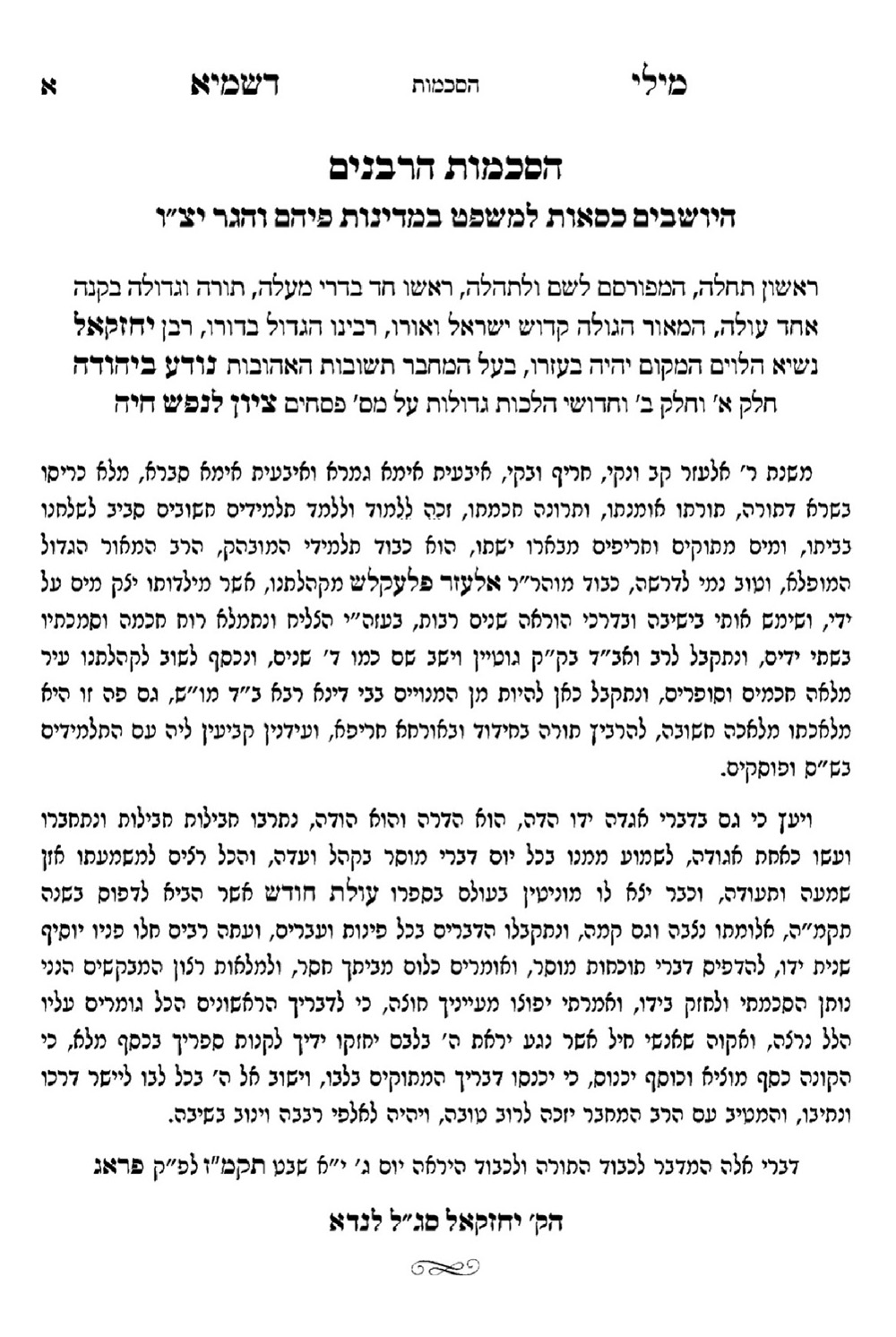
In 1910 a similar family type sefer was published in Warsaw. As with the Hut HaMeshulash, it contains multiple commentaries from relatives. In this case, the Amudei Yonason by R. Jonathan Eybeschütz and the Amudei Shmuel by R. Nachman Shmuel Miodoser, a descendant of R. Jonathan Eybeschütz. The Amudei Yonason is claimed to be from a manuscript, however, it is R. Nachman’s commentary which we will focus on. Both of these seforim have rather nice haskamot from R. Hayyim Ozer Grodzinski, R. Eliezer Rabinowich, R. Eliyahu Meisels as well as R. Chaim Soloveitchik. It seems that R. Nachman actually had a more difficult time securing R. Chaim Soloveitchik’s haskamah due to R. Nachman’s first piece in his sefer. In that piece, R. Nachman ties the controversy of the earth or sky being created first, to that of Moshe and Betzalal about the construction of the mishkan and use it to explain a Midrash. R. Chaim said that such a interpretation is inappropriate, as according to R. Nachman’s explanation there are opinions which argue with Moshe and no one can argue with Moshe. [It would appear that R. Chaim took the ani ma’amins literally although, as we have recently seen at the Seforim blog, such a formulation has little support and even the Rambam’s position is not unopposed.] R. Nacham attempted to assuage R. Chaim Soloveitchik’s concern by pointing out the Hafla’ah has a similar explanation with the same end result – someone disagreeing with Moshe. R. Chaim Soloveitchik was unsatisfied with this justification so R. Nachman agreed to remove that explanation. But, when R. Nachman reached Warsaw, that page had already been printed thus, R. Nachman instead of removing the piece, included the above story to let R. Chaim’s position be known. [Reproduced below – you can click on any of the images for a larger version.]

R. Chaim Soloveitchik’s Haskama and R. Nachman’s Disclaimer
R. Nachman attempted to justify his position by pointing to earlier authorities who said similar ideas; however, R. Nachman could have pointed to an earlier authority which said the exact same thing. The vast majority of R. Nachman’s commentary is taken almost word for word from the Sha’ar HaKoton, including the controversial explanation. It appears this plagiarism went undetected as the book was reprinted three years later in 1913 (and even more approbations appear which due to their late arrival were not included in the first edition) and then again in Bnei Brak in 1946. R. Nachman died in 1948 in Bnei Brak.

From the Amudei Yonason
the Original – Sha’ar HaKoton


New seforim, books and some random comments

 New seforim, books and some random comments
[Updated]
By: Eliezer
Brodt
Here is a list of some new seforim and books printed in the past few months.
1.
מערכת האלקות כולל פירוש מנחת יהודה להר’ יהודה חייט ופ’ פ”ז השלם [על פי כת”י], 301 עמודים, + מפתחות ועוד 25 עמודים
2.
רבנו שמעיה השושני, [מגדולי דורו של רש”י], סוד מעשה המשכן עם מ”מ והערות ע”י ר’ גור אריה הרציג, 20 עמודים
3.
ספר הכוונת [ישן] להר’ חיים ויטל עם הגהות הרמ”ז, תרסו עמודים
4.
אגרת הגר”א השלם, עלים לתרופה, עם מקורות ליקוטי הגר”א ביאורים והערות, כתבי יד, כולל שיעורים של רבי מיכל ליפקוביץ ורבי אהרן ליב שטינמן על הספר.
I am enjoying this edition so far and think it is full of very useful information. It has a few parts including an in-depth running commentary of the entire work and a collection of material from other places where the Gaon writes similar ideas. It also includes a photocopy of one of the earlier manuscripts of the work. Just to point out some minor issues with the sefer. It does not say who put it out, I am not sure the point in this modesty it’s well known what the Chida writes about such a practice. In the beginning of the work where he talks about the various editions of the sefer a reference should have been made to Yeshayahu Vinograd’s Otzar Sifrei Hagra where he lists over hundred editions of the letter of the Gra.
Of interest to bibliographers on the subject is what R’ Moshe Sternbuch writes:
ובמשפחתו יש דעה גם שכתבו באידיש ותורגם
He has a few pages about the Gra’s trip to Eretz Yisroel and why he did not end up going. I do not expect him to quote the discussion of Aryeh Morgenstern in his various works such as in The Goan of Vilna and his Messianic Vision. However I would have thought he would quote some of the sources found in Eliach’s Hagaon.
The ‘author’ writes (p. 205):
והנה מפורסם דהגר”א לא לקח יותר מכדי פרנסתו ופרנסת אנשי ביתו, ואדרבה אפילו לבני ביתו  לא היה כל צרכם… כידוע חי הגר”א בדחקות עצומה… (שם, עמ’ קכז)
I am not sure where he gets this from but Shaul Stampfer in his work Families, Rabbis and Education (pp. 327-328) and more recently Eliyah Stern in his work The Genius (pp. 30-31) based on manuscripts printed by Yisroel Klausner and other sources prove that this is not true at all.
Stamfer writes: “The Gaon certainly did not live in poverty… the Gaon did not have the highest income of the individuals on the Vilna community payroll. However his income was near the top and it was several times the salary of minor communal functionaries…”
Another interesting discussion of his is about how the Gra writes about dealing with children:
ועל הקללה ושבועה וכזב תכי אותם במכות אכזריות… (עמ’ קח) שתכי את בנינו מכות אכזריות (עמ’ רכב)
 The last two words are only found in some versions of the manuscripts. The Author collects some sources on this subject of hitting children and even points to the Gra elsewhere which appears to contradict this. In an appendix he quotes at length the opinion of Rabbi Chaim Kanievsky pro such methods. I think he should have included many more sources on such an important topic [I hope to return to this in the future] especially what R’ Wolbe writes in his letters (Igrot Ukesavim, p. 121) against such methods. Another important source he should have quoted is from the Menucha Ukedusha (from a talmid of R’ Chaim Volzhiner, which he quotes elsewhere) who writes that one should certainly not hit children after the age of thirteen (p.136). See here.
One last point related to this edition where the Gra writes about learning tanach
ושילמדו מקדם כל החומש שיהיו רגילים כמעט בעל פה…
The author brings a Teshuvah from R’ Wosner which I do not think is like the Gra at all. The author has an appendix about this, much can be added to this but here to he should have quoted the previously quoted work Menucha Ukedusha.
 
5.
ר’ חיים פאלאג’י, כף החיים, תשמח עמודים, מכון שובי נפשי כולל הערות
6.
ר’ חיים פאלאג’י, תנא דבי אליהו עם פירוש לוח ארז, מכון שובי נפש, תתכו עמודים
7.
מכילתא עם פירוש ברכת הנצי”ב [פורמט קטן], שמא עמודים + פירוש ברכת הנצי”ב על תורת כהנים, מ’ עמודים
8.
דרשות וחידושי רבי אליהו גוטמאכר מגריידיץ על התורה, שמות, שסד עמודים
9.
ר’ חיים סופר, קול סופר, על משניות ג’ חלקים
10.
ר’ יוסף צבי הכהן, קב ונקי על הלכות תפילין, נדפס לראשונה בברדיטשוב תרנ”ח, 20 עמודים
11.
ר’ חיים הירשנזון, מלכי בקודש, חלק שני, בעריכת דוד זוהר, מכון שכטר,
12.
ר’ אריה לוין, משנת אריה, על משניות נזיקין, ב’ חלקים  [כולל מסכת אבות]
13.
גנזים ושו”ת חזון איש, חלק שלישי, שפז עמודים
14.
ר’ חיים פרידלנדר, שפתי חיים, רינת חיים, ביאורי תפילה: ברכות השחר, פסוקי דזמרא, קראית שמע ועוד, שצו עמודים
15.
ר’ אהרן פעלדער, רשומי אהרן, כולל פסקי הלכה מו”ר הרב משה פיינשטיין זצ”ל, מה עמודים+ שאילת אהרן ח”ג, לב עמודים ועוד
16.
תשובות הרב קאפח, נערך ע”י ר’ שלום נגר, חלק א תשל”ד-תשלו, תסז עמודים
17.
תאות דוד בענין כתיבת סת”ם, על הספר הזכרונות לר’ שמואל אבוהב אם ק’ אמירה נעימה, רמ עמודים
18.
ר’ אליהו זייני, בין השמשות דר”ת, וזמן הדלת נרות חנוכה, 110 עמודים
19.
ר’ דוד דבליצקי, ברכות לראש צדיק, כל עניני כוס של ברכה, נט עמודים
20.
ר’ יהושע ברוננער, קונטרס איש על העדה, הליכות והנהגות של רבינו הגרי”ש אלישיב זצוק”ל, נח עמודים
21.
ר’ יהודה שושנה, קונטרס נהג בחכמה, הלכות ומנהגי בית הכנסת הנוהגים בישיבת בית מדרש גבוה לייקוואוד במעגל השנה, כולל הלכות נחוצות לסדר התפלה וקריאת התורה, מנהגי הישבות, מקורות המנהגים, ק’ עמודים
22.
ר’ שמואל אוסטערליץ, ילקוט חלוקא דרבנן עניני לבוש במשנת רבוה”ק מסקווירא, עם ליקוטים יקרים מפי ספרים וספרים, קכב עמודים
23.
אגן הסהר, על רבי אברהם גנחובסקי זצ”ל, 247 עמודים
24.
יום אידם ניטל, ילקוט מקורות אמרות ועובדות, ריב עמודים
25.
בדחנא דמלכא, מתולדותיהם ונועם שיחתם של משמחי הצדיקים, רנא עמודים
26.
ר’ דוד קאהן, האמונה הנאמנה, על יג עקרים של הרמב”ם, 308 עמודים, ארטסקרל
27.
ר’ דוד קאהן, השקפה הנכונה, הערות והארות על הקדמת הרמב”ם לפירוש המשניות, 168 עמודים, ארטסקרל
28.
ר’ דוד קאהן, ממשה עד משה, הערות על יד שרשים של הרמב”ם לספר המצוות והשגות הרמב”ן, 372 עמודים, ארטסקרל
29.
ר’ קלמן קרון, הרחק מעליה דרכך, על האיסור החמור של קריאת ספרי מינות ואפיקורסות וחובת ההתרחקות מהם, [ארבעה שערים], רסא עמודים
30.
ר’ אברהם מנדלבוים, דרשות לבר מצוה, מאות דרשות שנשאו גדלי ישראל לכבוד יום הבר מצוה, ב’ חלקים
31.
קובץ מוריה שבט, ראה שם, מאמר מיוחד מידידי ר’ יעקב ישראל סטל, ‘הוראות והנהגות לרבינו יהודה החסיד’ ונספח: מנהג השלכת עפר ותלישת עשבים בבית הקברות’.
A PDF of this article is available upon request.
32.
קובץ אור ישראל, גליון סו, שפד עמודים
33.
קונטרס כי רחק ממני מנחם, על ר’ בנימין מנחם פלס, קלג עמודים
34.
ר’ ישראל מורגנשטרן, מכירים אלקטרוניים בשבת, קכח עמודים
35.
ר’ מרדכי טנדלר, מסורת משה, הוראות והנהגות שנשמעו מאת רבן של כל בני הגולה ופוסק הדור הגאון האדיר רבי משה פיינשטיין זצוק”ל, תרכא עמודים.
Of course there is much to say about such a sefer as it’s full of hundreds upon hundreds of pesakim. It appears to be the first of a few volumes. The haskamah of R’ Dovid Cohen is nice where he writes
ספר זה נדיר הוא ככמעט מיוחד במינו, אע”פ שמצינו יומן מהגאון האדר”ת זצ”ל, וגם אוטו-ביגרפיה (שיש מערערים אם הו מזויף מתוכו) של הגאון רב יעקב עמדין זצ”ל במסורת משה נמצאים חידושים נפלאים להלכה וגם מצר מתוכו כו”כ השקפות של מרן זצ”ל… ומודה להם על התענוג הרוחני שהרגשתי שקשה לתאר הטעם להזולת ורק יכולים לומר לו טעם וראה…
Just to point out a few things of interest: he has a lengthy piece where Rav Moshe said a certain piece in the Ramban’s work on chumash has additions not from him, that are kefirah [Korach, 17:6] (pp. 522-523), another piece of Rav Moshe about the manuscript of R’ Yehudah Hachassid Al Hatorah (p. 552), that R’ Reuven Margolis came to hear Rav Moshe Say a shiur in Yerushlayim (p. 501). Anyone reading this work is sure to find many more things of great interest.
ספרים על פורים
36.
ר’ יוסף ניזר, פורים סראגוסא, בהלכה ואגדה, 77 עמודים
This work is well done and collects a nice amount of material on Purim of Saragossa. Just to add two important sources on this subject not quoted in this work, most likely because they do not know English, Elliot Horowitz, Reckless Rites, pp. 279-286 and Yosef Yerushalmi, Zakhor, pp. 46-48.
37.
ר’ רחמים טוויג, המאיר לארץ, חקירות ומערכות בעניני מחיית עמלק, תסג עמודים
38.
ר’ יהודה זולדן, מגילה במוקפות חומה, מקרא מגילה בערים מוקופות חמה מימות יהושע בן נון, 470 עמודים [יסוד של הספר הוא עבודה לשם קבלת תואר שלישי מהמחלקה לתלמוד באוניברסיטת בר אילן]
39.
ר’ עמרם טיגרמן, מחייב איניש לבסומי בפוריא, ליקוט ובירור דעת הפוסקים בדין זה, ובענין חמר מדינה בזמנינו ומיץ ענבים לארבע כוסות,שיא עמודים
40.
ר’ יוסף יונה, ספר מיני מעדנים, בירורי הלכה במצות משלוח מנות, קעה עמודים מחקר ועוד
1.
שלום יהלום, בין גירודנה לנרבונה, אבני בנייין ליצירת הרמב”ן, יצחק בן צבי, 414 עמודים [מצוין]
2.
משנת ארץ ישראל, שמואל וזאב ספראי, מסכת כתובות, ב’ חלקים, 677 עמודים
3.
חיים גרטנר, הרב והעיר הגדולה, הרבנות בגליציה ומפגשה עם המודרנה 1815-1867, מרכז זלמן שזר, 448 עמודים [ספר מצוין]
4.
בד”ד 27 הוצאת בר אילן
5.
רון קליינמן, דרכי קנין ומנהגי מסחר במשפט העברי, הוצאת בר אילן
6.
יהושע פישל שניאורסון, חיים גראביצר סיפרו של נופל, ידעות ספרים 583 עמודים
After being out of print for years this classic is back in print.
7.
קתרסיס, גילון 18 כולל מאמר ביקורות של ר’ שלמה זלמן הבלין על בנימין בראון ‘החזון איש’ [61 עמודים!]
A PDF of this article is available upon request.
English
 
The Challenge of Received Tradition: Dilemmas of Interpretation in Radak’s Biblical Commentaries, by Naomi Grunhaus, Oxford University Press, 2012. Dialogue, volume 3
Rabbi Chaim Rapoport, The Afterlife of Scholarship, A critical review of The Life and Afterlife of Menachem Mendel Schneerson Samuel Heilman and Menachem Friedman


Some New Seforim, Books, R’ Eleazar Fleckeles, R’ Naftali Herz Weisel, Frankism and (of course) Censorship, Pt. I

Some New Seforim, Books, R’ Eleazar Fleckeles, R’ Naftali Herz Weisel, Frankism and (of course) Censorship*
By Eliezer Brodt
It’s been awhile since I posted a list of new seforim. I hope to post an updated list of a few hundred titles within the next few weeks. In this post I want to focus on a few new titles that, aside for being new, all have a connection to one topic. This is also an update to some earlier posts relating to this topic.
As a bochur about twenty years ago, I came across a small sefer called Olas Chodesh by R’ Eleazar Fleckeles during one of my daily shopping trips in seforim stores in Meah Shearim. Until then I had only been familiar with his Shu”t Teshuva m’Ahava. Besides the excellent price ($3), I also enjoy derush so I was happy with my purchase. Going through the sefer I was not let down, as it was especially interesting and even included some nice pieces from his rebbe, the Noda Bi-Yehudah. A few years later, while in Monsey, I made a short, enjoyable visit to Tuvia’s Bookstore. There I came across another small sefer by R’ Eleazar Fleckeles, Meleches haKodesh. After going through this sefer, I was once again blown away with how never ending Torah is (this is a daily occurrence!) . A bit later I was in a special library in Lakewood where I came across yet another obscure sefer by R’ Eleazar Fleckeles called Ahavat David, devoted to attacking Frankism. I immediately photocopied the sefer and went through it, marking off some interesting pieces. (Here is a link to a complete version of the work from the Reich collection, and here is a link to it on Google Books.)
In 2007 I wrote a review of the Meleches haKodesh [here] called ‘god or God: A Review of Two Works on the Names of God’. In that post I mentioned a letter found in the beginning of the Ahavat Dovid quoting a letter from R. Naftali Hertz Wesseley which says;
כי שמעתי מפי הגאון המקובל הגדול שהי’ ידוע הזוהר וכל ספרי האר”י ז”ל בעל פה הוא הרב ר’ יהונתן אייבשיטץ זצ”ל שהיה אומר לשומעי דבריו בעיני הקבלה כשראה שהם מפקפקים בהם ואמר אם לא תאמינו אין בכך כלום כי אין אלו מעיקרי אמונתנו, וכן היה אומר לאלו המביאים הקדמות מדברי קבלה לישב איזה גמרא או מדרש לא חפצתי בזאת ומה חדוש על פי קבלה תוכל ליישב מה שתרצה אמור לי הפשט הברור על ידי נגלה ואז אודך וכל זה אמת עי”ש עוד.
A bit after writing that post, I received an e-mail from Marc Shapiro asking me where I saw that letter, as the edition of Ahavat Dovid that he checked did not have it. I told him I had photocopied the whole sefer from an original. Some time after that, in February 2010, On The Main Line wrote about this censorship:
The book included a 1796 letter from Wessely, which Fleckeles offered… I will just note that I examined the pdf of Ahavas David twice, and I was unable to find the letter. I couldn’t understand why I couldn’t find it, so I asked several friends (literary men) if they knew what page it was on. Dr. Marc Shapiro replied that this edition — a Copy Corner reprint — is censored; it doesn’t include the letter! I suppose it’s theoretically possible that the censorship, ie, removal of the letter occurred long before the scanning of the book. That is to say, there’s no way at the moment to tell who removed it and when, but we can probably guess why. In any case, at the same time I asked Shapiro for clarification, Rabbi Brodt told me that his copy of Ahavas David includes the letter, and he sent it to me.
This censorship was later included and discussed by Marc Shapiro in an article[1] and then again in his work Changing the Immutable, (p.220). 
In 2007 I already noted some of the significance of this letter; i.e. it is notable that R’ Fleckeles quotes R’ Wesseley at all[2], as Wesseley was one of the early leaders of the haskalah movement, was close to Mendelssohn and was the author of the Biur on Vayikrah. R’ Fleckeles, like R’ Landau was firmly against the Biur.[3]
The significance of this letter in relationship to all this was already pointed out by Meir Hildesheimer, in a footnote in his excellent article “Moses Mendelssohn in Nineteenth Century Rabbinical Literature,” (Proceedings of the American Academy for Jewish Research (PAAJR) 55 (1988), p. 87 n. 23).
As an aside, all this is yet another example why scanned copies of seforim are not enough, as at times the scanner deletes pages on purpose (or even by accident). Examining originals are therefore important.
Both Meir Hildesheimer and On the Main Line[4] already noted that a copy of this letter was printed again in HaMelitz (#48, p. 750) in 1886.

In 1930, Dovid Zinz, in his extensive biography on R’ Yonasan Eibeschuetz, Gadlut Yonasan, lists R’ Wesseley as a talmid of R’ Yonasan (p.280), and also reprints this letter without claiming it’s a forgery (pp.245-246).
In November 2011 I wrote a two part post on the incredible work Parshegen by Rabbi Dr. Rafael Posen. In the second post, titled Using the works of Shadal and R. N. H. Wessely, I wrote:
A few years ago in the pages of the excellent journal Ha-maayan, a controversy took place (here) in relationship to how to cite various works of questionable people, in the course of the controversy it turned to quoting Mendelson and Wessely and their stories. Rabbi Posen mentioned that there was nothing wrong with Wessely which others argued. This controversy in regard to Wessely was not a new one[5], a few years back in the Kovetz Beis Aron VeYisroel there was a series of articles based on various manuscripts showing how the Gedolim at the time were very against Wessely. Towards the end of the Series of articles the author did a strange thing, he collected many citations of big name gedolim who did use Wessely’s work even after the controversy (herehere and here). Almost all of these gedolim were well aware of the controversy of Haskalah and came after the early gedolim obviously disagreeing with them. To me this was strange as he undermined his research – he showed that there was a big controversy with many big people on both sides so how in the world did he reach his conclusion that Wessely was bad according to everyone.
The controversy about Wessely did not end there as a few years later two works of Wessely were reprinted, his Sefer Hamidos (2002), and his Yeyn Halevonon (2003). In the introduction of both works there are lists of great people who used Wessely’s works. To be sure the kanoyim did not remain quiet about this, that same year (2003) in the introduction to the Tomer Devorah reprinted by the Mishor publishing house an introduction was printed about the evil works of Wessely that were reprinted. A few months ago the Kovetz Eitz Chaim (15, 2011, pp. 13-30) printed another manuscript on this controversy against Wessely including some letters of various gedolim of today against the evil Wessely.  In the recent work on R. Elyashiv Shlita, Hashakdon (2, pp. 136-137) they also mention how he was against the reprinting of the works of Wessely. The problem to me is how do they explain all the great Gedolim who did use his works? [In that post I included a list of Gedolim who used the works of Wessely, or quoted him in a positive light.[6] I then concluded with the following:]
“I would like to conclude with the following dream just as R. Shlomo Dubno was vindicated in the past few years by R’ Dovid Kamenetsky. It is my hope that Wessely will too be vindicated from all false charges against him and people will realize there is nothing wrong with his writings.”
Fast Forward to 2014

A few years ago I mentioned a sefer called Rabbenu written by R’ Eliyhua Starrit about R’ Ovadiah Yosef. This work is very valuable, as the author printed numerous conversations he had with R’ Ovadiah Yosef while learning with him and we get a rare, authentic glimpse into his study habits and private learning sessions. Among the numerous interesting pieces in this work we “hear” R’ Ovadiah’s opinion on different seforim and their authors. However, at times a juicy tidbit or name is censored out and we are left in the dark with just a tease of a conversation.

Here are two such pieces. The first refers to the reprinting of the Chemdas Yamim (hopefully I will return to that in the future). The second refers to the reprint of R. N. H. Wessely’s work by Yerid Haseforim a few years ago. As you can see, part is edited out.

We see that R’ Ovadiah Yosef was also against the reprinting of R’ Wessely’s works.

And 2016

In April this year, a complete edition of Ahavat Dovid was put up for auction by Legacy Judaica as was mentioned here, with a signature of it having been owned by R’ Binyomin Lowe, author of Sha’arei Torah.
A few months ago a few more volumes of R’ Wessely were printed, some for the first time from manuscript, by R’ Moshe Tzuriel. One volume includes three new seforim. 1) Sefer HaMidos which includes an additional one hundred and twenty five new pages from manuscript, printed for the first time. 2) Sefer Migdol HaLevonon, about one hundred and fifty new pages from manuscript, printed for the first time. This work focuses on Shemos Nirdafim (synonyms). 3) Chikur Hadin, a thirty page article on Sechar VeOnesh. The second volume is a reprint of Gan Na’ul (934 pp.) with notes and indexes. There is a whole section of this work printed here from manuscript for the first time, numbering about 250 pages!

Here are two samples of pieces from this beautiful work.


It is worth seeing this haskamah of the Noda Bi Yehuda to Gan Na’ul:

In the introduction to this new work, the editor notes (p. 6) that R’ Fleckeles quotes a letter from R’ Naftali Hertz Wesseley in his Ahavat David and mentions that it has been censored out of some versions, referring to his introduction of the Yeyin Levonon that he printed in 2003 (p. 26).

A few months ago R’ Eleazar Fleckeles’ Ahavat Dovid was reprinted by Mechon Netzach Yakov together with his Olas Chodesh Hasheni (more on this further on). 
However when reprinting the Ahavat Dovid, they censored R’ Naftali Hertz Wesseley’s letter and removed it. They write (p.251) their reasoning for doing so as follows:

בראות רבינו זצ”ל גדול המכשלה שנגרם ע”י לימוד תורת הנסתר ואיך שנמשכו כמה אנשים פשוטים עם ללימוד זה, ומתוך כך נאחזו בסבך כת הפראנקיסטן וירדו להתום, ביקש רבינו לעשות כל פעולה ותחבולה לעוררם ולמונעם מלימוד זה לשם כך יצא מן הקו, ובבחינת עת לעשות ל’ וגו’ העתיק בתחילת הספר מכתב מהמשכיל הנודע לשמצה נ”ה ויצל, מה שכתב בשנת תקנב לאחד מתובי העיר פראג, הגדת עדות מה ששמע בנעוריו מפי אחד מגדולי ישראל המפורסמים מדור הקודש, ליזהר מלימוד בספרי קבלה, ולעסוק אך ורק בנגלות התורה. במשך השנים נשמט מכתב זה מדפוסי ספר ‘אהבת דוד’ וכן ראינו לנכון שלא להעתיקו, כי לפי הנראה לא היתה אלא בתורת הוראת שעה, לעורר ההמון והמתחדשים בעם לבל יומשכו אחר כת הארורה הזאת. וראה עוד בענין זה בקובץ בית אהרן וישראל…”.

Aside from deleting the letter and claiming that R’ Eleazar Fleckeles did not really agree with its contents, they also complete misquote it.

Emes LeYakov

A few weeks ago a work called Emes LeYakov (696 pp.) from R’ Yakov Emden[7] was released by R’ Goldstein of Monroe.[8] It includes all of R’ Emden’s notes and novella on the Zohar[9] from a manuscript in Oxford (R’ Goldstein has shown a while ago that Bick’s edition (printed by Mossad HaRav Kook) of R’ Emden’s notes on the Zohar is worthless).[10] The volume begins with a 140 page introduction of the significance of these notes on the Zohar and the general history of the Zohar and various works and editions.[11]

In passing, R’ Goldstein (p. 20) writes regarding of R’ Naftali Hertz Wesseley’s letter printed by R’ Eleazar Fleckeles.

 בספר אהבת דוד… הביא מכתב מאחד ממשוררי הזמן (שלימים נודע שהוא מראשוני וראשי המשכילים, ואף רבו של רבי אלעזר ה”ה בעל נודע ביהודה זצ”ל, לחם נגדו ונגד דעותיו, והדברים ידועים ואכמ”ל), שכתב שם חי נפשי, כי שמעתי בנעורי מפי הגאון המקובל… הרב מוהר”ר יונתן… כי אין אלו מעיקירי אמונתנו ע”ש ובלי ספק מי שאינו מאמין לו, כי יצאו הדברים האלו מפי הגאון רבי יונתן בוודאי אין בכך כלום, אמנם ראינו חובה להעיר על אלו הדברים מדברי רבנו כאן כי המכחיש קבלת חכמת האמת הוא מין ואפיקורוס גמור’ ודי בזה”.

Basically he claims it’s false and what follows is that R’ Eleazar Fleckeles was mistaken to print this letter.
Shu”t Zecher Yehosef

Another recent work that has a connection to this post is the new two volumes of Shu”t Zecher Yehosef on Yoreh Deah by R’ Yosef Zechariah Stern. Many years ago Mechon Yerushalayim announced that they would be printing R’ Yosef Zechariah Stern’s works still in manuscript. In 1994, they printed the shut on Even Haezer. In 2014 they reprinted his shu”t on Orach Chaim, which had been impossible to find, while also adding in some new material. This summer they released two completely new volumes on Yoreh Deah from manuscript (380+413 pp.) (of course it’s amazing). R’ Yosef Zechariah is the subject of a future post; for now it’s worth mentioning Siman 173, his teshuvah connected to this topic.[12] It’s a slightly different version that the one that appears in the Sdei Chemed:


The editor writes in a footnote: 

ראה קובץ בית אהרן וישראל… ועי’ במבוא לספר יין לבנון מהדורת תשס”ג שהביאו הרבה גדולי עולם שדעתם כדעת רבינו, ויש לפקפק על הערעורים כנגד. אבל אינו ברור מה ידעו עליו בדור שאחר הפולמוס, ועי’ קובץ עץ חיים גליון טו…

I am not sure what that is supposed to mean? That later on we found out he is evil?

Olos Chodesh Sheini

We now return to the new edition of R’ Eleazar Fleckeles’ work. This is the third volume of R’ Eleazar Fleckeles works printed by a Boro Park-based Machon called Netzach Yaakov. When writing about the last volume they printed, I remarked: “I really hope they continue to print the rest of R’ Fleckeles’ works”. B”H, they are doing good job continuing with reissuing his works. This beautifully produced edition includes an introduction about R’ Fleckeles, sources to his words, at times quoting R’ Fleckeles references from his other works, and a detailed index of topics and seforim quoted by R’ Fleckeles at the end of the volume. 

The first part of the sefer is R’ Eleazar Fleckeles Olos Chodesh Sheini.

I would just like to quote a few passages from this beautiful work.

The first point to note about this sefer is the beautiful Haskamah that the Noda Bi-Yehudah wrote:


Elsewhere in the sefer he writes about himself: 

כך אני אומר, אני אחד מסוחרי הקטנים אין לי כל בבית כי את אשר ראיתי במראה יחזקא”ל, מראה נאוה קודש, פנים מאירות להלכה ופנים שוחקות לאגדה, מעט הון תמורת העבודה אשר יגעתי מנעורי ושמשתי מילדותי עד היום הזה, את רבינו גדול הדור רבן של ישראל [מילי דשמיא, עמ’ קעב]. 

The sefer is full of references to material from the Noda Bi-Yehudah, both oral and written.

What apparently was relevant in our day was in his day too:

כאשר בעונינו עד היום, אם המוכיח הוא בעל מעשה, אזן וחקר ותקן משלים, הכל רצין אחריו והכסילים יצאו מבוהלים, אך שהוא למשל ולשנינה, ודבריו לא היה ולא נבראו אלא למשל, ואין מחשבתו כלל לשם שמים, כי מחשבתו ניכרת מתוך המעשה, שמאריך מאד מאד, וחוד חידה, וממשל משל, במעשה הבל, ומעה תעועים, ואינו חפץ כלל להדריכם  בדרך ישרה שיבור לו האדם, להמשל משל אל בית מרי, כי אם תחלת המחשבה על סוף המעשה, לסרס הלכה למעשה, להיות חביב בעיני הבריות, שממשל משלים הוא, משלי שועלים ושעלים הלכו בו, ואמרים קדוש וברוך ומבורך בפי כל משבחים ומפארים מהמעשים אשר לא יעשו ושמו אותו לאדון על כל המעשים. ואיש האלקים אשר מעיו מוכיחין, תוכחות מוסר הכל, גדולים מעי ה’, צדק משפט ומישרים דברים אינם נמעים, וחכמתו בזויה, אפילו אם יושב ודורש כמשה מפי הגבורה [מילי דשמיא, עמ’ לו].

In another derasha he writes:

ולא כן השורים המשוררים. אין כוונתם לשיר ה’ כי אם לשיר חדש. ואינם מדקדקים אם יושר שיר הזה בארץ יהודים. או אם יהיה לצור מכשול כשירת הזונה…. כי אין יראת אלקים במקום הזה ולא אימת רבן… הנה בכל השנה החזנות חזיונות ושעיפי לילה חזון שוא ותפל. מכל שכן בראש השנה ויום הכיפור השתא הלל לא אמרינן. משום שמלך יושב על כסא הדין וספרי חיים וספרי מתים פתוחים כדאמרו ז”ל… וז”ל הרמב”ם בפירוש המשניות שלא היו קורין הלל לא בראש השנה ולא ביום כיפור. לפי שהם ימי עבודה והכנעה ופחד ומורא… ואיך נשיר את שיר הכסילים. כשמסתכל אדם יום המיתה… ואיך להעלות על הדעת שתפלות הללו יעשה רושם למעלה ויעלו חן ויהיו לרצון על מזבח ה’ [עמ’ קיג].

Of course there are numerous parallels[13] to this in other sources; to cite just one, R’ Shabesai Sofer writes in his Siddur:
ויותר מזה צריכים להזהר החזנים בתפלותיהם, הממונים להוציא רבים ידי חובותיהם  … כי על הרוב אינם מקפידים רק על קול נעים… ולא זו בלבד אלא שהם מנגים נגוני נכרים… [הקדמה פרטית סי’ כז].

In another derasha he writes:

לא בשליחי ציבור בלבד רעה זה חולה ראיתי, אלא אף בהתמניות הרבנים יושבי על מדין, מתוועדים בעלי בתים יחד יושבי קרנות, אשר לא יצאו מבית הספר מעולם, ואין להם ידיעות בית רב, ומעידין באיש פלוני שהוא איש האלקים גבר בגוברין, וכדי הוא לסתכל במראה קשת גבורים ללמד בני יהודה קשת, ולאחוז פני כסא הוראה כבוד חכמים מחוכמים, ומקבלים אותו לרב ומורה גדול בזזרוע נטויה וביד חזקה, בלי ידיעות תופשי התורה אשר להם משפט הבחירה, ולא כאשר נהגו אבותינו הקדושים ז”ל שבחורי ישראל הכריעו [עמ’ קטז].

Another derasha, dated during Aseret Yemi Teshuvah 1784, is devoted in part to attacking Mendelsohn’s Biur.[14] In addition, he quotes a piece from the Noda Bi-Yehudah related to this.
Interestingly enough the great bibliographer Ben Yaakov when writing about this work notes:

דרושים שונים נחלק למאמרים ובו דברי ריבות על העתקת התורה להרמבמ”ן [אוצר הספרים, עמ’ 432].


While an examination of all the statements of the Noda Bi-Yehudah about this need to be properly analyzed, it’s worth pointing out to a censorship on this subject. 

In the beginning of his new book, Maoz Kahana[15] writes as follows:

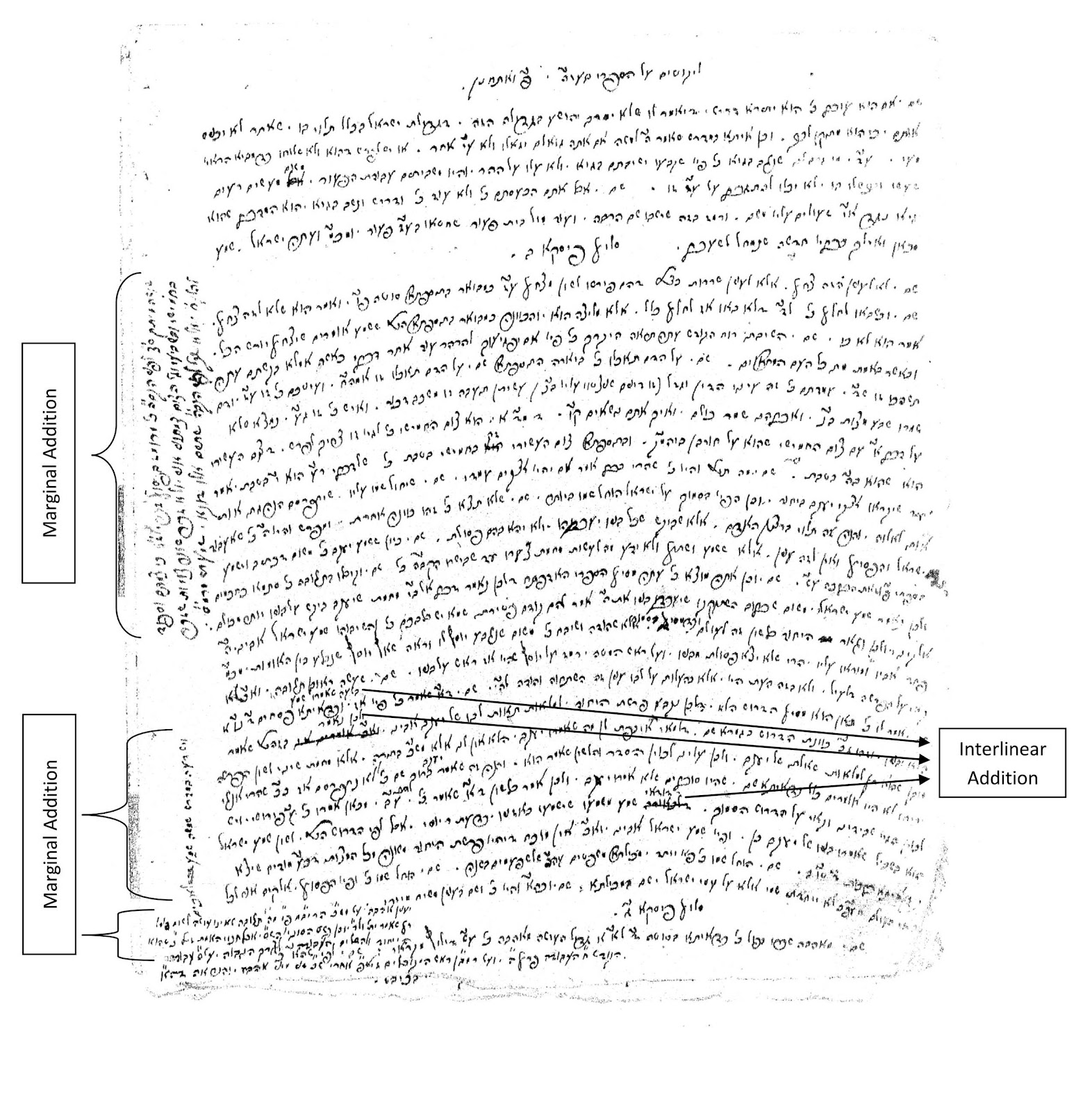
ראשון הביוגרפים של ר’ יחזקאל לנדא היה בנו יעקב. הקונטרס “דברי ידידות”, ששלח לאחיו שמואל לקראת הדפסת ספר נודע ביהודה תנינא בשנת 1810, שבע עשרה שנים אחר פטירת האב, מהווה עד היום אוסף ידיעות ומסורות ראשון ורב ערך. חלק מסוים של דברי ידידות נערך ונדפס בראש הספר הנזכר, וחלקים אחרים שלו נדחו וצונזרו, אותם אפשר להעלות מכתב היד הארוך המקורי של יעקב, מלווה בהערות העריכה של שמואל שנשמר בספריית קרלין סטולין בירושלים. [מהנודע ביהודה לחתם סופר, עמ’ 23].

Further on in his book he writes:

בשנת 1813 הדפיס ייטליס בהערה צדדית בספרו ‘מבוא הלשון ארמית’ דיון אוהד מאוד של הנודע ביהודה בתרגום המנדלנסוני ובהכרעותיו הפרשניות. את הדיון הזה לקח ייטליס ממכתב יעקבקא לנדא שהיה בידי אחיו שמואל בפראג. המכתב המדובר הוא ‘דברי ידידות’…  שכתב ר’ יעקבקא בברודי בשנת 1810, ובו תיעד ביקורו אצל אביו בפראג בשנת תקמ (1780). תארוך העדות האוהדת לשנה זו, סמוך להדפסת ‘עלים לתרופה’ של ה’ביאור’ (1778), אך לפני פרשת וויזל (1782) מאיר יפה את יחסו החיובי של הנוב”י למנדלסון ב’תקופת הביניים’ הקצרה הזו, בין 1778 לבין 1782. כתב היד המדובר נדד לבסוף אל גנזי חסידות קרלין סטולין, ומשם צולם לבית הספרים הלאומי בירושלים בשנות התשעים. אך אותה הסיבה שגרמה למשכיל יהודה ייטליס בשנת 1813 לצטט דווקא את הפסקה הזו מתוך כתב היד הארוך, גרמה למי מהעוסקים במלאכת הצילום כעבור כמאה ושמונים שנים לצנזר בעזרת דף נייר חלק את… אותה הפסקה ממש. ראה י’ ייטליס, מבוא הלשון ארמית, פראג תקע”ג, הקדמה והשווה לכתב יד קרלין-סטולין ירושלים (F49262) מספר 435… הפיסקה לא נכללה גם בדברי ידידות הנדפס… [מהנודע ביהודה לחתם סופר, עמ’ 190-191 הערה 80].

It’s worth mentioning this passage from R’ Ber Oppenheimer describing his reaction to reading the דברי ידידות about the Noda Bi-yehuda, whom he knew:


When examining the manuscript in Hebrew University the first page states:

קונטרס בן ל”ב עמודים שכתב הגאון ר’ יעקבקא סגל לנדא לאחיו הגאון ר’ שמואל סגל לנדא לפני הדפסתו ספר נודע ביהודה מהדורא תנינא והגאון מהר”ש הוציא מכאן את דברי ידידות… יש כאן כמה וכמה דברים שנשמטו בדפוס וכמובן שבכוונה מכוונת השמיטם הגר”ש ביניהם הוא ענין הביאור של רמ”ד.

This following passage is already quoted by Sandler in 1941,[16] and Moshe Samet in 1970.[17] In 1911 this letter was mentioned in the Encyclopedia Otzar Yisroel (p. 62), where the author writes:

 כי כל דברי האגרת הזאת הם מזויפים, כי סגנון הלשון ושבחו של מנדלסון יעידון כי יצא מפי משכיל ולא מפי רב בימים האלה.


It’s silly to say that it was a forgery, as the work has a haskamah from both R’ Shmuel Landau and R’ Eleazar Fleckeles and was printed in their lifetime in their city and there is not a single trace of any protest or opposition on their part.

Now this is even more interesting; R’ Fleckeles, in his work Meleches haKodesh (first printed in 1812), uses Mendelssohn’s Biur for halachic purposes.[18] He also quotes R. Shlomo Dubno in his Tikun Sofrim many times.[19] Most printings of this work are in various editions of Mendelssohn’s Biur. It’s unlikely that he was quoting it from the rare standalone version when it was printed itself without the Biur, if we already know that he used the Biur.[20]
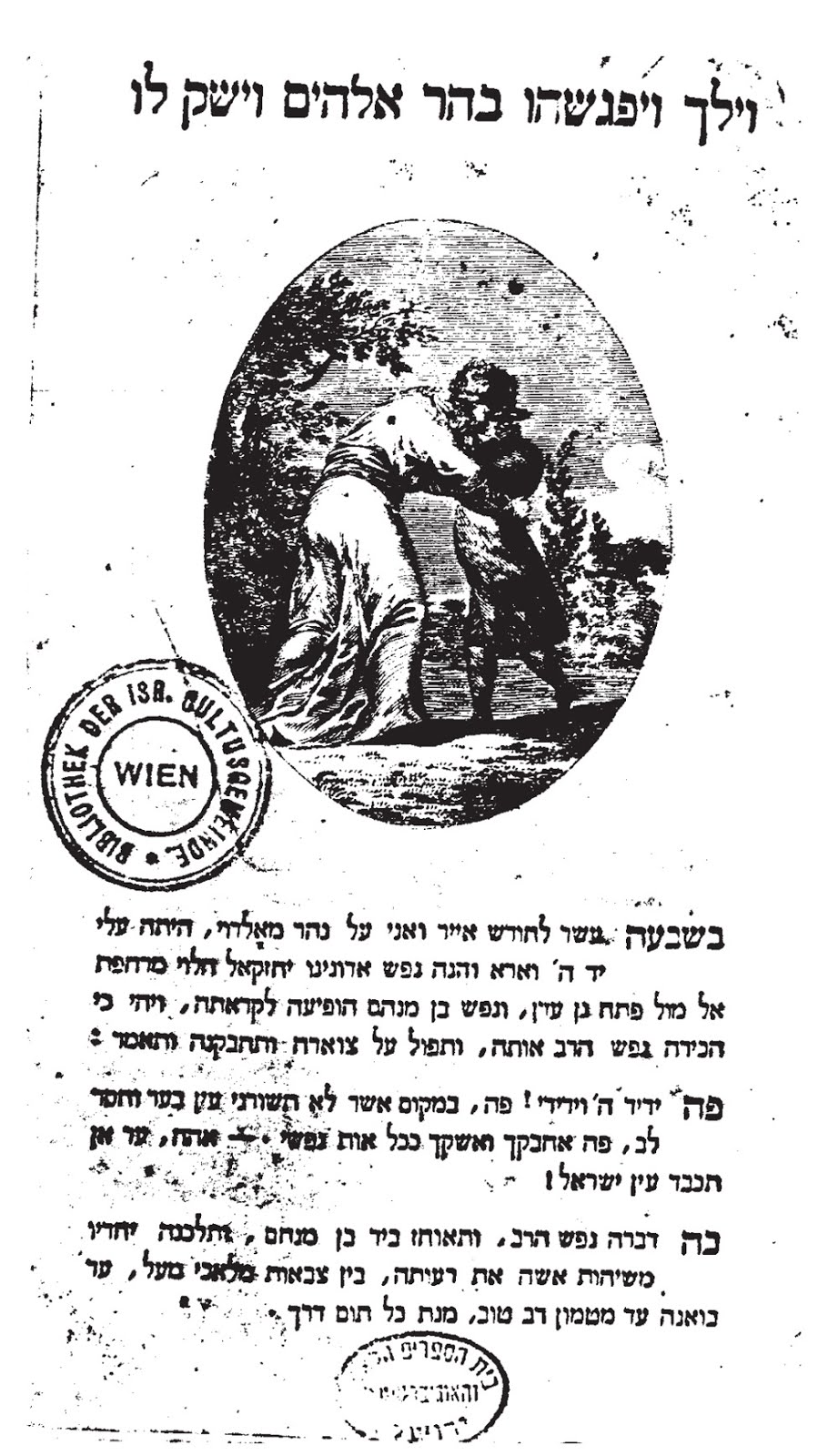
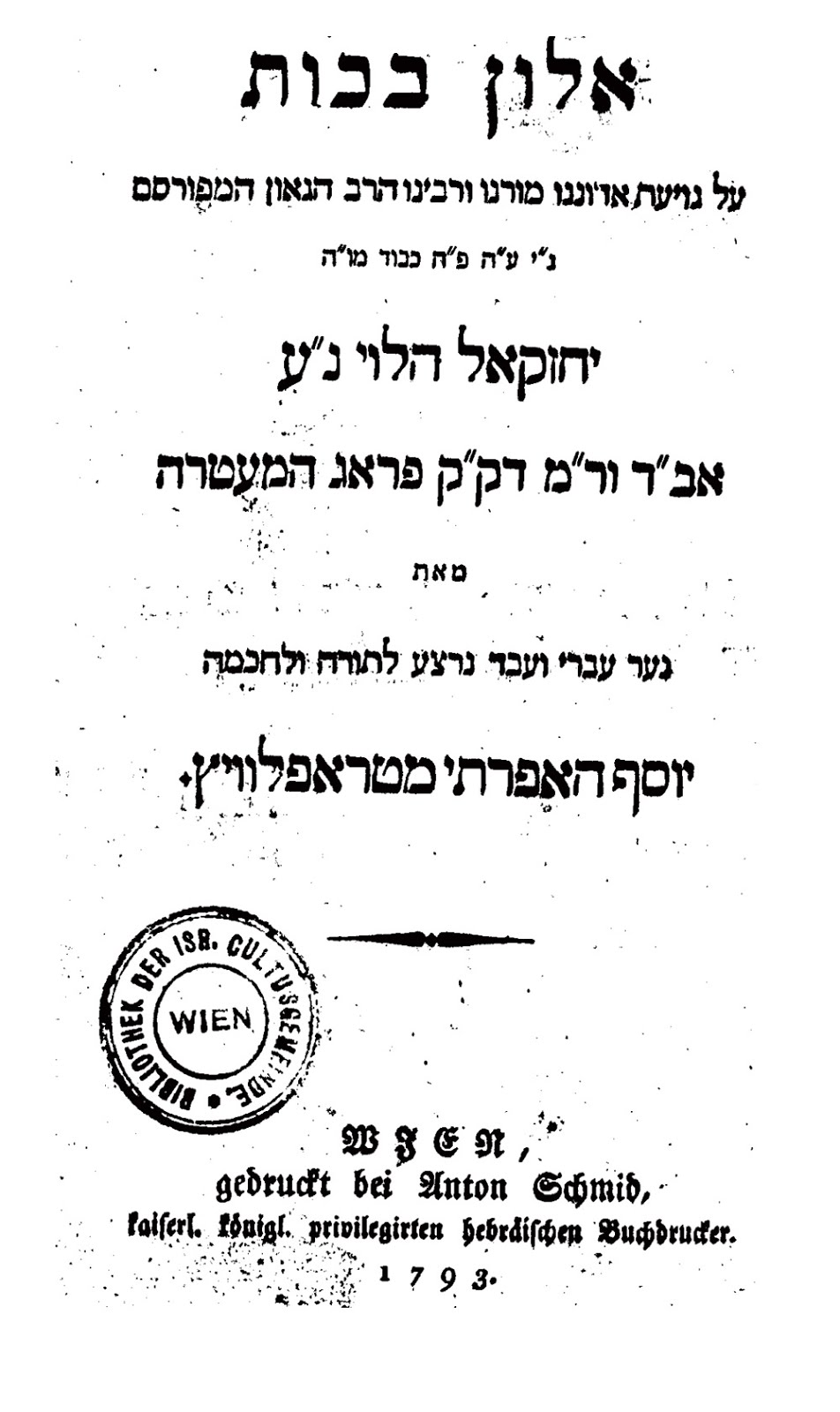
In a work that was printed in 1793, a Hesped on the Noda Bi-Yehudah, we find on the cover it has a picture of Mendelssohn and the Noda Bi-Yehudah embracing. It’s already mentioned here by On the Main Line and more recently by Maoz Kahana (ibid, pp. 192-193).


The truth is, a proper analysis of the primary sources (such as the derasha quoted above) shows that the Noda Bi-Yehudah‘s and R’ Fleckeles’ main issue with Mendelssohn’s Biur was not on the Biur portion[21]; it was on the German translation written by Mendelssohn.
Here are two rare sources[22] which are very important for understanding this subject. The first is an Haskamah signed by both Noda Bi-Yehudah and R’ Fleckeles to a Chumash printed in 1785; as one can see on the Sha’ar there is a direct influence of Mendelssohn on this work. However in the Haskamah they explain why they are giving one – it could compete with Mendelssohn’s edition, as it also translates for the convenience of the reader, but without Mendelssohn’s literary German to which they are opposed.


The second source is a haskamah written by R’ Fleckeles to a Chumash printed Prague in 1824 with a German Translation! Here too, R’ Fleckeles outlines why he is giving it a Haskamah. 

This Haskamah is printed at the end of Silber and Kahana’s above quoted article. They print the Haskamah as it appears in Bereshis, this is the one for the Shemos volume. In the National Library and Mifal Bibliography they only record the volume on Vayikra. But more importantly, they do not note R’ Fleckeles’ Haskamah. This is an uncatalogued haskamah of R’ Fleckeles which helps understand his take on Mendelsohn.[23]

Coffee

Returning to the Olas Chodesh, like other volumes of Derush, this one is rich in giving one a sense of the people and their sins. R’ Y. Greenwald already writes:

פה ושם הזכירו גם בדרשותיהם שדרשו והוכיחו את בני עדתם ולא עצרו מלהגיד את פשעם אשר ראו בהם… הרבה יש ללמוד מהדרשות שדרשו גדולי הדור ממעמד המוסרי של ישראל בימיהם בהדרשות של הגאון רבנו יונתן אייבשיטץ ב’יערות דבש’… וכן תמצא כדברים הללו בספר דורש לציון להג”ר יחזקאל לאנדא… [לפני שתי מאות שנה, עמ’ 26].

Just to list two samples both of which are related to coffee:[24]

בעינינו ראינו ובאזנינו שמענו כמה פעמים שאומרים לגוי להסיק את התנור וכיריים בשבת אפילו אם אין קור כל, כי אם כדי להחם הקאפע [מילי דשמיא, עמ’ קסד]. 

יש כמה אנשים בני בלי שם שאינם עוסקים לא באומנות בורסקי… כי אם יושבים אגודות אגודות מאור הבוקר עד צאת הכוכבים בפונדקאות של גויים, בקאפע הייזר וביר הייזר… ודוברים עתק בגאוה ובוז על מנהיגי עיר ולומדיה, על רבנן ותלמידיהון… [מילי דשמיא, עמ’ קט].

 In another passage he describes Yom Kippur at night:

הרי אפילו בשעה הראוי לכל משכיל לעמוד באימה וביראה בזיע ורחת מפני פחד ה’ ומהדר גאונו, כל אחד מתנשא לומר אני אמלוך ואני אלך בראש אני תהלה, וגברה הקנאה והשנאה הנקימה והטירה וגסות הרוח יתירה, עד שכבתה אש הראשונה שניה ממהרת לבא, כל אחד רודף אחר הכבוד, לכבדו בשיר הכבוד שיר היחוד,[25] להיות מבעלי השיר היוצאים בשיר, ואם אין הגבאי מכבד לאומר שיר היחוד, מחרחר ריב ומדון בשאט נפש וזדון, ומלקין על היחוד, כל אחד נכבד בעיניו ומעשיו גדולים משל חבירו, זה בתורה הנקראית קנין, וזה בחלום ברוב ענין, זה ברוב בנין, וזה ברוב מנין, וכמה קטטת ומריבות רבות מסתעפות עד שנהפוך השיר היחוד לשיר של פגעים, כשיר כסילים פגיעתן רעים, וכה מחלוקות שלא לשם שמים שמענו בליל כל נדרי [מילי דשמיא, עמ’ קמט].

Ahavat David

Turning to the Ahavat David; as mentioned, this work was also just reprinted. In 1799, R’ Eleazar Fleckeles gave a series of three derashos devoted to blasting Sabbateanism and Frankism. In 1800, he printed one of them. He learned much from his Rebbe, the Noda Bi-Yehudah, regarding battling them;[26] in his introduction he writes:

גאון הגאונים בעל שו”ת נודע ביהודה… גם הוא ספר לי מעשים רבים משפטים התועבים מכת ש”צ הרשעה פגיעתן רעה… [אהבת דוד, עמ’ רנז]. 

רבנו גדול העולם. נודע ביהודה, איך היה מוסר נפשו על קדושת השם יתברך לבער הרשעים אשר בחייהם מטמאין טומאת רקב… זכרו נא לימים מה עשה… רבינו… בליל הושענא רבה תקי”ט… כאשר החל השרץ הטמא… והחרים בארור חרם נוי שמתא בתקיעת שופר ובכבוי נרות את יעקב רמאה… וברוב הדרשות אשר דרש במקהלות הזכיר מכת הרשעה הארורה הזאת [אהבת דוד, עמ’ שיז].

The Noda Bi-Yehudah writes:

וצריך אני להראות כי שכלם כוזב.. ותשמע הארץ אם כת הכופרים שבתי צבי שכל דבריהם כפירות ומינות מלא דברי שטות, להפוך דברי אלקים חיים, ולהפוך עבירות למצות עפרא לפומייה… נגד אלו השוטים בעלי ש”ץ ימח שמם נגד טענותיהם המזויפות… [דאיסטים שבתאים ומקובלים בקהלת פראג דרשה מצונזרת של הרב יחזקאל לנדא, תק”ל[27], עמ’ 357].וכת הארורה והגרועה מאוד שבתי צבי [שם, עמ’ 362].

Frankism, in the Derashos Beis Peretz

One more passage related to Frankism, from the Derashot Beis Peretz, a contemporary of the Noda Bi-Yehudah, just printed[28] from manuscript states as follows:

זה רמז גדול אשר קרה לנו באחרית הימים בשנת תקי”ט לפ”ק על ידי המינים האפקורסים ש”ץ ימח זכרם, שהיו עומדין עלינו לכלותינו בפני האומות, שהי’ להם וויכוח גדול בק”ק לבוב עם כל הרבנים של מדינות פולין, יותר מן מאתים של אפקורסים ש”ץ ונעו כולם משומדים עם נשיהם ובניהם, והי’ להם וויכוח בשאלות ותשובות לפני שרים רבים ונכבדים מאומות העולם, ולפני כומרים ובישופים הרבה, והי’ להם ראש אחד ביניהם והי’ ספרדי מכשף גדול בשמות הטומאה… שרצו לבטל תורה שבעל פה, וכבר נשרף על ידם מן האומות הכומרים כל הש”ס ורמב”ם וטורים באמצע בעיר בפני כל עם ועדה, וגזרו שמד בכל הקהלות ישרפו תורה… ומפורסם בכל מידנות פולין שהי’ אז נס גדול ומפורסם, שהכומר השר הגדול שצוה לשרוף הספרים הנ”ל הי’ לו מפלה גדולה תיכף מיד אחר מעשה זאת, ומת מיתה משונה, והי’ מכין אותו ביסורין קשים מן השמים, והי’ צועק קודם מותו שהספרים הנ”ל הם שורפין אותו. ואח”כ כל רשעים הנ”ל נשתמדו, ויצאו מכלל ישראל וכתבתי זאת שיהי’ זכרון בספר כמו מחיית עמלק, למען תספר באזני בנך ובן בנך את הנס שנעשה השי”ת בעתים הללו [בית פרץ, עמ’ תו-תז].

Broadside

R’ Fleckeles writes;

גם פה עיר הגדולה לאלקים, נדפס התפ”ו קול כרוז מגדולי הדור ופרנסי העדה, ונדפס פעם שנית שנה זו ממני ומאחי הרבנים המובהקים המאורות הגדולים בית דין מורה שוה [אהבת דוד, עמ’ רפט].

Here is a facsimile of this actual broadside[29]:

In the beginning of the Drasha, R’ Fleckeles quotes from Frankist literature:

כל השומע ורואה יכול לקרות, את דברי האגרות, יצחק וישחק… בלעגי שפה… כלו מגומגום לא עברי ולא תרגום, לא ספרד ולא צרפת לא אשכנז וריפת ולא מפני יפת לשונם אשר הגו בגרונם, כאחד המונם, במלות מזויפות וטרופות כדבר אחר המבשלות והאופות… ואראה דוגמא ראשית האגרת,… וכן יתר דברי האגרת מהומה ומגערת, מאיימים ומפחידים… [אהבת דוד, עמ’ רנח].

What letter he is referring to? Paweł Maciejko writes that he is referring to the Red Letters.[30] This document was written around 1800. It was printed in Hebrew and English from manuscript by Ben Zion Wacholder, ‘Jacob Frank and the Frankists Hebrew Zoharic Letters’, Hebrew Union College Annual, Vol. 53 (1982), pp. 265-293.[31] Examining this document we see that this is the letter that R’ Fleckeles was quoting as the exact passages appear there. The reason they were called Red documents, writes Maciejko, is “because of the color of the ink that they were written and the symbolic association between the biblical kingdom of Edom and the Hebrew word adom, red”.[32] In one place in the Derasha R’ Fleckeles even writes:

 וכל מה שכותבים הוא בצבע אדום [אהבת דוד, עמ’ שה].[33]

What was the result of this Derasha? Paweł Maciejko writes: 
Shortly after the sermons were delivered, riots erupted in the city, and although Fleckeles did not mention any names, the mob apparently knew very well whom to assault. During the Funeral of a known Sabbatian, a crowd attacked the procession and the body was profaned. It seems that woman were especially targeted: there was turbulence in the female section of one of the Prague synagogues and many of the wives and daughters of known Sabbatians were insulted or attacked on the city’s streets.[34]
When discussing this group he writes:

גם אלה אשר הנשים יושבות ועוסקות אף עמהם, כי שב”י כלהו איתנהו בהו הכל ממירין אחד אנשים ואחד נשים הכל סר יחדו נאלחו בדברי שוא [אהבת דוד, עמ’ רפג]. 

יעקב איש רע מעללים… טף ונשים באים לשמוע קבלת יעקב רמאה, ועוסקים יחדיו במעשה מרכבה טמאה למען ספות הרוחה את הצמאה [שם, עמ’ שכ].[35]

Oral Derasha Versus a Printed One

In this Derasha we find several times that R’ Fleckeles was very graphic while describing the Frankists’s depravities (pp. 257,290, 323-324). I would like to suggest the following: In general, there is a known issue when learning derush seforim; are printed Derashos exact translated versions of the oral original, or were they edited for print? For the most part, I would say this was an actual version of what he said in the oral Derasha he gave. However, orally he was not as explicit, thus the reason why he rushed to print this Drasha almost immediately after he gave it was that it’s easier to write certain things and he wanted to immediately expose how awful they were.[36]
In a similar context (in relation to the word graphic), in 1936 R’ Avrohom DovBer Kahana Shapiro, author of the classic work Dvar Avrohom, gave an incredible Derasha[37] in Yiddish to thousands of woman on the subject of Taharas Hamishpacha. It was then printed in Yiddish with some notes in Hebrew and in 1940 was printed in Hebrew with more notes. A few years ago it was reprinted. In the introduction the editor writes:

כאמור החוברת הזאת היא הרשמה סטינוגרפית, המוסרת בעינם את הדברים הנפלאים כפי שיצאו מפי הנואם הגדול, רק מפני שבמקומות אחדים שבשעת הרצאתו קיצר הרב שליט”א כבר יותר מדי מפני טעמי צניעות מובנים בנוכחותן של אלפי נשים, בקשנוהו למלאות כפי האפשר בהמסר החוברת לדפוס… 

מטעמי צניעות מובנים ומחמת נוכחותו של קהל הנשים הגדול קיצר הרב שליט”א בדבריו שהיו מרומזים מדי. אמנם באשר לכתיבה, המתאפשרת להימסר בהרחבה, נענה לבקשתנו לפרט ולהרחיב…

In the beginning of the Drasha he said:

נושא הרצאתי מעלה בזכרוני את המשנה על הדברים שנקראים ולא מתרגמים נקראים במקורם ולא מתרגמים בשפה המדוברת. בעקב זה נאלץ אני באי אלו מקומות להיות מוגבל בלשוני, לקצר בדברי, לחפש ולברור מלים נאותות ביותר ולהמנע מכמה ביטוים השייכים ישר לענין בכדי לא לפגוע ברגשות ידועים… אמנם כמאור אאלץ באי אלו מקומות לקצר בתכלית ולהסתפק ברמיזה [7-8].

Related to this he writes in the introduction:

החוברת הזאת שלדה ועיקרה הוא הנאום שנשאתי לפני בית יעקב בשפה המדוברת אולם בצאתה פעמיים בדפוס נוספו כמה דברים ובעיקר הערות בפ”ע מתחת לקו עד כי נסבה ורחבה ותשלח בדים וענפים מעל לגבולות נאום עד כי מדת ספר קטן. לזאת יש ממכרי שיעצוני לשנות קצת את סדרה ופניה, פני נאום, לעבדה ולהקציעה ולתת לה פני ספר לאוהבי ומוקירי אלא אענית הבדל עיקרי יש בין ספר לנואם הספר מושגו לשימות איכותית בענין שהוא דן עליו היקף ועיבוד, והנואם הוא בחינת קטע או קטעים מענין הנידון בחינת מקופיא. ובהיות שלא עיבדתי את הדברים עיבוד גמור ובהיות שרובם אינם ממקצועי, לא הייתי חושב להרימם למעלת ספר במובן האמור, לחשבו לדבר שלם ומקיף…


Sefer HaBris

One bibliographical point related to the Drasha can be found where R’ Fleckeles writes:

מצות בטלות לעתיד לבוא[38]… ובעל הברית אשר נאמן בבריתו[39] וקים מאמרי רז”ל נעלם ממנו דברי הרשב”א [אהבת דוד, עמ’ שב]

The new edition does not reference to what he is referring to, but it’s to a passage in R’ Pinchas Hurwitz’s Sefer HaBris, a work which he quotes two more times further on[40] (also not noted in the sources). Here is the passage:


What is more interesting is that he quotes R’ Pinchas Hurowitz’s Sefer Habris three times in a drasha which was delivered in 1799, less than two years after the Sefer Habris was first printed (1797); this shows us that he went through parts of the work right away.[41] This is yet an additional source demonstrating the great popularity Sefer Habris enjoyed even right after it was printed. 

Learning Kabbalah

The cause for this evil movement, writes R’ Fleckeles, was because:

ושורש כל הקלקול הוא בעבור שאינם עוסקים בגמרא ושלחן ערוך רק במדרשי האגדות ובמאמרי זוהר, לחזק בנינים של שוא ותהו [אהבת דוד, עמ’ שו].

In this Derasha he writes out very clearly that one should not learn Kabbalah if one did not yet master other areas of Torah first.

וזה העיקר שיעשה האדם וחי לעולם אם הוא שונה הלכות כדתנא דבי אליהו והובא מגילה… כל השונה הלכות בכל יום מובטח לו שהוא בן עולם הבא, ופירש”י, משנה ברייתא… לא מצינו לא בבבלי, לא בירושלמי, ולא בתנא דבי אליהו, ולא בספרי וספרא ומכילתא, ומדרש רבות, שאליהו בא לבשר כל העוסק בסודי תורה בכל יום הוא בן עולם הבא [אהבת דוד, עמ’ רצב] 

אחי ורעי הנאמנים בבריתי, שמעו ותחי נפשכם, די לנו ולבנינו בתוך הגולה, אם אנו עוסקים לילות כימים, בתלמוד בבלי עם הרי”ף והרמב”ם ותוספות והרא”ש והטור והשלחן ערוך, עם האחרונים הוא תלמוד הקדוש, והעוסקים בו קדושים. וקבלה בידינו מאת גאונים הקדמונים הקדושים אשר בארץ המה, אם משיח ה’ אשר יתגלה כבודו ימינו בקרב, לא יהיה בקי בכל הש”ס עם כל הראשונים והאחרונים, אף שיהיה שלם בכל החכמות הרמות ונשגבות, ברור כשמש שאין זה משיח ה’, אלא מלבד כל המעלות ומדות שמנו חכמים ונביאים, צריך להיות גם כן גדול שבגדולים בגמרא ובפוסקים, וכלל גדול הזה הוא בכל דברי הנביאים והחכמים, והמשכיל יבין [אהבת דוד, עמ’ שח].

This is why the content of the letter from R’ Wesseley quoting R’ Yonasan Eibeschuetz was very important for him to quote at the outset; this is one of the main themes of the work.

Elsewhere in the drasha he writes:

ידעתי שיביאו ראיות, מספרים אשר לא נשנו בי רבי חייא ורבי אועיה, ואף הרי”ף והרמב”ם ורש”י ותוס’ ור”ן והרא”ש לא ידעו מהם, ולאו בעיזקתא דשלמה מלכא, ואף לאו מר בריה רבנא חתים עלייהו, ובפרט כאשר שמענו כן ראינו, הקלקול יותר על השבח המגיע לכתבים, הרבה עסקו בספרים האלה ומצאו מקומות לטעות, ואמרו דיין האמת על שמועות רעות, וקצצו בנטיעות, והמירו טוב ברע, ושמו חשך לאור. אבל מלימוד גמרא ופוסקים, לא יצאה מעולם שום תקלה, ולא מקום לטעות, רק דרכיה דרכי נועם… [אהבת דוד עמ’ רצד].

 A parallel to this might be what the Noda Bi-Yehudah wrote:

אם במה שמקובל בידינו אמרו כלל גדול, כל ברייתא דלא מתניי’ בי’ ר’ חייא ור’ אושעיא לא מתבינן מינה, הרי שחששו שלא נמלטו מן הטעות והשיבוש… וכן בכתבי האר”י לאו האר”י חתים וגם לא תלמידו מהרח”ו רק בחליו של הרח”ו גנבו הכתובים ממנו ונעתקו בלילה א’ כמה מאות ניירות ע”י כמה סופרים הלא קרוב הדבר שנפלו בהם שגיאות רבות ועצומות [דאיסטים שבתאים ומקובלים בקהלת פראג דרשה מצונזרת של הרב יחזקאל לנדא, תק”ל, עמ’ 355].

This topic was very important to him. In the introduction to his shu”t he writes:


About Kabbalistic Kavanos

Related to all this he writes:

ואחרי אשר דיבר בתקיעה של מצוה, אמר תסתירני מסו”ד מרעים, מאנשים המתנשאים בסוד שיח שרפי קודש, ועושין כוונות שוא בתקיעות, וקוצצים בנטיעות, כאשר הארכתי ובארתי קדש זה עשרים שנה, והוא בחיבור עולת ציבור ונכון להביא הדברים פה שניות, והוא כתפוחי זהב במשכיות, אמנם אמרי אחר שהוצאת הדפוס רבה היא, תמכתי עליך אתה ידידי ורעי הקורא, שתשא עיניך שמה, ומצאת את אהבה נפשך [אהבת דוד, עמ’ רעא].[42]

In the Derasha, he referred to what he wrote some twenty years earlier in Olas Chodesh Hashenei, at great length:

אני הגבר ראה ראיתי רבים מתיהדים בסודי סודות הנטועות בתקיעות, בכונות שונות ולשער הפנימית פונות, ונבעו מצפונות. אמנם עקרת הכוונה הנכונה התיכונה, לעשות המצוה כתיקונה על מכונה, שצריך לכוון עליה התוקע והשומע, זו היא לקיים מצות המלך הקדוש, אשר קדשנו במצותיו הקדושות, וצונו זה היום קדוש, תקעו לפני בשופר כי קדוש היום לאדונינו, ושארי כוונות הידועות בסוד התקיעות כולם כלולות בכונה זו, ומינה לא תזוע [מילי דשמיא, עמ’ פב].

Then he continues:

He repeats this again elsewhere in his writings:

אין רצונו לומר כוונות הספירות אלא הכונה נאמנה שלא כתב לשם קדושת השם, אלא כשאר דברים בעלמא והוא פשט פשוט בדעת כל הפוסקים ועם נעמים לא אבוא, ומעולם לא עלה על דעת קדושים הראשונים חכמים וסופרים, לחשוב מחשבות ספירות, כי בימיהם לא ידעו מאומה, מספירות בלי מה, ולדעתי העניה בלב ים הקבלה, קרוב אליך הדבר מאד בפיך ובלבך להטעות, ומה לי ולך אצל דברים הן כבשונו של עולם, ובהדי כבשי רחמנא למה לך מה דמפקדת על פי הגמרא והרי”ף והרמב”ם והרא”ש איבעי לך למיעבד… [מלאכת הקודש, עמ’ קלג].

He concludes this Drasha by bringing the famous Teshuvah of the Maharshal about Kabbalah and some other famous sources and finally two Teshuvos of his Rebbe, the Noda Bi-Yehudah, one of them the famous Teshuvah related to saying Leshem Yichud.  

In my previous post I wrote a bit about Leshem Yichud and I quoted a passage from Sharon Flatto who writes in her ‘The Kabbalistic Culture of Eighteenth Century Prague’: 

Notably a Haggadah was recently discovered that was owned during the late 1780s by Fleckeles…. The margins of this Haggadah contain leshem yihud formulas to be recited before the blessing on the four cups of wine penned in Fleckeles’ hand. 
In the footnote she writes they seem to have been written between 1784-1790. (pp. 225-226). While I wish I had more clearer sources about this discovery. She does not note that the Haggadah that R’ Fleckeles himself printed in Prague in 1818 nor in the manuscript updates of R’ Fleckeles to his own Haggadah does he write to say Leshem Yichud or any such Tefilah in the Haggadah.

I recently received a copy of those margins from the owner of this rare Haggadah.


From the Ari Bergmann Collection (Lawrence, NY) 

I am not sure what R’ Fleckeles held in his younger years but it appears from his later writings that he “held” strongly of this Responsa of the Noda Bi-Yehudah, as he quotes it often – in this Drasha and in his Meleches haKodesh (p. 132). 

Baruch Linda

 At the end of the work R’ Fleckeles writes: 

יעקב הסרחן ועיין ראשית למודים שער ששי מבע”ח הנושכים כו’ סדר הששי סימן כה [אהבת דוד, עמ’ שכט].

 The editors of the new edition do not elaborate which work and passage, are being quoted.

 Here is the sha’ar of the work and the relevant section being referenced.


One source about the author, Baruch Linda, is R’ Matisyahu Strashun, who writes:

וכתב על החכם ברוך לינדא תואר ירא ה’ אשר אמנם כפי הנודע בברלין עיר מגורתו עד יום מותו, חלף חוק ודת ישראל (אף כי לא המיר), שכח מועד ושבת, ובימי זקנותו לא יכול אף קרוא עברית כמעט [מבחר כתבים, עמ’ רמ].[43]

This is yet another source showing how popular this work was at the time. As an aside, this quote shows that R’ Fleckeles was into “interesting seforim,” and I will deal with this in a future post. Another such sefer which he gave a haskamah to and his name is in the Prenumeranten in the 1793 issue of the Igrot Orchos Olam.

Calculating when Moshiach is coming[44]

Worth mention is one final issue that R’ Fleckeles writes a lot against, namely attempting to calculate when Moshiach will come. In the beginning of the derasha he writes that this is one of the purposes of why he wrote it: 

לכן כתבתי דרשות האל לחק ולזכרון בקהל עדת ישורון, למען ידעו עד דור אחרון, ואל ישעו אתכם דברי הרמזים, אף שהם מחורזים בדברי הנביאים והחוזים, ואל תאמינו באומר רזי לי רזי לי ואני חכם הרזים, כי סתומים וחתומים הדברים עד עת קץ הפלאות, אז המשכילים יבינו כל היעודים וכל הנביאות, ועיין רבינו סעדיה גאון ור”י ורבינו אברהם ן’ עזרא סוף דניאל ואחרי ששוטים האלו מביאים ראיות מן הזוהר, ומחשבים קץ הפלאות בנוטריקון וגימטריאות, אף אני אביא ראיות מן הזוהר, כי תועים ומתעתעים ומוגעים, בכל חשבונות ודמיונות וחזיונות, חלומות המדומות [אהבת דוד, עמ’ רנט-רס].

Later on he writes about it at length here is the fascinating section.

R’ Elazar Fleckeles and R’ Yonasan Eibeschuetz

One final point, returning to the letter that R’ Eleazar Fleckeles printed from R’ Wessely quoting R’ Yonasan Eibeschuetz which was discussed in the beginning of this post.
I think that one point that is of some significance is not only that he is quoting a letter from R’ Wessely but that it quotes R’ Yonasan Eibeschuetz. As is well known, the relationship between R’ Yonasan Eibeschuetz and R’ Eleazar Fleckeles’ Rebbe the Noda Bi-Yehudah was “interesting”, as fully documented in Sid Leiman’s special essay When a Rabbi is Accused of Heresy; R. Ezekiel Landau’s Attitude Toward R. Jonathan Eibeschuetz in the Emden Eibeschuetz Controversy. He also refers to his various works in this volume (the Olas Chodesh Hashenei and Ahavat Dovid) with great respect.
ותמה הגאון האמיתי בספרו יערות דבש [מילי שמיא עמ’ קכט]. עיין באורים ותומים סי’ צז [שם, עמ’ קמא]; ומביאו הגאון אהבת יהונתן [שם, עמ’ נב]; וקרוב לזה מצאתי באהבת יהונתן [אהבת דוד, עמ’ רעח].
One last source on this topic is from the work Sicha bein Shnat 5560 UVein 5561 printed in Prague in 1800 written by R’ Baruch Jeiteless[45] another talmid of the Noda Bi-Yehudah which is also a work devoted to fighting Frankisim. 


*Many thanks to Shimon Steinmetz for his help with tracking down some of the Rare sources.
[1] In Milin Havivin volume 5 (available here), p.6.
[2] In Teshuva m’Ahava 1:10 he writes וביאור החכם ר”ה וויזל
[3] On R’ Wesseley see overview from Professor Chaim Shapiro (son of the Dvar Avraham), Safrut Haskalah BeMerkaz Germany (1784-1829), pp.194-246.
[4] There is a typo about the exact source in On the Main line’s post. 
[5] Much has been written on this controversy see M. Samet, Chodosh Assur Min Hatorah, pp. 67-92. But a full scale dissertation on the topic is still lacking.
[6] One other point of interest related to all this: the great Galicianer posek, R. Meshulam Roth, at the request of R. Meir Shapiro towards a new school system, penned a list of works for students to learn. Among the many interesting things he wanted talmidim to read was the Shirei Tiferes! [Printed in back of his R’ M. Roth, Mevaser Ezra on Ibn Ezra p. 176 [=Mevaser VeOmer, p. 120]. This is referring to a poetic work by Wesseley.
[7] All this is part of the recent welcomed flood (by book lovers) of his material, including his Shu”t Sheilos Yaavetz (3 volumes) including a volume of new material, (with some mysterious din torah around it), Meturgeman by R’ Eliyahu Bachur with R’ Emden’s extensive glosses (printed by Mechon Zichron Aharon) and Emunas Chachamim with his notes taken from Mitpachas Sofrim (also printed by Mechon Zichron Aharon). This is aside from various marginalia of his printed in some of the recent volumes of Yeshurun. 
[8] It also includes a new edition of ציצים ופרחים, based upon manuscript (the third edition to come out within the past year). In addition it has the R’ Emden’s marginalia to a few seforim, including: the Meor Eynayim which was printed earlier by him in a journal from Tosh (based on the copy in JTS); Rabbenu Bachaya; Paneach Raza; Marshah Al HaTorah. Worth pointing to is the lengthy discussion about R’ Moshe Kunitz (pp.126-140). To this, see what I wrote in Yeshurun 24, p. 466 and here I hope to return to this in the future.
[9] For an understanding of this work see Moaz Kahana’s forthcoming study. 
[10] Related to this it’s worth pointing to the newest sefer of R’ Meir Mazuz called, MeGedolei Yisrael (534 pp.). This work is a collection of his articles about different Rishonim and Achronim written over the years. There is supposed to be 2 more volumes to this set coming out. In his chapter devoted to R’ Yaakov Emden, he concludes (pp. 149-150) with some comments on the notes of R’ Emden printed by Mossad HaRav Kook and shows that Bick could not read the manuscript, as he already noticed many mistakes while comparing Bick’s transcription to the page of the manuscript Bick included in the beginning of his edition. 
[11] Although this introduction is very useful and brings new material etc. it is very weak on naming the sources that helped him, citing academic sources very infrequently and only by title of book not by name (a common occurrence in such works). 
[12] For recent discussion on this see Yaakov Spiegel, Amudim BeToldos HaSefer HaIvri: BiSharei Hadefus, pp. 164-199.
[13] See Leo Landman, The Cantor: An Historic Perspective.
[14] Parts of this dersaha are quoted in the excellent series of R’ Dovid Kamentsky on R’ Shlomo Dubno in Yeshurun 8 (2001) pp. 740-741; however it appears that a small typo crept in, he writes the drasha is in Olas Chodesh volume one when it’s in volume two.
[15] I hope to return, more in depth, to this special work in the near future. But for now a few words on this work, (full disclosure: the author is a good friend). There are two Gedolim in particular who are considered giants in the world of Halacha and their words carry great weight until today in all circles, the Noda Bi-Yehudah and the Chasam Sofer. This book analyzes many aspects of their rich lives (tying many controversies together and showing how both of them wrote and dealt with them). It’s well written and researched; it includes a fresh look and in-depth analysis of many famous topics and plenty of discussion about new subjects. The author shows a tremendous command of the primary Torah sources, relevant manuscripts and puts down his thoughts clearly and very chronologically. Some fascinating and unknown people are discussed throughout the book. The author did not attempt to deal with everything both of these Gedolim wrote about as that would require a few volumes. He has already completed a few more articles related to these giants. The first edition already sold out, a second edition is due out shortly.

[16] HaBiur LeTorah, p. 204.
[17] HaChadash Asur Min Hatorah,p. 75.
[18] See pp. 4, 52, 88, 91.
[19] See pp. 3,23,25,26,49,56,61,62,66,92,104,111,115,116. These sources are not noted by R’ Dovid Kamenetsky when he writes about the Tikun Sofrim of R’ Dubno in Yeshurun 10, pp. 758-761.
[20] In the actual drasha against the Biur (p. 46) he quotes a discussion about a shem Hashem in HaAzeinu. In his Meleches haKodesh (p. 111) when he talks about this pasuk, he quotes Dubno. See also what R’ Fleckless writes in תשובה מאהבה, א, סי’ א: 

“עיין בהערה לשירת הים מן השלם המפורסים מוה’ שלמה מד”ו רבתי בבאורו לבאר המתורגמן החכם השלם מוהר”ם דאסע”
 The “מתורגמן החכם השלם מוהר”ם דאסע,” is of course Mendelssohn. 

[21] As an aside in a forthcoming auction by Jerusalem of Gold, Auction 11 they are auctioning off numerous editions of the Biur.
[22] Many thanks to Shimon Steinmetz for tracking down copies of these works.
[23] This is not the only item related to R’ Fleckeles that I could not find mention of it in the National Library and Mifal Bibliography. Ben Yaakov records :
יקר החיים, ה”ר אלעזר פלעקיל דרוש הספד על מות שר וגדול ר’ חיים עדלער פאן פאפר פראג תקנ”ה 80 [אוצר הספרים, עמ’ 229].
 However, on Google books (here) one can find this small work.


[24] It’s worth reading the excellent article by Maoz Kahana who puts this in context with a much bigger picture called שבת בבית הקפה של קהילת קודש פראג, ציון, עח:א (תשע”ג) עמ’ 5-50. See also Robert Liberles’ recent book, HaCoffee VeHayihudim.
[25] For recent work on Shir HaYichud, see Chitzei Giborim 9 (2016), pp. 258-277.
[26] For more on this see Maoz Kahana, MeHaNodeh Beyehudah Le Chasam Sofer , pp. 37-60 and his article “The Allure of Forbidden knowledge: The Temptation of Sabbatean Literature for Mainstream Rabbis in the Frankist Moment, 1756-1761”, Jewish Quartely Review 102:4 (2012), pp. 589-616 [available here].
[27] Printed in Kabbalah 21 (2011), available here. See ibid, p. 365.
[28] This work was first printed in 1759 with the author receiving many haskamos, including one from the Noda Bi-Yehudah (although one has to be careful how much to read into it, see Sharon Flatto ‘The Kabbalistic Culture of Eighteenth Century Prague‘, pp. 105-106, 110, 144). In 2014 this work was reprinted with some drashos added from manuscript, one of which contains the passage quoted above. They also added extensive useful notes just focusing on tracking down his sources and included a very through index. They did not mention (or they were not aware) that Avraham Yaari printed this passage I quoted about the Frankist from the manuscript in 1958 in his Mechkarei Sefer (pp. 455-457). This work is disused in the important work of M. Piekarz, BiYemei Zemicha Hachasidus, pp. 86-88.
[29] Jahrbuch der Gesellschaft für Geschichte der Juden in der Čechoslovakischen Republik 9, 1938, after p. 374.
[30] The most recent, updated, academic work on Frankism was written in English by Paweł Maciejko called The Mixed Multitude: Jacob Frank and the Frankist Movement, 1755-1816, Pennsylvania 2011, based on his Ph.D dissertation, The Development of the Frankist Movement in Poland, the Czech Lands and Germany (1755-1816) (Ph.D.), Oxford University, 2003. The work is excellent, well-researched and written, based upon a rereading of all the previously known documents in their original languages and upon many new discoveries. This book has a few pages devoted to of R’ Eleazar Fleckeles’ Ahavat David (pp. 249-251). The book was just translated into Hebrew called Eruv Rav and published by Zalman Shazar. I am not sure why, but some of the material found in his Ph.D about Prague and Frankism (pp. 241-242) does not appear in his book.
[31] See also The Mixed Multitude: Jacob Frank and the Frankist Movement, 1755-1816, pp. 239-241.
[32] Ibid, p. 184.
[33] Moshe Viener notes this passage in Koheles Moshe (p.31) but does not write what it’s referring to. However Eliezer Rosenthal in his Bibliographishes verzeichniss eines grossen theiles, Yodeh Sefer, (p. 293), when writing about this work, does point to a journal where the letter was printed in German. 
[34] Ibid, pp. 250-251.
[35] For discussion of these passages see:  Boaz Huss, KeZohar Harakiah, pp. 275-276; Ada Rapoport-Albert, Chasidim, Shabtos Anoshyim Vnashim, pp. 356-357,359-360.
[36] See Marc Saperstein, Jewish Preaching, pp.  Zev Gries, Hasefer HaIvri Perakyim Letoldosov, pp. 122-165.
[37] I first heard about it when I was 15, when I heard a tape of a derasha by R’ Mordechai Gifter who praised it highly. At the time, I tried tracking it down but had no luck. Later, as a Bochur learning in Eretz Yisroel, I located it in the (then-named) Hebrew University and National Library. It was extremely rare and I had to get special permission to look at it. I was always able to see from reading parts then that it was indeed special and that R’ Gifter was certainly not exaggerating. A few years later I found an original copy of the rare Yiddish version (available here) for next to nothing in a used bookstore. I always dreamed of finding the Hebrew one and reprinting it. However a few years ago someone beat me to it. (See here for a fascinating post related to this). Instead I hope to return to discuss this special work in a future article. 
[38] On this passage of Mitzvos LeAsid see Saul Lieberman, Shekiyin, pp. 80-81.
[39] This is not the only pun on the Sefer HaBris’s title. R’ Moshe Koerner writes:

בעסקי… ברלין… הצדיק התמים הרב המחבר סי’ הברית לפני נגלה כי הוא חברו היו אז מימינים ומשמאלים, והגאון מהרצ”ה זצ”ל אמר בשחוק הוא המכניס והמוציא הברית (בל”א קוואטר כמ”ש בא”ח סי’ תקנא במג”א ס”ק ג ובי”ד ברמ”א סי’ רסה סעי’ יא) [אגרת רשפי קשת, עמ’ 8].

Eliezer Rosenthal in his Bibliographishes verzeichniss eines grossen theiles, Yodeh Sefer, (p.284) quotes this story but does not site his source.
[40] p. 288, 320.
[41] See also David Ruderman, A Best-Selling Hebrew Book of the Modern era: The Book of the Covenant of Pinhas Hurwitz and its Remarkable Legacy, Washington 2104, p. 153.
[42] This new edition is kind enough to bring this piece of the derasha in the footnote. One nitpick; although in the rest of the volume, when he references his other writings or the like this is very useful, here however it is silly to copy five pages that are found earlier in this volume (pp.82-86) – just refer the reader to there. There is a limit to how lazy one would have to be not to turn back and this is a waste of space.
[43] For more about this author and his work see Tal Kogman, HaMaskilim HaMadayim (2013) Magnes Press.
[44] One source on this topic can be found in the Work of R’ Ephrayim Yaboroer, BaKoshrot, printed in Cracow 1607. This fascinating work was extremely rare until a few weeks ago when Mechon Zichron Aharon reprinted it in their massive two volume set called אוצר ממעונות אריות. The passage I am referring to is in volume one, pp. 58-59. These two volumes collect much of the Zemiros, Piutyim and historical works written about Tach Vetat by early Polish and Ashkenazi Rabbonim. It’s full of many rare works and they deserve special thanks for printing these volumes. One correction; in volume one (pp.539-546) they reprinted the rare work Shirei Yehudah, (not presently found on Hebrew Books or Otzar Ha-hochmah] first printed in Amsterdam 1696. However either they used an incomplete edition or something else went wrong as its missing most of this small rare sefer. On this work, see Elisheva Carlebach, ‘Two Amens That Delayed the Redemption: Jewish Messianism and Popular Spirituality in the Post-Sabbatian Century’, Jewish Quarterly Review, New Series, Vol. 82:3/4 (1992), pp.241-261.  
[45] For the updated discussion regarding the authorship of this book, see Paweł Maciejko, The Development of the Frankist Movement in Poland, the Czech Lands and Germany (1755-1816) (Ph.D.), Oxford University, 2003, pp. 241-242. Gershom Scholem wrote on the front page of his copy that the author was R’ Yehudah Jeiteless.  


Neturei Karta; ArtScroll, Arius, and Orangutans; Suicide and the Law of Rodef

 Neturei Karta; ArtScroll, Arius, and Orangutans; Suicide and the Law of Rodef

Marc B. Shapiro

1. We have recently seen behavior by so-called religious Jews that is vile. I refer to the actions of Neturei Karta. Of course, we have all seen their antics in the past, but I think most of us looked at them as clowns and sick people that maybe we should feel sorry for. This is no longer the case. Now they are marching in support of the murderers of Jews, aligning themselves with the enemy, and attempting to destroy the State of Israel. They are doing this at the very time that Jews are being killed at war. It is true that in the past as well they openly aligned themselves with the PLO,[1] and R. Moshe Feinstein already in the late 1970s referred to Neturei Karta as reshaim.[2] But to be allied during wartime with Iran and Hamas is I think beyond what we have seen before.

Here you can see a video of a Neturei Karta delegation that went to Iran to pay respects after the death of President Raisi. Here a different delegation visits the Iranian ambassador to the U.N. to pay respects. Here they are in Qatar at the funeral of Ismail Haniyeh whose death they mourned in a public statement here. It is hard to imagine anything more obscene than this. What we have seen from Neturei Karta since October 7 goes way beyond making a hillul ha-shem.[3]

Until his death, the spiritual leader of this group was Rabbi Moshe Beck (1934-2021). Here you can see him showing his affection for the Iranian leader Ahmadenijad. In the ultimate obscenity, in his book Derekh ha-Hatzalah (Monsey, 2002), pp. 40ff., Beck actually explains why it is halakhically appropriate to congratulate terrorists on a “successful” operation, namely, when they murder Jews. Thus, it is entirely in line with Neturei Karta ideology for them to praise the October 7 “resistance.” Here is his outrageous conclusion (p. 44):

מותר לומר להפאלעסטינים יפה עשיתם שהרגתםכיון שעי דיבורים אלו יצמח הצלה להרבה מישראל המתנגדים לציונות

And what about the fact that even pious Jews will be hurt if Neturei Karta’s propaganda is successful and U.S. government aid to Israel is cut? Beck explains that this is not a problem, as the Zionists cannot be helped, even if the pious also would benefit (p. 41):

ועל אחת כמה וכמה לענין מורדים בה‘ וכופרים ומחטיאים כמו הציונים וכל כתותיהםשבודאי נאסר הסיוע להם בכל אופןאפילו שלא בענין העבירהואפילו יוצא תועלת מסיוע זה לצדיקים ועובדי ה

Over thirty years ago I was naive and thought that I might be able to have a productive correspondence with Beck. Here are three letters I received from him.


Regarding the third letter, I am not sure why he wrote that I “disguised” myself in my first two letters. I simply wrote to him with questions and never said or implied that I agreed with him in any way. In my second letter I actually strongly protested how he referred to Rav Kook. In his response to this letter he also answers my question how he could cite from R. Reuven Margaliyot’s commentary on Sefer Hasidim when R. Margaliyot was a religious Zionist whose book was published by Mossad ha-Rav Kook. (I never said that he was a maskil). In my third letter I attacked him for degrading great Torah scholars and I mentioned that R. Aharon Kotler supported the State of Israel. I never said he was a Zionist. My point was that once the State of Israel was declared, with the lives of millions of Jews depending on it, anti-Zionism in the sense of opposing the creation of a Jewish state was now no longer relevant. Once the State of Israel was created, anti-Zionism came to mean working to destroy the Jewish state, and thus putting millions of Jewish lives at risk. Satmar anti-Zionism is religiously based but remains entirely theoretical, even eschatological, and Satmar has always been absolutely opposed to allying with anti-Semites and terrorists and their supporters.)

See also here where a number of years ago I wrote the next few paragraphs (now updated slightly).

Readers should examine the following document, which is found in the Central Zionist Archives S25/4752

It is a copy of a letter sent to the Supreme Muslim Council in Jerusalem from Aryeh Leib Weissfish. Weissfish was later to become famous as one of the leaders of the Neturei Karta, and strangely enough he was also a great fan of Nietzsche. You can read about his colorful career here, where it mentions how he illegally entered Jordan in 1951 to bring a message from the Neturei Karta that Jordan should invade Jerusalem and the Neturei Karta would be its ally in this. When he was deported to Israel he was put on trial and sentenced to six months in prison.

In view of the fact that during World War II there was a fear that Germany would invade the Land of Israel and that this would also lead to the Arabs persecuting Jews, Weissfish wrote to the local Muslim leaders to let them know that the Old Yishuv type of Jews that he is speaking about are not involved in politics and that they oppose the Zionists. They have always treated the Arabs with respect and he therefore requests that these Jews be protected. He also offers to provide the names of the families who should be given this special treatment. As you can see from Yitzhak Ben-Zvi’s handwritten note at the bottom of the letter, Ben-Zvi copied it from the original letter which he found in the Supreme Muslim Council’s archives.

R. Shlomo Brody has recently published a fabulous book, with a great title, which is unfortunately very timely: Ethics of Our Fighters: A Jewish View on War and Morality. While I am sure I will have more to say about this book at a future time, I would for now just wish to add that when it comes to Neturei Karta and those of a similar mindset, I was wondering about some halakhic and ethical issues that Brody does not discuss. (In general, he does not discuss the home front.) For example, can such people be counted to a minyan? Are you allowed to give charity to them, and if not, how about the children who will suffer through no fault of their own? Can the children of such a family be kicked out of a yeshiva? If these people have businesses, should we boycott them, again, causing the children to suffer for the sins of their fathers? Or should we just ignore these people entirely? These questions are not only relevant when it comes to Neturei Karta, for as we have seen since October 7 there are many other enemies of Israel and the Jewish people. Some of them who support Hamas are themselves Jewish. As far as I know, there has not yet appeared an analysis of how such traitors are to be regarded in Jewish law.

2. A couple of people sent me something that was going around the internet asking what I thought, so I figured I would elaborate on the blog. Rashi, Deut. 1:12, quotes the Sifrei, Devarim, no. 13, that אריוס asked Rabbi Yose a question. In the ArtScroll translation of Rashi by R. Yisrael Isser Zvi Herczeg there is the following note on this passage: “Nothing other than what is mentioned here is known about this person. His name appears nowhere else in Torah literature.”

This is not exactly correct. As Louis Finkelstein points out in his edition of the Sifrei (p. 22), Tosefta Bava Metzia 3:11, records a question Arius asked the Sages. This is what appears in the important Erfurt manuscript of the Tosefta used by Zuckermandel in his edition, but Arius’ name does not appear in the Tosefta published in the back of the Talmud.[4]

In the updated version of the ArtScroll Rashi translation, they explain who Arius was (R. Herczeg had nothing to do with this update): “A 4th century C.E. Christian theologian whose views on religion clashed with standard church teachings; his followers are called Arians. (An analysis of his question to R’ Yose appears in Likkutei Sichos, Vol. 34, p. 15.)


I do not know why someone working at ArtScroll decided it was important to add this information. I also do not know why the person who added the information did not see the immediate problem. Arius, who at most was only in the Land of Israel for a short time, was a fourth-century theologian in the period of the amoraim. How then could he be asking questions of the tanna R. Yose or any of the other tannaitic sages? This alone should have been enough to show that the Arius mentioned by the Sifrei is not the Christian theologian Arius. When the ArtScroll Rashi is next reprinted, the updated note should be deleted as it is clearly in error, and the original note should be reinserted. I have to say that I find it of interest that the updated note has a reference to the Likutei Sihot of the Lubavitcher Rebbe, a figure who does not appear often in ArtScroll publications. This reference should definitely remain.

Where did ArtScroll get the information in the new note? Perhaps from the entry on Arius in the Otzar Yisrael encyclopedia (vol. 2, pp. 192-193). The Otzar Yisrael entry states, without any evidence, that the R. Yose mentioned in the Sifrei is one of the amoraim named R. Yose, not the tanna. But there is no reason to assume this to be the case, and lots of reasons to assume it is not so. We are fortunate that the Otzar Yisrael entry has a bibliography and we are thus able to see where they got their information from: R. Elijah Benamozegh’s Em la-Mikra to Deut. 1:13, which goes on for many pages.

I have great respect for R. Benamozegh and have given a number of classes on him.[5] Yet as mentioned already, there is no reason to think that the R. Yose mentioned in the Sifrei is an amora as R. Benamozegh claims. We should assume that he is the second-century R. Yose ben Halafta for this is how the tanna R. Yose is mentioned in rabinic literature, namely, without his father’s name. I would also note that the Talmud records a number of R. Yose ben Halafta’s conversations with non-Jews. Therefore, his interaction with Arius makes perfect sense

As for Arius, Moshe David Herr believes that he must have been a convert to Judaism. Referring to his mention in Tosefta, Bava Metzia 3:11, Herr writes “This question, which manifests expert knowledge of the halakhah on the part of the inquirer, proves that he was a Jew.”[6]

Returning to R. Benamozegh, it needs to be mentioned that his commentary on the Torah suffers from the same problem as many others, in that as one who was up to date in modern historical scholarship and science, he tries to explain the Torah in the light of this knowledge. Yet mid-19th century understandings in these areas has usually been rejected and thus cannot speak to 21st century readers. On occasion, what he says will be found offensive by modern readers, such as his discussion of the curse of Canaan in his Em la-Mikra to Genesis 9:25. Here it is from R. Eliyahu Zini’s wonderful new edition.

Although it could be that R. Benamozegh himself held the liberal view of Tiedemann, the even-handed way he discusses the matter does not make for comfortable reading today.

R. Israel Lifshitz, the author of Tiferet Yisrael on the Mishnah, also liked to connect modern scientific discoveries with Torah and rabbinic texts. Unfortunately, not all of his information  was correct. Since R. Benamozegh mentions orangutans, let me tell you what R. Lifshitz has to say about them, which he must have read in some book or newspaper. In his commentary to Kil’ayim[7] 8:5, he states that in Africa orangutans are taught to chop trees and draw water, to wear human clothes and to sit at a table and eat with silverward. (In truth, orangatuns are not found in Africa but are native to parts of Asia.) And in case people were wondering, he also adds that despite the orangutan’s near-human characteristics, when it dies it is regarded like every other animal and does not create ritual impurity as do dead humans.[8]

Although, as mentioned, R. Lifshitz must have acquired his incorrect information about orangutans from some book or newspaper, I should note that the Talmud discusses how monkeys are capable of performing various tasks for humans and this might have influenced R. Lifshitz in assuming the same to be true of orangutans. The expression מעשה קוף is well known, and this page gives a number of talmudic references to actions of monkeys. However, the list is not complete and it omits Bava Kamma 101a which mentions a monkey dying wool with a particular dye. It also omits Yadayim 1:8 which refers to a monkey pouring water over a person’s hands. For those interested in the topic, R. Baruch Plotchek wrote an article on monkeys in the Bible and Talmud.[9] One of the interesting things he points out is that Kohelet Rabbah comments on Eccl. 6:11: כִּי יֵשׁדְּבָרִים הַרְבֵּהמַרְבִּים הָבֶל, that included in the “vanity” is the raising of monkeys. This shows that when this Midrash was written, people, presumably including Jews, kept monkeys as pets. Also of interest is that Plotchek identifies what we can term proto-Darwinian ideas in some rabbinic statements. As far as I know, he was the first to make this point, which was later picked up by others trying to reconcile Torah and evolution.

3. In the last post I pointed to an interesting explanation of R. Chaim Heller that solved a textual problem. Here is another one he offered: Piskei Tosafot (at the back of the Vilna Shas), Shabbat, no. 130, states that in a city that has pigs, the buildings in it are exempt from the law of mezuzah: עיר שיש בה חזירים פטורה מן המזוזה

There is no talmudic source for this passage and on its face it is astounding, as why should the presence of pigs mean that Jews don’t need a mezuzah? If followed in practice, this text would mean that no city in the Christian world needs mezuzot. (In fact, from statements of Ashkenazic rishonim we know that in medieval Ashkenaz many people did not affix mezuzot, and perhaps this laxity arose from the view recorded in Piskei Tosafot.[10])


R. Heller suggested that there was a scribal error and that instead of עיר שיש בה חזירים the text should read דיר שיש בה חזירים, that is, a pigsty does not need a mezuzah.[11] I don’t think this emendation is found in any of R. Heller’s writings, but it is mentioned in his name by Dr. Tibor Juda, the late son-in-law of R. Pinchas Hirschprung,[12] in this video about R. Abraham Price, beginning at 36:38. R. Price was a student of R. Heller in Berlin before he came to Toronto. Not surprising, Abraham Rosenberg, whom I discussed in previous posts here and here, also mentions this emendation which he must have heard from R. Heller.[13]

This emendation is actually mentioned previously by R. Meir Soloveitchik in his Ha-Meir la-Aretz, p. 64a.[14] Here is the title page of the book.

R. Soloveitchik, after mentioning the emendation, offers his own alternative emendation:

ועוד נל יותר טוב להגיהעיר שאין בה חזירים כו‘, דטנופת הרבה מצוי בה והול כמקום שהתינוקות מצוין בה

Before people start trying to figure out how this R. Soloveitchik is related to R. Chaim, let me note that there was at least one other Soloveitchik family in Europe, and this family was not levi’im like the more famous Soloveitchik family. R. Meir Soloveitchik came from the less distinguished Soloveitchiks.[15]

4. In my last post I dealt with euthanasia and suicide, and in response to that Ariel Fuss sent me something that I found truly astounding. If you had described it to me without me seeing it “inside”, I would have thought it was Purim Torah, or perhaps a halakhic paradox of the sort I have written about.[16] But no, we are talking about a real piece of rabbinic learning. Here is R. Mordechai Shlomo Carlebach, Havatzelet ha-Sharon, Vayikra (2), pp. 476-477.

R. Carlebach assumes that suicide falls under the prohibition of murder. While there are those who disagree (see Encyclopedia Talmudit, s. v. me’abed atzmo le-da’at), the majority opinion is that suicide is a form of murder, and this seems to be Maimonides’ opinion as well. R. Carlebach raises the issue of what to do if you see someone about to commit suicide. When someone is about to murder another, there is an obligation to kill the rodef. If suicide is a form of murder, R. Carlebach reasons that one who is going to kill himself is to be regarded as a rodef (of himself) and according to the halakhah you would be obligated to kill the man before he killed himself.

At first glance this seems crazy, since what sense does it make to kill a man because he is going to kill himself? But as R. Carlebach points out, by killing the man before he kills himself, you prevent him from violating the prohibition against murder, which will be a great benefit to him in the World to Come. R. Carlebach notes that when he presented this idea to R. Shlomo Zalman Auerbach, R. Auerbach liked what he said. Of course, it is impossible for us to know whether R. Auerbach really took the argument seriously or just smiled because it is such an interesting and counterintuitive approach.

When I shared this text with R. Moshe Maimon, and wondered whether R. Carlebach meant what he wrote seriously, he replied:

I think he means it seriously, though in a Talmudic sense, not in a practical sense. RSZA similarly approved it from a pilpulistic standpoint, knowing that R. Carlebach was in no way insinuating that this should dictate practical Halachah. To the halachic mind it is a form of mercy killing, since you are saving him from the sin of murder. Of course, practically, it could never be implemented since the modern sensibilities (at least from the Besamim Rosh and on!) dictate that one committing suicide be viewed as a victim rather than a perpetrator.

Speaking of the laws of rodef, there is another astounding passage in R. Shimon Sofer, Hitorerut Teshuvah, vol. 2, no. 157:2. R. Sofer states that if you see a cat chasing after a chicken to kill it, if the only way you can save the chicken is by killing the cat, then there is a mitzvah to kill the cat. He actually compares this to the law of rodef with a human. (At the end of the responsum he also mentions hashavat avedah and tza’ar baalei hayyim.)

See, however, R. Netanel Meoded of Hong Kong, Mizrah Shemesh, vol. 2, p. 287 n. 195, that R. Shlomo Zalman Auerbach rejected the notion that there is a concept of rodef with regard to animals.

Regarding R. Sofer’s Hitorerut Teshuvah, the volumes are unusual as right at the top of each page it tell the reader not to rely on the halakhic conclusions in practice. I don’t know of any other responsa volume that does such a thing. In a future post I will cite sources that say that one does not need to pay attention when an author tells us not to rely on his rulings in practice.

5. Continuing with the new pictures of R. Jehiel Jacob Weinberg, here is one of him and Chief Rabbi Isaac Herzog.[17] It is from R. Herzog’s visit to Montreux in the summer of 1950.

Here is R. Weinberg in conversation with R. Bezalel Rakow, at the time a rebbe in the Montreux yeshiva and later the rav of Gateshead.

Here is R. Weinberg with Robert and Francisca Goldschmidt at the wedding of their daughter Reine to Schmuel Höchster. The Goldschmidts owned a kosher pension in Montreux and their grandson is the famous R. Pinchas Goldschmidt.

Here is R. Weinberg with Mr. Yechezkel Rand and his wife. Rand was a leader of the Montreux Jewish community.

Here is R. Weinberg with his student R. Yaakov Fink. R. Fink was able to leave Germany and make his way to Argentina in 1939. He would later serve as chief rabbi of Brazil and later of Argentina before becoming av beit din in Haifa.

The story of his aliyah is of interest. Already in 1950 he discussed moving to Israel with the Hazon Ish. He was concerned about whether this was proper since he felt a responsibility to his community in Argentina. The Hazon Ish told him without hesitation that he should come to Israel. He thought that the education of R. Fink’s children, which was problematic in the Diaspora, came before all other concerns, and therefore he – and anyone else – who could come on aliyah should do so.

Interestingly, on returning home he first traveled to the United States where he also discussed the matter of his aliyah with R. Aharon Kotler. R. Kotler had the opposite approach, telling him that he must not abandon his community. Perhaps to let him know that he should not give up all hope of aliyah, R. Kotler added that when he himself goes to Israel, then R. Fink can also come.

Years later R. Fink decided to move to Israel, after being chosen as av beit din of Haifa. He had obviously decided not to follow R. Kotler’s opinion in this matter. Yet an amazing thing was to happen. R. Fink flew to Europe with his family and spent a few weeks in Montreux with R. Weinberg, whom he had not seen since before World War II. The pictures above and below are from that visit. He then went to Paris from where he was to fly to Israel. When he boarded the plane, and saw more religious travelers than usual, he inquired what the occasion was. It was then that he learned of the passing of R. Aharon Kotler and that his coffin was being brought to Israel on that very plane. So in the end it happened just as R. Kotler told him years before, that when he would go to Israel then R. Fink could also go![18]

Here is a picture of R. Weinberg with R. Fink on the left. On the right is R. Joseph Blumenfeld who held the position of av beit din in Tel Aviv. He also lived in the United States during the 1950s and while there he printed his edition and commentary of the medieval work Kaftor va-Ferah by R. Ishtori ha-Parhi.

Here is the title page as it appears on Otzar ha-Chochmah.

Notice how the original place and date is missing and ניו יורק תשיח has been added to the title page. That should raise everyone’s suspicions. If you look at the version on hebrewbooks.org you can see why the original place and date were removed.

On the title page R. Blumenfeld wrote שנה עשירית למדינת ישראל. This can still be read on the copy found on hebrewbooks.org, although someone crossed this out, not liking R. Blumenfeld’s Zionist sentiments. 

Here is another example of the title page that I copied many years ago in the library of the Jewish Theological Seminary.

While in the United States, R. Blumenfeld obviously got to know Louis Finkelstein. When his work appeared he sent him a copy with a nice inscription and Finkelstein donated it to the library. The inscription might imply that Finkelstein assisted him financially in publishing the work.

Regarding R. Fink, although R. Weinberg thought very highly of him,[19] there was one time when R. Fink disappointed him. In 1952 when he was appointed chief rabbi in Brazil there was an article on this in Ha-Pardes.[20] Although the article is signed by someone else, R. Weinberg believed that the biographical information in it was provided by R. Fink. In describing R. Fink’s background it states:

תלמיד מובהק של הרב הגאון ה‘ אברהם שטיינברג מברודישאצלו למד בשעה שישב בעיר הבירה וינהבשנות המלחמה הראשונה ואז שמש גם את הגאון העצום ר‘ יוסף אנגל וגדולי ישראל אחריםמשומעי שעוריו של הרב יחיאל וינברגהעילוי מסלובודקה בסמינר הרבנים בברלין

R. Weinberg wrote to R. Joseph Apfel, R. Fink’s classmate at the Berlin Rabbinical Seminary, with his annoyance at the above formulation. He assumed that R. Fink, having moved into more haredi circles, was embarrassed to acknowledge that he had been an actual registered student at the Berlin Rabbinical Seminary, and therefore wrote that he just attended R. Weinberg’s shiurim at the Seminary.[21] In an earlier post on the Seforim Blog here, Menachem Butler notes that when R. Yosef Zvi Dunner passed away, the obituary in Ha-Modia wrote:

At 19 he wanted to study in the yeshivos of Lithuania, but his father felt that due to the shortage of Rabbanim in Germany, it would be better for him to remain in the country and study in the beis medrash of Harav Yechiel Yaakov Weinberg, zt”l, author of Seridei Eish. For four years, the young Rav Yosef Tzvi studied in this beis medrash, where he was awarded semichah at a young age after astounding those testing him with his penetrating understanding of all four sections of the Shulchan Aruch. He was granted the title yoreh, yadin.

Instead of writing that R. Dunner studied at the Berlin Rabbinical Seminary, Ha-Modia invented a new institution, the beis medrash of R. Weinberg.

This is a phenomenon we have sometimes seen with people who studied at Yeshiva University and/or RIETS but in later years did not want to acknowledge this. At most they would say that they heard shiurim from the Rav, without noting that they were actually registered students in YU or RIETS.

Returning to the pictures, here is a one of R. Weinberg’s father.

Here is his mother.

Here is R. Weinberg’s mother and other members of his family at his father’s grave in Ciechanowiec, Poland.

6. In the latest Hakirah (vol. 35, Summer 2024), R. Shmuel Lesher mentions Chaim Bloch’s Passover Haggadah forgery. Bloch claimed to have had a 1521 manuscript where instead of “Pour out your wrath on the nations that do not know you”, the mansucript had, “Pour out your love on the nations that know you”. This is such an obvious forgery, from a person whose forgeries have become legendary (see my post here, R. Jonathan Sacks included this forged text in his own Haggadah.

On p. 286 n. 12 Lesher states that assuming Bloch’s Haggadah passage is a forgery, the motivation for the forgery remains unclear. Let me first state that there is no reason for “assuming” it is a forgery, as there is no doubt whatsoever. As for the motivation, this too is clear. Bloch was very interested in apologetics and softening anti-Gentile passages that appear in the Talmud and later rabbinic literature. He even devoted an entire (very dishonest) book to this topic, Ve-Da Mah She-Tashiv (New York, 1962). In my post here I include a page from Bloch’s Heikhal le-Divrei Hazal u-Fitgameihem (New York, 1948), p. 9. Here Bloch invents an entire story about how before the war there was a collection of letters in Vienna dealing with the sections of the Talmud that were removed by non-Jewish censors. He tells us that R. Elazar Horowitz wrote a letter to R. Judah Aszod stating that R. Moses Sofer did not wish to print a Talmud with the censored sections. The reason R. Sofer supposedly gave was that it was divine providence that these passages were removed, and once they have been removed they should not be put back. Based on additional imaginary letters, Bloch tells us more fairy tales about other nineteenth-century rabbinic leaders who agreed that the censored passages should remain out, because of the antisemitism that could be generated by them.

Bloch’s forgery of the Gentile-friendly “Pour out your love” passage is no different than his other forgeries dealing with rabbinic texts that present a negative view of non-Jews and that were often cited in non-Jewish attacks on the Talmud and rabbinic literature.

* * * * * *

[1] See Menachem Keren-Kratz, “Satmar and Neturei Karta: Jews Against Zionism,” Modern Judaism 43 (Feb., 2023), pp. 66ff.
[2] Mesorat Moshe, vol. 2, p. 432.
[3] It could be that my language, implying that their current behavior is worse than a hillul ha-shem, is inappropriate, as in some respects hillul ha-shem is the worst imaginable sin. See Yoma 86a that unlike other sins, only death can atone for hillul ha-shem. The Hazon Ish pointed out that the three great sins for which one must martyr oneself rather than violate could indeed be pushed aside (i.e., violated) in order to prevent a hillul ha-shem. (Obviously, this type of decision is only something that the greatest rabbinic leaders could rule on.) See Shlomo Cohen, Pe’er ha-Dor, vol. 3, p. 185.

R. Samuel Mohilever writes:

חלול ה‘ היותר גדול המאריך גלותנו והמעכב גאולתנו ופדות נפשנו הוא אשר על ידי רוע מעשינו יחולל כבוד אומתנו בגוים לאמרראו מעשה העם הזהאשר לפי דעתו הוא הנבחר מכל גויי הארצות להיות לעם סגולה עליון על כלומעשיו גרועים ואבדה חכמת חכמיו ודעתו שפלה וגם באמונתו ערב אמונות שוא וטפל ועוד הגדיל כי עשה את הטפל לעיקר

Mohilever, Berit ha-Ahavah ve-ha-Shalom, ed. Munitz (Jerusalem, 2023), p. 210.

Here is one way hillul ha-shem was dealt with in years past: R. Hayyim Joseph David Azulai, Ma’agal Tov ha-Shalem, ed. Freimann (Jerusalem, 1934) p. 88, mentions how the leaders of the Jewish community in Modena, Italy cut off the beard of a rabbi who created a hillul ha-shem. See the explanation of the passage in R. Meir Mazuz, Mi-Gedolei Yisrael, vol 1, p. 218. As R. Mazuz notes, punishing someone by cutting off his hair is mentioned in Beit Yosef, Even ha-Ezer 16, s.v. כתוב and Shulhan Arukh, Even ha-Ezer 16:4. I do not know if this only means hair of the head or if it also includes the beard. Aaron Chorin, who would later become a leading advocate of religious reform, was also threatened with having his beard cut off. See R. Nosson Dovid Rabinowich, Safra ve-Sayfa (Jerusalem, 2013), pp. 139 n. 37, 171.

Hillul ha-shem is sometimes written as hillul ha-Shem or hillul Hashem. Yet this is a mistake. It is not Hashem (with a capital “H”, implying “God, or ha-Shem), but hashem, (or ha-shem). That is, it is not a desecration of God but of His name. Thus, one should not write ‘חילול ה but rather חילול השם. See Lev. 22:32: ולא תחללו את שם קדשי. Nissim Dana titled his 1989 translation of one of R. Abraham Maimonides’ works ספר המספיק לעובדי השם. Yet the last two words should be לעובדי ה.

Regarding the use of “Hashem”, I found something very confusing in the ArtScroll Stone Chumash. In place of the Tetragrammaton, ArtScroll does not use the word “Lord” but “HASHEM”, as this is how people pronounce the Tetragrammaton. While ArtScroll is the first translation to adopt this approach, it does have a certain logic. However, this logic breaks down a few times on p. 319 when the ArtScroll commentary attempts to explain what occurs at the beginning of parashat Va-Era. For example, “Or Ha-Chaim comments that God’s essence is represented by the name HASHEM.” This makes no sense, as there is no name HASHEM. The commentary should have written that “God’s essence is represented by the four letter name of God.”

Here is what Maimonides says about one who separates himself from the community, and it certainly applies to Neturei Karta (Mishneh Torah, Hilkhot Teshuvah 3:11):

A person who separates himself from the community even though he has not transgressed any sins, but has separated himself from the congregation of Israel and does not fulfill mitzvot together with them, does not take part in their hardships or join in their [communal] fasts, but rather goes on his own individual path as if he is from another nation and not one of them [the Jewish people], does not have a portion in the world to come

[4] The version that appears in Midrash Tannaim, Devarim, ed. Hoffmann, p. 7, has the name as ארווס. However, as R. David Zvi Hoffmann points out, this is an error for אריוס. See ibid., pp. 250, 253. The version that appears in the medieval Bereshit Rabbati of R. Moses ha-Darshan, ed. Albeck, p. 201, has the name אריסטו. I think it is obvious that not recognizing the name Arius, someone changed it to Aristotle, without realizing that Aristotle (fourth century BCE) lived hundreds of years before R. Yose (second century CE). See also here.

Regarding Aristotle, while some traditional Jewish sources speak highly of his learning, others refer to him in all sorts of negative ways. R. Joseph Solomon Delmedigo, in his praise of R. Elijah Mizrahi, actually compares his intellect to that of Aristotle. I do not know of any other such passage in rabbinic literature in which a rabbi is praised by comparing him to Aristotle. See Delmedigo, Novelot ha-Hokhmah, p. 32b:

ששכל הראם רם ונשא . . . כשכל ארסטוט בדקות ועומק ויושר

See also R. Meir Mazuz’s comment on this passage, Mi-Gedolei Yisrael, vol. 1, p. 359 n. 27.

[5]  See here and here (the first of three parts).
[6] “The Historical Significance of the Dialogues between Jewish Sages and Roman Dignitaries,” Scripta Hierosolymitana 22 (1971), p. 149.
[7] The word is pronounced kil’ayim and not kilayim, as there is a sheva under the ל. People sometimes mispronounce it as kilaim, as if there is a patah under the ל and a hirik under the א of כלאים. This reminds me of another common mistake. If you google you will find that many refer to the concept of “shomer pesaim (petaim).” Yet this is a mistake. The verse in Psalms 116:6 reads: שֹׁמֵר פְּתָאיִם. The second word is pronounced pesayim (petayim), as the א is silent. Another example where the א is silent and many people make a mistake is with the name דניאל. Even people who have this name often pronounce it in Hebrew as Doniel (or Doniellah for women). Yet the name is properly pronounced Doniyel: דָּנִיֵּאל. This is unlike the name אֲרִיאֵל where the tzere is under the א and the word is pronounced Ariel. Another common mistake is that people often refer to sidelocks at peyot, but it should be pe’ot, as there is no yud in the word.
[8] In 1876 R. Abraham Bick published Yesod Ohel Moed. I cannot tell you where the book appeared, as there are two title pages, one for Pressburg and one for Lemberg.

The language on the title page is very unusual in its detail of what the book contains. On p. 53b he rejects R. Lifshitz’s identification of the orangutan with a creature mentioned in the Jerusalem Talmud, stating that he has seen an orangutan at the Hamburg zoo and it does not match the talmudic description. He then makes the following statement, affirming the truth of the Sages’ scientific statements even if modern man has trouble accepting them:

וקבלת חזל נאמנה מאוד ולא ראינו אינה ראי‘ ונודע שחוקרי הארץ לא יכלו לתור תיכונית אפריקא וגם במציאות בני אדם באמעריקא נוכח כפות רגלינו הכחישו כולם עד שנודע שידיעתם הבל וגם פה חזל ידעו הכל בסוד ה‘ ליראיו

[9] Ha-Mitzpeh, Oct. 25, 1912, pp. 4-5, Nov. 1, 1912, pp. 4-5, Nov. 15, 1912, p. 5, Nov. 22, 1912, p. 5.
[10]
See R. Mordechai Menahem Honig’s learned note in Yerushatenu 1 (2007), p. 213 n. 43, which provides all the relevant information about the Piskei Tosafot passage and how this idea is also cited from the ירושלמי. See also Saul Lieberman, Ha-Yerushalmi ki-Feshuto, Introduction, pp. 26-27; Daniel Sperber, Minhagei Yisrael, vol. 8, pp. 97-98, n. 6.

Regarding laxity with mezuzot and the notion that a city with pigs is exempt, see R. Aaron ha-Kohen of Lunel, Orhot Hayyim, ed. Schlesinger (Berlin, 1902), vol. 2, p. 195:

השתא שאין העולם נזהרין משום האי טעמא דסמכינן אהא דאמרינן עיר שיש בה חזירים פטורה מן המזוזהוכתב הרי מקורבל שאין זה נמצא בשום מקום לא בתלמוד ולא בירושלמי

[11] R. Eliezer Waldenberg, Tzitz Eliezer, vol. 5, no. 18, suggests another emendation: שער instead of עיר. See also R. Ovadiah Yosef, Yabia Omer, vol. 3, Yoreh Deah, no. 16.
[12] 
I treasure the conversations I had with Dr. Juda when I visited Toronto and he honored me by attending various talks I delivered. In one conversation he told me of the high esteem R. Hirschprung had for Rav Kook, and how R. Hirschprung noted that while R. Joseph Hayyim Sonnenfeld was certainly a great talmid chacham, in no way is he to be regarded as on the same level as R. Kook. Regarding R. Hirschprung, let me also record what I heard from R. Shlomo Goren in 1985, when he spoke at Beit Midrash le-Torah (BMT) in Jerusalem, that R. Hirschprung was the only one alive who knew the entire Talmud by heart.
[13] Tikunei Nushaot bi-Yerushalmi, last page of the book (unnumbered; called to my attention by Moshe Dembitzer).
[14] Moshe Dembitzer informed me that R. Moses Shimon Sivitz, Ha-Mashbiah, vol. 3, p. 53b, also suggests this emendation. R. Baruch Epstein, Barukh She-Amar, p. 75, likewise suggests this.
[15] See here. There was another famous Soloveitchik, Max Soloveitchik from Kovno, who wrote perhaps the earliest Hebrew book on biblical criticism and was a government minister in Lithuania. See here. I don’t know which Soloveitchik family he was from.
[16] See here.
[17] The pictures in this post are found in Ganzach Kiddush ha-Shem in Bnei Brak. I thank R. Abraham Abba Weingort for his help with identifying some of the people in the pictures from Montreux.
[18] Fink, Tiferet Yaakov, pp. 49, 56 (first pagination).
[19] See for instance R. Weinberg’s letter in Fink, Tiferet Yaakov, p. 348.
[20] November 1952, pp. 28-29.
[21] See R. Weinberg’s letter in Ha-Ma’yan 32 (Tamuz 5752), pp. 16-17. For a picture of R. Fink’s Berlin Rabbinical Seminary semikhah, see Fink, Tiferet Yaakov, p. 339. The semikhah is signed by R. Weinberg, R. Samuel Gruenberg, and R. Alexander (Shimon Zvi) Altmann.


Lectures on Hagadah Shel Pesach and about Hagaon Rav Chaim Kanievsky ZTZ”L’s Seforim

Lectures on Hagadah Shel Pesach and about Hagaon Rav Chaim Kanievsky ZTZ”l’s Seforim

By Eliezer Brodt

Earlier this week I had a conversation with Rabbi Moshe Schwed of All Daf, about the Hagadah. Topics included: how many Hagadas there are in existence, various works on the development on the Pesach Seder, and seforim devoted to the Halachos of the Seder, by Rishonim and Achronim. It concluded with a short discussion about illustrated Hagadas and the reasons behind them, available here. It is also available for viewing here and here.

In addition, here are the first three episodes of a new video series that I recently started with Rabbi Moshe Schwed of All Daf. The series is devoted to the seforim of Hagaon Rav Chaim Kanievsky Ztz’l.

In the first episode, I discuss Kiryat Melech, R’ Chaim’s sefer on the Rambam. The second one is about his work on the Marsha, Orchos Chaim, and more. The third episode is devoted to a sefer called Nachal Eitan. I hope to continue with this series right after Pesach.

 It is available for viewing here [1,2,3] and here. Here is a link to a folder with the videos (it also includes only audio files of the presentations).

.Feedback or comments of any sort are appreciated


Emek ha-Netziv : The Manuscript

Emek ha-Netziv : The Manuscript
by Gil S. Perl

Rabbi Dr. Gil S. Perl is dean of the Margolin Hebrew Academy/Feinstone Yeshiva of the South in Memphis. The following selection comes from his new book, The Pillar of Volozhin: Rabbi Naftali Zvi Yehuda Berlin and the World of Nineteenth-Century Lithuanian Torah Scholarship.


The manuscript of ‘Emek ha-Netziv remains in the possession of the Shapira family and there are no additional extant copies. The family are prominent members of a staunchly traditionalist Ḥaredi community in the Geulah neighborhood of Jerusalem. Members of this community generally oppose sustained contact with Western culture and its representative institutions, including universities of any type. The Shapira family seems to harbor additional skepticism toward those researching Netziv , due to the fact that his relative openness to certain aspects of non-traditional culture has made him a controversial figure in some ultra-Orthodox communities.[1]These facts, combined with the sheer value of their manuscript collection,[2] make the family understandably guarded about allowing access to thematerials they possess. However, with the assistance of Rabbi Zevulun Charlop, Dean of the Rabbi Isaac Elchanan Theological Seminary in New York City and a cousin of the Shapira family,[3] I was able to secure brief and accompanied access to the manuscript from which ‘Emek ha-Netziv was taken.[4]

The manuscript is handwritten in three volumes, corresponding to the three volumes of the printed text. The first two volumes were bound, but the binding has completely deteriorated and sections of each volume easily separate from one another. The third volume seems never to have been bound. The pages of all three volumes are severely frayed at the edges.

As suspected, the manuscript contains a core text with countless interlinear and marginal additions as well as words and entire lines that have been crossed out:


.

It is important to note that the brackets and parenthesis which appear throughout the printed text do not correspond to these additions. Rather, they correspond to places in which Netziv placed parenthesis or brackets around his own words both in the core text and in the additions. The additions and the notes he appended to the end of the manuscript (referred to by the Netziv as hashmatot )[5] were incorporated without indication into the printed text.


The script of the core text through the first two volumes and half of the third is a fairly consistent narrowly-spaced brown cursive[6] written with a fairly wide-tipped pen. In the second half of the third volume the script of the core text changes to a blacker, wider-spaced cursive seemingly done with a thinner-tipped pen. The script of the later marginal additions varies.

The notes which appear scattered throughout the printed text (referred to by the Netziv as hagahot) were written at the same time as the core text,[7] as evidenced by the identical script used and the intentional indentations left in the text of the core commentary in order to create space for the hagahot. The hagahotalso contain marginal additions. A typical page in the manuscript containing hagahot, then, is represented in the following diagram:

The reference to the newly printed book ‛Emek Halakhah mentioned above appears as an interlinear addition to the core text, thus implying that for that particular section of the commentary on Naso, the core text was written prior to 1845 and the addition was included after 1845. The references to Reb ‘Iẓele are also found in the core text with the word “she-yiḥyeh,” which dates those passages of the core text to the years prior to 1849 as well.[8]

The orderly progression of chapters in the core text, which begin at varying places on the physical page of the manuscript, indicates that Netziv wrote down his comments in this manuscript in proper sequence, following the order of Sifre. [9]That is, one can safely assume that in this particular copy of the manuscript, the core text of Netziv’s comments on Parashat Bamidbar were committed to writing before those of Parashat Naso, and his comments on pesikta’ aleph were committed to writing prior to those of pesikta’ bet.[10] If the core text of the manuscript was written sequentially, and the core text of EH Naso 49 (I:181) was necessarily written prior to the publication of Zev Wolf ben Yehudah Ha-Levi’s 1845 publication of ‘Emek Halakhah, one can deduce that, at the very least, the entire core text until that point was also committed to writing prior to 1845. Likewise, from the appearance of the word “she-yiḥyeh” in the core text of Be-ha‛alotekha andShelaḥ[11] one can assume that the text up to that point was written prior to Reb ’Iẓele’s death in 1849. If we then add that the handwriting remains rather constant in the core text until the second half of the third volume, we have reason to believe that all of the core text until that shift in appearance was committed to writing prior to 1849.

Thus, one can safely conclude that a good portion of the printed edition of‘Emek ha-Netziv was indeed written while Netziv was a young man in his twenties and thirties. As such, the general character and main attributes of the work must be seen as a product of the cultural and intellectual atmosphere of Lithuanian Jewish society in the 1830s and 1840s. At the same time, given the large number of later additions and the lack of any demarcation in the printed text, one can not firmly ascribe a date to any specific passage found in it, with the exception of those which contain explicit or implicit references to the time of composition.

Censorship

The process of preparing ‘Emek ha-Netziv  for publication was painstakingly performed by the Shapira family over the course of many years, and thus the printed text seems to be relatively free of printing errors. However, there are two hints in the printed text which suggest the possibility of editorial censorship.

As noted above, Netziv’s relative openness to sources of information beyond the pale of the current traditionalist canon is a character trait which is at odds with the values of the contemporary ultra-Orthodox community. As we will describe at length in the pages that follow, Emek ha-Netziv  is filled with citations and references to such sources of information. On two such occasions the reference found in the printed text appears to be intentionally altered so as to prevent proper identification of the source. In his comments on ‘Ekev, Netziv writes that for further study one should consult the book called “thirty-two Middot of [sic] in Vilna.”[12] In all probability Netziv is referring to the book published in 1822 called Netivot Olam: Beraita de-32 Middot with the commentary of Ẓvi Hirsch Katzenellenbogen. Katzenellenbogen is known to have been a member of Vilna’s more “enlightened” circles.[13] As such, the possibility exists that the publisher intentionally left out Katzenellenbogen’s name. This prospect is bolstered by the fact that the manuscript contains a name in the standard acronymic form where the printed edition has a blank space. When I asked to look at this reference in the manuscript, it was reviewed by two members of the Shapira family and I was denied permission to look at it. Nonetheless, I did manage to see what seemed like a legible acronym ending in the letter qof.[14] Although it is possible that the editor could not discern the letters of the acronym, if such had been the case one would expect a bracketed editorial note, such as those which appear on several occasions in the printed text where the manuscript is illegible due to stains or frayed edges.[15]

The second possible instance of editorial censorship concerns a passage in Netziv’s commentary on Shoftim which refers the reader to “hakdamat ḥumash besau[16] ve-‘tav’’alef’.[17] The most common referent for the initials tav”alef in the context of Torah commentary is Targum Onkelos, the ancient Aramaic translation of the Bible. However, if the bet of the word “besau” is replaced with adaled so as to read “desau” we might suggest that the tav”alef stands for targum Ashkenaz, German translation, rather than Targum Onkelos. As such, the citation would be of the well-known introduction to Moses Mendelssohn’s Torah commentary, which was printed in Dessau and contains a German translation of the biblical text. The fact that the subject matter under discussion in this passage of Netziv’s commentary correlates to subject matter discussed by Mendelssohn in the introduction to his Bible commentary supports the latter suggestion.

We might raise the question, then, as to whether the printed text was intentionally manipulated so as to prevent easy identification of Mendelssohn’s work or whether the daled of Dessau was simply mistaken as a bet by the printsetter.[18]The fact that this particular citation was underlined in pink pencil in the manuscript bolsters the suspicion that the publishers of ‘Emek ha-Netziv were sensitive to the potential controversy the citation of Mendelssohn might have caused in the ultra-Orthodox community and that they therefore intentionally altered the printed text.[19]

Both of the above instances of possible censorship beg the question as to why the references were included altogether if the printers wished them to remain unidentified. Furthermore, as will be discussed below, the printed text of ‘Emek ha-Netziv contains references to numerous other works that lie well beyond the traditional contemporary ultra-Orthodox canon which were not censored. As such, the evidence for editorial censorship cannot be considered conclusive. Nonetheless, these two passages do raise the possibility that other parts of the text were more cleverly censored or that other citations were completely deleted.
The End of ‘Emek ha-Netziv
The end of Netziv’s commentary on Sifre, as it appears in the printed edition of ‘Emek ha-Netziv , is also an issue of concern to the critical reader. The commentary in both the printed edition and the manuscript comes to an abrupt halt halfway through the parashah of Ki Teẓeh[20] and well before the end of the text of Sifre itself. One is therefore led to question whether Netziv truly ended his commentary there, or whether there was more to the commentary that does not appear in the printed text.

Several factors indicate that Netziv’s commentary did, in fact, extend beyondpiska’ 27 of Parashat Ki Teẓeh.[21] To begin, Netziv starts his commentary at the beginning of Sifre with an introductory double couplet, and thus one would expect a similar poetic composition at the end of the work, but none appears in the printed text or in the manuscript. Furthermore, a statement of completion marks the close of each parashah throughout the text, but none appears at the end of Parashat Ki Teẓeh. Likewise, the completion of the Book of Numbers is marked by two rhyming stanzas of nine lines each,[22] while Deuteronomy, and the commentary as a whole, has no formal conclusion at all.

One must entertain the possibility that the abrupt ending of the work suggests not that the final portion of the commentary is missing from the printed text but that Netziv never completed the commentary. This theory might be supported by the fact that the statements of conclusion which follow everyparashah are in poetic form in the first two volumes, whereas in the third volume, which consists of the Book of Deuteronomy, the statements consist of nothing more than “Piska’ 8 is complete and [so too] the entire portion of ve-’Etḥ anan.”[23] One might interpret this phenomenon as suggesting that the final touches, such as the transformation of abrupt closing statements into clever couplets, were never applied to the third volume of the work.

Such a conclusion seems unlikely, however, when one considers the numerous revisions and recensions to which Netziv subjected the rest of the commentary. One generally does not spend the time editing, expanding, and re-copying a work that one has yet to complete. Furthermore, in his introduction toHa‘amek She’elah Netziv regrets that he has not yet brought his commentary onSifre to press, but he makes no mention of not having completed writing the text. Similarly, in a comment found in his Harḥev Davar, published along with his Ha‛amek Davar in 1878, Netziv writes that while he has not elaborated on a particular point in this work, he will do so at length when God grants him the merit of “publishing the commentary on Sifre.[24] Here too, Netziv does not ask for God’s help in finishing the work, but in bringing it to press. Likewise, Avraham Yiẓḥak Kook, one of the outstanding students of Netziv , publically called upon his teacher to publish his Sifrecommentary in a footnote to a biographical article on Netziv published in 1888.[25]He too seems to suggest that the work was complete.

The physical form of the third volume of the manuscript makes the possibility of missing material rather plausible as well. The printed text contains commentary to every piska’ in Sifre up until piska’ 27 of Parashat Ki Teẓeh.[26] There is no commentary on piska’ot 27-54, but the text resumes with brief comments on piska’54[27] and then ends completely. In the manuscript, piska’ 27 ends at the bottom of a page, which raises the possibility that further commentary followed on subsequent pages which are now lost. The brief comments to piska’ 54 appear on the reverse side of comments labeled as hashmatot; therefore, they may well represent hashmatot to a core commentary, now lost, on the end of Deuteronomy.[28] When one considers the fact that, unlike the first two volumes, the third volume of the manuscript is not bound and does not appear to ever have been bound, the notion that pages from the end of the commentary were lost must be seriously considered.[29]
Conclusions
The conclusion one must draw from the above investigation of the text of‘Emek ha-Netziv is that a historical analysis of the content found in the printed text must be made with caution. The possibility of the text being incomplete must always be considered both in regard to possible editorial censorship and in regard to the possibility that the text originally contained additional chapters that are currently lost. Whereas the core text of the commentary prior to Shelaḥ [30] can be rather definitively dated prior to 1849, the printed text makes no distinction between the core text and later additions. As such, with the exception of a few passages which include embedded historical evidence, no single passage in the printed text can conclusively be dated to the 1830s or 1840s. Nonetheless, there is sufficient evidence, both in Netziv’s own testimony with which this chapter began and in the clues offered by the text and corroborated by the manuscript, to conclude that the bulk of the commentary does indeed reflect a project with which Netziv was engrossed in his early years. Thus, trends which can be identified throughout the printed text and which comprise its general character must indeed be seen as reflective of the intellectual currents of Lithuanian Jewish culture in the 1830s and 1840s.
[1] In recent years, certain circles in the ultra-Orthodox community recommended that Moshe Dombey and N.T. Erline’s adaptation of Barukh Ha-Levi Epstein’s Mekor Barukh, entitled My Uncle the Neẓiv (Brooklyn, N.Y.: Mesorah Publications, 1988), not be read due to its portrayal of Neẓiv as one who did not share all of the values of the contemporary ultra-Orthodox community. See Jacob J. Schacter, “Haskalah, Secular Studies, and the Close of the Yeshiva in Volozhin in 1892,” Torah u-Madda Journal 1 (1989): 76-133; Don Seeman, “The Silence of Rayna Batya: Torah, Suffering, and Rabbi Barukh Epstein’s Wisdom of Women’,” Torah u-Madda Journal 6 (1995-1996): 91-128; Don Seeman and Rebecca Kobrin, “’Like One of the Whole Men’: Learning, Gender and Autobiography in R. Barukh Epstein’s Mekor Barukh,”Nashim 2 (1999): 52-94; Brenda Bacon, “Reflections on the Suffering of Rayna Batya and the Success of the Daughters of Zelophehad,” Nashim 3 (2000): 249-256; Dan Rabinowitz, “Rayna Batya and Other Learned Women: A Reevaluation of Rabbi Barukh Halevi Epstein’s Sources,” Tradition 35: 1 (Summer 2001): 55-69. This position toward Neẓiv, however, was already espoused a century earlier when a series of articles appeared in the Galician newspaper Maḥzike Ha-Da’at (volumes 16, 17, and 18) warning traditionalist Jews to stay away from Netziv’s Bible commentary,Ha‛amek Davar, due to its modern stance toward the authority of the Talmudic Sages. A similar sentiment is reflected in the fact that many ultra-Orthodox houses of study have refused, and continue to refuse, to include Ha‛amek Davar in their libraries.
[2] A value which stands in stark contrast to the overwhelming poverty of most of Geulah’s inhabitants.
[3] See Neil Rosenstein, The Unbroken Chain. (New York: CIS Publishers, 1990) 433-440.
[4] My examination of the manuscript took place in July of 2004 with the assistance of a Summer Travel Grant awarded by the Center for Jewish Studies at Harvard University.
[5] The hashmatot probably represent additions to the text which Neẓiv could not fit in the margins of the page of the core text due to lack of space.
[6] The letters are in cursive form, but Neẓiv generally did not attach his letters to each other. The brown color was probably black when originally applied but has lost its vibrance with the passage of time.
[7] The hagahot seem to have been intended as tangential footnotes to the main commentary in a manner similar to the way in which Netziv’s Harḥev Davar was intended to supplement his Ha‛amek Davar on the Bible. This format was typical of Lithuanian Torah commentary, for reasons which will be explained in Chapter Three below.
[8] I had hoped to demarcate the beginning and end of each addition in my own printed text along with a description of the script used in each addition. The Shapira family, however, was not willing to grant me the sustained access to the manuscript required for such an endeavor.
[9] If it had not been written in order, one would expect to find empty spaces on the bottom of a page where a particular chapter or section ended and new sections beginning on the top of new pages. Instead the end of each section in the manuscript is followed immediately by the beginning of the next section, indicating that they were written sequentially.
[10] There is reason to believe that this manuscript itself is a later recension of an earlier edition. The family showed me what they said were the few extant leaves of an earlier version of the commentary written by Neẓiv which predates the manuscript used for the printed text, but I was not allowed to study them at length. As such, the above analysis does not suggest that Neẓiv actually composed his commentary according to the sequence of the Sifre text, but simply that the transcription of the core text of the commentary into the manuscript at hand was done in sequential order.
[11] See note 14 above.
[12] EH ‘Ekev 4 (III: 52).
[13] See Chapter Two below.
[14] My access to the manuscript was always limited to sitting next to a member of the Shapira family, who would turn to the page I wished to check and look at the specific textual anomaly before deciding whether to let me look as well. In this case I was able to peer over his shoulder and attempt to decipher the acronym. The exact answer this member of the Shapira family gave me was, “Suffice it to say, it is not a siman in Shulḥan Arukh.”
[15] E.g., EH Naso 42 (I: 162); EH Naso 44 (I: 173); EH Matot 1 (II: 279); EHMatot ‛Ekev (III: 45); EH Re’eh 9 (III: 92).
[16] Bet-ayyin-sameh-vav.
[17] EH Shoftim 16 (III: 189).
[18] In cursive Hebrew writing the bet and daled look quite similar.
[19] A glaring example of this type of censorship recently appeared in a photo-offset of the 1926 Frankfurt edition of David Ẓvi Hoffmann’s responsa, Melamed le-Ho‛il, published by the Lebovitz-Kest foundation. In Responsa #56 in the original printing (II: 50), Hoffmann gives his approval, in exigent cases, for an Orthodox Jew to swear before a civil court without a head covering. In the context of his piece, Hoffmann also attests to the fact that Samson Raphael Hirsch instructed the students in the Frankfurt Orthodox school which he founded to cover their heads only for Judaic studies and allowed them to remain bare-headed for their secular studies. The recent photo-offset contains an introduction by a grandson of Hoffmann, David Ẓvi ben Natan Naftali Hoffmann, which gives the reader the impression that the grandson belongs to the ultra-Orthodox community of Jerusalem. Responsa #56, however, permits a practice clearly anathema to that community. Hence, when one turns to page fifty in the off-set, in place of what was earlier Responsa #56, one finds a blank space. I thank Rabbi Moshe Schapiro, librarian at the Mendel Gottesman Library of Yeshiva University, for bringing this example to my attention.
[20] EH Teẓeh (III: 296).
[21] Note that the piska‘ot of Neẓiv do not correspond to those of the Sifre text with which the commentary is printed. In the text of Sifre the last piska’ for which there is continuous commentary is 43, and it then resumes in 54. See Chapter 5.
[22] EH Mas‛ai (II: 334).
[23] EH Ve-’Etḥanan (III: 43).
[24] HrD Num. 6: 19.
[25] Avraham Yizhak Kook, “Rosh Yeshivat Eẓ Ḥayyim,” Kenesset Yisrael, ed. S.J Finn (Warsaw, 1888), 138-147. Also in Ma’amarei HaRe’iyah (Jerusalem, 1984), 123-126.
[26] EH Teẓeh (III: 296). Piska’ot here are according to Netziv’s division. For more on Netziv’s method of dividing piska’ot see Chapter Three below.
[27] EH Teẓeh (III: 299). In the absence of Netziv’s commentary, piska’ot here refer to the division found in the standard Sulzbach edition.
[28] When I asked the Shapira family about the strange ending of work, they too suggested that there might have been more that was lost. When I asked them who had possession of the manuscript prior to them, they declined to give me any names and replied instead, “Suffice it say, it has been handed down, son after son.”
[29] The existence of commentary on the latter parts of Deuteronomy could have been conclusively proven had Neẓiv included a reference to it in his other writings. I have found no such reference, but no conclusions can be drawn from silence.
[30] EH Shelaḥ 1 (II: 10)