Comments on recent books by R. Benji Levy and R. Eitam Henkin; R. Joseph B. Soloveitchik; and the first color photographs of R. Jehiel Jacob Weinberg.

Comments on recent books by R. Benji Levy and R. Eitam Henkin; R. Joseph B. Soloveitchik; and the first color photographs of R. Jehiel Jacob Weinberg

Marc B. Shapiro

1. Benji Levy, Covenant and the Jewish Conversion Question: Extending the Thought of Rabbi Joseph B. Soloveitchik (Cham, Switzerland, 2021)

The last few decades have seen a lot of discussion regarding conversion, and what is and is not required before someone is accepted into the Jewish community. This is obviously a halakhic matter, as conversion is a halakhic procedure and the rabbis supervise it and are the ones to decide who is to be accepted for conversion. The issue also has a sociological component and in the State of Israel it has national and political significance as well. The fact that halakhic conversion standards in the last generation have become stricter, and conversions have even been revoked, shows that we are dealing with a matter that is far from simple. As most are aware, this has led to a good deal of tension in Orthodoxy.

Rabbi Joseph B. Soloveitchik (1903-1993) was the leading Orthodox thinker in the post-World War II era. Combine this with his standing as a great talmudist and it is obvious that he will have important insights in the matter of conversion. It is to this that R. Benji Levy turns his attention in this valuable new book which analyzes the Rav’s halakhic thinking together with his philosophical perspectives. It is a book which all students of the Rav’s thought will want to examine.

Before his discussion of the Rav’s position, Levy deals extensively with earlier rabbinic views on the status of an apostate. This is helpful in and of itself, but also in terms of seeing the novelty of the approach advocated by the Rav. Bringing the Rav’s notions of Covenant of Fate and Covenant of Destiny into the halakhic arena, Levy argues the Rav arrived at his position by positing that holiness is not inherent, something one is born into. As such, one can lose this holiness. For the Rav, this is not only stated with regard to people, as he also that he felt that there is no such thing as holiness “inherent in an object.” Rather, holiness is “born out of man’s actions and experiences” (Levy, pp. 58-59, quoting from the Rav, Family Redeemed, p. 64). As is well known, R. Meir Simcha of Dvinsk had the same perspective. The Rav also offers this perspective when it comes to niddah. See Nathaniel Helfgot, ed., Community, Covenant and Commitment, pp. 325-326: “The entire concept of tum’at niddah, ritual impurity of the menstruant, is not an inherent description, but rather a relational one, for the niddah herself is not ritually impure at all. The ritual impurity expresses itself only in relation to the other.” This is definitely not the mainstream perspective in rabbinic literature.

In chapter 5, Levy gives us a good summary of the different halakhic positions regarding conversion. In the popular mind, this is often reduced to strict or lenient positions. But this is not really accurate, as the fundamental issue under dispute is what exactly does kabbalat ha-mitzvot means. It is often unclear which side is lenient and which is strict. For instance, if a rabbi voids a conversion because someone is thought to have converted without proper acceptance of mitzvot, this can be seen as strict when it comes to conversion. But the voiding of the conversion means that this individual does not need to fast on Yom Kippur, and if he is married he can leave his wife without giving her a get. So from this perspective, the voiding of the conversion is “lenient.”

Levy also calls attention to a fascinating “hiddush” of the Rav when it comes to conversion. According to the Rav, not only does a convert need to accept all the mitzvot, but he must also commit to a life of study of Torah. “A convert who wants to enter the congregation and accept upon himself the yoke of mitsvot, but is unprepared to toil in Torah, this is lacking in their conversion” (pp. 134-135). As Levy notes, this position is in line with the Rav’s stress on serious learning as opposed to the “sentimentality of ceremonialism” (p. 135). Levy adds that this stress on study “achieves a radicalization of the overall conversion process” (p. 135). I wonder, though, is this something that the Rav actually insisted on, or was this simply a point he mentioned in shiur like so many other ideas that sound appealing but are without practical significance? In fact, do we have any evidence that the Rav ever supervised conversions? If so, it would be fascinating to know what he required from future converts and how he guided them.[1]

Levy claims that R. Aharon Lichtenstein’s position in his famous article, “Brother Daniel and the Jewish Fraternity,” is not identical with the Rav’s outlook. This was surprising to me, as it is generally understood that R. Lichtenstein’s 1963 article was an attempt to explain the Rav’s approach in the wake of the Brother Daniel episode. Levy, p. 84, quotes the Rav as saying that “however much an irreligious Jew attempts to cast off his faith, he is fated to be unsuccessful.”[2] He contrasts this with R. Lichtenstein’s statement that there is “a point beyond which the apostate cannot go and yet remain a Jew” (p. 84). Yet these statements are not in opposition. The Rav is referring to an irreligious Jew, not an apostate. A document I recently published which quotes the Rav’s explanation of his position makes this very clear.[3] It also shows that R. Lichtenstein’s points are directly in line with those of the Rav, and knowing their relationship, the article itself must have been written under the close guidance of the Rav.

Usually people think of Jewish identity as an inherent part of someone, an inheritance that cannot be given up. Yet the Rav departs from the usual approach and considers Jewish identity as something that can be lost, but only in extreme circumstances. One who is not religious does not lose his halakhic standing as a Jew. However, one who actually converts to another religion is regarded by the Rav as having severed his connection to the Jewish people, and for most intents and purposes would no longer be regarded as Jewish. (I do not know how he would regard the child of an apostate woman.)

As such, I must also reject Levy’s conclusion that for the Rav a Jew may lose his individual holiness, but his “holiness qua member of the Jewish collective is unshakeable.” It is this point that I believe to be mistaken, and as noted already, I assume that the Rav’s settled position is as explained by R. Lichtenstein. I also believe that we need not be concerned that in shiur the Rav offered a different reading of a text, as what he said in shiur was often provisional, an exploration of different possibilities.[4] In the case at hand we have more than one testimony that R. Lichtenstein’s description, that in many ways an apostate is not to be regarded as Jewish, is exactly in line with the Rav’s position. With this in mind, we also need to review Levy’s discussion of the Brother Daniel controversy (pp. 186f.). To say that the Rav supported the ruling of the Israel Supreme Court and leave it at that creates a misinterpretation. Yes, the Rav agreed with the Supreme Court that Brother Daniel was not to be regarded as Jewish. Yet the Court’s assumption was that halakhah would regard him as Jewish. However, since the Law of Return is a secular law, the Court had to decide based on how the law was understood by “the ordinary simple Jew,” and such a Jew would never regard a Catholic religious figure as being part of the Jewish people. The Rav could not be more adamant that the Court was in error, as in his view, even from a purely halakhic perspective, Brother Daniel could not be regarded as Jewish.[5]

One final point: Levy deals with authorities who have seen circumcision or immersion as conveying what can be termed “limited sanctity” or “partial conversion.” There is another source that should be added to this discussion. R. Hershel Schachter records the Rav’s understanding that the Patriarchs had moved beyond the status of benei Noah, but had not yet achieved the full status of kedushat Yisrael. Nevertheless, they still had some kedushat Yisrael.[6] This puts them somewhere between non-Jews and Jews, a “partial Jew” if one might use the term.

2. Eitam Henkin, Studies in Halakhah and Rabbinic History (Jerusalem, 2021).

It has been eight years since the murder of R. Eitam Henkin, and the deep sadness over what was taken from us remains. A glance at what Henkin was able to accomplish in his short life— three books and numerous articles, all of the highest caliber—shows us what the future would have held for him in both rabbinic and academic scholarship. As Eliezer Brodt puts it in his introduction to Henkin’s Studies in Halakhah and Rabbinic History: “He was a unique combination of an outstanding talmid hakham and historian who was also blessed with exceptional research and writing skills.” Fortunately, in his short years R. Eitam left us with much to treasure.

Studies in Halakhah and Rabbinic History, published through the great efforts of Seforim Blog editor Eliezer Brodt, is a treat for anyone who values Torah and Jewish scholarship. All of us are in great debt to Brodt for this labor of love, which began immediately after Henkin’s murder, when Brodt was the prime mover behind the publication of Ta’arokh Lefanai Shulhan, Henkin’s posthumously published book on R. Jehiel Mikhel Epstein and the Arukh ha-Shulhan. The essays in the current volume are translations of many of Henkin’s important Hebrew articles, and the translators, volunteers all, also deserve our great thanks.

The first section of the book focuses on halakhah. R. Eitam deals with the kosher status of strawberries, modern utensils and absorption of taste, the sale of land in Eretz Yisrael to non-Jews, and other topics. The second section, which has more than 250 pages, deals with the girls’ dance on the 15th of Av, the famous (or infamous) Bruriah story, the Shemitah controversy, the Novardok yeshiva, haredi revisionism when it comes to Rav Kook, and a number of other topics. The final section focuses on R. Joseph Elijah Henkin, offering a general survey of his life and significance, and a second article dealing with his statements about R. Shlomo Goren and the Langer Affair.

There is so much that can be said about this this rich book, but in the interests of space I will only offer a few comments. I am certain that in future posts I will have the opportunity to come back to it.

In chapter 2, Henkin discusses the fascinating issue of absorption of taste in modern utensils. If the halakhic concept of beliah is based on actual absorption, then when dealing with stainless steel, which does not absorb, the halakhic issues should disappear. Following this line of thinking, it could still be appropriate, for a variety of reasons, to have separate meat and dairy stainless steel utensils. But if one mistakenly cooked dairy in a meat stainless steel pot that had been used with meat in the last day, bediavad the food should be OK to eat and the pot should not need to be kashered. If one were to follow this approach, stainless steel would be treated just as Sephardim treat glass, which can be used for milk and meat as the glass does not absorb.

In response to such a claim about stainless steel, Henkin puts forth the original argument that the real issue is not the new type of materials we use for utensils, but that our ability to perceive taste is not what it used to be. In other words, if our taste buds have deteriorated, then we can no longer use them as the basis of determining if there are beliot.

To prove that our sense of taste has weakened compared to the days of the Sages, Henkin did an experiment:

I took a wooden spoon (an old one, like utensils in the average kitchen) and for about half a minute I used it to stir milk that had been boiled in a glass cup. I then washed the spoon well, and then stirred with it, also for a half minute, about half a cup of tea which had been boiled in a small metal pot (a cezve). At the same time, I stirred the same amount of tea using a new metal spoon. I tasted it myself and gave it to my family to taste (as mesihim lefi tumam, without knowledge of the experiment) and no one could discern any difference in taste between the cups. Even when the family members were asked to guess which of the two cups was “dairy,” the success of the guesses wavered as expected at around 50% (pp. 25-26).

The results he obtained led Henkin to conclude that our sense of taste has weakened. This is because it is clear from the talmudic sages that milk leaves a taste in wooden spoons, and yet in reality we see that this is not the case.

This is a very interesting point that I will leave to scientists to discuss, but I do not think it fundamentally changes the problem. Even if our sense of taste has weakened, and we cannot taste what in previous generations we would have been able to, the fact is that stainless steel by definition does not absorb taste. So even if in the days of the Sages they could sense the flavors absorbed in wood, they would not have been able to taste anything had they used stainless steel. Thus, we return to the question of whether there should be a halakhic concept of beliot when it comes to stainless steel.

I must also mention that Henkin’s teacher, R. Dov Lior, specifically states that one can use stainless steel for both meat and dairy (although in practice he requests that two other poskim agree with this position). [7] I find it hard to believe that this will ever become an accepted practice, but is there any halakhic reason why not, or is it only be a matter of continuing what we have done in the past even if there is no strict halakhic reason to do so? Must we assume, as stated by R. Yaakov Ariel, that the entire concept of beliah is a halakhic notion, which like other halakhot operates according to its own rules that are not tied to scientific facts?[8]

Finally, I must note that unfortunately when the essays were translated no attention was paid to Henkin’s website here. On occasion, Henkin corrected his essays, and when the essays were translated R. Eitam’s corrections should have been included. For example, in chapter 24 he discusses R. Shlomo Goren and the Langer affair. On p. 413 n. 17, he mentions various rabbis who were identified as having been on R. Goren’s special beit din that concluded that the Langer children were not mamzerim. Yet on his website here he notes that two of the names he mentioned are not correct. There are other articles of his where he added more material on the website, so readers who want the most up-to-date scholarship of Henkin are recommended to check there.

3. At the end of my last post I mentioned that the next post would include an unknown article by R. Joseph B. Soloveitchik. I was mistaken, for not only is the article not unknown, but it is also included in R. Nathaniel Helfgot’s collection of the Rav’s letters and public statements, Community, Covenant and Commitment, pp. 263-265. Helfgot tells us that the article appeared in the Rabbinical Council Record (no date is given). I thought it was unknown because I found it in Jewish Horizon, Sep.-Oct. 1964, and didn’t at first realize that it was also reprinted in Helfgot’s book. What accompanies the Rav’s article is another article that is pretty much unknown. Although it is recorded in the bibliography of R. Lichtenstein’s writings found hereI have never seen anyone refer to it. While new material from the Rav is obviously very exciting, the same can be said for anything from R. Lichtenstein’s pen.

Since I promised something new from the Rav, how about the following which I believe is the first time that the Rav’s name ever appeared in print. It is from the German Orthodox paper Der Israelit, February 7, 1929, and mentions the shiurim for advanced students that the Rav delivered at an Ezra youth movement gathering in Berlin.

In my Torah in Motion classes on the Rav’s letters, available here, I also discussed the Rav’s reason for rejecting numerous pleas that he put forth his candidacy for the Israeli Chief Rabbinate after the 1959 death of R. Isaac Herzog. A lot has been written about this episode.[9] However, we also have the Rav’s testimony from the 1970s that he was again approached about becoming Chief Rabbi.[10] And there is even one other testimony about the Rav and the Chief Rabbinate, but this time I am referring to the Chief Rabbinate of the United Kingdom. Bernard Homa, Footprints on the Sands of Time (Gloucester, 1990), p. 127, writes as follows about the discussion of who would succeed Chief Rabbi Joseph Hertz:

I was one of the representatives of the Federation on the London Board for Shehita, where I served as Vice-President from 1946 to 1948. I also represented the Federation in 1947 on the committee, under the Chairmanship of Sir Robert Waley Cohen, dealing with the appointment of a successor to Dr. Hertz, who had passed away in 1946. I recall two items worthy of mention. Among the several names that came up was that of the famous Rabbi Joseph Ber Soloveitchik of Boston. There was no discussion as to his merits but he was quickly excluded from consideration for a very silly reason. The Chairman reported that he had been informed that he did not know how to use a knife and fork properly.[11] His informant was clearly unaware that in the U.S.A. table customs are different from those in this country and the allegation against him was thus not only trivial, but entirely without foundation.[12]

In my article in Hakirah 32 (2022), I published a number of letters from the Rav. Let me share an additional letter, to R. Irwin Haut, which was originally supposed to be included in my article. Unfortunately, I only have the first page. (The family also only has the first page. If any reader has the complete letter, please be in touch.) I thank Professor Haym Soloveitchik for granting me permission to publish it.

יג אדר השניתשיט
March 23, 1959

Dear Rabbi Haut:

Acknowledge receipt of your letter. 

1. Liquids which were cooked or boiled before the Sabbath and remained on the covered gas range during the בין השמשות period may be put back, after being removed for the night to the refrigerator, on the covered flame on Saturday morning, provided that the liquid foods do not reach the temperature of יד סולדת. If, however, the liquids are kept near the flame so that their temperature remains above the house temperature, we do not have to concern ourselves with the aspect of יד סולדת

2. I would advise you to put a a [!] tin or tin-foil cover on the [next page missing]

The issue here is heating up liquids on Shabbat, and the position of the Rav is more liberal than the standard Orthodox approach today which is not to allow any reheating of liquids (other than Yemenite Jews who follow Maimonides’ opinion). To understand the Rav’s position, we must first note that this was actually the opinion of his mother, Rebbetzin Pesha, who was a scholar in her own right. In this case, I think we can say that the Rav was simply following his family tradition.

This is what appears in Yeled Sha’ashuim, p. 30, a book devoted to R. Ahron Soloveichik[13]:

Rebbitzen Pesha would place cold soup on the hot Shabbos blech and be careful to remove the soup before it became יד סולדת בו. She was not concerned about the איסור חזרה because the psak of the Rama is that if the food was on the Shabbos blech for the duration of בין השמשות on Friday night and was later removed from the Shabbos blech, then there is no איסור חזרה. The only question then is whether there it is forbidden from the standpoint of the איסור בישול. Rebbitzen Pesha reasoned that it is permitted to do this on the basis of ספק ספיקא. First of all, there is a מחלוקת ראשונים as to whether in דבר לח we say אין בישול אחר בישול. The view of חכמי ספרד is that even in דבר לח we say אין בישול אחר בישול. But, in this case, one removes the soup from the Shabbos blech before it reaches the heat of בישול. The soup becomes only lukewarm. There is a מחלוקת רשי ותוספות whether this is permitted or it is אסור מדרבנן גזירה שמא ישכח וזה יגיע לידי בישול. The question in this case revolves only around an איסור דרבנן. Rebbitzen Pesha, therefore, reasoned that it is permitted on the basis of ספק ספיקא.  

Quite apart from the specific issue of liquids, the Rav’s position allowing food on the blech or even in the oven during bein ha-shemashot to be placed in the refrigerator and returned to the blech or oven the next morning is well known and has been discussed by many. This leniency can be traced to R. Nissim of Gerona who derives it from the Jerusalem Talmud.[14] Let me, however, me add two points. The first is that R. Ahron Soloveichik told me that I could adopt this position in practice. (I only asked about food, not liquids). The second point is that the Rav’s position has been portrayed as only referring to foods, not liquids. Yet we see from his letter to Haut that he, together with his mother, also held this position with regard to liquids.

Having said this, I think people will find the Rav’s instructions to caterers at the Maimonides school of interest. I thank Steven DuBois for calling my attention to this document, which is found here.

In one of these instructions I think it is obvious that the Rav was adopting a more stringent approach because he was dealing with caterers, who will not be as careful in these matters as individuals at home.  As you can see, the Rav only mentions removing solid foods from the refrigerator, but nothing about liquids. I think the reason is clear. An individual at home can be careful that liquids not reach the level of yad soledet bo, but this is not something the Rav was willing to entrust to a caterer who while busily preparing the Shabbat meal will often not be so careful to make sure that the liquid does not reach yad soledet bo.

We only have the first page of the Rav’s letter to Haut, but it is clear that the Rav’s second point is his advice to put a tin or tin foil cover over the stove knobs in addition to the blech. He does not state this as an absolute requirement but as a preferable procedure. However, in his instructions to caterers, this is listed as a requirement.

Let me share some more things related to the Rav, the first one of which comes courtesy of Ovadya Hoffman. In 1993 R. Yitzhak Hershkowitz published the first volume of his responsa Divrei Or. The second section of this volume includes responsa from the sixteenth-century scholar R. Abraham Shtang. In the introduction we find the following sentence:

אחדים מתשובות אלו נדפס ביובל עי ר‘ יצחק זימער

This is a very strange sentence, because what does נדפס ביובל mean? It actually refers to the 1984 Sefer Yovel for R. Joseph B. Soloveitchik where Yitzhak (Eric) Zimmer’s article appears (and Zimmer himself spells his name זימר). As Hoffman notes, this is a sort of “the wise will understand” reference. The editor did not feel that his readership could “handle” the actual title of the book, so instead he refers to it in code.

Growing up, maybe the first thing I knew about practices of the Rav was that he stood up with his feet together for the entire repetition of the Amidah. I recall how certain YU students would imitate this practice of the Rav, which sometimes created problems when people would try to exit the row while the students were standing with their feet together. Regarding the Rav’s practice, see R. Schachter, Nefesh ha-Rav, pp. 123-124, and here.

Maimonides, Mishneh Torah, Hilkhot Tefillah 9:3, actually explicitly states: “Everyone – both those who did not fulfill their obligation [to pray] and those who fulfilled their obligation – stands, listens, and recites ‘Amen’ after each and every blessing.” You cannot be much clearer than this, but nevertheless, there are those who offer a different interpretation of Maimonides. According to them, when Maimonides writes והכל עומדין ושומעין it does not mean literally to stand. Rather, עומדין ושומעין means to be quiet and listen. This argument is made by R. Ovadyah Hadaya[15] and R. Isaac Liebes,[16] and they both make the same point in support of their position. R. Moses Isserles, Shulhan ArukhOrah Hayyim 124:4, writes: “There are those who say that the entire congregation should stand when the prayer leader repeats the prayer. (Hagahot Minhagim).” Both R. Hadaya and R. Liebes note that R. Isserles could have cited Maimonides to support the view that the congregation should stand for the repetition of the Amidah. The fact that he instead cites Hagahot Minhagim shows that R. Isserles also did not understand Maimonides to literally mean that the congregation stands.

The problem with this is that R. Hadaya and R. Liebes were unaware that the reference to Hagahot Minhagim, and all similar references to books in parenthesis, does not originate with R. Isserles. It was added by a later editor, and thus the point made by R. Hadaya and R. Liebes has no relevance to R. Isserles’ opinion.

Two more points about the Rav: I do not think it is widely known that one of the first publications of the Rav—based on notes of a listener—appeared in a Habad publication in 1942. Here is the title page which on Otzar haChochma is called מאמרי קודש פון כק אדמור שליטא.

Here is the first page of the Rav’s article.

In a few of my online classes I dealt with the Rav’s opinion that even in contemporary times the hazakah of tav le-meitav tan du mi-le-meitav armelu (that a woman prefers almost any husband to being single) remains applicable. Here is what appears in R. Elyashiv’s Kovetz Teshuvot, vol. 4, no. 117. It sure seems like R. Elyashiv is rejecting the approach of the Rav.

4. In my post here I stated that Saul Lieberman began his studies at the Hebrew University in 1928. This information is based on Elijah J. Schochet and Solomon Spiro, Saul Lieberman: The Man and His Work, p. 8. However, a reader points out that in the August 16, 1927 entry of the unpublished diary of R. Mitchel Eskolsky, who was studying in Jerusalem at Yeshivat Merkaz ha-Rav, he speaks of meeting Saul Lieberman who was at that time a student at Hebrew University.

Regarding Lieberman, I thank Aron Rowe who called my attention to the fact that JTS has put some talks of Lieberman online. Before this, I had never heard Lieberman’s voice. See herehere, and here.

For those interested in Lieberman, I recently did eighteen classes on him. You can find them on Youtube here, and they are also currently being turned into podcasts which are on Spotify and other platforms. One interesting point about Lieberman which I did not mention is found in his letter to Gershom Scholem, dated July 10, 1967. (Lieberman’s letters to Scholem are found at the National Library of Israel.) Here he states that he was upset that he was not in Israel during the Six Day War, which would have enabled him to suffer together with Israel’s inhabitants. He comforted himself with the knowledge that he was able to have more of a positive impact in the U.S. than his presence would have had in Israel. He tells us what he has in mind, namely, that he permitted collecting money for Israel on the holiday. As Dr. Aviad Hacohen has pointed out to me, this must be referring to Passover, when tensions between Israel and its neighbors were already at a high level, rather than Shavuot, which came out after the war was over. Here are Lieberman’s words:

הצטערתי מאד שלא הייתי בארץ לפני פרוץ המלחמה ובפריצתה ולא זכיתי להצטער עם הציבור במקום הדאגה והצערונֶחׇׇמׇתי היא שהבאתי תועלת כאן הרבה יותר מאשר מציאותי בארץהתרתי כאן לאסוף כספים ביוטוהרבנים שלנו פחדו לעשות כן בפומביופסקתי להם שיטילו את כל האחריות עלימעניין שהרבנים האורטודוקסיים שהתנגדו לכך לא פצו אחז את פיהם למחות נגדיאני מכיר יפה את אמריקה ואת ההתלהבות הגדולה שהיא גם עלול להצטנן קצת במשך שעות

We see that his pesak was for the Conservative movement, and when he says “our rabbis,” he means the Conservative rabbis, which he distinguishes from the Orthodox rabbis.

When people think of Lieberman they often think about another instructor in Talmud at JTS, namely, Rabbi David Halivni. I think readers will enjoy two recent publication by Zvi Leshem that record all sorts of interesting stories about Halivni, much like similar collections have been put together about so many great rabbis. See here and here.

Regarding Halivni, the following is also of interest. In 2006 a two-volume book about R. Menahem Mendel Hager of Visheva was published, Ha-Gaon ha-Kadosh mi-Visheva. Here is the title page.

R. Menahem Mendel was the grandfather of Halivni’s wife, and in the second volume there is a dedication from Halivni and his sons in memory of her. Notice how Halivni is referred to as Ha-Gaon and shlita.

5. Unlike today where there are thousands of color pictures of the current gedolim, in the past pictures of great rabbis were uncommon. Just think of the few that are available of for each gadol who lived before the Second World War. When it comes to R. Jehiel Jacob Weinberg, who died in 1966, we have a good number of pictures of him. However, until now no color pictures of R. Weinberg have ever appeared. I am happy to present the only color pictures of R. Weinberg that I have ever seen. They were taken by R. Weinberg’s nephew, Dr. David Corn, on a visit to Montreux in 1958 or 1959. I thank the Corn family for granting me permission to publish these pictures. The originals are now kept at Ganzach Kiddush Hashem in Bnei Brak.

In this picture we see a young R. Yitzhak Scheiner and a young R. Aviezer Wolfson on the right. Thanks to R. Jeremy Rosen for the identification of R. Wolfson.

Here is Dr. Corn with R. Weinberg.

Here are the remaining pictures he took.

6. In July 2023 I led what I was told was the first ever kosher tour to Tunisia, courtesy of Torah in Motion. Seeing this unique Jewish community up close was an amazing experience for all. 

Here is a beautiful picture from last summer’s trip to Tunisia. The photographer is Alan Messner and it was taken in Djerba. (I encourage everyone who studies Talmud Yerushalmi to check out Alan’s valuable index here.)

Quiz

Please identify the following and email me your answers:

1. There are two se’ifim in the Shulhan Arukh that only contain two words.

2. There is one siman in the Shulhan Arukh whose number is the gematria of the subject of the siman.

Coming next: More on Saul Lieberman, and R. Moshe Zuriel: A Great Teacher in Israel

* * * * * * *

[1] Regarding the Rav and converts, in R. Chaim Jachter’s fascinating new book, Gray Matter, vol. 5, p. 163, he mentions that in a 1985 shiur the Rav stated that non-Jews have a “right to convert.” R. Jachter elaborates on the halakhic implications of this notion.
[2] David Holzer, ed., The Rav Thinking Aloud (Miami Beach, 2009), p. 319.
[3] “Letters from the Rav,” Hakirah 32 (2022), p. 152. Here the Rav is quoted as attributing his position to his father, R. Moses. However, in Reshimot Shiurim: Yevamot (ed. Reichman), p. 211 (to Yevamot 17a), it is attributed to his grandfather, R. Hayyim. After mentioning R. Hayyim’s position that descendants of Jews in Spain who identify as Christians are to be regarded as non-Jews both le-humra and le-kula (meaning their children are also not halakhically Jewish), he adds: והוא חידוש נורא. Levy, p. 82, refers to this page in Reshimot Shiurim, but he focuses on the first possible explanation that the Rav offers, rather than the explanation of R. Hayyim which in practice was what the Rav adopted.

I have to say, however, that the Rav seems to have contradicted himself in a 1965 interview with Ha-Aretz (printed in Community, Covenant and Commitment, pp. 220-221). He stated:

During the “Brother Daniel” episode, I wrote to the Chief Rabbis urging that they should stop attempting to decide this issue according to [formal] Halakhah and decide it based on their emotions. Acccording to [formal] Halakhah, Brother Daniel is a Jew. . . . I prayed that the Justices would not follow the Halakhah.

I must also note that during the Brother Daniel episode in the early 1960s there was only one chief rabbi, R. Isaac Nissim.
[4] It might be an interesting project for someone who listened to many of the Rav’s online shiurim to put together a list of ideas he expressed that are not found in his writings or that are in contradiction to what he wrote. I am sure that there are plenty of examples where the Rav offers an idea that he is not sure about and never would have included in a published work. This is obviously relevant to how much weight we give passages in the series of books The Rav Thinking Aloud.

I thought of this when I read the summary of the Rav’s YU graduate school lecture from the late 1940s published in Hakirah 27 (2019), p. 51:

The commandment of lo tirtzah was not [meant to be] self-evident to the intellect. It is also a hok, as is the eating of hazir. The only difference is that it fits into our moral concept of thinking, whereas hazir doesn’t. [It is not obvious] reasoning that I should not murder someone who stands in my way.

Was this really the Rav’s settled opinion, or was he just trying to be provocative with the students, in order to bring out a point? I do not see how the Rav could have really thought that lo tirzah is a hok, and I do not know of anyone who has made such a claim. After all, the prohibition of murder is one of the Noahide Laws, none of which are hukkim

In Community, Covenant and Commitment, p. 333, the Rav accepts that there are “rational laws.” He adds that when the Jews were commanded about rational laws, “an internal-natural instinct was transformed into a Divinely revealed command.” Furthermore, “the normative field of operation was expanded and deepened and reached the depths and farthest boundaries of idealism, which are unknown to the psychological instincts and predilections.”

In Shiurei Harav, ed. Joseph Epstein (Hoboken, 1974), p. 114, the Rav includes lo tirtzah among the mishpatim, but here too he seems to be denying what we can call a natural law prohibition against murder according to R. Akiva. If one were to follow this approach, I do not see how the prohibition against murder can be regarded as a mishpat.

R. Akiva is saying that since you said “Do not murder,” we don’t murder; but if you did not say it, we might do it. R. Ishmael says that even without God, man would know better. For R. Akiva, a man is capable of murder and is stopped only because of God.

Today, not much proof is needed of R. Akiva’s point of view. There is some devil in man; some satan who can suddenly come to the fore. To prevent this, we need the word of God. For R. Akiva, the mishpatim, those rules for which we think we know the reason should be done on the same basis as the hukim, for which we do not know the reason.

Some might wish to bring proof that the prohibition against murder can be seen as natural law since God judged Cain guilty of murder and this was before the giving of the Torah. Yet this is not a strong point because according to Bereishit Rabbah 16:6, and see also Mishneh Torah, Hilkhot Melakhim 9:1, Adam was already commanded against murder. Yet the fact remains that non-Jews are forbidden to murder, and are called to account for violation of this command. This applies even if they had never heard of God’s revelation to Noah or Moses. Doesn’t this mean that this law is in principle knowable by reason?

Marvin Fox has a different approach.

Ye shall keep my statutes (Lev., 18:5). This refers to those commandments which if they had not been written in Scripture, should by right have been written. These include the prohibitions against idolatry, adultery, bloodshed, robbery and blasphemy [Yoma 67b].” There is no suggestion here that human reason could have known by itself that these acts are evil, nor is it suggested that they are not consistent with man’s nature. What is asserted is only that, having been commanded to avoid these prohibited acts, we can now see, after the fact, that these prohibitions are useful and desirable.

Fox. Interpreting Maimonides (Chicago and London), p. 127. When it comes to Maimonides, the crux of the problem revolves around Guide 2:33 where he categorizes murder (and the other final seven commandments of the Ten Commandments) as belonging to the “class of generally accepted opinions,” as opposed to the first two commandments which are rational, “knowable by human speculation alone.” For the most recent discussion of Maimonides and Natural Law, see Shalom Sadik, Maimonides: A Radical Religious Philosopher (Piscataway, N.J., 2023), ch. 4.

In the Hakirah article mentioned earlier in this note, the Rav also states as follows:

Those who possess greater knowledge and skill possess also the higher ranks in society. Yet Judaism tried to equate the dignity of every individual regardless of his possession of knowledge. [It differentiated] only in regard to his intellectual drive. Where Judaism gave preference to the hakham over the am ha’aretz, it was not with regard to his accumulation of wisdom but simply because he was engaged in this great ethical drive. If a man tries and fails, he is not condemned. [Rather] he receives equal respect [to that] of the hakham.

These are nice sentiments, but the Rav knew full well that this was never how Jewish society functioned. The am ha’aretz, even one who tried, and failed, to become learned in Torah, was never given equal respect to the hakham.

In reading over this note, I see that I have another point to add. I wrote: “After all, the prohibition of murder is one of the Noahide Laws, none of which are hukkim.” I do, however, know of one source that disagrees with my statement. R. David Kimhi, Commentary to Gen. 26:5, writes:

גם יש בשבע מצות שנצטוו בני נח שאין טעמם נגלה אלא לחכמים והם הרבעת בהמה והרכבת האילן ואבר מן החי לפיכך אמרחקותיואמרמצותיכלל לכל המצות השכליות בין בלבבין ביד ובין בפה מצות עשה ולא תעשה

This is a problematic passage. Leaving aside his assumption that ever min ha-hai is a hok, the other two examples he gives, mixed breeding of animals and grafting of trees, are not included in the Seven Noahide Laws. There is a dispute among the rishonim if these actions are forbidden for non-Jews. Those who hold they are forbidden see these as additional prohibitions separate from the Seven Noahide Laws.

In a future post I will deal with the issue of positive commandments that non-Jews might be obligated in. These are also not included in the Seven Noahide Laws which are only negative commandments.
[5] See my “Letters from the Rav,” p. 151.
[6] Eretz ha-Tzvi, p. 140. This is noted by R. Chaim Jachter, Gray Matter, vol. 5, p. 188.
[7] See p. 25 n. 7, where Henkin tells us that after presenting his approach to R. Lior the latter agreed that one should also perform a comparative analysis with stainless steel and other materials. It does not appear that this would have any impact on his halakhic decision, and he has not publicized a retraction. I would say to R. Eitam, and I regret that I did not have the opportunity to do so in his lifetime, that if scientifically it has been shown that there is no absorption in stainless steel, then as I mentioned in the text, I do not see why the comparative study he suggests accomplishes anything.
[8] See his letter in Ha-Ma’yan 53 (Tevet 5773), pp. 90-93. See also the discussion in Nadav Shnerb, Keren Zavit (Tel Aviv, 2014), pp. 314-322.
[9] See Jeffrey Saks, “Rabbi Joseph B. Soloveitchik and the Israeli Chief Rabbinate,” B.D.D 17 (2006), pp. 45-67. See also the lengthy new article by Aviad Hacohen which focuses on the 1935 candidacy of the Rav for chief rabbi of Tel Aviv, but also discusses the period after R. Herzog’s death, “Ki mi-Neged Tir’eh et ha-Aretz ve-Eleha lo Tavo,” in Dov Schwartz, ed., Tziyonut Datit 9 (2023), pp. 153-222.
[10] See David Holzer, ed., The Rav Thinking Aloud (n.p., 2009), p. 143.
[11] R. Meir Mazuz, Mi-Gedolei Yisrael, vol. 1, pp. 197-198, points out that in the first printing of R. Hayyim Joseph David Azulai (Hida), Ma’agal Tov (Livorno, 1879), the printer omitted the details that the Hida recorded about the way Jews in Tunis ate, which their coreligionists in Europe would have viewed as distasteful. This was restored in the Freimann edition, Ma’agal Tov ha-Shalem (Jerusalem, 1934). One of the things the Hida mentions is that in Tunis they ate with their hands, and you can see how uncomfortable it made him (p. 56):

ואוכלים בידיהם ורגליהם וכל שמנונית מלא חפניהם והיה מגביה הגביר חתיכת שומן בעודה בכפו יבלענה ומנקה ידו במטפחת שעל ברכיו והמטפחת נעשה כבית המטבחיים

And they eat with their hands and with their feet, and with all the fat are their hands filled: the g’vir would lift up a piece of fatty meat and, while holding it in his hand, would he swallow it and then wipe his hands on a towel on his knees; and this towel would become like a butcher’s shop.”

The Diary of Rabbi Ha’im Yosef David Azulai, trans. Benjamin Cymerman (Jerusalem, 2006), Part 2, p. 20.

R. Yisrael Dandrovitz has a fascinating article devoted to the issue of eating with silverware, including the dispute over whether the sages of the Talmud ate with silverware or with their hands. He also deals with the practice of many hasidic rebbes to eat with their hands (some only eat fish with their hands). See “Al Ketzeh ha-Mazleg” Etz Hayyim 21 (5774), pp. 238-269.
[12] I was skeptical about this report of the Rav being considered, and wondered if Homa had remembered correctly. But R. Abraham Lieberman called my attention to Meir Persoff, Hats in the Ring: Choosing Britain’s Chief Rabbis from Adler to Sacks (Boston, 2013), p. 116, where we see that the Rav was indeed one of proposed candidates. The documentary evidence provided by Persoff contains nothing about the Rav’s table manners as a reason for him not being invited to interview for the position of Chief Rabbi.
[13] See also R. Bezalel Naor’s letter in Or ha-Mizrah, Nisan 5766, p. 192 n. 1. R. Naor, who is nothing less than a treasure in the world of Jewish scholarship, continues to amaze with his many contributions. His most recent book is Souls of the World of Chaos, which while focused on Rav Kook also encompasses the entire range of Jewish thinkers.
[14] Shabbat 17b in the Rif pages, s.v. u-mihu.
[15] Yaskil Avdi, vol. 2, no. 2.
[16] Beit Avi, vol. 3, no. 115:6.


Genazym Auctions: Illustrations & the Friendship Between the Hazon Ish and R. Zevin

Genazym Auction:  Illustrations and the Friendship between the Hazon Ish and R. Zevin

The auction house, Genazym, is holding its third auction (the catalog is available here) this week Thursday, August 30th. This auction includes many Hassidic works, letters, autographs, early editions, and some impressive bindings.  Additionally, as at other auction houses, items are already appearing from the Lunzer/Valmadonna collection whose books were sold and auctioned in the past year. 

There are a few items that have aspects that go beyond their texts.  The book, Hok le-Yisrael, Prague, 1798, (lot 27) is notable for its unusual title page.  It contains Dovid and Shlomo (for a discussion of the inclusion of biblical figures on the title-page see here), with the head of Goliath at David’s feet.  David is shown lifting his shirt to expose his belly which is depicted as one of substantial girth.  It is unclear why the illustrator used that particular pose. The remainder of the illustration is unremarkable.  But the text of the title has its own quirk, where it is printed in a handwritten font, both the Hebrew and the German.   

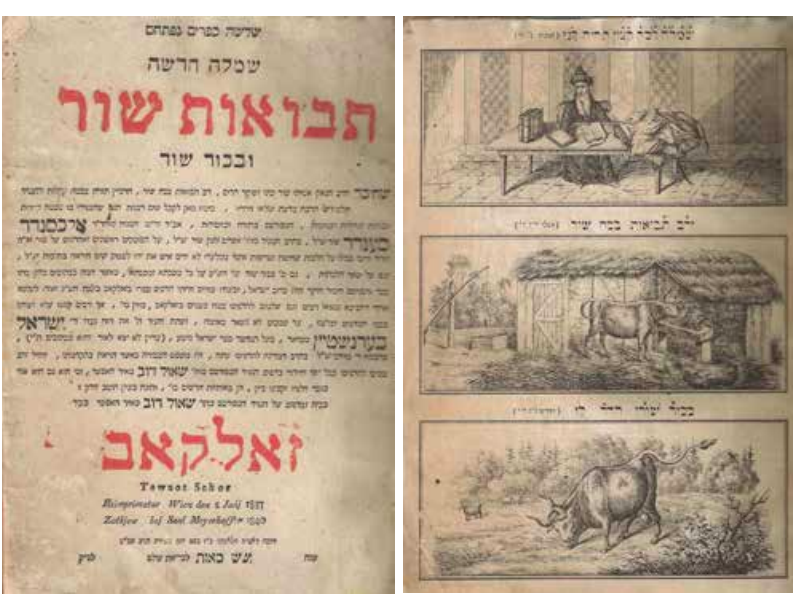
Just to mention one other unique illustrated item I recently came across about to be auctioned off in the forthcoming Genazym auction (lot 26). In a few copies of the 1840 printing of the classic work on Shecitah, Tevous Shor there is a very nice illustration connected to the title and name of the author. 
Some books are especially valued because of their legendary segulah powers.  Recently this has become even more commonplace with this genre expanding exponentially.[1]  At times the source for how these books fall into that genre are murky, but one that has a long history is Hayim ben Attar’s Or ha-Hayim.  The first edition, Venice 1742, (lot 49), in a very nice binding,  is highlighted for its segulah powers that include protection, healing, and children, and the study of it has the power to purify one’s soul. 

Returning to illustrations, a portrait of R. Dov Ber Meisles, the rabbi of Warsaw (and other cities), from 1891, is among the items.  This is not the only illustration that R Meisels appears.  During the late 1860s, there was substantial unrest in Poland when many sought to force the Tsar to bestow greater civil rights to the populace.  The clergy played a large role in this endeavor and R Meisels was among them.  This was viewed as an opportunity for Jews to be accepted by the population.  In this, Meisels had a profound impact and was among the main influencers of Marcus Jastrow to take part in the movement.  Meisels and Jastrow became very close.  When both were imprisoned for their activities, initially Jastrow was kept in isolation but when he was transferred to Meisels’ cell, Jastrow’s spirits were lifted and was able to deal with the remainder of his imprisonment.  In the end, both were expelled from Poland, although eventually permitted to return.  One of the most notable events during this period was the funeral of five protesters who were killed by government forces.  The funeral took place on Shabbos and both Jastrow and Meisles were in attendance.  Their participation is recorded in Aleksander Lesser’s painting, “Funeral of five victims of the demonstration in Warsaw in 1861.”In the center left, Meisels appears with a fur hat next to Jastrow in his canonicals.[2]   
 Another item of ephemera is a letter from the Hazon Ish to R. Yosef Zevin (lot 68)(the envelope confirms that the addressee was R Zevin).  Although there is no doubt about R Zevin’s Zionist leanings, the Hazon Ish carried on a correspondence with him.[3] This is yet another letter showing the connection between R Zevin and the Hazon Ish. (For others, see Yehoshuah Levin, HaShakdan (Monsey: Tuvia’s, 2010), 117). R Zevin included a profile of Hazon Ish and his style of study in the book Ishim ve-Shitot. 

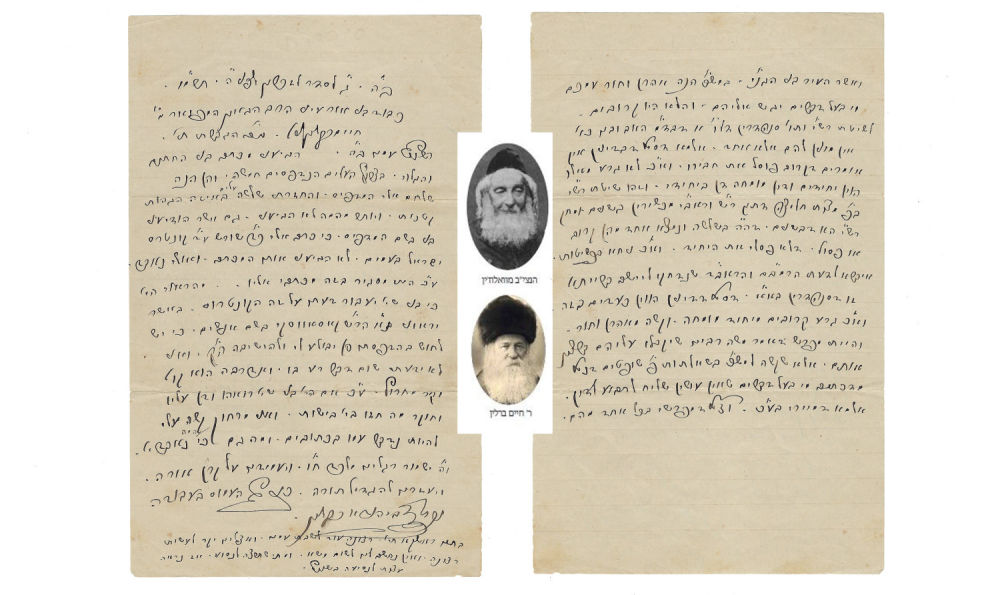
As we have shown in the past, one can learn all kinds of things from the information found in the writeups in the various auction catalogs including seeing actual clear copies of the manuscripts (lot 55). there is a letter of his from 1886 about his essay on Antisemitism called Shar Yisroel which he was about to print. He writes to his son to check it over as someone told him that perhaps some might get angry about and it would cause problems for him and the Yeshiva. This is not the only time that we find the Netziv nervous about his actions and that it would cause possible problems for the Yeshiva.

Two of R Yaakov Emden’s important works, Mitpahat Seforim and his Siddur, both of which are rare are up for sale (lots 75 & 76).  The first of edition of his siddur is critical to actually determining R. Emden’s opinions regarding the liturgy and its attendant customs.  This is so because although there are many alleged reprints of the Siddur, they, in fact, do not include the text that R Emden so carefully edited.  Only recently has the complete siddur been reprinted.  The Mitpahahat is R Emden’s well-known challenge to the Zohar, or parts of it.  Emden points to many passages that appear to be later than when R Shimon bar Yochi lived, the traditional author of the Zohar. R. Emden’s work was subject to some rebuttals, one is Moshe Kunitz Ben Yochi.  But some allege that Kunits freely borrowed from others and that his rebuttals fall short of the mark. 
One final item, also a siddur, is a first edition of Siddur R’ Shabsai MeiRushkov (lot 95) which is considered very rare starting bid is $50,000 and with a sale’s estimate of  $100,000.

[1] See Avraham Ya’ari, Mehkeri Sefer (Jerusalem:  Yehuda, 1958) who discussed a number of books that were written after the author experienced cataclysimic events. See also Eliezer Brodt’s article in the forthcoming Ami Magazine discussing the ubiquity of this phenomenon. 
[2] See Jastrow, “Baer Meisels, Chief Rabbi,” The Maccabean XI, 5 (Nov. 1906), 208-09; idem. XI, 6 (Dec. 1906), 246-48. For Jastrow’s activities during that time see Michael Galas, Rabbi Marcus Jastrow and His Vision for the Reform of Judaism:  A Study in the History of Judaism in the Nineteenth Century, trans. Anna Tilles (Boston:  Academic Studies Press, 2013), 70-88. Even at the end of his life, Jastrow was in America he still counted Meisel among those who influenced him.  See idem. 170.
[3] That is not to say that some didn’t try to write out R Zevin’s connection to Zionism.  See Jacob J. Schacter, “Facing the Truths of History,” Torah u-Madda Journal 8 (1998-1999): 223-24. 


Megillat Sefer Translation: A Review By Pini Dunner

Megillat Sefer Translation: A Review
By Pini Dunner

Rabbi Pini Dunner is a scion of one of Europe’s preeminent rabbinic families. He studied at various yeshivot and then graduated University College London with a degree in Jewish History. Best known as the founding rabbi of the trailblazing Saatchi Synagogue in London’s West End, he is also a prominent collector of, and expert on, antiquarian Hebrew books and manuscripts, and is frequently consulted by libraries, book dealers, and private collectors. In Summer 2011, Rabbi Dunner was appointed Mashgiach Ruchani of the prestigious YULA High School in Los Angeles, where he now resides with his wife and 6 children.

One of the most prolific rabbinic authors of the eighteenth-century, who saw many of his many written works published during his own lifetime, was Rabbi Jacob Emden (1697-1776). Rabbinic scholar and polemicist are probably the two most common descriptions used with reference to this enigmatic scholar. However neither description does justice to a man who was a unique polymath of distinguished descent, and who for many decades of the eighteenth-century was of considerable influence well beyond his own circle of friends and supporters.

R. Emden wrote and published novellae and responsa, the majority of which were original in their construction and in the topics they addressed. He wrote extensively, almost comprehensively, on the laws and customs relating to Jewish liturgy and the duty of prayer. He engaged in literary criticism and scientific enquiry in his published works in a way that sets him apart from his contemporaries, and this element of his output remains to this day remarkable in both originality and boldness. His polemics with crypto-Sabbateans – most famously with his nemesis Rabbi Jonathan Eybeschuetz – and with the purveyors or promoters of what R. Emden perceived as a threat to the integrity of Jewish tradition were unyielding in their vehemence, his words cutting like a knife through the humbug of his opponents. And yet, in other instances, R. Emden was a compromiser, open to change and ready to innovate, often in ways that left his contemporaries astounded, and leaves us to wonder what he was all about. All in all his publications reveal a man of many facets, whose brilliance and self-assuredness come across in every page, and whose long-term mark on the development of Judaism must have already been evident in his lifetime, but which remains equally evident to this day.

One book that was not published during R. Emden’s lifetime was his autobiography. Discovered in manuscript at the Bodleian Library in Oxford in the late nineteenth century, it appeared in print for the first time more than 120 years after his death, and then again, in a variant edition, some 80 years later. For those who may have been, or may be, intrigued by the unique personality of R. Emden, his autobiography is an absolute revelation. Candid and brutally honest, about himself as well as about his interlocutors, it opens a door into the life of this rabbi that no other rabbinic autobiography ever has for any other rabbi in history.

Until now, this memoir, entitled Megillat Sefer, has remained somewhat inaccessible to those who are unfamiliar with rabbinic Hebrew [or French – ed.] In particular, R. Emden was fond of using verses from the Bible, or quotes from the Talmud, to illustrate a point in his narrative, and those unfamiliar with either of these two sources in their original Hebrew or Aramaic would struggle with these references and not get the point, or might simply lose the thread of the narrative in question. In general the Hebrew used in Megillat Sefer was of an advanced vocabulary and style, written as it was by a master of Hebrew grammar. So when I heard last year that a translation of Megillat Sefer into English had been finally published I rushed out to get it as soon as I could. The translation project was originally undertaken by Rabbi Dr. Sidney Leperer (1923-1996), Professor of History and Talmud at Jews’ College in London, and following his death, carried forward by his devoted student Rabbi Dr. Meir Wise of London. The book itself is a one-off vanity publication and, sadly, it falls very short of being a useful contribution to the range of academic literature relating to R. Jacob Emden. (It may be purchased in soft-cover here, or hard-cover here – ed.).

The style of the translation is somewhat stiff, in places almost unreadable. Leperer and Wise – who it is asserted used the original Oxford manuscript as the basis for the translation – chose, it would seem, to stick as closely as possible to the original Hebrew when rendering the narrative into English. This does not serve the narrative well, although the narrative, it has to be said, is absorbing enough to overcome any such impediment, except perhaps to the most casual of readers. Each biblical or talmudic reference cited by the author is identified by the translators in brackets within the text of the narrative, and the translators also chose to transliterate all the Hebrew quoted by Emden into English characters. There is very little by way of introduction, and only the first 3 chapters (of 12, and it should be noted that the final 9 chapters consist of 85% of the total autobiography) have endnotes, and these are not very detailed or deeply researched. The publisher’s introduction (penned by Rabbi Wise?) notes that ‘due to its inherent incompleteness this translation is not intended to be an exhaustive academic work, and readers are encouraged to consult other sources for further research on Rabbi Emden and his life’ (p5). Later on he adds: ‘In this edition, no indexes of sources, places and people appears. Readers are encouraged to consult the Bick edition for such information. While a glossary is included in [sic.] the end of the work which explains some of the terminology, it is not intended to be an exhaustive reference’ (p7).

There are too many petty errors in the translation narrative and annotations to cite in a short review such as this, many of them resulting from the choice made by the translators of which transcript to use, about which more below. It would be a pity however not to share some of them, just so that readers of this review can get some sense of the sloppiness of this work. Some typical misreadings include the following:

p. 30, 6 lines from bottom: Uban [read: Ofen] [Strangely, the translator got it right on p. 35, l. 4.]

p. 34, last paragraph, l. 5: The Gaon Ba’al Sha’ar Ephraim [Actually, the reference is to R. Heschel]

p. 41, l. 3: Rabbi Yaakov Reischer [Actually, the reference is to R. Wolf, Av Bet Din of Bohemia]

p. 51, 3 lines from bottom: a certain R… who could [This is censorship in 2011. The original reads: R. Ber Cohen.

p. 60: line 5: Rabbi M. Bron [The Hebrew should be deciphered : R. Mendel ben R. Natan]

p. 92, last line: Rabbi Wolfe Merles [read: Mirels].

p. 107, l. 10: who then presided over… [The Hebrew reads: who now presides over]

p. 114 , 9 lines from bottom: Israel Pirshut [read: Israel Furst]

p. 161, 10 line from bottom: Popros [read: Poppers]

p. 165, l. 15: My eldest son, Shai [ Here, according to the translation, R. Yaakov Emden’s eldest son was called Shai. Actually, R. Yaakov Emden’s eldest son was R. Meir, later rabbi of Konstantin. Indeed, R. Yaakov Emden never had a son named Shai. The translator read the abbreviated form of שיחיה as the name Shai !

What a pity that a work of such significance was published before it had been properly completed. What a disservice to Rabbi Leperer’s memory! This distinguished teacher, who spent decades turning British novice rabbis into professional, scholarly rabbinic leaders, has seen his life’s work turned into an incomplete, poorly edited book which, since it was not published by an international academic publisher (understandably!), is destined to complete obscurity and irrelevance.

As if this is not enough of an indignity, the transcript of the original memoir used as the foundation for the translation is so flawed, that no scholar of Emden takes it seriously. In the introduction (p.6) the publisher/translator informs the reader that: ‘….the [Bodleian] manuscript was used as a primary source for the translation, with the Bick edition used as a secondary. The Kahana edition was used for comparison purposes only, due to its inherent unreliability’. In a footnote the publisher/translator adds that in the introduction to the Bick edition ‘multiple examples are cited of how the Kahana edition embellished certain matters, omitted others and made up some as well’.

The claim that the original Bodleian manuscript was used is too ridiculous to refute, as it is patently untrue. Clearly the source for this translation is the Bick edition. This decision to rely on the Bick edition of Megillat Sefer, on the basis of Bick’s introduction to his version, is so puzzling as to put into question the depth, if any, of Rabbi Wise’s (and Rabbi Leperer’s?) knowledge of contemporary academic research and opinion regarding Rabbi Emden, and in particular his autobiography.

The most noted contemporary expert on the life of Rabbi Jacob Emden is undoubtedly Rabbi Jacob J. Schacter, whose Harvard PhD dissertation was entitled ‘Rabbi Jacob Emden: Life and Major Works’, and is about as comprehensive a treatment of Rabbi Emden’s life as has ever been written. Furthermore, he is in the process of preparing a full-blown academic, critical treatment of Megillat Sefer, to be published by Merkaz Zalman Shazar in Jerusalem, based on years of research and a comprehensive knowledge of everything ever written by and about his protagonist.

In the late 1990s, Schacter wrote an article for the jubilee festschrift honouring his teacher Yosef Hayim Yerushalmi (1932-2009), entitled “History and Memory of Self: The Autobiography of Rabbi Jacob Emden.” The article quotes from and refers liberally throughout to Megillat Sefer, as might be expected, and in a footnote comments as follows:

“Throughout this essay, I refer to the Warsaw, 1896, edition of Megillat Sefer edited by David Kahane even though it is not a fully accurate transcription of the [Bodleian] manuscript (which itself is only a copy of the original). Acknowledging and claiming to correct some of the mistakes to the Kahane edition, Abraham Bick-Shauli reprinted Megillat Sefer in Jerusalem, 1979, but his version is much worse than Kahane’s. He recklessly and irresponsibly added to or deleted from the text, switched its order, and was generally inexcusably sloppy. As a result, his edition is absolutely and totally worthless.”

In a much more recent article, “Sefer Megillat Sefer,” penned by Rabbi Menachem Mendel Goldstein of Kiryas Joel for the Etz Hayim journal published by the Bobov Hasidim, the same sentiment of disdain for Bick’s edition is expressed, this time in the main text of the article:

‘In the year 5657 (1896) the book [Megillat Sefer] was published in full for the first time in Warsaw by David Kahane, based on the aforementioned [Bodleian] manuscript. He [Kahane] omitted anything that he believed appeared twice in R. Emden’s text, [in terms of] narrative text and subjects, as he explained in his introduction: “I found it necessary to omit any repetition so that his [R. Emden’s] words should not be burdensome for the reader, and I have indicated any such omission in the body of the narrative text itself.” Notwithstanding this admission, his work is defective through [both] inclusion and omission. The latest version is that of Bick-Shauli, the last person to publish the book [Megillat Sefer] (Jerusalem, 5739), who besides for including all the errors of David Kahane[’s edition], added insult to injury and was fraudulent in his work, brazenly including things which do not appear at all in the [Bodleian] manuscript, and it is therefore not possible to rely on this edition at all.’

Another contemporary scholar who has written extensively on the Emden-Eybeschuetz controversy is the frequent contributor to the Seforim Blog, Professor Shnayer Z. Leiman. When he was shown the introduction to this new translation of Megillat Sefer by the editors of the Seforim Blog he responded by email as follows:

“Alas, the pages you sent suffice to indicate that the editors did not act wisely. Bik’s edition is an unmitigated disaster. He inserted materials that appear nowhere in the one extant manuscript, and skewed the remainder of the text beyond repair. Kahana’s edition is infinitely superior, though not without error. If anything, the editors should have relied only on the manuscript, and when in doubt, consulted Kahana. Relying on Bik is like relying on R. Shlomo Yehuda Friedlander for establishing the correct text of a Yerushalmi passage, or like asking R. Yaakov Emden for a letter of recommendation on behalf of R. Yonasan Eibeshuetz. Why didn’t the editors consult someone who knows something about Megillat Sefer, like Jacob J. Schacter?”

A very good question indeed, and one that is more rhetorical than worthy of further investigation or discussion.

Finally, this month, a new edition of Megillat Sefer has been published in the original Hebrew, with extensive annotations by the noted Emden scholar, R. Avraham Yakov Bombach. He is scathing about the Bick edition, about which he writes (p.3, my translation from the Hebrew):

“In [1979] a new edition of Megillat Sefer was published in Jerusalem by R. Abraham Bick-Shauli….This edition is absolutely terrible. It contains numerous omissions and errors. Not only was he sloppy in transcribing the original manuscript, but he also added pieces from his own imagination as if they were written by [Emden].”

Despite these considerable – and frankly unforgivable! – drawbacks, the new translation is a nonetheless interesting addition to the copious published literature concerning R. Emden. As a result of the publisher’s desire for the book to be taken seriously as a full translation, he has deliberately not edited out any embarrassing passages. Incidents which could be deemed controversial by the familiar array of orthodox propagandists and publicists, and perhaps even rather unseemly to those less inclined to hagiography as a literary desideratum, are candidly recounted through this translation into the English vernacular, and are not airbrushed out of the narrative as they might have been in other hands. Countless references to R. Emden’s personal health and unflattering illnesses appear in the text (e.g. p. 123), as does the episode of his unfulfilled marriage hopes to the daughter of a German lay leader known as R. Leib of Emden, following his father’s unequivocal rejection of the match (pp.125-126).

The notorious episode in the narrative where R. Emden overcame his passion for a female cousin appears in full (pp. 162-163), an excerpt of which reads as follows:

‘In Prague I experienced a challenge similar to that of the (Biblical) saintly Joseph, in fact mine was somewhat more challenging. I was then a passionate young individual who had been separated from his spouse for a considerable period. I therefore longed for female company which I had the opportunity of fulfilling in the person of a lovely young lady viz. my cousin, who kept me company and who was audacious enough to evince a special affection for me, in fact she almost embraced me. Indeed when I was resting in my bed she came to see if I was well covered, in other words, she wanted me to embrace her. Had I yielded to my baser instinct she would not have denied me anything. On several occasions I almost succumbed, just as a flame is attracted to stubble, but the Almighty granted me strong willpower as well as an abundance of dignity and courage (cf.Gen.49:3) to prevail over my burning passion.’

The translation retains in vivid detail every episode recorded in the original Hebrew, with R. Emden’s numerous business tribulations, petty disputes, strong opinions and blunt observations presented to us in his own words, through the English rendition. His own personal account of the initial stages of his dispute with R. Eybeschuetz are here, as well as his critical comments regarding R. Ezekiel Katzenellenbogen, author of Knesset Yehezkel and the rabbi of the Triple Community (Altona-Hamburg-Wandsbeck), along with a critique of his fellow-campaigner against crypto-Sabbatean, R. Moses Hagiz.

Take this example of his strident views with reference to R. Katzenellenbogen (p.241):

‘What can one say about R. Ezekiel’s novellae, his interpretations of texts and his sermons? (Except) that they were objects of derision. Even if one were told about them one would hardly believe the foolish statements, the inane observations and ideas that provoked excessive laughter from all who listened to them.’

And this about his father’s erstwhile friend and primary supporter in the infamous Nehemiah Hayun episode of 1713, R. Moshe Hagiz (p.212):

‘His excessive prattling in synagogue also annoyed me for this amounted to a profanation of God in the presence of the general congregation. Much worse was his neglect of praying with a minyan on six days of the week and, this despite the pressing requests of his Shabbat and Yom Tov minyan to meet (for prayer) during the rest of the week.’

These vignettes make the new translation a refreshing read for those English readers interested in a candid account of eighteenth century Jewish life. Perhaps for this reason, and this reason alone, R. Wise can be commended for bringing this work to press. No doubt he overcame many hurdles to see the publishing project to fruition and despite its uselessness as an academic work, or as a fitting tribute to Rabbi Leperer, this book has at least some limited value as an access point for anyone who is curious to gain insight into the life story of R. Jacob Emden, but for whom the Hebrew original is too difficult a read. Through this translation, with all its flaws, you will learn something about the life of R. Jacob Emden, and how he perceived the world around him and those with whom he came into contact and conflict.

[I offer special thanks to Professor Shnayer Z. Leiman and Mr. Menachem Butler for their assistance in preparation of this review essay. P.D.]


On the Times Commonly Presented for Birkat HaL’vana, Part 3

On the Times Commonly Presented for Birkat HaL’vana, Part 3

By Avi Grossman

Some time ago, my first article appeared on the Seforim Blog (link). It felt good to join the club.

In the comments section, readers took much more issue with the opinion of Rabbi Bar Hayim that I mentioned at the outset than they did with any of the arguments I myself was advancing, and it it even got a little personal, but along the way, I was able to refine some points I had always wanted to make, and I discovered some potential answers to other lingering questions.

The Talmud relates (Sanhedrin 42a):

“R. Aha b. Hanina also said in the name of R. Assi in Rabbi Yohanan’s name: Whoever pronounces the blessing over the new moon (hahodesh) in its due time (bizmano) welcomes, as it were, the presence of the Shechinah: for one passage states, “This month will be your first month,” while elsewhere it is said, “This is my God, and I will glorify Him.””

Rabbi Bar Hayim had argued that “in its due time” was a reference to Rosh Hodesh. I called this an elegant proof, and others challenged the assertion of elegance, saying it was no proof at all. I countered that if one were to look elsewhere in the Talmud, specifically in the second chapter of Rosh Hashana and Maimonides’s laws of Sanctifying the New Moon, the expression the “new moon in its due time” always meant the night when the court was expecting witnesses to spot the new moon, i.e. the first night of the month. For some inexplicable reason, this was still not accepted, with the other side arguing that somehow, this passage in Sanhedrin was referring to something else, possibly the allowed, as opposed to prescribed, time for reciting the blessing,[1] which was the first half of the month. I showed that that was untenable based on the language, and also redundant, because if it were not the first half of the month, the blessing could not be recited at all, and therefore Rabbi Yohanan should just have said “he who recites the blessing on the moon.”

I also pointed out that Rabbi Yohanan’s proofs from the verses are also unequivocal. What is the connection between the verses he cites? Both have the word zeh, “this,” denoting that in the former verse, the one used as the source for all of our sages’ teachings concerning finding and sanctifying the new moon, God, so to speak, pointed out the appearance of the new moon to Moses and Aaron, while in the latter verse the people perceived God so clearly, it was as if they were pointing at Him. It is clear that Rabbi Yohanan can only be referring to spotting the new moon, and nothing else.

Some then pointed out that the offending word, bizmano, was not in some manuscripts of the Talmud, making any proof based thereon moot, but once again, the opposite would be true: If Rabbi Yohanan was specifically referring to the blessing on the hodesh, then it by force must be the first night of the month because thereafter the moon is not referred to as hodesh, “NEW moon,” but rather as just yareiah or l’vana!

Parenthetically, this, and the follow-up comments to my second post, made me realize that when trying to analyze the Talmud and codes, it is important to practice a form of  talmudic constitutional-originalism, in this case approaching the source texts with an intention to understand them as their writers meant them. In this case, I was advocating for an originalist approach to understanding what bizmano meant, and really, one should try to compare the sources with contemporaneous sources in order to be sure what the terms mean. My disputants were certainly not taking an originalist approach, and you can read their various arguments.[2]

However, and this is something that carries a significance I have only begun to realize, although intellectual honesty requires of us to be originalists when dealing with those facets of the Oral Law that have been committed to writing, when the sages themselves looked to the scriptures, they practiced originalism when trying to give over the p’shat, the plain meaning, but they also practiced a form of “living-and-breathing constitutionalism” (or whatever is the opposite of talmudic originalism) when they derived teachings using the methods of exposition, or as we would say in Yeshivish, “when they made drashos based on the middos shehatorah nidreshses bahem.” The sages engaged in active reinterpretation of verses, and in a functioning Sanhedrin, such new teachings were halachically binding for all of Israel. If you think about it, the Written Torah with its critical oral counterpart was meant to be interpreted as a living and breathing document, and this harks back to a point I made a few years ago.

I then pointed out something which has even more halachic consequences. The aforementioned passage from Sanhedrin continues:

“In the school of Rabbi Ishmael it was taught: Had Israel earned no other privilege than to greet the presence of their Heavenly Father once a month, it would be sufficient. Abaye said: Therefore, we must recite it standing.”

That is, according to this exact reading of the Talmud, one only succeeds in greeting the Divine Presence if he recites birkat hal’vana the night of Rosh Hodesh, and therefore one needs to stand for the blessing only if he recites the blessing the night of Rosh Hodesh! If you take another look at Maimonides’s formulation, you can see that is implied, because he first mentions the issue of standing, citing our version of the Talmud, and then mentions that after the fact, one can still recite the blessing after Rosh Hodesh.

Most importantly, the points I was making, namely that Rabbi Yohanan in Sanhedrin is discussing birkat hal’vana specifically on Rosh Hodesh, and that the implication is that one should stand for reciting the blessing only on Rosh Hodesh, can be found by reading Rabbeinu Manoah’s commentary on Maimonides, and that he goes even farther. Many of the blog’s commentators were arguing that what I was writing was entirely my own, but they should have looked at the sources!

The Hebrew version of the Schottenstein edition mentions that the classic commentators do not explain why the word bizmano is there, and that the expression has a seeming redundancy that of course one has to recite the blessing when it is the blessing’s time, but they do not try to find out what the term means elsewhere, and they mention that an alternative manuscript does not have that word, but they fail to make anything of it. Dealing with Rabbeinu Yona on B’rachot, there were always some lingering difficulties I had with his essay, as I wrote here:

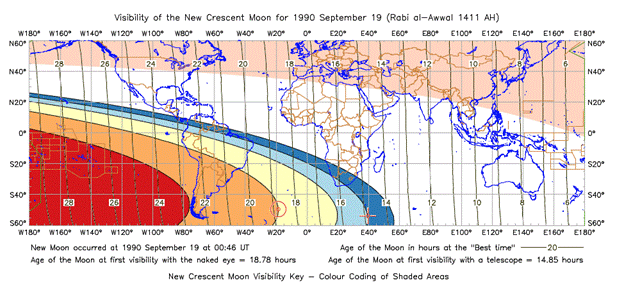
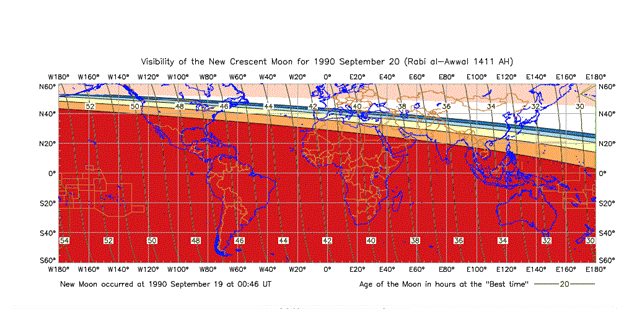
Rabbeinu Yona’s comments at the end of the fourth chapter of B’rachoth describe three ways to understand what Massecheth Sof’rim meant by not reciting the blessing “ad shetithbasseim…” Rabbeinu Yona offers his own understanding, and this is the basis for all later misunderstandings: tithbasseim refers to the light of the moon being significantly “sweet,” a state that it only achieves “two to (or ‘or’) three days” into the new lunar cycle. Why the vague language? Because no two months are the same. By the time the moon becomes visible for the first time, it could be that the molad itself was anywhere from twelve hours to 48 hours to even more or even less before that, and each month has its own set of astronomical conditions that affect this. See this chart. Notice that no two months share a percent illumination, or location in the sky, and each has its own level of difficulty being spotted. When two days are shown consecutively, it is because the first day’s conditions were not sufficient for most to have actually enjoyed or even seen the light of the moon. The possibilities are endless, and there is no objective rule for determining how much time the moon takes each month to get to the stage Rabbeinu Yona describes, and that is why he used the vague terminology “two to three days.” (As pointed out on the last page of the linked file, Maimonides did feel that there was a mathematical formula for determining minimal visibility.) More importantly, the “two to three days” statement is just an example of how long it takes, but the underlying rule is when the light becomes “sweet…” In languages like 13th-century Rabbinic Hebrew and Modern Hebrew and English, “two to three days” or “two or three days” allow for all of those possibilities. The halacha also allows for that… it seems that in every subsequent work you can find (with the the very important and critical exception of the Beth Yosef), the opinion of Rabbeinu Yona’s mentor is referred to as “Rabbeinu Yona’s opinion,” even though he offered one that actually differed from that of his mentor, and it is inaccurately reported as waiting for three days after the molad, taking out the the critical “two or/to.” Even later, it is further transformed into waiting until after three days have passed, i.e., at least 72 hours. This evolution is clear from reading the sources as they appear in the halachic record in chronological order. This is unfortunate and also illogical, because we saw above that the whole idea of “two to three days” is only offered as a way to describe how long it may take the light of the moon to become “sweet.” It could actually vary, because the sweetness is the point. Rabbeinu Yona did not mean “three days, in every single situation, no matter what,” and even if he had said that the underlying rule is to wait three days from the beginning of the cycle, why did they add that “at least” modifier?

The readers of the Seforim Blog rightfully asked: how could it be that Rabbeinu Yona did not read what was obvious to others, that the starting point for the recitation of the blessing was Rosh Hodesh? Perhaps it was not obvious!? To this I offered that perhaps he had incomplete access to the sources. After all, he himself admits that he was unfamiliar with our text of Massechet Soferim, which explicitly mentions birkat hal’vana on Saturday night. It is not such a stretch to say that his text of Sanhedrin was deficient, or that he did not have the complete version of TY B’rachot.

They also failed to notice that Rabbeinu Yona’s explicit hava amina, assumption, was that birkat hal’vana should be recited on Rosh Hodesh, but  Massechet Soferim could be used to derive when the blessing should first be recited because his text of Sanhedrin apparently could not. That is, just like he did not recognize our text of Soferim, he apparently did not have our text of Sanhedrin.

In their commentaries to Maimonides’s ruling that birkat hal’vana should be recited on Rosh Hodesh, two other 13th century sages, Rabbeinu Manoah and the Hagahot Maimoniyot, aka Rabbi Meir Hakohen, a student of the Maharam of Rothenburg, are explicit that the Talmudic sources indicate what Maimonides says, and they go further. Rabbeinu Manoah explains why the decisors did not take Massechet Soferim into halachic account on this issue:

“Because it does not make sense for one to delay performing a commandment that he has an opportunity to perform. Who knows how the world runs and what may occur, and there is much that can come upon someone that can prevent him from eventually performing [the commandment]. Therefore, any one who fears God should bless [the moon] right when he sees it in its renewal, and not wait for Saturday night.”

Note that Rabbeinu Manoah also refers to the recitation of the blessing as “a commandment.”

The Hagahot Maimoniyot also described how the Maharam dealt with the apparent contradiction posed by following Massechet Soferim:

“And thus my master, Rabbeinu, may he live long, practices: when he takes the initiative to recite the blessing during the week so that he not miss the time for reciting the blessing – which is until the sixteenth of the month – he wears his fine suit.”

That is, the Maharam realized, as I wrote earlier, that our received text of Massechet Soferim describes how to recite the blessing, and not when. Thus, he satisfied the opinion of Massechet Soferim not by reciting the blessing on Saturday night, but by reciting it some other time while dressed nicely.

I also wondered why Rabbeinu Yona postulated that the blessing on seeing the new moon involved deriving pleasure (or benefit, depending on how you translate the word hana’a) from the light of the moon. Since when did that have to do with the other birkot har’iyah, the blessings recited upon seeing certain phenomena? Is one required to somehow benefit from seeing the sun, or the sea, or lightning in order to recite the relevant blessings? Now, the blessing on the blossoming of the fruit trees makes mention of how people receive pleasure from seeing them, but then why can’t that be the case with the moon, that one enjoys seeing it, but does not have to have enough light to have some utility.

I believe the answer is that Rabbeinu Yona took his cue from a similar blessing that is also connected to Saturday night, the only one that the sages said demands that one derive some sort of pleasure/benefit from that which he sees: the blessing on the fire, in the eighth chapter of the Brachot.

Most importantly, I also found an amazing explanation as to why Rabbeinu Yona’s interpretation of Massechet Soferim became the basis for a halachic practice and opinion that persisted in Northeast Europe, even though it was rejected by scholars who lived in more temperate lands.

Check out a link to this site, which has some pretty good diagrams indicating where and when the new moon was or will be visible. I have been looking at the site regularly for some years, but this afternoon I found something very interesting. During the summer of 1990, there were months in which the moon was positioned very far to the south of the sky. On August 21, 1990, which was Rosh Hodesh, 30 Av 5750, the new moon was visible in most of Africa and South America as the night began, but in Israel and Europe and most of North America, the moon was not visible until late the following afternoon (Fig. 1).

(Fig. 1)

Almost a month later, on September 19, 1990, Erev Rosh Hashana, the new moon was visible in the South Pacific (Fig. 2) and the next day, September 20, 1990, Rosh Hashana 5751, it was visible across Australia, Africa, and South America (Fig. 3), but once again, those In Israel, Europe, and most of North America did not see it until September 21 (Fig. 4), and this is remarkable because Australia is well to Israel’s east, and it seems reasonable that if the Australians could see the new moon, then the Israelis should have had an even easier time spotting it, being that for them the moon is almost half a day older, and therefore larger.

(Fig. 2)

(Fig. 3)

(Fig. 4)

On December 5, 2002, 30 Kislev 5763, the new moon was at least visible in Israel, but once again, it was not visible in Northeast Europe, in places where the Ashkenazic aharonim had lived (Fig. 5). The true molad, the lunar conjunction, had been the previous day, December 4, at 9:34 am Jerusalem time while the average molad was  at 9:06 pm and 13 parts, although as can be seen from here, it is actually not easy to translate the average molad times to our current UTC system. See more below about that.) The following February, the moon was much harder to see in classical Lita than it was in the Mediterranean basin (Fig. 6).

(Fig. 5)

(Fig. 6)

I found all of these examples by a very superficial perusal of their archives, and it turns out there are dozens of examples that can be easily found in the last 30 years. A general rule can be derived: the farther a place is from the equator, the harder it will be there to spot the new moon compared to places of similar longitude but closer to the equator. For those in the Northern Hemisphere, there are many months when the added difficulty is quite significant.

Looking back, I could have extrapolated this from other information I already had, including the fact that the Israeli New Moon Society always publicizes that it is easier to spot the new moon from the Negev simply because it is in the south of the country.

All of this helps explain why we find that various forms of the practice of delaying birkat hal’vana for a day or two after what would appear to be the ideal time according to the classical opinions in the Talmudim is mostly a later Ashkenazic phenomenon, and one that Litvishe Rabbis, like Rabbi Tukachinsky, brought to Israel, whereas the generally Sephardic streams advocated for birkat hal’vana on Rosh Hodesh, or a week later, as per the kabbalistic practice. The fact that in Northeast Europe, the moon was often not visible until a day or two later than when it became visible in the more temperate regions seems to be a good explanation for this feature of the literature. Often, the Jews in Northeast Europe really had to wait for the moon to become barely visible even after the molad calculations indicated it was already well-visible in the places where the sages of the Talmud and the Rishonim used to live. I am grateful to have found this very real justification for a practice that at first seemed to go against the plain meaning of the Talmud.

Ultimately, I should have known that Maimonides was aware of all this, and took this into account. Chapters 11-17 of Kiddush Hahodesh are dedicated to explaining how to find the new moon in the sky, and that is the ultimate reason for knowing when the molad is of each individual month, and not so that one can add 72 or 168 hours to it in order to know when to recite the blessing, while the the eighteenth and last chapter discusses the practical case of the moon not being spotted for a number of months due to extenuating circumstances such as weather, and in our days, pollution. Towards the end of that chapter, he mentions that the more one stands to the east, the less likely he is to spot the new moon, while the farther to the west, the more likely, and then concludes with:

“All the above statements apply to the countries west and east [of Israel ] at the same latitude, i.e., they are between 30 and 35 degrees north [of the equator]. If they are located farther to the northerly, or less to the norther, different principles apply, for they are not parallel to Eretz Yisrael.”

There is no reason, therefore, to consider that places in northern Europe should be able to spot the new moon according to the molad in Israel, and as we have seen, they often have to wait significantly longer to see the moon.

Getting back to the issue of calculations and Professor Bromberg’s thesis, I recently saw that this year, the Ittim L’vina calendar has a new appendix explaining how there is a major disagreement regarding how to present the classic, average molad times in our modern terms. Considering that there are 1080 parts per hour instead of 3600 seconds, it should be easy to translate any molad time to any time on our clocks, but the problem is that no one knows, for example, if the tradition says that the molad for a given month is exactly at 15 hours of the day (9am), when that is according to the UTC time (adjusted for the Jerusalem time zone)! As Maimonides writes, the clock we use to determine the average moladot is, unlock the ritual clock used everyday, a constant, 24-hour clock, that assumes the day starts at hour 0, always 24 objective hours after the start of the previous day (like the secular system defines the start of the day as exactly 24 hours after the start of the previous) and therefore, during the summer, the “molad day” starts hours before the sundown, while during the winter, the “molad day” starts sometime well after the sundown that started that halachic, calendar day. The Ittim L’vina calendar brings four attempts to figure out how to determine when the average molad for any given month actually happens, and as Prof. Bromberg has shown, the truth is that no one knows. This can not be over-emphasized. When the calendar writers say, therefore, that on a given Saturday night, laymen should refrain from reciting birkat hal’vana at 7pm, as they depart the synagogue, because the average molad was say, at 8pm three or seven days earlier, and therefore they still have another hour before “the first opportunity” (sic) to recite the blessing, it is disingenuous, because they do not really know when the average molad was! It must be stated that, when Maimonides described the times of the average moladot, the only practical application was not birkat hal’vana, because up until the 13th century, no one even imagined that the time for birkat hal’vana should depend on the molad, but rather calculating the day of the week on which to establish the first day of Tishrei, which did not necessitate knowing when exactly the molad occurred according to which ever time piece they may have used. For example, if the calculation showed that on Monday the average molad was shortly before the end of the 18th hour (noon), making Monday fit for Rosh Hashana, it only meant that in the theoretical, 24-hour clock that started with the first molad, the molad of Tishrei was before the end of the 18th hour, but no one could know if that translated to before halachic noon on that particular Monday. And no one cared, either.

This revelation thus renders most of the foregoing discussions on the matter practically moot, and gives another very good reason why, if one were wondering when to recite the blessing on seeing the new moon, he should just follow the basic understanding of the talmudim and rishonim: when he sees the new moon, he should recite the blessing.

I would like to thank Rabbi David Avihail, Rosh Yeshivat Ramot, for his constant encouragement and support in producing these articles.

[1] For more on this critical distinction between the prescribed time and the allowed time, see, for example, Maimonides’s descriptions of the times for the daily prayers in his Laws of Prayer, 3:1-7.

[2] My blog, avrahambenyehuda.wordpress.com, has many more articles about understanding the original biblical and talmudic terms in context.


Review of Ha-Sefer ha-Kollel (Kitāb al-Ḥāwī) by Rabbi David ben Saʿadya al-Ger

Review of Ha-Sefer ha-Kollel (Kitāb al-Ḥāwī) by Rabbi David ben Saʿadya al-Ger

Marc Herman

Marc Herman is an assistant professor in the Department of Humanities and a core member of the Centre for Jewish Studies at York University. His research focuses on Jewish and Islamic intellectual history in the medieval Mediterranean. He is the coeditor of Accounting for the Commandments in Medieval Judaism: Studies in Law, Philosophy, Pietism, and Kabbalah (Brill, 2021) and his monograph, titled After Revelation: The Rabbinic Past in the Islamic World, is under contract with the University of Pennsylvania Press.

The study of medieval halakhah was recently enriched by the long-awaited publication of The Comprehensive Book (Kitāb al-Ḥāwī) by David ben Saʿadya al-Ger,[1] one of the earliest legal compendia that survives from Sefarad. Pieced together from Genizah fragments, other manuscripts, and citations in later medieval works, and comprising much of the original text, this new edition of Kitāb al-Ḥāwī recovers a once-prominent halakhist who fell into obscurity in the centuries after his death. Its publication is a landmark in the study of Jewish al-Andalus and Judeo-Arabic law. Not only does this volume recover a mostly lost, early rishon, it also bears witness to the reception of the last geonim in the Islamic West and it provides a new window into the beginnings of Iberian halakhic culture.

Next to nothing is known with certainty about the life of David ben Saʿadya, author of the Kitāb al-Ḥāwī and other halakhic works. David’s period of activity can be fixed sometime after the death of Hayya Gaon (d. 1038), who David cited with some frequency, and before the death of Isaac Ibn al-Bālīya (d. 1094), who mentioned David as deceased.[2] This might place David in the circle of Samuel ha-Nagid. In fact, the twentieth-century scholar, Mordecai Margaliot (1909-1968), suggested that David was the subject of a laudatory poem in the Dīwān of the Nagid, where a certain “Rabbi David” is praised for his persuasive knowledge and keen abilities.[3] But what about the uncommon appellation אלגר? Some historians have understood that David descended from converts, but others have connected this word to the Arabic muhājir, i.e., migrant. (The latter would imply that David’s father, or an earlier family member, was not native to al-Andalus.) David Sklare noticed that one Genizah fragment vocalizes this word as אלגֵר (al-ger, i.e., the convert), supporting the view that David ben Saʿadya was the descendant of proselytes.[4]

ENA 2859.7v, Courtesy of the Library of the Jewish Theological Seminary, The National Library of Israel. “Ktiv” Project, The National Library of Israel.

This reading coincides with the sole appearance of David’s name in the writings of Abraham Ibn Ezra, who called David “Rabbi David the judge, son of the convert (ha-dayyan ben ha-ger), Sefardi, from the city of Granada.”[5] The editor of this new edition, Y. Zvi Stampfer, who is a lecturer and researcher in the Department of Talmud and Halakha at Hebrew University of Jerusalem, accepts this interpretation of אלגֵר, noting that Jews in the medieval Islamic world had few qualms about such ancestry. Stampfer even proposes that David proudly announced his forebearer’s conversion (as did other converts).[6]

David ben Saʿadya composed several works. In addition to the Kitāb al-Ḥāwī, written in a mixture of Judeo-Arabic and Aramaic, they include Judeo-Arabic volumes on the laws of oaths and on the laws of bequests, as well as commentaries on the Talmud and, according to Ibn Ezra, a work on Hebrew grammar. Of these additional writings, only the one on the laws of oaths survives. This work was translated into Hebrew by Isaac ben Reuven of Barcelona and printed, since 1521, in standard editions of tractate Shavuot bearing the title שערי שבועות. Unfortunately for David’s legacy, it has long been incorrectly ascribed to Isaac al-Fāsī.[7]

The ascription of this last work to al-Fāsī is something of an irony, as al-Fāsī was wont to criticize David ben Saʿadya.[8] In a responsum about the distinctions between biblically and rabbinically mandated oaths, al-Fāsī declared that David was wrong and would have been better off following the view of Hayya Gaon.[9] This may have been more than a straightforward halakhic disagreement. If David did travel in the circle of Samuel ha-Nagid, the charge that Hayya was correct would have had particular potency, as the Nagid and his faction sought to downplay—and thereby surpass—geonic expertise and hegemony, and they were especially wary of Hayya. Solomon Ibn Gabirol, whom the Nagid supported, praised his patron with the phrase וְַרב הָאיָי כְּלֺא הָיָה לְפָנָיו—it was as if Hayya was nothing compared to him![10] Al-Fāsī might have been hinting, then, that a whole generation of Andalusi scholars were betraying their shortcomings when they veered too far from the geonim. Stampfer himself suggests that al-Fāsī’s attacks on David may have been part of a larger program to disparage earlier Sefardic tamludists.[11] Indeed, Abraham Ibn Dāʾūd reported that al-Fāsī entered into debates with both Isaac al-Bālīya and Isaac Ibn Ghiyāth, two of the leading figures in eleventh-century Sefarad.[12]

Did al-Fāsī’s criticisms play a role in consigning David and his works to obscurity? It is hard to know. But before the advent of critical scholarship, David’s writings were mostly known only through brief citations by later rishonim, mostly of Sefardic extraction. These include al-Fāsī, Maimonides, and Abraham Maimonides. The last figures to have been familiar with texts by David ben Saʿadya were David ben ʿAmram ha-ʿAdani (fourteenth century), in his Midrash ha-Gadol, and Bezalel Ashkenazi (sixteenth century), who probably knew of David’s writings indirectly, in his Shittah mequbeset.[13] Most of the manuscripts of the Kitāb al-Ḥāwī are no later than the thirteenth century, apparently when this work fell out of circulation. A single manuscript is later, from seventeenth-century Yemen.[14]

David’s Kitāb al-Ḥāwī and other writings were first noticed by Samuel Poznański, B.M. Lewin, and Simḥa Assaf, scholars who pioneered the recovery of geonim and rishonim, especially from Arabic-speaking lands. As a student at the Jewish Theological Seminary of America in the early 1950s, Shraga Abramson submitted a doctoral thesis, written for Saul Lieberman,[15] on David ben Saʿadya,[16] though this project did not see the light of day until now.[17] Stampfer has helpfully included the first five chapters of Abramson’s thesis as an appendix in this volume (pp. 363-399); the remaining six will hopefully be published alongside a new edition of David’s work on the laws of oaths. Sklare was the next scholar to identify major pieces of David’s work, dedicating an important article to David’s identity, corpus, and thought, and Stampfer added many previously unidentified manuscripts to reconstruct a large portion of the Kitāb al-Ḥāwī.

The Kitāb al-Ḥāwī follows a unique arrangement, perhaps unparalleled in the writings of the rishonim.[18] Its structure is worth reviewing. David ben Saʿadya began this book with a sizeable consideration of jurisprudential topics. He followed this with three sections dedicated to practical law: section two treats holidays and the calendar; section three treats the laws of marriage (this is the only section that survives only in a medieval Hebrew translation, not in the Judeo-Arabic original); and section four treats monetary law. The fifth section provides perhaps the longest early medieval analysis of the thirteen hermeneutical middot. And the sixth section presents a series of challenges to Halakhot Gedolot. (Was this part of eleventh-century Sefardic attempts to move away from geonic-era works? Al-Fāsī, in another responsum, defended Halakhot Gedolot from one of David’s attacks.[19]) Stampfer shows that at least some of these sections were originally independent works.[20]

The sections on applied law suggest that, in part, David intended the Kitāb al-Ḥāwī to be a practical manual. Sklare proposed that this work was meant to be a handbook for judges or for second-tier rabbinic leadership who offered rulings in smaller Jewish communities.[21] This might even explain why some of this book was written in Aramaic, a curious feature that is shared by Samuel ha-Nagid’s mostly lost Hilkheta Gavratta.[22] Sklare suggested that some Sefardic readership may have been more comfortable with Aramaic than Judeo-Arabic—a fascinating possibility in light of the usual emphasis on the Arabization of Jewish elites in al-Andalus.[23]

The other parts of Kitāb al-Ḥāwī, however, clearly had other goals in mind. David’s decision to open with a discussion of the sources of the law was undoubtedly stimulated by the attention that this topic received among both Jewish and Muslim writers of his day. David was an innovative theorist regarding the sources of halakhic authority. The geonim, especially Saʿadya, generally portrayed revelation as all-encompassing, and they tended to downplay or even deny that the talmudic-era rabbis created new law. (This is usually, though not always, understood as a defense of the Oral Torah from Qaraite criticisms.[24]) David, on the other hand, expressed no qualms with the rabbinic innovation of norms. He even took many of the Arabic terms that Saadia had associated with the accursed jurisprudence of the Qaraites and applied them to the late antique rabbis.

David’s consideration of the thirteen hermeneutical middot might be thought of in this vein as well. In the tenth century, Saʿadya Gaon rejected the idea that the rabbis had created new law using the middot. He instead insisted that they just matched up received oral traditions with the text of the Torah.[25] David, by contrast, saw the middot as tools for generative and novel interpretations. Thus, when the Torah does not explicate the law, David asserted that the rabbis created it through legal reasoning (using the Arabic term qiyās).

David ben Saʿadya, of course, was only the first of many figures to break with the geonim on the question of how Jewish law developed. Among Andalusi Jews, Maimonides proposed the most powerful alternative to the ideas of Saʿadya Gaon. Even if Maimonides did not know much of the Kitāb al-Ḥāwī directly, there are distinct parallels between the Maimonidean picture of the Oral Torah and David’s. Maimonides, like David, fiercely rejected the Saadianic approach to the rabbis. Both Andalusis instead celebrated rabbinic legal creativity, and both did so by way of similar Arabic concepts.[26]

Stampfer’s edition of the Kitāb al-Ḥāwī is handsomely produced. It begins with a detailed introduction to David ben Saʿadya and presents the text in the Judeo-Arabic original with facing Hebrew translation. Stampfer provides learned notes with detailed references to relevant passages in the writings of the geonim and rishonim. He cites many unpublished geonic texts, suggesting that this is the first of many such books in the works. Anybody interested in medieval Jewish law should await further contributions with much anticipation.

Notes:

[1] Ha-Sefer ha-Kollel (Kitāb al-Ḥāwī) by Rabbi David ben Saʿadya al-Ger, ed. and trans. Y. Zvi Stampfer, incorporating work by David E. Sklare, Nissim Sabato, and Eliezer Reif (Jerusalem: The Ben-Zvi Institute for the Study of Jewish Communities in the East and The Rabbi Moses and Amalia Rosen Foundation, 2024; Hebrew), available here.
[2] For the latter, see Yaakov Miller, “Responsa of Our Rabbi Isaac son of Rabbi Baruch on the Matter of Collecting Debts from Orphaned Estates,” Kovetz Hitzei Giborim, vol. 7 (2014): 18-34, esp. 30 (Hebrew), available here.
[3] Mordecai Margaliot, ed., Hilkhot ha-Nagid (Jerusalem: American Academy for Jewish Research, 1962), 63 (Hebrew); see David Sklare, “R. David Ben Seʿadya al-Ger and His Work al-Ḥāwī,” in Joshua Blau, Haggai Ben-Shammai, Mordecai A. Friedman, and Joel L. Kraemer, eds., Encounters in Medieval Judaeo-Arabic Culture [=Teʿuda, no. 14] (Tel-Aviv: Tel-Aviv University, 1998), 103-123, esp. 115n40 (Hebrew), available here; for the poem, see Dov Yarden, ed., Dīwān Shmuel ha-Nagid: Ben Tehillim (Jerusalem, 1985), 151-53 (Hebrew), available here.
[4] David Sklare, “R. David Ben Seʿadya,” 111-12.
[5] Abraham Ibn ‘Ezra’, Sefer Moznayim, ed. Ángel Sáenz-Badillos (Madrid: Ediciones El Almendro, 2000), 6* (the editio princeps is available here. As Stampfer notes (32n85), some manuscripts of this passage read “Rabbi Judah,” however.
[6] David ben Saʿadya, Ha-Sefer ha-Kollel (Kitāb al-Ḥāwī), 21-24.
[7] David ben Saʿadya, Ha-Sefer ha-Kollel (Kitāb al-Ḥāwī), 27-32.
[8] David ben Saʿadya, Ha-Sefer ha-Kollel (Kitāb al-Ḥāwī), 79-82.
[9] Isaac Rothstein, ed., Shut ha-Rif (New York, 1977), 156-57 (#51); noted in Shraga Abramson, “Two Chapters from a Study on the Book ‘Sha‘are Shevuot’,” Sinai, vol. 104, no. 3-4 (1989): 122 (Hebrew).
[10] Ḥayim Brody and Ḥayim Schirmann, eds., Shelomoh Ibn Gabirol: Shire Ḥol (Jerusalem: Schocken, 1975), 47 (#85) line 53.
[11] David ben Saʿadya, Ha-Sefer ha-Kollel (Kitāb al-Ḥāwī), 82.
[12] Gerson D. Cohen, A Critical Edition with a translation and Notes of ‘The Book of Tradition (Sefer ha-qabbalah) by Abraham Ibn Daud (Philadelphia: Jewish Publication Society of America, 1967), 86 (English), 64 (Hebrew).
[13] David ben Saʿadya, Ha-Sefer ha-Kollel (Kitāb al-Ḥāwī), 68-90.
[14] The one seventeenth-century manuscript is described in David ben Saʿadya, Ha-Sefer ha-Kollel (Kitāb al-Ḥāwī), 107.
[15] For Abramson on Lieberman, see his “R. Saul Lieberman’s Method of Investigating Talmudic Literature,” in Researches in Memory of Saul Lieberman (Jerusalem: The Israel Academy of Sciences and Humanities, 1983), 23-33 (Hebrew).
[16] Y. Zvi Stampfer, “Introduction,” in David ben Saʿadya, Ha-Sefer ha-Kollel (Kitāb al-Ḥāwī), 100-101 (Hebrew):

“In the years 1950 or 1951, the student (later Professor) Shraga Abramson, at the Jewish Theological Seminary of America in New York, submitted a doctoral dissertation to Professor Saul Lieberman titled “Rabbi David ben Saadia ben ha-Ger: His Works and Times.” In his research, Abramson examined references to Rabbi David’s works in Talmudic and halakhic literature, along with various Genizah fragments, and discussed the question of Rabbi David’s era, location, and writings.”

[17] Y. Zvi Stampfer, “Introduction,” in David ben Saʿadya, Ha-Sefer ha-Kollel (Kitāb al-Ḥāwī), 9-10 (Hebrew):

“Professor Shraga Abramson z”l laid a broad foundation for research into Rabbi David ben Saadia and his works in his doctoral dissertation on the book Sha‘are Shevuot, its author, its era, and its location. He submitted this research to Rabbi Professor Saul Lieberman in the early 1950s as a doctoral thesis. However, this work was never published, except for two brief articles derived from it. Mrs. Araleh Abramson z”l transferred a typed copy of the dissertation to Professor Haggai Ben-Shammai when he headed the Ben-Zvi Institute and co-directed of the Center for the Study of Judaeo-Arabic Culture and Literature, who then forwarded it to me.

The first part of the dissertation, which deals with the figure of Rabbi David and his writings, is included as an appendix at the end of this edition. The second part, which involves the study of Sha‘are Shevuot, I hope to publish along with an annotated edition of that work. Abramson’s research was not prepared for publication, and the primary challenge in preparing it for publication was identifying the references he alluded to. Since his writing was essentially directed at Lieberman, a scholar of unparalleled expertise, Abramson often sufficed with general references or vague hints to sources in rabbinic literature or scholarly works, mostly published in Hebrew and German. I have endeavored to locate the sources mentioned in his research as far as I could. To remain faithful to Abramson’s original manuscript and his research style, when he referred to editions published up to his time, I indicated, as much as possible, the editions that were in his library. However, in cases where he referred to rabbinic literature sources that have more accessible editions published after his death, I noted the newer editions. I also expanded the abbreviations and corrected typographical errors and incorrect references.”
[18] Another somewhat later, but still pre-Maimonidean, Andalusi work is even more diverse in its contents; see Y. Tzvi Langermann, “The Topic of Rosh Chodesh—Chapter 18 from the Composition ‘Issur ve-Heter’,” Kobez al yad 24 (34) (2016): 161-180, esp. 165-166 (Hebrew).
[19] See Abraham Harkavy, Teshuvot ha-Geonim (Berlin, 1887), 301 (Hebrew), available here.
[20] Y. Zvi Stampfer, “Introduction,” in David ben Saʿadya, Ha-Sefer ha-Kollel (Kitāb al-Ḥāwī), 32-37 (Hebrew).
[21] David Sklare, “R. David Ben Seʿadya,” 119, 123.
[22] See Shraga Abramson, “From the Teaching of R. Samuel ha-Nagid of Spain,” in Yitzhak Rafael, ed., Sinai Centenary Volume [=Sinai, vol. 100] (Jerusalem: Mosad ha-Rav Kook, 1987), 7-73, esp. 13 (Hebrew), available here, and Shraga Abramson, Perush Rabbenu Ḥananel la-Talmud (Jerusalem: Wagshal, 1995), 55-56.
[23] David Sklare, “R. David Ben Seʿadya,” 116-122.
[24] See Marc Herman, “Prophetic Authority in the Legal Thought of Saadia Gaon,” Jewish Quarterly Review, vol. 108, no. 3 (Summer 2018): 271-294, available here.
[25] See most recently Y. Zvi Stampfer, “Saʿadia Gaon’s Interpretation of the Thirteen Hermeneutical Principles according to the Arabic Source Commentary, Tendencies, and Unknown Sources,” Tarbiz, vol. 87, no. 4 (July – September 2020): 655-660 (Hebrew), available here.
[26] See Marc Herman, “Situating Maimonides’s Approach to the Oral Torah in Its Andalusian Context,” Jewish History, vol. 31, no. 1-2 [=Special Issue: New Perspectives on Jewish Legal History] (December 2017): 31-46.


R. Yitchak Al-fasi’s Anti-Qaraite Legislative Activity

R. Yitchak Al-fasi’s
Anti-Qaraite Legislative Activity
By Tzvi H. Adams
R. Yitchak Al-fasi (1013 – 1103) lived in North
Africa and Spain during the Golden Age of Qaraism. It is quite natural that we
find many instances of anti-Qaraite legislation in his writings.
Below are four such cases:
1) R. Al-fasi had the shofar blown on Shabbos
Rosh HaShanah in his beth din in Fez, Morocco. (See
discussion here: here). This
ruling and practice baffled many later authorities as it seems to contradict
the Talmud Rosh HaShanna 29b. R. Zerachiah Ha-Levi wrote about R. Al-fasi’s
opinion – וזה אחד מן המקומות המתמיהים הנמצאים בהלכות  (המאור הקטן ר”ה פ”ד).

When we consider that the Qaraites (of whom existed a large community in Fez)
did not blow a shofar at all on this holiday because such blowing is not
clearly written in the Torah, it is understandable why R. Al-fasi would desire
to have shofar blowing take place. Refraining from blowing the shofar would be
like surrendering to Qaraite views. We should also recall that Rosh HaShanah
can fall out on Shabbos as often as five times in ten years.
Aaron ben Elijah (1328-1369), a prominent
Qaraite theologian wrote:

The Rabbanites draw an analogy between the Day
of Trumpeting and the Day of Atonement which precedes the Year of the Jubilee,
of which it is written: Then shalt thou sound the horn of trumpeting in
the seventh month… on the Day of Atonement
(Lev. 25:9). They say
just as this trumpeting was done with horn, so also must the trumpeting on the
Day of Trumpeting have been done with a horn. (However), we have already
explained…. The Day of Trumpeting, therefore,
signifies nothing but the raising of the voice in song and praise, inasmuch as
there is no mention of a horn in connection with it. Moreover, why should we
draw an analogy between a thing which is obligatory every year, and one which
is obligatory only once in fifty years, the year of the
Jubilee?…                   
(from Leon Nemoy’s Karaite Anthology (1980) pg 173)

Read more on the Qaraite halacha here
2) R. Al-fasi was a key player in the
transition of the evening prayer from reshut to chova:
Summary: Since the close of the Talmud, the
accepted halacha had been תפילת ערבית רשות.
Towards the end of the tenth century the custom solidified amongst Qaraites to
pray only twice a day. To create a social divide, Rabbanite authorities
responded by requiring every Rabbanite follower to pray three times each day.
By attending synagogue three times a day one affirmed his allegiance to the
Rabbanite camp; also by praying more often than Qaraites, Rabbanites
distinguished themselves as being more holy and religious. The Franco-German
sages, distant from the Qaraite-Rabbanite scene, upheld the original halacha of
תפילת ערבית רשות.
Explanation: All early Gaonim ruled aravit
is optional (עיין בראשונים ברכות פרק תפלת השחר).
In early Qaraite times there were different views as to how many times a day
one should pray. Anan ben David, the early sectarian schismatic, believed that
only two prayers should be said: “Anan rejected the maariv – service, as being
only a Rabbinic innovation (See Brochos 27b), and prescribed two daily services
only in accordance with the times on which the Temidim were sacrificed” (Jacob
Mann, “Anan’s Liturgy and his half-yearly cycle of the reading of the law”, Karaite
Studies
(1971) edited by Philip Birnbaum pg. 285). R. Saadya Gaon
(882- 942), who had many interactions with Ananites, responded by requiring
Rabbanites to pray three times- he made maariv mandatory (chova).
This was only the opinion of the Ananites;
other sectarian Qaraite-like groups had other views as to the number of daily prayers
required. Later, in the mid-tenth century, R. Sherira Gaon (906-1006)
maintained the early gaonic psak that maariv
is reshut, but
wrote that one who does not daven maariv is a “poretz
geder
” (here).
Late in R. Sherira’s lifetime and in subsequent
years, the view among Qaraites was solidifying that only two daily prayers were
required. The Qaraite scholar, Levi ben Yefet, writes in his Sefer
ha-Miswot
(latter half of the 10th century),II pp.  501-502:
הדבור
בכמה זה השער- כבר נתחלפו בו ואשר עליו ההמון, כי הנה שתי תפלת בכל יום בקר וערב
שנאמר “ולעמוד בבקר בבקר להודות ולהלל ליוי וכן לערב”,… אשר יהיה זולת אלה הוא
נדבה…
ואמרו
מקצת חכמים כי חובה גם היא…ואלה הג’ תפלותיהם אשר זכר אותם דוד ע”ה “ערב ובקר
וצהרים אשיחה…” …. והקרוב עמי כי אלה הכתובים לא יורו על חיובה…
Shortly thereafter, R. Al-fasi (1013 – 1103)
further enforced the tri-daily prayer system by stating “והאידנא
נהוג עלמא לשוייה כחובה”. A Jew who belonged to the Rabbanite camp
distinguished himself from the Qaraites by attending synagogue three times a
day. I am preparing a lengthy paper on this topic – “The Transition of Aravit
from Reshut to Hova
a Rabbanite Response to Qaraism”.
3) R. Al-fasi participated in the anti-Qaraite
transition of minor fast days from being voluntary to mandatory.
Though the Gaonim and R. Chananel (990-1053)
explicitly say that not eating on the three minor fast days is the individual’s
choice (as per the Talmud’s ruling RH 18b- אין שמד ואין
שלום – רצו – מתענין, רצו – אין מתענין), R. Al-fasi chose to overlook this detail
about fast days in his halachic writings. The purpose of this intentional
omission was almost certainly to separate Rabbanites from the Qaraite community
who did not observe the Rabbanite fasting calendar.
Briefly, here is the sugya
in Rosh HaShannah 18b:
אמר ר”ש
חסידא מאי דכתיב (זכריה ח) כה אמר ה’ צבאות צום הרביעי וצום החמישי וצום השביעי
וצום העשירי יהיה לבית יהודה לששון ולשמחה קרי להו צום וקרי להו ששון ושמחה בזמן
שיש שלום יהיו לששון ולשמחה אין שלום צום אמר רב פפא הכי קאמר בזמן שיש שלום יהיו
לששון ולשמחה, יש (גזרת המלכות) שמד צום, אין (גזרת המלכות) שמד ואין שלום רצו
מתענין רצו אין מתענין
אי הכי ט”ב נמי אמר רב פפא שאני ט’ באב
הואיל והוכפלו בו צרות
The Gaonim:
– בזמן
הזה, בדורות הללו, שאין שמד ולא שלום, רצו מתענין לא רצו אין מתענין…. הילכך שלושת
צומות, מי שאינו
רוצה לצום אין בכך כלום
ואינו מחוייב בהן. (תשובות הגאונים גנזי
קדם ח”ג עמ’ 43)
R. Chananel:
שיש שלום
– כלומר כל זמן שבית המקדש קיים יהיה לששון ולשמחה. יש שמד – צום.  אין שמד
ואין שלום –  כגון עתה בזמן הזה, רצו מתענין רצו אין מתענין. וכיון שאם רצו
שלא להתענות בהן אין חובה עליהן
, לפיכך אין שלוחין יוצאין בהן.
(רבינו חננאל – ראש השנה יח, ב)
הרב
ברג’לוני ז”ל כתב מ”ט קבעום האידנא חובה? מפני שהם דברי קבלה … (שערי תשובה
סימן עז)

By the time of Ramban (1194–c. 1270) and later
authorities mandatory fasting was well established in Spain. (Rashba, though,
is an exception- he still considered the fasts optional.)
About the practice of the Qaraites, Levi ben
Yefet, writes in his Sefer ha-Miswot (latter half of the
10th century),III pg 452: Levi be writes
“צום הרביעי וצום החמישי וצום השביעי” וגו’. … והוא
העשירי מן החדש העשירי… והוא היום אשר סמך בו נבוכדנצאר על ירושלם והצר עליה
ובנה עליה דיק, שנאמר “ויהי בשנה התשיעית למלכו בחדש העשירי בעשור לחדש בא
נבכדנאצר מלך בבל וכל חילו” וגו’
והיום השני – והוא יום פתיחת המדינה, והוא היום התשיעי מן החדש הרביעי
שנאמר “בחדש הרביעי בתשעה לחדש ויחזק הרעב בעיר ולא היה לחם לעם הארץ ותבקע
העיר”.
והצום השלשי – הוא היום השביעי מן החדש החמישי מפני כי אמר בו
“בחדש החמישי בשבעה לחדש היא שנת תשע עשרה שנה למלך נבוכדנצר בא נבוזראדן רב
טבחים עמד לפני מלך בבל בירושלם, וישרוף את בית יוי”.
והצום הרביעי – הוא היום העשירי מזה החדש הה’ שנאמר “ובחדש
החמישי באחד לחדש” וגו’. והגרמתו וגם הגרמת היום הז’ הוא שריפת בית יוי מפני
כי אמר אחרי כל אחד מהם ” וישרוף את בית ה’ 
שני פעמים.
והצום הה’ – הוא יום כד’ מן החדש השביעי שנאמר “וביום עשרים
וארבעה לחדש נאספו בני ישראל בצום ובשקים” וגו’.
… ויש באלה הצומות חלוף. מהם בין הרבנים ובין הקראים, ומהם בין
הקראים ובין העננים,…
הדבור בצומות אשר יצומו אותם הרבנים … והוא יום
יז’ בתמוז ויום ט’ באב, ויום עשרה בטבת… ואולם לא נצום אותם עמהם…
Dr. Isaac Gottlieb summarizes (here):
The Karaite calendar does not take note of our
holidays of Hanukkah, Tu-b’Shvat… because these days are not mentioned in the
written Torah. Three of the four fast days associated with the destruction of
the First Temple are observed in Karaite tradition, but on different days from
us: the “fast of the fourth month,” which we observe on the 17th of Tamuz, they
mark on the 9th of Tamuz (cf. II Kings 25:3-4); instead of the Ninth of Av the
Karaites fast on the 7th and the 10th of Av (II Kings 25:8; Jer. 52:12-13);
instead of the Fast of Gedaliah, which we observe on the 3rd of Tishre, the
Karaites fast on the 24th of Tishre (Neh. 9:1). The fast on the 10th of Tevet
is the only one which they observe on the same date (Jer. 52:4-5). They do not
observe the Fast of Esther but celebrate Purim for two days, and on leap years
they only observe it in the first month of Adar.
Rabbi David Bar-Hayim’s view is that the
transformation from optional to mandatory fasting occurred because later
rishonim believed they lived in time of שמד
– hence fasting was obligatory. More recent authorities only cited the words of
these late rishonim and that perspective became the norm. Here is his
discussion of this topic: “The Four
Fasts and their Halakhic Status Today”.
Rabbi Bar-Hayim suggests that the situation
today (the political climate – war vs. peace) is not different than that of the
Gaonim and R. Chananel – אין שמד ואין שלום. 
This assessment has practical halachic implications. I suspect, though, that
the transformation was not only because of ‘wartimes versus peaceful times’ but
was also political and anti-Qaraite.
Rambam also omits this Talmudic leniency of רצו מתענין רצו אין מתענין. The Halachot
digest of R. Al-fasi and Mishnah Torah of Rambam were both intended
to replace Talmud study for the lay population. By ignoring the leniency of
permissibility of skipping the minor fasts, these sages made sure their general
readers would assume fasting is obligatory- thereby segregating them from the
Qaraite communities who did not fast on Rabbanite fast days.
The language used by R. Y Barzillai, “קבעום האידנא חובה”, is similar to that employed by R.
Yitzchak Al-fasi and others – “והאידנא נהוג עלמא לשוייה
כחובה” – in explaining why, in the eleventh century, Jews were
required to pray the evening prayer every night (עיין
ברכות פרק תפלת השחר). This may hint at the same reason for
change- to separate Rabbanites from Qaraites. See Case#2.
Furthermore, Sma”k 96 (R. Yitchak Corbeil- 13th
century France) and Kolbo Laws of Taanith (Provence
14th century) cite the Gemara רצו מתענין רצו אין מתענין
. These authors only cite practical matters- it is clear they still considered
the minor fasts optional. The great R. Tam was asked if a pregnant woman needs
to fast on the minor fasts. He responded by citing the Talmud – that these
fasts are optional (cited in Hagaath Maimoni Laws of Taanith 5).

These European sages lived far from Qaraites and therefore had no need to
respond to sectarian practices.
My suggestion – that the transformation of the
three minor fasts from being optional to mandatory was a reaction to Qaraism –
is novel and requires some more investigation and research…והמשך יבוא.
4) R. Yitchak Al-fasi, and his teacher, R.
Chananel, created a six hour waiting requirement between meat and dairy in the
early eleventh century – thereby limiting the social participation of
Rabbanites with Qaraites. This was not the common practice in Judaism until
their new legislation. I elaborated on this in “Waiting Six Hours for Dairy- A
Rabbanite Response to Qaraism” –  here.