Shnayer Leiman – The New Encyclopaedia Judaica: Some Preliminary Observations

The New Encyclopaedia Judaica: Some Preliminary Observations

by

Shnayer Leiman 1. In 1972, the first edition of the Encyclopaedia Judaica appeared in print. With 25,000 entries, it moved well beyond its distinguished predecessors, such as the Jewish Encyclopedia (New York, 1906), the Universal Jewish Encyclopedia (New York, 1939-43), and the short-lived German language Encyclopaedia Judaica (Berlin, 1928-34). Its special focus on the Holocaust and its aftermath, on the State of Israel, and on the centrality of the Jewish community in the United States, rendered it the most current and useful of all the Jewish encyclopedias. But 35 years have passed since its publication, and there was a felt need for a new version that would update many of the entries in the light of scholarly advance. Also, new entries had to be provided for all that was new in Jewish life during the past 35 years. Early in 2007, the 22-volume second edition of the Encyclopaedia Judaica appeared in print – in hard copy and electronic versions – and it was heralded as yet another milestone in the history of Jewish encyclopedias.

2. A striking difference between the first edition of the Encyclopaedia Judaica (henceforth: EJ) and the second edition of the Encyclopaedia Judaica (henceforth: NEJ [= new Encyclopaedia Judaica]) is the almost complete lack of visual images in NEJ. Whereas EJ contained some 8000 photographs and portraits (judiciously selected from a larger pool of 25,000), NEJ has only 8 pages of photographs in the center of each volume. Thus, for example, the entry on Solomon Dubno (d. 1813) in EJ is accompanied by a striking portrait of him [reproduced below]. The portrait is lacking in NEJ. Similarly, the entry on Vilna in EJ is accompanied by some 9 photographs that make the city come to life; none appear in the NEJ entry on Vilna. The almost complete lack of visual images in NEJ is a fatal flaw that renders it the least attractive (and arguably, the least informative, for often pictures inform even more than words) of all the Jewish encyclopedias listed above in paragraph 1.

3. One of the key selling points of NEJ is that it updates – and allegedly supersedes – the 1972 edition of EJ. In the general introduction to NEJ, we are informed that more than 2,650 new entries were incorporated into NEJ, and that over half of the original entries (in EJ) were revised and updated for NEJ. Indeed, it is a delight to see entries in NEJ for Dina Abramowicz, Zvi Ankori, Gerson Cohen, Lucy Dawidovich, Marvin Fox, Ismar Schorsch, Yosef Yerushalmi and the like – none of whom were accorded entries in EJ. But upon inspection, it turns out that many key entries that needed to be revised and updated were neither revised nor updated. And regarding the new entries, there are serious errors of commission and omission.

Samples of entries that should have been updated, but were not, include:

a) Abraham b. Elijah of Vilna (d. 1808). NEJ reprints EJ, apparently unaware that some 130 printed pages of Abraham b. Elijah of Vilna’s writings on Bible, Talmud, Midrash, and Jewish bibliography were published for the first time, from manuscripts, in 1998 (see Yeshurun 4[1998], pp. 123-254). EJ and NEJ list Abraham b. Elijah of Vilna’s date of birth as 1750. Recent historical studies indicate otherwise and suggest he was born in 1766 (see, e.g., Yeshurun 14 [2004], pp. 982-996). These and other post-1972 studies on Abraham b. Elijah of Vilna surely merited mention in a revised and updated entry. In this instance, NEJ does not reflect the present state of modern scholarship.

b) Adam Ba’al Shem. NEJ reprints the EJ entry by Gershom Scholem, who – in one of the most controversial passages he ever wrote – identified the writings of the Sabbatean prophet Heshel Zoref (d. 1700) with the writings ascribed by Hasidic lore to the legendary Adam Ba’al Shem. The latter’s writings, according to Hasidic legend, formed the basis for the uniquely Hasidic teachings of R. Israel Ba’al Shem Tov. Scholars were quick to challenge Scholem’s identification during his lifetime and after his death. None are cited in the NEJ entry. An entire literature has grown around this particular issue. Much (but not all) of the relevant bibliography appeared in Y. Liebes, ed., גרשם שלום: מחקרי שבתאות, Tel Aviv, 1991, pp. 597-599. None of this appears in the NEJ entry. Once again, NEJ does not reflect the present state of modern scholarship.

c) Chajes, Zevi Hirsch (d. 1855). NEJ reprints the EJ entry. In the intervening years, numerous studies and two major books were published on Chajes, none of which is mentioned in NEJ. Here it will suffice to mention the titles of the two books:

Bruria Hutner David, The Dual Role of Rabbi Zvi Hirsch Chajes: Traditionalist and Maskil, Columbia University Ph.D., University Microfilms, 1971.

Mayer Herskovicz, רבי צבי הירש חיות, Jerusalem, 1972 (reissued: Jerusalem, 2007).

Here too, NEJ does not reflect the present state of modern scholarship.

d) Kalmanovitch, Zelig (d. 1944). NEJ reprints the entry in EJ. The diary (mostly in Yiddish and partly in Hebrew) of this Yiddish scholar — and victim of the Holocaust – is one of the most poignant of the Holocaust diaries. In 1977, Kalmanovitch’s son, Shalom Luria, publish an annotated Hebrew translation of the diary, together with a 50 page introduction that reveals much about Kalmanovitch that was not previously known. See Z. Kalmanovitch, יומן בגיטו וילנה, Tel Aviv, 1977, pp. 9-59. A sizeable and significant fragment of the diary, entirely in Hebrew, was discovered in the Lithuanian Central Archive in Vilna, and published in 1997. See Yivo Bleter 3(1997), pp. 43-113. None of this information appears in the NEJ entry. Regarding the Kalmanovitch entry, then, NEJ does not reflect the present state of modern scholarship.

e) Luria, David b. Judah (d. 1855). NEJ reprints the entry in EJ. No mention is made in either EJ or NEJ that a portrait of Luria is extant (in Vilna) and has been frequently published. See, e.g., Yahadut Lita,Tel Aviv, 1967, vol. 3, p. 62. More importantly, some 230 printed pages of Luria’s hiddushim on Bible, Mishnah, the Jerusalem Talmud, and Midrash Mishle, as well as responsa, were published for the first time, from manuscripts, in 1998-9. See Yeshurun 4(1998), pp. 489-647 and 6(1999), pp. 285-359. NEJ does not reflect the present state of modern scholarship regarding this entry as well.


4. Sins of commission are inevitable in any encyclopedia. The name of the game is to keep them at a minimum, and it is largely the responsibility of the editors to check and recheck possible misspellings, mistaken dates and facts, discrepancies, imaginary references, exaggerated claims, and the like. NEJ is not lacking in sins of commission in all of the above categories. One amusing instance will have to suffice for our purposes.

NEJ contains two entries of interest that appear several pages apart in volume 3. The first entry is entitled: Bloch, Chaim Isaac. The second entry is entitled: Bloch, Hayyim Isaac ben Hanokh Zundel Ha-Kohen. Innocent readers will assume, as they have every right to assume, that these represent two different persons. Alas, they are one and the same person. The first entry is a new one, designed especially for NEJ. The second entry is the old one, reprinted from EJ (minus the handsome photograph [reproduced below] that accompanied the original EJ entry). There are some interesting differences between the two entries. In the first entry, the reader is informed that Rabbi Bloch was born in 1867. Several pages later, however, Rabbi Bloch aged some 3 years, as we are informed that he was born in 1864. In the first entry, we are told mostly about essays he contributed to a variety of Torah journals – though mention is made of the fact that he published books as well. None of their titles are listed. In the second entry, not a word is said about his contribution to Torah journals. Instead, the titles of all his published works are listed. In the bibliographies appended to the two entries, each lists an item not in the other. The primary blame here hardly rests with the authors of the entries; presumably, they performed their assigned tasks as best they knew how. It is the sloppiness of the editors that allowed for the publication of two (sometimes contradictory) entries for one and the same person. Given the premium placed on space in any encyclopedia, this is a sin of no small import.

5. Sins of omission are inevitable in any encyclopedia. As the editors indicate in the general introduction to NEJ: “An obvious problem in the compilation of any encyclopedia is the decision as to which entries are to be included and which excluded …there is always a body of “borderline” entries which potentially could fall in either category. This problem becomes particularly sensitive when dealing with biographies of contemporaries. Which scholars receive entries and which do not? Where is the line to be drawn for rabbis or businessmen or lawyers or scientists? In some subjects, it was possible to fix objective criteria. For example when it came to U.S. Jewish communities, it was decided to include only those numbering more than 4,500.”

One can only sympathize with the impossible task before the editors. It was a no-win situation for them; whatever their decision, they would surely be open to criticism. If nonetheless I join the chorus of critics, it is not because of “borderline” entries. My own sense is that serious sins of omission occurred throughout NEJ, and in a broad range of categories. I shall attempt to illustrate this by selecting at random 5 categories of Jewish life that were of sufficient interest to me that I was even willing to leaf through the pages of NEJ in order to see how they were treated. I am well aware that others may consider unimportant what I consider important. What follows is no more than the personal opinion of one observer. The names listed below have no independent entry in NEJ and, at best, are mentioned in passing in other, often thematic entries.

a) Women. In the publicity relating to NEJ, it was stated openly that in earlier encyclopedias, including EJ, Jewish women were marginalized. They accounted for no more than 1.25% of the entries in EJ. This was a matter that would be rectified in NEJ. I do not know whether, in fact, this has been rectified in NEJ. But here are some omissions that seem striking to me.


1. Adele Berlin. A noted Bible scholar in the Department of Hebrew and East Asian Languages at the University of Maryland, her published books include:

Biblical Poetry Through Medieval Jewish Eyes; Dynamics of Biblical Parallelism; Poetics and Interpretation of Biblical Narrative; JPS Bible Commentary: Esther; Lamentations: A Commentary; Zephaniah: A New Translation with Introduction and Commentary; and more.

2. Esther Rubinstein (1883-1924). An early advocate of religious Zionism, she was a leading Hebraist, Zionist, educator, and social activist in Vilna. Her learned essays on women’s suffrage paved the way for a change in rabbinic attitudes toward this issue. She founded the first religious day school for Jewish women in Lithuania. See the entry in אנציקלופדיה של הציונות הדתית, Jerusalem, 1983, vol. 5, columns 582-585.

3. Rivka Schatz-Uffenheimer (d. 1992) served as Edmonton Professor of Jewish Mysticism at the Hebrew University. Her many books on Kabbalah and Hasidut (e.g., Hasidism as Mysticism; The Thought of R. Moshe Hayyim Luzzatto [Hebrew]; The Messianic Idea from the Spanish Exile On [Hebrew]; R. Dov Baer of Mezhirech’s Maggid Devarav Le-Yaakov: An Annotated Edition [Hebrew] ) are landmarks in the history of Jewish mysticism.

4. Sara Schenierer (1883-1935), educator and author, founded the first Beth Jacob school in Cracow in 1917. In 1923, she founded the first Beth Jacob teacher’s seminary, also in Cracow. By 1927, there were 87 Beth Jacob schools, with over 10,900 students, in Poland alone. The movement spread throughout Europe, and ultimately to the United States and Israel, where it continues to thrive – with well over 50,000 students – to this very day. She also spearheaded a Jewish youth movement for young girls in Poland, wrote children’s literature and plays. Her collected writings were published in 4 volumes in Hebrew in Tel Aviv, 1955-60.

b) Rabbis.


1. R. Shneur Kotler (1918-1982) succeeded his father, R. Aharon Kotler, as Rosh Yeshiva of the Lakewood Yeshiva. He served in that capacity from 1962 until his death. Under his watch, the Lakewood Yeshiva grew from a student body of 200 students to a student body of over 1000 students. He established a system of Kollels throughout the larger Jewish communities in the United States. He was active in Agudat Israel, Chinuch Atzma’i, Torah U-Mesorah and other educational organizations. It was largely due to his leadership that the Lakewood yeshiva and its affiliate institutions number today well over 4000 students.

2. R. Eleazar Menachem Shach (1898-2001) was Rosh Yeshiva of the Ponevezh Yeshiva in Bnei Brak. From 1970 until his death, he was generally recognized by the Yeshiva world and by much of the Haredi world as the Gadol Ha-Dor. He was an occasional supporter of the Shas party, and was the founder of the Degel ha-Torah party. As such, he wielded enormous power in Israeli politics and the world over. He was the author of a monumental commentary on Maimonides’ Code, entitled Avi Ezri.

3. R. Yosef Shalom Elyashiv (b. 1910) succeeded Rabbi Shach as Gadol Ha-Dor. He is, arguably, the single, most powerful figure in the Yeshiva world and in much of the Haredi world. An expert in Jewish law, he has published some 26 volumes of hiddushim on the Talmud and Shulhan Arukh, as well as collections of responsa.

c) Academic Scholars. Two of the women listed above, Adele Berlin and Rivka Schatz-Uffenheimer, could just as easily have been listed under this rubric, with absolutely no bending of the rules. They were listed above only because of the claim that a special effort was made to include as many women as possible in the new entries for NEJ. Despite the claim, they were not accorded entries in NEJ.

1. Gerald Blidstein holds the Miriam Martha Hubert Chair in Jewish Law at Ben-Gurion University. His publications are simply too numerous to be listed here. Suffice to say that he was awarded the Israel Prize in Jewish Thought in 2006.

2. Menachem Cohen, Professor of Bible at Bar-Ilan University, is the head of the Mikra’ot Gedolot Ha-Keter Project – a project that is preparing for publication the Aleppo Codex and its Masorah, the Aramaic Targums, and critical editions of medieval Jewish commentaries on the Bible. Some 10 volumes have already appeared in print under his aegis. They represent the finest edition of Mikra’ot Gedolot ever produced.

3. Yehuda Liebes holds the Gershom Scholem Chair in Kabbalah at the Hebrew University. His many publications include: Studies in the Zohar; Studies in Jewish Myth and Jewish Messianism; and Elisha’s Sin (Hebrew). His annotated versions of Scholem’s studies are indispensable for scholarly research.

4. Haym Soloveitchik, University Professor at Yeshiva University, taught for many years at the Bernard Revel Graduate School of Yeshiva University. His published books include: Halakhah, Economics, and Communal Self Image (Hebrew); Pawnbroking in the Middle Ages (Hebrew); Wine of Non-Jews (Hebrew); Responsa as Historical Sources (Hebrew). Some of his shorter essays (e.g.“Three Themes in Sefer Hasidim”; “Rupture and Reconstruction”) have stimulated more discussion than books by others on the same topics. He was a recipient of the prestigious National Foundation for Jewish Culture Jewish Cultural Achievement Award in Jewish scholarship.

5. Yaakov Sussman is a world class Talmudic scholar who was awarded the Israel Prize for Talmudic Research in 1997. His many publications on the manuscripts, editions, and the history of the publication of the Mishnah, the Jerusalem Talmud, and the Babylonian Talmud; his edition of the “Miqsat Ma’aseh Torah” fragments of the Dead Sea Scrolls; and his edition of the Rechov inscription are the point of departure for all scholarly discussion of those topics.


d) Jewish Communities. As noted above, NEJ allows for an entry on any Jewish community in the United States with 4,500 Jewish residents or more. Thus, e.g., there is an entry on Wilkes-Barre, Pennsylvania which, perhaps, once had that many Jewish residents. According to the entry in NEJ, there were only 3000 Jewish residents in Wilkes-Barre in 2005. It is therefore somewhat surprising that there are no separate entries in NEJ on:

1. Monsey, N.Y.

2. Teaneck, N.J.

3. Far Rockaway, N.Y.

4. Lawrence, N.Y.

5. Cedarhurst, N.Y.

6. Woodmere, N.Y.

7. Kew Gardens Hills, N.Y.

I do not know the exact Jewish population of any of the towns listed above, but I suspect that each has at least 3000, and in all likelihood more than 4500, Jewish residents. In all fairness, NEJ presents a somewhat detailed discussion of Monsey and Teaneck under other rubrics (Rockland County and Bergen County). But I could not locate any discussion of Far Rockaway, the Five Towns, or Kew Gardens Hills. Each of these communities has a rich history, with many
synagogues, schools, and often institutions of national and international repute. They surely merit entries in NEJ.

6. The previous paragraph presents a rather long list of sins of omission relating to women, rabbis, academic scholars, and Jewish communities. One could easily add more names to each of the categories; and certainly so if yet other categories are examined. Doubtless, some will argue that there is simply no room in a 22-volume encyclopedia for so many “borderline” entries. In order to counter such an argument, I will list here four entries – exactly as they appear on the printed page – that found their way into NEJ.

1. Calwer, Richard (1868-1927). German socialist, economist, and politician. He belonged to the reformist wing inspired by Ferdinand Lasalle within the German Social Democratic Party (SPD). Calwer harbored a strong anti-Jewish bias. In a brochure published in 1894, he attacked the SPD’s radical wing as having been “incited by a few Jews who make slander their business,” and deplored that such “specific” Jewish characteristics as “zealousness, contentiousness, and commercial craftiness” had found their way into the party press and literature. He also criticized the SPD for combating anti-Semitism to the extent of creating the impression that Social Democracy had been “Judaized” (verjudet). Calwer left the SPD in 1909. He was a pioneer in Western socialist non-Marxian economics, which he taught until his suicide in Berlin.

2. Cohen, Philip Melvin (1808-1879), pharmacist and civic leader in Charleston, South Carolina. Cohen, born in Charleston, was the son of Philip Cohen, lieutenant in the War of 1812. During the Second Seminole War Cohen served as surgeon to a detachment of troops in Charleston Harbor (1836). In 1838 he became city apothecary. He was a member of the city board of health (1843-49). Cohen was a director of the Bank of the State of South Carolina (1849-55). He was one of the citizens who served as honorary guard at the funeral of John C. Calhoun in 1850.

3. Nagin, Harry S. (1890- ), U.S. civil engineer. Born in Romny, Russia, Nagin went to the U.S. in 1906. From 1924 he was executive vice president of a large steel products company in Pennsylvania. He took out over a hundred patents on steel structures, bridge floors, gratings, concrete, and plastics.

4. Abrams, “Cal” (Calvin Ross; 1924-1997), U.S. baseball player, lifetime .269 hitter over eight seasons, with 433 hits, 32 home runs, 257 runs, and 138 RBIS. Born in Philadelphia to Russian immigrant parents, he moved with his family to Brooklyn when he was a child. Having grown up in Brooklyn in the shadow of Ebbets field, Abrams fulfilled a life-long dream when he signed with the Brooklyn Dodgers after graduating from James Madison High School. But after two weeks in the minor leagues he was drafted into the army., where he served four years. Abrams spent three years in the minor leagues, winning the Southern Association championship with Mobile in 1947 while hitting .336. Abrams, who batted and threw left-handed, played for the Brooklyn Dodgers (1949-52), Cincinnati Reds (1952), Pittsburgh Pirates (1953-4), Baltimore Orioles (1954-55), and Chicago White Sox (1956), and had a perfect fielding percentage in three different seasons, 1950, 1952, and 1956. Abrams is best remembered for one of the most famous plays in Dodger franchise history. In the final game of the 1950 season, with the Dodgers one game behind the Philadelphia Phillies in the pennant race, Abrams tried to score from second with two out in the bottom of the ninth of a 1-1 game on a hit by Duke Snider, but Abrams, who had been waved home by third base coach Milt Stock, was thrown out by the Phillies’ Richie Ashburn. Had Cal scored, the Dodgers would have won the game and forced a playoff with the Phillies for the pennant. Dick Sisler hit a three-run home run in the top of the tenth to win the game – and the pennant – for Philadelphia. It was the closest Abrams ever got to the post-season. Dodgers fans vilified Abrams for years but he was defended by both Ashburn and Phillies pitcher Robin Roberts for the play, who agreed with many others who said that Abrams should not have been sent home by Stock.

————————–

Far be it from me to deny Richard Calwer (a non-Jew), Philip Melvin Cohen, Harry S. Nagin , and Cal Abrams – not exactly household names – their rightful place in Jewish history. But at the expense of Professor Haym Soloveitchik? NEJ inherited the Calwer and Cohen entries from EJ. But the Nagin and Abrams entries are original with NEJ. In the case of Abrams, whose baseball career ended in 1956, this is somewhat surprising, for he obviously didn’t make the cut with EJ in 1972 (in contrast to Hank Greenberg and Sandy Koufax). Now I am well aware that Rav Shach could not hit major league pitching to save his life, and that his lifetime batting average would have paled in significance to Cal Abrams .269 lifetime batting average. But, really, does Cal Abrams take precedence over Rav Shach in a Jewish encyclopedia?


7. In sum, the returns are hardly in. Not for nothing did we label these comments “preliminary observations.” Much more needs to be investigated before one can judge how well NEJ has captured the totality of past Jewish life, and the pulse of present Jewish life, as reflected in the 2007 edition. But until all the returns are in, hold on to your 1972 edition of EJ for dear life! It is not at all clear that NEJ has superseded, or that it will ever supersede, EJ. All public libraries and private collectors will do well to retain their 1972 editions of EJ and keep them precisely on the same shelves they have now occupied for some 35 years.


Hitzei Giborim, Tzitzit, and R. Meir Mazuz

Hitzei Giborim, Tzitzit, and R. Meir Mazuz
Marc B. Shapiro
1. In 1969 the journal Moriah appeared, published by Makhon Yerushalayim. From its beginning, this journal published manuscript material from geonim, rishonim, and aharonim, together with Torah articles by contemporary scholars. This created a model that was later followed by a number of other journals. It also became a model for how to publish memorial volumes, as these generally also contain a section of material published from manuscript. Together with the interest in manuscripts, there has developed what can only be described as an Orthodox academic approach, and one can often find articles of this sort that meet a very high scholarly standard. A well-known representative of this genre is Yeshurun, a volume that appears twice a year and includes material from manuscript as well as halakhic and scholarly articles. What is most impressive about Yeshurun is not only its massive size, but the fact that the editors can fill it with so much quality material.
A competitor to Yeshurun has recently appeared on the scene and its title is Hitzei Giborim. Its model is exactly what I have described, with a section devoted to publishing material from manuscript, followed by Torah essays and Orthodox academic articles, many of which are really fantastic. The editor of Hitzei Giborim is R. Yaakov Yitzhak Miller, whose own articles show impressive erudition. Volume 9 recently appeared, but since I haven’t yet had a chance to examine it, let me speak about volume 8 which appeared last year. Volume 8 contains 1030 pages which I think makes it the largest volume of its kind. I wonder if the point of having so many pages was precisely in order to exceed even the largest Yeshurun.
Among the articles that I think will be of particular interest to Seforim Blog readers are R. Eliyahu Nahum Waldman’s ninety page study of Maimonides’ responsa to the sages of Lunel, designed to show that R. Kafih was mistaken in thinking that these are forgeries. I only wonder if such an effort was required on R. Waldman’s part, since it is hard to believe that anyone who examines the matter without preconceptions can agree with R. Kafih.[1]
R. Yehoshua Assaf deals with Rashbam’s commentary to the beginning of Genesis, the portion that ArtScroll censored and which I dealt with in prior posts here and here.[2] In this article Assaf cites R. Hillel Novetsky’s important comments here. Novetsky discovered another manuscript that not only contains the words of Rashbam in his commentary to Gen. 1:31, words that ArtScroll censored, but also the continuation of the passage that was missing until now. In fact, ArtScroll should be happy with this discovery as we now see that Rashbam affirmed that even if “day” started in the morning for the first six days of creation, the Shabbat of creation indeed began at sunset on Friday.[3] Unfortunately, I think that even if ten other Torah scholars would write articles along the lines of R. Novetsky’s and R. Assaf’s it won’t have any effect on ArtScroll.
R. Avraham Yissachar Konig’s article on the international dateline and the dispute between the Hazon Ish and other rabbis is full of interesting points and discoveries (including new material from manuscript) that significantly advances our understanding of this episode. Unfortunately, the language Konig uses about certain rabbis, in particular R. Yehiel Michel Tukatzinsky, is completely improper. Just because Konig’s point is to defend the Hazon Ish does not give him the right to belittle people who were greater than he. Interestingly, this article by Konig was removed from the volume when it was placed on Otzar ha-Hokhmah.Here is the table of contents that is also missing the article.

Here is the uncensored table of contents.
Otzar ha-Hokhmah has become the library for so many of us, and it is thus completely unacceptable for books to be altered no matter what the reason. The editor of Hitzei Giborim insisted that the book be shown in its entirety or taken down, and it no longer appears on Otzar ha-Hokhmah.
In Changing the Immutable, pp. 191 n. 16, 224 n. 46, I noted other examples of censorship on Otzar ha-Hokhmah. I found an additional instance in the Otzar ha-Hokhmah version of The Rabbi Leo Jung Jubilee Volume (New York, 1962). Two articles are deleted, and here is how the table of contents appears on Otzar ha-Hokhmah.

Here is the uncensored table of contents.

I understand why Otzar ha-Hokhmah would want to delete an article by Heschel, but what possible reason could there be to delete R. Isidore Epstein’s article? I can only assume that the person responsible for this mistakenly thought that Epstein was not Orthodox.
Here is a page from Otzar ha-Hokhmah’s version of Peninei Rabbenu ha-Avi Ezri, p. 266.

Here is how the uncensored page looks.


Returning to Konig’s article, on p. 770 he prints from manuscript a letter from a Sephardic rabbi to R. Ben Zion Uziel, but the name of the rabbi has been deleted. Konig tells us that he removed the rabbi’s name in order to protect his honor, because his letter shows that had no understanding of the dateline issue. It is indeed true that the rabbi did not understand the matter but that is no reason to delete his name. If we are going to start deleting names of rabbis every time we are convinced that they made a basic error, there would be no end to it. In this case the editor should have insisted that the letter appear in full. After all, everyone makes mistakes and there is no problem is seeing that even a learned rabbi did not understand this complicated issue.
Among the articles in Hitzei Giborim focusing on contemporary issues, R. Eliyahu Levine deals with dina de-malchuta dina. On p. 1012 he notes that the government requires homeowners to keep their property looking nice, and this includes cutting the lawn. R. Levine asks if this is also included in dina de-malchuta dina. He concludes that it is not, and writes the following.
וגם נראה שיסוד חוקים אלו הם מעוגנים בתרבות הגויים, שהעיקר אצלם הוא היופי החיצוני, וכל עמלם ויגיעם הוא ליפות את המראה החיצוני של רכושם, ולכן הם מעונינים שחצירו הפרטית של כל אחד מהם תשלים את מראה המקום כנאה ומטופח, וא”כ דבר זה כלול בדברי הרשב”א והש”ך שחוקים שביסודם הם כשל תוה”ק, אין נוהג בהם דדמ”ד, משום שבשעה שיגיעתו של הגוי היא לצחצח את רכושו, יגיעתו של הישראלי היא להקפיד על דברים אחרים, והמאמץ לעצמו את חוקי וגינוני המלכות, ודאי שמקפיד להיות מתאים להופעת הגוי, ממילא ההרגל בכך מזניח את ההקפדה והטיפוח של הישרליות שבישראל.
גם הרבה מחוקי הבניה והדיור כנראה מקורם בתרבות אמריקאית זו, ומשפחות יהודיות גדולות שעיקר תשוקתם אינה בדוקא בריבוי נכסים, החוקים הנ”ל אינם תואמים להשקפת עולמם, וזוהי עוד סיבה שבמסגרת חוקי הגויים לא נוהג דדמ”ד.
For those who don’t read Hebrew, he claims that zoning laws, and the whole idea of having a beautiful environment, originate in non-Jewish cultural norms, and therefore Jews are not obligated to follow these laws. I guess this means that in a “Jewish” environment, people won’t need to cut their lawns, their property can fall apart etc., since Jews look at what is on the inside and are not concerned with outer appearances. It is no secret that in some segments of the haredi world people assume that zoning laws (and sometimes even fire codes) are not Jewish concepts and thus don’t need to be followed, but to see this sort of approach in print will probably be a surprise for many.[4]
On p. 1121 we find something quite uncommon, an apology that in the previous volume an article appeared that is plagiarized from two other writers. I can’t think of another Torah publication that has ever had such a notice, and it shows both the honesty and the courage of the editor.
Beginning on p. 362, R. Yaakov Yitzhak Miller publishes from manuscript Torah letters concerning shaving one’s beard when the Czarist authority required this. The question that obviously needed to be considered was if this decree was to be regarded as a she’at ha-shemad in which case Jews would be required to martyr themselves rather than obey. Not surprisingly, the rabbis whose letters are published by R. Miller did not go this far. These rabbis are R. Judah Bacharach, R. Jacob Zvi Mecklenburg, and R. Hayyim Wassertzug (also known as R. Hayyim Filipover, from one of the Lithuanian towns he was rabbi in). These letters come from an unpublished volume by R. Wassertzug which hopefully will soon appear in print as it has the potential to be a very significant publication.
Although R. Wassertzug is today unknown, this was not the case in the 19th century, and R. Miller provides a nice introduction which shows some of R. Wassertzug’s originality. In addition to a reputation for being very pious as well as a great scholar, he was also known as a lenient posek who did not feel bound by certain practices which while generally accepted, did not, in his opinion, have a firm halakhic basis. Not surprisingly, this led to conflict with some other rabbis.
Here are two responsa from R. Wassertzug that appeared in Ha-Melitz, 14 Sivan 5629, pp. 225-226. The first permits one to drink non-Jewish milk (especially travelers), and the second permits a married woman to show some of her hair.

Not mentioned by R. Miller is that one of the opponents of R. Wassertzug was R. Isaac Haver. It is reported that he and some other rabbis went to R. Leibel Shapiro, the rav of Kovno, to complain about R. Wassertzug and to gain his support in order to have R. Wassertzug removed from his rabbinic position. Yet they were rebuffed as R. Leibel told them how great R. Wassertzug was and sent them away.[5]
In 2015 R. Mordechai Gifter’s Milei de-Iggerot appeared. This is quite a significant work and anyone interested in the history of American Orthodoxy will want to consult it. On p. 213 he deals with R. Eliezer Berkovits’ liberal halakhic approach. R. Gifter comments that unfortunately R. Berkovits did not follow the path of his teacher, R Jehiel Jacob Weinberg, who was much more conservative in how he approached halakhah.

The person R. Gifter was writing to had asked why R. Gifter was so critical of R. Berkovits’ approach when R. Wassertzug also had a liberal approach. In R. Gifter’s reply he reveals a hitherto unknown piece of information that he received from an elderly Lithuanian rabbi, namely, that one of the responsa of R. Akiva Eger in which there is no addressee given was actually sent to R. Wassertzug. R. Gifter also states that when R. Berkovits reaches R. Wassertzug’s level of piety, then he will be able to forgive him for much of what he has written.
ומה שיביא לי ראי’ מהגאון ר’ חיים פיליפובר זצ”ל, ידע נא ידידי שכשיגיע דר. ברקוביץ לדרגת חסידותו ופרישותו של אותו גאון וצדיק אוכל למחול לו על הרבה מדבריו, אבל באיש של דורנו לא אוכל לתלות דבריו בחסידותו של גאון מדור קדום.
והאמת שמיחס גאוני הדור להגר”ח פיליפובר ז”ל יש לנו ללמוד איך להתיחס לכל דרישה לחלוק על הלכות קבועות אפי’ כשיצאו מפי גאון וצדיק. ועיין תשובת מרן הגרעק”א ז”ל סי’ נ”ה – שקבלתי מפי רב גדול וישיש בליטא שהתשובה מכוונת להגר”ח פיליפובר ז”ל.
Here is the responsum of R. Akiva Eger, vol. 1, no. 55, referred to by R. Gifter.
As you can see, while the addressee is referred to as המופלא, his name and town are not given. R. Eger criticizes R. Wassertzug for his liberal approach in which he disagreed with rishonim and in the case discussed diverged from the Shulhan Arukh. In his conclusion, R. Eger refers to himself as one who is rebuking from hidden love.
While on the topic of criticism of R. Berkovits, here are some other relevant documents that I found in the archive of Chief Rabbi Isaac Nissim at Yad ha-Rav Nissim in Jerusalem. The first is a New York Times article from June 23, 1969. (I have no doubt that the second quote attributed to R. Berkovits in the article – where he mentions reconsidering the “traditional laws” – was taken out of context.)

In response to this story the following two documents were sent out to various Orthodox figures. Since the Hebrew document is not always easy to read, I have provided a transcript and also added paragraph breaks.

בהתרגשות ורגש חרפה קראנו בזמן האחרון בעתון “הניורק טיימס” על דר. אליעזר ברקוביץ, פרופסור בבית מדרש לתורה בשיקגו, שהוא השתתף עם איזה וועידת מתבוללים בקאנאדה: שמתיימרים הם להתחבר שלשת הזרמים של יהדות (אורטודוקס) (קונסורביטיב) (ריפורם). בנאום לפני העתונעיים [!] הגיבו המשתתפים שאין האיסור לאכול חזיר עוד מותאם לנסיבות הזמן: ובשלובי זרע עמהם הגיב דר. ברקוביץ שמצות שמיטה הנוהגת באה”ק היא שערוריה סקנדלית, ולא יתכן שמירת השביעית ב”דת מודרנית”: והיא בכלל יהדות מזוייפת: ולמותר הבהיר דר. ברקוביץ שהוא: “דובר של יהדות אורטודוקסית”, למרות שאין לו שום בסיס להיקרא אורטודוקסי, אחרי שהוא מפורסם כמלעיג עד”ת, שכל דעותיו הן שהאורטודוקסיה “משרשת ומפיגה את היהדות מן ההמונים לרגלי העצמת האיסורים.” והנה אין בעצתו מן החדוש וההפתעה, שכבר שמענוה אצל הקונסוב[ר]טיבים והריפורם כמותו – אמנם איך שהוא מצהיר ומצייר את עצמו בתור חובב ואדוק ביהדות האורטודוקסית הוא תמהון – מאין שאף דר. ברקוביץ שהרומס ברגל גאוה וגסה את עיקרי התורה והמתחבר עם הלצים והמתבוללים יכונה “דובר אורטודוקס”?
ומאידך – הרב אהרן סולביצ’יק, הראש ישיבה של ב”מ לתורה, המראה עצמו כצדיק וחסיד, המחמיר על פרטי התורה – איך הוא לא נרתע ונזדעזע מדברי הפרופסור, ולא שת לבו להסכנה החבויה בתוך הישיבה, דר. אליעזקר ברקוביץ? התירוץ: נחזה לר”א סולביצ’יק בעצמו, שלמשתה השנתי של היוניון אף אורטודוקס קאנג., שהמתחברים ברובם הם קונסורביטיב ומחללי שבת, וכל הגדולי תורה הצהירו בפומבי איסור מוחלט ללכת שמה – ראינו איך שר”א סולביצ’יק הואיל לנסוע להשתתף בועידתם, והם [ושם?] הוא נשא נאום להוכיח בעזרת “פסוקים” שאפשר להתחבר לצורך שעה עם הסטרא דשמאלא! – ומי זה שהיה יכול להעלות על הדעת שהר”מ ר”א סולביצ’יק יואיל להיות מהאורחים נואמים בארגון שכולו טריפה! אמנם היות וקראנו תגובותיו של דר. ברקוביץ הסכמות לנאומי ר”א סולביצ’יק, שמצוה גדולה להתחבר עם הרשעים, מוכרח שבאישורו הבהיר דר. בורקוביץ להעתונעיים, היות ואחרת לא היה מרשה הר”ם להפרופסור להישאר בישיבה, ובפרט בתפקיד מורה דרך על חניכיו בני הישיבה.
כעת לדאבוננו הוסרה [!] הצעיף החופף הדו-פרצוף שלר”א סולביצ’יק, מראה לזולת שהוא צדיק וחסיד, אך אינו מן הנמנע אישורו כ”דובר אורטודוקס” פרופסור המבהיר מינות וכפירה בתורה שבכתב, ובעצמו להתחבר עם המתבוללים, לעומת פסק איסור של כל גדולי התורה.
אדישות של הרמי”ם והרבנים בשיקגו להמצב קטסטרופילי הלזה היא כאובה, והחלה לשכנענו ששתיקתם כהודאתם, וכבר הגיע העת שתיפקחנה העינים והוקיע [!] בפרהסיא בעמוד הקלון את מפירי התורה בב”מ לתורה ולמחות בנזיפה לזבובי מות ושפעת דברים של הראש ישיבה המתבטא לתלמידיו דעות [כפרניות?] תחת החפשת צדקות: המחנף רשעים ומכבד פעלי עוול.
In addition to what it is said about R. Berkovits, R. Ahron Soloveichik is also attacked in these documents for not firing R. Berkovits (he actually didn’t have the authority to do so), and for attending an OU convention, an organization that in the 1960s had many mixed seating congregations which are referred to as “Conservative” synagogues. There is nothing about the latter episode in the book about R. Soloveichik, Ha-Rav Aharon Yeled Sha’ashuim (Jerusalem, 2011), published by his son, R. Yosef Soloveichik. In fact, R. Berkovits is only mentioned on two pages in the book. On p. 244, it is pointed out that R. Soloveichik opposed R. Berkovits’ approach, which is described as advocating “that halacha should be allowed to develop freely to accommodate people’s needs.” On p. 243 we see that R. Berkovits joined with other faculty members in opposition to R. Soloveichik being given any administrative power at Hebrew Theological College.[6]
Let me make one final point about all the journals and memorial volumes, Yeshurun, Hitzei Giborim, and the rest. Numerous selections from commentaries on talmudic tractates have appeared in these publications. The problem is that when it comes to talmudic commentaries, all these publications are basically useless. For example, let’s say Moriah published a portion of an anonymous medieval commentary on a few pages of Tractate Nedarim twenty years ago. Only someone who was “in the sugya” would have been able to appreciate what the commentary was saying when it first appeared. Therefore, 99 percent of the readers twenty years ago skipped over it, and they continue to skip over all of the continuously published selections of commentaries that scholars spend so long deciphering and adding learned notes to. Since almost no one reads these published commentaries, I sometimes wonder if it is a waste of the scholars’ time to work on them. If I finally decide to learn Nedarim this year, is there any chance that I will remember that a few pages of a medieval commentary appeared in Moriah over two decades ago.
Fortunately, there is a solution, and that is to follow the approach of Otzar ha-Geonim. The project I have in mind would take a good deal of effort, but it would be very valuable. What we need is for an individual, or group of people, to go through all the various journals, memorial volumes, etc., and pull out all of the commentaries on the different tractates in order create a compendium. It can be called Otzar Mefarshim or something like that, and it would be divided into tractates, just like Otzar ha-Geonim. With such a work, when someone, for example, is studying Nedarim, he will easily find the 3 page section of the anonymous medieval commentary published years ago in Moriah. This is the only way to rescue so many scattered texts from oblivion.
3. In Changing the Immutable and in earlier posts I have discussed how in previous years in some communities wearing a kippah was not standard as it is today. (I think the only exception is the Syrian community.) R. Ovadiah Yosef even says that unlike in previous years, wearing a kippah today is more than just “midat hasidut,” as it has become a sign of a religious Jew, while going bareheaded is a sign of an irreligious Jews.[7]
I was asked if the same point can be made about tzitzit and it indeed can. It is now pretty standard in the Orthodox world for men to wear tzitzit. We even start little boys wearing them in school at age 3. Yet the practice of wearing tzitzit, i.e., a tallit katan,[8] was unknown in talmudic days and is not mentioned by the geonim or Maimonides.[9] It appears to have begun with the Hasidei Ashkenaz,[10] and eventually became a regular practice in the Ashkenazic world.[11] Yet even in the twentieth century throughout the Sephardic world tzitzit were not generally worn. In these places they regarded tzitzit as a holy item, not something to be given to a child who can easily soil his garment. Even among adults, tzitzit were reserved for the especially pious. (I hope to expand on this in the future, where I will provide sources documenting what I have just mentioned.) In the past half century much has changed, and just as the kippah is now a sign of a religious Jew, so too is tzitzit. As R. Meir Mazuz puts it in a recent issue of Bayit Ne’eman, his new weekly “parashah sheet”[12]:
היום זה סימן היכר בין אדם שומר תורה ומצוות לבין מי שלא כזה, ואפילו שמן הדין אפשר להיפטר מטלית קטן . . . מ”מ מצוה מן המובחר שאדם ילבש טלית עם ארבע כנפות כדי לקיים את המצוה.
Interestingly, R. Joel Sirkes writes that while a father is obligated to provide his minor son with tefillin so that he can learn how to use them, he is not obligated to provide his son with tzitzit, “since even he [the father] is not obligated to buy a four cornered garment.”[13] This view is in opposition to the Tur who writes that a father does have to provide his minor son with tzitzit if the latter is of the age to wear it.[14]
Since I just mentioned R. Sirkes, let me share another interesting view of his. Avodah Zarah 70a quotes Rava as saying: רובא גנבי ישראל נינהו. In context, what this almost certainly means is that the majority of the thieves in Pumbeditha were Jewish.[15] Yet R. Sirkes shockingly understands it to mean that most Jews are thieves! It would be shocking enough if he understood it to mean that most thieves are Jewish (and not just most thieves in Pumbeditha), but explaining the passage to mean that most Jews are thieves sounds like something one would find in the writings of an anti-Semite, not in a work authored by one of the outstanding halakhists. It is true that one can find other negative judgments of the Jewish people in rabbinic literature. For example, the Maharal speaks of Israel’s inclination to sin as something unique to them and not found among non-Jews. He writes:[16]
כי ישראל מסוגלים היו לחטא מה שלא תמצא בכל האומות.
Yet this is part of a theoretical discussion, and although Israel has this negative characteristic, the flip side is that Israel is at a much higher spiritual level than the non-Jews. R. Sirkes’ opinion, on the other hand, is about the real world, here and now, and is said in a halakhic context. See Bayit Hadash, Yoreh Deah 2:6 (kuntres aharon):
ולפי עניות דעתי נראה דבכל שאר עבירות יש להחמיר . . . מה שאין כן בגונב דבר מאכל . . . דאפילו במוחזק בכך הרבה פעמים אין לו דין משומד ותדע שהרי אמרו רוב גנבים ישראל ואם כן לא יהיה סתם ישראל כשר לשחיטה אלא בידוע שאינו גנב וזה לא שמענו לעולם.
When we come across strange passages like this, it is often the case that someone will say that the author never wrote it. Rather, it was inserted by an erring student or someone seeking to undermine traditional Judaism. In this case, we get the next best thing, as R. Shabbetai Cohen, ShakhYoreh Deah 2:18, writes that R. Sirkes retracted what he wrote and asked for it to be deleted.
ומה שכתב הב”ח בזה בקונטרס אחרון [ד”ה מומר] כבר צוה הוא ז”ל בעצמו למחקו.
Nevertheless, I wonder if this is actually the case. Is it possible that R. Shabbetai wrote this not because R. Sirkes actually said what he attributes to him, but because R. Shabbetai wanted the embarrassing passage of R Sirkes removed from the public eye? The best way to do this would be to say that R. Sirkes regretted writing it, and this hopefully would lead to it being deleted by future printers.Those who have read Changing the Immutable, especially the last chapter, know that there is plenty of precedent for what I am suggesting. The reason that I think this might be the case is that nowhere else do we have evidence of R. Sirkes saying that what he wrote here should be deleted. Furthermore, in a later work, Sefer Ha-Arokh, Yoreh Deah 2, R. Shabbetai does not mention anything about R. Sirkes giving instructions to delete what he wrote. Rather, R. Shabbetai simply criticizes R. Sirkes for what he regards as his error. If R. Sirkes really said what R. Shabbetai attributes to him in his commentary to the Shulhan Arukh, why doesn’t he mention it in Sefer Ha-Arokh? What sense is there in criticizing R. Sirkes if R. Sirkes himself regretted what he wrote? In Sefer Ha-Arokh R. Shabbetai writes very sharply, accusing R. Sirkes of an error that even an amateur wouldn’t be caught making:

אבל בב”ח (סעיף ו בקונטרס אחרון) כתב דברים בלא טעם ומחלק בין עבירה לעבירה עיין שם ומה שכתב ותדע שאמרו רוב גנבים ישראל וכו’ כאן טעות נזדקר לפניו אפילו בר דבי רב לא יטעו בזה דמה שכתב רוב גנבים ישראל הוא דלא אמרינן דמותר אלא כשיש גנבים בעיר ורוב מהגנבים הם ישראל אבל שיהיה רוב ישראל גנבים חלילה לא תהא כזאת בישראל ועתה ישראל אשר בך אתפאר תקיצנה בבית זה שלא כדעת דברו.
R. Shneur Zalman Hirschowitz also calls attention to what he regards as R. Sirkes’ error. R. Hirschowitz is best known as a student of R. Israel Salanter, and it was he who published R. Salanter’s Even Yisrael, which became a basic text of the Mussar movement.[17] Here is the title page.

R. Hirschowitz’s talmudic notes were included in the Romm Talmud and are now included in the new Talmud editions. His comment about R. Sirkes is found in his note to Hullin 12a:
מצוה לפרסם להסיר חרפה מעל ישראל דהנה אויבי עמינו אומרים כי חז”ל בעצמם העידו עלינו כי רוב גנבי ישראל ומה לה לעיסה שהנחתום מעיד עליה, ובאמת העולם טעה כי חז”ל אמרו זה על כל ישראל אשר בכל כדור הארץ ובכל זמן כי רוב הגנבים ישראל הם, וחלילה לומר זאת וטעות גדולה היא. וכבר טעה בזה אדם גדול הוא ניהו אדונינו רוח אפינו בעל הב”ח זצוק”ל בקונטרס אחרון ליו”ד סי’ א. ולא עוד אלא שנתחלף להב”ח ז”ל במחכ”ת גאון קדשו ועצמותיו הקדושים בין רוב גנבי ישראל ורוב ישראל גנבי . . . וכל הרואה יחרד וישתומם על זה שמשים לכל ישראל בחזקת גנבים . . . אבל לא יאונה לצדיק כל און, כי הב”ח בעצמו צוה בחייו למוחקו כמ”ש הש”ך ביו”ד סי’ ב.
4. Earlier in this post I mentioned R. Meir Mazuz’s parashah sheet, Bayit Ne’eman. You can see recent issues here and you can sign up to receive it here. Each issue is a transcript of his Saturday night shiur, broadcast live all over Israel. Fortunately, the transcript is complete, by which I mean that the people putting it out have not censored it in any way, thus preserving R. Mazuz’s spoken style and his numerous off-hand comments. It is pretty unique which is why I recommend that readers check it out. The people who publish the shiur even claim that it is the most popular shiur in the world, a claim that is supported by a recent media report here that R. Mazuz’s Saturday night shiur has almost twice as many listeners (around 30,000) as R. Yitzhak Yosef’s competing Saturday night shiur.
Readers should be prepared for a good dose of what can only be termed “Sephardic supremacy.” It is with regard to this that I have to correct a point that R. Mazuz has often made, but which is really misleading. R. Mazuz has compared the kelal yisrael sense found in the Sephardic world with the extremism in the Ashkenazic haredi world, an extremism that leads to never-ending disputes and delegitimization of others. It is true that a basic feature of Ashkenazic haredi society is the tendency to delegitimize those who don’t carry the “party line.” This of course does not mean that all haredi individuals have this tendency; however, it is found in haredi society as a whole. In the last decade or so we have seen how, when there are not many opponents outside the haredi world to focus on, the society turns on itself and creates internal battles.
As mentioned, R. Mazuz has contrasted this with the Sephardic approach which has always welcomed people of different outlooks and levels of religiosity, always looking to bring close and not separate one Jew from the other. In contrast to the Ashkenazic world which has used the herem again and again, R. Mazuz states that other than the battle against Spinoza, the Sephardim have never gone for this approach. For R. Mazuz, the upshot of all this is that Sephardic society is a much better reflection of what Judaism and Jewish life are supposed to be.
Before the great split between R. Mazuz and the Shas party, R. Mazuz commented that ש”ס is supposed to stand for שחורה and סרוגה, meaning that the party should include both black kippot and knitted kippot, since the wearers of both were faithful Jews. As many readers know, the head of the Shas Council of Torah Sages, R. Shalom Cohen, instead saw fit to refer to the religious Zionists as Amalek (among other choice comments). This in turn led R. Mazuz to increase his attacks against the leadership of the Shas party which he saw as abandoning the Sephardic tradition and adopting the worst aspects of Ashkenazic haredi culture. Those who follow the Israeli religious scene know that at present there is a battle taking place for leadership of the Sephardic religious world between the two most important Sephardic rabbis. One is R. Yitzhak Yosef, who sees himself as the rightful inheritor of his father’s position and protector of his legacy.[18] The other is R. Mazuz. Among R. Mazuz’s supporters is former chief rabbi R. Shlomo Amar. R. Amar is himself quite popular, but since the passing of R. Ovadiah has subordinated himself to R. Mazuz. Seeing R. Mazuz’s great popularity today, I am proud to recall that the very first English article to deal with him appeared in 2007 on the Seforim Blog here. This post was the first introduction of most readers to R. Mazuz, and since that time I have quoted from his voluminous writings in almost every one of my subsequent posts.
There is a good deal more to discuss regarding the dispute over leadership of the Sephardic world, the strategy of the Yachad party and why it didn’t succeed, and the growing attacks on R. Mazuz from small-minded people who object to his independent mind. (He has even been attacked for quoting poems by Yehudah Alharizi and Hayyim Nachman Bialik in a shiur.) But for now, let me just make a couple of points:
A. Contrary to what R. Mazuz has said, it is not true that the only time Sephardic sages have used the herem is against Spinoza. The scholars of Aleppo, who could be quite extreme, banned the Torah commentary of R. Elijah Benamozegh, a figure whose works are quoted by R. Mazuz.
B. R. Mazuz’s description, while correct in its major points, is offered without any context and therefore leads to a distortion of the historical record. Nothing R. Mazuz describes makes sense without remembering that unlike in the Sephardic world, the Ashkenazic sages were confronted with the Reform movement and later with the East European Haskalah. It is in the context of these battles that the Ashkenazic rabbinic leadership felt forced to resort to bans and other types of exclusionary behavior and language, and this led to the creation of an extremism that is with us until today. Lacking Reform and Haskalah, the Sephardic world could develop in an entirely different fashion, but had the Sephardic world confronted such anti-traditional movements, it is likely that its rabbinic leadership would have reacted exactly as the Ashkenazic rabbis did. In other words, we are dealing with apples and oranges, and it doesn’t make sense to point to characteristics of the Ashkenazic world and contrast them negatively with the Sephardic world without explaining why it is that the Ashkenazic world developed its extremist tendencies.I must, however, point out that R. Mazuz assumes that there is something in the Sephardic spiritual makeup that itself prevents the development of anti-traditional forces. You see this from various comments that he throws out. For example, in a recent shiur, published in Bayit Ne’eman, no. 32 (6 Tishrei 5777), p. 1, in speaking about R. Abraham Ibn Ezra’s piyut Lekha Eli Teshukati, he states: “If only the Ashkenazim had this piyut; I would guarantee them that if they would have recited this piyut, they would not have had maskilim, Reformers, or assimilationists.”

This particular shiur has a number of other interesting points. For example, on p. 2 he discusses the verbal attacks upon haredi soldiers. (So far there have only been verbal attacks, but no one will be surprised when an actual physical attack occurs.) As far as I know, almost none of the Ashkenazic haredi leaders have spoken publicly about this unfortunate development (and if they have, it has not been covered in the Ashkenazic haredi press). The Ashkenazic haredi leadership in both Israel and America has a policy of not criticizing bad behavior on “its side” (unless they are dealing with really bad behavior such as allying with Iran). This is a pattern that has been going on for almost a hundred years. I say this since the leaders of Agudat Israel in Palestine never criticized or took any real action against the extremists who were defaming R. Kook. In fact, when the authentic history of Agudat Israel is written, the question of the culpability of the World Agudat Israel in this entire affair will have to be dealt with, for despite all of its private outrage with what was taking place under the auspices of its branch in Eretz Yisrael, the extremists and their enablers were never distanced from the organization. It seems that it is always much easier to criticize those to your left than to your right.
Thus, had a typical anti-Israel group staged an event in which kids were taught to throw eggs at a car said to be carrying the prime minister of Israel, you can be sure that Agudat Israel would have been at the forefront of attacking this event. So how come when this exact thing happens in the Satmar community there is only silence from the Agudah?

Agudat Israel readily attacks the BDS groups and others who try to delegitimize the State of Israel. Yet how come Satmar can have a rally attacking the State of Israel in a way that gives cover to BDS and all the rest who want to destroy Israel, and we don’t hear a word from the Agudah? If you listen to the propaganda of Satmar, it also gives cover to the anti-Semites, as it uses anti-Semitic imagery in speaking about the all-powerful Zionists who control the media and who through their devious means are able to pull the wool over the world’s eyes.[19] If such imagery is rightfully condemned as anti-Semitic when “outsiders” use it, how is it that Satmar gets a pass when it uses anti-Semitic imagery?

Returning to R. Mazuz’s comments about the haredi soldiers, he says simply: “These soldiers who come to pray are not sinners but are tzadikim! How can we call them sinners? They defend Israel with their bodies!”

3. I am happy to see that a number of new books and articles refer to posts that have appeared on the Seforim Blog. The most recent example of this is that I have know of is Chaim Dalfin’s just-published book, Rav and Rebbe, which deals with the relationship between R. Joseph B. Soloveitchik and the Lubavitcher Rebbe.4. God willing, I will once again be leading Torah in Motion trips to Europe in Summer 2017. You can see the details here.


[1] I say this even though R. Yitzhak Barda, Kinyan Torah (Ashkelon, 2014), vol. 3, p. 87, states that R. Kafih is correct. R. Barda’s volume is itself of interest, as he argues that when it comes to Jewish law, Maimonides’ opinion is absolutely binding, even if the Shulhan Arukh disagrees.
[2] Based on conversations and emails, I think that my posts on ArtScroll’s censorship of Rashbam have had a wider impact than any other posts. In fact, not long ago someone in my town who knew that I wrote a book on censorship shared with me that she had heard that ArtScroll censored Rashbam. This person does not read the Seforim Blog, and indeed had never heard of it. She thus had no idea that her knowledge of ArtScroll censoring Rashbam had its ultimate origin in my posts, which I think shows the great reach of this blog.
[3] This idea was earlier suggested by Aharon Marcus. See the note in his edition of She’elot u-Teshuvot min ha-Shamayim (Tel Aviv, 1979), p. 34. R. Yoel Bin Nun was unaware of R. Novetsky’s discovery and because of this offers a mistaken interpretation of Rashbam. See his recently published Zakhor ve-Shamor (Alon Shvut, 2015), pp. 229ff. (called to my attention by Zachary Grodzinski).
In my post here on Artscroll’s censorship of Rashbam, I cite a number of authorities who claim that before the giving of the Torah night came after day. Subsequently, I found that the Malbim says the same thing and cites an interesting proof for this position. See his commentary to Exodus, chapter 12 note 50:
גם הלילה שאחריו שייך ליום ארבעה עשר, כי קודם מ”ת היה הלילה הולך אחר היום, כמ”ש בארבעה עשר יום לחדש בערב תאכלו מצות.
See also R. Meir Mazuz, Bayit Ne’eman, no. 17 (19 Sivan 5776), p. 3 n. 17; R. Moshe Zuriel, Otzrot Rabbi Shmuel ben Meir (Bnei Brak, 2016), pp. 35ff.
[4] In Israel, the mainstream haredi rabbinic opinion is that one can build illegally and ignore the various zoning laws which are not thought to reflect haredi values. (The mainstream hardali rabbinic opinion is that one can build illegally in Judea and Samaria.) One exception to this generalization is R. Asher Weiss who insists that “the world is not lawless” and even haredim must follow zoning laws. See the discussion of his view, and the opposing views of R. Israel Grossman and R. Shmuel Wosner, in Ron S. Kleinman, “The Halakhic Validity of Israel’s Judicial System among Israeli Ultra-Orthodox Halakhic Decisors,” Review of Rabbinic Judaism 18 (2015), p. 227-259. On pp. 250-251, Kleinman reports on a meeting that R. Weiss had with a group of Israeli lawyers. R. Weiss’s important remarks were later published and Kleinman summarizes as follows:
Rabbi Weiss maintains in the meeting that “it is a great challenge, a great and holy undertaking” for Orthodox Jews to engage in all professions, including the practice of law, despite the fact that practicing as a lawyer raises halakhic questions. In his words, “we need lawyers who are punctilious in their observance of the commandments . . . [as well as] judges who are punctilious in their observance of the commandments and who attempt as far as possible to render judgments according to . . . Jewish law.” These judges are important for ensuring that Israel’s judicial system “is not totally alienated from the spirit of the Torah.” He states that “a[n] [Orthodox] judge [in a civil court of law] provides a vital service to the nation” because there are many matter in which the rabbinical courts are not equipped to rule. Furthermore in his opinion, the prohibition against resorting to Gentile courts applies only to litigants and not to judges or lawyers.
As Kleinman notes, one of the points R. Weiss relied on for this last statement (which I have underlined) is  the fact that the Hazon Ish was friends with Yitzhak Kister who was a judge. (Kister would later be appointed to the Israeli Supreme Court, and is the only such justice who identified with the haredi community.) Yet as far as I know, the sentence that I have underlined is unprecedented among rabbinic decisors, even among the Religious Zionist poskim.
A Hebrew version of Kleinman’s article appears in Tehumin 36 (2016), pp. 346-358. The articles are not identical so anyone interested in the topic is advised to consult both the English and Hebrew versions.
[5] David Matityahu Lippmann, Le-Toledot ha-Yehudim be-Kovna u-Slobodka (Keidan, 1930), pp. 226-227. A different version of the story, with the same conclusion, is told by Hayyim Karlinsky, “Ha-Gaon Rabbi Aryeh Leib Shapiro,” Moriah 76 (Sivan 5744), pp. 95-96. The earliest version of the story, and perhaps the original source, is found in Asher Margulies, “Sheloshah Matmonot Hitmin Yosef,” Ha-Melitz, 25 Tevet 5687, col. 76 (called to my attention by R. Yaakov Yitzhak Miller).
[6] While it could not have been easy for R. Yosef Soloveichik to revisit the painful history he discusses, the documents he reproduces are important for the history of American Orthodoxy. The book I have referred to is not the same thing as the 2016 book on R. Ahron Soloveichk, Yeled Sha’ashuim
[7] Yehaveh Da’at, vol. 4, no. 1 (pp. 7-8). Regarding removing the kippah (but still leaving one’s head covered) before entering the bathroom, the following appears in R. Simhah Rabinowitz, Piskei Teshuvot, Orah Hayyim 21 n. 58.
וכן מובא בשם מוהר”א מבעלזא זי”ע שהיה פושט מעליו המלבוש עליון והכובע והגארטל לפני הכנסו לביהכ”ס, ואא”ז זצ”ל היה מקפיד גם על הכיפה והיה מניח במקומו איזה מטלית על ראשו.
Has anyone else heard of such a practice?
[8] Why isn’t this called טלית קטנה? R. Meir Mazuz explains that in the period of the rishonim, when the expression טלית קטן first began, they were not concerned with the grammatical point that a word ending with ת is feminine. See Bayit Ne’eman 29 (14 Elul 5776), p. 4.
[9] See R. Yitzhak Ratsaby, Olat Yitzhak, vol. 2, no. 11 (p. 28).
[10] See R. Yehiel Goldhaber, Minhagei ha-Kehilot, vol. 1, pp. 93ff.
[11] Here is one source that shows that in 12th century Ashkenaz tzitzit were not generally worn: R. Eliezer ben Nathan of Mainz, Sefer Ra’avan, ed. Deblitzky, vol. 1, no. 40:
שאלני חתני רבי אורי. מצוה חמורה כמו ציצית שהיא שקולה כנגד כל המצות, מאי שנא דמקילין בה רוב ישראל שאין מתעטפין בכל יום. והשבתי לו לפי שאין ציצית חובת גברא. מי כת’ לבוש ציצית, ציצית חובת טלית הוא דכת’ ועשו להם ציצית על כנפי בגדיהם, אם יש לך טלית של ד’ כנפים עשה לו ציצית ואם אין לך טלית אינו חייב בציצית. דומיא דמזוזה ומעקה דאם יש לו בית חייב במזוזה ומעקה ואם אין לו בית אינו חייב.
[12] Bayit Ne’eman 18 (26 Sivan 5776), p. 1.
[13] Bah, Orah Hayyim 17.
[14] Orah Hayyim 17:    קטן היודע להתעטף אביו צריך ליקח לו ציצית לחנכו
[15] See Tosafot, Bava Batra 55b s.v. Rabbi Eliezer, and the discussion in R. Zev Wolf Zicherman, Otzar Pelaot ha-Torah, vol. 3, pp. 759ff. (R. Zicherman refers to the Shakh and R. Hirschowitz that I mention.) See also Beitzah 15a: רוב ליסטים ישראל נינהו. The note in the Soncino Talmud to this passage reads: “The Rabbis were broad-minded enough to realize that in a town containing an overwhelming Jewish population the majority of thieves would be Jewish.”
[16] Netzah Yisrael, ed. Hartman (Jerusalem, 1997), vol. 1, ch. 2, p. 20. For R. Jehiel Jacob Weinberg’s negative comments about the Jewish people, see my Between the Yeshiva World and Modern Orthodoxy, p. 183.
[17] Regarding Hirschowitz, see Hayyim Dov Genachovski, Shneur Zalman Hirschowitz (Jerusalem, 1951).
[18] In this video R. Yosef explains why he has spoken out against R. Mazuz and his followers. I have no doubt that there are also political factors involved. The various “religious” attacks on R. Mazuz, especially during the last Israeli election, remind me of the following memorable passage in Solomon Schechter, Studies in Judaism (Philadelphia, 1896), p. 3: “[U]nfortunately religious struggles are usually conducted on the most irreligious principles.”

[19] This anti-Semitic imagery is already present in R. Joel Teitelbaum, Al ha-Geulah ve-al ha-Temurah, chapters 46, 79.


R. Shlomo Yosef Zevin and the Army, and Joe DiMaggio

R. Shlomo Yosef Zevin and the Army, and Joe DiMaggio
by Marc B. Shapiro

1. There is a lot of talk these days about haredim serving in the army. Understandably, the famous essay of R. Shlomo Yosef Zevin has been cited. In this essay, R. Zevin rejects the notion that yeshiva students shouldn’t have to serve.[1] The essay used to be found at http://www.hebrewbooks.org/32904 but it was removed, together with other “problematic” books. (You can see evidence of it having been on hebrewbooks by this archive.org snapshot of the page.)
Here is the essay in its entirety.[2]


You can find an English translation here.
In my series of classes on R. Zevin at Torah in Motion, I discussed this essay and stated that while the sentiments expressed in it are wonderful, I am aware of no evidence that R. Zevin actually wrote it. People say he wrote it but that is not evidence. I also stated that it is not even accurate to say that everyone assumes he wrote it, since his family denies his authorship. That, at least, was the impression I was under.
David Eisen participated in the classes (which were from 4-5am Israel time!), and after hearing what I said decided to pursue the issue further. I am grateful for his research. Here is the first email he sent to me on the topic.

I surfed the web a bit and came across the following website created by Hanan Zevin, R. Zevin’s great-grandson dedicated to R. Zevin and that includes many of his writings: http://ezevin.com/. As the site made no reference to the article from 1948, I contacted Hanan via the e-mail address on the site (see attached).
I just received a phone call from Hanan’s father, [R.?] Yaakov Zevin, who told me that Hanan had forwarded my e-mail to him to respond to me. I subsequently saw that Yaakov also has a website with his own hiddushim on parashat hashavua and the holidays (http://jzevin.com – the cell phone on the website is the same number that called me; interestingly, Yom HaAtzmaut and Yom Yerushalayim are included in the list of holidays and the divrei Torah are quite cynical). He called to tell me that he did not wish to respond in writing as this indeed is a very sensitive matter to the extended family, yet he felt a need to not simply ignore my e-mail. In short, he would not outright confirm that his grandfather indeed wrote the article and repeatedly told me that “if ‘ahad harabbanim’ decided not to disclose his name, he must have had very good reason to do so, yet the authorship of the article is apparent to anyone who is sensitive to the ‘signon’ of the writing in the article.” In other words, he led me to believe that R. Zevin indeed wrote the article but wished to state that “whoever” wrote it had very good reason to have written it anonymously.
I proceeded to ask him if indeed his grandfather ever addressed the question of the article’s authorship, yet he evaded that question. I also told him that the catalog of the Israel National Library attributes his grandfather as the author (see here) and he simply said that indeed this is what is widely accepted but the family does not confirm this. I told him that I heard that his brother, R. Nahum, denies that his grandfather wrote the article, yet he wished to say that he simply does not confirm that their grandfather wrote the piece. I mentioned the Hapardes article that R. Zevin wrote in 1973 (attached is the journal) where he sharply attacked the Mafdal party for supporting the draft of yeshiva students as if to ask if this contradicted the 1948 article, and he simply responded by saying that his grandfather’s views were relevant for each context in which they were made. Personally, I do not see a contradiction either as the war of 1948 was indeed an existential battle for Israel’s survival and its extremely limited and untrained military as opposed to the radically improved situation that existed 25 years later, post-67.
I suggested that Eisen call R. Nahum Zevin, the grandson of R. Shlomo Yosef, and here is the lengthy email he sent me. It is an important document and deserves to be placed in the public sphere.
I just had a lengthy call with R. Nahum Zevin; though we never spoke with one another before, I was very pleased with his accessibility and willingness to speak to a complete stranger on the phone (he answered the phone himself), and above all, I was most impressed by his honesty and candor, which he seems to have inherited from his grandfather.
He wished to clarify that neither he nor anyone else in his family denies that his grandfather wrote the 1948 pamphlet לשאלת הגיוס של בני הישיבות; I did not mention your name, but simply told him that it recently became known to me that the family denies the attribution to him and that this flies in the face of what I grew up upon as a product of Religious Zionist yeshivot and my great admiration for R. Zevin’s writings. He simply said that the family had absolutely no indication that he wrote the pamphlet and proceeded to present the following facts:
1. Of all the grandchildren, he was the closest with R. Zevin, and he went through all of his grandfather’s writings and had a major role in publishing R. Zevin’s posthumous works. He says that he meticulously went through his grandfather’s study and never found a copy or any draft of this pamphlet among the many manuscripts he found in the house.
2. The attribution of this pamphlet to his grandfather was made only years after his grandfather’s petira in 1978. The first time he had heard about this attribution was during the early 1980s from R. Menahem Hacohen when he was still an MK in the Labor party. As such, no one in the family had the opportunity to discuss it with his grandfather. He said that if anyone would have known about his grandfather’s authorship of the article it would have been his father, R. Shlomo Zevin’s only son, yet he told him that he also first heard about this attribution only after his father passed away.
3. He referred to the article entitled אל תגעו במשיחי that was published in 1973 on the heels of the Mafdal’s decision to support drafting yeshiva students. I told him that I am very familiar with that article published in the Iyar 5733 (47:8) edition of Hapardes[3] he told me that he just happened to have a copy of that article on his desk as we spoke yet was unaware of its publication in Hapardes as it was first published on the 12 Adar 5733 edition of Hatzofe and that he (R. Nahum) was the one who personally delivered the text of the article to the editorial staff of Hatzofe. He said that this article created a veritable earthquake in the Dati Leumi camp, and R. Zevin was greatly attacked on the pages of Hatzofe and other related media over the proceeding weeks and months, yet despite the voluminous criticism no one mentioned the pamphlet as if to show that R. Zevin had radically changed his views. I responded that I, too, had the very same question yet nonetheless did not see these two articles as contradicting one another given the existential threat facing the nascent State of Israel as sharply opposed to the hubris-filled post-6 Day War era and preceding the sobering aftermath of the Yom Kippur War that took place half a year later. He agreed with the distinction, yet [to my mind, correctly] noted that had it been known that R. Zevin wrote the 1948 pamphlet it is impossible to think that this connection would not have been made by the numerous pundits.
Apropos the article that originally appeared in Hatzofe and R. Menahem Hacohen’s assertion that his grandfather wrote the pamphlet, R. Nahum told me that there was a good deal of criticism against his grandfather’s article against drafting yeshiva students in the Dati Leumi magazine Panim el Panim. R. Nahum said that he contacted R. Menahem Hacohen after he attributed the pamphlet to his grandfather and reiterated the point that none of the critiques in Panim el Panim mentioned the apparent about-face from 1948, and noted that the editors of Panim el Panim were none other than his brothers, R. Shmuel Avidor Hacohen and R. Pinhas Peli. That said, I probably misunderstood the reference R. Nahum made to Panim el Panim as according to Wikipedia, the magazine was discontinued in 1970, three years before the publication of R. Zevin’s article against drafting yeshiva students.[4]
4. Beyond all of the above points, R. Nahum said that what makes the attribution puzzling is the fact that his grandfather was never reserved about his beliefs, and that it makes no sense to him that he would have published that pamphlet anonymously. After all, his highly positive views on the State of Israel and annual celebrations of Yom HaAtzmaut were well known. He told me that he was so closely linked with the Mizrahi party that he remembers up to the 60’s that R. Zevin would affix his signature along with R. Meshulam Roth and R. Zvi Yehuda Kook on endorsements prior to elections to vote for the Mafdal party (and its Mizrahi and Hapoel Hamizrahi precursors). He also mentioned the parenthetical phrase of “ואשרנו שזכינו לכך” in Moadim B’Halakha with respect to the establishment of the State of Israel and the suggestion that one is no longer required to perform qeriah on Arei Yehuda, and that when it was removed from the English translation (and perhaps a subsequent Hebrew edition).[5] This was used to claim that he no longer held these positive feelings towards the Medina, but R. Nahum utterly rejected this assertion as wholly false and that he never changed his views in this regard.
5. That said, and similar to what his brother Yaakov told me, he said that one cannot avoid comparing the writing style of the pamphlet with R. Zevin’s unique and eclectic writing style; moreover, he said the substance and analysis of the Torah reasoning in the pamphlet is indeed very similar to his grandfather’s Torah writings and very good Torah indeed. R. Nahum clearly has no agenda and was completely honest in saying that this could very well have been written by his grandfather though there is no proof to this effect, and he acknowledged that לא ראינו אינו ראיה so the fact that the family has not found the existence of any manuscripts showing that he wrote the kuntres certainly does not constitute cogent evidence that he did not write it. 
I must agree that if indeed no attribution to R. Zevin was made until after he passed away, then this is a major hurdle to address, and while I appreciate his cautious approach in refusing to conclude one way or the other, it seemed to me a bit naive on R. Nahum’s part to think that it was implausible for him to have written this piece anonymously; I remind you of what his brother, Yaakov Zevin, told me that there is no doubt as to the similar writing styles and that if the author felt a need to write it under the pen name of “אחד הרבנים” he must have had very good reason to do so (shiddukhim, etc.?).
As R. Nahum claims that he first heard the attribution from R. Menahem Hacohen who is alive and well, I guess the next step in delving deeper into this investigation would be to contact R. Hacohen himself. What do you think? If I had the time, which I certainly do not, then I would think that it would make sense to find the first time the pamphlet became attributed to R. Zevin in Israeli newspapers and other writings and track down the paper trail.
Some time later I received the following email from Eisen, which only thickened the plot.
I just came back from the Bat Mitzva party of Naama Rosenbaum, Prof. Zvi Yehuda’s granddaughter, whose daughter, Talli, is a very good friend in my Bet Shemesh neighborhood (unfortunately her father was unable to make the trip to Israel from Florida due to an extended illness). The paternal grandfather of the bat mitzvah girl is Irving Rosenbaum Z”L, the founder of Davka Software and who was very friendly with R. Menahem Hacohen, who attended the party this evening. I seized the opportunity to ask him about the attribution of the 1948 essay to R. Zevin. I actually began the conversation by asking him if he is familiar with you, and his eyes lit up and he said, “Yes, he e-mailed me twice in the past few years… though I forget what it was he contacted me about.” When I then mentioned that R. Nahum Zevin claims that R. Hacohen is the one who attributed the essay to his father only after R. Shlomo Zevin passed away, he then confirmed that it was precisely on this issue that you had approached him.
He quickly got to the heart of the matter and said that he had held in his hands an original copy of the essay and said that there was no question that R. Zevin was the author, though he said that he has misplaced the copy and had no proof to substantiate his assertion. He did say that R. Nahum is incorrect in saying that the attribution to his grandfather was made only after his grandfather passed away and that he had already seen the letter in the early 70’s when he was working alongside R. Goren; and that he believes that R. Zevin himself was asked to confirm that he indeed wrote the letter. In R. Hacohen’s words, R. Zevin neither denied nor confirmed that he wrote the letter inasmuch as R. Nahum essentially says the same thing, yet R. Hacohen added that R. Nahum at the time had (as he still has today) an agenda to disassociate himself from the position taken in the 1948 essay as he is well ensconced in the haredi rabbinate. That said, I told him that R. Nahum’s “proof” by omission that in all the criticism levied against his grandfather’s “Al Tig’u BiM’shihai” by religious Zionists, the fact, as he claims, that no one had noted the seemingly about-face that he had made from the essay he supposedly penned 25 years earlier, was pretty compelling to me. He responded by reiterating that R. Nahum’s allegiances render him unable to confirm what R. Hacohen maintains is the simple truth and that he unfortunately does not have any documented proof regarding R. Zevin’s authorship. He also rebuffed the claim that R. Nahum knows everything that his grandfather had written and preferred Yaakov Zevin’s nebulous formulation that the person who wrote that essay must have had good reason to have done so anonymously. With that, we parted.
So, it seems to me that in order to forge ahead on this issue, it remains vital to read the reactions to the Panim el Panim article along with those generated from R. Hacohen’s assertion made when he was a Labor MK.
Here is Eisen’s fourth email to me, which I believe also raises questions about the attribution of the essay to R. Zevin. At the very least, it discounts the notion that this attribution was widely known, which raises the problem as to when and why people started attributing the essay to R. Zevin.
I have additional information that I have been meaning to write to you after spending a number of hours at the National Library going through the 1972-1973 issues of Panim el Panim and the lengthy articles that appeared in the secular (Yediot, Maariv, Haaretz and Davar) and religious newspapers (Hatzofe, Yated and Hamodia) during the 30 month period following his [R. Zevin’s] passing between February to March 1978. In short, I found NO reference to this article in any of the many articles in which his position against drafting the haredi yeshiva students was discussed following his fiery speech delivered before the members of the Chief Rabbinate Council on the heels of the Mafdal’s support of legislation to draft yeshiva students. . . . I then spoke with one of the chief librarians at the National Library asking what is the basis for its attribution of this article to R. Zevin and when was it made. He made an inquiry and said that the attribution indeed was made many years ago (he believe it goes back to the 60’s though he had no documentation to substantiate this).
In his fifth email, Eisen wrote as follows:
            On the R. Zevin authorship controversy, I had some meaningful conversations on Friday with Prof. [David] Henschke, who put me in touch with his hevruta at Yeshivat Hakotel, R. Yossi Leichter, who is a senior librarian at the National Library, who in turn put me in touch with R. Yitzhak Yudlow, the now retired head of מפעל הביבליוגרפיה הלאומית that was likely the body that attributed the article back in the 60’s to R. Zevin, and he put me in touch with R. Nahum Neria who said he is quite certain that his father [R. Moshe Zvi Neria] told him that R. Zevin indeed was the author and that he would look through his papers and asked that I follow up with him this week. R. Neria also suggested that I contact R. Shear Yashuv Cohen, which I intend to do tomorrow. In short, none of them had any solid information. David Henschke looked into the matter out of curiosity many years ago and concluded that the attribution made by the National Library was made years before R. Zevin passed away and reliable. . . . It seems that that the first time the article was reprinted with the R. Zevin attribution was back in 1980 in a thin booklet of articles compiled by Dr. Yehezkel Cohen, the founder of נאמני תורה ועבודה. Unfortunately, he passed away this past Sukkot, and as someone who devoted a great deal of research on the topic of military exemptions for yeshiva students and actively worked to stem this tide, he is someone who would have been a vital source. I may call his wife for any leads, especially since he was attacked by R. Mordechai Neugorschel in his polemic haredi work entitled “למה הם שונים” for making this attribution when he claims that there was no way that R. Zevin could have written the article given his impassioned speech delivered in 1973 and the fact that no one noted the change in his position from 1948 as noted by R. Nahum Zevin. When Tradition translated the article into English in 1985, they credited נאמני תורה ועבודה as being the original source for attributing the article to R. Zevin in 1980, see here. Truth be told, when Yehezkel Cohen reprinted the 1948 article, he made a point to also include a photocopy of the National Library’s catalog entry as if to show that he was preceded by the National Library in making this attribution.
Here is Eisen’s final email to me on the topic.:

           I just got off the phone with Eliyahu Zevin, 60, the youngest brother of Yaakov and R. Nachum (their father, Aharon, had 3 sons and he passed away in 2006; R. Zevin also had 1 daughter, Shoshana, but I have not been able to track down her family), who is an attorney in Tel Aviv. I believe he is religous-Zionist. He told me that he is certain that his grandfather was not the author of the 1948 article, again, based on his clearly-stated position in 1973, though, he then greed with me that 1948 was an entirely separate matter relating to an existential threat upon the state and the thrust of the article relates only to sugyot of pikuah nefesh and whether or not talmidei hakhamim require protection, without addressing the separate question of whether or not full time yeshiva students should receive an exemption of a military draft. He had no idea what was the source of the attribution to his grandfather and simply said that the similar “signon” of the writing is likely what caused this attribution to be made. I did not discuss with him the fact that I spoke with his other 2 brothers and specifically did not tell him that his oldest brother, Yaakov, led me to believe that his grandfather indeed wrote the article yet had “good reasons” to publish it anonymously.

Regarding the essay and its attribution to R. Zevin, R. Chaim Rapoport has commented to me that since the essay has two references to Shulhan Arukh ha-Rav, this too would seem to point to R. Zevin’s authorship. There is little doubt that in this sort of essay only a Habad author would refer to Shulhan Arukh ha-Rav.

In his research, Eisen discovered this interesting interview with R. Zevin and his son and grandsons that appeared in Maariv, July 31, 1970. 


I thought that I found proof for R. Zevin’s authorship in the Torah journal Yagdil Torah, the last Torah journal  published in the Soviet Union. The first issue of this journal appeared in 1927 edited by R. Yehezkel Abramsky. The second and last issue appeared in 1928 edited by R. Zevin. In the table of contents there are some contributions by אחד הרבנים. Could this be proof that R. Zevin used this pseudonym already in the 1920s? It turns out, however, that אחד הרבנים in this issue of Yagdil Torah is actually R. Abramsky, and this information has been inserted in the reprint of the journal that is found on Otzar ha-Hokhmah.


Surprisingly, however, the person who inserted this information apparently did not know what to make of the pseudonym ב”מ-ו עזפמט. It doesn’t take much imagination to see that in atbash this equals ש”י-ף זעוין. See Aharon Sorasky, Melekh be-Yafyo ((Jerusalem, 2004), pp. 188-189. See also ibid., p. 241 n. 12, for another time when R. Abramsky signed an article אחד הרבנים.


Finally, here is something very nice put together by Yisrael Kashkin. Most of the great rabbis included were what we can call card-carrying Religious Zionists, and the remaining few were positively inclined to the movement. Not surprisingly, R. Zevin’s picture is found here. Kashkin informs me that anyone interested can order framed 8.5 x 14″ and laminated 8.5 x 14″ copies. The former are meant for a wall and the latter for a Succah. He can prepare and ship the frames for $25 and the laminated for $10. You can contact him at yisrael@email.com. I recommend that every Modern Orthodox school order an enlarged copy in order to hang it in the hallway.
2. Many people wanted to hear more from R. Mordechai Elefant, late Rosh Yeshiva of the ITRI yeshiva, but first, here is his picture.

And now, R. Elefant speaks:
I called Sholom Spitz in Queens the other day. I gave him the phone number of Joe DiMaggio’s secretary, Nick Nicolozzi, and I asked him to wish Joe DiMaggio well from me. Five minutes later he called me back to say that they announced on the radio that he died.
Joe and I were very good friends. I met him through a man from Miami named Kovins, a wealthy man, big in the construction business. He met DiMaggio through Nicolozzi, who had worked in a Sheraton hotel he owned in New Jersey. To make a long story short, I became a partner in the Sheraton. It was a 520-room hotel. Joe, Kovins, and I each had a third. I didn’t buy it. I had made a deal and got it as an agent’s fee. There were halachic problems involved concerning the operation of the hotel on Shabbos, so I wanted to unload it, and I talked Joe into it.
Joe DiMaggio had a suite on the fifth floor of that hotel called ”The Joe DiMaggio Suite.” Rav Zelig Epstein, one of the great Talmudists of our day, came to see me when I happened to be staying on the fifth floor of that hotel. We’re walking along the corridor when out steps Joe. So I introduced Rav Zelig Epstein to Joe DiMaggio. He knew who DiMaggio was. He’s a very intelligent man.
Two years ago when I was sick in bed I got a letter from Joe. There was a picture of him in the paper with a big yarmulke. He sent the accompanying article. Mel Allen died, so he went to the memorial service in the synagogue. Joe writes me, “I did it for you, Rabbi.” He wore the yarmulke just for me.
Joe was from the old days. He was born in America, but had a European sensibility. He never went to school but he had style and he was smart. He wasn’t good looking, but he had great charm. He gave me an autographed copy of his autobiography. He hated the Kennedys. He claimed they killed Marilyn Monroe. It wasn’t a normal husband and wife relationship between them. He was like Marilyn’s patriarch.
They didn’t make big money in baseball in his day, but he would do a lot of advertisements. Joe loved a dime because it wasn’t a nickel. He’s from a place called Hackensack [not true – MS] and he came up the hard way.
I saw the respect people would give. It was like they give Rav Shach (one of the most esteemed rabbis in Israel). I said to him, “You’re nothing but a little wop. I’m the chief rabbi of Bethlehem. They don’t give me the kind of respect you get. And they pay you fifteen or twenty thousand dollars just to come to a party.” It was said in a spirit of good humor. Joe wasn’t offended. He said,  “One day I’ll explain it to you.”
Once I was at the hotel in New Jersey, and he said to me, “Rabbi, I have to go to the Super Bowl. Come along.” I didn’t know what Super Bowl meant at the time. Naturally, I paid for his ticket. He loved that. He took me into a fancy hotel on Wilshire Boulevard, into a big ballroom. All the chairmen of the big companies were there. Carl Icahn was there. They had come in for the Super Bowl. Joe was paid to just be there. He walks in, and they all stand up for him, just like for Rav Shach. I can’t imagine what went through their minds when they saw me together with Joe. He said to me, “You see, I’m not just a little wop.”
One Sunday morning he comes into my hotel room – it’s right across from his – and says, “Rabbi, turn on the TV at 2:00 today.” I asked him what’s going to be on. He says, “You’ll see.” He went to Washington on the shuttle. He was invited to meet Gorbachev by President Reagan. Reagan had been a baseball announcer and he was a great fan of DiMaggio’s. Reagan asked him to sign a ball for Gorbachev. Joe tells him, “No problem, Mr. President, but let’s make that three baseballs, one for each of us, and all three of us will sign them.” This is all on TV.
He comes back at night and shows me the ball. I said, “Joe, give it to me.” He said, “Are you crazy, You know what that’s worth?” He did give me ten balls with his autograph. I gave them to children of friends. They would go wild over them.
When Joe was on that trip to Washington, he was on the White House lawn. Everybody gathered around Joe and left Reagan standing alone. I saw it on television. But Joe was so smart. He stepped back and stood next to Reagan. He didn’t want to show that he’s above Reagan. He was humble.
I would sit with him in the lobby of a hotel and people would stand in line to get his autograph. He was really an aristocrat. He was a pleasure to be with.

3. In case anyone is interested, for some reason Amazon is now selling my book Between the Yeshiva World and Modern Orthodoxy for the low price of $16.63. This is a 33% discount.. 
           
Notes
       
[1] I don’t want to go into the matter in too much detail in this post, but I think there has been a lot of confusion in recent months regarding the issue. While the current controversy is often portrayed as the haredim insisting that yeshiva students not be required to serve in the army, my sense is that this is a distortion. It appears to me that the mainstream haredi position in Israel is that no haredi should have to serve, even if he is not in yeshiva and even if his service would be in a haredi unit. In this mindset (which appears to be slowly changing), the rest of the population’s primary purpose is to monetarily support and protect (and if necessary die for) haredi society, while haredi society has no reciprocal obligations and for those in yeshivot not even any financial obligation to support their own children, as this obligation falls upon the population at large which provides the money for welfare payments. (The existence of haredi hesed organizations that also assist non-haredim does not affect my assumption, as I am speaking here about obligations.)

R. Samson Raphael Hirsch wrote (Collected Writings, vol. 7, p. 270): “Judaism believes that a truly viable state cannot be founded solely on collective power or individual need; it must be based on a sense of duty shared by all and on a universal respect for human rights.” (emphasis added) As for the obligation of fathers to support their children, the Shulhan Arukh, Even ha-Ezer 71:1 writes:
חייב אדם לזון בניו ובנותיו עד שיהיו בני שש אפילו יש להם נכסים שנפלו להם מבית אבי אמם ומשם ואילך זנן בתקנת חכמים עד שיגדלו
Seeing the terrible mess Israeli haredi society has created for itself, in which the leadership purposely keep the masses poor and unskilled in the name of ideological conformity (of course, the Knesset members pushing this agenda make a very nice salary, and see this unbelievably sad story about the forced shut-down of a part-time kollel for those who were also working), I thought of R. Samson Raphael Hirsch’s words in a letter he wrote in 1849 while he was rabbi in Nikolsburg (see Ha-Rav Shimshon Raphael Hirsch: Mishnato ve-Shitato [Jerusalem, 1962], p. 337). What he says is neither complicated nor profound, but its value is that it reminds people of what happens when you ignore and even reject the clear teaching of our Sages, who always assumed that not everyone is suited for only Torah study:
ואם שבר בת ציון תעלה על לבך, וראית כי אחת היא מחלתינו ובאחת תעלה ארוכתינו, היא עזיבתנו תורת חכז”ל הצוחת ועומדת מימי קדם: יפה תלמוד תורה עם דרך ארץ ואם אין תורה אין דרך ארץ, ואם אין דרך ארץ אין תורה, ומאז מאסנו לשמוע דברי חכז”ל האלה באמת דרך ארץ שלנו חסר יראת ה’, ואנשי התורה יכשלו רגליהם במעגלי דרך הארץ. והנה רק יגיעת שניהם משכחת עון ויבור רוח הטומאה מבינינו, ופרידתם השכיחה שניהם הדרך ארץ והתורה מבני דורנו
See also my post here where I quoted R. Aharon Leib Steinman’s advocacy, and idealization, of haredi poverty (which by definition means that the welfare state [which in some ways is even worse than the nanny state] will have to provide financial support, which in turn means higher taxes for what is nothing less than enforced charity on behalf of able-bodied people).
In the future, I think people will look back and realize what terrible mistakes the haredi leadership made. Just a few years ago it was obvious that changes were needed and rather than take the bull by the horns and institute these changes and thereby control the direction, the leadership did nothing, meaning that when changes came it was the non-haredim who were in charge. Haredi Judaism, like its pre-haredi predecessors, is completely reactive, never proactive and thinking ahead. It was this trait that led Isaac Breuer to become so disillusioned with Agudat Israel, as he describes in his autobiography. It was also this lack of proactivity that in the early nineteenth century let Reform grow in Germany and in later years allowed secularism to grow in Eastern Europe. Just think about how many young women left traditional Judaism before Beis Yaakov was established, and then consider how many could have been saved if instead of creating Beis Yaakov as a reaction to the widespread defections, it had actually been created thirty years prior by people thinking ahead and acting proactively (traits that while found among German rabbis and R. Israel Salanter, are very hard to find in a traditional conservative society).
My own opinion is that the haredi community has no one to blame but itself for the situation it is in. Much of the ill-will could have been avoided by taking appropriate steps years ago. For example, the haredi community in Israel is the recipient of an enormous amount of what in the U.S. we call “entitlements” (a crazy term if there ever was one). Yet they have never shown any appreciation for this. They are protected by the Israeli army, and yet they refuse to express any thanks for this or say a prayer for the soldiers. Think how public opinion would have been different if the haredim in Israel had acted like American haredim. Just think how people in Israel would view the haredi community if, when the rockets started falling in certain places, instead of yeshivot leaving, young men came to these cities precisely in order to learn Torah. Imagine how people would have reacted if great yeshivot devoted days of Torah study specifically in the merit of the soldiers, or if yeshiva students en masse attended funerals of soldiers, or visited wounded soldiers in the hospital, or paid shiva calls to grieving families to let them know how much they value the sacrifice of those in uniform. Just think how much better the haredi situation would be at present if in past years the haredi community as a whole had simply shown that it cared about what was going on in the rest of the country. One would have thought that this approach would have been followed if only from a purely utilitarian perspective, but again, as Isaac Breuer pointed out, being proactive in meeting challenges has never been a strong point of this community.
A number of years ago I asked someone in Merkaz ha-Rav how his yeshiva differed from the haredi yeshivot, since in both yeshivot one could find people learning instead of going to the army. He replied that there is a great difference since in Merkaz those learning are doing so for the sake of the nation, while in the haredi yeshivot those learning are doing so for themselves. I can’t say how true this statement is, but I mention it to show the sentiment that existed even twenty years ago.

Since I mention Merkaz, let me also note two little known facts that would be unimaginable today. For a long time there was a special shiur given by R. Zvi Yehudah Kook in his home for students and graduates of the Chevron yeshiva. Also, for one winter “zeman” R. Shlomo Zalman Auerbach gave a shiur for students of the highest class at Kol Torah together with students of Merkaz (and it was the Merkaz students who took the initiative in organizing the shiur). See R. Yitzhak Sheilat, “Mi-Seridei Dor ha-Nefilim” in Itamar Warhaftig, ed., Afikei Yehudah (Jerusalem, 2005), p. 18.

Two more points about haredim and the army: (1) There have been some incidents of violence directed against haredi soldiers from extremist haredim. This is not unexpected and one can expect more of this in the future, and it also has historical precdent. See e.g., Degel Mahaneh Ephraim (Elitzur Memorial Volume; Bnei Brak [2012]), p. 304, regarding how a group of Ponovezh students beat up one of their co-students who joined the Irgun. This led to the beaten student entirely abandoning religious life. (2) I might have missed it, but in all the haredi attacks on efforts to draft haredim, I haven’t seen anyone cite Nedarim 32a which states that Abraham was punished and his descendants doomed to Egyptian slavery “because he pressed scholars into his service, as it is written, He armed his dedicated servants born in his own house (Gen. 14:14).”

Regarding the haredi stress on Torah study above all else (and certainly army service) a reader called my attention to R. Hayyim Kanievsky, Derekh Sihah, vol. 2, p. 300, who explains why at a circumcision we speak of raising a boy  to “Torah, huppah, and ma’asim tovim.” Shouldn’t “ma’asim tovim” come before “huppah“? R. Kanievsky explains that before marriage the young man should only be focused on Torah, nothingelse. Ma’asim tovim, i.e., hesed, can come after marriage, but should not interfere with a young man’s intensive Torah study..  

[2] In the original publication, the author was identified as אחד הרבנים. Saul Chajes, Otzar Beduyei ha-Shem (Vienna, 1933), p. 20, identifies this pseudonym as belonging to R. Isser Zalman Meltzer, and refers to its use in Yagdil Torah, the journal published by R. Meltzer and R. Moses Benjamin Tomashoff. Chajes does not offer any source for this identification. If correct, it would be tempting to see R. Meltzer as the author of the essay we are discussing. He was part of the circle of R. Kook, and later R. Herzog, and his positive attitude towards Zionism is well known.
With regard to R. Herzog, there is a good deal that could be cited about their close relationship. R. Meltzer’s admiration of R. Herzog entered the halakhic realm as well. See e.g., his 1939 responsum in R. Hananyah Gavriel, Minhat ha-Hag, vol. 1, Even ha-Ezer no. 8, where R. Meltzer makes his ruling dependant on the concurrence of R. Zvi Pesah Frank and ידידי הגאון הגדול מוה’ יצחק אייזיק הלוי הרצוג שליט”א הרב הראשי לאה”ק
Nevertheless, any identification of R. Meltzer as the author of the essay attributed to R. Zevin would be incorrect for the simple reason that Chajes was mistaken in stating that אחד הרבנים was R. Meltzer. In Yagdil Torah 9 (1917), p. 136, R. Tomashoff reveals that אחד הרבנים was R. Isaac Jacob Rabinowitz of Ponovezh.
Let me make a few more comments on R. Meltzer: According to an unpublished collection of Brisker stories in my possession, R. Hayyim Ozer Grodzinski opposed R. Meltzer’s selection to the Agudah Moetzet Gedolei ha-Torah since אינו תוקף בדעת, פעם אומר כך ופעם כך
Moshe Tzinovitz, “Gadlut ve-Amkut,” in Pinkas Kletzk (Tel Aviv, 1959), p. 46, claims that R. Meltzer was a member of Nes Tziyonah, the secret Hovevei Tziyon society in the Volozhin yeshiva. Tzinovitz was an expert on the Lithuanian yeshivot and presumably his information is accurate. However, I can find no reference to R. Meltzer in Yisrael Klausner, Toldot ha-Agudah Nes Tziyonah be-Volozhin (Jerusalem, 1954) or in Yedael Meltzer, Be-Derekh Etz ha-Hayyim (n.p., 2006)..
R. Meltzer’s outlook when it came to Zionism was obviously much different than that of his son-in-law, R. Aaron Kotler. In his memoir, Slutzk, Johannesburg, Jerusalem (Pittsburgh, n.d.), Moshe Chigier writes (pp. 41, 42):

I began to think about Palestine. My imagination played strongly and emphatically upon my mind, so that at last I decided to try. I went to Rabbi Meltzer and told him that I would like to go to Palestine with him. At first he hardly realized what I was driving at, but when I unfolded my plan that I would like to go to Rabbi Kook’s Yeshiva, he immediately agreed, possibly because he himself was zionistically inclined and he liked the plan. I immediately wrote  a letter to Rabi Kook to which Rabbi Meltzer added a few words of praise about me. . . . 

When it became known that I intended to go to Palestine, Rabbi Kottler [!] became furious. He called me and strongly scolded me for my venture. When he saw that I was adamant, he reminded me of my first act of disobedience and rebellion. He simply told me that I had no place in his Yeshiva anymore. This was a hard blow to me. Where could I go? How could I find food to eat? But the Almighty had not forsaken me. When Rabbi Meltzer heard of this situation, he offered me to come to stay in his house until I could go to Eretz Israel. . . . Now that I was provided with board and lodgings, I could manage without the allowance which Rabbi Kottler had withheld from me, and I could continue planning on how to get to Israel.  

(I thank David Eisen for providing me with a copy of the memoir.)
[3] Here is the article.


The letter of R. Moshe Feinstein on the first page is directed against R. Emanuel Rackman. He was also the subject of the following attack which appeared in the Nisan 5733 issue of Ha-Pardes.


[4] This is incorrect. Contrary to what it says in the Hebrew Wikipedia. Panim el Panim was still published in 1973 (it stopped sometime that year) See the JNUL catalog (MS)

[5] I am unaware of any removal of this phrase from a Hebrew edition. I will deal with the Artscroll censorship of R. Zevin in my next post (MS).


Le-Tacen Olam (לתכן עולם): Establishing the Correct Text in Aleinu

Le-Tacen Olam (עולם לתכן): Establishing the Correct Text in Aleinu[1]
By Mitchell First (mfirstatty@aol.com)
 
                    The Jewish obligation of עולם תקון (=improving the world) is widely referred to and it is traditionally assumed that the Aleinu prayer is one of the texts upon which this obligation is based.
                    This article will show that a very strong case can be made that the original version of Aleinu read עולם לתכן (=to establish the world under God’s sovereignty), and not עולם לתקן (=to perfect/improve the world under God’s sovereignty[2]). If so, the concept of עולם תקון has no connection to the Aleinu prayer.[3]
—–
                    It is reasonable to assume that Aleinu was already included in the Amidah of Rosh ha-Shanah (=RH) by the time of Rav (early 3rd century C.E.).[4] But no text of Aleinu is included in the Talmud, nor is a text of Aleinu included in any of the classical midrashim.[5] Therefore, we must look to later sources for texts of Aleinu.
                     When we do, we find that the reading לתכן is found in the text of the RH Amidah in the Siddur Rav Saadiah Gaon (d. 942),[6] and in the text of the RH Amidah in the Mishneh Torah of the Rambam (d. 1204).[7] Moreover, it is found in numerous prayer texts from the Cairo Genizah that include this line of Aleinu.[8] For example, it is found in: 1) a fragment of the RH Amidah first published by Jacob Mann in 1925;[9] 2) a fragment of the RH Amidah first published by Richard Gottheil and William H. Worrell in 1927;[10] 3) a fragment of the RH Amidah first published by Mordecai Margaliot in 1973;[11] and 4) a fragment of Aleinu first published by Mann in 1925.[12] It is found in many other Aleinu prayer texts from the Cairo Genizah as well.[13] (In the fragment of Aleinu first published by Mann in 1925, Aleinu is included in the Pesukei de-Zimra section of the Palestinian shaḥarit ritual.[14])
                     Furthermore, the reading לתכן survives in Yemenite siddurim to this day. It was also the reading in the original tradition of the Jews of Persia.[15]
                    Admittedly, the reading in Europe since the time of the Rishonim has been לתקן. See, for example, the following texts of Aleinu:
                      – Maḥzor Vitry of R. Simḥah of Vitry (daily shaḥarit and RH);[16]
                      – Siddur Ḥasidei Ashkenaz (daily shaḥarit and RH);[17]
                      –Peirush ha-Tefillot ve-ha-Berakhot of R. Judah b. Yakar (RH);[18]
                      –Peirushei Siddur ha-Tefillah of R. Eleazar b. Judah of Worms (RH);[19] and
                      –Sefer Arugat ha-Bosem of R. Abraham b. Azriel (RH).[20]
                   The three main manuscripts of Seder Rav Amram Gaon also read לתקן.[21] But these manuscripts are not from the time of R. Amram (d. 875); they are European manuscripts from the time of the later Rishonim.[22]
                   Earlier than Maḥzor Vitry, we have circumstantial evidence for the reading לתקן in comments on Aleinu that were probably composed by R. Eliezer b. Nathan of Mainz (c. 1090-1170). Here, in Hamburg MS 153,[23] the following explanatory comment about Aleinu is expressed (without a text of the line itself): [24] …בשמך יקראו וכולם מלכותך מתקנים העולם כל ויהיו
                   Another manuscript also largely composed of the comments of R. Eliezer b. Nathan has essentially this same reading, in two places.[25] Another manuscript, which is probably the Siddur of R. Eliezer b. Nathan, has a similar reading: [26] …בשמך  יקראו  וכולם .במלכותך  מתקנים  העולם כל  ויהיו
                    Admittedly, it cannot be proven that לתכן was the original reading. But this seems very likely, as לתכן is by far the better reading in the context. This can be seen by looking at all the other scenarios that are longed for in this section:
                                 הארץ מן  גילולים להעביר עוזך בתפארת  מהרה לראות י-שד במלכות  עולם לתקן /לתכן  יכרתון כרות  והאלילים ארץ רשעי כל אליך  להפנותבשמך יקראו בשר בני וכל יכירו וידעו כל יושבי תבל כי לך תכרע כל ברך תשבע כל לשון ולכבוד שמך יקר יתנו יכרעו ויפולו אלקינו ה׳ לפניך   ותמלוך עליהם מהרה לעולם ועד עול מלכותך את ויקבלו כולם בכבוד תמלוך עד ולעולמי היא שלך  כי המלכות
             Beginning with the second line, להעביר, every clause expresses a hope for either the removal of other gods or the universal acceptance of our God. With regard to the first line, properly understood and its mystical and elevated language decoded,[27] it is almost certainly a request for the speedily rebuilding of the Temple.[28] Taken together, this whole section is a prayer for the rebuilding of the Temple and the establishment of God’s kingdom on earth. This fits the reading לתכן perfectly.[29]
             It is appropriate that this section of Aleinu is fundmentally a prayer for the establishment of God’s kingdom on earth. Most likely, this section was composed as an introduction to the malkhuyyot section of the RH Amidah.[30]
             Moreover, we can easily understand how an original reading of עולם לתכן might have evolved into עולם לתקן, a term related to the familiar term העולם תקון. The term העולם תקון (always with the definite article) is widespread in early rabbinic literature.[31] It is found thirteen times in the Mishnah, and seventeen times in the Babylonian Talmud.[32] The alternative scenario, that the original reading was עולם לתקן and that this evolved in some texts into the unusual reading עולם לתכן, is much less likely.[33]
              Finally, the ב of י-שד במלכות seems to fit better in י-שד במלכות עולם לתכן (=to establish the world under God’s sovereignty) than in either of the two ways of understanding י-שד במלכות עולם לתקן.[34] Also, the use of the word עולם instead of העולם and the lack of an את before the object עולם perhaps fit the reading לתכן better. I leave a detailed analysis of these aspects to grammarians.
                                                    Conclusion
             There is no question that social justice is an important value in Judaism.[35] Moreover, classical rabbinical literature includes many references to the concept of העולם תקון, both in the context of divorce legislation and in other contexts. The purpose of this article was only to show that is almost certainly a mistake to read such a concept into the Aleinu prayer, a prayer most likely composed as an introduction to the malkhuyyot section of the Amidah, and focused primarily on the goal of establishing God’s kingdom on earth. Even if we do not change the text of our siddurim, we should certainly have this alternate and almost certainly original reading in mind as we recite this prayer.[36]


[1]  This essay is a revision of Mitchell First, “Aleinu: Obligation to Fix the World or the Text,” Ḥakirah 11 (Spring 2011), pp. 187-197, available here.
   I would like to thank Yehiel Levy for showing me his Yemenite siddur which read לתכן and inspired this research. I would like to thank R. Moshe Yasgur for sharing his thoughts and for always being willing to listen to mine. I would also like to acknowledge the assistance of Dr. Ezra Chwat of the Institute of Microfilmed Hebrew Manuscripts at the Jewish National and Hebrew University Library, and the assistance of Binyamin Goldstein. Finally, I would like to dedicate this article to my beloved wife Sharon, whose name has the gematria of תקון and who needs no improvement.
[2] The above is how this phrase is usually translated. But The Complete ArtScroll Siddur, p. 161, translates: “to perfect the universe through the Almighty’s sovereignty.” Others adopt this translation as well. See e.g., J. David Bleich, “Tikkun Olam: Jewish Obligations to Non-Jewish Society,” in Tikkun Olam: Social Responsibility in Jewish Thought and Law, eds. David Shatz, Chaim I. Waxman, and Nathan J. Diament, Northvale, N.J.: Jason Aronson, 1997, p. 61.
[3] One scholar who intuited that the original reading may have been לתכן is Meir Bar-Ilan. See his “Mekorah shel Tefillat ‘Aleinu le-Shabeaḥ,’ ” Daat 43 (1999), p. 20, n. 72.
   The articles by Gerald Blidstein and J. David Bleich in Tikkun Olam: Social Responsibility in Jewish Thought and Law assume that the reading is לתקן (see pp. 26, 61 and 98). But the article in this volume by Marc Stern mentions the alternate reading of לתכן, citing R. Saadiah (see p. 165, n. 24).
    In 2005, Gilbert S. Rosenthal wrote a detailed article about the concept of tikkun olam throughout the ages and merely assumed that the reading in Aleinu is לתקן. See his “Tikkun ha-Olam: The Metamorphosis of a Concept,” Journal of Religion 85:2 (2005), pp. 214-40.
[4]  The Jerusalem Talmud, at Avodah Zarah 1:2, includes the following passage: א”ר יוסי בי רבי בון מאן סבר בראש השנה נברא העולם?  רב,  דתני בתקיעתא דבי רב זה היום תחילת מעשיך זכרון ליום ראשון וכו’.   A very similar passage is found at J. Talmud Rosh ha-Shanah 1:3 (where the reading is בתקיעתא דרב).
The sentence from the liturgy referred to (…זה היום) is from the introductory section to the ten verses of zikhronot. A reasonable inference from these Talmudic passages is that Rav composed (at least) the introductory sections to zikhronot, malkhuyyot and shofarot. Aleinu
is part of the introductory section to malkhuyyot. Since the sentence from the introduction to zikhronot quoted corresponds to the present
introduction to zikhronot, it is reasonable to assume that their introduction to malkhuyyot corresponded to the present introduction to malkhuyyot, i.e., that it included Aleinu. Admittedly, Rav could have made use of older material in the introductory sections he composed. The fact that Aleinu has been found (in a modified version) in heikhalot literature is some evidence for Aleinu’s existence in this early period, even though the prayer is not specifically mentioned in any Mishnaic or Talmudic source. (Regarding the dating of heikhalot literature, see below.) On the version of Aleinu in heikhalot literature, see Michael D. Swartz,  “ ‘Alay Le-Shabbeaḥ: A Liturgical Prayer in Ma‘aseh Merkabah,” Jewish Quarterly Review 77 (1986-1987), pp. 179-190. See also the article by Bar-Ilan cited above. For parallels in later sources to the two passages from the Jerusalem Talmud, see Swartz, p. 186, n. 20. See also Rosh ha-Shanah 27a.
      A statement that Aleinu was composed by Joshua appears in a collection of Geonic responsa known as Shaarei Teshuvah (responsum #44). But the statement was probably a later addition by the thirteenth century kabbalist Moses de Leon. See Elliot R. Wolfson, “Hai Gaon’s Letter and Commentary on ‘Aleynu: Further Evidence of Moses De León’s Pseudepigraphic Activity,” Jewish Quarterly Review 81 (1990-91),
pp. 379-380. Statements that Aleinu was composed by Joshua are found in various Ashkenazic Rishonim. This idea seems to have originated with R. Judah he-Hasid (d. 1217).  For the references, see Wolfson, pp. 380-381.
        There is much evidence that Aleinu could not have been composed by Joshua. For example: 1) Aleinu cites verses from the prophet Isaiah (this will be discussed below); 2) ha-kadosh barukh hu was not an appellation for God in Biblical times; and 3) terms are found in Aleinu that are characteristic of heikhalot literature. Also, for almost the entire Biblical period, the word olam is only a time-related word. It is not until Dan. 12:7 and perhaps Eccles. 3:11 that olam means “world” in the Bible. (Olam definitely means “world” at Ben Sira 3:18.) See Kirsten A. Fudeman and Mayer I. Gruber, “ ‘Eternal King/King of the World’ From the Bronze Age to Modern Times: A Study in Lexical Semantics,” Revue des études juives 166 (2007), pp. 209-242. See also Daat Mikra, comm. to Psalms 89:3 and Eccles. 3:11, and R. Abraham Ibn Ezra, comm. to Ex. 21:6 and Eccles. 3:11. (Based on the language of the book, it is
very clear that Ecclesiastes is a late Biblical book See EJ 2:349.)
         Regarding the roots תקן and תכן, the root תקן does not appear in Tanakh until the book of Ecclesiastes, and the root תכן probably did not mean “establish” in the period of the Tanakh (see below).
[5] As noted, Aleinu has been found (in a modified form) in heikhalot literature. There are five manuscripts that include the relevant passage. But four of these only include Aleinu in an abbreviated form and are not long enough to include the phrase עולם לתקן/לתכן. See Peter Schäfer, Synopse zur Hekhalot-Literatur, Tübingen: J.C.B. Mohr, 1981, sec. 551, pp. 206-207. The only manuscript that includes the phrase reads לתקן. But this manuscript, N8128, dates from around 1500. See Ra‘anan S. Boustan, “The Study of Heikhalot Literature: Between Mystical Experience and Textual Artifact,” Currents in Biblical Research 6.1 (2007), p. 137.
    Regarding the dating of heikhalot literature, Bar-Ilan (Mekorah, p. 22, n. 85) estimates this literature as dating from the third through fifth centuries. See also more recently his “Shalshelet ha-Kabbalah be-Sifrut ha-Heikhalot,Daat 56 (2005), pp. 5-37. Moshe Idel, in the second edition of the Encyclopaedia Judaica (11:592) summarizes the subject as follows: Even though it is quite possible that some of the texts were
not edited until this period [=the geonic era], there is no doubt that large sections originated in talmudic times, and that the central ideas, as well as many details, go back as far as the first and second centuries.
[6] Siddur Rav Saadiah Gaon, eds. Israel Davidson, Simḥah Assaf, and Yissakhar Joel, Jerusalem: Rubin Mass, 1941, p. 221. Admittedly, the manuscript which forms the basis for this edition was not composed by R. Saadiah himself. It is estimated to date to the twelfth or thirteenth century.
Neither R. Saadiah nor Rambam recited Aleinu in the daily service.
[7] See the Seder Tefillot Kol ha-Shanah section at the end of Sefer Ahavah. I have looked at the Or ve-Yeshuah edition, the Frankel
edition, the Mechon Mamre edition (www.mechon-mamre.org), and the editions published by R. Yitzḥak Sheilat and by R. Yosef Kafaḥ. All
print לתכן. (The Frankel edition does note that a small number of manuscripts read לתקן.)
    In the standard printed Mishneh Torah, in the al kein nekaveh section of the RH Amidah (Sefer Ahavah, p. 154), only the first ten words were included (up to עוזך),  followed by a וכו׳.
[8] Most of the texts from the Cairo Genizah date from the tenth through the thirteenth centuries. See Robert Brody, The Geonim of Babylonia and the Shaping of Medieval Jewish Culture, New Haven: Yale Univ. Press, 1998, p. 32. All of the texts from the Cairo Genizah that I refer to can be seen at genizah.org.
[9] See his “Genizah Fragments of the Palestinian Order of Service,” Hebrew Union College Annual 2 (1925), p. 329. The fragment
is known as Cambridge Add. 3160, no. 10. When Mann published the fragment, he erroneously printed לתקן.
[10] See their Fragments from the Cairo Genizah in the Freer Collection, New York: The MacMillan Company, 1927, plate XLIII (opposite p. 194). The fragment is labeled F42 at genizah.org.
[11] See his Hilkhot Ereẓ Yisrael min ha-Genizah, Jerusalem: Mossad Harav Kook, 1973, p. 148. The fragment is known as Cambridge T-S 8H23.1.
[12] See above, pp. 324-325. See also, more recently, Ezra Fleischer, Tefillah u-Minhegey Tefillah Ereẓ-Yisre’eliyyim bi-Tekufat ha-Genizah, Jerusalem: Magnes Press, 1988, p. 238. The fragment is known as Cambridge Add. 3160,  no. 5. Neither Mann nor Fleischer printed the full text of Aleinu in this fragment.
[13] See the following fragments: Cambridge Or. 1080 2.46; Cambridge T-S Misc. 10.27, 34.5, and 34.23; Cambridge T-S NS 150.235, 154.19, 155.23, 157.6, 157.37, 157.176, 158.69, 195.55, and 273.38; Cambridge T-S AS 101.64; and New York ENA 1878.8. I was able to find only one fragment that read לתקן: Cambridge T-S NS 122.33. (An interesting fragment is T-S NS 153.64, 8R. Here, only the top line of the letter remains and it is hard to determine if it is the top of a כ or the top of a ק.)
    I have been able to examine most of the Aleinu prayer text fragments from the Cairo Genizah. I would like to thank Prof. Uri Ehrlich of Ben Gurion University of the Negev for referring me to them. (Not all of these Aleinu prayer text fragments were long enough to include the relevant passage.)
[14] Since the second word of the Aleinu prayer is לשבח, it was probably seen as fitting to include this prayer in the Pesukei de-Zimra section. A main theme of both Barukh she-Amar and Yishtabaḥ, as well as of the entire Pesukei de-Zimra, is שבח. See also Ber. 32a: le-olam yesader adam shivḥo shel HKBH ve-aḥar kakh yitpallel.
     A Palestinian practice of reciting Aleinu in Pesukei de-Zimra may also explain a statement found in several Rishonim (e.g., Sefer ha-Maḥkim, Kol Bo, and Orḥot Ḥayyim) in the name of Pirkei de-Rabbi Eliezer (a work composed in eighth century Palestine): מעומד לאומרו צריך לכך לשבח בעלינו יש גדול שבח. The statement is obviously not giving an instruction regarding the RH Amidah recited by individuals. Nor does the language of the statement (לאומרו) fit as an instruction to individuals listening to the repetition of the RH Amidah. The recital of Aleinu in a context outside of the Amidah seems to be referred to. (The statement is not found in the surviving texts of Pirkei de-Rabbi Eliezer.)
[15] See Shelomoh Tal, Nusaḥ ha-Tefillah shel Yehudei Paras, Jerusalem: Makhon Ben Ẓvi, 1981, p. 154 (RH). The Persian-Jewish prayer ritual followed that of R. Saadiah in many respects. At the end of the eighteenth century the Persian Jews were influenced to adopt a Sefardic prayer ritual and their own ritual was forgotten.
[16] Ed. Aryeh Goldschmidt, Jerusalem: Makhon Oẓar ha-Poskim, 2004, pp. 131 (daily shaḥarit) and 717 (RH). The earliest surviving manuscript of Maḥzor Vitry dates to the first half of the 12th century.
[17] Ed. Moshe Hirschler, Jerusalem, 1972, p. 125 (daily shaḥarit), and p. 214 (RH). (This work was published by Hirschler together with another work, Siddur Rabbenu Shelomoh; both are integrated into the same volume.) Siddur Ḥasidei Ashkenaz was compiled by the students of R. Judah he-Hasid (d. 1217) and presumably reflects his text of Aleinu.  Hirschler’s edition of this siddur is based on several manuscripts.
[18] Ed. Samuel Yerushalmi, Jerusalem: Meorei Yisrael, 1979, sec. 2, pp. 91-92. R. Judah flourished in Spain and died in the early thirteenth century. Aside from the text of Aleinu in the manuscript published by Yerushalmi including the reading לתקן, it is also clear from the various explanatory comments by R. Judah that he was working with a text that read לתקן.
[19]Ed. Moshe Hirschler, Jerusalem: Makhon Harav Hirschler, 1992, p. 659. R. Eleazar died circa 1230. The text of Aleinu is found in his commentary to the Aleinu of RH. In his commentary on the daily shaḥarit, only the first two words of Aleinu and the last two (timlokh be-kavod) are recorded. In his Sefer ha-Rokeaḥ, his references to Aleinu in both the RH Amidah and the daily shaḥarit are similarly very brief.
[20] Ed. Ephraim E. Urbach, Jerusalem: Mekiẓei Nirdamim, 1963, vol. 3, pp. 469-470. Sefer Arugat ha-Bosem was composed in 1234, in Bohemia. Aside from the text of Aleinu published here including the word לתקן, it is clear from R. Abraham’s explanatory comment (p. 469, lines 8-9) that he was working with a text that read לתקן.
     Other early European texts of Aleinu include the three texts of Aleinu in manuscript Oxford, Corpus Christi College 133 (late twelfth century; daily, RH and one other) and the text of Aleinu in manuscript Cambridge Add. 667.1 (early thirteenth century, daily). The former has לתקן in the first two; the third Aleinu does not include the second paragraph. I have not been able to check the reading in Cambridge Add. 667.1.
[21] See Seder Rav Amram Gaon, ed. Daniel Goldschmidt, Jerusalem: Mossad Harav Kook, 1971, p. 142.
[22] Ibid., introduction, pp. 11-13. A few fragments of the Seder Rav Amram Gaon have been found in the Genizah, but these are very short and do not include our passage.
[23] This manuscript is generally considered to be largely composed of the comments of R. Eliezer b. Nathan.    See, e.g., Urbach, Sefer Arugat ha-Bosem, vol. 4, p. 24 and the facsimile edition of this manuscript published by Abraham Naftali Ẓvi Rot, Jerusalem: 1980, pp. 21-30. The manuscript itself is estimated to have been copied in the fourteenth century (Rot, p. 21).
[24] See Rot, p. 20a (comm. to RH Aleinu).
[25] See Alter Yehudah Hirschler, “Peirush Siddur ha-Tefillah ve-ha-Maḥzor Meyuḥas le-Rabbi Eliezer ben Natan mi-Magenza (ha-Ravan),” Genuzot vol. 3, Jerusalem:1991, pp. 1-128.  In this siddur commentary (pp. 78 and 114), בשמך  יקראו  וכלם  מלכותך ‘מתקני  העולם כל ויהיו is found in the commentary to daily Aleinu in shaḥarit, and בשמך  יקראו  וכלם מלכותך מתקנין העולם כל ויהיו is found in the commentary to RH Aleinu (One should not deduce from this manuscript that R. Eliezer b. Nathan recited Aleinu daily in shaḥarit.)
[26] See Siddur Rabbenu Shelomoh, p. 212 (commentary on RH Aleinu). Hirschler published this work as the siddur of Shelomoh b. R. Shimson of Worms (1030-1096), but it is probably that of R. Eliezer b. Nathan. See, e.g., Avraham Grossman, Ḥakhmei Ashkenaz ha-Rishonim, Jerusalem: Magnes Press, 2001, pp. 346-348.
[27] Gershom Scholem recognized long ago that Aleinu includes several terms that are not only post-Biblical, but are characteristic of heikhalot literature. See his Jewish Gnosticism, Merkabah Mysticism and Talmudic Tradition, New York: Jewish Theological Seminary, 1965 (2d. ed.), pp. 27-28. He points to the terms yoẓer bereshit, moshav yekaro, and shekhinat uzo. Meir Bar-Ilan (Mekorah, p. 8) also points to the term adon ha-kol. All of this suggests that Aleinu was composed by someone with some connection to heikhalot literature, or composed at a time after terms originating in heikhalot literature came to be in normative rabbinic use. This explains how Aleinu easily came to be borrowed into heikhalot literature. Due to the common terms, the authors of this literature probably saw Aleinu as a text “related to their own hymnology.” Scholem, p. 28.
     In heikhalot literature, Aleinu is found in the singular form לשבח עלי, as a prayer of gratitude purportedly recited by R. Akiva on return from a safe journey to heaven. See the article by Swartz referred to above. (R. Akiva and R. Ishmael serve as central pillars and chief mouthpieces in this pseudepigraphic literature. See EJ 11:591, 2d. ed.).
     Meir Bar-Ilan, Mekorah, pp. 12-24, argues that Aleinu originated in heikhalot literature in the singular, and was then changed to the plural and borrowed into the RH service. I disagree, as do many others. (Bar-Ilan does not claim that Aleinu originated as this prayer of gratitude purportedly recited by R. Akiva. This would be very unlikely. There are too many themes in Aleinu that are out of context and extraneous under the assumption that Aleinu originated as this prayer of gratitude.)
[28] The idiom is based on verses such as Psalms 78:60-61 (צר ויתן לשבי עזו ותפארתו ביד) and 96:6 (במקדשו ותפארת עז), and Isaiah 60:7 (אפאר תפארתי ובית) and 64:10 (ותפארתנו קדשנו בית). This interpretation is probably implicit in the commentary of R. Judah b. Yakar. On לראות מהרה בתפארת עוזך, he writes: פני לראות  ונזכה ,אתה  עוזמו  תפארת  כי  (שם על =) ע״ש  .אפאר תפארתך ובית דכתי׳  המקדש  בית  בתפארת  ולראות  שכינה  See the Peirush ha-Tefillot ve-ha-Berakhot of R. Judah b. Yakar, part II, p. 91. R. Judah’s statements are adopted by R. David Abudarham in his commentary to the Aleinu of RH. See also R. Shemtob Gaugine, Keter Shem Tov, Kėdainiai, 1934, p. 104. Unfortunately, this interpretation of the phrase תפארת עוזך has generally been overlooked. Numerous are scholars who have written that the prayer includes no request for the Temple’s rebuilding.
    Scholem (p. 28, n. 18) notes the following passage found in other heikhalot texts: .עזו בתפארת ומבורך הדרו במושב שמו ברוך The parallel to הדרו מושב strongly suggests that עזו תפארת represents the physical Temple in this passage. For heikhalot texts with this passage, see Mordecai Margaliot, Sefer ha-Razim, Jerusalem, 1966, pp. 107-09, and Martin Samuel Cohen, The Shi‘ur Qomah: Texts and Recensions, Tübingen: J.C.B. Mohr, 1985, pp. 173 and 175.
[29] The use of the root תכן to mean “establish” does require some explanation. In Tanakh, the root תכן means to “weigh,”
“examine,” “measure,” or “place in order.” (At Psalms 75:4, עמודיה תכנתי, the root is commonly translated as “establish,” but even here it probably means something like “properly apportion” or “place in order.” See, e.g., the commentary of S. R. Hirsch.) תכן with the meaning “establish” is not found in the Mishnah or Tosefta.  But תכן may mean “establish” in the Dead Sea text 4Q511: שנה למועדי תכן (DJD VII, p. 221), and perhaps in other Dead Sea texts as well.
     In paytanic literature, an early use of the root תכן to mean “establish” is found in the piyyut Emet Emunatkha (תכנת עולמך ימים בששת כי). This piyyut is preserved in the Siddur R. Saadiah Gaon (p. 110) and in several Genizah fragments. It has a tetrastichic structure (as does Aleinu), and is generally viewed as a pre-classical piyyut, i.e., a piyyut from the late Tannaitic/early Amoraic period. See, e.g., Ezra Fleischer, Ha-Yotzrot be-Hithavutam ve-Hitpaḥutam, Jerusalem: Magnes, 1984, p. 55, n. 47. The Academy of the Hebrew Language, in its Historical Dictionary Project database (Ma’agarim), estimates the date of composition of this piyyut as the late second century C.E.
      In the Musaf Amidah for shabbat, תקנת, not תכנת, may be the original reading. See, e.g., Siddur R. Saadiah Gaon, p. 112 and the Genizah fragment quoted by Fleischer, Tefillah u-Minhegey Tefillah, p. 52. (For more sources on this spelling issue, see Maḥzor Vitry, ed. Goldschmidt,  p. 199, n. 1.)
      Probably, the use of the root תכן to mean “establish” arose based on the usage of the root at Psalms 75:4, or perhaps from the words תכן and תכון (both from the root כון) found numerous times in the Tanakh (Jer. 30:20; Ps. 89:22, 93:1, 96:10, and 141:2; Prv. 12:19 and 20:18; I Kings 2:12; I Ch. 16:30; and II Ch. 8:16, 29:35, 35:10 and 35:16).
[30] Aside from the fact that the theme of the section fits as an introduction to verses of malkhuyyot, the section ends with four words from the root מלך: ותמלוך עליהם מהרה לעולם ועד עול מלכותך את ויקבלו כולם .בכבוד תמלוך עד ולעולמי היא שלך  כי המלכות
     I have little doubt that the first section of Aleinu (which includes the words melekh malkhei ha-melakhim and malkeinu) was also composed at the same time. This is contrary to the view of many scholars who point to the two separate themes in the two sections as evidence of different authors. Aleinu is a short prayer, and in the earliest texts of Aleinu there is no division into sections. Therefore, our
presumption should be one of unitary authorship. Close analysis of the verses cited shows that both sections quote or paraphrase from the same chapter of Isaiah (45:20: u-mitpallelim el el lo yoshia and 45:23: ki li tikhra kol berekh tishava kol lashon; there are quotes and paraphrases of other verses from chapter 45, and from 44:24 and 46:9 as well.) This strongly suggests that both sections were composed at the same time. (I have not seen anyone else make this point.) Terms characteristic of heikhalot literature are found in both sections as well.
        While it cannot be proven that Rav (early third century) was the author of Aleinu, it has been observed that “in some of Rav’s homilies a tendency to a certain mystical thinking is discernible.” See EJ 13:1578 and the citations there, as well as the following statement of Rav at Ber. 55a: .יודע היה בצלאל לצרף אותיות שנבראו בהן שמים וארץ  Also, several Talmudic passages record Rav’s authorship or contribution to the texts of other prayers. Most of these passages are collected at Ismar Elbogen, Jewish Liturgy: A Comprehensive History, tr. Raymond P. Scheindlin, New York: Jewish Publication Society and Jewish Theological Seminary, 1993, pp. 207-208. Most relevant is Ber.12b where the הקדוש המלך and המשפט המלך changes for the Ten Days of Repentance are recorded in the name of Rav.
       Most recently, Ruth Langer is another who believes that the evidence points to authorship of both paragraphs of Aleinu around the period of Rav. She writes: In literary style, it is consistent with the earliest forms of rabbinic-era liturgical poetry from the land of Israel… See Langer, “The Censorship of Aleinu in Ashkenaz and Its Aftermath,” in Debra Reed Blank, ed., The Experience of Jewish Liturgy: Studies Dedicated to Menahem Schmelzer, Leiden and Boston: Brill, 2011, pp. 148-149. As Langer points out, although Rav gained prominence in Babylonia, he had also been a student of R. Judah ha-Nasi in Israel.
[31] העולם תקון was the correct classical term, even though it has now been replaced in popular parlance by עולם תקון. Rosenthal, p. 214, n. 1.
[32] Rosenthal, p. 214, n. 1. It is also found eight times in the Jerusalem Talmud and four times in the Tosefta. Most of the time, the term is used in the context of the laws of divorce, but it is found in other contexts as well (e.g., Hillel’s enactment of prozbol at M. Gittin 4:3). Rosenthal suggests that the concept originated in the context of the laws of divorce, and was later expanded into the other contexts. See Rosenthal, pp. 217-219.
[33] Admittedly, the root תקן can often be translated as “established.” But in many of these cases the context is that of establishing a legal ordinance or procedure, and a better translation would be “instituted.” On the other hand, the musaf Amidah for festivals includes the phrase בתקונו ושמחנו (the subject being the beit ha-mikdash) and this seems to be an example of the root תקן meaning “establish” in a non-legal context. Another such example is the phrase…ממנו לו והתקין found in one of the sheva berakhot (Ketubbot 8a).
     Nevertheless, I strongly believe that לתכן was the original reading in Aleinu. It is easily understandable how an original reading of עולם לתכן might have evolved into עולם לתקן; the reverse scenario is much less likely. Moreover, R. Saadiah’s text in the musaf Amidah for shabbat read שבת תקנת. Yet he recorded לתכן in Aleinu.
[34] As mentioned earlier, in the reading עולם לתקן, there are two ways to translate במלכות: “under the sovereignty” or “through the sovereignty.” If the translation is “under,” establishing a world under the sovereignty of God is a simpler reading than perfecting a world under the sovereignty of God. If one wants to advocate for the translation “through,” it requires investigation whether the prefix ב could have been used to mean “through” in the Tannaitic and Amoraic periods.
[35] See, e.g., Shatz, Waxman, and Diament, eds., Tikkun Olam: Social Responsibility in Jewish Thought and Law, and Jacob J. Schacter, “Tikkun Olam: Defining the Jewish Obligation,” in Rav Chesed: Essays in Honor of Rabbi Dr. Haskel Lookstein, ed. Rafael Medoff, Jersey City: Ktav, 2009, vol. 2, pp. 183-204. For some citations to Biblical verses on justice, see Rosenthal, p. 215, n. 2.
[36] R. Chaim Brovender suggested to me that after Aleinu shifted to becoming primarily a daily prayer,   reciting a statement about perfecting/improving the world would have been seen as appropriate. By the twelfth century, Aleinu was being recited as a daily prayer in shaḥarit in parts of France (see above, n. 16) and probably in parts of Germany and England as well. (For Germany, see above, n. 17, and for England, see Ms. Oxford, Corpus Christi College 133.)
    The recital of Aleinu in the evening prayer in Europe is a slightly later development. For some early references to this practice, see Sefer ha-Minhagot of R. Moshe b. R. Shmuel of Marseilles (early thirteenth cent.), published in Kobeẓ Al Yad 14 (1998), pp. 81-176, at p. 103, and Kol Bo, sec. 11, citing R. Meir of Rothenberg (thirteenth cent.). The recital of Aleinu in the afternoon prayer is a later development.
    Regarding the recital of Aleinu as a daily prayer in Palestine, see above, n. 14.


China and the Answer to the Last Quiz

China and the Answer to the Last Quiz
Marc B. Shapiro
I recently returned from China and one of my friends asked me if during my time there I found anything of relevance to the Seforim Blog. He did not mean the comment seriously, but in fact I did find something. Whenever I am in synagogues I make a point of examining their collection of books, as you never know what you might come across. In Beijing I was at the fabulous Chabad House and I found something that will be of interest to Seforim Blog readers. Before getting to that I need to mention that my time in Beijing was made doubly special as I was able to spend Shabbat with Rabbi Dr. Dror Fixler. In addition to being an outstanding award-winning scientist, he is also a fine Judaic scholar. Among his important publications are new translations from the Arabic of Maimonides’ commentary on the Mishnah to tractates Berakhot, Peah, and Avodah Zarah. Each volume is accompanied by Fixler’s learned notes. Fixler has also published numerous articles on various Torah themes, including on practical halakhic matters. See here.
Fixler is a student of R. Nachum Eliezer Rabinovitch, and I used some of the time we were together to clarify the details of R. Rabinovitch’s position that there is no halakhic prohibition in using an electronic key card on Shabbat,[1] or in walking through a door that opens electronically, or even using an electronic faucet where the water comes out when you put your hand under it. Without getting into the halakhic details, I think one thing is sure, namely, that the future will bring more such lenient decisions in this area. The changing circumstances of modern life will create enormous pressure for lenient decisions, as modern technology which helps us in so many ways also creates many problems regarding Shabbat. For example, how long until it will be impossible to access an apartment building in New York and other big cities without using a key card? The day is probably coming when private apartment doors will also use key cards, not to mention numerous other such Shabbat-problematic technological advances that will be unavoidable aspects of life in the future. Therefore, I believe that some future poskim will return to R. Shlomo Zalman Auerbach’s position that if there is no creation of heat or light, then technically there is no violation of Shabbat.
Getting back to the matter of seforim, while looking through the books at the Chabad House I saw Birkat Yadi by R. Joseph Judah Dana.
I had never before seen this book and it is not found on Otzar ha-Chochmah. Pasted on the inside cover is the following. (Unfortunately, the pictures I took came out blue on my phone.)
The book the editor, Prof. Joseph Dana, is referring to is Tzofeh Penei Damesek. Here is the title page.
Without getting into the accusation of plagiarism, there is something that is noteworthy about Tzofeh Penei Damesek, namely, that included among the approbations from great rabbis is a lengthy letter from Professor José Faur.
Let me share one other interesting thing about my recent trip to Beijing. It isn’t related to seforim but was of great interest to my colleagues at the University of Scranton, which is a Jesuit university.  The Friday night before arriving in Beijing I was in Hong Kong and learned that one of the people I was talking to at dinner shared my interest in Matteo Ricci (1552-1610), the famous Jesuit missionary to China. This man told me that years before he had visited Ricci’s grave and that it was worthwhile for me go see it. There is actually a Jewish connection here, for Ricci was asked if he would take over the position of rabbi of the Kaifeng Jewish community, but on the condition that he give up eating pork.[2] (Obviously the Jews of Kaifeng were not the most learned.)
I checked online and saw that Ricci’s grave, which is found in the first Christian cemetery in China, was indeed a site that some tourists had written about. However, in recent years it had become much harder to visit without being part of an organized group and arranging the visit ahead of time. The fact that the small cemetery is found on the grounds of a Communist party school is no doubt the reason for this. I was thus unsure whether they would allow me in, but my guide was able to convince them that I was harmless. If it were only so easy to get into some of the old Jewish cemeteries I have attempted to visit.
Here is the grave and the plaque put up nearby.
Concerning China there is a lot more I have to say, and I hope to publish a manuscript from a few hundred years ago regarding the Jews of China. For now, let me just note the following which will be of particular interest to Seforim Blog readers: There are two works of responsa that were published by rabbis who served in China. (I am not including Hong Kong which I will return to in a future post.) The first is R. Elijah Hazan’s Yedei Eliyahu. Here is the title page of volume 1.
R. Hazan published three volumes in total. What makes his responsa very unusual, if not unique, is that the text is published complete with vowels. I don’t think I have ever seen another responsa collection published with vowels. Here is a sample page.
As R. Hazan explains in the introduction, he was the hazan in the Ohel Leah Synagogue in Hong Kong for fourteen years. Following this, for ten years he served as hazan at the Ohel Rachel Synagogue in Shanghai. Both of these synagogues still exist, but Ohel Rachel is now part of the Shanghai Educational Ministry and tourists are not permitted entry.
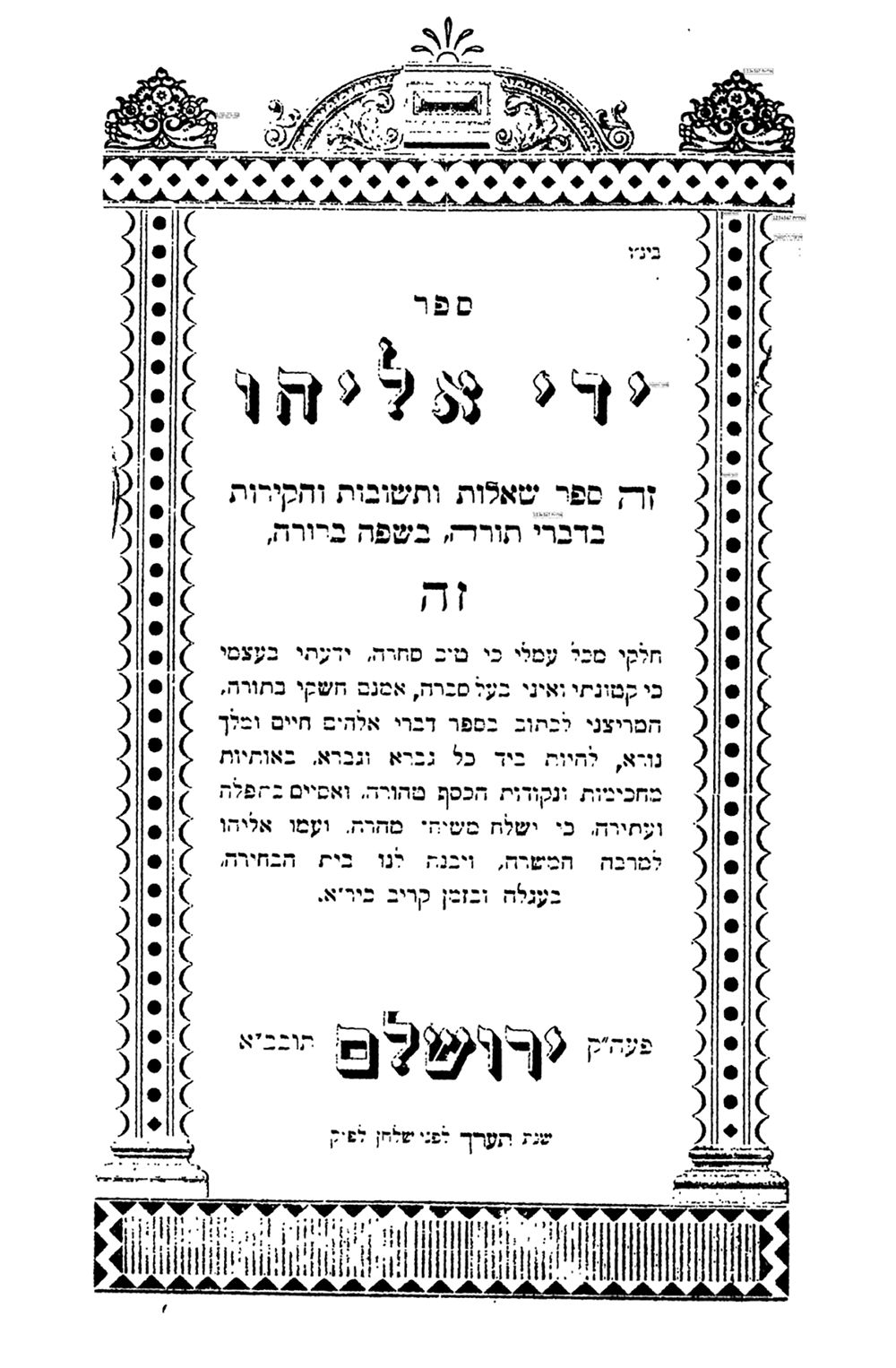
The second work of responsa by a rabbi in China is R. Aaron Moses Kiseleff’s Mishberei Yam. Here is the title page.
This book is significant not only because the author lived in China, but also because the book itself was printed in China in 1926, in the city of Harbin. Because of its proximity to Russia, Harbin attracted many Russian Jews and they were the ones who brought R. Kiseleff there. In the 1920s the Jewish population of Harbin was over 20,000.[3] As late as the 1940s there still was a Jewish day school in Harbin.[4]
Not long ago I saw that R. Gedaliah Felder, Yesodei Yeshurun: Shabbat, vol. 2, p. 216, refers to R. Kiseleff’s Mishberei Yam, and in a footnote writes:[5]
הספר הזה חשוב מאד כי זה הספר היחידי של הלכה שנדפס ברוסיא אחרי המהפכה, נדפס בשנת תרפ”ו.
No doubt because he saw the Russian writing on the title page of Mishberei Yam, R. Felder mistakenly assumed that Harbin is in Russia. He thus concluded falsely that Mishberei Yam is the only book on halakhah published in the Soviet Union. While this is incorrect, had he known the truth he could have kept the footnote but changed it to say that Mishberei Yam is important since it is the only original book on halakhah published in China.
R. Kiseleff served as rabbi in Harbin from 1913 until his death in 1949. After his death, his widow moved to Israel and published R. Kiseleff’s derashot, Imrei Shefer. Here is the title page which refers to R. Kiseleff as the chief rabbi of the Far East.
As explained in the introduction, R. Kiseleff was actually given this title in 1937 at a gathering of Far East Jewish communities.[6]
Herman Dicker writes as follows:[7]
Rabbi Kiseleff was a great Talmudic scholar who first came to Harbin when he was in his forties. He was born in Sores, Russia, in 1866 and as a child excelled in Jewish studies. He soon became known as the Vietker Ilui (wonder child), taking his name from the Yeshiva he attended as a youth. At sixteen, he transferred to the Yeshiva of Minsk, and, two years later, moved over to the Talmudic Center of Volozhin, where he studied with the famed Rabbi Chaim Soloveitchik. . . . Rabbi Kiseleff was ordained by Rabbi Chaim Ozer Grodzenski and then served as the rabbi of Borisoff from 1900-1913. In his final year at Borisoff, in 1913, Rabbi Kiseleff was called to Harbin and he accepted the post as spiritual head there at the gentle urging of the Lubavitcher Rebbe.
Within a short period of time, Rabbi Kiseleff won the love and admiration of the entire community and achieved a great deal in raising the spiritual level of this remote Jewish congregation. It was, therefore, fitting that in 1937 he was elected, unanimously, as Chief Rabbi by the General Conference of the Far Eastern Jewish Communities. . . .
In 1931, he published Nationalism and Judaism, a Russian-language volume of sermons and lectures on the significance of Judaism. . . . Rabbi Kiseleff enjoyed the friendship of all the religious and intellectual leaders of Manchuria, without regard to their nationality or faith, for they all admired him as a person and respected his vast knowledge in various areas of academic learning. At one time, he debated the “Merchant of Venice” and the image of Shylock with three university professors and to this day scores of men and women remember his brilliance and eloquence on that occasion.
There is a good deal of interesting material in R. Kiseleff’s Mishberei Yam, and let me call attention to just a few things. In no. 15, R. Kiseleff rules that if there is a non-Jew who wants to convert but the doctors tell him that it is dangerous for him to be circumcised, he still cannot be converted without a circumcision. In this responsum, R. Kiseleff also writes about how rabbis should avoid converting people who are not serious about being good Jews (although he assumes, as most rabbis did until recent years, that a conversion with such people would still be valid ex post facto).
ובכלל עלינו להתרחק בכל האפשר לקבל גרים כאלו שידוע שרוב הגרים הבאים להתגייר בימינו לא משום אהבתם לדת ישראל באמת רק על הרוב סבות אחרות בדבר משום אשה או דומה לזה ואף שמלמדים אותם לומר בפני ב”ד שאוהבים את דת ישראל ומטעמים ידועים אין אנו דוחים אותם שהרי בדיעבד גם בכה”ג הוי גר, אבל גרים כאלו יותר נוח לנו שאם נמצא אמתלא שלא לקבלם מהראוי להתרחק מזה, דאם בגרים אמתים אמרו חז”ל שקשים לישראל כספחת מה נענה לגרים גרורים כאלו שאין לבם לשמים כלל.
In no. 19 he discusses if a married woman becomes insane and has a child with someone other than her husband, if the child is a mamzer.
In no. 28 he responds to a rabbi in a Far East Russian community in which there were no Sabbath observant people other than the rabbi’s family. This created problems when it came to writing a get as one needs kosher witnesses and also the sofer cannot be a Sabbath violator. R. Kiseleff argues that since everyone in the town violates Shabbat, these people are not included under the halakhic definition of a “public Sabbath violator,” which means that one violates Shabbat in front of ten observant Jews. Therefore, none of the many gittin arranged by the questioning rabbi’s predecessor are to be regarded as pasul. At the end of his responsum, R. Kiseleff notes that in Siberia there is a big problem when it comes to gittin, as many places have no rabbi and the local shochet arranges the get. Needless to say, these shochetim were often not learned at all in this matter, and this could create major halakhic complications. R. Kiseleff therefore suggested that no one should be authorized to slaughter in Siberia until he learns the laws of gittin and is given an authorization to arrange gittin.
In nos. 29-30 he deals with a case of a man who gave a get and afterwards claimed that he was forced to do so, as he was beaten and the people beating him said that if he doesn’t give the get they will kill him. R. Kiseleff writes that the get is valid as the man would not have taken the threat seriously. In support of his assumption, he cites R. Moses Isserles who states with reference to a different case that Jews who threaten to kill another Jew are only trying to scare him, “as Jews are not murderers.”[8] R. Kiseleff sent his responsum to R. Meir Simhah of Dvinsk, and the latter disagreed with R. Kiseleff. R. Meir Simhah argued that contemporary “wild” young Jews are indeed capable of killing someone, and thus when threatened by them the man being pressured to authorize the get certainly would have taken this seriously.
דבחורי ישראל הפרוצים בזמנינו חשידי גם אשפ”ד
Here is another story about Harbin told by R. David Abraham Mandelbaum. In 1943 his father and his friend, both yeshiva students in Shanghai, came to Harbin where they visited the university. While there, and presumably in the library, they found on one of the tables a Sefat Emet on Kodashim. The two students were very surprised, since how did this book end up in such a far-away place? They grabbed the book and quickly exited.[9]
פתאום צדו עינים ספר קודש, המונח על אחד השולחנות. הבחורים המופתעים ניגשו ופתחו וגילו להפתעתם, שזהו הספר הק’ “שפת אמת” על סדר קדשים. התדהמה היתה עצומה, איך הגיע ספר קדוש זה למקום נידח, בעיר חארבין שבסין הרחוקה?! אפס, הם לא חשבו הרבה, שמו את הספר באמתחתם, והסתלקו חיש מהר מן המקום כמוצאי שלל רב.
The story as told is quite shocking to me and I am surprised that it was reported, for how was this not thievery? Presumably, the university acquired the book from one of the local Jews who donated it. Or perhaps at the time the yeshiva students were visiting the man who was studying the book had gone out to the restroom or he had left the book there from a previous visit. If such was the case, when the man returned he would have been very upset to find that his book was taken. It appears that the two yeshiva students simply felt that they had a right to take the book, as it did not belong in a Chinese institution.
This reminds me of how many years ago I walked into the library of the Jewish Theological Seminary and saw that they had installed an anti-theft system to prevent anyone from removing a book without it being checked out. Upon inquiring I was told that this was necessary as some people thought it was OK to take books from the library, as they felt that they were “liberating” the books from the clutches of those who had no right to them, that is, the Conservatives. I never took that claim seriously and always assumed that a thief is a thief, and the people stealing the books – no matter how big their kippot or how long their beards – did not have any religious justification worked out. Subsequent experiences have shown me that these sorts of thieves will steal from anyone if given the chance, even if it means pretending to be kollel students. (I won’t elaborate further, but some European readers will know what I am referring to). But in the case from Harbin, it seems obvious that the reason for taking the book was precisely because the yeshiva students felt that there was no reason for the Sefat Emet to be in a Chinese institution. As mentioned already, I do not see how this can be justified halakhically, as we are not talking about a Jewish book that was, for example, confiscated by the government for anti-Semitic reasons.[10]
After the yeshiva students returned to Shanghai with the Sefat Emet, it was then reprinted there. Here is the title page.
They also sent a copy of the book to R. Kiseleff, and here is the letter that accompanied the book.[11]
Interestingly, the copy of Sefat Emet that they used to reprint the book was missing some words. They therefore added by hand what they thought were the missing words. The following appears in R. David Abraham Mandelbaum, Giborei ha-Hayil, vol. 2, p. 107.
As is well known, when the Mir yeshiva reached Japan there was a lot of confusion about when to observe Shabbat and especially the upcoming Yom Kippur. Although there was already a local community there that observed Shabbat on Saturday, the Hazon Ish had informed the yeshiva that they must observe Shabbat on Sunday. R. Yehezkel Levenstein, the mashgiach of the Mir yeshiva, wrote to R. Kiseleff asking him specifically what to do about Yom Kippur, and he included a copy of the Hazon Ish’s letter explaining his reasoning. It is interesting that even after receiving the Hazon Ish’s letter R. Levenstein felt the need to consult with R Kiseleff, who was, as we have seen, regarded as the mara de-atra of the Far East.[12]
R. Kiseleff did not accept the Hazon Ish’s position. He told R. Levenstein that the question of Yom Kippur is no different than Shabbat, and they should keep the day that is currently being kept. R. Kiseleff was particularly worried that moving the Shabbat to Sunday, when it had previously been observed on Saturday, could lead to a lessening of Shabbat observance among the general Jewish population:
ורע עלי המעשה ששמעתי שמקצת מן הפליטים בקאבע קראו בתורה ביום א’ והתפללו תפלת שבת, ביחוד היא דרושה זהירות מרובה בענין זה בתבל כו’. ועתה כאשר נמצאו חרדים לדבר ד’ דוחים את השבת ליום א’ חג הנוצרים, יקל ענין שבת בעיניהם לגמרי, ויאמרו התירו פרושים את הדבר, ויצא מזה מכשול גדול אשר קשה יהי’ לתקן. לכן נלך מדרך זה חדש כזה אסור מן התורה בכל מקום . . . וכל המשנה ידו על התחתונה.
R. Aryeh Leib Malin also wrote to R. Kiseleff, and R. Kiseleff replied to him saying the same thing and sharply rejecting the Hazon Ish’s opinion.
בערב ש”ק העבר הרציתי מכתב להרב ר’ יחזקאל לעווינשטיין שליט”א בתשובה על מכתב הרב חזון איש, בו הודעתי טעמי ונימוקי שלא אסכים לפסק דינו על דבר דחיית יום השבת ביאפאן ליום א’ . . . כי דבריו בנוים על יסוד רעוע ובלתי ברור ומוסכם . . . ובלי ספק יגרום חלול שבת ותשתכח תורת שבת לגמרי . . . והריני מורה שיהודי יאפאן ישמרו שבת ומועדים ככל היהודים [במזרח הרחוק].
One wonders how R. Kiseleff would have reacted had he known that according to R. Simhah Zelig Rieger even in Harbin Jews should avoid Torah prohibitions on Sunday.[13] 

והרי הישראלים בחארבין שהיא מארץ חינא אינם מתנהגים כבעל המאור, נראה שלענין התפילה שהוא ענין דרבנן לא נשנה ממנהג הישראלים היושבים שם. ולענין איסור דאורייתא יש לחוש לדעת בעל המאור שהשבת מאוחרה לשל ירושלים

I earlier mentioned R. Kiseleff’s book of derashotImrei Shefer. In addition to the typical derashot one would expect in such a volume, it also includes eulogies for the Hafetz Hayyim and R. Kook. Regarding R. Kook, R. Kiseleff tells us that they were at the Volozhin yeshiva together and R. Kook was regarded then as one of the yeshiva’s outstanding students. He also records a talmudic question that R. Kook asked that R. Kiseleff tells us became the talk of all the students. Also included in the book are speeches R. Kiseleff gave on the twentieth and twenty-fifth anniversaries of Herzl’s death. He describes how thanks to Herzl many Jews who were entirely removed from Jewish life and ready to assimilate began to feel pride in their heritage and reconnect to their people.

Also included in the book are speeches he gave in honor of the Balfour Declaration and in memory of Nahum Sokolow and the victims of the 1929 massacres in the Land of Israel. Especially noteworthy is the speech found on p. 97, which celebrates the opening of the Hebrew University.
Many readers know about R. Kook’s speech on this occasion, and how he was attacked for supposedly applying to the university the verse, “For Torah shall forth from Zion, and the word of the Lord from Jerusalem” (Isaiah 2:3, Micah 4:2).[14] While R. Kook never used this verse with reference to the Hebrew University, R. Kiseleff did, as you can see from the above text.
* * * * *
In my post here I wrote:
It has been a while since I had a quiz, so here goes. In the current post I mentioned the prohibition of Torah study on Tisha be-Av. This is an example where the halakhah of Tisha be-Av is stricter than that of Yom Kippur. Many authorities rule that there is also something else that is forbidden on Tisha be-Av but permitted on Yom Kippur. Answers should be sent to me.
Many wrote to me that it is forbidden to greet someone on Tisha be-Av but not on Yom Kippur. Greeting is forbidden on Tisha be-Av due to the halakhot of mourning. However, this is forbidden according to everyone, and in the question I asked for an example of something that according to “many authorities” is forbidden on Tisha be-Av but permitted on Yom Kippur. If you pointed to something that is forbidden by “all” authorities (i.e., standard undisputed halakhah), this is not the correct answer.
A number of people also wrote to me that on Tisha be-Av one does not sit in a regular chair, unlike on Yom Kippur. Yet contrary to popular belief – and based on the emails I have received, it is indeed a quite popular belief – there is no halakhah that one must sit on the ground on Tisha be-Av. Rather, this is a minhag, not a law, and because it is a minhag we do not sit on the ground the entire day.[15]
The correct answer, which was sent to me by Brian Schwartz and Abe Lederer, is that many authorities hold that it forbidden to smell spices on Tisha be-Av, but this is not the case on Yom Kippur. In fact, smelling spices is recommended on Yom Kippur as a way to increase the number of blessings recited on this day, so that one can reach one hundred.[16]
While this is the answer I had in mind, Peretz Mochkin sent me another answer. If one has a seminal discharge on Yom Kippur, most poskim, including the Shulhan Arukh, Orah Hayyim 613:11, hold that he cannot go to the mikveh on this day. However, there are a number of significant authorities who hold that he may do so. When it comes to Tisha be-Av, there is agreement among halakhic authorities that it is forbidden to go to the mikveh after a seminal discharge.[17] However, this does not really answer the quiz question, since the question spoke of something that is permitted on Yom Kippur but forbidden on Tisha be-Av, and as noted, most poskim, at least in recent generations, forbid going to the mikveh on Yom Kippur in the case of a seminal discharge.[18]
________________________________
[1] I am aware of another posek who permits using an electronic key card on Shabbat, but requires covering up the green LED light. He explained to me that people feel good when they see the green light go on, and thus it cannot be regarded as a פסיק רישא דלא ניחא ליה. I wonder though, would other poskim agree that the feeling of satisfaction that the key works really be regarded as the sort of benefit that is considered as ניחא ליה? I think we usually assume that ניחא ליה is some sort of tangible benefit, like a light that goes on and allows you to see. In any event, the LED light is not a concern for R. Rabinovitch, and he does not require covering it up. R. Yitzhak Abadi only permits using an electronic key card on Yom Tov, and he too does not require covering up the LED light.
[2] See Donald Daniel Leslie, The Survival of the Chinese Jews: The Jewish Community of Kaifeng (Leiden, 1972), pp. 33-34; Jonathan D. Spence, The Memory Palace of Matteo Ricci (New York, 1983), p. 121.
[3] See Patrick Fuliang Shan, “‘A Proud and Creative Jewish Community’: The Harbin Diaspora, Jewish Memory and Sino-Israel Relations,” American Review of China Studies 9 (Fall 2008), p. 7. See also Joshua Fogel, “The Japanese and the Jews: A Comparative Analysis of Their Communities in Harbin, 1898-1930,” in Robert Bickers and Christian Henriot, eds., New Frontiers: Imperialism’s New Communities in East Asia, 1842-1935(Manchester, 2000), pp. 88-109
[4] See Zorah Warhaftig, Refugee and Survivor (Jerusalem, 19880, p. 208.
[5] Yesodei Yeshurun: Shabbat, vol. 2, p. 216.
[6] For the political background of these gatherings, see Herman Dicker, Wanderers and Settlers in the Far East (New York, 1962), pp. 45ff.; David Kranzler, Japanese, Nazis and Jews: The Jewish Refugee Comunity of Shanghai, 1938-1945 (Hoboken, 1988), pp. 220ff.
[7] Ibid., pp. 25-26. Much of what Dicker writes is taken word for word from the introduction to Imrei Shefer.
[8] Shulhan Arukh, Hoshen Mishpat, 236:1.
[9] David Avraham Mandelbaum, Giborei ha-Hayil (Bnei Brak, 2010), vol. 2, p. 105.
[10] The Hebrew manuscripts in the Vatican was an issue in the late 1980s, when the late Manfred Lehmann led a group, the Committee for the Recovery of Jewish Manuscripts, which insisted that the manuscripts be returned to the Jewish people by being donated to the National Library of Israel. See Lehmann, “The Story of the Hebrew Manuscripts in the Vatican Library,” available here. Nothing came of this venture and it does not seem like anyone at present has any interest in making an issue of the matter.
[11] From Mandelbaum, Giborei ha-Hayil, vol. 2, p. 109.
[12] See R. Yohanan ha-Kohen Schwadron, “Be-Inyan Kav ha-Ta’arikh,” Beit Aharon ve-Yisrael, Shevat-Adar 5770, p. 118. The complete letters of R. Kiseleff to R. Levenstein and R. Aryeh Leib Malin (mentioned later in the post) are found in R. Menahem Kasher, Kav ha-Taarikh ha-Yisraeli (Jerusalem, 1977), pp. 241-242.
[13] See his letter published in Talpiot 2 (1945), pp. 177-178.
[14] See my Changing the Immutable, pp. 143, 151.
[15] See e.g., here.
[16] See R. Yitzhak Yosef, Yalkut Yosef, Orah Hayyim 612:3. R. Yosef does cite a few sources that forbid smelling spices on Yom Kippur, but this viewpoint has never been accepted. I don’t think readers will be surprised to learn that there is an entire sefer devoted to the laws of smelling. The anonymously published 224-page Birkat ha-Reiahappeared in 2004. Here is the title page.
On pp. 196ff. he discusses the case of someone who has no sense of smell. The question is, can he make the blessing on besamim? The Shulhan Arukh, Orah Hayyim 297:5, rules that such a person can make the blessing on behalf of one who does not know how to make the blessing himself. This ruling was disputed by others, yet R. Jacob Reischer, Shevut Ya’akov, vol. 3, no. 20, defends the Shulhan Arukh, but as he says, not for R. Joseph Karo’s reason. R. Reischer argues that even though one without the sense of smell does not get any physical benefit from smelling something, his soul benefits. R. Reischer mentions that although the doctors reject the notion that the soul gets any benefit from this, their viewpoint can be disregarded because their scientific knowledge comes from “Aristotle and his companions.” R. Reischer died in 1733 and it is amazing that this is how he regarded the state of the study of medicine. Even more amazing, however, is that as he continues to attack modern science, R. Reischer adds that the non-Jewish scientists’ knowledge is based on the assumption that the earth is round, which contradicts the talmudic understanding and is thus to be rejected. How is it possible that in the eighteenth century R. Reischer believed that the earth was flat? 

The Vilna Gaon is also recorded as having held this opinion. See R. Joshua Heschel Levin, Aliyot Eliyahu (Jerusalem, 1989), p. 98 n. 82. This also appears to be what the Vilna Gaon is saying in his commentary to Tikunei Zohar (Vilna, 1867), p. 158a:

והוא יסוד הארץ שהיא רבועא כמ”ש מארבע כנפות הארץ ואמר בספרי הכנף לאפוקי עגול’ [עגולה]
See also R. Reuven Margaliyot’s note to Zohar, Vayikra, p. 10a, n. 10 (he mistakenly cites the Vilna Gaon’s comment as appearing in his commentary to Tikunei Zohar, p. 5b).
Did R. Zvi Elimelekh of Dinov, the Bnei Yisaskhar, think the earth was flat? Here is what he writes in his Devarim Nehmadim to Avot 5:1:
אין לחקור על היוצר כל למה ברא את העולם [בי’ מאמרות וגם] אין לחקור למה ברא את השמי’ כדוריי והארץ שטחיית וכיוצ’.
See here for a contemporary rabbi and author of seforim who believes the earth is flat.
[17] The only exceptions to this I have found are two unknown sources mentioned by R. Simhah Rabinowitz, Piskei Teshuvot, Orah Hayyim 554 note 58. These two sources are (תורת חיים (פעסט and קונטרס קודש ישראל 
[18] R. Joseph Hayyim, Rav Pealim, vol. 2, Orah Hayyim no. 61, states that among the medieval authorities, most held that it is permissible to to go to the mikveh on Yom Kippur after a seminal discharge: 

דהמתירים לטבול הם רוב מנין ורוב בנין


Maimonides and Prophecy, R. Pinhas Lintop, R. José Faur, and More Examples of Censorship

Maimonides and Prophecy, R. Pinhas LintopR. José Faur,  and More Examples of Censorship

by Marc B. Shapiro

1. In my last post here I discussed whether Maimonides believed that the entire people of Israel experienced prophecy at Mt. Sinai. I neglected to refer to Hilkhot Yesodei ha-Torah 8:3, which states:
לפי שנבואת משה רבנו אינה על פי האותות כדי שנערוך אותות זה לאותות זה, אלא בעינינו ראינוה ובאזנינו שמענוה כמו ששמע הוא
This is one of those passages that presents problems for the interpreter, since what Maimonides says in the Mishneh Torah, that all Israel experienced prophecy as Moses did, is contradicted by what he says in the Guide. As is to be expected, R. Kafih takes note of this problem in his commentary to Yesodei ha-Torah 8:3 (p. 165 n. 13), and what he says is fascinating. Commenting on the passage I quoted above, R. Kafih writes:
הדברים אמורים כאן על דרך ההטפה, אבל ברור בדעת רבנו שכל אחד שמע כפי רמתו, וכמשפט כל חזון, ועיין מו”נ ח”ב סוף פ’ לב, ופ’ לג, שם הביא לשון חז”ל במכילתא שמות יט כט משה מחיצה בפני עצמה ואהרן מחיצה בפני עצמה.
What R. Kafih is saying is that Maimonides’ words in the Mishneh Torah, that all Israel “saw and heard[1] with [its] own eyes and ears as he did,” should be understood as rhetoric, designed to have an effect on the reader, but they do not reflect Maimonides’ actual view which is that all of Israel did not see and hear as Moses did.

Regarding this issue, see also R. Kafih’s commentary to Guide 2:33, n. 5, where he writes:

לאו לדיוקא נקטה לא למין ההשראה באופן כללי, ולא לסוגיה

Further discussion of this matter, where R. Kafih elaborates on what he only hinted at elsewhere, can be found in his She’elot u-Teshuvot ha-Rivad (Jerusalem, 2009), nos. 24-26, where he explains to R. Mazuz what Maimonides had in mind.

In previous writings (books, articles, and posts), I have called attention to many examples where Maimonides writes things that he does not actually believe, so what we have just seen is nothing new. The significance of the example I have mentioned is that R. Kafih accepts this approach as a valid method of explaining a formulation of Maimonides in the Mishneh Torah. For another example from R. Kafih, see his note to Guide 2:45 (p. 268), where he writes:

וברור כי רבנו אמר את הדברים כאן על דרך הדרש וההטפה שדרך המטיף לגדיל ולהפריז בענין.
In Ketavim, vol. 2, p. 619, R. Kafih writes:
אמנם כתב הרמב”ם מה שכתב באיגרת תימן כדי להרתיע את מאמיני משיח השוא, וכדי להשקיט לבות החוככים אם להימין ואם להשמאיל. אבל באמת לא כן עמו.
2. R. Bezalel Naor’s translation of Orot is back in print. This time it is published with the Hebrew text as well. For those who don’t know this work, it is a masterpiece of translation. The introduction and notes are also fantastic. When people ask me what to read to get a sense of R. Kook’s thought and the conflicts it created, one of the things I always recommend is Naor’s introduction to Orot.
On the subject of Naor, I would like to call attention to another work of his which did not get the exposure it deserves. In 2013 he published Kana’uteh de-Pinhas, which focuses on the interesting figure R. Pinhas Lintop, rav of the hasidic (Habad) community of Birzh, Lithuania. R. Lintop was unusual among Lithuanian rabbis in that he intensively studied Kabbalah. He was also a supporter of the Mizrachi movement.[2]
Here is his picture.

                                                                                                             
Those who want to see a picture of his recently discovered tombstone can go here.
Anyone interested in Lithuanian rabbinic thought should examine Kana’uteh de-Pinhas. Among other things, it includes previously unknown letters from R. Lintop to the Chafetz Chaim and R. Kook. It also includes chapters by Naor on aspects of the philosophy of Habad, R. Tzadok, and R. Solomon Elyashiv. 

Naor calls attention to R. Lintop’s view of Maimonides’ Thirteen Principles. Unfortunately, I did not know of this when I wrote my book on the subject. R. Lintop is no fan of Maimonides’ concept of dogma or of Maimonides’ intellectualism in general. He rejects the notion that otherwise pious Jews can be condemned as heretics merely because they don’t accept Maimonides’ principles. He even makes the incredible statement that of the great rabbis, virtually all of them have, at the very least, been in doubt about one fundamental principle.

הנה לא הניח בן לאברהם . . . כמעט אין אחד מראשי חכמינו, החכמים הצדיקים כו’ כו’, אשר לא יטעה או יסתפק באחד משרשי הדת

Are we to regard them all as heretics? Obviously not, which in R. Lintop’s mind shows the futility of Maimonides’ theological exercise, which not only turned Judaism into a religion of catechism, but also indoctrinated people to believe that one who does not affirm certain dogmas is to be persecuted. According to R. Lintop, this is a complete divergence from the talmudic perspective.[3]

R. Lintop further states that there is no point in dealing with supposed principles of faith that are not explicit in the Talmud.[4]

הגידה נא, אחי, בלא משוא פנים, היש לנו עוד פנים לדון על דבר עקרים ויסודות את אשר לא נזכרו לנו בהדיא במשנה וגמרא?

As for Maimonides’ view that one who is mistaken when it comes to principles of faith is worse than one who actually commits even the worst sins, R. Lintop declares that “this view is very foreign to the spirit of the sages of the Talmud, who did not know philosophy.” As is to be expected, he also cites Rabad’s comment that people greater than Maimonides were mistaken when it came to the matter of God’s incorporeality.[5]

As part of his criticism of Maimonides and the Jewish philosophers in general, R. Lintop writes, in words similar to those earlier used by Samuel David Luzzatto:[6]

קרבו לנו דעות רבות נכריות וגיירו אותם עד כי היו לאמהות בישראל וגרשו את אמנו האמיתית

In his Pithei Shearim[7] R. Lintop criticizes Maimonides’ view, Hilkhot Melakhim 8:10, that given the power Jews must force non-Jews to adopt the Noahide laws. According to R. Lintop, this command only applied to the seven nations that inhabited ancient Canaan, but does not apply to any other non-Jew, even those living in the Land of Israel. Throughout his discussion, R. Lintop shows a strong moral sense and it is this which leads him to disagree with Maimonides. As he states:

  אין הקב”ה מקפח שכר כל בריה

As for those non-Jews who don’t observe the Noahide laws (referring in particular to the commandment against avodah zarah), R. Lintop sees them as blameless as they don’t know any better, having been born into their cultures.[8]

Among other things, I was surprised to see R. Lintop write:[9]

 הגאון המשכיל הנפלא בספרו בשמים ראש רנ”ב בשם אחד מהראשונים

He assumes that Besamim Rosh preserves authentic medieval responsa and yet he also recognizes that the publisher Saul Berlin was a maskil. This is significant since as far as I know, everyone else who believes Besamim Rosh to be authentic has no idea who Saul Berlin was.

Many who have heard of R. Lintop know of his correspondence with R. Kook and assume that they shared the same outlook. This is actually not the case, and in a letter to R. Yaakov Moshe Harlap R. Lintop said as much himself.[10]

כבודו הולך בזה ממש בדרך התחי’ שהולך ידי”נ הגאון מוהרא”י קוק במאמריו וספריו, והנה אמנם יש לי הרבה לדבר בזה כי אינני מהמסכימים לדרכיו, ורבות פלפלתי עמו בזה. הוא חושב כי אהבתינו הגדולה היא מפני השתוות דעותינו, ואני השבתיו כי להיפך מפני אי השתוות דעותינו אנו שואפים אחד להתמלאות מחבירו.

In 2013 the fourth volume of Reuven Dessler’s Shenot Dor va-Dor appeared. This volume contains two lengthy letters from R. Lintop to R. Kook (pp. 414-437). R. Lintop does not hesitate to criticize R. Kook’s understanding of hasidut. One of his criticisms is particularly noteworthy (pp. 435-436). R. Kook had written about how Hasidism is based on the idea of ahavat Yisrael for both the collective and the individual. R. Lintop replies that this is incorrect, as hasidut is not based on ahavat Yisrael but on ahavat avodat Yisrael and ahavat avodat ha-hasidut.

Then comes the following incredible passage, incredible since R. Lintop was at the time serving as rav of a Habad community and was generally quite connected to Habad philosophy, although he himself was not a Habad hasid. Some readers might see this as a purely academic type of statement, but anyone who knows the thought of R. Lintop will realize that this is, if not actually criticism, certainly disappointment with some of R. Shneur Zalman of Lyady’s statements.

הכי נוכל לחשוב את חסידות מורנו ורבנו אדמו”ר הזקן לחסידות אהבת ישראל אחרי הניח ליסוד מוסד באגרת הקודש (בתניא ח”ב) וז”ל לא זו הדרך ישכן אור להיות חפץ בחיי בשרים ובני ומזוני כו’ וראשית הכל שישמח האדם ויגל בכל עת ובכל שעה ויחיה ממש באמונתו כו’ ומי שעצב ומתאונן מראה בעצמו שיש לו רע ויסורין וחסר לו איזה טובה והרי זה ככופר ח”ו כו’ ומי שאין שוין לו מראה בעצמו שהוא מערב רב דלגרמייהו עבדין כו’ וע”כ הוא חפץ בחיי בשרים ובני ומזוני . . . בפ’ כ”ד מספר התניא משריש כי האדם העובר על רצון ה’ אפי’ עבירה קלה מד”ס הוא בהתכלית הפירוד מיחודו ואחדותו ית’ יותר מס”א וקליפה הנקראה אלהים אחרים ויותר מבהמה טמאה שקצים ורמשים (ובאגרת הקודש מג פוסק שכל העובר על ד”ס אפי’ באיסור קל של דבריהם חייב מיתה כעובר על חמורות שבתורה והדברים נוראים. גם בא ופוסק להלכה בספרי [!] אורח חיים [צ”ל חושן משפט] חלק ו’ הלכות נזקי גוף ונפש ט’ ישראל שעומד ברשעו תמיד כגון רועה בהמה דקה כו’ וכן כל כיוצא בהם אין כישראל דתם הוציאם מכלל ישראל ורחוק הדבר מאהבת ישראל הכללי.

There are many Habad adherents who read this blog and maybe some of them will want to weigh in on this.

Since, in the passage just quoted, R. Lintop cites the Tanya, let me share something interesting that appears in R. Mazuz’s recently published Asaf ha-Mazkir, p. 558. He mentions having heard that mitnagdim made fun of the Tanya since it begins as follows:

תניא משביעים אותו תהי צדיק ואל תהי רשע ואפילו כל העולם כולו אומרים לך צדיק אתה היה בעיניך כרשע

This comes from Niddah 30b and is stated by R. Simlai. The reason for the mitnagdim’s mocking is that R. Simlai was an amora so therefore the term תניא, which begins R. Shneur Zalman’s work, is inappropriate, as this term is used to introduce a baraita. (R. Mazuz argues that contrary to popular belief R. Simlai was a tanna, yet this is impossible.)

Finally, R. Isaac Nissenbaum tells us that R. Lintop was not a fan of R. Samson Raphael Hirsch.[11] (I wish I knew of this source earlier so I could have included it in my forthcoming article – already with the publisher – on Orthodox responses to Hirsch):

[הוא] הניא אותי מלהמשך אחרי “החורב” של רבי שמשון רפאל הירש, באמרו: “היהדות האמתית היא יהדות התורה ולא יהדות הרגש. היהדות תתקיים בתלמידי חכמים ולא ברגשנים דתיים. . .”

Just as I was finishing this post, a new book by Naor appeared entitled Mahol la-Tzaddikim. It focuses on the controversy between R. Moses Hayyim Luzzatto and R. Eizik of Homel regarding the purpose of creation.
3. In my new book I give examples of passages that were not translated properly, or not translated at all. After reading the book, Joel Wolowelsky sent me an edition of Birkat ha-Mazon, first published in 1946 (i.e., right after the Holocaust). The translation is by Rabbi Chaim Brecher, who is mentioned in my book in another context. Brecher’s edition of Birkat ha-Mazon actually became quite popular and was reprinted many times. In fact, the bentchers handed out at my own bar mitzvah were reprints of this edition.
At the beginning of Birkat ha-Mazon for weekdays, Psalm 137 (Al Naharot Bavel) appears (although almost no one says this). The final verse of this psalm reads:
 אשרי שיאחז ונפץ את עלליך אל הסלע
A proper translation of this verse is: “Happy shall he be, that taketh and dasheth thy [the Babylonians’] little ones against the rocks.”
I think it is fair to say that in modern times most people would be uncomfortable with the feeling expressed here. That explains the false translation of the verse provided by Brecher: “He will be as joyous as were you when you dashed our little ones against the stones.”

Was it a general humanistic feeling that impelled this false translation or was it the impact of the Holocaust that was responsible? In other words, with the then recent murder of so many Jewish children, perhaps it was not thought proper to give publicity to a verse that spoke of killing children of another people. Whatever the reason, it is obvious that this is an intentionally false rendering of the verse.
Regarding my book, let me also note the following:
Pp. 38-39. I wrote that there are no Ashkenazic siddurim, even those published in the State of Israel, that have an uncensored version of Birkat ha-Minim in the Amidah. As people know, I was working on this book for many years, and when I originally wrote this sentence it was correct (or so I believe). However, by the time the book appeared it was no longer correct. Rabbi Barry Gelman called my attention to the fact that in 2012 a nusach Ashkenaz siddur appeared without the censored text. Here it is.

Over the summer I was in Vienna and learnt that a couple of years ago Rabbi Schlomo Hofmeister, one of the community rabbis of Vienna, published Siddur Tefilat Yeshurun, and this siddur also includes an uncensored text of Birkat ha-Minim. I had never before seen this siddur, and what led me look at its version of Birkat ha-Minim were the following words that appear on the title page:
כמנהג בני אשכנז ללא שיבושי הצנזורה ושינויי המשכילים והמדקדקים המאוחרים
P. 55 n. 34: I somehow missed the fact that Esther Farbstein, Be-Seter Ra’am, pp. 614-616 n. 92, indeed discusses the story of the 93 Bais Yaakov girls committing suicide in Cracow. She also shows the fictional character of the story. (Thanks to R. Yaakov Taubes for calling this to my attention.)
P. 83: I refer to a responsum by R. Samuel Aboab who states that the words minhag shel shetut regarding kapparot were added by the printer. My language was not precise as this comment is not found in a responsum of Aboab but is quoted in Aboab’s name in a responsum of his student, R. Samson Morpurgo, referred to on p. 83 n. 11.
p. 131 n. 45: I report Derek Taylor’s claim that Chief Rabbi Joseph Hertz once attended a non-Jewish event without a head covering. I also note that Taylor does not provide documentation of this claim. Rabbi Dr. Benjamin Elton, who has recently been appointed rabbi of the prestigious Great Synagogue of Sydney, called my attention to this photograph in which Hertz is not wearing a kippah (source).
This was not even a non-Jewish event, but a lunch sponsored by the Polish-Jewish Refugee Fund. Hertz is also wearing a clerical collar.
Here is another picture of Hertz without a kippah (source).
Here he is wearing a kippah (source).

The men sitting behind him with the clerical collars are not Anglican priests. As you can see they too are wearing kippot. This is how Jewish “men of the cloth” used to dress in England. In this picture Hertz also has a clerical collar.
On p. 138 n. 64 I write that this photo from the Lubavitcher Rebbe’s student file at the University of Berlin[12] recently had a kippah placed on it.

The picture I referred to is the following, from R. Abraham Weingort, ed., Haggadah Shel Pesah al Pi Ba’al ha-Seridei Esh (Jerusalem, 2014), p. 53.

Regarding my discussion of the German Orthodox practice of not wearing a kippah, only after my book was in press did I read the memoir of the rabbinic scholar R. Shmuel Weingarten.[13] Weingarten describes coming to the Berlin home of R. Meier Hildesheimer and finding him and two other men drinking coffee with uncovered heads. Only when the Hungarian Weingarten entered the room did they pull their kippot out of their pockets and place them on their heads.
There is one more interesting text I would like to call people’s attention to. In R. Judah ben R. Asher, Zikhron Yehudah, no. 20, we see that R. Judah was asked if it is permitted to learn Torah with an uncovered head. R. Judah replied that it is not proper to do so, but his language makes it clear that there is no prohibition in this. He also adds that sometimes the heat will be such that one may feel unable to keep his head covered.
וטוב הוא שלא לישב בגילוי הראש בשעת הלימוד למי שיוכל לסבול לפי שילמוד יותר באימה ולפעמים מפני כובד החום אינו יכול לסבול
In R. Judah’s day they did not have small kippot like we have. It is obvious that the head covering was a significant item and when removed the man would be bareheaded.

In R. Azriel Hildesheimer’s responsa[14] the publisher included a note from Hildesheimer that informs us that in a copy of R. Judah ben R. Asher’s responsa (from the edition published in Berlin, 1846), there is a handwritten comment to the responsum just discussed. The author of the comment is described as הגאב”ד but it is not known whom this refers to. Alongside the words quoted above, that one who can bear the heat should cover his head, the unknown גאב”ד wrote:

לשון זה הוסיפו המגלים ראש ובכ”י כתוב בזה”ל: וטוב שלא לישב בגלוי הראש בשעת הלימוד כדי שישב באימה יותר ולפעמים מפני כובד החום נראה להקל. כבר נהגתי בעצמי לישב בכובע של פשתן דק כקופוצא בעתות החום לצאת ידי כולם

The Hebrew passage just quoted begins by stating that the comment in Zikhron Yehudah that one can take off one’s head covering if it is hot was added by “those who are bareheaded”.[15] This is followed by a quotation from the manuscript in which R. Judah says that on hot days he would sit with a lighter head-covering than normal. However, even this version has the language וטוב שלא לישב בגלוי ראש which also implies that there is no prohibition to be bareheaded during Torah study. This manuscript also has ולפעמים מפני כובד החום נראה להקל, which implies that one can be completely bareheaded if it is hot, to which it then adds that R. Judah himself did not sit bareheaded but wore a lighter head-covering. I therefore don’t see any substantial difference between the two versions of the responsum, yet the unnamed גאב”ד did see a problem with the first version and assumed that the text had been tampered with by a heretic.

In many prior posts I have discussed the assumption that heretics altered manuscripts (most recently in my posts regarding ArtScroll’s censorship of Rashbam). The example I have just given is one of the first where a rabbinic figure makes this argument about a halakhic text.[16] I have to say that in all of the numerous cases where modern rabbis claim that medieval texts written by great rabbinic figures have been altered by heretics, there is not even one instance where they make a compelling argument. Their approach is always along the line of, “This position goes against what we know to be true, so Rabbi X couldn’t have said it.” In this case there are actually two manuscripts in existence, and the words of one are exactly what we find it in the printed version of Zikhron Yehudah, while the other has the text mentioned by the גאב”ד.[17]

P. 218: I wrote that even a circumcised non-Jew is referred to as an arel. I was asked what my source for this is. I did not need to provide a source for my statement in the book, as it is a basic fact, and can be confirmed by looking in dictionaries. However, for those who want a rabbinic source see Mishnah Nedarim 3:11:

קונם שאיני נהנה לערלים מותר בערלי ישראל ואסור במולי עובדי כוכבים. קונם שאיני נהנה למולים אסור בערלי ישראל ומותר במולי עובדי כוכבים שלא היתה הערלה קרויה אלא לשמם שנאמר כי כל הגוים ערלים וכל בית ישראל ערלי לב

This Mishnah is explicit that even circumcised non-Jews are referred to as arelim.[18]

I would like to thank all those who have sent comments about my book. Only a small amount can be posted but I do try respond to all emails. I believe that I have mentioned all of the corrections. I hope that R. Menahem Lonzano would regard me as one of the ישרים בלבותם, for he wrote:[19]

הישרים בלבותם יאהבו החולק עליהם בדעת וישנאו העוזרם בלי דעת

4. In Saul Lieberman and the Orthodox I discussed the dispute over R. José Faur. I also published a letter in support of Faur by R. Jacob Kassin (who would later retract this support). It is well known that R. Faur’s greatest backer was R. Matloub Abadi, an important figure in the Syrian community and author of the halakhic work Magen Ba’adi. R. Abadi is mentioned in this regard by R. Kassin, in the letter of R. Kassin that I published in Saul Lieberman and the Orthodox. Here are two additional documents relevant to this matter. The first one is a 1966 letter from R. Abadi in praise of R. Faur.[20] I transcribed the document but was unable to make out some of the words.

The second document is a 1969 letter from R. Abadi to Chief Rabbi Yitzhak Nissim defending R. Faur. I found this document in the R. Nissim archive at Yad ha-Rav Nissim in Jerusalem. Together with the letter is a note that provides the following identifications.

ר”פ נ”י = R. José Faur
אויבו ורודפו = Rabbi Abraham Hecht
יוסף בן א’ = R. Yosef Harari-Raful (יוסף בן אהרן)

One more point about R. Faur that is worth noting is that he was such a close student of R. Aaron Kotler that he was one of the people chosen to carry R. Kotler’s coffin at his funeral.[21]
I have many more interesting documents that have never before appeared in print. I hope to publish some of them in future posts.
5. Let me share another example of censorship. It comes from a recently published book (too recent to be included in Changing the Immutable).
R. Joseph Messas has a passage, now famous among the Orthodox feminists, in which he refers to an unnamed book that mentions that in Spain there were places with women’s prayer groups at which each woman wore a tallit and some wore tefillin. It appears in his Nahalat Avot (Haifa, 1980), vol. 5:2, p. 268.

In 2015 the multi-volume set of Nahalat Avot was reprinted in Jerusalem. Take a look at the following page and you will see that the passage dealing with the women’s prayer groups has been deleted in its entirety.

Unlike Ashkenazic internal censorship of this sort, Sephardic censorship is a relatively new phenomenon (only a few decades old). Here is another example. R. Isaac Abraham Solomon’s book Akim et Yitzhak was published in Baghdad in 1910. On pages 112b-113a he rejects a position of the recently deceased R. Joseph Hayyim, the Ben Ish Hai.

R. Solomon appears to even cast doubt on R. Joseph Hayyim’s integrity when he writes:

וקי”ל ת”ח שאמר מילתא לאחר מעשה אין שומעים לו להחזיק דבריו

This book was reprinted in 1971, and here is how the pages look.

R. Eliyahu Sheetrit reports that R. Ovadiah Yosef was upset with this censorship and annoyed that the publisher thought that he could do as he wished with someone else’s book.[22]

6. There has been a lot written about the murder of Eitam and Na’ama Henkin הי”ד. There has even been a song dedicated to them. See here. Quite apart from the incredible family and personal tragedy, the murder of Eitam is a tragedy for the world of Torah and scholarship. I was planning on writing about this, but people who knew Eitam much better than I have already spoken and I don’t have much I could add to their moving words. I would only note that the amount of significant material published by Eitam is astounding, and I learnt so much from him, both from his printed work and from the many emails we exchanged. It is hard to think of anyone who accomplished so much in so short a period of time. I encourage all who can read Hebrew to examine his website here where many of his writings are found.

In my post here I posted this picture of the grave of R. Joseph Elijah Henkin’s son, Hayyim Shimi, which Eitam kindly sent me.

Someone asked me about the name שימי. We all know this as a nickname for שמעון but this is not something that you would put on a tombstone. I inquired about this from Eitam and here is his reply

אכן השם שלו היה חיים שימי, ואין זה קיצור חיבה של ‘שמעון’ (כמובן לא היו עושים כן על מצבה). הוא נקרא כך, למיטב ידיעתי, על שם סבתו (אם-אמו, חותנתו של הרב הענקין) שימא קריינדל, שנפטרה כשנה וחצי לפני הולדתו.

פעם שאל אותי חסיד אחד, מילא לקרוא לבן ע”ש בת אינו חידוש ומצאנו כן במעלה הדורות, אבל להמציא בשביל זה שם חדש, היכן מצאנו דבר כזה אצל שלומי אמוני ישראל?! והשבתי לו, אולי הגמרא לא מלאה ברב שימי בר אבין [צ”ל אשי] וכיו”ב?

In the post I wrote: “It is noteworthy that R. Henkin saw fit to mention on the tombstone that Hayyim was a student at Yeshiva College (= Yeshivat R. Yitzhak Elhanan).” R. Elazar Meir Teitz correctly pointed out that when Hayyim Shimi (or did they pronounce it “Simi”?) died in 1927, there wasn’t yet a Yeshiva College. This was only established in 1928.[23] However, R. Henkin’s other two sons did attend Yeshiva College.

Eitam also called the following to my attention. In R. Yitzhak Dadon’s Athalta Hi, vol. 2 (Jerusalem, 2008), p. 339,[24] this picture appears.
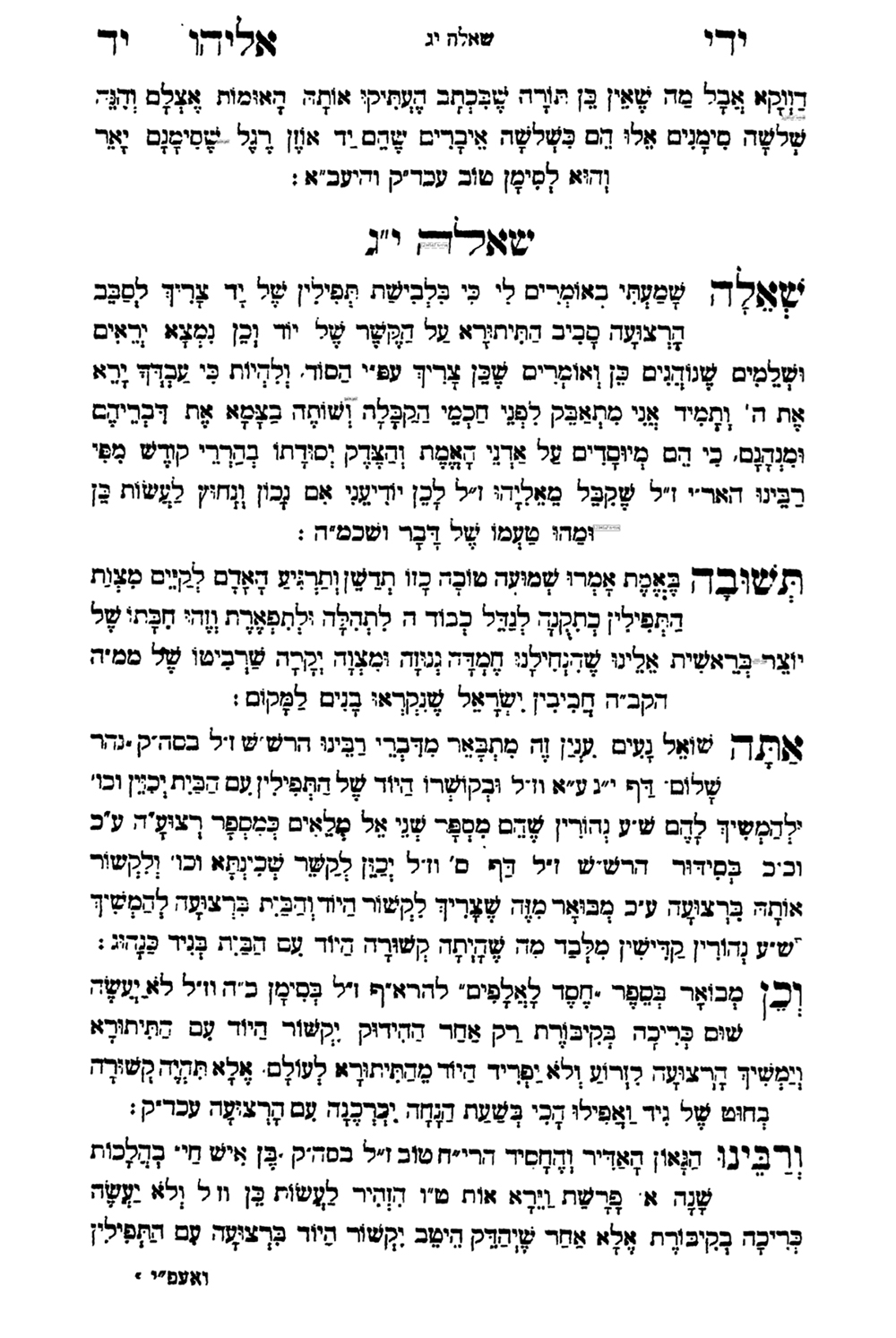
The rabbi on the right is identified as R. Shlomo Goren and the one on the left as R. Dovid Lifshitz. While the one on the right does look like R. Goren, it is actually R. Lifshitz (a fact confirmed to me by Dr. Chaim Waxman, R. Lifshitz’s son-in-law). Eitam informed me that the one on the left is R. Moshe Margolin, the secretary of Ezras Torah. Why did Dadon assume that the rabbi on the left was R. Dovid Lifshitz? He must have seen this photo somewhere with R. Lifshitz identified as appearing in it, and since he assumed that the man on the right was R. Goren, he concluded that the one on the left must be R. Lifshitz.

7. In recent weeks there has been a good deal of outrage after the appearance of an article in Mishpachah that appealed to the Palestinians not to kill haredim since they don’t go on the Temple Mount.[25] There is also an effort underway, supposedly authorized by the Edah Haredit, to publicize the same message in Arabic newspapers. See here. With this in mind, readers should examine the following document, which is found in the Central Zionist Archives S25/4752.[26]

It is a copy of a letter sent to the Supreme Muslim Council in Jerusalem from Aryeh Leib Weissfish. Weissfish was later to become famous as one of the leaders of the Neturei Karta, and strangely enough he was also a great fan of Nietzsche. You can read about his colorful career here, where it mentions how he illegally entered Jordan in 1951 to bring a message from the Neturei Karta that Jordan should invade Jerusalem and the Neturei Karta would be its ally in this. When he was deported to Israel he was put on trial and sentenced to six months in prison.

In view of the fact that there was a fear that Germany would invade the Land of Israel and that this would also lead to the Arabs persecuting Jews, Weissfish wrote to let the Muslim leaders know that the Old Yishuv type of Jews that he is speaking about are not involved in politics and oppose the Zionists. They have always treated the Arabs with respect and he therefore requests that these Jews be protected. He also offers to provide the names of the families who should be given this special treatment. As you can see from Yitzhak Ben-Zvi’s handwritten note at the bottom of the letter, Ben-Zvi copied this from the original letter which he found in the Supreme Muslim Council’s archives.

8. Information about my summer 2016 tours to Central Europe, Italy, Spain, and Germany will soon be available on the Torah in Motion website here.

9. For those who do not own Between the Yeshiva World and Modern Orthodoxy, you might be interested in knowing that Amazon is now offering it at a 36% discount ($15.92). See here

[1] This refers to the revelation at Sinai. The Touger translation of the Mishneh Torah mistakenly explains that these words refer to Moses’ “appointment as a prophet.”
[2] See Y. L. Fishman, Sefer ha-Mizrachi (Jerusalem, 1946), p. 120.
[3] Kana’uteh de-Pinhas, p. 75. When an earlier work of Lintop is quoted in Naor, Kana’uteh de-Pinhas, I have referred to the latter.
[4] Kana’uteh de-Pinhas, p. 75.
[5] Yalkut Avnei Emunat Yisrael, pp. 66-67.
[6] Yalkut Avnei Emunat Yisrael, p. 99
[7] (Vilna, 1881), pp. 14a-b.
[8] Pithei Shearim, p. 14b.
[9] Kana’uteh de-Pinhas, p. 78.
[10] Hed Harim (Jerusalem, 1953), pp. 30-31.
[11] Iggerot ha-Rav Nissenbaum (Jerusalem, 1956), p. 260 n. 7.
[12] The picture first appeared in Shaul Shimon Deutsch, Larger than Life (New York, 1997), vol. 2, p. 204.
[13] Perurim mi-Shulhanam shel Gedolei Yisrael (Jerusalem, 2004). The passage referred to is on p. 95.
[14] She’elot u-Teshuvot Rabbi Azriel: Even ha-Ezer, Hoshen Mishpat (Tel Aviv, 1976), no. 253.
[15] Eric Zimmer refers to this comment in his “Men’s Headcovering: The Metamorphosis of This Practice,” in J. J. Schacter, ed., Reverence, Righteousness, and Rahamanut (Northvale, N.J., 1992), p. 331 n. 28: “Hildesheimer claims that Reform Jews who advocated bareheadedness tampered with the original text in order to justify their own.” There are a couple of problems with Zimmer’s formulation. First, Hildesheimer does not make any claim. He simply reports what the גאב”ד wrote. Second, there is no mention of Reform Jews. The reference might be to them but it could also refer to maskilim. I assume that the quotation from Zimmer is missing a final word and what it means to say is that they “tampered with the original text in order to justify their own behavior”? 
[16] Regarding aggadic texts, we find a number of earlier examples. One well-known instance is R. Samuel Jaffe’s comment about the “Midrash” that in the future pig will become permitted:
למה נקרא שמו חזיר מפני שעתיד להחזירו לישראל
R. Jaffe writes (Yefeh Toar: Va-Yikra Rabbah 13:3, p. 78b):
לפי דעתי לא היה ולא נברא . . . היה מי שהיה רוצה להתחכם ממציא איזה מאמ’ [מאמר] שיפור’ [שיפורש] בו פי’ הלציי והיה תולה אותו מאיזה מהמדרשי’ הרחוקים להמצא ביד כל אדם
[17]  See R. Avraham Yosef Havatzelet, “Limud be-Rosh Meguleh – Ha-Omnam Ziyuf bi-Ketav Yad?” Yeshurun 7 (2000), pp. 735-738, and the note in the Makhon Yerushalayim edition of Zikhron Yehudah, no. 20.
[18] See also Da’at Mikra: Yirmiyahu, to Jeremiah 9:25, and R. Ratzon Arusi, Ha-Torah ve-Halikhot Ameinu (Kiryat Ono, 1998), vol. 1, p. 27 (second pagination).
[19] Shetei Yadot (Venice, 1618 ), p. 81.
[20] I thank R. Moshe Shamah for providing me with this document.
[21] After having heard this report, I confirmed its accuracy with R. Faur.
[22] Sheetrit, Rabbenu (Jerusalem, 2014), p. 203.
[23] See Jeffrey S. Gurock, The Men and Women of Yeshiva (New York, 1988), p. 94.
[24] In volume 1 there is a chapter on R. Jehiel Jacob Weinberg in which the author makes great use of Kitvei ha-Gaon Rabbi Yehiel Yaakob Weinberg. I jokingly tell people that I like Athalta Hi because the author refers to me as המו”ל שליט”א. See ibid., vol. 1, p. 259.
[25] See here for R. Eliyahu Zini’s statement that the editors of Mishpachah have lost their share in the World to Come. Regarding the Temple Mount, there is a shocking statement in the geonic era Pitron Torah, ed. Urbach (Jerusalem, 1978), p. 339. 

שגם היום הזה אותם האנשים שהבית בידם עשו אותו בית עבודה ומובחר ומעולה ומכובד, ואותה העבודה כך אמר שנעבד לא-ל אחד, שברא שמים וארץ ולו בריות, לכך אמ’ כל היום, עד ביאת מורה צדק ויום העתיד ואותו היום תתחדש בו עבודת הצדקה ותהיה מקובלת לפני ש-די
Rather than being upset at seeing the Muslims in charge of the Temple Mount, Pitron Torah seems to see this as a good thing that will last until the messianic era..This passage was noted by Daniel J. Lasker, “Tradition and Innovation in Maimonides’ Attitude toward Other Religions,” in Jay Harris, ed., Maimonides After 800 Years (Cambridge, MA., 2007), p. 182. As I noted in Studies in Maimonides and His Interpreters, p. 151, Pitron Torah, p. 241, contains the earliest recorded Jewish use of the term משוגע with regard to Muhammad. 

Ron C. Kiener claims that the following passage in Zohar Hadash 27d is referring to Muslim control of the Temple Mount. Its view is exactly the opposite of what we saw in Pitron Torah:

אבנא אבנא אבנא קדישא עילאה על כל עלמא בקדושתא דמארך זמיני בני עממיא לאתזלזלא בך ולאותבא גולמי מסאבין עלך לסאבא אתרך קדישא וכל מסאבין יקרבון בך ווי לעלמא בההוא זמנא

Oh stone, oh stone! Oh holy stone, greater in the world in the holiness of your Master. In future times the nations will humiliate you and place upon you defiled objects, defiling your holy place. And all the defiled ones will come unto you. Woe to the world at that time!

Translation by Kiener, “The Image of Islam in the Zohar,” Mehkerei Yerushalayim be-Mahashevet Yisrael 8 (1989), p. 51.

[26] Many years ago I saw a reference to this letter in a book, but I can no longer remember where.