Parshanut in English: Rabbinic Bible Commentary in Translation

Parshanut in English: Rabbinic Bible Commentary in Translation

Revised updated edition

Yisrael Dubitsky

The following revises, expands upon and updates my previous effort on this forum. Originally it was meant as a ten year retrospective, to see not only which works were completed in that time span but also which commentators were first touched upon. Of course, in the course of my research, I found several errors of mine from the earlier edition, and many items I had neglected to include, or was not even aware of before. Technical difficulties have delayed its appearance until now but what better time to present it than at the beginning of a new Torah reading cycle?

In contrast to the first edition, I struggled with the criteria for inclusion. Ideally, and initially, I had wished to include only items which were

1)  Commentary on Tanakh or an individual book within it (but not a supercommentary upon a commentary);

2)  Rabbinic in substance (so, for example, not Samaritan, or Karaite, or based on modern scientific scholarship);

3)  Generally, from the High Middle Ages and later (thus not classical rabbinic midrash or targum; but medieval midrash compilations/anthologies such as: Midrash ha-Gadol; Midrash Lekah Tov; Midrash Sekhel Tov; Yalkut Makhiri; or Yalkut Shimoni would be eligible; and so would slightly earlier work such as Geonic literature if any existed);

4)  Where the work was an intentional and systematic commentary on the biblical book (meaning, not that every verse in a chapter is commented upon, but most are; not simply essays on “themes” or “issues” in the chapters or parshiyot);

5)  Where the translation was complete, not adapted, digested, excerpted, paraphrased, or selected from the original;

6)  Of significant length, meaning (subjective as the choice was) more than a chapter or two long (unless the entire biblical book was only a chapter, such as Obadiah);

7)  Where no matter in what language the original work first appeared, the translation was into English (meaning, original commentary – even in English — was not eligible);

8)  Appears in a separate monograph publication, either entirely devoted to the work, or even just a chapter within the book, but not simply an article in a periodical, which is more difficult for the average reader to access.

Unfortunately as I progressed in my compilation, I realized I could not stand by many of these requirements. There were simply too many less-than-ideal-as-above works, which a learned public would expect and/or require in such a listing. For example, Abarbanel or Hasidic commentary are not precisely verse by verse but are important, and perhaps expected, additions to a listing of rabbinic commentary. I think I retained fully requirements 2, 3 and 7 above, but the other requirements are less than perfectly observed. Thus, among other breaches, there are supercommentaries as well as some journal articles represented.

There were several items (especially theses from HUC or books at British Library) which I couldn’t examine personally. Nevertheless, I added them to the list. If it should turn out that the items were not actually relevant to this list (i.e. they don’t translate a text systematically, etc.), I will delete them in a later edition. In case they were relevant, however, it is important that readers are aware of them.

Clearly, as a delimited compilation, there will be some works that many will believe should not be included, and some that many may think should be included. Every reader may have a different perspective on what should or should not be included. However, a bibliographer must be granted privilege in determining which items to include. I welcome arguments, complaints, suggestions or recommendations and apologize in advance for inadequacies, deficiencies and/or errors in my compilation.  The nature of the beast is such that this is a work in progress (hopefully to be updated in less than 13 years’ time between editions).

Commentaries are arranged chronologically by author, and then by biblical book (standard Hebrew Bible order). For space and simplicity sake, works are identified only by their author’s and translator’s (or publishers’) names but, for fuller bibliographical data, also linked to a bibliographical record in a library catalog database (usually the National Library of Israel [NLI]; where a record didn’t exist there, or I was unsatisfied with it in some way, I linked to OCLC’s public international union catalog database WorldCat. When needed, I linked to other catalogs instead. Sometimes i recorded a newly published volume not yet represented on any of the WorldCat contributor records). This method of linking to a stable URL of a catalog’s bibliographical record could not be done in the previous edition, as JTS at that time had not provided permanent URLs for their records. Thus, clunky as it may have been, the only alternative to reach the bib records at JTSAL was to request readers copy and paste the Call Number I provided. Thankfully, this method is no longer required. I will expand a bit on my linking to library bib records, rather than standard bibliographical citation, below.

Where a title of an author’s work, rather than his name, serves more popularly as his principal identification, the title is used, with the author’s name appearing parenthetically. Otherwise, the author name is the primary identifier. Translations of entire works are listed before only parts of the same, and then by date of publication. As mentioned, links to online library catalog records (generally, NLI or WorldCat) for the item serve as the full bibliographic data. Publication years in parentheses following the link indicate only the first year of the edition. Generally, where possible, the first edition of the work is listed.

As mentioned, generally only significantly lengthy works (covering more than one or two chapters of Bible text) are included. There are several cases of introductions to works that are included here too. Unless delimited otherwise, items cover the entire book, number of volumes notwithstanding (e.g. 4 vols. on the five books of Torah). Items marked “currently…” imply a work in progress.

Again, as mentioned, adaptations, anthologies, digests, excerpts or paraphrases of translations, such as are found in the Hertz, Soncino Press, Judaica Press (except for Rashi), ArtScroll, Living Torah and Living Nach or Etz Hayim bible commentaries, are generally not included. However, this ideal could not always be observed. Perhaps contradicting the above, but condensed versions, as are sometimes found in Munk translations, are in fact included. The JPS Commentators Bible, in addition to its systematic translation of four major commentators, also occasionally includes selections from Bekhor Shor, Radak, Hazekuni, Gersonides, Abarbanel and Sforno. These latter have not been included in the list.

Further, as per requirement 2 above, academic or modern critical commentaries, even those written by rabbis, are excluded.

It is important to emphasize, no implication regarding quality of the translation (or the commentary itself!) should be drawn from inclusion in this list.

I have endeavored, where feasible, to include in addition a link to a digital copy of the work – whether as a simple PDF (from sites such as Hebrewbooks, Internet Archive, Google Books or the like) or via more sophisticated presentations such as on Sefaria or Alhatorah or the like. I only include links to sites that are free for all, not subscription or paid sites which would limit access. In addition, Sefaria or Alhatorah or other websites sometimes host a work before it has reached print status; as such, it is “online-only” or even “born-digital.” These I included by adding the word “online” in parentheses following the author name; if it wasn’t clear to me when the work was added to the site, it appears with a question mark in place of the year of publication. Moreover, Sefaria and Alhatorah are such wonderful sites that they often add new material so that my listing may be incomplete or obsolete very soon after it appears. Yet another reason for this compilation to be considered a work in progress!

Furthermore, I have colored items in red that are new or newly discovered by me since the first edition some 13 years ago. When the commentator’s name is in red, it means all works/translations beneath it are new. When a new work or an added volume of an already published work has appeared in that time period, that detail (e.g. biblical book name, volume number, publication year) is in red. Thus, readers will be able to spot new materials immediately. 

Romanization of Hebrew titles follows Mahler’s Library of Congress authorized system (e.g. no doubling for dagesh, etc.; except for inferior dots). Thus, for example, Hazekuni, and not Chizkuni. Authors’ names are based on the spelling in VIAF, but not always its form (thus, Rashbam, not simply “Samuel ben Meir”; or Joseph Kara, not “Kara, Joseph”). Further, where an added word (or different date) will make the identification more accessible (e.g. Rabenu Hananel and not just Hananel ben…), it is preferred. Bold-face is used to reflect more popular identifications. 

Finally, a brief word as to reasons for a bibliography linking to library catalog records rather than the standard format of a bibliographical index of works: While standard bibliography format represents the known literature of the subject in a very brief form, there is often little way for an average reader to access all the material, or even know where to turn to reach it. In these times, however, where much of the world is a click away, it is important for the average reader – one not necessarily associated with a university library or geographically near a large library – to have easy access to the material and the choice of whether to see further bibliographical data than the absolute minimum. A library catalog record provides the bibliographical data, and holding information for where the item is held; a particular library’s holdings information is an important gauge in evaluating its worth. Furthermore, a database like WorldCat is important for providing many different library possibilities in varying geographical areas. This helps the average reader access the item. A catalog may be a bit unwieldy, inasmuch as different titles on the different volumes of the same work may result in the work spread out over a few records (see the Sifte Hakhamim records as an example) – or even duplicate records for the same item (as happens often in WorldCat). Those varying details, however, are often covered over in a standard bibliography which may “normalize” all variations so as to be contained in one line entry. A more severe disadvantage of such a system is if/when the library catalog changes (permanent) URL details. However, this is a risk that seems to be outweighed by the advantages of such a system. Referring to a book via its library catalog record will prove beneficial to more readers than a standard bibliography.

BIBLIOGRAPHY OF ENGLISH TRANSLATIONS OF RABBINIC BIBLE COMMENTARIES

Medieval

  1. Sa`adia ben Joseph Gaon [882-942]
  2.   Torah

Linetsky [Gen 1-28] (2002)

  1.     Job

Goodman (1988)

  1.     Esther

Wechsler (2015)

         alhatorah.org

  1.   Daniel

Alobaidi (2006)

  1. Rabenu Hananel ben Hushi’el [d. 1055/6]

Torah

Munk (2006) 4 vols.

Sefaria.org

  1. Rashi [Solomon ben Isaac, 1041-1105]

A.  Bible

Judaica Press (Hoenig/Rosenberg):

  1. [All] CD (1998) / Chabad
  2. [Gen] (1993) 3 vols.
  3. [Ex] (1995) 2 vols.
  4. [Nakh] (1969) 20 vols. in 24

    B. Torah

  1. Rosenbaum/Silbermann (1929) 5 vols.

a. Sefaria.org / Sefaria.org / Sefaria.org / Sefaria.org / Sefaria.org

b. Alhatorah.org

  1. Ben-Isaiah/Sharfman (1949) 5 vols.
  2. Metsudah (Kleinkaufman) (1991) 5 vols.

Mnemotrix

  1. Artscroll (Herczeg) (1994) 5 vols.
  2. JPS (Carasik) (2005) 5 vols
  3. Lowe [Gen] (1928)
  4. Doron [Gen 1-6] (1982)
  5. Milstein [currently partial ?] (1993) 9 vols.
  6. “Ariel Chumash” (Feldman et al.) [currently Gen] (1997) 2 vols.
  7. Moore [currently Gen] (2002)

C. Joshua

  1. See above: Judaica Press
  2. Metsudah (Davis) (1997)

a. Sefaria.org

b. alhatorah.org

D. Judges

  1. See above: Judaica Press
  2. Metsudah (Rabinowitz/Davis) (1998)

a. Sefaria.org

b. alhatorah.org

E. Samuel

  1. See above: Judaica Press
  2. Metsudah (Pupko/Davis) (1999) 2 vols.

a. Sefaria.org

b. alhatorah.org

F. Kings

  1. See above: Judaica Press
  2. Metsudah (Pupko/Davis) (2001) 2 vols.

a. Sefaria.org

b. alhatorah.org

G. Isaiah

  1. Turner [Isa 11; 52-53] (1847)

         pdf

  1. See above: Judaica Press

H. Ezekiel

  1. VanGemeren [Chariot chapters and passages] (1974)
  2. See above: Judaica Press

I. Psalms

  1. See above: Judaica Press
  1.     Gruber (2004)
  2. Feldheim (Herczeg) (2009) 2 vols.

J. Five Scrolls

  1. See above: Judaica Press
  1.     Metsudah (Pupko/Davis) (2001)

a. Sefaria.org

b. alhatorah.org

  1. Beattie [Ruth] (1977)
  2. Schwartz [Esther, Song of Songs, Ruth] (1983)
  3. Shute [Lamentations] (1998)
  4. Anderson [Lamentations] (2004)

pdf

  1. Herczeg [Esther] (2016)

K. Daniel

  1. See above: Judaica Press
  2. Shahar/Oratz/Hirshfeld (1994)


  1. Joseph Kara [ca. 1065-1135]

  A. Ezekiel

VanGemeren [Chariot chapters and passages] (1974)

  B. Lamentations

Anderson (2004)

  1. Pdf
  2. alhatorah.org


  1. Rashbam [Samuel ben Meir, ca. 11-12th cens.]

A.  Torah  

  1. Lockshin

           a.   [Gen] (1989)

b.   [Ex] (1997)

c .   [Lev & Num] (2001)

d.  [Deut] (2004)

alhatorah.org

  1. Munk (2006) 4 vols.

Sefaria.org

  1. JPS (Carasik) (2005) 5 vols.

    B. Five Scrolls

  1. Thompson [Song of Songs] (1988)

alhatorah.org

  1. Japhet/Salters [Ecclesiastes] (1985)
  1. Eliezer, of Beaugency [ca. 12th cen.]

Ezekiel

VanGemeren [Chariot chapters and passages] (1974)

  1. Menachem ben Simon, of Posquières [ca. 12th cen.]

Ezekiel

VanGemeren [Chariot chapters and passages] (1974)


  1. Abraham ben Meir Ibn Ezra [1092-1167]

   A. Torah

  1.     Strickman/Silver (1988) 5 vols.
  2.     Benyowitz (2006) 3 vols.
  3.     JPS (Carasik) (2005) 5 vols.
  4.     Oles [Gen] (1958)
  5.     Shachter [Lev, Deut] (1986) 2 vols.

a. Sefaria.org / Sefaria.org

b. alhatorah.org / alhatorah.org

  1.     Linetsky [Gen 1-6] (1998)
  2.     Lancaster [introduction] (2003)

   B.  Isaiah

  1. Friedlander (1873)

Sefaria.org

  1. Turner [Isa 11; 52-53] (1847)

pdf

C. Hosea

Lipshitz (1988)

D.  Haggai, Zecharia, Malakhi

Frazer (2017)

E. Psalms

Strickman (2009) 3 vols.

         alhatorah.org

     F. Five Scrolls

  1. Mathews [Song of Songs] (1874)

a. Pdf

b. Alhatorah.org

  1. Block [Song of Songs] (1982)
  2. Beattie [Ruth] (1977)
  3. Strickman (online) [Ecclesiastes] (2017)

a. Pdf

b. Alhatorah.org

  1. Shute [Lamentations] (1998)

Pdf

  1. Anderson [Lamentations] (2004)

a. Pdf

b. alhatorah.org


  1. Moses ben Sheshet [fl. ca. 1190-1200?]

Jeremiah/Ezekiel

Driver (1871)

pdf

  1. Shmuel ibn Tibbon [1150-1230]

Ecclesiastes

Robinson (2007)

  1. Radak [David ben Joseph Kimhi, ca. 1160-ca. 1235]

  A. Genesis

Munk (2006) 4 vols.

  1. Sefaria.org
  2. alhatorah.org

     B. Isaiah

  1. Turner [Isa 11; 52-53] (1847)

pdf

  1. Cohen [Isa 40-66] (1954)

     C. Ezekiel

VanGemeren [Chariot chapters and passages] (1974)

D.  Hosea

Turner [Hos 1] (1847)

         pdf

    E.  Zechariah

M’Caul (1837)

pdf

   F.  Psalms

  1.     Greenup [Pss 1-8] (1918)
  2.     Finch [Pss 1-10, 15-17, 19, 22, 24] (1919)

Sefaria.org

  1.     Baker/Nicholson [Pss 120-150] (1973)

G.  Ruth

Beattie [Ruth] (1977)

H.  Chronicles

Berger (2007)

  1. Ezra ben Solomon, of Gerona [d. ca. 1238]

Song of Songs

Brody (1999)

  1. Joseph ben Isaac Bekhor Shor, of Orleans [12th cen.]

Genesis

  1.     Thompson (online) [Gen 1-2 :3] ( ?)

alhatorah.org

  1.     Lockshin (online) [Gen 2 :4-9 :13] ( ?)

alhatorah.org


  1. Unknown [Anonymous, late 12th cen]

Song of Songs

Japhet/Walfish (2017)


  1. Ramban [Moses ben Nahman = Nachmanides, ca. 1195-ca. 1270]

  A.  Torah

  1.     Chavel (1971) 5 vols.
  2.     Artscroll (Blinder et al) (2004) 7 vols.
  3.     JPS (Carasik) (2005) 5 vols.
  4. Newman [Gen 1-6] (1960)
  5. Bick [introduction] (online) (?)
  6. Kanter [introduction] (In: Academic Journal of Hebrew Theological College, 1 (2001): 13–35)
  7. Strickman (online) [currently Ex] (?)

alhatorah.org

    B. Ecclesiastes

Chavel (1978): vol. 1


  1. Tanhum ben Joseph ha-Yerushalmi [ca. 1220-1291]

Five Scrolls

  1. Alobaidi [Song of Songs] (2014) 
  2. Wechsler [Ruth/Esther] (2010)
  1. Shem Tov ben Joseph Falaquera [ca. 1225–1295]

(Torah)

Jospe (1988)

  1. Zohar [ca. 1280]

Torah

  1. Soncino (Sperling/Simon) (1931) 5 vols.
  2. Matt (“Pritzker edition”) (2004) 12 vols.
  1. Midrash ha-Ne`elam (Zohar) [ca. 1280]

Ruth

Englander/Basser (1993)

  1. Hazekuni [=Hezekiah ben Manoah, 13th cen.]

Torah

Munk (2013) 4 vols.

  1. Sefaria.org
  2. alhatorah.org


  1. Da`at Zekenim mi-Ba`alei ha-Tosafot [probably compilatory, 13th cen]

Torah

Munk (online) (2015)

  1. Sefaria.org
  2. alhatorah.org


  1. Yalkut Shimoni [=Shim`on ha-Darshan, of Frankfurt?; compilatory, 13th cen]

  A. Jonah

Greenup (1922)

  B.   Nachum

Greenup (1923)

C.    Zecharia

King (1882)

         pdf

D.  Psalms

  1. Narot (1940)
  2. Fischer [Bk 1] (1962)
  3. Waldenberg [Bk 2-3] (1962)


  1. Unknown [Anonymous, probably compilatory, 13th cen]

Job

Hirsch (1905)

         pdf


  1. Ba`al ha-Turim [= Jacob ben Asher, ca. 1269-ca. 1340]

Torah

  1.     Artscroll (Touger) (1999) 5 vols.
  2.     Munk (2005) 4 vols.

a. Sefaria.org

b. alhatorah.org

  1. Ralbag [Levi ben Gershom = Gersonides, 1288-1344]

A.  Job

  1. Lassen (1946)
  2. Stitskin [introduction] (1963) In: Tradition, 6:1 (Fall 1963): 81-85

B.    Song of Songs

  1. Weis (1983)
  2. Kellner (1998)


26. Rabenu Bahya ben Asher ben Hlava [d. 1340]

Torah

Munk (1998) 7 vols.

  1. Sefaria.org
  2. alhatorah.org


  1. Yalkut ha-Makhiri [=Makir ben Aba Mari, ca. 1335-1410]

Jonah

Greenup  (1911)

         pdf / pdf


  1. Abraham ben Isaac ha-Levi Tamakh [d. 1393]

Song of Songs

Feldman (1970)


  1. Midrash ha-Gadol [=Adani, David ben Amram, 14th cen]

Numbers

         Fisch (1940)

                     pdf


  1. Avat Nefesh [Unknown, end of 14th cen]

Genesis

Gartig (1994)


  1. Akedat Yitshak [= Isaac ben Moses Arama, ca. 1420-1494]

Torah

Munk (1986) 2 vols.

Sefaria.org


  1. Isaac Abravanel [1437-1508]

A.  Torah

  1. Tomaschoff [Gen] (2007)
  2. Bar Eitan [currently Gen-Lev] (2012) 5 vols.
  3. Lazar (2015) 5 vols.
  4. Kasnett (2017)

  B.   Jonah

Werner (1979)

  1. Tseror ha-Mor [= Abraham ben Jacob Saba, 1440-1508]

Torah

Munk (2008) 5 vols.


  1. Obadiah ben Jacob Sforno [ca. 1470-ca. 1550]

Torah

  1.     Artscroll (Pelcovitz) (1987) 2 vols.
  2.     Munk (2006) 4 vols.
  1. Sefaria.org
  2. alhatorah.org
  1.     Stahl [Deut] (1975)


(Pre-)Modern

  1. Moses Alshekh [ca. 1520-1593]

A.  Torah

  1. Munk (1988) 2 vols.
  2. Rose [Gen] (2019) 2 vols.

B.    Jonah

  1. Werner (1979)
  2. Shahar (1992)  

C.    Psalms 

Munk (1990) 2 vols.

D.  Proverbs

  1. Munk (1991)
  2. Hirshfeld/Braude (2006) 2 vols.

E.    Job

Shahar (1996) 2 vols.  

F.    Five Scrolls

  1. Shahar [Song of Songs] (1993) 
  2. Shahar/Oschry [Ruth] (1991)
  3. Hirshfeld [Lamentations] (1993)
  4. Shahar [Ecclesiastes] (1992)
  5. Honig [Esther] (1993) 2 vols.   

g.  Daniel

Shahar/Oratz/Hirshfeld (1994)


  1. Eliezer ben Elijah Ashkenazi [1512-1585]

Esther

Brown (2006)


  1. Keli Yakar [= Ephraim Solomon ben Aaron, of Luntshits (Lenczycza), 1550-1619]

Torah

  1.     Levine [currently Gen-Ex] (2002)
  1. Genesis
  2. Exodus 2 vols.
  1.     Kanter [Deut] (2003)


  1. Tse’enah u-Re’enah [= Yaakov ben Yitzchak Ashkenazi, of Janow, 1550-1628]

Torah

  1.     Artscroll (Zakon) (1983) 3 vols.
  2.     Faierstein (2017) 2 vols.
  3.     Hershon [Gen] (1885)

pdf


  1. Shelah [Shene Luhot Ha-berit = Isaiah Horowitz, ca. 1565-1630]

Torah

Munk (1992) 3 vols.

Sefaria.org


  1. Sifte Hakhamim [=Shabbetai ben Joseph Bass, 1641-1718]

Torah

Davis et al.

  1. Genesis (2009) 2 vols.
  2. Exodus (2009) 2 vols.
  3. Leviticus (2012)
  4. Numbers (2013)
  5. Deuteronomy (?)


  1. Me`am Lo`ez [= Jacob Culi, d. 1732, et al.; Shmuel Yerushalmi, d. 1997]

Moznaim (Kaplan et al.) (1977) 43 vols.:

  1.                 Torah (1977) 20 vols.
  2.                 Joshua (1990)
  3.                 Judges (1991)
  4.                 Samuel I (1991) Samuel II (1993)
  5.                 Kings I (1994) Kings II (1997)
  6.                 Isaiah (1999)
  7.                 Jeremiah (1994) 2 vols.
  8.                 Trei Asar (1997) 2 vols.
  9.                   Psalms (1989) 5 vols.
  10.                   Proverbs (1993) 2 vols.
  11.                 Ruth (1985)
  12.                   Song of Songs (1988)
  13.               Ecclesiastes (1986)
  14.                 Lamentations (1986)
  15.                 Esther (1978)


  1. Or ha-Hayim [= Hayyim ben Moses Attar, 1696-1743]

Torah

  1.     Munk (1995) 5 vols.
  1. Sefaria.org
  2. alhatorah.org
  1.     Artscroll (Herzka) (2016) 10 vols.


  1. Moses Mendelssohn [1729-1786]

Ecclesiastes

Preston (1845)

pdf


  1. Hatam Sofer [= Moses Sofer, 1762-1839]

Torah

Stern [currently Gen-Lev] (1996) 3 vols.


  1. Ha-Ketav veha-Kabalah [= Jacob Zevi Meklenburg, 1785-1865] 

Torah

Munk (2001) 7 vols.


  1. Shadal [Samuel David Luzzatto, 1800-1865]

Torah

  1. Munk (2012) 4 vols.
  2. Klein [currently GenEx] 2 vols.
  1. Genesis (1998)

alhatorah.org [only Gen 1-11]

  1. Exodus (2015)

alhatorah.org [only Ex 1-5]

  1. [Leviticus (March 2021)]
  1.     Morais [introduction] (1926)

pdf


  1. Samson Raphael Hirsch [1808-1888]
  1.   Torah
  1.     Levy (1956) 6 vols.
  2.     Haberman (2000) 6 vols.
  3.     Breuer [Gen] (1948) 2 vols.


  1. pdf (v.1)
  2. pdf (v.2)

     B. Psalms

Hirschler (1960) 2 vols.

C.    Proverbs

Paritzky (1976)


  1. Malbim [Malbim, Meir Loeb ben Jehiel Michael Weiser, 1809-1879]

A.  Torah

Faier [GenEx 12] (1978) 5 vols.

         alhatorah.org [currently Ex]

B.    Jonah

Werner (1979)

C.    Proverbs

Wengrov/Zornberg (1982)

D.  Job

Pfeffer (2003)

  E.   Five Scrolls

  1. Kurtz [Ruth] (1999)
  2. Weinbach [Esther] (1990)
  3. Taub [Esther] (1998)


  1. Netsiv [Naphtali Zevi Judah Berlin, 1817-1893]

Song of Songs

Landesman (1993)


  1. Bet ha-Levi [= Joseph Baer Soloveichik, 1820-1892]

Torah

Herczeg [currently Gen-Ex] (1990) 2 vols.


  1. Julius Hirsch [1842-1909]

Isaiah

Breuer (2015)


  1. Joseph Breuer [1882-1980]

  A.  [Torah

See above: Hirsch (Genesis)]

B.    Jeremiah

Hirschler (1988)

C.    Ezekiel

Hirschler (1993)


  1. Da`at Sofrim [= Chaim Dov Rabinowitz, 1911-2001]

Bible

Starrett [currently Jos-Jud; Sam; Kgs; Isa; Jer; Ezk; 12; Ps; Prov; Job; Dan-Neh; Chr]  (2001) 12 vols.


  1. Da`at Mikra [=Mordekhai Zer-Kavod et al., 20th cen.]

  A. Psalms

Berman (2003) 3 vols.

B.    Job

Green (2009)

C.    Proverbs

Kanter & Cohen (2014)

Hasidic:

  1. Levi Isaac ben Meir, of Berdichev [1740-1809]

Torah

Munk [currently Gen-Lev] (2009) 3 vols.


  1. Menahem Mendel, of Rymanov [1745-1815]

Torah  

Levine (1996)


  1. Me ha-Shiloah [= Mordecai Joseph Leiner, 1802-1854]

Torah

Edwards (2001)


  1. Sefat Emet [= Judah Aryeh Leib Alter, 1847-1905]

Torah

Green (1998)


Bibliography of English Translations of Medieval and Modern Rabbinic Bible Commentaries

Parshanut: English Translations of Medieval and Modern Rabbinic Bible Commentary (Exegetical, Philosophic, Kabbalistic and Hasidic)

Yisrael Dubitsky*

Commentaries are arranged in chronological order, and then by book. For space and simplicity sake, works are identified only by their author’s and translator’s names or publishers; for further bibliographical information, copy and paste the call numbers into the JTS online catalog under “Search: Call Number begins with…” Items not (yet?) found in the JTS Library do not have call numbers associated with them and contain instead only basic bibliographic information. Only significantly lengthy (more than a chapter or two) and systematic translations are included. Unless delimited otherwise, items cover the entire book, number of volumes notwithstanding (e.g. 4 vols on the five books of Torah). Items marked “currently…” imply a work in progress. Paraphrases, anthologies or digests of translations, such as are found in the Hertz, Soncino Press, Judaica Press, ArtScroll, Living Torah and Living Nach or Etz Hayim bible commentaries, are not included. Condensed versions, as are sometimes found in Munk translations, are included. The JPS Commentators Bible (so far on Exodus alone), in addition to its systematic translation of four major commentators, also occasionally includes selections from Bekhor Shor, Radak, Hizkuni, Gersonides, Abarbanel and Sforno. These latter have not been included in the list. Further, academic or modern critical commentaries, even those written by rabbis, are excluded. Finally, no implication regarding quality of the translation should be drawn from inclusion in this list.

Medieval

I. Sa`adiah ben Joseph Gaon [882-942]

A. Torah

1. Linetsky [Gen 1-28] BS1235.X2 S213 2002

B. Job

1. Goodman BS1415.2. S143 1988

C. Daniel 1. Alobaidi (Bern; NY: Peter Lang, 2006)

II. Rabenu Hananel ben Hushiel [d. 1055/6]

A. Torah

1. Munk BS1225.X2 M8 2003 6 vols.

III. Rashi [Solomon ben Isaac, 1041-1105]

A. Bible

1. Rosenberg

B. Torah

1. Lowe [only on Gen] BS1235.X2 S62 L6

2. Doron [Gen 1-6] BS1235.3. D6 1982

3. Rosenbaum/Silbermann BS1222 1934 5 vols.

4. Ben-Isaiah/Sharfman BS1222 1949 5 vols.

5. Metsudah BS1222 1991 5 vols.

5a. Online
6. Milstein BM724. V5 1993 10 vols.
7. Artscroll (Herczeg) BS1225.X2 S6 1994 5 vols.
8. Feldman et al (“Ariel Chumash”) [currently on Gen] (Jerusalem: United Israel Institute, 1997) 2 vols.

9. Moore [currently on Gen] BS1225.X2 S6 M66 2002

10. JPS (Carasik) [currently on Ex] BS1223. C3713 2005

C. Joshua

1. Davis (Metsudah) BS1292. D28 1997

D. Judges

1. Rabinowitz/Davis (Metsudah) BS1302. D28 2001

E. Samuel

1. Pupko/Davis (Metsudah) BS1322. D28 1999 2 vols.

F. Kings

1. Pupko/Davis (Metsudah) BS1335.3. D38 2001 2 vols.

G. Psalms

1. Gruber BS1429.X2 S26 1998

H. Five Scrolls

1. Schwartz [Esther, Canticles, Ruth] BS1309. A2S3
2. Davis/Pupko (Metsudah) BS1309. A2M4 2001

I. Ruth

1. Beattie BS1315.2. B4

IV. Rashbam [Samuel ben Meir, ca. 1080-1174]

A. Torah

1. Lockshin BS1225.X2 S2313 1989 4 vols.

2. Munk BS1225.X2 M8 2003 6 vols.

3. JPS (Carasik) [currently on Ex] BS1223. C3713 2005

B. Ecclesiastes

1. Japhet/Salters BS1475.X2 S2713 1985

C. Canticles

1. Thompson BS1485.X2 S26 T5 1988

V. Abraham ben Meir Ibn Ezra [1092-1167]

A. Torah

1. Oles [Gen] (PhD, HUC, 1960)

2. Linetsky [Gen 1-6] BS1235. I36513 1998

3. Shachter [Lev, Deut] BS1225.X2 I3513 1986

4. Strickman BS1225.X2 I3513 1988 5 vols.

5. JPS (Carasik) [currently on Ex] BS1223. C3713 2005

6. Benyowitz (Jerusalem: A.R. Benyowitz, 2006) 3 vols.

B. Isaiah

1. Friedlander BS1515. I2 1964 (1873)

C. Hosea

1. Lipshitz BS1565.X2 I213 1988

D. Psalms

1. Strickman [currently on Pss 1-41] (NY: Yashar, 2007)

E. Ruth

1. Beattie BS1315.2. B4

VI. Moses ben Shesheth [fl. ca. 1190-1200?]

A. Jeremiah/Ezekiel

1. Driver BS1525. M65 18711a.

VII. Radak [David ben Joseph Kimhi, ca. 1160-ca. 1235]

A. Torah

1. Munk BS1225.X2 M8 2003 6 vols.

B. Isaiah

1. Cohen [Isa 40-66] BS1520.X2 K5 1954

C. Zechariah

1. M’Caul BS1665.X2 K513 18371a. online

D. Psalms

1. Greenup [Pss 1-8] (London Palestine House, Hackney, 1918)

2. Finch [Pss 1-10, 15-17, 19, 22, 24] BS1429.X2 K55

3. Baker/Nicholson [Pss 120-150] BS1429.X2 K54 1973

(E. Ruth?)

1. Beattie BS1315.2. B4

F. Chronicles

1. Berger (PhD, YU, 2003)

VIII. Ezra ben Solomon of Gerona [d. ca. 1238]

A. Canticles

1. Brody BS1485.X2 M632 1999

IX. Ramban [Moses ben Nahman = Nachmanides, ca. 1195-ca. 1270]

A. Torah

1. Chavel BS1225.X2 M6613 5 vols.

2. Artscroll [currently Gen-Ex] BS1225.X2 M68 B7 2004 4 vols.

3. JPS (Carasik) [currently on Ex] BS1223. C3713 2005

B. Ecclesiastes

1. Chavel BM45. M6313 1978 v. 1

X. Shem Tov ben Joseph Falaquera [ca. 1225–1295]

A. (Torah)

1. Jospe B759.F334 J68 1988

XI. Zohar [ca. 1280]

A.Torah

1. Sperling/Simon (Soncino) BM525 .A52 1931 5 vols.
2. Matt (“Pritzker edition”) [currently on Gen] BM525.A52 M37 2004 3 vols.

XII. Midrash ha-Ne`elam (Zohar) [ca. 1280]

A. Ruth

1. Englander/Basser BM525.A6 M513 1993

XIII. Unknown (Anonymous, probably compilatory) [13th cen]

A. Job

1. Hirsch BS1415.C5813 1905

XIV. Ba`al ha-Turim [= Jacob ben Asher, ca. 1269-ca. 1340]

A. Torah

1. Artscroll BS1225.X2 J232 1999 5 vols.

2. Munk BS1225.X2 J2313 2005 4 vols.

XV. Gevi`a Kesef [= Joseph ben Abba Mari Ibn Kaspi, 1279–1340]

A. Genesis

1. Herring B759. C37K4 Z31

XVI. Ralbag [Levi ben Gershom = Gersonides, 1288-1344]

A. Job

1. Lassen BS1415.X2 L4 L3

B. Canticles

1. Kellner BS1485. L39 1998

XVII. Rabenu Bahya ben Asher ben Hlava [d. 1340]

A. Torah

1. Munk BS1225.X31 B2313 1998/2003 7 vols.

XVIII. Abraham ben Isaac ha-Levi TaMaKH [d. 1393]

A. Canticles

1. Feldman BS1485.X2 A24 1970

XIX. Avvat Nefesh [Unknown, end of 14th cen]

A. Genesis

1. Gartig BS1225.X2 I35 G37 1995

XX. Akedat Yitshak [= Isaac ben Moses Arama, ca. 1420-1494]

A. Torah

1. Munk BS1225.X3 A7 2001 2 vols.

XXI. Obadiah ben Jacob Sforno [ca. 1470-ca. 1550]

A. Torah

1. Stahl [Deut] (PhD, HUC, 1975)

2. Artscroll BS1225.X2 S4413 1987/1997 2/1 vols.

3. Munk BS1225.X2 M8 2003 6 vols.

(Pre-)Modern

XXII. Moses Alshekh [1507-1593]

A. Torah

1. Munk BS1225.X2 A4313 2000 3 vols.

B. Jonah

1. Shahar BS1605.3. A413 1992

C. Psalms

1. Munk BS1429.X31 A4213 1990 2 vols.

D. Proverbs

1. Munk BS1465.X31 A413 1991

2. Hirshfeld/Braude (Nanuet, NY: Feldheim, 2006) 2 vols.

E. Job

1. Shahar (Nanuet, NY: Feldheim, 1996) 2 vols.

F. Ruth

1. Shahar/Oschry BS1315.X31 A4213 1991

G. Esther

1. Honig BS1375.X31 A413 1993 2 vols.

H. Lamentations

1. Hirshfeld BS1535.X31 A5513 1993

I. Canticles

1. Shahar BS1485.X31 A4813 1993

J. Ecclesiastes

1. Shahar BS1475.3. A413 1992

K. Daniel

1. Shahar/Oratz/Hirshfeld (Jerusalem: Feldheim, 1994)

XXIII. Eliezer ben Elijah Ashkenazi [1512-1585]

A. Esther

1. Brown (PhD, BHU, 2006)

XXIV. Keli Yakar [= Ephraim Solomon ben Aaron, of Luntshits (Lenczycza), 1550-1619]

A. Torah

1. Levine [currently on Ex] BS1225.X31 E6913 2002 2 vols.

2. Kanter [Deut] BS1225.X31 E6913 2003 v. 5

XXV. Tze’enah u-Re’enah [= Jacob ben Isaac Ashkenazi of Janow, 1550-1628]

A. Torah

1. Hershon [Gen] BS1235. J3 1885

2. Artscroll [Torah & Scrolls] BS1225. J259 1983 3 vols.

XXVI. Shlah [Shene Luhot Ha-berit = Isaiah Horowitz, ca. 1565-1630]

A. Torah

1. Munk BS1225.X33 H613 1999 3 vols.

XXVII. Me`am Loez [= Jacob Culi, d. 1732]

A. Bible [excluding Ezek; Job; Ezra-Neh; Dan; Chronicles]

1. Kaplan et al. BS1158. H4C8 1978 43 vols.

XXVIII. Or ha-Hayim [= Hayyim ben Moses Attar, 1696-1743]

A. Torah

1. Munk BS1225.X2 I28613 1995 5 vols.

XXIX. Hatam Sofer [= Moses Sofer, 1762-1839]

A. Torah

1. Stern [currently Gen-Lev] BS1225.X31 S3513 1996 3 vols.

XXX. Ha-Ketav veha-Kabalah [= Jacob Zevi Hirsch Meklenberg, 1785-1865]

A. Torah

1. Munk BS1225.X31 M3813 2001 7 vols.

XXXI. Shadal [Samuel David Luzzatto, 1800-1865]

A. Torah

1. Klein [currently on Gen] BS1235.3. L89 1998

XXXII. Samson Raphael Hirsch [1808-1888]

A. Torah

1. Levy BS1222 1958 6 vols.

2. Haberman [currently Gen-Lev] (Jerusalem: Feldheim, 2000-2005) 4 vols.

B. Psalms

1. Hirschler BS1430. H5 1978

C. Proverbs

1. Paritzky BS1465.3. H5

XXXIII. Malbim [Meir Loeb ben Jehiel Michael Weiser, 1809-1879]

A. Torah

1. Faier [through Ex 12] BS1225. M313 5 vols.

B. Proverbs

1. Wengrov/Zornberg BS1555. M34

C. Job

1. Pfeffer BS1415. M35 P44 2003

D. Esther

1. Taub BS1375.5. T28 1998

2. Weinbach BS1375.5. W4E. Ruth 1. Kurtz (New York: Feldheim, 1999)
XXXIV. Netziv [Naphtali Zvi Yehudah Berlin, 1817-1893]

A. Canticles

1. Landesman BS1485.X2 B4413 1993

[1a. (second part) Joseph BM560. B42513 1996 ]

XXXV. Bet Ha-Levi [= Joseph Baer Soloveichik, 1820-1892]

A. Torah

1. Herczeg [currently Gen – Ex] BS1225.X3 S63513 1990 2 vols.

XXXVI. Joseph Breuer [1882-1980]

A. Jeremiah

1. Hirschler BS1522 1988

B. Ezekiel

1. Hirschler BS1543. H57 1993

XXXVII. Nechama Lebowitz [1905-1997]

A. Torah

1. Newman BS1193. L521 5 vols.

XXXVIII. Da`at Sofrim [= Chaim Dov Rabinowitz, 1909-2001]

A. Bible

1. Starrett [currently on Jos-Jud; Sam; Kgs; Isa; Jer; Ezk; 12; Job; Chr; Dan-Neh] BS1151.2. R33 2001 10 vols.

Hasidic:

XXXIX. Menachem Mendel of Rimanov [1745-1815]

A. Torah

1. Levine BS1225. R9513 1996

XL. Mei ha-Shiloah [= Mordecai Joseph Leiner, 1802-1854]

A. Torah

1. Edwards BS1158.H4 X31 L413 2001

XLI. Sefat Emet [= Judah Aryeh Leib Alter, 1847-1905]

A. Torah

1. Green BS1225.X34 A39713 1998

* Yisrael Dubitsky served as Public Services and Research Librarian at The Library of the Jewish Theological Seminary until March 2007. He recently made aliyah and currently works part-time for the Saul Lieberman Institute as well as the Igud le-Farshanut ha-Talmud. He can be reached at yidubitsky-at-gmail -dot-com.


Legacy Judaica Auction March 6th: A Sampling of Forgeries and other Eclectic Lots

Legacy Judaica‘s next auction will occur on March 6, 2018.  The 220 lots include very rare books such as the first edition of the Yerushalmi and a letter from R. Tzvi Ashkenazi (Hakham Tzvi) (the entire catalog can be accessed here), there are many other interesting books and letters.
Conditional marriage has been applied since at least the talmudic period if not early.  The exact circumstances and necessary predicates have evolved over time and especially in the modern period when marriage and divorce were slowly wrested from the exclusive control of the clergy and the state began to involve itself permitting some to circumvent the religious process entirely, the issue of annulments became acuter.  Annulments were among the only methods that would free a woman whose husband proceed to receive a secular divorce but not a religious one.  In France, in the early 20th century a scheme to make conditional marriage the norm and avoid later issues was proposed.  But this met with fierce opposition from many rabbis, and to counter that proposal in 1930 in Vilna a book, Ein Tenie be-Nissuin, that contained signatures of 400 rabbis was published in protest.  The book also contains an introduction by the leading Posek, R. Chaim Ozer.  (Lot 21).  
Another contemporary controversy related to something much older, the Talmud Yerushalmi. In the first decade of the 20th century, Shlomo Friedlander published a few volumes from the Kodshim order that hereto had never been published (lot 47).  Allegedly these were from a manuscript, but many doubted their authenticity. R. Meir Don Plotski, the author of the biblical commentary, Kli Hemdah, devoted an entire book, Sha’lu Shelom Yerushalim, (lot 43) to disproving that Friedlander’s edition was legitimate. (Dr. Shlomo Sprecher Zt”L reprinted the book in 1991 with a new introduction and a biography of R Poltski).  Friedlander also published less controversial books including his commentary on the Tosefta (lot 48). 
Although not controversial, another attempt to link the present with the past is a curious book, Sefer ha-Brit ha-Hadash, written by Uziel Haga of Boston (lot 130).  He petitioned and received permission from President McKinley to accompany the U.S. military on a tour of China.  Haga’s purpose was to see first hand and document the lifestyles and customs of Chinese Jews.  Among other items, he asserted that the Jews Kaifeng in the Hunan Province are descendants of the Ten Tribes. If his identification is correct, that may explain Jews’ affinity for Chinese cuisine.  Haga never made it back from China, he was imprisoned and killed by the Boxers.   Although Haga’s book was printed in Pietrekov, one book, Mishberi Yam, (lot 131) was published in China.  
Returning to forgeries, the compendium of R. Zechariah Yeshayahu Yolles, Ha-Torah veha-Hayyim, (lot 24), includes his Dover Mesharim that disproves the attribution of a certain work to R. Mordechai Yaffa (Levush).  Yolles’ position was vehemently disputed by R. Moshe Sofer (although Yolles defended him in a different controversy) and Sofer’s letter appears in this volume.  The book is also noteworthy because it includes a portrait of Yolles in the frontispiece.  
Among the books with distinguished owners include a copy of Mishnei Torah that belonged to R. Yosef Dov Soloveitchik, (Beis HaLevi) (lot 151) and R. Hayim Volozhiner’s copy of Mesorot Seyag le-Torah. Most of R. Hayim’s library was destroyed in a fire, but this book had been on loan to R. Yaakov of Ivenitz, and thus was spared the fate of the rest of books.  (Regarding the two bibliographical topics of fire and lending, see Abraham Ya’ari, Mehkerei Sefer, 47-54 (discussing books printed after the author was saved from fire) and 179-97 (discussing book lending)). As an aside, the Mesorot Seyag le-Torah also likely contains material that is misattributed to its author.  See Wolf Heidenheim, Me’or Eynayim, comments to Exodus 27:17.


Chaim Zelig Slonimsky and the Diskin family

Chaim Zelig Slonimsky and the Diskin family
by Zerachya Licht
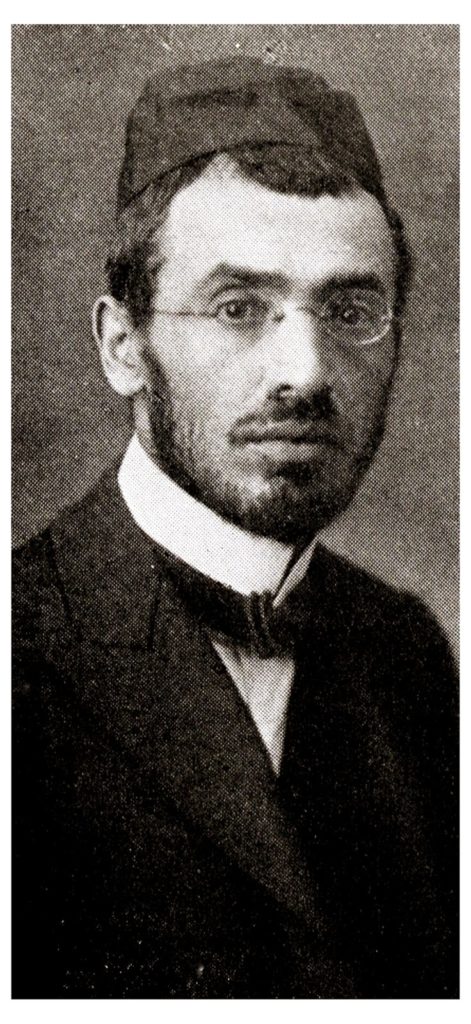
In December of 2016, Seforim blog published an article by Zerachya Licht about the Maskil Chaim Zelig Slonimsky and the Chanuka controversy he ignited. Presented here is a two part biographical monograph which focuses on Slonimsky relationship to the Diskin family. As an outcome of the above, this essay explores the Diskin family’s attitude toward Haskalah. At the end of Part I a newly discovered document which sheds light on these two topics is reproduced and transcribed. Also included are some significant points about R. Abbele Pasvoler’s attitude toward the books published by Maskilim.

Due to its length, this essay will appear in two parts. Below is the table of contents of Part I & Part II followed by Part I of the essay. Part II will appear at a later date.
חז”ס ומשפחת דיסקין
זרחיה ליכט
Part I
פרק א: שנות עלומיו – שקידתו על דלתי הרב האריסטוקרטי והחכם הכולל רבי בנימין דיסקין.
פרק ב: הספר ‘מוסדי חכמה’ – הסכמות הרבנים – הסכמת רבי אברהם אבלי פוסבלור.
פרק ג: מדוע לא הסכים רבי בנימין דיסקין על הספר ‘מוסדי חכמה’?
פרק ד: כוכבא דשביט – תולדות השמים – השכלתו הכללית של רבי בנימין דיסקין.
Part II
(not included in this post)
פרק ה: מציאות הנפש – השכלתו הכללית של מהרי”ל דיסקין.
נספח א: יחסו של מהרי”ל דיסקין להשכלה כללית בעודו משמש ברבנות באירופה.
נספח ב: יחסם להשכלה כללית של שאר בניו וחתנו של רבי בנימין דיסקין.
נספח ג: הסכמות מרבי אבלי לספרי משכילים.
בחלקו הראשון של מאמרי כאן הרחבתי את הדיבור אודות חז”ס, תוך תיאור פולמוס ‘מאי חנוכה’ שחז”ס עמד במרכזו. בחלק זה ברצוני להציג לפני קהל הקוראים הנכבדים קווים כלליים לראשית דרכו של חז”ס ויצירותיו הספרותיות. עיקר מטרתי בחלק זה הינה לתאר את טיבם של ספריו הראשונים, ולציין אודות היחסים ששררו בין חז”ס למשפחת דיסקין – בכלל, ובינו לבין רבו הגאון רבי בנימין דיסקין זצ”ל – בפרט. מתוך כך יתבררו כמה דברים חדשים על השקפותיהם של בני משפחתו של רבי בנימין, ובעיקר של בנו הגדול הגאון מהרי”ל דיסקין זצ”ל. אקדיש גם חלק נכבד מהמאמר להסכמתו של רבי אברהם אבלי פוסבלור זצ”ל לאחד מספרי חז”ס, ולהסכמות נוספות שכתב לספרי משכילים אחרים בשעתו. עוד חזון למועד לתעד עוד אבני פינה הנוגעות להמשך ימי חייו של חז”ס. ביניהם, ייסוד ועריכת העיתון ‘הצפירה’[1], החלק החשוב שלו בהתעוררות הדיון על בעיית השבת ביפן[2], המצאותיו הרבות[3], משפחתו, וכהנה רבות.
פרק א
שנות עלומיו – שקידתו על דלתי הרב האריסטוקרטי והחכם הכולל רבי בנימין דיסקין זצ”ל
חיים זליג סלונימסקי נולד בכ”ח אדר ב’ תק”ע (מרץ 31, 1810) בעיר ביאליסטוק, פלך גרודנו שברוסיה. ככל בני גילו למד חז”ס בתלמוד תורה ובישיבה, והיה ידוע כ”עילוי” ו”חריף”. אין לנו הרבה מידע אודות ראשית שנות בחרותו, מלבד מה שנחום סוקולוב[4] מוסר שבשנות עלומיו קבע חז”ס את מקומו בבית מדרשו של רבי מאיר ניחא’ס בביאליסטוק[5].
חז”ס מעיד על עצמו שבתקופה מסוימת[6] בימי עלומיו ‘שקד על דלתי’ הגאון רבי בנימין דיסקין, המכונה “ראב”ד[7] האראדנא”[8] (1798-1844). רבו זה היה בשעתו אחד מגאוני הדור, ונודע כיום כ’אביו של הגאון המפורסם רבי יהושע ליב דיסקין'[9]. לימודיו של חז”ס אצל רבי בנימין דיסקין מוזכרת גם בספר יזכור של קהילת וולקוביסק, שבה שימש רבי בנימין כרב באותם הימים.
וכך כתוב שם:

רבי בנימין דיסקין… איז דעמאלסט, ווי געזאגט, געווען רב אין וואלקאוויסק. רבי יצחק אלחנן [ספקטר] איז געווען זיין תלמיד און געלערענט אין דעם קיבוץ, צוזאמען מיט דעם רב’ס זוהן, רבי יהושע [ליב] דיסקין, רבי ברוך מרדכי ליפשיץ [וואס איז אויך געווען אן איידעם פון א וואלקאוויסקער גביר] און חיים זעליג סלאנימסקי, דער שפעטער-באוואוסטער רעדאקטאר פון ‘הצפירה’.[10] 

בעברית: רבי בנימין דיסקין… היה אז הרב של העיירה וולקוביסק. רבי יצחק אלחנן [ספקטר[11] שהיה חתן של אחד מנכבדי העיירה וולקוביסק] היה תלמידו [של רבי בנימין] ולמד בקיבוץ יחד עם בנו של הרב, רבי יהושע [ליב] דיסקין, רבי ברוך מרדכי ליפשיץ[12] [שהיה גם כן חתן של אחד מעשירי העיירה], וחיים זליג סלונימסקי, שלימים נהיה העורך המפורסם של “הצפירה”.

במאמר זה נדון בשאלה, האם השקפת החיים שבחר חז”ס לעצמו היתה שונה לחלוטין ממה שלמד וראה אצל רבו, הגר”ב דיסקין, או שאפשר למצוא איזו השפעה, ולו מזערית, מהרב על התלמיד בזה.
אין ספק שהגאון רבי בנימין דיסקין, היה נמנה על השורה הראשונה של גדולי התורה בדורו. וגם אין כאן המקום להאריך בגודל פרישותו[13], גאונותו[14], וצדקותו[15], אבל מן העניין להזכיר איזה פרטים פחות ידועים אודותיו ואודות משפחתו, שיכולים להפיץ קצת אור על צמיחת תלמידו חז”ס, שלימים יהיה מגדולי המשכילים שבדורו.
אודות רבי בנימין דיסקין, מספר יעקב מארק:

רבי בנימין דיסקין הידוע בשם ‘ראב”ד’ היה אחד הטיפוסים המעניינים ביותר בין רבני דורו. מלבד גדולתו ושכלו החריף, היה ידוע בהנהגתו, שהיה נוהג בנימוס גדול ובדרך ארץ. הוא היה כמעט הרב היחיד בדורו שהקפיד מאד על החיצוניות. והיה לבוש תמיד בגדים נאים ומצוחצחים[16], והנהגתו היתה בהתאם גמור להלכות דעות של הרמב”ם. וכינוהו בצדק ‘הרב האריסטוקרטי’. רבי יצחק אלחנן למד ממנו הרבה, ולא תורה בלבד אלא גם דרך ארץ.[17]

דבר יותר מפתיע מספר הרב חיים דובער גולבסקי[18]:

כאשר נתקבלתי לתת שיעורים ולהרביץ תורה בבית מדרש למורים, הייתי בא על כל החגים ללייקוואוד. שם זכיתי בחגים לשמש גדול הדור, ומנו החכם השלם איש האשכולות מרנא ורבנא חיים העליר[19], שהיה ממש במלוא מובן המילה אנציקלופדיה חיה. דברנו פעם אחת על השכלה ויתרונותיה, ויותר מזה חסרונותיה. החכם השלם כליל המדעים איש האשכולות מרן חיים העליר, דִבֵּר על טשטוש הגבולות בין קנאים ומשכילים. פתאום אמר לי: אתה יודע שהרה”ג המובהק מרן בנימין דיסקין אביו של רבינו יהושע ליב, היה במידת מה משכיל בחכמת הדקדוק ועוד[20]. היה לו בן, אחיו של רבינו יהושע ליב[21], שהיה חתנו של הרב חיים דאווידסאהן רבה של ווארשא[22]. הוא היה מהמשפחות הכי מודרניות בכל פולין. דיברו שם פולנית ספרותית, מבצר ההשכלה. ורבי יהושע ליב היה ביחסים טובים עם אחיו, למרות שהיו השקפותיהם שונות.[23]

בנוסף לידיעתו בחכמת הדקדוק, ידוע לנו שהרב בנימין דיסקין היה בקי גם בחכמת האסטרונומיה, מקצוע שהצטיין בו תלמידו חז”ס. אמנם ידיעתו של רבי בנימין באסטרונומיה הייתה במידה הנדרשת להכרת ענייני חשבון התקופות והמולדות וכו’, אבל נראים הדברים שידיעותיו עלו על שאר רבני דורו. ניתן למצוא הד לכך, בפירוש מהרז”ו על ‘פרקי דרבי אליעזר’ שחובר על ידי בן עירו של רבי בנימין, שכתב המחבר רבי זאב וואלף איינהארן[24] בתחילת פרק ששי:

יען שבשני פרקים אלו, פרק ששי ופרק שביעי, מְדַבֵּר [המדרש פרקי דר”א] בעניני תקופות ומולדות ולקויים אשר אין לי ידיעה בענינים אלו, על כן היתה בקשתי מאת הרב הגאון החכם הכולל מו”ה בנימין [דיסקין] נ”י ראב”ד דק”ק הוראדנא, שהוא ישים לבו הטהורה לבארם כי לו יאתה, וברוב טובו וחסדו נעתר לבקשתי, על כן אני מודיע נאמנה שהביאור על אלו ב’ הפרקים מאת הרב הגאון הנ”ל ובלשונו הטהור.

מעניין מאד שבן עירו של רבי בנימין מתארו בתואר ‘החכם הכולל’. תואר שמיועד בדרך כלל לחכמים שבנוסף לחכמת התורה הכשירו והשלימו עצמם בחכמת המדעים. ומצאתי לו חבר בזה. בדרוש ‘דרך ספוד’ מבעל ‘דרכי יוסף’, שגם הוא העניק לרבי בנימין את שם התואר “החכם הכולל’:
בעמדינו במקהלות לעורר מספד רב וקינים והגה והי כמה פעמים על הסתלקות הגאונים הצדיקים יראים ושלמים קודם זמנן, כמו הרב הגאון החכם הכולל חכו ממתקים וכולו מחמדים כ”ש מו”ה בנימין זצ”ל ראב”ד דק”ק הוראדנא… [25]
אמנם התיאור הנוסף הנוגע ביותר לעניינינו הינו תיאורו של חז”ס, המתאר את רבו בלשון ‘החכם הכולל’. בכתבה שנתפרסמה בעיתון ‘הצפירה’, הכניס המו”ל – חז”ס – הערה בשולי הגיליון בקשר לרבי נח יצחק בנו של רבי בנימין, וכך כתב:

את יוקר מעלת הרב הגאון [רבי נח יצחק] הזה ידעתי עוד מימי עלומי, בהיותי שוקד על דלתות אביו הרב הגאון החכם הכולל מוה’ בנימין זללה”ה, ובניו הגאונים זרע בירך ה’ כלם יראים ושלמים עם ה’ ועם אנשים, וכל המעלות שמנה בו הסופר הנ”ל הם צודקים ואמתיים.[26]

להשלמת התמונה, ראוי לציין שקיימות שתי אגדות מפורסמות אודות רבי בנימין, אשר מבין שתיהן ניתן ללמוד שהוא היה טיפוס רבני אשר לפני מלכים יתייצב. אפילו אם סיפורים אלו הינם פרי אגדה ולא היו דברים מעולם, עדיין יש מקום ללמוד מהם שהאופי של רבי בנימין התאים לסיפורים אלו.

א) בכתב עת הפלס מסופר: כשנתאספו גדולי ליטא, למלא אחר דרישת הממשלה לבחור מקרבם איש לנסוע פטרסבורגה יחד עם האדמו”ר הגאון הצדיק מרן ר’ מענדעלע ליבאוויצער זצוקלה”ה מארץ רייסין[27], כידוע, שמו עיניהם באא”ז הגאון הצדיק ר’ בנימין דיסקין ראב”ד זצללה”ה מהוראדנא אבד”ק לאמזי….[28] 

ב) בספר עמוד אש מובא: כשהקיסר נפוליון שחרר את מדינת פולין מידי הרוסים, בדרך מסע נצחונותו הידועים, ערכו לו בערים שונות חינגאות ומשתאות, וראשי הדתות נשאו נאומי ברכה לכבוד הקיסר והמאורע. באחד הלילות הופיעו שליחים מזויינים בביתו של רבי בנימין דיסקין שכיהן כרב העיר, וללא הודעה מוקדמת, הובהל אל אחת המסיבות הנ”ל שנערכה בקרבתו. רק בדרך למסיבה הוגד לו לשם מה הוא מוזמן ומה טיבה של מסיבה זו [לנאום לכבוד נפוליון ולפניו]… כשהגיע תורו לנאום, קם ועלה אל הדוכן, ונשא נאום נפלא…[29]

ונחזור לחז”ס…
פרק ב
הספר ‘מוסדי חכמה’ – הסכמות הרבנים – הסכמת רבי אברהם אבלי פוסלבר

חז”ס למד את חכמת תכונות השמים והטבע מתוך קריאה בספרים שחיברו חכמי ישראל במשך הדורות בלשון הקודש. כמו ספר ‘תכונת השמים’ לרבי רפאל מהנובר, ספר ‘נאוה קודש’, פירוש על הלכות קידוש החודש להרמב”ם שחיבר רבי שמעון וואלמש, וספר ‘שבילי דרקיע’ לרבי אליהו הכים. ספרים אלו עוררו בלבו של הצעיר חז”ס, את התשוקה ללמוד את החכמות הלימודיות בספר מתוקן, ובעזרת רעו רבי מיכל זאבלודאווסקי מעיר מולדתו, השיג ספרי חכמה בלשון אשכנז והגה בהם בשקידה רבה[30], עד כי במשך שנים מועטות, בהיות חז”ס בן כ”ג עלה בידו לחבר ספר הכולל את כל חלקי חכמת החשבון (1833), והדפיס[31] חלק קטן ממנו בשם ‘מוסדי חכמה’ הכולל לימודי חכמת האלגברה.[32]
לפי נוסח השער ספרו ‘מוסדי חכמה’:

כולל כל חכמת הלמודיות הזכה [ריינע מאטהעמאטיק] ומבואר בו יסודות מלאכת המספר, ושלימות חשבון הכללי, חכמת האלגעברא הפשוטה והנשגבה, חכמת המדידה… הכל מסודר על אופן נאה ונכון כפי דרכי הלימודיות, על פי מופתים סלולים ונקלים לכל מעיין.

ספר זה היה מעוטר בהסכמת גאוני זמנו[33]. המסכים הראשון, היה הגאון רבי אריה ליב קאצנעליגבויגן מבריסק, המעיד על עצמו שלקח עותק אחד, ומוסיף:

גם כל איש משכיל, אשר הדעת בקרבו, וקרבת המדעים יחפץ, יהיה בעזרו לקבל ממנו את ספרו, בכדי שישלים פרי חפצו לאור.

כמו כן הסכים על ספרו הגאון הגדול רבי אברהם אבלי פאסוועלער מווילנא[34] המקונן בתוך הסכמתו על שאין בני דורו בקיאים במדעים:

מיום הורקנו מכלי אל כלי, ובגולה הלכנו, הופג טעמינו, וכמעט רחינו נמר, בחכמות האלה וכו’ כי כבר נאמרו ונשנו, מפי שלומי אמוני ישראל, כי מלפנים היה בישראל גדולי המדע, ככלכל ודרדע, אשר כל מדע לא שגבה מאתם, והן עתה, כי ידל ישראל מאוד, ואין אתנו אנשי מחקר, לעמוד על מחקרי סתרי חכמות הטבעים ת”ל, אשר עמקו ורמו.

ולאחר שפתח הגאון רבי אבלי בגנות אלו שאינם בקיאים במדע, סיים בשבח המחבר חז”ס, שהכין לבו להפיץ חכמות:

הנה אחרי אשר הרבני המופלג וכו’, המשכיל בכל מדע, כבוד מוה’ חיים זעליג במוה’ יעקב נ”י מביאליסטאק, הנה ה’ נתן לו לב חכמה, להיות חורש מחשבות בינה בכל צד ופינה, מכל חכמות הרמות והנשגבות, הנני נותן לו תשואות חן חן, ואמטוייה’ ליה אפיריון, ואעתיר מאת אחינו המתנדבים יודעי בינה, לסעדו להפיץ את ספרו, ולב להכינה, ומלאה הארץ דעה, ובאו לציון ברינה, הכ”ד המעתיר יום א’ י”ד אדר ראשון תקצ”ד לפ”ק פה ק”ק ווילנא, 

נאום אברהם אבלי בהרב הג’ מוהר”ר אברהם שלמה זצ”ל[35]


הרב אבא פאסוועלער [פוסבלר]


אודות קבלת הסכמה זו מרבי אבלי ע”י חז”ס, מְסַפֵּר נחום סוקולוב:
סח לי חז”ס, שכשנטל הסכמה לספרו ‘מוסדי חכמה’ מאת הרב ר’ אבלי מפאסלאווא – אי אפשר היה להדפיס ס’ בלי הסכמה, כמו שאין להדפיס עתה ספר בלי צנזור[36] – צריך היה לשהות כשבוע או עשור בבית מדרשו של ר’ אבלי, ור’ אבלי סח עמו ב’דברי תורה’ וב’דברי חכמה’, ולבסוף אמר [רבי אבלי]: ניש קשה [לא נורא!], רשאי האברך להדפיס את ספרו. ועמד אחד יהודי לוהט, מן המופלגים, המקורבים אל ר’ אבלי, שמחה וטען: אבל, רבי, כמדומה לי… וגער בו הרב, ואמר: מה מדומה לך? מה מדומה לך? אין אתה מומחה לדברים כאלה.

במשך הימים אשר חכה חז”ס ולא ידע היקבל את ההסכמה, או לא, שאל את ר’ אבלי פעם אחת: רבי, באר נא לי את הדבר הזה! הנה ראיתי פה אברכים באים לקבל סמיכה. במשך שני ימים אתה תוהה על קנקנם ופוטר אותם, הן או לאו, ואני יושב פה ואתה סח עמי יום יום. הן, רבי, הסמיכה שלהם היא להוראה, ונפקא מינה טובא, מפני שאברך כזה אם איננו מומחה, כי אם מהתלמידים שלא שמשו כל צרכם, עלול הוא להאכיל טרפות, לחייב את הזכאי ולזכות את החייב, ואני וספרי לא להוראה ולא לדין תורה, ואתה שוהה ומאריך?
אז השיבהו ר’ אבלי בצחוק לחש: פתי קטן! עמהם אחת, שתים, שלש – אני פותח ומסיים, זו סמיכה בכל יום, אבל אתה יקר המציאות, ואני רוצה לטייל עמך ארוכות וקצרות[37].
בהמשך הדברים שם מוסר סוקולוב את דעתו של חז”ס אודות השכלתו של רבי אבלי:

לפי השערתו של חז”ס, היה הר’ אבלי בעצמו איזה ניצוץ… עכ”פ היה בעל חשבון. גם זה נשאר מן הגאון [מווילנה]. הנוסח של הכשר למוד החכמות ידוע. מקראות שבמורה ומאמרי חז”ל בדבר תועלת החכמות – לרקחות ולטבחות, אבל המאמרים האלה היו קיימים בכל מקום. רק כשרוצים מוצאים הכשר, ולא כל איש ראוי לכך.

וראה נספח ג למטה עוד בענין הסכמות רבי אבלי לספרי משכילים.
פרק ג
מדוע לא הסכים רבי בנימין דיסקין על הספר ‘מוסדי חכמה’?
נחזור להסכמות שהעניקו הרבנים לספר ‘מוסדי חכמה’ שחיבר חז”ס. לאחר הסכמותיהם של רבי אריה ליב מבריסק ורבי אבלי מווילנה, מופיע הסכמת הגאון רבי אליקים געציל מאיר מעיר שוויסלאץ. מְעַניין שהמסכים השלישי הזה למרות שטוען בפירוש שיש צורך בידיעת החכמות, מעיד הוא על עצמו “כי אין אתי יודע עד מה מחכמות אלו, אך אני מציץ מן החרכים, כי ידיו רב לו, והוא עלה במעלות בית חורין, יותר מכל בני גיל, בחכמות אלו”, ובסוף חותם את שמו כ”אוהב החכמה והתושיה”.
המסכים האחרון הוא הגאון רבי ירוחם אלטשולר מהעיר באדקי[38], שגם הוא מקונן על בני דורו שאינם בקיאים במדעים ואינם יודעים להבין את דברי חז”ל שכתבו דבריהם ברמיזה. וכך הוא כותב:

ומה נאמר בהרבה מן המדעים, שנתחדשו ונתוספו ע”י חכמי זולתינו הקרובים לזמנינו, דברים גדולים ונוראים, ואתנו אין יודע עד מה, והלא נודע כי בעניני המדעים הבנויים על שכל אנושי, יתרון הכשר דעת לחכמים האחרונים, על הראשונים, כאשר האריך במליצתו הגאון מורנו ישעיה באסאן[39] רבו של החכם האלקי מורנו משה חיים לוצאטו ז”ל[40] בהסכמתו לספר התשב”ץ[41]. ומה נהדר לתלמיד חכם להיות שלם בידיעות האלה כי עי”ז כביר ימצא ידו לפרש מקומות הסתומים בדברי חכז”ל הנראים זרים בתחילת השקפה וע”י המדעים החדשים ימצא טוב טעם ודעת בנועם דבריהם וכו’ וכו‘.

ומסיים בשבח המחבר, ואף מבטיח לקנות ספר אחד ממנו.
אמנם, רבי בנימין דיסקין לא העניק הסכמה לספר זה[42]. אבל מאידך גיסא, שמו מופיע ברשימת הרבנים שהבטיחו לקנות את הספר מיד לאחר צאתו מן הדפוס. רשימת מתחייבים אלו מחולקת לשניים. החלק הראשון מכיל את שמות הרבנים, ובה הוזכרו ארבעה הרבנים הנ”ל שהסכימו על הספר, ובנוסף הוזכר גם הגאון רבי בנימין דיסקין. והחלק השני מכיל את שמות הבעלי בתים שהבטיחו לקנות את הספר מיד לאחר צאתו מן הדפוס. בחלק זה מופיע שמו של ר’ שמואל שטראשון מווילנא [הוא בעל הגהות הרש”ש הידוע][43]. כמובן שגם משכילי הזמן התחייבו לקנות ספר זה, ובין השמות שברשימה הנ”ל הוזכר ה’מנדלסון הרוסי’ הנ”ל – החכם ר’ יצחק בער לעוונזאהן מקרעמניץ.
אין לנו עדות מפורשת מדוע סירב רבי בנימין להעניק הסכמה לספרו של תלמידו חז”ס, אבל אולי ניתן למצוא רמז לכך בסיפור הבא. בספר ‘האיש על החומה’ הובא סיפור אודות בנו של רבי בנימין דיסקין, הגאון רבי יהושע ליב, שאירע כביכול עם חז”ס, כאשר הגיע חז”ס לקבל את הסכמתו של מהרי”ל דיסקין לספרו ‘יסודי העיבור’:
הסופר חיים זליג סלונימסקי, שנמנה על חוגי המשכילים חיבר ספר ‘יסודי העיבור’ על חכמת העיבור, טרח[44] ובא לשקלוב לקבל הסכמה מאת הגאון הצעיר אב”ד שקלוב, ששמע גאונותו וחריפותו הלך בכל גלילות רוסיה וליטא. משנודע לבחורים הצעירים, תלמידי ישיבתו של המרא דאתרא, על מטרת בואו של הסופר המשכיל, נתלבשו רוח קנאות[45], ובאו אל רבם, ואמרו: שאם אמנם יקבל המשכיל סלונימסקי הסכמה מהגאון, זה יגרום לכך, שהרבה צעירים ילמדו היתר מכך, יסגרו את הגמרות ויפנו ללימודי ההשכלה, נתן בהם רבם מבט סלחני ופטרם בשתיקה.

חיים זליג סלונימסקי, שהגיע לשקלוב ביום חמישי אחר הצהרים, השאיר את ספרו אצל המרא דאתרא, על מנת שיעיין בו עד למחר בבוקר. ביום ששי בבוקר כשבא סלונימסקי לרבי יהושע ליב, הכניסו לחדר הבד”צ וסגר אחריו את הדלת, כשהתלמידים ממתינים בחוץ מתוך סקרנות, לראות איך יפול דבר. משראה סלונימסקי שהרב מכניסו ללשכת הבד”ץ נצנץ מעיניו ברק של סיפור על היחס המיוחד אליו מצד הגאון, וכבר נדמה לו שאכן השיג את מבוקשו.
נטל רבי יהושע ליב את העלים של הספר, דפדף בהם, והעמיד את המחבר על שמונה עשרה טעויות ואי-דיוקים שמצא בספר. סלונימסקי שנחשב לאחד מגדולי הידענים בחכמת התכונה, לא איבד עשתונותיו: עיין בהשגותיו של הרב – על ששה מהן הודה ששגה, על חלק הסביר את עצמו, ועל היתר הצטדק שהעתיק ממחברים אחרים מבלי לבדוק אמיתותן, והם ששגו והטעוהו כנראה. ‘מחבר שאינו בודק וחוקר היטב מה שמביא ומעתיק מאחרים, אינו ראוי להסכמה'[46] פטרו רבי יהושע ליב לשלום.[47]
אגדה זו מעוררת שתי שאלות:
1. הַמְסַפֵר הנ”ל כנראה חשב שחז”ס לא הכיר את רבי יהושע ליב באופן אישי, אחרת אין מהראוי להזכיר כאן “ששמע גאונותו וחריפותו [של מהרי”ל] הלך בכל גלילות רוסיה וליטא”. כלומר, מזה שמשכיל אחד מסוף העולם בא לדרוש הסכמתו יש להוכיח ששמו של מהרי”ל היה הולך מסוף העולם ועד סופו. לאור הידוע לנו חז”ס הכיר את מהרי”ל מהתקופה שלמדו בצוותא אצל הגאון רבי בנימין דיסקין, וממילא אין סגנון הפלגה זה מתאים לתוכנו של הסיפור. כמו כן לא ברורה ההתפלאות מ”היחס המיוחד אליו מצד הגאון”, מאחר שהכירו מאז ששקד על דלתי אביו כתלמיד מבוגר יותר מבן רבו הצעיר ממנו. עוד זאת, הרי הספר ‘יסודי העיבור’ נדפס בערך בשנת 1865, ואז כבר היה רבי יהושע ליב קרוב לגיל 50, ולא היה צעיר כלל. רבי יהושע ליב עלה על כס הרבנות של שקלוב לא לפני לשנת 1861 בהיותו בן 44. ובאותם הימים לא היה רב בגיל זה נחשב כצעיר.
2. בספר ‘יסודי העיבור’ לא מופיעה שום הסכמה, לא ממהרי”ל דיסקין ולא משום רב אחר. אילו אכן הלך חז”ס למרחקים לדרוש הסכמה מרבי יהושע ליב, רק שהלה לא רצה להעניק לו הסכמה מפני שחז”ס ‘לא בדק וחקר היטב מה שמביא ומעתיק מאחרים’, לא מסתבר כלל שחז”ס לא ימשיך בדרכו חזרה ויחפש גאון אחר ‘ששמע גאונותו וחריפותו הולך בכל גלילות רוסיה וליטא’ שאינו מקפיד כל כך על שהעתיק ממחברים אחרים וכו’.
לכן מסתבר יותר, שעל ספר ‘יסודי העיבור’ לא חיפש חז”ס הסכמות מעולם. והטעם פשוט, הסיבה היחידה שחז”ס דרש הסכמות על ספרו ‘מוסדי חכמה’, היתה משום שבאותם הימים היה בלתי אפשרי להוציא ספר בלי הסכמות כמו שהסביר נחום סוקולוב. אבל בתקופה המאוחרת שבה הדפיס חז”ס את ‘יסודי העיבור’, כבר השתנה המצב ולכן לא דרש הסכמה מאף אחד.
לאור האמור ניתן לשער, אם יש איזה שמץ של אמת בסיפור הנ”ל, שהסיפור כפי שסופר או דומה לו, לא ארע עם מהרי”ל דיסקין, אלא עם אביו הגאון רבי בנימין דיסקין, ולא עם הספר ‘יסודי העיבור’, אלא עם הספר ‘מוסדי חכמה’. סימוכין להשערה זו ניתן לראות מכך שחז”ס הראה את ספרו ‘מוסדי חכמה’ לרבו הגאון רבי בנימין, ורבו גם הבטיח לקנות עותק מיד לאחר צאתו מן הדפוס, ואם כן הוא, ניתן לתהות מדוע למרות שקיבל הסכמה מארבע רבנים על הספר, מרבו שלו לא קיבל הסכמה. סביר להניח שחז”ס ודאי ביקש הסמכה, אלא שרבו לא רצה להעניק לו מאיזו סיבה[48]. אמנם גם אם נקבל השערה זו אין בה כדי לגרוע מהעובדה שרבי בנימין הסכים לקנות עותק מהספר לאחר צאתו מבית הדפוס.
נוסח אחר לסיפור הנ”ל שכביכול קרה עם חז”ס ומהרי”ל דיסקין, ראיתי במאמרו של הבקי הנפלא ר’ אליעזר בראדט שליט”א בשם ר’ יהושע זיססענוויין[49]:

כמו ששמעתי מפה קדוש מהרי”ל דיסקין איך שהחכם סלאנימסקי היה נושא פניו עבור חכמתו שהיה מכירו שהוא מחכמי התכונה. וכן היה המעשה פעם אחת כשהיה בווארשא ע”ד בריאותו בא אצלו החכם הנ”ל והיה ספרו בידו ובקש ממנו לעיין ולהסכים עמו להוציאו לאור. אז השיב לו אדמו”ר מהרי”ל דיסקין זצ”ל: להשיבך איני יודע בחכמה הזאת אין ביכולתי, כי לאחר העיון אדע ככל חכמי התכונה, אבל להסכים על ספרך אין ביכולתי עד שתתן לי אותו לבית, ובתנאי אם לא נמצא שם דברים המתנגדים המדברים נגד חז”ל אז ודאי אסכים על האמת, אבל אם אמצא שם דברים שמדברים נגד כבוד חז”ל או סותרים דבריהם אז יהיה לי רשות לשורפו. וכששמע החכם סלונימסקי לקח את הספר ועזב את ביתו והלך.[50]

ואף שהסיפור שהובא ב’איש על החומה’ אינו דומה לסיפור זה שהובא ע”י יהושע זיססענוויין, משניהם ניתן ללמוד שאכן חז”ס ביקש הסכמה ממהרי”ל. אך כבר הערנו שיותר מסתבר שגם אם שורשי הסיפורים נכונים, הם אירעו עם אביו של מהרי”ל דיסקין ולא עם המהרי”ל עצמו.
פרק ד
כוכבא דשביט – תולדות השמים – השכלתו של רבי בנימין דיסקין
לאחר חיבור ספרו הראשון, מוסדי חכמה, המשיך חז”ס לחבר עוד הרבה ספרים. בשנת תקצ”ה (1835) הדפיס בווילנא ספר קטן בשם ‘כוכבא דשביט‘ שבו ביאר את ענין השביט של האלי [Halley’s Comet], – שהופיע בשמים בשנה ההיא והקהל הרבה לדבר בו – בצירוף קצת ידיעות אסטרונומיות. ספר זה זכה למהדורה שנייה שנדפסה בוורשה בשנת תרי”ז.
היתה לחז”ס כוונה מיוחדת בחיבור ספר זה. והיא לעקור מבני עמו את האמונות הטפלות שתלו בביאת השביט. המון העם היו מלאים אימה ופחד שהשביט יבא ויחריב את העולם. ולמטרה זו ביאר חז”ס בפרטות את טבע כוכב השביט של האלי, זמן מהלכו והיראותו, כדי שיחזו מראש שאמת דיברו נביאי המדע ושהשביט הוא דבר טבעי ולא תופעה על-טבעית. ספר כזה שמבואר בו מראש, בשפה העברית, את מהלך השביט על פי המצאת המדעים, השריש את האמונה במדעים בקרב בני עמו של חז”ס.
וכך מתאר ר’ שמואל יוסף פין[51] את הנסיבות לכתיבת הספר ‘כוכבא דשביט’:

בשנת תקצ”ה הודיעו במכתבי העתים כי עתיד כוכב שביט (comet) להראות ברקיע בשנה ההיא, ופחד גדול נפל על המון העם באמרם כי בבואו יחריב את כל הארץ ויבוא קץ לכל בשר, אז רוח חכמה לבשה את הרחז”ס ויחבר ספר “כוכבא דשביט”, בו הציע שיטת התכונה החדשה ותהלוכת כוכבי הלכת במסלוליהם, החוקים החדשים בחכמת התכונה אשר המציאו החכמים הגדולי נעווטאן (Newton) וקעפלער (Kepler) ובאר את טבע כוכבי השביט בכלל שאין כל רעה במגורם ושאין כל צרה בהליכותם וטבע כוכב השביט ההוא אשר חכו בואו אז הידוע בשם הקאמעט של האללי בפרט, זמן מהלכות והראותו, מבואר ומוגבל בלוח המצורף לזה.[52]

בספרו הזה התפרסם חז”ס, ושמו הטוב הלך למרחוק עד כדי כך שגדולי חכמי משכילי גליציה הריצו אליו מכתבים מלאים שבח על אשר פעל למען הפצת השכלה בקרב עמו. בספרו הבא, תולדות השמים, הדפיס חז”ס, מכתב קצר שקיבל מרבי נחמן קרוכמל[53], ומכתב ארוך שקיבל מרבי שלמה יהודה רפפורט[54]. מכתבו של שי”ר השתרע על פני 18 עמודים של ספרו תולדות שמים.
חז”ס התפרסם במיוחד ע”י ספרו השלישי, ‘תולדות השמים’, שיצא לאור בשנת תקצ”ח (1838), בו הוא כתב מחקר יסודי על אופן חישוב הלוח העברי.
שמואל יוסף פין מבאר:
בספרו זה פנה לו הרב רחז”ס לבאר חשבון המולדות והתקופות המקובל בישראל, שכבר העירו עליו חכמי עמנו בדור העבר שאיננו מסכים עם המציאות הסכמה מדויקת – ועלה על דעתם לשער כי הקדמונים מייסדי החשבון לא דקדקו יפה בחשבונותיהם, ובא הרחז”ס והראה לדעת שסיבת השינוי הזה, שכבר הרגיש בו הרמב”ם בימיו, איננה תלויה במצוי חשבונם של הקדמונים כי אם בטבע מהלך הירח במסלולו שהלך ונעתק מזמן שני אלפים שנה. וסמך בסברתו זאת על חשבונותיו של התוכן המפואר לאפלאם.

ומצד עיונו זה התעורר הרחז”ס לעמוד על שתי שאלות גדולות ביסוד חשבון העבור המקובל אצלנו:
א) מי היו מייסדיו ובאיזה זמן, והודיע סברתו שנוסד החשבון הזה בזמן מאוחר הרבה מאשר יחסוהו לו קדמוני המחברים.
ב) החשבון המקובל אצלנו המיוחס לרב אדא בר אהבה [תקופת רב אדא] מיוסד לא על קבלה מסורה בידו מדורות הקדמונים, שהיתה שמורה ביד החכמים בסוד, כי אם על השקפות ובחינות מחשבונות מהלך הכוכבים בזמן מן הזמנים, שלפי חשבונו של הרחז”ס נעשו ונבחנו בזמן מאוחר הרבה בערך המאה התשיעית לספה”נ, במאה השביעית לאלף החמישי[55].
כמובן שבהנחה זו, נתן חז”ס לחכמי הדור מקום לענות בו, ועורר עליו את כעסם של הרבנים, וגם המשכיל התלמודי ר’ צבי הירש פינעלעס[56] התעורר לערער על דבריו של חז”ס, ופרצה מחלוקת גדולה בין החכמים שנמשכה כשלשים שנה, משנת ת”ר (1840) עד תרל”א (1871) על מערכות מכתבי העת לבני ישראל ובלשונות העמים. ומסיים שי”פ ש”במלחמת חכמה זו הפליאו שניהם להראות חכם הגדול בחכמה זו, והפיצו אור על הרבה מאמרים לחז”ל במקצוע זה שהיו סתומים.”
ראוי להעיר, שלמרות שבספר הזה פקפק חז”ס בדבר שהיה מקובל מדור דור, מכל מקום לא השפיעה פרשה זו כל כך על הורדת כבודו במחנה השמרנים, כמו שקרה לו בפרשת חנוכה. לדעתי, יש לתופעה זו שתי סיבות פשוטות: סיבה ראשונה היא, שתקופת רב אדא לא הוזכרה במפורש בשום מקום בש”ס, ונמצא שחז”ס לא פקפק בזה על אמיתת התלמוד אלא רק על דברי הראשונים, ואילו בפולמוס אודות הנס של פך השמן התקיף חז”ס את האגדה שהוזכרה בתלמוד. הסיבה השנייה היא, שהסיפור אודות הנס של פך השמן שגור הוא בפי הכל, נשים קטנים ועמי הארץ, ומי שיכחישו ממילא יהיה מופרך אצלם לגמרי, ואילו ‘תקופת רב אדא’ הוא ענין הרבה יותר אזוטרי, ואין ההמון מתפעל כל כך אם מישהו יבוא ויכחיש את המקובל.
גם בין החותמים על הספר ‘תולדות השמים’, מופיע שֵׁם רבו “הגאב”ד מו”ה בנימין מהוראדנא. ויש לציין שבנוסף לרבו מופיעים עוד שמות מפורסמים, בין מגדולי התורה ובין מגדולי המשכילים, והם: “הגאב”ד ר’ שלמה איגר מקאליש[57]”, בנו הגדול של הגאון רבי עקיבא איגר זצ”ל, “הגאב”ד מו’ אליקים געציל מביאליסטאק[58]”, “ר’ מתתי’ בר”ש שטראסון[59]”, בנו של הרש”ש, “ר’ יצחק בער לעווינזאהן מקרעמניץ”, ריב”ל, “ר’ נחמן קראחמאל”, הידוע בר”ת רנ”ק, “הגאב”ד מו’ שלמה ליב ראפפורט”, חתנו של בעל ‘קצות החושן’ והידוע בר”ת שמו שי”ר.
ספר זה יצא לאור עם תיקונים שלשים שנה מאוחר יותר בשם ‘יסודי העיבור’.
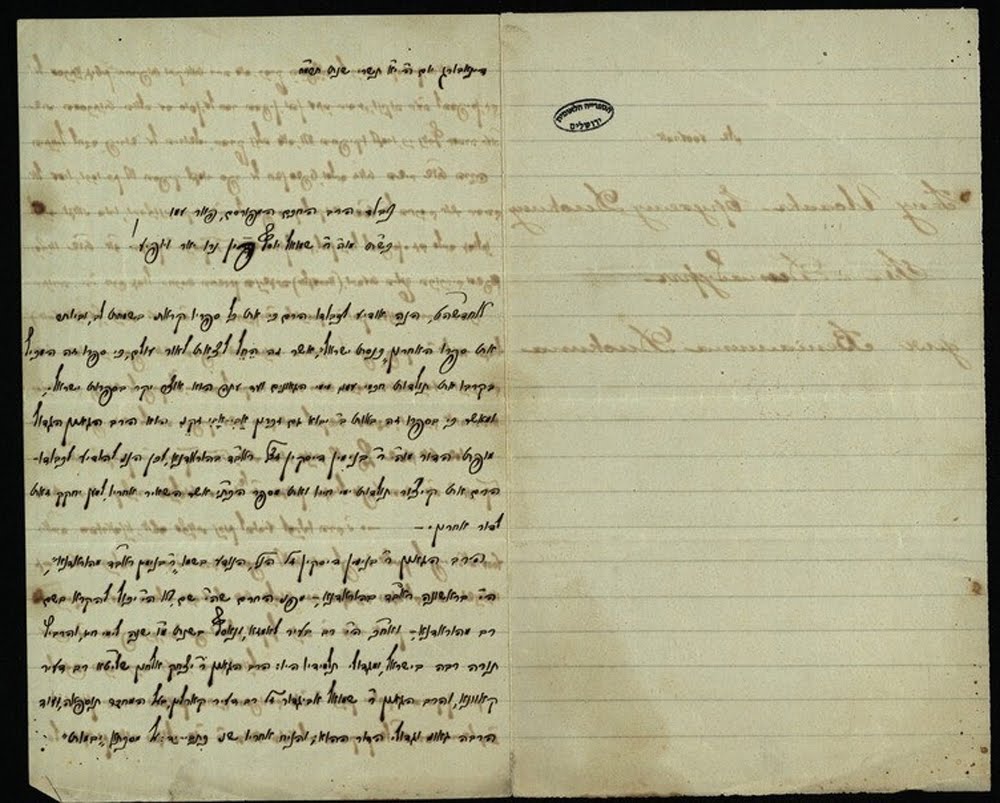
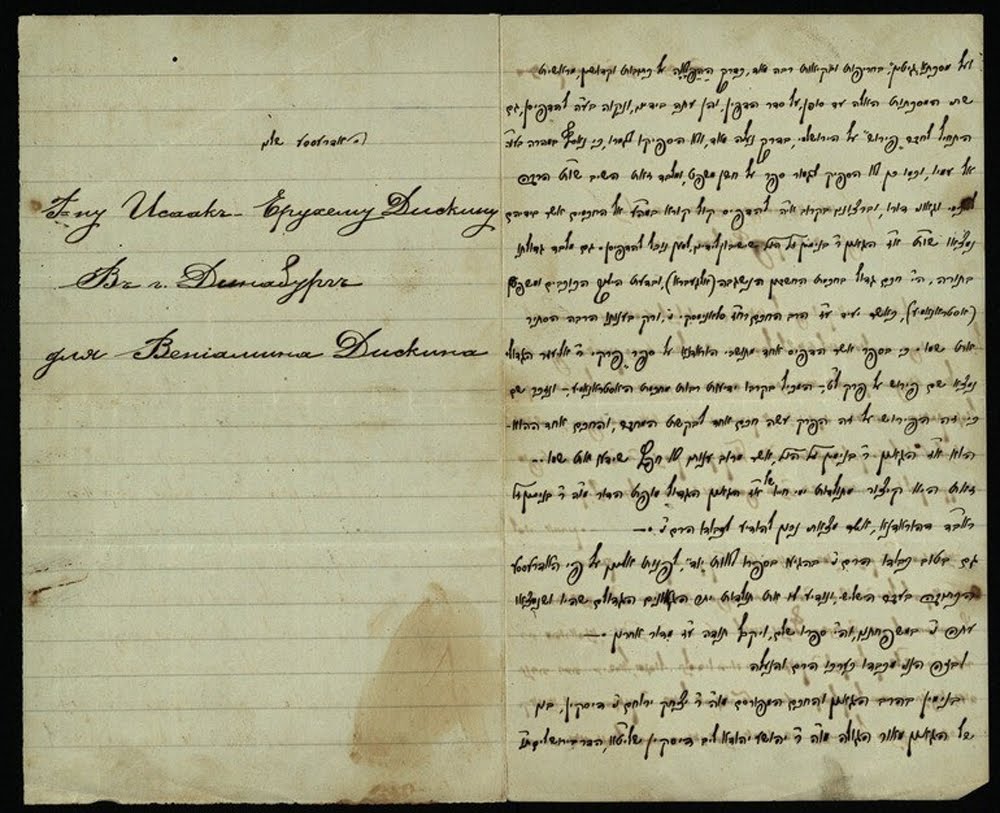
כבר ראינו למעלה שרבו של חז”ס, הגאון רבי בנימין דיסקין, היה בקי גדול בחכמת התקופות ומזלות. וסביר להניח שהוא שימש מקור להשראה לתלמידו חז”ס, שגם הוא הצטיין במיוחד בתחום הזה.[60] מה שמרשים ביותר הוא, ששני הספרים הראשונים[61] שהוציא חז”ס לאור, ‘מוסדי חכמה’ על אלגברה, ו’תולדות השמים’ על עניני התקופות, התעסקו בדיוק באותם שני הנושאים שהצטיין בהם רבו של חז”ס, הגאון רבי בנימין דיסקין זצ”ל. את בקיאותו של רב”ד בעניני התקופות כבר ראינו למעלה בהקדמה לפירוש מהרז”ו על פרקי דרבי אליעזר, אבל את ההקשר הזה בין הנושאים שעסק בהם חז”ס לבין השכלת רבו הגרב”ד, מצאתי מוזכר במפורש במסמך אחד שבספרייה הלאומית. יש שם מכתב שכתב נין של רבי בנימין, שנשא את שמו של אבי סבו, והוא רבי בנימין דיסקין מדווינסק[62] בן הגאון רבי יצחק ירוחם[63] בן הגאון מהרי”ל דיסקין. המכתב נשלח ממנו לר’ שמואל יוסף פין הנ”ל, ומכיל קווים ביוגרפיים חשובים אודות רבי בנימין דיסקין הראשון. והיות שכפי מיטב ידיעתי, מכתב יקר ערך זה לא ראה אור עדיין, אעתיק כל המכתב כאן, ואחריו אציג את הכתב יד:
דינאבערג יום ה’ י”א תשרי שנת תרמ”ח

כבוד הרב החכם המפורסם, פאר עמו
כש”ת מו”ה ר’ שמואל יוסף פין נרו יאיר ויופיע!
אחדשה”ט, הנה אודיע לכבודו הרם כי את כל ספריו קראתי בשמחת לב, וביותר את ספרו האחרון כנסת ישראל[64], אשר זה הֵחֵל לצאת לאור עולם, כי ספרו זה המכיל בקרבו את תולדות חכמי עמנו מימי הגאונים ועד עתה הוא אוצר יקר בספרות ישראל.
ומאשר כי בספרו זה באות ב’ יבוא גם זכרון אַבִי אָבִי זקני הוא הרב הגאון הגדול מופת הדור מו”ה ר’ בנימין דיסקין זצ”ל ראב”ד בהוראדנא[65], לכן הנני להודיע לכבודו הרם את קיצור תולדות ימי חייו ואת מספר הכת”י אשר השאיר אחריו למען יחקק זאת לדור אחרון.
הרב הגאון ר’ בנימין דיסקין ז”ל הנ”ל, הנודע בשמו “ר’ בנימין ראב”ד מהוראדנא”, הי’ בראשונה ראב”ד בהוראדנא, – מפני החרם שהי’ שם, לא הי’ יכול להיקרא בשם רב מהוראדנא[66], – ואח”כ הי’ רב בעיר לאמזא, ונאסף בשנת מ”ו שנה לימי חייו, והרביץ תורה רבה בישראל, ומגדולי תלמידיו היו: הרב הגאון ר’ יצחק אלחנן שליט”א רב דעיר קאוונא, והרב הגאון ר’ שמואל אביגדור ז”ל רב דעיר קארלין[67], בעל המחבר תוספאה, ועוד הרבה גאוני וגדולי הדור ההוא; והניח אחריו[68] שני כתבי-יד על מסכתא “יבמות” ועל מסכתא “גיטין”, בחריפות ובקיאות רבה מאד, כדרך הַהַפלָאָה על כתובות וקדושין, מראשית שתי המסכתות האלה עד סופן, על סדר הדפין, והן עתה בידינו, ונקוה בע”ה להדפיסן, גם התחיל לחבר “פירוש” על הירושלמי, בדרך נעלה מאד, ולא הספיקו לגמרו, כי נאסף במהרה בעו”ה אל עמיו, וכמו כן לא הספיק לגמור ספר על חשן משפט[69], ומלבד זאת השיב שו”ת הרבה ל…[70] וגאוני דורו, וברצוננו בקרוב אי”ה להדפיס קול קורא במה”ע אל החכמים אשר בידיהם נמצאו שו”ת א”ז הגאון ר’ בנימין ז”ל הנ”ל שישיבון לידינו, למען נוכל להדפיסן.[71] גם מלבד גדולתו בתורה, הי’ חכם גדול בחכמת החשבון הנשגבה (אלגעברא), ובדעת הילוך הכוכבים ומשפטן (אסטראנאמיע), כאשר יעיד ע”ז הרב החכם רח”ז סלאנימסקי נ”י, ורק בענוותו הרבה הסתיר את שמו. כי בספר אשר הדפיס אחד מתושבי הוראדנא על ספר “פרקי ר’ אליעזר הגדול”[72] נמצא שם פירוש על פרק ל”ט, – המכיל בקרבו ידיעות רבות מחכמת האסטראנאמיע, – ונזכר שם כי זה הפירוש על זה הפרק עשה חכם אחד לבקשת המחבר, והחכם אחד ההוא – הוא א”ז הגאון ר’ בנימין ז”ל הנ”ל, אשר מרוב ענוותו לא חפץ שידעו את שמו[73].
זאת היא קיצור מתולדות ימי חייו של א”ז הגאון הגדול מופת הדור מו”ה ר’ בנימין ז”ל ראב”ד דהוראדנא, אשר מצאתי נכון להודיע לכבודו הרם נ”י.
גם בטוב כבודו הרם נ”י בהגיעו בספרו לאות “יו”ד”, לפנותו אלינו על פי האדרעססע הכתובה בעבר השלישי, ונודיע לו את תולדות יתר הגאונים הגדולים שהיו ושנמצאו עתה ..[74] במשפחתנו, והי’ ספרו שלם, ויקבל תודה ע”ז מדור אחרון.

ובזה הנני מכבדו כערכו הרם והנעלה.

בנימין בהרב הגאון והחכם המפורסם מו”ה ר’ יצחק ירוחם נ”י דיסקין[75], בנו של הגאון מאור הגולה מו”ה ר’ יהושע יהודה ליב דיסקין שליט”א, הדר בירושלים ת”ו

רואים אנו מכאן קשר ישיר בין השכלתו של רבי בנימין דיסקין לבין השכלת תלמידו חז”ס. וסביר מאד להניח שהרב השפיע בזה על התלמיד, אלא שהתלמיד צעד כמה צעדים קדימה ועשה מעשים שרבו לא שיערם. ועתה נראה אם יש איזה קשר כלל בין חז”ס לבין בנו של רבו, מהרי”ל דיסקין, ובתוך כך נעמוד על כמה פרטים חשובים בהשקפת החיים של מהרי”ל דיסקין בעודו בארץ העמים, כלומר, בחוצה לארץ, טרם עלותו לירושלים.

[1] בינתיים אעתיק רק מתוך הספר ‘אוצר ישראל’ (ערך סלונימסקי):

בשנת 1862 התחיל חז”ס להו”ל בווארשא מכ”ע השבועי ‘הצפירה’, אשר תעודתו היתה ללמד לבני ישראל מחקרי חכמה ובפרט חכמות התכונה והטבע. אך פתאום הפסיק הוצאות העיתון כי נקרא [חז”ס] מאת הממשלה לעמוד בראש בית מדרש לרבנים שנוסד בזיטאמיר, וגם נמנה להיות מבקר [צנזור] ספרי ישראל. ועמד במשמרתו זאת י”א שנה (1862-1873) עד אשר נסגרו דלתות בתי המדרשים לרבנים ברוסיא. וכאשר התפטר ממשמרתו רצה להו”ל את הצפירה מחדש אך לא השיג רישיון הממשלה והוכרח להדפיסו בברלין (1874), ובהשיגו הרישיון שב לווארשא להוציאו משם (1875), מאמרים בעניני חכמה שכתב בהצפירה הם נכבדים מאד, והודיע לעתים את כל ההמצאות החדשות בכל המקצועות המדעים בזמנו, גם כתב מאמרים בשאלות הזמן בדברים הנוגעים למעמד החינוך וההשכלה. ובכל אלה לא התנפל על הרבנים ולא בזה אותם כדרך שעשה בעל ‘המליץ’, ולכן היו קוראי הצפירה מכל המפלגות וגם החסידים היו בין חותמי העתק הזה. בשנת 1886 כאשר כבדה עליו מלאכת הערוכה מחמת שֵֹיבָתו, השתתף עמו נחום סאקאלאוו בעבודתו זאת. מכתב עת הצפירה, בעת שהעריכו חז”ס, היה העיתון היותר נכבד ומצוין בלשון עברית, ואין דומה לו בערכו גם עתה בספרות העיתונות העברית.

[2] חז”ס היה הראשון שעורר את השאלה אודות קו התאריך ובעזהי”ת נחזור לזה בקרוב.
[3] גם בזה אעתיק רק מ’אוצר ישראל’ (ערך סלונימסקי):

עוד בשנת 1842 המציא חז”ס כלי מכונת החשבון לחשוב על ידו חשבונות שונים, והביאו לפטרבורג לפני חכמי האקדמיה בשנת 1844, וזכה בפרס הקצוב לממציאי חדשות בחכמות מעיזבון השר דעמידיעוו בסך 2500 רו”כ, ומאמרו בדבר הזה נדפס בז’ורנל היו”ל ע”י האקדמיה בשנת 1845, וע”פ הצעת שר ההשכלה אוואראוו נתכבד בתואר “אזרח נכבד”. את כלי החשבון והזכות [הפטנט] לעשותו מכר חז”ס באנגליה במחיר ארבע מאות ל”ש. בשנת 1853 המציא תחבולה כימיית לעשות צפוי לבן [enamel] על כלי ברזל לבשול, ואף כי השיג זכות מיוחד ע”ז מהממשלה הרשו להם בעלי המלאכה להשיג גבולו, בהיות ההמצאה פשוטה מאד לעשות, ושם הממציא הראשון נשכח. בשנת 1854 המציא יסוד חדש למכונת הקיטור באופן אשר הקיטור עצמו יוליד תנועה סיבובית במכונה, כמו שמבאר במאמרו “תנועת דסיבוב ע”י כוח הקיטור” (הצפירה שנת 1877 גליון 49, 50), והיא המצאה הנדסה חריפה, וזכות ההמצאה מכר להאדון בארסיג בברלין, בשנת 1856 המציא לשלוח ארבעה מודעות בבת אחת על חוט הטלגרף ע”י סגולת כח אלקטרי-כעמיי, שהיה ליסוד להמצאת טומסון (לורד קעלווין) בשנת 1858.

[4] נחום סוקולוב (1859-1936) היה סופר, משורר, ומנהיג ציוני שמילא מקומו של חז”ס בעריכת העיתון ‘הצפירה’.
[5] הצפירה, מאי 19, 1904 עמ’ 9.
[6] לפי יעקב מארק (מחיצתם של גדולי הדור – ערך רבי יצחק אלחנן עמ’ 107), למד חז”ס אצל רבי בנימין דיסקין רק במשך זמן קצר.
[7] הרב חיים קרלינסקי (הראשון לשושלת בריסק, עמ’ 429 הערה 667) מוסר שהסיבה שלא נקרא בתואר ‘רב’ או ‘אב”ד’, הוא “מפני מעשה שהיה, בוטל בגרודנה התואר ‘אב”ד'”, וכן כתב נין רבי בנימין במכתבו לרש”י פין שהובא בהמשך דברינו, “הרב הגאון ר’ בנימין דיסקין ז”ל הנ”ל, הנודע בשמו “ר’ בנימין ראב”ד מהוראדנא”, הי’ בראשונה ראב”ד בהוראדנא, – מפני החרם שהי’ שם, לא הי’ יכול להיקרא בשם רב מהוראדנא”. ואולי ידוע לאחד מקוראי הבלוג יותר פרטים אודות החרם הזה.
ראוי לשים לב שבעמוד השער של הספר ‘לבני בנימין’ (ווארשא 1869) מבנו של רבי בנימין, הרב אברהם שמואל דיסקין מוואלקאוויסק, כתוב, “ממני הצעיר אברהם שמואל אב”ד ור”מ בק”ק וואלקאוויסק בהגאון מה’ בנימין זצוקללה”ה אבדק”ק הוראדנא מנוחתו כבוד בק”ק לאמזא יע”א”. וכן כתב רבי אברהם שמואל בהקדמתו שאביו רבי בנימין היה “האב”ד דק”ק הוראדנא ולאמזא ושם מנ”כ”. ואולי לא דק בלשונו.
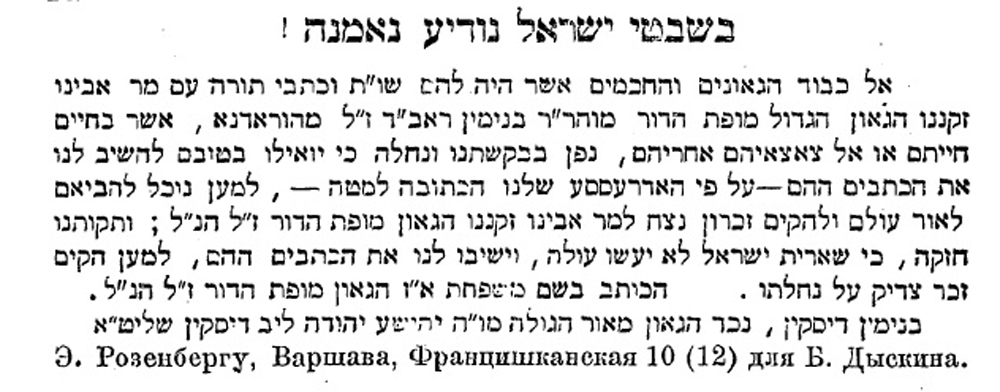
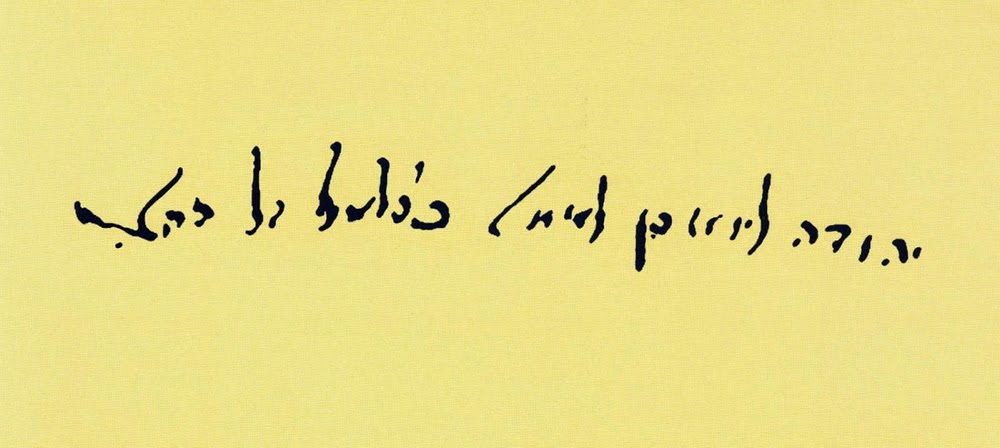
[8] הצפירה, מרץ 11, 1979. ראה תמונה למטה.
[9] הרב משה יהושע יהודה לייב דיסקין (1817-1898) היה אחד מגדולי הדור ובהמשך המאמר הובאו כמה פרטים חשובים אודותיו.
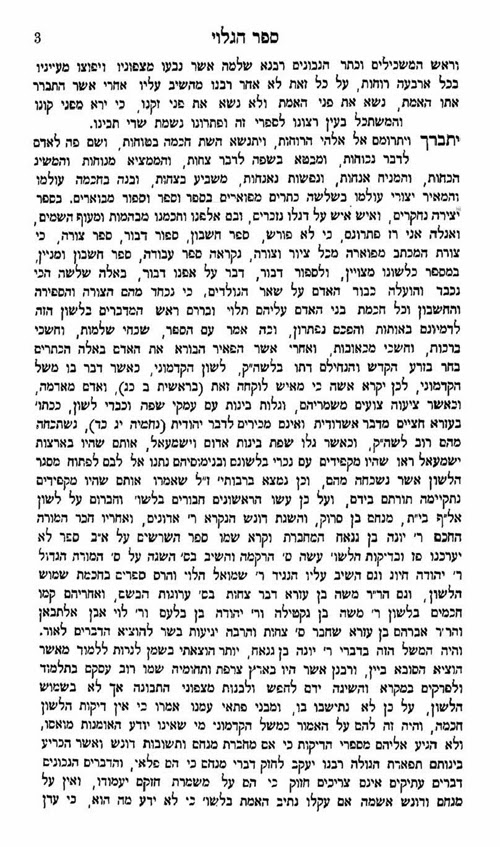
[10] וואלקאוויסקער יזכור בוך – ניו-יארק 1949.
[11] ראוי לציין שבעיתון הפלס (שנה ב – יום ו’ עש”ק י”ב אדר ב’ תרמ”ט [1889]) יש תשובה מהג”ר יצחק אלחנן לחז”ס אודות אכילת קטניות בפסח, והוא מתארו בלשון “ידידי הרב החכם וכו’ מו”ה חיים זעליג סלאנימסקי נ”י המו”ל מ”ע הצפירה. בכל המכתב מתייחס הגאון רבי יצחק אלחנן אל חז”ס ביחס של כבוד למרות שחז”ס רצה להתיר מנהג ותיקין כאיסור אכילת קטניות בפסח. התשובה נדפסה שוב ב’תשובות רבנו יצחק אלחנן’ (סימן כב).
[12] הרב ברוך מרדכי ליבשיץ (1809-1885) נתמנה אח”ז להיות האב”ד של וולקוביסק ואחר כך מילא מקומו של עמיתו הגרי”א ספקטור בנובהרדוק, ושימש שם עד שנת 1883, שאז נתמנה במקומו בעל ערוך השולחן. הוא חיבר שו”ת ברית יעקב ב”כ.
[13] ראה עמוד אש (עמ’ יא) שרבי יהושע ליב היה רגיל לספר, כי בילדותו היה מתחקה אחר אורח חייו הקדושים של אביו רבי בנימין, והבחין כמה פעמים כיצד הזדמנה שאלה בתבשילו של אבא, ולאחר שהכשירה, יעץ לרבנית, להאכיל התבשיל לילדים, ואילו הוא, האבא, פרש ממאכל זה.
[14] למרות שיש בידינו רק שרידים מחידו”ת שהרבה מהם נאספו ונדפסו בסדרת ‘אהלים’ המוקדש לתורת מהרי”ל דיסקין בהוצאת מדרש רבי רפאל ע”ש הר”ר קצנלנבויגן, מן המעט נלמד אל הכלל, שהיה גאון מובהק במלוא מובן המילה, וכן יעידו על זה בניו ותלמידיו.
[15] ראה עמוד אש (עמ’ יב) בשם “הרב הגאון אברהם חיים נאה מפי רבינו הגה”צ מרן יוסף חיים זוננפלד זיע”א”, שכאשר פרצה שריפה בכפר הסמוך לעיר וולקוביסקי, והביאו לפניו גווילים החרוכים מספר תורה, אשר הוצלו מקצתם מתוך הלפידים, כאשר ראה אותם רבי בנימינ’קה, מיד צנח ארצה תוך התעלפות קשה ואבדן הכרה.
[16] בספר זיכרון לקהילת לומזה (עמ’ 104) מתאר יום טוב לוינסקי את הרב בנימין כ”בעל צורה אצילית ולבש תמיד בגדים נקיים ויפים”. כמו כן ב”אוצר הרבנים” (בני ברק 1975; ערך 3683) נזכר רבי בנימין דיסקין כ”רב גאון אדיר וחכם מצויין, ‘הדור בלבושו’…”. וראה להלן שגם בנו רבי נח יצחק היה מכונה ‘הדור בלבושו’.
[17] במחיצתם של גדולי הדור שם.
[18] ראה מש”כ אודותיו פרופוסר מלך שפירא כאן וכאן.
[19] הרב חיים הלר (1879-1960) היה תלמיד חכם גדול וגם חוקר.
[20] בדרך כלל ההדגשות בציטוטים שלי.
[21] הרב גלובסקי לא גילה לאיזה אח התכוון רבי חיים הליר ולא יכולתי לברר איזה מהם היה חתנו של הרב חיים דאווידסאהן. אבל מצאתי כמה פרטים מעניינים אודות כל האחים הקשורים לנושא שלנו, והצגתי אותם בנספח ב’ למאמר זה.
[22] הרב חיים דויד-זאהן (1760-1854) היה גדול בתורה, וגם ידע שפות ובעל השכלה רחבה, והיה לו היכרות עם אנשי השלטון. נבחר כרבה של וורשה בהיותו בן שמונים. בהספד שנשא עליו המגיד של וורשה, הרב בנימין דוד רבינוביץ כתוב: “רוב ימיו עברו בתורה וגדולה, עושר וכבוד, ובניו רבנים, תורה ונביאים וכתובים עם מפרשיהם הראשיים ועל דגלם חכמת הדקדוק המסורת והטעמים היו ערוכים על שפתיו ולא היה לו שום ספר שלא הגיה בעצמו בכתב ידו ממש. משניות עם התוספות יו”ט היה בקיא בעל פה… היה בקיא בכל ספרי שו”ת… וכן עיין בספרי הזוהר והגדה וספרי קבלה. בענין הלכה למעשה היתה לו קבלה מאת רבו הגאון בעל “חוות דעת” מליסא…” (תולדות מהרא”ל צינץ עמ’ 190)
אך, לעת עתה לא מצאתי שום קשר משפחתי בין משפחת דיסקין ולמשפחת דויד-זאהן.
[23] דו יובלין עמ’ מב.
[24] רבי זאב וואָלף איינהאָרן (נפטר בווילנה בשנת 1862) מעיר גרודנה [הורודנה], חיבר פירוש מהרז”ו למדרש רבה וספר מדרש תנאים על המידות של רבי אליעזר בנו של רבי יוסי הגלילי. לא כיהן ברבנות ובסוף ימיו עבר לגור בווילנה.
[25] דרכי יוסף חלק שני דרוש העשרים אות יא.
[26] הצפירה, מרץ 11 1979.
[27] רבי מנחם מנדל שניאורסון (1879-1866), הנודע על שם ספרו ‘צמח צדק’, היה האדמו”ר השלישי בשושלת אדמור”י חסידות חב”ד.
[28] הפלס שנה ב עמ’ 179. וראה גם בעמוד אש עמ’ י.
[29] עמוד אש עמ’ ז בשם רבי יוסף לוי חגיז.
מעניין שבספר בספר אזנים לתורה מְסַפֵּר הרב זלמן סורוצקין זצ”ל סיפור מאד דומה להנ”ל:

שמעתי מפי ידידי הגאון הג’ ר”ז סולוביציק, הגאב”ד דבריסק (שליט”א) [זצ”ל], ששמע מפי אביו רבן של ישראל הגר”ח זצ”ל שהיה מספר מפי איש נאמן, שבשעת מלחמת נפוליון באירופה המזרחית, עשו לכבודו משתה בחצר אחד האצילים, אשר בפלך קובנה, והזמינו אל המשתה את כהני הדתות, פרט לשל הדת היהודית, בשעת הנאומים לכבוד “הגבור המנצח”, שאל נפוליון, מדוע אין כאן בא-כח הדת הישראלית? – אדון הבית הבטיח למלאות את החסרון לסעודת הערב. תיכף שלחו להביא אל המשתה את הרב הזקן של העירה הסמוכה. כאשר נודע להרב, למה הוא מתבקש, חרד מאד, כי לא הסכין לעמוד וכ”ש לדבר לפני מלך…

מעניין מאד שלמרות ששני הסיפורים מתחילים כמעט בסגנון אחד, בעוד שבספר עמוד אש מזהה את הרב, כרבי בנימין דיסקין, באזנים לתורה לא מזהה את הרב כלל, רק מתארו כרב זקן, דבר שלא זכה בו רבי בנימין מאחר ונפטר בגיל צעיר. עוד הבדל משמעותי יש בין שני הסיפורים, בתוכן הדרשות, שהרי הדרשה שבספר עמוד האש אינה דומה כלל לדרשה שבאזנים לתורה. ולעניינינו ראוי לעמוד על עוד הבדל, שבספר עמוד אש נמסר שנבחר רבי בנימין לבוא לנאום לפני נפוליון, ואילו בספר אזנים לתורה תפסו הרב של העירה הסמוכה ולא בחרו בו במיוחד, ואדרבה סגנון הסיפור מורה שאותו רב אנונימי לא היה מוכשר בטבעו לכך.
אך בספר אבי הישיבות (עמ’ 387) מעתיק הרב דוב אליאך הסיפור הנ”ל שהובא באזנים לתורה בשם ‘כתבי תלמידים מבריסק’. ומוסיף (עמ’ 388 הערה 5) בשם בנו של הגרי”ז, הג”ר משולם דוד הלוי סולוביציק שליט”א, ששמע מפי יהודי קשיש בשם ר’ משה גבירצמן מבאי בית הג”ר יהושע לייב דיסקין, כי הרב המדובר היה אביו של רבי יהושע לייב, הג”ר בנימין דיסקין.
[30] שמואל יוסף פין (כנסת ישראל; ווארשא 1886, ערך ‘חיים זעליג סלאנימסקי’) מספר ש”הרחז”ס שקד על הספרים ההם בשקידה נפלאה בהחבא במועדי לילה כי ירא לנפשו מרב עם.”
[31] הספר נדפס בדפוס “ווילנא והוראדנא” ע”י המדפיסים ר’ מנחם מן ב”ר ברוך ז”ל, ור’ שמחה זימל ב”ר מנחם נחום, ועל השער חתם חז”ס את שמו “חיים זעליג בן יעקב”.
[32] אוצר ישראל ערך ‘סלונימסקי’.
[33] ראה למטה שנחום סוקולוב אמר שהיה מוכרח לזה ע”פ חוק הממשלה. וכן יוצא מדברי דוב אליאך שהבאנו שם.
[34] רבי אברהם אבלי פאסוועלער (1762-1836) היה אחד מגאוני הדור. לאחרונה נלקטו מחידושיו ותשובותיו בספר ‘באר אברהם’ (מכון ירושלים, תשס”ג). אצל לומדי הלכה הוא מפורסם ביותר, על שם חקירתו בענין מי שטעה בליל ראש השנה ולא אמר המלך הקדוש, שהובאה ע”י החיי אדם (כלל כד סעיף י) ומשם ע”י המשנה ברורה (שער הציון סימן תקפב ס”ק ד).
[35] מעניין שמוסדות חכמה אינו הספר הראשון על אלגברה המעוטר בהסכמת רבי אבלי. כבר בשנת 1829 הסכים רבי אבלי על הספר ‘קנה חכמה’ הכולל “חמשה שערים בחכמת אלגעברא”. ראה כאן.
[36] לדעת ניסנבוים (cited by Itai Sneh, Hayim Zelig Slonimski and The Founding of Ha-Tsefirah – Thesis submitted to The Department of Jewish Studies, McGill University Montreal, 1991, p. 54 אני מודה להרב אליעזר בראדט על ההפניה, וכאן המקום להודות לו על שפשט לי יד עזרה בהכנת מאמר זה) העובדה שחז”ס דרש הסכמות, מעידה על רצונו להישאר מקובל בחוגי השמרנים. אולי אין זה סתירה לדברי סוקולוב שטען שהיה צורך רשמי לכך, משום שיתכן שמעולם לא נתכוון סוקולוב לומר שכן היה החוק דורש, רק שספר בלי הסכמה לא היה מתקבל על השמרנים. ומצאתי כעין דברים הללו במאמרו של שמעון ליב ציטרון אודות המשכיל ‘מרדכי אהרן גינצבורג’ (1795-1846) שהוציא ספר ‘גלות ארץ החדשה או מסע קאלומבוס’ לאור בשנת 1822, ושלח את הכתב-יד לאביו, שישב בווילנה, בבקשה כי יתקן את סגנונו, וכשימצא אותו מוכשר לדפוס, יאסוף בשבילו הסכמות מגדולי רבני-ווילנה. ובתוך הדברים מעיר ציטרון ש”באותו זמן היה כמעט בלתי-אפשר להדפיס ולהפיץ ברבים ספר-השכלה, שלא נתקבל עליו הכשר מאת איזה רב מפורסם“. משמע מזה שלא היה מצד חוק הממשלה, רק מציאות עובדתית שהספר לא היה מתקבל בלי הסכמה.
ממשיך ציטרון לְסַפֵּר, שאביו של מרדכי אהרן, היה חשוב בעיני רבני ווילנה של העת ההיא, והשתדל, והשתדלותו עלה בידו, לקבל הסכמה מאת הגאון ר’ אברהם אבלי פאסוואלי. ציטרון ממשיך להעתיק את ההסכמה, והואיל ואנו עסוקים בהסכמות רבי אבלי לספרי משכילים, ראוי להעתיקו משם לכאן [הדגשות במקור והוספתי פס במקום שרציתי להדגיש משהו]:

ה”ה הרבּני המשכּיל החכם הישיש הנכבּד מהו’ אשר סלאנטער בּיותר שהוא חכם עוד רצונו ללמד לבני יהודא קסת הסופר ולשון עירומים בּספר לספּור ספירות דברים אשר היו לעולמים אשר מלפנינו, אשר גם בּעולם השפל הזה הי’ נעלם וטמיר מאתּנו, כמה וכמה מדינות רחבות ומלאות אדם, וגם נתוודע שבּני אדם דרים נכח כּפּות רגלינו אשר הי’ נחשב לזר מאד בּעיני הקדמונים. מזה יבּיטו ויראו פּעולת ה’ אשר אין קץ ותכלית לנפלאותיו ולבּרואיו אשר בּשמים ממעל ובארץ מתחת, ולכן הקריב אל מזבּח הדפוס ההעתּקה הנעימה וההדורה הזאת אשר העתּיק בּנו הרבּני המליץ הגדול מוהר”ר מרדכי אהרן נ”י תּחת השגחת אביו הנ”ל. והנה אחרי אשר החכם הנ”ל הוא דובר צחות ודבש וחלב תחת לשונו למשוך בּקסת הסופר בּכתב אשורית לזאת יתאוו מטעמותיו, ולמען היות שכר לפעולתו העתיקו גם ללשון אשכּנזי הנהוג למען יתענגו בּו גם ההדיוטים והנשים. והנה אחרי שחכם הנ”ל טרח בּזה לכן נוצר תּאנה יאכל מפּריה וחתיכה דאסורא להשיג גבול החכם הנ”ל ולהדפּיסו לא בּלה”ק ולא בּלשון אשכּנזי הנ”ל מבּלעדי רישיון החכם מהו’ אשר הנ”ל, וליקום ההוא גברא העובר ע”ז בּארור בּו קללה וכנ”ל. והשומע לדברינו ישכּון שאַנן דשן ורענן עד בּיאת ינון.

מסיים ציטרון:

רק על –ידי הסכּמות רבּניות כאלה יכול המשכּיל – הסופר שבּאותה עת להגן על עצמו מפּני רדיפות מצד הקנאים ומהסגת גבול

[37] הצפירה, מאי 27, 1904.
[38] בתולדות הרב ירוחם אלט-שולר אבד”ק באדקי מאת ר’ יהודה ליב הכהן (פישמן) מימון מוזכר שהרב ירוחם היה אחד מגדולי חכמי ישראל. הרב מימון מדגיש שבנוסף לחכמת התורה היה גם חכם במדע. והביא סמוכים לכך מלשונו של הגאון הגדול ר’ יחיאל העליר מסובלק שהיה נושא ונותן אתו בהלכה בספרו שאלות ותשובות ‘עמודי אור’ והוא מתארו “רב רחימאי הרב המאור הגדול המפורסם החריף ובקי, סיני ועוקר הרים, אושר השלמים, כליל המדעים, איש חמודות כש”ת מ’ ירוחם נ”י אב”ד דק”ק באדקי [ראה עמודי אור סי’ יא]. עוד סמך לדבריו, הביא הרב מימון משער הספר ‘יגון לב’ (ווארשא תר”כ) ששם הוא מתואר כך “הרב הגאון החריף ובקי ומפורסם, כליל המדע והחכמה, גומל חסד עם כל כקש”ת מהו’ ירוחם ז”ל רב דק”ק באדקי. (‘אזכרה’ לנשמת הגאון הצדיק הרב רבי אברהם יצחק הכהן קוק, ירושלים תרצ”ז, עמ’ נ)
[39] רבי ישעיהו באסאן (1673-1739) היה רב איטלקי ומשורר, רבן של פדובה ושל ריגיו, ורבו של רמח”ל.
[40] רמח”ל (1707-1746) היה מקובל גדול ומפורסם במיוחד על שם ספרו ‘מסילת ישרים’.
[41] שם כותב רבי ישעיהו באסאן “לפי שהכורה אחר כורה, מעמל נפשו עד היסוד יערה, על כן גדול יהיה בחוכמת המחקר, כבוד האחרון מן הראשון, כי יעמיק ירחיב ויעמוד על העיקר, לא כן תורת ה’ תמימה…”.
[42] מענין מאמר זה להעיר, שעל הספר ‘מורה דרך’ מאת מוהר”ר אהרן בן הרב חיים ממשפחת הגאון מו”ה שמואל אב”ד דק”ק ווילנא, שיצא לאור בהוראדנא שנת תקצ”ו, מופיעים הסכמותיהם של רבי אבלי ורבי אליקים געציל מאיר הנ”ל, וגם “הסכמת הרב הגאון המפורסם החריף ובקי בחדרי התורה, החכם השלם, מו”ה בנימין ראב”ד דקהלתנו”. נושא הספר הוא סדר מסעות של בני ישראל.
[43] רבי שמואל שטראשון (1794-1872) היה תלמיד חכם גדול מעיר ווילנה שמעולם לא שירת ברבנות. חיבר הגהות נפלאות על כל הש”ס ועוד ספרים.
[44] ראה כאן שמזיטאמיר, מקומו של חז”ס בעת הדפסת הספר ‘יסודי העיבור’, ועד שקלוב, מקומו של מהרי”ל, הוא מרחק של 515 ק”מ.
[45] העובדה שבני הישיבה היו קנאים, יש למצוא לה סמך, מדברי משכיל נלהב אחד שכתב ב’גנאי’ הישיבות אשר בעיר שקלאוו: “[עמ’ 163] הישיבות עומדות וקיימות במצבן מקדם קומתה ולא נשתנו מאומה… מי יערב בנפשו עוז לתת עצתו אמונה לאפרתי שקלאוו לשכור מורה לתלמידי הישיבות ללמדם שפת המדינה וחשבון… הן יתנו עליו בקולם ובשם אפיקורוס יכונוהו והיה לשמצה ולדראון לכל בשר בעירו… [עמ’ 164] איזה מהבחורים הרהיבו בנפשם עוז להסיר מעליהם הבגדים העתיקים בתארם הפולני לפנים וללבוש תחתם בגדי אירופא, ולא שתו לב אל הרושם אשר תעשה זאת בלב הקנאים גם לכל מנהג חיצוני ירושת קדמוניות. ובאמת לא הרהיב בחור מישראל פני חמש שנים ללבוש בשקלאוו מלבוש גוי, אז הכתירו המקנאים את ראשו בכובע נוצות והעמידו אותו הבן על שולחן הקהל לפני פתח בית הכנסת להיות לשמצה לעיני כל עובר, עד אשר יתודה על חטאתו וישבע לבלי ישוב עוד לכסלה…” (עיתון המליץ דצמבר 31, 1872)
[46] בהמשך דבריי פיקפקתי על אמיתת הסיפור, אבל עצם הביקורת על חז”ס, שרק העתיק מאחרים ולא ידע את הענינים באופן יסודי, יש דברים בגו. במאמרו של סוקולוב שהבאתי לעיל, מתנצל נחום סוקולוב שאינו בר הכי להעריך את חז”ס מתוך ספריו, כי הוא [סוקולוב] עצמו לא היה מומחה לעניינים המשמשים נושאים לרוב ספרי חז”ס. בכל זאת העריך אותו סוקולוב מתוך היכרות אישית עמוקה. מסקנתו של סוקולוב היא, שחז”ס בטבעו לא היה מתמיד שהיה יכול לשקוד על עניין אחד ולירד לעומקו של דבר, רק היה עילוי שהיה יכול לחטוף ידיעות מרובות במרחב של עניינים. עיקר כוחו של חז”ס, לדעת סוקולוב, היה בזה שהיה “באר היטב”, שהיה יכול ללמד את עמו חכמות בשפה ברורה ובנעימה, וגם בסגנון הישן שהיו רגילים בו מאז.
נראים הדברים שהשקפה זו על חז”ס, שעיקר כוחו היה בזה שלימד את העם דעת בשפה ברורה, הכיר בה הוא עצמו, שהרי כך העיד על עצמו בסוף ימיו כשהתלונן על הקמים עליו בפרשת חנוכה: “מיין גאנץ לעבען האב איך זיך בעשעפטיגט מיט תורה און חכמה; איך האב זיך בעטיהט צו לערנען מיין פאלק וויסענשאפט”. זאת אומרת שראה את עיקר עבודתו בחיים בזה שלימד את העם, ולאו דווקא שהעמיק הרבה בעניינים ויצר רעיונות מחודשים. הברקות כן, אבל עיונים עמוקים לא. טבעו של חז”ס היה זה של ממציא ולא של עמקן ומעיין.
אריה עקביא, שכן הכיר את ספרי חז”ס ואת הנושאים שהוא כתב עליו, העיר שבהיות עיקר כוחו של חז”ס בהסברת הדברים לזולתו, לכן “אין לבקש אצל מסביר לא עמקות ולא שום חידוש, כל שאיפתו אינה אלא להסביר לזולתו מה שנודע לו עצמו”. במיוחד אצל חז”ס מעיר עקביא “כי משהתחיל חז”ס ללמוד חכמות חיצוניות, מיד התחיל לכתוב חיבוריו באותן החכמות, כלומר בו ברגע שהתחיל להיות קולט התחיל פולט. וקשה לקבוע מה היה אצלו גדול ממה: החשק לקלוט או החשק לפלוט.
עוד אומר עקביא, שספרי חז”ס היו מותאמים יפה רק לשעתם ולמקומם, אבל כהיום הזה אין שום ערך לרוב ספריו. ברם, מסיק עקביא, בטון חיובי, שחז”ס התבלט בזה שהיה הראשון שהציב לו כמטרה לפרסם ולהסביר ולהקנות עניני מדע לקהל הקוראים העברים בדורו, שהיו זרים להם בהחלט.
ברם, הסיפור הזה, שלפי דברי האיש על החומה, אירע כביכול בין מהרי”ל וחז”ס באמצע העשור השביעי למאה ה-19 מזכיר מאד מה שבאמת אירע בין חז”ס ורגי”ל [מהור”ר גבריאל יהודה ליכטנפלד ז”ל, חותנו של י. ל. פרץ]. בשנת תרכ”ה הדפיס רגי”ל ספר בשם ‘ידיעות השיעורים’ וכפי דבריו בהקדמת ספרו ‘צפנת פענח’ קיווה רגי”ל לשאת פרי טוב בעמלו ולא עלתה בידו, כי לא מצא קונים לספרו. סוף סוף מצא איש אחד אשר הסכים למכור את ספריו של רגי”ל, בתנאי אם יסכים עליו החכם חז”ס. לאכזבתו של רגי”ל, כתב לו אותו האיש, כי בשאלו על-פי מכתבו את פי חז”ס, דיבר חז”ס קשות על ספר ‘ידיעות השעורים’, כי לא מצא בו דבר טוב ולא שום תועלת לקוראים, אשר לא יבינו בו דבר, כי אין לו הסדר הראוי למתחילים בחכמה כספר ‘יסודי חכמת השיעור’ שחיבר הוא [חז”ס]. גם שלח האיש ההוא לרגי”ל העתק מאיגרת חז”ס אליו. מיד בערה בו חמתו של רגי”ל כאש, ויאמר להינקם מחז”ס נקמת דם ספרו השפוך, ויכתוב את מחברתו ‘צפנת פענח’ (ווארשה, תרל”ד) ביקורת על שני ספרי הנדסה של חז”ס, ספר ‘מוסדי החכמה’ וספר ‘יסודי חכמת השיעור. רג”י ליכטנפלד לא הסתפק בביקורת על הספרים, כי אם את המחבר עצמו בחר לו למטרה ואליו כינן חיציו לירות במו אופל לישר לב ולפצוע את לבבו בתארי בוז וקלון מרבה להכיל. מחברת ‘צפנת פענח’ מלא חירופים וגידופים לא על ספרי חז”ס לבד, כי אם על חז”ס עצמו. בחוברת זו מתלונן רגי”ל שחז”ס “עשה בספרו אך מלאכת מעתיק וקבץ למודיו והתמונות ההנדסיות השייכות להם מספרי זולתו בלא הכרה פנימית והבנת הענין אשר העתיק” (יצחק ראטנער, משפט אמת, ס”ט פטבורג, תרמ”ד, עמ’ 5)
[47] האיש על החומה, ירושלים תשס”ו, כ”א עמ’ 202-203.
[48] ראה להלן שהגאון רבי בנימין דיסקין רצה להסתיר ידיעתו בעניינים אלו, ואולי זהו הטעם שלא רצה להסכים על הספר שהרי אז יהיה מוכרח לגלות ידיעתו בעניינים אלו, או אולי מפני הטעם הזה, שחז”ס היה רק מעתיק מספרים בלי בדיקת אמיתתם.
[49] ציר נאמן, ירושלים תרנ”ט, דף צו ע”א.
[50] הרב אליעזר בראדט, ‘יחסה של הספרות היהדות לקופרניקוס במשך הדורות’ הע’ 51. הוא מודה שם ל’הבקי הנפלא ר’ איתם הנקין הי”ד’ שהפנהו לזה. ראה שם שרא”ב העיר על העובדה שהגאון רבי אבלי פוסוולר מווילנא העניק הסכמה לספרו של ר’ יום טוב ליפמן מאיישישאק ‘כבוד יום טוב’, שבסופו קבע המחבר שדעתו של קופרניקוס היא כפירה ואינה נכונה כלל וכלל, והסכמה זו ל’כבוד יום טוב’ נכתבה רק שלש שנים לאחר שהעניק את הסכמתו לספר ‘מוסדי חכמה’ המצדיק את שיטת קופרניקוס. רציתי להעיר שעל אף שחז”ס מזכיר את שיטת קופרניקוס בהקדמת ספרו ‘מוסדי חכמה’, מכל מקום אין זה הנושא של הספר כלל, ועל כן אין לתפוס את הגאון רבי אבלי על זה.
[51] שמואל יוסף פין (1818-1890), הנודע בכינויו ‘רש”י פין’ או ‘רשי”פ’, היה סופר וחוקר עברי, שהשתייך לתנועת ההשכלה והיה מראשי הקהילה בווילנה. רש”י פין ערך כתב העת ‘הכרמל’ וחיבר כמה ספרים.
[52] כנסת ישראל; ווארשא 1886, ערך ‘חיים זעליג סלאנימסקי’.
[53] רנ”ק (1785-1840) היה אבי המשכילים בגליציה וממייסדי תנועת ‘חכמת ישראל’. במכתבו לחז”ס, מסביר רנ”ק שאחת מהסיבות שבשבילן הוא ערך את הסכמתו היא “בשביל החותמים הנכבדים אשר לא ימצא להם הפנאי בכדי לעיין בם מיד”, כלומר שחז”ס השתמש עם מכתבו של רנ”ק המעיד על תועלת הספר, בכדי לאסוף חותמים. והתאריך על המכתב הוא א’ כ”ח אדר ראשון שנת ‘נפלאותיך’ לפ”ק, והיא שנת 1837, והספר נדפס רק בשנת 1838. בנוסף למכתבו של רנ”ק ושי”ר, הדפיס חז”ס גם ‘מכתב תהלה’ שקיבל “מאת השרים החכמים, התוכנים המפוארים, היושבים בבית משמרת מבטי הכוכבים מגדל המצפה (שטערנווארטע) המכונן בממלכת פולאניא – פה ווארשויא”, והתאריך על אותו המכתב הוא ינואר 28, 1838.
[54] שי”ר (1790-1867) היה חתנו של בעל ‘קצות החושן’, שימש כאב”ד בטרנפול ופראג והיה גם משכיל בחכמת ישראל.
[55] כנסת ישראל שם.
[56] ר’ צבי מנחם או הירש מנדל פינלס (1806-1870) הנודע בר”ת של”ש, היה משכיל וחוקר התלמוד ומחבר המחקר ‘דרכה של תורה’. ראה אודותיו ב’פשוטה של משנה’ מחנן גפני, ספריית ‘הלל בן-חיים’, 2011, מעמ’ 189-209.
[57] רבי שלמה איגר (1787-1852) היה אחד מגדולי דורו ושימש כרב בעיירות קאליש ופוזנן.
[58] הוא רבי אליקים געציל מאיר משוויסלאץ שהסכים על ספרו הראשון מוסדי חכמה.
[59] רבי מתתיהו שטראשון (1817-1885), נודע גם בכינוי ‘רמ”ש’, היה תלמיד חכם גדול וגם אספן ספרים.
[60] מְסַפְּרִים שחז”ס היה עני מרוד, ומרדכי ליפסון (מדר דר; הוצאות ‘דורות’, פליסטינה 1938, כרך שלישי עמוד 76) מוסר ש”חיים זליג סלינימסקי התוכן, עד שלא נודע טיבו בעולם עני ואביון היה, וקיים את התורה ואת החכמה מעוני ומרוב צער. פעם אחת ישב ועסק בענין חמור, טרח ויגע למצוא כוכב חדש שנתחבטו בו חכמי התכונה, נכנסה אשתו אצלו ובקשה מעות לפרנסת הבית, “הרי יודעת את” אומר לה סלונימסקי “שאין בידי פרוטה לפורטה”. “חיים זליג”, התחילה אשתו מגלגלת עמו, “מה יהא בסופנו? עד היכן נצטער ונחיה בדכדוכה של דלותם”. “תנוח דעתך”, אומר לה חיים זליג, “אמצא אותו כוכב ופרנסתי בריווח”. “הן”, מחזירה אשתו, “תמצא עשרה כוכבים בשמים ולא תמצא רובל אחד בארץ!”
עניות שסבל חז”ס בראשית דרכו, מוזכר ע”י שלמה יוסף פין, שי”פ (כנסת ישראל ‘ערך סלונימסקי), “החכם רחז”ס אשר לא חלק לו ה’ בעושר…”.
[61] גם הספר מעט הכמות ורב האיכות ‘כוכבא דשביטא’ עסק באסטרונומיה.
[62] נכד זה נזכר כמה פעמים באגרות הנדפסות בספר עמוד אש (פרק ארבעה עשר). ברובם מעורר סבו מהרי”ל דיסקין אודות הצורך למצוא לו שידוך. לדוגמא, ראה אגרת א’ מהגרי”ל דיסקין לאחותו וגיסו, בו הוא כותב ביום ג’ דסליחות תר”ן לפ”ק “ע”ד נכדי ה’ בנימין שי’ אבקשך לכתוב אליו [כי לא ידעתי אדריעס אליו] כי עצתינו אמונה שיבא לפעיה”ק תובב”א, ובד’ בטחנו כי ימצא לו זיווג הגון לאוי”ט בפה בעזה”י – ובשמי תברכנהו בכו”ח טובה.” יש שם גם אגרת מאביו הגרי”י דיסקין בנושא הנ”ל. והעירני ידידי החכם הרב מהרמ”מ שליט”א שאפשר זהו גם המכוון בברכתו המליצית של רבנו מאיר שמחה מדווינסק לאביו הג”ר יצחק ירוחם בזה”ל “וישבע גיל ועונג מזרעו, ושתיליו יעשו דגן בחורים” [ע”פ זכריה ט, יז, המכתב נדפס ב’אהלים’ למס’ גיטין ועוד, עמ’ כט].
באגרת ד’ מזכיר מהרי”ל איך שנכד זה, בנימין דיסקין, מרעיש עולמות להדפיס כתבי אבי סבו, הגר”ב דיסקין. וכך כותב מהרי”ל, “מנכדי שי’, הגיעני אגרת היום, ולפי דבריו הנהו בצל קורתם, והנני דו”ש ומברכו בכ”ט, מצא וגו’ מצא וגו’. ועתה אחי התאצמו, והמקום יהא בעזרתכם למצא עזר לו כראוי לאוי”ט, ואברכה אתכם לראות בשמחת יו”ח שי’. רצוף פה איזה שורות לנכדי שי’, יען הוא מרעיש השמים וארץ לחוק בדפוס ח”ת של אאמו”ר הגה”צ נ”ע.
מעניין ביותר האגרת שכתב מהרי”ל לנכדו הנ”ל:
ירושלים עה”ק תובב”א יום ד’ בשלח שבט תרום לפ”ק

נכדי יקירי שליט”א,
שבוע זאת הגיעני אגרתך – רחפו עצמותינו בראותינו כי זה שנתיים הוכחת בחולשת הגוף ר”ל, ונשא כפינו לשמים כי ישלח ד’ דברו וירפאך רפואה שלמה בתוך שח”י במהרה בקרוב. וע”ד העצה ליסע להורודנא, לדעתי עתה נחוץ הדבר יותר, כי בטחתי בעז”ה אשר הנסיעה גם חליפת המקום והאויר יהיו לתועלת לבריאותך אי”ה – וגם כי אשפוט אשר רוח הקנאה אשר עברה היתה בעוכרך. אבל בבואך שמה, אך שמחה וששון יגיעוך, ולא תוסיף לדאבה, ועצותיך יחליצו. ואשר חששת פן תהי’ לבוז שמה, באשר מפני חולשתך, לא תוכל עתה לשקוד על דלתי תוה”ק ולהעמיק כ”כ כשנים קדמוניות, אל תדאג, כי כל משפחת בית אבא זללה”ה כולם גדולים בתורה ובחכמה, ובינה יתרה חלק ד’ לנו – ויבינו הדבר לאשורו. גם כי הכרת פניך תענה עליך, וחזותו מוכיח עליו, וכ”מ בירושלמי פ”ד דסוטה שא”צ להביא עדים על חלישותו כי ניכר הוא בטב”ע. ויתר עוד, כי אגרת זאת תקח בידך, והי’ לך לעדה – והמקום יהי’ בעזרך בזכות אבותינו הגה”צ נ”ע, להצליח דרכך – נא ונא לבל תאחר עוד, ועשה כעצת אביך זקנך המייעצך לטוב.

משה יהודא ליב בהגאון מו”ה בנימין זללה”ה 

נ”ב הרבנית תחי’ דו”ש, ומסכמת לעצה זו, באהבתה לך. זה כשבועיים כ’ אליך, אבל אז לא ראיתי עדיין אגרתך, כי באה לידינו שבוע זו. אם תרצה תד”ש אביך בני יקירי הרה”ג שליט”א. 

[63] רבי יצחק ירוחם דיסקין (1839-1925), בנו יחידו של רבי יהושע ליב דיסקין, היה גדול בתורה שהתרחק מהרבנות.
[64] יצא לאור בווארשא 1886.
[65] לא מצאתי שיעשה זה שי”פ.
[66] נראה שר’ בנימין אינו מזכיר וולקוביסק בגלל שזה נכלל ב’הורדנה’ בהיותה פלך הורודנה.
[67] רבי שמואל אביגדור רבינוביץ (1806-1866), הנקרא בפי כל ‘רבי שמואל אביגדור תוספאה’ על שם חיבורו הגדול ‘תנא תוספאה’ על התוספתא שחלקו, מנחת ביכורים, נדפס במהדורת התוספתא של ש”ס וילנא. מלבד היותו תלמידו של רבי בנימין היה גם גיסו. מעניין מאד שיש אגרת (הפלס א, עמ’ 76) מהרב שמואל אביגדור להרב בנימין אשר נושא האגרת הוא אודות שוחט שקרא בספרים חיצונים. והרב שמואל אביגדור מגייס את גיסו שהיה גם רבו, להציל השוחט מרודפיו.

אל כבדו גיסי אדמו”ר הרב הגאון הגדול המפורסם פאר החכמה כקש”ת מוהר”ר בנימין נ”י אב”ד ור”מ דק”ק וואלקאוויסקי יע”אזה זמן כביר אשר נסתם כל חזון מאתנו וצר לי כי לא ראיתי תמונת ידו זה ימים כבירים. על עתה באתי למלא משאלותי בנידון ידידנו אשר מעולם שמץ דבר לא נמצא בו, יקר רוח הוא. ועתה אשר קמו עליו קצת אנשים לעורר עליו קצת כי לא טובה הנהגתו אשר מתנהג לעיין בספרי החכמה ומה גם הכתובים בלשון לעז. וקצת אנשים דקהלתו אלצוהו בדברים עד שקבל עליו שלא לעיין בספרים חוץ מלה”ק ולא בספרי חכמה, ובנדר שתהיה שחיטתו אסורה. ועתה כאשר נועדו הקהל דשם לא הוטב בעיניהם דבר זה….אמנם בעיקר דינא י”ל אחרי שידענו את האיש ואת שיחו כי לא נסוג אחור מני ארחות ד’ ומורגל לרוב בספרים אלו, י”ל דאין כאן מגדר מילתא כלל ויש להתיר הקבלה מעיקרה וזה חל עתה… ואחרי שידוע לרומעכת”ה תוכן הענין ממכתב ידידנו וממכתב הרב דבאדקי מהראוי שיזדקק ויכתוב לי תשובה על הפאסט המוקדמת וביחוד לאסהודי גברא אשר אתמחי והי’ זה שלום מאת ידידו גיסו ותלמידו החפץ בהצלחתו ומבקש תשובתו.שמואל אביגדור החונה בק”ק אהו”נ

[68] בנו של הרב בנימין, הרב ישראל אברהם שמואל, כותב בהקדמה לספר בני בנימין, ש”אוצר חידושיו הנפלאים” של אביו הרב בנימין, לקח עמו אביו “ולא זכינו להנות לאורו, כי מלבד רפיון כחו וחלשות מזגו לכתוב רבי תורתו, עוד היו רגעיו ספורות ומדודות לשיעוריו הקבועים ולא פנה לחוק בעט סופר על הגליון אף אחת מני אלף. וגם המעט הנמצא אתנו מפוזר ומפורד אנה ואנה בלי סדרים. ולדאבון לבבינו אין לחברם אל מקום אחד.”
ובמכתב ששלח הגרי”ל משקלאוו לאחיו בענין הדפסת כתב יד אביהם ר’ בנימין מיום ה’ י”ב טבת תרל”א כותב וז”ל, “האמנם זאת חובתינו להפיץ יפעת שמש תורתו אשר שקעה שלא בזמנה בעוה”ר ואם חלילה גם המעט אחד מאלף ממש מחידושי תורתו הנעימים אשר השאיר בכתובים גם המה לא יראו אור הדפוס הלזה יאמר ח”ו צדיק מה פעל”. (המעין חוברת יב עמ’ 45)
ראוי לשים לב ששני האחים מעידים שחידושי רבי בנימין שהועלו על הכתב הם ‘אחד מני אלף’ ממה שחידש.
ומה שכתב הרב ישראל אברהם שמואל ש”המעט הנמצא אתנו מפורז ומפורד אנה ואנה בלי סדרים… אין לחברם אל מקום אחד”, כעין זה מתאר רבי רפאל הלוי קצנלבוגן את מצב הכתבים בשנת תשל”ב, “בין כתי”ק של רבנו הגה”צ הגרי”ל דיסקין זצ”ל, נמצאים גם כתי”ק של אביו הגה”צ רבי בנימין זצ”ל, ואמנם הם מפורדים ומפוזרים, ועבודה רבה זקוקה למצוא את הקשר שביניהם ולחברם יחד.” (המעין, חוברת יב עמ’ 43)
[69] רבי רפאל קצנלנבוגן (שם) מעיד ש”עפ”י רוב, הכתבים [של רבי בנימין] הם על חושן המשפט”. בחוברת המעין הודפס שם קונטרס שכתב רבי בנימין בנוגע למחלוקת שהתעוררה בין מדפיסי ש”ס ווילנה ומדפיסי ש”ס סלאוויטא, ורבי בנימין תמך בעמדת מדפיסי ווילנה. עדות זו מעוררת תמיהה על דברי יוסף שלמון (ה’גדולים’ עמ’ 309) שכתב שמהרי”ל דיסקין הקפיד להשתמש דווקא בש”ס סלאוויטא. משום שקשה להאמין שהוא יקפיד להחמיר בדבר שאביו נכנס בעובי הקורה להתירו. כמו כן אין הוא מביא מקור התומך בדבריו אלו.
[70] יש טשטוש על מילה זו.
[71] הרב בנימין קיים הבטחתו ואכן בעיתון הצפירה (פברואר 21 1888 ומרץ 5 1888) פרסם המודעה הבא:
*       
ראוי לציין שפירסומת זו נתפרסם בחייו של “הגאון מאור הגולה מו”ה יהושע יהודה ליב דיסקין שליט”א, בעיתון הצפירה, על ידי נכדו של מהרי”ל, ונכתב בשם המשפחה. מחמת כן קשה להאמין ל’סיפור הירושלמי’ (סיפורים ירושלמיים, כ”א עמ’ 167 וראה זכרון מאיר, בני ברק תשס”א, עמ’ 29) שפעם אחת נכנס רבי יוסף חיים זוננפלד לבית הרב מבריסק, לגונן על בית המוסר הירושלמי שהקים חתנו [הרב שנקר]. בידו עיתון “הצפירה” בו נכתבים מרורות על שיטת המוסר, והוא מבקש להראותו להרב יהושע לייב, כאמור: למה יאמרו כי חס ושלום הרב מבריסק עומד עם המשכילים באותה זירה… אך ראה הרב מבריסק את העיתון הידוע לשימצה בידי רבי יוסף חיים, זעם וזעק בקול: עיתון טמא בביתי! עיתון טמא בביתי! ותיכף ציווה על רבי יוסף חיים להרחיק ד’ אמות מפתח ביתו את העיתון ולהקריאו לו משם. אמנם ראה במאמרו של יוסף שלמון (ה’גדולים’ בעריכת בנימין בראון ונסים ליאון עמ’ 303) שהאמין בסיפור זה לפי תומו.
[72] כוונתו לפירוש מהרז”ו שזכרנו למעלה.
[73] קשה להבין כוונתו, שהרי בכל הדפוסים המצויים בידינו שמו של רבי בנימין מופיע מיד לפני הפירוש על אותם הפרקים.
[74] לא יכולתי לפענחו, אולי צ”ל ‘ב”ה’.
[75] גם רבי יצחק ירוחם היה פעיל בהפצת תורת סבו. כן נראה ממכתבו של הרב ישעיה אורינשטיין שנכתב עשר שנים אחר כתיבת מכתב זה. הרב ישעיה מבקש מאת הרב יצחק ירוחם שיבוא “לעיה”ק ת”ו, למלאות מקום אביו מרן הגאון הקדוש זצלל”ה. בביתו ישכון ועל כסאו ישב ובבית מדרשו יתפלל וילמוד… ואת חידושי תורת מרן אביו הגאון הקדוש זי”ע וגם חד”ת זקנו הגאון הגדול זצלל”ה יסדר, ובעזרת הי”ת יוכל להדפיסם פה בקדש לאט לאט על טהרת הקודש (מרא דארעא ישראל כ”ב עמ’ ס).


The Letter of the Maharal on the Creation of the Golem

The Letter of the Maharal on the Creation of the Golem: A Modern Forgery
By: Shnayer Leiman
For a related post by Dr. Leiman see “Did a Disciple of the Maharal Create a Golem.”


I. Introduction
    In 1923, Chaim Bloch (1881-1973), noted author and polemicist,1published a letter of the Maharal (d. 1609) that was previously unknown to all of Jewish literature.2 The letter, dated 1582 (or more precisely: Tuesday of parshat va-yera, [5]343), was addressed to R. Jacob Günzberg (d. 1615), Chief Rabbi of Friedberg in Hesse.3 Rich in content, the letter provides a lengthy and detailed account of why it was necessary for the Maharal to create a Golem, how he went about doing it, and the precise spiritual, psychological, and halakhic status of the created Golem. Bloch assured his readers that the letter was published from an original copy in his possession. In order to quell any doubts, he reproduced a facsimile of the Maharal’s autograph, as it appeared on the original letter.4
    Bloch did not provide much detail about the letter’s whereabouts for the more than 300 years it apparently had been withdrawn from circulation and unknown. He thanks Rabbi Samuel Neuwirth of Vienna for his efforts in acquiring the letter and handing it over to Bloch for publication. Given that it was published together with a series of hasidic documents (including letters of the Baal Shem Tov), allegedly recovered from East European archives that had been plundered during World War I and its aftermath, the impression one has is that the Maharal letter belonged to these archives as well – though this is never explicitly stated by Bloch.5

    In 1931, R. Yitzchok Eizik Weiss (d. 1944), the Spinka Rebbe,6 published the very same letter of the Maharal (without any mention of the prior Bloch publication) based upon — what he believed to be — an original manuscript in his possession. He appended it to the posthumous publication of his father’s אמרי יוסף על המועדים7 .  Although he gave no indication as to when or how the letter came into his hands, two witnesses provide us with some interesting detail.


    The first witness, R. Yitzchok Weiss (d. 1942), Chief Rabbi of Kadelburg,8 in his אלף כתב, a book written primarily between 1927 and 1939 but published posthumously in 1997, includes the following entry:
The Gaon and Zaddik of Spinka informed me on Monday of [parshat] Hukkat-Balak, 7 Tammuz, 5682 [= 1922], that a manuscript written by the hand of the Maharal of Prague came into his possession. In it, he responded to R. Jacob Günzberg about the making of the Golem, how and why it was done, and whether the Golem will be included in the resurrection of the dead.9

Thus, we know that the letter reached the Spinka Rebbe no later than the beginning of July in 1922.

    The second witness, R. Samuel Weingarten (d. 1987), noted scholar of Hungarian Jewry and religious Zionist,10 reported that he was present at the home of R. Hayyim Eleazar Shapira (d. 1937), the Munkatcher Rebbe, circa 1922-23, when two of the sons of the Spinka Rebbe [R. Yitzchok Eizik Weiss], R. Naftoli and R. Yisrael Hayyim, approached  the Munkatcher Rebbe with a query. They carefully removed a manuscript from a large envelope and asked the Rebbe to examine it. It was a handwritten letter signed by the Maharal of Prague and it dealt with the creation of the Golem. They explained that a soldier who had been taken captive at the Russian front during the World War, and who had participated in the looting of government archives during the Russian revolution, had brought the letter to their father and was prepared to sell it to him for a stiff price. Since the Spinka Rebbe was not expert in Hebrew manuscripts, he sought the advice of the Munkatcher Rebbe. The latter examined the manuscript carefully for some fifteen minutes. He then asked that a magnifying glass be brought and he re-examined the manuscript. He concluded that it was worthless; it was a forgery. The sons thanked the rabbi and went on their way with the manuscript.11


    In 1969, the very same letter of the Maharal was published once again by R. Zvi Elimelech Kalush of Bnei Brak.12 The title page of the volume assures the reader that the text of the letter was copied from the “original handwritten holy manuscript” penned by the Maharal of Prague himself. Kalush admits that he is simply reprinting the text published by the Spinka Rebbe in his father’s אמרי יוסף. Indeed, Kalush’s text incorporates all the misreadings and printers’ errors of the text as it appeared in the אמרי יוסף and, as often happens when type is reset, adds several new printers’ errors as well.13


              Since the letter is often reprinted and quoted as an authentic letter of the Maharal, it is probably useful to list some of the reasons that led the Munkatcher Rebbe and others14 to declare that it is a forgery. In order to facilitate discussion of the evidence, the full text of the letter is printed below, with each line identified by number.


II. Letter of the Maharal15


III. Evidence of Forgery16


p. 86, l. 2:  ושלום     The 1931 edition reads correctly: והשלום. As an epistolary formula, the phrase חיים שלום וברכה (and its variations) does not appear in Jewish literature prior to the eighteenth century.
 אל כבוד יד”נ   As an epistolary formula, the phrase  אל כבוד יד”נ does not occur in Jewish literature prior to the eighteenth century.


כקש”ת  This abbreviation for כבוד קדושת שם תפארתו first appears in Jewish literature in the eighteenth century.


p. 87, l. 6:   בשנת השלום (בו?) לפ”ק The 1931 edition reads correctly: בשנת ה’ של”ב לפ”ג. Thus, according to the Letter, Maharal was appointed Rabbi of Prague in 1572.  According to the historical sources, the Maharal was appointed Rosh Yeshiva of Prague in 1573.  His appointment as Rabbi of Prague came many years later.


p. 87, l. 8:    The Maharal is depicted throughout the letter as devoting all his energies to countering the blood libel in Prague. There is no historical evidence – Jewish or Christian – of a charge of blood libel in Prague during the lifetime of the Maharal.


p. 87, l. 12:  Cardinal Johann Sylvester is described here as the leading Christian authority in Prague. No cardinal by that name served in Prague or, for that matter, anywhere else in Christian Europe. For a list of the cardinals who functioned in Prague, see Hierarchia Catholica Medii Aevi 3(1920), pp. 297-354; 4(1935), p. 288; and 5(1952), p. 323; and cf. A. Frind, Die Geschichte der Bischoefe und Erzbischoefe von Prag, Prague, 1873, pp. 178-249.


p. 87, l. 27:  An anti-Semitic priest and rogue in sixteenth century Prague by the name of Thaddeus is unknown to all of Jewish and Christian literature prior to the twentieth century.


p. 87, l. 28:  יהודים חשוכים בדעתם, used here in the sense of “unenlightened Jews,” is a usage found only in modern Hebrew literature. 


p. 88, l. 4: Rudolph II is described here as serving as King of Bohemia in 1572-3. In fact, Maximilian II served as King of Bohemia and Holy Roman Emperor in 1572-3. It is surprising that the Maharal confused these two kings with each other.


p. 88, l. 6: The Maharal reports that he was summoned for an audience with King Rudolph in 1573. Aside from the fact that Rudolph was not in office at the time, the Maharal met with Rudolph only once – in 1592. See the testimony of the Maharal’s disciple, R. David Gans, צמח דוד, ed. M. Breuer, Jerusalem, 1983, p. 145. Since this letter was allegedly written and sent to R. Jacob Günzberg in 1583, the confusion here is astonishing.


p. 89, l. 7:    מולדווקא refers to the Moldau River, today the Vltava River. It is surprising that the Maharal was unaware of the correct spelling for this river in Hebrew – an essential ingredient for the writing of legally valid divorce documents. In the commentaries to the standard editions of the שלחן ערוך it is always spelled מולטא17. It is even more surprising that the Maharal was unaware of the fact that the Moldau flows through the center of the city of Prague, and not on the “outskirts of the city” (see line 6).
p. 90, I. 21-22: Maharal here refers to the permutations and combinations of the Hebrew letters that enable one to create a Golem, as they appear in the printed editions of Sefer Yetzirah. Alas, no such permutations and combinations appeared in any of the printed editions of Sefer Yetzirah until 1883 (פירוש הר”א גרמיזא על ספר יצירה, Przemysl, 1883).18


p. 91, l. 20:   כלי המ”ש = כלי המורה שעות, a watch or clock. This term first entered  Hebrew in the nineteenth century.
p. 91, l. 25:  מכונה  in the sense of “machine” entered Hebrew in the modern period.


p. 94, l. 9: The signature reads: Judah, dubbed Leib, son of R. Bezalel. In fact, the Maharal never signed his name in this manner. See A. Gottesdiener, המהר”ל מפראג: חייו תקופתו ותורתו, Jerusalem, 1976, pp. 19 and 29. 


IV.  Comments
    We have hardly exhausted the evidence – historical and linguistic – that can be adduced in order to prove that Bloch’s Letter of the Maharal is a forgery. The cumulative evidence is sufficiently overwhelming that there is really no point in adducing more of the same. Suffice to say that anyone familiar with the syntax and vocabulary of the authentic, published writings of the Maharal will recognize instantly that the Letter of the Maharal is a crude forgery. What remains to be investigated is the identity of the forger. Who forged the letter of the Maharal? When was it forged? Why was it forged? While we cannot provide answers to these questions (due to our ignorance), the following comments may prove useful for others who wish to do so.
1. Much of the material in the Letter of the Maharal was borrowed directly from R. Yudel Rosenberg’s נפלאות מהר”ל, Piotrkow, 1909.19 Clearly, the Letter of the Maharal is dependent upon נפלאות מהר”ל. It is unclear whether both documents came from the same hand, or whether the Letter of Maharal was an independent work. Either way, the Letter of the Maharal may have been a forgery done in order to “prove” the authenticity of נפלאות מהר”ל by providing the original manuscript of the Letter, together with the signature of the Maharal. It would have been much too cumbersome to provide a forged manuscript of the entire text of Rosenberg’s נפלאות מהר”ל 20.
2. It is noteworthy that the Letter of the Maharal was not included in, or even mentioned by, Chaim Bloch in his reworking and expansion of R. Yudel Rosenberg’s נפלאות מהר”ל18 This suggests that the Letter first reached Bloch sometime after 1919, i.e. after he had published his final version of the Golem stories.
3. I am not aware of any evidence that either suggests or proves that Bloch – despite his predilection for forgery21 – forged the Letter of the Maharal. It is perhaps more likely that the forger of the Kherson Geniza (see note 5) was responsible for the forged Letter of the Maharal.


One matter, however, deserves further attention. Bloch, after all, published a facsimile of the Maharal’s signature. Precisely for that reason the publishers of the later editions, misled by the signature, stress the fact that the Letter of the Maharal was written בכתב יד קדשו. In 2009, the four hundredth yahrzeit of the Maharal was commemorated throughout the world. Those commemorations have yielded a remarkable volume, recently published in Prague. Entitled Path of Life: Rabbi Judah Loew ben Bezalel, the opening pages include a genuine facsimile of the Maharal’s signature.22
Here is the Maharal’s signature as published by Bloch:


Here is the Maharal’s signature in the recently published Path of Life:23

Quod erat demonstrandum!


In sum, the Letter of the Maharal is a modern forgery. It should not and cannot be cited as evidence relating to the Maharal, the Golem, or any of the events that occurred in the sixteenth century. It is a twentieth century document that was probably forged sometime between 1909 and 1922. At best, it sheds light (or: darkness) on what Jewish forgers were thinking and doing during the first quarter of the twentieth century.
NOTES


 See the entries on Bloch in G. Bader, מדינה וחכמיה, Vienna-New York, 1934, p. 40; I. Landman, ed., Universal Jewish Encyclopedia, New York, 1940, vol. 2, p. 396; and M. Wunder, מאורי גליציה, Jerusalem, 1978, vol. 1, cols. 502-506 (and vol. 6, col. 213). It is unconscionable that no entry on Bloch appears in either edition of the Encyclopaedia Judaica. Bloch was a prolific author and an astute polemicist who contributed significantly to a variety of Jewish topics, including folklore, apologetics, and anti-Zionist sentiment. A biography and intellectual history of Bloch remains a scholarly desideratum.
2 קובץ מכתבים מקוריים מהבעש”ט ותלמידיו זי”ע, Vienna, 1923, pp. 86-94.
On R. Jacob Günzberg, see D. Maggid, תולדות משפחות גינצבורג, St. Petersburg, 1899, pp. 12-13. It is unclear when Günzberg was appointed Rabbi of Friedberg. R. Man Todros Spira served as Rabbi of Friedberg until circa 1582. He was succeeded by R. Samuel b. Eliezer, who was succeeded by Günzberg. See A. Kober, “Documents Selected From the Pinkas of Friedberg, a Former City in Western Germany,” PAAJR 17(1947), pp. 28-29.
See below for the facsimile of the signature. In fairness to Bloch, it should be noted that he equivocated somewhat as to whether the document was an original or a copy. On the title page of the volume, and under the facsimile of the signature itself, he clearly implied that the letter and the signature were originals, not copies. Toward the end of the Introduction to the volume, however, Bloch describes the manuscript as ancient, difficult to read, and “ascribed to the Maharal.” Indeed, he invites his scholarly audience to determine whether or not the autograph is authentic.
5  The hasidic documents allegedly recovered from East European archives are known in scholarly circles as the Kherson Geniza. The Kherson Geniza has generated a rich literature, too cumbersome to be listed here. Some of the more important discussions are: D.Z. Hilman, אגרות בעל התניא ובני דורו, Jerusalem, 1953, pp. 240-272; Y. Raphael, “גניזת חרסון,” Sinai 81(1977), pp. 129-150; B. Schwartz, “די כערסאנער גניזה,” Der Yid , November 2 – December 28, 1984; A. Rapoport-Albert, “Hagiography with Footnotes,” History and Theory 27(1988), pp. 119-159; H. Liberman, “הוי גוי חוטא,” in ספר הזכרון לרבי משה ליפשיץ, New York, 1996, pp. 139-140; and M. Rosman, Founder of Hasidism, Berkeley, 1996, pp. 123-125.
6  See Tzvi M. Rabinowicz, Encyclopedia of Hasidism, Northvale, 1996, pp. 534-535.
7 אמרי יוסף על המועדים, חלק ב׳, Vranov, 1931 (reissued: New York, 1969 and 1990).
8  Kadelburg, also known as Karlburg, Oroszvar, and Rusovce, was some 11 kilometers southeast of Pressburg (= Bratislava). On Weiss, see Y.Y. Cohen, חכמי הונגריה, Jerusalem, 1997, pp. 460-461.
9  אלף כתב, Bnei Brak, 1997, vol. 2, p. 47.
10  See the entry on him in אנציקלופדיה של הציונות הדתית, Jerusalem, 2000, vol. 6, columns 391-393.
11 Samuel Weingarten, “האדמו”ר ממונקטש רבי חיים אלעזר שפירא: בעל תחושה בקרתית” Shanah be-Shanah, 1980, pp. 447-449.
12 שלוש קדושות, Bnei Brak, 1969, pp. 127-135.
13 See, e.g., the last line of the letter, where Kalush (p. 135) mistakenly reads מתפורר, whereas Bloch and the Spinka Rebbe read correctly מתגורר.
 14  See below, note 16.
15 The text is taken from קובץ מכתבים מקוריים, pp. 86-94.
16  The evidence of forgery is culled from G. Scholem’s review of Bloch’s קובץ מכתבים מקוריים in Kiyrat Sefer 1 (1924-5), pp. 104-106; the Munkatcher Rebbe’s comments as recorded by Weingarten (see above, note 11); and my own reading of the text.
17 See also R. Ephraim Zalman Margolioth, טיב גיטין, Lemberg, 1859, p. 52a,  section on the spellings of towns and rivers.
18 For the correct year of publication of R. Eleazar of Worms commentary on Sefer Yetzirah, see S. Ashkenazi’s note in Tzefunot 1(1989), n. 4, p. 122.
19  נפלאות מהר”ל, ascribed to Maharal’s son-in-law, is itself a literary hoax. See S.Z. Leiman, “The Adventure of the Maharal of Prague in London,” Judaic Studies 3(2004), pp. 1-43.
20 Chaim Bloch, Der Prager Golem: von seiner Geburt bis zu seinem Tod, Vienna, 1919. An English version, The Golem: Legends of the Ghetto of Prague, Vienna, 1925, became a best seller, and is often reprinted. Bloch’s version of the Golem stories first appeared in serial form in 1917 in the Viennese periodical Oesterreichen Wochenschrift. For a comparative study of the Bloch and Rosenberg versions of the Golem stories, see A. L. Goldsmith, The Golem Remembered, 1909-1080, Detroit, 1981, pp. 51-72. Unfortunately, much of Goldsmith’s analysis is flawed due to the fact that he read Bloch and Rosenberg in translation, rather than consulting the original texts.
21 See S. Weingarten, מכתבים מזוייפים נגד הציונות, Jerusalem, 1981. Cf. G. Elkoshi, “ספיחי פולמוס,” Moznayim 42(1976), pp. 212-215.
22 A. Putik, ed., Path of Life: Rabbi Judah Loew ben Bezalel, Prague, 2009. The signature, recorded in 1597, appears on the frontispiece and at p. 37. Cf. pp. 73-74. 
23 The ז”ל ה”ה at the end of the signature stands for: זכרונו לחיי העולם הבא .  Cf. the Maharal’s signatures with the very same endings in his הסכמה to R. Samuel b. Joseph’s לחם רב, Prague, 1609 (reissued: Jerusalem, 2003), p. 5, and in the document cited by Gottesdiener, op. cit., p. 29.


The Vilna Gaon, part 3 (Review of Eliyahu Stern, The Genius) by Marc B. Shapiro

The Vilna Gaon, part 3 (Review of Eliyahu Stern, The Genius)
by Marc B. Shapiro
In honor of Sean Penn and Mark Wahlberg, who understand what pidyon shevuyim is all about.
Continued from here.Returning to R. Sternbuch’s Ta’am ve-Da’at, vol. 1, earlier in this book, p. 88, we find the following passage.
שמעתי ממרן הגריז”ס זצ”ל (הגאב”ד דבריסק) שאברהם אבינו לא היה עצבני וחושש ומפחד שהולך לשחוט בנו יחידו, אלא היה לו הלילה שלפני העקדה ככל הלילות, ולא נתרגש מצווי זה וקם בבוקר לקיים המצוה כשם שמקיימים כל מצוה, והשכים כזריזין שמקדימים למצוות, ושש ושמח לקיים מצות בוראו
According to R. Velvel Soloveitchik, Abraham was not emotionally affected by the command  to sacrifice Isaac, and on the night before he was to go to Mt. Moriah he slept as well as on any other night. He approached this commandment like any other commandment, and was ready to do it with joy. It is hardly an accident that the Abraham described by R. Velvel very much resembles R. Velvel himself. See also my earlier post here. [1]

Yet doesn’t R. Velvel’s understanding conflict with the notion that the Akedah was a test or trial? What kind of test was it if Abraham related to this command just like any other?


The Gaon is quoted as having a different perspective on the Akedah.[2] According to him, since Abraham was engaged in acts of loving kindness all the time, this commandment was designed to develop in him the attribute of cruelty, which is also required at times.
וז”ש כאן בעקידה עתה ידעתי כי ירא אלקים אתה, לפי שקודם לכן לא היה אלא רחמן מאד שהיה מכניס אורחים וגומל חסדים. אבל המדה של אכזריות ולכוף א”ע ולקיים מצות הבורא ית’ עדיין לא היה ניכר בו והיו יכולים לומר שאברהם איננו צדיק גמור ח”ו. אבל בעקידה שעשה ג”כ מדת אכזריות שרצה בכל אות נפשו לקיים מצות הבורא ולשחוט את בנו יחידו אשר בו תלוי כל חיותו א”כ עתה נשלם וניכר שהוא צדיק גמור
The Gaon connects this to the commandment to send away the mother bird before taking the eggs. In the Guide 3:48, Maimonides understands this as designed to avoid cruelty to the mother bird. However, the Gaon has the exact opposite interpretation. He assumes that sending away the mother is very cruel, and that is the entire point of the commandment. He points out that in only two commandments does the Torah promise long life. One is respect for parents, which is about compassion. The other is sending away the mother bird, which is about cruelty, The complete personality, i.e., the tzaddik, needs to have both of these characteristics.
לפי שאין השלימות ניכר באדם אלא כשיש לו מדות הפוכות, כגון מדת רחמנות ואכזרות

As the Gaon explains, if someone had only one of these characteristics, you could say that this was just his nature. However, when you see in the same person the opposite characteristics of compassion and currently, applied at different times, this shows that the person is a tzaddik. This also explains why God gave commandments that are characterized by compassion as well as commandments that cause one to act with cruelty.(R. Moses Cordovero writes that “kindness is not valued in an individual who is naturally kind, only in a person who overcomes his inclination to act contrary [to the dictates of kindness].” See Or YakarHayyei Sarah, p. 110, translation in Paul B. Fenton, “The Banished Brother: Islam in Jewish Thought and Faith,” in Alon-Goshen-Gottstein and Eugene Korn, eds. Jewish Theology and World Religions [Oxford, 2012], p. 251.)

Directly before this explanation in Divrei Eliyahu, the Gaon discusses God’s commandment to Abraham to circumcise himself and every newborn boy. According to the Gaon, Abraham was in doubt whether he should fulfill the commandment, since the requirement of such a practice would discourage the pagans from conversion. He thought that perhaps it would be better for him to disobey God’s command, and give up his heavenly reward, in order to increase believers in the world.
נתיירא אאע”ה שמא עי”ז לא ימשכו אחריו הבאים להתגייר ונוח היה לו להפסיד לעצמו משכרו הטוב ורק לקבץ מאמינים בעולם
Not knowing what to do, Abraham consulted with Aner, Eshkol, and Mamre, and the first two advised not doing the circumcision, but Mamre advised him to listen to God and that is what he did.
This is a development of an older theme that appears in a number of midrashim and is alluded to in Rashi, Genesis 18:1. According to these sources, Abraham was indeed unsure whether to listen to God, but none of the midrashim offer a reason for Abraham’s hesitation. [3] The midrashic notion that Abraham hesitated over following God’s command is quite startling, and many commentators deal with it in all sorts of creative ways.[4] The Gaon softens the difficulty somewhat by explaining that Abraham was not in doubt regarding whether to follow God’s command because he was afraid of the procedure, but his motivation was much more exalted. Yet the Gaon’s explanation is somewhat difficult because the midrashim have Mamre convincing Abraham to do the procedure by reminding him how God saved him from the fiery furnace or how in general God has always watched over him, and there is thus no justification for ignoring His command. This implies that Abraham’s reason for hesitation was fear over the operation rather than concern that his proselytizing efforts would suffer.
I would love to know what R. Velvel would say about these midrashim, which show Abraham in a very different light than the way he describes the Patriarch.
Finally, let me mention a story famous in Habad and recorded by the Lubavitcher Rebbe in various places. It shows an attitude entirely at odds with the sort of piety we saw in the last post. Here is a selection from the Rebbe’s letter in Iggerot Kodesh, vol. 22, no. 8558 (p. 366). The translation is taken from here.
The Alter Rebbe shared his house with his oldest married son, Rabbi Dov Ber (who later succeeded him as the Mitteler Rebbe). Rabbi Dov Ber was known for his unusual power of concentration. Once, when Rabbi Dov Ber was engrossed in learning, his baby, sleeping in its cradle nearby, fell out and began to cry. The infant’s father did not hear the baby’s cries. But the infant’s grandfather, the Alter Rebbe, also engrossed in his studies in his room on the upper floor at the time, most certainly did. He interrupted his studies, went downstairs, picked the baby up, soothed it and replaced it in its cradle. Through all this Rabbi Dov Ber remained quite oblivious.
Subsequently, the Alter Rebbe admonished his son: “No matter how engrossed one may be in the loftiest occupation, one must never remain insensitive to the cry of a child.”[5]

In the last post I showed examples of removing material from the English translation of a Hebrew book, so as not to scandalize the English reader. Here is another example. The Hebrew text comes from Shimon Yosef Meller’s biography of R. Velvel Soloveitchik, Ha-Rav mi-Brisk (Jerusalem, 2006), vol. 2, pp. 546-547. I previously mentioned this passage here.

Here is the relevant page in the translation, The Brisker Rav (Jerusalem, 2009), vol. 2, p. 573, and you can see that the story I am referring to has been removed.


For another story about vomiting, see the following passage which comes from the introduction of the Gaon’s sons to his commentary on the Shulhan Arukh.


Here is a similar story recorded about R. Yisrael Salanter.[6]

Whether these stories actually happened is not important. What is important is that they were regarded as examples of piety in those days, while today if someone would act this way people would feel revulsion. In fact, since people had such a different response years ago, there is no need to assume that the stories did not happen simply because today the stories seem impossible. When it comes to what people regard as appropriate, one sees enormous changes between generations and cultures. An obvious example is the matter of homosexuality. While a century ago this was pretty much universally regarded as repulsive, among today’s younger generation of college educated people you would be hard pressed to find anyone to say this (as I can attest from interactions with hundreds of college-age students). Even among the halakhically observant, i.e., those who accept the prohibition on homosexuality, many do not regard it as inherently repulsive.

When it comes to The Brisker Rav, I have to confess that I was also certain that another passage would be removed, and it was not. I have in mind vol. 3, p. 428 n. 19 (the last paragraph).[7]

P. 140: Stern cites a comment that appears on every other page in R. Israel Salanter’s journal Tevunah:
All laws concerning monetary transactions have absolutely no practical authority. For we follow the law of the land. And this is the meaning of the great principle of “the law of the land is final.” We study, analyze, and debate monetary topics in the same way in which we study the laws of donations to the temple, tithes, sacrifices and purities, which are not practiced today. They are discussed only in terms of fulfilling our duty to study the Torah.
Upon this, Stern remarks, “While one cannot discount the pressures of governmental censorship that may have contributed to this position, still it marks an important development in rabbinic history. As Elchanan Reiner correctly notes, ‘Diverting attention from the actual ruling to the text itself, namely to the very practice of interpretation, constitutes a dramatic shift in the history of knowledge.’”
I don’t accept this at all. There is no question that the words quoted from Tevunah were directed towards non-Jewish governmental authorities, if not in Germany (where the journal was published), certainly in Russia, where the journal would find its major readership. How is this an important development, and how does it relate to Reiner’s point (made in an entirely different context) when every Jew who read these words understood that that they were not to be taken seriously, any more than the passages on the second page of many rabbinic books stating that all references to non-Jews only refer to pagans in places like China and India?
Let me make just a few more comments about the Gaon. Some people refer to him as Rabbi Elijah Kramer. When I first saw this name a number of years ago, I didn’t know who was being referred to since I had never heard of any Elijah Kramer. The first reference in print to Elijah Kramer (or Kremer) that I have been able to discover is Maurice Samuel’s 1963 book, Little Did I Know, p. 257. (If anyone is aware of an earlier reference, please let me know) The name was later made popular after appearing in the title of Yaacov Dovid Shulman’s 1994 book, The Vilna Gaon: The Story of Rabbi Eliyahu Kramer.[8]

If this post does nothing else, I hope it puts an end to this mistaken practice. The Vilna Gaon was not named Kramer! He was descended from someone named R. Moses Kramer (his great-great grandfather), but the Gaon never used this name and no one ever used it about him, so it is a mistake to call him this.[9] See also note 1 in S.’s post here.
The mistake of referring to the Gaon as Kramer appears in a 2012 book by Rabbis Berel Wein and Warren Goldstein, The Legacy: Teachings for Life from the Great Lithuanian Rabbis, p. 130. The particular chapter I refer to was written by Wein, and on the same page that he mentions Kramer he refers to the Gaon’s foremost student as “Rabbi Chaim Rabinowitz”. As far as I know, this is the first time R. Chaim of Volozhin has been given the last name Rabinowitz, and I have no idea what led Wein to write this. Perhaps there was some confusion between R. Chaim of Volozhin and R. Chaim Rabinowitz of Telz.
This book (which I do recommend) has an approbation by R. Shmuel Kamenetsky in which he writes that “everything in it is true.” I am inclined to think that R. Kamenetsky was only referring to the larger issues discussed in the book rather than attesting to the accuracy of every fact. There is an old saying
כשם שאין בר בלא תבן כך אין ספר ללא טעויות
We can update this saying by adding the word “blog post” after the word “sefer”.
Bezalel Naor has published the following letter he wrote to Elliot Wolfson.
Have you read the new book by Eliyahu Stern, The Genius: Elijah of Vilna and the Making of Modern Judaism (New Haven: Yale University Press, 2013)? In a lengthy endnote on pp. 196-198 (note 19), Stern polemicizes against your reading of the Vilna Gaon’s interpretation of “sefer ve-sefer ve-sippur” (Sefer Yetsirah 1:1). Stern refers to your essay “From Sealed Book to Open Text: Time, Memory, and Narrativity in Kabbalistic Hermeneutics,” Interpreting Judaism in a Postmodern Age, ed. Steven Kepnes (New York: New York University Press, 1996), pp. 145-178, especially footnote 14.
Not wishing to rely on memory alone, I consulted the beginning of the Bi’ur ha-GRA le-Sifra di-Tseni’uta:

Sifra–A book (sefer) is the revelation of the thought, for the thought is closed within man and is revealed only by his speech or by his writing. And so En Sof was revealed, and created the world for [the purpose of] revelation and to make Himself known, as it says in the Zohar, and so the tikkunim that are explained in the continuation [of Sifra di-Tseni’uta] also [come about] through these two things, as it says in Sefer Yetsirah (The Book of Creation), “and [He] created His world with book, book and narrative (sefer ve-sefer ve-sippur). The matter of the two books and [single] narrative is due to the fact that in speech, at one stroke his thought is revealed, whereas in a book it takes two times: once when he writes and his thought is revealed in the world, but the book is yet closed; and a second time when the book is read and then revealed. But in speech, both are included at one time.” (Elijah of Vilna, Bi’ur ha-GRA le-Sifra di-Tseni’uta, ed. Bezalel Naor [Jerusalem, 1997], 1a)Elliot, your understanding of the passage is sound. On the other hand, Stern’s translation of the first term ”sefer” (which he is forced to revocalize “sefar”) as “mathematics,” would appear to be without foundation. As for the revocalization from sefer to sefar, Stern has drawn on Yosef Avivi, whom he cites. (See Yosef Avivi, Kabbalat ha-GRA [Jerusalem: Kerem Eliyahu, 1993], pp. 32-35.) Yet even Avivi did not have the audacity to inject into the Gaon’s commentary the concept of “mathematics.” This mathematicization of Elijah’s worldview awaited Leibniz.

I am not qualified to express an opinion on the merit of Stern’s opinion vs. that of Wolfson when it comes to understanding what the Gaon says. However, when it comes to the Sefer Yetzirah text, we should not assume that Yosef Avivi and Stern are the first ones to revocalize ספר as sefar. This passage in Sefer Yetzirah appears in R. Judah Halevi, Kuzari 4:25, and Hartwig Hirschfeld, in his translation, writes “S’far Sefer, and Sippur.” Also, here is a page from the edition of the Kuzari with the commentary of R. David Cohen, the Nazir (Jerusalem, 2002), p. 227, and you can see this vocalization. (On the previous page, he, like Hirschfeld, vocalizes the word sefar in the text of the Kuzari).

R. Joseph Kafih also vocalizes the word as “sefar” in his edition of the Kuzari.Naor is mistaken when he states that understanding sefar as referring to “mathematics” is without foundation. While it is true that contrary to the implication of Stern, p. 196 n. 19, Avivi does not say anything about mathematics, there are others who do. Returning again to R. Judah Halevi, Kuzari 4:25, here is Hirschfeld’s translation:

As to sefar, it means the calculation and weight of the created bodies. The calculation which is required for the harmonious and advantageous arrangement of a body is based on a numerical figure. Expansion, measure, weight, relation of movements, and musical harmony, all these are based on the number expressed by the word sefar.

See also the page from R. David Cohen above, where he quotes R. Judah Barceloni who states: וספר – זה חשבון והוא המספרHere is another text woth noting. It is from R. Joseph Kimhi’s Sefer ha-Galui (Berlin, 1887) p. 3.

Kimhi tells us that he is going to let us into the secret of this text, which hasn’t yet been explained, and he writes: ספר חשבון ומניין. He then explains that this is one of the wisdoms that only humans are privy to. See also the anonymous commentary on Sefer Yetzirah, published by Israel Weinstock (Jerusalem, 1984), which explains ספר ספר וספור as follows:
לעיין תמיד בספרים, ולספור דרכי המספרים, ולחשוב בם תמיד
There are other sources that can be cited, but I think this suffices to show that Stern’s reading has to be taken seriously.
Let me conclude by mentioning something already well known, that the Gaon’s writings are full of original views. Stern deals with some of them, and there are many others. In The Limits of Orthodox Theology, p. 14 n. 55, I already note that the Gaon apparently believed that of the Thirteen Principles, only the first and second were real dogmas (in the Maimonidean sense).
Needless to say, each of the views I will now mention could have a detailed post of its own. There are obviously many other unique views of the Gaon, but for now I think these few will be of interest to readers as they are not that well known.
1. The Gaon did not wear R. Tam tefillin. We are told that he didn’t want to be without tefillin for even a small amount of time. Since the halakhah is in accordance with Rashi, the time spent wearing R. Tam tefillin would be regarded as bitul mitzvat tefillin.[10] R. Elijah Rabinowitz-Teomim writes[11]:
מתחרט אני כל פעם בלבי, על שהנהגתי בתפלין של רבנו תם, בראותי דעת רבינו הגר”א זצ”ל בזה, ככתוב בס’ שערי רחמים משמו, אך אי אפשר לי שלא להניח עוד
2. According to the Gaon, non-Jews in the Land of Israel have to observe all the mitzvot. I know this will be hard for people to believe, so here is the text to see with your own eyes. It comes from the first edition of Aderet Eliyahu (Halberstadt, 1859-1860), Deut. 32:9.This is a very unusual position, and I don’t know of any precedent for it.[12] It is so unusual, in fact, that the next printing, Warsaw 1887, simply cut this section out. Here is how the page looks in the Warsaw edition.

Raphael Shuchat notes that in a manuscript version of the Aderet Eliyahu text there is an important addition, which I have underlined:[13]

ואפילו הגוים הדרים בא”י צריכים לקיים כל המצוות, לפי שכל המצוות תלויים בארץ ישראל
But even with this addition the text is still very difficult, and no one has been able to find a source for the notion that Gentiles have to observe all the mitzvot in the Land of Israel, meaning that the idea is probably original to the Gaon. Shuchat offers two suggestions neither of which really fit with the Gaon’s words. One is that the Gaon means to say that since today there is no longer a law of ger toshav, any non-Jew who wishes to live in the Land of Israel has to convert. According to Shuchat, that is what he means when he says that non-Jews in the Land of Israel have to observe all the mitzvot. His other suggestion is that while there is no halakhic obligation for non-Jews to observe the mitzvot, by not doing so they are not respecting the sanctity of the Land.
שנכרי אינו חייב מצד ההלכה במצוות בארץ, אך מצד קדושת א”י הוא פוגם אם לא יקיים את המצוות בארץ
R. Eliezer Waldenberg also takes note of the passage in Aderet Eliyahu, and seeing no way to explain it assumes that the text is a mistake – מפי שמועה לא נכונה.[14]

Yet R. Waldenberg was unaware that in Aderet Eliyahu, Deut. 1:5, the Gaon says the exact same thing, namely, that in the Land of Israel non-Jews are obligated in all the mitzvot.[15]
ולכן נענשו אפי’ נכרים מפני שלא שמרו את התורה בארץ כמ”ש (מ”ב י”ז) לא ידעו את משפט א-להי הארץ, שישראל מצווה על כל התורה בח”ל ובארץ מצווה אפי’ נכרי
This text appears in full even in the second edition of Aderet Eliyahu, which is the edition that censored the comment to Deut. 32:9. R. Elijah Dessler used the censored Aderet Eliyahu so he didn’t know the Gaon’s comment to Deut. 32:9, but he noted the comment to Deut. 1:5 and expressed his great surprise.[16]
וזה דבר פלא לאמר דע”פ דין תורה כל נכרי הדר בא”י יהי’ מחוייב בכל המצוות כל זמן שבחפצו לדור בה, ותו מה יהי’ בדבר שמירת שבת, שהרי הגוי אסור בשמירתה, ומה יהי’ באכילת קרבן פסח, וכדומה.
While I don’t know of any talmudic or midrashic sources to support the Gaon’s position that a non-Jew in the Land of Israel has to observe all mitzvot,. there are some earlier texts that place additional obligations on non-Jews than what we normally assume.
Midrash Tanhuma (ed. Buber), Metzora 13, states that non-Jews are punished with karet if they violate the laws of Niddah.[17]

Ibn Ezra, Ex. 13:7, 20:8, Lev. 17:13-14, 20:25, states that a non-Jew living in the Land of Israel (i.e., a ger toshav) is obligated to observe Shabbat. He is also not to work on Yom Kippur, to refrain from eating hametz on Passover, and to only eat kosher food. This is Ibn Ezra’s understanding of the peshat of the Torah, but the Talmud records no such laws.The most significant of the sources I can cite, and the one closest to the Gaon’s position, is found in Avodah Zarah 64b. Here the Talmud quotes אחרים as saying that a ger toshav has to observe all the mitzvot with the exception of ritually slaughtered meat. The Hazon Ish, Yoreh Deah 65:6 wonders about this position, since does it mean that a non-Jew must wear tefillin and eat in a sukkah? He assumes that the talmudic passage means that non-Jews in the Land of Israel are only obligated in the negative commandments, and this is required so that Jews not be negatively influenced by their non-Jewish neighbors. See also R. Asher Weiss, Minhat Asher, Bereishit, p. 19.

Subsequent to the Gaon, the Hatam Sofer claims, based on a comment of Tosafot,[18] that when the Torah forbids something for Jews, it is praiseworthy for non-Jews to also abstain from this. See Hatam Sofer al ha-Torah, ed. Stern, vol. 1, p. 216:
דמה שהוא מדינא אסור לנו, נכנס עכ”פ בגדר החסידות גבי ב”נ
*******


1. If, after all I have written, people are still not motivated to read Stern’s book, or they simply don’t have the time, you can watch him discuss the topic here.

Quite apart from Stern’s work on the Gaon, Shlomo Pick wrote the following in his just published article, “Al Prof. Shaul Lieberman ve-ha-Makhon ha-Gavoah[19] le-Torah she-Al Yad Universitat Bar-Ilan – Perek me-Hashkafato,” Badad 28 (Kislev, 5744), p. 10 n. 10.


2. On a recent trip to Toronto I had the pleasure meeting the indefatigable Yehuda Azoulay. Anyone who is interested in the history of great Sephardic rabbis should check out his books here.
3. In the previous post I wrote about the title of the newspaper Yated Ne’eman, and how yated is actually a feminine noun. All that I wrote in that section was tongue in cheek, as I think readers realized, but by mistake I didn’t include a footnote that was supposed to go in. In that note I pointed out that despite what the grammarians might say about the word yated, there are plenty of sources, from long before the newspaper came into existence, that use yated as a masculine noun. The following passage, which has both masculine and feminine,[20] appears in Teshuvot ha-Rashba, ed. Dimitrovsky, vol. 2, p. 529:
ובמלאת הימים האלה יהיה היתד הנאמן תקועה בלבם יתד לא תמוט
4. In the last post I referred to R. Mordechai Agasi’s Asurei ha-Melekh, a recent book dealing with the halakhot of being in prison. One of the commenters noted that this is an example of “life imitating art”, and he referred to a parody of Artscroll available here here where you can see the imaginary new English sefer The Laws of Incarceration. (I recommend also clicking on the links at the bottom of phony Artscroll website.)
Yet what we see from Asurei ha-Melekh is that this is anything but a joke. The parody has as one of the questions answered by the fake Artscroll book, “What are the requirements for conducting Bedikas Chometz in one’s cell?” In Asurei ha-Melekh, vol. 1, pp. 161-162, Agasi, discusses this very case. (All references to Asurei Melekh will be to vol. 1 unless otherwise mentioned).
Believe me when I tell you that pretty much all the possible halakhic problems a prisoner can think of are dealt with in the book. He even deals with some very far-fetched cases. For example, on p. 17 he discusses how one is to put on tallit and tefillin if his hands are in chains. His answer is that a non-Jew can put them on the prisoner, and the prisoner can still make the blessing.
I know that many people have made a joke of Asurei ha-Melekh. But this is a very serious book that serves a real purpose. It also comes with a letter of approbation from R. Shalom Lipskar. He heads the Aleph Institute, one of whose purposes is to reach out to Jews in prison. With the great increase in haredi prisoners, it is important for them to be given halakhic guidance, and the way to do this is with a sefer. (The Modern Orthodox will need an English language book.) Just because someone makes a mistake and has to go to prison doesn’t mean that he should make matters worse and give up Torah observance. There are also new halakhic problems that have to be dealt with. For example, Agasi, p. 123, discusses the case of one who is under house arrest but is permitted to go to synagogue. To enforce the house arrest, the man has to wear an electronic monitor. Is one permitted to go to synagogue on the Sabbath with the electronic monitor since as soon as he leaves his house it starts to record his movements and causes various LED lights to go on? Agasi’s answer is that the man must not leave his house on the Sabbath.
The federal government has made matters easier for observant prisoners by turning Otisville Federal Penitentiary into the place where many non-violent haredim (and other Orthodox Jews) are sent if they are convicted of a federal crime. It has a full-time Jewish chaplain and kosher kitchen.[21] The prison commissary list of food[22] helpfully notes those that are kosher (regular hashgachah) and also those that are “super-kosher” under the hashgachah of the CRC (Central Rabbinical Congress, i.e., Satmar).
Returning to Agasi’s book, while it has certain value, as I indicated, it also has great problems. Let me begin, however, by noting something positive. On p. 42 he states in no uncertain terms that one must follow the Law of the Land, and this includes taxes, traffic, and building laws. He states that violation of the Law of the Land is a Torah prohibition.
Yet I must also state that the book is biased against the American justice system, which he thinks is putting away too many haredim. He tells us that Jewish law, unlike secular law, does not sentence people to prison as a punishment (p. 11). Historically this has been true, but that is because the Jewish communities didn’t have real prisons. At most they had small jails to keep people for limited periods of time. (See R. Ephraim ha-Cohen, Sha’ar Ephraim, no. 83, who discusses if the communal jail needs a mezuzah.) If they were dealing with a real criminal who had to be stopped, they turned him over to the non-Jewish authorities or they dealt with him through physical punishments. Jewish courts in Spain would deal very harshly with those they wanted to punish. They even cut off tongues and  noses as forms of punishment. Considering the alternative, one would think that Agasi would be happy that we have progressed to prisons, which seem much more humane than how medieval Jews dealt with troublemakers. Yet from Agasi’s standpoint, long prison sentences are what he regards as cruel and unusual punishment.
מאסר למשך זמן רב הינו עונש עינוי אכזרי מתמשך ביותר
He also states that prison is not a deterrent. But his real problem with prison is that the Jewish prisoner, once he is incarcerated, can’t fulfill his appropriate spiritual tasks (p. 12).
המאסר שולל ממנו את החירות הדרושה לו כדי למלא את תפקידו הרוחני בעולם הזה, וכיון שכך, הינו מעכב את טובתו
Agasi contrasts the moral bankruptcy of prison with the Jewish approach, which doesn’t sentence a thief to jail but forces him to become a slave. And when someone kills accidentally, he is not sent to jail but instead has to live in a City of Refuge.[23] Agasi tells those unfortunate enough to be sentenced to prison that they should reflect on the fact that this is not the Torah way (p. 23):
אם חלילה נגזר עלינו לשהות בו תקופה ממושכת, בגין כל סיבה שרק תהיה, יש לנו להתבונן בהבדל המשמעותי שבין תורת ישראל לבין חוקי כל עם ולשון, בבחינת “ראו מה בין בני לבן חמי.”
In order that the prisoner not feel alone in his predicament, Agasi includes a long list of stories so the prisoner can read about how others had also been improperly incarcerated. Among the figures to read about include Joseph, Samson, R. Meir of Rothenburg, R. Yom Tov Lippman Heller, R. Shneur Zalman of Lyady, R. Yehezkel Abramsky, and many others.
At the beginning of vol. 2, pp. 1-2, he notes that many of those sitting in prison are wondering what they are doing there when lots of non-Jews who did worse are free. Agasi’s response is to blame anti-Semitism. The non-Jews have it in for the haredim and that is why they are putting them in jail.
מאז ומקדם היו אומות העולם שונאים לבני יעקב. . . . נהנים ומתענגים לראות את בני ישראל שבורים ברוחם ורצוצים בגופם
His reply to the anti-Semites is that while they can imprison the Jew’s body, they can’t destroy his soul  (p. 4):
עם ישראל לכל אורך הדורות תמיד ידע דבר אחד: אפשר לכלוא את גופם בתא מאסר, אפשר להצר את רגליהם מלכת, אפשר לאסור באזיקים את ידיהם, אפשר להשליכם אל צינוק חסר אוויר, אך, אי אפשר לכלוא את רוחם ונשמתם של בני מלכים הדבוקה בחי העולמים, אי אפשר להגיע אל נקודתם הפנימית המקושרת תמיד בבורא כל עולמים.
On p. 43 he states that according to Jewish law you can’t punish someone without two witnesses, even if you have clear proofs: הוכחות אפילו ברורות ביותר
Since the U.S. government is not obligated to operate according to Jewish law, I don’t know why this is relevant (unless he assumes that lacking witnesses the government only has the right to charge non-Jews). I have said it before, and let me now say it again. The Torah obligation for two witnesses was never how Jewish society operated. As has been pointed out by many, it is impossible to run a society that would require two male witnesses – not to mention the requirement of warning a perpetrator – in order to punish criminals, as such a system would not be able to convict anyone and thus would not have any power of deterrence. (Why the Torah has rules and procedures for criminals that can’t be implemented in the pre-Messianic world is a topic for a future post.) Jewish courts always did what they thought was necessary in order to secure order, and halakhah gives them this authority. To say otherwise is itself a hillul ha-shem because it means that when it comes to dealing with crime Jewish law is unworkable, while the truth is that Jewish law can deal with every possible situation.
Here is what the Rashba says on this issue  (Teshuvot vol. 3, no. 393), and his words have been quoted again and again. Note expecially his strong language that insisting on Torah requirements will “destroy the world”.
ורואה אני שאם העדים נאמנים אצל הברורים רשאים הן לקנוס קנס ממון או עונש גוף, הכל כפי מה שיראה להם, וזה מקיום העולם, שאם אתם מעמידין הכל על הדינין הקצובים בתורה ושלא לענוש אלא כמו שענשה התורה בחבלות וכיוצא בזה נמצא העולם חרב, שהיינו צריכים עדים והתראה, וכמו שאמרו ז”ל לא חרבה ירושלים אלא שהעמידו דיניהם על דין תורה, וכ”ש בחוצה לארץ שאין דנין בה דיני קנסות ונמצאו קלי דעת פורצין גדרו של עולם ונמצא העולם שמם

See also R. Hayyim Ozer Grodzinski, Iggerot R. Hayyim Ozer, vol. 2 nos. 833, 837.On p. 58, Agasi writes:

הנוגע בנכרי ובכל חפץ של עבודה זרה או הנוגע בישראל מומר יש להחמיר ליטול ידיו
Something tells me that this is not exactly the type of “humra” to be adopted when one goes to prison. Heaven help the Jewish prisoner if the non-Jew or non-observant Jew figures out what’s going on. To put it another way, I wouldn’t want to be in the prison yard when the good ol’ boys hear that Yankel has a problem shaking their hands.
I also wonder how smart it is for Agasi to tell the haredi prisoner the following:
אוכל נבילות להכעיס הרי הוא אפיקורס, והאפיקורס או ישראל המחלל שבת בפרהסיא אסור להחזיר להם אבידה, כעובד כוכבים.
Agasi does add that there are times when the lost object should be returned, but still, why even create the possibility that someone might want to be mahmir? Again, I wouldn’t want to be there when the non-Jew or non-observant Jew figures out who has taken their lost property.
I also don’t know how practical the following halakhah is, since prisoners don’t get to choose who their cellmate is (p. 58).
לא יתייחד ישראל עם נכרי, מפני שחשודים על שפיכות דמים
Finally, on p. 184 he gives us the following halakhah:
 אסיר שברח מבית הסוהר, מברך ברכת הגומל, שאף אם ייתפס וייאסר פעם נוספת אין זה המשך המאסר הקודם אלא מאסר חדש, ואין לומר דכיון שיש חשש שמא ייתפס עדיין לא מקרי שישתחרר לגמרי.
When I told a friend this halakhah, he assumed that I was pulling his leg, just like the story of the man who had to be unburied since his tachrichin were made of sha’atnez, which was around the same time as the sha’atnez in the baseball gloves.

[1] Among the stories I record in this post is that when one of R. Velvel Soloveitchik’s sons died shortly after birth, and the family was crying, R. Velvel insisted that they stop their tears, since there is no avelut before thirty days. This sort of response can also be found in medieval times. In thirteenth-century England, R. Moses the Pious’s son hanged himself before Shavuot. R. Moses “did not leave his room nor did he shed a tear, but studied in his library as if no evil had befallen him, asserting that his son had caused his own death.” See Elliot Horowitz, Reckless Rites (Princeton, 2006), p. 154.
[2] See Divrei Eliyahu (Israel, n.d.), parashat Va-Yera. The two passages I quote also appear in Kol Eliyahu (Petrokov, 1905)
[3] See Torah Shelemah, Genesis, chs. 14 no. 56, 17 no. 173, 18 no. 17.
[4] For one creative solution, see R. David Halevi (the Taz), Divrei David to Gen. 18:1, that Abraham was never actually commanded to circumcise himself!
אין מצוה זו לאברהם דרך צווי כשאר מצות, אלא נתן לאברהם הברירה אם חפץ הוא שיתקיים העולם ימול, ואם לאו שאינו חפץ לימול לא יתקיים העולם, וא”כ אין הכרח שימול עצמו, לזה ביקש עצה מג’ אוהביו מה יבחר לו
R. Judah Kahana (died 1819), Terumat ha-Kari (Jerusalem, 1997), Introduction, claims that Abraham never had any doubt that he would follow God’s command. However, he wanted his companions to attempt to convince him not to circumcise himself, as his fulfillment of the commandment in the face of such arguments would therefore be a higher level of service of God, as the Sages tell us: לפום צערא אגרא. This is a strange position, since when is one supposed to purposely test oneself in such a way? Just as strange is R. Yisrael Yaakov Fisher, Even Yisrael al ha-Torah (Jerusalem, 2007), pp. 19-20. He argues in a similar fashion as R. Kahana and claims that just as Maimonides in Shemonah Perakim, ch. 6, tells us that the highest level is one who desires to commit (certain) sins but overcomes his inclination, so too one should feel a desire not to observe positive commandments and nevertheless overcome this desire. Since Abraham had no evil inclination, and was obviously going to observe God’s command, he wished to create the equivalent of an evil inclination by having his colleagues argue against circumcision.
מעתה מבואר היטב הא דנטל אברהם אבינו עצה על המילה, דהרי אמרו חז”ל בב”ב (יז ע”א) שלשה לא שלט בהן יצה”ר אברהם יצחק ויעקב, וא”כ כשנצטוה על המילה לא היה לו יצה”ר להסיתו שלא יעשה ויהיה כוסף שלא לעשות, ואח”כ יעשה, כי הוא המעולה והמשובח כמש”כ הרמב”ם, ולכן הלך אצל ג’ אוהביו כדי שהם יסיתוהו שלא יעשה ואח”כ יעשה כי הוא המשובח והמעולה.
Try to imagine going through life thinking that the positive commandments you do (wearing tzitzit, eating matzah, taking a lulav, etc.) you really don’t want to do but only do so because you are commanded. This is not exactly a recipe for making Judaism appealing, however much it might please Yeshayahu Leibowitz.
[5] One day during the forced evacuation of Amona, R. Avraham Shapiro was unable to deliver his shiur. He told the story of R. Shneur Zalman and his son and concluded, “I too cannot teach at a time when children in Israel are crying from the cruel blows delivered by their brothers.” Yitzhak Dadon, Rosh Devarkha, p. 160. See also Daniel Sperber, On the Relationship of Mitzvot Between Man and His Neighbor and Man and His Maker (Jerusalem, 2014), pp. 57-58.
[6] The story appears in R. Ephraim Zaitchik, Ha-Meorot ha-Gedolim (Jerusalem, 1969), p. 38 (no. 108).

[7] This last paragraph brings up an issue that I have discussed quite a bit on this blog. Recently, the news was awash with the great kiddush ha-shem performed by Rabbi Noah Muroff when he returned a bag containing nearly $100,000 to its rightful owner. I then listened to his talk at the Agudah convention here.

I am curious if anyone else had my reaction. While his return of the money was definitely a kiddush ha-shem, I think that his speech has the potential to be a hillul ha-shem, nullifying the kiddush ha-shem. First of all, he lets the world know that there are those who told him that it was forbidden (!) to return this money. He then tells the audience that his justification of returning the money was in order to make a kiddush ha-shem. This approach, which received applause at the convention (but not from those on the dais!), is not what he explained in a prior interview with the Los Angeles Times that his reason was “to do what is right, and thinking about the feelings of others. It’s looking out for one’s fellow man, and not just for one’s self.” (I assume this is how he really feels, not how he expressed himself at the convention.)

Let’s leave aside the point that as best as I can determine, according to secular law one is indeed obligated to return lost property of this sort. I understand that for those who don’t accept the Meiri, the halakhah Muroff is discussing can be quite a challenge in modern times. But I wonder what is going through the heads of the Agudah leadership. Do they really want the entire world to know that their approach in this matter has nothing to do with helping one’s fellow man, but is about doing what will make Jews look good in people’s eyes? Isn’t this the sort of thing that would be best not spoken about in public?
[8] R. Nathan Kamenetsky, Making of a Godol, vol. 2, p. 1261, refers to R. Eliyahu “Kremmer”.
[9] A great nephew of the Gaon was named Elijah Kramer. See R. Avraham Benedikt, “Ha-Gaon Rabbi Yaakov Zvi Neiman,” Moriah 10 (Heshvan 5742), p. 82.
[10] See R. Asher ha-Kohen, Keter Rosh (Jerusalem, 2012), no. 13. See the discussion of the Gaon’s opinion in R. Hayyim Eleazar Shapira, Divrei Torah, vol. 7, p. 865, and in Ot Hayyim ve-Shalom 34:2.
[11] Nefesh David, p. 123, published with Seder Eliyahu (Jerusalem, 1983).
[12] For Karaites who held this position, see David Sklare, “Are the Gentiles Obligated to Observe the Torah,” in Jay M. Harris, ed., Be’erot Yitzhak (Cambridge, MA, 2005), pp. 311-346.
[13] “Eretz Yisrael be-Mishnat ha-Gra,” Ha-Ma’ayan (Tamuz 5758), p. 16.
[14] Tzitz Eliezer, vol. 16, no. 60. (In Hilkhot Medinah, vol. 3, p. 6, R. Waldenberg quotes this text of the Gaon and doesn’t raise any questions about its authenticity.)
This is the exact sort of approach that R. Waldenberg criticized R. Moshe Feinstein for adopting when confronted with a difficult Tosafot. R. Moshe argued that the text should be emended. R. Waldenberg responded forcefully (Tzitz Eliezer, vol. 14, no. 100):
והנה עם כל הכבוד, לא אדוני, לא זו הדרך, וחיים אנו עפ”ד גאוני הדורות, והמה טרחו כל אחד ואחד לפי דרכו לבאר ולהעמיד כוונת דברי התוס’ בנדה וליישבם, ואף אחד מהם לא עלה על דעתו הדרך הקלה והפשוטה ביותר לומר שיש ט”ס בדברי התוס’ ובמקום מותר צריך להיות אסור.
I have earlier commented on how on a number of occasions R. Moshe discarded sources that did not fit in with his understanding. See The Limits of Orthodox Theology, p. 101 n. 73. See also R. Yehoshua Mondshine’s discussion in Beit Aharon ve-Yisrael 21 (Tishrei-Heshvan 5766), pp. 150-151. Mondshine discusses a text of R. Jacob Emden that R. Moshe declared inauthentic, yet we have the text in question in Emden’s own handwriting.
New information on R. Moshe’s outlook can be found in the recently published Mesorat Moshe (Jerusalem, 2013). Not only was R. Moshe’s approach in this area not scientific, but it is quite untraditional, even radical. See ibid., pp. 506, 507, 508, 520, 522, 525, 590, where R. Moshe rejects the authenticity of comments of Rashbam, “Rashi” on Chronicles, Ramban, and Sforno. Regarding the Ramban, he thought that real heresy had maliciously been inserted into the commentary, a view that as far as I know has never before been suggested. In other cases where he rejected the authenticity of comments of Rashbam and Or ha-Hayyim, he only retracted his view when he saw that there was midrashic support for these comments.
After seeing all this, I think it is impossible to take seriously R. Betzalel Deblitsky’s assumption that when R. Moshe referred to a text as inauthentic, it is likely that he didn’t mean this literally but was merely adopting a respectful way of disagreeing with an earlier authority. See Deblitsky, Beit Aharon ve-Yisrael 21 (Kislev-Tevet 5766), p. 170:
והכל יודעים שברוב המקומות אין לשון זו אמורה אלא כלפי דברים הדחוים מחמת עצמם אם מסברא ואם ממשנה. ולשון כבוד הוא, כאומר שאין לתלות האשמה במחבר עצמו ובודאי תלמיד טועה כתבו. הנסיון לאמת קביעה זו של “תלמוד טועה כתבו” בבדיקה בכת”י, משול כמעט למי שילקט לשונות “כי ניים ושכיב אמרה”, ויברר ע”פ מקורות נאמנים כי אותו חכם אשר עליו נאמר לשון זה, אמר לההיא שמעתתא בשעת צילותא ולא כמתנמנם.

See also the discussion here.Finally, R. Hillel Goldberg called my attention to the Gaon’s commentary to Yoreh Deah 201:1 where he writes: וכתבו בספרי הטבע. This is further evidence that the Gaon read scientific works. Goldberg also called my attention to the Hazon Ish, Mikvaot 7:4 (first series) who refers to the Gaon’s commentary ad loc., and writes: ונראה שאין זה ממשנת הגר”א ז”ל. Yet this is incorrect as the Gaon’s commentary was printed from his manuscript without any changes being inserted. Goldberg discusses the Hazon Ish’s comment in his Hallel ha-Gadol (Denver, 2008), p. 20. See also Betzalel Landau, Ha-Gaon he-Hasid mi-Vilna (Jerusalem, 1978), p. 220, who cites a hasidic author, R. Abraham Joshua Freund, who stated that this passage was not written by the Gaon, “but some mistaken student wrote it in his name.”

[15] For earlier statements regarding Aderet Eliyahu, and the assumption that certain passages were actually authored by his son R. Avraham and others, see Dovid Kamenetsky, “Kitvei ha-Gra bi-Defus u-vi-Khetav Yad,” Yeshurun 24 (2011), pp. 940-951. R. Avraham denied the accusation that his words are included in the commentary. See Yeshurun 4 (1998), pp. 2-3. Regarding the general issue of citations of the Gaon in later works, including their reliability, see Yaakov Shmuel Spiegel, “Kuntres Amar Eliyahu,” Yeshurun 6 (1999), pp. 734-762, ibid., 7 (2000), pp. 707-734. (Here is good place to note that many writers use Spiegel’s research without acknowledgment.)
[16] Sefer ha-Zikaron le-Ba’al Mikhtav me-Eliyahu (Bnei Brak, 2004), vol. 1, p. 45. R. Dessler mentions which edition of Aderet Eliyahu he used.
[17] See R. Yaakov Hayyim Sofer, Kerem Yaakov (Jerusalem, 1989), pp. 92-93.
[18] Ta’anit 11a s.v.אסור
[19] According to some, including the Gaon, this is how the word גבוה is pronounced. See the Gaon’s Dikdukei Eliyahu (Lodz, 1939), p. 22. Others think it should be pronounced “gavowah”. See R. Ben Zion Cohen, Sefat Emet (Jerusalem, 1987), p. 59. It is a mistake to pronounce it “govoha” (as in the official name of the Lakewood yeshiva, Beth Medrash Govoha).
[20] It is corrected to all masculine in one of the manuscripts. See Dimitrovsky’s note, ad loc.
[21] See here.
[22] See here here.
[23] R. Yissocher Frand has a similar approach to that of Agassi. See his essay here where he writes:
Torah justice differs significantly from today’s legal systems. Modern justice attempts to go beyond the actual crime, into the mind of the criminal, to determine why he committed the crime. Was he abused as a youngster? Perhaps the discrimination suffered by people of his race caused him to commit the crime? Was he fully coherent when he committed the crime? Maybe he was insane at the time… Hundreds of criminals are freed each year because the jury or judge trying their case felt that they were able to evaluate the motives of the criminal, and based on their evaluation, the criminal should not be punished for his crime.
Truthfully, however, we mortals have no way of determining most people’s motives. In the Torah justice system, the dayanim (judges) are required to rule cases based on cool, calculated examination of the evidence, with absolutely no leniency for what they might consider to be extenuating circumstances.
This is a complete distortion of how Jewish courts operated. There was a reason why it was so rare that the courts executed someone. It was precisely because they did not rule cases “based on cool, calculated examination of the evidence.” Based on what I have quoted, it appears that Frand believes that Jewish courts are supposed to execute someone even if he was not fully coherent. Some people assume that the reason the Sages set up so many roadblocks in the way of executing someone was because they wanted to prevent possible execution of an innocent man. Yet Gerald Blidstein suggests that it might be because they didn’t want to execute a guilty man. See his “Capital Punishment – The Classic Jewish Discussion,” in Menachem Kellner, ed., Contemporary Jewish Ethics (New York, 1978), p. 316.