Towards a Bibliography of seforim related to Shavous and Megilas Rus (new and old)


Towards a Bibliography of seforim related to Shavous and Megilas Rus (new and old)

By Eliezer Brodt

In this post I intend to start a list towards a more complete bibliography to the various seforim (new and old) and articles related to Shavous. I hope to update it much more in the future as my computer (with all my information just died).

When learning the Halachos of Shavous, one is struck how the Tur does not mention anything special for Shavous except for instructions related to davening and Keriyas Hatorah. The only custom he mentions that is unique to Shavous is saying Azharot. Rabbi Yosef Caro in both of his works, Beis Yosef and Shulchan Aruch pretty much follows in this path. In the Codes is not until the Rema that some of the famous customs related to this Yom Tov are brought down, such as the custom of placing flowers in shuls and houses, the custom of eating Milchigs and eating special lechem to remember the Shtei Halechem. Only afterwards through the writings of the Matteh Moshe, Knesses Hagedolah and especially the Magen Avraham are the other customs related to this Yom Tov brought forward, among  them, when exactly is one supposed to daven Maariv Shavous night, staying up the whole night learning, saying Akdamus, using a special Trope when leining the Aseres Hadibros,and leining Megilas Rus[1].

The first work worth mentioning, as its one of my all time favorites, is Rav Zevin’s Moadim Be-halacha. In this work he has four pieces, none of which needs my approval ! – related to Shavous. He has a general piece, one related to various issues about the Shtei Halechem, another related to Megilas Rus and one related to various aspects of Aseres Hadibros.

Regarding general aspects of Aseres Hadibros one should see the collection of articles in the volume called
Aseres  Hadibros
edited by B. Segal (Magnes Press, 1986) and the work
Aseres  Hadibros Ve-keriyas Shema
from Moshe Weinfeld (2001).

For a discussion of the special Trope used when leining the 
Aseres  Hadibros see the article from Amnon Shiloah in the volume
Aseres  Hadibros
edited by B. Segal. See also Rabbi Dovid Yitzchaki in the back of his edition of Luach Eresh pp. 524- 540; the series of articles of Y. Laufer (available here, here and here) [special thanks to my good friend Mr. Yisroel Israel for bringing this to my attention]; this article from Y. Ofer.

For discussion of the custom to stand during the leining of 
Aseres  Hadibros see this earlier post by Dan Rabinowitz available here and especially the sources listed at the end. To add to the usage of the Teshuvos Harambam mentioned there, see Rav Zevin, Moadim Be-halacha, p. 389-390. See also what I mention here, and also Rabbi Oberlander, Minhag Avosenu Beyadenu, pp.605-622.

Regarding Shtei Halechem see the excellent work Birchat Haaretz from Rabbi Y. Mashbaum available here.

Regarding the time when to daven Maariv Shavous night see Rabbi Binyomin Hamburger, Shorshei Minhag Ashkenaz, 4:344-369.

Regarding staying up Shavous night, see R. Hamburger, Shorshei Minhag Ashkenaz, 3:268-364, where he traces this minhag and deals with, at great length, the minhag of saying Tikun. See also Professor Moshe Chalamish, Ha-Kabalah, pp. 595- 612. See also J.D. Wilhelm, “Sidrei Tikkunim,” in Alei Ayin: Essays Presented to Salman Schocken (Jerusalem: Schocken 1948-1952), pp. 125-146, (Hebrew). Of course I must mention my good friend Menachem Butler’s favorite article relating to all this, Elliott Horowitz, “Coffee, Coffeehouses, and the Nocturnal Rituals of Early Modern Jewry,” AJS Review 14:1 (Spring 1989) pp. 17-46. For other Halachic issues related to staying up all night see the recent work, Ha-niyur Kol Ha-laylah.

Regarding saying Akdamot see this earlier post from Dan Rabinowitz available here. See also Rabbi Dovid Yitzchaki in the back of his edition of Luach Eresh, pp. 541-542. See also Jeffrey Hoffman, “Akdamut: History, Folklore, and Meaning,” Jewish Quarterly Review 99:2 (Spring 2009) pp. 161-183.

Regarding the custom of saying Azharot on Shavous see what I wrote here. I hope to update this post in the near future. Meanwhile, see what I wrote in Yeshurun 25:447-449.

Another area worth learning about is Bikurim. For this I recommend the volume of the Safrai Family from their series of Mishnas Eretz Yisrael.

Regarding the custom of placing flowers in Shul and at home, see the works of Rabbi Oberlander, Minhag Avosenu Beyadenu, pp. 573-604 and the collections of material found in Moadim Li-simcha and Pardes Eliezer.

Regarding the custom of eating Dairy on Shavous, much has been written. See the works of Rabbi Oberlander, Minhag Avosenu Beyadenu, pp. 623-647 and the collections of material found in Moadim Li-simcha and Pardes Eliezer. Recently Rabbi Moshe Dinin collected 160 reasons (!) for this custom in  Kuntres Matamei Moshe (2008). Even more recently Rabbi Yosef Ohev Zion printed a work called Yoma De-atzartah (2009) [thanks to Yissochor Hoffman for bringing this work to my attention]. For important discussion related to this topic see the articles of my friend Rabbi Yehudah Spitz available here and here.

Related to this one should read the great article by Aviad A. Stollman, “Halakhic Development as a Fusion of Hermeneutical Horizons: The Case of the Waiting Period Between Meat and Dairy,” AJS Review 28:2 (November 2005) pp. 1-30 (Hebrew) [expanded from his M.A. on Perek Kol Habassar.

Another custom that originally took place on Shavous was when a child turned three they used to conduct a special seder with eating cakes and reciting various pesukim and the like. This custom was dealt with by many; for a recent discussion of this topic, including sources, see my article in Yerushasenu 5 (2011), pp. 337-360. [A PDF is available upon request].

Another issue of interest worth mentioning related to Shavous is the plagiarism of the highly controversial Sefer Chemdas Yamim discussed many times on this blog (see here). Isaiah Tishbi in his various essays where he proves the plagiarism’s of the Chemdas uses many different topics related to Shavous. See the collection of his articles Chikrei Kabbalah Veshiluchoseh pp. 374-376 (regarding when to daven Maariv), 382-383 (which day was Matan Torah), pp. 389-391 (regarding standing during Aseret hadibrot), pp. 391-393 (regarding the Maggid visiting the Beis Yosef on Shavous night) and pp. 340-341 (regarding eating meat after milk).

Here is a listing of some general works related to Shavous that deal with many of the above aspects and more:

א. ר’ שלמה קלוגר, קהלת יעקב, ירושלים תשס”ו, תמז עמודים.

ב. ר’ פנחס שווארטץ, מנחה חדשה, תרצ”ז, נו עמודים.

ג. ר’ יצחק ווייס, בינה לעתים, בני ברק תשסד.

ד. ר’ שריה דבליצקי, קיצור הלכות מועדים, תשס”ו, פב עמודים.

ה. ר’ אבוגדר נבנצל, ירושלים במועדיה.

ו. ר’ עובדיה יוסף, חזון עובדיה, יום טוב, ירושלים תשס”ג.

ז. ר’ אהרן מיאסניק, מנחת אהרן, ירושלים תשס”ח, רצב עמודים.

ח. ר’ גדליה אבערלאנדער, מנהג אבותינו בידינו, מאנסי תשס”ו.

ט. פרדס אליעזר.

י. ר’ טוביה פריינד, מועדים לשמחה, ירושלים תשס”ח.

יא. ר’ יצחק טעסלער, פניני המנהג, מונסי תשס”ח, תצב עמודים, ספר זה כולל אלפי מקורות וס”ד פרקים על עניני החג.

יב. ר’ יוסף חיים אוהב ציון, יומא דעצרתא, ירושלים תשס”ח.

Over the centuries numerous works have been written explain this Megilah. Just to mention a few: until last year the best collection of Rishonim was in the Toras Chaim edition printed by Mossad Rav Kook. This edition has the commentaries of nine Rishonim printed based on manuscripts.

A few year ago the Even Yisrael company printed a nicely done edition which had a few Rishonim and Achronim. But I cannot offer an opinion if it does not have mistakes and the like. More recently they reprinted this, adding many more Rishonim and Achronim. If one is interested in buying any one volume related to Rus this is the best to buy for your money, as you get a bunch of commentaries all in one volume.

Another work worth mentioning is called Tosfos Haslem this is a collection from many different manuscripts of the Baalei Hatosfos on the Megilah.

Another work on Rus worth mentioning is the Shoresh Yeshai from Rabbi Shlomo Alkabetz. There are many editions of this work, but I recommend the one printed a few years ago edited by Rabbi Shmuel Askhkenazi, as it includes a very good introduction, many notes and some very useful indices.

Another beautiful work on Rus worth learning through is the Meshivos Nefesh from the Bach. This perush goes through everything related to the megilah very thoroughly. He also wrote a work on Rashi called Be’er Mayim. This work was printed many times.

Another work is the Torah Sheleimah continuing in the path of Rabbi Menachem Kasher’s Torah Sheleimah on the Torah, collecting the many Midrashim on the Megilah. However the great notes of Rav Kasher are definitely missed by many.

Another work I enjoyed on Rus was from Rabbi Yosef Zechariah Stern – one of my favorite Gedolim – his bekius here is simply remarkable (as it is in all his other works).

Another collection of useful works on Megilas Rus was printed a few years ago by my good friend Rabbi Moshe Hubner. The title of the volume is Uryan Toilessyah (314 pp.). This volume contains four works, the first being his own called Uryan Toilessyah. The style of this work is to deal with many of the issues that come up while learning the Megilah.The questions and answers are based on a very wide range of sources. He also includes many nice ideas of his own to various problems. It is very organized clear and to the point. He also printed three other earlier works, the first being Invei Hagefen first printed in 1863, the second being Rishon Mekor Hachaim first printed in 1697. He also reprinted some Teshuvos and articles related to Shavous from his grandfather Rabbi Shmuel Hubner, author of the Nimukei Shmuel. [A few copies of this work are still available; email me for more details].

This year a few more important works related to Megilas Rus were just printed. First worth mentioning is the Mikraot Gedolot Haketer from Bar Ilan. This series began a few years back and has fallen asleep for awhile. Last week the project “woke up” and five volumes were released in the small size. The point of this series is to offer the most accurate texts of various Rishonim on Tanach based on all the manuscripts.

Another excellent work just printed is the Eshkol Hakofer from Rabbi Avraham Sbba, author of the Tzeror Hamor (259 pp.). This work had been printed many years ago based on one manuscript but this edition is printed based on numerous manuscripts and contains many pieces not found in the printed edition. This work is simply beautifully done, with a nice introduction and many useful notes.

Another great work that just was printed for the first time was the Toldos Shlomo by  Rabbi Shlomo Kluger (436 pp.).

Another new work on Megilas Rus is called Megilas Rus Im Otzros Hameforshim (482 pp.) This work contains a few sections the first part contains separate extensive perushim on Targum, Rashi, Rav Yosef Kara and Ibn Ezra’s perushim. Besides for this, it contains an extensive peuish on the Megilah. Another section has in-depth lengthy discussions on various topics related to the Megilah, Rus and David Hamelech. As the bibliography at the end of the sefer shows it is based on many seforim.

Another work worth mentioning is the Ke-Motzo Shalal Rav on Rus and Shavuos. This work continues in the path of Rabbi Rosenthal’s earlier works on chumash and Yomim Tovim with the same name, collecting and presenting nice material, written clearly, and easy to understand related to Rus and Shavous from famous and less famous works.

Regarding whether or not to stand for the recitation of the Aseres Hadibros, see here. Thanks thanks for Yissachar Hoffman for sending me this. In the work Shiurei Rav Elyashiv on Berachos (p. 93) it says that he says its assur to stand based on this teshuvah of the Rambam. I will add that I davened for many years at Rav Elyashiv’s minyan on shabbos. I always wanted to see if he would sit or stand but he almost always got that aliya – until one time he did not and I was able to see that he indeed stayed seated!

[i] The Rema mentions this minhag earlier (490:9) but not in hilchos Shavous.


A Quotation Fabrication: What the Rema did Not Say on Wearing Leather Shoes on Yom Kippur

A Fabricated Rema Quotation on Wearing Leather Shoes
by Rabbi Ari Z. Zivotofsky

The PETA website (accessed Aug 2, 2011) states:

“Jews are prohibited from wearing leather on Yom Kippur.”

The site continues by stating:
“Jewish Vegetarians of North America President Richard H. Schwartz explains “One reason is that it is not considered proper to plead for compassion when one has not shown compassion to the creatures of G-d, whose concern extends to all of His creatures.” (see his website)
They further assert:
“Many rabbis through the ages have shared this view. Rabbi Moses Isserles (c. 1528-1572), aka the Rema, said, “How can a man put on shoes, a piece of clothing for which it is necessary to kill a living thing, on Yom Kippur, which is a day of grace and compassion, when it is written ‘His tender mercies are over all His works’?” (Psalms 145:9).”

I came across this while researching my Fall 2011 Jewish Action column on the misconception that it is prohibited to wear leather items, such as a leather belt or yarmulke, on Yom Kippur and Tisha B’av (see here). Actually, as I show in that article, there is no general prohibition against wearing leather on Yom Kippur. Furthermore, there is not even a prohibition of wearing “leather shoes.” Rather, the prohibition on Yom Kippur and Tisha b’Av is wearing “shoes”, which in normative halacha are defined as leather shoes, although not everyone agrees to that and many authorities assume the prohibition is to wear any protective shoe.[1] Thus, not wearing leather shoes has nothing to do with compassion to animals, but is rather an innui for us, not compassion for animals. In addition, these rules also apply on Tisha B’av when there is no “pleading for compassion” and when we also wear leather at Mincha – when we put on tefillin.

But most intriguing was this “quote” from the Rema that PETA cited from Richard H. Schwartz. It did not sound like the Rema, and indeed it does not exist. So I proceeded to track down its origin. (It seemed unlikely that Richard Schwartz would simply fabricate a quote.) The Rema (OC 223:6, cf KSA 59:13) does quote that verse, but in a different context. He records that it is customary that when someone acquires a new garment people wish him well by saying “tivale v’tichadash – may you wear it out and get a new one”, however some people say not to say that on leather garments because then another animal will need to be killed and God is merciful on all his creatures. Amazingly, the Rema then rejects that argument as weak. Thus, in the only place where the Rema cites that pasuk he rejects it as a reason.

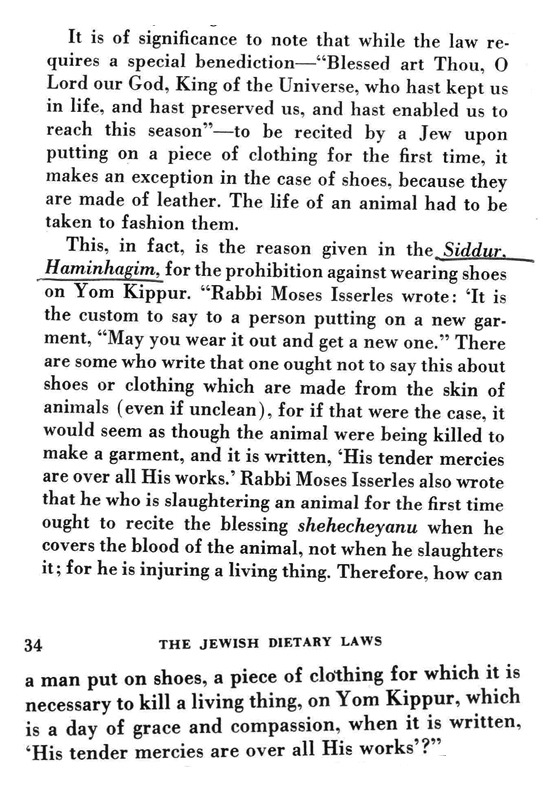
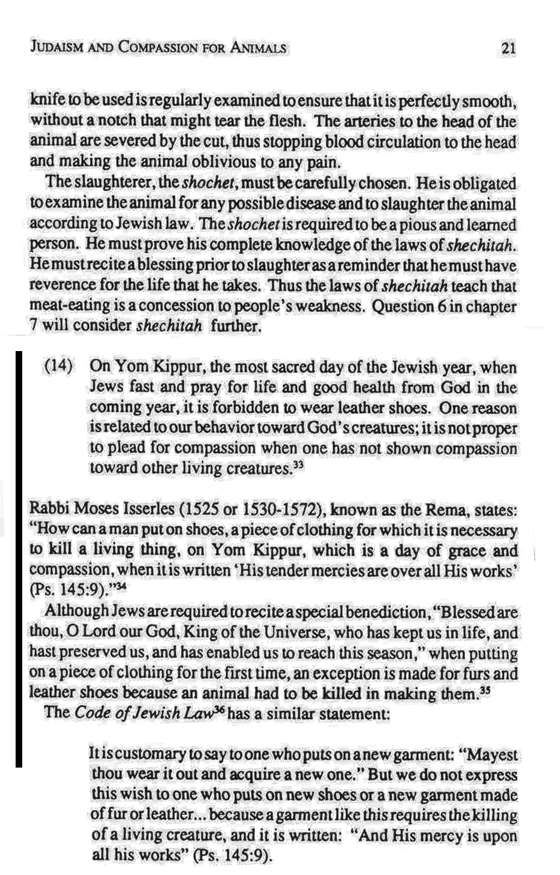
So where did PETA find this “quote”? In Schwartz’s book Judaism and Vegetarianism (p. 21 in the 1988 ed.) he includes this –


– and in footnote 34 he tells us that his source for this amazing quote is Samuel Dresner, The Jewish Dietary Laws (p. 33-34, 1966 ed). Unfortunately, Schwartz misread Dresner, misunderstood where quotes ended, did not look up Dresner’s source, and thereby fabricated a quote from the Rema.

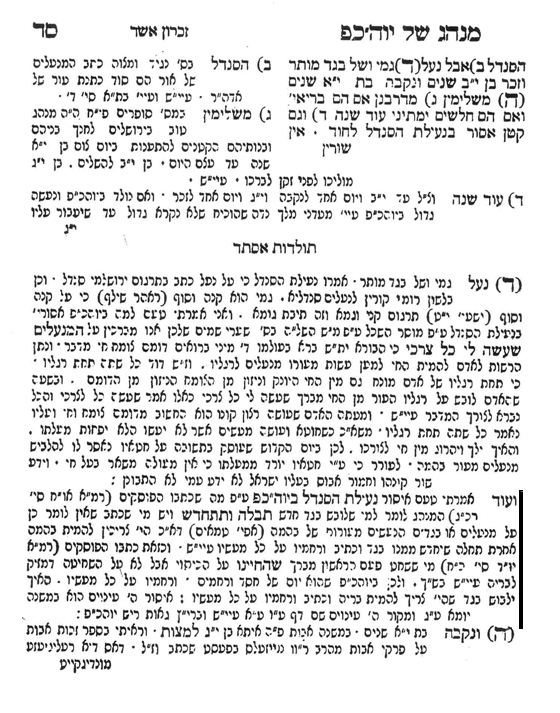
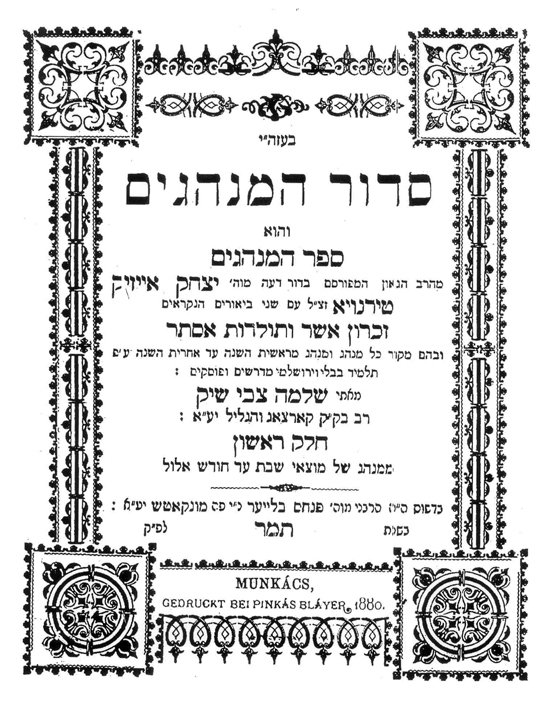
Dresner’s point of departure was the law cited above regarding the good wishes offered upon putting on a new garment. He then cites a novel reason for the prohibition of leather shoes, but does not give much detail about his source. It turns out that this reason is found for the first time in Toldot Esther, a commentary by Rabbi Shlomo Tzvi Shück (1844-1916) on the Siddur haMinhagim of Rabbi Yitzchak Isaac Tirna (64a in the 1880 ed. link).

Dresner may or may not have understood where the quotes end, but it is indeed confusing in his English rendition.

He quotes the Rema regarding leather clothing along with the pasuk from Tehillim (and following Shick, leaves out the Rema’s rejection). He then quotes the Rema regarding no shechiyanu on shechita and, without opening or closing quotes, proceeds into Shick’s novel reason for not wearing leather shoes on Yom Kippur.

Rav Shick (see scan below) was very clear in how he explained himself. He wrote that he had his way of explaining the prohibition of wearing (leather) shoes on Yom Kippur. He then cited the Rema on new clothes and the Rema on shehechiyanu on a first occasion, and based on those asked rhetorically how on Yom Kippur which is a day of chesed v’rachamim one can wear a garment that necessitated killing an animal. He had no fabricated quotes, but he does offer a perplexing explanation for something that was not looking for one. As noted above, the prohibition on Yom Kippur is to wear shoes, which some people understand to mean leather shoes. But the prohibition is derived from the fact that going shoeless is an innui. It also therefore applies on Tisha b’Av and to mourners, obviously unrelated to chesed v’rachamim. Furthermore, leather may be worn on Yom Kippur.

Thus, a novel, difficult to understand explanation for a straightforward prohibition has spawned a fabricated quote from the Rema that is now fairly widespread on the web.

[1] Safrai, Mishnat Eretz Yisrael, demonstrates that the earliest prohibition was to wear any shoe, leather or otherwise. They point to the Tosefta which prohibits “even empilia of cloth.” They understand that to mean a cloth shoe. The Yerushalmi, that distinguishes between leather shoes is modifying the original prohibition, as found in the Tosefta, that prohibited all shoes. According to this, it is somewhat understandable how one could shun all shoes today.[2] Another source does give a reason why specifically leather shoes are prohibited. Shu”t Maharshag (#110 in 5743 ed.) (Rav Shimon Greenfield, 1860 – 1930; one of the leading rabbis in post-Word War I Hungary. A student of Rav Moshe (“Maharam”) Shick, a cousin of Rabbi Shlomo Tzvi Shick) parenthetically quotes that the Pri Eitz HaChaim quotes the AriZal gave a kabbalistic reason why on Yom Kippur specifically leather shoes are prohibited. Again, it has nothing to do with leather or compassion to animals.Rav Yehuda Aszod (1796-1866; Shu”t Yehudah Ya’aleh 1:164) was asked whether one may shecht on Rosh Hashana. It is clear from Tanach (Nechemia 8:10) and the Mishna (Hullin 5:3) that meat was commonly eaten on Rosh Hashanah. Nonetheless, Rav Aszod noted that all shechita includes an element of tzar ba’alei chaim and without the Torah’s explicit permission would be prohibited. On the yom ha-din when we are asking for mercy it is inappropriate to shecht an animal.


R. Yudel Rosenberg, R. Mordechai Elefant, and Sexual

R. Yudel Rosenberg, R. Mordechai Elefant, and Sexual Abuse

Marc B. Shapiro

1. Many readers of the Seforim Blog are aware of R. Yudel Rosenberg, the fascinating talmid chacham and posek who for some reason was also drawn to forgeries. Ira Robinson has recently authored a complete biography of Rosenberg, A Kabbalist in Montreal: The Life and Times of Rabbi Yudel Rosenberg. This wonderful book is certainly deserving of a complete review on the Seforim Blog, but here I would just like to comment on a criticism of me.

On p. 219 Robinson discusses the letter of R. Hayyim Hezekiah Medini that Rosenberg included in his Sha’arei Zohar Torah.

The letter of Rabbi Medini as published by Yudel Rosenberg has been challenged as a forgery by Rabbi Yaakov Hayyim Sofer, David Zvi Hillman, and Marc B. Shapiro on the grounds that some linguistic elements of the letter are foreign to Rabbi Medini’s style and may well have come from the pen of Rabbi Rosenberg.

In the note to this passage, Robinson refers to my Seforim Blog post here, where in addition to mentioning the points made by R. Sofer,[1] I write:

Let me also add that the way Medini (=Rosenberg) concludes the forged haskamah is not like any of his other letters, which are included in Iggerot Sedei Hemed (Bnei Brak, 2006). In the authentic letters, before his name Medini always adds הצב”י or הצעיר, which he does not do in the forged haskamah. In his authentic letters, he also never closes them by adding to his name רב ומו”ץ בעיר הקדש חברון. Therefore, there can be no doubt that the letter of approbation sent by Medini to Rosenberg is simply another one of the latter’s forgeries.

Robinson states (p. 219 n. 25):

On one of his points Shapiro is mistaken. He wrote in his blog: “In the authentic letters, before his name Medini always adds ha-tsa’ir, which he does not do in the forged haskamah.” In Yudel Rosenberg’s work, the Medini letter does close with yedido ha-tsair.

Here is the haskamah, and indeed Robinson is correct that הצעיר appears. I can’t explain why I wrote otherwise.[2]

Since we are discussing the forged haskamah, let me add two additional points relating to the final lines. I looked through all the letters in Iggerot Sedei Hemed and in none of them does this expression appear:

כנפשו הטהורה וכנפש ידידו

Furthermore, R. Medini always adds היו or less commonly סט after his name. Both of these are missing here.

While on the topic of forgeries, let me mention something else. In my post here I deal with the notorious forger, Chaim Bloch. One of the forgeries I mention is his creation of an alternate version of שפוך חמתך in the Passover Haggadah. In Bloch’s forgery, instead of “Pour out Your rage upon the nations that do not know You,” followed by more lines beseeching God to destroy the wicked ones, a more universalist formulation is found that begins with שפוך אהבתך. This forgery, which Bloch claims is from a 1561 Worms manuscript, reads as follows:

Pour out Your love on the nations who have known You and on the kingdoms who call upon Your name. For they show loving-kindness to the seed of Jacob, and they defend Your people Israel from those Who would devour them alive. May they live to see the sukkah of peace spread over Your chosen ones, and to participate in the joy of Your nations.

This translation is taken from R. Jonathan Sacks’ Haggadah (The Applebaum Edition), p. 120. Unfortunately, Sacks did not know about the history of Bloch and thought he was dealing with an authentic text. Sacks introduces the phony prayer as follows:

In one manuscript from Worms, 1521, there is a unique addition to the Haggada alongside “Pour out Your rage.” It is a prayer of thanks for the righteous gentiles throughout history who, rather than persecuting Jews, befriended them and protected them at times of danger.

3. Readers of the Seforim Blog might recall that on a few occasions I cited passages from the memoir of the late R. Mordechai Elefant, Rosh Yeshiva of Itri and builder of a vast Torah empire. These were the first times that passages from the memoir that he dictated appeared in print. I was then one of the few people who had a copy of the memoir, and a number of readers can attest that I did not agree to share it with them because I did not have permission from the person who gave it to me. Subsequently, Mishpacha got a copy of it and published some selected (and “touched up”) portions.[3]

In September 2019, R. Pini Dunner[4] published the memoir and you can view it here (Although this site says May 1, 2013, in reality Dunner only uploaded it in 2019.)

Dunner writes:

Rabbi Elefant’s candid memoirs are startling, not just because they reveal much that one would hardly have expected from a top-tier Rosh Yeshiva, but even more because of the very frank revelations he willingly shared regarding the background to his extraordinary life.

I distinctly recall his many sardonic observations about life and people; he was a true iconoclast who had clearly never read the memo about how senior public servants should express themselves, and particularly rabbis. At the same time, he was an extraordinary scholar, who could lecture on any Talmudic topic, without prior warning, to discerning peers and students, dazzling them with both his vast knowledge and his keen intellect.

Those who examine the Elefant memoir will come away shocked that the author was a leading rosh yeshiva. R. Aharon Rakeffet’s response after completing the memoir was that R. Elefant was “fifty percent gadol, fifty percent gangster.”[5] One thing is sure: R. Elefant was one of the most fascinating Torah scholars in recent memory, and there really was no one like him.

Anyone who reads the memoir must wonder why R. Elefant would have wanted himself to be remembered in the way the memoir describes. Certainly, no one whose only exposure to R. Elefant is through his Torah works could imagine the author’s colorful life. In fact, in R. Elefant’s posthumously published Mi-Zahav Mordechai he is described on the title page as שר התורה הגאון האמיתי.

R. Elefant was obviously an unusual person, and as with other writers of memoirs in rabbinic history (e.g., R. Leon Modena, R. Jacob Emden, R. Elijah David Rabinowitz-Teomim), he was an independent thinker who did not believe in following the herd. R. Elefant, as with all memoir writers, wanted us to learn about his experiences and views, things we would not know about if we only looked at his yeshiva persona.

I asked R. Nathan Kamenetsky about R. Elefant after I read the memoir, and I gave R. Kamenetsky a copy of it. (R. Kamenetsky worked closely with R. Elefant in Itri). But I did not know R. Elefant, so anything I suggest will be speculation.

When I finished reading the memoir, and was wondering why R. Elefant would want all this unusual information made public, I thought of two possible reasons. The first is pride, to show that one can be a talmudic scholar—and R. Elefant was an authentically great one—and at the same time be “with it”, that is, to be able to travel around the world and have relationships with all sorts of unusual people. Looking at matters this way, the memoir can perhaps be seen as subversive, in that although R. Elefant lived in one world, and had great respect for the rabbis of that world, he also happily lived in another world and wanted to show people how he did it.

The other possibility I thought of is that R. Elefant actually felt guilty about how he lived his life, and the memoir was his way of making matters right, as it were. He was a rosh yeshiva and was therefore given great respect. He was also close to a number of gedolei Yisrael. Perhaps R. Elefant felt uncomfortable in his role, where he was regarded as a שר התורה and a גאון אמיתי, since unlike the other roshei yeshiva and gedolim, his life was not one of “only Torah.” Is it possible that R. Elefant was putting it all out there to set the record straight, that is, to let people know who he really was, because in the end he felt guilty that he was placed in the same category as other roshei yeshiva? Could it be that R. Elefant, who had so many interests and couldn’t be happy spending his life entirely in the beit midrash, felt guilty being compared to the roshei yeshiva and gedolim whose entire lives were focused only on Torah study and spiritual improvement? I can’t help but think that if R. Elefant had children, and was busy raising them, he wouldn’t have had his wanderlust and need for adventure.

R. Elefant himself tells us that in addition to his “lamdan side,” he also has a “shaygetz (irreligious) side” (p. 40). I cannot imagine any other rosh yeshiva saying such a thing about himself. R. Elefant’s “shaygetz side” was not something that most would have known about had he not revealed it, and it is this side of him that people have found shocking. Obviously, R. Elefant knew they would find it shocking, yet he still wished to make it public. My sense is that he was a man of truth, and did not want to pretend. He wanted people to know what he was about, with all of his complexity.

I think it is very telling that after mentioning his “shaygetz side,” R. Elefant adds, “Thank G-d that side of me didn’t manifest itself in my students.” This line shows that, at the end of the day, R. Elefant was not very proud of this side of him, which I think lends credence to my suggestion that the memoir was his way of setting the record straight so that the world not think of him as someone he was not. (A close student of R. Elefant told me he liked this suggestion.) Also noteworthy is that right at the beginning of the memoir, R. Elefant states: “But I don’t kid myself. I know I’m not a spiritual model for my students, nor do I ever make out that I am.” 

Even if I am wrong in discerning R. Elefant’s ultimate motivation, memoirs by their nature provoke thoughts in the reader, and the two suggestions I mention are what the memoir brought to my mind.

There are those who knew R. Elefant who believe that one must distinguish between his younger days, when he was completely engrossed in Torah study, and later in life when he realized that he had a knack for raising money. It was then that he started traveling the world and hanging out with celebrities, politicians, and other colorful characters. Some will regard this as a limud zekhut for the entire bizarre and eye-opening memoir. Others will probably say that while R. Elefant raised a lot of money and built a Torah empire, the toll it took on him, as seen in how he chose to portray himself in his own memoir, shows that it was not worth it.

The copy of the memoir that Dunner placed online has become internationally famous, and you have to love the title he gave it: “An Elephant Never Forgets”. Yet Dunner’s copy is missing the first page, so let me provide it now.

In Dunner’s copy the handwriting on p. 59 can’t be read. Here are pages 58-59 from my copy so you can see the passage in its entirety.

The first thing to note is that R. Elefant’s claim that Saul Lieberman felt that he should have been made chief rabbi, and because he didn’t get this he went to JTS, is completely mistaken (as is much else in the memoir). R. Kook died in 1935 when Lieberman was 37 years old. At that young age he certainly never had any thoughts of becoming chief rabbi. The language “first chief rabbi of Israel” also doesn’t make any sense, as Lieberman left Israel for JTS when it was still Palestine.

Lieberman was actually a big supporter of his friend R. Isaac Herzog’s candidacy for the Chief Rabbinate. (Even when he was in Ireland, R. Herzog was a member of the advisory board of the Harry Fischel Institute which Lieberman headed at the time of R. Kook’s death.[6]) Chaim Herzog writes that his grandfather, R. Samuel Isaac Hillman, and Lieberman “organized a small campaign staff” to support R. Herzog’s election.[7] When R. Herzog was chosen, Lieberman was one of the signatories on the document proclaiming him Chief Rabbi. (I thank the late R. Eitam Henkin for sending me this.)[8]

R. Elefant then refers to R. Avraham Yisrael Moshe Solomon as a noted talmid chacham. Yet he was never a rav in Shanghai and he was not the father of Rabbi Baruch Shimon Solomon of Petah Tikvah. The story dealing with R. Kook, which is a famous one, is also mixed up. What was said to the Brisker Rav—and there are different versions concerning who said it—is that in R. Kook’s eyes all Jews are like family, and that is why he is so friendly with them. The version R. Elefant offers makes no sense, as R. Solomon’s comment to the Brisker Rav does not follow from what the Brisker Rav told him. In the note on the left side of the page, someone added [9]: “By R’ Kook every Yid is מבשרך אל תשעלם.

The story at the bottom of the second page is unfortunate and does not make R. Elefant look good, as we see that he did not know of the view that one can cook in a keli sheni. This was obviously what Lieberman held, and this was also the view of R. Chaim Soloveitchik and R. Joseph B. Soloveitchik. R. Hershel Schachter writes as follows in Nefesh ha-Rav, p. 170:

במשנה ברורה (סי‘ שיח סק לטהביא דעת כמה מן האחרונים להחמיר שלא לעשות תהאפילו בכלי שניורבנו אמר בזה הלשון – שהסבא שלו היה מדקדק במצוותוהיה משתמש בשקיות תה בכלי שניואף הוא היה נוהג אחריו להקל בזה גכ

The story is also unfortunate as all R. Elefant had to do was ask Lieberman why he was using the tea bag in a keli sheni, and he would have been given the answer. Although one can criticize Lieberman’s association with the Jewish Theological Seminary, it is not every day that one is in the presence of someone with indescribable knowledge of Bavli, Yerushalmi, Tosefta, and Midrash. I would have assumed that R. Elefant would have taken advantage of the time he was with Lieberman for something more constructive than rebuking him.

4. In his recent Seforim Blog post here, Edward Reichman mentions R. Judah Messer Leon and his book Nofet Tzufim which was published in 1475. He also mentions that Nofet Tzufim was the answer to one of my earlier quizzes, where I asked what was the first Hebrew book published in the lifetime of its author. See here. In his post, Reichman discusses another fascinating book, R. Abraham Portaleone’s Shiltei ha-Giborim (Mantua, 1612 [Reichman mistakenly gives the date as 1607]). This book also has the honor of being “a first,” for it was the first Hebrew book to use European punctuation, including the question mark.[10]

5. The Chaim Walder affair has once again brought the issue of sexual abuse to the limelight. It also looks like the fallout from this event, unlike earlier scandals, will have a real impact in the haredi world, as many rabbis really are taking the issue seriously. What is needed is a scholarly study of how rabbis over the years have responded to the issue of sexual abuse. I am not referring to a work designed to condemn the rabbis for not doing enough, but to an academic study that would show how responses have changed over the years, how some rabbis took the matter seriously and other did not, and how with more understanding of the effects of sexual abuse rabbinic attitudes began to change.

One example of the sort of sources that would be used in such a study is R. Elijah Rabinowitz-Teomim (Aderet), Ma’aneh Eliyahu, no. 32. The Aderet deals with a case where a girl was raped by two young Jewish men. Her family wanted to report this to the police so that the rapists would receive a fitting punishment. However, the Aderet tells us that he convinced the family not to make a public issue of the matter, so as to prevent a hillul ha-shem, and to avoid confrontation with dangerous people.

דברתי אל לבם להשקיט הדברלבל יתחלל שם ישראל בעמים מהפקרות ופריצות צעירי הנעריםלאנוס ולנאוף ולחלל שבת ולרצוחוגם יש סכנה בדבר לריב עם עזי פנים כמותםושמעו אלי

The first reason, avoidance of hillul ha-shem, certainly remains a significant factor today in the desire to keep matters of sexual abuse from being publicly aired.

Another relevant ruling, which shows how matters were handled in the past by a truly great figure, is found in R. Menachem Mendel Schneersohn (the third Lubavitcher Rebbe), Tzemah Tzedek, Yoreh Deah, no. 237. R. Schneersohn was asked the following question: A rabbi was playing with a נער on Purim and stuck his hands into the pants of the youth. The rabbi claimed that he did so because he (the rabbi) was unable to perform sexually. He thought that this was due to his small testicles, and he wanted to see if he was unusual in this regard. In other words, the rabbi was conducting a medical examination on the youth, and one can only wonder how many other boys were also subjected to this rabbi’s examinations. R. Schneersohn decided that the rabbi should not be removed from his position, as he provided a good explanation for his behavior.

What we see from these responsa (and others can be mentioned) is how much attitudes have changed in modern times. Our response would be very different than that of the Tzemach Tzedek, and I think we all would find the “justification” the abusive rabbi offered to be ludicrous, but that is only because we have been exposed to many things, including crimes perpetrated by trusted religious figures, that people in the Tzemach Tzedek’s day could never have imagined.[10]

6. As this post has discussed forgeries, I must call attention to a bombshell new book with wide-ranging implications by R. Moshe Hillel. It is titled חזון טברימון and makes a strong case that R. Yaakov Moshe Toledano created many forged documents. Often we think of forgers as shady characters, however R. Toledano was a respected rav who held a number of important positions, including Chief Rabbi of Tel Aviv. In the election for Sephardic Chief Rabbi of the State of Israel, he lost to R. Isaac Nissim. R. Toledano was also a posek who authored the responsa volume Yam ha-Gadol.

It is beyond depressing to think that such a distinguished person could have been responsible for numerous forgeries. If Hillel’s claim is found to be accurate, a good of deal of scholarship, which relies on documents published by Toledano, has to be thrown out. This is every scholar’s nightmare, that the conclusions he or she reaches are based on fraudulent information.

Hillel also argues that the location of R. Moses Hayyim Luzzatto’s grave in Tiberias, which has become a popular pilgrimage site, is an invention of R. Toledano who created a phony “tradition”. For some initial discussion of Hillel’s book, see here where you can also download the book. Those interesting in purchasing a copy should contact Eliezer Brodt.

7. This summer my Torah in Motion trips resume. You can find information about them here.

8. For those interested in my Iggerot Malkhei Rabbanan, copies are still available at Mizrahi Book Store here.

9. Some years ago, I discovered at the University of Scranton a VHS tape of a 1985 lecture from Prof. Isadore Twersky. (I had already known of this lecture, as when I arrived in Scranton one of my colleagues mentioned to me how unusual it was that Twersky sat for his presentation.) I turned the VHS into a DVD, and a few weeks ago I had the tech people at Scranton turn it into a digital file and upload it to the University of Scranton’s YouTube channel. You can see the video here. This is the only video of a Twersky lecture to be found on the internet, and I am sorry that the sound is not so good. I don’t know whose idea it was to set up an Israeli flag next to Twersky as he spoke. If you look at the beginning of the video you can see that Twersky was actually sitting right in front of a cross, so maybe someone thought that a Jewish star was also needed. I know of only one other video where you can hear Twersky speaking, and that is found here where he introduces Chaim Grade.

Quiz

1. In section 4 I mentioned some bibliographical firsts, so for a quiz question I ask the following: Which Hebrew book was the first one to use footnotes (and the footnotes even used Arabic numerals)?

2. For those who would like a different sort of quiz question: Soon it will be Pesach, so please point to a halakhah on Pesach that the Shulhan Arukh decides in accord with the Rosh, while the Rama records the practice in accord with the Rambam and the Rif.

Answers should be sent to me at shapirom2 at scranton.edu 

***********

[1] I did not refer to R. David Zvi Hillman’s letter which appears in Etz Hayyim 10 (5770), p. 379.
[2] As mentioned, Robinson’s book deserves an extensive review, but here is one bibliographical point. On pp. 134ff., Robinson discusses R. Shlomo Zalman Auerbach’s correspondence with Rosenberg concerning the halakhic status of electricity. Robinson states that R. Auerbach’s Jan. 8, 1935 letter that strongly criticizes Rosenberg’s approach is unpublished. Yet the letter actually appears in R. Auerbach’s Meorei Esh ha-Shalem (Jerusalem, 5770), pp. 368ff.
[3] Mishpacha, Dec. 18, 2013.
[4] See here. Even before Dunner published the memoir, his copy was circulating and was placed online in June 2019. See here.
[5] Listen here at minute 72.
[6] See Sefer ha-Yovel for Harry Fischel (Jerusalem, 1935), Hebrew section, pp. 11, 20, English section, p. 8.
[7] Chaim Herzog, Living History (New York, 1996), p. 28 (called to my attention by Rabbi Jacob Yellin). According to Chaim Herzog, Lieberman would become his parents’ closest friend. See Elijah J. Schochet and Solomon Spiro, Saul Lieberman: The Man and His Work (New York, 2005), p. 52.
[8] In 1935 R. Herzog was a candidate for the chief rabbinate of Tel Aviv. The other candidates were R. Joseph B. Soloveitchik and R. Moshe Avigdor Amiel. It is of interest that the Hazon Ish supported R. Herzog’s candidacy. See Dov Eliach, Be-Sod Siah (Jerusalem, 2018), pp. 258-259. One might have expected R. Meir Berlin (Bar-Ilan), the great Mizrachi leader (and Lieberman’s father-in-law), to have supported R. Herzog or R. Amiel as they were both leading figures in Mizrachi, while R. Soloveitchik had no Mizrachi connections at this time. Yet because of his familial connection to R. Soloveitchik, Berlin put his support behind him. In a Nov. 10, 1935, letter from R. Herzog to Lieberman, R. Herzog writes as follows regarding the lack of support from Berlin, whom he calls מנהיגנו הנערץ והאהוב:


אין בלבי שום תרעומות עליו כי סוף סוף הרב הנל הוא קרובו ובל תדין את חבירך וכו‘, ועוד כי בודאי עשה מה שעשה בלב שלם וטהור מתוך הכרתו הפנימית

You can see the letter here where a number of letters from the Lieberman archive have been uploaded. The source of these letters is not indicated, which means that they were not uploaded in accordance with the regulations of the Jewish Theological Seminary Library.
[9] תשעלם should be written תתעלם, and the passage comes from Isaiah 58:7. The verse actually has לא instead of אל. Yet a number of early rabbinic sources cite the verse with the word אל, so this was probably found in their texts. Indeed, critical editions of the book of Isaiah (Kittel, C.D. Ginsburg) report that many manuscripts have אל. Yet it is interesting that even though the verse appears with לא in every Tanakh printed today, rabbinic authors continue to cite the verse with אל. In fact, the Tolna Rebbe makes a big deal about how the first letters of מבשרך אל תתעלם spell אמת. See Tanḥumekha Yesha’ash’u Nafshi: Tolna (Jerusalem, 2004), pp. 235, 405, 506, 698.
[10] See Cecil Roth, The Jews in the Renaissance (Philadelphia, 1959), p. 315.
[11] R. Solomon ben Adret, She’elot u-Teshuvot ha-Rashba, vol. 1, no. 571(b), deals with a case where a woman accused her husband, who was also a rabbi, of: 1. sexually abusing their son, 2. having sexual relations with his slave, 3. being a heretic. However, in this case it is not clear that the woman was to be believed, as she made the accusations as part of her dispute with her husband. Things got so bad that she hired a non-Jew to bring her accusations before the government, knowing that if she was believed her husband would be burned. (She clearly wanted to get rid of him for good.) This case is discussed by Norman Roth, Jews, Visigoths and Muslims in Medieval Spain (Leiden, 1994), pp. 195-196.


A Final Note Regarding Rav Simcha Zelig Reguer’s Position on Opening a Refrigerator on Shabbat

A Final Note
Regarding Rav Simcha Zelig Reguer’s Position on Opening a Refrigerator on
Shabbat
 By Yaacov Sasson
The purpose of this note is to
establish conclusively that Rav Simcha Zelig Reguer, the Dayan of Brisk,
never permitted opening a refrigerator on Shabbat when the light inside will go
on. I was deeply disappointed to read Rabbi Michael Broyde’s response[1] to
my “Note Regarding Rav Simcha Zelig Reguer’s Position on Opening a Refrigerator
on Shabbat.”[2] In
short, R. Broyde has incorrectly asserted that Rav Simcha Zelig permitted
opening a refrigerator on Shabbat when the light inside will go on. In truth,
Rav Simcha Zelig permitted opening a refrigerator when the motor will go on; he never addressed the refrigerator light at all. Rather than admit to this
simple mistake, R. Broyde has chosen to reiterate his basic error and compound
it with further errors. Furthermore, R. Broyde has entirely ignored the crux of
my own argument, specifically that the articles to which Rav Simcha Zelig was
responding were about triggering the refrigerator motor by allowing warm
air to enter. Those articles do not mention refrigerator lights at all. It is
therefore untenable to claim that Rav Simcha Zelig permitted opening a
refrigerator on Shabbat when the light inside will go on.
Let us proceed to examine how
each argument advanced by R. Broyde is incorrect. Below are direct quotations
from R. Broyde’s response (in bold), followed by my own comments.
“The relevant paragraph of the
teshuva by Dayan Rieger reads simply:
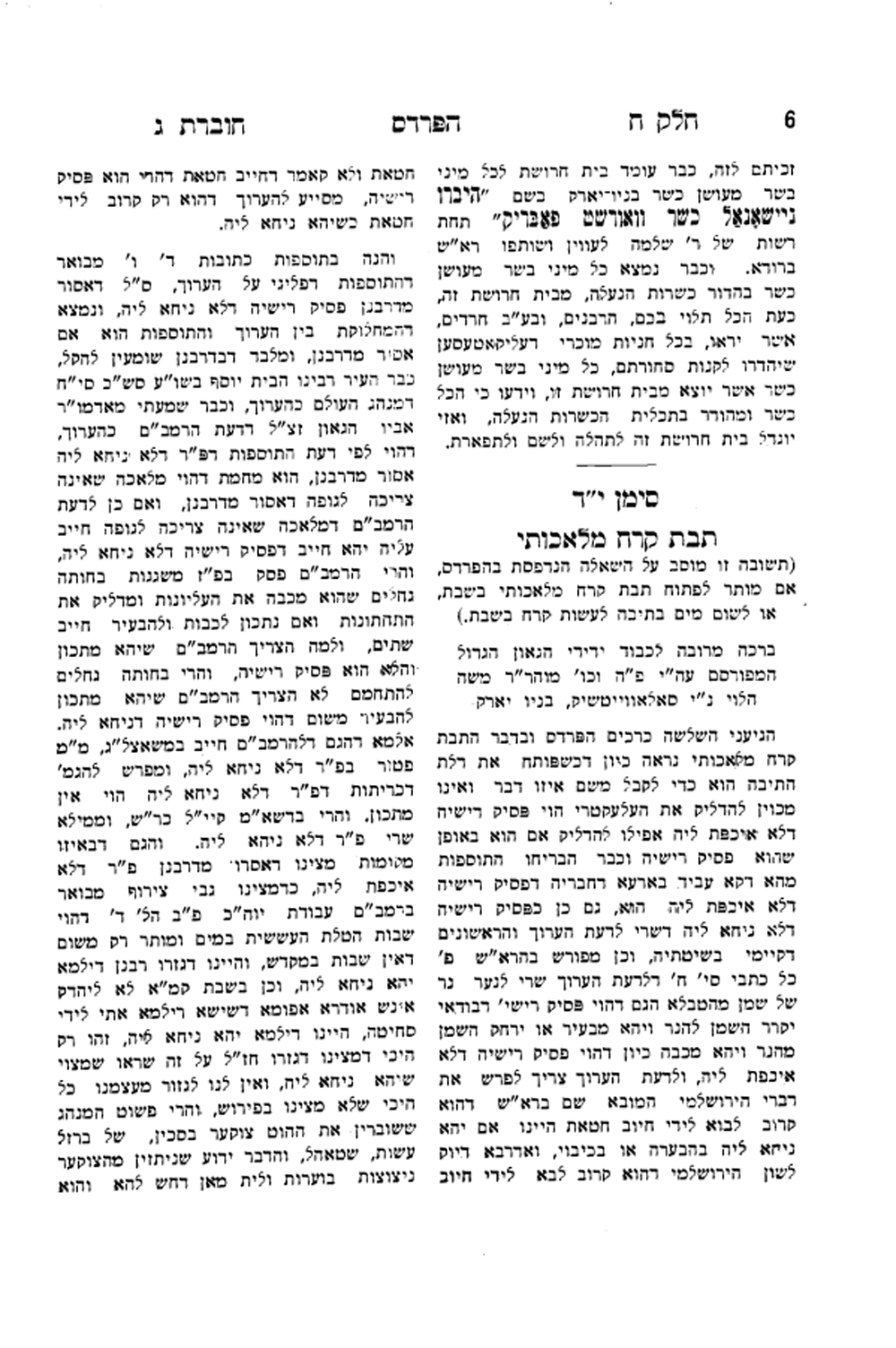
ובדבר התבת
קרח מלאכותי נראה כיון דכשפותח את דלת התיבה הוא כדי לקבל משם איזו דבר ואינו
מכוין להדליק את העלעקטרי הוי פסיק רישיה דלא איכפת ליה אפילו להדליק אם הוא באופן
שהוא פסיק רישיה.
And in the matter of the artificial [electric]
icebox it appears that since when one opens the door of the box to get
something from there and does not intend to ignite (light) the electricity it
is a psik resha that he does not care about, even to light in way that
is a psik resha.”
R. Broyde’s citation has omitted the first several words of the paragraph,
which read as follows[3]:
הגיעני השלשה
כרכים הפרדס ובדבר התבת קרח מלאכותי…
“I received the three issues of Hapardes and in the
matter of the artificial [electric] icebox…”

This omission is significant, because these words make clear that Rav
Simcha Zelig was addressing the refrigerator question raised in earlier issues
of Hapardes. (See Hapardes 1931 num. 2 page 3, and Hapardes
1931 num. 3 page 7.) The question under discussion in those previous volumes was
the triggering of the refrigerator motor, and not the light, as noted.
Also of note, is that at the end of his teshuva[4],
Rav Simcha Zelig addressed Rav Moshe Levin’s question regarding the
permissibility of making ice on Shabbat. Rav Simcha Zelig cited this question
specifically in the name of Rav Levin. This is significant because the ice question
appeared in the name of Rav Levin in Hapardes 1931 num. 3 page 7, in
an article about triggering the refrigerator motors.[5] See
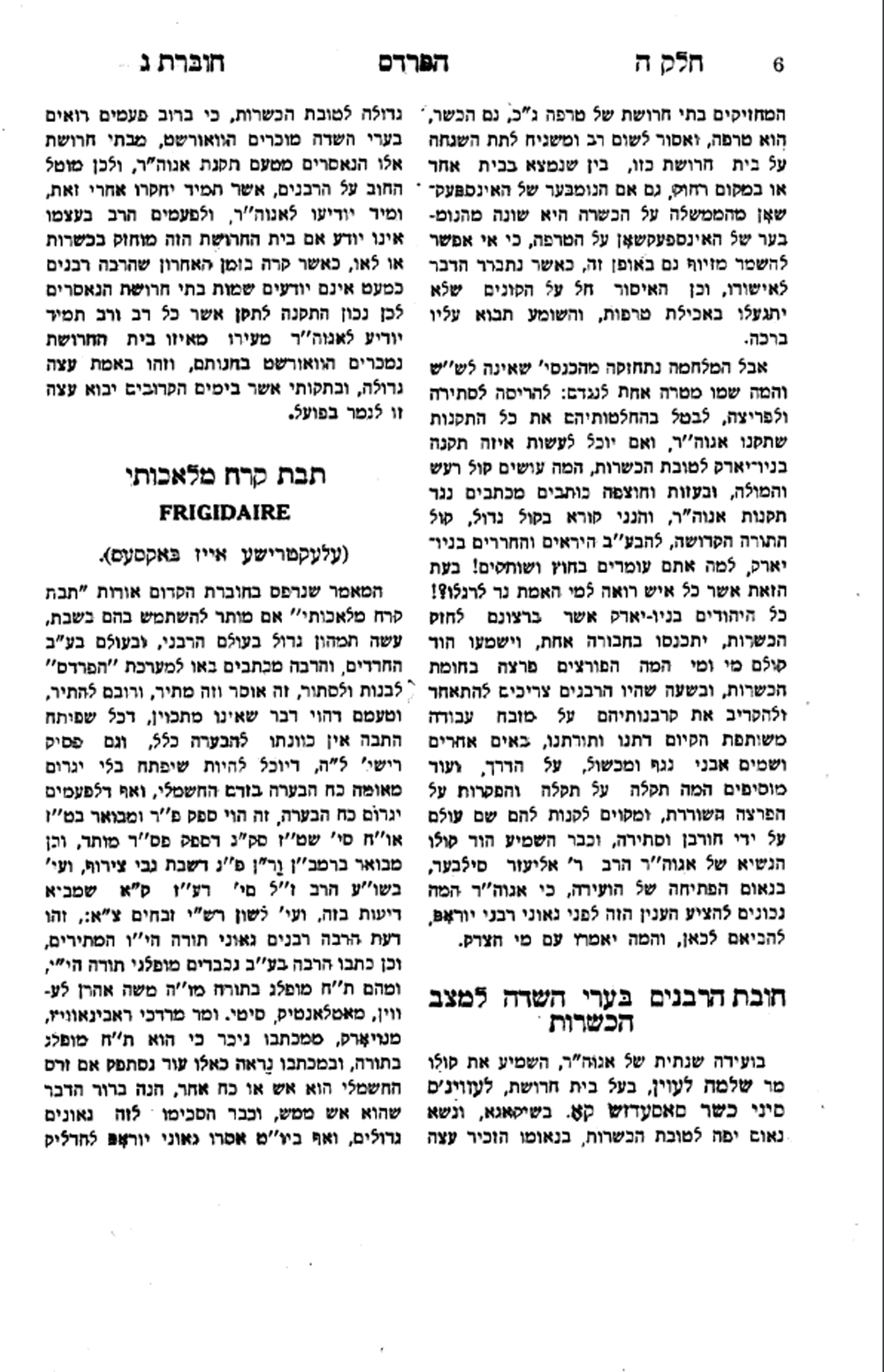
the final paragraph of the article titled “Frigidaire” in the image below:

So it is clear that Rav Simcha Zelig introduced his teshuva with a reference to the prior issues of Hapardes. And
it is also clear that he closed his teshuva by addressing Rav Moshe
Levin’s ice question from Hapardes (which appeared in the article
entitled “Frigidaire”, shown above, about the refrigerator motors.) R. Broyde
apparently contends that in between, Rav Simcha Zelig veered off to address an
unrelated question which never appeared in Hapardes (that of the
refrigerator light), without ever addressing the question of the
refrigerator motor itself. And he did this while directly addressing the
ice question from the article entitled “Frigidaire”, but never addressed the
main substance of that article, the refrigerator motor. The absurdity of this
position is self-evident.    
Also of note is the introductory paragraph to Rav Simcha Zelig’s teshuva,
presumably written by the editor, Rav Shmuel Pardes, which reads as follows[6]:
תשובה זו מוסב על
השאלה הנדפסת בהפרדס, אם מותר לפתוח תבת קרח מלאכותי בשבת, או לשום מים בתיבה
לעשות קרח בשבת.
This teshuva addresses the question that
was printed in Hapardes, whether it is permitted to open a refrigerator
on Shabbat, or to put water inside the refrigerator (freezer) to make ice on
Shabbat.
Rav Pardes clearly understood and presented Rav Simcha Zelig’s teshuva
to be addressing the question of triggering the motor, which had been raised in
earlier issues of Hapardes.
Furthermore, R. Broyde’s translation of Rav Simcha Zelig’s words is inaccurate,
and the effect of this mistranslation permeates his entire response. The
closing words of Rav Simcha Zelig in the paragraph cited by R. Broyde are:
הוי
פסיק רישיה דלא איכפת ליה אפילו להדליק אם הוא באופן שהוא פסיק רישיה.
R. Broyde has translated these words as:
“…it is a psik resha that he does not care
about, even to light in way that is a psik resha.”
The astute reader will notice that the bolded words in the Hebrew citation
are left untranslated by R. Broyde, essentially ignored, as if they do not
exist. The closing words of this sentence are correctly translated as follows: even
to light IF IT IS in a way that is a psik reisha. Most of R. Broyde’s
response revolves around the incorrect assertion that since Rav Simcha Zelig
referenced a psik reisha, he must have been referring to igniting the
light, which is a psik reisha, and not the motor, which is not a psik
reisha
. However, correctly translated, Rav Simcha Zelig says that opening
the refrigerator is permitted EVEN IF there is a psik reisha involved.
Such conditional language is entirely out of place when referring to a light,
which is certainly a psik reisha. This conditional language is only applicable
to the refrigerator motor, because there are times when, unbeknownst to the
person, the opening of the refrigerator door will immediately trigger the motor
to go on because of the already heightened initial air temperature inside the
refrigerator. (Such a situation is known in the language of the Poskim
as a “Safek psik resha”, as noted in Hapardes 1931 num. 3 page 6
regarding the refrigerator motor. It is the subject of dispute whether such an
action is permissible, similar to a Davar Sheaino Mitkavein, or
prohibited like a psik reisha.) Rav Simcha Zelig’s qualification that it
is permitted to open the refrigerator door even IF the situation is one of psik
reisha
makes clear that he is referring to the refrigerator motor, contrary
to R. Broyde’s misreading.[7]
“A careful reader of the first sentence, and indeed of the entire teshuva,
can sense that there is some ambiguity here about the electrical object
referred to, since Dayan Rieger does not specify the source or consequence of
igniting the electricity.”
There is no ambiguity to anyone who has seen the previous issues of Hapardes
which deal with the question of the refrigerator motor. There can only be
ambiguity if one reads Rav Simcha Zelig’s teshuva
entirely out of context, without looking at the articles to which he was
responding.
“Particularly in the Yiddish spoken culture of that time, the term
“electric” seems to have meant “lights” and not electricity or motor.”
R. Broyde’s assertion that “electri[c]” did not mean electricity or motor is
incorrect. See for example, the language in Rav Shlomo Heiman’s letter (dated
Erev Sukkot 5697/1936), printed in Chosen Yosef[8], and
reprinted in later editions of Chiddushei Rav Shlomo:
פקפק כת”ר
שליט”א בענין פתיחת הפרידזידעיר על העלעקטרי דע”י פתיחתו הוא
מבעיר העלעקטרי ורוצים להתיר על פי שטת הערוך דהוי פס”ר דלנ”ל
דיותר נוח לו שלא יכנס שם אויר קר, ולא יעלו לו הוצאות העלעקטרי
In this short excerpt, Rav Shlomo Heiman uses “elektri” to refer to
both the refrigerator motor and to electricity. Rav Heiman was clearly discussing
the permissibility of opening the door and triggering the refrigerator motor,
and refers to triggering the motor as kindling the “elektri”, the same
exact term used by Rav Simcha Zelig. Rav Heiman further notes that this is
considered “lo nicha lei” because the person would prefer to save the
additional expense of “elektri”, i.e. electricity.
See also the words of Rav Chaim Fishel Epstein, in Teshuva Shleima
vol. 2 – Orach Chaim, beginning of Siman
6[9]:
נשאלתי בדבר
המכונה המקררת בכח חשמל שקורין ריפרידזשיאטר, שבעת שפותחים הדלת נכנס אויר חם ואז
נתעורר כח החשמל (עלעקטריק בלע”ז) והמכונה מתחלת להניע ולעבוד כדי להוסיף
קרירות…
Here, Rav Epstein synonymizes koach chashmal, or electricity, with “עלעקטריק”.
See also Hapardes 1931, num. 2 page 3, where zerem hachashmali, or
electric current, is synonymized with
“עלעקטריק”. R. Broyde’s contention that “electri[c]”
did not mean electricity or motor is simply false.
“Elektri, according to
my colleague at Emory, Professor Nick Block, more likely means the light than
anything else in 1930s Yiddish.”
One need not be a Professor of German Studies to
recognize that within a discussion of
refrigerator motors, it is more than likely that “Elektri” means a
refrigerator motor, the subject under discussion, or its associated electricity.
This was true even in 1930s Yiddish spoken culture; see Rav Shlomo Heiman’s
1936 letter cited above.
Additionally, as mentioned above, Rav Pardes (editor of Hapardes)
clearly understood Rav Simcha Zelig’s teshuva to be addressing the
question of triggering the motor, which had been raised in earlier issues of Hapardes.
Rav Pardes’ knowledge of 1930s Yiddish was certainly robust.
“Second, and much more importantly, the halachic analysis presented by
Dayan Rieger addresses a direct action, while everyone else who discusses the
motor speaks about an indirect action…opening the door usually leads to an
increase of air temperature inside the refrigerator, which eventually directs
the motor to go on…many times when the refrigerator is opened, the motor does
not go on at all…But Dayan Rieger makes no mention of this…he assumes that when
the refrigerator door is opened the electrical object under discussion is always
ignited, and it does so immediately and directly, thus causing a melacha.
This is the formulation of psik resha, which inexorably causes melacha
each and every time…”
This section is entirely wrong, and is predicated on R. Broyde’s
misreading/mistranslation of Rav Simcha Zelig’s words, as noted above. That Rav
Simcha Zelig added the qualification of “IF IT IS” a psik reisha renders R. Broyde’s words here to be entirely
irrelevant and incorrect. Rav Simcha Zelig’s language of “IF IT IS” a psik
reisha makes clear that he is assuming that the motor is not always
ignited by opening the door, but at times it might be ignited in a manner of psik
reisha,
due to the heightened initial air temperature inside the
refrigerator. (Again, such a situation is known as “safek psik reisha”
in Rabbinic parlance, as the air temperature inside the refrigerator is not
known to the opener.) Contrary to R. Broyde’s assertions, Rav Simcha Zelig’s
language here is a clear proof that Rav Simcha Zelig’s teshuva was in reference to the refrigerator motor and not the
light.
“Professor Sara Reguer noted by email to me that “my grandfather conferred
with scientists and specialists in electricity before giving his response,” and
given this fact it is extremely unlikely that he missed such a basic point that
anyone who repeatedly opened and closed a refrigerator would have noticed.”
This argument is also incorrect, and is again predicated on R. Broyde’s
mistranslation of Rav Simcha Zelig’s words. Also significant is R. Broyde’s
citation of Dr. Reguer (in his footnote 8) that “she is certain that this teshuva
is referring to the thermostat or motor and not the light.”
“First, the other substantive halachic logic employed by Dayan Rieger which
analogizes elektri to sparks seems to me to be a closer analogy to a light than
to a motor which is hardly fire at all; sparks like incandescent lights, are
fire according to halacha.”
R. Broyde is wrong again. In fact, several poskim have noted that
ignition of the refrigerator motor also generates sparks.[10] See
the words of Rav Chaim Bick[11],
describing the problem of the refrigerator motor in Hamesila (2:1)[12]:
וע”י הגלגל
נושב רוח ומוליד הקר לחלק השני של התבה, אשר שמה נמצאים כל צרכי אכל ומשקה. הגלגל
בשעה שמתחיל מרוצתו יוצא ממנו נצוץ-אשי
And by way of the wheel,
the wind (i.e. air) blows and creates the cold in the other section of the box
(refrigerator), where all the food and drink are located. The wheel, when it
begins to run, emits fire-sparks
See also the words of Rav Chaim Dovid Regensburg,
describing the problem of the refrigerator motor, in Mishmeret Chaim, siman
3[13]:
ומה שלפעמים ניצוצות ניתזים, ברגע של מגע החוטים
החשמליים אחד בשני, אין זו הבערה, כי מלאכת מבעיר ביחס לשבת לא חשובה אלא אם האש
נאחזת באיזה דבר, וכן כתב הפרי מגדים סי תקב… 
And that sometimes sparks
fly off
,
at the moment that the electrical wires touch each other, this is not havara,
because melechet havara with respect to Shabbat is only considered when
the fire takes hold to something, and so wrote the Pri Megadim…
See also the words of Rav Shlomo Zalman Auerbach, within a discussion of
the ignition of the refrigerator motor in Minchat Shlomo (Kama), Siman
10, Anaf 2 Ot 4[14]:
אולם יש טוענים
דיש לחשוש לזה, שבכל פעם שמתחדש מעגל חשמלי יוצא במקום החבור ניצוץ קטן של אש
ונמצא שבפתיחתו הוא גורם למלאכת מבעיר…
However, some claim that one should be careful
about this, that every time that an electric circuit is completes, a small
spark of fire
comes out of the place of connection, and thus through his
opening [of the refrigerator door] he is causing the melacha of mav’ir…
Thus, contrary to R. Broyde’s assertion, Rav Simcha Zelig’s mention of
sparks is in fact directly analogous to the ignition of the refrigerator motor,
which actually involved creation of sparks.[15]
“Secondly, there has been a regular subset of poskim (as shown by Rabbi
Abadi’s most recent teshuva, Ohr Yitzchak 2:166) who adopt the exact analysis
and view of Dayan Rieger and view the light as lo ichpat since one does
not want it and a light is on already.”
To refer to a single teshuva, published in the 21st
century by a lone posek, as “a regular subset of poskim” would seem to
be somewhat of an exaggeration.
“On the other hand, there is a good and natural impulse to read halachic
literature conservatively and to press for interpretations that align gedolim
with one another and not leave outliers with halachic novelty.”
My original note and my comments here in no way reflect any impulse to read
halachic literature conservatively. They reflect my impulse to read halachic
literature correctly.
“Furthermore, I do recognize that many halachic authorities who have cited
Dayan Rieger’s teshuva have quoted it in the context of the motor and not the
light…”
More accurately, all halachic authorities who have cited Rav Simcha
Zelig’s teshuva have quoted it in the
context of the motor and not the light.
“But, I think these citations are less than dispositive for the following
important reason: Those who quote Dayan Rieger’s view as something to consider
about the motor note that his analysis is halachically wrong…Poskim generally
spend less time and ink explicating the views of authorities whom they believe
to have reached inapt or incorrect conclusions of fact or law compared with
those whom they cite in whole or in part to bolster their own analysis.”
It is unclear to me whether R. Broyde means that all of these Poskim
have misunderstood Rav Simcha Zelig’s position, or that they have
misrepresented it. Either way, the assertion is bizarre. I will leave it to the
readers to judge whether such an assertion is tenable.
The following is a partial list of Poskim and scholars who have
cited Rav Simcha Zelig as having permitted opening a refrigerator on Shabbat
when the motor will go on, and not
in the context of the refrigerator light[16]:
1)     
Rav Ovadya
Yosef (Yabia Omer, Orach Chaim Chelek 1, Siman 21, Ot 7)
2)    Rav Yehoshua
Neuwirth (Shemirat Shabbat Kehilchata, Perek 10 Footnote 33 in
the 1979 edition. This appears in Footnote 37 in the 2010 edition.)
3)     
Rav J. David
Bleich (Tradition, Spring 2017, pages
57-58)[17]
4)     
Rav Chaim
Bick (Hamesila 2:1)[18]
5)     
Rav Gedalia
Felder (Yesodei Yesurun, vol. 3 page 293)[19]
6)     
Rav Shlomo
Tanavizki (Birkat Shlomo, end of siman 2)[20]
7)     
Rav Moshe
Shternbuch (Teshuvot Vehanhagot vol. 1 Siman 220)[21]
8)     
Rav Chaim
Fishel Epstein (Teshuva Shleima vol. 2, end of Siman 6)[22]
9)     
Rav Chaim
Dovid Regensburg (Mishmeret Chaim, Siman 3, page 27) [23]
10) 
Rav Chaim
Druck (Noam Vol. 1 page 281)[24]
11) 
Rav Shmuel
Aharon Yudelevitz (Hachashmal Leor Hahalacha, page 130)[25]
12) 
Rav Yosef
Schwartzman (Shaashuei Torah, Chelek 3 – Shabbat,  pages 391-392)
13) 
Rav Shlomo
Pick (Who is Halakhic Man?, in Review of Rabbinic Judaism 12:2, page
260)[26]
In conclusion, it is clear that Rav Simcha Zelig’s teshuva about
opening refrigerators on Shabbat addressed the problem of the motor turning on
when the door is opened. Every argument put forth by R. Broyde is wrong. Rav
Simcha Zelig’s position was that it is permitted to open a refrigerator when
the motor will go on, as triggering the motor is classified as a psik
reisha d’lo ichpat lei
, which is equivalent to lo nicha lei. Rav
Simcha Zelig never addressed opening a refrigerator when the light will
go on.
Postscript:
Regarding R. Broyde’s admonition of my tone, that “we certainly could use
more light and less heat”, I could not disagree more. I will simply quote the
words of Rav Yosef Dov Soloveichik in his remarkable speech at the 1956 Chinuch
Atzmai Dinner, in appreciation of Rav Aharon Kotler[27]:
קאלטע תורה, ווי
קאלטע ליכט, איז גארנישט. עס דארף זיין הייס ליכט, א’מיר’זך
אפ’בריען ווען מ’קומט’מן צו אים…
Cold Torah, like cold light, is worthless. It must
be heated light so that one burns himself in its proximity…


[7] See Rav J. David Bleich’s typically thorough
treatment of the topic of refrigerators in Tradition
(Spring 2017, pages 57-59 and 64-65) for a discussion of why triggering the
refrigerator motor would be considered lo
nicha lei
.
[10] Rav J. David Bleich in Tradition (Spring 2017, page 72) has noted that while a number of
earlier poskim dealt with the issue
of sparking in refrigerators, sparking has now been eliminated in most
modern-day appliances.
[11] For biographical information on Rav Chaim Bick, see
here.
[15] While Rav Regensburg assumed that the creation of
sparks would happen only sometimes, it appears that Rav Bick and Rav Shlomo
Zalman assumed that the creation of sparks happened every time the motor was
triggered, and thus would be included in the category of safek psik reisha.
[16] My thanks to Dr. Marc Shapiro for bringing to my
attention the references to Rav Felder, Rav Shternbuch, Rav Druck and Rav
Schwartzman.
[17] My thanks to Rabbi Yitzchok Segal for bringing this
reference to my attention.
[27] Watch here at approximately 28:00. See also Making of a
Gadol, Second Edition, page 1019, for specific examples of Rav Aharon Kotler’s
heated remarks in defense of his Torah positions. 


Kosher Tube: TV Series on the 13 Principles

TV Series on the Thirteen Principles
by: Marc B. Shapiro
My next post will, God willing, appear after Pesah (in three parts). In the meantime, I wanted to let readers know about the thirteen episodes of a show focusing on the Thirteen Principles. It is called Credo 13 and you can find it here.
It appeared on Canadian television and “stars” myself, David Novak. Benjamin Hecht, Shalom Carmy, Eliezer Breitowitz, Mayer Schiller, and Leib Tropper. (If you can’t tolerate, or figure out, the game played by the girls in the show, just fast-forward through that section. Also, for some reason the quality of parts 10-13 is not perfect).
I was very impressed with the speakers, in particular Rabbi Breitowitz. Unlike the others, I had never heard of him, and found him to be a very insightful and really wonderful member of the “team”. The one weak link, in my opinion, was Leib Tropper, and I say this without any connection to recent events. Apart from the fact that he speaks as if he is talking to yeshiva bochurim rather than the larger community, there are times when he is simply wrong. For example, what he says in part 8 about the text of the Torah is based on a misunderstanding, and contrast what he says with the perceptive comments of Schiller and Hecht.
On this topic, in my book I cited a number of examples of authors who have no knowledge of the history of the Torah text[1] (or perhaps they do have knowledge, but are consciously engaged in the creation of a religious myth). A recent example of this is R. Ezriel Tauber, Pirkei Mahashavah al Yod Gimel Ikarei ha-Emunah (Jerusalem, 2008). This is what he says regarding the text of the Torah (p. 206):
עינינו הרואות כי מסורת זו נשמרה בישראל עד לימינו. ואף על פי שכלל ישראל התפזרו לארבע כנפות הארץ, בכל אופן כל ספרי התורה של כל העדות בכל התקופות ובכל המקומות הם בנוסח אחיד, והם זהים. זוהי תופעה מופלאה מאד שלאחר העתקות כה רבות וטלטולים נותרו כל ספרי התורה באותו נוסח.
What is one to make of such a statement? Can it be that Tauber really knows so little about this matter? Is he ignorant of a number of famous talmudic passages, of numerous teshuvot of rishonim and aharonim that deal with differences in Torah texts, of the famous comment of R. Akiva Eger? Does he not know anything about the Masoretes, and the work of Rambam, R. Meir ha-Levi Abulafia, R. Menahem Lonzano, and R. Yedidiah Solomon Norzi to establish a correct text? Does he not know that as we speak, the Yemenite text is not identical to the Ashkenazic and Sephardic texts?
I don’t for a minute think that Tauber, who is a very learned man, is ignorant of any of this. In fact, elsewhere in his book one finds a different perspective (p. 215):
בכל תפוצות ישראל אין הבדל משמעותי בין ספרי התורה
Is there any way to explain what Tauber is doing other than assuming that in the first passage I cite he is creating a religious myth, but his true opinion is reflected in the second passage?
Perhaps another example of his creation of a religious myth is the following comment, which is designed to illustrate the universal nature of Jewish observance despite the myriad of details in halakhah (p. 216):
אם באנו למנות את כל הדינים וההלכות הכלולים בזוג תפילין, נגיע לכשלושים אלף הלכות!
Correct me if I’m wrong, but it seems to me that this can only be read as לשון גוזמא , in other words, designed to impress and inspire, rather than being factual. Rashbam states (Pesahim 119a):
משוי שלש מאות: לאו דוקא וכן כל שלש מאות שבש”ס
R. Zvi Hirsch Chajes brings a bunch of other talmudic examples where the number 300 is used in an exaggerated fashion.[2] I think we can say the same thing about the number 30,000 in Rabbi Tauber’s book.
With regard to the text of the Torah, in Limits, p. 97 n. 41, I discussed the different readings of the word דכא vs. דכה in Deut. 23:2. I stated that Ashkenazim and Sephardim read it with a heh and Yemenites read it with an aleph. This is also how the matter is described in the responsum of R. Ovadiah Yosef that I refer to in this note. Yet matters are actually more complicated than this. R. Chaim Rapoport informs me that the Chabad practice is to write with an aleph. Furthermore, there was also an old Ashkenazic minhag to write it with an aleph.[3]
Right before I was going to post this, S. of On the Main Line asked me if I could make sense of a sentence that appeared in a Yated Neeman article entitled “Letter by Letter: The Story of the Romm Publishing House and the Vilna Shas”, available here.
The strange sentence reads: “The first manuscript that the Romm family obtained was Rabbenu Chananel’s commentary which now appears alongside the gemora on many masechtos. The manuscript was kept in the Vatican archives but it had not been well preserved. The pages were very worn and were marked by rust stains, while the edges of the sheets had been eaten away. Moreover, the commentary was written in Latin characters, which made deciphering and copying it much harder.”
One doesn’t need to be an expert in Hebrew manuscripts to realize that this is real howler. But S. wondered where they got got the idea that R. Hananel’s commentary was written in Latin characters. Before I was able to examine the matter carefully, Dan replied with the answer. The whole article is taken (and censored) from an earlier article by Shmuel Shraga Feigensohn,[4] as Dan has already shown. See here. As for the information about the Latin characters, Dan points to this passage
בראשית שמנו לבנו להעתיק כתב יד פירושו של רבנו חננאל בר חושיאל ז”ל (מימי המאה השמינית לאלף החמישי) על מסכתות רבות מתלמוד בבלי שנמצאו באוצר הספרים שבוואטיקאן ברומי והכתב הוא באותיות רש”י בצורות איטאליאניות [נוסח איטלקי] אשר רוב ישראל בזמננו לא כהלין כתבא דא למקריה
What this mean is that the manuscript was written in the Hebrew script popular in Italy, which was not easy for non-Italians read. The anonymous person who wrote this article thought that this referred to Latin characters! (Rashi letters in Latin characters!)
When reading this passage I was reminded of another error, this time not by an anonymous Yated writer, but, bi-mehilat kevodo, by Rabban shel Yisrael, R. Moses Isserles. In his responsa, no. 128, he suggests that Rashi’s commentary to the Torah was written in the vernacular, which I assume means French, and only later translated into Hebrew. It is a mystery how he came up with this bizarre idea. R. Asher Siev, in his edition of the responsa, writes about Rama’s suggestion:
השערה תמוהה ומיוסדת על סברת עצמו ולא על שום בסיס היסטורי או עובדתי
In the subsequent responsum, no. 129, R. Samuel Katzenellenbogen writes to Rama:
והס שלא להזכיר שפירוש רש”י לא נעשה בלשון הקדש כאשר כתב אדוני
As I noted in an earlier post, it is possible to find at least one strange idea in even the greatest of our sages.

Notes
[1] I neglected to cite Yosef Reinman, who writes as follows in One People, Two Worlds, p. 119:

[A]n examination of Torah scrolls from all over the world, from Ireland to Siberia to isolated Yemen, all handwritten by scribes, yielded just nine instances of one-letter spelling discrepancies. Nine! And none of them affect the meaning of the text. Why is this so? Because every week we take out the scrolls and read them in public. The people follow the reading closely and if something is wrong, they are quick to point it out.

Unfortunately, Reinman doesn’t realize that it was the invention of printing that unified Torah texts by creating a standard version that soferim could have access to and be guided from. Printed humashim also enabled people listening to the reading to point out errors. Yet let us not forget that most of the differences in Torah scrolls have concerned male and haser. Contrary to Reinman’s implication in his last sentence, there is no way for the people following the reading to catch such an error.
I also must point out that Reinman’s first sentence is an egregious error, and one doesn’t need to go to Ireland or Siberia to prove this (and, of course, no one has ever performed such an examination). If one simply takes fifty Torah scrolls from Lakewood one will find all sorts of discrepancies. I know this because the people who check sifrei Torah by computer claim that the overwhelming majority of scrolls they check, including those that have been in use for decades, have contained at least one error. In other words, contrary to what Reinman is statng, the truth of Torah does not rise or fall because of scribal errors. If it did, then we would be in big trouble because as I just mentioned, almost every Torah scroll in the world has discrepancies. What Reinman doesn’t seem to get is that while contemporary halakhic authorities are in dispute about only nine letters, this has nothing to do with the quality of actual Torah scrolls, which are obviously subject to human errors by scribes.
For the information on errors in Torah scrolls, including eye-opening pictures, see Kolmos, Elul 5748. Here is part of R. Shmuel Wosner’s letter quoted on p. 7
עכשיו שנכנס עבודת הקאמפיוטער בזה למסלולו, ונתברר על ידו לתמהון לבב כולנו, שמבערך ששים ספרים, ס”ת שהיו בחזקת בדוקים יצאו רק תשע ספרים נקיים מכל שגיאה וברובא דמינכר מאד נמצאו שגיאות פוסלות לרוב. וכן בדידן הוי עובדא בס”ת שנכתב ע”ש תלמידים גדולים וצדיקים שנספו בעו”ה, נמצאו ה’ טעיות ממש בחסר ויתר
[2] Mavo ha-Talmud, ch. 30 and his comment to Sotah 34a. For more on rabbinic exaggerations when it comes to numbers, see R. David Yoel Weiss, Megadim Hadashim (Jerusalem, 2008), Berakhot 51b.
[3] For details, see R. Yaakov Hayim Sofer in Mekabtziel 35 (Tishrei 5769), p. 124; R. Avihai Yitzhak, Masoret Teman be-Of (Zichron Yaakov, 2009), pp. 188ff.
[4] Yahadut Lita (Tel Aviv, 1959), vol. 1, pp. 268-296. See also Feigensohn’s Aharit Davar, at the end of the Romm ed. of Nidda.

Update from Dr.Ezra Chwat of the Giluy Milta B’alma blog:
R’ Hananel in the Vilna edition employed three manuscripts. Vatican 126/128 covers all of Moe’d. The missing pages at the beginning of 126 (Yoma 2-8) are also missing in print. This is in a clear, undamaged Ashkenazic square hand, perfectly legible even to laymen. More on Vatican 126/128 here: http://nli.org.il/imhm/vaticanhebmss.pdf Pages 91-92. Bava Qama and Bava Metzia are from London BL Add. 27194 (cat. 408), as both include only BQ 2-37 and BM 2-51. This is manuscript slightly less legible. The rest of Neziqin is from Rome, Angelica (not Vatican) 83. The censor’s erasure of 4 lines on fol. 100 (on Sanhedrin 43b), is described in respective daf in Vilna, in the editors footnote. Had the Vilna editors used the BL copy mentioned above, which continues to the end of Nezikin (except for Horiyot), they would not have omitted the page on Sanhedrin 18, which is missing from Angelica (between fols. 81-82), nor the missing line on Sanhedrin 43a, both are copied in BL. This is in Italian semi-cursive hand, slightly more difficult than the others. More on the uncensored Talmud and R’ Hananel on Sanhedrin 43 (of particular interest to Daf yomi participants, coming up, how hauntingly appropriate, this Shabbat Hagadol)Here: http://imhm.blogspot.com/2010/03/blog-post.html


Review: Minhagei Lita

Minhagei Lita, Rabbi Menachem Mendel Poliakoff, Baltimore: 2008, 116 pp.


The author’s stated purpose is to “clarify for present generation the authentic customs of Lithuanian Jewry in prayer and in common Jewish practice” and highlight the Torah true approach and values that form the underpinnings” of those customs.  Minhagei Lita at 3.  Aside from the difficulty in determining what the author means by “common Jewish practice,” “Torah true approach” this book, unfortunately, has little value. This book, which is really a screed, suffers from numerous problems, which we will highlight below. This book has so many flaws that I was not even going to review it, but it seems to have garnered some media attention and thus we have decided to review the book.
The author apparently spent eight years in Telshe Yeshiva in Lithuania, between 1930-38. It does not appear, according the brief biography at the end of the book, that the author went anywhere other than Telshe.  See id. at 101-02.  He makes no mention of visiting more established and larger Lithuanian cities of Vilna, Kovno, or Mintz for example.  Indeed, in his introduction, he provides that he is “not so presumptuous and foolish to claim knowledge of all or even most of the area of Lithuanian avodah.”  Id. at 4.  But, throughout the book, the author fails to remember this disclaimer.   Instead, for example, the author asserts that “the minhag in Lithuania was to beat the Aravos,id. at 48, or that the neither “in the Telshe Yeshivah or anywhere else in Lithuania,” id. at 50, did they repeat to the two readings of the zekher.  How the author knew that these customs were uniform throughout Lithuania is unclear.
This is not the only piece of his own advice the author ignores. The author records a conversation where another Lithuanian Jew bemoans the current state of Judaisim and particular its failure “to walk humbly with G[o]d?” Id. at 61 Poliakoff agrees this sentiment but a few pages later states about himself, without irony, that “I am much more of a scholar and more pious than many people in Baltimore who denigrate the eruv.”  Id. at 74.  Additionally, Poliakoff decides that he can offer his own “novel” solution to solving the agunah problem and dispensing with the second day of Yom Tov. The idea that in one fell swoop he can deal with these weighty issues doesn’t smack of humility. Moreover, in dealing with both of these issues, as well as others in the book, Poliakoff’s lack of awareness of relevant sources is stunning. He seems to think that only with the very recent technological advances is the Yom Tov Sheni issue problematic.  Of course, since communication has been improving for hundreds of years, many, many people have raised and dealt with the issue of continuing to keep a second day for Yom Tov.  See, for example, J. Katz, Divine Law in Human Hands, Magnes Press: 1998, 255 ff.  Perhaps, as Poliakoff appears to still live in Baltimore, which to my knowledge, has no good Judaic library he had no access to these sources.  When it comes to agunah, his “novel” solution is annulment.  Of course, as anyone who has even the most basic familiarity with the history of the agunah issue knows that this approach has been raised on countless occasions.  For a recent comprehensive history, one just needs to read the comprehensive articles in Yeshurun on this topic (many of which are online at Hebrewbooks, and thus, mitigates Polikoff’s unfortunate status as a Baltimorian). Maybe Polikoff will suggest in his next book that his has novel approach to Pesach where he wants to abandon the prohibition against kitnyot.
This is not the only example where a better library would have assisted him.  He asserts that “one of the new trends today is to pronounce the word for rain in the second brachah of the amidahgashem. The traditional pronunciation has always been, geshem.” Minhagei Lita, at 22. First, this is not a “new” trend, it was started in the early 1800s.  Second, there is much written on this topic that could have clued him in on this.  There are at least three books that are entirely devoted to this issue.  See, e.g., Hayyim Kraus’s books, Mekhalkhel Hayyim, Jerusalem, 1981 and Ot Hayim, Beni Brak, 1984.  Polikoff also asserts that there that is only “recent” is pointing one’s little finger at the torah during the hagbah ceremony.  His “proof” that is a custom that has no basis and is a new one is that he “asked a person whom [he] noticed performing this act why [the pointer] did it and from where he learnt it.” The pointer “was unable to find a traditional source for it.”  Just to be clear, Poliakoff, based upon one persons failure to elicit a source, proves his point.  Rabbi Hayyim Palagei in Lev Chaim, Orach Chaim (167:6) records this custom as does the Yalkut Me’am Lo’ez (Deut. 27:26) records this custom as well as others. I am not suggesting that these sources end the discussion, or if this is an appropriate custom, but merely that the notion that there are no traditional sources is wrong. 
Then, we get to, for lack of a better descriptor, the really silly things that Poliakoff says.  For example, he asserts that it is a “misconception” that a mourner should lead the prayers, instead a mourner is only supposed to say kaddish. Minhagei Lita at 32. As an initial matter, this is a highly questionable assertion, but let’s assume he is correct.  Based upon this assumption, Poliakoff then goes on to complain that sometimes people have decided to take upon themselves to lead the services not for a dead relative that would render them an avel but a grandfather for example.  As they are doing this for hesed they should have priority over an actual avel in leading the prayers.  So, according to Poliakoff, if you are leading the prayers in memory of your great uncle Bob then you are somehow doing more hesed than if you are merely leading the prayers for one’s father John who died two weeks ago.  Why if for Uncle Bob are you doing a hesed  are you not doing it for John? Or we have the especially silly comment since “more than fifty percent of marriages today contracted by the parties themselves end in divorce, we ought to consider whether we would not be better off if we required the consent of the parents to contract a marriage.” Id. at 79.
Poliakoff, is quick to offer his own sociological take on why it is current customs and practices don’t conform with his limited experience in Telshe Yeshiva in Lithuania.  According to him this was in part brought about by the rise of the ba’al teshuva movement. Id. at 55.  I assume the argument is that since ba’al teshuva don’t have their own family customs, they relied too heavily on books, books like the Mishna Berurah, which, according to Poliakoff don’t accurately represent the Lithuanian practice. But, did all ba’al teshuva become religious via the same experiance that Rambam attributes to Abraham? That is, was it based solely on their own introspection, did they not have teachers who were not ba’alei teshuva, teachers who presumably had their own traditions and customs that they could impart to their ba’alei teshuva students? Did these ba’ale teshuva take over all the yeshivas and shuls and institute their “new” non-traditional customs and force everyone else to follow them?  Of course, as Hayyim Soloveichik points out in his own article on this topic, people today may be too willing to rely upon books rather than tradition (ahh what a idyllic world we would have if we all only followed the advice of Fiddler on the Roof) but this suggestion of Poliakoff seems too much of a generalization. For his broader point that people have uncritically accepted certain customs, there is no doubt that he is correct.  The fault with his work, however, is that he provides little basis for this criticism other than his own displeasure.  To be sure, there are numerous books and articles discussing this phenomenon, indeed, one of his examples, the pronunciation of kaddish was discussed on this site here.  And had Poliakoff done even minimal research he could have located similar objections that would have bolstered his understanding of what minhagei lita was comprised of. 
In all, if one is looking for what the customs were in Telshe, Poliakoff provides some of that and is especially strong when he limits himself to that topic. But, as of late, Telshe as a Yeshiva has been dying a slow death, it is unclear what relevance that will have to most.  For a comprehensive work on minhagei lita, however, we will still have to wait for that.


Update:  I have learned that this book was never intended to be a presentation of minhagei Lita, Telshe, or any other customs.  Instead, the book was written for personal reasons and was not expected to generate such press.  Thus, according to representations I received, no halakhic or any other conclusions were to be drawn from this book.  The sole conclusion that is excepted is that it is “proper” to kill the messenger.