The Custom of Reciting l’Dovid HaShem Ori

A fairly universal custom is to recite the passage from Psalms l’Dovid Hashem Ori twice a day during the month of Elul. A question which has received renewed scrutiny recently is where this custom came from. The most obvious answer is the work Hemdat Yamim. This work, however, is rather controversial. Many claim this book (which has many other well-accepted customs) was written by Nathan of Gaza, the prophet of the infamous false-Messiah Shabbetai Zevi. Thus, if the Hemdat Yamim is in fact the source, that would not be a good thing.

So, some have claimed that in fact there is another source for the recitation of l’Dovid HaShem during Elul. They point to the book Shem Tov Kotton. In this book, which is a collection of additionally kabbalistic prayers, there is a mention to say l’Dovid HaShem during Elul. The problem, however, is that a) Shem Tov Kotton only says to do so on Monday and Thursday and the 10 days of repentance but not everyday in Elul; (b) he also says that not only one should say l’Dovid but also additionally prayers some of his own compilation and others such as the 13 middot haRachmim and the Psalm Rananu Tzadikim; (c) finally, he says to say l’dovid HaShem immediately after Shmonei Esreh. So it would seem that in all likelyhood the Shem Tov Katton is not the source of our custom to say l’Dovid daily, at the end of prayers, without any additional prayers.[1]

So we are back to square one. Lest one despair some have come to fill this gap. They say anyways the Shem Tov Koton would not have been the best source as they would rather this custom ultimately come from the Ari’zal (which the Shem Tov Koton would not). Now, some just claim the Hemdat Yamim is really a student of the Ari and is perfectly kosher. This solves everything, but that is not the general consensus. Instead, they have located that R. Hayyim haKohen who was known as student of the R. Hayyim Vital and himself an important conduit for the Ari’zal’s writtings, says to say l’Dovid HaShem during Elul. Now, as it was we have a Ari’zal source so the custom has been saved.

Not so fast. First, a rather interesting work was recently redone and republished on the Shir Shel Yom. This book, Shirei haLevim, is everything and anything having to do with the Shir Shel Yom. The book, discusses all the Ari”zal’s customs as connected to the Shir Shel Yom, the book was originally published in 1677. However, no where in this book is there any discussion of l’Dovid, which tends to show that although the author was well versed in all the other Ari’zal’s Shir Shel Yom customs, it seems not this one. Thus, it seems doubtful this custom actually emerged from the Ari’zal.

But, even more questionable is that in the manuscript from which R. Hayyim Kohen’s comments were published that manuscript contains nothing about l’Dovid haShem instead, it appears the publisher inserted into the R. Hayyim’s work. And as already has noted by some (see Yudolov’s comments for the entry of Sha’arei Rachmim [No. 0182652] on the Bibliography of the Hebrew Book 1470-1960) many insertations to the work in question, the Sha’arei Rotzon, are found in the Hemdat Yamim.

2007 Update: Also, it is worth pointing out the lengths persons will go to obscure the Hemdat Yamim source. For instance, in the Siddur Alyiyat Eliyahu and the Machzor by the same editor, Mikrai Kodesh, in both these siddurim the editor offers the following as the source for l’Dovid: “Sha’arei Tefilah which attributes this custom to R. Hayyim Kohen, a student of the AriZa”L, Shem Tov Koton.” So, the earliest source is this work Sha’arei Tefilah which attributes it tho R. Hayyim Kohen – this apparently is a new source, which, although we have seen other sources which attribute it to R. Hayyim we saw that source was questionable at best. While the editor did not explain which of the many Sha’arei Tefilah he is referring to[2], in fact he is referring to R. Ya’akov Raccah’s work published in 1870. Now, as this work is published in 1870 and supposedly is the source for what R. Hayyim Kohen who died in 1655 and authored many of his own works which discuss similar topics should immediately be a red flag . When one actually looks at the Sha’arei Teffilah the quote (p. 48) one sees that he is not the source, instead, all the Sha’arei Teffilah does is quote the Sha’arei Rotzon, which, as noted above, we now know is not actually a quote from R. Hayyim, and instead merely the later insertation of the editors of that work. Now, why would the editor go so far out of his way to reference a rather obscure work from the late 19th century as the first source for this custom but never make any mention of the earlier source Hemdat Yamim at all? It would seem that he wanted to avoid as much as possible any connection to this source.

Notes:
[1] R. Katz, in Divrei Yosef (p. 175) uses the differences between the custom advocated for the Hemdat Yamim – l’dovid should be recited prior to selichot, as a “proof” that our custom can not be based upon Hemdat Yamim. Katz, however, is silent about the numerous differences between our custom and what the Shem Tov Koton advocates for.

[2] It is especially ironic that the editor did not explain which Sha’arei Tefilah he is referencing as the editor spends a considerable portion of his introduction castigating R. Shlomo Zalman Hanau’s Sha’arei Tefilah (the most well-known work with the title Sha’arei Teffilah) for numerous precieved sins. Such a bland citation my lead an innocent reader to make the grave error that the editor is now citing to this “horrible” work.

Sources: Shirei HaLevim was reprinted and retypeset in the book Shirat Shmuel; on l’Dovid see Ohr Yisrael no. 1 by R. Katz (reprinted in his Divrei Yosef); Shem Tov Koton, Chernowitz, 1855 12a-13a (available online at Hebrewbooks.org; R. Goldhaber, Minhagei Kehillot vol. 2 p. 8 (he is the source for the manuscript evidence) Goldhaber’s work is generally excellent; on Hemdat Yamim (the recent controversy) see R. M. Tzuriel’s recent reprint and his introduction; R. N. Greenwald “The Attitudes of the Leaders of Hassidim towards the book ‘Hemdat Yamim’,” Hechal HaBesht no. 6; 34-64; R. Mondshien’s response in the next issue of Hechal HaBesht and Greenwald’s response to R. Mondshein in that issue; for even more on Hemdat Yamim as well as where you can get your own copy for free see my prior post here ; for more on R. Hayyim Kohen, see here about half way down the page.


Hatikvah, Shir HaMa’alot, & Censorship

There is a rather interesting teshuva which appears in R. Avrohom Weinfeld’s Lev Avrohom. In it he discusses whether one can recite Shir HaMa’alot to the tune of Hatikvah.


He first explains that this question involves the question of whether a tune from an impure source is appropriate to use. He begins by discussing the two well-known teshuvot (the Teshuvot haBakh and the Krach shel Romi) dealing with using non-Jewish tunes for Jewish songs.

However, without getting into all of his halakhic discusion, I would like to focus on his final proof that using a tune or the like for an impure source is inappropriate. He finishes with a quote from the book Shivchei Rav Hayyim Vital. This quote demonstrates, for him, that it does matter what the source of something is. The quote is as follows:

אמת הוא שהפזמונים שחיבר הם בעצמם טובים, אבל הוא בעצמו אסור לדבר עמו, ומי שמוציא מפיו הפזמונים שחיבר רע לו. כי תמיד פיו דובר נבלה וכל ימיו שיכור While it is true that the songs he composed are themselves good, he [the composer] it is not permitted to speak with him, and whomever sings the songs he [the composer] wrote, it is bad. Because [the composer] is always speaking profanities and spends his days drunk.

Thus, according to R. Weinfeld, this shows that R. Hayyim held it is very important to know who the source is and if that source is bad, one should not use it even if it is a nice song. In fact, R. Hayyim continues (although this does not appear in the Lev Avrohom) with other rather serious allegations against this person. However, this proof is premised on the fact that we accept this. That is, if we were to figure out who this person was and we in fact do sing his songs, obviously we would not follow R. Hayyim’s understanding.


Now, as is apparent, in the Shivchei this person is anonymous. But all is not lost. The Shivchei is in fact an abriged version of a longer work. That work, Sefer Hezyonot the Book of Visions, is in fact published.

The Sefer Hezyonot was first published in 1954 by Mossad HaRav Kook. Admittedly, this book contains rather shocking material and was therefore claimed that it was not in fact from R. Hayyim. R. Reuvan Margolios, among others, protested outside of Mossad HaRav Kook after this was published. Needless to say Mossad HaRav Kook never republished this. Now in truth it seems the manuscript which was used to print this book was actually from R. Hayyim’s own hand. And therefore this book has actually been republished recently in three different editions.

The first was in 1999 in an English edition “Jewish Mystical Autobiographies, Book of Visions.” The second was in 2002 by a Yeshiva in Jerusalem and was edited and includes a commentary by R. Nesonel Monsor. However, as we shall see, this was not a complete edition. And then finally, this year Mochon Yad Ben Tzvi put out a critical edition of this book.

So to return to our question, who was this unnamed composer, one just needs to open a Sefer Hezyonot to find out. There the very same passage as was in the Shivchei appears, however, it includes the name of the person. That person is the composer R. Yisrael Nagara. R. Yisrael was not unknown, in fact he authored a very well-known zemer which is sung universally, kah rebon ‘olam.

Now that we know who this is, we now see that it would appear we do not hold like R. Hayyim, in that we sing this song, even though R. Hayyim declared it was improper to do so. Thus, R. Weinfeld’s proof is no longer a proof, but if R. Hayyim is correct in his claims of drunkeness etc. it actually demonstrates that we do not care that the source may be impure as it was.

But, as we alluded to before, not every edition of Sefer Hazyonot contains the name. The Jerusalem edition in the place of the name has an ellipse. Now one can say perhaps the manuscript they used had that. That is wrong. There is only one manuscript in existance today and that manscript contains the name. Therefore, it seems the Jerusalem edition was censored. One can see on the side themselves the passages in question. The page which has the legend on the top Sefer Hezyonot/Darkehi Hayyim is the Jerusalem edition while the other Hebrew one is the Ben Zvi and I have supplied the English as well.

Sources: Teshuvot Lev Avrohom no. 134 (if one is interested in a rather nuanced view of R. Weinfeld on the State of Israel one should also see nos. 139-141); Faierstein, “Jewish Mystical Autobiographies” introduction; Catalog of Gershon Scholem in Kabbalah no. 4331


The Valmadonna Broadside Collection: a Review Essay

The Valmadonna Broadside Collection: Review essay
By Eliezer Brodt and Dan Rabinowitz

The Writing on the Wall: A catalogue of Judaica Broadsides from the Valmadonna Trust Library, edited by Sharon Liberman Mintz, Shaul Seidler-Feller and David Wachtel, London-New York: 2015, 320 pp.

Jews have been collecting books or manuscripts for centuries. A related category that is collected by fewer is ephemera, including broadsides, documents and letters of historical significance. Of late, a few annual auctions have included some of these documents among the other objects to be auctioned. Sadly, after their appearance in the auctions’ catalogs, most of the rare items disappear in to private collections and are invariably almost impossible to track down post-auction. The result is that a valuable amount of historical information is lost to the public. Moreover, to date, there is no database that tracks or records these items.[1]
First, a definition of the type of material – broadsides; they “are all around us whether we recognize them as such or not. Walking down the street… entering the lobby of a public building… we daily even hourly see flyers for event, advertising posters, public announcements and more.” Using “the most expansive conception we can say that the broadside has been with us since antiquity… The public display of information… has been ubiquitous for a very long time.” (p. 6).
In an important and excellent essay on Jewish bibliography written in 1976,[2] Professor Israel Ta-Shema remarks that because broadsides were intended and read by “thousands and potentially hundreds of thousands” they are among the “important sources for both Jewish history and the history of Hebrew printing.”

ענין לעצמו שלא זכה למיטב ידיעתי לשום טיפול עד עצם היום הזה, הוא רישומם הביבליוגרפי של ‘הדפים הבודדים’. לפי הערכות שקולות מגיע מספרם של אלה לאלפים רבים, ואולי עד כדי רבבה, וחשיבותן הן לידיעת תולדות ישראל והן לידיעת קורות הדפוס העברי גדולה ביותר. בדרך כלל קשורים דפים אלה במריבות בין חשובי הקהל ורבניהם, סכסוכי משפחות, בנים נודדים, פולמסים דתיים וכו’. דפים אלה שנתלו או הודבקו על קירות בתי הגיטו או בבתי הכנסת וכד’ אבדו ברובם המכריע, וכל מה שנשתמר מהם הוא בגדר יוצא מן הכלל. ערך ביוחד יש לסוג ספרותי זה ביחס לפולמוסים הפנים-חסידיים והמתגנגדיים. לסוג זה יש לצרף את המודעות והכרזות עד לתקופתנו אנו, כולל כרוזי המחתרות האנטי היטלריסיות בחו”ל והאנטי מנדטריות בארץ ישראל, כרוזי נטורי קרתא וכד’, שהם רבים מאוד. מלבדם נדפסו על דפים בודדים, קמיעות וסגולות, לוחות קיר, דברי פרסומת, הסכמות נפרדות ועוד, ויש ביניהם גם מעשיות עממיות קצרות על דף אחד. [מצוי ורצוי בביבליוגרפיה העברית, יד לקורא טו (תשל”ו), עמ’ 79-7 ].        

History is not the only subject to benefit from broadsides.  The prolific author, R. Eliyahu David Teomim (Aderet), published and annotated a broadside recording the customs of the Great Synagogue of the Austria, whose Rabbis had included R. Shmuel Edels (Maharsha).[3]  
Recently some of collectors of broadsides have begun printing and reproducing these priceless treasures.[4] The Valmadonna Trust Library (see here), still one of the most significant private Hebraica libraries (for an appreciation of the Valmadonna Library, penned by its librarian and published at the Seforim blog in 2009, see here), published a catalog of the broadsides in its collection, The Writing on the Wall: A catalogue of Judaica Broadsides from the Valmadonna Trust Library, edited by Sharon Liberman Mintz, Shaul Seidler-Feller and David Wachtel (see here). In conjunction with the publication of the catalog, the Trust also made available online (here) all of the documents in its collection for further study. The collection is comprised of broadsides from the sixteenth to twentieth centuries and incorporates items from Italy (the library generally focused on Italy and Italian items and broadsides are no exception, with Italian broadsides being the largest of the collection), and elsewhere in Europe, Israel, Yemen, Iraq, Constantinople, India, and even one from America.
The book consists of a few parts. It begins with five scholarly essays on specific subjects by various experts. Following are excellent full-page reproductions of thirty-six highlights from the collection, including a description explaining the significance of the specific document. A full catalog of the collection is included and is divided into six main categories; each category is chronologically ordered. The six categories are: Poems, Prayers, Documents from Within the Jewish Community, Documents from Outside the Jewish Community, Calendars and Education. Each entry includes a description of the item, the title, author place and date of printing, printer, size and language. Some entries include additional bibliographical sources; others provide a small image of the item. Additionally, the non-English broadsides included in the highlight section are translated. The volume concludes with various other useful indexes.
The first introductory essay is an excellent overview of Jewish broadsides by Adam Shear. Shear asks and answers the basic questions that come to mind, such as: “What was the purpose?”, “Who was the audience?”, “Where were they displayed?” and the like, none of which can be answered singularly.  
The second essay is by Elisheva Carlebach and focuses on the Jewish wall calendars in the collection.[5] She explores what can be learned from tracing the cultural history of one of the printers of these calendars through various calendars he printed. Some of these calendars were very sophisticated and it’s unclear who the targeted audience was. Emphasizing calendar broadsides’ unique value, she concludes that “the most ephemeral of forms, broadside calendars preserve a glimpse of the printshop as workspace, the spirit of entrepreneurship and the enduring values of the creators of these humble yet precious objects” (p. 30).
The third essay is written by Ruth Langer and focuses on the Liturgical Broadsides of the collection.  Some are prayers for current events, one of interest (printed on p.33) is for a memorial service for a building that collapsed in Mantua in 1776 where three weddings were taking place simultaneously.[6] Also discussed are the prayers for various civic events (p. 35) and for the various governing powers, a subject which still needs to be explored in depth. Some of these broadsides were clearly displayed in shuls; one includes the language of the prayers, defusing the power of bad dreams and request for substance, that are recited along with Birchat Cohanim (p.15), others include prayer that are recited during Selichot (p.14). One broadside, printed in Izmir in 1890, contains the Vidduy of Yom Kippur, printed with each entry of the Aleph Beis featuring other sins under that letter, very similar to the sheets given out in various shuls today (p.44). Not all were intended for the public display, the following broadside from Venice 1607 (Item # 153) appears to have been hanging in the house, for the owners’ personal use.
The next essay, by Dvora Bregman, focuses on the Hebrew poems in the collection (mostly from Italy). This section also highlights various pieces of historical interest. Reading through it, one is amazed how poems were written for literally every occasion – completion of Mishna, Venice, 1630 (p.55), receiving a medical degree (p.51, there are sixteen examples in the collection), in honor of R. Israel Chazan’s[7] visit to the old Greek synagogue in Corfu in 1853 (item # 134) (see below). Some of the poems were written after the deaths of prominent people such as an Italian elegy for R’ Moshe Zacuto which is reproduced in full and translated from Italian to English. Other elegies include one for R’ Yehudah Aryeh Modena (see below) and for R’ Mordechai Gerondi, the latter written by his friend Shadal (see below). There are also many “wedding riddles” in the collection – providing evidence of another rich and diverse aspect of Jewish life in Italy. 

The next section, originally written in Hebrew by Nachum Rakover and translated into English for this volume by Shaul Seidler-Feller, focuses on the Takanot broadsides found in this collection. Sumptuary edicts, limiting the size of a celebratory affair and the amount of people invited, the amount of food to be served, or the amount of money to be spent on various sorts of occasions were commonplace from the medieval until the modern period.  For example, we note that the Nodeh Beyhehudah and his beis din in Prague issued a list of such Takonot.[8] Rakover is in middle of preparing for publication a thorough study on the subject. In the volume under review, his article deals with the seventeen Italian broadsides related to sumptuary laws in the Valmadonna Collection from 1598-1794. The article is impressive in its sweeping review of the topic and the placement of these items within the larger narrative. What is apparent from the examples in the collection is that sumptuary laws have been persistent. Indeed, recently the cudgel has been taken up anew and a new round of such edicts by numerous rabbis and Hasidic leaders to limit spending has been promulgated. 
                                                  
Exploring the Collection
The introductory essays are only the beginning in what can be uncovered in a collection as rich as this one.  By providing online access, the Trust has insured that can occur.  To begin that exploration, we discuss a few choice examples.
As was recently the case with American Pharaoh, Jewish have been involved in sport, and specifically horse racing.  The collection includes two Italian broadsides discussing the horses and the Jewish sponsorship of a horse race. (Nos. 311 & 328).
One surprising and lengthy – some ninety lines – ode was composed in Hebrew (ca. 1740) and is a “poem of praise and supplication addressed to Angelo Maria Quirini (1680-1755), an Italian Cardinal.”  This item is “a single bi[-]folio excised from a larger work, most likely a pamphlet,” and is “not a true broadside.” (No. 130). No additional information is provided on this intriguing item.[9]

Friday Night Candle Lighting Prayers

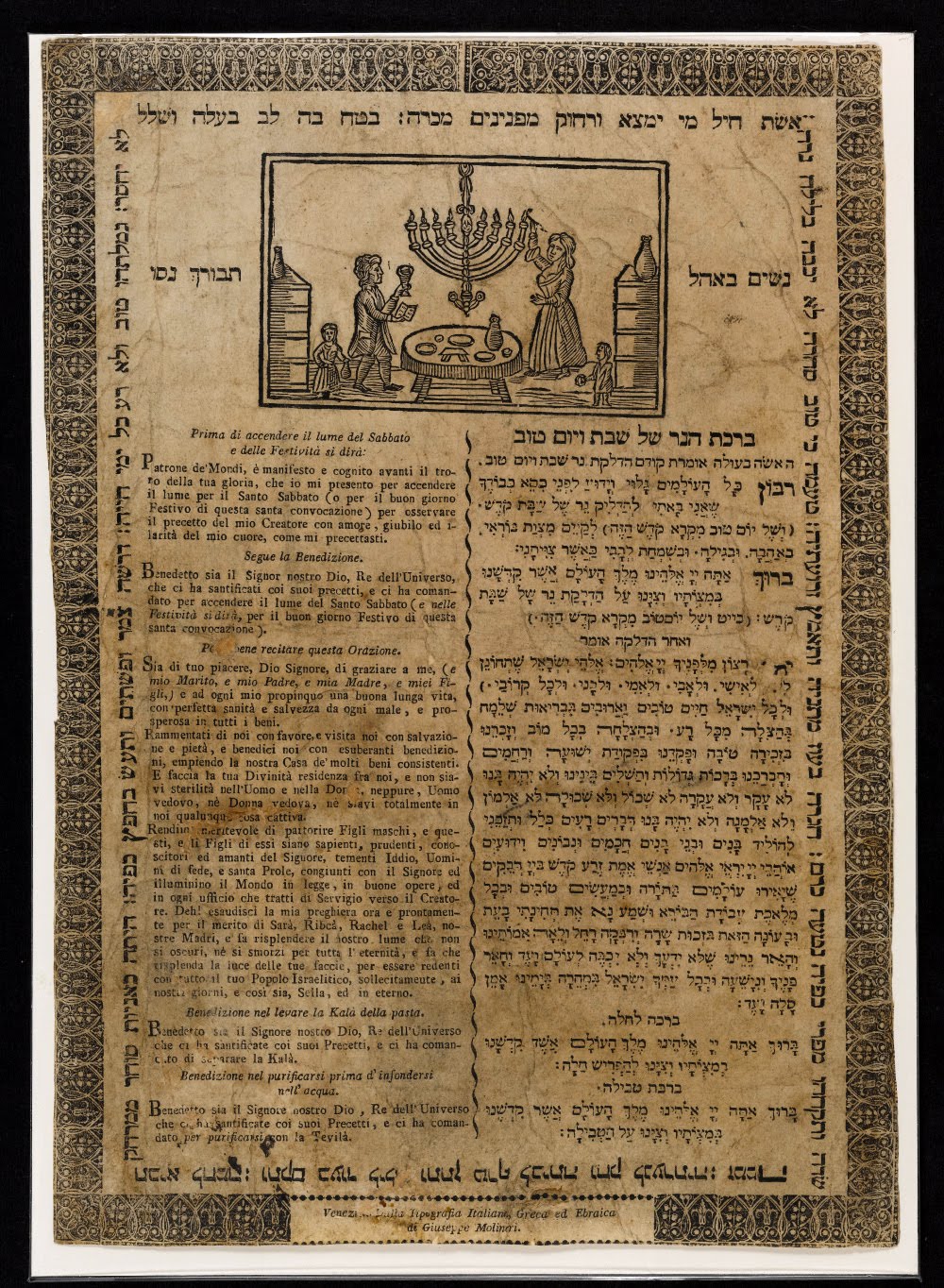
The following broadside from Venice 1835, (reproduced on p. 17), contains the text of the prayers that were customarily recited by women on Friday evening during the candle lighting ceremony.

The illustration depicts a woman lighting eight candles. The Rishonim, including Italian sources, Shibolei Haleket (Siman 59) and Sefer Hatadir (p.196), only require and discuss two candles for Shabbos.[10] The question is when exactly did people start lighting more? The exact time when this began is unknown. However, in the “Shulchan Aruch” from R’ Yehudah Aryeh Modenah (1571-1648) he describes the Italian custom of lighting multiple candles:
והנשים חייבות להדליק בבית נר של שמן ובתוכו לכל הפחות ארבע או שש פתילית להאיר בערב עד עבור חלק גדול מהלילה [עמ’ 54].
Some continued to advance the numbers and in the 19th century, one author records the custom of lighting 31, 45, and 52 candles weekly.
מה מאוד היה מכבד שבת ויום טוב והיה מנהגו להדליק בכל שבת ל”א נרות כמנין אל כי בו שבת אל מכל מלאכתו, ובסוף ימיו מ”ה נרות, ולפני מותו היה מצווה להדליק בשנה ראשונה בחדר שהיה לומד בו נ”ב נרות כל שבת [מה שהעידו על ר’ הירץ אברהם נפתלי שייאר בהקדמת נכד המחבר לפירושו תורי זהב, (על שיר השירים), ירושלים תשס”ג, עמ’ טז].
Corporal Punishment
The following broadside poster for the instruction of children is from Italy 1846 (125):[11]


One striking part of the image is of the teacher hitting children in school. This sort of practice is recorded in a number of Jewish texts.[12]  For example:

A 17th century autobiography recounts that “the new teacher was of an irritable temper… he hit me and put me to shame…”. [Alexander Marx, Studies in Jewish History and Booklore, New York 1944, p. 193].

R’ Yaakov Emden writes in his autobiography:
בשנות הילדות… אזכיר איזה גרגרים, שלשה דברים נוראים שקרו לי בימי ילדותי הרכות. … ומלבד המכות אשר הוכיתי בית מאהבי המלמדים אשר נמסרתי בידיהם ללימוד, היו על פי רוב אכזרים, היכוני בלי חמלה… [מגלת ספר, עמ’ 84].
Saul Berlin writes in his satirical work:
ומתועלת ההכאה עוד, כי הוא צד היתר למלמדים לקבל שכר, כי על הלמוד לבד אסור לקבל שכר, משום קרדום לחתו בו, ואם כן כל מלמד המרבה להכות הרי זה משובח… ועוד רבה התועלת ע”י ההכאה אשר הילדים מכים ולוקים בבית הספר, כי ליראתם את המכות קרבת מוריהם יחפצו וירבו עליהם מוהר ומתן למען חנות אותם, ובהגיע חודש ומועד יפצירו הילדים באבותם לתת להם משאת רב, להביא אל רבם לתתם לו כופר נפשם…”. [כתב יושר, [בתוך: יהודה פרידלנדר, פרקים בסאטירה העברית בשלהי מאה הי”ח בגרמניה, תל אביב תש”ם], עמ’  98].
R’ Yosef Kara writes:
שבהיותי בצוותא חדא אם כבוד ידידי הגאון הצדיק מו”ה שמעון סופר אב”ד דק”ק קראקא… והוא אמר ז”ל כי זה רע חולי שאין חפץ לגדולי לומדי תורה להיות מקרי דרדקי, כי הוא חרפה להם ע”כ מוכרחים אבות הבנים ליתן בניהם הקטנים אל איש אשר לא ידע ספר קרוא מקרא ודקדוק אך ידע להכות הבנים ולזעוק בקול גדול… [קול אמר קרא, פ’ פנחס, עמ’ 20].
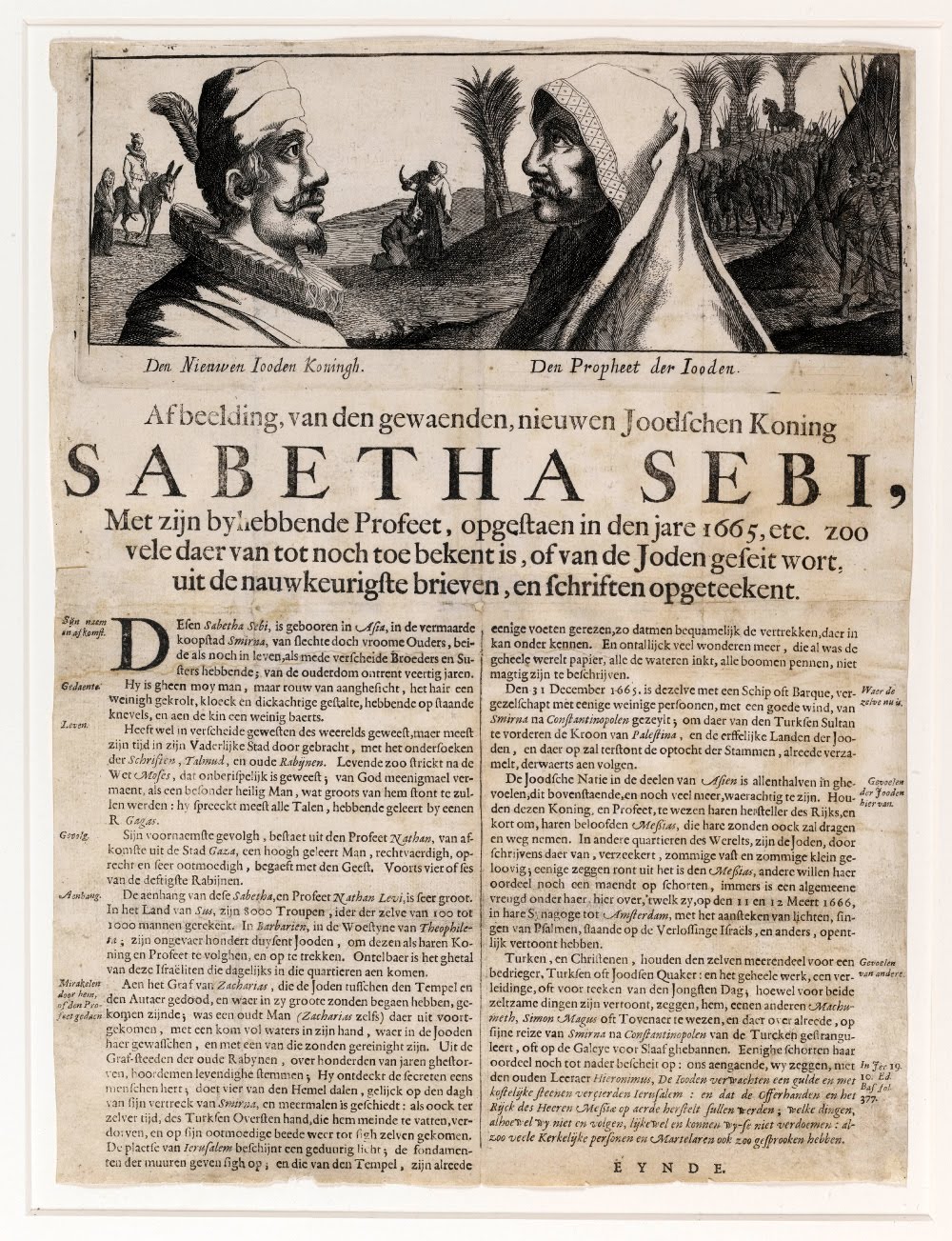
This broadside from Amsterdam 1666 is a little more famous, as it’s a supposed depiction of Shabbetai Tzvi. A complete translation for the Dutch is provided in at the appendix (pp.264-65).

Gershom Scholem writes that this portrait of Tzvi is fictitious – one of a number of imaginary portraits. (Sabbatai Sevi, pp. 190-191, 158). The only picture of Shabbetai Tzvi believed to be authentic (that is, drawn by a witness) is the one found in the beginning of Thomas Coenen’s book Ydele Verwachtinge der Joden, Amsterdam 1669.[13] There might be others as well, but King Jan Casimir ordered all pictures of him to be destroyed (id., p. 597). This one, fortunately, was published.

(This is from Scholem’s personal copy.)

Kabbalistic Tefilos for Rosh Hashanah


This broadside from Mantua 1790, reproduced in the book (p.43), is of interest for several reasons. First, the top part of the broadside has the twenty fourth chapter of Tehilim, said by many Kehilot on Rosh Hashanah as a segulah for Parnasa.[14] In a work written around 1700, recently printed from manuscript, we find the author writes:

אחר ערבית, יש לי תוכחת מגולה ומסותרת אם קצת משכילים, שהנהיגו לקרות בבית הכנסת בציבור אחר עלינו לשבח בלילי ר”ה, מזמור לה’ הארץ ומלואה, ולכוין הנקוד של השם, ככתוב בספר שערי ציון, שהוא מסוגל לפרנסה, שלא יפה הם עושים, כי לא כן צוה הרב המגיד לנו סוד זה, והצנועים נהגו לאמרו בשני הלילות שתי פעמים בכל לילה תכופים זה לזה… והקריאה על שולחנו קודם ברכת מזון… דבר הלמד מענינו, בהצנע לכת עם אלקיך. על כן אמרתי ימים ידברו, להויע ידידי הקורא שדבר בדוק ומנוסה שכל סגולה הנעשית על ידי תפלה בשום כוונה או שם, שאין לך לפרסמו ברבים. ולא לגלותו כי אם לתלמיד הגון ירא חטא ובלחישה, לבל היה מוליך רכיל מגלה סוד, שאז תהיה הפעולה חלושה… [ר’ כליפא בן מלכה, כף נקי, [לוד תשע”ד] עמ’ 167].

The second part of this broadside is also of interest, as it has the tefilos said before, during and after the shofar blowing, including some of the Kabblastic tefilos with names of angels. Of note is what is omitted here, those parts said between the various sets of Shofar blowing, which has been the subject of lots of literature[15], as it includes a very strange phrase, that seemingly evokes Jesus: ישוע שר הפנים””.
Here is an article written on this topic by R’ Shmuel Ashkenazi written in 1944 (!) under one of his pen names:

One more point related to this topic is a case of censorship. R’ Chaim Kraus writes:
 הנה בזכר יהוסף… מתיחס לזה שבדפוסים האחרונים בשו”ת תשובה מאהבה הושמט הענין הנ”ל שכתב בחריפות נגד אמירת היהי רצון שמות המלאכים… [מכלכל חיים בחסד, עמ’ סד].
However, upon checking the sources to see when in the printing of the sefer Teshuvah M’Ahavah this censorship took place, one is hard pressed to find it, as it’s simply not there. The actual issue is a bit different; Kraus misunderstood R’ Yosef Zechariah Stern’s teshuvah.
In an extraordinary teshuvah dealing with these prayers (Zecher Yehosef, Siman 210), R’ Yosef Zechariah Stern mentions a certain case of censorship:
ובתשובה מאהבה ח”א סי’ א שהועתקה תשובתו בדבר הפיוטים ברוב המחזורים.. והמדפיסים להפיס דעת ההמון שהורגלו באמירת היהי רצון שבתקיעות השמיטו מה שהזכיר בסוף התשובה אות ס’ שמרעם בהזכרת שמות המלאכים… וכן השמיטו המדפיסים בהעתקתם מהתשובה מאהבה מה שהעיד מהנודע ביהודה שאחד היה רוצה לברך על אתרוג המהודר שלו וכשראה שאומר היהיה רצון… אמר איני מניחו לברך על אתרוג שלי…
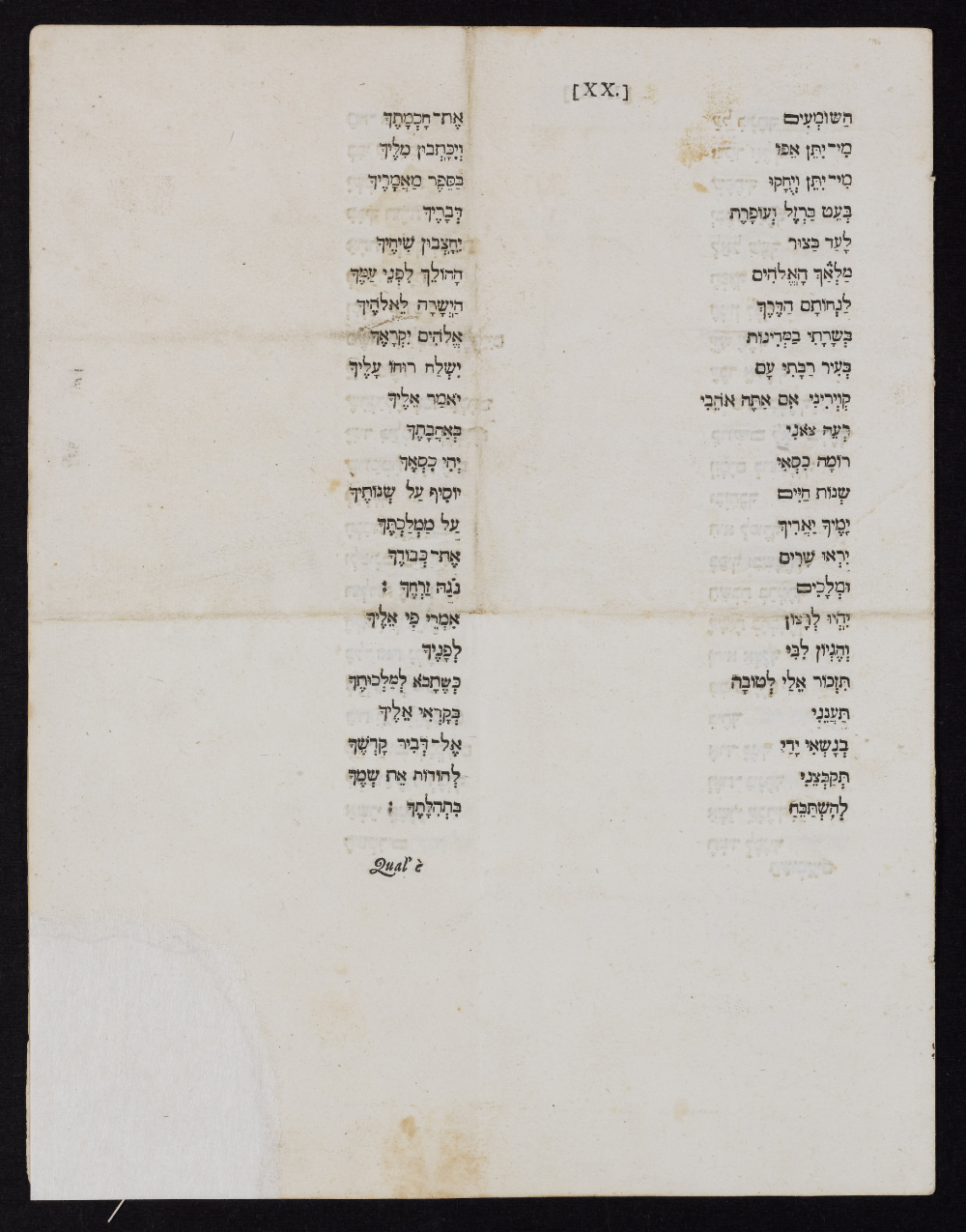
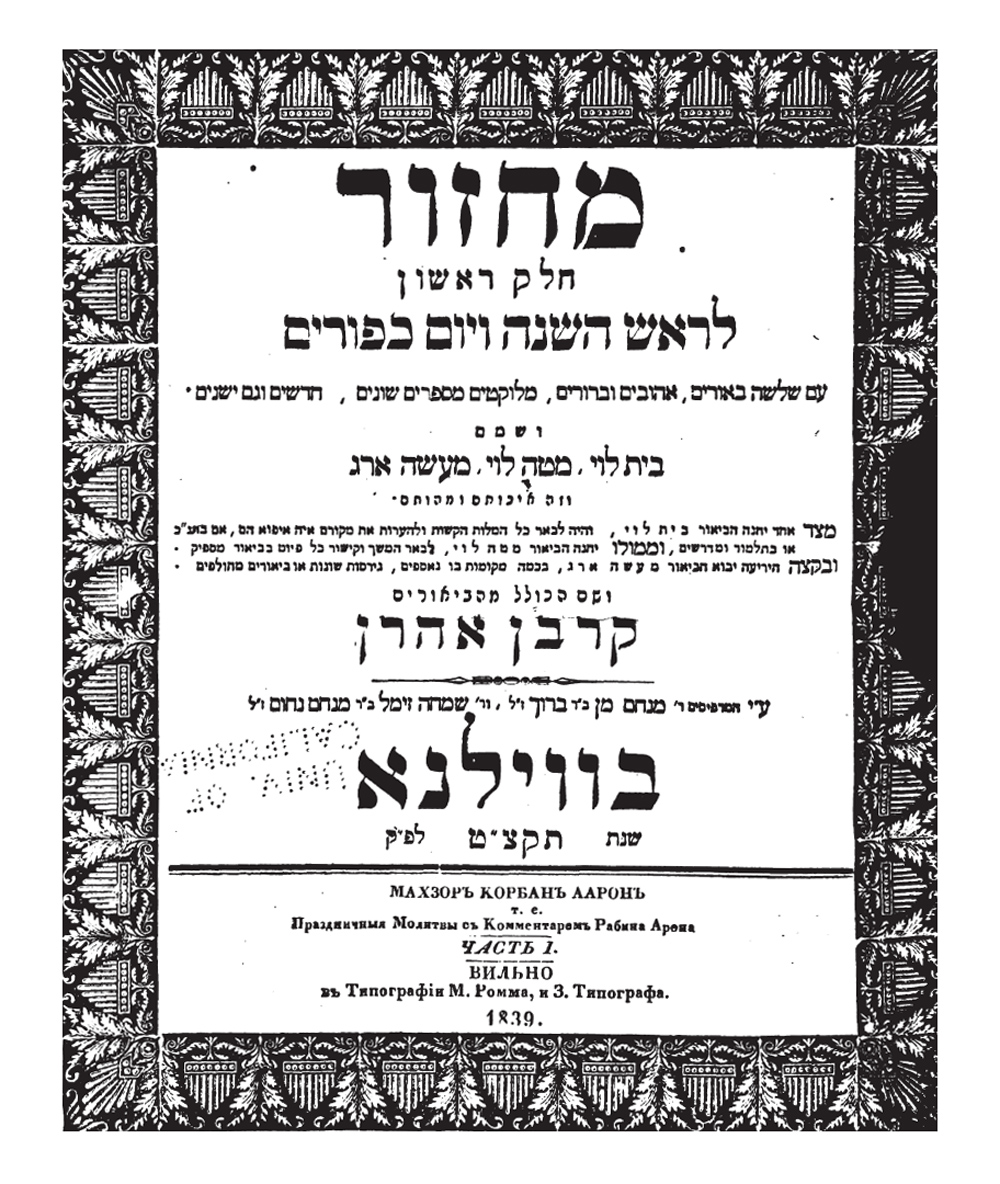
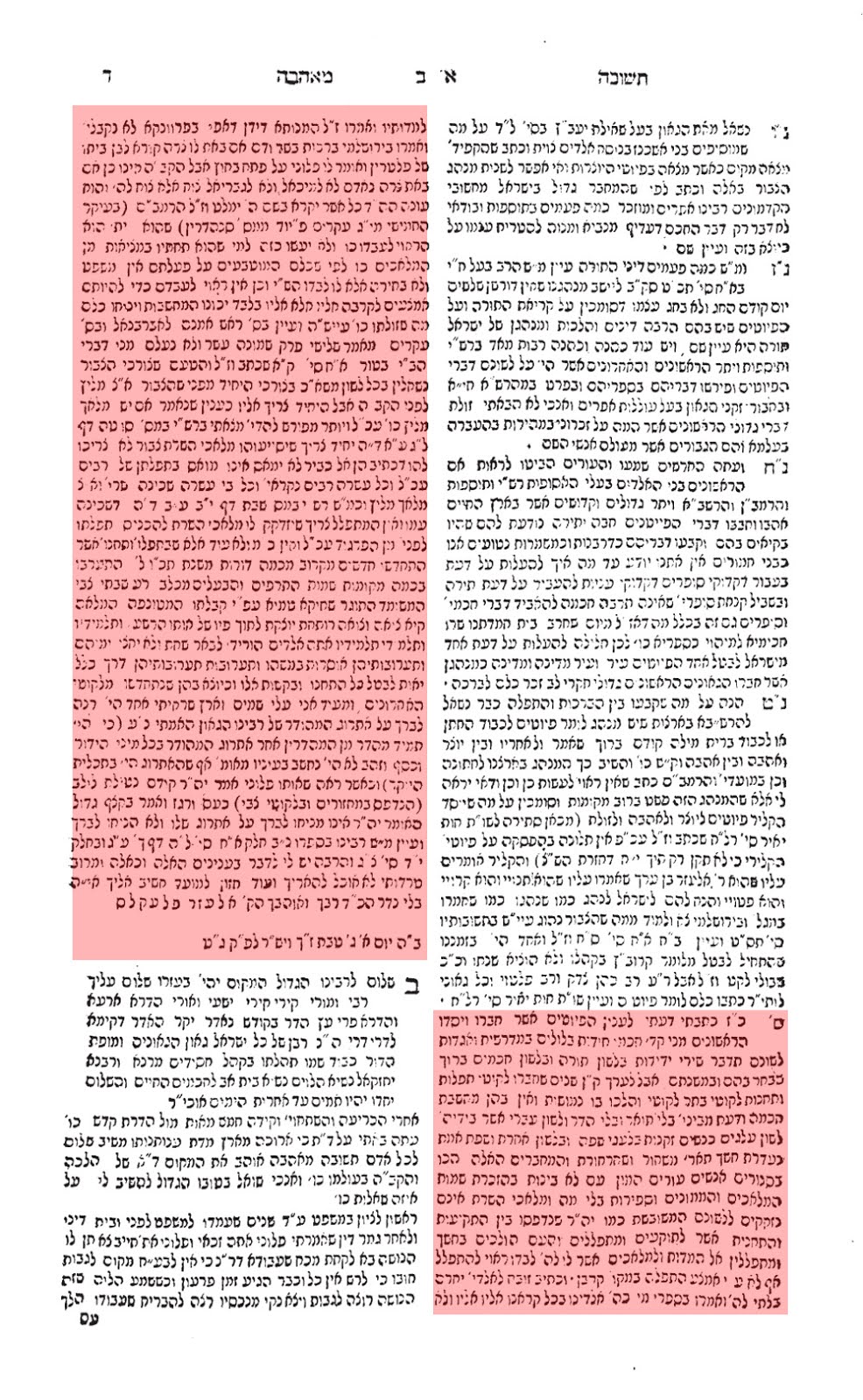
This Teshuvah was printed in various Machzorim at the time and that is where these parts of the teshuva were indeed bowdlerized. See the following images for the pages as they appear in the Korbon Aharon Machazor printed in Vilna in 1839 and compare with the first print of the teshuvah (Prague, 1809).

Amulet Broadsides


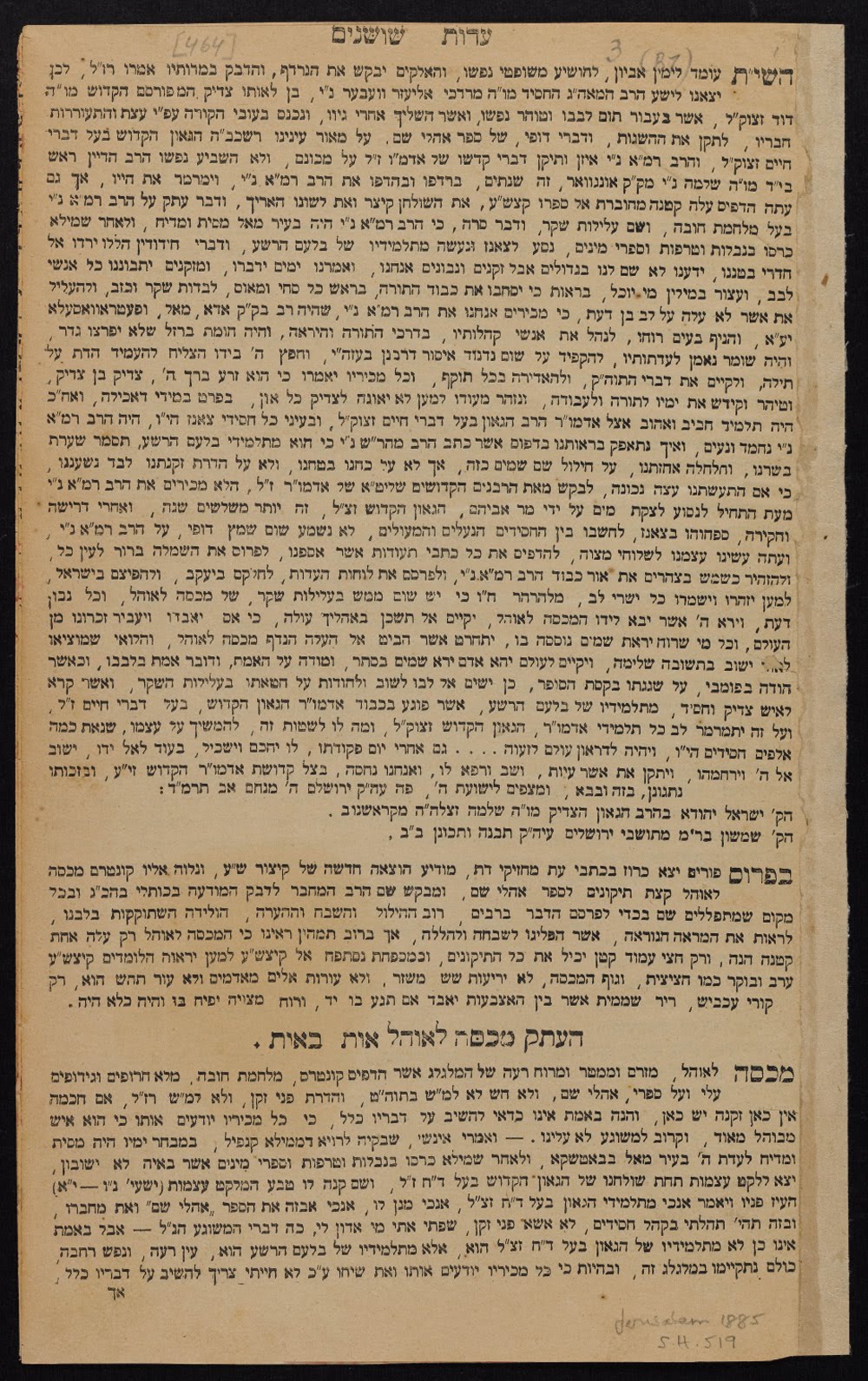
This image from Jerusalem 1870 (pp. 130-131) highlights another notable part of this collection – the Amulet section. It contains numerous broadsides against the “evil eye”, aimed at protecting the newborn mother from Lilith and the like (pp. 132-135, 141-143, 194-197). This is yet an additional set of documents which demonstrate how widespread it was for people to use amulets and the fear of the “evil eye” and the like.
There are numerous sources on regarding amulets, some mentioned here.[16] One source, that was only recently published in English, is from a fascinating memoir by Pauline Wengeroff, who writes: “for the same purpose of protecting the newborn, Jews used to affix kabbalistic prayers called shemaus over the head of the new mother, a second page on the door and a third between the cushion of the child.”[17]
Controversy against R’ Shlomo Ganzfried – Author of Kitzur Shulhan Aruch

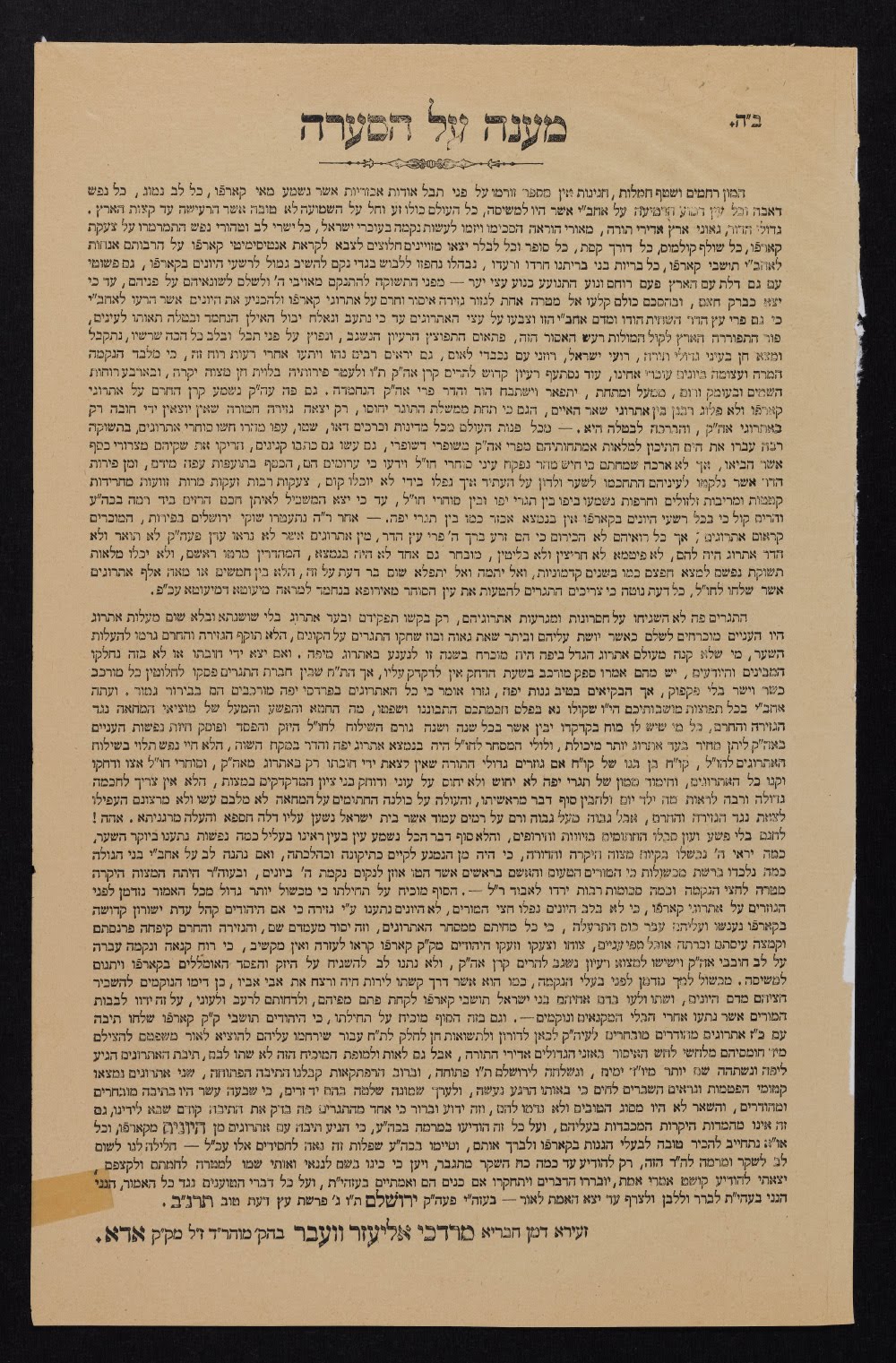
This document relates to a controversy between R’ Shlomo Ganzfried and the R’ Chaim Halberstamm, the Divrei Chaim. In his work Ohali Shem on Gittin, R’ Ganzfried took issue with some legal rulings of the Divrei Chaim. This erupted into a series of small works from R’ Weber, starting in 1882, defending the honor of the Divrei Chaim. R’ Ganzfried responded to one of them in the back of the 1884 edition of his Kitzur Shulchan Aruch.
This broadside (above) from R’ Weber against R’ Ganzfried, found in the Valmadonna Collection, is very rare (p. 217 #360).[18] 
The Valmadonna Collection has another rare broadside from R’ Weber (below), related to the famous controversy of the Corfu Esrogim (p. 219 # 369).[19] This is not included in Naftali Ben Menachem’s otherwise comprehensive article regarding R’ Weber.

Regarding this broadside, it’s worth quoting the great historian[20] and native of the Old Yishuv, Eliezer Malachi:
ור’ מרדכי אליעזר וובר, הרב דאדא, זה האחרון היה אש לוהטת, ובקנאותו לא ידע גבול, עד שבשנת תרנ”א אסרו את אתרוגי קורפו לטובת אתרוגי ארץ ישראל, נלחם הוא להתיר אתרוגי קורפו ולאסור את אתרוגי ארץ ישראל שגדלים בפרדסי המושבות של חובבי ציון [מנגד תראה, עמ’ 225].
The volume is beautifully produced, the reproductions are excellent, and is available in a larger format “coffee table” size. This is a great volume, for collectors of books and history. It is available for purchase here and at the YU Seforim sale here.

[1] The Otzar Ha-Hochma database should be commended for including some auction catalogs in its archive, and even some broadsides, which will provide at least fragmentary information regarding the existence of these invaluable documents.
[2] This essay does not appear in Ta-Shema’s four volume collected writing, it is unclear why it was excluded. 
[3]  For more on this see: Eliezer Brodt, Likutei Eliezer, pp. 11-12.
[4] We discuss two broadsides related to the election of the Vilna chief rabbi between R. Hayyim Ozer and R. Y. Rubenstein (here).The Israel Musuem mounted an exhibit of broadside regarding Haredim.  See Pashkevilim, Wall Announcements and Polemic Posters in the Ultra-Orthodox Street, Israel Museum-Yad Ben Tzvi, Jerusalem: 2005 (Hebrew). This volume contains a number of introductory essays, and germane here, Menachem Friedman’s essay “The Pashqevil (Pasquinade) and Public Wall Poster/Bulletin Board Announcements in  Haredi (Ultra-Orthodox) Society” is especially important, although it is not cited in the Valmadonna volume.
[5] See the lengthier treatment of the topic in her book, Elisheva Carlebach, Jewish Calendar and Culture in Early Modern Europe (Cambridge, Mass.: Belknap Press of Harvard University Press, 2011.
[6]  See also p. 210 # 332.
[7]  On this great person, it is well worth quoting Professor Yaakov Sussman’s assessment in a footnote, in a book-length (175 pp) essay – one of the most important ones written in the past decade on the writing of Torah She-Bal Peh – where writes:

מסה מרשימה ביותר בבקיאותו, בחריפותו, בפלפולו בתקיפותו של המחבר לאורך כמאה עמודים גדושים, שבה סיכם כמעט כל מה שנאמר לפניו בנושא… בתשובה זו מתגלה המחבר כחכם בקי, תמים ובעל חושב ביקורתי כאחת, שכל רז לא אניס ליה, לא בספרות הרבני ולא במחקרי זמנו, והוא מצליח לגייס את ידיעתיו להגצת עמדתו… ואין פלא כלל שתשובה מרשימה זו כבשה במהרה את הלבבות והייתה למילה אחרונה בנושא ודעתו נתקבלה כמעט על כל החוקרים [מחקרי תלמוד, ג, עמ’ 235].
[8]  See Mofas Hador, pp. 37-40. See also Yerushaseinu 5 (2011), pp. 265-299; R’ Betzael Landau (here).
[9] We doubt that the composer was Jewish or the text was intended for a Jewish audience. Instead, similar odes – in Hebrew and the subject is Christian – appear in a number of Latin translations of Hebrew texts. See, for example, Coccejus’ Latin translation and abridgement of tractates Sanhedrin and Makkot, includes Hebrew poems in his own honor and that of his teacher. Duo Tituli Thalmudici Sanhedrin et Maccoth, ed. Joanne [Coccejus], Amsterdam, 1629, unpaginated introduction.
Another notable example of clerical citation is Cardinal Egidius de Viterbo who appears in Elijah Levita’s works.  See Solomon Buber, Tolodot Eliyahu ha-Tishby, Leipzig, 1856, nn. 15-18.
[10]  For more sources on this, see: Rabbi Oberlander, Minhag Avosenu Beyadneu, (Shonot), pp. 11-19; R’ Yechiel Goldhaber, Minhaghei Hakehilot, 1, pp. 174-175; Eliezer Brodt, Yerushaseinu 2 (2008), pp. 203-204; Rabbi Y.M. Dubovick, Minucha Sheleimah (2014), pp.26-27.
[11] The full document is translated in the appendix of the book (pp. 288-290).
[12] For additional sources on this subject, see S. Assaf, Mekorot le-Tolodot ha-Chinuch be-Yisrael, s.v. makot.
[13] Coenen’s book is a very important contemporaneous account of the messianic fervor surrounding Tzvi.  The book was translated from Dutch into Hebrew, Tzepiot Shav shel ha-Yehudim Kefi she-Hetgalu be-Demuto shel Shabbati Tzvi, Merkaz Dinur, Jerusalem, 1998. 
[14]  On this see: R’ Yechiel Goldhaber, Minhaghei Hakehilot, 2, pp. 31-33; Eliezer Brodt, Yerushaseinu 2 (2008), p. 211.
[15]  See R’ Yechiel Goldhaber, Minhaghei Hakehilot, 2, pp.61-65, where he traces how far back the custom of saying these Tefilos can be dated. See also Eliezer Brodt, Yerushaseinu 2 (2008), p. 214. The main work on this subject, collecting vast material, is R’ Chaim Kraus, MiChalkel Chaim Bechesed 2, (1982). See also R’ Zev Rabinowitz, Sharei Toras Bavel, p.12; R’ Chaim Lieberman, Ohel Rochel, 1, pp. 511-515; Y. Leibes, Mechkari Yerushalayim Bimachshevet Yisrael 6 (1986), pp. 171-195.
[16]  See also Eliezer Brodt, Likutei Eliezer, pp. 13-22, 69-72; Jewish Magic through the ages: Angels and Demons, edited by Filip Vukosvoviv, Bible land Museum, Jerusalem 2010.
[17]  Pauline Wengeroff, Memoirs of a Grandmother, 2, 2014, p. 89.
[18] On R’ Ganzfried, see R’ Y. Rubinstein, HaMayan 11:3 (1971), pp. 1-13; ibid. 11:4. pp. 61-78. See also Naftoli Ben Menachem, HaMayan 12 :1 (1972) pp. 39-42.  On this controversy, see R’ Rubenstein, ibid. pp. 10-11. On R’ Weber, see Naftoli Ben Menachem, in: Studies in Jewish bibliography, history, and literature in honor of I. Edward Kiev, Charles Berlin (editor), New York 1971, pp. 13-20. On this broadside, see Shoshanna Halevy, Sifrei Yerushlayim Ha-Rishonim, p. 188. On the other works by R’ Weber related to this issue, see ibid, pp. 156-157, 186-187, 219-220. See also Moshe Carmilly, Sefer VeSayif, pp. 264-265.
For an additional controversy between the Divrei Chaim and R’ Ganzfried see David Assaf, HeTzitz Unifgah, (2012) pp. 362-367.
About R’ Ganzfried and Chasidim, see Heichal HaBesht 3 (2003), pp. 105-117. For more on the Divrei Chaim’s methods of Pesak, see Iris Brown, Rabbi Hayyim Halberstam of Sanz: His Halakhic Ruling in view of his Intellectual world and the challenges of his time, (PHD Bar Ilan University) 2004 (heb.).
[19]  This is the subject of a future article. For now, see R’ Yosef Zechariah Stern, Zecher Yehosef, siman 232.
[20]  About Malachi, see Jacob Kabakoff, “Some Notable Bibliographers I have Known”, Judaica Librarianship, Vol.11 :1-2, (2003), p. 67-75.


Was Professor Saul Lieberman “Orthodox” or “Conservative”? [1]

Was Professor Saul Lieberman “Orthodox” or “Conservative”? [1]
by David Golinkin
Saul Lieberman (1898–1983) is universally regarded by Talmud scholars as the foremost talmudist of his generation, and some regard him as one of the foremost talmudists of all times.
Immanuel Low wrote to him in Hebrew in 1938: “In the depth of your articles there are many sparks of the spirit of the Gaon of Vilna.” E. S. Rosenthal wrote in Hebrew in 1963: “… until we can almost say about him: there was no king like him before him, according to his custom and his method.” Jacob Neusner, who later attacked Lieberman after Lieberman had panned Neusner’s Yerushalmi translation, wrote to Lieberman on December 10, 1981: “I am enjoying Hayerushalmi Kifshuto so much, that I wanted to tell you so…. It reminds me of why I have long ago concluded you are the greatest exegete of rabbinic texts of the twentieth century and among the true greats among the ones I have studied and used—of all times.” Yitzhak Rafael wrote in Hebrew in 1983: “I am not authorized nor do I dare assert that Professor Rabbi Saul Lieberman z”l was the greatest Talmud scholar in recent generations, but it seems that no one would attempt to dispute this assertion.” David Weiss Halivni wrote in 1986: “Professor Lieberman was not only a yahid b’doro, unique in his generation, but a yahid b’dorotav, unique in all generations.” Elijah Schochet wrote in 1988: “Rabbeinu Eliyahu, the Gaon of Vilna, was born on the first day of Pesah, 1720. Rabbeinu Shaul, our own Gaon, was laid to rest on the eve of Pesah, 1983. Between them, there was no other like Saul Lieberman.”[2]
Finally, in 2002, Israel Ta-Shema recounted an amazing story that took place in 1981, in which he asked Professor Lieberman a riddle about the Yerushalmi. Ta-Shema had heard the riddle from Rabbi Shlomo Goren in 1961 and since then had been unable to find the answer. Professor Lieberman spent about three minutes in silence, during which he opened one volume of the Yerushalmi and closed it. Finally he returned to the bookshelf, pulled out Yerushalmi Sotah 2:1, and showed Ta-Shema the correct answer. Lieberman later explained to Ta-Shema that “in my youth, I would have answered immediately that the answer is not in the Yerushalmi at all. But now that I am old, I do not rely on my memory, which is already weakened; and therefore I decided to flip through all the pages of the Yerushalmi in my mind, in order to make certain that it is not found in any place. And when I arrived at chapter 2 of Sotah, I found the place and showed you.” Ta-Shema concluded the story: “I had the merit over the course of the years to be a frequent visitor to the houses of quite a few of the greatest talmidei hakhamim [scholars] of the generation and among the beki’im [those who possess encyclopedic knowledge] in their generation … but [bekiut] of such magnitude I have never seen, not before and not after, and the memory of that Shabbat has not departed from me until today.”[3]
In addition to his amazing memory and breadth of knowledge, Lieberman was one of the most prolific Talmud scholars of all times. He published 225 books and articles, for a total of approximately 11,500 pages—devoted, for the most part, to the explication of rabbinic texts.[4] Finally, he published books and articles related to almost every area of Jewish studies, including Bible, Dead Sea Scrolls, Mishnah, Tosefta, Yerushalmi, Bavli, ancient piyyut, Hellenism, Greek, Latin, and medieval rabbinic literature.[5] Therefore, it is not surprising that over eighty books and articles have been devoted to Lieberman and his œuvre between 1948 and 2008.[6] Indeed, three entire books have been published about Lieberman since 2002.[7]
This essay will respond to the most recent monograph, Marc Shapiro’s Saul Lieberman and the Orthodox.[8] Professor Shapiro has shown in his writings that he is adept at archival research.[9] This monograph is no exception; it quotes and/or publishes at least twenty-five letters related to Lieberman. Indeed, it should be entitled “What the Orthodox Thought of Saul Lieberman,” since it quotes the opinions of Rabbis Yaakov Halevi Herzog, Yitzhak Nissim, Shlomo Goren, Isser Yehuda Unterman, Abraham Isaac Hakohen Kook, Meir Ben-Zion Hai Uziel, Ḥayim Ozer Grodzinsky, Isaiah Karelitz, Pinchas Hirshprung, Meshulam Rathe, Mordechai Gifter, Yehiel Yaakov Weinberg, Yehudah Leib Maimon, Yaakov Yisrael Kanievsky, David Zvi Hillman, Yaakov Kamenetski, Aaron Kotler, Menahem Mendel Kasher, Shlomo Yosef Zevin, Menahem Mendel Shneerson, Ze’ev Wolf Leiter, Samuel Belkin, Yosef Dov Soloveitchik, and She’ar Yashuv Cohen. We are in debt to Marc Shapiro for this very useful anthology based on archival sources.
However, it would appear that Shapiro has missed the mark regarding three critical points: (1) the character of the Jewish Theological Seminary from 1940 and following, (2) Lieberman’s motives for accepting a position at JTS and remaining there, and (3) whether Lieberman consider himself “Orthodox” or “Conservative.” This essay will address these three critical issues in Lieberman’s biography.
The Character of the Jewish Theological Seminary from 1940 and Following

Shapiro’s basic assumption is that Lieberman was “Orthodox” and JTS was “Conservative.” Thus, he writes: “It can be imagined what a shock it was for the Orthodox when in 1940 the internationally renowned Jerusalem illui Saul Lieberman accepted an invitation to join the Seminary faculty.”[10] This assumption about JTS, which repeats itself throughout the monograph, is basically incorrect, for the following nine reasons:
1.   During most of the years that Lieberman taught at JTS (1940–1983), almost all of the Talmud faculty at JTS were “Orthodox” or strictly observant Jews, including Rabbis Alexander Marx, Louis Ginzberg, Louis Finkelstein, Moses Hyamson, Abraham Sofer, Moshe Zucker, H. Z. Dimitrovsky, A. S. Rosenthal, Yehezkel Kutscher, Mordechai Margaliot, Jose Faur, David Weiss Halivni, Dov Zlotnick, Israel Francus, and Shamma Friedman.
2.   During the 1940s and 1950s, most of the students at JTS were observant Jews; a large percentage of them came from Orthodox homes and/or were graduates of Yeshiva College. This point is stressed by Schochet and Spiro in their recent biography of Lieberman, and more importantly, it is stressed by Shapiro himself: Between 1946 and 1957, 60% of JTS rabbinical students came from Orthodox homes and 30% were graduates of Yeshiva College.[11] Similarly, both Rabbi Isaac Klein and my father, Rabbi Noah Golinkin z”l, began their studies at Yeshiva University in the 1930s and then transferred to JTS. Rabbi Klein said that he did so in order to learn the critical methodologies of Professor Louis Ginzberg. Indeed, he received s’mikhah yoreh yoreh yadin yadin from Ginzberg. He certainly was not looking for a more lax halakhic approach.[12]
3.   From 1940 to the late 1950s, the division between Orthodox and Conservative Judaism was not at all clear. Indeed, this was pointed out by Shapiro himself as well as by other scholars, such as Jonathan Sarna.[13]
4.   Beginning in the 1950s, the mehitzah become the main dividing line between Orthodox and Conservative Judaism,[14] but the Seminary synagogue maintained separate seating for men and women from the days of Solomon Schechter until Professor Lieberman passed away in 1983.[15]
5.   During all of the years that Lieberman taught at JTS, the Seminary synagogue did not use any of the siddurim produced by the Rabbinical Assembly and edited by Rabbis Silverman, Hadas, or Harlow. It used, instead, a rather obscure Orthodox prayer book edited by Rabbi A. Th. Philips. Indeed, I was informed by someone who prayed in the Seminary synagogue with Professor Lieberman for nine years that at one point, two of the students told Professor Lieberman that the Philips siddurim were falling apart. They, of course, wanted to replace Philips with a more modern siddur. Professor Lieberman said that he would take care of the problem. He then proceeded to purchase two boxes of brand new Philips siddurim! [16]
6.   From 1940 until 1959, Higher Criticism of the Bible was not taught at JTS.[17] This opposition began way back in the days of Sabato Morais, who headed JTS from 1887 until 1897.[18] Solomon Schechter, who served as president of JTS from 1902 until 1915, called Higher Criticism “Higher Anti-Semitism.”[19] Cyrus Adler, who was president of JTS from 1915 until 1940, was also opposed to Biblical Criticism; in his day, Bible was taught at JTS with medieval Bible commentators.[20] Finally, Louis Finkelstein, who headed JTS from 1940 until 1972, was also opposed to Higher Criticism.[21] In 1944, he asked Lieberman to “gently” tell H. L. Ginsberg to write his article on biblical history in a proposed volume entitled Judaism and the Jews “from an extremely conservative point of view,” so as to “avoid various pitfalls of higher criticism.”[22]
7.   Furthermore, in the 1940s when Lieberman started teaching at JTS, the rabbinical students dressed just like rabbinical students at Yeshiva University.[23]
8.   More importantly, Louis Finkelstein, who together with Louis Ginzberg invited Lieberman to teach at JTS in 1940, saw JTS—as had Solomon Schechter and Cyrus Adler before him[24] —as an institution for k’lal yisrael, the collective Jewish people, and not just of the Conservative Movement. Finkelstein stated in 1941: “If someone calls us traditional, orthodox or conservative, it is he who makes a division in Judaism, not us … I think that the members of the faculty generally prefer the term ‘traditional Judaism’….”[25] After quoting this passage, Schochet and Spiro add: “Finkelstein preferred viewing JTS as an umbrella institution for all traditional Jews, which he hoped would attract to it Orthodox Jews, rather than one reflecting a specific denominational ideology. Finkelstein made no secret of the fact that he hoped that Orthodoxy would eventually find a home at the Seminary. He would therefore counsel his associates, ‘Let’s not be too Conservative; let’s not prevent [Orthodox Jews] from coming.’”[26]
Indeed, Shapiro himself stresses[27] that when Haim Zalman Dimitrovsky came to study with Lieberman at JTS in 1951, he did not even know that JTS had a connection with the Conservative Movement!
9.   Finally, Shapiro himself[28] quotes a letter written by Rabbi Yehiel Yaakov Weinberg in 1948, when he was informed by someone supposedly “in the know” that Finkelstein was interested in him joining the faculty, alongside Ginzberg and Lieberman. Weinberg wrote to his friend Samuel Atlas (in Hebrew): “How could it be possible that they are asking me, when they have two great teachers like L. Ginzberg and Sh. Lieberman?” Weinberg did not say that he could not teach at JTS because it was Conservative or heretical; he simply said that they did not need him, because they already had Ginzberg and Lieberman.
Thus, from 1940 when Lieberman began to teach at JTS, until 1959—and, to a large extent, until 1972, when Louis Finkelstein retired—it was difficult to call JTS a Conservative institution. The faculty and students were mostly Orthodox or traditional; the lines between the movements were not clearly drawn; the Seminary synagogue maintained separate seating and used an Orthodox prayerbook; Higher Criticism was not taught; and the students at JTS even dressed like the students at YU. Louis Finkelstein viewed JTS as an institution for k’lal yisrael and even Rabbi Weinberg had no ideological objections to teaching at JTS.
Thus, there is no basis for Shapiro’s surprise that an “Orthodox” Jew like Lieberman accepted a position teaching at a “Conservative” institution.
Lieberman’s Motives for Leaving Israel, Accepting a Position at JTS, and Remaining There Until the End of His Life

Shapiro says[29] that Lieberman’s main motives were economic security, which he did not have in Jerusalem, and a desire to draw the students at JTS nearer to Torah and Judaism. These points are undoubtedly true, but I believe that there are at least six reasons why Lieberman left Israel, came to JTS, and stayed there for forty-three years:
1.   Saul Lieberman could not earn a living in Jerusalem. This is what Rabbi Meir Bar-Ilan, Lieberman’s father-in-law, told Rabbi Aaron Pechenik and others,[30] and this was the reason that Lieberman later gave Pechenik for remaining there.[31] Indeed, while in Israel (1927–1940), Lieberman worked as a clerk at the Tel-Aviv Chamber of Commerce, as a teacher in Herzlia, as a part-time lecturer at the Mizrahi Teachers Institute.[32] as a secretary at Yeshivat Shaar Hashamayim, as a Talmud teacher at Hebrew University (from 1932–1937, a position from which he was fired and only received severance pay a year later),[33] and as Dean of the Harry Fischel Institute for Talmudic Research.[34]
2.   Shapiro also says that Lieberman wanted to draw the students at JTS closer to Torah and Judaism,[35] as indicated by his brother Meir, by Pnina Herzog, and in a letter to Gershom Scholem from 1941. Furthermore, Lieberman himself said this in a Hebrew letter to Hapardes in 1945, which Shapiro published in 2003. There he says: “Young Jewish men are innocent (t’mimim) and there is nothing that will influence them more than the light of Torah planted by a teacher who believes in the holiness of the Torah.”36] 
3.   At Hebrew University, Lieberman’s Talmud course in the 1930s shrank from six to two students, he was fired, and Hebrew University refused to award him a Ph.D. for Talmuda Shel Kisrin or Tosefet Rishonim.[37] The Harry Fischel Institute, which Lieberman headed for five years, was not an academic institution. Indeed, Lieberman himself spelled out in 1937 the requirements for Talmud scholarship; the students at Harry Fischel did not possess many of those qualifications.[38] In other words, at Hebrew University he had scholars to talk to but no job, while at Harry Fischel he had a job but no one to talk to. Thus, in 1940, JTS was the only serious academic center of Jewish studies in the world, as Lieberman himself wrote to Louis Ginzberg in Hebrew on April 30, 1940: “And I also hope that I could bring benefit to your Bet Midrash, which is now the only scientific institution [i.e., of Jewish studies] in our world.”[39]
4.   In 1940, and for most of the years that Lieberman taught there, JTS had the best Jewish library in the world, with a large collection of manuscripts and Genizah fragments.[40] Schochet and Spiro relate that Seminary librarian, Nahum Sarna, advised Menahem Schmelzer, his successor, to open the Rare Book Room at any time so that Lieberman could consult the thirteenth-century manuscript of the Mishneh Torah, which was placed on a table there especially for his use.[41] 
5.   Lieberman had a very warm relationship with Louis Ginzberg of JTS.[42] They met in 1929 when Ginzberg served as visiting lecturer at Hebrew University and Ginzberg asked Lieberman to prepare for publication Ginzberg’s lecture, “The Significance of Halakhah for Jewish History.” They then corresponded from 1930 to 1940. Louis Finkelstein explicitly praised Ginzberg for his indefatigable efforts to persuade Lieberman to come to JTS. This special relationship is evident from a Hebrew letter from Lieberman to Ginzberg from 1940.[43]
6.   Finally, Lieberman had an incredibly close relationship with Louis Finkelstein, who gave Lieberman whatever he needed and treated him like a king. Their relationship has been dealt with at length by Schochet and Spiro.[44] A few examples will suffice: Rabbi Bernard Mandelbaum, long-time Vice President of JTS, said: “Finkelstein gave Lieberman whatever he needed.”[45] Lieberman said as much in his Hebrew introduction to Hilkhot Hayerushalmi in 1947: “And last but not least is my friend, Rabbi E. A. Finkelstein, the President of our Bet Midrash, who provides me with special conditions for Talmud Torah and work with all possible convenience.”[46]
But their relationship went way beyond one of providing scholarly needs. Finkelstein viewed Lieberman as the most important Talmud scholar in the world and he told him so, both privately and publicly, on a regular basis. He referred to Lieberman’s arrival in the United States as “a historic one in the development of American Judaism … Even if the Seminary across the years had done nothing else than lay the foundation for such a work [=Tosefta Kifshutah on Zera’im], the institution would have justified itself.”[47] Finkelstein further stated that “Professor Lieberman does not exist for the Seminary; the Seminary exists for Professor Lieberman.” Faculty member Professor Judah Goldin once said, “Finkelstein believed in God and worshipped Lieberman.”[48] 
On December 1, 1959, Finkelstein informed Lieberman that he would become Rector of JTS, with all the powers and no administrative responsibilities: “It seems obvious to me that with your increasing preoccupation with the Tosefta Kifshutah (which …will turn out to be probably the most significant single accomplishment of the Seminary) …”[49] In a letter to Edward B. Lawson, American Ambassador to Israel, in 1955, Finkelstein introduced Lieberman as “Professor of Talmud in the Seminary and one of the most learned men in the world.”[50] Finally, when Finkelstein got Lieberman involved in the agunah dilemma in 1953, he introduced the Lieberman ketubah at the Rabbinical Assembly Convention in hyperbolic terms and compared it to the accomplishments of the tannaim.[51]
Thus, it appears that Lieberman came to JTS and stayed there for six reasons: because he could not earn a living in Jerusalem; in order to draw the students closer to Torah and Judaism; because JTS was the only scientific institution of Jewish studies in the world; because JTS had the best Jewish studies library in the world, to which he had open access at all times; because of his warm relationship with Louis Ginzberg between 1929 and 1953; and because of his unique relationship with Louis Finkelstein from the 1930s until 1983.
Did Lieberman Consider Himself “Orthodox” or “Conservative”?

Shapiro claims that Lieberman “regarded himself as an Orthodox Jew”[52] and he faults me[53] for categorizing Lieberman as a Conservative rabbi,[54] but he himself writes: 
In 1959, Lieberman became rector of the Seminary, and one of his responsibilities was “guarding the general religious policy of the institution.” Thus, there is certainly justice in the assertion that whatever his personal religious commitments, Lieberman had become part and parcel of the Conservative Movement and was assisting it at the time that the Orthodox were attempting to expose what they regarded as the Conservatives’ distortion of halakhah.[55]
Shapiro’s confusion is well-justified; I myself have debated whether Lieberman considered himself Orthodox or Conservative.[56]
On the one hand, he taught at the only Conservative rabbinical seminary from 1940 until 1983, and he served as its rector from 1959 until 1983. When he proposed his takkanah regarding the ketubah to the Conservative Rabbinical Assembly in 1953, he attacked “the Orthodox rabbis”:
I saw that some of you were accused of being frightened by the Orthodox rabbis. I want to tell you that I am not frightened by them at all. I want, therefore, to give you a point of information. In truth, they were frightened, and I want you to know why they were frightened. They weren’t afraid that the Bet Din would issue some takkanot. No, not at all. They were afraid that the Bet Din will issue takkanot in accordance with the law.
As a matter of fact, one of the very important members of the Orthodox rabbis said so in many words: If this Bet Din of the Rabbinical Assembly will issue atakkanah, that will be takkanato kalkalato. It will be a great misfortune because they will get authority and that is the reason why they oppose this. Many of them think that [if] that Bet Din will begin to move in this line, the movement can become strong and it will affect them.[57] 
When, during the negotiations about a Joint Bet Din, the Orthodox insisted that the RA sanction rabbis who perform a wedding even without aget, “Lieberman’s spontaneous response was that the Conservative Jews do not like inquisitions …”[58] He also wrote a letter that enabled Rabbi Theodore Friedman, a leading Conservative rabbi, to receive permission to perform weddings in Jerusalem, and another letter to Chief Rabbi Unterman in 1964, which defended the gittin performed by Rabbi Israel Silverman and other Conservative rabbis.[59]
On the other hand, Schochet and Spiro cite an undated interview in the Jerusalem Post in which “Lieberman explicitly stated that he himself was not a Conservative Jew; however, he praised Conservative Jews for their sincerity and their success in appealing to young people.”[60] Furthermore, in 1974, the Israeli daily Maariv published an article claiming that Golda Meir had asked Lieberman to influence the Conservative Movement to accept a compromise on the “Who Is a Jew” issue. Lieberman was described there as “one of the leaders of the Conservative Movement and as the Vice-President of the Jewish Theological Seminary in New York.” Lieberman wrote an indignant letter to the editor in Hebrew in which he denied the whole story and in which he said:
I am not one of the heads of the Conservative Movement and I am not, nor have I ever been, the Vice President of the [Jewish] Theological Seminary. I teach Torah to the Jewish people and I don’t understand much about politics.[61]
Finally, when a group of Seminary professors, graduates, and students held a “Conference on Halakhic Process” in 1979 in order to urge JTS not to ordain women, Lieberman wrote a letter to the Conference praising them for deciding to discuss “how to guard the last spark of the halakhah, that it should not be extinguished.”[62]
There are three possible ways to interpret this contradictory data. The first approach is followed by Hillel Goldberg, who, in a nasty review of Schochet and Spiro’s biography, would have us believe that Lieberman was Orthodox and taught and stayed at JTS simply because it was a cushy job which allowed him to do his research.[63] This approach contradicts everything we know about Lieberman’s piety and integrity, and barely merits a response. The second approach is put forth by Marc Shapiro, who maintains throughout his monograph that Lieberman was “Orthodox.” When he defended Conservative rabbis during the attempts to set up a joint Bet Din, “Lieberman was only reflecting on the mindset of the Conservative rabbinate, not describing his own feelings.”[64]
There is, however, a third way to interpret the data. I agree with Shapiro that Lieberman did not consider himself “Conservative.” However, neither did he consider himself “Orthodox.” An “Orthodox” Jew would not have spoken about Orthodox rabbis in the third person and in such a critical tone as Lieberman used in the 1950s. Furthermore, neither Shapiro nor Schochet and Spiro adduce even one text in which Lieberman himself calls himself “Orthodox.” Shapiro[65] simply refers to Schochet and Spiro.[66] but the latter offer no such proof. They quote Rabbi Berel Wein, who said that Lieberman “was personally an observant Jew.” They quote Rabbi Emanuel Rackman who said that Lieberman was “a Jew whose Orthodoxy was beyond question.” They themselves say: “These citations from prominent Orthodox rabbis reflect the common perception that Saul Lieberman was indeed ‘Orthodox’ in his religious practices” (emphasis added). They then cite numerous instances of “his firm adherence to halakhic practice and accepted custom.” They later quote someone who said that Lieberman “stressed that he wanted to be known as ‘Orthodox’ (note 266), but Lieberman himself never wrote such a thing.”
Furthermore, Shapiro mistranslates a key passage in Lieberman’s important Hebrew letter to Hapardes from 1945, which Shapiro himself published in 2003. Shapiro writes:
In his letter, Lieberman states that at the Seminary he is permitted to teach what he wishes. He also mentions that if another two or three Orthodox teachers joined the faculty (italics added), they could turn it into a wonderful place.[67]
However, that is not what Lieberman wrote. He wrote:
זהו מוסד חשוב שלו היו נכנסים לשם עוד שנים שלשה מורים משלומי אמוני ישראל היו מהפכים אותו לבית ספר למופת
This is an important institution. If two or three teachers “who seek the welfare of the faithful in Israel” [cf. II Samuel 20:19] would enter it, they would turn it into an exemplary school.[68]
Similarly, in his 1964 letter to Rabbi Unterman defending the gittin of Rabbi Israel Silverman.[69] he states that “Rabbi Silverman, when he was my student, observed Torah and mitzvot as is fitting.”
היה שומר תורה ומצוות כראוי וכיאות
He goes on to say
that it is essential to arrange matters related to gittin in America, and if there is good will on all sides, it is possible to arrive at a mutual agreement. Otherwise, I am afraid that chaos will take over this profession too and we will come to a similar situation to giving a hekhsher to a treif kitchen in an Israeli boat. And behold this hekhsher was not given by the Conservatives (who rejected the offer with disgust), but by an irresponsible group which calls itself Orthodox, and this group also performs gittin!
The picture that emerges from Lieberman’s letter to Hapardes in 1945, from his attempt to set up a joint Bet Din in 1953, and from his letter about gittin in 1964, is that Lieberman meant exactly what he said in his letter to Maariv in 1974: “I teach Torah to the Jewish people and I don’t care much about politics—that is: I am neither ‘Orthodox’ nor ‘Conservative.’ There are “Conservative” rabbis who are halakhic and there are ‘Orthodox’ rabbis who are not. I care that the teachers at JTS should be sh’lomei emunei yisrael and that the students and graduates should beshomrei torah u-mitzvot ka-rauy v’khayaut.” Lieberman did not care about labels but rather about substance, and in this he was a true disciple of Rabbi Judah the Prince who said: Al tistakkeil ba-kankan, ella b’mah she-yeish bo—do not look at the vessel, but rather at its substance.[70] 
Notes

[1] This article is based on a lecture given in Hebrew in Jerusalem on Professor Lieberman’s 30th Yahrzeit, 9 Nisan 5773 (2013). It originally appeared in Conservative Judaism 65 (Summer 2014), pp. 13-29, published here with the permission of The Rabbinical Assembly.
[2] The first quotation is from Elijah J. Schochet and Solomon Spiro, Saul Lieberman: The Man and His Work (New York: Jewish Theological Seminary, 2005), p. 303 (and cf. pp. 53, 139). The other quotations are from David Golinkin, “The Influence of Seminary Professors on Halakhah in the Conservative Movement, 1902–1968,” in Jack Wertheimer, ed., Tradition Renewed: A History of the Jewish Theological Seminary, vol. 2 (New York: Jewish Theological Seminary, 1997), p. 473, n. 36. For Lieberman’s attack on Neusner’s translation of the Yerushalmi, see Journal of the American Oriental Society 104:2 (April–June 1984), pp. 315–319. For Neusner’s counterattacks against Lieberman, see History and Theory 27:3 (1988), pp. 241–260 = Jacob Neusner, Wrong Ways and Right Ways in the Study of Formative Judaism (Atlanta: Scholars Press, 1988), pp. 3–27; and idem, Why There Never Was a Talmud of Caesarea: Saul Lieberman’s Mistakes (Atlanta: Scholars Press, 1994).
[3] Ta-Shema in Meir Lubetski, ed., Saul Lieberman (1898–1983): Talmudic Scholar and Classicist (Lewiston, Queenston, Lampeter: The Edwin Mellen Press, 2002), pp. 88-90 = Israel Ta-Shema, Knesset Mehkarim, vol. 4 (Jerusalem: 2010), pp. 337–339 (Hebrew). See Shamma Friedman in Lubetski, pp. 91–95, for an explanation of the riddle.
[4] A. S. Rosenthal wrote in Proceedings of the American Academy for Jewish Research 31 (1963), Hebrew section, p. 1, that Lieberman wrote 10,000 pages. A careful count of Tuvia Preschel’s 1993 bibliography of Lieberman in Shamma Friedman, ed., Sefer Hazikaron L’rabbi Shaul Lieberman (New York and Jerusalem: Jewish Theological Seminary, 1993), pp. 1–28, adds up to approximately 11,500 pages.
[5] See Preschel’s bibliography (above, n. 4) as well as the essays in the Lubetski volume.
[6] See Golinkin, pp. 472–473, n. 35, for a listing of thirty items and Elinor Grinet, “A Bibliography About Saul Lieberman: The Man and His Work,” in Lubetski, pp. 91–96, for seventy-seven items (some of them overlap). More recent works include: Aviad Hacohen, Madda’ei Ha-yahadut 42 (5763–64), pp. 289–301; a letter from Lieberman to the editor of Hapardes from 1945, published by Marc Shapiro in Kitvei Ha-Gaon Rabbi Yehiel Yaakov Weinberg, vol. 2 (Scranton: University of Scranton Press, 2003), pp. 449–450; review of new edition of Hayerushalmi Kif-shuto edited by Menahem Katz (New York and Jerusalem, 2008), by Yehoshua Schwartz in Makor Rishon Hatzofeh,April 11, 2008, pp. 10, 13; Naomi G. Cohen, “In Memoriam: Chana Safrai (1946–2008), Friend and Colleague,” in Nashim 15 (Spring 5768/2008), pp. 198, 201. For reactions to Schochet and Spiro’s book, see: Hillel Goldberg, Tradition 40:3 (Fall 2007), pp. 69–75; Aaron Rakefet, Tradition 40:4 (Winter 2007), pp. 68–74; and Bernard Septimus and David Horwitz, Tradition 41:1 (Spring 2008), pp. 114–115.
[7] The books are Lubetski (n. 3 above), Schochet and Spiro (n. 1 above), and Shapiro (n. 8 below).
[8] Marc B. Shapiro, Saul Lieberman and the Orthodox (Scranton: University of Scranton Press, 2006).
[9] See, for example, his book Between the Yeshiva World and Modern Orthodoxy: The Life and Works of Rabbi Jehiel Jacob Weinberg, 1884–1966 (London and Portland: Littman Library of Jewish Civilization, 1999); Kitvei Ha-gaon Rabbi Yehiel Yaakov Weinberg, 2 vols (Scranton: University of Scranton Press 1998 and 2003); and “Scholars and Friends: Rabbi Jehiel Jacob Weinberg and Professor Samuel Atlas,” in The Torah Umadda Journal 7 (1997), pp. 105–121.
[10] Shapiro, p. 16.
[11] Schochet and Spiro, p. 22, and Shapiro, p. 16. Both base themselves on Jeffrey S. Gurock, “Yeshiva Students at the Jewish Theological Seminary,” in Wertheimer (n. 2 above), vol. 1, p. 473.
[12] Regarding Rabbi Isaac Klein, see what I wrote in my introduction to his Responsa and Halakhic Studies, second revised and expanded edition (Jerusalem: Schechter Institute of Jewish Studies, 2005), p. xii.
[13] Shapiro, pp. 14–15; Jonathan Sarna, American Judaism: A History (New Haven and London:Yale University Press, 2004), pp. 237ff. Shapiro, pp.14–15.
[14] See my book The Status of Women in Jewish Law: Responsa (Jerusalem: Schechter Institute of Jewish Studies, 2012), pp. 14–15, and n. 27; p. 31, n.3; pp. 308–340.
[15] See JTS Semi-Centennial Volume (New York: Jewish Theological Seminary, 1939), p. 59; Jonathan Sarna, “The Debate Over Mixed Seating in the American Synagogue,” in Jack Wertheimer, ed. The American Synagogue: A Sanctuary Transformed (Cambridge: Cambridge University Press, 1987), pp. 379–380; David Golinkin, ed., The Responsa of Prof. Louis Ginzberg (New York and Jerusalem: Jewish Theological Seminary, 1996), pp. 85–100; Wertheimer, vol. 1, p. 395, Harvey E. Goldberg, “Becoming History: Perspectives on the Seminary Faculty at Mid-Century”, Schochet and Spiro, p. 22.
[16] Personal communication from Dr. Baruch Schwartz, April 13, 2008. The siddur was entitled Daily Prayers with a Revised English Translation (New York: Hebrew Publishing Co., 1914), and reprints.
[17] David Ellenson and Lee Bycel, “A Seminary of Sacred Learning: The JTS Rabbinical Curriculum in Historical Perspective,” Wertheimer, vol. 2, p. 559.
[18] Ibid., pp. 536, 656.
[19] Solomon Schechter, Seminary Addresses and Other Papers (New York: The Burning Bush Press, 1959), pp. 35–39 and cf. pp. 1–7.
[20] David Ellenson and Lee Bycel, “A Seminary of Sacred Learning: The JTS Rabbinical Curriculum in Historical Perspective,” Wertheimer, vol. 2, p. 546.
[21] JTS Semi-Centennial Volume, p. 25.
[22] Schochet and Spiro, p. 29.
[23] Compare the pictures in Jeffrey Gurock, The Men and Women of Yeshiva (New York: Columbia University Press, 1988), after p. 120; to the pictures in Baila R. Shargel, “The Texture of Seminary Life During the Finkelstein Era,” Wertheimer, vol. 1, pp. 527, 535.
[24] Regarding Schechter, see Mel Scult, “Schechter’s Seminary,” in Wertheimer, vol. 1, pp. 58–59; Michael Panitz in Robert Fierstien and Jonathan Waxman, eds., Solomon Schechter in America: A Centennial Tribute (New York: The Joint Convention Committee, 2002), p. 14; and Solomon Schechter, Seminary Addresses and Other Papers, pp. 48–49. Regarding Adler, see Schochet and Spiro, p. 17, which is based on Mel Scult (in Wertheimer, vol. 1), pp. 85–88.
[25] Schochet and Spiro, pp. 21–22.
[26] Ibid., p. 22. Regarding Finkelstein’s desire for JTS to serve all denominations, see Michael B. Greenbaum, “The Finkelstein Era,” in Wertheimer, vol. 1, pp. 163ff.; Jack Wertheimer, “JTS and the Conservative Movement,” in Wertheimer, vol. 2, pp. 419–420; and Michael B. Greenbaum, Louis Finkelstein and the Conservative Movement: Conflict and Growth (Binghamton: Global Publications, 2001), pp. 48, 60–67. Ibid., p.22.
[27] Shapiro, p. 48.
[28] Ibid., p. 9, n. 30.
[29] Shapiro, pp. 17–18.
[30] Ibid., p. 17.
[31] Ibid.
[32] See Saul Lieberman, Mehkarim B’torat Eretz Yisrael, ed. David Rosenthal (Jerusalem: Magnes, 1991), pp. 601–602, for a beautiful vignette from that period of time.
[33] Schochet and Spiro, pp. 8–10.
[34] Ibid., pp. 10–11.
[35] Shapiro, p. 18.
[36] Shapiro, Kitvei Ha-gaon Rabbi Yehiel Yaakov Weinberg, vol. 2 (Scranton: University of Scranton Press, 2003), p. 449.
[37] Schochet and Spiro, pp. 9–10.
[38] Ibid., pp. 10–11; and cf. Lieberman’s English introduction to Harry Fischel Institute Publications, Section III, Rishonim, vol. 1 (Jerusalem: Harry Fischel Institute Press, 1937), pp. vi-viii, where he spells out the qualities necessary to do scientific talmudic research. My thanks to Professor Shamma Friedman, who called my attention to this passage a number of years ago. Cf. Preschel (n. 4 above), who lists this article in item 36 even though the Hebrew and English introductions to that volume are totally different. Ibid., pp.10–11.
[39] Shapiro, Hebrew side, p. 17, also quoted in the English side, n. 64.
[40] Regarding the Seminary library, see Alexander Marx in The JTS Semi-Centennial Volume, pp. 87–120; Menahem Schmelzer, ed., Alexander Marx, Bibliographical Studies and Notes, (New York: Jewish Theological Seminary and Ktav, 1977); Herman Dicker, Of Learning and Libraries: The Seminary Library at One Hundred (New York: Jewish Theological Seminary, 1988); and Menahem Schmelzer, “Building a Great Judaica Library—At What Price?” in Wertheimer, vol. 1, pp. 678–715.
[41] Schochet and Spiro, p. 16.
[42] Ibid., pp. 9, 18–20.
[43] Shapiro, Hebrew section, pp. 17–18.
[44] Schochet and Spiro, pp. 23–39.
[45] Ibid., p. 16.
[46] Saul Lieberman, Hilkhot Hayerushalmi L’harambam (New York: Jewish Theological Seminary, 1947), p. 3
[47] Schochet and Spiro, p. 24.
[48] Both quotations are from Schochet and Spiro, p. 26.
[49] Ibid., p. 37.
[50] Ibid., p. 40.
[51] David Golinkin, ed., Proceedings of the Committee on Jewish Law and Standards of the Conservative Movement 1927–1970 (New York and Jerusalem: The Rabbinical Assembly and the Institute of Applied Halakhah [of the Schechter Institute], 1997), vol. 2, pp. 825–829.
[52] Shapiro, p. 26.
[53] Ibid., p.20, n. 72
[54] Golinkin, Proceedings, vol. 1, p. v.
[55] Ibid., p. 24.
[56] Golinkin, “Influence,” pp. 451–452. Golinkin, “Influence,”pp.451–452.
[57] Shapiro, pp. 26–27 = Proceedings of the Rabbinical Assembly 17 (1953), pp. 75–76 = Golinkin, Proceedings, vol. 2, pp. 810–811.
[58] Rabbi Wolfe Kelman, unpublished letter to Sheldon Engelmayer, May 14, 1987. I received a copy from Professor Jack Wertheimer and I gave a copy to Marc Shapiro, who quotes from the letter in his monograph, p. 20.
[59] Golinkin, “Influence,” p. 452, n. 55. Shapiro published the second letter on the Hebrew side of his book, pp. 33–34.
[60] Schochet and Spiro, p. 99, end of n. 163.
[61] I quoted this letter in Golinkin, “Influence,” p. 452. Shapiro published the entire letter in Shapiro, Hebrew side, pp. 35–36 and discusses it on the English side, p. 20, n. 72.
[62] Shapiro, Hebrew side, p. 40.
[63] See above, n. 5.
[64] Shapiro, p. 20, n. 72.
[65] Ibid.
[66] Schochet and Spiro, pp. 66 ff., 99 n. 163.
[67] Shapiro, p. 22.
[68] Shapiro, Kitvei Ha-gaon Rabbi Yehiel Yaakov Weinberg, vol. 2 (Scranton: University of Scranton Press, 2003), pp. 449.
[69] Shapiro, Hebrew section, pp. 33-34
[70] Pirkei Avot 4:20.


What is Bothering the Aruch Hashulchan? Women Wearing Tefillin

What is Bothering the Aruch
Hashulchan
?
Women Wearing Tefillin
Michael J. Broyde
mbroyde@emory.edu
Please note that this piece isn’t meant to be construed one way or another as the view of the Seforim Blog.
Introduction
In our previous article,[1]
we focused on the view of the Mishnah Berurah concerning women wearing
tefillin.  In this article, we focus on
the Aruch Hashulchan, whose approach is also complex, reflecting the complexity
of the area.
The Aruch Hashulchan (OC 38:6) states:
נשים ועבדים פטורים מתפילין מפני שהיא מצות עשה
שהזמן גרמא דשבת ויו”ט פטור מתפילין ואם רוצין להחמיר על עצמן מוחין בידן ולא
דמי לסוכה ולולב שפטורות ועכ”ז מברכות עליהן דכיון דתפילין צריך זהירות יתירה
מגוף נקי כדאמרינן בשבת [מ”ט.] תפילין צריכין גוף נקי כאלישע בעל כנפים
ובירושלמי ברכות שם אמרו תמן אמרין כל שאינו כאלישע בעל כנפים אל יניח תפילין אך
אנשים שמחויבים בהכרח שיזהרו בהם בשעת ק”ש ותפלה ולכן אין מניחין כל היום
כמ”ש בסי’ הקודם וא”כ נשים שפטורות למה יכניסו עצמן בחשש גדול כזה ואצלן
בשעת ק”ש ותפלה כלאנשים כל היום לפיכך אין מניחין אותן להניח תפילין ואף על
גב דתניא בעירובין [צ”ו.] דמיכל בת שאול היתה מנחת תפילין ולא מיחו בה חכמים
אין למידין מזה דמסתמא ידעו שהיא צדקת גמורה וידעה להזהר וכן עבדים כה”ג
[עמג”א סק”ג וב”י ולפמ”ש א”ש[:
Women and slaves are
exempt from the mitzvah of tefillin since it is a positive commandment
that is time bound since tefillin are not worn on Shabbat and Yom Tov.  If they wish to adopt this as a stringency,
we should protest.  This is not
comparable to sukkah and lulav from which they are exempt, but nonetheless
recite a blessing. This is because tefillin require extra diligence
regarding cleanliness, as it states in Shabbat (49a) that tefillin need
a clean body like Elisha .In the Jerusalem Talmud (Berachot) it says that
anyone who is not clean like Elisha should not wear tefillin.  Even men must be careful [with cleanliness]
when reciting the Shema and Amida which is why they do not wear them all day,
as I noted in the previous paragraph. 
If this is so, then why should women — who are exempt [from the mitzva
of tefillin] — place themselves under this great risk, since for them,
[wearing tefillin] when the Shema and the Amida are recited is comparable to
men [wearing tefillin] the entire day. 
Therefore, we do not permit them to put on tefillin.  Even though it recounts in Eruvin (96a) that
Michal bat Shaul did don tefillin, and the rabbis did not rebuke her, we
should not extrapolate from this, since they knew that she was very righteous
and could be careful.  Slaves are in the
same situation. [See the Magen Avraham 38:3 and the Bet Yosef; according to
what I have written all makes sense.]
There are a few problems with the Aruch
Hashulchan that are immediately clear. Four come to mind as requiring
resolution in order to understand the Aruch HaShulchan:
·       
Why
does he not cite the primary source for the halacha of rebuking women, which is
the Pesikta?
·       
What
are the characteristics of women who can put on tefillin according to
the Aruch Hashulchan or does he mean that Michal bat Shaul is unique?
·       
Can
all slaves put on tefillin?  Can
any?
·       
What
is the problem with the Magen Avraham and the Bet Yosef that he is seeking to
answer?
In short to understand the Aruch Hashulchan’s
approach, one must first comprehend what is bothering him about other
approaches.  In this case, he tells the
reader what is bother him when he notes in his final parenthetical note [[עמג”א סק”ג
וב”י ולפמ”ש א”ש
in which each word is abbreviate, but crucial to understanding, so we spell it
out:
[עיין
מגן אברהם סעיף קטן ג ובית יוסף ולפי מה שכתב אתיא שפיר[:
[See
the Magen Avraham call note 3, and the Bet Yoesef, and according to what I have
written all is 
logical.]
In this note, Aruch Hashulchan is claiming that
neither the Magen Avraham nor the Bet Yosef have properly solved the problem,
and he thus doing so.  This paper is an
explanation of that.
The
Approach of the Bet Yosef:

Bet
Yosef (OC 38) quotes Tosafot, as well as the Pesikta to explain the reasoning
behind Chazal’s recorded disapproval of Michal bat Shaul wearing tefillin.  Bet Yosef states and elaborates:
כתב הכל בו (סי’ כא) בשם הר”ם שאם רצו הנשים
להניח תפילין אין שומעין להן מפני שאינן יודעות לשמור עצמן בנקיות עכ”ל ובספר
ארחות חיים (הל’ תפילין סי’ ג) הקשה עליו מדאמרינן בריש פרק המוצא תפילין (שם)
דמיכל בת כושי (פירוש בת שאול) היתה מנחת תפילין ולא מיחו בה חכמים. ולי נראה שטעם
הר”ם כמו שכתבו התוספות (ד”ה מיכל) דאיתא בפסיקתא (רבתי פרק כב) שמיחו
בה חכמים ופירשו הם דטעמא משום דתפילין צריכין גוף נקי ונשים אינן זריזות ליזהר
והר”מ רצה לחוש לדברי הפסיקתא:
The Kol Bo (21) writes
in the name of the Maharam that if women wish to wear tefillin, we do
not listen to them, since they do not know how to keep themselves clean.  The Orchot Chaim (Tefillin 3) questioned
this based on the Talmud in Eruvin 96a that Michal bat Kushi (daughter of Saul)
did don tefillin and the rabbis did not rebuke her.  To me, it appears that the view of the
Maharam is like that quoted by Tosafot (sv michal) as it appears in the
Pesikta that the Sages did rebuke her. They explained the reason to be that tefillin
need a clean body and women are not careful about such matters.  Maharam was concerned for the view of the
Pesikta.
The Bet Yosef is clear and simple.  He thinks that there is a dispute between
rabbinic sources about whether any women can ever wear tefillin.  The Babylonian Talmud rules that Michal bat
Shaul can wear tefillin, and she is a model for all other women; the
Pesikta states that such is prohibited to all women, even to women like Michal
bat Shaul.  Some, the Bet Yosef claims,
are concerned with the view of the Pesikta, which they think is normative.
Following his rules to resolve disputes, Rabbi
Karo in the Shulchan Aruch rules against the Peskita and like the Bavli, as
such is the resolution favored by Rambam, Rif and Rosh. Rabbi Karo states
simply:
נשים ועבדים פטורים מתפילין, מפני שהוא מצות עשה
שהזמן גרמא.
Women and slaves are
exempt from the mitzvah of tefillin since it is a positive time bound
commandment.
Nothing is codified to discourage this conduct;
only an exemption is noted.  The view of
our Talmud is codified and nothing else is cited.  According to Rabbi Karo, tefillin are like lulav, sukkah
and shofar, which women need not, but may do, and is a mitzvah for them
to do.  The Peskta is rejected.
The Approach of the Magen Avraham
The Rema, however, adds the alternative:
 הגה: ואם הנשים רוצין להחמיר על עצמן, מוחין
בידם.
If the women wish to be
strict for themselves, we protest.
The Rema seems to be adopting the view of the
Pesikta that we ought to protest such conduct, essentially prohibiting it. Much
is unclear about the Rama, including why and does he mean all women (although
logic inclines one to think that he means all women.)
To explain the position of the Rama, Magen
Avraham (38:3) write:
מוחין כו’ – מפני שצריכין גוף נקי ונשים אינם
זריזות להזהר אבל אם היו חייבים לא היו פטורין מה”ט דהוי רמי אנפשייהו
ומזדהרי כנ”ל דלא כע”ת:
We protest: Since they
need a clean body and women are not particularly careful with cleanliness; but
if they were obligated, they would not be exempt for that reason since they
would accept the mitzvah upon themselves and they would thus be
conscientious.  Such appears to me to be
the rule, and not like the Olat Tamid.
The whole thrust of the Magen Avraham is to
explain the view of the Pesikta in contrast to the Bavli.  The Magen Avraham explains that the Pesikta
rules once one is not obligated in donning tefillin, one is not careful
to be clean and only those obligated are considered careful enough to wear tefillin.  The Magen Avraham’s view is simple and
central.  The halacha follows the
Pesikta’s view which is that the Rabbis made a decree that no one may don tefillin
other than those who are obligated.  Even
Michal bat Shaul may not. The Magan Avraham explains the Rama as clearly
residing in the camp which rules that the halacha follows the Pesikta against
the Bavli.  The whole thrust of the
reasoning of the Magen Avraham is to reject the view of the Olat Tamid who
argues that Rama is codifying only the rule that women who are not clean should
be rebuked.[2]
Understanding the Aruch Hashulchan

The Aruch Hashulchan does not adopt either of
these views.  He thinks that the halacha
is balanced between two textual imperatives, and he thinks that neither the
Magen Avraham nor the Bet Yosef has balanced them correctly, since one accepts
that the Bavli is completely correct and one that the Pesikta is the rule.  Not so the Aruch Hashulchan: he accepts the
ruling of the Pesikta as codified by the Rama that one needs to rebuke women
who don tefillin, but he has to harmonize that ruling with the binding
holding of the Babylonia Talmud, which is the center of his (and our) halachic
universe that Michal Bat Shaul was not rebuked.
How does he do that?  The answer is clear.  He
quotes the Rama’s ruling (twice!) that one rebukes women and then he explains
the rule of the Rama consistent with the Talmud.  He never quotes the view of the Pesikta and explains the
halacha exclusively on the basis of the Bavli.
 His logic is simple and it can be laid out in almost mathematical
form.
1.     
We
are very concerned about physical cleanliness and thus no men wear tefillin other
than during morning prayer time when they are obligated to.
2.     
Men
are obligated and women are not.
3.    Thus,
just like we discourage men from wearing tefillin all day long, we
discourage women from wearing tefillin even during prayer, since they
are not obligated.
4.     But
(just like it is not prohibited for a man who is careful to wear his tefillin
all day long[3]), it is not
prohibited for a woman to wear tefillin if she is careful.  Only exceptional and rare women are careful
in that way.
5.     The
Babylonian Talmudic discussion about Michal bat Shaul is not – as the Bet Yosef
claims – about all women, but only about special and unique women.  The Pesikta claim that the Bavli is wrong
even about these special and unique women has to be rejected as the Bavli is
controlling when directly on point. 
But, in all other cases, we follow the Pesikta, since the Bavli can be
read as only speaking about special cases.
Thus, while he quotes the Rama’s view that we
must object to women donning tefillin, he modifies it in his last
sentence of analysis — exactly because it goes quite clearly and directly
against our Talmud (the touchstone of Jewish law).  Aruch Hashulchan wants to make it clear that we do rule exactly
like the Bavli, but as understood though the lenses of the Pesikta.  When the Peskita and the Bavli directly
conflict or seem to conflict, then we have to adopt the rule of Bavli: when
they do not, we adopt an explanation of the Bavli consistent with that of the
Pesikta.  That explanation focuses on
the rule of cleanliness, and rules that people who might be unclean and who are
not obligated ought to be rebuked when they don tefillin.  In short, the Aruch Hashulchan rules that as
a general rule women are rebuked (as the Pesikta states) but exceptional women
are not, as the Bavli rules, but even the Bavli agrees that women generally
should not don tefillin.[4]
The following things are then apparent from the
Aruch Hashulchan.
·      He
rejects the view of the Magen Avraham that all women and slaves are
categorically prohibited from donning tefillin.
·       
The
Aruch Hashulchan does not cite the Pesikta because he thinks that the ultimate
holding of the Pesikta is wrong, in that Michal bat Shaul is allowed to wear
tefillin without rebuke.  But, he does
not reject the rule of rebuke generally, as he is concerned that women will
cavalierly don tefillin when they are not clean, and that should be
discouraged and rebuked.
·       
The
Aruch Hashulchan thinks that, as a matter of theory, a slave and a cheresh
(who are also not obligated in tefillin) are also allowed to wear tefillin
when concerns of cleanliness are not present. 
It is unclear from his formulation if he adopts the view of the Olat
Tamid that all slaves can wear tefillin, or he adopts the view of the
Tosaphot Yerushalayim that only slaves who are rare and special like Tevi are
allowed to wear tefillin.  But, it is
clear from the Aruch Hashulchan’s formulation with regard to a cheresh
that one who is not obligated but clean may wear tefillin.[5]  (For reasons explained in the previous
article on the Mishnah Berurah, in terms of tefillin law, both slaves
and chereshim are harder cases than women.[6])
In Sum: The Aruch HaShulchan preserves the Talmudic
rule of non-rebuke in a subset of case, as that is the rule codified in the
Talmud.  This is consistent with a
proper methodological understanding of the Aruch Hashulchan, who would be very
hesitant to rule like a Pesikta against a clear Bavli.  He argues with the Magen Avraham and those
many others who codify the rule that rebukes even Michal bat Shaul.  So too, he argues with the Bet Yosef who
simply ignores the Pesikta completely. 
The Aruch Hashulchan codifies both rules while giving priority to the
Bavli when the two sources conflict. 
This approach of the Aruch Hashulchan explains
why he is also comfortable arguing with the inclination of the Magen Avraham
that even men should not wear tefillin other than during the times of
prayer.[7]
 Magen Araham is inclined to rule that
once a man has fulfilled the tefillin obligation, he should not put them
on again, since a man who has already donned tefillin is like a woman
who has not, and neither may don again, (based on the rules of the Pesikta).  Aruch Hashulchab rejects the rule of the
Pesikta as applicable to all women, treating it only as good advice and permits
both very pious and unique men and women to violate it when it is clear that
fears about cleanliness do not apply to them. 
Such men he calls יחידי סגולה and such women he calls צדקת גמורה.
There is one important thing still unclear in
the Aruch Hashulchan.  We do not know
who else fits into the Michal bat Shaul rule besides her?  He classifies women who should not be
rebuked under the heading of צדקת גמורה וידעה להזהר which literally means that “she was a
completely righteous woman who knew to be careful [about cleanliness]”[8]
What is clear, however, is a few things.
1.     
The
Aruch HaShulchan rejects without citing[9]
the view of the Olat Tamid 38:3 that the proper classification of women who may
put on tefillin is as elderly, since the Aruch Hashulchan does not
connect cleanliness to menstruation (other than in some factual way, as he does
in OC 88:4).
2.     
Furthermore,
the Aruch Hashulchan does not limit to the rule of Michal bat Shaul to a
functional null set, like other authorities, who nominally rule like the Bavli
in the case of Michal bat Shaul and the Pesikta in all other cases, but insist
that the Michal bat Shaul case is limited to daughters of kings who are also
wives of kings, as the Levush does (OC 17:2) or various kabbalists (cited by
the Klaf Hachaim 38:9) who limit it to women who cannot have children and do
not menstruate.  These halachic
authorities are trying to solve the problem of the Bavli being in conflict with
the Pesikta as limiting the Bavli to a functional null set and the Aruch
Hashulchan will have none of that.  To
the Aruch Hashulchan, Michal bat Shaul is a functional case, as if he just
sought nominal fidelity to the rule of the Bavli, he would have adopted some
other rule that totally minimizes the Bavli.
3.   The
Aruch HaShulchan, like the Mishnah Berurah before him, rejects without citing
the view of the Gra (38:3) who rules that the Bavli and the Pesikta both agree
that women ought to be rebuked for donning tefillin.
4.     
The
Aruch Hashulchan, like the Mishnah Berurah before him, rejects the rule of the
Magen Avraham that all those who are not obligated in tefillin may not
wear them.
Rather, the Aruch Hashulchan codifies two simple
rules: (1) Women generally should not wear tefillin out of concerns of
cleanliness; (2) special women who are righteous and clean may do so.
Of course, to what extent this has practical
halakhic application is for a different discussion.  For example, there might be other rationales outside of tefillin
law prohibiting such conduct,[10]
or one could look to the view of the Magen Avraham and Pri Megadim and object
to women wearing tefilin due simply
to their lack of obligation.  But, the
Aruch Hahsulchan standing alone as a matter of tefillin law does not
flatly prohibit clean righteous women from wearing tefillin.


[2] As the Pre Megadim
notes in his explanation of the Magen Avraham, the Ashel Avraham 3, Magen
Avraham rules that all those exempt may not put on tefillin.  This is in direct contrast with the Olat
Tamid (38:4) who writes:מהא דאמרנן דלא מיחו בה חכמים משמע
דאם האשה זקנה וידעינן בה שיודעת לשמור את עצמה דאין למחות בה ובה”ג מיירי
התם:
Nevertheless, the source
that says the Rabbis did not rebuke Michal does imply that if a woman is
elderly [i.e., post-menopausal] and we know that she is capable of watching
herself [to stay clean], one should not rebuke her.  And it is such a case that the Talmud has in mind there [i.e. in
me shemeto
, where women are said
to be exempt from wearing tefilin, not categorically forbidden
from doing so].
[3] As Aruch Hashulchan OC
37:3 explicitly notes that uniquely rare men (“יחידי
סגולה“) wear tefillin
all day even nowadays.
[4] Much more can be said
about how the Aruch HaShulchan address tensions between the Bavli and other
Talmudic sources, which needs a much longer essay.   See generally
http://www.torahmusings.com/2011/05/the-yerushalmi-as-a-source-of-halacha/.
[5]Aruch  Hashulchan 37:12 states simply:
וחרש ושוטה ודאי דאין ליתן להם תפילין דבודאי לא
יזהרו בקדושתם:
A cheresh and an insane
person should not be given tefillin since certainly they will not be
careful with their holiness.
Implying that such a person who can be
careful is not prohibited.
[6] See the Mishnah Berurah
article cited in note 1.
[7] See Aruch Hashulchan OC
37:3:
ויש שמשמע מדבריהם שמי שירצה עתה להניחם כל היום
בבטחו שלא יפיח ולא יסיח דעת ומ”מ לא יניחם כל היום [עמג”א סק”ב]
ולענ”ד לא נראה כן וכן שמענו שיש יחידי סגולה ומה גם בדורות שלפנינו שהיו
נושאים כל היום ועכשיו נהגו ג”כ היחידים השרידים ללמוד מעט בהם אחר התפלה
There are those who wish
to derive from their words that one who wishes to don tefillin all day, certain
that he will neither pass gas nor lose focus, still should not do so [Magen
Avraham 37:2] and inmy opinion this does not appear correct, and we have heard
that there are unique special people even in the generations before us who
donned tefillin all day, and even now it is the custom of a few to keep them on
a bit after morning prayers.
[8] As I explain above, I
think it roughly correspondent to the way he understands men who can wear tefillin
all day, who he calls יחידי סגולה (unique and
special people) — special cases which actually do exist, but were not common.
[9] Unlike many of his
contemporaries – including the Mishnah Berurah who cites the Olat Tamid more
than 400 times — the Aruch Hashulchan did not cite the Olat Tamid more than 15
times and even then only when he is cited by others (most commonly, the Aliyah
Rabba).  I suspect that the Aruch Hashulchan
did not actually have the Olat Tamid in his library as it was already a rare
work.
[10] See for example, Piskai
Teshuva 38:3 who provide one such reason or the recent teshuva of Rabbi
Hershel Schachter who provides another.


The Jewish Reaction to the Livorno Earthquake of January 27, 1742

The Jewish Reaction to the Livorno Earthquake of January 27, 1742
by Ovadya Hoffman
On January 27, 1742 (כב’ שבט תק”ב) an earthquake shook Livorno, Italy to its core. All through the preceding months rumbling shuddered throughout the city. Pasqual R. Pedini, a recognized cleric at the time, elucidated in a letter beginning with the incipient rumblings of Jan. 16 carrying on until 27th a vivid depiction of the earthquake’s manifestation and impact (The Philosophical Transactions of the Royal Society of London, London 1809; VIII p. 568, “An Account of the Earthquakes Felt in Leghorn”). Today with minimal research anyone can gain insight into the occurrence, both in secular historiography or seismological analyses of its nature, so I won’t elaborate on it. Here my sole intention is to produce some rare and, more importantly, non-reproduced Jewish material (here is a brief chronicle of Italian seismic history referenced in Jewish sources).
Of note is the sefer Shivchei Todah (Livorno 5504)[1] from R. Malachi HaCohen, author of the famed Yad Malachi[2]. In his introduction, the author tells us that he composed the piyutim (prayers and hymns) in the wake of the miracles that occurred during the earthquake(s). The rabbis of the community instructed the people to fast and recite different prayers, at the same time offering words of inspiration in the
different synagogues to get the public to focus on self introspection. In many quarters, especially in the communal synagogues and schools, Torah study groups of different levels of study were being held. Those tefilot were established as part of an annual memorial service marking the miracles, and included in the same sefer were other tefilot that were instituted to recite in times of distress. This is essentially how the “Purim Sheni” in Livorno was born[3]. Here Eliezer Landshut gives an itemized list of the piyutim appearing in ST[4].  A more detailed report of the nature of the earthquakes was depicted by the well known R. Rafael Meldola, father of R. Avraham who headed the prominent publishing house, in his sefer Shever BaMitzarim (Livorno 5502) which was printed later that year of the earthquake. He too, as the aforementioned cleric did, begins his recount with the tremors that lead up to “the big bang”. Some have noted that aside for ST, R. Malachi authored a second sefer resembling the former’s framework entitled Kol Tefilah, although I wonder if this is accurate. For one, I haven’t been able to locate it. But what’s more puzzling is why would he have written the same tefilot and print them under two different titles? And if they contain different tefilot, why not include them in one sefer to avoid future confusion or possible opposition between kehilot in respect to the age-old “Who has the right mesorah” dilemma? Another sefer ascribed to R. Malachi is Arucha U’marpeh. In the relatively new Maaseh Rokeach from R. Massoud C. Rokach (Jer. 5772; pirkei mavo ve’toldot ha’mechaber §6) they claim that R. Malachi is “בעל הקונטרס
‘ארוכה ומרפא’ תפילות ובקשות שונות על העיר ליוורנו מקומו.”. One problem with this is that the introduction to this sefer clearly says that the pieces are taken from ST. The other issue is that on his tombstone, as is brought in the journal Ohr Olam (1;92), it gives the year of his passing as 5532 whereas the Arucha U’marpeh was only first printed in 5565, with no indication at all of this pamphlet being produced from R. Malachi’s manuscripts.
Once mentioning the Maaseh Rokeach (which was actually first printed the year of the earthquake[5]) it is also worth noting that one of his great students, R. Avraham Khalfon of Tripoli, also known by the acronym HaAvrech, copied in his sefer Maseh Zadikkim (pg. 522) large sections of the Shever BaMitzarim making it far more accessible than it was till then.
A similar sefer comprised of different tefilot for epidemics etc., not related directly to the earthquake in Livorno, was printed a year later in
Venice entitled Matzil Nefashot. It contains ‘Tefilat HaDerech of the Ramban’, ‘Tefilat Yachid from R. Elazar HaKalir’ and other tefilot and bakashot. I wonder if the inspiration for this collection came from the events that occurred over in Livorno then followed by the printing of Shever BaMetzarim, or not.
Returning to the Shivchei Todah, though most of the content is legible[6] and printed in the classic neat Italian lettering, sadly the rich and brilliant introduction, printed in Rashi lettering, is not and so it is presented here (excluding the piece where he thanks the publishers which is not all that me’inyana d’yoma):


[1]  Some give an additional printing date of
1743 but I’m not certain why. All editions that I’ve seen have the same year “ובחמלתו הוא”
printed on the cover page.
[2]  With this opportunity, I’d like to clarify a
confusion I’ve seen by some, referring to the Yad Malachi as “R. Malachi
Montepescali”. If one looks at the author’s introduction to his Yad Malachi it
is obvious that he did not go by this surname, rather, it was his forefather
who did. Furthermore, I haven’t seen anyone identify the hometown of his
ancestor(s), no less even see his name neither translated nor transliterated in
English, and so the above given town is my own estimation.
[3]  The Chida, in addressing a community who
wanted to recite Hallel with a berachah for a different miracle
(Chaim Sha’al 2;11), at the end of his responsa commends the rabbis of Livorno
for instructing their community to recite Hallel because of the
earthquake but to say it without a berachah. (Rav Y. Y. Weiss echoes
this ruling, though in a more overt strict tone, regarding the attempt some
made to recite Hallel commemorating the “miraculous” liberation from
WWII (Minchat Yitzchak 10;10). For a complete discussion in general on reciting
Hallel in such instances, see the famous responsa of R. Ovadia Yosef, zecher
zaddik le’vracha
, in Yabia Omer (vol. 6 OC §41).
[4]   Here
is an article by N. Sakalov in his HaAsif on the prolific Landshut.
[5] At the around the same
time and place, the Ohr HaChaim was being printed (Venice 5502), however
printing didn’t go as smooth as you can see from these two different cover
pages: one & two. While these as well as others
were being printed in Venice, we do find other reputable seforim that
were printed in Livorno that same year. More so, R. Malachi HaCohen aided
greatly in the production of the responsa of R. Shlomo Zemach (Rashbash) ben R.
Shimon (Rashbatz – two years later, R. Malachi wrote a haskamah upon the
printing of the Rashbatz’s Yavin Shmua) and the organizing, together with a
magnificent poetic biography, of the responsa of R. Yosef Irgas (Divrei Yosef).
[6]  Two short notes on R. Malachi’s text: On pg.
2 of the seder ha’tefilot, it seems that in the piece of ‘Elokai
Neshama’ R. Malachi followed the more uncommon rite and added “ומושל בכל הבריות” not
like most Sefardim or even Italians, which he was himself. See also Yaffeh
LaLev (kunteres acharon, OC §46:1). Some indeed had the custom to add
it, see for example R. Sadia HaLevi in Neveh Zedek (hil. Berachos 1:5),
but what’s interesting is that most Italians did not. Another noticeable
difference is the word “נהודך” in ‘Baruch She’amar’.