Reading Over the Brisker Rav’s Shoulder

The Jewish Review of Books recently published its Fall issue, which features several excellent articles, including a discussion of the recently published Chaim Grade novel. Below is a reprint of an article from their Summer issue,Golden Ledgersby Dan Rabinowitz, with a short postscript.
Seforim Blog readers can get a 50% discount on a subscription to the Jewish Review of Books by using this link


Golden Ledgers
by: Dan Rabinowitz

To get to the Judaica Research Centre archives in the Martynas Mažvydas National Library of Lithuania, you have to navigate through a series of passageways, across dark, empty rooms, and step over high thresholds. As your eyes adjust to the light, you are welcomed by rows of metal shelves filled with stacks of thousands of documents and dozens of bankers boxes overflowing with papers.

I was there again last summer looking for new material about Vilna’s Strashun Bibliotek, the first Jewish public library. I wrote a book about the Strashun Library a few years ago, but I was sure that there was more to learn. Lara Lempertiene, the director of Judaica, had set aside some correspondence related to the library for me, along with four large volumes. There didn’t seem to be much in the letters, so I turned to the books. They were ledgers, really, two of which bore some kind of Russian governmental red wax seal on the title page. The other two were water stained, and the cover of one was severely warped. My hands quickly blackened with dust and dirt accumulated over decades as I turned the books’ pages. They appeared to record a partial listing of the Strashun Library’s holdings, which had begun with a bequest from an erudite, idiosyncratic Torah scholar named Mattityahu Strashun. At first glance, these lists were interesting in the variety of books listed but didn’t seem to yield anything new.

 By then, it was almost time for my lunch date with Andrius Romanovskis at the Neringa Hotel, a recently restored midcentury modern building from the Soviet era (and a one-time favorite of the KGB). Andrius runs a lobbying firm, and his glamorous wife, Irina Rybakova, works in the fashion industry. Between the two of them, they seem to know everyone who is anyone in the city. Whenever we sit down for coffee, the acquaintances stop by our table—Lithuania’s former interim president; a TV broadcaster; a hipster couple; a photographer; the curator of MO, Vilnius’s museum of modern art; a government studies student; and a leading professor of modern propaganda. But Andrius, who comes from a Turkish Karaite family (the community has been in Lithuania since the fourteenth century), is deeply interested in Lithuania’s Jews, and after lunch we decided to walk back to the center.

Above: The St. George book chamber that housed Jewish books and materials during the Soviet era. (Courtesy of Raimondas Paknys.) Right: Four ledger volumes originally from the Strashun Library. (Photo by Dan Rabinowitz.)

I introduced Andrius to Lara, but, of course, they were already acquainted. We opened one of the large black books with the dramatic wax seals. On the title page was a handwritten Cyrillic inscription, which Andrius quickly translated as “A Ledger to Record All Printed Works, Without Exception, Issued for Reading from the Library of the Reading Room Located in the Building of the Vilna Main Synagogue.” When he did so, we suddenly realized what we actually had before us. These ledgers did not record the books on the shelves. Their thousands of pages were a daily record of every patron at the Strashun Library and the books they had requested for the day. What we had discovered was not a catalog of books; it was a lost catalog of Jewish intellectual culture in action.

In 1895, Russian government censors began monitoring library reading rooms throughout the empire for subversive literature. When the Strashun Library opened to the public in 1902, it was no exception. The wax seals I had seen on the title page of the volumes were from the censor’s office. Librarians were required to maintain a ledger documenting every patron and the books they read in the library’s reading room; it wasn’t a lending library—all books had to be read at one of two long tables, with chairs available on a democratic first-come-first-served basis. Even after the fall of the Russian Empire, the librarians maintained the ledger system.

The Reading Room at the Strashun Library.
(From the Archives and Library of the YIVO Institute for Jewish Research, New York.)

The library opened its doors on November 14, 1902. According to the ledger, the first book requested was Otzar Lashon Hakodesh by Julius Fürst, a German Jewish Hebraist who had studied with Hegel and Gesenius. A patron named Aaron Spiro requested the book, which was from Strashun’s original collection and probably could not have been found anywhere else in the city, certainly not in any Vilna yeshiva or beit midrash. The fifty-six other books requested that day included kabbalistic works by Chaim Vital, Heinrich Graetz’s History of the Jews, and the Hebrew writer Abraham Mapu’s second novel.

Ledger page highlighting entries from the Soloveitchik family. (Photo by Dan Rabinowitz.)

In 1902, only a few women came to the library, but their numbers steadily grew. By January 17, 1934, the third ledger records forty-five women among the 150 patrons. A woman named Shayna checked out Jabotinsky’s historical novel Samson, Zipporah studied Dubnow’s History of the Jews in Yiddish, and Shoshana read Max Nordau’s play about intermarriage. Two women, Gita and Rivkah, took out Yiddish translations of novels by the Norwegian Nobel Prize winner Knut Hamsun.

In September 1939, following the Nazis’ invasion of Poland from the west and the Soviet Union’s invasion from the east, the Soviets briefly occupied Vilna. However, a few months later, they withdrew, and Vilna became the capital of an independent Lithuania. Tens of thousands of Jews from Poland, Lithuania, and Russia fled there, hoping to eventually escape the continent entirely. Briefly, improbably, Jewish life flourished.

Yitzhak Ze’ev Soloveitchik, known as Reb Velvel or the Brisker Rov, was one of those refugees and one of many new scholars in the library. His father, Chaim, had revolutionized Talmud study with his method of conceptual analysis, brilliantly exemplified in his commentary on Maimonides’s Mishneh Torah, and Reb Velvel had followed in his analytical path. On the afternoon of October 1, 1940, Reb Velvel came to the Strashun Library with his teenage son Raphael. Raphael checked out Iggeret Ha-Shemad, Maimonides’s impassioned defense of his fellow Spanish Jews who had been forced to convert to Islam. This is the kind of book one might expect Reb Chaim Brisker’s grandson to borrow at that particularly fraught time—a deeply relevant Maimonidean work that one couldn’t find on the shelves of a beit midrash. His father’s reading for the day was more surprising: I. L. Peretz’s short stories about Hasidim, perhaps the most famous of which was Oyb nisht nokh hekher (If Not Higher), which depicts a skeptical Litvak who comes to appreciate a Hasidic rebbe but also mocks Hasidic miracles. From the yeshivish hagiographies that were later written about Reb Velvel, one would never guess that the Litvak rosh yeshiva would read fiction by a radical secularist about the virtues of Hasidim. But the history of actual human lives is always more interesting than hagiography.

The Brisker Rov sat at the reading room table with his Peretz stories alongside the mixed multitude of Jewish readers that day. Two of them were a couple, Hayim and Hanna, who were reading Tolstoy’s Anna Karenina in Yiddish. Another was Dovid, who was studying the Minhat Hinukh, a commentary on a classic exposition of the commandments. A fourth reader had Graetz’s History. A few months later, Reb Velvel and his son succeeded in escaping Europe for Palestine. He founded the Brisk Yeshivah in Jerusalem and was never seen again in the company of such a diverse group.

The final book ledger concludes on October 31, 1940, with 128 books requested, including Shakespeare’s Complete Dramatic Works in English, several dozen rabbinic books—among them Chaim Soloveitchik’s Chidushei Rav Chaim ha-Levi, a Yiddish translation of Tolstoy’s Resurrection, Yosef Klausner’s Hebrew biography of Jesus, and a handful of Hebrew newspapers.

Mattityahu Strashun. (From the Archives and Library of the YIVO Institute for Jewish Research, New York.)

The last book—the 35,844th, borrowed in 1940—was a Yiddish biography of Joseph Stalin. It was borrowed by Zalman Raynus (Reinus). All of Raynus’s numerous previous requests were for traditional rabbinic works. Did he choose to read about Stalin to understand what was coming? Whatever the reason behind Raynus’s reading of Stalin’s biography, the dictator’s policies led to the shuttering of the Strashun Library. I know of no other historical trace of Zalman Raynus. He does not appear in any state archival or genealogical records, nor is he listed among the murdered Jews.

When the Nazis entered Vilna the following summer of 1941, they murdered most of Vilna’s Jews in the Ponary massacre and pillaged the library. But even as Nazis tore through the library and the community, courageous Jews hid thousands of books in secret spots, basements, and makeshift bunkers throughout the Vilna Ghetto. Among these were the ledgers that, improbably, now sat before us.

Cover and title page of first ledger with Russian description. (Photo by Dan Rabinowitz.)

A ledger that did not survive the Gestapo’s brutal purge of the library was a VIP guest log called the Golden Book (Sefer ha-zahav). Among those who had signed it over the years were the writers Chaim Nachman Bialik, Chaim Grade, and Abraham Sutzkever (who was among the heroes who saved and recovered some of the Strashun’s holdings); artist Marc Chagall; the “Chofetz Chaim” Rabbi Israel Meir Kagan; Berl Katznelson, the founder of the Labor movement; and many, many others. But these ledgers, records of the reading habits of ordinary Jews across a broad cross section of Ashkenazi society, are even more valuable. They preserve actual data from an otherwise lost history of Jewish culture and raise a host of fascinating questions, which are now being investigated by a working group, the Strashun Library Ledger Project, which includes scholars and librarians from the National Library of Lithuania, Yale University, Haifa University’s e-Lijah Lab for Digital Humanities, and elsewhere. Most of the ledgers are still missing, although a small ledger from 1920 was recently found. It seems unlikely that we’ll discover the rest, but who knows what treasures may be hidden in bankers boxes and yellowing stacks of paper.

In her memoir of her visit to Vilna in 1938, the historian Lucy Dawidowicz described the Strashun Library:

On any day you could see, seated at the two long tables in the reading room, venerable long-bearded men, wearing hats, studying Talmudic texts, elbow to elbow with bareheaded young men and even young women, bare-armed sometimes on warm days, studying their texts.

Each of the thousands of pages of the library’s ledgers is a data-rich snapshot of such a scene—and one in which the actual reading choices of those venerable rabbis, bareheaded young men, and bare-armed young women may well surprise us.


Postscript:

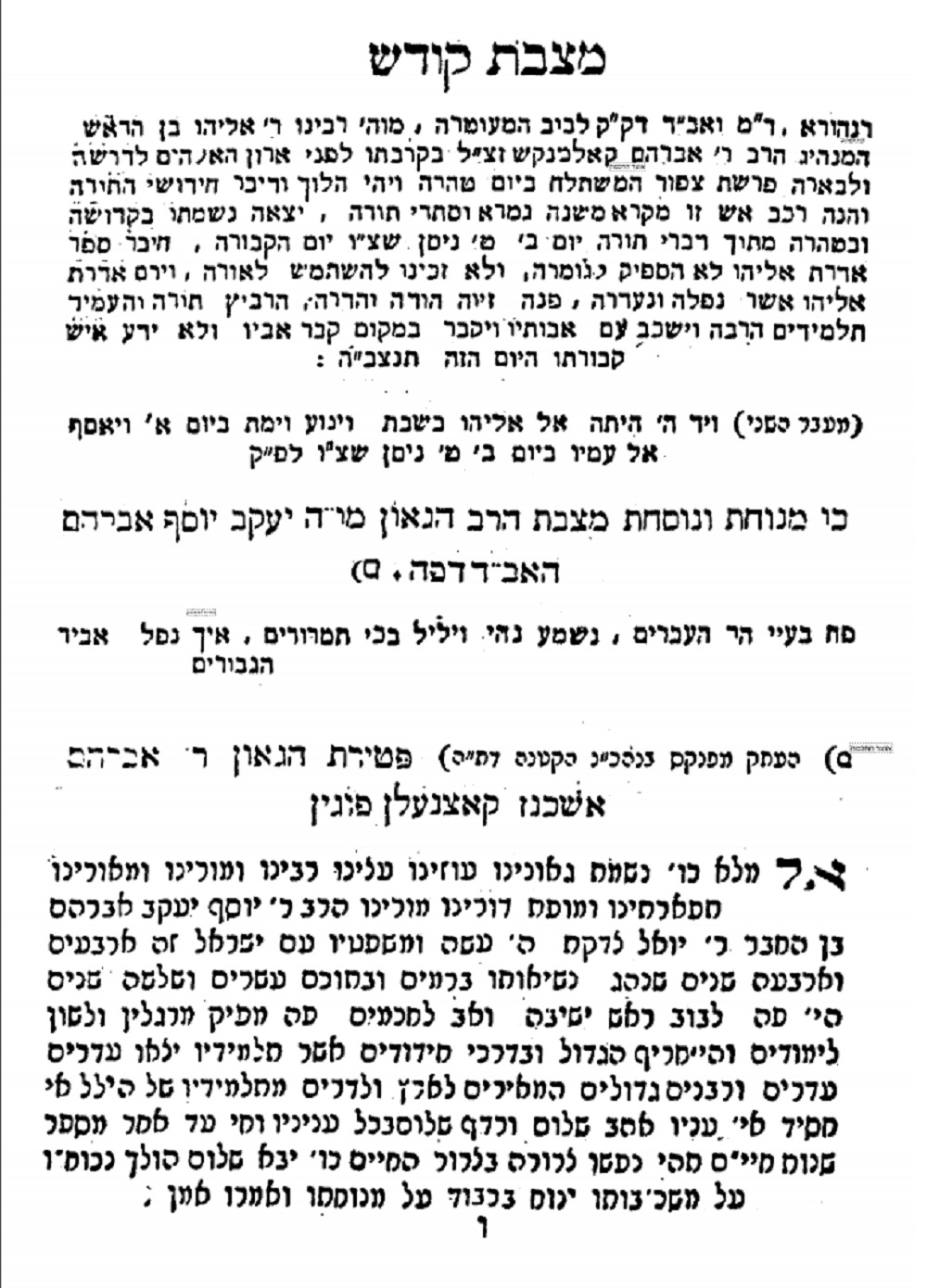
One account of the Brisker Rav’s time in Vilna alludes to his time at the Strashun Library. As yeshiva leaders debated whether to flee to the United States or to Palestine, supporters of the former emphasized how far removed they were from the Hitlerian threat, compared to Palestine, where Rommel was rapidly approaching. The Brisker Rav, however, argued in favor of Palestine as a place better suited for the full practice of Judaism. He based his view on Maimonides’ Ma’amar Kiddush Hashem (included with Iggeret ha-SheMad), the same work Raphael had requested from the library. The report notes that he “relied upon the Rambam that he held in his hands (she’amad ne’ged eynav).” See R Shimon Yosef Miller, Uvdot ve-Hanhagot le-Bet Brisk (Jerusalem, 1999), vol. 1, 27. Although the ledgers only record that he read Peretz, it is reasonable to assume he also consulted Raphael’s selection. (For additional information regarding the exodus to Vilna and the debate about a final destination, see Ben-Tsiyon Klibansky, The Golden Age of the Lithuanian Yeshivas (Bloomington, 2022), 265-289.) 

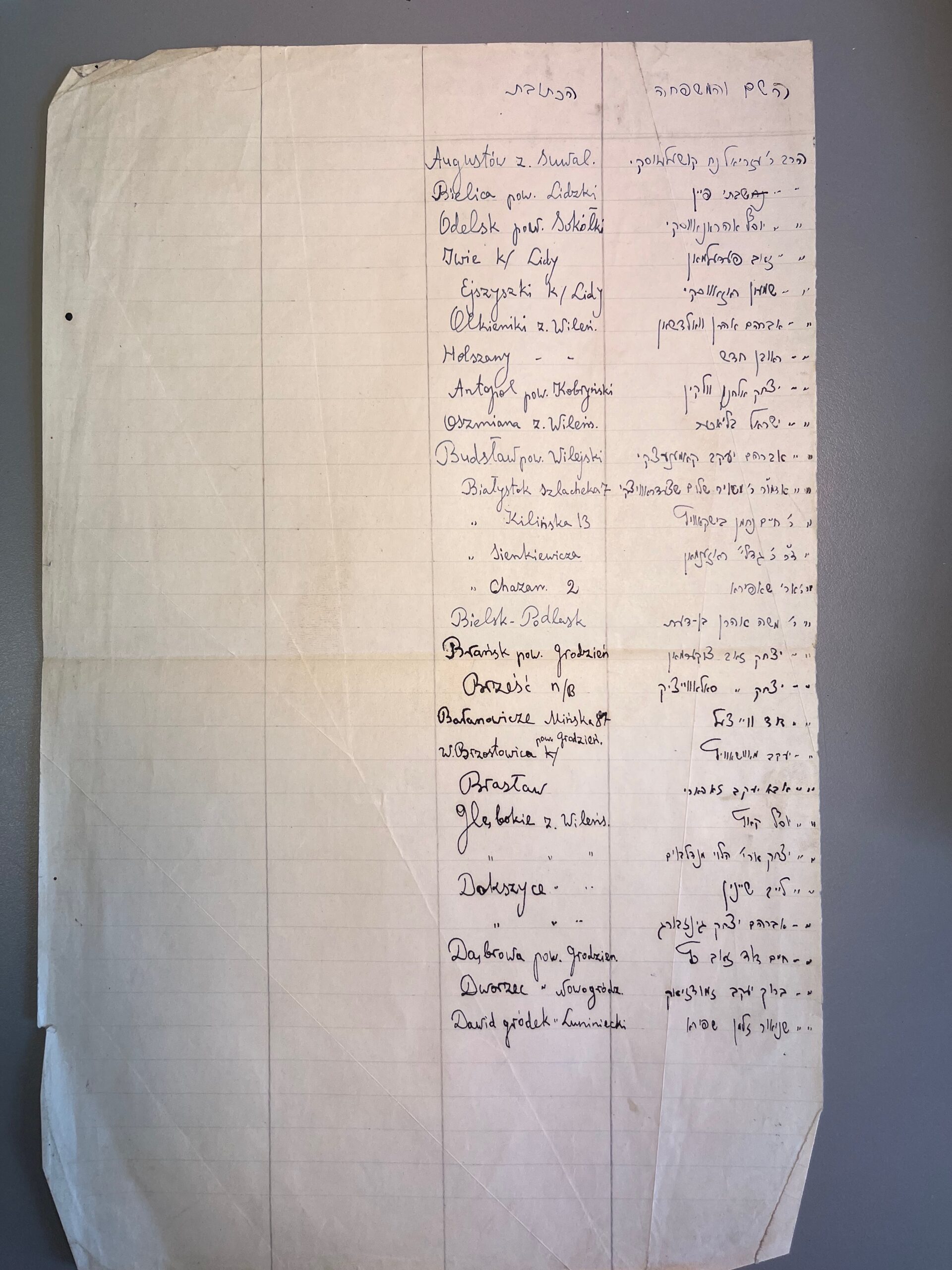
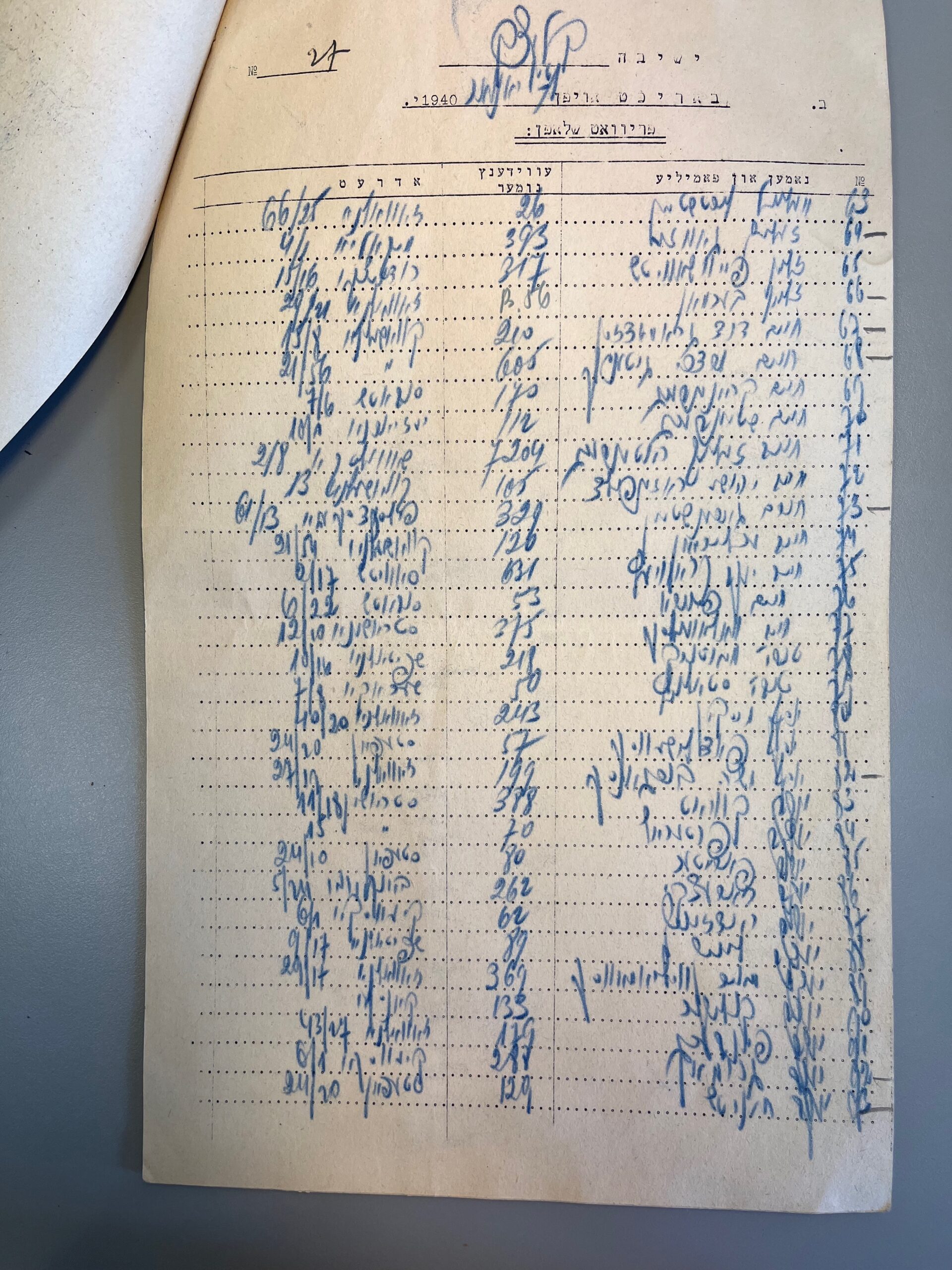
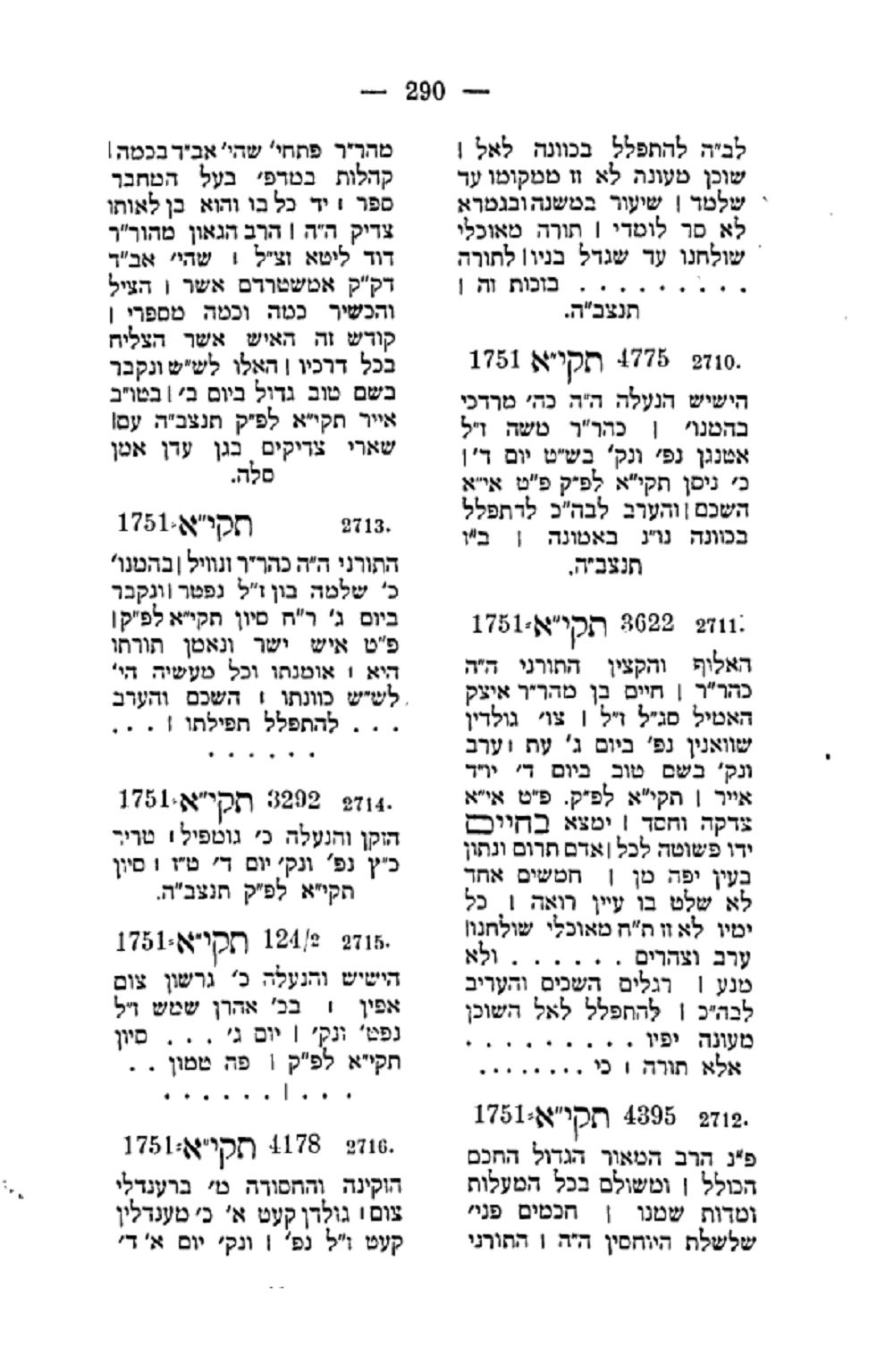
When refugees from Yeshivas arrived in Vilna in late 1939 and 1940, they were cared for by the Va’ad HaYeshivos. Many of the lists of those students and families are preserved in the same archive as the Strashun Ledgers at the Lithuanian National Library. Below are two documents from that archive. The first is a document that lists some of the most important rabbis, including the Brisker Rav, and their addresses in Vilna. The second document is a page from the list of students from Keltsk.


Comments on This and That, part 2

Comments on This and That, part 2
by Marc B. Shapiro

Continued from here.

Barth’s opinion was shared by R. Joseph Hertz, who referred to Song of Songs as a “collection of ancient lyrics of the spring-time and youthful love.”[1] Some might regard this as a radical, even un-Orthodox opinion, but from Avot de-Rabbi Natan 1:4, we see that the early Jewish leaders did not regard the Song of Songs (and Ecclesiastes and Proverbs) as anything special.


Originally, it is said, Proverbs, Song of Songs, and Ecclesiastes were suppressed, for since they were held to be mere parables and not part of the Holy Writings [the religious authorities] arose and suppressed them. [And so they remained] until the men of Hezekiah came and interpreted them.

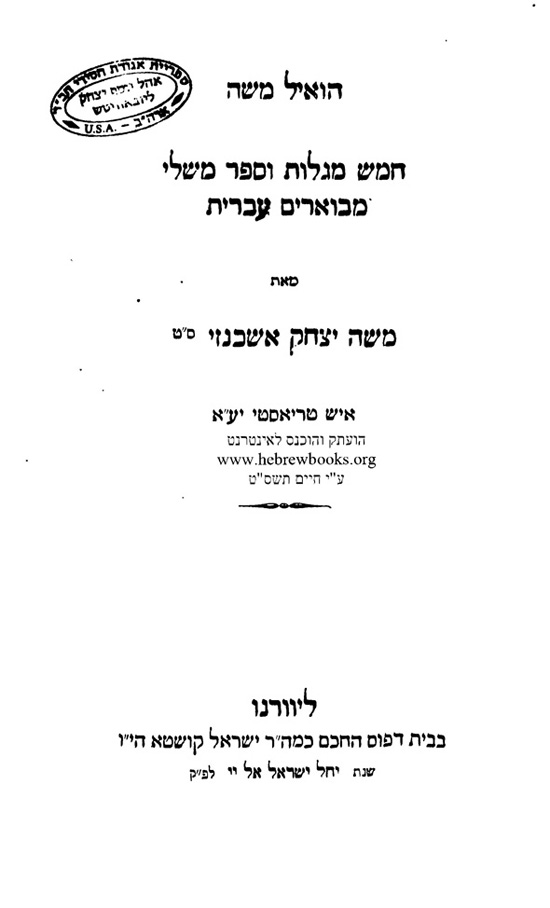
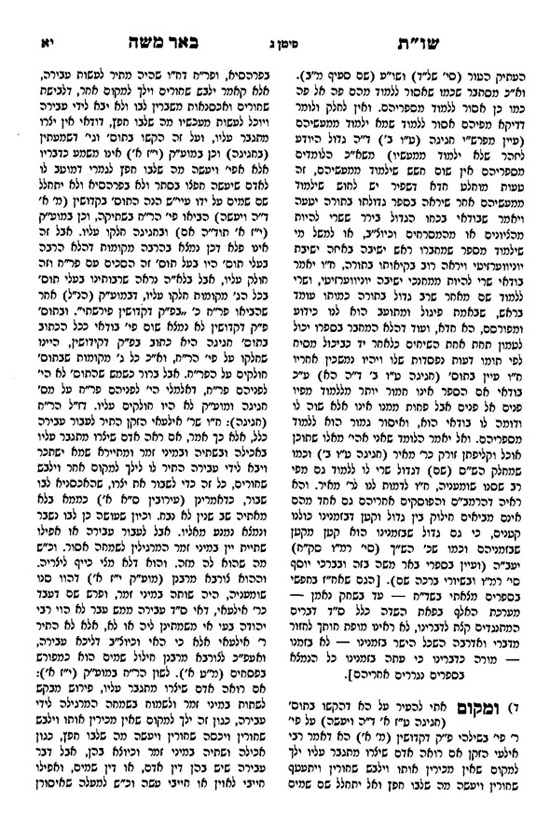
I already quoted a couple of times from R. Moses Isaac Ashkenazi’s Ho’il Moshe, so let me mention that in the introduction to his commentary on Song of Songs, he assumes that the book was indeed sung as part of the wedding celebrations, and as with Barth, he thinks that this was the original purpose of Song of Songs. He also suggests that perhaps שיר השירים אשר לשלמה  does not mean that Solomon wrote it, but that it was written for Solomon. He compares this to Psalm 72:1 which begins לשלמה and means “[A Psalm] for Solomon.” Interestingly, he also thinks that the Shulamite (7:1) is none other than Abishag the Shunamite.[2] Here is the title page of his book.


While Artscroll sees a literal interpretation of Song of Songs as blasphemous, Ashkenazi (together with Breuer and Barth) sees the book as teaching the values that make for a successful marriage. This viewpoint is also expressed in the introduction to the Soncino translation:

The main moral of the Book is that love, besides being the strongest emotion in the human heart, can also be the holiest. God has given the gift of love to sweeten the toil of the laborer, as in the case of Jacob to whom the fourteen years in which he toiled for Rachel appeared but a few days, for the love he had for her (Gen. xxix. 20). Love transfigures and hallows, but it’s a boon that requires zealously to be guarded and sheltered from abuse. This Book pictures love as a reward enjoyed only by the pure and simple, a joy not experienced by the pleasure-seeking monarch and the indolent ladies of the court. It is a joy reserved for the loyal and the constant, and is denied to the sensual and dissolute.

Ashkenazi concludes with these strong words:

גם אם נפרשהו ע”ד הפשט, נוכל ללמוד ממנו דברים נאותים. . . . רק אנשי חונף העושים מעשה זמרי ומבקשים שכר כפנחס יטילו בו דופי, בעוד שהם בשבתם על השולחן בבית חתן וכלה יוציאו מפיהם דברי נבלה המלבינים פני כל אדם ישר השמועה; והלואי ואולי היו משוררים שיר נחמד זה בסעודת חתנים. ויופי הקולות והנגינה ישמחו הלבבות ויגדילו חשק חתן וכלה זה לזה, ויגביהו לבות הבחורים והעלמות ברחשי הכבוד הראוים והנאותים להם.

Finally, let me mention Amos Hakham’s introduction to the Daat Mikra edition of Shir ha-Shirim. While he isn’t sure if the entire book can be traced to wedding feasts, he is certain that this is so for at least one section, namely, the song that ends in 5:1:: “Eat, O friends; drink, yea, drink abundantly, O beloved.” How could this not originate in a wedding feast? As for dance songs, Hakham points to 7:1 as an example: “Return, return, O Shulamite; Return, return, that we may look upon thee.” As with those already cited, Hakham argues that the allegory only adds a deeper level to our understanding, but it in no way discounts the peshat of the verses.[3] This is in direct opposition to Artscroll’s position that “The literal meaning of the words is so far from their meaning that it is false” (Artscroll Pesach Machzor, p. 567).

Hakham also calls attention to Va-Yikra Rabbah 9:6, where R. Yohanan understands Song of Songs on the peshat level to be referring to a real married couple. Based on two verses in Song of Songs, R. Yohanan derives “that a bridegroom should not enter the bridal chamber unless the bride gives him permission.”

Hakham states: “It is unimaginable that prophecy would use matters that are distasteful in themselves as an allegory for holy and pure matters.” Here is how he sums up his main point (pp. 8, 9):

כלומר שאמנם לפי המשמעות המילולית הפשוטה מתוארת בשיר השירים אהבה שבין דוד ורעיה שהם שניהם בשר ודם, אלא שבהיות אהבה זו תמה, זכה, טהורה וקדושה, ראויה היתה שתשמש סמל ודוגמה לאהבה נעלה יותר. . . . טעות ביד מי שחושב, שחז”ל דרשו את שיר השירים על דרך הרמז משום שבפירושו כפשוטו היה נראה בעיניהם כשיר העוסק בענינים שאינם ראויים להכלל בכתבי הקודש. לא כן הדבר. כבר העירו גדולי המפרשים שאין להעלות על הדעת, שהנבואה תקח עניינים מאוסים כשלעצמם כמשל לענינים קדושים וטהורים, אלא ודאי שכמו הנמשל כן גם המשל קודש הוא. ואם מצאנו שהנבואה ממשילה את הברית שבין כנסת ישראל ובין הקב”ה כברית שבין איש ואשתו, משמע שהברית הזאת שבין איש ואישה קדושה היא ונעלה. וכבר אמרו חז”ל: איש ואשה, זכו – שכינה ביניהן.

I would assume that if a Modern Orthodox Machzor for Passover is ever published, that Hakham’s perspective will be the one to be included rather than what we find in Artscroll.

R. Zvi Yehuda has the same perspective, writing that the literal meaning has an independent existence, and “it too is raised to the level of holiness, not just on account of the nimshal, but on its own strength.”[4] He quotes Rashi who in his introduction to Song of Songs stresses that the allegory must be attached to the peshat of the verse:

ואף על פי שדברו הנביאים דבריהם בדוגמא, צריך ליישב הדוגמא על אופניה ועל סדרה.

Yehuda brings a wonderful example of this. Song of Songs 4:1 reads: “Behold, you are fair, my beloved; behold, you are fair; your eyes are [like] doves; from within your kerchief your hair is like a flock of goats that streamed down from Mount Gilead.” Rashi explains the second part of the verse as follows: “This praise is a paradigm of the praise of a woman beloved by her bridegroom. Within your kerchief, your hair is beautiful and glistens with brilliance and whiteness like the hair of white goats descending from the mountains whose hair gleam in the distance.” The biblical text does not give any color to the goats, and Yehuda notes that the standard approach is that the goats are black, so that the hair being praised is also black. Yet Rashi speaks of light hair as being beautiful, and therefore he understands the color of the goats differently. Based on this, Yehuda concludes that “Visions of female beauty, in his [Rashi’s] time and place, influenced his commentary.”

The fact that the mashal needs to reflect reality is seen in another Rashi as well (not cited by Yehuda). Song of Songs 7:5 reads אפך כמגדל הלבנון. Rashi writes: “I cannot explain this [אפך] to mean a nose, either in reference to its simple meaning or in reference to its allegorical meaning, for what praise of beauty is there in a nose that is large and erect as a tower? I say therefore that אפך means a face.”
If the allegory is all that is important, then Rashi would not have a problem. He could translate אפך as nose, which is the literal translation,[5] and offer the allegorical explanation. Yet precisely because it is important that the peshat be coherent, Rashi is forced away from the literal meaning, for what man can praise his bride as being beautiful for having such a nose?[6]

One other interesting point that I learnt from Yehuda’s article is that the rishon, R. Avigdor Kohen Tzedek, gives the following strange explanation for why God’s name doesn’t appear in Song of Songs.[7]

ולא נכתב שם קודש בשיר השירים לפי שנאמר כל הספר בלשון חשק ואהבה ואינ’ דרך כבוד להזכיר השם ב”ה על דבר חשק.

Yehuda also cites the sharp comment of R. Solomon Akriti in R. Joseph Kafih, ed., Hamesh Megilot (Jerusalem, 1962), p. 19:

ואחרי אלה ההערות אינני רואה שיסופק שום משכיל בדברי הספר לחשב בם שהם כפשוטם, ואלו היו כפשוטם לא היו חולי חולין בעולם כמותם, ולא היה נזק גדול לישראל כיום שניתן להם שיר השירים, כי פשוטו יעורר תאוה וביותר תאות המשגל אשר היא המגונה מכלם

Yet after quoting these passages, which Artscroll would be very happy with, Yehuda takes his place with the others I have referred to and insists on the validity, and holiness, of the peshat interpretation (p. 478):

שיר השירים, על כל בחינותיה ורבדי מובניה – ואף לפי פשוטה – היא “קודש קודשים”. האהבה האנושית המתוארת בה – מתרוממת לגובהי קדושה.

He concludes (p. 481) that it is a mistake to think that the Sages explained Song of Songs allegorically because they had a problem with its literal meaning. According to Yehuda, the opposite is the case, and it is precisely because the Sages valued the literal meaning of the book that they explained it allegorically. It is because they saw the human love described in the book as so exalted that they were prepared to also view the book as an allegory for heavenly love.

With reference to Song of Songs, there is another reason why it is important to know the peshat. Maimonides’ Hilkhot Teshuvah 10:3, speaks about the love of God. He compares it to the love of a woman. Just as one who is in love constantly thinks about the woman, so too should be your love for God. He concludes that “The whole book, Song of Songs, is an allegory on this subject.” In other words, only one who understands what human love is all about can move to the next level and achieve love of the Divine. This is elaborated upon by R. Mordechai Gifter in his Hebrew preface to the Artscroll Shir ha-Shirim. One can only wonder why Artscroll did not see fit to translate R. Gifter’s important words into English. R. Gifter even mentions the importance, indeed centrality, of sexual desire. He does so not to speak of its great danger, as is often the case, but to stress how vital the sexual urge is even from a spiritual sense:

וכל זה מבו’ בדבריו של ר’ יצחק דמן עכו ז”ל שהביא בראשית חכמה – בסוף פ”ד משער האהבה – שמי שלא חשק לאשה הוא דומה לחמור ופחות ממנו והטעם כי מהמורגש צריך שיבחין העבודה האלקית.

He also writes:

שכל הלשונות שבמשל הן עצמיים ובשרשם העליון ענינם נשגב למאד, אלא שהענינים הרמים אלה משתלשלים ויורדים מעולם לעולם עד שמגיעים אלינו מצטיירים לנו צורה זו הנאותה לפי מציאות האדם בעולם הזה.

With regard to Artscroll, everyone knows that the “translation” they provide of Song of Songs is allegorical. In the Passover Machzor that is all you get, but in their separate edition of Song of Songs they do provide the literal translation in the commentary, for those who wish to look at it. Artscroll’s approach vis-à-vis the Song of Songs has been the subject of harsh criticism in the Modern Orthodox world, especially from its intellectual elite. In fact, I think when people criticize Artscroll, this is one of the things that is high on the list of what annoys them.

Yet it must also be noted that Artscroll’s method of translation is exactly what the Targum does.(See also R. Nahum Finkelstein’s Yiddish “translation” of Song of Songs [Jerusalem, 1929]) So it is not like Artscroll invented this approach. In addition, there is a responsum of R. Joseph Hayyim in Rav Pealim, vol. 1, Yoreh Deah no. 56, that is relevant. Here he states that a teacher in Baghdad translated the Song of Songs into Arabic, and the children copied this translation. R. Joseph Hayyim opposed this, stating that one should not teach the children and the masses the literal meaning of the words because they are not meant to be understood literally. The literal meaning of the book, he states, is no different than a love song (he adds “has ve-shalom”),[8] and unlike the opinions we have already noted, for R. Joseph Hayyim (as with Artscroll) the literal meaning of the Song of Songs is obscene.[9] The same viewpoint is expressed by the nineteenth-century R. Elijah Schick in his Ein Eliyahu, Yadayim 3:1:

כל הכתובים יש פשטות ג”כ אבל בשיר השירים אין שום פשטות אלא הכל קאי על יראת שמים וקבלת עול מלכות שמים, כי על פי פשט היא דברי חשק וזה אי אפשר לומר וקאי הכל על דביקות בה’.

Today we have an interesting phenomenon. When the Targum was written the vernacular was Aramaic, so the typical Jew would not be able to understand Song of Songs in the original. Only the scholar could understand the actual words, and he would know that they were to be interpreted allegorically. Today, in America, the situation is the same, as the typical Jew also cannot understand the Hebrew. Artscroll’s English “translation” therefore serves the same function as the Targum did centuries ago.

Yet what about Israelis? We now have a situation where “the masses” can understand the Hebrew Bible since Hebrew is their vernacular. This is a completely new phenomenon. How are these masses to be protected from reading the text literally, for as we have seen, Artscroll tells us in the Pesach Machzor that “the literal meaning of the words is so far from their meaning that it is false”? In the Introduction to the Artscroll Shir ha-Shirim, p. lxiv, we are told that when the words שני שדיך, “your bosom” [Artscroll won’t use the word “breasts”] refer to Moses and Aaron, this is not

departing from the simple literal meaning of the phrase in the least. Song of Songs uses words in their ultimate connotations. Just as geshem, rain, means the power of stimulating growth, shodayim, the bosom, refers to the Heavenly power of nourishment. . . . They [Moses and Aaron], Israel’s sources of spiritual nourishment, are not implied allegorically or derived esoterically from the verse; the verse literally means them.

In other words, Shir ha-Shirim (in this instance, at least) is not even speaking about a woman, not even on the level of peshat. I have to admit that all this seems like a lot of double-talk to me. I can understand if you tell me that “breasts”, excuse me, “bosom”, allegorically means “Moses and Aaron.” But when you tell me that even the literal meaning of shodayim is “Moses and Aaron”, that’s when I have difficulty.

(Speaking of haredi circumlocutions, since the Agudah convention is in a few days I can’t resist mention of the following. A letter was sent out to attendees inviting them to a breakfast at which they will be addressed by a psychologist and and rabbi-lawyer. You can see the letter here. Notice that the letter speaks about how “the issue of child abuse has become a major topic in our society and children in our community have been and continue to be at risk.” Of course, child abuse is not the issue at all. We are not being confronted on an almost weekly basis with stories of children in our communities being beaten or anything like that. What we have is child sexual abuse, and yet the author of this letter can’t even bring himself to say the word “sexual.” It’s like we are all in grade school and this word is off-limits.)

One opinion in Shir ha-Shirim Rabbah 1:10 states that Solomon wrote Song of Songs in his youth. This is elaborated upon by R. Hayyim Jeremiah Flensburg, Markevot Ami (Vilna, 1910), p. 6. He explains how Solomon’s words are indeed drawn from the real world he experienced, which once again shows how important the peshat, the literal meaning of the words are:

שאף שהנמשל של שיר השירים הוא קודש קדשים, עכ”ז מתוך המשל שעשה לעטוף בו הנמשל, ניכר שהיה אז ילד, שהוא נשא משלו מחתן וכלה, ומגנים ושושנים יפים, ומכל הדרת האביב, וזמרת צפרים.

R. Yosef Ben Arzah, in his popular Yosef Da’at, Bava Kamma 97, also explains in this fashion.

וידוע, האהבה זמנה בימי הנעורים, משא”כ בימי הזקנה “ותפר האביונה”. וכמו שאמרו ששלמה המלך עליו השלום, בילדותו אמר שיר השירים, שהוא תוקף האהבה.

When Ben Arzah writes that the time of love is the youth, he is clearly referring to sexual love, for he follows this by noting that this is not the case in old age when (quoting Eccl.12:5) “[sexual] desire fails.” In other words, the Midrash means that because Solomon wrote the Song of Songs in his youth, that is why it has sexual imagery, for sexual love is strongest when one is young.[10]

I don’t think anyone is going to suggest that Artscroll produce a Hebrew version of its allegorical translation and that this is what the masses should be looking at during the reading of Song of Songs. But why not? If it is religiously objectionable for English speakers to be exposed to the literal meaning of the words of Song of Songs, then it is just as objectionable (if not more so) for Hebrew speakers to read the actual words and understand them literally.

Despite my facetious comment, no one has ever assumed that the Israeli masses should be told not to look at the actual text of Song of Songs. Rather, they are provided with commentaries that explained what the allegorical meaning of the text is. If it is therefore acceptable for Israelis to first understand the text literally, and then see what the allegorical meaning is, I ask Artscroll, why can’t American Jews be given the same prerogative, namely, to have a literal translation together with a commentary that offers the allegorical interpretation?

Finally, let me mention that for Sefer Hasidim it was important to know what the Song of Songs literally meant, for he declares that all the parts of a woman’s body mentioned in the book are forbidden to be seen. See no. 110: שער באשה ערוה לגלות וכל האמור בשיר השירים כגון בטנך ערימת חטים שוקיו עמודי שש שני שדיך וכו’ וכל שדרך לכסות ערוה לאשה לגלות He repeats this in no. 614 where he also adds the following, which never became normative halakhah: צריך להזהר שלא ישמע קול אשה והוא הדין לאשה שלא תשמע קול איש.

Adopting this position might be a good strategy for those who have been trying unsuccessfully to shut down the Jewish concert scene. They haven’t been able to convince the haredi masses that these are in any way problematic, especially when men and women sit separately. But perhaps the new humra that could achieve their objective is that it is forbidden for women to hear men singing. A few years of indoctrination of this view in the various Bais Yaakovs should be able to convince the younger generation, and would mean the end of the haredi concerts.[11]

* * *

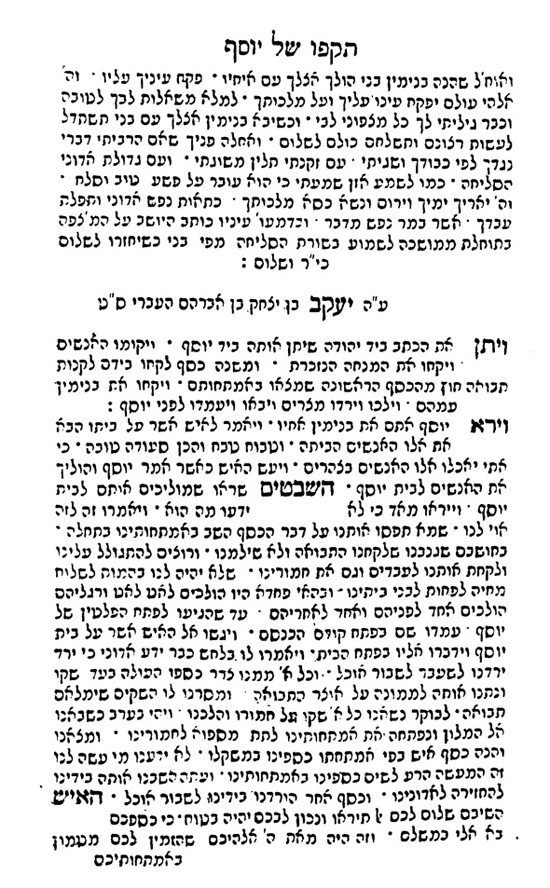
Returning to my post on Adon Olam, the other point dealt with in that post was the meaning of the abbreviation ס”ט. I don’t think anyone who read the post still thinks that it means “Sephardi Tahor.” But in case there are still any doubters, let me offer the following. Here is a page from R. Joseph Shabbetai Farhi’s Tokfo shel Yosef (Livorno, 1846), p. 38b. It contains the end of a letter from none other than Jacob the Patriarch, and you can see clear as day that he also signed himself ס”ט. Now if that isn’t a proof, I don’t know what is. . . .


There was, in fact, one person who did refuse to change his mind, even after I presented him with the evidence. I refer to the late R. Meir Amsel, editor of Ha-Maor. Amsel is deserving of his own post, having edited Ha-Maor for over fifty years. If I were to ever write a history of Orthodox Jews in America, this journal would be an important source, together with its competitor, Ha-Pardes, because in these journals one finds most of the important issues that were part of the American Orthodox experience. Ha-Maor was the more extreme of the two journals, and all sorts of polemics were carried in its pages. But it would also contain all sorts of surprises, and Amsel’s viewpoints were not always predictable. Yet as I mentioned, he didn’t accept what I told him, and changing his mind even in the face of evidence to the contrary was not something he was prepared to do.

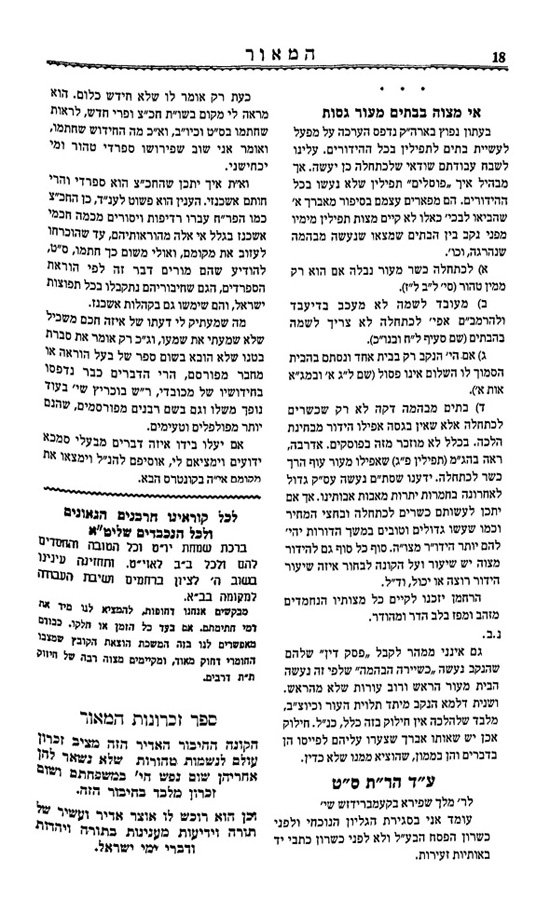
Imagine my surprise when after sending Amsel a letter on the topic he published his response in his journal (Jan.-Feb., 1993). Here it is.

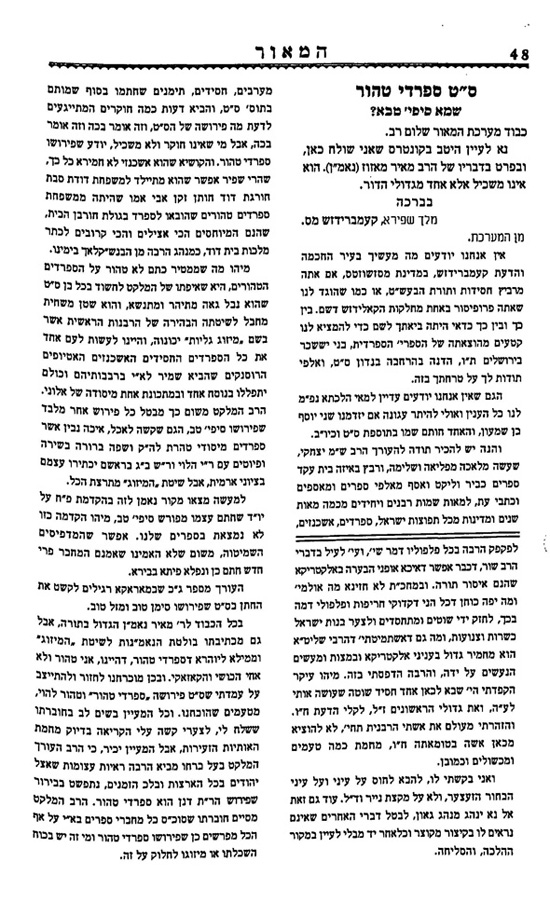
I sent him a second letter which he published, together with his response, in the March-April 1993 issue. Notice how he subtly mocks me at the beginning of this reply.


I didn’t take offense at the mocking as this was classic Amsel. Few had such a sharp pen as he, and woe to those he turned it against. To give one example of his many polemics, readers of the journal will never forget how he targeted R. Elya Svei. Yet he wouldn’t mention him by name. Instead, and as a way to show how little he thought of Svei, he referred to him as “the melamed in Philadelphia.”[12]

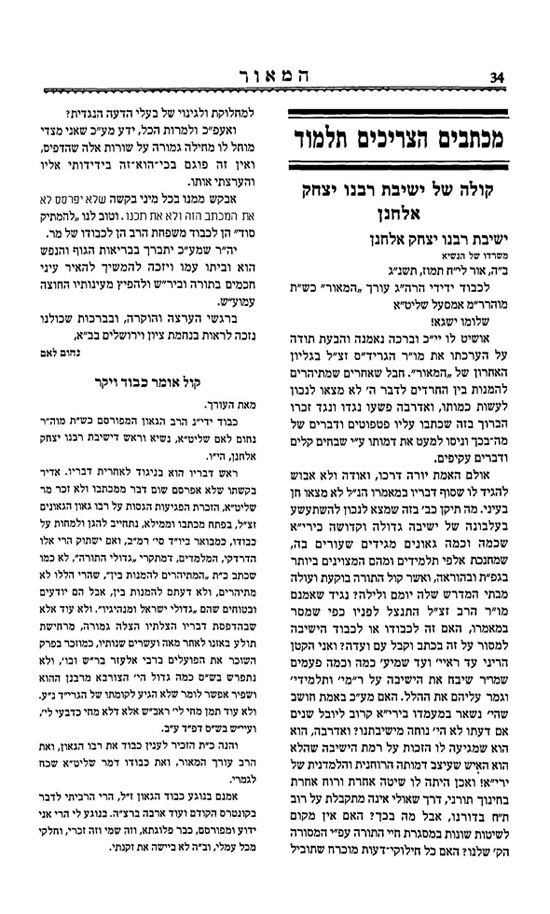
The March-April 1993 issue of Ha-Maor, in which he responded to me, is of broader interest for another reason. It contains his hesped for R. Joseph B. Soloveitchik, who had recently passed away. In this hesped he mentions a few things, among them that the Rav told him that he wasn’t really a Zionist, and that while Yeshivat R. Yitzhak Elhanan was not in accord with his family’s philosophy, nevertheless he taught there as it provided intellectual freedom.

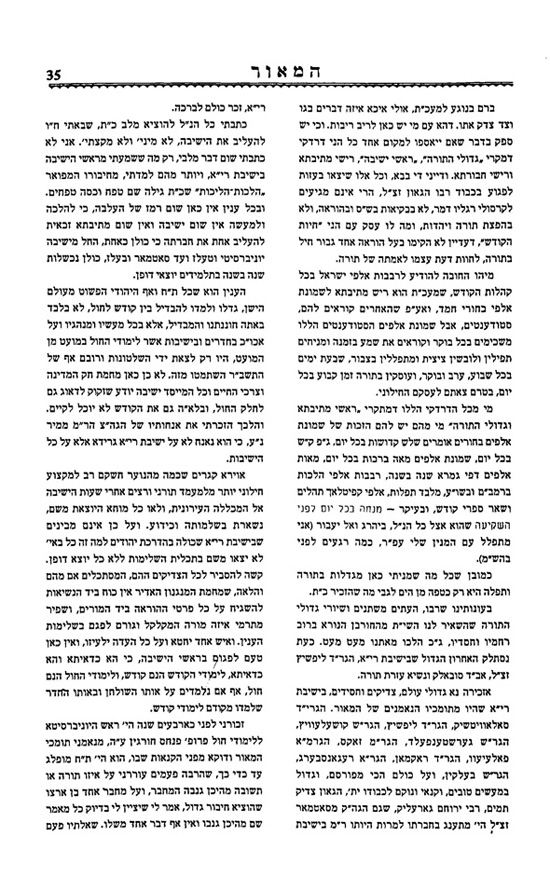
In the next issue (June-July, 1993), Amsel printed a letter he received from R. Norman Lamm, thanking Amsel for what he wrote about the Rav, and also criticizing him for mentioning the point about the Rav not feeling connected to RIETS. Note how Lamm specifically asked Amsel not to publish his letter, and Amsel published it anyway.

Also, look at the first paragraph on p. 35, as it shows how the Hungarian extremist Amsel was happy to point out how Lamm was head and shoulders above those in the Lithuanian yeshiva world. (I wonder, where did Amsel get the crazy figure of eight thousand students, that he mentions in the second paragraph? Even if you include the post-graduate schools you won’t get to that number. Did Amsel even realize that non-Jews attend Yeshiva University’s medical and law schools?)


* * *

In my original post on Adon Olam I dealt with Artscroll, so here is as good a time as any for some assorted Artscroll comments.

The custom on Rosh ha-Shanah is to sound additional shofar blasts towards the end of the morning prayers. Most sound these blasts after Musaf of Rosh ha-Shanah, while some sound thirty of them during the silent Amidah. There is no talmudic source for this practice. Why then do we do it? Here is how the Artscroll Machzor explains the matter, citing Eliyahu Kitov’s Sefer ha-Toda’ah as the source:

The source of this custom is the Scriptural narrative of the triumph of Deborah the Prophetess over Sisera, the Canaanite conqueror. In her song of gratitude for the victory, Deborah noted that Sisera’s mother whimpered as she worried over the fate of her dead son. Her friends comforted her that he had surely won a great victory and was apportioning spoils and captive women among his officers and troops (Judges 5:28-30). According to the Midrashic tradition she whimpered and groaned 101 times. Although one cannot help but feel sympathy for a worrying, grieving mother, one must be appalled at the cruelty of a mother who could be calmed by the assurance that her son was busy looting and persecuting innocent victims. The Jewish concept of mercy is diametrically opposed to such barbarism. By sounding the shofar one hundred times, we seek to nullify the forces of cruelty exemplified by Sisera and his mother, and bring God’s compassion upon us. Although she whimpered one time more than a hundred, we do not sound the shofar 101 times, because we, too, feel the pain of a mother who loses a child, even one as loathsome as Sisera.

The first thing to note is that for some reason, the explanation offered by the Taz is ignored. According to the Taz, the reason for the extra blasts is because people might not have properly heard the earlier kolot (Orah Hayyim 596:1). Furthermore, despite what is written, there is no source that speaks of Sisera’s mother whimpering 101 times. What we have is a story in the Arukh s.v. ערב , about Sisera’s mother (אימיה דסיסרא) and her one hundred cries or laments (פועיות This does not mean whimpers! The Arukh cites the story as coming from the Jerusalem Talmud. It is lacking in our versions of the Talmud, but the term “Yerushalmi” was also used for various Midrashim written in the Land of Israel.)

Ashkenazim, therefore, indeed sound the shofar the same amount of times as Sisera’s mother’s cries. Yemenites and Sephardim, on the other hand, blow an extra kol at the end, called Teruah Gedolah,[13] so they actually sound 101 blasts. Many explain that they do this precisely in order to be different than Sisera’s mother.

Here for example is what R. Ovadiah Yosef states, Shiurei Maran ha-Rishon le-Tziyon (Jerusalem, 2008), vol. 1, p. 75:

והנה אם סיסרא פעתה ובכתה מאה בכיות, ואנו תוקעים מאה תקיעות ועוד אחד, כדי לבטל הקטרוגים הנמשכים מהבכיות שלה . . . וזהו “הן אתם מאין ופעלם מאפע.” “מאין” = 101 הן ה100 פעיות של אם סיסרא שבמאה ואחת תקיעות שלנו ה’ מכפר לנו, ומתקנים אנו את הפעיות [“אפע” נוט’ פעיות אם] של אם סיסרא.

The Arukh’s explanation is quoted in a number of medieval sources, Yet what is the logic here? Why would anyone have thought of connecting Sisera’s mother’s cries with how many shofar blasts we sound, as they have nothing to do with each other? Is it really possible that how we blow the shofar has anything to do with what the mother of the wicked Sisera did?

It has been suggested by R. Hayyim Yehudah Ehrenreich[14] and R. Menachem M. Kasher[15] that there is a copyist’s error in the Arukh, and instead of reading it should read אמנו שרה , or something along these lines. This suggestion is made based upon the following passage in Pirkei de-Rabbi Eliezer ch. 32:

When Abraham returned from Mount Moriah in peace, the anger of Samael [Satan] was kindled, for he saw that the desire of his heart to frustrate the offering of our father Abraham had not been realized. What did he do? He went and said to Sarah: “Hast thou not heard what has happened in this world?” She said to him: “No.” He said to her: “Thy husband, Abraham has taken thy son Isaac and slain him and offered him up as a burnt offering upon the altar.” She began to weep and to cry aloud three times corresponding to the three Tekiot, three howlings corresponding to the Teruot. and her soul fled, and she died.

In this text we have a connection made between the cries of Sarah and the blowing of the shofar. Here it states that she cried three times corresponding to the Tekiah and three times corresponding to Teruah. (What we call Shevarim is one possibility for how the Teruah should be sounded.) Alternate versions have Sarah crying aloud six times or ninety times.

We still have the problem: How did the name Sarah become confused with Sisera? It turns out that there is indeed a connection between the mother of Sisera and the shofar. Rosh ha-Shanah 33b states:

The length of the Teruah is equal to the length of three yevavot. But it has been taught that the length of the Teruah is equal to three Shevarim. Abaye said: Here there is really a difference of opinion. It is written, It shall be a day of Teruah unto you [Num. 29:1], and we translate [in Aramaic], a day of yabava, and it is written of the mother of Sisera, Through the window she looked forth [va-teyabav; Judges 5:28]. One authority thought that this means drawing a long sigh, and the other that it means uttering short piercing cries.

We see from here that the Sages, in attempting to figure out how the Teruah should be sounded, looked for evidence in a biblical passage dealing with Sisera’s mother. Since she is thus connected to the Shofar blowing, it is not hard to see how the other passage, which describes how Sarah cried, could have morphed into Sisera’s mother.

The problem with this suggestion, one must acknowledge, is that we have no evidence of a text that has Sarah crying one hundred times. Yet it is certainly possible that this tradition did exist, and is now lost.

Here are some more comments about Artscroll. In the original post I mentioned how in the Artscroll Siddur, p. 870, it mistakenly places R. Elaazar Kalir in the second century. R. Avrohom Lieberman pointed out to me that in the original edition of this Siddur they placed Kalir centuries later. Here is a copy of the page.

The change was obviously made in response to criticism. Yet they should have stuck with the original version, since what appears in the “corrected” edition is mistaken. I assume that Artscroll knows it is mistaken, but leaves it in anyway so as not to antagonize its critics.

Before Lekhah Dodi the Artscroll Siddur writes: “לכה דודי is recited responsively. In most congregations, the chazzan repeats each verse after the congregation. In others the procedure is reversed.” More Artscroll siddurim are sold to Modern Orthodox synagogues than to anywhere else. This is especially the case due to the RCA version of the siddur. So wouldn’t one expect that the instructions would reflect reality? In my entire life I don’t think that I have ever been in a Modern Orthodox synagogue that recites Lekhah Dodi responsively. While in the previous post I wrote how the Artscroll instructions have changed how Modern Orthodox synagogues recite Hallel, as far as I know no synagogue has given up the practice of communal singing for Lekhah Dodi because of this particular instruction. As it stands, this particular instruction is a sign of how little Artscroll respects the customs of the Modern Orthodox world.

Also on Friday night, the Siddur states that each stanza of Shalom Aleikhem is recited three times. Why not mention that there is also a common practice to only recite each stanza one time?

In the Machzor for Sukkot, p. 132, in discussing the different practices when it comes to wearing tefillin on hol ha-moed, it states: “It is not proper for a congregation to follow contradictory customs. Thus, if one whose custom is not to wear tefillin during Chol haMoed prays with a tefillin-wearing minyan, he should don tefillin without a blessing. Conversely, if one whose custom is to wear tefillin prays with a non-tefillin-wearing minyan, he should not wear his tefillin while praying but may don them at home before going to the synagogue.” The source for this ruling is the Mishnah Berurah. Yet with the exception of hasidic synagogues, where I presume everyone does the same thing, this ruling is no longer applicable. In all the synagogues I have ever been in, both Modern Orthodox and non-hasidic haredi, there is no one minhag and everyone does what his family practice is. In other words, the minhag today is for everyone to follow his own personal minhag, and shuls do not have a “custom” in this regard.

Also in the Sukkot Machzor, p. 957 (as well as in the other Machzors), it writes as follows: “It is virtually a universal custom that those whose parents are still living leave the synagogue during Yizkor. This is done to avoid the ‘evil eye,’ i.e., the resentment that might be felt by those without parents toward those whose parents are still living.” Can one conclude from this that Artscroll has a Maimonidean approach to the concept of the “evil eye”?

Quiz

In past posts I have offered a quiz and given out prizes to the ones who answered the questions. People have wondered why I stopped doing this. The answer is simple: I didn’t have anything to give out. But now I have a few items so I can do some more quizzes. For the winner of this one I can give a CD of the music of R. Baruch Myers, rav of Bratislava. Rabbi Myers is a trained classical musician and his music is very different from what you think of when you think hasidic music. Unlike in the past, I will not give the prize to the one who answers the question first. This is unfair as due to the different time zones, some people won’t see the question until it has already been answered. I will give people a couple days and if more than one has answered correctly, I will randomly choose a winner. You will also have to answer two questions, in different genres. Yet even if you only know the answer to one, send it in, for if no one gets both answers, I will give it to a person who got one correct. Send answers to shapirom2 at scranton.edu

Question 1: The word for turkey is תרנגול הדו There is a dagesh in the dalet. Why? Bring a proof for your answer from Berakhot between page 34a and 38a.

Question 2: There is a rabbinic phrase that today is used to praise a Torah scholar, but in talmudic days was used in a negative fashion (at least according to Rashi). What am I referring to?

* * * *

Some people have asked me if I am leading a Jewish history trip to Europe this summer. Actually, I am leading two trips, one to Italy and the other to Central Europe. (The latter is a repeat of the sold-out trip from last summer). Both trips are sponsored by Torah in Motion and details will be available soon.


* * * *

Here is something I think readers will enjoy. It is a picture from Prof. Isadore (Yitzchak) Twersky’s wedding. I thank R. Aharon Rakefet for sharing the picture. According to R. Rakefet, the man second to the left, whose face is obscured by an unknown rabbi, is R. Zev Gold. (R. Rakefet claims that the hair gives it away.) Beginning with Gold, we find Dean Samuel Sar, Isadore Twersky (standing) R. Dovid Lifshitz, R. Eliezer Silver, the Rav, R. Chaim Heller, R. Meshullam Zusia Twersky, Tolner Rebbe of Boston, R. Moshe Zvi Twersky, Tolner Rebbe of Philadelphia.

[1] Authorized Daily Prayer Book, p. 790.

[2] This identification has recently been advocated by Christopher W. Mitchell in his massive work, The Song of Songs (St. Louis, 2003), pp. 130ff.

[3] Medieval commentators, notably Ibn Ezra, put a great deal of effort into explaining the peshat. See also the medieval commentary on Song of Songs written by R. Joseph Ibn Aknin, entitled Hitgalut ha-Sodot ve-Hofa’at ha-Meorot (Jerusalem, 1964). Ibn Aknin provides a three part commentary, with one section focused on peshat, and the other two on derash and sod. From more recent times, see R. Samuel Naftali Hirsch Epstein, Imrei Shefer (Vilna, 1873), and R. Eliyahu Halfon Shir ha-Shirim im Perush Ateret Shlomo (Nof Ayalon, 2003).
[4] “Shir ha-Shirim” Kedushatah shel ha-Megilah u-Farshanutah,” Sinai 100 (1987), p. 475.
[5] Soncino explains: “The comparison is between the well-proportioned nose and the beautiful projecting tower.”
[6] This point was made by R. Isaac Jacob Reines. See R. Judah Leib Maimon, ed., Sefer Rashi (Jerusalem, 1956), vol. 2, pp. 12-13. See also Rashi to Song of Songs 1:2 “Let him kiss me with the kisses of his mouth.” Rashi comments: “In some places they kiss on the back of the hand or on the shoulder, but I desire and wish that he behave toward me as he behaved toward me originally, like a bridegroom with a bride, mouth to mouth.” Artscroll does not mention this Rashi. The Vilna Gaon has an interesting comment on this verse. He notes the plural “kisses,” and explains: כמו שנושק הבעל לחשוקתו א’ על מה שמתחברת עמו והב’ על שאינה מתחברת באחר
[7] Perush Shir ha-Shirim (Jerusalem, 1971), p. 11.
[8] See also Ibn Ezra’s introduction to Song of Songs: וחלילה חלילה להיות שיר השירים בדברי חשק Despite saying this, he still feels it is important to explain the peshat.
[9] See also Rav Pealim, vol. 4, Sod Yesharim no. 11, where R. Joseph Hayyim explains why God’s name does not appear in the Song of Songs.
[10] Since we are speaking of love, I should also mention Elhanan Reiner’s provocative claim, put forward in very stylistic Hebrew, that R. Yair Haim Bachrach’s responsum, Havot Yair, no. 60, is not a real case, but simply a fictional love story that Bacharach inserted into his responsa. See here. For Raphael Binyamin Posen’s response see here, and Reiner responds to Posen here.
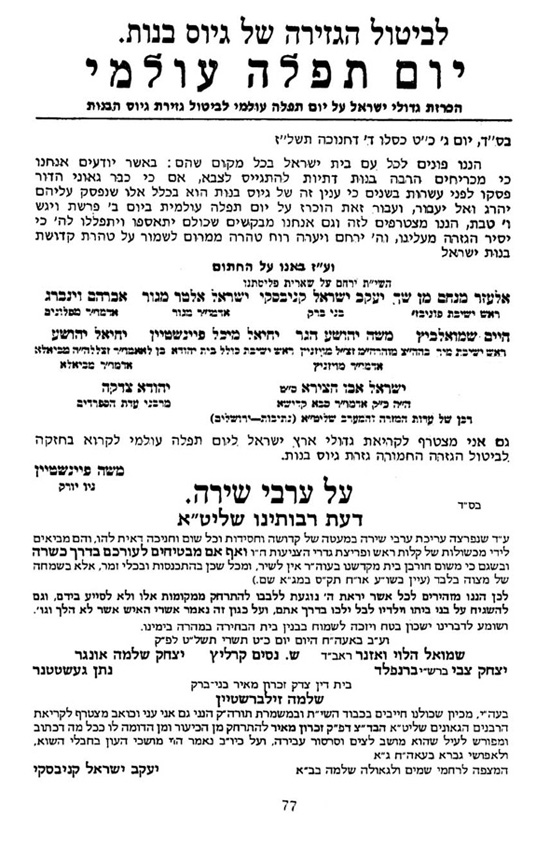
[11] Incidentally, the opposition of haredi gedolim to these concerts is often portrayed as if the only issue is tzeniut, and therefore, when men and women sit separately there should be no problem. This is a complete distortion of the issue, for even without tzeniut concerns, the main reason for the opposition, and I know this will be hard for American haredim to stomach, is that the Israeli haredi gedolim are opposed to all musical entertainment, and “fun” in general, when not connected to simchah shel mitzvah, such as Purim, a wedding, etc. Concerts are doubly problematic since these gedolim believe that is forbidden to listen to live music when not connected to a seudat mitzvah. Here is one proclamation that makes this clear (from Hashkafatenu [Bnei Brak, 1985], p. 77).

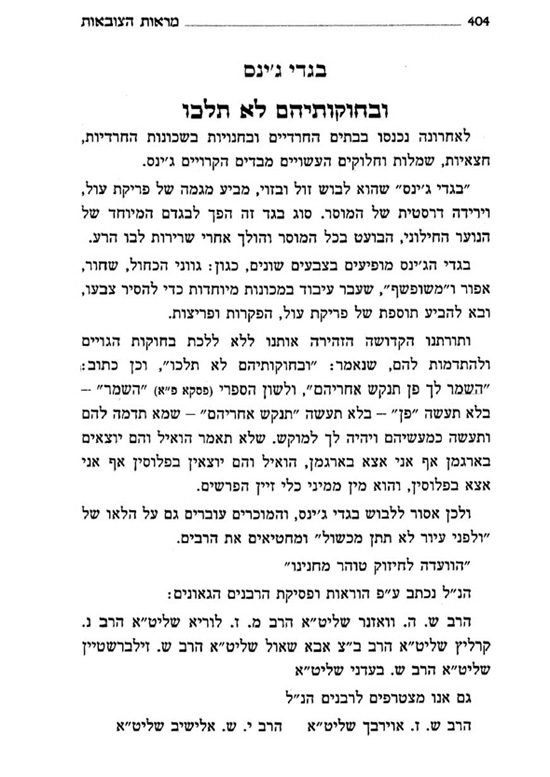
In R. Yaakov Yisrael Lugasi’s Mar’ot ha-Tzovaot (Jerusalem, 2009), p. 401, he states flatly: “The entire concept of entertainment is pasul. This is a condition of moshav leitzim and throwing off the yoke, and is the culture of the non-Jews and the secularists.” Interestingly, a few pages after this, Lugasi prints the herem against wearing jeans skirts. For those who never saw it, here it is.

[12] It is no secret that R. Svei was a polarizing figure in Orthodoxy, even in haredi circles. This is also seen in the book on R. Ahron Soloveitchik written by his son, R. Yosef. It was uploaded to the internet a few weeks ago and until recently was found here. Since many people downloaded the book when it was up, I think it is worthwhile to make some comments about it. I understand that it is a preliminary version of what will be published in book form. I hope the author takes the necessary time to revise it properly, because as it stands, it is an unfortunate publication. On the positive side, it includes a great deal of Torah from R. Ahron, and shows his strong insistence on honesty when it comes to dealing with non-Jews and the government. There are also wonderful tidbits of historical interest. See p. 5 that R. Baruch Ber Leibowitz used to stand up for R. Ahron when he was a child, since he was, after all, the grandson of the Rebbe (R. Hayyim).

See also p. 404 for the following incredible statement: “Rav Ahron told his son that it is not right to print his brother’s דרשה of יוסף ואחיו about the Mizrachi because his brother regretted saying this דרשה ” This is perhaps the most important derashah the Rav ever delivered and is a basic text of study for religious Zionists. It explains how the Rav could break from his family tradition and become a Zionist. It is also the derashah that R. Shakh attacked, saying that it contained דברים שאסור לשומען וכש”כ להפיצן ברבים (Mikhtavim u-Ma’amarim, vol. 4, no. 320). What are we to make of R. Ahron stating that the Rav regretted this derashah?

Among other passages that caught my eye, see e.g., p. 6, where R. Ahron tells a bubba maisah about a rabbi in Auschwitz who killed some twenty Nazis with a chair. On p. 327 R. Ahron claims that Bible Criticism “paved the road for the Nazi ideology.” On this page he also states that Catholics do not support Bible Criticism. This is incorrect. The Catholic Church accepts Bible Criticism and does not see this as harming the holiness of the Bible. In fact, there are only two religious groups that do not accept the academic approach to the Bible, namely, Christian fundamentalists and (most) Orthodox Jews. (In a future post I will explain why I use the word “most”.

Why do I say that this is an unfortunate publication? Because there is a way to write and a way not to write, and someone who is very upset about how his father was treated is not the best person to review important incidents in his life. I can’t see how anyone could believe that the book brings honor to R. Ahron. I am impressed, however, that despite the harshly polemical tone, the author included documents directed against R. Ahron, as this helps with the historical record.

I have to say that after reading the publication, I think I have a better understanding of why R. Ahron had so many difficulties. In order to be a successful leader, one must, at times, be willing to compromise. One must also recognize when the time for battle is over. R. Ahron was so guided by the truth as he saw it, that he appears to have been unable to do this. For him, it was worth fighting a battle to make a point, even if there was no chance of emerging victorious and it would cost lots of money to do so. (I refer to his attempt to cancel the sale of the Chicago Mizrachi building to Buddhists.)

When publishing the letter of the other faculty members of Hebrew Theological College stating that they do not want R. Ahron in a leadership position, the author would have been wise to explain the different perspectives of the protaganists, rather than heaping abuse on them. The same is true when it comes to how he describes the haredim. There is no question that many of his complaints are justified. This is especially the case when he deals with the support given by the haredi gedolim to Elior Chen, which makes everything else pale in comparison. Yet despite this, the language Soloveichik uses in is really over the top.

I also can’t imagine that the family of the Rav will be happy to see how he too makes appearances in the book. Is it really appropriate to quote the Rav’s harsh comment against a certain Agudah leader? And I have a more fundamental question with regard to this last example. When two people agree to take their dispute to a beit din, not a government beit din but a private beit din, don’t they have an expectation of confidentiality? This is especially the case when one of the disputants is still alive. What gives the author the right to reveal the content of a private dispute brought before a private beit din, even if one of the participants did act in a disgraceful manner?

Apropos of R. Ahron, let me mention two things he told me so as to preserve them for posterity.

1. He stated that because of what R. Moshe Stern wrote about the Rav, one should not quote Stern in halakhic discourse. In truth, as I later learnt, it is not so clear that Stern’s harsh comments (pigul, metuav) are about the Rav. It is possible that he is referring to teaching and study at Yeshiva University. (See David Berger in Tradition 27 [Winter 1993], p. 94.) I will let readers judge for themselves. The text appears in Be’er Moshe, vol. 8, no. 3.

2. R. Ahron told me, halakhah le-ma’aseh, that if you have food in the oven when Shabbat starts, that this food can be returned to the oven on Shabbat morning in order to heat it up. I have heard that the Rav gave the same pesak to NCSY, but I have not confirmed this.

[13] See Shulhan Arukh, Orah Hayyim 596:1; Sefer Zikaron Divrei Shelom Hakhamim (Jerusalem, 2003), p. 264.
[14] Otzar ha-Hayyim, Tevet 5695, pp. 87-88.
[15] Ner Maaravi 2 (1925), pp. 227-228; Divrei Menahem, vol. 4, no. 13.


KEDUSHAH, KEDOSHAH, OR B’K’DUSHAH in KEDUSHAH D’YESHIVAH?

KEDUSHAH, KEDOSHAH, OR B’K’DUSHAH in KEDUSHAH D’YESHIVAH?

Wayne Allen

In his classic study of the content and evolution of Jewish prayer, Abraham Millgram (Jewish Worship, p. 134) asserts that “the most significant addition to the liturgy after its redaction at Yavneh was that of the Kedushah, a prayer in which the community of Israel together with the heavenly host proclaim God’s holiness.” Yavneh was the town in which rabbinic Judaism retrenched after the destruction of the Second Temple in the year 70 C.E. Millgram further contends that the Kedushah prayer “is obviously mystic in nature” and Babylonian in origin (ibid.). It was during the early Rabbinic period that Babylonian mystics “were engrossed in speculations regarding the nature, appearance, and functions of the…angelic sanctification of God” as described in Isaiah 6:3 and Ezekiel 3:12 which, along with Psalm 146:10 make up the central elements of the Kedushah prayer, surrounded by appropriate introductions and connecting phrases.

In his commentary on the Bible, Rabbi Meir Leib ben Yehiel Mikhel Malbim (1809 – 1897) explains that when, as described by the prophet Isaiah, the angels on high proclaim God’s holiness (kedushah, in Hebrew), they are, in essence, attesting that “God is separated from earth in that He is immaterial; He is separated from time in that He is everlasting or eternal; and He is also separated from the heavens in that He is insubstantial.” This threefold separation is what characterizes holiness. Rabbi Hayim Halevi Donin (To Pray as a Jew, p. 126–7) adds that “not only is God above and beyond man and his world, but the angels proclaim God to be above and beyond their world as well” leading to the inevitable question: “if the angels so proclaim, can mortal man say less?”

When the Babylonians introduced the inclusion of the Kedushah, it was fittingly placed immediately before the third blessing of the Amidah which concludes with an affirmation of God’s holiness. It quickly became the apotheosis of the public prayer service. After some initial resistance, the Kedushah gained currency among Palestinian Jews as well. Millgram (Jewish Worship, p. 136) surmises that Jews unable to attend synagogue services daily felt deprived of the privilege to recite Kedushah so the rabbis inserted an abbreviated form of Kedushah in the text leading up to the first blessing before the recital of the morning Shema as well as incorporating the key verses of the Kedushah in the paragraph near the end of the morning service, perhaps for late-comers. This form of the Kedushah did not require a quorum of worshippers, thus enabling all worshippers – whether or not in synagogue – to declare God’s holiness in the mystical words of the prophets Isaiah and Ezekiel. To distinguish the standing, public recital of the Kedushah during the reader’s repetition of the Amidah, the early recital of the Kedushah was termed Kedushah D’ Yeshivah (the “sitting” Kedushah or Kedushah D’Yotzer, referring to the blessing it precedes, cf. Resp. Otzar HaGe’onim, Berakhot No. 46) and the later recital of the kedushah was called Kedushah D’Sidra (See Babylonian Talmud, Sotah 49a; Shabbat 116b; Resp. Otzar HaGe’onim No. 320).

It is the Kedushah D’Yotzer that is the subject of a wording dispute. Four Hebrew words describe the manner in which the angels proclaim God’s holiness. The dispute centers on whether these four words constitute two pairs of phrases with each phrase consisting of a noun and a modifying adjective, or one phrase consisting of a noun followed by two modifying adjectives and then a proper noun. The first view would read this phrase as בְּשָׂפָה בְרוּרָה, meaning “with clear speech,” followed by וּבִנְעִימָה קְדשָּׁה, meaning “and in sacred melody.” The readers would treat the four-word phrase as if there were a comma between the two pairs of words even if a comma did not appear in the text. According to the second view, the phrase should read בְּשָׂפָה בְרוּרָה וּבִנְעִימָה. קְדֻשָּׁה, meaning “in clear and melodious speech. [They proclaim] the Kedushah.” On the first view, the phrase is simply descriptive of the way the angels would proclaim God’s holiness, without indicating the nature of the proclamation. On the second view, the phrase describes the way the angels recite the Kedushah. A survey of various prayerbooks demonstrates how this dispute plays out.

Prior to the publication of the Artscroll prayerbook in 1984, the most popular siddurim used in Orthodox synagogues were the De Sola Pool prayerbook and the Birnbaum prayerbook. The Traditional Prayer Book for Sabbath and Festivals was edited by Rabbi David De Sola Pool who served Congregation Shearith Yisrael, the Spanish and Portuguese Synagogue in New York City for more than forty years. His acknowledged erudition led to the official adoption by the Rabbinical Council of America of this prayerbook for all Orthodox congregations in the United States in 1961. Both the 1940 and 1960 edition (p. 53) translated the disputed phrase as:

Mutually accepting for themselves His heavenly rule, in unison they all give one another the word to hallow their Creator in serene, pure utterance of sacred harmony…

That De Sola Pool considered the first view as the correct one is confirmed by the punctuation in the Hebrew text which puts a period after the word Kedoshah which is vocalized with a holom, that is, a dotted vav, making it an “o” as in “so” sound, and rendering it as the modifier of “ne’imah.” Likewise, Ha-Siddur Ha-Shalem edited by Philip Birnbaum and mass distributed by Hebrew Publishing Company adopts the same view. The 1949 edition reads (p. 73):

In serene spirit, with pure speech and sacred melody, they all exclaim in unison and with reverence…

The Hebrew is vocalized the same way as De Sola Pool.

The series of prayer books published for or by the Conservative movement follows suit. The Prayer Book, edited by Rabbi Ben-Zion Bokser, long-serving rabbi of the Forest Hills Jewish Center in Queens, New York, and published by Hebrew Publishing Company in 1961 reads (p. 47):

They sing a hymn of allegiance to the Divine power, each bidding the other go be first in acclaiming their Creator, With soft and clear tones, they chant in unison a sacred melody declaring…

Bokser took the editorial liberty of interpolating the action taken by the angels, i.e. chanting in unison, to make the word flow smoother but he obviously holds that the text is composed of two pairs of phrases with a noun (“tones” in the first phrase and “melody” in the second) and a modifier (“soft and clear” in the first phrase and “sacred” in the second).

The Sim Shalom prayerbook, based on the work of the eminent liturgist Rabbi Jules Harlow, was published by the Rabbinical AHssembly in 1998. Here, the disputed phrase is rendered (p. 97):

One to another they vow loyalty to God’s sovereignty; one with another they join to hallow their Creator with serenity, pure speech, and sacred song, in unison, chanting with reverence…

With his talent for a more poetic rendering of Hebrew, Harlow matches the phrase “one to another” to “one with another” in describing the angelic choir. Notably, Harlow also give his nod to the first view, supported again by the Hebrew text with a comma between the two phrases and the vocalization of K’doshah.

Interestingly, the Jewish Welfare Board, tasked with unenviable mission of producing a prayer book that would serve Jewish troops of all affiliations, translated the disputed phrase in its 1969 High Holiday Prayer Book for Jewish Personnel in the Armed Forces as follows (p. 101):

All of them act with harmonious accord, with purity of purpose and with united strength to perform reverently the will of their Creator. They all break forth into song of pure and holy praise, while they bless, glorify, and proclaim…

The “song of pure and holy praise” conforms with the first view of the disputed phrase. Also of note, the description of the angelic proclamation as a “song” conforms to the Talmudic text as will be noted below.

In contrast, since 1984 and in line with siddurim published in Israel, the second view has ascended in prominence. The Complete Artscroll Siddur (1992 edition, p. 87), translated by Rabbi Nosson Scherman, is paradigmatic:

Then they all accept upon themselves the yoke of heavenly sovereignty from one another and grant permission from one another to sanctify the One Who formed them, with tranquility, with clear articulation, and with sweetness. All of them as one proclaim His holiness and say with awe…

While the identification of the name of the angelic proclamation as the Kedushah is not explicit, this translation accepts the notion that “clear articulation and sweetness” go together in describing it, clearly evident in the Hebrew and its punctuation with a period after the word u-v’ne’imah. This is a pattern followed by Siddur Rinat Yisrael, the mainstream Israeli prayerbook and the popular Koren Siddur under the guidance of Rabbi Jonathan Sacks.

The question of which view is correct or which version is the more authentic is not easily resolved. One of the earliest Jewish prayerbooks, the ninth century Seder Rav Amram (Goldschmidt ed., p. 13), is ambiguous. Lacking any punctuation or explication, the four-word Hebrew phrase in question can be read either way. The same is true with Mahzor Vitry, an enhanced prayerbook produced by the twelfth century school of Rabbi Shlomo Yitzhaqi of Troyes (Horowitz ed., Part I, p. 65). However, the Frumkin edition of Seder Rav Amram published in 1912 notes (p. 188) that a British Museum manuscript vocalized the text to read “k’doshah” in reference to the angelic melody, supporting the first view, while RaShI’s commentary on Isaiah 6:3 (“Holy, holy, holy! God of Hosts—Whose presence fills all the earth!”) includes the observation: “This is the basis for the prayer in Yotzer Ohr, Kedushah: all together proclaim,” that supports the second view. It seems like the Tosafists agree (Babylonian Talmud, Hagigah 13b, s.v. mi-zei-atan).

Fourteenth century Spanish Rabbi David Abudraham, aware of the dispute, seeks to resolve it in his authoritative compendium on Jewish prayer. In the 1963 edition of Sefer Abudraham (p. 73), he explains the parallelism in the text. “Because the author called the language of the angels ‘clear,’ by extension, he also called the melody ‘sacred.’” In other words, the phrase in question consists of two pairs of words, each pair with a noun and a modifying adjective, implying that the text ought to be read as safah berurah and ne’imah kedoshah. He goes on to acknowledge that “some read ‘Kedushah,’ but the first version is correct.” In his multi-volume study of Jewish prayer, Netiv Binah (Vol. I, p. 235, n. 8), Rabbi Y. Jacobson cites Abudraham’s opinion as decisive. He also includes as support the Yemenite prayerbook that reads u-v’ne’imah t’horah, that is, “and with pure melody.” Even though the wording differs from the Ashkenazi prayerbook (t’horah instead of k’doshah), Yemeni Jews agree that the word that follows after “ne’imah” is an adjective. Hence, “Kedushah” would be incorrect.

But all is not settled. Complicating matters, thirteenth century authority on Jewish law, Rabbi Tzedekiah ben Abraham Anaw (Shibbolei Ha-Leket, Sec 13) reports that he had found a text ascribed to eighth century Rabbi Natronai Gaon that reads: “with clear speech, melodiously, and devoutly.” On this version, the phrase in question uses three terms to describe the manner in which the angels proclaim God’s holiness: clearly, melodiously, and devoutly. It certainly does not comport well with the second view that specifies that the angels recite Kedushah, but neither does it support the first. Likewise, the prayerbook of Italian Jews, Mahzor Italiani (Luzatto, ed., Vol. I, p. 14) reads: b’safah berurah, b’ne’imah, u’vik’dushah, best translated as “with clear speech, melodiously, and with sacred devotion.”

To sum up, there are actually three views on the proper reading of the phrase in question. The first view would stipulate reading: b’safah berurah, u-v’ne’imah k’doshah. This view is supported by Natronai Gaon, the British Museum manuscript of Seder Rav Amram, the Yemenite Siddur, and Abudraham. The second view would stipulate reading: b’safah berurah u-v’ne’imah, Kedushah. This view is supported by RaShI and the Tosafists. And the third view would stipulate reading: b’safah berurah, b’ne’imah, u’vik’dushah. This view is supported by the opinion of Natronai Gaon and the Mahzor Italiani. Jewish worshippers, then, are left with a conundrum. Each view has its defenders.

However, three further considerations make a better case for the first view. First, the preponderance of authorities favors this view. Late thirteenth century Spanish Rabbi Yom Tov Ishbili (Hiddushei Ha-RITVA, Meg. 23b, s.v. u-midivrei rabbotai) mentions the tradition of his teachers reciting b’safa berurah u-v’ne’imah kedoshah kulam k’ehad onim b’eimah v’omrim b’yir’ah Kedushah, meaning with clear speech and in sacred melody, together as one, the angels say the Kedushah with trepidation. The RITVA acknowledges that the angels recite the Kedushah. But they do so with clear speech and sacred melody (ne’imah k’doshah) which is the reading of the first view. In fact, reading k’doshah as Kedushah would make no sense since Kedushah here would be redundant, being mentioned at the end. Fifteenth century Spanish Rabbi Abraham Saba (Tzror Ha-Mor, Bereshit, s.v. v’od) identifies two kinds of speech: what comes from the mouth and what comes from the heart. The latter is the superior and is endemic to the angels. He implies that the distinction is embedded in the phrase in question: safah berurah and ne’imah k’doshah. Sixteenth century Turkish Rabbi Moses Alshikh (Commentary on Exodus 28, s.v. v’hayya) also seems to follow b’safah berurah, u-v’ne’imah k’doshah.

Further, Rabbi Joseph Karo (Bet Yosef on Tur, Orah Hayyim 59, s.v. katuv) cites the Orhot Hayyim who accepts the first view and adds “I heard that the leading authorities of the generation follow this version.” Likewise, Rabbi Moses Isserles, agrees (Darkhei Moshe HaKatzar, Orah Hayyim 59:2) and, in Tur, Orah Hayyim 59, n. 2 states that “this is how it is arranged in our prayerbooks.” Eighteenth century Rabbi Jacob Emden (Siddur Bet Ya’akov, Warsaw ed. 1910, p. 120) acknowledges that while some versions have the word “Kedushah” vocalized with the shuruk (vowel sound “oo”) treating it as a noun, the preferred version is to read the phrase in question as b’safah berurah u-v’nei’mah k’doshah with a pause after “berurah,” and a holom after the letter “daled,” because the word “k’doshah” is an adjective modifying “ne’imah.” And Siddur Ha–Ya’avetz, Amudei Shamayim (ed. Deutsch [2016] p. 86) has Emden punctuating the phrase in question with a comma after the word “berurah”(indicating in his notes a need for a pause) and vocalizing the noun in the ensuing phrase as “k’doshah.” Tellingly, the standard reference work for the Ashkenazi nusah, Seder Avodat Yisrael, arranged and annotated by Isaac Seligman Baer (see Robert Scheinberg, “Seligmann Baer’s Seder Avodat Yisrael (1868): Liturgy, Ideology, and the Standardization of Nusah Ashkenaz”), adopts the first view. Moreover, in his notes (ed. Rödelheim [1868], p. 78), Baer relies on Abudraham as authoritative and claims that ne’imah k’doshah was Abarbanel’s version as well. He also claims that he had a manuscript reading of RaShI on Isaiah 6:3 which does not include “Kedushah.” The Siddur Rav Shabbetai Sofer of Przemysl (or Premslow), an authoritative compendium of prayers for Polish Jewry, includes both views, with ne’imah kedushah followed by ne’imah k‘doshah in parentheses, identified as “another version.” In his notes, Sofer indicates that the parenthesized version is that of Abudraham. And, like nineteenth century Rabbi Yehiel Mikhel Epstein (Arukh HaShulhan, Orah Hayyim 59:10), former Chief Rabbi of Israel Ovadiah Yosef (Resp. Yabi’a Omer, Pt. 8, Orah Hayyim, No. 11, Sec. 15) acknowledges that there is support for both the first and second view, it seems that the latter gives greater credence to the first view.

Second, the Babylonian Talmud refers to the angelic proclamation as a “shirah” (song) and not Kedushah, as assumed by the second view. Rav Hananel cites the opinion of third century Rav (Hullin 91b) who said:

Three groups of ministering angels recite a song (shirah) every day from the verse “Holy, holy, holy is the Lord”; one says: “Holy,” and another one says: “Holy,” and another one says: “Holy is the Lord of hosts; the whole earth is full of His glory.”

There is no mention of this “song” as the Kedushah prayer. Avot D’Rabbi Natan (Version A, Chapter 12) explicitly refers to this proclamation as “shirah” as well.

Third, Hebrew grammar makes the second view problematic. If the phrase in question was intended to convey the idea that the angels above recite Kedushah clearly and melodiously, then the grammatically correct way to express that idea would be: b’safah berurah u-v’ne’imah, kulam k’ehad, onim v’omrim Kedushah b’yir’ah. Thus, the translation would be: “with clear speech and melodiously, all the angels together would respond and say the Kedushah in trepidation.” The extant word order does not support this reading. In simpler terms, Kedushah is the object of the sentence and must follow after subject and verb. Saying “Kedushah: all together they respond and say,” as the proponents of the second view would have readers do, is both awkward and ungrammatical. Indeed, this is precisely what Baer (op. cit.) states, describing it as “dohak ha-lashon,” difficult language.

Solomonically, Rabbi Ovadiah Yosef (op. cit.) concludes that either way, the first view or the second view, is acceptable. But which is “correct?” Ideally, worshippers should adopt the first view and follow the text as was printed in the Birnbaum and De Sola Pool prayerbooks as well as those published by or for the Conservative movement. (Why the Rabbinical Council of America pivoted away from the original De Sola Pool prayerbook is a mystery.) However, it is entirely proper to follow the text of the synagogue where one is worshipping. Maimonides (Resp. RaMBaM, No. 181) rules that congregational unity is more important than loyalty to the established text. The view of Rabbi Moses Schreiber is also apropos. Asked which mode of prayer is preferred, Ashkenazic or Sephardic, he answers that the Sephardic is preferred but “what we pray according to the formulations of Ashkenazi prayer is heard [by God] as well” (Resp. Hatam Sofer, Orah Hayyim, No. 15). Here, too, we may have the assurance that whichever way the disputed phrase is articulated, God will accept it in the spirit it is offered.


Cemeteries and Response to Criticism

Cemeteries and Response to Criticism

Marc B. Shapiro

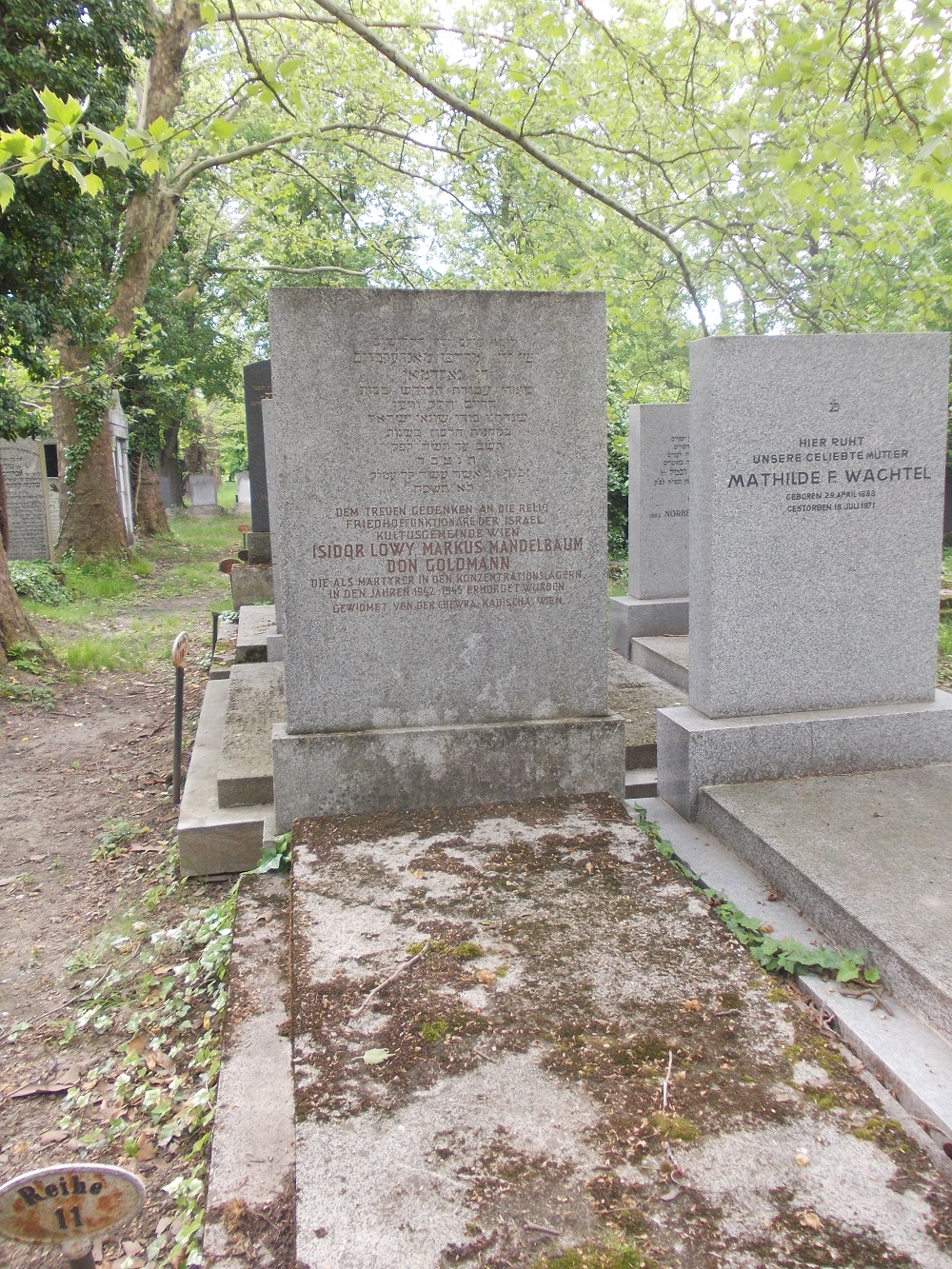
In my last post here I said that when it is safe, I will go to Baghdad to visit the grave of the Ben Ish Hai. I cannot find a picture of the Ben Ish Hai’s grave online, but you can see it in R. Yaakov Moshe Hillel’s beautifully produced recent book, Ben Ish Hai, p. 337. However, this is from the old cemetery in Baghdad, and because of a government order the remains in this cemetery were moved in the early 1960s. So it remains to be seen if the grave can now be located.[1] R. Hillel, p. 336 n. 480, claims that the precise location cannot be identified.

כיום, לא ניתן לזהות את קבריהם, בשל תנאי אקלים קשים השוררים בבבל אשר גרמו להתפוררות המצבות, ומחוסר רישום מדוייק של חלקות הקבורה.

Yet until we can go in and actually examine the spot, we cannot be certain if this is the case. There have been other examples of graves thought to have been lost, which have then been found. The best-known example is the grave of R. Israel Salanter, which was only located twenty years ago.[2]

While there is no doubt that the Ben Ish Hai was buried in Baghdad, there is also a tombstone for him on the Mount of Olives in Jerusalem.

According to a famous story, which is also told on the tombstone, the Ben Ish Hai’s body was not only magically transferred to Jerusalem on the day he died, but the grave-digger testified to burying him on the Mount of Olives and wanted payment for his labor.[3] I guess we can say that the Ben Ish Hai was buried three times: twice in Baghdad and once in Jerusalem.

It is hard to know whether the entire story of the burial in Jerusalem is a legend, or if there actually was a grave digger who figured out a way to make some money and invented the story to get paid for digging the grave. Assuming the latter is the case, the grave digger must have known his crowd, that not only would they be inclined to believe such a story, but that they would also not think of actually confirming the story by digging up the grave. Truth be told, it would have to be a very fearless grave digger to leave the grave empty, because one never knows if it will be opened, so it is possible that some unknown person is actually found beneath the tombstone. It is also possible that the grave digger did not have any bad intent, but just had a very vivid imagination. In any case, it is fascinating that such a tombstone exists in the most special Jewish cemetery, and even more incredible that there are people who actually believe that the Ben Ish Hai is buried there.

Supposedly, the Ben Ish Hai’s tombstone on the Mount of Olives is the only one that is standing upright, as all others are horizontal. (Maybe someone in Jerusalem can confirm this.) It is worth noting that R. Yitzhak Kaduri paid the grave in Jerusalem no mind, and even joked about it.[4] R. Shmuel Eliyahu has stated that while the Ben Ish Hai is buried in Baghdad, his spirit came to Jerusalem.[5]

Similar to the story with the Ben Ish Hai’s burial place, R. Abraham Joshua of Apt is buried in Medzhybizh, near the Baal Shem Tov’s grave, but there is a legend that angels carried his body to Tiberias, and there is a stone marking his grave there as well.[6]

This last summer I was in Marrakech, Morocco. In the local Jewish cemetery, R. Jacob Timsut is buried. Yet, “one month after the deceased rabbi was buried in Marrakech, a letter arrived from Jerusalem announcing the marvelous appearance of a tombstone with the name of Rabbi Ya’aqov Timsut in the well-known cemetery on the Mount of Olives.”[7] So once again, you can visit the tzaddik’s grave in its original spot or in Jerusalem.

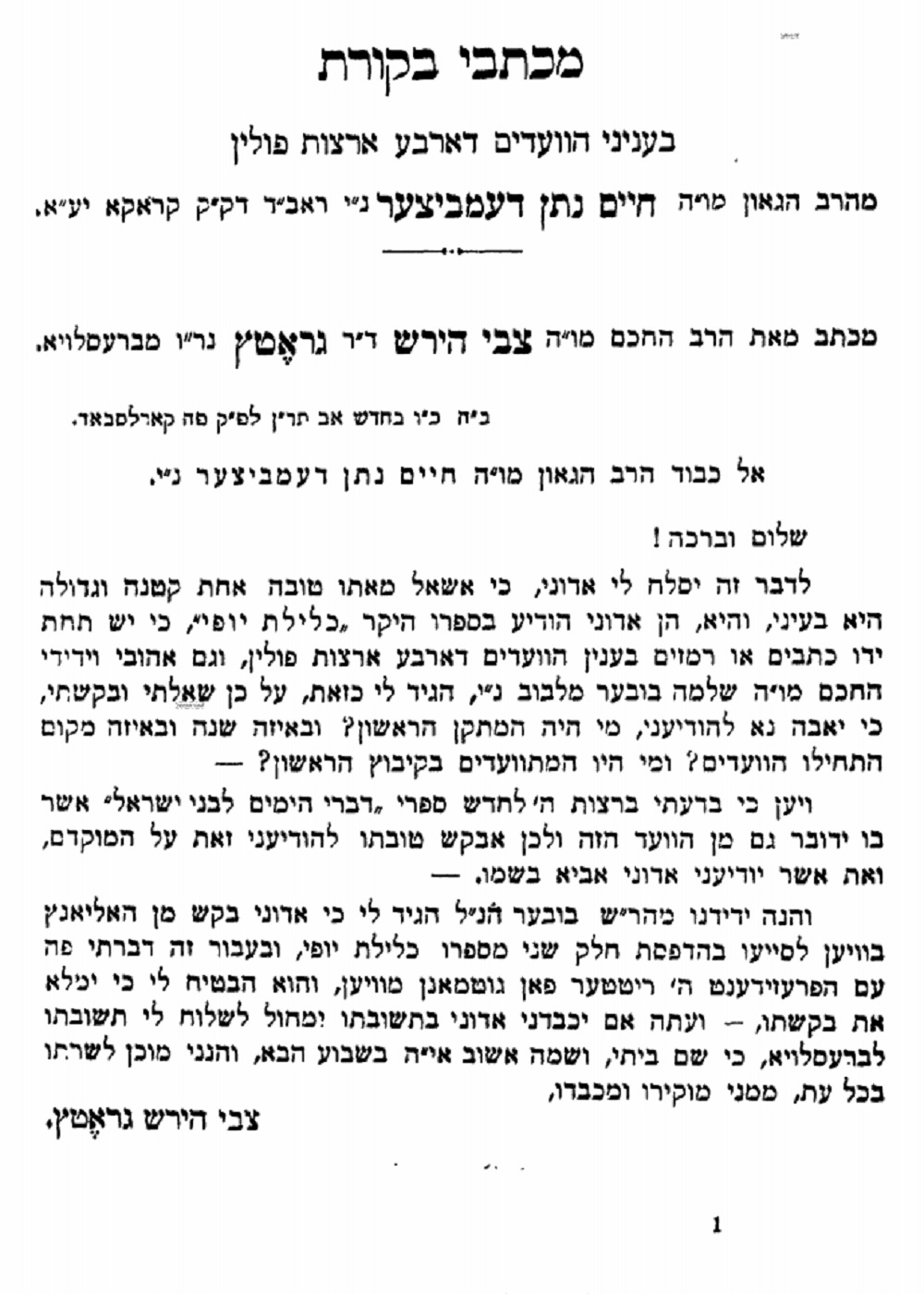
Regarding tombstones even though the deceased is not buried there, I must call attention to the fascinating comments of R. Hayyim Nathan Dembitzer (1820-1892). R. Dembitzer was a dayan in Cracow and author of the responsa volume Torat Hen. Yet his claim to fame is his historical writings. As a real historian, he was prepared to accept the truth from where it came, and it is significant that in his work Mikhtevei Bikoret (Cracow, 1892), he included correspondence with Heinrich Graetz. Here is the title page and the first two pages of this book.

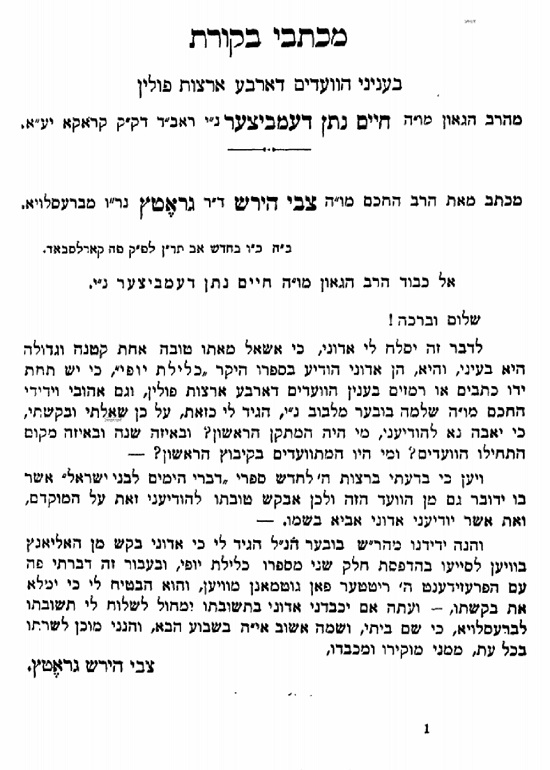
 

Look at how respectfully he refers to Graetz, which is the sort of thing that would have driven R. Samson Raphael Hirsch and R. Esriel Hildesheimer crazy.

Dembitzer’s respectful scholarly interactions with Graetz, in which he did not let religious differences interfere, is parallel to how certain important rabbinic figures related respectfully to Louis Ginzberg. I dealt with this matter in Saul Lieberman and the Orthodox, and it has also recently been discussed by R. Moshe Maimon.[8] Interestingly, in Mikhtevei Bikoret R. Dembitzer also includes correspondence with Nachum Sokolow.

Dembitzer’s two-volume Kelilat Yofi is focused on the rabbis of Lvov as well as other Polish rabbis, and is essential for anyone doing research on the Polish rabbinate. In this work, vol. 1 p. 41a, he mentions that Elyakim Carmoly had written that in earlier years in Lvov they would place tombstones in the cemetery for the deceased scholars of the city even if they had died and were buried elsewhere.

Dembitzer does not give an exact reference for Carmoly, only mentioning that his comment is in Ha-Karmel. Fortunately, I was able to find Carmoly’s article and it appears in Ha-Karmel, April 17, 1867, p. 302. Carmoly’s has two proofs for his contention. The first proof is that in R. Gavriel ben Naftali Hertz’s Matzevat Kodesh (Lemberg 1864), vol. 2, in the second half of the book (there is no pagination here), we find the following tombstone for R. Elijah Kalmankash, who served as rav of Lvov.

The tombstone explicitly states:

.וישכב עם אבותיו ויקבר במקום קבר אביו ולא ידע איש את קבורתו עד היום הזה

This is a clear proof that at least for this rabbi, a tombstone was placed in the ground even though he was not buried there.

Carmoly also notes, as his second proof, that in Matzevat Kodesh, vol. 2, p. 22a, it records, from the Lvov cemetery the text of the tombstone of R. Petahiah, son of R. David Lida who was rav of Amsterdam. His date of death is given as 1721. Here is the text of the tombstone as recorded in Matzevat Kodesh.

(Following R. Petahiah’s tombstone, Matzevat Kodesh records the tombstones of another son and son-in-law of R. Lida.) However, Carmoly tells us that we know that R. Petahiah died and was buried in Frankfurt. R. Markus Horowitz in his Avnei Zikaron (Frankfurt, 1901), p. 290 (no. 2712), published many years after Carmoly’s article, records the text of his tombstone as follows.

As you can see, the date of death is 1751, thirty years later than the date given on the tombstone in Lvov. In other similar cases, I would say that we are dealing with two different people, but the specificity of the tombstone texts makes it hard to deny that they are both for the same person (and Petahiah was hardly a common name).[9] Carmoly’s conclusion is that the community of Lvov put up a tombstone for R. Petahiah to memorialize him, even though he was buried in Frankfurt. Neither Carmoly nor R. Dembitzer offer an explanation as to why the Lvov tombstone places his death thirty years too soon, but they would probably view this as just a simple error.

Dembitzer not only agrees with Carmoly in the case of R. Petahiah, but offers another example of this phenomenon. R. Zvi Hirsch ben Zekhariah Mendel had served as rav in Lvov, but later he was rav in Lublin and died there around 1700. However, there was a tombstone for him in Lvov which gave his date of death at 1655. R. Dembitzer does not explain the discrepancy of the dates of death, and presumably he would say that when the tombstone was put up in Lvov to honor the deceased former rav of the city (who was not buried there), they simply got the date of death wrong. Interestingly, Shlomo Tal accepted the statements of Carmoly and R. Dembitzer, and in summarizing their position speaks of “many fictitious tombstones.”[10]

Dembitzer also makes the astounding assertion that there are graves in the Lvov cemetery for rabbis who never existed! His proof is that there is a tombstone for a Rabbi Eliezer ben Moshe ha-Kohen Proops (פרופס), who is said to have been av beit din in Amsterdam before he came to Lvov. Yet R. Dembitzer states that no such person was av beit din in Amsterdam, and we thus see that the people who made the tombstones did so for rabbis who never existed![11]

כי גם זאת לפנים בלבוב, להקים ג”כ מצבות אבנים ולחקוק עליהם שמות חכמי ישראל אשר לא מתו ולא נקברו לא בלבוב, וגם לא במקומות אחרים, יען כי לא היו ולא נבראו ולא באו עוד לעולם . . . ומי לידינו יתקע אם לא עשו זכרונות במצבות אבנים כאלה גם לשאר גאונים אשר בדו מלבם וקראו בשמותם עלי אדמה, וקבעו גם כן זמן לפטירתם

This is a very strange assertion, and even if it is correct, it refers to one case only, while R. Dembitzer uses it to make a generalization. The only one I know who took note of R. Dembitzer’s assertions was R. Hayyim Eleazar Shapira in a letter to R. Leopold Greenwald.[12] R. Shapira rejects R. Dembitzer’s claim in a very sharp tone.

ולא יאומן כי יסופר כי מרב גדול בתורה יצאו דברי הבל כאלו אשר כל השומע ויודע יצחק להם, ליתן מצבות ומקום בעד אותן שאינם נקברים שם ולכתוב שקר גמור “פ”נ” על להד”ם ולהשחית הקרקע שלא נקברו שם אין כדאי להטפל בדברי ריק כאלו. ואם בשביל קושיות שמצאו כמו ב’ מצבות כמו שני יוסף בן שמעון בשתי עיירות כלומר בתי קברות הנה שערי תירוצים לא ננעלו ונמצאו באמת שנים ששמותיהן שוות או לא העתיקו המצבות במקום אחד כראוי

Shapira makes the obvious point that two people with the same name can be buried in different cemeteries without them being the same person. However, this does not explain how there can be two tombstones for R. Petahiah, the son of R. David Lida, or how there can be a tombstone for another rabbi in the Lvov cemetery when we know that he was buried elsewhere.

Regarding what we have discussed, I would only add that in the new Jewish cemetery in Vienna (the same one that R. Israel Friedman, the Chortkover Rebbe, is buried in), there is a tombstone for three members of the Chevra Kadisha who perished in the Holocaust. While it looks like a normal grave, none of the three men mentioned on the tombstone are actually buried there.[13] Here is the tombstone.

I owe this information and the picture to Dr. Tim Corbett, whose book on the Jewish cemeteries of Vienna will hopefully soon be published.

Since I just mentioned R. Hayyim Eleazar Shapira, let me mention something else he says that is fascinating. In the past two posts I discussed apostate rabbis. It is bad enough when an average person apostatizes, but for a rabbi to do so could have had terrible consequences on the community in that it could lead to many weak of heart to follow. Can anyone imagine, however, someone apostatizing as an act of teshuvah? It sounds crazy, but R. Shapira reported that he had it by tradition that such an incident happened in medieval times.[14]

The story he tells is that there was a popular preacher who in his public talks inserted all sorts of heretical ideas. After he was rebuked by one of the rabbis for preaching his heresies, the man confessed his sins and asked what he should do to repent. The rabbi told him that his repentance would not help, as for years he has gone from place to place spreading his heresy. How could he possibly repent for this? The rabbi said that what he must do is convert to Christianity. The Jewish world would then hear about this and this would remove the legitimacy from any of his sermons, as people would assume that even before his apostasy he was a heretic. Only by doing this could he destroy the impact he made with his earlier sermons.

Let me mention one final responsum for now. In the eighteenth century, R. Elijah Israel of Rhodes dealt with the case of someone who converted to Islam in Izmir, and then wished to come to Rhodes in order to return to Judaism.[15] Practicing Judaism after converting to Islam was illegal, and could endanger everyone in the community. The man was therefore warned not to come to Rhodes, where Muslim merchants might recognize him, but he ignored this warning. Making matters worse, the man had already once before converted to Islam and reverted to Judaism, meaning that there was no way that the Jewish community could have any dealings with him.

Israel permitted letting the authorities know about this man, as he was regarded as a danger to the community. The punishment for his “crime” of leaving Islam would have been severe and could even have included the death penalty, but R. Israel allowed informing the authorities as the man had the status of a rodef. He writes:

מי שמסכן רבים כגון שעוסק בזיופים במקום שהמלכיות מקפידות דינו כרודף ומותר למוסרו למלכות ע”כ וכ”ש וק”ו במי שהמיר דת ורוצה לחזור לדתו שההקפדה היא גדולה שהוא בזוי גדול לדעתם פן תצא כאש חמתם ח”ו ובערם ואין מכבה שמותר למוסרו כדי להציל את ישראל

* * * * * *

In the most recent issue of Dialogue 8 (2019), pp. 35-83, Rabbi Herschel Grossman published a lengthy review of my Limits of Orthodox Theology.[16] Normally I, like any author, would be very happy that so many years after a book’s appearance people are still interested in examining it and engaging with its arguments. Unfortunately, that is not the case with the present review which, it must be said, is nothing less than slanderous. Had the author taken issue with my interpretation of texts and shown why I am mistaken, this would have been a fine way to approach the book. It could be that I would even acknowledge that in some cases his understanding is preferable to mine. As readers of this blog know, I am perfectly willing to acknowledge when I have erred and am happy to credit those who called my attention to these errors. This is how scholarship is supposed to work, and anyone who writes, especially someone who writes a great deal using lots of different sources, will sometimes make a mistake. I myself have called attention to my own errors, without anyone prompting me, as I think it is important for all of us to be as exacting as we can.

However, this is not what the review is about, or, I should say, not what it is mainly about. In future posts I will come to the issue about how to interpret specific texts (and I will defend my readings), but first I must explain why I said that the review is slanderous. It is because Grossman accuses me of saying things that I never said, and throughout he misunderstands the purpose of the book, and of academic Jewish studies as a whole. In general, it is obvious from the review that although Grossman has never met me or even spoken to me, and I have never done him any wrong, he sees me as an enemy that he has to destroy.[17] With such a preconceived notion, it is no wonder that he comes to such incorrect conclusions as to what I am trying to say, and can write a review that is so mean-spirited and dripping with contempt. Based on e-mail correspondence with readers, I do not believe that anyone who has read the book will be taken in by the review’s distortions. However, those who haven’t read the book will probably come away with a false understanding, so it is important to clear this matter up before getting to any arguments over how to interpret particular sources.

Before going through the article itself, let’s look at the end where Grossman says that the book “falls short of its promise to prove that the Rambam was wrong in presenting his Principles as central to Judaism” (p. 83). I think everyone who has read the book knows that of all the things I try to do, one thing I do not do, and indeed it would have been incomprehensible to even imagine such a task, is attempt to prove that the Rambam was wrong. Even if I were a theologian, which I am not, I could not imagine myself ever trying to prove the Rambam (or R. Bahya, R. Saadiah, Ibn Ezra, etc. etc.) wrong. This is simply not how I operate.

The notion that I attempted to prove the Rambam wrong is so far from what I was trying to do in the book, that as mentioned, I don’t believe that anyone who actually read the book, or any of the other reviews, would have concluded as such. What they would have seen is that I try to show that the Rambam’s principles were disputed by others, and thus did not receive complete acceptance. I try to prove this point, but this is very different than trying to “prove that the Rambam was wrong.”

I don’t even know how one would be able to prove the Rambam, or any other Jewish thinker, “right or wrong” on theological matters. Is it possible to “prove” that creation was ex nihilo or from pre-existent matter, or can we ever “prove” that prayers should not be addressed to angels? Today, unlike in medieval times, most of us assume that by their very nature, theological discussions are not subject to “proof”. The most one can do is try to show which position makes more logical sense and is in line with biblical and rabbinic teachings.[18]

In his conclusion, Grossman also writes, in opposition to my supposed error, “that the Rambam’s Principles of Judaism remain the correct affirmation of Jewish belief.” Again, this sentence has nothing to do with my book, as it assumes that I claimed that the Rambam’s principles are incorrect. Had he understood what the book is about, and he wished to dispute with me, he would instead have written “that the Rambam’s Principles of Judaism are the generally accepted [or: halakhically binding, or: rabbinically sanctioned, etc.] affirmation of Jewish belief.”

Let us now start at the beginning. Grossman begins his review—and I will be going through it page by page responding to his attacks—by stating that “the academic approach to matters of Torah learning is radically different from that of the talmid chochom” (p. 36). This is an incorrect statement, as many followers of the academic approach are themselves talmidei hakhamim. What Grossman should have written is that the academic approach is different than the traditional approach. With regard to academic works, Grossman states: “Many of the conclusions of these works are at variance with accepted Torah teachings” (p. 35). No doubt that this is a true statement, but of course, the issue we will have to get into is what is the definition of “accepted Torah teachings.” As all readers of this blog are aware, R. Natan Slifkin’s books were banned because they were seen to be at variance with “accepted Torah teachings,” so the fundamental issue will be which teachings are supposedly accepted.

Grossman writes as follows in explaining the difference between a traditional Torah scholar and an academic scholar:

[For] the talmid chochom, a difficulty in the words of the authority creates a challenge for him to discover the true meaning of the authority. For many academics, a difficulty is proof that the authority is wrong (p. 36).

Grossman identifies me as one of the academics who try to show that an authority is wrong, so let us see whether this is indeed the case. He begins by stating about my book: “Its thrust is that the Rambam erred in codifying these Principles.” We have already seen this unbelievable distortion in his conclusion, as if one of my goals was to show that the Rambam was mistaken.

Grossman further states that “while some earlier scholars have disputed whether some of the Principles deserve to be listed as basic to Judaism . . . all have conceded that the tenets expressed by the Principles are correct” (p. 36). This statement is grossly inaccurate, as virtually every page of my book demonstrates (and in various blog posts I have also cited numerous authorities who disagree with certain of Maimonides’ principles).[19] Even if all of Grossman’s criticisms of particular points of mine are correct (and I will come back to this), it still leaves loads of sources at odds with the Rambam. The sentence is nothing less than shocking, since rather than acknowledging that other authorities disagreed with certain Principles of the Rambam, but claiming that these authorities’ views are to be rejected for one reason for another, Grossman states that “all have conceded” that the Rambam’s views are correct. It is hard to know how to reply to such a statement that completely disregards the truth that everyone can see with their own eyes.

In Limits, p. 26, I quoted the following from R. Bezalel Naor, who was repeating what he heard from R. Shlomo Fisher: “The truth, known to Torah scholars, is that Maimonides’ formulation of the tenets of Jewish belief is far from universally accepted.” R. Naor informed me that R. Fisher made this statement in explaining R. Judah he-Hasid’s view about post-Mosaic additions to the Torah. In other words, R. Judah he-Hasid’s view is not in line with Maimonides’ Principles, but this is not the only such example of Torah sages diverging from the Principles.

Grossman continues by stating that I conclude “that the Rambam’s formulation of the underlying beliefs of Judaism was his own innovation” (pp. 36-37). What does this sentence mean? Apparently, he wants the reader to think that I said that the Rambam just invented his Principles out of thin air, which is of course incorrect as I never said this. If the meaning is that the very notion of a list of doctrines formulated as Principles of Faith, with all that this entails, was the Rambam’s innovation, there is nothing controversial about this at all, and I discuss whether the Rambam was the first to do this and what led him to do so.

Grossman continues: “Even such basic tenets as the belief in God’s unity, or in God’s non-corporeality, says Shapiro, are the Rambam’s own assertions and subject to dispute, with no firm basis in the Torah or in Chazal” (p. 37). I never say that these tenets are the Rambam’s own assertion without any prior basis (as if the Rambam invented these ideas). When it comes to the belief in God’s unity, I state explicitly that no Jewish teacher has ever disputed this (although how they understood God’s “unity” was subject to dispute). As for God’s incorporeality, I will come back to this in greater detail in a later post, where I will also deal with R. Isaiah ben Elijah of Trani’s claim that divine incorporeality is not a principle of faith, as well as Maimonides’ view that in its simple meaning (but only in its simple meaning), the Torah itself teaches God’s corporeality (for the benefit of those people who at the beginning of their studies are not able to understand the profound concept of a deity without form). Since I will then analyze this matter in great detail, I do not want to get into it here. For now, I will simply say that in the book I discussed whether divine incorporeality was accepted by all Jews at all times, and if corporeal views of God can be found in the Talmud (as was stated by R. Isaiah ben Elijah of Trani).

On p. 37 Grossman writes:

Shapiro, who mocks the opinions of Rabbeynu Nissim, R. Moshe Feinstein, Chazon Ish, Arizal, and R. Ya’akov Emden, among others, goes one step beyond Kellner in his belief that he, Shapiro, is better able than Rambam to interpret explicit verses of the Torah (as we shall see below).

This is nothing less than slander since I never, not even once, mock the opinions of any of these great rabbis or anyone else. When I read this sentence, I had no clue what he was talking about, as this is not how I operate, and was shocked when I went to the sources he refers to. Let us look at what Grossman regards as “mocking”.

For my mocking of R. Nissim, he refers the reader to p. 84 in my book where I write that R. Nissim “puts forth the strange and original position that there is one particular angel before whom prostration is permitted.” This is mocking?[20]

For my “mocking” of R. Moshe Feinstein’s opinions he provides three sources.

On p. 101 n. 73, I discuss R. Moshe’s rejection of the authenticity of a passage in Avot de-Rabbi Nathan. I write that R. Moshe’s “rejection of the authenticity of this passage should be viewed as part of his pattern of discarding sources that do not fit in with his understanding. He does so even when the sources are neither contradicted by other writings of the authors involved nor by other versions of the text in question.” Where is the mocking?

On p. 157, I write: “Although R. Moses Feinstein was the greatest posek of his time, he seems to have had no knowledge of Maimonidean philosophy. He was therefore able to state that Maimonides believed in the protective power of holy names and the names of angels, as used in amulets.” Where is the mocking?[21]

The last source where I am said to be mocking R. Moshe’s opinion is p. 159 of my book. Here is the page.

All I do here is cite R. Moshe’s comment about those who oppose kollels by citing the Rambam. I have also seen R. Moshe quoted as saying that it is noteworthy that those who oppose kollels based on the Rambam only adopt this one “humra” of the Rambam. The Rambam has lots of other humrot, yet people don’t adopt these stringencies. They only want to be “mahmir” in accordance with the Rambam so as not to support kollels. To say that I am mocking R. Moshe’s opinion is not only slander, it is completely incomprehensible.

Regarding the Hazon Ish, Grossman refers to p. 17. On this page I mention the views of many who held that the Thirteen Principles are the fundamentals of Judaism, and I include a passage from the Hazon Ish. I don’t see any mocking.[22] He also refers to p. 65 n. 124, where I mention a number of sages, including the Hazon Ish, who say that the Rambam’s view that belief in divine corporeality is heresy (Hilkhot Teshuvah 3:7) does not refer to someone who does not know any better, and thus the Rambam is not in dispute with Rabad who criticizes the Rambam on precisely this point. In response to those authorities who made this argument, I wrote: “They obviously never saw Guide I, 36, cited above, p. 48.” In this source, Maimonides specifically rejects the notion argued by the Hazon Ish and others that Maimonides is not speaking of the person who does not know any better. In fact, R. Kafih goes so far as to say, in his commentary to Hilkhot Teshuvah 3:7, that Maimonides saw Rabad’s comment and Guide 1:36 was written specifically in response to it, in order that people not assume that Rabad’s position can be regarded as theologically sound.

Regarding R. Isaac Luria, Grossman points to p. 90, where I write:

Finally, I must mention R. Isaac Luria’s view that Moses’ understanding of divine matters was inferior to that of certain kabbalists (including himself!). This notion is elaborated upon by R. Shneur Zalman of Lyady (1745-1813), who asks, “’How did Rabbi Isaac Luria, of blessed memory, apprehend more than he, and expound many themes dealing with the highest and most profound levels [penimiyut], even of many Sefirot.”

Again, I don’t know where there is any mocking. Incidentally, a reader has made a very good case that I am incorrect, and R. Isaac Luria and R. Shneur Zalman should not be cited as opposing Maimonides’ principle. In a future post, I will present this argument, which R. Chaim Rapoport told me he agrees with.

Regarding R. Emden, Grossman refers the reader to p. 16 n. 63. Nowhere in this note do I mock an opinion of R. Emden. What I do say is that his sexuality was complex. In retrospect, I regret including this comment, since it is not really relevant to the matter at hand. Yet there is no question that when it comes to sexual matters, there is something very much out of the ordinary, especially for rabbinic greats, in how R. Emden writes about these things. This is something that I believe is acknowledged by everyone who has studied R. Emden’s writings, including the most haredi among us, even if they won’t put such statements in writing. Mortimer Cohen, in his book on R. Emden, famously pointed to sexuality to explain how R. Emden could have attacked R. Eybeschütz the way he did, with such outrageous accusations. Still, I believe that Jacob J. Schacter is correct when he states: “[W]hile it is clear that Emden had a complex and contentious personality, all this emphasis on his sexuality is really irrelevant to his attack on Eybeschütz.”[23] I for one am not comfortable with psychological interpretations, even if in this case such an interpretation can be used as a limud zekhut for some of the shocking things R. Emden says, and if I was writing the book now I would leave out the passage mentioned above. Yet where is the mocking? The only mocking I see is how Grossman continuously mocks me.

Grossman writes: “Shapiro does not refrain from adducing explicit Talmudic passages as contradictions to the Rambam, presuming that the Rambam overlooked or ignored them, something which innumerable Talmudic scholars in past centuries have considered inconceivable” (pp. 37-38). In the book I never say that the Rambam overlooked talmudic passages. I do say that he did not accept the outlook of every talmudic passage (which Grossman terms, “ignored them”). The Rambam famously held that not every passage in the non-halakhic sections of the Talmud is binding.

Grossman continues:

Shapiro is unimpressed by all these arguments; nor is he averse to dismissing Rambam’s opinion based on his, Shapiro’s, own reading of a Talmudic passage, even where there is no doubt that the Rambam had a different reading for it. An academic, he obviously feels, is privileged to interpret the Talmud better than the Rambam was [!], even where this presumption leads to bizarre conclusions (p. 38).

The only thing that is bizarre here is Grossman’s statement, for I can assure everyone that in the book I do not engage in talmudic debate with the Rambam, dismiss the Rambam’s opinion, and think that I am able to interpret the Talmud better than the Rambam. If someone offers, say, a new interpretation of a talmudic passage, does this mean he thinks he can interpret the Talmud better than Rashi or the Rambam?

Another false statement is found on p. 38 where Grossman states: “Although he is to be commended for the amount of research he has invested into his work—the citations he has amassed are voluminous—it seems that many of the references were culled from secondary sources without examining the originals.” I can state with absolute certainty—and other than Grossman, I don’t think anyone else has ever raised such an accusation of scholarly malpractice—that I have examined every original source cited in the book. Not only that, but I have examined every source in every book I have published and in every blog post. I have never cited a source that I have not examined “inside” unless I indicate so. This does not mean that I have never misinterpreted a source, and in subsequent posts I will examine some examples where Grossman offers a different reading. But for now, suffice it to say that it is nothing less than slander to state that I included sources in the book that I did not examine myself (and this, by the way, was before the existence of the various digital databases. Librarians at JTS and YU can remember me as I was constantly there during the time I was writing the book.)

The final point for now is Grossman’s conclusion of the first part of his review:

To analyze the errors in this book would require a book in itself, nor is this the purpose of this article. The purpose is to show the lack of basis for Shapiro’s assertions (1) that the Rambam’s Principles have no basis in Talmudic literature; (2) that he created these Principles either to advance his philosophic conclusions or for polemic purposes; and (3) that many authorities thought the Principles “were wrong, pure and simple” (p. 38).

Point 1 is incorrect. I never state that the Rambam’s Principles have no basis in talmudic literature. Every single one of the Principles can find support in the Talmud (even if others might disagree with how to interpret the talmudic passages), and I cite examples of this in the book. What I do say is that the concept of Principles of Faith put forth by Maimonides, that one can commit endless sins but if he believes in the Principles he is still a Jew in good standing (albeit a sinning Jew) with a share in the World to Come, and if he denies or doubts even one of the Principles, even if he did not know any better and even if he fulfilled all the mitzvot, he does not have a share in the World to Come, such a concept is not found in talmudic literature. I am hardly the first to say this. Many of the Rambam’s rabbinic critics made this point, and as far as I know, all of the academic scholars who have studied the Rambam have said likewise. Furthermore, even if there are talmudic sources for the substance of Rambam’s Principles, this does not mean that there is compelling talmudic sources to explain why the Rambam categorized these particular beliefs as Principles, denial of which is heresy. Often, we must look to his philosophical assumptions, which he regarded as part and parcel of Torah, to explain why he raised certain beliefs to the level of Principles while others did not. We must also look to his philosophical assumptions to understand why he read certain talmudic passages the way he did, and was thus led to formulate his Principles in a certain fashion.

I would also like readers to examine the following statement by the rabbinic scholar, R. Reuven Amar.[24] Based on what Grossman writes, I assume that he will regard this as equally blasphemous to anything I have written.

דאם כי ודאי אין חכמת הרמב”ם ז”ל כשאר בעלי החכמה ובעלי הדעה וגדולה חכמתו ושיעור קומתו ולבו רחב כאולם בכל חכמה ומדע מ”מ בעיקרי האמונה אין דבריו כמפי הגבורה אחר שלא קיבלם איש מפי איש עד משה רבינו ע”ה כי אם משיקול דעתו ובינתו וכפי שהודה וכתב בעצמו בהקדמת ח”ג מהמורה נבוכים, בענין מעשה המרכבה ומעשה בראשית ועיין בזה במגדל עוז פ”א מיסודי התורה ה”י וכן ראיתי בספר שומר אמונים (להרב ר’ יוסף אירגס זצ”ל) בויכוח ראשון סעיף ח’ ט’ שהתבסס על זה

Regarding point 2, Grossman sees it as problematic to say that the Rambam created the Principles to advance his philosophical conclusions. Yet this is a perfectly reasonable approach. After all, wouldn’t the Rambam want the Jewish people to hold philosophical truths, and what better way to achieve this than to put these truths in the form of Principles of Faith that everyone has to know? This approach is commonly held among scholars of the Rambam. As for the accusation that I say that the Rambam created the Principles for polemical purposes, I never say that with regard to the Principles as a whole. I do say this about aspects of two of the Principles, and I will return to this in a future post. The fact that I am being attacked on this matter is ironic, as my approach is actually more conservative than what is found in almost all works of modern scholarship on the Rambam.

As for point 3, I do not say that “many authorities thought the Principles” were wrong. What I do say is that many authorities thought that individual Principles were mistaken. By writing “the Principles,” Grossman leads readers to think that I said that many authorities rejected the Principles in their entirety, but all readers of my book know that this is not the case.[25]

I want to conclude with the following from R. Mordechai Willig, which has some relevance to my discussion and which I think readers will find of interest.[26] R. Willig’s entire shiur is worth listening to, but for the purpose of this post I only want to cite one small section.

As we know, not all the Ikrei Emunah were etched in stone without any dispute from the beginning of time. . . . Are in fact the Rambam’s Thirteen Principles accepted le-halakhah for the last X hundred of years and you can’t go against it, or perhaps not? There are those therefore who are trying to get around certain of his Ikrim. The Sefer of Albo himself who wrote the Sefer Ikrim didn’t accept all the Thirteen of the Rambam. One might argue that we don’t really find anywhere to my knowledge significant dispute about the other Ikrim of the Rambam, but perhaps not all Thirteen were accepted, but we’ll call [it] Twelve and a Half. The first part of Ikkar number 5 was accepted, and the second part which is so complex, perhaps it never really was accepted. So there are Thirteen Principles but one of them, number 5, we only accept part of the Principle, not the entirety of the Principle. . . . It’s against the Rambam, but this half of that Principle was never accepted. But the rest was accepted.

In the next post I will continue with my response (and it looks like it will take many posts before I am finished, unless I first tire of this endeavor).


[1] Sipurim me-ha-Hayyim: Kitzur Shivhei ha-Ben Ish Hai (Jerusalem, 2009), p. 47.
[2] See here.
[3] See e.g., here.
[4] See R. Kaduri, Divrei Yitzhak, pp. 173-174.
[5] See here.
[6] See here.
[7] Yorma Bilu, Saints’ Impresarios: Dreamers, Healers, and Holy Men in Israel’s Urban Periphery, trans. Haim Watzman (Brighton, MA, 2010), p. 65.
[8] “Perek be-Hithavut ha-‘Olam ha-Torah’ be-Artzot ha-Berit le-Ahar ha-Milhamah,” Hakirah 26 (2019), pp. 31-52.
[9] See, however, Solomon Buber, Anshei Shem (Crakow, 1895), pp. 28-29, who is skeptical.
[10] Peri Hayyim (Tel Aviv, 1983), p. 149.
[11] Kelilat Yofi, pp. 41a-b. See also Buber, Anshei Shem, p. 32.
[12] Greenwald, Otzar Nehmad, p. 117.
[13] There is also a section of this cemetery where hundreds of Christians are buried. The Nazis refused to allow these people to be buried elsewhere as under the Nuremberg Laws they were regarded as Jewish (and halakhically, some of these people would indeed have been Jewish).
[14] Shapira, Divrei Torah, vol. 5, no. 27.
[15] Ugat Eliyahu (Livorno, 1730), no. 22
[16] Limits appeared in 2004. I wonder if it is only very negative reviews that come out so long after a book’s appearance. Another example is Haym Soloveitchik’s review of Isadore Twersky’s revised edition of Rabad of Posquiéres. The book appeared in 1980 and the review appeared in 1991. See Soloveitchik, “History of Halakhah – Methodological Issues: A Review essay of I. Twersky’s Rabad of Posquiéres,” Jewish History 5 (Spring 1991), pp. 75-124.
[17] Grossman did correspond with me and ask me questions which I tried to the best of my ability to answer. He also challenged some of what I said in his emails to me. Yet I have to say that I am quite hurt that he was not honest with me in this correspondence. On July 16, 2018, he began his correspondence with me by telling me that he was writing an article on the Thirteen Principles. In this email he also said that my book was well-written. (Buttering me up, I guess.) On July 17 he wrote to me: “Thank you for your communication! You are helping me tremendously.” I guess I was helping him to bury me. Also on this day he wrote to me about his article: “maybe you can help me with the writing!” I am sorry to see now that this was all part of a grand deception on his part.

In his email to me of October 11, 2018, Grossman wrote that he completed his article on the Thirteen Principles, “and have cited you in a few places.” Is this how an honest scholar operates, by deceiving the person he has been emailing with? I responded to his questions and explained how I view things, as I do with anyone who contacts me. I would have done the same thing had he been honest with me and told me that he was writing an article devoted to disputing my ideas. His friendly demeanor in his emails led me to assume that we were engaged in a form of scholarly collaboration in trying to understand important texts and ideas. So imagine my surprise to see that contrary to what he wrote to me that he cited me “in a few places,” the entire review is an attempt to tear me down. Furthermore, Grossman has been telling people that he wants his article to destroy my reputation as a scholar. What type of person treats his fellow Jew in this fashion?
[18] In a wide-ranging article which deals among other things with R. Kook’s view of heresy, the important scholar R Yoel Bin-Nun explains why R. Kook rejected the Rambam’s approach to heresy. R. Bin Nun also states that if you take what the Rambam says seriously, the Rambam himself, if he were alive today and saw how theological matters are no longer regarded as subject to conclusive proofs, would not regard people who disagreed with his Principles as heretics. In R. Bin Nun’s words (emphasis added):

שיטת הרמב”ם ברורה: יסוד שתלוי באמונה, ואין בו הוכחה שכלית, וכל החכמים מתווכים עליו, אי אפשר להגדיר את מי שאינו מאמין בו כ”כופר” או כ”מין”. עצם העובדה שהדבר נתון בוויכוח שכלי בין החכמים מאפשר ומחייב לבנות את עולם האמונה, אך אינו מאפשר לשפוט ולדון את הכופרים. רק ודאות שכלית מוחלטת מאפשרת לדון אדם כמזיד בשאלות של אמונה וידיעה

“Kahal Shogeg u-Mi she-Hezkato Shogeg o To’eh: Hiloniyim ve-Hiloniyut be-Halakhah,” Akdamot 10 (2000), p. 263.

In other words, according to R. Bin-Nun, based on the Rambam himself there is no justification today for calling people heretics because they reject one (or more) of the Thirteen Principles. (When he refers to hakhamim disputing matters, he is not referring to Torah scholars, but the general scientific-intellectual world.) Whether R. Bin Nun is correct in his analysis of the Rambam is not my purpose at present (and I do not find his position compelling). I only wish to show that this outstanding scholar presents a very tolerant view, one that rejects the Thirteen Principles as determining who is a heretic. I wonder, though, how far he would take this. Lots of scientists and philosophers argue for atheism, and there is no absolute proof for God’s existence. Does this mean that now even atheists are not to be regarded as heretics?
[19] For one example, R. Pinhas Lintop, see here. I write as follows in this post:

Naor calls attention to R. Lintop’s view of Maimonides’ Thirteen Principles. Unfortunately, I did not know of this when I wrote my book on the subject. R. Lintop is no fan of Maimonides’ concept of dogma or of Maimonides’ intellectualism in general. He rejects the notion that otherwise pious Jews can be condemned as heretics merely because they don’t accept Maimonides’ principles. He even makes the incredible statement that of the great rabbis, virtually all of them have, at the very least, been in doubt about one fundamental principle.

הנה לא הניח בן לאברהם . . . כמעט אין אחד מראשי חכמינו, החכמים הצדיקים כו’ כו’, אשר לא יטעה או יסתפק באחד משרשי הדת

Are we to regard them all as heretics? Obviously not, which in R. Lintop’s mind shows the futility of Maimonides’ theological exercise, which not only turned Judaism into a religion of catechism, but also indoctrinated people to believe that one who does not affirm certain dogmas is to be persecuted. According to R. Lintop, this is a complete divergence from the talmudic perspective.

Lintop further states that there is no point in dealing with supposed principles of faith that are not explicit in the Talmud.

הגידה נא, אחי, בלא משוא פנים, היש לנו עוד פנים לדון על דבר עקרים ויסודות את אשר לא נזכרו לנו בהדיא במשנה וגמרא?

As for Maimonides’ view that one who is mistaken when it comes to principles of faith is worse than one who actually commits even the worst sins, R. Lintop declares that “this view is very foreign to the spirit of the sages of the Talmud, who did not know philosophy.” As is to be expected, he also cites Rabad’s comment that people greater than Maimonides were mistaken when it came to the matter of God’s incorporeality.

[20] In R. Meir Mazuz’s recent Bayit Ne’eman, no. 196 (13 Shevat 5780), p. 2, he writes about the Ralbag:

וזו הסיבה שרלב”ג פירש דברים מוזרים

Does this mean that R. Mazuz was mocking Ralbag? R. Joseph Zechariah Stern writes (Zekher Yehosef, Even ha-Ezer, no. 61, p. 237):

ועיקר דברי חוט השני הוא נגד סוגיא דעלמא . . . ואשר בכלל דבריו זרים

Was R. Stern mocking anyone?

Eliezer Waldenberg writes about R. Abraham Halevi, author of Ginat Veradim (Tzitz Eliezer, vol. 8, no. 15, p. 80):

כי בתוך דברי התשובה שם וכן בתוך דברי התשובה שלפניה יש שם ג”כ דבריו [!] מוזרים מאד שכמעט קשה לשומעם

Was R. Waldenberg mocking anyone? And what about when rabbis use even harsher language, saying things like אינו נכון כלל? Does this mean that they are mocking the view they are rejecting? Everyone who studies rabbinic literature knows that nothing could be further from the truth. Stating that a view is strange or unusual, and even rejecting a view in harsh terms, has nothing to do with mocking.
[21] That rabbinic scholars often do not study Maimonides’ philosophy is nothing new. R. Jacob Emden noted that if the rabbinic scholars knew philosophy, they would have protested Maimonides’ proof for God’s existence in Mishneh Torah, Hilkhot Yesodei ha-Torah 1:5, as it is based on the eternity of the world. See Birat Migdal Oz (Warsaw, 1912), p. 20a:

כי הנה המופת הראשון שעשה ע”ז הדרוש בח”ב מס’ [מספרו] הנ”ל מתנועה נצחית תדיר’ (והיא שמצאה חן בעיניו והציגה לבדה עמנו פה בס’ המדע) לקוחה מאריסטו מניח הקדמות, לא יודה בה בעל הדת שהיא בנויה על פנת החדוש. לו ידעו הרבנים התלמודיים בפילוסיפיא לא היו שותקים לו בכאן

[22] Perhaps the “mocking” he sees is the beginning of the paragraph where I write:

To return to the point already mentioned above, if there is one thing Orthodox Jews the world over acknowledge, it is that Maimonides’ Thirteen Principles are the fundamentals of Jewish faith. The common knee-jerk reaction is that there is room for debate in matters of faith, as long as one does not contradict any of these principles.

I then cite a number of great figures who speak of the centrality of the Thirteen Principles (including the Hazon Ish). I used the expression “knee-jerk” as synonymous with “instinctive,” but even stronger, in that the reaction to any divergence from the Principles is strong and immediate, coming from a place of feeling which is prior to any intellectual reaction. Needless to say, there is no mocking.

Regarding statements about the centrality of the Thirteen Principles, let me repeat what I have said elsewhere, and which I will return to in future posts, that the expression “the Thirteen Principles” is more of a shorthand statement about correct belief rather than an affirmation of the Principles themselves in all of their particulars. To give an example of what I mean, it is easy to find statements of rabbis stating that one should not engage with ideas or texts that diverge from the Thirteen Principles. This is a shorthand way of saying that you should not study heresy. However, when the rabbis say that you should not study matters that diverge from the Principles, do any of them mean that you should not study Rashi’s commentary to Deuteronomy 34:5, as it presents a talmudic view about the authorship of the final verses of the Torah that is in opposition to Maimonides’ Eighth Principle? Certainly not, which shows that what Torah scholars mean when they speak of the “Thirteen Principles” is not necessarily what the masses understand by this.
[23] “Rabbi Jacob Emden: Life and Major Works” (unpublished doctoral dissertation, Harvard University, 1988)), p. 409.
[24] Re’ah Besamim, p. 40, appendix to his edition of Besamim Rosh (Jerusalem, 1984). Among R. Amar’s other works, mention should be made of his five volume Minhagei ha-Hida.
[25] In Limits, p. 4, I refer to “those scholars who thought that Maimonides’ Principles were wrong.” While in the context of the book, everyone knew that I meant “certain of Maimonides’ Principles” (namely, the ones I discuss), now that I see how the sentence could be misused by being quoted out of context, I wish that I had been more exacting in my language.
[26] See his shiur, “Selichos: Halacha, Hashkafa and Teshuva,” available here, at minute 45:30.


Open Orthodoxy and Its Main Critic, part 1

Open Orthodoxy and Its Main Critic, part 1
Marc B. Shapiro

Please note: The conversation in the comments, while of importance, does not fit the focus of the Seforim Blog. Anyone who wishes to continue can email Dr. Shapiro or the conversation can be continued on a different website.
1. Those who follow Jewish debates on the internet have probably heard of Rabbi Avrohom Gordimer, who has assumed the mantle of defender of the faith. He sees his goal as exposing the non-Orthodox nature of Open Orthodoxy, and has spent many hundreds of hours reading everything written by Open Orthodox figures (and their spouses), looking for a problematic sentence in order to pounce on them. He not only attacks the Open Orthodox rabbis but also shows his contempt for them by generally refusing to even mention their names. Instead, he refers to an unnamed Open Orthodox rosh yeshiva or rabbi and you don’t know who he is speaking about until you click on the link. I realize he doesn’t respect these figures, but to even deny them the simple courtesy of mentioning their names, as if to do so is muktzeh mehamat mius, is in my opinion simply disgraceful (albeit a common writing style in the haredi world).
This obsession with the Open Orthodox reminds me of how in earlier centuries Christian zealots “could declare themselves ‘crusaders’, join a company of St. Peter Martyr, and assume a special responsibility for denouncing suspicious behaviour to the Holy Office.”[1] It also reminds me of how in previous years the right wing would constantly attack YU and Modern Orthodoxy. Now that the Open Orthodox are under attack, YU and Modern Orthodoxy re getting a pass. But make no mistake about it, if there wasn’t an Open Orthodoxy to kick around, YU and Modern Orthodoxy would once again be the focus. It appears to me, and many others, that all of Rabbi Gordimer’s attacks are pretty meaningless by now, as we get it, he doesn’t like Open Orthodoxy and he thinks that they are not “Orthodox” (a Christian term which perhaps it is time to jettison). Simply drumming this point continuously is not going to make it any clearer.[2]
R. Kook famously said that the righteous do not complain about heresy but add faith.[3] In other words, they always focus on the positive. Now the truth is that this quote, taken by itself, is problematic, as we have examples where R. Kook himself complained about heresy. I think that the passage therefore must be speaking in generalities. In other words, he doesn’t mean that the righteous never complain, but that their essential nature does not focus on the negative and finding the flaws in others. Rather, they are focused on adding faith in order to show the truth of their own position.
Rabbi Gordimer gives us a continuing list of controversial statements from people identified with Open Orthodoxy. As mentioned, he will spend hours and hours reading their material until he finally hits pay dirt. We are never told about any of the good things he sees in the writers he so often attacks, and how 99% of what he reads in their writings is not objectionable. I also find it most curious (but not unexpected) that it is only the left who are subjected to this type of detailed examination, all in order to find material with which to attack them. What about people on the right who also say objectionable things? Why are they not subjected to the same criticisms? How come he criticizes Open Orthodox figures for their liberal Zionism, but never says a word of criticism about the anti-Zionism found in Satmar and other haredi groups? The question is rhetorical.
Another problem is that while Rabbi Gordimer himself tries to stick to the issues, the comments to his posts, which have to be approved before being posted, sometimes do contain derogatory and insulting remarks about individuals. How can anyone view this as appropriate?
I have no difficulty if someone wants to criticize, even sharply, Open Orthodox writers, as long as there are no personal attacks. In fact, if the criticisms of Rabbi Gordimer and others were offered on a basis of friendship and common purpose, I can tell you without hesitation that the Open Orthodox writers would be grateful for the criticism and dialogue, as they want nothing more than to engage with all segments of the Jewish world, including the more right wing elements.
As mentioned above, I find it most objectionable that all of Rabbi Gordimer’s (and others’) criticism is of the left, never the right. I have made this point in a number of lectures. Occasionally, individuals have replied to me that it is unfair to compare Open Orthodox ideas with actions of people identified with the haredi world, as these actions are simply the result of people making mistakes and say nothing about haredi Judaism itself. Thus, they claim, if a criminal is haredi, this has nothing to do with the ideals or teachings of haredi society.
While there is some truth to this argument, it is not entirely true. For example, the widespread cover-ups of sexual abuse in haredi society, and the reluctance to go to the authorities, are directly related to haredi ideology. Yet Rabbi Gordimer has never commented on this. I also have no doubt that some financial crimes in the haredi world, including by institutions such as yeshivot, are often related to both the structure of haredi society, which leads many into poverty, and also haredi teachings that may downplay or even deny the halakhic prohibition of certain white collar criminal activity. And you don’t need me to say this. Haredim say the same thing all the time. I mention this only to stress that just as I would be the first to say that there is plenty to criticize in Open Orthodox thought, there is also plenty to criticize in haredi thought (and also in Centrist thought). In fact, as we shall soon see, one can find things written by those on the right that I think many readers, including haredim, would find even more objectionable than what Rabbi Gordimer has written about.
Before going further, let me note that there is much that Rabbi Gordimer criticizes that I don’t find at all objectionable, and I will give an example of this below. By the same token, there are aspects of the Open Orthodox critique of haredism and Centrism that I do not share, and I don’t expect either the haredim or the Open Orthodox to agree with everything I write either. But that is OK, as no one can expect everyone to agree on everything. Well-founded criticism is a vital part of any society and must be appreciated. Just as there is what to criticize in all camps, there is also a great deal to praise in all camps (and in some areas, in particular Torah study and respect for Torah scholarship, the haredi world is far superior to what is found among non-haredim in the United States).
As noted already, Rabbi Gordimer is an avid reader of Open Orthodox writings. In fact, I think he has read more such writings than anyone else (even more than the Open Orthodox!), and yet he is not able to come up with anything positive that they say or do. This shows me that he is not being fair, as I can give a long list of great things that Open Orthodox rabbis have done across the country, things that even the most right wing would applaud. I can do the same with haredi rabbis and I guarantee you that Open Orthodox rabbis would applaud. Contrary to the mean caricatures one finds online, the Open Orthodox are some of the most genuine and giving people I have ever met, and I say this as one who has never been an adherent of Open Orthodoxy. The Open Orthodox leadership and its rabbis show respect not only for those on their left (which leads Rabbi Gordimer and others to criticize them) but also for those on their right, as I can attest from many years of personal interaction. (When I speak of respect for those on their right, I am not referring to people like myself, but of Torah scholars firmly ensconced in the haredi world who do not reciprocate this respect.) In short, we must recognize there is a lot of good in all camps and we should support positive developments no matter where they originate.
Furthermore, it is important for the halakhic community to understand that there needs to be different paths for different people as not everyone has the same spiritual make-up. It is therefore important to have responsible halakhic authorities who can speak to the different communities. Rather than engaging in constant criticism, Rabbi Gordimer should be happy that the communities on the left are able to turn to an outstanding talmid chacham such as R. Dov Linzer, as he understands their situation and can provide proper guidance. I encourage people to examine some of R. Linzer’s recent halakhic writings here.
Returning to an earlier comment I made, if the point of all the criticism of Open Orthodoxy is the protection of authentic Judaism by countering the distortions on the left, then shouldn’t the distortions on the right also be countered? Aren’t these also dangerous, even more dangerous as they reach a wider range of people and are regarded as authentic Torah teachings by many? Since Rabbi Gordimer and others only look to criticize those to their left, never those to their right, they must ask themselves if the protection of Judaism is really their only goal, or if, unconsciously perhaps, their crusade against Open Orthodoxy also has other motivations.
When I have mentioned these points to various people, they always ask me to provide examples of what I am talking about, i.e., of writings from the haredi world that should be criticized by Rabbi Gordimer in the same way he criticizes what Open Orthodox writers are saying. There are lots of examples I could give (and readers can find some of them in previous posts), but let me choose a book that was actually removed from a synagogue library because of the views expressed in it.[4]
In 2007 Rabbi Dovid Kaplan published Major Impact.[5]
It has a chapter entitled “Jews and Goyim”. The chapter begins as follows:
Every Shabbos in Kiddush we declare that HaKadosh Baruch Hu chose us from all the nations. At every Havdalah we declare that we’re as different from them as day is from night. It’s always interesting to see examples of just how different we are. So read this chapter and then enjoy your next Kiddush and Havdalah.
Here are some examples from the chapter:

We once took our kids on a trip to the United States. A goy on the plane asked me how many children we have. I told him five. “How old are they,” he asked. “The oldest is eight, and the youngest is three months.” “Wow,” he said with a look of disbelief, “you have twins?”

COMMENT: The idea of bringing children into the world on a regular basis was utterly foreign to his way of thinking. 

The Polish maid brought her fiancé to meet her employer, Rebbetzin Ruchama Shain. “You have to treat your wife with respect,” she said. “Oh, don’t worry. I’ll only beat her if she disobeys me,” responded the big shaigetz.

COMMENT: And he’ll only steal if he doesn’t have enough money. And he’ll only kill if he’s upset. And he’ll only . . . 

Shechitah houses often employ goyim, big strong ones, to help with the animals. A friend related the following incident to me. A cow had just been shechted. One of the goyim walked over with an empty cup, filled it with blood that was oozing from the neck, and then drank it down.

COMMENT: For him there’s no issue. For us it’s unimaginable. 

I once saw a young boy sitting on a fence at the zoo. A little old goyish lady wearing a zoo maintenance outfit approached him. “Come on down off that fence honey,” she said, “cuz I don’t want you to fall.” Wow, I thought to myself. It’s nice of her to be so concerned. I was really impressed, but only briefly. “cuz if you fall there’ll be brains all over the place, and I don’t wanna hafta clean up no brains.”

COMMENT: Can you imagine a Jewish bubby ever talking like that? 

Dr. Jacobs was making his rounds through the ward accompanied by Dr. Obama [!], an African-American. “What’s happening with Mr. O’Neill?” he asked Dr. Obama. 

“Her blood pressure is up and she has a little edema. Other than that she’s fairly stable.”

“I asked about Mr. O’Neill.”

“And I answered. ”

“But why did you refer to him as ‘she’?”

“Oh, I guess you wouldn’t know. Mr. O’Neill is eighty-eight years old. Back in Africa our native tribe has a custom. Once a man passes eighty-five and can’t do much, he’s referred to as ‘she.’”

COMMENT: We place older people on a pedestal and make every effort to make them feel important. Anything that may even remotely reduce their dignity is by definition pasul. And them? Yuch![6]

I realize that most of these stories are made up in order to make non-Jews look bad, but this last one is really stupid, even as a racist story, since when was the last time you heard an African-American referring to the customs of his native tribe? Also, in case anyone missed it, the name “Obama” is probably not an accident.
I don’t think there is any need for me to elaborate on how offensive this material is. Everyone understands how we would react if the focus was Jews and if one were to extrapolate from a (phony) story with one Jew to the entire Jewish people. The ideology expressed in this book (and others like it) is in direct opposition to everything I was taught about how Torah is supposed to make one a more refined individual. I also wonder, how many potential baalei teshuvah who picked up this book were turned off to Judaism after reading what I have quoted?[7]
I have no doubt that Rabbi Gordimer agrees with me that the views expressed in this book are not in line with what we should stand for as a people. So will we see a condemnation of this book and of ones that express similar views, or do they get a pass because they emanate from the haredi world?
Despite my great opposition to this book, I am willing to acknowledge that other things the author has written can be valuable. Why can’t Rabbi Gordimer, despite his criticism of Open Orthodox writers, admit that even if he disagrees with them about certain things, they can still make valuable contributions in areas where he would agree with them? In sum, when Rabbi Gordimer begins criticizing the problems in the haredi and centrist worlds with the same enthusiasm (or even half the enthusiasm) as he takes on writers in the Open Orthodox world, then I and many others might begin to take him seriously as someone who can offer a valuable perspective.
I should note that R. Yitzchok Adlerstein has made some comments relevant to the matter I have just discussed:

Mean-spirited and racist remarks made on comboxes on websites catering to the Chassidic community turn up quoted on anti-Semitic and anti-Israel websites. . . . Enough material exists to make it easy for intelligent outsiders to get beyond the posturing of spokespeople and learn about attitudes often expressed by the masses. For decades, observant Jews of all persuasions could go about their business flying under the radar of their neighbors. If they stayed out of trouble with the law (or did a good enough job at keeping malefactors out of the headlines), they were more than tolerated by other Americans. There are no longer any secrets. Every small group is the subject of inquiry, and the free sharing of information means that outside investigators quickly learn what people speak about behind closed doors. 

Agudath Israel undertook an impressive program of community education to parts of its membership regarding dina demalchuta[8] and chillul Hashem[9] in the aftermath of too many high-profile scandals. It will not be enough. The next exposés (they have already begun) will not deal so much with criminal behavior as with rejection and contempt. Many Americans who are not anti-Semitic will still not take kindly to the thought that large numbers of people, albeit minorities even within their own communities, have little or no regard for them as human beings, and no concern for their welfare. Those who take the policy of hen am levadad yishkon to the limit will soon learn that there are minimum expectations placed upon citizens not by law but by popular sentiment. If they wish to live as equals in the United States, they will have to come to some sort of modus vivendi with other Jewish values like darkhei shalom and genuine regard for the tzelem Elokim in all people.[10]

Let me now turn to the reason I have been discussing Rabbi Gordimer in the first place, and that is his attack on R. Ysoscher Katz found here. Rabbi Gordimer claims that there is no such thing as Modern Orthodox pesak, and that decisions by Modern Orthodox poskim “should look no different than if [they] were adjudicated by a chareidi posek; process (research) and product (conclusion) should be indistinguishable.” This is simply false, as anyone who knows the writings of Modern Orthodox poskim can attest. A posek is not a computer. All sorts of meta-halakhic considerations go into his rulings and this explains why a Modern Orthodox posek will come to different conclusions than haredi poskim on many issues. I am not referring to whether a tea bag can be used on Shabbat, as in this sort of case there shouldn’t be any differences between haredi and Modern Orthodox poskim, but in matters concerning which the two camps differ (e.g., the role of women) there will obviously be differences among the poskim.
For Rabbi Gordimer, all poskim share the same “process”. Not only is this historically incorrect, it isn’t even “doctrine”. Does he really think that there are any haredim who believe that Modern Orthodox poskim operate the same way as haredi poskim? Of course they don’t, which is precisely the reason why they reject Modern Orthodox halakhists, because they know that their meta-halakhic values influence their halakhic decisions. The haredim don’t oppose meta-halakhic values per se. Meta-halakhah has a very prominent place in haredi halakhah. It is the particular Modern Orthodox meta-halakhic values that they see as problematic.
I realize that for people reading this post what I have just said is neither new or even controversial. Many of you are probably wondering why I am even wasting my time in making an obvious point. So let me mention some important sources that you might have been unaware of that illustrate what I have been saying.
In 1951 R. Joseph B. Soloveitchik was asked if it was permitted to volunteer to serve as a chaplain in the U.S. armed forces, as this might lead to various halakhic problems, in particular with regard to Shabbat. Before analyzing the halakhic sources, R. Soloveitchik gives us an insight into the meta-halakhic factors that are operating within him. He confesses his lack of objectivity in a way that directly contradicts his portrayal of how Halakhic Man operates. A haredi posek who did not see any value in participating in larger American society could never have penned the following words, which stand as a complete rejection of Rabbi Gordimer’s point:
I have undertaken the research into the halakhic phase of this problem, which is fraught with grave political and social implications on the highest level of public relations, with utmost care and seriousness. Yet, I cannot lay claim to objectivity if the latter should signify the absence of axiological premises and a completely emotionally detached attitude. The halakhic inquiry, like any other cognitive theoretical performance, does not start out from the point of absolute zero as to sentimental attitudes and value judgments. There always exists in the mind of the researcher an ethico-axiological background against which the contours of the subject matter in question stand out more clearly. In all fields of human intellectual endeavor there is always an intuitive approach which determines the course and method of the analysis. Not even in exact sciences (particularly in their interpretive phase) is it possible to divorce the human element from the formal aspect. Hence this investigation was also undertaken in a similar subjective mood. From the very outset I was prejudiced in favor of the project of the Rabbinical Council of America and I could not imagine any halakhic authority rendering a decision against it. My inquiry consisted only in translating a vague intuitive feeling into fixed terms of halakhic discursive thinking.[11]
R. Soloveitchik’s description does not only apply to himself, but is how all poskim operate, although, with the possible exception of R. Jehiel Jacob Weinberg, none of them have been as self-reflective as R. Soloveitchik. It would actually be a good project to interview different poskim and see how each of them formulate the role of intuition and their own “ethico-axiological background” in the formation of halakhic decisions. In R. Nachum Rabinovitch’s recently published Mesilot bi-Levavam,[12] he states that a posek who is not guided by broad ethical considerations, a pesak of his “is not worth the paper it is written on.” These ethical considerations will of course vary, depending on whether the posek is haredi or Modern Orthodox/Religious Zionist.
Here are two examples of what I am talking about from R. Jehiel Jacob Weinberg, and which shows how wrong Rabbi Gordimer is in his assumption that one’s ideology doesn’t affect one’s halakhic decisions. R. Weinberg was asked about the halakhic permissibility of autopsies in the State of Israel. He wrote as follows (Kitvei ha-Gaon Rabbi Jehiel Jacob Weinberg, vol. 1, p. 42):
והנה זה דבר ברור, שלעולם לא יגיעו בארץ ישראל לדעה אחת . . . ופתרון השאלה תלוי הרבה בהערכת המצב בעולם הרפואה, וביחס אל המדינה ומוסדותיה; וגם בהבנת המצב במחקר מדע הרפואי, וביחס אל החכמים העוסקים במדע זה, הן במחקר והן בשמוש למעשה.
R. Weinberg explicitly tells us that how one decides the halakhah depends on how one evaluates a series of non-halakhic matters. One of these is how one relates to the State of Israel. Obviously, a haredi posek who sees no real significance to the State of Israel will be inclined to rule one way, while a posek who regards Jewish self-rule as being of momentous significance will be inclined to rule differently. None of what I am saying is at all radical or controversial. It is simply obvious to anyone who studies halakhic literature.
Elsewhere, as we have seen in previous posts, R. Weinberg states that if there is a dispute among halakhic authorities we must reject the view that will bring the Torah into disrepute in people’s eyes (Kitvei ha-Gaon Rabbi Jehiel Jacob Weinberg, vol. 1, p. 60):
ואגלה להדר”ג [הגרא”י אונטרמן] מה שבלבי: שמקום שיש מחלוקת הראשונים צריכים הרבנים להכריע נגד אותה הדעה, שהיא רחוקה מדעת הבריות וגורמת לזלזול וללעג נגד תוה”ק.
Obviously, a posek from a closed haredi society is going to have a different view regarding whether a halakhic decision will bring the Torah into disrepute in people’s eyes. In fact, I would assume that such a posek would reject R. Weinberg’s statement completely, seeing it as giving in to modern values even when in opposition to Torah sources.
Although I can cite numerous other texts to support what I am saying, let me just add one more. The late R. Aharon Felder, She’elat Aharon, vol. 1, no. 12, responded to someone who claimed that R. Moshe Feinstein’s halakhic decisions were not at all influenced by his nature or surroundings. R. Felder completely rejects this claim and adds[13]:
לא נתנה תורה למלאכי השרת וזהו כלל גדול אף בקשר למנהיגי ופוסקי הדור.
I mention R. Felder since I have very fond memories of a Shabbat I spent as scholar-in-residence in his shul not long before his untimely passing. I was fortunate to be able to spend hours talking with him over that Shabbat, and by telephone afterwards. While people generally knew him as a posek, he was also full of information about great rabbis, many of whom he knew personally, and he was happy to share this information. Here is a picture of us together.
One of the interesting things I learnt from speaking to him was that he had semichah from R. Shlomo Yosef Zevin. I think this is very unusual as I have never met anyone else who received semichah from R. Zevin. This connection to R. Zevin probably explained something else that happened over the Shabbat which was also very unusual. On Shabbat morning R. Felder spoke. Usually, when there is a scholar-in-residence the rabbi does not speak, but R. Felder had something he wanted to say. He devoted most of the derashah, which dealt with the importance of truth, to my post here on ArtScroll’s censorship of R. Zevin’s Ha-Moadim ba-Halakhah. Having a derashah focus on a Seforim Blog post was certainly a new one for me. In the derashah, R. Felder mentioned that when he first learnt of the censorship years ago, he told Rabbi Meir Zlotowitz that what ArtScroll did was completely wrong, and that while they are entitled to disagree with what R. Zevin wrote, they had no right alter his words.
To Be Continued
2. This past year we were told that it was Agudath Israel of America’s 93rd convention. This convention was significant as the Agudah finally threw in the towel and accepted the internet, setting up a website for the convention and broadcasting live. See here. The Agudah now has its own website here.
This new policy came in through the back door, with no explanation as to why something that until now has been forbidden is now permitted. This was typical for the Agudah, and years from now we will probably be able to read in the official history of Agudath Israel of America how the Agudah was among the first to recognize the great value of the internet for spreading Torah, and how the Agudah immediately seized this opportunity. Also of interest is that although the website just mentioned is the official Agudah website, and reports on all that is going on with Agudath Israel of America, it is called the Lefkowitz Leadership Initiative. Yet as anyone who examines the website can see, the Lefkowitz Leadership Initiative is only a small part of the website. Apparently, there is still a problem with calling the Agudah website by its proper name so they had to use a bit of false advertising by referring to it as the Lefkowitz Leadership Initiative.
What about the “93rd convention”? This would mean that the first Agudath Israel of America convention was in 1923 (as we are speaking about annual conventions). How is this possible if Agudath Israel in America was not formed until 1939 and its first convention was held on July 9-11, 1939?[14] See here for a 1950 news report which speaks of the 28th annual convention. This would mean that the first convention was indeed in 1923. Yet see here for a 1947 news report that speaks of Agudah’s 9th annual convention. This would mean that the first convention was in 1939, which is indeed correct. In years prior to 1947 the reports of the Agudah conventions also give 1939 as the year of the first convention.
So what happened between 1947 and 1950 and how did the Agudah start portraying itself as having conventions before Agudath Israel of America even existed? Rabbi Moshe Kolodny, the Agudah archivist, informed me that the 93rd year is a commemoration of the founding of the American branch of the World Agudat Israel on July 20, 1921. (As already mentioned, Agudah Israel of America was itself not founded until 1939). The problem with this explanation is that the 2015 convention should then be the 95th convention, not the 93rd. This is quite apart from the fact that I don’t understand how the Agudah can speak of 93 conventions when until 1939 there weren’t any annual conventions for Agudath Israel of America.
1923 as a year is significant in Agudah history, as it is the year when the first World Agudath Israel convention took place in Vienna. This is the convention from which we have the recently discovered video of the Chafetz Chaim. What I think happened is that between 1947 and 1950 some Agudah functionary decided that the annual Agudath Israel of America convention should be tied to 1923, and that is why this year’s convention was called the 93rd convention. The problem with this is, as mentioned, not only that Agudah Israel of America has not had 93 conventions, but that even if you date the conventions to 1923, you still don’t get 93 conventions. I say this because while the first world Agudah convention was held in 1923, this was not a yearly event. The next world convention was not held until 1929.
I have told this to a number of people and they are all surprised. Yet I find it hard to believe that I am the first person to point out that there have not been 93 annual conventions. Maybe some of the readers who attended the convention can weigh in. Can it really be that no one in attendance realized the problem involved in advertising it as the 93rd convention?
I realize that next year when the Agudah announces its 94th convention, opponents of the Agudah will, based on this post, write about how 94 is an incorrect number. But the more important point is that the Agudah actually has an annual convention. Mizrachi used to have an annual convention, but it is no more. Isn’t it significant that the Modern Orthodox have nothing to equal the annual Agudah convention?
3. A couple of months ago I was speaking to two people and one of them asked me why, if the right wing is so opposed to Open Orthodoxy, that they don’t just put its leaders in herem. I replied that in today’s day and age we don’t find anyone being put in herem. They will put books in herem but not individuals, as we saw with R. Nathan Kamenetsky and R. Natan Slifkin. Why don’t they put people in herem anymore? The answer usually given is that no one will pay attention to the herem.[15] Yet people don’t pay attention to the herems on books either, and that hasn’t stopped them from banning books.
In the discussion one of the people said that if they would put a herem on the leaders of Open Orthodoxy, they would have to also to put a herem on some women, and this would never work.  As he put it, the negative publicity would be too much, as the rabbis would be portrayed as big bullies coming after defenseless women. I have no idea if this is the reason why they haven’t put a herem on the Open Orthodox leadership, but I have to confess that I had never thought of the female angle. It probably is the case that putting women in herem would create a public relations nightmare that would equal what we have seen with the sexual abuse cover-ups and the declarations that basic historical and scientific knowledge is to be regarded as heresy. (In fact, I think that even putting men in herem in this day and age would lead to a big backlash.) That then got me thinking, how often in Jewish history have women been put in herem? I am only aware of the following cases: one in the Talmud,[16] two others discussed by R. David Ibn Zimra[17] and R. Meir Katzenellenbogen[18] respectively, and another two separate cases that involved many Italian rabbis.[19] Yet there must be others.
4. As I write this post, Yosef Mizrachi is in the news. It began with his unbelievably ignorant comments about the Holocaust and soon moved into other outrageous things he said, both about the Holocaust and in general.[20] Years ago I found another really offensive comment about the Holocaust, yet in this case the author was actually a well-known posek. In seeking to explain why the Holocaust occurred, R. Ovadiah Hadaya writes as follows, in words that sound like they could have been said by Mizrachi:[21]
לפעמים יש הרבה ממזרים בישראל שלא ידועים ואז הקב”ה מוכרח למחותם וכדי שלא יתביישו משפחתם אז הקב”ה נותן רשות למשחית להרוג גם טובים עמהם בכדי שלא יורגשו מי הם הממזרים.
Just think about the implications of this statement. 6 million pure Jewish souls, including 1 million children, are destroyed, and R. Hadaya suggests this was done to get rid of the mamzerim. Furthermore, in order not to embarrass the families of the mamzerim all the rest had to be killed as well, as if the omnipotent God couldn’t come up with some other way to take care of this. I don’t think that this passage can even be called “theodicy”, as theodicy is the defense of God’s goodness and omnipotence in the face of evil. The theology of this passage, if accepted as true, would actually lead people to doubt God’s goodness and omnipotence.
One day, not long after I found this passage, I was in the National Library of Israel reading room, and there, as usual, was Prof. David Weiss Halivni. I was very comfortable talking with him, but I wasn’t sure if I should tell him about what R. Hadaya said. I thought it might really unsettle him, seeing how a rabbi could give this explanation as to why all his loved ones were slaughtered in the most cruel way. In the end, I decided to share it with him. All Prof. Halivni said, and this is applicable to Mizrachi as well, is that when it comes to the Holocaust Sephardim simply don’t get it. What he meant was that not having the personal connection to the Holocaust, their discussions of it are without the emotional intensity one finds in the Ashkenazic world. In the Ashkenazic world, detached explanations of the sort offered by R. Hadaya and Mizrachi would be too offensive to even consider.
[1] Brian Pullan, The Jews of Europe and the Inquisition of Venice, 1550-1670 (London, 1997),  p. 100.
[2] If one looks at the attacks that have been made on Open Orthodoxy by Rabbi Gordimer and others, you will find the Open Orthodox placed together with Early Christians, Sadducees, Reform, and Conservative Jews. A friend commented that it is a wonder that they aren’t also compared to Sabbateans. I replied that this is probably only because the attackers are unaware of the fact that Shabbetai Zvi gave women aliyot, a step that Gershom Scholem describes as the “substitution of a messianic Judaism for the traditional and imperfect one.” See Sabbatai Zvi, p. 403.
[3] Shemonah Kevatzim 2:99.          
[4] It would be interesting to create a list of books removed from synagogue libraries for heresy or other reasons. When I was in yeshiva in Israel (and some of my classmates will probably remember this episode), Rabbi Alfred Kolatch’s Second Jewish Book of Why popped up in the beit midrash. This volume, and the others in Kolatch’s series, were extremely popular and sold more than 1.5 million copies. See here. Kolatch was a Yeshiva College graduate but he was ordained at the Jewish Theological Seminary. One of the teachers at the yeshiva insisted on having the book removed because the author was a Conservative rabbi. This teacher also wanted to show that Kolatch was an ignoramus. He pointed to a passage, p. 294, where Kolatch discusses why women are not obligated in tzitzit. Kolatch mentions that most assume that it is a mitzvat aseh she-ha-zeman gerama. He also offers another option, that in ancient times the four-cornered type of garment to which tzitzit were attached was a male garment, so women never adopted the practice of tzitzit. The teacher mocked the notion that tzitzit had anything to do with a male garment, and was adamant that the only reason women do not wear tzitzit is because it is a time-bound positive commandment. Unbeknownst to the teacher, and I didn’t feel comfortable mentioning it to him at the time as I thought he might not take it well after making such a public case against Kolatch, Targum Pseudo-Jonathan includes tzitzit (and tefillin) as male garments which women are forbidden to wear. See Targum Ps. Jonathan, Deut. 22:5.
[5] This book was called to my attention by Michael Steel.
[6] It is true that observant Jews place older people on a pedestal. Sometimes they may even go too far. R. Solomon Kluger, one of the most outstanding nineteenth-century poskim, has a passage that is very difficult to understand. It appears in his commentary on the Shulhan Arukh, Hokhmat Shlomo, Hoshen Mishpat 426.
According to R. Kluger, if one has to put oneself in a degrading situation or if it requires too much effort to save the life of another, then one doesn’t have to do it. In giving an example of טרחה יתרה he mentions an old person, who according to R. Kluger would not be obligated to trouble himself excessively to save the life of another. Many have discussed this strange passage (and surprisingly, a number of the discussions do not note that at the end R. Kluger appears to backtrack from his hiddush). R. Moshe Feinstein, Iggerot Moshe, Yoreh Deah 2, p. 290, uses the following very strong language regarding R. Kluger’s suggestion:
הוא טעות גמור ושרי להו מרייהו, דדברי חכמת שלמה הא ודאי ח”ו לאומרם.
As we have come to expect, at least one scholar questioned the authenticity of R. Kluger’s words, a phenomenon we find whenever a radical position is expressed. But in this case the scholar I am referring to is the great R. Reuven Margaliyot who should have known better. He writes (Nefesh Hayah, 13:3):
והנה על כגון דא בוודאי אמרו דחדש אסור מן התורה ותמה אני אם יצאו דברים הללו מפיו הקדוש.
When I first saw R. Kluger’s words, I thought of R. Moses Isserles, Shulhan Arukh Yoreh Deah 251:9:
ואפילו חכם לכסות ועם הארץ להחיות [החכם קודם] ואשת חבירו כחבר.
Many understand להחיות to mean literally to save from death. I think most will offer a sigh of relief that the Shakh writes:
בזמן הזה שאין תלמיד חכם . . . כל שכן דאין לדחות פקוח נפש מפניו.
[7] Contrast what appears in Kaplan’s book with what R. Ahron Soloveichik wrote:

Every human being, regardless of religion, race, origin, or creed, is endowed with divine dignity. Consequently all people are to be treated with equal respect and dignity.  

Anyone who fails to apply a uniform standard of mishpat, justice, tzedek, righteousness, to all human beings regardless of origin, color or creed is deemed barbaric.  

People who refuse to grant any human being the same respect that they offer to their own race or nationality are adopting a barbaric attitude.

The quotations all come from R. Soloveichik’s Logic of the Heart, Logic of the Mind (Jerusalem, 1991), and are discussed in Meir Soloveichik’s recent essay, “Founding Brothers”: The Rav, Rav Ahron, and the American Idea,” in Soloveichik, et al., eds., Torah and Western Thought: Intellectual Portraits of Orthodoxy and Modernity (New Milford, CT, 2015), pp. 96ff.
Torah and Western Thought is quite an interesting book and I highly recommend it. It also contains essays on R. Kook, R. Isaac Herzog, Nehama Leibowitz, R. Immanuel Jakobovits, R. Yehuda Amital, R. Aharon Lichtenstein, R. Norman Lamm, and Prof. Isadore Twersky. For obvious reasons the essay on Twersky, written by Carmi Horowitz, was of particular interest to me, and I was very happy to read, p. 258 n. 26, that Rabbi David Shapiro “is now editing and preparing for publication more than twenty years of Rabbi Twersky’s divrei Torah delivered at the Talner Beit Midrash.”
[8] As long ago as 1819, Leopold Zunz wrote about “the persistent delusion, contrary to law, that it is permissible to cheat non-Jews.” See Amos Elon, The Pity of It All: A Portrait of the Germany-Jewish Epoch, 1743-1933 (New York, 2002),  p. 113. In an earlier post here I wrote:

Isn’t all the stress on following dina de-malchuta revealing? Why can’t people simply be told to do the right thing because it is the right thing? Why does it have to be anchored in halakhah, and especially in dina de-malchuta? Once this sort of thing becomes a requirement because of halakhah, instead of arising from basic ethics, then there are 101 loopholes that people can find, and all sorts of heterim.

After writing this I heard R. Jeremy Wieder’s shiur on the topic of dina de-malchuta dina (available here) and he makes some very similar points.

[9] This is a mistake. It is not Hashem (with a capital “H”, implying “God”) but hashem (or ha-shem). I.e., it is not a desecration of God but of His name. Thus, one should writeחילול השם  not חילול ה’. See Lev. 22:32: ולא תחללו את שם קדשי. Nissim Dana titled his 1989 translation of one of R. Abraham Maimonides’ works ספר המספיק לעובדי השם. Yet the last two words should be ‘לעובדי ה.
Regarding the use the “Hashem”, I found something very confusing in the ArtScroll Stone Chumash. In place of the Tetragrammaton, ArtScroll does not use the word “Lord” but “HASHEM”, as this is how people pronounce the Tetragrammaton. While ArtScroll is the first translation to adopt this approach, it does have a certain logic. However, this logic breaks down a few times on p. 319 when the ArtScroll commentary attempts to explain what occurs at the beginning of parashat Va-Era. For example, “Or HaChaim comments that God’s essence is represented by the name HASHEM.” This makes no sense, as there is no name HASHEM. The commentary should have written that “God’s essence is represented by the four letter name of God.”
[10] “Digital Orthodoxy: The Making and Unmaking of a Lifestyle,” in Yehuda Sarna, ed., Developing a Jewish Perspective on Culture (New York, 2014), pp. 280-281.
[11] Community, Covenant and Commitment, ed. N. Helfgot (Jersey City, 2005), pp. 24-25. See also The Rav Speaks (Brooklyn, 2002), pp. 49-50: “I once said that there exists problems for which one cannot find a clear-cut decision in the Shulchan Aruch (code of Jewish law); one has to decide intuitively.” For another example where we see that R. Soloveitchik did not operate as Halakhic Man, see R. Menachem Genack, “My First Year in the Rav’s Shiur,” in Zev Eleff, ed., Mentor of Generations (Jersey City, 2008), p. 171:

I went to be menachem avel [console the mourner] at his home on Hancock Road in Brookline on Shushan Purim. His aveilus on Shushan Purim itself was something of a chiddush: although the Mechaber writes that one should sit shivah on Shushan Purim, the Remah rules that one should not. And Rav Soloveitchik said that, should he be asked to pasken the question, he would follow the opinion of the Remah. But he himself could not do otherwise than sit shivah on that day. Sitting shivah was the only way he could express himself that day – psychologically he could not do otherwise.

It is impossible to imagine that the Rav’s uncle, R. Isaac Zev Soloveitchik, would have ever consciously allowed his emotions to influence how he decided halakhah. See e.g., here where I write: “Another such example of this is the report that when one of R. Velvel’s sons died shortly after birth, and the family was crying, he was insistent that they stop their tears, since there is no avelut before thirty days.”

[12] (Ma’aleh Adumim, 2015), p. 512.                                                           
[13] R. Menahem Azariah of Fano even states that one can ignore a conclusion of R. Samuel Di Medina as he was angry when he wrote a particular responsum. See She’elot u-Teshuvot ha-Rama mi-Fano, no. 109.
                                                                                              
ואין לחוש לדברי הר”ש די מדינה שכתב ההפך מזה, כי נראין הדברים מתוך התשובה שבא לכלל כעס עם אחד העם שהיה מנהיג כך והוא מוחזק בעיניו שהיה עושה כן להתיהר ושלא לש”ש.
On the other hand, see here for the following story told by R. Eliezer Melamed in which R. Zvi Yehudah Kook turns his father into a religious robot, completely lacking any natural emotion.
פעם ליווה אבי מורי את הרצי”ה בלכתו מהישיבה לביתו, ואז סיפר לו הרצי”ה שלאחר פטירת הרב חיים עוזר גרודז’ינסקי מוילנא, קיימו לזכרו אזכרה בירושלים. אחד הספדנים אמר בתוך דבריו, שאצל רבי חיים עוזר האהבה לישראל לא קלקלה את השורה, והוא אהב את מי שצריך לאהוב. ומתוך דבריו נרמזה ביקורת על מרן הרב קוק, שנפטר שנים ספורות לפני כן, שכביכול אצלו האהבה קלקלה את השורה. דברים אלו ציערו וקוממו את הרצי”ה. זמן לא רב אח”כ התקיימה האזכרה השנתית של מרן הרב קוק, ואז הזכיר הרצי”ה את המשנה בברכות (לג, ב): “האומר על קן ציפור יגיעו רחמיך . . . משתקין אותו”. וזאת משום שהוא תופס את מידותיו של הקב”ה כאילו יש בהן חולשה אנושית של רחמנות שחורגת ממידת הדין והצדק, ואילו האמת היא שגם רחמיו של הקב”ה הם גזרות מדויקות. וכך הוסיף הרצי”ה: הצדיקים הגדולים ההולכים בדרכי ה’, הרחמים שלהם ואהבת ישראל שלהם אינם רגש אנושי שסובל מחולשה וטעות, אלא הם גזרות הנובעות מעומקה של תורה. וכל מי שאומר על הצדיקים שמידותיהם רחמים – “משתקין אותו”! וכך חזר כמה פעמים ואמר כלפי אותו ספדן “משתקין אותו”!
[14] For the founding of Agudath Israel of America and its first convention, see Aharon Rakeffet-Rothkoff, The Silver Era in American Jewish Orthodoxy (Jerusalem/New York, 2000), pp. 162-163.
[15] If they started putting individuals in herem, one of the questions that would be raised is does the banned person’s spouse and children also have to abide by the herem. It is hard to see how a couple could remain married if that was the case. This matter is actually discussed by R. Solomon ben Adret, She’elot u-Teshuvot ha-Rashba ha-Meyuhasot le-Ramban, no. 266. He informs us that R. Abraham ben David (Rabad) did not think that a wife has to observe the herem (we don’t know what he thought about the children). However, the Rashba disagrees and states the wife is indeed obligated to observe the herem.
[16] Nedarim 50b.
[17] She’elot u-Teshuvot ha-Radbaz, vol. 7, no. 50.
[18] See She’elot u-Teshuvot Maharam mi-Padua, no. 73.
[19] See Yakob Boksenboim, ed., Parashiyot me-Havai Yehudei Italyah ba-Meah ha-16 (Tel Aviv, 1986), pp. 29ff.; Nahum Rakover, “Shikulim be-Anishah: Hatalat Ones ke-she-ha-Avaryan Alul la-Tzet le-Tarbut Ra’ah o le-Hishtamed,” in Yitzhak Alfasi, ed., Ha-Ma’a lot li-Shelomo (n.p., 1995), pp. 367ff.
[20] R. Amnon Yitzhak actually spoke about Mizrachi’s statement before anyone else (someone obviously fed it to him). This youtube video was put up on October 25, 2015, two months before Mizrachi’s statement became an international scandal.

After the controversy broke, I looked around a bit and found that from a religious standpoint, Mizrachi has said something regarding the Holocaust that is much worse than what he was called to task over, as his comment defames many great rabbis. In the video below he has the chutzpah to think that he knows why so many tzadikim were killed in the Holocaust. He explains – I hope you are sitting down –  that they were not really complete tzadikim, and he identifies their supposed flaw. On the other hand, he states that the complete tzadikim were saved (and he makes the ridiculous statement that R. Aaron Kotler was a kiruv activist in Europe). Has anyone before Mizrachi ever made the appalling statement that survival of the Holocaust is proof that Rabbi X was more righteous than Rabbi Y who was murdered?

Contrast what Mizrachi said with what R. Jehiel Jacob Weinberg, a survivor of the Holocaust, said (Seridei Esh, vol. 1, p. 1):
רעדה תאחזני ובושה תכסה את פני לבוא ולספר על הנסים והנפלאות שנעשו עם אזוב קטן כמוני, אשר לא אדע במה לתלות נס-הצלתי, בוודאי לא מזכות יתירה, אלא ממיעוט זכות להמנות בין מקדשי השם הגדול והנורא
The only explanation R. Weinberg could give as to why he was miraculously saved was that he was not worthy enough to die al kiddush ha-shem.
In my Torah in Motion classes on R. Elchanan Wasserman I discuss the false claim that R. Elchanan returned to Europe “to die with his students.” I don’t know how this yeshiva myth arose. R. Elchanan left the United States in March 1939, more than five months before the German invasion of Poland. He didn’t know what was coming and would never have returned to Poland if he did. (R. Elchanan’s son, R. Simcha Wasserman, is reported to have made this exact point. See R. Ari Kahn’s post here.)

[21] Yaskil Avdi, vol. 8, p. 200. R. Hadaya was also a kabbalist but surprisingly he makes an obvious mistake, ibid., p. 97, as pointed out by R. Meir Mazuz in his just published Darkhei ha-Limud, p. 7. R. Chaim Vital, Sha’ar ha-Gilgulim, hakdamah 34, states:
והנה משה תחילה היה הבל בן אדם הראשון ואח”כ נתגלגל בשת ואח”כ בנח ואח”כ בשם בן נח
R. Hadaya writes:
הרי לך דעם שמשה היה אחרי כמה מאות שנים, מזמן הבל ושת ונח ובנו שם, עכ”ז נתגלגל בהם
According to R. Hadaya, what R. Vital is saying is that Moses was reincarnated into Abel, and then into Seth, Noah, and Shem, even though Moses lived many years after them. This would be a great mystery if R. Vital had said it, since how could a person be reincarnated into someone who lived before him? Yet this is not what R. Vital said. If you look at the quotation from Sha’ar ha-Gilgulim you can see that its point is that Abel was reincarnated as Seth, and then Noah, and then Shem, and in the end came Moses.


Marc B. Shapiro – Responses to Comments and Elaborations of Previous Posts III

Responses to Comments and Elaborations of Previous Posts III
by Marc B. Shapiro

This post is dedicated to the memory of Rabbi Chaim Flom, late rosh yeshiva of Yeshivat Ohr David in Jerusalem. I first met Rabbi Flom thirty years ago when he became my teacher at the Hebrew Youth Academy of Essex County (now known as the Joseph Kushner Hebrew Academy; unfortunately, another one of my teachers from those years also passed away much too young, Rabbi Yaakov Appel). When he first started teaching he was known as Mr. Flom, because he hadn’t yet received semikhah (Actually, he had some sort of semikhah but he told me that he didn’t think it was adequate to be called “Rabbi” by the students.) He was only at the school a couple of years and then decided to move to Israel to open his yeshiva. I still remember his first parlor meeting which was held at my house. Rabbi Flom was a very special man. Just to give some idea of this, ten years after leaving the United States he was still in touch with many of the students and even attended our weddings. He would always call me when he came to the U.S. and was genuinely interested to hear about my family and what I was working on. He will be greatly missed.
1. In a previous post I showed a picture of the hashgachah given by the OU to toilet bowl cleaner. This led to much discussion, and as I indicated, at a future time I hope to say more about the kashrut industry from a historical perspective.[1] I have to thank Stanley Emerson who sent me the following picture.
It is toilet bowl cleaner in Israel that also has a hashgachah. Until Stanley called my attention to this, I was bothered that the kashrut standards in the U.S. had surpassed those of Israel. I am happy to see that this is not the case. (In fact, only in Israel can one buy a package of lettuce with no less than six (!) different hashgachot. See here)
But in all seriousness, I think we must all be happy at the high level of kashrut standards provided by the OU and the other organizations. This, of course, doesn’t mean that we have to be happy with what has been going on at Agriprocessors. I realize that this is a huge contract, but it was very disappointing to see that the first response of the OU to the numerous Agriprocessors scandals, beginning with the PETA video, has been to circle the wagons and put out the spin. Any changes from the OU only came after public outrage, and if the hashgachah is eventually removed from Agriprocessors, it will once again be due to this outrage. To be sure, we no longer can imagine cases of meat producers locking the mashgiach in the freezer,[2] but it does seem that the company was being given pretty free reign in areas where the hashgachah could have been using more of its influence. (Let’s not forget that Agriprocessors needs the OU more than the reverse.) At the very least, we need some competition in the glatt kosher meat business. Agriprocessors has a near monopoly and as we all know, competition is what forces businesses to operate at a higher standard.
In fact, the entire glatt kosher “standard” should be done away with and turned into an option for those who wish to be stringent. This has recently been tried in Los Angeles, with the support of local rabbis, but I don’t know how successful it has been. The only way this can happen on a large scale is if the OU once again starts certifying non-glatt. The masses have been so brainwashed in the last twenty years that they will not eat regular kosher unless it has an OU hashgachah. There is no good reason – there are reasons, but they aren’t good – why the OU does not certify non-glatt. As is the case with the Chief Rabbinate in Israel, the OU should certify both mehadrin (glatt) and non-mehadrin.
It might be that people in Teaneck and the Five Towns don’t feel the bad economic times. Yet there are many people who are having difficulty making ends meet. It is simply not fair to create a system where people are being forced to pay more money for meat than they should have to. The biggest problem Orthodoxy faces, and the factor that makes it an impossible lifestyle for many who would otherwise be drawn to it, is the enormous costs entailed. Anything we can do to lower this burden, even if it is only a couple of hundred dollars a year–obviously significantly more for communal institutions–should be done.
Returning to Agriprocessors, while the current issue focuses on the treatment of workers, the problem of a couple of years ago focused on the treatment of animals. Yet the two should not necessarily be seen as so far apart. According to R. Joseph Ibn Caspi (Mishneh Kesef [Pressburg, 1905], vol. 1, p. 36), the reason the Torah forbids inflicting pain on animals is “because we humans are very close to them and we both have one father”! This outlook is surprising enough (and very un-Maimonidean), but then he continues with the following incredible statement: “We and the vegetables, such as the cabbage and the horseradish, are brothers, with one father”! He ties this in with the command not to cut down a fruit tree (Deut. 20:19), which is followed by the words כי האדם עץ השדה. This is usually understood as a question: “for is the tree of the field man [that it should be besieged of thee?] Yet Caspi understands it as a statement, and adds the following, which together with what I have already quoted from him will make the Jewish eco-crowd very happy.
כי האדם עץ השדה (דברים כ’ י”ט), כלומר שהאדם הוא עץ השדה שהוא מין אחד מסוג הצמח כאמרו כל הבשר חציר (ישעיה מ’ ו’) ואמרו רז”ל בני אדם כעשבי השדה (עירובין נד ע”א)
Finally, in Rabbi Shmuel Herzfeld’s op-ed on Agriprocessors in the New York Times (see here) he wrote as follows: “Yisroel Salanter, the great 19th-century rabbi, is famously believed to have refused to certify a matzo factory as kosher on the grounds that the workers were being treated unfairly.” Herzfeld was attacked by people who claimed that there is no historical source to justify this statement. While the story has been garbled a bit, the substance indeed has a source. I refer to Dov Katz, Tenuat ha-Mussar, vol. 1, p. 358. Here R. Yisrael Salanter is quoted as saying that when it comes to the production of matzah, one must not only be concerned with the halakhot of Pesah, but also with the halakhot of Hoshen Mishpat, i.e., that one must have concern for the well-being of the woman making the matzah.
אין כשרות המצות שלמה בהידוריהן שבהלכות פסח לבד, כי אם עם דקדוקיהן גם בדיני חשן משפט
2. In my previous post I wrote: “With regard to false ascription of critical views vis-à-vis the Torah’s authorship, I should also mention that Abarbanel, Commentary to Numbers 21:1, accuses both Ibn Ezra and Nahmanides of believing that the beginning verses of this chapter are post-Mosaic. Yet Abarbanel must have been citing from memory, since neither of them say this. In fact, Ibn Ezra specifically rejects the notion that the verses were written by Joshua.” I made a similar point in Limits of Orthodox Theology, p.106 n. 102.
I looked at Abarbanel again and would like to revise what I wrote. I don’t think it is correct to say that Abarbanel was citing from memory, since he quotes Nahmanides’ words. With regard to Ibn Ezra, I now assume that Abarbanel thinks Ibn Ezra is being coy. In other words, although Ibn Ezra cites a view held by “many” that Joshua wrote the beginning of Numbers 21, and then goes on to reject this view, Abarbanel doesn’t trust Ibn Ezra. He thinks that Ibn Ezra really accepts the “critical” view. I see absolutely no evidence for this. Ibn Ezra has ways to hint to us when he favors a critical view, and he never does so with this section. Furthermore, I am aware of no evidence that the “many” who hold the critical view are Karaites, as is alleged by Abarbanel.
What led Abarbanel to accuse Nahmanides of following Ibn Ezra in asserting that there are post-Mosaic verses in Numbers 21? As with Ibn Ezra, Abarbanel sees Nahmanides as hiding his critical view and only hinting to it. Numbers 21:3 reads: “And the Lord hearkened to the voice of Israel, and delivered up the Canaanites; and they utterly destroyed them and their cities; and the name of the place was called Hormah.” Yet as Nahmanides notes, it is in Judges 1:17 that we see the destruction of the Canaanites and the naming of the city Hormah. How, then, can the city be called Hormah in Deuteronomy when it won’t be conquered and named for many years?
Nahmanides writes that the Torah here is relating “that Israel also laid their cities waste when they came into the land of Canaan, after the death of Joshua, in order to fulfill the vow which they had made, and they called the name of the cities Hormah.” In other words, the Torah is describing an event, including the naming of a place, which will only take place a number of years later. This event is described in the book of Judges. The verse in Numbers is written in the past tense, which would seem to render Nahmanides’ understanding problematic. Yet as Chavel points out in his notes to his English edition, this does not concern Nahmanides. “Since there is no difference in time for God, it is written in the past tense, for past, present, and future are all the same to Him.”
This is certainly true with regard to God, but what about the Children of Israel? How are they supposed to read a section of the Torah that speaks about an event as having happened in the past but which in reality has not yet even taken place? These are problems that the traditional commentators deal with, but Abarbanel sees Nahmanides as departing from tradition and offering a heretical interpretation. He is led to this assumption because Nahmanides uses the ambiguous words “Scripture continued” and “Scripture, however, completed the account.” Why didn’t Nahmanides say that Moses wrote this? It must be, according to Abarbanel, that Nahmanides is hinting that this was written down after Moses’ death. In Abarbanel’s words:
כי הרב כסתה כלימה פניו לכתוב שיהושע כתב זה. והניח הדבר בסתם שהכתוב השלימו אבל לא זכר מי היה הכותב כיון שלא היה משה עליו השלום והדעת הזה בכללו לקחהו הראב”ע מדברי הקראים שבפירושי התורה אשר להם נמנו וגמרו שלא כתב זה מזה והרמב”ן נטה אחרי הראב”ע והתימה משלימות תורתו וקדושתו שיצא מפיו שיש בתורה דבר שלא כתב משה. והם אם כן בכלל כי דבר ה’ בזה.
From here, let me return for the third time to what some would see as an aspect of biblical criticism in Radak. To recap, in his commentary to I Sam. 4:1 Radak writes:
על האבן העזר: כמו הארון הברי’ והכותב אמר זה כי כשהיתה זאת המלחמה אבן נגף היתה ולא אבן עזר ועדיין לא נקראה אבן העזר כי על המלחמה האחרת שעשה שמואל עם פלשתים בין המצפה ובין השן שקרא אותה שמואל אבן העזר שעזרם האל יתברך באותה מלחמה אבל מה שנכתב הנה אבן העזר דברי הסופר הם וכן וירדף עד דן.
Dr. H. Norman Strickman convinced me that Radak means that the words “and pursued as far as Dan” are a later insertion, since the city was only named Dan after it was conquered in the days of Joshua (Joshua 19:47). In a comment to the post, Benny wrote:
There is no reason to assume that Radak is not referring to Moses prophetically writing the word Dan. It just means that in the time that the story took place, the name was not Dan. . . . I think that it is definitely possible that Radak understood that Moshe is the one who wrote “Et HaGilad Ad Dan”.
Dr. Yitzchak Berger wrote to me as follows:
I think the commenter ‘Benny’ was right about Radak’s view of Gen. 14:14. At I Sam 4:1 he’s probably merely contrasting the author-narrator’s [i.e. “sofer’s”–MS] perspective with that of the players in the story, concerning the phrases in both Samuel and Genesis (in the case in Samuel there would be no reason for him to introduce a later editor).”
As is often the case in these sorts of disputes, I find myself being moved by the last argument I hear. As I noted in the earlier post, Radak elsewhere insists on complete Mosaic authorship of the Pentateuch. Thus, it is certainly easier to read this text in a way that would not create a contradiction.
While on the subject of Mosaic authorship, let me also add the following. David Singer recently wrote an interesting article on Rabbi Emanuel Rackman.[3] With the recent passing of Rabbi Moses Mescheloff,[4] Rackman, born in 1910, might be the oldest living musmach of RIETS. If this is so, don’t expect this to be acknowledged in any way by the powers at YU.[5] The ideological winds have blown rightward in the last thirty years, and Rackman has moved leftward. He is thus no longer regarded as representative of RIETS or worthy of any acknowledgment.[6]

A similar thing happened at Hebrew Theological College in Skokie. Rabbi Eliezer Berkovits (died 1992) was, in my opinion, the most significant and influential person ever to teach on its faculty. (Unfortunately, they didn’t let him teach Talmud, only philosophy.) Yet not only does HTC currently have no interest in recognizing him, in 2001, some eighteen years (!) after the appearance of Not in Heaven, a very negative review appeared in the Academic Journal of Hebrew Theological College.[7] To show how insignificant Berkovits is in Skokie, neither the author, Rabbi Chaim Twerski, nor any of the editors, realized that his last name is not spelled Berkowitz! Were he alive today, can anyone imagine that HTC would allow him to speak? (It would be interesting to create a list of people who founded or taught at institutions and today would be persona non grata there. A few come to mind, and for now let me just mention R. Zev Gold, the outstanding Mizrachi leader who was one of the founders, and first president, of Yeshiva Torah Vodaas. Gold, who was also a rabbi in Scranton, was one of the signers of Israel’s declaration of independence.[8])
Some people pointed out that in Twerski’s negative review, Berkovits is never even referred to as Rabbi, only as Dr. (A cynic might add that in his zeal to use the title “Dr.” instead of “Rabbi” for those he doesn’t approve of, Twerski even gives R. Judah Leib Maimon a doctorate, referring to him as Dr. Maimon.) In the following issue, Twerski apologizes for any disrespect, noting that while some people took offense at how he referred to Berkovits, others “who know [!] him well have told me that he always preferred to be addressed as ‘Dr. Berkovits.'” I think this is a fair response. After all, would anyone criticize an author for referring to “Dr. Lamm”? Yet I must also say that someone reading the article will not learn that Berkovits was a great talmudic scholar, and I don’t even know if Twerski recognizes this.
Returning to Singer, in his article he writes that Rackman accepted the Documentary Hypothesis. I discussed this issue with Rackman some years ago and this is definitely not what he told me. The most he would say was that he would not regard someone as a heretic if he accepted biblical criticism. Yet he personally was not a believer in the theory. In support of Singer’s assertion to the contrary, he quotes the following passage from Rackman: “The most definitive record of God’s encounters with man is contained in the Pentateuch. Much of it may have been written by people in different times, but at one point in history God not only made the people of Israel aware of his immediacy, but caused Moses to write the eternal evidence of the covenant between Him and His people.” He also quotes another statement by Rackman: “[T]he sanctity of the Pentateuch does not derive from God’s authorship of all of it, but rather from the fact that God’s is the final version. The final writing by Moses has the stamp of divinity – the kiss of immortality.”
Singer misunderstands Rackman. There is no Higher Criticism here, no Documentary Hypothesis. What Rackman is saying is that the stories in the Pentateuch might have been recorded by various people before Moses, but that these stories were later included in the Torah at God’s command, with Moses being the final author. In both of these passages Rackman is explicit that the Torah was written by Moses. Rackman’s position in these quotations is very traditional, asserting that all that appears in the Torah is Mosaic. With this conception it doesn’t matter if, for example, the stories of Noah or the Patriarchs had earlier written versions passed down among the Israelites, since what makes them holy and part of the Torah is God’s command to Moses that they be included in the Holy Book. This was done by Moses’ “final writing.” I can’t see anyone, even the most traditional, finding a problem in this.
While on the subject of Rackman, let me make a bibliographical point. R. Moshe Feinstein, Iggerot Moshe, Yoreh Deah IV, no. 50:2 refers to:
המאמרים של רב אחד שמחשבים אותו לרב ארטאדקאקסי שנדפסו בעיתון שבשפת אנגלית . . . והנה ראינו שכולם דברי כפירה בתורה שבעל פה המסורה לנו.
R. Moshe goes on to further attack the heresy of this unnamed rabbi, who is none other than Rackman. This can be seen by examining Ha-Pardes, May 1973, p. 7, where R. Moshe’s letter first appeared. It is not a private communication but is described as coming from Agudat ha-Rabbonim of the United States and Canada, and R. Moshe signs as president of the organization. Earlier in this issue (it is the lead article) and also in the April 1973 Ha-Pardes, R. Simhah Elberg published his own attack on Rackman, referring to him as ראביי ר. Elberg refers to Rackman’s articles which appeared regularly in the American Examiner, and which so agitated the haredim – and also many of the centrist Orthodox. This paper then joined with the Jewish Week, and became known as the Jewish Week and American Examiner. Rackman continued to publish in the paper until around 2001. (His article discussing my biography of Weinberg was one of the last ones he would write, and it is reprinted in the second edition of One Man’s Judaism [Jerusalem, 2000], pp. 402-404.)
3. Many people were interested in the claim, quoted in an earlier post, that rabbis turned over their own children to become soldiers if these children were no longer observant. If something like this ever happened it would have been very heartless, and there were, of course, many children of gedolim who became non-religious. While in some cases the child choosing a different path led to estrangement with his father, in others, father and son remained close, and I think today everyone realizes that this is the only proper approach to take.
R. Jehiel Jacob Weinberg thought that it might be a good idea for a father to attend his son’s intermarriage, in order not to break ties completely. (Believe it or not, this statement was published in Yated Neeman.) Yet to see how different things were in years past, at least among some parts of our community, consider the following responsum by the important Hungarian posek, R. Jacob Tenenbaum.[9] The case concerned an Orthodox shochet whose son went to the בית האון (This means the non-Orthodox rabbinical seminary in Budapest, against which the Orthodox rabbis carried on a crusade.) The problem was that during his vacations the son came home to his parents’ house. Tenenbaum was asked if this meant that the shochet was disqualified and could no longer serve the community. The father pleaded that he loved his son, and Tenenbaum replied that התנצלות זה הוא הבל. Tenenbaum also rejected the father’s claim that if he doesn’t show love to his son, the latter will go even further “off the derech.”
Tenenbaum demanded that the father make a complete break with his son (that is, if the father wanted to be regarded as a Jew in good standing). The choice was clear: The father had to decide between loving his son and making a living (for if chose the former he would be blacklisted throughout the country):
ואם אביו יתן לו מקום בביתו או יתמכהו באיזה דבר בזה יגלה דעתו שגם בו נזרקה מינות [!] ובזה אין חילוק בין שו”ב לאיש אחר . . . אם יחזיק ידו או יתן לו מקום בביתו הנה ידו במעל הזה אשר בנו פנה עורף לדת ה’ ועל כן צא טמא יאמר לו, ושלא יוסיף עוד ראות פניו אם לא ישמע לדבריו לעזוב דרך רשע.
I know this sounds like a Hungarian extremist approach, but R. Kook had basically the same viewpoint. In Da’at Kohen no. 7, he too is asked about a shochet whose non-religious sons live at home. R. Kook replies that while technically the actions of the sons do not destroy the hezkat kashrut of the father, nevertheless, the matter is very distasteful (מכוער). Even if the father could not be blamed at all in this matter, nevertheless, it is a hillul ha-shem. Since the beit din has the power to legislate in matters beyond the strict law, “there is no migdar milta greater than this.” He explains the reason for his uncompromising viewpoint:
שלא ילמדו אחרים להפקירות עוד יותר, כשרואין שבניו של השו”ב הקבוע הם מחללים ש”ק, ע”כ לע”ד ברור הדבר, שכ”ז שבניו הם סמוכין על שולחנו, ואין פוסקין מחילול ש”ק, איננו ראוי להיות שו”ב קבוע, ומה גם בעדה חרדית.
If this is said about a shochet, how much more would it apply to a rav of a community. It is therefore easy to understand why non-religious children of some well-known rabbis are no longer welcome in their parents’ home. (Other well-known rabbis have a completely different outlook, and reject what they would categorize as the conditional-love approach of Rabbis Tenenbaum and Kook).
4. Since I have mentioned R. Jehiel Jacob Weinberg a few times, I must call attention to something that was pointed out to me by Rabbi Chaim Miller. Miller might be known to some readers for his wonderful editions of the Chumash and Haggadah with a commentary based on writings of the Lubavitcher Rebbe. He has also published the first volume of a multi-volume work on the Thirteen Principles.[10]
I have often been asked if Weinberg gave semikhah to the Lubavitcher Rebbe. There is such a story yet I always found it suspicious that it was never mentioned in the Rebbe’s lifetime. Furthermore, Weinberg never mentions this in his letters. (He does mention that R. Yosef Yitzhak Schneersohn loved him.) So when asked, I always replied that I didn’t believe the story to be correct, as there is no evidence. In fact, I thought that the story was created as a clever way of giving the Rebbe semikhah. There is no record of him receiving semikhah before he arrived in Germany or after he left, so it made sense to have him receive it during his time in Berlin. Once you assume that the semikhah is received in Berlin, who better than Weinberg to give it to the Rebbe? Yet I always assumed that that this was a legend and wondered if the Rebbe even had semikhah.
Rabbi Miller called my attention to the new book, Admorei Habad ve-Yahadut Germanyah, pp. 103ff., where R. Avraham Abba Weingort, who is completely trustworthy (and far removed from Habad), records the testimony of two other reliable people from Switzerland who knew Weinberg well. Although there is probably some exaggeration in the details of the story they tell, they report being told by Weinberg that he indeed gave semikhah to the Rebbe, and the circumstances of how this came about (including requiring that the Rebbe come to some of his shiurim at the Berlin Rabbinical Seminary).[11] I can now better understand why the Rebbe’s contact information given to the University of Berlin was the address of the Berlin Rabbinical Seminary.[12] From now on, whenever I am asked if the Rebbe received semikhah from Weinberg, I will reply yes.
5. In recent years a few volumes from the writings of R. Yehudah Amital have been translated into English, allowing many new people to be exposed to his thoughts. Here is a provocative passage from his newest volume, Commitment and Complexity: Jewish Wisdom in an Age of Upheaval, p. 48:
We live in an era in which educated religious circles like to emphasize the centrality of Halakha, and commitment to it, in Judaism. I can say that in my youth in pre-Holocaust Hungary, I didn’t hear people talking all the time about “Halakha.” People conducted themselves In the tradition of their forefathers, and where any halakhic problems arose, they consulted a rabbi. Reliance on Halakha and unconditional commitment to it mean, for many people, a stable anchor whose purpose is to maintain the purity of Judaism, even within the modern world. To my mind, this excessive emphasis of Halakha has exacted a high cost. The impression created is that there is nothing in Torah but that which exists in Halakha, and that in any confrontation with the new problems that arise in modern society, answers should be sought exclusively in books of Halakha. Many of the fundamental values of the Torah which are based on the general commandments of “You shall be holy” (Vayikra 19:2) and “You shall do what is upright and good in the eyes of God” (Devarim 6:18), which were not given formal, operative formulation, have not only lost some of their status, but they have also lost their validity in the eyes of a public that regards itself as committed to Halakha.
This reminds me of the quip attributed to Heschel that unfortunately Orthodox Jews are not in awe of God, but in awe of the Shulhan Arukh. In truth, Heschel’s point is good hasidic teaching, and R. Jacob Leiner of Izbica notes that one can even make idols out of mitzvot.[13] He points out that the Second Commandment states that one is prohibited from making an image of what is in the heavens. R. Jacob claims that what the Torah refers to as being in the heavens is none other than the Sabbath. The Torah is telling us that we must not turn it into an idol. In this regard, R. Jacob cites the Talmud: “One does not revere the Sabbath but Him who ordered the observance of the Sabbath.”[14]
I believe that the “halakho-centrism” that Amital criticizes has another pernicious influence, and that is the overpopulation of “halakhic” Jews who have been involved in all sorts of illegal activities. A major problem we have is that it is often the case that all sorts of halakhic justifications can be offered for these illegal activities. One whose only focus in on halakhah, without any interest in the broad ethical underpinnings of Judaism, and the Ramban’s conception of Kedoshim Tihyu, can entirely lose his bearings and turn into a “scoundrel with Torah license.” The Rav long ago commented that halakhah is the floor, not the ceiling. One starts with halakhah and moves up from there. Contrary to what so many feel today, halakhah, while required, is not all there is to being a Jew, and contrary to what so many Orthodox apologists claim, halakhah does not have “all the answers.” One of the most important themes in Weinberg’s writings is the fact that there are people in the Orthodox community who, while completely halakhic, are ethically challenged.
Since I already mentioned Rabbi Rakow, let me tell a story that illustrates this. I went to Gateshead to interview him about his relationship with Weinberg. When I got there I had a few hours until our meeting so I paid a visit to the local seforim store. I found a book I wanted and asked the owner how much it cost. He gave me a price, and then added that if I was a yeshiva student there was a discount. When I later met with Rakow I asked him if it would have been OK for me to ask one of the yeshiva students to buy the book at discount, and then I could pay him for it. He replied that there was certainly no halakhic problem involved. After all, the first student acquires the book through a kinyan and then I buy it from him. But he then added: “Yet it would not be ethical.”

Weinberg’s concerns in this area were not merely motivated by the distressing phenomenon of halakhically observant people who showed a lack of ethical sensitivity. His problem was much deeper in that he feared that this lack of sensitivity was tied into the halakhic system itself. In other words, he worried that halakhah, as generally practiced, sometimes led to a dulling of ethical sensitivity. Weinberg saw a way out of this for the enlightened souls, those who could walk the middle path between particularist and universal values. Yet in his darkest moments he despaired that the community as a whole could ever reach this point. This explains why he esteemed certain Reform and other non-Orthodox figures. Much like R. Kook saw the non-Orthodox as providing the necessary quality of physicality which was lacking among the Orthodox, Weinberg appreciated the refined nature of some of the non-Orthodox he knew and lamented that his own community was lacking in this area. It was precisely because of his own high standards that he had so little tolerance for ethical failures in the Orthodox community. Weinberg’s sentiments, which focused on inner-Orthodox behavior, were not motivated by fear of hillul ha-shem. It was simply an issue of Jews living the way they are supposed to. [15]

In his opposition to halakho-centrism, Amital finds a kindred spirit in R. Moses Samuel Glasner and cites the latter with regard to the following case. What should someone do if he has no food to eat, except non-kosher meat and human flesh. From a purely halakhic standpoint, eating non-kosher meat, which is a violation of a negative commandment, is worse than cannibalism. The latter is at most a violation of a positive commandment (Maimonides) or a rabbinic commandment according to others.[16] Yet Glasner sees it as obvious that one should not eat the human flesh, even though this is what the “pure” halakhah would require, for there are larger values at stake and the technical halakhah is not the be-all and end-all of Torah.[17]
Glasner writes as follows in his introduction to Dor Revi’i:
כל מה שנתקבל בעיני בני אדם הנאורים לתועבה, אפילו אינו מפורש בתורה לאיסור, העובר על זה גרע מן העובר על חוקי התורה . . . ועתה אמור נא, בחולה שיש בו סכנה ולפניו בשר בהמה נחורה או טרפה ובשר אדם, איזה בשר יאכל, הכי נאמר דיאכל בשר אדם שאין בו איסור תורה אע”פ שמחוק הנימוס שמקובל מכלל האנושי, כל האוכל או מאכיל בשר אדם מודח מלהיות נמנה בין האישים, ולא יאכל בשר שהתורה אסרו בלאו, היעלה על הדעת שאנו עם הנבחר עם חכם ונבון נעבור על חוק הנימוס כזה להינצל מאיסור תורה? אתמהה!
In other words, the Torah has an overarching ethos (Natural Law?) which is not expressed in any specific legal text, and this can sometimes trump explicit prohibitions.[18]
Glasner has another example of this: Someone is in bed naked and a fire breaks out. He can’t get to his clothes and has two choices: He can run outside naked or put on some women’s clothes. The pure halakhic perspective would, according to Glasner, require him to go outside naked, since there is no biblical violation in this. But Glasner rejects this out of hand:
ובעיני פשוט הדבר דלצאת ערום עברה יותר גדולה . . . כי היא עברה המוסכמת אצל כל בעלי דעה, והעובר עליה יצא מכלל אדם הנברא בצלם אלוקים.
While I don’t know if the Rav would agree with Glasner, he too acknowledged that ethical concerns are a part of halakhic determination, meaning that not everything is “pure” halakhah. “Since the halakhic gesture is not to be abstracted from the person engaged in it, I cannot see how it is possible to divorce halakhic cognition from axiological premises or from an ethical motif.” Yet he adds: “Of course, in speaking of an ethical moment implied in halakhic thinking, I am referring to the unique halakhic ethos which is another facet of the halakhic logos.”[19] I wonder, though, if the approach set out here stands in contradiction to how, in his famous essay, he portrays the Halakhic Man’s mode of thinking. Would Halakhic Man, whose values arise exclusively from the halakhic system, be able to write the following, which acknowledges a significant subjective element?
Before I begin the halakhic discussion of the subject matter I wish to make three relevant observations . . . I cannot lay claim to objectivity if the latter should signify the absence of axiological premises and a completely detached attitude. The halakhic inquiry, like any other cognitive theoretical performance, does not start out form the point of absolute zero as to sentimental attitudes and value judgments. There always exists in the mind of the researcher an ethico-axiological background against which the contours of the subject matter in question stand out more clearly. . . . Hence this investigation was also undertaken in a similar subjective mood. From the very outset I was prejudiced in favor of the project of the Rabbinical Council of America and I could not imagine any halakhic authority rendering a decision against it. My inquiry consisted only in translating a vague intuitive feeling into fixed terms of halakhic discursive thinking.[20]
How often have I seen Orthodox polemicists criticize this very approach?
Finally, with regard to the issue of cannibalism mentioned above, let me point to one more relevant source (I can’t resist). In a previous post I mentioned that since every topic in halakhah has been dealt with in such detail, scholars today have to find new areas to focus on. Because of this, large books constantly appear about all sorts of things that are found in the sources, but to which no one ever gave much thought in previous years. The example I gave was an entire book dealing with the halakhot of sex change operations. The halakhot of cannibalism is one of the last areas which hasn’t yet been given a book-length treatment. However, R. Yosef Aryeh Lorincz has recently published Pelaot Edotekha.[21] The author is a rosh kollel whose previous book won an award from the municipality of Bnei Brak (see here). He is also the son of Shlomo Lorincz, one of the elders of haredi politics. He raises the following question (before reading any further, make sure the digitalis is in easy reach): Is it permitted to eat the flesh and drink the blood of demons?! Let me quote some of what he says on the topic:
יש לעיין באותם השדים שיש להם דמות אדם ומתו מה דין בשרם ודמם האם אסורים באכילה, דפשוטו אינם אדם וגם אינם בהמה אלא בריה בפנ”ע ולא מצינו שאסרה תורה לבשר ודם דשדים, אולם להאמור לעיל דשד הוה מקצת אדם, א”כ הוה כעין חצי שעור ואסורים באכילה, עוד יש לעיין אם בשרו ודמו יש להם טומאה כמת עכו”ם, ואם אסורים בהנאה לשיטות דמת עכו”ם אסור בהנאה.
Whatever you may think about hashgachot on candles and toilet bowl cleaner, I am fairly certain that even if Lorincz can prove that demon’s flesh and blood is kosher, none of the kashrut organizations will be rushing to add their symbol to this product. But in all seriousness, I know that I am not the only one who thinks that it is very unfortunate that we have Torah scholars spending time on this sort of thing.
6. I have been asked to say something about the current conversion controversy. The halakhic problems will be sorted out by the poskim, but let me make a few comments about the historical issue. There have been a number of people who have stated that the lenient approach often associated with R. Uziel is a singular opinion, or that this view was original to him. That this is mistaken can be seen by anyone who examines Avi Sagi’s and Zvi Zohar’s book Giyur u-Zehut Yehudit. In fact, throughout most of Jewish history a lenient approach to conversion was the mainstream approach.
Now it is true that R. Herzog famously states that in earlier times one could be more lenient than today, because in a traditional society when someone converted he was immediately part of a community and was required to be observant.[22] Things are very different today when you can convert and move to a secular neighborhood in Tel Aviv. There is no communal pressure for you to be observant, and the convert can look around and see that the leaders of the Jewish people in Israel, Peres, Olmert and Livni, are not religious. In such a world, R. Herzog didn’t think we could rely on certain leniencies used in the past.

However, despite R. Herzog’s opinion, the lenient approach, which didn’t insist on a convert’s complete observance of mitvot remained popular in modern times. (Contrary to what has often been stated, the lenient approach, and this includes R. Uziel, always insisted on kabbalat mitzvot. The dispute concerns what “kabbalat mitzvot” means, and whether a formal acceptance, without inner conviction, is sufficient.) Until recent years the lenient approach was even a mainstream position, alongside the more stringent (and widespread) approach. Among the adherents of the lenient approach one must mention R. David Zvi Hoffmann, who was the final halakhic authority in Germany until his death in 1921. Almost every Orthodox rabbi in that country, and many in other parts of Western Europe, looked to him as their authority. Others who held this position include R. Unterman and R. Goren. In addition, the Israeli Chief Rabbinate batei din, which were full of haredi dayanim, until recently followed the lenient approach. Many non-Jews were converted in Israel by dayanim who knew perfectly well that these people were not going to live an Orthodox life. Some of them were even intent on marrying people who were living on secular kibbutzim.[23] No one ever challenged the validity of these conversions. The situation was similar in places outside of Israel. See R. Yitzhak Yaakov Weiss, Minhat Yitzhak, vol. 6, no. 107:
לצערנו הרב גם רבנים חרדיים ומומחים מגיירים כעין זה ומחשיבים אותה כבדיעבד.
Unlike what goes on today, in previous generations there were never any classes for future converts. In fact, according to R. Akiva Eger, these classes are improper, since one is not permitted to teach Torah to a non-Jew.[24] Now obviously, this is not the position we accept, but it does illustrate that in reality converts don’t need to know much about Judaism. R. Malkiel Zvi Tenenbaum writes similarly in dealing with a case from England where a man was with a non-Jewish woman and wanted to convert her. The man had stopped eating non-kosher and attended synagogue on Rosh ha-Shanah and Yom Kippur, but he was obviously not a completely observant Jew. Tenenbaum notes that even though it is possible that the only reason the woman is converting is so that she can remain with her husband–apparently she thought that this was in doubt due to his new religiosity– nevertheless, one should not be too exacting with her, other than telling her a few weighty and light mitzvot. This approach should be adopted because ex post facto the conversion will be fine, “and by doing this, we will save the Jew from living with her in a forbidden manner . . . but it is best that she learn everything [relating to Judaism] after she converts, and in particular in this case when we have to hurry to save the husband from sin.”[25]
Even R. Moshe Feinstein’s opinion regarding conversion is not uniform, and you can see changes in his view in the direction of leniency. But leaving that aside, although R. Moshe requires real kabbalat mitzvot, he acknowledges that a rejection of complete halakhic observance might not really be a rejection, because the person might not think that a particular law is really required. For example, what about a case where a woman converted in order to marry a Sabbath violator and was herself now a Sabbath violator? This is the exact sort of conversion that would be thrown out today. The fact that after the conversion she never observed Shabbat would suffice to show that there was no kabbalat mitzvot. Yet R. Moshe disagrees. He says that it depends on the woman’s mindset. In this case, perhaps she never intended on violating the halakhah, but she didn’t believe that Shabbat is really a law! And why should she, when she sees that most Jews don’t keep it? In R. Moshe’s words, she thought that observing Shabbat was hiddur be-alma, that is, something nice, but not required. This means that she never rejected the halakhah of Shabbat, she just didn’t know about it, and people are not required to know every halakhah before they convert. Therefore, R. Moshe concludes that the conversion is valid.[26] In another responsum,[27] R. Moshe explains that even if one rejects a particular mitzvah of the Torah, ex post facto the conversion is still valid:
ולכן צריך לומר שכיון שאיכא עכ”פ קבלת מצות אף שלא בכולן הוא גר ונתחייב בכולן אף שלא קבלם דהוה מתנה ע”מ שכתוב בתורה.
Anyone who reads responsa literature of the last hundred years often comes across cases where a man was intermarried and wanted to convert his wife, or wanted to convert his future wife. Often he had a child with the non-Jewish woman and wanted the child to be converted. A few different issues are discussed in these responsa, in particular nitan al ha-shifhah, but one thing you find very little discussion of is kabbalat mitzvot. The rabbis often give permission to convert the children even though the parents are not religious, and they give permission to convert the non-Jewish spouse even though there is no expectation that the person is going to lead a religious life. This obviously shows us that these rabbis had a different conception of conversion than what is today declared to be the only acceptable approach. Rabbi Yehudah Herzl Henkin[28] has recently called attention to Rabbi Abraham Price’s comments in this regard.[29] Price was the leading rav in Toronto, and he defends the lenient approach (which was being carried out all over the world). Yet today, these conversions would be thrown out. Here is the page from Price’s sefer.
In the recently published responsa of R. Eliezer David Rabinowitz-Teomim (the Aderet), Ma’aneh Eliyahu, no. 65, he discusses converting a Gentile who was involved with a Jewish woman. He raises the issue of whether it is proper to convert the man if he will not be observant. Even though the woman will be spared the sin of intermarriage, the man who is converted will now be violating the prohbitions of Niddah and Shabbat. This means that he was in a better place before he converted, as he was not obligated in these laws. The Aderet never assumes that the conversion won’t be valid because the man will be non-observant. Indeed, his entire responsum is based on the fact that it will be valid, which leads him to wonder if conversions like this are a good idea.
אם הם מדור החדש, וקרוב הדבר שלא תשמור לטבול בזמנה, ויחללו שבת, ויכשלו באיסור נדה החמורה, רחמנא ליצלן, ועוד ועוד, באופן כזה חלילה, צריך ישוב והתבוננות אם לטובלו לדת ישראל.
(There are many other responsa where halakhists show great annoyance that people who convert often don’t live a religious life, but very few of these halakhists mention anything about the conversions not being valid.)
Here is another example that nicely illustrates what I am talking about. It has not been quoted in any of the numerous discussions of the issue and can be added to the lenient side. Yet as I indicated, there is nothing unusual in this case as the approach seen here was very popular. R. Shlomo Sadowsky was a rav in Rochester and in 1918 he published his sefer, Parparaot le-Hokhmah. On page 63 he discusses converting a non-Jewish woman who is married to a Jewish man. In this case, he turned to R. Gavriel Zev Margulies, one of the leading poskim in America. (Joshua Hoffman wrote a wonderful masters dissertation on him.) The decision is made to convert her, and there is no mention of authentic acceptance of mitzvot. The halakhic concern focuses on a different matter, and the two rabbis are guided by the desire to help the man get out of the sin of intermarriage. Here is the responsum.

A few pages prior to this, Sadowsky has a responsum from 1906, when he was a rav in Albany. Here he discusses converting the son of a Jewish father and a non-Jewish mother. The mother had no interest in converting. Sadowsky agrees to convert the child who would, of course, be raised in an intermarried home without any Torah or mitzvot. He sent his responsum to the great R. Moses Danishefsky, the rav of Slobodka, and Danishefsky agreed with him. There is absolutely no discussion about the fact that the boy will be brought up without Torah observance. Both Sadowsky and Danishefsky assume that there is a benefit to being Jewish, even if one is being brought up in an intermarried home.[30] Here are the responsa from Rabbis Sadowsky and Danishefsky.

The technical issues are probably easier in this last case, as a child doesn’t need to have kabbalat mitzvot to be converted. Yet it is still significant that the issue of being raised in a non-religious home is not considered. There have been cases in Israel where the rabbinate refuses to convert children in situations like this, since the parents are not religious. The parents are thus forced to raise non-Jewish Hebrew speaking children, who of course will serve in the army and then marry Jewish Israelis.
For another example of converting women where there is no real expectation that they will be “observant” (by current standards), since their husbands were themselves not religious, see this responsum by R. Judah Leib Zirelson, from his Atzei ha-Levanon, no. 63.
I could cite a number of other sources, but it should be obvious by now that the lenient approach is hardly a daat yahid, identified only with R. Uziel. I believe that an examination of the responsa literature reveals that until recently this was a mainstream approach among both rabbis doing conversions and poskim who dealt with this issue. I am not saying that it was the dominant approach, only that it was widespread. As we all know, however, many converts of years past would not be accepted by batei din today. (Nothing I have mentioned so far should imply that R. Druckman’s beit din followed any of the sources mentioned so far. From what I have been able to determine, his beit din required a lengthy instruction period as well as attachment to an Orthodox family during this period, and also complete acceptance of mitzvot. For one relevant article, see R. David Bass in Tzohar 30, available here.)
There is another important source, a pre-modern responsum that is not mentioned by Sagi and Zohar and is directly relevant to the issue of revoking of conversions. It is cited by the Shas member of Kenesset (and author of seforim), R. Hayyim Amselem,[31] as part of his responsum against the revoking of any conversions. R. Simeon ben Tzemach Duran, Tashbetz, vol. 3, no. 47, writes as follows:
מי שלא נתגייר אלא שעה אחת וחזר לסורו לאלתר ועבד ע”ז וחלל שבתות בפרהסיא כמנהגו קודם שנתגייר ומין הוא ומן המורדים הוא, דלא קרינן ביה אחיך כמ”ש למעלה, ואפ”ה חשבינן ליה ישראל משומד וקידושין קידושין . . . וכן ראיתי בתשובה למורי חמי הרב רבנו יונה שכתב כן, וכן כתוב בספר העיטור ובספר אבן העזר, שמעשה הי’ בכותי שקידש ואצרכוה גיטא מר רב יהודה ומר רב שמואל רישי כו’, והדבר ידוע שגזרו עליהם להיות כעכו”ם גמורים כדאיתא בפרקא קמא דחולין.
In other words, in a case where a convert immediately after the conversion practices idolatry and violates Shabbat, the rishonim mentioned hold that the conversion is valid and the person has the status of a sinning Jew. Today, we would be told that such a conversion is completely invalid, as it is obvious that the convert never intended to accept Judaism. The proof of this is that immediately following the conversion he continued in his old ways. Yet these rishonim hold that the conversion is binding.
R. Shlomo Daichovsky, until recently a dayan on the Supreme Rabbinic Court, held this position. Eight years ago he expressed his opinion against R. Avraham Sherman and wrote as follows:[32]
נשותיהן של שלמה ושמשון עבדו עבודה זרה – כך מפורש בתנ”ך. גירותן היתה מפוקפקת מלכתחילה, כלשון הרמב”ם: ‘והדבר ידוע שלא חזרו אלו, אלא בשביל דבר’. בנוסף: ‘הוכיח סופן על תחילתן שהן עובדות עבודה זרה שלהן’. ועוד יותר: ‘לא על פי בית דין גיירום’. יש כאן שלושה חסרונות גדולים. אין לי ספק, כי אם היתה באה גירות כזאת לפני בית הדין ברחובות, היו פוסלים אותה, ללא כל בעיה. יתכן, וגם אני הייתי מצטרף לכך. אף על פי כן, רואה אותן הרמב”ם כישראליות לכל דבר. ומוסיף בהלכה י”ד: ‘אל יעלה על דעתך ששמשון המושיע את ישראל או שלמה מלך ישראל שנקרא ידיד ה’ נשאו נשים נכריות בגיותן’. כלומר, אסור להעלות על הדעת, אפשרות כזו. ובעצם, למה לא?
אין מנוס ממסקנה כי בדיעבד, אינו כלכתחילה. ולא ניתן לפסול גיור בדיעבד, לאחר שנעשתה.
R. Ovadiah Yosef believes that we can void a conversion, but only if there was (or should have been) a certainty before the conversion that the whole thing was a sham. But if there was no reason to think so, even if the convert did not become an observant Jew the conversion is valid. He writes (Masa Ovadiah, p. 438[33]):
“אם באמת היה הדבר גלוי וידוע מראש שאינם מקבלים עליהם עול תורה ומצוות, רק ע”ד האמור: ‘בפיו ובשפתיו כבדוני ולבו רחק ממני’, ואנן סהדי שלא נתכוונו מעולם לקיים המצוות בפועל, אז גם בדיעבד י”ל שאינם גרים. אבל אם לא היה כאן אומדנא דמוכח בשעת הגיור, אע”ג דלבסוף אתגלי בהתייהו, דינם כישראל מומר, שאע”פ שחטא ישראל הוא.
In the famous Seidman case, where R. Goren – based on R. David Zvi Hoffmann’s well-known responsum – converted a woman who was going to be living with a kohen after the conversion, R. Ovadiah agreed that the conversion was valid be-diavad. (See R. Shilo Rafael, “Giyur le-Lo Torah u-Mitzvot,” Torah she-Baal Peh 13 (1971), p. 131).
R. Yitzhak Yaakov Weiss was opposed to voiding conversions carried out by a valid beit din (Minhat Yitzhak, vol. 6, no. 107):
אם היה הגירות נעשה בפני בי”ד כשרים היינו מוכרחים לומר שהבי”ד בדקו היטב בשעת מעשה וראו שמקבלים בלב שלם, ע”כ אף שראינו שאח”כ אין מחזיקין במה שקבלו עליהם אמרינן דהדרו בהו ויש להם דין ישראל מומר
The rabbis at Kollel Eretz Hemdah were asked from Karlsruhe, Germany, about people who convert and continue to violate Shabbat and act no differently than before the conversion.[34] In other words, they fooled the Beit Din. Are they to be regarded as converts? The reply is that while le-hatkhilah one cannot convert people unless they accept to observe the Torah
אי-אפשר לבטל את הגירות של גרים שנתגיירו בבית-דין אורטודוקסי, אף על פי שלא היו כנים בבית-הדין ולא קיבלו על עצמם באמת לקיים את כל מצוות התורה, כל עוד שבאמת הם רוצים להיות יהודים, ורוצים להשתייך לעם ישראל.
As mentioned already, this is a matter that will have to be decided by the halakhic authorities. But I think that what I have written so far is sufficient to establish that there has been a great deal of distortion regarding this issue, often by well-meaning people. (In particular, I noticed that a number of writers, including talmidei hakhamim, have mistakenly claimed that the Bah is the only one to say that the Rambam didn’t require kabbalat mitzvot be-diavad.)
What is important to remember is that it is not just some modern Orthodox and religious Zionist rabbis who oppose the revoking of a conversion, but no less a figure than the Tashbetz. If today’s authorities disagree, that is their right, but it is simply wrong for haredi leaders to say that conversions have always required absolute commitment to mitzvah observance, and that lacking such commitment the conversions were always regarded as having no validity. As is often the case, there are different traditions. The adherents of the stricter approach are attempting to recreate the past, as if there has been only one approach. In fact, there is an even more radical view found in the rishonim. I refer to the Meiri’s position that be-diavad one can convert without a beit din. That is, following circumcision one can then accept the Torah and immerse all by oneself, and ex post facto it is a valid conversion.[35]
I understand that all the discussions about the revoking of conversions have been very difficult for converts. After all, they were taught that once they convert they are as good as any other Jew. They have begun to learn that matters are not so simple. What is one of these converts supposed to think when they see the heading of R. Menasheh Klein’s responsum, Mishneh Halakhot vol. 9, no. 237: גרים כשרים אין להם יחוס וראוי לזרע ישראל לרחק מהם ? 
He explains:
וודאי שיש מצוה לקרב ולאהוב את הגרים אבל אין זה מחייב להתחתן עמהם והרי משה רבינו קבל כמה גרים דכתיב וגם ערב רב עלה אתם ואפ”ה לא נתערבו בהם ולא התחתנו עמהם בני ישראל.
(By the way, the heading of the responsum following this is בענין נשים בעצם אם הם במדרגה אחת עם אנשים. Maybe on another occasion I will return to this, but I think everyone can predict what his conclusion is.)
This is a theme that is found in a number of his responsa.[36] In fact, it appears that if he had his way there would be a complete ban on conversions.[37] Since not every convert will be able to find another convert to marry, I guess he would advise having them marry the community’s losers, as no self-respecting Jew should marry a convert, at least not if you want your children to turn out right.[38] As to why the children of converts don’t turn out properly, Klein has his own theory.[39]
ודע דעלה בלבי מפני מה גרים לא יצליחו בניהם ע”פ רוב לפמ”ש דגר שנתגייר בידוע שנשמתו גם כן היתה מאותם שרצו לקבל התורה מסיני ולכן סופה שתתגייר, והנה כל זה נשמתו אבל נשמת זרעו שממשיך לא היו במעמד הר סיני ולכן אין זרעיו מצליחין . . . ומעתה מי פתי יסור הנה לישא אשה אשר יצאו ממנה בני סורר ומרה, ואם לפעמים ימצא שלא יצאו בדור הזה אולי עד עשרה דרי לא תבזה ארמאה ויחזרו ח”ו לסורם, ועכ”פ ע”פ רוב הכי הוא, והגע עצמך אם יאמרו לו שישא אשה חולנית שבעוד חמשה שנים תמות ורק על דרך נס יש אחת מיני אלף שתחיה או שע”פ רוב תלד בנים חולי גוף או רוח ודאי לא ישאנה . . . וכ”ש הכא שיצאו ממנו ח”ו דורות כאלו וכיוצא בה, מי הוא בעל אחריות שייעץ לאדם לישא אשה כזו.
He then quotes some negative things said about converts in the Zohar, and concludes as follows, in words that the Eternal Jewish Family[40] will never include in its literature and which are very hurtful:
ומעתה מי זה יכול ליעץ לאדם מישראל אשר נתחייבנו עליו ואהבת לרעך כמוך ואמרו ז”ל מה דסני לך לחברך לא תעבד והאיך נעבור על יעצנו רע ח”ו לזרע קודש משרשא קדישא וגזעא דקשוט להתערב ולתתגעל בגיורת המזוהמה בזוהמת הנחש . . . ולכן ודאי דכל מי שחש וחס על עצמו ועל זרעו יראה להדבק בטובים.
It is interesting that R. Moshe Sternbuch expresses the exact opposite approach to converts.[41] We can see the same sort of dispute between them with regard to baalei teshuvah, with Klein having a suspicious and at times negative view toward them, and Sternbuch having the opposite approach. But before one assumes that Klein’s outlook is just another example of the far-out positions he often takes, take a look at the following from R. Kook,[42] commenting on Berakhot 8a which states: “Some say it means: Do not marry a proselyte woman”:
כי ראוי לדאוג שיהיו תולדותיו זרע ברך ד’ בטבעם קשורים ג”כ בקשר טבעי עם ד’. אבל הגיורת, קשורה אינו כ”א בחירי ואיננו חזק כ”כ כהטבעי. ע”כ יש לחוש על קיומו, גם המדות הקדושות שהאומה הישראלית מעוטרות בהן חסרות הנה בהכרח, והמזג פועל על הבנים.
Finally, let me say something about RCA’s agreement with the Chief Rabbinate that all conversions already recognized by the RCA will be accepted in Israel. Unfortunately, I don’t believe that the Chief Rabbinate can deliver on this. That is because, as we have seen in the latest controversy, the dayanim are not bound by the Chief Rabbinate’s agreements. The Chief Rabbinate can accept a convert for its own purposes, but local dayanim have the autonomy to issue their own rulings, as we saw Rabbi Sherman do.
Furthermore, there is no guarantee that the agreement with the Chief Rabbinate will be upheld for a more fundamental reason: It violates the conscience and halakhic standards of the haredi world, which is currently taking over the religious court system. Let me explain what I mean. Many people who converted through RCA rabbis did not become completely observant. Some didn’t become observant at all. (I have already mentioned that this was the case with haredi rabbis as well.) If a dayan feels that such a conversion is invalid halakhically, the fact that the Chief Rabbinate made an agreement that all RCA conversions from previous years will be accepted is irrelevant. An agreement of this nature cannot override halakhah. So the dayan in question will be forced to reject this conversion no matter when it took place.
To show how difficult the situation can become, take a look at this article from Yated Neeman that appeared a few years ago.[43] I think we can get a good sense from it where we are heading with regard to conversion, and why the only solution is to have two separate court systems dealing with this matter. Yes, it is true that people converted by the Religious Zionist courts might not be accepted by the haredim, but so what? In the unlikely event that one of these converts or their children will want to marry a haredi, they can undergo a second haredi conversion. This is hardly a big deal, and certainly not reason enough for the Religious Zionists to entirely abandon their vision of halakhah, all in order to satisfy the haredi demands for a “single standard,” which by definition always means the haredi approach.
[1] In the meantime, see my article in the Forward. R. Menachem Genack responded here.
Contrary to Genack, the Modern Orthodox world would unquestionably still be eating non-glatt if it was available under (what they viewed as) reliable hashgachah. I also think everyone understood that my comments about the D symbol was not in criticism of identifying a product as dairy, but that the OU does not use the DE symbol (Incidentally, neither of these symbols existed when I was growing up. You knew if a product was dairy by looking at the ingredients, and one does not need to be concerned with the equipment unless you are specifically told – as you now are – that a product was made on dairy equipment. Even then, there are poskim who hold that you can ignore the DE and eat the product with meat, since despite what it says on the label, we don’t actually know that the parve food we are eating was produced within 24 hours of a dairy run.) Why do I think the D symbol instead of DE reflects a turn to the right?: I called the OU on three separate occasions and spoke to three different rabbis, and all of them explained that the reason DE is not used is because they have a fear that some small bits of milk might still be in the product. This is an incredible chumra, which incidentally has no real basis, as companies have to be very careful about not allowing milk into products which are non-dairy. (The threat of major lawsuits from people who are allergic to milk is a constant concern for the companies.) Furthermore, to claim that any such milk might exist in large enough quantities not to be batel is incredibly far-fetched. Despite raising these points in all three conversations, I was told that the organization chooses to be strict.
[2] R. Gedaliah Silverstone, who for many years was the leading rav in Washington, D.C. writes as follows (Tokhahat Hayyim, 1928, p. 14):
מעשה היה בעירי שטבח אחד הסגיר את הרב המשגיח בתיבת המקרה לערך חצי שעה ולא נתן לו לצאת, ואמרתי אז בדרוש על הטבח הזה שלכל הפחות היה לו פעם אחת בתיבת המקרה (שנקרא איז באקס) שלו חתיכה של בשר כשר.
For those who don’t read Hebrew: When the Mashgiach was locked in the freezer, Silverstone quipped that at least on one occasion there was a piece of kosher meat found there! See Yosef Goldman, Hebrew Printing in America 1735-1926 (Brooklyn, 2006), p. 765.
[3] “Emanuel Rackman: Gadfly of Modern Orthodoxy,” Modern Judaism 28 (May 2008), pp. 134-148.
[4] See here.
[5] When planning its ninetieth anniversary celebration in 1976, Yeshiva University was upset to find that Mordecai Kaplan was its oldest living graduate. This squelched any plans to make a big to-do in honor of the graduate. See Jeffrey S. Gurock and Jacob J. Schacter, A Modern Heretic and a Traditional Community (New York, 1997), p. 1.
[6] No one has yet written an article focusing on the Rackman-Lamm contest for election to the presidency of YU, and the historical significance of Lamm’s victory. I hope that a capable YU student takes upon himself this task. To do it right, he must interview the people still alive who were on the committee and can testify as to what led them to go with the younger and less distinguished Lamm. Until now, all we have had are rumors and fairy tales. One example of this is the following passage from R. Herschel Schachter’s Mi-Peninei ha-Rav (p. 170).
לפני כעשרים וחמש שנים, לאחר שנפטר הר”ר שמואל בלקין, והיו צריכים לבחור נשיא חדש לישיבה אוניברסיטה, החליט רבנו שאחד מהמועמדים לא היה ראוי לאותה אצלטא בגלל דיעותיו הבלתי-מסורתיות. רבנו כינס את כל הרמי”ם ביחד, וערך וניסח מכתב לועד-הנאמנים של הישיבה שהוא מתנגד מאוד להתמנותו של פלוני, וחתם את שמו למטה, ומסר את המכתב לשאר הרמי”ם שאף הם יחתמו. אחד מהרמי”ם פתח ושאל לרבנו, ומה כל הרעש הזה, מה פשעו ומה חטאתו של אותו פלוני. ענה רבנו ואמר, שיהודי המדפיס במאמר בעתון שלפי דעתו שני חלקי ספר ישעיה נכתבו על ידי שני בני אדם נפרדים, אפיקורס הוא, ואי אפשר למנותו כנשיא של הישיבה. והמשיך הלה לטעון ואמר, דהלא אף באברבנאל גם כן מצינו לפעמים דברים זרים אשר הם נגד מסורות רז”ל חכמי התלמוד. וענה רבנו ואמר, שאף את האברבנאל לא היה רוצה לראות כנשיא ישיבה-אוניברסיטה. ובזה נסתיים הויכוח. כל הרמי”ם שהיו נוכחים בשעת מעשה חתמו על מכתבו של רבנו, המכתב נמסר לועד הנאמנים, ונתבטלה מועמדותו של הלה.
I have it on very good authority (from conversations with two people who were intimately involved in the election process) that the event described here never happened. There might, however, be a kernel of truth in the story, as is often the case with such tales, and perhaps one of the readers can illuminate the matter. As for Rackman and Deutero-Isaiah, since he is not a Bible scholar I am certain that he never expressed his opinion in the way described here (I also hope that the Rav never said what is attributed to him. R Joseph Karo, Kesef Mishneh, Berakhot 3:8 refers to Abarbanel as הנשר הגדול)
What Rackman does say is as follows (One Man’s Judaism, pp. 248-249):
The Talmud itself was not dogmatic, but contemporary Orthodoxy always feels impelled to embrace eveery Tradition as dogma. The Talmud suggests that perhaps David did not write all the Psalms. Is one a heretic because one suggests that perhaps other books were authored by more than one person or that several books attributed by the Tradition to one author were in fact written by several at different times? A volume recently published makes an excellent argument for the position that there was but one Isaiah, but must one be shocked when it is opined that there may have been two or three prophets bearing the same name? No Sage of the past ever included in the articles of faith a dogma about the authorship of the books of the Bible other than the Pentateuch. . . . How material is it that one really believes that Solomon wrote all three Scrolls attributed to him? Is the value of the writings itself affected? And if the only purpose is to discourage critical Biblical scholarship, then, alas, Orthodoxy is declaring bankruptcy: it is saying that only the ignorant can be pious – a reversal of the Talmudic dictum.
The book about Isaiah he refers to is Rachel Margalioth’s The Indivisible Isaiah: Evidence for the Single Authorship of the Prophetic Book, published in 1964 by Yeshiva University’s Sura Institute. (She was the wife of famed scholar Mordechai Margalioth.)
[7] No one has yet written an article focusing on the Rackman-Lamm contest for election to the presidency of YU, and the historical significance of Lamm’s victory. I hope that a capable YU student takes upon himself this task. To do it right, he must interview the people still alive who were on the committee and can testify as to what led them to go with the younger and less distinguished Lamm. Until now, all we have had are rumors and fairy tales. One example of this is the following passage from R. Herschel Schachter’s Mi-Peninei ha-Rav (p. 170).
לפני כעשרים וחמש שנים, לאחר שנפטר הר”ר שמואל בלקין, והיו צריכים לבחור נשיא חדש לישיבה אוניברסיטה, החליט רבנו שאחד מהמועמדים לא היה ראוי לאותה אצלטא בגלל דיעותיו הבלתי-מסורתיות. רבנו כינס את כל הרמי”ם ביחד, וערך וניסח מכתב לועד-הנאמנים של הישיבה שהוא מתנגד מאוד להתמנותו של פלוני, וחתם את שמו למטה, ומסר את המכתב לשאר הרמי”ם שאף הם יחתמו. אחד מהרמי”ם פתח ושאל לרבנו, ומה כל הרעש הזה, מה פשעו ומה חטאתו של אותו פלוני. ענה רבנו ואמר, שיהודי המדפיס במאמר בעתון שלפי דעתו שני חלקי ספר ישעיה נכתבו על ידי שני בני אדם נפרדים, אפיקורס הוא, ואי אפשר למנותו כנשיא של הישיבה. והמשיך הלה לטעון ואמר, דהלא אף באברבנאל גם כן מצינו לפעמים דברים זרים אשר הם נגד מסורות רז”ל חכמי התלמוד. וענה רבנו ואמר, שאף את האברבנאל לא היה רוצה לראות כנשיא ישיבה-אוניברסיטה. ובזה נסתיים הויכוח. כל הרמי”ם שהיו נוכחים בשעת מעשה חתמו על מכתבו של רבנו, המכתב נמסר לועד הנאמנים, ונתבטלה מועמדותו של הלה.
I have it on very good authority (from conversations with two people who were intimately involved in the election process) that the event described here never happened. There might, however, be a kernel of truth in the story, as is often the case with such tales, and perhaps one of the readers can illuminate the matter. As for Rackman and Deutero-Isaiah, since he is not a Bible scholar I am certain that he never expressed his opinion in the way described here (I also hope that the Rav never said what is attributed to him. R Joseph Karo, Kesef Mishneh, Berakhot 3:8 refers to Abarbanel as הנשר הגדול)
What Rackman does say is as follows (One Man’s Judaism, pp. 248-249):
The Talmud itself was not dogmatic, but contemporary Orthodoxy always feels impelled to embrace eveery Tradition as dogma. The Talmud suggests that perhaps David did not write all the Psalms. Is one a heretic because one suggests that perhaps other books were authored by more than one person or that several books attributed by the Tradition to one author were in fact written by several at different times? A volume recently published makes an excellent argument for the position that there was but one Isaiah, but must one be shocked when it is opined that there may have been two or three prophets bearing the same name? No Sage of the past ever included in the articles of faith a dogma about the authorship of the books of the Bible other than the Pentateuch. . . . How material is it that one really believes that Solomon wrote all three Scrolls attributed to him? Is the value of the writings itself affected? And if the only purpose is to discourage critical Biblical scholarship, then, alas, Orthodoxy is declaring bankruptcy: it is saying that only the ignorant can be pious – a reversal of the Talmudic dictum.
The book about Isaiah he refers to is Rachel Margalioth’s The Indivisible Isaiah: Evidence for the Single Authorship of the Prophetic Book, published in 1964 by Yeshiva University’s Sura Institute. (She was the wife of famed scholar Mordechai Margalioth.)
[8] Here is a bit of Jewish Scranton trivia. Many people know that Harry Wolfson and R. Shraga Feivel Mendlowitz lived there. But did anyone know that R. Herschel Shachter was born in Scranton?
[9] Naharei Afarsemon, mahadurah tinyana, no. 15.
[10] See here.
[11] R. Pini Dunner writes: “I asked him [R. Yosef Tzvi Dunner] if he remembered the Rebbe from his time in Berlin (1932-36). He smiled and said he remembered him well – he was the rather modern-dressed young man with the neatly trimmed beard who stood at the back of the shiur room and who would talk in learning after almost every shiur with Rav Yechiel Yaakov Weinberg z”l.” See here.
[12] See Shaul Shimon Deutsch, Larger Than Life, vol. 2 (New York, 1997), p. 75.
[13] Beit Yaakov, vol. 2, p. 256.
[14] Yevamot 6b
[15] I think an important point, which I have not seen anyone make, is that the entire concept of hillul ha-shem has basically disappeared in the United States. This perhaps has had some impact on Orthodox misconduct. What I mean is that in years past people were held back from doing things because of a fear of how it would look to the non-Jewish world, i.e., it would lead to Jews and Judaism being degraded in their eyes. Today, very few Jews think like that. We live in a great country. If a Jew, or an Orthodox Jew, does something illegal, even if he is on the front page of the newspaper, the typical non-Jew does not take this as a reflection on Jews as a whole or on the religion – and we have had many examples to illustrate the empirical truth of this statement. People know that there are scoundrels in every religious group, and one should not judge another person or religion based on the actions of individuals. When we have reached this wonderful point, what room is there for hillul ha-shem as a motivating factor?
[16] See J. David Bleich, Contemporary Halakhic Problems, vol. 1 pp. 194-196.
[17] Ve-Ha’aretz Natan li-Venei Adam (Alon Shvut, 2005), pp. 38ff.
[18] In attempting to explain why there is no explicit prohibition against cannibalism in the Torah, R. Kook expresses a similar concept (Otzarot ha-Re’iyah [2002], vol. 2, p. 89):
לא הוצרכה תורה לכתוב עליו איסור מפורש, שאין האדם צריך אזהרה על מה שקנה לו כבר מושג טבעי בזה.
Weinberg speaks of cannibalism as being against “the will of the Torah,” even though not explicitly forbidden. See Seridei Esh, vol. 3, no. 127 (p. 342). See the discussion in Daniel Sinclair, “Musar u-Mishpat ha-Tiv’i be-Mishpat ha-Ivri: Akihlat Basar Adam ke-Mashal,” available here.
[19] Community, Covenant and Commitment, ed. N. Helfgot (Jersey City, 2005), p. 276.
[20] Ibid., pp. 24-25.
[21] (Bnei Akiva, 2008). The passage I refer to comes from vol. 2, pp. 125-126.
[22] See Pesakim u-Khetavim, Yoreh Deah nos.89, 92. R. Abraham Dov Ber Kahana Shapiro expressed the same sentiments. See Devar Avraham, vol. 3, no. 28.
[23] In referring to such a case, where after conversion the woman would live on a secular kibbutz where she would not be able to observe mitzvot, R. Yehudah Herzl Henkin writes (Bnei Vanim, vol. 2, p. 135):
אם היא סברה שסדורי החיים שבקבוץ לא איפשרו לה דהוי כעין אונס שעומד לבוא עליה לפי דעתה ואינו חסרון בקבלת המצוות אף על פי שלדינא אינו אונס שהרי לא נאנסה להשאיר בקבוץ.
[24] Teshuvot, vol. 1, no. 41.
[25] Divrei Malkiel, vol. 6, no. 19.
[26] Iggerot Moshe, Yoreh Deah I, no. 160. This notion, that even apparently obvious Jewish laws could be viewed by some people as not binding, has all sorts of ramifications and has often dealt with by poskim. One interesting example is Teshuvot Maharam Lublin, no. 15, where R. Meir of Lublin was asked about a man who was caught having sex with a Christian prostitute, and he was sentenced to death. He could escape this sentence by converting to Christianity. (The responsum, which was sent to the city of Apta, deals with a young man held prisoner by the “Ishmaelites” because he was found with an “Ishmaelite” prostitute. Obviously, R. Meir is speaking in code, as Muslims were not in large supply in Apta. I will speak more about this sort of code in a future post.) The local community wanted to know if they had an obligation to ransom him, as it could be that the imprisoned man had the status of a mumar le-teavon. R. Meir rejects this point and offers the following incredible justification:
ופרט בזמנינו זה בעו”ה שרבים נכשלים בעבירה זו שאין להחשיבה כמומר לתיאבון.
See also the famous responsum of R. Akiva Eger (Teshuvot, vol. 1, no. 96), who deals with otherwise otherwise religious Jews who shave with a razor. (While reading his words ask yourself if the community he describes sounds more like a haredi community or a Modern Orthodox one.):
י”ל דהשתחת בתער דנתפשט בעו”ה אצל הרבה לא חשב שזהו איסור כ”כ דלא משמע להו לאינשי דאסור, וכאשר באמת נזכר בג”ע שהשיב להמוכיח שהרבה אנשים חשובים עושים כן, וכיון דבאמת פשתה המספחת בזמנינו גם לאותן הנזהרים בשאר דברים נדמה להם דאינו איסור כ”כ.
R. Eliezer Papo, Pele Yoetz, s. v. hov, writes:
ע”פ מה דקיימא לן אומר מותר אנוס הוא ומאחר שדרך איש ישר בעיניו נמצא שהוא אומר מותר ואנוס הוא.
The last three sources mentioned are quoted by R. Zvi Yehudah Kook, Li-Netivot Yisrael, vol. 1 pp. 154-155.
[27] Iggerot Moshe, Yoreh Deah III, no. 106.
[28] See here.
[29] Mishnat Avraham, vol. 2, p. 274.
[30] R. Moshe Feinstein recognized the logic of this approach. See Iggerot Moshe, Yoreh Deah I, no. 158:
לא ברור הדבר במדינה זו שהוא זכות כיון שבעוה”ר קרוב שח”ו לא ישמור שבת וכדומה עוד איסורים. אך אפשר שמ”מ הוא זכות שאף רשעי ישראל עדיפי מעכו”ם.
Iggerot Moshe, Even ha-Ezer IV, no. 26:
וגם אף אם לא יתגדלו להיות שומרי תורה מסתבר שהוא זכות דרשעי ישראל שיש להם קדושת ישראל ומצותן שעושין הוא מצוה והעבירות הוא להם כשגגה הוא ג”כ זכות מלהיות נכרים.
R. David Horowitz, Imrei David, no. 172, also permits the conversion of the child, and holds out hope that the parents will do teshuvah (apparently even including the non-Jewish mother in this):
מה לנו להתחכם נגד מצות ד’ . . . מצינו כי אדם רע עשוי לעשות תשובה, וגם כאן נאמר כי עוד יבוא יום וישעה אדם אל עושהו ותפקחנה עיני עורים וידעו כי ערומים הם והרבה לחטוא.
[31] Or Torah, Tamuz 5768.
[32] See here.
[33] In Yabia Omer, vol. 10, Yoreh Deah no. 26, he decides that a particular conversion can be voided, and one of the reasons is subsequent non-observance. Yet this was not the main justification for his decision. In addition, this was a special case as it concerned an agunah.
[34] Be-Mar’eh ha-Bazak, vol. 3, p. 149
[35] Beit ha-Behirah, Shabbat 68a.
[36] See e.g., Mishneh Halakhot, vol. 10, no. 239:
ודאי דזרע אברהם יצחק ויעקב המיוחסים מתרחקים מן הגרים כפי האפשר הגם שמקרבים אותם מצד מצות ואהבתם את הגר אבל אין זה מצוה לנו להתחתן עמהם.
I certainly think he is going overboard when he writes (ibid., vol. 15, p. 151): ואין ממנים גר להיות שמש בביהכ”נ
[37] See ibid., vol. 16, p. 384: .ומשבח אני בזה מנהג הספרדים שאין מקבלין בקהלותיהם גרים He is referring to the Syrian ban on converts, which has its own racist elements, as in both the popular and even in some of the rabbinic mind of this community there is a stress on “pure Jewish blood.” This latter point is far removed from opposition to converts in order to prevent intermarriage, and leads to a shunning of all converts, even those converted as babies, as well as a shunning of children and even grandchildren of converts.
[38] ] See ibid., vol. 9, no. 239
[39] See ibid., vol. 10 no. 239.
[40] See here.
[41] Teshuvot ve-Hanhagot, Even ha-Ezer no. 728. See also ibid., vol. 2 no. 623, where he writes: עיקר היחוס הוא כששומרים מצוות.
[42] Ein Ayah, Berakhot 8a.
[43] Available here. The “so-called Orthodox rabbis” referred to in this article are Rabbis Gedaliah Dov Schwartz, Reuven Bulka and Shmuel Goldin. The RCA is described as an “organization of rabbis who call themselves Orthodox, but are known as modern.” The article also defames Rabbis Shear Yashuv Cohen and Shalom Messas. There are a number of falsehoods in the article, but let me just mention one: “The conversion was made for the purpose of marriage, and such types of converts are not to be accepted according to the halocho.” Yet the almost unanimous opinion of poskim, from all circles, is that when confronted with a possible intermarriage, one should convert the non-Jewish partner if all all feasible. The only dispute is how observant the convert must be in order to be accepted.