Was Avraham a Lamdan?

Was Avraham a Lamdan?
By Ezra Brand

I would like to thank Eliezer Brodt for reviewing this article and discussing it with me, and my father for editing this article.

Some time ago there was a discussion in cyberspace regarding whether the Avos kept all of the mitzvos. The discussion was started when a video on Youtube made fun of the idea, and a response to the video was published on the Hirhurim blog (here), as well as counter-response (here). I’d like to discuss some of the basic issues involved.

The Mishnah at the end of Kiddushin says that Avraham kept the whole Torah.[1] The Rambam (Hil. Melachim 9:1) brings down the mitzvos that each of the Avos innovated. Many laws are learned from the stories in Bereishis even though they happened before the giving of the Torah.[2]

However, Chazal do not discuss any of the questions arising from the statement that the Avos “kept the Torah.”[3] Here and there, the commentators discussed some of the more obvious questions. For example, the Ramban in his commentary on the Torah (Gen. 26:5) famously asks how Ya’akov could have married two sisters, something prohibited by the Torah. This question in particular seemed to have intrigued many commentators.

The later commentators discussed whether the Avos and their children had the status of Jews or non-Jews, since they lived before Matan Torah. This question is discussed extensively by the author of the Mishneh L’melech in his sefer P’rashas D’rachim. Later, this was discussed at length by R’ Yosef Engel in the first volume of the encyclopedia he started to write, called Beis Ha’otzar, under the entry “Avos.” An interesting question that was first posed by R’ Pinchas Horowitz, one of the rebbeim of the Chasam Sofer, in his commentary on the Torah, Panim Yafos, is the following: According to the opinion that the Avos were inherently non-Jews, how could they keep the whole Torah, which includes keeping Shabbos? We know that a non-Jew is prohibited from keeping Shabbos, so what did they do? Many ingenious answers are given to this question.[4]

A few hundred years ago, a popular method of learning was the “pilpul” method. In short, this method consisted of explaining difficult passages in the Gemara by connecting the passage under discussion with other seemingly unconnected passages of Gemara in other places. This style was not limited to Gemara, but was also used when explaining the Chumash. This method was attacked by R’ Yair Chaim Bachrach, author of the Chavos Yair, as well as by others.[5] In any case, in these seforim pilpul was used to answer questions on the Avos’s actions.[6] To quote the Encyclopedia Judaica (1st edition, Volume 13, entry “Pilpul,” pg. 527): “Criticism was much more lenient regarding the application of pilpul to the exposition of the Bible and the homiletic literature, since this was considered irrelevant to a true understanding of halakhah. Consequentially, popular preachers used to strain their imagination by adducing the most complicated talmudic passages and controversies in order to throw new light on a story from the Bible or the Midrash.”

In the past 150 years, literature on the attempted synthesis of the Torah Shebichsav (Written Torah) and the Torah Shebal Peh (Oral Torah) has exploded. This literature was meant to show that the explanations of Chazal, Torah Shebaal Peh, are in truth hinted to in the Torah Shebichsav itself. Originally, the reason for this was the attacks of the maskilim on the tradition of Torah Shebaal Peh. This led to the commentaries of R’ Shamshon Rephael Hirsch, the Malbim, the sefer Haksav V’Hakabbalah, and the sefer Meshech Chochma. In addition, many anthologies of the words of Chazal regarding the written Torah were collected and put in the order of the Torah. Examples of this include the sefer Torah Temimah, as well as the still-incomplete Torah Shleimah. [7]

However, these commentaries, in their comments on Sefer Bereishis, do not systematically try to harmonize the actions of the Avos with the accepted halachah.[8] This is somewhat surprising, since the point of their commentaries is to harmonize the Torah Shebichsav with the Torah Shebaal Peh, and this would seem to be a part of that job description.

With the contemporary stress in the yeshivos on the learning of Gemara to the exclusion of almost everything else (excluding perhaps mussar seforim), and the great stress on “lomdus”, some recent seforim have followed the trend of harmonizing Torah Shebichsav with Torah Shebaal Peh to the extreme. (Lomdus is an expression used in yeshivos to refer to the Brisk analytic-style of identifying and analyzing concepts. The Yiddish term reid is also used to mean the same thing.) These modern seforim will treat the possuk like a piece of Gemara, ignoring possible theological or philological explanations, and only answer using lomdus. This lomdus can be taken to such extremes that it is often very similar to the pilpul commentaries on the Torah of the 17th century. These seforim basically spend a long time trying to answer a question in any possible way, without trying to actually fit the explanation into the passuk in any way.

The sefer Chavatzeles Hasharon by R’ Mordechai Carlebach (on Bereishis, Yerushalayim 5765) is the most popular of this genre. This sefer essentially contains essays of lomdus based on the parshah, including many questions on the halachic acceptability of the Avos’s actions. Even more recently, the sefer Arugas Habosem by R’ Menachem Ben Yakov (on Bereishis and Shemos, Yerushalayim 5772) is almost an exact copy of Chavatzeles Hasharon, not only in content but also in the physical layout. A sefer by a nephew of R’ Shlomo Zalman Auerbach, R’ Baruch Rakovski, called Birchas Avos (Yerushalayim 5750), is completely devoted to questions on the Avos’s actions, as is the sefer Mili D’Avos (by R’ Shmuel Yaffah, Lakewood 5770).

Recently, seforim which collect divrei torah on the parshah from different sources have gained popularity.[9] One of the first of this genre is the Pardes Yosef (by R’ Yosef Pazanavski, incomplete, Bereishis, Piotrkow 5690, Shmos and Vayikra, Lodz 5697).[10] This was followed many years later by R’ Yisachar Rubin’s very popular Talelei Oros (10 volumes, Bnei Brak 5753-5757). Another sefer of this genre is K’motzei Shallal Rav, which collects divrei torah on the parshah from places one would normally not expect to find them, such as in introductions to a halachic works. Since these divrei torah are in the context of a halachic work, many times they are very halachically oriented. Hence, these divrei torah also fall into the category of trying to synthesize. Pilpula Charifta, by R’ Natan Margolis (on Bereshis, volume 1, Yerushalayim 5755, volume 2, Yerushalayim 5750), also collects divrei torah in the same manner.

Are these kinds of explanations part of the “Seventy Faces of Torah”? Do the authors of these explanations themselves think there is any truth to the explanations they are presenting? The author of the Klei Chemda writes in his introduction that much of what he wrote in the sefer is “לחדודי בעלמא”, to sharpen the mind. This idea comes from the Gemara, which says that sometimes teachers who say a false din in order to get their students thinking, and ultimately to correct them.[11]

I think that a similar question has to be asked on many Chassidic explanations, as well as the common “vort.” Did the authors of these explanations really think this was a possible explanation of the text? I think not. In fact, many times authors will write that their explanation is “בדרך צחות”. So why do they bother writing them? There are two possible explanations. First of all, even if the explanation is not true, the parts leading up to it are. (Assuming there is more than one part to the explanation.) The vort is a fun way to teach people the intermediate parts. In addition, they will be able to remember the intermediate parts more easily, since they are logically connected to an interesting end.[12] A second possible explanation for why the authors wrote such explanations is that there is an underlying moral message (assuming there is an underlying moral message). As with the first explanation, the vort is an enjoyable, and therefore effective, way of getting across a moral lesson.

Would a Chassidic Rebbe admit that his “Toyreh” is not the true explanation of the verse? That is a question that I cannot answer.[13]

[1] also Yoma 28b; Yerushalmi Kiddushin Perek 2 Halacha 12; Vayikra Rabbah 50:10; Tanchuma Lech L’cha 11; and many more places. See Encylopedia Talmudit, Volume 1, entry “אבות”, pg. 36-37.

[2] See Encylopedia Talmudit, Volume 1, entry “אין למדין מקודם מתן תורה”, pg. 635ff. However, see the Encyclopedia Talmudit ibid. that quotes the Yerushalmi that says that we don’t learn laws from stories of events that happened before the giving of the Torah. See Encyclopedia Talmudit ibid. for various attempted explanations.

[3] See Sanhedrin 58b where the Gemara discusses some of the marriages of the Avos in the context of discussing the laws of incest for b’nei no’ach. However, the laws of b’nei no’ach are far less than what a Jew must keep. The Gemara in Yoma (referenced in note 1) says that Avraham even kept rabbinically mandated laws.

[4] Regarding all this see Encyclopedia Talmudit referenced in note 1. See also Maharatz Chayes in Toras Hanevi’im, Chapter 11, pg. 63-72; Nefesh Hachaim, Sha’ar 1, Chapter 21; Leket Yosef (available here); Steven Wilf, The Law Before The Law, Lexington Books, 2008 (here).

[5] R’ Bachrach attacked the pilpul method in Shu”t Chavos Ya’ir, siman 123, and at length in an unpublished sefer of his called Ya’ir Nesiv. Parts of it were published by Jellenik in the journal Bikurim, Vienna 5624, pg. 4. Pilpul was also attacked by the Maharal and the Shelah. See also the ostensibly anonymous K’sav Yosher, published in 5544, pg. 9b, (here). It’s author was Saul Berlin of Besomim Rosh infamy.

[6] I’d like to point out at this point that much of what I will write also applies to the Jews after matan torah. There are many questions on how their actions fit with the commonly accepted halacha. However, I am mainly focusing here on the actions of the Avos. As for the actions of the Bnei Yisroel after matan torah, the Gemara discusses these questions in many places. Many times the answer of the Gemara is that the action was a hora’as sha’ah, i.e. a temporary waiver of the prohibition. See at length Encyclopedia Talmudit, Volume 8, entry “הוראת שעה”. R’ Yitzchok Halevy in his monumental Doros Harishonim, in the volume discussing Tanach and aimed at refuting the Bible Critics, tries to answer many of the questions of the maskilim on the Torah Shebaal Peh based on Tanach. Another sefer that I am aware of that discusses these questions is the commentary Mussar Hanevi’im, on Nevi’im Rishonim (by R’ Yehuda Leib Ginzburg, Volume 1, St. Louis 5705, Volume 2, Yerushalayim 5736, available here and here).

[7] Interestingly, a hundred years before the publishing of the Torah Temimah, R’ Dov Ber Treves, who was on the beis din of Vilna at the time of the Gra, also wrote a commentary on the Torah bringing down many of the saying of the Gemara in order of the Torah. In fact, the Torah Temimah was accused of plagiarizing from the Revid Hazahav. Another little known work of this sort is the Be’er Heiteiv (Vayikra, Vilna 5627), available here. The Chazon Ish writes on this workוראיתי להגאון האדיר ר’ אריה ממינסק בספרו באר היטב… (חזון איש, קדשים ס’ כו אות טז).

[8] They do, however, discuss these questions in many places, especially the Meshech Chochma. The Netziv in his commentary on the Torah, Ha’amek Davar, also incorporates much from Torah Sheba’al Peh, and answers questions on the Avos’s actions.

[9] There is a similar phenomenon of seforim collecting the different explanations of the commentators on the Talmud, such as Machon Yerushalayim’s Otzar Mefarshei HaTalmud, Frankel’s Mafte’ach, and many others.

[10] For a description of the Pardes Yosef, see an earlier post on the Seforim Blog here.

[11] Eiruvin 13a, and other places. This is one of the contexts in which it is permitted to lie. See R’ Yosef Chaim, Shu”t Torah Lishmah, siman 364, Yerushalayim 5736, pg. 250 s.v. ובגמרא דעירובין. R’ Yosef Chaim in that response collects all the places in which it is permitted to lie. Contrary to popular belief, it permitted to lie in far more than the three places the Gemara in Bava Metzia 23b says. One of the most surprising cases in which it is permitted to lie, is the following: If a person knows that a certain halacha is true, but because of his low standing in people’s eyes, when he says it, it will not be accepted, he is permitted to say that a certain gadol said that halacha, even if that gadol never said such a thing! See at least four examples of this in Torah Lishmah there (pg. 250, s.v. ובגמרא דשבת; ibid. s.v. עוד שם בדף נא; pg. 251. s.v. ובגמרא דפסחים; pg. 252, s.v. עוד שם בדף כ. This would seem to cause problems for the mesorah of Torah Shebaal Peh, and was in fact one of the maskilim’s questions on the veracity of the mesorah. See I.H. Weiss, Dor Dor V’Dorshov, Part 1, Chapter 1, pg. 4.

[12] This is similar to what the Rambam writes in the introduction to his Peirush Hamishnah (Mossad HaRav Kook edition pg. 10) regarding asmachtos. He writes that the Gemara never intended to to say that asmachtos are true explanations of the verse. Rather, the asmachta is a formula to help people remember the halacha, as in the times of Chazal it was prohibited to write Torah Shebaal Peh. This view is atacked harshly by the Ritva, Rosh Hashonoh 17a. See Encyclopedia Talmudit, Volume 2, entry “אסמכתא”, pg. 106, footnote 16 and 28.

[13] A possible nafkah minah (halachic ramification) is whether it is permitted to learn the explanation in the bathroom, where learning Torah is generally prohibited. However, this nafkah minah is mostly theoretical, because, as was pointed out, even if the explanation itself is not true, many times the constituent steps are Torah. See Yisroel Bazenson, Messilat Hak’sharim (Tel Aviv 5766), (this sefer is written by a follower of Breslov and attempts to formulate “rules” for learning Likutei Moharan) pg. 153, where the author asks this question regarding the teachings of R’ Nachman of Breslov; he points out that many times R’ Nachman’s explanations even go so far as to contradict the simple meaning of the phrase he is coming to explain. Bazenson answers:

ברוב הפסוקים ומאמרי חז”ל שהוא שהוא מפרש על פי דרכו הפנימית , לאף שנראה כמשנה או אפילו כסותר הפירוש הרגיל , אם יזגה המעיין ישיג את המקום שבו שני הפירושים מתחברים ועולים בקנה אחד. ואז הפירוש הרגיל יקבל, כתוצאה מחיבור זה, תוספת בהירות שמעולם לא היתה לו.

Bazenson then goes on to bring three examples of such places in Likutei Moharan, and attempts to show how in fact the nistar complements the nigleh. (I would like to thank Eliezer Shore for pointing out this source to me.) I have not studied his explanations in depth to see if they are convincing.


Interview with Professor Lawrence Kaplan

Interview with Professor Lawrence Kaplan
Conducted by Baruch Pelta on December 22, 2008 at the 40th Association for Jewish Studies Conference
Transcribed Using the Services of Olivia Wiznitzer
Co-edited by Lawrence Kaplan and Baruch Pelta 


Lawrence Kaplan received his BA from Yeshiva College, his MA and PhD from Harvard University, and his rabbinical ordination from Rabbi Isaac Elchanan Theological Seminary. He has taught at McGill University since 1972, and is currently Professor of Rabbinics and Jewish Philosophy in its Department of Jewish Studies. In the spring of 2004 he held a Harry Starr Fellowship at the Center for Jewish Studies of Harvard. Baruch Pelta is a senior at Touro College South majoring in Jewish Studies. Olivia Wiznitzer is the Editor-in-Chief of “The Observer,” the Stern College for Women and Sy Syms undergraduate student newspaper. Olivia may be reached at chanawiz@gmail.com for those interested in contacting her. 


I have conducted two semi-formal interviews with Dr. Kaplan. While both interviews were conducted simply out of personal interest, I believe the latter will be of interest to Judaic Studies scholars, especially those who are interested in how Orthodoxy has developed. What follows is an edited transcript of said interview with footnotes. Although I meant to focus this conversation around his scholarly opinions about the rise of Daas Torah in Orthodoxy, we were able to discuss other topics within Dr. Kaplan’s realm of expertise as well. –BP 


Baruch Pelta: I guess my first question has to be if you changed your position since writing your famous essay on Daas Torah [1] and also, has Daas Torah evolved as a conception since then?
Lawrence Kaplan: It’s an interesting question. I pretty much stumbled upon the subject- here’s a little prehistory. When Rav Hutner’s article on the Holocaust appeared in the Jewish Observer, it upset me greatly [2]. Oftentimes, things that get you angry turn out to be productive (similar to my being upset with Rabbi Meiselman’s article on the Rav [3] which led to my writing “Revisionism and the Rav” [4]). Most of my article in Tradition was really a critique of Rav Hutner’s basic position on the Holocaust—mainly a historical critique, but also somewhat of a theological critique [5]. While Rav Hutner himself did not refer to his article as  a Daas Torah perspective on the Holocaust, the editors of the Jewish Observer did. So just at the very end of my Tradition article, I decided to raise some issues about Daas Torah in a somewhat critical vein. Despite the rather tentative and preliminary nature of my remarks on the subject, it seems they received a fair amount of attention.  Therefore, when YU was having a symposium on “Rabbinic Authority and Personal Autonomy,” the very  first Orthodox Forum, the organizors asked me to give a full-blown talk on the subject, which obviously required a good deal of work on my part. And, actually, I have a later Hebrew version of the article, where I elaborate upon some things I write in my English version, correct a few errors of mine – something I attributed to the Meiri was not really by the Meiri – and update a few comments here and there [6]. But what I want to emphasize is that, as I  explicitly state in my article, I wasn’t putting forward my own positive view of rabbinic authority. I was more criticizing the idea of Daas Torah as I think it’s popularly presented in the Haredi world. Some people might have misunderstood me to mean that I believe that all rabbis should speak only about pots and pans and should not have any say on communal matters. I never said that. And the other point which I made in my article is that I’m not sure if there’s necessarily throughout Jewish history one view of the limits and scope of rabbinic authority. Moreoever, I  acknowledged the traditional rabbinic authority accorded to the rabbi who is the rav of the kehillah – actually I may have done this more in my Hebrew article, based on a reference that Professor Marc Shapiro pointed out to me – where the rav of the kehillah, by virtue of being rav of the kehillah, is granted a good deal of extra-halakhic authority on general communal issues. But even with respect to the rav of  a kehillah, it’s not so clear – if you look at the Vaad Arba Aratzot, the laypeople oftentimes kept the rabbis on a short leash. If you look at the community in Amsterdam, it was the lay figures who put Spinoza in Cherem. Not the rabbis. Even though there were some prominent rabbis there at the time. To repeat, a lot of times, even in term of rabbis of communities – certainly in the Middle Ages and early modern times – lay leaders played quite a great role. Now the Rashba, on the other hand –but again, he was the official head of the community – obviously played a major role in the Maimonidean Controversy. But it should be pointed out that other people weren’t afraid to disagree with him, even though they admitted his preeminent stature. Other figures weren’t afraid  to take issue with him, obviously respectfully, but they weren’t afraid to take issue with him.  The idea of Daas Torah, as a charismatic notion of rabbinic authority, is something different. It doesn’t come out of nowhere, so it’s not yeish me-ayin. But, as I and others see it, it is an expanded view of traditional conceptions of rabbinic authority, precisely because of greater challenges in the modern period to rabbinic authority. And the classical sources which have been cited as support for it don’t seem to prove the larger claims made on its behalf. One such source is the notion of Emunas Chachamim.  But it must be said that the phrase is very general; what it means is not so clear. The meaning attributed to it by the exponents of  Daas Torah seems to be a late nineteenth century development, imported from the Hasidic view of the Rebbe. The source cited most often in support of the notion of Daas Torah,  and which I focused on most in my article, is Lo Sasur. As I pointed out, according to most authorities it applies only to the Beis Din Hagadol. I further pointed out that the view of Afilu omrin lekha al yemin shehu semol is that of the Sifre. The Yerushalmi is the other way, that only if they say yemin is yemin  and semol is semol do you have to listen to them. In my article, particularly the Hebrew version, I went through all the different ways how different scholars try to reconcile the two sources. The authority who seems to be the key figure for the exponents of Daas Torah is the Sefer HaChinuch — he’s the one who  applies the Sifre generally to Chachmei HaDor. But the Sefer HaChinuch’s view is more of a practical view; you have to submit to the authority of Chachmei HaDor not because they necessarily have such great understanding, but just because otherwise you’re going to have chaos and anarchy. So it’s a more practical view. So what I suggested is that the modern view of Daas Torah – again, I’m not saying it was made out of whole cloth – is arrived at by taking the idea of the Sefer HaChinuch applying Lo Sasur to all Chachmei HaDor and combining that with the view of the Ramban who talks about the Beis Din Hagadol’s great understanding and how God will protect them from error, etc [7].  Part of the problem in writing a critique of the concept of Daas Torah is that it is a moving target; people keep on defining it differently. When people are oftentimes defending it, they define it more modestly: it’s a limited notion, we’re not saying the “gedolim” are infallible, maybe there’s a plurality of views that are Daas Torah, but obviously rabbis should have some say on broader communal issues, etc. There was an exchange in The Journal of Halacha and Contemporary Society between me and Rabbi Alfred Cohen — where if I understood him correctly, he proposed this type of scaled-down notion of Daas Torah [8]. And if that is all that is meant by it, I’m not sure if I would necessarily disagree that much.  But what I find is that when it’s actually used in the rhetoric of the Haredi world, it’s used to make rather extreme claims. First of all, despite the idea of the plurality of Daas Torah, it’s pretty clear to me that originally within the Agudah circles, it was used to legitimate the Haredi world and to delegitimate the Modern Orthodox.
BP: You’re saying now or back then?
LK: Certainly there was no pluralism in Rav Shach‘s use of Daas Torah in  his harsh critique of Rav Soloveitchik [9], and I think that’s the way it’s still generally used. And the second thing is that it really is used to stifle dissent and any type of criticism. I think the example of Rabbi Slifkin is the key example. It’s really clear to me that initially many prominent American Roshei Yeshiva were upset at the way he was treated. I just reread the original ban on Rabbi Slifkin [10] and was struck by the extremity of the language, almost the violence of the language — kefirah, minus, afrah le-pumei, it’s just such a terrible book, etc.   Then the banners claimed that the rabbonim who had given the book haskamos supposedly hadn’t really read the book, but they heard it was being used for kiruv so they wrote haskamos. But, of course, they all retracted their haskamos once the terrible kefirah in the books was called to their attention. We know all that is not really true, and it is also clear that the way he was treated, without giving him any time to present his case, was extremely unfair and unjust [11] –
BP: Can I interject right there, though –the story is that a lot of askanim had a lot to do with this ban [12]. So what’s the difference between those askanim and the Spinoza case?
LK: The difference is that in the Spinoza case the lay leaders were the ones who officially in the name of the community banned Spinoza. Here supposedly the askanim were there just to advise or inform the gedolim, but ultimately the idea is that the gedolim are the ones who make the final decision based on their good judgment. Of course, the question is often raised as to what extent are these askanim really limiting the flow of information and shading it and presenting it in ways in which they will get the conclusions they want to get, and I think that’s a serious question.  But getting back to the point, it seems to me pretty clear that to begin with the American Roshei Yeshiva were not happy with the ban, certainly with its language. I think they were upset and felt they would be looked upon by the general world as some type of primitives. But the bottom line was that there was no public criticism. They all fell into line. There can’t be any type of dissent. How can you disagree with the Gedolim, with Daas Torah? There was no one who actually publicly criticized the ban – supposedly, Rav Aharon Feldman originally supported Rabbi Slifkin– that’s the word. But then he too fell into line and  came out with a public attack on him [13].
BP: Maybe Rav Kamenetsky or Rav Belsky – they seem to have dissented from everybody else; they never retracted their haskamos.
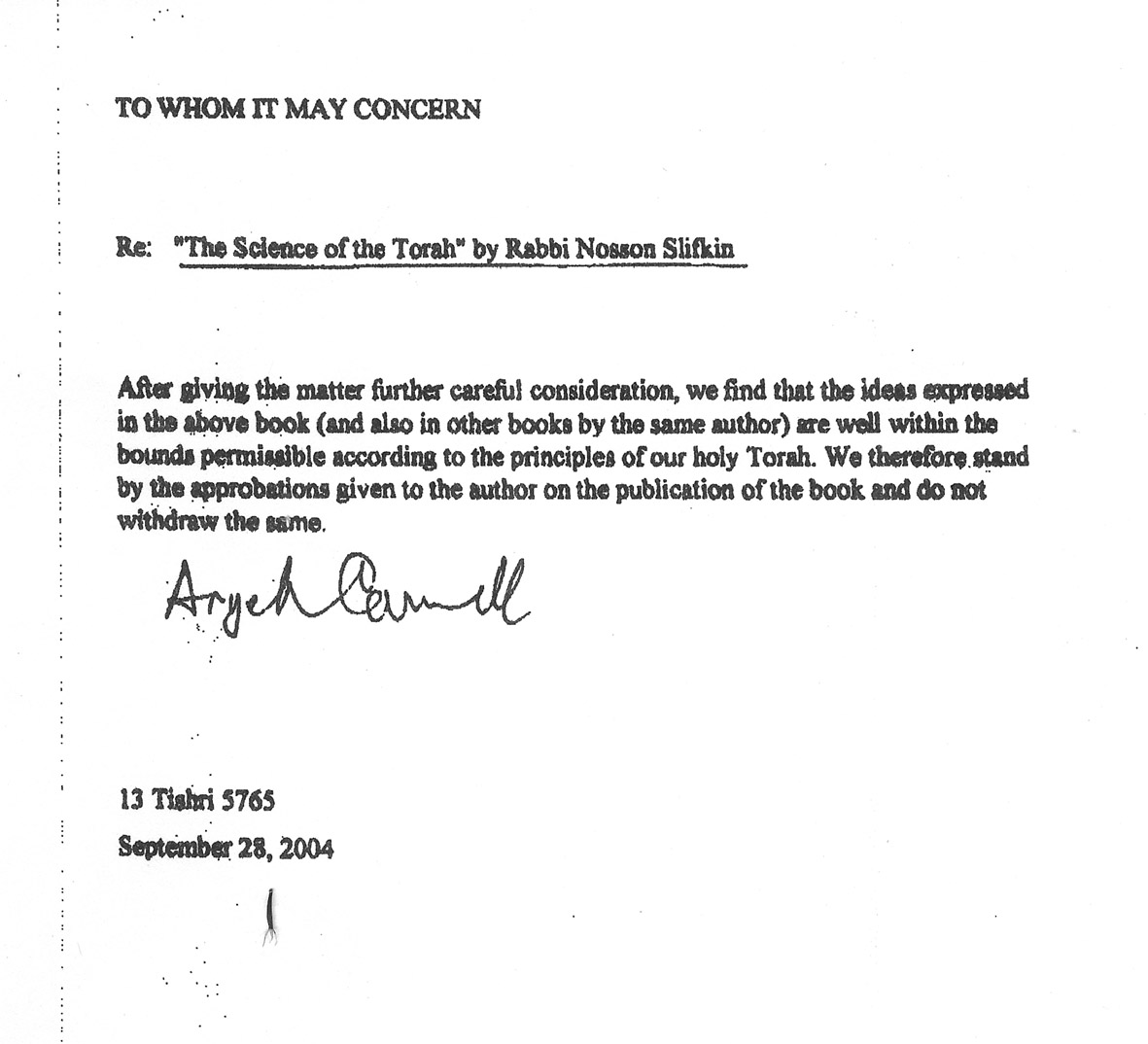
LK: They never retracted their haskamos; that’s true. Then there was Rav Aryeh Carmell who continued to support Rabbi Slifkin [14]. But no one would actually criticize the actual banning of Rabbi Slifkin’s books.
BP: I think Rav Kamenetsky said they’ll have to answer for it after the Resurrection [15]. It could be he’s an exception to the rule.
LK: Okay; perhaps he’s an exception. I wonder though if he made the statement publicly. To return to the general issue of Daas Torah and to your original question as to what extent am I rethinking things. Dr. Benny Brown wrote about Daas Torah in an article, I think, in Mechkerai Yerushalayim [16]. His general point is that scholars like Professor Jacob Katz, his students, and  others who were influenced by his approach – including myself among those others – overemphasize, maybe, the break between Orthodoxy in the modern era and pre-Modern traditional Judaism. Brown also sees stages in development in the idea of Daas Torah. His more specific point is that people who wrote about the idea of Daas Torah – Jacob Katz, Gershon Bacon, myself – ignored the idea of d’kula ba, that everything somehow is contained, hinted at, or alluded to in the Torah, as one source for the idea of Daas Torah. But from my reading of the sources Brown cites, it seems to me that d‘kula ba was traditionally used not so much in the modern communal and political Daas Torah sense –  that is, d’kula ba gives the right to great rabbinic scholars to make authoritative and final decisions on matters of policy. It was generally used in more of a non-political sense, that is, you study the Torah and you get a great insight into nature and reality and history. The one who first used dekula ba in the modern Daas Torah sense was Rav Elchanon Wasserman, I think at the Agudah convention in 1937. Here Brown criticized me, and he was right.
BP: Because you said Rav Elchonon Wasserman never mentions it.
LK: Yes, so I was wrong on that. I mean, based on the writings of Rav Elchonon I had read,  I said that Rav Elchonon only speaks about de’ot torah, but doesn’t really speak about Daas Torah in the sense of this idea of special knowledge given to great Rabbis enabling them to make a final authoritative decision on public policy. There I was simply wrong, and I overlooked this talk of Rav Elchonon at the Agudah convention. But my present view is that this political communal twist to dekula ba was actually Rav Elchonon’s own innovation, and here I would disagree with Brown.  Brown pushes it back to the Chafetz Chaim. As Brown pointed out, the Chafetz Chaim speaks about dekula ba extensively. In my article I quote a text of the Chafetz Chaim – or rather  an oral shemuah attributed to the Chafetz Chaim by Rabbi Greineman. And I say there that I’m not sure whether  the Chafetz Chaim said this or not, because it’s an oral shemuah.  I’m not saying Rabbi Greineman  was dishonest, but people remember things how they remember them; we have that all the time. That’s why we have to check the archives.
BP: Did you see Yoel Finkelman’s recent article [17]? It’s very relevant to what you’re saying. 
LK: I responded to Toby Katz’s comment on Hirhurim about it [18].  Her view was that either something is 100% objective or it’s manipulation. In my view, good scholars try to be honest and present all the relevant evidence and different ways of interpreting it.  Of course, you have your own interpretation and cannot be completely objective, but still you try to give all the evidence, whether it supports your view or calls it into question, and try to be as fair as possible to opposing views. So I think it’s a false dichotomy she was drawing there.  Anyway, getting back to what I was saying. Someone was writing a memoir and remembered a conversation he had with Roosevelt on the day that Pearl Harbor was attacked. And he remembered the meeting so clearly that he even remembered the chairs in which he and Roosevelt sat! And then he checked his diary, and he wasn’t in Washington that day! So he wasn’t there! He checked his diary or his journal of appointments, and realized he must have conflated different meetings.  So, how is this relevant to the Chafetz Chayyim’s view regarding de-kula ba? The point of the shemuah of the Chafetz Chaim that was attributed to him by Rabbi Greineman was [Dr. Kaplan opens up my copy of Rabbinic Authority and Personal Autonomy and finds page 8] — “The person whose view is the view of Torah can solve all worldly problems, both specific and general. However, there is one condition attached: the Daas Torah must be pure, without any interest or bias. However, if a person possesses Daas Torah but it is intermingled even slightly with other views of the marketplace,” then that’s not real Daas Torah. That’s a good example of Daas Torah delegitimating the more modern type of rabbis. Now Benny in his article was willing to attribute more authenticity to this statement of the Chafetz Chaim than I was. And what he found in his research were many other statements of the Chafetz Chaim in the area of d’kula ba that I didn’t know about. But it seems to me at least, and I discussed this with him, that none of the other statements of the Chafetz Chayyim that Benny cited actually made the point made by the statement attributed to him by Rabbi Greineman. All the other statements of the Chafetz Chaim were more general statements that a person who studies Torah is given insight into reality, can understand many things, etc. But the more political and delegitimating emphases of the statement attributed to him by Rabbi Greinman are not found in his other statements. The point, then, that I made to Benny was that the statements he cites from actual texts of the Chafetz Chaim himself do not really go as far as the oral shemuah. So my assumption is that Rabbi Greineman perhaps heard other statements of the Chafetz Chaim regarding d’kula ba, statements presenting the old, non-political version of de-kula ba, and he honestly misremembered them and inadvertatly conflated them with Rav Elchonon’s version of de-kula ba.  Again, I don’t think I ever said that the notion of Daas Torah was invented out of whole cloth; I do try to speak of a certain type of development. And perhaps Benny is right, and it has somewhat deeper roots than I or Gershon Bacon were willing to acknowledge. But this is a matter of degree;  I still maintain that in its current form maybe it’s drawing upon certain sources, but it’s pushing them and extending them in a more extreme direction.  You  asked me to look at ten statements and sources that Rabbi Dovid Gottlieb had cited in support of the concept of Daas Torah [19]. I have to say I was very unimpressed.
BP: But there was one that a lot of people I asked didn’t know why it wasn’t Daas Torah, where there was a pesak in the mahloket between Beit Shamai and Beit Hillel about…
LK: Oh yes, that was the gemara in Eruvin about whether noach lo l’adam she’nivra o she’lo nivra [20]. And because nimnu ve-gamru– whatever that means – that noach lo l’adam she’lo nivra mi she-nivra — does that mean  that you have to believe that? Is that an authoritative hashkafic pesak, as it were? I mean, does the Rambam ever quote that – the Rambam obviously believes all existence is good; so does he believe it would have been better for man not to be created? Actually, the Rambam says that in matters of aggadah there is no pesak. There’s also another quote where I think Rabbi Gottlieb was simply wrong. Supposedly in  Hilkhos Mamrim the Rambam attributes authority to Beis Din HaGadol in matters of hashkafah. But the Rambam doesn’t talk about that there. He speaks about three types of law: peirushim mekubalim mi’pi ha’shmuah, laws derived through interpretation– that is, through the use of the 13 Middos— and Takanot and Gezeirot. I don’t see him speaking there about issues of hashkafah. Now, there are mitzvos that deal with emunah. That’s something else.  Returning to the larger isue: There are issues of public policy, which is one thing, and then there are issues of hashkafah. I think the issue of Rabbi Slifkin is more a matter of the limits of hashkafah. I firmly believe that  there’s a great  deal of room for plural views on matters of hashkfah, and equally firmly reject the idea that only the views I accept are legitimate, while the other views  are illegitimate. Rabbi Slifkin also said that if the Haredi gedolim had said that they don’t want his books in their communities – okay, that their right, it’s their communities. But to issue general bans is a different story [21].
BP: But to return to the gemara Rabbi Gottlieb cites about whether it would have been better for man ot be created or not…how would you deal with that one?
LK: It’s a very strange thing, but I didn’t really check it carefully. My knowledge of the Rambam, which is pretty good, is that the Rambam doesn’t agree with  the supposed pesak that it would have been better for man not to have been created – maybe others do. You can do some type of computer  search through the Bar Ilan program or one of the other programs, check all of the 5000 books on file. Actually, Maimonides says it’s the other way around; Maimonides attacks, for example, Razi — in the Guide 3:12 I think it was–where Razi claims there’s more evil than good in the world. So it’s very hard to imagine how the Rambam would agree with that. In his letter on astrology to the Sages of Montpellier,  when discussing maamarei Hazal apparently disagreeing with his position, he says there are three possibilities. Either it was a daas yachid, or maybe the rabbi was saying it for his particular  audience, sort of like de’ot hechrachiyot –necessary beliefs – or maybe the rabbi didn’t mean it literally but  intended some type of metaphorical interpretation. And in this connection, what exactly does noach lo l’adam she’lo nivra mi she-nivra mean? Perhaps the Rambam would give it a metaphorical interpretation .  But it certainly seems to me that traditionally – obviously, there have been debates about these issues – but traditionally there has been a sort of general consensus that within matters of hashkafah there are certain very broad boundaries, but there’s lots of room for differences within those boundaries, and we’re not really dealing with some type of pesak. Attempts to limit or narrow those boundaries, I find troubling. Particularly, getting back to Rabbi Slifkin, when it seems that the majority of rishonim actually agree with his position. Someone had this long list- I mean, a very long list of rishonim who support his position [22]. So you want to say it was good for them, it’s not good for us, OK. You want to say that we don’t accept Rabbi Slifkin’s position, fine. But to call it kefira, minus, etc.– that’s pretty bad.
BP: I guess the question that a Haredi person would ask is okay, let’s say that’s all true. But why not have the rabbis as the ultimate authorities? In other words, let’s say we err. Like I want to be a good mitzvah-observing yid and if I err and the rabbis tell me what to do and I decide not to do it, right, so I’m erring – I’m going against the rabbis. But if I do what the rabbis say, I’m going to heaven on Rav Elyashiv’s coattails.
LK: But I think you have a certain responsibility to use your –
BP: To use your mind. But there’s a long anti-rationalist tradition within Judaism. So l’chora that’s the safe side, so why not just go with that? Because there you don’t have to think; you can do what they say to do and there’s long Jewish roots for such a tradition.
LK: Yes, but there’s the issue of whether you believe that what they say is really true. And is the anti-rationalist side so safe? This relates to some famous criticisms of Pascal’s Wager. First, Pascal is just assuming the issue is choosing between Christianity and Atheism. But what about Hinduism or Islam? But the other criticism is what happens if we get to Heaven and sure enough there is a God, but He says, “All those people who played it safe? I don’t like those types. The ones who used their own judgement, even if it led them not to believe in Me, them I like.” So how do you know that when you get to heaven, and you say to God that you latched on to Rav Elyashiv’s coattails, that God won’t reply, “Hey, c’mon, why didn’t you start thinking on your own? Obviously you should respect Rav Elyashiv’s view, of course take it seriously, study it, don’t just dismiss it out of hand. But who says I want you just to swallow it whole, particularly since there are other views out there. So why just him, and why did you assume that all the other views are illegitimate?” And of course, the truth of the matter is we know that within the Agudah’s circles there’s been a breakdown of the old unity. Rav Shach and others broke with the Agudah. It would be a worthwhile thing to read the Jewish Observer and see if they ever allude to the fundamental break when Rav Shach broke with the Agudah and founded his own party.
BP: The impression I get from the Haredi world is that even in their rhetoric there’s a certain allowance for limited pluralism. Kimmy Caplan and Nurit Stadler had an article in the AJS Perspectives on Haredim. So they emphasized in that article how this is a heterogenous community [23]. So I mean I think people say you have your Gadol, I have my Gadol and nobody can have Rav Soloveitchik because he’s treif. But I’m saying, that’s the impression I get. Is that what it is, is that how it’s always been? Or not really?
LK: It’s a complicated question. My impression is that there are two levels. When they’re explaining the idea of Daas Torah, they explain it in a more pluralistic way. But in practice, Rav Elyashiv says something and everybody falls into place.
BP: Here’s another topic: You wrote your article about Rav Hutner, then you wrote your article about Daas Torah, and you also wrote to the Novominsker Rebbe about how he misunderstood Rabbi Lamm [24]. And so I was wondering if there were any consequences to that – did anyone talk to you, did you get emails, did you get letters…?
LK: I remember ages ago when my article on Rav Hutner appeared, somebody came up to me—he is now a very noted scholar–and he told me oh how brave I was. But I don’t live in New York, I don’t live in Boro Park, I don’t live in a yeshivishe community, I don’t owe my parnassah to them. I live in Montreal and teach at McGill. I don’t think it required any particular bravery on my part. I know my article on Daas Torah has acquired a certain amount of fame –some might say notoriety– but I would say that from my standpoint, I always thought my most important article—which I wish were better known– is my article on the Shemoneh Perakim [25].
BP: That’s your real scholarship.
LK: Real scholarship, and I feel that it’s an important article, really a basic essay on the Rambam. I think I got to the heart of the Shemoneh Perakim, and various people who have studied the Shemoneh Perakim and then read my article tend to agree. I remember that I was once asked by a student what I thought  was my most important article,  and I answered the one on the Shemoneh Perakim. He said, “What about your article on Daas Torah?“ But from a scholarly point of view I think  my article on the  Shemoneh Perakim is more important. Not that there isn’t any scholarship in my Daas Torah article. Sometimes I feel bad because people assume it’s more of a critique or polemic, so they overlook the scholarly discussion. Like my discussion of Lo Sasur. As I said before, I explore in a systematic way—actually,  I probably do this more in my Hebrew article than my English one – all the different ways in which both medieval and modern rabbinic scholars and commentators have tried to deal with the issue of the apparent contradiction between the Sifre, as quoted by Rashi, and the Yerushalmi. I went through all the ways they either tried to harmonize the apparently conflicting views, as well as looked at those who say, as does Rav David Zvi Hoffman, that maybe the Sifre and the Yerushalmi  simply disagree. So I think that there are certain discussions of Lo Sasur in more strictly scholarly articles which don’t quote me, when I feel they should have quoted me. Professor Moshe Halbertal in his book on the Ramban makes a point that there are two ways of reading the Ramban on Lo Sasur, a soft reading of the Ramban and a hard reading of the Ramban [26]. When the Ramban says that Torah nitna al daatam shel Hakhmei ha-Torah, does it mean that the Sages could be wrong in their ruling, but they’re given the authority to rule, so you can’t disagree with them? Or does it mean that the meaning of the Torah is indeterminate, and the Sages determine its meaning, in which case they can’t be wrong? Already in my article, I show how Avi Sagi opts for the soft reading and Aaron Kirschenbaum for the hard reading – or is it vice-versa, I don’t remember. So Halbertal mentions these possibilities; he refers to some scholars who have discussed this; but he doesn’t refer to me, although I had already anticipated his point, because I don’t think he thought of looking at my article, since it’s considered more of a polemical work than a work of scholarship. And the truth is that it is both, and I say so in the article. I say, look, my article is not a strictly scholarly article,  but I would like to believe that it’s based on sound historical rabbinic scholarship, but obviously it has a certain ideological tendenz.  Anyway, I gather a lot of people have read it. It’s always nice when you write something and you find out people have read it and even appreciated it. Sometimes I feel I write articles and who knows who reads them. Perhaps they sunk like a stone into oblivion.This past summer I was at a conference in Frankfurt, and a young scholar said to me, “I was very influenced by your article on Maimonides and Mendelssohn [27].” So I said “Really?” He replied that he liked my idea of looking at the roots of Mendelssohn‘s thought, of showing how Mendelssohn used Maimonides, and the article  influenced his way of looking at things.  But again, even though I obviously have my own take on things, I try to be as objective and scholarly  as possible. Someone actually once wrote – which I took as a compliment – that they feel that Kaplan has no agenda, particularly in terms of his interpretation of the works  of Rav Soloveitchik. I try to see things how they are. Well, everyone thinks that’s what they are trying to do.
BP: Speaking of the Rav, maybe we could briefly discuss “Revisionism and the Rav.” So you took on the left, took on the right –
LK: More the right.
BP: Would you take issue with anybody more towards the center?
LK: The way it seems to me is that there are issues about Rav Soloveitchik which are really open to interpretation, and I might have a different interpretation of these issues than others. I wasn’t really speaking about that; I was speaking about clear cases of ideological revisionism, where I think the Rav’s position on the issues in question is pretty clear, but scholars try to deny the obvious for ideological reasons.
BP: In general, you don’t see revisionism from the center.
LK: No, I don’t see revisionism from there. People have different opinions, both legitimate. For example, I disagree with Professor Dov Schwartz. Schwartz sees a very sharp difference between the figure of halakhic man in Ish Hahalakha and the figure of ha-Ish Elokim in U-Vikashtem Misham, while I see them as much more similar [28]. That’s a matter of interpretation; that’s not a matter of revisionism. Even with regard to secular studies – there are aspects of this issue where the Rav was vague, and there’s room for disagreement. In a forthcoming essay, I take issue with Professor David Shatz’s reading of The Lonely Man of Faith. Overall, I think his article is a great article,  but I think he had a bit too much of a positive take of the Rav’s portrait of Adam 1 in The Lonely Man of Faith [29]. He said that Adam 1 in imitating God’s creativity fulfills the comand of v’halakhta b’drachav; but the Rav, when he speaks about Adam 1’s creativity, never quotes v’halakhta b’drachav. I also note that the term Hesed is only applied to Adam 2. Adam 1 attains dignity and responsibility, but only Adam 2 is motivated by a sense of Hesed. My feeling is – and I state this in my article – that David’s essay would have been stronger had he focused more on the concrete man of faith who is both Adam 1 and Adam 2. So there are legitimate issues of interpretation.  Another issue open to disagreement is how you relate The Lonely Man of Faith to Ish Hahalakha or to other essays.Yet another is the Rav’s view about evolution, and the import of his statement about it  in the beginning of The Lonely Man of Faith.  All these matters are open to interpretation. I might have my reading and have my reasons for thinking it is the most convincing reading, but I don’t think those who have other readings and disagree with me are engaging  in revisionism. There are also many similar questions about how to interpret Rav Kook. In general, only now with the publication by the Toras Horav Foundation of many of the unpublished manuscripts of the Rav are we beginning to get a clearer picture of his thought. For example, the volume  The Emergence of Ethical Man, edited by Dr. Michael Berger, sheds new light, in my view, on the Rav’s view concerning evolution. In this connection, I want to add something even if it’s off the topic. The Emergence of Ethical Man quotes Buber extensively, particularly Buber’s Moses. And not only does the Rav quote from it, but also, interestingly, the Rav’s idea that Avraham in leaving Mesopotamia behind to go to the land of Canaan was leaving the city behind for a more pastoral form of life is taken from Buber. You probably could find meforshim, maybe Abarbanel, who might say something similar, but the Rav’s way of phrasing the matter — the pastoral mode of life as opposed to the urban mode of life– reflects the influence of Buber, whom, again, he explicitly cites.  It seems he had read Moses at about the time he was writing his essay,  and obviously those views of Buber which are not Orthodox he leaves out, but other, “kosher“ views of Buber, as it were, he feels free to cite and make use of. I was thinking when I get around to it I’d like to write  a review essay of that volume. But, then again, I often tell my students I have two lists. I have a list of articles I’ve written, and another list of articles I haven’t written, but hope to get around to writing someday.  And the second list is much longer and also probably much more interesting than the first list.
BP: What are you looking at writing?
LK: Well, I have this paper I gave yesterday which I am in the middle of  writing up on the Rambam’s Hakdamah to the Peirush HaMishnah. There are also essays I’ve already written which haven’t appeared yet, but are forthcoming – one of these days! I have an article about the concept of faith in Rabbi Azriel of Gerona, where I take issue with Mordechai Pachter’s article on the subject, and offer a very different reading [30].Then I just mentioned my critique of David Shatz. It is part of a long article, which is taking forever to appear, on The Lonely Man of Faith and contemporary modern Orthodox Jewish thought. Most of the article is about Rabbi David Hartman’s readings of The Lonely Man of Faith. Another article which I wrote – but is sitting in limbo, and I have no idea when it will appear – is on Rav Hutner’s implicit theology of the Holocaust. I looked at a maamer in Pachad Yitzchak, Maamer Daled in the volume on Rosh Hashanah, where he speaks about Geon Yaakov. What does it mean when we use the phrase “Geon Yaakov“ on Rosh Hashana? My argument there is – the maamar, by the way, is a very fascinating maamar – that even though Rav Hutner in the maamar never mentions the Holocaust, I can’t imagine – and most people I discussed this with tended to agree with me—that in light of several radical and daring points he makes in the maamar, that the Holocaust wasn’t on his mind when he wrote it. So these essays should be appearing eventually. Ironically,  one article, which I  completed after all of these, but which will most probably be appearing before all of them – it should be out fairly soon – is an essay on the relationship between Rabbi Emanuel Rackman and the Rav, in which I  show that they had a close working relationship in the 1950s and that Rabbi Rackman basically – and with the Rav’s approval – assumed the role of his intellectual lieutenant. For people who only know about the Rav’s famous public attack in 1975 on Rabbi Rackman, it should prove to be an eye opener. So, stay tuned! Getting back to future projects, people tell me that I should collect my essays on the Rav and make a book of them, and do the same for my essays on the Rambam. But I still have more essays to write on the Rambam and the Rav. As I just mentioned, I am in the middle of  writing a long, and – at least I would like to believe– very important essay on the Rambam’s Hakdamah to the Peirush HaMishnah. I’ve pretty written up the first half, but I have to do the  second half and then the  footnotes. And I don’t know if you heard the paper of Dr. Mordechai Cohen this morning on Ein Mikrah Yotzei Midei Peshuto in the Rambam. I have had an ongoing discussion with him about this, we’ve been exchanging emails; I have a different take on the subject, and one of these days I would like to write about this as well.  There are a number of review essays I would like to write as well.  First a review essay on some of the recent literature on the Ramban, then another review essay on some of the recent literature on Halevi. Finally, I’d like to write a review essay on the third volume in Toras HoRav, the one on mourning, death, and suffering – Out of the Whirlwind. This review will be different from my review essay of Worship of the Heart in Hakirah, where I was quite hard on its editor, Rabbi Shalom Carmy [31]. Parenthetically, while I still believe that my criticisms of the editing were correct, and, as far as I can tell, they remain unrefuted, in retrospect it seems to me that I might have softened somewhat a harsh phrase or two, and I regret that I did not do so. Be this as it may, I thought the editors of Out of the Whirlwind did a very good job of editing. There are a few points here or there where certain things could be a little clearer; they could have given a few more references here or there, but on the whole they did a very good job, and I will be happy to say so. Contrary to what some people seem to believe, I do not take particular  pleasure in writing negative reviews. And then in the review essay, assuming I will ever get around to writing it, I will discuss the Rav’s views on aveilus and  how one should respond to evil and suffering, and, with reference to aveilus, take issue with the Rav about some matters – his reading of a comment of Rashi and his understanding of certain aspects of the Rambam on the subject. I checked my ideas out in a phone conversation with Rav Elyakim Koenigsberg, who is a Rosh Yeshiva of YU who edited  a volume of the Rav’s torah on aveilus [32]. That is a more lomdishe volume than Out of the Whirlwind. So I ran my criticisms by him, and he said okay. He’s not saying that he agrees with my criticisms, but I’m not off the wall. So if he says I’m not off the wall, you can agree, disagree, but it sounds okay to him—that’s good enough for me to go ahead. I feel safe  in putting them forward, and that no one will say “Kaplan, you’re such an am haaretz, how can you even say such things?”  Things always take longer than you expect. My daughter-in-law was recently joking that  she can see me 50 years from now still writing [Dr. Kaplan scribbles on piece of paper in mock anger], “This guy got it all wrong.”  Actually, I told people that I’m not going to write any more negative reviews, like my review of David Sorkin’s book [33]. From now on, I will review a book only if I can honestly say that it is a good book. Then, of course, I can proceed to discuss the issues the book raises, disagree with the author’s intepretation, you read the evidence this way and I read it that way, etc. Not that I don’t think it’s not important to write harsh reviews sometimes. You have to maintain standards and scare people, so people should know that you should write about things you know about and not write about things you don’t know about, do your homework, and don’t assume that you can write something sloppy and you’re not going to be called on it. Someone may sit down and rip you to pieces, so be careful! But I’ve written  my share –some may say more than my share –of such reviews, and from now on I’ll leave that necessary, but unpleasant job to other people.
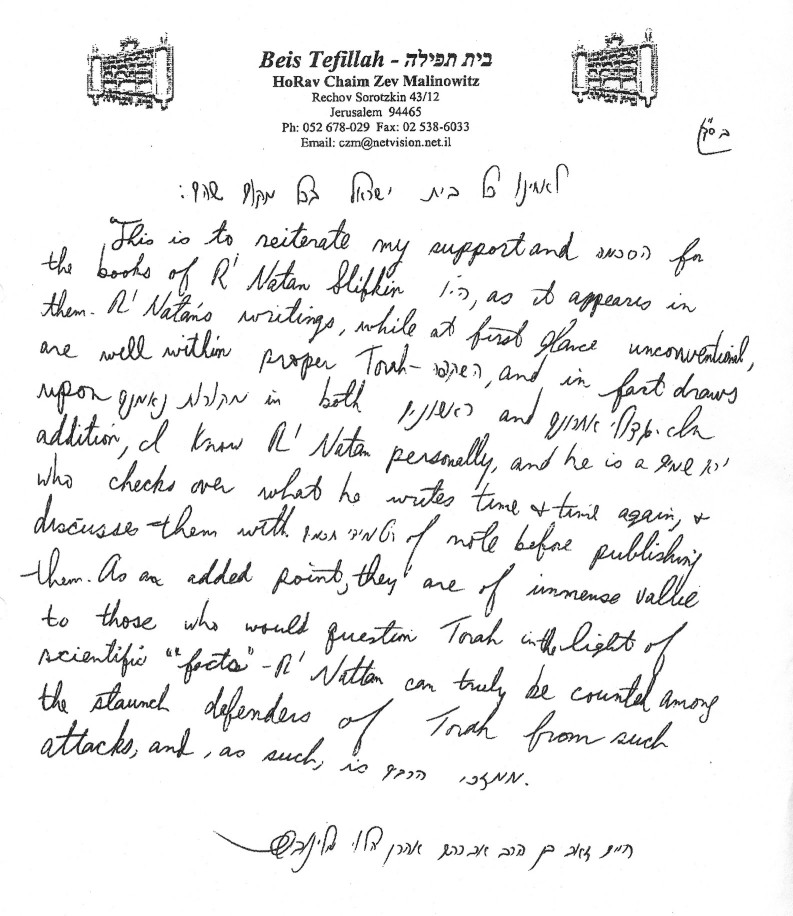
[1] Lawrence Kaplan, “Daas Torah: A Modern Conception of Rabbinic Authority,” in Rabbinic Authority and Personal Autonomy, ed. Moshe Z. Sokol (Northvale: Jason Aronson, 1992), 1-60[2] Yitzchok Hutner, “Holocaust – A Study of the Term, and the Epoch It Is Meant to Describe” trans. and ed. Yaakov Feitman and Chaim Feurman, Jewish Observer, October 1977: 6-12[3] Moshe Meiselman, “The Rav, Feminism, and Public Policy: An Insider’s Overview,” Tradition 33.1 (1998): 5-30[4] Kaplan, “Revisionism and the Rav: The Struggle for the Soul of Modern Orthodoxy,” Judaism 48, no. 3 (Summer 1999): 290-311(accessed July 29, 2009).[5] Kaplan, “Rabbi Isaac Hutner’s ‘Daat Torah Perspective’ on the Holocaust: A Critical Perspective,” Tradition 18, no. 3 (Fall 1980): 235-248[6] Kaplan, “Daat Torah: A Modern View of Rabbinic Authority,” in Zev Safrai and Avi Sagi, eds., Between Authority and Autonomy in Jewish Tradition, 105-145. Tel Aviv: Hakibbutz Hameuhad, 1997 [Hebrew].[7] For the location of all of these sources and explication on how Dr. Kaplan interprets them, see “Daas Torah.”[8] See Alfred Cohen, “Daat Torah,” Journal of Halacha and Contemporary Society 45 (Spring 2003): 67-105 and the ensuing correspondence between Rabbi Cohen and Dr. Kaplan in idem. 46 (Fall 2003): 110-123.[9] Eliezer Menachem Man Shach, Michtavim U’Maamarim Mimaran Hagaon Rabbi Elazar Menachem Man Shach 4:320 [10] Michel Yehuda Lefkovitz, Yitzchak Shiner, and Yisrael Elya Veintraub, “Giluy Daat,”Zoo Torah,  (accessed July 28, 2009) [Hebrew][11] For an example of an article which promulgated the rumor that rabbis who gave their haskama to the book retracted, see the cached version of G. Safran, “Gedolei Yisrael Ban Rabbi Nosson Slifkin’s Books,” Yated Ne’eman, January 12, 2005, (accessed July 28, 2009). The Yated’s website later “updated” this article correcting this error while neither the Yated nor the website issued an official retraction of the claim. See G. Safran, “Gedolei Yisrael Ban Rabbi Nosson Slifkin’s Books,” Yated Ne’eman, January 12, 2005,  (accessed July 28, 2009). For Rabbi Slifkin’s account of how his books were banned and he was not given a chance to present his case, see Natan Slifkin, “Account of Events,” Zoo Torah,  (accessed July 28, 2009).[12] “Account”[13] See idem. on Rabbi Feldman’s original support for Rabbi Slifkin. Rabbi Feldman later wrote an essay attacking the positions espoused by Rabbi Slifkin. See Aharon Feldman, “The Slifkin Affair – Issues and Perspectives,” Zoo Torah,  (accessed July 29, 2009).[14] Rav Aryeh Carmell gave a haskamah and, when the ban came out, reiterated his support for Rabbi Slifkin. See Aryeh Carmell, Zoo Torah, (accessed July 28, 2009) and Aryeh Carmell, “Re: ‘The Science of the Torah’ by Rabbi Nosson Slifkin” Zoo Torah, (accessed July 27, 2009).[15] Daniel Eidensohn, “Age of the Universe,” Hirhurim, entry posted June 20, 2006,  (accessed July 28, 2009). There have been a few other Haredi dissenters: see Toby Katz, “My 300-Page Book on the Slifkin Affair,” Cross Currents, (accessed September 9, 2009); Rav Chaim Malinowitz’s letter of support for Rabbi Slifkin available at Zoo Torah  (accessed September 9, 2009); and Marvin Schick, “Richuk Karovim,” Cross Currents,  (accessed September 9, 2009)[16] Binyamin Brown, “The Da’at Torah Doctrine: Three Stages,” Jerusalem Studies in Jewish Thought 19 (2005): 537-600 [Hebrew] [17] Yoel Finkelman, “Nostalgia, Inspiration, Ambivalence: Eastern Europe, Immigration, and the Construction of Collective Memory in Contemporary American Haredi Historiography” Jewish History 23, no. 1 (March 2009): 57-82[18] The original comment by Mrs. Katz reads as follows:…I have news for you. EVERYONE manipulates history, everyone. Have you read any history textbook lately, and compared it to any history textbook of thirty or forty years ago? Women are much more prominent, Indians are noble and pure and one with nature, yada yada. No matter who writes the book, there is an agenda. Everybody has an agenda. Everybody. The myth of pure, dispassionate research — “just the facts, ma’am” — is just that, a myth. And academics are just as guilty of selective memory and revisionism as ArtScroll hagiographers, if not more so.      See Toby Katz, comment on “Nostalgia as History,” Hirhurim, comment posted December 17, 2008, #604322 (accessed July 27, 2009).[19] Dovid Gottlieb, “Sources for Daas Torah,” DovidGottlieb.com,  (accessed July 27, 2009)[20] Eruvin 13b[21] Rabbi Slifkin discusses this view in various articles on his website. See for example Slifkin, “In Defense of My Opponents” Zoo Torah, (accessed July 29, 2009).[22] DES, “Sources Indicating That Chazal Did Not Possess Perfect Scientific Knowledge,” Torah, Science, Et Al., entry posted April 30, 2006,  (accessed June 27, 2009)[23] Kimmy Caplan and Nurit Stadler, “Haredim and the Study of Haredim in Israel: Reflections on a Recent Conference,” AJS Perspectives, Spring 2008, 32[24] Kaplan, “Modernity vs. Eternity” Jewish Observer, April 1994: 13[25] Kaplan, “An Introduction to Maimonides’ ‘Eight Chapters,'” The Edah Journal 2, no. 2 (June-July 2002): 2-23[26] Moshe Halbertal, Al derekh ha-emet : ha-Ramban ṿi-yetsiratah shel masoret (Jerusalem: Mekhon Shalom Hartman, 2006) [Hebrew][27] Kaplan, “Maimonides and Mendelssohn on the Election of Israel, the Origins of Idolatry  and the Oral  Law” in Perspectives on Jewish Thought and Mysticism, edited by Alfred L. Ivry, Elliot R. Wolfson, and Allan Arkush (Amsterdam: Harwood, 1998), 423-445 [28] Dov Schwartz, Religion or Halakha: The Philosophy of Rabbi Joseph B. Soloveitchik, Trans. Batya Stein (Leiden: Brill, 2007)[29] David Shatz, “Practical Endeavor and the Torah u-Madda Debate,” Torah U-Madda Journal 3: 98-149. See also Kaplan, “Rabbi Soloveitchik’s Lonely Man of Faith in Contemporary Modern Orthodox Thought” (Lecture, Studies Exploring the Influence of Rabbi J. B. Soloveitchik on Culture, Education and Jewish Thought: An International Conference Commemorating the Centenary of his Birth, Van Leer Jerusalem Institute, December 31, 2003), Van Leer Jerusalem Institute,  (accessed July 29, 2009).[30] Mordechai Pachter, “The Root of Faith is the Root of Heresy,” in Roots of Faith and Devequt: Studies in the History of Kabbalistic Ideas (Los Angeles: Cherub Press, 2004), 13-51. [31] Kaplan, review of Worship of the Heart: Essays on Prayer, by Shalom Carmy. Hakirah 5 (Fall 2007): 79-114.[32] Elyakim Koenigsberg, Shiuirei ha-Rav `al Inyenei Aveilus ve-Tisha be-Av (Jerusalem: Mesorah,1999)[33] Kaplan, review of Moses Mendelssohn and the Religious Enlightenment, by David Sorkin. AJS Review 23, no. 2 (1998): 300-307.


The Fish Motif on Early Hebrew Title-Pages and as Pressmarks

The Fish Motif on Early Hebrew Title-Pages and as Pressmarks

by Marvin J. Heller
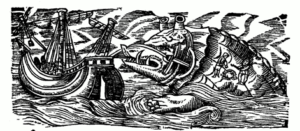
            Fish are a symbol replete with meaning, among them, in Judaism, representing fertility and good luck, albeit that fish are not an image that, for most, quickly comes to mind when considering Jewish iconography. Created on the fifth day of creation, fish symbolize fruitfulness, and, as Dr. Joseph Lowin informs, the month of Adar on the Hebrew calendar (February-March, Pisces) is considered “a lucky month for the Jews (mazal dagim).” He adds that in Eastern Europe people named sons Fishl as a symbol of luck, and that in the Bible, the father of Joshua is named fish, that is, Nun, which is fish in Aramaic.[1] Similarly, Ellen Frankel and Betsy Platkin Teutsch note the allusion to fertility and blessing, the former that when Jacob blesses Ephraim and Manasseh, Joseph’s sons, he says “May they multiply abundantly ve-yidgu, like fish) in the midst of the earth” (Genesis 48:16) and the latter to the Leviathan, the great sea monster the Jews will feast upon in the messianic age.[2]

Other biblical references to fish include Dagon, the fish-god of the Philistines, also worshipped elsewhere in the Middle East, mentioned several times in the Bible (Joshua15:41, 19:27; Judges 16:23; I Samuel 5:2–7; and I Chronicles 10:10).  A fish also appears in the biblical story of Jonah, a large fish (dag gadol), not the popular whale that swallowed the prophet.

            Not only Jewish sources and printers used devices that were fish related. The Medjed fish, a species of elephant fish, a medium-sized freshwater fish with a long downturned snout, abundant in the Nile, was worshipped at Oxyrhynchus in ancient Egypt and appears in Egyptian art. Fish are a not infrequent image on medieval coat of arms. Indeed, there are as many as 181 shields of salmon alone in heraldry.[3] The most well-known printer device with a fish is the anchor and dolphin of Aldus Manutius (1449-1515), albeit not strictly speaking a fish, as a dolphin is actually an aquatic marine mammal. Among the most novel of the marine pressmarks is that of the Liege printer J. M. Hovii, active during the latter half of the seventeenth century, whose mark consisted of a mermaid enwrapped about a tree with a skull at the foot of the tree.[4]

            This article is the most recent in a series describing printer’s devices and motifs appearing on the title-pages and with the colophons of early Hebrew printed books.[5] The use of the fish images described here are varied, comprised of pressmarks and full page frames which include representations of marine life. The discussion of the images and the presses are for the sixteenth into the eighteenth century. Although a number and variety of presses that that utilized marks with fish are addressed in this article they are examples only and not necessarily complete. Furthermore, the entries are expansive, that is, printers’ marks are not described in isolation but with discussions of the presses that employed them and examples of the books on which they appeared. Entries are in chronological.[6]

            As noted above, the month of Adar is, if not exactly, coterminous with the astrological sign of Pisces. That sign is represented by a pair of fish swimming in opposite directions, as fish swimming against the stream represents the powerful Pisces potential. They can be ‘sharks’ – charismatic, strong leaders with vision and clarity about leadership that can guide an entire nation, like Moses, who was also a Pisces. But those Pisces who prefer to go with the flow can be weak people who get carried away easily and are prone to addictive patterns of behavior.

Pisces is known for the holiday of Purim. According to the sages, it will be the only holiday to continue to be celebrated throughout the world after the Messiah comes. “When Adar begins, joy enters,” as the famous Hebraic phrase goes. It is a month of happiness, miracles and wonders. It affords us the ability to achieve mind over matter, to overcome our doubts, and connect to the Light.[7]

            Another compatible view of Adar and fish states that “The astral sign of Adar is the fish (Pisces). Fish are very fertile, and for that reason are seen as a sign of blessing and fruitfulness. The Hebrew word for blessing is bracha, from the root letters betreish, kaff. In Jewish numerology (gematria), the letter bet has a value of 2, reish is 200 and kaff is 20. Each of these is the first plural in their number unit. What this tells us is that the Jewish concept of ‘blessing’is intertwined with fertility, represented by the fish of Adar.”[8]

            Our first example of a pressmark with a fish is the most unusual in the article, the only device in which the fish is not only completely inconsistent with the above description but is the least prominent representation of a fish of all the pressmarks in the article. Among the earliest printers to make utilize of the fish in a pressmark is Joseph ben Jacob Shalit in Sabbioneta. Although the Sabbioneta press is commonly associated with Tobias ben Eliezer Foa, it was Shalit who appears to initially have been the motivating force behind the press and, with other partners, the provider of necessary financial support. Tobias Foa is credited with providing only the physical quarters, Duke Vespasian Gonzaga’s patronage, and limited financial assistance. Also associated with the press were Cornelius Adelkind, Vincenzo Conti, and R. Joshua Boaz Baruch, all prominent names in mid-sixteenth century Hebrew printing in Italy.

The first title printed at the press was Don Isaac ben Judah Abrabanel’s (1437-1508) Mirkevet ha‑Mishneh (1551), a commentary on Deuteronomy. Abrabanel began work on Mirkevet ha‑Mishneh when still in Lisbon, unlike the remainder of his commentary on the Torah which was written much later. Its completion was postponed, however, due to his responsibilities at the Portuguese court. The incomplete manuscript of Mirkevet ha-Mishneh was lost when Abrabanel was forced to flee Portugal in 1483. However, on his later peregrinations after the expulsion of the Jews from Spain Abrabanel came to the island of Corfu in 1493, where he serendipitously (miraculously) found a copy of the manuscript. Leaving aside other work he turned to completing this commentary, but after the departure of French troops from Naples, Abrabanel went to Monopoli (Apulia), where Mirkevet ha-Mishneh was finally completed in the first part of 1496.

The title page, dated 5311 Rosh Hodesh Sivan (Wednesday, May 16, 1551) is comprised of an architectural border with standing representations of the mythological Mars and Minerva. This border was first employed by Francesco Minizio Calvo in Rome in 1523 and as late as 1540 in Milan. This is its earliest appearance in a Hebrew book. It would be often reused and copied, appearing on the title pages of books printed as far apart as Salonika and Cracow.[9]

On the final unfoliated leaf are two devices, on the right that of Foa, a palm tree with a lion rampant on each side and affixed to the tree a Magen David, about it the verse, “The righteous flourish like the palm tree” (Psalms 92:13), all within a circle, and to the sides the letters ט and פ for Tobias Foa. On the left is Shalit’s device, a peacock standing on three rocks, facing left, with a fish in its beak within a cartouche, although Avraham Yaari, after describing the peacock with a fish, adds, in parenthesis, (or a worm?). The letters יביש about this device stand for Joseph ben Jacob Shalit. Also printed by the press that year was R. Isaac ben Moses Arama’s (c. 1420–1494) Ḥazut Kashah, on the relationship of philosophy and religion. It too has the Mars and Minerva title-page, but here the last leaf is foliated and has one pressmark only, the peacock with fish of Shalit.[10] Parenthetically, Arama too was a refugee from Spain.

Fig. 1 pressmarks of Joseph Shalit (left) and Tobias Foa (right)

The peacock with fish pressmark was reused by Shalit in Mantua at the press of Venturin Rufinelli with the colophon of several works, for example the late 10th century ethical work based on animal tales, translated from the encyclopedic Arabic Rasa`il ikhwan as-safa` wa khillan al-wafa` (Epistles of the Brethren of Purity and Loyal Friends) into Hebrew by Kalonymus ben Kalonymus (c. 1286-c. 1328) as Iggeret Ba’alei Hayyim (1557). The original is comprised of 52 eclectic volumes (pamphlets) on philosophy, religion, mathematics, logic, and music. The portion from which Iggeret Ba’alei Hayyim is taken appears at the end of the 25th book. The original was prepared by the Brethren of Purity, a secret Arab confraternity which flourished in Basra, Iraq in the second half of the tenth century. The tales themselves have an Indian origin. Four other varied works of note with the peacock with fish pressmark are R. Saadiah ben Joseph Gaon’s (882-942) Sefer ha-Tehiyyah ve-Sefer ha-Pedut (1556) on resurrection; R. Abraham ben Samuel ha-Levi ibn Hasdai’s (13th century) Ben ha-Melekh ve-ha-Nazir (1557), also based on an Indian romance and here derived from the Arabic; Berechiah ben Natronai ha-Nakdan’s (12th-13th century) Mishlei Shu’alim (1557-58) popular collection of fables, and a Haggadah with the Mars and Minerva title-page (1568).

The Shalit pressmark also appears on the title-page of several books printed in Venice at the press of Giovanni di Gara, without mention of Shalit, so that Yaari suggests he was not involved with the books but it was used simply as an ornament. Among the titles with this pressmark are R. David Kimhi’s (Radak, c. 1160-c.1235) commentary on Psalms (1566), R. Moses ben Baruch Almosnino’s (c.1515 – c.1580) Me’ammez Ko’ah (1587-88), R. Samuel ben Abraham Laniado’s (d. 1605) Keli Hemdah (1596), each with a biblical verse about the frame, and R. Aaron ibn Hayyim of Fez’s  (1545–1632) Lev Aharon (1608), this last without the biblical verses about the cartouche. The Shalit pressmark appears in various places in the books, after the introduction, by the colophon, least often on the title-page. Yaari notes that the Shalit device was also employed by Georgi di Cavilli in an Ashkenaz rite Mahzor (1568).[11]

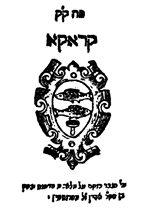
Leaving Italy, for now, and Shalit, we turn to Cracow where Isaac ben Aaron Prostitz, who together with his sons after him, printed Hebrew books for fifty years, beginning in 1569. In 1578, Prostitz printed at least three large format attractive tractates from the Talmud, Avodah ZarahKetubbot, and Rosh Ha-Shanah, the last extant in a ten folio unicum fragment in the library of the Jewish Theological Seminary. Moritz Steinschneider writes that Avodah Zarah was printed “si revera Supplementi tantum instar ad ed. Basil,” and “seu castrata . . .Cracoviae vero supplementi instar excusus,” that is, to compensate for its omission of the entire tractate from the much censored Basle Talmud.[12] Another feature of this tractate is that it is the first employ by Prostitz of the shield with two fish facing in opposite directions, the upper facing left, the lower facing right, above a printer’s inker, as his device.

Prostitz’s apparent next use of this device, this the first noted in bibliographic sources, is a Mahzor (1584) printed with the support of four partners, and reused frequently afterwards on such varied titles as Josippon (1589) at the end of the book, Avot with the commentary Derekh Hayyim by R. Judah Loew ben Bezalel (Maharal of Prague, c. 1525-16) after the introduction (1589), R. Moses ben Jacob Cordovero’s (Ramak, 1522-1570) Pardes Rimmonim (1591), between the books introductions, R. Bahya ben Joseph ibn Paquda’s (late 11th century) Hovot ha-Levavot, after the translator’s preface (1593) and R. Naphtali Hirsch ben Asher Altschuler’s (16th-17th cent.) Ayyalah Sheluha c. 1595. Pardes Rimmonim was actually printed in Cracow/Nowy Dwor, the change in location due to a serious outbreak of plague in Cracow, Prostitz and his family forced to flee to Nowy Dwor with the press’ typographical equipment. Pardes Rimmonim was completed in that location, the only Hebrew book printed in that Nowy Dwor.[13]
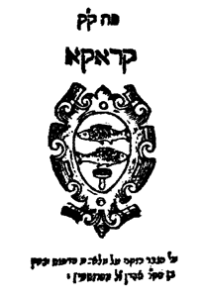
Fig. 2 Pressmark of Isaac Prostitz

Yaari questions Prostitz’s use of this pressmark. While the employ of the printer’s tool is clear, that is not the case for the fish. He suggests that it might be a propitious sign for the partners in the printing of the Mahzor in 1584, which Prostitz continued to use afterwards. This is unlikely, however, for, as we have noted, this device had been employed previously in 1578 on tractate Avodah Zarah. Another possibility is that the fish alludes to the month (Adar) in which Proztitz was born, but he then inquires why the pressmark was not used previously on all the books printed by the press. Yaari notes Steinschneider’s suggestion that the fish represented Prostitz’s entreaty for children, as his sons were borne at an old age. Here to, however, he observes that Prostitz’s four sons were born earlier, being mentioned in the colophon to Toledot Yitzhak in 1593. Another suggestion is that the fish allude to the name of R. Naphtali Hirsch ben Asher Altschuler who was known by all as Hirsch mokhir seforim (bookseller) in Lublin and for whom Prostitz printed books, for example Hovot ha-Levavot, the fish alluding to the name Naphtali, for the portion of the tribe Naphtali included the Kinneret Sea, in which fish were plentiful, but Yaari concludes this is only speculative.[14] I would question why, even if this is true for R. Altschuler, what does this have to do with Prostitiz and why he should have adopted this fish image for his pressmark?

A short lived press existed in Thannhausen, Bavaria, near Augsburg, a zoltot (supplementary festival prayers for the period between Passover and Shavu’ot) and a Mahzor (c. 1594) for the entire year according to the Ashkenaz rite were printed in the last decade of the sixteenth century. The press was a furtive effort to print Hebrew books by R. Isaac Mazia, whose name, it has been suggested, is an abbreviation for mi-zera Yehudim anusim, that is, he was of Marrano origin, or that he had served as rabbi in several communities in southern Germany, together with R. Simeon ben Judah ha-Levi of Guenzburg (Simon zur Gemze) of Frankfurt, who arranged with the Munich printer Adam Berg, to issue those works. When printing the mahzor the printers, concerned about the Christian response to sensitive passages and accusations of blasphemy, left blanks to be filled in by the purchasers.

After an examination of the still incomplete mahzorim by the censor at the University of Ingolstadt the press run of 1,500 copies was destroyed; only five copies are known to be extant today. In August, 1597, Mazia was fined 200 florin and released, while Berg, as late as 1604, was still attempting to have his impounded press returned. All of this occurred despite the fact that the authorities concurred that the mahzorim had been approved for publication by the imperial authorities in Prague. Nevertheless, the printers had neither received nor sought permission from the local authorities in Burgau to print. Moreover, as the books were for export they gave the impression that printing was done with the permission of those authorities.
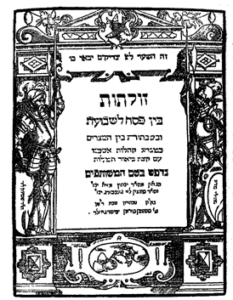
 Fig. 3b Zoltot


Fig. 3a Zoltot Extract

Both titles have a like frame comprised of an ornamental border with three entwined fish at the top (the signet of Mazia), at the sides are armed men in armor each with a shield, the right shield engraved with the name R. [Isaac] Mazia, the left with the name R. Simeon Levi. At the bottom is a laver pouring water on two hands, representative of the [Simeon] Levi. Isaac Yudlov informs that the fish here represent Isaac Mazia; this appearance of three fish as a printer’s mark is apparently unique. [15]

Not long afterwards we find the fish image employed in Lublin at the press of Zevi bar Abraham Kalonymous Jaffe. Lublin has a long and proud history as a Hebrew printing center, beginning with the press established by the family of Hayyim Shahor (Schwarz), that is, his son Isaac and his son-in-law Joseph ben Yakar. This press, through descendants and collateral members, would be active for almost a hundred and fifty years. The presses’ began publishing in 1551, with a folio Polish rite mahzor for the entire year, continuing until 1646 when a fire forced the press to close; printing resumed in 1648 when tah-ve-tat (gezerot Polania, the Chmielnicki massacres of 1648-49), broke out. That and the 1655-60 Swedish Muscovy wars, combined with others conflicts besetting the area made it impossible for Jaffe to continue and he had to close the press. Printing did resume when Solomon Zalman Jaffe ben Jacob Kalmankes of Turobin, encouraged and supported by his father, reestablished a Hebrew press. He printed 30 books until 1685 and the entire Jaffe family is credited with as many as 180 Hebrew titles.
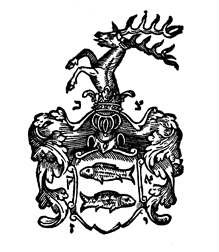
Fig. 4 Pressmark of Zevi Jaffe

A device employed by Zevi Jaffe, found on the title page of tractates in the large folio edition of the Babylonian Talmud published from 1617-1639, and after the introduction to R. Joel Sirkes’ (Bah, 1561–1640), Meishiv Nefesh, and possibly other works is a deer with raised forelegs, above a crown atop a shield with two fish, the upper facing left and the lower facing representative of the fact that he was a Levi, often accompanied by two fish, here too indicating that he was born in the month of Adar.

Among the many prominent printers of Hebrew books in Amsterdam is Uri Phoebus ben Aaron Witmund ha-Levi. He had previously worked for Immanuel Benveniste; in 1658, Uri Phoebus established his own print-shop. He would print about one hundred titles, from 1658 to 1689, the period he was active in Amsterdam, generally traditional works for the Jewish community, encompassing Bibles, prayer-books, halakhic works, haggadotaggadot, and historical treatises (Yosippon). Prostitz’s first pressmark, employed in 1569 on the title-page of R. Naphtali Hertz ben Menahem of Lemberg’s Perush le-Midrash Humash Megillot Rabbah and intermittently afterwards was a stag within a cartouche. Subsequently, Uri Phoebus employed as his device a hand pouring water from a laver, representative of the fact that he was a Levi, often accompanied by two fish, here too indicating that he was born in the month of Adar.

The first usage by Uri Phoebus of this device was in 1660 on the title-page of Ketoret ha-Mizbe’ah, R. Mordecai ben Naphtali Hirsch of Kremsier’s (d. 1670) work on the aggadic portions of tractate Berakhot dealing with the destruction of the Temple and the length of the exile. The title-page of this folio book has an arabesque frame and across the lower half of the page is Uri Phoebus’s fish mark. That device would be frequently used as a decorative ornament in many of the books that Uri Phoebus printed, placed in various locations, after introductions or the colophons.
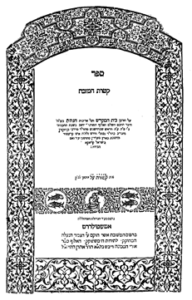
Fig. 5a Ketoret ha-Mizbe’ah

Fig. 5b Ketoret ha-Mizbe’ah Extract

Examples of the fish woodcut appears in other works, but not necessarily on the title-page, for example, in R. Hayyim ben Benjamin Ze’ev Bochner’s Or Hadash (c. 1671-75), on the laws of benedictions in a concise and abridged form, the title page of Or Hadash has an architectural frame headed by an eagle but no fish, that device being but one of several tail-pieces.

In 1662 Uri Phoebus printed an illustrated Haggadah accompanied by the commentary of R. Joseph Shalit ben Jacob Ashkenazi of Padua entitled Nimukei Yosef. The title-page of this quarto Haggadah has an architectural frame with two robed men at the sides, above winged cherubim and between them two fish with the winged head of a cherub. At the bottom are two vignettes; on the left the punishment of Shehem for the rape of Dinah and on the right the tribe of Levi killing the worshipers of the golden calf. In 1667-68, Uri Phoebus printed, also with this title-page, Nahalat Shivah (below and extract to right), R. Samuel ben David Moses ha-Levi’s (c.1625–1681) work on legal documents, particularly relating to divorce and civil matters. Nahalat Shivah has the same title-page as the Haggadah, here dated, “The Messiah ben David is coming משיח בן דוד בא (427 = 1667),” reflecting the referring to the false messiah Shabbetai Zevi. This title-page and fish crest (below) would be reused by Uri Phoebus for many years and elsewhere besides Amsterdam.

Fig. 6a Nahalat Shivah
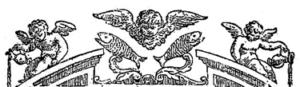
Fig.6 Nahalat Shivah Extract

Other title-pages employed by Uri Phoebus, with different architectural frames but with a like laver and fish image include such varied works as R. Jonah ben Isaac Teomim (d. 1669) of Prague’s Kikayon di-Yonah (1669-70), novellae on tractates of the Babylonian Talmud and, attributed to R. David ben Aryeh Leib of Lida (c. 1650-96) Migdal David (1680), both with the Benveniste frame; and R. Isaac Benjamin Wolf ben Eliezer Lipman (d. c. 1698), rabbi of Landsberg, Germany’s Nahalat Binyamin (1682), the first part of a commentary on the taryag [613] mitzvot and R. Shabbetai ben Meir Ha-Kohen’s (Shakh, 1621–1662) Siftei Kohen, a commentary and halakhic novellae on Shulhan Arukh Hoshen Mishpat these with a frame with rectangular shapes, all with the fish and lave at the apex.[16]  The title-page of Siftei Kohen, the first part of a commentary on the taryag [613] mitzvot dates the beginning of the work to 21 Tammuz, days of the Messiah ימי המשיח (423 = Thursday, July 26, 1663). The colophon dates completion of the work to Monday, 21 Heshvan, in the days of the Messiah בימי   המשיח (425 = November 9, 1664, actually a Sunday), both dates (Messiah) a possible allusion to Shabbbtai Zevi.[17]

Among the more elaborate title-pages is that of the first complete translation of the Bible (1676-78) into Yiddish by R. Jekuthiel ben Isaac Blitz, a rabbi from Witmund, Germany and corrector at the press of Uri Phoebus. This edition was the subject of a serious controversy with the Amsterdam printer Joseph Athias, who published an almost simultaneous and related Yiddish edition by Joseph Witzenhausen printed (Amsterdam, 1679-87).

Fig. 7a Bible – Engraved Front-piece
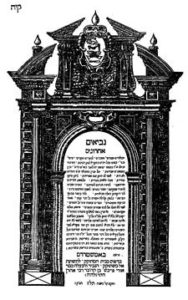
Fig. 7b Later Prophets

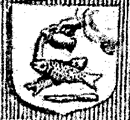
Figs. 7c, 7d Extracts

The Bible has an engraved front-piece title-page with depictions of Moses and Aaron, Mount Sinai at the top, and in the lower right hand corner a coronet and below it the raised hands of the Kohen giving a benediction. In the lower left hand corner is a fish and laver image, here the two fish are crisscrossed. The engraved title page is incorrectly dated תזל כטל (439 = 1679), whereas the like title-pages for each of the biblical divisions are correctly dated  תלז(437 = 1677), such as Later Prophets, below. The text has a separate but like title-page for Former Prophets, Later Prophets, and Writings. Note that in the otherwise like depictions of the fish and laver the position of the laver and water is reversed.

In 1689, Uri Phoebus ceased printing in Amsterdam, in order to relocate to Poland. Faced with competition from the large number of Hebrew printers in Amsterdam, Uri Phoebus felt that he would be more successful in Poland, located closer to its large Jewish population, a major market for the Hebrew printing-houses of Amsterdam. He established the first Hebrew press in Zolkiew in 1691, bringing his typographical material with him. Uri Phoebus’ descendants continued to operate Hebrew printing-presses in Poland into the twentieth century.

One of, if not the first book printed by Uri Phoebus in Zolkiew is R. Mordecai ben Moses Katz of Prostitz’s Derekh Yam ha-Talmud (1692) a super-commentary on the Hiddushei Halakhot of R. Samuel Eliezer ben Judah ha-Levi Edels (Maharsha). The title-page of this small work (40: 8ff.), much worn, appears to be the Benveniste frame, but at the apex is the same fish image as at the apex of Siftei Kohen. Among the decorative material, after the introduction and after the colophon is Uri Phoebus’ four fish mark, one on each side facing a laver from which water is being poured.

Among the other works published by Uri Phoebus in Zolkiew with the Nahalat Shivah title page reproduced above, is R. Jekuthiel ben Solomon Zalman ha-Levi Suesskind’s Dat Yekuthiel (1696,), a concise (80: 16 ff.) versified enumeration of the taryag mitzvoth (613 commandments). After the approbations to Dat Yekuthiel, there are thirteen, is the press mark comprised of four fish and laver. The title-page informs that the manuscript was found by Jekuthiel’s son Jonah of Kalish in his father’s bag, and arranged and brought to press by his grandson Menahem Feibush.

After the approbations is a letter from Jekuthiel to his son Eliezer. Jekuthiel, who was incarcerated at the time, in which he writes from his dark cell of his painful existence, where he had “wormwood, and gall to drink” (cf. Jeremiah 9:14) until “‘My soul is weary of my life’ (Job 10:1) ‘and my soul became impatient’ (Zechariah 11:8) to die in this way with this ‘light bread’ (Numbers 21:5) that I eat, absorbed in all my limbs, ‘the bread of adversity, and the water of affliction’” (Isaiah 30:20). Jekuthiel continues, describing his hardships, and then writes, “I will pay my vows to the Lord” (Psalms 116:14, 18) and that he took “of that which came to my hand a (new) offering” (cf. Genesis 32:14) on the taryag mitzvot. He thought to write on them in verse, “parallel, one with the other” (Exodus 26:17, 36:22), in single stanzas to the end, in the order of the Torah with references to the Hamishah Homshei Torah in the margins. Jekuthiel tells his son to take this as his blessing, which will be for a remembrance for both of them.

Uri Phoebus passed away in c. 1705.[18] He was succeeded in Zolkiew by his son Hayyim David, who had assisted his father at the press. Unfortunately, Hayyim David died shortly after his father, leaving the print-shop, in turn, to his sons, Aaron and Gershon. Uri Phoebus’ descendants continued to operate Hebrew printing-presses in Poland into the twentieth century. Aaron and Gershon did not use the ornamental material brought by Uri Phoebus to Zolkiew, instead preparing new frames that also reflected that they were Levi’im, and employed on such small format books as R. Raphael Lonzano’s Kinyan Avraham (1723) and R. Meir ben Levi’s Likkutei Shoshanim (1727). This ornate frame continued to be used by their descendants, among them Judah Solomon Yarsh Rappaport in Lvov on a Shir ha-Shirim with the commentary Magishi Minhah (1817) in Lvov.[19]
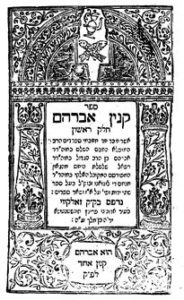
Fig. 8a Kinyan Avraham
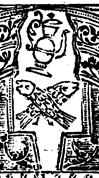
Fig. 8b Kinyan Avraham Extract

            Turning to, Germany, we find two fish, here facing in the same direction, on a title-page with an architectural pillared title-page, and at the bottom a palm tree, about it on the left a crab facing right and on the right two fish, both facing left, the former the sign of Tammuz (Cancer, scorpio), and, as already well noted, the latter the sign of Adar. The two zodiacal emblems may have had a personal significance, but, as Yosef Hayyim Yerushalmi observes describing a slightly later usage “the significance of this combination is difficult to ascertain.[20]

First employed in Fuerth by Joseph ben Solomon Zalman Schneur and his sons from 1691 through 1698, beginning with Torat Kohanim, and other folio volumes, primarily from the Shulhan Arukh, a like frame was subsequently used by Aaron ben Uri Lippman Frankel beginning with a Haggadah, in Sulzbach (below). Aaron was active in Sulzbach from the mid-1690’s until he passed away in 1720 at the age of seventy-five, first utilizing the fish image on a Mahzor printed in 1699 and afterwards in his folio imprints. Among those titles is a Haggadah (1711) with an attractive engraved copperplate front-piece (but without fish) followed by the second architectural pillared title-page described above. The architectural title-page was subsequently reused in Feurth by Hayyim ben Zevi Hirsch, who is credited with printing as many as 164 titles in that location, among the works with this frame and fish mark are several Haggadot (1746, 1752, and 1756).[21]
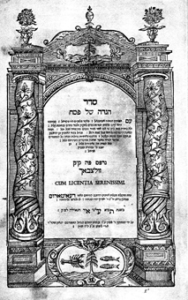
Fig. 9a Aaron ben Uri Lippman Frankel
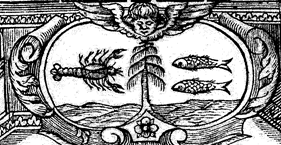
Fig. 9b Aaron ben Uri Lippman Frankel Extract

The site of yet another press that employed fish on the title-page, here apparently once only, was in Wandsbeck, a borough in north-west Hamburg in Schleswig-Holstein. The first printed books in Wandsbeck are dated to the late sixteenth and early seventeenth centuries, beginning with the Astronomiae instauratae Mechanica of Tycho Brahe (1546-1601), the famous Danish astronomer, published in 1598 by the printer Phillip van Ohr. Hebrew printing in Wandsbeck is a later occurrence, beginning approximately a century after its non-Jewish counterparts. It flourished for a brief period, primarily, albeit not solely, at the press of Israel ben Abraham.[22] The Thesaurus of the Hebrew Book enumerates forty-four titles from 1688 through 1744, several of which, including the titles previous to Israel’s sojourn in Wandsbeck, are listed as doubtful and includes duplicates as well.[23]

Israel ben Abraham was a proselyte who, reputedly, had previously been a Catholic priest. After his conversion Israel eschewed the sobriquets common among converts such as Avinu or the Ger (convert). Israel converted to Judaism in Amsterdam, where he wrote a Yiddish-Hebrew grammar Mafte’ach Leshon ha-Kodesh (Amsterdam, 1713). In 1716, after leaving Amsterdam, Israel ben Abraham acquired the typographical equipment belonging to Moses Benjamin Wulff, the court Jew in Dessau, and printed in Koethen, Jessnitz, and then in Wandsbeck from 1726-33, returning, after a brief retirement, to Jessnitz in 1739, printing a small number of titles to 1744.
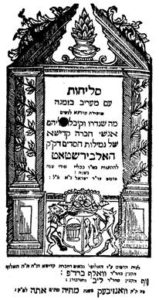
Fig. 10a Selihot with ma’ariv be-zemanah
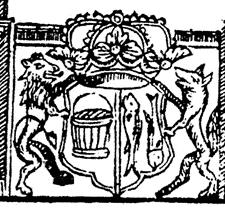
Fig. 10b Selihot with ma’ariv be-zemanah Extract

Selihot with ma’ariv be-zemanah (evening prayers in its time) is one of if not the first dated book attributed to Israel ben Abraham in Wandsbeck; it is a small octavo book (80: 7, 9, [4], 10-13, 13-23, [3] ff.). Its distinct title-page states that it is a Selihot with ma’ariv be-zemanah and that it contains matter pertaining to women; it informs that it was printed “as vowed and accepted upon themselves by the men of the hevra kaddisha (burial society) of the gemilut hasadim (charitable association) of HALBERSTADT,” and that it was “brought to press by the heads, the officers of the hevra kaddisha, R. Wulff and the noble R. Leib Warburg.” The title-page is dated in the year “You resuscitate the dead מחיה מתים אתה (469 = 1709),” a misdate, as noted by Moritz Steinschneider, who rejects the 1709 date (non admittunt; recusus ergo . . .) and dates it to 1730?[24]  At the bottom of the title-page are images of a lion at the left supporting a signet enclosing a pail, at the right a wolf supporting on the right side of the signet, two vertical fish, facing in different directions. The symbolism of these images is not clear, although it might be related to Wulff and Warburg, prominent contemporary family names.

The most dramatic, eye catching title-page with a fish motif was printed in Bad Homburg vor der Höhe at the press of Aaron ben Zevi Hirsch of Dessau. This Homburg is the district town of the Hochtaunuskreis, Hesse, Germany, on the southern slope of the Taunus, bordering, among others, Frankfurt am Main and Oberursel.[25] The title-page appears on successive editions of R. Meir ben Jacob ha-Kohen Schiff’s (Maharam Schiff, 1605-41, var. 1608-44) Hiddushei Halakhot, novellae on tractates of the Talmud, printed in Homburg in 1737, 1741, and 1747. Maharam Schiff, scion of a distinguished rabbinic family, a prodigy, was appointed rabbi of the important city of Fulda at the age of 17, where he was also served as a Rosh Yeshivah. There is a tradition that he was appointed rabbi of Prague in 1641, but if, as his grandson, who brought his works to press, reports, that he lived only 36 years, Maharam Schiff must have passed away immediately after his appointment. Maharam Schiff’s novellae are highly regarded and are reprinted in standard editions of the Talmud.[26]

The title-page has a four part frame, the top image of a fish (sea creature) attacking a ship and within the fish two men, apparently roasting a small fish (?). Below the fish (sea creature) appears to be the face of a man. On the other editions the other portions of the frame are varied. A. M. Habermann, in his work on Hebrew title-pages describes the top portion of the frame as mythological.[27]
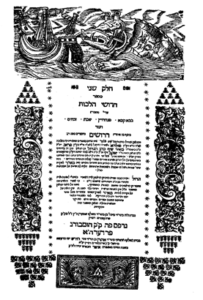
Fig. 11 1741, Hiddushei Halakhot

Returning to Amsterdam, an edition of Avot de-Rabbi Nathan with the commentary Ahavat Hesed (1777) by R. Abraham ben Samuel Witmond (1696-1773), also the author of novellae on the Pentateuch and Babylonian Talmud (1734). Avot de-Rabbi Nathan is one of the minor tractates, fourteen (fifteen, depending upon the enumeration) minor non-canonical tractates of the Talmud today appended to Seder Nezikin. It is an ethical work, considered a supplement to or a further development of Avot but with much aggadic material not related to the Mishnah, suggestive of an aggadic midrash. Ahavat Hesed was published posthumously by Witmond’s son-in-law and grandson at the press of Gerard Johann Janson. The header and place of publication on the title-page are printed in an oversized font in red letters. At the bottom of the page is a pressmark
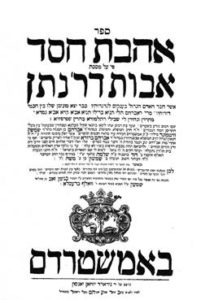
Fig. 12a Ahavat Hesed

Fig. 12b Ahavat Hesed Extract

At the bottom of the title-page is a shield with topped by a coronet and within it on the right are two fish facing in opposite directions, above them the sun, moon, and a star, and above them the phrase “and (Samson) said, [O Lord God,] remember me, I pray you, and strengthen me” (Judges 16:28); on the left a hand holding a pail above water, again above the sun, moon, and a star, and above the phrase “And David blessed the Lord” (I Chronicles 29:10). Yaari informs that the two phrases, allude to Witmond’s son-in-law, R. David, son of the late Solomon Bloch, together with the author’s grandson, Samson ben Moses, who brought the book to press. Furthermore, the fish refer to Samson ben Moses, born in the month of Adar, the sign of which is a fish, and the pail refers to his son-in-law David, born in the month of Shevat, that month’s sign being a pail.[28]

            The fish image, replete with its symbolism of fertility and good fortune, continued to be used in Jewish imagery and pressmarks. Indeed, shortly after its appearance on Ahavat Hesed it was again employed, if only occasionally, on the title-page of works from another Amsterdam printer, this into the nineteenth century. The usage over centuries depicted here attest to the popularity and power of the fish image, persisting to the present.
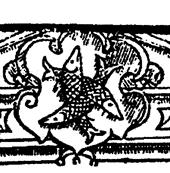
[1] Joseph Lowin, “Hebrew Root Word [D-Y-G]” Jewish Heritage on Line Magazine, http://www.jhom.com/topics/fish/lowin.html.
[2] Ellen Frankel and Betsy Platkin Teutsch, The Encyclopedia of Jewish Symbols) Northvale, London, 1995), p. 55.
[3] https://commons.wikimedia.org/wiki/Category:Salmons_in_heraldry
[4] W. Roberts, Printers’ Marks. A Chapter in the History of Typography, (London, 1893), pp. 201-02.
[5] Previous articles in this series are “Mirror-image Monograms as Printers’ Devices on the Title Pages of Hebrew Books Printed in the Seventeenth and Eighteenth Centuries,” Printing History 40 (Rochester, N. Y., 2000), pp. 2-11, reprinted in Studies in the Making of the Early Hebrew Book (Brill, Leiden/Boston, 2008), pp. 33-43; “The Cover Design, ‘The Printer’s Mark of Marc Antonio Giustiniani and the Printing Houses that Utilized It,’” Library Quarterly, 71:3 (Chicago, July, 2001), pp. 383-89, reprinted in Studies, pp. 44-53; “Mars and Minerva on the Hebrew Title Page,” The Papers of the Bibliographical Society of America 98:3 (New York, N. Y., 2004), pp. 269-92, reprinted in Studies, pp. 1-17; “The Bear Motif on Eighteenth Century Hebrew Books” The Papers of the Bibliographical Society of America 102:3 (New York, N. Y., 2008), pp. 341-61, reprinted in Further Studies in the Making of the Early Hebrew Book (Brill, Leiden/Boston, 2013), pp. 57-76; “Akedat Yitzhak (the Binding of Isaac) on the Title-Pages of Early Hebrew Books,” in Further Studies, pp. 35-56; “The Eagle Motif on 16th and 17th Century Hebrew Books,” Printing History, NS 17 (Syracuse, 2015), pp. 16-40; “The Lion Motif on Early Hebrew Title-Pages and Pressmarks,” (Printing History, NS 22, (Syracuse, 2015), pp. 53-71.
[6] Among the primary sources for this article are my The Sixteenth Century Hebrew Book: An Abridged Thesaurus (Brill, Leiden, 2004) and my The Seventeenth Century Hebrew Book: An Abridged Thesaurus. Brill, Leiden/Boston, 2011, and Avraham Yaari, Hebrew Printers’ Marks From the Beginning of Hebrew Printing to the End of the 19th Century, (Jerusalem, 1943), Hebrew with English introduction.
[7] Kabbalah Centre, https://livingwisdom.kabbalah.com/pisces-adar.
[8] Aish.com, http://www.aish.com/h/pur/b/The_Choice_of_Adar.html.
[9] Concerning the widespread use of this frame see my “Mars and Minerva on the Hebrew Title Page,” noted above.
[10] Yaari, Hebrew Printers’ Marks, pp. 12, 132 no. 19.
[11] Yaari, p. 132.
[12] Moritz Steinschneider, Catalogus Liborium Hebraeorum in Bibliotheca Bodleiana (Berlin, 1852-60), col. 220 n. 1407, col. 228 n. 1427.
[13] Nowy Dwor, Polish for ‘new manor’, is the prefix of several locations with that title. Another Nowy Dwor, Nowy Dwor Mazowiecki, was home to a Hebrew press in the late eighteenth – early nineteenth centuries, printing a significant number of Hebrew titles from 1781 through 1818.
[14] Yaari, pp. 26, 139 no. 42.
[15] A. M. Haberman, Title Pages of Hebrew Books (Safed, 1969), pp.m 48,129 no. 34; Isaac Yudlov, Hebrew Printers’ Marks: Fifty-Four Emblems and Marks if Hebrew Printers and Authors (Jeruslaem, 2001), pp. 36-40 [Hebrew]. He also informs that three small fish are the mark of the Gronim family of Prague in the sixteenth century, appearing on their headstones.
[16] Concerning Lida and Migdal David see my“David ben Aryeh Leib of Lida and his Migdal David: Accusations of Plagiarism in Eighteenth Century Amsterdam,” Shofar 19:2 (West Lafayette, Ind., 2001), pp. 117-28, reprinted in Studies in the Making of the Early Hebrew Book, pp. 191-205.
[17] Another work refering to Shabbetai Zevi noted by Ch. B. Friedberg, History of Hebrew Typography of the following Cities in Europe: Amsterdam, Antwerp, Avignon, Basle, Carlsruhe, Cleve, Coethen, Constance, Dessau, Deyhernfurt, Halle, Isny, Jessnitz, Leyden, London, Metz, Strasbourg, Thiengen, Vienna, Zurich. From its beginning in the year 1516 (Antwerp, 1937), p. 29 [Hebrew] published by Uri Phoebus is Tikkun Keria with a depiction of Shabbetai Zevi “sitting upon a throne, high and lifted up” (Isaiah 6:1).
[18] Ch. B. Friedberg, History of Hebrew Typography in Poland from the beginning of the year 1534, and its development up to our days . . . Second Edition, Enlarged, improved and revised from the sources (Tel Aviv, 1950), p. 64 [Hebrew] and Yaari, p. 158, date Uri Phoebus death to 1705. L. Fuks and R. G. In contrast, Fuks-Mansfeld, Hebrew Typography in the Northern Netherlands 1585 – 1815, II (Leiden, 1984), p. 242, writes that although Uri Phoebus was very productive in Zolkiew, he returned to Amsterdam in 1705, where, in 1710, he wrote “a short history of the first settlement of the Sephardic Jews in Amsterdam,” and where he died on 23 Shevat 5475 (17 January, 1715).
[19] Yaari, p. 158.
[20] Yosef Hayyim Yerushalmi, Haggadah and History, A Panorama in Facsimiles of Five Centuries of the Printed Haggadah from the Collections of Harvard University  and the Jewish Theological Society of America, (Philadelphia, 1976), plates 64, 65.
[21] Yeshayahu Vinograd, Thesaurus of the Hebrew Book. Listing of Books Printed in Hebrew Letters Since the Beginning of Printing circa 1469 through 1863 I (Jerusalem, 1993-95), I, p. 450 [Hebrew]; Yaari, pp. 51, 152-52 no, 82; Yudlov, pp. 59-61
[22] Concerning Hebrew printing in Wandsbeck see Marvin J. Heller, “Israel ben Abraham, his Hebrew Printing-Press in Wandsbeck, and the Books he Published,” Further Studies in the Making of the Early Hebrew Book (Brill, Leiden/Boston, 2013), pp. 169-93.
[23] Vinograd, II, pp. 168-69.
[24] Steinschneider, cols. 2792-93 no. 7517, 446-47 no. 2939.
[25] Concerning Hebrew printing in Homburg see my “Early Hebrew Printing in Bad Homburg vor der Höhe,” in progress.
[26] Itzhak Alfassi, “Schiff, Meir ben Jacob Ha-Kohen,” Encyclopaedia Judaica, (Detroit, 2007) vol. 18, p. 131; Mordechai Margalioth, ed. Encyclopedia of Great Men in Israel IV (Tel Aviv, 1986), col. 1028-29 [Hebrew].
[27] A. M. Habermann, Title Pages of Hebrew Books (Tel Aviv, 1969), pp. 104, 134 no. 88 [Hebrew].
[28] Marvin J. Heller, Printing the Talmud: A History of the Printed Editions of the Talmud from the mid-17th Century to the end of the 18th Century and the Presses that published them (Brill: forthcoming); Yaari, Hebrew Printers’ Marks, pp. 89, 169-70 no. 145.


R. Hershel Schachter, Gedolim, Rachel Morpurgo, and More

R. Hershel Schachter, Gedolim, Rachel Morpurgo, and More
By Marc B. Shapiro
1. In listening to a recent shiur[1] on Daas Torah by R. Hershel Schachter, I found a number of noteworthy comments. In this shiur, which has been heard thousands of times, R. Schachter states, “If you have an outlook, if you have what I would consider a crooked, a krum outlook on Yom ha-Atzmaut, then your outlook on eruvin is also crooked. I can’t rely on anything that you say.” I find this difficult to accept, since can’t someone be regarded as a great posek, one that can be relied on, even if one disagrees with important ideological positions he holds? In Eastern Europe, the people all relied on their local rav to decide halakhic questions for them. It didn’t matter to them whether the rav supported Agudah or Mizrachi. He was the halakhic authority of the town.I agree, however, that there are limits. What sense does it make to rely on a Satmar posek for a ruling if one wouldn’t accept anything he said in non-halakhic matters? (It is known that when men want a ruling that they don’t have to give their wives a get, they go to a posek in Monsey whom they wouldn’t ask any other questions of.) I think it is important for R. Schachter to explain what his definition of a “crooked” outlook on Yom ha-Atzmaut is? Does he mean someone who says tahanun on that day, or only someone who thinks it is a day akin to avodah zarah?[2]

Among other interesting comments in R. Schachter’s shiur is that he states that a posek can give you a binding pesak concerning whom you must marry.[3] This too I find difficult, since where does a posek get the authority to tell someone whom he must marry? An individual can certainly consult with a posek for his advice in this matter, but since this consultation is done voluntarily by the potential groom, how do we go from there to a situation of pesak which binds the person asking the question?
[Subsequent to writing these words I saw R. Schachter and asked him about this matter. He reaffirmed his position, stating that whom one marries is a halakhic matter and therefore a posek can indeed tell you whom you must marry. He added that this is almost always theoretical since in order to make such a ruling the posek would need to know both the bride and groom for many years so as to be sure that what he is saying is correct. But he also insisted that if the posek does have the requisite knowledge he can indeed give a binding pesak about whom one must marry.]
In discussing the matter of Israel giving back land for peace, as far as I understand (and this is also the understanding of everyone I have seen who has written on the topic), R. Joseph B. Soloveitchik held that this is not a halakhic matter and therefore there is no place for rabbinic involvement. The political and military leaders should make a decision based on their knowledge of what is in the best interest of the country. However, R. Schachter has a different perspective. He states that according to R. Soloveitchik, first the politicians and military leaders should be consulted, and following this the rabbis need to make a halakhic judgment about what is permissible.[4] Yet the following are R. Soloveitchik’s words from 1967, as transcribed by Arnold Lustiger here:
I give praise and thanks to the RBSO for liberating the Kotel Hamaarovi and for liberating and for removing all Eretz Yisrael from the Arabs, so that it now belongs to us. But I don’t need to rule whether we should give the West Bank back to the Arabs or not to give the West Bank to the Arabs: we rabbis should not be involved in decisions regarding the safety and security of the population. . . . We have to negotiate with common sense as the security of the yishuv requires. What specifically these security requirements are, I don’€t know, I don’t understand these things. These decisions require a military perspective which one must research assiduously. The borders that must be established should be based upon which will provide more security. It is not a topic appropriate for which rabbis should release statements or for rabbinical conferences.
Also of interest in this shiur is that R. Schachter rejects the legitimacy of Daas Torah proclamations by roshei yeshiva who do not deal with practical halakhic questions.[5] In his halakhic-centric approach, there is no room for such proclamations by figures who are talmudically learned but are not poskim. This means that R. Aharon Leib Steinman, for instance, who is not a posek, is not to be regarded as one who transmits Daas Torah. As R. Schachter says, one who does not decide practical halakhic questions dealing with Shabbat, kashrut, and taharat ha-mishpahah is not able to rule on matters that are not explicit in earlier texts, and are often categorized as being in the realm of Daas Torah. He specifically states that the Steipler and R. Shakh, who were not known as poskim, were not the ones people should have been turning to for Daas Torah.[6]
It is hard to imagine a stronger repudiation of the haredi notion of Daas Torah, for while R. Elyashiv was of course a great posek, there has never been an expectation among haredim that the transmitters of Daas Torah must be involved in pesak. Daas Torah depends on the Torah scholar being immersed in Torah and righteousness, but this does not mean that he has to be involved with halakhah le-ma’aseh questions. R. Schachter’s point is obviously in contradiction to the hasidic approach in which the rebbe is the leader, and the job qualifications of a rebbe have nothing to do with deciding halakhic questions.[7]
It is true, however, that R. Schachter’s description of who should be the religious leaders of the Torah community is what historically was the case before the rise of hasidut in the 18th century, the creation of the great yeshivot in the 19th century, and the rise of haredism in the 20th century. But even in previous centuries matters were not absolute. For example, what about R. Moses Hayyim Luzzatto? He was not a posek, yet would anyone today deny that he could speak with Torah authority on matters that fall into the category of Daas Torah? What about R. Nosson Zvi Finkel and many of the other mussar greats, or R. Zvi Yehudah Kook? Using R. Schachter’s halakhic-centric yardstick, they too would have to be excluded from what is today referred to as Daas Torah.
All this of course relates to the subject of gedolim, a topic that has recently seen a lot of discussion at the new website Lehrhaus. Professor Chaim Saiman’s essay, “The Market for Gedolim: A Tale of Supply and Demand,” was followed up by a number of insightful responses from people who represent the Centrist and Liberal Orthodox community, and by Rabbi Ethan Tucker who can be termed a leader of the halakhically committed egalitarian community.[8]
I have made the point a number of times that the twentieth century saw the creation of a new model in the haredi world. It is not just gedolim who are important, but the gadol ha-dor (technically: gedol ha-dor), that is, the gadol who stands above other gedolim. Although you had such figures in earlier times, such as the Hatam Sofer and R. Yitzhak Elhanan Spektor, in the twentieth century the notion of “the gadol ha-dor” has become institutionalized and is a basic feature of haredi society. Gedolim are not enough, but there also needs to be a supreme gadol. Thus, on the passing of the gadol ha-dor, the new gadol ha-dor emerges, (or he can actually be proclaimed, such as what happened when, after R. Elyashiv’s passing, R. Chaim Kanievsky declared that R. Steinman was the new leader). This is now an expectation of laypeople in the haredi world,[9] and obviously satisfies a psychological need, so inexorably one gadol ha-dor will be followed by another.[10]
This can lead to disputes as we see now in the haredi world between the majority who follow R. Steinman and the more extreme elements who have lined up behind R. Shmuel Auerbach. A noteworthy point, which is hardly mentioned in the “mainstream” haredi press, is that the opponents of R. Steinman have been very harsh in their evaluation of him, and a steady stream of publications has appeared designed to show that his views are not in line with the haredi Daas Torah going back to the Chazon Ish and continuing through R. Elyashiv’s leadership. These publications have also attempted to show that he does not have the level of Torah scholarship required to lead the haredi world. Yet R. Chaim Kanievsky, who throughout the controversy has been the most vocal in attacking R. Auerbach and his followers, has, as far as I know, never been subject to written criticism. All of the many attacks on R. Steinman simply omit mention of R. Kanievsky even though R. Kanievsky stands together with R. Steinman. One who claims that R. Steinman’s views are not in line with “correct” haredi thinking must assume that R. Kanievsky has also departed from the “proper” haredi path, which is a difficult position for most haredim to adopt. At the end of the day, R. Kanievsky is the most highly regarded Torah scholar in the haredi world, and if he has subordinated himself to R. Steinman, that will be enough for almost all haredim even if they do have questions about some of R. Steinman’s liberal positions.[11]
There is a lot more to say about this, but I would like to make just one more point about the term gadol ha-dor which is now so important and means the most prominent Torah leader of the generation. I think it is the equivalent of the term manhig ha-dor and is parallel to the other term that has popped up in recent decades, posek ha-dor. Regarding posek ha-dor, since the passing of R. Elyashiv, and then R. Wosner, I haven’t seen the term used for anyone in the Ashkenazic haredi world, and there is no one towering halakhic figure (although one is bound to emerge). In the Sephardic world, after the passing of R. Ovadiah Yosef, both R. Yitzhak Yosef and R. Meir Mazuz have emerged as posek ha-dor as well as gadol ha-dor. When it comes to gadol ha-dor in the Ashkenazic haredi world, both R. Steinman and R. Auerbach are regarded as such, and my sense is that many also regard R. Kanievsky as the gadol ha-dor even though he himself claims that R. Steinman holds this position.
Contrary to what some think, the term gadol ha-dor is not a recent term. Tosafot,[12] and many other rishonim, use it in the sense of a great Torah scholar, but as far as I know, there is no implication in the rishonim that the term means the preeminent Torah leader, as it is used today when people say that X is the gadol ha-dor. (I perhaps should write “scholar-leader”, since one cannot be the gadol ha-dor without being both a scholar and a leader.) When the rishonim use the term it means that X is a gadol ha-dor, i.e., a great sage. Even today, when “the gadol ha-dor” means the preeminent Torah leader, it need not mean that this individual is also the greatest Torah scholar, although sometimes times it does (e.g., when R. Elyashiv or R. Ovadiah Yosef were described as such, I think people assumed that they were the greatest Torah scholars.)
At another time I can discuss different uses of the term gadol ha-dor among rishonim. For now, I want to call attention to a passage in Pesahim 49b: “Let a man always sell all he has and marry the daughter of a scholar. If he does not find the daughter of a scholar, let him marry the daughter of [one of] the gedolei ha-dor.” It is obvious that in this passage the term gedolei ha-dor does not mean great Torah scholars. Rashi explains it to mean: אנשי מעשה וצדיקים. Even in the 16th century R. Moses Isserles uses the term gadol ha-dor to mean communal leader, and puts gadol ha-dor together with am ha’aretz.[13]
ואין איסור לקרות ע”ה נכבד עשיר וגדול הדור לפני ת”ח כי אין זה בזיון לת”ח רק כבוד לתורה שמתכבדת באנשים גדולים.
Yet elsewhere, Shulhan Arukh, Yoreh Deah 244:10 (based on Terumat ha-Deshen: Teshuvot, no. 138), R. Isserles does use gadol ha-dor to mean an outstanding Torah sage.Returning to the articles at Lehrhaus, I would like to call attention to a couple of passages that relate to gedolim in rabbinic literature (there are obviously many more). R. Hayyim Palache states that there is a tradition that every gadol be-Torah has opponents who persecute him.[14] Historically, I think this is the case, as I cannot recall a gadol who did not have enemies who tried to tear him down.

Most people assume that dayanim will know halakhah well, and that the elite and small group of dayanim on Israel’s Beit Din ha-Gadol will certainly be experts in all areas of halakhah. I recently picked up R. Yitzhak Yosef’s new volume of responsa, She’elot u-Teshuvot ha-Rishon le-Tziyon, and he wants to disabuse readers of the understandable notion that dayanim are experts in the breadth of halakhah.[15] He goes so far as to say that there are dayanim on the Beit Din ha-Gadol, men he knows personally, who while knowledgeable in Even ha-Ezer and Hoshen Mishpat, when it comes to Orah Hayyim and Yoreh Deah:
אינם בקיאים כלל וכלל, יודעים קצת מספרי קיצורים, כמו בן איש חי וכף החיים וכדומה. אך אינם בקיאים בב”י ומפרשי השלחן ערוך והשותי”ם.
Being that the Beit Din ha-Gadol is a very small group of dayanim, I am sure people have been trying to figure out who R. Yosef is including in this negative judgment.
Finally, in terms of a definition of a gadol, R. Hayyim Eleazar Shapira actually offers us one:[16]
מפורסם בהרבה מדינות ובחיבוריו יורו המורים ולקולו יחתו וכיוצא.
By saying that a gadol is known in many lands, and his works are widely used, it is clear that we are dealing with a definition for the modern era where there is easy international communication. In pre-modern times there was no expectation that a gadol in say Morocco would be known outside this land. But I think that for the modern era R. Shapira’s definition is an excellent one as it captures the fact that the term “gadol” represents a sociological category. I would also add that the status of “gadol” is significant in that it is a lifetime appointment, as it were. It is almost impossible for one to be removed from “gadol” status once he has been elevated to this level. I think we can be very proud that in the long history of gedolim there are no examples – at least I am not aware of any – where gedolim lost their status because of immoral behavior. (We can be less proud of the language some gedolim have used in denigrating their opponents.[17])
2. In recent posts I discussed the idea of love before marriage in traditional Jewish communities. It is worth noting in this regard Rachel Morpurgo’s book of poetry, Ugav Rahel (Cracow, 1890). Here is the title page.

Rachel Morpurgo was a cousin of Samuel David Luzzatto, and a fascinating and learned figure in her own right. In the introduction to the book, p. 6, R. Isaac Castiglione tells us that Rachel’s parents wanted her to marry a certain man, but she refused as she was in love with Jacob Morpurgo. If she could not marry him, she preferred to remain single. (In the end, they did marry.)
Her cousin Luzzatto sent her a poem, trying to change her mind, and she replied also in a poem, expertly using many of the same words that Luzzatto had used. In her poem she says that if she can’t marry the man she wants, she will never marry, not even if given the possibility to marry the Messiah. Here are both of their poems, from Ugav Rahel, pp. 50-51, and Rachel’s poem in honor of her marriage, p. 52.
 
Here is another interesting poem from p. 71. We see that Morpurgo wanted to join Moses Montefiore on his journey to the Land of Israel.

On p. 73 she has a poem of joy after an evil Catholic priest died and was buried on Purim.

She was also able to write riddle poems, which was a popular genre among the Hebraists. Here is one from pp. 76-77

3. In the archive of R. Isaac Herzog there are a number of letters from R. Herzog relevant to the issue of science and Torah.[18] He was writing to scientists and historians asking them how certain it is that the world is billions of years old and that humanity has been in existence for more than 6000 years. One of the people he wrote to was Professor George F. Carter. Carter was a believing Catholic, and in his letters to R. Herzog you see that he could not understand why there should be any conflict between Torah and science. It astounded him that R. Herzog seemed to feel that the scientific and historical information in the Torah must be accepted as factual, when from his Catholic perspective the point of the Bible is not to provide facts of this nature. In his letter of November 23, 1953, R. Herzog wrote to Carter.
[L]et me recapitulate my problem. Not that we have as a dogma a certain chronology but the chronology automatically results from the plain text of the Book of Genesis, as you undoubtedly know yourself, that troubled the minds of some great rabbis nearly a century ago with the rise of the science of Geology. Most ignore the data of science altogether. Some, however, replied that the world was created enormous [missing word] of time ago, but that at certain points mankind was recurrently blotted out and the present world is a certain phase in that recurrent process of creation and destruction. Hence they explained the fossils which bear evidence of such high antiquity etc. They based their explanation upon an old saying in a pre-mediaeval Rabbinic collection: “The Holy One Best be His Name kept on building up worlds and destroying them.” Note that the meaning of “destroying” in that connection is not total annihilation as you will easily understand. Now the problem as it presents itself to me is whether the short period of less than six thousand years or (counting from the deluge when according to Genesis only a few persons survived) some 5000 years is sufficient to account for the numbers of mankind, for its distribution all over the globe, for the advance and progress of mankind, which in the natural course require considerable time, say the art of recording or writing etc., etc. If you assume divine interposition, the progress could be achieved in much less time. Think of the time according to science it took wood to be turned into coal, and of the time it takes for that process at the kitchen fire-side! Yet the question remains: Is it possible to speak of such constant divine interposition within say the first 2000 years of the past 6 or 5 thousand years since the beginning of the Biblical chronology to promote civilisation, the distribution of mankind and to multiply mankind to such an extent? I may add that our great teacher Maimonides from whom your Catholic great thinker Thomas Aquinas drew so much, was in his time confronted with Aristotle’s eternity of the universe which contradicted Jewish belief. He started out with the premise that if Aristotle’s point was absolutely proved, he would explain bara in Genesis not in the sense of created but in another sense, and would thus reconcile the divine Towah [!] with scientific truth, but he found that Aristotle had not proved his point and he therefore left bara in its plain sense.[19] I say something similar. If men of science prompted by absolute truth definitely and unanimously decide that the above chronology is not only unlikely but is actually impossible and therefore absurd, I would reinterpret the Biblical text in a different sense, but before doing that, I must be perfectly certain. Remember that the divine truth of every word in the Pentateuch is a dogma of orthodox Judaism, is believed to be the word of G-d through Moses. Yet orthodox Judaism is not a slave to the literal sense. It teaches that G-d is beyond all human thought and imagination and therefore it regards the anthropomorphisms as mere figures of speech: it also lays down that the Torah speaks in the language of humans. But there is of course a difference between understanding the Eyes of G-d as meaning divine Providence and interpreting the chronology of six thousand years as standing for aeons!
In this letter, and in other letters in his archive, the issue R. Herzog is most troubled with is not the creation of the world and the evidence that this took place billions of years ago. Rather, his concern is with the length of time of humanity on earth, for if there is indisputable evidence of humanity for tens of thousands or hundreds of thousands of years, then what is one to do with the chronology that “results from the plain text of the book of Genesis,” by which he means the record of generations beginning with Adam? As far as R. Herzog is concerned, this matter is not so much a religious question but a historical question, and that explains why he inquired from experts in this matter.[20] For if we are dealing with a fact, undisputed and recognized by all experts, that humanity has existed for longer than the biblical account would have it, then following Maimonides R. Herzog believes that is no choice but to read the Torah’s account in a non-literal fashion.
Readers can correct me if I am wrong, but I think that in the Modern Orthodox world the matter that R. Herzog was so exercised about has been settled. In other words, I don’t see any evidence that people in these communities are concerned that in Modern Orthodox schools, in classes on ancient history, students are taught things such as that around 10,000 BCE farming communities existed in the Middle East and North Africa. I know from personal experience that textbooks used in Modern Orthodox schools offer precisely this sort of information that assumes that human civilization predates the traditional Jewish reckoning. From what I have seen, this is presented to the students without, however, taking the step that R. Herzog mentioned, namely, explaining what then becomes of the biblical chronology when it is no longer viewed as historical.[21]
4. Following up on this post, here is a picture of a group of Slobodka students.[22]

R. Hutner is sitting in the middle.

Here is another picture of R. Hutner.

Standing next to him is R. Harold Leiman who was principal of general studies at Yeshivat Chaim Berlin’s high school from 1936-1948. Prof. Shnayer Leiman informs me that this picture of his father has to be from 1940 or earlier..
5. In my post here, in discussing the newly published Ha-Mashbir, volume 2, I wrote that one of the articles is by R. Pinhas Zebihi who discusses the practice in Gibraltar that men in mourning do not wear a tallit on Shabbat. I added that this is only the case for the first month of mourning. Mr. Mesod Belilo of Gibraltar has informed me to me that the Gibraltar minhag is that those in mourning do not wear a tallit at all during sheloshim, whether it be Shabbat or during the week. (They do put one on if given an aliyah.) It is Shabbat that makes this minhag halakhically problematic as not wearing a tallit would appear to be an example of “public mourning,” and that is what R. Zebihi deals with. In fact, his conclusion is that the practice should be abolished, but I can’t imagine that the Jews of Gibraltar, even if they knew of R. Zebihi’s position, would give up a minhag that is hundreds of years old and was not abolished by any of the community rabbis. (R. Zebihi’s article is actually a responsum addressed to the rabbi of the small Gibraltar minyan in London.)
One of the editors of Ha-Mashbir is R. Yissachar Dov Hoffman who recently published another book, Avodat Ovadiah, volume 1. It focuses on practices of R. Ovadiah Yosef and deals with the first part of Shulhan Arukh, Orah Hayyim (tzitzit, prayer, blessings, etc.). R. Hoffman’s learned notes include citations from a wide range of contemporary rabbinic works.
6. Here is a quote from the late Robert Liberles that I find quite interesting, and I think readers will as well.
Historians, imbued with curiosity and a fascination with the dark side, can easily be drawn toward the negative, the hostile, the antinomian side of human behavior. In addition, deviant behavior has much to teach about a society under study. There is also the endless fallacy of being drawn by sources deep into the abyss of misrepresentation. Records in the public archives relate strife and despair more often than happiness and love. Rabbinic responsa pertaining to family life also tend to deal with discord. Abuses in Jewish family life can be abundantly documented, and they should be. These sources have been ignored too often, partly because they were not known, partly because they were at times consciously overlooked. Research based on prescriptive sources has depicted a portrait that is quite distant from the harsher reality that emerges from primary descriptive sources.[23]
7. In my post here I mention that in medieval rabbinic literature the words צעירים and דורשים mean Franciscans and Dominicans. David S. Zinberg called my attention to R. Joseph Ibn Caspi, Mishneh Kesef, vol. 2, p. 257. In commenting on how Moses was not celibate and even took a second wife, he writes:
כי אינו צעיר ודורש, או אגוסטי וכרמלי
“For he was not a Franciscan or a Dominican or an Augustinian or a Carmelite.”
Zinberg also called my attention to Mishneh Kesef, vol. 1, p. 106, where he writes about כת הצעירים מארצנו זאת
I also found that R. Israel Moses Hazan, Nahalah le-Yisrael, p. 84, refers to the Dominicans as כת הדרשנים
8. I know readers will be happy to learn of a significant event in the world of Torah and academic Jewish scholarship: A previously unknown responsum by Maimonides has just been published in Divre Hefetz 7 (Tishrei 5777). You can see it here.
9. The newest book in my series, Studies in Orthodox Judaism, has appeared. It is Darren Kleinberg, Hybrid Judaism: Irving Greenberg, Encounter, and the Changing Nature of American Jewish Identity. Anyone interested in a discount copy of the book should be in touch with me.A few other books recently appeared that I would like to bring to readers’ attention. R. Moshe Zuriel published the following works by Naftali Hertz Wessely: Gan NaulSefer ha-MidotMigdal ha-Levanon, and Hikur Din. The first two books have been published before, but Zuriel has included unpublished material. Migdal ha-Levanon appears in print for the first time. All scholars who deal with Wessely will have to examine these works.

Another recent publication is R. David ben Judah he-Hasid, Sefer ha-Gevul, edited by Bentsion Cohen. This is a kabbalistic work published from manuscript. The author, R. David, is none other than the grandson of Nahmanides. Here is how the book is described on the cover: “This book is one of the first attempts by a contemporary of the Zohar discovery to give a lucid and graphical interpretation to the mysterious complex issues of divinity as discussed in the Idra Rabbah of the Zohar. His approach is one of the earliest to present an interpretation of the Sephirot in the image of a person.” The book also includes the numerous illustrations that appear in the manuscript.

10. Readers sometimes ask me about upcoming lectures, so I would like to inform people that on the Shabbat of Dec. 16-17, 2016 (including Saturday night) I will be speaking at Ner Yisrael in London. On Sunday night, Dec. 18, I will be speaking at the Hampstead Synagogue at 8:15pm. The topic is “Some Strange Jewish Christmas Eve Practices.” On Wednesday, Dec. 21, I will be speaking at the London School of Jewish Studies at 8pm on the topic of “Touching God: What Are the Limits of Orthodox Theology?” On Thursday, Dec. 22, I will be speaking at Shomrei Hadath at 8pm on the topic of “Sense and Censorship: Is Historical Truth an Orthodox Value?” On the Shabbat of Dec. 24-25 (including Saturday night) I will be speaking at Kehillat Ohev Shalom.

On the Shabbat of Jan. 6-7, 2017, I will be in Flatbush. During services on Friday night at Bnei Yitzhak, I will give a short talk on R. Elijah Benamozegh. After an early tefillah at the Sephardic Institute, I will be speaking at 8:45am on “The Philosophy of Rav Kook: Is It Still Relevant?” On Shabbat afternoon at 3pm I will be speaking at Beth Torah on “Judaism and Islam: Some Historical and Halakhic Perspectives.” On Saturday night at 8pm I will be speaking at the Sephardic Institute on “Did the Sages Always Tell the Truth (and Should We)?”


[1] “Da’as Torah – What are Its Parameters in non-Halachic Issues”, available here at 26:40.
[2] Usually it is Hungarian extremist rabbis who use terms like avodah zarah with reference to Yom ha-Atzmaut, but I found that R. Yehezkel Levenstein also uses this language. See Or Yehezkel, vol. 3, p. 118:
וברצוני לעורר כי הנה היום היה [!] יום העצמאות, ומה הוא מהותו של יום העצמאות. יום של עבודה זרה, יום שבו מראים הכל כוחי עוצם ידי.
I agree with a friend who wrote to me regarding this passage:
​יש הבדל בין השימוש בשם ‘עבודה זרה’ בהקשר של “כוחי ועוצם ידי”, זה שווה למי שאומר שהרדיפה אחר הכסף הוא עבודה זרה “אלהי כסף ואלהי זהב לא תעשה לכם”, ובין השימוש שסטמר משתמש בו שעובדים “העגל הציוני”.​
[3] At 1:14:30. The Lubavitcher Rebbe had a different perspective. See Joseph Telushkin, Rebbe: The Life and Teachings of Menachem M. Schneerson, the Most Influential Rabbi in Modern History (New York, 2014), p. 189, who quotes what the Rebbe told R. Leibel Groner: “When it comes to a marriage, not I can help you, not your father can help you, not your mother can help you, not your seichel [your intellectual faculties] can help you. The only thing that can help you is your heart. If you feel for her, go ahead. If you don’t do not.”
[4] At 1:11:00. Because R. Schachter is citing from memory, his misremembered one point. At minute 59 he describes a case dealt with by R. Chaim Berlin that took place under communist rule. Yet R. Berlin died in 1912, before the Soviet Revolution. The responsum referred to by R. Schachter can be found in Nishmat HayyimEven ha-Ezer, no. 3, and is from 1911. As R. Schachter notes, it contains the following fascinating words, addressed to someone who was considering whether a certain woman was an appropriate marriage partner:
ויוכל לקיים בה מצות פו”ר להוליד לו בן ובת ויצא ידי חובתו. ובזה”ז דלא אכשור דרי אין להדר להיות לו בנים מרובים, שמי יודע אם ילכו בדרך התורה והמצוה, אך לקיים מצות פו”ר חובה עלינו למלאות חובתינו.
I don’t know of any other rabbinic figure who urged people not to have many children because of a fear that they would not remain religious. The standard rabbinic approach in such matters was to declare בהדי כבשי דרחמנא למה לך. This expression comes from Berakhot 10a where it deals with the exact matter discussed by R. Berlin.
In those days was Hezekiah sick unto death. And Isaiah the prophet, son of Amoz, came to him and said unto him, Thus saith the Lord, Set thy house in order, for thou shalt die and not live etc. (Is. 38:1) What is the meaning of ‘thou shalt die and not live’? Thou shalt die in this world and not live in the world to come. He said to him: Why so bad? He replied: Because you did not try to have children. He said: The reason was because I saw by the holy spirit that the children issuing from me would not be virtuous. He said to him: What have you to do with the secrets of the All-Merciful? You should have done what you were commanded, and let the Holy One, blessed be He, do that which pleases Him
According to R. Berlin, Hezekiah was mistaken in that he chose not have any children. R. Berlin states that one must indeed fulfill the minimal obligation of peru u-revu, but there is no need to have more children than this when there is a strong possibility that the children will not remain on the religious path.
[5] Ibid at 1:01:00.
[6] Hearing this reminded me of R. Avraham Shapiro’s point that certain “Daas Torah” personalities have published Torah works, and in these works they state that what they write is not halakhah le-ma’aseh. “It is as if they are saying that they don’t have the ‘Din Torah,” but they do have the Daas Torah.” See Aharon Eizental, “Ha-Kohen ha-Gadol me-Ehav,” Tzohar 32 (2008), p. 16. A number of times R. Shapiro commented that there is no precedent for the current phenomenon in which Torah scholars who won’t give halakhic rulings on commonplace Shabbat questions feel that they can issue rulings on life and death matters affecting the entire nation. As with R. Schachter, he saw this as a distortion of true Daas Torah.
[7] See R. Israel Berger, Eser Orot (Petrokov, 1907), pp. 13-14, who explains the hasidic perspective that one can be the gadol ha-dor without being an expert in Talmud and halakhah.
[8] None of the responses referred to the following important passage in Aviad Hakohen, “Zot Torat ha-Adam,” in Reuven Ziegler and Reuven Gafni, eds. Le-Ovdekha be-Emet (Jerusalem, 2011), p. 367. It shows that R. Yehuda Amital thought that there is a more important thing to hope for than that one’s sons or students become gedolim, namely, that they should be good Jews.
כמה פעמים סיפר לנו על בר המצווה של בנו היחיד, ר’ יואל, שאליה הגיעו הרבה אורחים שנמנו עם משפחת האצולה הלמדנית של הרבנית מרים, משפחתו של הסבא ר’ איסר זלמן מלצר. בזה אחר זה קמו האורחים, וכמנהג גוברין יהודאין בירכו את חתן בר המצווה שיהיה גדול בתורה, חריף ובקי, סיני ועוקר הרים, רב לאלפים, יודע ש”ס ופוסקים, עמוד החזק ופטיש הימיני. לאחר שסיימו, ניעור רבנו ממקומו ואמר בצורה אופיינית: “אני מודה לכם על דבריכם הטובים, אבל איני מסכים עמם. אבא שלי לא היה גדול בתורה. גם סבא שלי לא היה גדול בתורה. לא אכפת לי שבני יהיה חייט או סנדלר. העיקר שיהיה יהודי טוב.”
[9] Brisk is an exception. A friend writes:
בבית בריסק אומרים מפורש, מאן לימא שיש גדול הדור?
[10] I am referring to the non-hasidic segment of the haredi world. In the hasidic world the followers of a rebbe generally viewed him as the gadol ha-dor, and he was thought to be chosen for this role from Heaven. See Mendel Piekarz, Ha-Hanhagah ha-Hasidit (Jerusalem, 1999), pp. 22ff.; David Assaf, Ne’ehaz ba-Sevakh (Jerusalem, 2006), p. 240. The Steipler actually said that R. Shakh was chosen by Heaven to be the manhig ha-dor. See Avraham Yeshayahu Kanievsky, Toldot Yaakov (Bnei Brak, 1995), p. 263. The Hatam Sofer said that in every generation God establishes one person as the premier posek. Because of his central halakhic position, the Hatam Sofer understandably understood that he was this person. See Maoz Kahana, “Ha-Hatam Sofer: Ha-Posek be-Einei Atzmo,” Zion 76 (2007), pp. 545-546.
[11] In a future post I will discuss R. Steinman in more detail. After examining his writings and public statements, I have to say that I understand well why there is opposition to R. Steinman, and I think that without the support of R. Kanievsky he never would have been regarded as the gadol ha-dor. It appears to me that R. Steinman has indeed attempted  to move haredi society in a different direction, and as such has diverged from some of the previous haredi Daas Torah. Furthermore, there is evidence of his “out of the box” thinking for many decades. As far as I know, there is not even one scholarly article about R. Steinman, which is surprising, to say the least, since he is the single most important haredi rabbinic leader.
[12] Berakhot 31b s.v. מורה. Cf. Rashbam, Pesahim 100a, s.v. ברבי which I also don’t think means the preeminent Torah leader or scholar. See also Or Zarua, Hilkhot Rosh ha-Shanah, no. 276, for the story of R. Amnon of Mainz who is referred to as gadol ha-dor. But again, I don’t think the meaning is that he was the greatest scholar of the generation. He certainly was not the greatest leader of his generation (and indeed, he was not even a real person).
[13] Shulhan Arukh, Orah Hayyim 282:3.
[14] Nefesh Kol Haima’arekhet ת, no. 80. R. Palache also cites R. Nahman of Bratzlav, Sefer ha-Midot, s.v. צדיק no. 136:
אין לך צדיק שאין עליו מחלוקת ומחקרים.
[15] Vol. 2, p. 159. See also ibid., p. 249.
[16] Minhat Eleazar, vol. 3, no. 64 (p. 54a).
[17] There is a long list of negative things rabbis have said about their opponents, and I have cited some in prior posts. Perhaps the worst I have found was stated by R. Sason Elijah Halevi Samoha, the former hakham bashi of Baghdad. He accused R. Elisha Dangoor, his successor as hakham bashi, of murdering his own brother. See Yaron Harel, Intrigue and Revolution: Chief Rabbis in Aleppo, Baghdad, and Damascus 1744-1914, trans. Y. Chipman (Oxford, 2015), p. 98.
[18] The letters I refer to come from the Israel State Archives, R. Isaac Herzog file 4243/6-פ.
[19] For my understanding of Maimonides, which diverges from that of R. Herzog, see here.
[20] In the file that contains the letter to Carter is also found a November 2, 1954 letter to Arnold Toynbee in which R. Herzog writes:
I have been struck by the point that you narrate the history of 5000 years of civilisation. Does that mean that in your view recorded history is not older?
I have been trying recently to explain the Hebrew Bible chronology according to which the creation of man took place only about 5700 years ago. This of course is rejected by anthropologists but may it not mean that man, truly civilised man, man properly called, is only of that age? Or do you begin the history of civilisation with the rise of agriculture?
Another letter in the file is from R. Herzog to Abraham Cressy Morrison, author of the book Man Does Not Stand Alone. R. Herzog’s letter is from December 19, 1951, and here is the section relevant to our discussion:
While not necessarily subscribing to all of its statements, I wish to compliment you on your very interesting and inspiring little book, “Man Does Not Stand Alone.” It is calculated to help many spiritually.
However, permit me the following observations. Whilst you accept the belief in G-D and in providence in as far as the generalities of nature are concerned, you recognise the dates fixed by science as axiomatic. Let me call your attention to the consideration that the ages of the rocks and the like, are computed in the absence of the premise of the Rock of the Ages. Once you grant the agency of a super nature power and intelligence, it does not follow at all that because with the laws and forces working now in nature after the creational work has ended, this or that kind of operation must take so much time, it has been so during the creational process and hence it is not at all certain that G-D tool [!] milliards of years to perform his work as Creator.
The difficulty is great, I admit, when it comes to historic Biblical chronology. Literally taken, the Biblical chronology allows only 5712 years for the period since the creation of Man and the present day. Yet I have the impression that even Wells allotted only a space of about 12,000 years for civilisation. This of course is a different matter. If we take agriculture as marking the emergence from the savage state, some 6000 years would, I feel, be sufficient. We may have to reinterpret the narrative portions of the Pentateuch, but not necessarily to allegorise them.
The same file also contains most of the Herzog-Immanuel Velikovsky correspondence published and analyzed by Raphael Shuchat in The Torah u-Madda Journal 15 (2008-2009), pp. 143-171.
[21] In the Israel State Archives, R. Isaac Herzog file 4253/6-פ there are other letters from R. Herzog focusing on the matter we have been discussing, namely, the short time given to humanity on earth if one reads the Torah literally. On 10 Av 5712, he wrote as follows to Dr. Yitzhak Etzion: 

אפשר לפרש את תוה”ק בצורה אליגורית ושהשמות שבפרשיות הראשונות שבספר בראשית, הן של גזעים ואומות רבים, לא של יחידים, ושהשנים הן לא שנים רגילות אלא תקופות, אבל זהו כבר ענין אחר, ודורש קביעת כללים עד היכן ומהיכן
On 22 Adar 5712 he wrote to Dr. Samuel Belkin.
זה מזמן שאני הוגה רעיון גדול בלבי והוא להוציא ספר גדול בכמות ובאיכות, מעין מורה נבוכים חדש שיכיל תשובותיה של היהדות הנאמנה לכל מתקיפיה, מצד המדע המודרני, האנטרופולוגיה, הגיאולוגיה, הזואולוגיה וכו’, הפילוסופיה, בקורת המקרא, והדתות האחרות, וכן מצד בעלי הכתות שבקרבנו של העבר ושל היום, הצדוקים הקראים והריפורמים
אני קבעתי לי ליסוד את דברי רבינו הגדול הרמב”ם ז”ל, שאם אריסטו היה מוכיח בהחלט את קדמות החומר היה הוא מפרש את פרשיות בראשית בהתאם לה, וד”ל, אך צריך שהחולקים על קבלתנו יוכיחו תחלה את השערותיהם, וכן צריך לקבוע כללים פרשנייים, עד היכן ואימתי מותר להוציא הדברים מפשוטם. זהו מקצוע בתורה שעובד אך מעט מאד
On 11 Shevat 5713, R. Herzog wrote to Professor Ben Zion Dinur, who was then serving as Minster of Education.
ימצא נא בזה סיכום של פעולות שבתכניתי לשם יצירת תנועה רוחנית להגנה על מורשת סיני
בדעתי להתחיל מיד בעריכת ספר גדול על יסוד היסודות של היהדות הנאמנה המאמינה, “תורה מן השמים”. בספר ההוא תופענה הגנות כתובות מאנשי מדע ואנשי אמונה כאחד, מיד כל אחד מנקודת השקפת מקצועו: אנתרופוליגיה, גיאולוגיה, תכונה, זואולוגיה וכו’ וכו’ . . .  כללים הם בידינו מאז מעולם: “דברה תורה בלשון בני אדם”, “שבעים פנים לתורה”, “התורה נדרשת בפרדס” וכו’ וכו’, ומאידך גיסא יש לנו כלל גדול “אין מקרא יוצא מידי פשוטו”. הספר הזה יקבע גבולות על הפרשיות שבתורה שאינן ענין של הלכה למעשה, עד כמה ובאילו תנאים יש להוציא הדברים מפשטותם. לפנינו יהיו למורה דרך דברי המורה הידועים, שאם אריסטו היה מוכיח בהחלט את קדמות החומרeternity of matter  היה הוא ז”ל מוצא דרך לפרש את פרשיות בראשית בהתאם לה.


בהכרח שהיהדות הנאמנה המאמינה תמצא לה פרקליט בתקופה המודרנית הזאת, אך מפני התקדמות המדע בצעדי ענק אי אפשר לעבודה כזאת להעשות באיש אחד. אפילו הרמב”ם, אילו היה חי בדורנו, לא היה יכול להאבק יחידי בכל הזרמים המרובים ההם
In his 29 Shevat 5714 letter to Dr. Aharon Barth, R. Herzog speculates about a possible solution to the problem we have been discussing, and also a solution for other matters in which the Torah’s description does not correspond to what is accepted by modern scientists and historians. He suggests that the Torah’s description need not be factually correct, as it was in line with the conceptions of the generation of the giving of the Torah. 

תאמר, שהיא דברה לא רק בלשון בני אדם, כי גם בלשון המסורת של העברים שבאותו הדור שקיבל את התורה, אעפ”י שבעצם הדברים לא מדויקים. נוסיף ללכת ונאמר כדברי רבינו הקדוש הרמב”ן ז”ל שהתורה כולה שמותיו של הקדוש ברוך הוא, ויש בה בכל אות ובכל תג סודות וסודי סודות, למעלה למעלה מהשכל הרגיל, רזי רזין שרק יחידי סגולה זוכים בהם, ואין חיצוניותה בפנימיותה כלל, והצורה החיצונה נתחברה בהתאמה לדרגת המסורת העברית של הימים ההים – הרבה צריך עוד לדון עד שנקבל תיאוריה כזאת

As can be seen from the last sentence, he was not ready to adopt this approach.

See also the letter from R. Herzog that I published in my “Ha-Im Yesh Hiyuv le-Ha’amin she-ha-Zohar Nikhtav al Yedei Rabbi Shimon Ben Yohai,” Milin Havivin 5 (2010-2011), p. 19.

In his reply to R. Herzog, Dr. Etzion makes the following interesting point which stands in opposition to the approach of some in the Kiruv world (and, truth be told, it is also in opposition to Maimonides’ approach)..


 כבודם של כל חכמי ישראל שהשתדלו להוכיח את האמונה ע”י השכל במקומם מונח, אבל האמונה בה’ ובתורה היא אחת ממצוות התורה ולו היה אפשרות להוכיח את האמונה הזאת, היינו לו אפשר היה להכריח את שכל האדם להאמין, הרי אין מקום למצוה, כמו שאין מקום למצוה ולשכר ועונש אם אין בחירה חפשית בחופש הרצון

[22] The picture can be found here where four of the five young men are identified. It was brought to my attention by Elchanan Burton.
[23] Robert Liberles, “On the Threshold of Modernity: 1618-1780,” in Marion Kaplan, ed., Jewish Daily Life in Germany, 1618-1945 (Oxford, 2005), p. 24.


Manasseh of Ilya and Y. Barzilay

I recently finished reading Yitzhak Barzilay’s book on R. Manasseh of Ilya. R. Manasseh was a fascinating character. He was a student of the Vilna Goan, but wrote a pamphlet arguing for reconciliation between Hassidim and non-Hassidim. He wrote another work discussing the trop or cantilation marks and yet another, his mangum opus, on the Talmud. It is the later work that he is most well known for, although not necessarily in a positive way. The Tefferet Yisrael (R. Yisrael Lifshitz) on the Mishna quotes a brief passage from this commentary. R. Menasseh’s comments appear on the first Mishna in Perek Alu Mitzhut. (Baba Metziah 1:1). He understands the Mishna in a different fashion than the Talmud, thus provoking some to argue such a position is heritical.

R. Manasseh was a controversial figure. His book on the reconciliation, Pesher Davar, was publicly burnt. His work on Talmud, Alphei Menashe, after either the publisher or some outsider (depending on the source, there are a couple versions of the story), destroyed it right before it was completed. R. Manasseh was forced to reproduce the entire work from memory and find a different printer.

Additionally, although he had a close relationship with the Vilna Goan, the Vilna Goan severed that relationship after learning R. Manasseh had been in contact with R. Shneur Zalman of Lida (Ba’al haTanya).

All this being said, he is ripe for an excellent biography. Unfortunately, Barzilay does not deviate from his norm, and put out another poor work. Although Barzilay has written on many other interesting figures of Jewish history, almost always he fails to do anything substantive or worthwhile with the subjects.

This work is full of gross supposition that are never supported by any facts. For instance we have sentences like this “It may be assumed that in a talented person like Manasseh, his critical faculties must have awakened rather early, and already in his youth he may have arrived at some of his nonconformist views with regard to the Halakhah and its historical development.” (p. 24). Therefore, Barzilay wants to then claim and project back on Manasseh’s early years and label him as a radical even then based only upon “his critical faculties.” While that may be the case, there are also a million other possibilities. For instance, Manasseh was influenced later in life by someone else or he came to his “nonconformist views” based upon years of study and when he was 17 (according to Barzilay, again a guess) he did not hold these views.

Another example, where Barzilay is discussing Manasseh’s frequent trips to his wealthy relatives house who had a terrific library, Barzilay makes the following statement: “The role of this library in Manasseh’s life and intellectual growth cannot be overestimated . . . It may be further assumed, with a high degree of probability, that there also were to be found there the recent works of the Berlin maskilim, as well as those of the enlightened orthodox Jews from both Eastern Europe and the Germanies.” Barzilay then goes on to cite to the many subscribers of various haskalah literature as “proof” this library contained these books. There a basic problem with this argument. Since Barzilay is able to point to where these books went to as the subscriber list, lists both person and place, why then isn’t this rich relatives name ever listed if he was a collector of such works? Instead, Barzilay is satisfied to assume that the books were there as there were many haskalah books that “found [their] way among the Jews of Eastern Europe.”

These are but two examples from a book that is rife with such sloppy work. The only redeeming fact of the book is the extensive quotation from R. Manasseh’s works. As mentioned above, this is not the first book Barzilay wrote that fails miserably. He also did another biography on R. Shlomo Yehudah Rapoport (Shir), the son-in-law of the Ketzot HaChoshen and one of the leading figures of 19th century Eastern European Haskalah. This book is also disappointing.

unfortunate, the only other biography, Ben Porat Yosef, is no gem either. It was written by Mordechai Plungian an editor at the famed Romm press. This is more of an anecdotal than scholarly work. However, this work got Plungian in trouble as some claimed he attempted to make R. Manasseh into a maskil.

What is particularly strange is that a book review of Plungin’s book appeared in HaMagid. At the JNUL site, which contains old Hebrew newspapers, the version they have appears to have that portion blacked out. The review in question appeared in HaMagid on March 8, 1858.

The full citation for Barzilay’s book is Manasseh of Ilya: Precurser of Modernity Among the Jews of Eastern Europe (Manges Press, 1999).


Which Direction is North?, Geographical Mistakes, and our Woke Universities

Which Direction is North?, Geographical Mistakes, and our Woke Universities

Marc B. Shapiro

1. Numbers 34:15 states: “Two and a half tribes have taken their inheritance on the side of the Jordan by Jericho, to the front, eastward.”

Rashi comments:

קדמה מזרחהאל פני העולם שהם במזרחשרוח מזרחית קרויה פנים ומערביות קרויה אחור לפיכך דרום לימין וצפון לשמאל

This passage is translated as follows in ArtScroll’s Sapirstein edition:

To the Front, Eastward: This means to the front of the world, which is in the east, for the eastern direction is called “face” and the western direction is called “back.” This is why the south is to the right and the north is to the left.

What does the “front of the world” mean? Furthermore, how could Rashi say that south is to the right? Anyone who looks at a map can see that south is not to the right and north is not to the left. Rather east is to the right and west is to the left.

ArtScroll begins its explanation by referring to Psalms 89:13: צָפוֹן וְיָמִין אַתָּה בְרָאתָם

The north and the south [right], Thou hast created them.” What we see from this verse is that “right” is used synonymously with “south”, which means that “north” also signifies “left”. But what does this mean, that “south” is “right” and “north” is “left”?

See also Genesis 13:9: אִםהַשְּׂמֹאל וְאֵימִנָה וְאִםהַיָּמִין וְאַשְׂמְאִילָה

Onkelos and Ps.-Jonathan translate: אם את לצפונא אנא לדרומא ואם את לדרומא אנא לצפונה

As you can see, the Targumim also understand “right” to mean south and “left” to mean north.

Genesis 14:15 states: וַיִּרְדְּפֵם עַדחוֹבָה אֲשֶׁר מִשְּׂמֹאל לְדַמָּשֶׂק

Old JPS translates: “[He] pursued them unto Hobah, which is on the left hand of Damascus.” But this is incorrect. The word משמאל here means “to the north”, and this is how it appears in the new JPS (and also in ArtScroll). See also Ezekiel 16:46 where again the words “right” and “left” refer to south and north.[1]

In its commentary to Rashi, Numbers 34:15, ArtScroll provides examples of other places where Rashi explains “south” to mean “right”. For example, Ezekiel 10:3 states: וְהַכְּרֻבִים עֹמְדִים מִימִין לַבַּיִת בְּבֹאוֹ הָאִישׁ. “Now the cherubim stood on the right side of the house, when the man went in.” Rashi comments:

מימין לביתבדרום

On the right side of the house: In the south [of the Temple].

ArtScroll does not mention Rashi, Genesis 35:18, where he explains the name בנימין as meaning “of the south”, that is, the only son who was born in the south.

Returning to Rashi’s comment in Numbers 34:15, where he says that south is to the right and north is to the left, ArtScroll explains as follows: “When one faces east, his right is to the south, his left is to the north, and his back is to the west.” This explanation is earlier found in the Silbermann translation of Rashi, Exodus, p. 261: “In reality these terms describe the points of the compass relative to one who is facing the place of sun-rise (מזרח) so that ימין, the right, is the South and שמאל, the left, is the North.” Neither ArtScroll nor Silbermann mention that this explanation is already found in Nahmanides, Exodus 26:18.

Now let us look at two passages in Maimonides. In Mishneh Torah, Hilkhot Terumot 1:9, Maimonides states:

איזו היא סוריהמארץ ישראל ולמטה כנגד ארם נהריים וארם צובה כל יד פרת עד בבל כגון דמשק ואחלב וחרן ומגבת וכיוצא בהן עד שנער וצהר הרי היא כסוריה

What constitutes Syria? From Eretz Yisrael and below parallel to Aram Naharaim and Aram Tzovah, the entire region of the Euphrates until Babylonia, e.g., Damascus, Achalev, Charan, Minbag, and the like until Shinar and Tzahar. These are considered like Syria.

I have underlined the problematic word. How can Maimonides say that Aram Naharaim etc. are below the Land of Israel? As R. Mordechai Emanuel notes, the Rambam is placing Damascus south of the Land of Israel which is clearly mistaken.[2] Here is the map, and if we inserted all the places places Maimonides mentions we would find them north of Israel.

R. Isaac Klein writes as follows in his translation in the Yale Judaica Series (p. 436):

Outward” – literally “below.” The term is due to the belief that the Land of Israel was situated higher than all other lands, hence all other countries were considered below it. In modern Hebrew he who immigrates into Israel is termed oleh, “he who has ascended,” while he who leaves Israel is called yored, “he who has descended.

The Touger edition of the Mishneh Torah comments:

The term “below” in this context is problematic. It does not mean “south,” because significant portions of Syria are more northerly than Eretz Yisrael. Some commentaries understand it as meaning in height, because as Kiddushin 69b states, Eretz Yisrael is higher than other lands.

Rambam le-Am states that the word “below” should be understood as meaning “outside of”, which is how Klein also translated the passage:

כלומרמחוצה להוכתב למטה” לפי שארץ ישראל גבוהה מכל הארצות – קידושין סט:

Yet this doesn’t make much sense. Maimonides is giving the borders of Syria so saying מארץ ישראל ולמטה cannot possibly mean “outside Eretz Yisrael”. The fact that Eretz Yisrael is higher than the surrounding lands is also not relevant. In other words, the three editions of the Mishneh Torah we have just mentioned don’t have a clue as to why Maimonides writes למטה, when anyone looking at a map would conclude that he should have written למעלה.

The same problem can be seen in Hilkhot Kiddush ha-Hodesh 11:17 where Maimonides states that Jerusalem is found below the equator.

מתחת הקו השוה המסבב באמצע העולם

Both Solomon Gandz in the Yale Judaica Series and the Touger edition translate this as “north of the equator” without explaining how מתחת can mean north. Again, anyone can look at a map and see that Jerusalem is above the equator, so what is going on here?

The answer to the questions I have asked is that maps in the Islamic world were generally oriented with south at the top. I can do no better than cite Jerry Brotton’s wonderful bookת A History of the World in Twelve Maps (London, 2012), pp. 58-59:

Most of the communities who converted to Islam in its early phase of rapid international expansion in the seventh and eighth centuries lived directly north of Mecca, leading them to regard the qibla as due south. As a result, most Muslim world maps, including al-Idrisi’s, were oriented with south at the top. This also neatly established continuity with the tradition of the recently conquered Zoroastrian communities in Persia, which regarded south as sacred.

This orientation would have appeared on the maps that Maimonides was familiar with, and thus it makes sense for him to describe Aram Naharaim, etc. as below Israel, or Jerusalem as below the equator, as that is what he saw when he looked at a map.[3] Here is an example of such a map by the famed twelfth-century cartographer Muhammad al-Idrisi. This map is known as Tabula Rogeriana as it was made for King Roger II of Sicily.[4]

As you can see, Saudi Arabia is on top. Here is a twentieth-century map which also puts south on the top.[5]

We have other examples of maps in Jewish sources that show the directions differently than what we are used to. For example, here is Gittin 7b and the maps in Rashi show west on top.

We also have maps in medieval manuscripts of Rashi’s commentaries that show east on top, as well as north on top.[6]

Here is Maharsha, Gittin 7b, which shows west on top. Below this you can see the map in R. Meir of Lublin’s commentary that has east on top.

Here is Maharsha, Berakhot 61b, and east is on top.

Here is a page from R. Jonathan ben Joseph’s Yeshuah be-Yisrael, a 1720 commentary on Maimonides’ Hilkhot Kiddush ha-Hodesh (ch. 10), and you can see again that east is on top.

Many people probably assume that what we have seen are printers’ mistakes, but that is not the case. European cartographers regularly put east on top, as Jerusalem was in the east relative to Europe, and the top was often regarded as the most important place on a map.[7] We also have examples from Europe with the west on top, although this is much rarer.[8] The important point is that our current maps that have north on top are not any more correct than these other maps. It is simply a matter of convention which direction should be on top, and interested readers are referred to Brotton’s book mentioned already.

As we have been discussing maps, here are some examples of what appear to be geographical mistakes in rabbinic literature, in no particular order. (In a future post I will deal with rabbinic views about whether the earth is round or flat, and why they thought there was no human habitation in the southern hemisphere.)

Rashi, Shabbat 65b, s.v סהדא, and Kiddushin 71b s.v. עד נהר, states that the Euphrates flows from the Land of Israel to Babylonia.[9] The Talmud, Shabbat 65b, quotes Rav that when the water rises in the Euphrates this is a sign that there has been rain in the Holy Land.[10] I believe the simple explanation of this passage, contrary to Rashi, is that there was an assumption that if there was significant rain in Babylonia then there was also rain in Eretz Yisrael. Presumably, this is also the meaning of pseudo-Rashi to Nedarim 40a s.v. סהדא (this commentary is not by Rashi):

כשנהר פרת גדול הוי עדות לגשמים שיורדין לאי דאי גבוה מכל הארצות ובאין גשמים ונופלין בפרת ומתגדל מהן

Rashi, however, had a different approach, and believed that the Euphrates flows all the way from the Land of Israel to Babylonia, so when the level of the Euphrates is raised this is proof that in the Land Israel it rained. Yet this is incorrect as the Euphrates does not flow from the Land of Israel to Babylonia. See also Tosafot, Shabbat 65b s.v. סהדא, who also think that the Euphrates is found in the Land of Israel, but reject Rashi’s understanding since Tosafot claims that rivers only flow from east to west (so the Euphrates must flow from Babylonia to the Land of Israel).[11]

However, R. Samuel Strashun, note to Shabbat 65b, tells us that he looked at a map and saw that the Euphrates indeed flows from west to east. He further notes that the Danube River also flows from west to east, meaning that Tosafot’s reason for rejecting Rashi is incorrect. We know that the Tosafot on different tractates do not necessarily come from the same school, and Tosafot, Bekhorot 44a, s. v. לא, and 55b, s.v. מיטרא, mention Rashi’s idea that the Euphrates flows from the Land of Israel to Babylonia.

Returning to Rashi, many have wondered how Rashi could describe the Euphrates as flowing from the Land of Israel, although I don’t see what is so difficult, since without accurate maps how could one expect Rashi to have perfect knowledge of the geography of the Middle East?[12] Nahmanides famously records in his commentary to Genesis 35:16 that only when he came to the Land of Israel and could see the geography did he realize that an explanation he had offered was incorrect. Interestingly, Nahmanides never updated his commentary to Genesis 35:18 where he criticizes Rashi for his supposed geographic error regarding Aram Naharaim. Yet most would say that it is Ramban who is mistaken when he writes that “Aram is southeast of the Land of Israel, and the Land of Israel is to its north.”[13]

R. Strashun calls attention to what he thinks is another geographical mistake in Rashi. In his note to Sukkah 36a he mentions that Rashi is mistaken (היפך המציאות) about where Kush is located, as R. Strashun tells us that Kush is Ethiopia. However, as R. Yaakov Hayyim Sofer has noted, Rashi routinely explains Kush as being identical with הינדואה, not Ethiopia. Presumably, Rashi understands הינדואה as India, which means that Hodu, mentioned in Esther 1:1, is a different place. While most people have understood Esther 1:1 to mean “from India[14] unto Ethiopia,” Rashi on Esther 1:1 tells us that Kush and Hodu are next to each other (which is one talmudic opinion in Megillah 11a).

Leaving aside Rashi’s identification of Kush as הינדואה, the real problem is Rashi’s understanding of הינדואה as a different place than Hodu. Interested readers can examine my earlier post here where I discuss this issue and explain why הדו has a dagesh in the dalet.[15] As for Kush, there is no uniformity of opinion as to what it refers to, and it is possible that the different biblical references do not all refer to the same place.[16] In agreement with Rashi, Tosafot, Bava Batra 84a s.v. בצפרא, mention that the Midrash places Kush in the east. R. Jacob Emden, who knew his geography, states that in addition to Ethiopia there was another land near India that was called Kush.[17] No less a figure than R. Abraham Maimonides confesses that he does not know where the Kush mentioned in Genesis 2:13 is to be found.[18]

There is actually a long mountain range called Hindu Kush that passes through Pakistan, which until the second half of the twentieth century was included in the territory called India.[19] Since the term “Hindu Kush” has been in existence for over a thousand years, it was obviously not incorrect for medieval writers to speak of a Kush near India. In my earlier post I also cited P. S. Alexander who writes: “It was a common view in ancient geography, shared by Ptolemy and probably also the author of the book of Jubilees . . . that Ethiopia was joined to India in the east. It is this idea that lies behind the [talmudic] statement that Cush and Hodu are adjacent.”[20] He also notes that the Indians’ dark skin was a reason for the identification. Furthermore, Alexander tell us, there was an ancient belief that there was a land connection between Ethiopia and India south of the Indian Ocean.

Speaking of geographical inaccuracies, Rabbi Natan Slifkin writes as follows in his new book Rationalism vs. Mysticism, p. 517:

The Zohar makes many statements about places in the Land of Israel which are incorrect, but which would be perfectly understandable if they were authored by someone living in Spain. For example, in multiple places the Kinneret is described as being in the territory of Zevulun, and as being the source of the chilazon that produces techelet, even though it was actually derived from the Mediterranean. Lod is described as being situated in the Galilee, and Cappadocia is described as a village near Sepphoris rather than as a province in Asia Minor.[21]

Avraham Korman called attention to a passage in Yalkut Shimoni, Joshua, remez 15.[22] The Midrash is commenting on the verse in Joshua 3:16:

וַיַּעַמְדוּ הַמַּיִם הַיֹּרְדִים מִלְמַעְלָה קָמוּ נֵדאֶחָדהַרְחֵק מְאֹד באדם (מֵאָדָםהָעִיר אֲשֶׁר מִצַּד צָרְתָן

The waters which came down from above stood, and rose up in one heap, a great way off from Adam, the city that is beside Zarethan

The Midrash states:

שמעת מימיך עיר נקראת אדםאלא על אברהם נאמר והאדם הגדול בעקים” (יהושע ידטו)

Korman believes this Midrash was authored by someone who did not know the Land of Israel, and thus could not believe that there was actually a city named Adam. Therefore, the sage offered a midrashic understanding of “Adam”. Yet there was indeed such a city, and it is mentioned in Yerushalmi, Sotah 7:5. It was later called Damiyeh by the Arabs.[23] However, Korman’s notion that the author of the Midrash did not know any of this, and the passage should be read as a denial of the literal existence of the city of Adam, strikes me as complete nonsense.

R. Ovadiah Bartenura in his commentary to Genesis 12:6 strangely does not realize that Hebron is in the south of biblical Eretz Yisrael.[24] R. Ovadiah would eventually journey to the Land of Israel, so this comment must have been made before his arrival there.

R. Moses Sofer, She’elot u-Teshuvot Hatam Sofer, Even ha-Ezer II no. 49, cites Deuteronomy 11:24, which refers to the boundaries of “Greater Israel.”

כָּלהַמָּקוֹם אֲשֶׁר תִּדְרֹךְ כַּףרַגְלְכֶם בּוֹ לָכֶם יִהְיֶה מִןהַמִּדְבָּר וְהַלְּבָנוֹן מִןהַנָּהָר נְהַרפְּרָתוְעַד הַיָּם הָאַחֲרוֹן יִהְיֶהגְּבֻלְכֶם

Every place whereon the sole of your foot shall tread shall be yours: from the wilderness, and Lebanon, from the river, the river Euphrates, even unto the Western Sea shall be your border.”

R. Sofer wonders about the words מן המדבר והלבנון, as these are both in the south, so how could this establish borders when what the verse should have is a site in the north together with a site in the south?

ויש לי מקום עיון בלשון הקרא . . . שלכאורה אין לו שחר כי המדבר והלבנון הוא גבול דרומית לאי שבין צפון ים סוף לדרום אי

This passage is surprising, to say the least, as how could R. Sofer say that Lebanon is in the south of Israel? Ever since this passage appeared in print it has mystified readers and many have simply thrown up their hands without any explanation, as it is impossible to imagine that R. Sofer did not know that Lebanon is located to the north of Israel. R. Sofer was attacked on this point by Leopold Loew in his Hungarian periodical Ben Chananja.[25] R. Joseph Natonek in a German booklet offered an explanation of R. Sofer, but I confess to not understanding his point. Here is how R. Natonek’s position is summarized by Shmuel Weingarten.[26]

הרב נטונק מוכיח איפוא שהאתנחתא” בדברי החתס צריכה להיות אחרי המלים שבין צפון” והוו של והלבנון אינה ו‘ החבור (konjunktiv) אלא ו‘ הפרוד (disjunktiv) . . . דברי החתס ברורים איפוא: “כי המדבר והלבנון הוא גבול דרומית לאי שבין צפון” מן המדבר שבדרום עד הלבנון שבצפון וכו

R. Sofer made his comment regarding Deuteronomy 11:24, and he sees the words מן המדבר והלבנון as indicating that the wilderness and Lebanon are in the same place. The same words are found in Joshua 1:4:

מהמדבר והלבנון הזה ועד הנהר הגדול נהר פרת

From the wilderness, and this Lebanon, even unto the great river, the river Euphrates.”

Here, too, if we didn’t already know where Lebanon is we would assume that the wilderness and Lebanon are together, as that is the simplest way to read the text. It is so obvious, in fact, that Metzudat Tziyon is forced to explain “Lebanon” as referring to the name of a forest. The Vilna Gaon, in his commentary printed in the Mikraot Gedolot, also does not regard this “Lebanon” as referring to the Lebanon we know but a different Lebanon in the southeast of Israel.[27] So we see that R. Sofer was not alone in his understanding.

Avraham Moshe Luntz, who wrote much about the geography of the Land of Israel, also argues that the “Lebanon” referred to here is not the Lebanon we know.[28] He thinks the verse is referring to the borders of a future Greater Israel and the Lebanon mentioned is actually Wadi al-Abyad in the south, in the Land of Edom. (Abyad=white, which is also the root of the word Lebanon.) However, I don’t know which place he is referring to, as while there is a Wadi al-Abyad in Jordan it is not in the south but on the east of Jerusalem.

Here is how Luntz connects what he says with the Vilna Gaon’s comment (p. 83):

והנה כל הדברים האלה אף כי חדשים הם לא שערום הראשונים בכל זאת הרגיש בהם הגרא זל מטעם סוד ה‘ ליראיו אם כי לא שמע מעולם מן ועדאלאביאט ורק מרוח הקודש אשר הופיע בבית מדרשו כתב בבאורו על הגבולין דיהושע והלבנון זה מזרחו של ארץ ישראל הקרוב לצד דרום ולכן אמר הזה” ששם היו עומדים והרב בעל תבואות הארץ כתב עליו נפלאים בעיני דבריו“. אמנםלא נפלאים ולא רחוקים המהרק נפלאת היא בעניניו רוח קדשו של הגרא זל אשר מאת ה‘ נתנה לו.

In Mesorat Moshe, vol. 2, pp. 158-159, R. Moshe Feinstein discusses Venice and Shushan Purim.[29] In the note the following appears:

ואחר כך הזכיר רבינו שונציה שנזכר בפיוטים הוא חלק מרוסיהפעם היה שם רב אליהו פרושנעראבל אפשר שונציה שמוזכר בשער דף של ספריםלמקום הדפוסמכוין ל-Venice [ונציה], שמוצאים זה על ספרים עתיקותבשנים שברוסיה וכו‘ לא היו בתי דפוסואפשר שבאיטליה כן היה.

R. Moshe says that the Venice that is mentioned in piyutim is not Venice, Italy, but a place in Russia. He must have had in mind the town of Vinnitsa – וויניצא – which you can read about here. He also says that R. Elijah Feinstein (of Pruzhan) was there, which appears to mean that he served as a rabbi in Vinnitsa (although this appears to be inaccurate). As for the first point about Venice being mentioned in piyutim, I have never heard of this and if it is the case, it could only refer to Venice, Italy. Perhaps R. Moshe was referring to something like this book of Yotzrot which on the title page says it was published in Venice, and refers to Venice, Italy.

The note in Mesorat Moshe continues that R. Moshe was aware of the name Venice on the title page of seforim, and thought it is “possible” that this refers to Venice, Italy. This is all very strange, and despite what the note says I find it impossible to believe that R. Moshe did not know that Venice was a center for Jewish printing, even if he did not know the extent of this printing. (Venice was where the first Mikraot Gedolot[30] Bible, as well as the first complete Babylonian and Jerusalem Talmuds were printed.) I am inclined to assume that this note does not accurately inform us of what R. Moshe’s point was.

Regarding Venice, Rashi has an interesting passage in his commentary to Isaiah 42:10:

ומלואוהקבועים בים ולא באיים אלא בתוך המים שופכים עפר כל אחד ואחד כדי בית והולכים מבית לבית בספינה כגון עיר ווניצייא

[Those who go down to the sea and] those therein: Those whose permanent residence is in the sea and not in the islands, but in the midst of the water they spill earth, each one of them, enough for a house, and go from house to house by boat, like the city of Venice.


Rashi mistakenly thought that the islands of Venice–of which there are 118—were man-made. He also seems to have thought that there was only one house on each island and you travel from house to house by boat. Incidentally, as Yitzhak Baer has noted, other than Venice the only other contemporary (European) city Rashi mentions by name is Rome.[31] For the reference to Rome, Baer refers to Rashi’s commentary to Isaiah 33:23, but he neglects to note that Rashi also mentions Rome in his commentary to Micah 7:8. Furthermore, in Bomberg’s 1525 Venice Mikraot Gedolot, Rashi to Zechariah 13:7 reads: את מלך רומי הרשעה. Yet in the standard Mikraot Gedolot the following appears: את מלך בבל.

Manfred Lehmann[32] thought that there was something else related to Venice in Rashi’s commentary to Nehemiah 7:3 where in manuscripts, but not in the Mikraot Gedolot printed version, Rashi explains the word משמרות (watches) as: גיטא בלעז. Lehmann states that this is the first time the word “Ghetto” appears in Jewish literature, and that the word originates in Venice. Lehmann then states that he doubts that there was already a ghetto in Venice in the days of Rashi. I don’t understand this at all, because if Lehmann (correctly) doubts that there was a ghetto in medieval Venice, then how could he not realize that the word גיטא cannot refer to “ghetto”. (The Venice ghetto was established in 1516.) This is quite apart from the fact that the word “ghetto” would not make sense in the verse. If you want to know what גיטא means, the place to look is Moshe Katan, Otzar Loazei Rashi (Jerusalem, 1990), p. 88, where he provides the Hebrew translation of the old French word: תצפיותמארבים. I must also note that the commentary to Nehemiah attributed to Rashi was not actually written by him.[33]

In the first draft of this post I wrote that I didn’t understand how R. Hayyim Joseph David Azulai, Shem ha-Gedolimma’arekhet gedolim, s.v. ע no. 2, could write that R. Ovadiah of Bertinoro came from a town in “Romania.” R. Azulai refers to Romania in Shem ha-Gedolimma’arekhet gedolim, s.v. א no. 169, and ma’arekhet seforim, s.v. ח no. 15, and it means  Byzantium. I didn’t think it was possible that R. Azulai was unaware that Bertinoro is a town in Italy, some 200 miles from his home in Livorno. Furthermore, I have no doubt that every Torah scholar who lived in Italy in R. Azulai’s day would have known and been proud of the fact that R. Ovadiah came from Italy. So I didn’t know what to make of R. Azulai’s comment. Shimon Steinmetz enlightened me that when R. Azulai refers to Bertinoro as being in Romania, he actually has in mind the Italian historical region called Romagna. In an era before there was a country named Italy, it makes sense that R. Azulai would refer to the region that R. Ovadiah of Bertinoro came from.

Let me offer one final example where the mistake is not made by the medieval authority, in this case Maimonides, but by his critic, R. Jacob Emden. In the Mishneh Torah, Hilkhot Tzitzit 2:2, Maimonides writes about how tekhelet is produced: “A chilazon is a fish whose color is like the color of the sea and whose blood is black like ink. It is found in the ים המלח.” We all know that ים המלח means the Dead Sea, and the Dead Sea is referred to as such numerous times in the Bible. R. Jacob Emden is shocked that Maimonides makes the error of thinking that fish could live in the Dead Sea.[3] He ends his comment with the strong words: לכן שיבוש גמור הוא זה לרמ זל. A number of later commentators also call attention to Maimonides’ “problematic” words, and some refer to R. Emden’s comment.

Yet the mistake here is not by Maimonides but by R. Emden, who didn’t realize that when Maimonides referred to the “salt sea” he meant the Mediterranean.[35] Maimonides was just translating into Hebrew the Arabic term used to designate the Mediterranean[36]אלבחר אלמאלח. At the end of his Commentary on the Mishnah, Maimonides mentions that he wrote this work while on אלבחר אלמאלח, and in his commentary to Kelim 15:1 he speaks of ships that that go from the Land of Israel to Alexandria by way of אלבחר אלמאלח. In the Mishneh Torah, Hilkhot Arakhim ve-Haramim 8:8, the best texts have: ישליכן לים הגדול ים המלח כדי לאבדן, thus explicitly identifying what he means by “salt sea”. When Maimonides refers to the Dead Sea in Mishneh Torah, Hilkhot Shabbat 21:29, he calls it ים סדום [37]. This is not his own term as Bava Batra 74b refers to ימה של סדום. Yerushalmi, Shabbat 14:3 refers to the Dead Sea as מי סדום. Interestingly, Yerushalmi, Kil’ayim 9:3 refers to it as ימא דמילחא [38]

2. In a number of posts I have documented how material from an archive at Bar-Ilan University ended up in various auctions. I was quite surprised that no one in any position of authority at Bar-Ilan seemed to care at all about what I had discovered. R. Elli Fischer recently discovered something similar, but with a much more expensive manuscript from the Jewish Theological Seminary. The story in this case is that the manuscript was sold by JTS. See the report hereMaybe the story with the archive from Bar-Ilan is similar to what happened with JTS, and it was actually Bar-Ilan which sold the archive. This would explain why they expressed no interest in finding out how the archive ended up at auction.

* * * * * * * *

Some years ago Rabbi Jonathan Sacks told me that in addition to writing scholarship I should also write for the larger world. He specifically mentioned that I should write for the Wall Street Journal. I finally took up his suggestion a few months ago and submitted an opinion piece to the Journal. They get hundreds of submissions a day, so I was not very surprised when they turned it down. Maybe the message in this is that I should stick to what I do best instead of involving myself in the culture wars. Rather than having the piece go to waste, I present it to you here.

Is it all Bad News at Our Universities?

For many people, the campus seems like a scary place these days. One can read about social justice warriors running roughshod over anyone who crosses the latest woke standards. Professors have been raked over the coals, and worse, for even mildly crossing the new woke thought police. We have also been treated to the spectacle of professors confessing their sins and promising to do better in the future, in scenes that look like they came out of Chinese Cultural Revolution re-education camps.

While I don’t wish to downplay any of this, and there have indeed been shocking violations of free speech at some of the top universities, I think that many Americans are getting a warped sense of what takes place at the typical university. I am sometimes asked by people if my university is anything like what they have been reading about, to which I can happily reply that no, I have never had the misfortune to experience that. To begin with, the various excesses are almost always centered in a few departments in the humanities. As one who teaches in a Theology/Religious Studies Department at a Catholic university—which, it bears noting, had in-person classes this academic year unlike so many other institutions—it is hard to see how the woke mentality and cancel culture would play out. Are we to remove the Bible, Augustine, and Aquinas because passages in these works are not in line with twenty-first century woke values?

This clearly is a non-starter, but just as important is that there has never been a push for this from students, who often are the ones behind the most damaging of campus controversies. I daresay that my experience is no different than my colleagues at hundreds of other colleges and universities in the country, institutions that are not what is commonly called “elite” institutions of learning, but which do a wonderful job in educating a student body that reflects middle-class America. Yes, we have liberal and even progressive students, but what we don’t have in any numbers—or at least I have not come across them—are students who speak woke and know all the Marxist lingo, who can go on and on about intersectionality, white supremacist capitalism, and America as the center of evil in the world, and who get outraged (or pretend to be outraged) at things that even a couple of years ago no one would have batted an eye at.

It is certainly possible that things will change in the future, and the wokeness and cancel culture currently infecting the “elite” universities, as well as so many other aspects of elite society, will filter down to the rest of the country including my university. If this happens, it might be a good time to think of retirement, as I wonder—to give an example from one of my courses—how I could teach about ethics under a woke regime. Could we actually have a unit on Affirmative Action where together with Ronald Dworkin’s spirited defense of racial preferences we also read those who see any discrimination on the basis of race, even if it is called “equity,” as deeply immoral? Could we do the unit on capital punishment where we examine whether our criminal justice system is “systemically racist,” instead of assuming that as a given? Could we focus on abortion, where we examine if women really do have a “right” to choose to terminate a pregnancy? Then there are the student presentations where all subjects are open for discussion, including such hot-button matters as immigration, war, sexual ethics, and transgender issues. Never once has a student tried to shut down the freewheeling class debate or complained that another’s point of view makes them feel “unsafe.” That is the way it should be, and I am confident that is how matters will remain in the vast majority of our colleges and universities. For those who are worried that higher education is leading us into the abyss, I can only say that from where I am standing, it is actually higher education that is succeeding where the “elite” universities have often failed.

* * * * * * * *

[1] Rashi, quoting Midrash Tanhuma, identifies Hobah with Dan. Yet as R. Meir Mazuz notes, it is hard to know what to make of this, as Hobah is described as north of Damascus which is not where the territory of Dan was. See Bayit Ne’eman: Bereshit 14:15.

[2] “Gevulot Eretz Yisrael (2),” Ha-Ma’yan 33 (Tevet 5753), p. 15.

[3] This is noted by R. Yisrael Ariel, Otzar Eretz Yisrael (Jerusalem, 2012), vol. 4, p. 13. I have checked numerous editions of the Mishneh Torah and the only one to explain this point is the Makbili edition, Terumot 1:9. Here is the relevant page which also includes a map found in manuscripts which also has south on top.


[4] See here from where I took the map.

[5] This map is found here.

[6] See Portraying the Land: Hebrew Maps of the Land of Israel from Rashi to the Early 20th Century (Berlin, 2018), ch. 1, available here.

[7] They also placed Jerusalem in the center of the known world. There is a commentary attributed to Maimonides on Tractate Rosh ha-Shanah. According to this commentary, the Land of Israel is to be regarded as on the western part of the world. Where then is Europe to be placed? 

 
Here is “Maimonides” comment, Hiddushei ha-Rambam le-Talmud, ed. Zaks (Jerusalem, 1963), p. 79:

צריך אתה לידע שארץ ישראל סמוכה למערבו של עולם הרבה מכל הארצות

[8] See here. See also here. How pre-modern people imagined the world, which was based on the maps they saw, has relevance to the question of where to place the halakhic dateline. See e.g., the important articles, complete with historical maps in color, by R. Dovid Yitzchoki and R. Efraim Buckwold in Tevunot 2 (2018), pp. 969-1095.

[9] See also Rashi, Shabbat 145b s.v. הני. In the Soncino translation to Shabbat 65b the following note appears: “Obermeyer, p. 45 and n. 2 rejects this [Rashi’s opinion] on hydrographical grounds, and explains that in most cases the rains in northern Mesopotamia in the Taurus range, where the Euphrates has its source, are the precursors of rain in Palestine.” The book by Jacob Obermeyer referred to is Die Landschaft Babylonien im Zeitalter des Talmuds und des Gaonats: Geographie und Geschichte nach talmudischen, arabischen und andern Quellen (Frankfurt, 1929).

[10] The term “Holy Land” with reference to the Land of Israel is actually not mentioned in the Bible, the Talmud, or the geonic writings. According to Hayyim Asher Berman, who has investigated the matter, the term in its Hebrew version first appears in the medieval period. Berman also notes that the Zohar uses the term ארעא קדישא hundreds of times. Berman claims that it is actually due to the Zohar’s use of this term that the Hebrew version became so popular. See Ha-Ma’yan 61 (Tevet 5781), pp. 102-103. (Understandably, others will see this as another sign that the Zohar was written in the medieval period.) Berman’s investigation was spurred by R. Shaul Yisraeli’s rejection of the term “Holy Land,” which he saw as a Christian invention in opposition to the term “Land of Israel.” R. Yisraeli noted that unlike ארץ הקודש, the term אדמת קודש is a Jewish expression and relates to the many mitzvot relevant to the Land of Israel. See R. Meir Schlesinger, “Hirhurim al Hibat ha-Aretz,” Ha-Ma’yan 60 (Tamuz 5780), p. 50. R. Yisraeli was obviously aware that the term“Holy Land” was often used by Jews for the last thousand years. However, I believe his intention was about the present, not the past. Today you can find Christians who speak of visiting the Holy Land and are careful to never actually mention the name “Israel.” This has to be seen for what it is, an anti-Zionist delegitimization of the existence of the State of Israel.

[11] See also Tosafot, Kiddushin 71b. s.v. עד.

[12] See R. Jacob Emden’s note to Arakhin 15a where he criticizes Tosafot for a geographical mistake that was also due to not having a reliable map:

ואמנם כל מש תוס‘ כאן אינו נכון גם ציור הארצות והים הוא מתנגד למציאות

To this I would add R. Meir Mazuz’s melitzahאין אחר המציאות כלום (The expression is based on Bava Batra 152b [end]: אין אחר קנין כלום)

[13] See e.g., R. Elijah Mizrahi, Commentary to Genesis 32:2. In his super-commentary to Nahmanides, Gen. 38:18, R. Menahem Zvi Eisenstadt writes:

הדברים קשים להולמם, שהרי צדקו דברי רש”י שא”י בדרום ארם היא, והדבר ידוע

[14] The Soncino translation says as follows: “The Hebrew Hoddu is really ‘Indus,” and refers to the north-western portion of the Indian peninsula which was drained by the Indus. This territory was added to the Persian Empire by Darius.”

[15] To the sources listed there, see also Tosafot Yom Tov, Yoma 3:7, who does not make the connection between the נ in הינדואה and the dagesh in the ד of הדו.

[16] See Avodah Berurah, Sukkah, vol. 2, p. 128.

[17] See his note to Megillah 11a.

[18] Perush ha-Torah le-Rabbenu Avraham ben ha-Rambam, ed. Moshe Maimon, vol. 1, p. 150.

[19] See here.

[20] “Toponomy of the Targumim,” (unpublished doctoral dissertation, Oxford University, 1974), p. 134.

[21] The issue of the Zohar’s knowledge of the Land of Israel has been discussed for a long time. Gershom Scholem, in his article on the Zohar in the Encyclopaedia Judaica, writes as follows:

The Palestinian setting of the book is also fictional, and, in the main, has no basis in fact. The Zohar relies on geographical and topographical ideas about Palestine taken from older literature. Sometimes the author did not understand his sources, and created places which never existed, e.g., Kapotkeya, as the name of a village near Sepphoris, on the basis of a statement in the Jerusalem Talmud (Shev. 9:5), which he combined with another statement in the Tosefta, Yevamot 4. He produces a village in Galilee by the name of Kefar Tarshi, which he identifies with Mata Meḥasya, and tells in this connection of the rite of circumcision which is based on material quoted in geonic literature with regard to Mata Meḥasya in Babylonia. Occasionally a place-name is based on a corrupt text in a medieval manuscript of the Talmud, e.g., Migdal Ẓor at the beginning of Sava de-Mishpatim. In the matter of scene and characters there are very close links between the main body of the Zohar and the stratum of the Midrash ha-Ne’lam, which follows the same path of mentioning places which do not actually exist. In this section Simeon b. Yoḥai and his companions already constitute a most important community of mystics, but other groups are mentioned as well, and particularly later amoraim or scholars with fictitious names who do not reappear in the Zohar. In recent times, several attempts have been made to explain the geographical difficulties, and to give a non-literal interpretation of statements in the Talmud and the Midrashim in order to make them fit the Zohar, but they have not been convincing.

Scholem’s point about Kapotkeya is rejected by R. Reuven Margaliyot, Peninim u-Margaliyot (Jerusalem, 2006), pp. 212ff.

[22] Ha-Adam ve-Tiv’o be-Mada u-ve-Yahadut (Tel Aviv, no date), p. 28.

[23] See Encylopaedia Judaica , s.v. Adam.

[24] See his commentary printed in Ba’alei ha-Tosafot al Hamishah Humshei Torah (Warsaw, 1876), p. 10b. This example is noted by R. Avraham ha-Kohen, Kiryat Arba, p. 237.

[25] See Shmuel Weingarten, Ha-Rav Yosef Natonek (Jerusalem, 1943), pp. 18ff. For another Haskalah attack on R. Sofer, see the anonymous author in Kerem Hemed 9 (1856), Letter 14. In a mocking fashion, the author deals with a number of matters, one of which is that in She’elot u-Teshuvot Hatam Sofer, Orah Hayyim, no. 16, R. Sofer states that R. Amram Gaon is buried in Mainz and he saw the grave. R. Sofer also mentions this in She’elot u-Teshuvot Hatam Sofer ha-Hadashot (Jerusalem, 1989), no. 11. This cannot be correct, and one can only assume that R. Sofer was shown the grave of someone else named R. Amram and given the false information that this R. Amram was R. Amram Gaon. For a possible identification of the R. Amram whose grave R. Sofer saw, see R. Naftali Yaakov ha-Kohen, Otzar ha-Gedolim, vol. 7, p. 332, and the sources cited in R. Nosson David Rabinowich, Safra ve-Saifa (Jerusalem, 2013), pp. 280ff.

[26] Ibid., p. 22 n. 17.

[27] See here for the suggestion that the Vilna Gaon’s comment is a printer’s error and it really should say “north” instead of “south.”

[28] Yerushalayim 7 (1907), pp. 81ff. It has recently been suggested that there are actually two separate biblical places named “Eilat”. See R. Yehudah Berakhah, Birkat Yehudah (Jerusalem, 2021), vol. 8, p. 417.

[29] We refer to the day as Shushan Purim due to the influence of Yiddish. In Hebrew—and this is how Sephardic writers refer to the day—it is called Purim Shushan. R. Elijah Feinstein, who R. Moshe refers to, was actually the shadkhan of R. David Feinstein, R. Moshe’s father. See Iggerot Moshe, vol. 8, Introduction, p. 6. Contrary to what many people think, even though they shared a last name, R. Moshe Feinstein’s family was not related to R. Elijah Feinstein (R. Moshe was a yisrael and R. Elijah was a levi). R. Moshe’s mother was the one who was related to R. Elijah, as she was his sister-in-law. See ibid.

[30] The word מקרא is masculine so it should be Mikraot GedolimMikraot Gedolot” is a mistake invented by printers which soon became an accepted form. See R. Yehudah Ben Lavi, Shevet mi-Yehudah, vol. 2, p. 226.

[31] See Baer, “Rashi ve-ha-Metziut ha-Historit shel Zemano,” in Yehudah Leib Maimon, ed., Sefer Rashi (Jerusalem, 1956), p. 501.

[32] “Iyunim be-Ferush Rashi al ha-Tanakh,” Sinai 107 (5751), p. 84.

[33] See Mayer Gruber, Rashi’s Commentary on Psalms (Philadelphia, 2007), pp. 69ff.

[34] Mitphahat Sefarim, ch. 4, p. 29 in the Jerusalem, 1995 edition.

[35] See e.g., R. Baruch Epstein, Torah Temimah, Numbers ch. 15, n. 118, which, as noted by R. Yaakov Hayyim Sofer, is taken from an earlier writer’s comment. See Sofer in Beit Aharon ve-Yisrael 97 (2002), p. 131.

[36] See R. Kafih’s commentary to Hilkhot Tzitzit 2:2.

[37] See R. Yaakov Hayyim Sofer in Beit Aharon ve-Yisrael 97 (2002), p. 131.

[38] See R. Solomon Judah Rapoport, Ha-Magid, Nov. 26, 1873, p. 421. The word is pronounced kil’ayim and not kilayim, as there is a sheva under the ל. People sometimes mispronounce it as kilaim, as if there is a hirik under the א of כלאים. This reminds me of another common mistake. If you google you will find that many refer to the concept of “shomer pesaim (petaim).” Yet this is a mistake. The verse in Psalms 116:6 reads: שֹׁמֵר פְּתָאיִם. The second word is pronounced pesayim (petayim), as the א is silent. Another example where the א is silent and many people make a mistake is with the name דניאל. Even people who have this name often pronounce it in Hebrew as Doniel (or Doniellah for women). Yet the name is properly pronounced Doniyel: דָּנִיֵּאל. This is unlike the name אריאל where the tzere is under the א and the word is pronounced Ariel.