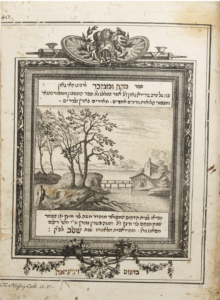
Cherubim: Winged Celestial Beings on the Title-Pages of Early Hebrew Books
by
Marvin J. Heller[1]

And having driven out the man, He stationed at the east of the Garden of Eden the Cherubim and the flame of the ever-turning sword, to guard the way to the Tree of Life (Genesis 3:24).
You shall make two Cherubim of gold—hammered out shall you make them—from both ends of the cover. You shall make one cherub from the end at one side and one Cherub from the end at the other; from the cover shall you make the Cherubim at its two ends. The Cherubim shall be with wings spread upward, shielding the Cover with their wings with faces toward one another; toward the cover shall be the faces of the Cherubim being turned toward the cover. (Exodus 25: 18-20).
Rav Ketina said: When the Jewish people would ascend for one of the pilgrimage festivals, the priests would roll up the curtain for them and show them the cherubs, which were clinging to one another, and say to them: See how you are beloved before God, like the love of a male and female (B.T. Yoma 54a).
Cherubim (angels) are a frequent presence on the title-pages of early Hebrew imprints in the sixteenth century and afterward, the latter beyond the scope of this article. They are also to be found in incunabula, on the frames of initial pages and head-pieces for text.
How do you define what are cherubim? One definition, that of the Encyclopedia Judaica, is “a winged celestial being which appears in the Bible in several different guises.” It then proceeds to give several descriptions of cherubim. The Jewish Encyclopedia begins with a more detailed description, stating cherubim are “the name of a winged being mentioned frequently in the Bible. The prophet Ezekiel describes the cherubim as a tetrad [set of four] of living creatures, each having four faces—of a lion, an ox, an eagle, and a man—the stature and hands of a man, the feet of a calf, and four wings.”[2]
The use of cherubim is also noted in the 1911 Encyclopædia Britannica where they are described as “imaginary winged animal figures of a sacred character, referred to in the description of Solomon’s temple (1 Kings vi. 23-35, vii. 29, viii. 6, 7), and also in that of the ark of the tabernacle (Ex. xxv. 18-22, xxvi. 1, 31, xxxvii. 7-9). . . . In Gen. iii. 24 the cherubim are the guards of Paradise . . .”[3]
The frequency of the appearance of cherubim in Hebrew literature can be found on Sefaria, a bibliography of Jewish texts, which records fifty-six entries for cherubim under biblical, Mishnah 27, and Talmud 991. Among other entries are Midrash, 590; Halakhah 7947; Kabbalah 747; and yet still others as well as multiples of commentaries on the first works.[4]
These multi-winged creatures are also a feature in general literature. Franz Sales Meyer, under the heading Miscellaneous heads, describes the “Angel faces, youthful heads, with a circular or disc-like halo, are first met-with in the Byzantine style, as the result of ecclesiastic articles,” He continues that in the early Italian Renaissance such renderings were charmingly naïve. They appeared as adornments on friezes and arches, medallions, and in borders. They also are to be found on tombs and are “Much used in Modern ecclesiastical decorations.” The text is accompanied by a page of examples of the cherub head, including one of a skull.[5]
It had been my intention to describe Hebrew title-pages with images of cherubim over a period of two centuries.[6] The numerous instances of such usage, however, has necessitated a considerable limiting of our subject period. Indeed, rather than noting all the examples in our current period, in the sixteenth century, we only describe several exemplars, giving background about the books in which they appear, that is, the publisher, author, and book subject.[7] This article is expansive, that is, in describing cherubim, it discusses the varieties of Hebrew literature, the authors of the subject works, the presses that published them, and even Hebrew book history. The title-pages and infrequent text pages with displays of cherubim addressed here are in chronological order, but from diverse locations and, again, on a variety of books, indicative of how widespread Hebrew publishing was and even more so the depth and nature of Hebrew literature.[8]
1514-18, Hameshei Humshei Torah – Our first work with the appearance of cherubim is a folio (20) edition Hameshei Humshei Torah (Pentateuch) with haftorat and commentary of Rashi printed in 1514-18 in Prague at the press of Gershom ben Solomon ha-Kohen and partners. Gershom later received a royal privilege from King Ferdinand of Bohemia, allowing him, that is Gershom alone, to enjoy a monopoly on Hebrew printing in Prague. His descendants, known as the Gersonides, continued to print in Prague until the mid-seventeenth century.


1514, Hameshei Humshei Torah
Courtesy of the Library of the Jewish Theological Seminary
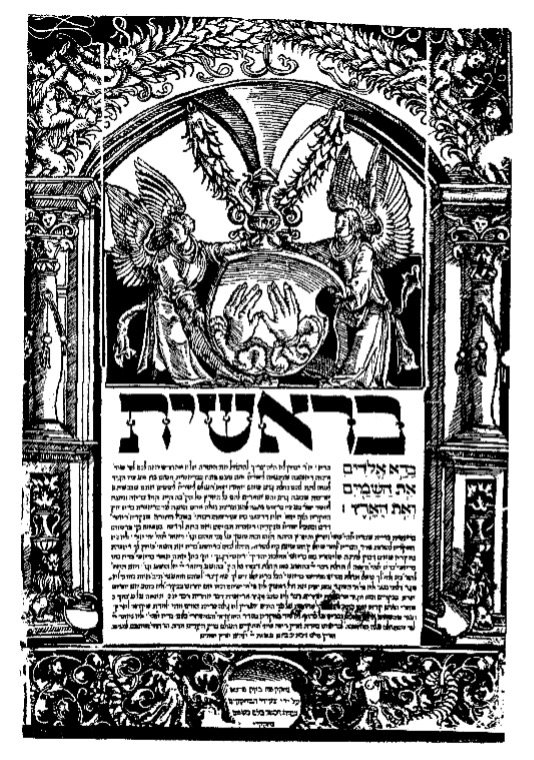
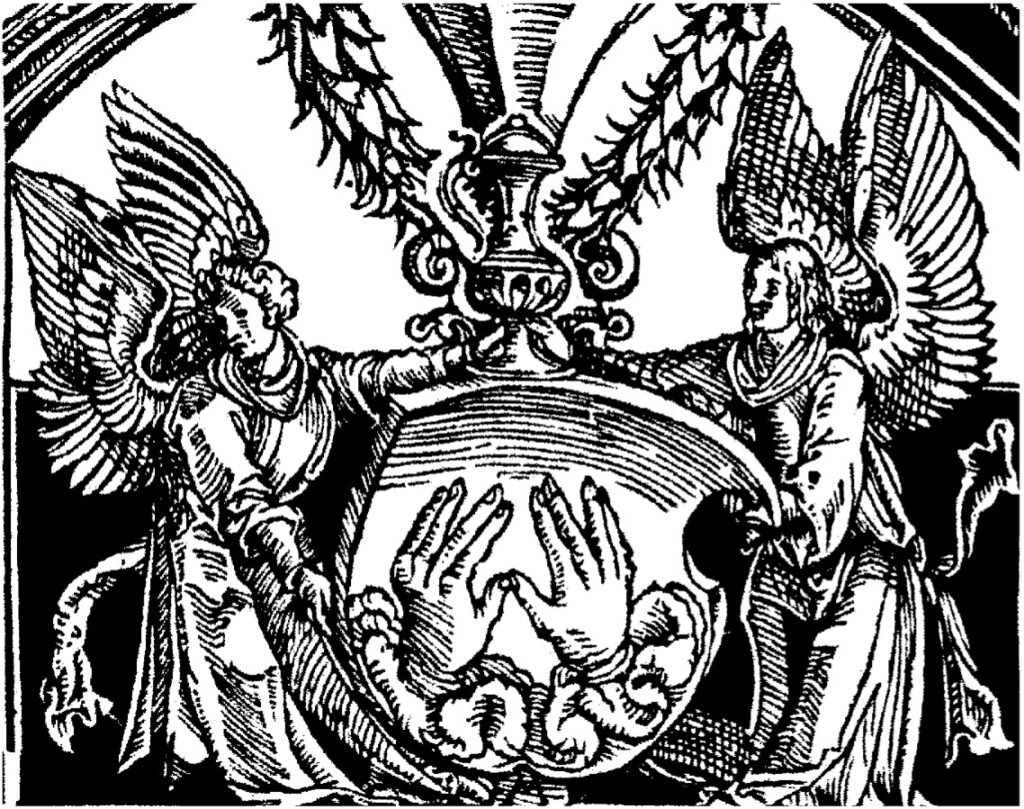
A magnificent edition, with ornate woodcut frames and large type for the text. Each book has a unique decorative opening page, there is no title page, comprised of four separate pieces, those on the pillared sides with vases, leaves, and cherubim, similar but not identical, the top piece with a concave bottom edge. Genesis has a convex curved piece to fit with this top piece on the upper half of the page, with winged cherubim holding a shield with the spread hands of the Kohen giving the priestly blessing.[9]
Work on the Pentateuch began on 10 Sivan (June 14, 1514) but, perhaps as a result of the success of the prayer book, the partners found they had overextended themselves and found it necessary to suspend work on this project for two years. In 1530 Gershom and his sons reprinted this Pentateuch in an identical format, except for changes to the decorated initial pages.
1527, Dictionarium Chaldai – Our next entry with cherubim is an Aramaic grammar by the Christian-Hebraist scholar Sebastian Muenster (1489-1552). It was printed in Basle in 1527 at the press of Johannes Froben in quarto format (40: [1], 434, [7] pp.). The Froben family was the most significant printers of Hebrew books in Basle. Johannes Froben published as many as 250 titles, among them Hebrew/Latin books of the Bible and grammatical works, primarily works by Muenster.
Sebastian Muenster, a cosmographer, astronomer, and orientalist was, for twenty three years, professor at Basle. Born in Niederingelheim, Hesse, the son of a Spitalmeister (hospital master), Muenster had no university education nor did he ever receive a degree. His education consisted of some private instruction in Latin and later studies at Frieberg and attendance at lectures given by the Franciscans. In 1506, Muenster entered the Minorite order and was sent to study in Rufach under Conrad Pellican (Pellicanus, 1478-1556). The following year he took vows and, in 1512, was ordained a priest. Muenster assisted Pellican in teaching in Pforzheim and, from 1524-29, occupied the chair of Hebrew at the University of Heidelberg. In 1529, Muenster converted to Protestantism and moved to Basle, where he occupied the chair of Hebrew, at a salary of 60 gulden; from 1547/8 he was rector. From about 1525, Muenster was a student of Elijah Levita, translating and editing his grammatical works. Muenster also translated a number of other Hebrew works into Latin and was a prolific author in his own right. By the time of his death more than 100,000 volumes of his works were in circulation. His Jewish oeuvre, more than three-score publications, covers all aspects of Judaica, excepting Kabbalistic studies, which did not interest him. In 1523, Muenster published Dictionarium Hebraicum . . . adiectis Chaldaicis vocabulis, his study of the Aramaic language. The book reads from left to right but the text follows the Hebrew alphabet. Words are given in vocalized Hebrew, followed by their etymology, definition and examples.
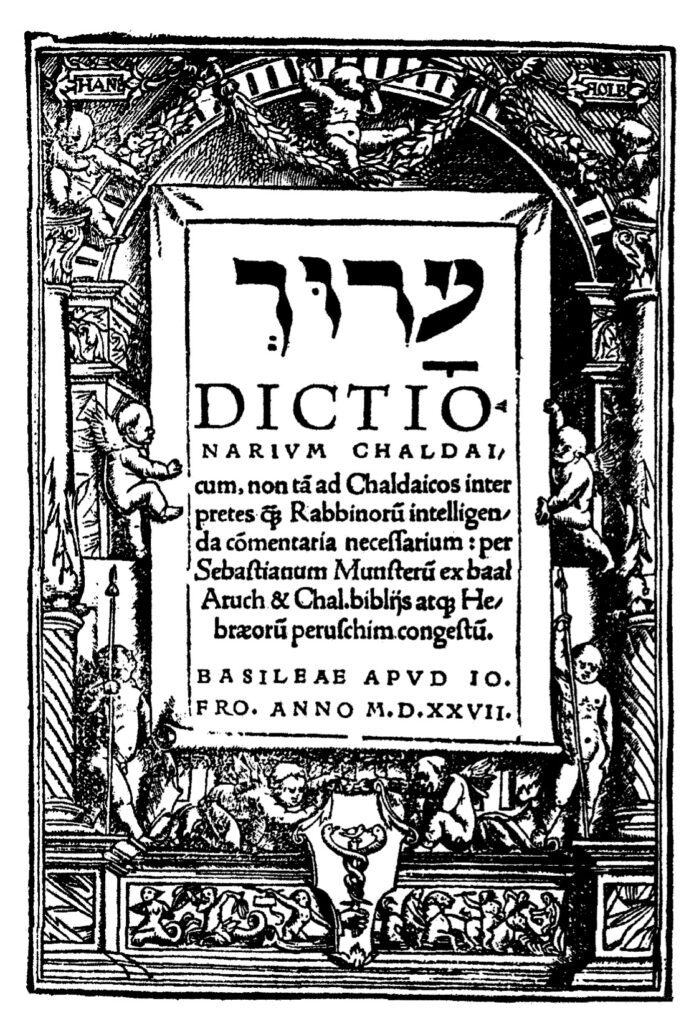
The title page of the Dictionarium Chaldai has an architectural frame with cherubim in various positions, as well as additional cherubim below mounted and otherwise. This title page, designed by Hans Holbein, was used as early as 1516 on Basel statutes and into the seventeenth century.[10] [11]
Not long afterwards, from 1540 through 1543, at least five titles were printed in three locations with varied images of cherubim on the title-page, that is Augsburg, Prague, and Bologna. That is not to say these frames were not used on other books, most likely they were, but rather these are examples of cherubim used by the printers of Hebrew books at the time.
Augsburg has an early history related to Hebrew printing. Several early anti-Jewish works beginning with the apostate Johannes Pfefferkorn’s Der Judenfeind (1509) and other anti-Semitic books by apostates were published there. Another early Augsburg publication of note, this certainly more positive, albeit not a Hebrew edition of that popular and much republished work, is the first printing of R. Joseph ben Abraham Gikatilla’s (1248–c. 1325) kabbalistic classic, Sha’arei Orah, which explains and analyzes the ten Sefirot. This edition of Sha’arei Orah is a Latin translation of that work by the apostate Paulus Ricius (Paulus Israelita, 1480-1541) under the title Portae lucis, published in 1516 at the press of Johann Miller.


1527, Dictiorionarim Chaldai
Courtesy of the Fales Library and Special Collections, New York University
Serious Hebrew printing in Augsburg begins when Hayyim ben David Shahor, among the pioneers of Hebrew printing outside of Italy, came to Augsburg in about 1533/34. In Augsburg, Schwarz worked in the print shop of Silvan Otmar (d. 1540), a renowned and highly productive printer, and resided in the home of Bonifacius Wolfhart, a Protestant pastor who also served as the censor of Hebrew books for Augsburg.[12] Shahor printed several works in conjunction with his son, Isaac, and his son-in-law, Joseph ben Yakar, who assisted him at the press, although their names are not mentioned on the title-pages.[13]
Shahor likely joined with a non-Jewish printer, perhaps August Wind, a printer of Hebrew works for Christian clergyman. Hayyim left for Italy, returning to Augsburg in 1540. He then printed three books, Avkat Rokhel, Arba’ah Turim and a prayer book for, according to the Thesaurus of the Hebrew Book, a total of ten works in Augsburg. Due to a lawsuit by an apostate, Paulus Aemilus, with whom Shahor had been associated in Ferrara, resulting from their failed venture, Shahor and his family were forced to cease publication and leave Augsburg. Aemilus, seeing a market in Augsburg for Hebrew/Yiddish books, began to print on his own account. He issued a small number of titles, most notably the Melokhim Bukh (1543) and the Shmuel Bukh (1544), Yiddish poetical renditions of the books of Kings and Samuel, both with images of cherubim (below).[14]
1540, Avkat Rokhel – Our first Augsburg title is Avkat Rokhel, an eschatological work on the principles of faith attributed to R. Machir ben Isaac Sar Hasid, a student of R. Judah ben Asher, son of the Rosh. Printed in octavo format (80: 18 ff.), perchance by Shahor. The Thesaurus of the Hebrew Book attributes it, albeit in brackets, to Hayyim Shahor, in contrast to the National Library of Israel that records the printer as unknown.[15]
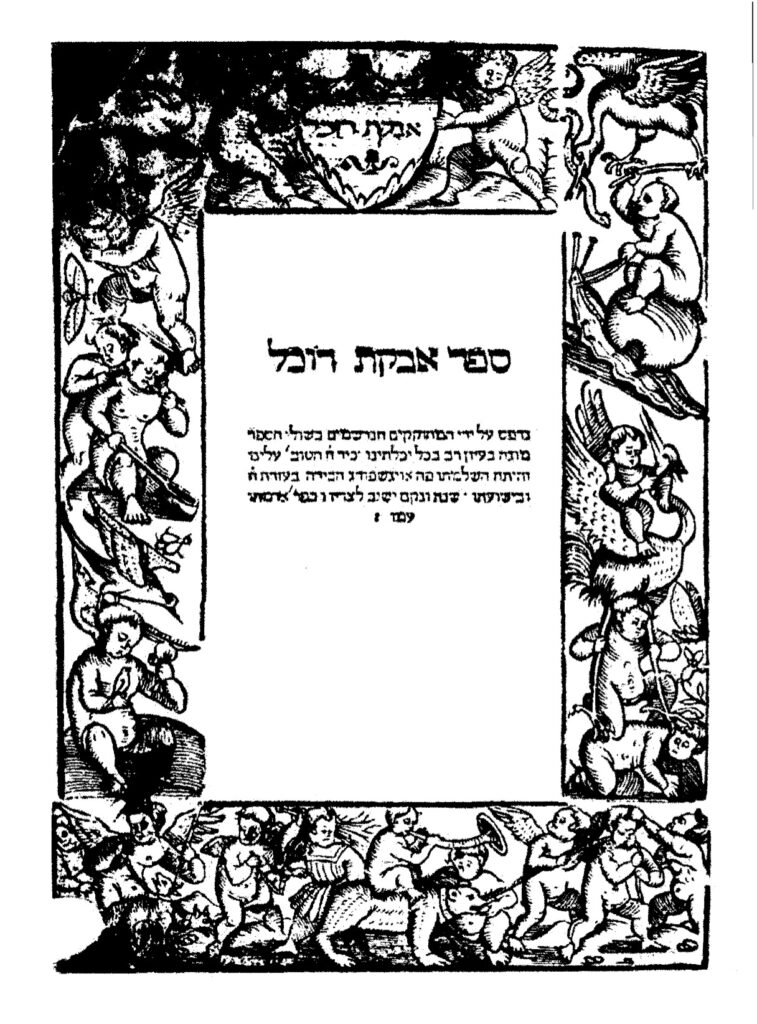
The text of the title page is set within a decorative frame with nineteen cherubim and a number of animals. The title-page states that it is,
Sefer Avkat Rokhel
Printed by the printers named at the end of the volume. Edited with great care, with all our ability, “the good hand of our [Lord] upon us,” (ref. Ezra 8:18). And it was completed, here Augsburg, the great city, with the help of the Lord and His salvation. In the year, “[Rejoice, O you nations, with his people; for he will avenge the blood of his servants,] and will render vengeance to his adversaries, and will make expiation כפר (300=1540) for the land of his people” (Deuteronomy 32:43).
The names of the printers, Hayyim Shahor, Isaac ben Hayyim, and Joseph ben Yakar, the statement on the title page notwithstanding, are not given at the end of the volume. A brief introduction informs that the work was named Avkat Rokhel (the perfumer’s powders, Song of Songs (3:7)) for as the perfumer’s powders strengthen the soul, so too when one reads this book will he fear and cause his soul to be pure and free from all sin and transgression, thus meriting the good.
1540, Avkat Rokhel
Courtesy of the Dorot Jewish Division New York Public Library
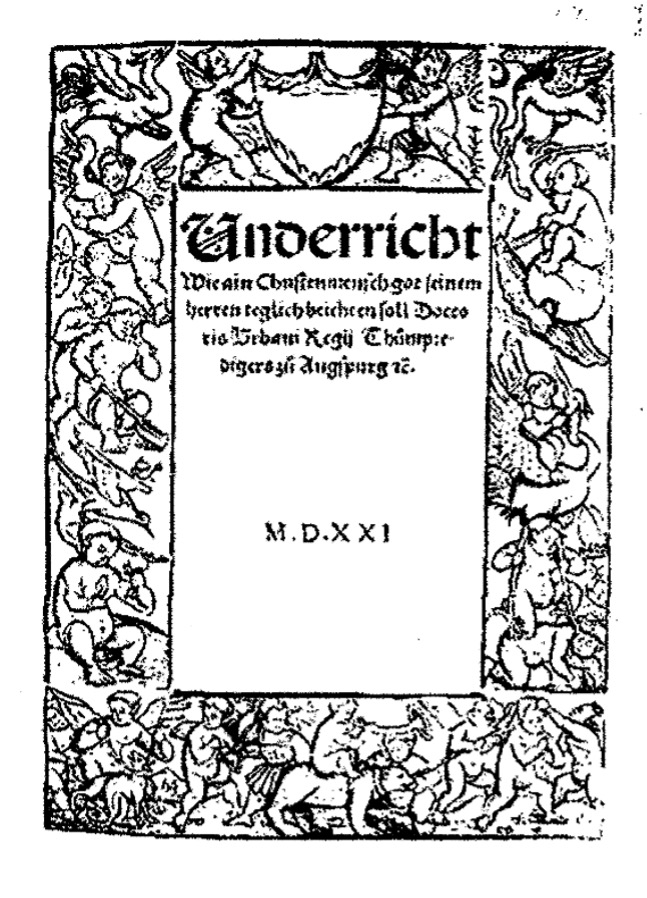
The like title-pages of Avkat Rokhel and Unterricht Wie ain Christenmensch, the latter a non-Hebrew work printed approximately two decades earlier, reflect a relationship between Jewish and Christian printers, that is, Christian printers published Hebrew books in association with Jewish associates. The relationship between the printers was mutually beneficial. For the Christian publisher “the Hebrew books sector, being unique, was attractive to investors, being more limited and not so wildly competitive as the Italian book sector.”[16] In addition to the non-Jewish printer’s access to the Jewish book market, the Jewish publisher was able to not only publish Hebrew books, but he also gained access to the typographical material of his Christian associate. The latter, for example, frequently provided attractive frames to the former after having used them for his market and the Jewish partner also utilized the printer’s other ornamentation. This was of value to the Jewish partner as he did not have to go the expense of having decorative material prepared, at a relatively much greater expense as it would be utilized for a much smaller market. This despite the fact that the frames were often incompatible with traditional Jewish sensibilities.[17]
1521, Unterricht Wie ain Christenmensch [18]
The like title-pages of Avkat Rokhel and Unterricht Wie ain Christenmensch, the latter a non-Hebrew work printed approximately two decades earlier, reflect a relationship between Jewish and Christian printers, that is, Christian printers published Hebrew books in association with Jewish associates. The relationship between the printers was mutually beneficial. For the Christian publisher “the Hebrew books sector, being unique, was attractive to investors, being more limited and not so wildly competitive as the Italian book sector.”[19] In addition to the non-Jewish printer’s access to the Jewish book market, the Jewish publisher was able to not only publish Hebrew books, but he also gained access to the typographical material of his Christian associate. The latter, for example, frequently provided attractive frames to the former after having used them for his market and the Jewish partner also utilized the printer’s other ornamentation. This was of value to the Jewish partner as he did not have to go the expense of having decorative material prepared, at a relatively much greater expense as it would be utilized for a much smaller market. This despite the fact that the frames were often incompatible with traditional Jewish sensibilities.[20]
The title-page of Avkat Rokhel has the largest number of cherubim of our title-pages, nineteen in all, of our title-pages. The cherubim appear on the bottom, sides, and top of the frame, all active, albeit in different activities. The text of Avkat Rokhel is in three parts, each further subdivided. The first section addresses the struggle against one’s evil urge prior to redemption and the birth pangs and advent of the Messiah, and an explanation of the pertinent midrashim; the second part discusses the rewards and punishments of the soul after the resurrection, the nature of the world to come according to Judaism, in contrast to the views of non-Jews, and resurrection; and the third part the laws stated by the sages of the Talmud as halakhah Moshe me-Sinai, the formation of man and the number 248 limbs in a person, the statement of our sages concerning three partners in that process (God, man, and woman) and some gematriot.
This is the third edition of Avkat Rokhel, it having been printed previously in Constantinople (1516) and Rimini (1526). Ch. B. Friedberg records, in his Bet Eked Sepharim, more than twenty-five printed editions of Avkat Rokhel. It was translated into Latin by A. Hulsius and printed in his Theologia Judaica, (Breda, 1653) and a Yiddish edition was prepared by Naphtali Pappenheim (Amsterdam, 1647).[21]
1543, Melokhim Buch – Two additional works printed in Augsburg, attributed to Moses (Esrim ve-Arbeh) Ashkenazi, are Yiddish poetical renditions of the books of Kings and Samuel. Moses’ appellation, Esrim ve-Arbeh (24), derives from either his birthplace, Vierundzwanzig Hoefe (24 courts) in Wuerttemberg, or from his extensive knowledge of the 24 books of the Bible. Moses’ accreditation with either authoring or transcribing the Melokhim Bukh is due to its similarity to the Shmuel Bukh, more reliably attributed to him. Nevertheless, sufficient differences exist between the two works that many scholars believe they do not share a common author. It is clear, however, that the author, even if not this Moses, was an Ashkenazi Jew. The Melokhim Bukh was published in quarto format (40: [123] ff.) by, according to the colophon, Paulus Aemilus. A Latin colophon states, Augustae Vindelicorum/ per Paulum Aemilium, Anno/ Domini M. D. XLIII. Meyer Waxman suggests that it is doubtful, the colophon notwithstanding, that the publisher was Aemilus; more likely it was Hayyim Shahor.
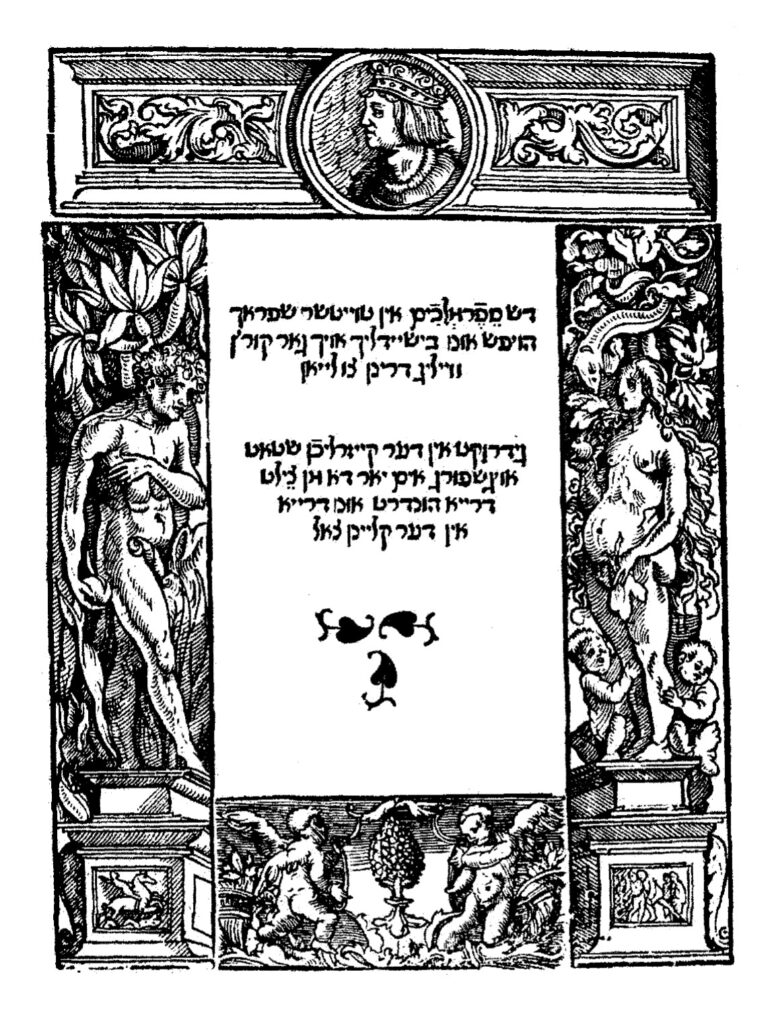
We have noted above that the frames on these title-pages were first used by Christian printers and that when that market no longer needed the frames, they were made available to Jewish printers. The cherubim frames noted above were generally acceptable to a contemporary renaissance Jewish public, although some, many, were questionable and would not be used today. In contrast, the title-page of the Melokhim Buch has a border made up of a four-part frame, the top with a representation of a king, the left and right sides respectively with images of Adam and Eve, unclad, the latter with the snake, two small children, and expecting. At the bottom are two cherubim. Use of this frame is surprising, for in contrast to other frames its’ contents appear to be objectionable, more so than other frames, even those with mythological characters. It seems likely that this frame might also be distasteful to Christian sensibilities.[22]
1543, Melokhim Buch
Courtesy of Dr. Moshe Rosenfeld
The title page states that it is “The book Melokhim (Kings) in Taytsher sprach, beautiful and clear and very entertaining to read. Printed in the imperial city of Augsburg in the year 303 (=1543)” [23] The colophon dates the completion of the work to Friday, 14 Av, 303 (July 25, 1543), which was a Sunday in 1543.
The Melokhim Bukh was not written as a sequel to the Shmuel Bukh. It is the older of the two books, originally written as a separate work, possibly as early as the fourteenth century. The format of the Melokhim Bukh, a rhymed paraphrase of the book of Kings, is that of the heroic epic, stylistically modeled after comparable German sagas, such as the Nibelungen. The subject matter is the events in Kings I and II, imaginatively and colorfully enhanced by material from the Talmud and Midrashim, all expressed with a deep piety. Intended as a complete history, it begins with a hymn of praise to God in three strophes followed by nine strophes from the Exodus to the last days of David, the contents of Kings, and as a sequel, the history of the Jews to the end of the second commonwealth in thirty strophes). An example of the text is,
You have frequently performed signs for the children of Israel;
Therefore they are obliged to have You for their Lord.
And to fear Your name-that is useful and good for them.
That man is foolish who acts contrary to Your word.[24]
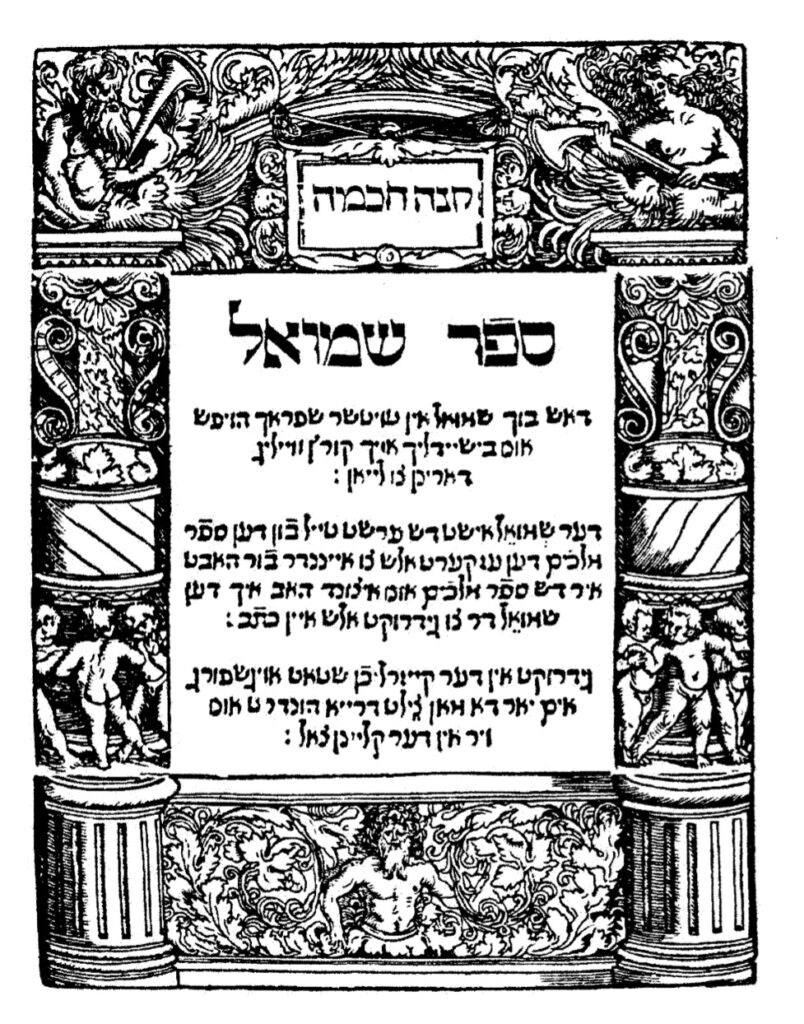
1544, Shmuel Bukh – The Shmuel Bukh was published, also likely by Hayyim Shahor in quarto format (Format 40: [102] ff.). It has an ornate title page made up of figurines above and about pillars with cherubim on the sides. It too is in Vaybertaytsh; among its reprints is a Latin edition (Ingolstadt,(1562). Waxman suggests that the Shmuel Bukh was likely written at least a hundred years earlier, most likely an original production of medieval Jewry. The author reworked the biblical material and incorporated aggadic elements. It was written in “vigorous poetic style” in eight line strophe and was meant to be sung.[25]
1544, Shmuel Bukh
Courtesy of Dr. Moshe Rosenfeld
In contrast to what was written above, “works that many scholars believe they do not share a common author,” Zinberg informs that both the Melokhim Bukh and the Shmuel Bukh are composed in the same verse-meter. Moreover, the title-page states that “Shmuel is the first part of
the book Melokhim, for it is all related.” Nevertheless, Zinberg quotes other sources that “these are two quite different works and were probably written by two different poets.”[26]
1553, Ma’yan Gannim – A composition book comprised of sample letters from R. Samuel ben Elhanan Jacob Archivolti (c. 1515-1611). Ma’yan Gannim was published in a small sextodecimo format (160: 45, [1] ff.) at the Venice press of Alvise Bragadin. The Bragadin press was active before the papal bull, dated August 22, 1553, by Cardinal Giovanni Pietro Caraffa, the future Pope Paul IV, an extreme reactionary and bitter anti‑Semite, who ordered the confiscation and burning of the Babylonian and Jerusalem Talmuds. This had a chilling effect on Hebrew printing and resulted in a considerable decline if not outright cessation of printing in Venice, and the subsequent expurgation and censorship of Hebrew books. When Hebrew printing resumed in Venice in 1563, among the Christian printers who took up the publication of Hebrew books was Alvise Bragadin. Bragadin died in the mid-1570’s, he was succeeded by his son, and after him by successive members of the family well into the eighteenth century, the last known Bragadin being Alvise III. Throughout that time the press remained a leading printer of Hebrew books in Venice.
1553, Ma’yan Gannim
Courtesy of the Library of Agudas Chassidei Chabad Ohel Yosef Yitzhak
Archivolti, a student of R. Meir Katzenellenbogen (Maharam, 1473-1565), served as rabbi, av bet din, and rosh yeshivah in Padua. Among his students was R. Judah Aryeh (Leon) Modena (1571-1648). Prior to settling in Padua in 1568, Archivolti worked as a corrector for the Hebrew presses in Venice.
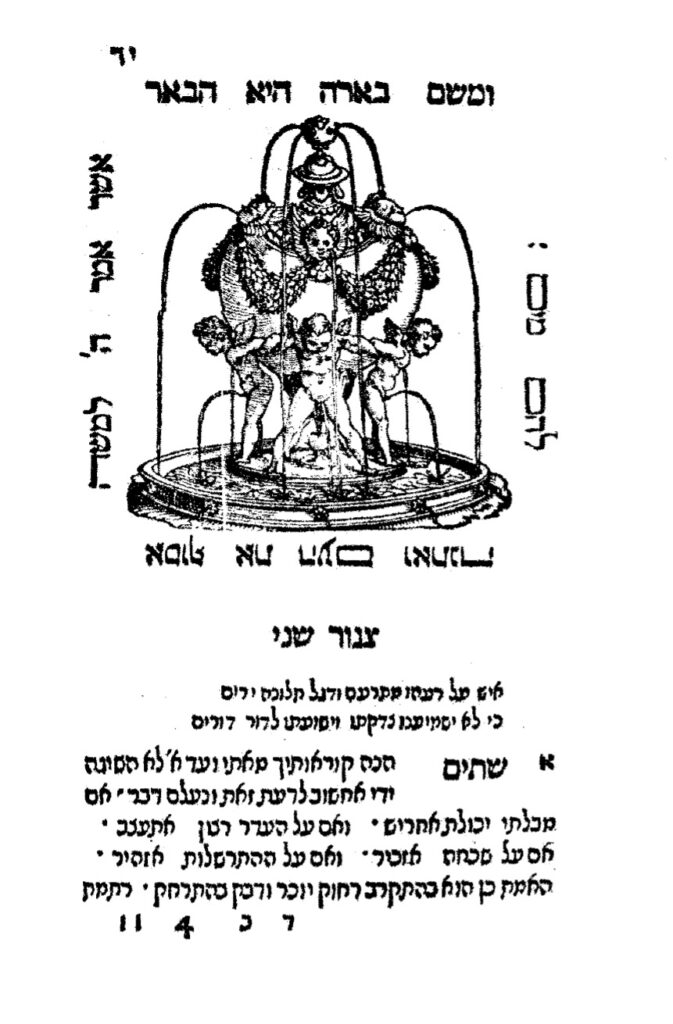
In contrast to our preceeding examples of cherubim, this exemplar does not appear on the title-page of the book, which has the Bragadin device, that is, three crowns, but rather at the beginning of each of the book’s five chapters, a woodcut illustration comprised of three cherubim in a cage, surrounded on all four sides by a verse.
The title is from “A fountain of gardens (ma’yan gannim), [a well of living waters, and streams from Lebanon” (Song of Songs 4:15). The text states that there are fifty letters, that is, twenty-five letters with their responses, written by Archivolti. There is a preface and introduction from Archivolti, followed by a table of contents, and, beginning on 7a, the text. Ma’yan Gannim is the first book written by Archivolti, for he describes it as his first fruits, an offering to the Lord. Archivolti also wrote Degel Ahavah (Venice, 1551), an ethical work; He’arot le-Sefer he-Arukh (Venice, 1553), textual references for the Arukh of Nathan ben Jehiel; and, his most important title, Arugat ha-Bosem (Venice, 1602) a grammatical work in 32 chapters.
The sections or chapters, each on a different theme, are correspondence between a father and son; between friends; from an older to a younger man; with government officials; and others, including letters of a romantic, and even sensual nature. Such letters, at the very least inappropriate by modern religious standards, are intermingled with those of a sacred nature, reflecting contemporary mores and addressing current issues, including therefore, information of historical and cultural value. Ma’yan Gannim is designed to teach through example the rules of correspondence. The letters are in metrical form, designed by Archivolti as literary models, many with ethical content, for his students.[27]
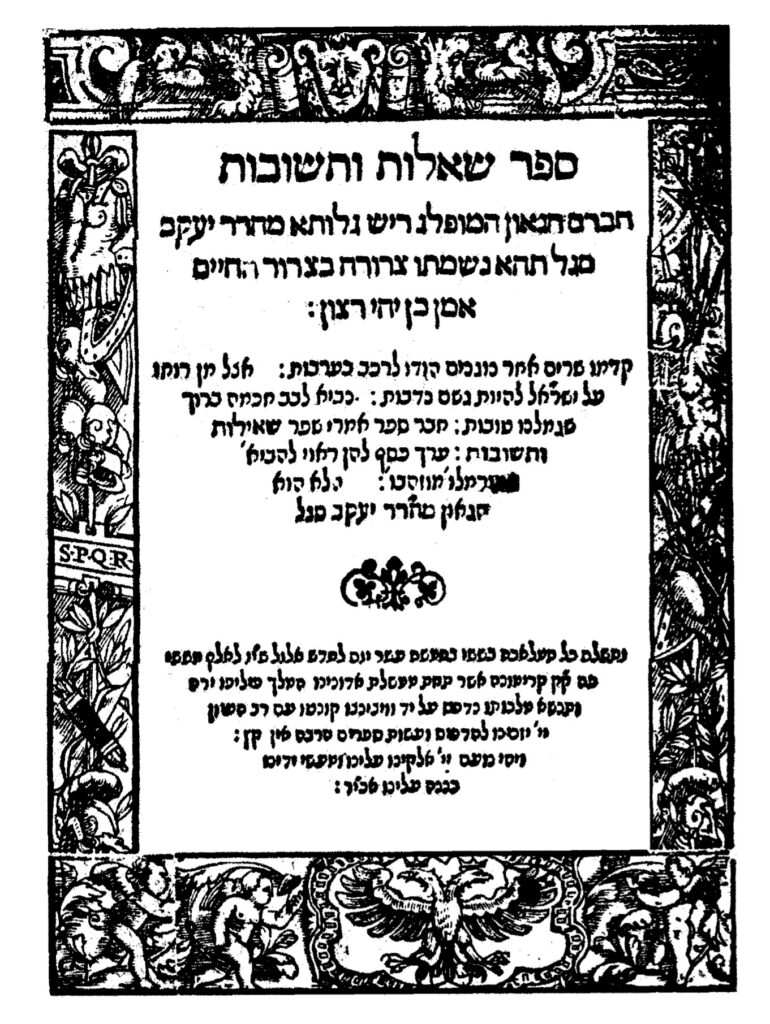
1556, She’ilot u’Teshuvot Jacob ben Moses Moellin (Maharil) – Two hundred and five responsa from R. Jacob ben Moses Moellin (Maharil, c. 1360-1447). The She’ilot u’Teshuvot were published in Cremona at the press of Vincenzo Conti in octavo format (80: [7] 79 ff.). After the Talmud was burned in Venice in 1554 there was a precipitous decline, if not a complete cessation, in the number of Hebrew books printed in Venice for several years. The breach was filled by presses in Ferrara, Sabbioneta, Cremona, and Riva di Trento. Vincenzo Conti (d. 1569) printed briefly in Sabbioneta and subsequently in Cremona, where his press was active from 1556 to 1567, issuing more than forty titles.
Maharil was the leading halakhic authority of his time. His most important work is Sefer Maharil (Minhagei Maharil, 1556, Sabbioneta), a popular and influential work on customs and laws. It was composed by his pupil Eleazar ben Jacob (Zalman of St. Goar), from the discourses that he heard from Maharil. She’ilot u’Teshuvot is comprised of Two hundred and five responsa, a small part only of Maharil’s responsa. The subject matter, as in the Sefer Mahril, deals to a great extent with custom, but also includes much personal material. They also reflect Maharil’s considerable humility and compassion.


1556, She’ilot u’Teshuvot Jacob ben Moses Moellin (Maharil)
Courtesy of the Library of Agudas Chassidei Chabad Ohel Yosef Yitzhak
The title-page has an ornamental frame made up of four parts, enabling the printer to use them in other arrangements, although this is the manner in which the parts are most often employed. The top frame has the face of a man and cherubin; on the sides are suits of armor, shrubs, and musical instruments and, in the center of the left vertical frame the letters SPQR, reputedly standing for Senatus Populusque Romanus; and on the bottom a two headed crowned eagle and on the sides the cherubim. This frame was used by Conti on his early imprints, appearing on about ten works.
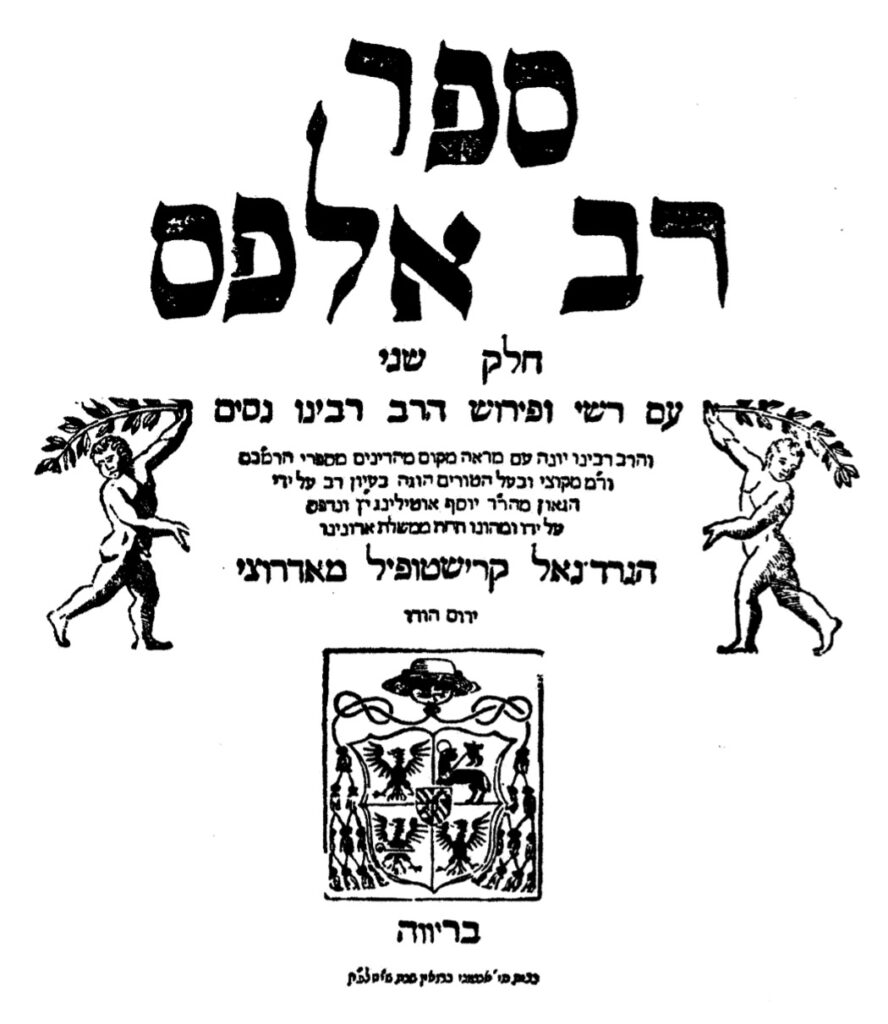
1558, Sefer Rav Alfas – Sefer Rav Alfas, (Hilkhot Rav Alfas, Sefer ha-Halakhot of Alfasi, Rif) was published in Riva di Trento by R. Joseph Ottolenghi and Cardinal Cristoforo Madruzzo in a three volume folio format (20: 288, 268, 302 [8] ff.). The Tyrolese town of Riva di Trento is the source of an unusual episode in the history of the Hebrew book. It was for a short time, from 1558 to 1562, a refuge for the Hebrew book; one in which about forty Hebrew titles were printed. Believed to be the first work printed in Riva di Trento, Hilkhot Rav Alfas was likely selected, in addition to its inherent popularity and value, due to the ban on the Talmud, the Rif, being a halakhic compendium of the Talmud, filling, to some extent, the gap left by the scarcity of that work.
It was in Riva di Trento that Cardinal Cristoforo Madruzzo (1512-78), Cardinal of Trent, a scholar and supporter of learning, who argued at the Council of Trent (1562) for leniency and moderation in condemning books, became the patron and protector of a Hebrew press, which was also a source of revenue for him. Ottolenghi (d. 1570), originally of Ettlingen, in Baden, Germany, reflected in its Italianized form in his name, was rosh yeshivah at Cremona, and under his tutelage Talmudic studies had continued in Cremona after that work had been banned and burned elsewhere. He assisted the press, providing indices and annotations to a number of works and assuring that material offensive to the church had been deleted from those books of value to his yeshiva. and R. Jacob Marcaria, a dayyan on the bet din presided over by Ottolenghi and a physician, recruited by Madruzzo help finance and play a role in the press. Marcaria edited and wrote brief prefaces for most of the books printed in Riva di Trento. The press was located in the house of Antonio Broën.
Sefer Rav Alfas is a halakhic compendium by R. Isaac ben Jacob Alfasi (Rif, 1013-1103). Alfasi, born in the Algerian village of Qal’at Hammad, was a student of the great sages R. Nissim ben Jacob (c, 990-1062) and Hananel ben Hushi’el (d. c. 1055) in Kairouan. After learning with them Alfasi relocated to Fez, from where his surname al-Fasi (Rif) is derived, and became recognized as the leading Talmudic sage of the time. In 1088, at the age of 75, two informers denounced him to the government – the charges are unknown – and he was forced to flee to Spain. Eventually settling in Lucena, Alfasi succeeded R. Isaac ben Judah ibn Ghayyat (c. 1020-89), who had died a few months earlier, as head of the yeshiva.

1558, Sefer Rav Alfas
Courtesy of the National Library of Israel
The text of the title-page of each volume has cherubim at the sides, and below bears the Cardinal’s coat‑of‑arms , a significant statement of the Cardinals’ support and protection of the press at a time when his church was burning and banning Hebrew books. Furthermore, the title pages informs that Sefer Rav Alfas was edited with great care by the gaon R. Joseph Ottolenghi and was printed and financed by him, and that this was done, “in the dominion of” the following in bold letters “Cardinal Cristoforo Madruzzo.”
Sefer Rav Alfas, Alfasi’s major work, is one of the greatest works in halakhic literature. It is extracts all pertinent legal decisions from the Talmud, eliminating non-halakhic material, discussions, and subject matter not applicable today. It covers the following orders of the Talmud, Mo’ed, Nashim, and Nezikim, as well as tractates Berakhot and Hullin. Laws in Kodashim and Tohorot, such as mezuzah and tefillin, are organized as Halakhot Ketannot. Sefer Rav Alfas differs from earlier works, such as Halakhot Gedolot, in that it is more comprehensive, more detailed, and by the inclusion of material from the geonim, although, like them, it follows the order of the tractates.
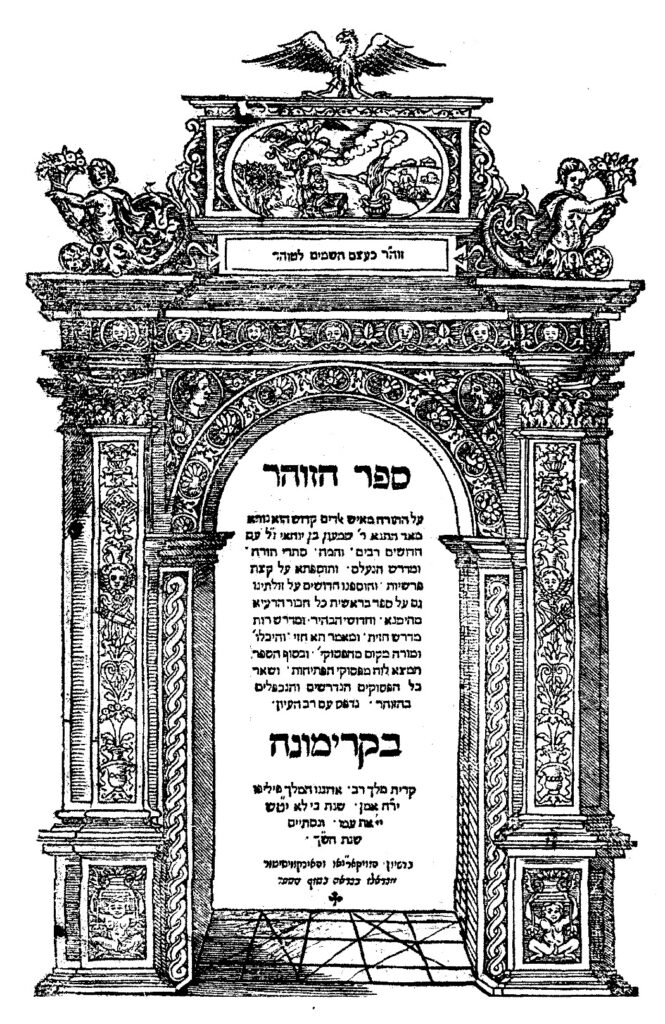
1559-60, Zohar – Classic kabbalistic work of Jewish mysticism, attributed to R. Simeon bar Yohai (second century). This, the second printing of the Zohar, it was published previously in Mantua (1558-60), published in Cremona at the press of Vincenzo Conti in a three volume folio format (20: 132, 122, 146 ff.) by Vincenzo Conti (d. 1569). Conti, who had printed briefly in Sabbioneta, is better known for his activity in Cremona, where his press, active from 1556 to 1567, issued more than forty titles.
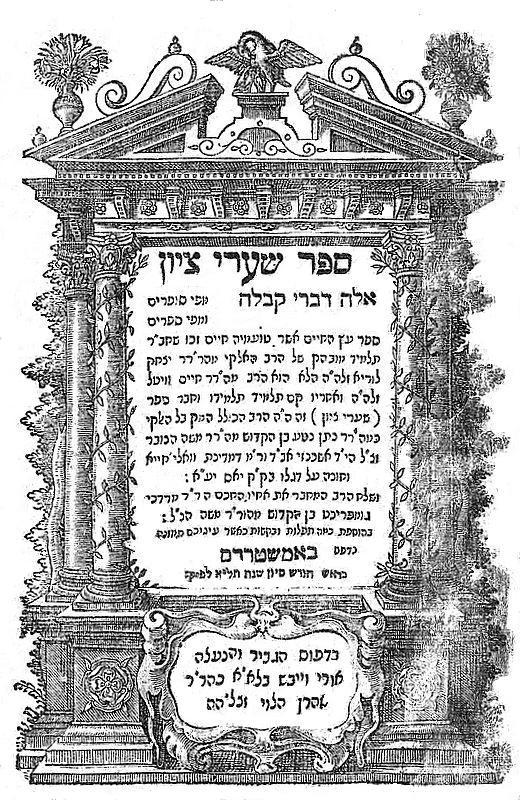
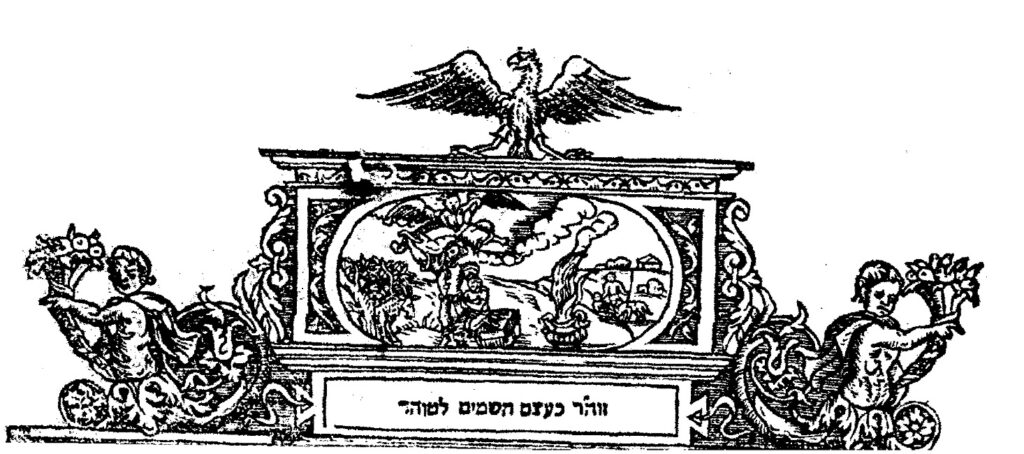
The title page of has a decorative architectural frame with an arch, at the top a vignette of Akedat Yizhak (the binding of Isaac), surmounted by an eagle, and accompanying cherubim; below in the bottom squares, figurines, perchance also cherubim. It is dated, “For the Lord will not forsake כי לא יטש (319=1559) his people [for his great name’s sake] (Samuel I 12:22), and it was completed in the year ש”ך ([5]320=1560).” At the bottom of the page is an imprimature from the Inquisition on the title page, the sole Cremona imprint to place it there, as well as a longer permission at the end of the book.


1559-60, Zohar
Courtesy of the Library of the Jewish theological Seminary
Written in Aramaic and Hebrew, Sefer ha-Zohar al ha-Torah is a comprehensive system of kabbalistic theosophy, encompassing cosmology, the soul, and good and evil. It is an esoteric commentary on the Torah, with homilies, midrashic passages, parables, and numerous discursive passages. It is based on the concept that within scriptures is a concealed stratum, deciphered by Kabbalah, expressing the inner meaning of the Torah, with its “splendor, beauty, and greatness.”
The corrector (and expurgator) was the apostate Vittorio Eliano, grandson of the foremost grammarian, Elijah Bahur Ashkenazi Segal. A member of a Dominican commission to review Hebrew books, Eliano was associated with all the books published by Conti from 1558 through 1559. Although begun later than the Mantua edition, noted above, this printing, done in haste, was completed earlier. Nevertheless, it was not immediately released for sale, for when more than 10,000 Hebrew books were burned in Cremona, with the complicity of Eliano, the entire edition was seized. It was just barely saved, in contrast to other works, by the apostate Dominican, Sixtus of Siena. It is known as the Zohar Gadol (large Zohar), in contrast to the smaller Mantua edition (Zohar Katan), and is also referred to, because of Eliano’s involvement, as the “Christian edition.” This notwithstanding, the Cremona edition was the preferred of the two editions by eastern European kabbalists.[28]
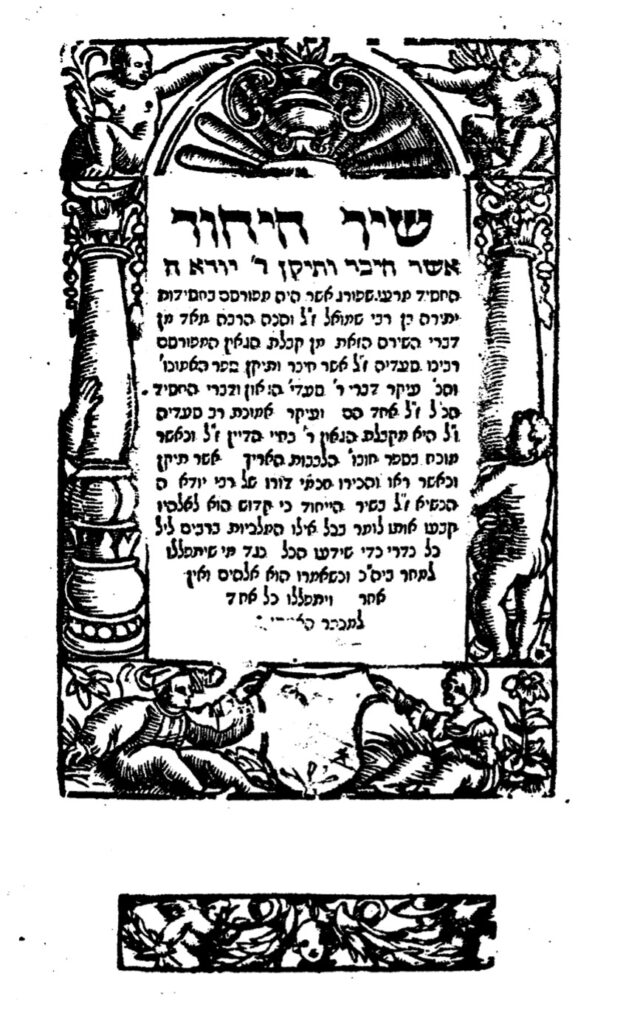
1560, Shir ha-Yihud – Shir ha-Yihud (Hymn of Divine Unity) an anonymous piyyut (liturgical poem) written in the mid-twelfth century, most often attributed to Samuel ben Kalonymus he-Hasid (c. 1130-1175), less often to his son, Judah ben Samuel he-Hasid (c. 1150-1217), author of the Sefer Hasidim, both among the foremost representatives of the Hasidei Ashkenaz, and, on occasion, to yet others.

Shir ha-Yihud
Courtesy of the National Library of Israel
Shir ha-Yihud was published at the press of Eliezer and Joseph ben Naphtali Hertz Treves. Active for one year only, in 1560, they issued six books, before being forced to close by a meeting of the leaders, both Protestant and Catholic, of the Swiss Confederation in June, 1560, who feared that they were about to print the Talmud.
The frame, one of several with cherubim employed by the press, also was used on the title-page of Begidat Hazman, an allegoric maqāma (a poetic narrative in rhymed prose) by Mattathias (Mattityah ben Moses), a 15th century Spanish or Provençal Hebrew poet or Mattathias ha-Yiẓhari, a representative of the Jewish communities of Aragon at the Tortosa disputation (1413–14).
1568, Passover Haggadah – Passover Haggadah printed in Mantua in folio format (20: 36 ff.) by Joseph Shalit ben Jacob Ashkenazi of Padua. This edition is a reprint of the 1560 Passover Haggadah, also printed in Mantua, but with modifications and the addition of the marginalia of R. Joseph Shalit ben Jacob Ashkenazi of Padua entitled Nimukei Yosef.

1568, Passover Haggadah
Courtesy of the National Library of Israel
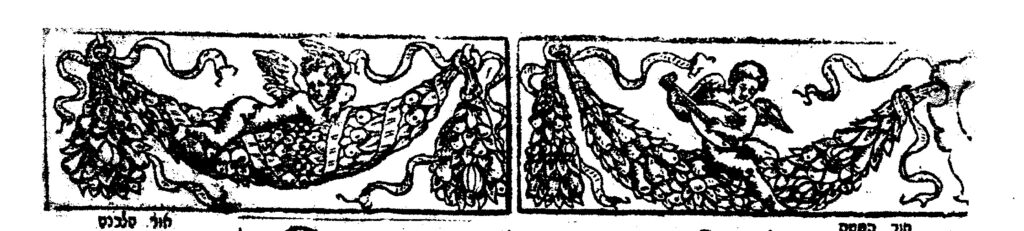
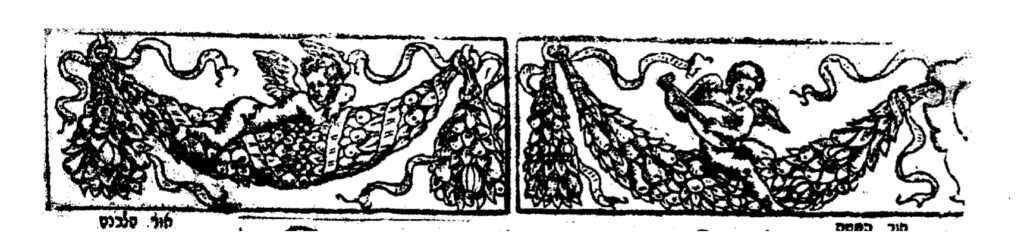
The title page frame has representations of the Mars and Minerva followed by the first text page, which has two woodcuts of cherubim along the top. Following text pages have those cherubim image, as well as numerous other cherubim images, including several marginal cherubim images. This Haggadah shares some features with the Prague Haggadah of 1526. Woodcuts are accompanied by captions, given as rhymed couplets, a feature of Ashkenaz manuscript Haggadot. In some instances, for example, by the four questions, the earlier edition was framed by a lush Italian border, without illustrations. Here the types and the top and upper left borders with their vines and cherubs only are alike.[29]
1576, Yosef Lekah – Yosef Lekah is a commentary on Megillat Esther by R. Eliezer ben Elijah Ashkenazi (1513-86). It was published in Cremona in 1576 by Christopher Draconi in octavo format (40: 83, 1 ff.). Draconi, previously associated with Vincenzo Conti, attempted to publish Hebrew books in Cremona. Although he would issue Latin books from 1569 to 1614, he printed one Hebrew book only, Yosef Lekah.
1576, Yosef Lekah
Courtesy of the Fales Library and Special Collections, New York University
R. Eliezer ben Elijah Ashkenazi was a multi-faceted individual, a Talmudist, physician, and well-rounded scholar, who served as rabbi in a number of varied communities. His first rabbinic position, from 1538-61, was in Fostat, Egypt. Forced to leave Fostat, Ashkenazi went to Famagusta, Cyprus, where he was rabbi for two years, and then to Venice. He left for Prague (1561), after a dispute with the Maharam of Padua, and after traveling as far as the Crimea, returned, via Famagusta, to Venice. Ashkenazi was next rabbi in Cremona, where he published Yosef Lekah. Shortly after he left to be rabbi of Posen, and, from 1584, was in Cracow. Ashkenazi experienced difficulties in Poland, disputing over his right to open a yeshiva in close proximity to an existing yeshiva, so that Joseph Solomon Delmedigo (1591-1655) wrote about him, “You have brought a vine from Egypt; you have cast out the nations, and planted it” (Psalms 80:9). Ashkenazi was highly regarded by his contemporaries, corresponding with prominent rabbinic figures such as R. Joseph Caro, R. Joseph Ha-Kohen (Katz), R. Moses Isserles (Rema), and R. Solomon Luria (Maharshal), several mentioning him in their responsa. R. Elijah of Pesaro, in Famagusta in 1563, praised Ashkenazi’s scholarship, noting that he was fluent in twelve languages.
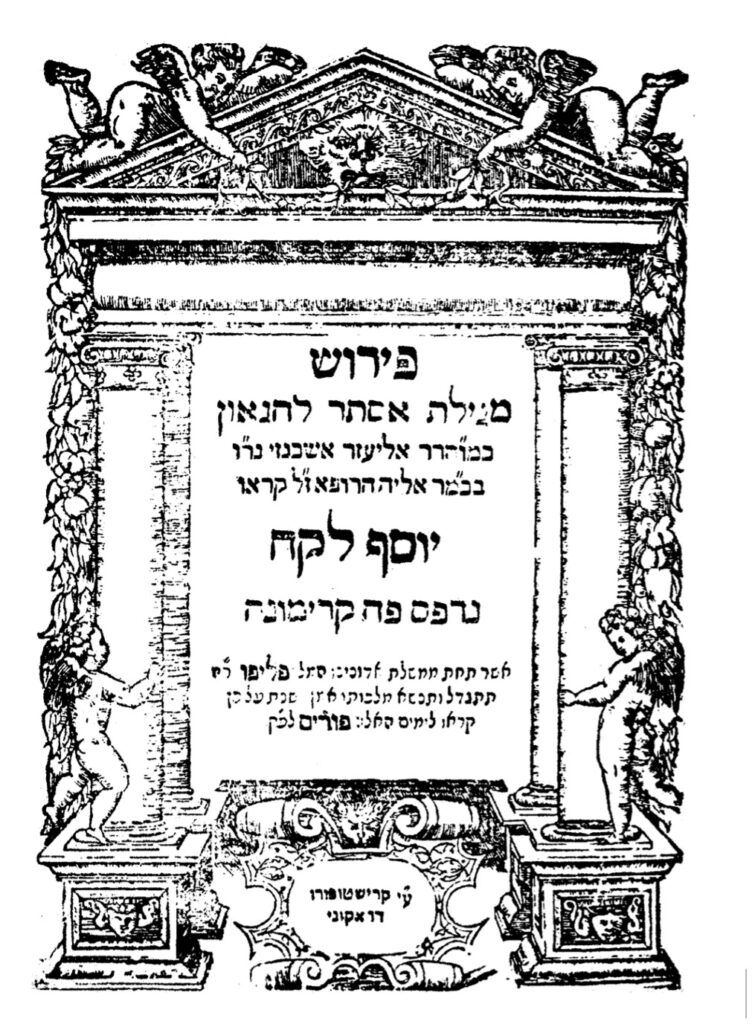
The title-page has four cherubim images, two reclining at the top of the structure, two standing erect by the pillars at the sides. The title-page is dated “Therefore they called these days Purim קראו לימים האלו פורים (336 = 1576)” (Esther 9:26). Yosef Lekah is dedicated to Don Joseph Nasi, Duke of Naxos, whom Ashkenazi, in the introduction, compares to Joseph in Mizraim and Mordecai at the time of Ahasuerus. Ashkenazi, therefore, entitled this work Yosef Lekah. Two, almost identical, editions of Yosef Lekah exist, both dated 1576. Although almost exact copies of the original, it is clear, upon close examination, that the book was reset. Christopher Draconi’s Yosef Lekah was the last Hebrew book printed in Cremona.
Ashkenazi’s most important work is Ma’aseh HaShem (Venice, 1583), on the historical occurrences in the Torah, with a commentary on the Passover Haggadah; selichot; and, not extant today, a super-commentary on the Ramban (Nachmanides) and annotations to R. Caro’s Beit Yosef.[30]
Conclusion – In this article we have described books printed in Augsburg, Basle, Cremona, Mantua, Prague, and Venice. The cherubim imagery on these title-pages, reflecting the influence of Renaissance humanism, their attractiveness notwithstanding, do not appear on the title-pages or accompanying the text in Hebrew books published in more modern times. A review of the title-pages reproduced here, all dissimilar, with their numerous depictions of cherubim, attest to the popularity of that image. Given the strictures on Hebrew printing from the mid-sixteenth century in Italy, the frequent use of cherubim testify to the cooperation of Jewish and non-Jewish printers, their frequency perchance suggesting a positive relationship going beyond mere monetary gain.
We conclude with the Talmudic statement above, which suggests why the image of cherubim was so popular:
Rav Ketina said: When the Jewish people would ascend for one of the pilgrimage festivals, the priests would roll up the curtain for them and show them the cherubs, which were clinging to one another, and say to them: See how you are beloved before God, like the love of a male and female. (Yoma 54a)
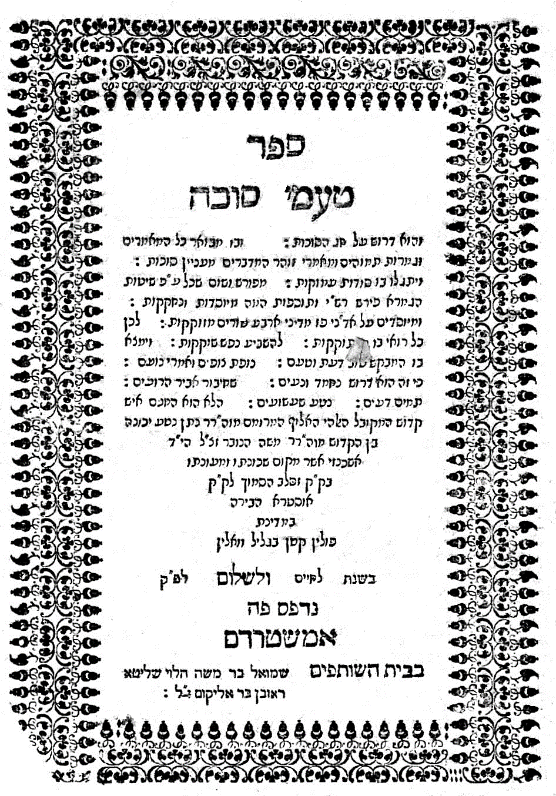
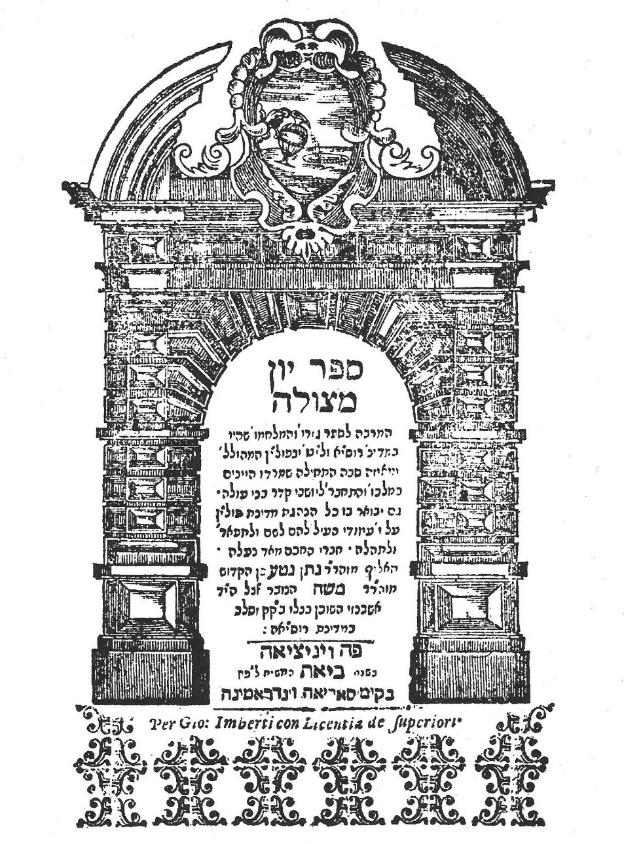
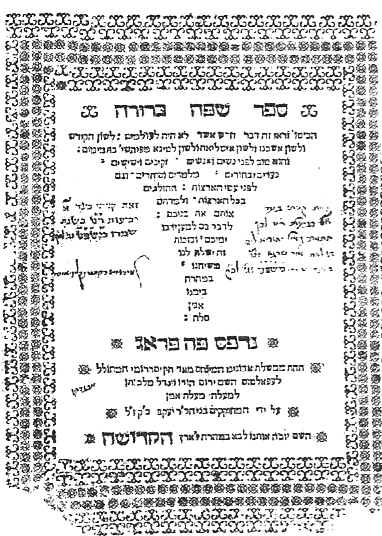
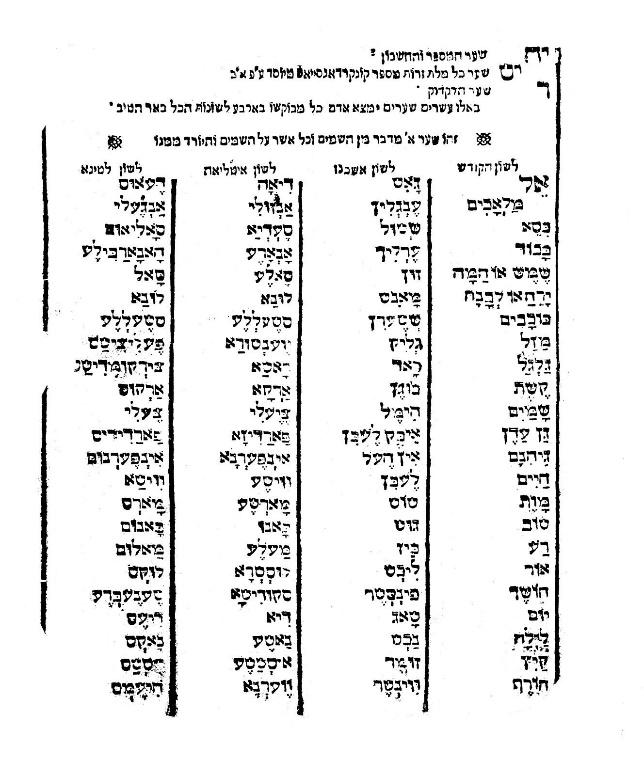
Lastly, in conclusion an image of a cherub, both chronologically and, in cherubian activity, quite different from those depicted in this article. It is included as it is unusual and eye catching, an image of a Cherub smoking a pipe. It appears in in at least two Basle imprints published by Israel ben Moses ben Abraham Halle, active in Offenbach, although not continuously, from 1718/19 to c. 1738/43. The works are Anaf Etz Avot, R. Benjamin ben Yekutiel Wulff’s commentary on Pirke Avot, and tractate Sanhedrin (1721).[31]

- Once again, I would like to express my gratitude and appreciation to Eli Genauer for reading the article and his insightful comments. ↑
- Emil G. Hirsch, W. Muss-Arnolt, J. Frederic McCurdy, Louis Ginzberg, “Cherub (
; plural, Cherubim)” Jewish Encyclopedia IV (New York, 1901-06), pp. 13-16; Shalom M. Paul, Louis Isaac Rabinowitz, “Cherub” Encyclopedia Judaica IV (Jerusalem, 2007), pp. 600-01. ↑ - Thomas Kelly Cheyne, 1911 Encyclopædia Britannica, Volume 6, reproduced in https://en.wikisource.org/wiki/1911_Encyclop%C3%A6dia_Britannica/Cherubim ↑
- https://www.sefaria.org/search?q=%D7%9B%D7%A8%D7%95%D7%91%D7%99%D7%9D&tab=text&tvar=1&tsort=relevance&svar=1&ssort=relevance. ↑
- Franz Sales Meyer, Handbook of Ornament: a Grammar of Art, Industrial and Architectural Designing in all its Branches for Practical as well as Theoretical use (New York, 1957), pp. 108-09. ↑
- Codices and early imprints did not have title-pages, the first leaf normally being left blank to protect the book, that page later becoming a dedicated page. The first book with a detailed title-page was the Calendarium of Johannes Regiomontanus, appearing in 1476 (Venice), being a fifty-five year calendar (1475-1530), printed by Johannes Regiomontanus. The first Hebrew book with a title-page was the Sefer ha‑Roke’ah (Fano, 1505) of R. Eleazar ben Judah of Worms (c. 1165 – c. 1230). ↑
- Cherubim also appear on the frames of Hebrew books printed in the incunabular period. For examples of such frames see Marvin J. Heller “Behold, you are beautiful, my love: The Use of Ornamental Frames in Hebrew Incunabula” Printing History NS 10 (New York, July, 2011), pp. 39-55, reprinted in Further Studies in the Making of the Early Hebrew Book (Leiden/Boston, 2013), pp. 3-33. ↑
- The following book descriptions are selected, modified from Marvin J. Heller, The Sixteenth Century Hebrew Book: An Abridged Thesaurus ( Brill, Leiden, 2004), var. cit. ↑
- Avraham Yaari, Hebrew Printers’ Marks (Jerusalem, 1943), pp. 7 and 126-27 n. 10 [Hebrew]. ↑
- Jerome Friedman, The Most Ancient Testimony. Sixteenth-Century Christian-Hebraica in the Age of Renaissance Nostalgia (Athens, Ohio, 1983), pp. 44-48, 214-15; A. M. Habermann, Title Pages of Hebrew Books (Tel Aviv, 1969), p. xi [Hebrew with English introduction], pp. 19-20, 125-26 nos. 4-5; Joseph Prijs, Die Basler Hebräischen Drucke (1492-1866) (Olten, 1964), pp. 49-51 n. 26; Frank Rosenthal, “The Rise of Christian Hebraism in the Sixteenth Century,” Historia Judaica II (New York, 1945), (New York, 1945), pp. 182-91; and Richard S.Westfall, “Sebastian Muenster,” http://es.rice.edu/ES/humsoc/Galileo/Catalog/Files/muenster.html ↑
- An interesting example of this later usage is R. Moses ben Hanokh Altschul’s (c. 1546–1633) Brant Shpigl, a popular Yiddish work on ethics, correct demeanor, and customs for women, published by Konrad Waldkirch (Basle, 1602), also indicative of the passage of typographic material between printers. ↑
- Stephen G. Burnett, “German Jewish Printing in the Reformation Era (1530-1633),” University of Nebraska – LincolnUniversity of Nebraska – Lincoln DigitalCommons@University of Nebraska – LincolnDigitalCommons@University of Nebraska. ↑
- Ch. B. Friedberg, History of Hebrew Typography of the following Cities in Central Europe: Altona, Augsberg, Berlin, Cologne, Frankfort M., Frankfort O., Fürth, Hamberg, Hanau, Heddernheim, Homberg, Ichenhausen, Neuwied, Wandsbeck, and Wilhermsdorf. Offenbach, Prague, Sulzbach, Thannhausen from its beginning in the year 1513 (Antwerp, 1935), pp. 29-31 [Hebrew]. ↑
- A. M. Habermann, “The Printer Hayyim Shahor, his Son Isaac and Son-in-law Joseph Yakar,” in Studies in the History of Hebrew Printers and Books (Jerusalem, 1978), pp. 103-07 [Hebrew]. ↑
- Yeshayahu Vinograd, Thesaurus of the Hebrew Book. place, and year printed, name of printer, number of pages and format, with annotations and bibliographical references II (Jerusalem, 1993-95), p. 2 no. 10 [Hebrew]. ↑
- Zipora Baruchson, “Money and Culture: Financing Methods in the Hebrew Printing Shops in Cinquecento Italy,” La Bibliofilia 92 (1990), 25. ↑
- For examples of such usage see Marvin J. Heller, “Behold, you are beautiful, my love: The Use of Ornamental Frames in Hebrew Incunabula” Printing History NS 10 (New York, July, 2011), pp. 39-55, reprinted in Further Studies in the Making of the Early Hebrew Book. (Brill, Leiden/Boston, 2013), pp. 3-33; “Mars and Minerva on the Hebrew Title Page,” The Papers of the Bibliographical Society of America 98:3 (New York, N. Y., 2004), pp. 269-92, reprinted in Studies in the Making of the Early Hebrew Book (Brill, Leiden/Boston, 2008), pp. 1-17; and the “The Printer’s Mark of Marc Antonio Giustiniani and the Printing Houses that Utilized It,’ Library Quarterly, 71:3 (Chicago, July, 2001), pp. 383-89, reprinted in Studies, pp. 44-53. ↑
- Unterricht Wie ain Christenmensch by Urbanus Rhegiosu (1489-1541), a Protestant Reformer active in Northern and Southern Germany promoting Lutheran unity in the Holy Roman Empire. Unterricht is one of several titles with this frame printed by Silvan Otmar of Augsburg (https://www.flickr.com/photos/58558794@N07/6576279085). ↑
- Zipora Baruchson, “Money and Culture: Financing Methods in the Hebrew Printing Shops in Cinquecento Italy,” La Bibliofilia 92 (1990), 25. ↑
- For examples of such usage see Marvin J. Heller, “Behold, you are beautiful, my love: The Use of Ornamental Frames in Hebrew Incunabula” Printing History NS 10 (New York, July, 2011), pp. 39-55, reprinted in Further Studies in the Making of the Early Hebrew Book. (Brill, Leiden/Boston, 2013), pp. 3-33; “Mars and Minerva on the Hebrew Title Page,” The Papers of the Bibliographical Society of America 98:3 (New York, N. Y., 2004), pp. 269-92, reprinted in Studies in the Making of the Early Hebrew Book (Brill, Leiden/Boston, 2008), pp. 1-17; and the “The Printer’s Mark of Marc Antonio Giustiniani and the Printing Houses that Utilized It,’ Library Quarterly, 71:3 (Chicago, July, 2001), pp. 383-89, reprinted in Studies, pp. 44-53. ↑
- Ch. B. Friedberg, Bet Eked Sepharim, (Israel, n. d), alef 286 [Hebrew]. ↑
- A later example of an objectionable title-page is the responsa of R. Joel ben Samuel Sirkes’ (Bach, 1561-1640), She’elot u-Teshuvot Bayit Hadash, printed in Frankfurt am Main (1697) by Johann Wust. The title-page had an ornate frame with forms of unclad women which aroused rabbinic opposition, for those authorities considered the title-page inappropriate and offensive to Jewish sensibilities. The quire had to be reprinted with a new title-page, now with two cherubim holding a floral wreath with grapes. A similar situation occurred earlier in Hanau in 1630. Sefer ha-Roke’ah, by R. Eleazer of Worms, was issued in a small format, 12×16 cm., due to the economic restrictions resulting from the Swedish War. On the title-page “Venus rises naked from the waters on a seashell – a common pagan motif” (The book was issued by a press belonging to a non-Jew, Hans Jacob Hena, so that, it has been suggested, no attention was initially given to the title-page. When the book was sold, “many Jewish purchasers tore out the offending page” (Raphael Posner and Israel Ta-Shema, ed. The Hebrew Book: An Historical Survey [Jerusalem: Keter Publishing House, 1975]). There does not appear to have been any opposition to this last title-page in Venice, for the Venus rising from the waters motif appears in Hebrew works printed there, where it was the press mark of Alessandro Gardoni (Venice, 1577-78) and can be found in the Mishneh Torah printed by Meir Parenzo at the press of Alvise Bragadin in 1574. ↑
- Taytsher sprach (Vaybertaytsh), is a type generally but not exclusively reserved for Yiddish books, so named because these works were most often read by the less educated and women. Concerning the early use of Vaybertaytsh see Herbert C. Zafren, “Variety in the Typography of Yiddish: 1535-1635,” Hebrew Union College Annual LIII (Cincinnati, 1982), pp. 137-63. ↑
- Israel Zinberg, A History of Jewish Literature, translated and edited by Bernard Martin VII (Cleveland, 1973), p. 116.
↑ - Meyer Waxman, A History of Jewish Literature (1933, reprint Cranbury, 1960), II pp. 632-33. ↑
- Zinberg, p. 106. ↑
- Robert Bonfil, Jewish Life in Renaissance Italy (Berkeley, 1994), tr. Anthony Oldcorn, pp. 133, 169; Deror Schwartz, “Samuel Archivolti, his Life and Writings,” Asufot VII, ed. Meir Benayahu (Jerusalem, 1993), pp. 82-83 [Hebrew]; and Zinberg, II p. 130. ↑
- Amram, pp. 324-27; Robert Bonfil, “Change in the Cultural Patterns of a Jewish Society in Crisis: Italian Jewry at the Close of the Sixteenth Century,” in Essential Papers on Jewish Culture in Renaissance and Baroque Italy, ed. David B. Ruderman (New York, 1992), p. 418; Rachel Elior, “Messianic Expectations and Spiritualization of Religious Life in the Sixteenth Century,” in Essential Papers . . ., p. 286. ↑
- Yaari, Printers’ Marks, pp. 12, 132 n. 19; Yosef Hayim Yerushalmi, Haggadah and History (Philadelphia, 1975), nos. 28-31; and Isaac Yudlov, The Haggadah Thesaurus. Bibliography of Passover Haggadot: From the Beginning of Printing until 1960 (Jerusalem, 1997). p. 4 n. 25 [Hebrew]. ↑
- David Amram, The Makers of Hebrew Books in Italy (Philadelphia, 1909, reprint London, 1963), p. 319; Meir Benayahu, Hebrew Printing at Cremona: Its History and Bibliography (Jerusalem, 1971), pp. 22-24, 232-34; and Jacob Elbaum, Openness and Insularity. Late Sixteenth Century Jewish Literature in Poland and Ashkenaz (Jerusalem, 1990), p. 47, [Hebrew]. ↑
- This image appeared in my article “Offenbach Revisited: An enigma Reexamined,” published in the Gutenberg-Jahrbuch (Mainz, 2012), pp. 219-28, and reprinted in Essays on the Making of the Early Hebrew Book (Brill, Leiden/Boston, 2021) pp. 273-92. It was noted there that “in his observations to a draft of this paper, Professor Dr. Hans Schneider observes that he has never seen ‘a cherub smoking a pipe’ and suggests that if the figure is an angel the instrument is a flute. He agrees, however, that the object in question does look like a clay pipe as in the self-portrait of Gerrit Dou. Professor Dr. Schneider suggests that the figure might be an oriental man or boy, as was often painted in the seventeenth and eighteenth century, wearing a turban-like cap with plumes, and that what appears to be an angel’s wings might be a fluttering cape. The reader may draw his or her own conclusions.” ↑
The Animals
“A man enters synagogue on Yom Kippur with his dog and tells the gabbai this is a very smart dog, he can talk. “If he will talk for you,” says the man, “will you let him sit next to me?” The gabbai says “let’s hear him.” Man turns to dog and says what is on top of this building which keeps the rain out? the dog says ruf ruf. The guy says see he said it was a roof. But if you are not satisfied with that, I will have him answer another question. He says to the dog, who was the most famous baseball player of all time? Dog says ruf ruf. Man says see he said Babe Ruth. The gabbai throws man and dog out. Dog looks up at the man and says, “Should I have said Willie Mays?”— Jewish Joke
I thought it may be instructive to examine what Judaism says about animals. In the course, I hope to highlight some lesser known bibliographical items. The Torah appears to place significant obligation on people vis-à-vis animals. For instance, we are commanded to remove an overburdened animal (Deut. 22:4), we are told to feed one’s animals prior to one eating themselves (TB, Berachot, 40a), and finally there is a general injunction against mistreating animals. It is from this final prohibition – tzar ba’alei hayyim – that we continue with the remainder of our discussion.
Although we are commanded to treat animals well, Jews are also not prohibited from eating animals. The combination of these two ideas were for some rishonim an understanding of how and why shehita is the obligatory process for eating meat. They explain that purpose of shehita is to minimize pain to the animal even when we do kill it.[1] They point to law of a smooth knife as well as cutting specifically on the neck as trying to minimize pain. The issue of animal pain, was raised on numerous occasions for some to argue that shehita should be prohibited. In the defense of shehita the idea that it is the least painful method of killing was usually marshaled. In at least one instance, at the turn of the 20th century, this defense “caused even non-Jews to only use Jewish shehita and the Society for [the prevention] of Cruelty to Animals in America attempted to obligate this in all places.”[2]
In America as well there was a question of the legitimacy of shehita as a humane method. A book was published, originally in Hebrew and subsequently to English, which bore the title Tub Taam, or Vindication of the Israelitisch Way of Killing Animals by R. Aaron Zev Friedman (downloadable here). According to a family legend, this book convinced Ulysses S. Grant to eat only kosher meat.[3]
While all the above is true, there appears to be an opposite view of animals, one which places less respect to the animal world. R. Moshe Isserles, in his commentary on Shulhan Arukh, states “Anything that is necessary for health, or for anything else there is no prohibition against inflicting pain on animals; therefore, it is permissible to pluck quills from live duck and there is no consideration of causing pain to the animal. But, it is best to avoid all this as it is heartless.”[4] Thus, according to Rama, whenever there is any need, there is no prohibition of causing pain. According to this understanding, one need not understand the commandment of shehita to have anything to do with minimizing pain, as there is no need to minimize pain as the meat will be used.[5]
The view of Rama was applied by R. Yaakov Reischer when he asked [in an undated responsum] whether it is permissible to use an animal to test the efficacy of a drug.[6] He responded that based upon this Rama, animal testing is permitted. He explained that the caveat of Rama, that “it is heartless” and therefore should be avoided, is inapplicable to this case; as in the case of animal testing, the animal may not feel pain immediately, and as a result, according to R. Reischer, poses less of an issue of tzar ba’alei hayyim.
R. Ezekiel Landau, in his Noda BeYehudah[7] similarly applies Rama to a different question. He was asked whether it is permissible for a Jew to hunt animals. R. Landau says based upon Rama, there is no issue of tzar ba’alei hayyim. While he counsels against this practice for other reasons[8] these reasons are not out of concern for animals. R. Naftali Tzvi Yehuda Berlin, in Haamek Davar, places Noah as the first to own pets. R. Berlin explains that the raven and dove were Noah’s own pets and not part of the animals he collected into the ark. R. Berlin alleges that the dove was actually trained similarly to a homing pigeon. (Haamek Davar, vol. 1, 8:7)
In discussing animals and Judaism there is a related discussion concerning the propriety of dog ownership and dogs in particular in Jewish thought. R. Jacob Emden rails against dog ownership.[9] He decries dog ownership solely for pleasure or as a companion and goes so far to claim that dog owners are suspect of engaging in bestiality.[10]
On the other hand, historically, the dog specifically, has actually been used as a positive icon. For instance, in the Hamburg Miscellany, there is a depiction of a wedding scene with a dog at the feet of the groom.[11] Similarly, the Washington Haggadah contains a depiction of a dog (see here).
The Sefer Hasidim claims that all animals can teach humans positive traits.[12] He singles out the dog for teaching loyalty, which is easily what the depiction in the Hamburg Miscellany could be depicting in the wedding scene – a scene which describes what is essentially a loyalty ceremony.
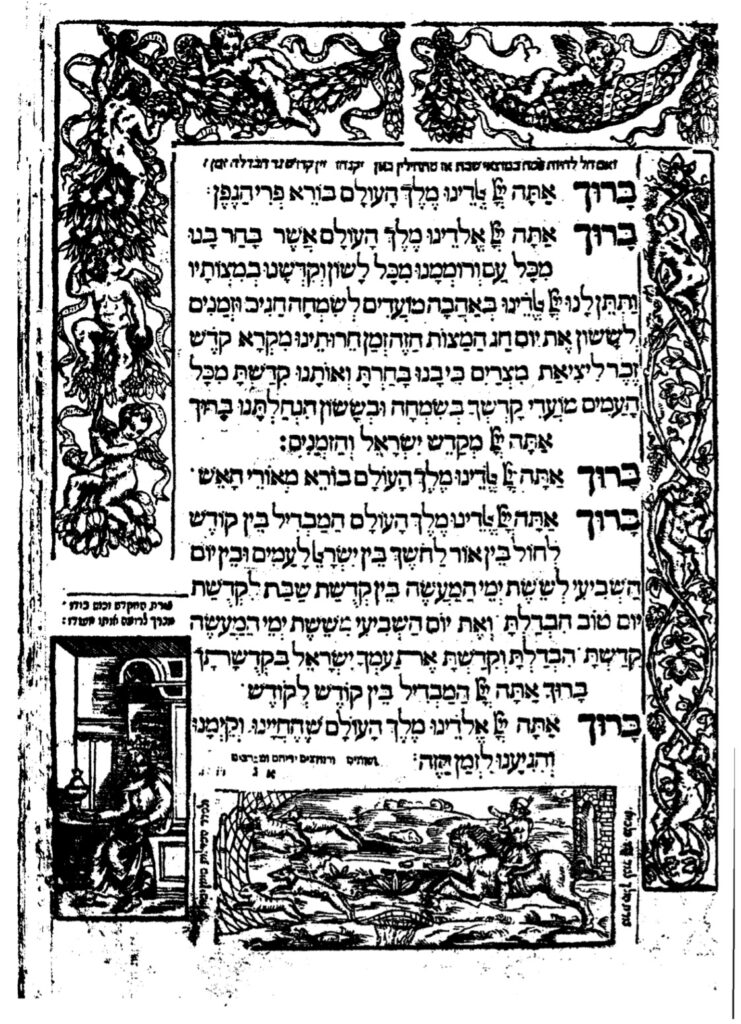
While the positive aspect of a dog can be found in some illustrations, the negative view of animals and specifically dogs can also be found in illustrations. In the Prague 1526 haggadah we find a depiction of a hare hunt being used for the mnemonic YaKNeHaZ (the order the blessing are recited when Pesach night falls on a Saturday night). The usage of the hare hunt is in German, the term for hare hunt or Jagen-has sounds like YakNeHaZ. In Augsburg, 1534 haggadah, Yosef Hayim Yerushalmi notes it not only shows a hare hunt, but the hare escaping.[13] He says the hare is representative of the Jewish people and the dogs their enemies and therefore, “it is plausible to conclude that hate two successive representation of the Jagen-has are not only an innovation in themselves, but together comprise an allegory of the persecution and salvation of the Jewish people.”[14] In this depiction the dogs are actually the enemies of the Jews conforming with the prior negative views of dogs.
Finally, in the apocryphal work Tobit, in many versions there is a positive mention of a dog. In some editions, however, the dog is missing. One scholar posits the removal was deliberate in that, according to him — and as we have seen above this is not universal — Jews (and other Eastern cultures) do not depict dogs positively.[15] Thus, the dog had to go. Again, this follows the negative view of dogs.
In conclusion, there appears to be two schools of thought regarding animals and specifically dogs. Some view them and animals positively and is borne out in practice, while there is another tradition inapposite.
Notes:
I wanted to thank Eliezer Brodt and Menachem Butler for their additional insights and sources which added significantly to this post.
[2] See Greenwald, ha-Shohet ve-haShehita be-Safrut ha-Rabbunut (New York, 1955), p. 19.
[3] For the source and a description of this book in general see Yosef Goldman, Hebrew Printing in America (New York, 2006), 2:1092. See also, Shnayer Z. Leiman, “Montague Lawrence Marks: In a Jewish Bookstore,” Tradition 25:1 (Fall, 1989): 66, 69, nn.12-13.
For more on the German attempt to ban shehita and R. Y.Y. Weinberg’s response, see Hirsh Jakob Zimmels, The Echo of the Nazi Holocaust in Rabbinic Literature (New York, 1977), 181-193 and Marc B. Shapiro, Between the Yeshiva World and Modern Orthodoxy (Littman Library, 1999), 117-129; and regarding the highly controversial nature of R. Weinberg’s responsum, Chief Rabbi Isaac Herzog hesitated to allow it in print at all, see p. 192. Shapiro also cites a letter where it is suggested that “Herzog later agreed that publishing the responsum would not create difficulties” (ibid., n.86).
[5] R. Yosef Toemim, in his introduction to Pri Megadim discussing shehita cautions against applying rationales generally for commandments, and specifically for shehita. Pri Megadim, Peshiha Kollelet l’Hilchot Shehita.
[6] R. Yaakov Reischer, Shevut Ya’akov, vol. 3, no. 71.
[7] R. Ezekiel Landau, Noda b’Yehuda, Mahdurah Tinyana, Yoreh Deah, no. 10.
[8] He offers that Biblically, the only hunters were Esau and Nimrod thus hunting is not a “Jewish pastime.” Further, he argues that one is prohibited from putting himself in danger. He goes so far to claim that the simple reading of Esau’s statement “I am going to die” as an expression that Esau was aware that he was involved in a dangerous profession.
[9] R. Jacob Emden, She’elat Ya’avetz, vol. 1 no. 17; Eshkoli, supra n.1, pp. 221-224; id. 225-28 (discussing cats).
[10] There is a related discussion about the Antisemitic use of the dog to depict Jews. See Ruth Mellinkoff, Antisemitic Hate Signs in Hebrew Illuminated Manuscripts from Medieval Germany (Jerusalem, 1999), pp. 38-9; now, see generally, Kenneth Stow, Jewish Dogs: An Image and Its Interpreters (Stanford, California, 2006), 28-32 and passim. Additionally, it is worth noting that there is actually a Jewish explanation as to why non-Jews have called Jews dogs. See R. Y.Y. Stahl, ed., Sefer Kushiyot (Jerusalem, 2007), no. 128 p. 100 (finding scriptural basis for the dog epithet!).
[11] Bezalel Narkiss, Hebrew Illuminated Manuscripts (Israel, 1984) plate 59 p. 185; this illumination also appears in Encyclopaedia Judaica (Jerusalem, 1967), vol. 16, opp. col. 616. Sperber notes other instances of dogs in Jewish items but attributes it to Christian ideology. See Daniel Sperber, Minhagei Yisrael, vol. 4 pp. 84-5, n.12. But, as is shown above from the Sefer Hasidim, the use of a dog to display loyalty has Jewish roots as well.
[12] Margoliyot ed., no. 47, p. 106. See also, Sefer Hasidim (Sefer HaMaskil) p. 12 “at all times one should have in their home animals or birds, at the very least a rooster or duck. One should then feed the animal first to fulfill the obligation to feed animals prior to one eating themselves.” For a discussion regarding this Sefer Hasidim vis-a-vis the Sefer HaMaskil, see R. M.M. Honig, in “al Mahduroso haHadasha shel Sefer HaMaskil (Sefer Hasidim) l’R’ Moshe Bar Eliezer HaKohen,” Yerushashanu, vol. 1 (2007): 196-240.
[13] Both of these are available in their entirety from the JNUL site.
[14] Yosef Hayim Yerushalmi, Haggadah and History (Jewish Publication Society 1997), plate 15. For a fuller discussion of this imagery, see Elliott Horowitz, “Odd Couples: The Eagle and the Hare, the Lion and the Unicorn,” Jewish Studies Quarterly 11:3 (August 2004): 243-258, and idem., “The People of the Image,” The New Republic 223:13 (September 25, 2000): 41-49.
[15] Israel Abrahams, “Tobit’s Dog,” Jewish Quarterly Review (old series), I, 3 (1888/1889): 288.
Marc B. Shapiro – Responses to Comments and Elaborations on Previous Posts
Marc B. Shapiro holds the Weinberg Chair in Judaic Studies, Department of Theology and Religious Studies, University of Scranton. He is a frequent contributor to the Seforim blog and his most recent posts are “Forgery and the Halakhic Process” and “Forgery and the Halakhic Process, part 2.”
The post below was written as part of “Forgery and the Halakhic Process, part 2,” which the baale ha-blog have split up for the convenience of the readers of the Seforim blog. As such, the footnotes continue from the conclusion of the previous post.
by Marc B. Shapiro
1. Some were not completely happy with an example I gave of an error in the Chavel edition of Ramban in a previous post at the Seforim blog. So let me offer another, also from one of Ramban’s talmudic works (since that was the genre I used last time). In Kitvei Ramban, 1:413, Chavel prints the introduction to Milhamot ha-Shem. The Ramban writes:
In his note, Chavel explains the last words as follows:
Yet what Ramban means by למתחיל פרק אין עומדין are the children who begin their talmudic study with Tractate Berakhot. In other words, it is only the explanations and pesakim of the Rif that are obvious even to the beginner that have not been challenged.[21]
Regarding the example I gave in my last post at the Seforim blog, I forwarded to R. Mazuz one of the questions I received, which dealt with the form of the verb אסף found in the Ramban:
He answered as follows:
I must note, however, that while R. Mazuz’ understanding of Ps. 105:25 is in line with the Targum, this is not how the standard Jewish translations understand the verse.
(Shortly before writing this, I read about the outrage taking place in Emanuel, where in the local Beit Yaakov Sephardi students are being segregated from Ashkenazim to the extent that the two are not even permitted to play together. The Shas party has referred to this as nothing less than Apartheid, which it surely is.[22] What’s next? Mehadrin buses where the Sephardim sit in the back? Of course, when this happens the justification given will once again be that Ashkenazim are on a higher spiritual level and that’s why they can’t sit with Sephardim, not that they are racist, chas ve-shalom.
I mention this because R. Mazuz has made a comment that is relevant in this regard. Speaking to Ashkenazim who like to imagine the tannaim as “white”, he has called attention to Negaim 2:1, where R. Yishmael states that Jews are neither black nor white, but in between. In other words, the tannaim looked like Sephardim.)
2. One of the e-mails to me stated that we Modern Orthodox types love to criticize Artscroll, but how come we never point out errors in the Rav’s works. I can’t speak for anyone else, and it is true that the Rav has now assumed hagiographic standing, meaning that it has become much harder to criticize him or point out supposed errors in his works. However, if I detect what I think is an error I will definitely call attention to it, and I believe the Rav would expect as much, for this is a sign that you are taking his writing seriously. If the Rambam could make careless errors (the focus of a large section of my forthcoming Studies in Maimonides and His Interpreters, available for pre-order on Amazon for only $8) then anyone can err, and it is no disrespect to call attention to these errors. There are actually a number of seforim which have sections in which they call attention to careless errors or things overlooked in the writings of various aharonim.
I understand why students of the Rav and his modern day hasidim might be reluctant to do so, but I never had any real relationship with him and can approach matters as an outsider. My only connection to the Rav was one summer in the Boston kollel (1985, the last year of the kollel. When I lived in Brookline in the 1990’s the Rav was no longer well). I was, however, privileged, together with Rabbi Chaim Jachter, to drive him back and forth to the Twersky’s house, and was thus able to hear some memorable things from him which I will record in a future post at the Seforim blog.
While on the topic of the Rav, let me also state that I used the Rav’s Machzor on Yom Kippur. I found the commentary uplifting and great credit must go to Dr. Arnold Lustiger for the effort he put into the volume. But there is one thing in the Machzor that annoyed me. It relates to what is called Hanhagot ha-Rav. This section includes all of the various practices of the Rav. This is certainly worth knowing and it wouldn’t have bothered me had it simply appeared at the beginning of the Machzor. But that is not the case.
Before I explain the problem, let me start with the following: A number of years ago I asked Prof. Haym Soloveitchik what the practice of his father was in a certain matter. His response was short and crisp. He told me that he never answers questions about his father’s hanhagot, and that to do so would be in total opposition to his father’s outlook.
I assume that today, if it was clear that my concern was of an academic nature, he would be more forthcoming. But back then I was another unknown kid writing to him trying to find some interesting practice of the Rav.
The way I understood Prof. Soloveitchik is that his father, like many gedolim, had practices that diverged from the mainstream. They came to these practices based on their original reading of the sources. Yet these were entirely private practices, reserved at most for other family members and perhaps some very close students. Because they went against the mainstream, they were not for mass consumption. Along these lines, R. Zevin reports, in his article on R. Hayyim Soloveitchik in his Ishim ve-Shitot, that it was such an outlook that explained why R. Hayyim did not want to decide practical halakhah. His original mind would lead him to overturn many accepted halakhot, yet he was not prepared to do so.
Returning to my problem with the Rav’s Machzor, we are told the following in this book: The Rav reversed the order of the final two phrases in the benediction ולירושלים in the Amidah, saying וכסא דוד מהרה לתוכה תכין prior to saying ובנה אותה בקרוב בימינו בנין עולם. This is the way the Sephardic siddurim have it, but certainly the Rav did not expect the entire Ashkenazic world to abandon their long-standing practice because of his practice. Yet when this paragraph (in minhah before Yom Kippur and maariv following Yom Kippur) appears there is a note telling people how the Rav read it. This is certainly encouraging people to abandon the Ashkenazic tradition in favor of the Rav’s reading. From all that I know about the Rav, this is not something he would have wanted.
Another example is that we are told that the Rav omitted the blessing הנותן ליעף כח as it is post-Talmudic. What possible purpose can such information have when provided on the page where this blessing appears, other than to lead people to omit the blessing? Is one to assume that the Rav really wanted people to reject the universal Ashkenazic practice? The Rav never got up at an RCA convention and told people that this is what they should do. Even at the Maimonides minyan and school there is no official minhag to omit this blessing. R. David Shapiro reported to me that almost all those who daven from the amud at the Maimonides synagogue minyan recite the blessing, and everyone does so at the Maimonides school minyan. Yet I wonder how many followers of the Rav are now omitting the blessing after seeing what appears in the Rav’s Machzor.
There are other examples, and as I said above, I don’t believe that this information should be secret. However, when you put it on the relevant pages of the Machzor, where the instructions to the worshipper are designed to be for practical application, you are telling people that if they see themselves as followers of the Rav, then they should follow his practices.
Since my correspondent made the false assumption that I would never point out an error of the Rav, and indeed almost challenged me, let me offer one. In Halakhic Man, page 30, in writing about halakhic man’s relationship with transcendence, the Rav writes:
It is this world which constitutes the stage for the Halakhah, the setting for halakhic man’s life. It is here that the Halakhah can be implemented to a greater or lesser degree. It is here that it can pass from potentiality into actuality. It is here, in this world, that halakhic man acquires eternal life! “Better is one hour of Torah and mitzvot in this world than the whole life of the world to come,” stated the tanna in Avot [4:17], and his declaration is the watchword of the halakhist.
I am not an expert in scholarship on the Rav,[23] so I may have missed it, but I have not seen any articles on Halakhic Man which call attention to the fact that the Rav has misquoted Avot. What the Mishnah says is “Better is one hour of repentance and good deeds in this world than the whole life of the world to come.” Also surprising to me is that the learned translator did not mention the problem with the Rav’s quotation.[24] Is it possible that the Rav’s intellectualism and “halakho-centrism” led him to unknowingly replace בתשובה ומעשים טובים with בתורה ומצוות?
While on the topic of the Rav, which is always of interest to people, let me note another error in the Rav’s writings, although this time the printer is at fault.[25] It has been reprinted a number times and the sentence has also appeared in translation. I realize that it is difficult to say that a text that appeared in the Rav’s own lifetime a few times without correction is a mistake, so I would love to be proven wrong. Yet it does seem that we are confronted with a typo. I would assume that the Rav never knew of the mistake, since people often don’t read their own material after it appears in print. In “U-Vikashtem mi-Sham”[26] the Rav writes:
Can there be any doubt that instead of הר”י the text should read רש”י?
R. Aharon Kafih, in his new book Minhat Aharon, 416, calls attention to a similar type of error in Shiurim le-Zekher Abba Mari, 1:14-15, n. 5 (I don’t have this book, so I can’t determine if Kafih is correct). Here the Rav writes:
Kafih writes:
3. A few people asked me about R. Mazuz’s reference to the homosexual poem in Judah Al-Harizi’s Tahkemoni (see my previous footnote 15, here). The relevant section, which appears in Gate 50, reads as follows
לאיש עשה שיר מלא זמה וטומאה
לו שר בנו עמרם פני דודי מתאדמים העת שתות שכר
ויפי קוצותיו והוד יופיו לא חק בתורתו ואת זכר
The translation is:
To a man who wrote a poem full of filth and lewdness
Were Amram’s son to see my friend’s face
Blushing when he drinks strong drink
And for the loveliness of his locks and the splendor of his beauty
He would not have inscribed in his Torah
“If a man lie with mankind” (cf. Lev. 20:13).[27]
Following this, Al-Harizi, quotes the poems of nine others, and himself, who condemn the homosexual poet. Some contemporary readers might be shocked to see the language used. It is certainly not anything that those preaching a message of “hate the sin and love the sinner” vis-à-vis the gay community – and this includes R. Chaim Rapoport, the world’s expert on halakhah and homosexuality – would endorse. For example, one of the poems reads:
He who sells the sanctity of God for defilement
Let him quickly be sold into the hand of the slayer.
Another reads:
Almighty, deliver speedily into the hand of death
The man who has sold Thy law into sin.
In fact, all of the poems quoted by Al-Harizi call for the gay poet to be struck down, in one way or another.
The gay poet speaks of the face of the young man, and this is actually a popular theme. In particular, the poets focus on the cheeks. There are a number of examples of this in R. Moses Ibn Ezra and Ibn Gabirol, but let give two examples from R. Judah Halevi:
This means “From his cheeks is my spice garden, as poison comes from his eyes.”[28] Brody notes that the first part is working off Song of Songs 5:13, where the woman says לחיו כערוגת הבושם, “His cheeks are as a bed of spices.” The last section means, to use a modern expression, “his look can kill.” That is, if he gives you non-approving look, it is crushing.
Elsewhere, Halevi writes:[29]
In Norman Roth’s translation: “Cheeks like coals of fire on a pavement of marble,” or as he paraphrases, “ruddy cheeks on pale skin.”[30]
I was asked about the meanings of these poems. I am hardly expert in this area and must leave it to others to determine the exact sense. There has been some dispute about them, although the current scholarly consensus is not something that will make the Orthodox community very happy.[31] I would like to believe that Nehemiah Allony is correct that all of these poems are to be understood as simple imitations of the dominant Arabic style, or as akin to the Song of Songs, where the love poems are to be understood allegorically as symbolizing spiritual matters. R. Shmuel ha-Nagid actually says this explicitly about his poems dealing with man-boy love.[32] (I think we can all agree that writing such verse today will certainly, and deservedly, get a rebbe fired![33])
The issue of homosexuality in the medieval Jewish world even came into the great conflict between R. Saadiah Gaon and David ben Zakkai. This was because the future gaon of Pumbeditha, R. Aaron ben Joseph ha-Kohen Sargado, who was on David ben Zakkai’s side, accused R. Saadiah of having homosexual relations with young men. If that is not bad enough, he adds that this was done with sifrei kodesh in the room and that witnesses can attest to it![34] This is, of course, an abominable accusation, and Harkavy, in his introduction (p. 223), apologizes for having to print what he terms
Of course, this is hardly the first example of rabbis, even great ones, hurling outrageous accusations at each other, but it is hard to find anything more disgraceful than this. The only example I can think of that is in this league is found in R. Jacob Emden’s Hit’avkut, 76b-77a, where he publicizes the disgusting accusation that R. Jonathan Eybeschütz fathered a child with his own daughter! If that’s not bad enough, this horrible story is repeated by R. Marvin Antelman in his Bekhor Satan, 37-38. (Antelman and his unusual writings deserve their own post at the Seforim blog.) It was regarding this sort of mudslinging that R. Zvi Yehudah Kook is quoted as follows (Gadol Shimushah [Jerusalem, 1994], 20):
Academic scholars such as Scholem have also noted the destructive affect on traditional Jewish society of the battle against Sabbatianism in general, and the Emden-Eybeschütz conflict in particular.
4. Since in my earlier post at the Seforim blog on the Eshkol I mentioned R. Yitzhak Ratsaby, and his negative attitude towards R. Joseph Kafih, I should note that one of Kafih’s students, R. Aharon Kafih (no relation) has recently published his Minhat Aharon.[35] On pages 211 n. 13 and 255 n. 45, there are some very strong attacks on Ratsaby, even accusing him of plagiarism. He also mentions how Ratsaby, when he needs to quote something from R. Yihye Kafih (known among his followers as מו”ר הישיש), will omit the last name so that people won’t know to whom he is referring. As Tamir Ratzon has pointed out, in the 1970’s Ratsaby referred positively to R. Joseph Kafih,[36] yet unfortunately, this is no longer the case. In fact, R. Aharon Kafih reports that Ratsaby tells people that it is forbidden to have any of R. Joseph Kafih’s books, and they must be burnt![37]
This dispute between Ratsaby and Kafih is simply a continuation of the great Yemenite dispute over the legitimacy of Kabbalah. It began with Kafih’s grandfather, R. Yihye, who stood at the head of the anti-Kabbalah forces.[38] Matters reached such extremes that the pro-Kabbalah side was successful in having R. Yihye thrown into jail (much like some mitnagdim conspired to have the same done to R. Shneur Zalman of Lyady). Here is the cover of a rare pamphlet published about 20 years ago. It is directed against both R. Yihye and R. Joseph.
5. In my earlier post at the Seforim blog I referred to the anti-Habad book Ve-Al Titosh Torat Imekha. A few people asked me how they can get this book. The author, who wishes to remain anonymous so that he can be spared the personal price paid by anyone who goes up against Habad messianism, told me that when I quote his letter (see below). I should also announce that anyone who is interested in the book should write to him at the following address
This book is interesting because you see that the author is somewhat conflicted. On the one hand, he recognizes how great the Rebbe was and all the positive things Habad has accomplished. On the other hand, he sees what is going on today and reluctantly concludes that the Rebbe himself crossed the line into heretical statements. I asked him why, if he thinks the Rebbe advocated heretical notions, he still shows him great respect? Why doesn’t he treat him as an enemy of traditional Judaism, as he would all others who advanced heresy? He wrote to me as follows.
So Rabbi Halevi feels that the Lubavitcher Rebbe denied certain of Maimonides Principles and yet he won’t regard him as a heretic because of all the good he accomplished. Once again, theological error in the Thirteen Principles, and the consequences that are supposed to result from this, have been trumped by other considerations. I don’t know how many more examples I need to bring where even the most traditional scholars are not prepared to accept Maimonides’ statement that rejection of one his Principles ipso facto removes one from the faith.[39] Of course, followers of the Rebbe will deny that he has violated any of Maimonides’ principles, but what is important for my purpose is that Rabbi Halevi has no doubt, and elaborates at length, on how the Rebbe has indeed done so. Yet despite this, he still does not regard him as a heretic.
6. In my earlier post at the Seforim blog I wrote that it is unfortunate that one of the only things R. Joseph Messas is known for is being the posek who permitted married women to uncover their hair. Someone wrote to tell me that he was not the only Moroccan rabbi to do so, as R. Moshe Malka, the late chief rabbi of Petah Tikvah, also ruled this way in his responsa Ve-Heshiv Moshe. (Malka published six volumes of responsa entitled Mikveh ha-Mayim; I don’t know why, for his last volume, he picked a new title). The correspondent began his e-mail regarding Malka by noting “I don’t know if you are aware . . . ” In fact, I am well aware of Rabbi Malka’s teshuvot on this topic, as they were addressed to someone I know very well. Since not everyone has access to the volume, here are the responsa. A quick internet search revealed that R. Irving Greenberg picked up on this source.[40] (He obviously saw it in one of R. Michael Broyde’s articles, as Greenberg also cites R. Yehoshua Babad, whose understanding of women’s hair-covering has been one of the bases for Broyde’s own lenient opinion in this matter, and it was Broyde who first publicized Babad’s view.)


7. In my last post at the Seforim blog I mentioned that the version וכל נוצר יורה in Yigdal is found in Birnbaum but not in earlier sources. Noam Kaplan pointed out that this is incorrect and that it is found in at least two early siddurim.[41] It is incredible that Abraham Berliner, who was an expert in manuscripts and early prayer books, overlooked this. R. Mazuz was also unaware of this version, and the Siddur ha-Meduyak only gives וכל נוצר יודה as an alternate. I am grateful to Noam for the correction. It is a good illustration of how the accumulated knowledge of many readers is a great help to all of us.
8. In my first post on the Eshkol, I raised the issue of whether one can accept a pesak even if one is convinced that it is incorrect from the standpoint of modern scholarship. I quoted Prof. David Berger’s view that it is acceptable to do so. Subsequently, I found that Berger also discusses this matter in a recent essay, where he raises the problem without advocating any position.
In the realm of concrete decision-making in specific instances, it is once again the case that the impact of academic scholarship does not always point in a liberal direction. In other words, the instincts and values usually held by academics are not necessarily upheld by the results of their scholarly inquiry, and if they are religiously committed, they must sometimes struggle with conclusions that they wish they had not reached Thus, the decision that the members of the Ethiopian Beta Israel are Jewish was issued precisely by rabbis with the least connection with academic scholars. The latter, however much they may applaud the consequences of this decision, cannot honestly affirm that the origins of the Beta Israel are to be found in the tribe of Dan; here, liberally oriented scholars silently, and sometimes audibly, applaud the fact that traditionalist rabbis have completely ignored the findings of contemporary scholarship.[42]
I have to say that I too struggled with this question, as I was involved in the Ethiopian Jewry cause.[43] My first trip there, in 1987, was memorable, as we were the first group allowed into the villages of Gondar after Operation Moses. (It was also great to be together with Rabbi Dr. Ari Zivotofsky, who in recent years has done such important work on various communal traditions that are in danger of being forgotten.) Yet I vividly recall how even then, when I was quite young, I knew that the notion of the Ethiopian Jews being descended from Dan was a legend without any historical value. The Ethiopians themselves never claimed that they had any connection to the tribe of Dan.
The legend goes back to Eldad ha-Dani and was accepted as authentic by the Radbaz.[44] Based on this, and some other sources that accepted this spurious identification, R. Ovadiah Yosef declared the Ethiopian Jews halakhically Jewish. I regarded R. Ovadiah as a hero for taking this step. Truth be told, I didn’t care how he arrived at this decision; I was just happy he did. My attitude was that it is not for me to be mixing in on these matters, even if I know that certain things being stated don’t stand up to scholarly scrutiny. After all, halakhah operates as an independent discipline with its own rules. The halakhic “truth” need not be identical with what an outsider observer would regard as truth.
Notes:
[21] See R. Meir Mazuz’ note in R. Hayyim Amselem, Minhat Hayyim, 2:15. Incidentally, Amselem is currently a Shas party member of the Knesset. See here.
[22] See here.
[23] Despite this, I am happy to report that I recently discovered a number of interesting letters from the Rav which Prof. Haym Soloveitchik kindly gave me permission to publish. Other than this, my only contribution to studies of the Rav – and I record this only to set the historical record straight – was in locating the material relating to the Rav’s time at the University of Berlin. I gave copies of it to both Dr. Atarah Twersky and the late Dr. Manfred Lehmann for him to publish it in his weekly column in the English section of the Allgemeiner Journal. (How I came to know Dr. Lehmann and why I gave him the material is a story unto itself.) This then became his famous article, “Rewriting the Biography of the Rav,” which has been referred to many times. See here. I am never mentioned in the article, and he even writes, with reference to the Rav’s diploma: “But the fact that it is still housed in Berlin, where I got the copy, might indicate that the Rav never received it, or that he got the original while a copy was kept in the Berlin file — which, together with all other correspondence — survived the war and the near-destruction of Berlin” (emphasis added; when I gave her the material, Dr. Twersky told me that she already had a copy of the diploma). In R. Rakefet’s biographical introduction to his book on the Rav, page 68, he writes: “The author’s student Marc B. Shapiro obtained a copy of a curriculum vitae prepared by the Rav for the University of Berlin while engaged in research for his doctoral dissertation on Rabbi Jehiel Jacob Weinberg. Dr. Manfred Lehmann later published this information about the Rav. . . .”
[24] Lawrence Kaplan went through the entire English translation of Halakhic Man with the Rav. See his “On Translating Ish ha-Halakhah with the Rav: Supplementary Notes to Halakhic Man,” The Commentator (10/23/06), available online. We can therefore view Lawrence Kaplan’s edition as an authorized translation. This makes Marvin Fox’s criticism of one of Kaplan’s translations a bit strange, unless Fox assumed that the Rav didn’t always pay the closest attention to what was in the English. See Marvin Fox, “The Unity and Structure of Rav Joseph B. Soloveitchik’s Thought,” Tradition 24:3 (Spring 1989): 63, n. 7.
[25] I should also note two errors the Rav made in his evaluation of communal matters. 1. He was strongly opposed to changing the charter of YU and turning RIETS into an “affiliate.” Dr. Belkin had been assured by the lawyers he consulted that the change was only a technicality, and that the school would continue to run no differently than before. Yet there were a few hotheads who had the Rav’s ear and had convinced him that this meant the end of Yeshiva University as a real Torah institution. The story of how the Rav, in front of hundreds of people, challenged Belkin on this point, and how Belkin pulled the microphone away from him, has been repeated many times. I have been told (although I don’t know if it’s true) that following this episode YU refused to permit the Rav to speak at university events. With the benefit of hindsight, it is obvious that Belkin was correct and the character of YU did not change. (This reminds me of the doomsayers, and those who were saying tehillim, when it was announced that a non-rabbinic figure would become president of YU. Here again, nothing changed). 2. The second example is the Rav’s firm belief, and in this he was in agreement with R. Jehiel Jacob Weinberg, that a haredi society, and certainly real hasidic societies, could never flourish in the U.S. Here too he was mistaken (as were most observers). This latter error is very important for the Rav’s right-wing students, for they would like to believe that as he saw the development of American Orthodoxy in the 1970’s his view about the necessity for higher secular education changed. One of his leading students has stated on a number of occasions that the Rav could not be a part of Agudah in the 1950’s because the organization opposed all secular education. But today the Agudah convention is filled with lawyers and other professionals, and therefore the Rav would have no reason to leave Agudah – as if the Rav’s position on religious Zionism was not an important factor of his Weltanschauung. For the haredi world, one of the Rav’s great errors was his description of the differences between the Chazon Ish and the Brisker Rav, as expressed in the eulogy he delivered for the latter. During this eulogy R. Dovid Cohen famously screamed his protest at what he thought was the disrespect shown to the Chazon Ish. The Rav’s wife yelled that he should be taken out, and none other than R. David Hartman physically forced Cohen out of the hall. A few weeks ago R. Rakefet faxed me some pages from a new book on the Brisker Rav. Lo and behold, this hagiography says exactly what the Rav said, to wit, the Chazon Ish was prepared to engage in some flattery vis-à-vis Ben Gurion for the sake of kelal Yisrael, but the Brisker Rav was such an ish emet that no matter how good the cause he couldn’t bring himself to do this.
[26] Joseph B. Soloveitchik, Ish ha-Halakhah: Galui ve-Nistar (Jerusalem, 1979), 230.
[27] The translation is that of Victor Emanuel Reichert, The Tahkemoni of Judah al-Harizi (Jerusalem, 1973), 2:404-405 (with slight changes).
[28] Judah ha-Levi, Divan, ed., Heinrich (Hayyim) Brody (Berlin, 1894-1930), 15.
[29] Ibid., 31.
[30] Norman Roth, “‘Deal Gently with the Young Man’: Love of Boys in Medieval Hebrew Poetry of Spain,” Speculum 57:1 (1982): 47.
[31] See Raymond P. Scheindlin, Wine, Women, and Death: Medieval Hebrew Poems on the Good Life (New York, 1986), 77-89.
[32] See Nehemia Allony, “The ‘Zevi’ (=Nasib) in the Hebrew Poetry in Spain,” Sefarad 23 (1963): 311-321. Norman Roth, “‘My Beloved is like a Gazelle’: Imagery of the Beloved Boy in Religious Hebrew Poetry,” in Wayne R. Dynes, and Stephen Donaldson, eds., Homosexuality and Religion and Philosophy (New York, 1992), 271-293, only sees allegory in the religious poems, not the shirei hol.
[33] Part of the problem in responding to the current scandal of sexual abuse is that halakhah, as it has been understood in the past, often stands in the way. For example, R. Menachem Mendel Schneersohn (the third Lubavitcher Rebbe) in Tzemah Tzedek, Yoreh Deah, #237, was asked the following question: A rabbi was playing with a young man on Purim and stuck his hands into the pants of the youth. The rabbi claimed that he did so because he was unable to perform sexually. He thought that this was due to his small testicles and he wanted to see if he was unusual in this regard. In other words, the rabbi was conducting a medical examination on the boy. The Tzemah Tzedek decided that the rabbi should not be removed from his position, as he provided a good explanation for his behavior. One can only wonder how many other boys were subjected to this rabbi’s medical examinations. Regarding another problematic decision, this time by the Aderet, see here.
[34] Abraham Harkavy, ed., Zikaron la-Rishonim (St. Petersburg, 1892), 5:230. Henry Malter writes as follows about R. Aaron (Saadia Gaon [Philadelphia, 1942], 113, 114):
This man hardly deserves the respect and consideration usually accorded to him by modern authors. He may have been a great scholar, as is attested by contemporary sources, and he may also have possessed other good qualities – liberality, devotion to communal interests, and the like. But from all that is related of him in the same sources, he was also a man of violent, quarrelsome, and vindictive temper, and of an absolutely tyrannical bent of mind. . . . Morbidly vainglorious and ambitious, he bore a grudge against the generally admired scholar [R. Saadiah], which may have been enhanced by the latter’s independent spirit and perhaps open disregard for his person.
[35] It is only recent years that scholars have begun to take advantage of Kafih’s enormous contribution to the study of the Mishneh Torah, and R. Aharon Kafih is at the forefront in this area.
[36] “Maharitz u-Minhagei Sefarad,” Mesorah le-Yosef 1-2 (Netanya, 2007), 121, n. 69.
[37] For R. Ovadiah Yosef’s recent condescending reference to Ratsaby, see here.
[38] The most recent article on the topic is Mark S. Wagner, “Jewish Mysticism on Trial in a Muslim Court: A Fatwa on the Zohar – Yemen 1914,” Die Welt des Islams 47:2 (July 2007): 207-231 (called to my attention by Menachem Butler). Here is a famous picture of R. Yihye. It is hanging in R. Joseph Kafih’s house and was sent to me by a friend.
[39] At my request, Rabbi Daniel Eidensohn asked R. Moshe Sternbuch to explain how he can declare that R. Nosson Slifkin’s ideas are heresy, but Slifkin himself is not to be regarded as a heretic. He replied that he holds like the Ra’avad, i.e., that kefirah be-shogeg does not turn a person into a heretic.
[40] Nancy Wolfson-Moche, ed., Toward a Meaningful Bat Mitzvah (Florida: Targum Shlishi, 2002), 30, available online here.
[41] See here (Bologna, 1540), 28, and here (Lisbon, 1490), 10.
[42] “Identity, Ideology and Faith: Some Personal Reflections on the Social, Cultural and Spiritual Value of the Academic Study of Judaism,” in Howerd Kreisel, ed., Study and Knowledge in Jewish Thought (Beer Sheva, 2006), 27.
[43] I also wrote two articles on the topic. See my “Return of a Lost Tribe: The Unfinished Exodus of the Ethiopian Jews,” The World & I 3 (April 1988), available online; and “The Falasha of Ethiopia,” The World & I 2 (December 1987), available online.
Contrary to what it says at the beginning of these articles, I didn’t live with the Ethiopian Jews. Unfortunately, the online versions do not contain the beautiful pictures I took. Here are a few pictures (the men were religious leaders of the village). The book in strange script is the Torah written in Ge’ez. My second trip to Ethiopia was in August 1991, a few months after the overthrow of the Mengistu communist regime. There was still a nighttime curfew in effect during this period and I did not go with a group. While in Addis Ababa I was lucky to become friendly with Asher Naim, the Israeli ambassador. Although this is a story worth telling, for now let me simply recommend his book Saving the Lost Tribe: The Rescue and Redemption of the Ethiopian Jews.


[44] In his famous letter urging that the Ethiopian Jews be rescued, R. Moshe Feinstein also expresses doubts about whether the Radbaz’ information about their origin was accurate. See here.
I can’t find R. Moshe’s letter in Iggerot Moshe (although a different letter, dated one day later, is found in Iggerot Moshe, Yoreh Deah 4, # 41).
On Libraries, Bibliophiles & Images: Taj Auction 13
On Libraries, Bibliophiles & Images: Taj Art Auctions 13
by Eliezer Brodt and Dan Rabinowitz
Taj Art Auctions will hold its 13th auction this Sunday, April 7th (the catalog is available here). The auction contains many items worth highlighting, especially those related to historic Jewish libraries, as well as other unique books and ephemera.
Recently, arguably, the most significant Jewish library reopened its doors. The National Library of Israel, housed at Hebrew University for decades, moved into its own building, designed by the starchitects Herzog & de Meuron, who count the Tate Modern among other outstanding projects. Books are integral to the Jewish experience, and the library’s location, next to some of the most important institutions of the Jewish state, the Knesset, the Israel Museum, and the Supreme Court, echoes that sentiment. The library’s ground floor houses the Jewish Studies reading room, which contains over 200,000 volumes. The library itself holds over four million books (and counting). These are now accessed by a quartet of robots that fetch requested books. There is even a window to watch them in action. The Scholem room has been transformed from its small, cramped quarters into a spacious room that houses the collections of several kabbalah scholars. Scholem’s desk is still present. There is a permanent exhibit of some of the library’s treasures, but that is only accessible on an official tour.
Nonetheless, it is undoubtedly worth seeking out. An exhibition of manuscripts of one the greatest privately held collections of Judaica, the Braginsky Collection, opens this month. While the National Library’s new building and collection are exceptional, many precursor Jewish libraries existed throughout the Jewish diaspora.
The oldest functioning Jewish library in the world is the Ets Haim Library in Amsterdam, dating from 1616. (An exhibition of its books was held at the National Library of Israel, then known as the Jewish National and University Library, in 1980). Its antiquity is tied to the date the school opened with the same name. This school became well-known for its unique curriculum and success in imparting that curriculum. Unlike the Central and Eastern European schools that almost immediately started studying Mishna and Talmud, the Talmud Torah applied a more systematic approach to Jewish literature. R. Shabbetai Seftil, the son of R. Yeshaya ha-Levi Horowitz (Shelah or Shelah ha-Kodesh), traveled from Frankfurt to Pozen via ship. That journey took him through Amsterdam, where he saw that the students’ studies operated in sequence. First, they studied the entire corpus of Tanakh and then completed the Mishha, and when they matured, they only began studying Talmud, and this approach contributed to their unique success. Seeing the benefits, he broke down crying, “Why don’t we follow the same approach in our countries [of Central and Eastern Europe]? Suppose only we could institute this throughout the Jewish communities. What would the harm be in first completing the Torah and Mishna until the student reaches thirteen and then begins Talmud? With that background, it will take only a year to become proficient in the intricacies of Talmud study, unlike our current approach that requires years to reach that level of fluency.”
In an example of the intertwining nature of the library and the school, the bibliographer R. Shabbetai Bass (1641-1718), who wrote the first Hebrew bibliography, Sifte Yeshenim (today, most well-known for this commentary on Rashi, Sifte Hakhim). Bass was born and lived in what is today the Czech Republic (Czechia). Around 1680, he went to Amsterdam to print Sifte Yeshenim. During that time, he visited the library and school and described the students as “students of giants: young children dancing like locusts and like so many lambs. To my eyes, they were giants, so well-versed in their knowledge of Torah and grammar. They could write Hebrew verse and poetry in meter and converse in clear Hebrew.” He also describes the unique aspect of the library. “Within the midrash, they have a special school, and there they have many books, and all the time they are in the yeshivah, this room is also open, and whoever wishes to study, anything he desires is lent to him. But not outside the beit midrash, even if he provides a large sum of money.”

Among the Ets Hayim Library treasures is an Amsterdam print, the first Haggadah with copperplate illustrations. While illustrations in printed Haggados began with the Prague Haggadah of 1526, these were woodcuts. Copperplates, however, produce much finer illustrations. In 1695, the convert, Abraham ben Yaakov, designed and executed these copperplates, and the Haggadah was printed by the famed Amsterdam publisher, Proops. (Copperplates were already used in printing decades before the Haggadah. Perhaps one of the most significant recent examples is a 1635 copper etching by Rembrandt that the Jewish art scholar Simon Schama donated to the Rijksmuseum in Amsterdam last year.) The illustrations are based on the Christian biblical illustrations of Mathis Marin. While most are innocuous, the temple image at the end of the Haggadah is topped with a cross. In addition to the fine illustrations, the Haggadah also contains a large foldout map of the Jews’s journeys from Egypt to Israel; it is among the first Jewish maps of the Holy Land.
The Ets Hayim Library holds a unique edition of this Haggadah, considered one of its most treasured books. First, it contains an extra title page. But, more importantly, it is hand colored. While the copperplates are a significant improvement, the coloring makes this an especially striking Haggadah. It is listed among 18 Highlights from the Es Haim: The Oldest Jewish Library in the World, published by the library in 2016. The book includes three full-page reproductions of various details of the Haggadah and smaller reproductions of other pages. There are only two other copies of this version. One is at the Hebrew Union College in Cincinnati, and the other is being auctioned at Taj Art Auctions (lot 89). The copy at the auction was a gift from the printer Solomon Proops.

Similar images from the Haggadah’s title page were reused in Menoras ha-Me’or, Amsterdam, 1722, (lot 84), and the Amsterdam Haggadah final illustration of the Beis ha-Mikdash, that if one looks closely, the Christian cross was left intact from the original Mathis Marin illustration, also appears in the beautiful and unique title page adorning Birkas Shmuel, Frankfurt, 1782 (lot 152).

Amsterdam was home to another significant library, the Rosenthaliana. It was collected in Hanover but eventually landed in Amsterdam. The catalog related to this library attests to the rarity of another book in this auction. This library was amassed by Eliezer (Leeser) Rosenthal (1794-1868). Born in Warsaw, he eventually traveled to Hanover, where he served as a Rabbi. His wife came from a wealthy family that allowed Rosenthal to indulge in his passion, book collecting. At their death, his library comprised more than 5,200 volumes, including twelve incunabula and numerous rare and unique books. After his death, his son, George, commissioned the bibliographer Meyer (Marcus) Roest to complete a bibliography of the library. It was published in two volumes in 1875 and reproduced in 1966. Roest’s work incorporated Rosenthal’s catalog of his library, Yodeah Sefer. Despite the many rare books in the collections, there was at least one book he could not procure, at least a complete copy. In his entry, 1524, for the Ibbur Shanim, Venice, 1679, he says that “it is a terrible loss, that my copy is incomplete, it is missing the last pages, my copy ends at page 95 … and is missing the calendric charts for 150 years, beginning from 1675, my copy is missing from 95 of these charts, from 1731 onward… This is a scarce (yekar mitzius) book and is not listed in R. Hayim Michael’s [Or Meir] or the Shem ha-Gedolim, or Di Rossi’s bibliography.” The National Library of Israel received a complete copy from the Valmaddona Trust, which was digitized and available online. (One can bid on four of the Valmadonna books, Talmud Bavli, Seder Zeriam, Lublin, 1618, lot 70 , as well as lots 12, 54, and 68). A complete copy of the book appears in the auction at lot 2. (For more on calendar books, see Elisheva Carlebach, Palaces of Time: Jewish Calendar and Culture in Early Modern Europe, and pp. 51-55 regarding Ibbur Shanim. His work is also a source for the Tu be-Shevat seder, see our post, “Is there a Rotten Apple in the Tu be-Shevat Basket“). The book has its own intersting history that is briefly described in the timely post, “Kitniyot and Mechirat Chametz: Paradoxical Approaches to the Chametz Prohibition.”
Yet another seminal Jewish library was that of R. Dovid Oppenheim (1664-1736), considered “the greatest Jewish bibliophile that ever lived.” (See Alexander Marx, Studies in Jewish History and Booklore, 213). Oppenheim started his rabbinic career in Moravia, moved to Prague, and was eventually elevated to Bohemia’s Chief Rabbi. At age 24, his library consisted of 480 books, and by 1711, his library stood at over 2,100 books, missing only 140 books from those listed in Shabbetai Bass’s bibliography of all Hebrew books. After his death (with some additions from his son, Yosef), the library rose to 4,500 printed books and 780 manuscripts. Although Oppenheim lived in Prague, the library was in Hanover. This was due to the heavy book censorship, which included the potential for confiscation by the authorities. Oppenheim visited his library, but perhaps because his time was limited, his works do not indicate that he was acquainted with the book’s contents. Instead, he should be considered a consummate bibliophile, and his collection consisted of rarities and special beautiful and unique copies, with a considerable number on blue paper. For example, there were 51 books printed on vellum, 40 of which he commissioned himself, out of about 200 known books printed on that medium until 1905.
After his death and multiple attempts to sell the library, it eventually went to the Bodleian Library at Oxford University. A complete history of the library was most recently accounted for by Joshua Teplitsky in his Prince of the Press: How One Collector Built History’s Most Enduring and Remarkable Jewish Library. But before its final resting place, there were a handful of catalogs of the library or various aspects of it. The first complete printed catalog of the library was issued in 1782 and was intended to elicit interest from potential Jewish and non-Jewish buyers. Thus, it contains two title pages, one in Hebrew and the other in Latin. This rare bibliophilic item is lot 156.
Finally, the auction also includes books from the library of R. Nachum Dov Ber Friedman, the Sadigur Rebbe. His library was recently described in Amudei Olam by R. Zusya Dinklos, pp. 419-39. Aside from traditional works, the library also held Haskalah works, as the one in lot 71.
Illustrated Books
We discussed Ibur Shanim, and in addition to its rarity, it is also among the small number of Hebrew books that contain illustrations. Because the book’s purpose was to elucidate and explain Hebrew calendrical calculations, including the determination of the tekufos (which he vehemently criticizes some Rishonim and others for dismissing them as old wives tales), there are a handful of tutorial images.

Gross Family Collection
Likewise, Sefer ha-Ivronot, Offenbach, 1722 (lot 73) includes celestial images, in this instance, a movable wheel of the heavenly apparatuses. While there was some speculation that the title page image depicting a heliocentric universe was deliberately to align with the book’s contents, that is unlikely as the image was reused in at least three other books printed in Offenbach that are unrelated to astronomy.


Moshe Hefetz, perhaps more well-known for the 19th-century modification of his portrait attached to the first edition of his Melechet Machshevet, which depicts him bare-headed, authored a book on the Bet ha-Mikdash, Haknukas ha-Bayis, 1696, (lot 20), within which several Temple elements are illustrated.


Two books contain eclectic images of the Jewish star. Igeret Ayelet Ahavim, Amsterdam, 1665 (lot 140) and the first edition, 170 Amsterdam, Raziel HaMalach, (lot 120) include unusual adaptations of the star. (For another kabbalistic rarity, lot 116, is the kabbalist, Rabbi Yosef Erges’ personal copy of the Rosh ha-Shana and Yom Kippur machzorim with his kabbalistic additions.)

From the Gross Family Collection

From the Gross Family Collection
There are a handful of artistic title pages, with at least two Greek gods, Hercules and Venus (see lots 10 and 48), and some potentially objectionable ones that Marc Shapiro discussed in his book Changing the Immutable (lots 64 & 78).
One of the most unusual title pages is a special one that its owner inserted into the book. The title page, taken from a non-Jewish architectural image by the 18th-century engraver Franz Carl Heissig, was filled in by hand with the book’s publication information (lot 5).

Finally, while censorship in Jewish books is somewhat common, undoing censorship is less common. Lot 62 is a unique copy of the Shu’T Maharshal that includes the otherwise expunged name of an informer. Other copies only refer to the person obliquely; this copy, although crossed out, the name is still visible. For more on this see Elchanan Reiner, “Lineage (Yihus) and Libel: Mahral, the Bezalel Family, and the Nadler Affair,” in Elchanan Reiner, ed., Maharal: Biography, Doctrine, Influence, 101-26 (Hebrew).
Waiting Six Hours for Dairy- A Rabbanite Response to Qaraism
Response to Qaraism
and rabbinic Judaism and insisted that Jews only observe halacha as expressed
in the literal text of the Torah. “Qaraite” means “Scriptualist”. The movement
started in Iraq and Persia by Jews who objected to the authority of the leaders
of the Babylonian Talmud Academies, the Gaonim. The Gaonim and their
successors, the rishonim, are called Rabbanites because of their stance in
defending the Talmud and rabbinic laws.
movement. For example, the recital of במה מדליקין
on Friday evening after davening [1] was
started in the times of the Gaonim to reinforce the rabbinic stance on having
fire prepared before Shabbos, in opposition to the Qaraite view that no fire
may be present in one’s home on Shabbos [2]. There is evidence that the reading
of Pirkei Avos [3] on Shabbos afternoon, which began in Gaonic times, was to
emphasize to the Jewish masses that the Oral Law was passed down since Moshe
Rabbeinu as stated in the first mishna of Pirkei Avos.
convincingly that the unique arrangement of Hilchos Shabbos in Rambam’s Mishna
Torah was organized specifically with anti-Qaraite intent. Briefly, Rambam’s
formulation of the Shabbos laws does not follow a chronological order or any
other expected logical order. In his opening chapters, Rambam lays down the
following rules: preserving lifesaving overrides the restrictions of Shabbos;
only work done on Shabbos itself is forbidden (e.g. shehiyah and hatmanah are
allowed); work done by a Gentile upon a Jew’s request is only forbidden by
rabbinic law. These three rulings were denied by Qaraites. Rambam is then
careful to segregate the Torah laws (di’Oraisas) into one group of
chapters (7-12) and all the rabbinic rulings (di’rabbanans) into another
set (21-24), with eight chapters separating the two. Soleveitchik argues that
this was done to “highlight the very existence and legal force of rabbinic
enactments, both of which were denied by the Qaraites”. Finally, Maimonides
concludes the laws of Shabbos with an uplifting positive note: the laws of kibbud
ve’oneg Shabbos. This further emphasizes the difference between the Qaraite
and Rabbanite Shabbos, because Qaraites treated Shabbos “as a day of ascetic
retreat and allowed only the barest minimum of eating and sleeping.” Rambam
emphasizesאיזה
הוא
עינוג: זה
שאמרו
חכמים
שצריך
לתקן
תבשיל
שמן
ביותר,
ומשקה
מבושם,
הכול
לשבת and
[5] אכילת
בשר
ושתיית
יין
בשבת,
עינוג
הוא
לה.
Mishna Torah so that the differences between Qaraite and Rabbanite Shabbos are emphasized
to the reader. However, Soloveitchik takes matters one step further: He notes
that Rambam is the first to define intimacy on Shabbos as oneg Shabbos: תשמיש
המיטה,
מעונג
שבת
הוא.
The Talmud only states that intimacy on
Shabbos is allowed, but does not elevate this act to the categorization of mitzvas
oneg Shabbos. Here, Soloveitchik argues that Rambam actually redefined
the Talmudic law for polemical reasons [6]. This is a revolutionary proposition
as we are generally under the assumption that the Mishna Torah is a practical
summary of the Talmud – as Rambam tells us in his introduction to Mishna Torah [7]. Professor Soloveitchik has opened the door for the
understanding that within Mishna Torah there may be Talmudic laws which have
been redefined or reformulated for anti-Qaraite reasons.
separation laws was also based on anti-Qaraite socio-political motivation. While
some earlier rishonim required waiting between eating beheima meat and eating
dairy, Rambam was the first to state that one must wait after eating poultry,
as well. (Beheima meat refers to meat from cows, sheep or goats.):
בֵּין בְּשַׂר בְּהֵמָה בֵּין בְּשַׂר עוֹף–לֹא יֹאכַל אַחֲרָיו חָלָב עַד
שֶׁיִּשְׁהֶה בֵּינֵיהֶן כְּדֵי שֵׁעוּר סְעוֹדָה אַחֶרֶת, וְהוּא כְּמוֹ שֵׁשׁ
שָׁעוֹת: מִפְּנֵי הַבָּשָׂר שֶׁלְּבֵין
הַשִּׁנַּיִם, שְׁאֵינוּ סָר בְּקִנּוּחַ
משנה תורה מאכלות אסורות פרק ט’ הלכה כז
104b:
אגרא
חמוה
דרבי אבא
עוף
וגבינה
נאכלין
באפיקורן
הוא
תני
לה
והוא
אמר
לה
בלא
נטילת
ידים
ובלא
קינוח
הפה
in that order) may been eaten באפיקורן (in one kerchief)) or
without concern (לשון הפקר) even without washing one’s hands or mouth in
between their consumption. See, for example, Ritva (Chullin 104b) [8]:
א”צ לקנח פיו ולא ליטול. ונראה מלשונו אפי’ בשאכל בשר עוף בתחילה…
meat and dairy did not require this waiting between poultry and dairy. R. Chananel
and R. Yitchak Alfasi required a waiting period only between beheima
meat and dairy, but not between poultry and dairy. Rishonim in the years close
after Rambam’s lifetime challenged his innovation.
this discussion:
גבינה
חמרא לגבי אבא דאילו אבא כי הוה אכיל בשרא האידנא לא הוה אכל גבינה עד למחר עד
השתא ואילו אנא בהא סעודתא הוא דלא אכילנא לסעודתא אחריתא אכילנא
לשון
רבינו
חננאל
ז”ל, ולא
מצינו
מי
שהתיר
לאכול
גבינה
אחר
בשר
בפחות
מעת
לעת
אלא
מר
עוקבא
דאכל
בשר
בסעוד’
אח’
בסעוד’
אחרת
גבינ’
ואמ’
על
עצמו
דבהא
מלתא
חלא
בר
חמרא
אנא
ואי
אפשר
להתיר
בפחו’
מזה…ע”כ הובא
בתוס’
הרא”ש וחי’
הרשב”א חולין
קה
ע”א))
it can be assumed he is speaking only of red meat. This is more apparent in the
words of his disciple R. Yitchak Alfasi (1013 – 1103) who shares his master’s
view:
כל
הבשר- תנא
אגרא
חמוה
דרבי אבא
עוף
וגבינה
נאכלין
באפיקורן
וי”א באפיקוליס הוא תני
לה
והוא
אמר
לה
בלא
קינוח
הפה
ובלא נטילת
ידים…
ושמעינן
מהא
דהאי
דא”ר חסדא
אכל
בשר
אסור
לאכול
גבינה
דלא
שרי
למיכל
גבינה
בתר
בשרא
אלא
עד
דשהי
ליה
שיעור
מה
דצריך
לסעודתא
אחריתי
דלא
אשכחינן
מאן
דשרי
למיכל
גבינה
בתר
בישרא
בפחות
מהאי
שיעורא
statement of אגרא that his use of the
words בשר
and עוף
denote two separate entities. Rif’s requirement to wait דשהי
ליה
שיעור
מה
דצריך
לסעודתא”
אחריתי”
is only for red meat, not poultry. Rif
moved from North Africa to Spain in 1088 and was recognized there as the
leading halachic authority. The psak of R. Chananel and Rif became standard
over time in Spain and people waited after red meat before eating dairy; and
evidence suggests that they did not wait after poultry. One source is in the Sefer
Ittur of R. Yitchak ben Abba Mari (c. 1122 – c. 1193). In his discussion of
the view of R. Chananel, Ittur makes clear that for fowl there is no six
hour waiting requirement:
העיטור
שער
ראשון
הל’
הכשר
בשר
דף
יג
ע”ב והלכתא
… אלא
קינוח
הפה
לגבינה
לבשר.
ושהייה
לבשר
וגבינה…
ועוף
וגבינה
א”צ
שהייה
לבשר
וגבינה
ולא
קנוח
הפה
ונט”י לגבינה
ובשר.
Magen Avos written about 100 years after Rambam’s Mishna Torah.
Meiri wrote Magen Avos to defend the customs of Provence against the
ridicule and challenge of Spanish rishonim:
אבות
דף
יא’
הקדמה-
ומה
שהביאנו
לסדר
אופני
אלה
הדברים
שכתבנו…הוא,
שאנחנו
בעיר
הזאת
עיר
פרפיאגיאק
והחזקנו
בהרבה
מנהגים
היו
בידינו
בירושה
מאבותינו…
ביד
חכמי
העיר
ברדש
… ורב
גבול
ארץ
פרובינצה.
ועתה
מקרוב
באו
הנה
קצת
חכמים
מארץ
ספרד…
לערער
בקצת
מנהגינו…
וראיתי
לכתוב
על
ספר
מה
שנשאתי
ונתתי
עמהם
באלו
המנהגות…
between fowl and milk. He describes how in his time a new generation of Spanish
rabbis began to adopt the stringent view of Rambam and begin a new trend:
מו’-מט’
הענין
התשיעי.
עוד
נשאו
ונתנו
אתנו
במה
שהם
נוהגים
לאכול
גבינה
אחר
עוף,
ואנו
מחמירים
עד
שישהא
שש
שעות
או
חמש
כשיעור
שבין
סעודה
לסעודה
כדין
האמור
בבשר
בהמה….ונמצא
כלל
הדברים,
שכל
מאכל
בשר
בין
של
בהמה
בין
של
עוף
אינו
אוכל
גבינה
אח”כ עד
שיעברו
שש
שעות
או
חמש…ויראה
לי
להקל
עוד
שאף
באכל
עוף
תחילה
אע”פ שצריך
שהיה,
אינו
צריך
שש
שעות,
אלא
כל
שסעודה
לסעודה
אפילו
בקירוב
זמן
הואיל
וסילק
, ועקר….אלא
שהדברים
ברורים
כשטתינו
ואף
הם
הודו
שחכמים
האחרונים
שבגלילותיהם
מחמירים
בה
ונוהגים
כמנהגינו
והנאני
הדבר
cheeses/dairy immediately after poultry with no
kinuach ve’hadacha, like the Ittur indicates was the
accepted halacha in that country.
לי
להקל
עוד
שאף
באכל
עוף
תחילה
אע”פ שצריך
שהיה,
אינו
צריך
שש
שעות,
אלא
כל
שסעודה
לסעודה
אפילו
בקירוב
זמן
הואיל
וסילק
, ועקר.)
greatest rishonim attacked the Rambam’s reform as it reversed the ruling of the
Bavli. Ramban (1194-1270) was the first to challenge Rambam’s alteration:
אפילו עוף ואחר כך גבינה שרא דלישנא הכי משמע דקאמר עוף וגבינה…(ר”ן על
הרי”ף חולין דף לז’)
משום דקיל דלא מיתסר אלא מדרבנן, ודאי לא שני לן בין עוף ואחר כך גבינה בין גבינה
ואחר כך עוף… הוא הדין לקנוח הפה דלא בעינן אפי’ בין עוף לגבינה…. ולהוציא קצת
מדברי רבי’ ז”ל (=הרמב”ם) שפרשו דההיא דאגרא דאמר עוף וגבנה נאכלין
באפיקורן דוקא גבינה תחילה ואחר כך עוף… (חידושי רא”ה לחולין דף קד’)
change [9]. Creative ways of reinterpreting the words of אגרא
were created to fit this new reform into the Talmud. Tur (1275-1340) YD 89
cites Rambam’s ruling on poultry as if none other exists.
the waiting requirement to include poultry, the divide between Rabbanites and Qaraites
became more apparent. Rabbanite Jews who followed Rambam’s ruling could
participate in only a limited way at a multicourse Qaraite meal which included
poultry and dairy.
mandatory by halachic authorities. One could choose instead to perform kinuach
ve’hadacha – clean out one’s mouth and rinse one’s hands, if they were soiled
from meat. The halachic modification of removing the kinuach ve’hadacha option
was likely planned as an anti-Qaraite legislation.
times. One is the Baal Halochos Gedolos (BaHaG) of either R. Yehudai Gaon, head
of the yeshiva in Sura from 757 to 761, and/or Shimon Kayyara (8th
century). (The correct authorship of BaHaG is a matter of scholarly debate, but
its author was a recognized source of halachic tradition from the 8th century.)
א’ (הובא גם בטור או”ח קעג’)- אמצעיים רשות אמר רב נחמן לא שנו אלא שבין
תבשיל לתבשיל אבל בין בשר לגבינה חובה והאי דשרו רבנן גבינה בתר בשר
משמעתיה דרב נחמן … אמר רב חסדא אכל בשר אסור לאכול גבינה ודוקא בלא קינוח אבל
מקנח פומיה שרי למיכל…
to contemporaneous sages, not only earlier “Chazal”.
הרשב”א חולין
קה
ע”א אבל
הרב
בעל
הלכות
גדולות
ז”ל כתב
בהלכו’
ברכות…
וכן
דעת
רבינו
יעקב
ז”ל וגאון זכרונו לברכה גם כן כתב אכל
בשר מותר
לסעודה אחרת למיכל גבינה וה”מ בחסידי אבל אנן מקנחינ’ ומחוורינן ידן
ופומן ואכלי’. אכל גבינ’ שרי למיכל בשר בלא קנוח בלא נטילת ידים וה”מ
דחזייה לידיה דלא מטנפא. (הובא גם בספר העיטור שער ראשון הל’ הכשר בשר דף יג
ע”ב)
BaHaG and the “Gaon” (R’ Hai [10]). R. Hai Gaon speaks in the plural and says “we
rinse hands and wash out our mouths and eat”. Evidently, this was the common
practice amongst the gaonim.
North African and Spanish rishonim of the following generation? (R. Chananel
was about 48 years old when R. Hai passed away.)
inverse developments in Rabbanite halacha. To fully appreciate the reasons for
R. Chananel’s modernization of milk and meat laws, it is necessary to trace Qaraite
geographic, demographic, and halachic developments.
Halacha
provides an overview of Qaraite history. Qaraism began gradually in the late
eighth and early ninth centuries CE. Anan Ben David (c. 715 – c. 795), who was later claimed to be the founder of the
Qaraite movement (though not historically accurate), maintained that it is
forbidden to eat meat until the Temple is rebuilt [12]. Benjamin Nahawendi (early 9th century), Sahl ben Matzliah Abu al-Sari (910–990), and Daniel al-Kumisi (d. 946), all early
prominent Qaraite scholars and philosophers, forbade their followers from eating meat until the restoration of the
sacrifices [13]. The Tustaries
[14], a family of wealthy influential Qaraites with independent philosophic and
halachic views, also forbade eating meat. Qaraite views were not uniform on all matters; Yacob
Qirqisani, a
leading Qaraite scholar of the first half of the tenth century, limited this meat restriction to Jerusalem but
allowed consumption of meat and wine outside Jerusalem. Slowly over the course of the tenth
century the abstinent trend amongst Qaraites loosened and it became acceptable
to allow meat consumption [15].
inception of Qaraism, its scholars read the passuk, “לא
תבשל גדי בחלב אמו” literally (al-Qirqisani, Kitab al-AnWar,
XII, 25:4 “‘in its mother’s milk’ refers only to the milk of its mother”). They
therefore had no hesitations against eating meat and dairy together and did so once
they had relaxed the mourning restriction. Shlomo ben Yehuda Gaon, (Jerusalem, 1025-1051), records that the
Qaraites ate dairy with meat [16].
developments coincided with corresponding developments in Rabbanite circles. R.
Chananel
was born in the year 990 and passed away in 1053. We don’t know exactly when he
wrote his commentary to Tractate Chullin requiring a six hour wait, but it
probably was early in the eleventh century. Soon after the Qaraites
began breaching the rabbinic meat and milk halachos in the
mid-tenth century, the Rabbanites responded by building a fence to
guard those same halachos.
Persia, but in the middle of the tenth century they began moving westward to
Jerusalem, North Africa, and Spain. During this time period, Qaraites lived throughout
the Jewish-inhabited world. In every important city besides those in France and
Germany, a Qaraite community could be found alongside each Rabbanite community
[17]. Many of the Qaraites were great philosophers, writers, and wealthy
merchants; some were invested with high political power. In Cairo, Qaraites
were so powerful and influential that many Rabbanites left the fold for Qaraism,
until Rambam came to Cairo in 1166 and stopped this drift by improving the
political power of the Rabbanites [18]. It is thus understandable why Rambam
would seek to modify Jewish practices to widen the separation between Rabbanites
and Qaraites.
absolute requirement, lived in Fez, Kairouan, and Spain, side by side with Qaraite
communities. As the Qaraites allowed themselves to eat milk and meat together
over the course of the tenth century, they became nicknamed ‘the eaters of milk
and meat’. They surely influenced some from the Rabbanite community. In order
to protect the Halacha, highlight their symbolic differences, and erect a
social barrier between the two camps, these leaders extended the original kinuach
ve’hadacha obligation to a six hour wait.
counted for close to half of the total Jewish population [19]. Furthermore, recent
analysis of Cairo Geniza documents shows that Qaraite and Rabbanite communities
of North Africa and Eretz Yisrael of the tenth through thirteenth centuries
collaborated in legal affairs, political endeavors, and commerce. There were
even frequent mutually respectful Qaraite-Rabbanite marriages [20]. The
two communities were dependent on each other in many ways. An excellent
description of this historical setting is found in Heresy and the Politics
of Community by Marina Rustow (2008). The need to defend the rabbinic
Halacha is understood better against such an historical backdrop. As the
divide between the communities was sometimes blurred, reinforcement was
necessary. It is understandable why we find a Rabbanite response to Qaraite
leniencies from North African Rabbanite authorities and not from the heirs
of the Gaonate in Iraq. This is because the center of Qaraite activity had
already migrated from Iraq to the Mediterranean Basin over the course
of the tenth century.
eleventh centuries Rabbanites from all over the Mediterranean
would make yearly pilgrimages to Jerusalem for Sukkos. On Haosha’na Rabba the
custom was for all
to gather on Har ha’Zaisim and amongst other things declare blessings and bans.
In 1029 and 1038, the Rabbanites proclaimed a ban against the Qaraites. It is
the wording of these charamim which is very revealing. The ban was worded
“against the eaters of meat and milk”.
Qaraites in the Fatamid realm conducted regular professional and personal
relations. The ban’s aim was not to correct Qaraite religious behavior, but to
achieve symbolic or ritual separation between the two groups. …. the principle
violation with which the Qaraites stood charged- challenging the rabbinic claim
to exclusive authority in interpreting biblical law …. The ban was couched, by
a synecdoche that stood for an entire theological aberration, in terms of a
specific infringement: eating meat with milk. [21]
milk and meat mixing of the Qaraites symbolized the divide between the Qaraite
and Rabbanite camps. It is clear why the leading rabbinic sages of this era
would fortify and tighten this particular area of law.
shocking, but in fact, the truth of its background was known from the
beginning. Rabbeinu Tam (1100-1171) of France who lived shortly after the
innovation of R. Channenel and Rif writes exactly this:
הישר
לרבינו
תם סימן
תעב.
כל
הבשר.
אמ’
רב
נחמן
לא
שנו
…פירש
רב
יהודאי
בשאלתות
שנשאלו
לפניו…
אבל
בין
בשר
בהמה
לגבינה
בעי
קינוח
והדחה.
והא
דאמר
מר
עוקבא
להא
מילתא
(חלא)
בר
חמרא
אנא
כו’
היינו
גבי
שיהוי
בלא
קינוח.
דהא
בעי
ר’
יוחנן
כמה
ישהא
כו’
היינו
היכא
דלא
קינח
אבל
אי
קינח
לא
בעי
שיהוי.
(ובין)
גבינה
לבשר
לא
בעי
קינוח
כלל….ובין
בשר
לגבינה
בעי
קינוח
או
שיהוי…
וכן
מוכיח
בהלכות
גדולות
של
ברכות….
וכן
עיקר.
ואע“ג
דר‘
חנינא
פליג
אהאי
פיסקא
לאו
דסמכא.
דהא
דאורי
שאינן
בני
דאורייתא.
ובקעה
מצא
וגדר
בה
גדר.
וכמו
שפסקתי
נר’
מתוך
ההלכה.
ורב
יהודאי
גאון
פירשה.
והיא
דסמכא….ספר
הישר
לרבינו
תם
חלק
החידושים
י”ל ע”י שמעון
ש.
שלזינגר
תשמ”ה 282-283
Rabbeinu Tam’s words (without the printing error) [22]:
הלכות סעודה אות ט’- ובהלכות ה”ר שמעון קיירא … ודאמר רב חסדא אכל בשר אסור
לאכול גבינה היינו בלא קינוח הפה אבל מי שיקנח פומיה וידיה שרי ליה למיכל…, ואפילו
באותו סעודה קאמר וכן כתב ר”י מנוחתו כבוד בספר הישר… פירש רב יהודאי גאון
בשאלתות שנשאלו לפניו… אבל בין בשר לגבינה בעי קינוח הפה והדחה ,,והא
דאמר
מר
עוקבא
אנא
להא
מילת
חלא
בר
חמרא
אנא
וכו’
היינו
גבי
שיהוי
ובלא
קינוח
הפה
דהא
דבעו
מיניה
דר’
יוחנן
כמה
ישהא
וכו’
היינו
בלא
קינוח
הפה
אבל
בקינוח
לא
בעי
שיהוי,
ובשר
שאכל
אחר
גבינה
לא
בעי
קינוח
ושיהוי
כלל…
וכן
מוכח
בהלכות
גדולות
של
ברכות….
ואע“פ
שרבינו
חננאל
פליג
אהאי
פיסקא
וכן
הרב
אלפאסי
לאו
דסמכא
נינהו
ולמקום
שאינן
בני
תורה
חששו
ובקעא
מצאו
וגדרו
בה
גדר
וכן
עיקר
… כפר”ת.
מצאו
וגדרו
בה
גדר? It refers either to the Qaraites or to
the weakening of Rabbanite community values due to Qaraite influence.
early Middle Ages? Their custom was to allow eating dairy after meat as long as
a disuniting action was performed in between. Some Ashkenazi
rishonim required only kinuach ve’hadach; others required birkas
hamazon. Rashi [23] (as cited by Siddur Rashi and Manhig) and Rashbam [24]
required birkas hamazon– the dairy foods must be consumed in a separate meal.
Rabbeinu Tam allowed their consumption in the same meal with an intermediary kinuach
vehadacha. Consistency exists between the two Franco-German views- a time waiting
intermission as an absolute requirement was foreign to them [25].
HaLevi Baal Ha-Maor of Provence (c. 1125- c. 1186)
concurred independently [26] with the view of R. Tam and reports that this was
the general custom in France:
פרק כל הבשר – נקיטינן מהאי עובדא … היכא דאכל בשר מקמי גבינה אי ההוא בשר דאכל
בשר חיה ובהמה הוא צריך נט”י והוא דאכל בלילה וצריך נמי קינוח הפה … ועוף
וגבינה נאכלין באפיקורין
שאכל בשר בהמה וחיה מותר לאכול גבינה… בלא ובלא קנוח הפה ולא אמר רב חסדא אכל בשר אסור לאכול גבינה אלא באפיקורן
כלומר בלא נט”י”נט”י
זה הדרך מתיישבת כל השמועות כולן וכן פסק בעל ההלכות הראשונות ז”ל ומזה יתבאר
לך מה שפסק הרי”ף בהלכותיו על לא נכון…וטעו בפירושיהם להעמיד מנהגיהם ומה
שכתבנו היא המחוור וכן נהגו כל חכמי צרפת
Halacha and simplest reading of the Talmud. There were no Qaraite communities
in France and Germany during that time period and hence the Franco-German sages
saw no need to respond with a symbolic and social barrier. The existence of the
original gaonic custom in European communities is in line with Haym Soloveitchik’s recent “Third Yeshiva of Bavel” hypothesis
[27]. Soloveitchik argues that the Ashkenazi scholarly community was
transplanted from Iraq sometime between the years 930 and 960. This emigration occurred
before R. Chananel’s new legislation [28]. They therefore knew only the ancient
Halacha and stuck with it because they had no reason to change [29].
Machon Shilo delivered a series of
comprehensive shiurim
(2010) explaining all the fine detail of this sugya in Chullin-
how it was originally understood and how it was later re-explained.
considerations regarding the words of מר
עוקבא:
מר עוקבא אנא להא מלתא חלא בר חמרא לגבי אבא דאילו אבא כי הוה אכיל בשרא האידנא לא
הוה אכל גבינה עד למחר עד השתא ואילו אנא בהא סעודתא הוא דלא אכילנא לסעודתא
אחריתא אכילנא
his extreme piety and righteousness. See Kesubos 67b and Rashi Sanhedrin 31b ד”ה לדזיו. Why shouldn’t this statement be
understood as another example of his extreme personal religiosity [30]?
מצינו
מי
שהתיר
לאכול
גבינה
אחר
בשר
בפחות
מעת
לעת
אלא
מר
עוקבא? This statement is shocking. If Jews commonly
waited 24 hours before dairy after eating meat wouldn’t there be some hint of
it somewhere in the vast Tannaic, Amoraic or Midrashic literature? The truth is
to the contrary- מר
עוקבאand his father are the only sages we ever hear
of who waited so long. In fact, his words are expressed in a way which
indicates that he speaks of a personal private custom: .”אנא
להא מלתא…
ואילו אנא…” R. Chananel
himself was surely aware of the shortcomings of his argument.. He may have only
said these words in order to allow for the creation of a new Rabbanite custom
which would aid in segregating the Qaraites from the Rabbanites. For the sake of launching the new order of
dietary and hence societal and communal limitations, R. Chananel devised a
clever way of manipulating the brief quasi-aggadic words of Mar Ukva.
literally, in contrast to the Talmudic/rabbinic interpretation. Qaraite law
allowed for cooking and eating meat with milk. However, this Qaraite departure
from the Oral Law did not cause strife between the two factions during the
first two centuries of the movement’s existence because Qaraites adopted an
ascetic mournful lifestyle, abstaining from any meat at all. Practically,
therefore, during these early years, Qaraites were not cooking and/or eating
any meat and milk together. In the middle of the tenth century, Qaraite
lawmakers gradually adopted a more lenient worldly approach, allowing meat
consumption. With authorization to eat meat, Qaraites did so with no
compunctions about preparing the meat with dairy. This Qaraite breach of the
Oral Law earned them the nickname “the eaters of meat with milk”. This transgression
of the Qaraites became symbolic of the entire conflict between the Rabbanite
and Qaraite camps. Throughout this
period, the two camps were very connected socially, politically, and economically.
There were Rabbanite-Qaraite marriages, joint business ventures, and joint
communities. The lines between the two camps were not as distinct as we may
imagine. At some point in the early eleventh century, the Rabbanite rishonim devised
a way to create greater division and social split between the two camps.
Choosing the very topic which represented the heart of the schism, they
reinterpreted Talmudic passages in a manner which requires waiting six hours
between eating red meat and dairy products, further separating the Rabbanites
from the Qaraites both halachically and socially. However, Rabbanites and Qaraites
could still enjoy a poultry-dairy meal together during community gatherings or
business meetings. It was more difficult to redefine an explicit statement in
the Talmud allowing poultry and dairy together without any separation in
between (אגרא’s statement). Maimonides was the first to
attempt to further widen the gap by including poultry in the six-hour wait
category. He was quickly attacked by other Talmudists such as Nachmanides and
R. Aaron HaLevi for contradicting the Talmud’s legal allowance. However, in
time even Maimonides’ expansion found justification by means of rereading and
re-explaining the simple meaning of the passage תנא
אגרא
חמוה
דרבי
אבא
עוף
וגבינה
נאכלין
באפיקורן
הוא
תני
לה
והוא
אמר
לה
בלא
נטילת
ידים
ובלא
קינוח
הפה [31].
Shilo. Only after hearing his shiur
was I able to fit in the missing puzzle pieces [32]. This paper
repeats his message but also adds by filling in the historical setting which
caused the new strict waiting practice. Readers will probably enjoy Rabbi
Bar-Hayim’s restorative conclusions
on this sugya.
ובמעריבVolume I (1998), pgs. 323-351
Friday after davening was the best time for this recital as people returning
from shul would see the Qaraites in their dark homes- the rabbinic
interpretation of the passuk “לא תבערו אש”
needed to be reinforced by discussion in shul. Even the bracha said before
lighting the Shabbos candles was likely initiated to strengthen this practice
in response to the Qaraite custom. See Vieder ibid. pg. 343-346
(2014), pgs. 378-395
Many of us are careful to drink some wine during every Shabbos seuda
shlishis. The source for this custom originally (before kabbalists created
other reasons) is from Rambam (Shabbos 30:9):
אדם לאכול שלוש סעודות בשבת–אחת ערבית,
שחרית, ואחת במנחה…
סעודה משלושתן על היין
don’t think there is any source for this in the Talmud. Like Prof. Haym Soloveitchik
has argued about intimacy, Rambam may have created this ‘halacha’ to oppose the
Qaraite custom of abstaining from wine on Shabbos.
A similar phenomenon is found in ספר העתים
pg. 25:
המאכל בחמימתו ויהי’ חם בשבת ואיכא בהא מילתא עונג שבת. ורוב מן החיצונים תלמידי
ביתוס יהי’ אהליהם לנתוץ וירקבו עצמותם אשר הטעו… שהחמין אסור בשבת ותיפח
עצמותיהם… והלכך כל שאינו אוכל חמין בשבת בר נידוי הוא ודרך מינות יש בו וצריך
להפרישו מקהל ישראל…
studying the third and fourth perakim of Shabbos one sees a long list of
restrictions and limitations. R. Yehuda Barcelona depicts these halachos in a
positive light: Chazal required shehiya and hatmanna for the purpose of oneg
Shabbos. The beloved Shabbos lunch cholent
may be an anti-Qaraite creation.
הבבלי, והירושלמי, וספרא, וספרי, והתוספתות–שהן צריכין דעת רחבה ונפש חכמה וזמן
ארוך…ומפני זה נערתי חוצני, אני משה בירבי מיימון הספרדי, ונשענתי על הצור ברוך
הוא, ובינותי בכל אלו הספרים; וראיתי לחבר דברים המתבררים מכל אלו החיבורין,
בעניין האסור והמותר והטמא והטהור עם שאר דיני תורה: כולן בלשון ברורה ודרך
קצרה, עד שתהא תורה שבעל פה כולה סדורה בפי הכול–בלא קושיה ולא פירוק, ולא זה
אומר בכה וזה אומר בכה, אלא.. על פי המשפט אשר יתבאר מכל אלו החיבורין והפירושין
הנמצאים מימות רבנו הקדוש ועד עכשיו
Italian rishonim. R. Yeshaya Trani II writes:
הזקן) מתיר גבינה אחר בשר עוף. ורבינו משה (=רמב”ם) אוסר. וכך נראה בעיני
שאסור לאכול גבינה אפילו אחר בשר עוף
Gaon. See for example Rashba on Brachos פרק תפלת השחר
where he cites “הגאון ז”ל” several times and is
certainly referring to R. Hai.
(2003) Bialik Institute Jerusalem
Ibid. pg. 66
Community (2008), pg. 3
(2003)
pg. 60-61
Salo Wittmayer Baron
Judaism: A Guide to its History and Literary Sources (2003) pg. 240: “The
Gaon Shelomoh ben Yehuda (gaon between the years 1025-1051) tells in one of
this letters that before his appointment as gaon he served as prayer leader of
the Karaites in Ramle, and would pray one day with the Rabbanites and the next
with the Karaites…. he pointed out that the two communities “complete each
other as adultery to a bed…”, that is
sinners are to be found in both communities and there is no difference in this
matter.”
Also Or Zarua 1:480 :
גדר.
See Aviad Stollman, “מהדורה מדעית וביאור מקיף לסוגיות
ההרחקה בין בשר לחלב” Ramat Gan (2001) note 27.
with .ד”ה לסעודתא אחריתא
many generations later- probably because of influence of the seferim from the
Sefardic rishonim.
R. Aaron HaLevi also agrees with R. Tam in peirush to Chullin as well as סימן מח ויטרי מחזור.
(2014), pgs. 150-215
ve’hadacha tradition it is reasonable to assume that R. Chananel
(990-1053) was the very first rishon to require six hours. In fact, R. Tam
places the blame on R. Chananel and was not aware of any earlier source.
Aviad Stollman in his “מהדורה מדעית וביאור מקיף לסוגיות ההרחקה בין בשר לחלב” and
בין בשר לחלב כמקרה מבחן”” AJS Review 28/2 (2005), has made a thorough analysis of
this sugya. Some of the more obscure sources on this topic I found in his
articles. He argues that the minhag Ashkenaz here originates from minhag Eretz
Yisroel and that the custom of the Sefardim to wait six hours originates from a
minhag Bavel. To establish that such a minhag Bavel existed he found it
necessary to downplay the words of BahaG (which indicate lack of a
waiting custom in Bavel) by pointing to ambiguities in BahaG’s wording. I believe R. Hai’s
testimony וה”מ בחסידי אבל אנן מקנחינ’“
sufficient evidence that even the rabbinic elite in Bavel did not wait between
meat and dairy.
seems that Rabbi Stollman’s approach is based on the century old academic view
that minhag Ashkenaz had its origins in minhag Eretz Yisroel. The remainder of
Stollman’s arguments are built upon that model. More recently though, Haym Soloveitchik
in his Collected Essays, has made a very strong case for the
Babylonian origins of minhag and
chachmei Ashkenaz (besides for the obvious Palestinian liturgical components of
minhag Ashkenaz). Stollman’s assumption that the non-waiting practice of
Ashkenaz originated from Eretz Yisroel should be reevaluated. Rather, the
minhag Ashkenaz here should be seen as pre-Qaraism Halacha.
group of pious men in Bavel did indeed have a waiting practice. Though this
cannot be considered “the minhag Bavel”, it may have been a kernel of precedent
which R. Chananel expanded for political reasons.
See Aviad Stollman, “מהדורה מדעית וביאור מקיף לסוגיות
ההרחקה בין בשר לחלב” (2001) note 40.
is- poultry then cheese- it means –cheese then poultry!
also inspired this article. His insightful essays on all areas of Jewish
thought are always filled with depth and wisdom.