R. Hayyim Soloveitchik’s Attitude Towards Girsaot: A Response to Dr. Marc Shapiro

R. Hayyim Soloveitchik’s Attitude Towards Girsaot

A Response to Dr. Marc Shapiro

Elisha Friedman

R. Hayyim Soloveitchik earned his towering stature in Jewish intellectual history for his revolutionary methodology of Talmudic analysis, but scholars have also noted another aspect of his insights, which is a disinterest, bordering on disregard, for textual veracity. In general, traditional Talmudists were not overly concerned with bibliographic issues and girsaot (textual variants), but even within this tradition R. Hayyim stands out as extreme. One of the most glaring, and by extension often quoted, examples of R. Hayyim using a faulty text is his analysis of the passage in Mishneh Torah, Hilkhot Nizkei Mamon 4:4.

In a recent post, Dr. Marc Shapiro responded to my objection to this example. Dr. Shapiro’s clarification was helpful in elaborating on the proof from Nizkei Mamon, as well as documenting a number of scholars who have used it. The basic outlook of this school is that R. Hayyim is entirely removed from girsah considerations. In this post I will articulate an alternative approach to this issue, arguing that R. Hayyim does take girsah factors into consideration. In section one, I sketch Shapiro’s perspective (in my understanding) and the proof from Nizkei Mamon. In section two, I present an alternative reading. In section three, I conclude with some broader reflections on R. Hayyim’s attitude towards girsaot.

  1. R. Hayyim’s Aversion to Girsaot

Traditional Talmudists, with some notable exceptions, generally ignored issues of girsah, preferring to focus on the content and logical flow of classical texts. In many ways this is the defining hallmark of traditional Talmudic scholarship, as opposed to other methods of study which concentrate on textual issues. One of the notable exceptions to this overall trend was Vilna Gaon. As an example, the mishna towards the end of tractate Avot (5:20) reads,

יהודה בן תימא אומר, הוי עז כנמר, וקל כנשר, ורץ כצבי, וגבור כארי, לעשות רצון אביך שבשמים. הוא היה אומר, עז פנים לגיהנם, ובשת פנים לגן עדן. יהי רצון מלפניך יי אלהינו שתבנה עירך במהרה בימינו ותן חלקנו בתורתך.

Yehuda ben Tema said: Be strong as a leopard, light as an eagle, swift as a deer, and brave as a lion, to do the will of your Father in Heaven. He would say: the brazen-faced [is destined] to Gehinom; the shame-faced to Gan Eden. May it be Your will, O Lord our God, that Your city be rebuilt speedily in our days and set our portion in the study of Your Torah

After two statements reflecting on the proper role of aggression in religious life, the mishna suddenly includes an out-of-place prayer for the rebuilding of Jerusalem. It seems clear there is a textual problem with this mishna, and surveying how traditional commentators approached it is illustrative.

Vilna Gaon offered an obvious textual emendation – that this prayer was erroneously copied here, but properly belongs four mishnayot later at the end of the tractate.[1] Meiri offers another textual solution, that originally this mishna was the conclusion of the tractate, so it ended with a prayer, and then subsequently additional statements were added on, but the prayer remained where it had been originally.[2]

Yet the majority of commentators, including Rambam, Bartenura and Tiferet Yisrael, avoid a textual solution. Some suggest a homiletical reason for the insertion of this prayer, based on the notion that God blessed the Jewish people with a lack of aggression. R. Akiva Eger in his commentary cites an interpretation from Radach (R. Dovid Hacohen of Corfu), who explains that since this mishna discusses the proper religious uses of aggression, therefore the mishna prays for the messianic times when we will no longer require any aggression.

This example illustrates the general reluctance of traditional commentators, with some exceptions such as Vilna Gaon, to resolve questions through textual solutions. It also points towards a possible reason for this: avoiding textual solutions generates greater religious and homiletical creativity. Since, in this instance, commentators avoided the textual solution, they were enabled to formulate homiletical insights.

There is no question that R. Hayyim Soloveitchik reflects this traditional hesitancy regarding textual solutions. When R. Hayyim confronts a difficulty, he prefers a conceptual answer over a textual resolution, even when the latter seems evidently correct. As an example, in Hilkhot Hametz u’Matzah 1:3, Rambam ruled that one who did not burn his hametz before Passover does not receive the punishment of lashes because it is a passive violation not active, “for he did not perform a deed” (מפני שלא עשה מעשה). R. Hayyim asks that this statement contradicts the Talmudic rationale exempting lashes (Pesachim 95a), which is that this is a prohibition which is attached to a positive mitzvah to destroy the hametz (לאו הניתק לעשה).

This question is problematic, since there is a seemingly obvious textual answer, namely, that Rambam had a well-attested variant girsah of that Talmudic passage, which omits the entire לאו הניתק לעשה rationale. In fact, in the standard Vilna Shas, this line appears in parentheses to indicate the alternative girsah! Yet instead of offering this obvious girsah solution, R. Hayyim prefers to develop his conceptual insight, which illustrates his general aversion to girsah answers.[3]

When studying R. Hayyim’s insights one can intuit that his avoidance of girsaot goes further than other leading Talmudists, his relentless focus on conceptual analysis seemingly leaves no room for girsaot (or other) concerns. But it can be difficult to express this insight in more precise language. It is particularly challenging because we have no programmatic statement from R. Hayyim as to his outlook on textual issues, as such scholars must try to recreate his attitude from his hiddushim.[4]

There is a scholarly formulation of this which contends that R. Hayyim avoids girsaot to the extent that he is even willing to cite and analyze faulty texts which were retracted by their very own authors. The explanation for this is that when it comes to religious texts R. Hayyim maintains an extreme theory of textual autonomy, that religious texts transcend the author who wrote it. I will cite Shapiro’s formulation of this idea,

On occasion, [traditionalists] even ignored the explanations Maimonides himself later gave for his halakhot… A different justification, with a more modern appeal, is quoted in the name of R. Naphtali Zvi Judah Berlin: “All the works of our teachers, the rishonim, until the era of Pnei Yehoshua, were written with ruah ha-kodesh, and obviously Maimonides’ Code is in this category. What Maimonides wrote in a responsum is Maimonides’ explanation of what he wrote in his Code, but there is still room for other explanations, for there are 70 facets to the Torah.” In fact, even after Maimonides wrote to the sages of Lunel – who had asked about a difficulty in the Mishneh Torah (Nizkei Mamon 4:4) – informing them that their text of this halakhah was mistaken, we still find R. Hayyim Soloveitchik and others offering analyses of the mistaken text!
Marc Shapiro, Studies in Maimonides and His Interpreters, (University of Scranton, 2008), 54-5.

The primary evidence for this formulation derives from R. Hayyim’s comments in Hilkhot Nizkei Mamon, to which we proceed now. The printed editions of Mishneh Torah read,

When a person entrusts his animal to an unpaid watchman, a paid watchman, a renter or a borrower, these individuals assume the owner’s responsibilities. If the animal causes damages, the watchman is held liable. When does the above apply? When they did not guard the animal at all. If, however, they guarded the animal in an excellent manner, as they should, and it got loose and caused damage, the watchmen are not liable, and the owners are liable.

This was a problematic halakha because if the watchmen guarded it excellently no one should be liable. Rambam himself was asked this question as part of a series of questions posed to him on Mishneh Torah by the sages of Lunel. Rambam responded explicitly that this version was an error and instead it should read that the owners are liable in a case of inferior protection,

If, however, they guarded the animal in an excellent manner, as they should, and it got loose and caused damage, the watchmen are not liable. If the watchmen guarded the animal in an inferior manner, they are not liable if they are unpaid. Instead, the owners are liable, even if the animal kills a person. The watchman is liable if he is paid, a renter, or a borrower.

Rambam’s response was cited in Kesef Mishnah, which is printed on the side of the standard editions of Mishneh Torah, such that no reader could miss this retraction. Yet, R. Hayyim wrote two lengthy pieces on Nizkei Mamon, and in both he analyzes this passage using the erroneous text, without ever noting Rambam’s own emendation! This seems to be clear evidence that R. Hayyim disregards textual emendation, even when the text in question is clearly mistaken.

In his recent post Shapiro documents a scholarly consensus which has coalesced around this reading, including rabbis Eliyahu Soloveitchik, Yehoshua Inbal, Norman Solomon and most prominently, Baruch Shmuel Deutsch. This reading of R. Hayyim has widespread support because it is so striking that he is knowingly using a faulty text in his lengthy analysis of this topic. In fact, when I explained this essay in May 2023 as part of a series explaining Hiddushe Rabbenu Hayyim Halevi, I enthusiastically made the same point, influenced by the earlier scholarship, which you can hear at the beginning here.

But after processing the piece, I came to believe that a more careful reading of R. Hayyim shows that in fact he deftly avoids ascribing ideas to Rambam based on the faulty text, in recognition of Rambam’s own emendation. I then found that this view had already been exhaustively presented in 2007 by R. Avraham Lipschitz.[6] In the following section I will present Lipschitz’s approach, that R. Hayyim does not dismiss Rambam’s own emendation of his text, and more broadly that R. Hayyim is not as impervious to textual matters as the prevailing scholarship would indicate.

  1. Re-Reading R. Hayyim

Twice in his comments, R. Hayyim refers to the erroneous version. First, in the opening paragraph in Nizkei Mamon 4:4, where R. Hayyim sets up the piece. In order to explain why R. Hayyim is not in fact basing his insights on the faulty text, let me sketch the broad purpose of this piece. The conceptual insight at the heart of this piece is the idea that when an animal damages something, while being watched by a watchman, the watchman’s financial liability is inherent to his responsibilities as a watchman, and not derivative from the owner’s liability.[7] In R. Hayyim’s framework, the paradigmatic case for this is when the damaging animal was a tam (new damager). When a tam damages, as opposed to a mu’ad (habitual damager), the owner does not pay from their own estate, only from the value of the animal itself. This creates a litmus test for R. Hayyim to explore the watchman’s liability, since there is no financial restitution outside the animal itself.

If we now work backwards to the opening paragraph, we can see that this insight is not dependent on the faulty girsah. In order for the piece to work R. Hayyim needs to establish two things: first, that this halakha is referring to a tam, as Maggid Mishneh in his commentary suggests, second, he needs to introduce the issue of a watchman’s liability, which Raavad in his glosses touches on. Now both Raavad and Maggid Mishneh had the faulty version of Mishneh Torah, so it seems reasonable that when presenting their approaches R. Hayyim sticks with the faulty version, which is a historically accurate reflection of these two commentators.

But as R. Hayyim progresses to his own analysis of this issue, it is no longer relevant which version of Mishneh Torah one uses. In both versions – the mistaken one and the corrected one – Rambam is discussing a tam, and rules that in some cases the owner is liable, while in others the watchman is. The juxtaposition of these two rulings sets up the premise of R. Hayyim’s piece, and it makes no difference whether owners are liable for excellent protection (erroneous version) or inferior protection (corrected version). Rambam’s girsah is incidental to R. Hayyim’s discussion, and as such this piece does not provide evidence for R. Hayyim’s attitude towards girsaot.

Let us move on to the second instance where R. Hayyim analyzes Rambam’s problematic text, in Nizkei Mamon 4:11. This is a much stronger proof than the first instance, since in this piece R. Hayyim cites the erroneous version to prove the point that Rambam sees the owner’s and watchman’s liability as mutually exclusive. R. Hayyim deduces this from the erroneous text, which states the watchman is exempt and the owner is liable, indicating that it is an either-or issue, i.e. only one party will be liable in any given case. He then proceeds to explain the faulty text further, and he does all this without acknowledging Rambam’s own retraction.

From this passage then we do seem to have proof for the extreme formulation of R. Hayyim’s approach to textual autonomy, and Hazon Ish in his glosses (as Shapiro notes in his post) certainly understands it this way. But I would note two counter points. First, Lipschitz counters that R. Hayyim is still not really relying on a faulty text, since his overall discussion is not dependent on this point. The conceptual idea in this piece is whether in a case where the first watchman gave the animal over to a second watchman, the first watchman is entirely removed from the situation, or even though he’s exempt he remains a relevant party. As part of this discussion, R. Hayyim is attempting to explain the related issue of the owner’s role in the situation, which brings him to the faulty text. But even without this digression, the overall piece can stand on its own. According to Lipschitz, this minimizes the implication of R. Hayyim using the faulty text.[8]

Second, I would add that if you follow the contours of R. Hayyim’s discussion, this step is deep into a discussion of Raavad’s glosses. One could argue that in this step he is explaining the debate from the viewpoint of Raavad, who never knew about Rambam’s retraction and had to try and make consistent sense of Rambam’s rulings. Although R. Hayyim does ascribe these ideas to Rambam, it is really Raavad’s strawman version of Rambam. Put differently, had the faulty text not been used by Raavad, R. Hayyim would not defend it.

Lipschitz’s approach (slightly) modifies the prevailing scholarly view that R. Hayyim is entirely impervious to textual emendations.[9] While it is clear that R. Hayyim is largely dismissive of textual issues, even he has his red lines, such as using a faulty text which the author himself corrected. Though, I will note, the broader difficulty of formulating precisely R. Hayyim’s attitude towards girsaot remains.

  1. R. Hayyim’s Attitude Towards Texts

We have explored the debate between Shapiro and Lipschitz, over the extent of R. Hayyim’s disregard for girsaot, namely, whether he would build a hiddush on a retracted girsah. In this conclusion I reflect on the religious motivation for R. Hayyim’s cavalier attitude towards girsaot.

It is important to clarify that R. Hayyim’s opposition to emendations is not rooted in a reverence for the printed text, but rather in a reverence for texts which were used by Torah giants. In other words, if a mistaken girsah can be attributed to a Torah giant, R. Hayyim considers it valid, but if it has no traditional support amongst Torah sages, it is invalidated. For example, if someone were to discover an unknown girsah in the Cairo geniza, it would have little relevance for R. Hayyim. Likewise, a printed version, which was not endorsed by Torah giants, does not have standing in R. Hayyim’s outlook.

For this reason, R. Hayyim is willing to change the girsah at the end of his essay on Hilkhot Edut 21:9, because as he notes none of the commentators on Rambam are bothered by this question (אשר כן משמע מזה שלא העירו בזה המפרשים כלל), which seemingly indicates they had a different girsah. Since no leading Torah scholar can be said to endorse the printed version, R. Hayyim does not need to defend it.

But R. Hayyim is not entirely consistent in this approach, and in another parallel case he does not apply this logic. In Hilkhot Korban Pesah 6:2, Rambam rules that one who slaughters the Korban Pesah for the correct group, but intends to sprinkle the blood for the wrong group, the sacrifice is valid but this group does not fulfill their Pesah obligation. Not only does this ruling seem logically inconsistent – if it is a valid offering why does the group not fulfill their Pesah obligation? – it also seems to blatantly contradict the explicit Talmudic ruling that the group does fulfill their obligation. R. Hayyim’s opening paragraph suggests all sorts of girsah based solutions, except the most obvious one: that there is a misprint in Mishneh Torah.

Here too, the misprint theory could be supported by the fact that none of the classical commentators on Rambam address this question, indicating they had a corrected version. In fact, in a letter critiquing R. Hayyim’s approach, R. Chaim Mordechai Roller, cites this exact consideration as proof that it must be a misprint in Mishneh Torah, since none of the classical commentators raise the question.[10] R. Hayyim’s refusal to accept this girsah change seems to contradict his own logic in Hilkhot Edut.

Be that as it may, R. Hayyim’s attitude seems to be that we must defend any version of a text which was used by Torah giants. Presumably, and this is my own words, it is hard to accept that Torah giants use nonsensical texts, such that any problematic girsah they used must have a good explanation. There may be an additional element of Divine Providence, that we must assume God would not allow Torah giants to get tripped up by worthless texts, so there must be a profound meaning to explain it.

* * * * * *

Notes

[1] Vilna Gaon in his commentary to Avot (on mishna 20 and mishna 24):

טעות סופר כאן, וצריך לומר בסוף הפרק, כמו שכתבתי למטה

[2] This is one option Meiri proposes (in his commentary to mishna 20):

או אפשר שיהיה זה סיום המסכת אלא שנתוספו בה אח”כ דברים אחרים

See also R. Shmuel de Uceda’s related discussion in Midrash Shmuel (end of mishna 21 and beginning of mishna 22), and Tosafot Yom Tov (beginning of mishna 21), about the order of these ending mishnayot. Chanoch Albeck in his edition of the Mishna (Mossad Bialik, 1952) endorses Meiri’s suggestion.

[3] Elsewhere I have documented the nuances of R. Hayyim’s attitude towards girsaot in further detail, see כללי הגר”ח מבריסק בביאור הרמב”ם – ספריית אסיף, pp. 388-92.

[4] Avraham Lipschitz, “יחסם של אחרונים לתגליות נוסח”, סיני, גליון קמא, תשס”ח, עמ’ קג

suggests a possible formulation, pointing to one instance (which will be discussed below) where other traditional commentators explain Rambam’s faulty girsah, but at least pay homage to the girsah issue and note the corrected version, whereas R. Hayyim’s omission of any acknowledgement of the whole issue is more extreme:

לכאורה לפנינו מקרה ראשון של התעלמות גורפת מהמישור הפילולוגי ללא כל צורך בהצדקתה

[5] Marc Shapiro, Studies in Maimonides and His Interpreters, (University of Scranton, 2008), 54-5.

[6] Avraham Lipschitz,

“יחסם של אחרונים לתגליות נוסח”, סיני, גליון קמא, תשס”ח, עמ’ פא-קו

which takes this halakha in Mishneh Torah as a test case for traditionalist attitudes towards girsaot. Lipschitz’s son, R. Uri Lipschitz, is a Rosh Yeshiva at Yeshivat Siach Yitzchak, founded by Rav Shagar.

[7] See R. Baruch Ber Lebowitz’s formulation of this in Birkat Shmuel, Bava Kamma, #7 & 8

[8] Ibid, pp. 103-4.

[9] Lipschitz sums up his conclusion (p. 103):

קיצור הדברים, טענתי היא שאין לגר”ח התנגדות עקרונית להשתמש בנוסחים חדשים, וודאי לא כאלה המוזכרים בכסף משנה, אלא שהקו המנחה אותו הוא הרעיון המרכזי אותו הוא בא לחדש, או הקושי המרכזי בו הוא עוסק

[10] Teshuvot Be’er Chaim Mordechai (3:12).


R. Moshe Zuriel, the Aderet, Sonya Diskin, and ChatGPT

 R. Moshe Zuriel, the Aderet, Sonya Diskin, and ChatGPT

Marc B. Shapiro

1. It is hard to believe that more than a year and a half has passed since R. Moshe Zuriel was taken from us. At the time of his passing, I intended to write a lengthy appreciation of him, but I was never able to get around to it. Still, I feel compelled to say something about R. Zuriel, if only to express my hakarat ha-tov for all that I learned from him. Although we never met, we exchanged numerous emails. It reached the point where, whenever I had a question about a passage in R. Kook, I would turn to him. I was also happy to arrange for three of his posts to appear on the Seforim Blog—see here.

Although R. Zuriel was my senior both in age and certainly in wisdom, he honored me by treating me like an old friend. Here is just one sample from an email he sent to me.

Your reference to Rabbi Hirsch’s praises for Schiller’s writings is a Godsend for me. I am elated at his words.

I myself was born in Frankfort am-Main, and consider myself an avid follower of his teachings, which strike a chord in my heart. The expressions in this Memorial Speech are something fabulous. Thank you again for bringing this to my attention. Rav Kook too speaks many a time about Universal Values, which are evident here and there in the Gentile Communities. We must have a link to our fellow humans.

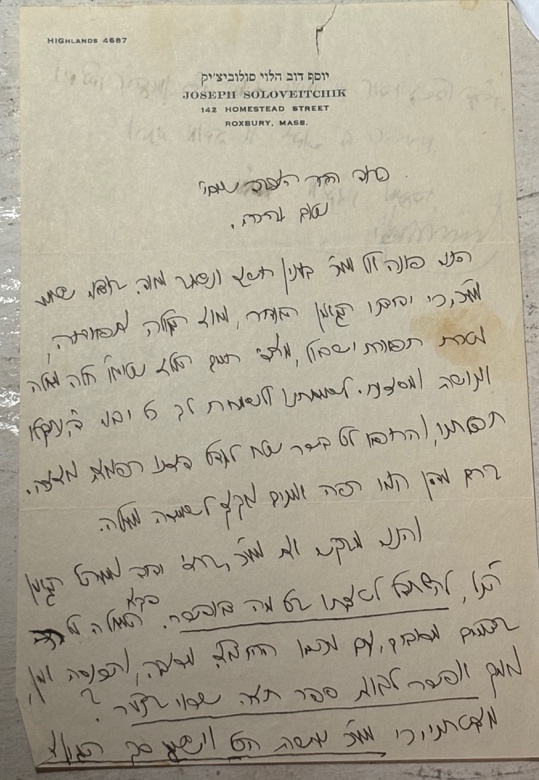
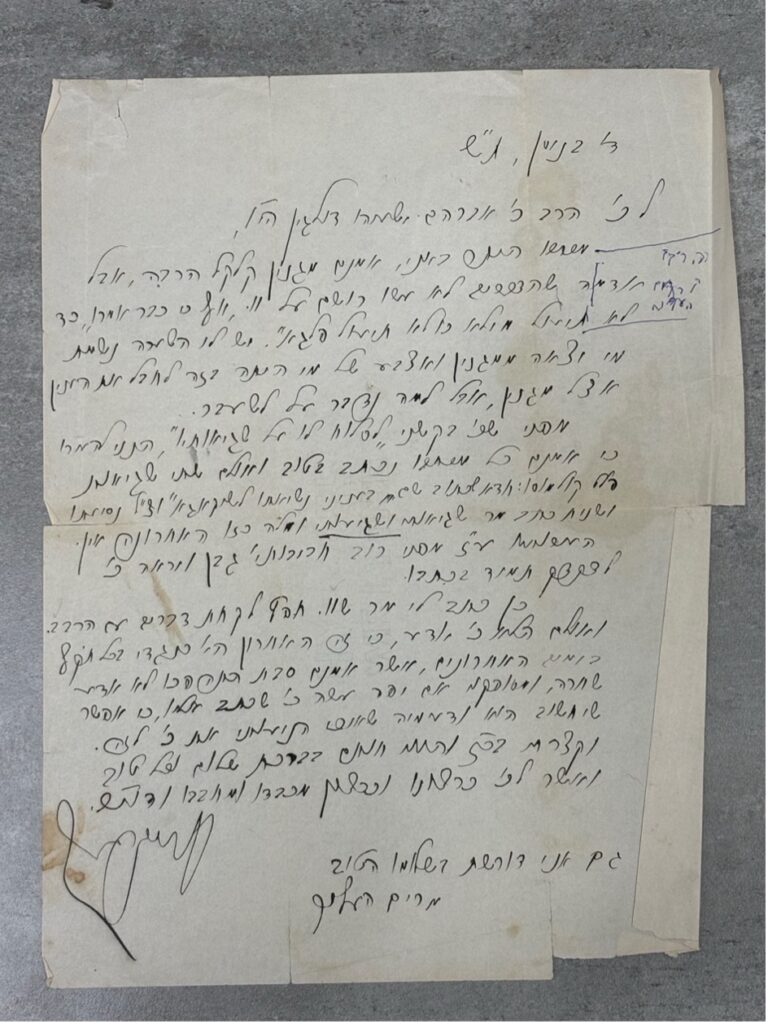
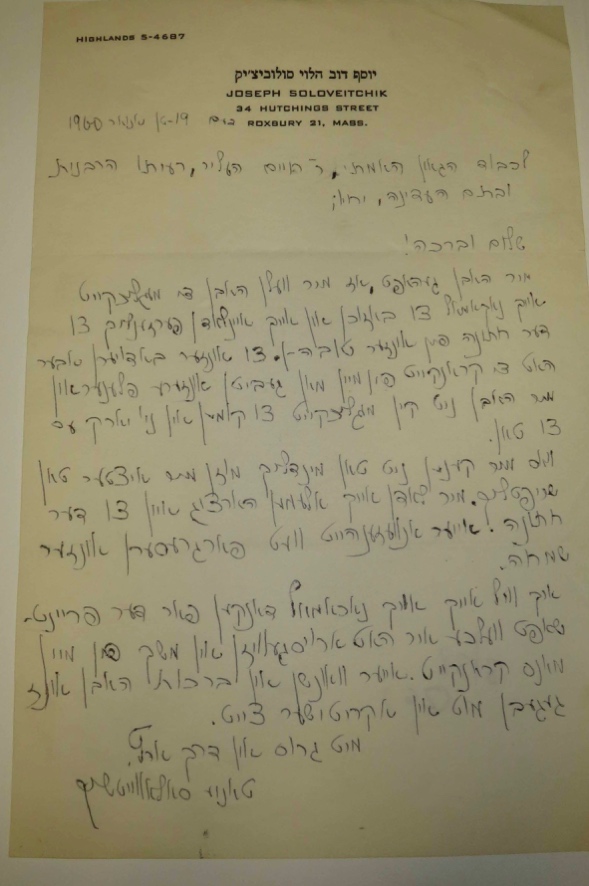
Before we started communicating by email, we sent old fashioned letters. Here is one letter from December 2003. R. Zuriel followed Rav Kook’s approach—discussed by me in The Old Will be Renewed, the New Will be Sanctified—that the Sanhedrin will be able to actualize new moral and religious insights that have become apparent. These moral and religious insights should be viewed as Torah truths that were revealed gradually over time, meaning that we have advanced from the morality at the time of the giving of the Torah. The Sanhedrin will have the final say as to when we are dealing with authentic Torah values vs. non-Jewish values that people are trying to insert into Jewish life.


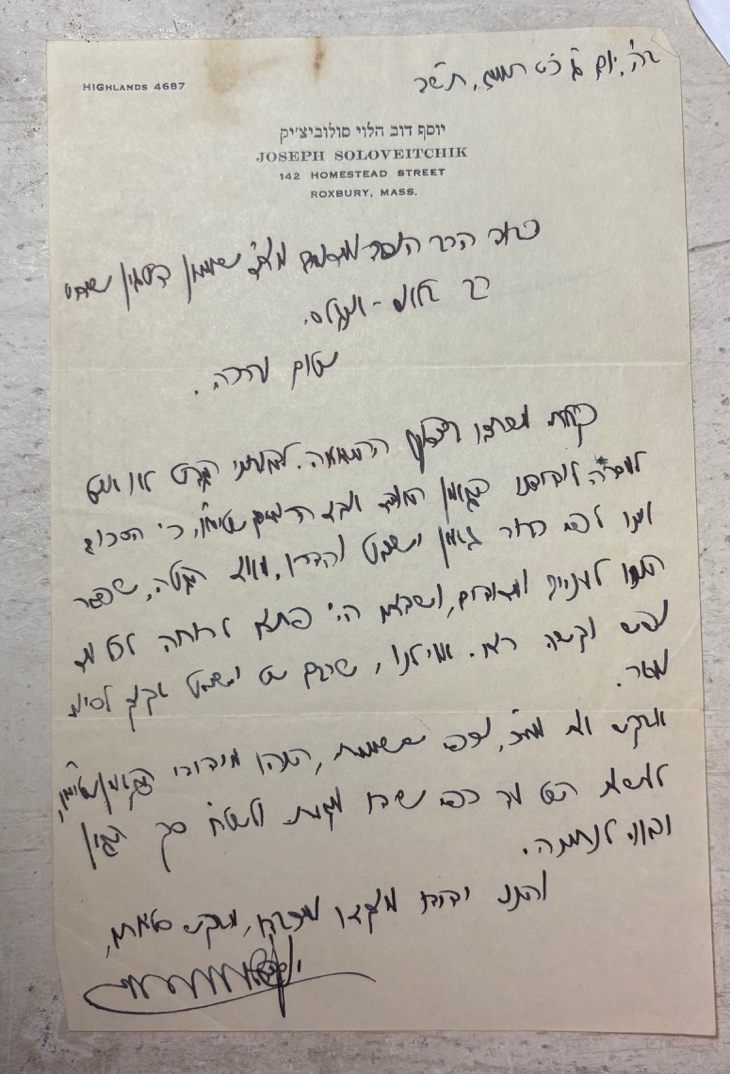
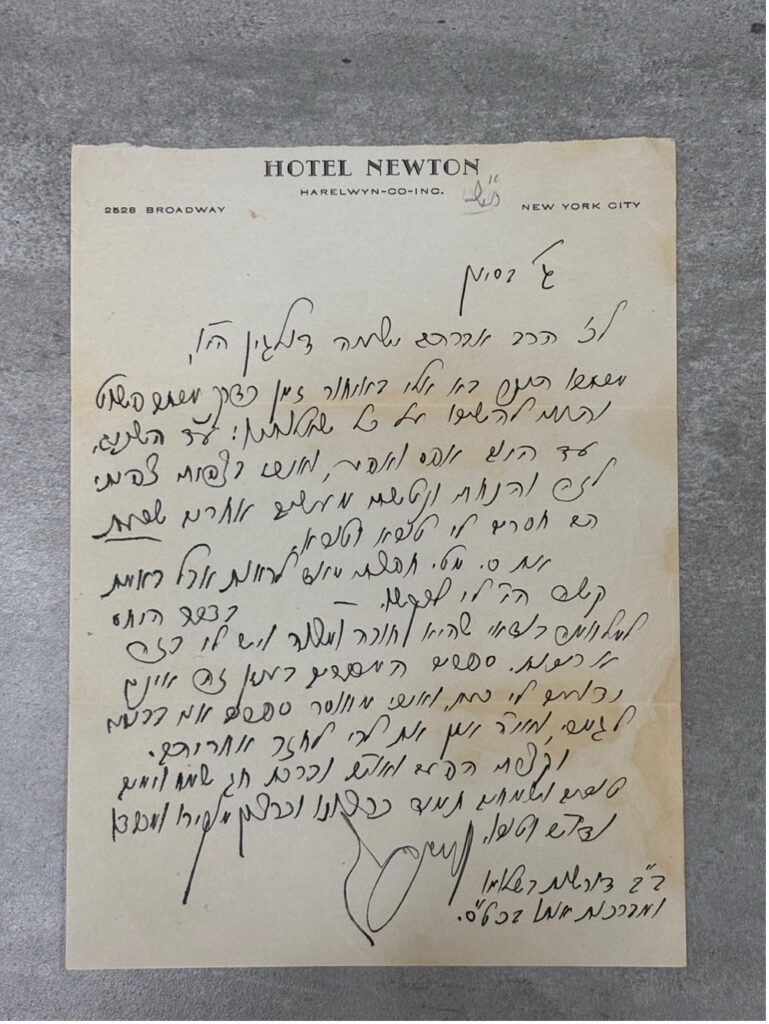
Here are two other letters from R. Zuriel where you can see his strong religious spirit.

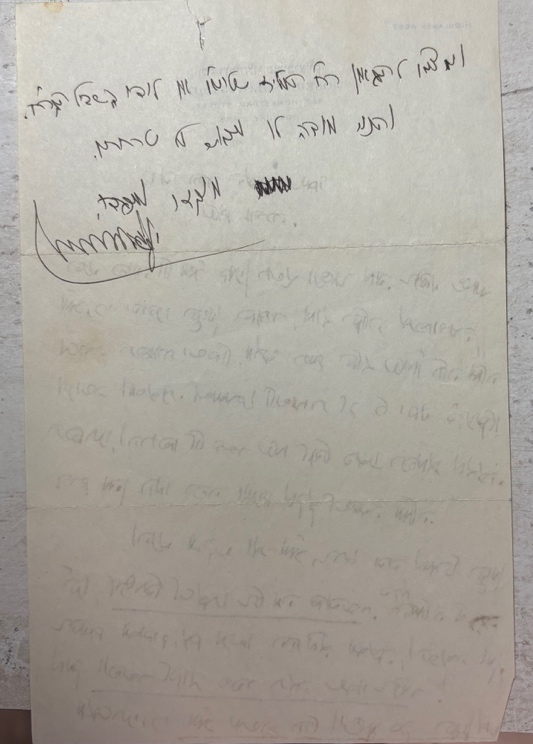
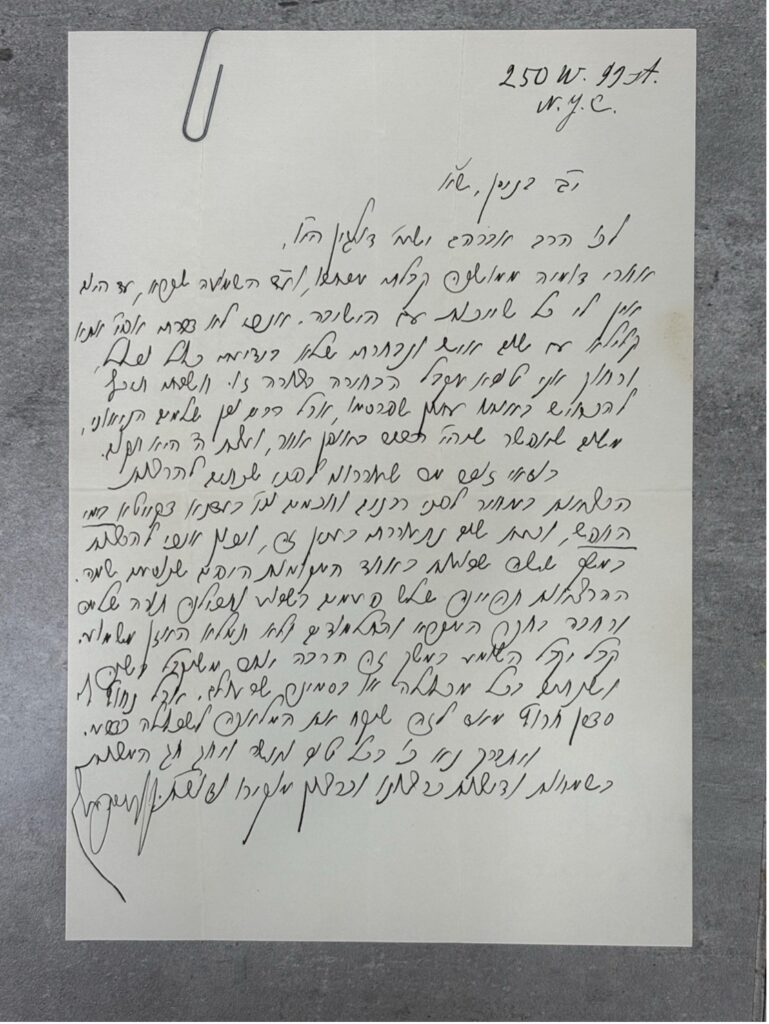
Here is the final part of another letter he wrote me.

I first heard of R. Zuriel when I was a student at Beit Midrash le-Torah (BMT) in 1984–1985. I happened to find his sefer, Beit Yehezkel: Hilkhot Deot, on the shelf. I knew nothing about the author but found the book interesting and began to go through it. I never told R. Zuriel that this was the first sefer I ever went through. In school, we studied Chumash and Gemara, but I had never before picked up an independent sefer and tried to work through it on my own.

One day, while I was learning the sefer, someone noticed and mentioned that there was something controversial in it—namely, that R. Zuriel praises kippot serugot. Even then, I was interested in controversial texts, and I carefully combed through the book, unsuccessfully trying to find the page where he offered this praise. I later heard this story on other occasions as well, so I assumed that the volume I had been using had been censored and that the provocative passage had been removed. That was undoubtedly my first experience with what I thought was a censored text. Maybe that moment planted the seeds that would only come to fruition decades later in Changing the Immutable.

It was only many years later that I learned R. Zuriel had published two books under the title Beit Yehezkel, and lo and behold, I eventually found the passage about kippot serugot on p. 194 of the first edition.

Incidentally, I think many will be surprised to learn that R. Zvi Yehudah Kook—whose yeshiva and followers became such an important force in the kippah serugah world—actually preferred a black kippah over a kippah serugah, not just for himself but for everyone. It is true that he did not make a big deal about it, but we need to be honest about his opinion. Even when presented with two students, one wearing a small black kippah and the other a large kippah serugah, he expressed his preference for the black kippah.[1]

In fact, R. Zvi Yehudah would have even preferred that students at Merkaz ha-Rav wear a hat and jacket, though he never made an issue of it. He did, however, tell at least some of his students who became rabbis that they should wear rabbinic garb—which today generally means a black suit and hat. He wasn’t entirely consistent in this regard, and I suppose that explains the varied styles of dress among his rabbinic students: some look no different than haredi rabbis, others wear a kippah serugah along with a hat, and still others wear a kippah serugah without a hat.[2]

For those who want to learn more about R. Zuriel, his website can be found here. It is truly remarkable to see the vast array of books he published, covering so many different areas of Torah.[3] You will also find there the three volumes of writings by Naftali Hirz Wessely, including material from manuscript, which R. Zuriel published. Interestingly, his name does not appear in these volumes as the one who prepared them for publication. Instead, he used pseudonyms—likely to avoid becoming embroiled in controversy. Yet it is worth noting that, in the years before his death, he began writing about Wessely under his own name and openly defended his decision to publish Wessely’s works. See here.

Missing from his website is his first edition of Wessely’s Sefer ha-Midot, which was published in 2002. The site only includes the later edition, which incorporates previously unpublished material. Yet the first edition is extremely valuable and deserves to be uploaded as well. This is because it contains a lengthy introduction that establishes the religious acceptability of Wessely, citing numerous great rabbis who referenced him positively. (For examples of censorship involving Wessely in the reprinted works of R. Moses Schick and R. Samson Raphael Hirsch, see my post here.) This introduction is significantly different from the one that appears in the second edition. While most of it is also found in the introduction to R. Zuriel’s edition of Wessely’s Yein Levanon (written under the pseudonym Yaakov Segal), for some reason, the version of Yein ha-Levanon on the website omits this entire introduction. Also missing is R. Hayyim Druckman’s haskamah and a letter from Wessely that originally appeared in the first publication of Yein Levanon (Berlin, 1775).

What is particularly noteworthy is that the first edition of Sefer ha-Midot includes a haskamah from R. Zuriel himself, in which he seeks to establish the legitimacy of Wessely. I don’t know—and unfortunately never asked R. Zuriel—why, if he was willing to write a haskamah for Wessely’s book, he wasn’t also willing to identify himself as the editor. The haskamah is formally addressed to “Rabbi Hayyim Lifshitz,” the supposed editor of the book—but Lifshitz is a fictional figure, and the lengthy introduction attributed to him was, in fact, written by R. Zuriel.

When it comes to an author providing a haskamah to his own work published anonymously or under a pseudonym, we do have precedent. R. EliyahuDavid Rabinowitz-Teomim (the Aderet) did this with the only two, of his over 120 works, that were published in his lifetime. In 1889 he published Zekher la-Mikdash (on Hakhel). Here is the title page from the first printing (later printings include the Aderet’s name). In his autobiography, the Aderet mentions writing the book.[4]

On the title page, instead of an author’s name, it states: חובר מאת פלאי. This is clearly intended to evoke Judges 13:18, where the angel says to Manoah, “Wherefore askest thou after my name, seeing it is hidden (פלאי)?” What’s puzzling is that the title page spells it as פלאי—with an apostrophe between the last two letters—rather than the more straightforward פלאי. It has been suggested that the final three letters allude to the author’s name, “Elijah” (אלי), and that the פ stands for Pinhas, since Pinhas is traditionally identified with Elijah.[5] But to me, this interpretation feels far-fetched.

Here is the haskamah which is followed by the Aderet’s many notes to the book, as if he is commenting on someone else’s sefer.

In 1893 the Aderet anonymously published Aharit ha-Shanim (on the law of Vidui Ma’aser). Here is the title page of the first printing (subsequent printings include the Aderet’s name).

This book is also mentioned in the Aderet’s autobiography.[6] Unlike in Zekher la-Mikdash, in Aharit ha-Shanim there is a hint in the Aderet’s introduction to his authorship (emphasis added):

עכ העלמתי שמי והליטותי פני באדרתי לבל ישאו פני

Furthermore, anyone who looks up the biblical verse which is the origin of the expression והליטותי פני באדרתי will find that it is in 1 Kings 19:13 and describes Elijah wrapping his face in his mantle. The Aderet’s first name is Elijah, so this is obviously also an allusion to the author’s identity.

Here is the Aderet’s haskamah to this book. As with Zekher la-Mikdash, the haskamah is followed by many pages of notes to the book, under the heading Devar Eliyahu.

I assume the Aderet must have felt somewhat awkward referring to himself as ha-ma’or ha-gadol (המאוהג), yet everyone understands that such honorifics are expected in haskamot. In fact, had he not used this kind of language, he might well have been accused of failing to show proper respect for the author—since people did not know that he himself was the author.

In 2005, Aharit ha-Shanim was reprinted by Ahavat Shalom, and they were fortunate to have access to the Aderet’s own copy, which contains many additional marginal notes. These were included in the new edition.

I found another case where the author wrote a haskamah to his own book, but as you can see, the haskamah is not a typical haskamah.

Here is the title page of R. Yaakov Goldman’s Peret ve-Olelot (Jerusalem, 1930).

Here is the haskamah.

Speaking of the Aderet and haskamot, here is a chance to deal with a report that has assumed legendary status in the Merkaz ha-Rav world. R. Zvi Yehudah Kook claimed that the lengthy haskamah of the Aderet for the Chafetz Chaim’s Likutei Halakhot was actually written by R. Kook.

Here is the haskamah:


The story told by R. Zvi Yehudah and recorded by R. Moshe Zvi Neriah in Sihot ha-Re’iyah, pp. 123-124, is as follows: R. Kook visited his former father-in-law, the Aderet, while the Aderet was serving as the rav of the city of Mir. During this visit, a letter arrived from the Chafetz Chaim requesting a haskamah for his new book, Likutei Halakhot. He wished to have the haskamah sent as soon as possible, even on the very day his letter arrived, and included some portions of the book. The Aderet was very impressed and showed R. Kook what the Chafetz Chaim had sent. Due to his busy schedule, the Aderet was unable to write the haskamah that day, so he asked R. Kook to write it. R. Kook wrote the impressive haskamah that was later printed.

After R. Kook wrote the haskamah, the Aderet read it over and was ready to sign it. However, he stated that he could not take credit for a Torah explanation suggested by R. Kook, so he altered the text of the haskamah, attributing the explanation to R. Kook, the rav of Bausk. This haskamah is the very first one in Haskamot ha-Re’iyah (Jerusalem, 2017).

It is a very nice story, but is it true? Let me present a source that seems to contradict what R. Zvi Yehudah reported. In the Aderet’s autobiography, Seder Eliyahu, p. 100, the Aderet recounts how, due to a dispute in his city, the Chafetz Chaim came there to try to make peace. The Aderet then writes that a couple of weeks later he wrote the haskamah for Likutei Halakhot.

אז נתתי הסכמתי על ס‘ לקוטי הלכות להגהצ בעל חח שליטא

Presumably, it was when the Chafetz Chaim visited the city that he gave the Aderet his work. If R. Kook had written the haskamah, wouldn’t the Aderet have mentioned it in his memoir? Furthermore, in R. Kook’s Eder ha-Yekar, p. 47, he says the following about his father-in-law:

כל הספרים הרבים שנתן עליהם הסכמתועבר עליהם מראשית עד אחרית וברוב העיר עליהם הערות

According to R. Kook, the Aderet would not give a haskamah unless he had read the entire book. However, the story as told by R. Zvi Yehudah suggests that the Aderet gave a haskamah without having gone through the book.

Based on the two points I have mentioned, I think it is legitimate to raise questions about the story told by R. Zvi Yehudah. It would make more sense to assume that the Aderet wrote the haskamah while R. Kook was in Mir and that the Aderet discussed the haskamah with R. Kook (which would explain the mention of R. Kook in the haskamah). But it is hard to reconcile R. Zvi Yehudah’s story with the Aderet’s own testimony in his memoir or with R. Kook’s description of how the Aderet would study a book before giving his haskamah.

A completely different version of the story involving the Aderet, R. Kook, and the haskamah was told by R. Kook’s nephew, R. Refael Kook. In his version, the haskamah was written by R. Kook for another book by the Chafetz Chaim, Nidhei Yisrael. Here is the story as found in Simcha Raz’s An Angel Among Men.[7]

When the Chafetz Chayim zt”l finished writing Nidchei Yisrael, he came to the Aderet (R. Eliyahu David Rabinowitz-Te’omim) to receive a letter of approbation for the book.

The Aderet kept the book’s proof sheets in order to look through them before writing his approbation. Unfortunately, however, he came down with pneumonia and was quite ill for several weeks. During that time, the Chafetz Chaim came back to receive the approbation he so anxiously waited for. The Aderet’s doctor, however, forbade him to exert himself in any way; so he was unable to write the letter.

The Chafetz Chayim was very disappointed, having made the trip just for the approbation. Don’t worry,” said the Aderet. “I just married off my daughter to R. Avraham Yitzchak HaKohen Kook, who is greater than me in many areas. He will write the letter, and I will sign it.”

And so it was: The Rav wrote an approbation for Nidchei Yisrael and the Aderet signed it, thus forging a strong bond of friendship between the Chafetz Chayim and Rav Kook.

In this version, the Aderet says that R. Kook had just married his daughter. This is obviously incorrect as the Aderet’s haskamah to Nidhei Yisrael is dated 1894. Yet R. Kook married his daughter in 1886 and she passed away in 1889. In 1894 R. Kook was married to the niece of the Aderet, the daughter of his twin brother, R. Zvi Yehudah Rabinowitz-Teomim.

Here is the haskamah to Nidhei Yisrael.

In the Torah journal Me-Avnei ha-Makom 15 (2003), pp. 15-17, a section from the Aderet’s still unpublished 1878 work Oznei David appears. The Aderet notes that the Chafetz Chaim spent Shabbat with him and records some of their Torah conversations. One of the points he mentions is that the Chafetz Chaim asked him how one could eat at various Jewish inns, which were places where Jews would stay while traveling. The issue for the Chafetz Chaim wasn’t kashrut. In those days, people trusted other religious Jews, and the notion that an outside hashgachah was required in such circumstances had not yet been introduced.

What concerned the Chafetz Chaim was that most of the owners of these inns did not tovel their utensils. How then could people eat there? The Aderet explained—and he sees this as a novel view—that it is only forbidden for the owner to use utensils that have not been toveled. Yet there is no problem for others to make use of these utensils. What is of particular historical interest here is that we see that laxity regarding the toveling of utensils is not a recent phenomenon, but was even seen among religious Jews in nineteenth-century Lithuania.

Regarding the Chafetz Chaim and the Aderet, the tradition is that when the Chafetz Chaim writes, והעירני א‘ מחכמי הזמן, in his discussion about Birkat Kohanim in the Diaspora[8], the unnamed scholar he refers to the Aderet.[9] With one exception, the Chafetz Chaim never mentions contemporary scholars by name in the Mishnah Berurah. In Orah Hayyim 585, in Beur Halakhah s.v ve-tov, he refers to R. Meir Simhah of Dvinsk. The story here is that they had a dispute at a rabbinic conference and the Chafetz Chaim thought that his language was perhaps too sharp.[10] As an apology of sorts, he broke with his convention and mentioned R. Meir Simhah by name.

It is widely reported how the Chafetz Chaim admired Rav Kook and refused to allow anyone to speak negatively about him.[11] Among the various sources cited in all the discussions I have seen, no one has referred to R. Yosef Zussman, Mi-Behirei Tzadikaya, pp. 168, 176, that when R. Zvi Yehudah Kook was together with the Chafetz Chaim he was afraid to mention who his father was, out of fear that the Chafetz Chaim would express some criticism of Rav Kook. In the end, his fear was unfounded, and the Chafetz Chaim, upon finding out who he was, told R. Zvi Yehudah that R. Kook was a good friend of his.[12] This anecdote was included in two separate letters from R. Zussman to R. Moshe Zvi Neriah. While R. Neriah used other information from these letters in his own writings, he did not include the detail of R. Zvi Yehudah being worried that the Chafetz Chaim would criticize his father.

I know that it is difficult for opponents of R. Kook to deal with the fact that the Chafetz Chaim had such positive feelings for him. I wonder if they would adopt the approach of the Brisker Rav, R. Isaac Zev Soloveitchik. When asked why the Chafetz Chaim showed respect for a certain Zionist rabbi (not R. Kook), the Brisker Rav replied with the following critical comment: “This is what happens when you don’t listen to lashon hara!”[13] In other words, sometimes it is important to be aware of negative reports about certain individuals so you know how to properly relate to them.[14]

2. I recently played around with ChatGPT and found some incredible things. First, its translation ability is at a very high level. I put in some sentences from nineteenth-century Haskalah literature and the translations that came back are excellent. There are times that ChatGPT gets it wrong, and you always need to carefully review its translations. Yet it seems that we have entered a new era when it comes to translations. Going forward, should translators just insert Hebrew texts into ChatGPT and then check for accuracy and edit the translation? Perhaps this is already being done, which would be a major development.

I also became aware that you can put an article, even a PDF, into ChatGPT and it will give you a summary. Look what happened when I put Haym Soloveitchik’s “Rupture and Reconstruction” in and asked for a summary.

Summary of “Rupture and Reconstruction” by Haym Soloveitchik

Thesis & Central Argument:

Soloveitchik examines the transformation of Orthodox Jewish life in the modern era, particularly the shift from a mimetic (lived, experiential) tradition to a text-based halakhic culture. This shift, he argues, resulted from the sociocultural disruptions caused by the Holocaust and modernization.

I. The Loss of Mimetic Tradition

Traditionally, Jewish practice was absorbed through daily life rather than studied in texts. Children learned religious conduct by watching their parents and community rather than through legalistic study. However, this mimetic tradition began to break down due to several historical forces:

Modernity and Migration:

Jews who emigrated from Eastern Europe to America and Israel found themselves in new environments where religious life was no longer reinforced by communal structures.

In America, the pressures of assimilation and middle-class life further eroded informal religious transmission.

The Holocaust’s Impact:

The Holocaust annihilated the communities and individuals who had embodied and passed down the mimetic tradition.

The post-Holocaust Orthodox world was largely composed of religious survivors and their children, who lacked an organic religious upbringing.

As a result, Jews turned increasingly to written texts to reconstruct religious life, rather than continuing a naturally transmitted tradition.

II. The Rise of Text-Based Religious Life

With the breakdown of mimetic tradition, Orthodox Jews sought religious guidance in texts rather than communal precedent. Several key shifts occurred:

Stringency (Chumra) and “Maximum Position Compliance”:

Halakhic observance became more rigid, as Orthodox Jews increasingly sought the “most correct” way to perform rituals based on written sources rather than communal norms.

Practices that had previously been instinctual or lenient were now analyzed and subject to stricter interpretations.

Proliferation of Halakhic Literature:

The 20th century saw an explosion of halakhic texts, guiding every aspect of Jewish observance in meticulous detail.

Religious practice became more standardized and universalized across communities, rather than based on local custom.

The “Ritualization” of Daily Life:

Previously intuitive religious behaviors, like eating matzah at the Passover seder, were now measured and standardized (e.g., precise “shiurim” for halakhic measurements).

This shift emphasized precision and rule-following over natural, community-based observance.

III. Broader Sociological Implications

Soloveitchik argues that this shift reflects a broader pattern in Jewish history:

A Response to Cultural Erosion:

The disappearance of traditional Jewish life and the rise of middle-class acculturation created a need for stricter religious boundaries.

As Jewish life became more indistinguishable from non-Jewish life, Orthodoxy sought to reinforce distinctiveness through increased textual rigor.

The Influence of the Holocaust on Jewish Memory:

The Holocaust left Orthodox Jews without direct cultural transmission from past generations.

In response, they “reconstructed” an idealized version of pre-Holocaust Jewish life, one that was more rigidly text-based and uniform than the reality of Eastern European Judaism.

The Decline of Jewish Asceticism:

Historically, Jewish tradition included a strong ascetic streak, which emphasized self-denial and wariness of physical pleasures.

However, as Orthodox Jews became more integrated into middle-class life, this asceticism waned, replaced by an emphasis on ritual precision rather than self-denial.

Conclusion:

Soloveitchik describes a fundamental transformation in contemporary Orthodox Judaism: the replacement of an organic, mimetic tradition with a text-driven, rule-oriented religious culture. This shift has led to increased religious stringency, a focus on halakhic literature, and a reconstruction of Jewish memory that aligns with contemporary Orthodox practice rather than historical reality.

* * * * * * *

[1] R. Zvi Yehudah Kook, Piskei Rabbenu, ed. Aviner, Orah Hayyim, p. 31. R. Shlomo Aviner recently published a book titled Pesikah ke-Halakhah. It consists of “strange pesakim” by unnamed rabbis, and R. Aviner’s response. On p. 169 the “strange pesak” he records is that someone who goes to movies should do so in another city, not where he lives, and replace his black kippah with a kippah serugah. This “pesak” is obviously based on Moed Katan 17a: “If a person sees that his evil inclination is gaining control over him, then he should go to a place where he is not known. He should wear black, wrap his head in black, and do as his heart desires [in private] and not desecrate the name of Heaven in public.”

There are those, such as R. Chaim Kanievsky, who have ruled that it is preferable to pray by oneself with a jacket and hat, than pray with a minyan without these items. (E.g., if you are in a situation where if you run home to get your jacket and hat you won’t be able to pray with a minyan.) See R. Yair Yanai, Nekiut ve-Kavod bi-Tefillah, p. 208. Yet see ibid., p. 98, that R. Shlomo Zalman Auerbach and R. Yosef Shalom Elyashiv ruled that prayer with a minyan is more important than wearing a jacket and hat. See similarly R. Meir Mazuz, Makor Ne’eman, vol. 3, no. 151 and R. Yitzhak Ratzaby, Olat Yitzhak, vol. 3, Orah Hayyim, no. 36. See also here at minute 18 where R. Reuven Feinstein strongly rejects the idea that it is better to pray by oneself with a hat than pray with a minyan without a hat. The entire video is noteworthy. Following the exchange about praying with a hat, R. Reuven is asked at what age should a boy be taught to wear his tzitzit out. He responds, “at no age”, and elaborates on why there is no reason to wear tzitzit out. See also at 34:55 where the questioner wants to know what to do about students who are brought up with an ideology that leads them to want to join the IDF. R. Reuven replies that if they want to join that is fine, and the army will probably turn them into a mensch.
[2] See R. Zvi Yehudah Kook, Piskei Rabbenu, ed. Aviner, Orah Hayyim, pp. 31-32.
[3] I remember how surprised I was when R. Zuriel published his Masoret Seyag la-Torah. My surprise was due to how R. Zuriel chose to deny that Jacob ben Hayyim Ibn Adonijah, the masoretic scholar and editor of the first Mikraot Gedolot, later apostatized. See my Limits of Orthodox Theology, p. 93 n. 14, where I write that it is remarkable that a book could be published in modern times referring to Jacob ben Hayyim as one of the great scholars of Israel. For R. Mordechai Breuer’s harsh review of the R. Zuriel’s book, see Megadim 20 (Tamuz 5753), pp. 91-96, available here.
[4] Seder Eliyahu (Jerusalem, 1983), p. 82. On p. 106 he mentions it among the books he wrote. Moshe Reines on his own figured out that the Aderet was the author. See his Mivhar Ketavim, ed. Eliezer Brodt (Ramat Beit Shemesh, 2018), pp. 31, 605. I thank R. Eliezer Brodt for calling this to my attention. He also pointed out that R. Yisrael Dandrovitz discusses the Aderet’s haskamot in his book Hayu Devarim Me-Olam, vol. 2, ch. 22. The chapter is titled: מחברי ספרים שהסתתרו כמסכימים
[5] Akivah ben Ezra, Minhagei Hagim (Tel Aviv, 1963), p. 314 n. 7, cited in R. Yehudah Zoldan, Malkhut Yehudah ve-Yisrael, p. 451 n. 17. I write “Akivah” because the author spelled his name עקיבה. The standard way of spelling the name is עקיבא, yet Maimonides always spelled it עקיבה.
[6] Seder Eliyahu, pp. 102, 106 (including it among the books he wrote).
[7] Trans. Moshe D. Lichtman (Jerusalem, 2003), pp. 368-369.
[8] Mishnah BerurahSha’ar ha-TziyunOrah Hayyim 128 (following no. 136).
[9] See e.g., here.
[10] One version of the story is found in R. Elazar Shakh, Shimushah shel Torah, p. 159. In a future post I will discuss this incident.
[11] See e.g., here. Here is a letter from the Chafetz Chaim’s son-in-law, R. Aaron Cohen, which appears in Iggerot la-Re’iyah, pp. 565-566.

[12] More than thirty years ago I spent Shabbat at the home of the late R. Zev Neuman, who was a very close student of R. Zvi Yehudah and involved in the publication of writings of R. Kook and R. Zvi Yehudah. (See here for various articles about Neuman.) At one of the Shabbat meals, Neuman took out a manuscript of one of R. Zvi Yehudah’s talks and read it to us. R. Zvi Yehudah described how he stayed at the Chafetz Chaim’s home and the Chafetz Chaim personally set up the bed for him. This passage, which made such an impression on me that I still remember it vividly so many years later, has unfortunately not yet appeared in print.
[13] Zvi Yavrov, Ma’aseh Ish, vol. 2, p. 85. See R. Michel Zalman Shurkin, Meged Givot Olam, vol. 2, p. 78, who quotes his father that near Radin lived a great talmid hakham who was a member of Mizrachi. The Chafetz Chaim stood up for this rabbi even though he also spoke very strongly against Mizrachi. The city of Radin is close to Lida, so I wonder if the unnamed Mizrachi rabbi was R. Isaac Jacob Reines, who actually founded Mizrachi.

It is of interest that the Chafetz Chaim’s son, R. Aryeh Leib, who assisted him in writing the Mishnah Berurah and later became the rav of Radin, publicly supported the Mizrachi. This fact is never mentioned by Haredi writers. Yet it is also noteworthy that although R. Aryeh Leib was a member of the secret Hovevei Tziyon society in Volozhin, his public identification with Mizrachi only occurred after the death of the Chafetz Chaim. It seems clear that, out of respect for his father, he refrained from publicly identifying with Mizrachi during his father’s lifetime. See Entzyklopedia shel ha-Tziyonut ha-Datit, vol. 4, cols. 273ff.

See R. Michel Zalman Shurkin,, Meged Givot Olam, vol. 1, pp. 48-49, that R. Mendel Zaks, the son-in-law of the Chafetz Chaim, preferred the biography of the Chafetz Chaim written by R. Meir Moshe Yosher over the volume written by R. Zaks brother-in-law, R. Aryeh Leib. He explained that Yosher’s volume just gives the facts, while R. Aryeh Leib also gives reasons for various actions and practices of the Chafetz Chaim, “and we do not have permission to give reasons for the actions of gedolei Yisrael.”
[14] See also Yavrov, Ma’aseh Ish, vol. 7, p. 94, that the Chafetz Chaim wrote that there is no enjoyment from telling lashon hara, and the Hazon Ish commented that apparently the Chafetz Chaim never told lashon hara, or he would have seen that one can indeed get pleasure from this.

Regarding lashon hara, see also Yavrov, Ma’aseh Ish, vol. 5, p. 31, where the Hazon Ish is quoted as saying that it is not lashon hara to say that someone does not know how to learn, as we need to know who is learned and who is not. Since there is a purpose in knowing who is a gadol be-Torah, therefore it is permitted to say that someone is not a gadol. This approach explains how it is not uncommon to hear people saying about various rabbis that they are “not so great in learning”. But I assume that the Hazon Ish was referring to rabbis making these judgments about other rabbis, not that laypeople would offer such comments. See also ibid, vol. 7, p. 94, where it records that on Kol Nidrei night the Hazon Ish told the students that we will now speak “kosher lashon hara.” He proceeded to speak about a rabbi who imagined that the Hebrew University was the Third Temple. He then turned to heaven and declared:

נורבונו של עולםמספיק בשבילו מה שכבר קלקל עד כאן!

This can only refer to R. Kook, but as is well known, the notion that R. Kook compared the Hebrew University to the Temple, or that he applied to it the biblical verse, כי מציון תצא תורה, are complete fabrications by the enemies of R. Kook which misled even many great Torah scholars. See Moshe Alharar, Likhvodah shel Torah (Jerusalem, 1988), which is devoted to the slander directed against R. Kook.


A Tribute to Rav Shlomo Elyashiv, Author of Leshem Shevo v-Achloma: On his Ninetieth Yahrzeit

A Tribute to Rav Shlomo Elyashiv,
Author of
Leshem Shevo v-Achloma:
On his Ninetieth Yahrzeit
by Joey Rosenfeld

Joey Rosenfeld is a psychotherapist in St. Louis where he moved with his family. He published his first sefer, sc’hok d’yitzchak on the Kabbalistic theme butzina d’kardinusa, or darkened light. He is currently working on a monograph of R. Shlomo Elyashiv and the philosophical and psychoanalytic themes in Leshem Shevo v-Achloma.

His first essay at the Seforim Blog, is entitled: “Dorshei Yichudcha: A Portrait of Professor Elliot R. Wolfson,” is available available here.
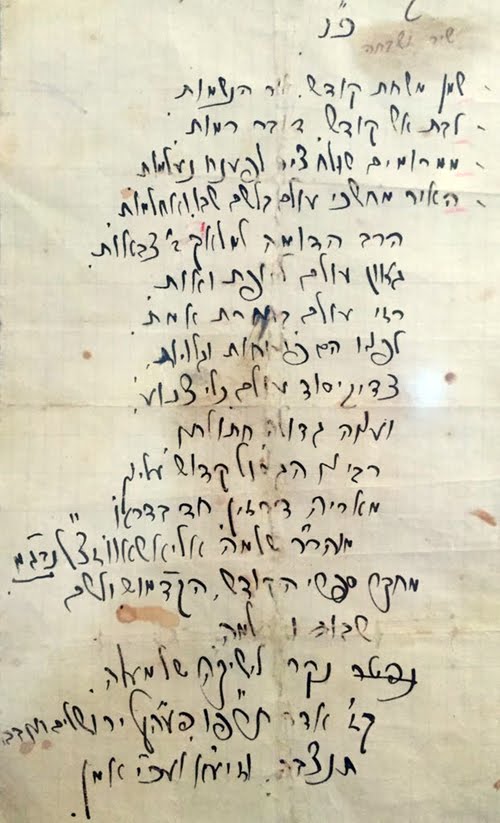

Here is buried
Holy anointing oil, the light of souls
A torch of holy fire, speaker of heights
Sent from on-high to reveal the concealed
Enlightened the darkness through Leshem Shevo v-Achlomot
The Rav like an Angel of God
Genius of the world signified and clear
Secrets of the world in the Torah of truth
Revealed and opened before him
Righteous pillar of the world, vessel of modesty
A great humility in his roots
Our great teacher supernal holiness
Master of secrets unique in his generation
Our teacher R. Shlomo Elyashiv zt”l nbg”m
Author of the holy books Ha”Kadosh v-Leshem Shevo v-Achloma
Called to the Heavenly academy
27th of Adar 1925 here in the holy city of Jerusalem
May his soul be engraved in eternal life
and may his merit protect us Amen

–Rav Avraham Yitzhak Ha-Kohen Kook’s handwritten epitaph for Rav Shlomo Elyashiv, from Rav Kook, which is made available here courtesy of the private collection of Reb Shlomo Gross.

Lurianic Mysticism

When R. Issac Luria (1534-1572) known as the Arizal, developed his theosophical system often referred to as Kabbalat Ha-Ari or Lurianic Mysticism, he initiated a revolution within the Jewish mystical tradition.[1] In the margins of his predecessor and teacher R. Moshe Cordevaro (1522-1570) and through a highly innovative form of Zoharic hermeneutics, the Arizal established a radical approach to the ancient theories of Jewish cosmology (tzimtzum, shevirat ha-keilim), theurgy (kaavanot) and eschatology (tikkun). Codified by his various disciples, primarily R. Chaim Vital (1542-1620) and R. Yisrael Sarug (1590-1610), the Lurianic system took form in the work Eitz-Chaim and the eight volumes of collected teachings known as Shemoneh-Shearim.[2] After the Arizal’s passing, it was generally agreed upon that the Lurianic corpus should, and would remain a closed system, one in which novelty and creativity from subsequent scholars was discouraged and even prohibited. The treatment of the Lurianic corpus as a sacred textual matrix in which creative hermeneutics are discouraged appears to stem from epistemological as well as philological phenomenon. On the epistemological register, the esoteric material being elucidated within the Lurianic system was viewed as an exceedingly sensitive body-of-work that demanded a high level of secrecy and concealment.[3] Only the most spiritually refined individuals were seen as worthy and capable of processing the complexities of the kabbalah. While the political secrecy surrounding the Arizal and his disciples was not a new phenomenon in the history of Jewish esotericism; the emphasis placed on character refinement, both spiritual and physical, for the sake of initiation into the ranks of talmidei ha-Ari is noteworthy. The danger of an unqualified and inexperienced student imposing his own imaginative interpretations upon the system was seen as a potentially catastrophic event with both spiritual and historical consequences.[4] On the philological register, the Arizal himself imposed strict prohibitions upon his disciples regarding the sharing or revelation of his insights, thus creating an economy of occlusion in which his ideas flourished within the strict contours of secrecy. Historically, the Arizal’s pedagogical methods perpetuated the veil of secrecy that kept his teachings hidden while simultaneously enabling them to be collected. Much like the rabbinic sages of the Talmud, R. Issac Luria maintained a strict orality while teaching his disciples. Continuing the rabbinic model wherein oral teachings are associated with a direct teacher-student relationship in which the risk of mistakes and misunderstanding is mitigated, the Arizal delivered his teachings in small groups, often prohibiting his students from textually recording his lessons. It wasn’t until the Arizal was near death that he allowed his disciple R. Chaim Vital to exclusively record his teachings posthumously.

Interpretations of the Lurianic system

While various attempts at interpreting the Lurianic system following R. Issac Luria’s passing did exist, it wasn’t until the seventeenth-century that authoritative schools of interpretation were born. Generally speaking one may categorize four primary approaches towards Kabbalat Ha-Ari in which the Lurianic system was expounded while simultaneously adhering to the strict prohibition of creating concepts that had not been directly recorded by R. Chaim Vital. While each school contained followers who differed from the founding member, the four major personalities associated with unfolding the Arizal’s system were R. Moshe Chaim Luzzatto (1707-1746) known as the Ramchal, R. Elijah of Vilna, known as the Gaon of Vilna (1720-1797), R. Shalom Sharabi (1720-1777) known as the Rashash, and R. Yisrael ben Eliezer (1700-1760), known as the Baal Shem Tov. Respectively, each school can be said to have utilized a different mode of hermeneutical interpretation in emphasizing what they viewed as the fundamental aspect of Lurianic Kabbalah, or Kabbalat Ha-Ari. For Ramchal and his Padua school[5] an emphasis was placed on unpacking the metaphorical nature of the Lurianic system for the purpose of revealing the various modes (hanhaagot) in which the Divine is manifest throughout history, culminating with the metahistorical eschaton in which all will be rectified (tikkun) and unified (yichud). For Rashash and the Jerusalem kabbalists of the Beit El Yeshiva[6] the emphasis was placed almost exclusively on the theurgical nature of religious phenomenology, expounding and developing a highly complex and intricate system of mystical intentions (kavaanot) associated with prayer and religious ritual. The Baal Shem Tov,[7] founder of the Hasidic movement along with his early students read and translated the intricate details of Kabbalat Ha-Ari unto the psychological register, transferring the locus of the Arizal’s system from the hidden depths of the Godhead to the hidden depths of the individual soul, thereby democratizing the once guarded secrets of concealed wisdom (chochmat ha-nistar). The School known as Kabbalat Ha-Gra or Lithuanian Kabbalah,[8] consisting of the Vilna Gaon and the select disciples who learnt directly or indirectly from him, emphasized the spiritual nature of temporality and history with a focus on the Messianic personalities who actively participate in the apocalyptic eschaton, as well as the biblical allusions towards the Lurianic system.

Fourfold of Kabbalistic PaRDeS

It has been suggested that these four schools of Kabbalistic interpretation be compartmentalized according to the fourfold structure of rabbinic hermeneutics known as PaRDeS[9]- an acronym for Peshat, the literal meaning; Remez, the allegorical meaning; Drash, the moral meaning; and Sod, the secret meaning. Generally speaking the gamut of Jewish esotericism-including Kabbalat Ha-Ari- represents the realm of Sod, and as such these four schools of thought would represent the specific substructure of PaRDeS as applied to the Sod of the general structure of PaRDeS. The Rashash and his school primarily engage the textual edifice of Kabbalat Ha-Ari, unearthing apparent contradictions within the system itself while reconciling them through an innovative theory of relativity (erchin) represent the literal approach (Peshat) to the Arizal’s system. The Gra and his school exemplify the allegorical approach (Remez) by utilizing the various forms of creative hermeneutics- primarily sacred numerology (Gematria) and acronyms (Roshei Tevot)- to uncover allusions and intimations signifying aspects of the Lurianic system within biblical texts. The attempt of the Ramchal and his school to uncover the latent meaning within the metaphors of the Arizal represents the moral approach (Drash) in which the externalities of the system are plumbed and simultaneously shed to reveal the inner kernel of meaning. Finally, the Baal Shem Tov and the Hasidic approach, by translating Lurianic ontology into psychological terms represent the essential secret (Sod) wherein the spiritual seeker finds the entirety of existence within themselves thus enabling a unique form of dynamic divine service.

R. Shlomo Elyashiv: Leshem Shevo v-Achloma

R. Shlomo Elyashiv (1841-1926) known as the Leshem after his vast body-of-work Leshem Shevo v-Achloma was a Lithuanian Kabbalist known for his adherence to the school of Kabbalat Ha-Gra.[10] Described as the fourth stage, or peh revieeh within the chain of talmidei ha-Gra, the Leshem formed a system in which the apparent contradictions between the Vilna Gaon and the Arizal were reconciled through a unique form of Kabbalistic analytics. R. Avraham Yitzhak ha-Kohen Kook, close friend and student of the Leshem described R. Elyashiv as applying Talmudic analytics (pilpul) onto the Lurianic corpus thereby clarifying and reconciling the various contradictions and textual ambiguities.[11] With an exhaustive knowledge of the gamut of Jewish esoterica- from the philosophic rationality of the rishonim to the complex intricacies of R. Chaim de La Rosa’s Torat Chachom[12]- the Leshem can be described as one of the most comprehensive as well as creative Kabbalistic thinkers of the late 19th and early 20th century. Born in Zagory, a small city in northern Lithuania, R. Elyashiv was raised studying Talmud with his father R. Chaim Chaikl Elyashiv until leaving home to study under the tutelage of R. Gershon Tanchum of Minsk where he became known for his Talmudic expertise. After his marriage to the daughter of R. Dovid Fein the Leshem went on to study at the Telshe yeshiva where his intellect and vast memory earned him the appellation of Telsher illui. While in Telshe the Leshem was introduced to chochmat ha-nistar by his teacher R. Yosef Reissen who then served as the Rav of Telshe. While learning in Telshe, R. Elyashiv became familiar with the fundamental texts of Jewish mysticism, learning the Pardes Rimonim of R. Moshe Cordevero as well as the Vilna Gaon’s commentaries on Sefer Yetzirah, Safra D’Tzniyuta and the Tikkunei Zohar. Only afterwards did the Leshem begin studying the system of the Arizal and it’s commentaries. R. Aryeh Levin who served as R. Elyashiv’s assistant after the latter’s move to Jerusalem includes within the curriculum the texts of R. Moshe Chaim Luzzato as well; however the distinctive relationship between R. Shlomo Elyashiv and the Ramchal’s school of Lurianic mysticism will be discussed below. After leaving Telshe, the Leshem settled in Shavel, Lithuania where he began to write what would become his vast oeuvre known as Leshem Shevo v-Achloma. In 1922, through the help of Rav Avraham Isaac haKohen Kook and Rav Yitzhak haLevi Herzog,[13] R. Shlomo Elyashiv moved to Jerusalem with his family where he eventually passed away on the 27th of Adar in 1926. While never accepting upon himself any form of communal leadership, the Leshem became known as the preeminent scholar of Kabbalah, through his written works, glosses, vast reaching editorial skills and the various rabbinic personalities with whom he studied and taught.[14]

Leshem Shevo v-Achloma: Overview of Texts

R. Elyashiv’s oeuvre generally referred to as Leshem Shevo v-Achloma is comprised of four separate yet highly integrated volumes.[15] While a comprehensive overview of each work is far beyond the scope of this essay, what follows is an attempt to describe the framework and context of each sefer. The four Kabbalistic works are Leshem Shevo v-Achloma: Hakdamot u-Shearim (1909); Leshem Shevo v-Achloma: Drushei Olam ha-Tohu (1911); Leshem Shevo v-Achloma: Klalei Hitpashtut v-Histalkut (1924); and Leshem Shevo v-Achloma: Chelek ha-Biurim (1935).

Leshem Shevo v-Achloma: Hakdamot u-Shearim

Known as Sefer Hakdo”Sh,[16] this work serves as an introduction to Kabbalat ha-Ari for the novice student, clarifying such concepts as Divine names, unity of God and the mystical anthropomorphization of God. In an attempt to simplify the complexities of Lurianic Kabbalah, R. Elyashiv sets forth a five staged multileveled process through which Ein Sof becomes manifest in/as reality. There is nothing particularly original in the Leshem’s depiction of a five stage process, an idea that is ever-present in the Lurianic system of partzufim. The novelty of Sefer Hakadosh, however, may be found in the Leshem’s configuration wherein the five partzufim; Arich Anpin, Abba, Immah, Zeir Anpin and Malchut are analogously aligned with the five-tiered revelatory process (seder ha-gilluim) in which the latent potentiality of existence emerges as the manifest actuality of creation. These stages, or orders-of-revelation are Ein Sof; Tzimtzum/Kav; Adam Kadmon; Atzilut; and the triadic unit Beriah,Yetzira and Asiya (BY”A). Working with certain Lurianic axioms as refracted through Rashash’s concept of hitklalut v-hitkashrut (integration and redistribution),[17] R. Elyashiv depicts a highly integrated system in which each general stage (seder klali) encompasses a subsystem (seder prati) wherein the five stages operate in a self-contained manner. Thus for example, the general partzuf of Abba- analogous to the revelatory stage of Adam Kadmon- contains within itself a subsystem comprised of every other partzuf and/or gillui. Far from a theoretical divergence into complexities, this multivalent system wherein each part contains the whole rests at the foundation of the Leshem’s system of integration (seder ha-klilut) and secret of unity (sod ha-achdut). The first seven gates of Hakadosh discuss each revelatory-stage in detail including the interconnection between each stage, thus engaging the reader in a textual excursion through the basic framework of the Lurianic system. The eighth gate in Hakadosh– titled Shaar ha-Poneh Kadim– comprises a work unto its own. Here R. Elyashiv undertakes the formidable task of elucidating the Kabbalistic system of R. Yisrael Sarug, commonly referred to as Olam ha-Malbush. While an overview of Olam ha-Malbush as refracted through the works of R. Naftali Hertz Bacharach and R. Menachem Azariah of Fano is far beyond the scope of this essay, R. Elyashiv’s decision to include R. Sarug’s depiction of “hidden mysteries that begin far beyond the worlds described in the writings of our master R. Chaim Vital,” is a significant gesture regarding the source and validity of the Sarugian system.[18]

Leshem Shevo v-Achloma: Drushei Olam ha-Tohu

Drushei Olam ha-Tohu – or Deah as it is known – is a monumental work that deals primarily with the Lurianic cosmological theme Olam ha-Tohu, the world(s) of chaos. Comprised of two parts, Sefer haDeah examines the primordial cataclysm known as the shattering of the vessels (shevirat ha-keilim). For the Leshem, this event- known as the death of the Edomite kings (mitat malchei edom) after the biblical account in parshat VaYishlach– serves as the pre-original opening through which the entirety of history unfolds. Far beyond a simple depiction, or elucidation of this Lurianic motif, part one discusses the “roots and foundations, existence and kingship, death and shattering” of the primordial kings, as well as “the ramifications that are born through this process, the source and the purpose of all this and the general process of rectification.”[19] According to R. Elyashiv the shevira was not an isolated event whose effects were limited to immediate consequences, rather, it serves as the traumatic source of everything that follows.[20] The stage of tohu– and all that transpires therein- is the constitutive break through which history gains its subjectivity. On a psychoanalytic register, not unlike Freud’s original seduction theory, the shattering of the vessels and the subsequent chaos represents the original trauma whose symptoms constitute the subject, as opposed to preexistent subject who experiences the symptoms. The worlds of tohu, resting at the beginning- before the beginning- accompany the historical process, concealed from sight, imposing and composing the ebb and flow of shevira and tikkun, shattering and rectification, which make up history.[21] Part one examines the roots of the necessarily imperfect tohu, from its most concealed source to its revealed manifestation as the existential condition of this-worldliness (olam ha-zeh or asiyah). Part two of Sefer haDeah, while similar to part one in that it deals with the various states of pre and post-shattered existence, is unique in both its conceptual arrangement as well as its area of focus. In part one the Leshem utilizes the complexities of the Lurianic system as well as the textual contradictions therein to slowly build his system. The second chelek assumes that the reader has a knowledge of these complex details and moves beyond the pratim to engage the biblical and historical manifestations of the framework described in the first chelek. R. Elyashiv sees the basic structure of shevira-tikkun, or chaos-order as a pattern that incessantly reasserts itself unto the stage of history. Moving from Adam ha-Rishon’s prelapsarian state, through the primordial serpent’s seduction, the Leshem illuminates the subterranean flow of Divine interpolation which he calls nora ahlilah based on the verse in Psalms (66:5), “Lichu u-riuh mif’alot Elokim nora ahlilah al bnei adam.” R. Elyashiv moves from Adam ha-Rishon’s expulsion from Eden to the narratives of Abraham, Isaac and Jacob, interweaving Lurianic interpretations with his distinctive focus on the delicate balance between the forces of tohu and tikkun. From there the Leshem goes on to describe the concealed essence of Knesset Yisrael’s movement from Egyptian servitude, the exilic wanderings in the wilderness, and the eventual climactic experience at Har Sinai. The Leshem continues clearing a path from Israel’s unconscious repetition of the shevira as embodied in the collective event of Cheit ha-Eigel towards the eschatological advent as depicted in the Rabbinic feasts of the righteous wherein the enigmatic Leviathan, Behemoth and Ziz Shadi take on immense Kabbalistic significance. The second chelek also includes an extensive treatment of the Talmudic narrative of the four who entered the Pardes as well as an analysis of R. Akiva and his nonlocal relationship with Moses. The Leshem closes Sefer haDeah with various maamarim that while related to the concepts expressed in Dea”h comprise a separate unit; these include Drush Eitz ha-Daat; Drush Sfeikot Iggulim vi-Yosher; and Drush Mi’ut ha-Yareiach.

Leshem Shevo v-Achloma: Klalei Hitpashtut v-Histalkut

Klalei Hitpashtut v-Histalkut- or Sefer HaKlalim as it is referred to- can be described as R. Elyashiv’s most difficult as well as significant work. Following the Arizal’s depiction of the dialectical process through which existence comes-to-be as described in Eitz Chaim- particularly Shaar Mati v-lo Mati and Shaar ha-Akudim- the Leshem builds a system wherein each stage of revelation contains within itself a subsystem of Hitpashtut, egression and Histalkut, regression. In laying out the framework of this work, R. Elyashiv describes a comprehensive system “In which we will speak regarding the weaving and concatenation of the worlds. From the heights of the most elevated world to the limit of the lower worlds, Briah, Yetzira and Asiyah.”[22] For the Leshem the constant ebb and flow in which existence is revealed in order to be concealed as it is concealed in order to be revealed marks the basic structural framework that enlivens reality.[23] The dialectical play of egression/revelation and regression/concealment that serves to produce each subsequent stage of existence opens into the fourfold process of Hitpashtut Alef; Histalkut Alef; Hitpashtut Beit; Histalkut Beit. Generally speaking, through the act of Hitpashtut, the prior plenitude- seen as infinite relative to the ensuing stage- undergoes a process of concealment, akin to the first Tzimtzum in that, paradoxically, the prior levels concealment allows the next level to transition from its covert potential within the previous level into the overt manifestation as the new stage in existence. Next, with the first Histalkut, the new level now revealed undergoes a process of regression where what has become manifest returns to its previous source, leaving behind a roshem, or trace thus engraving a potential space in which the new level will eventually concretize. While an overview of this complex dynamic is far beyond the scope of this essay the main goal for the Leshem is to show how each and every stage can trace “their roots and spacing within the world of Adam Kadmon, both the details and the details of the details. To show how they are all eternally rooted and unified there, from the initial thought until the limit of action.”[24] In emphasizing the significance of this system, there is no better description than the words of R. Elyashiv himself, printed on the title page of the sefer:

And the concept of the two Hitpashtiut and the two Histalkiut is as follows, for the Creator blessed be His Name has established the entirety of existence- the totality of which stems only from the surge of His blessed light that is revealed through His actions and his hanhagot from eternity to eternity- He has established it upon the concatenation of many stages, one below the other; and each stage is a totalized system and the entirety of a world, and that which is in this one is in that one as well, with each subsequent stage drawing from the preceding stage situated above it; and now each world has its source above it from which it is drawn and in/through which it exists; and upon this rests the two Hitpashtiut and the two Histalkiut, for the first Hitpashtut and Histalkut form the supernal source of each world that remains above, and the second Hitpashtut and Histalkut form the essential existence of each world in its physical space below. And now, these stem from the light of the Name Yud-Hei-Vav-Hei that shines in each and every world. The first Hitpashtut and Histalkut stem from the letters Yud-Hei of the Name, and the second Hitpashtut and Histalkut stem from the letters Vav-Hei of the Name.”[25]


Sefer Ha-Klalim is made up of two parts discussing each stage of existence and the fourfold process of Hitpashtut and Histalkut that occurs therein. The second chelek is primarily comprised of perek eighteen, anaf ten, or Chai Ani (Yud-Cheit, Anaf-Yud) which the Leshem describes as “the sum total of all of my teachings to show the interconnection of everything within A”K and A”K within everything.” Due to the highly complex nature of this system- running from the unconscious depths of the concealed Godhead to the existential reality of this-worldliness- the Leshem appended a chart in which the system of 52 integrated manifestations of the Tetragrammaton are codified and elucidated.

Leshem Shevo v-Achloma: Chelek ha-Biurim

In Chelek ha-Biurim R. Elyashiv undertakes the enormous task of writing a “wondrous and detailed elucidation of the entirety of the Holiest of Holy, the Arizal’s Eitz Chaim.” While numerous works have been written on Sefer Eitz Chaim, simplifying and clarifying the Lurianic system, the Leshem’s vision lay beyond the normative approach to the text. For the Leshem, R. Chaim Vital’s Eitz Chaim represents a work whose “words are blocked and closed off, concealed by ancient days, as R. Chaim Vital wrote in his introduction, that all that has been revealed to us is nothing but the revelation of a singular handbreadth through the concealment of thousands.” As such, a worthy depiction of the Lurianic mosaic assembled within the gates of Eitz Chaim demands a resistant reading in which the work is read against itself in the hopes of revealing that which has remained concealed within the text. Rooting himself in the “deep wells of the holy Ari and Gra from who’s milk I have suckled and from who’s water I have drawn and drank” the Leshem seeks to “reveal the cherished light and archival secrets…deep beyond depth, elevated beyond height” that rests at the core of Eitz Chaim. In order to do this, R. Elyashiv works through the text, opening that which was closed through an incessant mode of questioning. Taking no statement for granted, the Leshem examines each idea through a hermeneutics of suspicion where the content of Eitz Chaim is measured and compared to similar and dissimilar concepts throughout the Lurianic corpus. When contradictions and textual ambiguities arise, the Leshem utilizes his unique mode of Kabbalistic analytics (pilpul) in reconciling the opposing texts by clearing a new path in which both statements are seen as augmenting one another. Arming himself with Rashash’s conception of Kabbalistic relativity known as archin, R. Elyashiv interprets Eitz Chaim as a dynamic system whose parts can only be properly understood with an intimate knowledge of their particular context. While the Leshem did undertake the enormity of this task, we have only been left with a biur up to Shaar Ha-Nekudim, Perek Gimmel leaving the majority of Eitz Chaim without commentary. The hundreds of pages it took R. Elyashiv to explicate such a small fraction of Eitz Chaim leaves one pondering the sheer vastness of the Leshem’s vision.

Mitnagdic Kabbalah

From a historical perspective Rav Shlomo Elyashiv served an important role in bridging the gap that existed between the Lithuanian world of the yeshiva and baalei mussar and the world of Lurianic Kabbalah. Throughout his time in Lithuania the Leshem studied Kabbalah with R. Yisrael Meir haKohen Kagan,[26] R. Elya Lopian,[27] R. Yosef Leib Bloch,[28] R. Yitzchak Blazer,[29] R. Yeruchem Levovitz,[30] and R. Yosef Yuzel Horwitz.[31] A more significant, yet historically ambiguous relationship was the purported interaction between R. Elyashiv and the founder of the Mussar movement, R. Yisrael Salanter.[32] The Leshem’s engagement with the various rabbinic personalities-most of who served as leaders of Lithuanian yeshivot- may be viewed through one of two sociohistorical lenses. As an adherent of the school referred to as Kabbalat ha-Gra, R. Shlomo Elyashiv represented a dying breed of mitnagdic-mysticism.[33] While never engaging the political polemics surrounding the mitnagdic/hasidic debate, the Leshem was a strong advocate for a clear and exacting approach to the Lurianic corpus, in contradistinction to the “Hasidic” approach in which the Lurianic system underwent a form of imaginative and psychological revisionism. It is important to note that while the Leshem appears to have associated this mode of interpretation with the “Hasidic” explanation of Kabbalat ha-Ari, he by no means viewed it as a uniquely Hasidic phenomenon. Many of the critiques leveled by R. Elyashiv were in fact directed towards R. Naftali Hertz haLevi, author of Siddur ha-Gra be-Nigleh u-Nistar who represented “those who delve too deeply into the system of Ramchal, interpreting the words of the Arizal as imaginative principles (maareh ha-nevuah).”[34] Nevertheless, by associating with rabbinic personalities who represented the mitnagdic elite, the Leshem maintained his position as a Lithuanian mekubal, one who continued the path of the Vilna Gaon.

Messianic Mysticism

Another possible explanation for R. Elyashiv’s vast interactions with the rabbinic elite of his time has less to do with his spiritual/political predilections and more to do with the Kabbalistic subject matter itself. Following a long tradition in which the expansion and expression of Kabbalistic studies was seen as a fundamental stage within the Jewish eschatological process,[35] the Leshem viewed his historical situatedness as signifying his personal spiritual mission. The spiritual and historical significance as well as the strident dereliction of Kabbalah study that the Leshem saw in his generation may have influenced R. Elyashiv’s emphasis on teaching and sharing his knowledge of chochmat ha-nistar. In one text the Leshem decries what he saw as the rabbinic elite’s disregard of Kabbalah as follows:

And I am amazed with some of the wise ones of our generation (chochmei ha-dor), for they have no knowledge in this area whatsoever, how can they manage without engaging chochmat ha-emes, that is pnimiyut ha-Torah, and it is strange in their eyes to the point that they know nothing about it. And all of their answers and excuses are meaningless after what is written in Eruvin (55a), “it is not in heaven, and if it was in heaven you must ascend after her, and if she is beyond the sea, you must cross after her,” and it is apparent that this applies to all areas of Torah…including the esoteric aspect (chelek ha-nistar)…and the chelek ha-nistar transcends all other areas [of Torah].”[36]

Elsewhere, R. Elyashiv quotes from R. Yisrael Salanter in describing the unique historical moment in which the secrets of the Torah (sodot ha-Torah) were now accessible to all who were interested:

And permission has been granted to all those who engage this wisdom to understand these ideas, each according to their level. And specifically from the year taf-reish (1840)[38] and onwards as it is written in the Zohar (2:117), “and in the six-hundredth year of the sixth millennia, the gates of the higher-wisdom (chochma li-ailah) were opened,” and what [the Zohar] meant in writing “opened,” this means to say that permission has been granted to all those who yearn to cleave with the living God (Elokim Chaim), to engage chochmat ha-emes, to enter and to utilize the Name properly. And anyone who delves into this matter will be enlightened and find that this was not the case before the year taf-reish (1840), because then it was still hidden and enclosed, except for a few exceptional individuals, so have I heard in the name of the gaon and chossid R. Yisrael Salanter z”l, and all of this is rooted in the revelation of supernal light that is revealed above and egresses below, as it draws into this world (olam ha-zeh) additional light and the secrets of Torah are revealed in order to rectify (tikkun) the world for the eventual rectification.”[37]

Ignorance coupled with what the Leshem saw as a historically unique time in which sodot ha-Torah were accessible to all may have influenced R. Elyashiv’s drive to engage those rabbinic personalities hitherto unaffiliated with the Kabbalistic system.

R. Elyashiv and R. Avraham Isaac Hakohen Kook

Another significant relationship centered around R. Elyashiv’s expertise in Lurianic Kabbalah was the friendship between the Leshem and the first chief rabbi of Israel, R. Avraham Isaac Hakohen Kook.[39] Serving as a young Rav in the town of Zaumel, Lithuania, R. Kook sought to resolve the “questions and difficulties with some foundational ideas in chochmat ha-nistar” [40] that had arisen in his studies. With permission from the members of his community, R. Kook travelled to Shavel where he spent a month studying and learning from the elder Rav Shlomo Elyashiv. From that point on Rav Kook and the Leshem continued their relationship, exchanging letters, with R. Kook eventually procuring the documents necessary for R. Elyashiv and his family’s move to Jerusalem.[41] R. Kook saw the Leshem as a unique link in the chain of Jewish mysticism, reportedly commenting on the latter’s work Leshem Shevo v-Achloma: Hakdamot u-Shearim (Hakdo”Sh) that “from the time of R. Moshe Cordevaro there has been no sefer in chochmat ha-emet that grasps and expounds the subject matter like the sefer Hakdamot u-Shearim.”[42] Thanking the Leshem for sending his newly published manuscript, R. Kook wrote: “The house was filled with light upon the appearance of his holy book. I cannot convey to my soul-friend my feelings of inner happiness from the good light. In its yet unbound state, I have already devoured several pages, so enamored am I. It was sweet as honey to my mouth.”[43] R. Aryeh Levin, close student of R. Kook and assistant to R. Elyashiv in Jerusalem describes many nights during which the Leshem and R. Kook would study sifrei kabbalah from midnight until the early morning. R. Kook’s sense of a “divine bond in the depths of the heart”[44] existing between himself and Leshem was reciprocated by the elder R. Elyashiv who saw in the chief rabbi “a vast knowledge and unification of all variant Kabbalistic positions (shitot) and one who has earned the description of “no secret being removed from him” (kol raz lo anis leh).”[45] After the Leshem’s passing shortly after arriving in Jerusalem, R. Kook eulogized the great mekubal and composed the epitaph marking R. Elyashiv’s kever, a lasting testimony to their significant relationship.[46] While there has been no scholarly attempt at identifying the Leshem’s influence on the thought of R. Kook, the overlap in both thinkers approach to the spiritual significance of history as well as the utilization of R. Azriel of Geroni’s concept of the “potential (for) limitation within the unlimited (koach ha-gevul bi-bilti gevul)” is significant. It is important to note that while R. Kook and R. Aryeh Levin appear to have viewed R. Elyashiv’s approach to the Lurianic corpus as authoritative, this was not the case for R. Kooks other students comprising the chug ha-rayah. Both R. Yaakov Moshe Charlop[47] and the R. Dovid Cohen regarded the Leshem’s critical view of Ramchal’s interpretative reading of the Arizal as problematic. While the details of R. Elyashiv’s critical approach towards Kabbalat Ramchal will be discussed in a future essay, it appears that the critique of R. Charlop and R. Cohen, both deeply influenced by Ramchal, was more reactionary than substantive.

Leshem Shevo v-Achloma and the Kabbalists of Beit-El

Described by R. Yosef Chaim of Baghdad as the “lion of secrecy (Ari bi-Mistarim),”[48] it is surprising that R. Elyashiv’s vast body-of-work known generally as Leshem Shevo v-Achloma has been all but ignored by both the traditional and academic schools of Kabbalah study. Within the Haredi network of Kabbalah yeshivot the Leshem’s works are seen as important contributions towards the explication of the Lurianic system, but by no means have they entered the limited curriculum of primary texts comprising the “meforshei ha-Ari.” Only the glosses written by R. Elyashiv under the title ha”ShevaCh (Shlomo ben Chaikl) on the first half of Eitz-Chaim- compiled and printed in R. Menachem Menchin Halperin’s Hagaaot u-Biurim– have received treatment in the writings of sefardi mekubalim.[49] While greatly respected by the sefardic Kabbalists of his day- two works by R. Shaul Dweck ha-Kohen were printed with approbations from the Leshem[50]- his works did not enjoy the same treatment. Those following the sefardic approach to Kabbalat ha-Ari- namely the texts of R. Shalom Sharabi and his students- pay little or no attention to the texts of R. Elyashiv due to the fact that he is considered an adherent of the Vilna Gaon’s school whose focus on the allegorical nature of Kabbalat ha-Ari differs from the attempt to uncover the “depth of the practical meaning”[51] (omek ha-peshat). A point that remains to be shown however, is that while R. Elyashiv did not align himself with the interpretative approach of R. Sharabi and the Kabbalists of Beit-El; he engaged their texts both intellectually- composing a short peirush to Rashash’s Rechovot ha-Nahar[52]– and practically, editing R. Dovid of Agier’s Kuntreis Chasdei Dovid.[53] The Leshem’s respect and engagement with the system of RaSha’’Sh becomes clear with the following passage in which R. Elyashiv praises R. Sharabi’s interpretation regarding shvirat ha-Melachim as a process affecting each particular (prat) as opposed to the collective (Klal) understanding:

And the words of our teacher Rashash are alive and sustained, and who like him descends to the depths of the abyss, drawing depth from the depths on each statement of the Arizal. We have seen as well by all the great chochmei sefard who have followed him, in particular the great R. Chaim de la Roza in his work Torat Chochom which engraves a path following him at every point, raising vast treasures on all of his words.”[54]

With this level of admiration and engagement with the thought of Rashash the conscious ignorance on behalf of chochmei sefard of R. Elyashiv’ texts becomes more conspicuous. However, a recently rediscovered letter the Leshem wrote to R. Menachem Menchin Halperin helps shed light on the (non)relation between sefardi mekubalim and the Leshem:

And now my dear friend I will not refrain from informing you that which is within my heart, for I have seen how the great chochmei ha-sefardim- may the supernal sweetness be upon them eternally- align the teachings of our holy teacher R. Shalom Sharabi [in relation] to the teachings of the holy Ari, as they do regarding the oral law in relation to the written law. However in my opinion this does not stand with me. Because regarding the words of the holy R. Shalom may his merit protect us, here I will state that while in truth many of the teachings from his holy words are fundamental and essential regarding the depth of Torat ha-Ari without which it is difficult to grasp the truth; in general his approach is but one facet in the Torat ha-Ari, and it is possible to understand them properly, in my opinion, with other approaches as well, for there are many faces to Torah, and it is not necessary to understand them with his holy path (derech) alone. Furthermore his holy derech is sharp (charif) and very very deep and not every mind can handle this (lav kol moach savil da) and it is possible to understand based on a simpler and easier derech, as I have shown and seen in numerous places that God has graced me with.”[55]

From this letter it is clear that while R. Elyashiv held the Rashash and his derech in high esteem, by no means did he view it as the authoritative and essential approach to the writings of the Arizal. The Leshem’s opinion regarding the teachings of R. Sharabi runs counter to the hyper-essentialism with which the talmidei ha-Rashash viewed his approach. Whether or not this letter was known to the Kabbalists of Beit-El, R. Elyashiv’s stance may have influenced the disassociation from his writings.

Leshem Shevo v-Achloma and Kabbalat ha-Gra

Within the Ashkenazi world of Kabbalah, sifrei Leshem Shevo v-Achloma have experienced a significantly stronger engagement which has been both deeply respectful as well as revisionistic. Considered a student of the Vilna Gaon’s approach to kabbalah, R. Elyashiv differs from the other talmidei ha-Gra in that he had no direct line linking him to the Gra’s teachings. Both R. Chaim Volozhiner (1749-1821) and R. Menachem Mendel of Shklov (d. 1827), considered the main students of the Gra were taught the Lurianic system directly from him. R. Yitzchak Issac Haver (1789-1853), considered peh shlishi in the school of Kabbalat ha-Gra was a student of R. Menachem Mendel of Shklov, and devoted much of his effort towards developing a unifying system wherein the disagreements between the Arizal and the Gra were reconciled.[56] By grafting together the teachings of the Gaon with those of the Arizal in his Pischei Shearim, R. Haver attempts to show that the derech of the Gra is the derech of the Ari. Many of R. Haver’s other writings are direct peirushim on various works of the Vilna Gaon, thus emphasizing his place as an authoritative student. R. Haver’s main disciple, R. Yitzchak Kahane-Kellner- whose three-volume Toldot Yitzchak contains a commentary on the Gra’s peirush to Sefer Yetzirah– spent most of his later years creating institutions in Jerusalem whose sole purpose was to be the study and expansion of the Vilna Gaon’s kabbalistic writings. The Leshem on the other hand had no teacher linking him to the Vilna Gaon, nor did he devote any text to the primary treatment of Kabbalat ha-Gra. Although R. Elyashiv was deemed worthy of editing the writings of the Gra by R. Shmuel Luria of Mohilev and R. Dovid Luria, this did not translate into his works being treated and studied as fundamental texts within the system of Kabbalat ha-Gra.

Current Trends in Leshem Shevo v-Achloma Study

In recent years the writings of the Leshem have seen renewed interest within the Haredi world of Kabbalah study with newly edited editions as well as supplementary works being published. This development however can be divided into two schools of thought; one in which the texts Leshem Shevo v-Achloma are treated as a complex system in which the Lurianic system undergoes an intensive and analytic treatment, thus preserving the difficulty and detailed nature of the text; and one in which Leshem Shevo v-Achloma undergoes a process of simplification for the sake of popularization. Regarding the former, the texts of the Leshem are being edited and reprinted for the primary purpose of textual emendations. In addition, sources as well as footnotes have been added, directing the reader to the source material utilized by the Leshem. Furthermore, various seforim have been published in which the system of the Leshem is treated and clarified. A prime example of this approach is the recently published Yud-Gimmel Maarachot[57] in which the author elucidates the Leshem’s highly complex system of 52 integrated manifestations of the Tetragrammaton that serve as the basic infrastructure running from the recesses of Ein-Sof down to the coarse reality of this-worldliness. This is historically significant in the sense that never before have there been texts solely devoted to understanding R. Elyashiv’s system. With regards to the latter school, the Leshem’s texts have been combed with the redactors culling the philosophical and aggadic material discussing creation, free-will, and matters of faith while discarding the complex Kabbalistic subject matter. The primary example of this approach is the work entitled Shaarei Leshem Shevo v-Achloma (Barzani, 1993), in which R. Yehoshua Edelstein “collected, in full without any change from the holy books Leshem Shevo v-Achloma.”[58] This likkut has two parts; the first contains “a clarification of the fundamentals of faith and worship,” while the second discusses “the order of creation and concatenation (hishtalshlut) in time leading towards the full rectification, may it come speedily in our days.”[59] While the publisher acknowledges that this work serves only as an “opening of the gate to the works of the Rav who is like an angel of God (rav ha-domeh li-malach Hashem) the expert (gaon) in torat emet”[60] it appears to have taken the place of the primary texts for many and as such the actual works comprising Leshem Shevo v-Achloma have been overlooked.

R. Moshe Shapiro: The Popularization of Leshem Shevo v-Achloma

This phenomenon in which the texts of the Leshem undergo the “occasional deletion of a passage so as not to include matters of concealment (nistarot)”[61] for the sake of making them “equal to every searching ben-torah” has taken place primarily within the school of R. Moshe Shapiro and his students. Viewed by many within the Haredi world as the preeminent baal-machshava, R. Shapiro is purported to see in the Leshem– who he describes as “a giant, discordant with the nature of our lowly generation, sent to enlighten our eyes and enable us to grasp a miniscule taste of the depths of torah”[62]- a paradigm of authentic hashkafat ha-torah. In a letter reprinted in Shaarei Leshem[63] at the behest of the Leshem’s grandson R. Yosef Shalom Elyashiv, R. Shapiro explains the rational for publishing a collection of texts taken out of context as follows:

Many have been asking and searching, who will give us faithful waters to drink from the well of living water, the seforim of our master (the Leshem) that were given over closed (chatumim), and they are yearning to find an opening, one that does not engage the depth of the sugyot in the Zohar and writings of the Arizal. And it is known that many of the drushim open gates in the knowledge of God, the fundamentals of faith and yearning for redemption that each Jew is commanded to know, and in our generation in which the wicked ones surround us and things are “cheapened in the eyes of men” and anything that stands at the height of the world is cheapened and lowered to the dust, it appears to be a “time to act for God” (ait laasot la-Hashem), to open an opening for the masses to the enlightened writings that cleanse the eyes and heal the spirit, that they may swim in them so that knowledge be spread; and I know personally how wondrous the affect these writings have on those who learn them, and even on those who taste from the edge of their sweetness, their eyes shall be enlightened.”

R. Shapiro’s logic is clear, due to the spiritual dereliction of the generation two difficulties arise in learning Leshem Shevo v-Achloma properly. The first is practical in the sense that many have expressed interest in the philosophical aspects of the Leshem’s system without a prior knowledge of the Kabbalistic subject matter. Secondly, the spiritual climate in which the holy is “cheapened in the eyes of men” demands a paradoxical transgressive act for the sake of upholding the law, an “ait laasot la-Hashem.” By utilizing the rabbinic notion of ait laasot R. Shapiro enables himself to support the simplification of the Leshem’s work while simultaneously maintaining the non-ideality of such an undertaking. R. Shapiro’s ambivalence between the ideal sanctity of Leshem Shevo v-Achloma as a unique contribution to the Lurianic system and the real inability of many within the Haredi yeshiva world to grasp the complex subject matter is relieved through the utilization of ait laasot, a temporary disavowal in which the laws governing the revelation of Kabbalistic texts are held in abeyance.[64] Sociopolitical factors notwithstanding, the fact that R. Shapiro acknowledges the ideal treatment of the Leshem’s thought as a self-contained Kabbalistic system is apparent from his involvement with texts that maintain the Kabbalistic and highly complex nature of Leshem Shevo v-Achloma. For example, the abovementioned Yud-Gimmel Maarachot contains a letter of approbation in which R. Shapiro praises the author for “revealing to the light of the world the valuable pnimim in the sugya of yud-gimmel maarachot that our master the Leshem valued and held as the fundamental and root of creation and the revelation of atzilut within the worlds of adam-kadmon; these words are enlightening and deep, and they demand much effort to understand, and few actually learn them…” This ambivalence between the popularization of Leshem Shevo v-Achloma and the faithfulness to its complexities is not unique to R. Shapiro; R. Yehoshua Edelstein who compiled Shaarei Leshem has also published Maf’teach Leshem Shevo v-Achloma, a compendium of Kabbalistic sources- from both the Arizal as well as the Vilna Gaon- that appear within the thousands of pages comprising the Leshem’s system. In a letter printed at the beginning of Maf’teach, R. Shapiro describes the project as one “whose great significance need not be explained to those who learn such things,” again highlighting the ideality of approaching the texts in a faithful and accurate way. R. Yosef Shalom Elyashiv, grandson and occasional study partner of his maternal grandfather was in possession of a library that contained seforim with glosses and annotations written by the Leshem. Some of these glosses- primarily Kabbalistic in nature- have been printed in Gilyonot Leshem Shevo v-Achloma as well as a recent edition of the journal Yeshurin dedicated to the memory of the Leshem. In addition to R. Shapiro and his students, the late Haredi Kabbalist R. Yisrael Eliyahu Weintraub delivered classes on some of the Leshem’s writings, often advising novice students to study Leshem Shevo v-Achloma: Sefer Hakdamot u-Shearim as an introductory text.

R. Moshe Schatz: Leshem Shevo v-Achloma as Foundational Text

Within the Hasidic world of contemporary Kabbalah study, Rabbi Yitzchak Meir Morgenstern – rosh yeshiva of Yeshivat Torat Chochom – has consistently incorporated the works of the Leshem into his dynamic synthesis wherein the works of the Arizal, Rashash, Baal Shem tov and Gra are grafted together creating new constellations of thinkers who coalesce in a textual matrix described as “secret of secrets” (razin di-razin)[65]. It is R. Morgenstern’s teacher however, who serves as a significant scholar of Leshem Shevo v-Achloma. R. Moshe Schatz- born and raised in Brooklyn- sits in his cramped study in the Jerusalem neighborhood of Givat Shaul teaching the Leshem’s system to a wide range of students, many of whom have studied the Lurianic system extensively only to reach a point of confusion. In a process akin to Derridian deconstruction, R. Schatz leads his students through a process of deliberate unlearning in which the previously held assumptions regarding the Lurianic system are shed.[66] Once the student has moved beyond the preconceived notions that have compounded their confusion, R. Schatz begins to slowly work from the bottom up, elucidating and clarifying the fundamental ideas that the Kabbalistic system is built upon. For R. Schatz the Lurianic system – as refracted through the teachings of Rashash – is a complex structure in which specific concepts undergo a process of repetition through reconfiguration. Utilizing the Lurianic depiction of Partzufim, the works of the Arizal, Rashash, Baal Shem Tov, and the Vilna Gaon coalesce into a unified whole that is greater than the sum of its parts. Building a gestalt of sod, R. Schatz simultaneously reveals the unity that rests beneath the disparate manifestations of Kabbalah throughout history as he removes the commonly held assumptions of machloket that have marked the interpretive approaches of many scholars. According to R. Schatz, these basic concepts such as tzimtzum, reshimu and kav ha-yashar re/present themselves countless times throughout the system, generating a simple pattern in which the general concepts remain the same while the specific details change according to their relative position within the system. This notion of relativity, or archin as the Rashash termed it, has enabled R. Schatz to see in modern quantum physics a valuable model wherein the Lurianic system is mirrored. While R. Schatz utilizes the entirety of the Leshem’s system in explicating his understanding, it is Leshem Shevo v-Achloma: Klalei Hitpashtut v-Histalkut (Sefer ha-Klalim) that serves as the primary model for the dialectics of repetition and difference that permeate the Lurianic model. While writing extensively, R. Schatz’s primary publication is his Maayan Moshe (Jerusalem, 2013), an introductory work that serves to guide both the novice and expert towards “a clear understanding of Kabbalat ha-Ari and Rashash.” Maayan Moshe is comprised of three sections; the first serves as an overview of R. Azriel of Gerona’s treatment of the sefirotic arrangement in Biur Esser Sefirot as well as R. Meir ibn Gabbai’s Derech Emunah based on the Arizal and the Leshem; the second section contains a critical edition of both Biur Esser Sefirot and Derech Emunah with footnotes and textual emendations; the third and final section contains a previously unprinted (and now, recently-published) correspondence between R. Elyashiv and R. Naftali Hertz haLevi in which the Leshem clarifies his critique of “those who delve too deeply into the writings of Ramchal” as well as his literalist interpretation of the Arizal’s system. From the hitherto unpublished correspondence R. Schatz shows how indebted the Leshem was to the ideas expressed within the work of R. Azriel of Gerona, namely the conceptual description of Ein-Sof’s “potential (for) limitation within the unlimited (koach ha-gevul bi-bilti gevul),” which as stated above greatly influenced the Kabbalistic approach of R. Avraham Isaac Hakohen Kook as well. R. Schatz continues to teach the Leshem Shevo v-Achloma in a creative approach wherein the ideas of quantum physics, neuroscience and Kabbalat ha-Ari meld together in what he views- based in part on the Leshem’s mystical historiography- as the messianic union of “the lower wisdom of below and the higher wisdom from above.”

R. Meir Triebitz: The Leshem as Authentic Mitnaged

Another current teacher of Leshem Shevo v-Achloma within the Haredi yeshiva world is R. Meir Triebitz who serves as a maggid shiur at Yeshivat Machon Shlomo, a baal-teshuva institute in Jerusalem. R. Triebitz, who also serves as a posek for his community, completed his dissertation in mathematical physics at Princeton University before moving to Jerusalem to teach. Aside from the Talmudic course he teaches, R. Triebitz delivers classes on Leshem Shevo v-Achloma: Hakdamot u-Shearim as well as pertinent source materials from the Leshem’s writings. R. Triebitz’s approach is noteworthy in that he maintains that the Leshem’s system is one in which the Kabbalistic system is purified from any pantheistic and acosmic notions. As an adherent to the Vilna Gaon’s interpretation of Kabbalah, R. Triebitz views the Leshem as the last authentic Mitnagdic thinker, fighting both the Hasidic predilection towards pantheism as well as R. Chaim Volozhiner’s revisionism of the Gra’s radical materialism. In supporting his thesis, R. Triebitz highlights the Leshem’s usage of Maimonides’s Guide as well as his literalist approach to the Lurianic system as signifying his attempt to bridge the widening gap separating mysticism and rationality. Of note is R. Triebitz’s usage of philosophical texts- from Kant to Kripke – in an effort to contextualize the evolution of Kabbalistic theology.[67]

Leshem Shevo v-Achloma and the Academic Study of Jewish Mysticism

Within the academic field of Jewish mysticism the apparent ignorance of R. Elyashiv and his works is even more pronounced. While Gershom Scholem does include “Solomon Eliashov’s Leshem Shevo v-Achloma” among the works in which “the basic tenets of Lurianic Kabbalah are systematically and originally presented,”[68] there is no further treatment or analysis of the works. The only other place in which Scholem references the Leshem is in the context of the dialectical process of egression and regression that permeates the Lurianic system. Regarding the tzimtzum and residual reshimu, Scholem writes, that “Throughout this process the two tendencies of perpetual ebb and flow- the Kabbalists speak of hithpasthtuth, egression and histalthkut, regression- continue to act and react upon each other.”[69] In a note on this text Scholem directs the reader to R. Chaim Vital’s Eitz Chaim and adds that “This fundamental idea has been made the basis of the great Kabbalistic system propounded in Solomon Eliassov’s magnum opus Sefer Leshem Shevo v-Achloma. The third volume (Jerusalem 1924) called Klalei Hithpasthuth v-Histalthkut.”[70]

The next academic study that touched upon aspects of the Leshem’s thought was Mordechai Pachter’s 1987 essay Circles and Straightness.[71] In this study Pachter analyzes the Lurianic motif of iggulim v-yosher as described in the writings of R. Chaim Vital and refracted through the teachings of R. Moshe Chaim Luzzatto and R. Yitzchak Isaac Haver. In analyzing the textual contradictions that arise within the works of R. Vital, Pachter utilizes the Leshem’s analytic approach as recorded in Leshem Shevo v-Achloma: Chelek ha-Biurim to clear a path of understanding. While there are a few references to the Leshem’s position as a mitnagdic Kabbalist, primarily with regards to his stance on tzimtzum,[72] Pachter does not engage the Leshem beyond the complex details surrounding the topic of iggulim v-yosher.

Following Pachter’s limited treatment of the Leshem, Ron Wacks completed his Hebrew University master’s thesis, “Chapters in the Kabbalistic Doctrine of Rav Shlomo Elyashiv” (1995), in which the Leshem Shevo v-Achloma undergoes the first significant academic treatment. However, it is Eliezer Baumgarten’s master’s thesis “History and Historiography in the Doctrine of Rav Shlomo Elyashiv” completed at the Ben-Gurion University (2006) where the thought of R. Elyashiv is treated in a systematic and significant fashion. Baumgarten analyzes R. Elyashiv’s usage of the historical process, primarily the teleological emphasis that the Leshem placed on historical temporality. The source material’s utilized by the Leshem, including the writings of the Arizal, Vilna Gaon as well as R. Yisrael Sarug are analyzed as well. It is the relationship between R. Elyashiv and the works of the Ramchal however, that receives the most significant treatment. Baumgarten traces the history of the literal/figurative debate regarding the Lurianic system, touching upon the notion of metaphoric (mashal) versus literal (nimshal) approaches, a topic that will be discussed at length in a future essay. While Baumgarten’s work remains the most extensive and systematic treatment of the Leshem’s system, there is much that remains unanalyzed as well as unthought.

There has been some, albeit limited research regarding the Leshem’s relationship with other mainstream approaches to Lurianic Kabbalah including the sefardic school of Rashash as well as the Hasidic approach to the Arizal’s system. Regarding the former, Jonatan Meir has correctly pointed out R. Elyashiv’s critique of the students of Rashash, or the michavnim in that they saw in R. Sharabi’s approach the only legitimate interpretive stance towards Kabbalat ha-Ari.[73] While Meir does gesture towards R. Elyashiv’s simultaneous critique and admiration for the sefardi mekubalim, his comments are limited to the historical relationship between the two wherein the Leshem “came close to the group of mechavnim, and spent time learning in the Rechovot ha-Nahar yeshiva, even writing a warm letter of approbation for a sefer of kavvanot that was published through the yeshiva.”[74] What is left unexamined is the Leshem’s deep engagement with the system of Rashash, both on a theoretical as well as practical level, manifested through editing and publishing various texts from within the Rashash’s school itself. Meir notes that the instigating factor in the Leshem’s critique of the Rashash’s system was “a difference in approach regarding the relationship between the mashal and the nimshal”[75] within the Lurianic system. Elsewhere[76] Meir suggests that both R. Elyashiv as well as the R. Yehuda Leib Ashlag, the baal ha-Sulam, took issue with the school of Rashash for similar reasons. Namely, that the michavnim were unable to penetrate the depths of meaning within the Lurianic system that were now revealed, a phenomenon- at least for R. Elyashiv – that was symptomatic of the historical epoch. From both sources it appears that Meir conflates the Leshem’s historical/practical critique of the sefardi mekubalim– namely the hyper-essentialism with which they viewed Rashash’s teachings- and the exegetical/theoretical critique that he claims the Leshem held vis a vis the school of Rashah. For Meir the alleged exegetical/theoretical critique was based on a difference of approach regarding the relationship between mashal and nimshal in the Lurianic system, with the Leshem disagreeing with Rashash. While it is clear, as will be discussed in a future essay, that R. Elyashiv did clear a unique path regarding the literal nature of Lurianic Kabbalah in contradistinction to the figurative approach championed by “those who delve too deeply into Ramchal,” it is difficult to claim that the Leshem’s stance varied from the approach of Rashash.[77]

With regards to the (non)relationship between the Leshem and the Hasidic interpretation of Lurianic Kabbalah, Bezalel Naor, Kana’uteh de-Pinhas (2013) offers a hitherto unpublished correspondence between R. Pinchas Lintop and R. Avraham Isaac Hakohen Kook regarding R. Elyashiv’s Leshem Shevo v-Achloma: Hakdamot u-Shearim. As a Kabbalist, R. Lintop associated himself with the theoretical school of Habad and as such, took issue with the Leshem’s treatment of keilim within the world of Atzilut. While R. Elyashiv was in all probability unaware of R. Lintop’s critique, Naor serves as the Leshem’s surrogate in identifying what in Naor’s eyes serves as the distinguishing factor between R. Elyashiv’s mitnagdic-materialism versus Hasidic-acosmism, or pantheism. While Naor does present a coherent, and correct formulation of the differing opinions regarding the status of vessels (keilim) within the world of Emanation (Atzilut), his exegetical analysis in which the issue becomes analogous with the literal/figurative interpretation of tzimtzum is flawed. As will be discussed in a future essay, the Leshem’s understanding of tzimtzum as a literal event is a complex process resulting in a third category wherein tzimtzum must be viewed as both literal and figurative, or to borrow Elliot Wolfson’s locution it is both “figuratively literal as it is literally figurative.”[78] In addition, Naor’s approach appears to be narrow in scope, culling material from limited sources within the Habad school of Kabbalistic theosophy while quoting from only two sources within Leshem Shevo v-Achloma. From a sociohistorical perspective, Naor – correctly basing himself on R. Lintop’s letter in which the criticism of the Leshem is predicated on Hasidic texts as well as Ramchal’s system- appears to conflate R. Elyashiv’s critique regarding “those who delve too deeply into Ramchal”[79] with an assumed hostility towards Hasidut. While it is a legitimate to assume that as an adherent to the system of the Vilna Gaon, R. Elyashiv viewed Hasidut with a critical eye, I do not believe that the Leshem engaged in the harsh polemics that Naor would associate with him. Firstly, the textual evidence in which the Leshem even hints to Hasidut is extremely limited, with Naor’s main source being a letter written to R. Naftali Hertz HaLevi in 1883.[80] If R. Elyashiv, theoretically following in the footsteps of his spiritual predecessor, the Vilna Gaon, held the same beliefs regarding the danger and heretical leanings of the Hasidic movement, one would assume a more explicit and direct critique within his writings. Taking R. Elyashiv’s harsh criticism of Ramchal as an example,[81] it is apparent that the Leshem was not subtle when it came to those who misinterpreted the Lurianic system. Second, the Leshem quotes at times from texts written by Hasidic thinkers, a minuscule yet significant gesture when coming from the pen of a Mitnagdic Kabbalist.[82] While Naor is in all likelihood correct in that R. Elyashiv disagreed with the Hasidic approach to Lurianic Kabbalah,[83] it is reasonable to claim that the criticism was not nearly as severe as Naor, or R. Lintop for that matter, claim.

A positive exception to the ignorance of R. Elyashiv and his works within the academic study of Jewish Mysticism is Professor Jonathan Garb, who holds the Gershom Scholem chair in Kabbalah in the Department of Jewish Thought at the Hebrew University of Jerusalem. Garb, in his multifarious studies on twentieth-century Kabbalah has consistently gestured towards the significant impact the Leshem has had on individual thinkers as well as the field of Kabbalah study in general. While never offering a critical or comprehensive reading of the Leshem, Garb has pointed out certain significant aspects of R. Elyashiv’s unique approach to Lurianic Kabbalah. Of note is the Leshem’s particular stance with regards to the literal/figurative debate as applied to Kabbalat ha-Ari. As Garb notes in the name of R. Elyashiv, “The main sanctity and importance of the study of Kabbalah is to speak [to the realms] above, not below.”[84] Emphasizing the necessary demetaphorization of Lurianic mashal, the Leshem- as Garb correctly notes- highlights the ontological significance of Kabbalah study.[85] As opposed to the metaphorical readings in which the significance of the Kabbalah is limited to the historical or psychological influence leveled upon the subject,[86] R. Elyashiv calls for a metaphorically-literal reading wherein the Lurianic system maintains its transcendental quality. Garb is correct in pointing out that while the Leshem decries the strictly metaphorical reading of Lurianic Kabbalah, he by no means disregards the historical and psychological significance contained within an immanentist reading of the Kabbalah.[87] While most of Garb’s comments on the Leshem are relegated to tangential points or footnotes, the gesture towards his unique approach is noteworthy.

In situating R. Shlomo Elyashiv within the realm of modern Kabbalah scholarship, my aim is to point towards the significant impact – both historically and theoretically – the Leshem had on the world of Lurianic Kabbalah. While this essay has been primarily focused on the historical context of R. Elyashiv and his works, it is my hope that this serve as an introduction into the gates of the Leshem.[88]

Appendix A: R. Shlomo Elyashiv’s Approbation to R. Chaim Shaul Dweck’s Benayahu Ben Yehoyada: Tikkunei ha-Nefesh (Jerusalem, 1911):

Now it has come before me distinguished in tireless [effort] from the holy land in which God resides a flying scroll, sweet and pleasant, piercingly precious. A sefer enshrined in its clarity. Founded upon the purity of the soul, to purify her and sanctify her in the holy supernal light. And I have seen that it is a clarifying cornerstone, its foundations in the sanctified mountains, built and contained on wondrous and frightening unifications, built and founded upon these two holy Rabbis of Jerusalem, who are, the unique one of the nation- whose holiness is known by all- the holy Rabbi and godly mekubal, holy do we say regarding him, our teacher R. Chaim Shaul Dweck ha-Kohen, may God lengthen his days and years, and his viceroy the Rav, great in Torah and Hassidut in whom the wisdom of god rests our teacher R. Eliyahu Yaakov Lagimi may his days be lengthened and good, they are the builders of this holy edifice, a house for God, a palace for God. However, the essence of this sefer, its roots, branches and fruits belong to our master, the holy of holies, (the) Arizal himself from Sefer Shaar Ruach ha-Kodesh, but these chachamim I mentioned have revitalized her with additional light and great blessing, and they have done great work, holy work that has amazed me. For these yichudim that are in the Sefer Shaar Ruach ha-Kodesh, they contain various yechudim that remain closed off (Torah chatuma) and they necessitate clarification and explanation to unfold their essence, and some (yechudim) need workmanship in order to build them. Even the ones that are simple to understand, they too necessitate a clear order as to how to engage them practically; all of this has been rectified by these chachamim mentioned above, who accordant to their wisdom and righteousness have revitalized all of these yechudim collected from Shaar Ruach ha-Kodesh and concretized them within this holy sefer, and their wisdom has stood for them in ordering each and every yichud according to the desired intention, to the point that they no longer need any clarification as they remain open to all. They have also organized each and every yichud in an order appropriate for practical usage, and they have organized each yichud with the myriad Holy names that are applicable, and they have written them out explicitly in this sefer so that nothing is lacking for their practical utilization, one will find everything spread before their eyes in the opening of the gates to the holiness of God, and they need but to gaze with the proper intentions at the crowns of the letters that sparkle and shine the eyes in the holiness of the flaming fire of the godly flame. Furthermore, these chachamim have added crowning stones that shimmer with the spirit of God, for their essential goal is to reveal rectifications for the transgressive soul as the result of various transgressions, to reveal to them soul atonement, to save them from descent to the abyss and to enlighten them with the light of the face of the living King, and because it is impossible to rectify each transgression completely as if it never took place, until all of the blemishes that relate to the root soul and the myriad supernal lights are fully rectified, these chachamim have utilized their wisdom with regards to this as well, and they have taken from the teachings of our holy teacher R. Shalom Sharabi who is known for the wondrous teachings that have been revealed to him through supernal gates within the teachings of Arizal, and he has revealed each particular light that dwells in the chambers of the chariot, specifically with regards to the rectifications of the intentions of prayer and mitzvot; these chachamim have taken from his teachings as well and organized according to this the tikkun of each transgression correspondent to each specific light, to draw forth to each one (transgression) the light of yichud specific to each particular transgressions blemish, in order to perfect each tikkun as it applies to the root soul that is rooted in the holy of holies. There is no doubt that yichudim like these are included in our Sages statement (tb. Yoma 86b), “great is repentance wherein transgressions are transformed to merits”. Furthermore, these chachamim have included in this sefer various frightening yichudim that serve to draw forth upon oneself the holy supernal light, as the benefit of those who engage yichudim with purity and sanctity and who privatize their souls with God is known, and they have organized it all in the order necessary for practical engagement and they have intensified the process though all this. For this reason, there is no limit to the measurement of this sefer’s valuable elevation, for it is a jewel that knows no value, and it is worthy for all those in whose heart rests the fear of God to cleave to Him always and to serve as a stamp upon their hearts and a stamp upon their arms, for everything is contingent on the movement from below, as our Sages (Yumah, ch.3) have stated, “Man sanctifies himself a bit, and he is sanctified immensely, from below- he is sanctified above, in this-world- he is sanctified in the next”. These are the words written by the writer for the sake of this sefer’s holiness and practicality, for the merit of the masses, today the 8th of Adar, 1910,

Shlomo Ben R. Chaim Chaikal, author of Sefer Leshem Shevo v-Achloma

Appendix B: R. Shlomo Elyashiv’s Approbation to R. Chaim Shaul Dweck’s Eipha Sheleima al Otzrot Chaim (1907):

I have received what has been sent to me, a few leaves from the planted plaything, with numerous scents from the tents that God has planted, they are the works of the wondrous worker who seeks the concealed depths in all the proper measurements, with the full and righteous measuring stone (Eipha Sheleima v-Tzedek), clarifying and explaining the words of [the] Arizal in the holy and frightening Otzrot Chaim, and from what I have seen here and there, I have seen that it is a worthy and elevated sefer, great is the effort and great is the strength of this great man, the Rav of the land of Israel, the great Rav who contains vast measurements of valuable light, our teacher R. [Chaim] Shaul ha-Kohen may he live long and good days, his ability is great in deepening and widening these concealed teachings that stand at the apex of the world, in the supernal concealment, his strength is great to search and seek this concealed wisdom in her depths and heights, this is the Torah and this is its reward, to reveal the concealed wisdom, and may his wellsprings burst forth so that the masses may enjoy his light that enlightens the eyes of the wise, and to water the masses from his well, the well of living water that rests in the holy and frightening Sefer Otzrot Chaim. These are the words of he who speaks for the honor of the Torah and for the honor of this holy man, the godly mekubal, Kohen to the transcendent God, the wise author may his days be long and good, written and sealed bein ha-mitzarim, erev Shabbos kodesh, the 23rd of Tammuz of this year 1906, waiting with exhausted eyes for the comfort of Zion and Jerusalem,

Shlomo Ben R. Chaim Chiakal Elyashiv

Notes:
Thank you to yedidi Reb Menachem Butler a true “chaver le-dvar naaleh.” Thanks as well to Reb Shlomo Gross for all of his insight and help with this essay.

[1] On the academic history and theosophy of R. Isaac Luria and the Lurianic school of Kabbalah, see Lawrence Fine, Physician of the Soul, Healer of the Cosmos: Isaac Luria and His Kabbalistic Fellowship (Stanford University Press, 2003); Gershom Scholem, Major Trends in Jewish Mysticism (Schocken, 1978), 244-286; Ronit Meroz, ”Redemption in Lurianic Teaching,” (PhD dissertation, Hebrew University of Jerusalem, 1988; Hebrew); Moshe Idel, “‘One from a Town, Two from a Clan’: The Diffusion of Lurianic Kabbala and Sabbateanism: A Re-Examination,” Jewish History 7:2 (Fall 1993): 79-104; Elliot R. Wolfson, “Divine Suffering and the Hermeneutics of Reading: Philosophical Reflections on Lurianic Mysticism,” in Robert Gibbs and Elliot R. Wolfson, eds., Suffering Religion (London: Routledge, 2002), 101-163; Morris M. Faierstein, “From Kabbalist to Zaddik: R. Isaac Luria as Precursor of the Baal Shem Tov,” in Leonard J. Greenspoon and Ronald A. Simkins, eds., Spiritual Dimensions of Judaism Omaha (NE: Creighton University Press, 2003), 95-104; Shaul Magid, From Metaphysics to Midrash: Myth, History, and the Interpretation of Scripture in Lurianic Kabbala (Bloomington: Indiana University Press, 2008), Morris M. Faierstein, “Traces of Lurianic Kabbalah: Texts and their Histories,” Jewish Quarterly Review 103:1 (Winter 2013): 101-106, among other sources. See also my forthcoming essay, “Metaphoric Literality: The Leshem and Lurianic Kabbalah.”
[2] On the formulation of the Lurianic corpus, see Yosef Avivi,
Kabbalat HaAri (Jerusalem: Ben-Zvi Institute, 2008), three volumes.
[3] Regarding the complex dialectic of concealment and secrecy in Jewish mysticism, see Elliot R. Wolfson,
Language, Eros, Being: Kabbalistic Hermeneutics and Poetic Imagination (New York: Fordham University Press, 2005), 200-224; Elliot R. Wolfson, Open Secret: Postmessianic Messianism and the Mystical Revision of Menahem Mendel Schneerson (New York: Columbia University Press, 2009), 28-66.
[4] See Rav Chaim Vital,
Hakdamah li-Shaar HaHakdamot, printed in R. Chaim Vital Sefer Eitz Chaim (Jerusalem, 1985), 5-24; Rav Tzvi Hirsch Eichenstein, Tzur Me-Rah v-Asseh Tov (Bnei Shlishim, 2004); Louis Jacobs, Turn Aside From Evil and do Good: An Introduction and a Way to the Tree of Life (London: Littman Library, 1995).
[5] On Rabbi Moshe Chaim Luzzatto and his systematic approach to the Lurianic system, see Isaiah Tishby,
Messianic Mysticism: Moses Hayim Luzzatto and the Padua School, trans. Morris Hoffman (London: Littman Library, 2005); Jonathan Garb, Kabbalist in the Heart of the Storm: Rabbi Moshe Hayyim Luzzatto (Tel Aviv: Tel Aviv University Press, 2014; Hebrew); Mordechai Chriqui, Rehev Yisrael: Kabbalat R. Moshe Chaim Luzzatto (Machon Ramchal, 1995); and Elliot R. Wolfson, “‘Tiqqun ha-Shekhinah’: Redemption and the Overcoming of Gender Dimorphism in the Messianic Kabbalah of Moses Hayyim Luzzatto,” History of Religions 36:4 (May 1997): 289-332. For a socio-historical treatment of Ramchal and colleagues, see Elisheva Carlebach, “Redemption and Persecution in the Eyes of Moses Hayim Luzzatto and His Circle,” Proceedings of the American Academy for Jewish Research 54 (1987): 1-29; and Jonathan Garb, “The Political Model in Modern Kabbalah: A Study of Rabbi Moses Hayyim Luzzatto and His Intellectual Surroundings,” in Benjamin Brown, Menachem Lorberbaum, Avinoam Rosenak, Yedidia Z. Stern, eds., Religion and Politics in Jewish Thought: Essays in Honor of Aviezer Ravitzky, vol. 2 (Jerusalem: Israel Democracy Institute and Merkaz Zalman Shazar, 2012), 533-565 (Hebrew).
[6] For a historical overview of Rav Shalom Sharabi and his system of Kabbalistic theurgy, see Pinchas Giller,
Shalom Shar’abi and the Kabbalists of Beit El (Oxford: Oxford University Press, 2008); Jonatan Meir, Rechovot HaNahar: Kabbalah and Exoterica in Jerusalem (1896-1948) (Jerusalem: Hebrew University Press, 2011), 19-74. For an in-depth depiction of Sharabi’s approach to the Lurianic system, see Rav Yaakov Hillel, Ahavat Shalom: Yesodot u-Klalim bi-Torato shel Maran HaRashash (Ahavat Shalom, 2001). On Rav Yaakov Hillel, see Jonatan Meir, “The Boundaries of the Kabbalah: R. Yaakov Moshe Hillel and the Kabbalah in Jerusalem,” in Boaz Huss, ed., Kabbalah and Contemporary Spiritual Revival (Beer Sheva: Ben-Gurion University of the Negev Press, 2011), 163-180.
For a recent, massive work devoted to Rav Sharabi’s system, approach and relationship vis-a-vis other Kabbalistic schools, see Shmuel Ehrenfeld,
Yar’ucha Im Shemesh: Klalim bi-Derech Limmud Torat HaRashash (Yam HaChochma, 2014). The interface between the Rashash, psychoanalysis and the philosophy of Merleau-Ponty will be discussed in my forthcoming essay, “Hitklalut u-Hitkashrut: Individuation, Depth and Coming to be.”
[7] While the bibliography on Hassidut is immense, I will limit the sources to works that deal primarily with the Hasidic (re)vision of Lurianic Kabbalah, See Elliot R. Wolfson,
Open Secret: Postmessianic Messianism and the Mystical Revision of Menahem Mendel Schneerson (New York: Columbia University Press, 2009), 24-43, for a discussion of the transmutation of the Lurianic system unto a Hasidic/Messianic register. See Gershom Scholem, Major Trends in Jewish Mysticism (New York: Schocken, 1978), 325-350; Rachel Elior, The Paradoxical Ascent to God: The Kabbalistic Theosophy of Habad Hasidism (Albany: SUNY Press, 1993), 5-18; Naftali Loewenthal, Communicating the Infinite: The Emergence of the Habad School (Chicago: The University of Chicago Press, 1990); Rivka Schatz-Uffenheimer, Hasidism as Mysticism: Quietistic Elements in Eighteenth-Century Hasidic Thought, trans. Jonathan Chipman (Princeton: Princeton University Press, 1993); and Zvi Mark, Mysticism and Madness: The Religious Thought of R. Nachman of Bratslav (London and New York: Continuum Books, 2009), 28-60; 185-200.
[8] On the Kabbalistic school on the Vilna Gaon and students, see Immanuel Etkes,
The Gaon of Vilna: The Man and His Image (Berkeley and Los Angeles: University of California Press, 2002), 3-26; Yosef Avivi, Kabbalat HaGra (Jerusalem, 1993); Eliezer Baumgarten, “The Gra and His Disciples’ Attitude towards the Authority of the Ari,” Da’at 72 (2011): 53-74; Sid Z. Leiman, “When a Rabbi is Accused of Heresy: The Stance of the Gaon of Vilna in the Emden-Eibeschuetz Controversy,” in Ezra Fleischer, Gerald Blidstein, Carmi Horowitz, and Bernard Septimus, eds., Me’ah She’arim: Studies in Medieval Jewish Spiritual Life in Memory of Isadore Twersky (Jerusalem: The Hebrew University, Magnes Press, 2001), 251-263; Yehuda Liebes, “Tzidkat ha-Tzadik: The Vilna Gaon and His Students Relationship with Sabbatianism,” Kabbalah 9 (2003): 225-306 (Hebrew).
See also The Vilna Gaon and his Disciples, eds. Moshe Hallamish, Yosef Rivlin, and Raphael Shuchat (Ramat-Gan: Bar-Ilan University Press, 2003), especially the two articles by Mordechai Pachter, “The Gaon’s Kabbalah from the Perspective of Two Traditions,” 119-136, and Yosef Rivlin, “The Influence of Kabbalah and Zoharic Literature on the Gaon’s Writings and Commentaries,” 137-154, and Eliyahu Stern, The Genius: Elijah of Vilna and the Making of Modern Judaism (New Haven: Yale University Press, 2013), 196-198n19, and the review by Lawrence Kaplan at the Seforim blog (19 November 2013), available here. On R. Chaim of Volozhin, see Norman Lamm, Torah Lishmah: Torah for the Sake of Heaven in the Works of R. Hayyim of Volozhin and His Contemporaries (Hoboken, NJ: Ktav, 1989), 21-45; 286-295. On R. Menahem Mendel of Shklov, see Moshe Idel, “R. Menahem Mendel of Shklov and R. Abraham Abulafia,” in Moshe Hallamish, Yosef Rivlin, and Raphael Shuchat, eds., The Vilna Gaon and his Disciples (Ramat-Gan: Bar-Ilan University Press, 2003), 173-184 (Hebrew); Yehuda Liebes, “The Students of the Vilna Gaon, Sabbateanism, and Dos Pintele Yid,” Da’at (2003): 255-290 (Hebrew); Eliezer Baumgarten, “Rabbi Menahem Mendel of Shklov: Symbolic Interpretation within the Students of the Gra in the Eighteenth-Century,” in Israel Rozenson and Yosef Rivlin, eds., The Vilna Gaon’s Disciples in Eretz Israel: History, Thought, Reality (Jerusalem: Efrata College Publications, 2010), 23-54 (Hebrew). Regarding R. Yitzhak Isaac Haver, see Eliezer Baumgarten, “The Primordial Light and the Light of the Leviathan: Torah in the Teachings of R. Yitzhak Issac Hever Wildman,” Da’at 76 (2014): 83-110 (Hebrew). On R. Yitzhak Kahane-Kellner, see S.Y Popper, “Toldot ha-Michaber Baal Toldot Yitzhak,” in Toldot Yitzhak: Sefer Yetzirah im Biur HaGra (Machon HaGra, 2008), 32-44 (Hebrew).
[9] See Michael Fishbane,
The JPS Bible Commentary: Song of Songs (Philadelphia: Jewish Publication Society, 2015), 17-21; Moshe Idel, Absorbing Perfections: Kabbalah and Interpretation (New Haven: Yale University Press, 2002), 429-437; Elliot R. Wolfson, Language, Eros, Being: Kabbalistic Hermeneutics and Poetic Imagination (New York: Fordham University Press, 2005), 220-223. See also Lily Glasner, “The Jewish Pardes Metaphor as Reflected in the Magical Garden of a Christian Knight,” in Marcel Poorthuis, Joshua Schwartz, and Joseph Turner, eds., Interaction between Judaism and Christianity in History, Religion, Art and Literature (Leiden: Brill, 2009), 219-235.
[10] The biographical and historical information on R. Shlomo Elyashiv is limited. The works utilized in this effort are R. Aryeh Levin, “Toldot HaGaon HaKadosh Mechaber Sifrei Leshem Shevo v-Achloma,”
printed in Leshem Shevo v-Achloma: Chelek ha-Biurim (Barzani, 2010), 5-12; Rav Seraya Dublitzky, Kuntress Ari bi-Mistarim (Bnei Brak, 1951); Tzvi Hirsch Ferber, “Notes and Comments on the Works of the Vilna Gaon,” Talpiyot 5 (1951): 354-361, esp. 358-360 (Hebrew); and M.D. Chechick, “Aryeh d’Bei Illah: Perakim mi-Chayei HaMekubal HaGaon R. Shlomo Elya`shiv: In Honor of 100 Years Since the Publication of his First Sefer: Hakdamot u-Shearim,” Yeshurun 22 (2010): 781-796 (Hebrew). This volume of Yeshurun 22 (2010) was dedicated to the memory of Rav Sholmo Elyashiv. This volume included a reprint of Aryeh Levin’s classic biographical sketch on the Leshem; M.D. Chechick’s overview culling from materials printed on Rav Elyashiv, and an essay of The Leshem’s glosses to various seforim as well as hitherto unpublished letters. For an interesting discussion on R. Elyashiv’s writing-act itself, see Eliezer Brodt, Likkutei Eliezer, vol. 1 (Jerusalem, 2010), 69
While it is beyond the scope of this essay to discuss the role of Kabbalah in the psak of Rav Shlomo Elyashiv’s grandson, Rabbi Yosef Shalom Elyashiv, their relationship is noteworthy. See
Leshem Shevo v-Achloma: Klalei Hitpashtut v-Hitklalut, 6, where the Leshem thanks his grandson for his help with writing and arranging the texts. As a young child, Rabbi Yosef Shalom Elyashiv, son-in-law of Rabbi Aryeh Levin, was able to relocate in Jerusalem through the efforts of Rav Avraham Yitzhak Ha-Kohen Kook, who was a close friend of his grandfather and served on his eventual Mesader Kidushin. About Rav Yosef Shalom Elyashiv, see Avraham (Rami) Reiner, “Rabbi Yosef Shalom Elyashiv as a Halachic Decisor,” Modern Judaism 33:3 (October 2013): 260-300, and also Tzvi Hersh Weinreb, “Rav Kook & Rav Elyashiv,” Jewish Action (23 May 2013), online here for a review of Yisa Shalom: Choveret al Rav Kook v’Rav Elyashiv (2012).
[11] R. Moshe Zvi Neria, Likkutei ha-Re’ayah (Bnei Brak, 1990), 58.
[12] R. Elyashiv exhibits a succinct comprehension of R. Chaim de La Rosa’s highly complex
Torat Chachom in numerous places, see for example Leshem Shevo v-Achloma: Drushei Olam HaTohu, Chelek Alef, Drush Gimmel, Siman Hei, No. 7 (p.55). The author of Yir’ucha Im Shemesh, 899, recounts that Rav Elyashiv’s copy of Torat Chocham came into his possession and how the margins as well as the title page were filled with personal notations. For more on R. Chaim de La Rosa, see my forthcoming essay, “Hitklalut u-Hitkashrut: Individuation, Depth and Coming to be.”
[13] See Rav Avraham Yitzhak Ha-Kohen Kook, Igrot ha-Re’ayah (Jerusalem: Mosad ha-Rav Kook, 1961), 212-213 (no. 132). Rav Elyashiv’s letter to Rabbi Yitzhak Isaac ha-Levi Herzog is printed in Avraham Shapira, “Geulah ve-Mikdash,” Techumin 5 (1983): 437-438 (Hebrew).
[14] Rav Elyashiv edited and played a major role in printing various Kabbalistic texts. See the comments of Rav Aryeh Levin, “Toldot HaGaon HaKadosh Mechaber Sifrei Leshem Shevo v-Achloma,” 8-9, regarding Rav Elyashiv’s involvement in editing the works of The Vilna Gaon that remained in the library of Rav Dovid Luria, in the hands of Rav Shmuel Luria. According to M.D. Chechick, “Aryeh d’Bei Illah,” 785-786, the edition of Rav Levin’s
booklet that is found in The Gershom Scholem Collection at the National Library of Israel contains the following marginal note, “However, these seforim do not recall his (R. Elyashiv) name, and they specifically mention the names of others.” See however Ramchal, Daat Tevunot (Warsaw, 1889) and Rav Yitzhak Isaac Haver, Pitchei Shearim (1888) that contain mention to Rav Elyashiv’s editorial efforts. Regarding R. Elyashiv’s personal statement regarding his involvement in editing and publishing the Ramchal’s works, see Leshem Shevo v-Achloma: Drushei Olam HaTohu, Chelek Alef, Drush Hei, Siman Zayin, 162, (No. 8). Rav Elyashiv also edited and reviewed Rav Dovid of Aiger, Kuntress Chasdei Dovid and Rav Shalom Sharabi, Rechovot HaNahar, both printed in the back of Sefer Eitz Chaim (Barzani, 2008), see Menachem Menchin Halperin, “Hakdamat ha-Misader veha-Miaseif et ha-Hagaaot u-Biurim,” Eitz Chaim (Barzani, 2008), 4.
[15] All references to
Sifrei Leshem Shevo v-Achloma are based on the Barzani editions of the texts.
[16]
Leshem Shevo v-Achloma: Hakdamt u-Shearim has recently been reprinted by two separate editors, both appending their own footnotes and clarifications; Yehoshua Lipschitz, Hakdamot u-Shearim im Likkut Meir HaLeshem (Jerusalem, 2014) and Menachem Makover, Hakdamot u-Shearim: ha-Aruch ve-ha-Mevu’ar (Yerid HaSefarim, 2010).
[17] While the concept of the integration and redistribution of each level within all other levels is found in the Lurianic system as codified by R. Chaim Vital, it is my opinion that R. Elyashiv’s depiction of a highly complex equation of
hitklalut u-hitkashrut through which each stage undergoes the process of individuation is rooted in RaShaSh’s conception of this Lurianic idea. See Leshem Shevo v-Achloma: Hakdamot u-Shearim, Shaar Gimmel at length; compare to R. Sharabi, Hakdamat Rechovot HaNahar (Barzani, 2008), 2c-3b; Nahar Shalom (Barzani, 2008), 10a-b. Although R. Elyashiv makes no reference to RaShaSh’s conception of hitklalut u-hitkashrut in Shaar Gimmel of Hakdamot u-Shearim, the significance of this idea of the Leshem is apparent, see Leshem Shevo v-Achloma: Biur li-Rechovot HaNahar in Gilyonot HaLeshem (Jerusalem, 1987), 323-328. The Kabbalistic concept of hitklalut u-hitkashrut can be compared to what the French philosopher Gilbert Simondon has termed “collective individuation.” See David Scott, Gilbert Simondon’s Psychic and Collective Individuation: A Critical Introduction and Guide (Edinburgh: Edinburgh University Press, 2014), 27-66, as well as Carl Jung’s description of “psychological individuation,” see Frances Gray, Jung, Irigaray, Individuation: Philosophy, Analytical Psychology, and the Question of the Feminine (London: Routledge, 2004), 35-85. While Simondon and Jung depict the individuation process on the epistemological (Simondon) and psychological (Jung) register, R. Shalom Sharabi, and his disciple R. Chaim de La Rosa appear to be describing the complex dynamic of ontological individuation. For an insightful treatment of Jungian individuation as it applies to Lurianic Kabbalah and Hassidut, see Haviva Pedaya, “Guf ha-Nesirah ve-Individuation” in Dov Noy and B. Kahane, eds., El ha-Atzmi: Ta’halichei Individuation ve-Maavrei Hayim (Reuven, 2015), 297-332, and Haviva Pedaya, Psychoanalysis and Kabbalah (Yediot Sefarim, 2015), 69-84. See also my forthcoming essay, “The Whole is in the Part: Ontological Individuation in the Leshem and Rashash.”
[18] On the Kabbalistic teachings of R. Sarug/Saruq and his school, see Moshe Idel,
Golem: Jewish Magical and Mystical Traditions on the Artificial Anthropoid (Albany: SUNY Press, 1990), 134-154; Moshe Idel, “Between the Kabbalah of Jerusalem and the Kabbalah of Israel Sarug,” Shalem 6 (1992): 165-173; and Ronit Meroz, “Contrasting Opinions Among the Founders of Saruq’s School,” in Paul Fenton and Roland Goetschel, eds., Expérience, Écriture et Théologie dans le Judaïsme et les Religions du Livre (Leiden: Brill, 2000), 191-202. While the teachings of R. Sarug and the worlds of the Malbush were highly significant within the school of Kabbalat HaGra, it was R. Elyashiv who revealed the interdependency between Rav Chaim Vital’s writings and the writings of the Sarugian school, see Leshem Shevo v-Achloma: Hakdamot u-Shearim, 119-121, where R. Elyashiv offers an insight regarding the historical fact that R. Sarug’s writings were published before the writings of R. Chaim Vital, as well as the significance that the Vilna Gaon placed on the teachings of the Sarugian school. For a brief overview of R. Elyashiv’s engagement with R. Sarug’s system, see Eliezer Baumgarten, “History and Historiography in the Doctrine of R. Shlomo Elyashiv,” (MA thesis, Ben-Gurion University of the Negev, 2006), 16-19 (Hebrew). Regarding R. Naftali Hertz Bacharach’s Emek HaMelech, see the recently-printed letter by Rav Yosef Shalom Elyashiv in Yeshurun 22 (2010): 842 (Hebrew).
On the centrality of gevurot in the Leshem, from Olam ha-Malbush to Olam ha-Asiyah, see my forthcoming essay, “Expression, Intensification and Manifestation: Gevurot in the thought of the Leshem.”
See as well the brief comments of Rav Yitzchok Hutner regarding the
Leshem and the Sarugian writings of Rabbi Menachem Azariah of Fano, in Pachad Yitzchok: Iggerot u-Ketavim (Brooklyn: Gur Aryeh, 1998), 147 (no. 80) (Hebrew). See also Robert Bonfil, “New Information on Rabbi Menahem Azariah da Fano and His Age,” in Immanuel Etkes and Yosef Salmon, eds., Studies in the History of Jewish History in the Middle Ages and in the Modern Period: Presented to Professor Jacob Katz on his Seventy-Fifth Birthday by his Students and Friends (Jerusalem: Magnes Press, 1980), 98-135 (Hebrew); and Robert Bonfil, “Halakhah, Kabbalah and Society: Some Insights into Rabbi Menahem Azariah da Fano’s Inner World,” in Isadore Twersky and Bernard Septimus, eds., Jewish Thought in the Seventeenth Century (Cambridge: Harvard University Press, 1987), 39-61.
[19]
Leshem Shevo v-Achloma: Drushei Olam HaTohu (Barzani, 2006), 2. Recently a new edition of Sefer haDea”H, Chelek Alef was printed with notes and annotations from the editor, Yehoshua Lipschitz, Leshem Shevo v-Achloma: Drushei Olam HaTohu im Likkut Meir HaLeshem (Jerusalem, 2016).
[20] Ibid.,
“Maamar Klali al Yesod haSefer,” 3-12.
[21] Gershom Scholem’s interpretation of the
Shevira as the traumatic formation of history is similar to Rav Elyashiv’s treatment, see Gershom Scholem, Major Trends in Jewish Mysticism (New York: Schocken, 1978), 246-250; Elliot R. Wolfson, “Divine Suffering and the Hermenutics of Reading: Philosophical Reflections on Lurianic Mysticism,” in Robert Gibbs and Elliot R. Wolfson, eds., Suffering Religion (London: Routledge, 2002), 101-163; Harold Bloom, Kabbalah and Criticism (New York: Seabury Press, 1975), 24-49. Regarding Scholem’s conception of history and the influence it played on his Kabbalistic interpretations, see David Biale, Gershom Scholem: Kabbalah and Counter-History (Cambridge, Mass.: Harvard University Press, 1982), 94-147. See also my forthcoming essays, “Constitutive Trauma: A Psychoanalytic reading of Drushei Olam HaTohu” and “Afterwardness: The Temporality of Shevirat HaKeilim.”
[22]
Leshem Shevo v-Achloma: Klalei Hitpashtut v-Histalkut (Barzani, 2010), 1.
[23] The dialectical play of concealment and revelation within Jewish Mysticism is a key trope in the thought of Elliot R. Wolfson, which I described in an essay in Joey Rosenfeld, “Dorshei Yichudcha: A Portrait of Professor Elliot R. Wolfson,”
The Seforim Blog (21 July 2015), available here, as well as my forthcoming essay, “Difference through Repetition: The Dialectical Play of Egression and Regression in Klalei Hitpashtut v-Hitklalut.”
[24] For a comprehensive account of this process, see A. Fraenkel,
Nefesh HaTzimtzum, Volume 2: Understanding Nefesh HaChaim through the Key Concept of Tzimtzum (Jerusalem: Urim Publications, 2015), 35-58.
[25]
Leshem Shevo v-Achloma: Klalei Hitpashtut v-Hitklalut (Barzani, 2010), 3.
[26] M.D. Chechick, “Aryeh d’Bei Illah,” 787n16. See also Benjamin Brown, “Kabbalah in the Hafetz Hayyim’s Halakhic Work,” in Rachel Elior, ed.,
‘New Old Things’: Myths, Mysticism and Controversies, Philosophy and Halakhah, Faith and Ritual in Jewish Thought through the Ages, vol. 2 [=Jerusalem Studies in Jewish Thought 23] (Jerusalem: Hebrew University, 2011), 486-542 (Hebrew).
[27] See R. Elya Lopian’s
Lev Eliyahu, vol. 1 (Jerusalem, 2005), 12 (Hebrew).
[28] R. Yosef Leib Bloch quotes a private discussion held with R. Elyashiv regarding acosmic/materialistic view of existence, see R. Yosef Leib Bloch,
Shiurei Daat, vol. 1 (Jerusalem: Feldheim, 1975), 163-164 (Hebrew). R. Bloch refers to the Leshem as R. Shlomo Fine-Elyashiv after his father-in-law’s name.
[29] R. Aryeh Levin, “Toldot HaGaon HaKadosh Mechaber Sifrei Leshem Shevo v-Achloma,” 11.
[30] R. Yeruchem Levovitz,
Daat, Chochma u-Mussar, vol. 2 (Brooklyn: Daas Chochmah U’mussar Publications, 1972), 184 (Hebrew).
[31] Tzvi Hirsch Ferber, “Notes and Comments on the Works of the Vilna Gaon,”
Talpiyot 5 (1951): 358 (Hebrew).
[32] Curiously – and in my view, unfortunately – the purported encounter between R. Shlomo Elyashiv and R. Yisrael Salanter has been one of the most widely discussed topics within the small world of
Leshem scholarship. Regarding the historical ambiguity surrounding this (non)event, see Benjamin Brown, “Eineni Shayich Li Ki Eini Osek Be-Zeh – ‘It Does Not Relate to Me’: The Relationship Between R. Yisrael Salanter and Kabbalah,” in Maren R. Niehoff, Ronit Meroz, and Jonathan Garb, eds., ve-Zot le-Yehuda – And This Is For Yehuda: Studies Presented to our Friend, Professor Yehuda Liebes on the Occasion of His Sixty-Fifth Birthday (Jerusalem: Bialik Institute, 2012), 420-439; S. Hoffman, “ha-Im Nifgash Baal haLeshem Shevo v-Achloma im R. Yisrael Salanter?” Yeshurun 16 (2005): 838-841 (Hebrew); On Rav Yisrael Salanter and Kabbalah, see Iggerot u-Ketavim le-Rav Shlomo Wolbe, vol. 1 (Jerusalem, 2005), 49; Nathan Kamenetsky, “Al Pigishat haLeshem im R. Yisrael mi-Salant,” ha-Ma’ayan 46:3 (2006): 81-90 (Hebrew); Bezalel Naor, Kana’uteh de-Pinhas (Monsey: Orot, 2013), 114n58.
[33] Regarding
mitnagdic, or Lithuanian Mysticism, see Allan Nadler, The Faith of the Mithnagdim: Rabbinic Responses to Hasidic Rapture (Johns Hopkins University Press, 1999), 29-50. See footnote eight above.
[34] The correspondence between R. Shlomo Elyashiv and R. Naftali Hertz were recently reprinted in R. Moshe Schatz,
Maayan Moshe (Jerusalem, 2013), 254-273.
[35] See Gershom Scholem,
Messianic Idea in Judaism: And Other Essays on Jewish Spirituality (New York: Schocken Books, 1971), 37-49.
[36]
Leshem Shevo v-Achloma: Hakdamot u-Shearim, Introduction, 5.
[37]
Leshem Shevo v-Achloma: Drushei Olam HaTohu, Chelek Alef, Drush Hei (no. 4), 76.
[38] Regarding the eschatological significance of “the sixth millennia” in Jewish mysticism, see Haviva Pedaya, “The Sixth Millennium: Millenarism and Messianism in the Zohar,”
Da’at 72 (Winter 2012): 66-80 (Hebrew). On the year 1840 and its messianic significance, see Israel Bartal, “Messianism and Nationalism: Liberal Optimism vs. Orthodox Anxiety,” Jewish History 20:1 (March 2006): 5-17.
[39] See Jonathan Garb,
The Chosen Will Become Herds: Studies in Twentieth Century Kabbalah (New Haven: Yale University Press, 2009), 140n16. Eliezer Baumgarten, however, takes issue with Garb’s depiction of R. Elyashiv as R. Kook’s teacher, claiming that at best their relationship was one of mutual admiration; see Eliezer Baumgarten, “History and Historiography in the Doctrine of R. Shlomo Elyashiv,” (MA thesis, Ben-Gurion University of the Negev, 2006), 9n8 (Hebrew).
[40] R. Moshe Zvi Neria,
Be-Sdei ha-Re’ayah (Bnei Brak, 1990), 25-26 (Hebrew).
[41] R. Avraham Yitzhak ha-Kohen Kook,
Iggerot ha-Re’ayah (Jerusalem, 1996), 750 (Hebrew). This pilgrimage is discussed in Yehudah Mirsky, “An Intellectual and Spiritual Biography of Rabbi Avraham Yitzhaq Ha-Cohen Kook from 1865 to 1904,” (PhD dissertation, Harvard University, 2007), 100 and also, note 197.
[42] R. Moshe Zvi Neria,
Moadei ha-Re’ayah (Jerusalem, 2007), 422-423 (Hebrew).
[43] R. Avraham Yitzhak ha-Kohen Kook,
Iggerot ha-Re’ayah (Jerusalem: Mosad ha-Rav Kook, 1996), 236-237. The translation of this letter is found in Bezalel Naor, “Rav Kook and Rav Shlomo Elyashev (“Leshem”) (1841-1926),” Orot (20 October 2015), here.
[44] R. Avraham Yitzhak ha-Kohen Kook,
Iggerot ha-Re’ayah, vol. 2 (Jerusalem: Mosad ha-Rav Kook, 1996), 114 (Hebrew).
[45] R. Moshe Zvi Neria,
Likkutei ha-Re’ayah (Bnei Brak, 1990), 164 (Hebrew).
[46] See appendix for the handwritten epitaph written by Rav Kook. For a description of R. Elyashiv’s funeral procession, see M.D. Chechick, “Aryeh d’Bei Illah,” 791.
[47] Regarding R. Yaakov Moshe Charlap’s critique of the
Leshem, see Mei Marom al Shemoneh Perakim liha-Rambam, Vol. 1 (Jerusalem: Beit Zevul, 1981), 176-177; R. Y.L Sussman, me-Bechirei Tzadikei: Maamarim v-Iggerot, Reshamim v-Zichronot Me’at Ha-Tzaddik ha-Yerushalmi, HaRav Yosef Leib Sussman (Jerusalem, 2005), 172-173. With regards to R. Dovid Cohen’s view of the Sifrei Leshem Shevo v-Achloma, see R. Dovid Cohen, Kol haNevuah (Jerusalem, 1969), 219, 287, 291, as well as R. Dovid Cohen’s comments recorded in Klach Pitchei Chochmah im Pitchei haPardes: Biurei Nazir Elokim R. Dovid Cohen (Machon Ariel, 2004), 93-96. On the relationship between Rav Kook and R. Dovid Cohen, see the brief essay by my brother Josh Rosenfeld, “Seeker Finds Master—and Transcendence,” Tablet Magazine (14 August 2015), here.
[48] R. Moshe Zvi Neria,
Sichot ha-Re’ayah (Tel Aviv, 1978), 161-162 (Hebrew). See also Jonatan Meir, “Toward the Popularization of Kabbalah: R. Yosef Hayyim of Baghdad and the Kabbalists of Jerusalem,” Modern Judaism 33:2 (May 2013): 148-172.
[49] See R. Menachem Menchin Halperin, “
Hakdamat ha-Misader veha-Miaseif et ha-Hagaaot u-Biurim,” Eitz Chaim (Barzani, 2008), 3-4.
[50] See appendix for the text of these two
haskamot
[51] My thanks to Prof. Jonathan Garb for this phraseology.
[52] “
Leshem Shevo v-Achloma: Biur li-Rechovot HaNahar,” in Gilyonot HaLeshem (Jerusalem, 1987), 323-350.
[53] R. Menachem Halperin, “
Hakdamat ha-Misader veha-Miaseif et ha-Hagaaot u-Biurim,” Eitz Chaim (Barzani, 2008), 4.
[54]
Leshem Shevo v-Achloma: Drushei Olam HaTohu, Chelek Alef, Drush Gimmel, Siman Hei, no. 7 (p.55).
[55] The printed letter can be found in see Shmuel Ehrenfeld,
Yar’ucha Im Shemesh: Klalim bi-Derech Limmud Torat HaRashash (Yam HaChochma, 2014), 544-545.
[56] Regarding the Vilna Gaon’s school of Kabbalah, see footnote eight above.
[57] R. M.D Parchiah,
Kuntress Yud-Gimmel Maarachot (Jerusalem, 2015).
[58]
Shaarei Leshem Shevo v-Achloma (Barzani, 1993), 1.
[59] Ibid.
[60] Ibid.
[61] Anonymous,
Haggadah Shel Pesach im Likkutei Niglot Leshem Shevo v-Achloma (Jerusalem, 2000), Introduction.
[62] See Rav Moshe Shapiro’s approbation
printed at the beginning of Maf’teach Leshem Shevo v-Achloma (Jerusalem, 2002):

[63]
Shaarei Leshem Shevo v-Achloma (Barzani, 1993), 4.
[64] For an in-depth treatment of the paradoxical adherence of the law through its very disavowal, see Elliot R. Wolfson,
Venturing Beyond: Morality and Law in Kabbalistic Mysticism (New York: Oxford University Press, 2006), 186-286.
[65] On Rabbi Yitzchak Meir Morgenstern, see Jonathan Garb, “Mystical and Spiritual Discourse in the Contemporary Ashkenazi Haredi Worlds,”
Journal of Modern Jewish Studies 9:1 (March 2010): 17-36; Jonathan Garb, Yearnings of the Soul: Psychological Thought in Modern Kabbalah (Chicago University Press, 2015), 140-144; Aubrey Glazer, Mystical Vertigo: Contemporary Kabbalistic Hebrew Poetry Dancing Over the Divide (Boston: Academic Studies Press, 2013), 21-70; Elliot R. Wolfson, A Dream Interpreted Within a Dream: Oneiropoiesis and the Prism of Imagination (New York: Zone Books, 2011), 230-235, and Elliot R. Wolfson, “Afterword,” in Aubrey Glazer, Mystical Vertigo: Contemporary Kabbalistic Hebrew Poetry Dancing Over the Divide (Boston: Academic Studies Press, 2013), 270-273.
[66] For an autobiographical depiction of R. Schatz undergoing the same process of unlearning, see the introduction to Moshe Schatz,
Maayan Moshe (Jerusalem, 2013), Jonathan Garb, Yearnings of the Soul: Psychological Thought in Modern Kabbalah (Chicago: The University of Chicago Press, 2015), 122-123.
[67] Rabbi Meir Triebitz’s classes can be found online here
.
[68] Gershom Scholem, Kabbalah (New York: Meridian, 1978), 144.
[69] Gershom Scholem,
Major Trends in Jewish Mysticism (Schocken, 1978), 136.
[70] Ibid., 404n56. See also Daniel Abrams,
Kabbalistic Manuscripts and Textual Theory: Methodologies of Textual Scholarship and Editorial Practice in the Study of Jewish Mysticism (Jerusalem: Magnes Press, 2010).
[71] Mordechai Pachter, “Circles and Straightness: A History of an Idea (From Lurianic Kabbalah to the Teachings of Rav Kook),”
Da’at 18 (1987), 59-90 (Hebrew), translated and reprinted in Mordechai Pachter, Roots of Faith and Devequt: Studies in the History of Kabbalistic Ideas (Cherub Press, 2004), 131-185.
[72] Ibid., 143n26.
[73] Jonatan Meir,
Rehovot HaNahar: Kabbalah and Exoterica in Jerusalem (1896-1948) (Jerusalem: Yad Ben Zvi, 2011), 51.
[74] Ibid.
[75] Ibid. 51n137.
[76] See Jonatan Meir, “Wrestling with the Esoteric: Hillel Zeitlin, Yehudah Ashlag, and Kabbalah in the Land of Israel,” in Ephraim Meir and Haviva Pedaya, eds.,
Judaism: Topics, Fragments, Faces and Identities: In Honor of Professor Rivka Horwitz (Beer Sheva: Ben Gurion University of the Negev Press, 2007), 585-647, esp. 602-604 (Hebrew).
[77] Regarding the similarities between the
Leshem and Rashash’s approach to the literalist/figurative discussion regarding Lurianic Kabbalah, see Rav Yaakov Hillel, Ad ha-Gal ha-Zeh (Ahavat Shalom, 2004), 97-132 (Hebrew).
[78] See Elliot R. Wolfson,
A Dream Interpreted Within a Dream: Oneiropoiesis and the Prism of Imagination (New York: Zone Books, 2011), 200.
[79] See
Leshem Shevo v-Achloma: Drushei Olam HaTohu, Chelek Alef, Drush Hei, Siman Zayin (no. 7-8), 162.
[80] See Bezalel Naor,
Kana’uteh de-Pinhas (Monsey: Orot, 2013), 120n68. The publication of this volume was announced by Bezalel Naor at the Seforim blog (17 July 2013), here.
[81]
Leshem Shevo v-Achloma: Drushei Olam HaTohu, Chelek Alef, Drush Hei, Siman Zayin (no. 7-8), 162.
[82] See for example,
Leshem Shevo v-Achloma: Chelek ha-Biurim, Shaar Ach”P, Perek Gimmel (no. 5), 128. where the Leshem references R. Yitzchak Isaac Yehuda Yechiel Safrin of Komarno’s Zohar Chai, and Chelek ha-Biurim, Shaar TaNT”A, Perek Dalet (no.3), 203, where the Leshem references R. Eliezer Tzvi Safrin of Komarno’s Ohr Einayin. See also the letter printed in Yeshurun 22 (2010), 842, where the Leshem refers to R. Yaakov Tzvi Yalish, a close student and follower of R. Yaakov Yitzchak Horowitz- the Chozeh of Lublin- as “haGaon haChossid Baal Maalei haRo’im” when referencing his Kabbalistic encyclopedia Kehilat Yaakov, a worked adorned with Haskamot from Hasidic masters including the Divrei Chaim of Sanz, the Trisker Maggid and the Bnei Yissaschar.
[83] See for example the statement made by R. Yosef Leib Sussman in the name of R. Yaakov Moshe Charlop regarding the
Leshem’s animosity towards Hassidut, R. Yosef Leib Sussman, me-Bechirei Tzadikei: Maamarim v-Iggerot, Reshamim v-Zichronot Me’at Ha-Tzaddik ha-Yerushalmi, HaRav Yosef Leib Sussman (Jerusalem, 2005), 172-173.
[84] Jonathan Garb,
The Chosen Will Become Herds: Studies in Twentieth Century Kabbalah (New Haven: Yale University Press, 2009), 180.
[85] ibid, 181. See the text of a lecture by Garb, entitled: “Kabbalistic Cultures in Jerusalem in the Early Twentieth Century,” and available online here.

[86] See Garbs discussion on R. Elyashiv’s critique of “those who delve too deeply into the works of Ramchal” in Jonathan Garb,
Kabbalist in the Heart of the Storm: Rabbi Moshe Hayyim Luzzatto (Tel Aviv: Tel Aviv University Press, 2014), 328-331 (Hebrew).
[87] See Jonathan Garb,
Yearnings of the Soul: Psychological Thought in Modern Kabbalah (Chicago: The University of Chicago Press, 2015), 90-91.
[88] In future work, I shall discuss the theological and philosophical ideas that run beneath the Leshem’s system will move beyond the context into the subtext of R. Elyashiv’s mystical hermeneutics.


R. Chaim Vital and his Unknown Work Sefer ha-Pe'ulot

R. Chaim Vital and his Unknown Work Sefer ha-Pe’ulot:
A Work on Science, Medicine, Alchemy and Practical Magic.
by: Eliezer Brodt

ספר הפעולות רבי חיים ויטאל, תש”ע, תלט עמודים כולל מבוא ומפתחות

A few years back, in a post at the Seforim blog discussing the history of plant known as baladur, I mentioned a sefer, Refuah Ma’asiyot le-Rav Chaim Vital. At the time, I only briefly touched upon this work. What follows is a more detailed discussion of the recently published edition as well as the history and substance of the work. The author is R. Chaim Vital, the most famous student of the Arizal. This work was virtually unknown, and is a collection of science, medicine, alchemy and kabbalah ma’asiyot (practical magic). In 2007, Professors Amar and Buchman published a part of this manuscript, entitled Refuah Ma’asios L’Rav Chaim Vital. A few months ago, someone printed the whole manuscript and provided a different title, Sefer ha-Pe’ulot.

As mentioned above, the author is R. Chaim Vital (1543- 1620). R. Vital is most well-known in the realm of kabbalah, and, specifically, as being the primary student of the Arizal entrusted with disseminating the Arizal’s works. R. Vital’s reputation, however, wasn’t confined to the Arizal’s teachings and kabbalah. R. Vital was well-represented in the niglah (revealed Torah) arena. R. Vital studied niglah with R. Moshe Alschich and R. Vital received (real) semikha during the time when such semikha was being given in Sefat.[1] Unfortunately, we do not have much of his writings in niglah with the few exception where his son quotes R. Vital in his son’s various works. For example, five responsa of R. Vital appear in Shu”t Baer Mayim Chaim (82-86) and the various pesakim scattered in his son’s works Chochmas Nashim, Chaim Shnayim Yeshalayim, and some of R. Vital’s other statements appear in Tosetos Chaim on Rashi. [2].

In Sefer ha-Chezyonot, R. Vital records R. Karo’s admonition to R. Alschich regarding R. Vital’s study in niglah:צוה מהר”ר יוסף קארו ז”ל למורי הר’ משה אלשיך בשם המלאך המגיד הדובר בו שיזהר מאוד ללמדני בכל יכלתו, כי אני הוא העתיד לישאר אחריו בדור ההוא ממלא מקומו של מהרי”ק (חזינות א:ג).

M. Benayhu in his work Toldos ha-Ari quotes R. Chaim Hakohen, a student of R. Vital, regarding R. Vital:וגם היה מקפיד מאוד שלא לכתוב קמיעות גם בתפילה לא הי’ מאריך כל כך רק אמר מלה במלה. והי’ אומר שאני רוצה ללמוד בשעה שאני זו שאני מאריך, וגם לא כאותן שמתפללין כל היום. והי’ לומד כל היום וכל הלילה (ספר תולדות האר”י, עמ’ 243)

For all the Kabbalah aspects related to R. Vital see Y. Avivi work’s Binyan Ariel, which caused great controversy, and his more recent three volume masterpiece Kabbalat ha-Ari. See also Lawrence Fine, Physicians of the Soul, Healers of the Cosmos.

Much has been written about Vital’s famous autobiography, Sefer ha-Chezyonot, (see here and here) G. Scholem sums up some of the history of the work:
ספר החזיונות יצא לאור מתוך כתב יד המחבר על ידי אהרן זאב אשכולי. ירושלים מוסד הרב קוק ג’ שלום כתב: אחרי הופעת הספר מיחו כמה רבנים בפני מוסד הרב קוק על שלא גנזו ספר זה וגרמו בזיון לתורה, וביניהם ראובן מרגליות מת”א שכתב להם שכתב היד בוודאי מזוויף מן האחרונים! (ספריית גרשום שלום בתורת הסוד היהודית, א, #4331)

Returning to the Sefer ha-Pe’ulot, it was first mentioned in brief by Gershon Scholem in Alchemie und Kabbala [recently translated into English by Klaus Ottman]. The alchemy section of this book was discussed by Raphael Patai in his book, Jewish Alchemists. Meir Benayahu discusses it in various places in his writings (amongst them in his book on the Ari and in two articles in Korot (9:3-17,9:91-111). Gerrit Boss, wrote an extensive article on this book called “Hayyim Vital’s Practical kabbalah and Alchemy; a 17th Century book of secretsin the Journal of Jewish Thought and Philosophy, Volume 4, pp. 54-112. In this article Boss reorders the book, as the book, as it is appears in the manuscript isn’t a model of clarity, doing an excellent job of putting each remedy into its proper categories. [Boss also criticizes the discussion of Patai on the topic of alchemy in relation to this work.]. Yosef Avivi briefly discusses in his catalog of the Musayif collection (Ohel Shem, pp.191-93) as that it where this manuscript came from. The whereabouts of the actual manuscript today are a mystery, rumors are that it is sold page by page for a segulah, and each page fetches a large sum of money.
More recently, Prof. Zohar Amar and Yael Buchman in published two articles in Sinai (121:231-38 and 125:202-215) they focus upon the various halachic aspects discussed in this work. Buchman also wrote her doctorate on this work of R. Vital, Aspects of Material Culture, Realia and Medicine in the works of Rabbi Hayyim Vital (1543-1620), Bar Ilan Univ., (Heb). Buchman’s main focus is not the kabbalah parts but rather the science and medical aspects of this work. She demonstrates, at length, that this is an excellent document to give us a picture of the medical world during that time period. She also has an additional article about this work based on her doctorate in Katedra (99:48-64). In 2007, Buchman and Amar printed part of this book, Refuah Ma’asiyot le-Rav Chaim Vital. But, they printed only the medical portion. This edition, however, is very useful in understanding the medical aspects of the sefer. They note that a volume on the realia part is being prepared.
What makes Sefer ha-Pe’olot especially interesting is that we see R’ Chaim Vital in a different light than previously known. In the first part of this work we see him as a doctor of sorts. He provides remedies to people for all kinds of illnesses, in all areas of health, asthma, infertility, headaches, toothaches and much more. Much of the advice was based on Segulos or the like. In this work he shows a familiarity with real medical procedures from that time period. He quotes various pieces of medical advice that he had had read in various medical works.
We already were aware of Vital’s interest in science as he wrote a work called Sefer ha-Techuna related to astronomy. But, in Sefer ha-Pe’olot aside from showing him to be very involved in medicine we also see him interested in other things. For example, Vital provides in-depth descriptions of how to make wine, various milk products and the making of honey. He has a lengthy discussions of how to remove stains from clothes, how to dye garments, how to make ink and reeds for writing. These discussions are a gold mind of information for those studying realia of various time periods of Eretz Yisroel. Realia is a prime topic of interest for Professor Amar and Bochman and they deal with that in their excellent introduction to Refuah Ma’asiyot le-Rav Chaim Vital. This is also the main focus of Bochman’s previously mentioned doctorate. As Bochman writes in her doctorate ”this manuscript… is the sole Hebrew source originating in 16th century EY still known today, which discusses directly and in detail different aspects of material culture, realia and medicine. He thus provides a rare insight into the daily routine of the Jewish community in EY during this period, of the problems it faced and the ways in which those problems were solved.” Gerit Bos in his above cited article (pp. 59-62) also touches a bit on this aspect of realia. Bochman suggest an interesting reason for R. Vital interest in writing about all these practical things such as wine making dyeing, cheese making etc. ”R. Chaim Vital’s purpose in writing about everyday issues is in fact a reflection of his Halachic world view. A study of his Halachic and practical teachings confirms that R. Vital preferred to make the goods he needed himself rather than buying them from gentiles. In order to do so he had to find ways of simplifying the manufacturing process of many products. He succeeded, and thus avoided the Halachic problems raised as a result form purchasing from foreign sources.”

Other Ideas Discussed in Sefer ha-Pe’olot
Another large section of this work is segulos and kabbalah masiyot. This section contains many parts, many of which R. Vital writes he tested and used successfully, other recipes he tested and they did not work and yet others which he heard from reliable sources that they worked but he had not independently tested. All these sections, however, are not in any order. He returns to the same topic than goes to another and comes back to it again and again. Bos in his previously mentioned article does a nice job of organizing some of it into topics. There are methods for all kinds of things just to list a few: methods preventing Ayin Hara, bones stuck in a throat, finding out which woman one will marry, talking to dead people, how to deal with plagues, ways to track down thieves, dealing with enemies and help having children. I will discuss a few of these ‘recipes ‘and a little about them in other sources.

She’elot Chalom – Asking Questions via DreamsHe includes many methods to find out information via dreams (pp. 11-12, 193, 250-51, 265, 276). We find many methods and instances for performing a dream question and answer from the Geonic period into the Middle Ages the process is generally referred to as שאלת חלום. One of the most famous works which was written utilizing this method is the Shu”t Min ha-Shamyim. Much has been written on this topic in general, as the use of such a procedure appears to run afoul of Rabbinic rule that Torah is not in heaven (Torah lav ba-shamayim). A nice collection of material on this topic has been collected by A. Heschel in a classic article printed in the Sefer Hayovel Lekovod Alexander Marx (see especially pp. 183-186, 195-208). R. Reven Margolis in his edition of Shu”t Min ha-Shamayim also does a great job of putting together the material on the topic. One should also read the introduction of R. Aron Marcus to his edition of Shut Min Ha-shmayim. Recently this topic has been dealt with in a doctorate by M. Goldstein called Histayos Begormim Min Hasmayim Be Hachras Halacha. See also the forthcoming article on this topic from Professor Kanarfogel called ”’For its not in heaven’: Dreams as a Determinant of Jewish Law and Practice in Northern Europe During the High Middle Ages”. See also Hagar Kahana-Smilansky, “Aristotle on Sleep and Wakefulness: A Medieval Hebrew Adaptation of an Unknown Latin Treatise,” Aleph 10:1 (2010): 67-118; (especially at the end of the piece); A. Kuyt, Hasidut Askenaz on the Angel of Dreams, in Creation and Re-creation in Jewish Thought. Yuval Harrari, “‘The Opening of the Heart’: Magical Practices for Gaining Knowledge, Understanding and Good Memory in Judaism of Late Antiquity and Early Middle Ages,” in Shefa Tal: Studies in Jewish Thought and Culture presented to Bracha Sack, eds., Z. Gries, H. Kreisel, and B. Huss (Beer Sheva, 2004), 336-344. See also. M. Idel, Mekubulim Shel Leiylah. See also the manuscript of a sefer Segulot from Italy available here p. 8,12,14,19,21,24 (of the PDF).Shadal writes about his father:ומה תאמר אם אגיד לך כי גם אדוני אבי זצ”ל היה עושה לעת הצורך שאלת חלום על פי חכמת קבלה מתות מה שלמד בס’ הברית, והשיג לפעמים חלומות צודקים כוללים הגדת עתידות שנתקיימו (ויכוח על חכמת הקבלה, עמ’ 125 [על אביו וספר הברית ראה: פרקי חיים (שולוואס) עמ’19 ]).
Interestingly to note while looking for early sources that mention the Beshet, G. Scholem (The Latest Phase, (Heb.), p. 119) found one from the Shages Aryeh where he said:
ואמר כל מה שהבעל שם טוב ידע היה הכל על ידי שאלת חלום בכל לילה.And one quoted from manuscript by S. Dubnov:
זכרתי בהיות הרב המפורסם הבקי בחכמת אלקות מוה’ ישראל בעל שם זצ”ל עשה שאלת חלום והראו לו שנשמת אבי מורי ז”ל נשמת רב אלפס, ובעבור שלא חבור הרב אלפסי בסדר קדשים בא אדמ”ו לתקן זה (תולדות החסידות, עמ’ 484).Just for bibliographical purposes G. Scholem got the exact sources wrong it was the Gra who said it and not the Shages Aryeh – he misread the source. It says:
גם אמר שהגאון אמר על השאגת אריה שהוא מרבה אחר הפלפול והשאגת אריה אמר על הגאון זצ”ל שהוא מרבה בפשטות. ועוד אמר שהבעל שם טוב מה שידע הי’ על ידי שאלות חלום בכל לילהThis is from a list of statements that R. Chaim Volzhiner told a student of his printed in the Tosfos Maseh Rav (p.18b, #113). Scholem understood that the whole statement was from the Shages Aryeh, as R. Chaim Volzhiner also studied with him. But, the statement following the period is really a new piece and is going back to the Gra which is what most of the sefer is material R. Chaim heard from the Gra. Today we have other manuscripts which contain this statement and confirm that this statement was made by the Gra and not by the Shages Aryeh, see Keser Rosh, (last chapter #13); Eliach, Kol Hakosev Lechaim, p. 239. Be that as it may it is clear the Gra held that the Beshet used this method often. But, R. A. Kemlar in his work Dor De’ah (p. 29) writes that Beshet was very anti using such methods. The source for R. Kemlar was probably R. Aron Marcus who makes this claim in his Keses Hasofer on Shut Min Ha-shmayim (p.8) and he used his works extensively.
There is another possible source of the Besht using dreams and that is regards to eating Chadash:וסיפר שהבעל שם טוב שאל בחלומו על חדש בזמן הזה איך הדין. וענו לו שלאחר פטירת הב”ח צ”ל ציינו את הגהינם ארבעים יום מחמת שהיה צריך זה לכבוד הב”ח. ובבוקר עמד הבעל שם טוב זצ”ל ושלח להביא שכר מחדש ושתהו. ואמר כדאי הב”ח שמתיר לסמוך עליו (זכרון טוב, פיעטרקוב תרנב, דף יב ע”א אות יא).This story is very famous and has been dealt with at length by Y. Mondshine here. I will quote two sources from Mondshine’s article as this leads us into this next topic. He shows that how the story developed and to when this piece of the Besht and a dream was added to it. See also Pardes Yosef, Vayikra, p. 274; R. G. Oberlander, Minhag Avosenu Beyadnu, 2, pp. 512-24.Even if The Besht did not use dreams he used other methods such as השבעת עליית הנשמה as it is clear from the famous document אגרת עליית הנשמה. For the sources on this see Y. Mondshine, Shivhei ha-Besht, pp. 233-39; Shivhei ha-Besht (Rubenstein ed.), pp. 92-3; M. Rosman in Founder of Hasidism: A Quest for the Historical Ba’al Shem Tov pp. 99-113; E. Etkes, Baal Shem, (heb.), pp. 292-301.[Completely off topic but in light of tumult of two hundred and fiftieth Yarzheit of Beshet, Scholem in the earlier quoted lecture missed another early source about the Besht- in the Shem Hagedolim the Chida writes:אור החיים… ושמענו כי עתה בפולוניא הם מחשבים אותו הרבה ונדפס עוד שני פעמים ונתעורר זה על ידי שהרב החסיד קדוש מהרר”י הגיד גדלות נשמת מהר”ח הנזכר (שם הגדולים, ערך אור החיים).How To: Exorcisms
R. Vital brings methods to remove dybukim, shedim and/or reuach rah that may attach themselves to people (pp. 176, 208, 222, 258-59). For recent discussion, on this topic see: J.H. Chajes, Between Worlds Dybbuks, Exorcists and Early Modern Judaism. See also J.H. Chajes, Jewish Exorcism: Early Modern Traditions and Transformations, pp.386-398, in Judaism in Practice, Ed. L. Fine; D. Ruderman, Kabbalah, Magic and Science, pp. 55-58; G. Nagel, Sipurei Dybuk Besafrus Yisroel; Dybbuk and Maggid: Two Cultural Patterned of Altered Consciousness in Judaism, AJS Review, 21:2(1996):341-366; Nishmat Chaim, 3:10; Ish ha-Emunah, p.45; C. Hamberger, Three Worlds, (heb.), 3:69-70. There is even a story of the Gra and a Dybbuk, see Ha-goan, pp. 499-502. For an additional story with a Dybuk in Lita, see Y. Kotick, What I saw,(Heb.), ed. D. Assaf (end of chapter eight); Etkes, Baal Shem, (heb.), p. 290; See also Emet le-Ya’akov, p.264. On the Chasam Sofer and a Dybuk see Chut ha-Mishulash, pp. 38a-38b. See also this great article from Y. Mondshine here.
Some other well-known sources on dybukim:וכבר שמענו בזמננו זה מפי מגידי אמת הגדה מפורסמת שיקרה לאנשים נופלים נרדמים בבטול חושיהם ומפיהם יצא עתק לדבר ולהשיב ושפותותיהם בלתי נעות וקול דברים יוצא מגרונם שואלים ומשיבים כענין. וכן ראיתי כתב בא מצפת תוב”ב בשנה הזאת שנת ש”ס לפ”ק לענין אשה שהיתה נופלת כן (מעשי ה’ מעשה בראשית פרק ב, עמ’ יב .).The Simchas Hanefesh writes:

ואני הכרתי בק”ק טשאכטשב ילד בן שלש שניים שהיה דובר סודות התורה גדולים, והוא עצמו לא ידע מאי קאמר. גם בק”ק ליסא היתה בתולה אחת שהיתה מגדת סודות התורה ואחר כך הוברר הדבר שהיה זה קליפה… ובהיותי מתגורר במדינות פולין אירע שם מעשה כזה, באשה cאחת שדבק השד ימים כלילות ולבסוף הרג את ילדיה (שמחת הנפש, עמ’ נב-נג).
Earlier I cited a story of the Ba’al Shem and his dream in relationship to the Bach and eating Chadash. I quoted that Y. Mondshine has demonstrated that this is not the exact story and as tends to happen stories they get additions and undergo changes over time. The Chida in Shem Hagedolim writes:
ראיתי להרב מהר”ר רפאל בספרו תוס’ שבת… בהקדמתו… דרוח אחד נתגלה באיש אחד והרוח בתוך דבריו היה מסיח לפי תומו דכאשר עלה לשמים הרב ב”ח כרוזא קרי בחיל פנו מקום לר’ יואל מקרקא (שם הגדולים, ערך הרב הגאון גדול בדורו מהר”ר יואל סירקי”ס).

Rav A. Landau brings:

וקבלתי מישישים בשם צדיקים קדושים זי”ע דהמעשה שהביא בשם הגדולים… מהכבוד הנעשה לרבינו הב”ח… היה בשביל היתר החדש שהמציא הוא ז”ל (צלותא דאברהם, ב, עמ’ תריט).
Segulot for Better Memory-Petihat Lev

Another group of ideas mentioned in this work are methods related to helping ones memory (pp. 270, 299). Some of which are for Petihat Lev (pp. 270, 329, 348). One of the methods he mentions is eating baladur (p. 348, 343) which has been the subject of its own post:
פתיחת לב לחכמי צרפת וכך היו נוהגים לעשות לבניהם וכך היו נותנין להם בכל בוקר… ונקרא בלאדור קטן… (עמ’ שמח)The subject of Petihat Lev has been discussed much in recent literature. This concept of Petihat Lev is found in many different sources where people used to do all kinds of things to help with memory and understanding Torah enabling one to understand and recall the Torah effortlessly. One example something done for Petihat Lev of this are the customs relating to the educational initiation ceremony of young boys still done today in many circles.Professor Y. Ta Shema printed a piece from manuscript (included in his Kneset Mechkarim 1:154) from a work written in 1294 called Sefer Hamaskil which gives us a little insight into this Petihat Lev it says: ומאותו היום שאכלו אדם הראשון ניתנו לו חדרדים בלבו לקבל כוח רוח עץ הדעת, שהוא רוח מעורבב מטוב ורע, ויש לו לאדם כמה חדרים בליבו, כל חדר ממונה על ממשלת חכמה אחת, חדר זה ממונה על מלאכת החרש… ובאמצעית הלב יש חדר גדול המקבל רוח שכל עץ הדעת ושותין ממנו שאר חדרים כולו. נסתם חדר אחר או שנים נסתמים ממונים עליהם, כאשר אתה רואה קצת בני אדם שהם סכלים בחכמות העולם והם חכמים גדולים בחכמת המלאכים. ובזמן שהחדר האמצעי כולו סתום, ואין הרוח יכול להתפשט מתמלא המוח עשן ומשתטה”.Some general sources on Petihat Lev can be found in: Ephraim Kanarfogel, in his Peering through the Lattices, Mystical, Magical and Pietistic Dimensions in the Tosafist Period (pp. 140-41,156, 237), Ivan G. Marcus, Rituals of Childhood, Jewish Acculturation in Medieval Europe (p. 28), and in the excellent article by Yuval Harrari, “‘The Opening of the Heart’: Magical Practices for Gaining Knowledge, Understanding and Good Memory in Judaism of Late Antiquity and Early Middle Ages,” in Shefa Tal: Studies in Jewish Thought and Culture presented to Bracha Sack, eds., Z. Gries, H. Kreisel, and B. Huss (Beer Sheva, 2004), 303–347 (available here). See also in his recent book Ha-Kishuf ha-Yehudi ha-Kodom picture 20 (at the end of the book) and the very recent Yeruschatanu 4:48. See also the manuscript of a sefer Segulot from Italy available here pp. 7,20, 30 (of the PDF).
Remedies Against Lilith Another batch of remedies discussed by R. Vital are ways to prevent Lilith (p. 203, 140, 216). R. Vital writes that he used one particular procedure over two thousand times:בענין לילות… הנה פעמים רבות לאין קץ יותר מאלפים פעמים כתבתי אותם…”During the sixteenth century, many were concerned about Lilith. For example, R. Eliyahu Bocher [Elias Levita] (1469-1549) writes in his classic work Sefer Ha-Tishbi, in his entry for Lilith:לילת… נמצא כתוב, שאותן מאה ושלושים שנה שהיה אדם פרוש מחוה באו שדים ונתחממו ממנו והוליד שדין ורוחין ומזיקין. ובמקום אחר מצאתי ארבע נשים הם אמות השדים, לילית ונעמה ואוגרת ומחלת… ובספר בן סירה בשאלה הששית ששאל נבוכדנצאר אותו, וזה לשונו מפני מה הבנים מתים כשהם בני שמונה ימים? אמר לו, מפני שלילית הורגת אותם, והאריך שם הרבה, וקצתי לכותבם כי אינני מאמין בהם, אך מנהג פשוט בינינו האשכנזים שעושין עגול סביב כותלי החדר ששוכבת בה היולדת עם נתר או גחלים וכותבין בכל כותל אדם חוה חוץ לילית, ובפתח החדר מפנים כותבין שמות שלשה מלאכים אלו… כמו שהמסרה להם לילית בעצמה בשעה שרצו המלאכים האלו להטביע אותה בים, כל זה מבואר היטב בספר בן סירה, יעיין שם מי שמאמין בו. (ספר התשבי, ערך לילית).A little later R. Chaim Me-Friedberg (c. 1520-88), the Maharal’s brother, writes: “וכן המנהג לעגל את החיות בעת לידתם אחר שם שכובים על המטה, כדי שלא ישלוט בהם רוחין ולילין, וכל כן כותבים לילית חוץ בהזכרת שלשה שמות של המלאכים (ספר החיים, ספר חיים טובים פרק ח). R. Zev Rabinowitz offers a very different perspective on this custom, after quoting the words of the Tishbi, R. Rabinowitz writes:”ועוד בזמננו מצוי בינינו קמיע זה נדפס על נייר ותולין אותו למעלה מכל דלת שבבית היולדת. והמנהג למהר לתלותו תיכף אחר הלידה מפני חשש סכנה לדעת ההמון וגדוליו. וב”ה כי בטלתי קמיע זה (אשר לא ממקור טהור נובע) מביתי… והיולדת ובניה היו שלמים ובריאים, כי שומר ישראל ישמור מכל רע את כל הבוטח בו בלי שום כלי סגולה, תמיה תהיה עם ה’ (שערי תורת בבל, עמ’ 498)There are many articles devoted to the topic of Lilith see for example R. Reven Margolis in his Malechei Elyon. Additionally, Gershom Scholem wrote a few essays in which he collected a lot of the material on the topic and for recent updated versions of these essays see his work Shedim Ruchos and Neshmos edited by E. Leibes pp. 61-102 [also printed in his Mechkrei Kabalah, pp. 201-24] Although Scholem quotes many excellent sources including many from manuscript and he was aware of the manuscript Sefer ha-Pe’olot (as mentioned earlier) of R. Vital he does not quote with regard to Lilith. He also does not quote the source from Sefer ha-Chaim. See Mivchar Kitvei Mordechai Gimpel Shnaver, pp.4-6; Y. Stal notes to his edition of R. Y. Hachassid’s Amaros Tehoros. pp. 176-77; N. Rubin, Reshis ha-Chaim, pp. 56-59. See also D. Sperber, The Jewish Life Cycle, pp. 26-31; C. Hamberger, Three Worlds, (heb.), 3:7-9; Y. Dan, Toldot Torat ha-Sod ha-Ivrit, 2:532-37. See also this recent work which is devoted to the topic available here.
Bibliomancy Another interesting method found in this sefer is the method of gorel using a Chumash to find out what to do:
ואני הצעיר הכותב קבלתי שצריך לעשות הגורל הנז’ בחומש מכתיבת יד שאין בו כי אם חמשה חומשי תורה ואפילו לא הפטרות. והשלך שבעה שביעיות שהם מט, ומן שער החמישים יוצא כזה השלך ז’ עלין… (עמ’ קפט)This concept has been used by many and is more recently the subject of two books, Gorel Hagra and Hegyon ha-Gorel from E. Martzbach. See also Bromberg’s book, Me-Gedolei ha-Torah veha-Chasidut on the Marsham, pp. 129,144; Eliach in his book Ha-Goan, pp. 1110-1127; Alei Tamar, Shabbat, pp.83-4; R. Reuven Margolis, Mekor Chesed, p.214.

How To: Kefisot ha-Derech
R. Vital provides a method for ‘Kefisios haderech’ (p.278), or traveling at hight speed (before the advent of the Concorde). Additional methods for kefisiot ha-derekh can be found in many different early documents. In the collection Teshuvos ha-Geonim ha-Chadoshot we find a teshuva to Rav Hai Goan about this topic which says:

ודבר ברור ומפורסם לאנשי ספרד ומסורת בידם מאבותיהם כי מר נטרונאי גאון ז”ל בקפיצת הדרך בא אליהם מבבל ורבץ תורה וחזר וכי לא הלך בשיירא ולא נראה בדרך. וכמה ספרים מצויין אצלינו כתוב בהם מהשמות וכמה שמות מלאכים וצורת חותמות ואומ’ הרוצה לעשות כך והרוצה להגיע לכך יכתוב כך וכך כמו זה על כך וכך ויעשה כך ויתקיים לו המעשה (תשובות הגאונים החדשות, מהד’ עמנואל סי’ קטו, עמ’ 125).This Teshuva has been printed earlier in a few places amongst them in Perush le-Sefer Yetzirah Li-Ha-Ri Barcelona (p.103). It is worth reading the most complete version of this teshuva in S. Emanuel edition as it is the most comprehensive discussion of magic etc. in a Rabbinic source from that time period. Especially, as always it is worth reading, Emanuel’s excellent notes there (pp.121-46). See also R. Brody, The Geonim of Babylonia and the Shaping of Medieval Jewish Culture, Yale University Press 1998, pp.142-147 and Tzemichat ha-Kehillah ha-Yihudit be-Artzot ha-Islam 275-78; Yuval Harrari, Ha-Kishuf ha-Yehudi ha-Kodom, pp. 258-61; J.Tractenberg, Jewish Magic And Superstition: A Study In Folk Religion, p. 88; Louis Jacobs, Theology in The Responsa, pp. 18-21; Y. Dan, Toldos Torat ha-Sod he-Ivrit, 3:154-72. Another early source where we find kefisiot ha-derekh mentioned is in Megilat Achimatz (pp. 20-21). A later source for kefisiot ha-derekh can be found in R. Katzenelenbogen’s Yeish me-Nechlin, p. 65, 96. See also the manuscript of a sefer Segulot from Italy available here p. 13 (of the PDF). See also R. Margolis in the back of his edition of Sefer Chasidim pp. 586-89 and G. Nigal, Magic Mysticism and Hasidism, Heb. ,pp. 33-42,170-77. The Chida even brings in Shem Hagedolim (entry on R. Vital) a story of R. Vital himself doing kefisiot ha-derekh.For an amusing yet unsuccessful account of an attempt to do ‘Kefisios haderech’ see A. Ber Gotliber, Zikhronot u-Maseot, p. 120:אני וחברי אמרנו ננסה הפעם אחת מנפלאותינו הנה נא ידענו לעשות קמיע על קפיצת הדרך מה לנו לשבת בעגלה רתומה לסוסים נלכה ברגלנו והקמיע על צווארנו, ונראה מה יהיה, ונעש כן… ויהי העם רצים בסוסים אחרי מרכבת הרב, ואנחנו, אני ויעקב יוסף, רודפים אחריהם ברגל, כגיבור ששנו לרוץ אורח ברגלינו, לא הלכנו עוד כל ימי חיינ… ימים רבים הייתי כלוא אחר כך בביתי ולא יכולתי צאת ובוא כי רגלי בצקו, והכאב גדול מאוד, כי לא נוסיתי באלה,
R. Yakov Emden writes about kefisiot ha-derekh:

מן המקרא נראה שאפילו הנביאים לא היו משתמשים בשם ללכת בקפיצה שהרי אליהו הנביא הגדול שבנביאים אחרי משה רבינו הלך נבוך במדבר ארבעים יום… (הגהות על עירובין דף מג ע”א).
Automatic Writing
R. Vital brings a method for ‘automatic writing’ which basically via using a Shem so that the pen writes itself (p.175).
The Chida writes in his travels that the Shach was able to perform this feat:עוד סיפור שהש”ך היה יודע שם הכותב והוא היה מדבר והקולמוס כותב מאליו ומשו”ה כתב כמה ספרים (מעל טוב השלם, עמ’ 144)
R. Luria writes about his uncle the Radal (printed in the introduction of many editions of the Radal’s Pirkei De R’Eliezer) who writes:כח מהירת הכתיבה אשר חחנו הש”י הי’ מפליא עיני כל רואי עד שהיה כמפורסם לכל שזכה להשבעת הקולמוס, ובפרט כי היה נמצא בכתב יד במגלת סתרים שלו סדר השבעת הקולמוס.
On automatic writing see also, M. Benayhu, Ha-Chida pp. 292, 563-68, and the important comments of Y. Tishbi, in Mishichut be-Dor Gerush Sefard u-Purtchagal, pp.55-56.
There is even a story with the Chida and ‘automatic writing’ see Sefer Ha-Chida p.191 where he was in Paris and he saved the King’s son from drowning and as the story goes the queen asked him what he wanted as a reward:
שתבקשי מהמלך שיתן לי רשות כדי שנוכל ליכנס ולראות הספריה של פאריס המפורסמת בכל העולם. אשת המלך עשתה רצונו מפני הטובה שקדם ועשה לה התחיה את בנה, ביקשה מבעלה ונתן לו רשות לזמן קצר, דהיינו שלושה ימים, כל יום שתי שעות, מפני שהדבר קשה עליו בפרט לאיש יהודי. לפיכך הוצרך החיד”א להשתמש בשבעות הקולמוס, כלומר שהיה משביע את הקולמוס בשמות הקדוש שיכתוב מאליו כל מה שירצה בקלות מרובה ובזמן מועט. בשלושה ימים אלה בלבד הספיק כמעט להעתיק כל מה שרצה בקיצור, ואחר כך התחיל ללמוד ולהתבונן בהם כראוי והוציא מהם כמה דברים חדשים ויקרים שהאיר את העולם בהם.Evil Eye
This work is full of methods to remove the evil eye see pp. 175, 194, 241, 298-99.Torat Chaim writes

שענין עין הרע הוא ניצוץ ושפע רע ומזיק היוצא מן העין ומגיע דבר הנראה אליו ונדבק בו… (תורת חיים, ב”מ, דף פד ד”ה מה דגים).

C. Hamberger, Three Worlds, (2:145) in his excellent chapter on the Torat Chesed writes regarding the Torat Chaim:

הרב חשש מאוד לעין הרע,, לבד שלא אמר הח”י פרק משנה בפני כל איש, עוד כשבא אליו איש שלא נתיישר בעיניו, כשהלך האיש, אמר הרב פלוני הביט עלי עין הרע, ונכנס למטבח והקיא, לפיכך בכל לילה כשהלכו כל האנשים הוצרכו שנים ממכיריו לאמר לפניו את הלחש לעין הרע של החיד”א בשמו… (שלשה עולמות, ב, עמ’ קמה)
Chazon Ish writes:
מסודות הבריאה כי האדם במחשבתו הוא מניע גורמים נסתרים בעולם המעשה ומחשבתו הקלה תוכל לשמש גורם להרבה ולחרבן של גשמים מוצקים, וכדאמר פסחים נ’ ב’ כיון דנפיש אפחזייהו שלטא בהו עינא… ובשעה שבני אדם מתפעלים על מציאות מוצלחה, מעמידים את מציאות זו בסכנה, ומ”מ הכל בידי שמים וכל שלא נגזר עלי’ בדין שמים לאבדן הדבר ניצל, אבל שכנגזר הדבר לאבד, מתגלגל הדבר לפעמים על ידי שמת עין תמהון על הדבר ועל ידי זה הוא כלה… (חזון איש, הערות מסכות ב”ב סי’ כא, עמ’ רנה ע”א)

R. Gedalih Nadel writes:

שיש מציאות של עין הרע- זה דבר ברור. זה לא מעשה שדים וכשפים, אלא זהו רגש של קנאה, ומסירת דין לשמים… (בתורתו של ר’ גדליה, עמ’ קס-קסא).

R. Y. Kamentsky writes

ענין עין הרע שיכול להזיק, הוא מציאות גמורה, וכמו שמצינו כן בדברי חז”ל, ומכל מקום מזיק רק למי שחושש לעין הרע, ולמי שאינו חושש אינו מזיק… (במחיצת רבנו, עמ’ רכט-רל).

For some additional sources on evil eye. See: Nishmat Chaim, 3:27; R. David de Silva, Pri Megadim p.50; R. Yosef Zecariah Stern, Maymar Talchoet ha-Aggadot, p.13; R. Eliyahu Gutmacher, Sukkat Sholom, pp.84-85; Seder Eliyahu, p. 21; Shu”t Kol Mevaser, 2:7; S. Ashkenazi, Avnei Chain, pp. 221-253; C. Hamberger, Three Worlds, 3:7-10; Ish HaEmunah, p. 81. See also Yuval Harrari, Ha- Kishuf ha-Yehudi ha-Kodom, pp. 298-302 and his piece in The Literature of the Sages (pp. 534-36).
It is worth quoting about this from the satirical work Ketav Yosher:

ויש לי ידיעות גם כן בחכמת הרפוא… ולא יאמין אדוני שלמדית חלילה חכמה הזאת בספרי הגוי’ ובכנסיה שלהם, שמו שיעשו פריצי בני עמונו חלילה! האם אין ספרי רפואות הרבה מאוד כמו מפעלות אלדים ושער אפרים מלאים סגולות ורפואות שאין בכל חכמי הגוים השגה לדעת דבר מהם לפי שהם למעלה מן הטבע, ואנכי ידעתי להסיר עין הרע בלחש… וכיוצא באלה (כתב יושר, דף ח ע”א).
On this work see M. Pelli, ‘Saul Berlin’s Ktav Yosher: The Beginning of Satire in Modern Hebrew Literature of the Haskalah in Germany,’’ in Leo Baeck Institute Year Book, XX (1975), pp. 109-127 see also this recent post [strangley enough KY is not listed in the classic work Parody in Jewish Literature].

Segulah of the Afikomon
Many people have the custom to save a piece of the afikomon after Pesach for various reasons R. Vital writes: לשתוק הים מזעפו כזית מצה שמורה מן האפקומין תשליך לד’ רוחות הספינה… (עמ’ רמא).This custom of saving the afikomon has been dealt with by many, most recently by Bentcy Eichorn in his Simchat Zion (73 pps.). The earliest source he found at the time mentioning this segulah was from the Tur Brekes a talmid of R. Chaim Vital. In this work we have R. Vital himself recording this custom. One famous personality who actually used this segulah was Sir Moses Montefiore. See Cecil Roth, Personalities and Events in Jewish History, p. 85. See also Abigail Green, Moses Montefiore: Jewish Liberator, Imperial Hero (Cambridge, Mass.: Harvard University Press, 2010, pp. 83 and 447 n.104. [Thanks to Menachem Butler for this last source]. See also Gamliel Ben Pedahzur, The Book of Religion, Ceremonies and Prayers of the Jews, London 1738, p. 78 where he says it is used to prevent Evil Eye. [On this work see Cecil Roth, Personalities and Events in Jewish History, p.87-90, David B Ruderman, Jewish Enlightenment in an English Key, pp. 242-49]. See also See also D. Sperber, The Jewish Life Cycle, p. 585. Another source (not cited by B. Eichorn) is found in the rare book from R. Dovid Askenazi called Beis Dovid (available here) p. 46b. This work is quoted often by H. Pollack in his Jewish Folkways in Germanic Lands (1648-1806).

Miscellaneous How Tos
Another method which R. Vital brings in this collection is how to have a angel visit you to teach you Torah (p. 299). The most famous person to have had this experience was R. Yosef Karo. For the most extensive discussion on this see J.Z. Werblowsky, Joseph Karo: Lawyer and Mystic. I hope to return to this topic shortly. For an earlier source of somone who had a angel visit him see R. Aron Marcus in his Ha-chasidut (p.242).

Another rather strange method found in this work is how to kill one’s enemy (p. 209) but later on he says:

ודע כי אין זה מותר אלא להורג שונא גוי אבל לשונא ישראל אסור אם משום לא תקלל חרש ואם מפני ששופך דמו והורגו… (עמ’ רסח).
R. Vital brings the known Segulah of saying Eliyhua Hanavi on Motzei Shabbat:
להרוויח פרנסתו בלי צער ויגיעה. בכל מוצאי שבת כשאומר ההבדלה יאמר שבעים פעמים אליהו הנביא לא פחות ולא יותר ואחר כך יכווין בלבו שם… (עמ’ רעו).
Interestingly enough when mentioning a segulah for שאלת חלום on Motzei Shabbas he also mixes in Eliyhua Hanavi.
שאלת חלום במוצאי שבת כשירצה ליישון ירחץ פניו וידיו ויאמר אליהו הנביא אליהו הנביא… (עמ’ שנג).
לדוד מזמור לה’… יאמר מזמור זה בליל ראשונה של ראש השנה ובליל יום הכיפורים קודם קדיש בתרא… ולא יחסרו לו כל ממזונותיו כל השנה ההיא… (עמ’ שכה).

On this topic see: R. Yosef Toemim (Pri Megadim) in Noam Megadim, 14b; the sources in Y. Goldhaver, Minhaghei Kehilot, 2:31; A. Brover, Zicronot Av u-Beno, p. 353, and my article in Yeruschnu 2:211.

This work has a few methods for one to use to determine the gender of a fetus (p. 214, 349, 357). R. Vital’s apparent permissive view on learning the gender of a fetus may provide support for the position which allows for one, today, to ask their doctor what one is having – as I had heard some people felt it is problematic.

R. Vital explains that reciting Parshas ha-Akieda helps for many things:להנצל מגנבים או לכל צרה תאמר כל פרשת העקידה בכונה שלימה (עמ’ קעו)

Elsewhere in this work R. Vital writes a method to help one stay up:
להקיץ בלילה ולא יאנוס אותך השינה אומר… (עמ’ רלז)Bos already points out that this probably has to do with the custom of Tikun Chatzos and staying up afterwords. See also Elliott Horowitz, “Coffee, Coffeehouses, and the Nocturnal Rituals of Early Modern Jewry,” AJS Review 14:1 (Spring 1989): 17-46.
Eating olives
About eating olives R. Vital writes:ראיתי במופת כי הרגיל לאכול זיתים הרבה… מביא שכחה גדולה לאדם ההוא (עמ’ כא).
R. David de Silva (son of the Pri Chodosh) writes in his work Pri Megadim:הזית עצמו עם היות שאמרו רז”ל בגנותו שהוא מטמטם את הלב, עכ”ז האוכל מעט מהם עם מזון בתוך הסעודה מחזק האיצטומכא וגורם תאות המאכל (פרי מגדים, עמ’ 123).

On eating olives see: Zecher Aseh, pp. 406-09 and Shmirat Ha-guf Ve-Hanefesh pp. 38-41. On olives in general see Z. Amar, Agriculture Produce in the Land of Israel in the Middle Ages, (heb.), pp.136-64.

About raising doves R. Vital writes:
יונים… המגדלים בתוך ביתו הוא בהכרח שימותו אחד או שנים מאנשי הבית בשנה ההיא. גם שאר היונים שמעתי שאינן סימן טוב לגדלם בבית לא לסבת הבנים ולא לסבת מיעוט ההצלחה בממון. ולכן טוב להתרחק גם מלגדל תורים… (עמ’ שיח) There is a nice comment from the Netziv on this topic: יש להתבונן למה שלח שני עופות הללו דווקא ערב ויונה. והלא יש הרבה עופות שפורחים טוב יותר מהם. ותו מאין היה רשות לנח להוציאם מן התבה לפני הזמן היציאה לכולם על כן היה נראה לפי הפשט דעורב ויונה הללו לא היו מן הזוגות שנכנסו להחיות זרע בדבר ה’. אלא בשביל שהיה נח לפני מי המבול כאחד מן השרים שמנהגם הי’ גם אז לגדל עורבים ויונים. כדאיתא בפ’ מפנין ונכנסו גם המה בכלל וכל ביתך כמ”ש לעיל והי’ מנהג העורב הגדל בבית שלא לשלחו במרחקים משא”כ יונה היא מלומדת לכך לשאת מכתבים למרחוק ולהביא דבר בפיה… (העמק דבר, נח, ח:ז).On this topic in general see: Tzar Balei Hachaim p. 237-40; R. Lerner in Shmirat Ha-guf Ve-Hanefesh pp. 709-11; Kovetz Eitz Chaim, 5:334-349.
R.Vital quotes about being a sandek at a Bris Milah:
גם מי שהוא סנדקוס לנימול אחד לא יהיה פעם אחרת סנדקות בשנה ההיא כי ח”ו א’ משני הנמולים ימות בשנה ההיא. אבל צוואת רבינו יהודה החסיד ז”ל היא שלא יהיה אדם א’ סנדקות לשני ילדים אחים בני איש אחד (עמ’ קמד).We see in this piece he was aware of the famous Tzavah of R. Yehudah Hachassid yet he disagreed with it.Sources of this work
As mentioned much of the material from this book is collected from many different sources one such source is R. Yeuhdah Aryeh Modena work Sod Yesharim first published in 1595. This work of Modena as described by Howard E. Adelman in “Success and Failure in the Seventeenth-Century Ghetto of Venice: The Life and Thought of Leon Modena, 1571-1648,” (PhD dissertation, Brandeis University, 1985), (p. 334) as a collection of “cures remedies and magic… was collected from Galen, a second century Greek Physician, Italian folklore and popular Italian books . . . These show no relation to Talmudic or medical rabbinic traditions.” What is a bit interesting regarding R. Vital use of this source is aside from much of Modena’s work being sourced from non-Jewish works, Modena was very anti-Kabbalah and even against the teachings of the Arizal and still R. Chaim Vital quotes a large part of this work. See also Z. Gries, Safrut Ha-Hanhagot, p.95.
Rashi and Kabbalah
R. Chaim Vital brings a method from Rashi saying certain shemot (p. 223). This would be an addition source to show that Rashi was familiar with kabbalah. For more on this see my Bein Kesseh Leassur, p.177. For additional sources on this see: Chasdei Dovid, Sotah 159a; A. Berliner, Ketavim Nevcharim, vol. 2, p. 212; Zunz, Toldot Rashi, p. 25b; M. Idel, Kabblah, New perspectives, p. 238; Shadal, Vechuach Hakabalah, p.8; Maznei Zedek, p.239. See also R. Yitchack Dimin Akko who writes:ואילו היה רש”י ז”ל מקובל בסודות התורה לא היה שותק מלומר דברי כוונת רז”ל במאמר זה ובמקומות רבים ששתק, ואע”פ שהאיר עיני הגולה בתורה שבכתב ותורה שבעל פה וכל רז ממנו לא נעלם זכרו לחיי עולם (מאירת עינים, פרשת בהר, עמ’ רכט).
Maharam Me-Rutenberg and Kabbalah
Another person R. Chaim Vital brings a method from is Maharam Me-Rutenberg saying certain shemot (p. 222). M. Gudeman in Ha-Torah ve-Hachaim (1:135) writes that the Maharam had nothing to do with kabbalah. But, R. Aron Marcus in his Ha-chasidut (p.242) demonstrates that Gudeman was wrong. More recently, Ephraim Kanarfogel, in his Peering through the Lattices, Mystical, Magical and Pietistic Dimensions in the Tosafist Period (pp. 115-24) demonstrates quite conclusively that Maharam had plenty to do with Kabbalah.
Another person R Chaim Vital brings (p.96) a method for someone having difficulty giving birth, is from the Marash Serlov. Marash Serlov was famous from his work on Mishnayois printed in many editions of Yachen Uboez called Melakhet Shlomo. But until now we did not have any sources connecting him to these kind of things.[Bos already point this out in his article (p.84)]
What Rashi and Arizal were learning when they died
A rather interesting historical statement found in this work is:
גם כל רב ישיבה שלומד בישיבתו אחד מג’ מסכתות אלו והם יבמות ונדה ובבא בתרא הוא מסוכן שימות טרם ישלים אותה לקרותה. ורש”י ז”ל נפטר במסכת בתרא ומורי זלה”ה נפטר בהיותו קורא מסכת יבמות דרך בקיאות עם תלמידיו (עמ’ קמד).There are a few points of interest here one, he lists only these three volumes, Yevamot, Niddah, and Babba Batra are dangerous omitting the ones that other earlier sources list as being dangerous like Chulin and Moed Koton. Two, he brings the well-known legend that Rashi died while writing on Bava Basra. Three, he records something which had been unknown until now that the Arizal died while teaching Yevomos. Fourth, why is it considered dangerous to learn because they died during these Mesectos other great Gedolim died while learning other ones so are they dangerous to learn to?
On Rashi dying while writing on Bava Basra Koreh Hadores brings the famous question that many ask (he brings it from R. Shlomo Algazi): if Rashi died in middle of writing his work on Baba Batra, how is it that others say he died while working on Makot? R. Conforte’s seemingly obvious answer is that Rashi must have been working on both at the same time (p.56).Another point about Rashi dying while working on Baba Batra is made by the Sredei Eish:במסכת בברא בתרא בפרק חזקת הבתים כתוב כאן מת רש”י ואחר כך מתחיל פירוש רשב”ם, והנה, אנשי המדע עמלו ולא גילו עד היום את הקבר של רש”י, הם לא מצאו אותו, האם זה בטרויש או בוורמש, החוקרים אינם יודעים אבל הלומדים יודעים! במסכת בבא בתרא נפטר, הוא מת בתוך הגמרא. וכך נאמר על משה רבינו ולא ידע איש את קבורתו אבל הוא מת בתוך התורה. הקב”ה כתב לו במצבה ולא קם עוד בישראל כמשה, ואת הזכות הזו היתה גם לרש”י, הוא מת במסכת בבא בתרא, לא צריך לחפש קברו פה הוא חי ופה הוא מת, זהו האידיאל של תלמיד חכם אמיתי”. (לפרקים, עמ’ תר).A different version of the story is:

, כאשר התחילו ללמוד מסכת בבא בתרא: בדף כט ע”א באמצע העמוד נפסק פירוש רש”י ובמקומו בא עד סוף המסכת פירוש נכדו הרשב”ם, כשלאחר סיום דברי רש”י מופיע משפט בשתי גירסאות א’ עד כאן פירוש רש”י זצ”ל וב’ כאן מת רש”י. ואמר הגר”י זצ”ל בתקיפתו, שרק הגירסא הראשונה נכונה: “רש”י לא מת הוא עדיין חי ויוסיף לחיות בתוכנו, כי אנחנו עוסקים במשנתו ובפרשנותו ומתפללים בדבריו ומתייגעים בכל עת ובכל שעה! (לפרקים, עמ’ 58)
For more on this topic of Rashi and when he died see: A. Berliner, Le-Toldos Pirushei Rashi, pp.194-195 who deals with if Rashi literally died here while writing. See also Y. Epstein, Tarbitz, 4:183,185; E. E. Auerbach, Bal’e Hatosfos, p. 39, 50; A. Grossman, The Early Sages of France, (Heb.), p.217; R. Y. Sofer, Menuchot Sholom, 4:104-105.

About this piece missing in the Pesaro edition printed by Soncino See R. N. Rabinovitz, Mamar Al ha-Dfasot ha-Talmud, p. 21; Marvin Heller, Printing the Talmud, p.119.
Influence of this work on Chida
This work clearly had an influence on the Chida as one can see in his travels, Magel Tov he writes:
ולזה הוצרכתי להזכר שם קודש משמירת הדרך… (עמ’ 47).Elsewhere in the Magel Tov he writes:ובתוכם ראיתי ספר מופלא מכ”י מהרח”ו זצ”ל בקבלה מעשית וחכמת הצירוף וענינים אחרים… (עמ’ 59).We find him using Kabblah Maasios in his travels (p. 91), performing pidyonis (p.75,87) gorel (p.70) and שאלת חלום (p.116). We have a whole collection of his שאלת חלומות printed in Ha- Chida (pp. 556-563) For more on the Chida and Kabblah Maasios see Ha-Chida pp. 134-140. It is unclear why the editor of this new edition does not assume, as many others do, that the Chida had the Sefer ha-Pe’ulot. A possible proof (but not a strong one) to the opinion of the editor of this new Sefer ha-Pe’ulot could be is that in his travels the Chida brings a segulah to prevent someone from going off the derech (p.121, p. 76). But, although Vital, in Sefer ha-Peulot, (p. 188), records one segulah for this problem, the Chida’s is different from, Chida’s is from the Rema Mepano. Now it could very well be because he knew this one worked and not because he was not aware of the one in the Sefer ha-Pe’ulot.

Alchemy
Alchemy in Jewish Sources
A large part of this work is about alchemy (pp. 98-132). For a general background on this topic See Richard Kieckhefer, Magic in the Middle Ages, pp.133-39. Steinschneider argued [as quoted by Tractenberg (Jewish Magic And Superstition: A Study In Folk Religion, University of Pennsylvania Press 2004; p.356] that alchemy is really a non-Jewish topic and only much after its inception did Jews pick it up. However, after reading Gershon Scholem study on the topic Alchemie und Kabbala, which was recently translated into English by Klaus Ottman, I would disagree with Steinschneider. [Thanks to Menachem Butler to alerting me to this translation]. More recently R. Patai has written a complete work on the topic called The Jewish Alchemist, this book is composed of most of the material on the topic in print and in manuscript form. Just to mention a few sources on the topic. See also Gershon Scholem, Shedim Ruchos and Neshmos edited by E. Leibes pp. 183-85.

For other sources on Jewish alchemists some of which are cited in the works of Scholem and Patai some not.The Kuzari writes:כבר ראינו חרפת כל מי שהשתדל בדבר מהדרכים האלה מבעלי הכמי”א ובעלי הרוחניות. ואל תשיבני ממה שיכולים עליו האנשים מבריאת בעלי חיים בעשות הדבורים מבשר הבקר, והיתושים מהיין, כי זה איננו משעורם וחכמתם, אבל הוא מנסיונות שמצאום, כאשר מצאו המשגל יהיה ממנו הולד, ואין לאדם בה יותר מהנחת הזרע באדמה, שהיא מזומנת לקבולו ולהצלחתו בה ושעור הערכים שראויה להם הצורה האנושית איננו כי אם ליוצרה יתברך. וכן שעור האומה החיה הראויה לחול הענין האלהי בינה, איננו כי אם לאלהים לבדו, וצריך לשמוע אותו השעור והערך ממנו, ואל יתחכם אדם על דברו, כמו שאמר: אין חכמה ואין תבונה ואין עצה לנגד ה’. ואיך אתה רואה התחבולה שנתדמה לאבותינו ללכת אחריהם ולא נתחכם אנחנו בתורה (כוזרי, מאמר ג אות כג)…. כמו זה טעו בעלי הכמי”א והרוחניים. הכמיים חשבו שישערו האש הטבעית במשקליהם עד שיהיה להם מה שירצו, ותהפך להם העצמים, כאשר תעשה אש החום הטבעי בחיים אשר יהפך המזון לדם ובשר ועצם ושאר האיברים, וטורחים למצוא כאש הזאת. והתעו אותם נסיונות שמצאו אותם במקרה לא משעורם (שם, אות נג).In the Cheshek Shlomo on the Kuzari (recently printed from manuscript) he writes that this passage is referring to alchemy and he then goes on describe the process (p. 312-313). See also the Kol Yehudah in both places in his work on the Kuzari. Another early source on the topic is the Ibn Ezra:מי זהב. כן שמו. והגאון אמר צורף זהב. ואחרים אמרו רמז לעושים זהב מנחושת ואלה דברי רוח (אבן עזרא, וישלח, לו:לט).Elsewhere he writes: כי יש דבר שיושם באש עם הזהב, ומיד ישרף ויהיה שחור, ולעולם לא ישוב זהב. וזה דבר מנוסה ואמת הוא (אבן עזרא, כי תשא, לב:כ)The Tzfnos Paneiach and Ohel Yosef (both commentaries on Ibn Ezra) understand these places to be refering to alchemy (see also the Michokei Yehudah). Mendelson in his Biur Nesivot Sholom writes (Shemot):וכן עמדו בעל החימ”יא הדור האחרון על הנסיון הזה, ואמרו שכשתערב מלח טר”טרי עם גפרית תוכל לפרר את הזהב באש עד אשר דק כעפר.
In the Middle Ages there was a manuscript that was supposedly authored by the Rambam containing methods to do alchemy. Scholem, in his work on alchemy (p. 18) and in his famous article on the Rambam becoming a Mekubal (Mechkarei Kabalah, p. 195) explains that it is incorrect to associate the Rambam with this manuscript. See also Y. Shilat, Igres HaRambam 2:693. But, Vital, in Sefer ha-Pe’olot (p. 345) references a method for alchemy that he attributes to the Rambam.
R. Yosef Kaspi writes:כי אין ספר שמלאכת אלכימיאה היא מלאכה אמתית, עד שהיודעה הנה תחת הנחשת יביא זהב (משנה כסף, עמ’ 18) R. Eliezer Ashkenazi in his Maasei Hashem writes (Thanks to my friend Zev Schonbrun for this source):
הצעה שביעית. שכל הידיעות נכללו תחת שני סוגים עליונים, אחת ידיעת הטבעיות, ושנית, ידיעת האלהיות אשר המה למעלה מן הטבעיות. ואמנם הידיעה באלהיות כאשר תושג על אמתותה היא אין בה רק טוב, כמ”ש (תהלים ה, ה) לא יגורך רע, אבל הידיעה בטבעיות אפילו שתשיג אותה על אמתותה בין שתדע מצד החכמה הטבעית להחריב עיר אחת או שתדע לבנותה ולהעמידה הכל יקרא ידיעה, וכן כאשר תדע לעשות באלכימיי”א מהנחשת זהב או מהזהב נחשת עם היותו רע תקראנה ידיעה בטבעיות (מעשה ה’, מעשה בראשית, פרק טז, עמ’ 49).

One of the more famous people involved with alchemy was R. Yehudah Aryeh Modena as he writes in his autobiography. See The Autobiography of a Seventeenth Century Venetian Rabbi, Leon Modena’s Life of Judah at p. 102. Modena describes how he got involved with alchemy and spent much money on it. Additionally, in his Midbar Yehuda Modena writes:

חושבי מחשבות לעשות בזהב ובכסף, יודעים כי הטביע ה’ בטבע המתחכות בפרט, יסוד דק אשר בכח אש אולאנביקו יוציאוהו מהם, ונשאר המעט מחזק את המרבה ומתקיים זמן רב בלי הפסד (מדבר יהודה, דרשה טז).
See also his Arei Noam, p. 30 And His Iggerot, p. 98. For more about Modena on this topic see Howard E. Adelman in “Success and Failure in the Seventeenth-Century Ghetto of Venice: The Life and Thought of Leon Modena, 1571-1648,” (PhD dissertation, Brandeis University, 1985), (pp. 231-32, 328-29).R. Delmedigo writes:ומשבח אני אמציאים איזו מלאכה לתעולת הרבים, ועסקי בעלי מהפכת המתכות חכמי פילוסופי הארלקימיאה המארים לעין אמתות התפלספותם (מצרף לחכמה, פרק ז).R. Emden on Alchemy
R. Yakov Emden discusses alchemy in a few places in his writings:גם מדוע החריש ממלאכת האלקימיא הנכבדת, אשר יש בה ברכה, גם למי שלא עמד בסודה התכליתי, תועלתה רב בחלק הנגלה ממנה, ממנה תוצאות רפואות הרבה, חיים ומות בקרבה, ואוהביה יאכל פריה (מטפחת ספרים, פרק ט, עמ’ קה).Elsewhere he writes:
על החלק העלם שבחכמת הטבע הנקרא אלקומיא שהיא חלק המעשי שבה להכיר ולידע הפרדת היסודות… שמא היינו מודים שהיא ססעיף ממעשה בראשית (מגדל עוז, אוצר הטוב, מוסר ד, אות י, דף כה ע”א)Additonally he writes:הרואה חכמי או”ה… ראוי לברך ברכה זו…ואפילו הגיעו למדרגה שיוכלו לשנות העצמים ממיני המתכות, כמו שאומרים בעלי האלקימיאה, מכל מקום היא מלאכה, ויוכל אדם לקבלה במסורת מבלי עיון. אמנם אשר השיג אותה על פי עיון ולימוד, שהעמיק להתחכם באותו מלאכה… כדומה שיתכן להקרא חכם (מור וקציעה, סי’ רכ”ד).In another place he writes:דוגמת זה מה שהפליגו בעלי האלקימיא לספר בשבח עוצם מעלת רפואה תעלת כללית. שאם אמת נכון הדבר בפיהם לדעתי היא באה מספר רפואות של שלמה המלך… ונראים הדברים שרבותינו חכמי המשנה והתלמוד היו בקיאין באותו חכמה וממנה נתעשרו כל העושר העצום המפולג ראב”ח… ראב”ע, ור”ע ורבי נכדו… וכיוצא בהם רבים שזכו לעושר שיעור שלא יאומן כי יספור על מלכי ארץ (אגרת בקורות, דף כו ע”א).See also his Shu”t Sheliot Yavetz (1:41, at the end). I was rather surprised to find no real discussion of this topic in Jacob J. Schacter, “Rabbi Jacob Emden: Life and Major Works,” (PhD dissertation, Harvard University, 1988). In R. Patai, The Jewish Alchemist he has a chapter on R. Emden but it is missing most of the above quoted sources.Sefer ha-Brit writes:לכן… שאסור להשתמש בקבלה מעשיית כי הקליפות מתדבקים מאד באדם העוסק… ולכן מפתין אותו ומטין אותו לדרכים לא טובים ומגלים לו ממשלת שדים ועניני הבל עולם הזה במלאכת האלכימיה… (ספר הברית, חלק ב, מאמר יא פרק א)
R. Dov Ber Torish writes:אך הכה המחקר באלפיו והסכלות ברבבותיה, ועד היום לחט חרב הסכלות מתהפכת בעולם ועצומים הרוגיה (גנזי המלך, עמ’ 79).Another intresting person who was involved in alchemy was Mordechai Levison as he helped A. Nordeskjold translate his work A Plain System of Alchemy into English. See D. Ruderman in Jewish Thought and Scientific Discovery in Early Modern Europe, pp.345-357 esp. p. 348. See also this work Mivchar Kisvei Mordechai Gimpel Shnaver put out by S. Sprecher p. 7. See also, Moshe Pelli, Mordechai Gumpel Schnaber, “The First Religious Reform Theoretician of the Hebrew Haskalah in Germany,” JQR, New Series, Vol.64, No.4, (Apr.1974), pp.289-313; Moshe Graupe Heinz, “Mordechai Gumpel Shnaber-Levison The Life, Works and Thought of a Haskalah Outsider,” Leo Baeck Institute Year Book, 41 (1996) 3-20. Thanks to on the main line for these last two sources. See also here.
R. Samuel Falk, aka “The Ba’al Shem of London,” who was a very colorful character was also a student of alchemy (his portait apears on the cover of Patai’s book-it is him and not the founder of Hassidut as been errouneously attributed). The Chida writes about him:

וסיפרו על בעל שם מלונדריס שמואל פולאק בן הרב יהושע פלאק נפלאות ולובש בגד זהב ואותיות חקוקות בו מעשה ידיו ויש לו חרב שפורחת, וכל עסקו ביערים ובשפת הים בהתבודדות והוא היה אומר שמתעסק לטובת העולם והוא משבט יהודה ומעשיו לא נתעסק אדם זה ת’ שנה והוא מלך על ארץ תבל שהלך הוא בשבילי הים… וכיוצא בזה שאר שטיות שהולך ביער שהוא מששת ימי בראשית, והנגלה הוא שיש לו ממון הרבה (מעגל טוב, עמ’ 155). [3]
Recently an entire book came out on the subject of gold from R. Yisroel Dandorovitz called Ha-Nechmadim me-Zahav. This book is twenty three chapters of different aspects related to gold. He uses many seforim, including many obscure sources, and puts together many nice original ideas. Chapter eleven is devoted to the subject of alchemy. [This chapter first appeared in the Eitz Chaim Journal (Vol. 8, 288-309)]. He brings many sources on the subject. Just to point out a few small minor points with this chapter. When discussing both Modena and R. Emden although he brings some of the sources I mentioned he does not bring all of them. When disucssing Ibn Ezra he brings the Pirish Nisvos Olam not realizing that this is Mendelssohn as he is quoting this from a secondary source. He also was not aware of neither Scholem or Patai’s work on the subject. A few additional sources worth noting that Dandorovitz didn’t include: Mekor Baruch (3:1224) where R. Epstein has a amusing story about the subject. According to the story he was going to go into partnership with someone to make gold based on a recipe he found in an old sefer. See also Pardes Yosef (2:331); Shliti Giborim, p. 399; Meor ha-Chaim, (Drashos of the Or Hachaim Hakodosh), p. 82.
Scholem already notes (ibid. p.49) that this piece is lacking in the Eshkoli edition of the Sefer ha-Chizyonot. But, it is unclear why this statement was removed. While it is clear that R. Vital engaged in the study of alchemy and that due to the Arizal’s negative views towards the topic abandoned it, it is unclear if Vital picked alchemy back up after the Arizal’s death. This newly published work, which was penned after the Arizal’s death suggests that Vital still showed an interest in alchemy even after the Arizal died. But, the editor of the Sefer ha-Pe’ulot suggests (p.1) that while R. Vital may have remained interested in the subject after the Arizal told him to stop he never returned to actually practicing it.
Kabbalah Masiyot
I would just like to point out one last very important issue about kabbalah masiyot (practical kabbalah) in general. Some feel that this sefer, Sefer ha-Pe’olot, is full of silly stuff – all kinds of weird and wacky segulos and it is even an embarrassment to R. Chaim Vital to print this work. The truth is this is not so at all and it is not an embarrassment to him at all. Furthermore, as I will demonstrate the printing of this sefer is very important. I will elaborate why and in the process give some insight into this kind of genre of seforim.
In the late 1600’s – early 1700’s we find an explosion of segulah type seforim being printed. Some of these works appeared in over seven or eight editions demonstrating great popularity. Titles of these works include: Sefer Shem Tov Koton, Amtacat Binyomin, Sefer Zechirah, Mifolot Elohyim and Tolodot Adam. These books were the subject of an excellent docotrate by C. Martus, Sefer Segulotum ve-Refuot be-Ivrit, Tachnetam u-Mekorotum, Heb, (hopefully it will be in book form shortly). Zev Gries also deals with this books in his excellent work Safrut Ha-Hanhagot. Even more recently worth mentioning is the sefer Segulot Yisroel this work is a collection full of segulot from many seforim and it is full of many nice haskomot first printed in 1905 and since than has been printed many times.
All of these seforim are full of segulot for all kinds of things, many of which were based on using methods of Kabblah Maasiot. Kabblah Maasiot is done through various methods some with saying certain shemios others using kemyios.
R. Eliyahu Bahur writes in his definition of kemyiot:
קמיע… ונראה לי שהוא לשון קימעה בדברי רבותינו.. שפירשו מעט, ולפי שמשימין בקמיע פתקין קטנים עם כתיבה מעוטה בראשי תיבות וגימטריאות של שמות קדושים והשבעות לפכיך נקרא קמיע (ספר תשבי, ערך קמיע). [4]
Many of these people were called Balei Shem as R. Dembinzer writes:
ולאלה אנשי מופת אשר קמו בתוך בני ישראל מן השרידים אשר רוח ה’ נוססה בם לפעול ישועות בקרב הארץ ע”י תפלתם או על פי קבלת מעשיות, היו רגילים לתת להם כנוי בעל נס או בעל שם (כלילת יופי, א, דף עח ע”ב).
R. Tamar writes:
והנה היו בעלי שם בדורות שלפנינו כמו רבי אליהו בעל שם, זקנו של החכם צבי שיצר גולם בכח שמות הקדושה… וכמו המהר”ל מפראג… ואחרים בדורות שלפנינו שכולם פעלו ישעות ורפואת בכח שמות הקדושים ומפני כן קראו להם בעל שם (עלי תמר, אלון שבות תשנב, א, יומא, עמ’ שנב בסוף) [5]
Now, to be sure, all these works have impressive haskamot and, as I noted above, these works were printed many times. The problem is that of what is contained in these works appear to run counter to the Mishna in Avot (1:13) which says:

“ודישתמש בתגא, חלף”The source for this is a Mishna in Avot de Rebbe Nosson which says

ודאשתמש בתגא אבד ואזיל ליה כיצד שכל המשמתש בשם המפורש אין לו חלק לעולם הבא (סוף פ’ יג) [6]

The Semak brings from R. Yehudah Hachassid

וראיה מרבינו יהודה חסיד שהזהיר לתלמידיו שלא לילך לחופה מפני לסטים שבדרך והלכו ובטחו במה שידעו להזכיר את השם הלכו והזכירו ונצולו בחזרה אמר להם אבדתם העולם הבא אם לא תשובו בלא שום הזכרת השם ותמסרו נפשכם להריג’ והלכו ונהרגו (סמ”ק, מצוה ג).
R. Yosef Gitilah writes
ואם באמת היה ביד החכמים הראשונים שמות הקדושים מקובלים מפי הנבאים…והיו יכולים לחדש בהם אותות ומופתים בעולם. לא היו משתמשים בהם לצרכם רק בעת הגזירה לפי שעה או על צד קידוש השם (שערי אורה, שער א, דף א ע”א).
In order to understand this issue, it is worth quoting the words of R. Chaim Vital

“וזהו סוד ענין קבלה מעשית… ולכן אסור להשתמש בה, כי בהכרח יתדבק גם ברע המתדבק בטוב וחושב לטהר נפשו ומטנפה בסבת הרע ההוא. וגם אפילו שישיג, הוא אמת בתערובת שקר… וטומאת הקלפות מתדבקות באדם המתקרב להשיג על ידי קבלה מעשית, ולכן שומר נפשו ירחק מהם… וקח ראיה מרבי יוסף דילא ריינ”י ורבי שלמה מולכו שנשתמשו בקבלה מעשית ונאבדו מן העולם וכל זה לסבה הנזכר כי אין טוב בלתי רע. ולא עוד אלא שמכריחים אותן בעל כרחן על ידי השבעות ואז מפתים אותן ומטין אותן לדרכים לא טובים עד שמאבדים נפשם, וגדולה מזו כי כל דרכי ההשבעות האלו העלימום הראשונים ואין אנו בקיאים היטב בדרכיהן וראוי להתרחק מהם בתכלית” (שערי קדושה, ירושלים תשמה, חלק ג שער ו, עמ’ צו ).R.Yakov Emden writes pretty much the same thing:
“טפשים מתעתעי’ כבן כוזביא… ר’ שלמה מולכו ורא”ל וזולתם המשתמשי’ בהשבעות וקבלה מעשית. פתאום עברו ונענשו אף על פי שהיתה כוונה לטובה (מגדל עוז, זיטאמיר תרלד, בית מדות, עליית הטבע, אות ז, עמ’ 242).

See also J.J. Schacter, “Rabbi Jacob Emden’s Iggeret Purim,” in Studies in Medieval Jewish History,2, p. 444. A very interesting bibliographic; piece was printed by S. Sprecher from Mordechai Levison (here) (for more on him see above):
בהיותי בעיר אלטונא בשנת תקטו לפ”ק כתבתי אגרת שלומים להרב מהור”ר יעקב חונה פה בעיר עמדין על דבר הקמיעות שכתב הרב מהור”ר יהונתן… אתם הרעשתם את הארץ על דבר הקמיעות כאילו שוא שקר ותפל, אמת הרמב”ם זצ”ל הכחיש השמות כולם באמרו הפתאים ראשונים בארו שקרים ובוא הספרים שחברו לידי אנשים רכי לבב… נזכר בש”ס… רק שכחו ובימים בא אחד ליסדו…
R. Eliyahu Gutmacher writes
אבל להיות עוסק במעשה בקבלה מעשית ודאי לא. אם לא אותן אשר הגיעו ידיעה על ידי גילו אליהו או זולת זה ממופתים ברורים שכן הוא רצון ה’ ברוך הוא שיעסקו, שבאו בשביל זה לעולם, ונשמתן מסוגל לזה. ומזה היה התנאים והאמוראים ואחרי זה בדורות שעסקו כך. אבל זולת זה לא לבד שיתרחק ממעשה, לענ”ד גם ממעשה, לענ”ד גם בדרישת הידיעה איך נעשה אין לכנס, כי קשה המעצר בעת הצורך מלחפש היתר (צפנת פענח, מאמר ט).
R. Chaim Vital explains why in the times of the Tanaim and Amoraim Kabblah Maasiot was allowed and used:
“וזהו סוד שמוש פרקי היכלות שנשתמשו בו רבי נחוניא ורבי עקיבא ורבי ישמעאל ואנשי-כנסת-הגדולה, ואחר-כך נשכחו גם דרכי השמושים ההם. ועוד אחרת, כי נאבד טהרת אפר פרה בזמן האמוראים עד זמן אביי ורבא, כנזכר בתלמוד, ולכן לא נשתמשו מאז ואילך בעלית הפרדס…” (שערי קדושה, שם, עמ’ צו).
I elaborated on this point in my sefer Bein Kesseh Leassur (pp. 97-111) and here.
But the issue we must deal with is how did all these people write methods of kabblah maasiot to use we do not have the efer Parah Adumah today and even more problematic it is against the Mishna in Avot? A partial answer for this can be found in the introduction of Mifolot Eloyhim where R. Yoel Bal Shem writes:
שיש שמות הקדושים מאד מאד שאין צריכם טררה כלל ע”ד הלא כה דברי כאש והפעולות שהם מגדר הזה אם הם אמתיות בלי טעות מותר לפועל בהם בזמן הזה בלי אפר פרה ועי”ז יש קידוש השם שרואים בחוש נפלאות השם יתברך והבקיאים בקבלה מעשיות יודעים זאת” (מפעלות אלקים, [בתוך: ספרים קדושים מחכמי ספרד], ברוקלין תשמ”ה, דף ג ע”ב- ד ע”א).
But even with this fact it still does not explain how this works out with the Mishna in Avot which provides a blanket prohibition against any use of kabbalah maasiot.

Furthermore there is a great danger in using kabbalah maasiot. Sefer Chassdim writes,

R. Vital brings some one who used it who got hurt (p. 188) See also Sefer Chasdim # 211; R. Katzenelenbogen, Yeish Manchlin, pp. 88-90; Ephraim Kanarfogel, Peering through the Lattices, Mystical, Magical and Pietistic Dimensions in the Tosafist Period, p. 209
כי כל דרכי השבעות העלימו הראשונים ואין אנו בקיאין בהם וכל מה שנמצא כתוב בספרים מן הקבלה המעשיות והשבעות ופעולות יהיה בכתב או בדפוס רובם ככלם משובשים הכל הבל ואין בם מועיל… ונאמנה תדע שכל ההשבעות ופעולות אשר תמצא כתוב בכתב יד או בדפוס ומתיחסים בשם המקובלים הראשונים המפורסמים רובם ככולם מזוייפים ומשובשים כמה מהם נשתבשו על ידי העתקות באורך הזמן וכמה מהם הראשונים בעצמם שבשו אותם בכוונה כדי שלא ישתמשו בהם כמו ספר ברית מנוחה וספר רזיאל וכדומה (ספר הברית, חלק ב, מאמרי יא, פרק א-ב).
Matzav ha-Yosher:
Based on all these sources and others, R. Yakov Hillel comes out very strongly against using kabbalah maasiot. One of his main concerns is as mentioned even if one can use kabbalah maasiot it is very possible the texts of the various Shemios are wrong. But, R. Hillel needs to then account for these collection of very popular seforim mentioned above, all of which are full of kabbalah Maasiot. But, even more problematic is this sefer, Sefer ha-Pe’olot, of R. Vital especially as mentioned above R. Vital is against using kabbalah maasiot. For this R. Hillel answers that R. Vital collected this for himself and never intended to print it (p.271). R. Yakov Hiller deals with this topic in his Shu”t va-Yeshev ha-Yam (1:13) and in his very famous and popular work Tomim Teheyeh. This sefer received numerous important haskomos and is devoted to discourage people from going to people who claim to do all kinds of miracles. The editor of the Sefer ha-Pe’ulot echos R. Hillel’s justification (intro, p.18) although he apparently was unaware of R. Hillel’s discussion regarding Sefer ha-Pe’olot. R. Hillel claims based on his reading of the diary of the Chida that the Chida saw Sefer ha-Pe’olot but then he immediately returned it (p. 59). I believe this is an incorrect reading of the diary as eventually a few years later he did go through the sefer and keep it as is clear from that very same page in the diary. But even more importantly I am not sure R. Hillel is correct in his over all picture that he is presenting as I will explain.
It is true that there are many sources against using kabbalah maasiot as I listed some of them. Now I do not have a proper explanation for this at this time. However, I would like to point out that through out our history we find many people that did all kinds of things with kabbalah maasiot. From Chazal throught Geonim [7] Rishonim until late Achronim.[8] As Y.Harari writes: “In recent decades nothing short of a revolution has taken place in the way we understand ancient Jewish magic and its place within the broad spectrum of Jewish culture in Palestine and Babylonia, in the mishna and Talmud period.”
In order to see this one just has to read through the works of: R. Thompson, Semitic-Magic its origins and Development; J. Trachtenberg, Jewish Magic And Superstition: A Study In Folk Religion, University Of Pennsylvania Press 2004; regardingthe use of magic during the times of Chazal see: S. Lieberman, Greek in Jewish Palestine, pp. 97-114; J. Naveh, S. Shaked, Magic Spells and Formulae; E. E. Auerbach, Chazal, pp. 82-88, 103-114; Y. Gafni, Yehudi Bavel Be-Tkufos Hatalmud, p. 167-176; Y. Dan, Toldot Torat ha-Sod ha-Ivrit, 2:474-505; E. Kanarfogel, Peering through the Lattices, Wayne State University, 2000; G. Bohak, Ancient Jewish Magic A History, Cambridge University, 2008 and H.J. Zimmels, Magicians Theologians Doctors, New York 1952 p.35, 194. See also the recent excellent study of Yuval Harrari, Ha-Kishuf Ha-yehudi Ha-kodom available for purchase here. See also the articles of Yuval Harrari (p.521-564) and Michael D. Swartz (p.393-420) in The Literature of the Sages. See also the bibliography in D. Ruderman in Jewish Thought and Scientific Discovery in Early Modern Europe, pp. 380-82. See also the many articles of Meir Bar Ilan some of which are avialable here see also D. Ruderman, Kabbalah, Magic and Science, pp. 102-120. See also this excellent bibliography from Scott Noegel.
There is a very nice exhibit of this currently at the Bible Lands Museum in Jerusalem (see here) “Angels & Demons, Jewish Magic Through The Ages,” which shows the acceptance of all this in to Jewish life. They even printed a very nice edition of this display with articles from the top academics of the field called Angels and Demons.
Now it is true that there were frauds amongst them [9] but many of them were great people. As I already mentioned there were many works full of kabbalah maasiot printed. These books were very popular as we know form the many times they each were printed. Some of them were written by big Mekubalim and many of these works have impressive haskomot.
Recent years has seen an explosion of studies related to the Baal Shem Tov and who he was. A while ago Professor Etkes wrote a excellent article in which he documents the phenomena of Balei Shem who were active in Europe before the Baal Shem Tov. [This article was than printed as the first chapter in his book on the Beshet.] This theory was expanded upon much more by Professor Rosman in the first chapter of his excellent work Founder of Hasidism: A Quest for the Historical Ba’al Shem Tov. The Baal Shem was continuing with this accepted path, except that he was much more successful and famous than of all the previous Balei Shem. In this article he shows that these people were known as great people and that we have reliable accounts of them. There methods were based for a large part on kabbalah maasiot and seemed to have been accepted. All this seems to show that the use of kabbalah maasiot was common practice. This article of Etkes has been accepted and used by most who have written on the topic. [10] Just to give one example of this to put the significance of this in perspective. Today there is an accepted custom to recite Ledovid during the month of Elul and Tishrei. Many groups were skeptical of this custom saying the earliest source for this custom was the Chemdat Yomim-a highly controversial work. However research has shown pretty conclusively that the first sources for this custom predates the Chemdat Yomim by a while as it is found in some of these segulah Seforim. More so based on a fascinating autobiography recently printed from Manuscript from a very learned Rav at that time period we see he writes good things about the author of the earliest source – R. Binyomin Ba’al Shem. All this shows that this minhag was started by a very special person – R. Binyomin Ba’al Shem.
Now the printing of this work of R. Chaim Vital just gives us one more work to add to such lists. The importance of this is that R. Vital was a great mekubal and a godol Hador in his time, much more famous and important than all the other authors known to have written on this subject to date. Even more so is that he obviously did not have a problem with using kabbalah maasiot. This sefer is full of examples of kabbalah maasiot many of which he says he himself tried and used one of which I quote earlier he used over two thousand times!
הנה פעמים רבות לאין קץ יותר מאלפים פעמים כתבתי אותם.
Now it is quite strange that R Chaim Vital was doing this as I previously mentioned that he was very against the use of kabbalah maasiot for a few reasons so why was he himself using it? It is even stranger because as I brought earlier R Chaim Vital’s oppsition to Shlomo Molcho because he practiced kabblah maasiot. [See M. Idel, “Shlomo Molcho as a Magician,” Sefunot, 1985, pp. 83-119]. But, according to Sefer ha-Pe’olot R. Vital himself also engaged in kabbalah masiyot! [As an aside in the otherwise excellent work of R. Hamberger Mishchei Sheker Umisnagdheim he blacklists R. Molcho because of the above statement of R. Chaim Vital. In so doing, Hamberger ignores all the rest of the positive opinions of great people about him in light of this work it is even stranger to do so. I hope to return to this issue in a full article in the near future]. So according to all this even if R. Hillel is correct that the book was not meant to be published but the issue at hand is did he practice kabbalah maasiot and the answer is from this book we see he definitely did!

Some say that he wrote this work before he met the Arizal but that is not true simply because he quotes the Arizal a few times in this work always in context of him being dead already (pp.144, 148, 265) and as I quoted earlier he even mentions when the Arizal died what he was learning (p.144). Be that as it may it is clear that his opinion on this topic needs clarification. [Amar and Buchman also address this problem in their work Refuah Maasiot le-Rav Chaim Vital, pp. 59-60].

Just a few words on this recent edition. The editor chose rather wisely not to bother putting in almost any footnotes. Rather he focused on trying to print an accurate and legible version of the complete text. On the Hyde Park forum there as a rather vicious fight about this new edition. Someone claimed that it was full of mistakes and that he did not transcribe the text of the manuscript properly. This is rather ironic as in the beginning of this new sefer the editor accuses Amar and Bochman for not transcribing the manuscript accurately (unfortunately typical of charedei work to criticize academics). The editor defended himself rather well (in my opinion) showing that the copy of the manuscript he was working with was very hard to read. After finding a clearer copy the editor went back and fixed many words he was unsure of there proper reading. These corrections are available from the editor. My personal opinion after carefully reading the whole fight was that the person who was criticizing this new version had an agenada which was because he himself was working on printing the sefer (see here). A copy of the manuscript is available on Otzar Hachochma.
The reason I say it is wise that the editor did not even attempt to put in notes is because it would have taken him years to decipher the basic sources for all the information mentioned in this work. This work is huge and is full of material in all areas as I mentioned. It would require consulting with experts in many different fields. A few years back in the journal Mekabtziel from Mechon Ahvat Sholom printed a few pages from this work. It appeared that they planned on printing the whole work with notes but it is unclear if they will publish the complete work. Although I am not sure what exactly motivated the editor of this new edition to to print this work, I thank him for it as I am sure many others do. Another thing of note is that he did make sure to consult Yosef Avivi the noted expert on Kabbalah especially of R Vital. He included a nice introduction and indexes. In truth the index could have been better but it is still very helpful. He has indexes for names of people of various shemios and of the plants brought down and the like brought in this work I do not necessarily agree with all that he writes in the introduction. For example, he claims this is not the work the Chida used I disagree (see above). He also writes the Arizal is only mentioned once this also is not true he is quoted a few times just see the index of this work which lists five times.

One rather interesting thing he writes in the beginning of the work is

מודעה ואזהרה ספר זה נועד לעיון בלבד ולא לשימוש מעשי, והעושה מפעולותיו על דעתו ובאחריותו הוא עושה. שומר נפשו וגופו ירחק מלעשותן, והיה שלום
Refuah Maasios L’Rav Chaim Vital Amar and Buchman also write this:
לשימת לב הקוראים ספר זה מסכם מידע רפואי, היסטורי ומסורתי ואין להשתמש בתרופות או בטיפולים המוזכרים בו מבלי להיוועץ ברופא. המחברים אינם אחראים לכל נזק שעלול להיגרם מהשימוש במידע הכלול בספר זה ודוחים מראש כל תביעה בנושא זה.
If one is interested in purchasing a copy of this work contact Bieleisein or the editor at hapeulot@gmail.com. It is not being sold in stores and was printed in a limited edition. If you already purchased a copy of the sefer you can get a few pages of corrections from the editor at the same e mail address.

[1] The document that attests to R. Vital’s semikha was puplished by M. Benayahu in his article on semikha in Sefer Hayovel Leyitzchak Baer, p. 266.
[2] See my Bein Kesseh Leassur, pp. 43-47. Additionally biographical information regarding R. Vital can be found in Koreh ha-Dorot, p. 149; D. Tamar, Eshkolot Tamar, pp. 81-115; M. Benayahu, Tolodt ha-Ari, index under R. Hayyim Vital; A. David, Aliyah ve-Hityashivot be-Eretz Yisrael be-Me’ah ha-T”Z, 167-69. Regarding R. Moshe Alshich see David, id. at 195; M. Benayahu, Yosef Beherei, 233-55; M. Idel, Messianic Mystics, pp. 165-69. See also the new edition of Eitz Hadas Tov of R. Chaim Vital where they printed an extensive biography on him. For a bibliography of his works see; N. Ben Menachen, Timron, 2, 265-334.
[3] Much has been written about him first by Hermann Adler, “The Baal Shem of London,” Transactions of the Jewish Historical Society of England 5 (1908): 148-173, and idem, “The Baal-Shem of London,” in A. Freimann and M. Hildesheimer, eds., Festschrift zum siebzigsten Geburtstage a. Berliner’s: Gewidmet von Freunden und Schülern (Frankfurt: J. Kaufmann, 1903), 1-9ץ Than Cecil Roth in his article, “The King and the Cabalist,” Essays and Portraits in Anglo-Jewish History (Philadelphia: Jewish Publication Society, 1962), 139-162 this was based on lectures he gave on the radio. Roth had some autobiographical material about him from Falk’s personal attendant’s diary which is what he based his article on. More recently Falks own autobiography has been discovered and a Hebrew critical edition has been printed by Mosad Bialik called ‘Me-Bal Shed Le-bal Shem’, edited by Michal Oron. An English translation of this work by the Littman Library is forthcoming.

R. Yakov Emden accused him of being a secret Sabbatian. However Oren writes based on what we have from Falk he can not find conclusive proof of this. See his Michal Oron, “Dr. Samuel Falk and the Eibeschuetz-Emden Controversy,” in Karl Erich Grozinger and Joseph Dan, eds., Mysticism, Magic and Kabbalah in Ashkenazi Judaism: International Symposium Held in Frankfurt a.M. 1991 (Berlin & New York, Walter de Gruyter, 1995), 243-256. See also on this point Marsha K. Schuchard, “Dr. Samuel Jacob Falk: A Sabbatian Adventurer in the Masonic Underground,” in Matt D. Goldish & Richard H. Popkin, eds., Millenarianism and Messianism in Early Modern European Culture: Jewish Messianism in the Early Modern World (Dordrecht: Kluwer Academic Publishers, 2001), 203-226; idem, “Yeats and the ‘Unknown Superiors’: Swedenborg, Falk, and Cagliostro,” in Marie Mulvey Roberts & Hugh Ormsby-Lennon, eds., Secret Texts: The Literature of Secret Societies (New York: AMS Press, 1995), 114-168. See also David B. Ruderman, Jewish Enlightenment in an English Key, pp.161-169 and R. Patai, The Jewish Alchemist, p. 455-462. See also R. Hamberger Mishchei Sheker Umisnagdheim, p. 694. I would like to thank Menachem Butler with his help for some of these sources. See also here and here.

One last side point related to the Baal Shem of London the famous Picture of the Baal Shem is not of him but is rather a picture of the Baal Shem of London see Richard I. Cohen, “The Rabbi as Icon,” Jewish Icons: Art and Society in Modern Europe (Berkeley and Los Angeles: University of California Press, 1998), 125-126 (figure 68) and 287n26-27. See also G. Scholem (The Latest Phase,(heb.), p. 147, 388. See also here.

[4] על קמיע: ראה י’ הררי, הכישוף היהודי, ירושלים תשע, עמ’ 167-179; שמואל וזאב ספראי, משנת ארץ ישראל, מסכת שבת, א, ירושלים תשסט, עמ’ 222-224.
[5] וראה: ח’ ליברמן, אהל רח”ל, א, ניו יורק תש”מ, עמ’ 5; ז’ גריס, ספרות הנהגות, עמ’ 50; ג’ נגאל, מאגיה, מיסטיקה וחסידות, ישראל תשנ”ב, עמ’ 13-32 וראה הערות עמ’ ו153-170; ר’ משה דוד צ’צ’יק, ישורון (שם, עמ’ תרסה הערה 6).

[6] ראה בפירושו של רבינו בחיי, בתוך: ר’ מרדכי קצנלנבוגן, (מהדיר) משנת ראובן, ירושלים תשס”ה, עמ’ קפד, ובפירוש לר’ יעקב ב”ר שמשון, שם. וראה ש’ עמנואל (מהדיר), תשובות הגאונים החדשות, ירושלים תשנ”ה, עמ’ 133. וראה בפירוש של ר’ עובדיה מברטנורא שהביא דברי האבות דר’ נתן בשם ‘שמעתי’. וראה סיכום חשוב בכל זה בדברי ר’ יעקב הלל, שו”ת וישב הים, ירושלים תשנ”ד, א, סי’ יג; ובספרו תמים תהיה, ירושלים תשנו; ור’ ראובן מרגליות בהערותיו לשו”ת מן השמים, ירושלים תשמ”ח, עמ’ נד-נו.


[[7 ראה פירש ספר יצירה לר’ יהודה ברצלוני, (מהדיר: ש’ הלברשטאם), ירושלים תשל”א, עמ’ 103: “שאלה לרבינו האי ז”ל… כי ראוי פלוני אדם ידוע מבעלי השם…”. וראה ש’ עמנואל (מהדיר), תשובות הגאונים החדשות, ירושלים תשנ”ה, עמ’ 124. וראה: ב’ קלאר, מגילת אחימעץ, ירושלים תשל”ד, עמ’ 22: “והזכיר הרב השם בכח היד…”. וראה מ’ בן-ששון, צמיחת הקהילה היהודית בארצות האסלאם קירואן, 800-1057, ירושלים תשנ”ז, עמ’ 275-278; R. Brody, The Geonim of Babylonia and the Shaping of Medieval Jewish Culture, Yale University Press 1998,
p.142-147.

[8] כמו הבעל שם טוב, [עליו ובפרט על נקודה זה ראה: ע’ אטקס, בעל השם, ירושלים תשסב; מ’ רוסמן, הבעש”ט מחדש החסידות, ירושלים תש”ס]; והבעל שם ממיכלשטאט, [עליו ראה בעל שם ממיכלשטאט, ירושלים תשמ”ג].
See also The Master of An Evil Name: Hillel Ba’al Shem and his Sefer Ha- Heshek, Yohanan Petrovsky-Shtern,AJS Review 28:2 (2004),217-248;Moshe Idel, ‘Jewish Magic from the Renaissance period to early Hasidim, Religion Science and Magic in Concert and Conflict, Ed. J. Neusner, E. Freichs, P. Flesher pp. 82-117.

Another interesting source of a great person who knew Kabblah Maasios was R. Avrhom Simcha, the nephew of R. Chaim Volzhiner. The Netziv writes in his Hesped on R. Avrhom:אבל בפטירת הגאון מוהרא”ש זצ”ל אשר היה משיירי תלמידי הגאון אביר הרועים מוהר”ח זצ”ל והי’ מקובל ממנו כמה ענינים וסודות, וגם קבלה מעשית אשר היה מועיל הרבה בזה, רחוק שיעמיד אחר במקומו, באשר כי אין בדורות אלו ממי ללמוד ומי יבוא לעסוק באלו… (דרשות הנצי”ב, דרוש יח).To make this even more interesting recently a letter of the Netziv was printed about a amulet for a woman giving birth in the letter the Netziv writes:ודבר קמיע זו קלה וקצרה כאשר הנני שולחה לך, ומסודרת היא מפי הצדיק ר’ אברהם שמחה צ”ל אמנם אמר לי שאינו יודע אם תועיל ממני, באשר אין כל הנשמות מסגולות לכאלה, והיינו אתמחי גברא כמובן. ותאמין לי מחמדי כי עוד היום איני יודע אם היא לתועלת כאשר היתה באמנה מיד חותני זצ”ל או מיד הצדיק הנ”ל. הן אמת שהנשים המילדות אומרות שמועיל בכל זה איני מאמין כל כך. ומכל מקום הנני נותנה כדי לחזק בזה לב היולדת באשר חזוק הלב הוא דבר גדול… (ספר זכרון תפארת רפאל, עמ’ פו-פז).
In the Matzav Hayashar he brings while discussing writing segulos:וכן שמעתי אומרים על הר”ר יצחק אבד”ק וואלאזין כידוע ומפורסם עוד היום מכמה מיני מעשיות אלא שאין דרכי להעלות בכתב סיפורי מעשיות והיינו שכוונתו היתה בזה שזכותו וזכות אביו הרב הצדיק ז”ל יגן על מותו האדם (מצב הישר, ב, דף ט ע”ב ).

As an aside for an interesting piece about R. Chaim Volzhiner and his knowledge in Kabbalah See what R. Eliyhu Rugler writes – printed by E. E. Auerbach, Meckarim Bmadyaei Hayehadus, 1, p. 415.

R. Eliyahu Gutmacher writes:ויש הכרח ממני לכתוב כאן בקיצור, שבל יאמר מי: הלא נשמע כמה מעשיות אשר נעשים על ידך בעזה”י להציל מצרות רבות, אין זאת רק על ידי קבלת מעשית. וכאשר הגעתי אגרת ממרחק מחכם גדול… בהיותי שאני בקי בקבלה מעשיות ארחם לעשות בבזה שנתייאש מכל הרופאים. בקראי זאת נפלה עלי להיות חשוד בכך… קודם כל אודיע כי בכל התאמצות דחיתי מעלי כל הבא, אבל ראיתי סיבות נפלאות שכן היה רצון ה’. באשר שגדולי ישראל הסיעו הנדכאים עלי. ומה היה לי לעשות אם באו אב ואם ואחד מקרוביהם והביאו לי בנם, בוכים וצועקים לרחם. ישבתי ללמוד עם בחורים בבית המדרש והובא נער מן י”א שנה בכתף אביו וצעק לרחם עליו… והנער לא היה יכול לדבר מאומה… וקולו פעמים בנביחה ככלב ופמעים כעגל…וגם כל העוברים דרך העיר בשמעם עניניו לביתו לראות הנפלאות. ואני ידעתי שאין לי מאומה במה לרפאותו. בכל זאת חשבתי הלא ד’ ברוך הוא שולחו… ולקחתי ספר תהילים ובמקום שנפל אמרתי, והבאתי לכל תיבה כוונה לענין שלפני. וכוונתי היטב בשורש האותיות, ובמיוחד בהזכרת השם הקודש… פתאום הוציא הנער קול אשר נבהלו כולם, והראה באצבע למקום אחד. ואמרתי מהר לפתוח החלון, וכן היה ודיבר הנער ואמר יצאה אחת מן המכשפות ממנו ופתחתי לראות בבטנו כי אמר עוד שלש מכשפות בו… ואמרתי כיון שיש עת רצון אתפלל עוד. וכאשר אמרתי שוב בערך ד’ מינוטין שוב צעק בקול אשר בכל השכונה ברחוב ההוא נבהלו והחלון היה פתוח ושוב אמר הנה כולם יצאו… והיה כזה עוד בכמה אשר יש לכתוב כמעט ספר מכל הענינים, והכל היה בעל כרחי שהפיל עלי בכח. ורק על ידי תפלות ובקשות ולפעמים גם סגולות השכיחות… (עי”ש עוד דברים חשובים בזה, צפנת פענח, מאמר ט).
R. Eliyahu Gutmacher became a famous Baal Mofos. Eventually he published an ad in the Ha-maggid to beg people to stop coming and sending him letters for help. See Mechitav me-Eliyahu, pp. 89-91; See also Bromberg’s book, Megedolei ha-Torah veha-Chasidut on R. Gutmacher, pp. 143-152 where he prints some letters from manuscripts of R. Gutmacher about this.

[9] ר’ משה חגיז במשנת חכמים, ירושלים תשלד, דף לה ע”א, סוף אות ר”מ כתב: “כי נשבע אני שראיתי ודברתי עם כמה וכמה אנשים שהיו מחזיקין אותם ההמון למקובלים בעל קבלה ובעלי שם ולא היו יודעין דין דק”ש ונטילת ידים… והיהו כותבין על עצמן הרב הגדול החסיד”. ר’ יעקב עמדין במור וקציעה סי’ רכד כתב: “והמודיעים חדושים בטבע על ידי קבלה מעשית… אבל כבר אבדה חכמה זו מבנים. והמתפארים בה בדור זה בארצות האלה כפי שידענו מזויפים הם רמאים, אוחזי עינים לפתאים, כמו שנתברר בימינו הרבה”.
It is worth quoting here the words of the Ketav Yashar which I brought earlier:
ויש לי ידיעות גם כן בחכמת הרפואה שהתירה התורה, ולא יאמין אדוני שלמדית חלילה חכמה הזאת בספרי הגוי’ ובכנסיה שלהם, שמו שיעשו פריצי בני עמונו חלילה! האם אין ספרי רפואות הרבה מאוד כמו מפעלות אלדים ושער אפרים מלאים סגולות ורפואות שאין בכל חכמי הגוים השגה לדעת דבר מהם לפי שהם למעלה מן הטבע, ואנכי ידעתי להסיר עין הרע בלחש… וכיוצא באלה (כתב יושר, דף ח ע”א).
[10] To show further evidence to Etkes’s theory my friend M. Checick showed me the following source:
בשו”ת גאוני בתראי (סימן סג) ישנה תשובה מאת ר’ שמשון מייזליש אב”ד זאלקווא והגליל (חתן ר’ אביגדור הורוויץ מקאמינקא חתן ר’ צבי הירש מייזליש) בענין אשה שהודתה שזינתה תחת בעלה. סיבת הודאתה היא מגפה שפקדה את העיר, ואיימו על הקהל שיביאו בעל שם שיגלה בשל מי הסער הזה, ומתוך חששה – הודתה. וכך מספר ר’ שמשון: “אירע בימות הקיץ שעבר, בהיות בעו”ה מדת הדין ר”ל מתוח על העיר הזאת במיתות הילדים ר”ל. ועל רעיונו סליקא לשלוח לק”ק ראזדיל לכבוד הרב המאור הגדול המפורסם אב”ד נ”י אשר מוחזק בהמון ישראל שלפעמים מגלה מצפונים של בני אדם, ואולי יתוודע החטא אשר כאש בערה, ומה עשה ה’ ככה ומה חרי האף הגדול הזה. ושמעה אשה אחת זאת, ואמרה לבעלה ולפני בית חמיה: אל ישלחו חנם – מאיתי יצא הרע, שבהיותי פעם אחת ישינה בבית גיסי ובא עלי גיסי…”.

ראה: ע’ אטקס, בעל השם, ירושלים תשסב, עמ’ 15-53 [=’מקומם של המאגיה ובעלי השם בחברה האשכנזית במפנה המאות הי”ז-הי”ח’, ציון, ס, תשנה, עמ’ 69-104]; 04]; מ’ רוסמן, הבעש”ט מחדש החסידות, ירושלים תש”ס, עמ’ 23-40; מ’ אורון, מ’בעל שד’ לבעל שם, תל אביב תשסג, 13-27;ח’ פדיה,הדגם החברתי דתי כלכלי בחסידות בתוך: צדק ועדה, עורך: ד’ אסף, ירושלים תשס”א, עמ’ 363-367

See also G. D. Hundret, Jews in Poland- Lithuania In The Eighteenth Century, University of California Press 2004, pp. 142-153; G. Dynner, Men of Silk, pp. 137-147.

וראה: ג’ שלום השלב האחרון עמ’ 100 ועמ’ 110;ז’ גריס, ספרות ההנהגות, ירושלים תש”נ, עמ’ יט ועמ’ 97; הנ”ל, הספר כסוכן תרבות, תל אביב תשס”ב, עמ’ 41מ’ פייקאז’ בימי צמיחת החסידות, עמ’ 136 -137 [וראה על זה א’ רובינשטין, עלי ספר, יד עמ’ 184-186

על כל ספרים אלו והשפע על ההמון ראה: ח’ מטרס, ספרי סגולתם ורפואות בעברית תכנים ומקורות, עובדה לשם קבלת תואר דוקטר, האוניברסיטה העברית, ירושלים תשנ”ז. והנ”ל, ‘מבריאת אדם- להבראתו: עיונים בספרי סגולת ורפואות’, עמ’ 147-164, בתוך ספר היובל לכבוד י’ דן,
Creation and Re-creation in Jewish Thought, Mohor Siebeck 2005.
H. Pollack in Jewish Folkway in Germanic lands pp.113-145
See also Nimrod Zinger, ‘Natural’ And ‘Unnatural’ Causes For Illness In The Writings Of Ba’alei Shem, Doctors And Patients Among German Jews In The Eighteenth Century,” in Giuseppe Veltri and Maria Diemling, eds., The Jewish Body: Corporeality, Society, and Identity in the Renaissance and Early Modern Period (Leiden: EJ Brill, 2008), 127-55; Nimrod Zinger, “Our hearts and spirits were broken: The medical world from the perspective of German-Jewish patients in the seventeenth and eighteenth centuries,” Leo Baeck Institute Yearbook 54:1 (2009): 59-9; Nimrod Zinger, “The Baal Shem and the Doctor: Medicine in the Daily Life of German Jews, 1648-1770,” (PhD dissertation, Ben-Gurion University, 2010; Hebrew). Thanks to Menachem Butler for the last three sources.

Yom Tov Sheni and the Customs With Regard to Travelers

Yom Tov Sheni and the Customs With Regard to Travelers
By J. Jean Ajdler
J. Jean Ajdler of Brussels, Belgium, is a civil and structural engineer. He has published articles about medieval Jewish astronomy, the history of the Jewish calendar, and Talmudic metrology, and is the author of Hilkhot Kiddush ha-Hodesh al-pi ha-Rambam (Jerusalem: Sifriati, 1996).
This is his first contribution to the Seforim blog.
Abstract: In ancient times the customs of the communities were extremely variable the one from the other. Each community had its own customs and it was very jealous of them. Therefore very precise rules ensured the equilibrium between them at the level of the travelers between these communities. The introduction of the printing with the publication of the Shulhan Arukh in the sixteenth century constituted the globalization of the Jewish society and contributed to the standardization of the Jewish rules and customs and the progressive disappearing of the local minhagim. However one great difference between Israel and the Diaspora survived; Israel keeps only one festival day while the Diaspora keeps two festival days. It is today the greatest difference of custom still extant and the dramatic increase of travel has given more acuteness to the problem. The aim of this article is the examination of the rules of priority of the customs in general, and that of the second festival day in particular, at the level of the travelers. We first examine the general problem of the minhagim: we examine the Talmudic sources and their understanding and the consecutive rulings. We acknowledge a great confusion in the understanding of the reference texts and a great diversity in the rulings.
Afterwards we examine the problem of the second festival days with regard to the travelers. In the case of the travelers from Israel to the Diaspora the divergences remain restricted. The Israelis traveling abroad do not keep two festival days but they may not distinguish themselves from the local Jews. The problems still today under discussion are whether the Israelis traveling abroad are allowed to perform work secretly, how they should behave outside a Jewish settlement, how long and under which conditions they can take advantage of their quality of Israelis. As for the travelers from the Diaspora to Israel, It seems even likely that the problem was not grappled with in the Talmud. There is a great confusion among the rulers: the overwhelming majority ruled that the travelers behave completely like in the Diaspora, some ruled that the travelers behave completely like Israelis and some ruled that they should adopt the severity of the two first opinions. We show that the first opinion has also weak points and is not better justified than the two others so that the problem remains theoretically open.
I. Introduction.
Yom Tov sheni shel Galluyyot was definitively instituted in about 325 when the Palestinian rabbis, probably under the leadership of Rabbi Yosi, began to send to Egypt and Babylonia, in advance, the data of the coming year. But at the same time, they invited them to go on keeping two festival days, in order to be able to react in the case of a disruption of the communication of the calendar data. There is much discussion in the rabbinic literature about the status of the second festival day. According to one opinion, the second festival day has the status of a minhag i.e. a custom. It is even an important minhag;[1] the violator of the second festival day is punished by beating or excommunication by contrast with the violator of a plain minhag.
The institution of the second festival day is characterized by the recitation of the Hallel and of all the benedictions, including the Sheheheyanu, exactly as on the first festival day, although one does generally not recite a benediction on a minhag.[2]
According to a second opinion the observance of the second festival day is the result of a takana obliging us to go on keeping the second festival day as if we were still doubting, as it was the case when the Babylonians did not yet know the fixing of the month.
However the application and extension clauses of the second festival day seem to work like a minhag.
If we paraphrase R’ Solomon Meiri, we can say that yom tov sheni shel galluyyot is a
מנהג דרך תקנה, it is a minhag which was introduced through a formal takana, in other words it is a minhag which was upgraded to the status of a takana. The takana is thus to go on keeping the former minhag.
The difficulty of giving a precise juridical status to the second festival day is probably the origin of the great confusion existing in the application of the rules of the second festival day by the travelers between Israel and the Diaspora and vice versa.
This confusion is still increased by the divergences between the rulers about the laws of the observance of the minhag by the travelers. If it were a pure takana to keep a second festival day outside of Israel, then the observance of this second day would depend only on the geographical localization of the person. As mentioned above the rules of yom tov sheni work also like a minhag and its obligations, as for a minhag, seem more to be “personal obligations” or חובת גברא which follow the travelers in their travels through the customs.
A third element could interfere with the issue. The takana instituting the second festival day was sent to Babylonia and was accompanied by a justificatory message. Indeed we find in the next quotation from B. Beitsah 4b:
והשתא דידעינן בקביע דירחא מאי טעמא עבדינן תרי יומי, דשלחו מתם, הזהרו במנהג אבותיכם בידכם, זמנין דגזרו המלכות גזירה ואתי לאקלקולי.
And now, when we know the fixing of the moon, why are we observing two festival days? Because they sent from Palestine the following order: be careful to maintain the practice of your late parents. It could once happen that the authority enacts [unfair] laws [again the Jews] and you could be wrong [if you observe only one day].
It is thus possible that this message was intended for people living abroad exclusively while people traveling from Babylonia to Israel were perhaps excluded from the beginning on. Indeed there was no danger of disruption of the communications and the information about the calendar for people traveling in Israel. It is thus not certain at all that the takana instituting the second festival day was intended for those people traveling to Israel and staying temporarily during the festival.[3]
Finally it must be noted that the rabbinic thought was much influences by the position of Maimonides’ ruling that the obligation of keeping two festival days does not depend on the distance from Jerusalem nor from the position of the place in Israel or abroad but it depends only on the exact situation which prevailed at the examined place at the time of the messengers, whether the messengers came along at this place or not. According to Maimonides and some other authorities, in most modern settlements in Israel one should keep two festival days. Therefore, according to these authorities, the obligation of keeping two festival days is not restricted to the Diaspora.
We know also from R’ Estori ha-Farhi (Kaftor va-Ferah chap. 51) that during the fourteenth century the rule was according to Maimonides and therefore they kept two festival days in Ramla but in the neighboring Lod they kept only one festival day.
In B. Pesahim 51b the travel of Rav Safra from Israel to Babylonia was detailed directly after the study of the problem of the traveler between two places having different minhagim. Visibly the Talmud considers that there is a profound analogy between keeping the second festival when traveling from Israel to Babylonia and traveling from a town where they do work on the morning of the 14th of Nissan to a place where they don’t. By contrast we don’t find in the Talmud any evidence about the converse situation of a traveler coming from abroad to Israel. However the overwhelming majority of the rulers considered that the problem of the keeping of the second festival day by the travelers between Israel and the Diaspora and vice versa must be deduced from the rules applicable to the travelers between two towns with different positions about the minhag of working on the morning of the 14th of Nissan. Therefore, in a first stage we will examine thoroughly how the traveler must behave with regard of the minhag during his travels.
II. The Minhag and the Travelers.
A. Talmudic references.
The problem of the minhag and the travelers is raised in many quotations in the Talmud.
1. Mishna Pesahim IV: 1.
Where it is the custom to do work on the eve of Passover until midday [like in the Province of Judah], one may do [work]; where it is the custom not to do [work, like in the Province of Galil], one may not do [work]. He who goes from a place where they work to a place where they do not work, or from a place where they do not work to a place where they do work, we lay upon him the restrictions of the place from where he departed and the restrictions of the place where he has gone; and a man must not act differently [from local custom] on account of the quarrels [which would ensue]
2. B. Pesahim 51a.
When Rabbah bar Bar Hannah came [from Palestine to Babylonia] he ate of the stomach fat. Now Rav Awira the Elder and Rabbah son of Rav Huna visited him; as soon as he saw them he covered it [the fat] from them. When they narrated it to Abaye he said to them “he has treated you as Cutheans.” But does not Rabbah bar Bar Hannah agree with what we learned: “we lay upon him the restrictions of the place from where he departed and the restrictions of the place where he has gone”?
Said Abaye: That is only [when he goes] from [one town] in Babylonia to [another] in Babylonia, or from [a town] in Palestine to [another in] Palestine, or from [a town in Babylonia to [another in] Palestine; but not [when he goes] from a place in Palestine to [another] in Babylonia, [for] since we submit to them [and accept their jurisdiction] we do as they. Rav Ashi said: you may even say [that this holds good when a man goes] from Palestine to Babylonia; this is however where it is not his intention to return, but Rabbah bar Bar Hannah had the intention of returning.
3. B. Pesahim 51b.
Rav Safra said to Rabbi Abba: for instance I, who know the fixing of the month, in inhabitated places I do not work [when I happen to be in Babylonia] because it is a change [which would lead to] strife. How is it in the wilderness? – Said he to him: thus did Rabbi Ammi say: in inhabited regions [of Babylonia] it is forbidden; in the desert it is permitted.[4]
4. B. Hulin 18b.
When Rabbi Zeira went up [to Palestine] he ate there an animal [which was slaughtered in that part of the throat] which was regarded as a deflection by Rav and Samuel.
But does not Rabbi Zeira accept the rule: [when a person arrives in a town] he must adopt the restrictions of the place which he has left and also the restrictions of the place he has entered? – This rule applies only when one travels from town to town in Babylonia or from town to town in the land of Israel, or from the land of Israel to Babylonia; but when one travels from Babylonia to the land of Israel, inasmuch as we are subject to their authority, we must adopt their customs. Rav Ashi said: you may even hold that the rule applies when one travels from Babylonia to the land of Israel, but only when this person intends to return. Rabbi Zera, however, had no intention to return to Babylonia.
5. B. Hulin 110a.
Rami bar Tamri, also known as Rami bar Dikuli, of Pumbeditha, once happened to be in Sura on the eve of the Day of Atonement. When the townspeople took all the udders [of the animals] and threw them away, he immediately went and collected them and ate them. He was then brought before Rav Hisda who said to him: why did you do it? He replied, “I come from the place of Rav Judah who permits it to be eaten.” Said Rav Hisda to him,” But do you not accept the rule: [when a person arrives in a town] he must adopt the restrictions of the town he has left and also the restrictions of the town he has entered.” He replied, “I ate them outside the [city’s] boundary.”
B. The Exegesis of the Mishna.
At the first glance the meaning of the Mishna is evident. There is however a great confusion in the understanding of this Mishna. The great difficulty results from the existence in the Mishna of divergent impositions: laying upon the traveler the restrictions of the place from where he departed and the restrictions of the place where he has gone.
The problem is to decide whether these two impositions must be considered separately, in different situations, whether the one or the other, but not both together or if they must be considered together because they play simultaneously. In this last contingency, we must find genuine situations where both impositions can work together.
1. The understanding of Maimonides (Rambam Hilkhot Yom Tov VIII: 20),[5] R’ Nissim Gerondi (Ran) (Rif Pesahim 17a: .רבה בר בר חנה), R’ Ovadiah of Bertinoro (commentary on Mishna Pesahim IV: 1) and R’ Isaac bar Sheshet Perfet (Ribash no. 44).
The Mishna speaks about a traveler who does not intend to settle and who will go back to his place of origin. We lay upon the traveler the restrictions of his place of origin when he goes from a place where they do not work to a place where they work. Conversely we lay upon the traveler the restrictions of the place where he has gone when he goes from a place where they do work to a place where they don’t. By contrast if the traveler intends to settle at the new place he adopts the customs of the new place whether these customs are more restrictive or less restrictive. As for the consideration about the necessity that a man must not act differently than the local customs, Abaye considers that this consideration is related to the first case, when the traveler goes from a place where they do work to a place where they do not in order to avoid disputes. By contrast when the traveler goes from a place where they do not work to a place where they do, he really singularizes himself by not working. Rava said that this consideration can also apply to the second case, when the traveler walks from a place where they do not work to a place where they work. Indeed when a tourist walks and does not work and even if the countrymen walk and do not work it is not a singularity.[6] According to this explanation the two contradictory impositions do not work together, they work separately in different situations.
2. The understanding of Tossafot (B. Pesahim 51a רבה בר בר חנה and B. Hulin 18b הני מילי.), Tur (Orah Hayim 468:4) and R’ Jonathan ha-Kohen of Lunel (Rashba I:337).
The Mishna must be considered as taught in different cases:[7]
n When the traveler does not intend to settle and will go back home, we lay upon him the restrictions of the place from where he departed.
n When the traveler intends to settle at the new place, we lay upon him the restrictions of the place where he has gone.
3. The Provencal understanding (Meiri [Beit ha-Bekhira on B. Hulin 18b and on B. Pesahim 51a and b], Kolbo [end of the laws of Hamets and Matsah] and Orhot Hayim) or the introduction of an intermediate case.
n When the traveler intends to settle at the new place, we lay upon him the restrictions of the place where he has gone.
n When the traveler intends to go back home immediately,[8] he behaves according to the customs of the place from where he departed. But he is not allowed to behave according to the less restrictive customs of the place from where he departed before people who are not scholars.
n When the traveler intends to go back home later,[9] then he must behave according to the restrictions of both places; the place from where he departed and the place where he is now staying temporarily.
Meiri writes that this is his opinion and this was also the ruling of his teachers. He found afterwards that Rabad referred to this explanation. He writes also that there are other explanations and even reasoning that the right mind cannot endure.
Thus the Mishna, which speaks of both the restrictions of the place from where the traveler departed and the place where the travelers stays provisory, corresponds to the case of a traveler who intends to go back home after a certain delay (according to Meiri: thirty days). This explanation allows solving the apparent contradiction between Rav Ashi in the quotations 2 and 4. In quotation 2, Rav Ashi understands that the Mishna refers to a case when the traveler does not intend to return home. In quotation 4, Rav Ashi understands that the Mishna refers to a case when the traveler does intend to return home. In fact in both cases the traveler intends to go back home later, after a delay (of more than thirty days). In quotation 2 this situation is considered as if he does not intend to go back home with regard of going back home immediately. In quotation 4, the same situation, going back home after thirty days, is considered as intending to go back home with regard of settling in the new place.
4. There are other explanations of the Mishna but these explanations consider particular situations like going from a place in Babylonia to a place in Palestine or vice versa. These solutions seem farfetched because the Mishna seems to be general and not restricted to very special cases.[10]
C. The ruling of Maimonides (Hilkhot Yom Tov VIII: 20).
The ruling of Maimonides has been at the origin of many discussions about its true meaning.
He who goes from a place where they work to a place where they do not work should not work in a Jewish settlement because of the fear of quarrels but he is allowed to work in the desert. He who goes from a place where they do not work to a place where they do work should not work. We lay upon him the restrictions of the place from where he departed and the restrictions of the place where he has gone. However he should not appear in front of them as if he is idle because of the interdiction to work. A man must never act differently [from local custom] on account of the quarrels [which would ensue].
And similarly he who intends to come back to his place of departure, behaves according to the customs of his place, whether they are more or less severe than the local customs, yet at the condition that he does not do it in front of the local people on account of the quarrels.
This passage is constituted by two different parts. The first part is the transcription of the Mishna Pesahim IV:1[11] slightly adapted by the introduction of the concepts of settlement and desert which correspond to the influence of the passage about the query of Rav Safra in B. Pesahim. The second part seems similar but it presents differences. The two parts are connected by a coordination conjunction וכן מי that we translated by “and similarly.” The challenge is to explain these two passages and their coordination in the respect of all the Talmudic quotations.
This coordination conjunction means at the first glance “and similarly he who…” But its meaning was fiercely disputed. The use of a computer program shows that Maimonides used this conjunctionוכן מי 62 times in the Hibbur. It is used to connect two passages when the second corresponds to a case leading to a similar, but not necessarily identical, conclusion as in the first passage. He used also וכן כל מי three times but the first passage begins one time also by כל. Anyhow the two expressions seem to have the same signification. When there is no similitude but a real opposition between the two cases Maimonides uses the conjunction אבל מי (36 times in the Hibbur). Therefore the plain explanation of this quotation is to consider that both passages are parallel and deal with the case of the traveler who intends coming back home and not settling in the new place.
1. The Plain Understanding:
In the first passage we deal with working on the morning of the 14th of Nissan. Apparently working is a special activity that cannot be performed discretely and therefore it is absolutely forbidden. The second passage deals with other customs in general which can be hidden and performed discretely. The difficulty is that Maimonides must choose between the two contradictory statements of Rav Ashi; he accepts the statement of Rav Ashi in B. Hulin 18b that the Mishna refers to a traveler who wants to go back to the place from where he came and, although he rules like Rabba bar Bar Hanna he must reject the statement of Rav Ashi in B. Pesahim 51a; this remains also a difficulty. (Maimonides rules like Rabba bar Bar Hanna but rejecting the answer of Rav Ashi, he has no answer to the objection of the Talmud.) The great commentator R’ Nissim on Rif (Rif 17b entry רבה), and R’ Isaac bar Sheshet (Teshuvot, no. 44) understood the Talmudic passages according to this understanding, giving precedence to the statement of Rav Ashi in Hulin 18b. Among later authorities Magen Avraham, Ba’er Heitev, Be’er ha-Gola and Mishna Berura adopted the same understanding of this quotation of Maimonides, recopied in Shulhan Arukh, Orah Hayim 468:4.
2. The Second Understanding:
A second understanding, at the first glance surprising, is to consider that the first passage and, necessarily, the Mishna deals with someone who will settle in the new place and not come back. By contrast the second passage deals with a traveler who will come back to the place from where he came. The consequences of this understanding are surprising and moreover not accepted by the halakha. Indeed, according to the first passage people settling in a new place must behold the customs of their place of origin all their life.[12] A consequence of this ruling would be that people coming from the Diaspora and settling in Israel would be obliged to go on keeping two festival days all their life. Conversely people coming from Israel with the intention to settle abroad would be allowed to perform work on the second festival day before reaching a Jewish settlement.[13]
This understanding was first championed by the Maggid Mishneh who considered that the first passage correspond to the case when the traveler wants to settle without the intention to come back. He must give the precedence to the statement of Rav Ashi in Pesahim 51a and reject the statement of Rav Ashi in Hulin 18b. This position was followed by Gra, Hok Yakov, Shakh (on Yoreh Deah 214) and Peri Hadash in their commentaries of Maimonides’ quotation in Shulhan Arukh Orah Hayim 468:4.
D. The ruling of Meiri, Orhot Hayim and Kolbo.
Their ruling is consistent with the Provencal understanding explained above, introducing a third intermediate case. It is important because it was influential. R’ David ibn Abi Zimra ruled according to this opinion in a responsum (Radvaz IV: 73 also called no. 1145) about the travelers from Palestine to Egypt.[14] It was for him the only manner to solve the contradiction between the two statements of Rav Ashi in B. Hulin 18b and B. Pesahim 51a.
In this responsum Radvaz distinguished three cases:
n Going back immediately.
n Going back later.
n Settling definitively.
R’ Joseh Karo copied this ruling of Orhot Hayim in Beit Yoseph (Tur Orah Hayim 496) and abridged it Shulhan Arukh, Orah Hayim 496:3.
E. The Ruling of Tur.
His ruling is consistent with the ruling of Maimonides according to its plain understanding (opinion 1).
F. The Ruling of R’ Yoseph Karo in Shulhan Arukh.
Shulhan Arukh raised the issue at four different places.[15] Of special interest is the ruling of Orah Hayim 468:4, where he recopied the text of Maimonides (Hilkhot Yom Tov VIII:20, mentioned above), which seems to contradict the other rulings and more specifically Orah Hayim 496:3. It is accepted that the ruling of O.H. 468:4 is an abridged version of the original text of Orhot Hayim. We are dealing in this chapter with working on the morning of the 14th of Nisan and therefore the abridgment of the text of Orhot Hayim makes sense because it is forbidden to perform work whether the travelers comes back immediately or later. Therefore the text mentions only two cases, settling in the new place or going back to the first place without making the difference between going back immediately or later. But finally he never mentioned clearly in Shulhan Arukh the existence of three cases so that the doubt subsists about his definitive ruling; does he rule like Orhot Hayim, which he copied in Beit Yoseph O.H. 496 or does he rule like Tur and Maimonides (opinion 1)? Similarly the commentators differed about the meaning of the ruling of Orah Hayim 468:4 where he copied Maimonides.[16]
Anyhow the position of R’ Karo in Shulhan Arukh is problematic because he quoted two contradictory passages of two different authors.[17]
III. The Second Festival Day and the Traveler Going from Palestine to the Babylonia:
The quotation in B. Pesahim 51a about Rav Safra is generally considered as referring to his travel from Palestine to Babylonia. This is indeed the only plausible manner to understand how Rav Safra knew the fixing of the month before undertaking his travel.[18] Furthermore he asked his query to Rabbi Abba, a Palestinian Amora; this could only be before his undertaking of a travel to Babylonia.
There is a great unanimity between the rulers that in the direction Palestine-Diaspora, the obligation of keeping the second festival day is a personal obligation. Therefore Palestinians traveling to the Diaspora are not subjected to the obligation of the second festival day. However they are forbidden to perform work[19] on the second festival day when they are in a Jewish settlement. Outside of the techum around the town of this Jewish settlement they are allowed to perform work.[20]
Nowadays the dramatic increase of the travels is the cause of new responsa about the behavior of Israelis abroad. Because of the modern social conditions, with Israelis on mission abroad for one or even many years can prevail themselves of their status of Israelis, the tendency is to lengthen the delay allowing to prevail of the status of Israelis and even to be lenient about the interdiction of performing work discretely. However the rulers do not put at all the emphasis on the absolute necessity for Israelis abroad to behave officially as if they kept two festival days, as it is strictly required by the halakha. In weak communities, where a part of the attendance of the festival office is composed by Israelis (teachers and member of the Israeli mission), their absence at the offices on the second festival day is a very detrimental singularity. The danger is not anymore a possibility of dispute; it is the whole institution of Yom Tov Sheni which they endanger.
IV. The Second Day Festival and the Traveler Going from Babylonia to Palestine:
It is generally considered that this case was not considered in the Talmud and therefore we have not a model case which could allow solving the problem from the first source. However two important Rishonim have understood that the passage about the travel of Rav Safra in B. Pesahim 51a refers to a travel from Babylonia to Palestine.[21]
A. Foreigners Traveling to Israel Behave as in the Diaspora and keep two festival days.
The overwhelming majority of the rabbis compared the problem of the second festival day by the visitors of the Diaspora traveling in Israel to that of the observance of divergent minhagim between two different places. In responsa Yabi’a Omer VI: 40, we find an exhaustive enumeration of the main rulers championing this opinion. This approach considers that the foreigners keep two festival days abroad while Israelis keep one festival day in Israel. The case of the foreigners on a visit to Israel is solved according to the rules of the precedence of the minhagim. In other words, it seems that this particular problem had not been solved by the order sent from Israel to the Diaspora to go on keeping two festival days. In fact this comparison is strange because the status of the second festival day is certainly higher than a minhag like working on the morning of the 14th of Nissan, it seems more comparable to working on the same day after noon. Furthermore, if the behavior of the foreigners on a visit in Israel is regulated by the rule of the precedence of the minhagim, of rabbinic order, we can object that the positive obligation of tefilin of Torah order should have the precedence on this rule of rabbinic order.[22]
Therefore the responsum written on this issue by R’ Moses Feinstein shows originality and distinguishes itself from the others. He accepts the principle that during the period of the observation calendar, a foreigner visiting in Palestine had no doubt any more in the whole Diaspora about the true festival day and kept only one festival day. Now he says, after the institution of the second festival day, we have no more any doubt about the true festival day and we must however keep the second festival day although we know that it is a weekday. This obligation is personal and not territorial, there is no difference whether the foreigner is abroad or on a visit in Israel. As today we know all the fixing of the month, there is no more difference between Israel and abroad as it was the case before the institution of the second festival day.
In other words, according to this responsum, the obligation for the foreigner visiting in Israel, to keep two festival days derives directly from the order sent to the Diaspora, to go on keeping the customs of their elders and observing two festival days. Therefore the obligation is of the same nature than that of the foreigners living abroad and this explains why there are exempted from tefilin on this second festival day. The consequence of this special situation, as noted by R’ Moses Feinstein in his responsum, is that the condition of the foreigner visiting in Israel appears to be more sever today than at the epoch of the observation calendar.
However:
n Where does he know from that the obligation of keeping two festival days is personal and has not a territorial aspect?
n It seems that this responsum is based on the generally accepted explanation that the fear of forgetting the Thora and the rules of the calendar, which was the justification of the institution of the second festival day, exists not only abroad but also in Israel and therefore the order sent to the Diaspora is still valid in Israel. The only difference is that this order was not addressed to the Israelis. Now, as soon as we explain that in reality the fear was about the disruption between Israel and the Diaspora, it no more evident that the order was applicable upon the foreigners visiting in Israel.
n The fact that the conditions of the foreigner on visit in Israel would be more severe today than at the time of the messengers is problematic. Indeed Maimonides had met a similar situation about the late Eruv and he was objected by all the commentators, beginning with R’ Abraham ben David.[23] The argument was that the situation could never be more severe after the Takana than before. This principle was accepted by all the rulers and the Shulkhan Arukh did not follow Maimonides. Therefore the argumentation of R’ Moses Feinstein remains problematic.[24]
B. Foreigners traveling to Israel behave as Israelis and keep one festival day.
It is important to examine the commentaries of R’ Hananel and Ravan. Indeed these two authorities are generally considered as belonging to the supporters of the first opinion. Or analysis will show that they are supporters of the second opinion.
1. R’ Hananel.
R’ Hananel explains the passage as follows:
“In my situation, when I know the fixing of the month and the people of my place keep two festival days, when I want to come up from Babylonia, where we observe two festival days, to Palestine, where they observe only one festival day, in a settlement [in Palestine] I don’t observe the second festival day,[25] but in the desert [of Palestine where I am alone without other Jews, and I know for sure that the second festival day is a weekday] how should I behave?[26] Am I submitted to the strictness of the place from where I came? Rabbi Abba answered him: this was the ruling of Rabbi Ami. Among a Jewish settlement [in Palestine] it is forbidden [to observe the second festival day] but in the desert of Palestine it is allowed.[27]
Critical examination of this interpretation.
n Just before the passage about the query of Rav Safra occurs in the Mishna the passage: “the one who goes from a place where they do (“osin”) to a place where they do not perform (“ein osin”) work. The verb “osin” means to perform work and does not mean to observe the second festival day.
However the following references support the interpretation of R’ Hananel:
Kiddushin 31a: “avidna yoma tava le-rabanan.”
Kiddushin 39b: “de-avdin lei yom tov.”[28]
n Second, Rav Safra, in a settlement in Palestine does not observe the second festival day, why? Even if one is not allowed to distinguish oneself because of the fear of dispute, why should one not be allowed to respect discretely the second festival day according to the opinion of Rava? Rava has indeed said that the fact of walking idly (as opposed to walking with a purpose) is not to be considered as a singularity because there are always people in the streets and the market walking idly.
However R’ Hananel does not seem to have the reading “because of the fear of dispute” as in our Talmudic text. It is also likely that the reason why Rav Safra keeps only one festival day in a settlement in Palestine is because the messengers come along at this place and the people know the fixing of the month. He keeps only one festival day because otherwise it would appear as “mossif.” In the desert of Palestine, where the messengers don’t come along, keeping two festival days does not seem as “mossif.”
n Third the interpretation given for “be-yishuv assur, be-midbar mutar” is difficult.
In the desert, one is not allowed to observe the second festival day. One is either obliged or forbidden to observe a second day, but certainly one is not merely allowed.
However “mutar” could be the formal opposite of “assur”; but it would not mean
that he is allowed but he is obliged to keep two festival days in the desert.
Another possible explanation of the passage of Rav Safra could be the following:
Rav Safra says that he is not performing any work on the second festival day in a [Jewish] settlement [in Babylonia,[29] although he knows the fixing of the month]. He doubted however, when he is in the desert [of Palestine, i.e. when he has already reached Palestine but did not yet reach a settlement] whether he is forbidden to perform any work because of the severity of the place from where he came, or if he is allowed to perform work in the desert [of Palestine because he knows the fixing of the month]. Rabbi Abba answered: this was the ruling of Rabbi Ami, in a settlement in Babylonia it is forbidden to perform work; in the desert of Israel it is allowed.
We could then conclude that in a settlement in Palestine, where the messengers came along and all the population knew the fixing of the month, Rav Safra was, a fortiori, allowed to perform work on the second festival day and was not submitted to the severity of the place whence he came from.
This second interpretation is also acceptable; it solves the difficulties of the first interpretation but it introduces new difficulties:
n Why must Rav Safra mention that in a settlement in Babylonia he is not allowed to perform work on the second festival day?
In fact Rav Safra knows the fixing of the month and he could have imagined performing work discretely.
n Why is Rav Safra allowed to perform work in the desert of Israel and is he not submitted to the severity of the place from where he came as he is a traveler and intends to go back home?
Apparently in the desert of Israel, by contrast with Babylonia, the fact that he knows the fixing of the month is sufficient to allow him working on the second festival day.
The difference between these two interpretations is the status of Rav Safra in the desert of Israel: according to the first interpretation he keeps two festival days in the desert, according to the second interpretation he keeps only one festival day in the desert.
We will however see that the text of Ravan, although very similar to that of R’ Hananel, must necessarily be understood according to this second interpretation of the commentary of R’ Hananel.
2. R’ Abraham bar Nathan (Ravan).
Ravan often follows the commentary of R’ Hananel; this is also the case here. However, we note some minor, at the first glance, differences. They have a decisive influence of the interpretation.
Ravan writes: “I, who know the fixing of the moon and the people of my place hold two festival days, when I travel to Palestine, where they hold only one day, in a [Jewish] settlement in [Babylonia][30] I do not perform work [on the second festival day] because of the strictness of the place where I am.[31] In the desert of Palestine, am I allowed to perform any work during the second festival day, which I know is a weekday because of the severity of the place from where I came or not? Rabbi Abba answered: this was the ruling of Rabbi Ami. In a [Jewish] settlement [in Babylonia] it is forbidden to perform any work, in the desert [of Palestine] it is allowed. As Rav Safra[32] asked him about the desert in Palestine, we can conclude that in all the places of his land [Babylonia] it is forbidden [to perform work on the second festival day].”[33]
Thus in the desert of Israel and a fortiori in any settlement in Israel, Rav Safra was allowed to perform work on the second day of the festival.
In the case of a normal person who did not know the fixing of the month it is likely that in the desert of Israel he would not be allowed to work on the second festival day but in a settlement in Israel he was certainly allowed.
3. Conclusion.
The conclusion is clear: R’ Hananel and Ravan agree that Rav Safra was allowed to perform work on the second festival day when he was staying in a settlement in Palestine[34] during one of his travels from Babylonia to Palestine.[35] However in the desert of Israel the situation is less clear: according to Ravan he was allowed[36] but as for R’ Hananel the answer depends on the interpretation adopted.[37]
However all the other authorities[38] wanted to conclude that R’ Hananel and Ravan impose the keeping of two festival days by the travelers in Israel.
4. The responsum of Hakham Tsevi.[39]
You asked me about people of the Diaspora traveling to Israel; how should they behave during the festivals, like Israelis or like foreigners?
According to my humble view they must observe the festivals like Israeli people and this [matter] must not be considered as a severity of the place from where they came.
Not only this is the case for prayers, benedictions and Torah reading which are in fact no severities of the place from where he came; indeed if someone wants to adopt a more severe conduct and pray the prayer of the festival when it is not the time of this festival, he commits a transgression. But even on the level of the performance of work on the second festival day during their stay in Israel they are allowed. Indeed if all the inhabitants of the traveler’s place would settle in Israel they would certainly be forbidden to keep two festival days in the same way as someone who sleeps eight day in the sukkah is beaten. The same rule is valid for Pesah and Shavuot: if someone keeps an additional day he transgresses the interdiction of “bal tossif”. The rule that they gave “we lay upon him the severity of the place from where he came” is only valid in the case when the people living in the place of the severity are allowed to observe their more severe behavior even if they settle in the place of the leniency. But if they are forbidden to observe their more severe behavior in the place of the leniency, we do not impose this rule. Even the original statement [which represents the basis of the modern institution of Yom Tov Sheni] that they sent from Israel: be careful to maintain the practice of your late parents. It could happen that the authorities enact [unfair] laws [against the Jews] and you could be wrong [if you observe only one day] is only valid abroad. The possibility to be wrong because of the disruption of the communication of the calendar] exists only in their country outside of Israel but when the traveler is in Israel he cannot be wrong!
Now in Israel it is forbidden to add a festival day and Israeli people cannot add one day with regard of what is written in the Torah, they are forbidden to adopt a more severe attitude [than prescribed]. Therefore people traveling to Israel are forbidden to keep two festival days during their stay, even a provisory stay because the obligation to keep one festival day is dictated by the place where they are [Israel] and the rule about the severity of the place from where they came does not play in this case. And I wrote what seemed to me [correct]. Tsevi Askenazi s”t.[40]
5. Critical Analysis of this Responsum.
The responsum is based on the following arguments:
n Generally we compare this problem with the rule of the minhagim. But praying the prayer of the festival cannot be considered as a severity with regard of the prayer of a weekday.
n Forbidding the performance of work during the second festival day is certainly a severity but the rule of the severity of the minhagim does not play in our case. Indeed if a foreigner settles in Israel he will be forbidden to observe to festival days because of the order of “bal tossif”. In such a situation we cannot oblige a traveler to keep two festival days.[41] Thus in such a situation when the settler is forbidden to keep the second festival day, we cannot oblige the traveler to keep the second festival day and forbid him performing any work.
n The takana instituting the second festival day was introduced out of fear that the Jews of the foreign counties would lose the contact with Israel and would not keep the right festival day. Such a fear does not exist when these foreigners are on visit in Israel. The takana was not intended for them.
The responsum would perhaps have been more persuasive if it had been articulated as follows:
n From the motivation of the takana instituting the second festival day it appears that it was not addressed to the foreigners during their provisory stay in Israel because at this particular moment they could have no doubt about the Jewish calendar.[42]
n We must still examine the problem at the light of the rules of the priority of the minhagim. But the rule of the priority of the minhagim does not play in our case. Indeed if a foreigner settles in Israel he will be forbidden to observe to festival days because of the order of “bal tossif”. In such a situation we cannot oblige the traveler to keep two festival days.
n Even if one does not accept this reasoning we must still observe that as for the positive obligations of the second festival day (prayer, benedictions and Thorah reading) we cannot consider them as more severe customs.
n I would even add the following point. Yom Tov Sheni includes three points: first the positive obligations of the festival second the interdiction of performing work and third the suppression of the obligation of wearing tefilin.[43] But as soon as we are outside of the takana there is an obligation of tefilin and the rule of the priority of the minhagim must at least abide by this obligation.
6. The refutation of this Responsum by R’ Jacob Emden.
It is generally accepted that R’ Jacob Emden, the son of Hakham Tsevi refuted his father’s argumentation in responsa She’elat Yabets I, no. 168. The supporters of the first opinion have generally used the argument of the refutation of Hakham Tsevi by his son in order to eliminate the second opinion.[44] Let us examine this refutation and its main arguments.
n R’ Jacob Emden follows the theory of Rambam Hilkhot Kiddush ha-Hodesh III according which we keep today one festival day only in the places where we know that the messengers arrived and the people kept one festival day at the time of the calendar of observation. Therefore one must keep two festival days in all the new places. Therefore he argues, there is no interdiction, in principle, to keep two festival days in Israel.
n R’ Jacob Emden seems to understand Rambam, Hilkhot Yom Tov VIII: 20 according to the understanding of Maggid Mishneh that the traveler, even when he settles in a new place, must go on keeping the customs of his former place. Therefore he thinks that the Jews settling in Israel must go on keeping discreetly two festival days.
n R’ Jacob Emden ascertains that when there are two communities in a town with different customs or ruling there is no danger of dispute and of separation.[45] Therefore, he says, as soon as the number of foreigners, settling in Israel, is sufficient to have an independent quorum, they are allowed to celebrate publicly the second festival day. They should go on and keep the two festival days publicly.
n The message and order instituting the second festival day because of the fear of unfair laws against the Jews and the fear that they forget the Torah was not sent only to the Diaspora but it concerned also the inhabitants of Israel. Today there is no difference between Israel and the Diaspora; they know all the fixing of the month. The reason of the institution of the second festival day applies to all the Jews without distinction. If he did not fear [to introduce new habits] he would say that all the inhabitants of Israel must keep two festival days.
It appears that the responsum is based on very problematic early beginnings; first that one keeps two festival days in Israel in places which did not exist during the time of the Mishna and the Talmud (third century) and had not a Jewish population, second that one beholds always, after settling in a new place, the customs of the former place. These two principles are not accepted by the halakha. Further he ascertains that communities can go on and keep two festival days and former customs officially after settling in Israel.
This responsum accounts for the exalted and exaggerated positions adopted sometimes by R’ Jacob Emden. In any case it cannot be considered as a serious refutation of his father responsum. On the contrary this responsum is a model of logic, rigor, concision and originality.
7. Other authorities supporting the second opinion.
Only a little number of authorities supported the opinion of Hakham Tsevi. However, as we established above, Hakham Tsevi was probably preceded by R’ Hananel and Ravan who championed the opinion that foreigners visiting in Israel, keep only one day. Among these other authorities we can distinguish R’ Saul Nathansohn who adopted a similar position, at least in theory (Sho’el u Meshiv, 3rd edition no. 28). R’ Shneur Zalman of Liady in Shulhan Arukh ha-Rav ruled also that foreigners, on a visit to Israel, keep only one festival day.[46] He notes however that there are opponents.[47]
We must further notice that the problem of the foreigners visiting Israel was apparently not raised nor in the Talmud nor in the Rishonim. This could be considered as an indication that their status does not pose a problem and is identical with that of the Israelis. A similar consideration could be expressed about R’ Joseph Karo who did not raise the issue in Shulkhan Arukh. However he had raised the issue and followed the opinion 1 in his responsa Avkat Rokhel 26 and one should admit that he changed his mind.[48] When going from the Diaspora to Israel, the obligation of Yom Tov Sheni would be a territorial obligation and not a personal obligation.[49]
C. Foreigners traveling in Israel do not keep two festival days, they wear tefilin on the second day but they do not perform work on this day.[50]
This position was adopted by R’ Shmuel Salant, longtime chief rabbi of Jerusalem during the second part of the nineteenth-century. R’ Yehiel Mihel Tikochinsky, his pupil wrote in his book Ir ha-Kodesh ve ha Miqdash that R’ Salant was inclined to rule according to the ruling of Hakham Tsevi. R’ Salant considered as certain that during the period of the empirical calendar by vision and messengers, when they kept the second festival day out of doubt, foreigners on visit in Palestine had no doubt and kept only one festival day. Therefore, he argued, today the rule cannot be more severe than at that epoch. As he dared not ruling as Hakham Tsevi because his teacher R’ Israel of Shklov had ruled according to the opinion 1 (Pe’at ha-Shulkhan, Hilkhot Erets Israel, chap 2, $ 15), he adopted an intermediate position considering the most severe aspects of both opinions. Therefore he advised not to keep the second festival day and to wear tefilin but to refrain on the second festival day from any work, normally forbidden on the second festival day.
The contemporary posek R’ Nahum Eliezer Rabinovitch of Maale Adumim has a similar position and he considers that one must behave according to the ruling of R’ Shmuel Salant. R. Rabinovitch finds in the text of Maimonides an allusion to the status of the foreigner visiting in Israel and the Israeli visiting abroad. The Israelis keep two festival days even when they travel abroad and the foreigners keep only one festival day when they are in Israel (Yad Peshutah, Hilkhot Talmud Torah VI: 14, 11, p. 477-478).
In Yabia Omer VI: 40, R. Ovadiah Yosef mentions that R’ Abraham Isaac Kook ruled that one should adopt the severe points of the responsum of Hakham Tsevi, thus to behave like the severe aspects of both opinions.
It is interesting to note that the problem is still with us and new responsa are still written on this issue. Even the champions of the majority opinion are sensitive to the new situations. In many instances, a specific element like the ownership of a house in Israel or the regular celebration of the three festivals in Israel or even the rental of an apartment in Israel on annual basis are generally considered by the champions of the opinion 1, as a sufficient element allowing keeping the festivals as the Israelis.
V. General conclusion.
The aim of the present article was analyzing the complex problem of the priority of the minhagim and explaining the evolution from the Talmudic references until the halakha in Shulkhan Arukh. Today the general problem has lost its acuteness and has more a historical interest. The difficulty of the problem results from the difficulty to understand clearly the Talmudic sources and their apparent contradictions. We have seen that these difficulties were at the origin of a great number of interpretations.
We examined also the problem of Yom Tov Sheni shel Galuyyot with respect to the travelers between Israel and the Diaspora and vice-versa. It appears that the case of the travelers from Israel to the Diaspora is examined in the Talmud; the traveler in his quality of Israeli is dispensed from keeping the second festival day and therefore his conduct during this day is determined by the rules of the priority of the minhagim, in the respect of the susceptibility of the local population. The converse situation, the case of the traveler from the Diaspora to Israel was not considered in the Talmud (this is at least the general understanding, but there are opposed opinions) and Shulhan Arukh did not raise the issue. Therefore there is much uncertainty in the treatment of the problem. The general opinion was to treat the problem on the same way as the symmetrical problem and to assimilate it to a problem of priority of minhagim. Others considered that we are out of the scope of application of this rule and there was never a problem at all so that the issue depends only on the localization of the traveler. A foreigner keeps two festival days abroad but only one day in Israel. The absence of true evidence leads to the rare situation that the three possible attitudes have their champions. We show that the majority opinion has also its weak points and the minority opinion is theoretically much stronger that one could imagine.

[1] This expression is from R’ Zerahia ha-Levi on the Rif on B. Pesahim, p. 17a.
[2] See “Yom Tov Sheni Shel Galuyyot: The True Signification of the Second Day Festival,” the Seforim blog (forthcoming).
[3] Even today the overwhelming majority of the Rabbis believe that the reason invoked for the institution of the second festival day was the fear of unfair laws against the Jews causing to forget the Torah and the Jewish calendar. Such a fear exists everywhere, Israel included. Therefore the foreigners visiting in Israel are still subject to this danger and therefore they are submitted to the obligation of the second festival day. The Israelis should also fear the same danger but the takana instituting Yom Tov Sheni was not addressed to them.
[4] The translation is here according to the generally accepted understanding that Rav Safra was traveling from Palestine to Babylonia. Although he knew the fixing of the month, he did not perform work on the second festival day when he was in a Jewish settlement in Babylonia because of the fear of dispute. This reason did not exist in the wilderness and therefore Rabbi Ammi allowed him working on the second festival day because he knew the fixing of the month.
[5] In fact there are two different understandings of the meaning of Maimonides. We have adopted here what seems the genuine understanding. This problem will be examined later.
[6] See Novellae of R’ Samuel Strashun (Rashash) ad locum.
[7] .לצדדין
[8] Meiri writes: before thirty days.
[9] Meiri writes: after a delay of more than thirty days.
[10] Such special situations to which the Mishna must be reduced in order to satisfy both impositions, can be found in responsum I: 337 of Rabbi Solomon ben Adret (Rashbah) and in the novellae of R’ Hezekiah da Silva on Shulhan Arukh, Orah Hayim 468:4.
[11] See quotation 1 above.
[12] We will see later that R’ Jacob Emden in responsa Yabets, no. 168, championed such an opinion and understood Maimonides according to this second opinion.
[13] This is the opinion of R’ Zerahia ha-Levi, see ha-Maor ha-Katan on the Rif on Pesahim. Rabad ad locum opposed vehemently this opinion.
[14] As for the definition of going back immediately he gives the examples of people coming to Egypt to buy merchandise or people going to Israel to visit tombs. As for going back later he proposes the examples of people coming to Egypt for an enterprise or trade or people going to Israel for learning.
[15] Shulhan Arukh: Orah Hayim 468:4 (about working on the morning of Nisan 14th), 496:3 (about Yom Tov Sheni and the travelers from Israel to the Diaspora), 574:1-2 (about fasting for travelers between two places having different fast days) and Yoreh Deah 214:2 (about the rules of the communities and the travelers).
[16] See above the two interpretations of the ruling of Maimonides Hilkhot Yom Tov VIII: 20.
[17] Even if we consider that R’ Yoseph Karo changed his mind and considered only two cases in O.H. 468:4 and if we consider that O.H. 496:3 must be understood according to the first and plain understanding, there remains even though a contradiction. Indeed in 496:3 (according to the text of Orhot Hayim) he writes that the traveler is allowed to work on the second festival day as long as he is outside a Jewish settlement, even if he intends to settle there. In O.H. 468:4 (according to the text of Maimonides) he writes that the traveler is allowed to perform work in the desert (outside the settlement) if he intends to come back and apparently not if he intends to settle.
[18] For a plausible explanation of his knowledge of the fixing of the month, see J. Jean Ajdler, “Rav Safra and the Second Festival Day: Lessons About the Evolution of the Jewish Calendar,” Tradition 38:4 (Winter 2004): 3-28.
[19] Even discretely. According to Tosafot it is impossible to perform work discretely.
[20] According to R’ Zerahia ha-Levi, even someone who wants to settle outside of Israel is allowed to perform work outside the tchum of the Jewish settlement as long as he did not reach the Jewish settlement. Ritva agrees with this ruling. R’ Nissim rules that the one who wants to settle is already forbidden to perform work in the desert of Israel. Rabad seems to rule that as soon as the Palestinian leaves the boundaries and enters the Diaspora, he is forbidden of performing any work on the second festival day.
[21] R’ Abraham Bornstein of Sochaczew asked himself (responsa Avnei Nezer Vol 1, no. 354; 43) why the great rulers did not rule the story of Rav Safra. In fact Maimonides certainly refers to this story in Hilkhot Yom Tov VIII: 20 when he writes .לא יעשה בישוב אבל עושה הוא במדבר From the same responsum n° 354; 50, it appears that he understood the ruling of Maimonides like Maggid Mishneh, i.e. the first part referring to the case that the traveler does not intend to come back.
[22] One could make the same objection for Yom Tov Sheni in the Diaspora. But here the answer is that the Rabbis have the power, when they make enactments, to suppress an order of the Torah, see response of R’ Solomon ben Aderet I:61. By contrast, for the foreigners visiting in Israel, if their obligation of keeping Yom Tov Sheni does not derive from the original takana but from a general rabbinic rule of priority of minhagim, then the positive order of the torah should have the precedence.
[23] Hilkhot Yom Tov VI: 14.
[24] I have already heard the following argumentation. Even at the time of the observation calendar, the foreigners on pilgrimage in Israel were keeping the second festival day according to the rule of the priority of the minhagim. Therefore, today, we must still behave according to their custom. In fact this argumentation seems rather a Yeshiva argumentation but it is not likely that this was really the conduct of the pilgrims. Now even if this were the case, it is certain that the pilgrims wore the tefilin on the second festival day during their stay in Palestine because it is a positive law of the Torah with precedence on a minhag. Therefore it is likely that either the pilgrims wore the tefilin and did not keep the second festival day because of its contradictory character or they abstained from performing work on this day. Anyhow this argumentation could sustain the opinions 2 or 3 but certainly not the opinion 1, according which the foreigners traveling in Israel keep two festival days.
[25] R’ Hananel does not mention in his text “because of the fear of dispute” as in our Talmudic text. It is not certain whether he had the same reading as us. Nevertheless from Nahmanides’ Milhamot Hashem on the Rif on B. Pesahim 17a, we see that this was indeed the Spanish reading.
[26] Whether I should not keep two festival days because I know the fixing of the month or I should because I am still submitted to the place whence I came from.
[27] This exegesis is in accordance with the ruling of R’ Tsevi Ashkenazi in response Hakham Tsevi no. 167. R’ Meir Don Plotski from Ostrow understood R’ Hananel on the same way. See Even Shelema on Ravan, who does not accept this interpretation.
[28] Furthermore R’ Hananel writes in the beginning of his commentary “and people of my place hold (“osin”) two festival days.”
[29] We cannot explain that he means a settlement in Palestine. Indeed, in a Jewish settlement in Palestine the messengers come along and the population knows the fixing of the month. If, despite these circumstances, Rav Safra does not perform work in this settlement, why would he be allowed to perform work in the desert of Palestine where there are not messengers coming along. Or conversely if Rav Safra is allowed to perform work in the desert of Israel, a fortiori he must be allowed to perform work in a settlement of Israel.
[30] R’ Moses Sofer in his Novellae on Pesahim and R’ Ehrenreich in Even Shelemah on Ravan understood that it speaks about a settlement in Israel. R’ Ovadia Yoseph in Yehaveh Da’at VI: 40 recopied their arguments. According to their explanations, Rav Safra was forbidden to perform work in a settlement in Israel, likely because of the strictness of the place from where he came. But why was he allowed to perform work in the desert of Israel? Rabbi Moses Sofer writes that in the settlement working is forbidden on the second festival day because of מנהג אבותינו בידינו . But in the desert there is no status, there is no tradition of the elders and the obligation of Yom Tov Sheni depends on the geographical localization but it is not a personal obligation. I could not, unfortunately, understand him. If Rav Safra is allowed to work in the desert where there is no tradition and no status, no messengers coming along, a fortiori that he is allowed to work in a settlement in Israel where there is a tradition, were the messengers come along, were the population knows the fixing of the month and where there is thus a status of holding only one day. Conversely, if Rav Safra, in a settlement in Israel, is still submitted to the strictness of the place from where he came, a fortiori in the desert, where the messengers do not come along, he should be forbidden to work on the second festival day.
[31] Those Rabbis who understand that we speak here about a settlement in Israel must correct the text and instead of שם they must correct into משם. By contrast the text of Ravan fits perfectly our interpretation.
[32] The reading of Ravan is Rav Hisda but we maintained Rav Safra in order not to complicate things.
[33] The reasoning of Ravan works only with our interpretation. Rav Safra does not perform work in a settlement in Babylonia but he asked whether he was allowed to perform work in the desert of Israel. Ravan concludes that it was clear for him that it was forbidden to perform work in the desert of Babylonia. But if we consider that Rav Safra began with the statement that he does not perform work in a settlement in Israel and he asked afterwards whether he was allowed to perform work in the desert of Israel, how can Ravan conclude that it was clear for him that he was forbidden to perform work in the desert of Babylonia?
This reasoning has no basis. Why was it more evident that it is forbidden in the desert of Babylonia than in the desert of Israel?
[34] R’ Shneur Zalman of Liady in his Shulhan Arukh, Orah Hayim 496:11 ruled that a foreigner traveling in Israel observes one festival days but he added that there are authorities which oppose this ruling. Apparently he refers his ruling to Ravan; this is also the opinion of R’ Tsevi Pesah Frank in Mikra’e Kodesh, Pesah 2, p. 195 note 1. However all the other authorities wanted to conclude that R’ Hananel and Ravan impose the keeping of two festival days by the travelers in Israel.
[35] It is interesting to note that all the later commentaries did not follow this approach of a travel from Babylonia to Palestine but they considered a travel from Palestine to Babylonia. I had attributed this change to the difficulties of the exegesis of the commentaries following the first approach. But finally at the end of the study of the commentaries of R’ Hananel and Ravan, it seems that these commentaries are genuine and well argumentative. The change of approach could be justified by the fact that Rav Safra consulted Rabbi Abba, an eminent Palestinian Amora (born and educated in Babylonia). This could be only before a travel from Palestine to Babylonia.
[36] But it is likely that it was the case because he knew the fixing of the month.
[37] According to the first interpretation he was forbidden and according to the second interpretation he was allowed.
[38] R’ Moses Sofer in his Novellae on Pesahim, Commentary Even Shelemah on Sefer Ravan ad locum, R’ Ovadia Yoseph in Yabi’a Omer VI: 40.
[39] Responsum no. 167.
[40] Hakham Tsevi and later his son R’ Jacob Emden signed by Tsevi Ashkenazi s”t and Yabets S’t.Hakham Tsevi had learned under R’ Elijah Covo in Salonika, he assumed the Sephardi tittle hakham and adopted even Sephardi customs and the name Ashkenazi. S”t may be the common abbreviation of ספרדי טהור used by his teacher orסופו טוב or still סימן טוב.
[41] Imagine that in the middle of the second festival day he decides to settle in Israel. He would suddenly in the middle of Yom Tov Sheni, pass from the regime of “obliged to keep two festival days” to the regime of “forbidden to keep two festival days.”
[42] Hakham Tsevi understood thus correctly that the fear of the Palestinians leaders was that the disruption of the communication between Palestine and the Diaspora would endanger the calendar of the Diaspora. It is the first time that we meet an explanation of the reason of the institution of the second festival day different than that of Rashi in B. Beitsa 4b.This approach is very original. The incorrect understanding of the exact fear of the Palestinian Rabbis who sent the order of the second festival day to the Diaspora is at the origin of a great confusion, at such a point that R’ Jacob Emden thought that people settling in Israel should go on and keep two festival days in Israel.
[43] Those who consider that Yom Tov Sheni is a minhag and not a takana, cannot explain why we are exempted from the Tefilin. Only a takana, and certainly not a minhag, and the power of the sages to give to their enactments the same power as a Torah order, can explain that the order of keeping the two festival days includes the exemption and even the interdiction of wearing the tefilin. See response of R’ Solomon ben Aderet I: 61.
[44] This is indeed what we read in responsa Yabi’a Omer VI: 40.
[45] According to the principle: לא תתגודדו. This principle is generally accepted.
[46] In note 18 of the Shulkhan Arukh ha-Rav it refers to Ravan. However according to the commentary Even Shelema on Ravan (B. Pesahim 51b) the author, R’ Schneur Zalman refers to Hakham Tsevi. But in Miqra’e Kodesh, Pesah vol.2 p. 195 note 1, R’ Tsevi Pesah Frank refers to Ravan. In the new edition (New York 2007) of the Shulhan Arukh ha-Rav with new references, R’ Levine refers to R’ Hananel, Ravan and Hakham Tsevi. I thank R’ Samuel Pinson of Brussels who showed me this last edition.
[47] In note 19 of the Shulkhan Arukh ha-Rav it refers to Ravan. Of course it is impossible to have the same reference in both note 18 and note 19.
[48] A similar argumentation was proposed to explain the apparent contradiction about the time of the beginning of Bein ha-Shemashot between O.H. 261 and Yoreh Deah 266.
[49] In contradiction with the situation of the traveler going from Israel to the Diaspora where the obligation is a personal obligation and not a territorial obligation.
[50] We speak of those specific works that are normally forbidden on the second day.


‘And How Can One Behold a Sefer Torah in Distress?’ On the Relationship between Rabbi Chaim Heller and Rabbi Joseph B. Soloveitchik

‘And How Can One Behold a Sefer Torah in Distress?’

On the Relationship between Rabbi Chaim Heller and Rabbi Joseph B. Soloveitchik

by Aviad Hacohen and Menachem Butler


This article, published on the occasion of the anniversaries of the passing of Rabbi Chaim Heller (14 Nisan 5720) and Rabbi Joseph B. Soloveitchik (18 Nisan 5753), may their memories be a blessing, reexamines their relationship through a newly published body of correspondence, situating their bond within the intellectual and material conditions of mid-twentieth-century American Orthodoxy.[1] The letters document both a relationship of unusual personal and scholarly closeness and the economic precarity and institutional instability that affected even leading Torah scholars of the period.

One such document, written by R. Soloveitchik in 1942 at a moment of acute crisis, reads as follows:

“Your esteemed honor has surely heard that our friend, the great and mighty gaon, luminary of the Diaspora and its glory, the crown of Israel’s splendor, our teacher and master Rabbi Chaim Heller, may he live long, has fallen gravely and dangerously ill. To our joy, and to the joy of all who fear God, our prayers have been accepted, and the Healer of all flesh has sent recovery and healing to the great one of our generation. Yet he remains weak and requires exceptional care. I therefore request of your esteemed honor, as a friend of the aforementioned gaon, to exert yourself on his behalf in every possible way. The supervision of the illness has entailed great expense, and even now the outlay is considerable while there is no income – and how can one behold a Sefer Torah in distress? I am confident that your esteemed honor will do all that is necessary, secure a fitting sum, and deliver it to the gaon R. H. Heller, may he live long, or to the fund ‘For R. H.’ I thank him in advance for his efforts. Your admirer and one who honors you.”[2]

In this letter, Soloveitchik addressed his friend Rabbi Simon (Abraham Yeshayahu) Dolgin,[3] then rabbi of Congregation Beth Jacob in the Beverly Hills neighborhood of Los Angeles, where he would serve for more than three decades and build one of the most significant Orthodox communities on the American West Coast. Upon receiving the appeal, Dolgin promptly sent a contribution; it appears, however, that its amount did not meet Soloveitchik’s expectations.

In a subsequent letter of appeal sent to Rabbi Dolgin approximately one month later [=14 July 1942], R. Soloveitchik again wrote:

“I received your letter together with the check. To my great regret I cannot deliver it to our friend, the great gaon, the mighty shepherd, may he live long, for the sum is not commensurate with the honor and majesty of a gaon of Israel, a luminary of the Diaspora, who dispersed his wealth to the poor and destitute, and whose home was open wide to all who were embittered and broken in spirit. Woe unto us, that the rabbi of Israel stands in need of aid and assistance. I request of your esteemed honor – who, as I have heard, is among the friends of the aforementioned gaon – to do all that lies within your power and to send a proper and worthy sum.”

The letters published here for the first time provide a rare window into the distinctive relationship, a bond of unusual personal and intellectual intimacy, and the enduring ties that prevailed for decades between two of the leading Torah scholars in the United States in the twentieth century. At the same time, they illuminate the manifold hardships, including acute financial privation, humiliation, and disappointment, that rabbis of that period were compelled to endure as they sought even minimal means of livelihood with which to sustain their households. This fate did not spare even one of the foremost sages of the generation, R. Chaim Heller, who, in order to support his family, was compelled to piece together sporadic and temporary sources of income until he eventually attained, albeit only in relative terms, a measure of stability and a settled position that afforded him and his family a degree of economic security.[4]

Beyond their intrinsic interest, these letters are of particular importance by virtue of the period in which they were written. They date to the years of the Second World War, from which very little of Rabbi Joseph B. Soloveitchik’s correspondence has survived.

Already in these early letters, the literary Hebrew of R. Joseph B. Soloveitchik and his distinctive stylistic register stand out prominently.[5] They attest both to the profound bond between the two scholars and to R. Soloveitchik’s sustained concern for the welfare of his colleague and intimate friend, R. Chaim Heller. Their connection began years earlier in Berlin.

R. Chaim Heller (1879-1960) was among the leading Torah scholars of the early twentieth century. Alongside his greatness in Torah, he was deeply engaged in the scholarly study of Talmudic literature and biblical translation.[6] His work was characterized by a distinctive methodological orientation that sought to challenge the prevailing assumptions of modern biblical criticism through philological rigor grounded in the resources of the rabbinic tradition. In his introduction to On the Jerusalem Targum to the Torah (New York, 1921), R. Heller sharply criticized what he termed the “mechanical method” of comparing ancient translations in order to posit divergent textual recensions. Against this approach, he argued that the multitude of so-called “variants” in translations such as the Peshitta, the Septuagint, and the Samaritan Pentateuch do not reflect alternative Hebrew originals, but rather systematic exegetical practices. In his view, the translators did not render the biblical text literally, but interpreted and expanded it in light of traditions preserved in Hazal. This thesis enabled him simultaneously to undermine the conclusions of contemporary critics and to reaffirm the centrality and antiquity of the Oral Torah as an interpretive matrix for Scripture.[7]

This distinctive synthesis of traditional learning and critical scholarship was already prefigured in the formative trajectory of his early life. Born in Białystok and raised in Warsaw, he was already in his youth known as “the prodigy of Warsaw.” From the age of ten he ceased studying with melammedim; he never attended a yeshiva and acquired his entire Talmudic learning independently, as an autodidact. He married the daughter of a wealthy member of the Łódź community, and in the home of his uncle in Warsaw encountered the leading sages of the generation, engaging them in rigorous dialectical discussion. Among them were R. Yosef Dov Soloveitchik, author of Beit ha-Levi; R. Isaac Elchanan Spektor of Kovno; and the Netziv of Volozhin. During these years he also formed especially close ties with R. Chaim Soloveitchik, his relative by marriage R. Eliyahu Feinstein of Pruzhany, and R. Eliyahu Chaim Meisel of Łódź. In later years, he received a doctoral degree from the University of Würzburg.

Following the death of Rabbi Malkiel Tzvi Tannenbaum, the community of Łomża was left without a rabbi, and its leaders resolved to appoint Rabbi Heller, already known as a sharp and penetrating scholar and a man of broad learning who held a doctoral degree. By that time he had published studies on the Septuagint and on Maimonides, which drew the respect of both rabbinic and academic circles. Yet after only a few months he resigned his post. Various explanations have been offered for his departure: some point to his reluctance to devote extensive time to communal responsibilities, which he regarded as bittul Torah, while R. Joseph B. Soloveitchik recounted that Rabbi Heller himself expressed concern that members of the congregation might pressure him to act against his convictions.

R. Heller soon left for Berlin, where, in 1922 he established the Beit Midrash ha-Elyon, an advanced institution for rabbinic training that drew a small but serious circle of students. Berlin at the time was a meeting ground of worlds, traditional learning and modern scholarship, and Heller moved between them with unusual authority. In R. Heller’s case, this was not merely a sociological juxtaposition but a fully integrated intellectual stance, in which Wissenschaft methods were appropriated and redirected in defense of the integrity of the Masoretic text and the authority of the Oral Torah.[8] It was there that the young R. Soloveitchik spent several formative years. He was not formally enrolled in the institution, but he attended Heller’s lectures and was deeply influenced by them. What impressed him was not only R. Heller’s mastery of Torah and scholarship, but the range of his mind – the sense that he inhabited both disciplines fully, without strain or concession.

In 1929, R. Chaim Heller was appointed as a Visiting Professor of Bible at RIETS,[9] and “for close to ten years Heller taught in New York while occasionally traveling to Berlin and elsewhere before settling in the United States.” More than a decade later, his name was even floated by Rabbi Dr. Leo Jung as a potential successor as Rosh Yeshiva of RIETS following the death of R. Moshe Soloveichik in 1941.[10] A contemporaneous portrait of Heller’s intellectual profile appears in a 1930 article by R. Yerahmiel Elimelekh (Max J.) Wohlgelernter in the ha-Pardes journal, in which R. Heller is presented not merely as a scholar of unusual range, but as a figure who entered directly into confrontation with modern biblical criticism on its own terms, armed with philological expertise yet grounded in the authority of the rabbinic tradition. Against what R. Wohlgelernter characterizes as the “mechanical” methods of contemporary critics, R. Heller is depicted as demonstrating that the multiplicity of textual variants in ancient translations reflects interpretive practice rather than divergent textual recensions, thereby reasserting the integrity of the Masoretic text and the centrality of the Oral Torah as its interpretive matrix.[11]

In 1937, several years after the rise of the Nazis to power and the intensification of anti-democratic measures directed especially against the Jews, R. Chaim Heller emigrated to the United States and settled in New York. That same year, R. Moshe Feinstein likewise arrived in New York. During this period, R. Heller renewed his connection with R. Joseph B. Soloveitchik, who had come to the United States some five years earlier at the urging of his father, R. Moshe, then Rosh Yeshiva of the Rabbi Isaac Elchanan Theological Seminary. In Boston, R. Joseph B. Soloveitchik led his community with distinction and, alongside his teaching, increasingly assumed a position of broader intellectual and religious leadership, establishing himself as a central figure for a growing circle of students and adherents.[12]

Despite this recognition of his intellectual stature, the conditions that Heller encountered upon his arrival in the United States were markedly different. Like many rabbis who fled Germany on the eve of the Second World War and arrived in the United States as refugees,[13] R. Chaim Heller entered a professional landscape that was structurally inhospitable. The lingering effects of the Great Depression continued to constrain both the rabbinic and academic labor markets.[14] Congregational positions, even in smaller and more remote communities, were typically occupied by long-established incumbents, while the few available posts offered only modest remuneration. Universities, for their part, were in a period of contraction, with limited hiring and little institutional appetite for figures whose scholarly profile did not align neatly with existing departmental frameworks. For a scholar of Heller’s unusually wide and interdisciplinary range, no obvious institutional niche presented itself.

In response, Heller adopted a peripatetic mode of intellectual livelihood. Lacking a stable appointment, he supported himself through public lectures, assembling an income that remained precarious and contingent. This required sustained mobility, persistence, and a readiness to engage even relatively small audiences. At one stage, this itinerant circuit took him as far as Los Angeles, a journey that, under the conditions of the time, entailed considerable logistical and physical demands, where he delivered a series of lectures in his areas of expertise. It was likely in the course of this visit that he first encountered Rabbi Dolgin.

The notice of R. Chaim Heller’s arrival in Los Angeles appeared in the Los Angeles Times, March 22, 1940.

It may be assumed that, in the wake of this visit, the relationship between the two was further strengthened. Expression of this is found in three letters written during those years by R. Chaim Heller to R. Dolgin, which are published here for the first time.


The first letter is dated 4 Nisan 5700 [= 12 April 1940], a short time, approximately three weeks, after R. Chaim Heller’s arrival in Los Angeles. It reads as follows:

“To the honorable Rabbi Abraham Isaiah Dolgin, may he live long: Your esteemed letter has reached me. Although Magnin[15] caused considerable damage, it seems to me that his words made no impression upon ploni, notwithstanding the saying, ‘When a word cannot enter in its entirety, it enters in part.’[16]

I have a conjecture as to whose soul spoke through Magnin, and whose finger was involved in undermining the matter there, but why should we speak of what has passed.

Since Your Honor requested of me “to forgive him for his errors,” I hereby note that, indeed, your entire letter was written well; however, two errors slipped from your pen: first, that you wrote also “concerning the matters of his נשיאתו (nesi’ato, ‘his presidency/bearing’) to Chicago,” whereas it should read נסיעתו (nesi‘ato, ‘his travel’); and second, that you wrote שגיאותי ושגיעותי (shegiyotai, ‘my errors’), and such a latter form does not exist.

I have drawn his attention to this out of my great affection for him,[17] and your honor should take care to be precise in his writing. You also wrote to me that Mr. Sh. desires to discuss matters with Rabbi B. [Bernard Revel[18]]; however, your honor knows that the latter has recently opposed me with full force, though I do not know the cause of his reversal,[19] and I am uncertain whether your honor acted wisely in writing to him, for he and those associated with him may think that I prompted your honor to do so. I have been brief in all this, and I conclude with blessings of peace and all good to your honor, according to your will and the will of one who esteems and cherishes you, and who inquires after your welfare.

Chaim Heller”

In the margin of the letter, his wife added a brief greeting of her own: “I too inquire after his welfare. Miriam Heller.”

The second letter was written approximately two months later, on the eve of the festival of Shavuot, in which R. Chaim Heller gives expression to his frustration that promises made to him, apparently concerning the provision of a stable source of livelihood, had not been fulfilled. It reads as follows:

3 Sivan [5700] [9 June 1940]

To the honorable Rabbi Abraham Isaiah Dolgin, may God preserve and sustain him,

Your esteemed letter reached me with delay, as is the way of ordinary post, and I shall respond to all your inquiries: regarding the matter of the years [?], up to this day there is nothing whatsoever, and I had indeed waited and hoped for this, and accordingly set aside and abandoned other undertakings which I now lack greatly – very greatly.

I very much wished to meet with […], but in truth it was difficult for me to request this.

Concerning the attitude toward the war,[20] it is certainly an obligation and a commandment, and I have much to elaborate on this matter. Books addressing this subject are not presently known to me, for I am entirely without books in my home; with God’s help, I shall set my mind to seeking them out.

I shall be brief this time. With blessings for long life, a joyous festival, and days of gladness always, in accordance with your will and the will of one who esteems and honors you, who inquires after your welfare and goodness.

Chaim Heller

[p.s.] My wife and daughters inquire after your welfare, and bless you with every good, selah.

The third letter was written approximately a year later, on the eve of Passover 5701. At that time, reports in the press in the Land of Israel[21] indicated that R. Heller was about to receive a teaching appointment at Yeshiva University alongside his colleague R. Joseph B. Soloveitchik. Having grown accustomed to disappointment, R. Heller feared that this announcement amounted to no more than a “trial balloon” lacking any concrete foundation. This apprehension, together with his distress at both the substance and the tone of the report, found expression in a letter he addressed to R. Dolgin:


“12 Nisan 5701 [9 April 1941]

To the honorable Rabbi Abraham Isaiah Dolgin, may God preserve and sustain him,

After a long period of silence while confined to bed, I received your letter. Concerning the report that you read: to this day I have no connection whatsoever with the yeshiva.[22] I have not spoken even a word – however slight[23] – with any person, and I was selected entirely without my knowledge; indeed, I am far removed from accepting an appointment in such a manner. I immediately considered issuing a denial in the very newspaper that published the report, but many worthy individuals dissuaded me, on the grounds that matters might yet develop otherwise, and that the counsel of the Lord shall prevail.”

In this connection, he related to his friend his deliberations regarding an additional source of livelihood – delivering lectures to vacationers in the Catskill Mountains during the summer months:

“You surely recall that two years ago I was approached to deliver lectures, for remuneration, before rabbis and scholars, etc., during the summer season (be-idna de-qayta), in the vacation period; and now this matter has again been raised, and I am prepared to lecture for six weeks in one of the pleasant locales to which people travel.

The lectures would be held three times a week and would encompass a comprehensive and wide-ranging treatment of biblical scholarship and the Talmuds, such that ‘the ear would not be sated with hearing’.[24] Over this period, the listener would gain far more than he would in a year or two at any college or seminary in the world. However, I require a highly energetic organizer who will undertake to arrange this enterprise properly. May your honor be blessed with all good and prosperity, and may you celebrate the Festival of Unleavened Bread with joy and delight.”

After several years in the United States, during which he lacked a stable source of livelihood, R. Chaim Heller secured a position on the teaching staff of Yeshiva University and served alongside his colleague R. Samuel Belkin, R. Joseph B. Soloveitchik, and R. Moshe Shatzkes on the RIETS Ordination Board.[25]

Screenshot

Yet, as emerges from a letter cited below, his salary conditions remained far from favorable. Efforts were made to improve them and, over time, met with a measure of success. The literary oeuvre of R. Chaim Heller is vast in scope. Yet, as R. Joseph B. Soloveitchik would later describe in his eulogy, what was published only represents only a minute fraction, “mere remnants of remnants,” of the breadth of his orally transmitted Torah. It should also be borne in mind that the overwhelming majority of his writings were composed prior to his arrival in the United States.

Among his works in the field of biblical scholarship, particular note should be taken of his studies on the textual tradition of the Bible and its various translations: his work on the Jerusalem Targum to the Torah (New York, 5681 [1921]); on the Samaritan Pentateuch (Berlin, 5684 [1924]); on the Septuagint in the Concordance Heikhal ha-Qodesh, with appended notes, commentaries, and investigations in biblical studies (New York, 5704 [1944]); and on the Peshitta, the Syriac translation of the Bible (transcribed into Hebrew script, with notes, glosses, and commentaries by Chaim Heller: Genesis, Berlin, 5687 [1927]; Exodus, Berlin, 5689 [1929]). He prepared a revised edition of the Peshitta to Exodus for publication but did not succeed in completing its printing prior to his death. Among his halakhic works, his annotated edition of Maimonides’ Sefer ha-Mitzvot (first edition, Piotrków, 5674 [1914]) is well known. A subsequent edition of this work was published by Mossad HaRav Kook in Jerusalem (5706 [1946]) – and has since appeared in numerous further editions – and for this work he was awarded the Rav Kook Prize in 5707 [1947]. His writings also include Hiqrei Halakhot, analytical investigations of legal rulings and issues in the section Hoshen Mishpat (vol. I, Berlin, 5684 [1924]; vol. II, Piotrków, 5692 [1932]); as well as studies on various topics in Maimonides and the halakhic decisors concerning the laws of lending and borrowing and their ancillary matters (Chicago, 5706 [1946]). In addition, he published, in jubilee and memorial volumes, several qontrasim that functioned as a kind of Masoret ha-Shas for the Jerusalem Talmud.[26]

Even after R. Chaim Heller had joined the faculty of Yeshiva University, R. Joseph B. Soloveitchik continued to seek ways to assist him, inter alia by working to secure an increase in his salary. Expression of this may be found in a brief letter that he wrote to R. Chaim Heller on 23 Sivan 5713 (5 June 1953), which is likewise published here for the first time:

Erev Shabbat, 22 Sivan 5713 [5 June 1953]

To my honored friend, the true gaon, luminary of the Diaspora, crown of Israel and its glory, pillar of halakhah and instruction, may he live long,

Greetings and blessings!

I departed New York on Thursday morning and arrived in Boston utterly exhausted. On the preceding Wednesday I met with Rabbi Rosenberg at a certain inn, and we resolved to add two thousand dollars annually[27] to your honor’s salary. It seems to me that next month you will receive a check in accordance with the new scale. We trust in God that the matter will be brought to a good conclusion and that no obstacle will arise in connection with it. Naturally, the matter must remain in absolute confidence, and no one need be informed of it.

I conclude with abundant blessing and faithful affection,

Joseph Dov HaLevi Soloveitchik[28]

This quiet intervention on Heller’s behalf was not an isolated act, but part of a sustained pattern of concern. In this connection, it is instructive to recall R. Aharon Lichtenstein’s characterization of R. Joseph B. Soloveitchik, in his eulogy. Reflecting on his father-in-law’s own self-understanding, he writes:

“The personal self-conception that characterized the Rav, of blessed memory, with respect to his own functioning was bound up with educational–pedagogical activity, and this across multiple spheres. He would often remark that when he arrived in the World of Truth, and were he to be asked to specify by virtue of what he merited a share in the World to Come, he would indicate three points: (a) that he studied Torah with his children; (b) that he founded the Maimonides School in Boston; (c) that he was concerned, over an extended period, for the honor and welfare of a certain talmid hakham.”[29]

This final point refers to R. Soloveitchik’s sustained and well-documented efforts on behalf of R. Chaim Heller. The depth of this personal concern was not confined to the private sphere, but found parallel expression in a sustained intellectual and institutional collaboration between the two. A further expression of their bond and cooperation is found in their joint letter of response to Israeli Prime Minister David Ben-Gurion, who in 1958 approached them, among other “Sages of Israel,” to solicit their opinion on the question “Who is a Jew?” Although the inquiry was addressed to each of them separately, the two resolved to compose a joint reply. Thus they wrote, inter alia:

“We are indeed perplexed that the State of Israel now seeks to hew down our traditional branches and thereby smear the ancient glory of Israel which has long been sanctified through the spilt blood and sufferings of preceding generations. It is only because of these roots that we preserve our uniqueness as a holy people and that we are inextricably bound to the Holy Land. … Will the present State of Israel be built up by (maintaining a threat of) destruction to its very sanctity?”[30]

The same bond found further expression in another brief letter issued by R. Joseph B. Soloveitchik some two years later, likewise published here for the first time. The occasion for its dispatch was the forthcoming wedding of R. Joseph B. Soloveitchik’s daughter, Tova, to Rabbi Dr. Aharon Lichtenstein, his most distinguished student.

In September 1959, a small notice appeared in the “Announcements” column of The Commentator, the student newspaper of Yeshiva University, reporting the engagement of Dr. Aharon Lichtenstein, a member of the class of 1953, to Tova Soloveitchik. It appeared alongside advertisements for driving instruction and for Barton’s confectionery (under OU supervision).[31]

Approximately a month and a half later, in November 1959, the parents of the couple sent a formal invitation to family members and acquaintances. The Hebrew text was ornate, replete with distinctive idioms, and clearly bore the imprint of R. Joseph B. Soloveitchik’s unique stylistic signature:

“To our friends in all their places of residence – may your peace flourish without end! We hereby inform you that Tova shall be betrothed and married to Aharon, with the grace of God, on the evening preceding the fourth day of the week, on the twenty-second day of the month of Kislev, in the year five thousand seven hundred and twenty from Creation, according to the reckoning we follow here in Boston, the city situated at the approaches of the sea. Pray assemble at six o’clock on that evening in the Dorothy Quincy Hall, in the John Hancock Building (355 Stuart Street), for the celebration of bride and groom, for the festive meal, and for the joy of a commandment. Rejoice with us in the joy of our offspring’s wedding day and in the gladness of our hearts. Joseph Dov HaLevi and Tonya Soloveitchik; Yechiel and Bluma Lichtenstein.”

By contrast, the English version was brief, formulated in a more formal and utilitarian manner. The period during which the invitations were sent was one of particular intensity in the Soloveitchik household. At that time, R. Soloveitchik received an informal invitation to put forward his candidacy for the position of Chief Rabbi of Israel[32]; concurrently, he was engaged in intensive preparation for the major eulogy for his uncle, the Griz, R. Yitzhak Ze’ev Soloveitchik, later known as the discourse “Mah Dodekh mi-Dod.”[33]

תמונה שמכילה טקסט, נייר, מכתב, ספר תוכן בינה מלאכותית גנרטיבית עשוי להיות שגוי.

On account of the mention of his name as a candidate for the office of Chief Rabbi, an extensive journalistic interview with R. Soloveitchik was conducted in Yedioth Ahronoth.[34] The interviewer, Elie Wiesel (later a Nobel laureate), reported that, following the Rav’s annual Teshuvah Derashah several months earlier, the Israeli consul general in New York had sent a telegram to Jerusalem declaring: “Here is the best candidate to replace Rabbi Herzog.”[35] Wiesel asked R. Soloveitchik whether he would agree to assume the position if it were offered to him. R. Soloveitchik replied that no such offer had yet been made, but added in principle: “One does not decline an invitation that comes from the Land of Israel… When I receive it, if indeed it is sent, I shall consider it with utmost seriousness. I shall ask myself whether I am worthy of so exalted an office.” When Wiesel further inquired whether it was true that his uncle, R. Yitzhak Ze’ev Soloveitchik, had instructed him not to accept the position, R. Soloveitchik dismissed the report: “It is difficult to believe such rumors. In our family there is a tradition not to compose wills… perhaps because we fear death and its reality.”[36]

In the course of the interview, R. Soloveitchik spoke with evident pride of the religious and spiritual revival among youth and young adults in America, yet added that talk of their immigration to the Land of Israel was, at most, “a beautiful dream.” He attributed the gap between the intensification of Jewish and religious consciousness and the reluctance to immigrate, inter alia, to Prime Minister David Ben-Gurion, who, in his view, failed to appreciate the potential inherent in religion to draw youth to Israel and to demand sacrifice on its behalf. “In my view,” said the Rav, “Ben-Gurion is a religious Jew, though it is possible that he himself does not know this.” These remarks, whose precise formulation was itself questioned in contemporaneous discussion, elicited sharp criticism from several prominent figures within American Jewry. Among them was Moshe Meisels, editor of ha-Doar, who, in a pointed “open letter,” challenged both the claim that Israel had lost its ‘messianic’ hold on the Jewish imagination and the attribution of this development to deficiencies in the religious posture of the Israeli state.[37] Questioning the very premise of R. Soloveitchik’s formulation, Meisels asked rhetorically whether it could truly be maintained that “the concept of Israel has lost its messianic content,” and whether the responsibility for such a development could plausibly be laid at the feet of the state. The Rav sought to respond, but was exceedingly occupied with the final polishing of the eulogy for his uncle, R. Yitzhak Ze’ev Soloveitchik, which he was to deliver within a matter of days.[38]

Indeed, as the Yiddish adage has it, a mentsh trakht un Got lakht – man plans, and God laughs. Only a few days after the wedding invitations for his daughter and R. Aharon Lichtenstein had been dispatched, R. Joseph B. Soloveitchik was diagnosed with colon cancer and was required to travel urgently to Boston to undergo life-saving surgery. R. Soloveitchik informed his family, including the bride and groom, on the night that he delivered the eulogy for his uncle. On the following day, he departed for Boston. The couple, of course, immediately announced the postponement of the wedding, and all prayed for the Rav’s recovery.

R. Soloveitchik himself, only fifty-seven years old at the time, confided to those close to him: “I suddenly ceased to be immortal; I became a mortal being.” In the nights preceding the operation, he undertook a profound reckoning of his life. In later years, he described something of his experience during those turbulent days:

“My existential awareness was an absolute one. Non-being did not enter into it. I would not sustain my gaze upon nihility. Whenever I started to think of death, my thoughts were dashed back and they returned to their ordinary objective, to life. When I looked upon my grandson, I always tried to think of him as if he were my contemporary. I believed that we would always do things and play together. Then sickness initiated me into the secret of non-being. I suddenly ceased to be immortal; I became a mortal being.

The night preceding my operation I prayed to God and beseeched him to spare me. I did not ask for too much. All I wanted was that he should make it possible for me to attend my daughter’s wedding, which was postponed on account of my illness – a very modest wish in comparison with my insane claims to life prior to my sickness. The fantastic flights of human foolishness and egocentrism were distant from me that night.

However, this ‘fall’ from the heights of an illusory immortality into the valley of finitude was the greatest achievement of the long hours of anxiety and uncertainty. Fundamentally, this change was not an act of falling but one of rising toward a new existential awareness which embraces both man’s tragedy and his glory, in all its ambivalence and paradoxality. I stopped perceiving myself in categories of eternity. When I recite my prayers, I ask God to grant me life in very modest terms.”[39]

Further testimony to R. Soloveitchik’s state of mind during this period is found in a letter he sent to R. Reuven Katz, Chief Rabbi of Petah Tikvah. At its outset, the Rav explains that he had fallen gravely ill and been confined to bed, describing the experience in stark terms:

“Dark days, filled with anxiety, suffering, and silent loneliness, passed over me. My world was suddenly overturned. Yet the merit of my forefathers stood by me in the hour of wrath, and the Holy One, blessed be He, in His abundant mercy redeemed my soul in peace and did not allow me to die… Even now, as I begin to recover, I have not yet shaken off the physical weakness and the psychological dread that overcame me during those bitter and difficult hours of illness and suffering.”[40]

He then turns to the question of the Chief Rabbinate, noting both the changed circumstances and his own unsuitability for the role:

“However, the recent developments concerning the Chief Rabbinate… have cast a new light upon the situation, and I doubt whether I would be able to engage in Torah study with peace of mind… There is compelling reason to assume that I would become entangled in all the convolutions of politics, a matter that is neither to my spirit nor to my desire… Therefore I am compelled to acknowledge that, under the present circumstances, I am not fit for this office. I am a teacher, and I have in my world nothing but the four cubits of halakhah. I do not wish to depart from them, even were I to be offered an entire kingdom.”

These remarks make clear that R. Soloveitchik’s refusal to consider candidacy for the position of Chief Rabbi was shaped both by the lingering effects of illness and by a principled resistance to political entanglement, together with a self-conception rooted in the life of Torah within “the four cubits of halakhah.”[41]

As a result of his illness, R. Soloveitchik remained in Boston for approximately three months, during which he gradually recovered. In the course of this period, he merited to bring his daughter Tova and his son-in-law, R. Aharon Lichtenstein, under the wedding canopy. In consultation with the family, it was decided to postpone the wedding by only one month following the operation, and it was ultimately held on 26 Tevet 5720 (26 January 1960).[42]

A week before the rescheduled wedding, still confined to his bed and not yet recovered from surgery, R. Soloveitchik insisted on writing to his close friend R. Chaim Heller. The letter, published here for the first time, was not written in his own hand. The script shows that he dictated it, most likely to his wife, and, in his weakened state, managed only to sign his name.

“To my honored friend, the gaon of Israel and its glory, luminary of the Diaspora and pillar of halakhah and instruction, may he live long; greetings and blessings! Although the physicians have forbidden me to engage in writing on account of my extreme weakness, I cannot refrain from writing this letter in order once again to extend a heartfelt invitation to your esteemed honor, to your esteemed wife, and to your distinguished daughter, may they live, to participate in the wedding of Tova and Aharon. Their presence on the day of our heart’s rejoicing will lend joy and splendor to the celebration. With great affection, Joseph Dov HaLevi Soloveitchik.”

His wife, Dr. Tonya Soloveitchik, appended a moving appeal of her own in Yiddish:[43]

January 19, 1960

To the honorable and true gaon, R. Chaim Heller, to his esteemed wife, the rebbetzin, and to their refined daughter, may they live – greetings and blessings!

We had hoped that we would have the opportunity to visit you once more and to invite you personally to the wedding of our Tova. To our regret, however, my husband’s illness has altered our plans, and we have no possibility of coming to New York to do so.

What we are unable to do orally, we must now do in writing: we warmly invite you all to the wedding! Your presence will greatly enhance our joy.

I also wish once again to thank you for the friendship you have shown during my husband’s illness. Your good wishes and blessings gave us strength at a critical time.

With regards and respect,

Tonya Soloveitchik

In the end, R. Chaim Heller did not attend the wedding, apparently due to his frail health and the difficulty of traveling from New York to Boston. Within a few months, on the Fourteenth of Nisan 5720 (10 April 1960), the Eve of Passover, he returned his soul to his Creator.[44] Although the constraints of time and the approaching festival precluded extended eulogies, R. Joseph B. Soloveitchik flew from Boston to New York to attend the funeral, delivered brief words of farewell, recited kaddish at the funeral,[45] and returned to Boston before the onset of Passover. The rabbinic journal ha-Pardes would later note that “his close friend and trusted associate, Rabbi Joseph Dov Soloveitchik of Boston, eulogized him in moving words.”[46] Although these remarks were long thought to have been lost, a partial and mediated record preserved in the Yiddish press makes it possible to recover something of their content:

“A visit to Rabbi Chaim Heller was in the nature of a pilgrimage… When I would arrive at the elevator of the building at 210 West 99th Street… I would experience a sensation as though a curtain had descended, separating between the sacred and the profane. The Temple comprised three divisions: the Holy of Holies, the Sanctuary, and the Courtyard. Rabbi Chaim embodied all three. He conducted himself within the Holy of Holies… his occupation was solely with Torah… The entirety of the Torah lay before him as an open book… Yet he also partook of the character of the Courtyard, engaged with the community of Israel as a whole… From him radiated both the light of immense knowledge and the simplicity of humanity.”[47]

Even in this compressed form, the structure of the eulogy is already fully present: Heller is cast simultaneously as a figure of absolute immersion in Torah, of intellectual breadth, and of human accessibility, an integration that would find fuller expression in Soloveitchik’s later memorial address. Several weeks later, he returned to the task in a more formal setting, delivering a powerful and deeply moving eulogy at a memorial gathering at Yeshiva University.

As is well known, and in keeping with the characteristic reserve of the Lithuanian Torah greats, R. Joseph B. Soloveitchik was generally sparing in his expressions of affection, esteem, and praise for fellow scholars, and rarely employed language of overt admiration. In the case of R. Chaim Heller, however, he departed from this pattern and bestowed upon him an exceptional and uncommon measure of appreciation, the like of which he appears to have granted to few, if any, other Torah scholars.

This finds expression in the great and moving eulogy that R. Soloveitchik delivered for R. Chaim Heller nine weeks after his passing, at a public gathering at Yeshiva University on June 13, 1960, which also included eulogies by the institution’s president, Dr. Samuel Belkin. R. Soloveitchik’s eulogy was published the following year on the occasion of the first yahrzeit under the title “Rabbi Chaim Heller: The ‘Shmuel ha-Katan’ of Our Generation,” and opened with the following words:

“Who was this man who departed from us in silence and with gracious humility? What was his stature, and what were his deeds? Who was R. Chaim, who held no public office and had no need for conventional titles – whose entire greatness was encapsulated in two simple words: ‘R. Chaim,’ greater than ‘Rabban’ was his name? Some years ago… when the president of this institution, Rabbi Samuel Belkin, introduced R. Chaim… he employed the following formulation: ‘R. Chaim belongs to that small company of men of virtue for whom we pray each day in the Amidah: for the righteous, for the pious, for the elders of Your people the House of Israel, and for the remnant of their scribes. R. Chaim,’ the rabbi continued, ‘is of the remnant of Israel’s scribes.’ In this utterance he encapsulated all that was singular and wondrous in the man. At the time, I was seated on the platform beside R. Chaim, and as I beheld him – entirely withdrawn, enclosed and self-contained, as though scorched by the gaze of the audience fixed upon him – his lips murmuring, ‘What does he want of me?,’ and the pained embarrassment of a solitary individual, thrust against his will into a bustling and clamorous crowd, spread across his face…”[48]

תמונה שמכילה בחוץ, לבוש, אדם, מכונית תוכן בינה מלאכותית גנרטיבית עשוי להיות שגוי.

R. Chaim Heller and R. Joseph B. Soloveitchik in New York, in the vicinity of Yeshiva University.

Notes

    1. A shorter, and non-annotated, version of this article appeared in Hebrew as Aviad Hacohen and Menachem Butler, “‘A Sefer Torah in Distress’,” Makor Rishon, Pesach Supplement, no. 1495 (1 April 2026): 10-11, 16 (Hebrew), available here.We are grateful to our friend Aaron R. Katz and to the Dolgin family for granting us access to letters sent by Rabbi Joseph B. Soloveitchik and Rabbi Chaim Heller to the family patriarch, Rabbi Simon (Abraham Isaiah) Dolgin, of blessed memory. We thank Shulamith Z. Berger of the Yeshiva University Archives for providing photographs of Rabbi Joseph B. Soloveitchik and Rabbi Chaim Heller. We are also grateful to Rabbi Moshe Dembitzer, author of several landmark biographical studies of Rabbi Chaim Heller, for sharing with us a forthcoming, as yet unpublished essay on Rabbi Soloveitchik’s graveside eulogy for Rabbi Heller.
    2. The letter bears no date; however, the postmark on the envelope indicates that it was sent from Boston to Los Angeles on June 9, 1942.
    3. On Rabbi Simon (Abraham Isaiah) Dolgin (1915-2004) and his extensive activities, see Jubilee Volume Minḥah Le-Ish: Presented to HaRav Simon A. Dolgin on the Occasion of His 75th Birthday, ed. Itamar Warhaftig (Jerusalem: Ariel, 1990). Ordained at the Hebrew Theological College in Skokie, Illinois, Dolgin assumed the rabbinate of Congregation Beth Jacob (later in Beverly Hills) in 1938 and served there for approximately thirty-two years, during which he transformed it into a prominent Orthodox community and developed a broad educational infrastructure, including the Harkham Hillel Hebrew Academy. In 1971 he immigrated to Israel, where he served as rabbi of the Ramat Eshkol neighborhood and later as Director-General of the Ministry of Religious Affairs. On his correspondence with David Ben-Gurion, see On the Character of the State of Israel: Correspondence between Prime Minister David Ben-Gurion and Rabbi Simon (Abraham Isaiah) Dolgin, ed. Yitzhak Goldshlag (Jerusalem, 1973; Hebrew).
    4. By way of comparison with the present, this phenomenon still finds occasional resonance in the lives of rabbis today.
    5. On this point, see the remark of Rabbi Aharon Lichtenstein, at the conclusion of his discussion of “The Rav as Eulogist” (forthcoming):“It is difficult for me to conclude without saying a word about the literary dimension of these eulogies. For all my admiration of the Rav’s Torah greatness, and of the content of these eulogies – which is, of course, primary – it is hard not to be left in astonishment at his literary and linguistic ability. We are speaking of a person who was not educated in the Hebrew language, and whose knowledge in this area was drawn from reading Haskalah literature. Let us recall: the Rav did not live in a Hebrew-speaking environment, nor did he speak Hebrew fluently. Yet the richness of his language is truly astounding. Were one to read these texts for this purpose alone, I have no doubt that he would be amply rewarded.”
    6. On the most recent biography and intellectual profile of R. Chaim Heller, see the now substantial body of recent scholarship, which has significantly advanced our understanding of his life and work, see Moshe Dembitzer, “The Letters of Rav Chaim Heller,” Hitzei Giborim, vol. 9 (2016): 923-952 (Hebrew), which assembles and analyzes a wide corpus of correspondence and reconstructs key aspects of his personal and scholarly networks; Uriel Banner, “Towards a Profile of Rabbi Chaim Heller,” Asif, vol. 8 (2023): 720-766 (Hebrew), offering a synthetic biographical portrait grounded in both contemporary testimony and archival material; and Moshe Dembitzer, “‘To Show My People a New Type’: The Academic Chapter in the Life of Rabbi Chaim Heller,” Mekhilta, vol. 5 (February 2024): 365-382 (Hebrew), which reconstructs in detail his academic formation and intellectual program, particularly his engagement with philology and the Wissenschaft des Judentums milieu.
    7. For earlier biographical and bibliographical information on Heller, see Jacob I. Dienstag, “Ein ha-Mitzvot: Bio-Bibliographical Lexicon of the Scholarship on Maimonides’ Sefer ha-Mitzvot,” Talpiyot, vol. 9, no. 3-4 [=Rabbi Chaim Heller Memorial Volume] (September 1970): 663-759, esp. 697-702 [#20] (Hebrew), available here, which underscores both his expertise in biblical translation and linguistics and his programmatic effort to defend the integrity of the Masoretic text. For a critical assessment of R. Heller’s methodology, see Marc B. Shapiro, Between the Yeshiva World and Modern Orthodoxy: The Life and Works of Rabbi Jehiel Jacob Weinberg, 1884-1966 (Oxford: Littman Library, 1999), 169-171, who characterizes R. Heller’s work as driven by a dogmatic commitment to the integrity of the Masoretic text and questions the scholarly validity of his attempts to account for all textual variants within that framework. On the polemical reception of Heller’s work among contemporaries, especially R. Yehiel Jacob Weinberg and Paul Kahle, see ibid. On the reception of Heller’s halakhic method within the American-yeshiva world, see Mordechai Gifter, “Halakhic Studies in [Rav Chaim Heller’s] ‘Le-Hikrei Halakhot’,” Talpiyot, vol. 9, no. 3-4 [=Rabbi Chaim Heller Memorial Volume] (September 1970): 913-921 (Hebrew). Rabbi Mordechai Gifter, at the time Rosh Yeshiva of the Telshe Yeshiva in Cleveland and a former student of R. Chaim Heller at Yeshiva College/RIETS in the early 1930s (prior to his subsequent entry to the world of Telshe in Lithuania), presents the work as a sustained program of conceptual halakhic analysis, marked by rigorous coordination of the Rishonim. In contrast to the reading of both Professor Jacob I. Dienstag and Professor Marc B. Shapiro, it is in Rabbi Mordechai Gifter’s reading of R. Chaim Heller that there is a reflection of the work’s reception within advanced yeshiva circles as an instance of high-level lomdus rather than as an idiosyncratic or marginal enterprise.
    8. See Moshe Dembitzer, “‘To Show My People a New Type’: The Academic Chapter in the Life of Rabbi Chaim Heller,” Mekhilta, vol. 5 (February 2024): 365-382 (Hebrew).
    9. “To Join Yeshiva Faculty: Dr. Chaim Heller of Berlin Will Be Professor of Bible,” The New York Times (18 September 1929): 24.
    10. Jeffrey S. Gurock, The Men and Women of Yeshiva: Higher Education, Orthodoxy, and American Judaism (New York: Columbia University Press, 1988), 130-131, 275n21. See also “Rabbi Chaim Heller, Yeshiva U. Professor, Dead at 81,” Yeshiva University News (5 April 1960), 6-7; and Gilbert Klaperman, The Story of Yeshiva University: The First Jewish University in America (New York and London: Macmillan, 1969), 152
    11. See Yerahmiel Elimelekh (Max J.) Wohlgelernter, “Rabbi Chaim Heller: Prince of the Torah and Ruler over the Treasures of Knowledge,” ha-Pardes, vol. 4, no. 2 (May 1930): 26-30 (Hebrew); and for a later popular portrayal in the American context, see Aaron Rosmarin, “Reb Chaim Heller – One in Generations,” The Jewish Criterion, vol. 20, no. 104 (15 September 1944): 175-178. Special thanks to Shimon Steinmetz for pointing us to this article by Dr. Aaron Rosmarin.
    12. See Seth Farber, “Reproach, Recognition and Respect: Rabbi Joseph B. Soloveitchik and Orthodoxy’s Mid-Century Attitude Toward Non-Orthodox Denominations,” American Jewish History, vol. 89, no. 2 (June 2001): 193-214; Seth Farber, “Immigrant Orthodoxy’s Last Stand: The Rise of Rabbi Soloveitchik to Rosh Yeshiva,” in Immanuel Etkes, ed., Yeshivot u-Batei Midrashot: Mordechai Breuer Jubilee Volume (Jerusalem: Shazar, 2006), 417-430 (Hebrew); Seth Farber, “Immigrant Orthodoxy’s Last Stand: The Appointment of Rabbi Joseph B. Soloveitchik as Rosh Yeshivah at RIETS and the Coming-of-Age of American Orthodoxy,” in Bentsi Cohen, ed., As a Perennial Spring: A Festschrift Honoring Rabbi Dr. Norman Lamm (New York, 2013), 173-187; and earlier in Seth Farber, An American Orthodox Dreamer: Rabbi Joseph B. Soloveitchik and Boston’s Maimonides School (Hanover, NH: Brandeis University Press, 2004).
    13. See, for example, Michael A. Meyer, “The Refugee Scholars Project of the Hebrew Union College,” in Bertram W. Korn, ed., A Bicentennial Festschrift for Jacob Rader Marcus (Waltham, MA: American Jewish Historical Society, 1976), 359-375; Michoel Zylberman, “Yeshiva’s Response to World War II and Revel’s Rescue of European Refugees,” The Commentator, vol. 69, no. 4 (16 November 2004): 22-23; and most recently, Cornelia Wilhelm, The Last Generation of the German Rabbinate: German Refugee Rabbis in the United States, 1933-2010 (Bloomington: Indiana University Press, 2024).
    14. On the difficulties faced by immigrant rabbis in securing stable positions in the United States during the interwar and Depression years, including the need to obtain congregational contracts as a condition of entry and the scarcity of viable pulpits, see Jonathan D. Sarna and Zev Eleff, “The Immigration Clause that Transformed Orthodox Judaism in the United States,” American Jewish History, vol. 99, no. 3 (July 2017): 357-376.
    15. Rabbi Edgar F. Magnin (1890-1984) was a prominent American Reform rabbi who served for decades as the spiritual leader of Wilshire Boulevard Temple in Los Angeles, one of the most influential Reform congregations in the United States.
    16. Bereshit Rabbah 56:4; that is, a statement containing lashon hara – if it does not enter in its entirety [into the heart of its recipient], at least part of it enters.
    17. “Out of the abundance of my affection for him”; a common idiom found in the sources of Mishpat Ivri.
    18. Yeshiva’s founding president Rabbi Bernard Revel passed away a few months later, on December 2, 1940, in the prime of his life, at the age of fifty-five (!). For a biography from more than a half-century ago, see Aaron Rakeffet-Rothkoff, Bernard Revel: Builder of American Jewish Orthodoxy (Philadelphia: The Jewish Publication Society of America, 1972). See also Sidney B. Hoenig, “Rabbinics and Research: The Scholarship of Dr. Bernard Revel,” in Leon D. Stitskin, ed., Studies in Judaica in Honor of Dr. Samuel Belkin as Scholar and Educator (New York: Yeshiva University Press, 1972), 401-467; Harvey Horowitz and William M. Kramer, “Stamp of Approval: Oklahoma Oilman and Rosh Ha-Yeshiva Bernard Revel,” Western States Jewish History, vol. 18, no. 3 (April 1986): 256-261; Jeffrey S. Gurock, “An Orthodox Conspiracy Theory: The Travis Family, Bernard Revel, and the Jewish Theological Seminary,” Modern Judaism, vol. 19, no. 3 (October 1999): 241-253; and Moses Mescheloff, “As I Knew Him: Memories of Rabbi Dr. Bernard Revel,” in Menachem Butler and Zev Nagel, eds., My Yeshiva College: 75 Years of Memories (New York: Yashar Book, 2006), 76-80; and William L. Lee, “President Bernard Revel’s Triple Program: Inventing Jewish and Semitic Studies for the Original 1928-1929 Yeshiva College Curriculum,” in Hayyim Angel and Yitzchak Blau, eds., Rav Shalom Banayikh: Essays Presented to Rabbi Shalom Carmy by Friends and Students in Celebration of Forty Years of Teaching (Jersey City, NJ: Ktav Publishing House, 2012), 201-224.
    19. This remark (dated 12 April 1940) may plausibly be connected to the negotiations then underway between Rabbi Joseph B. Soloveitchik and Dr. Bernard Revel concerning the proposed affiliation of Heikhal Rabbeinu Haym ha-Levi, the Boston graduate-level yeshiva founded by Rabbi Soloveitchik in 1939, with RIETS and Yeshiva College. Following a period of negotiation, a formal memorandum of agreement was drafted in May 1940, envisioning the Heikhal as a New England branch of the New York institution, with coordinated academic governance and shared institutional interests. In this context, R. Chaim Heller’s reference to Dr. Revel’s sudden opposition might reflect tensions surrounding these negotiations and suggests that Heller was attempting to advocate on Rabbi Soloveitchik’s behalf before Dr. Revel. See Rabbi Joseph B. Soloveitchik, Community, Covenant, and Commitment: Selected Letters and Communications, ed. Nathaniel Helfgot (Jersey City: Ktav Publishing House, 2005), 168-169 (no. 7, “Memorandum of Agreement Between RIETS, Yeshiva College and the Graduate-Level Yeshiva in Boston Opened by Rabbi Soloveitchik”); and Samuel Pardes, “Observations on Sukkot in Boston on the Occasion of Ha-Pardes’ Jubilee,” ha-Pardes, vol. 14, no. 8 (November 1940): 27-29 (Hebrew), who describes the rapid consolidation of Orthodox communal life in Boston under Soloveitchik’s leadership, including the central role of the Heikhal, thereby providing contemporaneous evidence for the institutional significance of the Boston enterprise. See also Menachem Genack, “Rabbi Nota Greenblatt, zt”l,” Jewish Action, vol. 83, no. 2 (Winter 2022): 67-68, who notes that during the six months in which Rabbi Greenblatt studied at Heikhal Rabbeinu Haym ha-Levi, Rabbi Soloveitchik “sat opposite the sole portrait in the room – that of ‘the Zeide, Reb Chaim’.” Although the proposed affiliation with RIETS and Yeshiva College ultimately did not materialize, Rabbi Soloveitchik’s Boston enterprise continued to consolidate locally.As Maimonides School historian Seth Farber notes, on December 31, 1940, the Maimonides Educational Institute merged with Yeshivat Torat Israel and Heikhal Rabbeinu Haym ha-Levi, forming a unified institution soon relocated to a centrally situated campus serving the Orthodox communities of Dorchester, Roxbury, and Mattapan. In 1962, reflecting shifting demographic patterns in Greater Boston, the Maimonides School relocated to Brookline under the leadership of Rabbi Soloveitchik and his wife, Dr. Tonya Soloveitchik, chair of the School Committee. See Seth Farber, An American Orthodox Dreamer: Rabbi Joseph B. Soloveitchik and Boston’s Maimonides School (Hanover, NH: Brandeis University Press, 2004), 56. See also Seth Farber, “Reproach, Recognition and Respect: Rabbi Joseph B. Soloveitchik and Orthodoxy’s Mid-Century Attitude Toward Non-Orthodox Denominations,” American Jewish History, vol. 89, no. 2 (June 2001): 193-214; Seth Farber, “Immigrant Orthodoxy’s Last Stand: The Rise of Rabbi Soloveitchik to Rosh Yeshiva,” in Immanuel Etkes, ed., Yeshivot u-Batei Midrashot: Mordechai Breuer Jubilee Volume (Jerusalem: Shazar, 2006), 417-430 (Hebrew); Seth Farber, “Immigrant Orthodoxy’s Last Stand: The Appointment of Rabbi Joseph B. Soloveitchik as Rosh Yeshivah at RIETS and the Coming-of-Age of American Orthodoxy,” in Bentsi Cohen, ed., As a Perennial Spring: A Festschrift Honoring Rabbi Dr. Norman Lamm (New York, 2013), 173-187; and Tovah Lichtenstein, “Mrs. Soloveitchik: A Biographical Sketch,” Tradition: A Journal of Orthodox Jewish Thought, vol. 55, no. 2 (Spring 2023): 95-112.
    20. The letter was written in the midst of the Second World War.
    21. “Leading Torah Sages Appointed Heads of Yeshivat Rabbeinu Yitzchak Elchanan in New York: Rabbis Dr. Chaim Heller, Rabbi Yitzhak Rubinstein of Vilna, and Rabbi Joseph B. Soloveitchik,” ha-Tsofeh (4 April 1941): 1 (Hebrew).
    22. This is a reference to the Rabbi Isaac Elchanan Theological Seminary.
    23. An expression from Kabbalistic and Hasidic literature, in its fuller form: “ata qalila de-leit beih meshasha,” meaning a slight utterance devoid of substance.
    24. See Ecclesiastes 1:8.
    25. This photo appears in Aaron Rakeffet-Rothkoff, The Rav: The World of Rabbi Joseph B. Soloveitchik, vol. 2 (Jersey City, NJ: Ktav Publishing House, 1999), 216. 
    26. At the time, a rumor circulated that these booklets were composed as part of a commentary on the entire Jerusalem Talmud; if such a work existed, it has not come down to us.
    27. $2,000 in June 1953 is equivalent to approximately $24,386.94 in present-day value, adjusted for inflation based on the U.S. Consumer Price Index.
    28. This letter was made available to us, through the courtesy of the family of R. Chaim Heller, in August 2012.
    29. See Aharon Lichtenstein, “Eulogy for Rabbi Joseph B. Soloveitchik,” Mesorah Journal, vol. 9 (1994): 8-33, esp. 24 (Hebrew).
    30. The letter was printed in English translation in Joseph B. Soloveitchik and Chaim Heller, Jewish Identity: Who Is A Jew?, ed. Baruch Litvin and Sidney B. Hoenig (New York: Feldheim, 1965), 116-117, and reprinted in a slightly different translation in Rabbi Joseph B. Soloveitchik, Community, Covenant, and Commitment: Selected Letters and Communications, ed. Nathaniel Helfgot (Jersey City: Ktav Publishing House, 2005), 168-169 (#27. “On the ‘Who is a Jew?’ Question [a]”).
    31. The Commentator, vol. 50, no. 1 (24 September 1959): 4. See also Jesse Sodden, “A Jewish Ideal Realized on the American Scene (Interview with Stephen Klein),” The Jewish Forum, vol. 34, no. 6 (June 1951): 105-108; and Morris Freedman, “Orthodox Sweets for Heterodox New York: The Story of Barton’s,” Commentary Magazine, vol. 13, no. 5 (May 1952): 472-480.
    32. On this episode, see Jeffrey Saks, “Rabbi Joseph B. Soloveitchik and the Israeli Chief Rabbinate: Biographical Notes (1959–1960),” Bekhol Derakheha DeAhu (BaDaD), no. 17 (September 2006): 45-67. For a detailed account of an earlier, unsuccessful candidacy and its broader implications, see Aviad Hacohen, “‘You May View the Land from a Distance, but You Shall Not Enter It’: Rabbi Joseph B. Soloveitchik’s Candidacy for the Tel Aviv Chief Rabbinate and the Riddle of His Subsequent Refraining from Visiting Israel,” in Dov Schwartz, ed., Religious Zionism: History, Thought, Society, vol. 9 (Ramat Gan: Bar-Ilan University Press, 2023), 153-222 (Hebrew).
    33. See Gerald J. Blidstein, “Rabbi Dr. Soloveitchik Eulogizes Famed Uncle, The Brisker Rav,” The Commentator, vol. 50, no. 5 (17 December 1959): 1,3. The eulogy was later published as Joseph B. Soloveitchik, “Mah Dodekh mi-Dod,” ha-Doar, vol. 43, no. 39 (27 September 1963): 752-759 (Hebrew), and reprinted in Joseph B. Soloveitchik, Besod Hayahid Vehayahad, ed. Pinchas Peli (Jerusalem: Orot, 1976), 191-253 (Hebrew).
    34. Elie Wiesel, “‘The Immigration of Jewish Youth from the United States Is in the Nature of a Beautiful Dream’…: said Rabbi Joseph B. Soloveitchik, who has been mentioned as a candidate for the position of Chief Rabbi of Israel, in a conversation,” Yedioth Ahronoth Sabbath Supplement (13 November 1959): 7 (Hebrew).
    35. See Jeffrey Saks, “Rabbi Joseph B. Soloveitchik and the Israeli Chief Rabbinate: Biographical Notes (1959-1960),” Bekhol Derakheha DeAhu (BaDaD), no. 17 (September 2006): 45-67, esp. 50.
    36. Elie Wiesel, “‘The Immigration of Jewish Youth from the United States Is in the Nature of a Beautiful Dream’…: said Rabbi Joseph B. Soloveitchik, who has been mentioned as a candidate for the position of Chief Rabbi of Israel, in a conversation,” Yedioth Ahronoth Sabbath Supplement (13 November 1959): 7 (Hebrew).
    37. See Moshe Meisels, “The State of Israel and the Land of Israel: A Sort of Open Letter to Rabbi Joseph B. Soloveitchik,” ha-Doar, vol. 40, no. 5 (4 December 1959): 71 (Hebrew).
    38. Gerald J. Blidstein, “Rabbi Dr. Soloveitchik Eulogizes Famed Uncle, The Brisker Rav,” The Commentator, vol. 50, no. 5 (17 December 1959): 1,3.
    39. These reflections were published only decades later, in Joseph B. Soloveitchik, Out of the Whirlwind: Essays on Mourning, Suffering and the Human Condition, eds. David Shatz, Joel B. Wolowelsky, and Reuven Ziegler (Hoboken, N.J: Ktav, 2003), 131-132. On this, see Dov Schwartz, “Finitude and Suffering: ‘Out of the Whirlwind’,” in From Phenomenology to Existentialism: The Philosophy of Rabbi Joseph B. Soloveitchik, vol. 2 (Leiden: Brill, 2013), 227-289.
    40. Published in full in Marc B. Shapiro, “Letters from the Rav,” Hakirah: The Flatbush Journal of Jewish Law and Thought, vol. 32 (2022): 135-168, at 165-166 (Hebrew). An abridged version appeared in “Rabbi Dr. Joseph B. Soloveitchik Refuses to Stand for the Office of Chief Rabbi of Israel [Letters to MK Haim-Moshe Shapira and Rabbi Reuven Katz],” ha-Doar, vo. 40, no. 19 (11 March 1960): 330 (Hebrew), and a partial English translation is found in Rabbi Joseph B. Soloveitchik, Community, Covenant, and Commitment: Selected Letters and Communications, ed. Nathaniel Helfgot (Jersey City: Ktav, 2005), 173-176 (no. 29, “Declining the Offer to Submit His Candidacy for the Position of Chief Rabbi of the State of Israel [a]”).
    41. See also Menashe Unger, “What Disappointed Rabbi Soloveitchik in the Chief Rabbinate?” Tog-Morgen Journal (11 March 1960): 5 (Yiddish); Menashe Unger, “Rabbi Soloveitchik Reflects upon the Great Responsibilities of the Rabbinate,” Tog-Morgen Journal (14 March 1960): 5 (Yiddish); and Menashe Unger, “Conversation with Rabbi Joseph B. Soloveitchik, ‘The Rabbinate and that of the State Are Two Separate Domains’,” ha-Tsofeh Literary Supplement (18 March 1960): 3-4 (Hebrew). An edited translation appears in Rabbi Joseph B. Soloveitchik, Community, Covenant, and Commitment: Selected Letters and Communications, ed. Nathaniel Helfgot (Jersey City: Ktav Publishing House, 2005), 179-185 (no. 31, “On the Chief Rabbinate of Israel [c]”);
    42. For the literary gift from Rabbi Jehiel Jacob Weinberg to the newlyweds, see Shaul Seidler-Feller, “‘Amru Lo HaKadosh Barukh Hu … Yodea Ani Kavanato shel Aharon Heikh Hayetah Le-Tovah’: On a Short Wedding Wish to the Lichtensteins from the Pen of Rabbi Jehiel Jacob Weinberg,” The Seforim Blog (18 June 2015), available here.
    43. Our thanks are extended to Dr. Vicki Shifris and Dr. Nathan Shifris for their assistance in translating the letter.
    44. R. Chaim Heller passed away at the Hospital for Joint Diseases in Manhattan (now NYU Langone Orthopedic Hospital). See “Rabbi Chaim Heller, Yeshiva U. Professor, Dead at 81,” Yeshiva University News (5 April 1960): 6-7.
    45. See Aharon Benzion Shurin, “The Gaon Rabbi Chaim Heller Who Passed Away on the Eve of Passover,” Forverts (15 April 1960): 6 (Yiddish); and the testimony regarding the recitation of Kaddish attributed to Aharon Benzion Shurin’s brother, Rabbi Israel Shurin, in Hershel Schachter, Mi-Peninei ha-Rav (Jerusalem: Flatbush Beth Hamedrosh, 2005), 266 (Hebrew).
    46. Samuel Pardes, “The Gaon Rabbi Chaim Heller,” ha-Pardes, vol. 34, no. 8 (May 1960): 40 (Hebrew).
    47. We thank Rabbi Moshe Dembitzer for sharing an unpublished forthcoming essay on Rabbi Soloveitchik’s eulogy at Rabbi Heller’s graveside. The present English translation is based on a Hebrew rendering of the text in a forthcoming study by Moshe Dembitzer, “Words of Farewell at the Bier of Rabbi Chaim Heller,” and has been checked against the Yiddish original published by Hillel Seidman, “Rabbi Chaim Heller: His Genius in Torah and in Hokhmat Yisrael,” Tog-Morgen Journal (20 April 1960): 5 (Yiddish). See also Hillel Seidman, “The Combatant for the True Meaning of the Torah: After the Passing of Rabbi Chaim Heller,” ha-Doar, vol. 40, no. 23 (29 April 1960): 443 (Hebrew); and Hillel Seidman, “The Gaon Rabbi Chaim Heller: In His Halakhic Rulings and His Practices,” ha-Doar, vol. 40, no. 24 (6 May 1960): 460-461 (Hebrew).
    48. Joseph B. Soloveitchik, “Rabbi Chaim Heller: The ‘Shmuel ha-Katan’ of Our Generation,” ha-Doar, vol. 41, no. 23 (21 April 1961): 400-405 (Hebrew), reprinted in Ohr ha-Mizrach, vol. 9. 1-2 (September 1961): 1-11 (Hebrew); and then republished under a new title in Joseph B. Soloveitchik, “Rabbi Chaim Heller,” Panim El Panim, no. 514-515 (2 April 1969): 20-25 (Hebrew); and Joseph B. Soloveitchik, “Profile of Rabbi Chaim Heller (On the Tenth Anniversary of his Passing — Eve of Passover, 5720),” Shana be-Shana (1970): 197-221 (Hebrew). It was later reprinted under the title “Peletat Sofreihem” (lit. “The Surviving Remnant of Their Scribes”) in Joseph B. Soloveitchik, Besod Hayahid Vehayahad, ed. Pinchas Peli (Jerusalem: Orot, 1976), 254-294 (Hebrew); and Joseph B. Soloveitchik, Divrei Hagut ve-Ha’arakha, ed. Moshe Krone (Jerusalem: World Zionist Organization, 1982), 137-162 (Hebrew). A translation of this essay appears in Joseph B. Soloveitchik, “A Eulogy for R. Hayyim Heller” (trans. Shalom Carmy),” in Joseph Epstein, ed., Shiurei ha-Rav: A Conspectus of the Public Lectures of Rabbi Joseph B. Soloveitchik (Hoboken, NJ: Ktav Publishing House, 1974), 46-65.