A Mild Case of Plagiarism: R. Abraham Kalmankes’ Ma’ayan Ha-Hokhmah

A Mild Case of Plagiarism:  R. Abraham Kalmankes’ Ma’ayan Ha-Hokhmah
by Shnayer Leiman
1.  The Accusation.

Rabbi Joseph Samuel ben R. Zvi (d. 1703) – more popularly known as ר’ שמואל ר’ חיים ר’ ישעיה’ס – served as a member of the rabbinic court in Cracow for some 26 years, after which he was appointed Chief Rabbi of Frankfurt in 1689.1 An avid collector of books and manuscripts, he made good use of them in listing in the margins of his copy of the Talmud variant readings, emendations, and annotations to the text of, and commentaries on, the Babylonian Talmud. These were published posthumously in the Amsterdam and Frankfurt editions of the Talmud, 1714-21. Today, they are incorporated in every edition of the Vilna Talmud, and every student of the Talmud benefits from the efforts of this great rabbinic scholar.2
One of the many tasks of the leading rabbis in the 17th and 18th centuries was to write letters of approbation on behalf of mostly young rabbinic scholars seeking to publish their manuscripts. R. Joseph Samuel wrote some 40 such letters of recommendation during his lifetime, not an insignificant number in those days.3 This, despite the fact that he looked askance at the recommendations that many of his colleagues were writing, and was less than impressed by the quantity and quality of books being published. Indeed, at one point he called for – and apparently instituted – a moratorium on the publication of rabbinic works in Germany, claiming that many of them were superfluous and some were even harmful.4
On January 2, 1701, R. Joseph Samuel wrote a letter of approbation for a kabbalistic work by R. Mordechai Ashkenazi, an otherwise unknown author (then) who was a protégé of the distinguished Italian rabbi and kabbalist, R. Abraham Rovigo (d. 1713).5 The book, entitled אשל אברהם, and the letter of approbation, were published later in 1701 in Fürth. After a lengthy critique of the proliferation of works on Kabbalah in the late 17th century, the letter reads, in part:6
They [the new authors of kabbalistic works] are guilty of two evils. First, they neither know nor understand the deeds of God. Second, they cause the common folk to slight the rabbis expert in the exoteric Torah. The common folk assume that rabbis not expert in Kabbalah are not true scholars. So they cast away their expert rabbis, listening instead to the enchanters, whose wisdom is borrowed from others. I can testify that this is true [i.e., that the enchanters’ wisdom is borrowed from others], for I was involved in such a case. I recall vividly how some fifty years ago I owned a copy of a delightful kabbalistic work entitled התחלת חכמה. Some upstart student, a novice with no knowledge based on accumulated learning, printed the book under his own name. He simply plagiarized the entire book.

2.  The Identity of the Plagiarized Book.
No book entitled התחלת חכמה has ever appeared in print. It therefore could not have been plagiarized by anyone. Moreover, R. Joseph Samuel did not reveal the name of the plagiarist and the title of the book in its plagiarized form. This literary riddle was first raised in print early in 1976 by the noted bibliophile, Abraham Schischa of London.7 The solution was not long in coming. That same year, R. Shmuel Ashkenazi, also a noted bibliophile, solved the riddle.8 He correctly identified התחלת חכמה as the title of a kabbalistic book in manuscript form, still available in a variety of contemporary libraries.9 In book form, it was entitled מעין החכמה and it first appeared in print in Amsterdam in 1652.10 The plagiarist who published מעין החכמה under his own name was R. Abraham Kalmankes of Lublin. Ashkenazi provided other useful information as well, but all that is important for our purposes is that he clearly identified R. Abraham Kalmankes as a plagiarist. As such, he agreed fully with R. Joseph Samuel’s characterization (in his letter of approbation) of the novice upstart student. The  late Professor Gershom Scholem also identified R. Abraham Kalmankes as a plagiarist. He would write:11
והוא [ר’ אברהם קלמנקס] הדפיס ס’ התחלת חכמה הגניבה [כך כתוב] על שמו,
וכבר יש רמז לדבר בהסכמת הרב מפרנקפורט לס’ אשל אברהם.

“He [R. Abraham Kalmankes] published the pirated book entitled Hathalat Hokhmah under his own name. The matter is alluded to in the letter of approbation by the rabbi of Frankfurt to the book entitled  Eshel Avraham.”

It is our contention that R. Abraham Kalmankes has received less than a fair hearing in the court of modern scholarship. If we reopen the investigation, it is because much of the evidence has either been misconstrued or overlooked. The reader will have to decide for himself whether or not Kalmankes was, in fact, a  plagiarist, and whether or not he should be better remembered for his seminal contribution to Jewish teaching and literature.
3. מעין החכמה.
            a) Claims of the Author/Editor
מעין החכמה, the first book to appear under R. Abraham Kalmankes’ name, is a short introduction to Lurianic Kabbalah. Indeed, it was among the earliest such works to appear in print. The title page of the quarto sized volume is followed by a one-and-a-half page introduction (pages 2-3). The introduction is followed by the text (pp. 4-22), which consists of 78 tightly-knit chapters (פרקים), perhaps more properly labeled today as paragraphs. Thus, several of the “chapters” consist of no more than15 lines of print (and, sometimes, even less). Scattered throughout the book are occasional comments in parentheses. These may reflect an educational tool used by the original author to clarify a difficult term by means of a gloss, creating — in effect — what we would call today a footnote. Or, as appears likely, these may reflect a second hand, i.e., material added to the base text by someone other than the author, e.g., a later editor of the original manuscript. Our immediate concern, however, will not be with the book’s content or structure, but rather with its authorship. What are the claims of the title page and the introduction? What do they tell us about the authorship of
מעין החכמה?
The title page basically announces the content of the book.12 It is a kabbalistic manual, we are informed, the likes of which has yet to appear in print. It provides the kabbalistic underpinning upon which all of R. Isaac Luria’s teachings rest. The title page then indicates that the book’s secret teachings are being  brought to press [ Hebrew:תעלומים  הוציא לאור] by “the exceedingly wise and young divine kabbalist, R. Abraham, son of the Gaon, Chief Rabbi and Head of the Yeshiva, R. Aryeh Leib, scion of the Kalmankes family of Lublin.” Note that the phrase “being brought to press by” is ambiguous. It is unclear from the title page whether R. Abraham Kalmankes is being presented as the author, editor, or publisher of מעין החכמה.
We perforce turn to the introduction, which – if read carefully – resolves much of the ambiguity of the title page.13The introduction, written and signed by R. Abraham Kalmankes, begins with a justification for the book’s publication. Briefly, Kalmankes, himself a victim and survivor of the Chmielnitzki massacres, informs the reader that he was puzzled by the seemingly endless exile of the Jews, with redemption nowhere in sight. After much reflection – and deeply influenced by kabbalistic teaching – Kalmankes concluded that it was faulty prayer that was prolonging the exile of the Jewish people. Jewish prayer was not piercing the heavens and reaching God on high. He compared the state of the Jewish people to a ship adrift at sea, with no one on board who knows how to steer the ship to safety. Nothing will change, argued Kalmankes, until kabbalistic teaching spreads throughout the Jewish communities. The seeds of redemption were planted by R. Isaac Luria, the master of proper kabbalistic prayer. Alas, he died before redemption set in, but he left a successor, R. Hayyim Vital, who in turn left “a basket full of manuscripts,” i.e. he reduced to writing the kabbalistic teachings of R. Isaac Luria, especially those relating to prayer. Once these teachings were mastered by Jews the world over, redemption would be at hand.
Unfortunately, “the basket full of manuscripts” was not being made available to the Jewish community at large. Kalmankes explains that those who horde the manuscripts refuse to publish them. This, for two reasons. First, for reasons of vanity. By retaining the manuscripts for themselves, they became the masters of esoteric teaching and the power brokers to whom all had to turn for guidance. Second, for reasons of profit. The owners of the manuscripts charged a hefty price for those who wished to view and copy them. Kalmankes decided to put an end to this scandalous state of affairs by acquiring and publishing one of the manuscripts that preserved some of the key esoteric teachings of R. Isaac Luria. Moreover, he “added a few comments of his own, in order to benefit the many readers,” almost certainly a reference to the comments in parentheses mention above. He gave the manuscript a new title, מעין החכמה [Wellspring  of Knowledge], for “just as a wellspring begins with a narrow opening that ultimately widens as it fills with water, so too this book begins with nuggets of wisdom that broaden and deepen as one grows in wisdom.” Kalmankes concludes the introduction with the following signature: “These are the words of the youngest
member of the group, Abraham, son of my father and teacher Rabbi Aryeh, son of the Gaon, our teacher and rabbi, the honorable R. Joseph Kalmankes Yaffe of Lublin.”
            b) Editions
Some of the confusion surrounding מעין החכמה relates to the multiplicity of published kabbalistic works with the title מעין החכמה, some of which have been mistakenly ascribed to Kalmankes in library catalogues throughout the world.
Confusion surrounding Kalmankes’ alleged plagiarism is also due, in part, to variant readings that appear in the later printed editions of מעין החכמה, for which Kalmankes can hardly be held responsible. After brief mention of some unrelated kabbalistic works with the title מעין החכמה, we will list and describe each of the printed editions of Kalmankes’ מעין החכמה.
An anonymous kabbalistic treatise entitledמעין חכמה  (ascribed in part to Moses) is included in the collection entitled ארזי לבנון (Venice, 1601).14 It is unrelated to Kalmankes’ מעין החכמה. The Ashkenazic printing house of the partners Judah Leib b. Mordecai Gimpel and Samuel b. Moses Ha-Levi published yet another anonymous kabbalistic treatise entitled מעין החכמה (Amsterdam, 1651).15 Frequently reprinted, it too is unrelated to Kalmankes’ מעין החכמה.
Four different editions of Kalmankes’ מעין החכמה have appeared in print. They are:
1. מעין החכמה, Amsterdam, 1652. Printed by the Immanuel Beneviste publishing house during the lifetime of its author/editor Abraham Kalmankes, it is the only reliable edition of Kalmankes’ מעין החכמה. As such, we will claim that Kalmankes can be judged only on the basis of this, and no other, edition of מעין החכמה. For a detailed description of the book, its title page, and introduction, see above.16
2. מעין חכמה, Koretz, 1784. This edition was printed by the Johann Anton Krieger publishing house which, in Koretz, was devoted to the publishing of kabbalistic and hasidic works.17 Although Kalmankes’ title of the book is retained, the title page ascribes the book to R. Isaac Luria and makes no mention of Abraham Kalmankes. More importantly, this edition omits Kalmankes’ introduction to the book. The text is a slightly revised and updated version of the Kalmankes edition. It incorporates most of Kalmankes’ parenthetical notes, with slight revision.18 The text was edited in its present form sometime between 1698 and 1784, i.e. well after Kalmankes’ death.19
3. מעיין חכמה, Polonnoye, 1791. Printed by the Samuel b. Yissokhor Baer Segal publishing house, this edition of מעין החכמה  appears at the end of a collection of kabbalistic works whose title page reads: ספר הר אדני.  מעיין חכמה is accorded no title page of its own. It begins with a skewed version of Kalmankes’ introduction, entitled: הקדמת המחבר ספר מעיין חכמה. No such title is applied to Kalmankes’ introduction in the first edition. We have already indicated (see above) that the introduction is omitted entirely from the second edition, so no such title appears there. The introduction to this, the third edition, closes with the name of the author:  אברהם בן מהו’ ארי’ בן הגאון מה’ משה יוסף קלמן מלובלין. In the first edition, however, Kalmankes’ grandfather’s name is given as: הגאון מורנו ורבנא כמוהר”ר יוסף קלמנקס ייפה מלובלין, with no mention of either משה or קלמן. The text that follows is entitled: התחלת החכמה האלהות כפי דרך האר”י אשכנזי ז”ל הנקרא ספר מעיין החכמה. It differs considerably from the text published in the first two editions. It  mostly lacks Kalmankes’ parenthetical comments strewn throughout the first two editions. It regularly omits readings that appear in the first two editions, and often adds material that is lacking in the first two editions. Indeed, it is a different manuscript version of the Lurianic digest that was first published by Kalmankes in 1652.20
4. מעין החכמה, Lvov, 1875. No publisher’s name is given. This is a hybrid version drawn from two earlier printed editions. Kalmankes’ introduction is drawn from the skewed version that accompanies the Polonnoye, 1791 edition. The text is drawn from the Koretz, 1784 edition.21 As such, this edition has no independent value and requires no further discussion.
            c) Relationship of the Published Editions to the Extant Manuscripts
No one has written more intelligently about the history of Lurianic kabbalistic manuscripts than Yosef Avivi.22 What follows is essentially a brief account of the relationship between the published editions of Kalmankes’מעין החכמה and the extant manuscripts, based largely (but not entirely) upon the results of Avivi’s investigations.
Numerous manuscripts copies of the kabbalistic treatise entitled התחלת החכמה, most of them dating to the 17th and 18th centuries, are extant in libraries throughout Europe, Israel, and the U.S. While they vary slightly from each other, they clearly reflect a single recension of an early 17th century kabbalistic treatise. The anonymous treatise, whose original title is unknown, was written by a disciple of Luria in Damsascus and then sent to Italy. There, the manuscript was copied and circulated under a variety of names such as קונטרס ההיכלות, כללי חכמת שיעור קומה, התחלת החכמה, and התחלת חכמה. It was precisely because a manuscript copy of התחלת חכמה came into the possession of R. Joseph Samuel b. R. Zvi of Cracow sometime prior to 1652, that he was so startled when he saw Kalmankes’ printed edition of מעין החכמה. Even after the printed edition made its debut in 1652, new manuscript copies of the kabbalistic treatise were written and circulated under a variety of titles, now including the title מעין החכמה.
Avivi has shown that the  התחלת החכמה manuscripts formed the first part of a larger Lurianic treatise that originally included a second part as well. Whereas the first part focused entirely on עולם האצילות, the second part focused  on עולם הבריאה — and is extant in manuscript form only. The two parts were separated from each other, and largely due to Kalmankes’ publication, the first part became an independent work entitled מעין החכמה. In sum, Kalmankes’ מעין החכמה is an accurate copy (with the addition of occasional glosses by Kalmankes) of an anonymous early 17th century Lurianic treatise that circulated widely under a variety of titles, including the title התחלת החכמה.
4. R. Abraham Kalmankes.
            a) Family History
The accusation of plagiarism leveled against R. Abraham Kalmankes by R. Joseph Samuel b. R. Zvi, and seconded by both R. Shmuel Ashkenazi and  Gershom Scholem, was not accompanied by any discussion of R. Abraham Kalmankes himself. When and where did he live? How did he make a living? What other books did he author? Was he an inveterate plagiarizer?23 Had such an investigation been conducted, we suspect that the accusation of plagiarism would not have been leveled at all.
In a brief biographical account of Kalmankes published in 1992, the author of the account bemoans the fact that so little is known about Kalmankes’ life history.24 Nonetheless, much more is known about him – and his family — than the meager snippets of information recorded in the 1992 biographical account or in the standard discussions of מעין החכמה. We will take as our point of departure the clear reference in Kalmankes’ introduction to מעין החכמה to his distinguished grandfather, “the Gaon, our Teacher and our Rabbi, R. Joseph Kalmankes Yaffe of Lublin.” For our purposes, what is most important about the grandfather is that after an illustrious rabbinic career in Lublin, he spent his last years in Prague, where he died, and remains buried to this day.25 The elaborate epitaph on his tombstone informs us that he died at the age of 56 on Sunday,13 Tishre, in the year 5397 (= October 12, 1636).26 The significance of this information will become apparent shortly, but first we need to turn elsewhere.
In 1678, at the family owned printing press in Lublin, R. Abraham Kalmankes published the only other work he would publish in his lifetime. Entitled ספר האשל, it is a masterful (and typical seventeenth century) rabbinic commentary on the book of Genesis.27It was the first installment of a planned commentary on the entire Torah, but apparently the rest of the commentary either never materialized or was never published.  The commentary is essentially a midrashic-halakhic work, replete with citations from the Midrash, Talmud, Codes (especially R. Joseph Karo’s שלחן ערוך), and kabbalistic literature. The volume itself is accompanied by a series of letters of recommendations by rabbis from Kremenitz, Lublin, Brisk, Pinsk, Grodno, Vilna,28 and more, all attesting to Kalmankes’ rabbinic scholarship. Once again, Kalmankes prefaced his work with an informative introduction. Kalmankes alludes to the many trials and tribulations that accompanied him through life, including hazardous trips to Egypt and the land of Israel. He was near death on several occasions during his travels, but managed to make his way back safely to Lublin.29 Upon his return, he undertook to publish two works in his lifetime. This, in order to fulfill the talmudic dictum: “Happy is he who arrives here [i.e., on High] with his talmudic teaching in hand.”30 Since according to biblical teaching, a matter is established by “two witnesses,” Kalmankes was determined to author two books and publish them, so that he would have them “in hand” when necessary. The first book, ספר האשל, intended for a more or less popular audience, took the form of a commentary on the book of Genesis. The second book, entitled ברכת אברהם, was intended for talmudic scholars only. Kalmankes informs us that the manuscript copy of ברכת אברהם was completed and that he looked forward to its publication. Sadly, it was never published. What  needs to be noted immediately is that Kalmankes never imagined that his earlier publication of מעין החכמה could count as one of his “two witnesses”! (And this was in 1687, long before R. Joseph Samuel b. R. Zvi leveled his accusation of plagiarism in 1701.) Indeed, מעין החכמה is not mentioned at all in Kalmankes’ introduction to ספר האשל. Clearly, he did not consider it a book that he had authored.
Elsewhere in the introduction, Kalmankes notes that he will make a special effort to cite דברי תורה from his grandfather, R. Joseph Kalmankes, who he describes as: “א”א זקני מ”ו הגאון מוהר”ר יוסף קלמנקס, זצ”ל, אשר מנוחתו כבוד בק”ק פראג.”  Kalmankes adds that upon his grandfather’s death in Prague, all of his writings were lost, and that he – Kalmankes – will therefore record his grandfather’s teachings as he heard them from his disciples. “For,” explains Kalmankes, “I merited to sit at his feet only until the age of ten. Thus, I was a child, and have no real knowledge of his novellae.” We, of course, cannot be certain whether Kalmankes sat at his grandfather’s feet in Lublin or Prague (or both). If only in Prague, and if Kalmankes was ten years old when his grandfather died, we have the latest possible date of birth for Kalmankes, namely 1626, for we have already established that Kalmankes’ grandfather died in 1636. Kalmankes, of course, could have been born earlier than 1626, and we have reason to believe that this was the case.
At the other end of the spectrum, it seems likely that R. Abraham Kalmankes died somewhere between 1678 and 1701. That he was still alive in 1678 is attested by the publication of ספר האשל in that year, and by several of the letters of recommendation dated 1678, all of which describe Kalmankes as alive and well. Since Kalmankes never responded to the devastating accusation of plagiarism made against him in 1701 by a leading rabbinic contemporary, it is probably safe to assume that he died before the accusation appeared in print. Though we cannot pinpoint the year of his death with precision, the most likely candidates are either 1692 or 1693. Kalmankes died in Lvov, where he served on its rabbinic court as דיין.31 The text of the epitaph on his tombstone was copied and published in 1863 and reads:32
שנת תתן אמת ליעקב
                          ביום טוב נהפך כי טוב פעמים ואבל ומספד ונהי בכפלים
ט”ו בחודש ניסן נגנז צנצנת המן המאיר באספקלריא המאירה
כבוד מורינו ורבנו ומאורנו נתבקש בישיבה של מעלה
הגאון האלוף עין הגולה מו”ה אשר יעקב אברהם בן הרב מוהר”ר אריה קלמנקש
צלל במים אדירים של תורה וחיבר ס’ אשל אברהם על שמו נקרא
ובשביל שזיכה את הרבים יבוא שלום וינוח על משכבו בשלום
תנצב”ה
Thus, Kalmankes died on 15 Nisan on a Tuesday.33 But in which year? The text states unequivocally that it was in the year whose numerical value was embedded in the biblical phrase תתן אמת ליעקב.34 But the copyist (in 1863) informed his readers that, due to an erasure, he could no longer determine which letters from the phrase were enlarged or highlighted on the original tombstone. This makes it difficult, but not impossible – as we shall see – to calculate Kalmankes’ approximate year of death. Since Kalmankes died on the first day of Passover which fell on a Tuesday, seven candidates (between the years 1678 and 1701) present themselves: 1679, 1686, 1689, 1692, 1693, 1696, and 1699. The Hebrew equivalents for these years are: [5]439, [5]446, [5]449, [5]452, [5]453, [5]456, and [5]459. Now the numerical value of a combination of letters from the phrase תתן אמת ליעקב must add up exactly to one or more of the above Hebrew dates. Only two solutions are possible: [5]45235 and [5]453.36 These are 1692 and 1693, respectively.37 In sum, if we had to give mostly approximate dates for the three generations of the Kalmankes family mentioned by R. Abraham Kalmankes in both of his publications, they would be:
R. Joseph Kalmankes:    1580-1636
R. Aryeh Kalmankes:      1600-167038
R. Abraham Kalmankes: 1620-169339
b) Citation from מעין החכמה in ספר האשל
Critical for our discussion is the fact that R. Abraham Kalmankes cites מעין החכמה in his ספר האשל!40 It is the only reference to מעין החכמה in ספר האשל.The passage reads:41
       או יאמר מאמר הר”י ז”ל באשר נקדים מאמר מהאר”י לור”י[א] הנזכר בספר מעיין החכמה
אשר הביאותיו לבית הדפוס בפ’ י”ד שבשעת הבריאה…
Or we can explain this by citing a passage from R. Isaac of blessed  memory, i.e., by first introducing a passage by R. Isaac Luria Ashkenazi — which is mentioned in chapter 14 of the book מעיין החכמה, which I brought to press [literally: to the publishing house] — which states that during the period of creation…
If one examines chapter 14 of מעין החכמה, the passage cited by Kalmankes in ספר האשל appears exactly as referenced, but Luria’s name appears nowhere in the text of chapter 14! This is precisely because מעין החכמה was a repository of Lurianic teaching which he – Kalmankes – brought to press. Kalmankes never claimed authorship of the book, and he tells us so in his own words in 1678, long before any accusation was leveled against him.
5. Conclusions.
Ultimately, whether or not Kalmankes is viewed as a plagiarist will depend largely on one’s definition of plagiarism.42 In terms of literary (as distinct from oral) plagiarism, a reasonable definition would seem to be:
Plagiarism is the act of appropriating in print another person’s ideas,          writings, or words, and passing them off as one’s own by not providing proper attribution to their original source.
Even aside from the definition itself, the moral opprobrium attached to any specific act of plagiarism will depend on a variety of factors. Thus, it seems to me, that the more literal and lengthy the borrowing, the more heinous the offense. Motive too will surely play a role in determining the severity of the offense. We turn to the specifics of the Kalmankes case.One can certainly sympathize with R. Joesph Samuel’s outrage when, in the 1650’s, he chanced upon a copy of the recently published מעין החכמה. He leafed through its pages and realized instantaneously that it was virtually word for word a printed copy of a manuscript he owned under the title התחלת חכמה. Worse yet, prominently displayed on the title page of the pirated book was the name of the “divine kabbalist,” R. Abraham Kalmankes, a name otherwise unknown to R.Joseph Samuel. He could only conclude that this was a blatant case of plagiarism that called for condemnation. Indeed, he was still upset about the matter some fifty years later!
But, as we have seen, the title page of מעין החכמה is somewhat ambiguous about Kalmankes’ role in its authorship and publication. It simply states that Kalmankes הוציא לאור the תעלומים, i.e., he published the secret or hidden digest of Lurianic teaching. One suspects that R. Joseph Samuel never examined Kalmankes’ introduction to מעין החכמה. Had he done so, he surely would have noticed that Kalmankes admits openly that he is publishing a manuscript that contains a digest of Lurianic teaching, authored by a disciple of Luria – and not by him. Kalmankes’ states unequivocally that his contribution to the volume is limited to the few comments he added (almost always in parentheses) and to the new title, מעין החכמה, he provided for it. It is only in the third edition of מעין החכמה, published in Polonnoye, 1791 – long after Kalmankes’ death – that a skewed version of Kalmankes’ introduction is labeled: הקדמת המחבר ספר מעיין חכמה, in effect suggesting that Kalmankes was the author of מעין החכמה. Anyone who reads this skewed version of Kalmankes’ introduction, and compares it to the original, will realize at once that it is was created in 1791 in order to harmonize its content with that of a different manuscript version of the Lurianic digest (one that lacked Kalmankes’ comments) that was being attached to it.43
 We have also the clear evidence from Kalmankes’ introduction to ספר האשל, published by him in 1678, that he sought to author and publish two books in his lifetime, so as not to be embarrassed when he was called “on High.” He provides the titles of both books, yet makes no mention of the fact that he had authored and published a book called מעין החכמה. He knew full well that this was a book written by others, which he had brought to press. Indeed, as we have seen, he cited מעין החכמה in his ספר האשל. When doing so, he stated openly that it was a Lurianic work that he had brought to press.
            There doesn’t seem to be much evidence here for plagiarism, as defined above. Kalmankes’ מעין החכמה was based upon a Lurianic manuscript that was anonymous and was circulating under a variety of titles. Kalmankes never claimed authorship of the manuscript, and indicated clearly that all he did was to provide the manuscript with a new title and some brief annotation. This he did for the best of motives, namely to bring about the ultimate redemption of the Jewish people. He did not pass off the work as his own (other than the title and the annotations, which were legitimately his own creation); he withheld no proper attribution.
On the other hand, three distinguished scholars, R. Joseph Samuel of the seventeenth century, and R. Shmuel Ashkenazi and the late Professor Gershom Scholem of the twentieth century, were persuaded that Kalmankes was a plagiarist. Perhaps they felt that the appearance of Kalmankes‘ name on the title page of מעין החכמה,  preceded by the words “אב בחכמה ורך בשנים המקובל האלוהי כמוהר”ר,” with no mention of any manuscript or attribution to others, was sufficiently misleading – and, perhaps, even deliberately intended – to create the impression that Kalmankes was the author of the book. If so, they would argue, he deserves to be listed among the plagiarizers. I am not persuaded that this is the case, but in deference to the three distinguished scholars mentioned above, I have allowed the title of this essay to read as it does. At best (or: worst), it is a mild case of plagiarism, if even that.44
NOTES
1 For biographical studies of R. Joseph Samuel b. R. Zvi, see H.N. Dembitzer,
כלילת יופי (Cracow, 1893), vol. 2, pp. 144b-152b; M. Horovitz, Frankfurter Rabbinen (Jerusalem, 1969), ed. J. Unna, pp. 94-97 and 296-297; and idem,
רבני פרנקפורט (Jerusalem, 1972), ed. J. Unna, pp. 67-69 and 212. For the epitaph on his tombstone, see idem, אבני זכרון (Frankfurt, 1901), p. 151. For legendary accounts of R. Joseph Samuel, see E. Sternhell, “,תולדות יצחק” p. 2b, in Y.I. Billitzer, באר יצחק (Paks, 1898); and Y.L. Maimon, שרי המאה (Jerusalem, 1955), vol. 1, pp. 231-233.
2 For an assessment of R. Joseph Samuel’s contribution to the printed text of the Talmud, see Y. S. Spiegel, עמודים בתולדות הספר העברי: הגהות ומגיהים (Ramat-Gan, 2005), second edition, pp. 404-407.
3 See L. Loewenstein, מפתח ההסכמות (Lakewood, 2008), ed. S. Eidelberg, pp. 99-100.
H.N. Dembitzer, op. cit., vol. 2, p. 150a.
See G. Scholem, חלומותיו של השבתאי ר’ מרדכי אשכנזי (Jerusalem, 1938); and Y. Tishby, נתיבי אמונה ומינות (Jerusalem, 1964), pp. 81-107. Cf. the historical vignette in Rabbi P. Katzenellinbogen, יש מנחילין (Jerusalem, 1986), ed. Y.D. Feld, pp. 74-75.
The original reads:
ושתים רעות עושים כי לא ידעו ולא יבינו אל פעולות השם,  גם גורמים להשניא  בעיני המון את חכמי תורה שבנגלה, כסבורים העם דמאן דלא ידע האי לאו גברא רבה הוא, ומשליכים אחרי גיום חכמים חרשים ושומעים לקול מלחשים, אשר בטליתות שאינן שלהם מלבשים, כאשר בקושטא קא אמינא בדידי הוה עובדא, נהירנא זה חמישים שנה שבידי ספר נחמד כתוב על חכמת הקבלה נקרא תחלת חכמה, והנה קם מאן דהו תלמיד חדש שישן אין בו והדפיסו על שמו, והנה גנוב הוא אתו.
A. Schischa, “שלושה ספרים נעלמים,” עלי ספר 2(1976), pp. 237-240.
S. Ashkenazi, “שתי הערות,” עלי ספר 3(1976), pp. 171-173. For an expanded version of Ashkenazi’s comments in עלי ספר, see his אסופה: ארבעה מאמרים מאוצרות הר”ש אשכנזי שליט”א (Jerusalem, 2014), pp. 49-53. Cf. S.Z. Havlin, “הערת העורך,” עלי ספר 11(1984), p. 134.
These include the National Library in Jerusalem, the Bodleian Library at Oxford, and a host of other libraries in Europe and the United States. For an early description of two such manuscripts in the National Library in Jerusalem, see G. Scholem, כתבי יד בקבלה (Jerusalem, 1930), p. 63, manuscript 2512, and p, 117, manuscript 47. The Bodleian Library lists some 10 manuscript copies of התחלת חכמה in its collection. See A. Neubauer, Catalogue of the Hebrew Manuscripts in the Bodleian Library and in the College Libraries of Oxford (Oxford, 1886), column 1001. Cf. the corrections to these listings in M. Beit-Arie and R.A. May, eds., Catalogue of the Hebrew Manuscript in the Bodleian Library: Supplement of Addenda and Corrigenda (Oxford, 1994), passim. A manuscript copy of התחלת חכמה was in the private library of R. Joseph Solomon Delmedigo in 1631. See his נובלות חכמה (Basel, 1631), p. 195a. The precise title of the book varies in the manuscripts, with the most common titles being התחלת חכמה  and
התחלת החכמה.
10 See L. Fuks and R.G. Fuks-Mansfeld, Hebrew Typography in the Northern Netherlands 1585-1815 (Leiden, 1984), vol. 1, pp. 176-177, entry 233.
11 See the undated loose page, in Scholem’s hand, appended to Scholem’s copy of מעין חכמה at the National Library in Jerusalem. Cf. ספריית גרשם שלום בתורת הסוד היהודית: קטלוג (Jerusalem, 1999), vol. 1, p. 312, entry 4188.

12 See the scan of the title page.


13 See the scan of the introduction.
14 The title is so listed on the pages of the treatise itself in ארזי הלבנון, pp. 46b-47a. On the title page of ארזי הלבנון, it is listed as מעיין החכמה. The frequent and easy interchange between the spellings מעין and מעיין and the spellings חכמה and החכמה characterizes virtually all the printed editions of the various books bearing these titles.
15 L. Fuks and R.G. Fuks-Mansfeld, op. cit., vol. 1, p. 195, entry 270,
16 Only a handful of copies are extant world wide. To the best of my knowledge, the first edition of Kalmankes’ מעין החכמה has not been photo-mechanically reproduced, and it is not available online (as of the date this note was recorded). Nor is it available on any of the standard electronic collections of rabbinic literature, such as HebrewBooks, אוצר החכמה, or אוצרות התורה. I am indebted to the National Library in Jerusalem and the Jewish Theological Seminary in New York for making their copies available to me. The scans of the title page and the introduction are reproduced here courtesy of the Bibliotheca Rosenthalia, now in the Special Collections of the University of Amsterdam (online catalogue: http://permalink.opc.uva.nl/item/001748453).
17 H. D. Friedberg, תולדות הדפוס העברי בפולניא (Antwerp, 1932), p. 61.
18 One key revision appears on p. 1, chapter 2, where ספר ויקהל משה is referenced. The book is not mentioned in the first edition of Kalmankes’ מעין החכמה, nor could it have been, since ספר ויקהל משה was not published until 1698. The reference is to R. Moshe Graf, ויקהל משה (Dessau, 1698). It does not appear likely that Kalmankes saw Graf’s work in manuscript form, since מעין החכמה was published in 1652 and Graf was born in 1650.
19 For the date of Kalmankes’ death, see below. The Koretz, 1784 edition was photo-mechanically reproduced in Jerusalem, 1970.
20 The Polonnoye, 1791 edition of מעיין חכמה was photo-mechanically reproduced in Jerusalem, n.d. (circa 1998), in a thin, dark blue, hardbound volume whose spine and outer cover read צדיק יסוד עולם, and whose title page reads הר אדני. (In other words, when seeking a copy in a bookshop of the reprint of the Polonnoye, 1791 edition of מעיין חכמה, whatever else you do, don’t ask for a copy of מעיין חכמה.)
21 As noted by S. Ashkenazi (see above, note 8), the title page of the Lvov edition indicates that its text is based upon the Koretz edition, and reproduces the very biblical phrase used by the Koretz edition for indicating its original date of publication in 1784. But by highlighting a different set of letters within the same biblical phrase, the Lvov edition announces to the reader that its date of publication is 1875.
22 Y. Avivi, קבלת האר”י (Jerusalem, 2008), 3 volumes, passim. See especially vol. 1, pp. 204-208, 443; and vol. 2, pp. 565-568, 840-841. See also, idem, “כתבי האר”י באיטליה עד שנת ש”פ”,” עלי ספר 11(1984), pp. 91-134; and “הערה,” עלי ספר 12(1986), p. 133.
23 “Plagiarism is something people may do for a variety of reasons but almost always something they do more than once.” So T. Mallon, Stolen Words: Forays into the Origins and Ravages of Plagiarism (New York, 1989), preface, p. xiii.
24 Rabbi M.Y.S. Goldenberg, “פתח דבר,” to the reissue of R. Abraham Kalmankes’ ספר האשל (Brooklyn, 1992).
25 On R. Joseph Kalmankes Yaffe of Lublin, see J. Kohen-Zedek, שבת אחים ( St. Petersburg, 1898), pp. 59-76; S. B. Nissenbaum,  לקורות היהודים בלובלין, (Lublin, 1920), second edition. pp. 36-37; S. Buber, אנשי שם (Cracow, 1895), p. 89, entry 217;  and S. Englard, “צפונות יוחסין (א), “ ישורון 3(1997), p. 680, note 6 and p. 694, note 36a.
26 See K. Lieben, גל עד (Prague, 1856), German section, p. 46; Hebrew section, pp. 34-35.
27 R. Abraham Kalmankes, ספר האשל (Lublin, 1678). Few copies have survived. For the copy at the Bodleian Library, see M. Steinschneider, Catalogus Librorum Hebraeorum in Bibliotheca Bodleiana (Berlin, 1860), vol. 1, column 752, entry 4458:1; and A.E. Cowley, A Concise Catalogue of the Hebrew Printed Books in the Bodleian Library (Oxford, 1929), p. 45. For the copy at the British Library, see J. Zedner, Catalogue of the Hebrew Books in the British Museum (London, 1867), p. 14. For the copy at Yeshiva University’s Mendel Gottesman Library, see B. Strauss, אהל ברוך (London, 1959), p. 31, entry 534. To the best of my knowledge, the first edition of Kalmankes’ ספר האשל has not been photo-mechanically reproduced, and is it not available online (as of the date this note was recorded). Nor is it available on any of the standard electronic collections of rabbinic literature, such as HebrewBooks, אוצר החכמה, or אוצרות התורה. A new edition of this exceedingly rare volume was made available by Rabbi M.Y.S. Goldenberg (Brooklyn, 1992) and we are indebted to him. Nonetheless, one needs to use this new edition with caution; the text has been “improved” for the modern reader. A comparison of the texts of the title page, as they appeared in 1678 and 1992, serves as an indicator of the occasional liberties taken with the text. A seemingly enigmatic woodcut (opposite the opening page of the commentary on Genesis) depicting a Jew (Kalmankes?) drawing water from a well (מעין החכמה?) – and framed in an elaborate frame marked by two angelic beings holding up a crown inscribed with the words כתר תורה – was not reproduced in the 1992 edition. See the attached scans:
 
28 The letter of recommendation from Vilna, dated 1673, was written by its Chief Rabbi, R. Moses b. David Kramer (d. 1687), the paternal great-great-grandfather of the Vilna Gaon.
29 These vicissitudes of life may account for the additional first names of Kalmankes, who in ספר האשל is identified as אשר יעקב אברהם קלמנקס. For the practice of changing names and/or adding additional first names when confronted by difficult circumstances, see R. Judah He-Hasid, ספר חסידים (Jerusalem, 1957), ed. R. Margulies, p. 214, paragraph 245 and notes. Cf. A. Teherani, כתר שם טוב (Jerusalem, 2000), vol. 1, pp. 293-315.
30 B. Pesahim 50a and parallels.
31 S. Buber, op. cit., p. 45, entry 101.
32 G. Suchestow, מצבת קודש (Lemberg, 1863), second edition, vol. 1, no pagination, entry 32.
33 The opening line ביום טוב נהפך כי טוב פעמים signals that Kalmankes died on a holiday that fell on the day when כי טוב was said twice. The next line identifies the holiday as 15 Nisan, i.e., the first day of Passover. The day כי טוב was said twice refers, of course, to the third day of creation, i.e. Tuesday. See Gen. 1:10 and 12.
34 Buber, loc. cit., writes with confidence that the highlighted letters are אמ”ת, which would indicate that Kalmankes died in [5]441 or 1681. But in 1681, the first day of Passover fell on a Thursday, not on a Tuesday. Suchestow was more circumspect, indicating it was no longer possible to determine which of the engraved letters were enlarged or highlighted. He left the problem unresolved. The usual practice for highlighting was the placement of a protruding dot over the engraved letters that were to be used for reckoning the year of death. The problem cannot be resolved by emending the second line to read ט”ז בחודש ניסן instead of ט”ו בחודש ניסן, since the second day of Passover can never fall on a Tuesday. See שלחן ערוך, אורח חיים, סימן תכח: א.
35 By highlighting the letters תתן אמ’ת’ לי’עקב’.
36 By highlighting the letters תתן א’מ’ת’  לי’עקב’.
37 These dates are based upon the assumption that the text of Kalmankes’ epitaph, as copied and published by Suchestow in 1863, is an accurate copy of the original. But this may not be the case. Suchestow’s מצבת קודש is marred by egregious errors. He sometimes copied and published as many as four different versions of the same epitaph! In another instance, he divided an epitaph into two parts, creating two dead persons when only one was called for. See the critiques of Suchestow in S. Buber, op. cit. (above, note 25)pp. vi-viii and in R. Margulies, “”,לתולדות אנשי שם  סיני 26(1949-50), p. 113 ( and throughout the later installments to this essay published in סיני between 1950 and 1952). Given that Kalmankes’ tombstone was close to 200 years old when it was copied in 1863, it is likely that the epitaph could be read only with great difficulty. While any attempt at emending the received text is speculative, a slight emendation of the first lines of the epitaph yields the following text:
שנת תתן אמ”ת ליעקב
ביום טוב נהפך טוב פעמים ואבל ומספד ונהי בכפלים
ט”ו בחודש ניסן נגנז צנצנת המן המאיר באספקלריא המאירה
The sense would be that Kalmankes died on 15 Nisan, on יום טוב, on a day when טוב was twice overturned. It was overturned first, because every day of the week of creation was described as  טוב(with the exception of the second and seventh days); and second, because it was יום טוב, a holiday. This would allow for 15 Nisan to fall on a Thursday, and indeed in 1681 (the numerical equivalent of אמ”ת), the first day of Passover fell on a Thursday. If so, Kalmankes may well have died in 1681.
38 These dates are an approximation. We know only that R. Aryeh Kalmankes died in 1671 or earlier, as his name appears with ברכת המתים in several letters of approbation dated 1671 and appended to ספר האשל.
39 These dates, as well, are an approximation. For possible evidence that R. Abraham Kalmankes died in 1681, see above, note 37. If Kalmankes was born in 1620, he would have been 32 years old when מעין החכמה was published in 1652. This fits well with his description on its title page as a רך בשנים. It also fits well with R. Joseph Samuel’s characterization of him (at the time) as an “upstart student.” It would also mean that he was nearing 60 years of age in 1678, when he published ספר האשל. This fits well with his bemoaning the fact – in the introduction to the volume – that the hair on his head and beard had turned gray and that old age was overtaking him.
40   It is astonishing that the author of the most comprehensive study of the Kalmankes family, J. Kohen-Zedek, שבת אחים (see above, note 25), concluded on pp. 67-68, that the authors of מעין החכמה and ספר האשל were two different people named Kalmankes (cousins, of course)! Among his proofs is the alleged fact that the author of ספר האשל was unaware of the existence of מעין החכמה. Alas, Kohen-Zedek overlooked the passage cited here. So too Gershom Scholem, who wrote: “המחבר [של ספר מעין החכמה] לא הזכיר את הספר בספריו הוא, כגון ספר האשל.” See the loose page in Scholem’s hand and the Scholem Library Catalogue, referred to above, note 11. Scholem, however, did not conclude with Kohen-Zedek that the authors of מעין החכמה and ספר האשל were two different people. Even more astonishing is the fact that the late bibliophile, R. Reuven Margulies, cited Kohen-Zedek’s conclusion approvingly. See R. Margulies, “לתולדות אנשי שם בלבוב,” סיני 26(1949-50), p. 219. It appears likely that Scholem (in part) and Margulies were misled by Kohen-Zedek.
41 ספר האשל (Lublin, 1678), p. 8b. We have printed the text as it appears
  in the first edition. In the 1992 edition, it appears on p. 29 as follows:
או יאמר באשר נקדים מאמר הר”י לוריא הנזכר בספר מעיין החכמה אשר הביאותיו לבית הדפוס בפ’ י”ד, שבשעת הבריאה…
 42 In general, see A. Lindey, Plagiarism and Originality (New York, 1952); T. Mallon, op. cit. (above, note 23); and J. Anderson, Plagiarism, Copyright Violation and Other Thefts of Intellectual Property: An Annotated Bibliography with a Lengthy Introduction (Jefferson, North Carolina, 1998).
43 Thus, in the introduction to the first edition of מעין החכמה, Kalmankes states:
וגם מעט מזער מדעתי הוספתי אך לזכות הרבים היא כוונתי (I added but a few comments of my own; my only intention is to benefit the many). In the Polonnoye, 1791 edition this was radically changed to: וגם מעט מזער מדעתי לא הוספתי אך לזכות הרבים היא כוונתי (I added not even the fewest of comments of my own; my only intention is to benefit the many). This change was made necessary because the kabbalistic manuscript now appended to Kalmankes’ introduction, and being published together with it for the first time, did not contain Kalmankes’ additional comments.   
44 I am deeply grateful to Rabbi Menachem Silber for reading and commenting on an earlier draft of this essay. The errors that remain are entirely mine.


The Physician-Ḥaver in Early Modern Italy: A Reunion of Long Forgotten “Friends”

The Physician-Ḥaver in Early Modern Italy: A Reunion of Long Forgotten “Friends”[1]
[2]לפרסומי מילתא ולזכר עולם כתבתי

Rabbi Edward Reichman, MD

Introduction

The Italian Early Modern Period is fertile ground for Jewish medical historical study. Its appeal lies partially in the rich lives and interests of the Jewish physicians beyond the practice of medicine alone. For example, historians have written about physician-poets[3] and physician-philosophers,[4] as well as physician-rabbis. Here I introduce a new category of hyphenated physicians that has escaped notice.

Throughout the millennia, Jewish physicians, in varying degrees, have attempted to maintain their connection to Torah learning and Jewish heritage.[5] This tradition continues to this day. Some advanced to higher levels of Torah study, with a select few even obtaining rabbinic ordination in addition to their medical degrees. These physician-rabbis have garnered the attention of scholars the likes of Holub,[6] Sergei[7]  Epstein,[8] Margalit,[9] Salah,[10] and Steinberg.[11]

Early Modern Italy seems to have provided particularly fertile soil for the nurturing and growth of the physician-rabbi, with a high percentage of members represented. This unique geographic and chronological synthesis of medicine and Torah learning is also reflected in an under-recognized phenomenon. There is yet another group of physicians from Early Modern Italy whose commitment to Torah study, albeit less advanced than rabbinic ordination, was formally recognized by the Jewish community. These physicians, or in some cases, soon-to-be physicians, obtained the prestigious degree of Ḥaver, a lower form of rabbinic ordination.[12]

Little attention has been paid to this not insignificant group of Jewish physicians in Italy who procured a Ḥaver certificate. During this period, the University of Padua was, with few exceptions, the primary place of attendance for university-trained Jewish physicians. Indeed, Modena and Morpurgo, who compiled a comprehensive biobibliography of all the Jewish medical graduates of Padua from 1617-1816, omit any reference whatsoever to graduates who obtained a Ḥaver degree.[13] They do however mention students who later obtained rabbinic ordination, such as Samson Morpurgo or Isaac Lampronti. I assume that they were simply unaware of these achievements rather than considering them too insignificant to include.

Here we bring together the Physician-Ḥaver alumni spanning over a century for a virtual reunion, in celebration of their accomplishments, which seem to have been insufficiently appreciated, if not forgotten, with the passage of time. Unsurprisingly, all our Physician Ḥaverim are also alumni of the University of Padua.

The Origin, Requirements and Benefits of a Ḥaver Degree

The term Ḥaver traces itself back to at least Mishnaic times, referring to one versed and punctilious in the observance of the Torah laws, such as tithing (trumah and ma’aser).[14] Later in history the Ḥaver title became associated with a lower form of rabbinic ordination for those capable of independent Torah study. This title was popular in Europe in the Early Modern Period, including Germany, Austria, Moravia, Poland, Lithuania and Italy.

We learn a number of aspects of the Ḥaver degree in various European cities from the local community archives. For example. certain aliyot, as well as designated haftarot for the Torah reading for both Shabbat and Yom Tov were reserved exclusively for those bearing the Ḥaver title. Age limits for obtaining the Ḥaver title were instituted by different communities. For example, in the Moravian city of Mehrin, the Ḥaver title could only be bestowed upon one who was married for at least two years. In Frankfurt on Main completion of the Yeshiva curriculum was required. In 1651, the community of Padua, where many of our Ḥaver degrees were issued, set specific age requirements for both the Ḥaver and Rabbinic degrees.[15] For unmarried men, the age requirement for Havrut was twenty-five and above, while for married men it was age twenty and above. Rabbinic ordination was restricted to those thirty and above irrespective of marital status.

As opposed to rabbinic ordination, for which there are requirements to master specific areas of practical Jewish law, including a large section of Shulhan Arukh, there does not appear to have been a uniform curriculum for the Ḥaver degree.[16] Each location designed its own program. The student would spend a period of time dedicated to Torah study and display basic competency, as well as character traits consistent with Torah values. Those deemed worthy would receive the title Ḥaver, typically bestowed by local rabbinic authorities, often in the presence of communal leaders (parnasim). While the title was intended as an honorific for religious purposes, such as when being called up to the Torah, it could be used at the bearer’s discretion. Some communities required maintenance of daily Torah learning upon receipt of the Ḥaver title.[17]

Our Ḥaverim

Below are the attendees at our first ever physician-Ḥaver alumni reunion. The participants span from the early 17th to the mid 18th centuries. We begin our event with a tribute to our Guest of Honor, Solomon Lustro, who received his Ḥaver degree on August 13, 1697. Lustro was an obvious choice for this distinction. Not only does he possess a well-preserved and most attractive Ḥaver certificate, but the day of his Ḥaver ceremony was momentous for other reasons and reflects the very nature of the physician-Ḥaver relationship. Moreover, the additional archival evidence related to his Ḥaver title represents a major source for identifying our alumni.

Guest of Honor
HeḤaver Shlomo ben Yitzhak ben Shimon Lustro (Solomon Lustro)
Below is the Ḥaver diploma for Solomon Lustro, dated 26 Av 5457.[18]


Solomon Lustro was a member of a prominent Italian family, a physician and graduate of the University of Padua Medical School, and an accomplished poet.[19] In an essay by the twentieth-century scholar Meir Benayahu on Avraham HaKohen of Zante and his famed circle of physician-poets in Padua (“lahakat ha-rofim ha-meshorerim be-Padova”) in the late seventeenth and early eighteenth centuries, Lustro is identified as one of the three core members, along with the leader, HaKohen, and Shabtai Marini,[20] both of whom also grace this list of physicians who obtained a Ḥaver degree.

Examples of Lustro’s poetry can be found in the National Library of Israel. There are also numerous congratulatory poems written by others in honor of Lustro’s medical graduation from Padua, as was the custom during this period.[20] We will have occasion to refer to them below.1

We possess the full record of the Ḥaver diploma issued to Solomon Lustro in neatly written and spaced cursive Hebrew, accompanied by decorative flourishes and interspersed with larger block letters for names or important terms. Would it not be for the fact that this document is bound along with the community archives of Padua, I would assume this was the presentation copy for Lustro himself. It does appear however that while many of the archive entries are written in informal cursive, some, including a number of our Ḥaver degrees, are written by professional scribes.

The Ḥaver diploma of Solomon Lustro contains an element not found in any other known Ḥaver certificate. While it is not the only one to include personal details of the recipient, it is nonetheless a unicum. Attention to the date provides a clue. In addition to the Hebrew calendar date, the Ḥaver diploma includes the secular date- August 13, 1697. The significance of this date is reflected in another archival document related to Lustro:

This document is also dated Tuesday August 13, 1697, though no Hebrew correlate is included. This is Solomon Lustro’s medical graduation record found in the archives of the University of Padua.[22] Lustro’s Ḥaver degree was granted on the very same day.

While an astute historian might possibly have noticed this from the concordance of dates on the two diplomas, the author of the Ḥaver text chose not to leave this to chance and seized the opportunity to explicitly and expansively note the co-incidence of events. The Ḥaver text includes direct mention of Lustro’s medical graduation and gives details of the ceremonial nature of the event. It appears that the Ḥaver was the earlier of “graduations” on that day.[23]

The text reads: We have heard with our ears that on this very day specifically he is to receive from the sages who are not from our nation

הלווריאה הגדולה

I believe this refers to the great Laurea, or graduation ceremony of the University of Padua. The author then speaks of the fanfare with trumpets and flutes and other instruments, with music filling every corner of the city and the ground trembling with excitement. He adds, “And they will shout long live the scholar Shlomo, long live the scholar Shlomo.”[24] I understand this to refer to the medical graduation festivities, as I do not believe this was customary for the Ḥaver ceremony.

Furthermore, the graduation day is referred to as:

ביום זה שהוא יום חתונתו ויום שמחת לבו דהוה ליה ביומא טבא דידיה

The medical graduation is compared to a wedding day, the day of rejoicing of his heart, akin to a holiday (yom tov). This wedding metaphor for the graduation is not unique to this document and (?as we will see) is found in the congratulatory poetry for Jewish medical graduates of Padua.

COMPARE text to Marini and others much of the text is standard

Lustro’s Ḥaver degree was bestowed by three of the prominent rabbinic figures in Padua- Rabbi Shimon Heilpron, Rabbi Dr. Yitzhak Hayyim Cantarini, himself a medical graduate of Padua (1664), and Rabbi Shmuel David Ottolenghi. Lay leaders of the community (parnasim) were also in attendance.[25]

We have additional archival documents corroborating Lustro’s Ḥaver degree. They come from an untapped source which we use for a number of our Physician-Ḥaver alumni in this contribution. Upon graduation from the University of Padua, it was not uncommon for students to receive congratulatory poems from fellow students, physicians, family members, rabbis, or mentors.[26] This practice spanned from at least the early seventeenth century into the early nineteenth century. While I have yet to do a comprehensive review of the extant congratulatory poems, I have thus far identified several poems wherein the graduate is referred to by the honorific, “heḤaver.”

Two of the congratulatory poems penned for Lustro refer to him as a Ḥaver. One was written by Avraham Paltiel Macchioro,[27] where the word Ḥaver is even bolded. The only extant copy of this poem is found in the British Library.[28]

It is perhaps no coincidence that the author who acknowledged Lustro’s Ḥaver degree, who was also a Padua medical graduate, was himself the recipient of a Ḥaver degree some years earlier (see below). Macchioro certainly appreciated the effort required to obtain such a distinction and intentionally chose to acknowledge it in the text of his poem.

A Congratulatory Poem for Two Graduations- The Only One of its Kind

The other poem for Lustro which mentions his Ḥaver degree is found only in manuscript,[29] and the author is tentatively identified as Moshe Heilpron.[30]

Similar to the text of Lustro’s Ḥaver diploma, we find here the wedding-related expressions about the graduation: the day of his wedding (יום חתונתו) and the day of the gladdening of his heart (יום שמחת לבו). [31] We find these expressions in other congratulatory poems for Jewish medical graduates as well.[32] However, there is something unique in this poem that appears in no other medical congratulatory poem. The author adds:

בחתונת בשמחת התורה

Heilpron refers to the wedding (and the associated happiness) with the Torah. Could this be a reference to Lustro’s receiving of his Ḥaver degree? While I have not come across any congratulatory poems written for one who received a Ḥaver degree, it is certainly conceivable that they exist, though likely uncommon. A congratulatory poem for both a medical and Ḥaver graduation which occurred on the same day would constitute a rarity to the extreme.

One poem for Lustro was authored by Shmuel David Ottolenghi, one the rabbinic signatories of his Ḥaver degree. It is housed in the British Library.[33]

While the letters חבר appear in the poem, the word does not bear the meaning of the rabbinic degree.

Perhaps it is a veiled allusion.

I have identified six other congratulatory poems for Lustro,[34] none of which use the Ḥaver honorific. I suggest that since Lustro received his Ḥaver degree literally on the day of his graduation, it is possible that either the poems were written earlier, prior to the day of graduation, and the day the Ḥaver ceremony, or that the authors were simply unaware of this other event in Lustro’s life.

Our Reunion Attendees

Lustro’s experience and archival records set the stage for the remainder of our reunion. Below we discuss the remaining Physician-Ḥaver alumni in attendance, arranged in chronological order by the date of their graduation from the University of Padua Medical School, as the date of the conferral of the Ḥaver degree is unknown for a number of our alumni. For each alumnus we list the date of their medical graduation from Padua (if known); the date of their Ḥaver degree (if known); the historical source confirming their receipt of a Ḥaver title; a copy of the archival record of their Ḥaver degree (if available); and brief biographical notes (if known).

1) HeḤaver Yehuda (family name unknown)
University of Padua Medical Degree: date unknown, circa early 1600’s
Date of Ḥaver Degree: date unknown
Historical Record of the Ḥaver Degree: transcription found in miscellaneous manuscript of Solomon Marini[35]

This medical and Ḥaver graduate is identified only by his first name, Yehuda. Though we have no date for either Yehuda’s medical or Ḥaver graduation, he is likely the oldest of our alumni. Furthermore, we have Yehuda to thank for our Physician-Ḥaver reunion. It was through serendipity that I discovered a transcription of Yehuda’s Ḥaver diploma in a manuscript of the works of Rabbi Solomon Marini of Padua (1594-1670). In the text of the certificate only the recipient’s first name, Yehuda, appears, and the rabbinic granters of the degree are omitted. Yehuda is identified as a physician having trained at the University of Padua. I have more fully explored Yehuda’s identity elsewhere,[36] and have tentatively concluded it to be Yehuda de Lima, a scion of the de Lima medical dynasty in Poland. As the transcription is found in a manuscript attributed to Rabbi Solomon Marini, it is likely, though by no means certain, that the latter was the rabbi who bestowed the honor. It is this discovery of Yehuda’s Ḥaver transcription that led me to a closer look at the Physician-Ḥaver combination during this historical period.

2) HeḤaver David Morpurg
University of Padua Medical Degree: March 9, 1623[37]
Date of Ḥaver Degree: unknown
Historical Record of the Ḥaver Degree: cited in contemporary scholarly literature.[38]

Morpurg graduated from Padua in 1623 and received the title of Ḥaver from Rabbi Leon da Modena. Da Modena had a significant relationship with a number of Padua medical students.[39] Though a resident of Padua during the plague of 1631, we have no record of Morpurg’s medical practice during these times.[40] His father Shemarya was a rabbi, and distributed funds to the poor during the plague, from which he succumbed. After the death of his father, Morpurg moved to Krakow, where he lived the rest of his life, practicing medicine and serving as a head of the Jewish community. In Krakow, Morpurg was engaged in regulating the work of the paramedical personnel in the Jewish district as well, including determining which practitioners were competent to perform enemas and bloodletting.[41] His son Shimon became a physician,[42] and the physician Aron Morpurg, another relative, graduated from Padua in 1671.[43]

3) HeḤaver Shabtai Hayyim Marini[44]
University of Padua Medical Degree: October 10, 1685
Date of Ḥaver Degree: 18 Kislev 5447- December 4, 1686
Historical Record of the Ḥaver Degree: Padua Jewish Community Archives[45]

Shabtai Hayyim Marini received the title of Ḥaver at the age of 24,[46] one year after his medical school graduation from Padua. It was granted by Rabbi Shimon Heilpron. Marini was one of few who went on to obtain his rabbinic ordination and was one the most prominent Italian personalities of his time.

Below is the record of his rabbinic ordination, also from the Padua Jewish community archives, from January 3, 1700.

Marini was one of the circle of physician-poets in Padua and translated Ovid’s Metamorphosis into Hebrew.[47] A number of Marinis graduated the University of Padua medical school.[48] As the names Solomon, Shabtai and Isaac repeat themselves across the generations of the Marini family, there remains confusion regarding precise familial relationships.

4) HeḤaver Avraham HaKohen miZante (Abram di Sabbato Sacerdote)
University of Padua Medical Degree: August 21, 1693[49]
Date of Ḥaver Degree- before 1693
Historical Record of the Ḥaver Degree: congratulatory poem written in honor of his medical graduation.

Abram Sacerdote, also known as Avraham HaKohen, or Avraham miZante, was the first physician in his family and the first student from Zante to attend the medical school of Padua.[50] He was a prolific poet and a prominent figure and leader of the “lehakat harofim-hemeshorerim,” a group of physician-poets in Italy.[51] The other key members of this circle, Solomon Lustro and Shabtai Marini, both received Ḥaver degrees as well. HaKohen authored a volume of poetry on the Book of Psalms (Tehillim) entitled Kehunat Avraham (Venice, 1719) which contains his portrait on the title page.[52]

The source for his Ḥaver degree is gleaned from the congratulatory poem[53] authored by his medical and literary colleague, and our Guest of Honor, Solomon Lustro.[54] Therein, Lustro refers to HaKohen as ha-Ḥaver ha-Rofeh.

5) HeḤaver Rafael Rabeni[55]
University of Padua Medical Degree: May 10, 1696[56]
Date of Ḥaver Degree: November 19, 1698
Historical Record of the Ḥaver Degree: Padua Jewish Community Archives[57]

In addition to being a practicing physician, Rabeni was the secretary or scribe (sofer) of the Jewish community of Padua. He apparently ran a school for young men studying medicine, possibly similar to the that of Solomon Conegliano, which was designed to facilitate the transition of foreign Jews into the world of a major Italian university.[58] Rabeni learned medicine with Isaac Cantarini, the renowned rabbi-physician, and was acquainted as well as with Antonio Vallisneri, Professor of Medicine at the University of Padua. He engaged in a prolonged polemic with Biagio Garofalo on the nature of Biblical poetry[59] and the Protestant Hebraist Theophil Unger penned a letter of inquiry to him, though Rabeni died before receiving it.[60]

There is an erroneous mention of Rabeni obtaining rabbinic ordination at age 15,[61] but no mention by historians of his genuine Ḥaver degree, obtained at the age of forty-one, and published here for the first time. Rabeni’s degree, although granted the same day as two other physicians, Yosef Foah and Eliezer de Mordo, is entered into the archives as a postscript in a different and less formal hand.

The text of the entry explains why:

בליל הנ”ל ובועד הנ”ל הסכמנו לתת סמיכת החברות להחכם הרופא ר” רפאל רבינו דורש ברבים נודע בשערים שמו וסופר הקק”י ומרוב ענותנותו לא כתב שמו ולכן לפרסומי מילתא ולזכר עולם כתבתי אני שמו ויקרא מעלת החכם הרופא החבר ר” רפאל, בראש הקרואים= שמעון היילפרון

Rafael Rabeni was the scribe of the community and wrote some of the archive entries.[62] He himself received his Ḥaver degree on November 19, 1698, along with Foa and De Mordo (see below). Out of great humility, when he entered the proceedings of the Ḥaver ceremony into the community archives, he omitted his own name from among those who received a Ḥaver degree that day. The author of the postscript, Rabbi Shimon Heilpron, one of the rabbis who granted the degree, chose to rectify this omission and to include Rabeni’s name along with the other Ḥaver recipients to publicize, and as an “eternal memory,” that Rabeni also received a Ḥaver degree that day. As there are no entries by Rabeni in the archives in the following days, I wonder if he was even aware of Heilpron’s addition. Our inclusion of Rabeni in our reunion is due to Rabbi Heilpron, whose efforts over three hundred years ago are bearing fruits.

6) HeḤaver Yosef Foa
University of Padua Medical Degree: May 14, 1696[63]
Date of Ḥaver Degree: November 19, 1698
Historical Record of the Ḥaver Degree: Padua Jewish Community Archives[64]

There are many from the Foa family listed in Asher Salah’s comprehensive biobibliography, but alas, no Yosef.[65] Modena and Morpurgo spell the name Fua.

Foa’s ceremony was held together with de Mordo and Rabeni and the presiding rabbis were Rabbis Shimon Heipron, Rabbi Dr. Isaac Hayyim Cantarini and Rabbi Shmuel Dovid Ottolenghi, the same rabbis who bestowed Solomon Lustro’s Ḥaver degree.

7) HeḤaver Azriel Cantarini (Azriel ben Moshe Hayyim (ben Azriel) Katz min HaHazanim (Cantarini)
University of Padua Medical Degree: November 11, 1697[66]
Date of Ḥaver Degree: April 22, 1701
Historical Record of the Ḥaver Degree: Padua Jewish Community Archives[67]

Cantarini received his Ḥaver degree together with Cervo Marini.

Below is a reproduction of a congratulatory poem for Cantarini. The work is anonymous, and the author may possibly bear the acronym HaTORaH.[68] Cantarini is the author of a book on surgery dedicated to the famous scientist/physician, Antonio Vallisnieri.[69] Azriel’s relative, Isaac Cantarini, was close with Vallisnieri and consulted with him on a number of medical cases.[70]

This poem uses the expression “beyom simhat libo” (the day of the gladdening of his heart) to refer to graduation day, similar to the expression used in Lustro’s Ḥaver diploma and in other congratulatory poems.

8) HeḤaver Avraham Paltiel Macchioro
University of Padua Medical Degree: September 4, 1698[71]
Date of Ḥaver Degree: February 18, 1693
Historical Record of the Ḥaver Degree: Padua Jewish Community Archives[72]

A full record of Macchioro’s Ḥaver degree is found in the Padua Jewish Community Archives. He received his Ḥaver distinction years before the completion of his medical training.

9) HeḤaver Naftali (Cervo) Marini
University of Padua Medical Degree: September 4, 1698[73]
Date of Ḥaver Degree: April 22, 1701
Historical Record of the Ḥaver Degree: Padua Jewish Community Archives[74]

Naftali (Cervo) Marini is the brother of Shabtai Hayyim Marini and the son of the Ḥaver Yitzhak Marini. He received his Ḥaver degree in a ceremony along with Azriel Cantarini.

There is a congratulatory poem written for both for Marini and Isaac Pangalli,[75] who graduated Padua on the same day (September 4, 1698).[76] This is a rare example of one poem written for two graduates. The poem was authored by Shmuel David Ottolenghi. Ottolenghi granted the Ḥaver degree for a number of our alumni, and while the presiding rabbis are not listed for Marini’s Ḥaver degree (or for Cantarini), it is quite possible that he bestowed his degree as well. As the Ḥaver was granted a few years after Marini’s medical training, it would not have been mentioned by Ottolenghi in the text of the poem.

10) HeḤaver Maso di Michele (Della) Bella (Meir, son of Mikhael Alatrini)
University of Padua Medical Degree: December 30, 1698[77]
Date of Ḥaver Degree: April 23, 1701
Historical Record of the Ḥaver Degree: Padua Jewish Community Archives[78]

The Alatrini were called Della Bella in Italian. Michelin Della Bella (grandfather of Meir) was the one who rented the place used for the Sephardi synagogue in Padua, first in 1617 and again in 1629 after it was burnt down by a fire.[79]

11) HeḤaver Eliezer (Lazarus) de Mordo
University of Padua Medical Degree: May 21, 1699[80]
Date of Ḥaver Degree: November 19, 1698
Historical Record of the Ḥaver Degree: Padua Jewish Community Archives[81]

De Mordo received his Ḥaver degree along with Yosef Foah. Eliezer was the first of several members of the De Mordis (Mordo, De Mordio) family, hailing from the Island of Corfu, who would graduate from Padua’s medical school.[82] He has been confused with a later family member of the same name, Lazarus (the son of Shabtai) de Mordis (1744–1823), who was also a Padua medical graduate. There is a brief biography of Eliezer (Lazarus) de Mordo[83] which identifies him as a rabbi and physician in Corfu who authored poetry and prayers.[84] The approximate date given correlates with our graduate. De Mordo’s poems appear in the Harrison Miscellany (Corfu, Ca. 1720), which, in addition to its sixty full-page illustrations from the book of Genesis, consists of prayers, blessings, and poems for a wedding ceremony according to the custom of the Jews of Corfu.[85]

There is also reference to a Rabbi Eliezer de Mordo of Corfu, called a zaken ha-musmakh (learned elder), in a discussion published in 1755 about the propriety of singing the Shema prayer with a musical melody if it may lead to confusing the words of the sacred prayer. This is likely our graduate. As De Mordis was a poet and author of prayers for the liturgy, it follows that he would be consulted specifically on an issue related to music in the synagogue.[86] Eliezer De Mordis was also the signatory to a letter in 1751 attesting to the character of a Jew who appeared in Corfu and claimed to have repented from his former evil ways.[87]

Mordo’s medical diploma is extant and part of the Friedenwald Collection at the National Library of Israel.

Isaac Lustro, possibly Solomon’s father, served as a witness on Mordo’s diploma.

12) Shimshon Morpurgo
University of Padua Medical Degree: August 24, 1700[88]
Date of Ḥaver Degree: January 3, 1700
Historical Record of the Ḥaver Degree: Padua Jewish Community Archives[89]

The reference to Morpurgo’s Ḥaver degree is a postscript appended to the mention of the rabbinic ordination of Shabtai Marini (Padua, 1685) and occupies the last two lines of the section above.

Morpurgo’s Ḥaver was granted, like a number of his predecessors, by Rabbis Shimon Heipron, Rabbi Dr. Isaac Hayyim Cantarini and Rabbi Shmuel Dovid Ottolenghi. Morpurgo later received his rabbinic ordination from Rabbi Yehuda Briel and served as rabbi of Ancona for the latter part of his life. His responsa Shemesh Tzedakah were published posthumously by his son.

Morpurgo’s medical diploma is presently housed in the Italian Jewish Museum in Jerusalem.[90]

13) HeḤaver Moshe David Valle
University of Padua Medical Degree: October 22, 1713[91]
Date of Ḥaver Degree: September 20, 1725
Historical Record of the Ḥaver Degree: Padua Jewish Community Archives[92]

Valle received his Ḥaver degree along with the young Moshe Hayyim Luzzatto and Isaiah Romanin, in 1725. One of the rabbis who granted this Ḥaver certificate to Valle was Shabtai Hayyim Marini, a Padua medical graduate (1685) and earlier recipient of a Ḥaver degree (see above), who later became a rabbi.

While Luzzatto matriculated at the University of Padua Medical School for three terms,[93] we have no record of his graduation as a physician. Valle was both a teacher and student of Luzzatto and was a great Torah scholar and prolific author in his own rite.

14) HeḤaver Mandolin Navarra (Menachem di Isacco)[94]
University of Padua Medical Degree: April 29, 1740[95]
Date of Ḥaver Degree: Before April 29, 1740
Historical Record of the Ḥaver Degree: referred to as Ḥaver is congratulatory poetry written in honor of his medical graduation.

Navarra went on to become a rabbi as well as a mohel (ritual circumciser). Among those for whom he performed the rite were the children of Jacob Grassin Basilea and Raffael Ferrarese, both Padua medical graduates.[96]

The evidence for Navarra’s Ḥaver degree, like for Avraham haKohen miZante, is found in the text of the congratulatory poems written in honor of his Padua medical graduation. In Navarra’s case, I am aware of three such poems. As opposed to Lustro, where the title Ḥaver is found in only two of his nine known congratulatory poems, for Navarra, the title Ḥaver appears in all three of the known congratulatory poems in his honor. Two are reproduced below and one, mentioned by Roth, appears to be no longer extant.

15) HeḤaver Yitzhak Consigli
University of Padua Medical Degree: February 17, 1757[97]
Date of Ḥaver degree: unknown
Historical Record of the Ḥaver Degree: In a letter from Jerusalem dated 1782 there is mention of he-Ḥaver ha-Rofeh Ha-Muvhak Yitzhak Consigli.[98]

The title “muvhak,” loosely translated as “expert,” was likely reserved for those physicians who were university graduates.

There are three extant congratulatory poems written in honor of Consigli’s graduation, none of which mention his Ḥaver title. Perhaps he obtained the title after his graduation. One was authored by Moshe b. Yuda Ḥay Romanin, which was auctioned in Paris in 2006;[99] one in Italian, by an author with the initials M. D. L. R.;[100] one in manuscript of anonymous authorship.[101]

16) HeḤaver Menahem (Mandolin) Azzar
University of Padua Medical Degree: Surgical Degree 1764, Medical Degree 1778[102]
Date of Ḥaver Degree: unknown

In the synagogue of Corfu is a list held of piyyutim authored by different members of the community which were recited on a rotational basis. One of the authors is he-Ḥaver ha-Rofeh ha-Muvhak Menahem Azzar.[103] The title “muvhak,” loosely translated as “expert,” was likely reserved for those physicians who were university graduates.

The Columbia University Library possesses two documents for Azzar.[104] One appears to be an affirmation of his credentials in surgery from Corfu in 1761, along with a transfer letter addressed to the University of Padua. The second (pictured below) is a medical diploma from Padua dated 1778.

The University of Padua archives contains a record for a surgery license dated August 8, 1764:

Conclusion

This concludes our inaugural Physician-Ḥaver reunion. Thank you for joining. We boast seventeen alumni, a respectable showing for our first event, nine of whom graduated medical school between 1696-1700, roughly half the Jewish graduates from this period. Without the efforts of Rabbi Shimon Heiplron, we would not have even known to invite Rafael Rabeni.

As to the timing of the Ḥaver degrees and their relationship to the student’s medical training, it is possible that the students’ marital status played a factor. The typical student graduated medical school around the ages of twenty to twenty-two. If a student were married, he could obtain his Ḥaver either before or shortly after the completion of his medical training. If unmarried, however, he would have to wait at least until the age of twenty-five before receiving the title.

This phenomenon of the Physician-Ḥaver is yet further proof how over the centuries Jewish physicians have attempted to combine their medical practice with Torah learning. While with this preliminary study we begin to rectify the prior oversight of the Physician-Ḥaver combination, there will surely be additions to come, and I expect more attendees at our next reunion.

Addendum- Ḥaver Programs Today

The concept of a Ḥaver degree exists to this day in different forms and is a spiritual descendant of its Italian and German ancestors. Some decades ago, I participated in Rabbi J. David Bleich’s Ḥaver program at RIETS, tailored specifically to medical halakha. Rabbi Bleich, Shlit”a, also teaches a Ḥaver program in the field of law. This tailored, profession-specific Ḥaver learning curriculum is a modern iteration of the Ḥaver concept- a curriculum for the student with a serious interest in Torah learning but not interested, able, or yet ready to commit to a full rabbinic ordination program. Today, Yeshiva University has reconfigured its Ḥaver program and other similar programs, such as the popular Semichas Ḥaver program, have become popular.

[1] My profound thanks to Laura Roumani, who brought many of these Ḥaver records to my attention as she was reading through the Padua Jewish community archives. Laura was also instrumental in aiding in the deciphering of the 17th century Italian Hebrew cursive script. The Padua Jewish Community Archives have only very recently been digitized by the NLI and made widely available for study and research.
[2] See discussion of the Ḥaver degree of Rafael Rabeni below.
[3] Benayahu.
[4] See David B. Ruderman, Jewish Thought and Scientific Discovery in Early Modern Europe (Yale University Press: New Haven, 1995).
[5] See, for example, Edward Reichman, “The Yeshiva Medical School: The Evolution of Educational Programs Combining Jewish Studies and Medical Training,” Tradition 51:3 (Summer 2019), 41-56.
[6] David Holub, Pardes David, 2 vols. (Vienna, 1880 and 1882).
[7] Menachem Mendel Leib Sergei, Meshiv Nefesh (Vilna, 1906).
[8] Rabbi Barukh Halevi Epstein, Mekor Barukh vol. 2 (Ram Publishers, Vilna, 1928), 1113-1130.
[9] David Margalit, Hakhmei Yisrael ke-Rofim (Jerusalem: Mosad HaRav Kook, 1962).
[10] Asher Salah, La République des Lettres: Rabbins, écrivains et medecins juifs en Italie au 18th siècle (Leiden: Brill, 2007).
[11] Avraham Steinberg, HaRefuah Ke-Halakhah 6 ,2nd edition (Jerusalem, 5782), 196-206.
[12] The term Ḥaver dates back to Mishnaic times and has multiple uses and meanings. For a select few of these physicians, the Ḥaver, typically granted to the younger student, was a steppingstone to the more advanced semicha or rabbinic ordination, often restricted to those of a greater age, but most sufficed with the Ḥaver degree alone. I am unsure if a Ḥaver degree was a requirement for the more advanced rabbinic ordination, akin, for example, to a master’s degree and a Ph.D.
[13] Abdelkader Modena and Edgardo Morpurgo, Medici E Chirurghi Ebrei Dottorati E Licenziati Nell Universita Di Padova dal 1617 al 1816 (Bologna, 1967). (Heretofore referred to as M and M.)
[14] See Encyclopedia Judaica, s. v., “Ḥaver.” See also Bunim Tausig miMatersdorf, Minhagei HaKehilos in the environs of Bergenland-Austria (Jerusalem, 5765), 210-218, for a lengthy discussion of both the origin and evolution of the term Ḥaver, as well as a list of decrees from different European locations relating to its practice and application. I thank Rabbi Eliezer Brodt for the important reference. This source bears little mention of the Italian experience. Tausig also includes discussion of the introduction and history of the title “Moreinu,” (rabbinic ordination), a modified and diluted version of the original semiha. He cites Hatam Sofer H. M., 163 who notes that the titles “moreinu” and “Ḥaver” lack any talmudic origins and are later constructs of tenuous halakhic basis serving communal purposes.
[15] HM 3102 photo 811, folio 168b (for date Heshvan 5412-1651 and participants), photo 813 folio 169b decision 74 (for the decision).

ליל מש”ק ליל ראשון של ר”ח חשון התי”ב

הושמה פארטי מצד מעכ”ה שמכאן ולהבא לא יוכלו לתת סמיכה מחברות לשום אחד שאינו נשוי אשר לא יהיה מבן חמשה ועשרים שנה ומחמש ועשרים שנה ולמעלה ואם נשוי אשה יוכלו לתת סמיכה לו מחברות אם יהיה מבן עשרים שנה ומעשרים שנה ולמעלה, ולא יוכלו לתת סמיכה מרבנות לשום אחד אם לא יהיה מבן שלשים שנה ומשלשים שנה ולמעלה, ועל שאר מהפארטי על זה התקפה ובגבורתה תעמוד, ולא יוכלו לכשל פארטי זו אם לא יהיה נועד כל נועדי הקק”י חוץ משנים ושתשאר ע”פ שלשה רביעים מאשר ימצאו אז בועד. ונשאר ע”פ י”ז הן ח’ לאו

[16] The famous case of the non-Jew who received rabbinic ordination, was actually a Ḥaver degree. See Shimon Steinmetz, “On non-Jews with rabbinic ordination, real and imagined: some notes on Dr. Leiman’s post on Tychsen,” On the Main-line Blog (September 20, 2011), here.
[17] Taussig, 214-215.
[18] HM 3109 NLI 990041779830205171 photos 49-50, folios 21b-22a.
[19] For a brief bio and bibliography, see Salah n. 585, Benayahu, Avraham miZante 112-117, M and M, n. 133.
[20] Meir Benayahu, “Avraham HaKohen of Zante and the Group of Doctor-Poets in Padua” (Hebrew), Ha-Sifrut 26 (1978), 108-140.
[21] See E. Reichman, “How Jews of Yesteryear Celebrated Graduation from Medical School: Congratulatory Poems for Jewish Medical Graduates in the 17th and 18th Centuries- An Unrecognized Genre,” Seforim Blog (https://seforimblog.com), May 29, 2022.
[22]  CO. V. 285, c. 123 r. See M and M n. 133. I thank Filippo Valle for this photograph.
[23] The text begins with the word, “bayom,” “on the day of.” Some Ḥaver degrees were granted in the daytime, “bayom,” as is the case here, while others were bestowed in an evening ceremony and begin with the words, “baleilah hazeh.”
[24] Here is my transcription of this section:

וכל שכן כאשר באזנינו שמענו כלם כי בפרט היום דוקא ובעצם היום הזה עתיד הוא על פלא חריפא לקבל מאת מע’ החכמים מתא שלא מבני עמינו הלווריאה הגדולה הנהוגה ליתן לכל החכמים עד שבקהל רופאים היום ינוח ויען שבין כך ובין כךהיו מעלתיהם כלם נושאים ונותנים לתת לו כבוד והדר בכתרה של תורה בפתע פתאום כל ברמה נשמע אח”כ קול המולה גדולה בקלא דלא פסיק מכל פינה ופינה ברחוב העיר מחצוצרות וקול שופר בנבל וכנור מקול גדול ולא יסף נזדעזעו כלם והריעו ותקעו כל העם בכל רם חזק מאד ובפרט המון עם יחי החכם שלמה יחי החכם שלמה והעם ומרעים ומרננים אחריהם ומחללים בחליליהם ובשמחה גדולה ותבקע הארץ לקולם וישמעו גם הם ויאמרו מדוע קול הקריה הומה כזאת והביא (?והבינו והכירו) וידעו כי זו היא הבשורה שאמרו והשמחה היא שאמר הכתוב ולישרי לב שמחה וכששמעו בדבר אחר כל זה הסכימו כלם יחד באגודה א’ פה א’ ובשפה א’ ואמרו זה היום שקוינוהו מצאנו ראינו חובה לעצמנו לתת כבוד והדר להאי צורבא מרבנן ויותר ביום זה שהוא יום חתונתו ויום שמחת לבו דהוה ליה ביומא טבא דידיה כי הפיץ מעיינות חכמתו חוצה וברחובות בחוץ תרועה (?), ואם כן לכבוד ה’ ולתורתו הסכימו מעלותיהם כנף לפרוס גולתא דדהבא אצווריה דא(?) גברא ויאי(?) גולתיה ולעטרת תפארת בסמכה וחברות הסמיכוהו והכטירוהו ויהיה מן הסמוכים לעד לעולם ככל שאר כברייא(?) דילן עד שהלוך ילך ועלה יעלה ויגדל שמו כשם הגדולים אשל בארץ המה כי מובטחים מעלותהם וכלם כי קל חיש(?) יעלה ויבא מהרה ויבצבץ ויפרח כשושנה בחכמה ובינה בע”הו כחפצם וכחפץ וכל מע’ הוריו וכל אוהביו אכי”ר

[25] Shmuel Lustro, Avraham de Pase, and Yitzhak Mi-Marini.
[26] E. Reichman, “How Jews of Yesteryear Celebrated Graduation from Medical School: Congratulatory Poems for Jewish Medical Graduates in the 17th and 18th Centuries- An Unrecognized Genre,” Seforim Blog (https://seforimblog.com), May 29, 2022.
[27] M and M, n. 136. Modena and Morpurgo identify him with Abram di Isaac Macchioro. For more on Macchioro, see Benayahu, op. cit.
[28] The Oriental and India Office Collections, Shelfmark 1978.f.3.
[29] JTS Library Ms. 9027. A copy of the poem from JTS is digitized on the NLI website NLI film no. F40082, NLI system n. 990001116080205171-1, p. 326. I thank Laura Roumani for this reference.
[30] According to Laura Roumani, the heading of the poem says that the author is the brother-in-law of Yitzḥak Lustro, father of Solomon Lustro. In his note in Italian, Soave says that Yitzḥak Lustro married Dolcetta, daughter of Shelomoh Heilpron. According to Soave, Shelomoh Heilpron had a son named Moshe. The author should then be Moshe Heilpron. However, there are no cross-references to prove it.
[31] Below is my transcription of the poem:

צאינה וראינה בנות ציון במלך שלמה בעטרה שנתעטר היום יום חתונתו ושמחת לבו בחתונת בשמחת התורה והחכמה כאשר יצא ביד רמה הוכתר בכתר הפילוסופיה והרפואה בחקירות ודרישות הריאה כשמו כן חכמתו וכשלמה חכם הפליא בתכונתו ה”ה החכם החבר שלמה בן גיסי כרע כאח לי המפואר והנעלה כמה”ר יצחק לוסטרו ובכן באומרים לי בית החכמות נלך שמחתי ועל ידי שיר נאמן זה אליו שלחתי אהבתי ונפשי בנפשו קשורה בתורה וקול זמרה

הנה תורת אל(?) רפואת נפש
גבר שלמה זה בהוד עטרת
עתה לנו הורכב בטיט ורפש
רופא הלא נודע ברוב תפארת
דרש וחקר כל מחופש חפש
כחה וגם בזה ביד גוברת
מרפא לנו או לנשמה דוררשים
לבוא עניו(?) לא תהיו בששים

ויעלו האבר
בין כל אשר דת כח
גבר שלמה זה אנוש הגבר
זרח כאש דת למו
נודע ברוב תפארת
עלה עלי אנשי מרומי קדת(?)
השיב לכל שואל אשר קרהו
שם חק ומשפט לו ושם נסהו

[32] See Benayahu.
[33] The Oriental and India Office Collections, Shelfmark 1978.f.3. I thank Dr. Ilana Tahan for her assistance in identifying the location of this poem.
[34] See Edward Reichman, “Restoring the Luster of Solomon Lustro: Newly identified Congratulatory poems,” Forthcoming.
[35] Library of the Jewish Theological Seminary, Ms. 843, Catalogue Lutzki (L 710 Adler), Elkan Nathan Ms. 987, National Library of Israel System n. 990001130520205171. The manuscript is a miscellany of the writings of Solomon (Shlomo) Marini, including drafts and seed ideas for his sermons, among other items.
[36] Edward Reichman, “The Discovery of a Long Lost “Ḥaver”: A Previously Unknown Ḥaver diploma granted by Rabbi Solomon b. Isaac Marini (1594-1670) to a Medical Graduate of the University of Padua,” Koroth, in press.
[37] M and M, n. 11.
[38] S. Simonsohn, Zikne Yehuda (Mosad HaRav Kook: Jerusalem, 5716), 48. Simonsohn mentions the Ḥaver degree but does not provide a reference.
[39] See Edward Reichman, “Congratulatory Poems for Jewish Medical Graduates of the University of Padua in the 17th and 18th Centuries,” forthcoming.
[40] For the role of Jewish medical graduates of the University of Padua in the Plague of 1631, see Edward Reichman, “From Graduation to Contagion,” Lehrhaus (thelehrhaus.com), September 8, 2020.
[41] For the full Latin text of Morpurg’s diploma, see, Majer Balaban, Historja Żydów w Krakowie i na Kazimierzu 1304-1868 (History of Jews in Kraków and Kazimierz), vol. I (Kraków, 1931), 560. I thank Dr. Andrew Zalusky for this reference, and for the additional information on David Morpurg’s practice in Krakow.
[42] N. M. Gelber, “History of Jewish Physicians in Poland in the 18th Century,” (Hebrew) in Y. Tirosh, ed., Shai li-Yeshayahu (Center for Culture of Poel ha-Mizrachi: Tel Aviv, 5716), 347-371, esp. 350.
[43] M and M, 31.
[44] M and M, n. 100. On Marini, see M. Benayahu, “Rabbi Avraham Ha-Kohen Mi-Zante U-Lahakat Ha-Rof ’im Ha-Meshorerim Be-Padova,” Ha-Sifrut 26 (1978): 108-40, esp. 110-111.
[45] Minute Books of the Council of the Jewish Community of Padua (years 1651-1692), Folio 262v. HM-3104 NLI 990041779800205171.
[46] I thank Laura Roumani for this information.
[47] See Laura Roumani, “Le Metamorfosi di Ovidio nella traduzione ebraica di Shabtai Hayyim Marini di Padova” [Ovid’s Metamorphoses translated into Hebrew by Shabtai Ḥayyim Marini from Padua] (PhD diss., University of Turin, 1992). See also L. Roumani, “The Legend of Daphne and Apollo in Ovid’s Metamorphoses Translated into Hebrew by Shabtai Ḥayyim Marini” [in Italian], Henoch (Turin University) 13 (1991): 319–335.
[48] Modena and Morpurgo, as well as the Jewish Encyclopedia (entry on Solomon Marini) claim that Shabtai Marini (1594-1685), Solomon’s brother, was a physician, though the university does not have record of his attendance. The Ḥaver discussed here is a later Shabtai Hayyim Marini and graduated Padua in 1685. Solomon’s brother Shabtai Marini (1594-1685) may have been Shabtai Hayyim’s grandfather.
[49] M and M, n. 121.
[50] Benayahu, 109.
[51] See Benayahu, “Avraham mi-Zante,” op. cit. On this author and poem, see especially, 115, 124-125.
[52] Sacerdote was 47 years old at the time of this portrait. See also, Salah, op. cit., p. 156-157, n. 227.
[53] JTS Library, Ms. 9027 V5:6.
[54] M and M, n. 133.
[55] For a bio of Rabeni, see Salah, n. 817; Francesca Bregoli, Biblical Poetry, Spinozist Hermeneutics, and Critical Scholarship: The polemical activities of Raffaele Rabeni in early eighteenth-century Italy,” Journal of Modern Jewish Studies 8:2 (2009), 173-198. The biographical information below derives from these sources.
[56] M and M, n. 128
[57] HM 3109 NLI 990041779830205171 photo 55, folio 24b.
[58] Bregoli, 175. On Conegliano and his school, see S. Kottek “Tuviya Cohen in Context,” in Kenneth Collins and Samuel Kottek, eds., Ma’ase Tuviya (Venice, 1708): Tuviya Cohen on Medicine and Science (Jerusalem: Muriel and Philip Berman Medical Library of the Hebrew University of Jerusalem, 2021); Ruderman, Jewish Thought and Scientific Discovery (cit. n. 3), 111–113. For more on the Conegliano family, see D. Kaufmann, Dr. Israel Conigliano (Budapest: Adolf Alkalay, 1895).
[59]  See Bregoli.
[60] S. D. Luzzatto, “Correspondence between C. Theophile Unger and Isaac Hayyim Cantarini,” (Hebrew) in Y. Blumenfeld, Otzar Nehmad 3 (Vienna, 1860), 128-149, esp, 128-131. See also Bregoli, op. cit., 175.
[61] See Salah, op. cit., n. 817.
[63] For example, see the community archive entry for the rabbinic ordination of Shabtai Marini mentioned above.
[63] M and M, n. 131.
[64] HM 3109 NLI 990041779830205171 photo 55, folio 25b.

Below is the transcription of the text:

ליל שלמחרתו יום ד’ י”ו כסליו התנ”ט

להרבות תורה ולהגדיל תושיה עדות ה’ נאמנה לכתם אופיו לא תסולה מפז ומפנינים יקרה נתוועדו מעל’ הרבנים והפרנסים יע”א ובתוכם מע” אהרון הכהן במקום נכנס מעלה והכתירו בכתר חברות התורה עץ חיים היא למחזיקים בה מע” הרופא יוסף פואה ומע” אליעזר מורדו מקורפו הבירה ובמקום שאמרו להתר התירו המצועה שמכאן ולהבא בכל דבר שבקדושה בשם חבר יהיה כל אחד מהם נקרא ולחבר באחדות גמורה אהל למודי התורה בזה דבר למחיה לא יבצר משמה ויעלם על רום המרכבה

כמהר”ר שמעון היילפרון, הרופא יצחק חי כהן מהחזנים, שמואל דוד אוטולינגי רבני עיר הזאת המהוללה

מע” כ”מ יצחק לוסטרו, גבריאל לאונציני, משולם היילפרון פרנסים

אהרון כ”ץ במקום נכנס

[65] See Nathan Koren, Jewish Physicians: A Biographical Index (Jerusalem: Israel Universities Press, 1973), 49.
[66] M and M, n. 135.
[67] HM 3109 NLI 990041779830205171 photo 69, folio 31b
[68] This copy is from the Valmadonna Trust, now in the NLI n. 990040718570205171.
[69] Chirurgia pratica accomodata all’uso scolaresco dedicata all’illustrissimo signor Antonio Vallisnieri … dal dottor Angelo q. Grassin Cantarini (Padova, 1715) There is a copy in the British Library, Identifier: System number: 001490104 Shelfmark(s): General Reference Collection 7482.g.25. UIN: BLL01001490104. This may be the only copy.
[70] See Bregoli, op. cit., 175 and 190 (n. 19).
[71] See Modena-Morpurgo, n. 136.
[72] From HM-3109, Minute book of the council of Padova (years 1692-1710).

HM 3109 NLI 990041779830205171 photo 17-18, folio 6a-6b.
[73] M and M, n. 138.
[74] HM 3109 NLI 990041779830205171 photo 69, folio 32b.
[75] M and M, n. 137.
[76] JTS Library Ms. 9027 V5:22.
[77] M and M, n. 139.
[78] HM 3109 NLI 990041779830205171 photo 69, folio 32b.
[79] I thank Laura Roumani for this information.
[80] M and M, n. 141.

[8] HM 3109 NLI 990041779830205171 photo 55, folio 25b.
[82] See M and M, nos. 141, 213, 219, 220, 228, and 278.
[83] N. Y. ha-Kohen, Otsar ha-Gedolim Alufe Ya‘akov (Haifa, n.d.), 188, paragraph 673.
[84] See also Steinschneider’s Hebräische Bibliographie 21 (1881): 118 regarding the composition of a piyut (either by De Mordis or in his honor) with the acrostic Eliezer (in Hebrew). The text of one of the poems mentioned here, as well as additional acrostic poems by and for De Mordis, can be found in S. Bernstein, Piyutim u-Paitanim Ḥadashim me-ha-Tequfa ha-Bizantinit (collected from manuscripts of the maḥzor according to the custom of Corfu) (Jerusalem, 5701), 58, 59, and 71.
[85] This volume is housed in the Braginsky Collection BCB n. 67 (available online at the Braginskcollection.com). I thank Sharon Liberman Mintz for this reference.
[86] See Daniel Tirney, “Ikare ha-dalet tet” (the Hebrew letters correspond to the initials of the author), O. H., n. 4, p. 12. For more on De Mordo and this musical controversy, see S. Simonsohn, “Some Disputes on Music in the Synagogue in Pre-Reform Days,” Proceedings of the American Academy for Jewish Research 34 (1966), 99-110, esp. notes 31 and 53. I thank Sharon Liberman Mintz for this reference.
[87] See M. Benayahu, Ha-Yahasim she-ben Yehude Yavan li-Yehude Italya (Tel Aviv: Ha-Makhon le-Heker ha-Tefutsot, 5740), 283. There is additional information on De Mordis and his other family members in Salah, Le Republique des Lettres (cit. n. 27), 437–438.
[88] M and M, n. 147.
[89] HM 3109 NLI 990041779830205171 photo 61, folio 27b.
[90] For more on Morpurgo, see, Edward Reichman, “The Illustrated Life of an Illustrious Renaissance Jew: Rabbi Dr. Shimshon Morpurgo (1681-1740),” Seforim Blog (https://seforimblog.com), June 22, 2021.
[91] M and M, n. 184.
[92] Archivio della Comunità Ebraica di Padova, no. 13, p. 213. It was published in RMI 20 (1954), pp. 499-503 by Paolo Nissim.
[93] See Debra Glasberg Gail, Scientific Authority and Jewish Law in Early Modern Italy, Ph.D. Dissertation, Columbia University (2016), 127.
[94] On Navarra, see Cecil Roth, “Rabbi Menahem Navarra: His Life and Time 1717-1777. A Chapter in the History of the Jews of Verona,” Jewish Quarterly Review 15:4 (April, 1925), 427-466.
[95] M and M, n. 241.
[96] See Navarra’s circumcision ledger (1745-1783) at NLI system n. 990001857430205171. The original ledger is housed in the University of Leeds in the Cecil Roth Collection (MS Roth/208). The children of Basilea are listed at numbers 41 and 91, and the children of Ferrarese at numbers 116, 130 and 148.
[97] M and M, n. 267.
[98] Avraham ben Yaakov, Yerushalayim bein haHomot (Megilat Yuhsin), p. 367
[99] Tajan Judaica Auction House, June 27, 2006 (Paris).
[100] JTS Library Ms. 9027 V5:25.
[101] NLI, n. 990002098760205171, p. 33. I thank Laura Roumani for this reference and Dorit Gani of the NLI for her assistance in procuring a copy.
[102] M and M, n. 274.
[103] Otzar Yehudei Sefarad: Toldot Am Yisrael, p. 41.
[104] The following description appears in the Columbia University catalogue: Two diplomas for Menaḥem ben Natan Azar 1. Doctoral Diploma (September 28, 1778) for the Degree of Doctor of Philosophy and Medicine of Menachem (Mandolino) Ben Natan Azzar from the University of Padova, “under Venetian authority,” with three signers. The main signer is Leopoldus Marcus Antonius Caldani Bononiensis (4 leaves, illuminated) — 2. Surgeon Diploma (April 1, 1761) of Menachem di Natan Azzar from the Colleges of Padua and Venice with four signers on behalf of the Venetian “Proveditor General,” Francesco Grimani (1 leaf).


When Rav Kook Was the Kana’i (Zealot) and His Opponent the Melits Yosher (Advocate)

When Rav Kook Was the Kana’i (Zealot) and His Opponent the Melits Yosher (Advocate)[1]

By Bezalel Naor

In 1891, there appeared in Warsaw an anonymous work[2] entitled Hevesh Pe’er,[3] whose sole objective was to clarify for the masses the proper place on the head to don the tefillah shel rosh or head-phylactery. According to halakhah, the tefillah must be placed no lower than the hairline and no higher than the soft spot on a baby’s head (i.e. the anterior fontanelle).[4] In ancient times, there were sectarian Jews who deliberately placed the tefillah on the forehead, as attested to by the Mishnah: “If one placed it [i.e. the tefillah] on his forehead, or on his hand, this is the way of sectarianism (minut).”[5] These Jews interpreted literally the verse, “You shall bind them for a sign upon your hand, and they shall be for frontlets between your eyes.”[6] Adherents to Rabbinic Judaism are punctilious about placing the hand-phylactery on the biceps of the forearm opposite the heart,[7] and the head-phylactery above the hairline. East European Jews who placed their phylacteries on the forehead did so not out of conviction, as the Sadducees of old, but rather out of sheer ignorance of the law. The slim book (all of 24 leaves or 48 pages) was thus an elaborate educational vehicle to educate the masses how to properly observe the law.[8]

According to the approbation to Hevesh Pe’er by Rabbi Elijah David Rabinowitz-Te’omim (ADeReT) of Ponevezh, the book was published [but not authored] by his former son-in-law (presently his brother’s son-in-law), Rabbi Abraham Isaac Hakohen Kook of Zeimel.[9]

Wares in hand, the young rabbi of Zeimel (aged twenty-six) assumed the role of an itinerant bookseller, travelling from town to town in Lithuania. Wherever he went, he preached concerning the importance of fulfilling the commandment of tefillin. Historically, there was precedent for a rabbi promoting that specific mitsvah. In the thirteenth century, Rabbi Jacob of Coucy (author of Sefer Mitsvot Gadol or SeMaG), circulating in the communities of France and Spain, was able to turn the tide and convince Jews, hitherto lax in their observance of the commandment, to don tefillin.[10] As for an author posing as an itinerant bookseller, Rav Kook’s older contemporary, Rabbi Israel Meir Kagan of Radin, had done exactly that, thus earning himself the sobriquet Hafets Hayyim, after the book by that name that he peddled. (Hafets Hayyim tackles the problem, halakhic and otherwise, of malicious gossip.)

It is recorded that Rav Kook’s sermons had such a positive influence upon his audience that the Rebbe of Slonim, Rabbi Shmuel Weinberg, offered to support him if he would devote himself fulltime to acting as a maggid or peripatetic preacher.[11]

One would never have imagined that this halakhic work would meet with any rabbinic opposition.[12] The point it makes that wearing the head-phylactery below the hairline on the forehead invalidates the performance of the commandment, seems rather clear-cut in the sources. (In fact, but a few years earlier, in 1884, Rabbi Israel Meir Kagan in his work Mishnah Berurah had advised wearing the phylactery higher on the head, at a remove from the hairline, just to be on the safe side.)[13]

However, five years later, Rabbi Ze’ev Wolf Turbowitz of Kraz (Lithuanian, Kražiai; Yiddish, Krozh)[14] devoted the very first of his collected responsa to pummeling the anonymous work Hevesh Pe’er.[15] Rabbi Turbowitz prefaces his remarks by saying: “The intention of this author [i.e. the author of Hevesh Pe’er] is for [the sake of] heaven, but nonetheless he has spoken shabbily of the people of the Lord. May the Lord forgive him. For Israel, ‘if they are not prophets, they are the children of prophets.’”[16] Rabbi Turbowitz goes on to argue that the commandment is invalidated only if the majority of the phylactery is placed below the hairline. If, on the other hand, the majority is situated above the hairline and only a minority below, then the halakhic principle of “rubo ke-khulo” (“the majority as the whole”) applies, and the commandment is fulfilled.[17] One of the rabbi’s supposed proofs is that one must recite the blessing once again only in a case where the entire phylactery or the majority thereof has slipped down, but if only a minority of the phylactery has been displaced, with the majority still within the prescribed area, one does not recite another blessing upon readjusting the phylactery.[18]

Rav Kook (now outed as the author of Hevesh Pe’er) responded to the onslaught of Tif’eret Ziv. His lengthy rejoinder, entitled “Kelil Tif’eret,” appeared in the periodical Torah mi-Zion (Jerusalem, 1900).

Rav Kook dismantles Rabbi Turbowitz’s supposed proof from the fact that another blessing is unwarranted as long as the majority of the phylactery is still in its proper place. Rav Kook reasons that we must distinguish between the essential commandment (“‘etsem ha-mitsvah”) and the action of the commandment (“ma‘aseh ha-mitsvah”). The fact that one does not recite an additional blessing does not necessarily mean that the commandment (“‘etsem ha-mitsvah”) is still being fulfilled. What it does imply, is that the action of the commandment (“ma‘aseh ha-mitsvah”) is ongoing. The blessing addresses renewed action (“ma‘aseh ha-mitsvah”). In a case where only a minority of the phylactery has been displaced, the action required to readjust it does not warrant a blessing. “And the Turei Zahav[19] holds that since in the entire Torah, ‘rubo ke-khulo,’[20] once most of the action has been nullified, the action as a whole is nullified, but if most of the action remains, even though the commandment has been nullified, still the action exists…”[21]
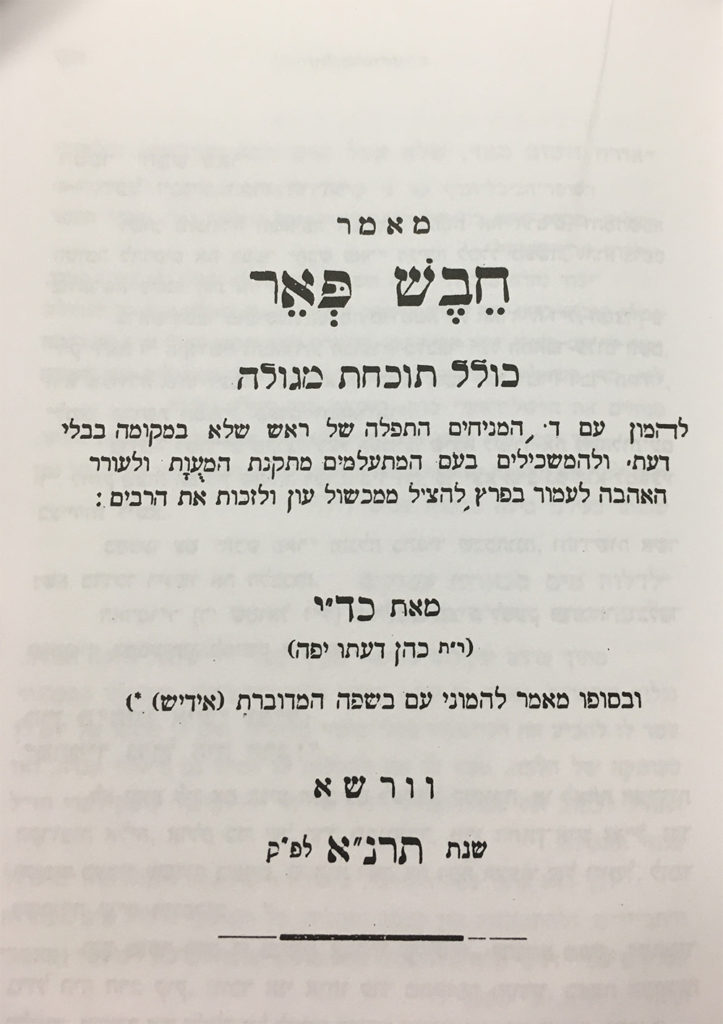
As is typical for Rav Kook, he signs himself, “Abraham Isaac Hakohen Kook, servant to the servants of the Lord…Bausk.”[22]

Evidently, Rabbi Turbowitz was not one to take something lying down. He came back at Rav Kook with a stinging reply, integrated into Ziv Mishneh, his commentary to Maimonides’ Mishneh Torah.[23] There, in Hilkhot Tefillin (4:1), he maintains that since “rubo ke-khulo is a universal principle in the entire Torah”[24]—this applies to tefillin as well. He reiterates once again his proof from the TaZ, who ruled that the blessing is recited once again only in a scenario where the tefillin are totally displaced. He mentions the opinion of “one wise man” (“hakham ehad”) who wrote that even the slightest deviation disqualifies the mitsvah, and disagrees. According to Rabbi Turbowitz, lekhathilah (to begin with), the entire phylactery should be above the hairline with none of it extending down to the forehead, but be-di‘avad (ex post facto), if a minority of the phylactery is below the hairline, one has nonetheless fulfilled the commandment. And therefore, the anonymous sage was wrong to badmouth the masses, who are remiss in this respect, and their spiritual leaders, who look the other way and do not protest. “He spoke shabbily of the people of the Lord and will in the future be called to judgment!” After summing up rather concisely the position he took earlier in Tif’eret Ziv, Rabbi Turbowitz now lambastes Rav Kook for what he wrote in Torah mi-Zion (Jerusalem, 1900), no. 4, chap. 4, accusing Rav Kook of deliberately misquoting him.

In 1925, two disciples of Rav Kook, Rabbi Yitshak Arieli[25] and Rabbi Uri Segal Hamburger,[26] reissued Hevesh Pe’er in Jerusalem with Rav Kook’s permission.[27] Appended to the work was Rav Kook’s rebuttal “Kelil Tif’eret.” (In addition, this edition was graced by the comments of Rav Kook’s deceased father-in-law, ADeReT, and of Rav Kook’s admirers in Jerusalem: Rabbis Tsevi Pesah Frank, Ya‘akov Moshe Harlap, and Yehiel Mikhel Tukachinsky. Finally, there are the substantial “Comments upon Comments” [“He‘arot le-He‘arot”] of the editor, Rabbi Yitshak Arieli.)[28]

In 1939, Rabbi Yosef Avigdor Kesler of Rockaway (Arverne to be precise)[29] published a second collection of his deceased father-in-law, Rabbi Ze’ev Turbowitz’s numerous responsa. Whereas the first collection of Tif’eret Ziv covered only Orah Hayyim, this collection covered all four sections of Shulhan ‘Arukh.[30] In addition, it contained a supplement (Kuntres Aharon) entitled “Mele’im Ziv.” In the supplement, Rabbi Kesler published a letter from ADeReT to Rabbi Turbowitz that turned up in the latter’s papers.

ADeReT’s letter is datelined “Monday, Vayyetse, 5657 [i.e. 1896].” In the letter, ADeReT gratefully acknowledges receipt of the recently published book Tif’eret Ziv. Regretting that he is unable to send monetary payment for the book because he is presently inundated with works of various authors, ADeReT nonetheless wishes to at least offer some comment on the contents of the book.[31]

Referring to the very first responsum in Tif’eret Ziv, ADeReT rejoices that Rabbi Turbowitz sought to advocate on behalf of the Jewish People regarding the commandment of tefillin. He is especially overjoyed that Rabbi Turbowicz was not cowed, but dared to differ. ADeReT holds up as role models Rabbi Zerahyah Halevi (Ba‘al ha-Ma’or) who critiqued Rabbi Isaac Alfasi (Rif), only to be attacked himself by Rabad of Posquières; Rabad of Posquières who critiqued Maimonides; et al. Since this is the “way of Torah” (darkah shel Torah), why should he harbor any resentment toward Rabbi Turbowitz for disagreeing with him?[32] (ADeReT, though not the author of Hevesh Pe’er, had wholeheartedly endorsed it.)

The sterling character of ADeReT is best summed up in these lines:

God forbid, I am not deluded to think that truth resides with me. I wholeheartedly acknowledge the truth. I have not a thousandth part of resentment towards one who differs with me. And the opposite, I love him with all my soul when he points out to me the truth.[33]

Since Rabbi Turbowitz acted as a true talmid hakham (Torah scholar) who uninhibitedly speaks truth, ADeReT wonders why he failed to mention the name of the work he critiqued, Hevesh Pe’er. This would have provoked neither the author nor ADeReT.[34]

In this vein of truth-seeking, ADeReT proceeds to explain why the argument presented in Tif’eret Ziv failed to dissuade him from the position adopted both by him and the author of Hevesh Pe’er. Since the shi’ur or measurement of the area on the head where the phylactery is to be placed is Halakhah le-Moshe mi-Sinai (a law to Moses from Sinai), the principle of “rubo ke-kulo” is of no consequence in this regard.[35]

Realizing the historic importance of the contents of the letter, Rabbi Kesler provided a photograph of the crucial passage in the letter, which reads as follows:

About two years ago, the thought occurred to me to reprint the booklet Hevesh Pe’er. I wrote to its author, my son-in-law, my soul-friend (today the Rabbi of Bausk, may he live) and asked him if he has anything new to add to it. He wrote me an article, brief in quantity but great in quality, that it is possible to say ‘rubo ke-khulo.’ In the summer of 5655 [i.e. 1895] when I was in Warsaw, I already spoke with a printer and also notified the [government] censor, and I was thinking to print. But after this, I reversed myself, and the two of us [i.e. ADeReT and Rav Kook] agreed that it is not worthwhile to print leniencies (kulot) in this.[36]

ADeReT explains that if we show any leniency, it will prove a slippery slope. He reveals to Rabbi Turbowitz his unusual experience with Hasidim in particular: “From this, there came about in places where the Hasidim reside [the custom] to wear large tefillin.[37] Not one in a thousand bears most of the tefillah within the hairline. In most cases, but a small fraction (mi‘uta de-mi‘uta) [is within the hairline]. I have seen with my own eyes the entirety upon the forehead. They laughed at my rebuke, saying: ‘Thus is the mitsvah.’ ‘So we saw our fathers doing.’ etc. etc.”[38]

The letter concludes with this salutation:

His friend who is honored by his love, appreciates his genius and his Torah, and blesses him with all good,

Elijah David Rabinowitz Te’omim

…Mir[39]

[1] These are the exact words of Rabbi Joseph Avigdor Kesler in the introduction to his father-in-law Rabbi Ze’ev Wolf Turbowitz’s work of responsa, Tif’eret Ziv (Brooklyn: Moinester Publishing Company, 1939), p. 7, par. 5.

By the time of his passing in 1935, Rav Kook would be immortalized as a twentieth-century Rabbi Levi Isaac of Berdichev, the great advocate of the Jewish People, forever defending their practices in the heavenly tribunal. Today, Rav Kook is famous for his leniency concerning the Shemitah or Sabbatical year, the heter mekhirah, which allows sale of the land to a non-Jew for the duration, whereby agriculture, or at least some forms thereof, may take place. The model for this contract is the prevalent mekhirat hamets or sale of leaven to a non-Jew before Passover, so that it need not be removed from the home of the Jew.

However, in general, if one studies the teshuvot (responsa) of Rav Kook, he does not come across as extraordinarily lenient in his pesakim or halakhic decisions. Par contre, someone whose work is chock-full of startling leniencies is Rabbi Aryeh Tsevi Fromer of Kozhiglov (1884-1943), Rosh Yeshivah of Yeshivat Hakhmei Lublin and a disciple of Rabbi Abraham Bornstein (author of responsa Avnei Nezer). Rabbi Fromer designed his work of responsa, Erets Tsevi (Lublin, 1938), to be melamed zekhut, to find some halakhic justification (however farfetched) for certain otherwise anomalous practices within the Jewish community. This is apparent from the very first responsum, where the author attempts to justify the prevalent practice of wearing a tallit katan that fails to meet the prescribed shi‘ur or measurement.

[2] The title page credits as author: “KDY (Kohen Da‘ato Yafah).” The expression “kohen she-da‘ato yafah” comes out of the Mishnah, ‘Avodah Zarah 2:5. Thus, the title alludes to the author being a Kohen or member of the priestly caste.

The thought occurs to this writer (BN) that “Yafah” might be an allusion to Rav Kook’s descent from Rabbi Mordechai Yaffe (author of the Levush[im]). Rav Kook was immensely proud of his pedigree which reached back to the Levush. The pedigree to the Levush was something that Rav Kook had in common with his father-in-law ADeReT. In the letter written by Rav Kook’s paternal great-uncle, Rabbi Mordechai Gimpel Yaffe of Rozhinoy, to the Trisker Maggid, Rabbi Abraham Twersky, Rabbi Yaffe mentions their remote common ancestor, the Levush.

[3] The title is taken from the verse in Ezekiel 24:17: “Pe’erkha havosh ‘alekha” (“Bind your head-tire upon you”). The Rabbis interpreted the head-tire as a reference to the head-tefillah; see b. Mo‘ed Katan 15a.

[4] y. ‘Eruvin 10:1; b. Menahot 37a; Maimonides, MT, Hil. Tefillin 4:1; Rabbi Joseph Karo, Shulhan ‘Arukh, Orah Hayyim 27:9.

[5] m. Megillah 4:8.

[6] Deuteronomy 6:8.

[7] Shulhan ‘Arukh, Orah Hayyim 27:1.

[8] In Hevesh Pe’er, chap. 2, the author points out that there already appeared in print a small booklet with diagrams, “Tikkun ‘Olam ‘im tsiyurim,” but writes that the error persists depite that.

[9] Rav Kook’s first wife, Alta Batsheva, daughter of ADeReT, died at a young age, leaving him to raise their infant daughter, Freida Hannah. ADeReT suggested to Rav Kook that he marry Reiza Rivkah, ADeReT’s niece, daughter of his deceased twin brother, Tsevi Yehudah, Rabbi of Ragola. ADeReT had raised Reiza Rivkah in his home after her father’s death.

[10] Rabbi Jacob of Coucy, Sefer Mitsvot Gadol, positive commandment 3; Hevesh Pe’er, chap. 2. At the end of positive commandment 3, Rabbi Jacob gives the exact year of his campaign in Spain: 4996 anno mundi or 1236 C.E.

Urbach writes that this role of the itinerant preacher, or darshan, is without precedent among the French Tosafists; he conjectures that in this respect, Rabbi Moses of Coucy came under the influence of Hasidei Ashkenaz. See E.E. Urbach, Ba‘alei ha-Tosafot (Jerusalem: Bialik Institute, 1995), pp. 466-470. Concerning specifically French Jewry’s laxity when it came to observing the commandment of tefillin, see ibid. p. 469, n. 13 (citing Tosafot, Shabbat 49a, s.v. ke-Elisha Ba‘al Kenafayim, and Rosh Hashanah 17a, s.v. karkafta de-lo manah tefillin). The SeMaG refutes Rabbenu Tam’s understanding of “karkafta de-lo manah tefillin.”

[11] Rabbi Ya‘akov Moshe Harlap, quoted in Rabbi Moshe Tsevi Neriyah, Sihot ha-Rayah (Tel-Aviv, 1979), p. 191, and idem, Tal ha-Re’iyah (Tel-Aviv, 1993), p. 116. According to Rabbi Harlap, the Slonimer Rebbe reached out to ADeReT, hoping that he could prevail upon his former son-in-law (and present nephew by marriage) to accept this magnaminous offer.

[12] Rav Kook’s erstwhile mentor in the Volozhin Yeshivah, Rabbi Naphtali Tsevi Yehudah Berlin (NeTsIV), was so enamored of Hevesh Pe’er that he kept it in his tallit bag. See the Introduction of Rabbis Yitshak Arieli and Rabbi Uri Segal Hamburger to the Jerusalem 1925 edition of Hevesh Pe’er, p. 2.

[13] See Rabbi Israel Meir Kagan, Mishnah Berurah (Warsaw, 1884) to OH 27:9. In the Be’ur Halakhah, Rabbi Kagan sought support for this prescription in the manuscript glosses of “the Gaon Rabbi El‘azar Harlap” to Ma‘aseh Rav (a collection of the practices of the Vilna Gaon). If I am not mistaken, these notes would have been penned by the Gaon (and Mekubal) Rabbi Ephraim Eliezer Tsevi Harlap of Mezritch.

[14] Rabbi Ze’ev Wolf Turbowitz was born Rosh Hodesh Iyar, 1840 in Baboina near Kletsk and was known in his youth as the “Ilui of Baboina.” His first wife was from Izilian. After his marriage, he devoted himself exclusively to study of Torah, whereby he was then known as the “Porush of Izilian.” At a tender age he began to study Kabbalah. (Among his writings was found a work on Zohar.) In 1863, he was appointed as a rosh metivta in Minsk. In 1866, he received his first rabbinical position in Swislowitz. In 1875, he assumed the rabbinate of Kletsk. Afterward, he served a stint in Wolpa. And finally in 1889, he was elected rabbi of Kraz, where he served until his death on the 14th of Kislev, 5682 [i.e. 1921]. These biographical details were gleaned from his son-in-law Rabbi Yosef Kesler’s introduction to the Brooklyn 1939 edition of Tif’eret Ziv, p. 4.

Rabbi Eitam Henkin hy”d wrote of the interface between Rabbi Turbowitz and Rabbi Eliyahu Goldberg, mentor of Rabbi Yehiel Mikhel Epstein (author of ‘Arukh ha-Shulhan). Besides corresponding with Rabbi Goldberg in halakhic matters, Rabbi Turbowitz delivered a moving hesped (eulogy) for Rabbi Goldberg in 1875 in the town of Kletsk, Rabbi Goldberg’s birthplace. See Rabbi Eitam Henkin, Ta‘arokh Lefanai Shulhan (Israel: Maggid, 2018), pp. 359-360, 363.

[15] See Rabbi Ze’ev Wolf Turbowitz, Tif‘eret Ziv (Warsaw, 1896), no. 1. Ziv is an acronym for Ze’ev Yekhuneh Volf.

The responsum is datelined “Wednesday, 16 Tamuz, 5651 [1891],” which means that it was penned the same year that Hevesh Pe’er was published. Rabbi Turbowitz does not mention the book by name, referring to it as “a new book that has appeared” (“sefer ehad hadash she-yatsa la-’or”).

By the same token, in responsum 12 of Tif’eret Ziv, where Rabbi Turbowitz engages with another early work of Rav Kook (in fact, his first), ‘Ittur Soferim, he refers to that work obliquely as “sefer ehad katan” (“a small book”). Rabbi Abraham Joshua of Pokroi had raised the question whether one who becomes bar mitsvah at night must recite once again the blessing for studying Torah (birkat ha-Torah), though he already recited it that morning. The editor, Rav Kook, devoted a few pages to resolving this problem. See ‘Ittur Soferim, Part Two (Vilna, 1888), 9a-10b. Rabbi Turbowitz made short shrift of the question. At the same time, he tackled the Vilna dayan, Rabbi Shelomo Hakohen, who had also raised the question in his work, Binyan Shelomo. In the Brooklyn 1939 edition of Tif’eret Ziv, the first two responsa are to Rabbi Shelomo Hakohen, who had defended his position to Rabbi Turbowitz.

According to Rabbi Turbowitz’s son-in-law, Rabbi Yosef Avigdor Kesler, the famous “Gadol of Minsk” (i.e. Rabbi Yeruham Yehudah Perlman) read Rabbi Turbowitz’s responsum concerning the placement of the head-phylactery before it went to print and approved its contents. See the supplement to the Brooklyn 1939 edition of Tif’eret Ziv, Kuntres Aharon, “Mele’im Ziv,” 2d-3a, footnote.

[16] Tif’eret Ziv, 6a. The quote is from b. Pesahim 66b: “Leave Israel alone! If they are not prophets, they are the children of prophets.” Rabbi Turbowitz’s remark is quoted in Yehudah Mirsky, Rav Kook: Mystic in a Time of Revolution (New Haven: Yale University Press, 2014), p. 23.

[17] Tif’eret Ziv 1:3 (6c).

[18] Tif’eret Ziv 1:16-21 (8c-9b). See Rabbi David Halevi (TaZ), Magen David to OH 8:15; cited in Mishnah Berurah to OH 25:12.

[19] See previous note.

[20] It may strike the reader as ironic that Rav Kook introduced at this point in the discussion the concept of rubo ke-khulo when he had earlier rejected its application. But from Rav Kook’s standpoint (and that of his father-in-law Aderet, see below note 35), that principle simply could not be applied to the area of the phylactery with its precise dimensions. “Shi‘urim halakhah le-Moshe mi-Sinai,” “Measurements are a law to Moses from Sinai” (y. Pe’ah 1:1, Hagigah 1:2; b. ‘Eruvin 4a, Yoma 80a, Sukkah 5b).

[21] Rabbi Abraham Isaac Hakohen Kook, “Kelil Tif’eret” in Hevesh Pe’er, ed. Rabbis Y. Arieli and Uri Segal-Hamburger (Jerusalem: Mossad Harav Kook, 1985), p. 46. Of course, the element of hesah ha-da‘at, i.e. whether one has “removed one’s awareness,” plays a crucial part in determining whether one must recite the blessing on the tefillin once again. See ibid.

Rav Kook’s hiluk (differentiation) between “‘etsem ha-mitsvah” and “ma‘aseh ha-mitsvah” (especially the terminology) is somewhat remarkable, issuing as it did from the pen of Rav Kook, who studiously avoided the school of Hasbarah with its abstract constructs and neologisms, then in vogue in the Lithuanian yeshivah world. The most famous proponent of Hasbarah was Rabbi Hayyim Soloveitchik (who would one day inherit his father Rabbi Yosef Dov Soloveitchik’s rabbinate in Brisk, whereupon he would be known as “Reb Hayyim Brisker”). The latter’s methodology of Talmudic analysis came to be known as the “Brisker derekh [ha-limud],” “the Brisker way.”

Rav Kook’s biographers have duly noted that his first mentor back in Dvinsk (since Rav Kook’s bar mitsvah), Rabbi Reuven Halevi Levin (known as “Reb Ruvaleh Denaburger”) had, so to speak, “immunized” Rav Kook against the trend of “sevarot” or newfangled “concepts.” Rabbi Reuven Levin was highly suspicious of sevarot that had not been enuciated already by the rishonim, the medieval authorities. (See Rabbi Kesler’s introduction to Tiferet Ziv, Brooklyn 1939, p. 8, par. 9, quoting Rabbi Reuven Levin, and ibid. sec. Hoshen Mishpat, responsum 46:6 [116c]: “It is not my way to say sevarot of my own cognizance.”)

And thus, when later Avraham Yitshak Kook arrived at Volozhin, “the mother of yeshivot,” he gravitated to the elder Rosh Yeshivah, Rabbi Naphtali Tsevi Yehudah Berlin (NeTsIV), known as a pashtan, a champion of the simple understanding of the text, rather than to his grandson-in-law, Rabbi Hayyim Soloveitchik, who was surrounded by budding scholars attracted to the exciting new method of Talmudic analysis that he was developing.

Although Rav Kook was never so outspoken as Ridbaz Wilovsky (“Reb Yankel Dovid Slutsker”) who satirized the new method as “chemistry,” Rav Kook was clearly on the other side of the great divide between Lithuanian Talmudists. This aversion of Rav Kook to the method of “hasbarah” was given eloquent testimony in recently unearthed correspondence concerning the unsuccessful attempt of Rabbi Shim‘on Shkop (a rosh yeshivah in Telz and later head of his own yeshivah in Grodna) to be accepted as Rosh Yeshivah of Merkaz Harav in Jerusalem. Speaking in Rav Kook’s name, his devoted disciple Rabbi Ya‘akov Moshe Harlap conveyed to Rabbi Hizkiyahu Yosef Mishkovski of Krinik (who had interceded on Rabbi Shim‘on Shkop’s behalf) the following laconic response:

Regarding the proposal concerning the Gaon Rabbi Shim‘on Shkop, may he live, to accept him as Rosh Yeshivah of Merkaz Harav, there is certainly nothing to discuss, for since the founding of the Yeshivah, this position is reserved for Maran [our master, i.e. Rav Kook], may he live, who plans to fill it himself. For Maran, may he live, wishes—and this is a strong desire—that the main method of learning of the Yeshivah be according to the order and method of the Gra [i.e. the Gaon Rabbi Elijah of Vilna], of blessed memory. Though he [i.e. Rav Kook] knows and feels also the great necessity of developing the methods of “hasbarot” (conceptualizations) and “havanot hegyoniyot” (logical understandings), he wants the main spirit of the Yeshivah to be based on his method, etc. Today I showed Maran, may he live, his honor’s letter, and what I wrote here is his response.

Rabbi Harlap’s letter is datelined “Monday, 2nd day of Rosh Hodesh Adar, 5686 [i.e. 1926], Jerusalem.” It was published in a Festschrift for his grandson, Rabbi Zevulun Charlop, Zeved Tov, ed. Ari S. Zahtz (New York: Yeshiva University Press, 2008), p. 103.

Inter alia, “Z. Wein” mentioned in the letter from Rabbi Shkop to Rabbi Tobolsky, expressing his desire to settle in the Holy Land (ibid. p. 101), is none other than [Rabbi] Ze’ev Wein a”h, father of Rabbi Berel Wein shelit”a. Rabbi Ze’ev Wein (1906-2004), a disciple of Rabbi Shkop, went on to study in Rav Kook’s Merkaz Harav in Jerusalem. He served for many years as a distinguished rabbi in Chicago.

Rabbi Shim‘on Shkop was famous for his method of “higayon” (logic), displayed in his magnum opus, Sha‘arei Yosher. (Rabbi Hershel Shachter shelit”a revealed to this writer [BN] that his father-in-law, Rabbi Yeshayah Shapiro, a rosh yeshivah at Torah Vodaath in Brooklyn, was instrumental in writing that work.)

This is not the place to discuss in any depth the differences between Rabbi Shim’on Shkop’s method and that of Rabbi Hayyim Brisker and his heirs. Two anecdotes should suffice. The Briskers quipped that Rabbi Shim‘on “had looked at the world and created the Torah” (“Istakel be-‘alma u-vara ’oraita”), a reversal of the Zohar’s adage, “[God] looked at the Torah and created the world” (“istakel be-’oraita u-vara ‘alma”). On one occasion, Rabbi Yitshak Ze’ev Soloveitchik (“Reb Velvel,” known as the “Brisker Rov,” for he inherited from his father Rabbi Hayyim the rabbinate of Brisk) met Rabbi Shim‘on Shkop and told him: “I removed from your student Rabbi Leib Malin the last sinew (gid) left from your teaching.” (The imagery is that of deveining or nikkur. Reb Velvel used the Yiddish verb, “treiberen.”) Both anecdotes were heard from Rabbi Shelomo Fisher shelit”a of Jerusalem.

[22] In 1895, Rav Kook left the town of Zeimel for the large city of Bausk, Latvia.

[23] Rabbi Ze’ev Wolf Turbowitz, Ziv Mishneh (Warsaw, 1904). The author has the rather unique distinction of viewing Maimonides as a kabbalist and finding kabalistic “sources” for his rulings. (Similarly, the introduction to the Warsaw 1896 edition of Tif’eret Ziv demonstrates the author’s proficiency in Lurianic kabbalah.) Though not unique in this respect, Rabbi Turbowitz is perhaps the most outspoken proponent of this peculiar methodology of studying Maimonides’ Mishneh Torah. Another Maimonidean commentator who occasionally resorts to this method of sourcing is Rabbi Joseph Rosen (the Rogatchover Gaon). See his Tsafnat Pa‘neah, Hil. ‘Avodah Zarah 12:6. Nowadays, Rabbi Hayyim Kanievsky’s Kiryat Melekh is replete with references to Zohar.

[24] b. Horayot 3b; and Rashi, Zevahim 26a, s.v. hikhnis rosho ve-rubo. Both are referenced by Rabbi Turbowitz.

[25] Rabbi Yitshak Arieli was one of the founders of Yeshivat Merkaz Harav and acted in the official capacity of “Mashgiah” of the Yeshivah. He is most famous for his work on the Talmud, ‘Eynayim le-Mishpat. Recently, Aharon Ilan, a great-grandson of Rabbi Yitshak Arieli, brought out his biography, ‘Eynei Yitshak (Jerusalem, 2018).

[26] Rabbi Uri Segal Hamburger was a descendant of Rabbi Moshe Yehudah Segal Hamburger of Novemeste (a disciple of the Hatam Sofer) who came to Erets Yisrael in 1857. Rabbi Uri Segal Hamburger resided in the Old City of Jerusalem until its conquest by the Jordanians in 1948. He penned a memoir of that tragic event, “Be-Tseiti mi-Yerushalayim.” One may find a short biography and a photograph of Rabbi Hamburger in ‘Eynei Yitshak, pp. 136-137.

[27] Rav Kook’s biographer and disciple, Rabbi Moshe Tsevi Neriyah, records that Rav Kook wrote in his haskamah (letter of approbation) to the publishers the following disclaimer: “In our holy land, which thank God, is full of Torah and fear of heaven, the admonition (azharah) is not so necessary. Nevertheless, I have not prevented re-issuing the book, for the benefit of our brothers in the diaspora, in areas where the matter is yet in need of correction” (Sihot ha-Rayah, pp. 189-190). This disclaimer does not appear in the printed version of the haskamah. Where did Rabbi Neriyah obtain it? The mystery was cleared up in the new edition of Sihot ha-Rayah (2015) published after Rabbi Neriyah’s passing. Rabbi Arieli’s son, Prof. Nahum Arieli, wrote to Rabbi Neriyah that he has in his possession much material that went into the making of the Jerusalem edition of Hevesh Pe’er edited by his father, including a “petek” (note) with those exact words. Rabbi Neriyah’s daughter, Tsilah Bar-Eli, granted Aharon Ilan permission to include a facsimile of Nahum Arieli’s letter to her father (on stationery of Bar-Ilan University) in the biography of Rabbi Arieli, ‘Eynei Yitshak, p. 139.

[28] Rabbi Arieli’s promised “Kuntres Aharon” was never published. Remnants of the manuscript are in the possession of his heirs. Rabbi Neriyah speculated that financial considerations prevented its publication in Hevesh Pe’er. See ‘Eynei Yitshak, p. 138, n. 102.

[29] On the inside of the book, Rabbi J. Kesler’s address is given as: “146 Beach 74th Street, A[r]verne, Long Island.”

[30] It is important to note that the two collections do not overlap. The responsa on Orah Hayyim that appeared in the Warsaw 1896 edition of Tif’eret Ziv, were not included in the Brooklyn 1939 edition. In their stead, appear more recent responsa on Orah Hayyim. In terms of sheer quantity, the second collection by far outstrips the first. The first Warsaw edition has 122 pages; the second Brooklyn edition, 488 pages.

[31] “Mele’im Ziv,” 2a-b.

[32] “Mele’im Ziv,” 2b-2c.

[33] “Mele’im Ziv,” 2d.

[34] “Mele’im Ziv,” 3a.

[35] “Mele’im Ziv,” 3a-b.

[36] The facsimile occurs in Rabbi Kesler’s introduction to the book on p. 7. It is transcribed in “Mele’im Ziv,” 3b.

If not for the evidence of the facsimile, it would indeed be difficult to accept that Rav Kook once entertained even the remote possibility of invoking the principle of rubo ke-khulo in this regard.

[37] To this day, Lubavitcher Hasidim wear very large tefillin.

[38] “Mele’im Ziv,” 3b-c.

[39] “Mele’im Ziv,” 3d.

In 1893, ADeReT left the community of Ponevezh to assume the rabbinate of Mir.


Rabbi Steinman and the Messiah, part 2

Rabbi Steinman and the Messiah, part 2

Marc B. Shapiro

Continued from here

1. R. Yehudah Herzl Henkin has a different perspective than what we have seen so far.[1] He rejects the notion that “waiting” for the Messiah means that one must believe that he can come at any second, for the Sages already said that the Messiah will not come at certain times. He writes:[2]

ובעיקר הענין הרביתי בראיות מן הגמרא שחז”ל לא ציפו שהמשיח יבוא בכל עת

Contrary to the Brisker Rav (whom he mentions by name), R. Henkin writes: “There is nothing in the Rambam requiring one to believe that the Messiah is ready to come at any moment.”[3] He claims that the Rambam’s real point is that one should not be at ease with the Messiah not having arrived, but rather one should be upset that he hasn’t yet come. A similar argument was made by R. Shmuel Yaakov Weinberg.[4] Unlike R. Shulzinger (see the previous post), R. Henkin does not find a problem with those who mentioned dates for the redemption (and this includes a few important figures[5]), since he suggests that the dates were never intended to be absolutely certain.

Yet R. Henkin adds that it is clear that the sages who gave dates for the Messiah—even if their suggested dates were not certain— did not have אמונה שלמה that the Messiah would come before the dates they predicted, and they obviously are not to be regarded as heretics. He sees this point as contradictory to the Brisker Rav’s claim (as it is usually understood) that one must hope for and await the Messiah’s arrival every day. R. Henkin’s explanation is certainly not in contradiction to the Rambam’s Principle. If the sages who gave dates for the Messiah did not deny that they could be wrong, and that the Messiah could come at any time, then they were not contradicting the Rambam’s Principle. The only thing they were contradicting is the version of the Principle in the siddur which adds the words באמונה שלמה. Yet these words not appear in the Rambam’s formulation.

R. Henkin adds that it is strange that the Brisker Rav would declare that anyone who does not have his understanding of the Twelfth Principle is a heretic, when his understanding is not explicitly found in the Torah, the Talmud, or the rishonim.[6]

ואפילו לדברי הגרי”ז שצריך להאמין שהנה ממש היום הזה הוא בא וכו’ עכ”ל, מן התימה על האי גאון וצדיק ז”ל להחזיק מי שאינו מאמין כן ככופר כיון שהדבר אינו מבואר לא במקרא ולא בחז”ל ולא בראשונים.

R. Henkin concludes that it is enough to believe that the Messiah will come even if you assume that he will not come today or tomorrow. He also cites his grandfather, R. Joseph Elijah Henkin, that “to wait for the coming of the Messiah” does not mean that you think he is ready to come at any instant.[7]

קושטא דמילתא המאמין באמונה שלמה בביאת המשיח ומחכה לו ומתאווה לבואו קדוש ייאמר לו אף על פי שסובר שלפי מאמרי חז”ל לא יבוא היום או מחר, וכן אמר מו”ז הגה”צ זצלה”ה שלחכות לביאת המשיח אין פירושו שעומד לבוא בכל רגע וכן עמא דבר.

In support of R. Henkin, we can cite R. Yohanan ben Torta, who when R. Akiva declared that Bar Kokhba was the Messiah, responded as follows: “Akiva, grass will be growing out of your cheeks and the Messiah will still not have come.”[8] As R. Meir Mazuz notes, R. Yohanan ben Torta believed in the concept of the Messiah, but he did not see any chance that the redemption would come in his generation.[9] In other words, he was not “actively waiting” for the Messiah.

R. Menachem Kasher has another approach. He understands Maimonides’ words that one must wait for the Messiah in a negative sense, namely, that if one despairs of the Messiah’s arrival he is in violation of Maimonides’ words, but not that there is a continuous obligation to wait for the Messiah’s arrival.[10] R. Yisrael Weinman also questions the Brisker Rav’s understanding (although he is not certain the Brisker Rav really said it), since according to some rishonim the Messiah cannot come on Shabbat and Yom Tov. He therefore assumes that it is enough to wait for the Messiah to arrive whenever he is able to come.[11]

R. Yaakov Nissan Rosenthal explains that the siddur’s version of Maimonides’ principle,

עם כל זה אחכה לו בכל יום שיבוא

does not mean that you must believe and expect every day that today is the day the Messiah will come. Rather, the meaning of בכל יום is that every day you must believe in the coming of the Messiah and await his arrival, whenever that will be.[12] He offered an example to illustrate this point: A man’s daughter married and moved to the Diaspora. The father waits every day for his daughter to return to Israel, but on every day he does not expect that all of a sudden he will hear a knock at his door and his daughter is standing there.[13]

אין המאמין מחכה דוקא שלפתע פתאום יבוא האדון אל היכלו באופן ניסי ושיודיעו לו שהיום בא המשיח, אך הוא כן מחכה בכל יום לביאת המשיח

Significantly, R. Shlomo Zalman Auerbach agreed with R. Rosenthal and didn’t even think this was a hiddush, but rather the simple meaning of the words אחכה לו בכל יום שיבוא. R. Rosenthal then tells about how he was at a meeting with R. Shlomo Zalman and other rabbis, and he presented his understanding. A few of the hasidic rebbes present started screaming that what he said was wrong and in contradiction to one of the Principles of Faith. R. Shlomo Zalman didn’t say a word. After the meeting R. Rosenthal asked R. Shlomo Zalman why he didn’t defend him from the attacks of the hasidic rebbes. R. Shlomo Zalman replied that you shouldn’t start up with Hasidim

עם חסידים לא צריך להתחיל

R. Rosenthal couldn’t recall if the following witticism was said to him by R. Shlomo Zalman or someone else later told it to him: In the Amidah we say: על הצדיקים ועל החסידים. We see that the word צדיקים goes before חסידים

כי לא “מתחילים” עם חסידים

It is noteworthy that according to the Vilna Gaon’s understanding, if the Messiah does not come in a “hastened” fashion (see Sanhedrin 98a), it certainly seems that no one would be able to hope for the Messiah to arrive in Tishrei. The reason I say this is because of how the Vilna Gaon describes the terrifying things that will happen if the Messiah arrives in its “due time,” and this is in Tishrei.[14]

אם חלילה לא יזכו ותהיה “בעתה” ואז אם היתה הגאולה בתשרי לא היה להם תקומה ח”ו ולא היו נשארים חלילה אלא אחד מעיר ושנים ממשפחה מפני שמדת הדין שולט בתשרי

Also of interest is the report of how R. Jacob Kamenetsky told someone that the Messiah would not be arriving soon. A certain man had been convinced by people in Chabad that the Rebbe would soon reveal himself as the Messiah, and this had led him to start observing Shabbat. However, R. Kamenetsky thought that it was important to uproot the man’s belief that the Messiah would soon be here, as he worried about the negative consequences to the man’s Judaism when the Messiah did not arrive as he had been expecting.[15]

אל תאמין להם. משיח, לצערנו, עדיין אינו עומד לבוא . . . [רי”ק הסביר לתלמידיו] מה שהשיגו אנשי חב”ד הוא הישג מדומה, שיצא שכרו בהפסדו. בעתיד הקרוב, כשיראה יהודי זה שההבטחה לא נתמלאה והמשיח לא הגיע, יתחיל שוב לחלל את השבת. יתרה מכך, עד עכשיו הוא האמין בתמימות מוחלטת בביאת המשיח, ואם יתאכזב, יפסיד את אחד היסודות החשובים ביהדות – האמונה בביאת המשיח.

Based on this, I think we can say that R. Kamenetsky did not expect the Messiah to arrive in the near future.

Some Jewish traditions speak of a great war that will occur before the coming of the Messiah, and even of the death of Messiah ben Joseph in this war.[16] Other traditions see this great war as occurring after the coming of the Messiah. R. Hayyim Soloveitchik is reported to have said that if the messianic era will bring even one Jewish death, then he doesn’t want it, and if we had a choice in the matter the halakhah would require us to reject the Messiah in such a circumstance. I wonder, therefore, if R. Hayyim was really able to look forward to the messianic era, knowing that its arrival would bring the possibility of Jewish death.

Here is how R. Hayyim is quoted by R. Dov Katz.[17]

מספרים בשמו של ר חיים סולובייצ’יק מבריסק, הגאון של הדור הקודם, שבימי המלחמה כשנפלו כל כך הרבה חללים בחזית המלחמה וסבלו כל כך הרבה, אמרו לו פעם בשיחה, שלוא היתה לכל הפחות מביאה המלחמה הזו את הגאולה, כי אז היה אולי כדאי הדבר. גער בהם ר’ חיים ואמר להם: “תדחינה מאות גאולות ואל תפול נפש אחת מישראל, כי אם היתה באה שאלה לפנינו שאם על ידי קרבן של אדם אחד יבא המשיח, בודאי שהיינו פוסקים שלא יבוא המשיח ולא תמות נפש אחת, כי הלא פיקוח נפש דוחה כל התורה כולה, ואף המשיח והגאולה בכלל.”

I have no reason to doubt the accuracy of this report. It is very much in line with what we know about R. Hayyim’s views both about the value of human life, and also about the downplaying of messianism. R. Joseph B. Soloveitchik stated: “To R. Chaim, a good chidush in Torah and Kodshim – if I may say so, perhaps I shouldn’t say it – was more important than the whole beis ha-mikdash, in his intuitive weighing.”[18] R. Soloveitchik had some hesitations about what he said, because he knew it would be shocking to people, but he said it anyway. R. David Holzer, in his note on this sentence, writes: “Obviously, the Rav is speaking derech guzma, just to express the concept.” Even if the Rav is exaggerating his point is clear, namely, that Torah study is much more important than what will take place in the future Temple.

I think the Rav’s point is that an Ish Halakhah is simply not interested in the messianic era in any practical way. He believes it will come (and thus fulfills Maimonides’ requirement), but he doesn’t focus on it, for he has everything he needs in a non-messianic world, namely, the study of Torah and the fulfillment of mitzvot. As for the study of Torah, as the Rav said, creating a chiddush about the laws of sacrifices is more important than the sacrifices themselves, because at the end of the day Torah study is the focus of our lives, not sacrifices which we have been without the last two thousand years.

Even though I said that I have no reason to doubt what is reported in the name of R. Hayyim, and this report is also cited by R. Ovadiah Yosef,[19] I must note that R. Eliyahu Zini completely rejects the reported statement which he sees as absolute nonsense.[20]

טענות אלו דברי תימא גדולים הן. הלא הן סותרות כל מלחמה יזומה, אף כל מלחמת מצוה, וכ”ש מלחמת רשות! ואם נקבל אותן, נצטרך לגזור אומר, שגם כבוש הארץ בזמן יהושע איסור גמור היה, ושהיה עדיף להשאר במדבר כדי לחסוך בחיי יהודים רבים. ואסור להאמין שגדול בישראל אמר דבר כזה, שהרי טענות מרגלים יש כאן, מסוג “ארץ אוכלת יושביה היא וכל העם אשר ראינו בתוכה אנשי מידות”. ואם נאמץ אותן, עלינו לומר שהיה אף אסור לצאת ממצרים, כי יציאת מצרים הביאה למות דור שלם, ולכן היה עדיף לדחות אפילו גאולת מצרים!

לכן אסור להאמין לעדות זו. וגדול כר’ חיים מבריסק לא יאמר דברי הבל כאלו ויש כאן הוצאת דיבה על גאון זה, ובפרט שעדות זו מוכחשת ממה שכתב במפורש ר’ חיים עצמו [שלפי ר’ חיים אין דין פיקוח נפש חל בשעת מלחמה], והבאנו אותה כבר פעמיים לעיל

I don’t believe that R. Zini’s words, which come from a right-wing religious Zionist perspective, create any difficulty in believing that which R. Hayyim is quoted as saying, namely, given the choice between a Messiah which will require the loss of human life or no Messiah, that he would prefers the latter. What about R. Zini’s point that according to what is reported in R. Hayyim’s name, that human life stands above all, that the concept of milhemet mitzvah makes no sense? I think the answer is clear, namely, that R. Hayyim obviously acknowledged that in a halakhically valid war, and certainly in a war commanded by God (such as to conquer the Land of Israel), human life will be lost and we cannot have “conscientious objection.” (It is, however, hard to imagine how R. Hayyim would have been able to support a milhemet reshut.) 

Yet there is no halakhic imperative to bring the Messiah, and if given a choice between the Messiah with loss of life or no Messiah, R. Hayyim would forego the Messiah. Given the choice between a Jewish state that will require the loss of life—even a state that functions according to halakhah—or no state, R. Hayyim would forego the state. This was one of the two reasons for the anti-Zionism of R. Isaac Zev Soloveitchik, namely, that the actions of the Zionists endangered Jewish life. His other reason was that he believed that the Zionists would persecute religious Jews in a Zionist controlled state.

To be continued

Excursus

The old question is why did rabbis give dates for the Messiah’s arrival when the Talmud, Sanhedrin 97b, states: “Blasted be the bones of those who calculate the end (i.e., the Messiah’s arrival).” Maimonides actually mentions a family tradition as to when prophecy will be renewed, and this will precede the messianic era. See Iggerot ha-Rambam, ed. Sheilat, vol. 1, pp. 152-153.

On the second day of the Ten Days of Penitence, one of the selihot we read (Tohelet Yisrael) states:

חשבון אחר חשבון עמך יפתור

“Thy people interpret reckoning after reckoning.” This refers to predicted dates of the Messiah’s arrival. R. Zev Wolf Leiter sees this as a proof that there is no prohibition in offering dates for the Messiah as long as one does not lose faith in the messianic principle if the projected date comes without the Messiah’s arrival. See his Kevod Melakhim, Hilkhot Melakhim 12:2, found here and on Otzar haChochma.

In agreement with R. Leiter’s perspective, R. Menasheh Grossberg, Shevet Menasheh, no. 46, also suggests that there is no problem in giving dates of the Messiah’s arrival, and what the Talmud is criticizing is those who, if the Messiah does not come on the predicted arrival date, would then deny the principle of messianic redemption. His proof for this interpretation is the passage that comes directly after what I quoted above from Sanhedrin 97b: “For they would say, since the predetermined time has arrived, and yet he has not come, he will never come.” Thus, we see that the Talmud itself explains the reason for the curse of those who predict the Messiah’s arrival, and it is because if the Messiah does not arrive at the predicted date it will lead to heresy in that people will completely deny the principle of the Messiah. R. Grossberg goes so far as to write:

הנה הראשונים שהיו כמלאכים או כבני אדם מאמינים באמונה שלמה להם ראוי לחשוב בקצין ולחקור באמונה

R. Joseph Kafih states that the reason why sages gave dates for the Messiah’s arrival, or in Maimonides’ case the renewal of prophecy, was only in order to strengthen the people, that they not despair of redemption. In other words, the sages themselves did not take the dates seriously, as the point of publicizing this information was for an entirely different purpose. In R. Kafih’s words:

לא פעל רבינו כפי ההלכה לכתחילה, אלא בכדי לעודד את העם

See Teshuvot ha-Rav Yosef Kafih le-Talmido Tamir Ratzon (Kiryat Ono, 2018), p. 389.

This is the very same reason Maimonides gives for R. Saadiah’s messianic calculations. Maimonides writes as follows in his Letter to Yemen (Abraham Halkin and David Hartman, Crisis and Leadership: Epistles of Maimonides [Philadelphia, 1985]), p. 116):

As for Rabbi Saadiah’s calculations, there are extenuating circumstances for them though he knew they were disallowed. For the Jews of his time were perplexed and misguided. The divine religion might have disappeared had he not encouraged the pusillanimous, and diffused, disseminated, and propagated by word of mouth and the pen a knowledge of its underlying principles. He believed, in all earnestness, that by means of the messianic calculations he would inspire the masses with hope to the Truth. Verily all his deeds were for the sake of heaven. Consequently, in view of the probity of his motives, which we have disclosed, one must not decry him for his messianic computations.

R. Meir Leibush Malbim also provided dates for the messianic era. He believed that the initial stage of the Redemption would be between 1868 and 1913. The Temple would be rebuilt in 1925, sacrifices would begin to be offered in 1928, and the resurrection of the dead would take place in 2203. See Noah Rosenbloom, Ha-Malbim (Jerusalem, 1988), pp. 159-160.

R. Judah Leib Maimon reports that his father asked the Malbim how he could offer such dates in opposition to the talmudic statement against this. He replied that the proscription against offering dates was only in the early years after the destruction of the Temple, when the path until the end was still long. However, as we are now close to the end of the Exile it is permitted to give dates. See Maimon, Le-Ma’an Tziyon le Ehesheh (Jerusalem, 1954), p. 19. The same answer in the name of the Malbim is found in R. Yissachar Dov Teichtal, Em ha-Banim Semehah (Jerusalem, 1998), pp. 150-151. In both sources, in order to offer a parable explaining his point, the Malbim tells the story of a father and son taking a long journey. At the beginning of the journey, when the son asks if they almost there, the father is annoyed with him. However, after much time on the road, when the father asks the coachman the same question, he explains to his son that now that they have journeyed far the question is appropriate. It is the same with the exile, the Malbim explains. At the beginning, it was improper to offer predictions of its end. However, now that we are almost near the end, it is OK to do so. (In the version of the story told by Maimon, the young son is none other than the Malbim himself, and the answer comes from his father.)

R. Jacob Isaac Horowitz, the Chozeh of Lublin, is quoted as saying that those who, based on hints in the Torah, predicted dates for the Messiah’s arrival were really just offering a strong suggestion to God that it is time for Him to redeem the Jews. This is just like a son does not explicitly tell his father that he is doing something wrong, but instead shows him the Torah source so his father can draw the proper conclusion.

כי עפ”י הלכה באם בן רואה לאב שאינו עושה חלילה כיאות אז משום כיבוד אב לא יוכל לומר לו שאינו עושה כשורה רק החיוב להראות לו הדין בתורה ופוסקים ולומר לו אבא כך כתוב בתורה (עיין יור”ד סימן ר”מ סעיף י”א מש”ס קידושין דף ל”ב) וכיון שאנו רוצים לחות דעתינו לאבינו שבשמים שירחם על בניו ויגאל אותנו בקרוב וכי אין מן היושר כביכול שיסבלו עוד עול גלות לכן צדיק הדורות מחדשים איזה קץ משיח ועושים על זה רמז באיזה פסוק בתנ”ך איך שבשנה זו יבוא משיח צדקינו והוא להראות לאבינו הבורא ית”ש אבא כך כתוב בתורה היינו דבאותו מקום בתוה”ק כתוב שבשנה זו יבוא משיח בב”א

See R. Moshe Menahem Mendel Walden, Or ha-Niflaot, p. 12a, included in Ohel ha-Rabbi (Petrokov, 1913); Mendel Piekarz, Ha-Hanhagah ha-Hasidit (Jerusalem, 1999), p. 190.

******************

2. In the last post I mentioned Elliot Wolfson’s argument that the Lubavitcher Rebbe’s secret teaching is that there will be no physical redeemer, but the messianic redemption is able to occur within each person. A number of people were surprised to hear about this, as there is, I believe, literally not one person in Chabad who accepts this argument. While I do not believe that Wolfson is correct, it is important to note that one does find in Hasidic thought the concept of inner redemption.[21] Although this is not intended to replace the ultimate physical redemption, these Hasidic teachings do turn passages in the Talmud on their head. For instance, R. Meir of Apta asks why we need to pray for redemption if God has promised that he will redeem us. He quotes the Chozeh of Lublin who said that the Talmud, Megillah 16a, mentions that if you repeat a teaching in the name of someone else, you “bring redemption to the world.” The Chozeh points out that this is difficult, as every page of the Talmud has someone repeating a teaching in the name of someone else, and yet the redemption still has not come. The Chozeh replies that the redemption being spoken about is a personal redemption, that one is delivered from his difficult circumstances. Similarly,  when we pray for redemption, it is a prayer for personal redemption.[22]

דהנה השי”ת הבטיח לנו לפדותינו ולגאלינו מהגלות המר, ולכאורה יפלא מה צורך להתפלל על הגאולה, ההוא אמר ולא יעשה. אך ששמעתי [!] מרבינו הקדוש מוהרי”י זצללה”ה מלובלין על הגמרא כל האומר דבר בשם אומרו מביא גאולה לעולם, והתמיה נשגבה, כי בגמרא מצינו ממש בכל דף שאומר התנא דבר בשם חבירו או בשם רבו, ומדוע עוד לא נושענו מהגלות. ותירץ, כי הבאת הגאולה הוא גאולה פרטית לאיש ישראל ממצוקותיו, כאשר אמרנו, ותקם בעוד לילה שבהגלות יוושעו ישראל ויקומו בהרחבה והרוחה, וע”ז אנו מתפללים, וזה בכלל גאולה

3. In recent months there have been a number of discussions about epidemics in Jewish history and how the rabbis responded. No one has yet cited what the great R. Elijah Klatzkin wrote.[23] You can see this in R. Klatzkin’s Miluim le-Sefer Devar Halakhah (Lublin 1923), pp. 126-128. For some reason, the copy of this book on Otzar haChochma is missing the second half of the book. However, the complete work is available on hebrewbooks.org here.

R. Klatzkin prints an open letter he wrote in 1916 to his community in Lublin, when they were suffering a typhus epidemic. It originally was published in Yiddish and Polish. He obviously thought it was important that his message should be preserved for posterity, and over a hundred years later what he says unfortunately remains relevant to us.

R. Klatzkin tells the community that he has to write to them, rather than speak to them, as due to the danger they can no longer gather together in the synagogue. He mentions that although the government established rules to keep people healthy, nevertheless there are many who are ignoring the laws. (To this I would add, the more things change the more they stay the same.)

R. Klatzkin stresses that the various government rules are also required according to the Torah, and one who violates the rules, which bring danger to him and his neighbors, “his sin is too great to bear.” R. Klatzkin expresses wonder that he needs to warn people about these matters, which relate to their health and the health of their families. What he observed over a hundred years ago has of course repeated itself in our time, when for incomprehensible reasons entire communities simply ignored basic health guidelines which allowed the virus to spread very quickly, leaving a terrible toll.

R. Klatzkin states that he wouldn’t need to warn people to watch over their money, so how is it that people treat their health with less concern than their money? He then turns to the issue of hillul ha-shem, and we see that in his day it was also the case that there were Jews who created a hillul ha-shem in how they responded to the crisis. R. Klatzkin notes that even repentance, Yom Kippur, and personal suffering do not atone for hillul ha-shem.[24] “If we would behave in accordance with the Torah, then we would be a light unto the nations and would sanctify the name of heaven and the honor of the holy Torah.” In R. Klatzkin’s day, one of the reasons for the spread of the epidemic was the unsanitary conditions that the poor lived in, and he concludes his letter by appealing to the wealthy to support the poor so they can improve their living conditions.

In his open letter R. Klatzkin states that he spoke about the issue of hillul ha-shem and kiddush ha-shem in his book אמ”ש. This refers to his responsa Imrei Shefer which appeared in 1896, and he has in mind no. 92 in this book. In this responsum he makes a number of noteworthy points. To begin with, R. Klatzkin makes very clear that when it comes to halakhah there is a great distinction between real idolaters and the nations among whom Jews currently live. He cites the Meiri to back up this position and the entire lengthy responsum is in support of this point.

ורבים טועים ומתעין עצמם לחשוב שכל מה שמבואר בספרים להחמיר בטעות ואונאת אינו יהודי הוא רק מפני איבה ובאמת לא כן הדבר והוא איסור גמור . . . ומזה מבואר דכל מקום שכתוב בטור ושו”ע עכו”ם היינו בדיוק עובדי כוכבים ממש ואינו מדבר כלל מהאומות שבזמנינו המאמינים בהשגחה ושכר ועונש וכמו שמפורש במאירי

This shows that he really means what he says, unlike other works that include a comment at the beginning of the book saying that any time non-Jews are referred to it means idolaters who live in places like India and China. Comments like this were never taken seriously. In fact, the very existence of these comments was said by R. Moshe Feinstein to be a proof, contrary to R. Solomon Luria, that one is allowed to alter Torah teachings in the face of danger.[25]

R. Klatzkin begins his responsum by calling attention to a passage in R. Joseph Albo, Sefer ha-Ikkarim 3:25, where Albo states that one is not allowed to charge interest to a ger toshav. The problem is that this contradicts an explicit Mishnah, Bava Metzia 5:6, as well as the talmudic explanation of this Mishnah, Bava Metzia 71a.[26] R. Klatzkin offers an original explanation that when the Talmud says that you can charge a ger toshav interest this refers to one who is wealthy, but if a ger toshav is poor, and he needs the money to survive, then he is not to be charged interest. Also significant is R. Klatzkin’s point that in this matter, and similar things, contemporary non-Jews who observe the Noahide laws fall into the category of ger toshav. He assumes that Christians are not to be regarded as idolaters, so they too fall into this category.

R. Klatzkin discusses R. Moses Isserles’ responsum in which he tries to find some justification for the practice in Moravia to drink non-Jewish wine.[27] R. Klatzkin suggests that this leniency arose due to theological reasons, because most of the inhabitants of Moravia were followers of Jan Hus (i.e., Hussites) who rejected many Catholic practices, including the veneration of images. In other words, they were distant from any “idolatrous” practices, and thus there was a reason in people’s minds why the prohibition on non-Jewish wine should not apply to them.

R. Klatzkin also takes up the issue of darkhei shalom. He cites the Talmud and Maimonides that when it comes to non-Jews – even idolaters – the Sages said to bury their dead, visit their sick, and support their poor because of darkhei shalom. After mentioning this, Maimonides also quotes Psalms 145:9: “The Lord is good to all; and His tender mercies are over all His works,” and Proverbs 3:17: “Her ways are ways of pleasantness, and all her paths are peace.”[28] R. Klatzkin derives from this that the expression מפני דרכי שלום does not mean that Jews behave a certain way to avoid non-Jewish enmity. Rather, it means that by Jews acquiring the trait of mercy for all people, there will be peace on Israel. He cites the Jerusalem Talmud, Eruvin 7:9, which states:

מפני מה מערבין בחצרות מפני דרכי שלום

In this passage it is obvious that darkhei shalom means something positive, to create neighborliness. R. Klatzkin claims that this is exactly what the expression means when dealing with non-Jews, He states that when Jews extend themselves for non-Jews in the ways mentioned by the Talmud, there will be real peace – in a positive sense – between Jews and non-Jews.[29]

ומוכח מזה דמ”ש מפני דרכי שלום, אין הכוונה שלא ינטרו שנאה לישראל, אלא דקאמר שעי”ז שידבקו ישראל במדת החמלה ורחמים על כל יציר נוצר, יהיה שלום לישראל . . . הרי דפירוש מפני דרכי שלום, היינו שעי”ז אוהבין זא”ז ונעשה ביניהם שלום אמת, וה”נ הפירוש שיהא שלום אמת עם העמים, כאשר ידבקו ללכת בדרכי ה’ המרחם על כל מעשיו

******************

3. In my last post I had a quiz with two questions. A number of people got one of the questions correct, but only a few individuals got them both correct. I won’t mention any names because one of those who answered correctly asked to remain anonymous.

The first question was: Where in Rashi’s commentary on the Talmud does he say that a certain individual knew all of Shas?

In Beitzah 24b s.v. ולערב, Rashi writes about R. Kalonymus ben Shabbetai of Rome who had journeyed from Rome to Worms:[30]

גם עתה בא אלי מכתב מגרמיי”ש שבא לשם אדם גדול זקן ויושב בישיבה מן רומא ושמו ר’ קלונימוס ובקי בכל הש”ס

I took this question from R. Shlomo Schneider, author of the responsa volume Divrei Shlomo. In a work that has not yet been published he has a number of “quiz questions,” and in future posts I will cite more of them.

In terms of “knowing Shas,” it is noteworthy that today we hear about different great rabbis who have completed Shas twenty or thirty times, or even more than this. Yet in earlier days we see that the achievements of great rabbis are described in much more limited fashion. R. Joseph Karo’s maggid said to him that he would finish Shas three times, and that was thought to be a great blessing.[31] This was not just the prediction of the maggid, as R. David Conforte quotes the grandson of R. Karo that when his grandfather was on his deathbed he, too, said that he merited to complete the Talmud three times.[32] R. Karo also testified as to how rare it was in his day for anyone to complete the Talmud:[33]

בדורות אלו לא ימצא מי שלמד כל התלמוד כי אם אחד מעיר

Of course, it must be noted that when R. Karo speaks of completing the Talmud he is not referring to daf yomi style, but rather an in-depth study of every page.

Just like with have seen with R. Karo, in a letter to R. Betzalel Ashkenazi, the author of Shitah Mekubetzet, R. Moses Galante of Safed (1620-1689) writes that he has finished the Talmud three times.[34]

In describing the unique greatness of his teacher, R. Nissim of Gerona, R. Isaac ben Sheshet states that he was expert in three sedarim of the Talmud. Today, saying this about a leading sage would not be viewed as a compliment, as what about the other three sedarim, is he not also an expert in them? But this is what the Rivash writes.[35]

ה’ צב-אות הותיר לנו שריד דַבָּר אחד לדור הוא מורנו הרב הגדול רבינו נסים נ”ר היה כאחד מהם לדעת טוב טעם ודת בקי בשלשה סדרים ודמו לי’ כמאן דמנחי בכיסתיה ודעתו רחבה מני ים ושכלו זך וישר אין ערוך אליו בכל חכמי ישראל

For the other quiz question, I asked about the letters שב that are found after the first and second set of shofar blasts. What is this about?

I was going to discuss this matter and present various sources. However, Moshe Babad alerted me to the existence of a comprehensive article that recently appeared on this very topic, and thus there is no need for me to go into any detail. The article is by R. Yehudah Aryeh Markson and appears in the journal Etz Hayyim 30 (Elul 5778), pp. 408-437 (it is not yet on Otzar haChochma). The title of the article is

שב בני שב – לגלגוליו של מנהג קדמון שנשתכח

R. Markson begins by noting that he, like everyone else, simply paid no mind to the word שב that appears together with tekiat ha-shofar. It was only after he was asked what the meaning of שב is that he investigated the matter. This led him to uncovering the story of what used to be a widespread minhag that for some reason simply disappeared and was almost entirely forgotten from Jewish communal memory (with the exception of a few “pure” German minyanim, such as KAJ in Washington Heights).

R. Markson mentions various explanations that have been offered for שב including the incorrect suggestion that it is one of the holy names that you need to have in mind before shofar blowing. Another incorrect explanation was offered by R. Simhah Bunim of Peshischa that שב is an abbreviation for שוטה בלאז – “Idiot, blow.” In other words, blow the shofar without any special kavvanot and just have in mind to fulfill the mitzvah. (I am sure that R. Simhah Bunim didn’t really think that this is the meaning of שב but was only offering a “midrashic” understanding. This is probably also the case with those who explain the letters to mean שוואנץ בלאז.) A third incorrect explanation is that שב is related to תשובה and is directed to the people to urge them to do teshuvah. A fourth incorrect explanation mentioned by R. Markson is that שב should be read שֵב, as in שב ועל תעשה, and the meaning is that the person who blows the shofar should cease his blowing and wait a bit before resuming the next set of shofar blasts. According to this explanation, the reason for waiting is to give him time for silent prayer or to separate the different groups of shofar blasts. R. Markson records other incorrect explanations as well.

The fourth explanation mentioned in the previous paragraph is closest to the truth, which, as R. Markson shows, has its origin in medieval Ashkenazic minhag where it is first mentioned by Maharil. The word שב should indeed be read שֵב, and it means “sit”. The one calling out the shofar sounds was telling the blower to sit down between the series of blasts. R. Markson, p. 426 n. 71, refers to Maharil as ‘אבי ומייסד מנהג אמירת ה’שב. However, I don’t know on what basis one can say this, as opposed to assuming that Maharil is simply recording a minhag that was already practiced in his day. After all, as R. Markson notes, R. Meir of Rothenburg records the practice of the shofar blower to sit between the series of blasts, though there is no mention of the shofar blower being told שב.

Why is the person blowing the shofar told to sit? R. Markson presents a variety of explanations such as to show that the three groups of shofar blasts are separate from each other, to show that these blasts are the tekiot di-meyushav, to give the shofar blower a chance to focus on teshuvah or just to rest, or to confuse the Satan.

*************

The Seforim Chatter podcasts are fascinating shows conducted by a skilled interviewer. I think Seforim Blog readers will especially enjoy the show focused on Dan Rabinowitz’s book on the Strashun Library. See here.

On December 24, 2020, 9pm Eastern Time, I will be giving a Zoom class on the topic: “Christmas Eve: Is it a Time for Torah Study?” Those interested can sign up here. Those who are interested in my continuing series of classes can sign up at Torah in Motion here, and you can also download my previous classes on the website. The current series is being placed on YouTube here.

Coming soon:

Rabbi Steinman and the Messiah, part 3

Fighting Over the Rav’s Legacy in the Algemeiner

Response to Criticism, part 4

*************

Notes


[1] Benei Vanim, vol. 3, pp. 181ff.

[2] Benei Vanim, vol. 3, p. 42.

[3] Benei Vanim, vol. 3, p. 182.

[4] See R. Yohanan Meir Bechhofer, Even Shetiyah (Ramat Beit Shemesh, 2005), p. 98:

ומו”ר זצ”ל חידש כי המלה “חכה”, אין פירושה להמתין, אלא ר”ל לקוות וליחל לבואו. ומה שבא רבינו לומר כאן הוא שכל יהודי חייב להרגיש בחסרון של העדר המשיח, ולקוות וליחל לבואו ולא להתיאש ממנו אף אם יתמהמה, ולא שאנו צריכים להיות ודאים שהוא יבוא בשעה הקרובה

[5] See Excursus.

[6] Benei Vanim, vol. 3, p. 182.

[7] Benei Vanim, vol. 3, p. 184.

[8] Yerushalmi, Ta’anit 4:5 (24a).

[9] Bayit Ne’eman, no. 222 (18 Av 5780), p. 2.

[10] Ha-Tekufah ha-Gedolah, p. 380.

[11] Mishnat Yisrael, p. 416. He concludes that if the Brisker Rav really said that which is attributed to him, then he retracts what he wrote.

[12] See, similarly, R. Mordechai Peterfreund, “Nusah Yud Gimmel Ikkarim va-‘Ani Ma’amin,’” Yeshurun 22 (2010), p. 711 (called to my attention by Nochum Shmaryohu Zajac).

[13] R. Nahum Stepansky, Ve-Aleihu Lo Yibol, vol. 3, pp. 369-370.

[14] Even Shelemah (Jerusalem, 2013) p. 177 (ch. 11). Many vocalize this as Even Shlomo, and I have also done so in the past. However, based on what the editor, R. Samuel Maltzan, writes in the introduction, it is clear that Even Shelemah is correct.

וקראתי שם הספר הזה אבן שלמה על שם ענינו כי הוא אבן שלמה וצדק לפלס בו דרכי העבודה, וגם ע”ש מרן הגר”א ז”ל אשר ממעינות חכמתו שאבתי בששון הדברים הקדושים האלה וכמ”ש בהקדמה לספר פאת השולחן בשם מרן הגר”א ז”ל כי שמו מרומז בתורה בפ’ כי תצא בתיבות אבן שלמה שהוא ראשי תיבות אליהו בן שלמה, וכמו שאל”ף הוא פל”א ונעלם כך תורתו נסתרת ונעלמת, ולכן שמו בהעלם בראשי תיבות.

This is also how the words are transliterated in Russian on the title page of the first edition (Vilna, 1873).

[15] Shlomo Lorincz, Bi-Mehitzatam (Jerusalem, 2008), vol. 2, p. 588.

[16] R. Judah Leib Landesberg, Hikrei Lev (Satmar, 1905), vol. 1, p. 67, suggests that the entire tradition of Messiah ben Joseph has been misunderstood, and that it really refers to Bar Kokhba. After his defeat, due to fear of the Romans the Sages did not wish to mention him by name. So instead they referred to Bar Kokhba as משיח בן יוסף, which should be understood as “Messiah of the son of Joseph,” and “son of Joseph” refers to R. Akiva, whose father’s name was Joseph. After mentioning this provocative idea, R. Landesberg immediately says that it should be retracted. But this is obviously done so as to prevent him from being attacked for his new idea, since if he really wanted it to be retracted, he would not have published it in the first place.

ויש מן החכמים כמו ר”י בן תורתא היה מקוראי תגר על בר כוכבא עד שאמר לר”ע: עקיבא! יעלה עשבים בלחייך ועדיין משיח לא יבא! אולם ר”ע לא שת לבו ולא השגיח לדבריהם, ובכל עוז עמד למשען לו וקרא עליו: דין הוא מלכא משיחא! ואחרי כי זה ב”כ עלה והצליח שנתיים ימים על במות ההצלחה, רק בהשתדלות ר’ עקיבא “בן יוסף”, נקרא אח”כ בפי חז”ל בשפה הנעלמה, כי יראו באמת לישא שמו על שפתיו מפחד הרומיים – משיח בן יוסף, ר”ל: משיח של “בן יוסף” יען רק ר’ עקיבא בן יוסף גדלוהו ורוממוהו והכתירוהו בכתר משיח – אמנם רק השערה בעלמא הוא התלוי’ בשערה ובדמיון. ועל כגון דא הנני אומר: אל תגעו במשיחי וחלילה לפרש נגד המסורה הטהורה שקודם ביאת המשיח צדקנו יתראה לפניו בהדר גאונו משיח בן יוסף.

[17] Divrei Hagut u-Reut (Jerusalem, 1979), vol. 1, p. 170.

[18] The Rav Thinking Aloud, pp. 174-175.

[19] Masa Ovadiah, p. 340.

[20] Eretz Hemdatenu, p. 131.

[21] See e.g., Gershom Scholem, The Messianic Idea in Judaism and Other Essays on Jewish Spirituality (New York, 1971), pp. 176-202. Regarding hasidic thinkers, Mendel Piekarz, Ha-Hanhagah ha-Hasidit, p. 320, calls attention to the interesting view of R. Shalom Perlow of the Koidanov hasidic dynasty. R. Perlow states that things are better now than they will be in the messianic era, because at present we have free will. Thus, we can perform mitzvot in the proper way, which will not be possible in the messianic era. He also states that the delay in the redemption is to lessen the birth pangs of the Messiah. In other words, it is good for the messianic era to be delayed. This delay also has spiritual benefits for those souls that need a tikun. There appears to be some real ambivalence here about the messianic era, and R. Perlow was not interested in “Moshiach now”. See his Shem Aharon (Warsaw, 1910; bound with R. Pinhas of Koretz, Midrash Pinhas he-Hadash), pp. 5-6:

הנה המון ישראל נכספים ומתגעגעים לביאת המשיח מצד ההטבה, ובאמת עתה יותר טוב, כי ברוחניות הלא ארז”ל ע”פ אשר תאמר אין לי בהם חפץ אלו ימות המשיח, וכוונתם שתתחלש [!] הבחירה והעיקר הוא הבחירה, ע”כ ארז”ל יפה  שעה אחת בתשובה ומעש”ט בעוה”ז מכל חיי העוה”ב, ורבי’ הק’ אמר קודם פטירתו על תורה ומצות קא בכינא, ואם על טובת הגשמיות הלא אם נעיין בדחז”ל התנהגות ביאת המשיח הלא אנשי’ כערכנו תסמר שערות ראשנו, אך באמת אין אנו צריכים להשגיח ע”ע כלל רק צריך לחכות ולצפות לגאולה בשביל שכינתו ית’ וכבוד שמו המחולל, והקב”ה כביכול אינו משגיח על כבוד שמו ומלכותו, ומאחר את הגאולה בשביל טובת ישראל ברוחני וגשמי, כי ידוע מספה”ק שע”י אריכות הגלות ואיחור המשיח יתמעט חבלי משיח, וגם ברוחני ידוע מס”צ אשר הקב”ה חשב מחשבות לבלתי ידח ממנו נידח, ע”כ הקב”ה חס על הנשמות שאינם מתוקנים שיתתקנו [!] קודם ביאת המשיח
 
Piekarz, Hasidut Polin (Jerusalem, 1990), p. 212, cites R. Israel Friedman of Chortkov, who cited his father, R. David Moses, the founder of the dynasty that the hasidic leaders don’t want the Messiah to come so quickly, as they still have a lot of spiritual work to do. See Ginzei Yisrael (Jerusalem, 1986), vol. 1, p. 167:
 
אקדים מה ששמעתי מכ”ק אאמו”ר הקדוש זצ”ל, שאמר פעם, אחר הסדר אומרים העולם, משיח כבר היה בא, לולא הצדיקים שאינם מניחים אותו לבוא. נבאו ולא ידעו מה נבאו. דהאמת היא כן, כי הנה כתיב (ש”ב יד, יד) “כי לא ידח ממנו נדח”, וע”כ הצדיקים חסים שאם יבא משיח קודם הבירור האמתי, מה נעשה איפוא עם הנשמות האלה, על כן מאחרים הם את ביאת המשיח, אולי בינתיים יתוקנו כל הנשמות
 

[22] Or la-Shamayim (Jerusalem, 2003), p. 214 (parashat Be-Hukotai).

[23] I also haven’t seen anyone refer to R. Isaac ben Todros (fourteenth century), who wrote a work Be’er Lahai dealing with a plague in Avignon. This was published in Jubelschrift zum Neunzigsten Geburtstag des Dr. L. Zunz (Berlin, 1884), pp. 91-126 (Hebrew section).

[24] Regarding hillul ha-shem, R. Menachem Genack has recently written:

What we are witnessing in parts of the Orthodox Jewish world today is the greatest desecration of God’s name — chillul Hashem — I have witnessed in my lifetime. Asked by friends outside our community to explain the actions of some within it, I have been at a complete loss. For some reason that I cannot fathom, parts of the Orthodox community today act as if the principle of pikuach nefesh no longer applies and disregard the government regulations enacted to protect their own lives and those of their neighbors.

For R. Mayer’s Twersky’s recent comments about Covid-19 and hillul ha-shem, see here.

[25] See Changing the Immutable, p. 42.

[26] See also Mishneh Torah, Hilkhot Malveh ve-Loveh 5:1.

[27] See Changing the Immutable, pp. 81-82.

[28] Mishneh Torah, Hilkhot Melakhim 10:12.

[29] The same idea is famously expressed by R. Isser Yehudah Unterman, Shevet mi-Yehudah, vol. 3, no. 70.

[30] See Avraham Grossman, Hakhmei Ashkenaz ha-Rishonim (Jerusalem, 1981), pp. 348ff.

[31] Maggid Meisharim (Petah Tikvah, 2000), p. 182 (parashat Va-Yakhel).

[32] Kore ha-Dorot (Modi’in Ilit, 2008), p. 128 (ch. 3).

[33] Avkat Rokhel, no. 202.

[34] Mikavtzi’el 37 (2011), p. 546. This is how the name of the journal is to be transliterated, and this is also how the Ben Ish Hai’s book מקבציאל is to be pronounced. Yet when the word appears in the Bible, 2 Sam. 23:20, it is written מקבצאל with a shewa under the צ, not a hirik. See the discussion here.

[35] She’elot u-Teshuvot ha-Rivash, no. 375.


Eliezer Brodt: Corrections and Clarifications


Corrections and Clarifications on Two Editions of R. Chaim Berlin’s Responsa: An Egregious Example of Censorship
by: Eliezer Brodt


From time to time I get feed back about some of my previous posts some good some bad – aside from the standard criticism of poor grammar, editing or transliterating, all of which are my fault entirely. The blog does not have a full time editor (its all on a volunteer basis), and the goal of the editors, in general, is to get out posts at high speed with good content (many of which could have been printed in journals) but this avoids the whole long process of printing etc. Sometimes the feedback shows that some things need more clarifications or statements I made are simply wrong and need to be corrected. Thus, I definitely encourage all feedback. When I write posts (although I spend much time researching and writing them) I am still collecting information on these topics which I hope to incorporate at future times (at times I have done so already). Another point, which almost goes without saying, is that I am definitely not trying to Pasken any halachic leniency with what I quote.  I just like to bring interesting, nice points to public knowledge. With this introduction I would like to clarify some issues as a few very important remarks and corrections are in order about a previous post of mine Two Editions of R. Chaim Berlin’s Responsa: An Egregious Example of Censorship

In this post I accused the editors of the new edition for censorship in a few places most notably a leniency about shaking woman hands and a pro-Chassidus statement. I then concluded that there are probably more examples of censorship in this work but I do not have time to go through all four volumes. In general before I write a review on a sefer I read the sefer cover to cover a few times carefully. Since this work has four massive volumes I did not do so. Instead I used the many indexes of the sefer based on topics, Shas and names of the people mentioned etc. I could not find the various pieces so I concluded that there was censorship. I recently received a letter from an old friend who read through this post very carefully and had a few very important comments. I would like to deal with some of his comments. 

On Shaking hands with woman

First of all I accuse the editors of the new edition of censoring this Teshuvah by removing it,  but that is simply a false accusation. This Teshvah is included in the new edition in volume two p.257. 
Second of all my friend writes: “I will admit that when I first saw the teshuvah I too understood it to mean that,  but after a careful reading that R. Chaim Berlin actually never permits shaking hands at all. Rather, R. Berlin brings the Gemarah in Brochos about someone who hands money to a woman in order to look at her, R. Berlin therefore deduces that if the intent is not in order to look at her (as is the case in the one who asked the shaila) then this would not apply and it would be permissible to pass money from his hand to hers. He then adds that it would be better to be careful about this too, but if this proves impossible one should not be machmir etc. that’s all. It would seem quite clear that he is discussing a situation of someone who has a business or runs a store (as the one who asked the shaila, R. Alshvang, did) and needs to hand money (or merchandise) to his customers. This is the case of the above mentioned Gemarah (i.e. passing money, not shaking hands). After finding this teshuvah in the new edition I saw that the publishers of the new edition were kind enough to explain this (and were careful to put this explanation in brackets; the accepted form of an editors addition).”

 
I will admit this argument sounds convincing but I am not sure it is correct. The exact quote of the Teshuvah is as follows:
 
אשר שאל על דבר נתינת ידו לרשעים או לנכרית, הנה ליתן יד לפושעים אין שום איסור בזה אם אין בזה הודאה וחיזוק להנהגותיהם בשרירות לבם. ולתת יד לאשה לשון הש”ס הוא ברכות ס”א א’ המרצה מעות לאשה מידו לידה כדי להסתכל בה, מבואר דאם אינו מכוין לשום דבר וכש”כ שאינו עושה כדי להסתכל בה כמו מעלתו שכל מעשיו לשם שמים אין איסור בזה לרצות מעות מידו לידה. ודאי אם יוכל להזהר בזה מה טוב, אבל אם אי אפשר לו להנצל מזה כגון אם הנכרית הקדימה והושיט לו את ידה ואין דעתו לשום הרהור ח”ו אין להחמיר בזה, ודרכיה דרכי נועם, ואהבת את ה’ אלקיך אמרו חכמים יומא פ”ו א’ שיהא שם שמים מתאהב על ידך, ולא יאמרו על יראי ה’ שהם משוגעים ואינם בעלי דרך ארץ.
 

A simple reading of the first part was about shaking the hand of a Rasha or non-Jewish woman as his answer implies where he says “as long as it does not show any agreement to their behavior”. I would assume that is not referring to just taking money from them. He then goes on to dealing with the story by a Jewish woman as he says “to give a hand to a woman”. To which he answers based on the Gemarah of giving money to a woman… which I think also answers the question of shaking a woman’s hand. It would definitely be helpful to have the original question of R. Alshvang but I do not. The new edition after the words אשר שאל על דבר נתינת ידו לרשעים או לנכרית, stuck in the words

[בהושטת הפרקמטיא או המו”מ בהרצאת המעות, האם צריך להקפיד שלא למסור מיד ליד]

Now they do not write that they did (nor do they mention in the introduction that they ever do this) this making you think R. Chaim Berlin writes that. But aside for that I am not sure that this is true as his reply does not make sense when he answers אין שום איסור בזה אם אין בזה הודאה וחיזוק להנהגותיהם בשרירות לבם. if he was talking about shaking hands then this statement makes sense but if its just about handing over money I am not sure what it means.

 
 One last point I am not concluding via this possible pesak of R. Chaim Berlin that it is permitted to shake woman’s hands that is for one to ask their local Rav as where I come from we go with the strict pesak of R Moshe Feinstein that it is prohibited as he writes:
ולהושיט יד לאשה כדרך הנותנים שלום בהפגשם, פשוט שאסור אף לפנויה שהרי הן נדות וכ”ש לאשת איש (אגרת משה, או”ח, א, סי’ קיג).
 
Other cases of supposed Censorship:
The piece I brought of additions to the Mishana where R. Chaim Berlin writes:

שביארתי מאמרם ז”ל התמוה מאד בשלהי מס’ סוטה מ”ט ב’ על משנתינו משמת רבי בטלה ענוה ויראת חטא א”ל ר”י לתנא לא תיתני ענוה דאיכא אנא א”ל ר”נ לתנא לא תיתני יראת חטא דאיכא אנא. והתמיה מפורסמת איך אמוראים קדושים כאלה ישבחו עצמם בענוה ויראת חטא, והמלך החכם אמר יהללך זר ולא פיך. וביארתי בס”ד על פי מש”כ הרע”ב ז”ל על האי בבא משמת רבי בטלה ענוה שתלמידיו של רבי הוסיפו וכתבו זה במשנה, וכ”כ בתוס’ רע”ק בשם הרמב”ן בחי’ ע”ז ל”ז א’ שהוא תוספת שהוסיף בר קפרא או לוי במשנה, והמה היו תנאים אחרונים תלמידי רבי. ואמרתי שהוא הוא התנא שדברו עמו רב יוסף ורב נחמן, שרב יוסף א”ל לזה התנא שהוסיף במשנה משמת רבי בטלה ענוה א”ל לא תיתני ענוה שאתה מסתיר מדותיך הטובים ושונה במשנה משמת רבי בטלה ענוה ואנא ידענא שגם אתה ענוותן כרבי ועדיין לא בטלה ענוה משמת רבי, וכן א”ל רב נחמן לזה התנא שהוסיף במשנה משמת רבי בטלה יראת חטא א”ל לתנא לא תיתני יראת חטא שאתה מסתיר מדותיך הטובים ושונה במשנה משמת רבי בטלה יראת חטא ואנא ידענא שגם אתה ירא חטא כרבי, ועדיין לא בטלה יראת חטא משמת רבי, כן ביארתי זה המאמר לפי חומר הנושא.  


I could not figure out why this piece was edited out but my friend has a much more logical explanation. In the introduction of the sefer the editors write they hope to collect all the pieces of R. Chaim Berlin on Agadah and print them shortly.


The pieces where he writes: 

ועל דבר כסוי ראש האשה במטפחת אחת, אם אין שערה נראין אין בזה שום איסור, ועדיף טובא מפיאה נכרית, ואין צריך כלל שני כסויין, ואם אך אין השער נראה בחוץ די בכסוי אחד אף ברשות הרבים, ורשאי גם לקרות ק”ש כנגדה,ואין להחמיר עוד בזמן הזה.
 
I also accused the editors of the new edition of censoring this Teshuvah out but that is simply a false accusation. This Teshvah is included in the new edition in volume two p.260.
 
The pieces where he writes:
לדבר עם אשה בשוק לא נאסר אלא לתלמיד חכם ולא למי שאינו מוחזק בתלמיד חכם, וכשם שתלמיד חכם המדבר עם אשה בשוק גורם בזה חלול השם כן מי שאינו מוחזק לתלמיד חכם הנזהר בזה שלא לדבר עם אשתו לעיני הבריות הוא מיחזי כיוהרא, ויש בזה גם כן חלול השם …
I also accused the editors of the new edition of Censoring this Teshuvah out but that is simply a false accusation. This Teshvah is included in the new edition in volume two p.261. Furthermore in both of these last two pieces, in the new edition we have an addition – the exact question posed to R. Chaim Berlin see p.258-259.


 The Piece Pro Chassidus:

 R. Chaim Berlin writes:

ולהתפלל בבית הכנסת של החסידים אין שום חשש בזה, וגזירת רבינו הגר”א ז”ל לא הי’ אלא בזמנו שהקילו אז בכבוד תלמידי חכמים לומדי תורה, ולא כן בימינו שהחסידים חולקים כבוד לכל לומדי תורה והם יראי ה’ ושומרים תורהומצוה. אך על דבר שינוי נוסחת התפלה, אסור לשנות בפרהסיא ממנהגיהם ומנוסחאותיהם ובנוסח הקדושה יאמר קדושת כתר בשביל שנאמרת בקול רם ויש בזה איסור לא תתגודדו, וגם שלא לעורר מחלוקת ח”ו, אבל בתפלה בלחש לא ישנה כבודו ממנהג אבותיו וממנהגו מעולם, ויתפלל שמונה עשרה בלחש כנוסח אשכנז.


I claimed that this piece is censored out from the new edition, this too is a a false accusation. This Teshvah is included in the new edition in volume two p. 261. Furthermore in the new edition we have an addition – the exact question posed to R. Chaim Berlin (p.259):

והנה נא הואלתי לשאול עוד דבר אחד לבד. אם ראוי או נכון להתחבר עם החסידים היינו להתפלל בנוסח שלהם, וגם יש בהם חלוקי דעות ואיזה מהם קודם. ואם הגר”א אשר אסר שני פעמים להתחבר עמהם כלל והרחיקם במאוד למה אנו וכל גדולי ישראל נוהגין לקרבן ולהתקרב להם ודבר טוב ראיתי בהם שבחייהם חיי אחדות יותר ממנו.


Reading Newspapers on Shabbos and reliability of Torah Temimah:

Another piece my friend takes issue with is what I write about newspapers on Shabbos. My friend writes: Whether or not the Netziv read newspapers on shabbos I don’t know. I would be inclined to believe what R’ Chaim Berlin says about this; after all even those who opposed him on Volozhin never accused him of being a liar. But either way to bring ‘testimony’ from Mekor Boruch is ludicrous; everyone knows that! As for R’ Meir Bar Ilan’s ‘testimony’ it might be worth something (if his childhood memories can be trusted) it also might be just an ‘echo’ of Mekor Boruch (i.e. he might have sent it there himself), but the truth is that this is not at all important to the issue at hand, because he doesn’t talk about shabbos at all.
 

First I would like to clarify there have been many many articles written about the Mekor Baruch showing plagiarism and mistakes he made. Others have shown that he is not reliable in his quotes from his father about Chabad. I am not here to add to that all I have to say is anything he wrote about his uncle that was public fact I doubt he played around with or lied about. He received a beautiful haskamah from R. Kook I doubt he would have received one had he said such lies about Netziv his rebbe. Also many people at that time were alive at that time who learnt by the Netziv yet no opposition was expressed as far as we know to date. I am not Chas vesholom calling R’ Chaim Berlin a liar. Perhaps he was expressing his opinion based on a conversation he had with his father early on in life whereas maybe the Netziv changed his mind over time and that was what Mekor Baruch was reporting. As for R’ Meir Bar Ilan he does not write that the Netzv read newspapers on Shabbas. All he says is he did in general and on Shabbas he held it was ok as he wrote in Itur Sofrim. I guess he was not aware of what R. Chaim Berlin said on the topic.

 
Woman covering their Hair:

Much has been written about how the responsa literature can aid in reconstructing the history of the period, this sefer also shows us this. Just to cite one example in volume one (p. 88) of the newer version (which shockingly was not edited out) someone wrote to R. Chaim:
גלוי וידוע לכבודו עד כמה פשתה הנגע בארצינו וביתר שאת בארצות אוירפפה ושדה תיכלה כמעט בכל בנות ישראל שוע ודל אשר גם בעליהן ואבותיהן המה משלומי אמוני היהודים המחזקים בדתינו הקדוש והמה גם הנה אינן ח”ו מפורקי עול בדרך כלל, ובכל זאת עברו ושנו ונעשה להן כהתיר לילך בגליות שער ראשיהן אחת המרבה ואחת המטמעטת, עיר ועיר ומדינה ומדינה כמנהגה וכפי חוקות המאדע שלה. ולא ישמרו את נפשותיהן מזה לילך כן גם בבתי כנסיות ובבתי מדרשות ובמסיבות אנשים שרים סביב לשלחן בעת סעודות נשואין שבת ויום טוב…
 
We see from this that the well known phenomena of woman not covering their hair in previous generations. The question which was posed to R. Chaim was what one should do about saying
berokhot or Shema in front of such a woman. To which R. C. Berlin replied:
לענין קריאת שמע גופא יש מקילין בזמן הזה שכבר נהגו לגלות ראשן ודומה לשער שמחוץ לצמתן… ומעתה למעשה בזמן הזה, מי שאינו מחפש למצוא לו יתד על מה לסמוך, ומקלו יגיד לו, יוכל לסמוך על המקילין. ומי שהוא ירא חטא ורוצה לצאת ידי שמים גם בסתר כבגלוי, ודאין אין לו לסמוך על המקילין.
   Some points which my friend pointed out is one this Teshuvah is on p.78, and the writer was referring to Germany in 1909. Another point which is a typo on my part is it should say: 

מי שאינו מחפש אלא למצוא לו יתד על מה לסמוך, ומקלו יגיד לו, יוכל לסמוך על המקילין.

 Meaning if your looking for a heter you have one but that is not what you should be doing.


One last point my friend made is what R. Chaim Berlin concludes:

והעצה היעוצה לו, לעוצם עיניו, שדבר הזה הוא נקל מאוד… דאם אי אפשר לו באופן אחר, יוכל לסמוך על המתירין עצימת עינים, ומי שעוצם עיניו מראות שוא, יזכה לראות פני שכינה.

In conclusion it is proper to quote the famous words of the Rambam which one should ultimately do:

וממה שראוי שתדעהו שהאדם אין לו לדבר ולדרוש באזני העם עד שיחזור מה שרצונו לדבר בו פעם ושתים ושלש וארבע וישנה אותו היטב ואחר כן ידברו… ועל מה שירשם האדם בידו ויכתבהו ראוי שיחזירהו אלף פעמים אלו יתכן זה… (אגרת השמד, שילת, עמ’ לג-לד).


The Netziv, Reading Newspapers on Shabbos in General & Censorship (Part Three)

The Netziv, Reading Newspapers on Shabbos in General & Censorship (Part Three)
By Eliezer Brodt

This post is devoted to discussing comments received regarding parts one (here) and two (here).  I will also add in some of the material which I had forgotten to quote [some of which I was reminded of by readers] along with additional material that I have recently uncovered. From the outset, I would like to thank all those people who sent in comments regarding the post. My email address is eliezerbrodt@gmail.com; feel free to send comments.
Censorship

To begin, a few people commented in the comments section and others wrote to me disagreeing with Professor S. Stampfer’s “rule” I quoted on the general topic of censorship: “Those who impose censorship presumably assume that they are wiser than the author whose text they wish to suppress”.
In the case of the Netziv, in all of the issues I have mentioned in the past two articles and in the many others I hope to write about, I feel this rule is one hundred percent true. Is there ever a case that censorship is “permitted”? I am sure there is. I will leave all this to discussions about Marc Shapiro’s new book. My concern here is, for example a sefer or other writings which the author himself printed in his own lifetime, quoted newspapers and never as far as we know wrote to take those quotes out. For us to tamper with the authors work that is wrong and thus I invoke Stampfer’s maxim.
In general, on the subject of censorship which relates to educating children and more, it would be apropos to quote an important passage from the Netziv himself:
ואמרתם אלהם. כבר נתבאר בריש הספר לשון ואמרת אליהם שהוא הלכות המקובלות בפרשה, והנה לא מצינו בכל פרשיות שבתורה זה הלשון ואמרתם אליהם, רק דברו אל בני ישראל לאמר, שביאורו שגם אהרן ידבר אותו הפרשה בעל פה בזה הלשון שאמר משה, אבל ואמרתם אליהם, שהוא הלכות ומשניות אינו מן הצורך לכתוב שילמוד אהרן עם ישראל, שהרי כל המשניות ותורה שב”פ חובה על כל רב ללמוד עם תלמידיו, וא”כ למאי כתיב בזו הפרשה ואמרתם אליהם, אלא כלפי שקשה לדבר בעניני זיבה וקרי שהוא באברי הזרע שמתפעלים במחשבה, והיינו סבורים שיותר טוב למעט הדיבור והלמוד בהם, ורק משה הוא מוכרח ללמד לישראל הקבלות שיש לו בע”פ, שלא יאבדו מישראל, אבל אחר שכבר למדם שוב אין המצוה להגות בהם כמצות ת”ת שהמה למצוה אפילו בלי תועלת למעשה ולזכירה, מש”ה כתיב בפרשה זו ואמרתם אליהם, שגם אהרן ילמוד עם ישראל אחר שכבר למד משה בסדר המשנה כמנהגו, וה”ה כל רב לתלמידיו, ומשום שבאמת בלמוד התורה אין יוצא רע והיא אילת אהבים ויעלת חן. [העמק דבר, מצורע, טו:ב]
This passage would possibly also explain why in Volozhin, Moed Kotton was learnt even though it was not learned in some other Yeshivot.[1]
Relying on Berdyczewski & Bialik in Volozhin

Cyril Fotheringay-Phipps has a very valid comment when he wrote:

I find it odd that this blog post describes MYB’s article as “well  written and appears to be a very accurate portrayal of Volozhin” when the post goes on to quote RCB’s letter in which he writes about that same article that he “found it to be full of errors and mistakes”.

This touches upon a few issues.

In the letter I printed from manuscript R’ Chaim Berlin it says:

במכתב גלוי [וב]מכתב חתום, שמתי עיני על מאמרו, “תולדות ישיבת עץ החיים” בהאסיף [שנ]ת תרמ”ז. ומצאתיו מלא טעויות ושגיאות. והנני סופר ומונה אותם, בפרט, [ב]גליון מיוחד, הרצוף הֵנה – כבקשתו.

A translation of this line would be that this article is full of errors and mistakes. However to be fair to Berdyczewski, we have this part of the letter- I printed it at the end of part two. In all there are only four corrections; even more importantly all those corrections relate to side issues – but nothing about daily life in the yeshiva, which is what I am “relying” on in my article.  I would hardly call that a faulty article. Of course it is possible that Berdyczewski did not print the whole letter, However at that time Berdyczewski was not “off the derech” and I doubt he would print publicly an article while R’ Chaim Berlin was alive which could easily be printed elsewhere. [I am sure others will argue for the sake of arguing].

However in a footnote I wrote:

See S. Stampfer’s Lithuanian Yeshivas of the Nineteenth Century, (p. 159) who cites Bialik that everything Berdyczewski wrote in HaAsif about Haskalah was false. However this is a major issue with relying solely upon autobiographical information; each person is referring to the time he was in the Yeshivah and his experience.

Originally I was not planning on going into this topic, but as it relates to all this, I feel clarification is justified.

On Berdyczewski in Volozhin, a fellow student writes:

הוא הסופר העברי העתידי הד”ר מיכה יוסף ברדיצבסקי ז”ל. זה האברך הקטן הצנום, בידו האחת היה מחזיק את הגמרא, ובשניה הוא ומסלסל בפאותיו הקטנות, הולך וחושב מחשבותיו (בודאי מחשבות ומעשים שלו העתידים) [ישיבות ליטא, פרקי זכרונות, עמ’ 124].
Shmuel Mirsky writes:

זכורני, כשמת מיכה יוסף ברדיצ’בסקי הספידוהו ד”ר הוגו ברגמן ור’ אלתר דרויאנוב. הראשון דיבר על ברדיצ’בסקי שהיה חי בשני עולמות, והשני אמר שהוא הכירו בשני העולמות גם יחד, והוסיף שכשלמד בוולאזין היה יושב מעוטף בטלית ומוכתר בתפילין ולומד, ואעפי”כ הכיר בו הנצי”ב שהוא מעולם אחר, והוא צדק [מוסדות תורה באירופה, עמ’ 61]
In a memoir written by a student of Volozhin we find that he writes about the article of Berdyczewski:
הנה התגלגל לידי האסיף לשנת התרמ”ז ובהחומר הנאסף שם במאמר מיוחד על ידי מר מיכה יוסף ברדיטשבסקי לתולדות ישיבת ולזין נאמר… החמר נאסף ממקרות ראשונים ומדויקים ויש לו ערך היסטורי שלם בלא שום פקפוק [ישיבות ליטא, פרקי זכרונות, עמ’ 71].[2]
Bialik writes in a letter written while he was learning in Volozhin about Berdyczewski’s essay:

וכל מה שכתוב ברדיטשבסקי להאסיף, לא מניה ולא מקצתיה… [אגרות חיים נחמן ביאליק, א, תרצח, עמ’ כא-כב].
In an autobiographical essay Bialik writes a bit more:

תחלה לוולאזין ואח”כ לברלין. ולמה וואלאזין מפני שכפי השמועה לומדים שם בוואלאזין, יחד אם התלמוד גם שבע חכמות ושבעים לשון, בגליו או בסתר… תקותי לא באה. בוואלאזין אין זכר לשבע חכמות ולשבעים לשון, אבל יש שם בחורים כמוני, וטובים או רעים ממני, שיושבים ולמודים גמרא, גמרא, גמרא… [ספר ביאליק, תל-אביב תרצד, עמ’ 80-81].
Menachem Zlotkin, another student of Volozhin writes about this essay:

 שכל אלו שכתבו על בניה הישיבה בוולוז’ין ונתנו לנו את תמונתם, התמונות והציורים האלה אינם אלא של חלק קטן מתלמידי הישיבה, של הבחורים והאברכים הידועים להם מקרוב, ולא של הרוב הגדול של תלמידי הישיבה. בכתיבת ציורים כאלה הצטיין ביחוד הסופר מיכה יוסף ברדיטשבסקי, שנתן בהאסיף, ובהכרם תמונות של תלמידי הישיבה, שלא התאימו כלל למה שהיו באמת כפי שכתב ביאליק מוולוז’ן… על פי הציורים האלה היה מקבל הקורא את הרושם כאילו היתה ישיבת וולוז’ין, באותה תקופה, משתלה של משכילים, וכל הבא לוולוז’ין התמשכל מיד ונעשה חכם בשבע חכמות. קריאת ציורים כאלה היתה בודאי גורמת צער לראשי הישיבה ולתלמידי הישיבה שהיו רחוקים מרחק רב מהשכלה ומלימודי חול, ולא באו לוולוז’ין אלא כדי להשתלם בלימוד התלמוד ולא יותר… [פרקי זכרונות, עמ’ 183-184].
It appears from Zlotkin and Bialik that at least one aspect of Berdyczewski’s essay was not correct.
I would venture to disagree, as anyone who learned in any particular Yeshivah and left and decides to follow up a few years later about life in said Yeshiva will usually find that some things change – different crowds bring different habits and the like. It’s very possible when Berdyczewski was in Yeshiva, Haskalah was being learnt in Volozin and when Bialik got there, there was not.
 Furthermore another student of Volozhin who learned there at the same time as Bialik writes:

חדר הכרמלית שלהם נעשה רשות הרבים שבני הישיבה היו מצויים בו תמיד, מקום כינוס לתמימי דעים, בית ועד לאנשי שלומנו, מעין מרכז לעסקנות ולהשכלה. מכאן נשלחו בשם הישיבה מכתבי תנחומים למשפחות הנפטרים: רש”י פין צ”ה גרץ ול’ פינסקר מכאן יצאה ההתעוררות לאסוף כסף בתוך הישיבה לתמיכתו של יעקב רייפמן לעת זקנתו, פה נאגדו אגודות למינוי על עתונים, ולהפצת ספרי אגורה של בן אביגדור שהתחילו להופיע בשנה ההיא. בכל יום ויום היו בחורים מתכנסים לשם, ודנים ומתוכחים על דברי קודש וחול, על עניני הישיבה ועל עניני האומה, על עניני הכלל ועל עניני הפרט. חומר לשיחות שימשו מאמרים ראשיים, ושאר מאמרים ודברי סופרים שבעתונים ובמאספים ובספרים… [פרקי זכרונות, עמ’ 165]
Even more strange is Zlotkin in the aforementioned  account, a mere few pages later also mentions a few times (pp. 187-188)[3] that there was haskalah being learned in Bialik’s time, so I am not sure what exactly the issue with Berdyczewski was – maybe it was he made it out to be even more.  As far as Haskalah being learned in Volzohin, there is no need to deal with it as it has been dealt with properly by Jacob J. Schacter in his frequently quoted article “Haskalah, Secular Studies and the Close of the Yeshiva in Volozhin in 1892“, Torah u-Madda Journal 2 (1990), pp. 76-133 and S. Stampfer, Lithuanian Yeshivas of the Nineteenth Century.
Bochurim knowing what went on in the Netziv’s home

Cyril Fotheringay-Phipps wrote regarding a further issue:

I continue to disagree with your assumptions about what people knew or didn’t know about what the Netziv did in his house. I don’t think there was nothing to talk about in Volhozhin besides what the Netziv did, but even if there was, that wouldn’t apply to things that they wouldn’t have a basis to know about and didn’t impact them. And even if they did know certain things of this sort, that doesn’t mean that they were in a position to rule out the Netziv engaging in some activity if an insider claimed he had done so. (Especially since the MB was published decades after Volhozhin closed.)
First, here is an account of a fellow student of Volozhin who read the accounts of R’ Epstein:
חבל מאד שגדולינו אדירי התורה והחכמה שקבלו חינוכם בישיבת וואלוזין לא העניקו לנו מזכרונתיהם על הישיבה הזאת, שבודאי ערכם רב לתולדות ישראל, ואלה החיים ב”ה אתנו, כדאי היה שיתקנו וימלאו את חובתם זו. עד היום לא נמצא איש שיאסף את כל החומר לתולדות ישיבת וולאוזין, אם כי אמנם חומר רב יש בספר הגאוני מקור ברוך לר’ ברוך הלוי אפשטיין, גיסו וקרובו של הנצי”ב. אבל לא די החומר הזה, ואולי עוד יוסיף תת לנו החכם הנ”ל ספר מיוחד לתולדות הישיבה [ישיבות ליטא, פרקי זכרונות, עמ’ 126]

As I have written in the past, relying on this work is a topic that much has been written about and perhaps I will return to one day.

However, in regard to what I wrote about the Bochurim watching every move of the Netziv, one talmid of Volozhin writes in his memoirs:

מנהגים קלים של כפרות ושל תשליך, שרבים מגדולי ישראל קוראים להם מנהגים של שטות, היו מדקדקים בהם בכל זאת כבחמורות, וקראו עבריין למי שעבר עליהם ולא נזהר בהם. ובולוז’ין העמידו התלמידים משמרות על בית הרב בערב יום הכיפורים ובראש השנה, כדי לאמת את השמועה שאין נוהגים בו מנהג של כפרות ושל תשליך… [פרקי זכרונות, עמ’ 174].

It could be you (CFP) personally did not do so when you were in yeshivah, but from what I hear it’s still done by many bochurim.

Why did the Netziv read newspapers?

Another commenter wrote:

What’s the big deal if the Netziv read “newspapers” such as HaLevanon or HaMaggid? It’s not like we’re talking about The NY Post or The Seattle Times. I’d consider them to be closer to something like a blend of the Me’asef and The Jerusalem Report which, apparently, the Netziv didn’t feel was a problem.

To be fair I did not say it’s a big deal if the Netziv read newspapers, merely that some appear to feel it was a big deal and decided to cover it up. This gives me an excuse to talk about the Netziv! I would also like to emphasize something I have not yet done. The Netziv was one of the greatest gedolim of the past 200 hundred years. In the future I will elaborate at length about this subject. One of the most impressive attributes that everyone who knew him writes about was his tremendous Hasmadah, how he did not waste any time. For over forty years, he ran the largest Yeshivah in Europe, dealing with most of its daily issues, traveling often to defend the Yeshivah and at the same time giving shiur a few times a week and a daily Chumash Shiur. He also penned dozens of letters daily, was a world renowned posek and wrote and published numerous works. All this, making him one of (if not the most) prolific litvish author(s). It bears noting his concluding remark he signed most of his letters with:
העמוס בעבודה.

One student relates:

אף בלכתו מביתו להישיבה שהיה מהלך של חמשים רגל, היה מחזיק בידו את התנ”ך הקטן, או המשניות בפורמאט קטן ומעיין בו [פרקי זכרונות, עמ’ 125].[4]
Yet he found time to read and comment in newspapers. He obviously felt it was very important, as it gave him a window to the world which he needed to understand. His son R’ Meir Bar Ilan writes:
קריאת העתונים היתה לו לא בילוי זמן, אלא כפי הנראה צורך פנימי להיות קרוב לכל מה שמתרחש בעולם הגדול. מטבעו לא היה זר לעולם, לכל דבר שאירע כל עוד לא מצא בזה סתירה לאהבת התורה [מוולוזין עד ירושלים, א, עמ’ 138].
If one wishes to understand what newspapers were like in those days, one need go no further than to peruse the thousands of issues that are currently on-line. Perhaps at a later date I will elaborate on this subject, for now see Roni Beer Marx, Between Seclusion and Adaption; The Newspaper Halevanon and East European Orthodox Society’s Facing Up to Modern Challenges,(Heb.)PhD. Dissertation, Hebrew University, 2011. After reading this dissertation, one can understand much more the types of newspapers, importance of newspapers and why the gedolim needed to read them.
To be clear, I never said these newspapers were similar to the NY Post or the like.
Did the Netziv read other parts of the Newspapers besides for the Torah sections?

Cyril Fotheringay-Phipps writes further:

Regarding the Netziv and RCB reading newspapers on Shabbos, it would appear that these newspapers contained a section of Torah writing and all examples of the Netziv referencing them apparently refer to those sections (unless I’ve missed something). It’s worth bearing this in mind before conjuring up images of the Netziv reading something like the NYT on Shabbos.

Once again I must disagree. It is clear that the Netziv read these newspapers cover to cover and not just the Torah sections. If one looks at the some of the articles the Netziv wrote in the Papers, collected in Igrot HaNetziv Me-Volozhin, one will see he comments on different things he read in different parts of the various papers.[5]

I would like to point to a few places in his work on Chumash that the information he is using is from the non-Torah parts of these papers. Many of these papers had sections dealing with science, nature and other worldly issues.[6] Of course, it is very possible that some of this information he could [or did] have gotten from other sources.

See for example the following passages[7]:

א. ויברא וגו’ למינהם. הודיע הכתוב דאע”ג דבשעת מאמר הקב”ה. יצאו כמה מיני בריות במים ובעוף. מ”מ גם אח”כ הוסיף הקב”ה לברוא מאלו אשר יצאו כבר במאמר כמה מינים. כגון תרנגול שיצא במאמר ברא בו ה’ כמה מינים באותו תכונה של תרנגול וכולם מין א’ לענין הרכבה כידוע. וכן בכל הנזכרים בזה המקרא הוא כן [העמק דבר, בראשית א:כא]
ב. עפר מן האדמה. קיבץ מכל חלקי האדמה עפר מזה המקום מעט ומזה מעט. ולא ככל בהמה וחיה. וכדאי’ בסנהדרין דל”ח א’ אדם הראשון מכל העולם כולו והצבר עפרו. וטעמו של דבר שמשונה טבע האדם מכל בהמה וחיה שאינם יכולים לחיות אלא באקלים של כל בריה לפי טבעו. ובאותו אקלים הוא נוצר (וע’ מ”ש להלן ו’ י”ב) משא”כ האדם נוצר באופן שיהא יכול לחיות בכל העולם בין במקום היותר קר בין במקום שיותר חם וניזונים בכל אופן שהמקום גורם… [העמק דבר בראשית, ב:ז]
ג. והנה נשחתה כי השחית וגו’. הכי מיבעי וירא אלהים כי השחית כל בשר. אלא ה”פ שראה כי גם אדמת הארץ נשחתה מטבעה שהטביע הבורא ית’ להספיק מזון לכל הברואים והנה אבדה כחה. ופי’ הטעם משום שהשחית כל בשר את דרכו וטבעו. כי כל בריה יש לה טבע מיוחדת במזונותיה ואויר הראוי לה. וכך טבע האדמה אשר הם עליה וכמש”כ לעיל ב’ ז’ י”ט. אבל כאשר השחיתו בדור הלז כל המינין ע”י הרכבות זרות את טבעון ודרכן על הארץ ממילא נשחתה האדמה לפניהם. וע”ע מש”כ לעיל ה’ כ”ט [העמק דבר, נח, ו:יב]
ד. וימח את כל היקום. נמחו הגופות ודייק הכתוב אשר על פני האדמה דוקא אלו שהיו מונחים על פני האדמה. אבל נשתיירו כמה גופות שנפל עליהם עפר הרבה ע”י שטף המים ונשארו הגופות קיימין. והן הנה עצמות שמוצאין חופרי ארץ ומוצאין עצמות מבריות שלא נמצא עתה בעולם. ומזה שפטו הרבה שהי’ לפני בריאה זו עולם אחר ואז היו בריות אחרות… ומה שמוצאין בריות משונות הוא ממה שהרכיבו שני מינים שונים ונולד ע”י זה בריות משונות כמו הפרד היוצא מהרכבת סוס וגמל… [העמק דבר, נח, ז:כג]
ה. ובכה ובעמך ובכל עבדיך יעלו הצפרדעים. גם בהיותם בבתיך שמה יוסיפו לעלות. היינו שיולידו שם הרבה כמותם. וכדכתיב בתהלים (ק”ה) שרץ ארצם צפרדעים בחדרי מלכיהם. היינו בחדרי מלכיהם שרצו. וכאן כתיב ובעמך בשו”א היינו עם מיוחד שומרי ראש פרעה. ומש”ה כתיב בזה המקרא קודם לבכל עבדיך. משום דחשיבי יותר. וזה המכה היתירה לא שלטה בכל עמי פרעה אלא בו תחלה ובשומרי ראשו ובעבדיו המה שרי יועציו. והנה ידוע דעות שונות בין מפרשים ראשונים ז”ל אם היו הצפרדעים מין הידוע המשחית הנמצא עוד היום ביאור ונקרא (קראקאדיל) או הוא מין הנמצא ברובי הנהרות וצועקים ומכרכרים… [העמק דבר, וארא, ז:כט][8].
 ו. לא תקיפו וגו’ ולא תשחית וגו’. מנהגם היה להשמר בשערות הראש והזקן כמו שעוד היום מנהג בני ישמעאל כך ומי שהוא איש המעלה משמר ביותר שלא יגע באיזה שערות הפאות והזקן לרעה… [העמק דבר, קדושים, יט: כז]
ז. את חקתי תשמורו. כפי’ חז”ל ברבה ר”פ אם בחקתי חוקותי שחקקתי שמים וארץ. כך הפי’ כאן כמבואר ברבה החקים שחקקתי עולמי בטבע כל אחד. והמערב מין בשא”מ ה”ז משחית טבעם כמש”כ ר”פ נח עה”פ את הארץ והנה נשחתה כי השחית כל בשר את דרכו עה”א. וכן לבישת שעטנז משחית סגולת חוטי צמר ופשתים וממה שהיה בפ”ע. והוא מסתרי הטבע וידועים לחכמי הטבע…. [העמק דבר, קדושים, יט:יט]

In the additions to the HD the Netziv adds to the last sentence:

שהקושר חוט שזור של צמר ופשתים יחד על חוט הברזל של הטעלעגראף מפסיק המשכת הדיבור שנדבר ממרחק, הרי הוא משנה טבע הברזל וחקי הטבע שבברזל, ומכ”מ אינו אסור…
ח. ושרט לנפש לא תתנו בבשרכם. מנהג האוה”ע לעשות הוספת צער למת שריטות על הבשר של אדם חי. וגם לעשות זכרון ע”י כתב קעקע שם המת. ומי שלא רצה לעשות על בשרו היה שוכר אדם אחר עני לעשות על בשרו ומשלם לו כמו שעוד היום הנהג שם לשכור מקוננות ומתופפות על הלב… [העמק דבר, קדושים, יט: כח]
ט. ונתנה הארץ יבולה. לא כתיב פריה כמו לעיל כ”ה י”ט. דפרי הארץ אחר עבודת הארץ אינו שכר מצוין שהרי כך דרך העולם אלא יבולה משמעו הולכה ממקום למקום כמש”כ לעיל בפי’ יובל. ונכלל בזה פירות שאין באים ע”י הזריעה וגידול במקומו אלא ממציאים כחות הארץ מרחוק ומעומק עד שנעשו הפירות גדלים מהרגלן וכמו שידוע שיש לזה המצאות מאומנים במלאכת גידולי הארץ… [העמק דבר, בחוקתי, פרק כו:ד].
יא. הוא משל על אוהל אנשי יעקב. והנה משונה גידולי גנה לשדה. דשדה אינו נזרע אלא מין א’ או שנים משא”כ זרעוני גינה המה רבים. מכ”מ כל גן יש בו מין א’ שהוא העיקר אלא שסביביו נזרע עוד הרבה מינים מעט מעט… והיינו שהמשיל כל א’ מאנשי יעקב כגנה שיש בה מין מיוחד ומכ”מ מלאה מינים רבים. אמנם גנה שאינה על הנהר ממהרת לשנות צורתה. ועלי ירקות נובלים מהר ונראים כמושים. אבל שעל הנהר בכל בוקר מתחדש ומתחזק ביופי גידול כל ירק… והנה כבר המשיל הכתוב בפרשת שופטים כי האדם עץ השדה אמנם יש ד’ מיני עצים. א’ הוא קוץ מונד אשר לא ביד יקחו שאין בהם תועלת. ולא נבראו אלא כדי להזיק לאחרים ולהיות כברזל ועץ חנית. היינו מזיקים בעצמם או משמשים למזיקים. או לשרוף אותם להחם בם בימי שבת היינו בעת מנוחה… ב’ עץ האטד. שחסים בצל ענפיו ועליו וכדומה לו… ג’ עץ פרי… אבל אין נהנים מגוף האילן בקיומו. ד’ ארז שנהנים מגוף האילן בבנין וכדומה…. ויש ארז טוב לתורן עלי מים…[העמק דבר, בלק, כד:ו]
יב. יזל מים וגו’. אחר שהראהו הקב”ה שבחן של בניו. הראהו שבחי הדורות משעה שנכנסו לארץ עד ימי משיח שיבא ב”ב. ולא ראה ימי הרעה רק ימי הטובה כדי לנקר את עיניו ונגמר זה הענין בפעם הרביעית. ואמר על דור השופטים שהיה להם מלחמות וגלו הרבה בקרב אוה”ע. ואנו לא ידענו ועוד היום יש מקומות שנמצאים ישראל שאומרים שהן מזמן פילגש בגבעה…[9] [העמק דבר, בלק, כד:ז]
יג. וחכמים התרים את התבל מעידים שיש עוד היום במדבר סלע מוציא מים אלא שלא בשפע כ”כ… [העמק דבר, חקת,  כ: ח]
יד. כי תצא למלחמה על אויביך. בפרשה הקודמת למדנו שני אופני מלחמות. א’ במלחמת תנופה שיוצאים במחנה מול מחנה. ובזה כתיב כי תצא למלחמה על אויבך וראית סוס וגו’. ב’ שמצירים על עיר ובזה כתיב כי תצור על עיר. ומדכתיב כאן כי תצא למלחמה על אויבך. מבואר דמיירי באופן הראשון. ולא כמש”כ הראב”ע. מעתה יש להבין דלפי הנראה ענין פרשה זו שייך יותר במלחמת מצור על עיר מלאה אנשים ונשים וכשנפתחה והרי רואה אשה יפ”ת. משא”כ כשיוצאים במלחמה בשדה מה לנשים בשם. אבל כבר ביארנו בס’ בראשית י”ד ט”ז שדרכם היה באוה”ע. בעת שיוצאים בחורים למלחמה יוצאות ג”כ נשים יפות מקושטות ועומדות לינשא. ומי בחור שמזדרז במלחמה ורוח גבורה נוססה בו. קופצות עליו נשים היפות. ועפ”י זה מתחרים הבחורים בעוז. והיינו דכתיב שמלת שביה. ומשמעות שמלה בכ”מ בגד חשוב כמו ושמת שמלותיך עליך. ומשום שהיו מתקשטות וכשלוקחים אותן בשביה נמצאות בקישוטן. משא”כ במלחמת מצור ואין הבחורים עושים מלחמה ודבר גבורה ומה להנשים להתקשט אז בשעת השבי [העמק דבר, כי תצא, כא:י]
More additions and comments related to part one:
Additions to note six about the Journal ‘Ittur Sofrim’
Here are parts of the fourth part of the journal which was never published.
Addition to note ten:

About the Netziv’s letters see; Mekor Baruch, 4, pp. 2000-2010.
Moshe Tzinovitz writes:

בקשר לכתיבת מכתביו יש לציין, כי בכל מכתב ומכתב היה כותב פרט מיוחד מפרשת השבוע, כשהוא מתאים תמיד לתוכנו המכתב ולאיש שאליו נערך המכתב [עץ חיים, עמ’ 238].
Rabbi Chaim Berlin writes in his Hesped on the Netziv:

אבל תלמיד חכם יחיד בדורו… הרי שמו הולך מסוף העולם עד סופו, הוא השליט בכל דבר הוראה, בתשובותיו לכל אפסי ארץ… לכולם היה רב מובהק… [דרשות הנצי”ב, עמ’ קמה].
לכתוב כל הלילה חידושי תורה ותשובות, ומכתבים לחזק הישיבה… וכמה מכתבים פיזר בענין ישוב ארץ ישראל… [דרשות הנצי”ב, עמ’ קמו].[10]
 Rabbi Meir Bar Ilan writes:

בין עשרות המכתבים, ממש עשרות שאבא ז”ל היה כותב כמעט בכל יום בעצם ידו… היו רבים לא תשובות בדברי הלכה, גם לא בעניני הישיבה, אלא תשובות לשאלות בענינים מסויימים של כלל ישראל או בעניני הקהילה בערים שונות… לצערנו לא היה אז המנהג להעתיק את המכתבים, וכל אלפי המכתבים שהיו יכולים לשמש מקור לחקר החיים התרבותיים במשך שני דורות אבדו…
דעתו היתה שונה ממחשבותים של רוב רבנים… מדפסים שו”ת שלהם, וכמה מהם קנו שם בעולם רק על ידי התשובות. אבא ז”ל לא התייחס לזה בחיבה יתירה הוא היה אומר כשפונים בשאלה יש להשיב, ואם יש דברים שאינם פשוטים מן הראוי כמובן לברר את ההלכה על פי המקורות, אבל לעשות מתשובה או שאלה חיבר שלם עם ענפים או סניפים כמו שהיו מחברים גדולים ידועים נוהגים לעשות אז הרי זה קצת יותר מדי… דבר זה מוכיח, כי אין הכוונה להשיב על השאלה אלא לחבר ספרים ולהראות גדולה… נוסף לזה לא היה אבא ז”ל מחשיב הרבה כתיבת חיבורים והדפסתם רק לשם פירסום והיה אומר מה ערך יש לזה כשכל אחד יפרסם בדפוס כל מה שהוא כותב ומוצא חן בעיניו, הרי על זה נאמר עשות ספרים הרבה אין קץ… [מוולוז’ין עד ירושלים, א, עמ’ 137-138][11].
Elsewhere Rabbi Meir Bar Ilan writes:

Addition for note 22: In regard to Chumash being learnt in Volozhin

Reb Itzeleh Volozhiner writes in his introduction to Nefesh Ha-Chaim about his father Reb Chaim Volozhiner:

לא הניח ידו מלהגיד לבני עירו אחר תפלת השחר פרשה מסדרא דשבוע יום יום. וכל הנכנסין לביהמ”ד יצאו מלא דבר כשאר כ”א קלט לפי דרכו. אוהבי הפשט קלטו עומק פשוטו במקרא. ודורשי הרשומים דרוש דרשו ממה שלקחה אזנם. מה שנזרקה מפיו מדי דברו בקצרה. וכל השומעים שמחו במתק שפתיו אשר ברור מללו כקורא הפרשה לפני תשב”ר.

A student of Reb Itzeleh Volozhiner writes:

ומדי דברי בה אזכור ימי נעורי ועד היום לא אשכח את רגשי העונג, עת אשר בכל יום ויום ראיתי אה הגאון הגדול הקדוש… הנעלה על כל בני דורו מו”ה יצחק זצל”ה מוואלאזין יורה לנו בבקר בבקר הפרשה חומש מפרשת השבוע עפ”י פשוטו של מקרא הממשיך את הלב, מי שלא ראה את פני הגאון הנ”ל אשר תואר פנים כפני מלאך אלקים, ומי שלא שמע מדברותיו המרעיפים כטל וכמטר לקחו לא יכול לצייר עונג הנפש ורחשי לב טהור שברא לנו אלקים… [המליץ, שנה יז, יום כג אדר, גליון ו, תרמ”א, עמ’ 119].
Another talmid writes:

דרכו של הגאון מהרי”ץ הי’ להתפלל ביום השבת בבהמ”ד של הקהל ואחר התפלה הי’ מגיד פרשה אחת מן הסדר של יום והיו כל בני הישיבה הולכים לבהמ”ד לשמוע הדרוש [ר’ אליהו לעווינזאהן, מכתב מאליהו, עמ’ 47].
R’ Simcha Edelman (father of the Marcheshes) writes:
נהירנא כד הוינא בר שיתסר למדתי בקיץ תקצז בישיבת וולאזין והרב הגאון האב”ד מ’ יצחק ז”ל הגיד לפני התלמידים יום יום אחר תפלת השחר פרשה בתורה מסדר השבוע ושמעתי מפיו… [התירוש, ג, עמ’ 155].
Additions to the sources in note 22 about the Netziv’s Chumash shiur:

הוא זכה ללמד תורה ברבים בישיבת עץ החיים אשר באוואלאזין כיובל שנים והעמיד לאלפים בישראל ומורים, הוא הגיד יום יום אחר תפלת השחר, לפני בני הישיבה, פרשה בתורה ויפרשנה כדרכו בקדש, בהלך נפש בפשט ודרוש, עד להפליא… [הספד של תלמידו,[12] ר’ ישראל בנימין פייוולזאהן, צרור החיים, ווארשא 1914, עמ’ טו (= ר’ זאב רבינר, מרן הרב קוק זצ”ל, עמ’ רכה)].
יש אשר בבוקר לאחר התפלה, אך ישב הנצי”ב אל מקומו בראש השלחן והתחיל מבאר לתלמידי הישיבה את פרשת השבוע [פרקי זכרונות, עמ’ 88].
הדבר הי’ באחד הימים… אחר תפלת שחרית, ואחר שהגיד שעור פרשה חמש מסדר פרשיות השבוע, כדרכו יום יום, [מקור ברוך, ד, עמ’ 1978].
ראש הישיבה הראשי היה הרב הגאון נפתלי צבי הירש בערלין ז”ל… ראש הישיבה הטיף פרשה מחומש בכל יום בבוקר אחרי תפילה… [יהושע ליב ראדוס, זכרונות, עמ’ 65].
בעלות השחר קמתי… התפללתי בלי כונה, שמעתי את הפרשה של חומש מפי’ הנצי”ב אשר הטיף כדרכו, בכל יום ויום לאחר התפלה, והדברים לא נכנסו לאזני… [מ’ אייזנשטדט, הצפירה, תרע”ח, מספר 35].[13]
 In 1881 Rabbi Baruch Epstein wrote an article in Hamelitz about Volozhin, defending it from attacks in the newspapers [See Appendix one]. He describes the daily routine in Volozhin:

סדר היום והלמודים בשעה 8 בבוקר אחר תפילת שחרי, יורה הגרנצי”ב נ”י פרשה חומש מפרשת השבוע וכולל בה פשטי המקראות על פי יסודי טובי המבארים משולבים עם דברי חז”ל (וזה לא כביר הוציא לאור ביאורו הנאור עה”ת בשם ‘העמק דבר’ וראוהו חכמי ישראל בארצנו וחו”ל ויפזרו לו מלא חפנים תהלות ותשבחות וזה לא כביר הגיע לו מכתב תודה והלל מהד”ר א. א. הרכבי), עוד יוסיף דברי אהבה וחן, לטעת בלבות התלמידים מוסר ומדות והנהגות ישרות וצניעות בין אדם למקום ובין אדם לחבירו וחובות היהודי לעמו ולארצו ולמלכו, וירחיב דרושו עד ערך שעה ויותר…” [המליץ, יז, ב’ אדר, תרמ”א (1881), גליון 3, עמ’ 54[.
Another student who learned in Volozhin in the years 1873-1876 describes in his Yiddish Memoirs:

דער נציב פלעגט זאגען אלע טאג נאכ’ן דאוונען א פרשה חומש פון דער וואך. דער חומר איז אפגעדרוקט געווארען [תרגום: הנצי”ב היה רגיל לומר בכל יום לאחר התפילה פרשה בחומש מתוך פרשת השבוע. החומר נדפס] [אלכנסדר זיסקינד הורוויץ, זכרונות פון צוויי דורות, עמ’ 226-227].
One more description of the Netziv’s Chumash Shiur worth quoting, although not based on an eye witness account but rather interviews,[14] is from Fischel Schneersohn’s classic work Chaim Gravitzer:
לאחר התפילה עמד ר’ הירש לייב מעוטף בטלית ותפילין, וכמנהגו בכל יום אמר פרשה של חומש מן הסדרה של השבוע. ואותה שעה נדלק בעיניו הניצוץ הקסום, המתחדש בכל רגע ורגע, ובקלסתר פניו מאירה בת צחוק של איש מלהב בעמלו ואינו מתייגע אלא מתבסם וההולך ביגיעתו, יגיעת הקודש וכלל שהוא נלהב ומשוקע, כן יישא ביתר עוז ויתר שלווה ובטחה בעול עמלו המושך כל כך את הלב. הפרשה של החומש נמשכת כמחצית השעה… [חיים גראביצר, עמ’ 377].
Rabbi Chaim Berlin writes in his Hesped on the Netziv:

אבל תלמיד חכם יחיד בדורו… הרי שמו הולך מסוף העולם עד סופו, הוא השליט בכל דבר הוראה, בתשובותיו לכל אפסי ארץ… לכולם היה רב מובהק וכולם היו תלמידיו… ואף מי שלא היה שמה הלא קבל תורה מספריו… וזה מהעמק דבר… [דרשות הנצי”ב, עמ’ קמה].
Addition to the end of note 22: I wrote in part one: “In Pirkei Zichronot [p.84] we find a claim from Shmuel Zitron that R. Yehoshua Levin gave a chumash shiur using Mendelsohn’s Biur. However, S. Stampfer [ibid, p. 68] already notes that Zitron’s memoirs are not always accurate.”
Add to this: Max Lilienthal records in his memoirs about his visit to Yeshivat Volozhin his discussion with Reb Itzeleh Volozhiner where Reb Itzeleh told him the following:
We have prayers in the morning… After the Service I explain to them some chapters of the Sidrah of the week and the Haphtarah with the commentary of Rashi, adding some free explanations of my own, into which I interweave some remarks from the commentary of Moshe Dessau (Mendelssohn) [David Philipson, Max Lilienthal, American Rabbi Life and Writings, New York 1915, p. 348]. [Thanks to Zevi Fried, for sending me this reference].

 However it’s worth stressing that while many of the parts of Lilienthal’s account appear to be true, not all of them are.[15]
Another connection between Mendelssohn and Reb Itzeleh Volozhiner can be found in a Haskamah that Reb Itzeleh Volozhiner gave to a 1852 edition of the Biur. However it’s pretty clear that Reb Itzeleh Volozhiner was required to do so by the government.[16]
There is, however, a connection between Mendelssohn’s Biur and the Netziv. Dr. Nissim Eliakim in his work Haamek Davar la-Netziv, [Moreshet Yaakov 2003, pp. 45-48] notes a few places in the Netziv’s writings where there are similarities.
Gil Perl comments on this (p. 175): “As of a result of a few striking similarities between the work of the Netziv and that of Moses Mendelsohn, Eliakim (45-48) perceptively states that “with great care I would guess that Mendelssohn’s Biur did not escape the sight of the Netziv.” Again, Netziv’s commentary on Sifre furnishes the evidence which Eliakim lacks.” Gil Perl points to two passages in the work on Sifre where the Biur is quoted.[17]

During the Volozhin Yeshiva’s long existence, both the government and the Maskilim tried several times to close it down. One such instance was in 1858, when, amidst the dealings with the government, a document was written describing the curriculum of the Yeshiva. In the document it states that students were learning chumash with Rashi and the Biur.[18]

Addition to note 26: For more on the censorship and the new version of the Ha’amek Davar see hereherehere and here
Addition for note 28: the cite for what the Netziv wrote about the Newspaper Ha’Shachar to Dr. Eliyahu Harkavi should be:
 שנות דור ודור, א, עמ’ קפד (= תולדות בית ה’ בוואלאז’ין, עמ’ 86-88; אגרות הנצי”ב, עמ’ לב).

On the Reading of the Ha’Shachar in Volozhin see Pirkei Zichronot, p. 73; Shaul Stampfer, Lithuanian Yeshivas of the Nineteenth Century, (p. 157); Jacob J. Schacter, Haskalah… p. 86.

Appendix one:

Appendix two:

Appendix three:


[1]  See Pirkei Zichronot, p. 154. For sources on this see my Likutei Eliezer, p. 85 note 228. Add to that: R’ Y. Avidah, Kos Shel Eliyahu, pp. 26-27; M. Breuer, Ohalei Torah, p. 506; R’ Teichtel, Mishnat Zachir Al Hatorah, introduction, p. 11; R Yair Chaim Bachrach, Mekor Chaim, Introduction.
[2]  See also what Y. Rivkind writes:
מאיר ברלין איז ניט דער היסטאריקער פון וואלאזינער ישיבה… נאך מעהר, די תקופה, די לעצטע, וואס מאיר ברלין באשרייבט, פון דער גרויסער שרפה… איז מעהר אדער וועניגער באשריבען געווארען. האט דאף עפעס אין דער תקופה געלערענט אין וואלאזין די גרויסע ווארט-פיהרער און ליטעראטורמיסטער פון אונזער דור, בערדיטשעווסקי, דרויאנאוו, יהואש, ליעסין, ביאליק און פיל פיפ אנדערע. איבערהויפט האט בערדיטשעווסקי אין זיין לערן-צייט פיל געשריבען איבער דער ישיבה און איהרע פראבלעמען און פון איהר אינערליכען לעבען (אין הכרם, המליץ און האסיף)…
 תרגום חפשי: עוד יותר, התקופה האחרונה, שמאיר ברלין כותב [עליה] – מהשריפה הגדולה בשנת 1886 עד לסגירת הישיבה ע”י הצאר הרוסי ב1892 – פחות או יותר נכתב אודותיה. הלא בתקופה זו למדו בוולוז’ין מנהיגי-הכתיבה ואמני-הספרות של דורנו, ברדיטשבסקי, דרוינוב, יהואש, ליעסין, ביאליק, והרבה אחרים. מעבר לכך, ברדיטשבסקי בתקופת כתיבתו כתב הרבה אודות הישיבה ובעיותיה וחייה הפנימיים. [די צוקוונפט, ז (1933), עמ’ 670-671, וראה שם, עמ’ 673].
[3]  Shaul Stampfer, Lithuanian Yeshivas of the Nineteenth Century, p. 159 also makes a similar point. See also the introduction to Pirkei Zichronot, pp. 31-40. For more about Bialik in Volozhin, see Pirkei Zichronot, pp. 78, 157, 180, 182, 195. See also Menachem Zlotkin, ‘HaChevrah HaChashayit Netzach Yisrael’, Molad 5:27 (1950) pp. 181- 185; Rabbi Nosson Kamenetsky, Making of a Godol, vol. 1, pp. 445-446, vol. 2, p. 893, pp. 896-902.
[4]  See the letter of R’ Gifter, Mili Di-Igrot, (2015), pp. 51-52.
[5]  See also the piece I quote in note 9.
[6] See Y. Shavit and Y. Reinharz, The Scientific G-d (heb.), 2011; Roni Beer Marx, Between Seclusion and Adaption; The Newspaper Halevanon and East European Orthodox Society’s Facing Up to Modern Challenges,(Heb.)PhD. Dissertation, Hebrew University, 2011, pp. 116-205.
[7]  Gil Perl, The Pillar of Volozhin, pp 176-178, points to some of these pieces.
[8]  See Rabbi S. Gershuni, Hama’yan, 52:4 [202] (2012), p. 54 note, 21.
[9]  On this see Igrot HaNetziv Me-Volozhin, pp. 162-163 where he wrote  a letter to R’ Yosef Charny, [author of Sefer Ha-Masot]:
לשמחת לבבי שמעה אזני כי רגלי מע”כ שיחי’ מועדות ללכת שנית לקהלות דאגעסטאן… שע”י מעל’ שיחי’ נזכה לדעת משלום אחינו הנדחים שמה ולחקור ולהתחקות על מעשיהם והליכות עולמם… וכאשר ראיתי בעלי המגיד ושאר מכה”ע לב”י, שמו לב אני סגולה לדעת כמה פרטים אשר צמאה גם נפשי לדעתם. ואני הנני להוסיף שאלה איך היה סדר מנהגם בפתחי נדות? וכן.. סכין שחיטה…”.
[10]  This is repeated in the various Hespedim that Reb Chaim gave on his father; see Drashos HaNetziv, p. 147, 148. The reason why Reb Chaim gave several Hespedim on his father can be found in Drashos HaNetziv, p. 153. 
[11]  About this work see Appendix three.
[12] On him, see: Moshe Tzinovitz, Etz Chaim, p. 409.
[13]  In Shimon Meller’s recent book Rabon Shel Kol Bnei Hagoleh, on R’ Chaim Soloveitchik, he quotes various passages from memoirs of Rabbi Menachem Tzvi Eisenstadt, (for example on pp. 286, 288,289, 306-308). This passage appears on p. 308. On page 289 Meller cites the source for this memoir, an article in the Newspaper Dos Vort. On page 288 and 306 he has pictures of Rabbi Menachem Tzvi Eisenstadt. However, I was unable to locate such a piece, nor could I find a Rabbi Menachem Tzvi Eisenstadt who learned in Volozhin. There was a Rabbi Menachem Tzvi Eisenstadt, who was close to R’ Chaim but he was born in 1901, from whom a nice collection of his material was printed in 2003 called Minchat Tzvi. Obviously, he could not be writing memoirs about the Netziv. There was a R’ Michal Eisenstadt, who was a close talmid of the Netziv and his comments on the Haemek Shealah were included inside. The Netziv even thanks him at the end of the introduction to his Haemek Shealah. But as far as I could locate, he never printed memoirs about Volozhin. His Torah novellea were collected and printed as Yad Malachi. [The Netziv also quotes him in his Hamek Davar, Vayirah [25:47], (Harchev Davar). There was a Moshe Elozer Eisenstadt who learned in Volzhin and wrote memoirs about Volozhin. These memoirs were translated from Russian and printed in Pirkei Zichronot (pp. 105-119). The passages which Meller printed did not appear in this chapter. After much searching eventually I found some other articles of Moshe Elozer Eisenstadt; one of them was this article in Ha-Zefirah (some were quoted by Stampfer but not this one). See Appendix two.

[14]  About this see:
בשמו של אברהם צארט קשור ביקורו של פר’ פישל שניאורסון, שבא לוולוז’ין כדי לאסוף חומר לשם כתיבת הכרך השני של ספרו חיים גראוויצער המוקדש כולו לוולוז’ין [ספר וולוז’ין, עמ’ 497].
Thanks to Shlomo Hoffman for this source. I will return to this book in one of the next parts of this series.
[15]  On this visit see: R’ Dovid Soloveichik, Shiurei Rabbenu Meshulam Dovid HaLevi, (2014), pp. 566-569; R’ Moshe Tzvi Neryeh, Pirkei Volozhin, pp. 28-30;  Jacob J. Schacter, “Haskalah, Secular Studies and the Close of the Yeshiva in Volozhin in 1892“, Torah u-Madda Journal 2 (1990), p. 124-125; Shaul Stampfer, Lithuanian Yeshivas of the Nineteenth Century, pp. 58-59; Moshe Tzinovitz, Etz Chaim, pp. 185-191; Rabbi Nosson Kamenetsky, Making of a Godol, 1, pp. 198-255.
Rabbi Moshe Shmuel Shapiro, R. Moshe Shmuel Vidoro, pp. 46-48 translated part of these memoirs of Lilienthal into Hebrew but not this passage. This was already noted by Jacob J. Schacter, ibid, p. 124 note 85. See Shevil Ha’zahav, pp. 8-9 about Rabbi Mordechai Eliasberg’s meeting with Lilienthal. For a general account of the impact of Lilienthal’s visit see Pauline Wengeroff, Memoirs of a Grandmother, 2010, pp. 174-186.
For more on Reb Itzeleh’s shiurim, see: Rabbi Moshe Shmuel Shapiro, R. Moshe Shmuel Ve-doro, p. 41
On Reb Itzeleh Volozhiner, see: R’ Moshe Tzvi Neryeh, Pirkei Volozhint, pp.26-36.
[16] See Berdyczewski’s article about Volozhin in Volume three of HaAssif (1886), p. 240 where he mentions the haskamah. Interestingly enough, R’ Chaim Berlin in his article in Beis Hamedrash (see part two), containing his corrections to Berdyczewski’s article, does not comment about this.
See also see Pirkei Zichronot, p. 84; P. Sandler, Habiur Letorah, p. 180; see also Jacob J. Schacter, “Haskalah, Secular Studies and the Close of the Yeshiva in Volozhin in 1892“, Torah u-Madda Journal 2 (1990), pp. 123-124; R’ Eliach, HaGoan, 3, p. 1307.
[17]  See also Gil Perl, The Pillar of Volozhin, p. 37, 89.
[18] See S. Stampfer, Lithuanian Yeshivas of the Nineteenth Century, p.195Toldot Beis Hashem B’Volozhin (p. 236) briefly mentions this “closing” but does not mention the curriculum.