Abraham Menahem ben Jacob ha-Kohen Rapa mi-Porto (Rapaport) Ashkenazi: A Renaissance Rabbi of Interest

Abraham Menahem ben Jacob ha-Kohen Rapa mi-Porto (Rapaport) Ashkenazi: A Renaissance Rabbi of Interest[1]

by Marvin J. Heller

R. Abraham Menahem ben Jacob ha-Kohen Rapa mi-Porto (Rapaport) is a sixteenth century rabbi of particular interest. An intriguing, eclectic, and erudite figure, his life encompasses events that effected mid-century Jewry, recorded in his work. His books, two only published, are varied and unusual, one due to its subject matter, cryptography, the other a response to the banning of the Talmud and, as a result, turning from study of that work to Kabballah. His Minhah Belulah attempting a returning to more traditional studies by providing a Torah commentary based on Midrashim.

“From His right hand He presented the fiery Torah to them” (Deuteronomy 33:2). “The Torah is compared to fire, when a man comes too close, he is burned, when too distant he is cold, so too the Torah . . . this also alludes to the great destruction our eyes have witnessed, due to our many iniquities” (Minhah Belulah on Deuteronomy 33:2)

R. Abraham Menahem ben Jacob ha-Kohen Rapa mi-Porto (Rapaport, 1520 – 1596) Ashkenazi is an intriguing, eclectic, erudite figure. He is primarily remembered today for his Minhah Belulah, a commentary on the Torah based on Midrashim and his remarks in that work on the burning of the Talmud in 1553.[2] The Minhah Belulah, certainly worthy of our consideration, eclipses Abraham Menahem’s other accomplishments, which are multifaceted and also deserving of attention. This article addresses the Minhah Belulah but is also intended to draw attention to R. Abraham Menahem’s other books and activities.

A member of the Porto family which came to Italy from Lublin, Abraham Menahem was born in Porto in the vicinity of Verona. The family name Rapa stems from the German (Rappe in Middle High German), for raven. Rappoport is a combination of the Rapa, with Porto, done to distinguish this branch of the family from other Rapa branches, a fact alluded to in the introduction to the Minhah Belulah. At a young age Abraham Menahem went to Venice where he studied secular as well as rabbinic subjects, particularly medicine; his wide scholarship being evident from his works, particularly his Torah commentary, Minhah Belulah (Verona, 1594).

His teachers included R. Elijah Levita (Bahur, c. 1468-1549) the renowned Hebrew philologist and Vittore (Victor) Trincavella (1496-1568) with whom he studied medicine, this in addition to his traditional Talmudic studies.[3] Subsequently, prior to accepting a rabbinic position, Abraham Menahem worked in Venice as a proofreader and editor for the Bragadin press; many of the books he edited have introductions or verse from him. Among the books that he worked on was Maimonides’ (Rambam) Mishnah Torah, that resulted in the controversy leading to the burning of the Talmud.[4] He would subsequently serve as rabbi in Cremona and Verona.[5] In the latter, where he officiated from 1584 to 1592, Abraham Menahem also headed a highly regarded yeshiva.

In addition to the Minhah Belulah, Abraham Menahem wrote and/or is credited with several other works, most still in manuscript, among them commentaries on several books of the Bible and Avot. I. T. Eisenstadt and S. Wiener ascribe another Torah commentary to Abraham Menahem, Soles Belulah, but there is no record of any such work by him. Soles Belulah is also noted, most briefly, by R. Hayyim Joseph David Azulai (Hida, 1724-1806).[6] Moritz Steinschneider (1816-1907) also refers to such a book, the entry in his catalogue of the Bodleian Library stating: “excerpta in Bibliis Rabb,” dating it (1724-27). Steinschneider also references other bibliographies where it is mentioned.[7] Ma’amar’al Mezi’ut ha-Shedim, unpublished, on the existence of devils, is also credited to Abraham Menahem by several bibliographers, among them Eisenstadt and S. Wiener and Israel Zinberg, the latter writing that “A special work about spirits and evil ones was written by the well-known Menahem Kohen Porto” but without specifying the title of the work.[8] In addition to these books, Abraham Menahem wrote responsa, unpublished excepting one entitled Dagim, printed in R. Isaac Hezkiah ben Samuel Lampronti’s (1679-1756) Paḥad Yitzhak.[9] Another responsum credited to Abraham Menahem concerns the wearing of tefillin during hol ha-Moed, reported as being in Teshuvot R. Abraham Menahem Porto ha-Kohen, sect. 163.[10]

Abraham Menahem was among those who prohibited reading the Me’or Einayim (Mantua, 1573) of Azariah de Rossi (c. 1511 – c. 1578). Me’or Einayim (Enlightenment of the eyes) was the most controversial Hebrew book of the sixteenth century. A series of historical essays, de Rossi was motivated to write it by an earthquake that began on November 18, 1571, in Ferrara, destroying his residence, much of the city, but not its ten synagogues, with 200 people perishing in one night. In Me’or Einayim, de Rossi describes the earthquake, and addresses classical and scientific reasons for the disaster. A conversation with a Christian resulted in Azariah translating the Apocryphal, Letter of Aristeas, into Hebrew (Hadrat Zekenim), and in the third part of Me’or Einayim attention is directed to Philo, and other Jewish authors no longer widely read, asserting that the former utilized the Greek Septuagint rather than the Hebrew Bible. De Rossi suggests that Midrashic literature should not be understood literally and questions Talmudic chronology. The resulting herem (ban), stated that “no person of any congregation . . . may have this composition in their possession, either in whole or in part, or study it, unless each individual shall have first obtained permission in writing from the sages of their city.”[11]

Abraham Menahem, despite not having actually seen the Me’or Einayim, not only presented the herem to his congregation but, in a sermon, admonished them to not be led astray by a heretical book that, in contrast to its name, Me’or Einayim, actually “darkens the sight and undermines the foundations of Judaism.” Furthermore, in a letter to R. Menahem de Fano, Abraham Menahem indicates that although he has not yet seen Me’or Einayim he is aware from personal conversations with de Rossi that de Rossi “rejects the Jewish mode of reckoning time.”[12] Subsequently, however, after R. David Provencal and R. Judah Moscato, both rabbis in Mantua, permitted Me’or Einayim to be read, Abraham Menahem retracted his position.[13] Abraham Menahem also signed takkanot (prohibitions) forbidding gambling (1573) and infringing on moneylending franchises held by fellow Jews.[14]

As noted above, the earliest published work, attributed to Abraham Menahem in bibliographies and Encyclopedias, with the exception of Eisenstadt, who attributes it to another Menahem, is Zafenat Pane’ah on cryptography, with a cipher-code of his own invention. Steischneider described Zafenat Pane’ah as “Revelator arcanorum De Cryptographia {w31433. Rof. Diz., lib. Stmp. P60. 8. en. 1556. 4289:3.[15]

Abraham Menahem spent two years preparing Zafenat Pane’ah. In the absence of the place of publication, locations such as Venice (Steinschneider), Ferrara (BenJacob), and Sabbioneta (Sonne) have been suggested. Avraham Yaari, following Sonne, records Zafenat Pane’ah as a Sabbioneta imprint, including it among the books published by the Foa press in that location.[16] The National Library of Israel records Zafenat Pane’ah, giving the location as Sabbioneta but also notes Riva as a possible place of publication.[17] Zafenat Pane’ah was reprinted twice, in Venice [1620] and in Prague, no date.[18]

The title-page, perchance intentionally cryptic, does not identify the publisher, place of printing, or author, although the latter is evident from the text. Zafenat Pane’ah was published as a small booklet, described as either a duodecimo (120) or an octavo (80🙂 consisting of [6ff]. The title, Zafenat Pane’ah, is from, “And Pharaoh called Joseph’s name Zafenat Pane’ah” (Genesis 41:45), which Rashi explains as, “he who reveals hidden things.” As stated on the title-page, the purpose of the book is to enable one may to write a letter to a friend so that all who see it will not understand it.

The text of the title-page, which as noted above, lacks the date and place of publication, as well as having no ornamentation, states,

“See, this is new!” (Ecclesiastes 1:10); “In a levelled way” (cf. Jeremiah 18:15); “that they should do according to every man’s pleasure” (Esther 1:8); to write letters to one’s companion as a sealed book that will not be intelligible to those who see it. Even if alien eyes peruse the writing, in this manner it will be a great marvel, that tens of thousands of men all together should write in this way, that one should not understand the thinking of his companion. Even if “all go to one place” (Ecclesiastes 3:20) and hew from one quarry, something impossible to be heard and from intelligence withheld. If not after searching this page, confirming its great benefit as “your eyes uphold righteousness” (cf. Psalms 17:2).


1555, Zafenat Pane’ah
Courtesy of the National Library of Israel

The title-page is followed by Abraham Menahem’s lengthy effusive dedication to his uncle, R. Jacob Mugil, in which he also discusses the need for and value of cryptography, concluding with the date Tuesday, 15 October, 1555, Venice, signed Menahem of Porto. Next is a brief introduction in which the rules of encryption are discussed. He writes that there should be a sign between the writer and the recipient, whether in Hebrew, Ashkenaz, or whichever language the writer chooses, and it does not matter if the signs are numerous or few in number. “‘One who does much sacrifice and one who does less, as long as’ (Berakhot 5a, 17b) he places one letter with another as I will explain.” After some brief instructions on spacing Abraham Menahem signs his name as Menahem ben Jacob ha-Kohen from Porto.

Abraham Menahem’s name follows given in a bold, brief statement referring to the coding of his name, and, also in bold letters, the verse “If you had not plowed with my heifer, you would not have found out my riddle,” (Judges 14:18 ) This is followed by an example, in which Porto’s name appears as Menahem bar Jacob ha-Kohen mi-Porto, followed by the verse. His name is then spelled out over the verse as an encryption example. The text follows, discussing the subject of cryptography.
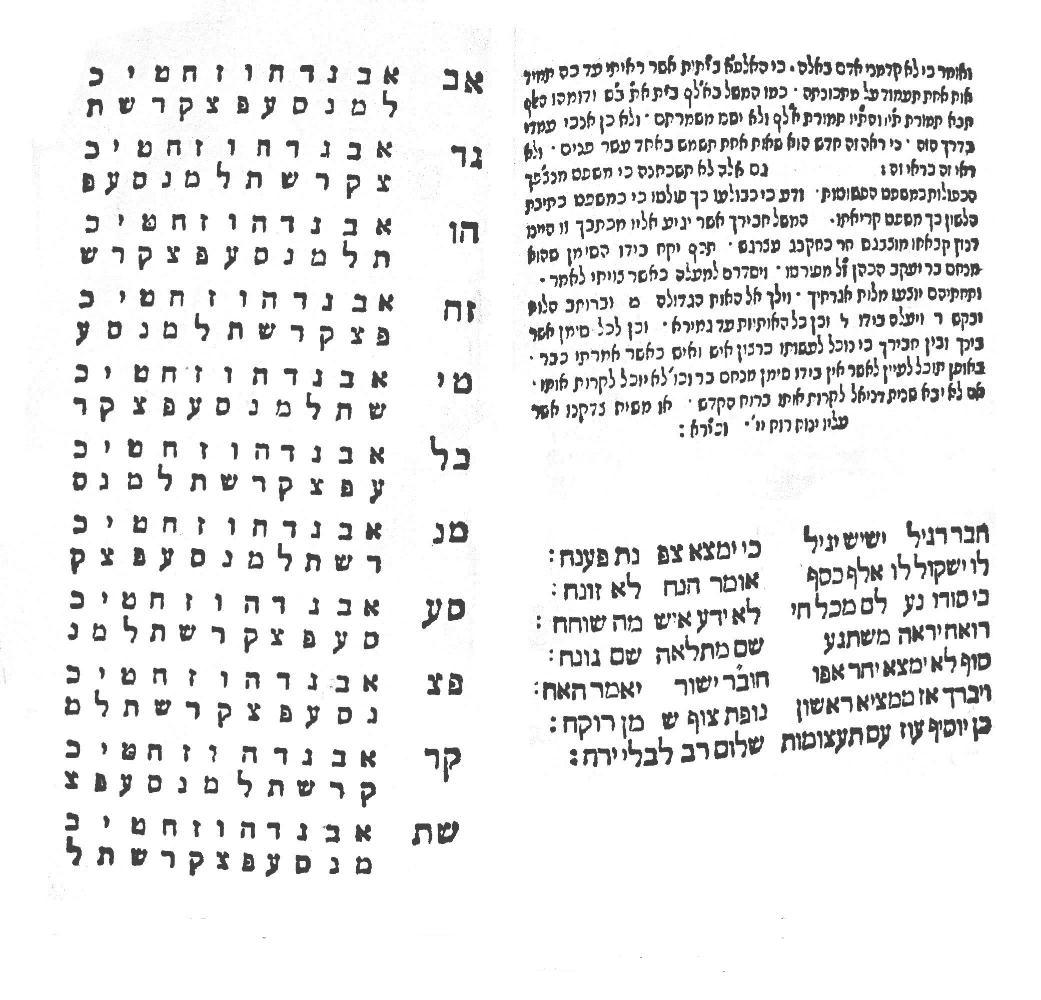

1555, Zafenat Pane’ah
Courtesy of the Jewish Theological Seminary

Turning to the Minhah Belulah, the work for which Abraham Menahem is best known, that work, a commentary on the Torah, based on Midrashim, was published in Verona (1594) as a quarto (40: [3], 208, [1] ff.).[19] His motivation in writing the Minhah Belulah was the lack of Talmudic tractates. This resulted from the dispute between the Bragadin and Giustiniani presses over their editions of the Mishnah Torah, as noted above, which culminated in the burning of the Talmud, this based on a papal bull, dated August 22, 1553, ordering the confiscation and burning of the Babylonian and Jerusalem Talmuds and prohibiting their possession. Among the results was a decline in Talmudic and midrashic studies and a turn to kabbalistic works. The Minhah Belulah is an attempt to achieve something of a balance in such studies under prohibitive conditions.


1594, Minhah Belulah
Courtesy of The Library of Agudas Chassidei Chabad Ohel Yosef Yitzhak

The title, Minhah Belulah, is from the phrase minhah belulah (a meal offering mixed) במנחה בלולה, which appears in seven verses in the Torah, three in Leviticus, four in Numbers, albeit with different prefatory letters.[20] The title-pages states that it is,

Minhah Belulah

A commentary on the Hamishah Homshei Torah, prepared and written by the complete sage R. Abraham Menahem ben R. Jacob Kohen Rapa mi-Porto. The author explains there in detail many Midrashim and straight forward explanations augmenting them with interpretations of his own in a language that is clear and straightforward so that when one rests on the Sabbath, festivals, and appointed times from all his exertions he will peruse it and find in it great value “according to each man’s pleasure” (Esther 1:8) and according to his abilities.

Printed here in the capital city of Verona at the press of Messer Francesco dalle Donne

Beginning of the work was on Monday, the fifth day of the month of Iyar in the year “Rejoice שמחו (354=1594, April 15, 1594) with Jerusalem, and be glad with her, all you who love her [all you who mourn for her].” (Isaiah 66:10). May the Lord in His mercy grant us the merit to publish many books, and save us from errors and show us wonders, great and numerous “to the lawgivers of Israel” (Judges 5:9) “and a redeemer will come to Israel” (Isaiah 59:20) and so may He do. Amen.

In the domain of the rulers of Venice, may their majesty be exalted higher and higher. Amen

In the year of our lord the Duke Pasquale Cigona, may he be exalted, higher and higher Amen.

As noted above, Abraham Menahem varies the manner in which he gives his name. This is most evident in the Minhah Belulah, for as Hida observes, Abraham Menahem gives his name on the title-page of the Minhah Belulah as Rapa mi-Porto and at the end as bar Jacob ha-Kohen Rapa mi-Porto. Afterwards, Abraham Menahem writes it as R. Abraham ha-Kohen mi-Porto. Hida then comments that a source for these variaitions stems from one place, for he saw the Maharikh (R. Isaac Ha-Kohen Rapoport), author of Batei Kehunah (I, Izmir, 1741, II, Salonica 1744) that for Ashkenaz he signed his name as Isaac ha-Kohen Rapa Port from the seed of the priesthood in Lublin. Hida adds that he saw his father’s name who signed as Judah ha-Kohen Ashkenazi.[21]

The title-page informs that the publisher of the Minhah Belulah was Francesco Dalle Donne, an Italian printer whose primary business was Italian not Hebrew books. Active from 1592 into the seventeenth century, Dalle Donne was the first printer to publish books with Hebrew type in Verona, publishing the latter for about three years only, and then issuing less than ten titles, the majority in Yiddish, two only in Hebrew, the Minhah Belulah and the Midrash Tanhuma. Jews were prohibited from owning print-shops during the Counter-Reformation, from the mid-sixteenth century, so the presses publishing Hebrew books in Italy in this period belonged to non-Jews. The involvement of Christian printers, in this case Dalle Donne, with the Hebrew book market was not uncommon.[22]

Christian printers published Hebrew books in association with Jewish partners. The relationship between Christian printers and their Jewish partners was mutually beneficial. For the Christian publisher “the Hebrew books sector, being unique, was attractive to investors, being more limited and not so wildly competitive as the Italian book sector.”[23] In addition to the non-Jew’s access to the Jewish book market, the Jewish associate was not only able to publish Hebrew books, but he also gained access to the typographical material of his Christian partner. The latter, for example, frequently provided attractive frames to the former after having used them for his market and the Jewish partner also utilized the printer’s pressmark and other ornamentation. This was of value to the Jewish partner as he did not have to go the expense of having decorative material prepared, at a relatively much greater expense as it would be utilized for a much smaller market. This despite the fact that the frames were often incompatible with traditional Jewish sensibilities.[24]

The Dalle Donne press employed Abraham Bath-Sheba to print the Minhah Belulah. Abraham Bath-Sheba was the son of Sabbatai Mattathias Bath-Sheba (Basevi in Italian), an Italian-Jewish family of German (Ashkenazic) origin. Originally from Italy, Sabbatai Mattathias Bath-Sheba and his family relocated to Salonika where they operated a press, active from 1592 to 1605.[25] Interested in printing tractates from the Talmud the press sent Abraham Bath-Sheba to Italy to secure financing for the project. While in Italy he worked briefly for the Dalle Donne press in Verona, soon afterwards returning to Salonica.[26]

The title-page is followed by Abraham Menahem’s introduction, somewhat unusual, as stated in its header “ALEF BET ‘O you who linger in the garden, listening’ (song of Songs 8:13) ‘at the gate of the many-peopled city’” (cf. Song 7:5) You will come, brought into the Temple of your glory, blessings without account.” The header ALEF BET does not refer to the first letters of the Hebrew alphabet. alef bet, but rather to the fact that the introduction is comprised of one thousand (alef) instances of the letter bet, as can be seen from the first two lines of the introduction, below, emphasis added.

בחלון בתי בעד אשנבי אביוני בבנים הקרבים בקרב ובאים בגבורות חובורות
להציב הדרכים לבנות חורבות ולשובב נתיבות קצובות חצובות מחוטבות

“I have looked out of the window of my house though the lattice” (Proverbs 7:6) and the needy of your sons engaged in battle, and coming with mighty bruises,
To establish the ways, rebuild the ruins, and establish paths, . .

The introduction concludes with a page a verse, followed by the text. The enlarged initial words of each of the five books of the Hamishah Homshei Torah (Pentateuch) are set within a like ornate attractive outer frame comprised of an urban scene at the top with a male and female head at either side, below at the sides are bare female figures, and at the bottom two supine figures. The varying initial words are set with different backgrounds and side images (below).


Vayikra (Leviticus)
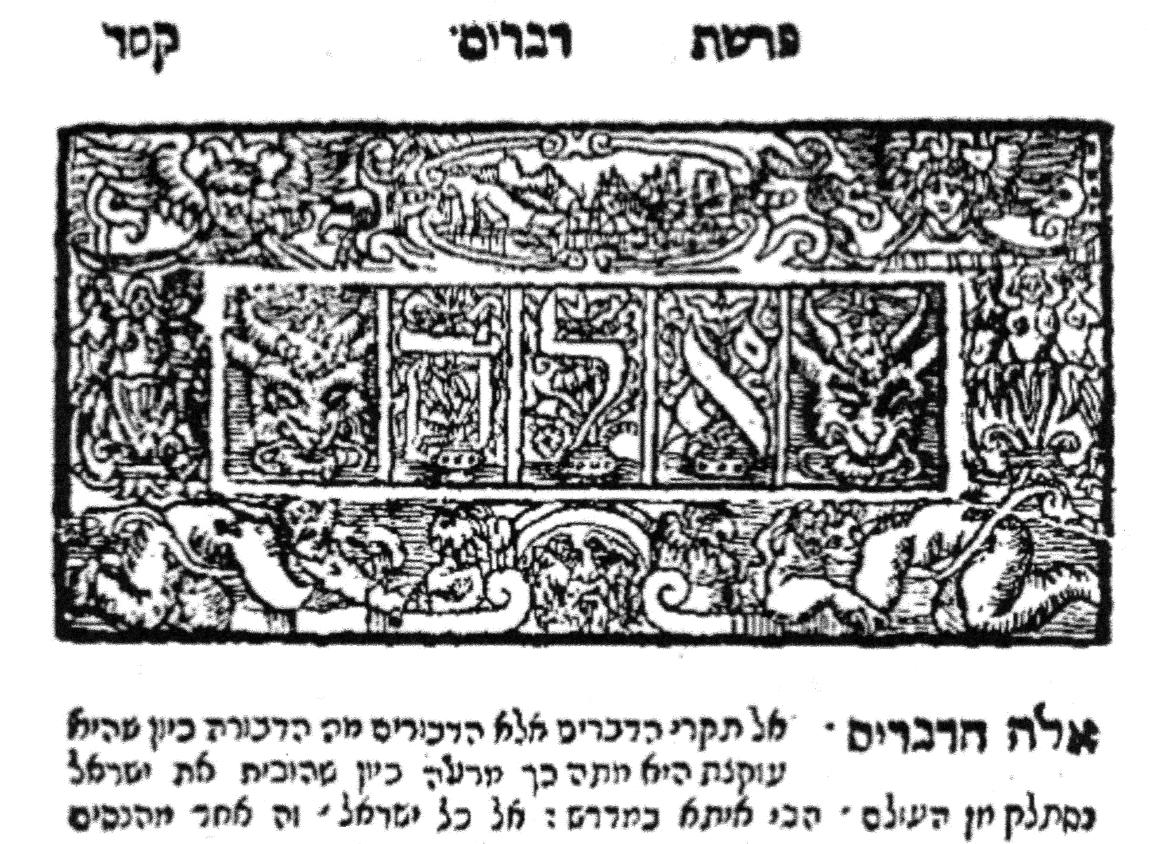

Devarim (Deuteronomy)

Two examples of the style of Abraham Menahem’s commentary follows.

“[Then the Lord God fashioned the side that He had taken from the man into a woman] and He brought her to the man” (Genesis 2:22). Suddenly, and while distracted, so that he would be most delighted with her, for most joy is felt when sudden, and so sorrow, as it says “Hezekiah rejoiced with them, etc.” (Isaiah 39:2) for the matter was sudden, and so, according to our sages “three things come when they are not expected, [Messiah], a find, [and a scorpion], etc. (Sanhedrin 97a) and a woman is called a find, as it is written “One who has found a wife has found good.” (Proverbs 18:22).

“[And you – lift up your staff and stretch out your arm over the sea ] and split it” (Exodus 14:16) and with the merit that “he split the wood for the offering” (Genesis 22:3) and thus he modified the language “[and the Children of Israel shall come] into the midst of the sea on dry land” in the midst of the place that was sea, and made dry land: “Lift up your staff and stretch out your arm” so that the Egyptians said that Moses did all of this with his staff, therefore [the Holy One, Blessed be He] said lift up your staff, as with “Remove yourself from among the assembly” (Numbers 17:10) and do the miracle with your hand.

Another different type of elucidation of a biblical passage, this on the verse “He said, ‘No longer will it be said that your name is Jacob but Israel . . .” (Genesis 32:29) is given by Abraham Menahem,

Israel ישראל A name that includes all the Patriarchs and Matriarchs י Yitzhak (Isaac) ש Sarah ר Rivkah ר Rachel א Abraham ל Leah. Even though we find that afterwards he is called by the name Jacob, perhaps it was not changed so that they would not say because he was a trickster it was changed (referring to the purchase of the birthright from Esau) and also because the Holy One, blessed be He gave him that name as I explained by “ and He called his name Jacob” (Genesis 25:26).

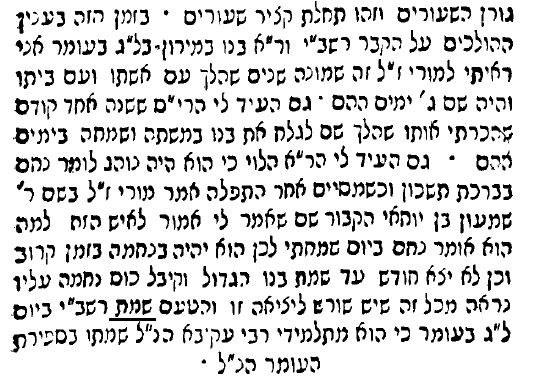
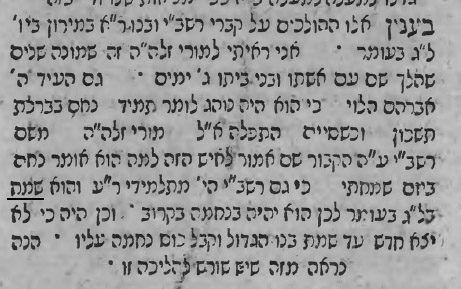
There is also some commentary reflecting current conditions, as noted above in the lead paragraph. Abraham Menahem ben Jacob ha-Kohen Rapa mi-Porto (Rapaport, 1520- c. 1594) had been an eyewitness to the burning of the Talmud in Venice in 1553, which tragic event is reported in the Minhah Belulah, on the phrase “. . . a fiery law unto them,” (Deuteronomy 33:2), That paragraph, in further detail, says”

And He said: He gave the reason why Israel was more appropriate for the blessing than the other nations, idol worshippers . . . From His right hand [He presented] the fiery Torah [to them]. “The Torah is compared to fire, when a man comes too close, he is burned, when too distant he is cold, so too the Torah . . . and this also alludes to the great destruction our eyes have witnessed, due to our many iniquities, throughout Italy. The burning of the Oral Law [Talmud] in the year שיד[as in] “the hand יד of the Lord was upon us.” The decree went out from the city of Rome to use [the Talmud volumes] as fuel for the fire. In Venice, woe to the eyes that saw this, on the thirteenth and fourteenth of Marheshvan [5]514 (October 31, November 1, 1553), a continuous fire which was not extinguished. I fixed these days for myself, for each and every year, for fasting, weeping, and mourning, for this day was as bitter for me as the burning of the House of our God (the Temple).

The text concludes on 206b, followed on 207ab by an afterward by Abraham Menahem in which, as noted above, he informs that he has only written this for his generation which lacks Talmudic tractates, they having been taken away, their place replaced by kabbalistic studies; this work has been written not for sages but for those who want the revealed Torah rather than hidden (kabbalistic) meanings, “to quench the thirst of those who want straight forward meanings or midrash,” as noted in the alef bet introduction.

Below the afterward is Abraham Menahem’s escutcheon, consisting of two scantily clad women at the sides holding a streamer that says “Abraham Menahem ben Jacob ha-Kohen.” Between the women is a shield and within it two spread hands giving the priestly benediction, below that a black raven on a branch, and at the bottom another streamer that says “Rapa me-Porto.”[27] In the reprint of the Minhah Belulah (B’nei Brak,1989) the women are more modestly covered.

Yet another modest version of Abraham Menahem’s escutcheon was published in yet another recent work, this Benjamin Shlomo Hamburger’s three volume history, Ha-Yeshiva ha-Rama bi-Fiorda (Bnei Brak, 2010). It is described by Michael K. Silber in an article entitled “Modesty and Piety: Improving on the Past” as having “been modestly transgendered and piously rendered with beards!”[28] Below is original example escutcheon and the two more modest figures.
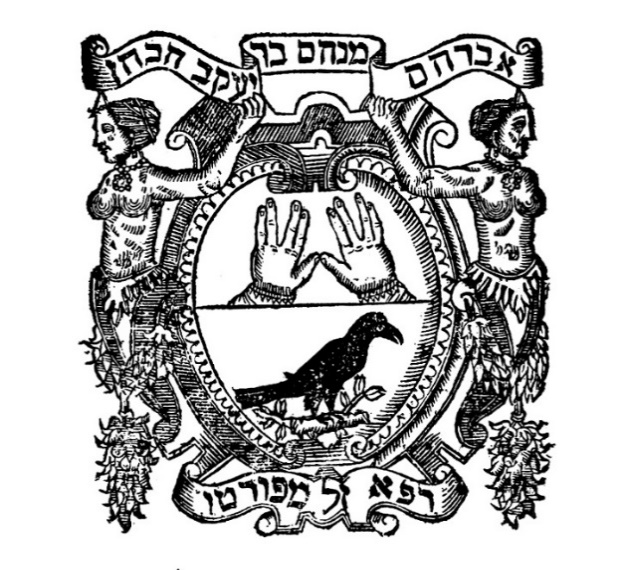
1594, Minhah Belulah, Verona
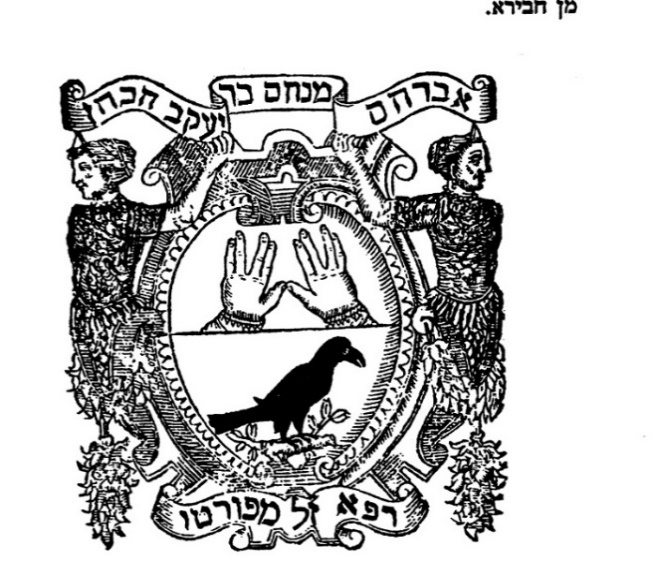

1989, Minhah Belulah, B’nei Brak


2010, Minhah Belulah, B’nei Brak

Under the original, that is the first printing of the escutcheon is a statement informing that the work was written [completed] in Cremona on Wednesday, 24 Shevat, [5]342 (January 27, 1582), when Abraham Menahem was, rabbi in Cremona. On the following page is the apologia of the proofreader (editor), Abraham ben Jehiel Kohen Porto.

It begins with a header, initially misspelled, being given asהמגיעה rather than the correct המגיה, resulting in a stop-press correction.[29] The proofreader (editor) Abraham ben Jehiel, a kinsman, addressees the issue of typographical errors in the Minhah Belulah in his remarks, apologizing for any errors in the book, for “Who can discern mistakes” (Psalms 19:13). He informs that not only was he careful but that Abraham Bath-Sheba was diligent in the supervising the compositors reviewing the type setting, “letter by letter.” Nevertheless, the work was done by uncircumcised workers (non-Jews), inexperienced in setting Hebrew letters, and it was not possible to avoid errors. Neither they nor the author, therefore, should be held responsible for any errors, but requests they be judged favorably.[30]

We conclude our discussion of the Minhah Belulah, appropriately, by noting that, in addition to the ornamentation already mentioned there are also tail-pieces at the end of several parts of the books. Most are simply decorative use of florets or of an arch. In two instances, however, the tail-piece is of a figure on both sides of a vase. This too is not an image consistent with traditional Jewish sensibilities, reflecting the use of ornamentation by Jewish printers of their non-Jewish partners’ typographical material.


The Minhah Belulah is concisely noted in Shabetai Bass’s Sifte Yeshenim (Amsterdam. 1680) the first bibliography of Hebrew books by a Jewish author.[31] It has subsequently been regularly recorded in Hebrew bibliographies. The Minhah Belulah was first reprinted in a Pentateuch (Hamburg, 1795), reprinted in Warsaw (1853), and perhaps elsewhere. The only standalone edition of the Minhah Belulah was printed in Bnei Brak by R. Jacob David Kohen (1989).[32]

R. Abraham Menahem ben Jacob ha-Kohen Rapa mi-Porto (Rapaport) is, as stated at the beginning of this article “an intriguing eclectic figure. . . . primarily remembered today for his Minhah Belulah, a commentary on the Torah.” That work, although not frequently reprinted, is highly regarded by all who are familiar with it. Abraham Menahem’s accomplishments, however, are more varied, making him an unusual and interesting personality. Clearly a person of great erudition, not only for his mastery of rabbinic sources, such as the Talmud and Midrashim, but also for his extensive knowledge, encompassing medicine and, this most unusual, cryptography.

In addition, to the works just noted, Abraham Menahem also wrote responsa and, perhaps in the context of his contemporary activities, he was an important rabbinic figure, leading congregations in Cremona and Verona and head of a yeshivah. Nevertheless, R. Abraham Menahem ben Jacob ha-Kohen Rapa mi-Porto (Rapaport) is best remembered today for his Minhah Belulah, which, as this article has attempted to show, is a valuable and important contribution to rabbinic exegetical literature.

[1] I would like to express my appreciation and gratitude to Eli Genauer for reading this article and his suggestions.
[2] Midrash is defined by Moshe David Herr, “Midrash.” Encyclopaedia Judaica, 14, p. 182), as “the designation of a particular genre of rabbinic literature containing anthologies and compilations of homilies, including both biblical exegesis (Hermeneutics) and sermons delivered in public (Homiletics ) as well as aggadot and sometimes even halakhot usually forming a running commentary on specific books of the Bible.
[3] Vittore (Victor) Trincavella was an eminent physician whose works include translation of Greek classics. Because of his proficiency in that language he was known as the Greek scholar. Concerning Victor Trincavella see Alexander Chalmers, The General biographical dictionary: containing an historical and critical account of the lives and writings of the most eminent persons in every nation: Particularly The British And the Irish. From The Earliest Accounts To The Present Time 30 (London, 1816), pp. 35-36.
[4] Jacob David Kohen, ed. Minhah Belulah, (Bne’i Brak, 1989), pp. 6-7 [Hebrew].
[5] Eliakim Carmoly, Ha-Orevim u-Vene Yonah: Shalshelet ha-Yuhasin shel Mishpaḥat Rapoporṭ u-Mishpaḥat Yungṭoibin (Redelhaim, 1861), pp. 5-8; [Hebrew]; Mordechai,Margalioth, ed. Encyclopedia of Great Men in Israel 1 (Tel Aviv, 1986), col, 70; [Hebrew]; Tovia Preschel, and Abraham David, “Porto (Rafa-Rapaport),Encyclopaedia Judaica 16, (2007), p. 406.
[6] Hayyim Joseph David Azulai, Shem hagedolim hashalem with additions by Menachem Mendel Krengel II (Jerusalem, 1979), p. 107 no. 36 [Hebrew]; I. T. Eisenstadt and S. Wiener, Da’at Kedoshim (St. Petersburg, 1897-98), p. 144 [Hebrew].
[7] Moritz Steinschneider, Catalogus Liborium Hebraeorum in Bibliotheca Bodleiana (CB, Berlin, 1852-60), col. 704 no. 4289:2.
[8] Zinberg, !v, p.85
[9] “Rapa (Porto), Menahem Abraham b. Jacob ha-Kohen (Menahem Rapoport),” (sic.) Jewish Encyclopedia 10 (New York and London, 1901-06) p. 317. Paḥad Yitzhak, is a halakhic encyclopedia. Abraham Menahem’s responsum in vol. II (Venice, 1753), 86a-b [Hebrew] on dagim (fish) is a detailed discussion on the biblical requirement that kosher fish have scales, here concerning the permissibility of fish that either lack scales but will grow them or currently have scales but will lose them when they come out of the water. At the end of the responsum is a comment from R. Solomon Levi Mortera that he has copied the responsum from a manuscript of R. Abraham Menahem Kohen Porto’s Sheilot u’Teshuvot in the possession of R. Solomon ben Israel Basan.
[10] Robert Bonfil, Rabbis and Jewish Communities in Renaissance Italy (London, Washington,1993), pp. 66 n.134, 134-40. Bonfil’s source or Abraham Menahem’s responsa is R. Abraham Menahem, ‘Teshuvot’, in MSS. Jerusalem Heb., 83 904, Montefiore 480 and Mantua 38.
[11] Concerning the controversy over the Me’or Einayim see Robert Bonfil “Some Reflections on the Place of Azariah de Rossi’s Meor Enayim in the Cultural Milieu of Italian Renaissance Jewry” in Jewish Thought in the Sixteenth Century (Cambidge, Ma. And London, 1983), pp. 49-88. On the subject of Abraham Menahem and such bans see ibid. pp. 73-75.
[12] Zinberg, 1112.
[13] Me’or Einayim was first reprinted in 1794, in Berlin, after the haskala (Jewish enlightenment) had begun. Concerning the Me’or Einayim and the related controversy see Naomi Vogelman-Goldfeld, “Some Reflections on the Hebrew Printing in Italy During the Sixteenth Century,” in Manoscritti, frammenti e libri ebraici (Rome, 1991), pp. 101-08; Cecil Roth, The Jews in the Renaissance (1959, reprint New York, 1965), pp. 318-29; Lester A. Segal, Historical Consciousness and Religious Tradition in Azariah de’ Rossi’s Me’or Einayim (Philadelphia, 1989); Shlomo Simonsohn, History of the Jews in the Duchy of Mantua (Jerusalem, 1977), pp. 634-37; Meyer Waxman, A History of Jewish Literature (1933, reprint Cranbury, 1960), II pp. 516-22; Yosef Hayim Yerushalmi, Zakhor, Jewish History and Memory (Seattle, 1983), pp. 57-58 and 69-75; and Israel Zinberg, A History of Jewish Literature V (New York, 1975), translated by Bernard Martin, IV pp. 106-14.
[14] Tovia Preschel, and Abraham David, op. cit.
[15] Steinschneider, CB, col. 704 no. 4289:3.
[16] Avraham Yaari, “The Printers B’nei Foa,” in Studies in hebrew Booklore, (Jerusalem, 1958), p. 362 n. 17 [Hebrew].
[17] National Library of Israel system number 990017477400205171.
[18] Ch. Friedberg, Bet Eked Sefaim, (Israel n.d.), zaddi 387 [Hebrew].
[19] The Minhah Belulah was addressed previously by me in “A Little Known Chapter in Hebrew Printing: Francesco dalle Donne and the beginning of Hebrew Printing in Verona in the Sixteenth Century,” The Papers of the Bibliographical Society of America 94:3 (New York, N. Y., 2000), pp. 333-46, reprinted in Studies in the Making of the Early Hebrew Book (Brill, Leiden/Boston, 2008), pp. 151-64. This article is a detailed expansion of that section of that article on the Minhah Belulah.
[20] The verses are “This is the law of the peace-offering מִנְחָה בְלוּלָה that is mixed with oil or that is dry, it shall belong to all the sons of Aron, every man alike” (Leviticus 7:10); “And a bull and a ram for a peace-offering to slaughter before the Lord, and a meal-offering וּמִנְחָה בְּלוּלָה mixed with oil, for today the Lord appears to you” (Lev. 9:4); On the eighth day, he shall take two unblemished male lambs and one unblemished ewe in its first year, three tenth-ephah of fine flour mixed מִנְחָה בְּלוּלָה with one log of oil: (Lev. 14:10); (with a tenth-ephah of fine flour as a meal offering, mixed לְמִנְחָה בְּלוּלָה with a quarter hin of crushed oil” (Numbers 28:5); And on the Sabbath day; two male lambs in their first year, unblemished , two tenth-ephah of fine flour for a meal offering, mixed מִנְחָה בְּלוּלָה with oil and its libation” (Numb. 28:9); And three tenth-ephah of fine flour for a meal offering mixed מִנְחָה בְּלוּלָה with oil, for each bull; and two tenth ephah of one flour mixed with oil, for the one ram” (Numb. 28:12); And a tenth-ephah of fine flour for a meal offering, mixed מִנְחָה בְּלוּלָה with oil, for each lamb – a burnt-offering, a satisfying aroma, a fire offering to the Lord” (Numb. 28:13).
[21] Concerning the Francesco dale Donna press see Marvin J. Heller “A Little Known Chapter in Hebrew Printing”; Azulai, Shem ha-gedolim ha-shalem II (Jerusalem, 1979), pp.90-91 no. 146 [Hebrew]; Carmoly, p. 6, records seven different ways in which Abraham Menahem gives his name, namely Menahem mi—Porto; Menahem bar Jacob ha-Kohen mi-Porto; Menahem Porto ha-Kohen Ashkenazi; Abraham Menahem ben Jacob Rapa mi-Porto; Abraham Menahem Porto ha-Kohen; Abraham Menahem Porto ha-Kohen Ashkenazi; Abraham Menahem ha-Kohen Porto and cites the books and responsa in which those names appear.
[22] Concerning the restrictions on Hebrew workers in Venice see Benjamin Ravid, “The Prohibition against Jewish Printing and Publishing in Venice and the Difficulties of Leone Modena,” Studies in Medieval Jewish History and Literature (Cambridge: Harvard University Press, 1979), ed. Isadore Twersky, 135-53.
[23] Zipora Baruchson, “Money and Culture: Financing Methods in the Hebrew Printing Shops in Cinquecento Italy,” La Bibliofilia 92 (1990), 25. Concerning the restrictions on Hebrew workers in Venice see Benjamin Ravid, “The Prohibition against Jewish Printing and Publishing in Venice and the Difficulties of Leone Modena,” Studies in Medieval Jewish History and Literature, ed. Isadore Twersky (Cambridge: Harvard University Press, 1979), 135-53.
[24] For examples of such usage see Marvin J. Heller, “Behold, you are beautiful, my love: The Use of Ornamental Frames in Hebrew Incunabula” Printing History NS 10 (New York, July, 2011), pp. 39-55, reprinted in Further Studies in the Making of the Early Hebrew Book. (Brill, Leiden/Boston, 2013), pp. 3-33; “Mars and Minerva on the Hebrew Title Page,” The Papers of the Bibliographical Society of America 98:3 (New York, N. Y., 2004), pp. 269-92, reprinted in Studies in the Making of the Early Hebrew Book (Brill, Leiden/Boston, 2008), pp. 1-17; “The Printer’s Mark of Marc Antonio Giustiniani and the Printing Houses that Utilized It,’ Library Quarterly, 71:3 (Chicago, July, 2001), pp. 383-89, reprinted in Studies, pp. 44-53.
[25] Abraham Bath-Sheba’s device, a crowned lion on the left and half a crowned eagle on the right back to back, appears near the end of several of the books printed by the Dalle Donne press, for example, Paris un Viene (1594) and the Midrash Tanhuma (1595), although not in the Minhah Belulah. The device on the title-page of the Minhah Beliulah appears on 6a of Paris un Viene.
[26] Concerning tractate Berakhot printed in Salonika see Marvin J. Heller, ““The Bath-Sheba/Moses de Medina Salonika Edition of Berakhot: An Unknown Attempt to Circumvent the Inquisition’s Ban on the Printing of the Talmud in Sixteenth Century Italy,” Jewish Quarterly Review LXXXVII (Philadelphia, 1996), pp. 47-60, reprinted in Studies in the Making of the Early Hebrew Book, pp. 284-97.
[27] Avraham Yaari, Hebrew Printers’ Marks (Jerusalem, 1943, reprint Westmead, 1971), pp. 28, 141 no. 45 [Hebrew].
[28] Michael K. Silber, “Modesty and Piety: Improving on the Past” The Seforim Blog (December 27. 2010).
[29] Stop-press corrections result from compositor errors, caught by the corrector during the press-run. When the error was found the press would be stopped, the error corrected and printing resumed. To replace a sheet due to a single (minor) error would necessitate replacing an entire quire (several pages), the number depending on the book format. Due to cost factors, both of paper and labor, the sheet with the error would be replaced only if the error was substantial or substantive. It is therefore possible for books to consist of non-uniform copies, having several sheets with variant readings. Concerning examples of such errors see Marvin J. Heller, “Who can discern his errors? Misdates, Errors, and Deceptions, in and about Hebrew Books, Intentional and Otherwise” Hakirah: The Flatbush Journal of Jewish Law and Thought 12 (2011), pp. 269-91, reprinted in Further Studies, pp. 395-420.
[30] As with ownership of the press (above) so too it was required that compositors be non-Jews, the work subsequently reviewed by Jewish correctors. Concerning this see Marvin J. Heller, ““And the Work, the Work of Heaven, was Performed on Shabbat,” The Torah u-Maddah Journal 11 (New York, 2002-03), pp. 174-85, reprinted in Studies, pp. 266-77.
[31] Shabetai Bass’s Sifte Yeshenim (Amsterdam. 1680), p. 44 no. 211 [Hebrew]. Concerning Bass see Marvin J. Heller, “Bass, Shabetai ben Yosef,” The Yivo Encyclopedia of Jews in Eastern Europe, Gershon David Hundert, ed. I (New Haven & London, 2008), pp. 129-30; Abraham Meir Habermann, “Rabi Shabetai Meshorer Bas (ha-bibliyografi ha-‘ivri ha-rishon),” in Anshe sefer ve-anshe ma‘aseh, pp. 3–11 (Jerusalem, 1974) [Hebrew].
[32] Minhah Belulah, Jacob David Kohen, ed. (B’nei Brak, 1989), pp. 5-10 [Hebrew].


Some More Assorted Comments, part 1

Some More Assorted Comments, part 1
by: Marc B. Shapiro
1. Following my last post, a number of people have corresponded with me about the issue of anti-Semitism and how it it sometimes self-inflicted because of Jewish actions that cause a hillul ha-Shem, meaning that we can’t always claim ידינו לא שפכו את הדם הזה. As many readers know, R. Jehiel Jacob Weinberg already pointed out that some anti-Semitism arises for precisely this reason. He was not the first. R. Israel Moses Hazan (Kerakh shel Romi, p. 4a), speaks of the bad impression given non-Jews by Jewish texts (and obviously also Jewish behavior):
שאנחנו מצד אמונתנו אנחנו מחוייבים להיות משחיתים הקיבוץ המדיני
See also the words of R. Solomon Alami, Iggeret ha-Mussar, ed. Haberman (Jerusalem, 1946), pp. 11-12:
עם היותנו עבדים נכבשים להם התלנו בם וחיללנו שם קודש א-להינו בקרבם כי הלכנו אתם באונאה ובמרמה וקבענו אותם בחוקים לא טובים בערמה עד אשר מאסונו והחזיקונו כגנבים ורמאים מנאפים עצרת בוגדים.
See also Maharsha to Ketubot 67a, which so accurately describes what we often face[1]:
ורבים בדור הזה שמקבצין עושר שלהם שלא באמונה ובחילול השם כגזילת עכו”ם ואח”כ מתנדבים מאותו ממון להיות להם כבוד בכל שנה ולתת להם ברכת מי שברך להיות להם שם ותפארת, ואין זה אלא מצוה הבאה בעבירה, ואין לעושר הזה מלח וקיום
(To understand the last words, see Ketubot 66b: מלח ממון חסר)
But there are limits to what we can do, and even if we were all complete tzadikim, it would not mean the end of anti-Semitism. Yet listen to a youthful passage recorded by Gershom Scholem in his diary in 1913. It is certainly an exaggeration, but in speaking of Jews living in the modern world (as opposed to the Shtetl) there is also some truth to it: “If Judaism were as Samson Raphael Hirsch thinks it should be, there wouldn’t be any such thing as anti-Semitism.”[2] As Hirsch taught, it is incumbent on us to show that we are a great benefit to society, and we cannot behave as if the rules, and the consequences of violating these rules, only apply to everyone else. ודי בזה.
2.  In my review of Gurock’s book (see here)  I referred to Aish HaTorah honoring intermarried people at its events. In fact, they were not the first Orthodox organization to do so, as one can see from R. Avraham Weinfeld’s Lev Avraham, no. 134, which dates from the early 1970’s.

If anyone knows which institution he is referring to, please share it. For some earlier comments of mine with regard to Orthodox views of intermarriage, see here.
In general, there have been some real changes in how Orthodoxy deals with the non-Orthodox, and Adam Ferziger has recently published a valuable article on the topic.[3] In reading the article, I was surprised to learn how even  haredi Orthodoxy has begun to expand the boundaries in dealing with non-Orthodox movements and institutions. It appears that the Reinman-Hirsch book was only one aspect of this change. Here is some of what Ferziger reports:
ASK [Atlanta Scholars Kollel], however, has demonstrated a willingness to meet its constituency on its own terms by running a biweekly introductory prayer service in one of Atlanta’s largest Reform houses of worship, Temple Sinai of Sandy Springs. To be sure, the meetings take place in a social hall rather than in the synagogue sanctuary, but this is a clear departure from the guidelines set down by Feinstein. Similarly, members of the Phoenix Community Kollel have taught classes at the community sponsored Hebrew High that is housed at the Reform Temple Chai. . . . [T]he head of Pittsburgh’s Kollel Jewish Learning Center, Rabbi Aaron Kagan, meets on a regular basis with his local rabbinic colleagues from Reform and Conservative synagogues to study Torah together. . . . Based in Palo Alto, California, the Jewish Study Network—one of the most dynamic and rapidly expanding of these kiruv kollels—does not limit its interdenominational contacts to private study. Its fellows work together with Conservative and Reform representatives to create new Jewish learning initiatives throughout the Bay Area and to offer their own programming in non-Orthodox synagogues. Rabbi Joey Felsen, head of the Jewish Study Network and a veteran of five years of full-time Torah study at Jerusalem’s venerable Mir yeshivah, made clear that he was not opposed to presenting Torah lectures in a non-Orthodox synagogue sanctuary, although he preferred to teach in the social hall. Indeed, according to Rabbi Yerachmiel Fried, leader of the highly successful Dallas Area Torah Association (DATA) Kollel and a well-respected halakhist, insofar as Jewish religious institutions were concerned the only boundary that remained hermetically sealed was his unwillingness to teach in a gay synagogue. . . . 
3. Here is the link to my recent article in Milin Havivin in which I published R. Eliezer Berkovits’ responsum permitting one to enter churches.[4] (R. Jeremy Rosen agrees with Berkovits. See here.)

In addition to the figures I mentioned who are known to have entered churches, the young scholar Chaim Landerer called my attention to the famed bibliophile, Judah David Eisenstein, who in his autobiography, Otzar Zikhronotai, testifies to entering churches on a few different occasions. These are mentioned by R. David Zvi Hillman in his article in the most recent Yerushatenu 4 (2010) as part of his effort to delegitimize Eisenstein, both from a scholarly as well as from a religious standpoint.[5] The article is actually twenty pages of excerpts from Eisenstein’s writings designed to accomplish this objective.
There is no question that Hillman accomplishes at least one of his goals, which is to show that Eisenstein often misinterpreted rabbinic texts. Yet for the life of me I can’t figure out what possible objection Hillman could find in some of what he records. For example, what is wrong with Eisenstein mentioning, in his autobiography, that as a young man he served on a jury (בית דין של שנים עשר), learnt to play the piano, to ride a horse, to swim [!], to sail, to fence and to play billiards? What does Hillman expect, that Eisenstein is supposed to say that his entire life was spent in a beit midrash, never once venturing out to enjoy what the world has to offer? Hillman also finds objectionable that Eisenstein mentions that he played chess on Shabbat and Yom Tov and that in general he liked sports as they strengthened his body. Hillman even notes that Eisenstein tells the reader how much he weighed at various times of his life, and here too, I can’t figure out what the sin. In my opinion, the craziest of Hillman’s criticisms focuses on the following passage in Eisenstein’s autobiography:
בשנת 1886 הייתי בין הראשונים שעלו במדרגות לראש פסל החרות ובשנת 1928 עליתי שם ע”י המכונה נושאת אנשים עד הראש ועד מאתים מדרגות עד הלפיד של החשמל שהוא גדול בכמות רבבות אלפים נרות.
Is it possible that Hillman has never heard of the Statue of Liberty and instead thinks that Eisenstein made a pilgrimage to some pagan temple?
Here is another of the passages Hillman strangely cites in order to criticize Eisenstein:
תרפ”ב ברלין. ציר ארה”ב ואשתו הושיטו ידם לי לברכני
But if you really want to see Hillman’s extremism, look at the following passage which he finds objectionable:
עין חרוד בעמק והוא מקום הטומאה לחיי המשפחה . . . שאכלו חמץ בפסח להכעיס . . . אנחנו מקוים כי גם החלוצים יטיבו את דרכם במשך הזמן ובפרט כי הורגלו לדבר עברית ויש בכח הלשון הקדש ובמאור שבה לבדה להחזירם תחת כנפי השכינה
There is no question that Eisenstein was naive in his hope that the Hebrew language would help bring people back to religion, but does this make him a bad person? Citing this passage to disqualify Eisenstein says more about Hillman than it does about Eisenstein. (I will return to Hillman in a future post.)
Here is another of Hillman’s criticisms, but this time of a scholarly nature:
“חוה”מ נקרא מועד קטן”. היש לזה מקור הוא [!] שהוא סברת כרסו של בעל האוצר?
We all know that Tractate Moed Katan deals with Hol ha-Moed. The reason the tractate is called such is presumably to distinguish it from the Order Moed. In fact, there is evidence that the original name of the tractate was Moed “and throughout this tractate the intermediate days are referred to as Mo’ed and not as hol ha-mo’ed.”[6]  It is because of this that Hillman is so dismissive of Eisenstein’s suggestion that Moed Katan can be understood as the “lesser holiday” and refer to hol ha-moed.
Yet Hillman spoke too fast in this case, because the great R. Aryeh Zvi Frommer, Eretz Zvi (Bnei Brak, 1988), pp 351ff, also assumes that hol ha-moed is referred to as Moed Katan. Here are two pages from his derashah.


Here is an article in R. Eliyahu Schlesinger’s Areshet Sefatenu (Jerusalem, 2005), vol. 1, pp. 16-17.


It is obvious that Schlesinger’s piece is taken from Frommer. In the introduction to Areshet Sefatenu, he tells the reader that he is going to be quoting ideas found in other sources, and that he is careful to acknowledge them, but if on occasion he forgets to do so we should excuse him. This doesn’t sit well with me. How can one copy another person’s words, include them in his book, and then forget to mention where he got it from? We are not talking about a source or two that someone saw in another’s book (and about which we can debate if one needs to cite the book that led him to these sources). Here we are talking about copying another rav’s hiddush.[7]
Returning to Eisenstein, he mentions how he was a member of the Freemasons. Hillman, of course, points to this as another of Eisenstein’s religious defects. Yet the issue of Freemasonry and traditional Judaism needs to be examined carefully to see if there is any conflict between the two. (To this day, the Church forbids all Catholics from becoming Masons.)  Interestingly, Chief Rabbi Israel Brodie of the United Kingdom was a well-known Mason (as was an unnamed nineteenth-century Orthodox rabbi in New York, who was even head of a lodge[8]). Rabbi Louis Jacobs told me about the time Brodie visited Manchester, where Jacobs was then the young rabbi of the city’s Central Synagogue. Jacobs and some of the other rabbis decided to play some mischief on Brodie. They told Rabbi Isaac Jacob Weiss, who was then serving as a dayan in Manchester (later he headed the Edah ha-Haredit), all about the strange practices of the Masons that Brodie took part in. Weiss was understandably shocked, and Jacobs told me how they later watched Weiss quiz Brodie about this, and how Brodie was put on the defensive and forced to explain how all the various Masonic practices were symbolic and had nothing to do with Avodah Zarah.
There is actually a responsum about Freemasonry in R. Isaac Akrish, Kiryat Arba (Jerusalem, 1876), no. 14. He only has negative things to say about it and sees it as “complete idolatry.” He also believes that the special terms used by the Masons are משמות הטומאה מהסט”א.
Akrish himself was quite an interesting character. Although we are not used to seeing real religious fanaticism in the Sephardic world, he was an exception. When someone in Constantinople opened a school that also had secular studies, Akrish burst into his house and, accompanied by shofar blasts, placed the man under herem. Understandably, this created enormous controversy, and led to the chief rabbi R. Chaim Palache placing Akrish in herem. This forced Akrish to leave the city and travel to the Land of Israel.[9]
If people today were aware of this story, I think it could help defuse the current controversy taking place in Israel. As I am sure all are aware, we have a situation where some Ashkenazic haredi schools are reluctant to accept Sephardim.[10] But the case of Akrish shows that there is no need for this discrimination, as we see from here that Sephardim can also be extreme and intolerant. If these schools would allow the Sephardim to enter, and if they are given the proper education, one can assume that they too can be properly molded. Many of them would even become real Sephardic Uncle Toms (to use the expression coined by one of my friends). You know the type, the ones who are so embarrassed by their heritage that they that can’t wait to speak Yiddish with Moroccan accents and to change their last names, the ones who instruct their sons not to wear a tallit until they are married, the ones who insist on having a yichud room at their wedding, and the list goes on. They have been recently referred to as “anusei Sefarad shel yameinu.”[11]
The truth is, and anyone who examines the writings of young Sephardic rabbis can testify to this, that there already is a great deal of extremism out there. For every R. Hayyim Amsalem, who tries to preserve the old Sephardic approach,[12] there are rabbis who write as if they are part of the Edah Haredit. To give just one example of many, here is the title page of a recent responsa volume by R. Eleazar Raz, Mi-Tziyon Orah (Jerusalem, 2007).

In Even-ha-Ezer no. 2, Raz discusses if a woman is permitted to attend parents’ night at her son’s school. In case people are wondering why she would have any interest in doing so, well, she is a mother and normally mothers want to know how their children are doing. The problem, of course, is that by attending she would be forcing the teacher to look at her, and unlike other poskim, Rabbi Raz holds that
דמצד עיקר ההלכה הסתכלות אסורה אפילו שאין מתכוין להנות ואין לו שום הרהור
In other words, only a quick glance at a woman is permitted, but not actually looking at her.[13] But Raz is even uncomfortable with this heter:
מיהו אעפ”כ אין ראוי לאדם לראות פני אשה “כלל”. והמחמיר במקום שאפשר ולא מקל אפילו בראיה בעלמא, “קדוש” יאמר לו. ובפרט שלדעת איזה פוסקים אסור אף ראיה בדרך העברה
With this type of attitude, there isn’t much hope that he will permit a mother to come to parents’ night. Here is his conclusion:
זאת תורת העולה, שנכון מאוד למנוע הנשים שלא תבאנה ל”אסיפת הורים”. וכבר יפה עשו ויפה נהגו בכמה ת”ת וביה”ס, ששירטו וביקשו: ש”לא יבואו אלא האבות”
Raz’s book was added to hebrewbooks.org in a recent update. Coincidentally, another of the books added at this time was Livyat Hen by Rabanit [14] Hena Kossowski. Here is the title page.
  

This book records her Torah thoughts. What interests me at present is the preface which mentions how she spoke before a large gathering in Volozhin at the establishment of a girl’s school. We are told that she was congratulated after her talk by one of the rabbis. In other words, she was not only speaking before the women. The preface also records that R. Joseph Kahaneman, Rosh Yeshiva of Ponovezh, liked to talk Torah with her. He even said “that he enjoys speaking with her in Torah matters more than with many well-known rabbis.”
I find this all very interesting: Raz doesn’t think that a mother is permitted to briefly speak to her son’s teacher to see how he is doing in school, while R. Kahaneman enjoyed his many conversations with Rabanit Kossowski. Haredi Orthodoxy has two directions in front of it when it comes to how women will be treated. Which way will it go?[15]
In reading Raz I wondered why he doesn’t suggest a simple solution, namely, to allow the mother to have a telephone conference.[16] Perhaps he also views this as forbidden. If so, he could have cited one of my favorite commentators, Joseph Ibn Caspi. (Are there any Twersky students who didn’t fall in love with Ibn Caspi?) In Mishneh Kesef, part 2, p. 55 (to Gen. 18:13), Ibn Caspi raises the question why the verse says that God spoke to Abraham and not to Sarah. He replies: “It is not proper for one who is exalted and holy to speak to women.” Perhaps we can identify a little medieval misogyny here, but what I find most fascinating about this passage is what comes directly after this: “And therefore, I have guarded myself from this all my life.”
Before anyone starts associating Ibn Caspi with the Vaad le-Tzeniut, let me disabuse you of this notion. Ibn Caspi avoiding women has nothing to do with halakhic humrot, but with a desire to remove himself from the “matter” that women represent, so that he can concentrate on the spiritual realm. As I have often explained, there is a reason why the Torah had to command procreation. Some people find this a strange commandment because certainly people would have done so without a specific mitzvah. Yet this commandment was not given for the average person but for those like Ibn Caspi, and I daresay Maimonides. Had it not been for the commandment then Judaism would also have developed an elitist class that thought, much like in Christianity and Buddhism, that avoidance of physical pleasures and the burden of parenthood is the way to get close to God. The philosophy of Ibn Caspi (and Maimonides) leads directly to at least the first assumption, and perhaps also the second. Therefore, by making procreation a commandment, the Torah ensures that even those who would choose to remove themselves from physicality so as to be bound to the spiritual, they too are still forced to be part of the physical world. The Torah is making sure that there is no spiritual caste system in Judaism, between those who succumb to the weakness of the flesh and marry, and those who are more “holy” and devote themselves only to spiritual things. For us, the spiritual can only be found together with the physical.
Nevertheless, where there is a will, there is a way, and Jews have a lot of ingenuity. Judaism therefore saw the development of its own form of asceticism which acknowledged that procreation had to be fulfilled, yet once the husband had fathered children the door was left open for real asceticism.[17] And if you are wondering, well doesn’t the husband have to satisfy his wife sexually? The answer given is that this is not applicable if the woman is agreeable to ending sexual life, in part or even in whole. As you can imagine, this opened up the door for all sorts of ascetic practices (think of Gerrer hasidim) on the assumption that the wives don’t mind, and when they married they agreed to this. Those who have read Gandhi’s autobiography will find this all familiar, and as with Gandhi’s wife, I can’t imagine that the wife of one of these Jewish men who chooses to live an ascetic life really has much of a say in the matter. After all, are they supposed to complain and by doing so show how selfish and lustful they are, while their husbands are trying to reach great spiritual heights?[18] The pressure on them to support their husbands in their spiritual path is enormous. It is precisely because of this that the Steipler had to write his famous letter on this matter, as he saw the contemporary ascetics as completely undermining Jewish sexual values and selfishly seeking to raise themselves in holiness at the expense of their wives.[19]

R. Yitzhak Abadi’s new sefer, Or Yitzhak vol. 2, has just appeared, and he too deals with this issue. (For those who know Abadi’s brilliance and originality, they will not be disappointed. I think the most radical responsum in the book is Orah Hayyim no. 166, where he permits one who forgot to turn off the refrigerator light before Shabbat to open and close it throughout Shabbat without doing anything special, not even a shinui.) Abadi is hardly a liberal when it comes to relations between the sexes. He does not even believe it is permitted to kiss an adopted child of the opposite sex (Or Yitzhak, vol. 1 Even ha-Ezer no. 4). In this responsum he also says that one can’t make a yeshiva dinner in which there will be mixed seating and you also cannot go to someone’s house for Shabbat if the wife and daughters sing zemirot. In his new volume, p. 250, he states that it is not permitted for a male photographer to take pictures of the women dancing at a wedding, and you must make sure to have a women photographer do that. He also tells us, vol. 2 p. 253, that he asked the Hazon Ish about shaking a woman’s hand. The Hazon Ish told him that it is yehareg ve-al ya’avor, and this is the viewpoint Abadi adopts.

Yet Abadi is also sensitive to the problems of intimacy for modern people. As he states, this was the motivating factor for his famous and controversial responsum in which he declares that today very few newlyweds need concern themselves with the issue of dam betulim (Or Yitzhak, vol. 1, Yoreh Deah no. 33. Abadi’s conclusion is rejected by R. Yehudah Herzl Henkin, Bnei Vanim, vol. 4 no. 14, in a responsum addressed to a חוקר אחד). So it is not surprising to see him deal with this in his new volume, Orah Hayyim no. 95. Here he shows that he is opposed to any sort of asceticism in marriage and asks why the modern day ascetics have to be more pious than the rabbis of the Talmud. As he states elsewhere in this responsum: איפה היא שמחת העונה. Most fascinating is the end of the responsum where he rejects the common view that the reason for washing one’s hands after sex is to get rid of the ruah ra’ah. Such a conception, which itself leads to a negative view of sex, is, as Abadi shows, a fairly recent development.

Despite Abadi’s efforts, we must admit that asceticism has a long tradition in Judaism. In a future post I will cite many more examples of it, as well as examples from the non-ascetic tradition. One that falls into the latter category is the story told in R. Shlomo of Karlin, Shema Shlomo (Jerusalem, 1956), no. 58 (p. 96). Here we read of a pious young hasidic man who as part of his conditions for marriage tells the woman suggested to him by the Maggid of Koznitz that he needed to have sex every day:

שהוא צריך תמיד בכל יום לאשה ואינו פרוש להמתין משבת לשבת

Needless to say, the woman was shocked, and all who are interested can consult the book to see how the Maggid convinced her that despite the man’s unusual demand, she should nevertheless agree to the match.
  
3. JOFA recently published Women and Men in Communal Prayer. This contains a complete translation of Daniel Sperber’s book on the subject, as well as the famous article of  Mendel Shapiro and the responses of Eliav Shochetman and Shlomo Riskin. On p. 322, Shochetman writes:
Among other sources R. M. Shapiro finds a basis for permitting women’s aliyyot outside the synagogue in an anonymous opinion quoted in Sefer ha-Batim. . . . Indeed, here we find a clear statement that one opinion considers women’s aliyyot problematic only in the context of public reading in a synagogue, whereas when a group prays at home, women may receive aliyyot.
In fact, there is also another source that permits women’s aliyot if done in a private minyan, yet none of the scholars who have dealt with the issue have mentioned it. Here is what the sixteenth-century R. Samuel Portaleone writes (Asupot 3, p. 199-200):
ולא נהגו היתר בינינו באשה כלל משום כבוד הצבור והצניעות, דלא אכשור דרי עכשו כבתחילה. ונערה שאין מקפידין להביאה לב”ה של אנשים, מותר להעלותה לס”ת ולהפטיר, אלא שלא נהגו כן. נפקא מינא בב”ה של יחידים שמותר. ואולי גם בזה לא נהגו משום שעכשו הנשים אינן נזהרות בכל מילי דצניעותא שהיה להן ליזהר, ומרבות שיחה עם האנשים, וסייג יש בדבר. לכן המקל יהיה מן המתמיהין.
Despite his final words, he leaves no doubt that women are permitted to receive an aliyah and read the haftarah.
I was happy to write a blurb for this book, but it was not included in its entirety. So here it is.
The proper role of women in the synagogue is an issue that Modern Orthodoxy has been struggling with for over forty years. While everyone agrees that halakhah has to guide all changes in synagogue practice, women’s changing self-perception and religious sentiment must be central to any discussion of synagogue life. In recent decades many avenues for Modern Orthodox women have been opened, and have achieved widespread communal support. Yet when it comes to a fuller participation in public prayer and reading of the Torah great conflict has ensued. In this provocative book, Rabbi Prof. Daniel Sperber, using his characteristic erudition, makes the case that in the twenty-first century it is time for women to be given their halakhic right, and be permitted to read from the Torah. Together with the responses of Rabbi Shlomo Riskin and Prof. Eliav Schochetman, this book is Torah study on the highest level, by scholars who thankfully choose to be engaged in an important issue affecting the Modern Orthodox world.[20]
4. In a previous post I quoted from the recently published writings of R. Kook. In the next post (or maybe the one after that), I will deal with more of these writings, and also discuss in detail R. Kook’s Li-Nevokhei ha-Dor. A number of people were curious as to how much from R. Kook still remains in manuscript. That is a great question, and I don’t have any definitive answer. Some years ago R. Avraham Shapiro spoke of 200,000 pages that hadn’t appeared in print. I am certain that this was a great exaggeration on R. Shapiro’s part, but hopefully not. For a long time the people who were in charge of R. Kook’s writings were able to stop publication of some of the most provocative material, as they held the position of the Gaon R. Yaakov Ben-Nichol that the people couldn’t handle the truth.[21] Thankfully, in recent years the embargo has been broken.
In the next post on R. Kook  I hope to also respond to some comments I was sent about R. Kook and sacrifices. For now, however, let me just say that when it comes to R. Kook’s ideas on vegetable sacrifices and vegetarianism in general, some of the most opposed to R. Kook’s views expressed themselves very similarly to the Daas Torah of R. Avraham Bunker.[22] I am sure this will make them very happy.
For those for whom every word from R. Kook is precious, you must get a hold of R. Moshe Tsuriel’s recently published Peninei ha-Rav, especially as it contains excerpts from an unpublished book of the Rav (which is how R. Kook is referred to in Israel). Tsuriel’s book is almost 800 pages long and is full of important material, in particular his hundreds of pages of articles (and there are also great pictures). I know I am going out on a limb to say this, and some might object and offer the name of Rabbi X or Professor Y, but I don’t think that there is anyone else in the world who knows the works of R. Kook as well as Tsuriel. I am not commenting here on his interpretations of R. Kook and comparing him in this regard to other scholars. I am only speaking of sheer mastery of the Rav’s works.  Tsuriel  has also published more of R. Kook’s writings than anyone else in our time. If that was all that Rav Tsuriel worked on, it would be an incredible achievement, but there is so much more. His other writings will, however, have to wait for a future post.
5. In a previous post (see here), I dealt with the “inflation” that is often seen in rabbinic titles. Among the sources I mentioned in this regard, I neglected to call attention to R. Yehudah Herzl Henkin’s Bnei Vanim, vol. 2, no. 35. While there are many sources that discuss the phenomenon, Henkin’s responsum is noteworthy for it has a practical aspect that concerns Jewish books, the focus of this blog. But before getting to that, Henkin points out that there is a distinction between הג”ר and הרה”ג in that the former is reserved for someone whose essence is that of a gaon, while the latter is for one whose essence is that of a rav. In other words, everyone gets הרה”ג but only a few get הג”ר. While not actually adhered to by all authors, if you pay attention you will find that this is indeed a common practice. In fact, I first noticed this years ago in the responsa of R. Ovadiah Yosef. When R. Ovadiah gives someone the title הרה”ג, it is a sign that he does not regard him as one of the outstanding authorities. R. Yitzhak Ratsaby also picked up on this. In Ner Yom Tov, p. 76, he writes:
ותמהני טובא נמי על הרב הטוען שליט”א, שכתב על בעל שושנת המלך הרב הגאון מלא, ועל מהרי”ץ בראשי תיבות הרה”ג, ואין ספק בעיני המבין והיודע, שאין זה במקרה. וכי יציבא בארעא וגיורא בשמי שמיא.
Returning to Rabbi Henkin’s responsum, he says that while it is understandable in writing to someone to use all sorts of exalted descriptions, even if undeserved, writing this way for publication is improper and causes people to regard someone as much greater than he really is. Henkin even states that this sort of exaggeration sometimes causes financial loss, since if a rabbi is described as a great gaon people will be led to buy his books. [23] In other words, this is false advertising, no different than if Toyota would tell the world that they make the safest cars. If I go out and buy a book because I am told that the author is a great scholar, and then I find out that the book is nothing special, who is going to reimburse me for the wasted money? It will certainly not be the person who passed out the high praise, and obviously not the publisher (as we saw when Rav Tzair tried to return a flawed book, see here).
In fact, long before Rav Tzair tried this, we are told that R. Eizel Harif (died 1873) stated that after he died he was going to take R. Ezekiel Landau to a heavenly beit din for causing him  monetary loss. It turns out that in his responsa(Noda bi-Yehudah, Even ha-Ezer, I, no. 74) R. Ezekiel gives all sorts of exalted titles to R. Isaac ben David of Constantinople, the author of a work entitled Divrei Emet. Here is its title page.

Upon reading what the Noda bi-Yehudah wrote, R. Eizel bought the book. Yet after examining it a bit, he realized that he had wasted his money, as there was nothing of value in this work. R. Hayyim Soloveitchik, however, pointed out that in one responsum the author made a valuable point, and that R. Eizel therefore had no case against R. Ezekiel.[24] This reminds me of something said by Jacob Neusner, when he was responding to attacks that he published too much and that in some of his books there was nothing of value. He replied that in every one of his books there was at least one significant thought. There might not be more than that, but there was at least one. In other words, if you learn even one thing from a book it has some value. Rare indeed are the books from which there is literally nothing to be learnt (but sometimes we come across these books also).
6. In a previous post, see here, I discussed the way some in the haredi world try to cover up R. Yerucham Gorelik’s association with YU, where he was a Rosh Yeshiva for so many years.[25] We recently saw another example of this. R. Yerucham’s son unfortunately passed away recently, and here is the way his death was reported on the haredi website Matzav.
It is with great sadness that we report the petirah of Rav Tzvi Abba Gorelick zt”l, rosh yeshiva of Yeshiva Gedolah Zichron Moshe of South Fallsburg, NY. Rav Gorelick’s most noted accomplishment was his leadership of Yeshiva Gedolah Zichron Moshe of South Fallsburg, where thousands of bochurim and yungeleit have grown in Torah and yiras Shomayim. The yeshiva was founded in 1969 in the Bronx and later relocated to South Fallsburg. Rav Gorelick was a son of Rav Yeruchom Gorelick zt”l, a talmid of the Brisker Rov zt”l who founded an elementary boys school and later a girls school, Bais Miriam, in the Bronx, and combined had an enrollment of over 800 students. The boys’ school was named Zichron Moshe after Moshe Alexander Gross z”l, a young man who was drafted into the Navy during World War II and whose ship sank during the D-Day invasion in 1944. As the neighborhood began to decline, Rav Gorelick looked for other places to move. The Laurel Park Hotel in South Fallsburg, NY, was available and Rav Gorelick decided to buy the property with money that he had from the yeshiva. In 1970, Rav Elya Ber Wachtfogel, a friend of Rav Gorelick, joined the hanhalla as rosh yeshiva. The rest is history, as the yeshiva grew and grew, becoming one of the most respected yeshivos in the world. To this day, bochurim from across the globe come to learn at Yeshiva Zichron Moshe. The yeshiva’s mosdos, under the direction of Rav Gorelick, burgeoned and currently consist of the yeshiva gedolah and mesivta, a premier kollel, as well as a cheder and Bais Yaakov elementary school. The passing of Rav Gorelick is a blow to the entire South Fallsburg Torah community and the greater Olam Hatorah. The levaya will be held tomorrow at 11 a.m. at Yeshiva Gedolah Zichron Moshe, located at 84 Laurel Park Road in South Fallsburg, NY. The aron will leave South Fallsburg at approximately 1:30 p.m. to JFK Airport, where the levaya will continue (exact time to be determined). Kevurah will take place in Eretz Yisroel.
In omitting any mention of R. Yerucham’s primary activity throughout his life, that of Rosh Yeshiva at RIETS, we have another example of the Big Lie seen so often in the haredi press. As with all such lies, if you repeat it enough times, eventually some people will begin to accept it. Unfortunately, there are many examples that can be brought to show that the Big Lie has been quite successful in the creation and popularization of numerous haredi myths, especially when it comes to issues relating to Zionism, the State of Israel, and especially R. Kook.

Here is a picture of R. Yerucham from his youth. It has appeared in a number of places. (I also thank David Eisen for sending me a copy of it.) The rabbi in the middle is R. Baruch Ber Leibowitz and the one on the right is R. Hanoch Eiges, the Marheshet.

[1] These last two sources are cited in H. Z. Reines, “Yahas ha-Yehudim le-Nokhrim,” Sura 4 (1964), p. 197.
[2] Lamentations of Youth (Cambridge, 2007), p. 25. See the index to locate other positive references to Hirsch. In later years Scholem had a much more negative view of Hirsch’s philosophy, referring to it as a “ghastly accomodation theology.” See The Messianic Idea in Judaism (New York, 1971), p. 329.
[3] “From Demonic Deviant to Drowning Brother: Reform Judaism in the Eyes of American Orthodoxy,” Jewish Social Studies 15 (Spring/Summer 2009), pp. 56–88.
[4] For my article from this journal on pilagshim, see here. For my article on the Frankfurt rabbinical dispute, see here.
[5] I will deal with R. Chaim Kanievsky’s criticisms of Eisenstein in the next post.
[6] Encyclopedia Judaica, s.v. Moed Katan.
[7] In a future post I will deal extensively with the phenomenon of plagiarism in seforim, an issue that goes back to medieval times. In the meantime, see this hilarious example of plagiarism from the internet age (called to my attention by David Assaf).
[8] See Yosef Goldman, Hebrew Printing, no. 1115. The book referred to by Goldman is David Moses Hermalin, Ha-Yehudim ve-ha-Bonim ha-Hofshim (New York, 1899).
[9] The story is briefly recounted in Shmuel Glick, Kuntres ha-Teshuvot he-Hadash (Jerusalem, 2007), vol. 2, no. 3482, who also provides references. This is not the only time that Palache came to the aid of one who was persecuted by extremists. After the rabbis of Aleppo burnt R. Elijah Benamozegh’s commentary on the Torah, Palache wrote to Benamozegh offering his support. See Ha-Levanon, July 3, 1872, p. 351. Interestingly, on this page in Ha-Levanon, Benamozegh states that according to Ibn Ezra there are post-Mosaic additions to the Torah, and he strongly rejects this viewpoint. I mention this because every now and then I get an e-mail from someone citing his rosh yeshiva or some other talmid chacham that it is impossible, and even laughable, to assert that Ibn Ezra believed this. For some of them, even to suggest this approaches heresy. If these people would simply disagree with the widespread assumption that Ibn Ezra held these radical views, that is fine, and I would very much like to hear their arguments. But generally, the people claiming as such have no idea what the issue is and make it seem like only an idiot (or a heretic) could accuse the great Rabbi Ibn Ezra of such an assumption. I already discussed how this is R. Yosef Reinman’s tactic. See here.

At the risk of being repetitive, let me say again that to assert that no one with any Torah knowledge could conclude that Ibn Ezra had these “critical” views not only shows an ignorance of the relevant literature, but also degrades numerous great Torah scholars. In Limits of Orthodox Theology I cite 26 rishonim and aharonim who understand Ibn Ezra as advocating a “critical” position, and we can now add Benamozegh to the list. There can also be little doubt R. Ezra of Gerona is referring to Ibn Ezra when he writes (Kitvei Ramban, p. 548):
והנה השמר על נפשך להיות מין, לאמור כי עזרא הסופר הוסיף בה בלבו [מלבו] בהעתקתו כמו והכנעני אז בארץ, והנה ערשו ערש ברזל כי זו היא כפירה גמורה
This passage was brought to my attention by Bezalel Naor, Ma’amar al Yishmael (Spring, Valley, 2008), p. 26. Another source that can be added to the list is R. Judah Halawa (fourteenth century), for he too identifies Ibn Ezra as holiding critical views. See his Imrei Shefer, ed. Hershler (Jerusalem, 1993), p. 335. Halawa doesn’t agree with Ibn Ezra in this matter, and writes:
וזה הדעת רחוק מדעת רבותינו שדעתם שכל התורה כלה מפי הש”י למשה
See also R. Solomon Judah Rapoport, Iggerot Shir (Przemysl, 1885), pp. 25-26.
While on the topic of Benamozegh, and since a recent post of mine dealt with Maimonides’ view of sacrifices, readers might find the way Benamozegh characterizes Maimonides’ approach interesting (Eimat Mafgia, vol. 1, p. 11a):
והטעם המדומה והמגונה לעבודת הקרבנות
[10] R. Yaakov Yosef was at the forefront of this issue, and encouraged the Sephardi parents to take their case to the secular courts. For a relevant video, see here
See also here for a video taken on June 23, 2010, which shows R. Yaakov’s supporters. At this event, one of the Sephardic rabbis from Emanuel appeared together with R. Yaakov. He attacked the Slonimer hasidim and said that there was no choice but to take the case to the Supreme court. According to one source, see here, he even stated that the Slonimers are worse than the Nazis! R. Yaakov how now (June 25, 2010) given his first radio interview explaining his position. See here.
[11] See Ha-Absurd: Al ha-Absurd ha-Gadol she-be-Yahasei Sefaradim ve-Ashkenazim u-Mah she-Beinehem  (Ashkelon, n.d.), p. 16.
[12] For Amsalem’s latest “bombshell,”, this time in opposition to “Torah only” as a lifestyle choice, see here.
In R. Meir Mazuz’ just published Arim Nisi: Gittin, p. 109 (first pagination), we see that he agrees with his student Amsalem.

כן מ”ש הרמב”ם שצריך להיות לת”ח מלאכה המפרנסת, אילו שמעו בקולו כמה צער היה נחסך לאברכים בזמננו, המצפים בכל חודש למילגה עלובה של נערי האוצר

It was only a matter of time before the haredi gedolim attacked Amsalem, and this has now come. Here is the placard that went up against him, and relates to his new book Zera Yisrael which argues for a more liberal approach to the concept of kabbalat mitzvot in conversion.

See here for the report in Yated Neeman, which even removes the title “rabbi” from Amsalem. See here where R Binyamin Lau argues that if R. Ovadiah Yosef sacks Amsalem, it will be the end of the Shas party and R. Ovadiah’s Sephardic revolution. For Amsalem’s website, see here.

Zera Yisrael appeared with haskamot from, among others, Rabbis Meir Mazuz (whom I regard as the gadol ha-dor), Zalman Nehemiah Goldberg, Shlomo Dichovsky, Shear Yashuv Cohen, Dov Lior, Yaakov Ariel, and Nachum Eliezer Rabinovitch. I am certain that the rabbis who condemned Amsalem have never seen his book, the second volume of which contains numerous responsa from great sages who, according to the placard, have the status of eino bar hora’ah. Unfortunately, the attack on Amsalem is just the latest example of haredi verbal assaults—others will call it bullying—on those who don’t “toe the line.” These attacks have become very popular in recent years, and the list of those targeted is already quite long. Since, to mention only Sephardic gedolim, R. Mazuz, R. Amar, R. Bakshi-Doron and even R. Ovadiah have been subjected to this, the attack on Amsalem was certainly not unexpected.
[13] Regarding looking at women, I think most people will be surprised by what Maimonides writes in his Commentary to Sanhedrin 7:4
ואשה שאינה נשואה מותר למי שאינה ערוה עליו ליהנות בהסתכלות בצורתה, ואין איסור בכך אלא בדרך הצניעות והפרישות מן המותר כדי שלא יכשל באסור
[14] This is how she is described on the title page. Incidentally, R. Hayyim Joseph David Azulai has an entry for “rabbanit” in his Shem ha-Gedolim. He lists there a few learned women. When Azulai uses the term rabbanit, it does not mean “rebbetzin” but “female rabbi”. I am sure that there are those who would object to Hida that these women were never “ordained”. Yet Hida also includes many others who were not ordained, but I don’t think anyone would take the title of “rabbi” away from them. One such figure was Moses ben Maimon.
I know that some in the Modern Orthodox world do not like the modern title “rabbanit” or “rebbetzin.” It bothers them that rebbetzins have a title which comes to them only by virtue of whom they married, and yet learned women who are not married to rabbis are not given any title. However, the practice of calling a woman by her husband’s title actually has biblical precedent. See Isaiah 8:3: “And I was intimate with the prophetess and she conceived.” Here Isaiah is speaking about his wife. As Radak and Ibn Ezra point out, the wife of a prophet is called a prophetess even if she herself never received prophecy. (Rashi, Is. 7:14, disagrees, but I think the peshat is in accord with Radak and Ibn Ezra.) Also, let us not forget the notion that אשת חבר כחבר, which in modern times I assume works in reverse as well. (As to why there is no obligation to stand up for a rebbetzin, as is done with her husband, see R. Yitzhak Yosef’s recent Shulhan ha-Maarekhet, vol. 2, p. 248, ma’arekhet heh no. 17. Here R. Yosef states that all agree that standing up for an אשת חבר is only midat hasidut and that there is no halakhic obligation. He also quotes that Hida that after the death of a rebbetzin’s husband, it might not even rise to midat hasidut. Yet in his Kitzur Shulhan Arukh 242:19, R. Yosef states the exact opposite: מצוה לקום מפני אשת חבר, ואפילו אחר מות בעלה מצוה לקום מפניה)
Would it be so hard for Modern Orthodoxy to come up with a title recognizing those women who are talmidot hakhamim? I am not referring to a title that has anything to do with the practicing rabbinate, as we have seen how divisive that is, but simply a way to acknowledge achievement (which would also bring the recipients certain practical benefits).
The RCA has recently reaffirmed its support for women’s Torah study: “In light of the opportunity created by advanced women’s learning, the Rabbinical Council of America encourages a diversity of halakhically and communally appropriate professional opportunities for learned, committed women, in the service of our collective mission to preserve and transmit our heritage.”
I am curious as to how this will work in the real world. Before this statement was issued, I was told by a learned woman that a Modern Orthodox high school refused to hire her to teach Talmud. They told her that they thought these positions should only be held by men. I wonder, would the typical Modern Orthodox high school, where girls are taught Talmud and halakhah by men, ever hire a woman to do this as well? And if yes, would she ever be allowed to teach these subjects to boys or to a co-ed class? If the answer is no, I think that this should be made very clear. It is not fair to encourage all these women to study advanced Talmud and halakhah if at the end of their studies they find that there is a glass ceiling. If it is true that there will be no jobs for them, then they should be told this up front.
The RCA should also explain what positions are “communally appropriate”. Is it ever appropriate for a woman to give a shiur in Humash to the community (men and women)? If yes, what about a shiur in Talmud or halakhah? If yes, can such a woman answer halakhic questions? The purpose of the advanced Talmud study programs for women at Stern and elsewhere should also be explained. Are they only Torah li-Shemah, or is there some expectation that these women will be given the opportunity to make use of their knowledge in the Jewish community? (For R. Nachum Eliezer Rabinovitch’s recent defense of the Yoatzot Halakah, see his Siah Nahum, no. 60. He even has no problem with the Yoatzot actually “poskining” she’elot)
Basically, Modern Orthodoxy opened up a can of worms when it sanctioned advanced Jewish education for women. It has not yet found the way to make this work without creating controversy on the one side and dashing expectations on the other.
               
[15] For sources on the permissibility of hearing a woman lecture, see the outstanding young scholar R. Yonatan Rosman’s Taher Libenu (Staten Island, 2009), pp. 138-139. Hardal Orthodoxy has many of the same issues as the haredim. I was surprised to see that R. Shmuel Eliyahu, Chief Rabbi of Safed and one of the leaders of the hardalim, who is extremely stringent in matters of tzeniut (to the extent that he holds that women’s pictures should not be published), actually sang before hundreds of young women. He did this during sefirah no less. Even though the event took place on Rosh Hodesh Iyar, since when does Rosh Hodesh affect the sefirah restrictions? Presumably, the heter was for kiruv purposes. See his performance here.
[16] He also doesn’t deal with Moed Katan 3:9, which shows that in Mishnaic days a woman led the wailing: “The woman speaks up and all respond after her.” Along these lines, it is very interesting to see how haredi and hardal authors deal with Ta’anit 4:8, which describes how young women in search of husbands would dance in front of the young men. (In a future post I will discuss whether they did so also on Yom Kippur or only on the 15th of Av.) Many assume that this didn’t raise any tzeniut problems, because in the days of the Second Temple the young men were at a much higher level than today. They could be trusted not to set their eyes on beauty but on spiritual traits, which were somehow best conveyed through the women’s dancing . . .
According to R. Shimon Schwab, in ancient days the women danced in circles, which was more modest than what occurs today. It was therefore permitted for the men to gaze upon them. See R. Yitzhak Abadi, Or Yitzhak, vol. 2, p. 251. You can be sure that today, no matter how modest the dancing, it would be regarded as a violation of tzeniut for the men to watch the women.
[17] To give just one example, see R. Hayyim Eleazar Wachs, Shem ve-She’erit le-Nefesh Hayah, no. 13, who discusses a “holy man” who was completely celibate with his wife for the last fifteen years of her life.
[18] Regarding how women were viewed as lustful, the Shulhan Arukh, Even ha-Ezer 22:18, states:
אלמנה אסורה לגדל כלב מפני החשד
Rashi, Avodah Zarah 22b s.v. lo,  explains the underlying Talmudic passage: שמא תתאוה ותרביענו עליה
This is, to put it mildly, not a very sympathetic view of woman’s nature, and I daresay that of the mentally deranged people who are into this stuff, a much higher percentage are men (as seems to be the case with all such perversions). Tosafot, Bava Metzia 71a s.v. lo, completely disregards Rashi’s reason, and assumes that there is no actual prohibition. According to Tosafot, there is a concern not with what the woman will actually do, but what people will say about her. From our perspective, this too is strange. We assume, with good reason, that when it comes to matters of sexual morality, the generations have declined, and yet today no one would ever dream of insinuating anything improper about someone who has a dog, even if the person is regarded as completely dissolute. I also can’t imagine any rabbi suggesting to a widow that she get rid of her dog, because what woman wouldn’t be insulted by such a request? Hundreds of years ago, R. Yitzhak Lampronte already noted that this law of the Shulhan Arukh was ignored. See Pahad Yitzhak, s.v. almanah, p. 73a:
והאידנא לא ראיתי מוחים באלמנה מלגדל כלב, אולי דעתה לא נחשדו ישראל על כך
Yet see R. Haggai Levy, Ginat ha-Egoz, no. 79, who rejects Lampronte, and states that even a female divorcee is forbidden to have a dog. I am curious, however, why there is no distinction made between owning a male or female dog.
[19] The letter is found in Orhot Rabbenu, vol. 5 pp. 29-31. Portions of it first appeared in print in R. Nathan Drazin’s 1989 book, Zivug min ha-Shamayim, pp. 110-111. Since Drazin is trying to present what he regards as a healthy attitude towards sex, it is understandable that he quotes the Steipler’s letter. Yet Drazin’s discussion is not entirely accurate. For example, in dealing with the somewhat ascetic approach of the Kitzur Shulhan Arukh, Drazin states that is directed towards
גדולי תורה אשר הגיעו לדרגה גבוהה ויכולים למצוא את סיפוקם במישור הרוחני, וכל זה בהסמכתה המלאה של האשה ובמחילה בלב שלם אך לא לאנשים בינוניים.
When confronted with the approach of the Kitzur Shulhan Arukh, the proper answer by Drazin should have been that this work represents a tradition that is not suitable for modern people, or that other gedolim disagree. But to state that something in the Kitzur Shulhan Arukh is directed towards gedolei Torah and not the masses is simply a distortion. The Kitzur Shulhan Arukh is the halakhic work for the masses par excellence, and has been printed hundreds of times in various languages. If there is any work which is not directed towards the gedolim, it is the Kitzur Shulhan Arukh.
With regard to the Kitzur, we can see a reflection of the decline in Jewish learning in that abridgements of the Abridged Shulhan Arukh were published. One such example is R. Israel Kanovitz, Hayyei ha-Yehudi (New York, 1929. This book describes itself as:  תמצית הס’ קצור ש”ע מהר”ש גנצפריד
In fact, this book was itself abridged. See Ve-Hai ba-Hem (Montevideo, 1956).
[20] Since it is a shame for anything written to go to waste, here is what I wrote in 2003 for the website hebrewbooks.org when it was still in its infancy. In those days the site only focused on American rabbis. Shortly after writing the letter, the focus of the website changed, meaning  my piece was no longer suitable. I publish it here for the sake of posterity
The history of Orthodox Judaism in the United States in the years before World War II still awaits careful study. Many, in fact, are under the misconception that until the 1930’s the United States lacked great Torah scholars. The truth is that already at the turn of the twentieth century, there were many outstanding Torah scholars who had settled here. Had they remained in Europe it is likely that some of them would now be well known in the Torah world. 
For a variety of reasons these rabbis were forced to leave Russia and Europe and travel to a new land. They ended up in communities throughout the country. Although it is hard to imagine it today, there were world-renowned scholars in such places as Omaha, Nebraska, Burlington, Vermont, and Hoboken, New Jersey. These were men who lived in the wrong place at the wrong time, and their communities did not appreciate the greatness that dwelled within them. The challenges of the new land were indeed difficult and unfortunately, many of these rabbis’ children did not follow the path of their fathers. 
The works of these rabbis, in addition to being major contributions to Torah literature, are also priceless historical documents. They reflect a time, unlike today, when Orthodoxy was on the defensive, appearing to many to be on its way out. After their deaths, these rabbis were forgotten as were their books. Thanks to the miracles of modern technology, and the indefatigable efforts of Chaim Rosenberg, this situation is being rectified. The Torah writings of these forgotten American rabbis are now being made available. Those who peruse these works will see the learning and dedication of our American sages. They will see how these rabbis grappled with challenging halakhic problems, and how they attempted to offer religious inspiration to their congregants. It is they, the “Gedolei America,” who laid the groundwork for Orthodoxy in the United States, and for this we are all grateful.
[21] See here.
[22] See here.
[23] For R. Yuval Sherlo’s recent pesak (which should have been obvious to anyone) that it is not regarded as lashon hara to negatively review a book, see here.
[24] See R. Zvi Schachter, Nefesh ha-Rav, pp. 234-235.
[25] In this post I quoted R. Mark Urkowitz’ recollection of how R. Gorelik viewed the importance of YU. Subsequently, Urkowitz wrote to me that he recalls just about verbatim the language of Gorelik. R. Yerucham prefaced the remark with something to the effect that he always makes negative comments about YU. He then added:
אבער איר זאלט וויסען אז דאס איז די איין אונד איין איינזיגער מקום תורה אין אמריקא ווייל נאר פון דא גייען די בחורים ארוים צו זעהן אז עס זאל בלייבען ידישקייט אין די לאנד


Tu Bishvat and The Symmetry Between Aesthetics and Eros

Tu Bishvat and The Symmetry Between Aesthetics and Eros
Based on a homily by R. Hayyim Elazar Shapira of Munkacz (1872-1937)[1] in Sha’ar Yessakhar, volume 2, p. 481-482 Translation[2] and Commentary by Shaul Magid

Professor Shaul Magid is the Jay and Jeanie Schottenstein Chair of Jewish Studies at Indiana University. This text was originally prepared for a text-study at a Tu Bishvat Seder at Temple Emunah in Lexington, MA on January 27, 2002. Sincere thanks goes out to Gloria Greenfield for her organizing the seder and for co-producing a beautiful Tu Bishvat Haggadah of which this was a part. Special thanks to the editors (and readers) of the Seforim blog for their gracious consideration of this essay. Professor Magid’s most recent book is Hasidism Incarnate Hasidism: Christianity, and the Construction of Modern Judaism (Stanford University Press, 2015), and his previous post at the Seforim blog is entitled: “‘Uman, Uman Rosh ha-Shana’: R. Nahman’s Grave as ErezYisrael”.

TEXT: In his collected sermons Bnei Yesakhar, Rabbi Zvi Elimelekh of Dinov (d. 1829)[3] mentions a rabbinic tradition that one should pray for a beautiful etrog on Tu Bishvat. Examining this custom, he invokes another rabbinic dictum stating that “the way of man (ish) is to pursue a woman (isha).” The word ish (man) shares the same numerical value as the word Shevat (311). Woman in this passage corresponds to the etrog because the etrog is the only one of the Four Species (lulav, aravah, hadasim, etrog) taken on Sukkot that carries the feminine gender in Hebrew. The mystical tradition also holds that the etrog represents the sephirah Malkhut (the feminine recipient of the other three Species). We can now re-read R. Zvi Elimelekh’s insight into the first rabbinic citation in light of the second. “It is the way of man” that is, the
essence of the month of Shevat, “to pursue a woman” i.e., a beautiful etrog.[4]
It is also the custom on Tu Bishvat to eat various types of fruit accompanied by the appropriate blessing “Borei Pri Ha-Etz” (Who blessed the fruit of the tree).[5] The Bnei Yesakhar interprets this custom in the following manner. Tu Bishvat falls exactly forty days before the creation of the world (according to the opinion of Rabbi Yehoshua that the world was created in Nisan and not in Tishrei). When God decided (“when the ThoughtWill went up in His Mind”) to create the world, this creative process began forty days before the actual creation.[6] The letters of the word “will” (razon) (RZN) are also the letters of the word “conduit” (zinor) (ZNR) as the Kabbalists noted. This means that the (idea of creation) descended through the Primordial Divine body (from the Mind, the sephirah Da’at- the source of the Will) through the spinal column (zinor) until it reached Yesod (the organ of creation). The blessing “Borei Pri Ha-Etz” occurs in Yesod (as it celebrates the fulfillment and telos of the fruit).[7] We have another tradition from the zaddikim that Tu Bishvat is a time for pro-creation in that it is a cosmic time when the willful act of creation begins in the Divine Mind.
COMMENTARY: Both of these short readings are focused on the attempt to integrate aesthetics and Eros as the two fundamental parts of the holiday of Tu Bishvat. Before pursuing a more detailed analysis of how this synthesis works, it should also be noted that the entire mystical, cosmic and psychic narrative that constitutes Hasidic discourse is rooted here in acute sensitivity to the changing natural environment. The mystics (including the Sabbateans, who were most probably the originators of the ritual of the Tu Bishvat Seder so common in popular Judaism in the late 20th century)[8] were very attuned to the changing hues of their environment and viewed this natural shift as responding to and reflecting the ever-changing cosmic world.
In our texts Tu Bishvat represents the Origin before the Beginning. That is, it marks the moment in the cyclical cosmic calendar when the Divine Will is conceived, initiating a process in the highest realm of the Godhead (the Divine Mind), which emanates and subsequently culminates in creation. The emulation of this process through human copulation and its cyclical manifestation in Tu Bishvat requires a closer look at the relationship between the aesthetic and the erotic in the Jewish mystical imagination. Our first text teaches that the innate human “will” toward Eros is a reflection of the aesthetic appreciation of nature by juxtaposing the prayer for an etrog on Tu Bishvat with the innate human need for conjugal union. “The way of man is to pursue a woman,” offers an opinion on the nature of human sexuality, however problematic such an assertion may be.[9]
The etrog stands out in the biblical and rabbinic tradition as one of the only religious objects (hefez shel mitzvah) where the aesthetic value of the object is the basis of its religious status (i.e., its kashrut). The etrog as a religious; object requires our aesthetic sense and appreciation because the viability of an etrog for ritual use demands that it is beautiful to its owner. This is the notion of hidur as a requisite category for the etrog. This is derived from the biblical description of the etrog as Pri Etz Hadar.[10] This Hasidic text suggests a correlation between the Eros of human sexuality and the aesthetic sensitivity required to use an etrog. Tu Bishvat is the time of year when the fragrance of spring, the colors of new life and the lengthening of days arouse both our artistic and romantic natures. As mentioned above, the mystics viewed the environmental transformation and its effect on human beings as having its roots in the cosmic realm. The expression of this correlation is accomplished by invoking the aesthetic appreciation of mitzvah (etrog) with the erotic realm sense necessary for creation/creativity.
The second text extends the central idea of beauty as creativity/creative-ness by viewing Tu Bishvat through the lens of the rabbinic disagreement on the date of creation. This is based on two oft-quoted rabbinic dicta. The first is the debate between R. Eliezer and R. Joshua as to whether the world was created in Nisan or Tishrei. The second is the statement that the human embryo is only ensouled 40 days after conception. R. Hayyim Elazar Shapira suggests that these two rabbinic dicta can aid in explaining the concealed nature of this apparently minor festival that, while mentioned in the Mishna (Tractate Rosh Ha-Shana 1:1),[11] has never resulted in any significant ritual activity until the 16m century.[12]
The initial forty-day period of gestation in the embryo before ensoulment is mystically rendered as simultaneously reflecting the process of emanation from Divine Will (Pure Thought) to Action (Creation) and from erotic human desire for love (Eros) to its fulfillment in conjugal union (pro-creation). His description of the descent from the Mind (Da’at) to the sexual organ (Yesod) reflects a common medieval medical belief that the male semen is rooted in the base of the brain (in Kabbala, the sephirah Da’at) and descends via the spinal column until it reaches the male sexual organ.[13] The will to create/procreate and the initial projection of that will toward action is rooted in the emotive faculty of the intellect, which reaches fulfillment in the consummation of the creative/conjugal act.[14] As mentioned in the text, both in the cosmic realm and the process of ensoulment in the human embryo, this process takes forty days.
Tu Bishvat falls forty days before the 25th of Adar, the first day of creation according to position that Nisan as the month of creation. This is because the first of Nisan, like the first of Tishrei, is the day of the creation of humankind, the telos, of the entire process of creation. This is the moment where the creative process begins_ in the Mind/Will of God, in the ethereal realm of Pure Thought. Thus, our author utilizes the kabbalistic wordplay Will (razon) and conduit (zinor) (each containing the same letters RZN), suggesting that Tu Bishvat represents the purely emotive impulse to create, the product of Eros, initiating a movement toward union that will conclude forty days later in the renewed act of creation, carrying with it all the implications of redemption.[15]
This is not as far-fetched as it may seem. The mystics, always looking to weave the cyc1e of the Jewish year into a seamless tapestry of erotic desire and consummation (both cosmic and human), correlate the 15th of the month of Shevat with the 15th of the month of Av, a neglected festival mentioned once in the Mishna. The similitude of these two minor festivals does not rest solely on the fact that both fall on the full moon. Rather, their correlation rests on their juxtaposition to the months of Nisan and Tishrei, the two months seen as the moment of “beginning” in rabbinic tradition. If we look to the other talmudic stance on the date of creation (Tishrei), we find that precisely forty days before the 25th of Elul (the first day of creation if Rosh Ha-Shana is the creation of Adam and Eve) is Tu B’Av (the 15th of the month of Av) which is mentioned in the last mishna in Tractate Ta’anit 4:8.
Said Rabban Shimon ben Gamliel, There, were no festive days in Israel like the 15th of Av (Tu B’Av) and Yom Ha-Kippurim. On those days the daughters of Jerusalem would go out dressed in (identical) white garments, borrowed so as not to embarrass (the poor among them). All of the garments first underwent ritual immersion. The daughters of Israel would go out in circles in the vineyard. What would they say? “Young man – Do not be seduced by beauty, be drawn to lineage…
The Hasidic masters pick up the same line of reasoning we suggested about Tu Bishvat regarding Tu B’Av.[16] That is, Tu B’Av is the moment where the pure Thought of God (God’s initial act of volition) to create the world comes into being. Such a moment yields arousal of aesthetic beauty (“the maidens in the vineyard”) followed by the arousal of male Eros (“as the young men gaze upon them”). Tu Bishvat, according to our Hasidic text constitutes a similar arousal of emotion(s). However, on Tu Bishvat, marking the blossoming natural environment, initiates this willing for new life and the fulfillment of human desire played out in the relationship between Shevat (male) and the etrog (female). On this reading we are directed on Tu Bishvat to simultaneously submit to the natural changing of the seasons and respond to the cosmic moment of conception. The blessing “Borei Pri Ha-Etz” is not merely limited to the consumption of fruit but also points to the celebration of aesthetics and Eros, both of which are required in order to consummate human intimacy and creativity, divine Creation, and the final redemption that is conceived before creation and unfolds in the cyclical nature of the natural world.
NOTES:
[1] R. Hayyim Elazar Shapira of Munkacz, popularly known as the Minhat Elazar after the title of his book of halakhic responsa published in Munkacz and Pressberg 1903-1938, was a leader of Hungarian Hasidism in interbellum Hungary. Although most widely known for his adamant protest against Zionism, modernity and Agudat lsrael, he was a widely accepted halakhic authority, community leader, and Hasidic author. For the most detailed study of his thinking, see Alan Nadler, “The War on Modernity of R. Hayyim Elazar Shapira of Munkacz,” Modern Judaism 14:3 (October 1994): 234-264. Cf. Samuel Ha­Kohen Weingarten, “Ha-Admor mi’Munkacz Rabbi Hayyim Elazar Shapira ‘Baal Techusha Bikoret’,” in Shana be-Shana (Jerusalem, 1980), pp. 440-449, and Aviezer Ravitzky, Ha-Ketz Ha-Megueh Ha-Medinat Ha-Yehudim (Tel Aviv, 1993), pp. 60-74.
[2] I have attempted to remain fairly close to the original text in my translation although I have taken considerable liberty to elaborate at certain points. The parentheses are my insertions which do not appear in the text. Any Hasidic text eludes translation precisely because it often originate in an oral format and little attempt is made to transform it into a coherent literary. R. Shapira is particularly difficult to translate in that his discourse is highly referential, mentioning a word or phrase to imply an entire complex idea.
[3] R. Zvi Elimelekh of Dinov was the great-great grandfather of R. Hayyim Elazar Shapira. He was a leader of Galician Hasidism in the early 19m century. We have four major collections of his sermons and teachings: Bnei Yessakhar (New York, 1946), Igra D’Kala (Munkacz, 1942), Igra D’Pirka (Lemberg, 1910) and Derekh Pekudekha (Lemberg, 1914). The uncritical but informative hagiography Ha-Rebbe Zvi Elimelekh mi-Dinov (Bnei Brak, 1972), by Nathan Orenter gives us a wealth of infonnation about his life. R. Hayyim Elazar often begins his discourses in Sha’ar Yesakhar with a citation from his great-great grandfather’s Bnei Yesakhar.
[4] See an abbreviated version of this in R. Yeheil Michel Geller, Darkhei Hayyim v’Shalom (the customs and practices of R. Hayyim Elazar Shapira) (Jerusalem, 1960) p. 310. Darkhei Hayyim v’ Shalom also mentions the custom of eating a cooked etrog that was set aside after the
previous Sukkot. It is noted that R. Hayyim Elazar was stringent that the etrog should not be cooked before nightfall on the 15th of Shevat.
[5] This is likely taken from R. Avraham Avlei of Kalish, Magen Avraham to Shulhan Arukh ‘Orakh Hayyim # 131, citing Tikkun Yessakhar. While both Magen Avraham and R. Judah Askenazi’s Be’er Hetiv ad loc. mention that the custom of eating fruit only applies to Askenazi Jews, the anonymous Pri Etz Hadar (adopted from the Sabbatean Hemdat Yomim), p. I adds, “Sephardim also follow such a custom.” No reference is given for this addition.
[6] This forty day period is based on a rabbinic opinion, not universally accepted in rabbinic or post-rabbinic literature, that the ensoulment of a human embryo only occurs forty days after conception of the child.
[7] It is also the case that the word pri is also a term denoting part of the circumcision ritual called priah, or the peeling
away of the sides of the penis to reveal the crown. Thus the blessing of pri ha-etz could also be rendered to mean to disclosure of male Eros (“the way of man is to pursue woman).
[8] The most reliable and perhaps oldest text which elaborates on the ritual of the Tu Bishvat Seder is the anonymous Hemdat Yomim which is said to have probably been written either by Nathan of Gaza, Shabbatai Zevi’s closest disciple and leader of the movement after his death, or a member of his circle. It was probably first published in lzmir or Kushta although the publication date is not known.. The extant edition was published in Zolkiew two or three times between 1745-1762. Cf. Yizhak Isaac ben Ya’akov Ozar Ha-Seforim (Vilna, 1880), p. 193, # 678. A practical guide to the Tu Bishvat Seder, the anonymous Pri Etz Hadar (Jerusalem, 1968), includes various readings from the Zohar which accompany the eating of various types of fruit, all of which are interpreted according to the Lurianic tradition. This pamphlet largely adopts the mystical explanations of the festival given in Hemdat Yomim.
[9] The Kabbalists were not concerned with the biological or political nature of such dicta. They viewed such statements as teaching them something about the human condition in general which yielded a deeper understanding of the cosmic environment in which they lived.
[10] The rabbis, who offer various possibilities as to what it means, recognize the ambiguity of the word hadar. Beauty is one such rendering.
[11] The position of Tu Bishvat (the 15th of Shevat) as the “New Year for the Trees” is the position of Beit Hillel against Beit Shammai who argues for the first of Shevat. According to the structure of the Mishna alone, Beit Hillel’s position is problematic. The mishna delineates four “New Years”, each one beginning on the first day of a particular month. Only Beit Hillel suggests that regarding the New Year for the Trees, the 15th day as opposed to the first is appropriate. The Talmud explains that the disagreement is based upon meteorological estimations.
The disagreement rests on determining when most of the rain has fallen for that season. This would indicate at what time fruits would start to blossom and dictate when the appropriate tithes should be taken. Of course, this agricultural debate is completely irrelevant to our Hasidic author who takes the accepted rabbinic position (the 15th) and builds an entire cosmic edifice upon it.
[12] This may very well be due to the fact that its significance, at least in the talmudic understanding of the Mishna, only relates to Temple tithes and thus is legally inoperative. Again, the mystics are never willing to limit the significance of any event to its legalistic and ritualistic construct. It is therefore not surprising that Tu Bishvat is re-formulated and re-signified by the mystical tradition.
[13] R. Hayyim Elazar Shapira is most likely deriving this from The Zohar. See Zohar 1.15a, 2.2a and The Gershom Scholem’s Annotated Zohar (Jerusalem, 1992) p. 1512, cited and discussed in E.R. Wolfson, Through a Speculum That Shines (Princeton, 1989), p. 389 and n. 236. For this theory in medieval medicine see D. Jacqert and C. Thomasset, Sexuality and Medicine in the Middle Ages (Princeton, 1980), p. 53ff.
[14] In light of this the mystical tradition suggests that the arousal of Eros in the human mind results in “forgetting” or loss of memory. In one Hasidic text, such a position was used to justify why Er and Onan, the sons of the biblical Judah, refused to consummate their relations with Tamar. Although the Torah is quite adamant about their wrongdoing, this text utilizes the above theory that they did not want to leave their perpetual state of devekut (communion with God) and thus refused to allow their mind to be re­ directed toward Eros. See R. Mordecai Joseph of lzbica, Mei Ha-Shiloah, vol. I, p. 15b,16a.
[15] This connection between renewed creation and redemption justifies the centrality of Tu Bishvat in the Sabbatean teaching as a celebration of the initial moment of the final unfolding of the messianic drama.
[16] Tu B’Av and Tu Bishvat are cited together in Shulhan Arukh ‘Orakh Hayyim # 131:6 regarding the custom to refrain from reciting supplication prayers (takhanun) on those days. Outside of the custom of Askenazi Jews to increase the consumption of fruit, there appears to be no other recognition of Tu Bishvat in the classical legal tradition outside of deleting takhanun.


Kitniyot and Stimulants: Coffee and Marijuana on Passover

Kitniyot and Stimulants: Coffee and Marijuana on Passover
One of the more interesting customs for Pesach in that of refraining from kitniyot. There is much discussion regarding the origins of this mysterious custom.  That is, the exact time this custom began, as well as it initial rationale is cloaked in mystery. That is not to say that numerous reasons haven’t been offered, only that we probably will never know for certain why this was enacted.  Moreover, what exactly is encompassed in this custom is similarly cloaked in mystery.  We have food items running the gamut.  Aside from the standard fare of rice, we have those prohibiting such seemingly odd foods as garlic and carrots.  Thus, it should come as no surprise that many have included foods that there is no legitimate reason for doing so. Indeed, as we shall see, in some instances the foods in question are prohibited although it is clear that the persons prohibiting them have no idea what exactly the foods are.  This hearkens to the idea espoused by Dr. Daniel Sperber, discussed in this article, and expanded upon in this book, that if one understanding of history, bibliography and other relevant areas is lacking this may lead one to make grievous errors in halakhic matters. In this post we will deal with two foods, both of which were prohibited under the rubric of kitniyot, and, apparently, those who made these decisions were unaware of the actual characteristics of the foods in question.  The two items we shall deal with are coffee and cannabis (hemp, hemp seed, and marijuana). [Our discussion below is with the recognition that one must always comply with all relevant federal and state laws and we limit our discussion to what position Jewish law takes regarding this topic.]
Coffee
Coffee was introduced to Western Europe in the 17th century. [See David Liss’s excellent fictionalized account of the burgeoning coffee trade in Jewish Amsterdam, The Coffee Trader. (Avner Gold has an Artscroll book, A Scandal in Amsterdam, that uses much of the same material, one wonders if it was “influenced” by Liss’s book.)]  With its introduction, some rabbis began dealing with its halakhic status, which blessing is required and, as relevant here, whether it is permissible on Passover.  R. Ya’akov Reischer (1670-1733), in his Shevut Ya’akov (vol. 2 no. 5), deals with both these questions.  Regarding the first, he holds a shehakol is the correct blessing.  Regarding the issue of Passover, he permits coffee.  He is skeptical that coffee would be considered kitniyot because “he has been told” that coffee is grown on trees, and whatever one may think about the scope of kitniyot, it does not encompass tree fruits.  But, R. Reischer hedges a bit and notes that even if coffee would be deemed kitniyot, as coffee is roasted, or, as he refers to it “burnt prior to Passover” this renders coffee unfit for even a dog and permissible on Passover.
R. Yosef b. David of Breslau, in Hok Yosef (no. 457, first published in 1730), however, disagrees.  He first questions the argument regarding roasting or burning the beans and notes that the roasting process is an integral part of coffee process.  More fundamentally, he argues that indeed coffee is kitniyot. He notes that his father-in-law, R. Abraham Broda, similarly held that coffee is kitniyot and prohibited.
R. Hayyim Yosef David Azulai (HIDA), disputes this holding in very strong terms.  HIDA explains (Shu”t Tov Eyin, no. 8) that these rabbis “should be forgiven [for holding coffee is prohibited as kitniyot] because coffee is the fruit of a tree.”  Regarding this classification HIDA is not speaking from second hand accounts like R. Reischer, rather HIDA notes that “a few years ago I saw a coffee tree in Amsterdam in the botanical gardens, as well as in Pisa and thus there is no reason to be strict regarding coffee.”  HIDA in his travelogue describes in detail his visit to the Amsterdam botanical gardens, Hortus Medicus. On the 18th of Iyar, 1778, in the afternoon,  HIDA went to the gardens. He says “that these gardens are truly indescribable they are so beautiful, all the plants and grasses are in rows, and everything is so clean, it is a testament to human intelligence.  Every plant is labeled. There are plants from America, Portugal and Turkey all in rows according their nationalities.  The wall have holes where fires can be lit to control the temperature of the gardens and ensure that the plants can survive even in the cold climate of Amsterdam.  Among the plants I saw was the coffee plant.”  (Ma’agel Tov ha-Shalem p. 150-51 ) While HIDA is unwilling to accede that these rabbis were completely unaware that coffee is tree fruit, it begs the question what those who prohibit coffee were thinking in considering coffee kitniyot.
It is not only those who prohibit coffee who seem to be unaware of exactly what they are discussing.  More recently, R. Yitzhak Isa’ak Weiss (1875-1944), one of the Spinka Rebbis, discusses “two” types of coffee, one grown on trees and the other grown “in gardens.”  He ultimately holds that both types of coffee are permitted, but the issue is that coffee always grows on tress.  There are two major types of coffee, arabica and robusta, both of which grow on trees.  Perhaps what R. Weiss is discussing is another type of coffee – one that was commonly substituted for coffee – but is not in fact coffee.  The common substitute, which has its own history and own halakhic issues, is chicory. [See. R. Y. Goldhaver’s excellent articles regarding chicory and its treatment under Jewish law in Yeshurun 19:792-834, 20:839-864] Chicory is indeed a bush and not a tree and perhaps is what R. Weiss is discussing.
Today, for most (with Passover, one can almost always find a group that prohibits something) coffee is not deemed kitniyot and is Kosher for Passover.  Indeed, one of the more common haggadot is the one produced by the Maxwell House Coffee company. (For more on the Maxwell House haggadah see our  post, “On The Maxwell House Haggadah.”)  One scholar has commented on this phenomenon: “As always, entrepreneurs, Jewish and otherwise, capitalized on wives’ and mothers’ desires to have just the right foods on the table for Passover, that longest standing of traditions.  Maxwell House coffee, reportedly, caused a stir at many seder meals when it introduced a new ‘tradition’ of drinking coffee rather than tea at the end of the sumptuous holiday banquet. A decade or so later, the company would print its own Haggadah to insure a ‘unique relationship between a product and a people.” (Jeffrey S. Gurock, Orthodox Jews in America (Bloomington: Indiana University Press, 2009), p. 151.) Maxwell House even advertised in Yiddish in HaPardes: [Thanks to M. Butler for these two sources.]


Marijuana
In 2007, the Green Party in Israel made headlines in coming out that Ashkenzim should not smoke marijuana on Passover.  There were articles from the Jerusalem Post on the topic as well as other publications.  Most are notable only in that how poor they are in substance.  Indeed, another recent example can be found here.  Although from reading these articles one may get the sense that rabbis haven’t discussed the marijuana, indeed there is at least one responsa on cannabis, the plant from which marijuana is derived, and its status on Passover.
R. Yitzhak Ya’akov Weiss (1902-1989), in Shu”t Minhat Yitzhak (vol. 3 no. 138(b)), discusses cannabis on Passover.  Specifically, he is dealing with two foods, cannabis and cotton-seed oil, but we will focus on cannabis. Prior to engaging in this discussion we should note that the cannabis plant produces three things: (1) hemp which is fibrous and can be used to make clothing, and was commonly used to make strong rope; (2) hemp seed, which is used in food and in some homeopathic remedies; and (3) as a narcotic referred to as marijuana. [See also Y. Felix, Marot ha-Mishna, Jerusalem: 1977, p. 131; and Z. Amar, “Hashish and the Hashishim in Eretz Yisrael and Syria During the Medieval Period,” in Ariel 120 (1997), pp. 277-282 (he discusses, among other topics the band of assassins that are associated with the narcotic).]  R. Weiss first notes that cannabis shouldn’t be questionable at all for Passover as Rambam, in the laws of prohibited mixing of seeds, labels cannabis as a vegetable and not kitniyot.  However, R. Weiss points out that there is an internal problem with the Rambam, one that many of commentaries on Rambam have dealt with, but not to R. Weiss’s satisfaction. It should be noted that one commentary, Radbaz (1479-1589 or 1463-1573), in his discussion of this issue makes it apparent that he is aware of cannabis’s narcotic use.  He explains that “in Egypt they eat [smoke?] cannabis and become high and those who do report that it makes them very happy . . . in other places they use cannabis to make clothing like linen.” Returning to the conflict in Rambam, R. Weiss’s solution is that there is no conflict and instead Rambam is referring to two distinct plants both of which are called cannabis.  He arrives at this conclusion by noting that cannabis is defined differently.  Some define cannabis as a fiber and others refer to it as a food item.  Thus, he concludes that there must be two different plants which share the same name.  This conclusions is of course wrong.  There are not two distinct plants but a single plant that has a variety of uses.  [Additionally, it should be noted that R. Weiss “proves” his point by referencing a Mishna that contains nikkudot.  He doesn’t identify which edition he is referring to – Kehati or some other, but using such a source is highly questionable. The Kaufmann Mishna, one of the oldest examples of a nikkud mishna doesn’t contain both mentions of cannabis in the Mishna and therefore it is impossible to determine if the nikkud follows that advocated by R. Weiss.]
R. Weiss, based upon his non-existent two plant types, concludes that hemp would be included in the prohibition of kitniyot. In so doing, R. Weiss provides yet another example of someone incorrectly categorizing a food based on lack of knowledge of the plant itself. In all events, this responsum of R. Weiss, even though it is incorrect, is not referred to in any of the above cited articles.  Indeed, the Star-K reaches the opposite conclusion and lists hemp and hemp seed as permitted on Passover (so long as one ensures there are no errant grains mixed in). Thus, it appears that marijuana would equally be deemed non-kitniyot.
Even if one accepts that marijuana is kitniyot, there is another reason that smoking it on Passover would be permitted.  This is so as R. Ya’akov Emden, (Mor u-Kitziya no. 511) discusses using tobacco on Passover where there is a fear that the tobacco may have been soaked in beer.  R. Emden explains that using such tobacco poses no problem on Passover for many reasons.  In fact, he is so sure that such tobacco is permitted he “would have announced that Jew can affirmatively soak his tobacco in beer prior to Passover, but for the fact that am haratzim would view this as wrong.” [In part this sweeping permission is due to the fact that tobacco is inedible and thus immediately after the beer is mixed in it is no longer edible.]  R. Emden concludes that he “remembers that his father [R. Tzvi Ashkenzi, Hakham Tzvi] used to laugh at those who displayed piety (mit-hassdim) and purchased Kosher for Passover tobacco.”  R. Emden’s rationale applies with equal force to marijuana.  In particular, R. Emden explains that smoking is merely deriving benefit and not considered ingesting the item in question.  This is so even if one derives benefit through one’s mouth.  R. Emden goes further to allow one to use snuff where one is partially ingesting the tobacco.  Thus, according to R. Emden, smoking something that contains hametz (beer) is not a problem, surely something that is kitniyot would pose no problem. Therefore, presuming one is smoking marijuana, this would be allowed on Passover even according to those who consider it kitniyot.
What is particularly surprising is that if one is resorting to Jewish law to determine the status of marijuana, this question is not limited to Passover.  Indeed, irrespective of marijuana’s status vis-à-vis Passover, various Rabbis have opined that using marijuana is always prohibited. For example, R. Moshe Feinstein (Shu”t Iggerot Moshe, Y”D vol. 3, no. 35) was asked about “the Yeshiva bochorim that have begun to smoke hashish (marijuana)” and if this is permissible.  R. Feinstein replies unequivocally that according to Jewish law the practice is prohibited. Similarly, R. Shlomo Zalman Auerbach prohibits the use of marijuana.  (Nishmat Avraham, O”H no. 155, no. 4)  He also deals with the issue of if one is under the influence what is their halakhic status. (Shulchan Shelmo, Refuah, vol. 2, p. 223).
Additional Sources Regarding Kitniyot Generally:
Israel Ta-Shma, “Prohibition of Kitniyot on Pesach,” Early Franco-German Ritual and Custom (Jerusalem: Hebrew University Magnes Press, 1992), p.271-282 (Hebrew)
R. Shlomo Yosef Zevin, Ha-Mo’adim be-Halakha, pp. 305-312
Simcha Emanuel, Deroshot ha-Rokeach le-Pesach, Mossad Bialik, pp. 51-53 (reviewed here)
Shut Beis Mordecai (Fogelman) #23
R.Yakov Chaim Sofer, Menuchas Sholom 7, 93-99, Menuchas Sholom, 8, p. 219-230
Minhag Avotenu be-Yadnu, 2, Chapter 20
There is also a chapter on kitniyot in Mo’adim le-Simcha although there are some inaccuracies contained therein.  Additionally, some of those inaccuaries are the same that appear in the early article in Minhag Yisrael Torah vol. 2 no. 457, thus providing yet another example of plagiarism on the Mo’adim le-Simcha‘s part.  


Life After Death: The Afterlife of Tombstone Inscriptions in the Old Jewish Cemetery of Vilna

Life After Death: The Afterlife of Tombstone Inscriptions in the Old Jewish Cemetery of Vilna

By Shnayer Leiman

The ultimate purpose of any Jewish cemetery is to provide a resting place, with dignity, for the Jewish dead. Jewish law and custom have played a major role in regulating almost every aspect of burial from the moment of death through the funeral itself, the period of mourning that follows the funeral, and – ultimately – the erection of a tombstone over the grave.[1] Once the tombstone is in place, the living return to the cemetery for occasional visits, usually on the anniversary of the death (yahrzeit) of a dear one, or to pray at the grave of a righteous rabbi or ancestor in a moment of need.

And, of course, the living return to the cemetery in order to attend the funerals of others. But the last mentioned occurs only in “living” cemeteries, i.e. cemeteries that still bury the dead. But, at some point, cemeteries run out of space, and/or are forced to close by municipal ordinance. In 1830, after serving Vilna’s Jewish community for well over 250 years, the Jewish cemetery ran out of space and the municipal authorities forced it to close.[2] It was no longer a “living”cemetery and it transitioned into a pilgrimage site, where Jews came to pray at their ancestors’ graves, and at the graves of the great Jewish heroes of the past.

Any such transition comes at a cost. It became necessary to provide for the security of the cemetery, despite the lack of income from regular funerals. Guards had to be hired, fences had to be built and repaired, caretakers had to maintain the cemetery grounds, and guides had to be provided for those searching for specific graves in the cemetery. In this brief essay we will focus on only one interesting phenomenon: the need to identify “celebrity” graves, and to create markers, often on the tombstones themselves, that identified the person buried at the foot of the tombstone as a celebrity, or as a close relative of a celebrity (e.g., אם הגאון רבינו אליהו “The Mother of the Gaon R. Eliyahu [of Vilna],” and אבי הרב הגאונים ר‘ חיים ורש זלמן מוואלאזין The Father of the Rabbis and Gaonim R. Hayyim and R. S[hlomo] Zalman of Volozhin ).[3] Clearly, this need was made necessary – in large part – by the wear and tear on the tombstone inscriptions that made many of them almost impossible to read by the end of the19th century. But it was also made necessary by the passage of time, when a younger generation no longer recognized the names of the deceased, who often were the parents or spouses of celebrities of the past and present.

Our evidence will come mostly from photographs of tombstones in the Old Jewish Cemetery taken during the first decades of the 20th century.[4] These will be supplemented by the hand copies of the same tombstones published mostly in the second half of the 19th century.[5] First, a word of caution.

While photographs don’t lie, they often mislead. Thus, a recent work – and a superb one at that – on the leading 20th century rabbinic figure in Vilna’s long history of rabbinic scholars, i.e., Rabbi Hayyim Ozer Grodzenski (d. 1940), inadvertently suggests that R. Mordechai Meltzer (1797-1883), a distinguished 19th century Vilna Talmudist, was buried in the Old Jewish cemetery of Vilna.[6] The suggestion is based upon a poor photograph of a group of graves in the Old Jewish cemetery. The Hebrew legend under the photograph reads “The tombstone of the Gaon Rabbi Mordechai Meltzer in Vilna.” Here is the photograph, as it appears in the volume, p. 180:

With a magnifying glass, one can barely make out above the second tombstone from the right, the title and name: הרב הגאון ר‘ מרדכי מעלצער The Rabbi and Gaon R. Mordechai Meltzer.” Since the third tombstone from the right is clearly identifiable as marking the grave of R. Abraham Danzig (d. 1820), a distinguished Vilna rabbinic scholar who was certainly buried in the Old Jewish cemetery, there is perhaps some reason to think that R. Mordechai Meltzer was, in fact, buried next to him, in the same cemetery.[7]

Interestingly, the author himself states openly the Rabbi Meltzer left Vilna and ultimately served as Rabbi of Lida (today in Belarus), “where he died in 1883.” Apparently, the author assumes that Rabbi Meltzer died in Lida, but was somehow brought to burial in the Old Jewish cemetery of Vilna.

Alas, it cannot be, for many reasons. Among them:

a) R. Mordechai Meltzer died in 1883. The Old Jewish cemetery was officially closed in 1830. No Jew was buried in the Old Jewish cemetery after 1830. From 1831 until 1941, all Jews who died in Vilna, including its most famous rabbis in that period, were buried in the Zaretcha Jewish cemetery (Vilna’s second Jewish cemetery).

b) R. Mordechai Meltzer, after serving 19 years as Chief Rabbi of Lida, was buried in Lida. A mausoleum was built over his grave, one of the few in the Lida Jewish cemetery, and it became a major pilgrimage site until it was destroyed during the Holocaust and its aftermath.[8]

c) More importantly, here is a clear photograph of the tombstone misidentified in the Grodzenski biography. The photograph will also introduce the first of 6 samples of celebrity markers on tombstones.

Sample1. R. Asher Klatzko (d. 1820).[9]

The second tombstone from the right is that of Rabbi Asher Klatzko (d. 1820), father of Rabbi Mordechai Meltzer. One can still read (in the photo) the original epitaph that mentions Asher and his father’s name, Isaac.[10] [Asher was a great talmudic scholar in his own right, and no one would have marked his grave in 1820 with an epitaph that mentions his 23 year-old son, Mordechai, who held no official position at the time. But in 1860 or so, long after the cemetery was no longer a living cemetery, few remembered who “R. Asher son of R. Isaac” was, but everyone knew who R. Mordechai Meltzer was: the head of Vilna’s Ramajles (ראמיילעס) Yeshiva during the first half of the 19th century, an official rabbi of Vilna with the title מורה צדק, teacher of Vilna’s most distinguished rabbis, and among the Vilna leaders who officially greeted Moses Montefiore when he visited Vilna in 1846.[11] And so the top of the tombstone frame was marked:

הוא אבי הרב הגאון ר‘ מרדכי מעלצער “He [Asher, the person buried here] is the father of the Rabbi and Gaon, R. Mordechai Meltzer.” The message seems to be clear: This is a celebrity related grave, not to be overlooked. This is our first sample of a phenomenon that characterizes the Old Jewish cemetery in its second phase, i.e. after it was no longer a living cemetery. Aside from repairing broken tombstones and re-inking the faded epitaphs, the cemetery authorities saw a need to introduce markers that provided new information that identified celebrity graves of one kind or another. Nor did the cemetery authorities hesitate to post those markers on the original tombstones themselves, when there was sufficient space to do so.

Sample 2. R. Yehuda Leib Gordon (d. circa 1825).

The third tombstone from the right, whose epitaph (in the center of the tombstone) is no longer legible, and is not recorded elsewhere, was accorded a celebrity inscription which reads: פנ חותן הרב הגאון ר‘ מרדכי מעלצער Here lies buried the father-in-law of the Rabbi and Gaon, R. Mordechai Meltzer.” The father-in-law, R. Yehudah Leib Gordon, was a member of a distinguished Vilna family that produced a long line of communal leaders and rabbis.[12]

Sample 3. R. Yosef b. R. Shmuel Zaskewitz (d. 1829).

In the same photo as at Sample 2 above, the first tombstone at the right has a celebrity marker at its top. The outer rim of its rooftop reads:

י[פנ ה]רבני המופלג מוה יוסף [בן ה]אבד דקק זאסקעווץ “Here lies buried the outstanding rabbinic authority, our teacher and rabbi Yosef, son of the Chief Rabbi of Zaskewitz.” Inside the rooftop, a celebrity marker has been added. It reads: אבי הרב הגאון ר‘ שמואל שטראשון “The Father of the Rabbi and Gaon, R. Shmuel Strashun.” By 1860 or so, few knew who R. Yosef b. R. Shmuel Zaskewitz was. But every learned Jew in Vilna knew precisely who R. Shmuel Strashun was,[13] and so R. Yosef was now properly identified as the father of R. Shmuel Strashun.[14]

Sample 4. R. Baruch b. R. Shmuel Zaskewitz (d. 1829).

In the same photo as at Sample 2 above, adjacent to R. Yosef b. Shmuel, rests his brother R. Barukh, who also died in 1829. Not surprisingly, he too was accorded a celebrity marker. It reads: דד הרב הגאון ר‘ שמואל שטראשון “The uncle of the Rabbi and Gaon, R. Shmuel Strashun.” In case you don’t know who R. Baruch was, now you know.[14a]

Sample 5. R. Zvi Hirsch b. R. David ha-Levi (d. 1830).

In the same photo as at Sample 2 above, at the extreme left, is the tombstone of R. Zvi Hirsch of Libau, who served with distinction as the lead cantor of the Great Synagogue of Vilna from 1822 until his death in 1830. The original epitaph is legible in the photograph, and has been recorded.[15] It makes no mention of his son. At a later date, perhaps in the 1860’s or later (see below), few remembered who R. Zvi Hirsch was, but everyone knew who his son was. Indeed his son not only eclipsed his father as a cantor, he eclipsed every cantor who would ever serve as lead cantor of Vilna. The son, the legendary “Vilner Balabesel” (Yiddish for: young and married householder in Vilna), R. Yoel David Strashunsky, succeeded his father upon his death in 1830, only 14 years old at the time. At that young age, there was much communal strife as to whether it was appropriate for him to serve as the lead cantor. It was decided that he would share the post with an older cantor until 1836, when in fact, he became the sole lead cantor. There was more trouble ahead, when in 1842 he left Vilna for Warsaw, where he performed in public concerts of operatic music. Ultimately he suffered from severe depression, and – on and off – either lost his voice, or lost his interest in serving as a cantor. He died in a hospital for the mentally ill in Warsaw in 1850, and was buried in Warsaw. He was 34 years old at the time of his death.[16] And so R. Zvi Hirsch too was accorded posthumous celebrity status. The inscription added to the rooftop portion of his tombstone reads:

פנ השץ מקק ליפי ופה קק ווילנא אבי ר‘ יואל דוד שץ דפה “Here lies buried the Cantor from the holy community of Libau and [who also served] here in the holy community of Vilna, the father of R. Yoel David, the Cantor [who served] here.”

Some, but hardly all, of the celebrity markers include the date when they were installed by the cemetery authorities. It is of particular interest to establish the date when R. Yoel David’s name was entered on his father’s tombstone, given the controversy that surrounded his name. It just happens to be that in the case of R. Zvi Hirsch of Libau, the celebrity marker included the date of its instillation, at least initially, but it no longer is entirely legible. The text at the bottom of the rooftop inscription reads:

 _ _נתחדש עי גבאי דצג בשנת תר “It [the grave site][17] was refurbished by the adjutants of the Zedakah Gedolah Society[18] in the year [5]6_ _.” The last two digits are illegible, leaving us with a range of years between 1840 and 1939. We can quickly close the gap a bit, since the photograph at Sample 2 was taken circa 1913.[19] Interestingly, the neighboring grave site just to the right of that of R.Zvi Hirsch Libau in the photograph at Sample 2, was also refurbished by the Zedakah Gedolah Society, and the date of instillation of its new inscription is included. It is the grave site of a pious woman named Roza, about whom we know almost nothing, other than the fact that she died in 1830 or earlier and was buried in the Old Jewish cemetery of Vilna. The text in the rooftop inscription reads: פנ ה[אשההצנועה המפורסמת מ[רתרוזאנתחדש עי גבאי דצג בשנת תרעג

“Here lies buried Mrs. Roza, the woman renowned for her modesty. It [the grave site] was refurbished by the adjutants of the Zedakah Gedolah Society in the year 673.”[20] The Hebrew year [5]673 was mostly in 1913. Almost certainly, both these grave sites were refurbished at the same time, in 1913. By that year, Yoel David Strashunsky was a legendary figure not only in Vilna, but indeed throughout the world of Yiddish speaking Jews. We will examine one more interesting celebrity marker that, as an aside, provides linguistic support for our dating of the R. Zvi Hirsch of Libau celebrity marker to circa 1913.

Sample 6. R. Shmuel b. R. Hayyim Shebsils (d. 1818).[21

Little is known about him, other than that he was a distinguished talmudic scholar, pedigreed, wealthy, charitable, and modest. He adopted the surname Landau, and one of his sons, R. Yitzchak Eliyahu Landau (1801-1876), was appointed rabbi and official preacher (מורה צדק ומגיד מישרים) of Vilna in 1868. Landau was a remarkable preacher and a prolific author who left an indelible impression on all who knew him. In 1870, among many other charitable deeds, he personally raised the funds necessary to rebuild the fence that surrounded the entire Old Jewish cemetery, where his father was buried.[22]

When his father died in 1818, there was no reason for the epitaph on his father’s tombstone to make mention of his 17 year old son. But this would change in 1912, if not earlier. As can be seen on the photo, the outer rim of the tombstone’s rooftop reads: פה מצבת הרב ר‘ שמואל בהרב ר‘ חיים שבתילס “Here is the tombstone of the rabbi R. Shmuel, son of the rabbi R. Hayyim Shebsils [sic].” Inside the rooftop, a celebrity marker has been added. It reads:

אבי הרב ר‘ יצחק אליהו לנדא ממ דפה “ Father of the rabbi R. Yitzchak Eliyahu Landau, [who served as] official preacher here.” Just under, and to the right, of the inscription on the outer rim, one reads: נתחדש עי גבאי דצג בשנת תרעב “Refurbished by the adjutants of the Zedakah Gedolah Society in the year 672.” The Hebrew year [5]672 was mostly in 1912. Here too, few, if anyone, really remembered who R. Shmuel b. R. Hayyim Shebsils was, but every learned Jew knew who R. Yitzchak Eliyahu Landau was. Gems from his sermons were repeated orally, and his books were published and republished in Vilna, Warsaw, and elsewhere. A celebrity marker was necessary in order to identify R. Shmuel b. R. Hayyim Shebsils.

It is interesting to note that the celebrity markers that highlight the names of Cantor Yoel David Strashunsky and Official Preacher R. Yitzchak Eliyahu Landau, share a specific – and ambiguous – Hebrew turn of phrase. Cantor Yoel David is called שץ דפה and R. Yitzchak Eliyahu is called ממ דפה. The term דפה can be rendered as present tense: “who presently serves as…” or past tense: “who served as…” I have preferred the latter sense in the English translations above, largely because in the case of R. Yitzchak Eliyahu Landau, the date of the refurbishing is clearly given as 1912. R. Yitzchak Eliyahu Landau was surely no longer alive in1912; as indicated above, he died in 1876. But it is possible that the celebrity markers come from an even earlier period, and were entered on the tombstones during the lifetime of Strashunsky (in the 1840’s) and Landau (in the 1870’s). When the ink faded, they were redone in 1912.

What argues against this possibility, however, is the written record. None of the 19th century publications of the tombstone inscriptions discussed in this essay record (or even seem to be aware of) any of the celebrity markers.

In sum, our purpose has been to introduce a topic – the afterlife of tombstone inscriptions – that needs to be developed and applied to many Jewish cemeteries, sooner rather than later.[23] Our purpose has not been to present an exhaustive treatment of celebrity markers – one category of the afterlife of tombstone inscriptions — in the Old Jewish cemetery of Vilna. That would require much research, and would result in a hefty monograph, both of which are well beyond our means. The few samples we examined, however, surely serve to underscore the fact that the study of the afterlife of tombstone inscriptions remains a scholarly desideratum.

Notes

[1] For a comprehensive bibliography on the Jewish cemetery, see Falk Wiesemann, Sepulcra Judaica: Jewish Cemeteries, Death, Burial and Mourning from the Period of Hellenism to the Present, A Bibliography (Essen: Druckerei Runge, 2005). For an eminently readable summary of contemporary Jewish halakhic practice and custom relating to erecting tombstones and visiting graves, see Chaim Binyamin Goldberg, Mourning and Halachah: The Laws and Customs of the Year of Mourning (New York: Mesorah Publications, 14th edition, 2012), pp. 382-399.
[2] [] See Israel Klausner, קורות ביתהעלמין הישן בוילנה (Wilno: An-ski Jewish Historical and Ethnographical Society of Vilna, 1935), pp. 30-32.
[3] For these markers, see the photographs below:

a) 

b) 

a) Tombstone of R. Yitzhak b. R. Hayyim of Volozhin, and just behind it, the tombstone of Traina, mother of the Gaon of Vilna.
b) Frontal view of Traina’s tombstone (in the center of the photograph, and to the right of R. Yitzhak b. R. Hayyim of Volozhin’s tombstone).

R. Yitzhak b. R. Hayyim died in 1780. At the time, his son R. Hayyim of Volozhin was 31 years old, and had just recently been appointed Rabbi of Volozhin, hardly a large and significant Jewish community in Lithuania at the time. The Yeshiva of Volozhin was not founded until 1802. R. Yitzhak’s son R. Shlomo Zalman was 24 years old when his father died, and relatively unknown. Indeed, R. Yitzhak’ eldest son, R. Simhah, 39 years old at the time, and a practicing rabbi, is not even mentioned by the marker. Clearly, the markers come from a much later period when R. Hayyim and R. Shlomo Zalman were the only names (of R. Yitzhak’s 5 sons) that were known widely by learned Jews, and by visitors to the Old Jewish cemetery of Vilna. For R. Hayyim of Volozhin, see, e.g., Dov Eliach, אבי הישיבות (Jerusalem: Moreshet ha-Yeshivot, revised and expanded edition, 2012); and Shaul Stampfer, Lithuanian Yeshivas of the Nineteenth Century (Oxford: Littman Library of Jewish Civilization, 2015), pp. 15-47. For his younger brother R. Shlomo Zalman, see, e.g., R. Yehezkel Feivel, תולדות אדם השלם (Jerusalem: Makhon Moreshet ha-Gra, 2012).

For the little that is known about Traina, who died in 1742, see Bezalel Landau, הגאון החסיד מוילנא (Jerusalem: Torah mi-Ziyyon, third edition, 1978), p. 15, note 14; and Dov Eliach, הגאון (Jerusalem: Moreshet ha-Yeshivot, 2002), vol. 1, pp. 66-70. For the epitaph on her tombstone, see Klausner, op. cit., p. 56. The marker was surely added after the lifetime of Gaon of Vilna (d.1797), who would not have tolerated seeing the title “Gaon” next to his name, permanently etched in stone as it were, in the Old Jewish cemetery. In photo b, one can actually see how an earlier marker on the upper portion of the tombstone, “פנ אם הגאון רבינו אליהו“, after fading away, was replaced by new marker “פנ אם הגרא” .
[4] Photographs of Vilna’s Old Jewish cemetery abound in a wide variety of publications and periodicals in different languages. These include: Hebrew (e.g., Y. Kremerman, מוילנא ירושלים דליטא‘ עד חיפה [n.p: privately published, 1995]); Yiddish (e.g., Leyzer Ran, אש פון ירושלים דליטא [New York: Wilner Ferlag, 1959]); Russian (e.g., G. Agranovskii and I. Guzenberg, Litovskii Ierusalim [Vilnius: Lituanus, 1992]); Lithuanian (e.g., K. Binkis and P. Tarulis, Vilnius 1323-1923 [Kaunas-Vilnius: Švyturio Bendroves Leidinys, 1923]); German (e.g., Paul Monty, Wanderstunden in Wilna [Wilna: Verlag der Wilnaer Zeitung, 1916]); and English (e.g., Gerard Silvain and Henri Minczeles, Yiddishland [Corte Madera, CA: Ginko Press, 1999]), and total many more publications than can possibly be listed here. Postcard reproductions of photos were produced and sold before, during, and after World War I, serving as a major source for some of the publications mentioned above. Some of these photos are posted on line in various collections of ephemera. Numerous photos, not yet published, are available in private collections. All the photos in this essay (with the exception of the misidentified photo in the recently published Grodzenski volume) are from original photographs and postcards in my possession. Artists have also depicted a variety of scenes from the Old Jewish cemetery (e.g., Walter Buhe, “Wilnaer Judenfriedhof,” 1916; a copy can be viewed online at the Wikipedia entry for Walter Buhe, sub: Images for Walter Buhe).
[5] The hand copies were published mostly by Samuel Joseph Fuenn, קריה נאמנה, second edition (Vilna: Notes and Schweilik, 1915), henceforth: Fuenn; Hillel Noah Steinschneider, עיר ווילנא (Vilna: Romm Publishing Company, 1900), henceforth: Steinschneider; and Israel Klausner (see above, note 2), henceforth: Klausner.
[6] R. Dovid Kamenetsky, רבנו חיים עוזררבן של כל בני הגולה (Jerusalem: n.p., 2021), volume 1.
[7] Our author may have been misled by Leyzer Ran, ירושלים דליטא (New York: Wilner Verlag, 1974), vol. 1, p. 101, who mistakenly identified the same photograph as containing the graves of both R. Mordechai Meltzer and R. Abraham Danzig in the Old Jewish cemetery of Vilna. The same error appears in Y. Kremerman (see above, note 4), p. 267.
[8] See R. Mordechai Meltzer’s posthumous publication, תכלת מרדכי (Vilna: Matz, 1889). On the reverse side of the second title page, the full text of the lengthy epitaph on his tombstone in Lida appears in print. A short biography appears on pp. 20-24, which makes mention of the mausoleum constructed over his grave, and that it has become a pilgrimage site. Cf. A. Manor et al, eds., ספר לידא (Tel-Aviv: Or-Li Publishers, 1970), pp. 91-92.
[9] See Steinschneider, p. 122, note 1.
[10] Klausner, p. 75, notes that the inner epitaph was no longer extant in 1935.
[11] See Isaac Meyer Dik, האורח (Vilna, 1846), pp. 30-31. The place and date of publication are uncertain; and the volume may have been co-authored. For bibliographical discussions, see the sources cited in the entry האורח in מפעל הביבליוגרפיה העברית accessed at:  https://uli.nli.org.il/permalink/972NNL_ULI_C/4upfj/alma99682727008422).
[12] Steinschneider, pp. 123 and 194.
[13] For R.Shmuel Strashun, see Zvi Harkavy’s “,תולדות רשש וכתביו” appended to his edition of מקורי הרמבם לרשש (Jerusalem: ha-Eretz Yisraelit, 1957), pp. 53-58. Cf. David Abraham, פנקסו של שמואל (Jerusalem: Makhon Yerushalayim, 2011).
[14] For the text of the inner epitaph, see Fuenn, pp. 254-255.
[14a] See note 14.
[15] Klausner, p. 74.
[16] A vast literature has developed regarding the history and legends surrounding the life of R. Yoel David Strashunsky. These include novels, plays, and film productions. For one of the many failed attempts to distinguish fact from fiction, but fascinating nonetheless, see Samuel Vigoda, Legendary Voices (New York: M.P. Press, 1981), pp. 390-427.

Some of the more important scholarly studies are: Hillel Noah Steinschneider “תולדות השץ הנפלא מווילנא ר‘ יואל דוד לעוווענשטיין” in תלפיות (Berditchev, 1895), part 12, pp. 8-13; Abraham Z. Idelsohn, “תולדות השץ יואל דוד בעל הביתל” in Hebrew Union College Monthly 20 (May-June 1933), pp. 27-29; Isaac Schiper, “אונבעקאנטע ארכיון– מאטעריאלען וועגען דעם אויפהאלט פון ווילנער בעלהביתל אין ווארשא אין יהאר 1842 Haynt, September 23, 1934, p. 9; Silja Haller et al, eds., Joachim Stutchewsky Der Wilnaer Balebessel (Wiesbaden: Otto Harrassowitz, 2013; and James Loeffler, “Promising Harmonies: The Aural Politics of Polish-Jewish Relations in the Russian Empire,” Jewish Social Studies 20:3 (2014), pp. 1-36 (especially pp. 19-25). קבר
[17] I translate “grave site” [for Hebrew קבר] rather than “tombstone” [for Hebrew מצבה], for –strictly speaking – the form נתחדש can only be the passive verbal form for a masculine noun. But I have some doubts about whether the sign painters in 19th and 20th century Vilna cared very much about Hebrew grammar. See below, in the center of the photograph at Sample 6, where the celebrity marker at the top refers to מצבת, yet under it, the marker specifically states נתחדש. In any event, the masculine noun קבר, ordinarily rendered “grave,” bears secondary meanings including “grave site” and “tombstone.” See Klausner, passim, who uses the term regularly for “grave site” and “tombstone; and cf. A. Even-Shoshan, מלון אבן-שושן (Tel-Aviv: Am Oved, 2003), vol. 5, p. 1623.
[18] The Zedakah Gedolah Society was Jewish Vilna’s official communal institution in charge of public welfare. Given the rampant poverty that prevailed throughout much of Vilna’s Jewish history, this was one of the most important institutions in Vilna. It assumed even greater significance when the Czarist regime abolished Jewish Vilna’s “Kahal” structure in 1844. One of the Zedakah Gedolah’s many tasks was to provide the lion’s share of the funding necessary for the upkeep of Vilna’s Jewish cemeteries. See Israel Cohen, Vilna (Philadelphia: Jewish Publication Society, 1943), pp. 121-122; cf. Israel Klausner, וילנה ירושלים דליטאדורות הראשונים 1495-1881 (Tel-Aviv: Kibbutz Ha-Me’uhad, 1988), pp. 393-394. For a vivid description of how the Zedakah Gedolah provided Passover aid for the poor in late 19th century Vilna, see David Livni, ירושלים דליטא (Tel-Aviv, 1930), vol. 1, pp. 9-43. With the advent of World War I, it fell into a period of steady decline and would ultimately be liquidated under Polish rule in 1931. See Israel Cohen, op. cit., pp. 394-397; and cf. Andrew N. Koss, “Two Rabbis and a Rebbetzin: The Vilna Rabbinate during the First World War,” European Judaism 48:1 (2015), pp. 120-122.
[19] It is clearly a Jan Bulhak photograph, taken between 1912-1915 at the Old Jewish cemetery.
[20] The date תרעג = [5]673 = 1913, and not תרסג = [5]663 = 1903, is confirmed by several different photographs, taken from different angles, of Roza’s grave site (in my personal collection of Vilna materials).
[21] Fuenn, p. 230 and cf. his Introduction, p. xxxi. R. Hayyim’s father’s name was Shabsai. For the form “Shebsil” derived from “Shabsai,” see Alexander Beider, A Dictionary of Ashkenazic Given Names (Avotaynu: Bergenfield, 2001), pp. 409-411.
[22] Steinschneider, p. 97. For the date, see the essay “דער אלטער בית עולם” authored by “במב” in the weekly ווילנער וואכענבלאט, August 12, 1910, pp. 2-3.
[23] Anyone who has frequented, for example, the old Jewish cemeteries in Frankfurt, Mainz, Worms, Prague, and Cracow, will know that celebrity markers are commonplace and mostly late, and that many faded tombstones have been re-inked, often wrongly. Sadly, even the Gaon of Vilna’s epitaph, while yet in the Old Jewish cemetery, was – in part – re-inked wrongly. See the discussion of the Gaon’s epitaph in my “The Paper Brigade’s Recording of Epitaphs in Vilna’s Old Jewish Cemetery: A Literary Analysis,” The Seforim Blog, February 26, 2024 (SeforimBlog.com). It should also be noted that there are different categories of celebrity markers, such as large maps or lists of famous names (often encased in glass) at the cemetery entrance, arrows posted along the route to a celebrity grave, new inscriptions on old tombstones or mausoleums, and entirely redone tombstones (enlarged and enhanced to underscore their celebrity status). I am indebted to Marcin Wodzinski (Professor of Jewish Studies at the University of Wroclaw in Poland), who in a personal communication kindly informed me about yet another factor that plays a role in celebrity markers: the material out of which a tombstone is made, and its malleability. If you cannot easily engrave an inscription on a tombstone, others ways will be found to mark a celebrity grave. Thus, local geophysical factors may well influence the kind of celebrity markers used in a particular cemetery.


A Printing Mistake and the Mysterious Origins of Rashbi’s Yahrzeit*

A Printing Mistake and the Mysterious Origins of Rashbi’s Yahrzeit*
by Eliezer Brodt
In this post I would like to deal with tracing the early sources for the great celebrations that take place worldwide on Lag Ba-Omer, specifically at the Kever of Rashbi (R. Shimon b. Yochai) in Meron.[1] A few years back on the Seforim Blog I dealt with some of these issues (link). More recently in Ami Magazine (# 22) I returned to some of the topics. This post contains new information and corrections that I have found which were not included in those earlier articles.
The period of Sefirat ha-Omer is traditionally considered a time of great mourning. The most well-known reason given for the mourning – offered by the Geonim and Rishonim – is due to the death of twenty-four thousand students of R. Akiva who, according to the Gemara in Yevamot 62b, died during this time of the year for not having accorded respect to each other. Because this is deemed a mourning period, we refrain from shaving, taking haircuts, dancing, listening to music, and making weddings.[2] Sefer Ha- Tadir[3] writes:
ומנהג בין פסח לעצרת לומר מסכת אבות בכל שבת ושבת קודם המנחה משום מעשה תלמידי ר”ע… י”ב אלפים זוגות תלמידים היו לו לר”ע… שלא נהגו כבוד זה לזה… (ספר התדיר, עמ’ רכב).
However, the prohibitions associated with sefirah are suspended on Lag Ba-Omer, and many early sources offer reasons for additional levels of simcha on Lag Ba-Omer, which includes omitting tachnun on that day. Additionally, there is a custom to celebrate Lag Ba-Omer at the kever of Rashbi in Meron, amidst great celebration, complete with music, dancing, and bonfires. The remainder of this post at the Seforim Blog will offer some reasons for this practice.
R. Yehoshuah Ibn Shu’eib, a student of the Rashba and a great Mekubal, was unsure of the reason for the custom in his day of taking a break from mourning on Lag Ba-Omer, until he heard some say that it is because the students of R. Akiva stopped dying on that day.[4] He writes:
ולכן נהגו לגדל שפם עד עצרת, ואין כונסין נשים בזה הפרק, ואף על פי שיש טעם אחר במדרש על אותן שנים עשר אלף זוגות תלמידי דר’ עקיבא שמתו מן הפסח עד העצרת. ומה שנהגו רוב העם להגדיל שפם עד ל”ג לעומר לא מצינו בו ענין, ובתוספות פי’ כי מה שאמר ל”ג אינו כמו שנוהגין, אלא ל”ג יום כשתסיר שבעת ימי הפסח ושבעה שבתות ושני ימי ראש חדש שהן ששה עשר יום שאין אבלות נוהג בהם, נשארו מן הארבעים ותשעה ימים ל”ג, וזהו מאמרם ל”ג יום לעומר. שמעתי שיש במדרש עד פרס העצרת והוא חמשה עשר יום העצרת באמרם פרס הפסח פרס החג שהם חמשה עשר יום בניסן ובתשרי, וכשתסיר חמשה עשר יום מארבעים ותשעה יום נשארו שלשים וארבעה, והנה הם שלשים ושלשה שלימים ומגלחין ביום שלשים וארבעה בבקר כי מקצת היום ככולו. (דרשה לפסח יום ראשון)
Some other Rishonim, including the Manhig and Meiri, also give this reason, while others say that the students only stopped dying on the thirty-fourth day of the Omer, the day after Lag Ba-Omer. Thus, according to them, there would be no reason for festive celebrations on Lag Ba-Omer.[5] See, for example, the Tashbetz who writes:
וכן אירע לר’ עקיבא שהעמיד ארבעה ועשרים אלף תלמידים וכולם מתו מן הפסח ועד פרס העצרת אחר עבור ל”ג לעומר, כי פרס הוא חצי חדש שהם חמשה עשר ימים, כמו שנזכר בפרק מעשר בהמה בבכורות [נח א]. וכן בתוספתא [שקלים פ”ב מ”א] אמרו, איזהו פרס, אין פחות מט”ו. וט”ו ימים קודם עצרת, הוא יום ל”ד לעומר. ולזה נהגו להתאבל באותם ימים שהם מהפסח עד ל”ג לעומר ולא נהגו איסור ביום ל”ד לפי שמקצת היום ככולו. וכולם מתו מפני שהיתה עינם צרה זה לזה (מגן אבות, אבות, א:א).
If one looks in the Tur, the Shulhan Arukh as well as the various early commentaries, one will not find any other reason as to why there should be simcha on Lag Ba-Omer, other than that the students of R. Akiva stopped dying on Lag Ba-Omer. Be that as it may, this particular reason offers no insight into the connection between Meron, and more specifically Rashbi, and Lag Ba-Omer.
The most well known explanation to the connection between Rashbi and Lag Ba-Omer is that Rashbi died on that day, and he was one of the students of R. Akiva. Assuming for a moment that this is factually correct, it is quite strange that we celebrate Rashbi’s death. We don’t celebrate the yarzheit of Avraham Avinu, Moshe Rabbeinu, David HaMelech, or any other great people with bonfires. Rather, halakha states the opposite – to fast on a yahrzeit, especially on those days that great people died. This problem is addressed by the Sho’el u-Meshiv (5:39) and because of this question and others, he was very skeptical of the celebration that takes place at Meron. R. Aryeh Balhuver, in his Shem Aryeh (no. 13), points out that because of the celebration that takes place at Meron for Rashbi, people began to be lenient about fasting on the yarzheit of their parents.
Another problem is that neither Chazal nor any of the Rishonim mention Rashbi dying on Lag Ba-Omer; and as a general rule we do not make any form of a Yom Tov on a day that is not mentioned in Chazal. This issue was addressed by the Chatam Sofer in his teshuvot (Y.D. 233) and because of this, he too was very skeptical of the way Lag Ba-Omer is celebrated.
So what is the source that Rashbi died on Lag Ba-Omer? R. Yehosef Schwartz writes in his Tevuot Ha-Aretz (p.224) that he searched all over for the reason for the great simcha at Meron on Lag Ba-Omer, and concluded that it must be because Rashbi died on Lag Ba-Omer. R. Jonathan Eybeschutz, the Ba’al ha-Tanyah, Reb Zadok ha-Kohen, and the Arukha ha-Shulhan also say that Rashbi died on Lag Ba-Omer.
The Shem Aryeh (no. 14) writes that when we celebrate the yahrzeit of Rashbi, we are celebrating that he died a natural death, at the proper time and place, and not at the hands of the Romans, who did not bury the people they killed. The Gemara in Shabbat 33b–34a relates that the Romans wanted to kill Rashbi, and he ran away and hid in a cave for many years until the Romans stopped hunting him.
What appears to be an earlier source for some who say that Rashbi died on Lag Ba-Omer is R. Hayyim Vital, quoting in the name of the Arizal, found in the Peri Etz Chaim. Indeed, R. Hayyim Vital states that Rashbi died on Lag Ba-Omer, and he was one of the students of R. Akiva who died during Sefirah. In truth, it is a mistake to give R. Vital credit for this. The source of this mistake was based on a simple printing mistake in two edition of the Peri Etz Chaim. One was printed in Koretz 1785 (p. 108a).
The other was printed in Dubrowno 1802 (p. 124b).

In the first printed edition of the Peri Etz Chaim, which was printed in 1782 (p. 101a), it does not say that at all. Instead of saying “she-meit” (that he died) it has a very similar, but entirely different word, samach (was joyous). The letter chet was apparently confused for a tav in the later version, causing the whole mistake![6] (Interestingly, the Aderes in his work Zecher Davar has a whole collection of cases where a problem arose due only to a קוצו שלו יוד.)
In the Shaar ha-Kavanot from R. Vital first printed in 1752, where the same piece appears, it also reads samach (p. 127) like the first edition of Peri Etz Chaim. In a later edition of of Peri Etz Chaim printed in 1819 it also reads samach. These would seem to confirm that the error is indeed she-met rather than samach.
The late Meir Benayahu z”l and, more recently, R. Yaakov Hillel, confirmed, based on many early manuscripts that this reading that does not have Rashbi dying on Lag be-Omer, is the correct reading from the writings of R. Chaim Vital. Recently, R. Yaakov Hillel printed the Sefer Shaar Ha-Tefilah from a manuscript of R. Hayyim Vital’s actual handwriting, and in that location (p. 312), as well, the passage states that it was the day of Simchat Rashbi, not the day he died.[7]
Interestingly, the Chida in his work Birkhei Yosef, printed in 1774, writes that Rashbi died on Lag Ba-Omer. But in a later work of his, Ma’aret Ayin, printed in 1805, he writes that the Prei Etz Chaim is full of mistakes and this statement regarding Lag Ba-Omer and Rashbi’s death day is one of them. So the Chida’s conclusion is that it is not a reference to Rashbi’s day of death at all. This conclusion is accepted by later authorities, including Takfo Shel Nes (p. 59a), Shu”t Rav u-Po’alim (1:11), and Tziyun LeNefesh Chayah (no. 65).[8]
The Lubavitcher Rebbe[9] wrote in a letter to R. Zevin that there is a printing mistake in the Peri Etz Chaim.

הרה”ג הוו”ח אי”א נו”מ וכו’ מהורשי”ז שי’
שלום וברכה!
במקרה ראיתי, בספרית כ”ק מו”ח אדמו”ר שליט”א, את ספרו “המועדים בהלכה” מהד”ת, ומצאתי שם בפרק ל”ג בעומר העתקת לשון הפרע”ח (דפוס דובראוונע ודפוס לאשצוב) שער ספה”ע פ”ז בהערה, וז”ל: והטעם שמת רשב”י ביום ל”ג בעומר כי הוא מתלמידי רע”ק שמתו בספה”ע.
והנה ידוע, אשר קטע זה מוקשה הוא הן בנגלה, כי רשב”י הוא מהחמשה תלמידים שסמך רע”ק אח”כ, הן מצד הנסתר ע”פ המבואר, בפע”ח שם ובסידור האריז”ל, מדריגת הכ”ד אלף תלמידים שמתו ומדריגת ה’ תלמידים הנ”ל. וכבר עמד ע”ז בשו”ת דברי נחמי’ חאו”ח סל”ד סק”ז. וסיים: ואולי יש ט”ס בפע”ח שם במ”ש כי הוא כו’ כנ”ל וצ”ע בדפוס קארעץ ששמעתי ששם נשמט זה.
ואמת כן הוא, אשר בפע”ח דפוס קארעץ לא נמצא קטע הנ”ל. וכן בסידורי האריז”ל ובשני פע”ח כת”י, שישנם באוסף הכת”י אשר לכ”ק מו”ח אדמו”ר שליט”א, חסר כל ענין זה. כן לא מצאתי לביאור הנ”ל בכל דרושי דא”ח שראיתי לע”ע.
וז”ל ספר הכוונות (ענין ספה”ע דרוש יב) בטעמי מנהגי ל”ג בעומר: כי הרשב”י ע”ה הוא מחמשה תלמידיו הגדולים של רע”ק ולכן זמן שמחתו ביום ל”ג בעומר. ועד”ז הוא במשנת חסידים.

– ובעהמ”ס ד”נ כנראה לא ראה את סה”כ, מדאינו מביאו – ומכמה טעמים מהנכון, לפענ”ד, לתקן את הנ”ל בספרו, או עכ”פ להעיר על הספקות שבדבר, בהזדמנות הראשונה. ..

The question then is, what is the earliest printed source that Rashbi died on Lag Ba-Omer. Avraham Yaari and Meir Benayahu demonstrate that the earliest source to mention Lag Ba-Omer as the yarzheit of Rashbi is none other than the Chemdat Yamim. R. Yaakov Hillel also confirms this in his Aid ha-Gal ha-Zeh (p. 13).
The Chemdat Yamim was first printed in the 1730s and has been the source of controversy and debate until today. Some go out of their way to attack it, claiming it has strong ties to Shabbetai Tzvi. Others strongly defend it, saying it is a very special work. Whatever the case is, Chemdat Yamim has been established by many as the source of many different customs that we observe today. It is not necessarily the earliest source, but in the first few years after it first appeared, Chemdat Yamim was printed many times, becoming a bestseller as it were. Because of this, many customs contained therein became widespread. One notable example is the celebration of Tu Be-shevat. After the Chemdat Yamim was printed, many works about the customs of Tu Be-shevat were printed based on it. What is very interesting is that Chasidim, who are principally against the Chemdat Yamim, are very into this concept that Lag Ba-Omer is the yarzheit of Rashbi.[10]

If one looks at all early mentions of Lag Ba-Omer and the Arizal one will not see any mention of it being the yarzheit of Rashbi. Here are some examples:
The Magen Avraham, first printed in 1692, writes when talking about days when we do not say Tachanun writes:
מעשה באחד שנהג כל ימיו לומר נחם בבונה ירושלים ואמרו בל”ג בעומר ונענש על זה מפני שהוא י”ט [כונת האר”י] (מגן אברהם סי’ קלא ס”ק יז)
When talking about Lag Ba-Ome , the Magen Avraham writes:
ומרבים בו קצת שמחה – וכתו’ בכוונות שגדול אחד היה רגיל לומר נחם בכל יום ואמרו גם בל”ג ונענש (מגן אברהם סי’ תצג ג)
We see that he makes no mention of it being the yarzheit of Rashbi when he referencing to the Arizal and Lag Ba-Omer. It is generally accepted that the Magen Avraham is responsible for bringing the writings of the Arizal into the world of halakhic discourse. The question, however, is regarding the Magen Avraham’s source for this specific Arizal. In general R. Yosef Avivi shows that the Magen Avraham when quoting from the Arizal was using the work Shulhan Arukh Shel Arizal.[11] There are many works similar to this work, one was called Nagid U-metzaveh; another was called Lechem Min Hashamayim. In both of these works, the whole story with the Arizal and Nachem appears with the version that this was the day of Simchat Rashbi, and not the day he died.
Now in this work, the story as quoted above appears and no mention of it being the yahrzeit of Rashbi, but rather that it was the day of Simchat Rashbi. However we cannot say, for certain, that his source was the Shulhan Arukh Shel Arizal because he specifically quotes the Sefer Hakavanot as his source. Now the problem with this is, which Sefer Hakavanot was the Magen Avraham referring to? The only edition printed before the Magen Avraham was from R. Moshe Terniki printed in Venice in 1620. In that edition of Sefer Hakavanot, there is nothing about Lag Ba-Omer. In a personal communication, R. Yosef Avivi suggested to me that it was the Sefer Hakavanot that was written in Cracow in 1650 and the Magen Avraham had it in manuscript. This edition of Sefer Hakavanot was later printed under the name Peri Etz Chaim in 1785.[12]
Another example of an early source who quotes the Arizal about Lag Ba-Omer but makes no mention of it being his yahrzeit can be found in the Ateret Zekenim from R. Menachem Auerbach, first printed on the side of the Shulhan Arukh in 1702 (it was written much earlier). He also cites the story of the Arizal:
מנהג ארץ ישראל שנוהגין לילך על קברי רשב”י ז”ל ור”א בנו ביום ל”ג בעומר והעיד ר”א הלוי שהוא היה נוהג תמיד לומר נחם בברכת תשכון וכשסיים התפלה א”ל ר”י לוריא ז”ל משם רשב”י הקבור שם שאמר לו אמור לאיש הזה למה הוא אומר נחם ביום שמחתי ולכן הוא יהיה נחם בקרוב וכן היה שמת לו בנו הגדול (סי’ תצג).
Here too we see a version of the story that has nothing about it being the yahrzeit of Rashbi.
Another example of an early source that quotes the Arizal about Lag Ba-Omer, but makes no mention of it being his yahrzeit can be found in the Sefer Shirei ha-Levim. This work was first printed in 1677; it includes anything having to do with the topic of Shir Shel Yom including the Arizal’s custom that he found in different sources.[13] When talking about Lag Ba-Omer he writes:
ל”ג בעמור שייך מזמור לז על שם שנאמר בו צופה רשע לצדיק וגו’ וזה שייך על רשב”י וחבריו שנשארו מתלמידי ר”ע כמבואר בגמרא ולא שלט בהם המלאך המות ביום ההוא וכן מיום ההוא והלאה כי קצת דיעות. וכתב בספר כוונת האר”י הנדפס שהלך האריז”ל עם אשתו ובניו לגלח על קבר רשב”י ועשה משתה ושמחה ג’ ימים לג לד לה ולמדו ספר הזוהר על קברו לכבודו של רשב”י וחביריו שנשתיירו והעמידו תורה באותו שעה, וע”ש מעשה נפלא על אחד שנענש על שאמר נחם בתפילת יח בעת שמחתו אבל ספר כוונת של הקדוש ר’ חיים וויטל…
I am not sure which printed edition of Sefer Hakavanot he was referring to that contains this passage. However we see here also no mention of it being yahrzeit of Rashbi.
The Mishnat Chassidim, first printed in 1727, collected lots of material from the Arizal. When talking about Lag Ba-Omer, also makes no mention of it being the yarzheit of Rashbi.[14] He just writes:
ועל ידי ר’ שמעון בן יוחאי שהיה אף הוא תלמידו נתקיים העולם לפיכך אין להתאבל ביום זה כלל על החרבן שלא יענש אל מצוה לשמח שמחת ר’ שמעון בן יוחאי ואם דר בארץ ישראל ילך לשמוח על קברו.
Next is the historical work Divrei Yosef from R. Yosef Sambary, completed in 1672 but only printed a few years ago, (although parts were printed by Adolf Neubauer in 1887). When he records the story with the Arizal about someone saying Nachem at the kever of Rashbi, he does not even mention it was on Lag Ba-Omer; he, too, records the story stressing that it was a day of Simcha not the yahrzeit of Rashbi (p. 188).
It is also worth pointing out that the Shelah ha-Kadosh, an earlier work that was influenced by the Arizal, when talking about Lag Ba-Omer, also makes no mention of it being the yahrzeit of Rashbi.
The Divrei Nechemiah, written by the grandson of the Ba’al ha-Tanyah, writes (no. 34) that there is a printing mistake in the Peri Etz Chaim when he says that it was the yahrzeit of Rashbi. However he concludes:
אך המפורסמות אין צריך ראיה שכבר נתפרסם בכל העולם מכמה דורות ע’ הלולא דרשב”י בל”ג בעומר ומסתמא יש מקור לזה בזוהר או בכתבי האר”י ז”ל.
In short it is quite amazing that the whole source for Lag ba-Omer being the day of Rashbi’s death is based on a printing mistake found in only one version of the story with the Arizal, while all other versions I have found of the story does not say anything about it being the yahrzeit of Rashbi!
Returning to the origins of going to Meron on Lag Ba-Omer, Avraham Yaari, has a very detailed article where he collects many early sources[15] for going to Meron in general[16] from famous travelers such as R. Binyomin Me-Tudela in the 1170s, R. Pesachyah Me-Regensburg, but these early sources make no mention of going to Rashbi’s Kever, only to the kevarim of Hillel and Shammai[17] who are also buried in Meron.[18] The first source that Avraham Yaari found that mentions going to Rashbi’s kever is from the twelfth-century in the travels of R. Yaakov HaKohen. After that, he found it in other sources.[19] None of these sources mention to these kevarim at a specific time. In the beginning of the fourteenth century, however, a student of the Ramban mentions going to the kevarim of Hillel and Shammai in Meron on a specific date in the month of Iyar, on Pesach Shnei. We have other early sources that mention going to those kevarim on Pesach Sheini. In the famous letter of R. Ovadiah me-Bertinoro (1488) and the travels of R. Moshe Basola (1521-1523), we also find mention of going to Meron to visit the kevarim of Hillel and Shammai on Pesach Sheini. From many of these sources, we see that the reason they went was to daven for water, and that at times, water would miraculously appear from the caves. However, it is important to stress that while we have many accounts of going to Meron even during the month of Iyar none mention going to the kever of Rashbi during that time of year.
Avraham Yaari and Meir Benayahu cite many sources that clearly demonstrate that the Mekubelei Tzefat would go to Meron to the kever of Rashbi a few times during the year to learn Zohar. However, the first source we have for someone going to Rashbi’s kever specifically on Lag Ba-Omer, is the Talmdim of the Arizal, who say that the Arizal once went to the kever of Rashbi on Lag Ba-Omer while still living in Egypt. When recording this testimony, R. Hayyim Vital writers that he is not sure if this occurred before the Arizal was well versed in Kabbalah. But he stresses that he was doing something done by others before him. We do not know to whom R. Hayyim Vital referred. Meir Benayahu concluded that the custom of going to Meron on Lag Ba-Omer was begun by the Mekubelei Tzefat.
Although Yaari concedes that Mekubelei Tzefat were very into going to the kever of Rashbi, that is not how the minhag to go specifically on Lag Ba-Omer developed. Yaari shows that the custom of going to Meron was taken from an earlier custom of going to Shmuel Hanavi’s Kever on his yahrzeit, which was on the twenty-eighth day of Iyar.[20] The Tur brings down from the Behag that one should fast on this day. We have many early sources of prayers that were recited on this day at Shmuel Hanavi’s Kever.[21] In the travels of Meshulem Me-Volterrah from 1481, the travels of R. Ovadiah me-Bertinoro (1488) and the travels of R. Moshe Basola (1521-1523) we also find mention of going to Shmuel Hanavi’s Kever on his yarzheit. In these sources, we also see that they used to light many big flames. Avraham Yaari believes this to be the source of the minhag to go to Kever of Rashbi.
In sum, the above indicates that there are early sources for people going to Meron during the month of Iyar, on Pesach Sheni, to the kevarim of Hillel and Shammai. The Mekubelei Tzefat went to Rashbi’s kever throughout the year and Meir Benayahu feels that the minhag of going Lag Ba-Omer originated from them too. While Yaari feels that the custom of going to Meron on Lag Ba-Omer was taken from an earlier custom to go to Shmuel Hanavi’s Kever on his yahrzeit, it is also clear that the Arizal did, in fact, go to the kever of Rashbi on Lag Ba-Omer at least once.
However it appears to this writer that it is more likely that the custom of going to Meron to the Kever of R. Shimon Bar Yochai on Lag Ba-Omer grew out of the earlier minhag of going to Meron in the month of Iyar, to the kevarim of Hillel and Shammai on Pesach Sheini which is only a few days before Lag Ba-Omer, and not from the Minhag of going to Shmuel Hanavi’s Kever on his yahrzeit, which was on the twenty eighth day of Iyar, which is not even in Meron. Possibly support to this can be found in the travels of R. Moshe of Basola who writes that after going to kevarim of Hillel and Shammai on Pesach Sheini, the crowd would go to the cave where Rashbi and his son hid for thirteen years and they would spend a few days and nights celebrating in Meron.[22]
In the work Arugat Ha-Bosem, written in 1234, I found a very interesting version to the earlier quoted, famous Gemara of why the sefirah period is considered a time of mourning. He writes:
מה טעם מנהג בישראל אין עושין מלאכה בין פסח לעצרת, משתקשע החמה עד למחרת שחרית, ואמרו לנו שני טעמים אחד על פטירת תלמיד הילל ושמאי, דאמ’ שמוני’ אלף תלמיד’ היו להילל הזקן ושמאי מגבת ועד אנטיפרס, וכולן מתו מפסח עד עצרת על שאלה ונוהגים כבוד זה לזה… [ערוגת הבשם, א, עמ’ 75].
This version would be possible additionally support, that originally in Iyar Jews went to the kevarim of Hillel and Shammai on Pesach Sheini. However I was unable to find any other manuscript that records such a reading of this Gemara.[23]
R. Shemaryhu Adler has a very interesting insight into the deaths of the talmdim of R. Akiva during sefira and when they start dyeing. In this piece he also says as a fact that Rashbi died on Lag B’Omer.
נראה טעם הגון ונכון לעצומו של יום לג בעומר דהוא בכלל יום טוב. ובהקדם להבין עוד מה דלכאורה תמוה דלמה לכולהו הני שיטות ליכא התחלה לאבילות כי אם מזמן התחלת ספירת העומר והיינו מיום ב’ דפסח דאיזה שייכות יש לאבילות ךדלמידי ר”ע לזמן התחלת ספירת העומר כיון דיבמות ס”ב ע”ב אמר כולם מתו מפסח ועד עצרת וסתמא תנא מפסח מנ”ל דזהו מיום ב’ דפסח ולא מיום א’.
נראה ע”פ דאמר במנחות סח ע”ב יתיב ר”ט וקא קשיא ליה מה בין קודם לעומר לקודם שתי הלחם אמר לפניו יהודה בר נחמיה לא אם אמרת קודם לעומר כשן לא הותר מכללו אצל הדיוט כו’ שתק ר”ט צהבו פניו של רבי יהודה בר נחמיה אמר לו ר”ע יהודה הבצו פניך שהשבת את זקן תמהני אם תאריך ימים אר”י ב”ר אלעי אותו הפרק פרס הפסח היה עשעליתי לעצרת שאלתי אחריו יהודה בן נחמיה היכן הוא ואמרו לי נפטר והלך לו עכ”ל הגמרא יעו”ש
ומזה נראה דהי’ קודם פסח ט”ו יום ונשאו ונתנו בענינא דעומר וע”י דצהבו פניו של יהודה בן נחמיה במה דהשיב את ר”ט ועי”ז קפד ר”ע מסברא לומר דבעת שהגיע זמן הקרבת העומר דהוא זמן התחלת ספירת העומר ביום ב’ של פסח מצאה הקפידה מקום דתיחול כיון דעיקר דהשיב לר”ט היה בענינא דעומר וכיון דקפידת ר”ע היה על מה דתלמידו יהודה בן נחמיה התכבד בתשובתו לר”ט ולא נהג בו כבוד כראוי ומצאה הקפידה מקום לנוח בזמן הקרבת העומר דזהו היתה סיבה להא דהשיב הזקן ר”ט שפיר התפשטה קפידת ר”ע ג”כ על כל תלמידיו שלא נהגו כבוד זה לזה והלכך שפיר התחילה פטירתן מאותו זמן דעיקר הקפידה חלה והיינו מיום ב’ דפסח שהוא זמן הקרבת העומר והלכך שפיר שייכא אבילות דתלמידי ר”ע לזמן התחלת ספירת העומר וכנ”ל
ועיין כי רשב”י היה מתלמידי ר”ע והיה קפדן גדול וכדאמר במעילה יז ע”ב… וא”כ הו”א כיון דר”ש ג”ג נפטר ביום ל”ג בעומר נהי דכבר היה זה זמן טובא אחר שמתו תלמידי ר”ע כיון דאמר ביבמות ס”ב והיה… מ”מ כיון דקפידת ר”ע על מניעת נהיגת כבוד חלה בזמן בעומר שוב פטירת ר”ש דהיתה בזמן ימי העומר והיינו ל”ג בעומר ג”כ מקפידת ר”ע רבו על דהיה קפדן ובודאי לא נהג כבוד, והלכך לשלילת מחשבה כזו עושים קצת שמחה להראות דפטירת רשב”י אינו בגדר קפדנותו של ר”ע רבו ומטעמא דנהי דרשב”י היה קפדן מ”מ לא היתה לבד התכבדות בקלונו של חברו ח”ו דז”א דרשב”י הי צדיק גמור ועיקר קפדנותו לא היתה כ”א לכבוד השי”ת וקנאותו וזהו עיקר הלולא דרשב”י (שו”ת מראה כהן, סי’ כט אות ג).
R. Eliezer Dunner, in his work Zichron Yosef Tzvi, offers a very novel reason for the celebration on Lag Ba-Omer. He says that we know that R. Akiva was a strong supporter of Bar Kochba. He suggests that R. Akiva students were soldiers in his army to fight the Romans and they died in this time period of Sefirah. During this time, on Lag Ba-Omer, the Jews were winning, that is why they turned this day into a great day of celebration.
ידענו כי ר’ עקיבא היה הולך ונוסע ומלמד בכל תפוצת הארץ ובכל מקום היה לו תלמידים הרבה מאוד ועין שחושב לבר כוזבא כמשיח קרא כל תלמידיו להלחם בצד בר כוזבא ותחת רגליו נגד חיל האויבים… ואף על פי שבתחילה חלשו היהודים את אויביהם לפי חרב אחר כך גברו הרומיים ולכדו מישראל עיר ועיר ובאותה זמן היתה מלחמה בכל יום יום ובכל מלחמה נפלו ומתו הרבה אנשים מחיל בר כוזבא ובהן כמה תלמידי ר’ עקיבא וכששקעה החמה בכל יום ויום פסקה המלחמה ואז נקברו כל המתים. ואפשר שבתוך כל המלחמות הללו שהיו יום יום ושבהם גברו האויביהם על ישראל היה יום אחד והוא ל”ג בעומר שגבר בו ישראל אותו יום שבו היה להם ישעות ה’ בעת צרתם יום גבורה ותשועה אותו יום קבעו ליום שמחה לדור דורים וכמו כן שמעתי גם מפי הרב דק”ק פוזנא מוהר”ר זאב פיילכענפעלד ז”ל (זכרון יוסף צבי, סי’ תצ”ג).
However, this original explanation, while giving us new insight into the mourning period during sefirah does not help us understand the connection to Rashbi. Avraham Korman in his Pinu’ach Aggadot (pp. 190-210) cites others (not R. Dunner) that tie the death of the talmidim of R. Akiva to the rebellion of Bar Kochba and he goes further to explain the connection between this and Rashbi and other minhagim of Sefirah.
There is a custom in many chasidic courts to use bow and arrows on Lag Ba-Omer. Many explanations are offered, but Korman says that perhaps the bows and arrows serve as a reminder of the war that the students of Rebbe Akiva fought against the Romans. As an aside, although most sources for bow and arrows on Lag Ba-Omer are found in chasidic seforim, I have found a possible source that in Vilna in the early 1800’s they also used bow and arrows on Lag Ba-Omer.[24]
R. Mordechai Ha-Kohen suggests based on this connection between the students of R. Akiva and the battle of Bar Kochba, that we can understand another issue. The Tur brings an old minhag that woman would refrain from doing work at night from after sunset the whole sefirah. He says the reason was the woman too participated in the battles against Bar Kochba they acted as nurses and helped the fallen soldiers and buried the dead every day after sunset when the fighting stopped. Therefore he says a custom developed that woman today do not do work after sunset.[25]
The earliest source who ties the mourning period during sefirah period for the deaths of the students of R’ Akiva and the battle of Bar Kochba that I found was in the magnum opus of the famous Galician maskil, Nachman Krochmal, who write in his Moreh Nevuchei Ha-zman:
אכן נראה כי גברה עתה המחשבה והעצה למרוד גם בין קצת החכמים וביחוד בין התלמידים והבחורים, ויש זכר לדבר גם בתלמוד ובמדרשות, ד”מ השנים עשר אלף תלמידים שהיו לר’ עקיבא מגבת ועד אטניפרוס וכולם מתו מפסח ועד עצרת (כלומר שעזבוהו כולם בזמן קצר לעת המרידה ולבסוף ספו תמו במלחמה) [מורה נבוכי הזמן, שער י, עמ’ קט].
Support to this theory can possibly be found in the Iggeret R. Sherirah Gaon according to Gedaliahu Alon. R. Sherirah Gaon writes:
והעמיד ר’ עקיבא תלמידים הרבה והוה שמדא על התלמידים של ר’ עקיבא והות סמכא דישראל על התלמידים שנייים של ר’ עקיבא דאמור רבנן שנים עשר אלף תלמידים היו לו לר’ עקיבא מגבת ועד אנטיפטרס וכלם מתו מפסח ועד עצרת (אגרת ר’ שרירא גאון, ב”מ לוין, עמ’ 13).
Alon suggests that the words and “there was a Shemad” implies they were killed by the government.[26] However, it is not so simple that this is all historically true as there are many different discussions to what extent was R. Akiva was actively involved in the rebellion. It is well known that the Rambam writes:
וביתר שמה והיו בה אלפים ורבבות מישראל והיה להם מלך גדול ודימו כל ישראל וגדולי החכמים שהוא המלך המשיח, ונפל ביד גוים ונהרגו כולם והיתה צרה גדולה כמו חורבן המקדש (הל’ תעניות ה:ג).
Elsewhere he writes even more clearly:
אל יעלה על דעתך שהמלך המשיח צריך לעשות אותות ומופתים ומחדש דברים בעולם או מחיה מתים וכיוצא בדברים אלו, אין הדבר כך, שהרי רבי עקיבא חכם גדול מחכמי משנה היה, והוא היה נושא כליו של בן כוזיבא המלך, והוא היה אומר עליו שהוא המלך המשיח, ודימה הוא וכל חכמי דורו שהוא המלך המשיח, עד שנהרג בעונות, כיון שנהרג נודע להם שאינו… (הל’ מלכים יא:ג).
The Meiri writes:
וכן בדבור הזה עמד בן עוזיבא ועשה עצמו משיח, וטעו רבים אחריו, ואף ר’ עקיבא היה נושא כליו (סדר קבלה, מה’ אופק, עמ’ 77).
R. Hamberger in his Meshichei Sheker u-Mitnageidheim (pp. 676-681) has a long list of people who agree with the Rambam.
Zecharia Frankel in Darkei HaMishna (p. 128) concludes that he did not really have much to do with the rebellion[27]. Y. Derenberg concludes that R. Akiva and his students were very involved with Bar Kochba.[28] R. Issac Halevi in his Dorot Ha-Rishonim (5, pp. 602- 628) downplays R. Akiva’s role completely saying he did not really endorse Bar Kokhba for that long. From the Rambam and Meiri quoted above it seems they disagree. Aharon Heyman concludes that R. Akiva and his students were actively involved with Bar Kochba (Toledot Tanaaim ve-Amoraim 3, pp. 1002-1004).
To conclude with a well-known cute story related to R. Akiva and Bar Kochba: R. Zevin brings from R. Chaim Soloveitchik:
פעם אחת נסע רבי חיים ברכבת… היה שם איש אחד מן המסיתים, שהירבה דברים להוכיח שאותו האיש הוא המשיח… בתוך הויכוח נענה אחד ואמר להמסית וכי מי יודע יותר בטיבו של אותו האיש התנאים, שהיו בדורו והכירו אותו ואת מעשיו או אתה שאתה רחוק ממנו כאלפיים שנה? והרי התנאים של אותו דור דנוהו ותלוהו. השיב המסית אותם התנאים הרי אנו רואים, שטועים היו שכן טעה רבי עקיבא וחשב את בר כוכבא למשיח. נסתתמו טענותיו של היהודי ורבי חיים כשראה שיד המסית על העליונה, נענה ואמר וכי זו מנין לך שרבי עקיבא טעה בבר כוכבא? נתלהב המסית הרי הרגו את בר כוכבא! אם כן משיב רבי חיים בנחת הרי אתה מודה שמשיח שנהרג אינו משיח. (אישים ושיטות, עמ’ ס).
* Thanks to R. Yosef Avivi for his help with some of the issues related to the writings of the Arizal.
[1] Much has been written about all the customs of Lag Ba-Omer. The best collections of material on the topic appear in Avraham Yaari, Tarbiz 22 (1951); Meir Benayhu, Sefunot 6 pp. 11-40, summarized in Sefer Vilnai 2:326-330] and R. Betzalel Landau, Maseh Meron (1966). See also David Tamar, Eshkolet Tamar, pp. 116-120]. See also R. Shelomo Joseph Zevin, Moadim Bahalcha pp. 359-64; Shmuel Ashkenazi, Avnei Chain pp. 103-11. For more recent collections of sources see: R. Yaakov Hillel, Aid ha-Gal ha-Zeh, pp. 3-29; Moshe Blau, Yeshurun 15 (2008), pp. 854-872; Tuviah Freund, Moadim le-Simcha; Pardes Eliezer s.v Lag ba-Omer;Yitzhak Tessler, Pinnenei ha-Chag.
As I have noted in my previous post at the Seforim blog on the topic of Lag ba-Omer, Freund and Blau have each plagiarized greatly from the works of Landau, Yaari, and Benayahu.
[2] For a detailed discussion, see R. Gedaliah Oberlander, Minhag Avoteinu be-Yadeinu (Merkaz Halakhah, 2005), pp. 528-547.
[3] On this work see R. R.N. Rabinowitz, Ohel Avraham (1898) pp. 14-15; Y.Yudolov, Yeshurun 24 (2011), pp. 893-919.
[4] Dershos Ri Ibn Shu’eib, 1, p. 222.
[5];Peri Chadash, 493:2. See also Beis Yosef and Aruch Ha-shulchan.
[6] For more on this edition, see R. Yosef Avivi, Binyan Ariel, pp. 68-71 and his Kabbalat Ha-Ari, 2, pp. 705-06.
[7] One can see pictures of the manuscripts in the article from Moshe Blau cited in footnote one.
[8] It would appear to me that Reb Yosef Engel also did not think that Rashbi died on Lag B’omer as in his work Otzros Yosef he has many pages on Lag b’omer and talmidei R. akiva etc and he makes no mention that it was the day he died.
[9] Thanks to an anonymous commenter for pointing to this letter.
[10] For a partial list of sources regarding the Chemdat Yamim controversy, see my Likutei Eliezer, p. 2. It’s worth mentioning that a new three volume edition of the Chemdat Yamim has just been printed in Benei Brak. The edition is very nice and was based upon the first edition. However, the 250 page introduction is extremely amusing.
[11] See R. Yosef Avivi, Kabbalat Ha-Ari, 2, pp. 752-753.
[12] See R. Yosef Avivi, Kabbalat Ha-Ari, 2, pp. 593-598, 670-672, 705-06. See also Zeev Gries, Safrot Ha-hanhaghot, pp. 81-84, 87-90; Yaakov S. Speigel, Pitchei Tefilah u-Moed, pp. 308-309.
Edit 6.22.11: However after reading this post R. Bentzion Meisles (In a personal communication) showed me that this whole piece with the Arizal going to Meron does indeed appear in the Sefer Hakavonos of R. Terniki, (In the 2006 edition it appears on pp. 5-6) and it too says שמחתי.
[13] On this work see here and here.
[14] See R. Yosef Avivi, Kabbalat Ha-Ari, 2, pp. 757-759.
[15] The actual sources can be seen in his works Masaot Eretz Yisrael and Iggerot Eretz Yisrael.
[16] Much has been written about davening at kevarim in general see Yehezkal Lichtenstein, Me-Tumah Le-Kedusha, pp. 218-242, 293-386.
[17] M. Zulay published very early Piyutim that seem to show that Hillel and Shammai were brothers! See his Eretz Yisrael u-Piyuteh, pp. 539-545.
[18] On going to the kevarim of Hillel and Shammai see M. Weiss, Kivrei Avos, 129-132; Elchanan Reiner “Pilgrims and Pilgrimage to Eretz Yisrael (1099-1517),” (PhD dissertation, Hebrew University of Jerusalem, 1988), 295-320.
[19] General sources for going to the Kever of Rashbi can be found in M.Weiss, Kivrei Avos pp. 179-81; Z. Vilnai, Mazavos be-Eretz ha-Kodesh pp. 117-150.
[20] On this being his date of death see the Tur (O.C. 580); S. Elitzur, Lamu Tzamnu, pp. 177-180.
[21] M. Zulay, Eretz Yisrael U-piyuteh, pp. 401-412. For more regarding Shmuel ha-Navi and visiting his grave, see M. Weiss, Kivrei Avot, pp. 113-16; Lamu Tzamnu pp. 177-80; Reiner op. cit. pp. 306-20; Y. Lichtenstein, Me-Tumah Le-Kedusha, pp. 298-230.
[22] The Itinerary of R. Moses Basola (David ed.) p.91.
[23] See Makhon Talmud Yisraeli, Yevamot 62b.
[24] Kundes p. 49. For more on this 1824 parody see here. For more sources on using bow and arrows on Lag Ba-Omer: see the sources listed by Landau, ibid pp. 124-26; Moadim le-Simcha pp. 155-59; Pardes Eliezer pp. 229-49; ha-Koton ve-Halachosov chapter 24 p. 59 n. 22; Zikhronot Av u-Beno p. 231; A.S. Sachs, Worlds that Passed (Philadelphia, 1928), p. 112.
[25] Ishim Utekufot, pp. 102-105.
[26] Toldos Hayehudim Beretz Yisroel, 2, pp. 43-44.
[27] See also J. Brull in his Mavo Le-Mishna, 2. pp. 121-122. For more sources on all this see: G. Alon, Toldos Hayehudim Beretz Yisroel, 2, pp. 16-47; S. Safrai, R. Akiva Ben Yosef, pp. 26-33; M. Cohen, Ishim Utekufot, pp. 92-112; R. Y. Tamar, Alei Tamar, Tannis, pp. 390-392;C. Kulitz, Rosh Lechachochim; Ibid, Ben Ha-aliyah; collection of articles in Mared Bar Kochba, Ed. A. Oppenheimer; R. Hamberger, Meshichei Sheker U-misnagdim, pp. 138-155, 665-681.
[28] Maseh Eretz Yisroel, pp. 220-228.