R. Reuven Margulies II

I have already discussed the most recent book of R. Margulies and provided a bibliography of his works, I now want to turn to a brief biography of him.

R. Margulies was born in 1889 and was known, from the time of his youth, as extremly erudite. Although he recieved ordination, he did not become a Rabbi and instead opened a bookstore in Lemberg. It is said that although his store was always full of talmidi hakhmim it was unclear if he actually sold anything. During his time in Lemberg he began publishing his own books. Many of his early books focus on hassidim. One of his early works, a biography on R. Hayyim ben Attar (Ohr haHayyim haKodesh) included comments by R. Dan Polonski, the author of the Kli Hemdah. In 1935 R. Margulies moved to Israel and became the librarian at the Rambam Library in Tel Aviv.

After moving to Israel he produced some of his most well known works. He began to focus on the Zohar literature and produced a fully annotated version of the Zohar, Zohar Hadash, Tikkunei Zohar and the Bahir. Additionally, during this time, he was involved in a controversy with Gershon Scholem over the R. Jacob Emden/R. Jonathan Eybeshuetz controversy. R. Margulies produced a pamphlet defending R. Eybeshuetz and in response Scholem produced his own disagreeing with R. Marguleis’s conclusions.

R. Margulies also produced an annotated Shulhan Orach, Nefesh Hayiah which he lists, in his typical encyclopedic manner, other books which deal with the same issues. It was this book that some in the comments to a previous post have raised questions about plagerism. The source for this accuasation comes for R. Wolf Leiter. He cites to sixty-one examples from R. Margulies’s book Nefesh Hayiah where R. Leiter notes others have said the same thing prior to R. Margulies. In fact, R. Leiter says these are just the tip of the iceberg. He says “there are hundreds of other examples which I have written on the side of my copy, there is no end I have only provided some examples.” R. Leiter’s examples include citations to articles and other books.

It is important to note, however, that R. Margulies wrote this during World War I. R. Margulies himself notes that this was written during a particular trying time “I remember the long winter nights when I was closed up, alone, lacking everything . . . I wrote and studied from the light of the oven fire, laying upon the floor.” Thus, it is a possiblity that during this time he neglected to look up everything and produced much from memory. In turn, the result may have been to include what he had seen before without attribution.

Additionally, some accuse him of plagerizing from R. Yosef Engel and R. Engel’s comments to the Zohar. I have never seen this in print (aside from the comment).

That being said, to accuse R. Margulies of not being extremely well read and very, very, erudite is wrong. If one looks to R. Yosef HaKohen Schwartz, who himself was one of the biggest bikeim of his day. He corresponded with R. Margulies and among other notes that R. Margulies’s “praises are known to all” that he is “an amazingly sharp mind.” Furhter, if one looks at his bibliography in three parts in the journal Areshet is very apparent R. Margulies’s breath of knowledge. Finally, as evidenced by the bibliography below, R. Margulies produced many, many books and if in one or two he may have been sloppy in attribution it is equally clear that the vast majority of his works he was not.

R. Margulies passed away in 1971.

Sources: Sefer Margolios, ed. Dr. Y. Refael; R. Z.W. Leiter, Tzion l’Nefesh Hayyiah no. 109; R. Y. Schwartz, Ginzei Yosef.


Lithuanian Government Announces Construction of a $25,000,000 Convention Center in the Center of Vilna’s Oldest Jewish Cemetery

Lithuanian Government Announces
Construction of a $25,000,000 Convention Center
in the Center of Vilna’s Oldest Jewish Cemetery
by Sid Leiman

According to Russian statistics, Vilna had close to 200,000 inhabitants just prior to World War I, roughly forty percent of whom were Jewish, more than thirty percent were Polish, and about twenty percent were Russian and the rest consisted of small Lithuanian, Byelorussian, German and Tartar minorities.[1]

In 1919, the Paris Peace Conference was convened by the winning parties of World War I. Its purpose was to map the future of postwar Europe. When the status of Vilna came up for discussion, the Lithuanians claimed Vilnius as the rightful historical capital of independent Lithuania; the Poles rejected such claims on the basis of the cultural and linguistic affinities of Wilno to Poland. The Soviet regime, in diplomatic isolation, voiced its opinion that although Vilna had been part of Russia, the Bolsheviks were ready to share it with the oppressed peoples (mostly peasants) of Lithuanian and Byelorussian origins. Nobody asked or wanted to hear what Vilne meant to the Jews.[2]

I. Prologue.

In the summer of 1935, the municipal authorities of Vilna, then under Polish rule, announced that a sports stadium would be constructed on the site of Vilna’s oldest Jewish cemetery.3 At the time, the graves and tombstones of such greats as R. Menahem Mannes Chajes (d. 1636), one of Vilna’s earliest Chief Rabbis; R. Moshe Rivkes (d. 1671), author of Be’er Ha-Golah, a classic commentary on the Shulhan Arukh; R. Shlomo Zalman (d. 1788), younger brother of R. Hayyim of Volozhin and a favorite disciple of the Gaon of Vilna; R. Elijah b. Solomon (d. 1797), the Gaon of Vilna; and R. Abraham Danzig (d. 1820), author of Hayye Adam, a digest of practical Jewish law, stood in all their glory together with several thousand graves of all the Jewish men, women and children who had lived and died in Vilna between the years of 1592 and 1831.[4]

Tombstone Inscription of R. Menahem Mannes Chajes (d. 1636), embedded in the wall at the extreme left, in the Old Jewish Cemetery.
Tomb of R. Shlomo Zalman (d. 1788), younger brother of R. Hayyim of Volozhin, in the Old Jewish Cemetery.
Tomb of R. Elijah b. Solomon (d. 1797), the Gaon of Vilna, top right, in the Old Jewish Cemetery.
Grave and Tombstone Inscription of R. Abraham Danzig (d. 1820), center, in the Old Jewish Cemetery.

R. Chaim Ozer Grodzenski, spiritual leader of Vilna Jewry, as well as the leading Torah authority of his generation, interceded on behalf of Vilna and worldwide Jewry. He made it clear than no such desecration of a Jewish cemetery would be tolerated by the Jewish community. When the municipal authorities informed him that under the laws that applied at the time any cemetery not in use for one hundred years or more (the old Jewish cemetery was closed in 1831 due to lack of space) could be demolished by government decision, R. Chaim Ozer was adamant and informed the authorities that Jewish law prohibits the desecration of any Jewish cemetery, whether or not presently in use. Moreover, R. Chaim Ozer informed the authorities that the Jewish community would not comply in any way with the immoral demands of the municipal government. An attempt at a compromise was then made by the authorities; they were prepared to allow the section where the famous rabbis were buried to remain standing, so long as the Jewish community would agree to allow the government to demolish the remainder of the cemetery – where ordinary folk, i.e., men, women, and children were buried. R. Chaim Ozer ruled out any such compromise solution and, instead, engaged in a tireless, worldwide lobbying campaign, in an effort to persuade the government officials to rescind their decree.[5]

R. Chaim Ozer Grodzenski (in 1939).

When some rabbis in Palestine – sensing the gravity of the situation – issued a broadside calling for the grave of the Gaon of Vilna to be exhumed so that his remains could be transferred to the Holy Land, R. Chaim Ozer was livid. For, explained R. Chaim Ozer, by acquiescing to the exhumation and transfer of famous rabbis, one in effect consigns the rest of the cemetery to mass destruction. Moreover, it sets a precedent for all governments in Europe – just transfer the famous rabbis out of the Jewish cemetery and the Jews will agree to abandon the remainder of the cemetery.[6] The upshot of R. Chaim Ozer’s wisdom and intransigence was that under his watch,

no sports stadium was constructed on the old Jewish cemetery.[7] R. Chaim Ozer died on August 9 [= 5 Av], 1940.[8] Vilna, and arguably world Jewry, would never again have a leader who so deftly and gracefully combined within himself mastery of Torah, practical wisdom, and an unswerving commitment to the dissemination and protection of Jewish values – with profound and unstinting loyalty to his people, both living and deceased – under any and all circumstances.

II. Statement of Faina Kukliansky, Chairperson of the Lithuanian Jewish Community, Vilnius, August 15, 2015:[9]

Despite a Jerusalem Post story that would suggest otherwise (“Anger Flares Over Lithuanian Sports Palace,” Sam Sokol, 8/11/2015) there is today a remarkable consensus in Vilnius that the site of the former Snipiskes Cemetery and the graves beneath must be protected. On this matter, the government of Lithuania, the Lithuanian Jewish community which I chair, and the Committee for the Preservation of Jewish Cemeteries in Europe (CPJCE), which is Europe’s foremost halachic authority on cemeteries, all agree.

Attention is now focused on the abandoned former Soviet Sports Palace, which partially sits on the cemetery grounds and in its current condition is mostly a gathering place for graffiti artists and alcoholics. The government rightly wants to remove the building and turn it into a center for conferences and cultural events. Because the building itself has been designated an architectural heritage site, no significant structural changes are possible, but the interior will be renovated. The surrounding area will be maintained as a memorial park with inscriptions that describe some of the most famous people who were buried there.

The Lithuanian government and the CPJCE have an agreement dating to 2009, concerning the cemetery site. Even though we are only in a planning stage and still months away from any construction, recent discussions between the two have worked out an understanding for dealing with the renovation of the former Sports Palace. The CPJCE will provide rabbinic oversight and ensure that there are no halachic violations in the course of the work that takes place. The government has further agreed to limit the type of activities that will take place in the renovated center so that they are in keeping with the special nature of the site.

If anything, this should be a cause for celebration and a model for how other governments in our part of the world should deal with similar challenges of respecting and protecting Jewish cemeteries and the mass graves of Holocaust victims.

So what accounts for the “angry voices” in your story and the outrageous claims that a “desecration” is taking place?

No doubt some of those quoted are simply uninformed, and this fuller explanation will assuage their concerns. But sadly there are others who do know better but are using this issue to advance their own personal feuds and grievances. Some of them are rivals to the CPJCE, and while they would never publicly criticize its eminent Chairman, Rabbi Elyakim Schlesinger, they pretend not to know his involvement here. Perhaps even more destructive is the role being played by our community’s former rabbi, Chaim Burstein. His contract was recently terminated – he has spent more days abroad on his personal business than serving our Jews here in Lithuania – and so he is spreading these stories in order to attack me. It pains me to say these things, but your readers should know the truth.

As a proud Litvak who has the honor to chair a small but resilient Jewish community I have been part of many difficult struggles during these past decades as we have pressed the Lithuanian government to return former Jewish property and pressed the Lithuanian people to squarely confront the history of our Holocaust-era past. Those struggles are not over, but we have had much success. How ironic that as we now have Lithuanian leaders who are prepared to see clearly what happened in the past, we have fellow Jews who refuse to see clearly what is happening today.

Faina Kukliansky

III. Response to the Chairperson of the Lithuanian Jewish Community:
           

On August 15, 2015, Faina Kukliansky, Chairperson of the Lithuanian Jewish Community, issued a statement regarding the planned $25,000,000 Convention Center to be constructed by the Lithuanian government, and funded in large part by the European Union’s Structural Funds Program, in the center of Vilnius’ oldest Jewish cemetery – in use from the 16th through the 19th centuries – in the Shnipishkes (Yiddish: Shnipishok) section of Vilnius.

In the opening paragraph of the statement, Faina Kukliansky assures all concerned “that the site of the former Snipiskes cemetery and the graves beneath must be protected.” Her assurance, however, rings hollow, for as one reads on, it becomes apparent that she fully supports the idea of a Convention Center being constructed over the remains of the Jews buried in the cemetery.[10]

Ms. Kukliansky writes about the “abandoned former Soviet Sports Palace, which partially sits on the cemetery grounds.” One gets the impression that perhaps an annex to the Soviet-era Sports Palace, or its outer wall, sits on the cemetery grounds. In fact, the Soviet-era Sports Palace sits squarely in the very center of the old Jewish cemetery.[11]

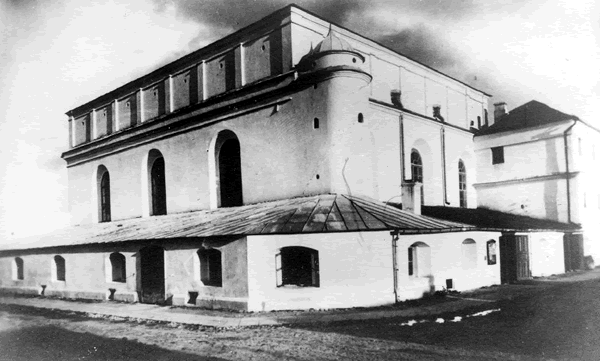
Soviet-Era Sports Palace in Vilna, as it looks today, in the Old Jewish Cemetery.

Ms. Kukliansky continues: “Because the building [i.e., the Soviet-era Sports Palace] itself has been designated an architectural heritage site, no changes are possible.” Really? It was in the Soviet period that all the tombstones were systematically removed from the cemetery between 1948 and 1955, and it was in the Soviet period that a Sports Palace was constructed over the dead bodies of thousands of Vilnius Jews.[12] Now who was it that designated the Soviet Sports Palace an architectural heritage site? If it was the Soviets, what has this to do with Independent Lithuania? If, however, it was Independent Lithuania that made this designation, then rectification is long overdue. Indeed, the government of Lithuania should recognize the Shnipishkes Jewish cemetery as a heritage site of the Jewish community of Vilnius from the 16th through the 19th centuries. It should certainly not condone and perpetuate the Soviet desecration of a Jewish cemetery. That the EU supports such misuse of funds is nothing short of scandalous. Surely, there is ample room in and around Vilnius for the construction of a Convention Center someplace other than smack in the center of historically, the single most important Jewish cemetery in Lithuania and one of the most important in all of Europe.

Ms. Kukliansky labels those who disagree with her as “simply uninformed” or having a particular axe to grind. She does not entertain the possibility that building a Convention Center over a Jewish cemetery is not everybody’s cup of tea. I’m afraid it is Ms. Kukliansky who seems to be unaware of how many thousands of graves remain on the site, of how often bones have surfaced in recent years on the face of the cemetery,[13] and how despite prior agreements with the Lithuanian authorities, two entire buildings were constructed in recent years on the cemetery grounds.[14] Does she really believe – as she claims – that the construction of a $25,000,000 Convention Center will involve no excavation outside the present perimeters of the Soviet-era Sports Palace? Does she really believe – as she claims – that the type of activities that will take place in the renovated center will be in keeping with the special nature of the site? I wonder who is “simply uninformed.”

Faina Kukliansky writes: “If anything, this should be a cause for celebration and a model for how governments in our part of the world should deal with similar challenges of respecting and protecting Jewish cemeteries and mass graves of Holocaust victims.”

Nations of Eastern Europe take note! If you want to deal with respecting and protecting Jewish cemeteries, learn from the Vilnius experience. First remove and destroy all Jewish tombstones, and afterwards excavate wherever possible and destroy the remains of those who were buried there. Then build a Sports Palace or a Convention Center in the heart of the Jewish cemetery! Make certain that the new structures are designated architectural heritage sites, so that they cannot be dismantled. This should be followed by a celebration of how Jewish cemeteries have been respected and protected in the most proper fashion.

Faina Kukliansky is to be congratulated for assuming the responsibility of leading a “small but resilient Jewish community.” Sadly, she makes no mention of the fact that heartfelt and pained voices have been raised by a number of distinguished members of her small community, voicing strong opposition to the construction of the Convention Center in the Jewish cemetery.[15] But there is another issue here. Faina Kukliansky is much too modest in thinking that the “small and resilient Jewish community” of Vilnius is her only constituency. The Vilnius Jewish cemeteries belong not only to Vilnius and its Jewish community. The spiritual, as well as the genetic, descendants of the thousands of men and women buried in the Shnipishkes and Zaretcha Jewish cemeteries live the world over. They remember their ancestors, study their writings, often live by their teachings, and should have the right to pray at their graves in a cemetery not desecrated by a Convention Center.

Faina Kukliansky would do well to weigh carefully the consequences of the precedent she is setting. By lending her support to the construction of a Convention Center over the old Jewish cemetery, she places in jeopardy every Jewish cemetery in Europe and, perhaps, elsewhere as well. True, she claims that she relies on a rabbinic ruling issued by the CPJCE in London. Distinguished rabbis the world over, however, have raised their voices in unison against the construction of a Convention Center in the old Jewish cemetery, rendering the London opinion – at best – a minority one. These voices include the leading halakhic authorities in Israel16 and the United States,17 and the present heads of the great yeshivot that once graced Lithuania, which due to the Holocaust and Soviet repression had to resettle elsewhere.18 Faina Kukliansky would also do well to remember the voice raised long ago by her pre-World War II predecessor in Vilna, Rabbi Chaim Ozer Grodzenski. He did not allow the Polish government to desecrate the very Jewish cemetery that is about to be desecrated by the Lithuanian government with her approval.

Sid Leiman
Professor Emeritus of Jewish History and Literature
Brooklyn College

September 13, 2015
Erev Rosh Ha-Shanah 5776

Notes:

[1] Laimonas Briedis, Vilnius: City of Strangers (Vilnius, 2009), p. 168.
[2] Briedis, op. cit., p. 195. [The Briedis quotes have been slightly edited by me for the sake of clarity. -SL]
[3] See Yaakov Kosovsky-Shahor, ed., אגרות רחיים עוזר (Bnei Brak, 2000), vol. 1, pp. 400-401. Cf. Dov Eliach, הגאון (Jerusalem, 2002), vol. 3, p. 1142. See also the brief notice in Israel Klausner,
וילנא ירושלים דליטא: דורות האחרונים (Tel-Aviv, 1983), vol. 2, p. 554.
[4] For a concise history of the old Jewish cemetery in Vilna, see Israel Klausner, קורות בית העלמין הישן בוילנה (Vilna, 1935).
[5] In general, see Kosovsky-Shahor, op. cit., vol. 1, pp. 400-405.
[6] Kosovsky-Shahor, op. cit., vol. 1, pp. 402-403.
[7] A soccer field, just north of the old Jewish cemetery, was initiated in 1936 and eventually became Zalgiris Stadium when construction was completed by the Soviets in 1950. See Antanas Papshys, Vilnius: A Guide (Moscow, 1980), p. 127. It is still in use in Vilnius.
[8] For a moving account of his funeral, see Yosef Friedlander, “The Day Vilna Died,” Tradition 37:2 (2003), pp. 88-92.
[9] Faina Kukliansky’s statement was translated from Lithuanian into English and posted on August 15, 2015 on the Lithuanian Jewish Community website here. For the full context of the “Convention Center on the Old Jewish Cemetery” controversy, and for a comprehensive paper trail of statements made by Faina Kukliansky and the various parties involved in the controversy to date, see here. This site exists due to the incredible industry of the indefatigable Professor Dovid Katz of Vilnius, who also has prepared a register of all public voices that have been raised in opposition to the proposed construction of a Convention Center on the old Jewish cemetery, available here.
[10] One suspects that Ms. Kukliansky distinguishes between the land under the former Soviet-era Sport Palace (which, due to the excavations necessary for its construction, presumably led to the disposal of all Jewish remains that had been buried there) and the land surrounding the former Soviet-era Sports Palace (which presumably retains the remains of all those Jews who had been buried there). Thus, she feels comfortable with the construction of a Convention Center over the former Soviet-era Sports Palace. In terms of Jewish law, however, such a distinction is meaningless. Once a Jewish cemetery is consecrated it becomes a hallowed place, much like a synagogue. Like a synagogue, it cannot be used for secular purposes and it may not be desecrated in any way. And like a synagogue, it retains its sanctity whether or not Jews are actually present at any specific time or on a specific day. The Jewish cemetery remains hallowed in its entirety, even if all the remains have been removed from it; how much more so if remains are strewn throughout the cemetery! On the hallowed status of a Jewish cemetery, see, e.g., R. Jacob Moellin (d. 1427), ספר מהריל: מנהגים (Jerusalem, 1989), laws of fasting, p. 270; R. Elijah Shapira, אליהו רבה על ספרי הלבושים, to שלחן ערוך אורח חיים 581:4, note 39; and R. Judah Ashkenazi (d. circa 1742), באר היטב, and R. Samuel Kolin (d. 1806), מחצית השקל, to שלחן ערוך אורח חיים 581:4. In all the passages just cited, every Jewish cemetery is described as a מקום קדוש, i.e. a holy place – which is precisely why Jewish cemeteries are designated as places appropriate for prayer. When a municipal office building, or an apartment house, or a convention center is constructed on a Jewish cemetery, it as an act of desecration. Ms. Kukliansky seems upset about “the outrageous claims that a desecration is taking place.” The claims are hardly outrageous; it is the desecration that is taking place that is outrageous.

That a Jewish cemetery retains its hallowed status even if some or all the remains are removed from it and buried elsewhere is an official ruling of many rabbis, including R. Shlomo Zalman Auerbach (d. 1995), one of the greatest halakhic decisors of modern times. At שות מנחת שלמה (Jerusalem, 1999), vol. 2, responsum 88, p. 338, he rules unequivocally: “A Jewish cemetery, even if should happen that its remains have been exhumed, remains prohibited [for secular use, or for being sold to a second party], and always retains its character as a Jewish cemetery.” Cf. R. Moshe Feinstein,אגרות משה: יורה דעה חלק ג (New York, 1982), responsum 151, pp. 418-419.
[11] This can be seen by examining maps of the Jewish cemetery prepared during the last 200 years, as well as detailed photographs of the Jewish cemetery taken in the last 100 years. Even U.S. intelligence reports released by Wikileaks concede that “the Sports Palace property indisputably rests in the middle of the former cemetery.” See here.
[12] The Soviet-built Sports Palace, used primarily for volleyball and basketball games, was opened in 1971 and remained in use in Independent Lithuania until 2004.
[13] The evidence here is shocking indeed. See, e.g., Binyomin Rabinowitz, “Can Anything Be Done to Save the Remnants of Vilna’s Old Jewish Cemetery,” Dei’ah VeDibur (August 31, 2005), pp. 1-9, available online here.
[14] See, e.g., the Wikipedia entry on “Jewish Cemeteries of Vilnius”: “The Palace of Concerts and Sports (Lithuanian: Koncertų ir sporto rūmai) was built in 1971 right in the middle of the former cemetery. In 2005, apartment and office buildings were built at the site,” here.
[15] See, e.g., Ruta (Reyzke) Bloshtein’s stirring plea to the Lithuanian government online here.
[16] E.g, Rabbi Samuel Auerbach of Jerusalem, son and successor of R. Shlomo Zalman Auerbach.
[17] The list is much too long to be included here. Suffice to mention: Rabbi David Feinstein (head of Mesivta Tiferet Jerusalem), Rabbi Aharon Feldman (head of Ner Israel Rabbinical College), Rabbi Shmuel Kamenetsky (head of Talmudical Yeshiva of Philadelphia), and Rabbi Aaron M. Schechter (head of Mesivta Chaim Berlin).
[18] These include Rabbi Chaim Dov Heller, head of the Telz Yeshiva, formerly in Telshiai, Lithuania; Rabbi Osher Kalmanowitz, head of the Mirrer yeshiva, formerly in Mir, Greater Lithuania (today in Belarus); and Rabbi Aryeh Malkiel Kotler, head of the Beth Medrash Govoha in Lakewood, formerly in Kleck and Sluck, Greater Lithuania (today in Belarus).


A nay bintl briv: Personal Reminiscences of Rabbis Baruch ha-Levi Epstein and Aaron Walkin from the Yiddish Republic of Letters

A nay bintl briv:

Personal Reminiscences of Rabbis Baruch ha-Levi Epstein and Aaron Walkin

from the Yiddish Republic of Letters

Shaul Seidler-Feller

Editor’s note: The present post is part two of a two-part essay. Part one can be found here.

Second Letter

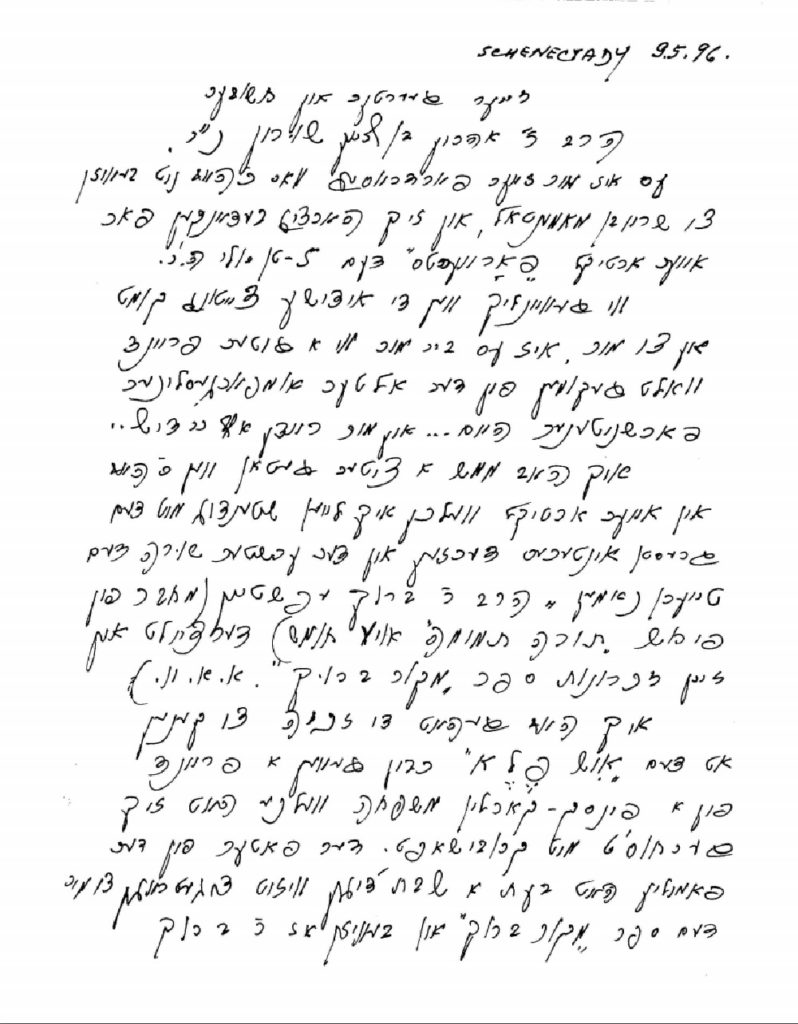
Approximately eight and a half years after his column on the Hafets Hayyim appeared, Rabbi Aaron B. Shurin penned another essay, entitled “The Mistake of the Austrian Emperor” and about the meaning behind the observance of the Three Weeks, which was published 18 Tammuz 5756 (July 5, 1996), a day after they had begun.[1] In the first line, he quoted Rabbi Baruch ha-Levi Epstein (1860–1941/1942) as citing a story about Austrian Emperor Franz Joseph I’s (1830–1916) negative response to a group of Hungarian nationalists who wished to establish a day of mourning for the loss of their independence in 1848, using the Jews’ observance of Tish‘ah be-Av as a model.[2] This prompted Simon Paktor to write in:


SCHENECTADY 9.5.96.

זייער געערטער און חשובער
.הרב ר״ אהרון בן ציון שוּרין נ״י


עס איז מיר זייער פארדראסיג וואס כ׳האב ניט בעוויזן
צו שרייבן מאמענטאל, און זיך הארציג בעדאנקען פאר
.אייער ארטיקל ״פאָרווערטס״ דעם 5-טן יולי ה.י

ווי געוויינליך ווען די אידישע צייטונג קומט
אן צו מיר, איז עס ביי מיר ווי א גוטער פריינד
וואלט געקומען פון דער אלטער אומפארגעסליכער
..פארשניטענער היים… און מיר ריידן א[וי]ף יידיש

איך האב ממש א ציטער געטאן ווען כ׳האב
אין אייער ארטיקל וועלכן איך לייען שטענדיג מיט דעם
גרעסטן אינטערעס דערזען אין דער ערשטער שוּרה דעם
טייערן נאמען ״הרב ר׳ ברוך עפשטיין (מחבר פון
פירוש ״תורה תמימה״ אויף חומש) דערציילט אין
[3](זיין זכרונות ספר ״מקור ברוּך״ א.א.וו

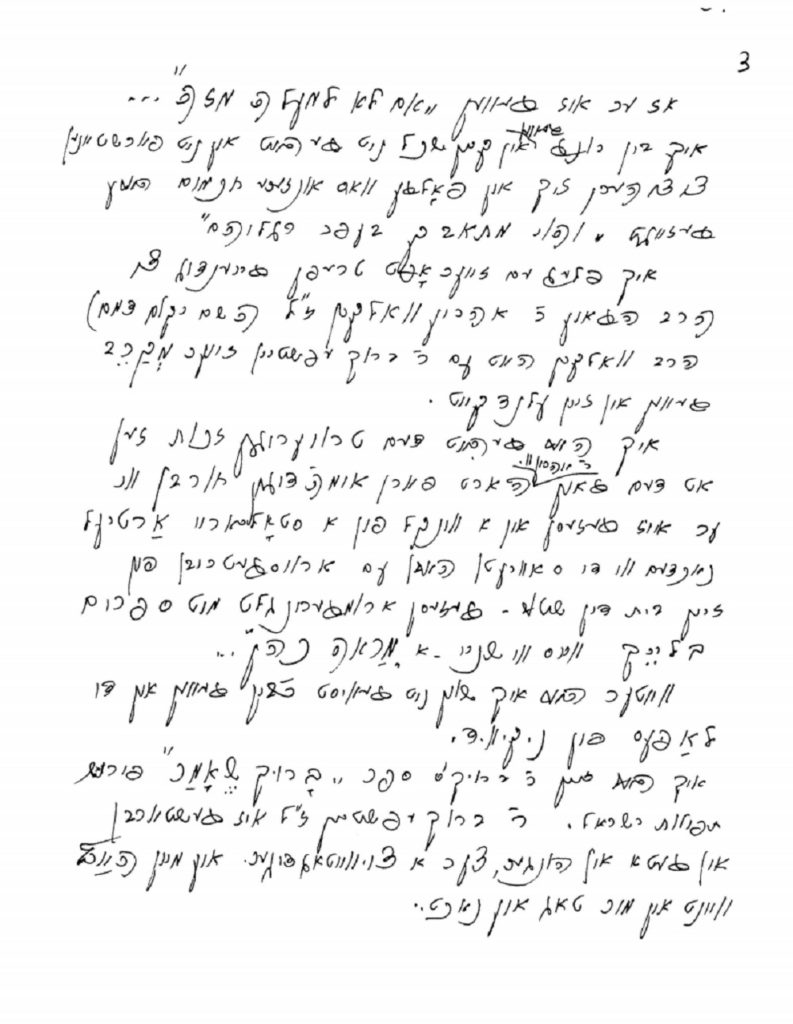
איך האב געהאט די זכיה צו קענען
אט דעם ״אִיש פֶלֶא״ כבין געווען א פריינד
פון א פינסק-קארלין משפחה וועלכע האט זיך
געיחוס׳ט מיט קרובישאפט. דער פאטער פון דער
פאמיליע האט בעת א שבת׳דיגן וויזיט צוגעטראגן צו מיר
דעם ספר ״מקור ברוך״ און בעוויזן אז ר׳ ברוך

2

ווייזט אן אז אין שׁימל פון ברויט ליגט
דער פאטער אלתר סלוּצקי .PENECiLiN רְפוּאָה ווי
איז געווען א לאַווניק אין שטאט ראַט און די טאכטער האט
געארבעט אין דער יידישער אפטיילונג. אזוי ווי פינסק
האט געהאט א פנקס פון 800 יאר האט זיך זי געהאט די
א מעגליכקייט אויסגעפינען און אנטקעגן קומען ר׳ ברוך עפשטיינס
ביטעס אין די ארכיווע אויסצוזוכן. ער פלעגט זיך שטענדיג
בעדאנקען צו איר דורך שיקן א ״באָמבאניערקע״
דא הייסט עס א באַקס שאקאלאד)… איך)
.מיט טרערן אין די אייגן און מוז א וויילע איבערייסן

.ער האט מיר אויסגעלערנט אן אריטמעטיג פארמוּלע
איך דערמאן זיך ווען כ׳האב שבת נאכן דאוונען אין פינסקער
גרייסער שוּל אראבגעגאנגען צום ברעג פון אונזער
און בעמערקט ר׳ ברוך עפשטיין ז”ל PiNA שיינער טייך
זיצט אויף א באַנק כ׳בין צוגעגאנגען צו עם און געזאגט

״גוט שבת ר׳ ברוּך גום ברוך יהיה״

ער האט געענטפערט ״גם אתם״ און צובייגענדיג צו מיר
געפרעגט ״אפשר האט איר די פאָלקס צייטונג״
(א בונדיסטישע צייטונג וואס איז ארויס אין ווארשע)
(ווען איך האב עס דערציילט א היגן רָב (ניט קיין ראביי
האט ער צו מיר געזאגט יעצט זע איך

3

…אז ער איז געווען ״אם לא למעלה מזה״
איך בין יונג געווען און קיין שכל ניט געהאט און ניט פארשטאנען
צו צוהערן זיך און פאָלגן וואס אונזערע חכמים האבן
געזאגט ״והוי מתאבק בעפר רגליהם״

איך פלעג עם זייער אָפט טרעפן גייענדיג צו
(הרב הגאון ר׳ אהרון וואלקין ז״ל השם יקום דמם
הרב וואלקין האט עם ר׳ ברוך עפשטיין זייער מְקַרֵב
.געווען אין זיין עלנדקייט

איך האב געהאט דעם טרויעריגן זכות זען
אט דעם גאון ר׳ אהרון וו. הארט פארן אימה׳דיגן חורבן ווי
ער איז געזעסן אין א ווינקל פון א סטאָליאריי אַרטיעל
נאכדעם ווי די סאוויעטן האבן עם ארויסגעטריבן פון
זיין בית דין שטוב. געזעסן ארומגערינגלט מיט ספרים
…בליֵיך ווייס ווי שניי. א ״מַראה כהן״

ווייטער האב איך שוין ניט געווּסט כ׳בין געווען אין די
.לאַפּעס פון נ.ק.וו.ד

איך האב זיין ר׳ ברוּך׳ס ספר ״בָרוּך שֶאָמַר״ פירוּש
תפילות ישראל. ר׳ ברוך עפשטיין ז״ל איז געשטארבן
אין געטא אין הונגער, צער א צוּווייטאגדיגער. און מיין האַרץ
..וויינט אין מיר טאג און נאכט

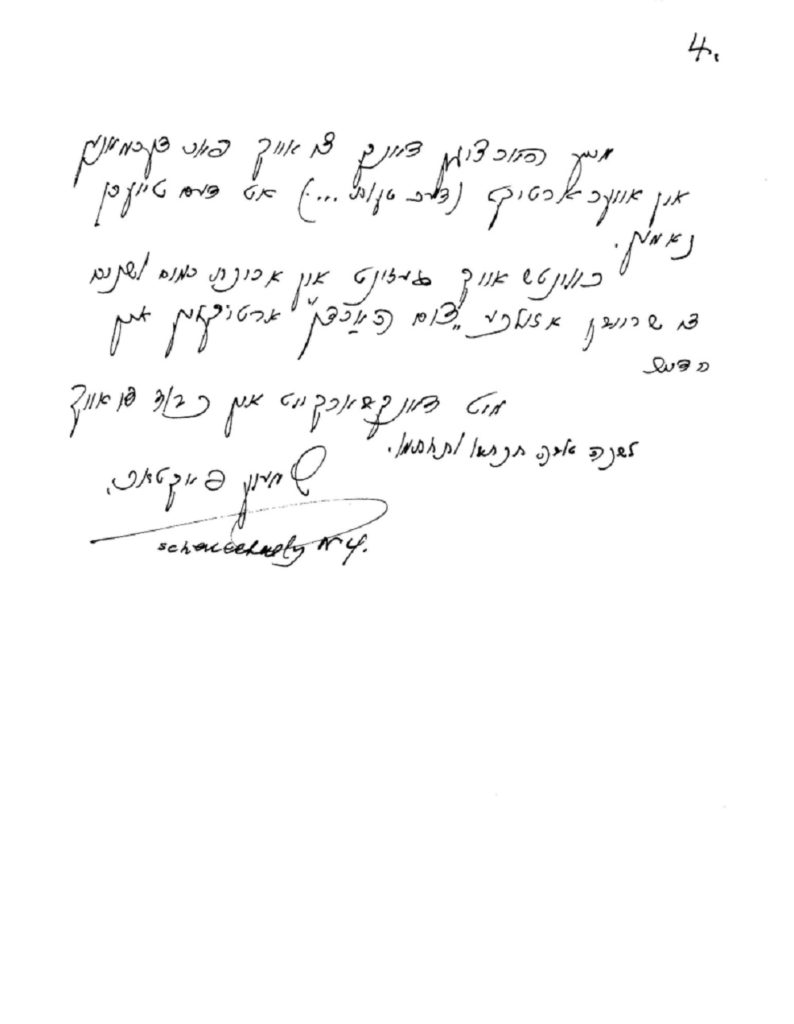
4

מיין הארציגן דאנק צו אייך פאר דערמאנען
אין אייער ארטיקל (דער טעות….) אט דעם טייערן
.נאמען

כווינטש אייך געזונט און אריכת ימים ושנים
צו שרייבן אזעלכע ״צום האַרצן״ ארטיקלען אין
יידיש

מיט דאנקבארקייט און כבוד צו אייך
.לשנה טובה תכתבו ותחתמו
.שמעון פאקטאר
Schenectady NY.

Schenectady 9.5.96

To the highly esteemed and eminent Rabbi Aaron Benzion Shurin, may his light shine,

I am greatly displeased that I did not manage to write immediately to offer my sincere thanks for your column in this year’s July 5th issue of the Forverts.

As is usual when the Yiddish newspaper is delivered, I felt then as if a good friend had arrived from the unforgettable, obliterated old country… and we were having a conversation in Yiddish…

I literally shuddered when I noticed in the first line of your column – which I always read with the greatest interest – the dear name “Rabbi Baruch Epstein (author of the Torah temimah commentary on the Pentateuch) relates in his memoir Mekor barukh,” etc.

I had the good fortune to know that “amazing man.” I was friendly with a family in Pinsk-Karlin that took pride in its kinship with him. The head of the family, during a visit of mine one Sabbath, brought me the book Mekor barukh and showed me that R. Baruch

2

points out that medicine akin to penicillin can be found in moldy bread.[4] The father, Alter Slutzky, was an alderman on the city council, and his daughter worked in its Jewish division.[5] Since Pinsk had a communal register going back 800 years,[6] she had the opportunity to learn of and accommodate R. Baruch Epstein’s requests to search in the archive. He would always thank her by sending a bombonierka (here, we would call it a box of chocolates)…[7] I write this with tears in my eyes and must pause for a moment.

He taught me an arithmetic formula. I remember how one Sabbath, after services in the Great Synagogue of Pinsk,[8] I descended to the banks of our beautiful Pina River and caught sight of R. Baruch Epstein, of blessed memory, sitting on a bench.[9] I approached him and said, “Good Sabbath, R. Baruch – may you, too, be blessed [barukh].”[10] He responded, “The same to you”[11] and, leaning over to me, asked, “Maybe you have a copy of the Folkstsaytung?” (a Bundist newspaper published in Warsaw). When I recounted this story to a local rov (not some non-Orthodox rabbi),[12] he said to me, “Now I see

3

that he was ‘if not even higher than that’[13]…”[14] I was young and foolish and did not realize that I should really listen to and follow that which our Sages taught: “And sit in the dust of their feet.”[15]

I would very often meet him on his way to the ga’on Rabbi Aaron Walkin, of blessed memory (may God avenge their blood). R. Walkin drew quite close to R. Baruch Epstein in his loneliness.

I had the tragic fortune to see that ga’on, R. Aaron W., right before the horrific Holocaust, sitting in a corner of a carpentry workers’ cooperative after the Soviets had banished him from his rabbinic courtroom. He sat surrounded by books, his complexion pale white as snow, like leprosy shown to a priest…[16]

I knew nothing more of him; I was caught in the clutches of the NKVD.

I have R. Baruch’s book Barukh she-amar, a commentary on the Jewish prayers.[17] R. Baruch Epstein, of blessed memory, died in the ghetto a distressed man, starving and suffering. And my heart cries within me day and night…

4

My sincere thanks to you for mentioning in your column (“The Mistake…”) that precious name.

I wish you health and many long days and years so that you might continue writing such “heartwarming” columns in Yiddish.

With gratitude and esteem,
May you be inscribed and sealed for a good year,
Simon Paktor
Schenectady, NY

Although the author of our letter offers precious few details about himself in the body of the document, we know from other sources that he was born to Moishe and Gittel Paktor on January 18, 1913 in Pinsk (then part of Russia, now in Belarus).[18] At the time, Pinsk was one of the most Jewish (percentage-wise) of the major cities in Eastern Europe, with a Jewish population in 1914 of 28,063 out of 38,686 total residents (approximately 72.5%).[19] Presumably because Paktor was young and politically active, the NKVD (Soviet secret police) arrested him toward the beginning of World War II, when Pinsk was occupied by the Red Army, and sent him eastward to a Siberian labor camp, thereby inadvertently saving his life.[20] When he was released, he traveled to Munich where he met and married his first wife, Helen (1925–2019), and the two of them, together with their young son David Leon (b. 1949), immigrated to the United States in 1952.[21] Sometime thereafter the couple divorced, and in 1973 Simon moved to Schenectady to serve as the Ritual Director at Congregation Agudat Achim, a Conservative synagogue (located at 2117 Union Street).[22] There, in 1976, he married Anne Smuckler (1914–2014), whose own husband had passed away three years prior,[23] and continued serving the shul faithfully until his retirement in 1993.[24]

Paktor’s letter, like Dickman’s before it, transports us back in time, providing rare firsthand testimony that sheds light on several aspects of interwar Eastern European rabbinic culture. It deals primarily with the figure of R. Epstein, a brilliant Talmudist and polymath who decided not to enter the rabbinate but instead to support his family as a banker, all the while composing important Torah works in a non-professional capacity.[25] Perhaps the most eclectic of these is Sefer mekor barukh (Vilna, 1928), a multivolume compilation of his novellae and studies in various fields of Jewish scholarship, as well as personal reminiscences about members of his family. Paktor’s letter briefly discusses this book but also, en passant, and intriguingly, references Epstein’s research in the Pinsk Jewish communal archive; could he have been working there on his never-published bilingual (Hebrew and Yiddish) treatise on the history of Pinsk, written in the aftermath of World War I?[26]

Also interesting is Epstein’s request for a copy of the daily Folkstsaytung, not only on account of the paper’s strictly secular orientation – indeed, it, like the Forverts, was published on Shabbat and yom tov[27] – but also because halakhah, according to a number of interpretations, generally disapproves of reading printed matter like newspapers on Shabbat[28] (some would say during the week as well[29]). In apparently seeing nothing wrong with this practice, Epstein was following the example of his maternal uncle and eventual brother-in-law, Rabbi Naphtali Zevi Judah Berlin (Netsiv; 1816–1893), last rosh yeshivah of the famous yeshivah in Volozhin (present-day Vałožyn, Belarus), who, by Epstein’s own account, would regularly peruse a newspaper on Shabbat day.[30]

In addition, the letter opens a window onto the relationship between Epstein and Rabbi Aaron Walkin (alternatively spelled Wolkin; 1865–1941/1942).[31] By the period in question, Epstein had suffered a number of tragedies and personal setbacks: his wife Sophia (Sheyne), the daughter of Eleazar Moses ha-Levi Horowitz (Reb Leyzer Pinsker; 1817–1890), former chief rabbi of Pinsk, had passed away due to influenza in 1899 before the age of 40; the Mutual Credit Society, the large private bank at which Epstein had worked as an officer, closed at the beginning of World War I; and three of his four children were no longer in Pinsk.[32] Though his daughter Fania (Feygl) remained in the city,[33] Epstein was lonely and lived in a hotel.[34] Into this void stepped Walkin, who arrived in Pinsk circa 1923,[35] becoming its chief rabbi in 1933[36] and there growing close to Epstein. The two men had much in common: both had studied at the feet of Netsiv in Volozhin, married around the age of 18, endured great misfortune, visited America but decided to return to Europe, and sympathized (at least somewhat) with the Zionist movement.[37] As Paktor testifies, Epstein, who lived (as of 1930) at 89 Dominikańska (present-day Gor’kogo [renamed by the Soviets]) Street,[38] would often visit Walkin at his home at 71 Dominikańska, a claim confirmed by the latter’s son, Rabbi Samuel David (1900–1979),[39] who refers to Epstein on at least one occasion as yedidi ne’eman beitenu (my friend, a confidante of our household).[40]

Finally, the letter touches directly on the last years of Walkin’s and Epstein’s lives. Shortly after Soviet forces entered Pinsk on September 17, 1939, they banned Hebrew language instruction, abolished the traditional Sabbath and Jewish holidays, and converted the Great Synagogue into a theater.[41] We know from Paktor’s letter and other sources that Walkin, who had been imprisoned by the Russians previously,[42] largely escaped persecution at the hands of the Soviets and even managed to continue performing his rabbinic functions, including scholarly writing, in secret.[43] Epstein, by contrast, was evicted from the hotel in which he had been living and was forced to wander, further weakening him in his old age.[44]

With the Nazi advance into Pinsk on July 4, 1941, an already dire situation was made even more terrifying: Jews were wantonly robbed and beaten, forced to wear Stars of David, ordered to provision the German occupiers, forbidden to leave the city, and detained for labor or ransom. About a month later, on August 5–7, the first Aktion took place, in which the Nazis murdered approximately eight thousand Jewish men outside the city. The following May 1, a ghetto meant to concentrate the approximately twenty thousand remaining Jews was established in the poorest and most crowded part of town; this was later almost completely liquidated in the second Aktion of October 29–November 1, 1942.[45]

What became of Walkin and Epstein during this frightful time? Theories about each man’s demise abound. R. Samuel David refers to his father on several occasions with the acronym reserved for martyrs, H[ashem] y[ikkom] d[amo], following his name.[46] Indeed, at least two Pinsk natives have written that R. Aaron perished together with his flock (presumably in one of the two major Aktionen).[47] Others have hazarded guesses dating his passing to around Passover 1941 or to the summer of 1942.[48] Similarly, as surveyed recently in part by Shemaryah Gershuni, hypotheses regarding Epstein’s date of death range from 1940 to 1942 and, regarding the circumstances of his death, from natural to painful to violent.[49]

In his letter, Paktor himself could not say what had happened to Walkin, while with respect to Epstein, he claimed that he had died in the Pinsk ghetto (he, too, adds Hashem yikkom damam after mentioning them).[50] However, so far as I have been able to ascertain, and as already pointed out by Gershuni, the only eyewitness testimony to have come down to us – that of a nurse named Mila/Michla Ratnowska (b. 1916) who, together with her mother Zlata (1890–1962) and four others, survived the Nazi occupation of Pinsk in hiding – records that both men died (at home) due to illness in the winter of 1941–1942.[51] This timing is corroborated, if only implicitly, by the absence of Walkin and Epstein from the list of over eighteen thousand Jews living in the Pinsk ghetto, drawn up by the Germans “sometime in 1942.”[52] Until additional evidence surfaces, it would seem prudent to accept this as the most reliable version of the events leading up to the passing of these great men, about whom we can say (with a bit of poetic license) that they were “beloved and cherished in their lifetimes, and they never parted, even in death” (II Sam. 1:23).

Conclusion

Like the giants about whom they wrote, Shurin, Dickman, and Paktor have all passed on (in 2012, 2011,[53] and 2003, respectively). How fortunate we are, though, that their memories are preserved for us in this nay (new) bintl briv! Through these simple documents – penned in an age (not too long ago) when people still took the time to correspond thoughtfully with journalists after reading and reflecting on their essays – we are able to reconstruct, if only partially, the lives and deeds of some of the most prominent leaders of Eastern European Jewry in a prewar world now lost.


* I would like to thank Yehuda Geberer for respectfully commenting that he felt I had made a mistake in the first part of this essay, in which I had identified the Chaim Lieberman who assisted Shurin in landing a job at the Forverts as “the famed historian and bibliophile” who lived 1892–1991 (and who often spelled his name Haim Liberman in English). While Geberer is almost certainly correct that Shurin was actually helped by the man of the same name (1890–1963) who, according to his entry in the Leksikon fun forverts shrayber zint 1897, 42-43, worked as a teacher of Yiddish literature and Forverts Yiddish literary critic, I was influenced (apparently unduly so) in my (mis)identification by Yisroel Besser who, in his Mishpacha article (p. 30), writes as follows: “He went to meet the person he considers the greatest Orthodox writer of the century, Chaim Lieberman. Lieberman was a bibliophile, researcher, and historian, who suggested that young Shurin leave him some writings to peruse.”

I also wish to thank Yehudah Zirkind for kindly bringing to my attention another Yiddish-language memoir about the Hafets Hayyim, in which the author, a Radin native, tells a number of interesting stories about the great sage and also notes that he passed away “before reaching his ninety-fourth birthday”; see Abrashka-Kives Rogovski, “Der khofets-khayim in radin,” Oksforder yidish 3 (1995): 193-200, at col. 200.

[1] Aaron B. Shurin, “Der toes fun estraykhishn keyzer,” Forverts (July 5, 1996): 9, 20.
[2] See Baruch ha-Levi Epstein, Sefer mekor barukh, pt. 2 (Vilna: Romm, 1928), 515a-b, citing what he heard from Isaac Hirsch Weiss of Vienna (1815–1905). Epstein refers to the ruler as Franz Joseph II, but in point of fact the relevant Austrian emperor at the time was Franz Joseph I (whose official grand title, interestingly, included the style “King of Jerusalem”).
[3] The quotation of the original Yiddish here is not exact but is certainly close enough.
[4] I have so far been unable to locate the passage referred to.
[5] Jacob-Alter Slutzky was a prominent Orthodox lay leader of the Jewish community of Pinsk who was s/elected to serve on the city council at several points during the interwar period when Pinsk was under Polish rule; see Azriel Shohet, The Jews of Pinsk, 1881 to 1941, ed. Mark Jay Mirsky and Moshe Rosman, trans. Faigie Tropper and Moshe Rosman (Stanford: Stanford University Press, 2012), 469-470, 552-556, 559, 580-581. For the original Hebrew, see Wolf Zeev Rabinowitsch (ed.), Pinsk: sefer edut ve-zikkaron li-kehillat pinsk-karlin, vol. 1, pt. 2 (Tel Aviv; Haifa: Irgun Yotse’ei Pinsk-Karlin bi-Medinat Yisra’el, 1977; also available through the New York Public Library Yizkor Book online portal [accessed August 19, 2019]), using the index. See also Slutzky’s mini-bio in Nachman Tamir (Mirski) (ed.), Pinsk: sefer edut ve-zikkaron li-kehillat pinsk-karlin, vol. 2 (Tel Aviv: Irgun Yotse’ei Pinsk-Karlin bi-Medinat Yisra’el, 1966; also available through the New York Public Library Yizkor Book online portal [accessed August 19, 2019]), 538, where it is noted that Slutzky, like Epstein, was a member of Netsiv’s family (see below) and that he had two daughters, Zhenya and Eve. Based on a daf-ed filed by the former’s sister-in-law, Sonia Goberman (accessed August 19, 2019), it appears that Zhenya was the one who worked in the Jewish division. For Epstein’s endorsement of Slutzky during a campaign season, see “Eyn goldene keyt fun maysim toyvim,” Unzer pinsker lebn 3,42 (102) (October 16, 1936): 5.
[6] An old Pinsker tradition has it that the Jewish community was founded some time in the tenth century; see Benzion Hoffman (ed.), Toyznt yor pinsk (New York: Pinsker Branch 210, Workmen’s Circle, 1941), ix-x (notice the book’s title), and Tamir, Pinsk, 249, 252. Some have averred that an exact date for the start of the community cannot be established at present, given the number of times the Great Synagogue, and any historical documents it may have housed, burned down (on which, see n. 8 below); see, e.g., Saul Mendel ha-Levi Rabinowitsch, “Al pinsk-karlin ve-yosheveihen,” in Judah ha-Levi Levick and Dovberush Yeruchamsohn (eds.), Talpiyyot (me’assef-sifruti) (Berdychiv: Joseph Hayyim Zablinsky, 1895), 7-17, at p. 7. In any event, the current mainstream position holds that it began around 1506, the year in which a privilege issued by Fyodor Ivanovich Yaroslavich, Prince of Pinsk, granted local Jews land for a synagogue and cemetery in perpetuity; see Mordechai Nadav, The Jews of Pinsk, 1506 to 1880, ed. Mark Jay Mirsky and Moshe Rosman, trans. Moshe Rosman and Faigie Tropper (Stanford: Stanford University Press, 2008), 13-14.
[7] For a similar story, see Hillel Seidman, “Ha-rav r. barukh epstein – pinsk,” in Isaac Lewin (ed.), Elleh ezkerah: osef toledot kedoshei [5]700-[5]705, vol. 1 (New York: Research Institute of Religious Jewry, Inc., 1956), 142-149, at p. 145; reprinted with some variations in Seidman’s Ishim she-hikkarti: demuyyot me-avar karov be-mizrah eiropah (Jerusalem: Mossad Harav Kook, 1970), 108-116, at p. 111. Relatedly, see the Rosh Hashanah greetings sent to Epstein by the typesetters and printers of the Pinsker vort 2,40 (86) (September 30, 1932): 1, and of ibid. 3,38 (138) (September 20, 1933): 1.
[8] For some of the turbulent history of the Great Synagogue of Pinsk, which fell victim to fires on multiple occasions, see Nadav, The Jews of Pinsk, 1506 to 1880, 463-465; Shohet, The Jews of Pinsk, 1881 to 1941, 217-220, 300-301, 463, 648, 656; and Tamir, Pinsk, 249-252. For photographs of the synagogue, see here and here (accessed August 19, 2019). For a map of Pinsk from 1864 illustrating the location of the Great Synagogue, see Hoffman, Toyznt yor pinsk, 88-89 (in Yiddish), and Nadav, The Jews of Pinsk, 1506 to 1880, 498-499 (in English). For later maps of Jewish Pinsk, see Hoffman, Toyznt yor pinsk, 232-233, and Tamir, Pinskfoldout preceding p. 97.
[9] Epstein generally prayed not in the Great Synagogue but in the Pinsker Kloyz, a beit midrash with a firmly mitnaggedic orientation. Ze’ev Rabinowitsch reports that, “in years past, it was said that the walls of the Pinsker Kloyz do not give out in deference to R. Baruch Epstein…” (“Akhsanye shel toyre,” in Tamir, Pinsk, 264). See also Rabinowitsch, Pinsk, 412.
[10] See Gen. 27:33.
[11] In Yiddish, one appropriate response to a greeting like gut shabes! is gam atem!, using the plural atem even when only one person is being addressed. See Sol Steinmetz, Dictionary of Jewish Usage: A Guide to the Use of Jewish Terms (Lanham, MD: Rowman & Littlefield Publishers, Inc., 2005), 53.
[12] American Yiddish will often distinguish between Orthodox and non-Orthodox (particularly Reform) rabbis by referring to the former as rov/rabonim (singular/plural) and the latter as rabay/rabays (singular/plural). As essentially transliterations from the English, these terms for non-Orthodox rabbis are usually intended somewhat derogatorily in the mouths of frum Yiddish speakers.
[13] Oyb nisht nokh hekher or, as the phrase appears here in Hebrew, Im lo le-ma‘lah mi-zeh, is the title of a short story by the famous Yiddish and Hebrew classicist I.L. Peretz (1852–1915) about a Litvak who refuses to believe that the Nemirover Rebbe (a fictional character probably based on Rabbi Nathan Sternharz of Niemirów [1780–1845]) ascends on High during the annual period of selihot, as his Hasidim claim he does, instead of coming to the synagogue. Determined to find out where the Rebbe disappears to, he hides under the Rebbe’s bed one night and is amazed to discover that the Rebbe wakes early in the morning, dresses as a Polish peasant, and goes out to the forest to chop firewood for poor bedridden Jewish widows. He thereupon decides to join the Rebbe’s Hasidim, and from then on whenever anyone claims that the Rebbe flies up to Heaven to petition on behalf of his flock before Rosh Hashanah, this Litvak-turned-Hasid responds, “If not even higher than that.”

The story was first published in Yiddish in 1900 as “Oyb nisht nokh hekher! A khsidishe ertseylung,” Der yud 2,1 (January 11, 1900): 12-13. The following year, it appeared, in the author’s own Hebrew adaptation, as “Im lo le-ma‘lah mi-zeh,” Ha-dor 1,17 (1901): 207-211; for the Hebrew text, see here (accessed August 19, 2019). For editions using modern Yiddish orthography, see here and here (accessed August 19, 2019). For side-by-side Yiddish with English translation, see “Oyb nisht nokh hekher/And Maybe Even Higher,” in Itche Goldberg and Eli Katz (eds.), Selected Stories: Bilingual Edition, trans. Eli Katz (New York: Zhitlowsky Foundation for Jewish Culture, 1991), 270-281. For extensive discussions of the story’s subversive messages, historical sources, and inspirations, see Menashe Unger, “Mekoyrim fun peretses folkstimlekhe geshikhtn,” Yidishe kultur 7,3-4 (March–April 1945): 54-59, at pp. 56-57; Samuel Niger, Y.l. perets: zayn lebn, zayn firndike perzenlekhkeyt, zayne hebreishe un yidishe shriftn, zayn virkung (Buenos Aires: Confederacion pro Cultura Judia, 1952), 286-289; and Nicham Ross, Margalit temunah ba-hol: y.l. perets u-ma‘asiyyot hasidim (Jerusalem: Magnes Press, 2013), 17-83 (ch. 2).

In our context, the phrase is deployed by Paktor’s rabbinic interlocutor to express his realization that Epstein was even greater than he had originally thought.
[14] Paktor apparently also shared this story about Epstein and the Folkstsaytung with Mark Jay Mirsky; see the latter’s introduction to Shohet, The Jews of Pinsk, 1881 to 1941, xxix-xxx.
[15] mAvot 1:4.
[16] The Hebrew phrase deployed here is mar’eh kohen, a reference to the requirement that those afflicted with biblical tsara‘at must consult with a priest before the healing/atonement process can move forward (see Lev. 13). The expression, as used by Paktor, does double-duty by playing on the title of the well-known piyyut recited on Yom Kippur, which refers to the priest’s (radiant) appearance, not that of the biblical skin disease.
[17] Barukh she-amar was the last book Epstein printed before he passed away. It originally appeared in Pinsk in 1939 (publisher: Drukarnia Wolowełskiego), but, according to Aaron Z. Tarshish, Rabbi barukh ha-levi epstein[,] ba‘al “torah temimah” (Jerusalem: Mossad Harav Kook, 1967), 189, even though the work achieved great popularity within the city, it did not spread beyond. Epstein sent a single copy to the famous Strashun Library in Vilna, which then passed it on to YIVO, and the latter institution transferred it to its headquarters in New York (see the online catalog record for this copy here [accessed August 19, 2019]). This, then, was apparently the only exemplar of the book to survive the war, and when it was discovered at YIVO some time thereafter, it was used to print the photo-offset reproduction published in Tel Aviv in three parts: vol. 1 on the haggadah (1965), vol. 2 on Pirkei avot (1965), and vol. 3 on the siddur itself (1968). (For a slightly different account of Barukh she-amar’s original publication and rediscovery after the war, see Seidman, “Ha-rav r. barukh epstein,” 148. Based on a helpful personal communication from Lyudmila Sholokhova, Director of the YIVO Library, it would appear that Tarshish’s version of the story is the more accurate one.)

I assume that Paktor owned a copy of the Tel Aviv reprint, not the original Pinsk edition.
[18] See the obituary for Rev. Simon Paktor published in the Albany Times Union (March 2–3, 2003), available here (accessed August 19, 2019).

Franz J. Beranek, in his Das Pinsker Jiddisch und seine Stellung im gesamtjiddischen Sprachraum (Berlin: Walter de Gruyter & Co., 1958), discusses certain distinctive features of the dialect of Yiddish spoken in Pinsk. Upon examination of our letter, we find some of the markers of this litvish (Northeastern Yiddish) dialect reflected in such forms as eygn (eyes; see p. 33, §38, 1), greyser (large; see p. 25, §26), arobgegangen (descended; see p. 53, §48, 2a), em (him; see p. 21, §18, 1), etc. (I suspect that his use of the forms idishe [Jewish/Yiddish], reydn [to speak], and fardrosig/hartsig/shtendig/etc. [displeased/sincerely/always/etc.], instead of the expected yidisheredn, and fardrosik/harstik/shtendik/etc., is the result of Paktor following common journalistic orthographic conventions and is not reflective of his actual pronunciation of those words.) (For a recent look at Beranek’s relationship with some of his Yiddish scholarly contemporaries, see Kalman Weiser, “‘One of Hitler’s Professors’: Max Weinreich and Solomon Birnbaum confront Franz Beranek,” Jewish Quarterly Review 108,1 [2018]: 106-124.)
[19] See Mordechai Nadav, “Pinsk,” in Shmuel Spector (ed.), Pinkas ha-kehillot: polin, vol. 5 (Jerusalem: Yad Vashem, 1990), 276-299, at p. 276 (available in English translation here [accessed August 19, 2019]). See also Dov Levin, Tekufah be-sograyim, 1939–1941: temurot be-hayyei ha-yehudim, ba-ezorim she-suppehu li-berit-ha-mo‘atsot bi-tehillat milhemet ha-olam ha-sheniyyah (Jerusalem: Hebrew University of Jerusalem; Tel Aviv: Hakibbutz Hameuchad, 1980), 26, for a chart comparing the populations of cities in eastern Poland in 1931.
[20] See the aforementioned obituary for Paktor published in the Albany Times Union. On NKVD activity in Pinsk during the Soviet occupation, see Pesah Pakacz, “Shilton ha-soviyyetim be-pinsk,” in Tamir, Pinsk, 315-320, at pp. 317-320, and Shohet, The Jews of Pinsk, 1881 to 1941, 639-650. On NKVD activity among occupied Polish Jewry in general, see Yosef Litvak, Pelitim yehudim mi-polin bi-berit ha-mo‘atsot[,] 1939–1946 (Jerusalem: Hebrew University of Jerusalem; Tel Aviv: Ghetto Fighters’ House; Hakibbutz Hameuchad, 1988), 118-156. As noted by Eliyana R. Adler, the similar situation of Baltic Jews exiled to the east by the Soviets demonstrates that had they not suffered that fate, they most likely would have fallen victim to the Nazis when the latter invaded the Soviet Union on June 22, 1941; see her “Exile and Survival: Lithuanian Jewish Deportees in the Soviet Union,” in Michal Ben Ya’akov, Gershon Greenberg, and Sigalit Rosmarin (eds.), Ha-kayits ha-nora ha-hu…: 70 shanah le-hashmadat ha-kehillot ha-yehudiyyot be-arei ha-sadeh be-lita: historiyyah, hagut, re’aliyyah (Jerusalem: Efrata College Publications, 2013), xxvii-xlix, at pp. xlv-xlvi.
[21] See the Holocaust remembrance seminar announcement published in the Clifton Journal (October 30, 2015), p. 36 (available here [accessed August 19, 2019]; make sure to click “View Details”). The Air Passenger Manifest recording the Paktors’ arrival in New York, available to subscribers through the MyHeritage database (accessed June 20, 2019), is dated May 19, 1952; curiously, it lists Simon’s wife’s name as Sabina.
[22] According to Michael C. Duke, “Historian Is CBY Scholar In Residence, Oct. 8–10,” Jewish Herald-Voice (October 7, 2010) (accessed August 19, 2019), Paktor was trained as a rabbi. While I could find no direct corroborating evidence for this claim elsewhere, it is true that he is sometimes referred to in writing with the title “Reverend.” His work at the shul, for which he came to be well loved and respected, included serving as cantor and Torah reader, running the daily minyanim, preparing youth for their bar and bat mitzvahs, and even teaching Yiddish classes; Stephen M. Berk, Year of Crisis, Year of Hope: Russian Jewry and the Pogroms of 1881–1882 (Westport, CN; London: Greenwood Press, 1985), xv, credits Paktor with introducing him to the world of Yiddish scholarship. See also the aforementioned obituary in the Albany Times Union and the above article by Duke. I thank Robert Kasman, Stephen M. Berk, and Mendel Siegel for the information they provided me on Paktor’s life and service to the shul in personal communications.
[23] See the obituary for Anne Paktor published here (accessed August 19, 2019).
[24] Henry Skoburn, The Agudat Achim Chronicle: Commemorating 120 Years[,] 1892–2012 (Schenectady: Congregation Agudat Achim, 2012), 10, 12.
[25] The only book-length biography of Epstein is Tarshish’s (above, n. 17), though, as noted by Eitam Henkin, “Perakim be-toledot ba‘al arukh ha-shulhan: mishpahto ve-tse’etsa’av,” Yeshurun 27 (2012): 879-895, at p. 879, this work is in need of a thorough update that takes a scholarly-critical approach and considers the abundant literature on Epstein and his oeuvre that has appeared over the past fifty-plus years. For a shorter essay on Epstein’s life, see Seidman’s “Ha-rav r. barukh epstein” (above, n. 7). And for a famous photograph of Epstein in his younger years, see Hoffman, Toyznt yor pinsk, 335; reproduced (seemingly with modifications) as the frontispiece of Tarshish’s biography and in Zvi Kaplan, “Hiddushim ba-halakhah shel gedolei pinsk ve-karlin,” in Rabinowitsch, Pinsk, 367-406, at p. 393. (I find it hard to believe that the person in the portrait accompanying the Epstein mini-biography printed in Tamir, Pinsk, 489-491, is actually him but would be happy to be corrected.)
[26] See Baruch ha-Levi Epstein, Sefer mekor barukh, introduction (Vilna: Romm, 1928), 2 n. 1.
[27] The Folkstsaytung (People’s Paper) was the official organ of the General Jewish Workers Union in Poland, also known as the Bund. As such, it espoused a secularist, socialist Weltanschauung and polemicized against Communists, Zionists, and Orthodox Jews, among others. In addition to covering politics and workers’ issues, the paper devoted space to science and technology, sports, culture, and (Jewish and non-Jewish) literature. At its height in 1935, the Folkstsaytung had an approximate circulation of eighteen thousand. See Jacob Shalom Hertz, “‘Folkstsaytung’ 1918–1939,” in David Flinker, Mordechai Tsanin, Shalom Rosenfeld et al. (eds.), Di yidishe prese vos iz geven (Tel Aviv: Veltfarband fun di Yidishe Zhurnalistn, 1975), 151-169, and Boris Kotlerman, “Folks-tsaytung,” trans. I. Michael Aronson, in the digitized YIVO Encyclopedia of Jews in Eastern Europe (accessed August 19, 2019).

According to Seidman, “Ha-rav r. barukh epstein,” 144-145:

[Epstein] had an expansive [intellectual] horizon. He was interested in and familiar with all that was happening in the world. He read Russian and German newspapers. He also visited Vienna and Berlin in the ’20s, meeting with scholars and intellectuals there, and maintained an epistolary correspondence with the towering Jewish figures of the generation. When they visited Pinsk, he would host them. In 1914, Rabbi Hayyim Soloveichik visited Pinsk and stayed with Rabbi Baruch Epstein for Shabbat.

In addition to regularly reading the paper, Epstein also contributed to a number of (rabbinic and general Jewish) periodicals, including HavatseletYagdil torahHa-levanonHa-maggidHa-melits, and Ha-pardes; see Baruch ha-Levi Epstein, Sefer mekor barukh, pt. 3 (Vilna: Romm, 1928), 701b, and Shemaryah Gershuni, “Rabbi barukh epstein – ba‘al ha-torah temimah: beirur nesibbot petirato,” Yeshurun 29 (2013): 885-892, at pp. 886 n. 13, 889 n. 25. He even wrote a weekly column on the parashah for the Pinsker shtime; see Seidman, “Ha-rav r. barukh epstein,” 145, 148-149. While I have not examined issues of the Pinsker shtime, I know that Epstein’s parashah columns in a different local paper, Pinsker vort, were entitled Fun gebentshtn kval (=Mi-makor barukh); see the announcement in the February 20, 1931 edition, p. 1.
[28] For a summary of some of the halakhic literature on the topic and a defense (in most cases) of the widespread contemporary disregard of this prohibition, see Eitam Henkin, “Keri’at divrei defus be-shabbat be-yameineu le-or din shetarei hedyotot,” Melilot 3 (2010): 49-63 (the pagination in the printed version is slightly different from that of what I presume to be the prepublication copy available on Henkin’s website).
[29] Indeed, the Hafets Hayyim was particularly vociferous in his opposition to the practice of many of his contemporaries to regularly read newspapers, not only because of their often-improper content (heresy, scoffing, leshon ha-ra, licentiousness, etc.), but also due to the drain on one’s time involved in their consumption. See, e.g., Israel Meir ha-Kohen, Kunteres zekhor le-miryam (Piotrków: Hanokh Henekh Fallman, 1925), 8b; Aryeh Leib Poupko, Mikhtevei ha-rav hafets hayyim z[ekher] ts[addik] l[i-berakhah]: korot hayyav, derakhav, nimmukav ve-sihotav, 1st ed. (Warsaw: B. Liebeskind, 1937), 96-98 (second pagination; no. 42); ibid., 42-43 (third pagination; par. 82); idem, Mikhtevei ha-rav hafets hayyim z[ekher] ts[addik] l[i-berakhah], ed. S. Artsi, 2 vols. (Bnei Brak: n.p., 1986), 2:157-158. Relatedly, see also idem, Mikhtevei, 1st ed., 27-29 (second pagination; no. 9). It is clear, however, that the Hafets Hayyim was, at times, exposed to periodical literature; for a letter he sent to the Haredi paper Kol ya‘akov, responding to an earlier issue thereof, see idem, Mikhtevei, ed. S. Artsi, 1:297-298 (no. 122).
[30] See Baruch ha-Levi Epstein, Sefer mekor barukh, pt. 4 (Vilna: Romm, 1928), 895b, 897b-898a. Epstein’s report about his uncle’s behavior in this connection has aroused a good deal of controversy, as discussed by, e.g., Eliezer Brodt, “The Netziv, Reading Newspapers on Shabbos & Censorship,” Seforim Blogpt. 1 (March 5, 2014) and pt. 2 (April 29, 2015). Like Brodt, Marc B. Shapiro, “Clarifications of Previous Posts,” Seforim Blog (January 16, 2008) (accessed August 19, 2019), believes that one can rely upon this account. On the general question of the historical accuracy of Sefer mekor barukh, see, e.g., Eitam Henkin, “R. yehi’el mikhl epstein ve-ha-‘tsemah tsedek’ ba-adashat ha-sefer ‘mekor barukh’,” Alonei mamre 123 (Winter 2011): 189-215, and Moshe Maimon, “Od be-inyan ba‘al ha-torah temimah u-sefarav,” Kovets ets hayyim 12,1 (2018): 409-420 (among many others).
[31] Probably the two most authoritative biographies of Walkin to date are that appended to the beginning of the second volume of the New York, 1951 photo-offset edition of his responsa, Sefer she’elot u-teshuvot zekan aharon, composed by his son, Rabbi Samuel David (on whom, see below), and entitled “Toledot maran ha-ga’on ha-mehabber z[ekher] ts[addik] v[e-]k[adosh] l[i-berakhah]”; and Hillel Seidman, “Ha-rav r. aharon walkin – pinsk,” in Lewin, Elleh ezkerah, 64-71; reprinted with some variations in Seidman’s Ishim she-hikkarti, 20-28. Eliezer Katzman used these two sources in compiling much of his own profile of Walkin – “Ne‘imut ha-torah: ha-g[a’on] r[av] aharon walkin z[ekher] ts[addik] v[e-]k[adosh] l[i-berakhah,] a[v] b[eit] d[in] pinsk[,] ba‘al beit aharon, zekan aharon v[e-]ku[llei],” Yeshurun 11 (2002): 891-904; 12 (2003): 727-739 – but added some material not found in either. (It seems that unacknowledged verbatim use was made of Seidman’s and/or Katzman’s work in the Walkin biography printed in Daniel Bitton’s editions of Sefer beit aharon on Bava kamma [Jerusalem: Mekhon ha-Ma’or, 2003] and of Sefer hoshen aharon [Jerusalem: Mekhon ha-Ma’or, 2005].) For additional appreciations of Walkin’s Torah, see Kaplan, “Hiddushim ba-halakhah,” 399-406, an earlier version of which had appeared as “Ba‘al ha-‘battim’,” Ha-tsofeh 10159 (June 24, 1966): 5, 7; and of his religious persona, see the excerpt from Rabbi Joseph B. Soloveitchik’s letter to R. Samuel David, dated 8 Shevat [5]712 (February 4, 1952) and printed at the foot of the introduction to Aaron Walkin, Sefer beit aharon al massekhet gittin, 2nd ed. (New York: S. Walkin, 1955).

For photographs of Walkin, see Anon., “Shlukhim fun agudes yisroel shoyn do,” Yidishes tageblat (December 11, 1913): 8; Anon., “Visiting Rabbis Explain International Jewish Union,” The Pittsburg [sic] Press (January 27, 1914): 3; Anon., “Noted European Rabbis Greeted by Orthodox Jews of Greater Boston,” The Boston Post (February 7, 1914): 16; Kaplan, “Hiddushim ba-halakhah,” 399; Moshe Rosman, “Pinsk,” in the digitized YIVO Encyclopedia of Jews in Eastern Europe (accessed August 19, 2019); Marc B. Shapiro, “A Tale of Two Lost Archives,” Seforim Blog (August 12, 2008) (accessed August 19, 2019); the Jewish Pinsk memorial page here (accessed August 19, 2019) (Walkin is leading the Agudah procession); and David Zaretsky, “Rabbah ha-aharon shel pinsk: le-hofa‘ato me-hadash shel ha-sefer sh[e’elot] u-t[eshuvot] ‘zekan aharon’,” in Zikhram li-berakhah: ge’onei ha-dorot ve-ishei segullah (Israel: n.p., 2015?), 33-39.
[32] See Jacob Goldman’s obituary for Sophia Epstein, entitled “Allon bakhut,” in Ha-tsefirah 26,60 (March 24, 1899): 293. See also the report issued by Aaron Tänzer, “Von Brest-Litowsk nach Pinsk,” Allgemeine Zeitung des Judentums 80,1 (January 7, 1916): 6-10, at p. 9, in which he mentions Epstein’s widowhood and the bank closure. Of Epstein’s four children – Cecilia (Tsile), Meir, Eleazar Moses, and Fania – Tänzer makes specific reference only to the last, suggesting that the other three were no longer in Pinsk by that point. Indeed, we know that Cecilia’s husband Nathan (Nahum) Bakstansky (Bakst) arrived at Ellis Island in 1907 (see his Geni record here [accessed August 19, 2019]); that they and their children Aaron and Jacob were registered voters as of 1924 (see Anon., “List of Registered Voters for the Year 1924: Borough of Brooklyn—Sixteenth Assembly District,” The City Record [October 16, 1924]: 2); and that Cecilia is registered as the copyright holder for the New York, 1928 edition of her father’s Torah temimah (see Anon., Catalogue of Copyright Entries: Part 1, Group 1 […] for the Year 1929 [Washington: United States Government Printing Office, 1930], 1825-1826). In addition, according to family records made available to Henkin, Eleazar Moses had moved to Leningrad (present-day St. Petersburg, Russia) (see the corrections appended to the online version of his aforementioned article, “Perakim be-toledot”). And if Seidman is correct that one of Epstein’s sons wound up working as a physician in New York (see the Ishim she-hikkarti version of his article, p. 110), that may mean Meir, like Cecilia, made it to America as well. (I find the idea that Meir and Fania died in their youth, as reported on Henkin’s website, difficult to believe, considering that Tänzer makes no mention of this in 1916, based on a visit to Pinsk in November 1915; see also next note. But until additional information becomes available, this will be virtually impossible to definitively reject [or accept].) In this connection, see also Maimon, “Od be-inyan,” 418-419, for an interesting interpretation of a passage in Sefer mekor barukh, pt. 4.
[33] Fania was instrumental in founding a Jewish girls’ gymnasium in Pinsk in the fall of 1915, reportedly with her father’s approval. See Tänzer, “Von Brest-Litowsk,” 9, and Shohet, The Jews of Pinsk, 1881 to 1941, 34, 183, 350-351, 596-597; see also Tamir, Pinsk, 510-512. She apparently passed away during World War II, given that she (like her father) is listed among the martyrs of Pinsk in Tamir, Pinsk, 627. (It is unclear to me whether or not the Meir cited there was R. Baruch’s son.)
[34] As of Tänzer’s visit, it seems that Fania attended to the needs of her father’s house (“Von Brest-Litowsk,” 9). Tarshish notes, however, that at a certain point he began living in a local hotel, whose proprietors took care of him honorably and with dedication (Rabbi, 127; though cf. below, n. 38). Seidman adds that he ate his meals at a restaurant in the city while living in the hotel (“Ha-rav r. barukh epstein,” 144). Three hotels, all under Jewish ownership, are named in the “List of Subscribers of the Telephone Network of the Postal and Telegraph Directorate in Wilno in 1939” (select p. 52 from the drop-down menu) (accessed August 19, 2019). I have not been able to ascertain at which of these three Epstein lived.
[35] See Kaplan, “Hiddushim ba-halakhah,” 399; see also Ben-Mem, “Ha-ga’on r. aharon walkin z[ekher] ts[addik] l[i-berakhah],” in Tamir, Pinsk, 499-500, who notes that Walkin eulogized Rabbi Jacob Mazeh of Moscow (1859–1924) within the first year of his arrival in the city. Cf. the introduction to Aaron Walkin, Sefer beit aharon al massekhet bava kamma (Vilna: Shraga Feivel Garber, 1923), which the author signed (seemingly in 1923) while living in the Jewish community of Amtshislav (present-day Mscisłaŭ, Belarus). Cf. also Anon., “Horav r. arn wolkin vegn zayn raykher lebns-fargangenheyt,” Unzer grodner ekspres 2,79 (April 2, 1929): 1, the second part of an interview with Walkin, which claims that he emigrated from Russia in 1922; as well as Aaron B. Shurin, “Tsvey shayles utshuves sforim fun letstn pinsker rov,” Forverts (October 14, 1977): 3, 6, at p. 3, who writes that Walkin came to Pinsk in 1924. (On his way from Russia to Poland, he had an extended stopover in Danzig; see M. Lyubart, “Vegn yidishn lebn in danzig,” Pinsker vort 2,11 [57] [March 11, 1932]: 5.)
[36] See Anon., “Horav walkin oysgeveylt als rov fun pinsker kehile,” Pinsker vort 3,32 (132) (August 11, 1933): 6, and Shohet, The Jews of Pinsk, 1881 to 1941, 571. Cf. Ben-Mem, “Ha-ga’on r. aharon walkin,” 500, who gives the date as [5]688 (1927–1928). (His election to the rabbinate of neighboring Karlin had taken place over a year earlier; see Anon., “Horav walkin als karliner rov,” Pinsker vort 2,6 [52] [February 5, 1932]: 6.)

Relatedly, see Dov Rabin (ed.), Grodnah-Grodne (Jerusalem: Encyclopaedia of the Jewish Diaspora, 1973; also available through the New York Public Library Yizkor Book online portal [accessed August 19, 2019]), col. 352, on the brief period in 1929 when the Jews of Grodno – then part of Poland but now in Belarus – considered appointing Walkin as the chief rabbi of their community (an episode that deserves fuller historiographic exploration); see also Anon., “Kehile-rat geg[n] horav wolkin,” Unzer grodner ekspres 2,88 (April 12, 1929): 15.
[37] For Epstein, see Tarshish, Rabbi, 70-80 (relationship with Netsiv), 84-89 (marriage at approx. 18), 120-126 (visit to America), 134-135, 148-149 (Zionist sympathies) (all based primarily on passages in Sefer mekor barukh); Shohet, The Jews of Pinsk, 1881 to 1941, 536 (Zionist sympathies); and Gershuni, “Rabbi barukh epstein,” 890-892 (visit to America). For Walkin, see his undated introduction to Sefer beit aharon al massekhet bava kamma (visit to America); the postscript to his undated introduction to the commentary Saviv li-yere’av, vol. 1 (Pinsk: Drukarnia Wolowełskiego, 1935), and the wishes of nehamah printed in Dos naye pinsker vort 7,51 (356) (December 3, 1937): 6 (personal misfortune); his son’s “Toledot maran ha-ga’on ha-mehabber” (relationship with Netsiv, marriage at approx. 18, visit to America); and Ben-Mem, “Ha-ga’on r. aharon walkin,” 500, and Rabin, Grodnah-Grodne, col. 352 (Zionist sympathies). Relatedly, Walkin’s son Hayyim married the daughter of Rabbi Abraham Isaac ha-Kohen Kook (1865–1935); see the mazl tov wishes on the occasion of their engagement printed in Do’ar ha-yom 8,182 (April 28, 1926): 1, and in Ha-arets 9,2041 (May 2, 1926): 4.

For a lecture delivered in Yiddish during Walkin’s visit to the United States, undertaken December 1913–February 1914 in order to help establish Agudath Israel in America, see Aaron Walkin, Di printsipen un tsveke fun agudes yisroel: fortrog gehalten fir amerikaner idn (New York: Office of Agudath Israel, n.d.). (During his trip, Walkin visited the Rabbi Isaac Elchanan Theological Seminary at 156 Henry Street; for his comparison of the yeshivah with that of Volozhin [!], see Anon., “Agudes yisroel shlukhim in yeshives rabeynu yitskhok elkhonen,” Der morgen zhurnal [December 24, 1913]: 4. Cf. Anon., “Horav wolkin begaystert fun idishe anshtalten in amerika,” Der morgen zhurnal [January 13, 1914]: 4.)

Tragically, Epstein and Walkin shared another fate: each printed a sefer in 1939 in Pinsk, only one copy of which survived the war and was later used for photo-offset reprinting. On Epstein’s Barukh she-amar, see above, n. 17, and on Walkin’s Sefer beit aharon al massekhet gittin, see his son’s introduction to the 1955 edition.
[38] See the address given for Epstein on the title page of his Sefer tosefet berakhah ha-kolel he‘arot ve-he’arot le-sefer “megillat sefer” al hamesh megillot ha-kodem (Krakow: [Michael Horowicz], 1930) (the same address appears on the title pages of the five parts of Sefer gishmei berakhah that appeared at the same press in the same year). It is unclear to me at what point he moved into the hotel referred to by Tarshish (see above, n. 34), though it seems, based on the aforementioned “List of Subscribers,” that as of 1939 a fellow named Dawid Giler was living at Epstein’s former address on Dominikańska Street.
[39] For several biographical sketches of R. Samuel David, the only child of R. Aaron to survive the war, see Samuel David Walkin, Sefer ramat shemu’el al ha-torah: sefer be-reshit (Jerusalem: Walkin Family, 1982), 11-27; the unpaginated introductions to idem, Sefer shevivei or: likkutim, ed. Samuel David Walkin [the grandson], 2nd ed. (Jerusalem: n.p., 2011); and idem, Sparks of Light: Jewels of Wisdom from the Chofetz Chaim ZT”L (New York: Kol Publishers, 2012), 83-86. For descriptions of R. Samuel David’s efforts on behalf of his fellow Pinskers, see Rabinowitsch, Pinsk, 547, and Tamir, Pinsk, 598-599. Unsurprisingly, given the interconnectedness of Lithuanian rabbinic dynasties, R. Samuel David became close with both the Hafets Hayyim and R. Soloveitchik; for photographs of him with the former, see the plates at the end of Sparks of Light, and with the latter, see Marc B. Shapiro, “Assorted Matters,” Seforim Blog (February 17, 2016) (accessed August 19, 2019).
[40] See Samuel David Walkin, Sefer kitvei abba mari: hiddushim u-be’urim al tanakh u-midrashav, ed. Moishe Joel Walkin (Kew Gardens: Yeshiva Beth Aron, 1989), 345; see also pp. 73, 132, 160, 266, 497, 512. For other instances of R. Samuel David quoting Epstein, often preceded by honorifics, see idem, Sefer ramat shemu’el al ha-torah, 108-109, and idem, Sefer kitvei abba mari: hiddushim u-be’urim al massekhtot ha-shas, u-mo‘adei ha-shanah[,] ve-nosaf aleihem derashot ve-he‘arot be-inyanei de-yoma, ed. Moishe Joel Walkin (Kew Gardens: Yeshiva Beth Aron, 1982), 33, 176, 193, 277, 314. For a reproduction of a letter written by Epstein (on his own letterhead) to R. Samuel David on the occasion of the latter’s appointment to the rabbinate of Lukatsh (present-day Lokachi, Ukraine) in 1935, see Tamir, Pinsk, 490. On the relationship between Epstein and R. Aaron, see also Seidman, “Ha-rav r. barukh epstein,” 144, 149. (Seidman, “Ha-rav r. aharon walkin,” 69, notes that Walkin opened his home and heart “to anyone suffering or in pain.” See also Zaretsky, “Rabbah ha-aharon shel pinsk,” 36. For a similar description of R. Samuel David, see Aaron B. Shurin, “Horav hagoen r. shmul wolkin, vitse prezident fun agudes horabonim, iz nifter gevorn,” Forverts [August 29, 1979]: 1, 8, at p. 1.) Another home Epstein visited was that of Yankev Epstein in Minsk; see Devora Gliksman, A Tale of Two Worlds (Brooklyn: Mesorah Publications, ltd, 2009), 113-114.
[41] Shohet, The Jews of Pinsk, 1881 to 1941, 642, 648; see also Tamir, Pinsk, 319-320.
[42] Walkin himself refers to this, en passant, in the introduction to Sefer beit aharon al massekhet bava kamma, saying that he was jailed bi-shevil alilah, hattat ha-kahal hu (on account of libel; it is the sin of the community). R. Samuel David, in “Toledot maran ha-ga’on ha-mehabber,” explains that his father was one of those fighting to defend Jewish tradition against the edicts of the Bolsheviks and was therefore imprisoned for about half a year. Seidman, “Ha-rav r. aharon walkin,” 67, adds (perhaps by logical deduction) that the Yevsektsiya (Jewish section of the Communist Party) was responsible for informing on him to the authorities.
[43] For examples of Walkin’s wartime rabbinic activities, see Shohet, The Jews of Pinsk, 1881 to 1941, 649; Tamir, Pinsk, 320; and Seidman, “Ha-rav r. aharon walkin,” 69, 71. For his commitment especially to Torah study and creativity in this period, see the excerpt from the last letter R. Samuel David received from him printed in “Toledot maran ha-ga’on ha-mehabber,” as well as the excerpt from a letter by Rabbi Zalman Sorotzkin (1881–1966) reproduced in the introduction to Aaron Walkin, Sefer beit aharon al massekhet kiddushin, ed. Aaron ben Moishe Joel Walkin (Queens: Aaron Walkin, n.d.).
[44] See Tarshish, Rabbi, 127; see also p. 128 on Epstein’s avoidance of the Soviet authorities, even when it meant skipping meals. Zvi Gitelman, “Afterword: Pinsk in Wartime and from 1945 to the Present,” in Shohet, The Jews of Pinsk, 1881 to 1941, 652-659, at p. 653, notes that local leaders organized a committee to aid impoverished clergy, including Epstein, during this period.
[45] For harrowingly detailed accounts of the fate of Pinsk Jewry during the Nazi onslaught, see Nahum Boneh (Mular), “Ha-sho’ah ve-ha-meri,” in Tamir, Pinsk, 325-388 (a Yiddish translation by Leib Morgenthau appears on pp. 389-458 and an English translation by Ellen Stepak appears online here [accessed August 19, 2019]); Nadav, “Pinsk,” 294-298; Tikva Fatal-Knaani, “The Jews of Pinsk, 1939–1943, Through the Prism of New Documentation,” trans. Naftali Greenwood, Yad Vashem Studies 29 (2001): 149-182; Gitelman, “Afterword,” 652-654; and Katharina von Kellenbach, Nahum Boneh, and Ellen Stepak, “Pinsk,” in Martin Dean with Mel Hecker (eds.), The United States Holocaust Memorial Museum Encyclopedia of Camps and Ghettos, 1933–1945, vol. II, pt. B (Bloomington and Indianapolis: Indiana University Press, 2012), 1442-1444. For a map of the Pinsk ghetto, see Tamir, Pinsk, 334 (in Hebrew), and here (in English) (accessed August 19, 2019). For photographs of the memorials set up on the sites of mass murder, see here (accessed August 19, 2019).
[46] See, e.g., R. Samuel David’s introductions to Sefer she’elot u-teshuvot zekan aharon, vol. 2 (the one entitled “Hakdamat ben ha-mehabber maran ha-ga’on z[ekher] ts[addik] l[i-berakhah]”) and to Sefer beit aharon al massekhet gittin; see also the entries on R. Aaron maintained by Yad Vashem (1234) (accessed August 19, 2019). (I am aware that Hy”d is sometimes used even when a person was not literally killed by an enemy but rather died as a[n in]direct result of enemy persecution.) Strangely, Tamir, Pinsk, 636, does not list any members of the Walkin family among the martyrs of Pinsk.
[47] See Tamir, Pinsk, 500, and Zaretsky, “Rabbah ha-aharon shel pinsk,” 33, 37. For a relatively recent study of rabbinic leadership during the Holocaust, see Havi Dreifuss (Ben-Sasson), “‘Ka-tson asher ein lo ro‘eh’? rabbanim u-ma‘amadam ba-sho’ah,” in Asaf Yedidya, Nathan Cohen, and Esther Farbstein (eds.), Zikkaron ba-sefer: korot ha-sho’ah ba-mevoʼot la-sifrut ha-rabbanit (Jerusalem: Rubin Mass, 2008), 143-167.
[48] See Aaron B. Shurin, “Ha-rav aharon walkin: rabbah ha-aharon shel pinsk,” in Keshet gibborim: demuyyot ba-ofek ha-yehudi shel dor aharon, vol. 3 (Jerusalem: Mossad Harav Kook, 2004), 92-97, at p. 92 (ca. Passover 1941), and Seidman, “Ha-rav r. aharon walkin,” 71 (summer 1942).
[49] See Gershuni, “Rabbi barukh epstein,” 887-890. It seems that Tarshish’s version of the events (Rabbi, 128), according to which Epstein died in a Jewish hospital shortly after the Germans’ invasion in July 1941, has gained some traction. See, e.g., N.T. Erline’s epilogue in Baruch ha-Levi Epstein, My Uncle The Netziv, trans. Moshe Dombey, ed. N.T. Erline (Brooklyn: Mesorah Publications, 1988), 223; Prof. Meir Bar-Ilan’s family tree (accessed August 19, 2019); and Pnina Meislish, “Epstein, barukh, ben yehi’el mikhl,” Rabbanim she-nispu ba-sho’ah (accessed August 19, 2019). By contrast, Gitelman, “Afterword,” 728 n. 7, claims that “Epstein died a natural death in Pinsk in 1940,” while Ber Schwartz, Sefer artsot ha-hayyim (Brooklyn: B. Schwartz, 1992), 23, writes that Epstein was killed by the Nazis in 1942. Here again, Samuel David Walkin, Sefer ramat shemu’el al ha-torah, 108, refers to Epstein with the acronym Hy”d, suggesting martyrdom; see also the entries on Epstein maintained by Yad Vashem (123) (accessed August 19, 2019).
[50] Paktor could not have directly witnessed Epstein passing away in the ghetto, as by the time of its establishment he had long been exiled to Siberia by the Soviets. Interestingly, Aaron B. Shurin, in an article published about six years after Paktor sent this letter, also writes that Epstein died in the ghetto (“Ha-rav barukh epstein: mehabber ‘torah temimah’,” in Keshet gibborim, vol. 3, pp. 38-44, at p. 44). He adds (without citing a source) that Epstein was buried in the Karlin Jewish cemetery next to the grave of Rabbi David Friedman of Karlin (1828–1915). Unfortunately, the Karlin cemetery is no longer extant, making it difficult to verify this claim; see here (accessed November 24, 2019).
[51] Ratnowska’s account (committed to writing twenty years after the Holocaust) is cited by Boneh, “Ha-sho’ah ve-ha-meri,” 333. (Pnina Meislish, it should be noted, accepts this timing with respect to Walkin’s passing only; see “Walkin, aharon, ben yosef tsevi,” Rabbanim she-nispu ba-sho’ah [accessed August 19, 2019].) Cf. Rabinowitsch, Pinsk, 399 n. 3, where he quotes slightly conflicting testimony from Ratnowska, according to which Epstein passed away “suddenly” a few weeks before the establishment of the Pinsk ghetto (which sounds more like springtime than winter). In addition, according to her, Epstein was buried in the cemetery in Pinsk, not in the Karlin cemetery as posited by Shurin (see previous note). For Ratnowska’s description of life in hiding during the war, see Boneh, “Ha-sho’ah ve-ha-meri,” 357.

Interestingly, Irina Yelenskaya places both rabbis’ deaths more specifically in January 1942 in her article on Pinsk for the Shtetl Routes project (accessed November 4, 2019), though I do not know on which of her sources she bases this date.
[52] See the description of the Pinsk Ghetto Database available here (accessed August 19, 2019). By contrast, Rachel Walkin (1876–1942?), R. Aaron’s wife, is listed in the Database as living at 35 Polnocna (in German: Nord) Street (the present-day approximate equivalent is Leningradskaya Street). Also listed are Mila Ratnowska and Eve Slutzky (who is presumably to be identified with the daughter of alderman Jacob-Alter bearing the same name).
[53] See the May 2, 2011 funeral announcement published in the Chicago Tribune and currently available here (accessed August 19, 2019).


Crafting the Commandments

Albert D. Friedberg’s Crafting the Commandments has just appeared. The Seforim Blog is happy to present the following excerpt from the book’s conclusion.
Scholars have ascribed far too much importance to Maimonides’ enumeration of the commandments and far too little to the motivations that lay behind his appropriation of R. Simlai’s aggadah as the basis for the enumeration and to the significance that Maimonides attached to this aggadah. The proximate reason for creating an enumeration was his need to have a reasoned and methodical outline of all Torah legislation in front of him, a reminder of topics to guide his preparation of the upcoming code of law, a massive and unique undertaking. Thus we find him saying in the introduction to the ShM [Sefer ha-Mitzvot]:
All this [I would do] in order to guard against omitting any topic [emphasis added] from discussion, for only by including them in the enumeration of the commandments [heading the various treatises] would I insure against such omission.
This sense is reinforced by some of the Rules, especially Rules 7 and 10-14, which are essentially taxonomic rules rather than definitions of what constitutes a mitsvah. I posited that the logically unnecessary identification of this outline with R. Simlai’s count of 613 commandments owed its existence to Maimonides’ desire to incorporate the two fundamental beliefs of the Jewish faith, God’s existence and His oneness, into the legal realm, and thus transform their intellection into obligations, a dramatic departure from the preceding geonic paradigm. I inferred this conclusion from a dispassionate and unapologetic assessment of the mitsvah count. Maimonides stretched the meaning of mitsvat ‘aseh well beyond its common rabbinic usage, relying uncharacteristically on an aggadah of questionable legal worth, a homiletic creation with didactic aims and no pretensions of being precise, and resorted to a contrived and hardly compelling logic to arrive at the numerical target, likely fully aware of the variant results that could be legitimately obtained.
The enumeration, qua a reasoned list of commandments, has diverted the attention of the countless students of his works ever since the ShM left his hands. But I posit that it was not R. Simlai’s dictum that 613 commandments were given to Moses at Sinai that was significant, but rather R. Hamnuna’s accompanying exegesis. Maimonides used R. Hamnuna’s midrashic exegesis that the verses I am the Lord thy God and Thou shalt have no other God before Me specifically formed part of the count of 613 commandments to prove that to intellect the existence of God and His oneness constituted a positive, performative obligation. The credibility of R. Hamnuna’s exegesis was even more firmly established when Maimonides inferred from its language what he believed was a theological truth: the nature of the commandments to believe in the existence of God and to believe in His oneness was categorically distinct from the nature and motivation underlying the rest of the commandments. He explained this distinction by averring that the former were philosophically demonstrable truths, capable of being apprehended without the medium of revelation, while the latter were only conventions, necessitating the mediation of a lawgiver and prophet.
The two articles of faith occupy the most prominent position in the MT, appearing in the opening lines of the Sefer ha-Madda’. In a letter to his disciple, Joseph b. Judah, Maimonides wrote that he undertook to compile a code of law in his zeal for the glory of God, “in seeing a nation bereft of a truly comprehensive book (diwan) of law, and bereft of clear and correct [theological] notions.”  Only the inclusion of these two beliefs in the canon of law could have satisfied the requirements of “a truly comprehensive book (diwan)” containing “correct theological notions.”  In sum, the unequivocal and unique statement found in R. Simlai’s aggadah, that the beliefs in God’s existence and His oneness constituted positive obligations, led Maimonides to appropriate the aggadah, adopt its numerical value of 613, and conflate it with the outline that he was preparing—all despite the constraints that it imposed.
In the second half of the book, I turned my attention to the sub-section of positive commandments and drew some conclusions from the way they are described and defined in the Halakhot. While my readings hinged on what Maimonides actually wrote, I recognized that, being human, Maimonides was bound to make the occasional mistake. That said, the exceptional (but more than occasional) omission of the formulaic phrase “X is a mitsvat ‘aseh” at the start of a topical discussion held my special attention because of the implausibility of it being forgotten: the phrase is rich, bold, highly informative, and consistent with Maimonides’ sustained interest for making categorical distinctions. Additionally, and just as importantly, my readings focused on how Maimonides expressed himself. The rhetoric, the literary presentation of his ideas, and the logic of composition mattered as much to me as the slight inferences one could arrive at by noting the absence or presence of a particular term, elements which have constituted the more traditional way of studying his works.
I began the book’s second section by noting that in the Halakhot, Maimonides moves away from the contrived artificiality adopted in the ShM of using the term mitsvat ‘aseh to designate all types of legal themes: here he applies the term to a very specific case, that of an absolute and unconditional obligation. Combing scriptural and rabbinic sources, Maimonides searches for clear indications of unconditional commands and imperatives to perform well-defined acts. These he designates boldly and prominently at the commencement of each topical
discussion, with a formulaic phrase that states that the directive at hand is a mitsvat ‘aseh. Where Maimonides withholds the mitsvat ‘aseh designation, I theorized that he must have done so because the scriptural and/or rabbinic evidence was insufficient to make such a determination. I tested for this evidentiary insufficiency, and when confirmed, I theorized further that under the influence of reigning Islamic legal theory (which was also heavily if not wholly influenced by rabbinic thinking), Maimonides opts for a softer definition. As a result, certain scriptural directives are categorized as recommendations rather than orders, wise pieces of advice rather than commands. Supporting these with scriptural proof texts, he labels them with the solo term mitsvah, a label that he also uses to designate rabbinical directives. The scriptural mitsvot include such prominent directives as to love and fear God, to imitate Him, to appoint a king, to heed the call of a prophet, to rebuke the sinner, to honor the wise, to testify in court, and a few others.
I conjectured further that Maimonides deliberately withheld the scriptural designation from certain commandments that had been labeled as scriptural in the ShM when the plain reading of the scriptural text did not appear to provide sufficient evidence for them, even when rabbinic interpretation suggested otherwise. To this end, he chose an artful but somewhat concealed literary device to designate them as such, the participle of correct practice. This is the case with such prominent practices as the recitation of the Shema, the binding of the tefillin, the writing and placing of the mezuzah and the study of Torah.
In the heavily politicized atmosphere of Cairo, where Rabbanites were both assiduously courted and continuously attacked by sectarian groups (largely Karaites) over the role of the oral law in interpreting Scripture, Maimonides chose to keep his radical opinions hidden yet recoverable. When applied to the legal sections of the Torah, Maimonides’ peshateh di-qera hermeneutics would likely raise hackles among his own co-religionists and, worse yet, give comfort to the deniers of the oral law. His carefully planted literary cues could lead the reader who is familiar with rabbinic terminology and unburdened by popular and superficial conclusions to discover the Master’s true opinion or at the very least sense his ambivalence.
Maimonides was informed by a hermeneutics of peshateh di-qera that was firmly and demonstrably anchored in the Andalusian tradition. His insistence on presumed philological validity, however, left him uneasily placed, uncomfortably close to sectarian investigation and interpretation. Ironically, this led him at times to mount a struggling defense of his own traditional Rabbanite views, well aware that the plain sense of Scripture did not lend convincing support for such a stance.
Consciously or unconsciously, Maimonides navigated his legal system between the Rabbanites and the Karaites, upholding the former’s respect for authoritative tradition and the latter’s insistence on relying only on philologically informed readings. Maimonides’ extraordinarily novel application of peshateh di-qera to the halakhic corpus threatened the very foundations of a Rabbanism, one that was intimately intertwined with the Talmud and its authority. Nahmanides understood this too well when he criticized Rule 2:
[F]or this book of the master, its content is delightful, full of love [based on Song of Songs 5:16] except for this principle, which uproots great mountains of the Talmud and throws down fortified walls of the Gemara. For the students of the Gemara, this notion is evil and bitter. Let it be forgotten and not said.
Of course, Maimonides would not have conceded this point: he would have maintained that his paradigm flowed quite naturally from the pages of the Talmud. Did not the Talmud’s quest for peshateh di-qera support the distinction between divine and man-made law? Did not the rabbis of the Talmud acknowledge that explicitly stipulated scriptural laws enjoyed an epistemic advantage over and a distinction from man-made laws? To Maimonides the answer to these two questions was a resounding yes.


Thanks to his remarkable codification, Maimonides left an indelible mark on Jewish law. Unfortunately, an important part of his jurisprudence, the exquisitely fine distinctions he made between divine and human law and between command and advice, was never fully appreciated, perhaps because of its radical import—or perhaps because Maimonides, for his own good reasons, hid many of these contributions behind formulaic omissions, terminological nuances, and subtle literary devices. It is this rich and layered nuancing that in some modest way I have tried to recover.


On some new seforim, Copernicus, saying Ledovid , Moses Mendelssohn and other random comments


On some new seforim, Copernicus, saying Ledovid , Moses Mendelssohn and other random comments
By Eliezer Brodt

Here is a list of recent seforim and books I have seen around in the past few months. This is not an attempt to list everything or even close to it; rather it’s just a list of seforim and books on many random topics, which I have seen while shopping for seforim. I enumerated a few titles which I have a Table of Contents for. Please feel free to e-mail me for them.

1.   רשב”ץ על מסכת ברכות, אהבת שלום, עם הערות של ר’ דוד צבי הילמן

In this work they claim to have double checked the manuscript, thereby fixing some mistakes in the earlier edition of Rav Hilman. They included all of Rav Hillman’s notes

2.    חידושי הריטב”א, מהדורא בתרא, על מסכת קידושין מוסד רב קוק
3.   מנחת יהודה פירוש לתורה לר’ יהודה בן אלעזר מבעלי התוסופת, מכתב יד, על ספר בראשית, מוסד רב קוק, מהדיר: פר’ חזוניאל טויטו, מבוא של 176 עמ’ ורכ עמודים טקסט
4.     אבן עזרא, קהלת, מוסד רב קוק
5.    ספר המחלוקות, ספר הפשוטים, ר’ יהושע בועז [בעל ה’שליטי גיבורים’] ג’ חלקים, נדפס לראשונה מכתב יד על הספר ראה כאן
6.    אגרות ותשובות רבינו חיים בן עטר, בעל האור החיים הקדוש מכתב יד, כולל תפילה, ליקוטי
שמועות, תשובות ופסקים, מכתבים, קינות, הספדים, רעה עמודים.

This volume is nicely done, and it contains many new pieces never before printed. One thing that I found strange is when citing the sources for the various pieces, he did not bother to mention that some of them were already printed many years ago by Binyomin Klar in various journals. Later on they were collected in a volume called Rabbi Chaim Ibn Attar, printed by Mossad Rav Kook in 1951. Oddly enough they do quote some of the original places where Klar had printed the pieces first

7.    עטרת ראש לר’ לוי מקאנדי, על מסכת ברכות.
8.   יין ישן בקנקן חדש, על מסכת ברכות, מכון הדרת חן, תתקצב עמודים, אסופות חיבורים עתיקים מגדולי האחרונים שהיהו גנוזים מעיני הלומדים, בעריכה חדשה בתוספות מראה מקומות מפתחות ותולדות, [עשרים ספרים]. בין הספרים, ולא עוד אלא, בכור שור, גפן פוריה, ויאמר שמואל, לווית חן, מלך שלם, מירא דכיא, גנזי יוסף, למנצח דוד, זרע יעקב, ארץ החיים, איי הים, רוב דגן, מעיל שמואל, קהלת יעקב, צרור החיים, לשמוע בלימודים, ברכת דוד, מכתב לחזקיהו, ילקוט הגרשוני.
9.     מבוא המסורה, ר’ יוסף קלמן מקאסוויע, נדפס בווארשא תרמ”ט, 112 עמודים.

This work, first printed in 1862 and again in 1889 deals, with the subject of the Masorah by Rabbi Yosef Kalman. One of the points of interest to me about this work is that it received many different haskamot from gedolim of the time. This of interest because the first 15 pages of the work quotes many passages from R. Eliyahu Bachur’s classic work on the subject, including his controversial opinion about the post-Talmudic origin of the nekkudot. Now in the comments on the bottom of the page the author writes that this was already disproven (more on this shortly) but he had no problem to quote this controversial opinion in the main text of the work without arguing on it in the main body or censuring the Tishbi in any form. This is in sharp contrast to the work Nekudot Hakesef printed in 2001.

Now what is interesting is that the person who just printed this new work (someone from Bnei Brak) felt he had to add in one comment to this sefer, so right in the beginning of this long quote from R. Eliyahu Bachur he added in the following:

עיין בספר מגדל עוז מר’ יעקב עמדין בעלית הכתיבה ראיות מכריעות נגד דעת הנ”ל של רא”ב

What’s interesting is that on the next page the original author of the sefer writes:

אמר המאסף וכבר השיג עליו בזה בעל אמרי בינה מהזוה”ק והאידרא שהנקודות היו קודם חתימת התלמוד ע”ש באורך הביאו הרמבמ”ן בהקדמתו על התורה ע”ש

I am positive that the recent printer of this sefer did not realize who this was. The original author of this sefer is quoting the Meor Einayim from Rabbi Azariah Min Hadomim who is quoted by Moses Mendelssohn in the introduction to his Chumash, where Mendelssohn quotes him in regard to the origin of the Nekudot. Possibly we can see from this another piece of evidence that it was not considered so bad to quote from Mendelssohn at that time, and especially how well known Mendelssohn’s introduction was. Apparently the printer did not realize the initials הרמבמ”ן refers to Mendelssohn. For a recent case of someone not realizing what these initials are see he work on the Koheles falsely attributed to the Malbim by Oz Vehadar [See Yeshurun 25 pp. 724-735, (PDF available upon request)]
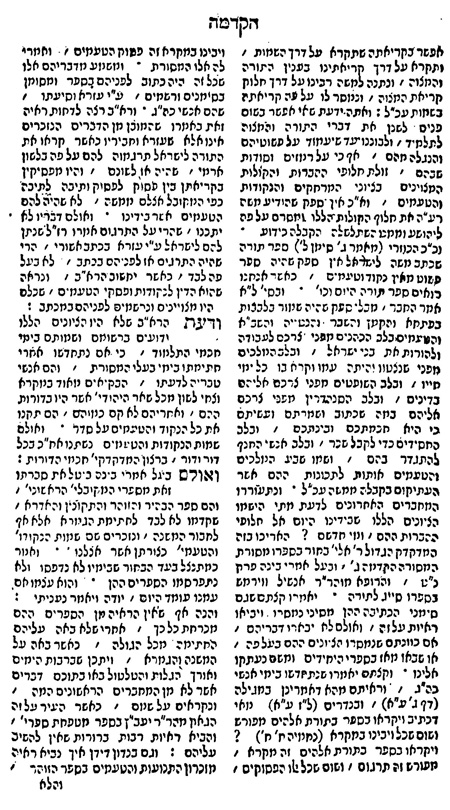
One more addition to all this, in 1870 Rabbi Yosef Kalman put out another sefer on the subject called Shaar Hamesorah which received haskamot from Litvish Superstars of the time. In the introduction he returns to the subject of the origin of nekkudot and again he quotes the Meor Einayim of Rabbi Azariah, who is quoted by Moses Mendelssohn. However here he makes a strange mistake of thinking that the Rabbi Azariah quoted by Mendelssohn was the Rama Mepano!

Returning to the work Mevo Hamesorah, one last discussion of his worth nothing is about Ibn Ezra and his opinion of the origin of Nekudot (pp. 104-105).
[For more on the subject of Nekudot see Dan Rabinowitz’s excellent article available here; Jordan Penkower, The Dates of Composition of the Zohar and the book Bahir (Heb.) Cherub Press; Rabbi Dovid Rothestein work available here. See also my Likutei Eliezer, pp. 71-72]

10. יד יהודה, ר’ יהודה לנדא, תשובות פסקים וכתבים, מכתב יד, קלו עמודים
11. חמודי דניאל עם פ’ רחבת ידים
12.  חמודי דניאל על הלכות נדה, נדפס לראשונה מכתב יד בתוך ספר מעין בינה על מסכת נדה
13. קשר תורה, [לקשר סוף התורה לתחילתה] נדפס פעם ראשונה ווילנא תרסז, ר’ יצחק מו”צ בעיר ריטווא, 112 עמודים.
14. קול חיים, סדרי לימוד ותפילות להגיע האדם לגיל שבעים שנה ואילך, ר’ חיים פאלאג’י, מכון אהבת שלום
15. הקללה לברכה, הלכות איסור קללה, ר’ מרדכי גרוס, קמה עמודים
16.  מנהג אבותינו בידינו, ר’ גדלי’ אבעלראנדר, ביאורים ובירורים במנהגי ישראל מקורותיהם ושרשי טעמיהם, שבת, נישואין שונות, תסד עמודים, ניתן לקבל תוכן העניינים.

This volume is a collection of Rabbi Oberlander’s articles originally printed in the journals Or Yisroel and Heichel HaBesht as well as other places. These essays are very organized and well written on a wide range of interesting topics, all based on a nice collection of sources. I highly recommend this work. Of course one can always add to such collections of material here but לא המלאכה עליך לגמור .

17. אני לדודי, שיחות מוסר וחיזוק לחודש אלול וימים נוראים, ר’ שריה דבליצקי, קעג עמודים
18. ישא יוסף, אורח חיים חלק ב, ר’ יוסף אפרתי, רכו עמודים
19. הטבילה בהלכה ואגדה, ר’ משה סופר, תסד עמודים
20. ביד נביאך, בעניני הפטרות ונביאים, כולל אסופות תשובות ומאמרים בהלכה ואגדה, פרקי הלכה בעיני הפטרה וכתיבת נביאים, כולל כת”י של האדר”ת  על נביאים וכתובים בשם ‘נביאים טובים’, הלכות הפטרה להגר”ש דבליצקי, וס’ סימנים על עניני הפטרה  ונביאים, תרב עמודים
21. שעות שוות בהלכה, כולל מחקר וסקירה על תולדות הפחתות מדידית הזמן לאורך הדורות, ר’ יצחק זילבער, שצ עמודים
22. שמות בארץ, שמות אנשים, ממשנתו של מרן ר’ חיים קניבסקי, דיני וענייני שמות  אנשים ונשים ובשווי שמות בשידוכין, וקו’ שמות נשים, ר’ צבי יברוב, קלט עמודים
23.  ברכת הלבנה, הלכות ומנהגים, ר’ יוסף אדלר, קב עמודים
24.  בים דרך, מאמרי עולם חלק א, ר’ מיכל זילבר, שסז עמודים
25. גם אני אודך על ענייני ברכת כהנים, ר’ גמליאל רבינוביץ, תרלב עמודים
26. ספר פת שחרית כהלכה, ר’ יששכר דוב הופמן, צו עמודים

This is another work from the author of the now-famous recent work all about sneezing in Jewish law..

27. מאורות הגר”א, חלק ב, ר’ רובין, שפ עמודים
28. ר’ ראובן פרידמן, כי עת לחננה, הליה וישיבה בארץ ישראל, 490 עמודים, מוסד רב קוק
29. ר’ ישראל גארפינקל, כיצד מרקדין, בענין ריקודין של מצוה מצוה טאנץ, רמח עמודים
30. חזון עובדיה, שבת חלק ה, ר’ עובדיה יוסף הל’ צובע, קושר ומתיר, תופר צד ממחק כותב ומוחק, השמעת קול, בונה, אוהל, מתקן מנה, תד עמודים
31.הלכה ברורה חלק יג, ר’ דוד יוסף, סי’ רמב-רנב, תקלו +צ+נד עמודים
32. זהב לבושה, איסור פאה נכרית, הלכה הגות מחשבה, שכד עמודים
33. לוח ההלכות והמנהגים לשנת תשע”ג, 372 עמודים
34. קוטנרס האינטרנט בהלכה, קב עמודים
35. ישועות כהן, ר’ יהושע אדלר, ביאור סוגית קוי התאריך, צג עמודים
36. ספר תהלים עם פירוש מפורש, כולל ביאורים על תרגום כתובים ר’ לייביש דיייטש, תק”ח עמודים
37. שערי חג הסוכות, הלכות סוכה, ד’ מינים הו”ר שמיני עצרת ושמחת תורה, ר’ יהודה טשזנר, תקל עמודים
38. קובץ תשובות חלק ד, ממרן ר’ אלישיב זצוק”ל,  שכט עמודים, כולל מפתחות על לארבע כרכי קובץ תשובות, 73 עמודים
39. הערות במסכת ברכות, מר’ אלישיב זצוק”ל, תקמא עמודים
40.  כתבי הגרי”ש, בהלכה ואגדה, מכתבי יד של ר’ אלישיב זצוק”ל, ימים נוראים וסוכות, קס עמודים
41.  אשרי האיש, פסקי מרן הגרי”ש אלישיב זצוק”ל, יורה דעה, ב’ חלקים נלקט ע”י ר’ יחזקאל פיינהנדלר
42.  רישא דגולתא הספדים על ר’ אלישיב זצ”ל
43. שו”ת פוע”ה מניעת הריון, קובץ שאלות רבני פוע”ה ותשובות של פוסקים, 141 עמודים
44.  באמונה שלימה, ר’ יוסף בלאך, תרם עמודים

This work is written by Rabbi Yosef Bloch, who is a well-known Talmid Chacham from Monsey. In this volume Rabbi Bloch deals with many “hot” issues related to Emunah, bringing many interesting discussions to the table. Just to list a few side points of his: he brings that some say that the Chazon Ish’s work Emunah Ubitachon was never supposed to be printed (pp. 69-70) as the Chazon Ish never wanted it printed. He also deals with a piece that was censored from later versions of the Emunah Ubitachon (p. 39). He brings numerous sources against the Ralbag (pp. 140-141). He has a radical statement about what chazal mean when they say “there is wisdom by the Gentiles” (pp. 301-302):

דכל חכמת הגוים הוא בדברים גשמיים דוקא וכגון מכוניות סעלפאון כלי השחתה למלחמה וכדומה, שם ורק שם יש להם חכמה,… ברוחניות אין להם שום מגע והבנה כלל, ותיקון העולם הוא עצמו איבוד חכמיהם וזה כלל גדול בהבנת ענין חכמת האומות בברזל ובעצים ואבנים ובאלקטריק יודעים קצת, בצומחים יודעים פחות מזה בגופות בעלי חיים יודעים הרבה פחות מזה, בגוף האדם עוד הרבה פחות מזה, בחכמת התכונה השמיימית עוד הרבה פחות בנפשיות האדם
יודעים משהו ממשהו ממש , בחכמה עליונה אפס מוחלט לא כלום!

He has a radical explanation for the famous Gemarah about killing lice on Shabbas (pp. 305-307). Another very interesting discussion of his is about the sugyah of Elu Ve-elu Divrei Elokim Chayim (pp. 308-323).

A few years ago I wrote a few comments (here) about Rabbi Bloch’s work against Copernicus. I recently revisited the topic in the last issue in Hakirah. In this new volume Rabbi Bloch includes his anti-CopernicanEssay but with various updates. If one reads the essay carefully one can see many of these updates he is referring to points in my article. Hopefully in the future I will deal with all the issues he raises but for now I would just like to mention two points at one point he writes (p. 358):

ולא מצאתי אחד מגדולי ישראל מכל הדורות שיחזיקו אפילו במקצת דמקצת כדעת התוכנים ומה שהעידו בשם קדוש ה’ המהרי”ל דיסקין זצוק”ל דהיהו סבר ככה, שקר העידו בו דלא כך היה מעשה אלא שענה שלואל דאין הכרח נכד
התוכנים מלשון הברכה כמדומה ממה שנקראת ברכת החמה אבל מעולם לא יצא מפיו הקדוש דנקט איהו כהתוכנים.

I honestly have no idea what he is talking about but as I brought in my article (p.29) the source says as follows:

“וכן אמר לי ידידי הרב וכו’ ר’ אבנר נ”י בעל המחבר סי’ ציר נאמן, בתורת עדות ששמע מפי רבנו הקדוש רשכבה”ג מהרי”ל דיסקין זצוק”ל שהשיטה החדשה אינה מופרכת. ושאל לו מן הכתוב בקהלת א’ וזרח השמש ובא השמש וכו’ הולך על דרום כו’ וענה לו שהכתוב אמר לפי ראות עיני האדם”.

I also explained there (p. 31) why this sources is very reliable. But what bothered me even more was what he writes there on pg. 359.

 ומה שכמה מהמשגיחים וראשי הישיבות מהדור הקודם נ”ע כתבו דרך אגב בין הדברים בספריהם… כשיטת קופעריקוס, אין מזה שום הוכחה כלל לדעת התורה בענין הזה, דלא באו אותם הגאונים זללה”ה ליקח עמדה בהדיון הזה, דלא היתה זו הסוגיא שלהם ולא ידעו שיש בזה סתירה להשקפת התורה שלא ניסו בכגון אלו ולא עיינו בה, ונסתמכו דכיון דככה אומרים הכל מסתמא הוכיחו התוכנים דהאמת כן הוא, ולא ירדו לסוף דעתם של התוכנים לידע שכוונתם עקירת האמת ואין מדבריהם ז”ל הוכחה של כלום, וכאילו לא אמרו כלום בנידון הזה

Now besides for the haughtiness of this statement the only Rosh HaYeshiva I quoted in my article that wrote an essay very pro Copernicus was Rabbi Yonah Mertzbach someone who had a college degree in these areas so I am not really sure what he is talking about.

One last source related to this topic of Copernicus was brought to my attention in a collection of things by Rabbi Zerach Shapiro who was close with the Chazon Ish (part of this booklet was printed in Yeshurun volume 26) where he asked the Chazon Ish about Copernicus:

בענין מה מסתובב השמש או כדור הארץ, אמר שאין הכרעה בדברי חז”ל.

One last point in regard to Rabbi Bloch’s book is he prints an unprinted essay of his father’s, extremely anti Zionistic and the Mizrachi from 1943 (p. 115-116). I think the reason why he is printed this letter here, while it may otherwise seem out of place, is rather simple. In the same issue of the Hakirah where my essay about Copernicus appeared he saw another article froms Elazar Muskin, When Unity Reigned Yom ha’azmaut 1954 which deals with Rabbi Bloch positive attitude to Yom ha’azmaut.

קבצים
1  המעין גליון 203, ניתן לקבל תוכן העניינים
2. אור ישראל גליון סה, שפג עמודים, ניתן לקבל תוכן העניינים
3.  היכל הבעל שם טוב, גליון לד, קצב עמודים
4.  מוריה גליון שעג-שעד
5.  ארזים, גליון א, גנוזות וחידושי תורה, מכון שובי נפשי, תקפח עמודים [כולל רס עמודים של כת”י על ענינים שונים]
6.    קובץ בית אהרן וישראל גליון קסב, ניתן לקבל תוכן העניינים.
This issue includes another attack on Rabbi Dovid Kamentsky (PDF available upon request].

7.  עץ חיים גליון יח, ניתן לקבל תוכן העניינים
8.   ישורון חלק כז,  תתקמ”ב עמודים, ניתן לקבל תוכן העניינים

One piece worth mentioning in this issue is the complete manuscript of the Meishiv Nefesh printed for the first time, edited by Rabbi Yehudah Hershkowitz (59 pp).

מחקר ועניינים שונים
1.  גאון ההוראה אחרי 50 שנה:  היסטוריה, הגות, ריאליה; קובץ מחקרים בעקבות יום העיון במכללת אפרתה על הרב צבי פסח פראנק / עורך – ישראל רוזנסון, קע עמודים, מכללת אפרתה.
2.  המסע האחרון, מאתיים שנה למסעו בעל התניא בעיצומה של מלחמת נפוליאון תקע”ב-תשע”ב, [לאור מסמכים ותעודות, חדשים גם ישנים, וגם סיפורים ושמועות דרושים ומאמרים], יהושע מונדשיין, 378 עמודים.
3.  נתיבי מאיר, אסופות מאמרים, מאיר רפלד, 456 עמודים ]ניתן לקבל תוכן העניינים]

This is a beautiful collection of Dr. Rafeld’s articles on a very wide range of topics. Some of the articles relate to Rishonim on Chumash and many others relate to the world of minhag and Tefilah. There is also a nice collection of important articles related to the Maharshal and his generation (one of Rafeld’s specialties). All these articles show a great breadth and depth in each of their perspective subjects.
4.  הרב פנחס הירשפרונג, מעמק הבכא הנאצי, זכורנות של פליט, 215 עמודים
5.  ר’ יחזקאל סופר, במאי קמיפלגי, הפולמוס המשיחי בתנועת חב”ד, 408 עמודים
6.  הלבוש היהודי באירופה במהלך הדורות, הלכה, מנהגים, גזירות מאבקים, תקנות, מנחם מקובר, ניתן לקבל תוכן העניינים.
7. אביר הרועים, קורות העתים הנהגתו ומשנתו של ר’ עובדיה יוסף, משנת תרפ”א-תשי”א,יעקב ששון, 320 עמודים
8.  רבן של ישראל, מראות קודש ממרן פוסק הדור הגרי”ש אלישיב זצוק”ל, 219 עמודים
9.  יש”א שלום, הערכתו של הגרי”ש אלישיב זצ”ל כלפי מרן הראי”ה קוק זצ”ל, 58 עמודים
10.  הדף היומי, ר’ דוד מנדלבוים
11.  רועה ישראל, על ר’ ישראל יעקב פישר, חלק ב
12. יהדות התורה והמדינה, ר’ אוריאל צימר, בירור רעיוני קצר בשאלת היחס לציונות ולמידנה עם קצת פרקי היסטוריה מן העבר הקרוב, 47 עמודים,
13.  מפיהם אני חיים, ר’ משה קנר, מאמרים על תלמוד בבלי וירושלמי, רב האי גאון, רבינו גרשום, רש”י בעל התוספות, מהר”ם מרוטנבורג וגדולי ספרד, 375 עמודים.
14.   משונצינו ועד וילנא, תולדות הדפסת התלמוד, ר’ יעקב לופיר, 310 עמודים,

I hope to review this book at length here shortly.

15.   משה אידל, שלמויות בולעות קבלה ופרשנות, ידיעות ספרים, 695 עמודים
16.   רשימת הפירסומים, יוסף דן, תשי”ח-תשע”ב, 205 עמודים
17.   יעקב לאטס, פנקס קהילות רומא, שע”ה-תנ”ה, כולל מבוא והערות, מכון יצחק בן צבי, 409 עמודים
18.   משנת ארץ ישראל, שמואל, זאב, וחנה ספראי, מסכת פאה
19.    משנת ארץ ישראל, שמואל, זאב, וחנה ספראי, מסכת כלאים

After recently completing Seder Moed they are now almost finished with Seder Zerayim.

20.  צדיק יסוד עולם, השליחות הסודית והחוויה המיסטית של הרב קוק, סמדר שרלו, 444 עמודים, אונברסיטה בר אילן
21.  דעת גליון 73
22.  מקראות גדולות – `הכתר`-שמות א`-מהדורה מוקטנת
23.  משה פלאי, עטרה ליושנה, המאבק ליצירת יהדות ההשכלה, 501 עמודים, קיבוץ המאוחד
24.  ללמוד את שפת המולדת, מאמריו של י”ל גורדון בשנים 1881-1882, [מאמרי ביקרות על ספרים ועוד], מוסד ביאליק, ספריית דורות, 367 עמודים
25.  כִּתַאבּ אַלנֻּתַף: פירושו הדקדוקי של ר’ יהודה חיוג’ לספרי נביאים בעיבוד עלי בן סלימן מאת אהרן ממן ואפרים בן-פורת, אקדמיה ללשון העברית
26.   פרקי עיון בעברית החדשה ובעשייה בה מאת משה בר-אשר, אקדמיה ללשון העברית  
27.  מקורות ומסורות, סדר ניזקין, דוד הלבני, מגנס
28.  ההלכה: הקשרים רעיוניים ואידאולוגיים גלויים וסמויים, מגנס
29.  סידור תפילות בלאדינו, סלוניקי, המאה השש עשרה, מכון יצחק בן צבי
30.  רעואל וחבריו פרשנים יהודיים מביזנטיון מסביבות המאה העשירית לספירה, גרשון ברין, אוניברסיטת תל-אביב
31.    רבי חיים בן עטר ופירושו אור החיים על התורה, אלעזר טויטו, 291 עמודים, מכללת אורות ישראל
32.  מחשבת ישראל ואמונת ישראל, בעריכת דניאל לסקר, אוניברסיטת בן גוריון, 293 עמודים בעברית, 186 עמודים באנגליש, ניתן לקבל תוכן העניינים.

This volume has many interesting articles. Worth mentioning is Marc Shapiro’s Is there a Pesak for Jewish Thought and  David Shatz ‘s article Nothing but the truth? Modern Orthodoxy and the Polemical uses of History. In the first footnote Shatz mentions Marc Shapiro’s posts on the Seforim Blog. Much can be added to this essay but of note is footnote 28 where he writes:

To be clear, academics, I find, generally shun blogs that are aimed at a popular audience because the comments are often, if not generally, uninformed (and nasty). A few academics do read such blogs, but do not look at the comments. One result of academics largely staying out of blog discussions is that non-experts become viewed as experts. Even when academics join the discussion, the democratic atmosphere of the blog world allows non-experts to think of themselves as experts and therefore as equals of the academicians. Some laypersons, though, as I said earlier, are indeed experts in certain areas of history.

33. חקרי קבלה ותפילה, משה חלמיש, אוניברסיטת בן גוריון, 458 עמודים ניתן לקבל תוכן העניינים

This work is a collection of twenty five articles by Professor Hallamish about tefilah and kabbalah. Some of these articles appeared in print in various journals, festschrifts and memorial volumes, others are supposed to appear soon, and some were written specially for this volume. They all share the common denominator that they are based on research of an incredible amount of manuscripts and rare volumes. I have no idea how he had patience to open up that many books! Based on these discoveries Hallamish shows the influence of Kabbalah on tefilah. One can also find wealth of information on nussach of Tefilah in these volumes. There is a lot to comment on different points on this volume.

Just to make one small comment as it relates to Elul and a subject I have written about. In chapter thirteen he deals with sources for the custom of saying Ledovid in Elul. He brings early sources for saying it all year around. He quotes the Siddur Shaarei Rachamim which brings this custom to say Ledovid. Now the importance of this find is that this siddur is based on R.Chaim Hacohen who was a Talmid of Rabbi Chaim Vital. If this source is reliable then we have an earlier source for this custom. The first person (not noted by Hallamish) to point to this siddur for an early source for saying Ledovid in Elul was Rabbi Yakov Rokeach in his work Shaarei Tefilah, first printed in 1870. Now it’s well known that the editor of this siddur, Chaim Abadi, added in lots from the Chemdas Yamim and other sources so it’s not so simple if one can consider this siddur a reliable source. However, recently Rabbi Goldhaber checked up the many manuscripts of the actual siddur of R. Chaim Hacohen and found that the custom of saying Ledovid does not appear anywhere in it. Recently part of this siddur was printed by Mechon Zichron Aharon and the custom of Ledovid does appear inside this siddur. So based on this new printed siddur Hallamish has a very early source for saying Ledovid.

First of all what is clear is this is not a source to say Ledovid specifically during Elul but rather an early source to say Ledovid the whole year around. Earlier in this siddur where R. Chaim Hacohen has various chapters of Tehilim to be said on special days he does not include Ledovid to be said during Elul. However at the end of davening Ledovid appears in this new siddur. But more importantly one has to be careful to read the fine print on the page as above where it is printed to say Ledovid in small print the editor adds in that saying Ledovid here does not appear in the original manuscript! Now all this is rather strange; why did he bother adding this in? This is not the place for it as it should be earlier in the siddur with the other chapters said on special days. Even more interesting is that the editor of this siddur says that they decided that four of the manuscripts are authentic but all others have parts added in so they are not going to print all added in pieces  so the question is why did they choose to add in Ledovid
and add nothing else in this printed version.

A few months back I mentioned that the new work by David Assaf Hazitz Unifgah appeared in print. I noted that a complete bibliography of the sources that were used for writing this book was printed in the recent volume of Mechkarei Yerushalayim 23 (2011) pp. 407-481. This was not included in this new work. Recently this bibliography appeared on line here.

English 

1. The Tent of Avraham, Gleanings from the David Cardozo Academy, edited by Nathan Cardozo, Urim Press. 232 pp.
2. Inside Stam, A complete buyers Guide, Rabbi Reuvain Mendlowitz, Israel bookshop, 440 pp.
3.Edward Fram, A Window on Their World: The Court Diaries of Rabbi Hayyim Gundersheim Frankfurt am Main, 1773-1794, Wayne State Univ Press, 653 pps.
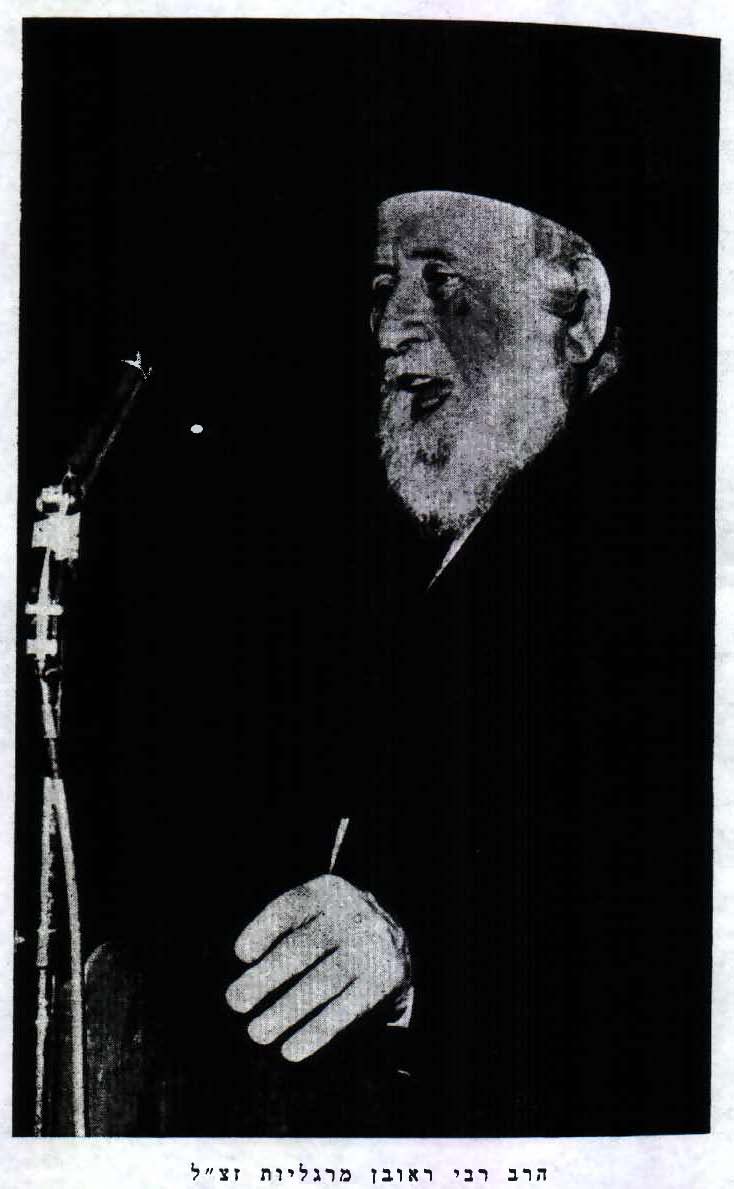


More About Rashbam on Genesis Chapter 1 and Further Comments about ArtScroll

More About Rashbam on Genesis Chapter 1 and Further Comments about ArtScroll
By Marc B. Shapiro
I had thought that I was done with ArtScroll’s censorship of Rashbam to Genesis chapter 1, but a number of people wanted some explanation about the manuscript of Rashbam’s commentary. This will also give me the opportunity to add some more comments about this distressing episode.[1]
In my prior post on the topic, available here, I referred to Rabbenu Tam’s strong words against those who “corrected” the talmudic text based on their understanding. ArtScroll is guilty of violating Rabbenu Tam’s “command”, as he would certainly also apply his words to later generations tampering with the writings of rishonim. I think everyone can understand that if people were simply allowed to emend or delete texts based on their own understanding, not a single talmudic tractate or medieval work would emerge unscathed. As such, the only honest thing for an editor to do is to point out in a note how he feels the text should read, or if he thinks that a passage should be deleted. Unfortunately, ArtScroll did not choose this to follow this honest, and common sense, approach.
It is not just Rabbenu Tam who dealt with this matter. Nahmanides, in commentary to Bava Batra 134a, blasts those “sinners” those who emend texts based on their own understanding.
וזו עבירה גמורה ולייטי עלה רבנן כל מאן דמגיה ספרים מדעתא דנפשיה
R. Abraham ben David (Rabad) also leaves no doubt as to his position, stating that one who deletes a text based on his understanding, “his hand should be cut off, since one who deletes [sections of] books is like those who burn the Torah.”[2]
ויד המוחקת תיקצץ שמוחק הספרים כשורפי התורה
Following my posts R. Yitzchak Zilber published two pieces in Hebrew.

With regard to ArtScroll, the two pieces don’t really contain anything not mentioned already on this blog, but for those who don’t read English they are valuable. It is also good to see a noted talmid hakham express his feelings about what he terms ArtScroll’s “stupid act”. (I understand why documents like the ones published by Zilber, which are directed towards a certain population, cannot cite the Seforim Blog. Yet it is noteworthy that Uriel Simon’s book אזן מלין תבחן is cited, even if the author’s name is not mentioned). One significant point made by Zilber is his claim that ArtScroll knows the truth, namely, that the passages it chose to censor are not heretical insertions, but it chose to censor them anyway.
I have received emails that make the same point, that the censorship is all about “business”. In other words, the haredi world today does not want to see Rashbam’s peshat understanding of when the day begins, so the censorship is necessary in order for ArtScroll’s mikraot gedolot Chumash to sell. Based on what I have been told by people supposedly in the know, I am inclined to believe this. This is also an appealing explanation as it is much easier to accept than that anyone at ArtScroll really believes in the justification for its censorship that was sent out and which I discussed in the earlier post.
In my post I referred to additional authorities, other than Rashbam, who understood that according to the peshat the first chapter of Genesis teaches that the day begins in the morning.[3] I also mentioned those who believe that this was how things were before the giving of the Torah. R. Moshe Maimon called my attention to the fact that R. Saadiah Gaon also apparently held this view.[4] Here is R. Kafih’s edition of R. Saadiah, Perushei Rabbenu Sa’adiah Gaon al ha-Torah, p. 71. Look at chapter 10, note 4.

R. Ovadiah Yosef cites a number of additional sources that mention the notion that before the giving of the Torah night came after day.[5] One of these is R. Moses Sofer,[6] who not surprisingly quotes his teacher, R. Pinhas Horowitz, whose view on this matter I referred to in the prior post.[7] R. Meir Mazuz[8] notes that R. Reuven Margaliyot says the same thing.[9]
A number of people commented on how ironic it is that Ibn Ezra is being used as a source to determine what is heretical, being that his views on Mosaic authorship are themselves regarded by heretical by ArtScroll.[10] Furthermore, Ibn Ezra has no reticence in citing Karaite interpreters, yet as we know, ArtScroll only cites “accepted” authorities, and won’t even mention the Soncino commentary by name. Incidentally, there are some times when ArtScroll errs in this matter. For example, in its commentary to Jonah, p. 111, it cites “Yefes ben Ali” (who is quoted by Ibn Ezra). Presumably, the ArtScroll editor assumed that he was a rishon.[11] In truth, he was a Karaite, and his inclusion in the Jonah commentary is diametrically opposed to the standard set up by ArtScroll with regard to which commentators they will cite, a standard that opposes the Ibn Ezra-Maimonides approach (adopted by Soncino) of “accept the truth from whomever said it”.[12]
When it comes to Karaite influence on Ibn Ezra, R. Joseph Delmedigo goes so far as to say that most[!] of Ibn Ezra’s explanations come from the Karaites. Reflecting the fact that Ibn Ezra does sometimes strongly reject the Karaite interpretations, Delmedigo states that Ibn Ezra is like a baby who nurses from his mother [i.e., the Karaites] but sometimes also bites her breast.[13]
ודע כי בספרי הקראים תמצא באור לדברי הר”א”ב”ע[!] כי רוב באוריו מקדמוניהם כגון הר”ר ישועה והר”ר יפת והר”ר יהודה הפרסי דולה מושך גם כי לפעמים כיונק שדי אמו נושך
Philip Birnbaum writes:
Ibn Ezra cites Yefet more frequently than any other exegete. In his commentary on the Minor Prophets, Ibn Ezra quotes Yefet forty-four times whereas he mentions Sa’adyah Gaon only five times. . . . Ibn Ezra borrows from Yefet much more than he acknowledges.[14]
This connection of Ibn Ezra to Yefet even led to the creation of a false legend that Ibn Ezra was a student of Yefet.[15]
While Ibn Ezra often adopts the interpretations of Karaite commentators, he also blasts them when necessary. One such example is in his commentary to Deuteronomy 12:17 where he writes: “The heretics [Karaites] say that there are two sorts of first-born. One is the first to break out of its mother’s womb. The second is the first-born of the flock. There is no need to respond to their nonsense.”[16] It is noteworthy that the “nonsense” interpretation that Ibn Ezra refers to is indeed found in a few rishonim including Hizkuni and R. Jacob of Vienna.[17]
Let us now turn to the manuscript of Rashbam. The first thing to mention is that there is only one surviving manuscript page for Rashbam’s commentary to the beginning of Genesis. There used to be another manuscript that contained his commentary to the rest of the Torah but was missing the commentary to Genesis chapters 1-17. Unfortunately, this manuscript was lost during World War II. For such a great figure as Rashbam, it is definitely noteworthy that so few physical specimens of his Torah commentary survived until modern times.[18] What this tells us is that not many scribes were interested in copying the commentary, and I do not know why this was the case. In fact, it is not merely his commentary on the Torah that suffered this fate. While we have Rashbam’s commentaries to most of Bava Batra and the tenth chapter of Pesahim, we know that he also wrote commentaries to most of the other tractates, yet these are lost.[19] Is there any way to explain this?
Here is the manuscript of Rashbam to the beginning of Genesis.


It is found in the Bavarian Staatsbibliothek (Munich) and is referred to as Hebrew Manuscript no. 5 (2). Here is the link.
You can examine the entire manuscript here.
This manuscript of Rashbam is bound together with another manuscript from 1233 that contains the earliest example we have of Rashi’s commentary on the Torah. It is also the first illuminated Ashkenazic manuscript (with the illumination by a non-Jewish artist).[20] The copyist of the Rashi manuscript was not some anonymous person, but R. Solomon ben Samuel of Würzberg. R. Solomon was an outstanding student of R. Samuel he-Hasid and a colleague of R. Judah he-Hasid. He was also a student of R. Yehiel of Paris, and R. Solomon’s son was one of the participants in the 1240 Paris Disputation together with R. Yehiel. R. Solomon wrote Torah works of his own and he may be identical with R. Solomon ben Samuel, the author of the piyyut ישמיענו סלחתי that is recited in Yom Kippur Neilah.[21] ArtScroll, in its Yom Kippur Machzor, p. 746, tells us that ישמיענו סלחתי was written by “R’ Shlomo ben Shmuel of the thirteenth-century.”[22]
It is significant that in this early copy of Rashi’s commentary, whose copyist was himself a Torah great, Rashi’s comment to Genesis 18:22 appears in its entirety.[23] In this comment, Rashi refers to one of the tikun soferim and states that the Sages “reversed” the passage. What this means is that Rashi understood tikun soferim literally. Some have claimed that Rashi could never have said this, and it must be a heretical insertion. (There is always someone who says this about texts that depart from the conventional view.) In line with this approach, ArtScroll deleted this comment of Rashi.[24] As we have seen with the passages of Rashbam that were censored, in this case as well ArtScroll would also no doubt claim that it accepts the view of those who do not regard the deleted comment as authentic. Yet how can such a claim be taken seriously when the earliest manuscript of Rashi’s commentary, dating from the early thirteenth century and copied by R. Solomon ben Samuel, contains the passage?
Returning to Rashbam, I have the following question. Just like there is only one manuscript for his commentary to Genesis chapter 1, for the rest of the commentary on the Torah there was also only one manuscript and we don’t know anything about the copyist. Why don’t ArtScroll and the other censors start deleting the many other “problematic” passages in Rashbam, with the excuse that they are heretical insertions? Why only focus on the commentary to Genesis chapter 1?
I must also note that Rashbam himself, in his introductory words to parashat Mishpatim, refers to his commentary at the beginning of Genesis. Rashbam explains that the point of his commentary is not to explain the halakhah but rather the peshat, “as I have explained in Bereishit.” Where does he explain this in his commentary to Genesis? As Rosin points out in his note, Rashbam discusses this matter at the beginning of his commentary to parashat Va-Yeshev, and also at the beginning of his commentary to parashat Bereshit (which is from the supposedly questionable manuscript).
In my opinion, there is no doubt that in parashat Mishpatim Rashbam had the commentary to parashat Bereishit in mind. You can see this by comparing his words. In his commentary to parashat Mishpatim he writes:
ידעו ויבינו יודעי שכל כי לא באתי לפרש הלכות אע”פ שהם עיקר כמו שפירשתי בבראשית כי מיתור המקראות נשמעין ההגדות וההלכות.
At the beginning of parashat Bereishit he writes:
ועיקר ההלכות והדרשות יוצאין מיתור המקראות
Please look at what I have underlined and compare it to the passage I cited from the commentary to parashat Bereshit.
There are a number of other parallels between what Rashbam states in his commentary to Genesis chapter 1 and what appears elsewhere in his Torah commentary, meaning that it is impossible for one to argue that the commentary on the first chapter of Genesis is of uncertain authorship.[25]
I must also mention that Hizkuni, in his commentary to Genesis chapter 1, incorporates a number of Rashbam’s comments (without mentioning him by name). A list of these was compiled by  אריסמנדי on the Otzar ha-Hokhmah forum. [26] He concludes:
יש לנו להצטער ולמחות על כי שלטו ידי זרים בחיבורי הראשונים, ולתבוע מההוצאות השונות שידפיסו את פירוש רשב”ם בשלמות האפשרית, ואל יהינו לשלוח יד בו. וכשם שלא יעלה על דעת מאן דהוא לצנזר מפירוש ראב”ע את הקטעים שיצאו עליהם מתנגדים, וכיו”ב במשנה תורה להרמב”ם ושאר חיבורי רבותינו ז”ל. הכי לצנזורים הערלים והמשומדים יאמרו להידמות?
In all the correspondence I have had about this matter, which includes people in various haredi communities, no one has disagreed with this last paragraph. In other words, no one has expressed any support for ArtScroll’s censorship of Rashbam, and the reason is obvious. This is not a matter of ideological or scholarly disagreement. It has nothing to do with haredi vs. Religious Zionist. It is about basic scholarly integrity as well as respect for Rashbam and his readers. This is something scholars of all persuasions can agree on.
One final point regarding Rashbam: In my post here I referred to Rashbam’s famous words in his commentary to Gen. 37:2 that he heard from his grandfather that if he had time he would write new commentaries focused on the peshat. Later in his commentary to this verse, he cites an explanation which appears in Rashi (without mentioning him by name) and refers to this explanation as הבל הוא. In a recent article,[27] R. Meir Mazuz refers to this comment and notes that it is not merely Rashbam who, when it came to Torah matters, was not afraid to strongly reject his grandfather’s position. Rashbam’s brother, Rabbenu Tam, also had this approach.
הלא זה האיש שפסל כל התפלין של חכמי דורו (ובכללם של מר זקנו זצ”ל רבן של ישראל) ועשה אותם כקרקפתא דלא מנח תפלין ח”ו . . . וכן פסק ר”ת שכל המאכיל אונה סרוכה באומא מאכיל טריפות לישראל (תוס’ חולין דף מ”ז ע”א) בניגוד לדעת רש”י שמתיר (שם דף מ”ו סע”ב). וכן חידש לברך על תש”ר על מצות תפלין, בניגוד לרש”י והרי”ף והרמב”ם.
This will be my last post dealing with ArtScroll and Rashbam unless new information comes to light. I have made my position very clear and there is no need to go over this matter again and again. The important thing is that people not forget that ArtScroll’s new mikraot gedolot Chumash is a censored work.
By now no one is surprised that ArtScroll engages in censorship. This has been their modus operandi from the beginning. But is there more, that is, does ArtScroll also publish things that it knows are incorrect? This is a more difficult question to answer. In Changing the Immutable, p. 41, I cite an example where I am pretty sure that this is the case, since the alternative would be to assume ignorance of a pretty basic fact of which I am certain the learned folks at ArtScroll are well aware. Yet aside from a few such cases, which relate to Jewish-Gentile relations, I don’t know of any evidence that ArtScroll intentionally misinterprets sources. Contrary to what some others think, I assume that if there is a misinterpretation it is simply an error, which all people are liable to make. I admit, however, that I am not sure what to make of the following example (called to my attention by R. Yonason Rosman).
The following is ArtScroll’s commentary to Deut. 29:9, in which it quotes Or ha-Hayyim:
Moses divided the people into categories to suggest that everyone is responsible according to how many others he or she can influence. Leaders may be able to affect masses of people; women, their immediate families and neighbors; children, only a few friends and classmates; common laborers, hardly anyone. God does not demand more than is possible, but He is not satisfied with less (Or HaChaim).
This is a very nice thought, but does Or ha-Hayyim actually say this? Here is Or ha-Hayyim on the verse.
As you can see, Or ha-Hayyim does not say that everyone is responsible according to how many he or she can influence. He specifically states that children are not responsible for others since אינם בני דעה. He then adds that women are like children in this respect (i.e., not responsible for others; he is not including them as אינם בני דעה).[28] Thus, ArtScroll’s presentation of Or ha-Hayyim’s view with regard to children and women is actually the exact opposite of what he really says. Was this an intentional distortion in the name of political correctness or a simple misunderstanding? Does ArtScroll view itself, in darshanut-like fashion, as able to elaborate on and alter the message of the commentaries it quotes, so that when it indicates that an interpretation comes from Or ha-Hayyim (or any other source) it could also mean “based on Or ha-Hayyim”? If the latter is true, one must wonder why there is no indication of this in the preface to the Stone Chumash.
To be continued
* * * *
By now many people have read my new book and I have received lots of comments and additional sources. I will discuss some of them in future posts.Although I read the book over a number of times before publication and sat shiv’ah neki’im over every sentence, I knew that there would be some errors that got through. I have learnt that absolute perfection is simply unattainable. However, we are fortunate today that errors can be quickly corrected and the corrections publicized very widely through this blog. Those who have the book can simply insert the corrections. When the book is reprinted the corrections will be added as well.

P. 17. I refer to R. Eliezer David Gruenwald. This should be R. Judah Gruenwald (1845-1920). Thanks to Yisroel Rottenberg for catching this mistake.
P. 21. I discuss the concept of halakhah ve-ein morin ken. Shortly before the book went to press, I added a comment to note 74 in which I stated that Mishnah Berakhot 1:1 contains an example where the Sages did not reveal the true halakhah in order to keep people from transgression. This is a mistake and I thank R. Yonason Rosman for the correction. The Sages made a decree to keep people from transgression. Once this was done we are dealing with a actual rabbinic law so it has no connection to halakhah ve-ein morin ken. Furthermore, since it was a rabbinic decree binding on all there is no reason to think that the Sages were concerned that the masses not know that the biblical law allowed for more flexibility. (We do find such a concern in more recent rabbinic literature, as I discuss in the book.)
P. 55. I refer to an article by Jacob J. Schacter on the 93 Beth Jacob girls. I know this article well and I can’t explain how it is that I recorded the co-author of the article as Norma Baumel Joseph. The co-author is actually Judith Tydor Baumel.P. 205 n. 71. I refer to Teherani, Amudei Mishpat, vol. 1, pp. 147ff. This is the second pagination in the volume.

P. 225. I wrote that R. Naftali Zvi Judah Berlin stated that R. Shneur Zalman of Lyady’s arguments were only intended to intimidate the scholarly reader. R. Yonason Rosman pointed out that my language here is not precise. What the Netziv says is not that R. Shneur Zalman’s arguments were intended to intimidate the scholarly reader, but rather his statement that he has many arguments was for intimidation.
P. 259 n. 100 refers to volume 14 of R. Wosner’s Shevet ha-Levi. This should be volume 11.And while we are talking about typos, this is a good opportunity to correct an unfortunate error that appeared in the first printing of Studies in Maimonides and His Interpreters, p. 152, right at the end. The first word from the verse from Hosea that I quote is מחמד, not מחמר. If this mistake is found in your copy of the book, please correct it.

_______________

[1] In my post here I mentioned that the Lubavitcher Rebbe referred to Rashbam’s peshat interpretation that the day begins in the morning, the interpretation that was censored by ArtScroll. My reference was to a talk the Rebbe gave, and R. Avrohom Bergstein and others called my attention to the fact that in a letter the Rebbe also referred to this peshat interpretation of Rashbam. See Iggerot Kodesh, vol. 24, no. 934, also found in Likutei Sihot, vol. 15, p. 493.
[2] This passage is quoted from the manuscript by R. Menahem Lonzano. See Jordan S. Penkower, Masorah and Text Criticism in the Early Modern Mediterranean (Jerusalem, 2014), p. 118. Lonzano also refers to Nahmanides’ comment that I quoted.
[3] In this listing I included R. Ezekiel Landau. A Lakewood scholar properly corrected me as R. Landau is only referring to the fact that when it comes to kodashim night goes after day.
[4] R. Moshe Maimon also called my attention to the following: In my post here I discussed R. Dovid Cohen’s book, Ha-Emunah ha-Ne’emanah (Brooklyn, 2012). Among other things, I wrote:
One more point about R. Cohen’s book is that it is obvious that at times he is responding to what I wrote in The Limits of Orthodox Theology (and he also makes use of many of the sources I cite). While I am not mentioned by name (no surprise there) I am apparently included among the משמאילים referred to on p. 5 (see Limits, pp. 7-8).
R. Cohen has recently published the seventh volume of his book of questions, Ve-Im Tomar. Look at page 14, no. 216.


Now look at the source for this question provided by R. Cohen.
The question R. Cohen refers to comes from Limits, p. 7 (although I ask why Maimonides does not mention anything about teaching a prospective convert the Thirteen Principles. I don’t ask this question about talmudic sages.). Although I was not mentioned by name in Ha-Emunah ha-Ne’emanah, I am certainly honored to be cited in Ve-Im Tomar.

Since I mention R. Cohen, here is a page from his Ohel David, vol. 3, p. 36.

In his commentary to 1 Kings 7:23 he quotes the verse as follows:

ויעש את הים מוצק עשר באמה משפתו על שפתו
The words I have underlined caught my eye because the verse actually states משפתו עד שפתו. I assume that what appears in R. Cohen’s book is a typo as I haven’t seen any editions of Tanach that contain this error. However, this verse is also part of the Sephardic Haftarah for parashat Va-Yakhel, and believe it or not there are chumashim that do make this mistake. Here, for example, is a page from a popular tikkun kor’im. Look at the last words on the page and you will see the mistaken text.

[5] See She’elot u-Teshuvot Hazon Ovadiah, vol. 1, p. 5.
[6] See Torat Moshe, vol. 3, p. 18b and Derashot Hatam Sofer, vol. 2, p. 231b.
[7] It has already been pointed out that while the yeshiva pronuncation of R. Horowitz’s book המקנה is Ha-Makneh, from Jeremiah ch. 32 we see that it should really be pronounced Ha-Miknah. R. Horowitz’s most famous work is הפלאה. This is an abbreviation of הקטן פינחס הלוי איש הורויץ. The spelling I have given of R. Horowitz’s last name is how he himself spelled it. Here is the title page of his Sefer Ketubah, the first part of his Hafla’ah, published in 1787.

[8] Or Torah, Sivan 5775, p. 945.
[9] Nitzotzei Or, Berakhot 4a.
[10] It is also ironic that in R. Moshe Feinstein’s condemnation of the publication of the commentary of R. Judah he-Hasid, he cites Ibn Ezra’s attack on Yitzhaki for the latter’s own “biblical criticism.” See Iggerot Moshe, Yoreh Deah, vol. 3, no. 114.
[11] This example was earlier noted by B. Barry Levy, “Our Torah, Your Torah and Their Torah: An Evaluation of the Artscroll Phenomenon,” in Howard Joseph, et al., eds., Truth and Compassion: Essays in Judaism and religion in Memory of Rabbi Dr. Solomon Frank (Waterloo, Canada, 1983),  p. 147.
[12] I was quite surprised to find that R. Moses Teitelbaum, Yismah Moshe: Shemot, p. 177b, comes off sounding just like Soncino rather than ArtScroll, in defending citation of Karaite interpreters.
הנה אנכי שולח מלאך ע’ באברבנאל שכתב בשם חכמי הקראים כי זה נאמר על יהושע, והנה האומר דבר חכמה אף באוה”ע חכם נקרא, ובאמת שהם גרועים כי הם מינים ואפיקרוסים, מ”מ את הטוב נקבל כי כמה מפרשים הלכו בדרך הזה שהנביא נקרא מלאך
Regarding the Karaites, even though they are to be viewed as heretics, and a Sefer Torah written by a min is to be burnt, R. David Ibn Zimra stated that if one of the Karaites writes a Sefer Torah it is not to be burnt.  Rather, it is to be placed in genizah. The reason for this is that the Karaites believe in the written Torah. See She’elot u-Teshuvot ha-Radbaz, vol. 2, no. 774.
R. Ishtori ha-Parchi, Kaftor va-Ferah, ch. 5 (pp. 76-77 in the Beit ha-Midrash le-Halakhah be-Hityashvut edition) thinks that such a Sefer Torah does not need to be put away, even though one cannot publicly read from it since the letters of God’s name were not written with the proper intention and other rabbinic requirements were not fulfilled. But the Sefer Torah is not pasul simply because of who wrote it. He also mentions the beautiful Bibles produced by Karaites in the Land of Israel. (When he says “Sadducee” he means Karaite.)
מזה נראה שהצדוקי אם כתב ספר תורה שלא יהיה פסול ואע”פ שיקרא מין אינו ממין זה המין שעובד ע”ז . . . והנה תמצא עמנו היום בארץ הצבי הרבה צדוקים סופרים והרבה ספרים נאים מכתיבתם בתורה נביאים וכתובים. ועל ספר תורה מסתברא שבמה שאינו ניכר שאין ראוי לסמוך עליהם כבעבוד לשמה וכתיבת אזכרות לשמן ותפירת היריעות בגידי טהורה.
See R. Yitzhak Ratsaby, ed., Shemot Kodesh ve-Hol (Bnei Brak, 1987), pp. 5-6. See also the important comments of R. David Zvi Rotstein, “Sefer Torah Menukad,” in Ohel Sarah-Leah (Jerusalem, 1999), pp. 673ff. (Rotstein thinks that when Masekhet Soferim refers to “Sadducees” it too means Karaites.)
R. Naftali Zvi Judah Berlin, Meshiv Davar, vol. 2, no. 77, states that it is permissible to write a Sefer Torah for Karaites if they will treat it with respect. For more discussion regarding this matter, see R. Hayyim Hezekiah Medini, Sedei Hemed, vol. 9, Divrei Hakhamim no. 135.
[13] See his letter published in Abraham Geiger, Melo Chofnajim (Berlin, 1840), p. 20 (Hebrew section). See also שפ”ר in Ha-Magid, Sep. 7, 1864, p. 279, arguing that this letter was not written by Delmedigo.
[14]  The Arabic Commentary of Yefet Ben ‘Ali the Karaite on the Book of Hosea (Philadelphia, 1942), pp. xliii-xliv. See Michael Wechsler, The Arabic Translation and Commentary of Yefet ben Eli the Karaite on the Book of Esther (Leiden, 2008), p. 72, who characterizes Ibn Ezra as “the greatest single mediator of Yefet’s exegesis (and hence of Karaite exegesis generally) among the Rabbanites.”
[15] See Avraham Lipshitz, Pirkei Iyun be-Mishnat ha-Rav Avraham Ibn Ezra (Jerusalem, 1982), p. 192.
[16] I have used the translation of H. Norman Strickman and Arthur M. Silver.
[17] See R. Kasher, Torah Shelemah, vol. 12, pp. 192-193. R. Kasher writes:
ויש להתפלא איך שיטה זו נכנסה גם לפירושי הראשונים ולא ידעו שיסודה ממקור זר
At first I wondered why R. Kasher thought that the origin of this interpretation is with the Karaites. Why not posit that a Rabbanite peshat interpeter could independently arrive at the same conclusion as that offered by the Karaites? I later found that R. Kasher himself, Torah Shelemah vol. 17, p. 311, offers this exact same approach:
 וצ”ל שכתבו כן בדרך פירוש בפשטא דקרא
Daniel Sperber, Minhagei Yisrael, vol. 1, p. 151 n. 8, assumes that the interpretation indeed originates with the Karaites. Regarding the Karaite understanding, see Torah Shelemah, vol. 27, p. 210. See also my post here where I refer to R. Moshe Feinstein’s attack on a “heretical” interpretation that is also found in a number of rishonim.
[18] Additional pieces from Rashbam were published by Moshe Sokolow, “Ha-Peshatot ha-Mithadshim”: Ketaim Hadashim mi-Perush ha-Torah le-Rashbam – Ketav Yad,” Alei Sefer 11 (1984), pp. 73-80  Jonathan Jacobs argues that these are not part of Rashbam’s Torah commentary but from a polemical letter Rashbam sent to a student. See “Rashbam’s Major Principles of Interpretation as Deduced from a Manuscript Fragment Discovered in 1984” REJ 170 (2011), pp. 443-463. For more comments of Rashbam found in another manuscript, see Elazar Touitou, “Ha-Peshatot ha-Mithadshim be-Khol Yom: Iyunim be-Ferusho shel ha-Rashbam la-Torah (Ramat Gan, 2003), pp. 189ff.
[19] See Israel Moshe Ta-Shma, Ha-Sifrut ha-Parshanit la-Talmud be-Eiropah u-vi-Tzefon Afrikah (Jerusalem, 1999), vol. 1, p. 58.
[20] See Eva Frojimovic, “Jewish Scribes and Christian Illuminators: Interstitial Encounters and Cultural Negotiation,” in Katrin Kogman-Appel and Mati Meyer, eds. Between Judaism and Christianity: Art Historical Essays in Honor of Elisheva (Elisabeth) Revel Neher (Leiden, 2009),  pp. 281-305; Hanna Liss, Creating Fictional Worlds: Peshat Exegesis and Narrativity in Rashbam’s Commentary on the Torah (Leiden, 2011), p. 45 n. 32; Colette Sirat, Hebrew Manuscripts of the Middle Ages, ed. and trans. Nicholas De Lange (Cambridge, 2002), p. 170. Sirat gives the date of the manuscript as 1232. In truth, we can’t be sure if it is 1232 or 1233 as the colophon only gives the Hebrew date 4993, but convention in such cases to give the later date. See the transcription in Frojimovic ,“Jewish Scribes,” p. 301.
[21] See R. Moshe David Chechik, “Inyanei Aseret ha-Dibrot ve-Ta’amei Rut le-Rabbenu Shlomo mi-Würzberg,” Mi-Shulhan ha-Melakhim 4 (2006), p. 5. R. Yaakov Yisrael Stal hopes to soon publish one of R. Solomon’s works. See Sodei Humash u-She’ar mi-Talmidei Rabbenu Yehudah he-Hasid, ed. Stal (Jerusalem, 1999), p. 17 n. 115.
[22] Leopold Zunz, Literaturgeschichte des synagogalen Poesie (Berlin, 1865). p. 287, does not think that the two R. Solomon ben Samuels are identical. He assumes that the author of the piyyut pre-dates the 13th century R. Solomon ben Samuel we are discussing.
[23] See here.
[24] See Changing the Immutable, p. 44.
[25] See the post of מה שנכון נכון here.
[26] See here.
[27] Or Torah, Elul 5774, pp. 1199-1200.
[28] See R. Yaakov Hayyim Sofer, Edut be-Yaakov (Jerusalem, 2011), vol. 2, p. 164.