Maccabean Psalms? (and more)

Maccabean Psalms? (and more)
By Marc B. Shapiro
(This post was originally part of the previous one, but since I know people don’t like reading posts more than twenty pages long, I split it up into two parts.)
1. I know that every year around Christmas time some people read my article on Torah study on Christmas eve. At the end of the article I raise the possibility that the various Nittel practices were actually based on non-Jewish superstitions. My suspicion was proven beyond any doubt in a wonderful article by Rebecca Scharbach, “The Ghost in the Privy: On the Origins of Nittel Nacht and Modes of Cultural Exchange.”[1] I recommend that everyone add this article to their “holiday reading”. (Due to reasons beyond my control, this post was not able to appear, as planned, before Christmas.)
As for our own holiday of Hanukkah, let me share something that I think people will find interesting. When it comes to the dating of various Psalms, for those in the Modern Orthodox/Religious Zionist world there don’t appear to be any dogmatic issues involved, much like there are no dogmatic issues raised if one assumes that the prophecies beginning in Isaiah chapter 40 come from a later prophet than those in the first part of the book.[2] Nevertheless, I think people generally assume that traditionalists will not speak about “Maccabean Psalms”. (Truth be told, I don’t know if there are even any academic scholars that still identify some of the Psalms as belonging to the Maccabean period.)
See S.’s post here where he notes that Philip Birnbaum, in his siddur, seems to allude to a psalm as having been written in the Maccabean period. However, S. also quotes R. Samson Raphael Hirsch as stating that Orthodox Judaism rejects the notion of “Pseudo-Isaiah”, and of “Maccabean songs under the name of David.” On the other hand, R. Solomon Judah Rapoport believed that at least one psalm (and perhaps more) were written during the Maccabean period. He identified other psalms as dating from the Second Temple period and defended the religious legitimacy of this view. “If the sages of the Talmud advanced the date of a number of Psalms from the time of David to that of Ezra, a period of more than five hundred years, we must have no scruples in advancing them another two hundred years.”[3] R. Samuel Barukh Rabinkow also felt that “the religious value of any of the Psalms is independent of the time of its composition or any historical consideration or reflection.”[4]
I found a very interesting passage by R. Abraham Saba in his Tzeror ha-Mor.[5] He appears to be saying that Psalm 30, which we recite every day (and which many recite after Hanukkah morning tefillah and after lighting the Hanukkah candles) was written when the Temple was rededicated by the Hasmoneans.
אני סבור כי מזמור שיר חנוכת הבית לדוד נתקן על חנוכת הבית של חשמונאי . . . ולכן נעש’ נס בשמן והדליקו ממנה שמנה ימים ועל זה סדר מזמור שיר חנוכת הבית
R. Saba continues by explaining the various verses in line with this conception. Now I realize that one can argue that what he means is that David prophetically wrote the psalm with the Hasmonean rededication in mind, and this interpretation is actually stated by R. Abraham the son of the Vilna Gaon.[6]
מזמור שיר חנוכת הבית לדוד: עשה המזמור הזה לשיר אותו בחנוכת הבית העתידה להיות בימי החשמונאים
Yet such an approach this does not appear to fit with the words of R. Saba:
נתקן על חנוכת הבית של חשמונאי
In his “translation” of this passage Eliyahu Munk writes: “I am convinced that David, in his holy spirit, foresaw such a period and dedicated Psalm 30, 1-13 to that period, therefore commencing with מזמור שיר חנוכת הבית לדוד ‘a song for the consecration of the House,’ the ‘house’ being the reconsecration of the Temple after the Hasmoneans’ victory.”[7] Yet all readers can see that in the original R. Saba does not mention David or his holy spirit.
R. Joseph Hayyim[8] believes that Psalm 30 as a whole was written by David, and he says it is possible that David also wrote the first verse. But he also says that it is possible that the first verse, which speaks of dedication of the Temple, was added to the psalm during the Maccabean period.
אפשר לומר לעולם דוד הע”ה לא אמר פסוק זה של חנוכת הבית, אלא גם הוא התחיל מן ארוממך, ופסוק זה בזמן בית שני כשעשה הקב”ה להם נסים וניצולו וחנכו הבית והמזבח מחדש הוסיפו על מזמור זה פסוק זה מפני שראו דכל דברי המזמור שייכים גם לעניינם.
He adds that this notion should not trouble anyone, as we know that according to one opinion in the Talmud the last eight verses of the Torah were added by Joshua, and he also notes that there were a couple of verses in the book of Joshua that were added after Joshua’s death. In other words, minor additions to abook after the death of the author are not religiously problematic.
Nevertheless, R. Meir Mazuz is indeed troubled by what R. Joseph Hayyim wrote.[9] He claims that the verses added to biblical books noted by R. Joseph Hayyim were added by prophets.[10] Yet in the case of Psalm 30, R. Joseph Hayyim is suggesting that an addition took place during Second Temple times after prophecy had already ceased and there was no longer the institution of anshei keneset ha-gedolah. According to R. Mazuz this is indeed religiously problematic. One can reply to R. Mazuz that while prophecy might have ceased, ruah ha-kodesh did not,[11] and therefore it was permissible for verses to be added to the book of Psalms even in the Maccabean period. After all, a standard view among rishonim is that the book of Psalms is not the product of prophecy but of ruah ha-kodesh.[12]
R. Mazuz adds a second reason why he cannot accept what R. Joseph Hayyim writes. He claims that R. Joseph Hayyim’s position will give support to the modern biblical scholars who believe that verses in the book of Daniel were added in the Maccabean period, a position he also finds religiously objectionable. I don’t understand this objection as the modern biblical scholars do not need, and do not look for, support from traditional commentators. They are completely oblivious to what rabbis like R. Joseph Hayyim have to say on these matters, and have no reason to cite his view as a support for their own position.R. Moses Isaac Ashkenazi discusses the authorship of Psalms in the introduction to his Ho’il Moshe on Tehillim (Livorno, 1880). Although he has his doubts, he says that one who assumes that Psalm 44 was composed during the Maccabean period “has what to rely on.”

So much for Maccabean psalms, but what about post-Davidic psalms in general? R. Ashkenazi identifies Psalms 79 and 137 as having been written during the Babylonian Exile. He also thinks that Psalms 126 and 129 might have been written then. He is led to his view because he can find no evidence that David was a prophet. While David had ruah ha-kodesh, it is only prophecy that reveals future events, and thus the psalms that reflect a post-First Temple era must indeed have been written centuries after David. 

ואין להניח שמזמורים כאלה נכתבו בנבואה, שלא מצאנו בשום מקום שדוד היה נביא ה’, כלומר שה’ דבר עמו כמו שדבר עם שלמה בנו רק שלח אליו נביאיו נתן וגד, אולי מפני ששפך דם הרבה, רק רוח ה’ לבשתהו תמיד כשבא לחבר מזמוריו

As with R. Ashkenazi, his predecessor R. Eleazar ben Samuel Shmelke claims that Psalms 79 and 137 were composed after the destruction of the First Temple. He states that this was also Ibn Ezra’s opinion.[13] In Ibn Ezra’s introduction to Tehillim (which is not found in all mikraot gedolot editions) Ibn Ezra states that “others” held that Psalm 137 and a number of other psalms were written during the Babylonian Exile, yet he does not signal his acceptance of this view.

One of those Ibn Ezra had in mind who held that some psalms were written during the Babylonian Exile was R. Moses Ibn Gikatilla.[14] R. Raphael Berdugo also states that a number of psalms, including Psalm 137, were composed during the Babylonian Exile.[15]
In addition, Malbim, introduction to Tehillim, states that some Psalms were written during the Exile:
התפלות אשר יסדו בגלות בבל על שרפת המקדש ועל הגלות, עד שוב ה’ את שיבת ציון בימי כורש.
He refers in particular to Psalm 137 and also Psalm 85. After saying this, however, he has a footnote in which he states that what he just mentioned is only on the level of peshat, but that he really believes that these psalms were written prophetically in the days of David. I ask readers to examine the text and footnote, and tell me, does anyone think that Malbim is being frank in his comments in the note?

It appears to me that what he writes in the note does not reflect his actual view, which is indeed found in the text. The note is only apologetic, and designed to protect him from being attacked by those who would see his approach as heretical. He would therefore be able to say, “But look at what I wrote in the note.”
According to Rashbam, Commentary to Pesahim 117a s.v. Yehoshua, R. Yose ha-Gelili was of the opinion that the Hallel in Psalms (Ps. 113-118) originated with Mordechai and Esther, i.e., in the Persian period.[16]
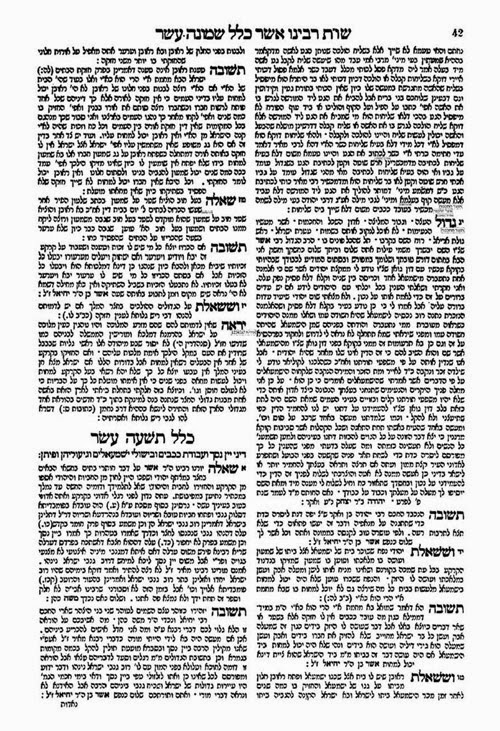
In Rashbam’s commentary to Tehillim (which we can expect ArtScroll to censor if it ever publishes it), he points to psalms which were composed during the Babylonian Exile and also states that other psalms were written after Ezra’s return to Jerusalem. For example, Psalm 122:3 states: “Our feet are standing within thy gates, O Jerusalem. Jerusalem, that art builded as a city that is compact together.” According to Rashbam, these references to Jerusalem must date from after the return from exile.[17]
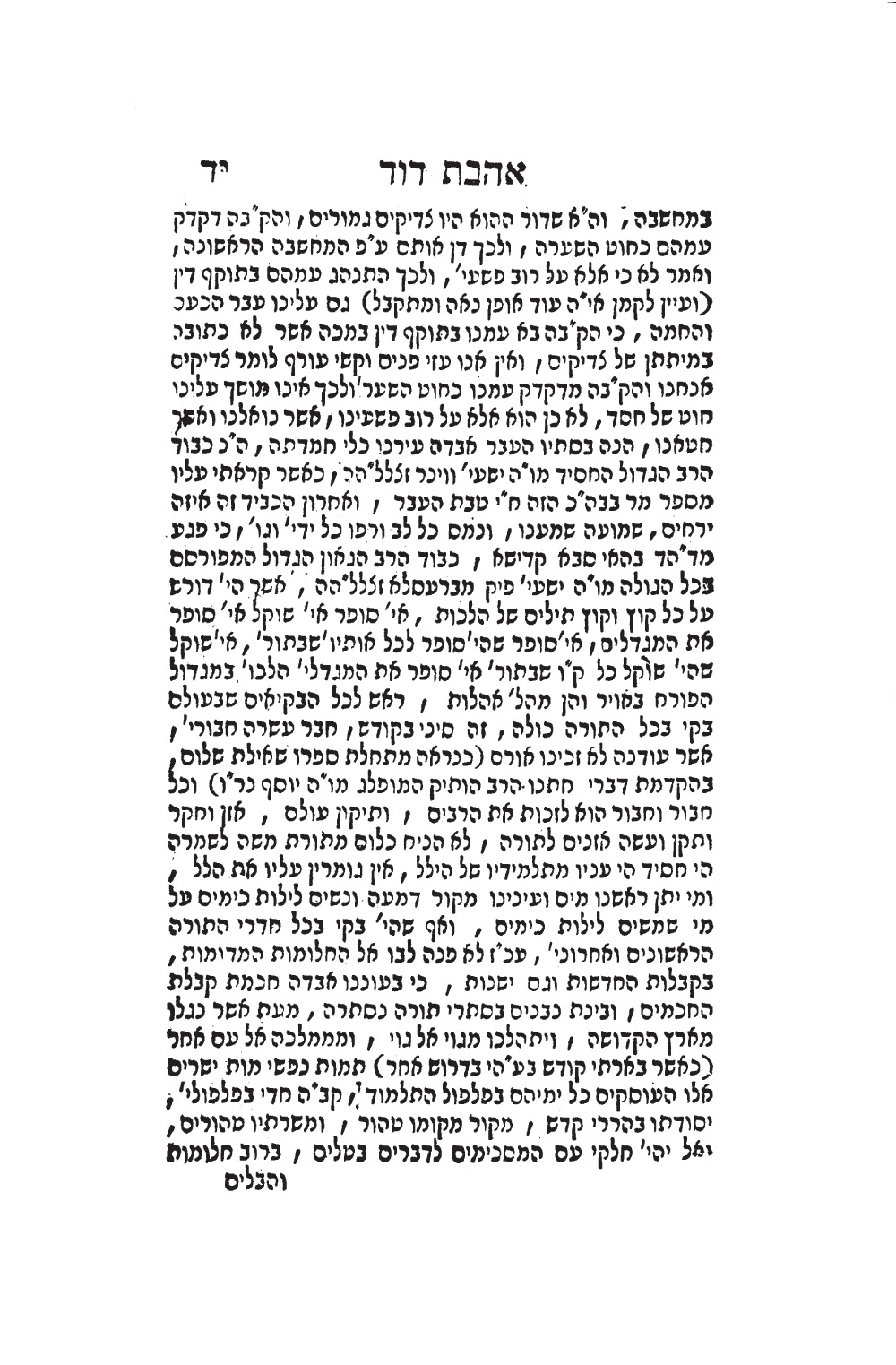
2. Here is a provocative passage quoted in the name of the hasidic master R. Uri of Strelisk (1757-1826).[18] Would any hasidic leader speak this way today?
והרה”ק מסטרעטן זצ”ל אמר משמו עה”פ שומר נפשות חסידיו מיד רשעים יצילם, שאמר: לפני ביאת המשיח יהיו רבי”ס רשעים גמורים ר”ל, אבל הן החסידים הם בתמימותם סוברים שרבם הוא עובד ה’ ולכן נוסעים אליו, לזאת התפלל דהמע”ה שומר נפשות חסידיו כי השי”ת ישמור את החסידים ומיד רשעים יצילם שלא שלא יכשלו ח”ו ברבי”ס כאלו
His comment was only applicable to the phony rebbes. But for an authentic rebbe it is worth travelling great distances and missing out on Torah and tefillah just to hear one bit of wisdom.[19]
אמר שיש ליסע לצדיק אמת אפילו אלפיים פרסאות ולבטל בהליכתו ובחזירתו מתורה ותפלה והכל כדי דיבור אחד של אמת אשר ישמע מפי צדיק אמת
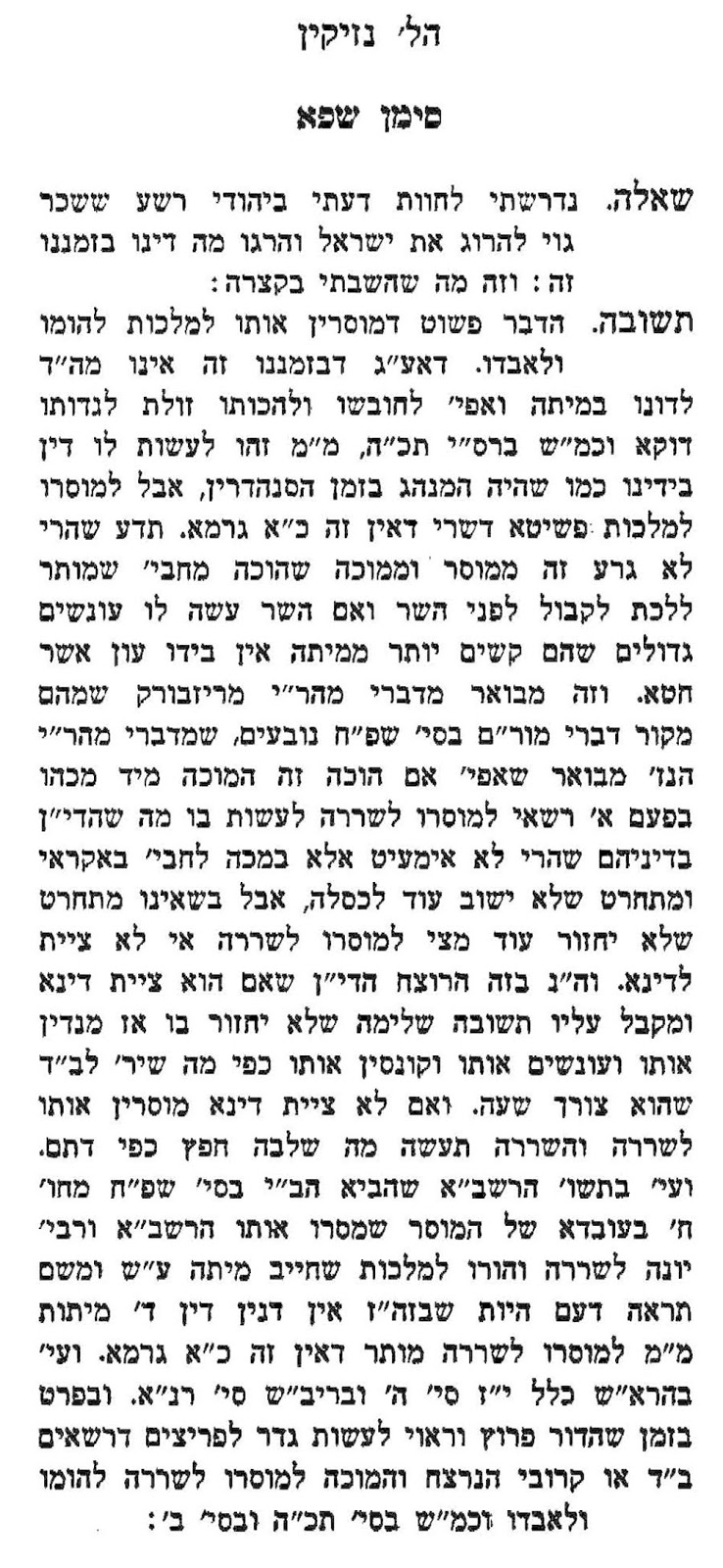
3. Every year there is discussion about the moment of silence in Israel in memory of the soldiers and Holocaust victims, and we always hear about how this is not a Jewish thing to do. Here is a page from R. Ovadyah Hadaya’s Yaskil Avdi, vol. 6, p. 300 (hashmatot Yoreh Deah 2:2).

He regards the moment of silence as entirely appropriate, seeing it as similar to the silence in a house of mourning which shows acceptance of God’s decree.
See also my post here where I wrote that in November 1965 R. Jehiel Jacob Weinberg gave a hesped for four recently deceased rabbis, among them R. Yerucham Warhaftig and R. Eliezer Yehudah Finkel. These latter two were good friends of R. Weinberg, and R. Weinberg’s friendship with R. Finkel went back to their youth. After the eulogy R. Weinberg asked everyone in the room to stand up. They stood silently for around ten seconds and then he asked them to sit down.
In this post I wrote: “I presume this was intended as a show of respect rather than as a moment of silence, since the latter could be done sitting down.” I now think that my statement is probably incorrect, because a moment of silence is also intended as a show of respect, i.e., the two are not in contradiction. In thinking of the story now, it appears that R. Weinberg’s request to stand in silence is really no different than what takes place in Israel.
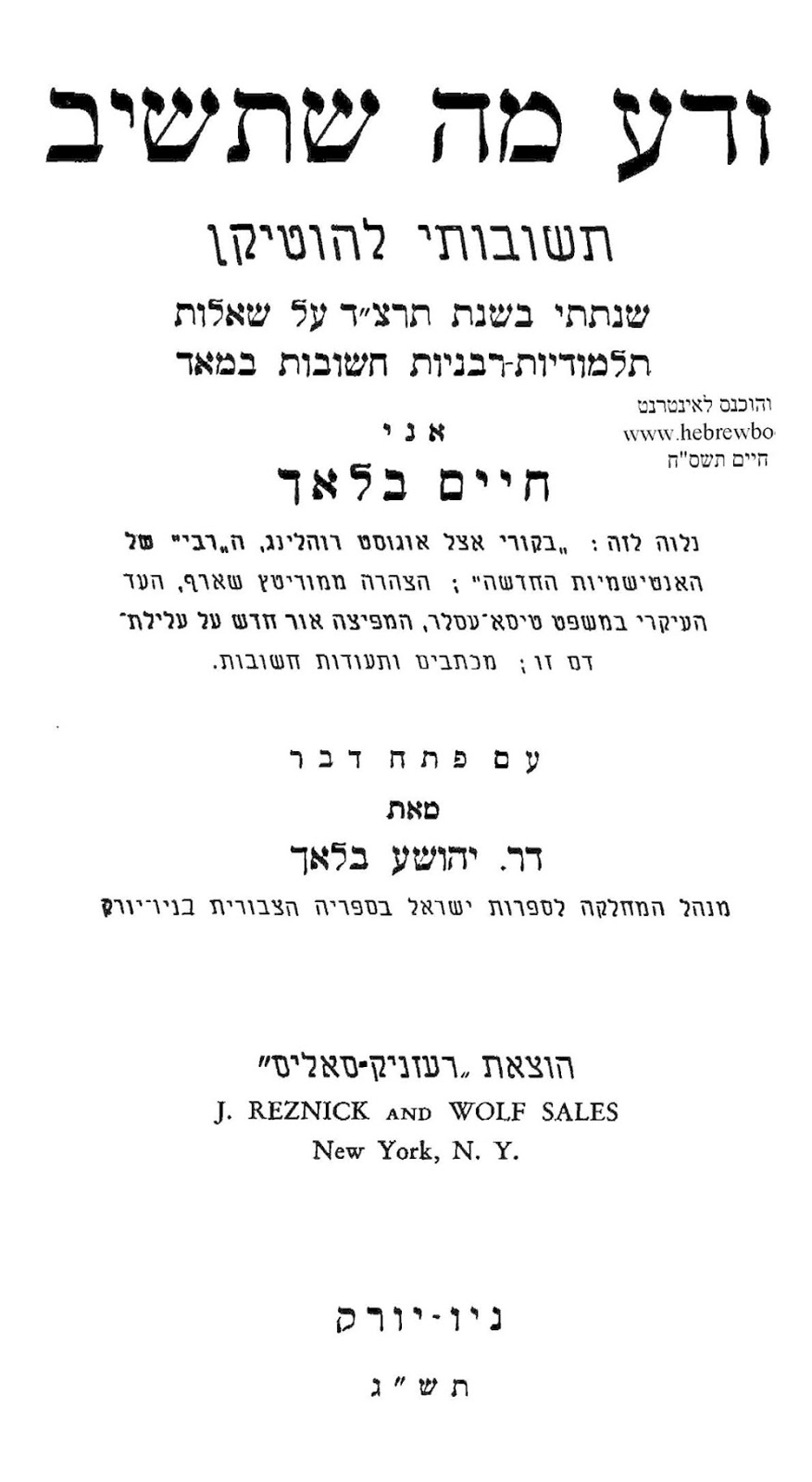
4. A haredi biography on R. Isaac Blazer has recently appeared. Here is its title page.


Needless to say, R. Jehiel Jacob Weinberg is quoted a good deal in the book. Here is page 410 which contains a picture of R. Weinberg.


The book does not mention that this picture first appeared on the Seforim Blog; see my post here.
In the quotations from R. Weinberg, the book has no problem making “improvements”. For example, R. Weinberg sometimes refers to R. Isaac Blazer as רי”ב, and the new book has altered this to הגרי”ב. R. Weinberg certainly regarded R. Blazer as a gaon, and he sometimes does refer to him as הגרי”ב. However, he did not feel that it was necessary to always refer to R. Blazer this way. The author of the book therefore decided to “correct” what R. Weinberg wrote. I guess this author (who is unnamed) did not think that R. Weinberg showed proper kavod to R. Blazer, which itself is a crazy thought.
Speaking of R. Weinberg and kavod, I think readers will find the following interesting. R. Weinberg stated: “We are all human. I too like kavod. I try not to chase after it, but if it is put on my plate, I will take it.”[20] How many other great rabbis would be honest enough to admit that they are not at the level of the Hafetz Hayyim and R. Elijah David Rabinowitz-Teomim,[21] and that they too like kavod? What R. Weinberg was saying is that this is normal and nothing to be ashamed of, and that for “mere mortals” what is important is not to chase after kavod.5. In my post here. I discussed Haym Soloveitchik’s newly published volume 2 of his collected essays. I neglected to mention that on pp. 285-287 he deals with R. Yitzchak Grossman’s criticism of one of his essays, criticism that appeared on the Seforim Blog here here. Soloveitchik shows his scholarly honesty in that he is prepared to acknowledge that in two of his criticisms Grossman is correct. He also responds to another criticism of Grossman, and I ask people to read what Soloveitchik says very carefully. It was precisely this sort of interpretation, now standard in the academy, that R. Samson Raphael Hirsch was so opposed to. You can be sure that if these words were stated by R. Dov Linzer or R. Ysoscher Katz, that a certain author, on a certain website, would go after them for “undermining the mesorah”.

Ben sorer u-moreh, according to the setam mishnah, nidon al shem sofo. This runs contrary to every principle in Jewish law and, indeed, in most Gentile law. People are executed for crimes that they have committed, not for crimes that they might commit–preventive detention for the criminally inclined perhaps, but preventive execution?! If I find tanna’im attempting to make the implementation of this law impossible, does it strain the imagination to think that they did so because it contradicts their elementary sense of right and wrong? I, for one, think not.

Rabbi Grossman argues that we find a similar ruling about nig’ei battim and there is no ethical problem in this realm. Indeed, there isn’t; however, no one claimed that all instances of “never was and never will be” (lo hayah ve-lo nivra) are a result of ethical issues. Only those in which we find this type of problem, such as ben sorer u-moreh and, to add to the roster, the “apostate city” (ir ha-niddahat) as R. Eliezer Berkovits has contended (as noted by R. Grossman). . . . An exegesis that makes execution of a law more difficult may be simply a matter of interpretation; an exegesis that makes execution impossible has that in mind to begin with. One plausible reason that one might have sought to render a Divine directive inoperable is that such a dictate appeared inconceivable for a just God.

6. I want to call readers attention to the recently published Kovetz ha-Mashbir, vol. 1, edited by Yissachar Dov Hoffman and Ovadyah Hoffman. This volume is devoted to the writings and teachings of R. Ovadiah Yosef and is full of valuable articles. It can be purchased at Biegeleisen.


[1] Jewish Studies Quarterly 20 (2013), pp. 340-373.
[2] The point about Second-Isaiah has recently been made by R. Amnon Bazak, Ad ha-Yom ha-Zeh: She’elot Yesod be-Limud Tanakh (Tel Aviv, 2013), pp. 161-172. There is a good deal that can be said about this book, which deals with a number of themes we have discussed in previous posts. See e.g., p. 274 n. 60, which accepts the notion that sometimes the numbers given in the prophetic books are only symbolic and don’t reflect historical reality.
[3] Quoted in Isaac Barzilay, Shlomo Yehudah Rapoport (Shir), 1790-1867, and his Contemporaries ([Israel], 1969), p. 54.
[4] See Fritz Gumpertz’s recollections in Jacob J. Schacter, ed., “Reminiscences of Shlomo Barukh Rabinkow,” in Leo Jung, ed., Sages and Saints (Hoboken, N.J., 1987), p. 110. Gumpertz, ibid., also notes that Jacob Barth dated a number of psalms to the Second Temple period.
[5] Parashat Noah, p. 13a in the Venice, 1522 edition, and p. 13a in the Warsaw 1879, edition.
[6] Tehillim: Be’er Avraham (Warsaw, 1887), Psalm 30:1.
[7] Tzror Hamor, vol. 1 (Jerusalem, 2008), p. 156.
[8] Rav Pealim, vol. 3, Orah Hayyim no. 5.
[9] See his Emet Keneh on Psalm 30:1 (p. 513), and his recently published Asaf ha-Mazkir (Bnei Brak, 2014), p. 283. (My thanks to Dov Weinstein for kindly sending me a copy of Asaf ha-Mazkir.)
[10] I have discussed the matter of later prophets adding material to the Torah and other biblical books in a number of posts. This is the phenomenon of multiple authors for one book. What do readers make of the following example, which appears to be an example of attributing one verse to more than one prophet? The Av ha-Rahamim prayer states ועל ידי עבדיך הנביאים כתוב לאמור (“your servants the prophets) and then proceeds to only cite a verse from the book of Joel. Does this make any sense? Jacob Reifman did not think so and he actually found a manuscript that had עבדך הנביא. He claimed that  this must be the authentic text and the one that printers should now use when they publish siddurim. See Ha-Magid, Jan. 23, 1861, pp. 14-15, Feb. 12, 1862, p. 55. Yet we also find in the liturgy for a ta’anit dibur that the words עבדיך הנביאים are used and this is followed by three verses from the book of Micah ch. 7. In other words, הנביאים is again used with regard to only one prophet. See this page from Seder ha-Selihot ha-Shalem Ateret Paz, p. 103 (second pagination).

When the phrase עבדיך הנביאים כתוב לאמר is used in the mussaf of Rosh ha-Shanah, in both the silent amidah and the repetition (two times in each), it is followed by citations from different biblical books.
[11] Although Yoma 9b (and parallels) states that ruah ha-kodesh ceased after the days of Haggai, Zechariah, and Malachi, it was always assumed that there were exceptions to this general statement (and some believed that when the Talmud stated “ruah ha-kodesh” it actually meant real nevuah). Also, the Talmud itself, ibid., states that even without ruah ha-kodesh people still had access to a “bat kol”. See R. Reuven Margaliyot’s introduction to his edition of She’elot u-Teshuvot min ha-Shamayim, pp. 25ff. See also R. Meir Ibn Gabai, Avodat ha-Kodesh, vol. 4, ch. 24; R. Isaac Sternhell, Kokhvei Yitzhak, vol. 2, p. 186; R. Aaron Maged, Beit Aharon, vol. 11, pp. 704-705. R. Joseph Engel, Gilyonei ha-Shas, Yerushalmi Shevi’it, 9:1, writes: צ”ל דתרי גווני רוח הקודש הם
[12] See Maimonides, Guide of the Perplexed 2:45, R. David Kimhi, introduction to his commentary on Psalms, Ritva, commentary to Rosh ha-Shanah 32a (col. 296 in the Mossad ha-Rav Kook edition) commentary to Moed Katan 16b, R. David Abudarham, Abudarham ha-Shalem (Jerusalem, 1963), p. 272. See also Meiri’s introduction to his commentary on Psalms, p. 9:
זהו דעת הקדומים בענין דוד המלך ע”ה ר”ל שלא להיות בכלל הנביאים [אבל] ברוח הקדש
[13] Ma’aseh Rokeah (Amsterdam, 1730), p. 65a. See his Ma’aseh Rokeah al ha-Torah (n.p., n.d.), parashat Va-Yehi, where he does not attribute this view to Ibn Ezra. See also Aharon Marcus, Barzilai (Jerusalem, 1983), pp. 271-272.
[14] See Uriel Simon, Four Approaches to the Book of Psalms, trans. Lenn. J. Schramm (Albany, 1991), pp. viii, ix, 120-121, 130ff.
[15] See Mesamhei Lev (Jerusalem, 1990), pp. 141, 222 (both of these page numbers are from the second pagination).
[16] See Yisrael Moshe Ta-Shma, Keneset Mehkarim (Jerusalem, 2004), vol. 1, pp. 286-287.
[17] See the selections of the commentary printed in Aharon Mondshine, “Al Gilui ha-Perush ha-‘Avud’ shel Rashbam le-Sefer Tehillim,” Tarbiz 79 (2010-2011), pp. 130, 133.
[18] Imrei Kadosh ha-Shalem (Jerusalem, 1961), Or Olam, no. 11.
[19] Imrei Kadosh ha-Shalem, no. 42. Regarding phony rebbes, see R. Pinhas Miller, Olamo shel Abba (Jerusalem, 1984), p. 245, regarding a rebbe in Bucharest who drank non-kosher wine.
[20] Hidushei Ba’al Seridei Esh (Jerusalem, 2012), vol. 3, p. 28 n. 21.
[21] See R. Kook, Eder ha-Yekar, p. 64.


R. Hayyim Hirschensohn, Can One Kill an Am Ha’aretz on Shabbat? Physical Punishments and Lots More

R. Hayyim Hirschensohn, Can One Kill an Am Ha’aretz on Shabbat? Physical Punishments and Lots More
by Marc B. Shapiro
1. In many earlier posts I have discussed R. Hayyim Hirschensohn, so let me pick up with him again.[1] In the Encyclopaedia Judaica’s article on R. Hirschensohn it tells us that he wrote a book Ateret Hakhamim published in 1874. Many people have been interested to see this book which was published when he was only seventeen years old. If you look at library catalogs you will not find anything. Yet if you look in Beit Eked Sefarim, the book is listed as published in Jerusalem, 1874, and this is where the EJ got its information. Beit Eked Sefarim gives the book the following subtitle:
קורות חכמת הטבע והפילוסופיה לפי השקפת אגדות חז”ל
As far as I can tell no such book was ever published in 1874 and I have no idea where the subtitle to the book came from. However, JNUL does have an unpublished manuscript from Hirschensohn with the title Ateret Hakhamim, and presumably that is where the confusion arose.
The first book by Hirschensohn is actually quite unknown, and is not mentioned by David Zohar in his list of Hirschensohn’s writings.[2] It is Ateret Zekenim, his commentary to R. Elijah Guttmacher’s Sukkat Shalom, published in 1883. While this book is not on Otzar ha-Hokhmah we are fortunate that it is on hebrewbooks.org, and here is the title page.

R. Hirschensohn published R. Guttmacher’s Sukkat Shalom from manuscript. The connection between the two was that R. Hirschensohn’s father, R. Jacob Mordechai, was close to Guttmacher and head of a yeshiva in Safed and later in Jerusalem that operated under R. Guttmacher’s auspices.[3] Sukkat Shalom was reprinted in 2000. Here is the title page.
Since this book is not on hebrewbooks.org or Otzar ha-Hokhmah, I think one can say that it qualifies as a “rare book.” In the introduction to this new printing, the editor tells us that the book was first published in 1883, but in the all too common haredi method, he does not tell the reader who first published it. He does tell us that his edition is based on the manuscript found in the New York Public Library, which must have come from R. Hirschensohn’s library.

When writing about a figure such as R. Hirschensohn, one of the central themes is developments in his thinking which is why the early writings are always so important. Therefore, this work must be studied by all who are interested in R. Hirschensohn. Ateret Zekenim shows R. Hirschensohn before he was exposed to secular studies and broadened himself. In this work, he is still a Jerusalem ben Torah with a limited curriculum, albeit more open-minded than many others in the Land of Israel during this period.[4]
Later in life he would even study Spinoza and write notes on the latter’s work. Yet he admitted that the feelings his writing on Spinoza raised in him were entirely the opposite of the spirit of religious feeling during Torah study, and he thus advised people to keep away from what he wrote, unless someone was particularly troubled by Spinoza’s ideas and needed to see a Jewish response.[5]
It is significant that even though R. Hirschensohn criticizes Spinoza, he does not relate to him as a heretic. He even attaches ז”ל after his name, as you can see from the title page of the second part of his Musagei Shav ve-ha-Emet.

I don’t know of any other rabbinic author who gives this type of honor to Spinoza, the heretic par excellence. In the preface to his discussion of Spinoza, R. Hirschensohn recounts what led him in 1903 to begin his study of the philosopher. On pp. 113ff. (second pagination, as are the other page numbers I refer to) R. Hirschensohn discusses Spinoza’s pantheism and states that he was not guilty of two of the big heresies: (1) regarding God as a corporeal being, or (2) avodah zarah. He was simply in error, and that was because he didn’t properly investigate matters. R. Hirschensohn even admires the way Spinoza stuck to his beliefs despite the persecution he suffered. He refused to give in to his opponents as from his perspective to do so would be a form of falsehood and idolatry. In other words, Spinoza and his opponents were equally well intentioned. In fact, all of them, including Spinoza, were tzaddikim! They simply had different perspectives on reality.
Here is what R. Hirschensohn writes on p. 115, words which are incredible coming from a rabbi and posek. As far as I know this is the only Orthodox defense of Spinoza.[6] (The word וברוך in the first sentence alludes to Spinoza’s name, and note also the words I have underlined.)
צדיק הוא שפינוזי לפי שטתו וברוך טעמו ונמוקו, ובצדקתו ותום לבבו סבל חרפת שונאיו ומנדיו וימסור נפשו וכבודו על קדוש השם, ולו הודה למתנגדיו אזי הי’ עובד אלהות הרבה, כאשר אנחנו היינו נחשבים לכופרים באלקים או עובדי ע”ז בשתוף לו הודינו אנחנו לשכלת שפינוזי באלוה, שני המתנגדים צדקו בדרכם ע”פ שיטתם המדעי ואת אלקים בקשו הרודף והנרדף, ושניהם צדיקים גמורים עובדי אלקים באמת ובלב שלם, כי כל המחלוקת אשר בינינו לשפינוזי היא רק מחלוקת מדעית, אשר אם כה ואם כה אין זה כפירה ונגיעה בדת ובאמונה, כאשר לא יהי’ נוגע לאמונה אם שני אנשים יחלקו שאחד יאמר שהארץ גדולה מהשמש והשני יאמר שהשמש גדולה
According to R. Hirschensohn, Spinoza made mistakes in his understanding of God, but this does not mean he was a heretic, since there is no obligation on Jews to investigate the nature of God. In other words, since there are no principles of faith regarding the nature of God, one such as Spinoza who errs in this matter cannot be regarded as a heretic as he has not uprooted any basic Jewish principles.[7] On p. 117 he writes:
לא נקרא בזה כופר באלוק ואפיקורס כי הוא לא אמר לאלוק נברא אתה הוא אומר שהוא מחויב המציאות וסבת עצמו, רק ייחס לו דבר שאין בו, נקרא בזה טועה לא כופר כי אין אנו מצווים בשום מקום לחקור ולידע מהות אלקים עלינו בדעת אלקים החוב רק לידע שיש שם מצוי ראשון ממציא כל נמצא כו’ החוב עלינו לידע ולהאמין מציאותו ולא לחקור ולידע את מהותו אפי’ מה לשלול ממנו . . . לא נצטונו בשום מקום לא בהתורה ולא בהנביאים גם לא בדחז”ל לידע ולחקור במהותו אדרבא נצטוינו שלא ללמד דברים אלו אלא לחכם ומבין מדעתו, כי לא נחוץ כלל לאמונה ודת החקירות בזה.
Following this, R. Hirschensohn states that since neither the Torah nor the Sages require that the masses educate themselves in philosophical matters, one cannot regard them as heretics for not being sophisticated in this area. The upshot of this, according to R. Hirschensohn, is that Rabad is correct in his criticism of Maimonides in Hilkhot Teshuvah 3:7. That is, an honest mistake even in basic theological matters does not render one a heretic.[8] What this means is that Spinoza also cannot be regarded as a heretic (and his mistake was not even in an ikar emunah). R. Hirschensohn concludes by saying that in Heaven both Spinoza and his opponents have made peace with one another (p. 118).
מודה הראב”ד ז”ל שההגשמה היא שבוש הדעות אבל לא נקרא על ידי זה מין רק טועה ומכש”כ מין הגשמה הזאת של שפינוזי אשר נוכל לקרא אותה בשם הגשמה רוחנית, הוא רק טועה לא מין וכופר ח”ו ומכש”כ שלא נקרא עובד ע”ז, והותר הנדר. ובעלמא דקשוט עושה שלום במרומיו יעשה שלום בין נשמתו של שפינוזי ונשמת מתנגדיו. כי לכל העם בשגגה.
This reminds me of the famous picture of Mendelssohn and his antagonist R. Ezekiel Landau embracing in the afterlife. It appeared in the book Alon Bakhut, published by Joseph Ha-Ephrati in 1793. (Mendelssohn was short and R. Landau was quite tall.)

S. also refers to the image here and notes another example of antagonists making up in the World to Come, in this case R. Jacob Emden and R. Jonathan Eybschuetz.[9]
Since I will touch on the dogma of Torah mi-Sinai in the next post, let me also note the suggestive comment of R. Hirschensohn that until parashat Va-Yigash we find stories in the Torah that took place in dreams, but after this there are no such stories in dreams. Rather, everything took place in reality.[10] Unfortunately, he does not explain which stories prior to Va-Yigash he regards as having taken place in dreams. If all he meant were the stories of Abraham and the three angels, and Jacob wrestling with the angel, which were already mentioned by Maimonides,[11] then there is not much of significance in his comment. I therefore assume he has much more in mind, but as mentioned, he doesn’t reveal the particulars.
2. In my post here I wrote “R. Asher Ben Jehiel, She’elot u-Teshuvot ha-Rosh 18:13, deals with a case of a woman who was intimate with a non-Jew and became pregnant from him. R. Asher affirms the local rabbi’s decision to cut off her nose.” This passage is referred to by Louis Epstein, Sex Laws and Customs in Judaism )New York, 1967), p. 173. In his note to this passage, Epstein writes, “Adret opposed this practice. See Besamim Rosh, 192.” This is a very surprising note. Epstein was a great talmid hakham and also a learned academic scholar. I therefore can’t understand how he assumed that the Rashba’s responsum in Besamim Rosh was authentic.
I have many notes to Besamim Rosh which I will one day turn into an article. The entire volume is one big game, meant to undermine traditional Judaism from the inside. People often assume that there are only a few “problematic” responsa, but this is incorrect, as there are loads of them, all with the same purpose in mind. Faced with the responsum of R. Asher which permitted mutilation, Saul Berlin could not put forth an alternative view in the name of R. Asher, so he attributed the forged responsum to the Rashba. In this responsum, “Rashba” responds to the very same inquiry that R. Asher was presented with, namely, was the questioner correct in ordering the removal of the nose of a woman who became pregnant from a non-Jewish man. In the question as it appears in Besamim Rosh, the pregnant woman is actually referred to as a ילדה, which is Berlin’s way of making R. Asher’s decision look even worse.
In his response, “Rashba” completely rejects R. Asher’s decision, stating that today there is no dinei nefashot, no kenasot, and certainly no mutilation. In this case, he tells us, the woman only violated a rabbinic prohibition, since there is no Torah prohibition on sex with a non-Jew. And even if it was a Torah prohibition there is no permission to mutilate her. “It is not proper to mutilate the daughters of Israel who are praised for their beauty.” It should be obvious to anyone who reads this responsum that we are seeing Saul Berlin’s attempt to put a kinder face on a troublesome aspect of medieval halakhah. The responsum anachronistically argues for a more humane approach to sinners than that presented by R. Asher, and is thus in line with Berlin’s wider struggle to reform traditional Judaism.[12]
It wasn’t just Saul Berlin who had a problem with this responsum (18:13) of R. Asher. As Zachary Grodzinski pointed out to me, and I later saw that Simhah Assaf makes the same point,[13] in the Vilna 1881 edition of R. Asher’s responsa (also reprinted in Vilna, 1885) the part about cutting of the woman’s nose has been removed. Here is how the responsum looks uncensored, where R. Asher’s questioner writes:
ומה שעלה בדעתי מפני שהענין כל כך מפורסם לחתוך חוטמה כדי לשחת תאר פניה שקשטה בפני הבועל

Here is how the passage looks in the censored edition, which takes out the point about cutting off her nose:
ומה שעלה בדעתי מפני שהענין כל כך מפורסם ליסרה כדת כדי לשחת תאר פניה שקשטה בפני הבועל

The uncensored text above comes from the Machon Yerushalayim edition. What I can’t understand, however, and I think is probably an error (because there is no note), is that the Machon Yerushalayim edition for some reason prints R. Asher’s answer in a censored form.
יפה דנת ליסרה כדת כדי שתתגנה על מנאפיה
Yet the earlier editions have a more complete answer. Here, for example, is the Venice 1552 edition, which includes the point about cutting off the nose in R. Asher’s answer.
יפה דנת יחתכו חוטמה להשחי’ תאר פניה כדי שתתגנה על מנאפיה

In responsum 17:8 R. Asher recommends cutting out the tongue of a blasphemer. This section of the responsum is also missing from the Vilna edition.[14]
On the matter of physical punishments in Spain,[15] also worthy of note is the responsum in Zikhron Yehudah, no. 75, signed by among others R. Jacob ben Asher, which reports that in Lucena, on the authority of R. Joseph Ibn Migash, an informer was executed (by stoning) on Yom Kippur that fell out on Shabbat during the time of ne’ilah. Since even official executions carried out on authority of the Sanhedrin were not permitted to take place on Shabbat,[16] presumably Ibn Migash decided that in this case there was impending danger from the individual and the execution could not be postponed.[17]
Regarding a different scoundrel, R. Asher stated (17:6):
מותר לנוחרו אפי’ ביוה”כ שחל להיות בשבת
This means that he can be killed on Yom Kippur that falls out on Shabbat.[18] In the Vilna edition the word לענשו is substituted for לנוחרו. The implication of לענשו is that the sinner be punished, but not that he be killed. As we saw with the other example where the Vilna edition made a change, there was obviously a concern by the printer in the Czarist kingdom not to publicize the physical punishments that Jews enforced in medieval Spain.[19]
The language מותר לנוחרו אפילו ביום הכפורים שחל להיות בשבת is taken from Pesahim 49b where it states that an am-ha’aretz may be killed on Yom Kippur that falls out on Shabbat. This is quite a shocking statement, one of a number of strong statements directed against the am ha-aretz,[20] and it certainly is not meant to be taken literally or as referring to what today we call an am ha’aretz.[21] A number of different interpretations have been offered, many of which have their own difficulties. For example, R. Isaac Alfasi, ad loc., explains the passage to mean that he can be killed if he is chasing after a man or an engaged woman to rape them on Yom Kippur.
The first problem with this interpretation is that if this is what the passage meant the Talmud could have easily said so, as  was pointed out by R. Asher ben Jehiel, ad loc.[22] Furthermore, the presence of an am ha’aretz in this scenario does not add anything, as even if it was a talmid hakham intent on the crime he would be killed. R. Jacob Emden, in his comment, ad loc., as usual has an original perspective in answering this problem. He notes that with regard to a typical rodef, if you can save the endangered person by only injuring the rodef then this is what you must do. However, Emden claims that when dealing with a rodef who is an am ha’aretz, one doesn’t need to be concerned with only injuring him, as you can simply kill the am ha’aretz.
דבסתם רודף אם יכולין להציל לנרדף באחד מאבריו של רודף אין רשאין להרגו, משא”כ בעם הארץ אין חוששין לו כך כך, מאחר שעל חייו אינו חס. אבל באופן אחר חלילה להרגו, דלא גרע מגויים עובדי אלילים דקיי”ל לא מעלים, גרמא בעלמא במניעת הצלה דוקא הוא דשריא, אבל אין מורידין, הריגה בידים אסירא, על אחת כמה וכמה ישראל עם הארץ.
I have no clue what led Emden to this point, which I see as quite shocking, as it legitimates what according to mainstream halakhah would be regarded as an act of murder. (The words of Emden I have just quoted are taken from the Nehardea edition of the Talmud, which uses Emden’s manuscript. The version of Emden’s comment found in the standard Vilna Shas and even in the new Oz ve-Hadar Talmud is a censored text.)
There is another surprising text in Rabad’s Temim Deim,[23] written by the Tosafist R. Isaac bar Samuel. He mentions that informers would be killed even if they only caused monetary damage to the Jewish community. In discussing how this is permitted, he refers to the talmudic passage that states that one can kill an am ha’aretz. R. Isaac explains the matter as follows: There are times when it is pikuah nefesh to kill an am ha’aretz, such as when he is unconcerned with other lives and is suspected of thievery and murder. What is really shocking is that R. Isaac continues by saying that even if you don’t know with certainty that this particular am ha’aretz has committed these crimes, since most of those he associates with are indeed suspected of this, it is permitted to kill the am ha’aretz even when he is not chasing after someone to cause harm!
How can this act be justified? R. Isaac says that perhaps the permission can be derived from a biblical verse, but even if not, he tells us that the Sages have the power to uproot commandments in the Torah, so if we kill the am ha’aretz, it is on their authority and we don’t need to be concerned with the prohibition of murder.
שאמרו רבותינו שיש עם הארץ שמותר לקורעו כדג ומותר לנוחרו ביום הכפורים שחל בשבת. אבל אין תמה דטעמא רבא איכא שפעמים שהוא פקוח לנפש כמה נפשות כגון אותו שידוע שאינו חס על חיי חבירו וחשוד ללסטם ולהרוג כשהוא יכול ואפי’ כשאינו ידוע בו בבירור כיון שרוב העושים כמעשיו הם חשודים בכך מותר ואפי’ שלא בשעת רדיפתו ואפשר שיש שום פסו’ ע”ז ואפי’ אין שם שום פ’ יש כח ביד חכמים לעקור דבר מן התורה ואפי’ בקום עשה דברי הכל כשיש טעם קצת למתיר שאז אינו דומה לעקירה
“The great novelty here is the sweeping heter to kill potential murderers, even if there is no specific knowledge that this particular am ha’aretz is a rodef.”[24] Such a view is not found among any of the other rishonim, and, it need hardly be said, if adopted would have dangerous implications. Had the authors of the controversial Torat ha-Melekh known of this text, they would certainly have cited it. (I will deal with Torat ha-Melekh in a future post.)
A different perspective is offered by the Maharal. He explains that while it is indeed forbidden to kill an am ha’aretz, he actually deserves to be killed. The only reason he is not killed is because of his potential to become something better than he is. The Maharal, in saying this, is not referring to an ignorant person, what today we call an am ha’aretz. For the Maharal, ignorance is not enough to put one in the same category of those whose existence is not “for the glory of God” and who are “lower than an animal.”[25] The Maharal also cites talmudic opinions that if one merely says the Shema or puts on tefillin or wears tzitzit, he is not to be regarded as an am ha’aretz. According to these views, an am ha’aretz is completely material. Yet one who performs the mitzvot just mentioned shows that he has a spiritual connection, and is thus removed from the category of am ha’aretz.[26]
The idea that an am ha’aretz is killed on Yom Kippur that falls on Shabbat leads to another matter. In the letter against the study of philosophy signed by R. Solomon ben Adret and many others,[27] the following sentence appears.
והספרים ההם אשר עשו ישרפו בשבת לעיניהם
At first glance, what this appears to be saying is that the books of philosophy should be burnt on Shabbat, and some scholars did understand the words in this fashion.[28] This would, however, be problematic, since there is no apparent halakhic justification for burning heretical works on Shabbat. In fact, it has been pointed out that the letter is not speaking about Shabbat at all.[29] It is simply using a melitzah based on the verse in II Sam. 23:7 which reads:
ובאש שרוף ישרפו בשבת
The final word has a kametz under the shin, and a segol under the betba-shavet. The words mean “they shall be utterly burned with fire in their place.” In other words, there is nothing about Shabbat in his verse, or in the letter signed by the Rashba.
Finally, I want to discuss a recent article by Rabbi Shalom C. Spira and Dr. Mark A. Wainberg that appeared in Hakirah entitled “Criminalization of HIV Transmission.”[30] They begin by quoting R. Zvi Spitz who argues that one who knowingly allows his illness to be passed to someone else, under Torah law he is responsible for damages.[31] Therefore, one who knowingly injects another with HIV would be regarded as responsible for the result.
Following this, the authors cite R. J. David Bleich who thinks that according to Torah law one who intentionally injects another with HIV (today we could add Ebola) would not be responsible for damages since in order for actual infection to take place, a series of chemical steps must occur placing the initial injection in the category of gerama. This is a strange position, to say the least, and R. Bleich himself quotes R. Eliezer Waldenberg’s objection to this way of thinking, as it would mean that one who puts poison in another’s drink is not biblically culpable for murder.[32] Since there is a dispute about this matter, Spitz and Wainberg conclude that “Evidently, the principle of “kim li” would serve to exculpate the murderer before a human court.” (pp. 137-138). They further say that one who intentionally injects another with HIV cannot be sued for monetary damages in a Beth Din, “but will instead be responsible before the Heavenly court, as would be the consequence for any gerama.” The one who injected an innocent person with HIV will “bear a supererogatory obligation to voluntarily offer restitution to his victim.”
Although the authors have previously cited R. Spitz as disagreeing with R. Bleich, they nevertheless state that “R. Spitz would probably concede to R. Bleich, simply because it is difficult to envisage a compelling refutation of all the countervailing authorities cited by R. Bleich.” This is a ridiculous statement as R. Spitz’s entire argument is in direct opposition to what R. Bleich states, and he cites the Steipler in support of his position. Where do the authors get the idea that because they are convinced by R. Bleich’s argument that R. Spitz would have to concede?[33] (In general, it is very rare for a halakhic authority debating an issue to concede that he was mistaken in his understanding.)
Finally, the authors note the possibility of the secular government punishing someone who injects another, but their assumption is that from a Jewish standpoint a person can go around injecting others with HIV and not pay any price, neither criminal nor civil, for his actions. If this was indeed the case, then the non-Orthodox community would be absolutely correct in their assumption that Jewish law is completely unsuited for running a modern legal system. However, that is not the case, and the problem is not with Jewish law, but with presentations of the sort just described.
Reading Spira’s and Wainberg’s article, which deals with a real life, contemporary problem, is like reading an article dealing with Jewish criminal law in which it is stressed that there is a need for someone to warn the criminal before he commits his crime as well as an absolute requirement for two male witnesses. Such a hypothetical article would conclude that if someone pulled out a machine gun at a Hadassah convention and killed 30 women, that Jewish law offers no way to punish him, as he was not warned and the action was only observed by women. At best, the author might suggest, as did Spira and Wainberg, that the murderer would be encouraged to “voluntarily offer restitution.”
The fact is that if we had a Jewish state in which Jewish law was the law of the land, the murderer described in the previous paragraph would not get away with it, and neither would the guy who injects another with HIV. As I have already discussed in prior posts, Jewish law allows the authorities vast discretion in order to do what is needed to ensure order and punish wrongdoers.[34] See here where I quote the Rashba who said that to insist on Torah law in these sorts of matters would “destroy the world.”
So in the real world, in a state run according to Jewish law, if someone purposely injected another with HIV he would not get off scot-free and encouraged to “voluntarily offer restitution,” as stated by Spira and Wainberg. What would happen is that the beit din would sentence the man to jail for attempted murder. In addition, assuming the man had any money, the beit din would confiscate a significant amount of it in order to cover the cost of medication for the man he infected. This is how Jewish law operates, and has always operated, in the real world when Jewish courts have had real authority. Any other portrayal is not only historically incorrect, but does a terrible disservice as it announces to both Jews and non-Jews that Jewish law is not equipped to handle the problems of the real world.
3. A number of people have suggested that I turn my posts into a book. Such a book would have to include many pictures and would be a large size book complete with an index. Since we are dealing with around a thousand pages so far, It would have to be at least two volumes. I think it would take quite a bit of effort to produce the book, which I am willing to do if there is an interest. I wonder how many people would buy such a book when the posts are available for free online. What do you think?
4. I will once again be leading tours this summer to Central Europe, Spain, and Italy. For more information, please go here http://torahinmotion.org/.
5. The newest work in the series I edit has just appeared: Ephraim Chamiel, The Middle Way: The Emergence of Modern-Religious Trends in Nineteenth-Century Judaism, Responses to Modernity in the Philosophy of Z. H. Chajes, S. R. Hirsch and S. D. Luzzatto. You can order it by going here here or calling 617-782-6290. By using the promotion code Chamiel30 Seforim Blog readers can get the volumes at 30% off.


[1] In my post here I refer to R. Hirschensohn’s comment that a lamdan is one for whom a difficult Rashi or Rambam keeps him up at night. I noted that this is something R. Soloveitchik would certainly agree with. I now see that R. Soloveitchik actually said that he would wake up in the middle of the night and start answering talmudic difficulties that had troubled him all day. See R. Baruch Simon, Imrei Barukh (New York, 2005), vol. 1, pp. 124-125.
[2] Mehuyavut Yehudit be-Olam Moderni (Jerusalem and Ramat-Gan, 2003), pp. 299-300.
[3] See Aryeh Morgenstern’s informative article “Mishpahat Hirschensohn u-Vesorat ha-Haskalah ve-ha-Modernah bi-Yerushalayim,” Katedra 108 (2003), pp. 105-130.
[4] For examples of his early thought, see Sukkat Shalom, pp. 149ff (Hebrew numerals), where he defends the antiquity of the Zohar; p. 153a for his belief in the existence of demons.
[5] See Hirschensohn, Musagei Shav ve-ha-Emet (Jerusalem, 1932), p. 120 (second numbering).
[6] In my forthcoming book I deal with what R. Kook says about Spinoza. While significant in their own right, R. Kook’s words cannot be regarded as a defense of Spinoza. See also R. Jacob Moses Harlap’s recently published comments on Spinoza, Mei Marom (Jerusalem, 2012), vol. 18, p. 68.
[7] See here where Steven Nadler discusses a recent unsuccessful attempt to have the ban on Spinoza lifted. This would only be symbolic since there is really no such thing as a herem on a dead person. See the earlier discussion of R. Isaac Herzog, Pesakim u-Khetavim, vol. 5, no. 111. He concludes that even if there was a ban against the books (meaning that one who read them would be placed in herem), it no longer is applicable. R. Herzog does note, of course, that the prohibition on reading heretical literature still applies.
[8] Rabbi Jeremy Wieder has stated regarding ikarei emunah: “I know that there are many who would say it’s whatever that, we poskin like the Rambam. I’m not sure who poskins like the Rambam. I don’t know that the Shulhan Arukh ever issued such a pesak.” He then states that it is not certain that we accept the Rambam’s view that one who thinks God has physical characteristics is a heretic, as it could be that Rabad is correct.
Listen here beginning at minute 12:50.
In Limits and in previous posts I have cited authorities who, while they accept Maimonides’ ikarim, reject his view that someone who doesn’t believe in one of his principles, because he doesn’t know any better, is a heretic. They assume that there is a concept of kefirah be-shogeg, and believe that this is what Rabad’s point is in his hassagah to Hilkhot Teshuvah 3:7. R. Chaim Rapoport has called my attention to the fact that the Lubavitcher Rebbe also accepted this position. See Iggerot Kodesh, vol. 22, pp. 33-34.
[9] The example comes from R. Abraham Hayyim Michelson, Ohel Avraham, p. 28b. See also R. Aryeh Zev Ginzberg, Divrei Hakhamim, pp. 286-287.
[10] Apiryon 2 (1925), p. 100 (no. 67).
[11] Guide 2:42.
[12] See Simhah Assaf, Ha-Onshin Aharei Hatimat ha-Talmud (Jerusalem, 1922), p. 69, who points out that the event described by R. Asher took place ten years after the Rashba died, thus proving that the responsum is a forgery. See also José Faur, In the Shadow of History (New York, 1992), p. 227 n. 82, who surprisingly assumes that Besamim Rosh, no. 301, is authentic. This responsum is actually one of the most notorious of Berlin’s forgeries.
[13] Ha-Onshin, p. 69.
[14] For a discussion of this responsum, see Jonathan Ray, The Sephardic Frontier (Ithaca, 2006), pp. 119ff. On p. 173 Ray writes: “Frustrated with their relative powerlessness against Jews who pursued relations with Gentile women, rabbinic authorities called for others to attack transgressors who they caught in such activity.” His sources for this statement are Zikhron Yehudah, no. 63 and R. Jonah Gerondi, Sha’arei Teshuvah, Gate 3, no. 131. Yet Zikhron Yehudah is explicit that the punishment has to be carried out by the beit din. On the other hand, R. Jonah quotes the law of kana’in pog’in bo and does not say that it is no longer applicable. This could indeed be seen as a call to kill transgressors.Israel Zinberg, A History of Jewish Literature, vol. 7, p. 164, quotes R. Isaac ben Elyakim’s (17th century) Yiddish book Lev Tov, which indeed does give license to kill transgressors:

For the sin of lying with a gentile woman is more grievous than adultery with a Jewess, and anyone who finds a man lying with a gentile woman may freely kill him. Indeed, it is a great mitzvah to slay him immediately, and it is like bringing him as a sacrifice, as Pinehas did. There is no need to give him any warning. Also, there is no need to obtain permission from any rabbi or from any judge or from any leader of the community, but whoever finds him . . . should kill him at once. One who slays him without judgment and without legal proceedings does a great mitzvah.
[15] Although in the current post and in the earlier post I deal with physical punishments (other than execution and lashes) in Spain, this was not the only place where this was done. The Bible, Judges 1:6, already mentions cutting off the thumbs and large toes of the defeated Canaanite king. R. Moses Isserles, Shulhan Arukh, Hoshen Mishpat 388:10, refers to blinding a moser or cutting out his tongue. R. Shalom Shachna, R. Isserles’ father-in-law, had an actual case in which he permitted blinding and cutting out the tongue of an evildoer. See She’elot u-Teshuvot Maharam Lublin, no. 138. This responsum is deleted from the Warsaw, 1881 edition of the responsa, but is found in the earlier editions which have the title Manhir Einei Hakhamim. R. Meir of Lublin tells us that R. Shalom Shachna’s ruling had a negative result in the end, as the man ended up apostatizing and marrying a Christian, and he and his children caused problems for the Jewish community. R. Solomon Luria was also a student of R. Shalom Shachna and he too reports this case and how after the punishment the man caused problems. See Yam Shel Shlomo, Yevamot 10:20:
ראיתי בימי שתקלה גדול’ בא לישראל ממעשה כזה שנקרו עניו [!] וחתכו לשונו שיצא אחר כך מן הכלל, מבוכה גדולה בישראל לולי רוב רחמיו וחסדיו שנתן לנו יתברך חנינה.
In order to prevent such occurrences, both R. Meir of Lublin and R. Luria reject the punishments of blinding and cutting out tongues, believing that when necessary the wicked one should simply be killed. R. Luria writes:
ונראה לי הלכה למעשה לדון כל מוסר רבים ומגזם לרבים ומוחזק לכך לאבדו אפי’ בידים ולא לחוס עליו בנפש אבל לא לחתוך לשונו ולנקר עיניו אלא לאבד הרע מקרבנו ואדרבא בזה איכא למיחש וקרוב לודאי שיתפקר ביותר ויפרוק עול ויצא חוץ לדת כדי לנקום נקם ויעליל ח”ו על ישראל ליבדה מלבו דברים שלא היו
R. Meir of Rothenburg stated that it is permitted to amputate the arm of one who continuously beats his wife. See She’elot u-Teshuvot Maharam Rothenburg, ed. Bloch (Budapest, 1895), no. 81. The same ruling is quoted in the name of R. Simhah of Speyer in Beit Yosef, Even ha-Ezer 154 (end). Already R. Huna recommended cutting off the hand of one who continuously struck others. See Sanhedrin 58b.
R. Jacob Weil (fifteenth century) of Germany ruled that it was permitted to gouge out someone’s eyes who violated Shabbat and Yom Kippur. See She’elot u-Teshuvot Mahari Veil (Jerusalem, 1959), section Dinin ve-Halakhot (at the end of the volume), no. 58.
R. Tzemah Gaon tells us that with a kohen who married a divorcee and there was a fear that he would perform the priestly blessing (which he was now forbidden to do), they would cut off the top of his fingers. See Halakhot Pesukot (Cracow, 1893), no. 84.
ואי הוו חיישין דאזיל לדוכתא אחריתא ופריס ידיה הוו קצין ליה לראש אצבעותיה וקבעין ביה מומא דלא ליפריס ידיה
See also Sha’arei Teshuvah (Leipzig, 1858), no. 177. This ruling is recorded in Beit Yosef, Even ha-Ezer 6 (citing Orhot Hayyim).The penalty of blinding a murderer is mentioned in Sanhedrin 27a (see Rashi who assumes that this is the meaning of the passage). Blinding oneself was also occasionally used as a preventative measure to keep one from sin. A geonic source tells us that R. Joseph and R. Sheshet blinded themselves for this reason. See Sha’arei Teshuvah, no. 178. According to Yalkut Shimoni, Bereshit, parashah 49, remez 161 (p. 848 in the Mossad ha-Rav Kook edition), R. Matya ben Heresh blinded himself for the same reason.

Regarding cutting a tongue out, see also R. Moses Hagiz, Mishnat Hakhamim (Czernowitz, 1864), no. 405, who tells the story of a rabbi and martyr who was tortured before being killed. When it was decreed that his tongue would be cut out, he stated that this was a punishment for him having learnt Latin and other non-Jewish languages.
While we are on the subject of harsh physical punishments, let me call attention to R. Yitzhak Nahman Eshkoli, Tza’ar Ba’alei Hayyim be-Halakhah u-ve-Aggadah (Ofakim, 2002), p. 261, who cites a contemporary opinion that when dealing with an eved kena’ani who has not yet had milah and tevilah, if necessary one can remove one of his limbs! (Obviously, this is no more than a theoretical point resulting from a “hiddush”.)
שישראל שקנה נכרי כדי שיהא עבדו, אך עדיין לא מל ולא טבל לשם עבדות, יהא מותר הישראל לחתוך את יד הנכרי כדי לכתוב עליה גט
We all know that you need to do everything you can to save another’s life. Let’s say an evil ruler tells you that he is going to kill another Jew, and if you agree to let him chop off your arm he will spare the person’s life. Are you obligated to give up your arm to save another? R. David Ibn Zimra, She’elot u-Teshuvot ha-Radbaz, no. 1052, discusses this question and concludes that you are not obligated, although to do so would be an act of hasidut. (This responsum is often cited in halakhic discussions of living organ donations.) I am sure readers are not surprised with this answer, yet R. Menahem Recanati records that some did think that he would be obligated to sacrifice a limb. See Sefer Recanati (Petrokov, 1894), no. 470. Radbaz’s responsum is actually in response to what Recanati writes, and Radbaz states the following important point, which is simply a matter of “sevara”.
דכתיב דרכיה דרכי נועם וצריך שמשפטי תורתינו יהיו מסכימים אל השכל והסברא ואיך יעלה על דעתנו שיניח אדם לסמא את עינו או לחתוך את ידו או רגלו כדי שלא ימיתו את חבירו
However, I wonder, is it really true what Radbaz says, that the laws of the Torah have to be in accord with sekhel and sevara?
[16] See Sanhedrin 35b.
[17] See R. Jacob Meshulam Ginzberg, Mishpatim le-Yisrael  (Jerusalem, 1956), p. 23 n. 158. See, however, this page from R. Reuven Margaliyot, Margaliyot ha-Yam, vol. 1, p. 91b (to Sanhedrin 46a), which reports the killing of a moser in the nineteenth century, and this indeed took place on Yom Kippur. The rabbi mentioned in this report, R. Joshua Kluger, served as rav in Greiding, Poland, from 1850-1885. See Zvi Horowitz, Le-Toldot ha-Kehilot be-Polin (Jerusalem, 1978), p. 194.
Now that you have had a chance to read the passage from R. Margaliyot, please look at the following pages from R. Moshe Blau’s Mishnat Moshe on Sanhedrin (Bnei Brak, 1989), pp. 152-153. It is completely lifted from Margaliyot ha-Yam, including the story that R. Margaliyot heard from his father!


Here is a page from Mishnat Moshe on Rosh ha-Shanah, p. 89. Blau writes
והנה מ”ש בדברנו בס’ משנת משה על מסכת סנהדרין
and then once again prints the same text from Margaliyot ha-Yam, without any indication of where it comes from.

I understand plagiarism, but I don’t understand how Blau can refer to אבי מורי ז”ל when the person who told the story is not his father?
[18] R. Asher also states that the person in question, who caused Jewish monetary losses, could be killed without witnesses or warning or any ruling by a beit din.
אין צריך עדים והתראה למסור אלא רק השומע מפיו שהוא מגזם להפסיד ממון של ישראל ולמסור בידי ע”א
[19] The entire section of the responsum I discuss here was not included in the first edition, Constantinople 1517, or in the second edition, Venice 1552. It is included in the Venice 1607 edition.
[20] For detailed discussion of the halakhic status of the am ha’aretz, see R. Nahman Shlomo Greenspan, Mishpat ha-Am ha-Aretz be-Sifrut ha-Halakhah be-Khol Tekufoteha (Jerusalem, 1946). See also Eliezer Zweigel, Sanegor (Warsawk 1885), pp. 164ff., and Adolph Buechler, Am ha-Aretz ha-Gelili (Jerusalem, 1964). For my earlier comments about the am ha’aretz, see my post here.
R. Solomon ben Adret, She’elot u-Teshuvot ha-Rashba, vol. 3, no. 314, goes so far as to say
וכולי עלמא השתא כעמי הארץ שהרוב אינן בני תורה
See also Beit Kelm (Bnei Brak, 2014), vol. 3, pp. 174-175.
[21] As part of his effort to delegitimize rabbinic Judaism, the notorious missionary Alexander McCaul referred to this text in his Netivot Olam (London, 1870), ch. 1. R. Isaac Margulies, Maoz ha-Talmud (Vilna, 1869), responded that it doesn’t mean that one can kill an am ha’aretz.
“ע”ה מותר לנוחרו” משמעו כך, שהע”ה מצד עצמו הנהו מותר, כלומר מתחייב בנפשו, אבל אין אדם בארץ שיהיה מותר להרגהו
[22] See also Hiddushei ha-Ran, ad loc.
[23] No. 203.
[24] Dov Halbertal, Erekh ha-Hayyim ba-Halakhah (Jerusalem, 2004), vol. 1, p. 232.
[25] Netivot Olam, ed. Pardes (Jerusalem, 1982), Netiv ha-Torah, ch. 15, p. 153.
[26] Ibid., pp. 158ff.
[27] She’elot u-Teshuvot ha-Rashba, vol. 1, no. 416. This doesn’t mean that the Rashba never cited philosophers. One of the places he cites Aristotle is in his Mishmeret ha-Bayit, printed in Torat ha-Bayit, ed. Brun (Jerusalem, 2010), vol. 1, cols. 360-361. Readers might recall that in my last post I spoke about people who not only don’t know, but don’t know that they don’t know, and referred to Plotinus in this regard. I neglected to mention that the Rashba refers to Aristotle as mentioning this phenomenon.
אמר הכותב המחבר בקי ברפואות יותר ממנו שיודע שאינו יודע אבל הוא אינו יודע ואינו יודע שאינו יודע וכבר אמר החכם ארסטו כי מי שאינו יודע שאינו יודע, אינו יודע
Samuel David Luzzatto also refers to the concept. See his letter quoted in Ephraim Chamiel, Ha-Derekh ha-Memutza’at: Reshit Tzemihat ha-Datiyut ha-Modernit (Jerusalem, 2011), p. 318:
הנה זה יתרון גדול שמצאתי לאיש ההמוני על האיש אשר התפלסף, כי הוא מכיר בעצמו שלא ידע, והאחר חושב שידע מה שלא ידע
See also R. Simhah Zissel of Kelm quoted in Beit Kelm, vol. 3, pp. 12, 214.
[28] See R. Avraham Hayyim Dov Levin,  Otzar Iggerot Kodesh (Jerusalem, 1952), no. 84 (who compares this to killing an am ha’aretz); R. Yeshayah Asher Zelig Miller in Or Yisrael 44 (Tamuz 5766), pp. 241-242; R. A. Biener in Or Yisrael 45 (Tishrei 5767), p. 247. R. Abraham Bornstein of Sochatchov wrote that the forged Besamim Rosh should be burnt on Yom Kippur that falls on Shabbat, but this was censored from his published responsa. See Z. Y. Abramowitz, “’Besamim Rosh’ be-Aspaklaryah Hasidit,” Tagim 3-4 (5732), p. 56, and Dan’s post here regarding a later censorship of this comment.
[29] See R. Yeshayah Asher Zelig Margolies, Amudei Arazim (Jerusalem, 1932), p. 10a in the note
[30] Hakirah (Winter 2013), pp. 133-143.
[31] There has recently been a lot of discussion about R. Shmuel Kamenetsky’s statements against vaccination, even against the polio vaccine(which he sees as a money-making scam). Understandably, there have been many negative comments about R. Kamenetsky, including assertions that he will be responsible for any children who get sick or even, God forbid, die. I think this is going too far. People have to take responsibility for their own actions. If people are foolish enough to ignore their pediatricians and instead listen to R. Kamenetsky’s dangerous advice in this matter, and something bad happens as a result, only they can be blamed. (Just like if they allow metzitzah ba-peh and something goes wrong.) So yes, R. Kamenetsky’s view about vaccination must be publicly rejected, in order that unsophisticated people not be led astray, but parents, and only parents, are responsible for the health of their children. If a child is not vaccinated and then contracts polio it is the parents who must be blamed.
[32] Contemporary Halakhic Problems, vol. 6, p. 163 n. 76. R. Waldenberg’s comment is found in Tzitz Eliezer, vol. 4, no. 13:2 (Bleich mistakenly has 13:3).
[33] While I have enormous admiration for R. Bleich’s erudition, not all of his conclusions are widely shared. For example, in a 9/11-type scenario R. Bleich argues that it is forbidden to shoot down an airplane which is going to crash into a building and the innocent passengers will die anyway. See “Sacrificing the Few to Save the Many,” Tradition 43:1 (2010), pp. 78-86. Without getting into the possible halakhic refutations of R. Bleich’s position, and why this case is not parallel to talmudic examples which speak of killing one innocent person to save many others, my approach in such matters is first to see if a conclusion leads to absurd results, and if it does, that would generally be a proof that it is not a tenable ruling. (This was exactly the approach followed by the Maccabees when they concluded, after many were killed, that not fighting on Shabbat, even in self-defense, cannot be what God wants. See 1 Maccabees 2: 29-41)If terrorists hijack an airplane, place a nuclear bomb on it, and fly to New York City or Tel Aviv, can it possibly be the halakhah that the plane cannot be shot down, and instead we will have to watch the city with all of its millions be killed? If I put an innocent person in my car trunk, load the car with explosives, and start driving the car to the middle of the city to explode it and kill hundreds, can it be that according to halakhah the military can’t blow up the car since an innocent person will be killed? If so, then in a state run according to halakhah terrorists will have a major new weapon: simply bring an innocent person along with them and this will prevent lethal attacks against the terrorists. In fact, they already do this in places like Gaza, and would anyone suggest that the State of Israel can’t defend itself even if it knows that an innocent person will be killed? It is thus not surprising to me that R. David Lau, when asked about shooting down a hijacked airplane to prevent it being crashed into a building, replied that it would be permissible. See here. When dealing with a 9/11-type scenario, Dov Halbertal refers to the innocent passengers as רודפים מאונס, thus meaning that it is permitted to shoot down the place. See Erekh ha-Hayyim ba-Halakhah, vol. 2, p. 382. R. Yitzhak Zilberstein states that during war the various rules about killing innocents to save others don’t apply. See Tefilah u-Refuah (Bnei Brak, 2011), pp. 58ff. He also suggests that one who is being held by terrorists intent on killing him (which is obviously the case with a hijacked plane) has the status of a גברא קטילא. This leads to the following conclusion (pp. 59-60):

ולכן יתכן שאין בהריגתו חידוש מצב של מיתה
This is in line with R. Elyashiv’s opinion that if terrorists are holding an innocent hostage, and are intent on killing him, it is permitted to drop a bomb on the terrorists even if you know that the innocent person will be killed at the same time. R. Elyashiv sees the action of killing the terrorists as a מעשה הצלה for future innocents. This pesak was given to R. Yaakov Wiener, and as R. Wiener notes, and contrary to R. Bleich’s opinion, this means that one can also shoot down a hijacked airplane in a 9-11-type scenario, since by doing so you save those currently on the ground from the intended assault. See R. Wiener, “She’elot u-Teshuvot be-Hilkhot Pikuah Nefesh,” Yeshurun 13 (2003), p. 552.
[34] See also R. Bleich, Bi-Netivot Ha-Halakhah, vol. 2, p. 158 n. 10. One source I haven’t yet quoted is R. Joel Ibn Shuaib, Olat Shabbat (Venice, 1577), parashat Shoftim (no page numbers; cited in Zweifel, Sanegor, p. 210).

 שאין ראוי לשפוט הדברים בכל זמן באופן שוה כי כבר יקרה בזמן מה ובעת מה שראוי להקל בדבר מה ולהחמיר בזמן אחר כפי מה שיגזור הוראת העת ולזה ב”ד מכין ועונשין כדין ושלא כדין לצורך השעה וכב’ באו בגמרא בזה דברי’ רבי’ הלכה למעשה וזאת המדה היא נק’ אצל החכמים חסד והיא תקון הצדק הדתי כי צריך באופן מה לצדק אותו ולתקן בו דבר מה ואין זה הפך המניח הדת אבל המשכות אל רצונו וכונתו ואם לא אל דבורו


Tarnopol: A short-lived early 19th century Hebrew press

Tarnopol: A short-lived early 19th century Hebrew press
by Marvin J. Heller[1]

The blossoms have appeared in the land, The time of your song has arrived,
and the voice of the turtledove Is heard in our land.
The green figs form on the fig tree. The vines in blossom give off fragrance.
Arise, my darling; My fair one, come away!
“O my dove, in the cranny of the rocks. Hidden by the cliff.
Let me see your face, Let me hear your voice; For your voice is sweet And your face is comely.”
Catch us the foxes, The little foxes
That ruin the vineyards— For our vineyard is in blossom. (Song of Songs 2:12-15).

Tarnopol (Ternopol), a city with an established Jewish community, dates its founding to the mid-sixteenth century. The community had many positive aspects (blossoms have appeared in the land, The time of your song has arrived), and was home to a Hebrew printing press (The green figs form on the fig tree. The vines in blossom give off fragrance) for a brief time only in the early nineteenth century. Due, however, to the contentious relationship between conflicting segments of the community, that press, after publishing a variety of valuable works, was short lived and closed prematurely (The little foxes that ruin the vineyards).

Tarnopol is in Galicia, in the western Ukraine, approximately 227 miles (365 km.) from Kiev (Kyiv) and 73 miles (117 km,) from Lvov. Although there had been earlier residences in the area, credit for founding the city as a private town in 1540 is given to the Polish hetman, Jan Amor Tarnowski. Tarnowski permitted Jewish settlement almost immediately afterwards in what was his personal domain. The city charter permitted Jews to reside throughout the city, excluding the market place. Initially, the Jewish population was small, comprised of only a few dozen Jews, this based on the head tax paid, the revenues from it being, in 1564, 20 zlotys, rising to 23 the following year. Jews quickly became a majority of the population, with as many as 300 families resident there in the sixteenth and seventeenth centuries.[2] By 1765, the Jewish population of Tarnopol had increased to 1,246 Jews.[3]

In 1548, Tarnopol was granted the privilege of the Magdeburgian Laws, regulations concerning internal autonomy within cities and villages granted by the local ruler, developed by Otto I, Holy Roman Emperor (936–973). In 1566, Tarnopol received the Emporium Right, the duty of storing the merchandise of the merchants passing through the town, and the privilege of the residents of the town to be the first to purchase the merchandise. Tarnopol was fortified and strengthened during the Tartar invasions in 1575 and 1589. In 1621, it became the property of Chancellor Tomash Zamoiski.[4]

A fire in 1623 caused significant damage to the homes in the city, but Zamoiski allowed the Jews to rebuild their homes as well as a new synagogue, this constructed in citadel style, to replace the one destroyed in the fire. Jews could buy and sell goods, excepting some leather merchandise, this to protect the monopoly of Christian shoemakers. Jews could be butchers, but had to provide the owners of the city annually with ten milk stones.

Tarnopol suffered, as did Jewish communities throughout Eastern Europe, from the Chmielnicki massacres of 1648-49 (tah ve-tat) and again in 1653 from the Tartar invasions. Until the ravages of the former occurred, the Jewish community was prosperous. At that time, however, most Jews fled, those remaining being massacred. Jews participated in the defense of the city in the Cossack and Swedish wars. The city, now the property of Alexander Konyetspolski, was reconstructed, but suffered yet again in 1672 when the town’s castles and citadels were bombarded by the Turks. Towards the end of the century the community began to revive, Jewish merchants being dominant in the grain and cattle trades.[5] In 1690, Tarnopol became the private property of the Polish royal family, Subiesky, and subsequently was transferred to the noble Polish family, Pototski, remaining in their possession until 1841 when private ownership of cities was abolished.

An early rabbi in Tarnopol was R. Gershom Nahum R. Meir ben Isaac Tarnopoler, who stated that “Our community is the capital (i.e it was important).” The rabbis active in Tarnopol in the eighteenth century included R. Joshua Heschel Babad, followed by R. Jacob Isaac ben Isaac Landau. Joshua Heschel Babad’s (Babad is an acronym of Benei Av Bet Din, “children of the av bet din,” 1754-1838) itapprobations appear in several of the titles described in this article and served as rabbi of Budzanow and, from 1801, of Tarnopol. He opposed the growing circle of maskilim in Tarnopol and polemicized against their patron, Joseph Perl (below), and, in 1813, of the teaching system in the school founded by Perl where secular studies were taught.[6]

Tarnopol suffered from an outbreak of the Black Plague in 1770, suffering many deaths. Finally, in 1772, Tarnopol was annexed to Austria and from 1809 to1815 was in the possession of the Russians, returning to Austrian rule until it became part of the Western Ukrainian Republic. Its status changed yet again at the end of 1918 when it became part of independent Poland.

In the early eighteenth century Tarnopol was largely Hassidic. Nevertheless, among the significant figures in Tarnopol was Joseph Perl, a prominent Maskil, active in that movement and an opponent of Hassidus.

A Hebrew press was established in Tarnopol in 1812. At that time Nahman Pineles and Jacob Auerbach, accomplished printers, obtained permission from the Russian authorities to establish a Hebrew press, this with the condition that the books to be printed would be approved by the censor. They acquired typographical equipment from the printer Benjamin ben Avigdor and employed two workers, Mordecai ben Zevi Hirsch and Aryeh Leib ben David. Ch. Friedberg informs that this was not an auspicious time to establish a press due to the Napoleonic wars. Nevertheless, it was established with the support of Joseph Perl, who not only provided financial assistance, but also space in his school for the press. He did so in the belief that the books published by the press would be in support of the Haskalah.[7]

The Thesaurus of the Hebrew Book records twenty-two entries, from 1812-13 through 1817.[8] These works are varied. We will describe a portion of them, several in some detail, others in passing, giving a sense of the press’ output.

I

Yeshu’ot Meshiho – Printing is reported to have begun with Don Isaac ben Judah Abrabanel’s (1437-1508) Yeshu’ot Meshiho (the Salvation of His Anointed) in 1812-13.[9] Abrabanel, a noted statesman, biblical exegete, and philosopher, traced his lineage to King David. He was the grandson of Samuel and the son of Judah Abrabanel, the former an advisor to three Kings of Castile, the latter to the King of Portugal. Don Isaac Abrabanel received a thorough Jewish education, studying Talmud under R. Joseph Hayyun (d. 1497), as well as instruction in philosophy, classics, and even Christian theology, this last useful in his defense of Judaism. Abrabanel succeeded his father as treasurer to King Alfonso V of Portugal, during which time he was instrumental in redeeming Jewish captives brought to Portugal. Upon the death of Alfonso in 1481, João II (1481-95) became king of Portugal. In 1483, João accused Abrabanel of participating in a conspiracy. Forewarned, Abrabanel fled to Spain, where he served as an official in the court of Ferdinand and Isabella. In 1492, they offered him the opportunity to remain in Spain as a Jew, but he chose to go into exile and left with other Jews.[10]

A prolific author Abrabanel wrote extensive and highly regarded commentaries on books of the Bible, philosophical works, and a three-part trilogy of consolation on resurrection and redemption. Yeshu’ot Meshiho is the third part of the trilogy. The first parts are Ma’yenei ha-Yeshu’ah (Wells of Salvation), first printed in Ferrara (1551) on the book of Daniel, followed by Mashmi’a ha-Yeshu’ah (Announcing Salvation), first edition published in Salonika (1526); the trilogy is completed with Yeshu’ot Meshiho. The text addresses redemption, the Messiah, and the end of days.[11] This is recorded as the first edition of Yeshu’ot Meshiho in bibliographies, but is extremely rare and was not seen by this writer. It is recorded as an octavo.

Rosh Amanah – Our second work by the Abrabanel, also printed in 1813, is Rosh Amanah, on the principles of faith. First published in Constantinople (1505) this edition was printed in the year “[From Lebanon, my bride, with me!] Trip [look] down from Amana’s peak תשורי מראש אמנה (573 = 1813)” (Song of Songs 4:8), a reference to the principles of faith (Emunah). It was printed in quarto format (40: 30 ff.). Abrabanel completed Rosh Amanah “in Naples at the end of Marheshvan, in the year, ‘The voice of rejoicing רנה (255=November, 1494) and salvation’” (Psalms 118:15), that is, two years after the expulsion of the Jews from Spain. The verso of the title-page has an approbation from R. Joshua Heschel Babad, av bet din of Tarnopol, immediately below it is verses from Judah Abrabanel, the author’s son, and below that a statement that wherever the phrases akum or goi appears it refers to ancient idol worshippers, not to contemporary non-Jews who are upright people.

1813, Rosh Amanah

Next is Abrabanel’s introduction, in which he explains that his purpose in writing the book is twofold, to clarify the confusion resulting from the many lists on the principles of faith and to defend Maimonides from his critics, most importantly R. Hasdai Crescas (c. 1340–c. 1410–11, Or HaShem), and Joseph Albo (15th century, Ikkarim). Stylistically, Rosh Amanah follows the same format as Abrabanel’s other works, that is, he poses a series of questions which he then resolves.

There are twenty-four chapters. In the first twenty-two Abrabanel enumerates twenty-eight objections to Maimonides thirteen principles of faith, twenty taken from Crescas and Albo. Abrabanel subsequently resolves these objections, defending Maimonides from his critics, although he too, in chapter twenty-three, rejects Maimonides’ formulation of a dogma for Judaism. Rosh Amanah begins with a discussion of the thirteen principles, followed (ch. 2-5) with Crescas and Albo’s objections; then nine necessary propositions for the ensuing discussion (6-11); the refutation of the objections (12-21); criticism of Crescas’ and Albo’s formulation (22); Abrabanel’s contention that Judaism has no dogmas (23); and lastly, a discussion of the Mishnah in Sanhedrin (90a), “All Israel has a share in the world to come,” which might seem to posit a dogma for Judaism.[12]

Despite Abrabanel’s contention that Judaism has no dogmas he writes (ch 22) that if he were to, “choose principles to posit for the divine Torah I would lay down one only, the creation of the world. It is the root and foundation . . . and includes the creation at the beginning, the narratives about the Patriarchs, and the miracles and wonders which cannot be believed without belief in creation.”

Rosh Amanah has been published at least nine times to the present, excluding a questionable 1547 Sabbioneta edition, and translated into Latin by Guilielmum Vorstium (Liber de capite fidei, Amsterdam, 1638 and 1684), French by B. Mossé (Le princips de la foi, Avignon, 1884), and English twice, that is, the first five chapters by Isaac Mayer Wise (The Book on the Cardinal Points of Religion), serialized in The Israelite (Cincinnati, 1862), and more recently in its entirety as by M. Kellner (Principles of Faith, Rutherford, 1982).

Hamishah Homshei Torah – Among the other works published at this time were a Hamishah Homshei Torah, that is, a small rabbinic Bible (Mikra’ot Gedolot) with commentaries. Four volumes were published in 1813 and one volume, Bamidbar (Numbers) was published in 1814. The text of Hamishah Homshei Torah, on facing pages, is comprised of the biblical text in square vocalized letters on the right page, and below it in rabbinic letters, R. Aaron of Pesaro’s (d. 1563) Toledot Aharon, a concordance, brief citations to the places where each word or phrase in the Biblical text appear; the commentaries of Rashi; and Siftei Ḥakhamim (R. Shabbetai ben Joseph Bass, 1641-1718), a super-commentary on Rashi. On the facing page is Onkelos in square vocalized letters, the Ba’al ha-Turim (R. Jacob ben Asher, c. 1270-1340) and the continuation of Rashi and Siftei Ḥakhamim, all in rabbinic letters.

Likkuttei Shoshanah – Another very different work, published in 1813/14 is R. Samson Ostropoler of Polonnoye’s (Volhynia, (d. 1648) Likkuttei Shoshanah. Ostropoler, a kabbalist of repute, died on July 22, 1648, at the head of his community in the Chmielnicki massacres. At that time, Ostropoler assembled 300 members of his community into the synagogue and, dressed in shrouds and prayer-shawls, said selihot and prayers until they were slaughtered. R. Nathan Hannover, in Yeven Metsulah on the Chmielnicki massacres, informs that a magid (heavenly teacher) who frequently instructed Ostropoler in the secrets of the Kabbalah, warned him of the impending catastrophe, advising Ostropoler to call the community to repent, which he did but to no avail.[13] Likkuttei Shoshanah, a kabbalistic work, was published in a small format, 20 cm. (8 ff.).

II

Pa’ne’ah RazaR. Isaac ben Judah ha-Levi’s commentary on the Torah, Pa’ne’ah Raza, built upon literal interpretations (peshaṭ) intermingled with gematriot and notarikon (numerical and abbreviated letters of words) is also an 1813 publication. Isaac ben Judah ha-Levi (13th cent.) was one of the Tosafot of Sens, and a student of R. Hayyim (Paltiel) of Falaise. Printed previously in Prague (1607), this edition was published as an octavo (80: 142, [2] ff.).

1813, Pa’ne’ah Raza

The title-page informs that the contents include, in addition to Isaac ben Judah ha-Levi’s commentary the insights of many other rishonim (early sages) who are then noted, and that Pa’ne’ah Raza, is novellae on Hamishah Homshei Torah and Megillah in veiled ways. Among the many virtues that the title-page lists are insightful forms of elucidation, all desirable, sharp, sweet peshat (literal interpretations), queries and responses, and much more. Also included are words of the sages through gematriot, as given at Sinai with sound and flame.

The title-page is followed by R. Joshua Heschel Babad’s approbation and then Isaac ben Judah’s introduction. He begins that “I am the youth of my mother’s house and of my people, ‘a worm and a maggot’ (Avot 3”1), I know my place . . . ‘I am but dust and ashes’ (Genesis 18:27).” The title alludes to his name Pa’ne’ah פענח and Raza רזא, both have a numerical value of 208, the numerical value of his name, Isaac יצחק (208). He has included what he has heard from his teachers, among them Ran, R. [Joseph] of Orleans, R. Joseph Bekhor-Shor, and some sayings of R. Judah he-Hasid, in gematriot and peshat. He also names R. Eliezer of Worms and others, stating that he has noted the name of every contributor where possible; for he does not, heaven forbid, wish to take someone else’s adornment. Where he does not know the name, it is left unspecified.

R. Hayyim Joseph David Azulai (Hida, 1724-1806), notes the wonder (miracle) and foreknowledge in the heart of the author, that Pa’ne’ah Raza, the name given so many years before, standing for Isaac twice, represents both the author and, after many centuries, the editor.[14]

Although Pa’ne’ah Raza is noted for its gematriot and notarikon much of the text is literal explanations. An example is the following, from Exodus 40:35:

“And Moses was not able to enter [into the Tent of Meeting, because the cloud abode on it]. Rashi explains, “the cloud was removed and he entered and He spoke with him.” A difficulty, how if so did He speak with him. For all the days of their encampment the cloud was over it? Furthermore, if so, Aaron and his sons could not enter, in which case, how did they burn the incense, light the menorah, and arrange the lehem ha-Panim? It is possible to say that this was one (another) cloud and during the days of their encampment they were able to enter . . . and R. Eliezer of Worms explains that for one hour the cloud was on it and afterwards removed so that they could enter.

As noted above, Pa’ne’ah Raza was first published in Amsterdam in 1607. This is the third edition, followed, according to the Bet Eked Sefarim, by two additional editions, the last being Warsaw (1928). The National Library of Israel records more recent printings, the latest being Ann Arbor, Michigan (1974) and Jerusalem (2019) editions.[15]

Torat ha-Adam – A work, undated and lacking the place of printing attributed to Tarnopol, although that is uncertain, is R. Samuel ben Shalom’s Torat ha-Adam, an ethical work with kabbalistic content. It was published in c. 1813; measures 23 cm. and comprised of 28 ff.[16] At the top of the title-page is the statement, “Happy is the man who has not forgotten you, and the son of man who finds his strength in You.” The text of the title-page states that it was written by the holy man of God. All who will look into it with open eyes will see how a person has to serve the Lord with a complete and perfect service in order to acquire true completion, for this is why man was created in this world. It further informs that the author, R. Samuel ben Shalom, is a grandson of R. Moses of Ostrog, author of Arugat ha-Bosum on the Song of Songs. The title page is followed by R. Samuel’s introduction, where he writes that he entitled the book Torat ha-Adam because it is how a person should conduct himself all the days of his life in this world. Much of the text is taken from or influenced by the Mishnat Hasidim of R. Emanuel Hai Ricci.[17]

Imrei Binyamin R. Benjamin ben Meir ha-Levi of Brody’s Imrei Binyamin, discourses on the weekly Torah readings, was printed in the year “Of Benjamin he said: Beloved of the LORD, He rests securely beside Him ולבנימין[אמר] ידיד ה ישכן לבטח(574 = 1814)” (Deuteronomy 33:12). Imrei Binyamin was published as an octavo (80: [3], 92 ff.). Although the title-page describes Imrei Binyamin as being on all the weekly Torah readings the text is actually only from the beginning of Bereshit (Genesis) through be-Hukkotai (Leviticus). The title-page informs that these discourses were delivered on Shabbat by Benjamin when he was the maggid mesharim in Berdichev for seventeen years and afterwards in Brody. Imrei Binyamin was brought to press by R. Meir Eliezer ben Pinhas, the author’s grandson. He sadly begins the introduction, “I am the builder of the house of Benjamin, the father of my father.” Benjamin ben Meir had one son only, who predeceased him. In several instances, inserted between the columns of R. Benjamin’s commentary are annotations of Meir Eliezer. He hoped to publish other parts of this work but that, unfortunately, did not happen.[18]

III

Mishlei Shelomo – In 1814, the press published Menahem Mendel Lefin’s (Levin, 1749-1826) Mishlei Shelomo, a bi-lingual octavo format (80: [2], 91 ff.) Hebrew-Yiddish commentary on Proverbs. Lefin, born in Satonov, Podolia, was therefore known as Satonover, and was also referred to as Mikolayev, as he also resided in Mikolayev for an extensive amount of time; spending his last years in Brody and Tarnopol. Lefin received a traditional Jewish education, studying Talmud and rabbinic codes, but early in his life, reportedly by accident, came across and was influenced by Joseph Solomon Delmedigo’s (1591–1655) Elim, dealing with mathematics and physics, motivating him to study those subjects. Lefin subsequently went to Berlin for medical treatment where he was also influence by Moses Mendelssohn (1729–1786), becoming a strong advocate of the Haskalah.

Lefin was a prolific author, his titles including a Hebrew translation of Dr. Samuel-Auguste Tissot’s popular book on medicine; and encouraged by a friendship with Prince Czartoryski, Essai d’un plan de reforme, avant pour objet déclairerhis la Nation Juive en Pologne et de la rdresser par s4es moeurs (An essay upon a Plan of Reform with the Object to Enlighten the Jewish Nation in Poland and to Improve it in Accordance with its Customs); . Lefin’s Hebrew works include Iggrot ha-Hokkmah, Refuot ha-Am, Heshbon ha-Nefesh, which, among other ethical topics, also elaborates on Benjamin Franklin’s Poor Richard’s Almanac, which R. Israel Salanter (1810-83), founder of the Mussar movement, considered an excellent handbook for moral development and had reprinted; a new translation of Maimonides’ More Nevuchim, this in Mishnaic Hebrew, and Alon More, Lefin’s only original work, this an introduction to the philosophy of Maimonides, and Mishlei Shelomo, all in “a delightful prose”.[19]

The brief text of the title-page of Mishlei Shelomo states that it includes a concise new commentary in Ashkenaz (Yiddish) for the benefit of our brothers Beit Yisrael in the lands of Poland. Below that is that it was printed with the permission of the censors. There are two approbations, the first from R. Joshua Heschel Babad, the second from R. Mordecai ben Eliezer Sender Margolious, av bet din, Satonov. Below the approbations is Lefin’s introduction, in which he notes that so Torah should not be forgotten from Israel, he has included commentators and transcribed books of the Bible into different languages. He notes that in later generations with the movements of Jews and forgetfulness, older commentaries are not always understood, particularly in the lands of Ashenaz. Therefore, he has undertaken to bring out a concise commentary for our brothers in those lands, beginning with Proverbs (Mishlei).

1814, Mishlei Shelomo

The text follows, comprised, on facing pages, of the text of Proverbs in vocalized square letters, below it Lefin’s commentary in rabbinic letters, on the recto page. On the verso is Lewin’s translation in square vocalized letters and below it the continuation of the commentary. Zinberg writes that Lefin disregarded the distinction between the spoken and written language, and that Ecclesiastes and Proverbs should not be translated “in the language that the market-Jewess speaks to her customer in the street.” Zinberg describes Lefin’s purpose in the translation, putting an end to the standard style of the translations of the Bible that had been dominant for hundreds of years and according to which the children in the schools had the Biblical text taught and translated to them. He wishes to give ordinary Jews , worn out with toil, the “holy books” without embroidered covers, but in the simple, weekday garment of the colloquial language, with its homely concepts and images, including its Slavisms, as it is spoken at home and in the market place. . . .Mendel Levin-Satanow did not print his translation of Proverbs in the special “women’s type” customary for Judeo-German books, but in square Hebrew letters and with vowels. Levin’s spelling is also characteristic of his translation: he writes the words mainly according to their phonetic sound. Thus we find in his work rufikh, not ruf ikh: nemtzakh, instead of nemt es aykh . . .[20]

Mishlei Shelomo was part of Lefin’s translation of the Bible into Yiddish, of which only the volumes on Proverbs and Ecclesiastes were published. He was able to publish Mishlei Shelomo with the financial aid of Joseph Perl. As noted above, Mishlei Shelomo has approbation from two av bet din. It is rare, indeed unusual, for rabbis to give approbations to books by Maskilim, especially in this case where a sponsor was Joseph Perl, who was opposed to the orthodox establishment.

Waxman observes that Lefin’s translation into the Yiddish vernacular raised the objection, “a hue and cry” among Maskilim who regarded Yiddish as a jargon and wished to reduce its use as much as possible. Tobias Gutman, another maskil, even wrote a pamphlet against Lefin, branding him a traitor to the cause of Hebrew. Leaders of the Galician Maskilim intervened and the pamphlet was not published during Lefin or Gutman’s lifetime. All of this notwithstanding, Lefin’s books were generally popular.

IV

Luach (Calendar) – Three calendars are recorded for the Tarnopol press, that is, 1813,1814, and 1815, all credited to Joseph Perl. Each calendar is octavo in format, the 1814 calendar, our subject calendar, is (80: [9], [4], 1, 11, [1] ff).

Joseph Perl (1773–1839), already noted several times in passing, was a person of import in the Haskalah. He was born in Tarnopol to Todros. a wealthy wine merchant and for a time holder of the communal concession for the tax on meat. As a young man, Perl was attracted to Hassidism, but while a partner in his father’s business he travelled to various locations where he met Maskilim, among them, in Brody, Menahem Mendel Lefin, who inspired Perl. He was deeply involved throughout his life in education, founding a moderate Haskalah school in Tarnopol, one that continued to exist until World War II. Perl served as principal of the school, which initially gave lessons in Perl’s mansion taught in German, boys learning for eight years, girls for five. An opponent of the educational system established by Perl was Joshua Heschel Babad, av bet din of Tarnopol.

1814, Luach (Calendar)

Among his activities in Tarnopol, from 1813 to 1815, was the publication of these calendars, which cited rabbinic sources and popular science. Perl became an opponent of Hassidis, which he felt had left the path of tradition, authoring several anti-Hasidic satires, beginning with Über das Wesen der sekte Chassidim (On the Essence of the Hasidic Sect), written between 1814 and 1816. Next was a Hebrew-Yiddish parody of R. Naḥman of Bratslav, entitled “The Story of the Loss of the Prince,” which mocked Hasidism. His most important work was Megaleh temirin (The Revealer of Secrets; 1819), published under the pseudonym Ovadyah ben Petaḥyah, “harshly critical of Hasidic society, its leaders, and its customs its leaders, and its customs.” Perl wrote yet additional works in the same vein.[21] The activities of Perl and his fellow Maskilim resulted in a ban on the Maskilim by the admorim R. Jacob Orenshtein of Lvov in 1816 and by R. Zevi Hirsch Eichenstein in 1822, and R. T. Israel from Rejin, nicknaming “Joseph Perl ‘the second son of Miriam’” referring to the founder of Christianity.[22]

The cover of the calendar succinctly states that it is a calendar for the year 1814 and on the verso lists the contents, that is, the calendars and other material included within the publication. This is followed by a more detailed title-page that states that it is from the year five thousand תקע”ד ([5] 574 = 1814) from the creation of the world according to the accounting of the people of Israel, followed by its contents, which include the Roman (secular) calendar, other calendars as well as other virtues such as the eastern calendar, sunset, the days (history) of the Roman state, locations where places of justice are closed, concluding that added is a luah ha-lev (heart rest) in which all who read it will find calm for his soul, and, de rigeur, with the permission of the censor.

The verso of the title-page has a list of pertinent contractions for the year 1814 and below the order of Hoshanas (prayers said on Hoshana Rabbah, the seventh day of Sukkot). This is followed by several charts for the molad (appearance of the new moon), chronology of historical events, additional calendars, customs, and customs pertaining to the year 1814, and then luah ha-lev which encompasses such subjects as hospitality, loving thy neighbor, loving Torah and wisdom, charity, honoring one’s parents, and much more. Next is a section entitled examining nature, with subheadings, encompassing such subjects as five things are said about a mad dog (Yoma 88), and concerning products such as grapes and olives. At the end are ethical parables and eleven riddles, for example. who is it that is born a few days after his mother; what is the easiest of all things to do, concluding that the answers will be given in the next calendar.

Shevah Tefillot – Another prayer book, attributed by some to Joseph Perl. It is a small work (15 cm., [40\] pp.), designed for the use of students. The title-page informs that it is “Shevah Tefillot: for the seven days of the week, as the young boys pray daily immediately when they come to learn in the Beit ha-Sefer (yeshivah) which exists to educate the Benei Yisrael (Jewish children) of Tarnopol). Immediately below it is like text in Yiddish. The following page has the verse “He who turns a deaf ear to instruction. His prayer is an abomination” (Proverbs 28:29). The text is comprised of facing pages of prayers for each of the seven days of the week in square vocalized Hebrew letters and in Yiddish in square unvocalized Hebrew. The National Library of Israel (NLI) attributes Shevah Tefillot to the Beit Sefer ha-Hinukh Na’arei Benei Yisrael (Tarnopol), that is the school faculty. The Thesaurus attributes Shevah Tefillot to both the Beit Sefer and Joseph Perl, in contrast to the NLI description which states that the author compiler is unknow. However, given Perl’s involvement with education in Tarnopol the attribution to Perl appears reasonable.

V

Sha’arei Ziyyon – A very different type of work, in contrast to the works of Maskilim, is R. Nathan Nata ben Moses Hannover’s (d. 1683) Sha’arei Ziyyon, a collection of Lurianic kabbalistic prayers, particularly for Tikkun Hazot (midnight prayers in remembrance of the destruction of the Temple and for the restoration to the Land of Israel). Hannover’s birthplace and early background are uncertain. His residence in Zaslav, Volhynia, was apparently peaceful and untroubled, but came to an end with the Chmielnicki massacres of 1648-49 (tah ve-tat), witnessed and recorded by him in Yeven Mezulah. He is reported to have learned Kabbalah with R. Samson Ostropoler of Polonnoye (Volhynia) who died in those massacres (above). In 1683, Hannover, then dayyan in Ungarisch Brod, was murdered while at prayers by a stray bullet fired by raiding Turkish troops.[23]

Hannover was the author of several other important works, among them Yeven Mezulah, which chronicles the experiences of Polish Jewry during the Chmielnicki massacres, based on first person accounts, first edition published in Venice (1653) and Safah Berurah, a popular four language, Hebrew-German-Latin-Italian,, glossary for conversation and as a guidebook for travelers consisting of 2,000 words (Prague, 1660). Another work, Ta’amei Sukkah (Amsterdam, 1652) is a discourse on the festival of Sukkot. Based on a sermon delivered in Cracow in 1646; the work is incomplete. Lack of funds prevented Hannover from publishing the entire work; therefore, he writes, he is publishing one discourse only. No other parts were ever published.[24]

Turning to Sha’arei Ziyyon, it was published in 1815 in a small format, as a 14 cm. sextodecimo (160: 132 ff.). The title is from “The Lord loves the gates of Zion (sha’arei Ziyyon) more than all the dwellings of Jacob” (Psalms 87:2). The title-page informs that Hannover relied on the works of R. Hayyim Vital (1542–1620), the foremost student or R. Isaac Luria (ha-Ari ha-Kodesh, 1534–1572), whose teachings were based on R. Shimon bar Yohai (mid-second century C.E.). The title-page is followed by a description of the seven sha’arim (seven gates) comprising Sha’arei Ziyyon. They are Tikkun Hazot based on Etz ha-Hayyim; Tikkun ha-Nefesh, to be said after Tikkun Hazot with Yedid Nefesh; Tikkun ha-Tefillah according to Kabbalah; Tikkun Kriat ha-Torah; Tikkun Kriat Shema with the appropriate kavvanot; Tikkun shel Erev Rosh Hodesh; and Tikkun Malkhut on Rosh Ha-Shanah and Yom ha-Kippurim. Omitted are the approbations and Hannover’s introduction that appeared in the first edition (Prague, 1682).

Text is generally in a single column in square vocalized letters, occasionally accompanied by commentary in rabbinic letters. This too is in contrast to the first edition which was in a single column in rabbinic type with occasional headers, and some limited text in square letters. Sha’arei Ziyyon is primarily a compilation of existing prayers assembled into one work. Prayers currently recited on special festival days, such as Ribbono shel Olam, said prior to the removal of the Torah from the Ark and the Yehi Ratzon after the priestly blessing are taken from Sha’arei Ziyyon

1815, Sha’arei Ziyyon

Gershom Scholem, in describing the influence of Kabbalah on Jewish life, writes that one of the areas in which it had the greatest influence was prayer. Sha’arei Ziyyon is among the most influential books in this sphere, expressing Lurianic doctrines “of man’s mission on earth, his connections with the power of the upper worlds, the transmigrations of his soul, and his striving to achieve tikkun were woven into prayers that could be appreciated and understood by everyone, or that at least could arouse everyone’s imagination and emotion.”[25] Sylvie-Anne Goldberg describes as Sha’arei Ziyyon “one of the most widely read books in the Jewish world.”[26] The Bet Eked Sefarim enumerates fifty-four editions through 1917.[27] The National Library of Israel records an additional twelve editions through 2019.

Likkutei Zevi – Another liturgical work is R . Zevi Hirsch ben Hayyim Wilhermsdorfer’s Likkutei Zevi, a varied prayer book. Published in 1815 it too is a 14 cm. sextodecimo (160: 102 ff.). Zevi Hirsch was a scholar and printer in Wilhemsdorf, active there for almost three decades, beginning to print in 1712 at the age of twenty-nine. He was the was the author of annotations to a Selihot (1714), Darkei No’am (1724) and Likkutei Zevi (1738) published by him in Wilhemsdorf, as well as Likkutei Naftali (Fuerth, 1769).[28]

The title-page notes that Likkutei Zevi has been printed numerous times and has added prayers for the shelosh regalim, on teshuvah. Likkutei Zevi begins with prayers in large square vocalized letters, followed by prayers in smaller square unvocalized Hebrew and includes material in rabbinic letters. The text is comprised of selections form Psalms, to be said on different occasions and times of the year, such as Hodesh Elul (hafares Nedarim), Rosh HaShanah, and Yom Kippur, Mishnayot for tractates Yoma and Sukkah with the commentary of R. Obadiah Bertinoro, brief halakhot for Sukkah, material on Pesah, Iggerot Teshuvah and Rabbenah Yonah’s Yesod ha-Teshuuvah. Likkutei Zevi has proved to be a popular work, Friedberg records this as the twenty-sixth edition of fifty-eight entries for that work in the Bet Eked Sepharim through 1875, and notes further editions with supplementary material.[29]

VI

We began by noting that the Tarnopol press of Naḥman Pineles and Jacob Auerbach published a variety of valuable works “blossoms have appeared in the land, The time of your song has arrived, and the voice of the turtledove, is heard in our land. The green figs form on the fig tree. The vines in blossom give off fragrance,” this despite being “short lived and closed prematurely.” The examples of the titles issued by the press encompass philosophic, Hassidic (Kabbalistic), and Maskilic works, many clearly designed to be of communal value, such as prayer books, calendars, Hamishah Homshei Torah, and Mishlei Shelomo, others reflecting the diverse composition of the community. The varied works include books by Don Isaac ben Judah Abrabanel, Samson Ostropoler of Polonnoye, Nathan Hannover, and Menahem Mendel Lefin, and Joseph Perl.

Pineles and Auerbach were partners in the press until 1814. After that Friedberg informs that Pineles was the sole printer. He suggests that as Tarnopol was part of the Russian domain the press omitted the place of printing from some title-pages in order to mislead the Austrian censor, citing Yeshu’ot Meshiho, Hamishah Homshei Torah, Imrei Binyamin, Torat ha-Adam, Pa’ne’ah Raza, and others as examples. With the exception of Torat ha-Adam and Likkuttei Shoshanah (below) all of the titles seen and reproduced here give Tarnopol as the place of printing, which supports Friedberg that Pineles printed copies with variant title-pages for different markets. The only problem with Friedberg’s examples is that Friedberg stated that he did not see the title-page of Yeshu’ot Meshiho but included it as an example of work with variant title-pages.[30]


The press ceased printing in Tarnopol in 1817 due to a boycott of the press publications by the Orthodox community for supporting the Haskalah.[31] Prior to that, according to Friedberg, on July 6, (1 Sivan) 1816, after Tarnopol had returned to Austrian rule the press published Mekor Haim (1816) as well as educational works in German. The National Library of Israel lists a small a small number of later works, such as Ibacharta Bachaim (komentarz do Szulchana Arucha) by Hayyim ben Pinchas Schachter (1838) and Ma’aseh Ninveh (Prophezeiung Obadia’s, 1848), the latter also listed by the Thesaurus. The short-lived life of the Tarnopol press and the controversy over the nature of several of its works notwithstanding, in retrospect it can be said that the Tarnopol did press publish a variety of valuable works. Given the brief life of the press and its unfortunate end we might conclude “The little foxes. that ruin the vineyards— For our vineyard is in blossom.”

1813/14 Likkuttei Shoshanah

[1] Once again, I would like to express my appreciation and gratitude to Eli Genauer for reading this article and for his general editorial suggestions. All images in this article are courtesy of the National Library of Israel excepting Likkuttei Shoshanah, which is courtesy of the Library of Agudas Chassidei Chabad Ohel Yosef Yitzhak.

[2] Nathan Michael Gelber and Aharon Weiss. “Tarnopol,” Encyclopaedia Judaica, vol. 19, pp. 516-518; Joseph Jacobs, Schulim Ochser, Jewish Encyclopaedia, vol. 12 pp. 63-64

[3] Jonathon Meir, “”Ternopil,” YIVO Encyclopedia of Jews in Eastern Europe 2 (New Haven & London, 2008), 855-56.

[4] Francine Shapiro,  Project Coordinator, “Tarnopol,” Encyclopedia of Jewish Communities in Poland, Volume II (Ternopil, Ukraine), Translation of “Tarnopol” chapter from Pinkas Hakehillot Polin by translated by Shlomo Sneh with the assistance of Francine Shapiro, pp. 234-51, published by Yad Vashem, Jerusalem. https://www.jewishgen.org/yizkor/pinkas_poland/pol2_00234.html. The following description of Tarnopol is based on this Pinkas.

[5] “Tarnopol,” The Encyclopedia of Jewish life Before and During the Holocaust, editor in chief, Shmuel Spector; consulting editor, Geoffrey Wigoder; foreword by Elie Wiesel II (New York, 2001), III pp. 1291-93.

[6] Joshua Heschel Babad subsequently served briefly in Lublin (1828), but was compelled to leave the city because of his dispute with the Mitnaggedim there. He returned to Tarnopol serving there for almost forty years, until 1837. In 1830, Babad became ill and, in 1838, was replaced as rabbi, by the Maskil Shelomoh Yehudah Rapoport (Shir). Babad’s responsa, Sefer Yehoshu’a (Zolkiew, 1829), on Shulḥan Arukh, was considered a basic halakhic work. (Josef Horovitz, “Babad,” Encyclopedia Judaica, vol. III: vol. 3: pp. 14-15; Haim Gertner, “Babad Family,”; Yivo Encyclopedia, vol. I: pp. 102-03

[7] Ch. Friedberg: History of Hebrew Typography in Poland from its beginning in the year1534 and its development to the present. . . . Second Edition Enlarged, improved and revised from the sources (Tel Aviv, 1950), 148-49 [Hebrew].

[8] Yeshayahu Vinograd, Thesaurus of the Hebrew Book. Listing of Books Printed in Hebrew Letters Since the Beginning of Printing circa 1469 through 1863 II.(Jerusalem, 1993–95), 340-41 {Hebrew].

[9] Friedberg, History of Hebrew Typography, reports that the copy he saw lacked a title-page. He attributes this to the conditions described above.

[10] Benzion, Netanyahu, Don Isaac Abravanel: Statesman & Philosopher, (Philadelphia, 1972), var. cit.

[11] Ch. B. Friedberg, Bet Eked Sepharim, (Israel, n.d.), yod 1061 [Hebrew].

[12] M. Gaster, “Abravanel’s Literary Work,” in Isaac Abravanel. Six Lectures, ed. J. B. Trend and H. Loewe (Cambridge, 1937), pp. 48-49; and Menachem Marc Kellner, ed. and tr. Principles of Faith (Rosh Amanah) (Rutherford, 1982), pp. 11-50.

[13] Ada Rapoport-Albert, “Shimshon ben Pesaḥ of Ostropolye,” YIVO Encyclopedia 2: 1710.

[14] Hayyim Joseph David Azulai, Shem ha-Gedolim haShalem with additions by Menachem Mendel Krengel II (Jerusalem, 1979), p. 134 pe no. 123 [Hebrew].

[15] Ch. Friedberg, Bet Eked Sefarim, (Israel n.d.), pe 575 [Hebrew].

[16] National Library of Israel; Vinograd, Thesaurus of the Hebrew Book, II, 340: 7. In contrast to the two previous citations Friedberg, Bet Eked Sefarim tav records Torat ha-Adam as Tarnopol, 1812

[17] Courtesy of Virtual Judaica.

[18] Bidspirit, Winners lot 102 (January 18, 2021). Imrei Binyamin had an estimated auction price of $300-500, price realized $130. Another copy, Moreshet lot 032 (August 26, 2020), was placed on auction, estimate $350. Not sold. Virtual Judaica (September 19, 2017), estimate $200-500, price realized $100.

[19] Meyer Waxman, A History of Jewish Literature (Cranbury, 1960), vol. III pp. 142-44; Israel Zinberg, A History of Jewish Literature translated by Bernard Martin, VI (Cleveland, 1972-78), pp. 275-280

[20] Zinberg, vol. IX, p.216.

[21] Jonatan Meir, “Perl, Yosef,” YIVO Encyclopedia, vol. 1342-44.

[22] Francine Shapiro, Project Coordinator, “Tarnopol,” Encyclopedia of Jewish Communities in Poland, p.5.

[23] Concerning Hannover see Marvin J. Heller, “R. Nathan Nata ben Moses Hannover: The Life and Works of an Illustrious and Tragic Figure,” Seforim.blogspot.com, December 28, 2018, reprinted in Essays on the Making of the Early Hebrew Book, (Brill, Leiden/Boston, 2021) pp. 256-72.

[24] Concerning other such small books published as a prospective for larger unpublished see Marvin J. Heller, “Books not Printed, Dreams not Realized,” in Further Studies in the Making of the Early Hebrew Book (Brill, Leiden/Boston, 2013), pp. 285-303.

[25] Gershom Scholem, Kabbalah (NewYork, 1973), p. 193.

[26] Sylvie-Anne Goldberg, Crossing the Jabbok: Illness and death in Ashkenazi Judaism in Sixteenth through Ninteenth-Century Prague (Berkeley, 1996), p. 88.

[27] Friedberg, Bet Eked Sefarim, shin 2148. Given all of those editions it should be noted that the Bet Eked Sefarim does not include the Tarnopol edition, which, if it did, would be the thirty-ninth printing or Sha’arei Ziyyon.

[28] Concerning Zevi Hirsch ben Hayyim and his press in Wilhermsdorf see Marvin J. Heller, Printing the Talmud: A History of the Individual Treatises Printed from 1700 to 1750 (Brill, Leiden, 1999), pp. 118-52; Moshe N. Rosenfeld, Jewish Printing in Wilhermsdorf. A Concise Bibliography of Hebrew and Yiddish Publications, Printed in Wilhermsdorf between 1670 and 1739, Showing Aspects of Jewish Life Also seen Mittelfranken Three Centuries Ago Based on Public and Private Collections and Genizah Discoveries. With an Appendix ‘Archival Notes’ by Ralf Rossmeissl (London, 1995), var. cit.

[29] Friedberg, Bet Eked Sefarim, lamed 645.

[30] Friedberg, History of Hebrew Typography, op. cit.

[31] Gelber and Weiss, EJ, op. cit.


Marc B. Shapiro – Clarifications of Previous Posts

Clarifications of Previous Posts

by Marc B. Shapiro
[The footnote numbers reflects the fact this is a continuation of this earlier post.]

1. I was asked to expand a bit on how I know that R. Barukh Epstein’s story with Rayna Batya is contrived. In this story we see her great love of Torah study and her difficulty in accepting a woman’s role in Judaism. Certainly, she must have been a very special woman, and I assume that she was, for a woman, quite learned. When Mekor Barukh was published there were still plenty of people alive who had known her and it would have been impossible to entirely fabricate her personality. The same can be said about Epstein’s report of the Netziv reading newspapers on Shabbat. This is not the sort of thing that could be made up. Let’s not forget that the Netziv’s widow, son (R. Meir Bar-Ilan) and many other family members and close students were alive, and Epstein knew that they would not have permitted any improper portrayal. It is when recording private conversations that one must always be wary of what Epstein reports.

A good deal has been written about the Rayna Batya story, and Dr. Don Seeman has referred to it as “the only record which has been preserved of a woman’s daily interactions with her male interlocutor over several months.”[15] When challenged about the historical accuracy of Epstein’s recollections, Seeman replied “that there is no evidence to indicate that R. Epstein invented these episodes out of whole cloth.”[16]

I will therefore explain how I concluded that the story is fictional. Let’s begin with the well-attested fact that Epstein was a plagiarizer. My assumption is that when dealing with someone who is not a reputable scholar, one must be very suspicious of what he or she writes when there is no outside evidence to back it up. In fact, when the Torah Temimah first appeared, the editor of this work published a booklet, Sihah Temimah, accusing Epstein of fraudulent behavior.[17] Here are the first few pages of this booklet.
A central feature of his dialogue with Rayna Batya is her producing the book Ma’ayan Ganim by R. Samuel Archivolti. Here it states that mature women who have a desire to study Torah are to be encouraged (Mekor Barukh, p. 1962). Epstein, a young teenager, then attempts to refute her by arguing that the passage from Ma’ayan Ganim is not halakhic, but rather divrei melitzah. The whole dialogue, and in particular the part about her discovering the winning passage in Archivolti, is contrived and designed to lead the reader to sympathize with the fate of the poor woman.

In his Torah Temimah (Deut. ch. 11 n. 68) he cites the passage from Ma’ayan Ganim that as a teenager he supposedly argued against. Anyone reading Torah Temimah would assume that Ma’ayan Ganim is a regular halakhic work, as Epstein refers to it as She’elot u-Teshuvot.[18]

Although at the end of the passage he says that he doesn’t know who the author is, and that Tosafot Yom Tov calls him a grammarian, I believe that this is all part of the literary game he is playing. In other words, he wants to publicize Archivolti’s view, and then to “cover” himself cites Tosafot Yom Tov. In Mekor Barukh, after telling his story, he points out that Archivolti was also a great talmudist and that the only reason the Tosafot Yom Tov refers to him as a medakdek was because he was referring to him in his youth.[19]

Dan Rabinowitz, in his discussion of the issue, writes:

The entire famous Rayna Batya incident must now be called into serious question. Was Rayna Batya so ignorant as to confuse Ma’ayan Gannim with a legitimate book of halakha? How, then, do we reconcile this with her supposed profound learning? It cannot be that R. Epstein was unable to recognize the Ma’ayan Gannim for what it was, for he himself writes that he told his aunt of the true nature of Ma’ayan Gannim. But if he did know what it was, how is it that in his Torah Temima he refers to Ma’ayan Gannim as responsa—and yet in the same paragraph in the Torah Temima he seems to backtrack and wonder how it is that the Ma’ayan Gannim could innovate “new laws about women with reason alone?” The entire Rayna Batya episode is a highly problematic one, raising one perplexing question after another.[20]

As far as the first few questions are concerned, I can only say that the entire report of Rayna Batya discovering the relevant text in Ma’ayan Ganim was made up by Epstein. This book, which was published in Venice in 1553, is an extremely rare volume. There would have only been a few copies of this book in all of Lithuania. (In Torah Temimah Epstein also says that it is a rare book.) It is therefore impossible to imagine that the rebbetzin, sitting in Volozhin, would just so happen to come across this volume on her husband’s bookshelf. Of this, there can be no doubt, and I assumed that Epstein, who was a great bibliophile, later in life came across the book and in his desire to publicize its contents, created the dialogue with Rayna Batya.

Yet thanks to R. Yehoshua Mondshine’s recent article,[21] I see that I was mistaken in my assumption. The truth is that Epstein never even saw the book and thus did not know the true nature of Ma’ayan Ganim. He learnt of the relevant passage, which he places in Rayna Batya’s mouth, from an article that appeared in Ha-Tzefirah, 7 Tishrei, 5656. We see this from the fact that the Ha-Tzefirah quotation mistakenly omits some words, and the same words are omitted in Mekor Barukh. This shows that his knowledge of this book came in 1894 and that he never discussed it with Rayna Batya, who died many years prior to this.

Now that we know where Epstein copied the text from, we can see another element of the literary game he played. He cites Ma’ayan Ganim as follows:
ומאמר חכמינו כל המלמד את בתו תורה כאלו מלמדה תפלות אולי נאמר כשהאב מלמדה בקטנותה.
Yet in Ha-Tzefirah it states:
מאמר רבותינו ז”ל כל המלמד בתו תורה כאלו מלמדה תפלות אינה צריכה לפנים דאיתתא חזינא ותיובתא לא חזינא כי אפשר לחלק שחכמים ז”ל לא דברו אלא כשהאב מלמדה בקטנותה.
Leaving aside the words Epstein omits, he has substituted אולי for אפשר לחלק. In doing so he softened Archivolti’s point. Whereas Archivolti was stating that one can distinguish between teaching a grown woman and a small girl, Epstein has Archivolti prefacing this idea with “perhaps”. I think this is part of Epstein’s confusing game. He wants to bring this view to the public’s attention, but he doesn’t want to come off as too radical. In fact, this אולי, which is his own creation, assumes a life of its own. Thus, in his letter to R. Hayyim Hirschensohn (Malki ba-Kodesh, vol. 6, p. 47), criticizing the latter’s view of teaching women Torah, Epstein writes:

צר לי כי לא אוכל להסכים עמו בזה הן הוא (הרש”ק בעל המכתב הידוע) אינו בטוח בעצמו בדבריו אלה, כנראה מלשונו שכתב “ומאמר חכמינו כל המלמד את בתו תורה וכו’ ‘אולי’ נאמר כשהאב מלמדה בקטנותה” וכו’ ועתה הגע עצמך האם בסברא “פן ואולי” אפשר להתיר מה שנאמר בגמרא מפורש לאיסור. כך דעתי בזה.

In other words, Epstein invents the word אולי and inserts it into Archivolti’s letter, and then he uses this to criticize Hirschensohn! The chutzpah on Epstein’s part is astonishing, but as I see it this is all part of his game.

No one who has discussed Epstein and Rayna Batya was aware of his letter to Hirschensohn, so they could not point out the following obvious fact: When one looks at Mekor Barukh, which was published after his letter to Hirschensohn, one finds him telling Rayna Batya the exact same thing. It is obvious that he uses the language in his letter to Hirschensohn to create the following reply to Rayna Batya, that supposedly occurred some fifty years prior.
והן המחבר בעצמו כמו ‘מודה במקצת’ בזה, באמרו: ‘ומאמר חכמינו’ כל המלמד את בתו תורה כאלו מלמדה תפלות ‘אולי נאמר כשמלמדה בקטנותה’; הרי שבעצמו אינו בטוח בדבריו, וכהוראת הלשון ‘אולי’ ולא ב”אולי” ולא ב”פן” מתירים מה שנאמר מפורש בתלמוד.
(It is possible that I am wrong in assuming that it was his positive view towards women studying Torah which explains why he created the story and cited Ma’ayan Ganim. Perhaps he was simply attempting to create a good story, or even some controversy, and that explains why he seems to be on both sides of the issue, as Dan Rabinowitz points out in the passage cited above.)

Here are the relevant pages in Ma’ayan Ganim, Ha-Tzefirah, Mekor Barukh, and Torah Temimah.
I know that there are people who are very upset at me, believing that I have given ammunition to those who chose to censor and withdraw My Uncle the Netziv. I make no apologies. We must combat falsehoods and plagiarism no matter where they emanate from. If, in the process, some of our own sacred cows are slaughtered, that is the price we must pay.

Returning to Mondshine, he is most concerned with the supposed dialogue between Epstein’s father, R. Yehiel Michel (the author of the Arukh ha-Shulhan), and the Tzemach Tzedek, R. Menachem Mendel Schneersohn. He sees it as an opportunity for Epstein to put all sorts of ideas, including criticisms of Hasidism, into the mouth of the great hasidic leader, something that if he did on his own would have brought down storms of criticism upon him. For example, he has the Tzemach Tzedek say that the hasidim have to be grateful for the opposition of the Vilna Gaon. Had it not been for the great dispute about Hasidism, and the Gaon’s strident opposition, the new movement might have led its followers out of the ranks of halakhic Judaism. (p. 1237). This idea was expressed by R. Kook (Ma’amrei ha-Re’iyah, p. 7) and was probably a common non-hasidic notion. But it is impossible to think that the Tzemach Tzedek would have ever expressed himself this way.

At the time that R. Yehiel Michel is said to have had his conversations with the Tzemach Tzedek, he was the rav of the Habad town Novozypkov.[22] In later years R. Abraham Chen and R. Shlomo Yosef Zevin served as rabbis of the town.[23] I know about this place because my grandmother’s second husband (who was like a grandfather to me) was from there. In fact, during World War One word came to the town that a certain group of Jews was being moved and would be passing through, and that among them was an outstanding young scholar named Shlomo Yosef Zevin. The townspeople came up with the necessary money to remove him from the group. He was chosen as the town’s rabbi and lived in my step-grandfather’s house for about six months. I read somewhere that the townspeople were followers of Kopys/Bobruisk, rather than Lubavitch. As R. Zevin was himself a Bobruisker, this would make sense. R. Yehiel Michel was himself born in Bobruisk, as was his son R. Baruch.

I always tell this story to Habad people in order to impress them with my yichus, that the great R. Zevin lived in my family’s house. Yet on two separate occasions after I told the story to young Habad shluchim, they replied, “Who is Rav Zevin?” It is also very rare to find a young Habadnik who has even heard of Kopust/Bobruisk. Yet without knowing about this it is impossible to understand how R. Zevin could have been a Zionist when the Lubavitcher rebbes were all anti-Zionist. After all, who ever heard of a hasid not following his Rebbe? The answer is that all Lubavitchers were Habad, but not all adherents of Habad were Lubavitch. The ignorance among some in Habad of their own movement probably shouldn’t surprise me, as I have met many hasidim who don’t have a clue about the history of the hasidic movement. And of course, how many Modern Orthodox know the first thing about Hirsch and Hildesheimer?

Mondshine assumes that one of the purposes of Epstein’s stories about his father and the Tzemach Tzedek is to build up his father’s halakhic reputation. His pesakim were subject to attack as being too liberal, and certainly in the hasidic world he was not accepted. In the Lithuanian world he was a much more important posek, and R. Joseph Elijah Henkin stated that in a dispute between the Mishneh Berurah and the Arukh ha-Shulhan, the Arukh ha-Shulhan is to be preferred.[24]

Yet many did not share R. Henkin’s viewpoint. A number of years ago I saw in one of R. Yitzhak Ratsaby’s books that he heard from some gedolim that one should not rely on the Arukh ha-Shulhan. I wrote to him objecting to this lack of respect for the Arukh ha-Shulhan, and also expressing my near certainty that the gedolim he referred to must have been Hungarian, for the Hungarian poskim never accepted the Arukh ha-Shulhan as an authoritative work. On Nov. 22, 1990, Ratsaby wrote to me:
בענין הגאון בעל ערוך השולחן, דוקא הדברים נובעים מליטא, והנני מפרש, הגר”י כהנמן זצ”ל מפוניביז’ (כמדומני שלמד בעצמו יחד עם הערוה”ש) והגר”ח גרינמן שליט”א בן אחותו של החזו”א. זכורני אמנם באגרות משה במקום אחד כתב על ערוה”ש כבר הורה זקן, ובמקום אחר דוחה דבריו. נראה לענ”ד אמנם שבעל ערוה”ש מחדש הרבה סברות ובזה כחו גדול, מאידך בעל משנ”ב מעמיק בעיון היטב הדק. והאמת ניתנה להיאמר שבהרבה מקומות בערוה”ש ראיתי דברים מתמיהים והיפך כוונת הדברים, וכבר הערתי עליו בדרך כלל במקומות שעסקתי בהם בחבורי הנדפסים. ופוק חזי שבישיבות לומדים בקביעות ההלכה מספר משנ”ב, וגם כמעט אין בית היום אשר אין שם משנ”ב. והחזו”א אעפ”י שחולק בהרבה מקומות על המשנ”ב, מ”מ החשיב אותו כהוראה מפי הסנהדרין ומנה אותו בנשימה אחת עם מרן הב”י והמג”א.
(Ratsaby’s recollection is correct. In Iggerot Moshe, Orah Hayyim vol. 1 no. 39, which is his famous responsum on the proper height of a mehitzah, R. Moshe quotes the Arukh ha-Shulhan and uses the expression כבר הורה זקן. Regarding R. Joseph Kahaneman, he actually received semikhah from R. Yehiel Michel.)

The reputation of the Arukh ha-Shulhan has today fallen to such an extent that in a recent publication of the work the rulings of the Mishneh Berurah are included as well. The message of this is that while the Arukh ha-Shulhan is a Torah volume that should be studied, in terms of practical pesak it is the Mishnah Berurah that must be followed. See here for an earlier discussion at the Seforim blog of the recent reprint of the Arukh ha-Shulhan.

2. I was asked if there are any medieval poems in which there is explicit homosexuality. I am unaware of any, and it is precisely because they are ambiguous that there has been controversy about their meanings. This poem by Moses Ibn Ezra is as explicit as I could find
תאות לבבי ומחמד עיני

עופר לצדי וכוס בימיני

רבו מריבי ולא אשמעם

בוא הצבי, ואני אכניעם

וזמן יכלם ומות ירעם

בוא, הצבי, קום והבריאני

מצוף שפתך והשביעני

למה יניאון לבבי, למה

אם בעבור חטא ובגלל אשמה

אשגה ביפיך אד-ני שמה

אל יט לבבך בניב מענני

איש מעקשים, ובוא נסני

נפתה, וקמנו אלי בית אמו

ויט לעול סבלי את שכמו

לילה ויומם אני רק עמו

אפשט בגדיו ויפשיטני

אינק שפתיו וייניקני

כאשר לבבי בעיניו נפקד

גם עול פשעי בידו נשקד

דרש תנואות ואפו פקד

צעק באף, רב לך, עזבני

אל תהדפני ואל תתעני

אל תנף בי, צבי, עד כלה

הפלא רצונך, ידידי, הפלא

ונשק ידידך וחפצו מלא

אם יש בנפשך חיות, חיני

או חפצך להרג, הרגני

Desire of my heart and delight of my eyes –

A fawn beside me and a cup in my hand!

Many admonish me, but I do not heed;

Come, O gazelle, and I will subdue them. Time will destroy them and death shepherd them. Come, O gazelle, rise and feed me With the honey of your lips, and satisfy me.
Why do they hold back my heart, why? If because of sin and guilt, I will be ravished by your beauty – God is there! Pay no attention to the words of my oppressor, A perverse man – come and try me!
He was enticed and we went up to his mother’s house, And he gave his shoulder to my burden. Night and day I was only with him. I undressed him, and he undressed me; I sucked his lips and he sucked mine.
When I left my heart as a pledge in his eyes, The burden of my guilt was also weighted in his hand. He sought enmity, and inflicted his anger, And angrily cried, “Enough; leave me! Do not force me, and do not entice me.”
Do not be angry with me, gazelle, to destruction – Extraordinary is your will, my dear, extraordinary! Kiss your beloved and fulfill his desire. If it is in your soul to give life, revive me – Or if your desire is to kill, kill me![25]

3. When dealing with problematic texts of recent times, the preferred approach is simply to censor them. But with the medievals, there is a simpler method: Say that the text was written by a mistaken student, or even worse, by someone interested in undermining Judaism. In a previous post I mentioned that R. Joseph Zvi Duenner even stated so with regard to the Talmud itself.[26]

Since in modern times we don’t generally have students copying their master’s handwritten texts, the first approach doesn’t make much sense. Yet in a previous post at the Seforim blog,[27] I noted that R. Menasheh Klein used this very argument with regard to R. Moshe Feinstein, even though he was dealing with a responsum published in R. Moshe’s own lifetime. I found another example where Klein uses this exact same approach. He saw something in one of the Steipler’s books, but since it didn’t make sense to him, Klein wrote to the Steipler as follows (Mishneh Halakhot, vol. 7, p. 142a):
היות כי אני מכיר את מעכ”ק וצדקתו נגמר בדעתי שבודאי לא יצאו דברים מפי כ”ק או שיש שם איזה טעות בדפוס מהבחור הזעצער וטעה מעתיק ולא שם על לב כ”ק.
However, here I don’t think Klein should be taken literally. I believe this was just his respectful way of saying that the Steipler was wrong. This is not the case with regard to R. Ovadiah Yosef when he writes that one cannot rely on the responsa in R. Ben Zion Abba Shaul’s Or le-Tziyon, vol. 2.[28] Even though R. Ben Zion was alive, R. Ovadiah claimed that he was powerless to stop his students from taking liberties with the book: הוסיפו וגרעו כפי שעלה בדעתם, וסברו שכן דעת רבם. Not surprisingly, one of R. Ben Zion’s students responded very strongly to this statement.[29]

Prof. Yaakov Spiegel, in his book Amudim be-Toldot ha-Sefer ha-Ivri: Ketivah ve-Ha’atakah, pp. 244ff., discusses the phenomenon of denying the authenticity of responsa. Sometimes the strategy used to reject a responsum is to attribute it to an “erring student.” While on occasion there are scholarly reasons for this assumption, it is almost always the case that the author simply cannot accept that an earlier authority said something. Usually this has to do with halakhah, but there are plenty of examples in theology. For example, R. Issachar Baer Eylenburg assumes that while resurrection is a principle of faith, one is not obligated to believe that this doctrine is found in the Torah. As he puts it (Be’er Sheva to Sanhedrin 90a).
מי שמודה ומאמין על פי הקבלה בתחית המתים אע”פ שהוא אומר דלא רמיזא באורייתא אין ראוי לקראו כופר חלילה ויש לו חלק לעוה”ב.
Although the Mishnah, Sanhedrin 10:1, includes the point that one must believe that resurrection is found in the Torah, Eylenburg assumes that this is a textual error, and indeed, Rambam never mentions this. However, Rashi had this text and explains:
שכופר במדרשים דדרשינן בגמרא לקמן מנין לתחיית המתים מן התורה ואפילו יהא מודה ומאמין שיחיו המתים אלא דלא רמיזא באורייתא כופר הוא הואיל ועוקר שיש תחיית המתים מן התורה מה לנו ולאמונתו וכי מהיכן הוא יודע שכן הוא הלכך כופר גמור הוא.
Eylenberg didn’t like what Rashi said, i.e., it didn’t make sense to him, so he concluded:
לפי דעתי לא יצאו דברים אלו מפה קדוש רש”י אלא איזה תלמיד טועה פירש כן בגליון ונכתב בפנים.
Eylenberg would have been happy to learn what we now know, namely, that the commentary to Perek Helek is, in large measure, not really by Rashi.

I found another example of this in a book that just appeared, R. Menasheh Matloub Sutton’s Mateh Menasheh. (Sutton, who died in 1876, was the rav of Safed.) The second part of the book is a reprint of Sutton’s earlier published Kenesiah le-Shem Shamayim. This work is devoted to a superstitious practice whereby women would burn incense to demons and this was thought to be a help to people who were in various states of distress (e.g., sick, barren, etc.) He includes letters from many great rabbis who agree with him that this is a form of avodah zarah. The problem he has, which he confronts in ch. 2, is that one of the rishonim, R. Isaiah ben Elijah of Trani, is quoted by R. Hayyim Benveniste as follows:
ונראה בעיני המתוק שעושים הנשים מדבש וחלב לרפואה, וכן העישון שמעשנים מותר, שלא חייבה תורה בבעל אוב אע”פ שמקטר לשד אלא מפני שמעלה המת, וכן מעשה כשפים לא נאסרו אלא כשעושים מעשה או כשאוחזים את העיניים כמ”ש, אבל בעישון ומתוק אין בהם כל אלה, וגם אין בהם משום חובר חבר שאינם מתכונים לחבר השדים אלא לרצותם על רפואת החולה ושלא יזיקוהו.
Now it is certainly possible for Sutton to reject R. Isaiah, but it becomes very hard to label the practice as nothing less than idolatry when an outstanding rishon justified it and this rishon is also quoted by Benveniste and the Shiltei Giborim. What to do in such a case? Sutton adopts the tried and true method of declaring that since the position is (in his mind) so objectionable, R. Isaiah could never have said such a thing. It must originate with the “mistaken student” who often makes his appearance when a strange opinion is confronted.
אמינא בקושטא דמלתא כד ניים ושכיב רב אמרה להא שמעתא ועל הרוב שלא יצאו דברים הללו מתחת ידו וקולמוסו אלא שאיזה תלמיד טועה כתבם בגליון קונטריסו והרב שלטי הגבורים אגב ריהטא העתיקם בשמו ובחושבו דתורה דיליה היא מוצאת מעמו ולא פנה לעיין בעיקר הדין נמוקו וטעמו.
Sutton’s book was put out by one of his descendants, Rabbi Harold Sutton, who was a student in the late and much lamented Beit Midrash le-Torah (BMT) together with me. He later went on to become a student of R. Ovadiah Yosef, whose haskamah (together with that of R. Meir Mazuz) adorns the book.

Harold Sutton should not be confused with another young Syrian rabbi, David Sutton. The latter is the author of the ArtScroll book Aleppo: City of Scholars (and from the introduction I learned that he is a son-in-law of R. Nosson Scherman). Zvi Zohar has recently written a very sharp critique of this book. See here.

David Sutton is also the one who delivered the much-talked about lecture “We Believe in Midrashim.” This lecture is the subject of a very harsh attack by Roni Choueka in Hakirah 4 (2007). Choueka sees Sutton’s lecture as a bizayon ha-Torah of the worst sort. When listening to it I didn’t know whether to laugh or to cry. How else is one to respond when one hears a rabbi claim that the fossils are remnants of the giant pets that belonged to Og, who was 800 feet tall and lifted up a stone the size of Manhattan, or that the polar bears came to Egypt complete with their blocks of snow in order to devour the Egyptian children?

Incidentally, in speaking of the Aggadah which describes the great height of Og, the Rashba (commentary to Berakhot 54b) notes that although there is a deep meaning conveyed in this Aggadah, the form in which it is expressed also had a very practical application:
לעתים היו החכמים דורשים ברבים ומאריכים בדברי תועלת והיו העם ישנים, וכדי לעוררם היו אומרים להם דברים זרים לבהלם ושיתעוררו משנתם.
In other words, in order to prevent people from dozing off, the Aggadist would convey his message with outlandish statements. R. Zvi Hirsch Chajes elaborates on this in his Introduction to the Talmud, ch. 26.

4. I have to thank those who have written to me calling my attention to things I did not know. I hope to acknowledge all of you at the proper time. However, many people who send me things have misinterpreted the sources (or the sources they send have been in error).

In the forward of H. Norman Strickman and Arthur M. Silver’s translation of Ibn Ezra to Deuteronomy, p. xiv, the following appears:

It should also be noted that I.E. [Ibn Ezra] was not the only medieval rabbi who believed that there are some glosses or slight changes in the text of the Torah. Thus Rabbi David Kimchi (c. 1160-1235) notes that the word Dan in Gen. 14:14 is post-Mosaic. He argues that the original reading of Gen. 14:14 was “and pursued as far as Leshem.” Rabbi Kimchi maintains that after the tribe of Dan conquered the city of Leshem and changed its name to Dan (Josh. 19:47), the reading of Gen. 14:14 was changed to read “and pursued as far as Dan” as in our texts of Scripture (Radak on Gen. 14:14).

The mention of “Dan” in Gen. 14:14 is used by all critical biblical scholars to prove that the verse must be post-Mosaic. The reason is that since the city would only be conquered in the days of Joshua, and only then be given the name Dan, how could the Torah refer to it this way? Even M. H. Segal, the strong defender of Mosaic authorship, acknowledges the problem. Unlike other scholars he assumes that the verse as a whole is Mosaic. But he also believes that the name “Dan” is a “modernized substitute for the antiquated names Laish or Leshem (Jud. viii, 29, Jos. xix, 47) which stood in the original.”[30]

Yet I was skeptical of what Strickman and Silver wrote as I was aware of Radak’s introduction to his Torah commentary where he is emphatic that the entire Torah is of Mosaic authorship.[31] I looked up Radak to Gen. 14:14 and saw that my skepticism was warranted. Here are Radak’s words:
וירדף עד דן: על שם סופו, כי כשכתב משה רבינו זה לא נקרא עדיין כן, אלא לשם היה נקרא וכשכבשוהו בני דן קראו לו דן בשם דן אביהם.
All Radak says is that the Torah refers to the place as Dan in anticipation of what it will be called in the future. Radak says nothing about the original reading of the Torah being “Leshem” and nothing about the text being changed after Leshem was conquered. As such, Radak cannot be added to the list of those who believe that there are post-Mosaic additions in the Torah.

5. In response to my earlier post at the Seforim blog discussing the meaning of ס”ט, Rabbi Yitzhak Oratz called my attention to Kitvei Ha-Arukh ha-Shulhan, pp. 50-51. In an 1892 letter from R. Yehiel Michel Epstein to R. Hayyim Hezekiah Medini, the author of the Sedei Hemed, we see that R. Yehiel Michel doesn’t know what the acronym stands for, as he writes חכם חיים חזקיאו [!] ס”ט הי”ו. Since the last two acronyms basically mean the same thing one would not put them next to each other, and he must have assumed that the first one meant sefaradi tahor. Yet by 1896 he had learned what it meant and he addresses the Sedei Hemed as מוהר”ר חכם חיים חזקיאו מודיני סופ”י טב טבא הוא וטבא ליהוי.

This is a rare example of an Ashkenazi who knows what the acronym means. For those who have not yet been convinced there is not much more I can say other than that there is a living tradition among the Sephardic scholars for hundreds of years now as to the proper meaning. This is certainly authoritative. Let me also call attention to the end of the introduction of the Peri Hadash on Yoreh Deah (found in the new Machon Yerushalayim edition). He signs his name as follows: חזקיה בן לא”א איש צדיק תמים היה בדורותיו דוד די סילוה נ”ע סופיה טב טבא הוא וטבא להוי אמן.
Also, see R. Yehudah ben Attar’s haskamah to R. Hayyim Ben Attar’s Hefetz Hashem (Amsterdam, 1732). R. Yehudah signs his own name סיל”ט. It is obvious that this is an alteration of ס”ט and means סופיה יהא לטב. 6. Some want to know if any of the letters Chaim Bloch published in Dovev Siftei Yeshenim are authentic. I haven’t carefully investigated every letter, so it is possible that a couple of them are also found in other books. If that is the case, then Bloch included them simply to give the work as a whole a sense of authenticity. There is, however, no doubt that everything that appears for the first time in the work is, in its entirety, a creation of Bloch. Interestingly, when Bloch sent the first volume to the Lubavitcher Rebbe, the Rebbe immediately recognized that the letters from the Rogochover were forged. He wrote to Bloch (Iggerot Kodesh, vol. 19, p. 69):
כן מאשר הנני קבלת הס’ “דובב שפתי ישנים”. ולאחרי בקשת סליחתו נצטערתי על שצויין על כמה מכ’ שהם להגאון הרגצובי – וכל הרגיל בסגנונו יראה תיכף שאינו . . .
The three dots are from the publisher, and I would be very interested to know what was taken out.

Bloch wrote to the Rebbe to defend his publication and the Rebbe responded very strongly. He tells Bloch that originally he thought that it was an innocent error or perhaps someone had misled Bloch as to the Rogochover’s letters. It now surprises him that Bloch continues to earnestly defend their authenticity. The Rebbe is so convinced that they are forgeries that he writes (Iggerot Kodesh, vol. 19, p. 159):

שבאם היתה מציאות, שיבוא הרגצובי ויעיד שהוא כתב המכתבים לא יאמינו לו ולא ישמעו לקולו

I assume that the Rebbe didn’t know that Bloch forged the letters himself, or that the rest of the collection was also forged. If he did know this, then I don’t think he would have been so polite to Bloch. He either wouldn’t have engaged in correspondence with him, or he would have told him that he is a liar and a scoundrel. Instead, after explaining why the Rogochover couldn’t have written the letters, the Rebbe concludes:
ואתו הסליחה על ביטוים אלו, שאולי אינם דיפלומטים ביותר.
One certainly doesn’t need to speak “diplomatically” to frauds, so I would assume that the Rebbe wasn’t aware of the extent of Bloch’s deception.

While on the topic of Bloch (who was previously mentioned at the Seforim blog [32]) I should note that his last Hebrew publication was Ve-Hayah Mahanekha Kadosh (New York 1965), which is directed against R. Moshe Feinstein’s permission for a married woman to be artificially inseminated from a non-Jewish donor. Bloch also wrote to R. Moshe about this, harshly rebuking him for this ruling. R. Moshe’s response (Iggerot Moshe, Even ha-Ezer vol. 2 no. 11) includes the following, which became one of the most famous passages in the Iggerot Moshe:
הנה קבלתי מכתבו הארוך מאד המלא דברי תוכחה על כל גדותיו על מה שלפי דעתו נדמה לו שתשובותי סימן י’ וסימן ע”א מספרי אגרות משה על אה”ע יגרמו איזה פרצה בטהרת וקדושת יחוס כלל ישראל. וניכר ממכתב כתר”ה שהיה סבור שיהיה לי קפידא על דברי התוכחה שלו, ואני אדרבה אני נרגש מזה שאני רואה שנמצאים אנשים בעלי רוח שאינם יראים ולא מתביישים מלומר תוכחה. אבל האמת שאין בדברים שכתבתי ושהוריתי שום דבר שיגרום ח”ו איזה חלול בטהרת וקדושת ישראל אלא תורת אמת מדברי רבותינו הראשונים, והערעור של כתר”ה על זה בא מהשקפות שבאים מידיעת דעות חיצוניות שמבלי משים משפיעים אף על גדולים בחכמה להבין מצות השי”ת בתוה”ק לפי אותן הדעות הנכזבות אשר מזה מתהפכים ח”ו האסור למותר והמותר לאסור וכמגלה פנים בתורה שלא כהלכה הוא, שיש בזה קפידא גדולה אף בדברים שהוא להחמיר כידוע מהדברים שהצדוקים מחמירים שעשו כמה תקנות להוציא מלבן. ואני ב”ה שאיני לא מהם ולא מהמונם וכל השקפתי הוא רק מידיעת התורה בלי שום תערובות מידיעות חיצוניות, שמשפטיה אמת בין שהוא להחמיר בין שהוא להקל. ואין הטעמים מהשקפות חיצוניות וסברות בדויות מהלב כלום אף אם להחמיר ולדמיון שהוא ליותר טהרה וקדושה.
7. Since I mentioned some stories from Halakhic Man that show that the Rav did not have a Modern Orthodox ethos, I will also say something about the following story, which some have wondered about.

Once my father entered the synagogue on Rosh Ha-Shanah, late in the afternoon, after the regular prayers were over, and found me reciting Psalms with the congregation. He took away my Psalm book and handed me a copy of the tractate Rosh Ha-Shanah. “If you wish to serve the Creator at this moment, better study the laws pertaining to the Festival.”

I understand that some people are very troubled by this story, as it bespeaks a real intellectual elitism. Yet, to use an expression popular among the younger generation, I can only say “get over it” (or become an adherent of one of the non-intellectual branches of Hasidism). For better or worse, traditional Judaism has always been a fundamentally elitist religion, dividing the haves (i.e., those who have knowledge) from the have-nots. (Although today we are accustomed to think in terms of bringing Torah study to all, in a future post at the Seforim blog I hope to mention some sources that speak of the danger of allowing the ignorant access to Torah knowledge.) Precisely because we have a notion of ein am ha-aretz hasid we can understand why, in contrast to Christianity, we don’t have women “saints” in our history. Since women have (until recent times) been kept ignorant of Talmud and halakhah, there was no way they could achieve any renown in the area of saintliness.

Regarding the passage from Halakhic Man quoted above, the Rav himself makes reference to R. Chaim of Volozhin’s Nefesh ha-Hayyim, and the ideology of that book is the basis for the Soloveitchik approach. In Nefesh ha-Hayyim 4:2 R. Chaim writes
הרי שהעסק בהלכות הש”ס בעיון ויגיעה הוא ענין יותר נעלה ואהוב לפניו יתברך מאמירת תהלים.
Yet I must also note that one needn’t be a Litvak to have this approach. Here is what R. Eliezer Papo writes (Pele Yoetz, s. v. yediah):
וכבר כתבו הפוסקים שמי שיוכל לפלפל בחכמה ולקנות ידיעה חדשה ומוציא הזמן בלימוד תהלים וזוהר וכדומה לגבי דידיה חשיב בטול תורה.
8. Many people have written to me about Ibn Ezra and post-Mosaic verses, a subject I dealt with in The Limits of Orthodox Theology. Let me therefore point out something in this regard that appears in One People, Two Worlds by Yosef Reinman and Ammiel Hirsch. As I am sure everyone recalls, this was the joint work by the Orthodox Reinman and the Reform Hirsch. What made this so significant is that Reinman is from Lakewood and never before had anyone from that community engaged in such a religious dialogue. The response was fast and furious, and here are the first three pages and the last page of an anonymous attack on him that appeared in Lakewood. In fact, One People, Two Worlds is much worse – or much better, depending on your outlook – than anything done in this area by the Modern Orthodox. The Modern Orthodox who were part of organizations like the Synagogue Council of America and the N.Y. Board of Rabbis never engaged in interdenominational theological dialogue on an equal footing the way Reinman does. Furthermore, it is shocking that a haredi would have co-authored this book for another reason: What will happen if someone reads the book and is more convinced by the Reform rabbi? One would think that this would make the book a possible stumbling block.

I have not read the book cover-to-cover, yet the word on the street is that the debate is pretty one-sided as the Reform rabbi is out of his league. But in glancing through the book I found that in one area it is actually the Reform rabbi who is correct. On p. 16 Hirsch refers to Ibn Ezra’s commentary to Gen. 12:6 and states that Ibn Ezra’s “secret” is a hint to his belief that the verse is post-Mosaic. On pp. 23-24 Reinman writes:

I do not understand how you can represent Ibn Ezra, the illustrious Orthodox commentator, as a closet Reformer. I personally have no idea of the nature of Ibn Ezra’s secret; he has successfully concealed it from me. But be that as it may, how can you ascribe non-Orthodox beliefs to Ibn Ezra? What about all the thousands of pages of solid Orthodox commentary he wrote? Don’t they stand for anything? You obviously need to connect to the time-hallowed texts, but you are grasping at the wind.

They go over this issue a couple of more times and Reinman’s responses are similarly dogmatic. Had Hirsch read my article on the Thirteen Principles (my book hadn’t yet appeared) he could have pointed out that plenty of “Orthodox” commentators and scholars have read Ibn Ezra exactly as Hirsch explained. In other words, it was incorrect for Reinman to respond as if Hirsch was asserting an outrageous canard against an “illustrious Orthodox commentator.”

When I saw this I asked a friend, who studied in Lakewood for many years, if is it possible that Reinman, who has been learning Torah for many decades, is completely ignorant about something that every YU student who takes Intro. to Bible learns in the first few weeks. His reply was that this is exactly the case, and that until he started reading works outside of the typical yeshiva curriculum he too never heard about an issue with Ibn Ezra and post-Mosaic additions. In fact, I would assume that R. Moshe Feinstein also never heard of it, and in his attack on the commentary of R. Yehudah he-Hasid he ironically cites Ibn Ezra condemnation of Yitzchaki’s biblical criticism. (Why Ibn Ezra would condemn Yitzchaki for suggesting that some verses are post-Mosaic, when he does that himself, is explained by R. Joseph Bonfils in his Tzafnat Paneah: Ibn Ezra was willing to accept individual verses as being post-Mosaic but not entire sections, which is what Yitzchaki is referring to. Thus, there is no Documentary Hypothesis in Ibn Ezra’s writings.)

This phenomenon, of great scholars not being aware of things that most people reading the Seforim blog learned years ago, should not surprise us. The traditional yeshiva curriculum is very narrow, and you can spend your life in a yeshiva and unless motivated to expand your horizons, will have no knowledge of entire areas of Jewish thought and history. A good example[33] is seen in this announcement by Agudas ha-Rabbonim, which appeared in Ha-Pardes, November 1975. Yet the beautiful saying which the learned rabbis assume was stated by Hazal was actually stated by Ahad ha-Am, and is perhaps his most famous saying (although the concept can be found in traditional sources, see Taz, Orah Hayyim 267:1)[34] However, for one whose only Jewish knowledge comes from the yeshiva, this information would be unknown, and it is easy to see how such a statement (“more than the Jews have kept the Sabbath the Sabbath has kept the Jews”) could “infiltrate” this closed world and become just another ma’amar hazal.[35] It reminds me of how when I was a kid and my friends and I went to Boro Park for Shabbatons we would have been able to hum niggunim which came from popular songs and commercials, and our hosts wouldn’t have known a thing. At the Rutgers Chabad house in the 1980’s they even had a niggun to the tune of the theme song for Bumble Bee tuna. For those too young to remember it, see it here.

Of course, Ahad ha-Am’s statement is sound Jewish doctrine, as should be expected from one who had a hasidic upbringing (he was born in Skvira). I don’t even think that the saying was original to him. Rather, he was repeating a hasidic idea that he heard in his youth. I say this because Rabbi Uri Topolosky – who is currently rebuilding Orthodox life in New Orleans[36] – called my attention to the following passage in the Sefat Emet to parashat Ki Tisa (from 1873; p. 198 in the standard edition):
ואך את שבתותי כו’ פי’ שלא להיות רצון ותשוקה לדבר אחר בעולם, רק להשי”ת שהוא שורש חיות האדם שתתדבק בו בשבת קודש . . . גם מה שמירה שייך לשבת אדרבה שבת שומר אותנו.
NOTES:
[15] “The Silence of Rayna Batya: Torah, Suffering, and Rabbi Barukh Epstein’s ‘Wisdom of Women.'” Torah u-Madda Journal 6 (1996): 127, n. 62.
[16] Torah u-Madda Journal 7 (1997): 197. Since I mention the fine scholar Don Seeman, let me also call attention to his article “Ethnographers, Rabbis, and Jewish Epistemology: The Case of the Ethiopian Jews,” Tradition 25 (1991): 13-29. In this article he deals with the issue I touched on in two earlier posts, namely, does “halakhic truth” need to correspond to what academics regard as “scholarly truth.”
[17] I thank Eliezer Brodt for calling it to my attention (it is not mentioned in Beit Eked Sefarim). Subsequently, I saw that it is mentioned by Yaakov Bazak, “Al Derekh Ketivat ‘Torah Temimah,’” Sinai 66 (1969): 97.
[18] Thus, R. Moshe Meiselman could write: “In the volume of responsa, Maayan Ganim, the author not only permits motivated women to study the Torah but praises them and urges his audience to encourage them in their work.” See Jewish Woman in Jewsh Law (New York, 1978), 38.
[19] R. Menahem Kirschbaum, Tziyun li-Menahem (New York, 1968), 263, points out that contrary to what Epstein states, Tosafot Tom Tov referred to him as a grammarian when Archivolti was quite old.
[20] Rayna Batya and other Learned Women: A Reevaluation of Rabbi Barukh Halevi Epstein’s Sources,” Tradition 35 (2001): 61.
[21] See here
[22] See Kitvei ha-Arukh ha-Shulhan, part 2, p. 142, where he addresses someone as נכד איש אלקים גדול בעל התניא זי”ע ועל כל ישראל אמן. [23] See ibid., p. 154, for R Yehiel Michel’s 1906 letter of recommendation for R. Zevin. [24] See R. Yehudah Herzl Henkin, Beni Vanim, vol. 2, no. 8. In the introduction to Kitvei ha-Arukh ha-Shulhan one finds the following:
על מעמדו של הערוך השולחן כרבן של ישראל ופוסק הדור [שיש הסוברים שהוא הראשון במעלה ואחרון בזמן והלכה כמותו בכל מקום. עי’ בני בנים] אין כאן המקום להרחיב. What kind of reference is this? Most readers won’t even know what Bnei Vanim is. Why is the author, the volume, and page number not given? Why is R. Joseph Elijah Henkin’s name not mentioned? Furthermore, R. Henkin never said that the halakhah is always in accord with the Arukh ha-Shulhan. (Let’s not forget, the Arukh ha-Shulhan thought you could use electricity on Yom Tov.). His comment dealt only with the Arukh ha-Shulhan vs. the Mishneh Berurah.

For Eliezer Brodt’s review of this work, see here.

I have only skimmed part 2 of this important volume, but since it will probably be reprinted, let me make a few corrections and one addition.The transcription of R. Yehiel Michel’s handwriting on the first page is incorrect.

P. 79 s. v. והנה: The word הארוך should be האריך.

P. 146 s.v. גי”ק. The sentence reads: ורבות נצטערתי והמו מעי לו שירדפו גאון מובהק כמו”ב.

The abbreviation should be כמי”ב – כמותו ירבו בישראל. See p. 152, top line.

P. 173 no. 137: R. Aryeh Jacob Katznelson was the son-in-law of R. Yehiel Michel’s brother-in-law.

P. 193 n. 17: The quotation does not appear in no. 39.

According to Glick, Kuntres ha-Teshuvot he-Hadash, vol. 1 (Jerusalem and Ramat Gan, 2007), 582 (no. 2186), material from R. Yehiel Michel appears in R. Moses Spivak, Mateh Moshe (Warsaw, 1935).
[25] Hayyim Schirmann, Ha-Shirah ha-Ivrit bi-Sefarad u-ve-Provence (Jerusalem, 1954), vol. 1, no. 143; translation in Norman Roth, “‘Deal Gently with the Young Man’: Love of Boys in Medieval Hebrew Poetry of Spain,” Speculum 57:1 (1982): 45.
[26] See here.
[27] see my “Obituary: Professor Mordechai Breuer zt”l,” the Seforim blog (Monday, 11 June 2007), available here.
[28] See Yabia Omer, vol. 9, Orah Hayyim no. 108 (p. 269).
[29] See Shmuel Glick, Kuntres ha-Teshuvot he-Hadash, vol. 1 (Jerusalem and Ramat Gan, 2006), 57.
[30] The Pentateuch: Its Composition and Its Authorship (Jerusalem, 1967), 33.

[31] ואומר בתחלה כי משה רבינו כתב כל התורה כלה מפי הגבורה, מ”בראשית” עד “לעיני כל ישראל” . . . וכן צריך להאמין, כי הכל נאמר ברוח הקודש ומפי הנבואה למשה רבינו עליו השלום

[32] See here.
[33] See Avraham Korman, Ha-Tahor ve-ha-Mutar (Tel Aviv, 2000), 99.
[34] See Al Parashat ha-Derakhim, ch. 51, available here. The actual quote is

יותר משישראל שמרו את השבת שמרה השבת אותם.

[35] R. Herzog was well aware of whose saying he was adapting when, in an article on Taharat ha-Mishpahah published in Ha-Pardes (September 1947, p. 15), he wrote:

לצערנו העמוק והמחריד נפרצו בימינו פרצות גדולות, ואף בארץ הקודש, בחומה זו של טהרת המשפחה, שאפשר להגיד עליה, שיותר ממה ששמרו ישראל עליה שמרה היא על ישראל

[36] See here.


Upcoming Auction Review

Upcoming Auction Review:
By Dan Rabinowitz and Eliezer
Brodt
In
recent years a number of auction houses specializing in Hebrew books,
manuscripts and ephemera have opened.  In
some instances, these have displaced and surpassed more well-established houses
and certainly provide more opportunities for the collector. A new house, Legacy Auctions, is holding its first
auction on April 13. One can view their complete catalog here
[There is also a link to a PDF if one scrolls down here.] As we have done in the past, we
wanted to highlight some of the available items.
Lot
23 is R. Samuel David Luzzato’s, (Shadal), the Italian biblical scholar and
relative of R Moses Hayyim Luzzato (Ramchal), translation and commentary to
the Torah, published in 1871-76 (lot 23). While Shadal modeled his edition
based upon Mendelshon’s Pentateuch, unlike Mendelsshon’s version that translates the
Torah in German using Hebrew characters, Shadal’s contains an Italian
translation, in Latin characters.  In
both Mendelsshon and Shadal’s works the accompanying commentary is in
Hebrew.  Ironically, Shadal, in the
introduction takes a much more aggressive stance regarding the ability to
reinterpret biblical texts contrary to established conventions while
Mendelsshon’s introduction defends traditional positions, most notably the
positon that the Zohar dates to the 2nd century and was authored by
R. Shimon bar Yochai.  Mendelsshon’s
version was banned which never occurred with Shadal’s version. Worth mentioning
is that Shadal’s work was just reprinted with much new material from
manuscripts [for a sample email Eliezerbrodt@gmail.com]
Ha-Torah ve-Hochmah
by R. Zechariah Isaiah Jolles
(lot 28) [See here]
is interesting for a number of reasons – it includes a portrait of the author –
and some are discussed in the lot’s descriptions, but others include his work Megilah Nikrat. In an attempt to answer
the “question” why the generic word “megilah” refers to Esther even though there
are other megilot, he posits that the entire story of Esther can be told
using the acrostic of Mem, gimil, lamed,
heh
, and then proceeds to do so. Especially noteworthy is his mentioning of
a custom he attributes to the Gra, a repetition of a “suspect” word in Tanach, le-hasmeid (vev) le-harog in Megilat
Esther.  There are numerous words that we
are unsure of their pronunciation yet, we never repeat them.  Indeed, the custom he records, and its
expanded form of repeating zekher/zekher, is a very late custom
as this book wasn’t published in 1913, and thus evidences the modernish basis of the custom.  
Lot
43-44 are two books regarding the Cleves Get controversy, both of which
belonged to R. Ruderman the late Rosh Yeshiva of Ner Israel. A number of
books in this auction come from his collection, which evidence a very eclectic
scope.  This is somewhat ironic in
light of the alleged tale that at Ner Israel, even the Abrarbanel’s commentary was kept under
lock and key. (Many also bear the stamp of R. Ruderman’s son-in-law, R. Yaakov
Weinberg.)
Returning
to the Get of Cleves controversy.  The
bet din of Cleves accepted a get from
a husband whose sanity was questioned.  A
get requires awareness and insanity
void the get. Another bet din,
Frankfort, however, questioned the validity of that annulment. Because
questioning the ruling of another bet din runs afoul of the accepted ruling of
Rabbenu Tam, this immediately escalated into a major battle with each side
publishing books justifying their respective positions.  The Cleves’ Rabbi, Israel Lipchitz, published
Or Yisrael, defending his position
and his work was subject to censorship – mainly to excise the rulings of others
who agreed with him.  In this particular
copy other passages critical of some rabbis have been crossed out.   And, while the Cleves controversy occurred
in the late 18th century, this issue is far from settled.  Regularly, (indeed, as recently as the past
six months) courts, and sometimes just individuals, attack the divorce ruling
of their sister courts.  Although,
depending upon the circumstances, the original courts, rather than defending
themselves as the Frankfort court did, do not defend or even recant their
original rulings.
Another
work that touches on censorship, although there is nothing controversial in the
book, is R. Hutner’s Torat Ha-Nazir
(lot 49).  This is first edition of the
book, Kovno, 1932, in paperback, and includes the approbation of R. Kook, among
others.  And, like other books containing
his approbation, in reprints of Torat
ha-Nazir
the approbation does not appear. 
Unlike other examples, however, in this instance it was not only R.
Kook’s approbation depending upon which reprint of Torat ha-Nazir, either all the approbations are missing or all the
ones on the page that R. Kook’s appears. For other examples of censorship of R.
Kook, see here.
The
first edition of the Vilna Goan’s commentary on Shulchan Orach Yoreh De’ah (lot 92) is among the many sifrei ha-Gra offered.  The first edition of the Shulchan Orach is
unique not only being the first time his commentary was published but also because
of the format.  Unlike, the Ba’al
haTanya, who successfully began the  publishing of his commentary during his lifetime, the
Gra’s commentary was left to his sons to publish.  By this time, however, the format of the Shulchan Orach had been standardized
with the main body in the middle of the page and, depending upon the volume,
two commentaries on surrounding it with a handful of others filling the
page.  Adding the Gra’s commentary posed
a problem, where on the page should it be? If the regular layout was retained,
the Gra’s commentary would be relegated to the bottom of the page, something
that was unconscionable to some.  Thus,
in this volume, Yoreh Deah, (the
Gra’s commentary to Shulchan Orach
wasn’t published at once, the final volumes on Hoshen Mishpat were not published until 1866), removes the standard
commentaries of the Shach and Taz, and only the Gra’s comments and
that of his ancestor, the Be’ar ha-Goleh
appear.  Apparently the removal of the
standard commentaries led to a minor insurrection and in the middle of the
volume on Even ha-Ezer they were
restored. Consequently, up to siman
25, the format of just the Gra appears and beyond that the regular commentaries
were restored.  Apparently R. Hayim
Volhzhin had to approve of moving the Gra’s comments to “below the fold,” for
this to occur. 
In
the history of the Hebrew book, one of the greatest authors (in terms of his
literary output alone) and bibliographers is R. Hayim Yosef David Azulai,
Hida.  Lot 136, is his commentary on Horayos and some responsum, Sha’ar Yosef.  But this copy was a presentation copy and
contains a dedication from Hida, in his hand, to “the great scholar and friend
R. Shmayah Seryannu.”
One
of the unique representations of Aaron the High Priest appears on the
frontispiece of Ma’aseh Rokeach,
Venice, 1742 (lot 147).  Aaron is
carrying a slaughter knife.  Beyond the
frontispiece, the work itself is important as it contains Rambam’s comments
from manuscript that were recorded by his son, Abraham.
Another unique item
is Ahavat Dovid (lot
18) from R. Eleazar Fleckeles (see here)
which is series of derashot he gave against Shabbatai Tzvi and Jacob
Frank. In general, throughout R. Fleckeles
writings, there are interesting statements about Kabbalah and the Zohar
especially, in this work he prints a letter from R. Naftali Hertz Wessley which
says: 

כי שמעתי מפי הגאון המקובל הגדול שהי’ ידוע הזוהר וכל ספרי
האר”י ז”ל בעל פה הוא הרב ר’ יהונתן אייבשיטץ זצ”ל שהיה
אומר לשומעי דבריו בעיני הקבלה כשראה שהם מפקפקים בהם ואמר אם לא תאמינו אין בכך
כלום כי אין אלו מעיקרי אמונתנו, וכן היה אומר לאלו המביאים הקדמות מדברי קבלה
לישב איזה גמרא או מדרש לא חפצתי בזאת ומה חדוש על פי קבלה תוכל ליישב מה שתרצה
אמור לי הפשט הברור על ידי נגלה ואז אודך וכל זה אמת… 

This letter is
censored out of some of the editions of this work See Marc Shapiro, Changing
the Immutable
, p. 220.
Also worth
mentioning is his description of R. Yeshaya Pick in this work:
 
Some other first editions worth
mentioning are, Minchas Chinuch published anonymously in 1869 (lot 35), and
Nefesh HaChaim, Vilna 1824 (lot 86).
There
are many other noteworthy lots, including one incunabula (lot 17), and many
letters and other ephemera related to important pre-Holocaust Yeshivot,
including the Mir and Telshe and letters from R. Hayyim Heller, R. Kook,
Seridei Eish, R. Mordechai Banet. 
Hopefully this is just the first of many auctions for Legacy.


More on Chaim Bloch

More on Chaim Bloch
By Marc B. Shapiro
In a previous post I mentioned how the non-Jewish Austrian minister Leon Bilinski was descended from the rav of Posen, R. Samuel ben Moses Falkenfeld, the Beit Shmuel Aharon. More information about Bilinski’s Jewish roots is found in Chaim Bloch’s Ve-Da Mah she-Tashiv (New York, 1943), p. 74 n. 1. In general, I have found that when Bloch is reporting about other people’s biographies and history in general, he is very reliable. It is only when he is somehow involved in the story that he is full of lies.1 His Ve-Da Mah she-Tashiv is a good example. Here is the title page.
In this book he makes up an entire story that he was asked by an important Catholic figure to answer questions from the Vatican dealing with Judaism. The whole story is a fiction, as is so much else he writes about himself. As for Bilinski, Bloch tells us that he is in possession of Bilinski’s 1146 page (!) unpublished diary. As Bloch himself notes, he provided various scholars (e.g.., N. M. Gelber) with selections of this diary which they then used in their own works, thus misleading the world. In these selections, Bilinski comes off as a strong anti-Zionist, who even warns Herzl about how the Arabs will never accept a Jewish state in Palestine.2 In an article in the Herzl Year Book, Bloch published what he claimed was an 1893 letter from Herzl and uses this to prove that Herzl was interested in the Jewish problem already in 1893, a year before the 1894 Dreyfus trial which is usually cited as having turned Herzl to Jewish matters.3 Various scholars have cited this letter, as they understandably regard it as significant in understanding Herzl, but of course it is a forgery. Another way Bloch misled scholars, in particular Gelber, is with regard to an anonymous booklet that speaks of a return of the Jews to the Land of Israel and the establishment of a state.4 According to Billinski’s diary, so Bloch tells us, the author of this booklet was Benjamin Disraeli. Bilinski would certainly have been in a position to know this information, and therefore a number of people have been misled by this, thinking the diary authentic
Look how Bloch’s forgeries were able to have such an impact. I think, in the end, this is what gives the forger satisfaction, watching everyone taken in by his creation. In 1948 no one would have believed that Bloch was capable of this. In fact, if not for his blatant forgeries in Dovev Siftei Yeshenim, some people today would still assume that he is reliable. As the Talmud tells us, tafasta merubah lo tafasta! Bloch should have stuck with his smaller forgeries, because when he decided to publish complete volumes of forged material, that’s when people really began to take notice. It is therefore very surprising that no less a scholar than Robert S. Wistrich, who is aware of the accusations of forgery against Bloch, nevertheless cites material from Bloch’s Mi Natan li-Meshisah and states that in his opinion at least some of the material must be considered authentic. Why he thinks this he doesn’t tell us. The truth is that this book, like Dovev Siftei Yeshenim, is full of Bloch’s forgeries, and not only of rabbis but also of political leaders (including summaries of supposed letters from Bismark about Zionism!)5

Just to illustrate that you can’t judge people by appearances, here is a picture of Bloch, which previously appeared in Dr. Shnayer Leiman’s post on the Seforim Blog.6

Throughout Bloch’s various books, he quotes numerous letters from gedolim who were no longer alive, and none of these letters are found in his archives, currently kept at YIVO and the Leo Baeck Institute. In other words, he simply made up these letters, as he did with the entire volumes of anti-Zionist letters of gedolim that he published. The rule is that whenever Bloch cites a previously unpublished letter from someone, either addressed to himself or to another, and the author of the letter is no longer alive, you can assume that the letter is forged. We know this now, after Shmuel Weingarten’s exposé of Dovev Siftei Yeshenim.7 Yet the evidence was there all along, had people paid attention. But people had no reason to assumed that Bloch was not reliable. R. Joseph Elijah Henkin, however, who was involved in a terrible dispute with Bloch, did accuse Bloch of dishonesty, and pointed out that he would attribute quotes to rabbis who were no longer alive so that he couldn’t be contradicted. In the late 1930’s Bloch published a letter from R. Kook. R. Zvi Yehudah Kook was very skeptical of its authenticity and requested that Bloch send him a copy of it. Bloch replied that he was unable to do so since he had lost the original.8 This was Bloch’s pattern, and I assume that all of the many letters he published from leading rabbis and hasidic leaders, beginning in the early part of the twentieth century, are forgeries.9

Here is another example of Bloch’s tendency to fabricate things. It comes from his Heikhal le-Divrei Chazal u-Fitgameihem (New York, 1948), p. 9. Everything he reports here is a fantasy. As with some of his other forgeries, Bloch is obviously motivated here by good intentions, but it is all complete nonsense.

Ve-Da Ma she-Tashiv also contains forged letters. I am certain that the letter of R. Chaim Ozer Grodzinski on pp. 52-53 is an example of this. Anyone can look at the style of R. Chaim Ozer’s many letters and see how he consistently used certain formulas in concluding his letters. Nowhere does R. Chaim Ozer conclude a letter with
ונזכה כולנו לראות בישועת עמנו במהרה
He does use the expression
ועיניהם תחזינה בישועת עמנו במהרה

and this is found in a letter that Bloch would have had access to, the letter of R. Chaim Ozer to Agudat ha-Rabbanim about the Louis Epstein proposal.10 I assume he used the concluding portion of this letter to help him create his forgery. But in other areas he wasn’t so careful. For example, in the supposed letter of R. Chaim Ozer to Bloch, he refers to the latter as a צנא מלא ספרא , yet this expression does not appear in R. Chaim Ozer’s other letters (based on Otzar ha-Hokhmah’s database, which only has the first edition of R. Chaim Ozer’s letters, not the expanded Iggerot R. Chaim Ozer.)
We should assume the same for all of the other letters in this book from people who were not alive when the book was written. It is fascinating that on p. 44 n. 1 Bloch refers to the anti-Zionist letters he would later publish in Dovev Siftei Yeshenim. Ve-Da Mah she-Tashiv was published in 1943 and the first volume of Dovev Siftei Yeshenim didn’t appear until 1959, meaning that this forgery was very long in the making, and Bloch was setting the stage for it many years prior.
There is more to say about this book, in particular his argument that there are passages in the Talmud that were inserted by heretics – a viewpoint earlier mentioned by R. Joseph Zvi Duenner, as I have pointed out elsewhere, see here.

I will leave that for another time, but to give you an example of what I am referring to, here is a passage from p. 39 (emphasis in the original):
אופינית היא “המעשיה” בר’ שמעון בן גמליאל “שהיה על גב מעלה בהר הבית וראה נכרית אחת נאה ביותר. אמר: מה רבו מעשיך ד'” (ע”ז כ ע”א) המאמר הזה זיוף  . . . לא יעלה בדעתנו, שר’ שמעון בן גמליאל הביט על אשה, היינו הך, נכרית או ישראלי – לשם יפיה. ומצאתי עוד מאמר בשם רב, שזיופו עומד מחוץ לכל ספק: “בשעה שבקש נבוכדנצר לעשות לאותו צדיק (צדקיהו) כך, נמשכה ערלתו ש’ אמה והיתה מחזרת על כל המסבה כולה שנאמר: שבעת קלון מכבוד, שתה גם אתה והערל” (שבת קמט ע”ב). מלבד הנבול שבמאמר זה, הוא חסר טעם, ולא יתכן, שמפי רב יצאו הדברים.
I don’t know which position is “frummer”? To defend the honor of the sages and therefore deny that these “obscene” passages are authentic, or to defend the Talmud as we have it and thus have to deal with these passages.
Yet whatever the answer to this is, if Bloch were alive today, the haredi world would put him in herem for another reason. Here is what he writes on p. 38, with regard to how to view Aggadah in contrast to the halakhic sections of the Talmud. (What he says is nothing other than the Geonic and Spanish tradition, which is largely unknown in today’s yeshiva world.):
היא אינה נחשבת ליסוד קיומה של היהדות ויש לה אופי של ספר עם . . . לחלק האגדה נכנסו דברי מוסר ודרך ארץ, מליצות ובדיחות, סגולות ורפואות, אזהרות ועצות, פתרון חלומות ואגדות, שלהרבה מהם יש ערך גם מחוץ להיהדות. יתכן שהרבה הושפעו בעלי התלמוד בזה מהעמים שכניהם.
Also interesting is that in Ve-Da Mah she-Tashiv, p. 44 n. 1,  he refers very positively to R. Henkin, something that would later change when their great battle began.
Bloch claimed that he had a close relationship with the great R. Judah Leib Zirelson of Kishinev (Speaking for myself, Zirelson’s greatest achievement had to have been standing up to the extreme anti-Zionist elements in Agudat Israel, led by R. Elhanan Wasserman and R. Aaron Kotler. They wanted the Agudah to officially oppose the creation of a Jewish state. Zirelson, as president of the 1937 Kenesiah Ha-Gedolah in Marienbad, was able to convince the Moetzet Gedolei ha-Torah to agree with his own position, which was not to oppose a state but to attempt to bring Torah values into it. See Ha-Pardes, Oct. 1937, p. 8). In this book, Bloch cites a number of things from Zirelson of which, again, I have no doubt that he has made them up. For example, can anyone imagine that Zirelson would offer the following Haskalah-Reformist interpretation that Bloch puts in his mouth (p. 34)?
יתכן שהיתה כוונתו של ר’ שמעון בן יוחאי, בחפשו יסוד במקרא שהנכרים אינם מטמאים באוהל, כדי שלא ימצאו הרומיים תואנות ואמתלאות חדשות על ישראל, ומאימת המלכות הורה כן.
Although I can’t go into it in any detail now, the truth is that we do on occasion find Haskalah-Reformist types of interpretation even in traditional sources,11 but since these are very rare and we have no evidence that Zirelson ever said what is attributed to him, I assume it is another of Bloch’s forgeries. In other words, as he did so often, Bloch attributed his own understanding to one of the great Torah sages.
In chapter fourteen of Ve-Da Mah She-Tashiv, where he stresses the need for honesty in one’s dealings with non-Jews, he claims that Zirelson told him about a Zoharic passage in parashat Lekh Lekha that states:
כל מאן דמשקר בהאי עלמא בערל כמאן דמשקר בשמיה דקוב”ה
This is a beautiful thought. The only problem is that it doesn’t exist anywhere in the Zohar. I am certain that Zirelson would never have misquoted the Zohar and that the mistake is Bloch’s. I assume that the mistake is unintentional, perhaps quoting from memory, since a great forger like Bloch would never have dared falsely attribute anything to the Zohar, the accuracy of which could easily be checked.
Here is the actual Zohar text (vol. 1, p. 93a):
דכל מאן דמשקר בהאי כמאן דמשקר בשמיה דקב”ה
If you examine the entire passage you will find that it has nothing to do with being honest, and the word משקר here does not mean “to lie”, but “to betray”. The text is actually speaking about berit milah and how one is obligated to treat it properly, especially דלא עייל ליה ברשותא אחרא, which certainly refers to refraining from having sex with non-Jewish women. What the text is saying is that if you have illicit sex you betray the mark of the circumcision, and this is like betraying God’s name.
Since I mentioned Haskalah-Reformist interpretations in traditional texts, let me note one of the most famous of these. In Shabbat 140b, R. Papa’s states that if one can drink beer but instead drinks wine, he violates the prohibition on baal tashchit. Maharsha explains that R. Papa said this because he was a beer salesman! What this apparently means is that R. Papa lied about the halakhah in order to drum up more business for himself. How else to interpret Maharsha’s explanation?
ורב פפא לטובת עצמו אמרה שהוא הי’ עושה שכר.
This explanation is, to be sure, quite shocking. If you want to stretch things a bit you can say that according to Maharsha, R. Papa didn’t consciously alter the halakhah to benefit himself, but since he was a beer maker he was unconsciously led to this position, as it would benefit him. This explanation – which could easily have been offered by Jacob Katz – is suggested by the noted Yemenite posek, R. Yitzhak Ratsaby12:
והנה כל העובר ישום וישרוק, היתכן כדבר הזה שרב פפא יפסוק הלכה משום ריוח ממונו?! . . . ובודאי גם לדעת מהרש”א לא יתכן שרב פפא יאמר פסקי הלכה רק מתוך נגיעה, חלילה לו. אלא היה זה כעין “שוחד סמוי”, שלא הרגיש בו הוא עצמו, שמתוך כך בא לידי טעות בהלכה זו. כמו שהכתוב צווח ואומר (שמות כג, ח): “כי השוחד יעוור פקחים ויסלף דברי צדיקים”, ועל דרך שמצינו בכתובות (קט, ב) בגדולי עולם שאמרו על עצמם שהשוחד היטה את ליבם.
I think most people will tell you that this sort of explanation, which points to unconscious factors influencing halakhic decisions, was not how people thought in the days of the Maharsha. I myself do not see this as an anachronistic explanation, as the Talmud, Ketubot 105b, already discusses precisely this sort of unconscious influence.13  I believe that this is also how we are to understand all the discussions about נוגע בדבר, and how it applies even to the greatest tzadikim. It is not that these people will consciously twist the truth, but that unconsciously this is what can happen. Presumably, this is also the meaning of Hullin 49a:  ישמעאל כהנא מסייע כהני

I think this is also how we are to understand R. Moses Isserles, Yoreh Deah 242:36:
תלמיד חכם שאמר דבר הלכה בדבר השייך לדידיה . . . אין שומעין לדידיה דלמא מדמי דברים להדדי שאינן דומים
See also Ritva, Yevamot 77a:
דחיישינן שמא מתוך שנושא ונותן בהלכה כדי לקיים את דבריו אמר בדדמי כסבור שקיבל מרבו
I am not going to analyze the Maharsha in any depth, because either way you explain him, this is the exact sort of explanation that according to the Rav is heretical as it falls under the Rambam’s category of מכחיש מגידה.14 And it is not just the Rav who would be shocked by what Maharsha wrote. R. Yehoshua Heschel of Monistritch15 states:
ועל מאמר המהרש”א הזה צווחי קמאי 
R. Abraham Vengrober16 says concerning the standard explanation of Maharsha (before offering a different understanding of his words):
ופריצי עמנו מצאנו בקעה לדבר סרה על רז”ל . . . גם רבינו המהרש”א ז”ל לא כיוון בזה ח”ו להכוונה אשר העולם סוברים שבשביל זה שהי’ מסחרו שבח את הדבר לטובת עצמו.
R. Samuel Strashun in his commentary to the passage takes strong issue with Maharsha, and R. Hayyim Hezekiah Medini17 is astounded by what Maharsha wrote:
הדבר תמוה לפרש דנחשד רב פפא לדבר שקר חלילה לטובת עצמו.
I assume it is only a matter of time before this explanation of Maharsha is deleted from a future printing.
Here is another example (Taanit 14a-14b):
In the time of R. Judah the Prince there was distress. He ordained thirteen fast days and their prayer was not answered. He thought of ordaining additional fasts but R. Ammi said to him, “Did not [the Sages] declare we should not trouble the community unduly.” Said R. Abba the son of R. Hiyya b. Abba, “R. Ammi [in saying this] was studying his own interests.”
  
Rashi explains R. Abba’s declaration:
לעצמו דרש: דלא אמר אלא לפי שהוא לא היה רוצה להתענות
If anyone other than Rashi wrote this, wouldn’t it be regarded as an example of מכחיש מגידה?
Here is another example, from the Jerusalem Talmud, Shabbat 6:1:
R. Abbahu in the name of R. Yohanan, “It is permitted for a man to teach Greek to his daughter, because such learning is an ornament for her” Simeon bar Ba heard and said, “It is because R. Abbahu wants to teach his daughter such that he has assigned the teaching to R. Yohanan.”
R. Abbahu responded quite sharply to Simeon bar Ba, proclaiming: “May a curse come upon me, if I did not hear it from R Yohanan.” But I am more interested in Simeon bar Ba’s accusation. He assumed that the great R. Abbahu would falsely attribute a halakhic ruling to an earlier sage in order that his daughter would benefit. When Geiger and Graetz said things like this, no one was surprised, and the Orthodox condemned them for these type of interpretations. Yet here you have a Haskalah-Reformist type of interpretation offered by one of the Sages.
Returning to Bloch, another example where he deceived the world is found in his Heikhal le-Divrei Hazal u-Fitgemeihem, pp. 591-592. In line with his apologetic approach to Jewish sources, he claims that he saw an old version of the Passover prayer Shefokh Hamotkha, that went as follows:

שפוך אהבתך על הגוים אשר ידעוך

Even a great scholar such as Naftali Ben-Menachem was taken in by Bloch (and if you search online you will find a number of others who assume that Shefokh Ahavatkha is a real text, rather than another Bloch forgery18). Ben Menachem’s article appears in Mahanayim 80 (1963), and here is the page where he refers to Bloch’s version.

Incidentally, in Heikhal le-Divrei Hazal Bloch claims that he wrote about this version at length in his 1935 book Der Judenhass im Spiegel der Jahrtausende, and also printed a copy of the manuscript there. (In 1935 Bloch was living in Vienna.) Although he mentions this book in a couple of his other writings, there is no evidence that any such book ever appeared. Now we have the internet which allows us to check all the greatest libraries in a minute, yet in a prior era, simply mentioning that he had published such a book and that it contained a copy of the manuscript would have been enough to convince everyone. After all, it was not like people in the United States, England, or Palestine/Israel could easily check the holdings of libraries in Austria and Germany.
Meir Hershkovitz, in his fine book on R. Zvi Hirsch Chajes, also quotes Bloch a number of times. Bloch claimed to have seen unpublished material from Chajes and he included some of it in his Heikhal, but everything he mentions is fraudulent, and some of the comments are really outrageous. For example, on p. 565 he quotes Chajes as saying as follows about Rabbi Akiva19:

ר”ע מבני בניו של סיסרא היה ולמרות קדושת התורה ששלטה בו נשאר בו משהו מאופיו של סיסרא
(Some are probably wondering why I didn’t underline the first part as well, which states that R. Akiva was descended from Sisera. After all, in a few weeks Daf Yomi will reach Sanhedrin 96b and there you find the following, with no mention of R. Akiva: “Descendants of Sisera studied20 Torah in Jerusalem; descendants of Sennacherib taught Torah to the multitude. Who were these? Shemaya and Avtalion. Descendants of Haman studied Torah in Bnei Brak.” Yet numerous texts21 record a version of this passage that identifies R. Akiva as among the descendants of Sisera.)

What motivated Bloch to invent this negative comment about R. Akiva? I think that this too can be attributed to anti-Zionist motivations (an anonymous commenter on Soferim u-Seforim offered a similar explanation; see the link in n. 1). R. Akiva was associated with Bar Kokhba’s rebellion, and in the popular mind at least, this was a matter of pride for twentieth-century Jews. The thrust of the comment attributed to Chajes is to see this “warlike” aspect of R. Akiva as a throwback to Sisera. In other words, this is not something good. We see another example of Bloch’s anti-Zionism in his attempts to argue that a passage in Maimonides’ Letter on Astrology is not authentic. In this passage, Maimonides states that the Temple was destroyed and the Jews exiled because instead of focusing on “the art of military training and conquering lands,” they involved themselves with astrology, thinking it would help them. (Iggerot ha-Rambam, ed. Sheilat, vol. 2, p. 480) This passage was too “Zionistic” for Bloch, and not surprisingly he argues that it is a forged interpolation. See his article in Ha-Pardes 34 (April 1960), pp. 39-42, where once again it is Bloch who is the forger, citing a supposed letter from a Christian scholar to Dr. [Daviid?] Kaufmann and also telling us about the support he supposedly received from the Tchortkover Rebbe. (This Rebbe, incidentally, happened to be a one of the leading Agudah supporters of settlement in the Land of Israel.) One of Bloch’s major proofs that Maimonides could not have written this passage is his assumption that Maimonides was not impressed with R. Akiva’s support of Bar Kokhba. He bases this argument on Mishneh Torah, Hilkhot Melakhim 11:3. Yet Maimonides’ viewpoint in this matter is not enough for Bloch, and to achieve his purpose he has to actually find fault with R. Akiva’s character, something Maimonides would never do. Bloch even attacks some modern writers (such as Aaron Zeitlin and Hillel Seidman) who had stressed the contemporary significance of Maimonides’ words. In Bloch’s mind, by doing so they were showing the non-Jews that the Protocols of Elders of Zion were correct, namely, that Jews really did want to conquer the world! Bloch’s Neturei Karta side comes out very well in this article.

As a way of covering himself, so that people will believe the manuscripts of Chajes are authentic, Bloch states that he assumes that the material he is quoting from has survived in Israel, either with the family or at the National Library (Heikhal, pp. 520, 560). Yet in Hershkovitz, this supposition is stated as fact (Rabbi Zvi Hirsch Chajes, p. 438). It is quite surprising that Hershkowitz, who wrote such a comprehensive biography of Chajes, didn’t attempt to track down these manuscripts. Had he done so, he would have realized that they don’t exist.
*    *    *
This is a blog about seforim, but with Dan’s permission, in a future post I am going to write about the various blogs and news sites, both haredi and Modern Orthodox, that focus on Jewish matters (halakhah, hashkafah, etc.). In the last six months I have visited them a good deal, left a number of comments (some quite provocative and opposed to my own outlook [e.g., dealing with sexual abuse, Zionism, Daas Torah, Torah mi-Sinai, etc.], and always under a pseudonym) and gathered the reactions. I also corresponded with people I met on the sites and with various anonymous baalei ha-blogs. I tried to be a bit of a reporter, gathering information, and just like a reporter sometimes has to hide his identify, I felt that in this circumstance it was permissible, especially as almost everyone I was dealing with was also anonymous. We all know that the ability to be anonymous is basic to the internet (and there has been a good deal of discussion recently about whether this is a good idea). I also felt that if I got involved in a debate on a haredi or Modern Orthodox site, my name would be recognizable to some of the people and they might respond differently than if I was some anonymous person.

Most of the information is publicly available (as are my comments), but I won’t cite any names, as I am not interested in individuals but in some of the thought processes that I observed. As always, I will tie this in with seforim, especially the phenomenon of anonymous and pseudonymous (as opposed to pseudepigraphal) seforim and articles, and also discuss the modern anonymous halakhic questions that R. Yuval Sherlow has written about. (He has also published a couple of volumes of his answers to these questions.) How is Judaism perceived and portrayed when people can live in two worlds, the public one and the private anonymous world of the internet? What does it mean when most people who comment about controversial topics choose to do so under a pseudonym? I think that what I found also has implications to an issue I have been concerned with for a long time, namely, the value of private letters and conversations vs. published word in seeking to evaluate the personality of an individual. This directly relates to David Holzer’s book on the Rav and was also a topic that became a dispute between the late Prof. Twersky and myself when writing my dissertation on R. Weinberg–more on that to come.

I mention all this because I have a request: If anyone is aware of a similar study with regard to Christian or political blogs and websites, please let me know. As a friend commented to me when I told him about my project, “we all know that there are registered Democrats on the Upper West Side who secretly vote Republican, but in order not to scandalize their friends, will only post their true opinions anonymously.” Yet has anyone written about this? There are serious methodological issues that must be dealt with in any such inquiry.
*    *    *

My new Torah in Motion class begins this Monday. I invite all who are free on Monday nights at 9PM Eastern to join us. This semester we are covering R. Eliezer Berkovits, R. Chaim Ozer Grodzinski, R. Elijah Benamozegh and R. Joseph Messas. You can sign up for it here
If you want to watch or listen to previous classes, to get a sense of how they work, you can download them here.
Notes
1 For a recent discussion of Bloch, see here which contains a number of informative comments.
2 See Bloch, Mi Natan li-Meshisah Yaakov ve-Yisrael le-Vozezim (Bronx, n.d.), pp. 54ff.
3 “Herzl’s First Years of Struggle: Unknown Episodes and Personal Recollections” Herzl Year Book 3 (1960), pp. 77-90.
4 The booklet is found in N. M. Gelber, Tokhnit ha-Medinah ha-Yehudit le-Lord Beaconsfield (Tel Aviv, 1947),  pp. 35ff. Gelber’s book is devoted to this booklet.
5 “Zionism and its Religious Critics in Fin-de-Siècle Vienna,” in S. Almog, et al., eds., Zionism and Religion (Hanover, 1998), pp. 150, 157 n. 45.
6 See here.
7 Mikhtavim Mezuyafim Neged ha-Tziyonut (Jerusalem, 1981).
8 See Weingarten, Mikhtavim, pp. 164-165. In Ha-Posek 11 (1950), p. 802, Bloch published another letter from R. Kook. It is also found in Heikhal le-Divrei Hazal u-Fitgamehem, p. 614. Again he tells us that he only has a copy of the letter, as the original was lost, and here too the letter in unquestionably a forgery. Bloch had R. Kook sign the letter עבד לעם קדוש , which he knew is found in numerous authentic letters. But the letter also contains the phrase כל יקר ראתה עיני , and this does not appear in any of the almost 2000 letters and responsa of R. Kook, as can be determined from the new database of R. Kook’s writings
9 I don’t know whether this also applies to halakhic writings, e.g., the supposed manuscript from R. Shalom Schwadron that came from Bloch and is published in R. Isaac Liebes, Beit Avi, vol. 3 no. 157. Incidentally, a few responsa after this, in no. 161, Liebes discusses whether a rabbinic organization could publicly advocate the institution of the death penalty, since it might happen that a Jew would also be sentenced to death (sound familiar?). Liebes begins his reply:
לא רק שמותר להתריע בכיוון זה רק מצוה לעורר את דעת העם את חומר הסכנה המרחפת על תושבי הארץ.
During the discussions about the Grossman execution, I looked at some of the haredi websites (until the comments made me sick). What I found interesting was the incredible level of ignorance of most of the writers, all of whom had been in yeshiva and many of whom had studied there for years. They were able to declare that a murderer can’t be executed unless he was observed by two kosher witnesses and was given warning, which they thought settled matters. Had these people known a bit of responsa literature, there would have understood how things worked in the real world, and especially what was done in the days of the rishonim. Do these people think that if a guy stood up in shul and opened fire with a machine gun, killing 20 people, that a Jewish court couldn’t execute him because he was never given a warning? Let’s continue with R. Liebes:
יש כח להבי”ד בזמן שרואין צורך השעה לענוש עונש מות אפילו בכל יום אפילו אם מן התורה פטורין הם כדי שעל ידי זה כל העם ישמעו וייראו ולא יזידון עוד.
As for the possibility that a Jewish man will be executed:
מצוה וחיוב לעורר את דעת הקהל להתריע את בתי המשפט שיראו להעביר בכל המדינה משפט מות ולענוש בכל החומר הרוצחים והפושעים ואת מדינתינו ארצות הברית אשר מאמינה בתנ”ך יכולים לשכנע אותה ולהראות לה עד היכן תוה”ק מקפידה לבער את רשעי הארץ בתור חיוב ומצוה. ומש”כ כת”ר לחשוש דלפעמים ימצא רוצח יהודי א”כ אנחנו נהיה אשמים במיתתו זה אינו כלום . . . מוכח מזה דהמחוייב מיתה עפי דין המלכות מותר למסרו להם מטעם דינא דמלכותא. מובן ממילא שכל דברינו מוסבים רק על המדינות שיש להם שוויון הזכויות לכל אזרחיה בלי שום אנטישמיות ושנאת ישראל ולכן אם ח”ו יהודי נתפס באיזה עון ופשע הרי הוא נידון כמו כל אזרחי המדינה.
Many who commented on the various sites were people who never opposed the death penalty before and do not oppose it now, yet they were anti-death penalty in this case because, quite simply, they think the death penalty is just fine except when it is a Jew being executed. They vote for all the right wing candidates and then have the chutzpah to complain when their man actually follows through on his support of capital punishment and doesn’t share their view that a supposed baal teshuvah (whose last meal on earth was a non-kosher chicken sandwich bought from the prison canteen) should not be executed. Some of them cited Sanhedrin 17a, סנהדרי שראו כולן לחובה פוטרין אותו , as if this had any relevance. First of all, this passage only means that he is not executed in the normal fashion, but he can certainly be executed as an emergency measure. In addition, some understand this passage to mean that if on the first day of deliberations all conclude that he is guilty, he is not condemned to death immediately but the case is revisited on the next day. If then, all find him guilty, he is executed. None of the commenters who mentioned this law quoted the view of R. Meir ha-Levi Abulafia (cited in many sources) and the Tosafot Hakhmei Anglia that the meaning of פוטרין אותו is ממהרין אותו להורגו .  This understanding is praised by the Reisher Rav, R. Aharon Lewin, Ha-Derash ve-ha-Iyun, Deut. no. 119:5, and R. Baruch Epstein, Torah Temimah, Ex. 23:2. Epstein is convinced that this understanding is correct because otherwise היש לך חוטא גדול ונשכר מזה .  For more on the subject, see Zorach Warhaftig, “Rov u-Miut be-Veit ha-Din,” in Itamar Warhaftig, ed., Minhah le-Ish (Jerusalem, 2001), pp. 100ff. See also R. Reuven Margaliot, Margaliyot ha-Yam, Sanhedrin 17a, no. 19, who cites the Tashbetz:
שהם ז”ל לא אמרו ב”ד שהסכימו כולם לחובה פטור, חלילה להם שיאמרו ככה, ואם על פי הרוב הורגים כל שכן ע”פ כולם ויותר טוב ויותר משובח הוא שיהיה הפסק דין מוסכם מהכל ולא שיהיה שום חולק.
There is a good deal more to say on this topic, but in the interests of space I will leave it for another time. Suffice it to say that as in all such matters one can find a variety of viewpoints. See e.g., R. Yair Hayyim Bacharach, Havot Yair, no. 146. Some poskim have even ruled that when a murderer has been sentenced to death it is forbidden to try and save him. See R. Nathan Leiter, Tziyun le-Nefesh Hayah, no. 121. (Others disagree, see e.g., Teshuvot Hatam Sofer, vol. 6, no. 14.) Obviously, such a ruling has no relevance to people who oppose the death penalty on principle, but it does speak directly to those who normally support it—as I daresay includes most, if not virtually all of the people who were commenting so outrageously on the haredi sites. Let me close by citing a responsum of R. Meir Zak in Teshuvot Eitan ha-Ezrahi, no. 45. What he said in the seventeenth century, in a case involving a Jewish murderer, is just as relevant today, and it is incredible how this responsum speaks to the Grossman case (he even uses the term “hillul ha-shem”!). Notice how he also includes the manhigei ha-dor in his criticism.
מאחר שניתן ביד גוים ערכאות הם יעשו בו משפט וידינו לא תהיה בו . . . ואפשר שעל נדון דידן נאמר מורידין מאחר שכתב הרב מהר”ד ה”ל האב”ד דק”ק ה”ל שדעתו לעשות כפרה והיה כל ימיו חוטא גדול ופושע, נאמר לישרי’ ביה גודא רבא ואף אם יאמר שרוצה לעשות תשובה ולפי דעתי על אלו אמרו חז”ל אין נחת רוח בתשובתן של רשעים להקב”ה כי ראה עצמו ביד גוים רוצה לרמות אותנו, אבל להפריז ממון לפדות אותו בשביל שאומר שרוצה לעשות תשובה זה הוא חילול השם שיאמרו אין עונש שפיכות דמים אצל יהודים נחשב חטא והיה אם גוי יהרוג ח”ו ליהודי ג”כ לא ידונו לעשות נקמה. ותמיד אני צועק ככרוכיא על מנהיגי הדור שכל גנב או חוטא שבא למאסר עושין השתדלות לפדות אותו ע”י שחדים דבר זה בעו”ה מרבה פשעים וגניבות כל א’ עושה מה שלבו חפץ ורבו פריצי הדור כאלו אנחנו רואים בעו”ה רוב גנבי ישראל ע”כ שלא לתת פרוטה לפוטרו ממות.
Isn’t it amazing that hundreds of years ago he was condemning the leaders who think that every thief or sinner who goes to jail should be the focus of pidyon shevuyim? From this responsum we learn that the warped values we have seen these last few years go back a long time. And what is one to make about his statement that the majority of thieves are Jewish? (using the language of Avodah Zarah 70a). I pray we never reach this point, although we probably have to do keriah over the fact that the Agudah spokesmen have been insistent in letters to the editor and in interviews that Orthodox Jews are not more dishonest than anyone else. In other words, no one, neither Jew nor non-Jew, even assumes anymore that being an Orthodox Jew means that you hold yourself to a high ethical standard. Their goal now is to convince the public that when it comes to obeying the law, Orthodox Jews (and their institutions) are simply no worse than everyone else. If that is not an indictment of our entire educational system, I don’t know what is.
For those interested in pursuing further the topic of Jewish murderers, here is a nineteenth-century responsum by the Moroccan R. Joseph Berdugo (Divrei Yosef no. 381).

10 Le-Dor Aharon (Brooklyn, 1937), p. 36. In this letter R. Chaim Ozer uses the expression והנני חותם בברכה , and this also appears in his supposed letter to Bloch.
11 In my Studies in Maimonides, I tried to show that “academic” interpretations of Maimonides can also be found in the most traditional sources. The same thing can be done with regard to the Talmud, and Prof. Halivni has cited many examples of traditionalists who offered explanations of the sort he focuses on (Higher Criticism). When “academic” explanations are found in rishonim, even the most conservative will be hesitant to attack them. But that was not always the case a few hundred years ago. For example, R. Nissim writes as follows in his commentary on the Rif, Megillah 26a, s.v. zo divrei R. Menahem:
ודאמרינן במעמדות לאו דוקא ומשום אשגרת לישן נקטיה
(This same view is actually advocated by Ramban, as noted in Gilyon ha-Shas, Megillah 26a.) This was too much for R. David Pardo, Mikhtam le-David, Orah Hayyim no. 14:
מלבד הלחץ זה הדחק שסובל הדבר בעצמו לומר דהש”ס וכל הפוס’ מעתיקי הש”ס נקטו באשגרת לישן מלתא דשקרא ממש דבר זר ורחוק.
12 Paamei Yaakov, Adar II 5768, p. 108.
13 The Talmud deals there with how even the desire of one of the parties in a dispute to give a gift to a rabbi who will rule on the case impairs his objectivity. This talmudic passage provides all the explanation one needs to understand how so many learned rabbis remained silent as the Tropper scandal played out. If amoraim admitted that they couldn’t properly judge a matter if they had only been offered a gift, certainly one in our day who actually received such a gift is not capable of judging the case of his benefactor. The Steipler refused to take as much as a cigarette from one of his admirers whose case he was to judge, and continued to refuse gifts from this person even after the case was concluded. See Avraham Yeshayahu Kanievsky, Toldot Yaakov (Bnei Brak, 1995), p. 208.
With regard to the more troubling (and I believe rare) circumstance of rabbis who will actually lie to benefit themselves, I have a number of sources on this. For now, let me just cite the words of the Shulhan Arukh, Yoreh Deah 314:1:
הכהנים חשודים להטיל מום בבכור אפילו אם הוא חכם ויושב בישיבה
As for the sordid details of the Tropper scandal itself, and those who refused at first to believe what they heard with their own ears (not to mention the Elon scandal as well as others), here is what the hasidic master, R. Meshulam Feivish Heller (died 1794), had to say in an earlier era, a presumably holier era as yet uncontaminated by television and the internet (Yosher Divrei Emet [Jerusalem, 1974]), p. 113:
והלא ידוע ומפורסם שיש בעוה”ר כמה לומדים שהם בעלי ניאוף רח”ל, ובעלי עבירות ידועים.
R. Hayyim Eleazar Shapira, Divrei Torah 5:82, writes about
הרבנים ובפרט האדמורי”ם הגונבים דעת ולבות הבריות, וכל כונתם אך לטובתם, בעצמם בגופם ובשרם וממונם ותאותם.
This is what the Ropshitzer is reported to have said:
דעו כי קודם ביאת המשיח יתרבה כ”כ השקר בעולם עד שרב העיר יסע יחדו עם אשה נכריה בעגלה אחת, ורבים מבני העיר יאמרו אחריו אין קדוש כמוהו.
R. Isaiah Asher Zelig Margulies, Ashrei ha-Ish (Jerusalem, 1927), p. 49, who records the saying, assumes that the Gentile woman spoken of really means “heresy”, but I don’t know why it should not be understood literally. It is not like the Ropshitzer was confronted with many secularly educated rabbis that he would need to make such a statement. (I assume that Margulies was led to his assumption by Maimonides’ famous letter to R. Jonathan of Lunel, where he speaks of non-Torah studies—which for Margulies equals heresy—as being נשים נכריות . See Iggerot ha-Rambam, ed. Sheilat, vol. 2, p. 502.)
Since a concern with kavod is also so often present in the various scandals, the following comment by R. Elimelech of Lizhensk is noteworthy (quoted in Or Elimelekh [Jerusalem, 2003], no. 75):
מצוה עם כבוד גרוע יותר מעבירות ניאוף רח”ל.
14 See the text of the Rav’s lecture here.
15 See R. Aharon Perlow, Margaliyot ha-Shas al Masekhet Shabbat (Jerusalem, 2005), p. 471.
16 Likutei Avraham (Jerusalem, 1976), p. 319.
17 Sedei Hemed, maarekhet lamed, kelal 108.
18 See also Alan Brill’s recent post here.
19 For an example of genealogy in the reverse direction – i.e., from righteous to wicked, see Rashi to I Kings 10:1, where it very strangely states that Nebuchanezar was the son of Solomon and the Queen of Sheba. This only appears in the later printed editions of Rashi, and is cited in the name of R. Isaac Luria. It is difficult to know what to make of this. I find it hard to believe that the passage ever could have been meant literally, since Solomon lived some three hundred years before Nebuchadnezar. Even legends, if understood literally, have to make chronological sense. Perhaps it means that the origin of the later disaster involving Nebuchadnezar can be traced to Solomon involving himself with foreign women such as the Queen of Sheba. In other words, not that Solomon is the literal father of Nebuchadnezar, but rather he is his “ultimate cause”.
As for the ultimate origin of the notion that Solomon was Nebuchadnezar’s father, I have been unable to find any other source that records that this was stated by R. Isaac Luria. R. Menahem Azariah de Fano (1548-1620), Asarah Maamarot (Jerusalem, 2005), pp. 412-413 (Maamar Eim Kol Hai 2:23), states that Nebuchadnezar descended from Solomon. Two points are significant here. First, he does not say that Solomon is his father, and second, he does not attribute this to any source, which presumably means that it was a well-known kabbalistic idea. R. Jehiel ben Solomon Heilprin, Seder ha-Dorot, year 2935, states that according to a Midrash, Solomon fathered a daughter with the Queen, and Nebuchadnezar was her son. R. Hayyim Joseph David Azulai, Midbar Kedemot, maarekhet yod, no. 47, claims that Nebuchadnezar was descended from this daughter. See also R. Joseph Palache, Yosef et Ehav (n.p., 2005), maarekhet bet, no. 17.
20 למדו תורה . This should probably be read as לימדו תורה , “taught Torah”, since in the parallel text in Gittin 57b it has למדו תינוקות, which means “taught children”. See also Dikdukei Soferim, Sanhedrin 96b.
21 To give just one, here is a page from R. Nissim Gaon’s Sefer ha-Mafteah to Berakhot 27b.


Note how Jacob Goldenthal, the editor, assumes that it is actually Haman from whom R. Akiva is descended! Jacob Reifman agreed with this. See Iggeret Bikoret, ed. Ben Menahem (Jerusalem, 1969), p. 17. Louis Finkelstein, Akiba, p. 321 speaks of the R. Akiva-Sisera connection as a “legend widely repeated in medieval works.” He doesn’t seem to realize that the medieval works were citing from their texts of the Talmud. See also Dikdukei Soferim, Sanhedrin 96b, which cites one such manuscript.