Some Recollections of R. Jehiel Jacob Weinberg, Love Before Marriage, and More

Some Recollections of R. Jehiel Jacob Weinberg, Love Before Marriage, and More
Marc B. Shapiro
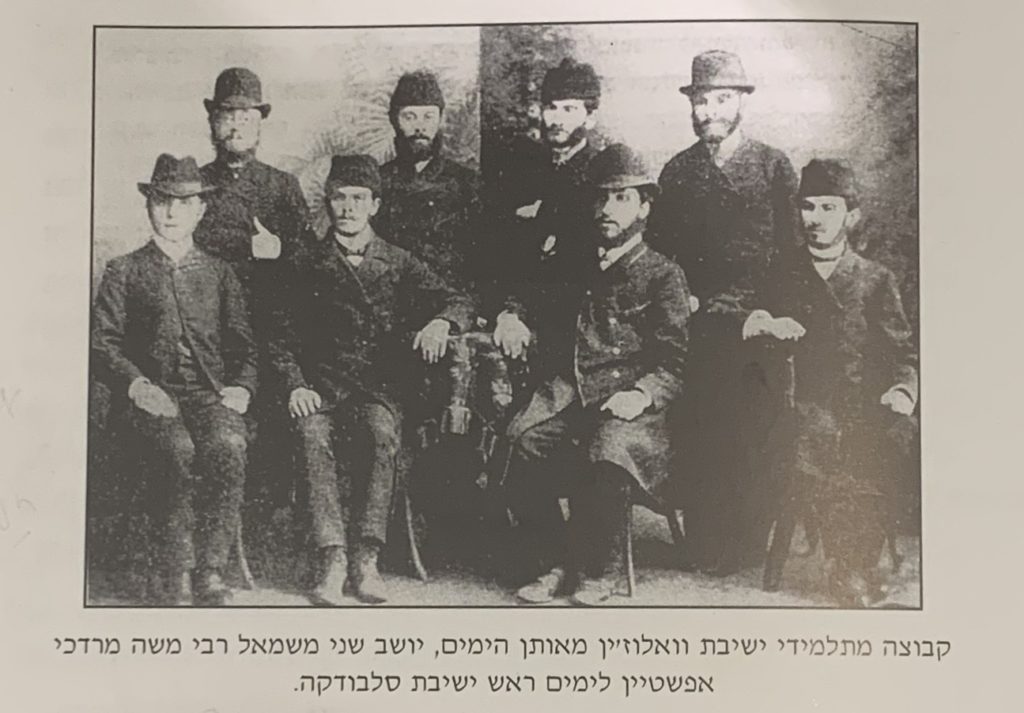
1. In my last post I mentioned R. Nosson Zvi Finkel, the Alter of Slobodka, so let me add the following. There is a transcript of a 1965 taped conversation between R. Jehiel Jacob Weinberg and R. Yaakov Herzog.[1] Herzog had come to Montreux to speak to R. Weinberg, and here is a picture from that meeting which appears in Michael Bar-Zohar, Yaacov Herzog: A Biography.

R. Weinberg, who knew R. Finkel very well, stated as follows.

הרב ויינברג: דער אלטער ז”ל (דער סלאבאדקער, זאגט מען דער אלטער), ר’ נטע הירש, ער איז דאך א צדיק.

הרצוג: אבער נישט קיין למדן.

הרב ויינברג: נישט קיין גרויסער למדן. ער האט געקענט לערנען, אבער ער איז נישט געווין קיין גרויסער למדן. אבער ער איז געווען א חכם, א גרויסער.

הרצוג: יא, דער חכם פון סלאבאדקע.

הרב ויינברג: און ער איז געווען א איידעלער מענטש זייער.

Some sections of this conversation appeared in the English Yated Ne’eman, Nov. 5, 1999. Yet as is to be expected, they appeared in a censored form as Yated Ne’eman would never record R. Weinberg’s statement that R. Nosson Zvi Finkel was not a great talmudic scholar. This judgment is not to be regarded as a put-down, as everyone in the Lithuanian yeshiva world knew that R. Nosson Zvi Finkel’s original insights were focused on Mussar, not analytical Talmud study.[2] Needless to say, the Alter always made sure that outstanding talmudic scholars were on the Slobodka faculty.
Speaking of censorship, here is another example. In the Yated Ne’eman article just mentioned, we find the following passage which is a quote from R. Weinberg.
I was intimately acquainted with R. Eizik Sher. . . . His son-in-law, R. Mordechai Shulman, visited me in Berlin and wanted to hear shiurim from me. I told him: This is not your place. Return to Slobodke.[!] Maybe you will some day become the son-in-law of R. Eizik.
This is what R. Weinberg actually said to Herzog:

ויינברג: ער איז ארויפגעקומען צו מיר אין סעמינאר. ער איז געווען אין בערלין, זיך ארומגעדרייט צוויי מאנאטן. געוואלט אריין אין סעמינאר. האב איך אים געזאגט: הערט זיך איין, ר’ מרדכי, ער איז א טיקטינר. דו וועסט נישט ווערן קיינמאל קיין דאקטאר. און אויב דו וועסט זיין א דאקטאר אפילו, וועסטו קיינמאל נישט קריגן קיין רבינער שטעלע אין דייטשלאנד. וואס טויג עס דיר? וועסט נישט מאכן קיין קאריערע. איז גיי אוועק צוריק אין סלאבאדקע. אמאל קען זיין, דו וועס זיך פארליבן אדער זי וועט זיך אין דיר פארליבן, די טאכטער פון ר’ אייזיק’ן, וועסטו ווערן ר’ אייזיק’ס א איידים.

.הרצוג: וכך הווה

 .ויינברג: און איך האב אים דערמאנט דאס. אז איך האב עס אים אמאל פאראויס געזאגט

R. Weinberg tells us that R. Mordechai Shulman, who was from Tiktin and later became Rosh Yeshiva of Slobodka in Bnei Brak, wanted to enroll in the Rabbinical Seminary of Berlin. Yated doesn’t want its readers to know this, so it “translates” the passage as saying that R. Shulman “visited” R. Weinberg and “wanted to hear shiurim” from him. R. Weinberg told him that he would never get a doctorate, and even if he did he would not get a rabbinic position in Germany, so he should return to Slobodka. R. Weinberg adds that when he returns it could be that he “will fall in love” with the daughter of R. Isaac Sher, or she will fall in love with him, and he can then become the son-in-law of R. Sher, the rosh yeshiva of Slobodka. In fact, this is exactly what happened.[3]
The Yated “translation” omits anything about R. Shulman and R. Sher’s daughter “falling in love.” This is because there is no such concept in the haredi world (and in traditional Jewish societies, in both the Ashkenazic and Sephardic worlds, such a notion was hardly found at all). Any love between husband and wife is said to come after marriage, and the biblical support for this concept, repeated in numerous texts (both haredi and pre-haredi[4]), is found in Genesis 24:67: “Isaac brought her into the tent of his mother Sarah, and he married Rebekkah. So she became his wife, and he loved her.” This verse states that Isaac loved Rebekkah, but only after he married her.[5] R. Gamaliel Rabinowitz goes so far as to state that any love that is found before marriage arises from sin, as there is no room for “feelings” before marriage.[6]
האהבה באה רק לאחר הנישואין, כל אהבה שלפני הנישואין מקורה בחטא רח”ל, ענין ה”רגשות” בכלל אין לו מקום לפני הנישואין, וזה דבר פשוט וברור שאין צריך לבארו.
R. Reuven Margaliyot mentions an interesting interpretation in support of this perspective.[7] There are two contradictory biblical verses. Proverbs 18:22 states מצא אשה מצא טוב, while Ecclesiastes 7:26 states ומוצא אני את האשה מר ממות. The contradiction can be explained as follows.
In earlier years parents would arrange marriages for their sons, and the overwhelming majority of the marriages succeeded. This is alluded to by the verse in Proverbs: מצא אשה מצא טוב. Now, however, things are different, and young men find their own brides, “and most of the time there isn’t peace between them after the marriage.” This is alluded to by the verse ומוצא אני את האשה מר ממות . In other words, if I find a wife for myself, most of the time it will turn out to be “more bitter than death.”
I think there might be another text that speaks to this concept, though I have not seen anyone who has made this point. The sixth of the sheva berakhot recited at a wedding states שמח תשמח רעים האהובים. The words רעים האהובים mean “beloved friends” or “beloved companions.” I don’t think one would use the word רעים to describe a man and woman who are “in love.” I believe that the words of the blessing mean a love that is found between two friends, rather than romantic love. 
R. Moses Gruenwald writes as follows:[8]
וענין חתונה א”א אלא בין רעים האהובים דמי שאינם אוהבים זה את זה א”א להם להתחתן.
What he says is that people who do not love each other cannot get married. I believe that he means the sort of “friendship love” I mentioned in the previous paragraph, rather than romantic love. I find his formulation particularly interesting, since R. Gruenwald was a Hungarian rav typically viewed as being on the extreme side of things. Yet here he is saying that there needs to be a sort of love between the bride and groom.
Could this really have been the norm in R. Gruenwald’s Hungarian (non-hasidic) community? Maybe some readers who come (or descend) from this type of community can offer some comments. I have also wondered what hasidim mean when they say רעים האהובים, since the people getting married hardly know each other. A friend from the hasidic world acknowledged that he doesn’t know if these words can be reconciled with the current reality. He also suggested that perhaps the words can be understood like יומת המת in Deuteronomy 17:6. In this verse the word המת does not mean one who is dead, but rather one who will soon be dead. So perhaps האהובים means “the ones who are in the process of becoming אהובים.”
I found another interesting passage that speaks about love of bride and groom. It is attributed to R. Isaac Luria by R. Hayyim Vital. As part of his explanation of a verse in Song of Songs, R. Luria writes:[9] מחמת רוב אהבת חתן לכלה. These words are explained allegorically, but their simple meaning also reflects a reality, one in which there is real love between bride and groom which could only have flowered prior to the wedding.
Returning to the traditionalist value that love only comes after marriage, this is all fine and good, but R. Weinberg specifically spoke of falling in love before marriage, and that this could lead R. Shulman to become R. Sher’s son-in-law. From the Yated “translation” the reader would assume that R. Weinberg was telling him to return to Slobodka and become a big learner, and that this might lead to him becoming R. Sher’s son-in-law.[10]
Regarding love letters, the following appears in R. Nathan Kamenetsky, Making of a Godol, p. 802, and was one of the passages that led to the book being banned:
A reliable source reported that R’ Aaron [Kotler] wrote a letter to his fiancée of which her father, R’ Isser-Zalman Meltzer, disapproved. When it was shown to the Alter, he rejoined, “I did not tell you he was a tzaddiq. I said he had other qualities, but he will yet become so frum that everyone will suffer from him.”
Many who read Making of a Godol assumed that the letter allegedly sent by R. Kotler was a love letter. In order to counter this understanding, in the second edition of Making of a Godol Kamenetsky added: “This author conjectures that the letter concerned an impressive hasbarah he had delivered.” This conjecture doesn’t seem to fit with the Alter’s reply about R. Kotler not being a “tzaddiq” and becoming “frum”. If R. Isser Zalman was upset because he thought that the young R. Kotler was a bit too impressed with himself, then the Alter would presumably have replied differently. The words that he allegedly used, “tzaddiq” and “frum”, have a certain meaning, and it thus is not surprising that the family of R. Kotler was so strongly opposed to the book and viewed this passage as insulting. (Another report has it that R. Kotler had suggested that his fiancée read a certain book and that was what upset R. Isser Zalman.)
In the second edition of Making of a Godol, the last sentence of the passage in question was altered to read, “But his frumkeit will yet become so great that everyone will suffer its brunt.” 
In my review of Making of a Godol, I wrote as follows:
Another problematic element of the book, admittedly found only on occasion, is its use of unnamed sources. This is acceptable in journalism, but not in scholarship. For example, the evidence for one of the most controversial passages in the book, concerning R. Aaron Kotler, his future wife, and his future father-in-law, R. Isser Zalman Meltzer, is “a reliable source” (p. 802). I understand why the source would not want his or her name to be given, but when repeating such a loaded story, which one knows will be controversial and its veracity challenged, the author is obligated to name the source, thus allowing the reader to judge its reliability. After all, if the source is R. Kotler’s daughter, its authenticity is more apparent than if it is another example of what X heard from Y. If the source does not wish to go on the record, it is best for the story to be omitted. (In my own biography of R. Weinberg, I was forced to leave out a number of “juicy” details, precisely for this reason.)[11]
I have previously discussed R. Samuel Archivolti’s book of melitzah letters, Ma’yan Ganim, and how it was misused by R. Baruch Epstein. See here.[12] This book is described in the Encyclopaedia Judaica as follows: “Archivolti’s most important works are . . . Ma’yan Ganim (Venice, 1553), divided into ‘passages’ containing 25 letters in metrical form designed to serve as models for students of this classic literary genre.”[13] It is worth mentioning Ma’yan Ganim now because on pp. 39ff. Archivolti includes two love letters. It appears clear to me that the focus of these letters is an unmarried couple, and first letter begins with the following heading: אגרת חושק לחשוקתה. 

Also of interest is this picture that appears at the beginning of each section of the book. As I learnt from Shimon Steinmetz, urinating putti were a common theme in the art of Archivolti’s day. You can read about it here

While Ma’yan Ganim is a book of melitzah letters, not responsa, R. Archivolti (1515-1611) was indeed a halakhic authority who served as rabbi of Padua. His pesak in the famous Rovigo mikveh controversy appears in Palgei Mayim (Venice, 1608), p. 15a.
 

R. Archivolti is referred to as מ”ד which stands for מרא דאתרא. In Renaissance Italy this title was only used for very important rabbis,[14] unlike today when all communal rabbis are given the title.
Interestingly, I found that a Hebrew manuscript from R. Archivolti’s era includes a love charm. The woman is told to write יריש ליאוש פילוש on her left hand, and this will cause the man she desires to fall in love with her.[15]
R. David Cohen, the Nazir, is an example of one who fell in love before marriage. In fact, his relationship with his future wife, Sarah, is a great love story. They were separated from each other for twelve years. He was in Europe and Eretz Yisrael and she was in Russia and later trapped behind the Iron Curtain. Throughout these long years they remained committed to each other, and the Nazir kept her picture on his desk. As reported by R. Avraham Remer, R. Zvi Yehudah Kook saw fit to mention this last point at the Nazir’s funeral.[16]
אמר עליו: “אור מופלא”, וציין אז שתי נקודות בחייו של רבי דוד: האחת, תחילת הנזירות בעת היותו באוניברסיטה, כדי לשמור על הפיאות והזקן. והשניה, שעל שולחנו הציב תמונת ארוסתו, כדי שחס-ושלום לא יתן עיניו באחרת.
R. Shear Yashuv Cohen tells us that the Nazir and Sarah also exchanged wonderful love letters during this time, letters which have not been made public:[17]
שמורים בארכיון המשפחה מכתבי-האהבה הנפלאים, ואף קטעי-יומן מלא רגש רוטט שנכתבו על ידי אבא מארי זצ”ל בימי הפירוד שנתמשכו הרבה מעבר למתוכנן ולמצופה . . . הכלה הצעירה מונה ימים ושנים, ונשארת בנאמנותה לבחיר לבה. אף הוא שומר לה אמונים ומתנזר מכל אפשרות של ברית או קשר אחר, בקפידה ובנאמנות יסודית.
When Sarah finally made it to Jerusalem, the Nazir was in the midst of a ta’anit dibur. R. Kook summoned R. Zvi Pesah Frank and R. Yeruham Fishel Bernstein so that they could sit as a beit din and void the ta’anit dibur, thus allowing him to speak to his soon-to-be bride.[18]

Regarding falling in love before marriage, R. Jehiel Jacob Weinberg, in his Oct. 12, 1960, letter to Samuel Atlas, states that R. Soloveitchik came to Berlin intending to marry R. Hayyim Heller’s daughter:
השידוך בטל. ס’ התאהב בזו שהיא עתה אשתו.
According to members of the Soloveitchik family, there is no truth to this, and R. Weinberg was simply repeating a rumor. But it is true that the Rav fell in love with his future wife in Berlin. R. Ronnie Ziegler writes as follows here:
The Rav’s most important and fateful encounter in Berlin was that with his wife, Dr. Tonya (Lewit) Soloveitchik (1904-1967). A student at the University of Jena, where she obtained a Ph.D. in education, she was introduced to Rav Soloveitchik by her brother, a fellow student at University of Berlin. Although a scion of the illustrious Soloveitchik family was expected to conclude a match with the daughter of a prominent rabbi or at least a successful businessman, Rav Soloveitchik fell in love with Tonya Lewit and married her in 1931 despite her family’s undistinguished lineage and lack of means.
R. Ziegler continues by describing the deep connection between the Rav and Tonya.
As mentioned in the previous lecture, the Rav’s relationship with his wife was one of the two most significant relationships in his life. He had unlimited esteem for her – his dedication of “The Lonely Man of Faith” reads: “To Tonya: A woman of great courage, sublime dignity, total commitment, and uncompromising truthfulness.” He respected her opinion and heeded her advice, both in practical and in intellectual matters. It was on her advice that he changed the topics of his annual Yahrzeit (memorial) lectures for his father, which attracted thousands of listeners, to matters which non-scholars could relate to (such as prayer, Torah reading, and holidays). [The halakhic portions of some of these lectures are collected in the two volumes of Shiurim Le-zekher Abba Mari z”l.] In a poignant passage in a teshuva lecture delivered after his wife’s death, he recounted how he used to consult her before speaking:
The longing for one who has died and is gone forever is worse than death. The soul is overcome and shattered with fierce longing. . . . Several days ago, I once again sat down to prepare my annual discourse on the subject of repentance. I always used to discuss it with my wife and she would help me to define and crystallize my thoughts. This year, too, I prepared the discourse while consulting her: “Could you please advise me? Should I expand this idea or cut down on that idea? Should I emphasize this point or that one?” I asked, but heard no reply. Perhaps there was a whispered response to my question, but it was swallowed up by the wind whistling through the trees and did not reach me.” (On Repentance [Jerusalem, 1980], p. 280)
Rav Soloveitchik’s wife was his best and perhaps only real friend. His natural proclivity towards loneliness, which we will encounter repeatedly in his writings, was heightened in his philosophy to an ideal, which expresses itself in an invigorating sense of one’s own uniqueness. One can be lonely even, or perhaps especially, when surrounded by friends, colleagues, and family. This is a constructive force which propels a person toward his individual destiny, while also propelling him to seek a depth-connection with God and with his fellow man. Aloneness, as opposed to loneliness, is a disjunctive emotion – it is a sense of lacking companionship, of being abandoned and forlorn. The passage above highlights the Rav’s almost unbearable sense of aloneness following his wife’s death in 1967 after a long struggle with cancer. He is reported to have said, “After my father’s death, I felt like a wall of my house had fallen down. After my wife’s death, I felt like the entire house had collapsed.”
Concerning the matter of falling in love before marriage, it is noteworthy that the great R. Hayyim Joseph David Azulai (the Hida) was in love with the woman who would later be his wife, and whom he knew for a number of years before they were married. Here is what Meir Benayahu has to say about this.[19]
את אשתו השניה, רחל בת משה הלוי מפיסה, הכיר כחמש שנים לפני שנשא אותה ונקשר עמה בקשרי אהבה. החלומות שחלם עליה לפני הנישואין מעידים על יחסו הנכבד לאשה. הוא שאף ל”נשואים רעננים” ובהנשאו לה ראה שהוא מתעטר בכבוד והדר. בנסיעותיו רכש לה מתנות ומסר לה אותם לפני הנישואין. כסף הרבה הוציא עליה למלבושיה ולהנאותיה, ומותה בשנת תקס”ד הקדיר עליו את עולמו.
Benayahu mentions the Hida’s dreams. Here is a passage that the Hida recorded from one of his dreams.[20]
תשרי תקל”ו . . . וראיתי בחלומי שהייתי בא על אשתי [שהיתה כבר נשואה עמי ולא זכרתי מי] ומוציא בתוליה ורואה דם. [קמ]תי והלכתי אצל אמ”ן [אבי מורי נ”ע] ושאלני ברמז והשבתיו ברמז . . . ונתעוררתי. ותכף הבנתי שהוא תשו’ שאלה מיום [ראש השנה?] לטובה. וב”ה שלא אירע לי שום מקרה ח”ו. הוא ית’ ירחם וייטיב אחריתי מראשיתי לאי”ט וש”ח.
Most people will probably feel uncomfortable reading this sort of passage. Yet the performance of the mitzvah the Hida discusses appears very natural to him and nothing to be ashamed of. Perhaps it is only uncomfortable to read because we have become overly puritanical regarding these matters which are also part of Torah. Nevertheless, it does remind me of other “uncomfortable” passages found in R. Jacob Emden’s autobiography.
I found another interesting passage that deals with love between a bride and groom in R. Aaron Fried’s Zekan Aharon (Munkacz, 1904), p. 52a. Here is the passage.
I am quite surprised by the example the author uses. In commenting on the rabbinic derashah connecting the words מורשה and מאורסה,[21] he uses an example that portrays a romantic relationship. He tells of a rich man, apparently newly married, who loved his wife and tried to woo her by telling her how greatly he loved her. “His love for her increased in quantity and quality beyond how other grooms love their brides.”
This type of description would be unusual enough in a rabbinic work. Yet it gets even more unusual when R. Fried continues by telling us that the rich man showered her with hugs and kisses and placed an expensive necklace around her neck as a sign of his love. R. Fried also elaborates on why, despite all these signs of affection, the woman did not reciprocate with any feelings of love. Later he explains that since the Torah is to us like one bound with erusin, that is why we show it love, decorate it with silver and gold, and even kiss it, just like a groom does with his bride! It happens to be a clever derashah, and ends with how if you want the Torah (i.e., God) to love you back, it is not enough to only support the Torah. One must also support the poor Torah scholars, the “relatives” of the Torah.
Is it just me, or is anyone else surprised by this derashah? I can’t imagine using the imagery found here as part of a derashah before a haredi audience in order to inspire them to be generous with their support of Torah scholars. With the mention of hugging and kissing the bride, I don’t even think this would go over well in front of a Modern Orthodox audience. [22]
I am doubly astounded by the fact that the derashah we have just seen was written by an outstanding student of the Hatam Sofer, one who also showed his halakhic expertise by authoring a volume of responsa titled שו”ת מהרא”ף.
I found the derashah so unusual that I was curious to see if anyone cited it. Using Otzar ha-Hokhmah I found two citations. The first is by a Hungarian rabbi, R. Efraim Balati, who authored Hamudei Efrayim (Galanta, 1935). In vol. 1, p. 35, he cites R. Fried’s comment.
Once again, I am surprised that a Hungarian rabbi would include such information in a derashah, even if, in R. Balati’s retelling, he leaves out the words ומחבב אותה בחיבוק ונישוק. Even though he doesn’t mention how the rich man showed his affection with hugs and kisses, he does include the rest of R. Fried’s words, including how we kiss the Torah just like a groom kisses his bride.
The other source I found that cites R. Fried’s passage is R. Barukh Moskovits, Tenuvot Barukh (Jerusalem, 1969), vol. 2, pp. 326-327.
If you examine the passage, you will see that he is quoting from R. Fried’s text, not R. Balati’s version. Yet R. Moskovits also alters R. Fried’s words ומחבב אותה בחיבוק ונישוק. In R. Moskovits’ text this appears as ומחבב אותה מאד. Since R. Moskovits copied R. Fried’s text basically word for word, I don’t understand why at the end of the passage he writes שמעתי. Why doesn’t he tell the reader the source of the passage? 
To be continued
2. The most recent book to appear in my series with Academic Studies Press is Maxine Jacobson, Modern Orthodoxy in American Judaism: The Era of Rabbi Leo Jung. Anyone with an interest in the history of Orthodoxy in America will want to read this book, and I am very happy that I was able to include it, together with other high quality works, in my series, “Studies in Orthodoxy.” Rather than offer my own description of the book, here is an “official” description, which appears on Amazon.
This work presents the issues of Modern Orthodox Judaism in America, from the decades of the twenties to the sixties, by looking at the activities of one of its leaders, Rabbi Dr. Leo Jung, pulpit rabbi, community leader and writer, whose career spanned over sixty years, beginning in the 1920s. Jung is a fulcrum around which many issues are explored. Rabbi Jung’s path crossed with some of the most interesting people of his time. He worked with Chaim Weizmann, the first president of Israel, with Albert Einstein to promote Yeshiva College, with Herman Wouk, American author and Pulitzer Prize winner, and with Pearl Buck, a Nobel Prize laureate and Pulitzer Prize winner.
Modern Orthodoxy went from being a threatened entity on the American scene to a well- recognized and respected force in Judaism. Orthodoxy, at first, was seen as alien to the American environment. Marshall Sklare, perhaps the most influential exponent of this notion, wrote in the 1950s that the history of Orthodoxy in America could be written in terms of a case study of institutional decay. He realized the errors of his ways in the 1970s. This is the story of the renaissance of American Modern Orthodoxy, from the disorganization of the older Orthodoxy to the new spirit of confidence that emerged after World War Two. The phenomenon of Modern Orthodoxy is examined in the context of Orthodox invigoration and change. This book has relevance for further studies in various areas. It is part of the study of religious acculturation, of the conflict between tradition and modernity and of religious reinvigoration in a secular society.
Another noteworthy recent book is Michael J. Harris, Faith Without Fear: Unresolved Issues in Modern Orthodoxy. In my blurb that appears on the back cover, I write: “A proud and sophisticated manifesto of Modern Orthodoxy, one which builds on past thinkers but does not hesitate to chart new ground as well.” Rabbi Harris deals with a number of issues such as the role and status of women, mysticism, academic biblical scholarship, and religious pluralism. He generally comes down on the more “liberal” side of what is known as Modern Orthodoxy. (An exception to this generalization is his chapter on academic biblical scholarship.) Anyone who is interested in the intellectual trends of Modern Orthodoxy will want to read Harris’s book, as it is engaged scholarship at its best.
I would also like to call attention to R. Shimon Szimonowitz’s just published Haggadah shel Pesah: Aleh Zayit.[23] I know that there are a lot of Haggadot out there, but for talmidei hakhamim this is one of the special ones. I say this because of the many learned comments, including full-length essays, that are found in the volume. Of particular interest to me is R. Szimonowitz’s lengthy article on le-shem yihud. It is crucial reading for anyone interested in the dispute over the le-shem yihud formulation, in particular the positions of R. Ezekiel Landau, R. Eleazar Fleckeles, and R. Moses Sofer. Among other noteworthy things found in this Haggadah are an article by R. Chaim Rapoport and the Yiddish version of a few beloved Passover songs.
3. On June 5, 2016, in honor of Yom Yerushalayim, I will be speaking at the Community Synagogue of Monsey, 89 West Maple Avenue. The title of my talk is “R. Shlomo Goren: The Revolutionary Chief Rabbi.” The talk will follow minhah which is at 8:15pm.

[1] Israel State Archives, Yaakov Herzog Collection, 2989-4/פ. R. Yaakov David Herzog was the son of R. Isaac Herzog. He was named after R. Yaakov David Wilovsky, the Ridbaz, from whom R. Isaac Herzog received semikhah. In addition to his public role in government and as a diplomat, Yaakov Herzog was also a rabbinic scholar. In 1945 he published a translation and commentary of Mishnah Berakhot, Peah, and Demai. This translation was actually ready for publication by the end of 1942, before Herzog was even 21 years old (he was born Dec. 11, 1921). See Michael Bar-Zohar, Yaacov Herzog: A Biography (London, 2005), p. 50.
In Iggerot Moshe, Hoshen Mishpat no. 1, R. Moshe Feinstein critiques an article of R. Isaac Herzog that appeared in Ha-Pardes. R. Moshe’s own article originally appeared in installments in Ha-Pardes, Tamuz and Av 5703. Yaakov Herzog defended what his father wrote in Ha-Pardes, Elul 5704, pp. 36-38, and Tishrei 5705, pp. 25-27. He was only 23 years old when he wrote these articles.
After the retirement of R. Israel Brodie, Herzog was offered, and accepted, the position of British Chief Rabbi. The common view is that Herzog’s health problems prevented him taking up the post, but the truth is more complicated. See Bar-Zohar, Yaacov Herzog, ch. 13.
Since I have spoken in prior posts about religious men not wearing kippot, Herzog should be added to the list. Not only did he go bareheaded when representing the State of Israel in the Diaspora (and also in his famous debate with Toynbee), but as you can see from pictures in Bar-Zohar’s book, he also did so in Israel, while at work in various important government positions. Bar Zohar writes, “Even as a very young man, when he was working at the Foreign Ministry and then in the Prime Minister’s office, Yaacov did not wear a skullcap, except when saying blessings or praying.” (Yaacov Herzog, p. 111) Because of the vast changes that have taken place in Israeli society, it is hard for us to appreciate why, in the early decades of the State of Israel, some religious men, even those who were not of German background, felt that government work required removing their kippah.
You can listen to the Herzog-Toynbee debate here.
In a previous post here I referred to Yitzhak Nebenzahl as not wearing a kippah, and I mentioned that this German practice continued into his old age. In 1974 Nebenzahl was a member of the Agranat Commission which investigated the Yom Kippur War. In pictures of him from this time you can see that he was still without a kippah. A couple of people emailed me to say that by the 1980s he had abandoned the galut custom and indeed wore a big black kippah. One of them even sent a picture of him and Nebenzahl together.
In the post referred to in the previous paragraph, I also discussed Aharon Barth, who like Nebenzahl came from Germany and did not wear a kippah while at work. Subsequent to the post I found that Zorach Warhaftig mentions that after the death of Chaim Weizman, Ha-Poel ha-Mizrachi recommended to Ben Gurion that Barth be a candidate for president of the State of Israel. Warhaftig reports that Ben Gurion rejected this since Barth was too religious and thus not an appropriate representative for the average citizen. See Warhaftig, Hamishim Shanah ve-Shanah (Jerusalem, 1998), p. 116.
[2] Shlomo Tikochinski, Lamdanut, Musar ve-Elitizm (Jerusalem, 2016) p. 111 n. 131, cites Israel Zissel Dvortz and Dov Katz who claim that R. Finkel was indeed a “gadol” in talmudic learning, but he hid this knowledge even from those who were close to him. Some will no doubt regard this judgment as motivated by “religious correctness,” especially as R. Weinberg had a particularly close relationship with R. Finkel and was privy to all sorts of private information. See, however, Nathan Kamenetsky, Making of a Godol, pp. 777ff., who cites additional sources testifying to R. Finkel’s talmudic knowledge.
[3] R. Shulman’s early shiurim were not very successful in drawing a following. Ben-Tsiyon Klibansky writes (Ke-Tzur Halamish: Tor ha-Zahav shel ha-Yeshivot ha-Lita’iyot be-Mizrah Eiropah [Jerusalem, 2104], p. 342):
בסלבודקה הורגשה אי-נחת כשמינה בה הרב יצחק אייזיק שר את חתנו מרדכי “טיקטינר” שולמן לר”מ בשנת 1935. בישיבה הוא היה תלמיד ותיק נודע, ולאחר נישואיו ב-1929 הועיד את כל זמנו להתעלות בלימודיו. אולם משהחל להרצות את שיעוריו בישיבה לא מצאו בחוריה הדעתנים לנכון להשתתף בהם, ובשיעורים הראשונים נכחו חניכים יחידים בלבד.
Here is a picture of R. Weinberg and R. Shulman in Montreux. It appears in Joseph Friedenson, Heroine of Rescue (Brooklyn, 1984), p. 230.

[4] R. Samson Raphael Hirsch, in his commentary to Gen. 24:67, writes as follows:
Like the marriage of the first Jewish son [Jacob], Jewish marriages, most Jewish marriages, are contracted, not by passion but by reason and judgment. Parents, relations and friends consider which young people are really suited to each other, bring them together, and then love grows more and more, the more they get to know each other. But most non-Jewish marriages are made by what they call “love”, and one has only to glance at the novels depicting life to notice what a gulf there usually yawns between the “love” before marriage and after, how rapid and insipid everything then seems, how different from all the glamour one had imagined etc. etc. Such “love” is blind, every step into the future brings disappointment. But of Jewish marriage it says: ויקח את רבקה ותהי לו לאשה ויאהבה. There the wedding is not the culmination but the seed, the root of love!
The Malbim is another pre-haredi figure who speaks of love coming after marriage and cites Gen. 24:67. See his commentary to Deut. 24:1 (p. 169b). Yet he differs from others who make the same general point in that he acknowledges that at the beginning (which appears to mean even before marriage) there is indeed a “spark of love,” זיק אהבה. In context, these words might only mean a healthy attraction. The Malbim continues that the essence of love between a man and woman comes only after marriage:
ונמצא שעקר האהבה היתה נגלית רק אחר הנשואין.
R. Hayyim Hirschensohn, whose outlook was as far from a haredi perspective as can be imagined, also points to Gen. 24:67 as providing the proper approach to love and marriage. He even throws in a negative comment about American mores which is not what most would expect to come from him. See Apiryon 3 (1926), p. 29:
ותהי לו לאשה ויאהביה, לא כמנהג אמריקא שהאהבה בא קודם הנשואין ומתה עם הנשואין, אבל יצחק אהב את רבקה אחרי הנשואין.
Reading all of these passages shows us how much has changed both culturally and sociologically. I don’t think there is a parent in the Modern Orthodox world who would support a child’s marriage if the son or daughter was not convinced that he/she loved the future spouse.
I asked a friend if in the haredi world people would ever say that the bride and groom loved each other (i.e., before marriage). He replied:
לא היו אומרים, אבל אצל הישיבתיים זה בסדר גמור – ואולי גם יותר טוב – שיהיה אהבה ביניהם, אבל לא היו מביעים את זה, קוראים לזה chemistry, רוצים שיהיה chemistry ביניהם לפני שסוגרים את השידוך. אצל חסידים זה לא מקובל.
Radak, in his commentary to Gen. 24:67, is not concerned with using the verse to show that love should only come after marriage, and indeed, in his day this was generally not even an option. Yet in discussing the verse he makes a very telling comment, as true today as in his times:
רוב בני אדם אוהבים נשותיהם.
Most men love their wives.” If you read Hirsch’s grand rhetoric you feel carried away with the purity and perfection of Jewish love after marriage. Radak, however, brings you down to the real world, where unfortunately the truth is that not all men really love their wives.

[5] See, however, Gen. 29:18, 20, where it says that Jacob loved Rachel, and this was before he married her. In Gen. 29:30 the verse states: ויאהב גם את רחל מלאה. Most understand this to mean that while Jacob loved Leah, he loved Rachel more. However, according to one interpretation of the Tosafists, Jacob did not love Leah at all. See Tosafot ha-Shalem al Torah, Nevi’im, u-Khetuvim, vol. 3, p. 145:
ויבא גם אל רחל ויאהב גם: ב’ פעמים גם, אין ריבוי אחר ריבוי אלא למעט, מיעט את לאה מן האהבה, שלא אהב אותה כלל, שנאמר “וירא ה’ כי שנואה לאה”.
See also Nahmanides, Commentary to Genesis 29:31: ולכן שנאה יעקב. He also offers an alternative explanation.
[6] Tiv ha-Emunah (5769 ed.), p. 142.                                         
[7] Devarim be-Itam (Tel Aviv, 1959), p. 57.
[8] Arugat ha-Bosem (Huszt, 1913), parashat Emor, p. 52a.
[9] Humash in Perush ha-Arizal (Jerusalem, 1993), Song of Songs 6:5 (p. 295).
[10] There is a story in yeshiva circles that before R. Isaac Hutner went to Berlin, he was supposed to marry R. Sher’s daughter, whose name was Chava Miriam.
R. Weinberg mentions both R. Sher and R. Shulman in his letter to Samuel Atlas, dated Jan. 17, 1950. (The letter is found in the Jewish Theological Seminary Library, Samuel Atlas collection.) The young rosh yeshiva R. Weinberg refers to is R. Chaim Kreiswirth, who was the son-in-law of the martyred R. Abraham Grodzinski. In this letter R. Weinberg frankly explains why he could not accept a position at Hebrew Theological College in Chicago.
וכן הדבר בשיקאגו. הרב המנוח שאול זילבר כתב לי קודם פרוץ המלחמה ואח”כ כמה וכמה מכתבים ובקשני שאבוא אליהם. גם ידידי הרב רגנסבורג כתב לי. ויש לי שם ידיד אוהב ומעריץ גדול, הרב ר’ אפרים עפשטיין, אחד מחבשי הקוראטוריום של בית המדרש לתורה וגם הוא הפציר בי לבוא לאמיריקה. ובכ”ז לא זכרו אותי בשעה שנפנתה משרת “ראש הישיבה” ונתנוה לאחר. אפשר שרצו באדם צעיר ואפשר שיד סלאבודקי באמצע. הראש ישיבה החדש הוא חתנו של ר’ אברהם ווארשאווער הי”ד, מי שהי’ מנהל ישיבת סלאבודקי. שמעתי שהוא דרש שיתנו לו משרה בישיבת סלאבודקי אשר בבני ברק. טען טענת ירושה. אבל ר’ אייזיק שער נ”י וחתנו ר”מ שולמן שהם כוננו את ישיבת סלאבודקי בבני ברק דחוהו ולפיכך הצטרכו למצוא לו מקום חדש . . .
עכ”פ אי אפשר לי עכשיו לחשוב ע”ד קבלת מינוי בביהמ”ד אשר בשיקאגו. הנ”ל הוא ראש הישיבה ולי אי אפשר לעמוד תחת מרותו של אדם צעיר, ואפילו יהי’ גדול שבגדולים. וצריך אתה לדעת, כי לביהמ”ד זה יש אופי של ישיבה ונוהגים בה כל מנהגי ישיבה, בכבודים ובתוארים וכו’ וכו’ וא”כ איך אפשר לי לעמוד במחיצתם והם ינהגו בי מנהג זלזול כנהוג בישיבה למי שאינו “הראש”.
ב”ה יש לי תלמידים שתופסים משרות רבנות בערים גדולות וגם בבמשלה העברית שבא”י יש לי תלמידים. ומשום כבודם בלבד אסור לי להעשות אסקופה בשביל פרנסה.
Regarding broken engagements, here is the front page of Doar ha-Yom, April 28, 1926 (called to my attention by Moshe Dembitzer).

As you can see, there is an ad wishing R. Kook mazal tov on the engagement of his daughter, Basya, to R. Hayyim Walkin, the son of R. Aaron Walkin. R. Hayyim Walkin would later break this engagement and marry the daughter of R. Yaakov Shapiro, who was the Rosh Yeshiva of Volozhin. After R. Shapiro’s death R. Walkin became Rosh Yeshiva (and was later martyred in the Holocaust). See here.           
[11] Edah Journal 3:2 (Elul 5763), p. 8, available here.
[12] Regarding R. Baruch Epstein’s supposed conversations with his aunt, Rayna Basya – conversations that I have argued here were invented by R. Epstein and thus cannot be regarded as having any historical value – see also Eliyana Adler’s fine article, “Reading Rayna Batya: The Rebellious Rebbetzin as Self Reflection,” Nashim 16 (Fall 2008), pp. 130-152. Another completely fictional account is provided by R. Hayyim Haikel Greenberg in Beit Yaakov 8 (Tevet 5720).

Greenberg has R. Hayyim Ozer Grodzinski pull out Ma’yan Ganim from his bookshelf and read from it during a discussion about the Beis Yaakov school system. Had R. Hayyim Ozer actually had this rare book in his library he would have known that it is a book of melitzah letters, not a book of responsa as stated by Greenberg. (R. Epstein was responsible for creating the false notion that Ma’yan Ganim is a book of responsa. As shown in my post referred to in the previous paragraph, R. Epstein never actually saw Ma’yan Ganim, and I can now add, neither did Greenberg.)
[13] Encyclopaedia Judaica, vol. 3, col. 397.
[14] See Robert Bonfil, Rabbis and Jewish Communities in Renaissance Italy, trans. Jonathan Chipman (London and Washington, 1993),  p. 139.
[15] See Max Grunwald, “Kleine Beiträge zur jűdischen Kulturgeschichte,” Mitteilungen zur jűdischen Volkskunde 19 (1906), p. 112. We know of love charms from ancient times as well. Sefer ha-Razim, which was written in either the tannaitic or amoraic period, records a spell that will cause a woman to fall in love with you. See Michael Satlow, Jewish Marriage in Antiquity (Princeton, 2001), p. 130. Mif’alot Elokim is a book of segulot that has been printed many times since first appearing in 1710. Here is the title page of the Lemberg 1858 edition.

In ma’arekhet aleph, s.v. אהבה, it contains a number of segulot to help women get rid of their “love sickness.” Shimon Steinmetz pointed out to me that R. Jacob Zahalon (17th century), Otzar ha-Hayyim (Venice, 1683), p. 58b, also explains איך יתרפא חולי אהבה. Yet unlike the segulot that appear in Mif’alot Elokim, Zahalon actually has some real psychological insight. His advice is to think about the flaws of the person you are infatuated with, to occupy yourself with other things (that way you won’t be focused on the object of your infatuation), and to move to a different city.
The phrase חולי האהבה is used by Maimonides in Mishneh Torah, Hilkhot Teshuvah 10:3 (חולת אהבה appears in Song of Songs 2:5). He states:
What is the love of God that is befitting? It is to love the Eternal with a great and exceeding love so strong that one’s soul shall be knit up with the love of God, and one should be continually enraptured by it, like a love-sick individual, whose mind is at no time free from his passion for a particular woman, the thought of her filling his heart at all times, when sitting down or rising up, when he is eating or drinking.
Although some have described Maimonides as akin to Spock when it comes to emotions, anyone who reads the passage just quoted will see that Maimonides understood very well what being in love is all about.
[16] Gadol Shimushah (Jerusalem, 1994), p. 47. 
[17] Mishnat ha-Nazir (Jerusalem, 2005), pp. 26-27.
[18] See Mishnat ha-Nazir, pp. 27-28.
[19] Rabbi Hayyim Yosef David Azulai (Jerusalem, 1959), vol. 1, p. 161.
[20] Ibid., p. 559. Benayahu informs us that the first passage in brackets is written above the text in the manuscript.
[21] Actually, מאורשה, see Berakhot 57a.

[22] A friend in the haredi world commented as follows: “Why is this different than the imagery used in שיר השירים? Or in the zemer written by the אריז”ל and sung at my Friday night seudah every week: יחבק לה בעלה?” To this I replied that if someone today would write an erotic poem and say that it really represented God’s love for Israel, it would nevertheless be put in herem.
[23] Regarding the words עלה זית (and עלה תאנה), Samuel David Luzzatto points out that in Biblical Hebrew the word עלה is used for singular and plural. This is similar to how the word פרי is singular and plural in biblical Hebrew. Later Hebrew created the words עלים and פירות. That is why people began to write עלי זית, something which upsets the purist Luzzatto. See his letter at the end of R. Abraham Bedersi, Hotem Tokhnit (Amsterdam, 1865).


Daily Birkat Cohanim in the Diaspora

Daily
Birkat Cohanim in the Diaspora *
By Rabbi Daniel
Sperber
Question: May
Cohanim outside the Land of Israel give the priestly blessing (Birkat
Cohanim
, or Nesiat Kapayim) on weekdays and on regular Shabbatot?
Answer: The
Torah explicitly requires the Cohanim to bless the people (Numbers
6:23), but does not tell us where or when they should do so. Rambam (Sefer
ha-Mitzvot
, Mitzvat Assei 26) who gives no details, but refers us to
B. Megillah 24b, Taanit 
2b, and Sotah 37b, to work out the details. However, there are
versions of the Rambam’s text (edited by R. Hayyim Heller and R. Yosef Kefir)
when there are the additional words “every day”, and this, indeed, is
his ruling in the heading of his Hilchot Tefillah and Birkat Cohanim;
and see further ibid chapter 14, and this also is the ruling in Sefer
ha-Hinuch
, Mitzvah 367. However, there we find the additions that
“the Mitzvah applies in all places at all times…” Hagahot
Maimoniyot,
to Rambam Hilchot tefillah 15:12 note 9 writes, on the
basis of R. Yehoshua ha Levi’s statement in B. Sotah 38b, that any Cohen
who does not bless the people transgresses three commandments, splitting as it
were the biblical verse in Numbers ibid. thus: “So shall you bless
the children of Israel/ say unto them”, adding verse 27 ibid., “And
they shall put my name upon the children of Israel…” The Hagahot
Mordechai
modifies this by adding that if the Cohen has not been summoned
to bless the people, he does not transgress by not doing so, referring to the
Yerushalmi text, and this view is accepted by the Beit Yosef, Orah Hayyim
128. There is also a minority view, rejected by mainstream authorities, that of
Rabbenu Manoah, that even if the Cohen was not called, if he did not bless the
people, he transgresses at least one commandment.
Outside
Israel it is the practice for the Cohanim not to give the priestly blessing, even
though the mitzvah clearly applies abroad (see R. Hayyim Hezkel Medini, Sdei
Hemed
vol.3, p.271, vol.8 pp.177 and 381), and for the congregation not to
request that they do so, – this with the exception of musaf on the
foot-festivals and Yom Kippur – even during Neilah. The Beit Yosef was very
perturbed by this practice. He writes (Orah Hayyim 128):
The Agur wrote that Mahari Kolin [the Maharil] was
asked why the Cohanim do not give the priestly blessing every day, since it is
a positive commandment. And he answered that it was the custom of the priests
to make a ritual ablution [in the Mikvah] before blessing,
* This is
an expanded version of an article published under this title in Conversations
20, 2014, pp.150-155.
as is recorded in Hagahot Mordechai, and to do so
every day in the winter would be very difficult for them.
Hence, the custom evolved to do so only on the
festivals. Furthermore, [doing so] would curtail the business activities (mi-taam
bitul melachah
), and in any case if the Cohen is not summoned he
does not transgress.
However,
the Beit Yosef continues:
He forced himself to justify his local custom; but the
reasoning is insufficient. For that which he said that they were accustomed to
make a ritual oblution every day, this is a stringency – i.e. it is not really
required – which leads to leniency… Since ritual ablution as a requirement for
the priestly blessing is not mentioned in the Talmud. And even if they took
upon themselves this stringency, why would they cancel three commanments, even
if they were not transgressing since they had not been summoned. Surely it
would be better that they carry out these three commandments clearly and not
make the ritual ablutions, since there are not required, and by not doing so
they could fulfill the three commandments.
He ends
by saying:
And praise be to the inhabitants of Eretz Yisrael and
all Egypt who give the priestly blessing every day, and do not make ritual
oblutions for it.
Indeed
there are some congregations that still follow the Beit Yosef’s position. Thus,
the Syrian community has birkat Cohanim every day, (see H.C. Dobrinsky, A
treasury of Sephardic Laws and Customs
, Hoboken N.J., New York 1986, p.168).
This too was the Amsterdam custom of the Portuguese community, (Shemtob
Gaguine, Keter Shem Tov, vol.1, Kédainiai 1934, pp.222-227 note 268, who
also quotes Even Sapir, that this was the practice in Yemen, and
possibly in some Moroccan congregations), while in Djerba they did it on
Shabbatot and festivals, (R. Moshe HaCohen, Brit Kehunah, Orah Hayyim,
pp.101-102, and note 30). Thus, there are several precedants for this practice.
However,
the Ashkenazi Rema, R. Mosheh Isserles, in his Darkei Mosheh ibid. 21,
seeks to justify the Ashkenazi custom. He writes:
Because [doing so] would curtail business activities
for the people in these countries, for the Cohenim are struggling to support
themselves in the exile, and they can barely support their families, other than
the bread they gather by the sweat of their brows daily, and they are not
happy. And it is for this reason that they do not carry out the priestly
blessing, which leads to bitel melachah la-am. And even on Shabbat they
do not do so, because they are troubled and concerned about their future…, and
they are only joyful on the festivals. And thus the custom evolved only to
bless the people on the festivals. So it would appear to me.
The
notion that the Cohen must be joyful when blessing the congregation has its
roots in the early Rishonim, (in Rash’s teacher, R. Yitzhak ben Yehudah).
The Mateh
Efraim
, of R. Efraim Zalman Margaliot, added that this was an ancient
practice, even more than five hundred years old, going back to the Tashbetz
ha-Katan, a disciple of the Maharam Mi-Rothenburg, and the Kol Bo
sect.128, and accepted by the Maharit, the Agur, the Darkei
Mosheh
etc., “and one may not stir from this custom” . He also
gives additional reasons to support this custom.
R. Efraim
Zalman Margaliot (1760-1811) in his response, Beit Efraim, Orah Hayyim 6,
Lvov 1818, also suggested that the reason for the absence of birkat Cohanim
abroad is because in our days the pedigree of Cohanim is questionable, and a Zar,
non-Cohen, may not bless the people (see B. Ketubot 24b), and doing so
several times every day would be making a berachah le-vatalah – an idle,
that is to say, unnecessary, blessing, which is forbidden – on numerous
occasions by many people. However, since birkat Cohanim is a mitzvat
aseh
, a positive commandment, and we rule that even in questions of
uncertainty – safek -, when we are dealing with a mitzvat aseh,
we rule le-humra, stringently; and certainly it is superceded by the
seriousness of the mitzvah. Furthermore, if the Beit Efraim‘s
argument were correct, how come the Cohanim abroad do bless the people
on festivals during musaf?  [1]
The
Sefardi Kaf ha-Hayyim, R. Yaakov Hayyim Sofer, on the other hand (Orah
Hayyim
ibid note 16), cites French R. Yaakov of Marvege, (in his Shut
Min-ha-Shamayim
no.38), who writes that:
In a place where there are suitable Cohanim to bless
the people, and they do not do so even once a year, both the congregation that
do not call them to do so, and the Cohanim themselves, who do not make the
blessing, transgress, also because they seem not to be relying on their Father
in Heaven.
This was
cited by the Egyptian Radbaz, R. David ben Zimra, and especially  the Hesed le-Avraham of R. Avraham
Azulai, who writes at length censuring those who do not bless the people, enumerating
the negative effects of their flawed thinking, concluding that “it be
proper to do so in every place, and not to seek out strategies to avoid doing
so.”
And even
the Ashkenazi Hafetz Hayyim, in his Mishnah Berurah 128:12 in the
Beur Halachah wrote:
It is only because of weekness that the Cohanim can go
out and not go up [to bless the people. For if not so, certainly they are not
acting well to needlessly nulify a positive commandment.
Indeed,
there are some Ashkenazi congregations where they do carry out the priestly
blessing at least once a month, as we learn from the Sefer ha-Miktzoot,
or even every Shabbat, as is mentioned in the Mateh Efraim.
Finally,
we may cite the words of R. Yehiel Michel Epstein, in his Aruch ha-Shulhan,
Orah Hayyim
128:4, who writes:
And behold, it is certainly the case that there is no
good reason to nullify the mitzvah of birkat Cohanim the whole
year long, and [it is] a bad custom. And I have heard that two great
authorities of former generations – probably the Gaon Eliyahu of Wilna and R.
Hayyim of  Volozin – each one wished to
reestablish birkat Cohanim daily in their location, and when they
decided on a given day [to begin], the issue become confused and they did not
succeed, and they said that from Heaven it was thus decreed.
In view
of all the above we may state that Birkat Cohanim does not require
ritual oblution, and in present day diaspora countries, blessing the people
will not effect or curtail any business activities, and people in the diaspora
are not downtrodden nor do they live in permament misery, so that they cannot
be joyful enough to bless the congregation. And according to some opinions
(e.g. the Pri Hadash) even if they are not called to give the blessing,
they may/should do so, (see e.g. Piskei Maharitz, Orah Hayyim vol.1,
Bnei Brak 1987, pp.259-260, with the note of R. Yitzhak Ratzabi ibid. Note 7,
ibid. Beerot Yitzhak). Thus, the reasons given for avoiding giving the
priestly blessing are for the main part largely irrelevant in present-day diaspora
conditions.
On the
other hand, not doing so means not carrying out three positive biblical
commandments, and according to some ,albeit minority, opinions this is also the
case when the congregation does not summon the Cohanim. Some, somewhat mystical
sources also stress the great spiritual benefits of the priestly blessing, and
the considerable negative effect of their absence. Furthermore, we have seen
evidence that in some Ashkenazi communities Birkat Cohanim was practiced
on Shabbatot or monthly, and not merely on the festivals.
Taking
into account all of the above, I would think that nowadays, there is little
justification for not carrying out the priestly blessing daily in our diaspora
congregations.
I would
like again to refer to the Hesed le-Avraham:
מי שאינו
מברך מאבד טובה הרבה ומראה שאינו חפץ במצות ולא חפץ בברכה, ובז לדבר יחבל לו, לכן
הכהן הירא את דבר ד’ ובמצותיו חפץ, לא יעבור מלברך לעשות נחת רוח ליוצרו, כי טוב
בעיני ד’ לברך את ישראל ומה טוב ומה נעים מנהג איזה מקומות, שהכהנים נושאים כפיהם
בכל יום וכן ראוי לנהוג בכל מקום, שלא לבקש תחבולות לבטל מ”ע מן התורה.
To
summarize:
This is a
biblical commandment obligating the Cohanim to bless the people.
Not doing
so means not fulfilling that biblical commandment, and, according to some
authorities, even transgressing three biblical commandments.
Here we
may add yet another element to our discussion. There is a well-known opinion of
R. Eliezer Azikri, in his Sefer Haredim chapter 4 (with the commentary
of R. Yitzhak Leib Schwarz, Kunszentmiklos 1935, p.19), that “those who
stand before the Cohanim in silence and direct their hearts to receive the
benedictions as the words of God, they too are included in the mitzvah
as parts of the 613 [mitzvot]”.
The
commentator, ad loc. (note 18-19) discusses this opinion, printing out that it
is a subject of considerable controversy among the greatest of authorities, but
he quotes the author of the Haflaah, R. Pinhas ha-Levi Horowitz, (in his
notes to Ketubot 24b and Rashi ibid.), that just as there is a
commandment to the Cohanim to bless Israel, so too is there a commandment to
Israel to be blessed by the Cohanim. He states that there are other examples
where the torah, explicitly commands only the active partner and not the
passive recipient, but nonetheless both are obligated. He brings as one example
to mitzvah of yibum which devolves both on the levir (yavam)
as well as the sister-in law (yevamah), even though the Torah
commandment is directed towards the levir alone. The Haredim‘s novum was
widely accepted, even though his source remained to many unclear.
Furthermore,
the Gemara in B. Sotah 38b states in the name of R. Yehoshua ben Levi, that God
Himself yearns to hear Birkat Cohanim, basing himself on the verse in Numbers
6:27, “And they shall put My name upon the children of Israel; and I will
bless them”, further adding that “Every Cohen who blesses [the
people] is blessed”, and he that does not do so is not blessed”, as
it is written, “And I will bless them that bless thee” (Genesis
12:3).
This view
is already found in a statement of the Tosafist R. Yaakov of Mervege,
Sheelot u-Teshuvot min ha-Shamayim
(ed. R. Reuven Margaliot, Jerusalem
1957, no.37, p.69), already briefly 
cited above, who writes as follows:
I was also uncertain as to those places where there
are Cohanim who are suitable to carry out birkat cohanim and were
accustomed not to do so even once a year. And I asked [advice] concerning this
issue, whether [in their not doing so] there is a transgression, or whether one
can rely upon R. Yaakov who said that the Cohanim are not obligated to bless
other than when the people tell them to do so.
And they [i.e. from Heaven] replied: Both these and
these transgress; namely, the people (literally: Israel who do not tell  them [to bless], and appear not to be  fearful of [the requirement to receive] the
blessing of  Father in Heaven, and the
Cohanim, who do not bless on their own accord the nesiat kapayim, for is
it not written, “And I will bless those that bless thee” (Genesis
12:3), and from the positive [statement] we may deduce the negative, (i.e. that
from the positive statement that God will bless the blessers, we may deduce
that he will curse them that do not bless).
Admittedly
this is an opinion of a Kabbalistic nature, and we do not necessarily rule
accordingly when there is an opposing view of the niglah (the
rationalist position), as is well known. However, this same view was also
indicated in the commentary attributed to the Raavad to Tamid 33b, [2] but
which is actually by the rationalist Tosafist R. Baruch be-R. Yitzhak Vermaiza,
[3]  the 
author of Sefer ha-Terumah. This commentary in this instance
bases itself on (the largely lost) Sefer Miktzoot. [4]  The editor of this commentary pointed out (in
note 48) that this was the view of the Haredim, adding that it was also
noted by R. Zeev Pomeranchik, in his Emek Berachah, Jerusalem 1948,
sect.7, further cited by R. Pinhas Horowitz, in his Sefer Haflaah (to Ketubot
24b), and so also in Hagahot R. Akiva Eiger to Shulhan Aruch, Orah
Hayyim
128:1, and similarly in the Beur Halachah ibid.
It should
however not be overlooked that this point of view was not accepted by all
authorities. Thus, it was questioned by R. Yosef Babad, in his Minhat
Hinuch, Mitzvah
378, (ed. Machon Yerushalayim, vol.3, Jerusalem 1991, p.66)  [5],
basing himself on the Ritba to Sukkot 31b,  [6]  who writes explicitly that there is no
obligation on the part of “Yisrael to be blessed. [7]
Nonetheless,
considering the gravity of the iussue, [8] we
should surely take servious account of the Haredim’s view, appearing as
it does in a number of significant rishonim and aharonim, and not
deprive Am Yisrael in the diaspora from having opportunity to participate in
this important mitzvah.
The
reasons given by the various authorities for not fulfilling this mitzvah
regularly in the diaspora, are, of themselves problematic, but in any case
quite irrelevant to present day diaspora communities. There exist precedents in
different congregations, even outside Eretz-Israel, for daily, weekly or
monthly priestly blessings. [9]
In
Jerusalem and in some parts of Eretz Yisrael the priestly blessing is carried
out daily.
This
being the case, why should we deprive Am Yisrael in the diaspora and its
Cohanim, and even, as it were, God Himself, from the opportunity to participate
in this all important mitzvah?
In view
of all of the above, I see no reason why the daily, or at least weekly,
blessing on the part of the Cohanim not be reinstated in diaspora communities.

[1]  R. Shaar
Yishuv Cohen, Shai Cohen vol.1, Jerusalem 1997, pp.54, discusses this
issue in detail, showing that the view of that a Zar is forbidden to
bless was not mentioned in the Rambam, the Rif and the Rosh,
and that there is no issue of a berachah le-vatalah, etc. We shall not
repeat his detailed argumentation, which is beyond the scope of this study.
[2] Ed. Yair
Goldstoff, Jerusalem 1989, p.131.
[3] See E. E.
Urbach, Baalei ha-Tosafot: Toldotehem, Hibburehem, Shitatam, 2nd
edition, Jerusalem 1980, vol.1, pp.346-361, on this personality. He was a disciple
of Rabbenu Tam (ibid. p. 347 note 13), and definitely of the rationalist
school.
That this commentary is by R. Baruch be.R. Yitzhak was
demonstrated by A. Epstein, in his pamphlet on Sefer Yihusei Tannaim
ve-Amoraim
p.16; Poznansky, Anshei Kairuwan, (Harkavy Festschrift
, Petersburg 1909), p.22; Hayyim Michel, Or ha-Hayyim 2nd
edition, Jerusalem 1965, p.28; M.M. Kasher and Y. Mandelbaum, Sarei ha-Elef
2nd edition, Jerusalem 1979, vol.1, p.330 no.4; vol.2, p.629,
referring also to Eliav Schochetman, Alei Sefer 3, 1979, p.83.
Goldstoff, in his introduction seems to have been quite unaware of all of the
above.
[4]  Ed. Simhah
Assaf, Jerusalem 1947, pp.39-40, no.47. In his note at the end of the passage,
he brings a wealth of bibliographic references, which supplements that which
was cited in the preceding note.
[5]  For some
reason that sentence is bracketed in that edition.
[6]  Ed. Eliyahu
Lichtenstein, Jerusalem 1975, p.97. And see editor’s note 319 ibid.
[7]  The editor
also refers us to R. Avraham Dov Shapira, Dvar Avraham, vol.1,
Warsaw-Pietrokow 1906, sect.31, basing himself on Yerushalmi Megillah
4:8, and cited by the Tosafot in Hagigah 16a, s.v. be-Cohanim,
and the Shiyarei Korban to Nazir 7:1, R. Reuven Margaliot, in his
note ibid., also refers to the Rashba to Sukkah ibid. However,
here I think his albeit (prodigious) memory failed him, since there is no
Rashba to Sukkah, and no doubt he really meant the Ritba. And
perhaps his mistake came about because the Ritba to Sukkah was
first published in Sheva Shitot la-Rashba, Berlin 1757, so that many
authorities mistakenly attributed it to the Rashba. See Lichtenstein’s
introduction, ad init and his note 1.
[8]  We may
further note that this has a lively current discussion in Habad circles. See,
for example, Hearot Ha-Temimim ve-Anash, published by Yeshivat
Tomchei Temimim Lubawitz
ha-Merkazit, Kfar Habad, issues 219-221,
224, 233, 239, and in Pardes Habad 15-18. There the discussion is
primarily directed to Eretz Yisrael. And the case for Eretz Yisrael was argued
very persuasively and in great detail by R. Shaar Yashuv Cohen, in his Shai
Cohen
, vol.1, Jerusalem 1997, pp.3-79. And on p.24 he brings a letter from
the Lubawitch Rebbe, in which he mentions that the Baal ha-Tanya
expressed his desire to reinstitute the daily birkat Cohanim, especially
since in his words this blessing “is rapidly drawn throughout all the worlds,
without prevention or hiderance and with no examination of the forces of
stringency” (Likkutei Torah, Korah ad fin.).  However, despite this, he did not do so for
some unknown reason. And it was for this reason that the Rebbe preferred to let
the existing situation be, rather than reactivating the daily blessing. Very
recently this subject has also been discussed in Mosheh Rahamim Shayo’s Mehkerei
Aretz: Hilchot Birkat Cohanim
Jerusalem 2015, chapter 10, pp.128-129, who,
however, makes no significant novum to the whole issue.
A more comprehensive discussion may be found in Eitan
Shoshan, Minhat Eitan, vol.1, Bnei Brak 2003, sect. 7 note 1, pp.141-144.
He refers us to Hatam Sofer, Orah Hayyim sect.22, who seems to find
support for this view from the Tosafot to Rosh ha-Shanah 16b,
s.v. ve-Tokin; but he notes that in a different responsum, (sect. 167),
he wrote that most decisors are of the opinion that there is no obligation upon
the Yisrael to be blessed. The problem of this apparent contradiction is left
unsolved. The Maharsham, R. Shalom Mordechai Schwadron, vol.8, Satmar
1910, sect.25, cites the view of the Ritba, but concludes that,
nonetheless, there is an obligation on the part of the Yisrael, since he
is assisting the Cohen to carry out the mitzvah. (See Bentzion A.
Rabinowitz, Piskei Teshuvot, vol.2, Jerusalem 2002, p.2, note 4.)
Shoshan brings a number of additional sources supporting this view, but also
the opposing position, e.g. Mahari Assad (R. Yehudah Assad) Yehudah
Yaaleh
, Lvov-Petersburg 1873-1880, sect.46, Aruch ha-Shulhan, Orah
Hayyim
128:4; and that this was apparently the view of the Hazon Ish,
according to R. Hayyim Kanievsky, (referring to R. Shalom Yuda Gross, Nesiat
Kapayim ke-Hilchata
p.14). (Incidentally, his references are not altogether
reliable, and his attributions likewise.) Finally, he examines the implications
(nakfa mina) of these two opposing views. And see his summarizing
remarks on p.611.
[9]  Indeed, this
is exactly what R. Y.M. Tycocynsky wrote concerning Eretz Yisrael…”for the
reasons given by the Poskin for abolishing a positive mitzvah
outside Israel every day, and the reasons… because of the need for ritual
ablution and also the problems of livelihood that cause them to be without
being joyful, and birkat Cohanim has to be [carried out] with joy and
good will, since we end the blessing ‘be-ahavah‘, ‘with love’ – [these
reasons] were not sufficient for the greatest of Poskim to abolish a
great mitzvah that [actually] comprises three mitzvot, and
[consequently] they praised the people of Eretz Yisrael who keep this positive
commandment…, (cited by Shaar Yiashuv Cohen, ibid. pp.16-17).


Review of a new edition of the Sefer Chasidim

Review of a new edition of the Sefer Chasidimby R. Eliezer Brodt
As recently mentioned on this blog this generation is privileged to have many seforim especially rishonim being reprinted in critical editions based on manuscripts etc. One of the publishing houses which has been involved in publishing such works is Mechon Otzar haPoskim. A few years ago they released a few volumes of a critical edition of the Mahzhor Vitri which to date its still not complete. And now, a few weeks ago they published two volumes (of eventually four volumes) of the Sefer Hassidim. In this post I would like give some background on Mechon Otzar haPoskim, the Sefer Chassidim in general and this recent version in particular. Mechon Otzar haPoskim was founded in the 1950’s by two great gedolim R. Isser Zalman Meltzer and R. Yitzchak Isaac Herzog. R. Herzog explained (introduction to Otzar haPoskim compendium on Even haEzer) the reason for founding of the organization was due to the almost limitless nature of Halacha and thus at times poskim find themselves having to deal with very difficult topics and do not have access to most of the seforim of the many great Gedolim of the past that would help them deal with these difficult topics. Attempts to deal with the vast amount of halacha literature had been previously attempted by the Peschei Teshuva and Darkei Teshuvah. But, today, both of these works are limited as the body of literature has expanded significantly since these earlier works came out. R. Herzog thus had the idea to create a modern compendium using what he had available. He then heard that R. Isser Zalman had the same thoughts so they decided to work together and gather a group of Gedolim to systematically go thru the teshuvot literature, abridge it, and place it in the parallel place in the order of the Shulchan Orach. R. Isser Zalman had an additional reason why he wanted to start this organization. He felt that many talmdei chachamim needed parnasah so this was a great way to help them by employing them to go thru all the seforim (Derech Etz Chaim vol. 2 p. 327).
With the help of Dr. L. Magnes, R. Herzog was able to raise funds to start this organization. Card catalogs were made and the seforim were cataloged according to topics forming the now-famous Otzar haPoskim catalogs. These catalogs are the notes culled from thousands of seforim. A look in the index of earlier volumes of the Otzar haPoskim will show that they in the fifties were going thru more volumes of seforim than the Frankel edition of the Rambam did in their recent, final volume! Interestingly, R. Isser Zalman inherited an excellent library from R. Chaim Berlin which contained thousands of rare seforim which were unknown to most people. R. Isser Zalman made sure these seforim were used and quoted in the Otzar haPoskim (Derech Etz Chaim vol. 2 p. 328). R. Isser Zalman also the one who made the decision which works would make it into Otzar haPoskim and which would not. To date this catalog has helped many seforim such as the many volumes of Mo’adim l’Simcha. Otzar haPoskim’s main work has been the Otzar haPoskim on Even haEzer. Anyone needing sources on topics relating to Even haEzer; this has a tremendous amount of sources. One interesting point about this work is that one finds all kinds of Rabbonim getting along – quoted side by side. A few years ago they mentioned that the volumes of Otzar haPoskim on Orach Chaim are in preparation one only hopes that they will come thru to create such an important necessary work on Orach chaim [This is actually available on the Morgenstern, Otzrot haTorah, hard drive as well as on the Otzar haPoskim on Hoshen Mishpat.] Recently they have expanded their repertoire to include the publication of Rishonim such as the Machzor Vitri and, now, the Sefer Chasidim. The Sefer Chasidim has been reprinted many times ever since it was first printed in Bologna in 1538. R. Saadia Helvona in his introduction to his commentary on the Sefer Chasidim, Mishnat Chasidim, notes that the Sefer Chasidim is encyclopedic in nature as it includes both halacha and aggadah. The Sefer Chasidim is extremely popular and it is quoted by many rishonim and achronim for all kinds of things. Aside from quotations, there seems to be a certain awe about it which is hard to explain especially when it comes to the tzavah (the ethical will) which was printed in many of the editions (first printed in Yesod haTeshuva, Cracow, 1585).
The tzavah itself is the subject of many teshuvot and even some entire seforim. Without going into the whole history of this topic (which R Gutman promises us will be one of the forthcoming volumes) its worth mentioning aside from the well-known teshuva in the Nodah beYehudah (Even haEzer Tinyanah no. 79), where he writes that there are many things in the tzavah which conflict with Chazal and those statements do not need to be followed. There is an additional, lesser known statement from the Noda BeYehudah about the tzavah. R Eleazer Fleckels (most well know for his Teshuvah m’Ahahva), in his Olat haChodesh (vol. 1 p.15) records that the Nodah beYehudah would respond when asked if there is a problem marrying someone if that will cause the future father-in- law and future son-in-law will share the same name (which the tzavah states is a problem) “before you ask me about following the tzavah of R. Yehudah haChasid ask me about the tzavah (or statement) of Chazal which decries marrying the daughter of a am ha’aretz! [This sentiment, however, is disputed in the Teshuvos Matzav haYashar (volume 2 pg 44) where he writes “in his old age that whenever he saw people going against various statements in the tzavah nothing good ever came from it!] The true authorship of the Sefer Chasidim is unclear. Some attribute it to R. Yehudah haChasid (Chida and others) but R Avrohm ben haGra records that his father, the Gra, held R. Eleazer Rokeach wrote it (Yeshurun, vol. 4 p. 250). R Frumkin also records this statement from the Gra– R. Frumkin’s source is a manuscript of R. Yisrael of Shklov’s Pas haShulchan (Toldos Chachmei Yerushalim, vol. 2 p. 102 the end of note 1; see also Chaim Michal, Or haChaim p. 456). Abraham Epstein writes that the Sefer Chasidim doesn’t have a single author but instead it is from three different people – R Shmuel haChassid, his son R Yehudah haChasid, and R. Eleazer Rokeach (Kitvei R. Avrohom Epstein, vol. 1 pp. 258-261). R. Gutman in the introduction to his new edition of the Sefer Chasidim brings many other different sources in regard to the authorship of this sefer. Recently Professor Haym Soloveitchik shows in a beautiful article based on Yakov Reifman that not only are is the work of different authors but there are completely different styles and what one writes completely contradicts what the other does. (JQR XCII no. 3-4 pp. 455-493). Many manuscripts exist of the Sefer Chasidim , however, from the 1538 until 1891 there was basically one version printed based on only one of the manuscripts. In 1891, Yehudah Wistinetzki printed a new edited from another manuscript – the Parma manuscript – published by Chevra Mekitsei Nerdamim.
This Parma manuscript contains a almost double the material of the original edition. Aside from just adding material, the Parma edition is also important for the different versions of the previously published pieces. This edition was recently reprinted by Moznaim publishing house but without the important introduction of Y. Frieman. However, the Kest Leibowitz publishers also recently reprinted this edition and they reprinted the whole sefer including the introduction. Interestingly although the footnotes which appear in this edition are not that extensive as some of the prior editions, there are important notes on this edition albeit they don’t appear in the actual work. Instead, Wistinetzki, prior to printing this edition sent about fifty questions to R. Yosef Zechariah Stern in an attempt to locate sources for different statements of the Sefer Chasidim and the answers are included in R. Stern’s Zecher Yehosef (vol. 1 no. 78).
In 1955, Rabbi Avrahom Price from Toronto with the permission of Mekitsei Nerdamim reprinted the Parma edition in three massive volumes with extensive footnotes. But, one thing which R. Price stays clear from – which he admits in his introduction – is the kabalah aspects of the Sefer Chasidim as he was not familiar with this part of torah. These three volumes are available for free download at seforim online at Hebrewbooks.org.. In 1924, R. Reuven Margolis first published in Lemberg, what would become the most popular version of the Sefer Chasidim, in a critical edition . Subsequently, this was corrected and updated and eventually published by Mossad HaRav Kook. This edition to date is the best job done on the Sefer Chasidim. He has excellent notes, as many are familiar with from his many seforim – he writes straight to the point referencing all kinds of sources from everywhere – showing the sources which form the basis of the Sefer Chasidim. He also shows, with his unbelievable bikyus, whether the various authorities – rishonim and achronim – agree with the statements of the Sefer Chasidim. Besides for all this he has many excellent and original comments on the Sefer Chasidim which he is famous for in all of his works. He also includes notes from nine different people on the Sefer Chasidim. Until now, there was one other worthwhile addition to the Sefer Chasidim. In 1984, R. Moshe Herschler printed in his Kovetz Genuzot (vol. one) some thirty more pieces of the Sefer Chasidim which he found in a different manuscript. We now come to this most recent version published by Otzar HaPoskim and edited by R. Gutman. As mentioned above, thus far, two volumes have been issued of what is supposed to be four volumes of the Sefer Chasidim. The first impression one has when one picks it up is this is a beautiful job as the print is very clear and the layout it very organized. This is keeping with the famous statement of R Akiva Eiger where he writes to his sons in the introduction of his teshuvot that “one should print his sefer on nice paper and ink because one learns much better from such a sefer”. Although this statement is attributed to R. Eiger, in fact, this idea is found much earlier in the famous introduction to the Maeseh Efod (p. 13) of where he writes this concept at great length it’s quoted by R Yakov Emden in his work Migdal Oz (p.50 ) in short. Prior editions of the Sefer Chasidim included the perush of the Chida, Bris Olam, but it seems that many pieces were missing. R Gutman corrects these omissions. In addition to those corrections to that commentary, another common commentary Pirish Kadmon by R. Dovid Greinheit also suffered from lack of completeness and R. Gutman has correct that as well. Besides for all this R. Gutman includes a collection of comments of R Eliezer Papua from his Yalkut Chasidim that relate to the Sefer Chasidim and the Perush Mishnat Chasidim from R Sadiah Chalonah (it is only on the first seven simanim in the sefer).
Rabbi Guttman includes many notes (totaling twenty-nine) from different gedolim on the Sefer Chasidim many of them which he obtained from unpublished manuscripts amongst them from the Adres and R. Y. Palagai. In the back of volume two he includes a sixty page kuntres of notes from R. Chaim Sofer who is famous for his incredible bikyus. In addition to all this he has many lengthy comments on the whole sefer from a wide rang of sources to explain the Sefer Chasidim. He also has a section on each page where he brings down various readings from the different manuscripts on the particular pieces. All the above are the positive things about this reprint, unfortunately, there are notable points of criticism. It is true its is always easier to criticize than to the actual work oneself but here are some points I feel worthy of mentioning. To begin with the entire history and literature of the Chasidei Ashkenaz in general have been the subject of many articles and books. However, even today after all that has been published there is much left unclear. Just to list a few of the people who were and are involved in the study of the Chasidei Ashkenaz, Moritz Gudemann (haTorah v’Hahayim, vol. 1, pp. 119-156), A. Epstein (vol. 1 pp. 245-269), Y Y Frieman (introduction to Sefer Chasidim Meketzei Nerdamim ed.), Gershom Scholem, Y Baer, Ivan Marcus (all in Da’as v’Chevrah b’Mishnat Chasidei Ashkenaz), E. E. Aurbach (Balei haTosfos, vol. 1, pp. 345- 447 and volume four of his edition of Arugot haBosem), Yisroel Ta Shema (Keneses Mechkarim, vol. 1 pp. 181-317), E. Kanarfogel (Peering thru the Lattices), Yosef Dan (in his recent book on R. Yehudah haChasid published by Zalman Shazar), Eric Zimmer, Simcha Emanuel (in his introduction to the recently published Drasha of Rokeach) and Haym Soloveitchik (AJS Review vol. 1 (1976) pp. 311- 357).
Some of what has been found in these manuscripts has been the subject of great controversy causing great people to claim these manuscripts must be forgeries (see Kovetz Minchas haKayitz vol. 6 pp. 251-252). But besides for this there has been a great many manuscripts found in the past twenty-five years and printed such as the Rokeach al haTorah and Megilos or the Rokeach’s work on siddur and many other of his works, R. Efraim al haTorah. Other works by the Chasidei Ashkenaz have been put out in critical editions such as the Sefer Gematriyos of R. Yehudah haChasid and the Amaoros Tehoros (which I hope to return to in later posts) all containing many important explanations about all sorts of topics from the Chasidei Ashkenaz.
To date there is no way to many unknowns (for me at least) to even paint a brief picture of this group of rishonim but one hopes with the help of the recent seforim printed and what will be printed in the future we will be able to get a clearer understanding of these great rishonim. Being aware of the explosion in this genre of literature, any version of the Sefer Chasidim should keep this companion literature in mind and should take it in account as much of the printed torah of the Chasidei Ashkenaz as it relates to this most famous work, Sefer Chasidim, of this school.
Now R. Gutman seemed to be aware of this and he does use some of these new seforim. For example, he quotes the Sefer Gematriyos many times however the rest of this no mention to the many other recent seforim of Chasidei Ashkenaz. [For a comparison see the recent edition of the Sefer Gematriyos where the footnotes are full of such cross-references (although he might of done to much).] The purpose of referencing the other literature of the Chasidei Ashkenaz is many times they can help understand certain comments if one can see all the ways similar ideas are brought down by the different talmdim. In learning Gemara with rishonim this is very important to help one understand the particular shitos and so to here.
For example, the Sefer Chasidim (siman 548) writes if one wants to see if he will live the year light a candle during assert yemih teshuvah if it remains lit you will live the year if not, not. On this R. Gutman references nothing. Where as without going much into this topic I will just give a reference to the Sefer Hashem of the Rokeach (recently printed from manuscript for the first time) where he talks about this (p.140) which complements the statement found in the Sefer Chasidim.
I feel this is a very important part to anyone writing on the Sefer Chasidim and R. Gutman should have put in more work in regard to this part. If he could not do it himself because he is not trained in this sort of work he should of gotten people who are familiar with such this field. R. Reuven Margolis who did know how to do this in general unfortunately could not do this as most of these seforim of Chasidei Ashkenaz were not available in his lifetime. Another point that I would like to highlight is the many times R. Gutman cites to the Sefer Gematriyos he almost never references the exact page (see, e.g, pp. 23, 35, 39) in the Sefer Gematriyos making it very hard to find the piece he is quoting as it’s a massive two volume work. The same failing is apparent when R. Gutman quotes from the Sefer Amoros Tehoros (p. 23) or when R. Gutman cites the Sefer Hashem of the Rokeach (p. 429).
A more glaring omission is when Sefer Chasidim (p. 424) discusses the weird creature called שטריאה R. Gutman references the Sefer Gematriyos again not quoting the page and then R. Gutman writes ובסוף המאמר נשים הליליות ברושאם הנ”ל כתב which is an unintelligible citation. What R. Gutman means to say is that R. Stal in the back of his edition to the Sefer Gematriyos has a whole chapter devoted to this topic, however, this is totally unclear to the reader. Aside from the cryptic citation R. Gutman should have mentioned this is a comprehensive article on the topic. Another point I would like to criticize is the use or lack thereof of R. Reuven Margolis edition. As I have mentioned earlier the Margolis edition is the best work to date on the Sefer Chasidim. It’s quite interesting that there is not a single mention of R. Margolis’s name in the introduction mentioning that R. Gutman used this work. However, it is obvious from hundreds of places throughout this Gutman’s edition that in fact he did use this edition.
What is perhaps even stranger is the many times that R. Gutman says nothing on a very important point and R. Margolis has already discussed it in depth. Some examples are on page 180 -181 where the Sefer Chasidim (siman 158) writes against tefilah בקול רם and the Margolis edition references the famous collection on this topic called Yanenu B’kol there is no reason why R. Gutman could not mention this. Another example is on page 172 where the Sefer Chasidim (siman 155) has a long discussion about stealing torah from someone so R Gutman has a lengthy note of sources about this but once he is on the topic one should quote the Sefer Shem Olem of R. Margolis where he discusses this topic at great length. This omission is even more bizarre as later on R. Gutman does cite this work (p. 744).
One more example is on page 274 the Sefer Chasidim (siman 258) ויום כיפור קרוי כמו כן ראשית דכתיב ביחזקאל בעשרים וחמש שנה לגלותינו בראש השנה בעשור לחדש אלמא בעשור קרוי ראש השנה on this R Margolis references a comment of his from other places (see his Toldos haMahrsha p. 51 and the notes therein and his Nitzozei Or p. 158) proving that sometimes it says Rosh Hashanah and it refers to Yom Kippur affirming the statement in the Sefer Chasidim –again no mention at all on this by R. Gutman. Another such example is where the Sefer Chasidim (siman 822) talks about wiping ones feet off before entering a shul in the R. Margolis edition there are many sources on this topic. But, again R. Gutman mentions nothing about this custom.
Another example is where the Sefer Chasidim (Siman 858) talks about saving seforim from a fire on Shabbos again R. Gutman does not quote the excellent reference of R. Margolis citing in turn the Adres who says that if one has manuscripts of his own that he worked hard on he may save them from the fire first because it’s like pikuach nefesh! Throughout R. Gutman’s edition there are many such examples. Perhaps R. Gutman assumed what whomever purchases his edition already has R. Reuven Margolis edition and R. Gutman was merely adding to that. Even so, he should mention it in the introduction. Another deficiency in this edition is R. Gutman, in the section he includes comments collecting sources etc., his style is difficult as much of what he has could have been done shorter and more to the point. Unfortunately, this is a common weakness that many authors have today as I have previously mentioned on this blog. Besides for that I feel there are many more sources that he could have added to this part making it a true encyclopedic work that it should be.
Just to list a few examples of sources that he missed and on this there for sure is an element of lo alechu hamlacha ligmor. One where R. Gutman talks about the cherem to live in Spain (p. 394) he misses much on the topic amongst the omissions is the famous discussion of the Teruos Melech in Rosh Hashanah (siman 13 sec. 2) (for more on this see the great article of Marc B. Shapiro in Sefarad 49:2(1989) pp. 381-394).
Another such example is both times where the Sefer Chasidim talks about stealing torah from someone (pp. 172 and 774) he could have added the piece of R. Efraim Zalman Margolis in his introduction to the edition of the Maseh Rokeach which he printed. Another such example is where the Sefer Chasidim (siman 822) talks about wiping ones feet off before entering a shul so besides for not mentioning R. Margolis’s comments at all he could of referenced to the excellent discussion in the Minhaghei haKehelos of R. Golhaber (vol 1 pp. 3-8).
Another example is where the Sefer Chasidim (siman 158) writes against tefilah בקול רם he missed the very original discussion of the Matzevh Hayashar (volume 2 pg 28 and onwards). One last example is where the Sefer Chasidim (siman 461) discusses the topic of if something bad happens three times it is a bad sign he could of added the teshuvah of the Avnei Chefetz from R. A. Levine (siman 64). Many more examples could be given but this is not the place. Some minor bibliography points one on page R. Gutman records a statement from the Shach al haTorah which he attributes the Shach (p. 173). But, it is obvious he did not check into this source because the Shach did not write this sefer rather a talmid of talmid of the Ari”zal did which R. Gutman himself quotes correctly later on page 774. Another point is in the introduction R. Gutman speculates that based on the pieces he has included it seems that the Adres wrote an entire work on the Sefer Chasidim called Mishnat Chasidim. There is no need for speculation – this is correct – as the Adres in his autobiography (pg 33) writes “I bought a Sefer Chasidim with wide columns and I learnt it twice and I wrote a biur on it with sources … and I called it the Mishnat Chasidim.” Unfortunately, later in his autobiography the Adres writes (pg 56) that it was burned in a fire that destroyed most of his writings!
Another minor point on page 181-182 where he talks about a story brought down from various sources including the Kav haYashar he should of included the comments of R. Shmuel Askenazi appended to the Kav haYashar (end of volume 2 pg 8). Another example is where the Sefer Chasidim speaks (Siman 768) against singing tunes of non-Jewish origin, R. Gutman (pg 645) includes a number of nice sources on this topic at the end he mentions R. Yisroel Najara that he was a nizutz of Dovid haMelech. He should have at least referenced the Sefer Chizyonos of R. Chaim Vital against R. Najara (and this was actually the person the Shtei Yodos was writing against who R. Gutman quoted earlier in that same piece!) – which was discussed at greater length in an earlier post. In conclusion I feel that although there are some areas which this edition is weak in but there are a great many pluses to owning it the including the many sources that R. Gutman does add and especially the notes of 29 different gedolim. However there is definitely a need for an expert on the Chasidei Ashkenaz to put out a critical edition quoting all the relevant sources from Chasidei Ashkenaz.


For the Sake of Radin! The Sugar Magnate’s Missing Yarmulke and a Zionist Revision

For the Sake of Radin!  The Sugar Magnate’s Missing Yarmulke and a Zionist Revision

Israel Brodsky (1823-1888), built an empire on the sugar trade. After inheriting a substantial fortune, in 1843, he became a partner in a sugar refinery.[1] Eventually, he vertically integrated his business, and he controlled sugar beet lands, processing plants, refineries, marketing agencies, and warehouses throughout the Russian Empire. At its height, Brodsky controlled a quarter of all sugar production in the Empire and employed 10,000 people.[2] Brodsky sugar “was a household name from Tiflis to Bukhara to Vladivostok.”[3] Brodsky was a significant philanthropist, donating to Jewish and non-Jewish causes. In Kyiv, he and his sons virtually single-handedly founded the Jewish hospital, Jewish trade school, a free Jewish school, mikveh, and communal kitchen besides substantial individual donations, amounting to 1,000 rubles monthly, and donated to St. Vladimir University. Many of these institutions would bear the Brodsky name. Leading Shalom Aleichem to remark that the “the bible starts with the letter beyes and [Kyiv], you should excuse the comparison, also starts with beyes – for the Brodskys.” [4]

In addition to supporting local causes, he also helped other institutions outside of Kyiv. One was providing an endowment for a kolel at the Volozhin Yeshiva. The institution of the kolel, a communally subsidized institution that supported men after marriage, was originated by R. Yitzhak Yaakov Reines (1839-1915). Reines was a student of the Volozhin Yeshiva and would go on to establish the Mizrachi movement and the Lida Yeshiva, both of which were attacked by some in the Orthodox establishment.[5] Invoking the Talmudic passage Rehaim al Tsaverum ve-Yasku be-Torah?!, in 1875, he proposed an institution where “men of intellect . . . will gather to engage in God’s Torah until they are worthy and trained to be adorned with the crown of the rabbinate, that will match the glory of their community, to guide the holy flock in the ways of Torah and the fear of Heaven.” Without the communal funds, these “men of intellect” would “be torn away from the breasts of Torah because of the poverty and lack that oppresses them and their families.”[6] Reines intended that the kolel be associated with Volozhin. And, in 1878, an attempt to create such an institution began taking shape, with the idea to approach the Brodskys for funding. For reasons unknown, this never happened. Instead, through the generosity of Ovadiah Lachman of Berlin, the first kolel was established in 1880. The kolel opened not in Volozhin but Kovno. It would be another six years before Volozhin established its kolel.[7]

In 1886, Brodsky donated a substantial sum to create a kolel in Volozhin. He created an endowment fund that yielded 2,000 rubles annually. But unlike the Kovno kolel that produced some of the greatest rabbis and leaders of the next generation, according to one assessment the Volozhin kolel “had little influence on the yeshiva’s history” nor the general public.[8]

Comparing Brodsky’s donation to the kolel to that of his other contributions demonstrates that this donation was similar to his most significant gifts. His donation was in the form of stock, and while we don’t have an exact estimate of the value of those shares, we can extrapolate the total amount of Brodsky’s donations. Brodsky donated 60 shares of the Kyiv Land Bank, which was intended to produce 2,000 rubles per annum.[9] But the amount of the principle, the 60 stocks, is not provided in the source materials. In 1890, a  similar endowment by the Brodskys produced 3,000 rubles annually from a principle of 50,000 rubles, a 6 percent rate of return. Assuming a similar rate of return, his initial donation to the Volozhin kolel nearly 35,000 rubles. That is the similar amount that he donated to the Kyiv free Jewish school, the St. Vladimir’s University, and Kyiv’s mikve and communal kitchen that all received 40,000-ruble bequests.[10] Consequently, Brodsky’s gift of 60 shares of stock to the Volozhin kolel is comparable to Brodsky’s other institutional donations.

The Brodskys aligned with the Russian Haskalah movement that today we would likely characterize as Modern Orthodox, although admittedly, the definitions of sects are amorphous. The Russian haskalah was notable for embracing modernity while maintaining punctilious observance of halakha. One example that involved both the intersection of society at large and religious practice was that when the Governor-General invited two of Israel’s sons to a prestigious gala at his home, the Governor-General also provided the sons with kosher food.[11] Another example of the Brodskys’ Jewish outlook was their involvement in Kyiv’s Choral Synagogue. Choral synagogues were already established in other cities throughout the Russian Empire, including Warsaw, Vilna, and St. Petersburg. The synagogue, known as the Brodsky Synagogue, was built in 1898 by Israel’s son, Lazer. Modern practices were introduced to the Kyiv Choral Synagogue, but even those are within the bounds of accepted Jewish law.[12] Indeed, those new practices are today unremarkable, hiring a hazan, incorporating a choir into the service, delivering the sermon in Russian, and enforcing decorum during the prayers.[13]

The Haredi histories of Volozhin discuss Brodsky’s contributions to the kolel. But one publication decided that his reputation needed some creative airbrushing to (presumably) make his involvement more palatable to the modern Haredi audience. Despite the fact that other Haredi publications provide an unvarnished version.

One person who met Brodsky described him as resembling that of a biblical patriarch in appearance, yet at the same time non-Jewish.[14] Indeed a photo from 1880, this biblical patriarch appears bareheaded. This lack of head-covering was not an issue for some Haredi authors. For example, Dov Eliach includes this photograph in his history of the Volozhin Yeshiva.[15] In 2001, not ten years after Eliach’s book another Haredi author decided that the photo required adjustment despite sharing the same publisher as Eliach.


Menahem Mendel Flato’s book, Besheveli Radin (Radin’s Paths), devotes an entire chapter to Brodsky’s kolel, with his photograph accompanying the text. Yet, in this instance, rather than a bareheaded Brodsky, a crudely drawn yarmulke now appears on his head.[16] This is not the first time that images were doctored to depict a yarmulke where there is none.[17] Those types of alterations occur decades after the original, by different publishing houses, in different cities, and for a different audience.[18] Here, however, Avi ha-Yeshivot and Besheveli Radin share the same audience and are only separated by ten years. [19]


The alternation of Brodsky’s photo is not the only example of such censorship in Besheveli Radin. R. Moshe Mordechai Epstein studied in Volozhin and eventually went on to lead the Yeshivas Kenneset Yisrael in Slabodka. While he was in Volozhin, he was among those who established a proto-Zionist organization, Nes Tsiona. A photograph of the executive members appears in at least three places, yet only in Besheveli Radin is the connection to Nes Tsiona omitted.

In 1960 and 1970, two books published the photo from a copy in Russian Zionist Archives.[20] The 1960s’ version includes a legend that correctly identifies the photo as “the executive committee of the ‘Nes Tsiona’ in Volozhin in 1890.[21] The legend in the 1970 book contains the same language as before, indicating that it is a photograph of the Nes Tsiona executive committee and also identifies each of the men in the picture.[22] Yet, when the same photo appears in Beshvili Radin it is accompanied by an entirely different legend.[23] Instead, Beshvili Radin describes the photograph as depicting “a group of students from Volozhin from those days, R. Moshe Mordechai Epstein who eventually became the rosh yeshiva of Slaboka is sitting second from the right.” The purpose of the group photograph remains a mystery to Beshvili Radin‘s readers.


The history of Volozhin is complex and especially among Haredi writers raised issues that are uncomfortable truths.  Some of these authors responded by obscuring or entirely omitting these including the inclusion of secular studies in the curriculum, establishment and membership in non-traditional religious organizations, and the religiosity of some of its students.[24] Beshvilie Radin is but one example.  In his introduction, Flato discusses the purpose of Beshvilie Radin describing it as “providing the reader an entirely new perspective of that era.” We can now say that the “new perspective” is one that at times deviates from the historical record.

[1] Wikipedia, The Free Encyclopedia, s.v. “Israel Markovich Brodsky,” (accessed November 20, 2019), https://ru.wikipedia.org/wiki/Бродский,_Израиль_Маркович (Russian).

[2] Id.; Nathan M. Meyer, Kiev: Jewish Metropolis a History, 1859-1914 (Bloomington: University of Indiana Press, 2010), 39.

[3] Meyer, Kiev, 39.

[4] Meyer, Kiev, 39, 40, 71.

[5] For a biography of Reines see Geulah Bat Yehuda, Ish ha-Meorot: Rebi Yizhak Yaakov Reines (Jerusalem: Mossad HaRav Kook, 1985)

[6] Shaul Stampfer, Lithuanian Yeshivas of the Nineteenth Century: Creating a Tradition of Learning, trans. Lindsey Taylor-Guthartz (Oxford, 2015) (original work published 1995 (Hebrew)), 338 (quoting Yitzhak Yaakov Reines, Hotam Tokhnit, vol. 1 (1880), 17n4). For sources regarding the Lida Yeshiva see Eliezer Brodt, “Introduction,” in Mevhar Ketavim m’et R. Moshe Reines ben HaGoan Rebi Yitzhak Yaakov (2018), 12n42. See id. 354-61 for correspondence between the Netziv to R. Yitzhak Yaakov Reines regarding the establishment of a kolel.

[7] Stampfer, Lithuanian Yeshivas, 337-40. One possibility regarding the failure to start the kolel at that time in Volozhin might be attributable to Reines’ recognition that governmental approval was necessary to establish the kolel.  Volozhin had a difficult relationship with the Tsarist authorities.  See id. at 191-98. Adding a new institution might have been seen as a risk to the operation of the Volozhin yeshiva itself.

[8] Stampfer, Lithuanian Yeshivas, 358-59.  Among the conditions of the donation was that during the first year after his death ten men were selected and were required to visit the grave R. Hayim Volozhin’s and leading the prayers, and the recitation of the mourner’s kaddish, in addition to daily study of the mishnayot with the commentary of the Vilna Gaon, and leading the services.  The same was done on the yahrzeit of Brodsky’s wife, “ha-Tzkaniyot ha-Meforsemet, Haya.”  Dov Eliach, Avi ha-Yeshivot: MaRan Rabbenu Hayim Volozhin (Jerusalem, Machon Moreshet Ashkenaz, 2011) (second revised edition), 600-01.  (Thanks to Eliezer Brodt for calling this source to my attention).  The manuscript recording the conditions of Brodsky’s gift is currently in the possession of R. Meshulam Dovid Soloveitchik and portions are reproduced by Eliach.  See id. 601,634-35.

[9] The Land Bank was created in 1877. Michael H. Hamm, Kiev: A Portrait, 1800-1917 (Princeton: Princeton University Press, 1996), 10-11. The influence of the Brodskys was such that six members of the family were on the board of an earlier established bank, the Kiev Industrial Bank, (1871). This led some to remark that the bank should be referred to as the “Brodsky Family Bank.” Meyer, Kiev, 40. It is unclear if Israel also sat on the Land Bank board or was just an investor.

[10] Meyer, Kiev, 71.

[11] Meyer, Kiev, 40.

[12] Meyer, Kiev, 171-72. For a discussion of Vilna’s Choral Synagogue and its influence on Vilna’s maskilim see Mordechai Zalkin, “The Synagogue as Social Arena:  The Maskilic Synagogue Taharat ha-Kodesh in Vilna,” (Hebrew), in Yashan me-Peni Hadash: Shai le-Emmanuel Etkes, vol. 2, 385-403; see also D. Rabinowitz, “Kol Nidrei, Choirs, and Beethoven:  The Eternity of the Jewish Musical Tradition,” Seforimblog, Sept. 18, 2018.

[13] While today, these practices are unremarkable; at that time, there were some who opposed these changes. See generally Moshe Samet, Ha-Hadah Asur min ha-Torah: Perakim be-Toldot ha-Orthodoxiah (Jerusalem: Karmel, 2005). For an earlier discussion of the propriety of choirs and incorporating music in Jewish religious practices see R. Leon Modena, She’lot ve-Teshuvot Ziknei Yehuda, Shlomo Simonson ed. (Jerusalem: Mossad HaRav Kook, 1957, 15-20.

[14] Sergey Yulievich Vitte, Childhood During the Reigns of Alexander II and Alexander III (Russian) at 160.

[15] Dov Eliach, Avi ha-Yeshivot: MaRan Rabbenu Hayim mi-Volozhin (Jerusalem: Machon Moreshet HaYeshivot, 1991), 269. This photograph remains in Eliach’s second and updated version of Avi ha-Yeshivot printed in 2011.  See Eliach, Avi ha-Yeshivot: MaRan Rabbenu Hayim me-Volozhin (Jerusalem: Machon HaYeshivot, 2011), 292.  Although there are two changes in this version.  First, the “well-known philanthropist” becomes a “Rebi” and conveniently the top of the Rebi’s head is cut off so that one can’t tell if the Rebi is wearing a yarmulke.


[16] Menahem Mendel Flato, Besheveli Radin… ([Petach Tikvah]:  Machon beSheveli haYeshivos, 2001), 31; Marc Shapiro, Changing the Immutable: How Orthodox Judaism Rewrites Its History (Oxford: Littman Library, 2015), 136. Flato combines both of Eliach’s honorifics into “the philanthropist Rebi Yisrael Brodsky.”

[17] See Dan Rabinowitz, “Yarlmuke: A Historic Coverup?,” Hakirah vol. 4 (2007), 229-38.

[18] For examples see Shapiro, Changing the Immutable.

[19] Another Haredi history of Volozhin published the same year as Beshvili Radin also includes the unaltered photograph.  Tanhum Frank, Toledot Beit HaShem be-Volozhin (Jerusalem, 2001), 254.

[20] Yahadut Lita vol. 1 (Tel Aviv: 1960), 507; Eliezer Leone, Volozhin: Sefrah shel ha-Ir ve-shel Yeshivat Ets Hayim (Tel Aviv: Naot, 1970), 121. Despite the attribution to the Russian Jewish Archive there is no other information regarding this archive.

[21] Yahadut Lita, 507. Regarding Nes Tsiona see Stampfer, Lithuanian Yeshivas, 170-72

[22] Leone, Volozhin, 121.

[23] Another Haredi history of Volozhin also uses the same photograph but crops out all but just Epstein. See Frank, Toledot, 256. But in that instance the photo is used as part of a collage of rabbinic figures and explains why the other people are missing.

[24] Stampfer, Lithuanain Yeshivas, 43, 206-07, (secular studies), 167-178 (societies), Abba Bolsher, “Yeshivas Volozhin be-Tukufat Bialik,” in Yeshivas Lita: Perkei Zikronot, eds. Emmanuel Etkes and Shlomo Tikochinski (Jerusalem:  Zalman Shazer Center, 2004, Menahem Mendel Zlotkin, “Yeshivas Volozhin be-Tekufat Bialik,” in Etkes, Perkei, 182-92 (histories of Volozhin’s perhaps most well-known black sheep during his time there).


On the Times Commonly Presented for Birkat HaL’vana: Part 1

On
the Times Commonly Presented for Birkat HaL’vana: Part 1
Avi
Grossman
 
Abstract
 
Typical
Jewish calendars list two particular z’manim for “the
first time that one may begin to recite kiddush l’vana (or
birkat hal’vana).” The first is referred to as minhag
yerushalayim
or minhag haperushim, or simply “the
three-day minhag,” and the second time, to wait for seven
days to pass from the start of the lunar month to recite the
blessing, is attributed to the Shulhan Aruch. These two times are
calculated as exactly either 72 hours or 168 hours after the average
molad of each Hebrew month. These positions do not truly
reflect those of our sages, nor of the Rishonim, and nor of the
Shulhan Aruch. The usual shul calendars,
like the Ittim L’vina calendar and the Tukachinsky calendar,
mislead the public with regards to when the earliest time for saying
the blessing really is. The issue is based on a number of fallacious
calculations, including misapplying a chumra of the Pri
M’gadim regarding an opinion of the Rema to an opinion of the
Shulhan Aruch, and assuming that the
Shulhan Aruch completely dismissed the
halacha as described by the Talmud in favor of a later, kabbalistic
opinion. The purpose of this article is to argue for a reevaluation
as to how the typical calendars present these issues to the laymen
and to call for a more accurate presentation of the z’manim
as understood by Rishonim like Maimonides.
Introduction
If
you take a look at the usual Jewish calendars, you will find that
every month two particular z’manim are presented for “the
first time that one may begin to recite kiddush l’vana (or
birkat hal’vana).” The first is based on the writings of
the Vilna Gaon, and referred to as minhag yerushalayim or
minhag haperushim, or simply “the three-day minhag,”
and the second is attributed to Rabbi Yosef Karo, the author of the
Beth Yosef and the Shulhan Aruch, who was
usually referred to by the name of his former work. The Shulhan
Aruch makes mention of waiting for seven days to pass (ostensibly
from the start of the lunar month) to recite the blessing. These two
times are calculated as follows: exactly 72 hours (3 times 24 hours)
or 168 hours (7 times 24 hours) after the average molad of
each Hebrew month, the molad that is announced in the
synagogue before each Rosh Hodesh and used to calculate when each
Tishrei is to start, thereby making it the basis for our set
calendar.
It
is my goal to show that these positions do not truly reflect those of
our sages, nor of the Rishonim, and that Beth Yosef himself actually
held like the majority of Rishonim, while his seven-day minhag
is also misrepresented in the printed calendars. The usual shul
calendars, like the Ittim L’vina calendar and the Tukachinsky
calendar, mislead the public with regards to when the earliest time
for saying the blessing really is. I have tried to speak to the
publishers about this issue, but to no avail.
Talmud
And Rishonim: Birkat Hal’vana Ideally On Rosh
Hodesh
Rabbi
David Bar Hayim maintains that the monthly recitation of birkat
hal’
vana
should, in accordance with the plain meaning of the Talmud and the
opinion of the rishonim, ideally be on Rosh Hodesh, and in the event
that that cannot be done, as soon as possible thereafter. See here.
His first proofs are the most elegant.
 
“Whoever
recites the b’rakha over the new moon at the proper time
(bizmano) welcomes, as it were, the presence of the Sh’khina
(Sanhedrin 42a). What does bizmano mean if not that one
should strive to recite this b’rakha at the earliest
opportunity? In a number of manuscripts we find a variant reading –
“Whoever recites the b’rakha for Rosh Hodhesh…” – which
leaves no room for doubt as to R. Yohanan’s
intention.
 
It
should also be noted that throughout the rest of the Talmud, “z’mano
of the new moon is the night it is supposed to be sighted, i.e., the
first night of the month. He also points out that
The
Talmud Y’rushalmi (B’rakhoth 9:2) speaks plainly of reciting the
b’rakha at the time of the moon’s reappearance (HaRo’e
eth HaL’vana b’hidh
usha).
This is also the very deliberate wording of both Halakhoth G’dholoth
and Riph (Chap 9 43b). This expression can only be understood as
explained above.
 
This
is also the language utilized by Maimonides and the Shulhan
Aruch, and will become crucial when we seek to understand the opinion
of the Beth Yosef. Rabbi Nahum Rabinovitch,
the math professor turned Rosh Yeshiva, also told me that such is the
halacha, and it is proper to make others aware of this. There is a
group called the Israeli New Moon Society that keeps track of the
sightings of the new moon and publishes online guides for amateurs
who wish to spot the new moon. The society enjoys Rabbi Rabinovitch’s
support, and he used the society’s founder’s diagrams in his own
commentary on Maimonides’s Hilchot Kiddush
HaHodesh.
This
position should come as a surprise to many. In America, the
prevailing practice is to wait specifically for after the Sabbath,
while here in Israel most are used to hearing about the three-day or
seven-day customs.
We
should begin our discussion with the relevant Talmudic sources, YT
Berachot 9:2 and BT Sanhedrin 42-43, which state that one has until
the sixteenth of the month to recite birkat hal’vana. The
running assumption of the rishonim and logic is that the assumed
first time to recite the blessing is right at the beginning of the
month, similar to the obvious point that if one were told to perform
a commandment in the morning and that he had until 9am, then it would
be understood that he can start doing it when the morning starts.
After all, is he supposed to do it before the morning, while it is
still the preceding night? This position is explicit in Rashi’s
comments to the gemara, the Meiri’s explanation thereof, and in
Maimonides’s codification of the law (Berachot, 10:16-17), but is
also the only way to understand the halacha unless other
considerations are introduced. A simple reading of the both Talmudim
indicate without a doubt that the blessing is to be recited on Rosh
Hodesh. Rabbi Kappah, in his commentary to the Mishneh Torah (ibid.),
writes that this is and always was the Yemenite practice. Note also
that this halacha makes no mention of the molad or of any
calculation concerning the first time for reciting this blessing,
because as one of the birkot har’iya, it only depends on
seeing something.
I
believe that Hazal instituted this blessing specifically for the
first sighting of the moon because, once upon a time, the Jewish
people joyously anticipated the first sighting of the moon. The
Mishna in Rosh Hashana (chapter 2) describes how the Sanhedrin
actually wanted to encourage competition among potential witnesses!
Jewish life once revolved around the calendar, which itself was not
predetermined. Thus, every month, Jews throughout ancient Israel and
the Diaspora were involved in keeping track of the sighting of the
new moon, as it affected when the holidays would be. Imagine not
knowing during the first of week of Elul if the first of Tishrei was
going to be on Thursday or perhaps on Friday some weeks later. It can
have a major effect on everyone’s holiday plans.
However,
most of the calendars do not take into account when the actual first
sighting of the moon will be every month. Instead, they follow a
different interpretation of a view cited in the Beth Yosef, thus
presenting a first time for birkat hal’vana
that is sometimes as many as three days after the actual first
opportunity.
Massechet
Sof’rim And Rabbeinu Yona: Other Considerations
 
Rabbeinu
Yona (attached to the Rif’s rulings at the very end of the fourth
chapter of BT Berachot, page 21a in the Vilna printing, and cited by
the Beth Yosef to Tur Orah Hayim 426, garsinan
b’
masechet sof’rim;)
describe
s three ways to understand what Massechet Sof’rim
meant by not reciting the blessing ad
shetitbassem
.” Evidently, his version of Sof’rim was
different from ours, in which the first line of chapter 20 begins
with “ad motza’ei shabbat, k’shehu m’vusam.
This verb, titbassem, is from the root b-s-m, and like most
future tense forms with the prefix tau but no suffix, it can
either have a second-person masculine singular
subject (in this case, the one reciting the blessing), or a feminine
third
-person singular subject (the moon). Rabbeinu Yona
rejects the interpretation that it means to wait until Motzaei
Shabbat, when we recite the blessing over the besamim, because
Saturday night and Sunday have nothing to do with Rosh Hodesh more
than other days of the week. Our Rosh Hodesh is actually distributed
perfectly evenly among the days of the week. That is, one out of
every seven days that we observe as Rosh Hodesh is a Sunday, and
waiting for Saturday night every month can often considerably delay
the blessing. What if Rosh Hodesh was Monday? Why wait practically a
whole week to recite birkat hal’vana? The idea does not fit
with the typical halachic principle of trying to perform a religious
function as soon as possible.
Rabbeinu
Yona does not then entertain the reading of Sof’rim we possess,
which offers a different connection between the root b-s-m and
Motza’ei Shabbat, but instead offers his own interpretation: that
the moon should look like a canopy.”
If only about a 90 degree arc is visible, it is a stretch to say that
it looks canopy-like, but if it is closer to 180 degrees, then it
looks like what he is describing. This opinion was apparently not
accepted by any subsequent scholars, because it finds no mention in
subsequent literature. Lastly, Rabbeinu Yona offers his own mentor’s
understanding, and this is the basis for all later misunderstandings:
titbassem refers to the light of the
moon being significantly sweet,” a
state that it only achieves two to (or
‘or’) three days” into the new lunar cycle. He uses
intentionally vague language, because no
two months are the same. By the time the moon becomes visible for the
first time, it could be that the molad
itself was anywhere from approximately twelve hours to 48 hours
before that, and each month has its own set of astronomical
conditions that affect this.
[1] The possibilities are endless, and there is no objective rule for
determining how much time the moon takes each month to get to the
stage Rabbeinu Yona’s mentor describes, and that is why he used the
vague terminology
two to three days.”
More importantly, the
two to three days”
statement is just an example of how long it takes, but the underlying
rule is when the light becomes
sweet.”
I
will give an analogy.
Rubin
wished to buy a silver goblet from Simon. Simon asked Rubin for $200
in exchange for the goblet. Rubin, searching through his wallet,
realized he had not the cash, but he needed the goblet very soon.
Turning to Simon, he said, Right now, it
is about 9:30 Wednesday morning. I need this goblet at lunch today,
and if you give me two to three days to come up with the cash, I
would be grateful.” Simon agreed, because he knew that Rubin was
going to go back to his own business selling tomatoes and shoes, and
that sometimes he did not work Fridays, and the odds were good that
Rubin would have enough left after sales and buying his children
snacks to pay Simon. Now, we would all consider it perfectly
reasonable for Rubin to come back to Simon Thursday night at 8pm, or
Friday morning at 10am, or right before Shabbat, or even right after
Shabbat, because in languages like 13th-century Rabbinic Hebrew and
Modern Hebrew and English, two to three
days” or two or three days” allow
for all of those possibilities. The halacha also allows for that.
Thursday evening is at the end of two business days, right before
Shabbat is at the end of three, and right after Shabbat is the end of
the third day from when Rubin asked for more time. But all can be
described as having as taken place two
to three days” from when Rubin made his request.
Back
to the moon: it seems that in every subsequent work you can find
(with the very important and critical exception of the Beth Yosef),
the opinion of Rabbeinu Yona’s mentor is referred to as Rabbeinu
Yona’s opinion,” even though he offered
one that actually differed from that of his mentor, and it is
inaccurately reported as “waiting for three days after the molad,”
taking out the critical two or/to.”
Even later, it is further transformed into waiting until after three
full days have passed, i.e., at least 72 hours. This
evolution is clear from reading the sources as they appear in the
halachic record in chronological order. This is unfortunate and also
illogical, because we saw above that the whole idea of two
to three days” is only offered as a way to describe how long it may
take the light of the moon to become sweet.”
It could actually vary, because the sweetness is the point.
A
typical example was Rosh Hodesh Adar 5777,
when both the mean molad and the
actual molad happened
early Sunday morning, e.g. between 4 am and 9 am, the moon
was
not visible Sunday night, nor visible all Monday during the day, but
Monday night, after sunset, which is halachically Tuesday, the new
moon became visible to most people, assuming cooperative weather
conditions. Thus, it takes two to three
days,” i.e., a vague window of 26 to 72 hours, for the new moon to
show up after the molad. In our
case, it took most of Sunday, all of Monday, and just the beginning
of Tuesday, about 40 hours later, for the moon to reappear. Rabbi
Rabinovitch’s son, Rabbi Mordechai Rabinovitch, pointed this out to
me some years ago. The idea that miktzat hayom k’chullo,
that a part of the day is considered a full halachic day, is well
grounded in halacha. To sum up, Rabbeinu Yona did not mean three
days, in every single situation, no matter what,” and even if he
had said that the underlying rule is to wait three days from the
beginning of the cycle, why did later authorities add that at
least” modifier?
The
Beth Yosef and others who came after Rabbeinu Yona mentioned that the
new lunar cycle officially starts with the molad. Now, the
molad as discussed by the
authorities is just an average; the actual conjunction is usually a
few hours before or after it. It takes some time after the actual
conjunction for the new moon to become visible. Enough time has to
elapse from the conjunction for the moon to be both objectively large
enough to actually be seen and far enough from the sun’s location
in the sky for it not to be out shone. The first time any moon is
visible is usually after sunset the day after the actual molad,
and sometimes only after the sunset two days after the molad.
In practice, it is usually impossible to see the new moon on the
halachic day of the molad or on the
halachic day after the molad. Only
on the third day, which starts at sundown concluding the second day,
is the new moon visible.
[2]
This
is the first premise of the misunderstanding: the actual first
sighting of the new moon will, in the overwhelming majority of cases,
satisfy Rabbeinu Yona’s rule as actually stated, but if one were to
decide to wait to recite the blessing the maximum interpretation of
three days” from the molad,
and only decide to use the mean molad,
which has no actually bearing on the reality of the moon’s
visibility, then he would wait 72 hours from that molad,
and in the vast majority of months the end of that 72 hour period
will either greatly precede the next possible citing of the moon or
just miss that sighting. Because the new moon is visible for a few
minutes to an hour and a half or so after the sunset, if those 72
hours do not terminate around then, one will have to wait for the
next night to recite the blessing. In our example above, such a
person would wait until Wednesday morning between 4am and 9am to
recite the blessing, when the moon by definition is not visible due
to its proximity to the sun, and then be forced to wait even longer,
until Wednesday night, which is halachically Thursday, in order to
recite the blessing at the first
opportunity”! Thus, he has delayed the recitation two full days! It
gets more extreme, when for some reason, the calendar invokes the
(not so talmudic) rule that the blessing not be recited on Friday
night even when it is the first
opportunity,” pushing off the blessing to Saturday night, three
days after the true first opportunity.
[3]
Why
would anyone do such a thing? Who would read Rabbeinu Yona such a way
and then rule that normative practice should follow it? The Beth
Yosef himself does not subscribe to Rabbeinu Yona’s rule to begin
with.
The
answer is the Pri M’gadim, but first some more background.
The
Last Time For
Birkat Hal’vana
According
to BT Sanhedrin (ibid.), the last opportunity for the birkat
hal’vana
is the 16th of the month. Now, the Gemara is speaking
quite generally. It assumes that a month is 30 days long, thus making
the 16th night the beginning of the second half of the month, and
usually marking the point that the moon is beginning to wane. Indeed,
in deficient, 29-day months, it makes sense that the last opportunity
should be the night of the 15th. The Beth Yosef (ibid., uma
shekathav rabbeinu w’
hanei shisha asar”)
makes note of this and other similar issues, and then notes that
there are more exact ways of determining the midpoint of the lunar
month.
That
is, the Talmud gave a very imprecise sign for determining when the
moon is no longer waxing, but leaves room for more precise
calculations. The Tur, (ibid.) for example, mentions that the true
last time for the blessing is exactly half the time between the
average moladoth, what the pos’kim
call me’et l’et
(literally, from time to time”), and
often meant to mean exactly 24 hours after a certain event. In this
case, it means exactly half the time between the moladoth,
[4] which, as pointed out by many commentators, can actually fallout
before or after the 16th (or 15th) night of the month. This is the
opinion adopted by the Rema (Orah Hayim 426:3) for determining the
final time for the blessing. The Beth Yosef (ibid.) mentions an even
more exact determination of the middle of the lunar month: the lunar
eclipse, which by definition occurs at the exact midpoint of the
month.
Presumably,
in a month absent a lunar eclipse, the midpoint of the month could be
calculated by studying the actual moladoth
before and after that month, and there are now many free computer
programs that can easily do this. The Shulhan
Aruch thus rules that one can stick with the most inexact calculation
(Orah Hayim 426:3), but the Pri M’gadim (Eshel Avraham 13 to
Orah Hayim 426) declares that just like we, the Ashkenazim, follow
the Rema, who said that the yard stick for measuring the last time of
the blessing is
me’et
l
’et, exactly half the time between
the average
moladot,
so too, with regards to the first time of the blessing, the practice
is to wait three days
me’et
l
’et, exactly 72 hours, from the
molad, before reciting
the blessing!
The
Pri M’gadim makes no explanation as to why that should be so, and
it is especially hard to justify his claim, as the first time for
saying the blessing should strictly depend on the first sighting of
the moon, whereas the final time for the blessing should depend on
when the moon is full. Further, the Rema himself made no actual
mention of when he believes to be the first time for the recitation
of Birkat Hal’vana, and without this interjection of the Pri
M’gadim, one would figure that the Rema holds like the implication
of the Talmud above, that the ideal time for the blessing is on Rosh
Hodesh, or at least perhaps when Rabbeinu
Yona says it should be.
Despite
this, the Pri M’gadim’s opinion is mentioned by the Mishna Berura
(426:20), and that has ended the discussion for the calendar
printers, despite the fact that it was clear for millennia before the
Pri M’gadim, who was born in 1727, that the first opportunity for
the recitation of this blessing should not be delayed. After all, how
many of us ever delay the blessing over seeing the ocean or
lightning? Further, one cannot derive that there is a both a rule as
to how luminous the moon needs to be and about how Saturday night is
ideal because they are mutually exclusive, alternate readings of the
same line in Sof’rim. The whole idea that the authorities ever
accepted that the moon needs to be a minimum size was never fully
accepted, and even if there were those who subscribed to Rabbeinu
Yona’s vague position, none of them
before the Pri M’gadim assigned a
strictly quantifiable time period to that standard.
We
now need to address the following questions: 1. If it is clear from
the Gemara and Rishonim that the blessing should be recited as soon
as possible during the lunar month, why did Rabbeinu Yona’s novel
opinion gain so much support? 2. Why has this opinion of the Pri
M’gadim become so popular? Does it not misunderstand an opinion
that itself should be discounted?
In
Maaseh Rav 159, it is recorded in the name of the Vilna Gaon (who was
a contemporary of the Pri M’gadim) that birkat hal’vana
should not be postponed until seven days after (the start of the
month), nor until Saturday night, but rather “we sanctify
immediately after 3 days from the molad.” This seems to be
an endorsement of Rabbeinu Yona’s position and the source for
minhag yerushalyim, but as we have just argued, it would be a
stretch to say that it could only be understood as the Pri M’gadim
did. It would seem to make more sense to interpret this as Rabbeinu
Yona himself wrote, “2 or 3 days” which allows for periods of
time much shorter than the maximum 72 hours.
We
have thus shown that with regards to general Ashkenazic practice, the
calendars present a time for birkat hal’vana that has little
basis in the oldest sources. I have not found a single work that
takes up the problem of the Pri M’gadim declaring what the Rema’s
position is with regard to the first time of birkat hal’vana,
and the contemporary scholars familiar with the matter all hold like
the simple understanding of the gemara according to Maimonides,
namely that birkat hal’vana should be recited as soon
as the new moon can be seen, with no consideration of how much time
that actually takes after the molad. It would seem that the
calendars, if they were to be honest, would notify their readers of
when the moon is first technically visible each month, as per the
Israeli New Moon Society’s charts, which usually satisfy Rabbeinu
Yona’s and anyone who subscribes to his position’s conditions,
and then to present the Pri M’gadim’s position, and refer to it
as such.
To
be continued in part 2.
[1] See this chart.
Notice that no two months share a percent illumination, nor location
in the sky, and each has its own level of difficulty being spotted.
When two days are shown consecutively, it is because the first day’s
conditions were not sufficient for most to have actually enjoyed or
even seen the light of the moon.

[2] As pointed out on the last page of the linked file in note 1, Maimonides did feel that there was a mathematical formula for determining minimal visibility.
[3] The Mishna Berurah (426:12 and Sha’ar Hatziyun ad loc) mentions that based on Kabbala, birkat hal’vana should not be said on Friday night, probably lest reciters come to dance, However, the way the halacha stood for millennia never included this novel rule, and the prohibition against dancing on the Sabbath and Festivals is itself a Rabbinic “fence” around a Biblical prohibition, and there is a Talmudic rule that we do not make “decrees to protect decrees.” More so, even though there are still some lone holdouts who maintain that this prohibition against dancing is still in force, most communities follow the opinion of the Tosafists (Beitza 30a) that nowadays there is no such prohibition. Thus, the almost universal custom of hakafot on Simchat Torah, which, if not for the Tosafists’ leniency, would be rabbinically forbidden.
[4] 29 days, 12 hours, and 793 chalakim. Each chelek is 3 and 1/3 seconds, so 793 chalakim equals 2643 and 1/3 seconds, or about 44 minutes. The half way point between the moladot would therefore be 14 days, 18 hours and 22 minutes or so after the first molad.


Tobacco and the Hasidim and a Comment on Artscroll

Pursuing the Quest: Selected Writings of Louis Jacobs has just appeared. The Seforim Blog is happy to present the following excerpts from the book. (The Note on Artscroll is part of a longer article.)
Tobacco and the Hasidim and a Comment on Artscroll
Louis Jacobs
References in literature to the use of tobacco by hasidic Jews are numerous [1]. Although there is little direct evidence to indicate how widespread it was, the references suggest it was fairly extensive. Let us examine some of these. In his autobiography Solomon Maimon (d. 1800) describes a youthful visit to the court of Dov Ber of Mezhirech, the founder of the hasidic movement. Maimon remarks:

‘Some simple men of this sect, who saunter about
idly the entire day, pipe in mouth, when asked what they were thinking about,
replied, “We are thinking about God”.’ [2]


There is no reason to doubt the accuracy of Maimon’s report, which is substantiated by other early sources. For example, Shivhei Habesht, [3] the legendary biography of the Baal Shem Tov, refers to the famous lulke [4] which the founder of the hasidic movement used to smoke. While recent scholarship [5] tends to treat this work with less scepticism than did earlier scholars, even if all references to the Baal Shem Tov smoking tobacco [6] are fabrications, it is true that hasidim were known to smoke, for their early opponents, the mitnagedim, repeatedly castigated them for wasting time on smoking, which the hasidim believed prepared them for prayer.

One characteristic example in an anti-hasidic polemic is the statement in Zemir aritzim veharvot terurim (published in Alexnitz near Brody in 1772). This work criticizes the hasidim for delaying their prayers in the morning so that they can ‘place incense in their nostrils’. [7] In a letter written from Vilna in 1772, the mitnagedim say of hasidim: ‘They wait many hours before reciting their prayers . . . and they spend all their days in the smoke which proceeds from their mouth.’ [8] In all these early sources smoking as an aid to prayer does not have any special hasidic significance: it is only a means to contemplation. This is probably also true for the hasidic tradition, [9] which holds: ‘When the Baal Shem Tov wished to proceed to the upper worlds he would inhale tobacco and at each puff he would proceed from world to world.’ [10]
There do not seem to be any references to tobacco in the classical hasidic works of doctrine, the hasidic Torah. Their absence from these sources may be because aids to contemplation (such as tobacco) were considered irrelevant to the ideal itself, although contemplation was clearly important in hasidic thought. Rabbi Phinehas of Koretz (Korzec) (1725-91), an associate of the Baal Shem Tov, reportedly observed:
With regard to imbibing tobacco, anything the body requires for it to be healthy is the same for all men. Therefore, since not everyone imbibes tobacco, it follows that it is not a permanent feature in
creation, but only has healing powers for some. It has no healing power, and can do harm, to the majority of men, since it dries up the [bodily] fluid. [11]
Similarly, another reliable source records that Jacob Isaac Horowitz, the Seer of Lublin (1745-1825), used to take snuff during his prayers as an aid to concentration [12] It was not until the middle of the nineteenth century that various mystical and specifically hasidic ideas were imputed to smoking tobacco. While the mitnagedim state that hasidim ‘place incense in their nostrils’, the reference to this is no more than an extrapolation on the verse ‘They shall put incense before Thee’ (Deut. 33: 10). It is not itself conclusive evidence that early hasidim associated smoking with offering incense in the Temple. [13] In Sperling’s Ta’amei haminhagim (a very late work), [14] however, we find that the disciples of the Baal Shem Tov believe that ‘the weed known as tobacco is considered by the zaddikim to be like incense’. Moreover, following from the mystical idea of ‘raising the sparks’ that had fallen to the realms of the demonic powers [15] smoking was thought to be necessary to elevate the very subtle sparks that reside in tobacco. Unlike the sparks in food, which can be elevated when someone who is in a spirit of holiness eats the food [16] tobacco sparks cannot rise that way. Those subtle sparks can only be rescued for the holy by smoking or taking snuff.
A passage from the Talmud (Keritot 6a) states that a minute quantity of ‘smoke-raiser’ (a herb that causes smoke from the incense to rise) was added to the incense in the Temple. This passage is interpreted to mean that smoking tobacco raises the very small holy sparks which cannot be raised any other way. Sperling also refers to the healing properties of tobacco, which he calls segulah, a quasi-magical method. [17] If a woman finds it difficult to give birth, she should be given a pinch of snuff and this will help ease the birth. Nevertheless, Sperling was unable to discover a single reference to tobacco in classical hasidic works.
Rabbi Abraham Judah Schwartz (1827-83), a prominent non-hasidic Hungarian rabbi, was eventually won over to Hasidism. In the biography written by Dov Beer Spitzer (Schwartz’s grandson), [18] we read:
My grandfather, of blessed memory, used to smoke tobacco (including cigars) to the extent that, occasionally, when he was engrossed in his studies and also when he taught his pupils in the beit midrash, it was as if he stood in the midst of a cloud so that it was impossible to come near to him. His son Naphtali Hakohen, of blessed memory, repeated in his name that the zaddikim intend great tikunim [19] and have the following in mind. [20] The pipe is made of clay, which is a mineral. The wood stem represents the plant. The bone mouthpiece comes from an animal. The smoker is a speaking creature [medaber, a human being, and fourth among the categories of mineral, plant, animal, and human] and he elevates all the stages beneath him (mineral, plant, and animal) to the stage of the speaking creature. For the zaddikim never carry out any empty act, Heaven forbid, but have their hearts concentrated on Heaven.
It is also reported that Rabbi Henikh of Olesko (1800-84), son-in-law of Rabbi Shalom Roke’ah of Belz (1779-1855), would take his snuff-box in his hand and inhale the snuff on Friday nights when he recited ‘Kegavna’, the kabbalistic prayer. [21] He would sing certain tones as he inhaled, and if any people were present who were ill or possessed by a dybbuk, a wandering soul which enters the body of a human being as a refuge from the demons which pursue it, they would begin to dance and move while the rabbi inhaled the snuff [22]. Those close to him realized that it was an especially propitious time. Further, Rabbi Eliezer Zevi of Komarno (d. 1898) was reported to have said that the letters of the word tabak have the same numerical value (112) as those of the word yabok, which stands for yihud, berakhah, kedushah (‘unification’, ‘blessing`, and ‘holiness’) and also ya’anenu beyom korenu (‘He will answer us on the day we call’). [23] Thus, he believed that tobacco helped the zaddik to achieve union, bestow blessings on his followers, and raise himself to greater heights of holiness, as well as predispose God to answer his prayers.
Although the hasidic master Rabbi Solomon Shapira (1832-93) is reported to have smoked only at the close of Simhat Torah, on Purim, and on Shushan Purim, [24] on those occasions he would smoke heavily.
In his later years he was also reported to have smoked at the festive meal to celebrate the completion of a talmudic tractate and during Hanukah. At the celebratory meal following a circumcision he was also known to have smoked. Besides the reports of smoking on religious holy days, when Shapira was under severe stress he would smoke cigars in moderation to calm him and keep him from having a nervous breakdown. On the other hand, he was known to have smoked heavily when he travelled: on those occasions he never took a book with him to read and would seldom speak. As he smoked he appeared to be lost in contemplation.
A hasid who knew that Shapira had smoked heavily in his youth once asked him why he gave up the habit when he grew older. The hasid added that since Rabbi Hayim Halberstam of Sanz (1793-1876) used to smoke very heavily, he wondered why Shapira did not follow his example. [25] Shapira replied that Halberstam was reputed to have been ‘one of the serafim’ (Isaiah 6: 6); he was a seraf (fiery angel) and none could match him. But the real reason for giving up smoking, Shapira said, was that it wasted time; it
was better to achieve union through study of the Torah and follow its precepts, engaging in practices essential for bodily strength rather than in luxuries like smoking, which one can live without.
There is a tendency among hasidic masters and hasidim generally to minimize the importance of smoking. In Rahamei ha’av, [26] a short work that first appeared in Lvov in 1868, the author, Jacob Klein (d. 1890), states that young men should not smoke cigars because such a practice is only vanity. [27] Klein also refers to the suggestion ‘in the holy books of the disciples of the Baal Shem Tov’ that tobacco is like incense, even
though that motif cannot be found in the classical hasidic works. He adds that although Rabbi Shalom Roke’ah of Belz used to smoke as a young man, he gave it up when he noticed that a colleague in the beit midrash spent a great deal of time cleaning his pipe, while he (Shalom) could study an entire page of Talmud in the time his colleague took to clean his pipe. Klein also reports that the hasidic master Rabbi Moses ben Zvi Teitelbaum of Ujhely (1759-1841) never smoked.
Rabbi Israel of Ruzhin (1797-1850) was known to have been a heavy smoker. [28] When Rabbi Moses ben Israel Polier of Kobrin visited the rebbe of Ruzhin on the eve of the Sabbath, he found him with a pipe in his hand in a smoke-filled room. Noticing his guest’s surprise, the rebbe of Ruzhin told the following story. A pious Jew lost his way just as the Sabbath was about to begin. Seeing a house in front of him, he went inside. To his alarm he saw there a notorious bandit sitting at a table upon which there rested a frightening blunderbuss. The man thought: if I try to run away, the bandit will shoot me in the back, but if I stay here he will probably kill me. The only way out seemed to be to seize the gun and fire at the bandit. If I succeed in killing him, he thought, well and good. But, even if I miss, the room will be filled with smoke and I will be able to escape in the confusion. Then the rebbe of Ruzhin laid his pipe aside and said: now it is the Sabbath. Thus, for the rebbe of Ruzhin the pipe was a smoke-screen against the blandishments of the yetzer hara (the evil inclination). Smoking is a diversion, a risky indulgence through which the zaddik can gain the upper hand over his enemy, the yetzer hara.
The early hasidim undoubtedly used tobacco as an aid to concentration; their smoking was only unusual in the amount of time they allotted for it. Although tobacco was brought to Europe from the New World, where it had been used as part of the American Indian religious ceremonies, [29] the hasidim (and Western smokers in general) did not use it in this sense. Rather, the early hasidim smoked tobacco as an aid to concentration. It was only much later that the incense motif and the idea of raising holy sparks were
introduced. Zaddikim such as Hayim Halberstam of Sanz and Rabbi Israel of Ruzhin were heavy smokers, while others such as Rabbi Shalom Roke’ah of Belz and Rabbi Moses ben Zvi Teitelbaum either gave up smoking or had never smoked at all.Today, despite the acknowledged health dangers of smoking, there is no evidence that the hasidim have given up the habit, and it is too early to say if they will (a speculation equally valid for those who are not hasidim). In any event, smoking tobacco was always peripheral for the hasidim; in the hasidic literature it had no special significance.
A Note on Artscroll’s Commentary to Psalms ch. 137
 
On verse 1: “By the rivers of Babylon”, the Artscroll refers to the Midrash Pesikta Rabbati (28) where R. Johanan says that the Jewish people, accustomed to the pure water of their homeland, were now forced to drink the insanitary waters of the Euphrates from which many of them died. Here again the Artscroll fails to see the historical background to R. Johanan’s saying. To anyone with an historical sense it is obvious that R. Johanan, a Palestinian, was reading homiletically into the Biblical text the superiority, even in matters of health, of the Holy Land over Babylonia, the land of the rival Babylonian Rabbis. There are numerous instances of the Rabbis applying the Biblical texts to conditions of their own day. R. Johanan’s comment tells the historian nothing about what the Psalmist meant by “the rivers of Babylon” but everything about R. Johanan’s views, in the third century CE, regarding the desirability for Jews not to leave the Holy Land to reside in the apparently more salubrious Babylonia. It is not so, declares R. Johanan, the Holy Land is superior not only with regard to the study of the Torah but also with regard to its health-giving properties. R. Johanan’s comment has its place in a study of third-century Jewry. It has no place at all in a commentary to the Bible.
Notes1. On the halakhic problems connected with
smoking, see I. Z. Kahana, ‘Hatabak besifrut hahalakhah’, in his Mehkarim
besifrut hahalakhah
(Jerusalem, 1973). The earliest discussion of these
questions is found in the works of the Turkish rabbi Hayim Benveniste
(1603-73), and Mordecai Halevy (d. 1684), who was dayan and a halakhic
authority in Cairo for more than forty years. They discuss the issue as part of
their treatment of the Turkish narghile, or hookah, in which the smoke
passes through water, hence the expression (later used for smoking a pipe and
taking snuff) ‘drinking titon’ (the Turkish (and Polish) name for
tobacco).

2. See Gershon David Hundert (ed.), Essential
Papers an Hasidism: Origins to the Present
(New York, 1991), which contains
an Eng. trans. of Maimon’s account, pp. 11-24. The reference to the pipe-smoker
is on p. 17.

3. On this discussion, see the less than
adequate Eng. trans. of the Shivhei Habesht in In Praise of the Baal
Shem
, trans. Dan Ben-Amos and Jerome R. Mintz (Bloomington, Ind., l970).

4. Ibid. where the Persian word is
transliterated incorrectly as lolkeh. On p. xxvi, puzzled by the
reference to ‘one lulke’ in the story related on p. 105 (no. 80), Mintz
interprets lulke to mean ‘a hand-rolled cigarette’. The lulke is really
a pipe with a long stem-a churchwarden’s pipe-and ‘one lulke’ simply
stands for a single pipeful or a single turn at the pipe. See ibid., index,
s.v. lolkeh for a list of all references to the pipe of the Besht and
others.

5. Murray J. Rosman, ‘Miedzyboz and Rabbi Israel
Baal Shem Tov’, in Hundert (ed.), Essential Papers on Hasidism.

6. Yaffa Eliach, ‘The Russian Dissenting Sects
and their Influence on Israel Baal Shem, Founder of Hasidism’, Proceedings
of the American Academy for Jewish Research
, 36 (1968), 57-88, suggests
that the Baal Shem Tov’s lulke was a kind of tube filled with a far less
innocent substance than tobacco (pp. 80-1). There is no foundation for implying
that the Baal Shem Tov took drugs.

7. Mordecai Wilensky, Hasidim umitnagedim
(Jerusalem, 1970), i. 54. In the first letter quoted in Joseph Perl’s Megaleh
temirin
(Vienna, 1819), 3a, an imaginary hasid tells how he handed the
zaddik his lulke but did not have the merit to light it for him.

8. Wilensky, Hasidim umitnagedim, i.
36-9. Cf. Wilensky’s index, s.v. ishun bemikteret, and his note on
hasidim and smoking on p. 39 n. 20.

9. Simeon Ze’ev of Meyenchov, ‘Doresh Tov’,
in Sefarim hakedoshim mikol talmidei habesht hakadosh, i (Brooklyn,
1980), no. 17, p. 111.

10. On the ascent of the Baal Shem Tov’s soul,
see the letter at the end of Jacob Joseph of Polonoye, Ben porat yosef
(Korzec, 1871). There is a translation of this in Louis Jacobs, Jewish
Mystical Testimonies
(New York, 1977), 148-55. There is, however, no
mention that the ascent was achieved through smoking a pipe. On the ascent of
soul, see Moshe Idel, Hasidism: Between Ecstasy and Magic (Albany, NY,
1995), 104-5.

11. M. Spiegel (ed.), Tosefta lemidrash
pinhas
(Lvov, 1896), no. 167, p. 16a.

12. Samuel of Shinov (Sieniawa) (ed.), Ramatayim
tsofim
(Jerusalem, 1970), 51a n. 13.

13. That Jews have not used incense in the
synagogue is probably intended to distinguish worship in the synagogue from
worship in the Temple. Nevertheless, the later hasidic identification of
smoking with incense suggests that some hasidim did see smoking as similar to
the incense of the Temple. I knew a hasidic rabbi who would regularly smoke a
Turkish cigarette before reciting the afternoon prayer, in which in hasidic
practice the biblical and talmudic passages about incense are recited.

14. Abraham Isaac Sperling (ed.), Ta’amei
haminhagim umekorei hadinim
(Jerusalem, n.d.), 102. Cf. Aaron Wertheim, Halakhot
vehalikhot behasidut
(Jerusalem, 1960), 224-5. Wertheim, like Sperling, can
produce only very few references to smoking among hasidim.

15. On the Lurianic doctrine of the sacred
sparks, see I. Tishby, Torat hara vehakelipah bekabalat ha’ari
(Jerusalem, 1965).

16. Louis Jacobs, ‘Eating as an Act of Worship
in Hasidic Thought’, in Siegfried Stein and Raphael Loewe (eds.), Studies in
Jewish Religious and Intellectual History Presented to Alexander Altmann

(Tuscaloosa, Ala., 1979).

17. Sperling (ed.), Ta’amei haminhagim,
581.

18. Eliezer Ehrenreich (ed.), Toledot kol
aryeh
(2nd edn. Brooklyn, 1976), no. 36, pp. 27-8.
19. As in kabbalistic thought generally, the
doctrine of tikun, that human activities have a cosmic effect and can
‘put right’ the flaws on high, looms large in Hasidism.

20. This is probably the meaning of the
expression po’el bedimyono.

21. Zvi Moskovitch, Otzar hasipurim, xiv
(Jerusalem, 1955), no. 6, pp. 70-1.

22.
See Gershon Winkler, Dybbuk (New York, 1981), on the dybbuk and
exorcism.

23. Moskovitch, Otzar hasipurim.

24.
Ibid. p. 32, nos. 8 and 9.

25. On Hayim Halberstam as a heavy smoker, see
Yosef David Weisbert, Rabenu hakadosh mizantz (Jerusalem, 1976), 197,
211, and Yosef David Weisbert, Otzar hahayim (Jerusalem, 1978), 20. In
Isaac Landau’s account in Zikaron tov (Piotrkow, 1882), 16-17, no. 17,
Isaac of Neskhiv was another hasidic rebbe who smoked in his youth but gave it
up later. This account contains a puzzling statement that when Isaac did smoke in
his youth he was advised not to use Turkish tobacco by Levi Isaac of Berdichev,
possibly because of the association with the Turkish pretender Shabbatai Zvi.
26. (Jerusalem, 1977), no. 11, pp. 8b-9a, under ga’avah.

27. Although the book was first published
anonymously, it later became known that the author was Klein, a Hungarian rabbi
with hasidic leanings, though not himself a follower of any particular zaddik.
The passage is also quoted by Moskovitch, Otzar hasipurim, no. 7, p. 31.

28. Reuben ben Zvi David (ed.), Keneset
yisra’el
(Warsaw, 1905), 16.

29. See Mircea Eliade (ed.), Encyclopedia of
Religion
(New York, 1987), s.v. ‘smoking’, vol. xiii, pp. 365-70, and
‘tobacco’, vol. xiv, pp. 544-6.