The Lost Library, Missing Manuscripts, Saul Lieberman, and More

The Lost Library, Missing Manuscripts, Saul Lieberman, and More
Marc B. Shapiro

When I finished my new post, it ended up being so long that I had to split it into five parts. Here is part 1.

1. All of us are able to benefit from the Seforim Blog because of the efforts of Dan Rabinowitz, who founded the blog almost fifteen years ago. In the early days, there was only a relatively small amount of people who knew about it, and Dan wrote all the posts. I encourage everyone to check out these early posts which are full of fascinating information. Today, the blog has grown very large, and is a major resource for both traditional and academic scholars. Dan has generously allowed people from all walks life to use the Seforim Blog as a place to post their scholarship and ideas.

Dan’s recent wonderful book, The Lost Library: The Legacy of Vilna’s Strashun Library in the Aftermath of the Holocaust, actually began as a Seforim Blog post.

You can learn about the book in Dan’s talk available here. I mention all this now because in the latest Jewish Review of Books there is a great review of The Lost Library by Allan Nadler, who as former research director at YIVO is able to provide his own insights that add to the story Dan tells. You can see the review here.

Since I began by speaking about the nature of the Seforim Blog, it is also worth recalling that things could have developed very differently had Dan not stood strong in his principles that the blog remain a site for “the free and open exchange of ideas and of opinions in the belief that as Jews you have a right to hear and to be heard.”[1] Some readers might recall the following announcement that appeared on the blog on June 24, 2008 (here).

Dear Seforim Blog Readers,

It is with great pleasure that we announce today that Tradition Online (TraditionOnline.org) will be adopting the Seforim blog onto its website.

We believe that the Seforim blog is a premiere source of online Jewish learning, and we hope that our resources and expanding website will help the newly-named Tradition Seforim Blog (TSB) continue to grow. TSB remains easily accessible at its new URL – seforim.TraditionOnline.org, and can also be accessed through Tradition’s website.

Allow me to assure you that the current Seforim editors will continue to exclusively direct the content and direction of the blog, and that TSB will continue to welcome your comments on the site. We salute Dan Rabinowitz for his excellent work, and look forward to helping him bring TSB to greater audiences.

This would have been an excellent partnership as it would have given the Seforim Blog technical assistance, while at the same time brought readers to Tradition’s website which had recently launched. Some commenters on the post expressed doubt that the partnership could last, and it turned out that they were correct. Although the people involved with the Tradition website were gracious, forward thinking, and fully committed that there would be no interference with the content on the Seforim Blog, this sentiment was not shared by some others in the Rabbinical Council of America. Demands were made that the content of posts and readers’ comments be overseen by someone approved by the RCA. In particular, it was my posts that these unnamed people wanted to censor. (Ironically, around this time I was actually invited to give a lecture at an RCA convention.)

To his great credit, Dan immediately made it clear that under no circumstances would the Seforim Blog be put under such censorship control, and it was back to the old website (which itself brought some financial costs). The years since have shown this to be a very good decision as the readership and influence of the Seforim Blog only grew. In retrospect, it should have been obvious to all that a rabbinical organization as large as the RCA, which represents a constituency with sometimes widely divergent views, would not be able to give its imprimatur to a blog whose purpose is to post interesting and occasionally even controversial material, and which refuses to censor comments. This would have made the RCA responsible for every post that went up, which would have put them in an impossible situation. Needless to say, many members of the RCA are themselves avid readers of the blog and they recognize the value of it being independent.

I think the same difficulty was seen with the journal Tradition. It is no accident that shortly after appearing on the scene, Hakirah had become the most popular of the Orthodox journals, entirely overshadowing TraditionHakirah, precisely because it was independent, was not afraid to be cutting edge and take on controversial issues, and thus created excitement and became a must read, while Tradition continued to stagnate.

One major difficulty in keeping the Seforim Blog going is that it costs money. There are also plans to make significant improvements to the site, and improvements obviously cost money Those who enjoy the Seforim Blog, and are able to donate something to keep it going, are encouraged to go here for a Paypal link. Whatever you can give is appreciated and will help the Seforim Blog continue its important work. The site is incorporated as a 501(c) charity and all donations are tax deductible. You will receive documentation of any donation. If everyone reading this now gives a little, it will go a long way.


2. Since in his recent book Dan deals with YIVO and its issue of ownership of books, let me turn to a similar issue, the ownership of manuscripts. In its June 2019 catalog, Kestenbaum offered for sale two letters from R. Jehiel Jacob Weinberg and one letter from R. Hayyim Ozer Grodzinski. For reasons I will soon explain, I almost fell off my seat when I saw these being offered at auction. First, I must note that I know these letters very well. I even published the letter from R. Grodzinski inKitvei ha-Gaon Rabbi Yehiel Yaakov Weinberg, vol. 1, pp. 275-276. The letter was then republished, without acknowledging where it first appeared, inIggerot R. Hayyim Ozer (Bnei Brak, 2000), vol. 1, no. 481.

Here is the original letter from Kestenbaum’s website.

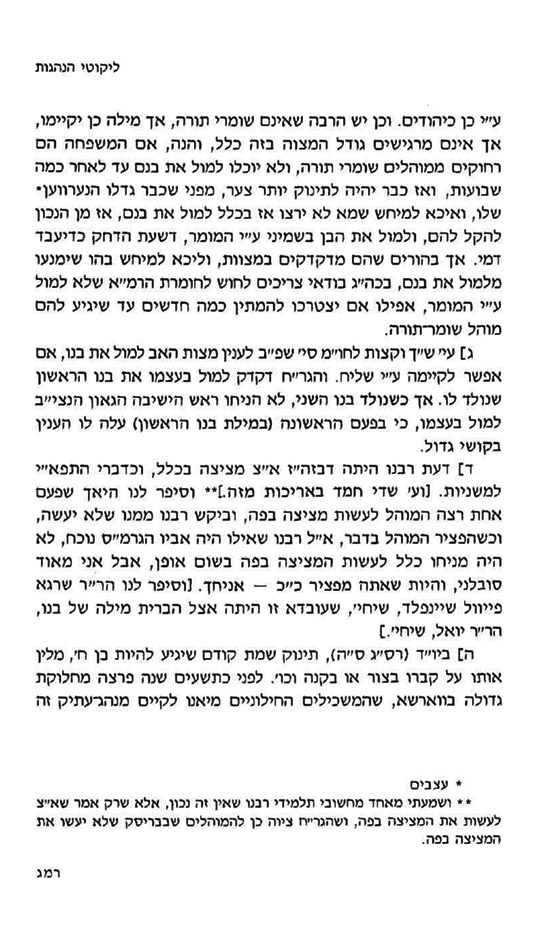
Here is part of the letter as printed in Kitvei R. Weinberg.
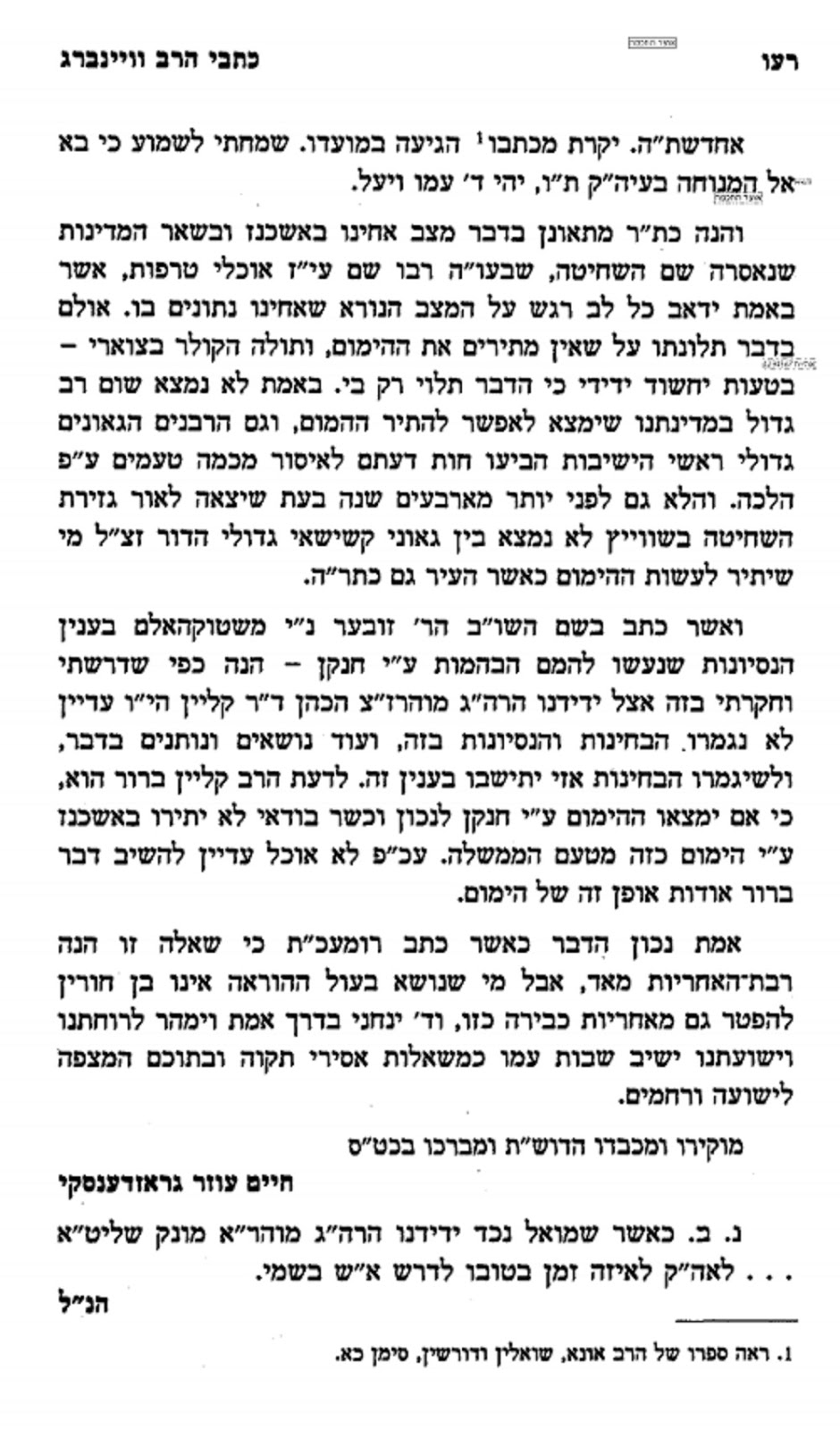
Take a look at the very end of the letter. I couldn’t make out a word, and neither could anyone else I asked, so I inserted three dots. (If anyone can make out the word, please let me know.)

Here is the second page of the letter in Iggerot R. Hayyim Ozer. Take a look at the end.

The first thing they did was good, in that they corrected a typo. מוהר”א should be מוהר”ע and refers to R. Ezra Munk (in Hebrew he went by Azriel). However, they also inserted the word נסע which anyone can see is not correct. They did this even though they did not have a copy of the manuscript. They just assumed it must be the missing word, but how can anyone make a guess like this without actually seeing the manuscript?

As for the letters from R. Weinberg to R. Unna, here is how they are shown on Kestenbaum’s website.
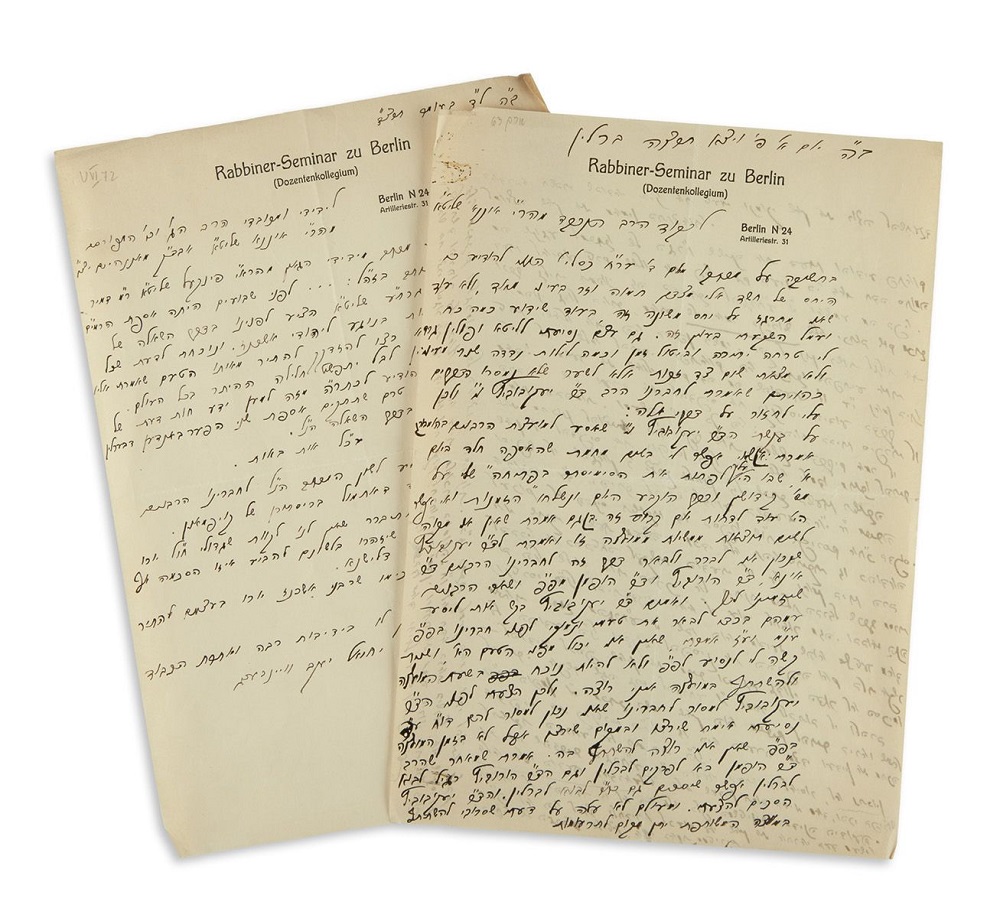
I published one of these letters in the appendix to my dissertation and refer to both of them in Between the Yeshiva World and Modern Orthodoxy, p. 125 n. 69.

So why did I almost fall off my chair when I saw the three letters (one from R. Grodzinski and two from R. Weinberg) in the Kestenbaum catalog? Because these letters were kept in an archive at Bar-Ilan University. Apparently, the archival material was regarded as belonging to both the Institute for Holocaust Research and the Institute for Diaspora Jewry, as both names were used to designate where it was held. That is why in different publications of mine, when I cite this material, I sometimes refer to it by one name and sometimes the other. It was in this archive that I found the letters, made copies, and then published two of the three (and I have copies of other documents from there as well). If you look at the images of the documents in the upper left-hand corner, you can see the Bar-Ilan manuscript number.

Here is the first page of Kitvei R. Weinberg, vol. 1.

For the appendix, no. 6, I identify the document as coming from the Institute for Diaspora Jewry 102:7/18. Now look at the upper left of R. Grodzinski’s letter. You can clearly see VII 18.

I was disturbed to see items that belonged to Bar-Ilan University being sold. I realized that there are two options. One is that Bar-Ilan itself had arranged for the sale, or had sold the letters to someone who was now reselling them. We have lots of examples of libraries that have sold material in them. However, in this case a sale would be very inappropriate. The Unna family gave the archive of R. Yitzhak Unna to Bar-Ilan with the purpose of preserving it for posterity and allowing researchers to have access to this material. If for some reason Bar-Ilan could not fulfill this task, the only appropriate thing would have been to give it to another archive. To have sold this material would be a complete abandonment of Bar-Ilan’s most basic responsibility as holder of an archive.

The other option is that the material was stolen, and unfortunately, we also have plenty of examples of stolen material ending up at auction.

The first thing I did was contact Bar-Ilan, as I thought that they would be interested in investigating this matter and perhaps stopping the auction until the issue could be sorted out. The response I got was somewhere between apathy and annoyance. They had absolutely no interest in what I was telling them, and even seemed annoyed that I was taking the time to tell them this. The fact that materials that they assumed responsibility for were being sold at auction, and thus not available for scholars to access anymore (as no copies had been made), was of absolutely no interest to them. I was shocked and speechless.

Eventually, I was able to figure out what I think happened. I was told by someone who was involved in one of the institutes that one of the people who worked with the archival materials had taken documents home to help with his research. When he died in 2000 the material was at his home, and it was thought that it was disposed of, no doubt by someone who did not realize what it was or that it belonged to Bar-Ilan. But now we know that it was not disposed of.

It is clear that Kestenbaum, which is known as a scrupulously honest auction house, had no way of knowing that the material it was given belonged to Bar-Ilan (assuming that what I wrote in the previous paragraph is what happened). Before it reached Kestenbaum, it could have gone through a few different hands without anyone realizing this either. Since even after I alerted Bar-Ilan no one there cared about this material, there really wasn’t anything that could be done. The problem, however, as in all such cases, is that material that was designed to be available for scholars to examine has now vanished. Although I haven’t been back to Bar-Ilan for many years, one of the things I was planning to do next time I was there was to return to these archival collections which have much important material and which I haven’t seen in over twenty years.[2] But now neither I nor anyone else will be able to do so.

What motivated me to write about this now is that in April 2020 another “old friend” of mine, a letter from R. Weinberg to R. Unna from the same Unna archive at Bar-Ilan, was offered for sale at a different auction house. You can view it here.

Here is the copy that I made (which also has some of my own handwriting). You can clearly see the Bar-Ilan manuscript number.

After this post was completed, I was alerted to another auction house in London which on May 18, 2020 (today!) is auctioning a letter from R. Weinberg to R. Ben Zion Uziel. You can see it here. After the auction concludes the page might be removed, but you can still see the catalog here, no. 176. This letter was stolen from the Israel State Archives, file number 000i7uz (old number: 887/12-פ). You can see the archive file here. A copy of this letter was made by Professor Amihai Radzyner in 2010, before the archive was digitized. In 2013 he sent a copy to me. Prior to this, I was sent a copy of the letter by someone who purchased it, yet neither of us then knew that it was stolen. Unlike Bar-Ilan University, I am sure that the Israel State Archives will want this letter returned to it after learning about its fate.

3. In my last post here I included a letter from Saul Lieberman to Max Rowe that many people found interesting.[3] I forgot to mention that it was Ariel Fuss who alerted me to the correspondence between Lieberman and Rowe. Although I carefully went through the Lieberman archive years ago in preparing Saul Lieberman and the Orthodox, I did not make copies of all the documents, and I thank Ariel for reminding me of this interesting material. Here are the letters in the archive from Rowe to Lieberman, from which we see not only who received the first Rothschild awards, but that R. Joseph B. Soloveitchik was also consulted in this matter.[4]

In the last post I also gave a couple of examples where it appears to me that the editors of books did not realize that the Jewish Theological Seminary is not an Orthodox institution. R. Moshe Maimon called my attention to the following example, from Mesorat Moshe, vol. 3, p. 213, no. 81, where we also see confusion about JTS.

The people who put the book together from R. Mordechai Tendler’s notes did not realize that when he asked R. Moshe if it is permitted to send a book to the “library of the Seminary,” that he and R. Moshe were referring to JTS. The editors mistakenly thought, as we can see from the heading, that this referred to “the” Christian seminary (as if there is one such place).

R. Yitzhak Nahman Eshkoli calls attention to what he sees as another mistake made by those who published R. Moshe Feinstein’s works.[5] Here is Iggerot Moshe, Orah Hayyim5, 22:21.

According to the text of R. Moshe’s responsum, animals are muktzeh, even those that children play with. This means that R. Moshe held that pets are also muktzeh. Yet in the small print the editor added that pets are permitted, even though this completely contradicts the first part of the sentence. See also Iggerot Moshe, Orah Hayyim 4, no. 16 (end), where R. Moshe forbids[6] moving a fish tank on Shabbat and Yom Tov: דבע”ח מוקצין.

Here is one more story about the Orthodox response to JTS. It was told by R. Joseph Buxbaum, the director of Machon Yerushalayim:[7] When R. Abraham Sofer came back to Jerusalem after teaching at the Seminary, the Brisker Rav, R. Isaac Zev Soloveitchik, stopped talking to him “in learning”. This upset Sofer and he complained to the Brisker Rav, what is the difference between him and Shraga Abramson. Abramson also taught at the Seminary and yet everyone knew that he was welcome to come speak in learning with the Brisker Rav.

The Brisker Rav replied with a story: The beit din in Vilna ruled that a woman should be divorced without receiving her ketubah because she did not cover her hair and thus had the status of עוברת על דת יהודית. The woman objected that just yesterday the beit din ruled that another woman who also did not cover her hair did not have the status of עוברת על דת יהודית, so what is going on? The dayanim explained to her that the woman from yesterday grew up in Vilna where it is common for married women not to cover their hair, so she is not regarded as עוברת על דת יהודית, but you come from Hungary where the practice is to shave the heads of married women. A Hungarian woman who goes without a head covering[8] is certainly an עוברת על דת יהודית. (The point is clear, but I wonder, in the twentieth century did any non-hasidic Hungarian women shave their heads?)

The Brisker Rav explained to Sofer that when a descendant of the Hatam Sofer teaches for the Conservatives, “he is a ‘sheigetz,’ but Shraga, where does he come from? From Lomza, nu . . . it is not so far away.”[9] His point was that Lithuanian Torah scholars, who are generally more open-minded than Hungarian scholars, have often not seen it as problematic to have relationships with non-Orthodox scholars.[10]

Along these lines, R. Eliezer Brodt called my attention to the fact that, together with numerous great rabbis, Louis Ginzberg was named one of the honorary presidents of the Telz alumni association, something that today appears unimaginable. The following appears in R. Aaron D. Burack, Pirhei Aharon (New York, 1954), vol. 2, p. 278.

In my post here I mentioned how R. Abraham Sofer’s edition of Meiri’s Hibbur ha-Teshuvah is dedicated to Ginzberg. Ovadya Hoffman called my attention to the fact that Sofer also dedicated another work to Ginzberg, this time in his memory. This work is Tractate Shekalim with two medieval commentaries (New York, 1954; the dedication is missing in the Copy Corner printing found on hebrewbooks.org).

Hoffman also informed me that there are three pages of Ginzberg’s notes at the end of the volume.[11] Hoffman also mentioned that there are notes from Lieberman at the end of the Meiri on Niddah.

Finally, regarding Lieberman and the Brisker Rav, it is of note that in Tosefta ki-Feshutah, Pesahim, p. 562, Lieberman writes:

וערבים עלי דברי מרן הגאון הרב ר’ זאב מבריסק

I don’t know of anyone else whom Lieberman refers to as “Maran”.

4. In my last post here I mentioned Samson Bloch’s witticism that מבקר stands for מתכבד בקלון חבירו. Let me now add the following, related to the word קלון, which for reasons of space I could not include in the previous post.

Bereshit Rabbah 18:24 states:

.ודבק באשתו: ר’ אבהו בשם ר’ יוחנן בני נח על הנשואות חייבין, על הארוסות פטורין, ר’ יונה בשם שמואל זונה שהיא עומדת בשוק ובאו עליה שנים הראשון פטור והשני חייב משום בעולת בעל

In this passage, the words I have underlined make perfect sense: “If a harlot was standing in the street.” The Jerusalem Talmud, Kiddushin 1:9, is a parallel passage, but there the text reads: זונה עומדת בחלון, “If a harlot was standing in the window.” What does it mean that the harlot was standing in the window? Korban Edah explains that she was standing in the window waiting for customers, as is the practice of harlots. While this makes sense in modern times, when we know that in some places (like Amsterdam) this is the practice of harlots, is there any evidence that in ancient times harlots would stand in the windows? Perhaps the contrary is true, as R. Shimon Amorai[12]  writes: שסתם זונות הולכות בחוץ. Yet while Korban Edah’s interpretation might seem anachronistic, what else could עומדת בחלון mean?

Jacob Reifman brilliantly suggests that instead of חלון the text should read: זונה עומדת בקלון, and he provides other examples of the use of the word קלון with reference to sexual immorality and prostitution.[13]

In general, Reifman’s writings, widely scattered throughout books and periodicals, should be gathered in one place. Readers will find in them many very insightful comments as well as many far-fetched interpretations.[14] Reifman often focuses on textual criticism but sometimes he offers other interpretations as well. For instance, he discusses Shabbat 55b-56b which gives a number of examples of “Whoever says that Reuben [David, Solomon, etc.] sinned is in error.” Reifman sees it as obvious that these are aggadic statements not meant to be taken literally.[15] He sees their purpose as twofold. The first is to train people to judge others favorably. Maimonides goes so far as to say that when dealing with a righteous person who it seems is doing something wrong, you should judge him favorably even if it is not easy to view matters in this fashion.[16]

The second purpose of the aggadic statements is so that the masses not be led astray by seeing how great people can also fall. The concern is that the masses will say that if these great people sinned, then we who are far below their level should not be too concerned about sinning. Reifman says that although the explanations given in the Talmud to explain the various sins are unconvincing, for the masses and the women it is possible that they would be effective. He refers to Rashi, Shabbat 30b, s.v. mutav, who speaks of aggadic expositions intended for these populations.

לאו מהכא יליף חלול שבת דפיקוח נפש נפקא לן מוחי בהם ולא שימות בהם אלא להטעימן הדבר באגדה המושכת את הלב לפי שהיו באים לשמוע הדרשה נשים ועמי הארץ והיו צריכין הדרשנין למשוך את לבבם

Reifman concludes similarly with regard to the passages he is focused on, which deny that certain great figures committed sins even though the biblical text states that they did:

והמאמרים הנ”ל, הם אפוא מן האגדות שהזמן גרמא והאגדות האלה אינם לא משפטים מקובלים ולא משפטים מושכלים כי אם תחבולות אשר קנו נבוני לב למשוך בהם את ההמון אחרי הטוב ולהרחיקו מן הרע.

It is noteworthy that R. Eliyahu Zini also concludes that the Talmud never intended to say that the biblical figures under discussion did not sin. That is why, R. Zini claims, the Talmud uses the language, “Whoever says [the biblical figure sinned]”, as the issue here is that we are not supposed to publicly mention these matters, and that that is what is problematic.[17]

שאכן יש בעיה, אלא שאסור להעלותה על דל שפתותינו ברבים או בפרהסיא. וכונתם ברורה: המפרסם את הדבר אינו אלא טועה, אף אם הדבר אמת

Before leaving Reifman, let me call attention to another comment of his that appears on the same page in Ha-Magid as the one I just dealt with. He deals with the following statement in Shabbat 119b which explains Psalms 105:15:

אל תגעו במשיחי אלו תנוקות של בית רבן ובנביאי אל תרעו אלו ת”ח

Touch not mine anointed refers to school children; and do my prophets no harm, to disciples of the Sages.”

We can understand why “my prophets” might refer to Torah scholars, but what does “mine anointed” have to with school children? There have been any number of homiletic explanations of this, yet Reifman suggests that the passage has been corrupted and it really should be reversed so that “my prophets” are identified with the school children and “mine anointed” with the Torah scholars. Here is what he says, and I think everyone must acknowledge that it makes great sense:

נ”ל ברור, כי צ”ל להפך: אל תגעו במשיחי אלו ת”ח ובנביאי אל תרעו אלו תנוקות של בית רבן, וכי כנוי משיחי לת”ח הוא ע”ש: דרדוגי דמשחא ארישא דרבנן (כתובות י”ז ב’) וכנוי נביאי לתנוקות של בית רבן הוא ע”ש: א”ר יוחנן מיום שחרב בית המקדש ניטלה נבואה מן הנביאים וניתנה לתינוקות (ב”ב י”ב ב’), וע”ש: ר’ יוחנן בדיק בינוקא (חולין צ”ה ב’) וראה והביטה, כי ר’ יוחנן אשר בדק בינוקא הלך לשיטתו שהנבואה נתנה לתנוקות אחרי חורבן ביה”מ. ועל בדק בינוקא פי’ רש”י: דשייל ליה פסוק לי פסוקיך עכ”ל, והוא מתאים היטב עם אשר אמר ר’ יוחנן: השכים ונפל לו פסוק לתוך פיו הרי זו נבואה קטנה (ברכות נ”ה ב’) , והבן.

I realize that we can’t change the text of the Talmud, but will you ever read the passage again without thinking about Reifman’s suggested emendation? As far as I know, the only commentator to take note of Reifman’s suggestion is R. Reuven Margaliyot, Nitzotzei Or, Shabbat 119b [18] He doesn’t even remember where he saw the suggested emendation, as he writes:

בזכרוני שצ”ל להיפך אל תגעו במשיחי אלו ת”ח כמש”א בכתובות י”ז ב דרדוגי דמשחא ארישא דרבנן, ובנביאי אל תרעו אלו תנוקות של בית רבן דמיום שנחרב ביהמ”ק ניתנה הנבואה לקטנים (בבא בתרא י”ב א)

Much more can be written about Reifman, both with regard to his own writings and also his relationship with the rabbinic world, but this will have to await a future post.[19] Here is his picture.

5. In my last post I wrote:

When it comes to the word דִבׇּה, which means “slander” in biblical Hebrew, it has a very different meaning in medieval texts. “As Jacob Klatzkin [in his Thesaurus] notes, dibbah in medieval Hebrew does not mean ‘slander,’ but rather a false claim, nonsense, or absurdity.” Y. Tzvi Langermann, “Rabbi Yosef Qafih’s Modern Medieval Translation of the Guide,” in Josef Stern, et al., eds., Maimonides’ Guide of the Perplexed in Translation (Chicago, 2019), p. 268.

Although this might seem like a tidbit of pedantry, it actually is much more than this, and many people have been misled because they did not realize what the word דִבׇּה means in medieval texts. For example, the following appears in Maimonides’ Introduction to Helek, in the medieval translation by Solomon ben Joseph found in the back of the Talmud:

ואף על פי שהנראה מקצת דבריהם יש מהם מן הדבה והריחוק מן השכל, עד שאילו סופר על פשוטו לעמי הארץ כל שכן לחכמים היו תמהים בהתבוננם בהם והם אומרים היאך יתכן שיהיה בעולם אדם שיחשוב כזה או שיאמין שהיא אמונה נכונה קל וחומר שייטב בעיניו.

In this passage, Maimonides is describing the first category of those who take aggadot literally. Here is how Fred Rosner translates these words (his translation is from the Hebrew, not from the original Arabic):[20]

And this, in spite of the fact that in their literal sense, some of the words of the Sages would seem to be so slanderous and absurd that if they were related to the uneducated masses in their literal sense—and all the more so to the wise—they would reflect upon them in amazement and exclaim “How is it possible that there exists in the world anyone who would think in this manner or believe that such statements are correct, much less approve of them.”

Clearly, the word “slanderous” makes no sense in this sentence, and that is because when the medieval translation uses the word דִבׇּה it means something else entirely. In his note to the passage, Rosner writes: “Kafah omits the word ‘slanderous.’” This is an incorrect formulation. R. Kafih was translating the commentary anew, so he was not tied to the medieval Hebrew translation. He translates:

ואף על פי שיש בפשטי מקצת דבריהם מן הזרות

Furthermore, R. Kafih actually refers to the medieval translation on p. 136 n. 35 of his edition. In his typical sharp fashion, R. Kafih writes:

בנדפס “מן הדבה” ודבה היא

In his play on words, R. Kafih is saying that the medieval translator engaged in slander by falsely translating the passage as “slanderous.” The only thing that is surprising here is that R. Kafih seems to have also been misled and did not realize that when the translator uses the word דִבׇּה it means “false claim,” “nonsense”, “absurdity,” or a similar word.[21]

In seeking to make sense of the word דִבׇּה and assuming it means slander, the Rambam le-Am, p. 118 n. 12, explains:

הוצאת דיבה על חז”ל, ביחסם להם דברים תפלים שאין להם שחר

These are nice words, but they have nothing to do with what Maimonides said, or for that matter, with what appears in the medieval translation.[22]

The same word דִבׇּה also appears in Maimonides’ Introduction to Helek in his discussion of the second group of people who distort the meaning of Aggadot. In the medieval translation:

והם באים לסכל אותם ולגנותם ומוציאים דבה על מה שאין בו דבה וילעיגו על דברי חכמים לרגעים

Rosner translates: “They eventually call these (rabbinical assertions) foolish, and deprecate them and slander that which should not be slandered. From time to time, they deride the words of the Sages.” Once again, “slander” has nothing to do with what Maimonides wrote. R. Kafih translates:[23]

וחשבו למוזר מה שאינו מוזר

In his note (p. 136 n. 43), he writes:

בנדפס “ומוציאים דבה על מה שאין בו דבה” ואינו נכון

However, the medieval translation makes perfect sense once we understand that when it uses דִבׇּה it does not mean “slander”. Thinking that this is what the word means, it makes sense that R. Kafih would say that it is incorrect.

Yitzhak Shilat translates:[24]

ולגנות מה שאין בו גנאי

In his translation of Guide 1:51, Samuel Ibn Tibbon uses דִבׇּה in the same way:

ולאמתם בצעקות ובהוצאת דבות והרחקות ובפנים רבים מורכבים ממחלוקת נצוח והטעאה

Strangely enough, and presumably because the printers did not know the meaning of דבות in the sentence, most printings (including the standard one with the commentaries)[25] replace ובהוצאת דבות with ובהוצאות רבות, which itself has no meaning.[26]

* * * * * * * * *

[1] For many people in the New York area in the 1980s and 1990s, these words—replacing Jews with “American citizens”— will bring back memories of driving home from work. For those who want to hear this opening line again, listen here. I actually know of one gadol who used to listen to the Bob Grant show at home.
[2] The letter from R. Hayyim Lauer that I published in Milin Havivin 2 (2006), pp. 25-33, also came from the archive we are discussing. You can see it here. R. Lauer discusses whether in contemporary times, in a she’at ha-dehak, a pilegesh can be permitted.

Regarding a pilegesh, R. Jacob Emden, in his recently published Em la-Binah, p. 82, explains in an original fashion that the root of the word is פלג אשה. (As noted in the text, he already mentioned this explanation in Lehem ShamayimParah 1:3; regarding the vocalization of Em la-Binah, see Berakhot 57a).

Em la-Binah, which is a commentary on the entire Torah, is a very significant publication and required reading for anyone with an interest in R. Emden. It is noteworthy that the editor, R. Elimelech Zwiebel, leaves out some harsh comments from R. Emden about earlier commentators (including Ibn Ezra, see p. 98). However, when he does so he indicates this in the text, so when the manuscript from the British Library is eventually put online, readers will be able to find out what was left out. We must all be grateful to Zwiebel that he took this important step, rather than just omitting the “problematic” comments.

On pp. 60-63, Zwiebel cites R. Emden’s famous passage about circumcision that is only found in a few surviving copies of the first printing of Migdal Oz (Altona, 1748). I discuss this passage in Changing the Immutable, p. 204, where, following Scholem and others who have dealt with the matter, I state that R. Emden himself removed this passage. Zwiebel, on the other hand, argues that R. Emden initially did not include the passage in the first printing, but before the printing was complete he added it to some copies. See Yeshurun 32 (2015), pp. 851-852.

In my opinion this is incorrect and makes no sense at all. In what I assume is the self-censored Altona 1748 “edition”, the missing passage is preceded by these words:

ובאמת דבריו הללו מתאימים כו’

The word ‘כו appears on the second line and there is a big space after it, and also a little space before it. Here is what the page looks like as found in Zwiebel’s article.
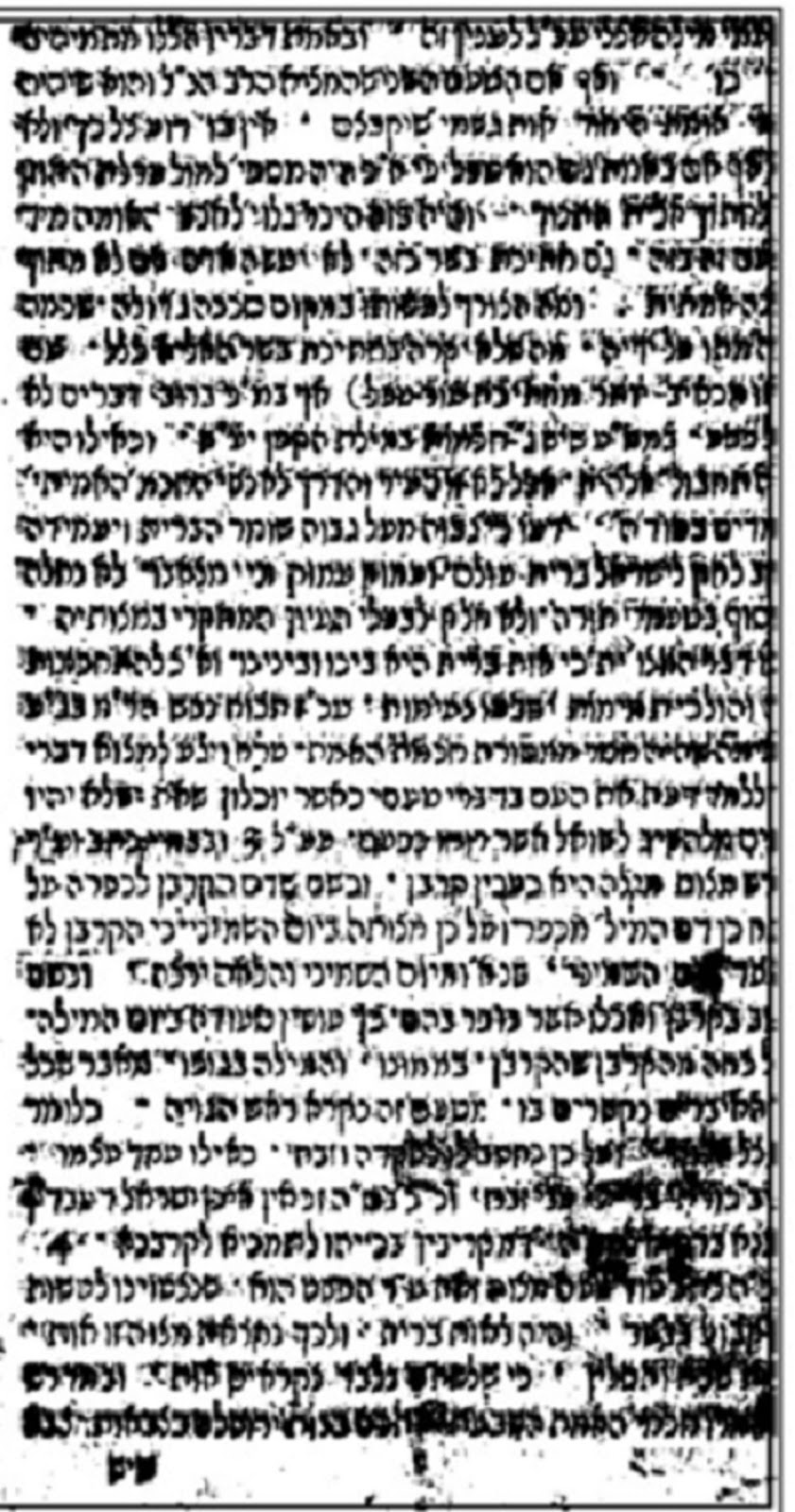
Zwiebel writes that:

מילת כו’ מוכיחה כי כוונתו היתה להרחיב עוד בענין זה

This makes no sense. First of all, no one prints a book intending at the outset to redo the pages (with all the work this entails), and adds ‘כו to let the reader know that a new section is coming. Second, even if this was the case, there would be no need for the spaces before and after ‘כו. Here is what p. 2b in the “uncensored” version looks like.

Look at lines 1 and 2 and compare to the “censored” version shown above. It is obvious that the “uncensored” version is the original text, and the material from line 2 and on was removed by R. Emden.

One final passage which caught my attention is on p. 110 where R. Emden says that despite Proverbs 31:30: “Grace is deceitful and beauty is vain,” women’s beauty is nevertheless important and is something Scripture mentions, and “Jacob our forefather went after his eyes.”

לא לחנם כתב תורה את זאת והדומה לזה שמשתבח הכתוב ביופי נשים, ושיעקב אבינו עליו השלום הלך אחר עינים

What this means is that Jacob saw that Rachel was beautiful, and this is why the Torah writes in Gen. 29:17: “Rachel was of beautiful form and fair to look upon.”

What then are we to make of the verse in Proverbs? R. Emden says that “beauty is vain” only when it comes without fear of Heaven, and that is why this appears in the second half of the verse from Proverbs. Yet when it is combined with fear of Heaven, then beauty is a positive thing. He continues by explaining how one’s outer appearance is connected to one’s inner spirituality. In other words, Rachel’s outer physical beauty was, in Jacob’s eyes, also a sign of her inner spiritual beauty.

אין היופי הבל אלא כשהוא בלי יראת שמים, אבל בודאי שיופי הגשמית הוא צורת אדם [הפנימי] . . . ולכן ודאי הכיר כי הגשמות ציור הרוחנית היא, ואם נמצא אשה בפגם וסרת טעם, דע שלא נזהרו בה כראוי ונתקלקלה בחברה רעה

[3] The website Matzav not only posted the letter together with two paragraphs from my post, but made it seem as if I wrote the piece for Matzav, as there is no mention that it originally appeared on the Seforim Blog. See here. Even after Matzav was told that this is inappropriate and that they should take down the post, nothing was done. I am sure that Matzav’s interest in the letter was because of how Lieberman praised R. Chaim Kanievsky.
[4] Documents provided courtesy of the Saul Lieberman Archives (ARC 76/8) of the Jewish Theological Seminary Library.

In Saul Lieberman and the Orthodox, I published Lieberman’s letter against ordaining women. The last sentence of this letter  reads:

אבל אשה שפסולה לדון, ולא תהא ראויה לכך, אין להסמיך אותה בתואר זה (ואפילו כמליצה בעלמא, עיין בתוספות ע”ז ה ע”א ד”ה אלא) ובל נעשה את עצמנו חוכא ואיטלולא.

While preparing the book, I did not know what the meaning of the reference to Tosafot is. R. Chaim Rapoport explained it to me.

The Tosafot in Avodah Zarah suggest that the figurative expression “ha-eynei ha-anashim ha-heim tenaker” (Numbers 16:14) – clearly a melitzah – would not have been written in relation to people who were physically blind. Lieberman’s claim is that since a woman is not able to be a rabbi in the true, talmudic, sense of the word, therefore the title should not even be applied to her “be-derech melitzah”, hence the reference to the Tosafot.

It is interesting that in R. Herschel Schachter’s article against women rabbis, Hakirah 11 (Spring 2011), pp. 19-23, one of his major sources is “Rabbi Shaul Lieberman”.
[5] Tza’ar Ba’alei Hayyim be-Halakhah ve-Aggadah, p. 514 n. 1171.
[6] R. Menasheh Klein discusses other issues related to an aquarium. See Mishneh Halakhot, vol. 6, no. 216 (called to my attention by R. Aviad Stollman).
[7] It is recorded in R. Eliyahu Soloveitchik’s unpublished memoir, p. 16 (unnumbered).
[8] The same approach, in which the lack of head covering among Lithuanian Jewish women—as opposed to Hungarian women— was not viewed as reflecting negatively on their general religiosity, is seen in the following story recorded by Moshe Potolosky of what the Hazon Ish told his father (Mevakshei Torah 49 [Tamuz 5769]), p. 71, called to my attention by Joel Wolowelsky).

.אמר רבנו לאבי: כשאתה תארח בבית שבו אין האשה נוהגת לכסות את ראשה, אם היא מליטא – יתכן שאף המהדרים והמחמירים ביותר יכולים לסעוד אצלה בלב שקט. אבל אם היא מהונגריה – אסור לטעום מתבשיליה

ומדוע? כי בליטא לא הקפידו רוב הנשים על כסוי ראש (א”ה, בתקופה ההיא בליטא היה פרוץ הדבר) ואף נשים צדקניות רבות מאד הקלו בזה. אבל בהוגנריה, היתה בקהלות האורתודוקסיות הקפדה רבה בענין זה, ובדרך כלל,רק אשה שזלזלה במצוות היתה נמנעת .מלכסות את ראשה, ועל אחת כזו אי אפשר לסמוך בעניני כשרות

Moshe Botchko writes simply (Mikhtavim u-Ma’amarim ha-Rav Botchko, p. 252):

.בליטא לא נהגו נשים דתיות לכסות ראשן אף מחוץ לביתן, חוץ מנשות הרבנים

The following appears in the anonymous Ha-Keter ve-ha-Kavod le-Hai Olamim (Jerusalem, 2017), p. 102:

.והנה האמת היא שאין שום מקום להרגיש, את ההרגשה המוטעת אשר ינסה היצר לטעת בלב חלק מההורים, כאילו הדור הצעיר שחפץ לתקן את הדבר, ולקיים את המצוה הזו כתיקונה, הרי זה – חס ושלום – מחמת מעלתו ויתרונו על הדור הקודם

מחשבה זו אינה נכונה כלל, מפני שהאמת היא שהדור הקודם אינו אשם בזה כלל וכלל, כי התחלת הדבר היה מחמת הקושי הגדול שהיה בחוץ לארץ, בין הגוים, ובהתגברות מחריבי הדת, שעקרו לגמרי את קיום מצות כיסוי הראש, עד שאפילו מבתים של יראים ושלמים בליטא, היו נשותיהם מהלכות בגילוי ראש ממש, וכמו שמפורש בערוך השלחן סימן ע”ה סעיף ז.

Binyamin Zev Jacobson,Divrei Ben Shlomo(Jerusalem, 1957), vol. 1, p. 306, tells the following story:

לפני יותר מחמש ועשרים שנה הייתי בעיר גדולי בלטויה ובקרתי שם את הרב ואשתו כבדה אותי בכוס יין, ואז הייתי מדקדק ולא רציתי לשתות מפני שערה המגולה, והרב גער בי מאוד ואמר לי שרבות מנשי רבני ליטא הולכות כן

(He also records R. Hayyim Ozer Grodzinski’s sharp response when told of what this rabbi said.)

Regarding Hungary, the Orthodox community in Budapest was very strict about the matter of women’s head covering. If a married woman did not cover her hair, her family would not be accepted as a member of this community. See Shmuel Weingarten, “Ha-Shelilah she-be-Shitat ha-Pirud be-Ungaryah,” Areshet (1944), p. 438.
[9] Abramson studied in Lomza but he was actually from Ciechanowiec (near Grodno), the birthplace of R. Jehiel Jacob Weinberg.
[10] See my Saul Lieberman and the Orthodox; Moshe Maimon, “Perek be-Hithavut ha-‘Olam ha-Torah’ be-Artzot ha-Berit le-Ahar ha-Milhamah,” Hakirah 26 (2019), pp. 31-52; and the discussion at the Otzar haHochma forum here. R. Yaakov Hayyim Sofer, Menuhat Shalom, vol. 6, p. 124, in mentioning R. Joseph Zechariah Stern’s citation of “problematic” works, refers to שיטת קצת חכמי ליטא בענין.

It continues to amaze me that, as noted in Saul Lieberman and the Orthodox, p. 31 n. 110, even in a 1935 private letter to R. Shlomo Heiman, R. Hayyim Ozer Grodzinski referred to Louis Ginzberg as ‘הרה”ג מו”ה לוי ד”ר גינזבורג שי. See Iggerot R. Hayyim Ozer, vol. 2, no. 1004. In Saul Lieberman and the Orthodox I included a letter from R. Grodzinski to Ginzberg where understandably he gives Ginzberg the typical fancy titles. This letter was later included in Iggerot R. Hayyim Ozer, vol. 3, no. 276, with no acknowledgment of where the letter first appeared. At the end of the letter there is a name that neither I nor anyone else could make out. I transcribed it as מאיר באראן and then added a question mark. In Iggerot R. Hayyim Ozer they removed the question mark. Uriel Bener called my attention to Shenot Dor va-Dor (Jerusalem, 1999), p. 271, from where we see that the name is מאיר באסין, who happened to be the father-in-law of R. Yisrael Gustman.
[11] Regarding Ginzberg, see also R. Zev Leiter, Mi-Toratan shel Rishonim (Jerusalem, 2000), p. 61, who refers to him as מהר”ל גינצבורג. R. Gedaliah Felder, Yesodei Yeshurun, vol. 3, p. 146 refers to ר”ל גינזבורג. Here is the title page of the 1946 edition of Ma’alot ha-Torah by R. Abraham ben Solomon Zalman, the brother of the Vilna Gaon. R. Nissan Waxman and R. Yehiel Michel Feinstein were willing to collaborate with Ginzberg and to even put his name on the title page.

[12] Ha-Posek, 9 (Tamuz-Av 5708), p. 1529. He offers his own far-fetched interpretation.
[13] Beit Talmud 4 (Vienna, 1883), p. 16, also printed in his Ruah Hadashah (Pressburg, 1885), pp. 2-3. Reifman’s interpretation is cited by R. Azriel Hildesheimer, Hiddushei Rabbi Azriel (Jerusalem, 1992), Kiddushin 9b (p. 316). Without mentioning Reifman, the same emendation is suggested by A. Rosenberg, Al Devar Tikunei Nushaot bi-Yerushalmi (Lodz, 1928), p. 71. In a future post I will discuss who this “A. Rosenberg” was.
[14] R. Meir Mazuz discusses one of Reifman’s comments in my Iggerot Malkhei Rabbanan, p. 314. Those who wish to purchase this volume can do so here. Those in Israel who are interested in the book should contact me directly.
[15] Ha-Magid, May 14, 1873, p. 175. See my Changing the Immutable, p. 5, for many examples of sages who understood David’s sin with Bathsheba literally.

[16] It is fascinating to note that the kabbalist R. Judah Fatiyah was not happy with the talmudic explanation, also found in the Zohar, that Uriah had given a get to Bathsheba. He regarded this as a forced explanation. In his Matok la-Nefesh, pp. 56a-b, he offers an explanation which came to him from someone in a dream, according to which King David voided the marriage of Uriah and Bathsheba. He did this by himself, as he was too embarrassed to involve the Sanhedrin. As the most distinguished member of the Sanhedrin, he had this authority to void a marriage. R. Fatiyah was told in his dream that this explanation had never before been told to anyone else, because the spirit telling him this he was too embarrassed to have shared this information before then.

לבי ולבך ידעי שכל התירוצים הם דוחק ומוכרחין אנן לעייל פילא בקופא דמחטא מפני כבודו של משיח ה’ שהיה יקר בעיני ה’ . . . יש תירוץ רביעי הנגלה אלי בחלום . . . כי ראיתי כאלו אדם שאינו נראה כלל אומר אלי הנה אנן קיימא לן בדיני הקדושין שכל המקדש אדעתא דרבנן איהו מקדש ויכולין רבנן הנמצאים בדור ההוא לעקור ולבטל הקידושין של איזה אדם ותהיה אשתו פנויה למפרע . . . וכשאירע מעשה דבת שבע ראה דוד את עצמו שאינו יכול לכוף את יצרו עמד בינו לבין עצמו בלא צירוף הסנהדרין עמו ובטל את קדושי אוריה ובחר הרע במיעוטו שלא לפגוע באיסור ערוה ח”ו כי היה בוש לבטל את קדושי אוריה בצרוף הסנהדרין עמו שלא לצורך, ויש כח בדוד שהוא לבדו יכול לבטל הקדושין כי הוא היה מופלא שבסנהדרין . . . כל זה נאמר אלי בחלום בקיצור נמרץ כי המדבר אלי היה בוש ונכלם להרחיב הדברים, גם אמר אלי כי מיום שאירע ביטול זה עד היום הזה לא נתגלה עוד ענין זה לשום אדם מעולם לא בהקיץ ולא בחלום כי היה בוש להגיד ענין זה הביטול, ובפי’ הד’ הזה יותרו כל השאלות מעל עבד ה’ ועל משיחו נעים זמירות ישראל.

After citing R. Fatiyah’s statement, R. Ovadiah Yosef writes (Meor YisraelShabbat 56a):

ובמחכ”ת דברי חלומות לא מעלין ולא מורידין ואין ממש בדבריו . . . ואין לנו אלא דברי רבותינו שהם דברי אלקים חיים

Ovadiah was clearly upset that R. Fatiyah, whose expertise was in Kabbalah, chose to weigh in on a halakhic matter and offer the incorrect view that a great Torah scholar can simply invalidate a Jewish marriage without aget. For another response to R. Fatiyah, see R. Nissim Kaduri,Ma’aseh Nissim, p. 12. These sources are cited by R. Meir Mazuz, Bayit Ne’eman 56 (5 Nisan 5777), p. 4 n. 23.

For more dreams of R. Fatiyah, this time with reference to the book Hemdat Yamim, see Avraham Yaari, Ta’alumat Sefer(Jerusalem, 1954), ch. 8.
[17] Etz Erez, vols. 1-2, pp. 287-288 (emphasis in original). Since I have discussed Saul Lieberman in this post, it is worth noting that R. Zini does not regard him positively. This is what he writes in Etz Erez, vol. 4, p. 224.

.וכרגיל בעל תוספתא כפשוטה נהג כאן כחוקרים רבים אחרים, שברמות רוחם מדברים כאלו הם מתנבאים מפי השכינה, וקובעים עמדות ללא כל הוכחה, אפילו לא נתן את דעתו לסתירה הפנימית שבדבריו

Etz Erez, vol. 3, p. 25 n. 10 (emphasis in original):

ובעל תוספתא כפשוטה בלהיטותו לפרש כל דבר עפ”י המידע המדעי, היסטורי או אחר, כמעט כילד קטן שלא החזיק צעצוע מעולם ונותנים לו אחד, לא הבין כלום, לכן כתב (ברכות פ”ד שם) “הלכה זו מתארת את מנהגי הסעודה בזמן העתיק אצל נכבדי העם ונכללו כאן כמה פרטים שאין להוציא מהם מסקנות להלכה, מפני שמקורם נעוץ בנימוסי המקום ולא בהלכה. ובדרך כלל הסדר מתאים למנהגי הרומאים בסעודה וגם של היונים בתקופה המאוחרת, ואין כאן הלכה בסעודה.” הרי הוכחני שיש כאן הלכות ממש, אבל ודאי לא מה שחשב.

Etz Erez, vol. 3, p. 35:

.אינני מסתמך אף פעם על חבור של מי שמיסד את היהדות הקונסרבטיבית בא”י, וכוונתי למחבר התוספתא כפושטא עצמו, אף אם הוא היה בן דוד של ה’חזון איש’

Etz Erez, vol. 1, p. 124 n. 191:

וזה דומה לחוקרי מדעי היהדות הכותבים ‘מהרי”ן אפשטיין’, ‘מהר”ש ליברמן’ וכדו’, תוך נסיון נואש להעביר את הסמכות התורנית לחוקרי האקדמיה, כאילו הם עמדו בראש ישיבות. מדובר במגמה פסולה לחלוטין בעיני איש ירא ה’. חוקר תלמוד, אף אם למדן גדול הוא, איננו איש תורה על תקנו זה, אלא סתם ידען, ולהעניק לו תואר המיועד למשמשים בקודש, היא חילול הקודש וגניבה במחתרת, ורק עם הארץ יעשה זאת.

Hesed Leumim Hatat, pp. 19-20 n. 29:

בתוספתא כפשוטה (עמ’ 756) כתב כל מיני דברי הבל (כמו שהתחיל לעשות מאז מכר נשמתו לקונסרבטיבים) . . . רק מי שאיבד כל תחושת של כבוד האומה הישראלית, עם ה’, מי שאיבד את דרכו האמונית, יכול לומר שלא ברור מהיכן איסור זה. ליברמן בעל הזכרון המופלג, בעל הבקיאות הרחבה מאד, שכל כך שקע במקורות של תושבע”פ אינו זוכר עוד תוכן של פסוקים אלמנטריים ביותר, שכל ילד ידע בע”פ בגלות, ואינו מסוגל להבחין שאין צורך במקור, כיון שתורה מפורשת היא!! . . . ועל חטא זה הוא מוסיף פשע פרשנות עפ”י שיטה ‘דרוויניסטית’ היסטורית מטופשת, פרי עבדות לדעות הנכרים.

Unfortunately, none of R. Zini’s books are on Otzar HaHochma.

[18] Regarding R. Margaliyot, whose writings are of great interest to many, I have recently discovered a few articles of his that are completely unknown and have not been reprinted in the various collections of his writings. I will discuss them in a future post.
[19] See the letters to him from R. Elijah David Rabinowitz-Teomim published in Mikabtze’el 36 (2009), pp. 47ff., ibid. 37 (2011), pp. 75ff. See ibid., p. 76, that when R. Joseph Zechariah Stern published his responsa which were sent to Reifman, he abbreviated his name.
[20] Maimonides’ Commentary on the Mishnah: Tractate Sanhedrin (New York, 1981), p. 141.
[21] If I am correct, this was only an early mistake and R. Kafih must have later realized this. I say this because Al-Harizi used the term in his translation of the Guide a number of times. See Langermann, “Rabbi Yosef Qafih’s Modern Medieval Translation of the Guide,” pp. 168ff.
[22] The same mistake is made by R. Shlomo Aviner in his edition of Hakdamat ha-Rambam le-Perek Helek (n.p., 2013), p. 82.
[23] Just to show you how times change, Rosner translates R. Kafih’s words: וחשבו למוזר מה שאינו מוזר, “and consider queer that which is not queer.” If Rosner were translating this today, instead of “queer” he would use “strange,” as queer has come to mean something entirely different.
[24] Hakdamot ha-Rambam la-Mishnah (Jerusalem, 1992), p. 134.
[25] See Yehudah Ibn Shmuel’s textual note in his edition of Moreh ha-Nevukhim, vol. 2, pp. 27-28 (third pagination).
[26] See also David Kaufmann, Geschichte der Attributenlehre in der Jüdischen Religionsphilosophie des Mittelalters (Gotha, 1877), p. 273 n. 64, for what seems to be an example of replacing דבה with רבה.


Hakirah, Metzitzah, and More


Hakirah, Metzitzah
, and More
Marc B. Shapiro

Hakirah has performed a valuable service in dealing forthrightly with the matter of homosexuality. Issue no. 13 (2012) contains R. Chaim Rapoport’s “Judaism and Homosexuality: An Alternative Rabbinic View,” which I think is an outstanding presentation of the alternative to what has seemingly become the “official” haredi position in this matter. This “official” position is, in my opinion, so misguided that I would like to say a few words on the topic, since R. Rapoport did not go far enough in his criticism.
To remind readers, Hakirah no. 12 had a discussion on homosexuality with R. Shmuel Kamenetsky. This was followed by the publication of a document signed by many rabbis which follows R. Kamenetsky’s approach. It is available here. (The document is also signed by an assortment of mental health professionals,  rebbitzens and “community organizers”.)
There are so many problems with the approach found in this document (called a “Torah Declaration”), some already noted by R. Rapoport in his response to R. Kamenetsky, that it would take a lengthy piece to go through them all. Let me just call attention to a few points that I don’t think have been made yet. To begin with, while many rabbis have signed this document, including a number that I know personally, I have yet to speak to someone who actually believes what the document says, and this includes the people who have signed it! Many will regard what I have just said as pretty shocking, in that I have declared that people who signed the document do not believe what it says. Yet I know this to be true, at least with regard to some of the signatories (those that I know personally), and I suspect that other than R. Kamenetsky, it might be that no one who signed the document really believes what it says (and it wouldn’t be the first time that people sign declarations that they really don’t believe in).
Let me explain what I mean. According to the document,
Same-Sex Attractions Can Be Modified And Healed. From a Torah perspective, the question whether homosexual inclinations and behaviors are changeable is extremely relevant. . . . We emphatically reject the notion that a homosexually inclined person cannot overcome his or her inclination and desire. . . . The only viable course of action that is consistent with the Torah is therapy and teshuvah. The therapy consists of reinforcing the natural gender-identity of the individual by helping him or her understand and repair the emotional wounds that led to its disorientation and weakening, thus enabling the resumption and completion of the individual’s emotional development.
The ideas just quoted are the very foundation of the Torah Declaration, and as we see in his Hakirah interview, R. Kamenetsky has been convinced by the dubious proposition that homosexuals can change their sexual orientation. He goes so far as to say that “no one is born gay with an inability to change” (p. 34 [emphasis added]. Not long after the appearance of the interview and the Torah Declaration, the man most prominently identified with the notion that gays can change publicly rejected his earlier viewpoint.)
Whether people can change their sexual orientation is a scientific or psychological issue, no more and no less. The first objectionable point of R. Kamenetsky’s approach is turning this into a matter of theology. Indeed, R. Kamenetsky has created a new dogma in Orthodoxy. According to him, believing that a homosexual can change his orientation is a basic Torah value. The reason for this is stated in the document: “The Torah does not forbid something which is impossible to avoid. Abandoning people to lifelong loneliness and despair by denying all hope of overcoming and healing their same-sex attraction is heartlessly cruel. Such an attitude also violates the biblical prohibition in Vayikra (Leviticus) 19:14 “and you shall not place a stumbling block before the blind.”[1]
There you have it. Human beings are deciding what God can and cannot do and declaring that it is impossible for someone to be created with an inalterable homosexual nature. That this is completely incorrect is acknowledged by none other than the most extreme advocates of reparative therapy. They themselves acknowledge that there is a significant percentage of people who cannot change their orientation. They have never claimed that everyone can change. What the document gives us, therefore, is a theological statement that is rejected by all scientists and psychologists, including the ones who provide the very basis for reparative therapy. That itself should be reason enough to reject it. (On Nov. 29, 2012 the RCA acknowledged “the lack of scientifically rigorous studies that support the effectiveness of therapies to change sexual orientation.” See here.)
This relates to my point above that no one really believes what they signed. To those who doubt what I say, do the following experiment and report back if your results differ. Ask someone who signed the document if he really believes that every homosexual can change his sexual orientation. The answer you will get will be “Of course not everyone. You can never speak about everyone. But many (or most) can change.” In other words, the signatories will acknowledge that they diverge from the document on a basic point. You will have to ask them why they signed a document if they don’t accept everything it says, and the response will probably be that there is much about the document that they do accept, and that is why they signed it. But I repeat my point that this is an unusual document in that I don’t think that there is any signatory, with the possible exception of R. Kamenetsky, who accepts the Torah Declaration on Homosexuality in its entirety.

Furthermore, it is not a “liberal” idea to say that people can’t change their sexual inclinations. By looking at another example we can see that it is indeed nonsense to say that everyone can change their sexual orientation and recreate themselves as typical heterosexuals. There are some men who have strong urges for pedophilia. No matter what they do, and how much therapy they get, they can’t get rid of these urges. (I am obviously not comparing homosexuals with pedophiles, or implying that there is any connection between the two. I am only using the example of pedophiles to make a point.[2]
) If we adopt the theology of the Torah Declaration, it means that even hardened pedophiles, who have abused lots of children, can change, because God wouldn’t create someone without a possibility for a healthy sex life. Yet we know that this isn’t the case, and some people simply can’t change. They might be able to control their urges, but as they have told us again and again, the urges don’t go away. It is hardwired into them. (Is it perhaps the false theological notion expressed in the Torah Declaration that explains why yeshivot continued to allow known pedophiles to work? That is, did the rabbis assume that just because someone sexually abused children last week, there is no reason to think he can’t repent and cease to be a danger this week?)
And what about the people who are created with uncontrollable urges to kill? We know about these people, as they usually become murderers. And what about the people who are created with diseases that kill them before they are able to marry and have children, or the ones created without arms so they can’t wear arm tefillin[3]? In other words, sometimes people are created a certain way and they are not what we regard as normal. That is the world, and we simply can’t understand why things are the way they are. But one thing I would hope that we can agree on is if people can keep their faith in a good God even while knowing that some children are born with terrible illnesses that will cause their death, it certainly should not shake their faith to believe that some people are born with inalterable homosexual urges. A homosexual who can’t be changed hardly presents a challenge to theodicy the way a child with cancer does, so I can only wonder why the Torah Declaration feels that only the former is theologically untenable.
All traditional sources cited in support of the Torah Declaration’s assumption that people can change their orientation only refer to behavior. That is, it is an accepted belief that all people have the ability to control their behavior. Without this belief, the notion of a mitzvah doesn’t make sense. This distinction between orientation and behavior is so obvious that I don’t know how so many learned rabbis overlooked the document’s collapsing the two categories.
The more problematic element of the document, which I have already mentioned and which verges on the blasphemous, is that the Torah Declaration presumes to tell God what he can and cannot do. Based on the human intellects of the authors of the document, they establish as dogma that God would never create someone whose only sexual attraction is to his own gender. This is all very nice, but since when can humans dictate to God what he can and cannot do? If God “wants” to create a person who only has same-sex attraction, He can, and the proper response is silence, since we can’t understand why God would do that. Humans don’t have all the answers, and the Torah Declaration should stop pretending that we do. Whether homosexuality is nature or nurture is something the scientists and psychologists can discuss, but contrary to the document, all of the evidence is that there are plenty of people who cannot be “fixed.”
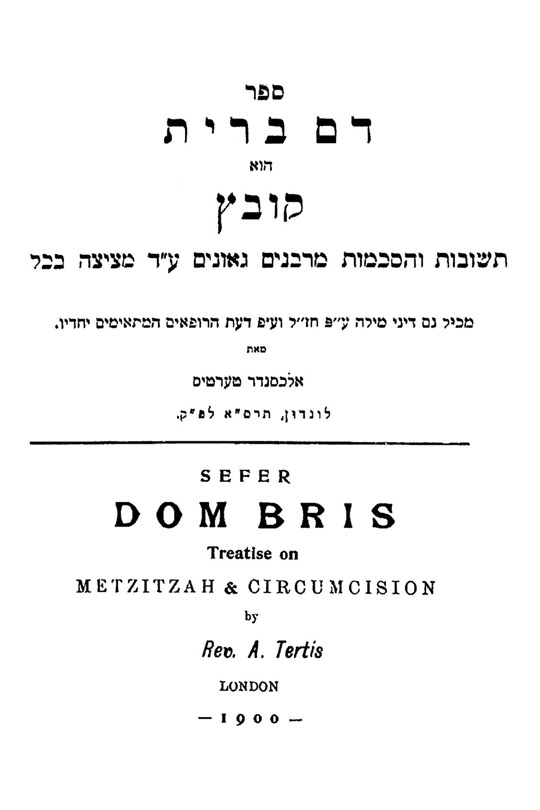
2. In my last post I mentioned that Agudat Israel has transformed itself into a lobbying organization. One of the areas they have been involved with is metzitzah ba-peh, so let me say a few things about this. It is really incredible how for many the debate around metzitzah ba-peh has become one in which the Modern Orthodox are one side, and the traditionalists on the other. I say this because the truth is that the virtually all of the rabbinic greats of Lithuania approved of metzitzah without oral contact. Alexander Tertis’ Dam Berit is a valuable resource that all interested in this matter must consult. Here is the title page.
On p. 33, R. Shlomo Cohen, the famed dayan of Vilna, says the following about metzitzah, which is very relevant to what we ourselves have seen (namely, the rejection of the firm opinions of countless doctors and scientists on the matter, all in the name of tradition).
דבר הזה אינו שייך לרבנים רק לרופאים המומחים ולכן אין לי מה להשיב על שאלתו
According to R. Shlomo, the question of how to perform metzitzah is entirely a medical issue, and the rabbis therefore have nothing to say on this matter, much like in all other halakhot dealing with medical issues the opinions of the doctors are determinative. (It hardly needs to be said that in matters of pikuah nefesh the opinions of thousands of experts, including the world’s most outstanding authorities, cannot be overruled by one idiosyncratic figure who appears to be motivated by non-scientific concerns.) 
Also of interest is that in 1906 R. Hayyim Ozer Grodzinski reported that in Vilna virtually all of the mohalim did metzitzah with a sponge. He wasn’t happy with this, but this was the reality.[4]
An interesting tidbit regarding metzitzah ba-peh is found in the Taz, Orah Hayyim 584:2. Here he mentions that he heard that R. Feivish of Cracow, when he circumcised on Rosh ha-Shanah, would not clean the blood out of his mouth. Rather, he would blow the shofar with the blood in his mouth so that the mitzvot of milah and shofar were joined.
Finally, for those who want to understand why it was only in the nineteenth century that metzitzah came to be regarded as central to the mitzvah of milah, Jacob Katz’s article “Polmos ha-Metzitzah” in his Ha-Halakhah ba-Metzar is crucial. In short, the centrality of metzitzah, and its description as a basic part of milah, is a product of the Orthodox defense of metzitzah in the face of Reform attacks. I think we are seeing something similar today. The digging in of haredi heels in defense of metzitzah ba-peh, complete with over-the-top rhetoric, is understandable (to a certain extent) and due precisely to the fact that it is an outside force that is threatening the practice. Had their own poskim suggested what the government is now insisting on, we would not have seen the same reaction. Yet it is still difficult for outsiders to grasp why some rabbinic leaders of these communities seem entirely oblivious to any medical dangers associated with the practice,  וסלחת לעונם כי רבנים המה
Let me say a few more things about metzitzah ba-peh. 

1. I saw on one of the blogs (I can’t locate it at present) that someone stated as self-evident that metzitzah ba-peh is only done with babies, not adults. The truth is that while the accepted opinion is indeed that metzitzah ba-peh is only done on babies (and maybe also on older child converts – I haven’t been able to find an answer to that), there are indeed opinions that even adult converts have to have metzitzah ba-peh performed on them. R. Moshe Klein (the son of R. Menasheh), Mishnat ha-Ger, p. 71, states without qualification that a convert has to have metzitzah, and if the mohel is afraid of catching a disease he should inquire of a posek if it can be done without the mouth. However, R. Yitzhak Yosef, Yalkut Yosef, Hilkhot Milah 6:1, rejects this viewpoint and states that there is no metzitzah, ba-peh or otherwise, with an adult convert.

2. According to R. Marcus Horovitz, Mateh Levi, vol. 2, Yoreh Deah no. 60, R. Samson Raphael Hirsch was prepared to accept the government’s abolishment of metzitzah without objection. It is difficult to square this assertion with Hirsch’s writings on the topic that show him as a strong defender of the practice.[5] Is it possible that Horovitz’s comment, meant as a criticism of Hirsch, reflects the difficult relationship these two men had?
3. In Iggerot Moshe, Yoreh Deah I, no. 223, R. Moshe Feinstein, in writing to a hasidic rebbe, expresses the standard viewpoint that metzitzah is only a medical procedure and has nothing to do with the mitzvah of milah. There is nothing surprising here. However, his correspondent had written otherwise, that metzitzah was an essential part of the mitzvah. In response to this, R. Moshe writes: חושב אני שהוא רק פליטת הקולמוס. The language R. Moshe uses implies that he did not know that among the hasidim metzitzah isindeed viewed as part of the mitzvah. Is it possible that R. Moshe was unaware of this? I don’t think so. It would appear, therefore, that the words I just quoted are a polite way of R. Moshe telling his correspondent that “what you wrote is without any substance.”
4. In 1994 R. Schachter’s Nefesh ha-Rav appeared. On p. 243 he states that R. Soloveitchik thought that today there is no need for metzitzah at all, not just metzitzah ba-peh. I remember how shocked I was when I read this, and was certain that it had to be wrong. As far as I know, no Orthodox authority has ever agreed to abandon metzitzah entirely, and I therefore couldn’t believe this report. My doubts were strengthened by the fact that R. Schachter quotes the Tiferet Yisrael as agreeing that metzitzah could be abandoned, when the truth is that the Tiferet YisraelShabbat 19:2, says the exact opposite, that metzitzah must be continued no matter what the doctors say.
As part of this post I wanted to include this page of Nefesh ha-Rav, so I went to Otzar ha-Hokhmah to download a PDF. Here it is.

Lo and behold, the copy on Otzar ha-Hokhmah is the third edition published in 1999, and there is a note on this page in which R. Schachter states that he has been told that what he wrote was incorrect, and that R. Soloveitchik only opposed metzitzah ba-peh. This makes much more sense and is what I assumed all along, so I was happy to see that my suspicions were confirmed.

R. Schachter recently spoke publicly about metzitzah ba-peh, and he is entirely opposed to it.[6] You can listen to his talk here.
Some might be surprised to hear R. Schachter say, after explaining that the Sages followed the most advanced medicine of their times, “When we look back at Chazal, look at medical statements in the Gemara, we laugh. . . . So you look back in the Gemara, it’s ridiculous, but the Gemara, in the days of the Tannaim, they were following the latest information of the doctors of their generation, of the scientists of their generation.”
I have to say, however, that R. Schachter is mistaken in his description of how the Hasidim understand metzitzah ba-peh. He incorrectly assumes that no one really regards it as a basic part of the mitzvah, i.e., halakhah le-Moshe mi-Sinai. “You know and I know and we all know that it is not halakhah le-Moshe mi-Sinai.” He claims that all those who do say it is halakhah le-Moshe mi-Sinai are exaggerating for rhetorical purposes, much like the expression yehareg ve-al yaavor is used for all sorts of things but is not meant to be taken literally. (R. Schachter himself created a good deal of controversy a couple years ago when he said that the refusal to ordain women was a matter of yehareg ve-al yaavor.)
Finally, I would like to make a general statement about how many in the Modern Orthodox world have been relating to metzitzah ba-peh. There is no question that for those in this segment of Orthodoxy, metzitzah ba-peh should not be done, both for medical reasons and also, I have learnt, for aesthetic reasons. With regard to the latter point, there is a sense among many in the Modern Orthodox world, and I myself have heard this and seen it in writing, that metzitzah ba-peh is “disgusting”. I understand that this is how people feel, but it is an improper feeling. Until the nineteenth century, metzitzah ba-peh was universal at every circumcision. How can observant Jews regard a practice that was basic in every Jewish community of the world as “disgusting”? I understand that it doesn’t fit in with today’s aesthetic sense, and that itself is perhaps reason enough for people not to do metzitzah ba-peh. However, everyone should be careful to avoid any denigration of metzitzah ba-peh that does not originate in medical concerns.
Don’t get me wrong, as I don’t mean that every practice that we find in Jewish communities throughout history should get such a “pass”, but here we are talking about a universal practice over thousands of years. It can’t be denied that there were “repulsive” and “gruesome” practices in Jewish communities.[7] Here are two cited by Shlomo Sprecher in his article mentioned in note 6: 1. Barren women would swallow the foreskin of newly circumcised boys as a segulah so that they could become pregnant. 2. Epileptics drank a potion that contained a girl’s first menstrual blood as a segulah to cure them of their epilepsy.[8]
I recently found another bizarre segulah that also falls under the rubric of “repulsive”, and I think that it would probably also be regarded by law enforcement as a form of sexual abuse. It comes from R. Zvi Hirsch Kaidonover (1646-1712), Kav ha-Yashar, ch. 51. For obvious reasons I am not going to translate this into English.
ועוד סגולה נפלאה לתינוק הנולד שלא יקרה עליו חולי נכפה בר מינן, מיד כשנולד ישימו בפיו ברית קודש של תינוק ויהיה ניצול כל ימיו מחולי נכפה
3. Following one of my previous posts I had correspondence with a reader and the discussion turned to the issue of how much of rabbinic literature is inner directed, that is, from intellectuals to other intellectuals.[9] I assume that this was the mindset of the Sages, and this explains some texts that I don’t think would have been recorded had there been an expectation that the masses would ever see them. In particular, I have in mind the talmudic stories that do not reflect well on certain rabbis. If we understand these texts as scholars talking to other scholars, then it makes sense that they would criticize each other, and even make fun of one another.[10] People in a closed community (in this case, the rabbinic elite) converse with one another in a different way than when outsiders are allowed in.[11] The problem is when the masses are studying Talmud, as today, that they have a difficult time with these texts, and Artscroll needs to explain them in an appealing fashion.
Here is one example of the sort of story I am referring to, that I assume was designed for internal consumption only, as it doesn’t reflect well on one of the Sages who is portrayed as being quite rude and insensitive. Taanit 20a-20b:
Our Rabbis have taught: A man should always be gentle as the reed and never unyielding as the cedar. Once R. Eleazar son of R. Simeon was coming from Migdal Gedor, from the house of his teacher, and he was riding leisurely on his ass by the riverside and was feeling happy and elated because he had studied much Torah There chanced to meet him an exceedingly ugly man who greeted him, “Peace be upon you, Sir”. He, however, did not return his salutation but instead said to him, “Raca,1 how ugly you are. Are all your fellow citizens as ugly as you are?” The man replied: “I do not know, but go and tell the craftsman who made me, ‘How ugly is the vessel which you have made’.” When R. Eleazar realized that he had done wrong he dismounted from the ass and prostrated himself before the man and said to him, “I submit myself to you, forgive me”. The man replied: “I will not forgive you until you go to the craftsman who made me and say to him, ‘How ugly is the vessel which you have made’.” He [R. Eleazar] walked behind him until he reached his native city. When his fellow citizens came out to meet him greeting him with the words, “Peace be upon you O Teacher, O Master,” the man asked them, “Whom are you addressing thus”? They replied, “The man who is walking behind you.” Thereupon he exclaimed: “If this man is a teacher, may there not be any more like him in Israel”! The people then asked him: “Why”? He replied: “Such and such a thing has he done to me.” They said to him: “Nevertheless, forgive him, for he is a man greatly learned in the Torah.” The man replied: “For your sakes I will forgive him, but only on the condition that he does not act in the same manner in the future.” Soon after this R. Eleazar son of R. Simeon entered [the Beth Hamidrash] and expounded thus, A man should always be gentle as the reed and let him never be unyielding as the cedar. And for this reason the reed merited that of it should be made a pen for the writing of the Law, Phylacteries and Mezuzoth.[12]
It appears that we see a continuation of this internal conversation in post-talmudic times. For example, I don’t think the rishonim who so harshly criticize their colleagues — I am referring to the colleagues they respected — would speak this way in a derashah before the common man. However, in internal dialogue they exercised more freedom. I think this can also explain the strange way that R. Isaac of Corbeil, the author of Sefer Mitzvot Katan, is referred to. He is called בעל החוטם. According to tradition, he was called this לפי שהיו לו שערות על החוטם.[13] Here too, I think that this was a humorous nickname that his colleagues knew him as, but not something that the average person would be expected to use. (Those who went to BMT will probably recall how various rabbis would speak of “Whitey Horowitz”. I don’t recall students ever referring to R. Moshe Horowitz this way.)  
I came across another example of what appears to be “internal conversation” from modern times that I think readers will find interesting. Both are found in R. Pinchas Miller’s Olamo shel Abba. Miller’s father, R. Asher Anshel Yehudah Miller, was a posek and author of seforim. I can’t imagine that the following comment, cited in the name of R. Shmelke of Nikolsburg, was something Miller, or R. Shmelke, wanted the masses to hear. Rather, I assume that it was an insider’s joke, designed to be shared among colleagues.
Shabbat 118b states that if Israel observes two Sabbaths properly they will immediately be redeemed. R. Shmelke explained that this refers to Shabbat ha-Gadol and Shabbat Shuvah. It is traditional that on these Sabbaths the rabbis give derashot before the community. R. Shmelke added that the rabbis act as if what they are saying is original to themselves, even though they have taken it from others. The Sages say that if you repeat something in the name of one who said it, you bring redemption to the world (Avot 6:6). Based on this text in Avot, R. Shmelke explained the above talmudic passage as follows: “If Israel observes two Sabbaths properly”, that is, if the rabbis who give the derashot on Shabbat ha-Gadol and Shabbat Shuvah (“two Sabbaths”) actually acknowledge where they get their ideas from (“repeat something in the name of one who said it”), “immediately Israel will be redeemed” (p. 501). This is such a provocative text because not only does it accuse the rabbis of plagiarism, but it states that the redemption itself is being delayed because of their behavior. If it was repeated by the masses it would be regarded as terribly degrading of the rabbis, but seen as a somewhat playful “derashah” to be shared among rabbinic colleagues, it loses much of its sharpness.[14]
There is another interesting passage on p. 326, which despite being humorous, I would have also assumed could only be said among colleagues. Yet Miller’s son tells us that his father used to repeat the following in his derashah at weddings: We know that it is a mitzvah to help the bride and groom to rejoice, but the rabbis come to weddings and instead of doing this, they deliver a long derashah and speak words of mussar to the young couple and thus disturb their joy.[15] That is why at the sheva berakhot we state שמח תשמח רעים האהובים כשמחך יצירך בגן עדן מקדם. In other words, we wish the bride and groom that their joy should be complete like the joy Adam felt when Eve was created for him, because in their time, in the Garden of Eden, there were no rabbis around who were able to disturb their joy!
* * * *
4. I want to call attention to a book that has just appeared. Its English title is Jewish Thought and Jewish Belief and it is edited by Daniel J. Lasker. You can read more about it here. It is available for purchase at Bigeleisen.
This is just the latest in a series of valuable books published by Ben Gurion University Press as part of the Goldstein-Goren Library of Jewish Thought. The articles that I think readers of this blog will find particularly interesting are David Stern, “Rabbinics and Jewish Identity: An American Perspective;” David Shatz, “Nothing but the Tuth? Modern Orthodoxy and the Polemical Uses of History,” Baruch J. Schwartz, “Biblical Scholarship’s Contribution to the Concept of Mattan Torah Past and Present;” Menachem Kellner, “Between the Torah of Moses and the Torah of R. Elhanan;” Tovah Ganzel, “‘He who Restrains his Lips is Wise’ (Proverbs 10:19) – Is that Really True?” and the symposium on Jewish thought in Israeli education, with contributions from R Moshe Lichtenstein and Adina Bar Shalom (R. Ovadia Yosef’s daughter).
Here are a few selections from Shatz’s article:
To be clear, academics, I find, generally shun blogs that are aimed at a popular audience because the comments are often, if not generally, uninformed (and nasty). A few academics do read such blogs, but do not look at the comments. One result of academics largely staying out of blog discussions is that non-experts become viewed as experts. Even when academics join the discussion, the democratic atmosphere of the blog world allows non-experts to think of themselves as experts and therefore as equals of the academicians. Some laypersons, though, as I said earlier, are indeeed experts in certain areas of history.
(In this quotation, one could also substitute “rabbis” or perhaps better, “poskim”, for “academics”, and “areas of halakhah” for “areas of history.”) Shatz is specifically speaking about historians, and contrasting experts vs. non-experts in this area. Yet when it comes to the sort of things I often write about here, I can attest that it is usually non-academics who are the real experts. Time and again I am amazed at the vast knowledge of so many of the people who read this blog. As for the general phenomenon of blogs, there are many people who for whatever reason (usually lack of interest, ability, or patience) are not going to write lengthy articles. Yet they often have a great deal to contribute, much of which is very important to the world of scholarship (almost always in terms of uncovering unknown sources and correcting earlier errors, as opposed to offering new interpretations or original theories). Academics ignore this to their own loss.[16]
In my future book I refer to numerous blog posts, and posts from the Seforim Blog have already been mentioned in a number of scholarly publications. My own reason for writing posts is because most of the material I discuss is, I think, interesting and sometimes even important. While this material is often not of the sort that can be included in a typical article, the genre of the blog post suits them just perfectly. Speaking of the Seforim Blog in particular, its readership encompasses a very large percentage of English speaking traditionally learned Jews of all backgrounds, beliefs, and professions (from Reform rabbis to Roshei Yeshiva and poskim, and everything in between). Thanks again are due to Dan Rabinowitz for providing this unique and wonderful platform.
Here are two more quotes from Shatz:
Be the causes what they may, there is an intramural struggle among the Orthodox, a competition for the soul of Orthodox Judaism, and the primary weapon with which it is being waged is history. For Modern Orthodox Jews today, instead of history being a threat to belief, as in earlier periods, it has become a way of arguing for one version of Othodoxy over another. And it is used for polemical purposes far more than philosophy. There are today few Orthodox philosophers, but comparatively many Orthodox academically trained historians.
Can the Modern Orthodox explain why it is admissible for Hummash and the Sages (in aggadot) to write non-accurately and provide inspiration and memory, but inadmissible for those on the right to write in that genre?
My article in Jewish Thought and Jewish Belief is entitled “Is there a ‘Pesak’ for Jewish Thought.” Those who publish know that it is often the case that only after it is too late does one realize that one’s article or book omits something important. Here too that was the case. In the article I discuss Maimonides’ view in Guide 3:17 that there is no punishment without transgression. That is, he rejects the notion of yissurin shel ahavah. I note that Maimonides claims that this is the opinion “of the multitude of our scholars,” and he cites R. Ammi’s opinion in this regard from Shabbat 55a. What is significant is that later in the sugya the Talmud states that R. Ammi’s opinion was refuted. Maimonides ignores this rejection, and even states that R. Ammi’s opinion is the majority view. This illustrates how Maimonides felt free to reject a talmudic viewpoint in a non-halakhic matter, even when it seems that the opinion is deemed authoritative by the Talmud.
What I unfortunately neglected to mention is that in Guide 3:24 Maimonides also deals with yissurin shel ahavah. Here he acknowledges that there are talmudic sages who accept this notion, but he adds that his own opinion, i.e., the rejection of yissurin shel ahavah, “ought to be believed by every adherent of the Law who is endowed with intellect.” In our own language, we might say that this viewpoint should be obvious to anyone with “half a brain.” Yet this is quite a shocking statement when one considers that there were talmudic sages who had a different perspective. Did Maimonides regard them as lacking intellect?
Here is another point I would like to add: In my Limits of Orthodox Theology I argue that it is most unlikely that Maimonides would choose to establish something as a dogma if it was a matter of debate among the Sages. (If establishing dogma was simply part of the halakhic process, this would not be problematic.) I see that R. Shlomo Fisher apparently has the same perspective, as he writes in his Hiddushei Beit Yishai, no. 107 (p. 413):
וגוף הדברים שכתב הרמב”ם בפה”מ ועשאן עיקר גדול תמוהין מאד. חדא, אם הם עיקר גדול היכי פליג עלה ר’ יהודה.
The issue of deciding matters of hashkafah in a halakhic fashion has also recently been discussed by R. Yaakov Ariel in his new book Halakhah be-Yameinu, pp. 18ff. I have to say that the more I read by Ariel the more impressed I am, as everything he writes is carefully formulated and full of insight. He strikes me as very open-minded with a good grasp of Jewish philosophy. He is, of course, also an outstanding posek. I now understand why it was so important for the haredim, under R. Elyashiv’s lead, to prevent him from being elected Ashkenazic Chief Rabbi of the State of Israel. What the haredim wanted, and were successful in this, was to destroy the Chief Rabbinate as a force to be reckoned with. The way to do this was to make sure that its occupant would be nothing but a “crown rabbi”. That is, they wanted to appoint a chief rabbi who is a figurehead, who interacts with the government on behalf of the haredi leadership, who goes around the world speaking about Jewish topics to the masses, and who can deal with non-Jews. What they absolutely did not want in a chief rabbi was a figure who had any rabbinic standing and who could thus challenge haredi Daas Torah.
At a time when much of the right wing religious Zionist world appears to have gone off the deep end, R. Ariel stands as a voice of sanity. Be it his attack on Torat ha-Melekh (a book which I still plan on discussing) or his strong rejection (together with R. Aharon Lichtenstein and R. Nachum Rabinovitch) of the outrageous letter written by Rabbis Tau, Aviner and others in support of Moshe Katzav, or his defense of women voting (arguing that today R. Kook would not be opposed; Halakhah be-Yameinu, p. 189) he shows that right wing religious Zionism need not be identified with the craziness we have been accustomed to see in recent years. 
Let us return to his recent essay where he argues, in opposition to what I wrote in my article, that Maimonides often does “decide” in matters of hashkafah no different than in halakhah. To illustrate his point, Ariel notes that there is a dispute among the Sages about whether there are reasons for commandments. He claims that Maimonides מכריע ופוסק  in accord with the position that there are reasons. He concludes:
אף על פי שלדעתו כללי ההלכה אינם חלים בענייני אמונה, בכל זאת ניתן להכריע את האמונה על פי דרך הלימוד הנקוטה גם בהלכה.
The notion of a pesak emunah, if it is to be parallel to a pesak halakhah, would mean that after Maimonides gives his pesak, in his mind it is now forbidden to adopt the other viewpoint (just as when Maimonides rules that something is forbidden on Shabbat) .Yet where does Maimonides ever say that there is an obligation to accept his viewpoint about reasons for the commandments? What Maimonides does is show why his viewpoint is correct, and Ariel cites these sources. But just because Maimonides wants his readers to adopt his own viewpoint, in what way is this a “pesak emunah”? Maimonides is simply expressing his strongly held belief. He is not ruling alternative positions out of bounds, as he does in deciding halakhah. This appplies as well to the other examples Ariel brings to prove his point. All he has established is that Maimonides argues for a position in matters such as the nature of prophecy and providence, but that is far removed from the notion that Maimonides saw his opinions as halakhically binding. On the contrary, just because Maimonides tells us what he thinks the Torah’s position is in a matter such as providence, he had no expectation that the masses would (or in some cases even should) follow him in this, and he was fully tolerant of the masses holding to their errant opinions as long as the matter was not an authentic dogma.
5. I have now finished my book on censorship. I can’t say when it will appear as it still has to be properly edited, typset etc., but hopefully this won’t take too long. I have loads of interesting material that for various reasons I was unable to include in the book, so the Seforim Blog will give me a good opportunity to bring it to the public’s attention. Let me begin with something sent to me by Rodney Falk.
Professor Louis Henkin, the son of R. Joseph Elijah Henkin, died in 2010. Here is his obituary as it appeared in Ha-Modia.


Notice what is missing! The obituary won’t even mention who his father was. Had Louis Henkin been a businessman or a doctor this information would not have been excluded, of this there is no doubt. But it is considered a disgrace to R. Henkin’s memory that his son was an intellectual, one who lived the life of the mind, and yet he didn’t become a rav or a rosh yeshiva . People in the haredi world can understand how not everyone is cut out to be a rosh yeshiva or sit in kollel, and these “unfortunates” are therefore forced choose a profession. But apparently, the notion that one who has the brains and intellectual stamina to become a great scholar might choose to devote himself to non-Torah subjects borders on the blasphemous for Ha-Modia. As such, while Louis Henkin can be acknowledged for his achievements, he has to be severed from his father’s house (the same father who sent him and his two brothers to Yeshiva College).
I think Yoel Finkelman has put the matter quite well in discussing the larger issue of which this example is  part and parcel of:
Haredi writers of history claim to know better than the great rabbis of the past how the latter should have behaved. Those great rabbis do not serve as models for the present. Instead, the present and its ideology serve as models for the great rabbis. Haredi historiography becomes a tale of what observant Jews, and especially great rabbis, did, but only provided that these actions accord with, or can be made to accord with, current Haredi doctrine. The historians do not try to understand the gedolim; they stand over the gedolim. Haredi ideology of fealty to the great rabbis works at cross purposes with the sanitized history of those rabbis.[17]
6. Rabbi Jason Weiner, a fine musmach from Yeshivat Chovevei Torah, has recently published a Guide to Traditional Jewish Observance in a Hospital. Formerly assistant rabbi at the Young Israel of Century City, he now serves as Senior Rabbi and Manager of the Spiritual Care Department at Cedars-Sinai Medical Center in Los Angeles. The book comes with approbations from R. Asher Weiss and R. Yitzchok Weinberg, the Talner Rebbe, and the halakhot in the book have been reviewed by Rabbis Gershon Bess, Nachum Sauer, and Yosef Shuterman. The book can be downloaded here.
7. Some readers have asked me about upcoming shul lectures. Here is what is on my schedule through Passover.
Feb. 15-16: Sephardic Institute of Brooklyn
March 1-2: Beth Israel, Miami Beach
March 8-9: Shearith Israel, New York
March 15-16: Beth Israel, Omaha
If any readers are interested in having me speak at their shuls, please be in touch.
8. No one got the answer to the last quiz, so let me do it again. The winner gets a copy of one of the volumes of R. Hayyim Hirschensohn’s commentary on Rashi. If you know the answer to the question, send it to me at shapirom2 at scranton.edu.

What was the first Hebrew book published by a living author?

[1] What does this last sentence mean? How can an attitude violate a biblical prohibition?

[2] As a good illustration of changes in attitude in the last forty years, here is what R. Norman Lamm wrote in his classic article on homosexuality in the 1975 yearbook of the Encyclopaedia Judaica. Such a sentence would, today, be quite politically incorrect, and regarded by gays as incredibly offensive: “Were society to give its open or even tacit approval to homosexuality, it would invite more aggresiveness on the part of adult pederasts toward young people.” 
[3] R. Meir Schiff (Maharam Schiff) is unique in believing that one without arms should put the tefillin shel yad on the head, together with the tefillin shel rosh. This is the upshot of his comment to Gittin 58a.
[4] See R. Sinai Schiffer, “Mitzvat ha-Metzitzah,” p. 106 (printed together with R. Sinai Adler, Devar Sinai [Jerusalem, 1966])
[5] See Eliyahu Meir Klugman, Rabbi Samson Raphael Hirsch, pp. 292-293.
[6] “Following in the Footsteps of Our Fathers,” Nov. 13, 2012.
[7] The words are those of Shlomo Sprecher from his article on metzitzah in Hakirah 3 (2006), p. 51.
[8] Speaking of drinking, take a look at this strange passage. It appears in R. Hayyim Rabbi’s letter at the beginning of R. Haggai Ben Hananyah’s Nimukei Levi (Ashdod, 2008), p. 2. Add this to the long list of texts that I refuse to translate.
בדין חלב אשה. נשאלתי פעם, אם בזמן תשמיש עם אשתו, החלב שלה אסור עליו, או שבעל ואשתו כגופו, ואין בו דין של יונק שרץ. ובפרט לטעם שמא יינק מבהמה טמאה, ובאשתו כגופו שהתירו לו בשעת פיוס וכו’, לא גזרו בזה. ויתכן שמותר כדין פסיק רישיה בדרבנן. ובנידון כזה, שזה חשש גזירה, גם בניחא ליה יש מקום להתיר. כן נראה לכאורה.
[9] The previous post is found here.
In the comments, Yehudah Mirsky wrote:

Fwiw, as I recall, Steve Wald in his book on Eilu Ovrin shows that the genuinely awful am-haaretz passages in Pesachim are a later stammatic addition, and that Jeff Rubinstein argues has a chapter on this in his “The Culture of the Babylonian Talmud” where he argues both that that sugya in Pesachim is sui generis in Hazal and – interestingly – reflects the Stammaim’s needing to justify their very scholastic lifestyle vis-a-vis people who were working for a living. Rubinstein cautions that the whole sugya may have been intended as a series of private jokes and need not necessarily reflect actual social relations between the stammaim and their surrounding society.

[10] Yeshayahu Leibowitz quipped that the Sages must have had a good sense of humor, since they included the following passage in the Talmud: תלמידי חכמים מרבים שלום בעולם. See Sihot al Pirkei Ta’amei ha-Mitzvot (Jerusalem, 2003), p. 289. In all seriousness, however, there are indeed humorous passages in the Talmud, as pointed out by R. Moses Salmon, Netiv Moshe (Vienna, 1897), pp. 45-46. Here is one example he gives (Bava Batra 14a).:
The Rabbis said to R. Hamnuna: R. Ammi wrote four hundred scrolls of the Law. He said to them: Perhaps he copied out the verse  תורה צוה לנו משה
Salmon claims that anyone with a bit of sense can see that R. Hamnuna’s reply is a wisecrack made in response to the obvious exaggeration about R. Ammi.
Nehemiah Samuel Leibowitz states that even in the Zohar we have passages that show a humorous side. One of the many examples he points to is Zohar, Bereshit, p. 27a:
וימררו את חייהם בעבודה קשה בקושיא. בחומר קל וחומר. ובלבנים בלבון הלכתא. ובכל עבודה בשדה דא ברייתא. את כל עבודתם וגו’ דא משנה.
See Leibowitz, “Halatzot ve-Divrei Bikoret be-Sefer ha-Zohar,”Ha-Tzofeh le-Hokhmat Yisrael 11 (1927), pp. 33-45. For more on humor in the Talmud, see Yehoshua Ovsay, Ma’amarim u-Reshimot (New York, 1946), ch. 1; R. Mordechai Hacohen, “Humor, Satirah, u-Vedihah be-Fi Hazal,” Mahanayim 67 (5722), pp. 8-19.
[11] Such a community also establishes special rules for itself, of which I can cite many examples. Here is one, from R. Solomon Luria, Yam Shel Shlomo, Bava Kamma 8:49:
ואם חוזר בפעם השלישי א”כ הוא משולש בחטא, אזי אין מניחין כלל לפדותו מן המלקות אלא ילקה בב”ד ודיו, אם לא שהוא בר אורין שאין ראוי להלקותו
After all we have seen in the last few years, I am quite certain that today the average person would not accept that when it comes to criminal matters that the rabbis should be given special privileges and exemptions.
[12] See also Va-Yikra Rabbah 9:3 where it describes how R. Jannai called his host “a dog”, and then learnt how wrong he was.
[13] See the introduction to the Constantinople 1510 edition of the work, reprinted in the Jerusalem, 1960 edition.
[14] On p. 187 Miller offers a different perspective. Here he quotes another rabbi who said that if necessary it is OK for one to repeat another’s hiddushim in the Shabbat ha-Gadol derashah, because the Sages tell us (Pesahim 6a): שואלין ודורשין בהלכות פסח.  This means:
מותר “לשאול” מאחרים בשעת הדחק ולדרוש בהלכות פסח
[15] I am told that it is still the practice in certain communities for the rabbi to deliver a derashah at a wedding..
[16] I think in particular of S.’s wonderful blog On the Main Line, which routinely provides important, and until now unknown, primary sources that are vital to a wide range of areas of scholarship.
[17] Strictly Kosher Reading, p. 122.


The Satmar Rebbe and a Censored Mishnah Berurah, and R. Baruch Rabinovich of Munkács

The Satmar Rebbe and a Censored Mishnah Berurah, and R. Baruch Rabinovich of Munkács

Marc B. Shapiro

1. In my recent interview in Der Veker, available here, I said that I hope to discuss how the Satmar Rebbe was mistaken in identifying a Zionist censorship in the Mishnah Berurah.

In Ha-Maor, Elul 5716, p. 30, M. Abramson tells the following story that appears under the heading על זיוף המשנה ברורה. The Satmar Rebbe was away from home and asked his assistant, R. Joseph Ashkenazi (who is the source of the story), to bring him a book. Ashkenazi brought the first book that came to his hand. It was a Mishnah Berurah printed in Israel. After investigating the history of the printing of the Mishnah Berurah at the National Library of Israel, I concluded that the copy the Satmar Rebbe was given was published by Pardes in 1955 (one year before the event described). Here is the title page.

Later the Rebbe returned the book to Ashkenazi and said that as far as he remembers, the language in section 156 of this copy of the Mishnah Berurah differs from what appears in other editions. Ashkenazi checked an older edition of the Mishnah Berurah and discovered that the Israeli edition had altered the original text.

The original Mishnah Berurah 156:4 reads:

מצוה על כל אדם לאהוב את כ”א מישראל כגופו שנא’ ואהבת לרעך כמוך וכו’ ודוקא רעך בתורה ומצוות אבל אדם רשע שראה אותו שעבר עבירה המפורסמת בישראל ולא קיבל תוכחה מצוה לשנאתו.

I have underlined the words that Abramson calls attention to. While the original text reads: לאהוב את כ”א מישראל, the Pardes edition has לאהוב את עמיתו. Abramson notes, “In this they wanted to show their support for democracy, that one needs to love not just the Jews but also the Arabs.” The Pardes edition also omits the second series of words that I have underlined, which express sentiments that are not very tolerant of the irreligious,[1] as well as some other words.

Here is the uncensored page in the Mishnah Berurah.

Here is the censored page in the Pardes edition.

Upon looking again at the Abramson article, I see that I misremembered, as it does not actually say that the Satmar Rebbe attributed this censorship to the Zionist publisher. He simply noticed the problem in the Israeli edition and said that this Mishnah Berurah is not like the others he has seen. It is Abramson who explicitly blames the Zionists (although perhaps the Rebbe agreed with Abramson). Abramson sarcastically writes that apparently they also provide copies of the Mishnah Berurah “to the children of Mapai and Mapam,” and this explains why they altered and censored the text.

Yet the truth is that what we have just seen has nothing to do with the Israeli publisher, Pardes. I found the same censorship in a Mishnah Berurah that appeared in Warsaw in 1895, and interestingly, it is this very edition that is found on hebrewbooks.org here. In other words, the changes we have seen were inserted under Czarist rule, and the Israeli publisher simply reprinted a copy of the Mishnah Berurah without realizing that it was a censored version.[2]

I know of another example where the altering of a text was blamed on the Zionists, and this time the one doing the blaming was a Mizrachi rabbi, R. Avigdor Cyperstein. In the Mossad ha-Rav Kook Archive of Religious Zionism there is a letter from R. Cyperstein to Dr. Yitzhak Rafael dated May 14, 1967. The relevant section reads as follows:

ידידי היקר – אני רוצה לזכות אותך בזכות הרבים, ובטח לא תחמיץ את המצווה הזו: כעת בכל העולם נפוצים הסידורים תוצרת הארץ הוצאת “בית רפאל”, ת”א – “סדור התפלה השלם” – והנה מצאתי בסידור זה דבר נורא: במעמדות של יום הששי מובא הגמ’ מנחות מד. המעשה באדם אחד שהי’ זהיר במצוות ציצית וכו’ ושם כתוב “באה לבית מדרשו של ר’ חייא, אמרה לו רבי צוה עלי ויעשוני גיורת וכו’, – והמולי”ם הללו העיזו לשלוח יד בגירסת הגמ’, ובמקום ויעשוני גיורת – השליכו את הגיורת החוצה, והכניסו במקומה “עברית” . . . והמרחק-התהום בין גיורת לעברית – אין צורך לבאר, וגם כוונתם הטרופה, בוקעה מזה, ומעלה סרחון, בכי’ לדורות. דומני שאין מי שהוא שהעיז לכבוש את המלכה בבית וכל ישראל – מתפללים מסידור זה, וע”כ מצווה לפרסם זה ברבים, ולתקן בהוצאות החדשות.

It is hard to know whether what R. Cyperstein refers to was indeed a Zionist inspired alteration. I say this because the version ויעשוני עברית is also attested to in a few sources that pre-date Zionism. I think it is more likely that the publisher just assumed that this is a more authentic reading.

Since I have been discussing the Satmar Rebbe, here is as good a place as any to note that contrary to popular belief, the name Satmar does not come from St. Mary. The original meaning seems to be a personal name, and in popular etymology the word came to mean “great village.”[3] Yet even in the Satmar community some believe that the word comes from St. Mary, and because of this they pronounce it as “Sakmar”. In pre-war Hungary this pronunciation was common among many Orthodox Jews, not only Satmar hasidim.[4] For one example of this, here is Samuel Noah Gottlieb’s entry on Satmar in his rabbinic encyclopedia, Ohalei Shem (Pinsk, 1912), p. 425. As you can see, while “Szatmar” appears in the vernacular, in the Hebrew the city is spelled “Sakmar”. There are many more such examples.

This avoidance of saying the word “Satmar” is similar to the way Jews referred in Hebrew and Yiddish to the Austrian town Deutschkreutz. Unlike the case with Satmar, when it came to Deutschkreutz the universal Jewish name was Tzeilem (Kreutz=cross=tzelem). On the other hand, there was a significant Jewish community in the Lithuanian city of Mariampole, whose name comes from Mary. Yet I am not aware of anyone who avoided saying the name of this city. Shimon Steinmetz emailed me as follows:

We might also note other cities with Christian-y names, like Kristianpol. Kristianpoler was a name used even by rabbis, cf. Rabbi Yechiel Kristianpoler, and his son Rabbi Meir. In addition, the Lithuanian town Kalvarija, which has a very Christian association, Jews used it without any issue. On the other hand, the Jews called St Petersburg, “Petersburg,” without the “St.”

One other point about Satmar: In a lecture I mentioned that one of the old-time American rabbis met with the Satmar Rebbe and concluded that when it came to the State of Israel, you simply could not speak to him about it. He was like a shoteh le-davar ehad when it came to this in that no matter how much you tried to convince him otherwise, he refused to listen to reason. Someone asked me which rabbi said this. It was R. Ephraim Jolles of Philadelphia (as I heard from a family member). I don’t think his formulation is too harsh, as anyone who has read the Satmar Rebbe’s writings can attest. It does not bother me if he or anyone else wants to be an anti-Zionist. However, the anti-Zionist rhetoric found in the Satmar Rebbe’s writings, and those of his successors, is often more extreme than what we find among the pro-Palestinian groups. Take a look at this passage from Va-Yoel Moshe, p. 11.

אם נקח כל פירצות הדור והעבירות המרובות הנעשות בכל העולם וישימו אותם בכף מאזנים אחת, ומדינה הציונית בכף מאזנים השני’, [המדינה הציונית] תכריע את הכל, שהוא השורש פורה ראש ולענה של אבי אבות הטומאה שבכל אבות הנזיקין שבכל העולם כולו, והן המה המטמאים את כל העולם כולו.

By what logic can one claim that such an outrageous passage would be anti-Semitic if said by Mahmoud Abbas, Linda Sarsour, Tamika Mallory, or Max Blumenthal, but not so if the very same thing is said in Satmar?

If anyone wants to see the results of this rhetoric, here are two videos with kids from Satmar. In this one the children are being taught that the Zionists started World War II and to hope for the destruction of the State of Israel.


In this video children were told that Netanyahu was in the car and they were to throw eggs at it.

It is very painful to see how children are being indoctrinated with such hatred. Again I ask, if such a video surfaced from a leftist camp, there would be no hesitation in labeling it anti-Semitic. So why are people hesitant to conclude that Satmar is also involved in spreading anti-Semitism?

The general assumption is that the Satmar Rebbe hated Zionism and the State of Israel so much, that he was inclined to believe even the most far-out anti-Semitic canards against the State. I have always found this difficult to believe. Say what you will about the Rebbe, there is no denying that he was very intelligent. Thus, I have a hard time accepting that he could have really believed in Zionist control of the media and other anti-Semitic tropes found in his polemical writings. In other words, I think it is more likely that he did not believe in any of these things but said them anyway in order to convince his followers not to give up the fight against Zionism, a fight that had been abandoned by so many former anti-Zionists after the Holocaust and the creation of the State of Israel in 1948. In such a battle it was necessary to turn Israel not only into something bad, but actually the worst sin imaginable.

R. Nahum Abraham, a Satmar hasid and prolific author, has recently written that the Satmar Rebbe would deny things that he knew were true. He regarded his denials as “necessary lies,” in order to prevent people from being led in the wrong direction.[5] If the Rebbe thought that it was permissible to deny the truth of certain hasidic stories in order to prevent his followers from being influenced by them, isn’t it possible that he would exaggerate the evils of the State of Israel in order to best indoctrinate his followers with an anti-Zionist perspective?

This approach also would explain a big problem that no one has been able to adequately account for. How was the Satmar Rebbe able to have friendly and respectful relationships with people who, based on what he writes, he should have regarded as completely out of the fold due to their involvement with the State of Israel? This includes even men like R. Aharon Kotler who supported voting in the Israeli elections, which the Satmar Rebbe claimed is “the most severe prohibition in the entire Torah.”[6] Yet we know that the Satmar Rebbe respected R. Aharon and others who had a very different perspective.[7] Can’t this be seen as evidence that there is a good deal of ideologically-driven exaggeration in the Satmar Rebbe’s writings, and that not everything he says really reflects his actual views? After all, if he really thought that voting in the elections was the most severe prohibition in the Torah and the State of Israel was completely destroying Judaism, would he still be able to be on good terms with rabbis who instructed their followers to vote and be part of the State?

2. Since I mentioned Munkács in this post, let me return to another recent post here where I discussed R. Baruch Rabinovich, the son-in-law of R. Hayyim Eleazar Shapira and his successor as Munkácser Rebbe. When I wrote the post I was unaware of the fact that R. Baruch’s grandson, R. Yosef Rabinovich, recently published Ner Baruch, which is a collection of Torah writings and letters from R. Baruch. He includes in the volume the haskamot written by R. Baruch. I examined new printings of the volumes with haskamot that I was unaware of and found that R. Baruch’s haskamah to the first edition of R. Yitzhak Adler, Seder Shanah ha-Aharonah (Munkács, 1937) was deleted in subsequent printings. The same thing happened with R. Baruch’s haskamah to R. Judah Zvi Lustig’s Yedei Sofer (Debrecen, 1938). Here is how the page with the haskamot looks in the original printing.

Here is how the page with the haskamot looks in the reprint, where R. Baruch’s haskamah has been deleted.

Another point about R. Baruch: In 1946 he tried to become chief rabbi of Tel Aviv but lost out to R. Isser Yehudah Unterman. This is discussed in Samuel Heilman’s Who Will Lead Us? From a letter that appears in the archive of R. Isaac Herzog, and was sent to an unknown rabbi, we see that in 1950 R. Baruch was also interested in becoming av beit din in Tel Aviv.

This information is, to the best of my knowledge, not recorded anywhere else. In this letter, which I found here (a site that contains more interesting information and pictures about R. Baruch) we that R. Herzog, R. Unterman, and R. Yaakov Moshe Toledano were strongly opposed to R. Baruch receiving this appointment. Although the reason for this opposition is not mentioned, it is perhaps because they felt it was an abomination that someone from the anti-Zionist Munkács dynasty should have such a position in the State of Israel. However, as I have mentioned in my previous post, it is doubtful that R. Baruch ever really shared his father-in-law’s strong anti-Zionism. It is possible that the anti-Zionist statements he made in the pre-war years might not have reflected his actual beliefs but were due to his position as rebbe. That is, as the successor of R. Hayyim Eleazar Shapira he felt that he had to make such statements. It is also the case that had he not continued his father-in-law’s anti-Zionist stance he would not have retained much of a following in Munkács.

When R. Baruch wanted to become chief rabbi of Tel Aviv, a letter in opposition to this was published by Chaim Kugel, head of the Holon Municipal Council:

Is it conceivable that this man . . . who hounded Zionism and Zionists . . . who loyally continued the line of the Munkács court, which cursed and banned any Jew who pronounced the word Zion on his lips . . . is it conceivable that this man will appear as a representative and moral leader in the first Hebrew city, and be a guide to its residents and Zionists?[8]

In those days it was obvious that positions of chief rabbis of important cities would go to Zionist rabbis. Here, for example, is a letter to R. Unterman from David Zvi Pinkas, an important Mizrachi figure and signatory of Israel’s Declaration of Independence.[9] Note how Pinkas tells R. Unterman that the Mizrachi expects him to follow the Mizrachi approach in everything he does. If R. Unterman could not commit to this, then Pinkas would have found another rabbi who could.

In my earlier post I neglected to mention R. Baruch’s Hashav Nevonim that appeared in 2016. This book is full of interesting material, and the more I read from R. Baruch, the more impressed I am. He really was a fascinating figure in so many ways.

There is a good deal I can say about Hashav Nevonim, but let me just call attention to the first essay that appears in the book, focused on conversion. Conversion is a matter often in the news. I have said on numerous occasions that what currently passes as the standard approach to conversion was not the case at all in previous years. To begin with, among the rabbis there were different understandings of what kabbalat ha-mitzvot entailed, and the currently accepted view that a prospective convert must commit to become fully halakhically observant, as practiced today in Orthodox communities, was not the view of many, and perhaps not even the view of most. The notion that a conversion could be annulled after the fact was hardly ever put into practice, although even this is found on occasion and R. Baruch cites some authorities who speak about this very point. Thus, it is not, as has often been alleged, a modern haredi idea with no historical basis although, as mentioned, it was very rare.

After going through the various views on conversion, R. Baruch concludes as follows (p. 47).

מנהג העולם נראה כמקבל דיעה זו, וכל מי שנתגייר, בין ששומר מצוות, ובין שחוזר ועובר עבירות, דינו כישראל, כל שקיבל עצמו עול מצות עם גירותו.

I have underlined the words which are not currently accepted by many (most?) conversion courts and which are at the heart of the controversy regarding voiding conversions. Today, the assumption of many conversion courts is that if someone who converts is later seen violating halakhah in a serious way, we can assume that this person never really accepted the mitzvot at the conversion, and the conversion is therefore not valid. It is this argument which was hardly ever put into practice in previous years and now appears to be quite common, so much so that converts claim to feel that their conversions are always “on condition,” namely, that even many years after converting there is the possibility that the conversion will be declared invalid because of a lack of proper kabbalat ha-mitzvot.

On pp. 27-28, R. Baruch calls attention to the novel view of R. Isaac Benjamin Wolf, author of Nahalat Binyamin (Amsterdam, 1682), a book reprinted a number of times and which carries the haskamah by R. Jacob Sasportas. Here is the title page.

R. Isaac is described as rabbi of מדינת מרק. This refers to the German county of Mark, about which see here.

Here is page 89a in Nahalat Binyanim

According to R. Isaac, in places such as Spain and Portugal, where one could not practice Judaism openly, if a Jewish man marries a non-Jewish woman, and the woman chooses to practice Judaism, both she and her children are regarded as Jewish. How can she be Jewish when she never immersed in the mikveh and there was no beit din to preside over the conversion? R. Isaac says that there is no obligation to immerse in the mikveh when there is danger (as there would be in a place with the Inquisition looking to find Crypto-Jews). Although he does not elaborate, it is obvious that according to R. Isaac kabbalat ha-mitzvot in front of a beit din is not an absolute requirement. In other words, he holds that in a she’at ha-dehak one can convert on one’s own, without a beit din.

This is a fascinating position that is at odds with accepted halakhah, so much so that most people won’t even believe that such a position is possible. R. Baruch is not able to cite anyone who agrees with it. The position of Nahalat Binyamim is discussed by R. Eliezer Waldenberg, who not surprisingly completely rejects it.[10] However, he does cite a medieval view that has some similarity to Nahalat Binyamim:

היה מקום להביא סמוכין לזה משיטת האביאסף שהובא במרדכי ביבמות סו”פ החולץ שמפרש דברי הגמ’ שם שאומרת מי לא טבלה לנדותה שמשמע דבדיעבד הוי גר גמור גם בטבילה בלי ג’.

Unlike R. Waldenberg, R. Hayyim Amsalem, Zera Yisrael, p. 290, does not reject Nahalat Binyamin out of hand. Instead he writes:

חזו דברי גאון קדמון זה לאיצטרופי, ולדון להקל בבני האנוסים ובבני יהודים לענין גיורם וחזרתם לדת, שכל שימולו ויטבלו לשם יהדות בהודעת מקצת מצוות כהלכה, סגי להו אף לכתחילה, אע”פ שאנחנו לא יודעים מה שהיה אח”כ לענין קיום המצוות, וזה אתי אפי’ למ”ד קבלת מצוות מעכבת.

See also Jacob Sofer, Sipurei Yaakov (Lvov, 1913), vol. 2, pp. 7ff. (no. 42), for a lengthy story starring the Maharal. The tale is obviously fictional, but of importance for our purposes is that the story, reported in a hasidic text, tells of a woman who ran away from her non-Jewish husband and married a Jewish man, had children, and was a righteous woman. However, this woman never converted with a beit din, and yet on p. 8a it specifically states that she and her children are to be regarded as Jewish. R. Nahum Abraham points to this as an example of an anti-halakhic hasidic story that cannot be true.[11]

Finally, Nahmanides in his commentary to Yevamot 45b has an interesting view and I do not know if it is accepted.

ואיפשר לומר דגבי קבלת מצוות צריך שלשה אפילו בדיעבד דמשפט כתיב ביה מה התם שנים שדנו אין דיניהן דין אף כאן אינו גר אפילו בדיעבד, אבל מי שהודיעוהו מקצת ענשן של מצות ומתן שכרן של מצות וקיבל עליו בב”ד לטבול ולמול, אם הלך ומל וטבל שלא בפני ב”ד הרי זה כשר ולא פסלינן לזרעיה

3. There are many new books to speak about. One of them is Chaim I. Waxman, Social Change and Halakhic Evolution in American Orthodoxy. The content of the book can be seen from the title. I will be reviewing this book in an academic journal, so I do not need to speak about it here. I would, however, like to call attention to one point that will not be mentioned in my review. Chapter 5 is titled “Tensions Within Modern Orthodoxy.” Not surprisingly, it deals with women rabbis. On pp. 109-110, Waxman refers to R. Jeremy Wieder’s view on the matter (the name is misspelled “Weider”). He quotes from an article in the Yeshiva University Commentator, which summarizes R. Wieder’s position as follows: “[I]n light of the success of the yoetzet halacha program in increasing overall observance in the communities that he has observed, it may be very beneficial to have women rabbis.”

I was quite surprised to see such a liberal position expressed by a YU Rosh Yeshiva, and I checked the source which appears here. R. Wieder is indeed quoted saying, among other things, that there is no binding tradition on the matter of women rabbis since the issue of women in leadership positions is a new question, thus preventing the development of a “stream of Jewish tradition.” However, when I read the article I did not find anything about how it may be “beneficial to have women rabbis.” I then noticed the following at the beginning of the article. “Editor’s Note: This article has been edited to more precisely convey the opinions represented.” In this case, I think the meaning of “more precisely convey” is that what originally appeared was altered (presumably at R. Wieder’s request) in order to prevent controversy. Yet even with the removal of R. Wieder’s view that it may be “beneficial to have women rabbis,” the current text of the article does not alter the substance of R. Wieder’s opinion. Thus, we find the following:

Lastly, Rabbi Wieder talked about the issue from a philosophical standpoint. He argued that expanding the pool of rabbinic students could lead to an increase in qualified rabbinic candidates. Rabbi Wieder added that he has observed the yoetzet halacha program increase overall halachic observance in the communities it serves and he expressed his optimism that women rabbis could generate similar improvement.

These words are certainly in opposition to the OU’s recent statement on women and religious leadership which is available here.

The question I have been asked a few times is if in the current political climate it is possible for a rabbi at a mainstream Modern Orthodox synagogue, or a teacher at a mainstream Modern Orthodox school, to feel free to express support for the ordination of women. Would such a rabbi or teacher risk censure from his colleagues or even the possibility of losing his job? The answer to these questions will determine if we are dealing with a real wedge issue (as I think we are).

Another new book is R. Bezalel Naor’s Shod Melakhim. R. Naor is well known as an outstanding interpreter of R. Kook. His great knowledge of the entire scope of Jewish thought (not just R. Kook) is apparent to anyone who examines his writings. Yet I do not know how many are aware of R. Naor’s achievements when it comes to rabbinic literature. This latest book is a collection of R. Naor’s studies on various halakhot in the Mishneh Torah. As part of R. Naor’s explication of these halakhot, he offers the reader wide-ranging enlightening discussions using numerous sources, both traditional and academic. For those who can appreciate the synthesis of the traditional and the academic approaches to the study of Maimonides, R. Naor’s new book is a real treat.

In the past I have spoken about the late R. Mordechai Spielman’s great work on the Zohar, Tiferet Zvi. The seventh volume of Tiferet Zvi has recently appeared, and can even be purchased on Amazon. Anyone who is interested in how the Zohar has been interpreted, and the impact of the Zohar on later rabbinic literature, will benefit greatly from of R. Spielman’s writings.

A new book (over 600 pages) by Benjamin Brown has appeared. It focuses on the Karlin hasidic dynasty. When I received the book in the mail, the first thought that came to my head is that Brown is a phenomenon. There is no other way to put it. It is not just the quantity of his literary output that is astounding, but also the quality, as everything he writes is worth reading.

____________

[1] Regarding the Hafetz Hayyim’s view of the non-religious, which is very much at odds with current approaches in the Lithuanian yeshiva world (at least in America), see Benjamin Brown, “Ha-‘Ba’al Bayit’: R. Yisrael Meir ha-Kohen, he-‘Hafetz Hayyim,’” in Brown and Nissim Leon, eds., Ha-Gedolim (Jerusalem, 2017), pp. 127ff. Brown also shows that in a few letters the Hafetz Hayyim adopts a more moderate perspective.
[2] In future posts I hope to say a good deal more about the Satmar Rebbe’s writings. For now, let me just respond to someone who emailed me and compared R. Hayyim Eleazar Shapira, the Munkácser Rebbe, to the Satmar Rebbe. It is true that they are similar in terms of their strong opposition to Zionism, and the Satmar Rebbe can be seen as the Munkácser Rebbe’s successor in this matter. However, in terms of their scholarly approach, they are quite different, as the Satmar Rebbe did not have the Munkácser’s critical sense. In fact, I was quite surprised to learn that the Satmar Rebbe accepted as authentic the forged anti-Zionist letters published by Chaim Bloch in his three volume Dovev Siftei Yeshenim. See R. Dov Schwartz, Meshiv Devarim (New York, 2011), pp. 140-141.
[3] See here.
[4] Shimon Steinmetz called my attention to סאקמאר appearing as the name of the city as early as 1859 in R. Hayyim Meir Ze’ev ha-Kohen, Sha’arei Hayyim (Pressburg 1859), in the list of subscribers at the beginning of the book. (You can find this on Google books, but the version of the book on hebrewbooks.org is missing these pages, as well as other pages.) This shows that referring to the city as “Sakmar” was already common. Steinmetz also called my attention to the same thing in the list of subscribers found at the end of R. Hayyim Joseph David Azulai, Kise Rahamim (Ungvar, 1870). In this case, you can see the subscribers in the copy on hebrewbooks.org, but it has been removed from the copy on Otzar ha-Chochmah. If this was removed intentionally, on the assumption that it is not really part of the sefer, it is a big problem, as the subscriber information can be of great historical importance. It is vital that both hebrewbooks.org and Otzar ha-Chochmah scan books in their entirety, without making any changes whatsoever.

R. Yoel Teitelbaum used the term Satmar all the time, and it was on his stationery, but I did find a number of places where he wrote Sakmar, spelled סאקמער and סאקמיר. See e.g., his approbations to R. Abraham Hayyim Reinman, Va-Yetze Perah (Satmar, 1940), R. Asher Steinmetz, Mikveh Yisrael ha-Shem (Jerusalem, 1961), and his letter in Divrei Yoel: Mikhtavim (Brooklyn, 1981), vol. 2, p. 81. See also Esther Farbstein, Be-Seter ha-Madregah (Jerusalem, 2013), p. 862, for a 1949 letter from Budapest to R. Yoel in which the word Sakmar is used. Shimon Steinmetz wrote to me as follows:

I think you can see by his [R. Yoel’s] correct spelling in Latin letters that he didn’t take it seriously, and perhaps not too many Jews did. After all, R. Joel Teitelbaum himself, who I think most people would consider fairly zealous, did not insist or use it very much. . . . This tells me that when people did call it Sakmar, most of them were probably just calling it that because it was already what Jews called it. Perhaps it was even a sly joke to begin with.

[5] Peti Ya’amin le-Khol Davar (n.p., 2017), p. 31
[6] Divrei Yoel, Mikhtavim, no. 90.
[7] In a future post I will publish a letter I received from Moshe Beck dealing with this point. Beck is the chief rabbi of the U.S. Neturei Karta.
[8] Translation in Heilman, Who Will Lead Us?, p. 45.
[9] The letter is found in the Israel State Archives, David Zvi Pinkas collection, 3070/15-פ.
[10] Tzitz Eliezer, vol. 17, no. 42:11.
[11] Heikhal ha-Besht 18 (Nisan 5767), p. 18. For an Arabic version of this story, see Bayit Neeman 96 (26 Tevet 5776), pp. 4-5.


‘Masa’ot Yerushalayim’ and the ‘Sabba Kaddisha’ R. Shlomo Eliezer Alfandari


‘Masa’ot Yerushalayim’ and the ‘Sabba  Kaddisha’ 
R. Shlomo Eliezer Alfandari
By: Moshe Maimon
One of the greatest and most unique Torah scholars, Sephardic or otherwise, of the past 100 years was R. Shlomo Eliezer Alfandari . His life spanned about a century[1] and his prolific rabbinic career included stints in Istanbul, Damascus, Safed and Jerusalem. Besides for being an outstanding scholar with a near-photographic memory he was also extremely diligent and was a prodigious writer of responsa and novellae. Additionally, he was renowned as an independent thinker and outspoken critic of many of the societal norms prevalent around him including Zionism and modernity, and he had little tolerance for those who he felt had strayed from the torah-true path.[2] This quality earned him many admirers and not a few adversaries, but all admitted that R. Shlomo Eliezer’s sole motivation was the truth and he did nothing for personal gain. Indeed, despite his considerable means, he lived a life of asceticism and completely shunned any form of publicity.
Amongst his native Sephardic brethren he was known as ‘Chacham Mercado Alfandari’.[3] This unusual-sounding surname; ‘Mercado’, meaning ‘purchased’ in Ladino, was somewhat common in his native Turkey and was indicative of the fact that it’s bearer had undergone a symbolic ceremony in his youth whereby he was ‘sold’ and redeemed. This practice is mentioned in Sefer Hasidim (#245) and was widespread in Sephardic lands.[4] My Great-uncle, Sam Bension Maimon, himself a Turkish native, in his book The Beauty of Sephardic life (p. 188) has this to say about that interesting custom:
This practice of “purchase,” was followed by a family that was blessed with a newborn baby, but had previously suffered the loss of an infant before the new arrival. In order to ensure the life of the muevo nasido (newborn baby), they would go through a formality in which a relative or a friend would “purchase” this baby from the parents, thus transferring ownership. This was done to outsmart the evil spirits and ward off their fatal hold on this family’s offspring that was marked for a fatal accident. So, if it was a boy, he was called Mercado; or if it was a girl, she was called Mercada.[5]
Today, however, he is more popularly known as ‘the Sabba Kaddisha’ which was the title bequeathed upon him by the Minchas Elazar of Munkacz; R. Chaim Elazar Shapira, who was largely responsible for bringing this sage to the attention of the greater public especially in Europe among the Ashkenazim.  This also was used as the title of his response – שו”ת הסבא קדישא. In a sense, the Munkaczer was also responsible for shaping the perception that many people have of R. Alfandari, as his perspective as detailed in his writings and in Masa’ot Yerushalayim, is the lens through which many see the Sabba Kaddisha.
The Munkaczer, after hearing about this extraordinary personality almost completely coincidentally, gradually became convinced that this sage was the ‘Holy elder’ or Sabba Kaddisha of the generation. According to a personal Hassidic tradition he had, the Holy Elder of every generation was capable of bringing the Messiah. This is what drew this great Hassidic leader, born and bred in Ashkenazic/Hassidic Hungary to R. Alfandari, although from a distance it might have seemed that the two made strange bedfellows. R. Alfandari, for his part, was delighted to make the acquaintance of an important Torah leader who shared his extreme views on Zionism and modernity.
Masa’ot Yerushalayim; Journey To Jerusalem: A review
 
There are various sources which provide biographical information on this unique sage,[6] but predominant among them is the detailed account of the Munkaczer Rebbe’s trip to meet R. Alfandari in the late spring of 1930 shortly before the latter’s passing. This account was written by a follower of the Rebbe, who accompanied him on his trip, by the name of R. Moshe Goldstein. The book, entitled Masa’ot Yerushalayim which also contains a biographical section on R. Alfandari[7] was first published 1931 in Munkacz and has been published many times since. This monumental meeting between east and west is a most interesting narrative and in addition to providing insight into the lives of these great scholars, it also allows for a view of pre-war Israel which is the backdrop for this meeting.
The book was recently translated into English by Artscroll (in 2009) and is called Journey to Jerusalem. It is this last work which I will focus on. Unfortunately, instead of adhering to their usual high standard and putting in the type of quality effort they have come to be known for into producing a professional edition of this classic, I found it to be lacking in many basic areas. First off, it is essentially just a simple translation from the original, complete with the archaic syntax such as ‘the Holy Rebbe’, ‘the Holy shul’, etc. Generally speaking, such prose, although sounding fine in Rabbinic Hebrew, nevertheless grates on the ears when rendered into English.
Additionally, the ’famed’ Artscroll system of transliteration[8] was dropped in the case of this book, instead they adopted in many instances
the Hungarian Hasidic mode of pronunciation. Understandably, this can be accepted when mentioning the Minchas Elazar who was known to his Hasidim as the Minchas Eluzar; but what justification is there, on the other hand, for spelling out Rabbi Eluzar son of Rabbi Shimon (p. 136) and Rabbi Eluzar Azikri (p. 157)?
In one instance (p. 205) they transliterated the Hebrew spelling of the Isle of Rhodes (רודיס) and thereby refer to “…The great Rabbi Rephael Yitzchak Yisrael, rav of Rudis (!)”.
In one case a faulty translation of the original completely corrupts the meaning of the sentence such as when discussing the origin of the famous Abohab Synagogue in Safed the author writes parenthetically:
אינו נודע אם זהו בעהמח”ס מנורת המאור או זקינו.
In English they got it backwards and wrote (p. 148):
It is unclear whether it was he or his grandfather who authored the Menoras Hamaor.
So much for style, but when it comes to content there are also quite a few editorial blunders such as when they refer to the Maharit (= Moreinu Harav Yosef diTrani) as Rabbi Yitzchak (!) of Trani (p. 204). One particularly egregious oversight can be found in the following paragraph (from p. 142 – 143):
The story is told in the holy Rabbi Shlomo ibn Gabirol’s accounts of his travels in Eretz Yisroel that because of Rabbi Alkabetz’s great wisdom, the gentiles envied him, and an Arab killed him and buried him under a tree in his garden. When the tree bore fruit early, people investigated. The crime was discovered, and the murderer was hanged on that very tree. This story is recorded in the holy work Kav Hayashar (chapter 86) about Rabbi Shlomo Alkabetz.
Besides for the obvious problem with this story being that R. Shlomo Ibn Gabirol preceeded R. Alkabetz by 500 years, there are two contradictory sources given for this tale, namely the supposed ‘accounts of R. Ibn Gabirol’s travels’  (a non-existent work) and Kav Hayashar. A quick check with the Hebrew Edition will reveal the source of this error. Here is the original:
ולפלא, כי המעשה שהביאו בספרי תיירי ארץ הקודש מהקדוש מה״ר שלמה בן גבירול שמרוב חכמתו נתקנאו בו אומות העולם, וישמעאל אחד הרגו והטמינו תחת אילן בגן שלו, ועל ידי שהתאנה חנטה פגיה קודם זמנה חקרו, ואכן נודע הדבר ונתלה הרוצח על אותו אילן, מובא בספר הקדוש קב הישר (פרק פ״ו) על מה״ר שלמה אלקבץ ז״ל, יעיין שם.
What he is saying is that he was amazed to find that different accounts of tourists’ travels in Israel record a story supposedly about R. Shlomo Ibn Gabirol, while in Kav Hayashar it is reported to have happened to R. Shlomo Alkabetz. This is indeed an important bibliographical point, but In truth this legend is actually quoted in Shalshelet hakaballah regarding Ibn Gabirol[9] and although the authenticity of this sefer is often questioned, there can be no doubt that the legend predates R. Shlomo Alkabetz and indeed no contemporary sources indicate that R. Alkabetz had anything but a peaceful end. Even though all early prints of Kav Hayashar that I have checked say R. Shlomo Alkabetz, the context leaves no doubt that it is a mistake and should read Ibn Gabirol.[10]
Censorship and political correctness in Masa’ot Yerushalayim
 
It is clear that the English edition is a translation from the latest Hebrew Edition published in 2003[11] by Emes publishing ltd. (the official publishing house of the Munkacz Hasidim in Brooklyn).[12] This addition is somewhat different from the first edition and I am not sure on what basis these changes were made. In addition to the footnotes which were actually parenthetical remarks included in the text in the original they have added numerous footnotes expanding and cross-referencing the material[13] and there is no differentiation made between the original footnotes and the later ones. There are also various differences in the text itself. For instance the original edition when describing the Grave of R. Haim ibn Attar, (the author of Ohr Hachaim) the first edition (p.25b) adds:
‘סמוך למנוחת האוה”ח הקדוש שם ג”כ מנוחת אשתו ושתי יבמות שהיו לו לנשים’
The 2003 edition is less shocking in it’s revelation by stating instead:
‘סמוך למנוחת האור החיים הקדוש שם גם כן מנוחת שתי נשיו
This is also the version found in the English translation and if memory serves correct, contemporary restorations at the actual gravesite reflect the veracity of the later edition. In fact, this may be the reason they took the initiative, justified or not, to change the text.[14]
On another occasion the altering of the text was clearly intended to avoid possible fallout with today’s Yeshiva adherents. I refer you to the passage in the first edition (p.87b-88a) which recounts how certain members of the Hareidi Rabbis of Jerusalem approached the Munkaczer Rebbe in an attempt to find a solution to the problem of the negative effect the recently established Hebroner yeshiva was having on native Jerusalmite youth on account of the former’s modern style of dress.[15] The Rebbe hastened to consult with R. Alfandari who wisely advised him not to make a commotion over it as such a fuss would only have negative ‘political results’. It reads like this:
בהיות רבנו שליט”א בתוככי ירושלים באו אליו גדולים חקרי לב מהרבנים החרדים שם ליהנות ממנו עצה ותושי’ כדת מה לעשות ע”ד ישיבת סלאבאדקע שהיתה מלפנים בחברון ואחר הפרעות והשחיטות ר”ל נעתקו משם וקבעו ישיבתם בירושלים והמה רובם ככולם (אם כי למדנים הם) הולכי קצוצי פאות וזקן ומגדלי בלורית ורגילים לזה ממדינתם ובהיותם בחברון שאין שם ישוב חסידים מהאשכנזים כ”כ לא הזיקו לאחרים משא”כ פה בקרתא דשופריא עיר מלאה חכמים חסידי עליון ירעו וישחיתו לנו ולבנינו ותלמידי ישיבתנו שילמדו מהם ח”ו בדמותם כצלמם.
רבנו בשמעו את כל התלאה הזאת הלך להתייעץ עם הסבא קדישא הרב מהרש”א אם להרעיש עליהם כעת אחרי שנמלטו על נפשם מהפראים וכו’. והוא השיב בחכמת שלמ”ה אשר בקרבו כי יש לחוש בעודם בחמימות מהרוגי חברון שנשחטו גם מתלמידי ישיבתם (ובתוכם יראי ה’ הי”ד) ואם ירעישו עליהם יכנסו תחת כנפי אותו האיש קוק וכל משרד הרבנות הציונית שר”י ועי”ז יתרבה חילם עי ישיבת סלאבאדקי מפורסמת בעולם והראש מתיבתא שלהם מפורסם ללמדן ע”כ שוא”ת עדיף כעת…
וכשאני לעצמי כשבאו תלמידי סלאבאדקא לביתי לדבר דברי תורה, וראיתים בלי זקן ופיאות ומגדלי בלורית, אמרתי להם על הכתוב (שיר השירים ב, יד) הראיני את מראיך (צלם אלקים על פי התורה. ואחר כך) השמיעיני את קולך בדברי תורה. אבל כשהוא ההיפך לא אדבר עמכם, ודחיתים כי הם באמת מחריבי קרתא קדישא. וכן יעשה גם הדר״ת להזהיר לאנשי שלומו ויראי אלקים להתרחק מישיבתם, אבל לא לצאת עתה בקול רעש מטעם הנ”ל עכתד”ה.
The 2003 edition censors this passage and simply writes:
בהיות רבינו שליט״א בתוככי ירושלים באו אליו גדולים חקרי לב מהרבנים החרדים שם ליהנות ממנו עצה ותושיה כדת מה לעשות על דבר פרצה מיוחדת שנפרצה בעיר ה׳. ושאל רבנו להסבא קדישא מה לעשות במחיצת כרם בית ישראל שנפרצה. וענה לו הסבא קדישא כי יש לחוש וכו’ על כן שב ואל תעשה עדיף כעת…
וכן סיפר הסבא קדיש אל רבינו כשבאו תלמידי ישיבה מסוימת לביתי לדבר דברי תורה, וראיתים בלי זקן ופיאות ומגדלי בלורית, אמרתי להם על הכתוב (שיר השירים ב, יד) הראיני את מראיך (צלם אלקים על פי התורה. ואחר כך) השמיעיני את קולך בדברי תורה. אבל כשהוא ההיפך לא אדבר עמכם, ודחיתים כי הם באמת מחריבי קרתא קדישא. וכן יעשה גם הדר״ת להזהיר לאנשי שלומו ויראי אלקים להתרחק מהם, אבל לא לצאת עתה בקול רעש, עד כאן תורף דבריו הקדושים.
There is no reason to suspect that this was done to protect the identity of R. Kook, because this edition shows little sympathy for R. Kook, in fact in the preceding paragraphs dealing with R. Alfandari’s opposition to R. Kook, the Chief Rabbinate[16], and even to Agudath Israel, nothing is omitted and the material is buttressed with lengthy footnotes detailing all the letters written by various Rabbis opposing Zionism in general and the Chief Rabbinate in particular. It is obvious that sensitivities for the Slabodka Yeshiva are at the root of this censorship. This is also why the next passage (from p. 88a), which I am loath to reproduce here, detailing R. Alfandari’s assessment of R. M.M. Epstein and R. Kook is also omitted in the 2003 edition.
Needless to say the English edition not only follows lead of the 2003 edition in censoring the Slabodka passages but also omits all of the anti R. Kook passages such as this one, from p. 229 in the 2003 edition:
כשבאו אליו אח”כ אנשים גם רבנים או אדמורי״ם שבאו לא”י, ושמע שהיו אצל ׳קוק׳ רב חראשי של המשרד חציונית והחפשים, לא אבה לקבלם להכניסם לביתו, ואמר הלא כבר היה אצל קוק[17] ומה יחפצו ממני, ומדוע אתם פוסחים על שתי חסעיפים.
Gone too are the following statements regarding Agudath Israel attributed to R. Alfandari, and with them a possible window into the special relationship he shared with the Munkaczer:
פעם אחד שאלו אותו לחוות דעתו בענין האגודה. והשיב שאין חילוק בין הציונים והמזרחים והאגודים רק בשמא, וחוט המקיף את כולם הוא הכסף והשתררות ולא כבוד שמים. על כן היה אוהב מאוד כששמע מצדיק ואדמו״ר אשר לא כרע לבעל לשום אחת מהמפלגות וכתות הנזכרים לעיל, ואדרבה מוחה בהם ומקנא קנאת ה׳ צבאות. ואמר כי מדה זו אהוב לו מן הכל ועולה על כולנה יותר מבקיאות התורה והפלגה בחסידות וזכות אבות, אם כי רב הוא.
Understandably, the English speaking audience this book is intended for is not as virulently anti-Zionist as the Munkacz/Satmar Hasidic base that the Hebrew edition was intended for and certainly wouldn’t countenance any anti-Agudah sentiments and therefore excised the more extreme passages from its translation. It is therefore all the more surprising that the following passage got by the careful eye of the censor and made it into the English edition on P. 178:
We found out that the main reason they did not keep their word was because they were afraid of their rabbi and leader, Yaakov Maier, a member of the official rabbinate, which the Sabba Kaddisha strenuously opposed. Immediately after the Sabba Kaddisha’s demise the zealous Torah scholars of Jerusalem warned Yaakov Maier not to come eulogize him.
Obviously they did not realize that despite R. Yaakov Meir’s affiliation with the Rabbinate as the Sephardic Rishon L’zion, nevertheless he was widely respected by virtually all segments of orthodox Jewry[18]. Indeed another popular Artscroll biography actually lauds R. Yaakov Meir for forging a close connection with Jerusalem’s Ultra-Orthodox Eidah Hachareidit and working together with them on various occasions.[19] Most likely, the American proofreader did not know who this famous Israeli-Sephardic personality was and thus allowed this disrespectful passage though.
In conclusion
 
The biographical information available on R. Alfandari is sparse, and precious little of it pertains to the bulk of his life before his move to Jerusalem in his final decade. There is certainly much more to the picture we could gain from a fuller biography of his life, also taking into perspective the vastly different milieu that he sprouted from. Yet, the detailed picture we have from the period of the Munkaczer’s visit certainly is an accurate portrayal of at least one dimension of his great personality. As I have demonstrated, the reader is best served consulting the original version where possible to obtain a more complete and accurate snapshot of this historic encounter.
In the case of R. Alfandari, this sort of contest for understanding and presenting his legacy is a testament to his greatness, his broad appeal, and to his own multi-faceted personality. He is certainly worthy of further in-depth study, and a full-length professional biography would certainly give us much to learn from and be inspired. However, this will only be true if the study is free of the constraints of bias and preconceived notions.


[1] It is difficult to pinpoint his exact year of birth and many different dates have been given. Masa’ot Yerushalayim, on the basis of a statement of R. Shlomo Eliezer regarding his involvement in the Damascus Blood Libel of 1840, assumes that he had to have been born at least by 1810 and thereby making him 120 years old at the time of his death in 1930. In Ohalei Shem (pinsk 1912) p. 507 he is mistakenly referred to as ר’ חיים(!) מירקאדו אלפנדרי, and this has caused many to overlook his entry there, but there it states that he was born in 1846. Most sources give 1826 as the year of his birth.
[2] This quality was unique even among Ashkenazic Rabbis of that era but certainly among the Sephardic Rabbis. See what R. Yosef-Zundel of Salant had to say about his Sephardic contemporaries in Ha-tzaddik R. Yosef Zundel M’Salant p. 37 to wit ‘רבני הספרדים שיחיו…אעפ”י שהם ת”ח וצדיקים אכן אין הם יודעים מעניני האשכנזים כלל… ודאי כוונתם לש”ש אמנם יותר טוב היה להם השתיקה ולא להתערב בעניני האשכנזים’ .
[3] His name has understandably been misunderstood and misspelled by Ashkenazic writers. See for example: Mara D’ara Yisrael vol. 2 page 201 where he is addressed as כמהר”ר אלעזר מלכאדו אלפנדרי.
[4] In fact, the Hida writes in glosses to Sefer Hasidim (Brit Olam ad. loc.): ‘בראותי דברי רבנו הנאני דכך נוהגים במדינת תוגרמה ומתקיימים ונמצא שרש הענין בדברי רבנו ז”ל’. See also the other sources referenced in R. Margolies edition. R. Eliezer Brodt pointed out that some Ashkenazic scholars have also followed the advice of Sefer Hasidim, such as the Aderet; see his Seder Eliyahu p. 30.
[5] The practice of calling a child by anything other than his given surname may seem strange today but it had a parallel among Sephardim not too long ago, where many firstborns were called “B’chor” to the point of where his official surname was all but forgotten. See Keter Shem Tov (Keidan 1934) vol. 1 p. 680 where he writes: ‘המנהג בא”י וסת”מ כשנולד בן בכור, מלבד שם העריסה, קוראין אותו בשם “בכור” ולנקבה “בכורה”, ושם העריסה משתקע לגמרי. ואם יש לו משרה דתית קוראים לו רבי בכור, חכם בכור, או האדון בכור’.
[6] Including articles in these two publications here and here. The latter article by R. Aharon Surasky was later expanded and included in his Orot Hamizrach.
[7] This section was printed recently as the introduction to a new work of R. Alfandari’s published from manuscript by Ahavat Shalom (2011), as part of new initiative to publish more of his writings, called Yakhel Shlomo. Surprisingly, they attribute the article to the noted Jerusalem Kabbalist R. Yeshaya Asher Zelig Margolies. I am not sure how they could have made that mistake since it was clearly part of R. Goldstein’s work although he does credit R. Margolies, among others, for providing him with valuable information on R. Alfandari.
[8] See here.
[9] See here. The language used by R. Goldstein is too similar to that of Shalshelet Hakabbalah to be a coincidence and it is therefore surprising that he gave such a vague reference. The story is also recounted in Divrei Yosef (Jerusalem 2011) p. 81 with regards to R. Shlomo Ibn Gabirol.
[10] In the edition published by Machon Haktav (Jerusalem 2001) available here they have corrected it but leave no clue as to on what basis they did so. The legend itself has been shown to be inaccurate. See Yeshurun 25 pp. 769-770 and also R. Eliezer Brodt’s fine article here.
[11] The prologue to the English edition, basing itself on the Hebrew תשסד, mistakenly claims it was published in 2004.
[12] Available here.
[13]Some of which just don’t make any sense, such as this one (from the English edition p. 152): ‘Rabbeinu David ibn Zimra, who taught much Torah and had many great students. He wrote over 2000 halachic rulings, of which only 300 were printed.’ I can’t figure out what is the basis for this statement as there are actually well over 2000 responsa printed from the Radvaz.
[14] R. E. M. Reich pointed out that in Toldot Chachmei Yerushalayim vol. 3 p. 10, the author states that although according to folklore the two women buried adjacent to the Ohr Hachaim were יבמות, in reality they were his two wives. Interestingly enough, the account in Masa’ot Yerushalayim mentions three women altogether. It would seem that Toldot Chachmei Yerushalayim is the source for this change as you can tell by looking at the interesting footnote in the 2003 ed. (ad. loc.) which was lifted straight from Toldot Chachmei Yerushalayim. To wit: מקובל כי הן .היו נשים גדולות ומופלאות במעשיהן, ומנהגיהן היה להתעטף בטלית ולהתלבש בתפלין על דרך שאיתא במיכל בת שאול The only difference is that in Toldot Chachmei Yerushalayim this is only reported with regards to the second of his two wives. See also R. Rueven Margolies’ Toldot R. Chaim ibn Attar pp 45-46. Interestingly, he records an unsubstantiated report that there were four יבמות in addition to the two wives.
[15] It is noteworthy that R. Dov Cohen, a Slobodka student at that time, reported that the transition to Jerusalem was smooth ‘and almost completely devoid of any opposition’. See his memoirs: Vayelchu Shneihem Yachdav (Feldheim 2009) p. 250.
[16] R. Alfandari was so opposed to the Rabbinate that when he heard that R. Tzvi Pesah Frank, who had been close with him, had become involved with the Rabbinate, he remarked that it was ‘חמץ שנמצא בפסח’. I heard this from a descendant of R. Asher Zelig Margolies.
[17] It is instructive that in a written correspondence reproduced on p. 228 of the 2003 ed., R. Alfandari refers to R. Kook respectfully as הר’ מהרא”י קוק ה”י even when disagreeing with him sharply. It may be the zealotry of R. Goldstein who saw fit to leave out the honorifics in this quotation.
[18] To be sure, his appointment to this position after the death R. Elyashar in 1906, was not without controversy, as many favored R. Elyashar’s son to succeed him over the Alliance-trained and Zionist-inclined R. Yaakov Meir. In some cases he proved himself to be too right-wing for some factions, such as when he opposed the Vaad Ha’leumi for giving women the right to vote. See B’toch Hachomot (Jerusalem 1948) pp. 334-335.
[19] See Guardian of Jerusalem (Artscroll 1983) p. 401.


The Pew Report and the Orthodox Community (and Other Assorted Comments), part 1

The Pew Report and the Orthodox Community (and Other Assorted Comments), part 1
Marc B. Shapiro
1. Here is a short piece I wrote a right after the appearance of the Pew Report. (The endnote is not part of the original article.)
There has been a great deal of discussion in the wake of the recent release of the Pew Research Center’s “Portrait of Jewish Americans.” Some have focused on the report’s evidence of increasing intermarriage and lack of any Jewish connection of many in the younger generation. Others have zeroed in on some of the survey’s anomalies and results that are simply not correct. For example, the survey informs us that 1% of Ultra-Orthodox Jews had a Christmas tree last year. I would be willing to bet that in the entire world there isn’t even one Ultra-Orthodox Jew with a Christmas tree, and 1% means at least a few thousand Ultra Orthodox households have Christmas trees. After adding in the Modern Orthodox, we are told that 4% of Orthodox Jews have Christmas trees. Being that the survey places the Orthodox at 10% of the Jewish population, and also tells us that there are 5.3 million adult Jews (another one the survey’s surprises), this leads to the result that more than 21,000 adult Orthodox Jews have Christmas trees in their homes.Since these results are not just improbable, but impossible, it raises the general question of how reliable the survey is when it comes to the Orthodox. Can anyone believe the survey when it tells us that in the 18-29 age bracket the Modern Orthodox only account for 1% of the country’s Jews while the Ultra-Orthodox account for 9%, or that in the 30-49 age bracket, the Modern Orthodox are 3% and the Ultra Orthodox 10%. We are also are told that 24% of Ultra-Orthodox Jews handle money on Shabbat but only 19 percent of Modern Orthodox Jews do so. (Who was it that said the Ultra-Orthodox are frummer than the Modern Orthodox?!)

When you read results like these you can only wonder what went wrong, and I hope we get some explanation as to how such results were generated. (Professor Jonathan Sarna has written to me that all surveys have absurd results for various reasons, and “one is to look at broad trends and ignore absurdities.”) Perhaps there was confusion about the way the questions were asked. Such confusion is the only way I can explain that only 64% of the Ultra-Orthodox agree that a person can be Jewish if he works on the Sabbath. The truth is that every Ultra-Orthodox Jew knows that a person who works on the Sabbath is still Jewish (albeit a sinning Jew). I presume that those who answered “no” to the question understood it to be asking if one can be a “good Jew” and work on the Sabbath. (In case anyone has been wondering, I use the term “Ultra-Orthodox” since that is what the survey uses. I don’t know why no one told the survey directors that this term is no longer regarded as appropriate.)

The sort of anomalies I have mentioned appear to be confined to matters of religious life, and other areas seem more believable. For example, we are told that 37% of Modern Orthodox households have incomes in excess of $150,000, which places them in the top ten percent of Americans. This strikes me as on the mark and illustrates one of the great problems with Modern Orthodoxy in the United States. Anyone who has been to Israel knows that there are non-haredi Orthodox Jews in all areas of life. You see men with kippot who are bus drivers, security guards, and doing every other job imaginable. Yet in the United States, Modern Orthodoxy has become largely an upper middle class phenomenon. The cost of a Modern Orthodox lifestyle, which includes expensive schools and camps, is simply beyond most people’s reach. I believe that this cost is a major reason why the Modern Orthodox camp has not picked up much in the way of ba’alei teshuvah.[1]

I have no doubt that many of the non-Orthodox admire the Modern Orthodox lifestyle, and would be willing to try it out, before learning the cost. Many non-Orthodox would also be happy to send their kids to Modern Orthodox schools, but they are not going to sacrifice a middle class lifestyle for this. Those who grow up Modern Orthodox and remain in the community are prepared to make the financial sacrifices (as well as limiting how many children they have). But for those who are not part of the community, the entry fee is simply too high. Needless to say, there are also those among the Modern Orthodox who drift away because of the financial cost, and this drifting often begin when the first child is enrolled in public school. As I see it, the financial burden is the great Achilles’ heel of Modern Orthodoxy, and what prevents it from any real growth. By the same token, those of us in the Modern Orthodox world must recognize that one of the great strengths of the haredi community is that there is room in it for everyone, from the wealthy real estate developer to the blue-collar worker. If, as so many predict, the future of American Orthodoxy is with the haredim, money (or lack of it) will play an important role in this story.

* * * * * *
The Pew Report reported very high levels of intermarriage in the Jewish community.[2] Yet even among those who would never dream of intermarrying, we know that some engage in sexual relations with non-Jews. There is an interesting responsum in this regard by the late R. Moshe Stern, the Debrecener Rav, Be’er Moshe, vol. 4 no. 141.
R. Stern testifies to receiving numerous questions regarding this matter by the very people engaged in such behavior. For those who don’t know anything about R. Stern and who asked him questions, I can tell you that these were definitely not Modern Orthodox people or members of the Lithuanian yeshiva world.[3]
This volume of Be’er Moshe was reprinted in 1984 without any changes. However, sometime after that the volume was reprinted again. There is no indication of when this took place, as the title page is the same as the 1984 edition. (Presumably, the reprint was after R. Stern’s passing in the summer of 1997.)
Someone called my attention to how the responsum appears in this most recent reprint.
The censorship of this responsum can only have one purpose, namely, so that people don’t learn about how some members of R. Stern’s community were having sexual relations with non-Jewish women.
What is the remedy for these men who are intimate with non-Jewish women? Repentance, of course. Yet there is a very strange opinion as to how to go about this repentance. R. Solomon Ephraim Luntshitz, in his Keli Yekar[4] to Numbers 19:21, says something which is so “out of the box” that I am shocked that it has not yet been censored from the Mikraot Gedolot. (Yes, I realize that it is just a matter of time.)

R. Luntshitz is discussing the statement in Yoma 86b: “How is one proved a repentant sinner? Rav Judah said: If the object which caused his original transgression comes before him on two occasions, and he keeps away from it. Rav Judah indicated: With the same woman, at the same time, in the same place.” In context, this means only what it says, but not that someone should actually put himself in this situation. Yet this is exactly the lesson R. Luntshitz derives.
He refers to Berakhot 34b, “In the place where penitents stand even the wholly righteous cannot stand.” R. Luntschitz cites an opinion that the ba’al teshuvah (penitent) of a sexual sin has to put himself in the exact same situation as he was before, that is, to be alone with the very same woman and overcome his inclination. This is not permitted to one who is “wholly righteous” since he is forbidden to put himself in this situation. But the penitent needs to do this in order for his repentance to be complete, and this explains how a wholly righteous one cannot stand where the penitent stands, since the penitent has to put himself in a situation that would be forbidden for the righteous one. R. Luntshitz explains that the very act of repentance, i.e., being alone with the woman, “makes the pure [the tzaddik] impure and the impure [the sinner] pure.”
This is a strange passage for any number of reasons, not least of which that the action of being alone with the woman is itself sinful, even if it never leads to any sexual activity. Yet R. Luntshitz tells us that in this case we have an exception, and true repentance requires intentionally putting oneself in the exact same situation one was beforehand and this time overcoming one’s inclination. Of course, there is no guarantee that the person will emerge successfully from this self-imposed test. R. Israel Isserlein reports such an occurrence, where an individual put himself in this situation in order to achieve proper repentance, but ended up sinning again![5] Sefer Hasidim earlier warned against falling into precisely this trap.[6]
R. Luntschitz’s point is also found in his Olelot Ephraim, vol. 2, no. 228, showing that he was entirely convinced of his position.
R. Luntschitz was the rabbi of Prague, yet a later incumbent of this position, R. Ezekiel Landau, strongly rejects R. Luntschitz’s point. He acknowledges that many shared R. Luntschitz’s error, which I think is interesting since I can’t imagine anyone having such an opinion today.[7] R. Landau doesn’t tell us who else advocated R. Luntschitz’s view, but R. Mordechai Harris,[8] R. Dovid Yoel Weiss,[9] R. Yaakov Levi,[10] and Nahum Rakover[11] provide sources. Among these sources are R. Joseph ben Judah Loeb Jacob, Rav Yevi (Netanya, 2012), to Psalms 36:3, who quotes the Baal Shem Tov as offering the same approach as R. Luntschitz.
Jewish men getting together with non-Jewish women is, of course, not a new thing. The Talmud, Sanhedrin 82a, already refers to this possibility with regard to Torah scholars (!), concluding: “If he is a scholar, he shall have no awakening [i.e., teaching] among the sages and none responding among the disciples.”[12] Avodah Zarah 69b-70a deals with the status of kosher wine on the table when Jewish men are sitting together with a non-Jewish prostitute. Yom Tov Assis, in his article “Sexual Behaviour in Mediaeval Hispano-Jewish Society,”[13] discusses the situation in Spain where it was not uncommon for Jews to have non-Jewish mistresses.[14] Avraham Grossman also deals with this matter and his discussion includes other parts of medieval Europe as well.[15]
In R. Judah ben Asher’s responsa (Zikhron Yehudah, no. 91), we are told about the problem of Jews having sex with their non-Jewish slave girls (and also having impregnating them). A few centuries later, R. David Ibn Zimra testifies that there were men, learned in Torah, who even thought it was permissible for them to have sex with their slaves.[16]
The fact that the prohibition on occasional sexual relations (דרך זנות) with non-Jewish women is only rabbinic[17] no doubt contributed to many not taking it very seriously.[18] Maimonides, Hilkhot Issurei Biah 12:2, writes:
אבל הבא על הגויה דרך זנות מכין אותו מכת מרדות מדברי סופרים גזירה שמא יבוא להתחתן. ואם ייחדה לו בזנות חייב עליה משום נידה, ומשום שפחה, ומשום גויה, ומשום זונה. ואם לא ייחדה לו אלא נקרית מקרה אינו חייב אלא משום גויה. וכל חיובין אלו מדבריהן.
R. Moses Isserles [19] even mentions the view of the Tur that intermarriage itself (דרך אישות) is only a rabbinic prohibition.[20] The Bah explains the Tur’s view, Even ha-Ezer 16, as follows, leaving no doubt as to the matter:

אבל בשאר אומות . . . אין בהן איסור כלל מן התורה ואפילו בא עליהן דרך אישות אלא גזירה דרבנן.
This approach, incidentally, could explain how Esther married Ahasuerus, as the prohibition on intermarriage was not yet established.
Maimonides disagrees with the Tur and assumes that there is a biblical prohibition to marry any non-Jew (דרך חתנות), not simply the seven Canaanite nations. Therefore, he claims that Solomon converted all the women he married.[21] However, R. Raphael Berdugo disagrees, and states that there was no halakhic problem with Solomon marrying these women without converting them.[22] This leads him to discuss the story of Pinhas killing Zimri and the whole concept of kana’in pog’in bo. R. Berdugo explains that kana’in pog’in bo only applies when dealing with sexual relations that are public, promiscuous, and the woman is an idolator.[23]
ולא אמרו קנאין פוגעין בו אלא דרך הפקר ועובדת ע”ז ובפרהסיא.
According to R. Berdugo, following the Tur, Jews who are married to non-Jews are only violating a rabbinic prohibition. I mention this since I recently met someone who thought that in messianic days intermarried Jews will be subject to kana’in pog’in bo. I originally thought that this was a clear error. If you look at Maimonides’ formulation, Hilkhot Issurei Biah 12:4, you find that contrary to R. Berdugo he indeed includes all non-Jews, not just idolators, as subject to kana’in pog’in bo. (And see his very strong words against Jewish-Gentile sexual relations in Hilkhot Issure Biah 12:6-7.) Yet he is just as explicit that the sexual intercourse has to be public, just like with Zimri.
כל הבועל גויה בין דרך חתנות בין דרך זנות אם בעלה בפרהסיא, והוא שיבעול לעיני עשרה מישראל.
Based on this, it was clear to me that according that according to Maimonides (following Avodah Zarah 36b) an intermarried Jew is not subject to kana’in pog’in bo, as living together is not the same thing as שיבעול לעיני עשרה. Even if one were to reject this point, in the very next halakhah Maimonides states:
ואין הקנאי רשאי לפגוע בהם אלא בשעת מעשה כזמרי . . . אבל אם פירש אין הורגין אותו.
This means that the act of zealotry must take place during the actual sexual act, or at least this is what I thought. But when I investigated a bit I learnt that while my understanding is shared by many, there are also many who assume otherwise. For example, the always interesting R. Shemariah Menasheh Adler states that an intermarried man is indeed subject to kana’in pog’in bo.[24] He claims that Maimonides’ statement just quoted only refers to one who is engaged in an act of promiscuous sex in public. With such a man he can only be killed in the act, but Maimonides is not referring here to a man who is publicly living with a non-Jew. In such a case, R. Adler claims, there is no need for the zealotry to be בשעת מעשה. As for Maimonides’ explicit words כל הבועל גויה בין דרך חתנות R. Adler claims that this only refers to the first act of marital sexual intercourse, and that it needs to be in public for kana’in pog’in bo to be applicable, but not once they have already established a home and are living together. R. Adler also quotes R. Solomon Kluger[25] as agreeing with his basic point, and I have found others as well.[26]
We have seen lots of strange stuff in recent years. Is it only a matter of time before someone disgusted with the high rate of intermarriage decides to act the part of kana’in pog’in bo?
It is also worth noting that most commentators and halakhists assume that kana’in pog’in bo only applies when there is a Jewish man and a non-Jewish woman, not the reverse. Despite this, we indeed have some examples in Jewish history of “honor killings”. For example, in 1311 a Jewish woman who married a Christian and became pregnant was killed by her brothers.[27]
In 1557 an Italian Jew killed his sister because her alleged sexual activity embarrassed the family. Elliot Horowitz, who mentions this case, adds: “Azariah Finzi, the girl’s father, saw fit to defend this action by his only son, asserting that it was ‘inappropriate for one calling himself a Jew, especially a member of one of the best families, to suffer a veil of shame upon his face, being mocked by all who see him for the blemish attached to his family’s reputation.’”[28]
In Teshuvot Hagahot Maimoniyot to Sefer Nashim, no. 25 (found in the standard printings of the Mishneh Torah), there is a responsum which describes how a woman cheated on her husband, apparently with a local non-Jew, and became pregnant. According to her father, she also killed her baby (“the mamzer”[29]) after it was born. Her father, worried that she would apostatize, asked, indeed pleaded with, the local rabbis to permit him to kill his daughter by drowning her in the river. The rabbis turned the request down.
בא אביה של שרה לפני שנים ממנו החתומים למטה ובא לימלך בנו להורות לו אם מותר להרוג בתו לטובעה בנהר ולאבדה מן העולם . . . [אמר אביה] אני מבקשכם בכל מיני תחינה שתתירו לי להורגה.
The case is actually quite sad since she was probably a teenager in over her head. The responsum describes how she would run away from home but her mother would convince her to come back. When her father rebuked her for her behavior, her reply was, “I am not the first woman who did something bad.”R. Asher Ben Jehiel, She’elot u-Teshuvot ha-Rosh 18:13, deals with a case of a woman who was intimate with a non-Jew and became pregnant from him. R. Asher affirms the local rabbi’s decision to cut off her nose. (See also R. Matityahu Strashun, Mivhar Ketavim [Jerusalem, 1969], p. 158 n. 3.)

Also relevant is a very strange story recorded in Ta’anit 24a. It begins by telling us that R. Yose ben Abin left his teacher, R. Yose of Yokeret. His reason was, “How could the man who showed no mercy to his son and daughter show mercy to me?” Let’s leave aside the story of R. Yose of Yokeret and his son. Here is what the Talmud records about him and his daughter.
He had a beautiful daughter. One day he saw a man boring a hole in the fence so that he might catch a glimpse of her. He said to the man, “What is [the meaning of] this?” The man answered: “Master, if I am not worthy enough to marry her, may I not at least be worthy to catch a glimpse of her?” Thereupon he exclaimed: “My daughter, you are a source of trouble to mankind, return to the dust so that men may not sin because of you.”
Although he did not physically kill his daughter, he did express the wish that she die (according to some it was an actual curse), and in the opinion of many commentators this is exactly what happened (see Hagahot ha-Bah, ad loc.). What makes this text so shocking is that the daughter was entirely innocent of any improper behavior. In other words, it was her very existence as a beautiful woman that created the problem, and as such it was better that she simply exit this world before any more men were led into sinful thoughts. I see no way that this story can be brought into line with mainstream rabbinic thought, despite many attempts to do so.[30] (At a future time I can present some lessons that contemporary moralists have derived from this story, which also are quite shocking.)
Returning to the matter of Jewish-Gentile sexual relations, while the Shulhan Arukh, Even ha-Ezer 16:1, following Maimonides, Hilkhot Issurei Biah 12:2, tells us that occasional sexual relations (i.e., no marital relationship) with a non-Jewish woman is only rabbinically prohibited,[31] R. Nissim of Gerona disagrees. Yet if we are indeed dealing with a Torah prohibition then what does the Talmud[32] mean when it states that the Hasmonean Beit Din decreed against sex with a non-Jewish woman? If it was already forbidden according to the Torah, there would be no need for such a decree.
R. Nissim suggests that the Hasmonean Beit Din’s decree was designed to add an additional penalty onto an already existing prohibition. It is not that occasional sex with a non-Jewish woman was banned by the Hasmonean Beit Din, but they merely added the penalty of lashes. The reason for this, R. Nissim points out, is that sometimes people are not concerned about heavenly punishments like karet, but they are concerned with an earthly punishment.[33]
Yet this is a minority view, and the standard approach is that there is no biblical prohibition on occasional private sex with a non-Jewish woman. Here is how the Encylopedia Talmudit sums up the matter[34]:
הבא על הגויה דרך זנות, איסורו מדברי סופרים, גזרה שמא יבוא להתחתן.
(In case people are wondering, I don’t think that this is the sort of information that should be spread among the masses, precisely because that some people might decide that violating a rabbinic prohibition is not such a big deal.)
I keep stressing Jewish men and non-Jewish women, since the situation of Jewish women and non-Jewish men has its own issues that should be postponed to another post. But with regard to Jewish women who are intermarried, let me note that according to R. Ovadiah Yosef, such a woman should be told to go to the mikveh. He also adds that she should not tell the mikveh lady about her situation (I assume because she might then be refused entry).[35]
To be continued.

* * * * * *


In an earlier post here I mentioned some of the shocking things said by R. Chaim Kanievsky about R. Shmuel Auerbach. Someone asked me if I could put together a list of the harshest things said by Torah scholars about their contemporaries. This would be an interesting project, and we can also find some very harsh things in this regard in talmudic and midrashic literature. I must stress, however, that often these shocking (to our ears) statements are not as harsh as they sound, since they were not meant to be taken literally. Some rabbis use figures of speech that everyone understands are simply part of a literary genre.
Here is one such example. R. Abba Mari of Lunel, in his attack against the Jewish rationalists, tells us that if he had the power he would do as follows to his opponent[36]:
אקרע סגור לבו להיות בדמו ממרס.
This means “I will cut open his heart so as to stir his blood.” I am sure people in medieval times would also be offended by such a statement. Yet its meaning then was far removed from what it would mean today, and if any of our contemporaries spoke like this we would assume he needed to be institutionalized.
After reading the post, some also wrote to me to express dissatisfaction with the rabbinic leadership in the haredi world. Contrary to what some think, this sort of feeling is not new, and in every generation people have been disappointed with the rabbinic greats. Here, for example, is what appears in the anonymous letter printed at the beginning of R. Mordechai Benet’s Parashat Mordechai.
ואף הגדולים וחכימי דרא לא משגיחים רק לעצמם בלחודוהי לזכות עצמם בלחוד אבל לא לזכות דרא לעורר תשובה בעלמא.
Finally, a couple of people corresponded with me regarding the stories of great rabbis who had totally sublimated their emotions. There are other stories that could be told of rabbis who were not even (at least outwardly) emotionally affected by the death of a child. This is sometimes held up as an example of piety and acceptance of God’s decree. Yet R. David Ibn Zimra (Radbaz) had an entirely different perspective.[37] Regarding one of the “gedolei ha-dor” who when his son died did not shed a tear, Radbaz was asked if this is a good characteristic or not. In his reply, Radbaz does not mince words about how wrong this is, seeing such “piety” as cruel, un-Jewish, and evidence of a psychological problem (to use a modern formulation):
זו מדה רעה מורה על קושי הלב ועל רוע תכונת הנפש והיא מדת אכזריות והוא דרך הפילוסופים האומרים כי זה העולם הכל הוא מעשה תעתועים
[1] Alan Brill has recently written as follows:
Centrism requires its members to live in the top six percent of U.S. income. The community is known for kitsch engagements and weddings, and other signs of conspicuous consumption in the name of religion. In the face of the recent economic downturn many will remain in the community and follow whatever guarantees survival in suburbia.
“The Emerging Popular Culture and the Centrist Community,” in Yehuda Sarna, ed., Developing a Jewish Perspective on Culture (New York, 2014), p. 30. As with everything else Brill writes, this essay is well worth reading. On this same page he refers to the fact, noted by others, that for most Centrist Orthodox Jews, their Orthodoxy has nothing to do with doctrine but is about lifestyle and family values.
Being Orthodox is about family on Shabbat, shiva calls, hospital visits, sharing simchas, and helping others. They consider the warmth of the community as their Orthodox Judaism, yet are oblivious to doctrine and practice demarcations. . . . Many define faith as “everyday morality” rather than institutional commitment or theological Orthodoxy.
I would add that not only is this not new, I believe it is how traditional Judaism has always functioned and is applicable to much of the haredi world as well. In other words, many in the Orthodox world would agree with the Reconstructionist saying, “Belonging is more important than believing.” See Mel Scult, The Radical American Judaism of Mordecai M. Kaplan (Bloomington, 2014), p. xiii.
From Brill’s article I learnt that Aish Hatorah put on a recent Purim megilah reading “that featured as emcee and guests of honor the non-Jewish Chris Noth, who played Mr. Big on Sex and the City, and Snooki, of the MTV show Jersey Shore.” See also here. Brill uses this example, and others, to show the influence of contemporary culture.
I am fascinated by how the haredi world tolerates this sort of thing in the name of kiruv. I personally am very turned off by this, but am apparently in the minority. When I told a couple of twenty-somethings that I think that the following Aish video, with almost three millions hits, makes a mockery of what Yom ha-Din is all about, they thought I was simply out of touch. Yet as I noted to them, contrary to the implication of the video, Rosh ha-Shanah is indeed about spending the day in synagogue in prayer, not about having fun and breakdancing to non-Jewish music.
[2] See my earlier discussions of intermarriage here and here.
Regarding another type of “intermarriage”, see Francesca Trivellato, The Familiarity of Strangers (New Haven, 2009), p. 94, that Sephardim in seventeenth-century Amsterdam were forbidden by their community to marry Ashkenazim. (Poor Sephardim were also given a higher charity subsidy than Ashkenazim.)
[3] See Be’er Moshe, vol. 4, no. 146:26-27, where R. Stern speaks very strongly against the practice in Boro Park and Willamsburg of  men and women going for walks on Shabbat on Yom Tov, as this leads to a mingling of the sexes.
[4] For some reason the title of this commentary is almost always written as Keli Yakar, yet the second word should be Yekar, as appears in Prov. 20:15.
[5] Leket Yosher, ed. Kinarti (Jerusalem, 2010), Hilkhot Yom ha-Kippurim, p. 304.
[6] Sefer Hasidim, ed. Margaliyot, no. 167. While preparing my Torah in Motion classes on R. Joseph Hayyim I found a strange passage in his Ben YehoyadaSotah 36b. Although the Talmud, ibid., records the view that Joseph intended to sin with Potiphar’s wife, R. Joseph Hayyim says that this is not to be taken literally. Rather, Joseph’s intention was to inflame his lust for her so that would then be able to overcome it which would be a great spiritual victory. He says the same thing about King David and Abigail. Although the simple meaning of the Talmud, Megillah 14b, is that David wished to have sex with her, R. Joseph Hayyim states that here, too, all David wished was to arouse his lust in order to then overcome it.
וכן היה הענין אצל דוד הע”ה, בענין אביגיל כשתבע אותה דודאי חלילה לנו לחשוב על אותו צדיק אשר לבו חלל בקרבו, שביקש לחטוא בא”א, אלא כוונתו היתה לעורר התאוה בקרבו, ולהעביר אש החשק בלבבו, כדי שבעת שיגיע לנקודת המעשה ינתק עבותות התאוה, ויכבה אש החשק כרגע, ויחדל ויפרוש מעשות רע
(R. Luntshitz, in the passage from Keli Yekar I cited, specifically states that only one who has already sinned in such a fashion and is engaged in repentance can put himself in this situation, but a tzaddik is absolutely forbidden to do so).
R. Joseph Hayyim’s comment reminds me of the notion that one who has not sinned, and thus has nothing to repent for, should purposely commit a sin. This will then allow him to fulfill the mitzvah of teshuvah, which he would otherwise not be able to do. In a future post I will discuss this.
Regarding King David, I found something quite strange in Etan Levine, Marital Relations in Ancient Judaism (Wiesbaden, 2009), p. 129. Levine writes: “And though the sages hardly regarded extramarital affairs as meritorious, their antipathy to divorce led some of them to opine that extra-marital relations with an unattached, sexually-permitted female was preferable to terminating a marriage.” This might be true, but no valid source is cited to support this idea.. In his note to the quoted passage, Levine writes: “King David’s case was interpreted as proof: it was to prevent his divorcing any of the 18 wives permitted to a king that he was allowed to sexually tryst (יחוד) with Abishag without marrying her (I Ki. 1:1f.). See the Babylonian-born Simeon bar Abba (d. ca. 310CE), a disciple of Rabbi Johanan whose homily he cites in Tb Sanhedrin 22a.” To begin with, R. Shaman (שמן) bar Abba is not quoting R. Johanan in Sanhedrin 22a. What he says is that the fact that David was permitted yihud with Abishag shows how much divorce was disapproved of, for otherwise he would have divorced one of his wives and married Abishag. But where does Levine get the notion that yihud means “sexually tryst.” The Bible itself (!) is explicit that David “knew her not.”
[7] Derushei ha-Tzelah (Warsaw, 1886), derush 1, no. 11.
[8] Yad Mordechai (Jerusalem, 1955), pp. 43-44.
[9] Megadim Hadashim: Berakhot (Jerusalem, 2008), pp. 360-361.
[10] Gan Naul (n.p., 2009), pp. 108ff.
[11] Takanat ha-Shavim (Jerusalem, 2007), pp. 588ff., 595ff.
[12] The Talmud’s teaching (quoted by Shulhan Arukh, Even ha-Ezer 16:2) is very clear, and events of recent years have shown us that even Torah scholars are not immune to such behavior. Yet I can’t say I was surprised to find that even these clear words are distorted. R. Gedalyah Axelrod, Migdal Tzofim, p. 148 (parashat Pinhas), states that the Talmud and Shulhan Arukh couldn’t really mean that a Torah scholar might have sexual relations with a non-Jew. Therefore, he explains that they really mean that the Torah scholar causes others to do so, by performing fraudulent conversions, and these “converted” women (who are still halakhically non-Jewish) then marry Jews. This is very nice darshanut, but how can anyone take this seriously as an actual explanation of the Talmud and Shulhan Arukh? The Maharal knew better, and in Derekh Hayyim 4:4 he gives the following example:
עשרה תלמידי חכמים יושבים ואחד נכנס לבית זונות ולא נודע איזה שזה מחלל שם שמים בסתר.
See also R. Hayyim Vital, Sefer ha-Hezyonot, ed. Eshkoli (Jerusalem, 1954), p. 33: 

ליל שבת שעברה שכב תלמיד חכם הנקרא בעדת הספרדים “חכם” עם גויה אחת

[13] In Ada Rapoport-Albert and Steven J. Zipperstein, ed., Jewish History: Essays in Honour of Chimen Abramsky (London, 1988), pp. 25-59.

[14] See Sefer Hasidim, ed. Margaliyot, no. 701, that the level of Jewish sexual morality will mirror what appears in society at large.
כמו שמנהג הנכרים כן מנהגי היהודים ברוב מקומות כגון אם הנכרים גדורים בעריות כך יהיו בני היהודים הנולדים באותה עיר.
See also R. Solomon Ben Adret, She’elot u-Teshuvot ha-Rashba, vol. 1, no. 1209:
ובנות ישראל צנועות הן אלא שהדור מנוולתן.
I was surprised to see Michael Satlow write: “There is no rabbinic law against intercourse with a prostitute.” Tasting the Dish: Rabbinic Rhetorics of Sexuality (Atlanta 1995), p. 166. This is incorrect, as Sanhedrin 82a explicitly states:
בית דינו של חשמונאי גזרו הבא על הכותית [ס”א הגויה] חייב עליה משום נדה שפחה וכו’
See also Geoffrey Alderman’s article, “It is Not a Sin to Visit a Prostitute,” in his The Communal Gadfly (Brighton, 2009), pp. 267-268. I don’t know how he can write such nonsense as the following:
As far as I am aware, there is no general halachic prohibition on Jewish men sleeping with prostitutes, unless the whore is herself Jewish. If not, then, according to the Talmud, a Jewish man who feels the need to visit a prostitute must simply take care to do so in a town in which he is not known – which strikes me as very sound advice.
If the whore is Jewish, however, we are faced with the certainty of multiple acts of adultery [!], all of which are prohibited. This is because intercourse is itself a form of marriage. So the first Jewish man a prostitute consorts with becomes her husband [!]; if she wishes to consort with anyone else, this first Jewish customer will have to give her a get [!]. So will the second, and so on. [!] (I am ignoring for my present purposes, considerations of mikveh, since I have yet to learn of any brothel that has one.)
It is actually a common kabbalistic view that one who has sex with a non-Jewish woman will be reincarnated as a Jewish prostitute. See e.g., R. David Ibn Zimra, Metzudat David, no. 612.
[15] Hasidot u-Mordot (Jerusalem, 2001), pp. 229ff.
[16] She’elot u-Teshuvot ha-Radbaz, vol. 1, no. 48.
[17] See Sanhedrin, 82a, Avodah Zarah 36b, Mishneh Torah, Hilkhot Issurei Biah 12:1-2; Shulhan Arukh, Even ha-Ezer 16:1, and the commentaries ad loc. R. Moses Isserles, Darkhei Moshe, Hoshen Mishpat 34:4, writes:
בא על הגויה לא מיפסל רק מדרבנן דהא אינו אלא מגזירת בית דין של חשמונאי.
R. Shlomo Goren, Mishnat ha-Medinah (Jerusalem, 1999), p. 142, points out that sex with a non-Jewish woman does not fall under the category of arayot, even rabbinically.
ועל אף חומר האיסור אין זה מגדרי איסור עריות אפי’ מדרבנן.
R. Joseph Kafih, commentary to Mishneh TorahIssurei Biah 12:2, raises a problem with the standard understanding of Maimonides that occasional sex with a non-Jewish woman is only a rabbinic prohibition. Even though Maimonides, Issurei Biah 12:2, writes ולא אסרה תורה אלא דרך חתנות, what is one to do with halakhah 9 [no. 8 in R. Kafih’s edition] which implies the opposite? R. Kafih writes
ומה יעשה בדברי רבנו לקמן הל’ ח שגויה הנבעלת לישראל תיהרג מפני שבאה תקלה לישראל על ידה, ולדבריו [דברי המעשה רקח] שאין אסור דאוריתא איזה תקלה באה על ידה?
Presumably, Maimonides in halakhah 9 is only referring to a public sexual act, which would be regarded as a biblical violation.
[18] After writing this sentence I found that R. Solomon Ibn Verga said the same thing. See Shevet Yehudah (Jerusalem, 1955), p. 134: 

כבר התחילו בספרד לתת עיניהם בבנות הארץ מרוב ההרגל וקצתם לקחו היתר לאמר כי אין בו אלא מלקות

I don’t mean to imply that there wasn’t sexual immorality involving Jewish men and Jewish women, as there was plenty of this as well. R. Asher ben Jehiel, Teshuvot ha-Rosh, nol. 37:1, even speaks about the practice of engaged couples living together (לדור ביחד) before marriage. He tells us that the women did not go to the mikveh since they were embarrassed to do so before marriage. But they weren’t embarrassed to live together before marriage.

[19] Even ha-Ezer 16:1.
[20] Since the consequences of intermarriage are so devastating, one must wonder why there is no explicit biblical prohibition. Be that as it may, in coming years watch for the Conservative movement to halakhically legitimize intermarriage by relying on the view that it is only rabbinically prohibited. As with other rabbinic prohibitions previously abolished by the Conservatives, they will argue that this too can be set aside for important societal concerns.
Maggid Mishneh, Hilkhot Ishut 1:4, recognizes that one cannot logically explain why certain sexual acts are biblically prohibited and others had to wait for the Sages to prohibit them.
ואל תתמה היאך תהיה הישראלית ביאתה בזנות בלאו והגויה מדברי סופרים לפי שאיסור העריות הוא בגזירה ודבר שאין לו טעם בכל פרטיו. והנה תראה שאם חמותו היא בסקילה [צ”ל בשריפה] ואם אמו מדברי סופרים בלבד ונדות בישראלית הוא מן התורה בכרת ובגויה אין נדות כלל אלא מדברי סופרים.
Regarding the Tur’s assertion that there is no biblical prohibition to marry women who are not of the Canaanite nations, this has been hard for many to accept. The Arukh ha-Shulhan, Even ha-Ezer 16:2, states that “it appears to me” that even according to this opinion, if the Jewish man and non-Jewish woman actually live together there is a Torah prohibition. How could the Arukh ha-Shulhan say this when the Tur, Even ha-Ezer 16, states explicitly that contrary to Maimonides, sexual relations דרך אישות with contemporary non-Jewish women does not incur a biblical penalty? Is there a real distinction between sexual relations דרך אישות and living together as husband and wife?. Here are the Arukh ha-Shulhan’s words (following which he cites a talmudic proof for his understanding):
ומ”מ יראה לי דאפילו להחולקים על הרמב”ם מ”מ אם היא בביתו ובועל אותה תמיד כדרך איש ואשתו חייב עלה מדאורייתא
For others who argue that despite the simple sense of his words, the Tur must hold that there is still a biblical prohibition for a Jew to marry a non-Jew, see Otzar ha-Poskim, Even ha-Ezer 16:1. See also R. J. David Bleich, Contemporary Halakhic Problems, vol. 2, p. 273.
Nevertheless, the severity of the stricture against intermarriage tends to indicate that, even according to the Tur, some form of biblical prohibition against intermarriage with non-Jews who are not members of the Seven Nations must exist. The question to be resolved is the nature of the biblical prohibition.
With reference to those who have argued that intermarriage (and even non-marital Jewish-Gentile sexual relations) violates Torah law, Shaye J. D. Cohen writes: “This may be good halakhah and good preventative medicine, but it is bad history and bad exegesis.” “From the Bible to the Talmud: The Prohibition of Intermarriage,” Hebrew Annual Review 7 (1983), p. 30.
[21] Hilkhot Issurei Biah 12:2, 13:14.
[22] Mesamhei Lev (Jerusalem, 1990), commentary to ch. 1 (p. 229).
[23] See Hilkhot Issurei Biah 12:5 that there is no kana’in pog’in bo when it comes to a ger toshav.
[24] See Geulat Yisrael (London, 1950), pp. 95ff.
[25] Commentary to Even ha-Ezer 16:2, in the standard eds.
[26] See also R. J. David Bleich, Contemporary Halakhic Problems, vol. 2, pp. 275ff., who argues that intermarriage is the equivalent of a public act of sexual intercourse, and thus biblically forbidden according to all.
[27] See Renée Levine Melammed, “The Jewish Woman in Medieval Iberia,” in Jonathan Ray, ed., The Jew in Medieval Iberia 1100-1500 (Boston, 2012), p. 272.
[28] “Jewish Confraternal Piety in Sixteenth-Century Ferrara: Continuity and Change,” in Nicholas Terpstra, ed., The Politics of Ritual Kinship (Cambridge, 2000), p. 159.
[29] Although her father called the baby ממזר מן הגוי, the term was only being used colloquially, since a child of a non-Jew is not halakhically a mamzer.
[30] R. Samuel Edels, Maharsha, ad loc., states explicitly that R. Yose of Yokeret was wrong in cursing her so that she die. )How many other examples do we have of commentators criticizing talmudic sages?) However, I don’t think Maharsha’s approach will make matters much easier for many readers, because he suggests that instead R. Yose should have cursed her that she become ugly!
ולא יפה עשה לקללה שתשוב לעפרה בשביל כך אלא כי אם לקללה שתשוב לשחרוריתה.
R. Mordechai Karvalho of Tunis, Meira Dakhya (Livorno, 1792), ad loc., also wonders why the daughter had to die. After all, “are we commanded to kill everyone who is beautiful?” He suggests that R. Yose should have kept her inside the house so no man would ever see her.
ובתו ג”כ היא לא עשתה שום עבירה וא”כ היל”ל להחביאה בחדרי חדרים שלא יראה אותה שום אדם ולא ימיתינה וכי מי שהוא יפה תאר מצווין אנו להמיתו
This idea, of keeping unmarried women off the street, is found in various Jewish sources. In his recently published Asaf ha-Mazkir, p. 61, R. Meir Mazuz refers to R. David Kimhi’s commentary to 2 Sam. 13:2: 

ודרך הבתולות בישראל להיות צנועות בבית ולא תצאנה החוצה
R. Mazuz also refers to R. Asher ben Jehiel, Piskei ha-Rosh, Ketubot 7:15, who says that in Spain the בנות, which I assume also means unmarried women, would only go to the bathhouse in the middle of the night, since they were accustomed not be seen outside. In order to show that this was the practice of the pious women of medieval Spain, R. Mazuz cites another source, Tikunei Zohar, no. 58:
צריכא ברתא דאיהי בתולה למהוי סגורה ומסוגרת בבית אביה

With reference to my question at the beginning of this note, R. Mazuz, Asaf ha-Mazkir, p. 128, cites the great R. Raphael Joseph Hazan, Hikrei Lev, vol. 1, Yoreh Deah, no. 26 (p. 29b), that R. Simeon ben Yohai was mistaken in thinking that animals are subject to individual providence:


דרשב”י לא ידע . . . אבל האמת אינו כן
R Mazuz cannot accept this sort of language when dealing with R. Simeon ben Yohai:
דמה כוחנו לחלוק על רשב”י בסברא בעלמא, ומה ידענו ולא ידע

Not noted by R. Mazuz is that R. Hayyim Palache cites R. Hazan without objection. See Amudei Hayyim (Izmir, 1875), p. 101a.
[31] In Hilkhot Issurei Biah, 12:6 (followed by Shulhan Arukh 16:2), Maimonides writes that if one who had sex with a non-Jewish woman is not killed by kana’im or given lashes by beit din עונשו מפורש בדברי קבלה שהוא בכרת. The context of this halakhah, and the previous ones, is an act of public sexual relations, the sort that is a Torah violation and subject to kana’in pog’im bo. Yet some understand Maimonides to be also referring to private sexual relations דרך זנות. See Beit Shmuel, Even ha-Ezer 16:4. This position is hard to understand, since as has been pointed out by others, how can there be karet on a rabbinic prohibition? A punishment of karet would seem to imply that we are dealing with a Torah violation, yet Maimonides is explicit that this is not the case with non-public and non-marital sexual relations with a non-Jewish woman. This problem leads R Yosef Rein, Penei Yosef: Sanhedrin (Bnei Brak, 2009), p. 648, to offer the original suggestion that Maimonides is talking about כרת מדרבנן. To complicate the matter even more, in Sefer ha-Mitzvot, neg. com. no. 52, Maimonides indeed states that there is karet for non-public sexual relations with a non-Jewish woman, which contradicts his position in the Mishneh Torah. R. Kafih, in his commentary on Sefer ha-Mitzvot, explains:

כלומר שעונשו חמור כחייבי כרתות
Needless to say, this is a very unlikely explanation, and if Maimonides wanted to say what R. Kafih writes, he could have easily done so instead of speaking of actual karet.
[32] Sanhedrin 82a, Avodah Zarah 36b.
[33] See Hiddushei ha-Ran, Sanhedrin 82a, and also R. Aryeh Leib Heller, Avnei Miluim, Even ha-Ezer 16:1:3. R. Simhah Lieberman, Bi-Shevilei ha-Amim, no. 14, has a very good discussion of the matter. See also the sources showing the seriousness of the offense in R. Michael Bacharach, Arugat ha-Bosem, Even ha-Ezer 16:2. R. Aviad Sar Shalom Basilea also argues against those who claim that occasional sexual relations with a non-Jewish woman is only rabbinically prohibited. See Emunat Hakhamim (Mantua, 1730), ch. 29. Among the points he makes is if occasional sex with a non-Jewish woman is only rabbinically forbidden, then what is the point of the yefat toar law? This is a special law that permitted what otherwise was already forbidden. He also quotes R. Judah Briel that sex with a non-Jewish woman is included as part the prohibition of wasting one’s seed. (It is not clear if R. Briel is speaking homiletically or halakhically. See also Torah Shelemah, Ex. 20, no. 334, for the midrashic statement that one who has sex with a non-Jewish woman violates fourteen [!] separate Torah prohibitions. Regarding this statement, see also Louis Epstein, Sex Laws and Customs in Judaism [New York, 1967], p. 176.)
R. Basilea’s point about yefat toar can easily be refuted. See e.g., Mizrachi to Deut. 21:11 who suggests that the entire point of the law is to permit sex with a married non-Jewish woman, something that otherwise would be forbidden. It implies nothing about occasional private sex with an unmarried non-Jewish woman, which was permitted in the days of the Torah.
כיון שבבית שהוא בצינעה בא עליה הביאה ראשונה למה לי קרא להתירה הא לא אסרה תורה אלא דרך חתנות אבל דרך זנות בביאה ראשונה שאינה אלא מפני יצרו הרע אין איסורה אלא מדברי סופרים ולמה לי קרא למשרייה ושמא יש לומר דמשום אשת איש איצטריך קרא להתירה וצ”ע . . . כל הפרשה הזאת לא נכתבה אלא באשת איש . . . מדאצטריך קרא להתירה בשעת שביה מכלל שבאשת איש דאסירא בעלמא קמיירי, דאי בפנויה [שריא] אפילו בעלמא, כ”ש בשעת שביה, וזהו הנכון אצלי
According to some, another novelty of the yefat toar law is that it also permits rape, which otherwise is forbidden.See also James Diamond, “The Deuteronomic ‘Pretty Woman’ Law: Prefiguring Feminism and Freud in Nahmanides,” Jewish Social Studies 14 (Winter 2008), pp. 61-85.

I previously discussed yefat toar here and here.
To the sources I cited, add R. Eliezer of Metz, Sefer Yereim, ed. Schiff, no. 20, who specifically states that a yefat toar cannot be raped ([called to my attention by R. Chaim Rapoport], and see Toafot Re’em, ad. loc., note 13, that this is already a talmudic dispute).
On the other hand, Maggid Mishneh, Hilkhot Ishut 14:17, states:
וענין יפת תואר חדוש הוא ולא התירה אותה תורה אלא כנגד יצר הרע . . . ובעלה בעל כרחה
R. Pinhas Horowitz, Ha-Makneh, Kiddushin 22a, understands Rashi to permit rape of a yefat toar (I haven’t seen others who agree with this).
מה שפירש”י ז”ל דקידושין תופסין בה אין לפרש שיכול לקדש אותה בע”כ דלא מצינו קידושין בע”כ כי אם ביבמה אלא דע”כ הכי קאמר קרא דלאח’ הגירות בת ליקוחין היא אם מתרצית להתקדש לו ואם לא מתרצת יבא עלי’ בע”כ דהיינו שהתירה התורה נגד היצה”ר
It is precisely with these sorts of passages in mind that, as I have quoted on a number of occasions, R. Jehiel Jacob Weinberg states that when there is a dispute among the early authorities, we should decide the halakhah in accord with contemporary sensibilities.
ואגלה להדר”ג [הגרא”י אונטרמן] מה שבלבי: שמקום שיש מחלוקת הראשונים צריכים הרבנים להכריע נגד אותה הדעה, שהיא רחוקה מדעת הבריות וגורמת לזלזול וללעג נגד תוה”ק (כתבי הגאון רבי יחיאל יעקב וויינברג, חלק א סי’ לב).
See also my post here.There are a number of laws in the Torah that are not in line with modern conceptions of morality (the one most in the news these days deals with homosexuality). But I think yefat toar is unique in that I have never seen an English language discussion of the law in an Orthodox publication that actually deals with its parameters in any detail, and cites what the rishonim say about the law. (Searching on the internet I found Jacob Bernstein, “Eshet Yefat To’ar: A New Look” here, but this too does not elaborate in sufficient detail on the morally difficult aspects of the matter.) Could it be that this law is more morally problematic for moderns than the laws dealing with homosexuality and slavery of which we have seen endless discussions? And if so, why?

Here is one final source regarding yefat toar. R. Reuven Katz, Duda’ei Reuven, vol. 2, p. 217, states explicitly that the heter of yefat toar is not proper or ethical, but nevertheless in necessary. While this is a quite provocative formulation, it really reflects the outlook of the Sages. Nevertheless, I don’t know if any contemporary halakhic authorities would write this way (emphasis added).
אמנם קיים בנסיבות מיוחדות היתר לדבר שאינו הגון ומוסרי, כיון שהתנאים אינם יכולים להתעלם מתופעה זה
Regarding rape, there is one other strange thing I would like to share. Maimonides, Hilkhot Ishut 15:17, forbids marital rape. In a case where a woman is in a situation of yibum, and she does not want the Levirate marriage, she is not forced and instead the man must take part in the halitzah ceremony (although according to Maimonides she is regarded as a moredet). See Hilkhot Yibum ve-Halitzah 1:2, 2:10. However, there is a special halakhah when it comes to yibum that even if the man forces her to have sex, it is still a valid yibum and she becomes his wife. (Hilkhot Ishut 2:3).
R. Isaiah of Trani (the Elder), Teshuvot ha-Rid, ed. Wertheimer (Jerusalem, 1987), no. 59, responds to an unnamed questioner who thought that it was permissible for a levir to force his sister-in-law to have sex with him (i.e., to rape her). R. Isaiah expresses his surprise that anyone could make such a mistake (although he acknowledges having heard of others who also erred in this way):
מה שכתבתה [!] למה אין כופין את היבמה להתייבם לא נכונו הדברים האלה לומר לאיש חכם, שלא עלתה על לב אדם שנכפה את היבמה להתייבם . . . אם היבמה אינה רוצה להתייבם והיבם רוצה שנכוף אותה לפניו לא היה ולא נברא
R. Isaiah then states that if the levir was chasing after the woman to rape her (in order to fulfill the mitzvah of yibum), we are commanded to save her from him, even if we have to kill him. (See R. Avraham Shapiro, Shiurei Maran Ha-Gaon Rabbi Avraham Shapiro: Yevamot, Gittin [Jerusalem, 1995] p. 170.)
So far we haven’t seen anything surprising. But in his note to R. Isaiah’s responsum, the editor, R. Avraham Yosef Wertheimer, writes as follows:
ומש”כ רבינו דמצוה להצילה מידו זה חידוש גדול דהא עכ”פ הוא מקיים מצות יבום ולמה עלינו למנוע ממנו אותה מצוה
Wertheimer doesn’t understand why R. Isaiah thinks it is necessary to stop the levir from raping the woman, since after all, he is intending to perform a mitzvah. How Wertheimer could write this after seeing what R. Isaiah explains in his responsum is beyond me.
In a future post I will discuss how the commentators deal with Maimonides, Hilkhot Melakhim 4:4, which appears to be saying that the king may take women as his wives and concubines even against their will.
[34] Vol. 5, s.v. goy, col. 297. See also vol. 3, s.v. boel aramit.
[35] Ma’yan Omer, vol. 7, p. 26. See, however, ibid., p. 294, that on another occasion R. Ovadiah saw no need to instruct intermarried women to go to the mivkeh (and see ibid. for the editor’s explanation of the different answers). See also R. Rafael Evers, Va-Shav va-Rafa, vol. 3, no. 147, for R. Yitzhak Shmuel Schechter’s responsum stating that an intermarried woman should go to the mikveh. This is a very practical question today. Pretty much every outreach minyan has attendees who are intermarried or living with non-Jews. I have also come across people in such circumstances in regular Modern Orthodox synagogues.
When it comes to sexually active single women, both R. Ovadiah and R. Moshe Sternbuch believe that they should be allowed to use the mikveh if they so desire. See Ma’yan Omer, vol. 7, pp. 234, Teshuvot ve-Hanhagot, vol. 1, no. 484. See also Ma’yan Omer, vol. 7, p. 261, that we should not advise women to do this (i.e., it is only if they come on their own that they should be allowed to use the mikveh).
[36] Teshuvot ha-Rashba, ed. Dimitrovsky, vol. 1, p. 639. See Neuman, The Jews in Spain (Philadelphia, 1944), vol. 2, p. 125.
[37] She’elot u-Teshuvot Ha-Radbaz, no. 985. See also R. Solomon Schueck, Torah Shelemah (Satmar, 1909), vol. 2, p. 114b-115a.


Carmi Horowitz: A Critique of Two New Reprints

A Critique of Two New Reprints
by Carmi Horowitz *

Two new works have recently appeared on the market: a new edition of Midrash Lekah Tov and a new edition of the Perush on Sefer Yezirah of R. Yehudah b. Barzilai Barceloni. The following is based on an initial perusal of the two works. I have not read through the entire volumes.

I.

The new edition of Lekah Tov consists of three volumes published by Zikhron Aharon Jerusalem with a forward by Yonatan Blier. The first volume is on Bereshit and Shemot, the second on Vayikra, Bemidbar and Devarim and the third the five Megillot. All three volumes are newly typeset, clearly and beautifully printed with the Biblical verses commented on printed in clear bold type on very good quality paper, and handsomely bound. The volumes are aesthetically attractive and elegant.

The first volume contains R. Salomon Buber’s edition of Lekah Tov on Bereshit and Shemot, with his introduction and comments. The only addition that has been added beyond the original Buber edition are the scattered comments of R. Yeruham Perlow (author of the encyclopedic commentary on R. Saadia Gaon’s Sefer Hamitzvot). If collected, the comments would make up not more than two or three pages at the most. Buber’s introduction was moved to the end of the third volume. The typesetters of the new volume obviously did not have Greek on their computers. Thus Buber’s Greek references in the introductory essay were simply skipped. The Greek references in the footnotes to the text were literally (physically) cut and pasted from a printed edition. Thus beyond the aesthetics there is almost nothing new in this volume.

The second volume of Lekah Tov contains Vayikra, Bemidbar and Devarim with the commentary of R. Aharon Moshe Padwe of Karlin, all reset from the original Vilna 5681-4 edition. In addition this volume contains newly printed the commentary by R. Avraham Palaggi, the son of R. Hayyim Pallagi (author of Kaf Hahayyim et al). The commentary itself has very little to do with the Lekah Tov. It is a series of derashot or pilpulim based mainly on the works of the Ketav Sofer and adds very little to the understanding of the work. This volume also has scattered comments of Rabbi Perlow.

The only volume that is really useful is the third volume which contains the Lekah Tov to all the five Megillot with whatever comments the original editors added. To the best of my knowledge the Lekah Tov to the Megillot has not been collected until now, and thus only in this volume is there some real added value beyond the new typesetting.

II.

The Perush Sefer Yezirah of R. Yehuda b. Barzilai Barceloni was published once before by Shlomo Zalman Hayyim Halberstam in Berlin in 1885 with a detailed introduction. The present edition was published in 5767 (2007) by Aharon Barzani and Son, Tel Aviv with an introduction by Amnon Gross. The book is clearly printed and well bound; the text is divided into sentences and paragraphs, which was not done in the original edition. The division into sentences and paragraphs is the main contribution of this edition. The original edition did not contain any footnotes or sources. It contained an introduction by Halberstam which was partially reprinted in this volume. The editor Amnon Gross eliminated form the introduction the list of R. Yehuda Barceloni’s sources saying that they are now noted in the new text and hence it is unnecessary to include them in the introduction (!!). Indeed Gross inserted source references in the text, but they are inserted on a haphazard and inconsistent basis.

The original edition of the commentary on Sefer Yezirah contained important appendixes of Halberstam, David Kaufmann and Jacob Reifman. Those appendixes were not reprinted in this volume although only some of the corrections in these appendixes were incorporated into the text, again on an inconsistent basis.

I did not check the integrity of the text itself to see whether Gross accurately reproduced Halberstam’s text; in light of all the other inconsistencies in the editing – hashdehu.

In summary both publications are disappointing. The first has very little that is new, and the second is edited in such a careless fashion as to make one prefer the original printing.

*Professor Carmi Horowitz received his semikhah at the Rabbi Isaac Elchanan Theological Seminary (RIETS), an affiliate of Yeshiva University, where he studied with R. Joseph B. Soloveitchik. He received his doctorate from Harvard University (1979) where he wrotes his dissertation was on “A Literary-Historical Analysis of the Sermons of R. Joshua Ibn Shu’eib,” under the direction of Prof. Isadore Twersky. He has published on that topic as well as on the Rashba, the Mabit and on the Derashah literature. After teaching at Ben Gurion University he headed Touro’s Graduate School of Jewish Studies in Jerusalem and is now Rector of Machon Lander in Jerusalem (an independent academic institution). This is his first contribution to the Seforim blog.