I had intended my newest post to be on the Rav’s famous essay “Confrontation,” but I recently received the latest issue of Tradition with Rabbi Yitzchak Blau’s article “Rabbinic Responses to Communism,” so let me make a few comments about it. First, I must say that it is a good read, like all of Blau’s writing, and I was impressed with the range of topics he attempts to tackle. My only suggestion for improvement would have been to examine the larger context of Jewish communist anti-clerical sentiment, which made it very hard for the rabbis to be sympathetic to communism.
Yet this anti-clerical feeling did not arise in a vacuum. Quite apart from the traditional Marxist aversion to religion, the rabbis, like their non-Jewish religious counterparts, were generally aligned with the aristocracy, who paid their salary and took their sons as marriage partners for their daughters. The rabbis were thus seen as standing in the way of economic justice. In fact, there has been a long plutocratic tradition in the Jewish world, which meant complete disenfranchisement of the poor from all communal decisions. I don’t know of any Jewish community in history where people who could not afford to pay taxes were given communal voting rights. (This would be the modern equivalent of not giving welfare recipients the right to vote – wouldn’t the Republicans love to make this the law of the land!)
R. Samuel de Medina goes so far as to argue that the wealthy are qualitatively superior to the poor, citing in support of this horrible notion Eccl. 7:12: “For wisdom is a defense, even as money is a defense.” For him, money and wisdom are two sides of the same coin. [1] He also gives another proof to support his pro-wealth point of view. Gen. 41:56 states: “And the famine was over all the face of the earth (פני הארץ).” Upon this the Midrash comments that the face of the earth refers to the rich people (Tanhuma, ad loc.). From this we see, says de Medina, that the rich are at the head of the community and everyone else in the rear, not a position from which one leads.[2] As he puts it (and note how the poor and the ignorant are treated as one group):
Accepting the will of the majority, when that majority is composed of ignorant men, could lead to a perversion of justice. For if there were one hundred men in a city, ten of whom were wealthy, respected men, and ninety of whom were poor, and the ninety wanted to appoint a leader approved by them, would the ten prominent men have to submit to him regardless of who he was? Heaven forbid, this is not the accepted way (“the way of pleasantness”).[3]
None of this means that de Medina was insensitive to the needs of the poor. This was not the case at all, and he has a responsum in which he requires people to contribute to the building of houses that will be used, among other things, for poor visitors to spend the night.[4] Yet we see in him a sense of paternalism that was common in traditional societies all over the world, and was one of the factors which convinced the lower class that it was time to take matters into their own hands.[5]
When dealing with anti-clericalism in Russia, we must also not forget the masses’ long memory of how some (many?, most?) rabbis were silent during the era of the chappers. This was when children were grabbed for 25 years of military service in the Cantonists, often never again to see their parents and usually succumbing to incessant pressure (including torture) to be baptized. Yet it wasn’t the children of the rich or the rabbis who were taken, but the poor children. Jacob Lifshitz’ defense of the way the Jewish community dealt with the Cantonist tragedy – which he regards as worse than even the destruction of the Temple![6] – and his insistence that no one can judge the community leaders unless they themselves had been in such a difficult circumstance, is something we must bear in mind.[7] Yet all such ex post facto justifications would have no impact on the outlook of those that actually suffered during the Cantonist era, and it is no wonder that many of the common people would not regard the rabbis in a sympathetic light. The rabbis were certainly able to come up with a justification why their sons, the future Torah scholars, should not be taken to the army, just as they continue to make this argument. Yet this would only serve to show the masses that some children’s blood was indeed redder than others.[8]
In his memoir of this era, Yehudah Leib Levin wrote:
“I was relatively calm and personally did not fear the chappers, because my father was an important landlord, distinguished in Torah and highly regarded by everyone. My mother was the daughter of the most famous tzaddik (righteous person) of his generation, Rabbi Moshe Kabrina’at. And I, I was one of the “good children,” a prodigy the likes of whom were not touched by the hand of the masses. Free both of fear and of schoolwork, because the teachers and pupils had all gone into hiding and the chedarim [schools] were closed, I wandered daily around the city streets seeing the little “Russians,” and my heart burst when I realized they were in the hands of non-Jews, who forced them to eat pork – oh dear me!”[9]
Elyakum Zunser was seized when he was away from his hometown. Many years later he wrote:
“Many private individuals engaged in this traffic, seizing young children and selling them to the Kahal “bosses.” Reminiscent of the sale of Joseph by his own brothers, these betrayals occurred daily. Lesser rabbis of small towns assented to such transactions, rationalizing that it was more “pious” to save the children of their own towns than to concern themselves with the fate of strangers.
“Though many important rabbis wept at these outrages, most dared not protest. They were afraid of the consequences if the Jewish community would defy the Tsar’s quota. The rabbis held their positions at the discretion of the Kahal leaders and feared the consequences of displeasing them. They were afraid to be denounced to government officials and exiled to Siberia.[10]”
Michael Stanislawski notes that in one community the communal leaders wanted to grab a poor tailor since he wasn’t observant, but the local rabbi forbid it. Stanislawski also tells us that in Vilna the communal leaders had their sights on a larger prize.
[T]he traditionalist kahal authorities later attempted to forestall the opening of the government-sponsored rabbinical seminaries by drafting the sons of several of its proposed teachers, but this was discovered by the local administration and forbidden.[11]
He also quotes the Hebrew writer Y. L. Katsenson, who describes his grandmother’s shock when she discovered that the chappers in her town were not Gentiles:
No, my child, to our great horror, all khappers were in fact Jews, Jews with beards and sidelocks. We Jews are accustomed to attacks, libels, and evil decrees from the non-Jews – such have happened from time to time immemorial, and such is our lot in Exile. In the past, there were Gentiles who held a cross in one hand and a knife in the other, and said: “Jew, kiss the cross or die,” and the Jews preferred death to apostasy. But now there come Jews, religious Jews, who capture children and send them off to apostasy. Such a punishment was not even listed in the Bible’s list of the most horrible curses. Jews spill the blood of their brothers, and God is silent, the rabbis are silent. . . .[12]
What is incredible is that after all the pressure to convert, some Cantonists remained Jewish. In fact – and here I mention something that I only learnt after my book on R. Jehiel Jacob Weinberg was published – Weinberg’s grandfather was a Cantonist. His father was also a soldier in the post-Cantonist Czarist army.[13] In the book I mentioned that Weinberg’s family was undistinguished, yet if I was writing it now I would speak about how the two generations of army service signifies that this was in fact a very low-class family, and shows how significant Weinberg’s rise to fame was. As I pointed out, while in theory the yeshivot were equal-opportunity institutions, in reality the aristocratic element in them was generally well established and self-perpetuating.[14]
In a strong defense of the rabbis against the charge that they collaborated with the rich people in order to ensure that the poor were taken, R. Moses Solomon Kazarnov calls attention to all that the rabbis did to defend the children of the lower class.[15] But he acknowledges that the rabbis would hand over the non-religious kids, including their own![16] (While I have no doubt that the rabbis joined with the parnasim to hand over the non-religious youth, it strains imagination to believe that there were more than a few who did this with their own irreligious sons.) As Kazarnov puts it (51-52, in words that must cause loathing in any contemporary parent, and I would assume in virtually all parents even one hundred years ago):
והרבנים איפא כבנים נאמנים לתלמודם הורו למעשה את אשר מצאו כתוב להלכה, ותמיד הורו לא אך לאחרים, אך גם לעצמם, אם בניהם לא נהגו כשורה, לנדותם להבזותם ולתת גם את חלקם לטובים מהם; כמה אבות רבנים או חרדים גרידא הנך זוכר קורא יקר, אשר בניהם יצאו לתרבות רעה ואשר התפללו לה’ תמיד כי יחמול ה’ עליהם ויקח את בניהם אלה מהם, כמה מהם השתדלו בעצמם להשיג את בניהם שנתפקרו למען מסרם לצבא תחת יתר בניהם הרודים עם א-ל?
Talk about conditional love! I don’t even want to imagine what it did to the mental state of a child who knew that his father would hand him over to the Czar’s army if he decided that he no longer wanted to be Orthodox. Kazarnov continues:
ואם כן אפוא מי זה יאשימם על הוראתם למסור למלכות לעבודת הצבא את החטאים תחת הכשרים? . . . הלא לא עשו לבני העניים יותר מאשר עשו לבניהם המם. את הכשרים שמרו כבבת עינם, אם שלהם ואם של אחרים, ואת החוטאים מסרו לצבא אם מירכם יצאו או מירך זולתם! . . . במאכלות אסורות ובנבלות, זמה ורשע, בזדונות כאלה שמו החרדים את פניהם להמעיטם מקרב עמם, מקרב משפחתם ומקרב בני ביתם, ומה היא כל החרדה הזאת?
Concerning the general issue of the rabbis being allied with the wealthy, Dan Rabinowitz called my attention to what R. Judah Margaliot wrote in his Beit Middot:
Some of the leaders of Israel do not think of the glory of their Creator but only of their own. They employ all their power merely to terrorize the community. [He then elaborates on how they do this] . . . Do not think that one can turn for help to the great figures of the generation, to our rabbis, whose duty it is to be the protectors and defenders of the people. For they are in league with the oppressors, walk together with the powerful men and rulers of the city, become collaborators of every mischief-maker, give protection to every swindler. They exploit the rabbi’s title and authority for all kinds of evil deeds. Everything obtains the approval of the community rabbi. He who ought to be the guardian of righteousness and justice becomes the protector of robbers and bandits. The righteous judge joins the league of the swindlers. . . . . And these are our judges and lawgivers! Calmly they look on at the robberies and injustices that take place in the community and flatter the rich and powerful from whom every quarrel and plague come.[17]
Returning to the issue of poverty, which de Medina sees as a disqualifier for communal leadership, we can also find more positive evaluations of it. Nedarim 81a tells us not to neglect the children of the poor, for the Torah goes out from them. If you examine the commentaries on this passage you will certainly find those who point out that it is easier for a poor person to study Torah, as he does not have the same attachment to the material world as does the wealthy man, and it is this attachment that prevents one from focusing on Torah. I read these sources as designed to be encouraging. In other words, they are ex post facto judgments of the positive that can be found in poverty, so that people in this unfortunate state don’t think that all is lost.
Yet in the entire history of the Jewish people I don’t know of any source that says that it is good to be poor, and that this is something that one should strive for. In fact, the Talmud states that one who is poor is like one who is dead (Nedarim 64b), and puts poverty in the same category as childlessness, leprosy, and blindness, all things that we hope we never have to deal with. Similarly, R. Phineas b. Hama stated: ”Poverty in one’s home is worse than fifty plagues” (Bava Batra 116a). In Eruvin 41b extreme poverty is listed as one of the three things that “deprive a man of his senses and of a knowledge of his Creator.”
The notion that it is harder for a rich person to get into heaven than to put a camel through the eye of a needle has never been a Jewish teaching, and Jews have regarded wealth as a blessing. It is a challenging blessing, but a blessing nonetheless.
Yet when questioned by those who pointed out how difficult poverty is for the kollel students in Israel, R. Aryeh Leib Steinman responded with what, to my knowledge, is a completely new approach, one which idealizes poverty in a manner not very different than the Christian notion of “Blessed be ye poor, for yours is the kingdom of God.” (Luke 6:20):
While everyone must distance themselves from unnecessary expenditures and luxuries just as they would be careful of fire, Bnei Torah have an especial obligation as the simple life is recommended for acquiring Torah, and they have it better if they live a life of simplicity and tsnius, and even poverty and want. It says: This is the way of Torah – eat bread with salt. But it is important to stress that what is necessary is strengthening emunoh and dedication to Torah. One should definitely not look for solutions that might cause avreichim to leave learning, G-d forbid.
I was asked if it would be a good idea to open offices for chareidi men in the large chareidi cities so that they could work in an appropriate atmosphere. It is obvious that the idea is a bad one though the intentions are good. The fact that the workplaces would be especially suited to the needs of chareidi men, and set up by chareidi people, might encourage people in difficult financial situations to leave learning. It is a spiritual stumbling block for the community at large. It would be terrible even if it would cause just one man to leave full-time learning. . . .
What are the effects of poverty? The answer is that it is better to be poor than to be rich, as Torah comes forth from the poor; they are the ones that become talmidei chachomim. The Jewish People has always undergone difficult trials. Historically, it’s been the poor people who have maintained their commitment to Judaism, despite the difficulties. It was among the rich people that some failed to withstand the temptations and trials. They are the ones that lost their children and grandchildren to Torah. It was the poor who remained especially steadfast in their dedication.
I have personally witnessed, and history testifies, that in all of the places where people learned Torah in poverty, they were able to maintain the Mesorah. In the places where the people had a comfortable standard of living, their learning was not immune to the Haskalah’s influences and many abandoned the Jewish and Torah way of life.[18]
Returning to Blau’s article, I was happy to see that he cited R. Jacob Emden who expressed admiration for shared property. I would just note that as with so many other issues in his writings, Emden had an alternate opinion as well, and here he comes out looking like his contemporary, Adam Smith. Emden explains how poverty is essential to a successful economic order. He notes that without the motivating factor of those who are in need – what Gordon Gekko would call “greed”[19] and what others will call “self-interest” – no economic progress will ever be made. If people are not able to improve their economic state, they will not take the risks that stand behind all new ideas and discoveries, which are precisely what keeps the economic engine of a society going. Communism, which took away the hope of personal gain, stifled all of this creativity.
Showing keen insight, Emden writes that if everyone had sufficient economic security, no one would travel on ships to far-away places and bring back the goods that are so important to people, no one would agree to do the back-breaking work required to build society’s great structures, and no one would take the time to come up with new inventions such as clocks and מחזות, which Azriel Schochet[20] suggests means glasses but I think telescopes is just as likely.
The passage appears in Birat Migdal Oz, 138b, but since the edition I have access to (on Otzar ha-Hokhmah) does not have page nos., I will cite it as it appears in Schochet, Im Hillufei Tekufot, 224-225:
והפלא מהשגחת הבורא הפרטית לתועלת עולמו ולהשלים תקנת בני אדם דרי תבל למלא חסרונם בהמצא בהם עניים ודלים. כי זולתם לא היתה הארץ נעבדת לתת יבולה ופריה, ולא היו מתגלים מחצבי הכסף והזהב ואבנים יקרות וסממני הרפואה ומיני הצבעים הנחפרים מן הארץ להודיע טובה ושבחה ושפעה הרב, לא תחסר כל בה. ואם היו כולם שבעים ומושפעים בשוה לא היה אחד מהם טורח להשיג דבר מן הדברים הנזכרים, ואצ”ל שלא היה שום אדם מסכים לרכוב אניות ולדרוך אניות להביא לחמו ממרחק ולמלא חסרון המדינות נעדרי התבואות והדברים היקרים וראשי בשמים והסמים הפשוטים, ולא היה מי מהם שירצה להעמיס על עצמו המלאכות הכבדות כבנית הבנינים הגדולים והיכלות תמלכים ומגדלים, ערים בצורות וחפירות הבורות והבארות, והיה העולם שמם. וכל שכן שלא היה אחד טורח בשכלו ובכח ידו להמציא תחבולות ואומניות נפלאות, כמו כלי השעות והמחזות והדומה להם מהאריגה והציורים ופתוחי חותם, והרבה מה שיארך זכרו, ולא היה ניכר שוע לפני דל, ובסיבת העוני ישיגו בני אדם כל הטובות הגדולות הרבות ההנה, והעני והחסר ישיג בהם די מחיתו והשלמת חסרונו ברצונו. מלבד מה שישיגו ע”י כך אורחות חיים כי יחלץ עני בעניו ע”י שנצרף בכור העוני, והעושר זוכה בו ומהנהו מנכסיו, מאיר עיני שניהם ה’.
I was also happy to see that Blau mentioned R. Jehiel Jacob Weinberg’s views, although he overlooked Li-Frakim (2002 ed.), 578-582 and Kitvei ha-Rav Weinberg, vol. 2, 404-408,[21] the latter of which is devoted to Marx.
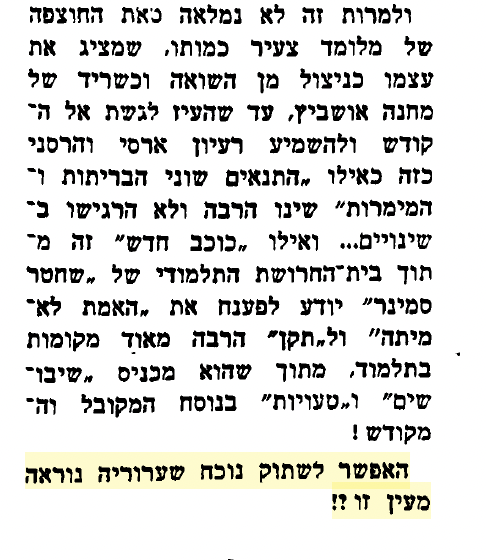
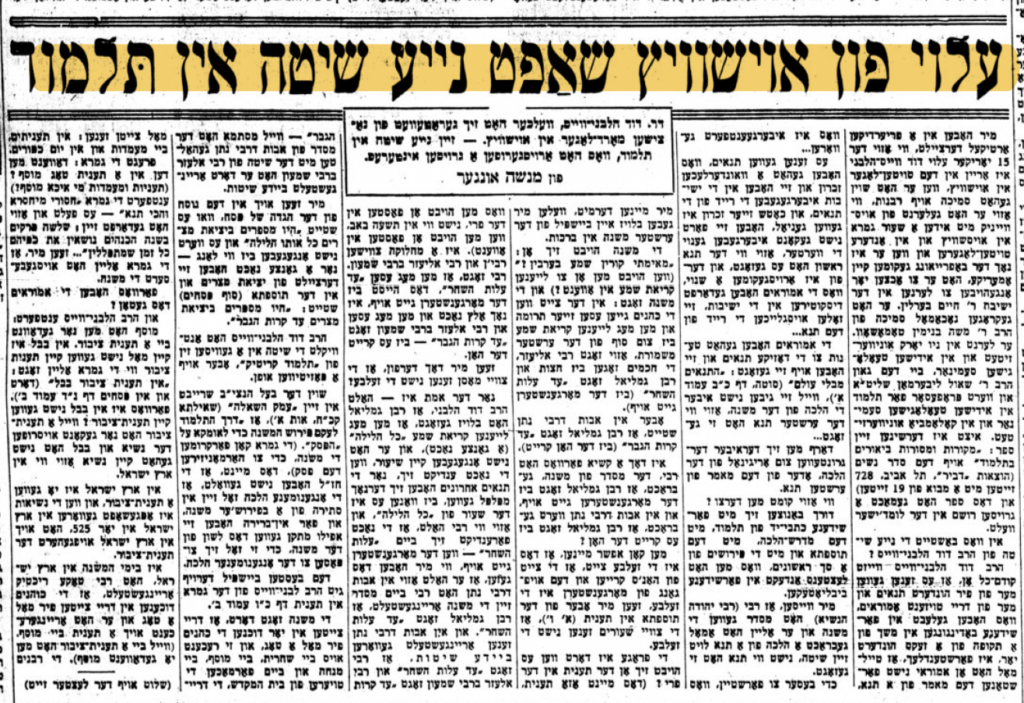
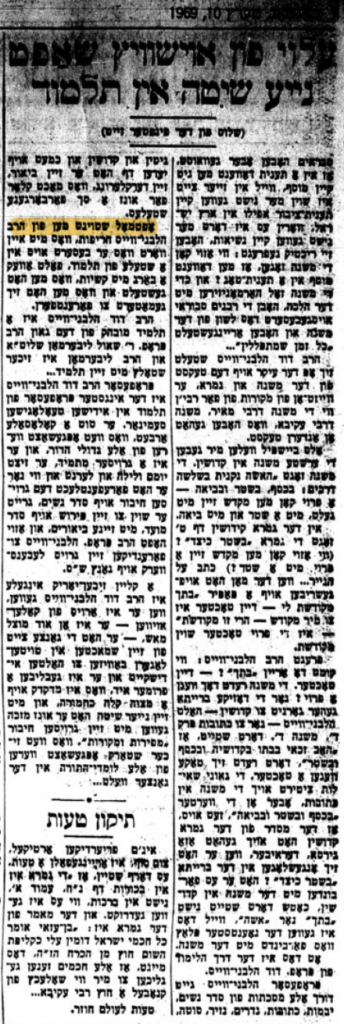
As can be expected, the rabbinic figures Blau surveys in his recent article in Tradition were no great fans of communism.[22] He writes: “My research failed to turn up a single Rabbi [!] of recognized stature who endorsed the communist program.”
.יגעתי ומצאתי After the February 1917 Russian Revolution which brought Kerensky to power, the Orthodox formed a group called Masoret ve-Herut. It contained both Zionists and non-Zionists and was supposed to send a delegation to the All Russian Jewish Congress, which because of the Bolshevik revolution never took place. The group also envisioned itself becoming a real political power with the establishment of the new government. On the seventeenth of Tamuz, 1917, over fifty rabbis came to Moscow for discussions about this, including R. Avraham Dov Shapiro of Kovno, R. Abraham Aaron Burstein of Tavrig,[23] R. Isaac Rabinowitz of Ponovezh (R. Itzele), and R. Aaron Walkin of Pinsk. The Hafetz Hayyim sent greetings but was too ill to attend.
Since the masses did not have any property, one of the issues the new group would have to take a stand on was agrarian redistribution. With the Czar overthrown, it was possible to take not just his land but also the land that belonged to the wealthy princes, noblemen, and magnates and redistribute it, and this was certainly what the average person wanted. However, is this in accord with Jewish law? Can one confiscate another’s property? This was a subject of great controversy among the rabbis, and as can be imagined, many opposed this step. R. Itzele got up and, as recorded by R. Judah Leib Graubart,[24] said the following
החלק הפוליטי נחוץ, כי על ידו נמשוך את בני הנעורים והרחוב להסתדרותנו. גם הלא אנו רואים, כי כלל ישראל חפץ בו, בוודאי מאת ד’ הייתה זאת. וכלל ישראל הוא גבוה ונעלה מגדולי התורה. ישראל אם אינם נביאים, בני נביאים הם.
In other words, if the Jewish people think that the concentration of land in the hands of a minority is unjust and should be redistributed, even if the rabbis claim that redistribution of the land is robbery, the opinion of the Jewish people overrides that of the rabbis.[25] Certainly, all would agree that R. Itzele is a rabbi of recognized stature.
Zalman Alpert called my attention to Jacob Mark’s discussion of R. Itzele in his Bi-Mehitzatam shel Gedolei ha-Dor, 116. Mark mentions that R. Itzele was greatly respected by the radicals (which included at least one of his own sons who was arrested in 1905 for revolutionary activities).[26] He was also very interested in socialism and carefully went through Marx’s Das Kapital. He was greatly impressed by Marx’s ideas, yet Mark notes that he commented: “I cannot agree with his positions, because they oppose the Torah law that protects private property.” I don’t deny that he said as much to Mark, but as we see from Graubart’s book, at the time of the Revolution he had a different perspective.[27] As to how, from a halakhic standpoint, he could have supported redistribution of wealth if the Torah protects private property, this is not a difficult problem. After all, as far as the Rabbis are concerned, governments have the right to engage in all sorts of taxation and redistribution of wealth.[28]
Eliezer Brodt called my attention to R. Moshe Shmuel Shapiro, Rabbi Moshe Shmuel ve-Doro (New York, 1964), 134-135, who tells an interesting story about R. Menashe of Ilya, one of the great students of the Vilna Gaon. (I can’t say whether the story is apocryphal.) R. Menashe was greatly bothered by the terrible poverty in the Jewish community and came up with a revolutionary idea long before Marx. He proposed organizing a meeting of all the great rabbinic and lay leaders in the Jewish community, and their job would be to divide the Jewish wealth evenly. By doing so, the poverty problem would be solved and all would be equal. It is said that he turned to R. Hayyim of Volozhin and asked him to put his stature behind such a gathering. R. Hayyim replied that he is willing to be involved in one half of the program, i.e., the part where the poor receive the money, but the second part, in which the rich have to give up their money, he leaves to R. Menashe. Supposedly, R. Menashe understood from this answer that his plan had no hope.
R. Judah Leib Ashlag was another great rabbi who supported communism (see here ). It is very ironic that today Ashlag’s torch is carried by a few capitalist entrepreneurs, who have become very rich through the Kabbalah Centre.[29]
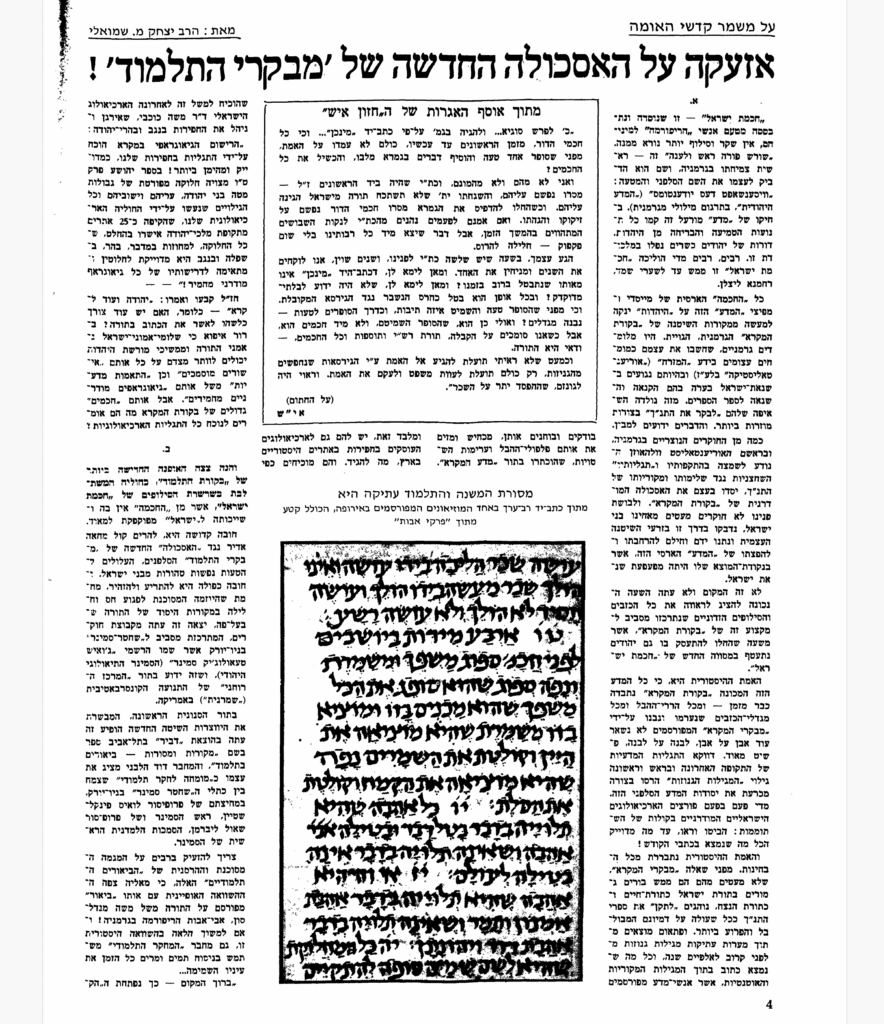
Isaac Steinberg, while not a rabbi, is a figure that should be mentioned. He was a leader of the Social Revolutionary Party and served as commissar for law in the first Soviet government. There is a lengthy article and picture of Steinberg in the Encyclopedia Judaica. Here is another picture of him.
Steinberg was also an Orthodox Jew. His ability to combine revolutionary views and Torah might be due to the influence of his teacher, the brilliant Rabbi Shlomo Barukh Rabinkow, who was himself “a convinced socialist and revolutionary.”[30]
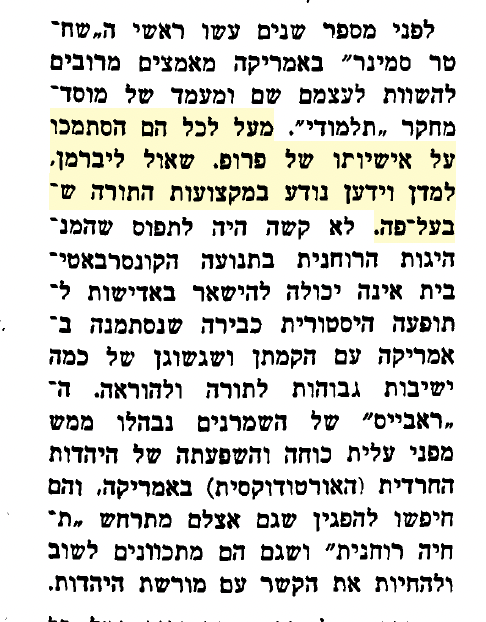
Abraham Bick (Shauli) is also worth mentioning. He was the brother of R. Moshe Bick, who was a leading posek in the Bronx and later in Boro Park. (This is incorrect. A family member has pointed out that they were distant cousins, not brothers). An early musmach of RIETS (in the days of R. Moshe Soloveichik), he was well accepted in the haredi world.[31] (I recall how happy I was to once stumble upon his shul in Boro Park, having finally found a place that davened nusach ashkenaz.) The Bick brothers were direct descendants of R. Jacob Emden, and Abraham Bick is known for publishing a new edition of Emden’s autobiography, Megilat Sefer. He also published a biography of Emden, Rabbi Yaakov Emden (Jerusalem, 1974).
As has already been pointed out on at the Seforim blog,[32] Jacob J. Schacter commented about Bick’s biography that “is uncritical, incomplete and simply sloppy. It is barely more useful than an earlier historical novel in Yiddish about Emden by the same author with the same title published in New York, 1946. In general, all of Bick’s work is shoddy and irresponsible and cannot be taken seriously.” In R. Meir Mazuz’s recently published Arim Nisi (Bnei Brak, 2008), 42-43, he strongly criticizes Bick’s edition of Emden’s Zoharei Ya’avetz (Emden’s notes to the Zohar). He was unaware that R. M. M. Segal-Goldstein has an article in Or Yisrael 43 (5756): 208ff., in which he deals with Bick’s fraudulence in this work, and much more. Following this article, Yehoshua Mondshine added his condemnation as well.[33] Schacter’s judgment is that Bick’s work is “shoddy and irresponsible.” While there is certainly a good deal of this, the more serious problem with Bick is that he was a forger, pure and simple. (Unlike Chaim Bloch, he didn’t forge complete works, only small sections of otherwise authentic works)
Bick also has an article on religious life in the Soviet Union[34] and he co-edited a volume of Torah writings of rabbis in the Soviet Union.[35] Yet what is most fascinating is that he himself was a communist, and even published a Hebrew volume on Marx.[36] In his early years he also published two volumes on religious socialism, both of which had contributions from Steinberg.[37] According to one source, his attraction to communism began when he was a young man in Eretz Yisrael, during which time he was also close to R. Kook.[38] In 1947 Bick was even identified in Congressional testimony, before the Committee on Un-American Activities, as being on the board of the communist School of Jewish Studies (Institut far Yidisher Bildung) located in New York.[39] In 1950 this institution was placed on the Attorney General’s list of Totalitarian, Fascist, Communist and Subversive Organizations.[40]During World War II Bick was also involved with the Jewish Committee for Assistance to Soviet Russia.[41]
R. Chaim Ozer Grodzinski in a 1923 letter refers to someone whom the communists called “the Bolshevik Rrabbi.”[42] R. Chaim Ozer speaks of him with contempt, and regards him as a phony. Yet this rabbi obviously had an audience, as R. Chaim Ozer writes as follows:
וגם בהיותם פה דרוש דרש כמה פעמים והי’ מטיף להתאחדות הסוחרים הקטנים ללמוד מלאכה, ובתוך הדברים הרבה להטיף בשבח הקומוניסטים ולהביא ראי’ מן התורה ומדברי חכז”ל לשיטתם.
Wouldn’t it be interesting to know whom R. Chaim Ozer was talking about? The reason we don’t know is because the editors of the volume have removed the name. Unlike the Chazon Ish’s letters, names are not generally removed in the letters of R. Chaim Ozer. Does the fact that in this case the name was removed mean that we are dealing with someone who is not an unknown figure, maybe someone who later regretted his actions and became a more conventional rabbi? I have no doubt that examination of the Yiddish press of the period would enable one to identify the figure pretty easily.
In fact, thanks to Zalman Alpert’s assistance, I suspect that R. Chaim Ozer was referring to R. Chaim Faskowitz. Faskowitz studied in Eishishok, Lida, Slobodka and Brisk. He then was a preacher in Vilna and later served as a rabbi in Star-Daragi and Minsk before going on Aliya. He was known as the “Red Rabbi” for his sermons supporting the Soviet Union.[43]
Yet for the best of all quotes in this regard, one which really needs to be unpacked, no one can do better than R. Kook (Shemonah Kevatzim 1:89-90):
הנשמה הפנימית, המחיה את השטה הסוציאלית כפי צורתה בימינו, היא המאור של התורה המעשית, במלא טהרתה וצביונה. אמנם שהשטה בעצמה עומדת היא באמצע גדולה, ואיננה יודעת עדיין את יסוד עצמיותה. אמנם ימים יבאו ותהי למוסר נאמן לאמץ התורה והמצוה, במלא שיגובם וטהרתם.
האנרכיה היא נובעת מיסוד יותר נעלה מהסוציאלי[ו]ת. איננה יסוד לתורה המעשית וקיומה, כי אם להדבקות האלהית, העליונה מכל מעשה וסידור חיובי. על כן היא עוד יותר רחוקה ממקורה, שהוא עומד רחוק מאד משפלות החיים של ההוה, מהסוציאליות, ובמצבה של עכשיו, ומצב החיים של ההוה, היא פרועה כולה, למרות הניצוץ האלהי הנשגב המסתתר בתוכיותה.
Regarding opposition to communism, the following interesting passage is found in Eliezer Zweifel, Sanegor (Warsaw, 1885), 164:
הרב הגדול ר’ יוסף חיים קרא אבד”ק וולאצלאוועק יאריך ה’ ימיו, אמר לי שלדעתו כנו חז”ל את כת הקומוניסטים בשם ע”ה, והם אותה האומרים כיס אחד יהיה לכולנו והכל יהיו עמלים לאמצע, וכמו שהממלכות שבימינו מוצאות אנשי הכת הזו להורסים שלום המדינה, ולמנתקים קשרי החבורה האנושית, כן הרחיקו חז”ל את החבורה המזקת הזו, ולפי דעתו השערתו זו מבוארת היא בדחז”ל עצמה, שהם ז”ל הגדירו תאר ע”ה בזה, באמרם בפרקי אבות, שלי שלך ושלך שלי עם הארץ ע”כ. הנה כללו את כל השטה הזו במלות קצרות, ע”כ.
Returning to Graubart’s Sefer Zikaron, it is actually quite a fascinating text and an important source for Orthodox history during the final days of Czarist Russia and the post-Revolution era. In addition, he includes letters from various rabbis and descriptions of numerous figures in East European Jewish life. He also records the following joke in the name of R. Solomon Zalman Lipshitz (1765-1839), the first chief rabbi of Warsaw (217):
מחבר “חמדת שלמה”, הרב מוורשה, כתב מכתב לרב אחד ויתיארהו בשם “גאון”. וכאשר נשאל: “מה ראה על ככה, הן האיש ההוא אין העטרה הולמתו”? השיב בבדיחות: “הלא הגאונים )אחרי רבנן סבוראי) לא ידעו מה שנאמר ברש”י ותוספות וכמוהם כמוהו איננו יודע. ואם כן, הוא משרידי “הגאונים” הקדמונים.
On the previous page, Graubart asks where the practice arose of addressing people with all sorts of elaborate titles that are a standard feature of the rabbinic literary world, especially in the introductory sections of letters. His answer is very interesting and also relates to the issue of sensual medieval Hebrew poetry, which I have mentioned in a few previous posts at the Seforim blog:
וקרוב לאמת, כי זאת השפעה מן הערביים, שהיו מספיקים בגוזמאות והפרזות, וכמו שחקו אותם משוררינו הספרדים לפנים בשירי יין ואהבה, אף שהמשוררים ההם שתו יין ארבע כוסות אחת בשנה ומעודם לא טעמו טעם חטא, ורק מודה ספרותית היתה בזה.
With regard to elaborate titles and the extreme respect generally shown to halakhic authorities with whom one disagrees, it is worth noting what appears in the recently published Or Bahir of R. Moses Samuel Glasner, concerning whom has recently been two posts on the Seforim blog (here and here). He writes (25):
הסיבה לזה הוא שבדורנו השפל האמת נעדרת, ואין מי שיתחמם בעבורה כבדורות שלפנינו, ולעומת זה גדלה החנופה, ובשלה פרי רעל לדבר אחד בפה ואחד בלב, ומלא הארץ חנף וצביעות בתוארים שונים מגוזמים ומופרזים המחרידים אוזן השומע ועין הקורא.[44]
As I mentioned, Graubart’s book is fascinating reading, but I think many will be upset by the reason he gives for the exclusion of women’s testimony in court (208):
להרוג נפש או להוציא ממון מבעליו, צריך עדות ברורה ואין לסמוך על דברי נשים, שטבען נוטה לדמיונות, הזיות וגוזמאות והן רפות רוח ורכות לבב; ויוכל היות כי מה שאומרות ומעידות שראו עיניהן, הן מרבין לשער אומדות.
To support this understanding he also quotes a few non-Torah sources. One is Josephus who wrote: “Let not the testimony of women be admitted, on account of the levity and boldness of their sex” (Jewish War 4:8). He also quotes Socrates who is said to have made three blessings every day, one of which was that he was not made a woman. The other two blessings were that he was not made a barbarian or a slave – sound familiar?[45]
(To those women who are bothered by the blessing shelo asani ishah, R. Zvi Yehudah Kook has the answer, but you will have to wait until Messianic days! [Ittturei Kohanim, no. 167 (5759), 4-5]):
[ ]הברכות נקבעו על פי ההרגשה האנושית היחסית . . . לעומת זאת, ההשקפה האלהית, האמת המוחלטת, אינה ענין של הרגשה חולפת, אלא האמת הנצחית מראשיתה ועד סופה. לעתיד לבוא, כאשר גם האדם יכיר את האמת, ויהיה כולו מבחינת “הטוב והמטיב”, לא יוכל לברך “שלא עשני אשה”, שהרי אז יכיר שבניינה של האשה יותר רם, יותר אלהי ופחות אנושי, ממצבו הוא.
Following this logic, what about all those men who even in pre-Messianic days don’t regard women as second class in any way? Shouldn’t they be able to dispense with the blessing as early as tomorrow morning?)
Graubart, 65, also notes that many great scholars make simple grammatical errors וכמעט שלשון .עלגים היא סימן ללמדנות
He then tells the following joke, in the name of the Hakham Zvi, which everyone can repeat at their Passover seder.
רבים שואלים, בהגדה של פסח, למה מגנים ומחרפים את הרשע, על אמרו לכם ולא לו, הלא גם החכם אומר “אתכם” ולא “אותנו” – אך באמת, כונת החכם (הלמדן) הוא “אותנו” ורק מפני טרדתו בלמוד הגמרא והפוסקים הוא טועה בכנויים ומבטא “אתכם” תחת “אותנו” שלא בדקדוק, ואין לחשוד אותו כי בכונה אומר “אתכם”. לא כן הרשע שאיננו עוסק בגמרא, והוא מבעלי הדקדוק ויודע את ההבדל בין לכם ולו וב”דעת” שפתיו ברור מללו, אם הוא אומר “לכם” בכונה הוציא את עצמו מן הכלל.
Graubart also explains why Poland wasn’t blessed with the sort of great figures who were found in Lithuania, men who were able to be true rabbinic leaders and respond to problems as the times demanded. He places the blame with the Hasidim. In a passage that could well be written today (although it would then also have to include the contemporary Lithuanian “courts”) Graubart writes (173):
אבל “רבי החסידים”‘, אשר שפכו את ממשלתם על ההמון, קצצו את כנפי הרבנים ולא נתנו להם להרים ראש ולהראות פעלם והדרם. מפני הרביים רפו ידי הרבנים ולא יכלו לעשות תושיה; ואמת נתנה להגיד, כי לא את הרבי היו יראים לעשות דבר, אך מפני בני הרבי וחתניו, והגבורים שומרי משמרת החצר, השוקלים ומודדים את המעשים והפעולות, אם הם מתאימים עם שיטתם ומטרתם הם, והם אשר נתנו חתיתם על הרבנים ומוראם עליהם, כי כל דבר לא יבצר מהם לכבוד שמים, היינו לכבודם ולכבוד בית אביהם. ומי יקשה אליהם וישלם? והרבנים שפטו, כי אם יפרוץ סכסוך בינם לבין חצר הרבי, אז אף אם לא יהי הנצחון על צד השני, ולא ידיחום משאתם, אבל – הלא תהי מריבה בישראל, וגדול השלום.
Among the ideas of new Masoret ve-Herut organization Graubart helped organize was to open new schools (gymnasiums) where all the Jewish studies would be taught in Hebrew, and also to teach secular studies. Graubart tells us that the Lubavitcher Rebbe, R. Shalom Dov Ber Schneersohn, was opposed. This aroused the anger of R. Itzele who declared that anyone who opposes the approach of Masoret ve-Herut is destroying the nation. Graubart then tells us about his own dealings with the Lubavitcher Rebbe, and reveals a little known historical fact that certainly will never appear in any Lubavitch historical literature (120-121):
הגדתי לו, כי אחשוב שאינו יודע כי רוב אנשי חסידיו, היושבים בערים הגדולות, שולחים את בניהם ובנותיהם לבתי ספר העמים ומחללים שבת. וכאשר שאלני: “מנין אתה יודע, שאין אני יודע זאת?” עניתיו: “אם כן יגדל התמהון יותר; מדוע אתה מתנגד לגימנזיות עבריות, אשר תהיינה תחת השגחת חרדים?” ויחשה ולא ענה דבר.
The approach of the Rebbe is not surprising, and a similar thing occurred in Lithuania where, as R. Dessler explained, the rabbinic elite was prepared to see many “go off the derekh” rather than institute any changes in the “Torah-only” approach that dominated in yeshivot.[46]
Yet Graubart’s own approach is seen in the following, which shows his more enlightened Orthodox perspective (98):
התורה קוראת תגר: למה כל הרופאים והסוללים [47] היהודים אינם שומרי דת? בשום אופן אין אנו מודים, כי מי שהוא מתפלל ומניח תפילין, אי אפשר לו להיות רופא אמן, וכי המדקדק בשמירת שבת ובאכילת בשר כשר, לא יהיה למהנדס ותוכן; כל העבר שלנו מעיד נגד זה: רב סעדיה גאון, רמב”ם, רמב”ן, ר’ אברהם זכות, אברבנאל, ר’ יש”ר, ר’ מנשה בן ישראל, יתנו עדיהם כי לא בחלול שבת – פילוסופיה ותכונה – ולא באכילת טרפה – חכמה הרפואה.
His description (55) of his interaction with R. Joseph Rozin is also worth quoting, as it is line with so many other portrayals of the Rogochover, especially that of Rav Tzair in his Pirkei Hayyim.
הוא איש מופת יחיד בדור (וגם בדור ודור) יודע את כל תלמוד בבלי וירושלמי רש”י תוספות ורמב”ם בעל-פה. מן הראשונים הוא מחזיק לאוטוריטטים רק את רש”י ורמב”ם. הוא מכיר היטב את ערך עצמו ומבטל את גדולי הדור, מזכירם בשמם בלי תואר “רבי” ואיננו חושש להוציא עליהם משפט, שאינם יודעים את התורה כלל . . . הוא איש טוב ותמים כילד: שוקד על למודו תמיד; בהוויות עולם איננו בקי. חסידי לובוויץ מפרנסים אותו, ולא בהרחבה כראוי לשר התורה כמוהו, כי ראיתי כלי ביתו מעטים וקלי-ערך.
Notes
[1]Teshuvot Maharashdam, Orah Hayyim no. 37:
שחמשה או י’ אנשים חשובים עולים לאלף בין מצד החכמה ובין מצד העושר כי העושר קרוב למעלת החכמה . . . שמה שאמרו רוב הוא רוב טובי העיר בעלי כיסים הם מה שנקראים רוב אפי’ הם מיעוט בערך דלת העם מ”מ הם הנקראים רוב . . . והעיק’ לילך אחר רוב מנין כשיהיו רוב בנין דאז ודאי לא יבחרו אלא האמת והיושר משא”כ ברוב ההמון
[2] Note how de Medina is arguing from Aggadah to prove a halakhic point, a fact already discussed by Menachem Elon, “Modes of Halakhic Creativity in the Solution of Legal and Social Problems in the Jewish Community” (Hebrew), Yitzhak F. Baer Memorial Volume [= Zion 44] (1979): 259ff. Since Aggadic sources and darshanut can be easily manipulated to say what one wants, do we not really have here an early version of Daas Torah? The only real difference between the modern exponents of Daas Torah and the earlier ones seems to be that the earlier authorities felt the need to support their opinions, which they came to based on logic and intuition, with Scriptural and Aggadic proofs. The modern exponents often feel no need to offer any justification of their views.
[3] Translation in Menachem Elon, “On Power and Authority: The Halakhic Stance of the Traditional Community and Its Contemporary Implications,” in Daniel J. Elazar, ed., Kinship and Consent: The Jewish Political Tradition and Its Contemporary Uses (Washington, D.C., 1983), 309.
[4] Orah Hayyim, no. 20.
[5] R. Shabbetai Hayyim strongly supported de Medina’s approach. See Torat Hayyim, vol. 2, no. 40.
ופוק חזי בעירנו זאת שאלוניקי עיר ואם בישראל מימי קדם בימי איתני גאוני עולם, הממונים המפקחים על ענייני צבור הם העשירים מביני מדע בעצת החכמים השלמים, ואינם משגיחים על דברי רוב רובי דלת העם, והדעת נותן כן שהרי רוב ענייני הצבור הם בהוצאות ופרעונות ולראות ולדקדק להוציא בעת הצורך ובמקום הצורך שלא יצא הממון לאיבוד, ומי יחוש על זה לכוין ולדקדק חוץ מהם שמוציאים הממון.
Yet this opinion was not unanimous, and the poor found at least one defender in R. Isaac Adarbi, de Medina’s Salonikan colleague. According to Adarbi, only in matters concerning outlay of money do the wealthy have authority. In other matters there is no such discrimination. In line with this understanding, he comes to the defense of a community that ousted its parnasim who were ruling in a dictatorial fashion and not responding to the needs of the poor. See Divrei Rivot, Yoreh Deah, no. 224.
[6] See Zikhron Yaakov, vol. 2, p. 196:
אני קורא מגילת איכה, חורבן בית המקדש, אינקוויזיציות ופוגרומים, משא נמירוב, כל הצרות והפגעים שעמדנו בהם כאין נחשבו נגד גזרת הקנטאָניסטין
[7] See Zikhron Yaakov, vol. 1, 122f
[8] R. Barukh Epstein describes how his grandfather stood up to the chappers. See Mekor Barukh, vol. 2, 964ff. I see no reason to doubt the general thrust of his story, although, as is often the case with regard to Esptein, fictional details have no doubt been added to create a better story. Hayyim Karlinsky, Ha-Rishon le-ShosheletBrisk (Jerusalem, 2004), 214ff., has a long description of how R. Joseph Baer Soloveitchik (the Beit ha-Levi) also stood up to the communal leaders and demanded to know why only the poor kids should be taken. Regarding the future Torah scholars, see ibid., 217: תועבה נעשתה בעיר סלוצק למסור לעבודת הצבא בן-תורה שעתיד להיות גדול בישראל. As with Mekor Barukh, I see no reason to doubt the basic story Karlinsky presents, but this book – which the author tells us in the preface took him over forty years to write – also has all sorts of fictional details added for literary purposes. One might even say that Epstein, Karlinsky and Judah Leib Maimon, the author of Sarei ha-Meah, are midrashic writers, in that they take a story and elaborate on it, thus creating a nice tale that keeps the reader’s interest. While the original story would leave many things unexplained, the midrashic “historian” provides the answers. For Yehoshua Mondshine’s attack on Karlinsky’s reliability, see here.
In “Polmos ‘ha-Rabbanim ve-ha-Shohetim’ be-Harkov,” Zekhor le-Avraham (1999), 383 n. 10, Mondshine writes the following about Karlinsky’s book:
מבחינת ערכו לתיאור ההיסטוריה, משתווה ספר זה לספרים “מקור ברוך” ו”שרי המאה”, שכל דמיון בין המתואר בהם לבין המציאות הוא מקרי בהחלט.
[9] Larry Domnitch, The Cantonists: The Jewish Childrens’ Army of the Tsar (Jerusalem, 2003), 70.
[10] Ibid., p. 127.
[11] Tsar Nicholas I and the Jews. The Transformation of Jewish Society in Russia 1825-1855 (Philadelphia, 1983), 29.
[12] Ibid., p. 33.
[13] See Malkah Peles (Maisler) Va-Yehi ([Haifa], 1988). I thank Dr. Amihai Mazar for sending me the relevant pages from this privately printed volume. Weinberg was a cousin of the Mazar (Maisler) family (famous for its archaeologists).
[14] See my Between theYeshiva World and Modern Orthodoxy: The Life and Works of Rabbi Jehiel Jacob Weinberg, 1884-1966 (London, 1999), 4.
[15] Ha-Peles 2 (1902): 49ff.
[16] R. Samuel Landau and the Hatam Sofer opposed this approach and believed that that all should be included in the lottery when the community was required to meet a draft quota. (The one exception to this statement is that the Hatam Sofer states that Torah students must be exempted.) See Judith Bleich, “Military Service: Ambivalence and Contradictions,” in Lawrence Schiffman and Joel Wolowelsky, eds., War and Peace in the Jewish Tradition (New York, 2007), 423 (called to my attention by Menachem Butler).
[17] Israel Zinberg, A History of Jewish Literature, vol. 6, pp. 218-219.
[21] Volumes 1 and 2 of this set have recently been reprinted. See here.
[22] R. Isaac Bunin, Hegyonot Yitzhak (New York, 1953), no. 2, has a fascinating responsum from 1908, when he was a rabbi in Russia. This was the era of anarchist communists terrorizing the population for “contributions” to the cause. It was this circle that gave us the slogan “From each according to his means, to each according to his needs.” One man decided to shoot the anarchists the next time they came to his town, and the question for Bunin was if he is also permitted to shoot them on Shabbat. The rabbi decided in the affirmative.
[23] Although he is entirely forgotten today, during his lifetime Burstein was regarded as one of the Torah world’s top scholars. Nathan Kamenetsky, Making of a Godol: A Study of Episodes in the Lives of Great Torah Personalities (Jerusalem: Hamesorah Publishers, 2002), 400, quotes a source that “he was considered the third-greatest rosh yeshiva of his time – after R. Hayyim Soloveitchik and R. Itzel Ponivezher.” When R. Jehiel Jacob Weinberg was asked in 1925 about the problem of Austritt, he recommended that his questioner turn to a few different East European gedolim, one of whom was Burstein. See Kitvei ha-Gaon Rabbi Jehiel Jacob Weinberg, vol. 2, 235 (In this letter, Weinberg states that R. Meir Simhah of Dvinsk is a גדול-הדור באמת.) Towards the end of his life, Burstein went on aliyah and taught at Merkaz ha-Rav. His Ner Aharon is currently sold by the yeshiva. See here. Burstein’s son was Reuven Barkat, an important Labor party figure in Israel who also served as speaker of the Knesset. See here
[24] Sefer Zikaron (Lodz, 1926), 107.
[25] See R. Avraham Shapira, Morashah (Jerusalem, 2005), 15.
[26] Mark writes . לר’ איצל היה צער גידול בנים ולא שבע נחת מבניו This is a polite way of saying that his sons did not remain Orthodox, which was a very common phenomenon in those days.
[27] Mark, Bi-Mehitzatam, 118, claims that R. Itzele concluded his speech at the Moscow gathering by stating that the government should only be able to remove property from landowners if payment was made, but this is not what appears in Graubart’s record of his speech and I don’t believe it is correct.
[28] R. Joseph Elijah Henkin used this logic in his defense of rent control laws, which are a terrible intrusion into the rights that a landlord has over his private property. R. Henkin wrote as follows, unfortunately falling into some Democratic class warfare rhetoric (Kitvei ha-Gaon R. Yosef Eliyahu Henkin, vol. 2 [New York, 1980], 175):
חוק הדירות של הממשלה הוא ישר, מתוקן ומקובל בפרט בערים הגדולות, כי הוא מכוון נגד מפקיעי שערים ופושטי עורות עניים. ואף שלפעמים נראה כעול נגד בעלי בתים שאינם עשירים, הנה כן דרך החוק שלפעמים נפגע ביושר ואזלינן בתר רובא. ומה שהחק מפלה בין דירות עניים לבתי לוקסוס אינו מגרע כח החק אלא מעדיפו ומטהו אל צד היושר, וכן מה שהחק משתנה מזמן לזמן.
For a recent attempt by rabbis to enforce a rent control scheme, see here, here, and here. There is an inverse proportion between these rabbis’ talmudic knowledge and their knowledge of economics and what drives markets.
[29] Jody Myers has recently published an entire book about the Kabbalah Centre. See Kabbalah and the Spritual Quest: The Kabbalah Centrein America (Westport, 2007).
[30] See Jacob J. Schacter, “Reminiscences of Shlomo Barukh Rabinkow,” in Leo Jung, ed., Sages and Saints (Hoboken, 1987), 102, 106.
[31] There was one time, however, when he broke ranks with them and this created some controversy. When the divorce rates in the Orthodox world began to move up, R. Bick publicly declared that a few dates were not enough to determine that one had found one’s life partner and people should therefore should stop hurrying to get engaged but take more time to get to know each other better.
[32] Dan Rabinowitz, “Mayim Hayyim, the Baal Shem Tov, and R. Meir the son of R. Jacob Emden,” the Seforim blog (January 29, 2008), available here.
[36] Netser mi-Shorashav: Motsa’o ve-Olamo ha-Yehudi shel Karl Marx (Tel Aviv, 1984). See also his Me-Rosh Tzurim: Metaknei Hevrah al Toharat ha-Kodesh: Shalshelet ha-Yuhasin shel Avot ha-Socialism (Jerusalem, 1972), and “Between the Holy Ari and Karl Marx” (Hebrew), Hedim 110 (1980): 174–181. I don’t have access to the volume at present, but in Shvut 7 (1980), Bick also has an article on the Jewish roots of various communist figures.
[37] Grunt-Printsipn fun Religyezn Sotsyalizm (New York, 1938), Kemper un Hiter: Di Sotsyaletische Idee in der Yidisher religyezer Literatur un Lebn (New York, 1940).
[43] See David Tidhar,Entziklopeyah la-Halutzei ha-Yishuv u-Vonav, 1875.
[44] Just glancing through the book, I also found a fascinating passage on p. 31. Here Glasner daringly suggests that the reason for keeping kabbalistic considerations out of halakhic decision-making – and he is referring specifically to a pesak of R. Hayyim Halberstam – is that it permits non-halakhic subjectivity to enter the halakhic process.
ומי שמכוון פסקיו לחכמת הקבלה, מי יודע איזה רעיון קדמה בזמן. ואם הוא מופשט מן החומר וקרוב לשמים ואדוק בעולמות העליונים קרוב לודאי שרואה תחילה בסוד אלקי, וממילא משוחד הוא לכוון ולהתאים הנגלה להאי סוד שראה. לכן לאו דסמיכנא הוא מהאי טעמא גופא.
For a discussion of R. Halberstam’s perspective on the role of Kabbalah on halakha, see Iris (Hoyzman) Brown, “Rabbi Hayyim Halberstam of Sanz: His Halakhic Ruling in View of His Intellectual World and the Challenges of His Time,” (PhD dissertation, Bar-Ilan University, 2004), 162-164 (chap. seven).
[45] See Martin Hengel, “The Interpenetration of Judaism and Hellenism in the pre-Maccabean Period,” in W. D. Davies and Louis Finkelstein, eds., Cambridge History of Judaism (Cambridge, 1989), 184. R. Aharon Lichtenstein commented that some people, upon learning of Socrates’ blessings and the corresponding Jewish blessings, will find that their attitudes towards the latter are “undermined.” He continues: “A different mentality could of course, as did Newman analogously, revel in the scope of its tradition’s prevalence – even if, as with respect to gender here, for radically different reasons – and not feel threatened at all.” See “Torah and General Culture: Confluence and Conflict,” in Jacob J. Schacter, ed., Judaism’s Encounter with Other Cultures: Rejection or Integration (Northvale, 1997), 278. I am certain that R. Lichtenstein knows that there are indeed voices in the “tradition” that approximate the common Greek view of women. R. Lichtenstein is in general opposed to positing outside influences on Hazal’s outlook. See, for example, the following (“Of Marriage, Relationship and Relations,” in Rikvah Blau, ed., Gender Relationships In Marriage and Out [New York, 2007], 23):
To be sure, post-Hazal gedolim, rishonim, or aharonim may be affected by the impact of contact with a general culture to which their predecessors had not been exposed and to whose contact and direction they respond. Upon critical evaluation of what they have encountered, they may incorporate what they find consonant with tradition and reject what is not. In the process, they may legitimately enlarge the bounds of their hashkafa and introduce hitherto unperceived insights and interpretations.
Note how outside influence upon Jewish thought is limited to the post-Hazal era. While this may be good theology, and in some circles is even viewed as obligatory, it is certainly bad history. To mention only one example, Yaakov Elman’s groundbreaking work is revealing all sorts of influences that provide us with a completely new picture of talmudic law and thought. See Yaakov Elman, “The Babylonian Talmud in Its Historical Context,” in Sharon The Talmud in Translation” in Sharon L. Mintz & Gabriel M. Goldstein, eds., Printing the Talmud: From Bomberg to Schottenstein (New York: Yeshiva University Museum, 2005), 19-27; now available online here.
[47] I have no idea what this word means, but it clearly refers to some white-collar profession.
The Anonymous Author of Tikkunei Zohar and Ra‘ya Mehemna: An Antinomian or a Radical Maimonidean?
By Bezalel Naor
Today, it is an accepted fact in scholarly circles that Tikkunei Zohar and Ra‘ya Mehemna form a single unit that postdates the main body of Zohar.[1] More than one reader has been scandalized by statements in Tikkunei Zohar and Ra‘ya Mehemna likening the Mishnah to a shifhah or maidservant.[2] Predictably, in response, there grew an apologetic literature that attempts to justify how such shocking statements are compatible with normative Halakhah.[3]
One cannot rule out altogether the assertion by various secular historians that these pejorative statements betray an antinomian streak,[4] though to be certain, such statements of Tikkunei Zohar and Ra‘ya Mehemna are not situated in the present but deferred to the future. With this proviso, they are no more “antinomian” than the statement of Rav Yosef in the Talmud: “Mitsvot (commandments) are nullified in the future.”[5]
I wish to present a hitherto unexplored possibility. It seems likely that the anonymous author of Tikkunei Zohar and Ra‘ya Mehemna (which surfaced in Spain in the first decades of the fourteenth century)[6] was not so much an antinomian as a radical Maimonidean. It is in this light that we should understand negative statements issuing from the author regarding the study of Mishnah or those comparing the various Talmudic exercises and mental gymnastics to the backbreaking labor to which the Children of Israel were subjected in Egyptian exile.[7] These do not spring from an anti-halakhic mindset but rather from taking at face value Maimonides’ syllabus as laid out in his introduction to Mishneh Torah:
Hence, I have entitled this work Mishneh Torah (Review of the Law), for the reason that a person, who first reads the Written Law and then this [compilation], will know from it the whole of the Oral Law, without having need to read any other book between them [italics mine—BN].
We should be asking ourselves: Are there any historical grounds to assert that in Spain in the early 1300s there were halakhic Jews who openly—we should add, brazenly—promulgated the Maimonidean curriculum to the exclusion of Talmudic studies and the concomitant exercise of pilpul?
I offer the words of Joseph Ibn Kaspi:
Therefore my rabbis, listen to me and God will listen to you! I see that it is the intention of those among you who engage in Gemara, novellae and opinions (shitot),[8] to know proofs for the practical commandments, for you are not satisfied with the tradition from Mishneh Torah composed by Rabbenu Moshe [i.e. Maimonides], though he said: “And one shall have no need of any other book between them [Italics mine—BN].”
Here is an example. Ha-Rav ha-Moreh [i.e. Maimonides] wrote in his laws: “A sukkah that is higher than twenty ammah is invalid.”[9] Yet you despair and are without comfort until you know whether the reason is because “the eye does not rest upon it,” or because “one is not sitting in the shade of the sekhakh (overhead boughs) but of the walls,” or because “the sukkah must be a temporary dwelling,” as written in the Gemara.[10] Even this will not satisfy the very punctilious (mehadrin min ha-mehadrin) until they have added problems and opinions (shitot)[11]: “If you should say,” “one may say,” etc.
Truly, I admit that this is good, but why is the knowledge of proofs an obligation in regard to practical commandments, while not [even] an option,[12] but an outright prohibition when it comes to commandments of the heart? What sin has been committed by these four commandments of the heart (that I mentioned) that you do not treat them in the same manner but are satisfied by a weak tradition of few words, wanting comprehension?[13]
Who was Joseph Ibn Kaspi? Born either in Arles, Provence or Argentière, Languedoc,[14] around the year 1280, he passed in 1345 on the island of Majorca. His was a peripatetic life. The first period of his life was spent in the south of France. Later he gravitated to Barcelona, where his married son David resided. At approximately age thirty-five he travelled to Egypt for several months,[15] hoping to acquire there the intellectual legacy of Maimonides from the Master’s fourth and fifth generation descendants but was sorely disappointed in this respect. He even entertained the thought of traveling to Fez, Morocco in search of wisdom,[16] but that particular journey never materialized.
Ibn Kaspi’s reputation is that of an ultra-rationalist. His naturalistic explanations of events in the Bible far exceed even those of Maimonides; for that reason his opinions were marginalized. Though there is an abundance of manuscripts, it was only in the nineteenth century that Ibn Kaspi’s works were published from manuscript. (A few still remain in manuscript.) To this day, his interpretations have yet to “mainstream.”
My juxtaposing the Maimonidean enthusiast Joseph ibn Kaspi to the anonymous author of the kabbalistic works known as Ra‘ya Mehemna and Tikkunei Zohar may strike the reader of this essai as bizarre. Besides their contemporaneity, what basis is there for this juxtaposition?
Geographically, there are certainly grounds for relating the two authors to one another. Though separated by the Pyrenees, there was much traffic, intellectual and otherwise between Provence and Northern Spain. Some of the greatest families of Provencal scholars originated in Spain: the Kimhis, Joseph and his son David, who excelled as grammarians and Bible exegetes; and the Tibbonides, Judah and his son Samuel, who were the premier translators of classic philosophic works from Judeo-Arabic to Hebrew. And the traffic was two-way. Prominent Provencal families wended their way to Sefarad. The halakhist Rabbi Zerahyah Halevi (“Ba‘al ha-Ma’or”), a native of Gerona, established his career in Narbonne, only to return to Gerona at the end of his days. (His great-grandson was the Talmudist Rabbi Aharon Halevi of Barcelona.)[17] Ibn Kaspi is an example of a Provencal scholar who relocated to Catalonia: Barcelona, and eventually, the Balearic isle of Majorca. Thus, there could easily have been a sharing of ideas between southern France and northern Spain.[18]
In terms of mindset, the border between rationalist philosophy and kabbalah was especially porous at this time. Whoever authored Ra‘ya Mehemna and Tikkunei Zohar, carried with him much Maimonidean baggage. Linguistically, it is apparent to any student of the Ra‘ya Mehemna and Tikkunim that they are rife with the philosophic jargon made popular by the Tibbonides’ translations from Judeo-Arabic.[19] And let us not forget that the very backbone of Ra‘ya Mehemna is an enumeration of the commandments à la Maimonides’ Sefer ha-Mitsvot. (Rabbi Reuven Margaliyot isolated these commandments and presented them in orderly fashion in the introduction to his edition of the Zohar.)
*
When we put it all together it makes perfect sense. As shocking as some of its bold statements may be, the literary oeuvre of Ra‘ya Mehemna and Tikkunei Zohar cannot be construed as issuing from the mind of an antinomian. An antinomian would not go to the bother of constructing a Book of Commandments after a fashion. Rather, I maintain that the downgrading of the study of Talmud in general, and Mishnah in particular, should be attributed to a radical adoption of Maimonides’ curriculum of studies, whereby his halakhic magnum opus Mishneh Torah has superseded the study of Mishnah and Gemara.
In this respect, Maimonides’ devotees in Provence and Spain ventured beyond the Master himself. Maimonides penned a convincing letter to Rabbi Pinhas, the Dayyan (Justice) of Alexandria,[20] that regardless of what he wrote in the introduction to Mishneh Torah, the traditional study of the Talmudic tractates (albeit as summarized in Alfasi’s Halakhot) continues unabated in his beit midrash.[21] The curriculum that Maimonides once proposed remained an abstraction. It seems that Egyptian Jewry was not overly receptive to this innovation. Only well over a century later, did this great intellectual experiment of Maimonides, Mishneh Torah, a “hivemind of halakhah,”[22] designed to replace the “dialectics of Abayye and Rava,” find foot soldiers in the likes of Ibn Kaspi and the anonymous author of Ra‘ya Mehemna and Tikkunei Zohar. They launched their campaign from the soil of Provence and Spain.
Our thesis does not ride on the reputation of Joseph ibn Kaspi. Ibn Kaspi’s statement is perhaps the most outspoken and provocative call for adoption of Maimonides’ Mishneh Torah as a way of bypassing Talmudic studies, yet there are other testimonies (from the least expected quarter) that the exclusive study of Mishneh Torah was starting to gain traction in medieval Spain.
The great halakhist Rabbi Asher ben Yehiel (Rosh) emigrated from Germany to Spain at the turn of the fourteenth century and eventually emerged as the Rabbi of Toledo, Castile, where he left his stamp on the shape of Castilian Halakhah.[23] Evidently, Rabbi Asher had cause to fulminate against authorities who decided questions of practical Halakhah based solely on the rulings of Mishneh Torah without recourse to Talmud.
Rabbi Asher writes:
I heard from a great man in Barcelona who was eminently familiar with three orders [of the Talmud, i.e. Mo‘ed, Nashim and Nezikin]. He said: “I am amazed at people who have not studied Gemara and adjudicate based on their reading in the books of Maimonides, of blessed memory, believing that they understand them. I know myself, when it comes to the three orders that I studied, I am able to understand when I read Maimonides’ books. However, his books that are based on Kodashim and Zera‘im—I do not understand at all. And I know that it is that way for them regarding all his books![24]
*
Rabbi Yahya Kafah (1850-1931) was not wide of the mark when he asserted that those statements in Zoharic literature that undercut the Talmud (comprised of Mishnah and Gemara) were designed to enhance the prestige of the Kabbalah. (By the same token, one may safely say that Ibn Kaspi’s desire to streamline the study of Halakhah, stemmed from his valorization of Philosophy.)
Logically, our next question should be: What was Maimonides’ own stake in proposing that his compendium Mishneh Torah take the place of protracted Talmudic studies? Maimonides provides a simple answer to this question in his introduction to Mishneh Torah:
At this time, severe vicissitudes prevail, and all feel the pressure of hard times. The wisdom of our wise men has disappeared; the understanding of our prudent men is hidden. Hence, the commentaries of the Geonim and their compilations of laws and responses, which they took care to make clear, have in our times become hard to understand so that only a few individuals properly comprehend them. Needless to add that such is the case in regard to the Talmud itself—the Babylonian as well as the Palestinian—the Sifra, the Sifre and the Tosefta, all of which works require a broad mind, a wise soul and lengthy time, and then one can know from them the correct practice as to what is forbidden or permitted, and the other rules of the Torah.
On these grounds, I, Moses the son of Rabbi Maimon the Sefardi, bestirred myself…[25]
While perhaps not the ideal curriculum, the exigencies of the time demanded the production of a bold new work on the order of Mishneh Torah that would preserve the practice of Halakhah for the masses ill-equipped to make their way through the labyrinthine discussions of the Talmud or even the decisions of the Gaonica (originally intended to clarify the canons of Jewish Law).
But was there perhaps another purpose of Mishneh Torah that Maimonides kept to himself and was not willing to divulge in writing? In Hilkhot Talmud Torah (Laws of the Study of Torah), Maimonides would proceed to sketch the traditional trivium of Mikra (Bible), Mishnah and Talmud, [26]such that Pardes (the esoteric teachings of Judaism) comes under the rubric of “Talmud”[27]; and that furthermore, the mature scholar who has covered the requisite literature and is thus no longer bound by the daily trivium, “will devote all his days exclusively to Talmud, according to the breadth of his mind and the composure of his intellect.”[28]
Was the condensing of Talmud into Mishneh Torah Maimonides’ master plan to free time for the study of Pardes or esoterica? Should that prove true, then Ibn Kaspi’s interest,[29] and mutatis mutandis that of the Tikkunei Zohar and Ra‘ya Mehemna, was not so very different from that of HaRav HaMoreh.[30]
[1] This fact was recognized two and a half centuries ago by the discerning eye of Rabbi Jacob Emden. See Emden’s Mitpahat Sefarim, Altona 1768, Part 1, chap. 3 (6b); chaps. 6-7 (16b-17b); Lvov 1870, pp. 12, 37-39.
Whereas Zohar itself has come to be associated with the name of Rabbi Moses de Leon, no single name surfaces in regard to Tikkunei Zohar and Ra‘ya Mehemna (though there are some who would attribute the latter to a yet unidentified disciple of De Leon).
It should be mentioned in passing that even in regard to the authorship of the Zohar there has been a sea change in scholarly thinking. Unlike Scholem, who was convinced that the single author of the Zohar was Rabbi Moses de Leon, current thinking (spearheaded by Yehuda Liebes) rejects this notion of single authorship and assumes the Zohar to be a collaborative or composite work on the part of a mystic fraternity or haburah.
[2] See Zohar I, 27b. This is actually a segment of Tikkunei Zohar that the Italian printers in 1558 mistakenly embedded in Zohar. See Editor Daniel Matt’s note to the Pritzker edition of the Zohar, vol. 1 (Stanford, California: Stanford University Press, 2004), p. 170, note 499. See also the Introduction to Tikkunei Zohar (Vilna, 1867), 15b and gloss of the Vilna Gaon, s.v. shalta shifhah.
And see the Tikkunim appended to Tikkunei Zohar (Margaliyot ed.), tikkun 9 (147a).
By the same token, there are passages where the Mishnah is related to Metatron, the “‘eved” (male servant). See e.g. Ra‘ya Mehemna in Zohar III, 29b; and The Hebrew Writings of the Author of Tiqqunei Zohar and Ra‘aya Mehemna (Hebrew), ed. Efraim Gottlieb (Jerusalem: The Israel Academy of Sciences and Humanities, 2003), p. 1, line 3.
Moshe Idel has demonstrated that this motif whereby the Mishnah is juxtaposed to Metatron is to be found in the obscure work of Rabbi Abraham Esquira, Yesod ‘Olam (Ms. Moscow, Günzburg 607, 80a-b). See Idel’s introduction to The Hebrew Writings of the Author of Tiqqunei Zohar and Ra‘aya Mehemna, pp. 23-24, 27-28. Inter alia, Esquira’s text makes mention of “six hundred orders of Mishnah.” This is a reference to b. Hagigah 14a. See Rashi there s.v. shesh me’ot sidrei Mishnah. Thus, p. 23, n. 76 of Idel’s introduction is in need of correction. By the same token, Esquira’s “seven hundred orders of confusion” (“shesh me’ot sidrei bilbulim”) is a parody of the “seven hundred orders of Mishnah” in b. Hagigah 14a. See Idel, ibid. p. 28, n. 105.
Concerning the juxtaposition of the six-lettered Metatron, the servant, to the six days of the work week, see the Vilna Gaon’s gloss to Tikkunei Zohar (Vilna, 1867), tikkun 18 (33b), s.v. be-gin de-Metatron. There is precedent in a Teshuvat ha-Ge’onim (Gaonic responsum) for restricting the activity of the angelic realm to the six days of the week and reserving the seventh Sabbath day for Israel’s sphere of influence. See Tosafot, Sanhedrin 37b, s.v. mi-kenaf ha-’arets zemirot shama‘nu; and Rabbi Reuven Margaliyot, Margaliyot ha-Yam ad locum, and idem, Nitsutsei Zohar to Ra‘ya Mehemna in Zohar III, 93a, note 2.
Later, in sixteenth-century Safed, Rabbi Isaac Luria advised reserving the Sabbath day for the exclusive study of Kabbalah (“as was the custom of the early ones”), while relegating the study of Halakhah to the six work days. This is hinted to in the two verses “Hishtahavu la-Hashem be-hadrat kodesh” (whose initials form the word “Kabbalah”) and “Hari‘u la-Hashem kol ha-’arets (initials “Halakhah”). See Rabbi Hayyim Vital, Peri ‘Ets Hayyim (Dubrovna, 1804), Sha‘ar ha-Shabbat , chap. 21 (103c); Rabbi Jacob Zemah, Nagid u-Metsaveh (Lublin, 1881), 25b. And see Peri ‘Ets Hayyim, Sha‘ar Hanhagat ha-Limmud, s.v. kavvanat keri’at ha-Mishnah (85a): “Know that the Mishnah is Metatron in Yetsirah…”
In the Ra‘ya Mehemna in Zohar III, 279b, the Mishnah is referred to as the “shifhah…the female of the ‘eved, na‘ar (“lad”). “Na‘ar” or “lad” is yet another epithet for Metatron; see b. Yevamot 16b (based on Psalms 37:25) and Tosafot ad loc. s.v. pasuk zeh sar ha-‘olam amaro. Just as Metatron is referred to as “‘eved,” “for his name is like that of his Master” (b. Sanhedrin 38b). Both Metatron and Shadai have the numerical value of 318. (In Ra‘ya Mehemna in Zohar III, 82b it is spelled out that “Metatron is a good servant, a faithful servant to his Master.”)
In Ra‘ya Mehemna, in Zohar III, 276a, three of the most difficult tractates of the Mishnah are singled out for derision, ‘Eruvin, Niddah and Yevamot, as they are assigned the acronym ‘Ani (poor man). The Vilna Gaon points out that the derogation of the rabbis, students of the Mishnah, is not absolute, but only relative to the “ba‘alei kabbalah” (“masters of the Kabbalah”). See Yahel ’Or, ed. Naftali Hertz Halevi (Vilna, 1882), Tetse, 276a, s.v. ve-i teima.
Earlier in that passage (Zohar 275b) we have the underhanded compliment, “Hakham Mufle Ve-Rav Rabbanan” (“Outstanding Sage and Rabbi of Rabbis”), whose initials spell the word “hamor” (jackass). (This cynical remark found its way into the modern mystery novel by Richard Zimler, The Last Kabbalist of Lisbon [Woodstock, NY: The Overlook Press, 1998], p. 44.)
One who found absolutely outrageous the labeling of the Mishnah as a “shifhah” was the Chief Rabbi of Sana‘a, Yemen, Rabbi Yahya ben Shelomo (Sliman) Kafah (1850-1931). See his ‘Amal u-Re‘ut Ru’ah va-Haramotu-Teshuvatam (Tel-Aviv, 1914; limited facsimile edition Jerusalem 1976), p. 12. Available at hebrewbooks.org.
‘Amal u-Re‘ut Ru’ah va-Haramotu-Teshuvatam is Rabbi Kafah’s rejoinder to the bans placed upon him by the various batei din (courts) of Jerusalem—Ashkenazic, Hasidic and Sefardic. It struck Rabbi Kafah as highly ironic that he, a staunch defender of Talmudic Judaism, was placed under the ban, while the Zohar, with its numerous derisions of Talmud and its students, was upheld and, what is more, sanctified. Ibid. p. 14.
The constraints of space do not allow us to explore the controversy regarding the Zohar that erupted in Yemen in the early part of the twentieth century between Rabbi Kafah and his disciples, the self-styled Darda‘im, on the one hand, and their opponents, to whom they referred as ‘Ikeshim. (The first label is based on the Midrashic pun on Darda‘ [1Kings 5:11] as Dor De‘ah, “a generation of knowledge”; the second comes from Deuteronomy 32:5, “dor ‘ikesh u-petaltol,” “a perverse and twisted generation.”) At the instigation of his critics, Rabbi Kafah was jailed on more than one occasion by the Muslim authorities. (Rabbi Kafah alludes to this in ‘Amal u-Re‘ut Ru’ah va-Haramot u-Teshuvatam, p. 14.)
The man who acted as a peacemaker between the warring factions was none other than Rabbi Abraham Isaac Hakohen Kook. While upholding Rabbi Kafah’s status as an unusual Torah scholar, Rabbi Kook conveyed to him that he had erred in taking literally passages that were intended to be understood metaphorically. See Igrot ha-Rayah, vol. 2, ed. RZYH Kook (Jerusalem: Mossad Harav Kook 1961), no. 626 (pp. 247-248); Haskamot ha-Rayah, ed. Y.M. Yismah and B.Z Kahana (Jerusalem, 1988), no. 41 (pp. 46-47); Ma’amrei ha-Rayah, vol. 2, ed. Elisha Aviner (Langenauer) (Jerusalem, 1984), pp. 518-521. An incomplete variant of the letter in Haskamot ha-Rayah was published by Rabbi Moshe Zuriel, Otserot ha-Rayah, vol. 1 (Rishon LeZion, 2002), no. 76 (p. 447). See further Rabbi Zevi Yehudah Hakohen Kook, Li-Sheloshah be-Ellul I (Jerusalem, 1938; photo offset Jerusalem, 1978), par. 107 (p. 46).
For Rav Kook’s involvement with the Yemenite community and facilitating their ‘aliyah at the beginning of the twentieth century, see ibid. par. 42 (p. 21); and recently Ben Zion Rosenfeld, “Yahaso shel ha-Rayah Kook le-Hakhmei ha-Mizrah bi-Tekufat Yaffo 5664-5674 (1904-1914)” [“HaRav Avraham Isaac HaCohen Kook and his Attitude Regarding the Sephardi Sages During His Stay in Jaffa 5664–567 4(1904–1914)”], Libi ba-Mizrah (My Heart Is in the East) 1 (2019), pp. 287-290.
[3] See Rabbi Hayyim Vital, introduction to Sha‘ar ha-Hakdamot (printed as an introduction to the standard editions of ‘Ets Hayyim); Rabbi Shneur Zalman of Liadi, Iggeret ha-Kodesh (4th section of Tanya), chap. 26 (especially 143a). And see Rabbi Dov Baer Shneuri, Bi’urei ha-Zohar (Brooklyn, NY: Kehot, 2015), Bereshit (to Zohar I, 27b), 5a-8d.
[4] Heinrich Graetz, History of the Jews, cited in Gershom G. Scholem, “The Meaning of the Torah in Jewish Mysticism,” in idem, On the Kabbalah and Its Symbolism (New York: Schocken Books, 1970), p. 70, n. 1.
Contra Graetz, Scholem, referring to “the ambiguity of certain statements about the hierarchical order of the Bible, the Mishnah, the Talmud, and the Kabbalah, which are frequent in the Ra‘ya Mehemna and the Tikkunim, and which have baffled not a few readers of these texts,” states categorically: “It would be a mistake to term these passages antinomistic or anti-Talmudic” (op. cit. p. 70). Rather, to describe the peculiar posture of the Ra‘ya Mehemna and the Tikkunim, Scholem coins the term “utopian antinomianism” or “antinomian utopia” (op. cit., pp. 80, 82).
Other secular scholars who objected to Graetz’s judgment concerning the controversial passages in the Zohar (or to be more precise, Tikkunei Zohar) were Bernfeld and Zinberg. See Heinrich Graetz, Geschichte der Juden, 7, Beilage 12; Shim‘on Bernfeld, Da‘at Elohim, Part 1 (Warsaw, 1897), pp. 396-397, note 1; Israel Zinberg, A History of Jewish Literature, vol. 3, transl. Bernard Martin (Cleveland: The Press of Case Western Reserve University, 1973), pp. 55-56.
[6] Scholem and Idel would date Tikkunei Zohar and Ra‘ya Mehemna as early as the end of the thirteenth century (bringing the work in contact with Rabbi Moses de Leon). See Idel’s introduction to The Hebrew Writings of the Author of Tiqqunei Zohar and Ra‘aya Mehemna, pp. 10, 25-26, 29. Tishby established the years 1312-1313 as the terminus ad quem for the composition of Tikkunei Zohar based on its Messianic expectations for those years. Cited in Idel, ibid. p. 10, n. 7. See also p. 23. Idel, relying on Liebes, would make the terminus ad quem a year earlier, 1311. (Ibid.)
They embittered their lives with hard labor (‘avodah kashah)—with kushya (difficulty);
with mortar (homer)—with kal ve-homer (a fortiori);
and with bricks (levenim)—with libun hilkheta (clarification of the law);
and with all [manner of] labor in the field—this is Beraita;
all their labor—this is Mishnah.
Though mistakenly embedded by the Italian printers back in 1558 in the text of the Zohar, this is actually a segment from the later work Tikkunei Zohar. See above note 2.
This same anachronistic interpretation of the verse in Exodus 1:14 is found (with slight variations) in the Ra‘ya Mehemna, again embedded in Zohar III, 153a, 229b (though in this case explicitly identified as Ra‘ya Mehemna). See also Tikkunei Zohar, tikkun 21 (Margaliyot ed. 44a); the additional Tikkunim appended to Tikkunei Zohar, tikkun 9 (147a); and the Tikkunim appended to Zohar Hadash (Margaliyot ed.), 97d (where the end of the verse is interpreted, “be-pharekh—da pirkha”), 98b, 99b.
And see now, The Hebrew Writings of the Author of Tiqqunei Zohar and Ra‘aya Mehemna (Hebrew), ed. Efraim Gottlieb and Moshe Idel (Jerusalem: The Israel Academy of Sciences and Humanities, 2003), pp. 39-40.
This degradation of Talmudic hermeneutic was duly noted by Rabbi Kafah (see above note 2). Kafah believed that the not so hidden agenda of the anonymous writer was to promote the study of Kabbalah at the expense of the study of Talmud. See ‘Amal u-Re‘ut Ru’ah va-Haramot u-Teshuvatam, p. 12: “The entire purpose of the author of the Zohar is to cause the Mishnah and the Talmud to be forgotten from Israel, to stop up the mouth of the well of living waters from which flow the ways of the Oral Law, and have them occupy themselves with his new Torah.”
[8] The primary meaning of the Hebrew word shitah is a line; hence, a line of thought. For its derivative usage in medieval rabbinical literature, see Mordechai Breuer, ’Ohalei Torah (Jerusalem: Shazar Center, 2004), pp. 109, 510; Ya‘akov Spiegel, ‘Ammudim be-Toledot ha-Sefer ha-‘Ivri, vol. 2 (Ramat Gan: Bar Ilan, 2005), p. 442; and lately, Hayyim Eliezer Ashkenazi, “Heker ve-‘Iyun be-Sifrei Rishonim (4),” Yeshurun, vol. 40 (Nisan 5779), p. 930, n. 7.
In the London Beth Din Ms. 40 (designated in the microfilm collection of the National Library of Israel, F4708), f.30, this word reads “mishnayot,” rather than shitot, but the reading is unlikely, to say the least. Cf. below n. 11.
[10] The three opinions are found in b. Sukkah 2a.
[11] In the London Beth Din ms. for “shitot” there occurs the grotesquerie “shtuyot” (foolishness).
[12] The London Beth Din ms. has the superior reading “eino reshut o makom patur.”
[13] Joseph ben Abba Mari ibn Kaspi, Sefer ha-Mussar/Yoreh De‘ah, chap. 15.
Ibn Kaspi’s Sefer ha-Mussar was published in a couple of collections: Eliezer Ashkenazi of Tunis’ Ta‘am Zekenim (Frankfurt am Main, 1854); and Isaac Last’s ‘Asarah Klei Kesef (Pressburg, 1903). Our particular chapter (15) appeared earlier in the introduction to Ibn Kaspi’s ‘Ammudei Kesef u-Maskiyot Kesef, ed. Salomo Werbluner (Frankfurt am Main, 1848), p. xv. In Ta‘am Zekenim our quote appears on 53a; in ‘Asarah Klei Kesef on p. 70.
Sefer ha-Mussar was written for Ibn Kaspi’s twelve year old son Shelomo residing in Tarascon (Provence). According to the colophon, it was completed in 1332 in Valencia (Catalonia).
[14] Moshe Kahan is of the opinion that Joseph himself was born in Arles, and that it was his ancestors who hailed from Argentière (hence the Hebrew surname Kaspi). See M. Kahan, “Joseph ibn Kaspi—From Arles to Majorca,” Iberia Judaica VIII (2016), pp. 181-192.
[15] Kahan dates the journey between the years 1313-1315, and writes that Ibn Kaspi stayed in Egypt for about five months. Op. cit. p. 182.
In Mishneh Kesef I, ed. Isaac Last (Pressburg, 1905; photo offset Jerusalem, 1970), chap. 14 (pp. 18-19), Ibn Kaspi writes that about two years ago, at approximately age thirty-five, he went down to Egypt. The colophon of the book (p. 168) is datelined Arles, 1317, which would mean that the Egyptian expedition took place about the year 1315.
In Sefer ha-Mussar, which according to the colophon was completed in Valencia in 1332, we receive a slightly different picture. In the introduction, Ibn Kaspi writes that twenty years previous he wandered to Egypt; the total trip, from beginning to end, lasted five months. If we take him at his word, the trip to Egypt was in 1312. What is clear is that the actual sojourn in Egypt was less than five months.
[16] Introduction to Sefer ha-Mussar. In chap. 15, Ibn Kaspi spells out his fascination with Fez: “The Jews find repulsive and abandon today the Guide…the Christians respect and exalt it, and have translated it [to Latin]. All the more so the Ishmaelites; in Fez [italics mine—BN] and other lands, they established study-houses to learn the Guide from the mouth of Jewish scribes.”
[17] See Israel Ta-Shma, Rabbi Zerahyah Halevi (Ba‘al ha-Ma’or) u-B’nei Hugo (Jerusalem: Mossad Harav Kook, 1992), pp. 2, 16; Hayyim Eliezer Ashkenazi, “Heker ve-‘Iyun be-Sifrei Rishonim (4),” p. 933, n. 17.
[18] Though scholars assume a Castilian—rather than a Catalonian—provenance for Tikkunei Zohar and Ra‘yaMehemna, I do not see that as a major obstacle. Surely, the main flow of traffic was between Provence in the south of France and Catalonia in the north of Spain, but for Jews, Sefarad was an overarching unity, no matter the local potentates into which it was fragmented. Thus, in 1305, the Rabbi of Barcelona, Catalonia, Rabbi Solomon ben Abraham ibn Adret (Rashba) was able to place a newly arrived German émigré, Rabbi Asher ben Yehiel (Rosh) in the rabbinate of Toledo, Castile. (See Avraham Hayyim Freimann, Ha-Rosh ve-Tse’etsa’av, trans. Menahem Eldar [Jerusalem: Mossad Harav Kook, 1986], pp. 28-29.)
Sometimes, within a single family one finds both strands of Kabbalah, Castilian and Catalonian. Isaac ibn Sahula, native of Guadalajara, Castile, author of the bestiary Meshal ha-Kadmoni (1281), as well as a kabbalistic commentary to Song of Songs, was a disciple of Rabbi Moses of Burgos, as well as an assumed associate of Rabbi Moses de Leon. (The first reference to the Midrash ha-Ne‘elam, an early stratum of the Zoharic literature, is found in Ibn Sahula’s Meshal ha-Kadmoni.) His brother, Meir ibn Sahula, on the other hand, prided himself on his Catalonian and Provencal pedigree, being a disciple of “Rabbi Joshua ibn Shu‘aib and of Rabbi Solomon ben Abraham ibn Adret (Rashba), who received from Nahmanides, who in turn received from Rabbi Isaac the Blind, son of Rabad of Posquières, who in turn received from Elijah the Prophet.” So writes Meir ibn Sahula at the conclusion to his commentary on the Bahir, “’Or ha-Ganuz.”
(Yehuda Liebes speculated that the especially acerb remarks that precede this peroration are directed against recent developments in Castilian Kabbalah, namely the Zohar. See Y. Liebes, Studies in the Zohar [Albany: State University of New York Press, 1993], pp. 168-169, n. 50. However, in all fairness, the description of those “who expound books and books of the nations, and transcribe therein their gods, and call them ‘Secrets of the Torah’ [Sitrei Torah],” sounds more like an attack on Maimonides and his followers who construe Aristotelian philosophy as Sitrei Torah, than an assault upon the Zohar. At the end of his lengthy footnote, Liebes conceded this distinct possibility.)
Thus, the division of Spanish Kabbalah into discrete units of Castilian versus Catalonian traditions need not prejudice us against the possibility of penetrations and influences that defy this dyadic model. One needs to complexify the general picture of Spanish Kabbalah in order to appreciate the multiplicity of forces at work. Binaries are helpful as historic guidelines but they can never do justice to the complexity of lived reality.
[19] Tishby collected some of these Tibbonide neologisms, starting with “nefesh ha-sikhlit” or “intellectual soul” (Ra‘ya Mehemna in Zohar III, 29b). See Isaiah Tishby, Mishnat ha-Zohar, vol. 1, 2nd printing with corrections (Jerusalem: Mossad Bialik, 1949), pp. 77-78.
One can well appreciate how the Chief Rabbi of Sana‘a, Yemen, Yahya ben Shelomo Kafah, a most outspoken opponent of the Zohar, typified its author as “the philosopher, author of the Zohar” (“ha-philosoph mehabber ha-Zohar”). See his ‘Amal u-Re‘ut Ru’ah va-Haramot u-Teshuvatam, pp. 12-16.
Besides the obvious use of Maimonidean terminology, there is the subtle copying of categories. An example would be the way in which the author of Tikkunei Zohar patterned his “hamesh minim” (“five species” or “five sects”) of the ‘Erev Rav (Mixed Multitude) after Maimonides’ “hamishah minim” (“five sectarians”). The passage from Tikkunei Zohar was incorporated by the printers in Zohar I, 25a. (The note in Derekh Emet alerts the reader that the material correlates to Tikkunei Zohar, tikkun 50. In the new Pritzker edition of the Zohar, the passage from Tikkunei Zohar has been removed.) Maimonides’ “hamishah minim” are found in MT, Hil. Teshuvah 3:7. This is just a random sample of the pervasive influence of Maimonides on the author of Tikkunei Zohar and Ra‘ya Mehemna.
Cf. the direct quote from Maimonides, Hil. Teshuvah 3:6 in Isaac ibn Sahula’s Meshal ha-Kadmoni (Venice, 1546), Sha‘ar ha-Rishon (10a), s.v. va-yo’el ha-tsevi le-va’er. And see now Sarah Offenberg, “On Heresy and Polemics in Two Proverbs in Meshal Haqadmoni” (Hebrew), Jewish Thought 1 (2019), pp. 64-65. Recently, Hartley Lachter has attempted to demonstrate that the general tenor of Meshal ha-Kadmoni is esoteric; see H. Lachter, “Spreading Secrets: Kabbalah and Esotericism in Isaac ibn Sahula’s Meshal ha-Kadmoni,”Jewish Quarterly Review, Vol. 100, No. 1 (Winter 2010), pp. 111-138.
[20] It should be noted, for whatever it is worth, that Pinhas ben Meshullam was a Provencal rabbi who took up the post of Dayyan of Alexandria, Egypt. It would be pure conjecture on my part to posit that his critique of Maimonides reflected the way in which Mishneh Torah had been received in Provence. It is equally possible that Pinhas’ critique was not based on actual observation of the Provencal reception of Mishneh Torah.
[21] See Igrot ha-Rambam, ed. Yitzhak Shilat, vol. 2 (Jerusalem, 1988), pp. 438-439; quoted in Bezalel Naor, The Limit of Intellectual Freedom: The Letters of Rav Kook (Spring Valley, NY: Orot, 2011), pp. 297-298.
[22] The term “hivemind” referred originally to the coordinated behavior of a colony of insects (bees or ants) which to an outside observer, appears the workings of a single mind. In the age of the Internet, it refers to the collectivity of the users who function as a single mind in expressing their thoughts and opinions. This is, in effect, what Maimonides created in Mishneh Torah. As he stated it so eloquently in the introduction to that work:
I…intently studied all these works, with the view of putting together the results obtained from them in regard to what is forbidden or permitted, clean or unclean, and the other rules of the Torah—all in plain language and terse style, so that thus the entire Oral Law might become systematically known to all, without citing difficulties and solutions or differences of view, one person saying so, and another something else [italics mine—BN]—but consisting of statements, clear and convincing, and in accordance with the conclusions drawn from all these compilations and commentaries that have appeared from the time of Rabbenu ha-Kadosh [i.e. Rabbi Judah the Prince] to the present, so that all the rules shall be accessible to young and old, whether these appertain to the (Pentateuchal) precepts or to the institutions established by the sages and prophets, so that no other work should be needed for ascertaining any of the laws of Israel, but that this work might serve as a compendium of the entire Oral Law…
(Moses Hyamson translation with correction)
[23] See A.H. Freimann, Ha-Rosh ve-Tse’etsa’av, chap. 4 (pp. 32-41).
[24]She’elot u-Teshuvot ha-Rosh 31:9; quoted in Bezalel Naor, The Limit of Intellectual Freedom, pp. 300-301.
[25] Translation of Moses Hyamson with slight alterations.
[26]b. Kiddushin 30a. See Tosafot there s.v. lo tserikha le-yomei.
[29] In Sefer ha-Mussar, chap. 10, Ibn Kaspi lays out a study plan for his twelve year old son, Shelomo. He advises Shelomo to spend the next two years studying Bible and Talmud. From fourteen to sixteen, he should turn his attention to ethics: Proverbs, Ecclesiastes, Avot with the commentary and introduction of Maimonides, Hilkhot De‘ot of Sefer ha-Madda‘, as well as Aristotle’s Nicomachean Ethics. Starting at age sixteen, for the next two years, he should tackle the Halakhic codes of Alfasi, Rabbi Moses of Coucy [i.e. Sefer Mitsvot Gadol or SeMaG] and Maimonides, and pursue the study of logic. At age eighteen, he would be well advised to study natural science for two years. Finally, at age twenty, Shelomo should commence studying Aristotle’s Metaphysics and Maimonides’ Guide. (He is also advised to take a wife at that time.)
[30] See Maimonides’ famous parable of the King’s palace in Guide of the Perplexed III, 51.
The Netziv, Reading Newspapers on Shabbos, in general & Censorship (part one)*
By: Eliezer Brodt
Previously, I have touched on the topic of the Netziv reading newspapers on weekdays and on Shabbos [here and here]. In this post I would like to revisit the subject, and also deal with some cases of censorship in the Netziv’s seforim.[1] I would like to stress at the outset that this is a work in progress[2] and not intended L’Halacha; each person should consult his own Rav.
In 1928, R’ Baruch Halevei Epstein described in his Mekor Baruch how on Shabbos his uncle, the Netziv, would read the Hebrew newspaper:
ואחר שקידש דודי על היין וטעמו מיני מאפה קלה, ואחר שקרא מעט בעתונים שנתקבלו מחדש… [מקור ברוך, חלק ד, עמ’ 1790].Further he adds:
וזוכר אני, כי “המגיד” הי’ דרכו להתקבל בכל ערב שבת לפנות ערב, ובלילה לא קרא אותו, מפני שליל שבת הי’ קודש לו לחזור בעל פה על המשניות ממסכתות שבת ועירובין… וקרא בו (בהמגיד) במשך היום.
וכאשר נקרה, שנתאחר “המגיד” לבא בזמנו בערב שבת, הי’ אומר, כי באותה השבת חש הוא כאלו חסר לו דבר מה, כמו שמרגיש “בשבת חזון”. זה הרגיל ללכת למרחץ בכל ערב שבת, ובערב שבת חזון נמנעים מזה; וכן הי’ אומר כי העתונים יחשבו לו כמביאי אליו ברכת שלום מכל העולם ועל כן יוקירם וייחל להם [מקור ברוך שם, עמ’ 1794].
In 1988, Artscroll published part of this book in English called ‘My Uncle the Netziv‘. Lakewood Cheder distributed it as a fundraiser. A few months later, the Cheder sent out a letter apologizing for having sent the book and recommended not reading it. The Cheder explained that there were statements in the book which did not represent the Hashkofos of the Netziv. Jacob J. Schacter, in his frequently quoted article “Haskalah, Secular Studies and the Close of the Yeshiva in Volozhin in 1892,[3] speculates as to which aspects of the book this letter was referring; was it the author’s description of the Netziv reading of newspapers on Shabbos?
There have been many articles written in the past about the Mekor Baruch, alleging plagiarism and the errors he made in his historical narrative.[4] Some have shown that quotes in his father’s name about Chabad are unreliable. In the present article, I do not wish to add to that. It seems unlikely that that Rabbi Epstein would publish fabrications regarding his uncle’s practices that were common knowledge.[5] His work received a glowing haskamah from Rav Kook; had R. Epstein penned outright lies about the Netziv, Rav Kook’s rebbe, it is doubtful that he would have given such an approbation.
This assumption aside, we may adduce more concrete evidence as to the veracity of R. Epstein’s report. In 1888, when Rav Kook he was 23 years old, he published the first issue of a periodical entitled ‘Ittur Sofrim’.[6] This sefer had many impressive Haskomot from Gedolei Yisroel, among them the Netziv. The volume included a Teshuvah from the Netziv, where he writes:
במכה”ע… ולי נראה דודאי לעיין מותר בפשיטות
Here is a copy of the actual Teshuvah of the Netziv:
Later on in the same year (1888) Rav Zev Turbavitz in a letter to the Aderet, writes:[7]
כאשר הגיע לידי סי’ עיטור סופרים חלק ראשון נבהלתי מראות הלכה הראשונה בראשית הפעלים לתורה מהרב הנצי”ב מוואלאזין שחולק על הש”ע שאוסר גם העיון בשטרי הדיוטות בשבת… והארכתי בזה ובודאי נחוץ הוא להדפיסה כי בודאי רבים יפלו על המציאה הגדולה הזאת, ויתלה עצמן באילן גדול ויתפארו בעצמן שכתורה יעשו…
He also wrote a letter to Rav Kook, where he says:
עיטור סופרים… והנה בפתחי אותו ראיתי ראשית אומרים בד”ת פסק הג’ הנצי”ב מוואלאזין, ונשתוממתי מאד ושלח דברים ע”פ חוצות לחלוק על הש”ע וכן הראשונים והאחרונים בדברים של מה בכך, ובפרט להקל באיסורי שבת… והאמת אגיד לכת”ר כי אם לא היה שמו של הנצי”ב חתום על דבריו לא הייתי מאמין שיצאו דברים אלו מפי בן תורה ומה גם מפי גדול. ונפלאתי על כבודו שנתן להם מקום עוד בראש דבריו…”.
R’ Chaim Berlin writes this about his father’s Heter in 1893:[8]
ועל דבר לעיין בשבת בהרהורא בעלמא בלי קריאה בפה באגרות רשות ובמכתבי העתים לא הי’ כלל דעת מר אבא הגאון שליט”א, לקבוע מסמרים בהלכה זו ככל דבריו שבעטור סופרים, ולא בא אלא ליישב מנהג העולם שקוראים במכתבי העתים בשבת שסומכים בזה על משמעות תלמודא דידן עפ”י דעתם, שמפרשים דתלמודא דידן פליג בזה על תלמוד ירושלמי, אבל להלכה גם הוא יודה דקיי”ל כהירושלמי, וכה”ג מצינו בהרבה מקומות שכתבו הפוסקים ליישב מנהג העולם, שסומכים על דעה יחידית אף שלא כהלכה.
Without going into his reasoning, it seems clear that the Netziv, permitted reading newspapers on Shabbos.
In 1894, The Shut Bikurei Shlomo was printed (with a Haskamah of the Netziv). The first Teshuvah is a letter the author wrote to the Netziv in 1890, commenting on his Heter to read newspapers on Shabbos, which was printed in ‘Ittur Sofrim’. The second Teshuvah is the Netziv’s response clarifying his heter. He did not back down from it.[9] Even more interesting is that the letter of Rabbi Chaim Berlin, previously mentioned, is also to the author of the Shut Bikurei Shlomo.
Worth pointing out is, in the Netziv’s Meromei Sadeh to Shabbos [116 b, p. 94] he writes exactly as he does in Ittur Sofrim, he just does not add in the words ‘newspapers’. This clearly shows that he understood that this was the correct way to learn the Sugyah.
R. Meir Bar-Ilan also writes that his father, the Netziv permitted reading newspapers on Shabbos (Me-Volozhin LeYerushalayim 1:138). Apparently he did not agree with his brother, R’ Chaim Berlin.
The Shut Meishiv Davar
R. Meir Bar-Ilan writes about his father’s Teshuvot:
ולא עלה על דעתו לפרסם חידושיו הרבים על הש”ס ותשובותיו שהגיעו לאלפים. רק בסוף ימיו, כאשר הפצירו בו מאות ואלפי תלמידיו שיפרסם את תשובותיו, הסכים בקושי גדול להדפיסן בשם ‘משיב דבר’, ומפני שלא היה בידו העתקות מתשובותיו, כשם שלא נשארו העתקות משאר מכתביו, מוכרחים היו לקבצם משואלים שונים ולאספם ממקומות רבים. מתוך כך התשובות שנדפסו במשיב דבר אינן אלא חלק קטן מאוד ממה שהשיב… [מוולוזין עד ירושלים, א, עמ’ 138][10].
It is interesting to note that these two Teshuvot [from Ittur Sofrim and Bikurei Shlomo] about reading newspapers were not printed in this 1894 collection.
In 1993, a new edition of the Shut Meishiv Davar was printed with a fifth section, which includes a collection of 109 Teshuvot and articles by Netziv from various places, including manuscripts. Noticeably absent are both of the Netziv’s Teshuvot regarding reading Newspapers, from the Ittur Sofrim and Bikurei Shlomo.
In 2004, Eyal Mishulash was printed on the subject of reading Shtarei Hedyotot on Shabbos. At the end of the work [p. 240], he quotes a response from Shut Bikurei Shlomo and dismisses the opinion, based upon a Mordechai. The author does not bother telling you exactly who he is dismissing, namely the Netziv, which I believe is a problematic way to present facts; at the very least, mention that the author of the Heter is the Netziv. I feel certain that if the Netziv had forbidden it, his Teshuvah would have been printed prominently in the book.
It is worth noting that none of the various compilations dealing with this topic mention the Netziv’s Teshuvot. Even Rabbi Ovadiah Yosef, who discusses reading newspapers on Shabbos in Chazon Ovadiah, 6:70-73 [one of the last things he wrote], does not quote these Teshuvot.
Reading newspapers during the week[11]
Rabbi Epstein writes:
כל מערכות העתונים העברים כמעט, מאלה אשר במדינה ואשר בחו”ל היו שולחים עליו את העתוניהם השבועיים והירחונים… חנם אין כסף, והיו מעתירים אליו כי יחוננם בספורתו מן איזה מין שהוא… והיו עתים ומקרים שנענה להם; ולקריאה תמידית וסדורית היו לו העתנוים “המגיד” ו”הלבנון”… [מקור ברוך, ד, עמ’ 1794].
R Meir Bar-Ilan also writes the same (Me-Volozhin LeYerushalayim 1:138[12]):
כשהתחילו הצפירה והמליץ לצאת בכל יום והדואר בוולוז’ין היה מתקבל פעמיים בשבוע, וכל פעם באה חבילה שלימה של עתונים, היה אבא ז”ל מקפיד על כך, שאיש לא יקח ממנו גליון עתון, קודם שעבר על הכל.
He repeats this in his work Raban Shel Yisroel (p. 112).
Micha Yosef Berdyczewski writes in an article first published in 1886:
נצי”ב… אוהב תורה וחכמה, ומכתבי העתים שלא יקצצו בנטיעות ימצאו מהלכים בביתו… [מיכה יוסף ברדיצ’בסקי, כתבים, א, עמ’ 72]
Another student of Volozhin writes in his memoirs about the Netziv:
היה חותם על כל מכתב עת עברי וקרא בהם כמו ה’מליץ’, ה’צפירה’, ‘היום’, ‘המגיד’ ‘הלבנון’ ועוד [פרקי זכרונות, עמ’ 127].
In his memoirs about the Netziv, yet another student of Volozhin writes:
הגר”הל [הגאון ר’ הירש ליב] כידוע לא היה קנאי, היה גם מקוראי המליץ ואף ליודעי חן היה ביתו פתוח לקרות אותו.[13]
Similarly, Rabbi Moshe Shmuel Shapiro writes:
הנצי”ב עצמו היה מקבל בכל יום את הצפירה והמליץ [ר’ משה שמואל ודורו, עמ’ 62].
Censorship in the Meishiv Davar
Shaul Stampfer writes in his excellent book ‘Lithuanian Yeshivas of the Nineteenth Century‘ (p. 163) “Both R. Berlin and R. Hayim Soloveitchik read newspapers”.
In a footnote he records the following:
“Rabbi Boruch Oberlander pointed out that, in the latest edition of R. Berlin’s Responsa Meshiv Davar there is a curious omission. The original reads ‘as published in Hamelits, 137 in 5687′ but in the new edition reads simply ‘as published in 5687’ (… Meshiv Davar ii. [p.]71 (responsum 8). Despite the omission in the current edition, it is clear that R. Berlin read newspapers.”[14]
My good friend Mr. Israel, upon reading this passage, consulted a copy of the first edition of Meishiv Davar, printed in 1894, and confirmed what Rabbi Oberlander said is indeed correct, the words ‘Hameilits etc.’ appear. However, when he checked another copy of Meishiv Davar, also printed in 1894, he saw that the words ‘Hameilits etc.’ had been removed! Thus proving that this censorship took place already in 1894!
It appears that the Meishiv Davar was printed twice in 1894 and already there are differences between the two editions.
The Mifal Bibliography Haivrit notes:
קיימות הדפסות סטיריאוטיפיות אחדות של ספר זה, ובכולן התאריך תרנ”ד. יש השמטות אחדות שונות בין הדפסה להדפסה.
However, they do not write what the differences are, exactly. It seems we have uncovered one of them.[15]
Shmuel Glick, in his first volume of Kuntres Hateshuvot Hachadoshot, s.v. Meishiv Davar [p. 686 # 2498], does not make any mention of there being two versions of the 1894 edition. However, in volume three [p. 1505], Glick notes that there are different editions of Meishiv Davar and while he does mention one difference between the two editions, he does not note this particular discrepancy. [See the end of the post.]
The story does not end here. When Mr. Israel turned the page to the very next siman in the Meishiv Davar, he again noticed the same occurrence. In one edition of the 1894 Meishiv Davar [p. 73, responsum 9] it says ‘Hameliits etc.’ and in the other edition, also printed in 1894, the word ‘Hameilits‘ had been removed!
Even more interesting is that these two Teshuvot originally appeared as articles in the Hameilits newspaper!!
Additionally worth pointing out, is another mention of Hameilits newspaper in the same siman [no. 9], which was not edited out from either 1894 edition:
אבל אם בעל נפש הוא עליו לבקש תחלה מחילה ברבים באותו מקום הוא המליץ…
[Presumably, those responsible for censoring the edition mistook the word to mean ‘advocated’, not the title of the newspaper]
Images five
In 1968, the Meishiv Davar was reprinted based on the 1894 edition that included the words ‘Hameilits etc.’.
In 2003, a volume called Igrot HaNetziv Me-Volozhin was printed in Bnei Brak, including some letters on this same controversy [pp. 168- 174] [without saying where they are from[16]] with the words ‘Hameilits etc.’
Netziv and his Emek Ha-Netziv
Surprisingly, the story does not end here.
In an article written in 1887 by Rav Kook about the Netziv[17], he writes:
ובהיותו בן עשרים ושלש שנים כבר ראה לבו הרבה חכמה ודעת בכל מקצועות תורה שבעל פה ואז החל לכתוב ספרו הגדול על הספרי חמדה גנוזה עמו עד היום… הננו מעוררים בזה את כבוד הגאון שליט”א לזכות את הרבים מתופשי התורה בהוצאת הספר היקר הזה לאור עולם ולהאיר עיני רבים ממבקשי הדעת [כנסת ישראל, בעריכת ש’ ראבינוויץ, ווארשא תרמ”ח, עמ’ 140(=מאמרי הראי”ה, עמ’ 124)].
However, the Netziv’s Pirush on Sifrei,[18] entitled Emek Ha-Netziv was first printed from manuscript only in 1959-1969. In the first volume the Netziv quotes the “Zofeh Le-hamagid Year ten, issue 28″. Gil Perl already notes that this is the edition of the Ha -Maggid printed on July 17, 1867.[19] Although Perl noted other cases of censorship in the Emek Ha-Netziv, this source was not censored.[20] We see here clearly that the Netziv read newspapers and even referenced them in his work.
Netziv and his Ha’amek Davar
In 1879, the Netziv printed his classic work on chumash, Ha’amek Davar,[21] based on the Shiurim he gave after Davening.[22] In his Pirush to Parshat Bereishis (2:9), he quotes a manuscript of R’ Maimon (father of the Rambam) which he had seen printed in Ha-Levonon.
In 1937, Rabbi Meir Bar-Ilan printed a collection of almost one thousand and five hundred addenda by the Netziv to his Ha’amek Davar[23] [available here]. On page seven, Netziv quotes the newspaper Ha-tzefirah. Furthermore, Gil Perl points to some additional passages in Ha’amek Davar that seem to be based on material from the newspapers of the time.[24] From all the above, we see him reading newspapers.[25]
Censorship and theHa’amek Davar
In 1999, a new edition of the Ha’amek Davar was printed incorporating many more corrections.[26] They inserted the numerous addenda published by Rabbi Meir Bar-Ilan into their proper places in the chumash. However two pieces were censored out – both of the aforementioned quotes by the Netziv,[27] citing these newspapers!
In 2005, Rabbi Mordechai Cooperman reprinted the Ha’amek Davar; with annotations, his edition does contain both newspaper references.
More on the Netziv and newspapers
In 2003, a volume called Igrot HaNetziv Me-Volozhin was printed in Bnei Brak this volume is full of references and articles by the Netziv from different newspapers of the time.[28]
In Meishiv Davar 1:44 there is a piece titled: “Al Yamin vsmal’.[29] This siman was actually first printed in the newspaper Machzike Hadat[30] and as can be seen from the introductory paragraphs, it was a response to an earlier article that the Netziv had read in that newspaper.
Appendix: Some other Gedolim who read Newspapers
Yitzchak Wetzlar writes in the introduction to his Libes Briv (written in the early 1700’s) about his work: “think of it as a Newspaper. Nowadays the finest and most important people, scholars and Rabbis read them or have them read to them”.[31]
For other Poskim who were known to have read newspapers, see: Rabbi Yakov Emden[32]; Rabbi Yosef Zechariah Stern [as anyone familiar with his writings knows][33]; Yakov Mark, BeMechitzosom Shel Gedolei Hador, p. 34; Roni Beer Marx, ibid, pp. 40-41 [about the Malbim and others]; Rabbi Yitzchak Nissenbaum, Alei Cheldi,[34]; Jacob Katz, With My Own Eyes, pp. 30-31; Pinchas Sirkis, Ish HaEmunah, 1979, p. 82, 86; Jacob J. Schacter, ‘Facing the Truths of History’, Torah U’maddah Journal, 8 (1998), p. 225, 263-264 [about Rav Moshe Feinstein Zatzal]; Benny Brown, Hachazon Ish, 2011, p. 21 [about the Chazon Ish; who even quotes Ha-Tzefirah in his work on Orach Chaim 141:9].
A student of the forgotten gaon,[34b] Rabbi Moshe Nechemia Kahanov (1817-1887) [Rosh Yeshiva of Eitz Chaim[34c]] writes:
ר’ משה נחמיה כהנא או ה’רבה’ מחסלביץ, ראש הישיבה, ידע את נטיתי להשכלה וקרבני על כך, שכן אף הוא היה נוטה בצנעה להשכלה ולמשכילים. בימים ההם אסרו על ה’חבצלת’ לבוא בקהל והרב מחסלביץ היה מקבל אותה מדי שבת בשבת מידי אני. בכל שבת אחר הצהרים הייתי סר אל הישיבה כש’החבצלת’ טמונה בחיקי, מוסר אותה לידיו והוא פורש לחדר קטן הנשען אל הישיבה וקורא בה. כפעם בפעם היה מוסר על ידי שלום לרי”ד פרומקין ומביע לו את ידידותו והוקרתו על השקפתיו של העורך. אוסר אני בכבלים היה מצדיק את הדין על עצמו חולני אני ואין בכחי לעמוד בפני התקיפים ממני [אפרים כהן רייס, מזכרונות איש ירושלים, עמ’ 54].
Worth pointing out is Binyomin Goldberg’s claim that even Rabbi Chaim Soloveitchik secretly read the Hameilits.[35]
Rabbi Moshe Bernstein,[36] Son in law of Rabbi Baruch Ber Leibowitz records the following story about Reb Baruch Ber:
משביקר הגאון ר’ משה סולוביציק, שהיה אז ראש ישיבת תחכמוני בוילנה, כיבדו בהגדת שיעור בישיבה, תלמידי הישיבה שהיו ברובם קנאים התנגדו לזה בכל תקף ובאו לומר לרבם כי הם ילכו מהשיעור הזה, הוא אמר להם כדברים האלה, ת”ל חוננתי בכח מיוחד שלא להאמין בדבר שאינו רוצה, לדידי אין הדבר אמת כלל, ידיד נפשו הגאון ר’ משה אינו כלל בישיבת המזרחי תחכמוני[37], אינו קורא עתונים ואינו מאמין להם, וככה אני יועץ גם לכם, התלמידים שמעו לקולו והקשיבו אל השיעור בנחת ובשלוה [הגיונות, עמ’ עב].
Another Great Gaon who read newspapers was Rabbi Eliyahu Klatzkin. According to his son Yakov, he subscribed to and read several papers in different languages.[38] In an incredible Teshuva of his regarding Tzar Balei Chaim Rabbi Klatzkin quotes numerous medical works in different languages and even newspapers, including The London Times and others papers in Russian and Yiddish.[39]
While Rabbi Moshe Zeirah, Yeshurun 15 (2005), pp. 753-776, refers to the Teshuva on Tzar Balei Chaim and Rabbi Eliyahu Klatzkin’s expert knowledge of science, he does not mention this point.[40]
Another person who read newspapers was Rabbi Shneur Zalman Me’Lublin,[41] author of the Shut Toras Chessed:
רבי ישראל דוד פרומקין שהיה ממעריצי הרב שלח להרב בכל יום ששי העתון חבצלת שהוציא לאור. לקח הרב סכין וחתך למעלה, שיהא נוח לקרות, הביט שניה אחת על העמוד הראשון וכן על השני וכן להלן רק איזה שניות, אחר כך לקח את העתון ופרש על המפה שעל השלחן, ועליו היתה הרבנית מעמדת המנרות של שבת שלא יטפטף מן החלב על המפה. חשבתי שאינו קורא כל הכותב בעתון, המכיל 8 עמודים שלמים, רק מעט בצד זה ומעט מצד שני, וכן הלאה. פעם בין מנחה למעריב, כאשר שכב על מטתו ושמע חדשות (כשאר הבאתי לעיל), ספר אחד חדשות מענינות, אמר הרב זה מדפוס בעתון חבצלת של שבוע זה, ואמר לי להביא את העתון שהיה מונח על האיצטבא. מסרתי לו, ותוך כדי דיבר פתח העתון והראה בעמוד פלוני שורה פלונית כתוב זאת. נשתוממתי שבמהירות כל כך קורא את כל העתון ובשניה אחת הראה איפה מודפס [שלשה עולמות, ב, עמ’ קמז-קמח].
Another person who read newspapers was Rabbi Elchanon Wasserman. The following passage appears on Rabbi Aron Sorasky’s book Or Elchonon [1: 27-28 and the second passage appears in the same book pp. 282-283]. In the English version adaption of this book printed by Artscroll called Reb Elchonon both passage appear uncensored [pp. 28-29, 216] [Thanks to my friend Eli Markin for this source].
Another additional point in all this is there were great Gedolim who wrote articles in some of these newspapers[41b] such as Rabbi Alexander Moshe Lapidus,[42] Rabbi Tzvi Hirsch Kalisher,[43] Rabbi Eliyahu Gutmacher,[44] Rabbi Shmuel Moholiver, [45]Rabbi Mordechai Eliasberg[46] and Rabbi Yechiel Yakov Weinberg.[47]
Just to conclude with one last story related to reading newspaper:
*Special thanks goes to my good friend Yisroel Israel for all his time and help in preparing this article. I would also like to thank my friend Rabbi Yosaif M. Dubovick for editing this article.
[1] For general sources on censorship in Shut [Responsa] Literature see S. Glick, Kuntres Hateshuvot Hachadoshot, vol. 1, introduction, pp. 58-67; ibid, E-Shnev leSafrut HaTeshuvot, pp. 259-290.
[2] In the future, I hope to return to exploring other Heterim for reading newspapers on Shabbos. For now see: Herman Pollack, Jewish Folkways in Germanic lands (1648-1806), Cambridge 1971, pp. 168-169, 235, Daniel Sperber, Darka Shel Halacha, pp. 238-241. I also hope to return to the Netziv and his writings in a special series of articles devoted to him. It must be noted that “newspapers” in this context do not only refer to newspapers like the New York Times. The periodical literature read by the Netziv was not the Times and was not Hamodia. These were in many cases ideologically maskilic papers, and while they contained typical Torah articles, they *also* contained editorials and “academic Jewish” type stuff, and this is what the Netziv read and these are what he is talking about, quoting, etc.
[3] Torah u-Madda Journal 2 (1990), pp. 76-133
[4] See Rabbi Kirshbaum, HY”d, Zion Le-Menachem, New York 1965, pp. 251-265.
[5] Many years ago I discussed the work Mekor Baruch with my Rosh Yeshiva, Rabbi Zelig Epstein Zatzal. He told me he that he had no problem believing this story by Rabbi Epstein or others that people had issues with. He mentioned that when he was learning in the Mir in Europe, he chipped in together with a few friends to purchase a set of Mekor Baruch. When I asked him specifically about this passage of the Netziv reading newspapers on Shabbos, he reiterated that he had no problem accepting its truth. He then told me that he once spent a Shabbos at Rav Dovid Tevil Dynovsky’s home whose daughter would read to him from a Yiddish newspaper. See Rabbi Nosson Kamenetsky, Making of a Godol, 2, p. 1178 who quotes the same anecdote regarding Rav Dynovsky, citing Rabbi Zelig Epstein.
Rav Dynovsky’s anonymously published sefer, Maamar Likrat Tzamei,[which is an attack on Zionism, Hertzl and the Mizrachi movement], is full of quotes from the various Hebrew and Yiddish newspapers of the time [see for example pp. 5, 6, 20, 26, 29, 30, 31, 35, 37, 40, 45, 46 49, 50].
Saul Leiberman considered Rav Dynovsky his main Rebbe [Making of a Godol, 2, p. 1189, based on an interview with Shraga Abramson]. Shraga Abramson who also learnt by Rav Dynovsky writes about Leiberman and Rav Dynovsky the following:
לא רחוק מעיירת מולדתו, מוטלה, היתה ישיבה קטנה שידועה היתה בשעתה, לפני מלחמת העולם הראשונה, זו ישיבת מאלטש, בראשה עמד אדם מיוחד: רב העיירה וראש הישיבה ר’ דוד טעבל דיינובסקי, הי”ד, מבעלי ההגיון שבלימוד התלמוד ומבעלי המוסר מן יסד ר’ ישראל סאלאנטר. היסוד שהונח לו לליברמן בישיבה זאת היינו, לימוד התורה ולימוד המוסר נשאר אצלו חזק בכל ימי חייו. וליברמן ידע את ההשפעה שהושפע בישיבה זאת, וזכר לה חסד נעוריו כל ימיו [לזכרו של שואל ליברמן, האקדמיה הלאומית הישראלית למדעים, ירושלים תשמ”ד, עמ’ 24-25].
For more information on this unknown Gaon see Rabbi Nosson Kamenetsky, Making of a Godol, 2, pp. 1174-1181.
Of course, it bears mentioning (as already noted On the Main Line [here]), Chief Rabbi Herzog’s words, The Jewish Chronicle, February 25, 1927: “On Sabbath morning, while turning the pages of my copy of the Jewish Chronicle, my eye caught under the caption Obituary notices the name of Rabbi Meir Simcha of Dvinsk…”.
See also Rabbi Yechiel Yaakov Weinberg, Kisvei Hagaon Rabbi Yechiel Yaakov Weinberg, 2, p. 396:
אחד מבני המשפחה הזאת הלעיז על הרב שהוא קורא עתונים בשבת.
[6] I hope to return to this journal in a future article. Meanwhile, see Yehudah Mirsky, An Intellectual and Spiritual Biography of Rabbi Avraham Yitzhaq Ha-Cohen Kook from 1865-1904, PhD dissertation, Harvard University 2007, pp. 85-99. I am not sure why this volume [as far as I can see] did not make it to the Kuntres Hateshuvot Hachadoshot of Shmuel Glick.
[7] These letters were printed from manuscript in Moriah 23 (3-4) (1999), pp. 54-60 and more recently in a new edition of the ‘Ittur Sofrim’ printed in 2011, pp. 97-102.
[9] Rav Kook already commented about this Heter at the end of the first issue of the Ittur Sofrim. See also Shut Bikurei Shlomo siman, 3-4 for more on this topic. The Chasdei Dovid, 2, Jerusalem 1994, p. 149, on the related passage in Tosefta, is extremely important for this topic.
[10] See also Rabbi Shlomo Yosef Zevin, Ishim Veshitos, (2007), pp. 17-18; Rabbi Moshe Shmuel Shapiro, R. Moshe Shmuel Ve-doro, p. 54.
[11] Of course, there were many Poskim who were against reading newspapers even during the week. See, for example, the Chofetz Chaim’s son, who writes:
מר אבא לא קרא עיתונים מעולם אף באותם שלא היה בהם מינות, ועגבים וליצנות ולא היה ניחא דעתו מקריאתי אני והיה אומר מה תמצא בעתונים רק צרות וצרות מבלי שאין בידינו להושיע, וידע אנכי זאת גם מבלעדי העתונים כי אין העולם הזה מקום של נחת וקורת רוח וכמו שאמר הכתוב… [דוגמא מדרכי אבי זצ”ל, עמ’ מג.]
See also the Michtavei Chofetz Chaim #42:
See also this passage:
And this passage:
See most recently: Divrei Chachomim, Bnei Brak 1975; Rabbi Kalman Krohn, Harchek Mei’aleha Darcheka, Lakewood 2012. See Rabbi Fuerst, Ir Hagoleh, 1, p. 476. See also Mi’pihem, p. 375.
[12] This passage appears in the original Yiddish version of the book Fun Volozhin Biz Yerushalayim, Chapter 12. See also Me-Volozhin LeYerushalayim p. 163.
[13] Moshe Yuft, Reshumot V’zichronot, 1924, p. 10. This memoir is not found in Pirkei Zichronot, nor was it used by S. Stampfer in Lithuanian Yeshivas of the Nineteenth Century.
[14] This passage appears on page 179 of the Hebrew edition of Stampfer’s book.
[15] See also Rabbi S. Gershuni, Hama’yan, 52:4 [202] (2012), p. 54 note, 22 who mentions this censorship about the Hameilits, but not that there were two editions of the 1894 printing.
[16] It appears that there are additional letters about this same subject. See ibid, pp.163-168. For more on the controversy related to these Teshuvot, see Y. Mondshine, Zechor L’Avraham, (1999) pp. 374- 444 [also available here]. See also Igrot R. Yitzchak Elchanan, 1 (2004), pp. 266-267. See also S. Glick, E-Shnev leSafrut HaTeshuvot, pp.150-154.
[17] On this essay see Yehudah Mirsky, An Intellectual and Spiritual Biography of Rabbi Avraham Yitzhaq Ha-Cohen Kook from 1865-1904, PhD dissertation, Harvard University 2007, pp. 84-85. See also Rabbi Yitzchak Nissenbaum who wrote about this essay:
את… רבי אברהם יצחק הכהן קוק שמעתי זה כבר. בעודני צעיר קראתי את מאמרו ב’כנסת ישראל’ לשפ”ר על הנצי”ב מוואלוזין, וכתלמיד הישיבה, המחבב את רבו הזקן, נהניתי מאד מדבריו [עלי חלדי, עמ’ 188].
[18] I hope to return to this incredible work in the future for now see the beautiful book of Gil Perl, The Pillar of Volozhin, Boston 2012.
[19] Gil Perl, The Pillar of Volozhin, Boston 2012, p. 32.
[21] On this work see: Jay Harris, How Do We Know This?, pp. 239-244; Channah Katz, Mishnat Hanetziv, pp. 93-98; idem, Machanayim 4 (1993), pp. 380-387; Nissim Eliakim, Haamek Davar la-Netziv, Moreshet Yaakov 2003; Gil Perl, The Pillar of Volozhin, pp. 168-237; Rabbi Dov Leor, Aloni Mamrei, 121 (2008), pp. 73-85. For the dating of this work see: Gil Perl, ibid, pp. 169-171; Rabbi S. Gershuni, Hama’yan, 52:4 [202]. (2012), pp. 50-56.
On the Ha’amek Davar, see the article (quoted above) written in 1887 by Rav Kook about the Netziv where he writes:
בעת ההיא כתב גם כן ביאורו על התורה, אשר גם בו היתה לו האמת לקו והבקרת הנאמנה למשקלת יישר דברי חז”ל עפ”י הדקדוק בסגנון מליצת הכתוב…
In a letter to Dr. Eliyahu Harkavi the Netziv writes [I will hopefully return to the nature of their relationship in the future]:
וידעתי כי איני כדאי והגון להדפסה רחבה כזו, ומה אני ומה כחי להוציא לאור ביאור פרוס על חמשה חומשי תורה, וגם בפעלת ההדפסה רבה אשר הגיע עד חמשת אלפים רו”כ, ובחיי ראשי כי לא הי’ מכן בידי גם מאה רו”כ, אך יד ה’ והשגחתו הפרטית הי’ עמדי בזכות הישיבה הק’ שאני מוסר נפשי עליה, והטה דעת המדפסים להדפיס בהקפה יותר משלש אלפים רו”כ… [שנות דור ודור, ב, עמ’ קפג-קפד (=אגרות הנצי”ב, עמ’ לא)].
See also Igrot HaNetziv Me-Volozhin, p. 214.
[22] The subject of these shiurim was not dealt with in the excellent book of S. Stampfer, Lithuanian Yeshivas of the Nineteenth Century or in the volume Toldot Beis Hashem B’Volozhin,.
On these shiurim See the Netziv who writes:
וזכות הרבים עמדה לי שפירשתי בכל יום הפרשה לפני היושבים לפני ה’ בית התלמוד עץ החיים אשר נטע אביר הרועים הגאון מהור”ח זצ”ל [קדמת העמק, אות ה].
In the article (quoted above) written in 1887, by Rav Kook about the Netziv he writes:
בהנהגת הישיבה… גם הרגיל אותם לשנן פרשה אחת בכל יום מפרשת השבוע ויער אזנם למוסר לדעת איך ללכת נגד החיים…”.
See also Pinchas Turberg’s picturesque description of the scene when at age fourteen he first walked in to the Volzhiner Yeshiva on a Friday morning:
בבוקר,… השכמתי לקום וברוח סוערת מהרים לבית הישיבה., הרושם שעשה עלי הבית הגדול… כל זה אי אפשר לתאר באומר ודברים. הרגשתי את עצמי כאלו נכנסתי לתוך עולם אחר… ביחוד משך אליו את העין איש זקן בעל פנים מאירות ועינים טובות ומלטפות, שישב מעוטף בטלית ומעוטר בתפלין ולמד לפני תלמידים פרשת השבוע. הזקן הזה היה ראש הישיבה, הנצי”ב שלמד את שעוריו בחומש לאחרי תפלת שחרית [כתבי פינחס טורברג, ניו יורק תשי”ג, עמ’ קלא (= פרקי זכרונות, עמ’ 195)].
Rabbi Yitzchak Nissenbaum writes in his beautiful memoirs:
זמן מה הייתי שומע גם את שעורי הנצי”ב בחומש, שהיה מטיף אחרי תפילת השחרית [עלי חלדי, עמ’ 45 (=פרקי זכרונות, עמ’ 103].
In an article comparing the Netziv and Rabbi Chaim Soloveitchik, Rabbi Yitzchak Nissenbaum writes a bit more:
הסבא יושב בכל יום ויום אחר התפילה ומטיף לפני התלמידים פרשה בתורה מסדר השבוע, וכה הוא לומד ומלמד במשך השנה את כל חמשת חומשי תורה, עד שנולד לו באורו הידוע ‘העמק דבר’. והנכד חושב כי תורה שבכתב ניתנה רק לתינקות של בית רבן טרם שהגיע זמנם ללוד את תורה שבעל פה” [הצפירה, ו’ תשרי תרע”ט גלי’ 37 עמוד 9].
Micha Yosef Berdyczewski writes:
תפילת שחרית בציבור בשעה 8 בבוקר… ורבים יישארו לשמוע פרשת השבוע מבוארת מפי הרב הגאון ר’ נצי”ב שליט”א על פי דרכו ביאורו הנפלא, הנוטע בקרב לב השומעים רגשות יקרות ואהבת אלקים ואדם. [מיכה יוסף ברדיצ’בסקי, כתבים, א, עמ’ 73 וראה שם, עמ’ 71, 196]
See also Rabbi Meir Bar-Ilan, Me-Volozhin LeYerushalayim pp. 112-113; Pirkei Zichronot, p. 127, 172; Rabbi Moshe Neryah, Toldot HaNetziv, pp. 13-14; Rabbi Moshe Shmuel Shapiro, R. Moshe Shmuel Ve-doro, p. 41, 72; Moshe Tzinovitz, Etz Chaim, p. 235. See also Binyomin Goldberg’s peculiar claim that the general consensus towards the Netziv’s Chumash Shiur was indifference, at best. This passage can be found in Zichron LeAchronim, 1924, p. 21. This book is extremely rare and there is no copy of it in Jewish National Library. Special thanks to Professor Shaul Stampfer for providing me with a photo-copy.
Chumash was learned in Volozhin in the times of Rabbi Chaim Volozhiner and Reb Itzeleh Volozhiner. See: Rabbi Yechiel Yaakov Weinberg, Kisvei Hagaon Rabbi Yechiel Yaakov Weinberg Zal, 2, p. 217; Dov Eliach, Avi Hayeshivot, 2012, pp. 460-462; S. Stampfer, Lithuanian Yeshivas of the Nineteenth Century, p. 42; Toldot Beis Hashem B’Volozhin, p. 63;M. Breuer, Ohalei Torah, pp. 122-123; Shlomo Tikochinski, Darchei Halimud Beyeshivot Lita Bimeah Hatesha Esreh, MA Thesis (Hebrew University, Jerusalem, 2004), p. 34.
In Pirkei Zichronot [p.84] we find a claim from Shmuel Zitron that R. Yehoshua Levin gave a chumash shiur using Mendelsohn’s Biur. However, S. Stampfer [ibid, p. 68] already notes that Zitron’s memoirs are not always accurate.
On Chumash being part of curricula in Yeshivot, see M. Breuer, Ohalei Torah, pp. 118-123. I hope to return to this subject in the future.
[23] The Netziv was always working on adding to this work, In a letter, he writes:
ויאמין לי מעלתו כי נכספתי מאוד לשוב ולהדפיס החומשים עם העמק דבר, כי רבים מבקשים אותם ממני, וגם יש לי הוספות הרבה, אבל אין לי עצה להשיג הוצאות הדפסה… [פרשגן, תרנ”ט ראש הספר].
This letter is also printed in Igrot HaNetziv Me-Volozhin (p. 41) without citing its source.
See also the following interesting letter from the Netziv to Rabbi Eliezer Lipman Prins:
ובכלל אענה על תרעומת מע”כ שקצרתי בלשוני כ”כ כי טוב הוא להתחוקק בראש למי שחפץ להבין ולהשכיל. ובכ”ז מודה אני שיש מקומות שקצרתי יותר מהנדרש וכשאר יזכני ה’ ברחמיו לשוב ולהדפיס החומשים עם באור העמק דבר אי”ה אראה לתקן הלשון באיזה מקומות. לבד אשר אשית נוספות הרבה אשר זכני ד’ לדקדק בלשון המקרא. אך עתה קצרה ידי לשוב ולהדפיס משום חוסר מעות. [פרנס לדורו, עמ’ 208-209].
Worth noting is that the 1999 edition quotes this letter in the beginning of their edition, without giving the source. They also print the whole letter in the back of the volume of Ha’amek Davar on Shemos (p. 21), without referencing the source. This letter is also printed in Igrot HaNetziv Me-Volozhin (pp. 34-35) without citing its source.
The Aderet writes when he first met the Netziv:
העירותיו כמה דברים בביאורו על התורה שהיה מגיהו אז להדפיסו מחדש (סדר אליהו, עמ’ 85).
See also Rabbi Eliezer Lipman Prins’ notes on the Ha’amek Davar, printed in his Parnas Ledoro, pp.241-256.
[24] Gil Perl, ibid, p.81, 176-177. Rabbi S. Gershuni, Hama’yan, 52:4 [202], (2012), p. 54 points to further evidence in the Ha’amek Davar that the Netziv read newspapers.
[25] On this work see the excellent introduction by Rabbi Meir Bar-Ilan [of course it’s not included in the newer editions]; Rabbi Shlomo Yosef Zevin, Ishim Veshitos, (2007), pp. 23-26.
[26] See what they write in the back of the first volume of Ha’amek Davar.
מהדורה מתוקנת המופיעה לראשונה, אשר בו אלפי תיקונים והוספות שהגיהם והוסיפם מרן הגהמ”ח זיע”א בכתב יד קדשו על גליוני החומש עם פירוש העמק דבר שהו”ל בחייו בשנות תרל”ט תר”מ. חלק גדול מההספות כבר נדפס בשנת תרח”ץ בסוף החומש, ועתה זכינו בס”ד להשלים את כל ההוספות וההגהות שנמצאו על גליוני החומש בכתי”ק, וכן לעוד הרבה תוספות מהעתקה אחרת שנערכה גם על מנת לשלב את ההוספות והתיקונים להפירוש.
I just started to compare the editions and noticed many new pieces. For example in the Introduction of the Netziv to the Ha’amek Davar called KadmusHa’amek there are over 20 new lines of text added in different places. In the famous introduction of Netziv to Chumash Bereishis over 6 new lines of text were added. I will hopefully return to all this in the future.
My problem with this edition is that although it’s amazing to have all these new pieces it would have been helpful for one to be able to see what’s new and what’s old. I would have suggested that they use different fonts, one for the original work, one for the 1500 additions from Rabbi Meir Bar Ilan and one for the new material that they added. Similar to the style found in the Eshkol edition of the Siddur of Rabbi Yakov Emden which allows the reader to see easily what is being added. For a different criticism see what Rabbi Mordechai Cooperman writes in the introduction to his edition of the Ha’amek Davar.
For an interesting discussion relating to this edition, see the back and forth which took place in some recent editions of the journal Hamay’an: RabbiAvraham Glanzer, Hama’yan, 52:3 [201], (2012), pp. 94-95; Rabbi S. Gershuni, Hama’yan, 52:4 [202], (2012), pp. 50-56; Rabbi Dovid Shapiro, Hama’yan, 52:4 [203]. (2013), p. 103, Although, Rabbi Shapiro deals with an issue of the editing of the new Ha’amek Davar, he does not talk about the censorship of the Netziv’s newspaper reading.
[27] Rabbi S. Gershuni, Hama’yan, 52:4 [202]. (2012), p. 53 also points to the censorship.
[28] Hacarmel: p. 21; Ha’maggid: p. 54, 198; Hameilits: p. 60, 113, 114, 140, 147, 168, 170; Ha-Tzefirah: p. 112, 120, 133, 134, 140,141. See also Mekor Baruch, 4, pp.1795-1796 what he brings from the Netziv about the fighting between the Ha’maggid and Ha-Levanon.
However in regard to the Newspaper Ha’Shachar he writes to Dr. Eliyahu Harkavi:
עוד בקשתי.. וכן ראיתי באיזה עלה עת שמעכ”ה מעריך דברים בעלה השחר, מבוקשי אם אפשר לשלחם לי כל היוצא, בלי עלה השחר, המשחיר את כבוד התורה וכל קדושיה עמה, וכי יבוא דברי מע”כ אלי וכבדתים להביט בדבריו [שנות דור ודור, ב, עמ’ קפד (=אגרות הנצי”ב, עמ’ לב)].
On these newspapers in general see: E.R. Malachi, Mineged Tir’eh, pp. 17-121; Gideon Kouts, Chadushot V’korot HaYamim, Tel Aviv 2013; Dovid Tal, Yehuda Leib Kantor, Tel Aviv 2011, pp. 367-370; Roni Beer Marx, Between Seclusion and Adaption; The Newspaper Halevanon and East European Orthodox Society’s Facing Up to Modern Challenges,(Heb.), PhD. Dissertation, Hebrew University, 2011.
[29] On this essay see Y. Rivkin, HaNetziv Viyichuso L’Chibbat Tzion, 1919, pp. 7-9; Rabbi Moshe Shmuel Shapiro, R. Moshe Shmuel Ve-doro, p. 63; Moshe Tzinovitz, Etz Chaim, p. 236; Gil Perl, ‘No Two Minds are Alike: Tolerance and Pluralism in the Work of Netziv’, Torah U-Maddah Journal, vol. 12, pp. 74-98.
[30] On this newspaper see: Joseph Margoshes, A world apart, A memoir of Jewish Life in Nineteenth Century Galicia, p. 14, 25-27; Rachel Manekin, The Growth and Development of Jewish orthodoxy in Galicia, The “machsike hadas” Society 1867-1883, PHD, Hebrew University 2000.
[31] [(English translation of Yiddish) The Libes Briv of Isaac Wetzlar, edited and translated by Morris Faierstein, p.43 (see also p. 13)].
For some sources of regular people reading Newspapers see Yakov Mark, BeMechitzosom Shel Gedolei Hador, p. 28; Pirkei Zichronot, p. 256 [In Telz]; Joseph Margoshes, A world apart, A memoir of Jewish Life in Nineteenth Century Galicia, p. 45, 47; Mah Shera’Iti [Zichronotav shel Yechezkel Kotik], p. 184, 297; Chaim Hamberger, Sheloshah Olamot, 2, pp. 40-41; Mi’pihem, p.273. See also M. Zalkin, Be’alot Hashachar, pp. 255-261.
[32] Rabbi J.J. Schachter, Rabbi Jacob Emden: Life and Major Works, PhD. Dissertation, Harvard University, 1988, p. 614; Maoz Kahana, ‘An Esoteric path to Modernity Rabbi Jacob Emden’s Alchemical Quest’, Journal of Modern Jewish Study (2013) 12:2, p. 271 note 70.
[33] See also Rabbi Zev Rabiner, Harav Yosef Zechariah Stern, 1943, p. 24.
[34] pp. 56, 73-74, 76, 78, 87, 128, 132, 137, 165, 167, 196, 318.
[34b] The Mishna Berurah quotes his work Netivot Sholom numerous times in Hilchot Bishul, Sharei Tzion (318: 55, 57, 58, 61, 62).
[34c] About him see Avraham Lunz, Netivot Zion VeYerushlayim, pp. 208-209 [who was a talmid of his]; Rabbi Betzalel Landau, in the back of Sifsei Yeshainyim, pp. 35-58; Pinchas Grievsky, Zichron Lechovvim Harishonim, 8, pp. 391-413; Rabbi Yechiel Michel Tycosinski, Luach Eretz Yisroel, 1, pp. 163-167 [=Chatzer Churvos Rebbe Yehudah Hachassid, pp. 48-53] Yosef Salamon, ‘The Etz Chaim Yeshiva in Jerusalem at the time of Moshe Nechemiah Cahaniu (1866-1887)’, Yeshivot Ubatei Midroshot, pp.187-197. I will hopefully return to this Gaon in the second part of this post.
[35] See his work Zichron LeAchronim, 1924, p. 6. This passage is quoted in Shaul Stampfer ‘Lithuanian Yeshivas of the Nineteenth Century‘, p. 163. See also Rabbi Nosson Kamenetsky, Making of a Godol, 1, p.459 & vol. 2, p. 917 for a possible explanation as to why Rabbi Soloveitchik read the paper.
[36] About him see Li’frakim, pp. 156-157.
[37] However see Rabbi Yitzchak Nissenbaum who was one of the people who ran this Yeshiva who writes:
תכחמוני… כאשר נמנה אחר כך הרב רבי משה סולוביייציק לדירקטור הערכה כבר תכנית ללמוד גפ”ת ובתוכם כבר הובא איזה סדר… [עלי חלדי, עמ’ 344] [וראה: אגרות הרב ניסנבוים, עמ’ 243].
[38] Notrei Morshet, pp.157-169, for a more complete version of this article see Yaakov Klatzkin, Kesavim, pp. 304-320.
[39]Imrei Shefer, Siman 34, pp. 72-73. See also Shnayer Z. Leiman, Rabbinic Responses to Modernity, Judaic Studies 5, 2007 pp. 116-118.
[40] For more on Rabbi Eliyahu Klatzkin, see Rabbi Amram Blau, Heichal Habesht 34, (2013), pp. 159-160.
[41] About him see: Chaim Hamberger, Sheloshah Olamot, 2, pp. 141-158; Yitzchak Shirion, Zichronot , pp. 43-45; Chachmei Polin, pp. 350-353; Igrot Baal Ha’Toras Chesed edited by Y. Mondshine; Y. Chananel, Ha’Gaon Me’Lublin.
[41b] See: Yakov Lipshitz, Zichron Yakov, 2, pp. 15-19, 99-116; Roni Beer Marx, Between Seclusion and Adaption; The Newspaper Halevanon and East European Orthodox Society’s Facing Up to Modern Challenges,(Heb.), PhD. Dissertation, Hebrew University, 2011; Marc Shapiro, Between the Yeshiva World and Modern Orthodoxy, pp. 38-41.
[42] See Toras Ha’Goan Rebbe Alexander Moshe, pp. 583-592. See also Yakov Lipshitz, Zichron Yakov, 2, p. 99.
[43] Many of them are collected in Y. Klausner, Ketavim Tzioni’im, Jerusalem 1947.
[44] Many of them are collected in Succos Shalom, Jerusalem 1990; see for example pp. 31-33, 43, 49, 60, 61, 65, 75, 91, 95, 96, 101, 151, 159, 168, 172.
[45] Yakov Mark, BeMechitzosom Shel Gedolei Hador, pp. 197-198
[46] Shevl Ha’zahav, p. 17; Yakov Mark, BeMechitzosom Shel Gedolei Hador, p. 141, 146; Rabbi Bezalel Naor, The limit of Intellectual freedom, the Letters of Rav Kook, pp. 179-180.
[47] See Marc Shapiro, Between the Yeshiva World and Modern Orthodoxy, pp. 23-26.
Beyond the Masthead of the Beys Yaakov Journal, 1923-1980 – Part 2: ‘Abomination’ or Scandal? Mistranslation, Journalism, and the Halivni Controversy
Beyond the Masthead of the Beys Yaakov Journal, 1923-1980 – Part 2:
‘Abomination’ or Scandal? Mistranslation, Journalism, and the Halivni Controversy
By Dan Rabinowitz and Menachem Butler
In Part 1 of this study, it was argued[1] that the Beys Yaakov Journal cannot be understood simply as an ideological mouthpiece of Agudath Israel, nor as an instrument of Orthodox withdrawal. Across decades, its editors repeatedly confronted intellectual challenges in public, publishing voices and materials that lay beyond the formal boundaries of Agudah authority and resisting the impulse toward protective silence. That does not mean it adopted liberal positions; rather, its conclusions fit squarely within the traditions of Ultra-Orthodox theology. The journal’s Orthodox commitments were genuine, but they were not understood to require insulation from controversy or the suppression of methodological dispute. In this second installment of “Beyond the Masthead of the Beys Yaakov Journal, 1923-1980,” the controversy surrounding Rabbi Professor David Weiss Halivni serves as an especially revealing test case for these dynamics.
Rabbi Professor David Weiss Halivni passed away on June 28, 2022. On July 17, the New York Times published a lengthy obituary under the headline and subheadline:
“David Weiss Halivni, Controversial Talmudic Scholar, Dies at 94. He was considered too radical by many Orthodox rabbis and too regressive by many Conservative Jewish leaders. But his work was widely praised.”[2]
NY Times July 17, 2022 Obituary
The framing is revealing. Halivni is positioned between two opposing camps, too radical for one and too regressive for the other. This symmetrical construction reduces a complex methodological dispute to a narrative of ideological extremity and obscures the substantive nature of Orthodox objections. The obituary further characterized Halivni’s scholarship as grounded in the “controversial idea” that the Talmud is “riddled with inconsistencies and incongruities” resulting from the vulnerabilities of largely oral transmission, “subject to the flaws resulting from fallible memories.” It reproduced Agudath Israel’s denunciation of his work as an “abomination,” accusing him of daring “to enter the domain of the holy” and to suggest that the transmitters of the Talmud altered the text unknowingly. At the same time, Halivni was quoted defending his position: “divine origin does not preclude critical study, since critical study seeks to purge the text of human error.”
Beyond this polemical exchange, the obituary devoted substantial attention to Halivni’s innovative approach to Talmudic study, illustrating it through an extended discussion of a sugya in Mo’ed Katan. What was “pioneering” about Halivni’s work, the obituary explained, was his effort to “burrow[…] deeply into the history of how the Talmud … came to be compiled,” and to argue that its transmission, “for generations, largely oral,” was inevitably “subject to the flaws resulting from fallible memories.” Halivni therefore sought to “restore the pristine state of the Talmud,” in one student’s formulation, by identifying “incorrect editorial surmises” and exposing moments in which later transmitters resorted to “forced readings” in order to reconcile contradictions. As the obituary emphasized, Halivni’s method aimed to “iron out the inconsistencies and gaps and restore logical coherence” by tracing a concept’s provenance and, where necessary, reconstructing earlier textual strata. This methodological claim entailed a far-reaching reassessment of traditional assumptions about the formation and internal coherence of the Talmud.[3]
David Weiss Halivni (1927-2022) was born in Poljana Kobilecka in interwar Czechoslovakia and received rabbinic ordination in Sighet at the age of fifteen. Deported to Auschwitz in 1944, he survived the camps as the sole remaining member of his family.[4] After immigrating to the United States in 1947, he combined advanced yeshiva learning with formal academic study, ultimately joining the faculty of the Jewish Theological Seminary and later Columbia University.[5] In his later years he made aliyah and taught at Bar-Ilan University. Beginning in 1969, he published the first volume of his monumental Mekorot u-Mesorot,[6] which developed a sustained program of source-critical Talmudic interpretation,[7] aimed at distinguishing between tannaitic dicta and later amoraic and editorial strata.[8] It was this methodological ambition, more than questions of biography or institutional affiliation, that made Halivni a focal point of Orthodox critique.
Such sustained engagement with technical Talmudic scholarship is unusual for The New York Times. Yet this was not the paper’s first encounter with Halivni’s work. On the eve of Rosh Hashanah in 1977, The New York Times Magazine published a lengthy profile of Halivni by Israel Shenker under the title “A Life in the Talmud.”[9] There, Shenker described Halivni as “a respected public enemy at the pinnacle of modern scholarship” and reported that “The ultra-Orthodox Israeli political party Agudath Israel called it an ‘abomination,’” citing an editorial in Beys Yaakov Journal. The juxtaposition of scholarly daring and religious denunciation supplied the dramatic architecture that the 2022 obituary would later reprise.
The New York Times narrative, however, is fundamentally flawed. It misidentifies the institutional character and editorial posture of the Beys Yaakov Journal, misconstrues the nature of its engagement with contested scholarship, and rests on a tendentious, if not deliberate, mistranslation of a pivotal passage. More importantly, it mislocates the center of Orthodox resistance to Halivni’s work. The critique in that article in Beys Yaakov Journal, and the journalistic distortions surrounding it, should not be mistaken for the principal arena of Orthodox opposition. The more consequential controversy unfolded within the American Modern Orthodox world, particularly at Yeshiva University and among its associated intellectual networks, circles far more familiar to the Times readership and far more central to the internal struggles of American Judaism during the period under review. As we will demonstrate in a subsequent installment of this series, it was there, rather than in Israeli party politics, that the most sustained and institutionally significant resistance to Halivni took shape.
Israel Shenker: A Scholar “Trapped in a Newsman’s Body”
To grasp the significance of Israel Shenker’s mischaracterization of the Beys Yaakov Journal, one must first understand Shenker himself. He was no ignorant sensationalist, no journalist stumbling blindly into a world he did not understand. On the contrary, he was widely (and aptly) described as “a scholar trapped in a newsman’s body.”[10] Fluent in Hebrew and Yiddish and possessed of formidable erudition, Shenker moved comfortably among texts, languages, and learned worlds that lay beyond the reach of most reporters.
That independence was visible early. While enrolled at the University of Pennsylvania, Shenker reportedly completed his degree without attending classes, preferring to work alone in the library and appearing only for examinations. As his niece later recalled, he “did not attend classes because he did not need to,” a habit that remained a defining feature of his intellectual life: self-directed, book-centered, and impatient with institutional mediation.[11]
Across several decades at The New York Times, Shenker profiled an extraordinary range of cultural and intellectual figures. Yet the range was not random. He gravitated toward individuals who combined mastery with eccentricity, authority with paradox: Groucho Marx,[12] whose comic persona masked a sharp literary intelligence; Jorge Luis Borges,[13] blind yet hyper-lucid; Noam Chomsky,[14] the dissident linguist who destabilized both politics and grammar; Vladimir Nabokov,[15] the aristocratic stylist and relentless classifier; Pablo Picasso,[16] whose genius lay in permanent disruption. Alongside them appeared scientists and system-builders such as Isaac Asimov, polymaths of prodigious output and explanatory ambition.[17]
Shenker brought the same sensibility to Jewish intellectual life. He wrote about scholars such as Uriel Simon,[18] Salo Wittmayer Baron,[19] and Solomon Zeitlin,[20] figures whose authority derived not from popular appeal but from textual mastery and historical depth. He became one of the Times’ principal correspondents on Jewish culture, though with telling selectivity: the Jewish Theological Seminary consistently dominated his institutional coverage,[21] while nearly every other yeshiva or rabbinical seminary in New York went largely unremarked[22]; the Second Avenue Deli became his emblem of Jewish urban life,[23] while nearly every other Jewish restaurant remained invisible.[24] Shenker’s choices reveal a consistent pattern: he favored sites and figures that condensed Jewish meaning into legible symbols.[25]
Much of his Jewish writing was light in tone but not trivial. He reported on a snobbish kosher hotel in England[26]; obscure and declining Jewish communities[27]; the phenomenon of “miraculous” pareve cheesecake[28]; the Twerski rabbinic dynasty[29] and other Hasidic groups[30]; itinerant soferim repairing pesul Torah scrolls[31]; Hebrew book publishing[32]; dreydl manufacturers[33]; the economics of yarmulkes and skullcaps[34]; the professional culture of kosher certification and supervision[35]; and prayer groups on El Al flights so numerous they gathered at the rear of the plane and disrupted its altitude.[36] These were not throwaway curiosities. They were chosen because they dramatized ingenuity, adaptation, and excess.
Other pieces were more substantial. Shenker produced one of the most comprehensive journalistic profiles of Isaac Bashevis Singer,[37] wrote with open admiration about Harry Austryn Wolfson, the legendary Harvard scholar of Jewish philosophy,[38] and reported sympathetically on the Lubavitcher Rebbe’s public call for kindness on the occasion of his seventieth birthday.[39] He covered Holocaust conferences, theological debates, Jewish cultural institutions, and scholarly gatherings with genuine seriousness.[40] Many of these essays were later revised and collected in his 1985 volume Coat of Many Colors, a book that stands as the fullest expression of his intellectual commitments.[41]
Shenker’s first sustained engagement with talmudic scholarship came in 1971, with a profile of Rabbi Adin Steinsaltz,[42] then deeply immersed in producing a new edition of the Talmud.[43] The article was largely respectful, yet it included a pointed dismissal attributed to Rabbi Louis Finkelstein, chancellor of the Jewish Theological Seminary, belittling Steinsaltz’s achievement.[44] The move is revealing. Even where admiration was warranted, Shenker could not resist inserting institutional tension, foregrounding controversy where extended methodological explanation might have sufficed.
That instinct became even more pronounced in Shenker’s 1975 feature, “Responsa: The Law as Seen by Rabbis for 1,000 Years,” based on interviews with Rabbi Moshe and Rabbi Solomon B. Freehof.[45] The pairing itself was astute, recognizing responsa as a transdenominational genre spanning Orthodox and Reform authority. Yet the article in The New York Times was framed by a prominent callout box – “A Responsum Sampler” – that juxtaposed grave contemporary questions, such as homosexuality and women wearing pants, with deliberately quirky cases,[46] including ritual slaughter under hypnosis[47] and a woman who swallowed a fly.[48] Responsa appeared less as a discipline of burdened responsibility than as a theater of ingenuity and oddity. The irony is that Rabbi Feinstein explicitly rejected such a portrayal. “You can’t wake up in the morning and decide you’re an expert on answers,” he insisted, stressing that authority emerges only through long recognition of sound judgment. More pointedly, he framed pesak as religious accountability: “A rabbi who replies to people’s questions works harder than a doctor dealing with a case of life and death. The doctor is responsible only to his patient, but the rabbi is responsible to God.” This ethic of burdened responsibility, articulated in the interview itself, stands in tension with the broader journalistic framing. Rabbi Feinstein articulated the same conception programmatically in the introduction to the first volume of Iggerot Moshe,[49] where he repeatedly describes his rulings not as demonstrations of mastery but as obligations imposed by circumstance. His responsa, he writes, emerge from “darkness,” composed only because he felt compelled to give instruction; the decisor must rule according to “what his eyes see and what appears true to him,” even amid doubt and fear of error. Authority, in this account, lies not in brilliance or certainty but in the willingness to assume responsibility for guidance. This was an ethic that closely parallels his insistence in the Times interview that “the rabbi is responsible to God,” not to ingenuity or acclaim. [50]
Shenker was plainly fascinated by the genre; he devoted nearly thirty pages to responsa literature in Coat of Many Colors. Whether the emphasis on eccentricity reflected his own priorities or editorial intervention is difficult to determine. Shenker’s own reflections offer some guidance. In a 1986 profile, he described himself as writing “as a reporter more than anything else,” insisting that he was “not interested in arguing any ideas of [his] own.”[51] Baruch Halpern’s account is especially suggestive. A leading scholar of the Hebrew Bible and ancient Israel, he explains that when Shenker worked for Time in postwar Europe, managing its Paris bureau, Shenker deliberately forwent by-lines out of a “corporatist sense of mission,” valuing collective authorship over individual credit.[52] Only later, at The New York Times, did Shenker embrace what Halpern memorably termed “that sacred by-line,” situating his career within a broader shift toward intellectual individuation.[53]
Shenker openly admired religious intellect even while identifying as a nonbeliever. He spoke candidly of his fascination with rabbinic literature – not for its piety, but for what he called “the determination to find excuses for impossible things.” Talmud and responsa were, in his words, “endlessly fascinating.” This posture, respectful yet detached, drawn to paradox rather than normativity, helps explain both his genuine engagement with Jewish learning and his recurrent tendency to foreground eccentricity or scandal at the expense of internal meaning.[54]
That stance was reflected not only in Shenker’s writing but also in the manner in which he chose to live. In his later years he withdrew from institutional journalism altogether and settled in rural Scotland, where his wife Mary, born into the Sagman family of Glasgow, had familial roots. There he described himself as a solitary reader moving from library to library, drawn to places that functioned as what he called “intellectual hospices.”[55] Writing in 1985 about a residential library in Wales founded by William Gladstone, Shenker offered an implicit self-portrait: a scholar without a pulpit, a journalist without a platform, committed less to intervention than to observation, and to books rather than communities. From that deliberately marginal and proudly nonconfessional vantage point, Judaism appeared not as a living system governed by internal norms, but as a repository of endlessly fascinating textual ingenuity. This orientation is also visible in Shenker’s books. Beyond Coat of Many Colors, Shenker published a series of substantial monographs that further attest to the breadth and seriousness of his intellectual interests, including studies of lexicography and the history of language,[56] literary travel[57] and eighteenth-century intellectual culture,[58] and contemporary Jewish and Israeli public life.[59]
Seen against this background, Shenker’s treatment of David Weiss Halivni cannot plausibly be dismissed as a product of ignorance or linguistic incapacity. He possessed the philological competence to read the Hebrew of the Beys Yaakov Journal accurately and the cultural literacy to recognize the specifically Orthodox stakes of Halivni’s project. The resulting mischaracterization was therefore interpretive rather than inadvertent: a reframing of a bounded intramural methodological dispute in the idiom of public scandal. In this instance, Shenker’s erudition did not guard against distortion but conferred authority upon it.
To see why this reframing proved so consequential requires closer attention to the article itself and to the broader Orthodox debate over the academic study of the Talmud in which it intervened. Only within that broader context does the inadequacy of the binary framework later imposed upon Halivni come into focus. In a subsequent installment of this series, we will examine specific episodes in his life, consider his distinctive approach to Talmudic study, and then turn to the controversy it provoked. His trajectory across worlds often presumed to be mutually exclusive, including the traditional yeshiva culture of Eastern Europe, the postwar Orthodox institutions of America, and the emerging academic study of rabbinic literature, forms an essential backdrop to that debate.
The 1969 Beys Yaakov Journal Article: Engaging the Challenge
In early 1969, the Beys Yaakov Journal published “A Cry of Alarm Concerning the New School of ‘Talmud Critics’!”[60] by “Harav Yitzhak M. Shmueli” (almost certainly a pseudonym).[61] The article appeared in issue no. 116, shortly after the publication of the first volume of Halivni’s Mekorot u-Mesorot (1969).[62] It was not a reflexive polemic or an immediate rebuttal, but a considered response to a scholarly methodology that had already begun to exert influence within academic and semi-academic Jewish discourse.[63] Shmueli’s article reflects the Journal’s longstanding editorial posture: the intellectual challenges of modernity, particularly those circulating in print and academic venues, cannot be met with silence or denial. Rather than ignoring them, the Beys Yaakov Journal insisted on direct and public engagement.[64]
The article offers a sweeping critique of the Jewish Theological Seminary (JTS) and its Talmudic scholarship, with Halivni serving as the central exemplar. After briefly dismissing academic biblical criticism as a spent and methodologically compromised enterprise, Shmueli turns to what he presents as a more urgent danger: the emergence of academic Talmudic criticism within the Jewish Theological Seminary. He notes that Mekorot u-Mesorot bears the subtitle Biʾurim Talmudiyim and explicitly links this nomenclature to the Biʾur associated with Moses Mendelssohn, whom he identifies, in conventional Orthodox polemic, as a progenitor of German Reform Judaism.[65] The terminological parallel is presented as symptomatic rather than incidental.
Shmueli’s extended polemic against biblical criticism should be read less as his operative argument than as a genealogical warning. By tracing “Ḥokhmat Yisrael” back to German biblical criticism and Wissenschaft des Judentums, he establishes a historical cautionary tale rather than mounting a detailed refutation.[66] Once the discussion turns to Talmud, however, the tone shifts markedly: denunciatory generalizations give way to named books, cited introductions, concrete methodological claims, and extended quotation of traditional authorities. The rhetorical genealogy sets the stage; the argument itself unfolds as a focused dispute over the limits of legitimate Talmudic method.
Beyond an Internal Scholarly Debate
Shmueli’s concern, however, was not confined to an intramural scholarly dispute that might otherwise have remained limited to a narrow academic readership. The urgency, he argued, arose from Halivni’s entry into the broader intellectual public. In 1963, Halivni authored the Encyclopaedia Britannica entry “Source Criticism,” appended to the encyclopedia’s discussion of the “Talmud.” There he did not merely note philological problems in passing, but presented “source criticism” as a discrete scholarly method whose central task was to distinguish between the original statements of rabbinic authorities and the forms those statements assumed through oral transmission. A paragraph from that Britannica entry was later reprinted on the inside cover of Mekorot u-Mesorot: Seder Nashim (1969) under the heading, “From the author’s statement in the Encyclopaedia Britannica.” It reads:
“Source criticism seeks to differentiate between the original statements as they were enunciated by their authors and the forms they took as a consequence of being orally transmitted; that is, between the sources and their later traditions. It is not to be confused with the kind of analysis – frequently carried out by the rabbis or the Talmud – which merely traces the historical sources of a given passage without judging whether or not the passage faithfully reflects these sources. Source criticism claims that the transmission of the Talmud was not, and perhaps could not have been, verbatim, and that the text became altered in transmission, with the result that many statements in the Talmud have not come down in their original form. Instead, what survives is the form assumed in the last phase of transmissional development. While such a study is pertinent to most ancient texts, it is particularly relevant to the Talmud, which primarily consists of quotations and their interpretations.”[67]
On Halivni’s account, talmudic transmission “was not, and perhaps could not have been, verbatim,” with the result that many passages survive only in the form assumed in the final phase of transmissional development. The Talmud, he argued in that encyclopedia entry, is therefore particularly susceptible to such analysis, since it largely consists of quotations and interpretive strata. By articulating this claim in the idiom of general textual criticism and situating it within a major English-language reference work addressed to a broad, non-confessional readership, Halivni effectively relocated questions of talmudic authority from the internal norms of the beit midrash to the evaluative jurisdiction of modern academic scholarship. What might otherwise have remained an internal scholarly controversy was thus recast as a public representation of the Talmud within a wider intellectual culture.
It is precisely this public and methodological self-positioning that made the volume contentious. By placing the critical premise at the threshold of the book, Halivni indicated that the issue at stake was not merely philological refinement but the conceptual framework within which the Talmud itself would be understood. The decision to reproduce this paragraph prominently on the inside cover of Mekorot u-Mesorot was therefore more than bibliographic notice. It framed the book from the outset as an intervention in the academic discourse of textual criticism and positioned its central thesis as a methodological claim rather than an incidental observation. Before encountering Halivni’s detailed readings, the reader is confronted with a declaration about the nature of talmudic transmission and the legitimacy of critical reconstruction. In this sense, the reprinted Britannica passage functions as a programmatic preface, signaling that the project’s claims about the Talmud’s layered development are not ancillary but foundational.
This concern about public legitimation was not new. Long before the appearance of Halivni’s Mekorot u-Mesorot, Orthodox critics had already accused JTS, particularly under Finkelstein, of attempting to translate rabbinic tradition into a civic idiom aimed at American elites, a trajectory that would later culminate in highly visible episodes such as the Seminary’s 1957 convocation attended by Chief Justice Earl Warren.[68] This dynamic can already be seen by the early 1930s, such critiques had evolved from responses to discrete initiatives into a sustained indictment of Finkelstein’s leadership. In a widely circulated Yiddish pamphlet responding to the accumulated controversy surrounding the Seminary,[69] Dr. Aaron Rosmarin retrospectively gathered earlier charges, first voiced in The Jewish Forum,[70] Der Tog,[71] and The Jewish Spectator ,[72] into a comprehensive critique of what he presented as a coherent institutional strategy: the deliberate public repositioning of JTS through interfaith initiatives and universalist ethical rhetoric, designed to render Judaism intelligible and respectable to Christian and civic authorities while eroding the internal boundaries of rabbinic tradition.[73] Read in this longer perspective, the anxieties later articulated by Shmueli in the late 1960s appear not as episodic reactions to a single event, but as the continuation of an established polemical grammar through which the Seminary had long been contested within Haredi and Orthodox circles.
Yet the controversy did not unfold solely in the register of political denunciation or institutional suspicion. It also took the form of an internal methodological dispute over the norms of Talmudic scholarship.
Substantive Scholarship, Not Political Condemnation
Shmueli did not confine his critique to rhetorical denunciation. The article prominently featured, in a separate callout box at the top center of the page, the complete four-paragraph letter of the Ḥazon Ish addressing the use of manuscripts and textual emendation in Talmudic interpretation.[74] Given the Ḥazon Ish’s stature as one of the most authoritative scholars of his generation, his methodological positions were widely regarded as normative and were adopted, explicitly or implicitly, by many traditional Orthodox rabbis and scholars. Crucially, the Ḥazon Ish does not reject manuscript evidence as such; rather, he rejects its elevation into a corrective authority over the received text as transmitted and interpreted through the classical rabbinic canon. By foregrounding the Ḥazon Ish’s objections instead of invoking partisan rhetoric or institutional polemic, Shmueli cast the controversy as a serious methodological dispute internal to the discipline of Talmud study.
The letter reads in full:
“To interpret a sugya and to emend the Gemara on the basis of the ‘Munich’ manuscript – does this mean that all the sages of the generation, from the time of the Rishonim until now, all failed to apprehend the truth, because a single scribe erred and added material to the Gemara of his own accord, thereby causing all the sages to stumble?
I am not of them nor of their multitude. The manuscripts that were in the hands of the early authorities of blessed memory – they gave their lives for them, and the providence of the Blessed One, that the Torah not be forgotten from Israel, hovered over them. And when they began to print the Gemara, the sages of the generation gave their lives for its refinement and correction. And even if, at times, one may benefit from manuscripts to cleanse corruptions that arise over the course of time, with regard to a matter that issued from the hands of all our masters without any hesitation – Heaven forbid to disturb it.
Consider this yourself. When there are three manuscripts before us and two agree, we follow the two and set aside the one. And who can say to us that the ‘Munich’ manuscript is not from that one that was nullified by the majority in its own time? And who can say that it was not known to those lacking precision? In any case, it is null and void, like a broken potsherd, in the face of the received version.
And because a scribe erred and omitted a few words, as scribes are wont to err – shall we build towers? Perhaps indeed it is so, that the scribe omitted them and it is not from the sages, but when we rely on the tradition, the Torah of Rashi and Tosafot and all the sages – certainly this is the Torah. And I have almost never seen any benefit in arriving at the truth through variant readings uncovered from the genizot. Rather, they are all a benefit for distorting judgment and perverting the truth. It would have been fitting to consign them to burial, for the loss outweighs the gain.”
By reproducing this letter in full, Shmueli makes clear that his opposition to Halivni’s methodology rests on principled epistemological and methodological grounds rather than on ideological reflex. The Ḥazon Ish’s critique does not deny the existence of manuscript variation or the occasional value of textual witnesses; rather, it rejects the privileging of isolated manuscripts over the cumulative authority of the received tradition as transmitted and interpreted through generations of rabbinic scholarship.[75]
Crucially, Shmueli explicitly acknowledges that multiplicity, difficulty, and textual variation are intrinsic features of Torah she-baʿal peʿh. He concedes that variant readings and unresolved tensions have always belonged to the tradition, and he invokes major figures such as the Ḥatam Sofer and R. Israel Salanter to underscore that truth in Torah does not reside in surface simplicity. This concession sharply distinguishes his position from any naïve textual absolutism. What he rejects is not complexity itself, but the elevation of conjectural reconstruction into a corrective authority over the received text and its interpretive canon. In this way, Shmueli situates his argument squarely within a substantive Talmudic debate. He contends that even academically rigorous methods, supported by extensive philological evidence, remain subject to serious internal critique from within the Orthodox scholarly tradition itself. The article therefore represents intellectual engagement rather than political denunciation or fundamentalist rejection.
A full reading of Shmueli’s article makes clear that his deepest concern is not the existence of critical hypotheses as such, but their translation into public authority. Again and again, the danger he identifies lies in institutional legitimation: a book published by a major Israeli press, authored by a faculty member of the Jewish Theological Seminary, and disseminated to a broad readership through venues such as the Encyclopaedia Britannica. For Shmueli, the methodological question becomes urgent precisely at the point where speculative reconstruction threatens to become normative representation. The issue, in other words, is not academic experimentation behind closed doors, but the public pedagogy of Judaism to Jews and non-Jews alike.
Acknowledging Lieberman’s Authenticity
One of the most revealing features of Shmueli’s polemic is his careful distinction between Halivni and Saul Lieberman. Despite the breadth and intensity of his critique of the JTS approach, he is markedly restrained in his treatment of Lieberman. This restraint is deliberate. Lieberman’s Orthodox credentials were exceptionally strong and widely recognized across multiple sectors of the Orthodox world.[76] Upon his arrival in Palestine in 1928, he was appointed director of Machon Harry Fischel, a flagship Orthodox research institute devoted to advanced talmudic and halakhic scholarship, an appointment facilitated by leading rabbinic figures, including R. Isser Zalman Meltzer and R. Avraham Yitzhak Hacohen Kook.[77] At the same time, Lieberman pursued rigorous academic training at the Hebrew University under Prof. Jacob Nahum Epstein, the foremost architect of modern academic Talmud. Far from disqualifying him, this dual formation reflects the still-open willingness of segments of the Orthodox rabbinic elite in the interwar period to recognize exceptional Torah mastery even when pursued through unconventional scholarly frameworks.[78]
This standing remained intact even as Lieberman later contemplated accepting a position at the Jewish Theological Seminary. Before doing so, he consulted major Orthodox authorities, among them R. Isser Zalman Meltzer and R. Yaakov Moshe Charlap. Their responses ranged from principled refusal to issue a ruling to cautious, conditional acquiescence, but none denied Lieberman’s stature as a preeminent talmid ḥakham.[79] As Marc B. Shapiro has shown, Lieberman’s move to JTS did not erase his reputation within elite Orthodox circles; rather, it exposed unresolved tensions within Orthodoxy itself concerning the boundaries between institutional affiliation, scholarly method, and personal halakhic authority.[80] Lieberman thus occupied a liminal position: fully embedded in the Lithuanian rabbinic elite, deeply shaped by its intellectual ethos, yet operating at the outer limits of what Orthodoxy could comfortably accommodate.
It is precisely this status that explains Shmueli’s careful tone. To indict Lieberman directly would have required confronting not a marginal figure but a scholar whose legitimacy had been affirmed – explicitly or tacitly – by many of Orthodoxy’s leading authorities. Shmueli’s restraint therefore reflects less an endorsement of Lieberman’s methodology than an acknowledgment of the exceptional difficulty of dislodging a figure whose authority derived not from institutional politics alone, but from recognized and formidable Torah greatness. Shmueli’s own rhetoric reflects this distinction with care. He refers to Lieberman explicitly as a “renowned scholar, erudite in Torah she-baʿal peh,” even as he directs his most sustained and forceful criticism toward Halivni and the methodological program embodied in Mekorot u-Mesorot. This differentiation is significant. It underscores the Beys Yaakov Journal’s capacity for discriminating judgment rather than indiscriminate rejection of academic scholarship.
This, despite the fact that Lieberman’s earliest major work, Al ha-Yerushalmi, had already exemplified a disciplined form of textual criticism, drawing on manuscripts, parallel traditions, and internal philological analysis to clarify and correct the text of the Jerusalem Talmud. This could easily have provided fodder for Shmueli, yet he remained silent regarding Lieberman’s method. Recently published letters show that even the Ḥazon Ish engaged Lieberman seriously on these questions. Their correspondence reveals a principled disagreement over method, particularly regarding emendations grounded in manuscript evidence, while also demonstrating that such philological argumentation could be treated as a legitimate subject of rabbinic dispute rather than dismissed outright as heresy. Of course, since this correspondence had not yet been published, it cannot explain Shmueli’s silence on Lieberman’s approach.[81]
Copy of Al ha-Yerushalmi Gifted to R. I.Z. Meltzer from Lieberman
This nuance is essential for understanding the Beys Yaakov article’s invocation of the Ḥazon Ish. Lieberman is not cast as a theological threat or ideological provocateur, but as a formidable talmid ḥakham whose methods, though troubling to some, remained bounded within an elite scholarly discourse. Halivni, by contrast, is portrayed as extending those methods in a more expansive and publicly consequential direction, one that, in Shmueli’s view, exceeded the implicit safeguards that had contained earlier forms of academic intervention. The result is a portrait of Orthodox engagement with academic Talmud that is internally differentiated, historically self-aware, and intellectually serious, far removed from caricatures of reflexive or indiscriminate rejection.
That differentiation, however, depended upon the boundaries of scholarly containment. It held only so long as the debate remained internal to a learned community. Nowhere does Shmueli’s anxiety emerge more sharply than in his discussion of Halivni’s contribution to the Encyclopaedia Britannica.[82] Written in English for a general readership unfamiliar with the internal conventions of Talmudic study, Halivni’s article marks, in Shmueli’s view, the point at which an intramural scholarly debate enters the public register. At that point, silence becomes irresponsible. What is at stake is no longer a disputed method within a learned guild, but the public representation of the Talmud itself: its authority, coherence, and standing before a wider audience.
Yet the subsequent reception of the controversy would hinge less on Shmueli’s carefully drawn distinctions than on the interpretation of a single line in the Beys Yaakov article itself.
The Mistranslation That Changed Everything
After developing its substantive critique, the Beys Yaakov article closes with a pointed rhetorical question:
!?האפשר לשתוק נוכח שערוריה נוראה מעין זו
The phrase is best rendered: “Is it possible to remain silent in the face of such a terrible scandal?”
Here we arrive at Shenker’s most consequential error. Shenker isolated the noun שערוריה (sha’aruriyah) and translated it as “abomination.” This was not a neutral lexical choice, but a serious mistranslation with far-reaching interpretive consequences.
In classical and rabbinic Hebrew, as well as in modern Hebrew, שערוריה denotes a scandal or public outrage, an event or claim that provokes alarm, indignation, and moral disquiet. Rooted in the semantic field of סער and סערה, it evokes turbulence and upheaval, suggesting commotion and protest rather than ritual pollution or theological deviance.[83] The term therefore belongs to the register of public scandal and polemical critique, not to the technical vocabulary of halakhic or theological condemnation. It conveys gravity, even urgency, but it does not imply that the object in question lies beyond the bounds of religious legitimacy. By contrast, Biblical and rabbinic Hebrew possess precise and well-established terms for “abomination,” most prominently תועבה (toʿevah) and the ש־ק־ץ family (שקץ, sheqets; שיקץ, shiqets). These terms function as technical markers of religious repugnance and exclusion.[84] תועבה denotes what is abhorrent before God, a term reserved for practices that are religiously intolerable, most prominently idolatry and acts explicitly proscribed as violations of the divine order. שקץ, by contrast, marks what is ritually defiling and categorically repugnant, designating objects or acts that are not merely objectionable but intrinsically contaminating within the cultic and halakhic system. In such usage, these terms do not merely register protest or indignation. They function as categorical markers of religious illegitimacy, designating acts or objects as intrinsically defiling and wholly intolerable within the normative order of divine law.
An Orthodox polemicist seeking to convey that level of categorical condemnation would almost certainly have employed one of these terms. Shmueli does not. His diction is emphatic but restrained, signaling moral alarm and scholarly urgency rather than theological excommunication. Translating שערוריה as “abomination” imputes to the article a category of judgment absent from the Hebrew. The difference is not rhetorical but semantic: the mistranslation shifts the text from protest to proscription, from scandal to heresy. One is reminded of the rabbinic topos of qotzo shel yod, the barely perceptible stroke of the yod (understood by Rashi as its right leg and by Rabbeinu Tam as its curved crown) whose alteration can overturn an entire halakhic construction.[85] Shenker’s substitution performed precisely such a transformation. There is no plausible pathway by which the language of “abomination” could have entered the public narrative surrounding Halivni other than through this mistranslation. In doing so, it recast an argument urging engagement with a grave scholarly challenge as a declaration of religious intolerance and obscured the article’s actual posture, which was not to brand Halivni’s work as heretical but to insist that a development of profound intellectual and communal consequence cannot responsibly be met with silence.
The consequences of this lexical substitution extended far beyond Shenker’s 1977 profile. Once “abomination” entered the New York Times archive as the purported Orthodox verdict on Halivni, it became available for repetition as journalistic fact. Thus, when the Times published its 2022 obituary of Halivni, it reproduced Shenker’s framing and relied on the same source. The obituary’s headline, casting Halivni as a “controversial” scholar rejected by “many Orthodox rabbis,” thus rested in part on a mistranslation that had already transformed a bounded Hebrew critique of scholarly method into a sweeping theological denunciation. In this way, a single erroneous word became the pivot of a durable public narrative.
The Effect of Sensationalism
Israel Shenker’s mistranslation did not merely distort a phrase; it altered the character of the intellectual activity in which the Beys Yaakov Journal was engaged. The original article undertook a demanding and careful task: it presented a sophisticated academic methodology to an Orthodox readership, explained why that methodology posed serious difficulties within the traditional epistemology of Talmudic study, marshaled substantive scholarly objections, above all the position of the Ḥazon Ish, acknowledged internal differentiation within Orthodoxy, and articulated strong disagreement grounded in textual and methodological analysis. By rendering the article’s culminating language as invoking an “abomination,” Shenker recast sustained scholarly critique as fundamentalist denunciation, collapsing methodological dispute into theological outrage and substituting caricature for argument.
This inversion is especially consequential in light of the documented record of the Beys Yaakov Journal of reflective engagement with modernity, both in its prewar Polish incarnation[86] and in its postwar Israeli continuation.[87] Beys Yaakov was not a polemical broadsheet but an educational and intellectual forum that repeatedly confronted modern scholarship rather than retreating from it. Shenker’s portrayal effaced that history and compounded the distortion by mischaracterizing the journal as “an official publication” of Agudath Israel. It was not. Published by the “Central Beys Yaakov of Israel” and later by the “Bais Yaakov Women’s College,” the journal functioned as an educational organ aligned with Agudah but not as a party instrument. The distinction is substantive. Educational journals cultivate explanation and debate; party organs enforce discipline.
The encounter with Rabbi Professor David Weiss Halivni was therefore neither a reflexive ban nor an eruption of obscurantism, but a serious internal reckoning with a scholarly development understood to carry public and pedagogical consequences. The episode demonstrates how readily Orthodox intellectual life in the mid-twentieth century has been recast through external narratives that confuse methodological dispute with theological denunciation. To understand the controversy properly requires moving beyond journalistic distortion to the jurisprudential problem Halivni’s scholarship forced into view. The debate was not about temperament or piety, but about first principles: whether historical reconstruction can be insulated from normativity; whether halakhic authority rests on procedural continuity or on claims of historical transparency; and whether Orthodox institutions possess mechanisms capable of absorbing critical candor without destabilizing the structures of authority they seek to preserve. It is to that institutional and conceptual terrain that we now turn.
[to be continued…]
Appendix 1: Yitzhak M. Shmueli, “A Cry of Alarm Concerning the New School of ‘Talmud Critics’!” Beys Yaakov, vol. 10, no. 4 [#116] (1969): 4-5 (Hebrew), available here:
Yitzhak M. Shmueli,
“A Cry of Alarm Concerning the New School of “Talmud Critics”!
“Ḥokhmat Yisrael” – that enterprise which was founded and ardently desired at the initiative of the various exponents of “Reform,” in all its forms – there is no falsehood and distortion more dreadful than it. This “root that bears gall and wormwood” – its earliest growth began in Germany, and there it affixed to itself the flattering yet deceptive name: “Wissenschaft des Judentums” (“the Science of Judaism,” in a literal translation from German). Within the bosom of this poisoned “science” arose all the movements of assimilation and derision away from Judaism. Generations of upright Jews fell into this trap. Many – far, far too many – this very “Ḥokhmat Yisrael” led all the way to the gates of apostasy, Heaven forfend.
All the venomous “wisdom” of the founders and disseminators of this “science” concerning “Judaism” in fact drew its sustenance from the sources of malice inherent in German, gentile “Biblical Criticism.” There were German scholars who regarded themselves as immense experts in the knowledge of the “East” (“Orientalistics,” in the foreign tongue), and, being afflicted with hatred of Israel, jealousy and the impulse of enmity toward the Book of Books burned within them. From this was born their aspiration “to criticize the Bible” in the most bizarre forms. And the matter is well known to the discerning. Several of the Christian researchers in Germany, foremost among them the orientalist Wellhausen – notorious for his attacks and his arrogant “discoveries” against the integrity and originality of the Bible – in fact founded the modern school of “Biblical Criticism.” And to our shame, even a few scholars from among our brethren, the Children of Israel, adhered to this path, taking hold of the seeds of self-directed malice, and lent their hand and their strength to the expansion and dissemination of this poisonous “science,” whose very point of departure was permeated with hatred of Israel.
This is neither the place nor the proper hour to display publicly all the falsehoods and malicious distortions that have accumulated around this discipline of “Biblical Criticism,” which, from the moment Jews too began to engage in it, cloaked itself in the new guise of “Ḥokhmat Yisrael.”
The historical truth is that this entire “science” known as “Biblical Criticism” has long since been exposed as false – and of all the mountains of nonsense and all the towers of lies that were heaped up and constructed by the celebrated “Biblical critics,” there remains no longer one stone upon another, one brick upon another, most evidently so. Indeed, it is precisely the scientific discoveries of the most recent period – and first and foremost the discovery of the “hidden scrolls” – that have decisively demolished the foundations of this deceptive “science.”
From time to time, modern Israeli archaeologists burst forth in cries of astonishment: Behold and see, to what degree everything found in the Holy Scriptures is precise!
And the historical truth is being clarified from every perspective. For these “Biblical critics,” not a few of whom are in fact complete ignoramuses regarding the Torah of Israel as a Torah of life and as the Torah of eternity, are accustomed to “correcting” the books of the Bible in accordance with whatever arises from their most confused and wildly unrestrained imagination. And suddenly, from ancient caves, hidden scrolls are found dating from nearly two thousand years ago, and everything written within those original and authentic scrolls – which renowned scholars examine and scrutinize – contradicts and refutes those sophistic vapidities and heaps of nonsense that were crowned with the title “Biblical science.”
And beyond this, the archaeologists engaged in excavations at historical sites in the Land also have something to say. And they demonstrate – as, for example, the Israeli archaeologist Dr. Moshe Kochavi recently demonstrated, who organized and directed the excavations in the Negev and in the Judean Mountains:
“The geographical record in Scripture has been proven by the discoveries in our excavations to be an exceptionally precise and reliable measure! In the Book of Joshua, chapter 15, there is found a detailed delineation of the boundaries of the tribe of the sons of Judah, their cities and their settlements, and all the discoveries made by our archaeological unit, which encompassed approximately twenty-five sites from the period of the kings of Judah, definitively confirmed that the entire division into districts – in the wilderness, in the hill-country, in the lowland, and in the Negev – is completely accurate; it accords with the standards demanded by every rigorous modern geographer!”
Ḥazal already said: “Yehudah ve-‘od la-qera” – that is, is there any further need whatsoever to confirm what is written in the Torah? In this generation, therefore, the whole-hearted faithful of Israel – loyal to the Torah and continuers of the heritage of Judaism – can, for their part, dispense with all those “authoritative confirmations” as well as the “scientific corroborations” of those “rigorous modern geographers.” But those great “sages” of Biblical Criticism – what answer can they possibly offer in the face of all the archaeological discoveries?
II.
And behold, there has emerged the newest fashion of “Talmud Criticism,” as a link integrated into the chain of distortions of “Ḥokhmat Yisrael” – which contains no “wisdom,” and whose association with “Israel” is exceedingly dubious.
It is a sacred obligation to raise a mighty voice of protest against the new “school” of the pretentious “Talmud critics,” who are liable to mislead pure souls among the Children of Israel. It is a double obligation to sound the alarm and to warn, since the dangerous initiative to harm – Heaven forbid – the foundational sources of the Oral Torah has now issued forth from a group of scholars concentrated around the “Schechter Seminary” in New York, whose official name is the “Jewish Theological Seminary,” and which is known as the “spiritual center” of the Conservative (“traditionalist”) movement in America.
As the first swallow heralding the emergence of the new method, there has now appeared, published by “Dvir” in Tel Aviv, a book entitled Sources and Traditions – Explanations in the Talmud. Its author, David Halivni, presents himself as an “expert in Talmudic research” who grew up within the walls of the “Schechter Seminary” in New York, in the company of Professor Louis Finkelstein, head of the Seminary, and Professor Saul Lieberman, the Seminary’s chief scholarly authority.
A public alarm must be sounded regarding the dangerous and destructive tendency of these “Talmudic explanations,” for of itself there surfaces the characteristic comparison with that famous “commentary” on the Torah by Moses Mendelssohn, the founding father of Reform in Germany! And if one extends this historical comparison further, the author of this “Talmudic research” likewise employs an innocent formulation and continually lifts his eyes heavenward…
“‘Blessed is the Omnipresent’ – thus opens the book’s ‘Preface’ – ‘who has merited me to see in print my explanations… May it be His will that just as He has merited me to see in print my explanations on the Order of Nashim, so may He merit me to see in print my explanations on the other orders and other books.’”
As it appears, the destructive hand is raised openly, and the plan is rather broad: to attack all the orders of the Shas and the other sources of Ḥazal, by means of that rusted and poison-saturated weapon called “Sources and Traditions”…
In the author’s scientific idiom this is called “textual truth,” since he strives to demonstrate that the Talmud is supposedly filled and replete with “inaccuracies,” “changes in sources,” “deviations from the simple interpretation,” and the like – claims and arguments that were habitual upon the tongues of all the “Biblical critics.”
From the words of the “Introduction” it is plainly evident that the author knows the truth, and merely intends to rebel against it! He himself writes that variations in textual versions, together with the difficulties bound up with them, have long since become part of the traditions… and indeed, one who has grown accustomed to this – precisely in this he perceives the distinctiveness of the Torah, and that its very diversity is its superior virtue…
The author even knows how to cite the words and opinions of the great Torah authorities, the giants of spirit of the later generations, such as the Ḥatam Sofer or Rabbi Israel Salanter, who explained that the essence of the distinctiveness of the Oral Torah lies precisely in this: that not everything appears revealed and simple at first glance…
This was the considered view of the author of the Ḥatam Sofer (in his novellae to tractate Ketubbot):
“The forced explanations (the resolutions offered to account for the difficulties arising in the comparison of the words of Ḥazal) – most of them are true… however, the rationalizations and inventions – most of them are false, and they are what cover over the face of truth.”
And Rabbi Israel Salanter, founder of the Mussar movement, stated this explicitly (in the introduction to his work Tevunah):
“What is truth? Truth does not live by simplicity alone, for simplicity is but one branch among the ways of proof; and for the most part the cherished difficulties stand ready to wage war against simplicity and to dislodge it…”
And despite all this, the arrogant audacity of a young scholar such as he has not been satisfied – a man who presents himself as a survivor of the Holocaust and as a remnant of the Auschwitz camp – to the point that he dared to approach the holy and to voice such a venomous and destructive notion, as though “the tannaim who transmitted the baraitot and dicta” altered much and did not even sense the alterations… whereas this “new star” from the Talmudic factory of the “Schechter Seminary” knows how to decipher “the truth in its truest sense” and to “correct” very many passages in the Talmud, by inserting “corruptions” and “errors” into the accepted and sanctified text!
Is it possible to remain silent in the face of such a terrible scandal?
III.
The source of a great danger has been exposed – one that is public-spiritual in character, and not merely literary-scholarly. We have no dispute with the author of this “collection of explanations,” who, notwithstanding everything, is himself compelled to concede that this is in essence not a new invention of his own, and that there have already been such researchers within the domain of “Ḥokhmat Yisrael” who attempted to “explicate” the sugyot of the Shas by a textual “critical method”…
The gravity of the danger is inherent in this fact: that it is an “official product” of the “Schechter Seminary,” and consequently it will be recognized and accepted as a “scientific discovery,” and perhaps even as a “scientific challenge” on the part of the Conservative movement in America.
Several years ago, the heads of the “Schechter Seminary” in America made numerous efforts to confer upon themselves a name and standing as a “Talmudic” research institution. Above all, they relied upon the personality of Professor Saul Lieberman, a renowned scholar and master of knowledge in the disciplines of the Oral Torah. It was not difficult to grasp that the spiritual leadership of the Conservative movement could not remain indifferent to the mighty historical phenomenon that became apparent in America with the establishment and flourishing of several advanced yeshivot for Torah study and rabbinic instruction. The “rabbis” of the Conservatives were truly alarmed by the rise of the power and influence of Haredi Judaism (Orthodox Judaism) in America, and they sought to demonstrate that among them too a “spiritual revival” was taking place, and that they too intended to return and to revivify the connection with the heritage of Judaism.
In accordance with the manner of the Conservatives and of all varieties of Reform, who are oriented primarily outward and whose chief concern is to find favor in the eyes of the gentiles, so they then arranged (some years ago) a grand celebration “in honor of the Talmud,” to which the Chief Justice of the Supreme Federal Court in Washington, Earl Warren, was invited. And the great surprise of the celebration was that the Chief Justice of the highest judges in America delivered an enthusiastic address concerning “the ethics of the Talmud,” and set forth several of the principles of Talmudic ethics as a model and exemplar of justice and uprightness!
The speech of the Chief Justice was not an isolated occurrence in America, where in recent times interest in the sources of Judaism has grown. Thanks to authoritative English translations, Christian scholars obtained some access to the treasures of the Talmud. One scholar, an expert in international law, a gentile from birth, published in the pages of an important scholarly journal a special study on the “spirit of true democracy” which he discovered in the Talmud.
And it is an interesting matter that the scholar paid attention there to that foundational principle in halakhic clarification in the Talmud: that “these and those are the words of the Living God.” The expert in international law translated this into his own terms, as an expression of democracy and freedom of expression – that one does not silence the “minority opinion” and does not disregard the rational arguments of the “opposing side,” but rather grants (as is done in the Talmud!) full right even to the minority opinion to explain its outlook. Even after the ruling has been decided on the basis of the majority view – which precisely accords with formal democracy – the “Talmudic sage” continues to voice and present his opinion upon the pages of the Talmud!
In various forms and through various channels, some of the perspectives of the Talmud began to penetrate American society. The growth in the number of yeshiva students in America – many of whom are regarded as authoritative experts in the domains of modern science – transmitted many of the moral principles of the Oral Torah into the broader world.
Until there arose a young “Talmudic researcher,” among the trainees of the “Schechter Seminary,” and proclaimed from every possible platform that fidelity to the text of the Talmud is doubtful, and that one must begin “Talmudic criticism”…
This matter did not suffice with the preparation of the anthology of “Sources and Traditions,” whose entire purpose is to obscure the sources and to undermine the traditions, but he even offered his “merchandise” (apparently upon the recommendation of the heads of the “Schechter Seminary”) to the editorial board of the world-renowned Encyclopaedia Britannica.
From his pen emerged the article “Source Criticism,” appended to the entry “Talmud” in volume 21 of the Encyclopaedia Britannica. What is the entire tendency of this article – particularly when it appears in English and is directed to the general public and to scholars for whom both the sources of the Talmud and the spirit of the Talmud are foreign – what can it lead to? Destructive views such as these: “that one should not lose one’s reason because of the analyses of the sages of the Talmud, who were not precise in the historical sources.” Both absolute ignorance is embedded in them, and an evil spirit of slander and self-degradation drips from them!
IV.
This figure did not emerge merely to testify concerning himself; rather, he also serves to testify concerning the entire “Schechter Seminary.” And the matter exceeds the limited framework of “literary activity” in the domain of “Talmud Criticism.” The “Schechter Seminary” embodies the “fortress of spirit” of the Conservative movement in America – and not only in America.
In recent years, the “Conservative” leaders have revealed an aspiration for “conquest,” and they seek precisely to transform themselves into a “global spiritual movement.” Concurrently, part of their leadership issues “public declarations,” as though their entire purpose is “to preserve and to draw from the sources of Judaism.”
It is indeed true that the great Torah authorities in America, foremost among them the Gaon Rabbi Aharon Kotler, of blessed memory, related from the outset with great suspicion to all “signs of rapprochement” on the part of the Conservatives, since, according to da‘at Torah, even their “tendencies” bear a pronounced character of Reform. The great Torah authorities in America therefore warned that rabbinic organizations in the United States should not blur the “dividing line” between the Jewish communities and the Conservative associations. A fierce spiritual campaign was waged on this matter in the public consciousness of American Jewry. And now one sees plainly what may be expected even from the learned “masters of sources” within the Schechter Seminary.
Appendix 2: Menashe Unger, “A Survivor of Auschwitz Creates a New Method in Talmudic Interpretation,” Der Tog (10 March 1969): 5-8 (Yiddish)
Menashe Unger,
“A Survivor of Auschwitz Creates a New Method in Talmudic Interpretation”
Der Tog (10 March 1969): 5-8 (Yiddish)
Dr. David Halivni Weiss, a survivor of the Nazi extermination camp at Auschwitz, has developed a new method in the study of the Talmud, a method that has aroused wide and serious interest.
In an earlier article we described how the fifteen-year-old Eliyahu David Weiss Halivni was sent to the death camp at Auschwitz already possessing rabbinic ordination; how, under conditions of mortal danger, he studied Gemara together with fellow Jews in Auschwitz and in other death camps; and how, after liberation, he arrived in America. At the age of eighteen he began studying at the Rabbi Chaim Berlin Yeshiva, where he again received rabbinic ordination, this time from Rabbi Moshe Binyamin Tomashov. He later pursued studies at New York University and at the Jewish Theological Seminary, under the guidance of the eminent scholar Rabbi Professor Saul Lieberman. He ultimately became professor of Talmud at the Jewish Theological Seminary and at Columbia University.
His book has now appeared: Mekorot u-Mesorot: Biʾurim ba-Talmud (Sources and Traditions: Explanations in the Talmud), on the Order Nashim, published by Dvir in Tel Aviv. The volume comprises 728 pages, with an introduction of nineteen pages. The book has made a powerful impression in the world of Talmudic scholarship.
What constitutes the new method of Rabbi David Halivni Weiss?
Rabbi Halivni Weiss first emphasizes that more than four hundred Tannaim and more than three thousand Amoraim lived under widely differing historical and social conditions over a period of approximately six hundred years. It is therefore understandable that at times an Amora did not fully comprehend a teaching of a Tanna transmitted to him. There were Tannaim who possessed extraordinary memories and transmitted the teachings of earlier authorities in the academies. Yet even when their memory was exceptional, they were not always able to convey the precise wording exactly as the original Tanna had formulated it. As a result, discrepancies arose, and the Amoraim were compelled to discuss these matters in the academies in order to reconcile the transmitted teachings.
The Amoraim even leveled accusations against such Tannaim, declaring: “The Tannaim are destroyers of the world” (Sotah 22a), because they failed to transmit the halakhah of the Mishnah exactly as the earliest Tanna had stated it. Accordingly, one must strive to return to the original formulation of the halakhah, or to the original statement of the earliest Tanna.
How is this accomplished? By making systematic use of variant manuscripts of the Talmud, Midrash Halakhah, the Tosefta, and the interpretations of many early authorities that have been discovered in recent times in various libraries. We know that Rabbi Judah the Prince, the redactor of the Mishnah, himself sometimes transmitted a halakhah according to his own conceptual framework, and not exactly as the Tanna had originally stated it, in order to render it more intelligible.
To clarify this approach, we will offer one example, drawn from the first Mishnah in Tractate Berakhot. The Mishnah opens: “From when does one recite the Shema in the evening?” It states that from the time the priests enter to eat their terumah one may recite the Shema until the end of the first watch, according to Rabbi Eliezer. The Sages say until midnight, and Rabban Gamliel says “until the rise of dawn.” However, in Avot de-Rabbi Natan it is stated that Rabban Gamliel says “until the rooster crows.”
This raises a difficulty: why did Rabbi, the redactor of the Mishnah, transmit Rabban Gamliel’s opinion as “until the rise of dawn,” whereas Avot de-Rabbi Natan reports it as “until the rooster crows”? One might assume that these refer to the same point in time, that the crowing of the rooster coincides with the appearance of the morning star. Yet from the Tosefta in Tractate Taʿanit (1:6) we see that these two temporal markers are not identical.
The discussion there concerns a fast that begins in the morning, as distinct from fasts such as the Ninth of Av, which begin in the evening. A dispute is recorded between Rabbi and Rabbi Eliezer ben Rabbi Shimon. Rabbi maintains that one may eat “until the rise of dawn,” meaning until the appearance of the morning star, which is still considered night, whereas Rabbi Eliezer ben Rabbi Shimon rules “until the rooster crows.” From this it is evident that the two times are not the same.
Rabbi Halivni Weiss therefore concludes that Rabban Gamliel originally stated only that one may recite the Shema “throughout the entire night,” without specifying any precise endpoint. The later Tannaim then debated how long the measure of “the entire night” extended. Since Rabbi held that night ends with the rise of dawn, and since Avot de-Rabbi Natan indicates that he indeed held this position, Rabbi incorporated into the Mishnah the formulation that Rabban Gamliel says “until the rise of dawn.” In Avot de-Rabbi Natan, however, both views were preserved: Rabbi’s position, “until the rise of dawn,” and that of Rabbi Eliezer ben Rabbi Shimon, “until the rooster crows,” because the redactor of Avot de-Rabbi Natan apparently accepted the latter view and therefore recorded both.
A similar phenomenon appears in the text of the Passover Haggadah, where it states: “They would recount the exodus from Egypt all that night,” without specifying an endpoint. By contrast, the Tosefta at the end of Tractate Pesahim states: “They recount the exodus from Egypt until the rooster crows.”
Rabbi David Halivni Weiss has thus developed a method that may be described, in a certain sense, as Talmudic textual criticism, but in a positive and constructive manner. Already the Netziv writes in his Haʿamek Sheʾelah (Sheʾiltah 136, section 1) that “it is the way of the Talmud to reinterpret the Mishnah so as not to uproot the halakhic ruling.” That is, the Sages did not wish the accepted halakhah to stand in contradiction to an explicit Mishnah, and where necessary they even corrected the wording of the Mishnah so that it would conform to the accepted halakhah.
Rabbi Halivni Weiss presents a striking illustration from Tractate Taʿanit (26b). The Mishnah there states that on three occasions during the year the priests raise their hands in blessing four times a day, and it enumerates Shaharit, Musaf, Minhah, and the closing of the Temple gates. These occasions are fast days, Maʿamadot, and Yom Kippur. The Gemara asks: is there a Musaf prayer on a fast day? It answers: “Something is missing, and this is how it should read: On three occasions during the year the priests raise their hands whenever they pray.” We thus see that the Gemara itself emended the Mishnah.
Why did the Amoraim do this? Rabbi Halivni Weiss explains that Musaf was recited only on a communal fast. In Babylonia there was never a communal fast, as the Gemara itself notes, because only the Nasi could proclaim such a fast, and Babylonia lacked a Nasi, unlike the Land of Israel. In the Land of Israel, communal fasts did exist, but after the abolition of the Nasiate in the year 425 they ceased there as well. In the Mishnaic period, however, Rabbi correctly included Musaf among the prayers recited on such days.
Later Amoraim, who lived in Babylonia and knew no communal fasts even in the Land of Israel, were perplexed by the Mishnah’s implication that Musaf was recited on a fast day. In order to harmonize the Mishnah with the accepted halakhah, they therefore emended its wording and inserted the phrase “whenever they pray.”
Rabbi David Halivni Weiss places primary emphasis on the textual foundations of the Mishnah and the Gemara. He demonstrates, on the basis of early sources, that there existed variant versions of the Mishnah, such as the Mishnah of Rabbi Meir and the Mishnah of Rabbi Akiva, which differed in wording.
As an example, he points to the opening Mishnah in Tractate Kiddushin: “A woman is acquired in three ways: by money, by document, and by intercourse.” The Gemara in Kiddushin (9a) asks: “By document, how?” and answers that if a man writes, “You are betrothed to me,” the woman is betrothed. Rabbi Halivni Weiss asks how the formulation “your daughter” enters the discussion, when the Mishnah speaks of a woman. He explains that this baraita originally referred not to Kiddushin but to Ketubbot, chapter four, where the Mishnah states that a father has rights over his daughter’s betrothal by money or by document. The redactor of the Gemara in Kiddushin apparently possessed such a version and connected the baraita to the Mishnah in Kiddushin because it was the closest relevant context.
This, then, is the path of study of Professor David Halivni Weiss. He proceeds through all the tractates of the Order Nashim, Yevamot, Ketubbot, Nedarim, Nazir, Sotah, Gittin, and Kiddushin, offering on every folio his elucidations and explanations, thereby clarifying many passages that have long remained obscure. At times a single incisive observation resolves a complex Talmudic difficulty and causes an entire accumulation of questions, which scholars had struggled to answer, to fall away.
Rabbi David Halivni Weiss is an outstanding disciple of the eminent Rabbi Professor Saul Lieberman, who takes great pride in his student. Professor Rabbi David Halivni Weiss is the youngest professor of Talmud at the Jewish Theological Seminary. He is engaged in a monumental scholarly undertaking that will be appreciated by all the leading Torah scholars of the generation. Having published his major work on the Order Nashim, he is already preparing a commentary on the Order Moʿed, with the aim of completing a comprehensive work on the entire Talmud.
Rabbi David Halivni Weiss emerged from the valley of death as a fragile child, a living remnant who endured the years of torment in the death camps while preserving his Jewish identity. He has remained a deeply observant Jew, meticulous in every detail of halakhic observance. Through his new method he has conferred a great benefit upon the world of Torah scholarship with his work Mekorot u-Mesorot, which will surely be highly esteemed by all students of Torah throughout the world.
Appendix 3: The 1957 Warren Convocation and the Circulation of Talmudic Self-Incrimination Discourse
Shmueli notes in his article in the Beys Yaakov Journal the wider efforts of JTS to translate talmudic discourse into a public idiom of modern legal and ethical relevance, and specifically a visit by Chief Justice Earl Warren.[88] During the 1950s, under the leadership of JTS Chancellor Louis Finkelstein, the Seminary promoted what it termed an “ethics of the Talmud,” presented as a normative program rather than antiquarian scholarship. Finkelstein described this enterprise as a kind of “fifth Shulḥan Arukh,” positioning the Talmud as a source of authoritative guidance for contemporary life.
The scope and aims of this project are documented in a substantial exchange between Finkelstein and Saul Lieberman in the mid-1950s.[89] In a detailed letter dated July 22, 1955, Finkelstein outlined his ambition to develop what he explicitly termed a “fifth Shulḥan Arukh,” by which he meant a systematic exposition of rabbinic ethics derived from the talmudic corpus. The letter makes clear that the two had discussed the matter repeatedly and that Finkelstein regarded Lieberman as indispensable to its realization. He credited Lieberman not only for scholarly guidance but for shaping his understanding of the ethical dimensions of rabbinic literature, remarking that he sought to render “Professor Lieberman as an institution” into a durable intellectual framework. Lieberman’s reply articulates a distinctive conception of legal-ethical obligation. Jewish law, he argued, establishes only the minimal standards necessary for social existence; genuine ethical responsibility begins beyond that threshold. Ethical expectations vary according to intellectual and moral stature. Conduct that might be considered blameless in an ordinary individual could be ethically culpable in a scholar. Rabbinic literature, he maintained, preserves numerous episodes illustrating such graduated responsibility, and only a sustained analytical study of the entire corpus could yield a systematic code of rabbinic ethics. He wrote:
“I might have stated to you my position on Jewish law and legal ethics. I believe that they are only the minimum without which no society can exist. The real legal ethics begin beyond this minimum. Each individual is legally bound by an ethical system conditioned to his individual character, temperament and general stature. A certain behavior on the part of an ordinary man may rightly be considered blameless under the circumstances, but the same behavior on the part of a learned man should be considered ethically criminal. In between the ignorant small man and the learned great man there are numerous gradations of ethical principles which correspondingly should guide the individual according to his status. Rabbinic literature abounds in episodes which highly illuminate the particular ethical principles with which we are concerned. The general idea is that none is exempt from the moral duty to aspire for perfection, thus raising the standards of the ethical principles required by the law for the particular individual.”[90]
This initiative took institutional form in September 1957 with the inauguration of the Lehman Institute of Ethics,[91] marked by a scholarly convocation on “Law as a Moral Force,”[92] attended by Chief Justice Earl Warren and described by one speaker as graced by the presence of “the most beloved citizen of our land.”[93]
Contemporary coverage makes clear that the convocation was designed not only as an internal scholarly gathering but as a publicized civic event. Reporting on the occasion, The New York Times noted that Warren had “enrolled” at the Seminary for a three-day convocation held over the weekend of September 13-14, 1957, devoted to Jewish law and its relevance to contemporary legal problems, and described both his participation in scholarly discussions and his attendance at Sabbath eve services. Finkelstein was quoted as framing the event as a gesture of civic-cultural deference: the Seminary, he declared, sought to honor Warren by sharing with him “our most treasured possession – the Talmud and its teaching.”[94] The report further translated rabbinic jurisprudence into American legal idiom, describing the Mishnah’s interpretive authority as “analogous to a Supreme Court decision,” and noting that Saul Lieberman’s Friday night lecture addressed procedural doctrines, especially self-incrimination and double jeopardy, that resonated directly with American constitutional discourse.[95] A contemporaneous Jewish Telegraphic Agency report similarly quoted Warren as remarking that several American constitutional safeguards, including those against self-incrimination and double jeopardy, appeared to derive from talmudic law. While noting that protection against self-incrimination was “perhaps not as sacred now as in ancient times,” Warren nonetheless affirmed its continuing place within American jurisprudence.[96] The episode illustrates the dynamic that Shmueli sought to resist: talmudic law presented as a moral-jurisprudential resource whose public legitimacy is ratified through elite American recognition.
According to Louis Finkelstein’s later recollection, Warren was so struck by Lieberman’s lecture that, despite an understanding that he would not speak publicly, he insisted on addressing the assembled audience. Warren reportedly expressed astonishment that such teachings were “almost a secret,” asking how it was that “nobody knows about it.” Public attention followed quickly. Finkelstein recalled that former President Harry S. Truman, then visiting New York, read the New York Times account of the event and declared, “If it is good enough for him, it is good enough for me,” before arriving at the Seminary together with Judge Samuel Rosenman, himself not merely a jurist but a leading Democratic insider and former presidential adviser closely associated with Roosevelt and Truman. Shmueli’s polemic thus draws upon a real and widely publicized episode in which the Talmud was presented to prominent representatives of the American political and legal establishment as a jurisprudential and ethical resource.[97]
Although the text of Lieberman’s lecture, “Law as a Moral Force in Rabbinic Literature,”[98] has not been preserved (and no recording was made, as it was delivered on the Sabbath eve), the intellectual aims of the convocation inaugurating the Herbert H. Lehman Institute of Ethics are articulated with unusual clarity in the published preface to Professor Shalom Spiegel’s address, Amos versus Amaziah.[99]
The conclave was explicitly convened to explore the moral dimensions of law as articulated in ancient Hebrew sources and to assess their relevance to contemporary legal and civic problems. Chief Justice Earl Warren and former President Harry S. Truman were among the featured participants, and Warren was quoted as remarking on the “sense of humility” that follows from recognizing that “most of the good things that we find in our law and in our own institutions come from the wisdom of men of other ages.” Spiegel’s address, identified in the prefatory material as one of the principal lectures of the weekend, framed prophetic confrontation and biblical justice through the idiom of constitutional adjudication and judicial review; Truman reportedly described it as “one of the best [lectures] I have ever heard in my life.”[100] In this respect, Spiegel’s published address offers a reliable index of the conceptual register within which Lieberman’s now-lost lecture was heard.
The episode circulated widely beyond the English-language press. Coverage in the Yiddish press highlighted the unusual image of the Chief Justice of the United States Supreme Court sitting in the Seminary, wearing a yarmulke and studying Talmud together with Finkelstein and Lieberman.[101] It was largely through this reportage that the episode entered the retrospective memory of circles associated with Yeshiva University. Decades later, Rabbi Hershel Schachter recalled in writing that R. Joseph B. Soloveitchik reacted sharply to Yiddish newspaper accounts of Lieberman’s talmudic exposition, particularly the suggestion that repentance could nullify liability to punishment in an earthly court, a claim difficult to reconcile with Makkot 13b. He reportedly dismissed such reports as devarim betelim (‘idle talk’) and invoked the Ra’avad’s critique of Maimonides.[102]
Samuel J. Levine has recently suggested that Chief Justice Warren’s later invocation of Jewish law in Miranda v. Arizona (1966) may be traced to his widely reported 1957 visit to the Jewish Theological Seminary. According to Levine, the JTS encounter helped prepare the conceptual ground for Miranda, as contemporary accounts of the visit already portrayed Jewish law as an antecedent to Anglo-American constitutional protections, particularly in the area of self-incrimination.[103] That framework, however, was already in circulation at least a year earlier and cannot be attributed solely to the 1957 Seminary visit.
Newly available correspondence complicates any linear account of influence running from Warren’s 1957 visit to the Seminary to Miranda (1966). In early 1956, Rabbi Norman Lamm, then a pulpit rabbi in Springfield, Massachusetts, published in Judaism a substantial essay written at the height of public controversy over the Fifth Amendment, explicitly framing ein adam mesim atzmo rasha (“no man can render himself legally wicked”) as the halakhic analogue of the constitutional privilege against self-incrimination.[104] Far from offering a casual comparison, Lamm argued that halakhah went beyond the Fifth Amendment by rendering all criminal confessions inadmissible, even if voluntarily offered.[105] This was the argument Warren would later cite in his majority opinion.
On March 19, 1956, more than a year before Warren’s appearance at the Seminary, Justice William O. Douglas wrote to Lamm that he had read the essay and found it “uncommonly suggestive,” praising its “penetrating analysis.”[106] The letter demonstrates that Lamm’s comparative formulation had already circulated within the Court at the moment of its publication, independently of the later public staging of the JTS symposium. Although the precise circumstances under which Warren first encountered the essay remain unknown, Douglas’s correspondence establishes that the argument had entered the Court’s intellectual orbit well before the 1957 visit.[107]
Contemporary Jewish press coverage of Miranda indicates that Warren’s footnote was promptly read in genealogical terms. An editorial in the Wisconsin Jewish Chronicle, titled “Grandpappy of the Fifth Amendment,” presented the decision as evidence that “the ancient Talmudic law” lay at the root of modern constitutional protections. Citing Lamm’s formulation of ein adam mesim atzmo rasha, it described the Talmud as the “great, great, great grandpappy” of the Fifth Amendment and treated the Court’s ruling as a contemporary reaffirmation of an ancient legal principle.[108] Similarly, the St. Louis Jewish Light interpreted Warren’s reference to “ancient times” as an acknowledgment of Lamm’s 1956 formulation, stressing that halakhah not only anticipated but surpassed the Fifth Amendment in stringency.[109] In both instances, a comparative footnote was taken as evidence of a historical lineage linking Jewish jurisprudence to American constitutional doctrine.
The JTS episode should therefore be understood not as the origin of Warren’s engagement with Jewish law, but as a conspicuous public moment that consolidated and legitimated a line of juridical reflection already underway.
This pattern of influence and circulation is also visible, albeit indirectly, in the later secondary literature produced within the Seminary’s own intellectual milieu. Aaron Kirschenbaum, whose Self-Incrimination in Jewish Law emerged from the JTS faculty orbit,[110] neither mentions Warren’s widely publicized 1957 visit to the Seminary nor notes Warren’s later reliance on Norman Lamm’s 1956 essay in his majority opinion in Miranda v. Arizona. He does, however, call attention to Warren’s use of other secondary legal scholarship.[111] The omission is striking, since Enker and Elsen themselves cite Lamm’s essay on the halakhic analogue to the Fifth Amendment,[112] thereby situating Lamm’s argument squarely within the very body of legal literature on which Warren drew.
Indeed, Kirschenbaum explicitly situates his own engagement with self-incrimination in the political and legal climate of the early 1950s. Reflecting on his years at JTS, he recalls how he and his fellow students felt an almost compulsive need to render Moses, Hazal, and Maimonides “relevant,” reading classical sources through the selective lens of modern rights discourse. Under the pressures of the McCarthy era, he writes, congressional investigations and compelled testimony rendered the constitutional privilege of silence a matter of urgent moral significance. The formula “I refuse to answer… because my response would constitute self-incrimination” became, for him, not merely a legalism but a moral idiom. It was precisely this Fifth Amendment protection, he explains, that “captivated” him and first drew him into the surrounding legal literature.[113]
Whatever the precise channels through which Jewish legal analogies entered American constitutional discourse, the Lehman Institute convocation represented a highly visible attempt to stage talmudic law as a public moral resource within elite American civic culture, and it was precisely this institutional posture that drew Orthodox critique. Yet the controversy surrounding the Lehman Institute and the 1957 Warren convocation was not without precedent. From the mid-1930s onward, Louis Finkelstein’s efforts to reposition the Jewish Theological Seminary as a locus of public moral and cultural authority had already provoked sustained criticism from Orthodox and right-wing observers, who viewed such initiatives as compromising rabbinic integrity in pursuit of external validation. Programs aimed at engaging Christian intellectuals or framing Judaism in universal ethical terms were repeatedly denounced in the Orthodox and Yiddish press as apologetic accommodation, and at times as missionary entanglement. Figures such as Aaron Rosmarin cast these projects as oriented less toward the cultivation of internal rabbinic tradition than toward securing legitimacy before non-Jewish audiences and American cultural elites.
Notes
Throughout this article, individuals are occasionally referred to by surname alone, in keeping with established scholarly convention. This practice is adopted solely for stylistic consistency and carries no implication of disrespect. ↑
Joseph Berger, “Rabbi David Weiss Halivni, Scholar Devoted to the Talmud, Dies at 94,” The New York Times (18 July 2022): A17. ↑
See David Weiss Halivni, The Book and The Sword: A Life of Learning In The Shadow of Destruction (New York: Farrar Straus and Giroux, 1996); and Netiʻot Ledavid: Jubilee Volume for David Weiss Halivni, eds. Yaakov Elman, Ephraim Bezalel Halivni, and Zvi Arie Steinfeld (Jerusalem: Orhot Press, 2004). ↑
For the fullest methodological exposition of his theory of Talmudic redaction, see David Weiss Halivni, The Formation of the Babylonian Talmud, trans. Jeffrey L. Rubenstein (Oxford: Oxford University Press, 2013). See also H.A. Alexander, “David Halivni and Shamma Friedman: Conflicting Trends in Talmud Criticism,” Conservative Judaism, vol. 39, no. 3 (Spring 1987): 45-57; Ari Bergmann, Halevy, Halivni and the Oral Formation of the Babylonian Talmud (PhD diss., Columbia University, 2014) and Ari Bergmann, The Formation of the Talmud: Scholarship and Politics in Yitzhak Isaac Halevy’s Dorot Harishonim (Berlin: de Gruyter, 2021); and earlier in Irwin H. Haut, The Talmud as Law or Literature: An Analysis of David W. Halivni’s ‘Mekorot Umasorot’ (New York, Bet Sha’ar Press, 1982). A fuller treatment of Halivni’s method and its reception will be presented in subsequent essays in this series. ↑
For the subsequent editions in this series, see David Weiss Halivni, Mekorot u-Masorot: Seder Nashim (Tel-Aviv: Devir, 1969; Hebrew); David Weiss Halivni, Mekorot u-Masorot: Seder Moed, from Yoma to Hagiga (Jerusalem: Jewish Theological Seminary, 1975; Hebrew); David Weiss Halivni, Mekorot u-Masorot: Shabbat (Jerusalem: Jewish Theological Seminary, 1982; Hebrew); David Weiss Halivni, Mekorot u-Masorot: Eruvin-Pesahim (Jerusalem: Jewish Theological Seminary, 1982; Hebrew); David Weiss Halivni, Mekorot u-Masorot: Seder Nashim, second edition (Toronto: Otsereinu, 1992; Hebrew); David Weiss Halivni, Mekorot u-Masorot: Bava Kamma (Toronto: Otsereinu, 1993; Hebrew); David Weiss Halivni, Mekorot u-Masorot: Bava Metzia (Jerusalem: Magnes, 2002; Hebrew); David Weiss Halivni, Introduction to ‘Mekorot u-Masorot’, first edition (Jerusalem: Magnes Press, 2009; Hebrew); David Weiss Halivni, Introduction to ‘Mekorot u-Masorot’, second edition (Jerusalem: Magnes Press, 2012; Hebrew); David Weiss Halivni, Mekorot u-Masorot: Sanhedrin, Shavu’ot, Makot, Avodah Zarah, Horayot (Jerusalem: Magnes, 2012; Hebrew); David Weiss Halivni, Mekorot u-Masorot: Zevahim-Menahot (Jerusalem: Magnes Press, 2023; Hebrew); and see David Weiss Halivni, The Formation of the Babylonian Talmud, ed. and trans. Jeffrey L. Rubenstein (Oxford: Oxford University Press, 2013). ↑
A comprehensive bibliographical listing of Halivni’s writings, including digitized scans, is available on the Academia.edu page (here) curated by Menachem Butler in collaboration with Professor Halivni’s family. ↑
Israel Shenker, “A Life in the Talmud,” The New York Times Magazine (11 September 1977): 44-45, 74-82, available here. ↑
Margalit Fox, “Israel Shenker, 82, a Reporter With the Instincts of a Scholar,” The New York Times (17 June 2007): 23. ↑
Israel Shenker, “Groucho, at 81, Discusses Favorite Topic- Women,” The New York Times (4 May 1972): 50; Israel Shenker, “Groucho Marx Uses Room Service to Press Suit,” The New York Times (5 June 1975): 40. ↑
Israel Shenker, “Borges, a Blind Writer With Insight,” The New York Times (6 April 1971): 48. ↑
Israel Shenker, “Former Chomsky Disciples Hurl Harsh Words at the Master,” The New York Times (10 September 1972): 70. ↑
Israel Shenker, “The Old Magician at Home,” The New York Times Book Review (9 January 1972): 2. ↑
Israel Shenker, “Picasso, 90 Today, Assayed By Critic, Curator, 3 Artists,” The New York Times (25 October 1971): 42. ↑
Israel Shenker, “Asimov, ‘on Fire to Explain,’ Writes 100th Book – About Himself,” The New York Times (18 October 1969): 35; Israel Shenker, “I.B. Singer As Traveler,” The New York Times (13 March 1983): 66-70. ↑
Israel Shenker, “A Religious Zionist Urges Compromise on Occupied Lands,” The New York Times (15 June 1978): 12. For contemporaneous coverage of the Oz V’Shalom movement – founded in response to Gush Emunim – see “Orthodox Group in Israel Forming Peace Movement to Oppose Gush Emunim,” The Jewish Week (11 June 1978): 24. ↑
Israel Shenker, “Professor, 80, Looks to Volume 18 of Jewish History,” The New York Times (26 May 1975): 31. ↑
Israel Shenker, “Solomon Zeitlin, Long a Professor of History and Rabbinics, Dies,” The New York Times (30 December 1976): 26. ↑
Israel Shenker, “Shabuoth Group Sifts Gossamer Threads of Torah, Particularly the Ten Commandments,” The New York Times (24 May 1969): 25; Israel Shenker, “Rabbi Gives Views on Birth Control: Cites Jewish Law and Bible on Marital Ethics,” The New York Times (30 November 1969): 50; Israel Shenker, “Rabbi Finkelstein to Retire; Joy of Study Undiminished,” The New York Times (28 September 1971): 41; Israel Shenker, “Two Are Named as Heads of the Jewish Theological Seminary,” The New York Times (28 October 1971): 43; Israel Shenker, “Rabbi to Give Nixon a Kingly Blessing,” The New York Times (19 January 1973): 16; Israel Shenker, “Adele Ginzberg, at 90, Says, ‘So What?’,” The New York Times (16 May 1976): 50; Israel Shenker, “Japanese Christian Is Awarded A Doctorate by Jewish Seminary,” The New York Times (31 May 1977): 33. ↑
See also Shenker’s profile of Rabbi Benjamin Kamenetzky, son of the renowned Torah scholar Rabbi Yaakov Kamenetsky, who fielded religious inquiries through a public telephone ‘Hot Line to the Rabbi’, in Israel Shenker, “On Wednesday, the Rabbis Answered the Phones,” The New York Times (19 May 1978): B1. ↑
See also Israel Shenker, “Deli Waiters Turn Polite for the 4th,” The New York Times (5 July 1969): 38; Israel Shenker, “Delicatessen Puts Clock Back 20 Years,” The New York Times (12 March 1974): 41; Israel Shenker, “For Customers Over 65, The Food Is Half-Price,” The New York Times (25 September 1974): 46; and Israel Shenker, “In Delis, 2d Ave. Is a Palace,” The New York Times (22 April 1977): C19. ↑
There were, of course, rare exceptions. See, for example, Israel Shenker, “Knishes and Latkes, Yes! But Chicken Wellington?” The New York Times (10 March 1971): 45; Israel Shenker, “Taste for Business Builds Brooklyn Knish Empire,” The New York Times (9 May 1971): 80; and Israel Shenker, “They Sing in Praise of Matzoh Brei,” The New York Times (19 November 1973): 44. ↑
Including, for example, Israel Shenker, “Ideological Labels Changing Along With the Label-Makers,” The New York Times (12 November 1970): 45,48; Israel Shenker, “Man and Machine Match Minds at M.I.T.: 5th Conference on Artificial Intelligence Seeks Ways to Smarter Computers,” The New York Times (27 August 1977): 8; Israel Shenker, “Lowell’s Sacco-Vanzetti Papers Are Opened After 50 Years,” The New York Times (10 December 1977): 12; Israel Shenker, “Freiheit Editor’s 75th Birthday Party Is in a Class by Itself: ‘Preserving the Language’,” The New York Times (12 February 1978), 48; Israel Shenker, “Webster, Noah (1758-1843): A Clearly Defined Reputation,” The New York Times (14 April 1978): B1, B5. ↑
Israel Shenker, “Behind the Scenes at the Savoy,” The New York Times (23 June 1985): 19, 36. ↑
Israel Shenker, “Lonely Sea Gate’s Streets Still Belong to Its People,” The New York Times (2 January 1972): A6; Israel Shenker, “Despair Fills Lower East Side Synagogues,” The New York Times (19 March 1974): 4; Israel Shenker, “What’s Nu? Bagel-and-Bus Tours of Jewish New York,” The New York Times (5 May 1976): 89. ↑
Israel Shenker, “The Miraculous Cheeseless Cheesecake: The Cheesecake Without Cheese,” The New York Times (5 July 1978): C1, C7. ↑
Israel Shenker, “The Twerski Tradition: 10 Generations of Rabbis in the Family,” The New York Times (23 July 1978): 38. See also Edward Reichman and Menachem Butler, “The Medical Training and Yet Another (Previously Unknown) Legacy of Rabbi Dr. Abraham J. Twerski, zt”l,” The Seforim Blog (2 February 2021), available here. ↑
Israel Shenker, “Hasidic Group Marks Its 100th Year,” The New York Times (2 June 1971): 46; Israel Shenker, “Hasidic Feat: Simple as Aleph, Beth, Gimel,” The New York Times (3 November 1977): A18. ↑
Israel Shenker, “Brooklyn Brothers Use Scribes’ Ancient Art in Torah Repairs,” The New York Times (27 July 1977): B1. ↑
Israel Shenker, “It’s Onward and Uptown For Hebrew Publishing,” The New York Times (1 August 1976): 40. ↑
Israel Shenker, “Dreydl Makers in City Preparing for What’s a Dreydl? You Shouldn’t Ask,” The New York Times (28 September 1970): 45; and Israel Shenker, “C.C.N.Y’s President Loses Dreydl Crown in Spin-Off,” The New York Times (7 December 1972): 106. ↑
Israel Shenker, “Brides and Bar Mitzvahs Bring a Rush on Yarmulkes,” The New York Times (20 June 1977): 31 ↑
Israel Shenker, “The Day the Waldorf Went Kosher,” The New York Times (23 Dec 1977); 20; and Israel Shenker, “With Them, It’s Always Strictly Kosher,” The New York Times (15 April 1979): 32-33, 36-38, 40, 42. ↑
Israel Shenker, “On El Al, They’d Rather Walk: It’s Up and Down the Aisles, Even at Meal Times,” The New York Times (15 November 1968): 93. ↑
Israel Shenker, “Isaac Singer’s Perspective on God and Man,” The New York Times (23 October 1968): 49, 94; Israel Shenker, “A Bit of Reality by I.B. Singer and Son,” The New York Times (17 April 1970): 44; and Israel Shenker, “The Man Who Talked Back to God: Isaac Bashevis Singer, 1904-91,” The New York Times Book Review (11 August 1991): 11. ↑
Israel Shenker, “Harvard’s Resident Sage Marks 85th Birthday Today,” The New York Times (2 November 1972): 45, 86, available here. He later wrote Wolfson’s obituary in Israel Shenker, “Harry Wolfson, 86, Philosopher of Religion at Harvard, is Dead,” TheNew York Times (21 September 1974): 32, available here. For another contemporaneous tribute, see Mark Jay Mirsky, “Our Greatest Sage: Elegy for Harry Wolfson,” The Village Voice (13 January 1975): 39-41, available here. ↑
Israel Shenker, “Lubavitch Rabbi Marks His 70th Year With Call for ‘Kindness’,” The New York Times (27 March 1972): 39. ↑
Israel Shenker, “Israeli Historian Denies Jews Yielded to the Nazis ‘Like Sheep’,” The New York Times (6 May 1970): 2; Israel Shenker, “How Yiddish Survives At 2 New York Schools,” The New York Times (16 January 1974): 68; Israel Shenker, “An Awesome Reliving of Auschwitz Unfolds at St. John’s,” The New York Times (4 June 1974): 39; Israel Shenker, “The Holocaust: Did God Want It?” The New York Times (6 June 1974): 38; Israel Shenker, “The Holocaust Was ‘Radical Counter-Testimony’ to Religion,” The New York Times (9 June 1974): E5; Israel Shenker, “Scholars at Holocaust Conference Here Seek Answers to the Unanswerable,” The New York Times (4 March 1975): 13; Israel Shenker, “Jewish Cultural Arts: The Big Debate,” The New York Times (13 January 1976): 42; Israel Shenker, “Diverse Views Given on U.S. Jewish Experience,” The New York Times (22 March 1976): 55; and Israel Shenker, “Conference Ponders Who’s a Jew and Why,” The New York Times (26 May 1976): 18; ↑
Israel Shenker, Coat of Many Colors: Pages from Jewish Life (Garden City, NY: Doubleday, 1985). ↑
Israel Shenker, “Israeli Scholar Preparing New Edition of Talmud,” The New York Times (19 September 1971): 78. ↑
And on the controversy two decades later on Rabbi Adin Steinsaltz’ edition of the Talmud, see Haim Shapiro, “Talmudist Continues Down Path of Peace,” The Jewish Week (25 August 1989): 2, 31; Leon Wieseltier, “Unlocking the Rabbis’ Secrets: Review of ‘The Talmud’, by Adin Steinsaltz,” The New York Times Book Review (17 December 1989): 3, 31; Haim Shapiro, “Moving Up The Charts: Rabbi Adin Steinsaltz’s English Translation of the Talmud is Becoming A Surprisingly Hot Seller Abroad,” The Jerusalem Post Magazine (9 March 1990): 7-8; Jonathan Sacks, “Steinsaltz the Polymath,” The London Jewish Chronicle (2 March 1990): 27; Jacob Neusner, “Letter – Steinsaltz’s Say-So,” The Forward (7 December 1990): 6; Jacob Neusner, “Along with the Sizzle, Plenty of Beef: Review of ‘The Talmud: The Steinsaltz Edition, vol. 1: Tractate Bava Metzia. Part 1’, by Adin Steinsaltz,” in Jacob Neusner, ed., Approaches to Ancient Judaism: New Series, vol. 2 (Atlanta: Scholars Press, 1990), 57-65; Emanuel Rackman, “Carved in Stone: Some Powerful Rabbis Won’t Accept New Talmud Interpretations,” The Jewish Week (22 February 1991): 31; and Chaim Rapoport, “On Publishing the Talmud in Translation and With New Commentaries,” Ohr Yisroel, vol. 13, no. 2 (December 2007): 53-88 (Hebrew). ↑
Israel Shenker, “Israeli Scholar Preparing New Edition of Talmud,” TheNew York Times (19 September 1971): 78. Professor Louis Finkelstein held a very different view on another aid to Talmudic study, a concordance of the Talmud. In that instance, he praised the work describing it as “important as the Dead Sea Scrolls,” because “except for the rare scholar” it was nearly impossible to identify parallel, and potentially related, Talmudic terms. Perhaps JTS sponsorship of the concordance may account for the different treatments of the two works. See Harry Gilroy, “Index to Talmud is Reported Half Finished,” TheNew York Times (1 April 1968): 42. As well, JTS was involved in the publication of the El Am Talmud. See Moses Eskolosky, “New Key to Talmud’s Treasure Trove,” The United Synagogue Review, vol. 18, no. 1 (July 1965): 14-17; and Elie Wiesel, “A Proposal on How to Learn Talmud with Children,” Forverts (22 September 1967): 2, 5 (Yiddish). ↑
Israel Shenker, “Responsa: The Law as Seen by Rabbis for 1,000 Years,” The New York Times (5 May 1975): 33, 61. ↑
Israel Shenker, “Hats Are Off to Kremlinologists, an Endangered Species in Era of Détente,” The New York Times (20 September 1974): 41, 77. ↑
Israel Shenker, “When a Patient’s Dreams Put Him to Sleep, He May Defy Analysis,” The New York Times (17 December 1976): 29. ↑
Israel Shenker, Coat of Many Colors: Pages from Jewish Life (Garden City, NY: Doubleday, 1985), 74. ↑
Moshe Feinstein, “Introduction,” in Iggerot Moshe, vol. 1 (New York: New York: Noble Book Press Corp., 1959), 3-4 (Hebrew).↑
See also Tovia Preschel, “Profile of Rav Moshe Feinstein,” The Jewish Press (27 July 1962): 3; Emanuel Rackman, “Halachic Progress: Rabbi Moshe Feinstein’s Igrot Moshe on Even ha-Ezer,” Judaism: A Quarterly Journal, vol. 13, no. 3 (Summer 1964): 365-373; Aaron Kirschenbaum, “Rabbi Moshe Feinstein’s Responsa: A Major Halachic Event,” Judaism: A Quarterly Journal, vol. 15, no. 3 (Summer 1966): 364-373, available here; “Orthodox Jewish Leader Points To A Remedy For Today’s Many Problems,” The American Examiner (16 April 1970): 1-2; Marvin Schick, “Rabbi Moshe Feinstein: A Genius in Learning, Service and Loving Kindness,” The Long Island Jewish World (17 April 1986): 6-7; Harel Gordin, “Torah Sage of America: Rabbi Moses Feinstein,” in Benjamin Brown and Nissim Leon, eds., The Gedolim: Leaders Who Shaped the Israeli Haredi Jewry (Jerusalem: Magnes Press, 2017), 430-455 (Hebrew); and Aviad Hacohen, “Everything Is according to the American Custom: A New Custom for a New Country,” in Joseph Isaac Lifshitz, Naomi Feuchtwanger-Sarig, Simha Goldin, Jean Baumgarten, and Hasia Diner, eds., Minhagim: Custom and Practice in Jewish Life (Berlin: de Gruyter, 2019), 235-324, available here. ↑
Ira Wolfman, “Israel Shenker, A Jewish Writer, Sweet and Sour,” The Long Island Jewish World (24 July 1986): 16. ↑
Baruch Halpern, From Gods to God: The Dynamics of Iron Age Cosmologies (Tübingen: Mohr Siebeck, 2009), 7. ↑
Margalit Fox, “Israel Shenker, 82, a Reporter With the Instincts of a Scholar,” The New York Times (17 June 2007): 23. ↑
Ira Wolfman, “Israel Shenker, A Jewish Writer, Sweet and Sour,” The Long Island Jewish World (24 July 1986): 16. ↑
Israel Shenker, “In Wales, A Bookworm’s Holiday,” The New York Times (2 June 1985): 32. ↑
Israel Shenker, Words and Their Masters (Garden City, NY: Doubleday, 1974); Israel Shenker, Harmless Drudges: Wizards of Language: Ancient, Medieval, and Modern (Bronxville: Barnhardt, 1979). ↑
Israel Shenker, Following Tocqueville through Joyce’s Dublin (New York: Random House, 1972). ↑
Israel Shenker, In the Footsteps of Johnson and Boswell (Boston: Houghton Mifflin, 1984). ↑
Israel Shenker and Mary Shenker, As Good as Golda: The Warmth and Wisdom of Israel’s Prime Minister (New York: Random House, 1970). ↑
Yitzhak M. Shmueli, “A Cry of Alarm Concerning the New School of ‘Talmud Critics’!” Beys Yaakov, vol. 10, no. 4 [#116] (1969): 4-5 (Hebrew), available here, with translation in Appendix 1 below. ↑
See Shmuel Ashkenazi, Iggeret Shmuel, vol. 1 (Jerusalem, 2021), 404 (Hebrew), who subjects another article by “Rabbi Yitzhak M. Shmueli” to sustained critique, describing it as a conspiratorial construction lacking evidentiary support. Through close examination of manuscripts, historical context, and philological detail, Ashkenazi argues that Shmueli’s claim of deliberate textual manipulation for anti-Hasidic purposes is unsupported and rests on conjecture rather than demonstrable proof; see ibid., 401–404. The episode is instructive insofar as it illustrates a broader feature of Shmueli’s polemical style. Apart from this case, Shmueli published only a small number of additional essays on the same figure, most of which are similarly rhetorical and accusatory in tone rather than analytically substantiated; see Beys Yaakov, nos. 113–114 (September 1968): 28-30, 36 (Hebrew); and Beys Yaakov, nos. 160–161 (May 1973): 4-6 (Hebrew). ↑
Yitzhak M. Shmueli’s article against Halivni in Beys Yaakov constitutes an explicit counter-intervention to the laudatory presentation of David Weiss Halivni’s work published days earlier in Menashe Unger, “A Survivor of Auschwitz Creates a New Method in Talmudic Interpretation,” Der Tog (10 March 1969): 5-8 (Yiddish), translated below in Appendix 2. Unger’s review introduced Mekorot u-Mesorot to a broad Yiddish-reading public, highlighting Halivni’s Holocaust biography, his punctilious Orthodox observance, and, above all, his standing as a distinguished disciple of Professor Saul Lieberman. Framed in these terms, the article suggested that Halivni’s method warranted acceptance within Orthodox circles, treating Lieberman’s imprimatur and Halivni’s personal piety as sufficient markers of legitimacy. It is precisely this public strategy of legitimation, rather than the mere circulation of a scholarly monograph, that the Beys Yaakov article appears designed to contest. ↑
See, for example, the Dan Rabinowitz, “Between Authority and Inquiry: Beyond the Masthead of the Beys Yaakov Journal, 1923-1980 – Part 1,” The Seforim Blog (22 December 2025), available here. ↑
On this motif, see Zev Eleff and Menachem Butler, “Moses Mendelssohn and the Orthodox Mind,” The Lehrhaus (9 January 2017), available here; see, now, Yoav Schaefer, “Haskalah in Berlin: Moses Mendelssohn, Immanuel Kant, and the Foundations of Reform Judaism,” in Stanley M. Davids and Leah Hochman, eds., Re-forming Judaism: Moments of Disruption in Jewish Thought (New York: CCAR Press, 2023), 147-164. ↑
For a more differentiated historical account of Wissenschaft des Judentums and its complex relationship to modern biblical criticism, see Edward Breuer and Hanan Gafni, “Jewish Biblical Scholarship between Tradition and Innovation,” in Magne Sæbø, ed., Hebrew Bible-Old Testament, The History of Its Interpretation, vol. 3: From Modernism to Post-Modernism (The Nineteenth and Twentieth Centuries) (Göttingen: Vandenhoeck & Ruprecht, 2013), 262-303.These studies present a more differentiated genealogy than the schematic lineage invoked by Shmueli. ↑
David Weiss Halivni, “Talmud: Source Criticism,” Encyclopedia Britannica, vol. 21 (1963): 645, available here. ↑
For documentation of the 1957 Lehman Institute convocation inaugurating the Lehman Institute of Ethics, including Chief Justice Warren’s participation, contemporaneous press coverage, later recollections, and the subsequent circulation of talmudic self-incrimination discourse within Supreme Court circles, see Appendix 3 (“The 1957 Warren Convocation and the Circulation of Talmudic Self-Incrimination Discourse”). ↑
Aaron Rosmarin, An Answer (To the Polemic surrounding the Jewish Theological Seminary) (New York: 1943; Yiddish). ↑
Aaron Rosmarin, “Whither the Jewish Theological Seminary?” The Jewish Forum, vol. 17, no. 8 (September 1934): 239-246; Aaron Rosmarin, “Whither the Jewish Theological Seminary?” The Jewish Forum, vol. 17, no. 10 (November 1934): 315-319; Aaron Rosmarin, “Whither the Jewish Theological Seminary?” The Jewish Forum, vol. 18, no. 1 (January 1935): 6-8. ↑
Aaron Rosmarin, “‘Hold-up’ on Sukkot,” Der Tog (28 September 1934): 9 (Yiddish). ↑
Aaron Rosmarin, “American Jewry Awake,” The Jewish Spectator, vol. 4, no. 1 (November 1938): 18-21; Aaron Rosmarin, “Editorial: Missionaries in a Rabbinical Seminary,” The Jewish Spectator, vol. 7, no. 2 (December 1941): 4-5; Aaron Rosmarin, “Is The Jewish Theological Seminary of America Becoming A Den of Missionaries?” The Jewish Spectator, vol. 7, no. 3 (January 1942): 13-16; Aaron Rosmarin, “Editorial: ‘Honors’ for Dr. Finkelstein,” The Jewish Spectator, vol. 13, no. 2 (December 1947): 5; Louis Feinberg and Aaron Rosmarin, “Post-Scripts to the Finkelstein Controversy,” The Jewish Spectator, vol. 13, no. 4 (February 1948): 29-30. ↑
Dr. Aaron Rosmarin’s polemical posture is further complicated by the later fact that he refused to grant his wife a gett, a biographical episode that bears directly on the themes of halakhic coercion and moral accountability that animate his broader critique of rabbinic authority. See Marc B. Shapiro, “Saul Lieberman and his Ketubah, Driving on Shabbat, an Unusual Marriage Practice, Girls born on Friday, and More,” The Seforim Blog (28 January 2026), available here, and the forthcoming essay by Aviad Hacohen and Menachem Butler, “Trude Weiss-Rosmarin as a Philosopher of Halakhic Accountability: The Agunah Crisis and the Lieberman Clause in Postwar America,” which situates Weiss-Rosmarin’s polemic against rabbinic institutional impotence within the longer history of Orthodox–Conservative conflict over authority, jurisdiction, and moral responsibility in Jewish divorce law. Although Rosmarin’s anti-JTS campaign spanned more than a decade and generated a substantial polemical corpus across Yiddish and English venues, it has not yet been reconstructed systematically as an object of intellectual or institutional history; a full study of his sustained polemic against the Seminary remains a scholarly desideratum. ↑
For extended discussion of the Ḥazon Ish’s approach to manuscripts and textual emendation, see Moshe Bleich, “The Role of Manuscripts in Halakhic Decision-Making: Hazon Ish, His Precursors and Contemporaries,” Tradition: A Journal of Orthodox Jewish Thought, vol. 27, no. 2 (Winter 1993): 22-55; Benjamin Brown, “The Method of Study of the Ḥazon Ish in Contrast to the Approach of Critical Scholarship,” in The Ḥazon Ish: Halakhist, Believer and Leader of the Haredi Revolution (Jerusalem: Magnes Press, 2011), 384-397 (Hebrew); and Hannah Kehat, “Fortifying the Status of Torah in the Thought of the Ḥazon Ish,” in Aviad Hacohen, Yitzchak Avi Roness, and Menachem Butler, eds., Milḥemet Mitzvah, vol. 2: Religious Leadership and Halakhic Responsibility in the Military Service Debate (Cambridge, MA: The Institute for Jewish Research and Publications, 2025), 157-241. ↑
The Ḥazon Ish’s position will be analyzed in greater detail in our forthcoming article at The Seforim Blog. ↑
See David Golinkin, “Was Professor Saul Lieberman ‘Orthodox’ or ‘Conservative’?” The Seforim Blog (2 December 2014), available here; and Tuvia Preschel, “R. Saul Lieberman and His Scholarly Work,” in Ma’amarei Tuvia: Reshimot u-Ma’amarim, vol. 2 (Jerusalem: Mossad HaRav Kook, 2017), 155-56. Preschel’s study remains, to date, the most reliable biographical treatment of Lieberman, albeit partial. By contrast, Elijah J. Schochet and Solomon J. Spiro, Saul Lieberman: The Man and His Work (New York: Jewish Theological Seminary of America, 2005), authored by two of Lieberman’s students, fails to do justice to either the man or his scholarship. Despite its publication by an academic press, the volume is largely hagiographic in character, relying heavily on unverified anecdotes and making little effort to reconcile these with the historical record. The authors’ uncritical devotion to Lieberman results in significant apologetic distortion, aimed at rehabilitating his standing among his students and within segments of the Orthodox world. For a more balanced and methodologically rigorous analysis of Lieberman’s complex relationship with Orthodox Judaism, see Marc B. Shapiro, Saul Lieberman and the Orthodox (Scranton: University of Scranton Press, 2007).A comprehensive critical biography of Lieberman and a full assessment of his scholarly legacy remain a desideratum. For now, see the Festschriften for Saul Lieberman in ha-Doar, vol. 43, no. 23 (5 April 1963; Hebrew); Researches in Talmudic Literature in Honor of the Eightieth Birthday of Saul Lieberman (Jerusalem: Israel Academy of Sciences and Humanities, 1983), (Hebrew); Saul Lieberman Memorial Volume (Jerusalem: Israel Academy of Sciences, 1983; Hebrew); Saul Lieberman Memorial Volume, ed. Shamma Friedman (New York and Jerusalem: The Jewish Theological Seminary of America, 2005; Hebrew); Saul Lieberman (1898-1983): Talmudic Scholar, ed. Meir Lubetski (Lewiston: The Edwin Mellen Press, 2002), and see also Elijah J. Schochet and Solomon Spiro, Saul Lieberman: The Man and His Work (New York: The Jewish Theological Seminary of America, 2005), and Marc B. Shapiro, Saul Lieberman and the Orthodox (Scranton: University of Scranton Press, 2007).Professor Aviad Hacohen is at work on a biography of Professor Saul Lieberman; for now, see Aviad Hacohen, “Two Scholars Who Were in Our City: Correspondence between Saul Lieberman and Jacob David Abramsky,” ha-Tsofeh Literary Supplement (21 April 1984): 5 (Hebrew), available here; Aviad Hacohen, “Schlemiel, Schlimazel, and Nebbich: Letters from Saul Lieberman to Gershom and Fania Scholem,” Haaretz Literary Supplement (25 April 2000): H1 (Hebrew) , available here; Aviad Hacohen, “The Tannah from New York: A Selection of Professor Saul Lieberman’s Letters,” Jewish Studies, no. 42 (2003): 289-301 (Hebrew), available here; Aviad Hacohen, “Six Days and Seven Gates: Between Israeli President Izhak Navon and Professor Rabbi Saul Lieberman,” Oneg Shabbat (9 June 2023), available here; Aviad Hacohen, “Lieberman Kifshuto: Personal Letters Revealing the Sensitive and Playful Side of a Talmudic Genius, On the 40th Yahrzeit of Professor Saul Lieberman,” Makor Rishon, Sabbath Supplement, no. 1338: Parashat Tzav (31 March 2023): 8-11 (Hebrew), available here; Aviad Hacohen, “The Generation Did Not Appropriately and Duly Appreciate Mr. Schocken [Eulogy by Rabbi Prof. Saul Lieberman for Shlomo Zalman Schocken, March 1960],” Haaretz Literary Supplement (28 April 2024): 1 (Hebrew), available here; Aviad Hacohen, “The Story of the Rabbi Who Rejected the Maxim: ‘Torah Scholars Increase Peace in the World’,” Haaretz Literary Supplement (25 May 2023): 8 (Hebrew), available here; and Aviad Hacohen, “‘A Lithuanian Mind in Its Lithuanian Essence, From Volozhin to Jerusalem’: R. Shaul Lieberman’s Intellectual Kinship with the Legacy of Lithuanian Torah & Its Bearers,” in Martin S. Cohen, ed., Essays in Jewish Studies in Honor of Rabbi Prof. David Golinkin (Jerusalem: Schechter, 2025), 101-139 (Hebrew), available here. ↑
See Ari (Yitzchak) Chwat, “‘Hokhmat Yisrael in Its Holiness’: Rav Kook’s Vision for True Critical-Scientific Study,” Talelei Orot, vol. 13 (2007): 943-976 (Hebrew); and Ari (Yitzchak) Chwat, “Rabbi Kook’s Connections with Prof. Rabbi Saul Lieberman as a Model for His Attitude Towards Critical Torah Research,” Tzohar, vol. 35 (2009): 59-66 (Hebrew), among other sources. ↑
Aviad Hacohen, “‘A Lithuanian Mind in Its Lithuanian Essence, From Volozhin to Jerusalem’: Rabbi Shaul Lieberman’s Intellectual Kinship with the Legacy of Lithuanian Torah and Its Bearers,” in Martin S. Cohen, ed., Shir Ha-Ma’alot L’David: Essays in Jewish Studies in Honor of Rabbi Prof. David Golinkin (Jerusalem: Machon Schechter, 2025), 101-139, available here. ↑
Saul Lieberman, “Letter to S.A. HaLevi and the editors of ha-Pardes,” in Jehiel Jacob Weinberg, Kitvei ha-Gaon Rabbi Yehiel Ya’akov Weinberg, vol. 2, ed. Marc B. Shapiro (Scranton: University of Scranton Press, 2003), 449-450 (Hebrew). ↑
Marc B. Shapiro, Saul Lieberman and the Orthodox (Scranton: University of Scranton Press, 2006), esp. chs. 2-4. ↑
See Shmuel Glick and Menachem Katz, “‘A Threefold Cord’: On Saul Lieberman and His Relationship with the Hazon Ish and Jacob Nahum Epstein,” in Shmuel Glick, Evelyn M. Cohen, Angelo M. Piattelli, et al., eds., Meḥevah le-Menaḥem: Studies in Honor of Menahem Hayyim Schmelzer (Jerusalem: Schocken, 2019), 269-289 (Hebrew). ↑
David Weiss Halivni, “Talmud: Source Criticism,” Encyclopedia Britannica, vol. 21 (1963): 645, available here. ↑
See Ludwig Koehler and Walter Baumgartner, The Hebrew and Aramaic Lexicon of the Old Testament (Leiden: Brill, 1994), s.v. סער, סערה; cf. modern Hebrew dictionaries, s.v. שערוריה, which define the term as scandal, public outrage, or moral tumult. ↑
Koehler and Baumgartner, Hebrew and Aramaic Lexicon, s.v. תועבה (denoting what is religiously abhorrent, especially in contexts of idolatry or forbidden practice); s.v. שקץ (a detestable or ritually impure object, frequently in cultic contexts). ↑
See b. Menahot 29a, Rashi and Tosafot ad loc., s.v. Qotzo shel yod. For the modern afterlife of this rabbinic proverb, see Ben-Ami Feingold, “Kotzo Shel Yod: The Anatomy of a Satire,” Jerusalem Studies in Hebrew Literature, vol. 2 (1983): 73-103 (Hebrew); and Michael Stanislawski, For Whom Do I Toil? Judah Leib Gordon and the Crisis of Russian Jewry (New York: Oxford University Press, 1988), 125-128. ↑
See Yossef Fund, A Banner for Youngsters: The Agudat Israel Children’s Press (Jerusalem: Carmel, 2021), 67-71 (Hebrew). ↑
See Yossef Fund, Separation or Participation? Agudat Israel Confronting Zionism and the State of Israel (Jerusalem: Magnes, 2009; Hebrew); and Yossef Fund, Assemble Youngsters of Yehuda!: The Youth Movements of Agudat Israel (Jerusalem: Carmel, 2023; Hebrew). ↑
For a foundational analysis of the internal intellectual dialectic at JTS, between an elite philological-textual tradition and a more publicly engaged mode of scholarship oriented toward translating rabbinic learning into contemporary civic and ethical discourse, and for an account that explicitly situates Finkelstein’s mid-century initiatives within that institutional tension, see Jonathan D. Sarna, “Two Traditions of Seminary Scholarship,” in Jack Wertheimer, ed., Tradition Renewed: A History of the Jewish Theological Seminary, vol. 2: Beyond the Academy (New York: Jewish Theological Seminary of America, 1997), 54-80. ↑
See Elijah J. Schochet and Solomon Spiro, Saul Lieberman: The Man and His Work (New York: The Jewish Theological Seminary of America, 2005), 197-199. ↑
Harvey E. Goldberg, “Becoming History: Perspectives on the Seminary Faculty at Mid‑Century,” in Jack Wertheimer, ed., Tradition Renewed: A History of the Jewish Theological Seminary, vol. 1: The Making of an Institution of Jewish Higher Learning (New York: The Jewish Theological Seminary of America, 1997), 355-437, esp. 371. ↑
Louis Finkelstein, “Earl Warren’s Inquiry into Talmudic Law,” in Earl Warren: The Chief Justiceship (Berkeley: The Regents of the University of California, 1977), 1-24, esp. 4-5, recalling Warren’s weekend at JTS and describing Saul Lieberman’s lecture on the talmudic prohibition of self-incrimination and its relevance to Anglo-American constitutional protections. ↑
For the address delivered by the event’s principal patron, emphasizing the civic and moral framing of the convocation, see Simon H. Rifkind, “The Law as a Moral Force,” The Reconstructionist, vol. 23, no. 13 (1 November 1957): 8-12; reprinted in full, including the complete opening remarks, in Simon H. Rifkind, One Man’s Word: Selected Works of Simon H. Rifkind, vol. 1, eds. Adam Bellow and William Keens (New York: Keens Co., 1986), 367-374. Rifkind opened: “The annual convocations of this institution of higher learning are always grand occasions. To this convocation, however, I should like to attribute special virtues. First, because it is graced by the presence of the Chief Justice of the United States, who is also the most beloved citizen of our land. Second, because of its theme, since it is dedicated to the concept of the ‘law as a moral force.’ I feel obliged to recite the traditional prayer of gratitude. She-heḥeyanu ve-kiyyemanu ve-higgiʿanu la-zeman ha-zeh.” ↑
Richard Amper, “Warren Studies Talmudic Law Here,” The New York Times (14 September 1957): 1, 10, reporting that Chief Justice Earl Warren “enrolled” at the Jewish Theological Seminary for a three-day program on Jewish law and its contemporary relevance, including lectures by Louis Finkelstein and Saul Lieberman and Warren’s attendance at Sabbath services. ↑
Ibid.; and see Harvey E. Goldberg, “Becoming History: Perspectives on the Seminary Faculty at Mid‑Century,” in Jack Wertheimer, ed., Tradition Renewed: A History of the Jewish Theological Seminary, vol. 1: The Making of an Institution of Jewish Higher Learning (New York: The Jewish Theological Seminary of America, 1997), 355-437, esp. 371-372. ↑
For contextual discussion of the Warren-JTS episode as part of a broader mid-century encounter between American legal culture and Jewish studies, see Shira Billet, “Harry S. Truman’s Bible and Earl Warren’s Talmud: A Forgotten Story in the Encounter between American Law and Jewish Studies,” Dine Israel, vol. 38 (2024): 11*-36*, available here. ↑
The title of this lecture was noted in “To Discuss Moral Force,” New Jersey Jewish News (13 September 1957): 2, available here. ↑
Shalom Spiegel, Amos versus Amaziah: Address Delivered at the Jewish Theological Seminary of America Weekend Convocation on “Law as a Moral Force,” September 14, 1957 (New York: Jewish Theological Seminary of America, 1957). ↑
See also Harry S. Truman’s letter to Louis Finkelstein, Sept. 17, 1957, as found in the Library of the Jewish Theological Seminary of America, in which Truman wrote that he had long known Amos 7 “word for word” and added: “I wish you would tell that able and distinguished rabbi [Shalom Spiegel] that I have never had a more pleasant experience than listening to his lecture.” This letter is quoted in Shira Billet, “Harry S. Truman’s Bible and Earl Warren’s Talmud: A Forgotten Story in the Encounter between American Law and Jewish Studies,” Dine Israel, vol. 38 (2024): 11*-36*, esp. 12*n9, available here. ↑
“Earl Warren, Chief Justice of the Supreme Court, Studies Gemara at the Jewish Theological Seminary,” Der Tog (15 September 1957): 1-2 (Yiddish). ↑
See Hershel Schachter, MiPninei HaRav (Jerusalem: Flatbush Beth Hamedrosh, 2001), 223 (Hebrew), and then further in Hershel Schachter, “In a Court of Law, a Person Cannot Render Himself an Evildoer,” in Eretz ha-Tzvi (New York: The Michael Scharf Publication Trust of Yeshiva University Press, 1992), 237-240 (Hebrew). In an essay at The Seforim Blog, Yaacov Sasson notes that Lieberman’s reported explanation is difficult to square with Makkot 13b, which states explicitly that repentance does not absolve one from liability to capital punishment administered by an earthly court. He suggests a possible distinction between repentance prior to gmar din and repentance after sentencing, but stresses that such a harmonization is strained, departs from the plain sense of the sugya, and sits uneasily with the dominant trajectory of later halakhic interpretation. See Yaacov Sasson, “Gems from Rav Herzog’s Archive (Part 1 of 2): Giyus, Professor Lieberman and More,” The Seforim Blog (23 May 2018), available here. ↑
Newton M. Roemer, “Chief Justice Warren Studies Talmud,” New Jersey State Bar Journal, vol. 1, no. 1 (Fall 1957): 15. ↑
Norman Lamm, “The Fifth Amendment and Its Equivalent in the Halakha,” Judaism: A Quarterly Journal, vol. 5, no. 1 (Winter 1956): 53-59. ↑
Rabbi Norman Lamm’s engagement with Fifth Amendment discourse predates his 1956 essay and can already be traced in his public sermonic rhetoric during the height of McCarthy-era investigations. In 1954, the Springfield Union reported on a Sabbath sermon delivered by Lamm on the occasion of Albert Einstein’s seventy-fifth birthday, in which he praised Einstein’s resistance to Senator Joseph McCarthy and explicitly invoked the Fifth Amendment as a constitutional idiom of principled restraint under political pressure. The report describes Lamm’s interpretation of Einstein’s guarded response to congressional inquiry (“probably he was wrong”) as a lesson in the moral and civic meaning of the privilege against self-incrimination. See “Einstein’s Courage in Challenge to ‘Demagogue’ McCarthy Hailed,” Springfield Union (13 March 1954): 23. ↑
William O. Douglas to Norman Lamm, “Letter from Justice Douglas about Article on the Fifth Amendment and Halacha,” (19 March 1956), The Lamm Legacy, available here. ↑
Alan M. Dershowitz, Chutzpah (Boston: Little, Brown, 1991), 365 n.4, points that both Miranda v. Arizona, 86 S. Ct. 1602, 1619 n.27 (1966), and Garrity v. New Jersey, 87 S. Ct. 616, 627 n.5 (1967), cited Rabbi Norman Lamm’s article. In each instance the reference appears in a comparative-law footnote and serves an illustrative rather than doctrinal function. The citations demonstrate that Lamm’s argument was known to members of the Court and regarded as jurisprudentially suggestive, but they do not, standing alone, establish that halakhic doctrine exerted a determinative influence on the Court’s constitutional analysis. ↑
“Editorial: Grandpappy of the Fifth Amendment,” Wisconsin Jewish Chronicle (5 August 1966): 6. ↑
“Editorial: Jewish Law Revisited,” St. Louis Jewish Light (3 August 1966): 4. ↑
Aaron Kirschenbaum, Self-Incrimination in Jewish Law (New York: The Burning Bush Press, 1970). ↑
Specifically, to Arnold N. Enker and Sheldon H. Elsen, “Counsel for the Suspect: Massiah v. United States and Escobedo v. Illinois,” Minnesota Law Review, vol. 49, no. 1 (November 1964): 47-91. ↑
Ibid., 67n66, they cite Norman Lamm, “The Fifth Amendment and Its Equivalent in the Halakha,” Judaism: A Quarterly Journal, vol. 5, no. 1 (Winter 1956): 53-59. See the retrospective in Samuel J. Levine, “Rabbi Lamm, the Fifth Amendment, and Comparative Jewish Law,” Tradition: A Journal of Orthodox Jewish Thought, vol. 53, no. 3 (Summer 2021): 146-154. ↑
Yet his autobiographical account of those same years, when he was at JTS, makes no reference to Earl Warren’s 1957 visit, an omission that bears directly on the interpretive frame through which his work might otherwise plausibly be read. Aaron Kirschenbaum, Self-Incrimination in Jewish Law (New York: The Burning Bush Press, 1970), which emerged from the Seminary’s intellectual orbit, could easily be situated within the narrative of Warren’s celebrated encounter with rabbinic jurisprudence. Kirschenbaum himself, however, locates the origins of his interest elsewhere: in the political and legal pressures of the McCarthy era and in the contemporaneous moral salience of the Fifth Amendment privilege against self-incrimination. See Aaron Kirschenbaum, Autobiography (Tel Aviv: Olam Hadash, 2014), esp. 92 (Hebrew). ↑
Eliezer Kallir – Updated
Eliezer Kallir, is considered one of the greatest paytanim. He authored some of the most well known piyyutim including those said for geshem and tal, as well as many others (although most of his piyyutim that were included in the Rosh haShana and Yom Kippur prayers are no longer said by most). While his literary output is well-known, “[b]iographical facts about Kallir are shrouded in mystery.” E.J. (new ed.) vol. 11, p. 743. There are many theories about who R. Kallir was and I would like to touch on some of these in this post. (Also see below for a bibliography on R. Eliezer Kallir – provided by a kind reader of the blog.)
R. Shmuel David Luzzato (Shadal) in his Mevo l’Machzor Beni Roma, discusses Kallir and the history of piyyutim at length.[1] “If you will ask who authored the first piyyut and who followed them, I will answer that the first is Yanni or Yinai, and the second is R. Eliezer Berebi Kalir. The product of both is apparent to all in the Haggadah as the piyyut “Az Rov Nissim” is from Yanni . . . and the piyyut “Ometz Gevoroteha” is from R. Eliezer berbi Kallir . . .” Interestingly, “regarding Yanni a nasty rumor has been spread (Zunz found it in a manuscript commentary to the Mahzor), however, anyone who hears it will laugh, . . . [and the rumor is] that Yanni became jealous of his student R. Eliezer and [Yanni] put a scorpion in [Eliezer Kallir’s] shoe and the scorpion killed Kallir.” Shadal, however, dismisses this rumor in light of the fact that Yanni’s piyyutim are still said, especially the one mentioned above during Pesach. Shadal argues that if Yanni was a murderer then there is no way Yanni’s piyyutim would be so popular. Additionally, Rabbenu Gershom mentions Yanni and uses honorific terms, something Rabbenu Gershom would not have done if the rumor is true.
Shadal then turns to the details of R. Eliezer Kallir’s biography. “In many places R. Eliezer signs his name as ‘R. Eliezer beribi Kallir from Kiryat Sefer.’ Many of the early ones believed that this indicated Kallir was from the biblical town of Kiryat Sefer, and many thought that Kallir was a tanna, either R. Eliezer the son of Simon … or R. Eliezer ben Arakh, both of these opinions are recorded in the Sefer HaYuchsin.” Shadal, however shows that it is highly unlikely that R. Eliezer Kallir was a tanna or that he was from the biblical town of Kiryat Sefer. Instead, Shadal quotes the opinion of R. Moshe Landau (grandson of the Noda Be-Yehuda) in his commentary to the Arukh, Maarkhe Lashon. [2]According to Landau Kallir is a reference to the Sardinian city Cagliari. Shadal disagrees with Landau. In the end, after citing other opinions, including identifying Kallir with an Italian city, Pumadisa in Babylon, and Sippara also in Babylon, and to those it should be added, Bari, Ostia, “Civitas Portas, the former port of Rome (Derenbourg); Constantinople; Civita di Penna in the Abruzzi; . . . Normandy, Speyer in Germany . . . Lettere in Souther Italy, . . . Antioch and Hama in Syria . . . Kallirrhoe in Palestine . .. [and finally] Tiberias.” E.J. p. 744. As should be apparent, there is no consensus on where Kallir was from.
Turning to his name – Kallir – the starting place is R. Nathan and his Arukh. He explains that Kallir, means cake (indeed in Greek kalura means cake). And, Kallir was called “cake” because “he ate a cake that had written on a kemiah (amulet) and, as a result, he became smart.” Arukh erekh klr. The idea to feed children cake with inscriptions is a well documented one. R. Eliezer from Worms, the author of the Rokekh records the custom to feed children cakes with the verses from Isaiah 50:4, id.50:5, and Ezekiel 3:3. The children would eat these when they were indoctrinated into Torah study on Shavout. [3]Of course, as noted above, some view the name Kallir as an indication of where Kallir was from. Indeed, many, including Shadal did not swallow (if I may) the Arukh’s interpretation of Kallir.
Again, as we have seen there is a bit of debate when it comes to Kallir, one of the more interesting debates regards which piyyutim can be attributed to him. While in many Kallir provides his name in an acrostic, according to R. Shelomo Yehuda Rapoport (Shir) one can also attribute those piyyutim that there is a gematria that equals some permutation of Kallir’s name. That is, Kallir sometimes signed his name Eliezer haKallir, Eliezer beribi Kallir, Eliezer Kallir me-Kiryat Sefer, and a combination of any of these. Thus, according to Shir, if in the first line equaled any of these Kallir was the author.
R. Efraim Mehlsack, however, took issue with Shir’s use of gematria. Specifically, Mehlsack wrote Sefer ha-Ravyah, Ofen, 1837, against Shir. Mehlsack was a prolific author, he supposedly authored some 72 seforim, but the only published sefer was this one. But before we get into the details regarding Mehlsack we need to discuss his critique of Shir. Mehlsack went to town on Shir and showed that using the gematria for the first line of a book, Mehlsack could make Kallir the author of just about every important Jewish book. Mehlsack goes through Tanakh and uses the first verse of each book to equal some form of Kallir’s name. For example, the first verse in Berashit equals 913 which equals “meni ha-katan Eliezer Kallir.” The first verse in Joshua equals 1041 which equals “ha-katon Eliezer beribi Kallir.” Mehlsack doesn’t stop with Tanakh, he then moves to Mishna noting that the first mishna in Berkhot is 2362 which equals “ani Eliezer berbi Ya’akov ha-Kallir mi-Kiryat Sefer yezkeh be-tov amen.” As a final shot at Shir, Mehlsack has the gematria of I am Shelmo Yehuda Rapoport = 1164 to Eliezer beRebi Yaakov Kallir =1164. Indeed, Mehlsack was not content to provide some 40 odd examples, he had even more and as a result of already printing the pages, the Sefer Ravyah is an interesting bibliographical oddity in that these gematrias appear on page 18 and then continue. Well Mehlsack includes an alternative page 18 in the back which has more examples of these gematrias. Thus, the book goes until page 32 and then there is another page 18. Both versions appear below. Turning now to Mehlsack. As I mentioned Mehlsack supposedly authored 72 books. We know of 34 titles from that list.[4] Although most of those works have been lost, there are a few, around five, that are available in manuscript. In Boaz Hass’s recent book on the history of the Zohar, he mentions Mehlsack’s translation of the Zohar (Scholem also discusses this work). One of the works lost, is a work permitting one to travel via train on Shabbat. The introduction of this work has been published (in part) and appears below. Additionally, Sefer Ravyah was not Mehlsack’s only attack on Rapoport, Mehlsack attacked Rapoport in a few of his works, and some of his critiques were published in Bikkurei Ha-Ittim.
Returning to Kallir, it goes without saying that Kallir’s piyyutim were controversial. Most famously, the Ibn Ezra complained about them and offered that one should refrain from saying Kallir’s piyyutim. Ibn Ezra’s critique is discussed by R. Eliezer Fleckels, who defends Kallir, and Heidenheim thought it important enough to include this lengthy responsum in Heidenheim’s edition of the Machzor.[For more on the Ibn Ezra see צבי מלאכי “אברהם אבן-עזרא נגד אלעזר הקליר – ביקורת בראי הדורות” פלס (תשם) 273-296)
Bibliography on R. Eliezer Kallir (provided by a kind reader of the blog.)אלבוגן, התפלה בישראל בהתפתחותה ההסטורית, 233 – 239יוסף זליגר, “לתולדות הפיוט והפיטנים (ר’ אלעזר קליר)”, כתבי הרב ד“ר יוסף זליגר, לאה זליגר מו”ל, ירושלים תרצ, צז – קבשלמה דוד לוצאטו, אגרות שד“ל א, 464 ואילך—, הליכות קדם, גבריאל פאלק, אמסטרדם תרז, מחלקה שניה, 56 – 64.צבי מלאכי, “הפייטן אלעזר הקליר – לחקר שמו ומקומו”, באורח מדע: פרקים בתרבות ישראל מוגים לאהרן מירסקי במלאות לו שבעים שנה, צבי מלאכי, מכון הברמן למחקרי ספרות, לוד תשמו, 539 – 543אהרן מרקוס, ברזילי: מסה בתולדות הלשון העברית, ירושלים: מוסד הרב קוק תשמג, 346עזרא פליישר, תרביץ נ, 282 – 302 —, “לפתרון שאלת זמנו ומקום פעילותו של ר’ אלעזר בירבי קיליר”, תרביץ נד ג, ניסן – סיון תשמה, 383 – 427שלמה יהודה ראפאפארט, תולדות גדולי ישראל, 24 – 55יעקב שור, ספר העתים, 364 – 365 בנועם שיח: פרקים מתולדות ספרותנו, מכון הברמן למחקרי ספרות, לוד תשמג, 114 – 156 המעין טז א, תשרי תשלו, 3 – 14. המשך: ב, טבת תשלו, 32 – 52.
[1]Mevo leMachzor Beni Roma, Habermann ed. Jerusalem[2] For more on this commentary see S. Brisman, History & Guide to Judaic Dictionaries & Concordances, KTAV Publishing House, Inc. 2000, pp. 19-20.[3] For more on this custom see Assaf, Mekorot le-Tolodot ha-Hinukh be-Yisrael, Jerusalem 2002, pp. 80-1 n.9 and the sources cited therein. See also, E. Kanarfogel, Peering through the Lattices, Wayne State University Press, Detroit, 2000 pp. 140-41 and the notes therein (discussing the ceremony generally); id.p. 237 n.47 (discussing some of the halakhik issues with this custom including the “issue” of “excret[ing] these verses”)[4] See G. Kressel, “Kitvei Mehlsack,” Kiryat Sefer 17, pp. 87-96.
More on story fabrication – The Golem
As some have mention in the comments to my previous post, the story of the Mahral and the Golem although many take it as true, it is not. Popularized by Rabbi Yudel Rosenberg, the work is a work of fiction, something even noted in a bibliography published of Rabbi Rosenberg’s works. Some of the people who discuss this are Ira Robinson, “Literary Forgery and Hasidic Judaism: the Case of Rabbi Yudel Rosenberg,” Judaism 40 (1991), pp. 61-78), Shnayer Z. Leiman, “The Adventure of the Maharal of Prague in London; R. Yudl Rosenberg and the Golem of Prague,” Tradition 36:1 (2002): 26-58 and Eliezer Segal.
However, surprisingly, in the online publication Dei’ah veDibur, there is also an article on this topic (hat tip A Simple Jew). The article “borrows” heavily from the above mentioned articles (without citation). It also references some early sources which cast doubt on the veracity of the story, the article does so without identifying the source. One of the unnamed sources I think is a reference to R. Shlomo Yehuda Rappoport’s introduction to Kalmen Leiben’s Gal Ed however, the dates don’t work out exactly (Gal Ed 1856). It would make sense to leave this unidentified, as though R. Rapoport was the son-in-law of the famed author of the Ketzot HaHoshen and even added the index and some notes to his Aveni Milumim, R. Rapoport is not considered the most traditional Jew (See Barzaily typically terrible biography on Rapoport). Additionally, although the article in Dei’ah veDibur is rather detailed it also leaves out R. Shlomo Schick’s criticism (based upon Rapoport) of the story as well. Again this may be due in part to some people’s views regarding Schick (see this post where some of Schick’s work was censored). [Additionally, the article mentions a small book by R. Eckstein titled Sefer Yetzirah which appears to be available on the Rare Hebrew Books from Harvard’s Collection Microfilm].
But perhaps the most surprising thing in the entire article is its conclusion
Rabbi Eshkoli emphasizes that we should be raising our children with literature that is historically reliable, for which our extensive traditions about the greatness and holiness and the powerful prayer of the tzakkikimand Torah giants of earlier times amply suffice. Niflo’os Maharal therefore ought no longer to be circulated unless each copy carries a clear disclaimer stating that the story is fiction. Neither, he also points out, should the book be quoted from as though it was reliable information.
Dei’ah veDibur bills itself as “A Window Into The Charedi World,” so perhaps this emphasis on truth will signal a new trend in haradei biographies only time will tell.
[One interesting side note a Polish TV crew went into the attic of the Altena Shul in Prague and filmed the contents. The pictures they found were published in a Polish book. These pictures show a big mound of dirt but no Golem as far as I can tell.]