Can Orthodoxy Decide Its Own History?

Can Orthodoxy Decide Its Own History?

Rabbi Shmuel Lesher 

The Making of a Godol

In his 2004 review of Rabbi Nosson Kamenetsky’s controversy-sparking Making of a Godol,[1] Professor Mordechai Breuer notes a marked change happening within haredi culture, specifically book culture:

The contents of the traditional Haredi bookshelf have expanded and transformed beyond recognition in recent generations. Alongside … the rabbinic classics … the shelves are now filled with books of types our ancestors could not have imagined.[2]

Breuer is referring to the proliferation of a new form of biography, or hagiography, of gedolim, or “Torah scholars” sometimes referred to as “Shivhei Tzaddikim” (Praises of the Righteous).

To be sure, historically, the practice of telling stories of praise and piety about gedolim is not new. Records of this literature can be found as early as the 19th century.[3] However, the recent proliferation and high demand for these works within contemporary haredi society is a fairly recent phenomenon.

It is against this backdrop that, in his review, Breuer celebrates R. Kamenetsky’s publication of Making of a Godol. He correctly notes that this book is not just another routine addition to the existing genre of hagiography. Quite the contrary, employing the rigorous research of an academic, the book makes a serious effort to depict the lives of Lithuanian yeshiva personalities as they truly were, without embellishment or distortion. In stark contrast to those who advocate for the idealized and sanitized portrayal of gedolim as saintly individuals devoid of human flaws or weakness, R. Kamenetsky authored a book whose content was subject to a single test: the test of truth.[4]

It is for this very reason that others did not celebrate the publication of Making of a Godol. In fact, shortly after the book was published in 2002, it was subject to a ban and removed from bookstores.

Breuer has his own critiques of the book. In addition to a number of serious methodological issues he raises with the book from an academic historical perspective, Breuer takes issue with a number of passages from a religious perspective, some of which may have been the reasons why it was banned within parts of the haredi community:

It is unfortunate that the author did not refrain from delving into minutiae that lack historical significance, including the personal weaknesses of Torah scholars… Yet, the author makes no effort to reconcile this phenomenon with the ideal of shemirat halashon (guarding one’s speech) …. The extensive treatment of such topics, without any attempt to analyze or integrate them into a cohesive picture of the “Making of a Godol” borders on gossip for its own sake. It would have been better to omit such material altogether.[5]

Jewish History: Lashon Harah?

Although Breuer categorizes the inclusion of some trivial and negative descriptions of gedolim in R. Kamenetsky’s book as “bordering on gossip for its own sake,” someone who levels the claim of actual lashon harah (prohibited negative speech) against any and all accurate history-keeping is Rabbi Shimon Schwab.

R. Schwab correctly notes that history must be accurate:

History must be truthful, otherwise it does not deserve its name. A book of history must report the bad with the good, the ugly with the beautiful, the difficulties and the victories, the guilt and the virtue. Since it is supposed to be truthful, it cannot spare the righteous if he fails, and it cannot skip the virtues of the villain. For such is truth, all is told the way it happened.[6]

Clearly, there is little use for inaccurate history books. 

R. Schwab further notes that since the canonization of Tanakh, no works of Jewish history were composed by our Sages. It appears that when prophecy ceased, the recording of Jewish history stopped at the same time.[7]

This phenomenon was noted by historian Yosef Hayim Yerushalmi. He writes that after the canonization of the Bible, it appears that Jewish historiography abruptly stopped:

After the close of the biblical canon the Jews virtually stopped writing history…. It is as though, abruptly, the impulse to historiography had ceased.[8]

This, Yerushalmi writes, is remarkable. Biblical Jewry and subsequent generations of Jews drew deep meaning from history. Their people’s history was deeply wedded to their sacred scripture. They came together weekly to read aloud from these passages in synagogues for thousands of years. Generation of scribes would copy and transmit these texts to the next generation with the utmost care and concern for their sacred task.[9]

Moreover, the Torah itself commands the Jewish people to remember “the days of old and to contemplate the years of every generation”:

זכר ימות עולם בינו שנות דור ודור שאל אביך ויגדך זקניך ויאמרו לך

Remember world history, study the generational epochs. Ask your father and he will relate to you, your elders and they will tell you (Devarim 32:7).

Therefore, R. Schwab asks: Why did our great Torah leaders not deem it necessary to register in detail all the events of their period just as the Torah and the prophets had done before them? 

R. Schwab’s answer will likely be shocking to all those who love history:

Only a prophet mandated by his Divine calling has the ability to report history as it really happened, unbiased and without prejudice….An historian has no right to take sides. He must report the stark truth and nothing but the truth…if an historian would report truthfully what he witnessed…He would violate the prohibition against spreading loshon harah which does not only apply to the living, but also to those who sleep in the dust and cannot defend themselves any more. What ethical purpose is served by preserving a realistic historic picture? Nothing but the satisfaction of curiosity. [10]

Using the imagery of Shem and Yefet who covered the nakedness of their father Noah when he became intoxicated, preserving their saintly memory of their father (Bereishit 9:23), R. Schwab argues for a more synthetic and sterilized version of Jewish history:

We should tell ourselves and our children the good memories of the good people, their unshakeable faith, their staunch defense of tradition, their life of truth, their impeccable honesty, their boundless charity and their great reverence for Torah and Torah sages. What is gained by pointing out their inadequacies and their contradictions? We want to be inspired by their example and learn from their experience. Rather than write the history of our forebears, every generation has to put a veil over the human failings of its elders and glorify all the rest which is great and beautiful. That means we have to do without a real history book….We do not need realism, we need inspiration from our forefathers in order to pass it on to posterity. 

Because a historian must record the facts, and the facts remain lashon harah and therefore forbidden, R. Schwab argues that Torah-true “historians” should engage in the genre of “story-telling” rather than truthful history focusing on telling the stories that will inspire, leaving out the truth if unflattering.

Is R. Schwab correct in asserting that the reading or writing of all accurate history is in violation of the formal prohibition(s) of lashon harah and therefore renders the field of Jewish history decidedly quite “un-Jewish”? Any serious student of history must respond to this question.[11]

It appears from the literature that the standard prohibition of lashon harah only applies to the living. The Gemara in Berakhot (19a) cites Rabbi Yitzhak who states, “Anyone who speaks negatively about the deceased is as if he speaks about a stone. Some say this is because the dead do not know, and some say that they know, but they do not care [about such speech].

Simply understood, R. Yitzhak’s statement means that just as there is no formal prohibition of lashon harah for slandering inanimate objects, there is no lashon harah when speaking negatively about the dead.[12]

Although the Raavya[13] and the Mordekhai[14] quote an ancient heirem (ban) against falsely libeling the deceased which is codified in Shulhan Arukh,[15] this would not constitute formal lashon harah.[16]

Interestingly, the father of the aforementioned R. Nosson Kamenetsky, Rabbi Yaakov Kamenetsky, writes that even this ban, which reaches beyond the scope of normative lashon harah, only forbids false libel. Whereas lashon harah is forbidden when speaking about living persons even when true,[17] one is permitted, according to the elder R. Kamenetsky, to tell negative stories about people from the past as long as they are true. R. Gil Student notes that when applied to history, this principle would provide a heter (allowance) for the accurate, albeit occasionally negative, recording of facts.[18]

On the other hand, R. Binyamin Yehoshua Zilber argues, contrary to the simple reading of the Gemara cited above, the dead do, in fact, know about and are affected by what is said about them. Therefore, he rules that one may not say anything bad about the dead, false or true.[19]

The Allowance of “Toelet

Either approach one takes to lashon harah about the dead, the allowances to permitted lashon harah would seem to apply to the dead just as it applies to the living. Regarding history, two allowances outlined by the Hafetz Haim seem particularly relevant: one permitting the “sharing of public knowledge”[20] and another based on “toelet” — having a legitimate or constructive purpose.[21] If something is already public knowledge, its inclusion in history books is permitted under the category of “sharing public knowledge.” If it is not already known, I would argue that documenting it for posterity, when it serves a constructive purpose for the historical record, should also be allowed.

Returning to Making of a Godol, R. Kamenetsky was aware of the potential for Breuer’s critique of lashon harah. In defense of his choice to include some less than savory passages in his book apparently for the sake of the historical record, R. Kamenetsky appears to utilize the “toelet argument”:

It goes without saying that R. Mordekhai Schwab [brother of R. Shimon Schwab who supported the study of accurate Jewish history] did not approve of revealing faults in any man without constructive purpose; and neither do I.[22]

R. Kamenetsky makes another argument to support disclosing even unsavory information. He claims there is some form of halakhic statute of limitations on people’s embarrassment. Things that transpired over a century ago are no longer subject to the rules of lashon harah:

I did not give much consideration to concealing then-sensitive matters for the reason that when my father talked about these long-past episodes he specifically applied the verse גם שנאתם גם קנאתם כבר אבדה (Both their [the principals’] enmity and their envy are already bygone)[23]…. In fact, my father considered the passage of only 50 years – a יובל (which the Torah labels ” לעולם [forever]”) – to have enough of a cumulative effect to erase one world and bring a new society in its stead.[24]

This rationale goes well beyond the toelet allowance or limiting lashon harah to the living. If one accepts this contention, any information that is at least 50 years old can be written even if the individual would not want this information shared.

Whatever the assumed allowance is, in recent years, it appears that many, even within the haredi community, have taken a more open approach to the study of Jewish history. 

Although Making of a Godol was banned, this did not impede the public’s interest in historical scholarship. Over twenty years after the Making of a Godol ban, interest in the academic study of Jewish history has only grown. Today, there is a new wave of Jewish historians, writers, and podcast hosts who are engaged in rigorous study and writing of Jewish history. In their weekly column in Mishpacha magazine “For the Record,” Yehuda Geberer and Dovi Safier cite directly from historical documents and materials from Jewish history. Geberer hosts a popular podcast entitled “Jewish History Soundbites (here).”Nachi Weinstein of Lakewood, New Jersey, the host of the Seforim Chatter podcast (here), routinely interviews academic historians and professors well outside the typical sources found in the more insulated Yeshiva community.

Although there is still a strong presence of the typical biographical or hagiographical, any careful observer of the Jewish community can discern a largely different approach being taken to the study of Jewish history.

The Ethical Imperative of Accurate Historiography

I have shown that, although debated, there is a halakhic basis for the study of accurate and truthful Jewish history. However, is there a moral imperative to study Jewish history? It may be permitted halakhically, but is there inherent value in the recording of history?

According to Rabbi Samson Raphael Hirsch, we can derive from the Torah itself that there is an ethical value in preserving history. R. Hirsch notes that the Torah “does not hide from us the faults, errors, and weaknesses of our great men” and narrates events simply “because they took place”:

The Torah never hides from us the faults, errors, and weaknesses of our great men. Just by that it gives a stamp of veracity to what it relates . . . The Torah never presents our great men as being perfect, it deifies no man, says of none ‘here you have the ideal, in this man the divine became human’ . . . The Torah is no collection of examples of saints. It relates what occurred, not because it was exemplary, but because it did occur.[25]

In fact, recording the mistakes of our biblical heroes provides more credibility to the Torah.

R.Yehuda Leib Bloch, the Rosh Yeshiva of Telshe, Lithuania makes a similar point:

At the very moment it describes the greatness and holiness of the Patriarchs, [the Torah] does not remain silent about their shortcomings. It does not conceal their flaws, nor does it portray them as divine beings possessing every virtue without defects or shortcomings….Our Torah is a Torah of truth, a Torah of life. It teaches us that a person, by virtue of being human, cannot be divine.[26]

Aside from the lesson of our Patriarchs’ and Matriarchs’ humanity and the credibility gained by the Torah, the fact that the Torah records events simply “because they took place” is significant for R. Hirsch. The very notion that something occurred, in and of itself merits being recorded in the Torah because the Torah values the truth of history. Throughout many of his works, R. Hirsch emphasizes the importance of historical awareness and the necessity of the study of history.[27] One citation will suffice:

To obtain knowledge of Nature and History…is not only something permitted but something which is desirable to the fullest extent, for only a mind armed with such a wide panoramic view on all matters can draw the right conclusions of the Jewish position in the world, in the whole of its speciality.[28]

Censoring the “Inconvenient Truths” of History 

Rabbi Dr. Jacob J. Schacter has argued in a number of important essays that there is an ethical imperative to preserving historical truth about our past and “facing the truths of history.”[29]

In support of his position, which he notes has historically been the minority one, R. Schacter draws from R. Yaakov Emden,[30] R. Hirsch,[31] and the Hazon Ish.[32] Critical of hagiographic works that censor or remove “inconvenient truths” about gedolim, R. Schacter writes:

Is overlooking part of the truth, in fact, any less of a lie than actively distorting it? Do not both result in a less than true—let us call it what it really is, i. e., false—picture of the facts or figure being presented? W. E. B. Du Bois wrote: “One is astonished in the study of history at the recurrence of the idea that evil must be forgotten, distorted, skimmed over.”[33]

R. Schacter also responds to R. Schwab’s rationalization for omitting parts of history:

It is interesting that Rabbi Schwab does not deny that “important people” and “good people” have failings and inadequacies. Rather, he suggests that they are best overlooked and forgotten. However, even this…explains only the neglect and disregard of history; it does not justify the distorting of history. While it may explain why one should not write about the past, it does not justify distorting the past when one does write about it. Inventing the past is as foolish as foretelling the future, but more scandalous.[34]

Suffice it to say, although “facing the truths of history” may be difficult, even prohibitive according to some, according to R. Schacter and those of his school, it is imperative.

The Miracle of Jewish Survival 

There may be yet another reason to study Jewish history from a religious perspective. In an often-cited passage, R. Yaakov Emden writes that Jewish history very well may be the repository of the greatest miracle known to man:

Who is so blind as to not see the divine providence?… We the exiled nation, a dispersed sheep. After all the troubles and shifts for two thousand years. No nation in the world is as pursued as us….[Our enemies] have brought on us great sufferings but were never able to triumph over us…All these ancient, powerful nations have gone by, their strength has withered, their protection has eroded. But we who cling to G-d are all alive today…Can the hand of chance do all this? I swear by my soul that…these ideas are greater [miracles] in my eyes than all the great open miracles G-d has performed for our forefathers in Egypt, the Sinai Desert, and in the land of Israel. The longer the exile lasts, the more the miracle is confirmed…[35]

If, as R. Emden argues, the story of Jewish people’s survival is even more miraculous and contributes more to our faith than the Exodus, it would follow that the study of the Jewish people’s history and its survival would be a critical part of Jewish education and faith-building.

In fact, R. Emden’s theory of the significance of the Jewish story of survival and its place within history, was felt by Catholic historian Paul Johnson. In the prologue to his A History of the Jews, Johnson gives his fourth and final reason why he chose to write this book and to study the Jewish people:

The book gave me the chance to reconsider objectively…the most intractable of all human questions: what are we on earth for? Is history merely a series of events whose sum is meaningless?….No people has ever insisted more firmly than the Jews that history has a purpose and humanity a destiny. At a very early stage in their collective existence they believed they had detected a divine scheme for the human race, of which their own society was to be a pilot. They worked out their role in immense detail. They clung to it with heroic persistence in the face of savage suffering. Many of them believe it still….The Jews, therefore, stand right at the centre of the perennial attempt to give human life the dignity of a purpose.[36]

For Johnson, the Jews stand at the centre of the very question of history and of human existence itself. Believing and arguing, by their very existence, that mankind does matter, and that there is moral significance to the history of the human race. 

In sum, the value of the rigorous and accurate study of Jewish history has been the subject of debate. From the standpoint of halakhah, I have argued that even negative information that can provide a greater understanding of our history is permitted to be recorded if it serves a constructive purpose for the historical record. However, more fundamentally, I believe that the proper study of Jewish history is not only a moral imperative ensuring an accurate picture of the past, it provides us with a deep sense of memory and Jewish identity. 

Rabbi Jonathan Sacks notes that although Jews were the first people to write history, biblical Hebrew has no word for “history.” Instead it uses the root zakhor, meaning “memory.”[37] History and memory are not the same thing. History is about facts, memory is about identity. History is about something that happened to someone else. It is “his story.” Memory is my story, the past that made me who I am, of whose legacy I am the guardian for the sake of generations yet to come. While, as I have argued, the study of history is crucial, without memory, there is no identity, and without identity, we are “mere dust on the surface of infinity.”[38]

[1] R. Nosson Kameneksty, Making of a Godol: A Study of Episodes in the Lives of Great Torah Personalities (Mesorah, 2002).
[2]
 Mordechai Breuer, “Gidulo Shel Gadol (Making of a Godol)” Hamayan 44:2 Teves 5764, pp. 81-82. For more reviews of Making of a Godol see Zev Lev, “Al Gidulo shel Gadol,” Hamayan 50:1 (Tishrei 5770) , pp. 100-104; “Teguvah le-divrei Prof. Lev z”l al ha-sefer Gidulo shel GadolHamayan 50:7 (Tishrei 5770), pp. 77-104.
[3]
See Immanuel Etkes, “On Shaping the Image of ‘the Gedolim’ in Ultra-Orthodox Lithuanian Hagiographic Literature,” in Benjamin Brown and Nissim Leon, eds., The Gedolim: Leaders Who Shaped the Israeli Haredi Jewry (Magnes, 2017), p. 26 (Hebrew). I was introduced to this and several other sources referenced in this article through R. Dovid Bashevkin. See his “Is Jewish History Lashon Harah,” Reading Jewish History in the Parsha (April 10, 2024) (available here).
[4]
 Breuer, “Gidulo Shel Gadol,” p. 81.
[5]
 Breuer, “Gidulo Shel Gadol,” pp. 83-84. For more on Making of a Godol and the ban on it see R. Nosson Kameneksty, “Anatomy of a Ban: the Story of the Ban on the Book Making of a Godol; R. Nosson Kamenetsky, “Making of a Ban: A Look At the Banning of Making of A Godol,” YUTorah.org (March 12, 2005) (available here); Marc B. Shapiro, “Of Books and Bans,” The Edah Journal 3:2 (2003) (available here) and his “On Re-Reading a Banned Book: Nathan Kamenetsky’s Making of a Godol,” Jewish Review of Books (Spring 2022); Dovid Lichtenstein, “Supermen or Super Men: Acknowledging the Faults and Mistakes of Gedolim,” Headlines 3: Halachic Debates of Current Events (Mekor, 2021), pp. 385-413 and his Halacha Headlines podcast on the topic.
[6] R.
Shimon Schwab, Selected Writings, (1988), p. 233.
[7] Ibid.
[8]
 Yosef Hayim Yerushalmi, Zakhor: Jewish History and Jewish Memory (Seattle and London, 1982), 15-16.
[9]
 Yerushalmi’s thesis has been the subject of much debate in academic circles. See perhaps most notably,  Robert Bonfil, “How Golden was the ‘Golden Age’ of Jewish Historiography?” History and Theory, Vol. 27, No. 4, Beiheft 27: Essays in Jewish Historiography (Dec., 1988), pp. 78-102. Also see Amos Funkenstein’s Perceptions of Jewish History (University of California Press, Berkeley, 1993); David N. Myers and Amos Funkenstein, “Remembering “Zakhor”: A Super-Commentary [with Response], History and Memory, Vol. 4, No. 2 (Fall – Winter, 1992), pp. 129-148; David Berger, “Identity, Ideology and Faith: Some Personal Reflections on the Social, Cultural and Spiritual Value of the Academic Study of Judaism,” in Howard Kreisel (ed.), Study and Knowledge in Jewish Thought (Ben-Gurion University, 2006), pp. 15-16. Thanks to Dr. Marc Herman and Dr. Tamar Ron Marvin for these sources.
[10] R.
Schwab, p. 234.
[11]
 For a discussion of the position of the Rambam on this question see R. Zev Eleff, “The Intersection of Halakhah and History,” Beit Yitzhak, Vol. 42 (5770), p. 425n4.
[12]
It should be noted that R. Yosef Shalom Elyashiv is cited as reading this Gemara differently and thereby prohibits lashon harah spoken of the dead the same as the living. See R. Benzion Kook (ed.), Shiurei Maran HaGrish Elyashiv, Berakhot 19a, with nn. 53-54.
[13]
Yoma, no. 531.
[14]
Yoma, no. 724.
[15]
 Orah Hayim 606:4.
[16]
 Mishnah Berurah 606:16.
[17]
Emet Liyaakov al Hatorah, Vayeishev, p. 194.
[18] R.
Gil Student, “Toward a Halakhic Philosophy of History,” Torah Musings (March 15, 2011).
[19]
 Shu”t Az Nidberu 14:68. For more see R. Daniel Feldman, False Facts and True Rumors: Lashon Hara in Contemporary Society, (2015), pp. 228-230 and R. Eleff, pp. 422-431.
[20]
 Hafetz Hayim 1:2:2.
[21]
 Ibid. 1:10:2.
[22] R.
Nathan Kamenetsky, Making of a Godol, Vol. 1 (Improved Edition, 2004), p. xxv.
[23]
Kohelet 9:6.
[24] R.
Kamenetsky, Making of a Godol, pp. xxiii-xxiv.
[25] R.
Samson Raphael Hirsch, The Pentateuch, Genesis 12:10-13.
[26] R.
Yosef Yehuda Leib Bloch, Shiurei Daat, Vayikra Bishem Hashem, p. 157.
[27]
 See R. Hirsch, “On Hebrew Instruction As Part of General Education,” Judaism Eternal, Vol. 1 (Soncino, 1956), p. 199; The Nineteen Letters, Letter Eighteen (Feldheim, 1995), p. 273; Pentateuch, Devarim 4:32, 6:4, and 16:1. I am indebted to Professor Yehuda (Leo) Levi for many of these citations. See his “Rabbi Samson Raphael Hirsch: Myth and Fact,” Tradition (Spring 1997), 31.3, p. 7 and 18.
[28]
 Pentateuch, Devarim 4:32.
[29]
See his “Haskalah, Secular Studies and the Close of the Yeshiva in Volozhin in 1892,” The Torah u-Madda Journal, vol. 2 (1990), pp. 76-133 (available here) and “Facing the Truths of History,” The Torah u-Madda Journal, vol. 8 (1998-1999), pp. 200-276 (available here).
[30]
 “Facing the Truths of History,” pp. 203-204.
[31] R.
Jacob J. Schacter, “On the Morality of the Patriarchs: Must Biblical Heroes be Perfect?” in Zvi Grumet, ed., Jewish Education in Transition (2007), p. 5.
[32] Koveitz Iggerot Meiet Hahazon Ish, Vol. 2, no. 133.
[33]
 “Facing the Truths of History,” pp. 230-231.
[34] “Haskalah, Secular Studies,” pp. 111-112.
[35]
Siddur Yavetz, Vol. 1, Introduction.
[36]
 Paul Johnson, A History of the Jews (1988), p. 2.
[37] R.
Jonathan Sacks, “A Nation of Storytellers,” (Ki Tavo), Lessons in Leadership (2015), p. 278.
[38] R.
Sacks, Morality (2020), p. 15.


R. Yair Hayyim Bachrach as a Writer of Romance?, A Non-Jewish Song Made Holy, Love (and More) Before and After Marriage, and Memoirs that Maybe Tell Too Much

R. Yair Hayyim Bachrach as a Writer of Romance?, A Non-Jewish Song Made Holy, Love (and More) Before and After Marriage, and Memoirs that Maybe Tell Too Much
Marc B. Shapiro
Continued from here
There is an interesting responsum of R Yair Hayyim Bacharach, Havot Yair, no. 60, that deals with a man and woman who were in love and get married despite the strong opposition of the woman’s father. The story is quite romantic. It describes how during an epidemic in Worms in 1636 the beautiful and intelligent only daughter of one of the rich leaders of the local Jewish community falls ill. There is a man who had fallen in love with her and wants to take care of her in her illness. We are told that this man is tall and handsome, yet he comes from “the other side of the tracks” (i.e., from the lower class). He is able to get the agreement of both the father and daughter that if he takes care of the woman, which would be at great personal risk to himself, and she recovers, that they will marry. The woman indeed recovers but the man himself becomes sick, and the roles are reversed. The woman now takes care of him, which is only fitting since he caught the illness taking care of her. She too has fallen in with him and fortunately he survives, meaning that they are now able to marry. However, the father wishes to go back on his side of the agreement, which obligated him to provide a dowry, and that is the halakhic matter that the responsum focuses on.

Elchanan Reiner has argued that the entire story is a fiction, and what R. Bacharach, one of the most important 17th century halakhic authorities, has done is create a love story in line with the romantic stories that were appearing at this time in general literature. The story can therefore be seen as similar to a parable that is created for use in a sermon.[1]
The story R. Bacharach records is about a woman, indeed an only daughter, from a rich and important family. On the other side you have a poor man with no financial future. These are two people who in traditional Jewish society (and general society as well) normally would never be allowed or even want to come together. Yet because of the unusual circumstances of the epidemic, the man who dreams of the woman he could normally never have, is able to arrange a way to spend time with her and cross the boundary that otherwise would have kept them apart.
In the end we are inspired to see how love conquers all. For the sake of love the woman defies her father and gives up all the wealth that would be hers if she would only listen to her father and reject what her heart is telling her. It is a case of love vs. money, position, and power, and love wins. R. Bacharach mentions that when the father refuses to allow the marriage, the daughter says to him שעל כל פנים תזדקק לו הן בהיתר הן באיסור. What this means is that she threatens her father that if he doesn’t allow her to marry the man she loves, that she will be with him, i.e., sleep with him, anyway. For his part, the father says that he will not give her a dowry, and in the end ולקחה המשרת חנם. In other words, they married, but without any money from her father. They did what virtually no one else in 17th century Jewish society did. They married for love, choosing their own partners, without concern for status or money. According to Reiner, what R. Bacharach has given us in abridged form is nothing less than a Jewish version of Romeo and Juliet or West Side Story.
The late R. Raphael Posen responded to Reiner’s article, rejecting completely the latter’s hypothesis.[2] He acknowledges that the case described in R. Bacharach’s responsum may be theoretical, and notes that there are many such theoretical cases in the responsa literature. As for the romantic elements in the responsum, he states that in responsa one can find much “juicier” stories than the one discussed by Reiner, and there are also cases of lovers’ entanglements from completely different eras. Posen refers in particular to two responsa that appear in the Tashbetz. These responsa predate R. Bacharach by a couple of centuries. They also were written in North Africa, a place that did not have the sort of romantic literature that according to Reiner was the model for R. Bacharach’s responsum.
Reiner has a short and somewhat biting response to Posen.[3] He states that Posen’s article shows the very mentality that created the need for R. Bacharach to “cover up”, as it were, the love story he inserted into his responsa.
לא ניתן היה להעלות על הדעת דוגמא טובה הימנו להציג לקורא את פניה התרבותיים של השכבה החברתית שמפניה היה על חיים יאיר [!] בכרך מוורמס להסתיר לכאורה את סיפורו: שכבה העשויה מתלמידי חכמים בינוניים ובעלי בתים למדנים למחצה, הקוראים את הטקסט באופן חד ממדי, מפרשים אותו פירוש אחד ויחיד, שאינו סוטה מערכי היסוד הבסיסיים ביותר של סביבתם.
Reiner also states that what upset Posen was that Reiner’s portrayal of R. Bacharach diverges from the standard portrayal of “gedolei Torah” in that Reiner assumes that R. Bacharach was aware of the world around him and responded with originality to its intellectual challenges. Reiner obviously did not know Posen, as he assumed that Posen was an unsophisticated haredi ideologue with no appreciation for complexity in great rabbinic figures. The truth is that Posen, who represented the best of the German Orthodox tradition, was the exact opposite of this, as anyone can see by examining his essays in Ha-Ma’yan and elsewhere. As for the substance of the dispute between Reiner and Posen, I would love to hear which side readers come down on.
Regarding love prior to marriage, which we also discussed in the last post, it is noteworthy that there is a non-Jewish song focused on this theme that was turned into a religious song. Here is a Yiddish version of the original song, recorded by R. Yekutiel Yehudah Greenwald. It would have originally been sung in German or Hungarian [4]
וואַלד, וואַלד, ווי גרויס ביסטו
ראָזא, ראָזא, ווי ווייט ביסטו
וואָלט דער וואַלד ניט גרויס געווען
וואָלט דאָך מיין ראָזא נענטער געווען
וואָלט מען מיך פון וואַלד אַרויסגענומען
וואָלטן מיר זיך ביידע צוזאַמענגעקומען
This translates as:
Forest, Forest, how large you are,
Rosa, Rosa, how distant you are,
If the forest was not so large,
My Rosa would be closer,
If I would be taken out of the forest,
We would both come together.
By changing only a few words, R. Isaac Taub, the Kaliver Rebbe (1744-1828) turned this love song into a religious song, the title of which is גלות, גלות.[5]
גלות, גלות, ווי גרויס ביסטו
שכינה, שכינה, ווי ווייט ביסטו
וואָלט דער גלות ניט גרויס געווען
וואָלט דאך די שכינה נענטער געווען
וואָלט מען מיך פון גלות ארויסגענומען
וואָלטן מיר זיך ביידע צוזאַמענגעקומען
All this is well known in the hasidic world. It is so well known that one can only wonder how R. Yaakov Moshe Hillel could attempt to deny what I have just mentioned. In his Va-Yashav ha-Yam,[6] R. Hillel states, “Heaven forbid” to believe that any love songs were ever turned into religious songs by great rabbis:
(וכן מה שמפיצים שמועות כאלו על גדולים אחרים שהיו שומעים מהגוים שירי עגבים ומעתיקים אותם אל הקדושה, להלחין עליהם גם שירות ותשבחות גם קדישים וקדושות) אנא דאמינא ולא מסתפינא דחלילה להאמין כזה על גדולי ישראל שכבר כתבנו לעיל דלדעת כל הפוסקים אסור לשמוע שירי עגבים, ובעצם השמיעה לבד יש איסור, ואיך יתכן שגדולי ישראל יתעסקו בדברים מכוערים כאלו, חלילה להעלות כן על הדעת.
I have often written about how people are sometimes so convinced of something that when they are confronted with an alternative perspective in the writings of authoritative sages or in a report by a trustworthy person, they argue that the text is a forgery or the report is fraudulent, because gadol X never could have said or done such a thing. The situation with R. Hillel is even beyond this. The fact that the Kaliver Rebbe took a love song and turned it into a religious song is something that is known by all pretty much all educated Hungarian Hasidim (and not only Hasidim). It is worth noting that he didn’t just take the tune and add religious words, which is the case with other songs taken from the non-Jews. He actually kept the words, just changing a few of them.[7] Yet R. Hillel refuses to believe any of this. R. Hillel is a Sephardic Jew from India who probably knows close to zero about the history of Hasidism. Yet somehow he feels that he can declare that all the people who know the truth about this matter are not only incorrect, but are also degrading the honor of the Kaliver Rebbe.
Regarding love between husband and wife, I found an interesting passage from R. Levi Yitzhak of Berditchev.[8] He asks, why does the Torah tell us that Isaac loved Rebekkah? He answers that there are two ways a man loves his wife. One is that he loves her because of his physical lusts, “and this means that she is not his wife at all, rather, he [really] loves himself.” The other way of loving ones wife is because she is the “vessel” by which he can fulfill God’s commandments,[9] just like a person loves other mitzvot. “This is what it means that Isaac loved her, because he didn’t think at all about his physical desires, but was only intent on fulfilling God’s commandments.”
ויש אדם שאוהב אשתו ואינו מחמת תאות גוף שימלא תאותו רק מחמת שהיא כלי לקיים על ידה מצות הבורא ית’ שמו כמו שאדם אוהב שאר מצות וזה נקרא אוהב את אשתו וזהו ויאהבה יצחק שלא חשב כלל מחמת תאות הגוף שלו רק כדי לקיים מצות הבורא ית’ שמו ויתעלה זכרו.
R. Daniel Eidensohn has called attention to a similar approach attributed to the Baal Shem Tov, that you should love your wife as you love your tefillin. That is because with each of them you have the opportunity to fulfill mitzvot. See here. I don’t think this sort of interpretation will find much appeal in modern times, as it completely ignores the most obvious, and most important, type of love from husband to wife, which one hopes is present in every marriage. In fact, it is not only in modern times that such an interpretation would not be appealing, as all of the pre-modern sources that speak about loving one’s wife are indeed referring to real love.
R. Levi Yitzhak’s stress on love of one’s wife since she gives one the ability to perform mitzvot (i.e., purely utilitarian) is also at odds with other hasidic sentiments. For example, there is a famous story about a hasidic rebbe who was ill. A Lithuanian rabbi came to visit him late one night. He knocked on the door and when the rebbe answered the door, the rabbi said, “I have come to fulfill the mitzvah of bikur cholim”. The rebbe replied, “It is very late now, and I am tired and not in the mood to be the cheftza for your mitzvah.” This story is told among hasidim as a way to knock the non-hasidim. The lesson is that the Lithuanian rabbi should have come to visit the rebbe because he had the basic human emotion of wanting to show empathy to another who was suffering. Instead, he showed that this was foreign to his way of thinking, and his primary goal was simply to fulfill the mitzvah. And for that, the rebbe was not interested in taking part.
Since we are talking about love, I can’t resist sharing the following story told about R. Jacob Lorberbaum of Lissa. Like all of these types of stories, we can’t say if it actually occurred, but the fact that it is told is itself significant even if in this case I find it hard to believe that the sentiments expressed would be widely shared by any group. The story is found in R. Israel Beckmeister’s Ahavat Yisrael (Tel Aviv, 1976), pp. 49-50.

According to the story, a student once came to R. Lorberbaum and told him that since his wife hadn’t given birth in ten years he wished to divorce her. R. Lorberbaum asked him what his wife says about this, and he replied that she doesn’t want to be divorced as she loves him greatly. He also added that he too loves his wife greatly. R. Lorberbaum told him that he shouldn’t love her so much, and he should return home and God would grant him a child.
The student could not understand what R. Lorberbaum was telling him, since how could he tell a husband not to love his wife so much. When he returned home his wife asked him what R. Lorberbaum said, and he replied sharply that it does not concern her. This led to an argument and he slapped his wife, causing her to faint and leading to a great rift between them. The wife’s parents intervened and they were able to make peace between the couple, and following this the wife became pregnant and had a son.
R. Lorberbaum, who served as sandak, asked his student if he followed what he told him, i.e., not to love his wife so much. The student replied that he did, and that he also slapped her. R. Lorberbaum told him that the slap was too much, but that he should know that the scientists have stated that if a husband and wife are very much alike they cannot have children. Thus, when he heard that his student and his wife loved each other greatly, he understood why they couldn’t have children, and that is why he told the student that he shouldn’t love her so much. In other words, only if there is some distance between them will they be able to have children. (The nonsense that earlier generations believed in never ceases to amaze me. I realize, of course, that future generations might think the same about us.)
Another relevant text is found in R. Hayyim ben Betzalel of Friedberg’s Sefer ha-Hayyim. As part of my Torah in Motion tour of Germany this summer, we are going to Friedberg. The most famous of the rabbis of Friedberg was R. Hayyim ben Betzalel, the brother of the Maharal and a great scholar in his own right. In preparation for the trip I am reading material by and about R. Hayyim, and the following is one of the fascinating things I found.
In his Sefer ha-Hayyim,[10] R. Hayyim notes that the demons want to connect themselves with scholars or even with any men. However, this is difficult since men are on the highest spiritual level, and thus distant from the demons. Therefore, the demons connect themselves to women who are on a lower spiritual level than men, and thus closer to the demons. In other words, at the bottom you have demons, women are above them, and men stand at the top. As R. Hayyim explains, both demons and women share an important characteristic, namely, that they are naturally defective: חסירי היצירה. As proof for this contention about women, he cites Sanhedrin 22b:
אשה גולם היא ואינה כורתת ברית אלא למי שעשאה כלי
“A woman [before marriage] is a shapeless lump, and concludes a covenant only with him who transforms her [into] a [useful] vessel.”
The fact that the Talmud refers to a woman as a “shapeless lump” is proof for R. Hayyim that she is on a lower level than a man, and this basic division is not altered after marriage.
This then leads R. Hayyim to call attention to Exodus 22:17 which states מכשפה לא תחיה, “Thou shalt not suffer a sorceress to live.” He asks, why is only a sorceress mentioned, and not a sorcerer מכשף? He also calls attention to Avot 2:8, מרבה נשים מרבה כשפים, “The more wives, the more witchcraft,” which also makes the connection of sorcery to women. R. Hayyim explains that because of the closeness of women and demons the Torah was concerned that women would seek to “go down” and achieve completeness by connecting themselves with the demonic forces below them. This wasn’t such a worry when it came to men since they were “two levels above” the domain of the demons.
All of this is quite interesting, and R. Hayyim ben Betzalel was very happy with this explanation (which must be causing some readers to pull their hair out.) After offering it he expressed pride in what he wrote:
והנה לא קדמני אדם בפירוש זה והוא ענין נכון אצלי.
So what does this have to do with what I have been discussing in the post? R. Hayyim warns men not to be too connected to women (which includes their wives) since this will mean that they are trying to complete themselves and find perfection by means of someone who is on a lower level than them. I believe this to be in complete opposition to the modern romantic notion that men and women can be soulmates, for one cannot be a soulmate with one whose soul is literally on a lower level.[11]
Since I mentioned love between future husbands and wives, I should also note that there was concern that because young men and women were engaged, that they might initiate a physical relationship before the marriage. This explains the takkanot in Candia (1238) and Corfu (1663) forbidding an engaged man to even enter the house of his future father-in-law (where his fiancée lived).[12] The Corfu takkanah also states that an engaged woman is not permitted to be in the house of her future husband. The Corfu takkanah does make an exception that a month before the wedding the man and woman can be in the homes of their future in-laws. This is because there are wedding plans that need to be taken care of. But the takkanah specifies that the engaged couple must not be left alone.

The Candia takkanah states that if for some reason the man has to enter his future father-in-law’s home, he has to bring two men with him to act as his “guards”. The only exception to this rule is if the young man is studying Torah with his future father-in-law. In that case he can be at the home, since “the study of Torah is such as to weaken the force of the tempter.”

Solomon Buber records a 1776 oath signed by a man in Lvov declaring that he will not enter the house of his future bride under any circumstanced.[13] This was no doubt required by the rabbi. According to the text of the oath, if the man violates his pledge

אהיה נדון כעובר על השבועה בכל מיני עונשין וקנסים עצומים וחרפות ובזיונות בלי שום המלטה בעולם
R. Jonathan Eybeschuetz, in a sermon delivered in Metz in 1744, declared that “from this point on” he would only write a betrothal contract if the man and woman give their solemn agreement not to touch one another until after the wedding.[14]
As is clear from the sermon of R. Eybeschuetz just referred to,[15] many engaged couples were ignoring the law of negiah. Even Mendelssohn did not follow it, as we see from a letter he wrote to his fiancée. “Even the kisses that I stole from your lips were mixed with some bitterness, for the approaching separation made me heavy of heart and incapable of enjoying a pure pleasure.”[16]
In his autobiography, R. Leon Modena records the following about his young fiancée who was on her deathbed. He was 19 years old at the time.
On the day she died, she summoned me and embraced and kissed me. She said, “I know that this is bold behavior, but God knows that during the one year of our engagement we did not touch each other even with our little fingers. Now, at the time of death, the rights of the dying are mine. I was not allowed to become your wife, but what can I do, for thus it is decreed in heaven. May God’s will be done.”[17]
This story reminded me of an incident R. Jacob Emden records in his autobiography, although the details are entirely different. The translation of this lengthy passage is by Jacob J. Schacter in his outstanding dissertation on R. Emden.[18]
A miracle also occurred to me, especially relevant to matters spiritual. (It was) a miracle similar to that of Joseph the righteous and (even) slightly more so. I was a young man, tender in years, in the full strength of my passion. I had been separated from my wife for a long time and greatly desired a woman. A very pretty unmarried young girl who was my cousin happened to meet me there and was alone with me. She brazenly demonstrated great love to me, came close to me and almost kissed me. Even when I was lying in my bed, she came to cover me well on the couch, in a close loving manner. Truthfully, had I hearkened to the advice of my instinct she would not have denied my desire at all. Several times it (indeed) almost happened, as a fire (consumes) the chaff. Frequently there was no one in the house with me but her. They (i.e. the members of her family) were also not accustomed to come for they stayed in the store on the marketplace, occupied with their livelihood all day. Had God not given me great strength, the excellency of dignity and the excellency of power (Gen. 49:3), to overcome my fiery instinct which once almost forced me to do its bidding, (and) were it not for the grace of God which was great upon me, (I would have been unable) to withstand this very powerful temptation, greater than all temptations. I was a man at the prime of my strength and passion. There was a very pleasant beautiful woman before me who demonstrated for me all manner of love and closeness many times. She was related to me, unmarried, a tender child and recently widowed. She may have been ritually pure or would have ritually purified herself had I requested it. If I had wanted to fulfill my passionate desire for her, I was absolutely certain that she would not reveal my secret. I controlled my instinct, conquered my passion and determined to kill it. My heart was hollow and I did not . . . Blessed be the Lord who gives strength to the weary for I was saved from this flaming fire.
Schacter does not translate the next sentence in the memoir in which R. Emden expresses the wish that as a reward for standing firm, he and his descendants until the end of time will be protected from sexual temptation.
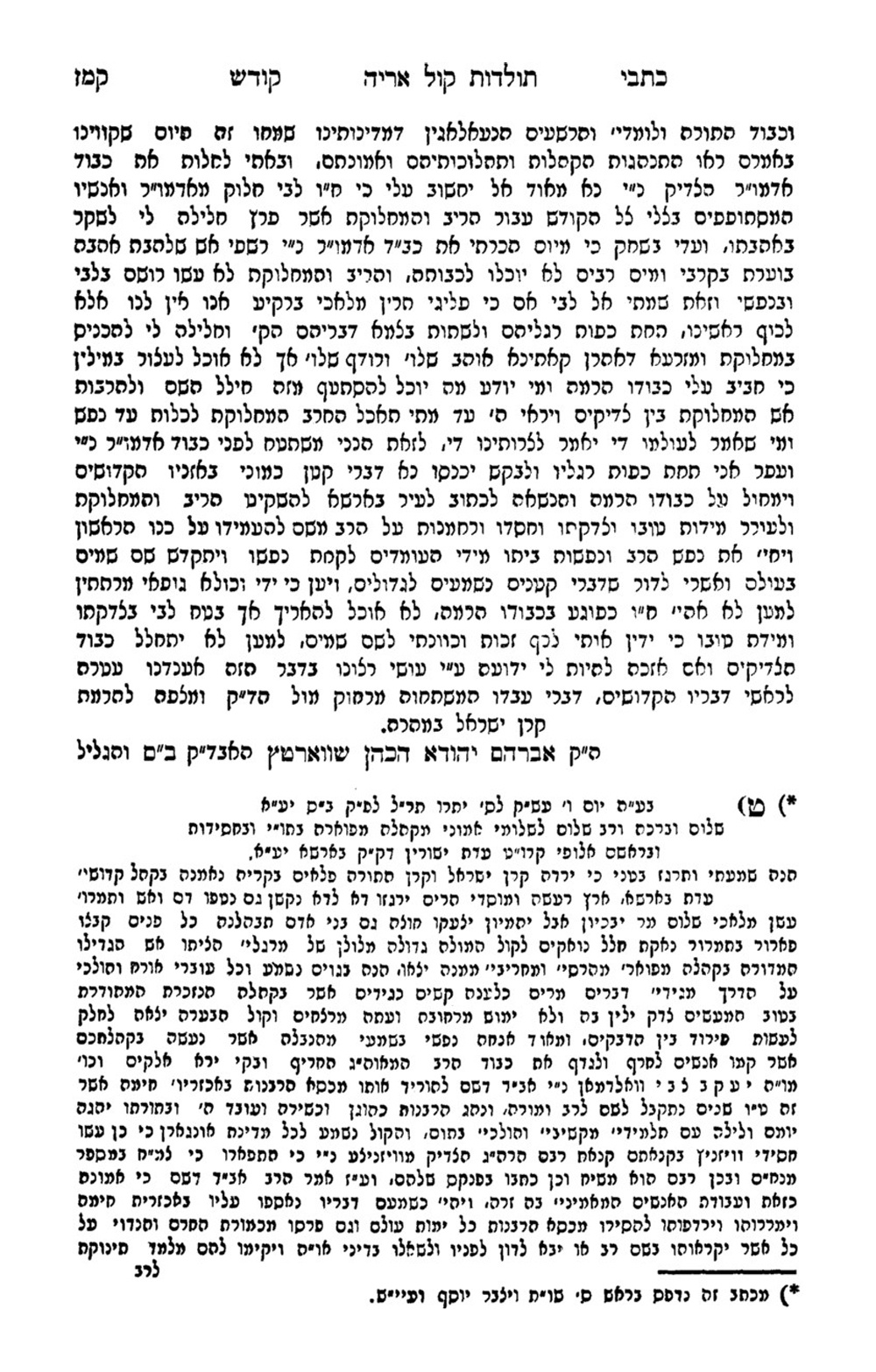
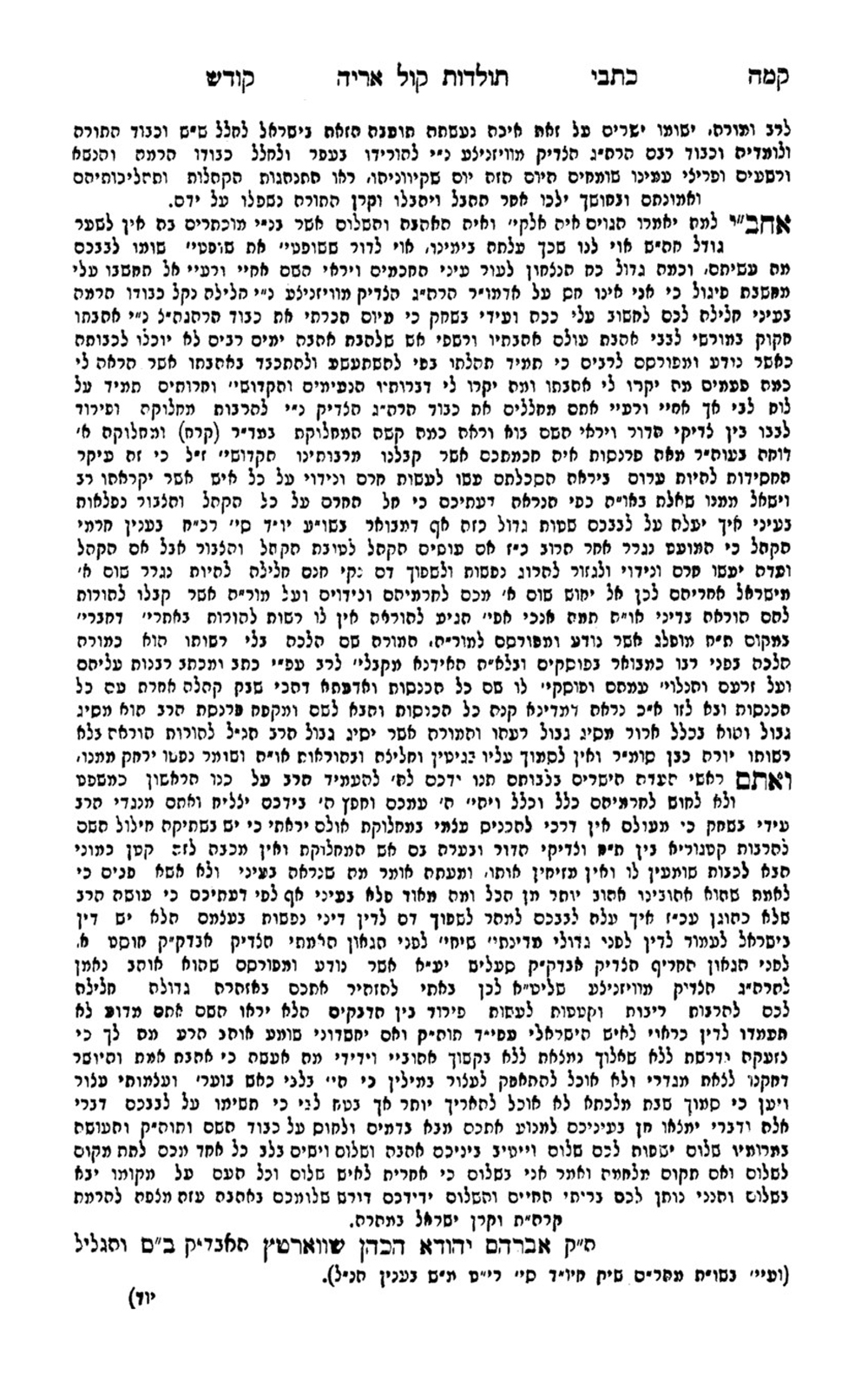
Here are the pages from the Warsaw 1896 edition of Megilat Sefer, pp. 82-83.
In 2012 a new edition of Megilat Sefer appeared, edited by R. Avraham Yaakov Bombach. Here is page 106 from this edition.
As you can see, the Bombach edition has omitted the entire story R. Emden tells. While R. Emden thought it was important for people to know about how he overcame his evil inclination, and he therefore recorded it for posterity, Bombach obviously felt that this is “too much information.” Instead of discussing the significance (and strangeness) of R. Emden allowing us entry into his most personal memories, Bombach chooses the other path and censors that which he is uncomfortable with.
On the other hand, in the introduction to the recently published memoir of the Sephardic scholar, R. Joseph Hayyim Abuhbut,[19] the editor calls attention to the very passage I have quoted, and which was censored by Bombach. He notes how much value the reader can derive from this passage in seeing how R. Emden was able to overcome temptation.
מה מאוד מופלאים הם דברי הגאון יעב”ץ זצ”ל . . . כמה תועלת תצמח לקורא כאשר יווכח לראות באיזה נסיונות נתנסה זה האיש המרעיש ארץ, מי מילל ומי פילל.
R. Elijah Rabinowitz-Teomim mentions in his autobiography that he lived in the home of his future father-in-law together with the girl he was engaged to.[20] At that time he was around sixteen years old and she was under fifteen. He mentions that she was in love with him: והיא דבקה אחרי בלבה. As with R. Emden, he makes a point of telling us that although he engaged in much conversation with her, as they had become very close (“like brother and sister”), he never touched her in all the time he lived in her home. Unlike R. Emden who tells us how much he was tempted and that he “greatly desired a woman,” R. Rabinowitz-Teomim tells us that his relationship with the girl was purely platonic, and he never even thought about her in a sexual way. 
בשלהי שנת תרי”ט העתיק אאמו”ר ז”ל משכנו לעיר ראגאלי ועמו יצאו כל ב”ב, ונשארתי לבדי בשילעל בבית המחותן . . . בכל משך היותי בבית המחותן לא הייתי רחוק מהמשודכת והיינו מדברים זע”ז, ובשגם אחרי נסע בית אאמו”ר ז”ל משם ונשארתי בבית אביה, כל היום, והיא דבקה אחרי בלבה, כאשר ראיתי וידעתי גם שמעתי כי יקרתי בעיני’. . . היינו קרובים זה לזה כאח לאחות, לשוחח כנהוג בבני הנעורים, אבל לא עלה לבי על דבר אחר, חלילה, ולא נגעתי בה אפילו באצבע קטנה כל משך שבתי עמהם, כדת שלת תורה.
So we have three memoirs by leading rabbis, all of which mention them with a girl. Both R. Emden and R. Rabinowitz-Teomim feel it is important to inform the reader that they never touched the girl. As we have seen, R. Emden was very proud of how he overcame his evil inclination and that is why he tells the story. I don’t know why R. Rabinowitz-Teomim thought it was important to mention the matter, especially as no one would have assumed that he had any physical contact before marriage.
I found another interesting source in R. Eleazar Kalir’s Havot Yair.[21] R. Kalir, who died in 1801, was the rabbi in Kolín, today in the Czech Republic. He discusses the common phenomenon of engaged couples having physical contact, and he tells us that no rebuke can stop the practice. He also says that the fault for this must be placed mostly upon the parents, since they are happy to see this behavior by the engaged couple and thus make no efforts to stop it.
בעו”ה רבו המספחת זו בישראל שתיכף אחר התקשורת התנאים, החתן הולך אל הכלה ואינו נזהר מח”ו [חיבוק ונישוק], והיא גם היא אסור לו משום נדה שהיא בכרת . . . ובעו”ה הדבר הזה הוא כמנהג הקבוע, ואולי הוא ממנהגות סדום ודור המבול שהשחיתו את דרכם, והיתר זה אינו בא רק כמאמרם, עבר ושנה נעשו לו כהיתר, ובעו”ה אין התוכחה מועלת בזה, שאמר יאמר מה בכך, שאני הולך אל הכלה שלי, שהיא המיועדת לי, על זה סיים הנביא וכלה מחופתה שאינה נקראת כלה אלא לאחר חופתה, ואז רשאי ליחד עמה, ואמרו כלה בלא ברכה אסורה לבעלה כנדה, וק”ו בעודה לא טהרה מטמאת נדתה.
ולא על החתן לבד יש להתלונן אלא ביותר על אבותיהם שרואים דבר זה, ולא די שהם שותקים אלא אף משמחים אלי גיל בראותן מעשים הללו בעיניהן ממש כצאן לטבח יובל . . . והוא מסייע ידי עוברי עבירה, בראותו תולדותיו כיוצא בזה ולא די דאינו מוחה אלא אף מסייע לדבר עבירה, ואדרבה מוטל על האבות להיות מוחים ובפרט מי שסיפק בידו לעשות.
Elsewhere in his book, we see that R. Kalir told his female congregants that on Shabbat morning they should leave the synagogue and go home before the end of services. This was to prevent men and women mixing which would happen if the women were still there when services ended.[22] It is hard to believe that he found much of a receptive audience for this request.
To Be Continued
1. In my last post I mentioned Maxine Jacobson’s new book on R. Leo Jung. Anyone who is interested in purchasing a soft-cover copy of the book for $25 can contact her directly at maxine.jacobson at sympatico.ca.

2. One of the most prolific authors of halakhic works in English is Rabbi Ari Enkin. His most recent book (which is his eighth such publication) is Halichot V’halachot. Anyone who is interested in modern issues and their halakhic ramifications will enjoy this book and his previous volumes. The topics he discusses run the gamut, from Shabbat and holidays, to kashrut, interpersonal issues, and civil and monetary law. As one can see from the numerous references in each essay, Rabbi Enkin has great erudition in the responsa literature, particularly the modern halakhic authorities. He cites these authorities no matter which ideological camp they are found in, and as such should be a model for all. Those who wish to order the book can contact the author at rabbiari at hotmail.com. His website is here.

3. On June 5, 2016, in honor of Yom Yerushalayim, I will be speaking at the Community Synagogue of Monsey, 89 West Maple Avenue. The title of my talk is “R. Shlomo Goren: The Revolutionary Chief Rabbi.” The talk will follow minhah which is at 8:15pm.

[1] See Reiner, מעשה שאירע בק”ק ווירמייש”א ברעש הגדול שנת שצ”ו, Ha-Aretz, Oct. 4, 2006, available here.
[2] See Posen, מגדלים פסיכולוגיסטיים, Ha’aretz, Oct. 17, 2006, available here.
[3] See Reiner, שערי פירושים לא ננעלו, Ha’aretz, Oct. 24, 2006, available here.
[4] Toyznt yor Idish lebn in Ungarn ([New York, 1945]), p. 173.
[5] See ibid.
[6] Vol. 2, no. 7 (p. 145).
[7] See R. Avraham Mordechai Katz, “Be-Inyan Shirat Nigunim ha-Musharim Etzel ha-Goyim,” Minhat ha-Kayitz 8-11 (2006), pp. 73-74, who makes this point and responds to R. Hillel. Regarding using non-Jewish music, Dov Weinstein called my attention to this shiur on the Yeshivat Kise Rahamim website which begins with music from Abba’s song “Dancing Queen.” I can’t imagine that the person who inserted the music has any clue where it comes from.
The Kise Rahamim website is where you can find R. Meir Mazuz’s shiurim, but a number of short videos are not included on the website. For example, this video appeared on Yom ha-Zikaron 2016:


R. Mazuz refers to the day as “kadosh ve-nora” and calls for synagogues to recite the prayer for Israeli soldiers every Shabbat. As he notes, if someone donates ten shekalim you make a blessing for him, so how could you not make a blessing for one who spills his blood for the Jewish people? I understand full well why haredim don’t say the prayer for the State of Israel. Yet I have never understood how haredi society could refuse to recite a mi-sheberakh prayer for the soldiers, the same soldiers who are the only reason why there can be a haredi society in Israel in the first place. Interestingly enough, in all the conversations over the years that I have had with haredim regarding this matter, to my recollection I have never met one who agreed with, or was willing to defend, his community’s avoidance of the prayer. (I am referring to mainstream haredim, not Satmar or other anti-Zionists.)

[8] Kedushat Levi (Warsaw, 1902), p. 15b, s.v. ויביאה יצחק
[9] The text has מצות which could be read as singular or plural.
[10] (Jerusalem, 1993), p. 153 (Sefer Selihah u-Mehilah, ch. 10). See Byron Sherwin, “In the Shadows of Greatness: Rabbi Hayyim Ben Betsalel of Friedberg,” Jewish Social Studies 37 (Winter 1975), pp. 49-50.
[11] Since this post has dealt a good deal with love, let me add one more point about a different sort of love. There is an old question, why when the kohanim bless the people do they say וצונו לברך את עמו ישראל באהבה? Where do we find that the kohanim were told to bless the people “with love”?  A number of different answers have been given, and one famous answer, intended as a joke, is as follows.
Before giving us the text of the priestly blessing , the Torah, Numbers 6:23, states:
דבר אל אהרן ואל בניו לאמור, כה תברכו את בני ישראל אמור להם.
This word, אמור, sounds a lot like the French and Italian words for love, so we see that God is telling the kohanim to love the people.
As mentioned, this is a famous answer. Not so famous is that it was actually stated by R. Leon Modena with reference to Italian. He, of course, also intended it as a joke. See Ziknei Yehudah, no. 127:
ואמרתי על דרך צחות דכתיב כה תברכו אב”י אמו”ר להם אמור בלע”ז היינו באהבה.
[12] See Louis Finkelstein, Jewish Self Government in the Middle Ages (New York, 1964), pp. 271-272, 279, 320-321.
[13] Solomon Buber, Anshei Shem (Cracow, 1895), p. 132.
[14] See Ya’arot Devash (Jerusalem, 1988), vol. 1, p. 62, s.v. ואתם עם ה’. The last three sources I have cited are mentioned by Salo Wittmayer Baron, The Jewish Community (Philadelphia, 1942), vol. 3, p. 206. For other relevant sources, see David Biale, Eros and the Jews (Berkeley, 1997), pp. 70ff.
[15] See Ya’arot Devash, vol. 1, pp. 61, 62
[16] Alexander Altmann, Moses Mendelssohn (Portland, 1998), p. 93.
[17] The Autobiography of a Seventeeth-Century Venetian Rabbi, trans. Mark R. Cohen (Princeton, 1988), p. 91.
[18] “Rabbi Jacob Emden: His Life and Major Works” (unpublished doctoral dissertation, Harvard University, 1988), pp. 55-57.
[19] Meoraot Yosef (Elad, 2014), p. 14 (first pagination).
[20] Seder Eliyahu (Jerusalem, 1983), pp. 22-23.
[21] (Jerusalem, 2004). p. 76.
[22] Ibid., p. 75.


R. Shlomo Yosef Zevin, Kitniyot, R. Judah Mintz, and More
R. Shlomo Yosef Zevin, Kitniyot, R. Judah Mintz, and More
Marc B. Shapiro
1. The last post dealt with R. Shlomo Yosef Zevin and I pick up with him here. Before moving forward, I have to thank R. Moshe Maimon who sent me a PDF of the essay attributed to R. Zevin which I discussed in the last post. It comes from the hebrewbooks.org hard drive that was released some time ago.[1] You can see it here. I also thank R. Eliezer Brodt who pointed out that both R. Zvi Pesah Frank and R. Eliezer Waldenberg deal with the essay.[2]
One of the most famous examples of haredi censorship relates to R. Zevin. In his classic Ha-Moadim ba-Halakhah, in the section “Ha-Tzomot”, end of ch. 5 (p. 442 in the most recent edition), in discussing if one still needs to do keriah upon seeing the destroyed cities of Judea, R. Zevin writes:
מסתבר, שעם שיחרורן של ערי יהודה משלטון נכרים והקמת מדינת ישראל (אשרינו שזכינו לכך!) בטל דין הקריעה על אותן הערים.
This is not an extreme Zionist statement. It is simply an expression of happiness that the State of Israel came into being. I have no doubt that the typical haredi agrees that this was a good thing (and see in particular the comments of R. Moshe Feinstein quoted later in this post). However, even this very “pareve” statement was too much for Artscroll. Here is how Artscroll translated this passage (The Festivals in Halachah, vol. 2, p. 294):

It could be argued that since the liberation of the cities of the Judean hills from gentile rule, the law of rending the garment for these cities may no longer be in force.

The first thing to notice is that while R. Zevin wrote מסתבר, which must be translated as “it is reasonable”, “it makes sense”, or something similar, Artscroll has turned this into a tentative argument (“it could be argued”). Yet this is not what R. Zevin is saying. “It could be argued” implies that R. Zevin is on the fence on this matter, while מסתבר shows clearly what his view is.[3]
However, the really egregious action of Artscroll comes later in this sentence where Artscroll deletes mention of the establishment of the State of Israel and, most significantly, R. Zevin’s feeling of joy at this event: אשרנו שזכינו לכך!
I have learnt that the men who run Artscroll did not originally know about the censorship just mentioned. They never authorized any distortion of the translation and were surprised to find out what had been done. Yet once learning what had happened, they never took any steps to correct the translation and even defended the alterations. To this day, the matter has not been rectified. It is one thing if in its own works Artscroll tolerates or even encourages distortions, but to take the work of someone else, especially a great Torah scholar, and “correct” it so as to bring it into line with haredi “Daas Torah” is unforgivable. Furthermore, it is a violation of a sacred trust which every translator should be cognizant of. I also wonder if there isn’t a real issue of geneivah involved. If you sell a book supposed to be a translation, and you alter the translation, it is not merely a matter of geneivat da’at but real thievery, since you are selling a product that is not authentic.[4]
When this matter was raised in Tradition by Jack Feinholtz, Rabbis Nosson Scherman and Meir Zlotowitz replied by quoting one of the translators, Meir Holder:[5]
Mr. Holder has, for many years, maintained the closest contact with Rav Zevin’s family and has been a prime force in the dissemination of this great Tzaddik’s writings, in both Hebrew and English. It is unthinkable that he would tolerate or engage in any attempt to misrepresent Rav Zevin’s thoughts. . . . According to Mr. Holder, the lines which Mr. Feinholtz quotes were added to the edition published just a few months after the State of Israel was founded, a time when Rabbi Zevin and others still held high hopes for the spiritual impact of the State upon the lives of those Jews living there. As time went on, Rabbi Zevin became disappointed and, in the opinion of the members of his own family, his final Halachic opinion with regard to the law of rending garments on seeing the Judean hills is more accurately reflected in the Artscroll translation than in the version of the passage cited by Mr. Feinholtz.
There is a good deal of falsehood here. To begin with, other than Shemirat Shabbat ke-Hilkhatah, I think Ha-Moadim ba-Halakhah has been reprinted more times than any other modern halakhic text. Neither R. Zevin nor his family ever made any changes to the work. So who are these mysterious family members that Mr. Holder consulted with? R. Nahum Zevin, the one grandson of R. Zevin who is a haredi rabbi, is completely honest in his descriptions of his grandfather’s strong Zionist feelings.[6] R. Nahum tells anyone who asks that the change in the English translation was done without his (or anyone else in the family’s) knowledge or approval. He completely rejects the attempts to distort his grandfather’s legacy, as his grandfather never moved from his Zionist outlook. Thus, in addition to what has already been noted, the distortion of R. Zevin’s words must be seen as a betrayal of the family’s trust. (See also the second to last paragraph of the Hebrew article included in this post.)
More offensive than Artscroll’s distortion of R. Zevin’s halakhic opinion is the omission of his words of thanks for the creation of the State, an omission that goes unmentioned in the letter of Scherman and Zlotowitz. In a typical debating tactic, they offer a response that allows them to pretend that the only issue being discussed is R. Zevin’s halakhic view of rending garments rather than the deletion of his comments about the State of Israel. (Regarding the first matter, does this really have anything to do with Zionism? Is there anyone today, even among the non-Zionist haredim, who rends his garment upon seeing the cities of Judea?[7] Even when it comes to mekom ha-mikdash it seems that for many the practice of keriah has fallen by the wayside, and a number of people have written to justify this. And while I am on the topic, is there any halakhic justification for people not to do keriah when they see places like Bethlehem that have been returned to Arab rule?[8])
Before going further, let me present a short article in Hebrew written by a friend of mine that also details Artscroll’s fraudulence in this matter.

בשו”ת אגרות משה או”ח ח”ה סימן לז כתב, וז”ל: בענין חיובים דקריעה על ראיית ירושלים וראיית מקום המקדש, ודאי הוא חיוב, כמפורש בברייתא דמו”ק דף כ”ו ע”א. וגם על ערי יהודה איתא שם דקורע, ואיפסק כן ברמב”ם פ”ט מאבל ה”ב, ויותר מפורט בסוף פ”ה דתעניות. ובטור וש”ע סימן מיוחד באו”ח סימן תקס”א, וגם ביו”ד סוף סימן ש”מ . . . . [אבל] עתה שבחסדי השם יתברך אין מושלים האומות על ערי יהודה ועל ירושלים, והם גם מיושבים, הוא טעם גדול שלא לקרוע, אף שעדיין לא באה הגאולה ע”י מלך המשיח ואנו מתפחדים מהאומות, אין לקרוע, דהא הקרא שלמדים משם שצריך לקרוע על ערי יהודה . . . ויבואו אנשים משכם משלו ומשמרון שמנים איש מגלחי זקן וקרעי בגדים וגו’, הרי באו אחר שנחרבו ממש, שאין ללמוד מזה אפילו ליום אחד קודם החורבן, אף שהיה ידוע על ידי ירמיהו הנביא ועוד כי יהיה החורבן. וכל שכן עתה שמקווים אנחנו שמלך המשיח יבוא בקרוב כשיהיו כל ערי ישראל על מכונם, שאין צורך לקרוע. אבל כשרואה מקום המקדש שעדיין הוא בחורבנו, ולא שייך שיבנה אלא על ידי מלך המשיח, צריך לקרוע בפשיטות. וכשיבוא מלך המשיח במהרה בימינו, אף אם נימא שיהיה קצת זמן עד שיבנה, יורנו מלך המשיח וסנהדרין איך לעשות עכ”ל.
וכ”כ הגאון ר’ שלמה יוסף זווין זצ”ל בספרו “המועדים בהלכה” בפרק חמישי של חלק “הצומות” (במהדורת תשמ”ג – עמוד תמב), שגם טרם מלחמת ששת הימים “מסתבר שעם שיחרורן של ערי יהודה משלטון נכרים והקמת מדינת ישראל (אשרינו שזכינו לכך!) בטל דין הקריעה על אותן הערים”. עכ”ל. 

אמנם בתירגום “המועדים בהלכה” לאנגלית שנעשה בחסות הוצאת “ארטסקרול-מסורה” חלק שני (הוצאת “מסורה” תשמ”ב), עמוד 294, עשו המו”ל שני שינויים לקטע זה: (א) במקום “מסתבר” כתבו “יש מקום לטעון”; (ב) השמיטו מ”ש הרב זוין: “והקמת מדינת ישראל (אשרינו שזכינו לכך!)”. וכבר עוררו על שינויים אלו במכ”ע “טראדישען” ה’תשמ”ז-ח (במדור ‘מכתבי הקוראים’) – ראה מ”ש מר ג’ק פיינהאלץ (טראדישען 22:4, עמוד 120).


העורכים הכלליים של ספרי “ארטסקרול” (הרבנים מאיר זלאטאוויץ ונתן שרמן שיחיו) התייחסו לטענת מר פיינהאלץ במכתב למערכת “טראדישען” [שנדפס ב”טראדישען” שם]. במכתב זה הצדיקו את השינויים האמורים, אשר לפי דבריהם נעשו בשיתוף פעולה עם מר מאיר הולדר ז”ל, (בעל בית הדפוס “הלל” בירושלים עיה”ק, שעמד בראש מלאכת התירגום, ואשר הי’ שותף לארטסקרול בההו”ל של ספרי הרב זוין באנגלית), על יסוד מסורה בע”פ שקיבל הלה ממשפחת הרב זוין. לפי מסורה זו, סיגנון השורות המופיעות ב”המועדים בהלכה” בלה”ק (עד עצם היום הזה) ע”ד ביטול דין קריעה על ערי יהודה אינן מתאימות לסוף דעתו של הרב זוין. שורות אלו ניתוספו ע”י הרב זוין במהדורת הספר שי”ל כמה חדשים לאחרי התייסדות מדינת ישראל, נכתבו בתקופה שהיו, להרב זוין (ולאחרים כמותו), תקוות גדולות לעתידה של המדינה ולהשפעתה על החיים הרוחניים של הגרים בארץ ישראל. ברבות הזמן בטלו סיכויים אלו, אז התאכזב הרב זוין וחזר בו ממ”ש ב”המועדים בהלכה” הנ”ל. עכת”ד מסורת מר הולדר.


הרבנים שרמן וזלאטאוויץ טוענים שאין להעלות על הדעת שמר הולדר, שהי’ [לפי דבריהם] מידידי בית הרב זוין ואיש רב פעלים בהפצת “כתבי הצדיק הזה” [=הגרש”י זוין] זצ”ל, הי’ חשוד על נתינת יד למזייפים. עאכו”כ שלא הי’ עושה בעצמו שום שינוי ב”המועדים בהלכה” שאינו בהתאם גמור ל”מחשבת הרב זוין”. ע”פ שנים עדים אלו (הרבנים שרמן וזלאטאוויץ) הסיגנון המופיע ב”המועדים בהלכה” מהדורת ארטסקרול משקף ביתר דייקנות את משנתו האחרונה של הרב זוין בקשר לחיוב קריעה על ערי יהודה.


[יש לציין שגם במהדורא חדשה של “המועדים בהלכה” שנדפסה ע”י “ארטסקרול” בשנת תשנ”ט – בה תיקנו כמה שגיאות וכיו”ב – עמדו הרבנים זלאטאוויץ ושרמן על משמרתם והניחו את הגירסא החדשה (שע”פ מסורת מר הולדר) במקומה. לאידך גיסא, בכל המהדורות של “המועדים בהלכה” שי”ל בלה”ק לאחרי פטירתו של הרב זוין (שראיתי) נמצאות השורות הנ”ל כצלמן וכתבניתן במהדורות שראו אור בחייו].


מר הולדר כבר שחל”ח וע”כ אין אפשרות לברר אצלו אם אכן הי’ ממעתיקי השמועה ומה באמת היתה מדת מעורבתו בהשינויים הנ”ל, שע”פ העדים הנ”ל נעשו ע”פ מסורת שקיבל ממשפחתו של הגרש”י זוין. [אם אמת נכון הדבר שמר הולדר הי’ מחולל השינוי, צע”ק שלא מצא מר הולדר לנכון לעשות השינויים במהדורת “המועדים בהלכה” שהו”ל באותה תקופה בלה”ק, ועכ”פ לציין בשוה”ג שהנדפס אינו אלא משנה ראשונה של המחבר]. ובכל אופן, נ”ל שטענות הרבנים זלאטאוויץ ושרמן [ומר הולדר?] ע”ד עמדתו של הגרש”י אינן עומדות בפני הביקורת, ומפני כמה טעמים. [מקצת מטענות א-ב דלהלן כבר הביע בשעתו מר טרי נאוועטסקי במכתב תגובה לטענות הרבנים הנ”ל ונדפס במכ”ע טראדישען שם 23:1 עמוד 98 ואילך].


(א) מאז היווסד מדינת ישראל נדפס ספר “המועדים בהלכה” בכו”כ מהדורות בחייו של הרב זוין [
מהדורא שניה – ירושלים תש”ט; מהדורא שלישית – ירושלים תשי”ד; מהדורא חמישית – תל אביב תשט”ז; מהדורא שישית – ירושלים תש”כ. ועוד]. הרב זוין עשה כמה כמה תיקונים והכניס כמה וכמה הוספות קטנות וגם גדולות במהדורות השונות של הספר. על כן, למרות שבספרו זה “לא נתכוון המחבר להקנות לקוראיו דינים ופסקים” (הקדמת הרב זוין ל”המועדים בהלכה”), מ”מ בהתחשב עם זה ש”הספר נועד בעיקר לקהל הרחב . . . מורים ומחנכים” (הקדמה הנ”ל שם) מסתבר שאם באמת חזר בו הרב זוין לא הי’ מניח משנה ראשונה במקומה, וע”ד האמור (איוב יא, יד. כתובות יט, ע”ב) “אל תשכן באהליך עוולה”. ומדחזינן שבענינים אחרים אכן שינה, הוסיף וגרע [אפילו בכה”ג שלא הי’ מקום לחשוש לביטול מצוה או לאפרושי מאיסורא], ובנדו”ד השאיר את הדברים על מכונם, מסתבר לומר שבאמת לא חזר בו, וחזקה על חבר שאינו מוציא מתח”י דבר שאינו מתוקן.
(ב) אין התשובה ממין הטענה כלל, דאם אמנם על השינוי מ”מסתבר” ל”יש מקום לטעון” [אין ולאו ורפיא בידי’] אנו דנים, אכן יש מקום להסברא שהתאכזבותו ממצבה הרוחני של מדינת ישראל גרם להרב זוין לנטות מצידוד חזק [“מסתבר”] לביטול חיוב קריעה [כשיטת האג”מ הנ”ל] ל”הלכה רופפת” [“יש מקום לחלוק ולומר”] בענין זה, וע”פ המבואר לקמן בפנים שיש אומרים דשלטון מדינת אינו בגדר שלטון ישראל. אבל אין אכזבה זו דורשת (1) העלמת שם “מדינת ישראל”, שם שהרבה הרב זוין להשתמש בו בכ”מ. (2) השמטת ביטוי של שמחה והודי’ להשי”ת – “אשרינו שזכינו לכך” – על הקמת המדינה. הגע בעצמך: אין ספק שהגרמ”פ (שהי’ מחברי מועצת גדולי אגודת ישראל) גם הוא התאכזב ממצב היהדות בארץ ישראל תחת שלטון מדינת ישראל [ראה מ”ש באג”מ יו”ד ח”ב סמ”ה בא”ד ש”במדינת ישראל, אין אנו אחראין להנהגת המלכות דשם שהיא בעוה”ר אצל כופרים ומומרים ואין מתחשבים עם . . . כל איסורי התורה החמורים ביותר והמפורשים בגמרא ובקראי”. וראה גם אג”מ חו”מ ח”ב סו”ס סט, ועוד], ואעפ”כ כתב באג”מ בשנת תשמ”א, וכנ”ל, “עתה שבחסדי השם יתברך אין מושלים האומות על ערי יהודה ועל ירושלים [הוא טעם גדול שלא לקרוע]”, הרי שהעברת השלטון מידי האומות לידי ממשלת ישראל הוא מ”חסדי השי”ת”! ואם הגרמ”פ הי’ מודה להקב”ה על חסד זה, מה הכריח את הרבנים זלאטאוויץ ושרמן לעשות את הרב זווין (שגם בסוף חייו פירסם בקהל רב שהוא נוהג להצביע עבור רשימת המפד”ל) לכפוי טובה שאינו מכיר בניסו?
והוא העיקר: יחסו החיובי של הרב זוין למדינת ישראל בא לידי ביטוי בעוד מקומות מפיו ומפי כתביו. הנה שתי דוגמאות לכך: (1) בספרו “לאור ההלכה” (מהדורא שניה, תל אביב תשי”ז, כמה שנים לאחרי הקמת המדינה) תיקן את מאמרו “המלחמה” והוסיף בה דברים שלא היו יכולים להכתב במהדורא הראשונה של המאמר שהדפיס לפני הקמת המדינה (ב”לאור הלכה” ירושלים ה’תש”ו), ובתו”ד (עמוד סה) כתב לאמר: “בימינו אנו שזכינו לתקומת מדינת ישראל העצמאית, משוחררת מעול מלכויות . . . הרי מלחמת השחרור ברור שהיו לה כל דיני מלחמת מצוה וחובה”. [גם ספר “לאור ההלכה” חזרה ונדפסה כמ”פ (במשך ימי חיי הרב זוין) עם תיקונים והוספות, ומשנה זו לא זזה ממקומה]. (2) (2) בראיון שהעניק למכ”ע “הצופה” שי”ל לראש השנה ה’תשל”ו קרוב לשלשים שנה לאחרי הקמת מדינת ישראל וכשנתיים לפני פטירת הרב (בשנת תשל”ח). באותו ראיון אמר הרב זוין: “הרי מדינת ישראל עם כל ליקוייה הרבים בשטח החינוך הלא-דתי וכו’ הרי עם כל זה עלינו לראות את צדדיה החיוביים: הלא רק בחמש השנים האחרונות בלבד היא הצילה יותר ממאה אלף יהודים מטמיעה מוחלטת ושמד רוחני ברוסיה הסובייטית, אשר רבים מהם לומדים עתה כאן בבתי ספר דתיים ואף בישיבות; ועוד היד שלנו נטוי’ לקלוט מהם בעז”ה כהנה וכהנה”.
לית דין צריך בושש שהרב זוין, שהכיר מקרוב את תהליך התפתחות אופיה הרוחני של מדינת ישראל, כבר ידע היטב בשלהי שנת תשל”ה את כל מה שיש לדעת ע”ד צביונה החילוני של מדינת ישראל, ובכל זאת הרי שלך לפניך, שהביע את הערכתו הרבה להקמת מדינת ישראל וחזר והדגיש באר היטב שלמרות כל חסרונותי’ וליקויי’ (‘רבים הם ואי אפשר לפורטם’) הרי הקמת המדינה בארץ ישראל והרווחה בגו”ר שהביאה לעם ישראל הינה זכי’ גדולה וה”ה מהטובות הגדולות שעשה הקב”ה לעמו ישראל וחייבים אנו להודות להקב”ה על קיומה. וא”כ אי אפשר לומר שהשמטת תיבות ההודאה על קיומה של המדינה [“אשרינו שזכינו לכך”] הולמת את שיטת הרב זוין לאחרי אכזבתו.
אמנם למרות כל הנ”ל לא מלאני לבי לבטל מסורתם של מר הולדר ויבלחט”א הרבנים שרמן וזלאטאוויץ עד שהתקשרתי עם משפחת הרב זוין ע”מ לברר וללבן את הדבר. ה’משפחה’ שאיתה עמד מר הולדר בקשר מתמיד, ה”ה הרה”ג ר’ נחום זווין שליט”א, רב בעיה”ק חיפה ת”ו. [בנו יחידו של הגרש”י זווין נלב”ע בחייו, ובנו הרב נחום ירש את הכתבים וכו’ של הגרש”י והוא הוא שמכר את רשות ההדפסה באנגלית למר הולדר]. בשיחה טלפונית שקיימתי עם הרב נחום ביום חמישי י”ד טבת ה’תשס”ד אמר לי בלשון צחה וברורה שלא היו דברים אלו מעולם. הרב נחום זוין נתן לי רשות לפרסם בשמו את אשר מסר לי בענין זה: (א) עד יומו האחרון לא זז הגרש”י מעמדתו ויחסו החיובי למדינת ישראל, עמדה שהתבטאה בכמה משיטותיו והנהגותיו [ולדוגמא: עד שנתו האחרון עלי אדמות ועד בכלל נהג הגרש”י לומר הלל (בלי ברכה) ביום העצמאות וביום ירושלים]. (ב) מעולם לא שמע ממנו שחזר בו משיטתו ע”ד חיוב הקריעה על ערי יהודה, ועד היום הזה (שהודעתיו ע”ד השינויים הנ”ל ב”המועדים בהלכה” מהדורת ארטסקרול) לא ידע אפילו שהי’ אי פעם איזו סברא והו”א (בתוך המשפחה או מחוצה לה) לומר שהגרש”י שינה את דעתו בנידון, ולמותר להגיד שמעולם לא דיבר, לא דבר ולא חצי דבר, לא עם מר הולדר ולא עם שום נציג הוצאת ארטסקרול, על דבר ענין זה. והשתא הדברים מחוורים כשמלה, שמעולם לא היתה ולא היתה יכולה להיות ‘מסורת חשאית’ ממשפחת הרב זוין בנדו”ד, כי מעולם לא חזר בו הרב זוין מדעתו הראשונה, ואין שום סתירה כלל במשנת הגרש”י שהיתה קב ונקי. אין כאן המקום להאריך בהשערות, על מה ולמה החליטו המו”ל של כתבי הגרש”י באנגלית לעשות בדבריו כבתוך שלהם ולייחס אליו דברים שהם זרים לרוחו. מה שחשוב למבקשי האמת הוא, בירור דעתו של הרב זוין בנידון, ולזה הגענו בעז”ה – ואין שמחה כהתרת הספיקות.
[דא”ג: ראה זה פלא! לאחרונה יצא לאור “תלמוד בבלי מסכת מועד קטן” מהדורת שוטנסטיין (דפוס “מסורה” ה’תשנ”ט) תחת השגחת הרבנים זלאטאוויץ ושרמן, ושם דף כו ע”א הערה 43 ציינו (בקשר לחיוב קריעה על ערי יהודה וירושלים בזמן הזה) לדברי הגרמ”פ באג”מ ח”ה הנ”ל, שם כתב שבזמן הזה בטל חיוב קריעה גם על ירושלים עיר הקודש, ולא ציינו כלל להפוסקים הרבים המובאים לקמן בפנים דס”ל שחיוב קריעה על ירושלים במקומו עומד, גם לא ציינו לעמדתו הרופפת של הרב זווין (ע”פ ‘מסורת מר הולדר’) שקנתה שביתה במהדורתם של “המועדים בהלכה” לפיה אין להחליט שחיוב קריעה (אפילו על ערי יהודה – ובמכ”ש על ירושלים) בטל בימינו. וצע”ג].


In Saul Lieberman and the Orthodox, I called attention to two other examples of censorship (omitting Lieberman’s rabbinic title) in Artscroll’s translation of R. Zevin, so it is obvious that the translators felt it was OK for them to take liberties with the text. I know from speaking to people in the haredi world that this sort of thing is very distressing to them. It is no longer surprising when we see censorship and intentional distortions in haredi works. We even expect this and are surprised when a haredi work is actually honest in how it presents historical matters and issues that are subject to ideological disputes. Yet it doesn’t have to be this way. There is no fundamental reason why haredi works can’t express their position without the all-too-common falsehoods. I think the ones most offended by this are those who are part of the haredi world and believe in its ideology, and don’t understand the need to resort to distortions in order to further the truth.


In a recent post I gave an example of fraudulence when it came to a haredi newspaper’s obituary of Louis Henkin, the son of R. Joseph Elijah Henkin. In this post, I mentioned that R. Henkin sent his sons to Yeshiva College. R. Eitam Henkin kindly sent me this picture of the tombstone of R. Henkin’s son, Hayyim, who predeceased his father.


It is noteworthy that R. Henkin saw fit to mention on the tombstone that Hayyim was a student at Yeshiva College (= Yeshivat R. Yitzhak Elhanan).
I would now like to point to an unintentional error in Artscroll’s translation of Ha-Moadim ba-Halakhah. Before last Pesah I took out my copy of The Festivals in Halachah. In reading the chapter on kitniyot, p. 118, I came across the following.
By way of reply, Rav Shmuel Freund, “judge and posek in the city of Prague”
((דין ומו”צ בק”ק פראג published the pamphlet Keren Shmuel, in which he demonstrates at length that no one has the authority to make these prohibited items (kitnios) permissible.
I immediately suspected something wasn’t right, and when I looked at the original I saw that R. Freund was described as דיין מו”ש דק”ק פראג. In translating these words into English, דיין מו”ש  became דין ומו”צ  (since the English version puts vowels on the Hebrew words  דיין became דין), and דק”ק became בק”ק (this latter point is only a minor error).
R. Zevin’s description of R. Freund is put in quotation marks since it is taken from the cover of his Keren Shmuel, as you can observe here.
The translators (who must never have seen the title page of Keren Shmuel) didn’t know what to make of מו”ש  and assumed that it was a mistake for מו”צ. They therefore “corrected” R. Zevin’s text. This is one of those cases where a few well-placed inquiries would have solved the translators’ problem. Some of the blame for this error should be laid at the feet of R. Zevin, for he never bothered explaining what מו”ש  is and he should have realized that that the typical reader (and translator) wouldn’t have a clue as to its meaning.[9]
מו”ש refers to the highest beit din in Prague, as used in the phrases דיין מו”ש and בית דין מו”ש. But what do the letters מו”ש stand for?[10] This is the subject of an essay by Shaul Kook,[11] and he points out that there has been uncertainty as to the meaning of מו”ש.[12] In fact, R. Solomon Judah Rapoport, who was chief rabbi of Prague and a member of the בית דין מו”ש, was unaware of the meaning.[13] After examining the evidence, Kook concludes that מו”ש stands for מורה שוה. This appears to mean that all the dayanim on the beit din were regarded as having equal standing. The בית דין מו”ש of Prague actually served as an appeals court, something that was found in other cities as well, even going back to Spain.[14] R. Yair Hayyim Bacharach, Havot Yair, no. 124, refers to one of the dayanim on this beit din as  אפילאנט, and the new edition of Havot Yair helpfully points out that the meaning of this is דיין לערעורים.[15]
Some people have the notion that the appeals court of the Israeli Chief Rabbinate is a completely new concept, first established during the time of R. Kook. This is a false assumption.[16] (The Chief Rabbinate’s בית דין לערעורים is also known as בית דין הגדול).
R. Moshe Taub has called my attention to another error in the translation of Ha-Moadim ba-Halakhah. In discussing what should be done first, Havdalah or lighting the menorah, R. Zevin writes (p. 204):
ברוב המקומות נתקבל המנהג שבבית מבדילים קודם, ובבית הכנסת מדליקים קודם
The translation, p. 89, has this sentence completely backwards: “Most communities have adopted the following custom: at home – Chanukah lights are lit first; in the synagogue – Havdalah first.”
Since we are on the issue of errors in Artscroll, here is another one which was called to my attention by Prof. Daniel Lasker. In the commentary to Numbers 25:1, Artscroll states:
After Balaam’s utter failure to curse Israel, he had one last hope. Knowing that sexual morality is a foundation of Jewish holiness and that God does not tolerate immorality – the only time the Torah speaks of God’s anger as אף, wrath, is when it is provoked by immorality (Moreh Nevuchim 1:36) – Balaam counseled Balak to entice Jewish men to debauchery.
Yet Rambam does not say what Artscroll attributes to him. Here is what appears in Guide 1:36:
Know that if you consider the whole of the Torah and all the books of the prophets, you will find  that the expressions “wrath” [חרון אף], “anger” [כעס], and “jealousy” [קנאה], are exclusively used with reference to idolatry.
The Rambam says that the language of “wrath” is only used with reference to idolatry, but somehow in Artscroll idolatry became (sexual) immorality. This text of the Moreh Nevukhim is actually quite a famous and difficult one, and the commentators discuss how Maimonides could say that ויחר אף is only used with reference to idolatry when the Torah clearly provides examples of the words in other contexts. In his commentary, ad loc, R. Kafih throws up his hands and admits that he has no solution.
ושכאני לעצמי כל התירוצים לא מצאו מסלות בלבבי, והקושיא היא כל כך פשוטה עד שלא יתכן שהיא קושיא, אלא שאיני יודע היאך אינה קושיא
Returning to the issue of kitniyot, in a previous post I raised the question as to why, according to R. Ovadiah Yosef, all Sephardim and Yemenites who live in Israel are to follow the practices of the Shulhan Arukh but he doesn’t insist on this when it comes to Ashkenazim. If R. Joseph Karo is the mara de-atra, shouldn’t this apply to Ashkenazim as well?[17] I once again wrote to R. Avraham Yosef and R. Yitzhak Yosef seeking clarification. Here is R. Avraham’s letter.
Unfortunately, his history is incorrect. To begin with, it is not true that all of the Ashkenazim who came on aliyah before the “mass aliyah” (which apparently refers to the late nineteenth century) adopted the practices of the Sephardim.[18] It is also not true that the beit din established by the Ashkenazim in the nineteenth century is the beit din of the Edah Haredit. The Edah Haredit is a twentieth-century phenomenon. The historical successor of the beit din of R. Shmuel Salant was the Jerusalem beit din of which R. Kook was av beit din, as he was the rav of Jerusalem (and R. Zvi Pesah Frank served on the batei din of both R. Salant and R. Kook). The Edah Haredit beit din was a completely new creation. As for the Yemenites, Moroccans, and Iraqis, when the great immigration of these groups occurred, many thousands came on aliyah together, (i.e., as complete communities) and thus they never saw themselves as required to reject their practices in favor of the Shulhan Arukh. The fact that they didn’t establish special batei din is irrelevant. In fact, R. Avraham’s last paragraph is a good description of how these communities arrived in the Land of Israel, and is precisely the reason why their rabbinic leaders almost uniformly rejected R. Ovadiah Yosef’s demand that they adopt the Shulhan Arukh in all particulars.
Here is R. Yitzhak Yosef’s letter to me, which has a different perspective.
He cites R. Joseph Karo’s responsum, Avkat Rokhel, no. 212, which requires newcomers to adopt the practices of the community to which they are going even if they come as large groups. He then says that Ashkenazim never adopted this viewpoint, but instead held to the opinion of R. Meir Eisenstadt (Panim Meirot, vol. 2, no. 133). According to R. Eisenstadt, only individuals who come to a town must adopt the local practice, but not if they come as a group and establish their own community.[19]
Let me now complicate matters further. If you recall, in the earlier post I discussed how R. Ovadiah Yosef’s writings assume that Ashkenazim have to abstain from kitniyot on Pesah. I raised the question if an Ashkenazi could “become Sephardi” and thus start eating kitniyot (and also follow Sephardic practices in all other areas). R. Avraham Yosef wrote to me that this is permissible while R. Yitzhak Yosef wrote that it is not.
R. Yissachar Hoffman called my attention to the fact that in the recent Ma’yan Omer, vol. 11, p. 8, R. Ovadiah was himself asked the following question:
אשכנזי שרוצה לנהוג כמו הספרדים במנהגים ולדוגמא לאכול קטניות בפסח, אך רוצה להמשיך ולהתפלל כנוסח אשכנז. האם הדבר אפשרי.
R. Ovadiah replied:
 יכול רק בקטניות, אך עדיף שבכל ינהג כמרן
What R. Ovadiah is saying (and see also the editor’s note, ad loc., for other examples) is that R. Avraham’s answer is correct, namely, that an Ashkenazi can “become Sephardi” (and eat kitniyot). It is significant that R. Ovadiah allows such a person to continue praying according to Ashkenazic practice. Here are the pages.
2. On my recent tour of Italy I spent a good deal of time speaking about the great sages of Venice and Padua. One such figure was R. Samuel Judah Katzenellenbogen (1521-1597), known as מהרשי”ק, the son of the famous R. Meir Katzenellenbogen, known as Maharam Padua. While R. Samuel Judah Katzenellenbogen is basically forgotten today, he was the most important Venetian rabbi in his day. He was also the father of Saul Wahl, who became famous in Jewish legend as Poland’s “king for a day.”[20]
In 1594, R. Katzenellenbogen’s collection of derashot, entitled Shneim Asar Derashot, appeared. Here is the title page.
When the volume was reprinted in Lemberg in 1798, the publisher made an error and on the title page attributed the volume to מהר”י מינץ , the son of Maharam Padua.
Apart from not knowing who the author of the volume was, the publisher also didn’t realize that R. Judah Mintz (died 1508[21]) was the grandfather of Maharam Padua’s wife, meaning that he was the great-grandfather of R. Samuel Judah Katzenellenbogen.
When the volume was reprinted in Warsaw in 1876 the publisher recognized the problem but confounded matters.
Rather than simply correcting the mistake from the 1798 title page by attributing the volume to R. Samuel Judah Katzenellenbogen, he kept the information from the mistaken title page but tells the reader that מהר”י מינץ is none other than “R. Samuel Judah Mintz”, a previously unheard of name.
The most recent printing has gets it even worse.
Now the original title of the book, שנים עשר דרשות, is simply omitted, and the book is called דרשות מהר”י מינץ
The authentic R. Judah Mintz of Padua is known for his volume of responsa that was published in Venice in 1553, together with the responsa of R. Meir Katzenellenbogen. Here is the title page.
R Judah Mintz’s responsa were reprinted in Munkacs in 1898 together with a lengthy commentary by R. Johanan Preshil.
The book was also reprinted in 1995, edited by R. Asher Siev.
Unfortunately, Siev was unaware of the 1898 edition. He also makes the mistake (see p. 353) of stating that R. Samuel Judah Katzenellenbogen was referred to as מהר”י מינץ because his mother’s family name was Mintz. I have seen no evidence that he was ever referred to as such in his lifetime or in the years after, and as mentioned, this was simply a printer’s mistake. I consulted with Professor Reuven Bonfil and he too is unaware of any reference to Katzenellenbogen being referred to as מהר”י מינץ, which supports my assumption that this all goes back to the mistaken title page.[22]
3. In my last post I mentioned how in years past there were shiurim combining students from Merkaz and Chevron and also Merkaz and Kol Torah. This is obviously unimaginable today. For another example showing how Yeshivat Kol Torah has changed, look at this picture, which appears in Yosef and Ruth Eliyahu, Ha-Torah ha-Mesamahat (Beit El, 1998), p. 105.
I guarantee you that even on the hottest of days, none of the Kol Torah students will be wearing shorts. For those who don’t know, Kol Torah was founded by German Orthodox rabbis and was originally very different than it is today. Here is how it was described upon its founding, in a short notice in Davar, August 27, 1939.
It is hard to imagine today, but this was a yeshiva that actually intended for some of its students to take up agriculture. See also here which cites R. Hayyim Eliezer Bichovski, Kitvei ha-Rav Hayyim Eliezer Bichovski (Brookyn, 1990), p. 180, that the Chafetz Chaim said that yeshiva students in Eretz Yisrael should learn nine months a year and work the land the other three months
Speaking of shorts, here are a couple of pictures showing how the boys of the German Orthodox separatist Adass Jisroel community looked when playing sports (also notice the lack of kippot).
This was the community of R. Esriel Hildesheimer and R. David Zvi Hoffmann. The pictures come from Mario Offenburg, ed., Adass Jisroel die Juedische Gemeinde in Berlin (1869-1942): Vernichtet und Vergessen (Berlin, 1986).
Here is how the girls dressed for sports, also with shorts and sleeveless.
And here is how the boys and girls looked when not at a sporting event.
These pictures come from Max Sinasohn, ed., Adass Jisroel Berlin (Jerusalem, 1966).[23]
4. Some people didn’t appreciate the humor in my post with regard to the Gaon R. Mizrach-Etz. I think they should lighten up, and in a previous post, available here, I gave some references to humor in rabbinic literature. This was followed up by a more extensive post by Ezra Brand, available here.
According to the commentary Siftei Hakhamim, it is not just the talmudic sages who would at times show their humorous side, but on at least one occasion Moses thought that God himself was joking with him!
In Ex. 33:13 Moses says to God: ועתה אם נא מצאתי חן בעיניך. Rashi explains this to mean: “If it is true that I have found favor in Your eyes.” This means that Moses was in some doubt as to whether he found favor in God’s eyes, but this is problematic since in the previous verse Moses quotes God as saying to him, “you have also found favor in My eyes.” So if God told Moses that he found favor in His eyes, how can Moses be in doubt and say to God, “If I have found favor in Your eyes”?
Here is the Siftei Hakhamim.
According to Siftei Hakhamim, Moses was in doubt if he really found favor in God’s eyes, since even though God said he did, perhaps God was joking just like people joke around!
דלמא מה שאמרת מצאת חן בעיני מצחק היית בי כדרך בני אדם
5. I want to call readers’ attention to a recent book, Shevilei Nissan, which is a collection of previously published essays from R. Nissan Waxman. There is lots of interesting material in the book, and let me mention just a few things.
In Studies in Maimonides and His Interpreters, p. 75 n. 302, I referred to R. Yaakov Avigdor’s strong criticism of R. Hayyim Soloveitchik’s approach. R. Avigdor also criticized R. Solomon Polachek, the Meitchiter. R. Waxman was a student of the Meitchiter, and on p. 23 n. 1, he comes to his teacher’s defense.
On p. 150, R. Waxman, who was the rav of Lakewood, mentions the problem of how some yeshiva students are halakhically more stringent than their teachers. He quotes R. Yaakov Kamenetsky in the name of R. Aharon Kotler how a student once visited R. Kotler and when the latter offered the student some cookies, the student was reluctant to take before asking which bakery they came from. (Perhaps this behavior can be explained by what I have heard – and maybe someone can confirm this – that in R. Aharon Kotler’s day the Lakewood bakery Gelbstein was not under hashgachah, and yet R. Kotler bought his challot from it. See also here and here The original post referred to in these links has definitely been taken down.)
On p. 233, R. Waxman notes that even though we have the principle, “A Jew who sins remains a Jew”, in actuality, it is possible for a Jew to so remove himself from the Jewish people (e.g., apostasy) that as far as most things are concerned, he is indeed no longer regarded as Jewish. This essay was written concerning the “Brother Daniel” case, and R. Waxman’s approach is similar to that of R. Aharon Lichtenstein who also wrote a famous article on the topic, “Brother Daniel and the Jewish Fraternity,” republished in Leaves of Faith, vol. 2, ch. 3.
On pp. 251ff., R. Waxman deals with Menahem Mendel Lefin’s Heshbon ha-Nefesh, an influential mussar text which as many know was influenced by a work of Benjamin Franklin.
6. I want to also call readers’ attention to two other books recently sent to me. The first is R. David Brofsky, Hilkhot Moadim: Understanding the Laws of the Festivals. This is very large book (over 700 pages) dealing with the Holidays and is a welcome addition to the growing number of non-haredi halakhah works in English.. In a future post I hope to deal with it in greater depth. The second book is Haym Soloveitchik, Collected Essays, vol. 1, published by Littman Library, my favorite publisher. This book is required reading for anyone with an interest in the history of medieval halakhah. I was happy to see that it also includes two essays that appear here for the first time. Furthermore, Soloveitchik’s classic essay on pawnbroking (which was his first significant article) has been expanded to almost double the size of the original. In the new preface to the essay, he writes: “Every essay is written for an imagined audience, and mine was intended for the eyes of Jacob Katz, Saul Lieberman, and my father.”
[1] I also must point out that someone involved with hebrewbooks.org informed me that the essay was not removed from the site because it was viewed as “problematic”, but because they were requested to do so by one of the members of R. Zevin’s family who claimed to hold the copyright to the work. This is obviously a false claim, since as we have seen there is no proof that R. Zevin wrote the essay.
[2] See R. Waldenberg, Hilkhot Medinah, vol. 2, pp. 14, 60, 62, and R. Frank’s haskamah, ibid., pp. 17.
[3] See Jack Feinhotz’s letter in Tradition 22 (Winter 1987), p. 120. R. Zevin’s view, that there is no need for keriah, was also advocated by R. Reuven Katz, Sha’ar Reuven (Jerusalem, 1952), p. 32.
[4] See Terry Novetsky’s letter in Tradition 23 (Summer 1987), pp. 98-99.
[5] Tradition 22 (Winter 1987), p. 120.
[6] In the interview with R. Zevin that appeared in my last post, R. Nahum’s comments tended to be somewhat dogmatic, even “haredi”, and should be contrasted with his grandfather’s words.
[7] Even among the vast majority of Lubavitchers this is the case (so I am informed by R. Chaim Rapoport). This is quite strange since the Rebbe held that you have to do keriah. What this shows us is that not everything advocated by the Lubavitcher Rebbe was adopted by his hasidim.
[8] See R. Dov Lior, Devar Hevron (Kiryat Arba, 2009), Orah Hayyim no. 567
[9] Even the incredibly learned Meir Benayahu was stumped by מו”ש. See this page from his Tiglahat be-Holo Shel Moed (Jerusalem, 1995), p. 21.


Regarding Benayahu, a recent book argues that the missing pages of the Aleppo Codex were not destroyed in Aleppo, but were actually stolen by Benayahu after arriving in Jerusalem. See Matti Friedman, The Aleppo Codex (Chapel Hill, 2012).
[10] I have found one occasion where it is written מ”ש, although this is probably a typo. See R. Yaakov Reischer, Shevut Yaakov, vol. 2, no. 129. R. Reischer was a member of this beit din,
[11] Iyunim u-Mehkarim (Jerusalem, 1963), vol 2, pp. 179ff.
[12] In the Vilna Shulhan Arukh, Yoreh Deah, there is a commentary by R. Jacob Emden. Yet R. Yaakov Hayyim Sofer, Menuhat Shalom, vol. 6, p. 116, shows that it was not written by him, and one of his proofs is that the commentary refers to הגאון אב”ד וב”ד מו”ש, implying that the author lived in Prague.
[13] See Kook, Iyunim u-Mehkarim, p. 180.
[14] See Simhah Assaf, Batei ha-Din ve-Sidreihem Aharei Hatimat ha-Talmud (Jerusalem, 1924), ch. 11.
[15] See ibid., pp. 80ff. for other examples of אפילאנט
[16] This statement should not be taken to imply that the leading rabbis in Eretz Yisrael were happy with the institution of this court, which was pretty much forced upon them by the British. See Amichai Radzyner’s book-length article, “Ha-Rav Uziel, Rabanut Tel Aviv-Yafo, u-Beit Din ha-Gadol le-Irurim: Sipur be-Arba Ma’arakhot” Mekhkerei Mishpat 21 (2004), pp. 120-242.
[17] R. Ovadiah Hadaya, in his approbation to R. Amram Aburabia, Netivei Am (Jerusalem, 1964), states that everyone in Jerusalem should follow “minhag Yerushalayim”. If his opinion is accepted, it would mean the end of any Ashkenazic practices in the city.
[18] Regarding earlier in the nineteenth century, see Yehoshua Kaniel, “Kishrei ha-Edot be-Inyanei Halakhah u-Minhag bi-Yerushalayim ba-Meah ha-Yod Tet,” Morashah 4 (5736), pp. 126-136. In the eighteenth century, the Vilna Gaon was of the opinion that Ashkenazim who come on aliyah should indeed adopt Sephardic practices. See Bezalel Landau, Ha-Gaon he-Hasid mi-Vilna (Jerusalem, 1978), p. 250, n. 30.
[19] This has indeed been the Ashkenazi approach, yet R. Abraham Danzig disagreed. See Hokhmat Adam: Sha’ar Mishpetei ha-Aretz 11:23:
נ”ל דהבאים לא”י אם יקבעו עצמם בעיר שיש שם מנין אעפ”י שהבאים הם מרובים יש להם דין יחיד וחייבים לנהוג חומרי מקום שהלכו לשם ופקעו מהם החומרות שהיו נוהגין במקומם.
[20] As far as I know, R. Samuel Judah Katzenellenbogen was the first great rabbi to have his picture made (unfortunately, it no longer exists). See R. Moses Porti, Palgei Mayim (Venice, 1608), p. 6b (referred to by R. Gedaliah Oberlander, Minhag Avoteinu be-Yadenu [Monsey, 2012], p. 451):
והלא אנכי הייתי הראשון שבקשתי להציב תמונתו לנגד עיני ע”י הצייר ואותה לקחתי לי והצבתיה בבית מדרשי לקיים מה שנאמר והיו עיניך רואות את מוריך
While this picture was hung in the beit midrash, see this post where I mention how R. Pinchas Teitz took down the poster of R. Elchanan Wasserman that I hung up in a room used for tefillah. (R. Porti’s Palgei Mayim is devoted to the famous dispute about the mikveh in Rovigo.)
[21] The standard biographies all record that R. Judah Mintz lived a very long life. This is based on R. Joseph Yavetz, Hasdei Ha-Shem (Jerusalem, 1934), Introduction, p. 9, where R. Yavetz’s son mentions that R. Mintz recited birkat ha-hamah when he was כבן מאה שנה. This would have been in 1505, and he lived another three years after that. R. Meshulam Fishel Behr, Divrei Meshulam (Frankfurt, 1926), pp. 147ff., rejects the younger Yavetz’s testimony and claims that R. Mintz died in his seventies. See, however, R. Naftali Yaakov ha-Kohen, Otzar ha-Gedolim (Haifa, 1967), pp. 35ff.
[22] See also Jewish Encyclopedia, s.v. Katzenellenbogen, Samuel Judah. R. Yissachar Hoffman called my attention to She’elot u-Teshuvot Hakham Zvi, no. 15, where R. Samuel Judah Katzenellenbogen is (mistakenly?) referred to as מהר”י מפאדואה. See also R. Aryeh Yehudah Leib Lifshitz, Avot Atarah le-Vanim (Warsaw, 1927), p. 48 n. 44
[23] When I was in high school in the early 1980s, in the New Jersey-New York yeshiva league only the girls of Bruriah wore sweat pants during basketball games (and the boys were not allowed to attend home games). At the other high schools the girls wore shorts. Today, the league requires all girls to wear sweat pants (i.e., not even long shorts). For a wonderful discussion of the yeshiva basketball league, see Jeffrey S. Gurock, Judaism’s Encounter with American Sports (Bloomington, 2005), ch. 7. Gurock discusses how for six years in the early 1950s, Yeshiva Chaim Berlin was part of the basketball league together with the Modern Orthodox co-ed high schools, something that could never happen today. During this time co-ed schools had cheerleaders, and this was a major factor in forcing Chaim Berlin to leave the league. (Mesivta Tifereth Jerusalem was also in the league for two years.) When I mention cheerleaders, don’t think of current NFL cheerleader outfits. Here, for example, is how the Brooklyn Central girls looked (from Gurock, p. 143).
Yet Gurock, ibid., points out that “as the 1950s progressed, the Brooklyn Central cheerleaders’ skirts also got shorter and shorter.” (Speaking of short skirts, anyone who has looked at Modern Orthodox yeshiva high school yearbooks from the early 1970s will see that the mini-skirt craze was also tolerated at these institutions.)


Concerning the Zohar and Other Matters

Concerning the Zohar and Other Matters
Marc B. Shapiro
1. In the last issue of Milin Havivin I published an article dealing with the Zohar and the supposed obligation to accept that it was written by R. Shimon ben Yohai. You can see it here. In the article I mentioned authorities who pointed to passages that in their minds were certainly post-Rashbi interpolations.[1] At the end of the article I also published a letter from R. Isaac Herzog in which he briefly deals with the issue of non-literal interpretation of the Torah. We see that he was uncertain as to what the boundaries are in this matter, and thought that this was an issue that needed to be worked out. That is, he did not believe that the last word on this issue had been stated.
Subsequent to publication I found some more interesting material and I also received a number of emails making various points, so now is as good a time as ever to return to the topic.
First, let me mention what David Farkas wrote to me in an email. In the article I cited Bruriah Hutner-David who brings the following proof that R. Zvi Hirsch Chajes rejected the traditional authorship of the Zohar: In order to show that the Targum to Ecclesiastes should be dated to the geonic period, Chajes notes that while the angel Raziel is mentioned in this Targum, he is not mentioned in talmudic literature. Hutner-David notes that Raziel is mentioned in the Zohar, a fact that Chajes was presumably aware of, meaning that he was hinting that the Zohar is also a late work.
Chaim Landerer called my attention to the fact that in a talmudic era Aramaic incantation bowl the name Raziel does appear, and I cited this to show that Chajes was incorrect in his assumption that the name Raziel post-dates the rabbinic period. However, Farkas has correctly noted that the name Raziel in the bowl refers to God, while Chajes was specifically referring to Raziel as a name of an angel. In other words, there is no refutation of Chajes. Yet I still think that Chajes assumed that the name Raziel itself was post-talmudic. Once we see that the name existed in the rabbinic period, even if so far the only evidence of its use is for God, it is certainly possible that it was also used for angels as well. If that is the case, there is no evidence that the use of the word Raziel as an angel’s name points to a post-rabbinic date.
I also found that Saul Berlin notes, in the introduction to his Kasa de-Harsana (his commentary to Besamim Rosh), that unlike all other ancient Jewish books, the Zohar has an introduction. Because of this, he writes that when it comes to the authorship of the Zohar he inclines to the view of his great-uncle, R. Jacob Emden.
A few years ago the outstanding scholar, R. Yaakov Yisrael Stoll, published the anonymous Sefer Kushyot. Here are pages 123-124.

I ask readers to look at note 887. He discusses a mistake made by many in assuming that an expression is a biblical verse. He then notes that the Zohar also makes the same mistake, and refers to other such mistakes made by בעל הזוהר. He doesn’t say so explicitly, but I think the way he formulates the note lets the reader, who is attuned to these things, know that in his mind בעל הזוהר is not R. Shimon ben Yohai.

Someone called my attention to this video

I have no idea who the speaker is, and if he has ever even read a page of the Zohar, but he does seem very sure of himself. I have no objection to discussing the authorship of the Zohar and the ideas found there, or Kabbalah as a whole. However, I would think that a little humility is called for when discussing a discipline that was a basic part of the religious worldview of so many central figures. Do the names Nahmanides, R. Joseph Karo, or the Vilna Gaon mean anything to this speaker?
In my article, I cited all sorts of texts by Orthodox figures dealing with the authorship of the Zohar. Yet I overlooked the following by R. Joseph Hertz.
The question of the authorship of the Zohar, like that of Sefer Yetzirah, is one of the cruces of Jewish literature. The authorship by Simeon ben Yochai, or by his immediate disciples, though this is still an article of faith with millions of Jews in Eastern Europe, has from internal evidence long proved to be untenable. The Zohar explains Spanish words, contains quotations from Gabirol, and mentions the Crusades.[2]
As noted, in my article cited a number of sources that point to additions to the Zohar. Rabbi Akiva Males commented to me that I neglected to mention R. Isaac Haver, Magen ve-Tzinah, ch. 21. This book was written in response to R. Leon Modena’s Ari Nohem, a work aimed at disproving the antiquity of the Zohar. Unless one’s head is totally in the sand, it is impossible to deny that there are passages in the Zohar that post-date the tannaitic era. For Modena, this was proof that the Zohar could not have been written by Rabbi Shimon ben Yohai. Haver, who wants to hold onto the ancient dating, adopts the only path open to him, arguing that there are indeed many post-tannaitic additions, but the core of the book is ancient.
ובאמת ספר הזוהר נכתב כמה דורות אחר רשב”י מה שנכתב ונתקבל משמו ומשאר חבריו ותלמידו שהיו בימיו, וגם זה נעשה בו הוספות רבות עד מאוד מן אחרוני האחרונים אחר שבאו בכתב וניתנו להעתיק ושלטו בו ידי רבים כל אחד מה שנראה בדעתו ומה שנתחדש לו וכתב בגליון על ספר הזוה”ק מן הצד ואח”ז בא ריעהו מעתיק מן המעתיק ומצא בגליון דברים רבים ובמעט התבוננות חשב שזה היה חסרון בגוף ספר והכניסם בפנים.
Haver points out that is how we can explain the obviously late passages, where we see that the Zohar includes material that comes from Rashi and R. Tam. Among kabbalists, it was not unheard of to say that Rashi actually knew the Zohar and was influenced by it.[3] But Haver will have none of this and recognizes that the influence is in the reverse direction, i.e., Rashi influencing the Zohar. He states that anyone who understands the Zohar will recognize these additions.
What does Haver mean when he mentions that there is material from R. Tam in the Zohar? I am aware of one obvious example. It says in Kiddushin 30b that “one should always divide his years into three: [devoting] a third to Mikra, a third to Mishnah, and a third to Talmud.” R. Tam explains why the practice in his day was not in accord with what the Talmud states, an explanation that became very influential and served as a justification for the widespread ignoring of the study of Tanakh in the Ashkenazic world[4]
בלולה במקרא ובמשנה וכו’: פירש רבינו תם דבתלמוד שלנו אנו פוטרין עצמנו ממה שאמרו חכמים לעולם ישלש אדם שנותיו שליש במקרא שליש במשנה שליש בתלמוד.
What he says is that since the Talmud itself contains Bible and Mishnah, there is no need to divide one’s time among the three categories. Rather, by studying Talmud one combines all three areas. I always found this a difficult explanation, for if the Talmud agreed with this perspective, it would have said so, instead of stating that one is to divide one’s time. The intention of the talmudic instruction in Kiddushin was that people become well acquainted with all three subjects, and if they only devote themselves to Talmud, there is a great deal of Bible and Mishnah[5] they will never encounter. (According to Maimonides, Hilkhot Talmud Torah 1:12, once one is already a scholar, he does not need to divide his time between the three areas, but can focus almost entirely on Talmud.)
Despite what R. Tam says, R. Samson Raphael Hirsch claims that it was due to a misunderstanding of this opinion that people were led to stop studying Tanakh.[6] Not mentioned by Hirsch is that even before R. Tam some scholars ignored Tanakh. There were even talmudic Sages who were not expert in Bible. Bava Kamma 54b-55a states:
R. Hanina b. Agil asked R. Hiyya b. Abba: Why in the first Decalogue is there no mention of wellbeing [טוב], whereas in the second Decalogue there is a mention of wellbeing?[7] He replied: While you are asking me why wellbeing is mentioned there, ask me whether wellbeing is in fact mentioned or not, as I do not know whether wellbeing is mentioned there or not.
Tosafot, Bava Batra 113a, s.v. travayhu, cites this text to support its contention about the amoraim: .פעמים  היו שלא היו בקיאין בפסוקין After referring to this strange passage in Tosafot (concerning which there is an entire literature), R. Moses Salmon sarcastically declares[8]: ועל זה סומכים הלומדים עמי הארץ וד”ל
Unlike Salmon, R. Samuel Strashun, in his note to Bava Batra 8a, defended those talmudists who were deficient in knowledge of Bible.
משמע דאפשר שיהיו בעלי משנה או בעלי גמרא ולא בעלי מקרא . . . ודלא כאותן ששופכין בוז על מקצת גדולי זמנינו בש”ס ופוסקים ואין להם יד כ”כ במקרא.
So returning to my question, what does Haver mean when he says that there is material from R. Tam in the Zohar? Well it turns out that R. Tam’s explanation, which we have just been discussing, is also found in the Zohar Hadash (ed. Margaliyot), Tikunim p. 107b:
תקינו רבנן לשלש שנותינו במקרא בתלמוד . . . ואוקמוה דמאן דמתעסק (במשנה) [בתלמוד] כאלו התעסק בכלא בגין דאיהי בלילא במקרא במשנה בתלמוד.
There is no question that this passage is adopted from R. Tam, who lived a millennium after R. Shimon ben Yohai.
Incidentally, regarding R. Tam’s view, here is a page of an article by R. Yehudah Aryeh Schwartz that appeared in the Agudah journal Kol ha-Torah, Adar 5765 [2005], p. 102 (second pagination).

The following page comes from R. Yehiel Michel Stern’s Ha-Torah ha-Temimah on the Book of Joshua, p. 84 no. 3, which appeared in 2009.

As you can see, Stern’s comment is lifted word for word from Schwartz’s article. I am not sure what to make of this. That is, are dealing with a simple plagiarism? Perhaps one of the readers has some insight. (Stern may be the world’s most prolific writer of Torah publications.)

In my article I referred to passages in the Zohar which traditional authorities had claimed were really later interpolations. There are examples of the opposite phenomenon as well, namely, attributing things to the Zohar that are not found there. The most famous instance of this that I know of is found in the Bah, Orah Hayyim 4 (and quoted from there in Be’er Heitev, Orah Hayyim 1:2) that upon waking up if you walk four amot without washing your hands you are subject to the death penalty![9]  This Zoharic text is quoted in the name of the work Tola’at Yaakov, authored by R. Meir Ibn Gabai (1480-ca. 1543). The passage is cited over and over again by aharonim in trying to show the importance of the morning washing. Yalkut Meam Loez, Deut. 4:9, doesn’t even mention the Zohar, stating simply:
ואמרו חז”ל כל המהלך ד’ אמות בלי נטילת ידים חייב מיתה
A few scholars actually point out that this passage is not to be found in the Zohar.[10] One of those who realized this is R. Eleazar Fleckeles, Teshuvah me-Ahavah, vol. 1 no. 14, whom we will come back to later in this post. He writes that he looked in the Zohar and didn’t find the passage referred to. With reference to the Tola’at Yaakov, whom he (falsely) thinks cited the Zohar (since that is what it says in the Bah), Fleckeles writes:
ושארי לי’ מארי’ שעשה רוב ישראל לחייבי מיתות
Because very few of the aharonim actually had the sefer Tola’at Yaakov (which is itself a little strange as the book was printed a number of times), they were unable to see that the Tola’at Yaakov never quotes the Zohar!  Here is p. 9a from the Cracow 1581 edition.

If you look in the second paragraph you will see that Ibn Gabai does state that one who doesn’t wash his hands is חייב מיתה, but he doesn’t attribute this to the Zohar. How he derives this idea is worthy of investigation at a different time. For now, it is important to just note that what we have here is an independent idea of a sixteenth-century Kabbalist which for some reason was misquoted by the Bah as if Ibn Gabai was citing the Zohar. This misquotation was to be repeated again and again, down to the present day.

The supposed Zohar text has led to additional stringencies. For example, the hasidic master R. Meshulam Zusha of Anapole stated that that one should not even to put one’s legs on the ground before washing one’s hands.[11]

Here is an interesting story that relates to the false Zohar quotation: A very learned and rich student came to study with R. Simhah Bunim of Peshischa.[12] The problem was that this young man was a bit of an independent thinker, and the Kotzker, who was also there, didn’t think that the young man belonged with them. The story explains how the Kotzker was able to convince the young man to leave. What was it about this man that turned the Kotzker against him? We are told the following:
הוא הגיה בזוה”ק שכתב “ההולך ד’ אמות בלי נטילת ידים חייב מיתה”, והוא הגיה: “והוא שהרג את הנפש”, וזה נגד חז”ל.
So here we have a story of an emendation of a non-existent Zoharic text. And even if we assume that the man was emending the text as it appears in the Bah, we see from the story that the Kotzker thought that the quote was authentic.

I wasn’t sure what to make of this passage. I therefore consulted a learned friend who said that the problem was that the young man who emended the text to read והוא שהרג את הנפש was making a joke at the expense of the (supposed) Zoharic passage. He was saying that you are only deserving of the death penalty if you kill someone while walking the four amot. I then sent him a page from R. Zvi Yavrov, Ma’aseh Ish, vol. 4, p. 113, where it appears that the Hazon Ish took the emendation-explanation just mentioned as an authentic understanding of the passage. The text in Yavrov reads as follows:

על מה שהביא ה”באר היטב” (או”ח סימן א’ סק”ב) שההולך ד’ אמות בלי נטילת ידים שחרית חייב מיתה, אמר רבינו להגאון ר’ שמריהו גריינימן זצ”ל, שמישהו כתב בגליון הספר “והוא שהרג את הנפש” (מבנו הג”ר ברוך שליט”א).

My friend replied by referring me to a discussion on Hyde Park here where the text from Yavrov is also mentioned. One of the commenters there claims that the Hazon Ish was also joking in his remark, and the one who heard this (who was hardly a tyro), or the person who passed on the information to Yavrov, didn’t realize that it was a joke. The commenter also assumes that despite what appears in the Bah and Be’er Heitev, the Hazon Ish would have known that that it wasn’t an authentic quote from the Zohar. I find this very unlikely, as the Hazon Ish is not known to have been an expert in the Zohar, and what reason would there be for him to doubt that which is quoted in numerous earlier sources? 

The one point that the commenter has going for him is that he is correct that there are many examples in this book, and others like it, from which we see that the author does not know how to distinguish between what should and should not be included in a book. The commenter gives an example to illustrate this. In vol. 5, p. 141, Yavrov gives us the following important information about the Hazon Ish, recorded by one of his students: They never saw the Hazon Ish picking his nose! I kid you not.

העיד אחד מגדולי תלמידי רבינו: מעולם לא ראו את הרבי עם אצבע באף (מהרב מרדכי ויספיש)

Regarding this issue, R. Eliezer Melamed – who really is a great halakhic scholar – writes that picking one’s nose in public is forbidden.[13]

ויש מעשים שכשאדם עושה אותם בסתר, אין בכך פגם, אבל בפני אנשים אחרים הם נחשבים למגעילים ואסורים משום ‘בל תשקצו’ ומשום המצוות שבין אדם לחבירו. למשל, המחטט באף או מגרד פצעונים שבפניו, עובר באיסורים אלו. וכן אמרו חכמים (חגיגה ה, א): “כִּי אֶת כָּל מַעֲשֶׂה הָאֱלוֹהִים יָבִא בְמִשְׁפָּט עַל כָּל נֶעְלָם. אמר רב: זה ההורג כינה בפני חבירו ונמאס בה. ושמואל אמר: זה הרק (היורק) בפני חבירו ונמאס בה”. ובמיוחד בעת שאוכלים, צריך להיזהר בכך יותר, כי מעשים מאוסים, וכן דיבורים מגעילים, מבטלים את התיאבון ומעוררים בחילה בקרב הסועדים.
Getting back to the supposed Zoharic passage, R. Yitzhak Abadi discusses this in Or Yitzhak, vol. 1, no. 1. He begins his responsum by pointing out that despite the fact that the Mishnah Berurah records how one is not to walk four amot before washing one’s hands, R. Aaron Kotler did not concern himself with this. Abadi then explains that the words of the Zohar are not intended for everyone,[14] and none of the rishonim write that it is forbidden to walk four amot before washing. He concludes by stating that he is inclined to rule – ולולי דמסתפינא הייתי אומר להלכה למעשה – that the entire practice of negel vasser is no longer relevant to us because ruah ra’ah is no longer a concern.[15] Here again we see that the author of a responsum assumes that the issue he is discussing, of not walking four amot before hand washing, is based on the Zohar, when in fact the Zohar doesn’t mention this at all.

Finally, I must mention that R. Hayyim Joseph David Azulai, Birkei Yosef, Orah Hayyim 1:1, recognizes that there is nothing in the Zohar about being subject to the death penalty for walking four amot. However, he notes that both he and his forefather, R. Abraham Azulai, saw an alternate version which indeed states that one who walks four amot אתחייב מיתא לשמיא. Based on this alternate text, the Hida declares that the Tola’at Yaakov is correct in how he quoted the Zohar, and the criticism of him for the inaccurate quotation is therefore misplaced. Even the Hida didn’t have access to the Tola’at Yaakov, and based on the Bah assumed that the Tola’at Yaakov quoted the Zohar and must indeed have had the alternate text. Yet as we have already seen, the Tola’at Yaakov does not quote the Zohar, and there is no actual alternate version of the text such as quoted by the Hida.

What happened was that someone saw the Bah quoting the Tola’at Yaakov as quoting the Zohar that one who walks four amot is subject to the death penalty. Not finding this passage in the Zohar, this individual inserted it into his text of the Zohar in the section that deals with hand washing in the morning (Zohar, vol. 1 p. 10b). I don’t think this was intended as a forgery. Rather, whoever put it in assumed that it was an authentic Zoharic teaching, found in an alternate text, and he was inserting it where it should be. He thought that it was an authentic Zoharic teaching because the Tola’at Yaakov had testified to it. But as we have already seen, Tola’at Yaakov said nothing of the sort. This alternate girsa can therefore be traced back to the Bah’s misquotation of the Tola’at Yaakov.

How can we explain the Bah? I think the answer is simple. When the Bah cited the Tola’at Yaakov he did not have the book in front of him, and was relying on his memory, the sort of mistake that is found among all of our great sages. That is how this error crept in which has had a great influence on Jewish religious texts and practice for hundreds of years, and yet it all goes back to a simple mistaken quotation.

Returning to my article on the Zohar, Rabbi Akiva Males called my attention to the following paragraphs that appear in an essay by R. Aryeh Kaplan.[16] It would be great if a reader has examined the manuscript and can testify to the accuracy of what Kaplan reported.

Rabbi Yitzchok deMin Acco is known for a number of things. Most questions regarding the authenticity of the Zohar were raised by him, since he investigated its authorship. He was a personal friend of Rabbi Moshe de Leon, who published the Zohar. When questions came up regarding the Zohar’s authenticity, he was the one who investigated, going to the home town of Rabbi Moshe de Leon. The whole story is cited in Sefer HaYuchasin, who abruptly breaks off the story just before Rabbi Yitzchok reaches his final conclusion. Most historians maintain that we do not know Rabbi Yitzchok’s final opinion – but they are wrong.

Around three years ago, someone came to me and asked me to translate parts of a manuscript of Rabbi Yitzchok deMin Acco, known as Otzar HaChaim. There is only one complete copy of this manuscript in the world, and this is in the Guenzberg Collection in the Lenin Library in Moscow. This person got me a complete photocopy of the manuscript and asked me to translate certain sections. I stated that the only condition I would translate the manuscript is if I get to keep the copy. This is how I got my hands on this very rare and important manuscript.

Of course, like every other sefer in my house, it had to be read. It took a while to decipher the handwriting, since it is an ancient script. One of the first things I discovered was that it was written some 20 years after Rabbi Yitzchok investigated the Zohar. He openly, and clearly and unambiguously states that the Zohar was written by Rabbi Shimon bar Yochai. This is something not known to historians, and this is the first time I am discussing it in a public forum. But the fact is that the one person who is historically known to have investigated the authenticity of the Zohar at the time it was first published, unambiguously came to the conclusion that it was an ancient work written by Rabbi Shimon bar Yochai.
Leaving aside for now the important information recorded by Kaplan, there is a good deal that can be said about R. Moses de Leon and the creation of the Zohar, and it is questionable if one can even speak of a single author. One essential point that must be recognized by all who investigate this matter is that De Leon himself was involved in other forgeries, in particular forgeries of geonic responsa.[17] As such, he obviously is not the most reliable source when he announces to the world that he is in possession of a text of mystical lore dating from the tannaitic period.

Regarding the Zohar and forgery, I think readers will also find the following interesting.  (Many already know some of the story, but it is worth repeating for those who don’t.) In the journal Or Torah, Tevet 5772, p. 362, a reader, whose knowledge of Jewish bibliography is not that great, had a question. He saw the following page in R. Yudel Rosenberg’s Hebrew translation of the Zohar to Va-Yikra.


This is important information, as Emden confesses that his attack against the Zohar was only designed to pull the wool out from under the Sabbatians, whose ideology was linked to the Zohar. The man who wrote to Or Torah, not knowing anything about Rosenberg, asked for help from the readers. He tried to locate the book Tzur Devash quoted by Rosenberg, but was unable.

In Or Torah, Adar 5772, pp. 555-557, two individuals let the first writer in on the “not-so-secret” that there is no book Tzur Devash, and that Rosenberg had a long history of making up texts; see here. This is so even though Rosenberg was a respected rabbi and posek. Here, incidentally, is the picture of Rosenberg that appears at the beginning of his Zohar translation.

With some of Rosenberg’s “forgeries”, it seems that what he was doing was creating a form of literature, and anyone who takes the story literally has only himself to blame (much like anyone who thinks that Animal Farm is really about animals has no one to complain to but himself). At times, Rosenberg would even hint to the reader what he was doing, as in Hoshen ha-Mishpat shel ha-Kohen ha-Gadol, where in the preface he mentions that part of the story also appeared in a work of Arthur Conan Doyle. If any reader would have taken the time to find out who this was, he would have realized that we are dealing with a fictional account. At other times, however, Rosenberg offers no such hint, at least none that I am aware of, and what we have appears to be a simple forgery. That would seem to be the case here, with the phony letter from Emden.

The second correspondent in Or Torah also calls attention to R. Yaakov Hayyim Sofer’s discussion in Etz Hayyim 7 (5769), pp. 267-268. While for a long time everyone has known that the Emden letter was a forgery, Sofer identifies another forgery. Rosenberg’s translation (second edition) vol. 1, contains a letter of approbation from R. Hayyim Hezekiah Medini, the Sedei Hemed.[18] Sofer claims, and I think he is correct, that this approbation is a forgery. His prime proof is that in the approbation Medini refers to the Hida as האזולאי. There are many hundreds, if not thousands, of references to the Hida in Medini’s work, and not once does he refer to the Hida as האזולאי, which is a form only used by Ashkenazic rabbis. What Sofer didn’t realize, and further supports his point, is that Rosenberg himself, in his introduction, p. 5a, refers to Hida as האזולאי.

In Or Torah, Iyar 5772, p. 744, another writer called attention to Sedei Hemed, Peat ha-Sadeh, kelalim, mah’arekhet bet, no. 47, where Medini states that it is disrespectful to use this sort of language, referring specifically to the expression האלגאזי.[19] This is another proof, if any was needed, that Medini would never have referred to the Hida as האזולאי. Let me also add that the way Medini (=Rosenberg) concludes the forged haskamah is not like any of his other letters, which are included in Iggerot Sedei Hemed (Bnei Brak, 2006). In the authentic letters, before his name Medini always adds הצב”י or הצעיר , which he does not do in the forged haskamah.. In his authentic letters, he also never closes them by adding to his name רב ומו”ץ בעיר הקדש חברון. Therefore, there can be no doubt that the letter of approbation sent by Medini to Rosenberg is simply another one of the latter’s forgeries.

Now let us turn to the incredible recent publication of a derashah by R. Yehezkel Landau, the Noda bi-Yehudah.[20] But before doing so, it is necessary to say a few words about R. Eleazar Fleckeles, the outstanding student of the Noda bi-Yehudah. (Fleckeles’ grave, entirely ignored by tourists, stands right near that of his teacher.) Ever since the publication over two hundred years ago of the strong comments of Fleckeles downplaying the authority of the Zohar, people have wondered where this came from. It just seemed strange that an 18th-19th century traditional Torah scholar would express himself this way. We now have the answer. Fleckeles was following in his teacher’s footsteps. Thanks to the publication of the Noda bi-Yehudah’s derashah by Michael Silber and Maoz Kahana, a derashah that had previously only appeared in a censored form, we now know that that the Noda bi-Yehudah had a skeptical view of the Zohar, at least in the form that it has come down to us. The issue that the Noda bi-Yehudah was concerned with was the same thing that bothered Emden and Fleckeles, namely, distinguishing the authentic ancient Jewish mysticism from the many later additions that found their way into the Zohar.

What caused the Noda bi-Yehudah in his later years to adopt a skeptical position, one so much at odds with his earlier outlook, is of course worthy of investigation and something for the scholars to fight over (and they already have!).

Regarding Fleckeles, his negative comments about the Zohar that appear in Teshuvah me-Ahavah are well known and have often been cited. In my article I also referred to Fleckeles’ citation of Wessely who quoted R. Jonathan Eibschuetz as supposedly stating that one need not believe in Kabbalah. (Needless to say, it is very difficult to believe that Eibschuetz could have ever expressed himself this way.) In preparing for my Torah in Motion talks on R. Moses Kunitz,[21] I found another relevant text from Fleckeles that as far as I know has gone unnoticed among those who have discussed the matter. It appears in Kunitz’s responsa Ha-Metzaref,[22] which happens to be one of the strangest responsa works ever published. It is also noteworthy in that it contains something extremely rare, namely, a responsum from R. Nathan Adler, the Hatam Sofer’s teacher. Knowing that some people might doubt that the teshuvah could really have been authored by R. Nathan, he also included a letter from the Hatam Sofer testifying to the responsum’s authenticity. 

In Ha-Metzaref, vol. 1 no. 11, Fleckeles again focuses on additions to the Zohar that are not part of the authentic work, but here he adds a new point which is important for an accurate description of Fleckeles’ position. He says that if a Zoharic text is quoted by R. Isaac Luria, R. Moses Cordovero, or R. Menahem Azariah of Fano then you can assume that it is part of the original Zohar, authored by R. Shimon ben Yohai.

One final comment regarding the Noda bi-Yehudah’s derashah: Yehoshua Mondshine somehow got hold of it before it was published by Silber and Kahana. Here is the relevant page, from Or Yisrael, Nisan 5766, p. 202.

Notice how Mondshine doesn’t reveal where this text comes from, something not expected from a careful scholar. Since this is such an amazing passage, and Mondshine’s article was the first time it appeared in print, you can be sure that loads of people must have turned to Mondshine asking him for its source. Presumably, when he was given the text he gave his word not to reveal its source. He might not have even known the source, and was only given the small passage.

2. Due to correspondence with a couple of people, I realized that I forgot to include something about the word מחיה in my last post. So here it is now.

In the Amidah we say מחיה מתים אתה. There is a tzeirei under the yod meaning that this is not a verb. Artscroll correctly translates “Resuscitator of the dead.” Sacks,[23] on the other hand, gives the mistaken translation “You give life to the dead”. The next line reads

מכלכל חיים בחסד, מחיה מתים ברחמים רבים

Is מחיה in this verse a verb? Ifמכלכל  is translated as a verb, then מחיה will also have to be translated this way. The Tehilat ha-Shem siddur has a segol under the yod of מחיה, and with this vocalization it is correct to translate it as a verb. However, for siddurim with a tzeirei the only accurate translation is a noun. Metsudah, which we have seen is consistent in this matter, translates: “Sustainer of the living with Kindliness, Resurrector of the dead with great mercy.” Both Artscroll and Sacks, however, translate מחיה as a verb which is incorrect. But why is it incorrect? It is only incorrect because of the vocalization (tzeirei), but I think that in the sentence מחיה is indeed a verb. This means that it is the vocalization that is incorrect, and that instead of a tzeirei under the yod, there should be a segol, as in the Tehilat ha-Shem siddur[24]. So my recommendation to Artscroll and Sacks would not be to change the translation, but only to change the vocalization.

After reading my last post, Ben Katz sent me an example where of all the translations, only Artscroll gets it right. The last lines of Adon Olam read:
בידו אפקיד רוחי בעת אישן ואעירה
ועם רוחי גויתי ה’ לי ולא אירא

Sacks translates as follows (and Metsudah is similar):

Into His hand my soul I place,
when I awake and when I sleep.
God[25] is with me, I shall not fear;
Body and soul from harm will He keep.
What this means is that God has my soul at all times, when I am awake and when I sleep, and  that that is why I have no fear.

Artscroll translates as follows:

            Into His hand I shall entrust my spirit
            When I go to sleep – and I shall awaken!
            With my spirit shall my body remain.
            Hashem is with me, I shall not fear.
Before getting to what I think is the significant  part of the translation, let us look at the last line: ועם רוחי גויתי, ה’ לי ולא אירא. In his translation, Sacks has turned the order of the sentence around. That is OK as it was done so that the rhyme works (and Sacks deserves enormous credit for having most of the song rhyme in English). The real problem is Sacks’ rendering of the words  ועם רוחי גויתי. There is no way this can be translated as “Body and soul from harm will He keep.” The words imply nothing about keeping from harm. The typical translation sees ועם as referring to God, meaning that God is with my soul and body and therefore I will have no fear.

However, Artscroll gets it right, I think, by translating these words literally: “With my spirit shall my body remain.” To see how Artscroll gets to this translation, we have to look at the previous verse, and that is where we see Artscroll’s brilliance. בידו אפקיד רוחי בעת אישן ואעירה. The other translations understand this to mean that I place my spirit (or soul) in God’s hands when I sleep and when I am awake. The problem with this rendering is that if my spirit is always in God’s hands, then what sense does it make to say that I place it there? If it is always there, during the day and at night, there is nothing for me to place.

Artscroll translates: “Into His hand I shall entrust my spirit when I go to sleep – and I shall awaken!” This is an allusion to the famous Midrash that we are all taught in school, that when you go to sleep your spirit returns to God, and is given back to you in the morning.[26] This isn’t just some random Midrash, but is derived from Psalm 31:6, which states: בידך אפקיד רוחי.[27] In other words, the Midrash is commenting on the exact words used by Adon Olam. This shows that Artscroll’s translation has indeed beautifully captured the correct meaning.

We now can properly understand the next verse. Since my spirit has returned and joined with my body, I know that God is with me and I shall not fear.

3. There is a relatively new publication for all who are interested in Jewish intellectual life. I refer to the Jewish Review of Books, expertly edited by Abraham Socher. Modeled after the New York Review of Books, each issue is full of great material. In the latest issue I published a translation of part of an essay by R. Jehiel Jacob Weinberg on Berdyczewski. Only subscribers can access the essay, but everyone can see the artwork that went along with it. See here. (Due to copyright restrictions, I can’t reproduce the artwork in the post.)

If you examine the picture of Weinberg produced by the artist, you will see that it was modeled after this picture that appears in my book on Weinberg, and also on the front cover of the soft-cover edition.


The original photograph was part of a faculty picture taken when Weinberg taught at the University of Giessen. However, the artistic reproduction adds something that is not found in the original, something that the artist assumed no rabbi should be without; see here.

4. Those outside of the United States who want to post (or read) comments, please access the Seforim Blog site by going to http://seforim.blogspot.com/ncr.  Only by doing this will you be taken to the main site (and not have a country code in the URL). Readers outside the United States do not have access to the comments posted in the U.S. We don’t know why this is, or how to fix it yet, but the above instruction fixes the matter.

* * * *
Quiz

I have an extra copy of one of the volumes of R. Hayyim Hirschensohn’s commentary on Rashi. The person who answers the following question will receive it. Send answers to me at shapirom2 at scranton.edu

1. Tell me the only place in the Shulhan Arukh where R. Joseph Karo mentions a kabbalistic concept? I am referring to an actual concept e.g., Adam Kadmon, Ein Sof, etc.

2. If more than one person answers the above question correctly, the one who answers the following (not related to seforim) will win: Which is the only United States embassy that has a kosher kitchen?

If no one can answer question no. 2, I will do a lottery with the names of those who answer no. 1 correctly.

[1] R. Moshe Zuriel kindly sent me the following additional sources that should be added to my list.

[א] ספר “אור החמה”, ביאור בשלשה כרכים על הזוהר, נלקט ע”י הרב אברהם אזולאי, מביא דברי ר’ אברהם גלאנטי שם על זהר ח”א קסח, והוא בנדפס דף קנט ע”א ראש טור שמאל, “הם דברי מחבר הספר בימי הגאונים או חכמים אחרים שחברו כל המימרות יחד שכתב ר’ אבא, שהיה סופר של רשב”י והם חלקום לפרשיות כל פסוק בפרשה שלו, והם אמרו משלהם”.
[ב] בפירוש ר’ יוסף חיים מבבל (בן איש חי) בשם “בניהו” (דף ד ע”ב בנדפס) פירוש על תיקוני זהר, בתחילת ההקדמה לתקו”ז (ב ע”ב) מזכיר “ועל האי ציפור רמיזו רבנן בהגדה דבתרא דרבה בר בר חנה” כותב הרב: “נראה פשוט בספר בתקונים הראשון אשר הועתק מכתיבת יד חכמי הזוהר כך כתוב ‘קא רמיזו רבנן’ וכו’ אך חכם אחרון שראה דבר זה כתוב בגמרא דבתרא במאמרי רבב”ח הוסיף על הגליון תיבות אלו בהגדה דבתרא דרבב”ח וכו’ ואחר כמה שנים המדפיסים הכניסו בפנים מה שראו כתוב בגליון. ועל חינם הגאון יעב”ץ הרעיש העולם לערער בדבר זה וכיוצא בו”.
[ג] אדמו”ר ר’ יצחק אייזיק קומרנא בספרו “נתיב מצותיך” שביל התורה אלף, מהד’ שנת תש”ל עמ’ קא  כתב: “ור’ אבא היה כותב כל מה ששמע, הן ממנו הן מהחברים וכו’ בסוף ימי רבנן סבוראי תחילת הגאונים היה איש קדוש אאחד שהיה בו נשמת משה רבנו ממש וכו’ וכו’ והוא חיבר ספר רעיא מהימנא וקרא לזוהר חיבורא קדמאה”.
[ד] ר’ צבי אלימלך (מחבר בני יששכר) בספרו “הגהות מהרצ”א” (נמצא בתוכנת אוצר החכמה) על פרשת בא לח ע”א (בנדפס בספר שם דף קכו) כותב: “לפי גירסא הזו ע”כ [על כרחך] צ”ל דהזהר נתחבר בג”ע [בגן עדן] בזמן הגאונים, דהרי רב חסדא אמורא היה בזמן האמוראים” עכ”ל.
[ה] הרב אברהם יצחק קוק, מאמרי הראי”ה, עמ’ 519: מתוך מכתב להרב קאפח: “אפילו אם נשתלשלו דורות רבים והיו בהם הוספות והערות מחכמים שונים, ואם אפילו נתערבו בהם איזה דברים שראויים לביקורת, כמו שעשה הגאון יעב”ץ במטפחתו, אין העיקר בטל בכך”.
[2] Sermons, Addresses and Studies, vol. 3 p. 308. I learnt of this passage from Ben Elton, Britain’s Chief Rabbis and the Religious Character of Anglo-Jewry, 1880-1970, p. 176.
[3] See Studies in Maimonides and his Interpreters, p. 89 n. 376, where I mention that R. Abraham ben ha-Gra, who (for his time) had a critical sense, was among those who thought that Rashi knew the Zohar.
[4] Tosafot, Sanhedrin 24a s.v. belulah. The uncensored text, found in the Venice edition, reads בתלמוד, but the Vilna edition has בש”ס.
[5] Since the Daf Yomi siyum is just about upon us as I write these words, let me add the following: While I don’t think that R. Joseph B. Soloveitchik can be called an opponent of Daf Yomi, I was present at a shiur in the summer of 1985 where he expressed his dismay that due to the growing popularity of Daf Yomi, people were no longer studying all six orders of the Mishnah, much of which has no Talmud and is thus not included in the Daf Yomi cycle. (Due to how the Talmud was printed, Kinnim and Middot are the only tractates of Mishnah included in Daf Yomi. )
[6] Nineteen Letters, Letter Eighteen.
[7] See Deut. 5:15: כבד את אביך ואת אמך כאשר צוה ה’ אלקיך למען יאריכן ימיך ולמען ייטב לך על האדמה אשר ה’ אלקיך נתן לך
R. Samuel Schonblum offers an explanation of the talmudic passage that many will no doubt claim attributes a heretical assumption to one of the Sages. See his edition of R. Isaac Ibn Latif, Rav Pealim (Lemberg, 1885), p. 54:
כפי השקפה הראשונה נוכל לומר כי השנוים שבדברות האחרונות משה אמרן מדעת עצמו כמ”ש הראב”ע ז”ל כמוסיף וגורע ואפשר לומר כי לא נאמר טוב בסיני כלל ע”כ כאשר שאל לו מ”מ [מפני מה] בראשונות לא נאמר טוב ובאחרונות נאמר טוב השיב לו שאלני אם נאמר טוב אם לאו, שאפשר שגם באחרונות לא נאמר טוב כך משה הוסיף או גורע עד שבא לר’ תנחום בר חנילאי ואמר לו כי באמת נאמרו כך בסיני ע”י משה וזה שלא נכתבו על הלוחות הראשונות יען כי היו עתידין להשתבר ע”כ לא נאמר ע”י הדיבור הנעלם רק ע”י משה, ה’ יראני מתורתו נפלאות.
In Limits of Orthodox Theology, I did not discuss the commentary of Ibn Ezra (Ex 20:1) referred to by Schonblum. That is because I assumed that he agreed with the standard medieval view that even though Moses may have written things on his own accord, when these texts were later included as part of the Torah given to the Children of Israel, this was done at God’s direction and that is what sanctified the text. I am no longer convinced of this. All Ibn Ezra says in his commentary to Ex. 20:1 is that minor variations in wording are due to Moses changing God’s original words. Nowhere in his commentary does Ibn Ezra state that Moses’ changes were ever given divine sanction.
[8] Netiv Shalom (Budapest, 1898), p. 33.
[9] I wonder if this exaggeration is related to the seeming exaggerations found in Sotah 4b regarding those who are not careful with netilat yadayim:  כל האוכל לחם בלא נטילת ידים כאילו בא על אשה זונה . . . כל המזלזל בנטילת ידים נעקר מן העולם  See also Yalkut Shimoni, Ki Tisa, no. 386:  כל האוכל בלא נטילת ידים כבא על אשת איש (I say “seeming” exaggerations, because maybe these are not exaggerations. See the story with R. Akiva in Eruvin 21b.) Why were the Sages so strident in this matter? After citing the two rabbinic passages just mentioned, R. Zvi Hirsch Chajes points to an anti-Christian motivation. See Kol Sifrei Maharatz Chajes, p. 1003:
והטעם שהחמירו חז”ל בזה, דענין נטילת ידים הוא הענין הראשון אשר זלזל בו המחוקק לנוצרים, כמבואר בספריהם דשאלו אותו מדוע תלמידיו אוכלים בלי נטילת ידים והשיב מה שיצא מן הפה הוא טמא ומה שהולך לפה הוא טהור, ומפני זה למען לא יהיה לנו השתוות עמהם, החמירו בנטילת ידים, דהמזלזל בזה הוי כמודה להם.
See R. Mordechai Fogelman, Beit Mordechai, part 2, no. 15:2 (p. 224), who uses the Christian angle to explain another talmudic passage dealing with washing of hands. (Those who have read R. Israel Meir Lau’s wonderful autobiography will recognize Fogelman’s name.) See also Abraham Buechler, Am ha-Aretz ha-Gellili, ch. 4.
[10] See e.g., R. Pinchas of Koretz, Imrei Pinhas ha-Shalem (Bnei Brak, 2003), p. 209:
מה שכתב הבאר היטב (או”ח א, ס”ק ב) בשם תולעת יעקב בשם הזוהר, ההולך ארבע אמות בלי נטילת ידים חייב מיתה, הקפיד מאד הרב ז”ל על זה, שאינו בזוהר כלל, וגם במגן אברהם (או”ח ד, א) ובתולעת יעקב עצמו לא כתב בשם הזוהר רק דעת עצמו.
[11] See R. Zvi Elimelech of Dinov, Igra de-Firka, no. 9.
[12] See Menachem Yehudah Baum, Ha-Rabbi Rabbi Bunim mi-Peshischa (Bnei Brak, 1997), vol. 1, p. 212.
[13] See here.

See also R. Shmuel Eliyahu’s responsum on the topic here, R. Yaakov Peretz, Emet le-Yaakov (Jerusalem, 1979), p. 29, and R. Moshe Zuriel, Tziyon be-Mishpat Tipadeh (Bnei Brak, 2007), pp. 107-108. The section in Zuriel’s book is entitled
                               
 בענין הנוהג הנפסד של חיטוט באף ובאוזן, בעת לימוד תורה והתפילה
There might even be enough material for a booklet dealing with the halakhot related to picking one’s nose. I know some of you are laughing right now, but I am entirely serious. See also R. Israel Pesah Feinhandler, Avnei Yoshpeh, vol. 5, Orah Hayyim no. 71, who discusses if it is permissible to pick one’s nose on Shabbat.

See also R. Ovadiah Yosef, Yabia Omer, vol. 5, Orah Hayyim no. 30:

ואתה תחזה שע”פ האמור יש להעיר עמ”ש הגאון מהר”ח פלאג’י בס’ רוח חיים (סי’ שכא סק”ב וסי’ שמ סק”א), ובס’ כף החיים (סי’ ל אות קה), שיש להזהיר לאלה שמקנחים צואת החוטם (ובפרט כשהיא יבשה), שתולשים עי”ז כמה שערות, ואע”ג דדבר שאינו מתכוין מותר, היכא דפסיק רישיה יש להחמיר

There is also the issue of phlegm and hatzitzah that has been dealt with by many. It is interesting that halakhic sources regard putting one’s finger in one’s ear the same way as in one’s nose (e.g., in discussing if you have to wash your hands after this), while contemporary mores sees the latter as being in much poorer taste.

While on the topic of unusual halakhic subjects, let me call attention to a new book by the young scholar R. Yissachar Hoffman, from whom I have learnt a great deal. It focuses on sneezing. In his approbation, R. Gavriel Zinner writes: ראינו חשיבות התורה שיכולים מכל ענין לעשות ספר שלם

Here is the title page.

[14] I heard from a former student of the Lakewood yeshiva that someone once challenged one of R. Abadi’s pesakim by pointing out that the Mishnah Berurah stated that a “ba’al nefesh” should be stringent in the matter. Abadi replied that in the entire yeshiva, of which he was the official posek, maybe there were four people who would fall into the category of what the Mishnah Berurah designates a “ba’al nefesh”.

[15] I asked R. Yehudah Herzl Henkin the following question: Would you have any hesitation telling someone who didn’t believe in demons that it’s OK to only wash one time in the morning, in accordance with the Rambam’s opinion?
He replied:
“I don’t think ruach ra’ah has any operative role nowadays, either, but I hesitate to encourage the abandonment of accepted practices particularly when they are innocuous (as opposed, say, to doing kaparot with a live chicken). There is something to be said for doing what klal Yisrael does even if one doesn’t believe in the activity. That being said, yes, certainly, if the person is bothered about it to that extent, tell him to follow the Rambam.”
Another posek wrote to me: “These are in my view simply matters of minhag yisrael, and not subject to psak in the classical sense of the word. There are questions of minhag ha’avot and the like – but in the end, I do not sense that one would be sinning if one washed only once.”
[16] “The Age of the Universe:  A Torah True Perspective,” pp. 17-18, available here.
[17] See Elliot R. Wolfson, “Hai Gaon’s Letter and Commentary on Aleynu: Further Evidence of Moses de León’s Pseudepigraphic Activity,” JQR 81 (1991), pp. 365-409; and the sources cited by Shmuel Glick, Eshnav le-Sifrut ha-Teshuvot (New York, 2012), pp. 237-238. Meir Bar-Ilan sugests that the Zohar is the first example of what would later become a common practice: the creation of a forgery by attributing one’s own work to an ancient manuscript. In earlier times, pseudepigraphical works made no such claims. See “Niflaot Rabbi Yehudah Yudel Rosenberg,” Alei Sefer 19 (2001), available here
[18] Sofer didn’t realize that the Medini approbation is also found in the first edition, published in 1906.
[19] Medini also says that he will not mention the name of the rabbi who used this expression. Regarding whom he had in mind, see R. Yaakov Hayyim Sofer in Moriah, Av 5769, pp. 143-144. Despite Medini’s feeling, the expression האלגאזי does appear in numerous rabbinic texts.
[20] All bibliographical information for sources cited in this paragraph is found in my article.
[21] Torah in Motion how has a great deal. For only $10.99 you can get a silver membership (good for one month) that allows unlimited access to recorded lectures. See here.
[22] Some have mistakenly transliterated the title as Ha-Matzref. On the title page itself it is spelled in Latin letters Hamzaref; see here.
[23] Regarding the Sacks siddur, I recommend that all listen to the wonderful dialogue between Rabbi Sacks and Leon Wieseltier available here.

I have to say, however, that I was surprised to hear Sacks say at minute 49: “There is no doubt that the actual construction of the Temple was an extraordinarily disastrous moment for the Jewish people.” He then discusses how Solomon, in order to build the Temple, used force labor and thus “turned Israel into Egypt.” What surprises me is that I know of no other Orthodox thinker who sees the building of the Temple as a negative development in Jewish history. Nor, for that matter, have I ever seen an Orthodox thinker read the Bible as criticizing Solomon for this endeavor. If the construction of the Temple was such a negative event, then why on Tisha be-Av are we supposed to mourn its absence?
[24] On my recent trip to Italy, I learnt that the Italian nusah also always puts a segol under the yod of מחיה.
[25] Sacks does not consistently translate ה’ as “Lord”. Metsudah actually translates it as “A-donay”, which I have never seen before.
[26] This is also the meaning of the blessing המחזיר נשמות לפגרים מתים . A similar concept is found among Christians. I am sure many are aware of the Christian prayer recited by children
Now I lay me down to sleep,
I pray the Lord my soul to keep,
If I shall die before I wake,
I pray the Lord my soul to take. Amen.
[27] Midrash Tehillim (ed. Buber), 252::
זהו שאמר הכתוב: ‘בידך אפקיד רוחי’ . . . וכשהוא ישן הוא יגע, ומשלים [ומשליש?] נפשו ונפקדת ביד הקב”ה, ולשחרית היא חוזרת לגופו בריאה חדשה, שנאמר ‘חדשים לבקרים רבה אמונתך’.
See also Devarim Rabbah 5:14
והן ישנים וכל הנפשות עולות אצלו, מנין, שנאמר ‘אשר בידו נפש כל כי’, ובבקר הוא מחזיר לכאו”א נשמתו, מנין, שנאמר ‘נותן נשמה לעם עליה’.
Bereshit Rabbah 78:1 (parallel text in Eikhah Rabbah 3:21) states:
על שאתה מחדשנו בכל בקר ובקר אנו יודעין שאמונתך רבה להחיות לנו את המתים.
See also Tosafot, Berakhot 12a s.v. le-hagid.


New Notes Added in the Koren Talmud Bavli

New Notes Added in the Koren Talmud Bavli
Shalom Z. Berger

I would like to thank Chaim Katz for his close reading of the Koren Talmud Bavli, focusing on the new notes that were added in Tractate Berakhot, which he shared in a recent post on the Seforim Blog. His post offers an opportunity to share some of the background to the changes in the new English edition as compared to the original Steinsaltz Talmud Hebrew edition.

Perhaps the most important thing to clarify is the thinking that went into the decision to produce a new translation of the Talmud in English. What has driven much of Rav Steinsaltz’ publishing is his belief that basic Jewish texts should not be confined to a specific group in the Jewish world. Jewish texts belong to all Jews, and all Jews should be given access to the wisdom of Jewish thinkers and writers. This was the idea behind the original Steinsaltz translation of the Talmud Bavli into modern Hebrew, and it is what led to the decision to develop an English translation that would be based on it. From the current chatter on social media, it appears that the combination of the availability of this English edition of the Talmud Bavli and the publicity given to Daf Yomi study following the recent Siyum HaShas has confirmed the wisdom of this undertaking.

When the team involved in the translation first gathered to discuss what changes – if any – would be made to the English edition, many possibilities were discussed. First and foremost, was the layout itself. It would have been impossible to fit a side-by-side translation next to the tzurat hadaf of the traditional Vilna Shas, yet there was a strong feeling that the tzurat hadaf was essential. Was an interlinear translation important – following the tradition of the Steinsaltz Hebrew (and competing English) translation – or were there other, perhaps even better, ways of presenting a translation that matched the original Aramaic text? Without going into details (perhaps that is for another Seforim blog post), the decision was made to create a volume that could serve as a pedagogic tool, with the original text facing an English translation that highlights the literal translation, while interspersing language that helped with transition and clarification. A separate section had the tzurat hadaf with full punctuation and vowelization for both Gemara and Rashi, and light punctuation for Tosafot. The idea was that someone with little background in Talmud study would start with the translation, following it to learn terminology and cadence, and work their way up to the “Hebrew” side of the Gemara while having the English translation as a reference.

Beyond the standard contents, the Hebrew Steinsaltz Gemara includes a number of additions that appear on virtually every page. The bottom of the page contains iyunim and halakha, while the side bars have girsa’ot, lashon and a number of different categories, e.g., hahayyim, ha’olam, ishim, etc. Another addition that is not nearly as obvious to the reader is the replacement of censored lines, like the addition of כגון ישו הנוצרי (Berakhot 17b). I do not believe that the idea behind these additions was to produce an “academic” edition of the Talmud, rather the point was to make the Talmud as accessible as possible – to introduce the personalities of the participants in the Talmudic discussions, to clarify the realia that often leaves the reader confused by means of maps, charts and images, to show how the discussions on the Talmud page lead to a conclusion in the codes, and so forth.

Many hours were spent deciding which of these to include and whether the English edition required changes or updates. For example, there was talk of adding contemporary responsa to the halakha category (a suggestion that was ultimately rejected). The final decision was to leave out girsa’ot, to update lashon with an advisory group of academic scholars, to review the iyunim, adding new ones or removing old ones as necessary, to update the “personalities” biographies and to combine most of the different additional categories into a single “background” category. Perhaps the most obvious changes apparent to anyone who opens the Koren Talmud Bavli are the image upgrades that appear throughout the different volumes. Far from the simple sketches that appear in the original, the new images are clear, full-color (in the standard edition) representations that make these volumes aesthetically appealing and offer greater clarification of the issue at hand.

When making changes in the notes, it was essential that the Talmud being produced in English remain the “Steinsaltz Gemara” in that the new material would reflect Rav Steinsaltz’ approach to teaching and learning. As such, it was necessary for someone familiar with Rav Steinsaltz’ somewhat eclectic approach to compiling notes in his Gemara to spearhead that effort. I had just finished a multi-year project reviewing Rav Steinslatz’ notes on the entire Shas, producing a daily essay based on his teachings (see here), and I was tasked with heading up the team that was to work on the English notes in the new edition.

Our assumption was that the audience for the new English Talmud would be less familiar with concepts and personalities appearing in the Gemara than Hebrew speakers, so we aimed to make sure that when new concepts or personalities appeared, they would receive a background or personality note.

The most obvious method of adding relevant material was to “borrow” from Rav Steinsaltz’ own work – from other tractates in the Hebrew Talmud Bavli, from his Reference Guide to the Talmud and from his other published works. To assist in this, a database was created of all the notes that appeared in the original Steinsaltz Hebrew Gemara, from which notes could be readily accessed and inserted, as appropriate. Beyond that, decisions would have to be made about where to insert new notes (or change existing ones), and research would need to be done to ensure the quality and consistency of those notes.

The new audience presented other challenges, as well. Translating holy texts is a weighty matter, indeed (see b. Megillah 3a). It is well-known that select quotes from the Talmud have been used as the basis for anti-Semitic screeds since medieval times.[1] Making the Talmud available in English exposes it to an impossibly broad populace, and we believed that it would be necessary to offer background explanations to sections that could be viewed in a negative or questionable light. Heated online discussions that included the Editor-in Chief, Rav Tzvi Hersh Weinreb, other members of the editorial team, and outside experts, led to the creation of new notes that were inserted in the volumes.

What kind of notes would be added? Here are some examples:

– Notes were inserted to offer explanations for Talmudic statements that cast Gentiles in a bad light. Here we repeatedly turned to the well-known Meiri, “who explains that the Sages in the Talmud were referring to pagans whose way of life was completely lacking in ethical or moral constraints, and who for many centuries cruelly persecuted and murdered the Jews. The Meiri claims that by his time in the thirteenth century, all of humanity had adopted the moral and ethical codes of the major monotheistic religions. Therefore, statements like the one in the mishna do not apply to contemporary gentiles.”[2]

– Another example is how to deal with statements in the Gemara that appear to present beliefs that are contradicted by modern science. The following note appears in Sanhedrin 91a:

Akhbar that today is half flesh and half earth: Post-talmudic sages, ranging from Maimonides to Rabbi Samson Raphael Hirsch, have asserted that Talmudic beliefs about the natural world were an outgrowth of the prevailing views of the wider society in Talmudic times. The Sages of the Talmud lived many centuries before the development of modern science and were influenced by contemporaneous scientific theories. Therefore, their notions of the natural world, some with halakhic implication, are at times inconsistent with modern science. In the case of the creature discussed here, the Sages may have heard reports of a creature of this kind, or may even themselves have observed a creature emerging from the earth that superficially appeared to be half-flesh and half-earth. It is apparent that some commentaries (Rashi, Meiri) hold that it is a product of spontaneous generation, a phenomenon that was universally accepted well in the nineteenth century but is rejected by modern science.

On the one hand, this type of note is typical of the Steinsaltz realia background notes that attempt to make the Gemara explicable to contemporary understanding. At the same time, it does depart from the usual approach by recognizing the fact that scientific beliefs appearing in the Talmud may be incorrect.

– We also added notes to explain passages in the Gemara that are hard to understand from the perspective of the natural world. As an example, the Gemara in Shevuot 23a quotes a Baraita that teaches: “A priest who ate pressed figs from Ke’ila or drank honey or milk and then entered the Temple and performed the sacrificial rites is liable for violating the prohibition against conducting the Temple service while intoxicated.” An existing Hebrew language Steinsaltz note suggests that the figs from Ke’ila may have caused intoxication because their high sugar levels could lead to fermentation that produced alcohol. No mention is made about how honey or milk might lead to intoxication. In this case, the new note was based on a suggestion made by Rav Menachem Kasher in his Torah Shelemah,[3] leading to the following:

Milk can also ferment, and in some cultures it is common to drink fermented alcoholic milk beverages known as Kefir. In the Bible there are references to the intoxicating powers of milk (see Judges 4:19). Another possibility is that the word halav here, rather than denoting milk, is referring to white date wine. This usage appears a number of times in rabbinic literature. The Jerusalem Talmud (Shabbat 19:5) discusses halav in the context of teruma, which can consist only of produce. Similarly, the Targum translates the word halav in the Song of Songs (5:1) as referring to white wine (Torah Shelema).

– As noted above, perhaps the most attractive additions were the enhanced images. Accompanying the above-mentioned note were new images of figs, together with a map of Israel showing the location of Ke’ila. On more than one occasion, I received a request from editors asking for suggestions of images that could be added to tractates that were lacking visual enhancements to the text.

Tractate Berakhot, which is what Chaim Katz focused on in his review, posed a problem of a different order. Simply put, Berakhot has a lot of words on each page.4 This led to a situation where the original Hebrew Steinsaltz, which limited to a single amud to a two page spread, had little room for explanatory notes, given that the text of the Gemara, Rashi and the Hebrew translation took up almost all the room on the page. This was especially true on pages of aggada, where the Gemara text took up even more room on the page, so that on pages where Rav Steinsaltz’ commentary would have been especially helpful, there was little to be found. The English translation pages did not have these limitations – indeed, English translation guaranteed that there would be quite a bit of “white space” – and it became necessary to add material that matched Rav Steinsaltz’ writings, which include Jewish philosophy, kabbalah and hassidut. Most of the new notes in the tractate have their roots in this perceived need.

As Chaim Katz writes, many of the new notes are from classical commentaries on the aggadic portions of Gemara. While it is correct that the vast majority of the original Hebrew notes in Berakhot are from classical sources, there are some contemporary scholars referred to in those notes (e.g., 28b, where Rav Isaac HaLevi Herzog is brought alongside Rav Sa’adia Ga’on and others in explaining why Rabban Yohanan ben Zakkai perceived that King Hezekiah was coming to escort him to the next world).

In consultation with Rav Steinsaltz – who was involved in several other projects and was unable to turn his attention to writing a new commentary on these sections of Berakhot – I suggested Rav Kook’s Ein Aya as an approach that would dovetail nicely with Rav Steinsaltz’ own writings and an ideal source for the kind of ideas that would enhance the study of the tractate, both on their own merits and by introducing an important thinker to the English reading public. Previously, the Ein Aya had changed my personal experience when I taught Berakhot, inasmuch as contemporary questions on aggadic portions of the Gemara that go undiscussed by the classic commentaries are given voice by Rav Kook. Studying this work, choosing which pieces would engage the contemporary English reader, and distilling them into concise prose for inclusion in the new volume, was a challenging labor of love. As Chaim Katz notes, the Ein Aya is considerably longer than standard commentaries. Furthermore, Rav Kook’s language is difficult and often obscure. I will leave it to the reader to decide whether I succeeded in capturing and conveying Rav Kook’s ideas accurately in the limited space available.

After almost 20 years of working on various Steinsaltz-related Talmud projects efforts, this is a fitting time for me to express my appreciation to Rav Adin Steinsaltz and to Rav Meni Even-Yisrael for having been given the opportunity to play a role in fulfilling Rav Steinsaltz’ vision of spreading Torah to as wide a spectrum of Jews as possible.

Rabbi Dr. Shalom Berger szberger@gmail.com served as Senior Content Editor for the Koren Talmud Bavli project. He is now involved in developing English language educational programming for Herzog College’s Tanakh department.

[1] Some readers may recall that there was a time not long ago when the only place one could find the Soncino translation of the Talmud online was on a notorious anti-Semitic website, which highlighted sections that were thought to “prove” a variety of accusations against “rabbinic” Jews.
[2] This note appears in Avoda Zara 22a. Inserting the Meiri in cases like this has solid precedent, see b. Bava Kama 113a in the standard Vilna edition.
[3] See Vol. 27 in the supplements (Miluim) pp. 273-274. Rav Kasher opens by expressing surprise that he has never seen this question raised elsewhere.
[4] According to this calculation – https://judaism.stackexchange.com/questions/2672/what-is-the-longest-masechta – significantly more than any other tractate.


The Rabbi, the Rebbe, and the Messiah

The Rabbi, the Rebbe, and the Messiah
By Brian Schwartz
If someone were to ask you of an instance where a rabbi was declared the messiah by his followers, the first example that would probably come to mind is the last Lubavitcher Rebbe, R’ Menachem Mendel Schneersohn, who to this very day many of his chasidim regard as the Messiah, despite his death.  Many people would struggle to point to any other similar times in history, besides for the Shabbethai Tzvi affair and his various successors[1], where someone was thought of as the Jewish Messiah. However, throughout the past few hundred years, there have been a handful of rabbis who have been explicitly or implicitly declared the messiah, suggested it, or have been accused of suggesting it. 
Messiahship was a chasidic and mystical phenomenon, with chasidic rebbes; R’ Yisrael Ba’al Shem Tov[2], R’ David of Tulna[3], R’ Yisrael of Ruzhin[4], R’ Nachman of Breslov[5], R’ Yitzchak Isaac Safrin of Komarna[6], R’ David Moshe of Chortkov[7], and mystics; R’ Chaim Vital[8], R’ Chaim ibn Attar[9], R’ Moshe Chaim Luzzato[10], Shukar Kuchayil I[11], and Shukar Kuchayil II[12], and more recently Yisrael Dov Odesser[13], all being labeled one way or another as the Messiah[14].  Despite the characterization of these individuals as the Messiah, most lived on without any scandal associated with the eschatological attribution.  There is one instance however, which unfortunately did cause a great uproar.  I refer to you the case of R’ Menachem Mendel Hagar, the scion of the Vizhnitz chasidic dynasty, and the Transylvanian town of Borşa.
Borşa was a mountain village located in Northern Transylvania, in the Maramureș region of Romania.  In 1830 it had a Jewish population of 250, rising to 1,432 in 1890.  Most of the people in Borşa were chasidim of the Kosov-Vizhnitz dynasty.  In 1855, R’ Yaakov Tzvi Waldman, a chasid himself, though an adherent of R’ Chaim Halberstam of Sanz, was chosen as rabbi of Borşa.  Considered a great talmid chacham by his peers[15], Rabbi Waldman was defrocked by his own kehillah because of his harsh words towards the Vizhnitz Chasidim of his town.  The story behind this is relayed by R’ Avraham Yehuda Schwartz, author of the Sh”ut Kol Aryeh, in two letters he sent; one to the townspeople of Borşa, and one to R’ Menachem Mendel Hagar, the Rebbe of Vizhnitz.  In the letters, he mourns over the great bizuy talmid chacham that transpired because of the people of the town removing Waldman from his position as rabbi, replacing him with a boor, and threatening anyone who still considered him rabbi with excommunication.  

What caused all this to transpire?  In the year 1870, the Chasidim of Borşa decided that since the gematria of “Menachem” (the Vizhnitzer rebbe’s name) is equivalent to that of “Tzemach” (a term used by the prophets to refer to the messiah, see Zachariah 6:12, and Midrash Eicha Rabbah 1:57), Menachem Mendel Hagar, the Rebbe of Vizhnitz must be the messiah.  Reacting to this, Waldman said, “כי אמונה כזאת ועבודת האנשים המאמינים בה זרה.”

Here are the two letters printed in the Toldos Kol Aryeh, and if you look at the footnote to the letter to Borşa on p.147, you’ll notice that it says that it was first printed in the beginning of Shu”t Vayitzbor Yosef:
The Vayitzbor Yosef was written by R’ Yosef Schwartz[16], the grandson of R’ Avraham Yehuda Schwartz.  The copy I initially had, was the second edition printed by R’ Yosef’s nephew in Brooklyn in 1987[17].  Here is the title page:
  
However, a thorough search for the letter through the entire work came up with nothing.  It seems to have vanished.  After an exhaustive hunt, I was finally able to procure a first edition of the Vayitzbor Yosef, and upon examination, I was able to realize the full extent of how doctored the second edition is.  In the second edition, there are approbations added from R’ Yosef Schwartz’s other work Ginzei Yosef, and the index is in the back of the sefer, unlike the first edition where they were printed in the front, right after the hakdamah and before the pesicha.  These changes are quite innocuous.  However, in the second edition, a picture of the original title page is presented with a glaring omission.
Here is how it is presented:
And here is it in actuality:
Notice anything different?  That’s right, on the original title page, there is mention of a separate part of the sefer, “Naftali Savah Ratzon” which is supposed to be a collection of things that the author heard from his father R’ Naftali Schwartz.  If you guessed that the second edition is devoid of this section in its entirety, you would also be correct.  Here is a picture of the beginning of that missing section, which also happens to be printed in the back of the New York edition of Toldos Kol Aryeh:
Having gone through the Naftali Savah Ratzon, I couldn’t find any objectionable material that would have motivated the publishers from removing it.  So what was their motivation?  Remember the missing letter from R’ Avraham Yehuda Schwartz, the Kol Aryeh?  Well, in the first edition, there is another small section right after the pesicha, called “Hashmatah V’hosafa L’kunteres Naftali Savah Ratzon.”

Here is how the second edition appears:
And here is how it’s supposed to look like:
This section is four pages long, and in it can be found the censored letter from R’ Schwartz to the people of Borşa.  It would seem that this sensitive letter was behind the publisher’s motivation to totally remove any mention of the Naftali Savah Ratzon, since it was officially part of it as a hashmatah.  So not only was an important document lifted from the sefer, a whole section became a casualty along with it.  Why the publishers couldn’t just take the letter out and keep the rest of the Naftali Savah Ratzon, I’m not sure.  I guess they wanted as “clean” of a job as possible.
I must point out how Leopold Greenwald, Yaakov Tzvi Abraham, Dr. Yehuda Speigel, and Gedaliah Stein explain the rationale of the people of Borşa’s belief that Menachem Mendel Hagar was the Messiah, and how their explanation is mistaken.  Greenwald[18], Abraham[19], Speigal[20], and Stein both suggest how the belief was formulated as a reaction to Hagar’s sefer, Tzemach Tzadik.  In his work Zichron Borsa[21], Stein explains that since Hagar gave no explanation to the title of his sefer, which was perplexing since it did not have Hagar’s name within its title as do other sefarim, such as “Kedushas Levi” by R’ Levi Yitzchak of Berditchev, or “Ahavas Yonasan” by R’ Yonasan Eibeshutz, his chasidim saw in it an esoteric meaning.  As the gematria of “Tzemach,” which is used to refer the Messiah in Zachariah 6:12, is equivalent to “Menachem,” and likewise the gematria of “Tzaddik,” which is also used in Zachariah 9:9 to refer to the Messiah, is equivalent to “Mendel,” this must mean that their rebbe, R’ Menachem Mendel Hagar is indeed the Messiah! 
This explanation is simply untrue.  In no way, could the work Tzemach Tzadik have had any influence on what happened in Borşa in 1870, when it was only published for the first time in 1885.  As for the reason why it was called Tzemach Tzadik, Hagar’s son Baruch, explains in the preface to the work that he simply named it because the gematria is equivalent to Menachem Mendel.  It is also untenable to argue that a manuscript, or knowledge of one with the title Tzemach Tzadik, was floating around at the time of the dispute, because  R’ Baruch Hagar writes in the preface that the material for the work was only written a few years before his father’s passing in 1885.  Consequentially, we must take the letters of the Kol Aryeh for their simple meaning, that the people themselves came up with the gematria of tzemach and its link to the Messiah and the Vizhnitz Rebbe.
Many leading rabbis of the time came to R’ Waldman’s defense, including; R’ Moshe Schick[22], R’ Chaim Sofer of Munkatch[23], R’ Chaim Halberstam of Sanz[24], R’ Yosef Shaul Nathansohn[25], and the previously mentioned R’ Avraham Yehuda Schwartz. It seems that the only rabbi that came to the defense of the Vizhnitz Chasidim, was R’ Yehuda Modern[26].  What happened next isn’t very clear, but it seems that a tribunal was held by Schwartz to settle things[27], and Waldman was reinstituted as rabbi of Borşa.  Waldman died in Vienna in 1883.
As a side note, take a look at the last page of the letter of R’ Schwartz, printed in the first edition of the Vayitzbor Yosef, on the very bottom:
That is a stamp referring to the responsum of R’ Moshe Schick to Borşa!  I don’t know if this appears in every first edition copy, or if some private owner went to the trouble to specially stamp this, but it would be interesting to find out!


[1] Mordechai Mochiach of Eisenstaedt, Baruchia Russo, Jacob Querido, Abraham Cordozo, Yehuda Leib Prossnitz, and Jacob Frank
[2] See Ba’al Shem Tov Al Hatorah (Jerusalem 1998) in the Hakdamah #23 in the name of Nachum from Chernobyl, though this is seemingly a contradiction to the Iggeres Hakodesh of the Ba’al Shem Tov where he writes that he spoke with the Messiah.
[3] See Aharon Wertheim, Halachos V’halichos B’Chasidus (Mossad Harav Kook, 2002), pp. 20-21 fn. 52
[4] See David Assaf, The Regal Way (Stanford University Press, 2002), pp. 257-261
[5] See Yehuda Leibes, Studies in Jewish Myth and Jewish Messianism (State University of New York Press, 1993) p. 115
[6] See the hakdamah to Chumash Heichal Bracha (Lemberg 1864), “וגם דודי מורי החסיד השלם הצדיק אא”ק מוהר”ר משה הוא קרא אותי בפעם הראשון בשם מורה מורנו בפ’ בהר וקרא לפני או דודו יגאלנו ואמר עשיתי אותך גואל ואמר זה באנפין נהרין.”.  See Heichal Bracha on Leviticus 25:49 where he says that the verse is referring to Mashiach ben Yosef.  See also Megilas Starim (Jerusalem 1944) where he says he was born in the year משיח בן יוסף,  here.
[7] See Nochum Brandwein, Imrei Tov (1891) p.29a where he writes, “כמו ששמעתי מפי מרן הק’ והטהור איש צדיק תמים שמו נאה לו מוהר”ר דוד משה שליט”א. וזאת ידוע כי “משה” עולה :”אלקים אחרים”, כי בכוחו נמתק אלקים אחרים , “משה דוד” עולה: “שטן”,כי בכוחו להמתיק את השטן מישראל, ואז נמשך גאולה לישראל, כי: “משיח” עם הכולל עולה: “משה דוד”, ואז יקויים “ועינינו תראינה מלכותך” ע”י דוד משיח צדקך .  here.
[8] See Chaim Vital, Sefer Hachizyonos (Jerusalem, 2001) pp. 8, 17-18
[9] See Ohr Hachaim, Deuteronomy 15:7 at the end, here.
[10] See Isaiah Tishby, Messianic Mysticism (Littman Library, 2014) pp. 196-199
[11] See Yaakov Sapir, Iggeres Teiman Hasheni (Mainz, 1873)  here and Amram ibn Yachya Kerach, Sa’aras Teiman  (Jerusalem. 1954) pp.36-39 here.
[12] See ibid.
[14]  Though R’ Shalom Shachna of Lublin allegedly wrote on his gemara about the debate in Sanhedrin 98b over the name of the Messiah, “אני אומר שכנא שמו שנאמר לשכנו תדרשו”, referring to Deuteronomy 12:5, See Reuven Margolyos, Margolyos Hayam, Sanhedrin 98b #14, it was probably from a disciple in jest.  See Asher Ziv, Rabbeinu Shalom Shachna Milublin, Hadarom No.57, p.119.
[15] His two volume halachic work, Shu”t Tzvi V’Chamid, was printed from a manuscript in 2008.
[16] Here is a picture of R’ Schwartz with his wife:

[17] Unfortunately, hebrewbooks.org doesn’t yet have the sefer online. You can still look at the first forty pages for free on Otzar Ha-Hochma online with this link, here, even if you don’t have a subscription.
[18] Matzevat Kodesh (New York 1951) p.24 fn.57 here,  L’toldos Hareformatzian Hadatis B’Germania U’bungaria p.20 fn.40 here.
[19] L’koros Hayahadus B’trasylvania (New York) p.84
[20] Toldos Yisrael V’hispatchus Hachasidus B’Rusia H’Karpatis p.32
[21] (Kiryas Motzken, 1984) part 2 pp.68-71
[22] Shu”t Maharam Schick, Yoreh Deah #219,  here.  The published teshuva is written to an anonymous kehillah, though it is attributed to the town of Borşa.
[23] Toldos Sofrim (London, 1962) pp.37-38, here.  From Sofer’s letter we see how this was also part of the greater dispute between the Sanz and Sadigura chasidim, on this see David Assaf, Heitzitz V’Nifga Ch.19.
[24] Measef Ha’be-er year 7 p.42,  here.  I was very pleased when I first saw this letter. In it, Halberstamm argues that even an evil person that learns torah, his torah isn’t נמאסת, how more so then to a righteous person.  He brings a proof from the famous gemara in Chagiga 15b where a fire came down from heaven in front of Yehuda Hanasi to defend Elisha ben Avuya from disparagement.  I always made the same argument to fanatics who would say disparaging remarks about R’ Joseph B. Soloveitchik.
[25] Shu”t Shoel U’Meishiv Sheviah #16, also in Kerem Shlomo Tamuz 5743
[26] Tzfunos no.10 Teves 5751 p.118, here.
[27] See Toldos Kol Aryeh p.79 #122, here.