JQR Forum in honor of 25th anniversary of Prof. Yosef Hayim Yerushalmi’s “Zakhor: Jewish History and Jewish Memory”

In honor of the twenty-fifth anniversary of the publication of Professor Yosef Hayim Yerushalmi’s Zakhor: Jewish History and Jewish Memory, the Jewish Quarterly Review published a special forum with articles by David N. Myers, Moshe Idel, Peter N. Miller, Gavriel D. Rosenfeld, Sidra DeKoven Ezrahi and Amnon Raz-Krakotzkin, in the latest issue of Jewish Quarterly Review 97.4 (Fall 2007).

Jewish Quarterly Review, established in 1889 and currently the oldest English-language journal in the field of Jewish studies, is published by the University of Pennsylvania’s Center for Advanced Judaic Studies. Elliott Horowitz of Bar Ilan University and David N. Myers of UCLA are the editors of Jewish Quarterly Review. (Full disclosure: I am the Editorial Intern of Jewish Quarterly Review).


Marc B. Shapiro – Forgery and the Halakhic Process, part 2

Marc B. Shapiro holds the Weinberg Chair in Judaic Studies, Department of Theology and Religious Studies, University of Scranton. He is the author of Between the Yeshiva World and Modern Orthodoxy: The Life and Works of Rabbi Jehiel Jacob Weinberg, 1884-1966 (London: Littman Library, 1999), The Limits of Orthodox Theology: Maimonides’ Thirteen Principles Reappraised (London: Littman Library, 2003) and Saul Lieberman and the Orthodox (University of Scranton Press, 2006).

Prof. Shapiro is a frequent contributor to the Seforim blog and his recent posts include: “Uncensored Books”; a response to Rabbi Zev Leff (with a subsequent exchange with Rabbi Chaim Rapoport); “What Do Adon Olam and ס”ט Mean?,” and obituaries for Rabbi Yosef Buxbaum and Prof. Mordechai Breuer.

This post is a follow-up to his recent “Forgery and the Halakhic Process.”

Forgery and the Halakhic Process, part 2
by Marc B. Shapiro

In this post I would like to finish up with Rabbi Zvi Benjamin Auerbach’s Eshkol. But first, I must clear up another matter about which I was asked, as I discussed it right at the beginning of my first post dealing with the Eshkol. I mentioned that the late fourteenth-early fifteenth-century kabbalist, R. Menahem Zioni, quotes R. Yehudah he-Hasid’s comment that a section of the original Torah was removed by David and placed in the book of Psalms. After being shown this passage, as part of the effort to defend the authenticity of R. Yehudah he-Hasid’s commentary, R. Moshe Feinstein replied that Zioni’s commentary was also forbidden to be used.[1]

R. Moshe also writes that he doesn’t know who R. Menahem Zioni is. Presumably, this is designed to show Zioni’s insignificance, and make it easier for R. Moshe to ban his book. The problem is that Zioni is hardly an unknown figure; his commentary on the Torah is actually quite famous. He was also “one of the few kabbalists in 14th-century Germany.”[2] For R. Moshe to state that he is unfamiliar with Zioni is an acknowledgment that he is not particularly learned in Kabbalah. I don’t think anyone should find this surprising, much like they shouldn’t find it surprising that R. Moshe was not a savant of Jewish philosophy. He was an ish halakhah, and his time was spent focused on Shas and Poskim. Just as the Rav reports that R. Moshe Soloveitchik never held the Rambam’s Guide, we can also say about R. Moshe Feinstein that his interests were in line with the typical Lithuanian gadol, and that meant that Talmud and halakhah were what he devoted himself to.

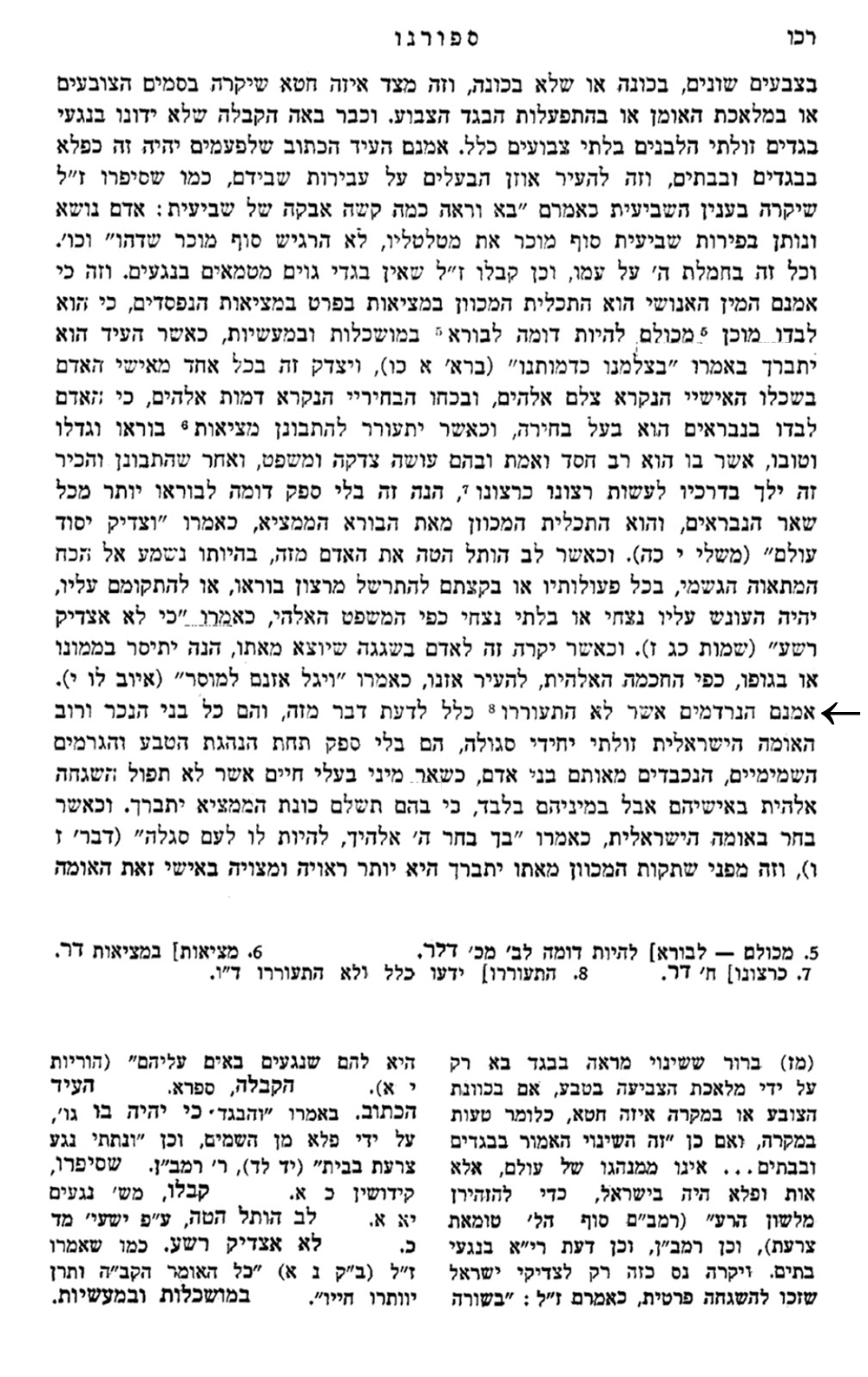
While I don’t find R. Moshe’s lack of knowledge about a medieval kabbalist surprising, not all share this sentiment. After my last post someone wrote to me asking if it is true that R. Menasheh Klein rejected R. Moshe’s disqualification of Zioni. This is indeed true, and Klein’s responsum appears in his Mishneh Halakhot, new series, vol. 2, no. 214. Klein also points out that Zioni is quoted in halakhic sources, including the Magen Avraham, and he adds:

הציוני מקדמוני בעלי המקובלים וגדולי הפוסקים גאון וקדוש ה’ ואשרי מי שזוכה להבינו ולחקרו וללמדו, וח”ו להוציא לע”ז על קדוש ה
As to how R. Moshe could have banned such a work, Klein has his own solution: “I don’t believe that these words came from the Gaon R. Moshe, but in my humble opinion a mistaken student wrote them and placed them among his papers after his death.” He also states that it is impossible for him to believe that R. Moshe never heard of Zioni since he is quoted in the commentaries on the Shulhan Arukh, and R. Moshe knew the Shulhan Arukh backwards and forwards. He concludes that God should forgive the one who is responsible for what appear in Iggerot Moshe, that which is now falsely attributed to R. Moshe.[3]

This is, of course, comical. R. Moshe insists that Zioni’s commentary should be banned, and Klein insists that R. Moshe never wrote this. The fact that the relevant volume of Iggerot Moshe was published in R. Moshe’s lifetime and the letter in which he writes against Zioni was sent to Rabbi Daniel Levy of Zurich and is dated 1976 does not deter Klein is what is surely one of the strangest things to appear in his volumes of responsa (which contain a good many strange things[4]).

As for R. Yehudah he-Hasid’s commentary, which R. Moshe also banned, Klein writes as follows (Mishneh Halakhot, vol. 16, no. 102):

מהעתקת הציוני כת”י של רבינו יהודה החסיד זה הוא עדות נאמנה גם על הכת”י של רבינו יהודה החסיד שהוא קודש קדשים וח”ו לרחקו ולומר שמינים כתבוהו
R. Moshe’s rejection of the commentary of R. Yehudah he-Hasid is not entirely unexpected. In fact, there are about ten different places where R. Moshe denies the authenticity of an earlier text because it does not agree with his preconceptions. In a future post I hope to list all of these examples, which show that R. Moshe could be quite daring (and this led to sharp responses to him by other poskim). Yet, as with R. Yehudah he-Hasid, every one of the texts that R. Moshe rejects is unquestionably authentic. In at least one of the cases we even have the author’s own manuscript.

A number of years ago I was studying R. Mordechai Spielman’s Tiferet Zvi. This is a multi-volume commentary on the Zohar which shows incredible bekiut. In fact, the Zohar is often just a springboard for the learned author to discuss all sorts of Torah matters. His first book, Tziyun le-Nefesh Tzvi, shows the same characteristics, and it is devoted to the issue of whether kohanim can go to the graves of tzadikim. While most poskim rule that they cannot, there is also a tradition, popular among the kabbalistically inclined, that tzadikim are exempted as they do not cause impurity. In one of his final articles, the late Prof. Israel M. Ta-Shma dealt with this issue.[5]

I noticed that Spielman cited Zioni and was curious to hear his reaction to R. Moshe’s teshuvah. In a lengthy letter, dated July 14, 1994, in which he discussed a variety of matters, he wrote:

וכשהייתי לפני כמה שנים בירושלים עה”ק ובקרתי אצל מרן פוסק הדור מו”ה ש”ז אויערבאך הנ”ל הסכים עמי ואמר לי בפירוש במעמד א’ מיקירי רבני ירושלים עה”ק שליט”א שאין הצדק עם הגאון ר’ משה זצ”ל לאסור למכור את הספר הקדוש הזה

[Quite by coincidence, a couple of years later my havruta at the Scranton yeshiva was the great-nephew of Rabbi Spielman. He told me that his uncle, who was a follower of the Munkatcher rebbe, R. Hayyim Elazar Shapira (and also a native of Munkatch), used to celebrate Thanksgsving each year. Such was his feeling of gratitude to be living in the United States.]

Returning to Auerbach’s Eshkol, the controversy really started when R. Shalom Albeck, in an open letter, later followed by his Kofer ha-Eshkol, accused Auerbach of forging the work. (Albeck himself, and his son Hanokh, later published the authentic Eshkol.) Yet it must be noted that Albeck was not the first to accuse Auerbach of this, as right after the work was published there appeared an anonymous article in He-Halutz[6] saying the same thing. There is a widespread assumption that this article was written by the outstanding scholar Raphael Kirchheim. Yet I don’t know how this assumption arose, as I can find no evidence to justify it. I believe that the author was Joshua Heschel Schorr, the publisher of the journal.

I must thank Rabbi Baruch Oberlander of Budapest[7] who called my attention to the fact that in another article in He-Halutz, eleven years later,[8] Schorr once again attacks Auerbach and his edition of the Eshkol. Among his choice words are the following:

וחטא למחבר הספר וחטא לקוראים ההוגים להתלמד, וחטא לאמת ולמי שחותמו אמת וחטא לנפשו, והוא עתיד ודאי ליתן את הדין ומי יודע אם יצא נקי בדין, כי אין מרחמין בדין
Oberlander also called my attention to the following, which is quite interesting. In my previous post I quoted R. Shlomo Yosef Zevin’s assessment that Albeck was correct in judging Auerbach’s Eshkol a forgery. Yet in the Talmudic Encyclopedia, edited by Zevin, Auerbach’s Eshkol is cited! I wouldn’t be surprised if most of the people working on the various entries, who are all great talmidei hakhamim, have never even heard of the dispute over the volume. Unlike the case of Besamim Rosh, the reliability of Auerbach’s Eshkol is almost never mentioned in traditional rabbinic literature, and the great poskim continue to cite it as a rishon. Yet Auerbach’s Eshkol is also cited numerous times in the volumes that appeared while Zevin was still alive. How can one explain this?

Auerbach’s Eshkol was shown to be a forgery in that it contained formulations taken from post-medieval works. In my last post I quoted R. Ratsaby’s comment in his letter to me that the work contains material from the Beit Yosef. Oberlander points out that R. Menahem M. Kasher, Torah Shelemah, 9:140, also raises this possibility.

באשכול הנדפס בכת”י ע”י ר”ש אלבעק דף 46, ליתא קטע זו וצ”ע אם אין זו הוספה ע”פ הב”י
It is in this area, of post-medieval material in the Eshkol, that Prof. S. Z. Havlin has made a fascinating discovery. I refer to his article in Yeshurun 13 (2003), which should satisfy even the final doubters that the work is indeed a forgery.

Havlin quotes a passage from R. Abraham ben ha-Rambam that is found in the Orhot Hayyim of R. Aharon of Lunel and also appears in Auerbach’s Eshkol. The question is obvious: How could the Eshkol, whose author, R. Abraham ben Isaac, died in 1159, quote anything from R. Abraham ben ha-Rambam. Of course, one could say that this is a later addition to the manuscript from someone who used the Orhot Hayyim. But as Havlin notes, this is no help either because where would this person have come across this text, as it is lacking from the standard edition of Orhot Hayyim and is today only found in one Jerusalem manuscript?

The answer is that the Beit Yosef cites this passage in the name of Orhot Hayyim (without noting that the Orhot Hayyim is quoting R. Abraham ben ha-Rambam). R. Joseph Karo had access to a manuscript of Orhot Hayyim which had this text, which, as mentioned, does not appear in the standard version of Orhot Hayyim. Auerbach saw this text in the Beit Yosef and simply incorporated it into his Eshkol, perhaps even assuming that this was another example of Orhot Hayyim quoting the authentic Eshkol, as he often does. Only now, when we have access to the Jerusalem manuscript of this work, do we see that Orhot Hayyim is actually quoting a teaching of R. Abraham ben ha-Rambam. This was information that Auerbach did not have, and explains how he could include it in his edition. R. Abraham ben Isaac was a great scholar (and father-in-law of the Ra’avad). Yet even he was not able to quote from works that would not appear until after his death.

Havlin concludes:

נמצא אפוא שיש בנוסח מהדורת הרב אויערבך הוספות שנבלעו בפנים בלא אות או סימן, שנעשו לא לפני שנת שי”א (1551), שבה הופיע לראשונה ספר בית יוסף
I was asked to explain a bit about the Eshkol, vol. 4, that Bernard Bergman published. First some background: In the introduction to volume 3 of his edition of the Eshkol, Auerbach wrote that the halakhot of the Eshkol found in his manuscript that remained to be published were Hilkhot Yom Tov, Rosh ha-Shanah, Yom Kippur, Orlah, Kilayim, Hallah, Hekdesh, Vows and Oaths, Tzedakah, and Rabbinic laws. In his Kofer ha-Eshkol, Albeck, who insisted that Auerbach had no Eshkol manuscript but created his edition using various other sources (including the authentic Eshkol), challenged Auerbach’s supporters to at least produce Auerbach’s transcribed copy of his manuscript. It was asserted by Auerbach’s defenders that the original manuscript had been lost, presumably put into geniza by Auerbach’s family after the latter’s death, since they didn’t realize its value. But, Albeck claimed, certainly Auerbach must made a copy of the manuscript (if it really existed).

Albeck’s request was never fulfilled, and it is obvious that all of Auerbach’s defenders, who were in close touch with his family, assumed that there was no such copy. Had anyone known of it, its existence would have been a central feature of the defense of Auerbach’s honesty.

In 1986 Bergman published volume 4 of Auerbach’s Eshkol, which contains some of the missing sections. This would appear to show that Albeck was not correct in his assumption, and accusation, that no such text existed. But its existence says nothing about the authenticity of Auerbach’s Eshkol. All it means is that Auerbach had written down certain sections, and added his commentary Nahal Eshkol which he had to do before publication. Even forgers have to present a written text to the printer!

With regard to Bergman’s volume, it is very curious that the reader is given no insight in the introduction as to where this manuscript came from (or even a picture of it). I can’t think of any other publication of a rishon where this information is not provided. I would not be surprised if some think that the new edition is itself a later forgery designed to protect Auerbach’s legacy. After all, how is it that Bergman came to this work when Auerbach’s family and defenders knew nothing about it? Despite these questions, I think that barring new evidence we should give Bergman the benefit of the doubt and assume that the manuscript did originate with Auerbach.

I realize that it was, and remains, hard for people to accept that a gadol be-Yisrael was capable of such an outrage, namely, forging the work of a rishon. I think we should simply assume that he had some sort of schizophrenic personality, and leave it at that. Even great Torah scholars sometimes do weird things.

It is of course understandable that people who knew Auerbach as a pious sage were not able to accept this. Professor Jacob Barth, who taught at both the Rabbinical Seminary of Berlin and the University of Berlin, and was one of the world’s leading Semitic scholars, is a perfect example of this phenomenon. Although he was R. Esriel Hildesheimer’s son-in-law and a leading figure in German Orthodoxy, he also had a critical mind and was not one to be led by convention. It was thus possible for him to argue that Isaiah 40-66 was a later addition, and to reject the talmudic dating of various post-biblical books. He even claimed that the Song of Songs was not originally intended as an allegory, a position that today would probably get him put into herem. Yet even this giant of critical scholarship could not approach the Eshkol problem objectively. Instead, he reflected on how forty years prior he had studied Talmud under Auerbach, and how much he was impressed by him, from both an intellectual and personal standpoint. As he put it, whoever had any contact with Auerbach knows that it is “absolutely impossible that he could have committed the smallest literary dishonesty.”[9] He concludes his essay by stating that the learning and character of Auerbach stand tall, despite the shameful attack of Albeck.

In my first post I noted that R. Hayyim Heller pointed out to the Rav that Auerbach’s Eshkol is a forgery. In this regard, it is interesting to mention something that appears in Shimon Yosef Meller, Uvdot ve-Hanhagot le-Veit Brisk. In recent years there has been great interest in “Brisk.” I am not referring to the Brisker method of Torah study which has been popular for a long time, but rather a great interest in the personal lives of the outstanding figures of Brisk.

As every bit of information is precious, and every book wants to offer new stories, it is important for the authors to look anywhere they can. Unfortunately, at least one such book has plagiarized from R. Herschel Schachter.[10] Another unfortunate element in these books is the lack of respect shown to figures who did not share the Brisker anti-Zionism. This is more understandable, as at times R. Chaim and R. Velvel themselves had negative views of the religious Zionist gedolim.[11] It would be censorship if their attitudes were not recorded properly, but most people reading this will still regard it as unfortunate that these great rabbis were not more tolerant. (The irony, of course, is that they are expected to be tolerant of those who supported what in their mind was bringing great devastation upon the Torah world.)

Speaking personally, I must say that some of the stories recorded in these books are so strange that I wonder if most people in this generation would be led to admire these figures more after hearing the stories, or if the result would be the opposite. For example, what is one to make of the following story, told in order to inspire awe of the Brisker Rav? Once he was served something which, while kosher, did not measure up to his standards. Upon learning of this, he immediately stuck his finger down his throat, causing himself to throw up on the host’s expensive rug. Rather than this upsetting the host, we are told that this further increased his admiration for the Brisker Rav.[12]

Can people today grasp what it means to be a pure ish halakhah of the sort the Rav describes in Halakhic Man, whose behavior can come across as very cold and unfeeling (e.g., R. Moshe Soloveichik’s rebuke of the Baal Tokea, and the story of R. Elya Pruzhener and his dying daughter)?[13] Another such example of this is the report that when one of R. Velvel’s sons died shortly after birth, and the family was crying, he was insistent that they stop their tears, since there is no avelut before thirty days.[14] Whether this type of pan-halakhism is inherently positive or negative I will leave to the judgment of others, but I think that in modern times it is clear that the average person who hears stories like this, even if he is a haredi, will not be spiritually inspired. I think that many times he will even be spiritually turned off, for obvious reasons.

I know that Rabbi Pinchas Teitz, who headed my high school, the Jewish Educational Center, didn’t like the similar sort of stories told about the Rogochover. He felt that people today would hear these stories and the only thing that would stay with them is that the Rogochover was eccentric. Since the point of stories of gedolim is to inspire respect and awe, telling stories that stress his eccentricity would therefore be counterproductive. For example, hearing about how the Rogochover threw a chair at R. Hayyim Ozer, or how he proclaimed that R. Yitzhak Elchanan didn’t know how to learn or that Tosafot is full of errors, are hardly the sort of tales that will inspire awe.

In fact there are many gedolim about whom R. Teitz’ point is applicable. I remember when a high school rebbe of mine got all excited telling the class about his trip to the Steipler, and how while he was there the Steipler chased another fellow out of the house. (Subsequently I learnt that this was not so uncommon). After the rebbe finished his story, no doubt thinking we would be impressed, one of the students blurted out something along the lines of “Do you think that was a nice thing to do?” Now I certainly am not going to judge the Steipler, and it is likely that the man was deserving of being thrown out, but the rebbe didn’t know the details and thought that it would be exciting to tell us high schoolers how the great Steipler lived up to his reputation as one who didn’t suffer fools. Yet the acculturated Modern Orthodox response was to wonder why he wasn’t a nicer person. In other words, Rabbi Teitz was correct about the need to be careful when it comes to telling the masses stories of gedolim.

To give another example, I recently read a hesped where R. Yitzhak Yosef recorded how the deceased talmid hakham, R. Moshe Levi, didn’t miss a moment of Torah study. He described how when R. Levi was at a communal meal he kept a book under the tablecloth, and every free second he could be seen be looking at it. The eulogizer saw that as something positive, whereas in my town, everyone would regard it as very rude. This point illustrates why I find haredi hagiography so fascinating, as it clearly reveals the culture gap between the haredi world and the Modern Orthodox world. Some of the stories that are told, and are part of haredi myth making, would be regarded with horror by the Modern Orthodox world.[15] How better to determine the ethos of a community than by seeing how it chooses to remember and praise its leaders? If anyone thinks that the Rav shared the Modern Orthodox ethos, just look at the stories he tells in Halakhic Man.

Sometimes truly horrible stuff is found in haredi “gedolim books” as well. Let me offer just one example. There is a very helpful book by Dov Ber Schwartz entitled Artzot ha-Hayyim (Brooklyn, 1992). This book contains short biographies of numerous American rabbis, a list of rabbinic books published in the United States, and an essay on Orthodoxy in America. Yet in the midst of the book, on page 52a in the note, one finds the shocking passage which you can see here, and which I am too embarrassed to translate. One can only hope that sentiments such as these are not very common among Schwartz’ fellow Satmar hasidim.

Another real problem with all of the haredi hagiography is that one never knows if the stories are trustworthy. That doesn’t mean that the stories have no value, for even if gadol x never did what is recorded, the fact that this story is told about him reveals the mindset of the generation telling the story. In other words, we can adapt the point Neusner has made about talmudic tales of tannaim really telling us about the amoraim; late twentieth and early twenty-first-century tales of gedolim really reveal what the current haredi ethos is (especially since anything that doesn’t agree with this ethos will be censored.)

While in many cases the stories told are strange and one wonders whether they are accurate, in some cases it can be determined with virtual, or even complete, certainty that they are false. Yehoshua Mondshine has authored a number of articles showing the falsehoods in (mostly) hasidic stories. Among the non-hasidic works he takes aim at is R. Barukh Epstein’s Mekor Barukh.[16] Mondshine’s prime concern is with the famous story recorded by Epstein about his father’s meeting with the Tzemah Tzedek, and Mondshine attempts to show that there is no reason to believe the report.

To this I would only add that, knowing Epstein’s reputation as a plagiarizer and how he manufactured stories, one should not take seriously any of his “recollections.” I know the feminists will be upset with this, but we must assume that the entire dialogue between him and Rayna Batya,[17] which shows her as a proto-feminist, is contrived and has no historical significance other than revealing that Epstein himself wanted to call attention to the sad fate of talented women who are not permitted to study Torah In the unlikely event that he does accurately portray Rayna Batya, all I can say is that the punishment of one who tells tall tales is that even when he tells a true story he is not believed. We must, however, remember that even when it comes to stories that are certainly false (and there are loads of them being invented all the time, and then repeated by the gullible), one should not be discouraged when reading them. Rather, one should keep in mind Saul Lieberman’s famous comment: “Nonsense is nonsense, but the history of nonsense is scholarship.”

What does all this have to do with Auerbach’s Eshkol? In Uvdot ve-Hanhagot le-Veit Brisk, 3:291, we are told in the name of someone who heard it directly from R. Velvel that when Auerbach’s Eshkol was published, “I [R. Velvel] immediately said that this is not the Eshkol.” R. Velvel is also quoted as saying that it was actually written by another rishon. Here is a perfect example of why these sorts of books are so unreliable. I am not saying that the person who reported this story is lying, only that he didn’t understand what R. Velvel said, or perhaps after forty years no longer remembered properly. I say this because R. Velvel never could have said what he is alleged to have said, as he wasn’t even alive when Auerbach’s Eshkol appeared in 1868. The only kernel of truth that can be gleaned from this text is that R. Velvel knew that Auerbach’s Eshkol was not the authentic Eshkol. Seeing how badly the informant messed up, I am not even willing to trust him that R. Velvel said that Auerbach’s Eshkol is the work of another rishon. Perhaps he only said that it contains information from rishonim, without committing himself to it being an authentic medieval work.

The great problem is what to do with pesakim that rely on Auerbach’s Eshkol. For example, the authentic Eshkol does not have hilkhot niddah, but Auerbach’s does. Unlike Saul Berlin, Auerbach was not simply making up pesakim and attributing them to rishonim. He was taking information in the Beit Yosef and other works and putting this in the mouth of the Eshkol. This is, of course, terrible, and in a halakhic sense it gives the authority of an aharon to a rishon. Yet when you have a pesak in one of the aharonim that relies on Auerbach’s Eshkol, I would think that it does not need to be thrown out because there is at least some important authority (e.g., Beit Yosef, Peri Hadash, etc.) who holds this position, even if it wasn’t the Eshkol.

That said, I can only sympathize with those who have written articles or halakhic works and treated Auerbach’s Eshkol as authentic. The forger has all sorts of motivations, but at the very least he is guilty of genevat zeman, i.e., the time that people take in examining that which they think is a rishon, and wouldn’t have done had they known the truth. Time is precious, and the forger causes it to be wasted on falsehoods. Just think how much time was spent on the forged Yerushalmi Kodashim and Besamim Rosh that could have been spent in authentic Torah study. From an issue currently in the scholarly news, imagine how many thousands of hours have been spent on Morton Smith’s Secret Gospel of Mark, by scholars arguing both sides of the issue. If it turns out that Smith is a forger, even after his death he is playing havoc with people and their scholarly direction.

One very unfortunate example of this is Chaim Bloch’s collection of forged anti-Zionist letters, Dovev Siftei Yeshenim (3 vols., 1959-1965). Hermann Greive wrote an entire article based on these letters,[18] and shortly after his article appeared Shmuel Weingarten published his Mikhtavim Mezuyafim Neged ha-Tziyonut (Jerusalem, 1981), showing beyond any doubt that the letters are forgeries.[19] All the time spent by Greive in writing his article was of course never to be recovered, stolen from him by the worst type of scoundrel the scholarly world can produce. Years ago I had wanted to discuss this matter with Greive, but was shocked to learn that he had met an untimely death, killed by a deranged student.[20]

Notes:

[1] Iggerot Moshe, Yoreh Deah III, no. 114.

[2] Encyclopaedia Judaica, vol. 11, col. 1314 (s.v. Zioni, Menahem).

[3] In a later responsum, vol. 16, Yoreh Deah no. 102, he offers a far-fetched explanation of Zioni and R. Yehudah he-Hasid, according to which David never removed anything from the Torah, only from Moses’ chumash, which contained material not found in the Torah.

[4] For example, what other posek has concluded that ethnic foods, e.g., Chinese, Italian, sushi, etc. are forbidden, and that Jews must only eat “Jewish food.” See Mishneh Halakhot, vol. 10, no. 111. It was pesakim like this that gave rise to the yeshiva quip that the title of his book should be pronounced Meshaneh Halakhot. In addition, Klein’s negative views towards baalei teshuvah and women are also very troubling (although with regard to women, a knowledge of some of his difficult personal history adds some necessary context in this regard.) His attitude towards non-Jews is also shocking, so much so that one wonders whether Elie Wiesel, great humanitarian that he is, would be such a supporter of his institutions if he knew what was being taught there (Wiesel and Klein were in Auschwitz and Buchenwald together). In a lecture at an Edah conference some years ago, a well known talmid hakham discussed if it proper for one to make use of poskim like R. Menasheh Klein for certain areas (e.g., hilkhot Shabbat), if one feels that their general worldview, in particular in areas of Jewish-Gentile relations, is diametrically opposed to one’s own values.

[5] Israel M. Ta-Shma, “Holy Men Do Not Defile – Law and Ideology,” Jewish Studies Internet Journal, 1 (2002): 45-53 [Hebrew], available here (PDF).

[6] Vol. 8 (1869): 165-167.

[7] Rabbi Oberlander is the world’s leading expert on the forged Yerushalmi Kodashim. He published numerous articles on the topic in Or Yisrael, which will be part of his forthcoming book. I should also note that he has played an important role in the rebuilding of Jewish life in
Hungary. See e.g., here.

[8] Vol. 11 (1880): 65-67.

[9] “Notwendige Abfertigung,” Jǔdische Presse (February 17, 1911): 65.

[10] Halikhot ha-Grah (Jerusalem, [1996]) takes a good deal of material, often word for word, from R. Hershel Schachter, Nefesh ha-Rav (Jerusalem: Reishit Press, 1994) without acknowledgment.

[11] I don’t know if it is a reliable report, but see R. Ephraim Greenblatt, Rivevot Efraim, 6:41, third introduction, that R. Velvel also expressed himself negatively with regard to the Rav. (R. Greenblatt himself always shows great respect for the Rav and all gedolei Yisrael, whatever their hashkafot; the passage I refer to was written by someone else. Years ago I expressed my surprise to R. Greenblatt that he included this in his work. Since it is part of an article about one of his teachers, he no doubt felt that it was inappropriate to make any changes.)

[12] Shimon Yosef Meller, Ha-Rav mi-Brisk (Jerusalem, 2004), 2:546-547. See also ibid., 1:484, for a story where R. Hayyim Ozer gave R. Velvel some sugar for his tea, and the latter thought it might contain kitniyot. Out of respect for R. Hayyim Ozer, which is a biblical commandment (kavod ha-Torah), R. Velvel used the sugar, but

תיכף עם צאתו את הבית בסיומו של הביקור, התאמץ וניסה בכל דרך לפלוט מפיו את שאריות הסוכר
[13] David Singer and Moshe Sokol advance the radical view that the Rav’s descriptions of his family members is actually designed to show his opposition to their hyper-intellectualism and pan-halakhism. They write

[T]here is something strange about Soloveitchik’s tales of the Litvaks. The behavior he describes is so radical, so extreme, as to make his presumed heroes seem grotesque. Who, for example, wishing to portray Litvak intellectualism in a positive light, would boast that his father and grandfather set aside all human sentiment and refused ever to enter a cemetery, because a stark encounter with death would have distracted them from the contemplation of the law. Or again, who would tell with pride the following macabre story about his maternal grandfather [referring to the story of R. Elya and his dying daughter] . . . Stories like this, while ostensibly presented in order to glorify the Litvak, cannot help but evoke strong disapproval in the reader. And this disapproval, it seems safe to assume, is shared in part by Soloveitchik himself, specifically by that part of him which rebels against the Litvak tradition’s spurning of the emotions. The vein of anger that runs through the anecdotal material in “Halakhic Man” is not to be missed.

David Singer and Moshe Sokol, “Joseph Soloveitchik: Lonely Man of Faith,” Modern Judaism 2:3 (October 1982): 259.

[14] Shimon Yosef Meller, Uvdot ve-Hanhagot le-Veit Brisk, 4:22-23. The eyewitness to this story was R. Simcha Sheps, late Rosh Yeshiva at Torah Vodaas.

[15] The same high school rebbe, mentioned above, also told us how at the Steipler’s wedding he had a sefer with him and was learning throughout the affair. Again, the reaction of the Modern Orthodox youths who heard this story was that the Steipler was definitely not someone to look to as a role model. What might inspire awe in Boro Park and Bnei Brak can often have the opposite effect when told to acculturated, fun-loving, American youngsters. This is the sort of story that will convince them that gedolim don’t value the normal pleasures of life, and why would any young person, brought up in America, want to be part of a religion that holds this up as an ideal?

[16] See here.

[17] See Don Seeman, “The Silence of Rayna Batya: Torah, Suffering, and Rabbi Barukh Epstein’s ‘Wisdom of Women,’” Torah u-Madda Journal 6 (1995-1996): 91-128.

[18] Hermann Greive, “Zionism and Jewish Orthodoxy,” Leo Baeck Institute Year Book 25 (1980): 173-195.

[19] Even before Weingarten’s book, and earlier articles, there was strong reason to suspect Bloch of forgery. From the beginning of the twentieth century he published books and articles containing letters of great rabbis and Hasidic leaders. None of them can be assumed to be authentic. During his great dispute with R. Yosef Elijah Henkin in the 1940’s, the latter repeatedly accused Bloch of dishonesty and pointed out that he would often attribute quotes to rabbis who were no longer alive so that he couldn’t be contradicted.

[20] After learning of the forgeries, Greive also published “Zionism and Jewish Orthodoxy (II),” Leo Baeck Institute Year Book 28 (1983): 241-246, which is a disgraceful and feeble attempt at defending his original article. In truth, it is no more than a justification of the time and effort he put into the original article. The best course would have been to simply acknowledge how he had been hoodwinked. Why do I say that his article is “disgraceful”? Because it is a twisted example of post-modern mumbo-jumbo that would make the editors of Social Text proud (see here). Here are some choice quotations from Greive, which if they ever became the standard of the historian’s craft, would mean the end of knowledge as we know it. He is trying to show that even forgery of texts is not very different than what historians do all the time!

It is precisely because of this awareness that historians tend to be exceedingly sensitive to any departure from the accepted standards, to any instance of “interference” that does not stop at interpreting a text, but – in the case of written sources – presumes to interfere with the very words in order to demonstrate a newly proclaimed truth. It must be borne in mind, however, that what the offender does in such a case is no different in principle from what everybody is doing except that he goes a little too far. It is this proximity of the permissible to the impermissible that accounts for the intensity of the hostile reaction among scholars, which is as it ought to be for the sake of upholding the standards of serious scholarship, for it is that final step across the dividing line that is the decisive one.
The indignation among scholars will be the more vehement, the rejection the more absolute, the more clearly the newly demonstrated “truth” diverges from the established tenets, flies in the face of securely held scientific convictions. Yet, as will be explained later on, such reactions may be over-hasty. For one thing, interference with a text is not in principle different from inadmissible interpretation which does not alter the words but stretches their meaning; for another, the editing of a text touches on the problem of the extent to which a word uttered during a particular period truly reflects a (hypothetical) extra-verbal reality. Of course, such doubly problematical sources must be approached with caution: their usefulness depends on just what wants to demonstrate by their use.

Later on in the article Greive assumes that Bloch did not create the anti-Zionist letters from scratch, but rather altered authentic letters, and he argues that one can “extract” authentic information from them. He concludes: “Admittedly, there is a danger of drawing erroneous conclusions from a distorted text, but this only reinforces the need for a careful and balanced critical approach and is certainly no reason for altogether ignoring the material until some more reliable evidence pointing in the same direction becomes available.”

It is unfortunate that such a fine publication as the Leo Baeck Institute Year Book published this nonsense. Dovev Siftei Yeshenim is completely useless as a historical source.


Finders Keepers? The Itinerant History of Strashun Library of Vilna, Pt I

Finders Keepers? The Itinerant
History of Strashun Library of Vilna

by Dan Rabinowitz
            Since the 1990s, the issue of reparation of items looted by the Nazis has become a high-profile issue, with numerous successful attempts at reuniting owners with their stolen possessions. The recent movie, Monuments Men, fictionalized the
Allies’ post-war efforts that led to the locating some of these looted treasures. While some of the best-known examples of these recovered treasures are related to art, gold, or Swiss bank accounts, Hebrew books were also part of the Nazi’s appropriation scheme and were included in the items recovered after World War II. Some of the books recovered belonged to a unique institution, the first Jewish public library, and tracing the journey of these books, up to present day, parallels that of its patrons, tortured, uncertain, and yet despite all odds, surviving.
 
Matisyahu Strashun the Library’s Architect and Founder
 
Matisyahu Strashun[1] was born in 1817 in Vilna.  His family was among the Vilna elite.  His father, Samuel Strashun (also known as Rashash), whose notes/annotations – he never published a stand-alone work – to numerous classic rabbinic works, including Midrash Raba, Mishna, and Maimonides’ Mishna Torah, and Talmud Bavli.[2]  In terms of breadth, the latter is most
impressive, as his notes cover nearly every single page[3] of the Talmud Bavli.[4]
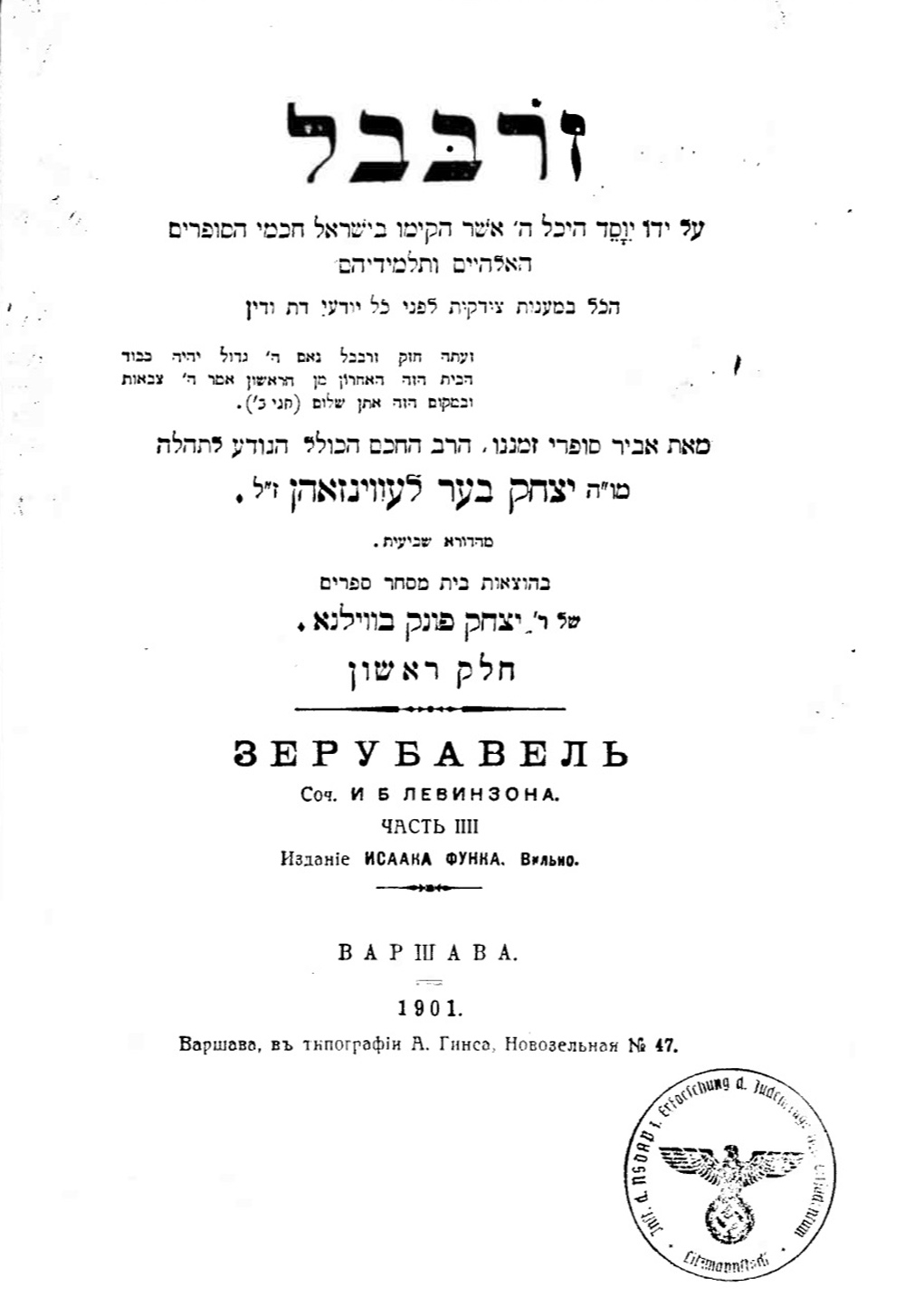
Matisyahu too was a Talmudist, his comments to Baba Batra and Eruvin are incorporated into the Vilna edition of Talmud Bavli, and was proficient in the entire corpus of rabbinic literature.[5] Matisyahu espoused views that were consistent with the haskalah movement.[6] For example, Matisyahu supported Max Lilienthal’s controversial attempt to reform “the Jewish educational system within the Pale Settlement,”[7] and Matisyahu help found and financially supported two schools in Vilna aligned with the haskalah.[8] Matisyahu corresponded with leaders of the haskalah movement, Isaac Ber Levinsohn, among others, and Strashun’s articles appeared in both rabbinic as well as haskalah newspapers and journals.[9] And, his home was a salon of sorts for traditionalists and the maskilim of Vilna.[10]
Strashun was independently wealthy and derived his substantial income from commercial and banking activities rather than rabbinic activities.  Yet he was considered a leader of the Vilna community.  He served on a number of communal institutions including the Vilna Tzedakah Gedolah.  And, at his death, he donated over 50,000 rubles to charity (approximately $1 million today). Leading Eastern European rabbis, R. Yitzhak Elchonon Spector and R. Jacob Joseph (later Chief Rabbi of
New York) among them, eulogized Strashun.[11] Posthumously, a street in Vilna was named after him.[12]
Throughout his life, he was an avid book collector, and, at the time of his death, amassed a collection of over 5,700 books and manuscripts.[13] His collection included incunabula, rare and controversial works (e.g. Me’or Eynaim), and manuscripts – from his father in addition to other authors. As reflected in his outlook during his lifetime, Strashun’s collection included rabbinic and haskalah works and books in non-Hebrew languages.[14]
During Strashun’s lifetime, numerous printing houses and bookstores populated Vilna, providing access to most contemporary books, including in languages other than Hebrew.[15]  But, unfortunately, we do not have much information regarding how and when Strashun amassed his collection that extended well beyond those contemporary books, beyond that when he traveled he took the opportunity to seek out and purchase books. For example, when he took therapeutic trips to the spa he also took that opportunity to seek out and purchasing books.  In addition to Strashun’s spa trips, in 1857 he went on a Rabbinic tour of Eastern Europe and visited R. Shlomo Yehuda Rappaport (Shi”r) in Prague and R. Tzvi Hirsch Chajes.[16] But, R. Rapahel Nathan Rabinowicz, a book dealer and noted book collector, commented after visiting Strashun that while Strashun’s collection was larger than Rabinowicz’s, his collection was richer in rare and older books.[17]


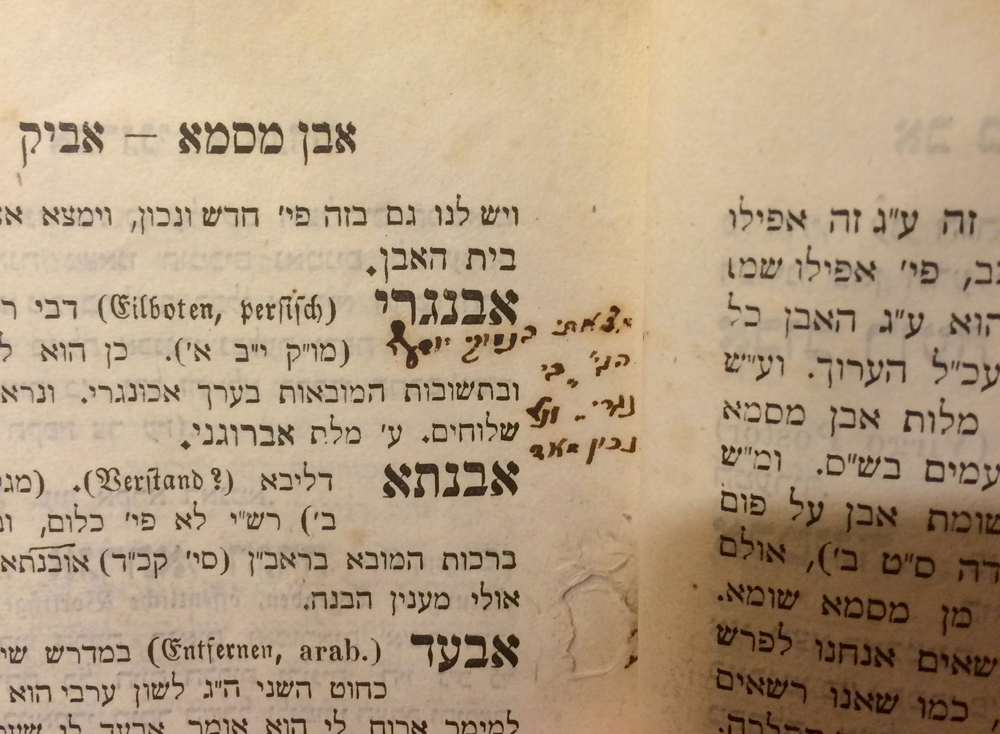
STRASHUN’S COPY OF SHIR’S EREKH MILIM


STRASHUN MARGINALIA TO EREKH MILIM
Creation of the Vilna Jewish Public Library
 
At his death in 1885, Strashun left no direct heirs.  He did, however, provide for the disposition of his library in his will.  In the past, those with large libraries had sold or left it to relatives,[18] Strashun elected a novel approach, rather than an individual or individuals he bequeathed his library to the Vilna Jewish community writ large, with instructions to establish a stand-alone public library.[19] His vision for the library was modeled on “the non-Jewish libraries that he saw [20] in the Diaspora.”[21] To that end, Strashun provided not only the books but also the funds to support the creation and sustainment of the library.[22]  Immediately the impact of this decision was apparent. At his funeral, among other enumerated good deeds and scholarship mentioned was, “the large library he left after death for the benefit of the community,” and which will “provide a
lasting legacy beyond that of any actual blood descendants.”[23]
            The creation of a public library out of Strashun’s personal collection was not a swift one, for seven years following Strashun’s death “the books remained under
lock and key” and were available only to those with special access.[24]  It remained in this state even though there were trustees and enough money to cover its operations.[25] Although the
library did not open to the public, the trustees were not idle during this time; and in 1889, published a complete catalog of Strashun’s collection.  His collection was comprised of 5,753 items, 63 of which contained marginalia in his hand.[26]
The Library is Open to the Public
 
In 1892, the Library was finally opened to the public. At the time, however, it remained in Strashun’s home.[27]  For years
after the library was opened to the public, in legal documents, the listed owner was not the Vilna community but one of the Library’s trustees. Although Strashun’s intent was clear – that the Library belonged to the community and not a trustee or any other individual – the Library’s legal status clouded that directive. In the late 1890s, there was a successful campaign to correct that issue, and the community becomes the sole owner of the Library, fulfilling Strashun’s wishes regarding ownership.[28]
The Library & Its Impact on the Vilna Community
 
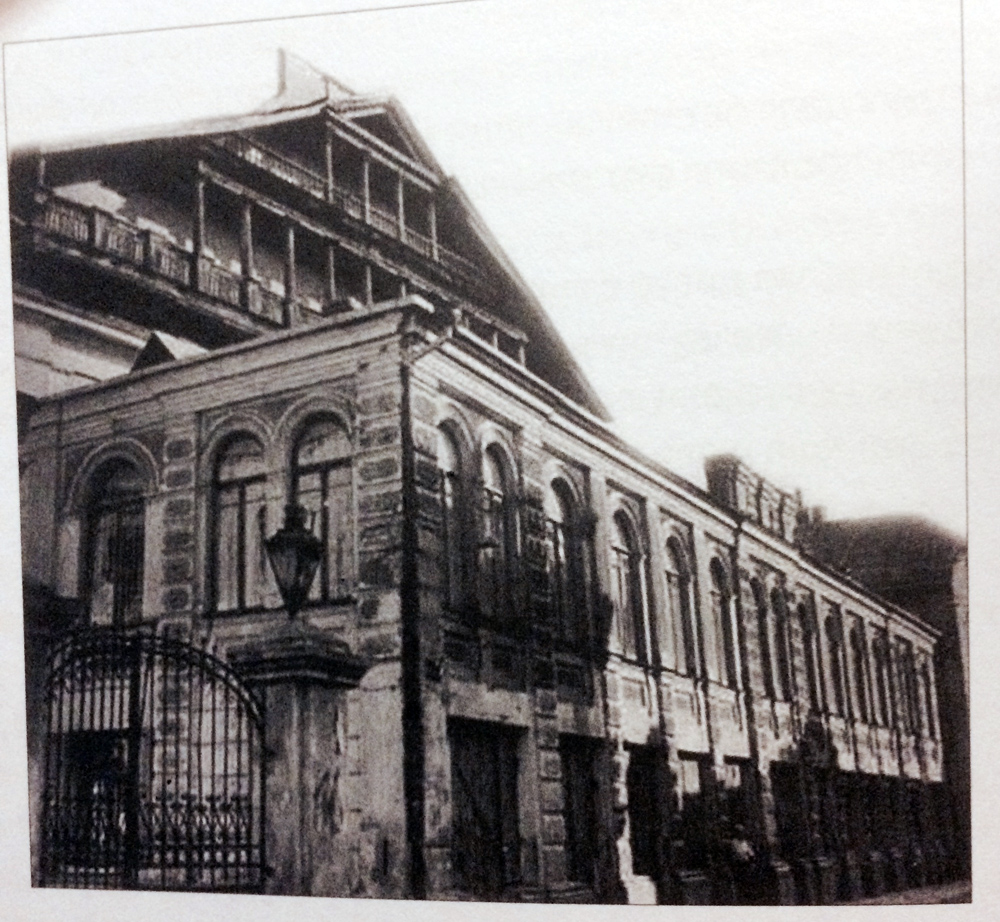
In 1902, the Library finally moved into a building of its own in the courtyard of the Great Synagogue of Vilna.[29]  From this
point forward, the Strashun Library would be one of Vilna’s most important institutions.
            The Strashun Library was a Jewish public institution and, to fulfill the needs of the public, additional steps were required beyond building and maintaining
infrastructure and clarifying ownership.
Specifically, although Strashun’s collection was substantial both in
terms of size and breadth, it was still the product of one man’s idea of a library.  For this reason, Hillel Noach Steinschneider, one of Vilna’s leading scholars and historians, pleaded with the public to donate books and ensure the completeness of the library and fulfill its mission of serving the entire community.  He acknowledged that Strashun amassed a very impressive private collection, but that for a public library his collection alone was insufficient because “it is lacking in books for people” whose interests did not align with Strashun’s.
That is, a public library is not only a place open for all but also one that provides value for all.  Consequently, the library’s composition must reflect the entirety of its audience and not a single collector. Apparently, this plea was successful,[30] many Vilna scholars donated their collections to the Library in addition to the general public, and, by the 1930s, the Library had grown to over 35,000 volumes.[31] Additionally, Vilna’s Tzedakah Gedolah organization also provided funds for acquisitions.  Books acquired through those funds contain a special stamp or receipt.
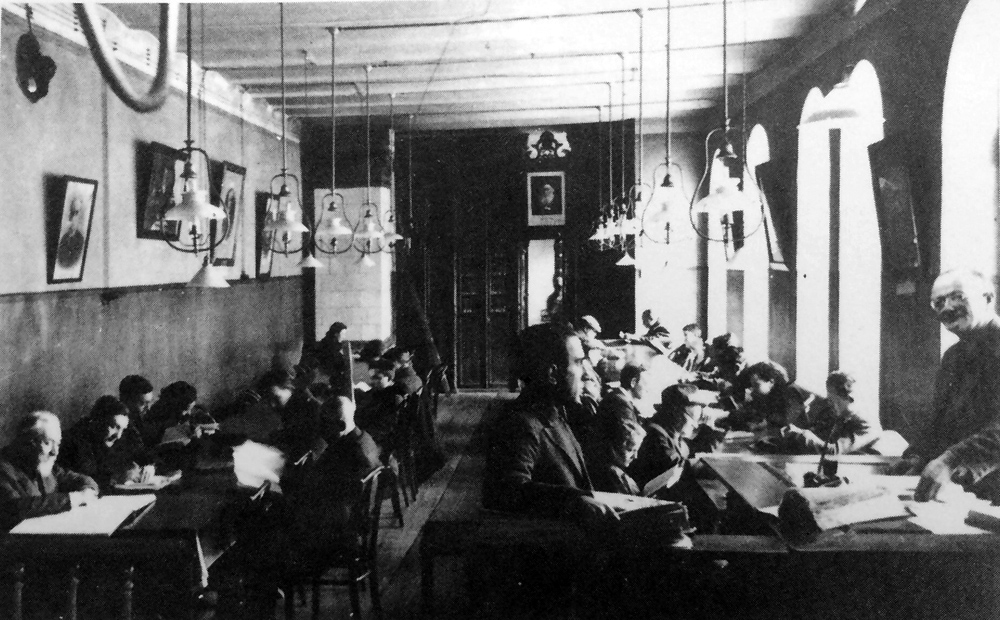
The Library was open seven days a week and became the central meeting location for the residents of Vilna.[32]  The Library’s visitors were representative of Strashun’s commitment to both traditional and modern ideas and ideals.  Patrons included “rabbis and talmudic scholars who were studying responsa and Halakhic
works” and who sat side-by-side with the “younger generation who were reading haskalah works.”[33] When dignitaries came to Vilna, the Strashun library
was a waypoint.[34]
 The intent was to have Herzl be the first visitor to the Library, however, the Russian government prohibited him appearing at the Library.[35]  Other famous Jewish personalities did visit and signed the guest book, known as the Golden Book, including Sholem Yankev Abramovitsh (Mendele Mokher Seforim), and Hayim Nachum Bialik, in addition to more traditionalists, R. David Friedman of Karlin, R. Shlomo Ha-kohen, and the Chafetz Chayim.[36] The Library was not only known for its visiting
Jewish celebrities, but also for its well-regarded holdings.  According to A.J. Heschel, it was the largest public Hebraic library in Eastern Europe reported holding over 40,000 volumes.[37]  On the one hand, the Strashun library was recognized as one of the greatest cultural institutions in Eastern Europe, on the other, like so many public institutions, the Library struggled to raise sufficient funds throughout the early part of the 20th century, consistently hampering its ability to maintain and build its
collections in addition to limiting its public access.[38]  But, it would not be funding that led to its demise but the Nazis and their campaign to appropriate Jewish cultural treasures.
The Nazi’s Looting of the Strashun Library
 
            During World War II, Vilna was occupied and controlled first by the Soviets, then the Lithuanian government, the Soviets again, and finally by the Germans.[39]  While under Lithuanian and Soviet rule, the Library had its share of challenges, but none
of those compared to the Nazi’s systematic campaign to identify, collect, and appropriate important Jewish treasures –specifically books – and, consequently, important libraries. The intent was that these pillaged libraries would supplement the already substantial Judaic holdings of Frankfort City Library.[40]  Immediately after the Nazis occupied Vilna, the Strashun Library as Vilna’s “oldest and perhaps most distinguished” library was identified as a target for this campaign.[41]
            Less than a month after occupying Vilna, the Nazis “enlisted” the Library’s librarian, Chakil Lunski, who had served in that capacity for over forty years, in addition to others, to select, identify and catalog important books including “the incunabula and manuscripts in the Strashun Library” to be sent back to Germany.[42]  Needless to say, Lunski was “distraught” that “he [was] supposed to help remove the treasures from ‘his’ Strashun Library that he protected for 45 years!”[43] Consequently, a number of books from the Strashun Library ended up in Frankfort, Germany.[44]


Post War Efforts to Reclaim Heirless Jewish Property 
 
            The Library’s building did not survive the war, but some of its books did.[45]  After WWII, the Allies recovered thousands of items the German’s looted and collected them at the Offenbach Depot outside of Frankfort.[46]  Much of what was recovered was likely heirless and the Allies faced with the dilemma of restitution. Initially, the Americans took the position that heirless property should return to the country from which it was looted.[47]  This position raised the specter of rare and important Judaica and Hebraica returning to Poland or even Germany.  This outcome was unacceptable to many Jews.[48]  Some elected to influence the fate of looted heirless books through traditional democratic means, others took matters into their own hands.[49]
Free For All? The Disposition of Other Significant European Libraries
 
The Strashun Library was by no means the only library identified at the Offenbach depot.  There were numerous other
libraries, both public and private that ended up at Offenbach, without any clear method of repatriation. This lack of clarity leads to inconsistent results at best.  Indeed, first-hand accounts of post-war Germany confirm the ad-hoc, doubtful legal grounds and sometimes completely lawless reparation regime in the post-war chaos.  In many instances, individuals made many of the decisions regarding disposition with little information and virtually to no oversight.
For example, Solomon B. Freehof, who himself amassed one of the greatest responsa collections in the 20th century, spent time in post-war Germany and encountered heirless property and describes attempts of repatriation. He indicates that
half of the heirless Jewish books recovered by the Allies went to the Jewish National and University Library (“JNUL”) at the Hebrew University (now the National Library of Israel),[50] which was “quite right” because some unnamed person or entity had determined “that clearly the [JNUL] should take the place of the vanished Jewish communities of Europe.”[51]
            Others agreed with Freehof that the natural repository for heirless books of European origin was the JNUL in Jerusalem.  Most notably, Judah Magnes, and the trustees of the JNUL wanted to recover and claim for the JNUL as much heirless Judaica as possible.  The JNUL dispatched Gershom Scholem, the eminent Kabbalah scholar, and bibliophile, to Europe to locate and return heirless property.  He discovered a significant number of important books and manuscripts in the Offenbach Depot
and did everything in his power, including employing very underhanded means, to repatriate items to Hebrew University.[52]
Initially, Scholem had a very difficult time securing authorization to even enter Germany and the Offenbach Depot.[53]  When he was eventually granted permission to view the contents of the Depot, it was with the explicit condition that he
could not remove any items.  But, for Scholem, some items proved too enticing.  Scholem identified a number of rare and important books and manuscripts.  He was concerned that if the disposition of these items were left to the Allied authorities the items would not end up in Jerusalem, but, instead, at the Jewish Theological Seminary, or some other institution, in the United States.  This was unacceptable to Scholem. To facilitate the transfer of these items to the JNUL, Scholem colluded with a Jewish American serviceman to smuggle the works out of Offenbach. Scholem placed the collection into five boxes but did not label
their contents and provided a fake name on the invoice.  The American serviceman personally ensured that the boxes were shipped to Paris, after which they were sent to the JNUL.  Eventually, the Allies found out about the theft, and demanded the return of the five boxes, even lodging a formal diplomatic complaint.  In the end, after much back and forth, the boxes remained at the JNUL.[54]
As germane here, eventually, the boxes’ content were cataloged and it was determined that a third of the works were not heirless – their ownership was clear and restitution was possible.[55]  Nevertheless, the content of the five boxes were incorporated into the JNUL.
Another example of unilateral ostensive benevolent restitution occurred with the “library of the prestigious Klaus synagogue of Mannheim, [that] ended up with U.S. Army Chaplin, Rabbi Henry Tavel.” Who, “on his own authority . . . shipped it to his alma mater, the Hebrew Union College in Cincinnati.”[56]
The Lost & Found: The Strashun Library Post-WWII
 
The determination regarding the disposition of the Strashun library after the Holocaust was no different from other heirless property, ad hoc and questionable.  Lucy Dawidowicz, worked for YIVO before WWII and spent time in Vilna.
After WWII, on behalf of the Jewish Distribution Committee after World War II, she went to the Offenbach Depot to assist with identification of heirless books.  Prior to coming to Offenbach, she had “promised [herself] that [she] would do [her] best to
safeguard the rights of possible owners and heirs.”[57]  And, when she came upon some of the remains of the YIVO collection,[58] she “was in a state of exaltation” and in a letter home wrote that she “had ‘a feeling akin to holiness, that [she] was touching something sacred.’”[59]
Dawidowicz also came upon books that she “could identify came from the Strashun Library.”  Whereupon she recalled “a
strange story” that the head of YIVO, Max Weinreich,[60] had told her “back in 1940.” Weinreich told her that during the brief period of time when the Soviets had returned Vilna to Lithuanian control, YIVO attempted to move its library out of Vilna.[61]  And, that “the trustees of the Strashun Library, also fearing for the sake of their library, asked the Vilna YIVO to ship [the Strashun Library] too.” Unfortunately, the shipment never occurred and both libraries remained in Vilna and ultimately plundered by the Nazis.
While the shipment never occurred, in Dawidowicz’s telling the attempted shipment was an irrevocable act with significant implications regarding the Library’s ownership.  She inferred that the Strashun trustees request to join the YIVO shipment also implicitly ceded ownership of the Strashun Library to YIVO. Thus, there she had no doubt regarding the proper disposition of the Strashun Library. Based entirely upon the “strange story” she heard, and even though according to her retelling the Strashun trustees had only intended YIVO to act as a shipper,[62] Dawidowicz told the Director of the Offenbach Depot that the heirless “remains of the Strashun Library ought to be considered as YIVO property.” She appealed to the Allied authorities and her position carried the day and the remnants of Strashun Library went to YIVO in New York.[63]
In a recent exhibit devoted to YIVO’s Strashun collection, the issue of the Strashun Library’s provenance is not discussed in any detail.  Instead, the book accompanying the exhibit simply states that all the remnants of the Strashun Library “were
rescued from the ruins of Europe and brought back to YIVO in New York in 1947.”[64] YIVO’s library catalog again implies that all the recovered books went to YIVO and links the disposition of the Strashun Library with that of YIVOs, the provenance note explains that “[t]he Strashun Collection, along with the YIVO Vilna collections, were liberated by the American Army, and
re-repatriated to YIVO in New York in April 1947.”[65]
            In reality, not all the remaining Strashun books went to YIVO, nor did everyone agree with the determination that YIVO was the rightful heir of the Strashun Library.
To be continued in Pt. II…


[1] For biographical information and sources see Tzvi Harkavy, Le-Heker Misphahot, (Jerusalem: Hotsa’at ha-Sefarim ha-Erets-Yisre’elit, 1953), 47-48 and n.79.
[2] A complete bibliography of his works, both published and unpublished, appears in Tzvi Harkavy, Le-Heker Misphahot, (Jerusalem: Hotsa’at ha-Sefarim ha-Erets-Yisre’elit, 1953), 45-46. Rashash’s comments on Rambam were printed in
Mekorei Rambam, first published in 1870 in Vilna, and while not a true stand-alone work, Rashash’s comments appear
alone, without the Rambam’s text.  See Mekorei ha-Rambam, Harkavy ed., (Jerusalem, Hatsa’at ha-Sefarim ha-Erets-Yisre’elit, 1957, Im ha-Madurah, and p. 59.
[3] For a list of the handful of pages he omitted, see Rafael Katzenellenbogen, Rash”sh le-Shitato, in Mekori Ha-Rambam Le-Rash”sh, ed. Harkavy, (Jerusalem, 1957), 64.
[4] For general biographical details on the Strashun family, see Frida Shor, From “Likute Shoshanim” to “The Paper Brigade” The Story of the Strashun Library in Vilna, (Tel Aviv: Ariel, 2012), 15-28, and the sources cited therein.  See also Shua Engelman, “Rabbi Samuel Strashun and his Haggahot on the Babylonian Talmud,” (PhD dissertation, Bar-Ilan University, 2009; Hebrew); regarding Samuel’s Talmudic annotations as compared to others, see Yaakov Shmuel Spiegel, Chapters in the History of the Jewish Book, Scholars & their Annotations (Ramat-Gan: Bar Ilan University, 2005), 421-22. Cf. Mordechai Zalkin, “Samuel and Mattiyahu Strashun: Between Tradition and Innovation,” in Mattiyahu Strashun, 1817-1885: Scholar, Leader, and Book Collector, (New York: YIVO Institute, 2001), 6-7.
[5] Moshe Shimon Anktokolski, Evel Kaved, infra n.12, 23.
[6] Mordechai Zalkin, “Samuel and Mattityahu Strashun: Between Tradition and Innovation,” in Yermiyahu Aharon Taub, ed., Mattityahu Strashun, 1817–1885: Scholar, Leader, and Book Collector (New York: YIVO Institute, 2001), 1-27. Samuel has made a very small number of comments that can be read to be consistent with ideas of the haskalah, but these do not approach Matisyahu’s active involvement with the movement, including his very public support of the movement.  Additionally, it is unclear if Samuel’s comments are simply limited to their specific context.
Indeed, the examples Zalkin provides regarding Samuel’s alignment with haskalah do not support Zalkin’s thesis. Id. at 25
n.10. First, Zalkin, cites Strashun’s comment in Gitten 6b, that “we find many amora’im who did not know how to read scripture” as proof of his “unorthodox” views.  But we find a similar statement from the medieval period.  See Tosefot, Bava Batra, 113a.  Zalkin’s second citation is to Rashas’s comments, Rosh ha-Shana 26a, “certain things that were uttered in a particular time and particular place are inserted by editors of the Talmud in their appropriate location in the text.” This misrepresents the Rashash.  Rashash is attempting to answer how the Talmudic sage, Levi, was unaware of an explicit verse as the TB in RH 26a implies.  Rashash explains that although there is no explicit mention of the time or place that this story occurred, Rashash posits that the story in Rosh Hashana occurred at the same time as another story with Levi, Yevamot 105a, where he had a moment of senility.
Rashash is not offering his opinion regarding the redaction of the Talmud, instead he is merely dating the story in Rosh ha-Shana. Finally, it is unclear the relevance of Zalkin’s third example, “you will find many contradictions between different locations is (sic) Rashi’s text.” Locating and alleging contradictions in Rashi is hardly remarkable.
[7] Zalkin, id., at 15.
[8] Shalom Pludermacher, Zikaron le-Hakham: Zeh Sefer Tolodot ha-Rav ha-Go’an, he-Hakham ha-Kollel Rabbi Matitayahu
Strashun Z’L
, in Mattiyahu Strashun, Matat-Ya, Haghot, Hidushim ve-He’arot Me’irot ‘al Midrash Raba Pri Eito Shel Matityahu Strahsun, (Vilna: The Widow and Brothers Romm, 1893), 15.
[9] A partial bibliography of Strashun’s articles appears in his Sefer Matat Yah (Vilna, 1893), 41-74 (Hebrew), available online here.  Reading, and certainly actively participating with, haskalah related newspapers was considered inconsistent with Ultra-Orthodox values and was grounds for expulsion from Volozhin Yeshiva. Shaul Stampfer, The Lithuanian Yeshiva, Revised & Expanded Edition,  (Jerusalem: The Zalman Shazar Center for Jewish History, 2005), 176.
[10] Aviva Astrinsky, “A Brief History of the Strashun Library,” in Yermiyahu Aharon Taub, ed., Mattityahu Strashun, 1817–1885: Scholar, Leader, and Book Collector (New York: YIVO Institute, 2001), i.
[11] Duberosh ben Aleksander Torsh, Me’arat ha-Makhpelah, shnei Hepadim . . ., (Warsaw, 1887), 50.
[12] Moshe Shimon Antokolski, Evel Kaved, (Vilna: be-Defus Avhram Tzvi Katzenellenbogen, 1886), 8; Tzvi Harkavy, Le-Heker Misphahot, supra n.1, 47.  During his lifetime he also donated to public institutions, among them, the yeshivot of Mir and Volozhin.  Id. at 24.
[13] Moshe Shimon Antokolski, Evel Kaved, supra n.12, 11.
[14] Mordechai Zalkin, supra n.6, 17-8.
[15] Hagit Cohen, At the Bookseller’s Shop, The Jewish Book Trade in Eastern Europe at the End of the Nineteenth Century,
(Jerusalem: The Hebrew University Magnes Press, 2006), 48-52.
[16] Shalom Pludermacher, Zikaron le-Hakham, 1893), 17. His meetings are reflected in Strashun’s ownership of their works.
See Likutei Shoshaim, nos. 386,1024,1178, 2522, 3352, 3650, 3781, 4377, 5399, 5592. Regarding other well-known Hebrew book collectors and their collections, see Alexander Marx, “Some Jewish Book Collectors,” in his Studies in Jewish History & Booklore, (New York, 1941), 198-237; Cecil Roth, “Famous Jewish Book Collections & Collectors,” in Essays in Jewish Booklore, (New York: Ktav Publishing House, 1971)330-35.
[17] “A Collection of Letter from Jewish Scholars to ShZH”H,” in Yad ve-Shem, reprinted in Yeshurun.
[18] David Oppenheimer’s library was the first library that was posthumously sold intact – to the Bodleian Library.  See
Alexander Marx, “Some Notes on the History of David Oppenheimer’s Library,” Revue des Études Juives 82 [=Israel Lévi
Festschrift] (1926): 451-460; Charles Duschinsky, “Rabbi David Oppenheimer: Glimpses of His Life and Activity, Derived from His Manuscripts in the Bodleian Library,” Jewish Quarterly Review 20:3 (January 1930): 217-247; Alexander Marx, “The History of David Oppenheimer’s Library,” in Studies in Jewish History and Booklore (New York: Jewish Theological Seminary of America, 1944), 238-255; and more recently in Joshua Teplitsky, “Between Court Jew and Jewish Court: David Oppenheim, The Prague Rabbinate, and Eighteenth-Century Jewish Political Culture (PhD dissertation, New York University, 2012); and Abraham Schischa, “Rabbinic Writings from the Collection of Rabbi David Oppenheim,” Yeshurun 31 (2014): 781-794 (Hebrew).
For other significant personal Hebrew libraries and their purchasing history, see Binyamin Richler, Hebrew Manuscripts: A
Treasured Legacy
(Clevland/Jerusalem: Ofeq Institute, 1990) 66-67.
[19] For earlier examples of private libraries see Nehemya Allony, The Jewish Library in the Middle Ages, Book Lists from the Cairo Genizah (Jerusalem:  Ben-Zvi Institute, 2006); S.D. Goitein, A Mediterranean Society (Berkley: University of California Press, 1967), vol. II, 206, 248; vol. V 3-4, 425.
[20] It is unclear whether Strashun meant this literally because while the 19th century witnessed the modern period of the public library, there were not any public libraries in Eastern Europe during Strashun’s lifetime.
[21] Shor, supra n. 4, at 26.
[22] Sefer Matat Yah, supra n. 9, at 35, listing Strashun’s bequests.
[23] Moshe Shimon Anktokolski, Evel Kaved, supra n.12, 17.
[24] Among those who had access during this time was Ya’akov Wallensky.  During this time, Wallensky was writing his supplement to Piskei Teshuvot on Yoreh De’ahPiskei Teshuvot itself is a collection of obscure and rare works discussing issues
appearing in Yoreh De’ah. Because Wallensky’s materials were even more obscure and rare, the only place he could access these was the Strashun Library. Ya’akov Wallensky, Daltei Teshuva, (Vilna, 1890), Introduction, 5-6, (link).
[25] Shor, supra n. 4, at 29
[26] Cf. Aviva Astrinsky, “A Brief History of the Strashun Library,” in Yermiyahu Aharon Taub, ed., Mattityahu Strashun, 1817–1885: Scholar, Leader, and Book Collector (New York: YIVO Institute, 2001), iii, who provides that his collection was only
comprised of 5,739 items.
[27] Shor, supra n. 4, at 29.  Regarding the conflicting reports of the Library’s locations during this period, see id., n.71.
[28] Shor, supra n.4, 32-3.
[29] While the Library moved to the new building in 1901, and its dedication ceremony occurred on April 14, 1902, it would not be until October 20, 1902, that the Library secured the necessary governmental permits to fully open to the public.  See Shor at 34-35.  The government license is reproduced in Layzer Ran, Jerusalem of Lithuania, vol. 2, (New York: Laureate Press, 1974),
346.
[30] Frida Shor, supra n.4, 51-65,174-87. See Berger, “The Strashun Library in Vilna,” in Zevi Scharfstein, ed., Hebrew Education and Culture in Europe Between the Two World Wars (New York: Ogen Publishing House of Histadrut HaIvrit BeAmerica, 1957), 513 (Hebrew), who discusses the varied subject matter of the Library’s collection.
[31] Id.
[32] According to one account, the Library had over 200 patrons daily, but only 100 seats, forcing people to share chairs and encounter waits of over a half-hour just to enter the Library.  Id. at 513.
[33] Ben Tzion Dinur, “Yerushalim de-Lita,” in Layzer Ran, Jerusalem of Lithuania, vol. 1 (New York: Laureate Press, 1974), XVI; but see the English translation of Dinur’s article that comingles the two groups and has both the Orthodox and younger generation studying “respona or modern Hebrew novels.”  Id. at XX.  It is unclear what accounts for this discrepancy in translation. Lucy S. Dawidwowicz, From That Place And Time, A Memoir 1938-1947, (New York: Bantam Books, 1991), 119, provides a remarkably similar account to Dinur’s (“On any day you could see, seated at the two long tables in the reading room,
venerable long-bearded men, wearing hats, studying Talmudic texts, elbow to elbow with bareheaded young men and even young women, bare-armed sometimes on warm days, studying their texts. The old men would sometimes mutter and grumble about what the world had come to. The young people would titter.”).
For a breakdown of the Library’s readership by type (i.e. students, academics and public intellectuals, workers, etc.), see Berger, supra n. 28, 514-15.
[34] See Shor, supra n. 4, 174, see also the description of David Wolfson’s Vilna visit, Israel Klausner, “The Zionist Movement in
Lithuania,” in Yahdut Lita (Tel Aviv: Am Hasefer Publishers, 1950), 522 (Hebrew). For a photo of one such visit, see Layzer Ran, Jerusalem of Lithuania, vol. 2 (New York: Laureate Press, 1974), 416.
[35] Shor, supra n. 4, 174-75.
[36] Berger, “The Strashun Library in Vilna,” at 519; Shor, MeLekutei, supra n. 4, 169; Khaykl Lunski in Yeshurin’s ‫ווילנע
(New York, 1935 – in Yiddish), p. 286-7
[37] Abraham Joshua Heschel, “Yerushalim de-Lita,” in Ran, Jerusalem, vol. I, XVII; David E. Fishman, The Rise of Modern Yiddish Culture (Pittsburgh, PA, University of Pittsburgh Press, 2005), 143, provides that the holdings of the Strashun Library prior to the Holocaust was comprised of “some forty thousand volumes.”
[38] See Shor, MeLekutei, 38-9; 42 (discussing a 1926 public appeal that the Library undertook where it described its financial condition as “dire and catastrophic”); id. at 43 (“The Strashun Library underwent many difficult financial periods throughout the nineteen years of Polish rule (10/9/1920- 9/19/1939).  But, it continued to major Vilna cultural institution.”).
[39] Shor, MeLekutei, 44-7.
[40] Sem C. Sutter, “The Lost Libraries of Vilna and the Frankfurt Institut zur Erforschung der Judenfrage,” in Lost Libraries, The Destruction of Great Book Collections Since Antiquity, ed. James Raven (New York: Palgrave Macmillan, 2004), 220-22.
[41] Id. at 223 & 224 discussing other Vilna Libraries that were targeted by the Nazis.  See also Dov Schidorsky, Burning Scrolls and Flying Letters (Jerusalem: Magnes Press, 2008), 165-201; David E. Fishman, The Rise of Modern Yiddish Culture (Pittsburgh, PA: University of Pittsburgh Press, 2005), 141-44; Frida Shor, supra n.4, 189-200.
[42] Sem C. Sutter, “The Lost Libraries of Vilna,” supra n.38, 224.
[43] Id. at 226.
[44] Berger, “The Strashun Library of Vilna,” at 517.  The books that were not deemed important we pulped or used as heating fuel. Schidorsky, supra 39, 182. The exact date of when the Strashun Library was transferred to Germany is unclear; however, it was some date after April 1943.  See David E. Fishman, supra n.39,173 n.9. Similarly unclear is the exact number of books that were sent to Frankfort.  Sem C. Sutter, “The Lost Libraries of Vilna,” supra n.38, 228.  But, according to Aviva Astrinsky, “almost all of the Strashun books were crated and shipped by rail to Germany.  Aviva Astrinsky, “Mattitayahu (Mathis) Strashun,” supra n.24, i.
[45] See Ran, Jerusalem, vol II, 522, for a photo of post-war building. For a discussion regarding the numbers of books that survived from the Strashun Library, see Frida Shor, supra n.4, 204-05.
[46]  Dov Schidorsky, supra n.39, 225, listing the countries and libraries who books were deposited at the Offenbach Depot. Sem C. Sutter, “The Lost Libraries of Vilna,” supra n.38, 229-32.
[47] Lisa Moses Leff, The Archive Thief: The Man who Salvaged French Jewish History in the Wake of the Holocaust (United
States:  Oxford University Press, 2015), 121.
[48]  Id. at 124-30, 136-40.
[49]  Id.
[50] Dov Schidorsky, supra n.39, 233, provides the numbers and location of heirless books returned by the Jewish Culture Reconstruction.  For a listing of U.S. institutions that received heirless cultural property from the Offenbach Depot, see Herman
Dicker, Of Learning and Libraries, The Seminary Library at One Hundred, (New York: The Jewish Theological Seminary, 1988), Appendix B. See also F.J. Hoogewoud, The Nazi Looting of Books and its American ‘Antithesis’. Selected Pictures
from the Offenbach Archival Depot’s Photographic History and Its Supplement,” Studia Rosenthaliana 26:1-2 (1992): 158-192; and F.J. Hoogewoud, “Dutch Jewish Ex Libris found among looted books in the Offenbach Archival Depot (1946),” in Chaya Brasz and Yosef Kaplan, eds., Dutch Jews as Perceived by Themselves and by Others (Leiden: Brill, 2001), 247-261.
[51] Solomon B. Freehof, On the Collecting of Jewish Books, (New York, NY: Society of Jewish Bibliophiles, [196-]), 17; regarding the books that Hebrew University received, and its efforts to locate and claim heirless works throughout Europe through its Otzrot Ha-Goleh committee, see Shlomo Shunami, About Libraries and Librarianship, (Jerusalem: Rubin Mass, 1969), 56-65; Zvi  Baras, A Century of Books, The Jewish National & University Library 1892-1992, (Jerusalem: Jewish National & Univ. Library,1992), nos. 94-101; Dov Schidorsky, supra n.39, 212-91.
[52] Dov Schidorsky, supra n. 39, 250-51.
[53] Id. at 248-50.  According to Scholem, Abraham Ya’ari, Scholem’s partner on behalf of Hebrew University and its Goleh ha-Otzrot program, returned to Israel, in part, because of the difficulty in securing the necessary authorizations to enter Germany.
Id. 248; 351.
[54] Id. at 250-51.
[55] Id. at 251 n.51.
[56] See  Druker, Of Learning and Libraries, 58.  Druker, however, concludes that Tavel’s unilateral decision “resulted in
no real harm.”  One wonders if any surviving heirs who had legal claims to the Manheim collection would reach the same conclusion.
[57] Lucy S. Dawidwowicz, From That Place And Time, A Memoir 1938-1947, (New York: Bantam Books,1991), 314-16.
[58] See David E. Fishman, supra n.39, 143-53 174 n.20, discussing the YIVO Library under the Nazis and its ultimate transfer to YIVO in New York.
[59] Id. at 318.
[60] For more information regarding Weinreich and YIVO, see id. at 126-39.
[61] Id.; for a fuller treatment of this attempt see Shor, From ‘“Likute Shoshanim”, 44.
[62] Aside from Dawidowicz’s telling, according to the documents that discuss YIVO’s efforts to save its library and the Strashun and the Lithuanian government’s response throughout this attempt, the Strashun Library is described as a Vilna community
library and not the property of one institution or another.  See Shor, From “Likutei Shoshanim”, at 44.
[63] Her argument has the perverse effect that the trustees attempt to save the library immediately resulted in completely losing control of the library.
[64] Aviva E. Astrinsky, Mattistyahu Strashun 1817-1885, Scholar, Leader, and Book Collector, YIVO, New York: 2001, ii, iv.  But, Astrinsky also indicates that YIVO recovered “a substantial part of the Strashun Library.”  Id. at i.  According to YIVO’s website, however, YIVO only received part of the Strashun Library and the remainder “were transferred to the library of the Hebrew University in Jerusalem. (link).
Similarly, Berger, “The Strashun Library in Vilna,” p. 517 claims that part of the Strashun Library went to YIVO and the other part to Hebrew University.
Beyond these unsupported statements, there is no evidence that any books from the Strashun Library were sent to the JNUL.  While the JNUL’s post-war efforts at obtaining heirless books are well documented, see supra, there is no mention of the Strashun Library.
Similarly, the JNUL catalog does not list any items whose provenance extends to the Strashun Library. It is possible that YIVO and Berger confused the JNUL with the Jerusalem Central Library discussed below.  Or simply conflated the Strashun Library with the numerous other European libraries that the JNUL successfully rescued.
[65] See, e.g., the YIVO catalog entry for Solomon Adret’s Hidushe Nidah leha-Rashba, Altona, [1737].


The 1908 Student Strike at Rabbi Isaac Elchanan Theological Seminary: A Newly Discovered Document

The 1908 Student Strike at Rabbi Isaac Elchanan Theological
Seminary: A Newly Discovered Document
By Eli Genauer

I would like to thank Dr Zev Eleff for his invaluable assistance in helping me frame this article. I would also like to thank Sharon Horowitz of the Library of Congress for providing research assistance.

The Rabbi Isaac Elchanan Theological Seminary (RIETS), present day Yeshiva University, was officially founded on March 20, 1897. RIETS was the first unequivocally Orthodox Jewish seminary on American soil.  Initially, its mission was entirely religious, limited “to promote the study of the Talmud and to assist in educating and preparing students of the Hebrew faith for the Hebrew Orthodox Ministry.”[1] RIETS’ first years were difficult ones.  It did not move into a building of its own until 1904.[2] Additionally, RIETS faced difficulty meeting its financial obligations.  including a student stipend. As a result, in 1906, RIET’s was beset by a major student strike. Among the student’s demands was that RIETS expand its mission beyond religious education and they demanded that they be instructed in secular subjects, including learning English.[3] While that strike was settled, another student strike and a lockout occurred over similar issues in May 1908. The strike was ended when changes were promised by the board of directors.  Yet, that settlement proved fleeting.
By August 1908, the students were striking again. The students’ strike received notice from the national press, when on August 19th,
the New York Times reported:[4]
the Talmuds are lying idle on the shelves of the Rabbi Isaac
Elchanan Theological Seminary at 156 Henry Street, and the drone of the voices
of the students as they walked back and forth reading aloud from the Hebrew
text is heard no more. For the last few weeks the students have not received
the $3.50 a week which they are paid while they are learning to become Rabbis.
Consequently, they have gone out on strike. Boruch Shapiro, Louis Mahler and
Samuel Broida, the leaders of the demonstration, stationed themselves at the
door of the school yesterday and effectively blockaded the entrance of all the
smaller boys. Nathan Lamport of the Lamport Manufacturing Supply Company, at
278 Canal Street, president of the school, and David Abramowitz of 47 Forsyth
Street, the Secretary, do not know what to do.[5]
On August 20th, citing financial reasons, the board locked out the students and
closed the school.[6] As a result of the closure of the school by the board of directors, some of the students and some Rabbinic leaders tried to form a new school called Yeshiva le-’Rabbanim which was designed to address some of the deficiencies of RIETS.[7]
Although the closure of the RIETS has been documented, the August 1908 student strike that led to the closure is not reflected in any published histories discussing the unilateral closing of the school and lockout of the students by the board ofdirectors on August 20th.[8]
One of the difficulties in piecing together exactly what happened during that August 1908 strike, lockout and its immediate aftermath is the dearth of contemporary records. This lacuna is in part attributable to a general lack of documntation of REITS’ early years.  And, “there are no records extant of the Seminary from its inception in 1897 to its merger with Yeshivat Etz Chaim in 1915. Only the Certificate of Incorporation, scattered newspaper accounts, one or two contemporary citations, and passing references in the memoir literature of the time remain as silent witnesses to the great vision and determination of a few men who…created the first Orthodox rabbinical seminary in America.”[9] As an example, in reporting on the August 1908 closure of the school by the board of directors and its aftermath, one scholar quotes mainly from newspaper accounts of the day.[10] There was an important memoir of that period written by Hayim Reuben Rabinowitz, who was an 18 year old student at the time, but Rabinowitz published his account 60 years later.[11]
Recently, however, a contemporaneous account of the events of 1908 has come to light.  This account was discovered as a result of construction at Congregation Bikur Cholim Machzikay Hadath in Seattle, Washington, when workers came upon a box of papers labeled, “Rabbi B. Shapiro Papers, 1920s-1960’s.” Rabbi Boruch Shapiro (1883-1970) was born in Szmorgon, Lithuania and was recognized as a Talmudic genius (Iluy) at an early age.[12] He was a student of, and received ordination from, Rabbi Meir Simcha of Dvinsk, (Or Sameakh), one of the outstanding rabbinic leaders of his time.[13] While in Dvinsk, R. Shapiro also received ordination from Rabbi Joseph Rozin, known as the “Rogatchover Gaon”.[14]  R. Shapiro immigrated to America in the early 1900’s and visited Seattle in 1913 on a fundraising trip. His visit became permanent when he ended up marrying a local woman, Hinda Gershonowitz and remained in Seattle until his passing in 1970. Rabbi Shapiro is perhaps best remembered as the Rav of Congregation Machzikay Hadath in Seattle, a position he held for forty years.
Before arriving in Seattle and shortly after arriving in America, Rabbi Shapiro studied at RIETS. Because he already possessed rabbinic ordination, he was considered in a special class of students, receiving a higher weekly stipend than most others who studied there. [15] He was sent by the school to give lectures at a synagogue in Brooklyn during the Sukkot holiday of 1905 as an example of the quality of students that were studying in the yeshiva.[16]
The box of papers discovered contains Rabbi Shapiro’s account of the events surrounding the student strike in August 1908, and the subsequent founding of the Yeshiva Le’Rabbanim. The account was written on October 7th, 1908 and covers the period from August 20 until that time. Because Rabbi Shapiro was one of the three student leaders of the strike, his account is particularly relevant to filling in the picture of the details of the August 1908 RIETS student strike.[17] Rabbi Shapiro’s writings, it should be noted, reflect that he and his fellow students had been involved in a struggle with, in his view, a dysfunctional and stubborn board of directors for over two years.[18]
Rabbi Shapiro records that:
On Thursday night, 24 Av 5668(20 August 1908), the Rabbi Isaac
Elchanan Yeshiva was closed in a very unseemly fashion. Mr. [Jonathan] Shepp,
the treasurer of the Yeshiva called the police several times to evict the
yeshiva students from the building in which they learned.[19]
But despite all his efforts, the police declined to do harm to the students.
They remained there despite his displeasure until midnight and at that time
they left for their residences.”[20]
After the students of the Yeshiva had concluded that there was no
hope to improve both the physical and spiritual conditions of the Yeshiva due
to the obduracy of the leaders whose concern was only for themselves, the
students decided to separate from the above named Yeshiva and move to “Adas Bnei
Yisroel” at 213 East Broadway, which welcomed them with open arms.[21] On
28Av (25 August-1908), the students of the Yeshiva moved their place of Torah
study to the above mentioned address in the company of well-known rabbis, such
as Rabbi [Shalom Elchanan] Jaffee[22],
Rabbi [Chaim Sholom] Shoher[23],Rabbi
[Aaron] Gordon [24],
and others, who had gathered there to guide them. After much discussion, it was
decided that the yeshiva students would study temporarily in Adas Bnei Yisroel,
and that they would acquire a charter. So that the leaders of Yeshiva Rabbeinu
Yitzchak Elchanan would not collect money in their name, they decided that this
yeshiva would be called “Yeshiva L’Rabanim”. Similarly, they decided to send
out boxes to collect members and to try to establish this yeshiva on a proper
foundation.
From 28 Av 5668 until 12 Tishrei 5669, three meetings of well-known
rabbis and prominent lay leaders were held. At the second meeting, an interim
leadership team for Yeshiva L’Rabanim was chosen: Rabbi Jaffe, chairman; Rabbi
Shoher vice chairman and treasurer; Rabbi [Joseph Judah Leib] Sossnitz,
administrator;[25]
Rabbi Dr. Rabinowitz from Brooklyn, administrator; Rabbi [Judah Leib] Lazeroff,
administrator,[26]
and others. The job of developing a “program” both in religious and secular
studies for this yeshiva was also assigned to the above leaders.
Even before the closure of the Yeshiva Rabbi Isaac Elchanan, the
physical situation of the students was very bad because for seven weeks prior
to the closure, all they received was a half a kilogram of bread per week.
However, the situation since they left the Yeshiva until now was much worse,
and the poverty and embarrassment they suffered is difficult to describe. Many
of them could have found other means of support, but because of their love of
Torah, they accepted their lot and did not abandon Torah study with which they
had been engaged their entire lives.
Many Rabbis, in writing, speech and action, promised to help. From
all the promises very little materialized, aside from Rabbi Lazaroff, who had
spoken up a few times in his synagogue on behalf of the Yeshiva. He assembled a
worthy number of members from whom he collected funds. The prominent Mr.
[Abraham J.] Goldstein and his brother-in-law, Mr. [P.] Feinberg from Jersey
City came to the assistance of the Yeshiva in the beginning. [27]With
the help of other prominent members of their congregation who worked alongside
their honored Rabbi [Shlomo David] Posner, that synagogue supported the yeshiva
a bit.[28]
To describe in detail all the problems faced by this new endeavor
and the stumbling blocks that were placed in front of this new Yeshiva from the
beginning until now would amount to an entire book. The task was difficult and
the conflict with the administration of the Yeshiva Rabbi Isaac Elchanan
weighed heavily on us. Many did not want to support the students of the Yeshiva
since they saw that the “Morgen Journal” had “sold out” to those above
mentioned administrators to do their bidding. They also felt that the “Tageblatt”
was leaning in the direction of those administrators, and not on the side of
the Yeshiva L’Rabanim. Many rabbis knew and admitted that the yeshiva students
were right, but kept silent due to fear. So much so, even those who had joined
the new Yeshiva were not really able to help it.
The primary laborers on behalf of the new Yeshiva were the students
themselves and especially a student council that was chosen from among them to
lead the struggle. The five members of this council were Mr. A.[vraham]
Shapira, Mr.[Ben Zion] Perl, Mr. [Chaim Yechezkel] Mosesohn, Mr. [H.S.] Linfeld
and Mr. B.[aruch] Shapira who was the leader.[29]
The politics were so intense that oftentimes those in the Yeshiva did not
confide in their fellow students for fear that they were supporting the other
side. The council worked diligently with the three main activists, Rabbi B.
Shapira, Rabbi A. Shapira, and Rabbi Perl who were most instrumental.  They abandoned all their other pursuits such
as attending “Preparatory School,” working day and night to battle with the
administration of Yeshiva Rabbeinu Isaac Elchanan.  Nothing was too difficult for them or beneath
their dignity. Their physical situation was worse than the conditions of other
students, as they had no other means of sustenance and they also received a
more meager stipend compared to what they had been entitled to. They suffered
immensely during this time. They knew that they were making great sacrifices
and losing precious time. Nevertheless, they did not consider their own
personal situations so that they could help establish this new Yeshiva on a
proper foundation. There were times that matters grew so bad that many of the
yeshiva students echoed the complaints of the Jews in the desert: they wanted
to return to their previous Yeshiva, but thanks to many of the yeshiva students
and the student council, especially Rabbi B. Shapira, these complaints were set
aside and it allowed the Yeshiva to attain the status it claims today. The
result of what has been done so far is small compared to what needs to be
completed. Nevertheless, laying the foundation, which was the most difficult to
accomplish, has been done. More effort is required to establish this Yeshiva on
a firm foundation and to transform it into an excellent school that will train
great rabbis in Torah, wisdom, fear of Heaven; who will work within the spirit
of ancient Israel and the spirit of this new generation; and who will unite
both old and young, thereby bring blessing to our people, our Torah and our
holy faith.”
In the end, Yeshiva Le-Rabbanim did not exist for very long because it never had substantial financial backing and support from the general community.[30] The attempt to form an alternative yeshiva apparently did not deter some of the student dissidents to return to RIETS. In 1917, in a RIETS publication, Rabbi Baruch Shapiro and his brother Rabbi Abraham Shapiro along with Rabbi Ben Zion Perl are listed among those ordained by RIETS now serving as rabbis in America.[31] Even more curious, the strike leader Rabbi Baruch Shapiro went on a fundraising tour in 1917 to raise money for the Rabbinical College of America, one of whose components was RIETS.[32]
The strike’s impact, however, on one of the most important future leaders of RIETS and Yeshiva University was profound.  Chaim Rabinowitz wrote “The strikes stimulated the mind of a young Rabbi who had recently arrived in America. This young Rav was Rabbi Dov Revel.” Rabinowitz cites a letter that Dr. Revel wrote to Rabbi Zvi Masliansky in the spring of 1908, where he grieves about the turmoil in RIETS that Rabbi Masliansky had told him about and hopes for better days for the Yeshiva. Rabinowitz concludes “the dream of Rabbi Revel came to fruition in 1915 when he became the Rosh Hayeshiva…and instituted great changes in the order of studies.”[33]
Here is a sample page of the document:


[1]
“Rabbi Isaac Elchanan Theological Seminary Association Certificate of
Incorporation,” March 20, 1897, (quoted in Gilbert Klaperman, “Yeshiva
University:  Seventy-Five Years in
Retrospect,” American Jewish Historical Quarterly 54,1 (September,
1964), 6). William Helmreich, however, states that teaching “the language of
the land” and Talmud was articulated in the RIETS charter, and, as such, “the
first such mention of combining secular and religious studies in one
institution.”  William B. Helmreich, “Old
Wine in New Bottles:  Advanced Yeshivot
in the United States,” American Jewish History, 69, 2 (December 1979),
235.  But, the 1897 certificate does not
mention “language of the land,” and Helmreich’s assertion is without
citation.
[2]
Gilbert Klaperman, The Story of Yeshiva University: The First Jewish
University in America
(New York: Macmillan, 1969) 71-72.
[3]Alexander
Dushkin, Jewish Education in New York City (New York: Bureau of Jewish
Education, 1918), 77-78.
[4]
“Boys Go On Strike,” New York Times, August 19, 1908.
[5] The Times
report may have been the result of the RIETS’ students, who, to gain
sympathy to their cause alerted it to the unrest. See Klaperman, Story,
95
[6] The
most complete report on the student unrest from 1906-1908 can be found in Klaperman,
Story, 94-112.
According
to Rabbi Klaperman, the closure and lockout on August 20th was
reported by the Jewish Morning Journal on Friday August 21st,
1908 and the Judisches Tageblatt on Sunday August 23, 1908. Idem.
217n8.
[7] Gurock,
Men and Women, 40; Rabinowitz, “60 Shana,” 553; and Klaperman, Story,
118.
[8] There
are three discussions regarding the closure of RIETS on Thursday, August 20th,
1908
See Klaperman, Story, 111-12. There is no mention of a
strike immediately preceding the board’s action. Rabbi Klaperman does not cite
the Times article in any of his footnotes. Additionally, in footnote 21,
p.218, he writes that there was no clear picture of presidential succession of
RIETS between February 1906 and fall of 1908, despite an indication in the NY
Times article that Nathan Lamport was the president of the school in August of
1908.
The
second is Hayim R Rabinowitz’s recollections that appeared in Hadoar in
1968. Hayim R. Rabinowitz, “60 Shana le-Shvitot be-Yeshivat Rabbeinu Yitzchok Elchanan,”
Hadoar, June 14, 1968, 552-554. In 1908, Rabinowitz was an
eighteen-year-old student at RIETS, and writes at length regarding the
situation leading up to the closing of the school on August 20th,
with the resultant lockout of the students from the building at 156 Henry
Street, but does not mention that the students had been on strike immediately
preceding this event. Although Rabinowitz was a contemporaneous observer, his
reminiscences were only published sixty years after the events in question.
The third discussion is by Jeffrey Gurock.  Jeffrey Gurock, The Men and Women of
Yeshiva: Higher Education, Orthodoxy, and America Judaism
(New York:  Columbia University Press, 1988) 39-40. Citing
Rabinowitz, p.553, he writes “Frustrated, feeling that a double cross was in
the making, RIETS students were once again talking strike in the late spring
and early summer of 1908.” Gurock, however, does not mention that a strike and
blockade of the building took place in August as indicated by the headline of
the New York Times and in the subsequent article.
[9] Klaperman,
Story, 48.
[10] Idem, 217-19.
[11]
Rabinowitz, “60 Shana,” 552-554, quoted extensively in Gurock, Men and Women,39-41.
[12] The
Jewish American Family Magazine and Gazette (Amerikaner Familian Magazin un
Gazetten)
, vol. XXXIX, no. 47, September 19, 1941, 2.
[13]
Rabbi Meir Simcha was the author of “Ohr Sameach”, an important commentary on
Maimonides’ “Mishna Torah”, and of “Meshech Chochmah”, a commentary on the
Torah. Rabbi Meier Simcha wrote of Rabbi Boruch Shapiro “he has the ability to
formulate outstanding novella acceptable to all”. The Jewish American Family,
2.
[14]
Prior to coming to America, Rabbi Shapiro obtained letters of support from two
other leading rabbinic figures in eastern Europe, Rabbi David Hirsch Eisenstein
and Rabbi Shlomo Vilner. The Jewish American,2. Rabbi Vilner wrote that
he never gives ordination to one so young, but in the case of Rabbi Shapiro, he
was willing to make an exception.
[15]
Rabinowitz, “60 Shana,” 553.  Rabinowitz
also refers to Rabbi Shapiro as a “Gadol B’Torah”
[16] Klaperman,
Story, 62.
[17] The
New York Times article identifies him as one of the three student strike
leaders. See also, Rabinowitz, p.553 As early as 1906, R. Shapiro held a
leadership role.   He was among the four
students chosen to represent the students’ views before RIETS’ board of directors.  Rabinowitz, “60 Shana,” 553; The Jewish American,
2, which states that Rabbi Shapiro was chosen as a representative by the
students in dealing with the board.
[18] Regarding
the student’s relationship with the board of directors, Klaperman describes an interaction
between the students and the directors as follows: “The student’s
dissatisfaction and the obduracy of the directors brought about continuous
agitation in the school and highlighted the confusion of aims in the
curriculum” Klaperman, Story, 86.
[19] Klaperman,
Story,99 writes that in 1906, Jonathan Shepp was elected as the new
treasurer, and that Jonathan Shepp was part of the finance committee appointed
on August 31, 1908 to assist in reopening the school after it was closed on
August 20. Klaperman, Story, 99, 113.
[20] Gurock
indicates that the treasurer threatened to call the police, but that in fact
the police were never called.  Gurock, Men
and Women
, 40 (citing Rabinowitz, “60 Shana,” 553).
[21]
Regarding the address of the building to which the students moved, Rabbi
Shapiro was physically at this new address so it is reasonable to assume that
he recorded it correctly. Additionally, on June 3, 2015, there was an auction
of documents associated with the newly founded Yeshiva La-Rabbanim (Kedem
Auction No.8, Lot 301). One of the documents evidences a stamp which says 213
East Broadway. Rabbi Klaperman lists the address
as 123 East Broadway.  Klaperman, Story,
116, 219n38.
[22] Rabbi
Shalom Elchanan Jaffe (1858-1923) was an important early American Orthodox
Rabbi. He received Semicha from both Rabbi Naftali Zvi Yehuda Berlin and Rabbi
Yitzchak Elchanan Spektor. He arrived in America in 1890 and served as a Rav in
St Louis and in Brooklyn before becoming the Rabbi in 1901 of the prestigious
Beth Midrash Hagadol synagogue on the Lower East Side of New York. He was one
of the most influential of Rabbis at the time, especially when it came to the
supervision of kosher meat. Jaffe’s motivations for his involvement with this breakaway
school, may have less to do with issues than his personality.  According to Klaperman, Jaffe was not one
wedded to the idea of secular education, one of the central demands of the
students. “On the other hand, Rabbi Jaffe was the stormy petrel on the rabbinic
scene, known as an impetuous non conformist who rushed in without fear when his
mind was made up.” Klaperman, Story, 117.
[23] Rabbi
Chaim Sholom Shochar (Rabbi H.S. Shoher) came to Boston in 1882 to be the Rabbi
of Bais Avraham synagogue and subsequently served as the Rabbi of Hadrath
Israel and Mishkan Tefillah among other synagogues in Boston. In 1905, he moved
to New York City to become the Rabbi of the prestigious Shaare Zedek synagogue
located at 38-40 Henry Street. In 1910, he is listed as living at 215 East
Broadway, next door to the location of Yeshiva Le-Rabbanim. He authored a
pro-Zionist book Shalom Yerushalyim in 1909 and passed away in 1918.
[24] Rabbi
Aaron Gordon (1845- 1922) known as the Miadziol (Myadel) Iluy, emigrated to
America in 1890 and was the chief Rabbi of Rochester, New York until 1900 when
he moved to New York City. He was one of the founders of the Agudath Harabanim
and served as head of a Bet Din on the lower east side. He served as the Rabbi
of Congregation Talmud Torah Tiphereth Jerusalem at 147 East Broadway. He was a
prolific writer, authoring many books on Halacha, among them Even Meir
(Pietrokov 1909), Teshuvat Meleat Even (Pietrokov 1912), Minchat Aharon
(Jerusalem, 1920) and Sha’arei Da’at (Jerusalem, 1921).
[25]
Rabbi Joseph Judah Leib Sossnitz (1837-1910) was born in Birzhi, district of
Kovno. He has been described as a Talmudic scholar, mathematician and
scientific author. He settled in New York in 1891 and in 1893, founded a Talmud
Torah on 104th street in Manhattan. In 1899, he was appointed a
lecturer in Jewish ethics at the Educational Alliance at 197 East Broadway.
[26]
Rabbi Judah Leib Lazarov (1875-1939), studied inTelz, Mir, Volozhin and Radin
before immigrating to America in 1898.He was hired as a preacher at Beth
Midrash Hayei Adam at 89 Henry Street in 1903 and succeeded Rabbi S.E. Jaffee
as Rabbi of Beth Midrash Hagadol in 1910. He authored a multi volume work Divrei
Yehudah
(New York, 1906-1910).
Except for Rabbi Dr Rabinowitz who was from Brooklyn, all the above
named rabbinic leaders were from the Lower East Side near both Rabbi Isaac
Elchanan Yeshiva on Henry Street and Yeshiva La’Rabanim on east Broadway. They
most likely would have been aware of the struggles of the students with the
board of the Yeshiva and had possibly allowed them to speak in their synagogues
during the May strike. See Klaperman, Story, 104. It is also possible
they were consulted by the students on an ongoing basis even before they tried
to start a new school.
[27] Abraham
J. Goldstein emigrated to America in 1884 and immediately settled in Jersey
City. One book, Distinguished Jews of America, (New York, 1917), describes
him as “a strict Orthodox Jew in every sense”, “one of the richest and most
prominent citizens of Jersey City”, and “a member of almost every Jewish
organization in Jersey City”. He owned a grocery wholesale business, was
president of the Erie Building and Loan Association, and was one of the largest
real estate owners in Jersey City.
[28] Rabbi
Shlomo David Posner (Rabbi S.D Posner) was a Rabbi in Jersey City, New Jersey,
for many decades. He signed his letters “Rav V’Av Beit Din” of Jersey
City.  He authored a book of homilies Eshed
Hanahar
(New York, 1932). In the introduction, he writes candidly about
being a Rabbi in America over many years. He was involved on a national level
in many Rabbinic organizations and he helped raise money for the Jewish
community in Palestine
[29] It
is interesting to note that Rabbi Shapiro refers to this group as Mr. but later,
refers to three of the group as Rabbi. The two Shapiro brothers and Ben Zion
Perl are referred to by Rabinowitz as having Rabbinic ordination already at
that time. Rabinowitz, “60 Shana,” 553.
The four referred to by Rabbi Shapiro aside from himself are:
(1) Rabbi Abraham Shapiro was the brother of Rabbi Boruch Shapiro.
Like his brother, Abraham already possessed Semicha from Eastern Europe at this
time. He later served as a Rabbi in Canton, Ohio and in Utica, New York. He was
considered to be a prominent Musmach of RIETS in later years.
(2) Rabbi Ben Zion Pearl served as a Rabbi in Harlem. He was the
director of the Uptown Talmud Torah Association which had 2,400 students in
1919. In 1925, he was involved in raising money for the building fund of Rabbi
Isaac Elchanan Yeshiva. He passed away in 1929.
(3) Rabbi Chaim Yechezkel Moseson came
from Lodz Poland, learned in the Yeshiva in Lomza Poland and received Smicha
from Rabbi Yechial Michal Epstein, author of the Oruch Hashulchon. He was the
principal of Yeshiva Torah Vadath, Mesivta Tiferes Yerushlayim, and other
Yeshivot. He wrote many articles for Dos Yiddishe Licht, a newspaper
financed by Cantor Yossele Rosenblatt.
(4) Harry Sebee Linfield
(1889-1978), was a rabbi and statistician. His Jewish Statistical Bureau
conducted research on Jews in America and published numerous reports and other
publications on their findings, specifically the Statistics of Jews. He was born in
Lithuania and came to the United States in 1905. He was awarded a PhD by the
University of Chicago in Semitic language in 1916, and the following year was
ordained a rabbi by the Hebrew Union College in Cincinnati
[30] Klaperman,
Story, 118.
[31] Idem.
262
[32] The
Reform Advocate
, December 29, 1917, p.501
[33]
Rabinowitz, “60 Shana,” 553-554.


A Comprehensive (or close to it) List of New Seforim

A Comprehensive (or close to it) List of New Seforim

by Eliezer Brodt

In a recent Mishpacha article [November 28, 2007, ‘Seforim Supplement’, p. 48] they quote Shlomo Biegeleisen, of Biegeleisen Books, as saying that “they receive sixty new seforim every single week!” The seforim market has exploded in the past few years and continues to grow daily. While it is impossible to keep up with everything that comes out we hope to keep the readers updated from time to time with some of the interesting things that are printed. This current list includes some of the many titles printed in the past few months.

Rishonim:

Mechon Haktav reprinted the Magan Avos from R. Shlomo Duran, the Tashbatz (663 pp.). This work was first printed in 1785 and than again in a photo-mechanical edition by Mekor in the 1960’s. The plus of this recent edition is mainly the clarity of the print as the earlier edition is almost impossible to read. The editors of this edition did not, however, include notes of any sort on the sefer.

Sefer Al Esek Hatorah, Shtei Dershos Lrabenu Harosh (Kiryat Sefer, 2007); 76 pp. [08-974-0626].
This volume is a small sefer written by the father of the Rosh on Limud Hatorah. It also includes two dershos of the Rosh. Parts of all this had been printed before in A. Freimann’s book on the Rosh. In this edition the editor rechecked the manuscripts and reprinting the whole thing all together. [For another work by this Mechon see this prior post].

One of the dershos of the Rosh included in this work had been printed partially before by Professor Israel M. Ta-Shma in a few places [Kiryat Sefer, then in the journal MiGinzei L’taslume Kisvei Yad Ha’Ivriyim pp. 51- 52, and most recently in his Knesset Mehakarim vol. two pp. 184 -186]. The second dersha included herein had been printed in its entirety by Y. Galinsky in his doctorate on the Tur, Arbeh Turim V’safrus Halacha Shel Sefard b’Meha ha’arbah Aser (pp. 36-37, 74-75). In one of the dershos the Rosh gives strong mussar to the crowd for shying away to do certain Mitzvos such as lighting the Menorah in shul. There is a small historical argument between Professor Ta-Shma and Galinsky regarding the death of the Rashba (ibid.) based on the correct reading of a few words in the manuscript.

Mechon Yerushalim released their Ramban on Chumash Shemos see here for their earlier volume.

Avkas Rochel (Ashdod, 2007); 103 pp. [08-853-1651]
The author of this work was Rabbenu Macir, a talmid of R. Yehudah, the son of the Rosh. This edition is a nice reprint of the original. It deals with topics such as Gan Eden, Gehenim, Olam Habah, Moshicah amongst many others.

Chumash:

Maggid Meisharim (Jerusalem, 2007); 550 pgs, Ed. R. Y. Cohen [02 586-0457].
This edition is very helpful as it provides a parallel translation of the entire sefer from Aramaic into Hebrew. The editor also included paragraph highlights and many helpful notes on the sefer but hardly adequate for what this work actual deserves. [A while back there was a series of three articles by R. Yehuda Leib Kelers, in the Tzefunous journal (1990-91), where he mentions that someone was actually starting such a project but as far as I am aware, nothing has come from it.]

Nachalei Afersomin (Jerusalem, 2007); 360 pp., [04- 864-0135].
This is a reprinted edition of the sefer from R. Rephael Balzam, a talmid of R. Meir Arik (and others). This work is on the Parsha, Mitzvos and Yomim Tovim. It includes an index and a nice short biography on the author. There are all kinds of styles of Torah in this work dealing with Kabbalah, Halacha and Machshaveh.

She’elot u-Teshuvot:

Shu”t Yeshuos Yakov was reprinted after not having been available for many years. This edition includes some nice new additions of Torah printed in various places. Hopefully there will be a full post on this Goan and his works shortly.

Shu”t Mateh Menashe from R. Menashe Statoh [By Hillel Statohn 368 pp. 718-382-0085].
The author was the Av beis Din of Tzafas over 150 years ago and was the father of R. Chaim author of the famous work Eretz Hachaim. This work was in manuscript for all these years. In the second half of this sefer they include a fascinating work of the author called Knessiah Leshem Shamaim, which had been printed before. The topic of this work is about an interesting custom that existed in many communities when someone was sick or childless. The custom was to do a whole elaborate process to appease the shedim (evil spirits), a sort of offering to them (a korbon of sorts). He discusses the entire topic explaining why it one is prohibited form doing such things. He deals with many topics such as the power of shedim in general. This work includes the Teshuvous of many gedolim of the time amongst them R. Chaim Palagai.

Shu”t Sharei Tzion from R. Ben Zion Sternfeld was reprinted after not having been printed for a while. Besides for including R. Ben Zion’s excellent teshuvos it includes many of his deroshos. This Goan is famous for giving the Chofetz Chaim haskamos on his Mishana Berurah, Shimiras Halaoshon and Likitei Halachos. This edition includes the Kuntres Darcha Shel Torah and Kuntras Sharei Tzion on the topic of the importance of a proper education for one’s children. This edition includes a small biography of the author. These two works were written in response to Maskilim whom complained about not learning dikduk etc. One point of great interest from these Kuntreisim is the great importance and emphasis these Gedolim held of teaching Chumash properly to the children. They held that through the proper study of Chumash eventually the children will pick up Hebrew. Today, many school systems would do well to learn from these Gedolim to have proper methods to teach Chumash properly.

Shu”t Mishanat Sachir was reprinted. The author, R. Teichtel, was one of the biggest Rabbonim pre World War II in Hungary. As is very well known, originally R. Teichtel was a rabid anti-Zionist, however, later he completely changed his mind and eventually authored the incredible work called Em Habonim Semaicha. He authored many teshuvos over the years and eventually printing one volume of the teshuvos. After his death, his son printed a massive volume of Shu”t thru Mechon Yerushalim. This work has been out of print for many years. It is fantastic in respects of both depth and Bikeius. The son printed another volume a few years later. This current edition includes the whole volume that was printed by Mechon Yerushalim and parts of the volume that was printed afterwards. The original volume that the author himself printed was not reprinted here. This edition also includes some pages of additions based on notes of R. Teichtel not printed before. Just to give one an interesting tidbit on this sefer:

About six years years ago a journal from Chabad in Budapest called Tel Talpiyot (volume two) printed a few pages (pp. 42-55) of very interesting exchange of letters between R. Teichtel and his son R. Shlomo. This son went from Hungary to learn in Slabodkah Yeshivah. In the letters to his father he writes a few times how everyone in Slabodkah Yeshivah heard of his sefer and they enjoy it. He writes how many people asked him for a copy of the sefer but he only gave it to a few people amongst them the Divrei Yecheskel (see pp. 47, 48, 50).

Shas and Halacha:

Mezareph Le’Chachmah (Jerusalem, 2007); 174 pp.
This particular work of R. Yosef Delmedigo (Yashar) has been the subject of much discussion for many centuries. Already R. Yehudah Aryeh Modena wrote that the views in this sefer are not the authors real opinions rather he was playing “games.” After that, Graetz and others and as recent as Barzilay have attempted to prove that Modena was correct. However, I feel after a careful reading of the sefer that it was by no means a joke and this was the author’s real opinions. Recently, Professor David B. Ruderman has shown that Delmedigo did not intend this work to be a joke or game of some sort. Ruderman does so in his classic work Jewish Thought and Scientific Discovery in Early Modern Europe (pp. 128-152) dealing with all the problems Geretz and others raised. Mezareph Le’Chanchmah is full of interesting topics and information just to list a few: authorship of Zohar (52), Rashi (49) and Rambam’s knowledge of Kabalah (37, 51), against R. Avraham Abulafiah (31), and when Nekudos are from (21-22). He has a whole section showing that there are no contradictions between Halacha and Kabblah. The Shach in Yoreh Deah quotes him in regard to eating meat after cheese (89:16).

This current edition is printed beautifully, however, they edited out all the notes of Delmedigo’s student, R. Shmuel as well as some of the other stuff that were originally printed in this sefer. It is also lacking an index which would be very helpful with such a sefer enabling one to find all the treasures easily.

One original claim that I saw in the introduction of this edition and is recorded by many people and is in turn based on the Chida who states in R. Moshe Zechut’s name that the Delmedigo’s knowledge in kabbalah was not impressive based on specific things he writes in Mezareph Le’Chachmah. The page from Mezareph Le’Chachamah that lends credence to that opinion turns out that it was not from Delmedigo but instead from his talmid.

Kisvei Hagri (Jerusalem, 2007); 396 pp. [02 566-5240].
This a collection of the writings of R. Yaakov, Av Beis Din of Letichev. The author was born in 1730 and was rav there for many years. This was printed from manuscript for the first time by his descendants. The sefer has been waiting to be printed for nine generations. The editors put in lots of effort into this sefer giving you historical background. The sefer includes all kinds of genres, Chumash torah based on on old style pilpul, she’elot u-teshuvot, derush for all occasions (yom tovim etc.), hespedim, R. Yaakov’s tzavah and others. One of the many interesting things of interest in this sefer is a Megilas Yuchsin that R. Yaakov wrote. The editors put in much effort to track down lots of material about it. Also included is a list of his seforim collection (useful for certain fields of interest see for example Zev Gris, Hasefer K’Sochen Tarbus, pp. 65-72). Its unclear if the author was chassidish but he does quote from the Bal Shem Tov a few times.

Minhaghim and similar genre:

Chikrei Minhaghim (Cholon, 2007); 188 pp., [03- 556-3874]
This is a collection that focuses on Minhaghei Berlin gathered from many seforim including notes.

Orchos Hasofer (London, 2007); 173 pp.
This work is a beautiful collection of material about the Chasam Sofer gathered from a wide range of sources organized very nicely.

Bazel Hakodesh (Jerusalem, 2007); 334 pp.
This work is very interesting collection of material from R. B. Rakow collected together by his great-nephew. Topic ranges from chumash and halacha to stories he used to say over about various gedolim. Among the interesting discussions in this work are his opinions on learning and how to pasken, his connection with the Seridei Eish and his connection with R. Elyashiv resulting in getting R. Jonathan Sacks to take back what he wrote in one of his books [although the author does not mention R. Sacks by name] [See Marc B. Shaprio, Of Books and Bans, Edah Journal 3:2]. Another piece worthy of mention is his take on the Yeridos Hadoros question as it relates to learning.

Maseh Ish (Bnei Brak, 2007); 206 pp. Ed. R. Yabrov.
This is volume number seven of the on going series on the Chazon Ish. As with all such works there is lots of good stuff and some nonsense mixed in. This volume also includes a section on shemitah.

Halichos Kodesh (Brooklyn, 2007); 316 pp.[718 336-8971, 718 972-4078]
This is a collection of the hanhagohs of the whole year of R. Yisroel Rotenberg, Av beis Din of Kossin. He was killed by the Nazis. The sefer is from the notes of a close talmid of his. Its an extremely in depth description, providing a day by day going thru the whole year how he acted in each situation its full of interesting things.

History:

Rishimos Teshuvos Rav Sherira Goan (New York, 2007); 119 pp., ed. R. Nosson Dovid Rabinowitz [917- 753-5178].
This sefer includes an excellent history of Rav Sherira Goan from the most updated sources in the academic world. It also includes listings of all the Teshuvos of Rav Sherira Goan including many that were mistakenly attributed to others.

Tohar Haloshon, ed. Rothschild (Jerusalem, 2007); 80 pp.
The theme of this sefer is to show that the historical acceptance of the Hebrew language – Ivrit, was, according to the author, a very tragic story. The author shows through the statements of Ben Yehudah and Y. Klausner how anti-Jewish they were. He also shows which terrible methods they used to make this the language spoken amongst Jews in Eretz Yisroel. The book, however, is not to objective, rather it is presented in a very kannois way but all in all is still an interesting read to see a glimpse into that time period.

Olkieniki Radin Vilna (Jerusalem, 2007); 454 pgs, by R. Kalman Farber [02 571-1727, 03-731- 2149].
This is a diary of R. Farber of these places before World War Two and especially during the War. Among the interesting sections of this book are his accounts of his Rabaeim R. Naftoli Trop (known as Granat) and the Chofetz Chaim.

Yosor Yasroni (Bnei Brak, 2007); 469 pp., by R. Yitzchak Gibralter [03-618-8360]
This is a book about Kovno, R. Gibralter home town. This is a very interesting book which gives one a very nice picture of Kovno before World War Two not a typical Artscroll like history.

Journals:

Heichel Ba’al Shem Tov, issue 21,189 pp.
There are two articles of interest in this latest issue one, an article from R. Chaim Rapoport on the minhag of Chasidim of seeing ones rebbe in general and other areas relating to this topic.

One of the sources on the topic which he brings is from a teshuvah of R Yakov Kahna in his Shu”t Toldos Yakov (available here) (no. 33, pp. 72-74, in particular). What is specifically interesting about this teshuvah is his discussion of the Gra and his stance against Chassidim. He basically writes that the Gra made a mistake – he was fooled by false witnesses! What is interesting about this is this R. Yakov Kahan grandfather was the Gra brother author of the Maleos Hatorah! [I hope to return to this R. Yakov Kahana in a future post soon as his teshuvos are extremely interesting.]

Another point of interest, found in a different article, is a discussion of a grandson R. Chaim Volzhiner, Reb Eliyahu Zvi Soloveitchik, who became close with chassidus. The author references the extremely rare sefer by the Manhattan doctor, Arthur (Dov) Hyman, on this highly interesting personality.

Additions to earlier lists:

In an earlier post on new seforim I mentioned a sefer from R Chaim Vital.

Here is some updated information on it as I have had more time to go thru it a bit. This sefer was printed by R. N. Levi. This sefer is based on the handwritten copy of R. Chaim Vital himself. This volume was part of the famous Musaef collection. The rumors on the street are that this sefer legally ended up in the hands of dealers who cut it up page by page and sold each page for $15,000. After all the pages of the sefer were sold it was printed in this beautiful edition. This actual work was actually six parts a few of the parts were printed many years ago including haskomos of R. Kook [vol. 2, printed in Jerusalem, 1906] and more recently by Mechon Ahavat Sholom. It appears that there is still a part not printed which was to be found in the Ger Rebbi’s pre-World War II collection, which is currently still missing. As to the specific style of this sefer it is not heavy Kabbalah as there is much niglah in here. There are pieces of torah on everything – from chumash, aggdah gemaras and Mesectos Avos. Also included are many dershos which he said at chausunas, brisim and for hespedim. The dating of the sefer has been debated between R. Yakov Hillel and R. Manzur as to if this was before or after he learnt by the Arizal. Basically it seems that the bulk of the work was written before his learning with the Arizal and additions were added in by him throughout his lifetime.

The editor of this edition besides for presenting the work with nice layout and some sources include a basic history of R. Chaim Vital and his works. They consulted R. Y. Avivi who is a renowned Talmid Chacham and expert on Kabblah. Just to point out some minor comments on it. For some strange reason they quote a lot of material from M. Benayhu, but they can not properly write his name and instead refer to him as “the author of the Toldos HaAri” (for example see pp. 18, 19, 24, 31 and many more. They also can not properly write that he wrote the Sefer Yosef Bechrei which they also quote (pg 8, 14) or his Dor Eched baAretz (p. 72). Nor could they quote Avraham Yaari by name (pp. 45, 54) or Professor D. Tamar (pp. 48, 60) or Professor Tishbi (p. 67). What the problem in quoting these scholars name is beyond me. One more point in the end they deal with the sefer Kabalah Maseios of R. Chaim Vital making no mention that parts have been printed already. I have elaborated earlier on this particular sefer in this post (link). As an aside in the latest issue of Mekabtzeul from Ahavat Sholom they printed some more pieces from this work.


Churches, Ronald McDonald, and More

Churches, Ronald McDonald, and More

Marc B. Shapiro
1. In a recent post I mentioned R. Leon Modena, so let me note the following. In my article on entering churches,[1] available here, I mention that R. Modena entered churches to hear the sermons. I also quote R. Eliezer Waldenberg’s description of R. Modena as an איש הפכפך. Only after my article appeared did I find that R. Solomon Scheinfeld uses similar language in describing R. Modena[2]:

הוא היה גדול בתורה וחכמת העולם, היה גאון בטבעו, אבל כדרך הרבה גאונים שהם קרובים לפעמים אל השגעון, היה הפכפך, איש זר בכל דרכי חייו, איש שאין בו נכונה, אמונה וכפירה התרוצצו בו.

R. Scheinfeld’s point about some great Torah scholars (he actually says “many geonim”), that often they have, let’s call it “unusual” characteristics (R. Scheinfeld actually uses a different term), is certainly worthy of note. I first heard this almost thirty years ago from the late R. Herschel Cohen of West Orange, N.J., who in his youth had studied under R. Judah Leib Chasman. As a young man I used to visit him, and one day he showed me a certain sefer. He very much enjoyed the book, but also commented that the author was a “meshugena.” I replied: “But he is a gaon,” and R. Cohen shot back: “There is often a very fine line between a gaon and a meshugena.”[3] In this regard, I would add that R. Moshe Feinstein was wary of geniuses, commenting that אין לנו הרבה נחת מהעילוים.[4]
Regarding R. Modena, it is also worth noting that R. Mordechai Spielman, who knew exactly who R. Modena was, refers to him as הגאון ר’ יהודה ארי’ ממודינא ז”ל. This reference comes from R. Spielman’s Tiferet Tzvi, vol. 6, p. 99. I don’t know how many readers are aware of this significant work on the Zohar, and it is unfortunate that it is not found on either hebrewbooks.org or Otzar ha-Hokhmah. In fact, Tiferet Tzvi is one of the most important works of Torah scholarship not to be found on either of these two sites.
Regarding going into churches to hear sermons, it appears that this is mentioned by R. Isaac Arama. At the beginning of his introduction to Akedat Yitzhak, in speaking of Christian preachers speaking to the population, he writes:

ובני ישראל באו בתוך הבאים ושמעו אמריהם כי נעמו נתאוו להם להרים דגל כמותם. אומרים אמור היו יהיה חכמיהם ומביניהם שואלים ודורשים במדרשיהם ובבתי תפלתם ונתנם טעם לשבח על התורה ועל הנביאיםם  ככל חכמי הגוים לאומותם. 

In Hazut Kashah, beginning of sha’ar 4, he writes:

חכם אחד מחכמי הגוים בתוך דבריו אשר דבר במקהלות עם רב ובאזני קצת גוברין יהודאין אשר קרא לנו לשמוע מפיו דבר כמנהגם.

In the introduction to his edition of Akedat Yitzhak, note 6, R. Hayyim Joseph Pollak, suggests that R. Arama is referring to sermons that Jews were forced to attend, but in the first source this doesn’t seem to be what he is referring to.
Returning to my article on entering churches, I am honored that Rabbi J. David Bleich used some of the sources I collected and mentioned a couple of my comments in his own article on the topic that appeared in Tradition 44:2 (2011), pp. 73-101 (available here, and it has also just appeared in Contemporary Halakhic Problems, vol. 7).[5] I now have some additional sources to add. With regard to R. Modena, in my article I neglected to refer to his autobiography where he also describes being present for a sermon in the San Geremia church in Venice, which is very close to the Jewish ghetto.[6]
In my listing of those rabbis known to have entered churches,[7] I referred to R. Jacob Meir, who served as Rishon le-Tziyon. Unfortunately, one word (בכנסיה) was mistakenly omitted from the quotation, and readers might therefore have wondered why I assumed that R. Meir entered the church. Here is the full quotation, with the crucial word underlined. It comes from Gad Frumkin, Derekh Shofet bi-Yerushalayim (Tel Aviv, 1954), p. 294:

באותו זמן, נתתי דעתי בתחום אחר לגמרי, והוא למצוא ביטוי חגיגי ברוח לאומית לרגש אשר עטף אותנו לרגל שחרור ירושלים מעול העותומני, כצעד ראשון לגאולה השלימה. סיר רונלד סטורס, כמושל ירושלים, הנהיג לחוג ברוב פאר שנה שנה את יום כניסת צבאות אלנבי לירושלים, בתשיעי לדצמבר. בבוקר היו מתפללים לכבוד היום הזה בכנסית סט. ג’ורג’, ולאחר הצהריים היה מקבל אורחים בביתו. גם היהודים השתתפו בטכס בכנסיה ובין הבאים היה הרב יעקב מאיר בתלבושתו הרשמית ענוד אותות הכבוד שנתכבדד בהם על ידי  השולטן ומלכי יוון ואנגליה.

In fact, the mistaken omission of the word בכנסיה created another problem. When I read over the article just before publication, I didn’t realize that the word בכנסיה had been mistakenly deleted. I therefore added a note that maybe the meaning of the passage is that R. Meir only went to the home of Ronald Storrs, who was the Jerusalem Military Governor. (R. Bleich quotes my mistaken assumption.[8]) I also changed my formulation prior to the quotation to say that R. Meir “appears” to have entered a church. However, as we can see from the passage, Frumkin is clear that R. Meir indeed entered the church for the event.
R. Immanuel Jakobovits was asked if he would go into a church. He replied: “Perhaps for a visit, but not during prayers or a religious ceremony.” He also recounted a time when while visiting Russia it seems that he got stuck in a church during a prayer service:

On Sunday I visited Zagorsk, the repository of the treasures of the Russian Orthodox Church, where there are wonderful cathedrals in which many choirs chant. They seated me at a pulpit, where it was difficult to leave in the middle of the service, apparently so I would cancel my visits to the refuseniks in Moscow later that afternoon.[9]

As mentioned in note 7, the British chief rabbis will enter churches for various official events. As R. Jakobovits wrote on another occasion, this policy has the approval of the London Beth Din.

Another relevant text is from R. Shlomo Riskin who wrote as follows[10]:

Question:
Am I allowed to attend my friend’s wedding in a church? Are Jews allowed to enter churches at all?

Answer:
Evangelical churches do not have icons or statues and it is certainly permissible to enter Evangelical churches.[11] Catholic and most Protestant churches do have icons as well as paintings and sculptures. If you enter the church in order to appreciate the art with an eye towards understanding Christianity and the differences between Judaism and Christianity so that you can hold your own in discussions with Christians, then it is permissible.[12] Participating[13] in a church religious service is forbidden unless it is for learning purposes or unless it would be a desecration of God’s name if you don’t attend, as in the case of Chief Rabbi Sacks’ attendance at Prince William’s wedding.

R. Asher Weiss here provides support, bediavad, for R. Haskel Lookstein’s attendance at a prayer service in a church which was part of the celebrations following President Obama’s inauguration.
In my article on entering churches I refer to R. Joseph Messas’ responsum in which he mentions going into a church. I subsequently found that in his Otzar ha-Mikhtavim, vol. 1, no. 280 (p. 133), he tells of a visit to Malaga, Spain, where he also entered a church. Earlier, while still in Spanish Morocco, he explained to some non-Jews that Jews do not hold a grudge against Spain and do not hate contemporary Spaniards because of what their forefathers did. He then said something very strange (p. 131), namely, that contemporary Jews have to be thankful to the earlier Spaniards for how they persecuted the Jews of their time, since this enables everyone to see how connected Jews are to God, that despite the persecution they did not give up their faith! Is there any other rabbinic text that lets murderers “off the hook” so easily?

לדעתי, ראוי להחזיק טובה לאבותיכם על כל הרדיפות וכו’, כי על ידם נודע, שאנחנו עבדים נאמנים לא-להינו, ואף כל מיני ענויים ומיתות משונות לא הפרידו בינינו ובין א-להינו.

R. Messas finds other ways to be “melamed zekhut” on those who persecuted and even killed Jews in Spain, and if I didn’t know that he was a truly great rabbinic authority,[14] I might think that what he writes comes from the pen of a Catholic apologist for the Spanish Inquisition.[15]

שכל הרדיפות היו מפני שנאת הדת, שהנוצרים היו אוהבים מאד את דתם, ולכן היו שונאים כל בעל דת אחרת, והיהודים מאהבתם ג”כ לדתם, לא ידעו [ל]כלכל את מעשיהם, והיו ההדיוטים שבהם אומרים בפה מלא, שדת יהודית היא האמת, וזולתה שוא ודבר כזב, וזה הוסיף אש ועצם על המדורה, ובפרט המומרים מאהבת הכבוד, או מאהבת נשים, אשר אחיהם היהודים הקילו בכבודם על תמורתם, הלשינו אותם ואת דתם בדברים שלא היו ולא נבראו, כדי לנקום מהם חלול כבודם, וא”כ הא למה זה דומה, למי שיש לו בן, הוא חביב עליו מאד, ודאי ישנא כל אשר ישנאהו וכל המדבר עליו תועה, ואם תמצא לאל ידו, יהרגהו, והנוצרים היתה לאל ידם, והרגו כל השונא את דתם שהיא חביבה עליהם כבן יחיד, ואף שאין זה שכל ישר, מ”מ דעת אנשי אותו הזמן היתה כך, ואין להאשימם.

Regarding entering churches, also of interest is the report of the sixteenth-century painter and writer, Giorgio Vasari, that Roman Jews would come on the Sabbath to the Church of San Pietro in Rome to stand before Michelangelo’s statue of Moses.[16]
A number of years ago, R. Dov Linzer gave a shiur on this very topic of entering churches. At the time, I called his attention to some responsa that do not deal with this matter, but which permitted Jews to donate money to assist in building a church. These responsa are R. Mordechai Horowitz, Mateh Levi, vol. 2, Yoreh Deah, no. 28, R. Isaac Unna, Shoalin ve-Dorshin, no. 35, R. Shalom Messas, Shemesh u-Magen, vol. 3, Orah Hayyim, nos. 30-31. When there is fear of enmity (and only in this circumstance), R. Yehudah Herzl Henkin, Benei Vanim, vol. 3, no. 36, also permits donating money for the building of a church, as long as the building can be built without the Jew’s donation or his donation is merely symbolic. R. Henkin also suggests that the person donating the money make it a condition that the money go to building the parking lot or something not connected to worship. (He concludes that these suggestions will also allow one to donate to a Reform or Conservative synagogue if not doing so could arouse enmity.) In the interest of full disclosure I should mention that the first responsum of R. Messas as well as R. Henkin’s responsum were sent to me.
Some time after I showed R. Linzer these responsa, there was an attack on a church in Charleston where nine people were killed. The very next day there was an arson attack by a radical Jew (or perhaps more than one individual) against a church in the Galilee. This followed other acts of vandalism directed against churches in Israel in recent years. R. Linzer sent out the following email.
Rabbosai,
Given the recent horrific attack in Charleston and the terrible burnings of churches that has occurred in the last few days, I encourage all of you to show your support for those who have been attacked, and to act in a way of kiddush shem Shamayim to counteract these terrible hate crimes.
One way you can do this is by donating money to help in the rebuilding of these churches. While there are poskim who rule otherwise (see Melamed li’hoyil 188:2), a number of recent poskim have dealt with this issue on a halakhic basis and ruled that it is totally permissible and at times even obligatory.[17] This is based on the widely accepted ruling that Christianity is not avoda zara for non-Jews. Thus, helping non-Jews in their permissible worship of God can in no way be considered מסייע לדבר עבירה, a form of aiding transgressive behavior. Some of these teshuvot have pointed out that church buildings are often repurposed as synagogues, and this again points to the non-halakhically problematic status of these buildings. Relatedly, Rav Moshe (YD 1:68) ruled that an architect can draw up the plans for the construction of a church, and that mi’ikar ha’din it is permitted to actually participate in the building of a church (and this is even without the argument that it is not avoda zara for them!).
There are some halakhic issues when giving to avoda zara directly implicates the giver in the avoda itself (see YD 149:4 and 143), but that is not relevant to this case.
I am attaching 3 contemporary teshuvot, all thanks to Marc Shapiro, who is the shoel of the teshuva of Rav Meshash [!], and who make the argument as outlined above.
I would like to quote in particular from the teshuva of the Mateh Levi, both the question and a section from the beginning and end of the answer:

ביום א’ של שבוע זה נאספו פה אנשים אשר לא בני בריתנו המה (קאטהאליקים) ובאסיפה זאת נגמר בדעתם לבנות להם בית תפילה בעירנו. ובאשר הם מתי מספר מעט מזעיר זאת העצה היעוצה להם לשאול מאת היהודים אשר פה נדבות אחדות לבנינם ובטח גם אלי יפנו בימים הבאים. לכן הנני בבקשתי שייטיב ידידי להודיעני אם מותר לתת נדבה לדבר זה כי קדוש ה’ הוא אחרי אשר הכהן הקאטהאלי מלא פיו שבח והודיה לנדבת לב בני ישראל לסמוך ידי אחיהם בדברים של קדושה. אמנם ללמוד אני צריך וכדבריו כן אעשה… דן בנרש 

תשובה: ידעת גם ידעת ידידי נ”י כי רבים וכן שלמים מגדולי הקדמונים התירו והקילו בענינים האלה משום דרכי שלום ומשום איבה וע”י כך נעשו בין האחרונים שתי דרכים נפרדות שאף אותם הגדולים שכתבו להחמיר לא כתבו רק להלכה ולא למעשה… ואני כל ימי ראיתי שאין אמת אלא אחת ומה שאינו עולה יפה למעשה גם להלכה אינו. על כן אני אומר אין אני זז מן האמת לא משום דרכי שלום ולא משום איבה. אבל לאחר העיון נראה שהדין דין אמת וכל דרכי התורה לאמתה דרכי נועם וכל נתיבות הדין שלום… 

ועל כל הדרכים האלה נגיע לתכלית הדבר ופשוט אצלנו שאין כאן שום איסור כלל וכיון שאיסורא ליכא ממילא הדין עם ידידי נ”י שמצוה נמי איכא היינו מצות קדוש שמו הגדול [וידוע כי שר הגדול בישראל אשר לא ישכח שמו במחנה העברים כש”ת מוה’ משה מנטפיורע ז”ל קדש ש”ש ע”י זה שבנה להם בית תפלה ברמסגט] על ידי עמו ישראל ויראו כל עמי הארץ שאנחנו יהודים נאמנים עתידים בכל שעה למסור את נפשנו באהבה בעד קידוש השם שהוא ד’ אחד ושמו אחד ולהשליך את כל יהבנו ואת כל כבודנו בעולם הזה בעבור אמונתנו הקדושה…וכלנו מודים שכל מי שאינו ישראל יכול להיות אחד מחסידי וגדולי עולם ובני עולם הבא…

R. Linzer was attacked after this email was sent out, and some people made it seem as if he had come up with a crazy idea. Yet the truth is that what he suggested – donating to a church – had already been approved by a couple of recognized gedolei Yisrael. Even his point about making a kiddush ha-shem has a precedent in R. Mordechai Horowitz, the Matteh Levi, who said exactly this in discussing Moses Montefiore’s donation to a church, and this is quoted in R. Linzer’s email.
Regarding kiddush ha-shem, even if we don’t go as far as R. Linzer, I think that one can make a good case that donating to a church can be a sanctification of God’s name if, as happened in Israel, the church was set on fire by a radical Jew (or Jews). We cannot have the spectacle of Jews burning down churches in Israel, and the damage this can do to Jews worldwide is immense. Would it be out of line to argue that if Jews burn down a church, that at least to prevent enmity Jews should also help rebuild it? It is easy to see how such an action can be regarded as a kiddush ha-shem, even if most poskim would see it as technically forbidden. (I wonder, can something be both a kiddush ha-shem and a violation of halakhah?) In fact, after the church was burnt in Israel, a number of rabbis, including the great R. Nachum Rabinovitch, helped raise money to repair it.[18] What this shows is that the matter is not as clear-cut as might appear at first glance.
Speaking of Jewish donations to churches, it is of interest that Mordechai Maisel (1528-1601), the leader of the Prague Jewish community, donated to the St. Salvator Church, which is very close to the Jewish Quarter. Rachel L. Greenblatt writes that this was “an alliance-seeking neighborly act not as unusual as it might sound.”[19] Yet I do not know of any other case like this in the sixteenth century or prior, so it certainly sounds unusual to me. Unfortunately, it is not known if any of the Prague rabbis approved of Maisel’s donation, which Maisel must have assumed would create a lot of good will with the non-Jewish population, good will that might later save the community from an expulsion or even a pogrom. Two hundred years later, Meyer Amschel Rothschild (1744-1812) donated money to build a church in Kassel. The local ruler required this in order for Rothschild to be regarded as a “protected Jew” in Kassel, where he often stayed while conducting business.[20]
I have a lot I would like to say about Christianity and its impact on Judaism, in particular when it comes to seforim. For  now, here is something that I very recently found and I am not sure if it is a conscious distortion. In R. Moses Hayyim Luzzatto’s Tikunim Hadashim (Jerusalem, 1958), p. 10, as part of his messianic vision he states as follows:

כלא יתקשר ברישא דברך יחידאה מלכא משיחא לשלטאה ביה על כל עלמא ולאתגלאה נהורך עד סופא  דכלא. וכל רע יתעבר מעלמא ויתהדר כלא לאשתעבדא קמך.

R. Mordechai Chriqui has edited numerous works of Ramhal. In 1986 he published Yesod Olam, which a short book on Ramhal’s life and thought. On p. 43 he provides the following Hebrew translation of part of the Aramaic text just cited:

והכל יתקשר בראש דבריך. המיוחד מלך המשיח שלוט על כל העולם.

Yet this translation is completely mistaken. I wonder if this is an innocent mistake or was intentional so that the reader not see a text that sounds Christian (although Ramhal was not referring to Jesus). What the Aramaic text really means, and I have underlined the crucial part, is that all will align themselves with your only son, the Messiah. I am curious to hear what readers think about this (and maybe someone will even want to defend Chriqui’s rendering).[21]
Further on the subject of Christianity, R. Chaim Rapoport published an interesting responsum by R. Hayyim Galipapa (fourteenth century) of Spain.[22] In this responsum, R. Galipapa states that the Trinity is not to be regarded as avodah zarah. (R. Rapoport claims that he only means that it is not avodah zarah for non-Jews, who are not obligated to have an absolutely pure conception of God, but is indeed to be regarded as avodah zarah as far as Jews are concerned.) Here are R. Galipapa’s words:

וענין השלוש לאו ע”ז היא, אלא שהא-להות אינו מקובל עליהם כראוי, ולדעת חז”ל נקראים הם וכיוצא בהם “קוצצים בנטיעות”, וזה ברור. וכן פי’ קצת המפרשים ע”ז [= על זה], ר”ל על השלוש, הכתוב בדניאל (י”א ל”ו): “ועל א-ל אלים ידבר נפלאות”, כלו'[מר] שמדברים ומאמינים הם בא-ל אלים, רק שמדברים בו נפלאות ונמנעות והוא השלוש.

Finally, in my article on entering churches I noted that R. Jacob Meir, the Rishon le-Tziyon, wore a ceremonial medallion in the shape of a cross (I am not sure which government awarded this to him). 
You can see it here.
Here is an Israeli stamp with R. Meir on it, and you can see the medallion.
Yehudah Mirsky called my attention to this picture of R. Kook that is found in Mar’eh Kohen (Jerusalem, 2002), p. 52. The British medallion, awarded by King George V, is not completely showing.[23] I would assume, and Mirsky agrees,[24] that this was intentional.
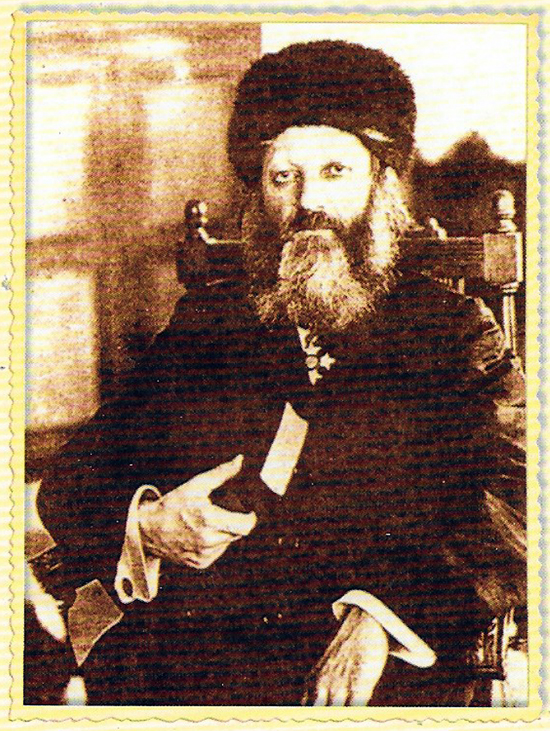
2. In his post here, Eliezer Brodt mentioned the new book Ha-Gedolim (available here). My article in the volume is on the Steipler. As you can see from the table of contents posted by Brodt, they wanted to give each article a catchy title. One of the editors suggested Ha-Tamim for the title of my article, and I thought that this was a good suggestion. In traditional rabbinic literature תמים has the connotation of pure and unblemished, and this is how one can describe someone who has a simple, unquestioning faith. This, I thought, was a great description of the Steipler who was opposed to philosophical investigation of Judaism and even opposed polemicizing with the non-Orthodox for fear that this might expose readers to non-Orthodox ideas. (Chabad yeshiva students are also referred to as tamim.)
However, the word tamim can also have the connotation of “unsophisticated”. Even though this is clearly not what I had in mind, since at least a few people wondered about the word, I clarified it in a comment to Brodt’s post. I also asked if anywhere in rabbinic literature does the word tamim mean anything other than what I have written. From the responses I received, I have to say that the answer is no. While the word tam is used to mean “unsophisticated,” the word tamim only has a positive connotation. At least that is the opinion of everyone I have discussed the matter with. I also searched Otzar ha-Hokhmah where I found references to rabbis referred to as הגאון התמים. Otzar ha-Hokhmah also reminded me of how R. Jehiel Jacob Weinberg described his deceased student, R. Saul Weingort[25]:

בהנהגתו, באופני מחשבתו ובהילוכו עם הבריות הי’ טיפוס נעלה של יהודי תמים ונאמן לאלוקיו ולתורתו.

The Maharal writes[26]:

והתמים הוא שהולך בדרך הישר מעצמו בלי שום התבוננות, רק הולך בדרכו בתמימות.

One of the Seforim Blog readers was helpful in sending a number of relevant texts, illustrating the original meaning of tamim. Among these texts is one from the 1980s by R. Shlomo Tzadok who actually laments how the word tamim, which is supposed to have a positive connotation, has been turned into a negative term.[27]

ומדהים לראות שאף המלה תמים שנקטה תורה כאן סולפה משמעותה האמיתית בפי ההמון, וכשרוצים לקרוא למי שהוא לאיזה אמונה בלי דעת וחכמה ובלי הבנה, אומרים לו תמים תהיה! (אולי בעקבות השמוש השלילי בלשון חז”ל באגדה, תם, היפך חכם).

2. Seth Rogovoy published an article in the Forward titled “The Secret Jewish History of McDonald’s.” What precipitated the article was the recent appearance of the movie “The Founder” about Ray Croc of McDonald’s fame. Rogovoy focuses on Harry Sonneborn, the first President of McDonald’s, who came up with the idea of turning McDonald’s into a real estate empire, by owning the land under the restaurants and leasing it to the franchisees.
There is another “secret” Jewish history of McDonald’s, one which I think is of much greater interest. Ronald McDonald is the world’s most widely recognized commercial mascot, and he has “a recognition factor among children equaled only by Santa Claus.”[28] How many people know that it was a Jewish man, Oscar Goldstein, who was responsible for Ronald McDonald? The story is told in a number of places, most comprehensively in John F. Love’s McDonald’s: Behind the Arches from which I am taking the following description.
The most successful McDonald’s operation in the company’s history is that of Goldstein and his partner John Gibson. In 1956 they made a deal with Kroc for an exclusive franchise for the Washington, D.C. area. Gibson was behind the scenes focusing on financial and real estate matters, while Goldstein was running the actual restaurants which eventually reached 53. (Love says that there were 43 restaurants, but I was given other information.) As part of Goldstein’s advertising campaign, he sponsored a television show in the Washington market called Bozo’s Circus. The person who played Bozo was none other than Willard Scott, who would later find fame on the Today show.
When Bozo’s Circus went off the air, Goldstein decided that he needed another clown to appeal to the children. His ad agency came up with a clown which it proposed to call Archie McDonald. Willard Scott suggested the name Ronald McDonald, which was chosen, and Scott played the first Ronald McDonald. (Scott has often claimed that he invented Ronald McDonald, while in truth all he did – significant in and of itself – is to come up with the name.)
By the mid-1960s, the McDonald’s franchise in Washington was spending $500,000 a year on advertising – most of it on Ronald McDonald. It was more than any other local or national fast-food chain was spending on advertising, more than even McDonald’s Corporation itself. Goldstein also used Ronald McDonald to open each new store it built, and his personal appearances never failed to create traffic jams.

By 1965, Goldstein was convinced that he had discovered in Ronald McDonald the perfect national spokesman for the chain, and he offered the clown free of charge to Max Cooper, the publicist who by then had been hired as McDonald’s first director of marketing. Surprisingly, Cooper turned him down. “I told him the outfit was too corny and not up to our standards,” Cooper recalls. “Goldstein reminded me that his was the most successful market in the system.” After reflecting on that, Cooper decided not to argue, and he proposed a national Ronald McDonald to Harry Sonneborn.[29]

Here is a picture from Love’s book. Goldstein is second from the right. Harry Sonneborn is on the far right. Ray Kroc is standing in the middle.

I am certain that other than members of my family and old friends, all other readers are wondering why I have such an interest in McDonald’s. The answer is that Oscar Goldstein was my grandfather, my mother’s father. Jews are well known for being responsible for so much in American culture, but for some reason, Ronald McDonald as a Jewish creation has slipped through the cracks. Hopefully that will now change.
One final point: Why do I say that my grandfather owned 53 stores when Love puts the number at 43? Because that is what I heard from my grandmother, Gwendolyn Goldstein Freishtat, who passed away in January 2015 at the age of 99. When I questioned if she was sure it was 53, she insisted that there was no doubt. “I knew every one of those stores,” she said.
3. In my recent interview in the fascinating Der Veker, available here, I mention that I have a forthcoming article dealing with Modern Orthodoxy and modern biblical scholarship. Once the article appears I will have more to say about it on the blog. For now, let me just note that in the article I try to show how in some segments of liberal Modern Orthodoxy there has been a reinterpretation of the core theological principle of Torah mi-Sinai so as to align it with modern scholarship. I see this as a major theological development. There is no need to speak more about this now, as once the article appears readers can evaluate the evidence and see whether they think I am on to something.
One significant publication that appeared too late to be mentioned in the article is a new book by Jerome Yehuda Gellman, This Was From God: A Contemporary Theology of Torah and History. This book is precisely the sort of evidence I cite in the article to illustrate the changes that have taken place in recent years. Rather than summarize the book, let me just quote the first two paragraphs.
Increasingly, well-informed traditional Jews may find themselves distrustful of the reliability of Torah as history because of the conclusions of scholarly research from natural science, history, linguistics, Bible criticism and archaeology. And, they may not be swayed by attempts to restore their trust. If they do not have a fitting theology for their new predicament, they may well give up on Judaism altogether or else give up on their traditional Judaism. Or, they may simply repress their difficulty because they see no way of dealing with it that will allow them to retain their traditional religious loyalty. They will carry on as if they believed in the historical veracity of the Torah, when in fact they do not.
As one who has lived with this problem, I want to now propose that a person with prior emunah, belief and faith/loyalty in God and in the holiness of the Torah remain faithful to keeping God and the holiness of the Torah at the center of his or her life. What is needed is a theology that appreciates the force of the challenge to Torah as history and preserves one’s traditional religious loyalty. That is the task of the present book.
Gellman’s arguments are original and he even makes use of hasidic texts. Particularly interesting is his critique of the so-called Kuzari Argument that is sometimes used in support of the revelation at Sinai.
I mentioned Gellman’s book to someone and expressed the opinion that even if another ten theologians were to write similar books, I don’t see this as having any real impact on the ground – although it will be appealing for certain intellectuals – because at the end of the day traditional Judaism is a religion of halakhah and its leaders are talmudists and halakhic authorities. If a new theological approach does not have the imprimatur of even one outstanding religious authority – gadol for lack of a better term – I don’t see how it can gain traction in the community at large. In previous years I have made the same point about changes in women’s roles and so-called partnership minyanim. These phenomena are also having trouble making headway because they too are lacking the necessary imprimatur. Interestingly, years ago someone responded to me that my point was not valid because I was operating under an outdated “paradigm” in assuming that changes in religious life, and now we can say in theology as well, needed the imprimatur of a gadol. Yet I would like to see one example of a significant change in theology or religious life that reached wide acceptance without such an imprimatur.
4. Among other new books worth mentioning is R. Yonason Rosman’s Petihat ha-Iggerot available here. This book goes through R. Moshe Feinstein’s Iggerot Moshe and records discussions and criticisms of R. Feinstein’s points. It is like the Likutei Hearot on the Hatam Sofer’s responsa with one crucial difference: R. Rosman does not limit himself to citing traditional rabbinic works, but he also refers to English language halakhic writings and even academic works. The Seforim Blog is also mentioned a number of times.

[1] Milin Havivin 4 (2008-2011), pp. 43-50.
[2] Olam ha-Sheker (Milwaukee, 1936), p. 44. R. Solomon Judah Rapoport thought very highly of R. Modena. See Iggerot Shir (Przemysl, 1885), p. 71. As a result of this, he was worried that if R. Modena’s autobiography was published, which showed that he was addicted to gambling, it would destroy his reputation. See ibid., p. 120, where he writes to Samuel David Luzzatto:
עוד הכני לבי פן תגלה ח”ו חרפת הבונה בקהל רב, על דבר תאותו אל השחוק, ותתן מקום לשחוק וללעוג באדם יקר אחד מאלף, ולבזות את הנכבד כפי נטות לבך. ואולי תשלחהו ח”ו לבעלי ציון לבנות ציון תמרור על חרבות גבר מצויין, ותתן קברו את רשעים השמחים אלי גיל ישישו כי ימצאו קבר לגבר אשר דרכו נסתרה עד כה בענין אחד, ויסך אלוקי בעדו, ותשפוך דם נקי בקרב ישראל.
Every summer for the last five years I have led groups to Venice where I tell the story of R. Modena. I tell part of the story when standing in front of his tombstone (his actual burial place is unknown). Rather than losing respect for R. Modena because of his gambling addiction, I think people learn to appreciate that even very learned rabbis can have weaknesses.
[3] When he used the term “meshugena,” he did not mean “insane” in a clinical sense. I mention this because there is some recent research supporting the notion that there is indeed a thin line between genius and mental illness. See here.
[4] R. Michel Shurkin, Meged Giv’ot Olam ( Jerusalem, 2005), vol. 2, p. 23. R. Shurkin also quotes R. Leib Malin as saying that it is not good to be an illui. See Mesorat Moshe, vol. 2, p. 404, where R. Moshe notes another problem with iluyim.
[5] In his article, p. 74, in speaking of shituf and the famous Tosafot concerning it, R. Bleich states that “in historical context, it is obvious that the doctrine which the Tosafot seek to legitimize for non-Jews is Trinitarianism.” I don’t know how R. Bleich can say “it is obvious” when not only do many halakhic authorities not interpret Tosafot in this fashion, but great scholars such as Jacob Katz, Louis Jacobs, and David Berger have also stated that they do not think that Tosafot is in any way legitimizing Trinitarianism for non-Jews, but only permitting a non-Jew to take an oath in which he associates another being, such as Jesus, with God. On p. 74 R. Bleich himself notes that R. Ezekiel Landau, Noda bi-Yehudah, Mahadurah Tinyana, Yoreh Deah, no. 148, has the same view as Katz, Jacobs, and Berger. I would only add that the responsum in Noda bi-Yehudah that R. Bleich refers to was not written by R. Ezekiel Landau but by his son, R. Samuel Landau. For Katz, see his Exclusiveness and Tolerance (Oxford, 1961), p. 163. For Jacobs, see his A Tree of Life (London, 2000), p. 82 n. 12. Berger has expressed his opinion orally on a number of occasions, and see also his “How, When, and To What Degree was the Jewish-Christian Debate Transformed in the Twelfth and Thirteenth Centuries?” in Elisheva Baumgarten and Judah D. Galinsky, eds., Jews and Christians in Thirteenth-Century France (New York, 2015), p. 135 n. 31.
On pp. 80-81, R. Bleich states that R. Isaac Herzog’s acceptance of the Meiri’s view of the halakhic status of non-Jews was only a “hypothetical acceptance,” and he criticizes Itamar Warhaftig for assuming otherwise. In this matter, I see no way to read R. Herzog as R. Bleich has interpreted him, and thus agree with the understanding of Warhaftig that R. Herzog indeed accepted the Meiri’s view. On p. 81, R. Bleich interprets the words of R. Eliezer Waldenberg so that he also is not really accepting the Meiri. Here too, I see no way of reading R. Waldenberg as R. Bleich advocates, and I agree with David Berger’s understanding (Berger is mentioned by R. Bleich.) See Berger, “Jews, Gentiles, and the Modern Egalitarian Ethos: Some Tentative Thoughts,” in Marc D. Stern, ed., Formulating Responses in an Egalitarian Age (Lanham, MD, 2005), p. 100.
[6] Hayyei Yehudah, ed. Carpi (Tel Aviv, 1985), p. 63.
[7] R. Bleich, p. 98, writes: “Omitted from Shapiro’s list of rabbinic figures who have entered Christian houses of worship are the British Chief Rabbis who have done so on state occasions.” I did not mention the British Chief Rabbis as this is well known, and as I wrote I wanted to call attention to lesser known examples.
[8] Bleich mistakenly refers to Storrs as the High Commissioner of Palestine.
[9] Michael Shashar, Lord Jakobovits in Conversation (London, 2000) pp. 83, 103.
[11] If we assume that an Evangelical church is a place of avodah zarah, I do not see why the absence of icons or statues has any significance.
[12] Lots of people want to enter churches in order to appreciate the art or to understand Christianity. I have never heard of anyone doing so in order to be able to “hold his own” in discussions with Christians. If R. Riskin’s heter depends on this element being present, then according to him pretty much no one would be permitted to enter a church with icons or statues.
[13] I have no doubt that what R. Riskin meant to say is “Attendance at a church religious service,” since there is no possible way that a Jew is ever permitted to “participate” in a church religious service.
[14] R. Hayyim Amsalem’s just published book is titled Tokpo shel Yosef Messas. R. Amsalem sees R. Messas’ importance as providing a stellar example of the old Sephardic tradition, one that stands in opposition to the haredi ethos which has recently also taken root in some parts of the Sephardic world. For an example of what R. Amsalem is fighting against, here is a proclamation that appeared before Purim, signed by a number of Sephardic rabbis including a member of the Shas Council of Torah Sages. In addition to declaring that children cannot dress up as soldiers or policemen, it also states that “all the gedolei Yisrael” have forbid yeshiva students from enlisting in the army or in any program of national service.

This prohibition is not directed towards women but men. Can anyone imagine a Sephardic sage from earlier years declaring that it is forbidden for yeshiva students to enlist in the army or to do national service? It is this type of extremism, so far from the traditional Sephardic mentality, that has enabled R. Meir Mazuz to develop the largest following among the Sephardic masses. When R. Mazuz explains how important it is to bless the soldiers, as he did again the same week that the anti-army declaration came out, it is this sort of attitude that resonates with Israel’s Sephardic community, all of whom have family members who have served in the army. For the video of R. Mazuz’s most recent statement, see here.
[15] When reading what R. Messas wrote, I was reminded of R. Abraham Reggio’s strange claim that Christians should love Jews because according to them, the Jews’ killing of Jesus is what allowed Original Sin to be forgiven. See his letter to R. Mordechai Samuel Ghirondi published in Asupot 14 (2002), p. 306:
שיחוייבו לאהוב אותנו, יען כי בגללינו, לפי דעתם, נסלח עון אדה”ר [אדם הראשון] אחר פטרת משיחם, שאם לא היה נמצא אז בעולם מי שימיתהו, עדיין עונם על ראשם.
Just as strange are the reasons he gives why Jews must love non-Jews:
וגם אנחנו צריכים לאהוב אותם, שאילולי הם היינו חולים ומתים בשבתות ימי הקור, וגם ע”י שאוכלים כמה בעלי חיים האסורים ואילולי הם לא היתה הארץ יכולה להכיל כמה בהמות טמאות שרבו מארבה.
[16] Hermann Vogelstein, Rome, trans. Moses Hadas (Philadelphia, 1940), p. 263; Cecil Roth, The History of the Jews of Italy (Philadelphia, 1946), p. 195. R. Shlomo Goren recalled that on Tisha be-Av he used to pray on the roof of a church on Mt. Zion so that he could see the Temple Mount. He then began to have doubts about the appropriateness of using a church in this fashion so he moved to another place. See his autobiography, Be-Oz u-ve-Ta’atzumot, ed. Avi Rath (Tel Aviv, 2013), p. 217. (This book has recently appeared in English.) Regarding whether a synagogue can share the same building with a church, see R. Abraham Moses Fingerhut, She’elot u-Teshuvot (Jerusalem, 1964), no. 2.
[17] I don’t see where any of the teshuvot that permit donating to churches regard this as obligatory at times, unless we assume that when R. Horovitz writes that it is a mitzvah because of kiddush ha-shem that he means that it is obligatory. The only circumstance I can imagine where such a donation could be obligatory  would be if Jews themselves had damaged a church and posekim thought that to prevent enmity it was vital that Jews therefore help repair it.
[18] See here
[19] To Tell Their Children: Jewish Communal Memory in Early Modern Prague (Stanford, 2014), p.  25.
[20] See Amos Elon, Founder: A Portrait of the First Rothschild and His Time (New York, 1996), pp. 119-120.
[21] While on the topic of R. Moses Hayyim Luzzatto, R. Jeremy Rosten recently showed me page 14 n. 14 from the 1992 Bnei Brak edition of Kalah Pithei Hokhmah.

As you can see, material has been removed from the work on the advice of certain unnamed gedolim.
R. Rosten also showed me that a famous comment of Sforno to Lev. 13:47 has been censored.

In this passage Sforno states that most Jews, and all (!) non-Jews, are not subject to individual divine providence, but are only under general providence, just like the animal kingdom. These words were removed from the older Mikraot Gedolot.

At first glance, I thought that this censorship was because of the description of non-Jews. Rosten, however, believes that this is a theologically based censorship. In other words, Sforno’s view that most people are not subject to individual providence was viewed as religious objectionable and was thus deleted. My only problem with this suggestion is that even the censored version refers to the נרדמים, i.e., people who are not subject to individual providence, so the theological problem is not “solved” by what was removed.
[22] Se Or Yisrael 56 (Tamuz 5769), pp. 6ff.
[23] For details on R. Kook being awarded the medallion, see Natan Ophir’s note here (called to my attention by Mirsky).
[24] Rav Kook (New Haven, 2014), p. 172.
[25] Yad Shaul (Tel Aviv, 1953), p. 18.
[26] Netivot Olam, ed. Pardes (Jerusalem, 1988), p. 508.
[27] Shulhan Shlomo (Jerusalem, n.d.), p. 249.
[28] John F. Love, McDonald’s: Behind the Arches (Toronto, 1986),  p. 224.
[29] Love, McDonald’s, p. 223.