Should we celebrate birthdays or not? Is it better to ignore them?

Should we celebrate birthdays or not? Is it better to ignore them?
By Rav Binyamin Wattenberg

This post was originally an answer posted on july 25 2016 on the French website techouvot.com (https://www.techouvot.com/feter_les_anniversaires-vp46393.html).

The author agreed to have it translated into English but did not review the translation.

The author, Rav Binyamin Wattenberg teaches Talmud in Neuilly sur Seine, France, among other talmudic activities (techouvot.com…)

This subject is widely debated in our sefarim. Some are convinced that it is entirely a “non-Jewish” custom which is important not to follow, but I think that it is rather because of ignorance of what has been written on the subject.

I will try to summarize the different rabbinical positions with their reason, and as we will see we can find anything and everything.

GOOD MAZAL

The Yerushalmi Rosh Hashana (III, 8) relates that Amalek placed soldiers on their birthday at the battle front because they would have a good “mazal” and Moshe had to “mix mazalot”. Korban Haeda explains that by raising his hands, Moshe “mixed / disturbed” the Mazalot to counter the good mazal of Amalek’s warriors.

This idea is also found in the Chida who writes (Chomat Anakh, Iyov 3) on behalf of the Kabbalists that the birthday is a day of good mazal.[1]

That would explain the wish of the day: Mazal Tov!

There is also Rabbi Tsadok Hacohen Rabinovicz of Lublin in his Resisei Layla (Divrei Chalomot 20) who writes that a man has nothing to fear on his birthday and while the Gmara Kiddushin (38a) says that Tzadikim die on their birthday (and therefore have something to fear about), it is because for them, death is an accession to a higher level (and is therefore a positive occasion).[2]

There is a more plausible explanation of the Maguen Avraham in his Zayis Raanan on Yalkut Shimoni (‘Habakkuk 3) who answers that it is a blessing for the tzaddik to die on his birthday because “the Holy One, Blessed be He, sits and completes the years of the righteous from day to day” (Kiddushin 38a, Sotah 13b and Rosh Hashana 11a).[3]

But some consider that this good mazal on this day concerns only non-Jews (like Amalek).[4]

This is perhaps why we find several authors who are very reluctant about the idea that a Jew could celebrate such a day.

AGAINST CELEBRATING:

For example, in his Torah Shleima (Vayeshev p.1522 note 49), Rav Menachem Kasher quotes a manuscript (Chemat Hachemda) commentary on Bereshit 40, 20, that still today, non-Jews celebrate birthdays (meaning that Jews do not).[5]

Certainly, in the Gmara (Moed Katan 28a) we are told that Rav Yossef celebrated his 60th birthday, but that also indicates that he did not celebrate his other birthdays – neither he nor the other Amoraim – and it is only for its 60th that he wished to celebrate because – as he says it – it excluded Karet’s punishment.

The Minchat Elazar (the Munkasz’ Rebbe) writes[6] that there is nothing to celebrate on one’s birthday since the Sages tell us (Eruvin 13b) that it would have been better for the man not to be born.[7]

It is also the position of many authors, such as : Rav Horovitz of Strasbourg (and then of Badats of Jerusalem) in his Shout Kinian Torah Bahalacha (III, §21), Arugat Habossem (II, §215),[8] Abelsohn (Shut Knesset Avraham Yoel, §6 p.116 – linked with Shut Etz Chaim),[9] R. Tsadok Hacohen (Likutei Maamarim §13, p.140), the Klausenburg-Sanz Rebbe (Michtevei Torah II, 82 p.55), Rav Shlomo Zalman Bloch (Hatzadik R. Shlomo, p.29, ot 18), Patsovsky rav (Pardes Yosef Vayeshev Milouim p.48 and in the new edition, Bereshit II, p.777), Rav Dunner (Leket Sheelot Hametzuyot IV, p.13 and Kol Hatorah 65, p.164), Rav Stern (Beer Moshe) and Rav Wozner (Shevet Halevy) both quoted by Rav Harfenes in Beit Vaad LaChachamim (adar 2009, p.356), Shut Lehorot Natan (IX, §5, 9),[10] Gdulat Yehoshua (Chelek 2, Hakdama), Rav Shmuel Mohliver (Midei Chodesh BeChodsho, II, Jerusalem 1957, p.192 and Shana Beshana 1976, p.237).

In Hapeles (shana III, 1903, p.633) it cites the Beer Yitzchak of rav Itzchak Ber Levinzohn (p.34) stating that birthdays were non-Jewish holidays close to Avoda zara, although this Rav himself was close to Haskala![11]

The Kinian Torah Bahalacha (III, §21) is also opposed to celebrating birthdays, and quotes in support the Vizhnits’ Rebbe, Ahavat Israel, who refused to make a seuda for his 70th birthday and recited a lot of Tehilim and Bakachot instead.[12]

Rav Israel of Rouzhin also vigorously refused the surprise birthday organized by his wife and dismissed all the guests.[13]

The Otsar Kol Minhaguei Yeshurun (4th ed., §XXVII, 4, p.60 and 3rd ed., St Louis 1917-8, Hashmatot §14, p.304) considers that celebrating one’s birthday is a non-Jewish custom and the only character in the Choumash that one finds celebrating his birthday is Paro.[14]

It seems that it is also the opinion of the Aderet in his Nefesh David (p.129) who did not appreciate when we wished him a happy birthday, saying that it was never a holiday among the Jews and that the only one that one finds celebrating his birthday in the Chumash is Pharaoh, while the Gmara Erouvin (13b) tells us that it would have been better not to be born … He even states that he tries to forget that it is his birthday because it causes him great sadness[15] (because “it is better not to be born …”).[16]

He emphasizes, however, that the Tzadikim have something to celebrate their birth, according to the opinion of Tosfot (Avoda Zara 5a).

He nevertheless rejoiced on the day of his 60 years for the same reasons as Rav Yosef in Moed Katan (28a), as he wrote in a letter (Eder Hayakar II, Igrot, p.93, §14 ).

Not that you have to be ashkenaz to oppose birthdays. The Rav Chalfon Moshe HaC ohen in his Yad Moshe (Vayeshev, §63 daf 70b) writes that the custom of celebrating birthdays is very present in Europe, but we (the Jews) mark this date with fasting and repentance, preferring in this the useful to the pleasant.

There is in any case a very clear tendency to connect the birthday party to Pharaoh and that would therefore be considered as a “non-Jewish” rejoicing.[17]

IN FAVOR OF CELBRATING BIRTHDAYS :

However, one could just as easily see things differently.

For the Sadigura Rebbe,[18] if the Torah tells us that there was a celebration in honor of Pharaoh’s birthday, it is not in vain, it is here for us to learn that we must celebrate birthdays. And even though Pharaoh is not a good person, the fact that the Torah mentions it indicates it has to be a followed practice. He brings as a support we learn the principle of not mixing two feasts (ein mearvin simcha bessimcha) from the Torah relating the habit of the non-Jews and particulary Lavan (see Bereshit XXIX, 27 and see Yeroushalmi Moed Katan I, 7) ; and Lavan is also the source for the idea of the seven days of wedding’s festivities.

Therefore, it should not be considered as a non-Jewish minhag, and there is no problem of Chukot hagoyim in celebrating birthdays (see also Shut Beth David, §176).

Rabbi Meir Mazouz also writes (annotations on Ben Ish Chai shana 1, Ree §7, p.580) that he has heard that some people are against celebrating birthdays but since he remembers reading that the Baal Shem Tov was celebrating his – on Elul 18th – and deduces that there is no problem.[19]

His brother-in-law, Rav Yitzchak Berdah, is even clearer in his Shut Yitzak Yeranen (V, §54) and validates the birthdays minhag by writing that those who do so have whom to rely upon.

Rav Nissim Karelitz (Chut Hashani, §195, 1, 6 p.215), unlike Rav Zeldner cited above, does not seem to consider it problematic to offer a birthday present.[20]

Ben Ish Chai (I, Ree, §17) writes that it is a good custom to celebrate birthdays every year and note that some are celebrating the anniversary of their circumcision, indicating that in his family, they usually follow the first minhag (= celebrate the day of birth).[21]

R. Avraham Pallagi in his Veavraham Zaken (Yod, §19) mentions also the minhag of celebrating birthdays. Yabia Omer (VI, WH, §29) also finds this positive.

The custom of a birthday seuda, has also been endorsed by multiple and different authors such as’ Havot Yair (§70), Shout Beth Israel (Landau) (§32), Beer Moshe (Yeroushalaimsky) (Maamar Zikhron Tov, daf 138a, §5).

The Tiferet Israel, in his will prompts his children to mutually wish each other good wishes on the days of their respective birthdays (Hamaayan -Tamuz 1971- ot 6).

It is also a habit taken seriously by Loubavitsh Chassidim. The chabad literature is full of advice and remarks on to conduct oneself on one’s birthday and even tracks sources for it in Kabbalah (Shaarei Halakha UMinhag II, §302).

We also find many Tzadikim who have celebrated their birthdays themselves.

Rabbi Avraham Pallagi already mentioned, celebrated his birthday every year from the age of 70 – according to the testimony of his son Rabbi Avraham Pallagi (Tsavaa Mechaim §40 and see also Guinzei Chaim, yud §16). And this is also the case of Rabbi David Chazan quoted in Yishrei Lev (daf 2b).[22]

We also find the Midrash Sechel Tov (XL, 20 ; p.247) stating that “the majority of “people” enjoy (mechavevim) their birthday, rejoice and make a feast”. (But it’s not clear if he speaks only of gentiles or also of jews.)

The Ktav Sofer probably did not celebrate each of his birthdays with great fanfare, but celebrated his 50th one publicly (see Shut Ktav Sofer Y “D, §148).[23]

We also know – as mentioned above – that Rav Yosef celebrated his 60th birthday (Moed Katan 28a).

And this habit was followed by several rabanim, such as the Trumat Hadeshen, quoted by his pupil (Leket Yosher II, Y “D, p.40), or the Tshortkov Rebbe and the Rudzimin’s Rabbi both cited by R.A Nayerman in his Toafot Reem (volume 1, Warsaw 1936, p.30, §23).

We also find the idea of especially ​​thanking G-d on one’s 60th birthday, as Pele Yoets in his Chesed Laalafim (§221-230, sk.8, p.372) who advocates reciting Shehechiyanu without shem UMalchut or else to prepare a fruit or a new garment for that. This is also the Ben Ish Chai’s opinion (I, Ree, §9) for the 60th and 70th birthday.

For the 70th birthday, we find in Shut Chavot Yair (§70) that it is necessary to recite Shehechiyanu (without restriction). But this opinion is not followed and the Chida (Birkei Yosef-Shiyurei Bracha §223, sk.2) will impose the same restrictions as for 60th birthday, i.e without pronouncing the name of G-d or wearing a new garment (or eating a new fruit).

See as well the Pri Megadim (Mish Zahav §444, sk.9), Shut Tzitz Eliezer (XVIII, §33), Shut Tshuva Meahava (II, §239), Samach Nefesh (erekh Shehechyanu), Rabbi Avraham Pallagi (Tsavaa Mechaim, §40), Hagahot Chatam Sofer (O.C §225), Shut R. Yedidia Tia Weill (Y “D §106 p.224 of the recent edition), Kaf Hachaim (§223, sk.28), Shut Beth Israel (Landau) (§32), Shut Beth David (§176), Chesed Laalafim (§221-23, sk.8), Divrei Israel (II, p.175) and Afarkasta Deania (I, §123), who all oppose reciting shehchiyanu “only because of the 70th birthday”, since this blessing should only be recited for the situations indicated by Chazal, as Shut Olat Shmuel (Kauder) writes (I, §22 ).[24]

However, it will still be necessary to mark the hit. The Chafetz Chaim, for his 70th birthday, invited rav Elchanan Wasserman and rav Yossef Shlomo Kahaneman for a little cake and drink and recited Shehechiyanu! (Mishnat Yaakov II, §225).

But according to other sources (Hechafetz Chaim, chayav UPealo, p.312), he did it (on his 70th birthday) on a new garment.[25]

The Chafetz Chaim also celebrated his 90th birthday and finished his Beth Israel that day (see Hechafetz Chaim, chayav UPealo, p.25).

I was myself invited to the 80th birthday (the last one) of my teacher Rabbi Chaim Yaakov Rottenberg (see Shut Beth Israel -Landau- §32), he did not recite shehechiyanu, but there was cake anyway.

Rav Fishman-Maïmon also celebrated his 80th birthday, and Rav Reuven Margulies participated to the “party” (Machanayim LXXII of Elul 5722 -1962, page 41).

Rav Nathan Adler, from London, traveled to Hanover, Germany for his mother’s 80th birthday (Letter from Rav Shlomo Eiger, printed in Igrot Sofrim, 1, p.83).

It seems that Rav Sonnenfeld also “celebrated” his 80th birthday and Rav Mendel Alter (son of the Sfas Emes) presented him his wishes despite some hesitation about the dubious origin of the birthday minhag (see his letter printed in Kerem Shlomo – Bobov – vol.205, p.47).

But for the 60 years, it is likely that there was nothing dubious, since his older brother, since the Imrei Emes, organized his (the Imrei Emes) 60th birthday party and during the meal he explained the reason for rejoicing, i.e Moed Katan 28a (Shut Maharaav – R. Avraham Binyamin Zilberberg – NY 1941, Volume 2, §61).

Returning to the 70th birthday, Rav Schneebalg (Shut Shraga Haméir IV, §69) was in favor of celebrating it.

Sdei Chemed also celebrated his (Hameassef X, Tevet 5665, IV, p.43 and p.46), and it is also the case of the Vizhnitz rebbe who celebrated it joyfully with his pupils (Israel Saba Kadisha, II, p. 177). This is also what Rav Michael Goldberger did.[26]

In 1860, for Shir’s 70th birthday (Rav Shlomo Yehuda Rapoport), his students had prepared a feast and honors for him, but he refused the honors, humbly explaining that he was born in the year Takan / TIKEN (1790) but he has not been Metaken – Ma Tikanti? (Toldot Shir of Bernfeld, p.126).

See also Voice of Truth (p.282-3) or in Hebrew Kol Chotsev (p.263-4) about the 70th birthday of Rav Schwadron.[27]

We ca find another rationale for the celebration of the 70th birthday. In the Mekor Chesed (Rav Reouven Margulies) on Sefer Chasidim (§213, note 1 ), it brings that the Yerushalmi (Yevamot VIII, 3) states that a plague occurs (at least) once every 60 or 70 years. Therefore, whoever reaches his 70 years has certainly escaped the plague that has declared “in his day”, and that’s a good reason to make a “seudat Hodaa”!

Finally, we even find in the Orchot Chaim (Bukhner) (Krakow edition 1654, §16) that the 60th and 70th birthday’s meals are of the nature of a Seudat Mitzvah.

We realize therefore that many (to the exception of those mentioned in the previous part) view positively the birthday party, and especially those of the 60th and 70th one. But we still have to define what should be done to celebrate a birthday properly.

HOW TO CELEBRATE?

On one’s birthday, it is proper to :

– as we have seen bless Shehechyanu on a fruit or a new garment (Shut Guinzei Yossef §4, 2 quoting his father-in-law, Rav Deutsch, author of Shut Pri Hassadé);

– give a lot of tzedakah (R. Chaim Pallagi in Tzedaka Lechaim – maarechet ayin §555)

– make it a “day of prayer” (Melitsei Esh p.54)

– dedicate this day or at least most of it for divine service (Torat Shalom-Schneersohn-p.398 ; Kerem Habad II, p.102 ; see also Hapardes, year 62 volume 9, p.2 on the name of the Lubavitsh Rebbe)

– learn a lot (Shut Hillel Omer, O “H §139).[28]

One should also be careful to reserve a moment for introspection and Cheshbon Hanefesh over the past year, as the Chut Hameshoulash (Munkasz edition 1893, volume 1, daf 59b-60a footnote) brings about the Ktav Sofer who had locked up hiself on his birthday (54th one) and someone who mistakenly entered the room found him sitting on the floor crying, and asked him what was happening to which he replied that he was crying over the loss of time over the past years (see also the preface to Ktav Sofer Al Hatorah, p.29)

In Shut Hadar (§18), the author states that his master – the Rav of Stretin – wanted to have an aliyah to the Torah on his birthday (which is not feasible every year …). In the same vein, the Divrei Yechezkel Shraga (parshat Vayakel) and the Tehilat Caim (p.409) bring down that the Divrei Yechezkel of Shinova wanted to be shaliach tzibur on his birthday (which is practicable more often). And this is also what R. Shaul Broch did (Shaul Behir Hashem, Ashkavta derabbi, p.275)

See also Torat Shalom (p. 406) who – for his birthday – advocates having an aliyah to the Torah, giving tzedakah, adding moments of prayer, tehilim, study and introspection, bless shehechiyanu on a fruit or a garnment (etc).

I have also read in the name Spinka Rebbe quoted in the Shut Chakal Yitzchak (I, 3) that it is appropriate on one’s birthday, to take upon oneself the commitment on something one knows he has to work on.[29]

There is also a notion of making a Siyum on a birthday.

Several rabanim wanted to make a siyum on their birthday, the Terumat Hadeshen did one on his 60th birthday (Leket Yosher II, Y “D, p.40).

See also Leket Hakemach (131) that it is appropriate to mix this rejoicing with a siyum massechet.

Thus, the Chatam Sofer planned that the end of the cycle of chumash study with his pupils falls on his birthday – the 7th Tishri (Minhaguei CS, VII, §14, p.31).[30]

His son Ktav Sofer also completed a massechet each year on his birthday (Chout Hameshoulash ed Munkasz 1893, Volume 1, daf 59b footnote).

Another fact deserves to be emphasized:

In the Sheerit Natan (p.392 ; quoted in Or Israel 46, p.249) we find a very particular siyum minhag that was taking place at Yeshivat Chachmei Lublin, every 7th Adar, birthday of the Rosh yeshiva Rabbi Meir Shapira (initiator of the study of Daf Yomi). Talmud treatises were “dispatched”, and each student took a massechet or half of it, in order that they altogether fnished Shas in one night, so that on the next day, the 7th of Adar, they were all together making a great Siyum Hashas with the Rav.

All this being said, personally, I will be tempted to give an argument in favor of those who celebrate their birthdays, but I have not seen any Acharon underlining this aspect (except Torat Shalom -Schneersohn (p.399-400 ) I found recently):

The halacha is to celebrate annually a miracle that would have happened to us (see Mishna Berura end of §218), for example the one who survives a fatal accident must celebrate this event every year.

If it is so, given the great danger of a baby birth, one could consider that it is necessary to celebrate the miracle of his birth each year.

True, nowadays, in civilized countries, the risk of miscarriage is pretty much reduced and infant mortality has also fallen down, B “H, but if the minhag has been implanted since a time when it was not the case, we may continue this custom because the danger is still not totally absent.

Only that according to this, it should also be that each mom celebrates the birthday of each of her children, because she also escaped death that day.

And, according to this rationale, we should celebrate the Hebrew date rather than the civil one.[31]

Anyway, even if no halakhic argument would push to celebrate the birthdays (and it is probable because we proved Moed Katan 28a that the Amoraim did not celebrate any birthday, only Rav Yosef distinguished itself by celebrating 60 years old – and only that one …), there is another reason, especially for children: nowadays this custom is widespread and children are sometimes misled and are tempted to move away from family. It is beneficial to show each child in the family that he is important and at least one day a year, we celebrate together. He becomes the hero of a day.

See also, a bit in this way, Kitvei Reb Eizik (Schwei) (p.273) and Torat Shalom (p.405).

At the time of the Talmud, it was not necessary, but today it can be according to the situations, the families and the place.

It would be inappropriate to say that since the Amoraim did not celebrate them, we must refrain from doing so.

To refrain from them at their time meant nothing particular, because no one was celebrating them (among the Jews at least). Today it would have another meaning for the child …

It cannot be said that he fails to celebrate, but that those who are accustomed to it should not lose it under a “religious” pretext, they must perhaps channel its spirit and enhance it by making it look, more “kadosh”, by giving more meaning to it.

See also Shut Mayim Hahalacha (Metzger) (IV, §46) who writes that it is necessary to know how to give a kedusha spirit to birthdays and not to celebrate them in frivolity.

More generally, Rav Shach used to say (see Machshevet Zkenim p.342 and also p.141 and 332) that each birthday brings us closer to death, so why rejoice? That is why only the “ben aliya”, the one who progresses from year to year in the Torah, must rejoice, because each passing year carries a new advance in Avodat Hashem, so it is closer to Chayei Netsach, the reverse of death, for the tzaddikim are called alive even after their death (Brakhot 18a).

Once a rav had suggested to the great and famous Rav Yechezkel Lewinstein – when he was mashgiach of Ponovez – to suppress the minhag of the “Santukha” (small celebration among friends of the Yeshiva when one of them is engaged) for it is systematically engaged in flattery to highlight the qualities of the chatan and the speaker, in a laudatory spirit, sometimes praises too much, which necessarily leads to a uncontrollable feeling of pride so repudiated by Baalei Moussar.

Rav Lewinstein exclaimed: “Once in the life of a man it happens that his friends give him compliments and even that you want to suppress?! “

IN CONCLUSION: It is perfectly legitimate to wish and celebrate birthdays, but you must know how to do it.

Those who are not used to accompany a family snack with Cheshbon Hanefesh are not required to adopt this minhag. But those who already celebrate this day with a small party should not abandon this beautiful habit because of some rabbis who grumble against birthdays; as we have seen, the rabbis who attached importance to these moments of rejoicing are very numerous and to the extent that one does not feast bestially but for a constructive purpose, with a feeling of Hodaa, Tshuva and introspection, it’s a very good Minhag.

[1] See also Ben Yehoyada Brachot 28a, that if a miracle happens on one’s birthday, it does not diminish his merits…
[2] It seems that some Tzadikim were not so happy to leave this world. The story that is told about the Gaon or the ‘Hazon Ish (or others, depending on the version), who would have cried before dying while saying regret a world where we can buy mitzvot for some pennies like Tzitzis, shows us that feelings are mixed ….
[3] Which means that by dying on that day, it indicates that they could have died before but have benefited from an extension, so it is “positive”.
[4] Taam Vodaas Bereichit XL, 20, however, see Nefesh Chaya (Orach Chaim §580).
[5] From Rav Aharon Zeldner’s Mate Aharon (p.68) it is deduced that giving a gift to a friend on his birthday is a non-Jewish custom not to follow.
[6] Minchat Elazar in his Divrei Torah (V, §88).
[7] This argument seems strange. In fact, we find in the prayers, all kind of different expressions of gratitude to G-d for the life He gives us (the Gomel, for example), which seems to indicate that life has its interest …

Moreover, Ramban (Shemot XIII, 16) writes that we must thank G-d for creating us.

We must therefore temper the teaching quoted (Erouvin 13b), since it is impossible to interpret it as if God had made a mistake by creating us!

It is only from men’s viewpoint that he would have been “noach“, pleasant/easier, to not have been created. Easier, certainly, but not “preferable” since G-d knows what He does.
[8] But his son (Shut Migdalot Merkachim, O.C, §31) greatly relativizes his father’s opposition by explaining the very particular context of this responsum and the specific case of the person who was concerned. Shut Vayaan Yossef (§73) also diminish the opposition of Arugat Habossem stating he was only opposed to big feasts, but not to small family party at home (see also in the same way Kvod Chachamim (Jerusalem 1982 – p.208, rav Meir Eisenstein’s maamar).
[9] See also in his Knesset Chachmei Israel, kountras 3, §66, 4 daf 65b and Kountras 6, §115, 1 daf 125a.
[10] Though he tolerates a birthday meal if it is exclusively reserved for scholars, as Rav Yossef did in Moed Katan 28a – see Lehorot Natan IX, § 5, 11.
[11] Rav H.D Halévy (Asse Lecha Rav IV, §26) has not read it, but writes that it is obvious that there is no issur Avoda Zara nor Chukot Hagoyim, because the Avoda Zara part was only the sacrifices they brought to their gods, but to celebrate a birthday is in itself a healthy idea.
[12] He quotes also his grandfather Rav Pinchas Chaim Horovitz, the Pitcha Zuta, whom he was surprised to see on his birthday – on the 18th Tamouz 1938 – crying while reading Tehilim. He explained to his grandson (the Ahavat Israel) that he was crying over the suffering he had cause to his mother when he was born 80 years earlier … However, see how Rav Eisenstein (Zichron Shlomo, p.214 and following) rejects every argument of Rav Horovitz.
[13] Shout Knesset Avraham Yoel – Abelsohn – §6 p.116 and Knesset Chachmei Israel §115, 1 daf 125a.
[14] He also states that when the pupils of Rav Yitzchak Elhanan Spektor of Kovno in 1889 wanted to celebrate the anniversary of his 50th year in the rabbinate, he was firmly opposed it – but this was not really a birthday [Actually, it was for his 25th years (not the 50th) in Kovno, as we see in Hatzfira (No. 68) and later on in Shana Beshana (1976, p.237), even if it was already his 52th in the rabbinate in different cities].

The opposition of the Rav was also published in Hatzfira (No. 77 – 11 Nissan 1889) and for more on this subject see Toldot Yitzchak p.114 of Rav Yaakov Lifshitz, Darkenu (shana II , guilion 3, p.16) and Pardes Yosef (Vayeshev Miluim p.48) who quotes several opponents of birthdays, including “the Toldot Yitzchak of an Italian rav with the Kotna rav’s haskama” [There is indeed a Toldot Yitzchak of the rav Yitzchak Luzzato but it is a book of poems and songs which does not contains neither an approval of the Kotna’s rav, nor opposition to birthdays party. In fact, the Pardes Yossef mixed up when copying the references on this subject from the Darkenu (op cit) which quotes Toldot Yitzchak and then Kochav MiYaakov of an Italian rav with approval of Kotna’s rav (in the Kochav MiYaakov it’s p.54)].

As an aside, many other rabanim did not mind celebrating the anniversary years of their rabbinate or action for Torah, often by the publication of a sefer Hayovel, as for R. Shimon Schkop for his 50 years of teaching (see what Moshe Avigdor Amiel writs in this collection, in 1943 there will also be a sefer Hayovel for him), Rabbi Meir Shapira from Lublin (in 1930) for his 20 years in the service of the Torah, Rav Fishman-Maïmon for his 50 years (in 1926), sefer Hayovel for Rav Rabinovicz’s 70th birthday (NY 1930), another for 70 years of rav Azriel Hildesheimer (Shay Lemora), and for his rav, rav Yitzchak Bernays, for whom his 25 years of rabbinate in Hamburg were celebrated with great fanfare in 1846 (Shana Beshana 5736 p.238).
[15] Rabbi David Pardo, author of many sfarim including Lamnatzeach LeDavid and Chasdei David, writes at the end of his commentary Shoshanim LeDavid that he finished it on his 34th birthday, 1st Nissan 1752, and it does not seem to sadden him at all …
[16] But he himself writes in his Har Hamoria (Ahavat Shalom ed., P.59) that he requoted the Bracha of Shehechiyanu for his birthday with great joy! [However, in this instance, he was sick, with 41 ° C fever (!) and thought he would pass away. So, when he had the strength to pray Shavuos Maariv BeTzibur, he rejoiced (and thus the Shehechiyanu blessing). Especially since having been born in Shavuot, he perhaps said it for the Yom Tov, although he wrote that he requoted it for his birthday).
[17] We also find some who were opposed to the celebration of a death day (yohrtseit) of a tzaddik! In 1890, some wanted to celebrate the 50 years of the death of Chatam Sofer, but his students, Rav Naftali Sofer (see the beginning of Kountras Beth Efraim printed at the end of Et Sofer Volume 2) and Rav Yehuda Modern (strange name for a disciple of Chatam Sofer, symbol of the opposition to modernism deviating from the massoret) for whom it was a non-Jewish custom directly inspired by Maskilim who had recently (in 1886) celebrated the 100 years of the death of their master Mendelssohn, opposed it. “Yohrtzeit” yes, but “specifically for the 50th years”, no ! (Leket Shoshana (1942, §19) and Beth Vaad Lachachamim (Nissan 5771, p.463)). It is the idea that there would be a particular reason to celebrate only the symbolic years because “round”, which displeased these Rabanim.

Personally, I do not see why this notion should be classified as heretical / non-Jewish, if not – and it is this their real motive – in my opinion – because of the likeness with the Maskilim whose aspirations were rarely holy. The Rabanim at that time were doing everything to remove their flock from the Maskilim in order to stop the spread of the Haskala “virus”, it is a kind of prophylactic disposition. It would have been purely conjunctural, so, nowadays “the prohibition” would no longer be appropriate, but disbanded. And it is probably what could explain why for the 100th years of the death of Chatam Sofer (in 1940), they published a Sefer Hazikaron with a great ceremony in Pressburg, presided over by R. Akiva Sofer himself.
[18] Quoted in Messilot-Kislev 5747 ; see also Abir Yaakov – of the Sadigura Rebbe- p.161
[19] He does not remember where he has read this about the Baal Shem Tov, but I suppose it’s in Chabad literature, for example in Sefer Hasichot (1943, p.154, 187), Kountras Chay Elul, and Kerem Chabad (II, p.100).
[20] See also Rav Halevy in Assé Lecha Rav (IV, §26) for whom there is also no problem.
[21] Shut Beer Eliyahu (Katz) (II, Y “D §32) writes that, in his opinion, the advantage of the day of circumcision can only concern the first twelve birthdays, but from the Bar Mitzvah and on, it is more logical to celebrate the day he took upon himself to commit to the mitzvos, which is birth.
[22] See the Knesset ChaChmei Israel – kountras 3 – §115, 1 for which only birthdays of 60 and 70 deserve attention, but not the following ones.
[23] see Afarkasta Deania (I, §123) who is surprised about it because it seems to be against his father’s position. In fact, the Chatam Sofer states (Torat Moshe, Vayera, Bereshit XXI, 8) that Avraham used to celebrate every year on his son Yitzchak’s circumcision day – not his birthday.
[24] This rationale is rejected by the Tshuva Meahava for whom the Chavot Yair is not absurd (when advocating the shehechiyanu blessing in other occasion than those of takanat chazal) because, as the Bach (où, O.C 225 ?) writes, it is a bracha that has been instituted on man’s joy (and not only on the precise situations listed by chazal.

The Komarno Rebbe (Chulchan Hatahor §223, 7) sides with the Chavot Yair and indicates – at odds with all the poskim listed- to recite the bracha (he often has marginal positions in this book).

See also Rav Shlomo Tzvi Shik (Shout Rashban I, §61). According to whom, Chavot Yaïr does not hold one should recite shehechiyanu (!), but he personally thinks we should.
[25] Hard to know who to trust when the two are also contradicted by Rav Shlomo Zalman Bloch who, when he heard that the Chafetz Chaim would have given a small snack for his 70th birthday, exclaimed : “Sheker Gomur! Dos iz nit kein arbeit far Chofetz Chaim, s’iz nit a yiddishe weg!” (Hatzadik R. Shlomo, p.29, ot 18). In other words, according to him, it is absolutely impossible for the Chafetz Chaim to do so, because it is not “Jewish” to celebrate his birthday … (see Or Israel 24, p.193 note 103).
[26] see Shut Rashban I, §61 where Rav Shik wrote to him that he learned from his son (the son of rav Goldberger) that his father (rav Michael Goldberger) was about to celebrate his 70th birthday and according to him (rav Shik) it would be appropriate to recite Shehechyanu, and that he himself, if he was able to attend, would have recited it (because of Haroe et chavero achar 30 yom) as well as shechalak MeChoChmato liyereav (which is recited at the sight of a great sage in Torah).
[27]
To celebrate the 70th years of a Tzadik is noble and desirable according to the Chesed LeAvraham (Brudno) (volume 2, pticha, p.6 §4)

We also find the idea of ​​rejoicing on the birthday -at least a tzadik’s one- in the Midrash Tanchuma (Pekoudei XI) which states that G-d wished to mix the joy of the Mishkan with the joy of the birthday of Yitzchak (the 1st Nissan).

See also Tosfot and Rosh (Nazir 14a) explaining there is a doubt arising when someone says “I will be as Moshe the 7th adar” (is he Nazir or not?) because this person might allude to Moshe’s death a sad day when mourners engage in a Nezirut, or he alludes Moshe’s birthday a day of celebration and joy …

Still on the subject of celebrating important people birthdays, it seems (from see Oshea (VII, 5) “yom malkenou” and Metzudas David, ad loc) that contrary to what Rav Fraenkel writes in his Labar-mitzvah Encyclopedia (p.217), Jews did celebrate their kings’ birthdays, who explains that this is the birthday of the king and there was a feast. However, Malbim (ad loc) explains otherwise.
[28] In yeshivos, the custom is to “have a mishmar”, i.e to study all the night of the 20 years anniversary.
[29] If we do not find one (we are a great tzaddik or we do not understand the concept), we can always work on acquiring a ” Jewish spirit “. In fact, it is sometimes thought that doing all the mitzvot makes us a good Jew, but the truth is that we can do lots of mitzvot, pray three times a day, put on tfilin and tzitzit, keep Shabbat, eat strictly kosher etc. … and yet … being far from a true Judaism.

The Piaseczner Rebbe, R. Kalmish Shapiro (killed by the Nazis in Trawniki camp on 4th Heshvan 1943 after being deported from the Warsaw Ghetto in April 1943 following the insurrection), had a diary in which he wrote on his 40th birthday (19 Iyar 1929) that he should take a commitment on himself, but that he does not know what to take as “kabala” this year, “to study more? it seems to me that I’m not wasting a moment in my schedule; stay away from Taavos ? Baruch Hashem I am not dependent on any material Taava ; so what do I lack ? What I lack … is being “a Jew”! I feel like a human form, with its colors and shapes etc. to which only one thing is missing: the Neshama! Master of the world! … This is what I wish for this year (from now on), I want to convert and become a Jew! “(Quoted in Mimaayanot Hanetsach p.294).
[30] However, in the Shut Afarkasta Deania (§123), he quotes the Chatam Sofer as being opposed to choosing the birthday rather than circumcision day (see on this subject Or Israel 49, p.142, note 46).
[31] But Zichron Shlomo (Jerusalem 1994, p.219) emphasizes that according to the idea that birthdays are days of good Mazal (as mentioned in the first part), as it is related to the stars (mazalot), one must follow the solar/civil calendar ! But more on this (which date someone should celebrate) in a future post.


Some Assorted Comments and a Selection from my Memoir, part 2

Some Assorted Comments and a Selection from my Memoir, part 2
by Marc B. Shapiro
1. In a recent Jewish Action (Summer 2009), p. 21, Elli Fischer writes:
Brandeis University has been enclosed by an eruv for thirty years, longer than any other campus not adjacent to an established Jewish community. Since Brandeis is a Jewish institution, the eruv is funded by the university (as opposed to the students). . . . Rabbi David Fine, who graduated from Brandeis in the mid-1980’s, recalls checking the eruv as a student. . . . The first two JLIC rabbis to serve at Brandeis, Todd Berman and Aharon Frazer, each implemented minor upgrades to the eruv.


This gives me the opportunity to correct some errors and tell part of the story of the Brandeis Orthodox community. The eruv was first established in the 1982-1983 school year, when R. Meir Sendor was the Orthodox advisor. (Sendor is currently the rabbi of Young Israel of Sharon and is unusual in that he is both an academic scholar of Kabbalah, with a PhD from Harvard,[1] and also involved in Kabbalah from the spiritual side.) Rabbi Sendor informs me that Rabbi Yehudah Kelemer was the initial halakhic advisor, and Rabbi Shimon Eider was later brought in to be the official rav ha-machshir. (R. Eider later helped in putting up the eruv in Sharon, which was the first eruv in New England.)
When I arrived in Brandeis in the fall of 1985 we did not carry on Shabbat. (Contrary to the Jewish Action article, David Fine didn’t arrive at Brandeis until two years later.) I assume that due to some structural changes on campus, the eruv was no longer functional. During that academic year, Rabbi Eider returned, did what needed to be done, and the eruv was once again kosher. At this time, R. Yaakov Lazaros, a Chabad rabbi in Framingham (with semichah from R. Moshe Feinstein), was the Orthodox advisor.
The university paid (and I assume still pays) for the eruv’s upkeep, but this has nothing to do with Brandeis supposedly being a Jewish institution. In fact, it is not a Jewish institution. Brandeis paid because it saw this as an important service to the Orthodox community. The university has expanded since the 1980’s so that is probably why changes to the eruv had to be made. I don’t like the word “upgrade” that Fischer used, because “upgrade” means to improve the quality of something, and I don’t think that Rabbi Eider’s eruv needed to be improved.
When one speaks of Orthodox life at Brandeis, a lot of credit must go to Rabbi Albert Axelrad, who was the Reform Hillel rabbi at Brandeis. He is someone who over time I came to admire greatly, even though our religious outlooks were so very different. What Weinberg jokingly said about another Reform rabbi applies equally to Axelrad: He is a “hillul ha-shem,” (hillul ha-shem in quotation marks!) because he shows that “one can be an upstanding and noble man, full of the spirit of love for Israel, its Torah, and its language,” even if one is not a halakhic Jew.[2]
In ways that people don’t realize, Axelrad greatly assisted Orthodox growth on campus, and today Brandeis has a very large Orthodox contingent.[3] It was Axelrad who made sure that there would be an Orthodox advisor on campus, paid for from the Hillel budget. Yet despite his leaning over backwards to help the Orthodox, there were always those in the Orthodox community who had negative feelings towards him, not only ideologically, but also personally. These were people who came from yeshivot and had never had any contact with a Reform rabbi, and here was one who performed intermarriages. Axelrad had also been involved in some leftist causes and has the dubious distinction of having been officially put into herem, ceremony and all, by Rabbi Marvin Antelman. He shared this honor with the entire membership of the New Jewish Agenda, whom Antelman also placed under herem. (I mentioned Antelman in a previous installment and hope to return to him as his books are deserving of their own post.)
Rabbi Lazaros was only at Brandeis for one year and he was followed by Rabbi Marc Gopin. Those who saw the video on the Rav will probably remember Gopin as he has a few appearances in it. At the time he was working on his dissertation, which focuses on Samuel David Luzzatto.[4] He has also published a nice article on Elijah Benamozegh.[5] Since then he has made an international reputation for himself in the area of conflict resolution, travelling widely and publishing a number of books.[6]
Gopin was followed by another rabbi, a RIETS graduate, who would have been very good for the community in another ten years. But at this time he was too much to the right for them. The community had always been a somewhat liberal place. I recall the outrage among many when R. Moshe Dovid Tendler came to campus and expressed his feelings about homosexuality. There was the same outrage when the new campus rabbi said similar things. (Shmuley Boteach or R. Chaim Rapoport would have been more in line with the students’ feelings.) The following should give a further sense of the liberal nature of the community: The practice on Shabbat morning when taking the Torah out of the ark was for the hazan to carry it through the women’s section. This struck everyone as a very nice thing to do, and although it is not done at the typical synagogue, college is a very different place. Another example of how college differs from the “real world” is that during Shabbat morning services women routinely give divrei Torah, yet this is not something that most “regular” shuls are willing to allow.
When Rabbi Lazaros was the Orthodox advisor he ruled that the practice of carrying the Torah on the women’s side was forbidden. From the way he explained his decision I understood that the major issue wasn’t carrying the Torah on the woman’s side per se, but rather women kissing the Torah. As he was the rav, we had to listen to him, even on the Shabbatot that he was not there. However, in an act of rebellion the community made a decision that when the Torah was taken out of the ark the hazan, who now could not walk around the women’s side, would also not walk around the men’s side. He would bring the Torah right to the bimah. When the Torah was returned to the ark the hazan walked to the front of the synagogue and sang Mizmor le-David, once again without walking around the men’s side. The following year, with the arrival of a new Orthodox advisor, the community revived the old practice of carrying the Torah on the women’s side.
When I was the Orthodox advisor in the early 1990’s the Orthodox culture on campus had changed, and the situation with carrying the Torah was exactly reversed from what it had been in the 1980’s. In the 1990’s it was the students, or rather some students, who wanted to stop carrying the Torah on the women’s side. They didn’t think that an Orthodox shul could have such a practice. My position was that the minhag had to remain the way it was. At that time there was a very dynamic Ramah-type minyan and if the Orthodox were seen as too close-minded we would lose people to the Conservative minyan. In fact, it was precisely because of the liberal nature of our minyan that many non-Orthodox were attracted to it, and a number of students adopted an observant lifestyle while at Brandeis. While some students, coming to Brandeis after a year in Israel, wanted the minyan to be just like their shul in Teaneck and the Five Towns, the truth was that the minyan, to be successful, had to be run like an out of town shul.
This was not the only time I felt that for the sake of the wider appeal of the Orthodox community I had to make decisions that got some people upset. On Friday night there was a communal meal for all the different denominations. Often a woman would say kiddush. After that everyone could, of course, make their own kiddush. But there were some people who wanted to make a big deal about the women saying kiddush, and were also saying that men are not yotze with this, no matter which woman is reciting the kiddush. At the same time that this was happening, there were also those in the non-Orthodox groups who wanted to start having women lead the communal birkat ha-mazon. Until then, out of deference to the Orthodox, only a man led it.
We have a talmudic principle that if you try to grab too much you will end up with nothing, so I had to make a choice. The real halakhic issue here was birkat ha-mazon, as a woman cannot be motzi a man.[7] Therefore, I told the students that it was OK for the women to make kiddush but not birkat ha-mazon, and anyone who wanted to should make his own kiddush. This compromise was accepted. A year prior to this, before I was working at Brandeis, I had been wondering about this issue and asked R. Yehudah Herzl Henkin if it was permitted for a woman to say kiddush for a man. He replied in the affirmative. Shortly after receiving his answer, the same issue became pressing at Harvard Hillel. I told the Orthodox rabbi at Harvard, Harry Sinoff, what the practice at Brandeis was and that he might want to consult with R. Henkin. This is the responsum R. Henkin wrote, published here for the first time. (See also Bnei Vanim, vol. 2, pp. 40-41.)

I myself wrote a short Hebrew “mini-responsum” dealing with women, kiddush, and birkat ha-mazon. It was taped to the wall of the campus beit midrash, but with the move to the right, I am sure that not too long after my departure the responsum came down.
I just mentioned the Brandeis beit midrash, which it itself significant. Other than Brandeis, I don’t know if there is another secular university in the world that has a beit midrash in a university building. When the beit midrash was established in the early 1990’s it was a great achievement. It was an entirely student led project, but again, Rabbi Axelrad’s involvement, behind the scenes, was crucial. He spoke at the beit midrash dedication, as did the Boston Rosh Kollel.
There were also some minor conflicts related to the beit midrash. Although it was the Orthodox students who arranged for it, it was obviously something that all students could be part of. The question came up of what type of books should be stocked there. My feeling was that since the library had all the scholarly and academic books, there was no reason for these sorts of texts to be in the beit midrash.
Another issue arose with the Boston kollel. They had recently become involved with Brandeis students as part of their outreach. One of the kollel guys, who was having a great influence on the students, wanted to start a gemara shiur on campus. This was fabulous. He wanted to give the shiur in the beit midrash, which was the natural place. However, he said that he could only do it if no women were allowed into the beit midrash during this time (even if they were not participating in the shiur). One of the women students complained to me, and I agreed that this was improper. The beit midrash was established for all students and must be open 24 hours a day for everyone. We could not have a situation where, like a pool, the beit midrash is closed to women for certain hours. It also went against the ethos of the community to declare that women are barred from attending certain classes. I told the male students who were organizing the shiur that it would have to take place somewhere else, and that is what happened.
Right when we were having the discussions one of the students drove to Brookline to attend Prof. Isadore (R. Yitzhak) Twersky’s gemara shiur, and he came back reporting that there was a woman in attendance. If the Talner Rebbe welcomed women to his shiur, were the Brandeis students supposed to be more “frum”? For those who have never seen a picture of my late teacher, who was also the son-in-law of R. Joseph B. Soloveitchik, here he is:


There was another time when the Boston Rosh Kollel gave a decision to some of the students that I felt could drive away the less religious if it was adopted by the community as a whole. Since there were students who thought that the Rosh Kollel should be regarded as the halakhic authority for the community, I was in a difficult situation. This was especially so as I myself had asked him questions in the past, so it would not be an easy thing to reject his ruling in this case. I consulted a well-known haredi posek with whom I had discussed other matters, including an issue of possible mamzerut that came up on campus. He agreed with my position but said that he could not put his decision in writing.
I know that some people will find this objectionable, but it never bothered me. Why should I care if he put it in writing? He knew that if he did he might be attacked. Given the choice between no pesak (if it has to be in writing) or an oral pesak, obviously the latter is preferable. Although at the time I told people who gave the pesak (and anyone who wanted to could call him up to confirm it), revealing it on this blog would, I think, fall into the category of “putting it in writing.” This posek is still functioning, and if he was afraid of being attacked fifteen years ago, all the more so today. (There are reasons why I am being vague about the particulars of the pesak.)
Returning to the Brandeis beit midrash, Prof. Marvin Fox also spoke at its dedication. This was significant as it was the first time, in my memory, that the students took advantage of this great scholar and talmid hakham.[8] There was such a disconnect at Brandeis between the academic life and the religious life that regarding the latter we all overlooked the people in our midst, those who were teaching us in the classroom. I too regret not speaking to Fox in greater detail. For example, having lived in Columbus, Ohio he knew R. Leopold Greenwald very well, and yet other than hearing one or two stories about him from Fox, I never took the time to find out more. Fox also knew Chaim Bloch, the great rabbinic forger. (Greenwald and Bloch were themselves good friends.) He told me once that there was a lot he could say about Bloch, and yet I was foolish and never took advantage of this.
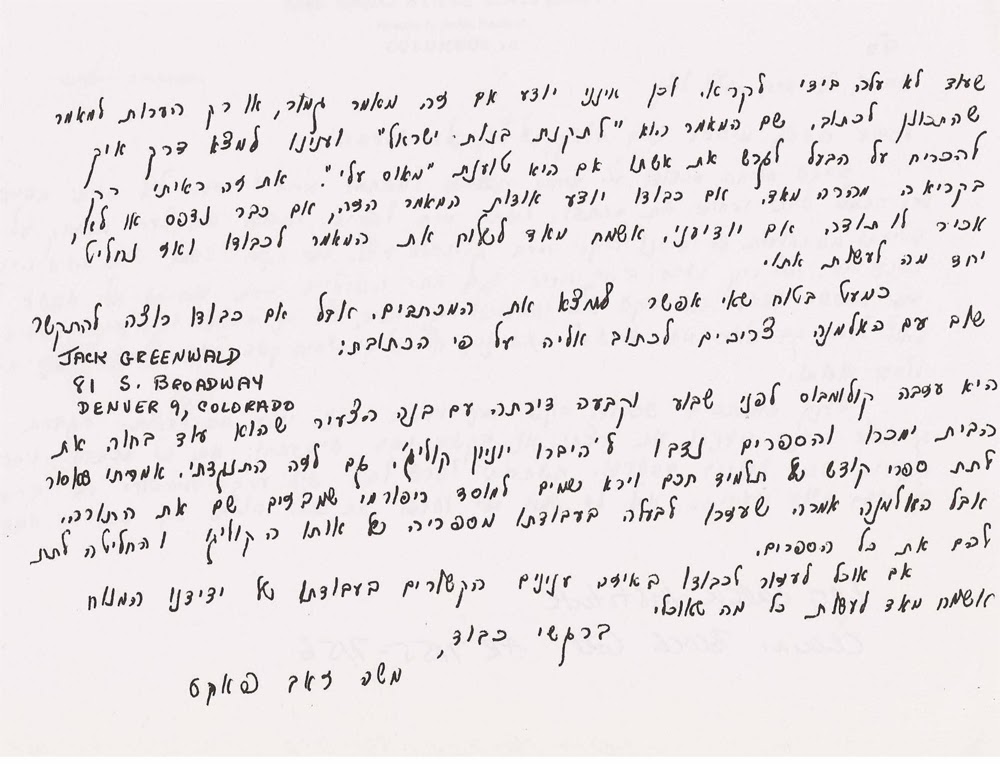
After Fox’s death I discovered a letter from him to Bloch in which he explains how it happened that Greenwald’s great library ended up at the Hebrew Union College. He also tells us the tragic fate of Greenwald’s huge collection of letters, letters that he received from gedolim and scholars over the course of many decades. This must have been one of the largest and most interesting collections in the world, full of priceless material which should have been given to a library so a Greenwald archive could be established. Among these papers were also to be found manuscripts from Greenwald’s own pen that had not yet been published. It was perhaps with this in mind that Fox told me very firmly, at the Brandeis beit midrash dedication, not to let the letters of Weinberg out of my hands. He was convinced that some people would want to destroy them, or at the very least make sure they were not made public.
Here is Fox’s letter to Bloch, courtesy of the Leo Baeck Institute, New York[9]:

Returning to the RIETS graduate who was the Orthodox advisor following Gopin, there were a few issues that created problems. Yet the straw that broke the camel’s back was that, in accordance with R. Moshe Feinstein’s pesak, he would not give an aliyah to Rabbi Axelrad. Axelrad’s practice was to come to the Orthodox minyan once a year. Not giving him an aliyah was something that simply wouldn’t fly at Brandeis. It was not a question of Axelrad being concerned about his kavod. I am certain that he did not take personal offense. But he was very concerned about what appeared to be a growing split in the community, a community that had always gotten along so well. To publicly refuse to give the Hillel rabbi an aliyah would give the Orthodox community a sectarian flavor very much removed from both the Hillel ethos, as well from the majority of Orthodox students as well. It was not surprising, therefore, that this rabbi was let go in the middle of the year. After he was let go he tried to create a separate Orthodox community independent of Hillel. It was to be a real Austrittsgemeinde, and he told us that money would be forthcoming from New York to help us form the new community. Yet none of the students were interested.
R. Yehudah Herzl Henkin’s responsum, Bnei Vanim, vol. 2, no. 9, on whether one can give a Reform rabbi an aliyah, is dealing with the Brandeis situation (and was sent to me). Rabbi Henkin’s responsa have an unfortunate characteristic in that they don’t mention to whom he is writing, or give other identifying details. Without this blog post, future historians would have had no way of knowing which of the many American campuses he was referring to. Think of how much we learn about the history of Orthodoxy in America from R. Moshe Feinstein’s responsa. We see him answering questions to Canton, Berkeley and all sorts of other places. Knowing to where he is writing is vital for getting a sense not only of Orthodoxy of the time, but of the responsum itself, since his ruling for an out-of-the way place cannot always be applied when dealing with a center of Jewish life. More leniencies are obviously found in the former. With regard to Bnei Vanim, since R. Henkin doesn’t tell us to whom he is writing, when he is offering comments on another’s work we have no way of identifying this text if we want to get a better sense of the opposing position. (Other poskim have also published responsa that deal with Brandeis, and I will discuss them in a future post.)
I think readers might also find the following story interesting, from my tenure as Orthodox advisor at Brandeis. Every Friday night all the different groups on campus would get together for an oneg, at which there would be a speaker. Out of respect for the Orthodox a microphone was never used, which wasn’t really an issue since the onegs were not that big. However, it so happened that Hillel had an opportunity to bring in Dr. Ruth Westheimer[10] to speak on Friday night. She wasn’t going to speak about any sexual matters, but about her early years in Germany and her family that was killed.
This was at the height of Dr. Ruth’s fame, and there was going to be a huge crowd to come hear her. Hillel had decided to break with tradition and use a microphone at the event, which was to be held in a hall much larger than was usually used. I was told that Dr. Ruth actually insisted on the microphone, and the Hillel leadership didn’t feel like they could refuse. Before continuing with the story, let me go back a few years and tell how I, and my classmates, first heard of Dr. Ruth, because I think it says something about how yeshiva administrators are sometimes very foolish. I still remember how one day on the bus all the talk was about how the administration of Bruriah High School – the girl’s school of the Jewish Educational Center in Elizabeth, where I was a student – had sent out a letter to all parents telling them about a very dangerous radio show called “Sexually Speaking” that was on very late on Sunday night. The parents were told to make sure that their daughters didn’t listen to it—as if a parent can control what a teenager does with her radio in the privacy of her room. It was an era before computers, when we all listened to radio. (I am sure many readers remember the days when 770 WABC played music.)
Now anyone should realize that the perfect way to bring teenagers to do something is to tell them that they can’t do it. Although perhaps none of the Bruriah students had ever even heard of the show, upon receipt of this letter they all were determined to find out what the administration wanted to keep them away from. Not only that, but on the bus, the day after the letter was received, they told all the boys about this strange letter. None of us had ever heard of Dr. Ruth, and our school never sent out a warning letter to parents. Yet you can be sure that after hearing the news we too were curious. It happens that some students found Dr. Ruth so funny and interesting that they listened to her while they were on the phone together. The whole novelty was about an older Jewish woman, with a strong accent, speaking so openly about the things people don’t usually speak about.
Returning to the story, I was now put in a difficult situation, since the Orthodox community could not support an event that involved Sabbath violation. I told this to the Hillel administration and I told the students that I would not be going and it was not something that the Orthodox community could be part of. I remained in the dining room with those students who chose to stay, and those who wanted to hear Dr. Ruth went upstairs, where the event was taking place. Imagine my surprise when someone sits down next to me, and lo and behold, it is Dr. Ruth. She had obviously been told that there was some controversy about her speaking on the microphone, and she wanted to come speak to me. She was extremely apologetic, and said that unfortunately she needs the microphone, otherwise no one would be able to hear her. She also told me that she was sorry that this created problems for the Orthodox community. Dr. Ruth stayed with us for about ten minutes or so, and even bentched together with us (though though she hadn’t eaten anything!). She told me that she remembered singing the standard tune to the first paragraph of birkat hamazon when she was a child in Germany. I don’t know if she had sung it since.
One other event is worth recalling, and this took place when I was an undergraduate. It involved a dispute between me and my friend David Bernstein, and I would be curious to hear what readers have to say.[11] We decided to create an organization so we could invite in speakers. In order to get money from the university, we had to be officially chartered, so in our senior year we created the Brandeis chapter of Young Americans for Freedom. It had exactly two members (we had no interest in having any others join), and lasted for only one year (i.e., until we graduated). I was a little surprised when the Brandeis student senate agreed to charter us and give us money, but hey, you don’t look a gift horse in the mouth. (Had Matthew Brooks not already graduated, we probably would have let him join our little club. Brooks is now the executive director of the Republican Jewish Coalition. See here)
One of our events was sponsoring a debate between my father, Edward S. Shapiro, and Stephen S. Whitfield on what political ideology was more in line with Jewish interests. This had a very large turn-out and the problem was that Whitfield, although a Democrat, is more of a Truman or Kennedy Democrat. Every time my father cited some nonsensical statement by a Democratic figure, Whitlfield agreed that it was nonsense, so they ended up agreeing about as much as they disagreed. A debate isn’t much fun unless one of the speakers is prepared to defend what others regard as indefensible (e.g., anyone looking to defend ACORN?).
For those who don’t know, Whitfield is one of the leading experts on American Jewish culture, having written an enormous amount on the topic. My father started off as a general historian, but has also written a great deal on American Jewish history. I can’t help thinking that the reason the New York Times never reviewed his book on the Crown Heights Riots[12] – which was a National Jewish Book Award Finalist – was that they didn’t want to revisit the issue. It was, after all, the great embarrassment of the Dinkins administration, and the symbol of Democratic failure in New York City, ushering in the Giuliani era. Yet it was, precisely for these reasons, one of the most important events in recent New York City history, and one would think that the New York Times would have thought it worthwhile to review such a book. But no, they let it pass without comment.
We also brought in Dinesh D’Souza to speak. This was before he had published any of his books. In fact, I had never even heard of him when Bernstein suggested we bring him. His talk, though sparsely attended, was quite good. My dispute with Bernstein happened regarding our next speaker. I wanted to bring Lew Lehrman to speak. He was a prominent conservative who almost became governor of New York. He also had some honorary role in Young Americans for Freedom. Bernstein strongly disagreed. He argued that since Lehrman had converted to Catholicism a few years prior, he was not the sort of person we should be asking to speak. Although Bernstein was not Orthodox, that was a big issue for him and I agreed to drop the idea. But from my perspective, the fact that Lehrman had left the fold had no relevance for me in terms of having him speak. I wasn’t giving him an honor or asking him to speak on his theology. I wanted to hear him talk about economic matters and the situation in Nicaragua, and didn’t think that his personal life was of any relevance.
Although the cases are obviously not identical, there was a time when many people would have reacted the same way to inviting an intermarried speaker, and my response would have been the same. Since there is such a high intermarriage rate, one day most of us will have someone running for Congress in our district who is intermarried (some already have such representatives), just like most of us already know people, or have family members, who are intermarried. I don’t think this should have any relevance on my vote. In fact, I don’t think it should have any relevance on anything. Two generations ago, anyone who intermarried realized that he was doing something very much at odds with Jewish life and upbringing. Today, hardly anyone who grows up in the non-Orthodox world thinks that it is an issue at all, and it is only a matter of time before the Conservative movement accepts intermarriage. They have no choice, as their congregations are full of people whose children intermarry, and they can’t go on forever taking a hard line on this issue. Not only do they lose the intermarried children, they often lose the parents when the rabbi tells his long-time congregants that he is sorry but he can’t perform the wedding of their children or even announce it in the synagogue newsletter. I predict that within ten years we will see Conservative rabbis doing intermarriages.
The massive intermarriage rate has also impacted the Orthodox world. A number of years ago R. Jehiel Jacob Weinberg stated that he thought that it might be a good idea for a father whose son was going to intermarry to attend the wedding, thus not completely cutting off all ties.[13] Weinberg had known the problems of intermarriage very well, as the son of his good friend R. Shlomo Aronson, Chief Rabbi of Tel Aviv, had married a non-Jewish Russian woman. He also knew Jacob Klatzkin, the brilliant philosopher and Zionist thinker, who was the son of the even more brilliant R. Elijah Klatzkin. How many people know that Jacob Klatzkin intermarried?
According to Gotthard Deutsch, R. Esriel Hildesheimer’s son Levi intermarried.[14] It is hard to imagine that Deutsch, who was Levi’s contemporary, was mistaken with the facts, especially since he was never corrected in succeeding issues of the newspaper in which he published this information. Yet Dr. Meir Hildesheimer has told me that Levi Hildesheimer married the daughter of Abraham Brodsky of Odessa, the well known philanthropist. Levi’s son, Arnold Hildesheimer, was an active Zionist who made his living as a chemist and eventually moved to the Land of Israel. Arnold’s mother was definitely Jewish. Therefore, I don’t know if Deutsch erred or if Levi married twice.. Arnold Hildesheimer’s son was Wolfgang Hildesheimer, an important figure in pre-World War II German literature.
Unfortunately, we have a number of examples of not merely intermarriage of children of great rabbis, but even conversion. The story of the son of R. Shneur Zalman of Lyady is well known, and I don’t need to repeat it here. Let me just mention, however, that the man was clearly mentally unbalanced. Michael Bernays, a son of Hakham Isaac Bernays, is probably the most famous apostate from a rabbinic family in modern times, converting seven years after his father’s death. Another son of Hakham Bernays, Jacob, actually sat shiva when this occurred.[15] If we want to look at descendants of great rabbis who converted, then the family tree of R. Akiva Eger has plenty of non-Jews. In fact, a predecessor to R. Akiva Eger as rav of Posen, the Beit Shmuel Aharon, R. Samuel ben Moses Falkenfeld,[16] had a most significant great-grandson, yet he was not Jewish. I refer to none other than Leon von Bilinski.[17] He was Austrian minister of finance and also military governor of Bosnia when Archduke Ferdinand was assassinated.
I assume the famous Posen family got its name from the city of Posen. R. Gershon Posen, the dayan of Frankfurt’s separatist community, had a grandson who was on the verge of converting to Christianity. Nahum Glatzer describes this young man’s disillusionment with Orthodoxy, and how he tried to talk him out of conversion.[18] (The conversion never took place, and another grandson, R. Raphael Posen, tells me that the more than seventy grandchildren of R. Gershon all remained Orthodox.)
How are Orthodox Jews supposed to relate to those who intermarry, and who typically don’t know any better? Many of us have even been invited to intermarriages. R Yuval Sherlow has stated that while it is not permitted to attend an intermarriage wedding ceremony, there are times (especially when family is involved) that it would be permitted to attend the party.[19] R. Ovadiah Yosef has ruled that it is permitted to give an intermarried man an aliyah,[20] and this opinion is also shared by R. Baruch Avraham Toledano and R. Pinchas Toledano (former Sephardic Av Beit Din of London).[21] I am also told that this is the practice at the Lakewood kiruv minyanim all over the country. This is so despite the fact that the most that R. Moshe Feinstein would permit in such a case is to allow the intermarried man to open and close the Ark.[22] It is actually Aish Hatorah that has done more to “normalize” intermarriage than any other organization in the Orthodox world. Not only does Aish Hatorah do outreach to the intermarried (something we can all appreciate), but they use various intermarried Jewish celebrities in their publicity, and have even honored these people at their events. I am not saying that they are wrong in what they do. After all, the old approach to intermarriage doesn’t work today, and although I find something distasteful about using an intermarried celebrity as the poster-boy to invite people to a Torah class, I see how people can disagree. But about one thing there can be no doubt, and that is that R. Aaron Kotler would be turning over in his grave if he saw what this supposedly haredi organization has done when it comes to tacit acceptance of intermarriage.

Yet we shouldn’t assume that it is only in modern times that intermarried people have been honored by Orthodox Jews. While it would have been unimaginable in previous years to put them on a pedestal the way Aish Hatorah does, there were times that the intermarried man did such great service for the Jewish community that it was only proper to express feelings of gratitude. Adolphe Cremieux is one such example. Although being intermarried, he helped the Jewish community in many ways. One can even say that he is a model for our time, in showing that one can love the Jewish people and sacrifice for them, even after having intermarried. Here is a song written in honor of Cremieux by the noted R. Aaron Fuld of Frankfurt, author of Beit Aharon. It is taken from Judaica Jerusalem auction cataloge of Summer 1997, p. 6.


Worse than intermarriage is apostasy, but the same issue came up there also. The apostate Daniel Chwolson staunchly defended his former religion and people. How were the Jews to relate to him? Let me quote Louis Jacobs, The Jewish Religion (Oxford, 1995) pp. 99-100:
When Chwolson celebrated his seventieth birthday, a number of Russian rabbis, in gratitude for his efforts on behalf of the Jewish community, sent him a telegram to wish him many happy returns. Rabbi Hayyim Soloveitchik was more typical of the standard Jewish abhorrence of apostasy when he refused to participate, saying: ‘I do not send congratulatory telegrams to a meshumad.” The wry remark attributed to Chwolson himself in the following story is probably apocryphal. Chwolson is reported to have said that he became a Christian out of conviction. “Who are you kidding?” said a Jewish friend. “How can you of all people, a learned Jew, be convinced that Christianity is true and Judaism false?” To which Chwolson is supposed to have replied: “I was convinced that it is better to be a professor at the university than to be a Hebrew teacher [melamed] in a small town.”
2. I have seen ads for the soon to be published new RCA Artscroll siddur. It will be interesting to see how the battle shapes up between the Sacks siddur and the new RCA Artscroll. I can’t see how the Sacks siddur is going to make any real headway, as I don’t think many shuls are going to get rid of the Artscroll siddur they have been using for so long, and which does just about everything you need a siddur to do. While the new RCA siddur was in the production stages, R. Asher Lopatin of Chicago sent the following letter to the Siddur Committee. I think it is interesting in that it shows some of the concerns of those on the Orthodox left. Although I haven’t seen the new siddur yet, I don’t think I am going out on too much of a limb to predict that the RCA will not be adopting Lopatin’s proposal. (I thank R. Lopatin for allowing me to publish his letter.[23])


The Practice of Saying She’asani Yisrael for the Birchot HaShachar instead of the three “Shelo Asani”s
In Masechet Menachot, 43b (Bavli), Rabbi Meir says that a person, “Adam”, has to (chayav) say three blessings every day: She’asani Yisrael, Shelo Asani Isha and Shelo Asani Bur. There is a note there that it should be Rabbi Yehuda saying this instead of Rabbi Meir, and also on the next line Rav Acha Bar Ya’akov replaces “Shelo Asani Bur” with “Shelo Asani Aved”.
The G’mara questions why we need to say both Shelo Asani Aved and Shelo Asani Isha, but it gives an answer to this question. Rashi, in his second explanation of that answer, on Menachot 44a, says that we need to say both in order to come up with 100 b’rachot. The Bach (O.C 46) argues that the main reason for saying all three is to increase the number of b’rachot we say to 100. He argues that that is the main reason for saying three b’rachot in the negative (shelo asani) instead of one b’racha in the positive (she’asani Yisrael) – basically, if you would say “She’asani Yisrael” then you couldn’t say “Shelo asani aved, isha”. The Aruch HaShulchan (46, yud) paskins as well that if you say She’asani Yisrael, you cannot say the other two negative b’rachot. The Mishna B’rura (46,16) leaves it as a dispute.
Most Rishonim, notably the Rif and the Rambam (according to the G’ra), disagree with our existing girsa of the words of Rabbi Meir/Rabbi Yehuda, and they have the first b’racha in the negative as “Shelo Asani Goy”. This is the standard version in siddurim, nusach Ashkenaz and Sepharad and Edot Hamizrach, with the occasional nusach of “Shelo Asani Nochri” instead of “goy”. The Magen Avraham (O.C. 46, tet) mentions, that there were siddurim – perhaps many of them – that had the b’racha of she’asani Yehudi , but that that is a mistake of the printers, and the Mishna B’rura (46, 15) says that there are several siddurim with “She’asani Yisrael” but that one should not say that as it is also a mistake that of the printers (shibush had’fus).
The Magen Avraham (O.C. 46, yud) and the Haghot Ha’Gra (O.C. 46) interpret the Rama (46, 4) as suggesting that converts should say “She’asani Ger” and the Bach (46) interprets the Rama as suggesting that converts say “She’asani Yehudi” – instead of the negative.
Moreover, the Rosh is in the back of Masechet B’rachot, paragraph #24 (daf 39 in our versions, referring to B’rachot 60a) – upholds the Girsa that we have in Menachot. It’s in rounded brackets in the Rosh, and the Divrei Chamudot on the Rosh doesn’t like it, but it is there. Importantly, the G’ra affirms it is the girsa of the Rosh (and the Tur, which doesn’t appear in our versions) in his Biur HaGra on OH 46:4.
Therefore:
Since many of the Nosei Keilim and the Aruch HaShulchan feel compelled to ask: Why are these b’rachot in the negative (see Taz 46:4 “Rabim makshim…”)?
And since the girsa that we have in our G’marras is She’asani Yisrael, supported by the Rosh and the G’ra
And since even though the Shulchan Aruch rejects our positive girsa of the b’racha, the Rama does support it (in some version) as a legitimate b’racha in certain circumstances – for a convert
And since even those who reject “She’asani Yisrael/Yehudi/Ger” for a convert, (Sh’lah and Bach, see Taz 46, 10), do not reject it because it is not a legitimate nusach, but, rather, because it does not apply to a convert who has made himself a Jew, rather than being created by God as a Jew.
And since the negativity of the three b’rachot causes lots of misunderstandings in shul where many people come from Reform, Conservative or unaffiliated backgrounds – or even from Orthodox backgrounds without perhaps truly understanding the love that Chazal had for all human beings, male, female, Jewish or Gentile
I have asked my shul, Anshe Sholom B’nai Israel Congregation, a shul that does a lot of kiruv, to follow the girsa of the b’racha according to the G’ra and the Rosh, and say, “She’asani Yisrael” and that a woman say “She’asani Yisraelit” instead of “Shelo Asani Goy.”
Once the first b’racha is said in this way, the way it appears in the G’marra Menachot, then we have no choice, based on the rule of ‘safek b’rachot lekula’ and based on the p’sak of the Aruch HaShulchan (from the Bach) , to avoid saying the final two, negative b’rachot of “Shelo Asani Aved” and “Shelo Asani Isha”.
Clearly this helps avoid many of the questions that people ask about the negativity toward “goyim” or “women” that someone who does not understand Chazal do ask. The answers given help, but for a shul dedicated to kiruv, these b’rachot are a big turn off.
On the other hand, the b’racha of “she’asani Yisrael/Yisraelit” is a beautiful b’racha, thanking God for making me Jewish – proud to be Jewish, excited to begin the day as a Yisrael.
In addition, from a philosophical point of view, rather than beginning the day with negative b’rachot, which accentuate the G’mara of “noach lo la’adam shelo nivra” (see Bach 46, then Taz 46, 4), let us begin the day with a positive b’racha “k’mo sha’ar b’rachot shemevarchim al hatova” (Magen Avraham, 46, 9). Not negating the p’sak of “noach lo…”, but just respecting the positive aspects which G’mara Menachot the way we have it preferred.
Homiletically, “She’asani Yisrael” matches very well with B’reishit 32:27: “Vayomer, Shalcheni ki alah hashacher” – see Rashi ad loc where that is referring to Birchot HaShachar of the angels! And then two p’sukim later, what b’racha (“ki im beirachtani”) does Ya’akov get? “Lo Ya’akov ye’ameir shimcha, ki im Yisrael”! There is no better way to bringing these p’sukim to life than by saying birchot hashachar every day the way our G’marra has it: “She’asani Yisrael” – proud as Ya’akov was to receive the name, “Yisrael.”
Finally, Rav Benny Lau, an important Talmid Chacham and leader of Beit Morasha, has told me that he, too, follows this practice of saying “She’asani Yisrael” – and he tells his daughters to say “Yisraelit” – in the morning and having it replace the three negative b’rachot.
At the same time, it is important to emphasize the need to reach 100 b’rachot a day, and to push people to be careful about saying Asher Yatzar when leaving the bathroom, and b’rachot before and after eating, and being in shul as frequently as possible in order to hear chazarat haShatz to more easily reach 100 b’rachot.
I would humbly ask the Committee responsible for the new RCA Artscroll siddur to consider either putting this practice in the siddur itself, as a possible “hanhaga”, or allowing this way of saying birchot Hashachar to appear on the RCA Artscroll siddur web site, to that I can download it and print it up for my shul, and any other shuls interested in this hanhaga can do the same.
Sincerely yours and with wishes of hatzlacha rabba,
Rabbi Asher Lopatin


3. Virtually every one of our sages, together with all their brilliance, offer at least one an unusual, sometimes even incomprehensible, idea. Since I am writing this right before Sukkot, here is something to think about when you take the Arba’ah Minim. R. Jacob Ettlinger, the greatest of nineteenth-century German gedolim, writes as follows in his Bikurei Yaakov 651:13. (If you raised this safek in shiur today, the rebbe would think you were joking, but as with even the strangest suggestions, one can often find a true gadol who discusses the issue.)
נסתפקתי אם אנו יושבי אירופא יוצאין בד’ מינין שגדלו באיי אמעריקא ואויסטראליען שיושבין לצדינו ותחתינו, וכן איפכא. שידוע מה שכתבו הטבעים שרגליהם נגד רגלינו, ומה שאין נופלין נגד השמים הוא מפני ששם הבורא כח מושך בארץ. וא”כ המינים שגדלו שם אם נוטלין אצלנו הוא הפוך מדרך גדולתן, שאצלנו גדלו ראשי הלולב וההדס ההם יותר למטה מזנבם. או אי נימא, כיון שנוטל הגדל סמוך לארץ למטה זה מקרי דרך גדילתו, והכי מסתברא.
4. In the latest Hakirah (Summer 2009), p. 134 n. 189, Chaim Landerer quotes my translation of a comment by R. Solomon Judah Rapoport. I didn’t know that Landerer was going to publish my translation, and I answered his e-mail quickly and carelessly. The correct translation is not that Rapoport is “as Catholic as the Pope,” but something even stronger. Frankel says that Shir is “more Catholic than the Pope.” (Thanks to R. Ysoscher Katz who caught the error and alerted me. Also thanks to Rabbi Jonah Sievers who is always helpful in matters concerning German translation. Not being a native speaker, and obviously not familiar with all idioms of the language, every translation I have published has been carefully reviewed by expert translators.)
Speaking of errors, let me also correct something that appears in Between the Yeshiva World and Modern Orthodoxy. This correction has already been taken care of in the more recent editions of the book, but those who have the first or second printing can insert the correction into the volume. How this error came about, I have no idea. I must have been in a daze, and it was only when the book was published that I saw it. On p. 180, beginning line 3 from the top, it states “Might one then be able to say that our great divine Torah cannot endure the conjunction of Torah with so-called secular studies . . .” It should be corrected to say, “Might one then be able to say that our great divine Torah cannot compete with so called secular studies . . .”
There is a popular expression
כשם שאין תבן בלא בר כך אין ספר ללא טעויות.
The internet is so amazing as it allows all of us to correct errors that have appeared in our works, and publicize them, something that was not possible in earlier years. R. Judah Ibn Tibbon wrote to his son, R. Samuel (Iggeret ha-Musar, ed. Korah [Kiryat Sefer, 2007], p. 45):
והטעות שתצא מיד האדם הוא הנתפש עליה ונזכר בה כל ימיו.
In other words, unlike a verbal error which is forgotten, something in print is there forever. Yet today, we can minimize this problem by means of the internet. Rather than be embarrassed by errors we have made, and try to ensure that no one learns of them, we should all welcome the opportunity to point out our errors, so that our works are as perfect as we can make them. This is quite apart from the unseemliness of pointing out the errors of others, but not being prepared to call attention to our own mistakes.
Incidentally, Ibn Tibbon’s work is full of important lessons, but he says one thing that is very problematic. On p. 42 he writes:
.
.ואל תתעקש אתה להחזיק בדעתך אפילו אם תדע שהאמת אתך
What sense does this make? Doesn’t the Torah tell us לא תגורו? Didn’t the Rambam speak his mind no matter who disagreed? In our own day, isn’t R. Ovadiah Yosef fearless in expressing his opinion, no matter how much he is attacked? I posed this question to R. Meir Mazuz and he replied:
זו הערה נכונה. כנראה ר’ שמואל היה עוד רך בשנים וחשש האב שיגרום לו קנאה ושנאה כמו שקרה לר”ש בן גבירול, וגם להגר”ע יוסף שליט”א בבחרותו כשחלק על הבא”ח כידוע. אבל כשאדם כותב ספר חייב לגלות את דעתו (בעדינות ובזהירות) ולא יכוף על האמת פסכתר. ובמשך הזמן תתגלה האמת, כי היא לעולם עומדת.
5. I want to call everyone’s attention to a fascinating new book. Dirshuni, edited by Tamar Biala and Nechamah Weingarten-Mintz, is a book of modern midrashim, written by women. It has been selling very well in Israel and is an exciting genre that deserves its own discussion. Those who want to see some small excerpts can go here.
To order the book you can go here
6. In my last post I mentioned R. Meir Amsel and the memorial volume that recently appeared. I should have also mentioned that his son, R. Eli Amsel, runs the site Virtual Judaica.
7. Finally, I thank everyone who commented and e-mailed me about R. Yerucham Gorelik. There is no question that he was a fascinating man, and an entire post could be devoted to the great stories told about him. It is also true that his relationship with YU was complicated. Let me quote what Dr. Norman Lamm wrote about Gorelik, shortly after his death.
Rabbi Yerucham Gorelick appeared at times to be engaged in some kind of titanic inner struggle. He was a cauldron of activity and movement, of perpetual motion. He was a man of striking, sometimes startling contradictions. He appeared to be moving in different directions simultaneously. He was a man of changing moods, of profound dialectical tensions, although he was at all times an ish ha-emet, a man of unshakeable integrity.
For Dr. Lamm’s article, see here

Notes

[1] “The Emergence of the Provencal Kabbalah : Rabbi Isaac the Blind’s Commentary on Sefer Yezirah” (1994).
[2] Letter to Samuel Atlas, dated Oct. 16, 1959, published in “Scholars and Friends: Rabbi Jehiel Jacob Weinberg and Professor Samuel Atlas,” Torah u-Madda Journal 7 (1997), p. 113.
[3] See R. Jehiel Jacob Weinberg’s letter to R. Kook, Iggerot la-Reiyah (Jerusalem, 1990), p. 128
כבר הונח לי בהשתדלותו של רב אחד מרבני העדה הליברלית (דווקא ע”י רב ליברלי של העדה הליברלית, כאלו רוצה הקב”ה לזכות את כל ישראל במעלות שונות שיש בזה מה שאין וכו’).
[4] “The Religious Ethics of Samuel David Luzzatto” (Brandeis University, 1993).
[5] “An Orthodox Embrace of Gentiles? Interfaith Tolerance in the Thought of S. D. Luzzatto and E. Benamozegh,” Modern Judaism 18 (May 1998), pp. 173-195.
[6] See here A few days before his death, Rabbi Meir Kahane spoke at Brandeis. I think it was actually his last public talk before the night he was killed. For a video of Gopin confronting Kahane see here at 24:20, 31:50, and 43:05, and 56. Gopin starts to speak extensively at 1:02:45. The man standing next to Gopin is Dr. Aryeh Cohen, who also briefly served as Orthodox advisor at Brandeis. He now teaches at the American Jewish University. See here.
[7] See Shulhan Arukh, Orah Hayyim 199:6-7.
[8] He also had a nice sense of humor. On the first day of class he would come in and write his name on the board as “F-x.”
[9] The letter is found in the Chaim Bloch Collection, AR 7155.
[10] See here.
[11] Bernstein is now a nationally known professor of law. See here.
[12] Crown Heights: Blacks, Jews, and the 1991 Brooklyn Riot (Waltham, 2006).
[13] I have given the information on this to Rabbi Mark Dratch for his paper at the Orthodox Forum on the topic.
[14] See his article in the Jewish Chronicle, June 26, 1914.
[15] See Moshe Gresser, Dual Allegiance: Freud as a Modern Jew (Albany, 1994), p. 73. Hakham Bernays’ grandaughter, Martha (daughter of Berman Bernays) married Sigmund Freud. After they were married, Freud refused to allow her to light Shabbat candles. See ibid., p. 67.
[16] For details on the controversy surrounding Falkenfeld’s selection as rabbi, and how his opponents regarded as an “uncouth Polack” see Heinrich Graetz, History of the Jews (Philadelphia, 1898), pp. 2-3. When he was rav in Tarnopol, he also had to contend with troublemakers. See R. Solomon Judah Rapoport’s letter in Leopold Greenwald, Toldot Mishpahat Rosenthal (Budapest, 1920), p. 76. For a picture of his tombstone, see here.
I can’t explain why on the tombstone he is referred to as “Moses Samuel,” when it should be Samuel ben Moses. For his biography, see Beit Shmuel Aharon al ha-Torah (Jerusalem, 1994), introduction.
[17] See here. My information on Bilinski’s family background comes from Gotthard Deutsch’s article in the Jewish Chronicle, June 26, 1914.
[18] The Memoirs of Nahum N. Glatzer (New York, 1997), pp. 126-128. Although Glatzer left Orthodoxy, in his younger years he studied in R. Salomon Breuer’s yeshiva in Frankfurt, and also with R. Nehemiah Nobel. As such, he understood Orthodoxy very well. Glatzer, who died in 1990, was retired when I came to Brandeis in 1985. To my great regret, I never took the trouble to interview him as I did with Prof. Alexander Altmann, who retired from Brandeis in 1976. On pp. 129-130 of Glatzer’s memoir we find the following, which I am sure will interest many readers of the Seforim blog.
In 1944 Rabbi Joseph Soloveitchik (called “the Rov” by his followers and admirers) published in Talpiot a major article, “Ish ha-Halakhah” (the Halakhic Personality). The essay, written in a most beautiful Hebrew style, not only claimed for the observance of Jewish law the central place in Jewish life, but denied the—however circumscribed—validity of any other approach. The Halakhah demands a complete control of the Jew, to the exclusion of an emotional state of mind to accompany the halakhc function. There is no rightful place for, or justification of, a state of excitement or religious agitation, say, in the ceremony of blowing the shofar on New Year’s Day; what matters, and matters exclusively, is the proper execution of the ritual.
This exclusion of the emotional side of religion bothered me when I read the essay. I planned a polemic reply but was dissuaded by my colleagues. I happened to visit New York and voiced my feelings to Professor Louis Ginzberg, the great Talmudist. I expected him to agree with me and object to the rigid stand of the Rov. The cautious Ginzberg did not wish to commit himself, or to say something that could be quoted as a criticism of his Talmudic colleague. He, therefore, did not go beyond saying: “I like my whiskey straight,” which was a mild complaint against the Rov’s combination of Halakhah and philosophy. The only reference that could be interepreted as an admission of esthetics into the realm of religion was Ginzberg’s telling of the Gaon of Vilna (brother of Rabbi Abraham, Ginzberg’s forebear in the seventh generation), who near death admired the beauty of the etrog that was brought to him, since the day was one of the Sukkot festival days.
(The Rov, apparently, would have felt: Never mind the etrog’s beauty. What matters is that the citron is without blemish and the benediction is properly pronounced.).
I was disappointed that Ginzberg did not wish to take seriously the younger man’s question. In the meantime, the Rov changed his position and realized the wider dimension of faith. If you wait long enough . . . [ellipsis in original]. Yet, even with the changed position on the part of the Rov, Ginzberg, were he alive, would insist on having his whiskey straight.
Glatzer sees “The Lonely Man of Faith” as expressing a change in the Rav’s earlier “halakho-centrism.” I wonder if Prof. Lawrence Kaplan will agree.
[19] Reshut ha-Yahid (Petah Tivah, 2003), p. 186.
[20] Ma’ayan Omer (Jerusalem, 2007), vol. 1, pp. 186, 194, 205. R. Hillel Posek, Divrei Hillel, Orah Hayyim, no. 8, strongly supports giving an intermarried man an aliyah, but not as one of the first seven. To deny such an aliyah woould be to embarrass the man, and Posek explains why even sinners cannot be treated with disrespect. See also his comments in Ha-Posek, Sivan 5747, p. 1336. In Amsterdam the practice was also not to give an intermarried man one of the first seven aliyot. See R. Jacob Zvi Katz, Leket ha-Kemah he-Hadash (London, n.d.), vol. 3, p. 63.
[21] Sha’alu le-Varukh, vol. 1, no. 40.
[22] Of course, there are many other poskim who forbid giving an intermarried man an aliyah. Even as liberal a posek as R. Ben Zion Uziel was adamant that you cannot call an intermarried man up to the Torah. See Mishpetei Uziel, vol 8, no. 53.
[23] For those who don’t know, Lopatin was the first Rhodes Scholar to become an Orthodox rabbi. In fact, he might be the first Rhodes Scholar to become a rabbi in any denomination. R. Chaim Strauchler of Toronto is the second Rhodes Scholar-Orthodox rabbi.


Is there a rotten apple in the Tu-BeShevat Fruit Basket?

Is there a rotten apple in the Tu-BeShevat Fruit Basket?

By Dan Rabinowitz and Eliezer Brodt

[This post is heavily updated from an earlier Seforim Blog post – here]

Some claim that the origins of the custom to celebrate Tu-beShevat as a holiday that includes eating fruits and other rituals, is Sabbatean. In the main, this assertion is based upon identifying  the work Hemdat Yamim as the source for Tu-beShevat as a holiday and eating fruit and other rituals.  Thus, an article in Ha’aretz trumpets, “The New Year for the Trees, Isn’t it for Sabbatai Zvi.” And the National Library of Israel’s blog includes a post “The Holiday of Tu-beShevat is an Auspicious Time to Pray for the Only (?!) Jewish False Messiah.”  They even include this photoshopped image.

However, a closer look at the history reveals, that although some of the customs on Tu-beShevat can be traced to Hemdat Yamim the actual celebration dates much earlier. Contrary to the popular song, Tu-beShevat hegihu hag ha-ilannot, the 15th of Shevat was not a “chag” of the trees.  Instead, the earliest discussions regarding Tu-beShevat do not mention any holiday associated with the day.  The first Mishna in Rosh Hashana, identifies the 15th of Shevat as the new year for trees.  This designation merely defines how to calculate annualized tithes and is otherwise silent as to the significance of the date.  One can’t tithe fruits from one year using a different year’s fruits. Thus the 15th of Shevat is the cut-off point. [For other contemporaneous examples see Safrai, Mishnat Erets Yisrael, Mesekhet Rosh HaShana (Jerusalem:  Mehlelet Lifshitz, 2011), 305-06]. It was not until R. Gershom’s time that there were any of the traditional holiday markers, but only that fasting is prohibited.

The first mention of the custom to eat fruit and other holiday rituals appears in 16th century Machzor, published between 1548 and 1550. 

That Machzor follows the Ashkenazi rite and includes a discussion of customs according to that rite and the commentary of R. Benyamin ha-Levi Ashkenazi, Ma’aglei Tzedek. He was the rabbi of the Ashkenazi community in Saloniki (of contemporary interest is that he records the death of four of his sons during a plague).   This source, however, was not well-known, and, historically, a different, later, source is identified.  For example, Avraham Ya’ari in his otherwise comprehensive article claims that R. Issachar ibn Susan (c. 1510-1580) is the first mention.  Susan, in his Ibur Shanim, published in 1578, provides that “the Ashkenazim have the custom [on Tu-beShevat] to eat many fruits in honor of the day,” confirming the custom recorded in the Machzor.  1578 was the first authorized printing of R. Susan’s work but not the first time this custom is associated with him.  In 1564, Shlomo Rie published Susan’s Tikkun Yissachar.  (Ibur Shanim 48b and Tikkun Yissachar 62a).  Susan, in Ibur Shanim, accuses Rie of publishing an unauthorized edition, one that contains errors and unacknowledged additions by Rie. Ibur Shanim includes a corrected and otherwise only slightly modified version of Tikkun Yissachar.  [See Susan’s introduction; see also Yaakov Shmuel Spiegal, Amudim be-Tolodot Sefer ha-Ivri: Hadar Mechaber (Jerusalem, 2018), 321-22.]

Mention of this custom also appeared in a Judeo-German Minhagim book first published in 1590. “The custom is to eat many fruits as it is the New Year of the trees.”

Venice, 1593 edition


In the community of Worms, there was a rather interesting variation of the custom. As R. Jousep Schammes (1604-1678) in his custom-book states:

On Purim and the 15 of Av and Shevat these were vacation days for the Rabbis, . . . [on the 15th of Shevat] one says tehina even during the morning prayer. It is a vacation day for the students and the teachers, especially the younger students, it is a day of feasting and joy for or the teachers and their students. The custom is for the teachers to distribute whiskey to the students and make merry with them.”  Minhagei [de-Kehilah Kedosha] Vermisai le-Rebi Joszpa Shamesh (Jerusalem:  Machon Yerushalim, 1988), 249-50, no. 211.

The first mention of Tu-beShevat in a Sefardic source appears in R. Hayyim Benveniste’s (1603-1673) Kenneset ha-Gedolah, first published in Livorno in 1658, where he quotes Susan from the Tikkun Yissachar.  Although Benveniste would later be associated with the Sabbatian movement, his inclusion of this custom in 1658, long pre-dates the movement. Benveniste’s source does not include a seder, nor does it testify to any adoption amongst Sefardim.

Kabbalah first enters the picture in 1728 with a somewhat obscure source. In 1728, Eliyahu Malhlenov published, Birkat Eliyahu, his commentary on the Talmud.  Amongst his papers,, he had a few pages of materials from R. Moshe Hagiz and appended those to Birkat Eliyahu. These materials include responsa and discussions regarding customs.  Hagiz records a custom from his grandfather, R. Moshe Galante.  R. Galante was also Hagiz’s teacher as his father died when Hagiz was a boy.  According to Hagiz, his grandfather had “the custom that on the 15th of Shevat he would eat many fruits that required many blessings and prayed to God that he should decree for us and them a good year. He ate the following 15 fruits, and on each one would recite … a chapter of Mishna…”  Hagiz then provides the order to eat the fruits.

Hagiz might technically be the first to describe a specific ceremony associated with eating fruits, but the source that popularized Tu-beShevat amongst Sefardim, and that incorporated a seder is Hemdat Yamim. Hemdat Yamim, first published in 1732 anonymously has the entire seder for Tu-beShevat. This includes passages from the Bible as well as specific foods. This in turn was popularized to a greater degree when it was included in the book Pri Etz Hadar first published in 1753 and republished an additional 29 times by 1959, and now digitized on Sefaria.

National Library of Israel

The author of Hemdat Yamim concedes that this is not a custom that originated with the Ari or his students.  Nonetheless, the author provides his own kabbalistic ideas and wrote his own kabbalistic prayers for the occasion, and a specific order to the ceremony.  According to many scholars, Hemdat Yamim is not reflective of the kabbalah of the Ari but that of Sabbatai Tzvi and his disciples.  Indeed, Boaz Huss has identified specific prayers in the Hemdat Yamim Tu-beShevat liturgy that allude to Sabbatai Tzvi. Whether or not this assertion is correct, because we can trace this custom, that of eating fruits, to over 100 years prior to the Sabbatian movement as already a pre-existing custom, it is likely unrelated to Sabbatian theology or custom.

Plagiarism

Avraham Ya’ari, the noted bibliographer, wrote a comprehensive article tracing the history of Tu-beShevat.  That article appeared in Machanim and is available at Daat.  This article, at times entire paragraphs, are reprinted verbatim, without any attribution, in a recent book ostensibly authored by Tuvia Freund, Moadim le-Simchah.  Published in six volumes between 1998-2010, this work is replete with such examples of plagiarism.  Here, however, Freund did something arguably even more egregious.  In the pages of materials he steals, Freund cites Yaari and his article by name.  Not for the fact that all the above material comes from there but a small tangential item, the number of times a book was printed.  Indeed, Freund is so unwilling to give Yaari any credit in a paragraph lifted word for word from Yaari, the work Hemdet Yamim is discussed.  Freund provides in a footnote, “see the long discussion regarding this work in Sefer Talmumot Sefer page 134 and on.”  Freund doesn’t reveal the author of Talmumot Sefer, who is none other than Yaari.  Freund doubly removed Yaari from the picture.


Magen Avraham

The Magen Avraham cites the Tikkun Yissachar as the earliest source for the custom to eat fruits on the 15th of Shevat.  This, despite the fact that he had accessed, and indeed quotes on many occasions, the Machzor with the Maageli Tzedek commentary. See, e.g.,

נה:יז, פח:ג, קלא:י, תכז:א, תלא:ה, תלז:יז, תכז:א, תנ:יב, תנג:יא, תקפא:ד, תקפא:ז, תקפא:ח, תקפב:ח, תקפג:ב תקפד:ג, תקפט:ד, תרכד:ז, תרכט:ה, תרנא:יט, תרנא:כא, תרנח:יב, תרסא:, תרע:ב [2X], תרעב:ה, תרעג:ז, תרפא:א, תרפח:יא, תרצ:יט, תרצא:ח

While he had access to the Machzor, he did not have access to the Tikkun Yissachar.  The Magen Avraham quotes the Tikkun Yissachar on a few occasions, but always via a secondary source. See Brodt Halachic Commentaries to the Shulchan Aruch on Orach Chayim from Ashkenaz and Poland in the Seventeenth Century (PHD Bar Ilan 2015), pp. 68-69. The Mekor Chaim in O.C. 686:1 is the first to point to the Machzor for this minhag.

The halachot in the Machzor were collected by  Yitzhak Hershkowitz ed., Maglei Tzedek (Jerusalem, 2000), pp. 156-157.  Regarding R. Benyamin see Y.S. Emmanuel, Matsavos Saloniki, vol. 1 (Jerusalem, 1973), 36, 68-69; Meir Benayahu, “Rebi Shmuel Yaffa Ashkenazi,” in Tarbiz, 42 (1973), 423-24 and note 37; M.S. Molcho, Matsevot Bet ha-Olamin she Yehudi Saloniki (Tel Aviv, 1975), 59-60; Yitzhak Rivkin, “Dikdukei Soferim,” in Kiryat Sefer 4 (1927), 278 no. 32; Daniel Goldschmidt, Mehkerei Tefillah u-Piyyut, 252-65, Meir Benayahu, Defus ha-Ivri be-Kremonah (Jerusalem, 1971), 141-78. About Knesset Hagedolah and being a Sabbatean see Brodt, Halachic Commentaries to the Shulchan Aruch on Orach Chayim from Ashkenaz and Poland in the Seventeenth Century, pp. 56; Brodt, Yeshurun 35 ( 2016 )p. 775; See also the recent work, R. Shmuel Ashkenazi, Igrot Shmuel (2021)-, 1, pp. 4-5. 

R. Shmuel Ashkenazi

As the Seforim Blog just published Iggrot Shmuel from R. Shmuel Ashkenazi (see here and here) we reprint two letters from his collection, one discussing the origins of the holiday of the 15th of Shevat and the other Hemdat Yamim.


Notes:

Additional sources discussing the 15th of Shevat, see  Meir Rafeld, Netivi Meir, (2013), 185-189; R Mandelbaum, Tehilah Ledovid (Jerusalem, 1993);  Guttman, Otzar TuBeshvat.

Tikkun Yissachar was republished in 1988 with an excellent introduction from R. Betzalel Landau.  Most recently, in 2019, it was reprinted and re-typeset, with additional notes. This edition also includes R Landau’s introduction and another introduction of material about the work. See also Elisheva Carlebach, Palaces of Time: Jewish Calendar and Culture in Early Modern Europe (London: Belknap, 2011),  51-58; יוסף הקר, ‘יששכר אבן סוסאן עליית כוהנים לתורה בשמחת חתנים’, בתוך: ‘מנחה למנחם’, קובץ מאמרים לכבוד ר’ מנחם כהן, בעריכת חנה עמית, אביעד כהן וחיים באר, ירושלים תשס”ח, עמ’ 79-97

Regarding Hagiz, see Elisheva Carlebach, The Pursuit of Heresy (New York: Columbia University Press, 1990).

After the Birkat Eliyahu was published it was attacked by some rabbis.  See Meir Benayahu, “Sefarim she-Hiburum R. Moshe Hagiz she-Hotsyim le-Or,” in Ali Sefer 4 (1977), 143, 150-52; see also Shlomo Yaakovovitch, “Sefer Shehitot u-Bedikot le-R’ Yaakov Weil,” in Tsefunot 4 (1989), 112; Carlebach, Pursuit of Heresy, 247-49. Regarding R. Eliyahu see Y. Halpern, Pinkas Vaad Arba Arotsot (Jerusalem, 1990) 362; Tzvi Horowitz, Le-Tolodot ha-Kehilot be-Polin (Jerusalem, 1989), 1.

The literature on Hemdat Yamim is substantial and we hope to return to the work in an upcoming post.  For the most recent discussion see Y. Goldhaber, “Le-Birur Zehuto shel Mehaber Hemdat Yamim,” in  Sefer Zikhoron le-Professor Meir Benayahu, vol. 2 (Jerusalem: Karmel, 2019), 873-908.

Huss’s article appears as Boaz Huss, “Ha-Ets ha-Nehmad ben Yishi Hayi al ha-Adama: al Mekoro ha-Sabbatai shel Seder 15 Shevat,” in Sefer Zikhoron le-Professor Meir Benayahu, vol. 2 (Jerusalem: Karmel, 2019), 909-20.


Names of Seforim I

The names utilized for Seforim are rather unique. As opposed to most cultures who title their books based upon their content (think Da Vinci Code about a code Da Vinci did), Jewish book titles, for the most part, have no relationship to their content. Additionally, for many, the title of the books supersedes that of the actual author to such an extent that many authors are only known by their book titles. So while many are aware of the Shach and the Taz (shortened forms of the titles Siftei Kohen and Turei Zahav commentaries on the Shulhan Orakh most are not aware who actually wrote these works. Instead, one would say “(the) Shach says” etc. Now if we were to return the above titles, Siftei Kohen – the Lips of the Priest and the Turei Zahav the Pillars of Gold, from first glance one would assume the former is about Priests while the latter is about either metallurgy or perhaps some Indiana Jones like pillars.

Some have been critical of the use of such obscure titles for Jewish books. Isaac D’Israeli the father of Statesman Benjamin (Isaac was the one to remove himself and his family Benjamin included and convert them to Christianity after Isaac was angered over his synagogues dues) was highly critical of such titles, in his Curiosities of Literature he writes:

The Jewish and many oriental authors were fond of allegorical titles, which always indicate the most puerile age of taste. The titles were usually adapted to their obscure works. It might exercise an able enigmatist to explain their allusions; for we must understand by The Heart of Aaron,” that it is a commentary on several of the prophets. “The Bones of Joseph is an introduction to the Talmud. The Garden of Nuts, and The Golden Apples,” are theological questions, and The Pomegranate with its Flower,” is a treatise of ceremonies, not any more practised. Jortin gives a title, which he says of all the fantastical titles he can recollect, is one of the prettiest. A rabbin published a catalogue of rabbinical writers, and called it Labia Dormientium, from Cantic. vii. 9. Like the best wine of my beloved that goeth down sweetly, causing the lips of those that are asleep to speak. It hath a double meaning, of which he was not aware, for most of his rabbinical brethren talk very much like men in their sleep. Almost all their works bear such titles as bread,— gold, —silver, —roses, —eyes,— &c., in a word, anything that signifies nothing.

Isaac Reggio (perhaps it is the Isaacs) was equally critical, in his introduction to Delmigido’s Behinat HaDa’at. “Amongst the incorrect customs which has been exacerbated over time . . . when authors title their books with titles that do not speak to content, or at best they use titles which only hint to the books content which can only be decoded after reading the introduction . . . there are those who use titles which contain the authors name.” Reggio then proceeds to list some of thcategories those catagories. “There are those who use titles from the vessels in the Temple ארון עדות,מזבח הזהב, מנורת המאור, שלחן ארבע, זר זהב, קערת כסף or some use the clothing of the priest for titles שרשות גבלות, המצנפת, מעשה אפוד, משן אהרן, כליל תכלת,” and the list goes on.
Reggio mentions two catagories of interest, one the author placing his name (or hinting to it) and the other hinting to the content via an obscure title. As to the second there was such a book reviewed by the Jewish Chronicle (London)

Very wittily is the pun-title, City of Sihon (Heb: Ir Sichon), for a mathematical book by R. Joseph Zorphathi, alluding to Numb. xxi 27, “For Hesbon (reckonin [caculating]) is the City of Sihon.”

Jewish Chronicle (London), June 21, 1889, page 15

There are also similarly titled or pun titled books which are hinting at the name of the author. For instance authors whose name was Avrhom utilize puns on various verses relating to Avrohom. So we have the books Pesach haOhel (1691) which is referencing that Gen. 18:1; Yukach Na (1881); Sa’du Lebchem (1881) both referencing Gen. 18:4-5.
Then we have books which are not as creative and just use the persons name in the title. Perhaps the person to go wild with this theme was R. Hayyim Palaggi. Who wrote over 25 seforim and almost all carry the name Hayyim in the title. So we have Otzrot haHayyim, Genzi Hayyim, Darki Hayyim, U’Baharta B’Hayyim, Zechirah L’Hayyim, Huke’ Hayyim, Hayyim b’Yad, Hayyim V’Shalom etc. (you get the picture).
Asided from these we have other books which make reference to something that happened in the authors life, generally unrelated to content of the book. So we have Homat Aish (1799) a commentary on the Ibn Ezra’s song Tzama Nafshe which was written soon after the author lost his house and all to a fire. He decided to write this in the hope it would prevent a future fire. Or we have the various books written by blind people, Eynai Avrohom and the like which generally reference eyes or sight.
Aside from these curiosities, there is still the final one of substituting the authors name for that of his book. Menachem has a rather interesting story related to this practice here.

Perhaps the reason for this practice can be gleaned from the following story was told. There was a city which was filled with less than learned or interested people who were in need of a rabbi. However, when each candidate would come through they would be turned off by the populace. The town decided to do something about this and had commisioned tombstones with famous personages such as the Shach, Taz, Rama etc. and placed them in the graveyard. With the next candidate they made sure to tour the cemetary. Needless to say, although the rabbi had some misgivings he decided to take the job figuring if the Shach etc. were here it couldn’t be all that bad. After he accepted one of the townspeople took him aside and told him the truth immediately the Rabbi complained saying he was tricked. However, the town board explained he was not. As in the various cities where the Shach, Taz etc are actually buried they study their works and the Talmud says that when one studies the works their lips move – they are still alive. In this town, however, no one studies any of their wotrulyd they are truely dead here. Perhaps the idea that the Torah of the person is the most important thing and the authors derive life from that caused some to substitute their works.
Sources: Zlotkin, Shemot haSeforim and entire work devoted to the names of books; Y. S. Spiegel, Amudim b’Toldot HaSefer Haiviri, Ketiva v’Hataka, 384-428 discussing the use of the authors name in the title (Spiegel’s two volumes of Amudim are excellent and are a must read for anyone interested in the history of Seforim); for a list of books about various events, famine, jailing, blind people etc. see A. Yaari, Mekeri Sefer. [Thanks Menachem for the Jewish Chronicle (London) citation.]


Concerning Athei Merahiq, Nasog Ahor, and the Ravia Mugrash, and More

Concerning Athei Merahiq, Nasog Ahor, and the Ravia Mugrash, and More

by Rabbi Avi Grossman

(The author would like to express his gratitude to those who supported the recent publication of his Haggadat Hapesah. Contact him at avrohom.grossman@gmail.com to obtain a copy. Parts of this post originally appeared here.)

Recently, I was privileged to be part of a fun-yet-esoteric discussion on matters of Hebrew grammar. First, some background: there is a grammatical phenomenon in Biblical Hebrew known as “nasog ahor,” literally, “stepped back.” In certain words that are accented on the last syllable but have an earlier syllable that is open, sometimes the accent is shifted to that earlier syllable if the proceeding, grammatically connected word is accented on one of its earlier syllables. Examples with which many are familiar include the blessing on the Torah, wherein the word בחר, when connected to the next word, BA-nu, becomes “a-sher BA-har BA-nu,” or the blessing on the bread, wherein the word would normally be ham-mo-TZI, but when connected to LE-hem, it becomes ham-MO-tzi LE-hem. 

The second is a phenomenon that is often a consequence of the first, and it is not well known at all. “Athei merahiq,” lit. “coming from afar,” is when a word ends with an open, unaccented syllable vowelized with a qamatz or segol and is joined to the proceeding word that is accented on the first syllable, placing a dagesh in the first letter of that latter word. The fact that the first word’s last syllable is unaccented may be due to the “stepped back” phenomenon described above, but not always. Examples that come to mind from recent Torah readings include Genesis 30:33, w’A-n’tha BI, in which the beth has a dagesh, and 31:12, O-seh LACH, in which the lamed has a dagesh.

While the nasog ahor phenomenon makes sense to me, and interestingly enough, has its parallels in spoken English, for instance, I do not understand the latter phenomenon, nor am I aware of any explanation among the various authorities. However, based on the theories I outline in my book, I can tolerate why this phenomenon of basically closing the final syllable of the first word would happen only with the segol or qamatz. The segol is a t’nu’a q’tana, a minor or short vowel, and the only t’nu’a q’tana that occurs in open, accented syllables that end words, making it more versatile than the patah, the only other short vowel that occurs in open or accented syllables, and because it does not have a natural semivowel at its end (the Y sound at the end of the long E and A sounds, or the W at the end of long O or U sounds), closing its syllable does not result in an unaccented consonant cluster, which, as explicated by Gesenius, is not allowed. As for the qamatz, it is the only t’nu’a g’dola, major or long vowel, that does not have a natural semivowel conclusion, and once again closing its syllable does not result in the formation of a consonant cluster, although this would then require us to explain why an ordinary qamatz is treated like the other major vowels if it is lacking this essential feature. 

Like every rule, athei merahiq has its exceptions. For example, we read A-sa LO in Genesis 37:3 , and in that case, the lamed should have a dagesh, but it does not, or in 1:5, QA-ra LAY-la, and once again the lamed should have a dagesh, but it does not. It seems that whenever a past tense, singular, masculine verb in the pa’al conjugation that ends with a silent hei or alef is accented on its first syllable, it does not place a dagesh at the beginning of the next word. I have not yet found an explanation as to why this class of verbs should not follow the athei merahiq rule, and it is quite surprising being that their female counterparts (words like קראה and עשתה, etc.) are sometimes accented on their first syllables and then follow the rule of athei merahiq.

Recently, Dr. Marc Shapiro, k’darko baqodesh and blogs, released another must-read article on the Seforim blog. In it he made the following point: 

In the ArtScroll siddur, p. 86 it reads:

ועל מאורי אור שעשית, יפארוך, סלה

There is a dagesh in the ס of סלה. This means that the comma after יפארוך is a mistake, as you cannot place a dagesh in this ס if preceded by a comma.

Dr. Shapiro’s assumptions in this matter are that the samech of sela receives a dagesh because of the athei merahiq rule, meaning that the previous word, y’fa-a-RU-cha, must be connected to it, and therefore it would be wrong to have a comma between the words. If there were a comma, then the samech would not receive a dagesh. It is then that I took issue with his argument, and wrote the following to him:

Actually you can have a dagesh. For example, אַ֭שְׁרֵי יֽוֹשְׁבֵ֣י בֵיתֶ֑ךָ    ע֝֗וֹד יְֽהַלְל֥וּךָ סֶּֽלָה.

This is a well-known verse from the Psalms. 

Now, you might be initially inclined to dismiss this example, as in this case, sela is connected to the previous word by the trop, but the truth is that in the Sifrei Emeth, what would normally be a mercha tip’ha (pause) siluq succession (in the other 24 books), does not and cannot exist when the word with the siluq is less than three whole syllables (or when accented before the last syllable, four whole syllables). Instead, what would be the tip’ha, the mafsiq, becomes the m’shareth of the siluq. For example, in Chronicles we have this well-known verse

 הוֹד֤וּ לַֽיהוָה֙ כִּ֣י ט֔וֹב כִּ֥י לְעוֹלָ֖ם חַסְדּֽוֹ׃

But in the Psalms, because the word hasdo only has two syllables, the last three words are all connected, and hasdo is connected to the previous word: 

:הוֹד֣וּ לַֽיהוָ֣ה כִּי־ט֑וֹב    כִּ֖י לְעוֹלָ֣ם חַסְדּֽוֹ

The trop of the word ki is not the tip’ha-mafsiq that exists in the other books, rather, it is also a m’shareth:

This happens to also hold true for the etnah in Sifrei Emeth, which, according to R’ Breuer, and as you can see from this example, has the weight of a zaqef of the other books, and also converts its mafsiq mishneh into a m’shareth when the word with the etnah is “short.” I have yet to figure out why this is. So, for example, if the verse lha’alot ner (mafsik) tamid were to be in Psalms, it would just be lha’alot ner tamid. Or the verse nagila w’nism’ha vo. In the Torah, it would have been nagila w’nism’ha (pause) Bo, but because bo is a short word, it is automatically connected to the previous. Every time the word sela appears at the end of a verse, it must be connected to the previous word, even if in context, the mafsiq that was supposed to be right before it would indicate the highest grammatical disjunction. For example, in the above verse, if sela were not there, it would be read “ashrei (pause) yosh’vei veithecha; od, y’hal’lucha (full stop).” And the same is true for basically every verse in Psalms that ends with sela

 :יְהוָ֣ה צְבָא֣וֹת עִמָּ֑נוּ    מִשְׂגָּֽב־לָ֨נוּ אֱלֹהֵ֖י יַֽעֲקֹ֣ב סֶֽלָה

Logically, according to our accepted use of commas, all of those verses should have a comma, or perhaps even a period, right after the penultimate word. “The Lord of Hosts is with us; Our stronghold is the God of Jacob. Sela!” Yet, here sela is once again connected to the previous word. 

So yes, if “m’orei or she’asita, y’faarucha, sela” were a verse in Psalms, the last two words would be connected (because y’fa’arucha is accented on an early syllable and ends with a qamatz) and the samech would have a dagesh.

Dr. Shapiro had some follow up questions: 

I see that you are assuming that a tipcha equals a comma (and let’s assume we are dealing with Tehillim). Leaving aside the issue of since when do siddurim insert commas before words like they did before סלה? I have not seen that anywhere. But is a tipcha really a comma?

He also complimented me, and I wrote the following response to him:

The answer is that tip’ha is sometimes a comma. The rule in the 21 ordinary books of scripture is that tip’ha is the mafsiq before the siluq. Every verse in those books has at the very least a siluq and a tip’ha.

This needs to be clarified. There are probably only a few dozen or so verses wherein the last mafsiq before the siluq is an ethnah, but in those cases, the ethnah is preceded by a tip’ha

However, the objective value of the tip’ha depends on the entire context of the particular verse. In a short verse, like “Adam Sheth Enosh” (I Chronicles 1:1) it corresponds to absolutely no punctuation. In וַיָּ֥זֶד יַֽעֲקֹ֖ב נָזִ֑יד וַיָּבֹ֥א עֵשָׂ֛ו מִן־הַשָּׂדֶ֖ה וְה֥וּא עָיֵֽף׃, the second tip’ha has the value of what we would call a comma, while the first tip’ha (under Yaakov) [does not.] If the word sela would ever end any verse in the 21 books, it would be preceded by a tip’ha, by definition, or perhaps the even stronger ethnah, and then you would have to examine the verse’s context and meaning to determine what ever mafsiqim are featured. As you know, in some verses, there aren’t even zaqefim, let alone etnahim, before the tip’ha, e.g.  וְהָי֞וּ הַדְּבָרִ֣ים הָאֵ֗לֶּה אֲשֶׁ֨ר אָֽנֹכִ֧י מְצַוְּךָ֛ הַיּ֖וֹם עַל־לְבָבֶֽךָ׃

In contrast, the verses in Sifrei Emeth have almost half a dozen ways of ending! Some have a ravia mugrash where the tip’ha would be, some turn the final ravia into a m’shareth (like the examples I showed you earlier), and some have a string of m’shar’thim with no mafsiqim, once again due to the shortness of all the words:  עֵֽינֵי־כֹ֭ל אֵלֶ֣יךָ יְשַׂבֵּ֑רוּ וְאַתָּ֤ה נֽוֹתֵן־לָהֶ֖ם אֶת־אָכְלָ֣ם בְּעִתּֽוֹ׃

My guess is that this has something to do with certain musical rules. 

The sages noted that the verses of Sifrei Emeth tend to be shorter than the verses in the rest of the Bible. I would also add that after careful analysis, including a thorough comparison of the verses and passages that appear in both (David’s victory song, for example), the verses of Emeth tend to have less mafsiqim. I would really like to find someone with whom to work to understand these phenomena, but alas, I immigrated to Israel after R’ Breuer and R’ Kappah left us.

Therefore, in answer to your question, I insert the comma because that is how the verse is to be understood when translated, and that is how the English language and modern Hebrew work, but in the scriptural form, the laws of grammar/music dictate that the pause be subsumed due to the shortness of the word. My belief is that the siddur makers should always leave in the trop where ever possible, but certain liturgies are not biblical, and therefore the siddur makers try to help the reader by adding our Western conventions. 

(75:4 is also a perfect example, by the way: נְֽמֹגִ֗ים אֶ֥רֶץ וְכׇל־יֹשְׁבֶ֑יהָ

  אָנֹכִ֨י תִכַּ֖נְתִּי עַמּוּדֶ֣יהָ סֶּֽלָה

If we were to parse this verse using modern commas and periods, the period would be before the word sela. And that is how, for example, the JPS 1917 has it.)

Consider: How should one say “al tig’u bimshihai“? In Chronicles, there is a disjunctive pashta on the first word, leaving the dagesh in the following beth, but in the Psalms, tig’u has a conjunctive mercha, making the next word “vimshihai.” Or “Lo tirtsah, lo tinaf.” When read with one set of trop, the tavim are strong, while when read with the other set, the tavim are weak. When you are speaking or lecturing, or perhaps reciting those verses as part of your prayers but not as part of whole paragraphs, which set of trop do you use? I have no answer at the moment. But this doubt must exist when the liturgy adds sela to the end of a sentence. Do we read it as though it were one of the Psalms?

In the three books of Emeth, there are many verses that conclude with a series of connected words, whereas in the other books, such a series would demand a number of mafsiqim preceding the end of the verse. However, with regards to the beginnings of verses, the opposite is true, when we deal with unusually long words. In the books of Emeth, the tendency is to have more mafsiqim, whereas in the other books, there are sequences of many connected words, usually leading into the flourishing mafsiqim of the fourth level, pazer, t’lisha, gershayim, etc. This might have something to do with those flourishes. Because the books of Emeth are more musical, the flourishes tend to be at the ends, so that would allow for more conjunctives, whereas in the other books, the flourishes and conjunctives are concentrated at the beginnings of verses.

… 

There is much to be said about the ravia mugrash (the trop that marks words such this: נַ֝פְשִׁ֗י,) one of the most common disjunctives found before the conclusion of verses in the books of Emeth. Most often, it does fill the role of the tip’ha found before the conclusion of the vast majority of verses in the rest of the Bible, but not always.

The zaqef gadol that occurs on “long” words that, due to their lack of an open syllable that is not accentable, can not receive a secondary accent (ta’am mishneh) is represented by the ordinary symbol for the zaqef qaton and another symbol, called a m’thiga, the symbol that normally represents the qadma or pashta, placed above the second letter of the word. Together, these two symbols signify the zaqef gadol, and not, as many believe, that the word is actually hosting both the accent of the zaqef and the secondary accent of the pashta/qadma. An illustration: לְזַ֨רְעֲךָ֔. In this case, all of the accents and musical notes should be placed on the final syllable, and no accent whatsoever is put on the first syllable, zar, the one under the m’thiga. Many are misled by the m’thiga, and it is unfortunate.

The ravia mugrash is similar to this type of zaqef gadol in that it is represented by the combination of two symbols, in this case the common ravia above the accented syllable plus another symbol, the one that normally represents the geresh, above the first letter of the word. Once again, these two symbols combine to form one unified symbol, and the presence of the geresh symbol on the first letter does not indicate secondary accentage. However, there are a number of cases in which a single word does have multiple trops, and the lesser of the two does indicate a secondary accent, for example, in words that have a munah and a zaqef qaton, or both qadma and azla (geresh), or, in rare cases, a tip’ha and an ethnah (Numbers 28:26) or the like on exceptionally long words. 

The ravia mugrash most often appears toward the end of a verse when what follows is a “long” word, or at least two words. Generally speaking, a “long” word is one that has three full syllables, whereas two words will do the trick even if combined they only have two full syllables. When discussing post-talmudic Hebrew poetry, the terms t’nu’a (lit., a “movement”) and yathed (lit., a “peg”) are used to describe the two types of syllables that can be formed in Hebrew. The former refers to a pure syllable, whether closed by a consonantal sound or not, while the latter refers to a pure syllable preceded by the sound of a consonant marked with a sh’wa na‘* (or a guttural letter vowelized with some sort of hataf vowel, which are types of sh’wa na’.). For the purposes of Emeth, both t’nu’oth and y’thedoth are (often literally) counted as syllables, whereas in the other books of the Bible, there are cases in which this categorical lumping is not admitted. (In later Hebrew terminology, including modern Hebrew, t’nu’a is also the word for a vowel sound, with the connection being that every syllable has but one vowel sound, with options for consonantal sounds to both precede and follow the vowel.) Rabbi Meir Mazuz uses this piyut as an example for beginners:

adon (yathed, as the alef is vowelized with a hataf patah) ‘o-lam (two t’nu’oth, pure syllables) asher (yathed) ma-lach (two t’nu’oth)…

These definitions of syllables are entirely unlike the ones with which we are familiar from our spoken languages. Indeed, we must also keep in mind that throughout the Bible, words connected by maqqafim (hyphen-like symbols) are, for all of our grammatical intents and purposes, considered as one word. Whether a compound noun, adjective, or adverb is “hyphenated” into one compound word or not is a delicate syntactical matter, and sometimes both forms appear in a single verse. 

In a particular verse, if there is only one word (according to our liberal definition) after the word that can potentially receive the ravia mugrash, in order for the ravia mugrash to appear, that ultimate word must, as we have said, have at least three syllables. Therefore, the following are not considered syllables:

  1. Any syllable that may be after the accented syllable. That is, in words accented mil’eil, before the last syllable, the latter syllables do not count. Thus, words like KE-sef and ME-lech are considered monosyllabic for our purposes, while huq-QE-cha, and yag-GI-du are merely disyllabic. 
  2. Similarly, the patah g’nuva necessitated by the combination of long vowels closed with final guttural consonants also does not count as a syllable: ya-REI-ah and ma-NO-a’ only have two syllables for our purposes, while Noah is a monosyllabic name.
  3. Any letter vowelized with a sh’wa na’ or hataf vowel also does not form a countable syllable. Therefore, words like l’o-LAM only have two syllables. In poetry terms, both y’thedoth and t’nu’oth count as only one syllable each. 
  4. When a prefix waw with a sh’wa is converted to a shuruq because it precedes a labial letter, and therefore seemingly forms a third syllable, it still does not count, and it is viewed as though it remained a waw with a sh’wa na’. Examples: u-va-A-retz  (Psalms 113:6) and u-vi-NA (Proverbs 23:23) are both still considered as disyllabic, the former because the last syllable is after the accented syllable. (When the prefix waw becomes a shuruq because the first letter of the word is vowelized with a sh’wa, in most cases a new, countable syllable is formed with the original first letter, e.g., וּשְמוֹ ush-MO or וּבְיוֹם uv-YOM, and in some exceptional cases recorded in the masora, the waw/shuruq forms its own syllable, and the subsequent sh’wa is na’ is still connected to the next syllable, e.g., u-Z’HAV (Genesis 2:12). In either of these cases, a syllable is added to the count.)
  5. Lastly, if a word has every type of additional factor that does not increase its syllable count, i.e., both of its true syllables are preceded by some form of sh’wa na’ or hataf and it has another, third syllable after the accented syllable, then it may be considered a long word, e.g., l’sho-L’HE-cha (Proverbs 22:21), y’va-R’CHU-cha (Psalms 145:10) , and y’sha-R’THEI-ni (Psalms 101:6), but as can be seen from Psalms 145:6, asap-P’REN-na, this is not always the case. 

Thus, in Proverbs 29:22, the hyphenated word rav-PA-sha is not considered two words because of the maqqaf, nor is it considered a “long word” because it only has “two syllables,” the third syllable not being considered because it proceeds the accent, and therefore the preceding word is marked with a conjunctive munah, and the same can be said about the word y’shar-DA-rech five verses later, while in Psalms 145:4 EIN HE-qer does allow for a preceding ravia mugrash despite its lack of syllables because the words remain unhyphenated.  

The d’hi, (as in: ר֭וּחוֹ ) which we have addressed earlier, is also slightly misleading, due to its resemblance to both the disjunctive tip’ha of the rest of the Bible and the connective tip’ha of Emeth, and the fact that it is always written before the word, thus never indicating which syllable is to be accented. Further, the rules we have stated above regarding the ravia mugrash before the silluq apply to the d’hi that appears before the ethnah, i.e., that it is replaced by a connective trop in certain circumstances, but with one important addition: If no other word appears in the ethnah‘s domain before the word that is to receive the d’hi, and no other words are to appear connected to the word with the ethnah after the d’hi, the d’hi is replaced by a mercha, its counterpart conjunctive. This explains the phenomenon in the example I brought earlier, in the following verse with which many are familiar (I Chronicles 16:22): 

אל־תִּגְּעוּ֙ בִּמְשִׁיחָ֔י וּבִנְבִיאַ֖י אַל־תָּרֵֽעוּ׃

The second word is bim-shi-HAI, with a strong beth sound, whereas in the corresponding verse in Psalms(105:15),

אל־תִּגְּע֥וּ בִמְשִׁיחָ֑י    וְ֝לִנְבִיאַ֗י אַל־תָּרֵֽעוּ׃

the word is vim-shi-HAI, with a weak, veth sound. The (compound) word al-tig-G’U before the (long) word vim-shi-HAI has no other words before it, and therefore it is not marked with the disjunctive d’hi. This also explains the following noticeable break in the pattern in the final psalm, which is a good illustration of most of the rules we have discussed until this point: 


As you can see, the word hal’luhu, is usually marked with a disjunctive, because it is a verb followed by an object composed of multiple words (as in the conclusions of these verses), but in the second and fifth verses, the first hal’luhu‘s (in blue) have no words before them, nor do the subsequent words with the ethnah’s have other conjoined words. Thus, the hal’luhu‘s in those verses lose their disjunctive d’hi’s, and the following words (or hyphenated compound word), are modified, vig-vu-ro-THAW or v’tzil-tz’lei-SHA-ma’, respectively, and the prefix beth in each word is weak. In verses 3 and 4, the word hal’luhu in the first halves is proceeded by multiple words in the domain of the ethnah (the green words), and therefore it keeps its disjunctive d’hi. Now, one may ask, why is it that in verse 5 btziltzlei shama’ becomes one hyphenated word, whereas in verse 3, the seemingly shorter words b’theqa shofar remain separate? The answer lies in the fact, that, based on what we wrote above, b’tziltz’lei and b’theqa are both “short” words, but b’theqa has an open syllable capable of receiving an accent, whereas b’tziltz’lei does not have an accentable syllable that would not be adjacent to the accented syllable of SHA-ma’. Its latter syllable is obviously unfit due to proximity, and its first syllable is closed, making it also ineligible. Secondary accents may only be placed on open syllables.

A major exception to these rules occurs a number of times in the shortest verses of Emeth. In the verses that open each of the principles speeches in Job, (3:2, 4:1, 6:1, etc.) there are only three or four words, and we find that either a ravia (in the three-word verses that introduce Elihu or Job’s speeches) or a ravia mugrash (in the four-word verses that introduce the others with the longer names) precedes the final word, even though that final word is accented on its penultimate syllable. This can be explained by the perhaps-necessary proposition that every single verse needs at least one internal disjunctive trop, and there is no other place to put one in those verses, or that the final word actually is a “long” word, and we are just left with the question as to why “way-yo-MAR,” which is normally accented milra’, is here accented mil’eil, like its counterpart way-YO-mer, which has the same meaning, but normally appears at the beginning of a phrase. I hope the readership has any insights regarding this matter.

An opposite exception is in Job 6:4, whereby the “long” word YA-‘ar-CHU-ni is still connected to the previous word. I can hypothesize that this word should be considered short, as it was once pronounced with “only” two countable syllables, as though vowelized thusly: יַעְרְכוּנִי, ya’-R’CHU-ni.

….

One will also take note of the fact that in the Mechon Mamre edition (the online edition from which I borrowed these visual aids) and the various MHK editions edited by R’ Breuer, some verses have ordinary ravia’s instead of the ravia mugrash. For example, in the last verse of Psalm 150 above, the penultimate word has a ravia, but in the various Koren publications, for instance, and other traditionally Ashkenazi texts, those words also have a ravia mugrash. Apparently, R’ Breuer was of the opinion that a ravia mugrash can only appear in verses that already have an ethnah (or one of its replacements). The others do not subscribe to such a rule. Also, I find it interesting that in verses like those that conclude the last five psalms, we find a striking pattern that effectively divides the verse into three parts, instead of the usual two. Most verses in the Psalms follow the symmetrical division pattern, with the half-way point marked by an ethnah, and the quarters marked by a d’hi and ravia mugrash, respectively, but in these cases, the ordinarily symmetrical verse has the climactic Hallelujah added at the end, and because the ravia (mugrash) has to come before the silluq, what would have been the silluq is downgraded to a ravia mugrash, necessitating the downgrading of the the ethnah at what would have been the verse’s midpoint, resulting in it also receiving a ravia. This dispute between the publishers and the phenomenon of the verse being effectively divided into three by the ravia’s indicates to me that for our purposes both types of ravia (ordinary and mugrash) have the same punctuational value, and that in whatever theory we use to explain the hierarchy among the ta’amei emeth, the simple analogy of emperors, kings, viceroys (primary, secondary, and tertiary disjunctives), etc., that features in the other books of the Bible is not adequate for the books of Emeth. For example, in his introduction to the Daat Mikra Psalms, R’ Breuer wrote about how there are no “emperors” in ta’amei emeth, except for the silluqim, and how both the ravia and ethnah are on the same level, both being “kings.” I would like to offer that if we must use the nomenclature and analogies familiar from the other books, the silluq and oleh w’yoreid are the emperors, and the ethnah is the king, ravia’s are viceroys, etc., except that, in a radical departure from the rest of the Bible, most of the verses of Emeth, due to their shortness, have only one emperor, the silluq, and often the kings are also missing, as in those verses in which, as pointed out by R’ Breuer, some sort of ravia takes the ethnah‘s place because there are not enough words proceeding it that can be furthered divided.

One should also note how in the following two verses,

:וַיְדַבֵּ֣ר יְהוָ֔ה אֶֽל־אַהֲרֹ֖ן לֵאמֹֽר

and

:וַיְדַבֵּ֥ר יְהוָ֖ה אֶל־מֹשֶׁ֥ה לֵּאמֹֽר

the only difference is that the name of the object in the latter verse is slightly longer, and not even by a syllable. We see that the mere addition of a hei with a hataf patah lengthens the name Aharon enough so that it justifies upgrading the mercha before the silluq to a tip’ha, and the tip’ha that was already marking the Divine Name to be upgraded to a zaqef. Not only would this not fly in Emeth, as I have mentioned before, this shows the general tendency of the cantillation in most biblical books to have more disjunctives, especially when close to the “emperors,” whereas in Emeth the tendency is toward more conjunctives, especially as words get closer to the primary disjunctives. It is telling that the silluq, ethnah, zaqef, and tip’ha of most of the Bible have at most two words in their immediate domains connected to them by the trop, whereas the lesser disjunctives, e.g. the pazer, t’vir, and pashta are often preceded by three and sometimes four words marked with conjunctives. A comparison of similar words and phrases indicates for example, that the disjunctive t’vir of the rest of the bible is often converted to a conjunctive in Emeth. 

….

In the rest of the books of the Bible, this idea that the sh’wa na’ forms one syllable with that which follows is often preserved in the phenomenon of the athei me’rahiq. In the second reading of Wayeira, we have the combination ha-LI-la L’CHA, whereby the lamed of l’cha receives a dagesh because it is part of an accented syllable that is immediately preceded by a connected word that ends with an unaccented qamatz in an open syllable. 

Yet, there is also the phenomenon that a rule that distinguishes between two possible trops is even more specific than syllable count; sometimes, for instance, whether a word is marked with a qadma or munah, both conjunctives, depends on whether that word is accented on its very first letter, and that, in turn, effects the subsequent disjunctive. Two ready examples are Deuteronomy 15:7, V’CHA, and 17:18, w’CHA-thav. Words like these are either marked 1.with a munah if accented on their first letters, or 2. marked with a qadma if accented on any other letter. These examples show how exactly this rule is followed, as in both of them the first (compound) syllable is accented, but that is not sufficient to allow for the munah. Consequently, the following words are then, despite their being eligible to receive a gershayim, marked with a geresh, as there can not be a word marked with gershayim immediately following a word marked with a qadma

With this in mind, we can understand an unusual difference of opinion. In Numbers 33:9, most of the tiqqunim have the words שתים עשרה marked with a qadma and azla (geresh). Had the word esreh appeared alone, (which technically could not happen because the word, as vowelized, only exists in conjunction with another,) it would have been marked with a gershayim because it is accented on its latter syllable, but because the word שתֵּים, which by our definition is monosyllabic, is not accented on its first letter, it therefore receives a qadma, which in turn converts the gershayim on עשרה into a geresh. (The word gershayim itself is unusual in that if it or any word of its mishqal were to appear in the Bible, it could never be marked with a gershayim precisely because it is accented mil’eil! It is very odd that thousands of young men are taught the trop by singing their names, thus becoming familiar with the “ger-sha-YIM.”) However, in MHK publications and in the Mechon Mamre edition, שתֵּים is marked a munah, and this makes perhaps more sense, as in the words שְתַּיִם, שְתֵּי, and שְתֵּים the taw is still strong, indicating the tradition that in these words, the sh’wa under the shin is not pronounced na’ and it would have been more appropriate for me to represent שְתֵּים as shteim, without the apostrophe I have been using to represent the sh’wa na. If the shin is indeed read in one consonant cluster with the taw, then this word is now accented on its very first letter (along with all four of its letters), thus calling for its trop to be a munah and not a qadma. In Diqduq Eliyahu and Lehem Habikkurim, this strange circumstance is illustrated by placing a phantom alef vowelized with a short vowel before the shin, thus making the shin appear to close a syllable and “immobilizing” its sh’wa. In a similar word, the singular masculine form of the imperative “drink,” שְתֵה, the shin is pronounced with a sh’wa na’ and therefore the taw is weak, while when the word שְתֵּי is prefixed with a mem, e.g., in Judges 16:28, indicating the contracted word מִן, the shin does receive a dagesh to compensate for the missing nun, making its sh’wa a sh’wa na’, and the taw does lose its dagesh

Taking Issue with the Ish Matzliah 

Rabbi Mazuz is the leading authority on all things grammatical, and it is a testament to his influence and greatness that two of his more questionable opinions, opinions that can not be reconciled with the traditions we have received, have become more and more popular, and is partly attributable to the fact that the tiqqun published by his students, Tiqqun Qor’im Ish Matzliah, and the subsequent Hummash of the same name for synagogue use have become fixtures in many synagogues.

The first involves the public reading of Genesis 35:22, the Reuben incident. According to the traditional practice, this verse describing Reuben’s actions is combined with the next verse (what should be 35:23, “And the children of Israel were twelve,” but in many editions is not numbered) thus eliminating its silluq, the Torah reader’s cue for the Targum reader, depriving the Targum reader a chance to actually read the translation to the former verse aloud, and when he hears the silluq of the latter verse, he only reads the Targum thereto. The author of the weekly letter “Tamey Torah” (spelled in Hebrew טעמי תורה, tameytorah@gmail.com) has pointed out in the name of the Rabbi Jacob Emden that this is the explanation for the alternate sets of trop that accompany the Decalogue, both iterations of which are traditionally read publicly in the ta’am elyon, a set of trop which recombines the traditional verses, i.e. rearranges the silluqim, such that some verses are thereby combined into one verse, whereas another verse is divided into multiple short verses, thus cuing to the Targum reader to read his lines after individual commandments and not actual verses. The standard set of trop is referred to as the ta’am tahton, and the usual systems of numbering the verses follow it.

For centuries now, most Jewish communities have not been reading the Targum along with the public Torah reading, and based on this explanation, there is no longer any reason for us to continue reading these three sections with the ta’am ‘elyon, and indeed there are places in which the practice of reading the Decalogue with the ta’am ‘elyon has been suspended. However, in places where the Targum is still read publicly, this upholds the talmudic imperative to not translate the account of the Reuben incident (M’gilla 4:10, Laws of Prayer and Torah Reading 12:12). Rabbi Emden’s understanding is even mentioned by Rabbi Mazuz in his introduction to his tiqqun, yet, it was his father’s practice (see Tamey Torah for written sources) to read Genesis 35:22 twice, once on its own and once connected to the next verse, in order to thereby read the verse with both sets of trop, as though to satisfy all of the opinions because we can not know which is the correct set of trop to follow. Tamey Torah has documented a number of sefarim, all of North African origin, that record this practice, which, aside from the fact that it utilizes the Reductio Ad Opinionibus At Dissiderent fallacy instead of trying to come to sort of halachic solution, has the negative consequence of now having Reuben’s incident read in front of native Hebrew-speakers twice, ensuring that they clearly hear the verse as is, and maybe even provoking them to look into it further, because attention has now been drawn to it. In both this case and the next, it is surprising that the Lehem Habikkurim “died from a kashya” and altered the practice, because in other lands, the answer to his kashya (“why are there two sets of trop?”) had already been offered and accepted, thereby upholding the traditional practice. Tamey Torah also notes that the Vatican manuscript they claim as a source is misunderstood: its marginal note is merely pointing out the existence of two sets of trop, and does not literally mean that both sets should somehow be read publicly.

As a side note, the other peculiarity found in the Vatican manuscript, indicating that Genesis 35:22 should feature a zarqasegol series in the ta’am elyon, was also included in the tiqqun. Now, there are two competing schools of thought regarding what exactly a segol is supposed to be:

  1. Segol is a disjunctive trop on the level of an ethnah, and together they divide the verse into three parts, the first third concluding with the segol, the second with the ethnah. This explains why the segol always precedes the ethnah. (I know of only one verse in the Bible that has a segol but no ethnah.) When examining many verses, you can see that this makes a lot of sense, and is attributed to the Ibn Ezra and others, and is also endorsed by Rabbi Mazuz.
  1. Segol is a disjunctive on the level of a strong zaqef, and when a verse calls for many trops of that level, the first becomes a segol, under specific conditions. Jacobson brings a number of verses, including I Samuel 5:3-4 to illustrate this, and this is the position of Rav Breuer, among others, and explains why the segol‘s second mishneh is a ravi’a and not a zaqef, but it does not explain why segol is always before the ethnah.

According to the common tradition, Genesis 35:22 is to be read thusly:

:וַיְהִ֗י בִּשְׁכֹּ֤ן יִשְׂרָאֵל֙ בָּאָ֣רֶץ הַהִ֔וא וַיֵּ֣לֶךְ רְאוּבֵ֔ן וַיִּשְׁכַּ֕ב אֶת־בִּלְהָ֖ה פִּילֶ֣גֶשׁ אָבִ֑יו וַיִּשְׁמַ֖ע יִשְׂרָאֵֽל

and the subsequent verse, which as I mentioned, is not independently numbered in many editions, appears thusly:

וַיִּֽהְי֥וּ בְנֵֽי־יַעֲקֹ֖ב שְׁנֵ֥ים עָשָֽׂר׃

Now, there are two main ways we could have combined these verses into one long verse and preserve the hierarchy of the trop:

  1. The first verse is now only half a verse, and therefore, it’s silluq is downgraded to an ethnah, and its z’qefim and tip’hoth should be downgraded to pashtoth, r’vi’im, t’virim etc.,

or

  1. being that the latter verse has no ethnah, we could perhaps divide the combined verse into thirds, with the first verse containing the first two thirds, and its silluq becoming an ethnah and its own ethnah becoming a segol, but, as pointed by R’ Breuer and others, even if one were to assume that a segol is a disjunctive on the level of an ethnah, there is no such thing as a segol in such proximity to an ethnah. Therefore, this possibility is ruled out.

Yet, in the original verse, the zaqef on the word ההִוא is the strongest internal disjunctive after the ethnah of אביו, and when the verses are combined, because the original ethnah is downgraded, it stands to reason that the zaqef of hahi should have been downgraded to a ravia, and certainly not upgraded to a segol as it has been in the Tiqqun Ish Matzliah. On the contrary, if the Reuben verse is then extended by a new phrase that is “ruled by an emperor,” then the segol should at least be placed where the Reuben verse’s ethnah appeared, and I would therefore argue that if anything, we could only entertain a segol on the word hahi in the ta’am tahton of that verse.

Elsewhere in the tiqqun, the words ohela (genesis 18:6 and elsewhere) and tzo’ara (ibid 19:23) are, in accordance with the opinion of the Lehem Habikkurim, accented on their last syllables, o-he’LA and tzo-a’RA’, respectively, whereas in most tiqqunim, the words are accented on their first syllables, as is seemingly indicated in the oldest manuscripts, O-he’la and TZO-a’ra’. The argument for this position is as follows: Normally, the addition of an unaccented suffix qamatz-silent hei is an alternate form of the directional el or the prefix lamed (the same suffix when accented indicates femininity). “To Hebron” can either be el hevron, or l’hevron, or hevrona. In the latter case, the accent stays on the syllable that is normally accented, and the additional syllable formed by the qamatz and silent hei is not accented. Note also what happens to a word like goshen, which is of the same mishqal as tzo’ar and ohel. The normal pronunciation of the word is GO-shen, and when the directional is appended, it becomes GOSH-na, with the shin now closing the strong vowel of the accented syllable, but in the case of these two words, the presence of the guttural letter vowelized with a hataf, hei with a hataf segol and ‘ayin with a hataf patah, respectively, creates what appears to be a third syllable. Now, according to the rules of grammar with which we are familiar, those gutturals can not receive the accents because they have hatafim, and no hataf or sh’wa na’ is accented. Further, and this is the crux of the dispute, the first syllables of these words should not receive the accents either because that would result in words that are primarily accented too far away from the end of the words, and they are vowelized with holam, necessitating the subsequent guttural letters to be vowelized with forms of hataf vowels, themselves types of shwa na’, which according to another rule, can not follow a full vowel, a tnu’a g’dola, that is accented. Normally, Hebrew words are accented milra’, on the last syllable, whereas in some cases the word is mil’eil, accented before the last syllable, but even in those cases, the accent is at least on the syllable right before the last. There is no such thing as a word accented on a syllable two or more syllables away from the last syllable, and when there is a full vowel in an accented syllable, it can be closed by a shwa nah. For example, in אומרים o-m’RIM, the accented syllable has a hiriq gadol and is closed by the (unwritten) shwa nah of the mem, and in אומר o-MER, the tzeirei of the accented syllable is closed by the shwa nah of the reish.

However this argument is mistaken, because, as we have now learned, consonants, whether guttural or not, when vowelized with sh’wa na’ or any form of hataf do not count as syllables. Therefore, in the words ohela and tzoara, it is not the case that the first of three syllables is accented. Rather, it is just that the first of two syllables is accented. Also, because this first argument could be rejected by the editors of the tiqqun because they may not hold of this theory of explaining the vowels, it must be pointed out that even according to their own theory, when words do have full vowels in their final, accented and closed syllables and the final consonant is a pronounced guttural letter (‘ayin, heth, or a non-silent (“mappiq“) hei), then we add a phantom patah between the vowel and the consonant. If words like ohela and tzo’ara were to follow this model, we would have to pronounce them like אֹ ַהְלָה Oah-la and צֹ ַעְרָה TZOa’-ra, thus adding another seeming syllable to the word. (I added spaces within these words to show where the patah sound would be inserted. In words like תפוּחַ most people know to articulate the patah between the shuruq and the final heth.) In a word like GOSH-na, we would not be confronted with any problem because we already have a precedent for closing a holam‘s accented syllable with a shin sound without having to add a phantom patah, e.g., ראש, rosh. The truth is that in these unusual words, which are ideally accented on their first syllables which feature full vowels closed by guttural consonantal sounds, we have few options.

I welcome whatever insights the readers can offer. 

* For almost twenty years, I have followed the Soncino Talmud’s convention of representing the waw as a “w”  and thaw as “th” in transliteration. This, despite its unpopularity, eliminates many ambiguities and more accurately reflects the proper pronunciation. 


Twenty-Five Years at the Valmadonna Trust Library

Twenty-Five Years at the Valmadonna Trust Library


by Pauline Malkiel


Librarian – Valmadonna Trust Library (London, England)


When I first walked into the library in May 1982 I was struck initially by the smell of leather, then by the rows upon rows of fine bindings in burgundies, browns, beiges and creams packed neatly and tastefully on elegant open wooden shelves.  Looking more closely I began to identify groupings: 16th century Italian locations with exciting names like Riva di Trento, Sabbionetta and Ferrara; whole areas of early Venetian printers – Bomberg, di Gara, Zanetti, each in its own space; a whole wall devoted to early Mediterranean printing in Salonika, Constantinople, and Prague, Lublin and Cracow.  Then there were vast ranges of small liturgies of many different rites – Italian, Spanish, Roman, Ashkenazic, Aleppo, Karaite – sitting chronologically on shelves in beautiful bindings.  Another area was devoted to Bibles printed in Venice starting in the year 1517.  Placed in their own taller alcoves were stately volumes of Rabbinic Bibles and Maimonides Commentaries, Mishneh Torahs, Alfassi Commentaries in different editions, and, on closer inspection of the spines, many recurring titles such as ‘Semag,’ ‘Mizrachi,’’Rabenu Bechai,’’Perush HaTorah’ and endless Responsa.  It was a thrill to see the word ‘unicum’ or ‘unique copy’ on a spine, and there were numerous slipcases containing ‘Variant 1’ and ‘Variant 2’ copies, promising intriguing revelations.  Examining the spines one could decipher an exotic array of practically unheard-of place names: Kuru Tschesme, Prostitz, Isny, Constanz, Trino, Dordrecht, Pforzheim, Alcala de Henares and then, tucked away in a corner, all the very early 16th century Latin works printed by the Soncinos in Fano, Ortona, Pesaro, Cesena and so on.  In various parts of the Library was the vast, ever-growing collection of Amsterdam printing, with a core collection of Menasseh ben Israel and Spanish printing.  In a centre cupboard was the luxurious six-volume set of the Complutensian Polyglot, and in a place of honour of its own, stood the precious 9-volume set of the Westminster Abbey Talmud, acquired 2 years before I came.  Behind the study door was a collection of books on blue paper.  In another area was the Indian collection, consisting mainly of dozens of small and even smaller delicate, fragile books.


My duties in the first few years consisted in the main of checking auction catalogues, dealing with binders and restorers and keeping very careful track of the books going in and out of the library for binding, titling and refurbishing, as well as cataloguing, ordering photocopies of missing pages and correspondence – much of it in Hebrew.  When a delivery came from our binders Bernard Middleton or Aquarius it was an occasion to rejoice.  A book might have disappeared for months or even years – the record being the Yosippon, Mantova which celebrated its 12th anniversary at the binder’s – and been meanwhile forgotten, then it would reappear spruced up and in a magnificent new binding, hailed as a long-lost friend and be given pride of place on the shelves.


There was always great excitement when a special or rare book purchased at auction or from a dealer arrived on the table. It had to be assessed physically to decide who would restore it and which binder would rebind or refurbish it before it would take its place with its companions.  Or the new arrival might complete a set, or help complete our holdings of specific printers (Bomberg, di Gara, dei Farri), places (such as Bombay or Calcutta, or Riva di Trento where we have all the books printed except one), or fall within certain dates (such as our collection of Jerusalem printing between the years 1840 and 1890, as recorded by the bibliographer Shoshana Halevi).


Hebrew books were beloved objects which were passed down from generation to generation, and heavily used by their owners.  In addition, due to the vicissitudes of Jewish life over the centuries, they were frequently subjected to censorship and destruction, and the surviving copies are therefore damaged or incomplete.  Our aim was always to complete these books and make them whole again.  If a book lacked pages, it would be a challenge to see if it could be located in other libraries. Sometimes there would be no other copy so the book must remain incomplete, giving it an unfinished air, a question mark for the future, an aura of speciality like the Venice Siddur with the large type and without a title page which has been around as long as I can remember and remains an unsolved mystery.  Such books may even turn out to be unique copies (of which we have several).  In the case of odd fragments, such as pages of rare tractates and liturgies, I have always been amazed by the ability of certain dealers (Mr. Weiser and Mr. Fekete, for example) to take one look at a page and recognise exactly where it comes from.  In this way Mr. Weiser managed to identify and piece together 2 fragmentary pages of an Incunable with Rashi’s commentary printed in Rome, which had been used to patch up torn pages of the Constantinople Pentateuch of 1522.


A rare but ravaged book may come back from restoration almost unrecognisably restored, and this is a delight.  An incomplete book may be reunited years later with its second half, or we may be able to add another 100 pages from a different source.  Examples that come to mind are the Mahzor Aleppo Rite, Bomberg, Venice 1527, the Karaite Mahzor, Bomberg, Venice 1529, the Constantinople Pentateuch of 1522 with the 2 variant rites of the Haftarot (Spanish rite and Karaite rite), the Cracow Talmud of 1602-5 and the Salonika 1520 Pentateuch.  I remember the restorer Stephanie being brought down from Scotland to discuss restoration of the Constantinople Pentateuch and then taking it back by train in a suitcase.


It is most exciting to identify a book that has mystified us for years by locating another copy.  For many years I tried to find the first 10 pages of a Shulchan Aruch, Orach Chayim, di Gara, Venice 1574 for our set but the nearest I could get were the imperfect facsimiles taken from the JNUL copy, which also lacked the title page.  Then suddenly one day there appeared on the table a perfect, complete copy of the Shulchan Aruch which had come from somewhere in the Crimea and had been brought to us by a dealer.  The Avudraham, Fez 1521, which we bought at the Schocken sale (December 1993), was beautiful but lacking the first leaf and a few pages at the end.  Again I went on the hunt and wrote to the Rosenthaliana where, to their great dismay, they found that their copy, which was supposed to be complete, was lacking at the beginning.  Eventually I tracked down the only surviving first page at JTS.  Another little book, Yichus Kol  ha-Zaddikim, printed by Soncino in Salonika in 1527, is almost unique.  Our copy was perfect except it lacked the first page – the HUC copy, described as the ‘only known copy’ was missing the last page!  Our Incunable Perush al Neviim Acharonim, Guadalajara 1482 lacked one page in the middle but had 2 duplicated pages. The Merton College, Oxford copy had the page we needed but lacked 3 others.  How hard we tried to do an exchange, but we didn’t succeed!


For years we tried to acquire a copy of the Cremona Pentateuch in Yiddish – then, suddenly, two copies turned up in the same year.  Dealers would occasionally surprise us with great discoveries.  In the eighties Chaim Schneebalg would make a grand entrance on a Sunday morning in full Vizhnitzer regalia holding a scrappy plastic supermarket bag containing some new treasure.  He was also known to have pursued the custodian in similar fashion to a health farm in Sussex, and a holiday resort in St Moritz, with an important item that just couldn’t wait.  An Italian dealer once turned up with a bundle of wall calendars which were starting to decay, but these turned out to be a unique collection of Venice and Mantova wall calendars of almost consecutive years from the mid-16th century, practically unknown.  They were sent instantly to the paper restorer in Scotland and treated with the utmost respect and care, each one encapsulated on its return and recorded for posterity.


Another major acquisition was the Prague Mahzor on vellum, 1605-6, which belonged to the Taz Synagogue, Lemberg, destroyed in W.W.2.  Although there was a problem with the dealer on account of precious manuscript notes it was acquired without hesitation, as was the Prague Haggadah of 1590 with its beautiful print and layout.  The Indian collection was and is a source of great pride.  We bought some Bombay and Calcutta rarities from a private collector in Belgium in 1991.  Then our already outstanding collection was greatly enriched by the acquisition in 1999 of the Sassoon Indian and Baghdad collections, whereby we improved on existing copies, adding many variants as well as the unique collection of Indian journals and single leaves.


The most important sales in which Valmadonna was involved took place before my appointment, but it is necessary to highlight that some of the greatest treasures of the library emanated from the Sassoon and other sales that took place at Sotheby’s, London in 1970-71, in Zurich in 1975 and 1978 and in 1981 in New York.  Subsequently the Custodian and I attended various auctions, in London, Israel and New York.  I remember well the unusual atmosphere at the Judaica Collectors auction in late autumn of 1989.  It was like a club, exclusive to book enthusiasts some of whom had travelled from London, Manchester, New York and Holland, many of them ‘characters.’  They all knew each other, coffee and refreshments were on the hob, and various family members and curious onlookers were wandering in and out.  Occasionally a shouting match broke out during the bidding when somebody was overlooked, or somebody else failed to keep his promise to stand down on a coveted item.  A noisy controversy arose over a place of printing which was said to be on the Russian border, disputed by a professor at another table.  Another argument took place over the pronunciation of the Jerusalem printer ‘Bak’ or ‘Be’k.’  Throughout the auction there was pervading noise, cigarette smoke, eating, drinking, discussions, interruptions, a black mass of eager Chassidim in the corner, the auctioneer joking, Jack Lunzer wise-cracking and merrymaking.  When Jack Lunzerfailed to get an item he really wanted, after putting up a good fight and our next bid was soon to come up, he got up, walked up to Toperovich who, it was said, was bidding for Friedberg in Canada (who had given him a free hand to bid up to $30,000 for an Incunable estimated at $9-12,000) and told him to go for a walk – he needs some fresh air!  All these comments were going on in faltering Hebrew, or Yiddish, or English, or French (to Sara Frankel).  At one point Jack Lunzer sang a Sephardi melody across the room to Meir Benayahu and later pretended to indulge in a fist-fight with him.  The informality was overwhelming.


Sometimes we couldn’t make it to an auction and had to bid over the phone from London.  I remember one occasion when the phone lines were open for three hours and Mr. Dzialowski senior and 2 other dealers came along to join in the excitement, cheering us on or commiserating as the case may be.  There were one or two major auctions which were anticipated for months in advance and much work went into their preparation.  Perhaps the most memorable of these was the Schocken sale at Sotheby’s, London in 1993, where we acquired some very important items.  Others were the Mehlmann Auction in Tel Aviv (which included a delightful side-trip to Bill Gross to see some of his treasures), the Shane sale at Christie’s, New York in June ’98 and the Christie’s Bet Din Sale, again in the sweltering heat of New York in June ‘99.  On these occasions intense concentration was maintained, and our catalogues are full of exclamation marks and heavily underlined notes like ‘Want,’ ‘Need,’ and ‘Must Have!’  On rare occasions Jack Lunzer has been known to greatly exceed his mandate.  This happened at an auction in Geneva in the late eighties where we bought a unique little Bomberg liturgy at twice the estimate and three times the price the Trustees had authorised.  But he didn’t regret it and fortunately managed to persuade the Trustees to back his decision.


A Sotheby auction in New York in the summer of 1984 produced 8 exciting Incunables for the library.  I remember taking them all one day to the British Library for checking.  On another occasion I had to make a special trip to Oxford to have a newly-acquired Franco-German manuscript carbon dated.  The verdict was 10th-11th century.  In the eighties I had the responsibility of bidding at London Auctions, such as Mr. Schwarz’s Anglo-Judaica Book Exchange at Hatton Garden and at Bloomsbury Book Auctions, occasionally for the odd item at Christie’s, and at Judaica and Asufa Auctions in Jerusalem, the latter continuing right through the nineties.


I would make regular journeys to the British Library first in Store Street, then at the India Office near Blackfriars from 1991 until they moved to St. Pancras in 1997, and occasionally to the Bodleian for checking.  During these years we also made a number of trips to other libraries.  We looked at rare items at Merton College, Oxford in 1994 and had a delightful visit to Eton College Library.  We went to Westminster Abbey Library in October 1996 to see their copy of ‘Akedat Yizhak’ whose wrongly titled spine ‘Talmud Babylonicum Bomberg’ had set Jack Lunzer on the original trail to the discovery of the Talmud.  After Brad Sabin Hill discovered another Talmud set at Sion College in the early nineties I went there to make a detailed analysis of their edition.  I did the same in Vienna in the winter of 1996 when the temperature inside and out was close to zero.  I was shown some treasures in Prague by the head of restoration when I brought the precious Constantinople 1522 Pentateuch and 2 other items to be expertly restored there.  Finally we had two very special trips – first to Parma in January 2000, where under the guidance of Chimen Abramsky and with special permission of Nice Ugolotti we examined the treasures of the Biblioteca Palatina, and then in February 2001 to the Royal Library, Copenhagen in the company of Christopher de Hamel – a rare privilege indeed.


During the mid-nineties we went on a rather exotic mission to the south-eastern corner of Europe to rescue a few thousand Hebrew books.  Our task was to select the most important of the remnants that had survived and to create a new library in Sofia,  arranged and stored for future generations.   They had survived untouched in a village outside Sofia for 30 years and were in danger of being destroyed by the damp conditions of winter.  In the course of several visits to Bulgaria, with the help of the State Archives and with the constant assistance of Becca Lazarova, Jack Lunzer organized truckloads of these books to be brought from the village to the Municipal Archives in Sofia where we sat and spent hours and hours sorting them by condition, by type and by place of printing.  They were mostly printed in Salonika, Constantinople and Izmir, with a fair number from Venice, Amsterdam and Vienna and parts of Bulgaria.  Most were incomplete, some were in tatters, but the excitement consisted in seeing what each new dusty black box would reveal.  Amongst the battered Mishnayot, endless Zohars and Chok l’Yisraels and fragments of Tractates and Responsa missing at both ends we might discover a rare liturgy with the first page torn out and replaced with something else.  Or the dried-out splitting old bindings could be stuffed with pages of an incunable or early fragments of Rashi’s Commentary on the Pentateuch.  It became a fascinating task to try to recognize a book that had lost its title page by its type, or by emblems and small illustrations.  We had to determine whether the printing was late or early, whether a tall section belonged to an Alfassi printed in Sabbionetta or by Bragadin in Venice, whether it was part of a tractate or the Mishneh Torah.  Our work was very intensive and if we got tired of sorting and needed a break, Jack Lunzer would stop and pick up a liturgy and try to decide if it was Sephardic or Ashkenazic.  Or he would start reading a familiar opening passage from a tractate.  Sighs of approval would accompany the discovery of something interesting or special, such as a uniformly bound set of a periodical in Ladino dating from about 70 years back, which was then put in one of the special purpose-built cupboards of Ladino and Bulgarian imprints.  Sometimes there were owner’s signatures and inscriptions, well-known family names, even photos pasted inside the covers, testifying to centuries of history of the Jewish communities of the Balkans, particularly that of Salonika which, so tragically, was almost entirely annihilated in the Holocaust.  As we sorted through hundreds of books a day thoughts would go through my mind that we were paying tribute to those who had prayed and studied from them so that their memory should live on through the books they had possessed, inscribed and used.


Another part of my work has been the careful preparation of books for exhibitions.  The first of these consisted of the highlights of Valmadonna exhibited at the Pierpont Morgan Library in New York in February 1989, with its special catalogue prepared by Brad Sabin Hill.  This involved much work and thought and it was quite painful having to eliminate some of the most beautiful imprints from the final choice of 50 exhibits.  We were flown out, together with Margaret and Myra (two of Jack Lunzer’s daughters), Bernard Middleton, Brad, George from IDC and myself, and met by a limousine that sped through the night to the Pierre Hotel, Manhattan, for a short but glittering trip to the opening.  This was followed, in the early nineties (June ’92) by a smaller exhibition at University College London organized by Myra.  Every so often we loaned out books for other exhibitions – a Soncino printing exhibition in Soncino in 1995, an exhibition of Yiddish printing in Italy in Milan in 1996, a Baghdad exhibition at the Jewish Museum, London, and exhibitions at the Israel Museum.  Finally there were two major exhibitions in London for which 100 books and manuscripts were specially selected by Christopher de Hamel, first for the International Society of Bibliophiles at the Guildhall in September 2003, and then again at Sotheby’s for Jack Lunzer’s 80th birthday in September 2004.


There were a number of changes in the library during the eighties and nineties.  First, having obtained permission to build a brick surround for the three oil tanks in the garden during an oil crisis, permission was subsequently granted to convert this out-building into a book store known as Chatterley.  All the books stored in vaults in the City, including the many duplicates, were gradually brought to Fairport, the Incunables, manuscripts and books printed on vellum put in a vault, and the Livorno, Jerusalem, latter Constantinople and Salonika and Indian and Baghdad collections housed in Chatterley.  With the reinforcement of our Byzantine holdings and the acquisition of the Sassoon India and Baghdad collections, the latter became greatly augmented and the Indian journals had to be kept on new bookshelves, as were latter Salonika and Constantinople.  There was now a large collection of books printed in Marathi only – for the use of the Bene Israel community in India – and these had to be identified with the help of staff at the Oriental section of the British Library.  There were large numbers of newly acquired books to be indexed, and a hundred and twenty new slipcases were made for the variant copies by a retired old gentleman who lived nearby.  New cupboards were built on a separate floor for the coloured paper collection and for the less valuable manuscripts.  We also decided to give special attention to the broadsheets, comprising 650 or more, and each was carefully restored, encapsulated, put in folders and subsequently indexed at the JNUL.


Around this time we decided on cut-off dates for Jerusalem (1920) and to dispose of London, Paris, Metz, latter German and eastern European and Yiddish printing.  A great deal of time was therefore spent with dealers and sending boxes of books to various auction houses.  Concurrently parts of the collection were growing through the acquisition of significant items either privately (the Mehlmann and Sassoon collections in Jerusalem, the Perlberger collection in London, a Gibralterian lady in Maida Vale, Toperovich in Bnei Berak, Chaim Dzialowski and Mr Schwarz in Jerusalem) – all of which entailed visits to their homes (where in Mr Schwarz’s case, I would leaf through books with delicious Hungarian cooking smells wafting in the background), or through dealers who came to Fairport, or by auction.  During the eighties we made acquisitions at Bloomsbury Book Auctions, Swann Galleries, Christie’s (Amsterdam), Sotheby’s (London, New York & Tel Aviv) and Judaica, Jerusalem.  Gradually others came on the scene – Kestenbaum (New York), Baronovich (New York) and Asufa, Jerusalem.  The Jerusalem catalogues would appear three times a year sometimes comprised over 600 Lots, but each item had to be carefully checked.  I would be kept busy by an array of binders, some of them short-lived, others like Bernard Middleton and Kerry Bate who have been with us for over 30 years, and meticulous records had to be kept of all items which left Fairport.


Occasionally there was a great panic when we couldn’t find a book.  There might be a breathless telephone call in very serious tones late at night about a rare book that had disappeared, which would cause us both very disturbed nights until it turned up – usually having slipped behind or been mis-shelved during the annual Passover dusting.  Many years ago Jack Lunzer was in a frantic state for days about a tortoiseshell binding that had gone missing.  He phoned every binder and paper restorer we knew, including those we had stopped using, to search their workshops, turned the library upside down and made everybody feel worried and guilty.  He finally gave up the search and claimed insurance.  About 3 years later, while checking something in his late wife’s safe, he found the precious tortoiseshell binding!  Of course, the insurance money was returned.  Another time we were searching high and low for a rare miniature Venice Psalter and eventually discovered it sitting in the middle of a quarto-size box specially made to protect it from getting lost.


Another ongoing part of my work has been to deal with specialist enquiries, often as part of scholarly research leading to publications, such as those of Prof. Benayahu at Yad Harav Nissim or Marvin Heller, who is presently working on a volume dealing with 17th century Hebrew printing.  Scholars would come to Fairport to see our copies of Meshal ha-Kadmoni, Me’or Einayim, Nishmat Chayim, or to study the typography and ornamentation in early Mediterranean printing, or the writings of Solomon Twena, Samuel de Medina, the Bene-Israel, and the Samaritan sect, to see our special bindings, and so on.  Way back in the eighties, Jack Lunzer had a very special request from Princess Margaret to see a ‘Hebrew Incunable’.   A meeting was set up at Kenwood House where an Incunable was inspected, and both parties returned from the meeting duly charmed.


Other meetings were arranged, to comply with specialist requests.  A calligraphy group had a very enjoyable meeting at Fairport where they viewed a selection of manuscripts, their favourite being the early 15th century illuminated Yemenite Pentateuch. In June 2006 a group of 20 scholars who were in London for a Judeo-Spanish Conference spent a morning at Fairport with twenty books they had specially selected.  There were 2 Conferences of UCL in which we participated by hosting receptions at Fairport.  The first was in June 1995, entitled ‘Jews of Italy – Memory and Identity,’ and the second in June 1997, on ‘Jews of the Low Countries,’ during which Prof. Chimen Abramsky gave a lecture one evening at Fairport about Menasseh b. Israel and his printing, illustrated by examples from our collection, to a room packed with people.  More recently we have been involved in an annual one-day seminar co-sponsored with the Institute of Jewish Studies, UCL.  The first of these was in September 2004, coinciding with Jack Lunzer’s 80th birthday and an exhibition arranged by Camilla Previté at Sotheby’s, entitled ‘The Valmadonna Trust Library and early Hebrew printing.’  In December 2005 the theme was the 350th anniversary of the re-admission of the Jews into England (entitled ‘Jews at the end of the Earth’), and in December 2006 ‘Hebrew bibliography – Steinschneider and after.’


Two students from the London College of Printing came one summer to clean and polish all the bindings.  In the winter of 1993 an Israel producer came to Fairport to interview Jack Lunzer for a programme to be televised in Israel on the theme of an unusual library, and in the autumn of 2006 a French film-maker came over for the day to make a programme for French TV about the Talmud for which a considerable amount of preparation was required.  In the summer of 2004 Esra Kahn spent 3 months making a card index of the ‘bibliography room’ on the second floor, which had never before been catalogued.   This collection of bibliographical works, ranging from the standard to the very rare, is in itself an important part of the Valmadonna Library and one for which Jack Lunzer holds great affection.  On many a sleepless night he has burnt the midnight oil in the company of Moses Marx or Moritz Steinschneider, or more recently, Marvin Heller.  As for the computerization of the Library itself, the bulk of the work was done by the Librarian’s son Solomon, who between the years 1989 and 1998 entered 9,200 records into the system.  I took over in the early 2000’s, in the meantime constantly correcting and updating the computer records and printouts with a view to eventually producing a Valmadonna catalogue which would be a vital Hebrew and English bibliographical tool for worldwide reference.


In 2004, IDC Publishers in Holland microfilmed our Baghdad collection at Fairport and made available on microfiche almost 350 titles, including the earliest lithographs, unrecorded Judeo-Arabic books and rare treasures from the Sassoon collection, with an introduction by Brad Sabin Hill.  In the summer of 2006 they filmed our unique Indian collection, so that a cultural legacy of over 730 items from Bombay, Calcutta, Poona and Cochin, including texts in Judeo-Arabic, Marathi and Malayalam, a Hindustani drama in Judeo-Urdu, works by Yemenite authors, unique Indian lithographs, rare liturgies, and many unrecorded items has now also become available to worldwide bibliography.


We hope that in future this work will continue, starting with the microfilming of our entire collection of Byzantine printing including Constantinople, Salonika and Izmir.  Meanwhile, we are working on a publication based on our extensive holdings of 16th-19th century wall calendars and similar ephemera such as edicts, decrees, odes and poems.  These have been described with the help of Isaac Yudelov and Ariel Viterbo at the JNUL, and will be published in book form and profusely illustrated.  The next project will be the publication of our holdings of incunabula, numbering approximately 70, edited by Dr A. Offenberg of the Amsterdam University Library, together with an important collection of books printed on vellum.


It has sometimes been hard to catch Jack Lunzer with library work amidst his dizzying travels around the globe, mostly on business and diplomatic matters during the eighties and nineties, as well as a range of other activities and family engagements.  We would sometimes work in the evenings, but always on Sunday mornings when he was in town, and I was often frustrated by the incessant telephone calls.  I was, however, frequently amused by the strange assortment of people at Fairport, especially on Sundays.  There might be two Chassidic book dealers in one room, an African lady visitor in another, a third book dealer in a different room, a Rabbi on a charitable mission in another, the gardener waiting for instructions outside, two waitresses coming to discuss breakfast arrangements for the overnight Shavuot study, the pedicurist and the electrician, while family members would be dropping in to see their father, grandfather or uncle.  All the while Dillon, the handsome golden labrador known as ‘the boy’ and a very prominent member of the household during the eighties, would be having a field day dancing around each visitor with his brown towel flapping in his paw.  Jack Lunzer was unperturbed by the transitions between all these people, with his astonishing ability to switch from business to family to book matters, while constantly being interrupted by telephone calls.  Sometimes he would carry on two conversations on two phones, and once I actually heard him speak in 7 languages in the course of one evening.  However there would always be time and enthusiasm for the books, which were treated with love and respect and often referred to as ‘old friends’ or ‘children.’  The library is a quiet, beautiful refuge from the fatigue of aeroplanes, travel and business, and each item holds its own story which is waiting to be read and put in its perspective of our history, liturgy, bibliography and typography.


I myself feel immensely privileged to have been part of the preservation for posterity of this extraordinarily rich and tangible part of the history of our people, extending as it does to towns all over the globe – from Cochin to Curacao, from Irkutsk to Guadalajara – and in time from manuscripts 1,000 years old, to printed books over 500 years old and unique journals of the 20th century.  After 25 years I continue to find my work exciting, in its scope and variety, and highly rewarding, and it is my wish, together with that of the Custodian, Jack Lunzer, to be able to see the transition of the Valmadonna Library as an intact and permanent collection to its next home, so that it should always remain a testimony to the history and culture of the Jewish people.