Elliott Horowitz — Isaiah Berlin on Meir Berlin (Bar-Ilan) and Saul Lieberman

In a previous post at the Seforim blog, Prof. Elliott Horowitz of Bar Ilan University and co-editor of Jewish Quarterly Review, described Edmund Wilson’s unique Christmas card and some thoughts on the Talmud [see here].

This is his third contribution to the Seforim blog. We hope that you enjoy.

Isaiah Berlin on Meir Berlin (Bar-Ilan) and Saul Lieberman
Elliott Horowitz

Although there have been some fine reviews of the collection of letters by Isaiah Berlin published in England under the title Flourishing: Letters 1928-1946 (Chatto and Windus, 2004), and in the United Sates (by Cambridge University Press) under the subtitle of the British edition,[1] not much attention has been given to the candid comments included therein about some of the twentieth century’s leading rabbis and Jewish scholars. Moreover, although one of the reviewers (Ilan Stavans in Forward) commented on the “overzealousness of its editor” Henry Hardy in annotating and contextualizing Berlin’s letters “to the point of dizziness,” this zealousness is less than excessive in his annotations of the letter written by Berlin, who had recently become the first Jew to be elected to a fellowship at Oxford’s All-Souls College, from Jerusalem to his parents in London on the first day of Rosh Ha-Shana, 1934 (pp. 96-98). Among the Jerusalemites he mentions having met since arriving a week earlier are “Dr. Scholem the Kabbalist,” “Baneth of the University,” and “Meir Berlin” – all of whom are dutifully identified by Hardy. The Volozhin-born Berlin, who settled in Jerusalem in 1926 and later changed his name to Bar-Ilan, is described by Isaiah (to whom he was not related) as a “clever cunning man with an unpleasant son in law, who teaches the Yerushalmi at the University.” Hardy informs the reader that the Yerushalmi is “the Jerusalem or Palestinian Talmud,” but he has not been as “overzealous” about identifying the “unpleasant son in law,” who, as most readers of the Seforim blog have already recognized, was Saul Lieberman, who completed his MA at the Hebrew University in 1931 and married the former Judith Berlin in the following year.

In April of 1943, while serving at the British Embassy in Washington, Isaiah dryly informed his parents that “there were some serious social complications about the Sedarim this year (428).” Among those who had invited him were Chaim Weizmann (sometimes referred to as “Charles” in Berlin’s letters), the latter’s “factotum, a certain Weisgal,” and “Meyer (sic) Berlin and his daughter Judith.” Hardy explains what “Sedarim” are, identifies “[Meyer Wolf] Weisgal,” and provides the information that Judith Berlin Lieberman was “married to talmudic scholar Saul Lieberman. (428-29)” Somehow, however, he fails to connect this son-in -law of Berlin’s, who by that time had become a professor at New York’s Jewish Theological Seminary, with the “unpleasant” man who during the previous decade had taught Yerushalmi at the Hebrew University. One of the factors complicating Isaiah’s decision as to where to spend the Sedarim of 1943 was that three of his potential hosts – Meir Berlin, Vera Weizmann, and Tamar de Sola Pool (wife of Rabbi David de Sola Pool and president of Hadassah) – were “reciprocally not on speaking terms,” and thus “to go to one is to insult the other two automatically.” He spent the first Seder with the Weizmann’s and the second, which was “fantastic,” with Meyer Weisgal. Consequently, as he explained to his parents, he found himself in the position of having to “grovel to Rabbi Meyer Berlin…and Mrs Tamar de Sola Pool, great Zionist powers with whom diplomatic relations must be preserved. (430-31).”

In a subsequent letter to the British diplomat Angus Malcolm, however, Berlin referred the Mizrachi leader less charitably as “Rabbi M. Berlin of Palestine and Riverside Drive, an enemy of Weizmann and a clerical maximalist (438).” Although Weizmann (who died in 1952) and Bar-Ilan (who died three years earlier) had their differences, both now have universities named after them – in only one of which, it may be added, is the Yerushalmi taught.

Note:
[1] See, for example, Geoffrey Wheatcroft, “The Book of Isaiah,” The New York Times (June 27, 2004): 11; Simon Schama, “Flourishing,” The New Republic (January 31, 2005): 23-30.


Review of Rav Zvi Hirsch Grodzinsky’s Taharas Yisroel

Review of Rav Zvi Hirsch Grodzinsky’s Taharas Yisroel

By Shmuel Lubin

Shmuel Lubin is a doctoral candidate in biology and creator of “The Rishonim” podcast.

רצבי הירש גראדזענסקי טהרת ישראל, הלכות נדה, לראשונה מכתב יד, עי מכון תפארת צבי, [נדפס עי מכון עלה זית], תקסח עמודים

The publication of a new sefer on Hilchos Niddah is not necessarily cause for celebration in the often-saturated world of halachic literature.[1] But when such a publication is based on an early 20th century manuscript from the American heartland, it at least merits a glance; if the author happens to also have a rather famous rabbinic last name, talmidei chachamim may take interest even without knowing anything about the sefer’s content. All this can be said about Sefer Taharas Yisrael on the laws of Niddah, written by Rav Zvi Hirsch Grodzinsky zt”l. Born c. 1857 in Lithuania, where he learned be-chavrusa with his more famous second-cousin, Rav Chaim Ozer Grodzinsky zt”l, he then spent most of his adult life serving as the chief rabbi of Omaha, Nebraska for almost 60 years (1891-1947). [2] As intriguing as his biography is, once one begins studying Rav Grodzinsky’s Sefer Taharas Yisrael, such details quickly fade into insignificance, washed away by a torrent of Torah brilliance. This review will therefore focus first on judging the newly published work for what it is: a book on the laws of Hilchos Niddah (Family Purity).

Photo of Rabbi Zvi Hirsch Grodzinsky from approximately the time he arrived in America. (From Rosenbaum and Wakschlag, 1994)

Probably the most succinct way to describe the style of the Sefer Taharas Yisrael is to say that it does for Hilchos Niddah what R. Avraham Bornstein’s (the “Sochatchover”) Eglei Tal does for Hilchos Shabbos: it is a book of halacha that also provides the background for the laws through detailed conceptual analysis of its sources. In the center of the page is the halacha, which is usually a direct quotation from Shulchan Aruch, Rama, or similarly standard halachic works. This main text is flanked by two sets of notes: “Mekoros,” or citations, and “Biurim,” elaborations.

Because the main body of the text is often an exact citation from a standard halachic authority such as the Shulchan Aruch or Rama, sometimes these formulations do not precisely reflect the halachic consensus as Rav Grodzinsky understands it. Despite its name, therefore, the “Mekoros” section not only provides citations for the main text, but also serves more generally as ‘footnotes’, including brief but important clarifications or qualifications of the cited halacha. Together, this allows for the Sefer Taharas Yisrael to be useful as a work of practical guidance, like so many other summary works on Hilchos Niddah available today, but at the same maintain the voice of the classic authorities such as the Shulchan Aruch.

The vast majority of the sefer’s text, however, is comprised of the Biurim, wherein Rav Grodzinsky engages in classical rabbinic interpretation of halachic texts, analyzing their language and logic, raising questions, proposing interpretations, and refining his (and his readers’) understanding of the earlier textual sources. These sources used in the Biurim focus primarily on the Gemara and Rishonim, as well as the major poskim throughout the generations both “on the page” of the Shulchan Aruch and in other classic (and sometimes not-so-classic) works of She’eilos u-Teshuvos and halacha. Despite his remote location, especially relative to the Torah centers of Europe and America, Rav Grodzinsky amassed an extraordinary library of seforim, as attested to by the roughly 200 books of She’eilos u-Teshuvos that he lists in the introductory pages of the reference work that he published during his lifetime, “Likutei Zvi.”

Part of Rav Grodzinsky’s library which was housed by Otzar ha-Poskim in Jerusalem. (From Rosenbaum and Wakschlag, 1994)

Nevertheless, in Sefer Taharas Yisrael, Rav Grodzinsky focuses more narrowly on the classical commentaries printed in now-standard editions of the Gemara, Rambam, Tur and Shulchan Aruch.[3] Of course, not all of these were always so “standard”; for example, Rav Grodzinsky makes use of the Tosafos ha-Rosh that had been “newly printed on the side of the Gemara” (p. 42), referring to the now ubiquitous Vilna Shas published by Mrs. Deborah Romm and her sons during Rav Grodzinsky’s lifetime (while he was still living in Eastern Europe).

A few other observations are worth noting about Rav Grodzinsky’s use of sources. Although he does reference the responsa literature, aside from references to the Noda BiYehudah and Chasam Sofer, the total number of those citations is probably only a few dozen (which is certainly impressive, but does not reflect the more extraordinary breadth of his reference work, Likutei Zvi). Rav Grodzinsky also quotes heavily from both the Chochmas Adam of R. Avraham Danzig, and from the Shulchan Aruch “HaRav” of R. Shneur Zalman of Liadi, whom Rav Grodzinsky invariably – and uniquely – cites as the “the Rav, the Gaon, the Chassid.” These seforim have become standard works of halacha that are frequently cited in the literature of the past century, but in several places, Rav Grodzinsky also quotes from another book of halacha that is rarely if ever cited today, the “Ikkarei ha-Dat” of R. Daniel Tirani (18th century Italy), which is noteworthy for also including what would be considered “medical” information along with the halacha (see p. 38).

Among Rav Grodzinsky’s many sources are also non-halachic texts, such as the Midrash Vayikra Rabbah or R. Eliyahu Mizrachi’s supercommentary to Rashi on the Torah. Another noteworthy reference is Rav Grodzinsky’s discussion of a comment by the “Besamim Rosh,” (p. 215) attributed to R. Asher b. Yechiel (“the Rosh”) but now widely accepted to have been forged by Saul Berlin.[4] This is especially interesting because among Rav Grodzinsky’s unpublished manuscripts is an expansive 11-volume work on the (authentic) responsa of R. Asher b. Yechiel. Given his expertise in the works of this particular medieval authority, it would be very valuable to know whether (or to what extent) he believed that positions expressed in the Besamim Rosh fit with other known statements of the Rosh. In an important responsum on the topic of annulling a marriage, published by Rav Grodzinsky at the end of his commentary to Maseches Berachos (published in 1923), he briefly mentions a “sevara meshubeshes” [distorted reasoning] quoted in the name of the Besamim Rosh, and says that the book was not available to him at the time. In Sefer Taharas Yisrael though, Rav Grodzinsky raises no objections to the book per se.[5]

Sometimes the “Biurim” are merely quotes from earlier compendiums, such as the Beis Yosef, or summaries of some of the major discussions of later commentaries such as the Chavos Daas and Sidrei Taharah (and those who have read through extensive comments of the Sidrei Taharah will acknowledge that extracting the main points from his lengthy pilpulim is itself a great service). In what may be the most difficult topic of Hilchos Niddah, Rav Grodzinsky excuses himself for deviating from his usual brevity to enumerate the various rabbinic positions and their halachic consequences for the benefit of someone struggling through the dense halachic details in question (p. 114-117).

Usually, though, Rav Grodzinsky goes far beyond mere quotations or summaries of earlier commentaries. Whether he is discussing the Gemara, the Rishonim, the Shulchan Aruch, or later commentators, Rav Grodzinsky’s novel elaborations upon these sources of the halacha are extraordinary in their clarity, profundity, and creativity. Most of these biurim are brief, consisting of a single question-and-answer, an additional proof to the position cited in the main text, or the like, but written in a lucid style that stands in stark contrast to other ‘short’ halachic commentaries such as the Shach and Taz.

The vast majority of Rav Grodzinsky’s novel contributions are in explicating a single, very precise detail of a halachic discussion. He does not engage in the type of high-level conceptual categorization (inventing ‘lomdishe chakiras’) that is common in contemporary yeshiva study.[6] Instead, his approach involves a close examination of the original sources, on occasion proposing alternative readings or explanations to resolve questions or demonstrate proofs to the halacha in the Gemara, Rishonim and early Acharonim.

Rav Grodzinsky’s creativity is especially evident in defending positions of Rishonim (and sometimes Acharonim) from the challenges of later commentators. As he writes (p. 257 and 343), “it is a mitzvah to resolve the words of the Beis Yosef from whose waters we drink constantly.” This tendency is not at all limited to R. Yosef Caro who, as the author of the Beis Yosef and Shulchan Aruch, is one of the main pillars of halachic decision-making. Rav Grodzinsky writes similarly regarding the authors of Knesses Yechezkel (R. Yechezkel Katzenellenbogen, p. 68-69), the Perisha (R. Yehoshua Falk Katz, p. 260), the Panim Meiros (R. Meir Poznan/Eisenstadt, p. 318), and many others. In fact, Rav Grodzinsky appears to be especially motivated to defend opinions that are rejected as erroneous by the majority of other commentators, saving them from potential dishonor.

As Eliezer Brodt discussed in his review of Sefer Beis ha-Yayin, Rav Grodzinsky is at times willing to attribute difficult passages to printers’ errors, but is wary of making such suggestions too frequently.[7] However, he sometimes solves difficult positions of Rishonim or explains why groups of Rishonim will disagree with each other by noting that they likely had different versions of the Gemara’s text.[8] In a similar vein, Rav Grodzinsky is adept at demonstrating how a dispute among Rishonim or Acharonim is dependent upon a dispute found in the Gemara (or at least earlier sources; e.g. on p. 185). He is particularly sensitive to rabbinic authors of differing opinions and has a keen eye towards finding a “le-shitaso,” explaining how deciding one particular halacha is dependent upon understanding a different halacha. He applies this method to many Amoraim, Rishonim, and Acharonim. These types of explanations demonstrate how Rav Grodzinsky was deeply attuned not just to nuances of the Talmudic sources, but also to the specific personalities behind each opinion voiced by the various commentators and authorities. Relatedly, Rav Grodzinsky will sometimes remark upon the general tendency or style of a Rishon, noting, for instance, “it is surprising to me that the Rosh did not mention that the position of the Tosafists diverges [from his own view] and dispute their words, as is his custom in every place” (p. 211).

Within the context of halachic discussion, Rav Grodzinsky is not averse to suggesting fresh and often creative interpretations of the Gemara that appear to be at odds with the major commentaries. Usually, his reinterpretations of primary sources are in response to some problem raised by the commentators, but this is not always the case. To take one relatively simple example, the Gemara (Niddah 9b) states:

וכמה עונה אמר ריש לקיש משום רבי יהודה נשיאה עונה בינונית שלשים יום ורבא אמר רב חסדא עשרים יום ולא פליגי מר קחשיב ימי טומאה וימי טהרה ומר לא חשיב ימי טומאה.

And how long is a typical cycle? Reish Lakish says in the name of Rabbi Yehuda Nesia: the average cycle is thirty days. And Rava says that Rav Ḥisda says: It is twenty days. [The Gemara clarifies:] And they do not disagree. One counts [i.e., includes] days of impurity and days of purity. And the other does not count the days of impurity [i.e., the seven days of niddah plus the three days of possible ziva sightings]

The Gemara is fairly explicit in saying that the two rabbis cited as opining upon the average woman’s cycle do not disagree with each other. Yet, Rav Grodzinsky (p. 130) believes that the Gemara would not have expressed their opinions in different ways if their positions were truly identical, and so he suggests that they do, in fact, disagree, but the Gemara simply means that they both hold that the average cycle is approximately 30 days, not that their opinions vary so widely as to differ by ten whole days.

Notwithstanding his frequently bold and creative suggestions, Rav Grodzinsky is very hesitant to utilize those innovations in practice. Instead, he writes, “I will permit the audacity of boldly writing what has come into my net [arhiv be-nafshi oz lichtov mah she-alah be-metzudasi], but I am writing only for the purposes of study and not le-halacha, considering only as a student considers before his master” (p. 20), or “for even if this [novel explanation] answers many questions, it is against many Rishonim and Acharonim who are so much greater than I” (p. 389). When it comes to the practical implementation of halacha, Rav Grodzinsky’s humility prevents him from issuing a pesak that is against what he views as the mainstream position of the earlier poskim.[9] His determination of this “mainstream” is complex; Rav Grodzinsky does not appear to be working within a rule-based system such that, for example, if there is a dispute between the Shach and Taz he would always decide in favor of the Shach.[10] Instead, Rav Grodzinsky takes all the commentaries into consideration and appears to decide according to his considered majority, but many times both opinions will appear in the main body of the halacha in the center of the page, as yesh omrim [some say] one way or the other.

Even without consciously pushing the boundaries of pesak halacha, however, sometimes Rav Grodzinsky’s assessment of the halachic consensus is nevertheless important where later or contemporary rabbinic authorities continue to dispute certain halachos. Hilchos Niddah may be a “well-trodden path” (much more so than, for example, the laws of yayin nesech, the subject of Rav Grodzinsky’s book published in 2011), but there are numerous issues where contemporary poskim differ, and Rav Grodzinsky can thus serve as an important source for deciding halacha. To take just one example out of many, Rav Grodzinsky believes that there is no reason to follow the stricter opinion of the Or Zaru’a in considering a veses [expected period] to last for 24 (instead of 12) hours.[11]

Most of Rav Grodzinsky’s responsa remain unpublished, but from the few that are available it is clear that he did not shy away from tackling even the most complex of modern issues. In an undated manuscript that was probably written around 1941, for example, Rav Grodzinsky wrote what may be the first full-length discussion of the halachic implications of artificial insemination.[12] Some of Rav Grodzinsky’s previously published works also include fascinating asides or observations pertaining to his role and experiences as a rabbi in early twentieth century America.[13] However, there is almost no topic in Sefer Taharas Yisrael that was not discussed in the older, classical works of halacha. As far as I could tell, there is no hint to the fact that the sefer was written in 20th century Nebraska instead of 18th century Prague, even though there are many instances where one would think that the different American context might have an impact upon halacha. Perhaps this is because Sefer Taharas Yisrael was written earlier in Rav Grodzinsky’s lifetime, or maybe he simply wanted to maintain its classical style without discussing new questions in this context.

If Sefer Taharas Yisrael were published in pre-war Eastern Europe, it would have undoubtedly been popular among rabbinic students who recognized Rav Grodzinsky as a fantastic talmid chacham.[14] In (nearly) all of his writings, Rav Grodzinsky’s intended audience was certainly his rabbinic colleagues in Europe and Israel (then British Palestine), not his own congregants in the city of Omaha, Nebraska. In terms of his vast Torah knowledge, Rav Grodzinsky must have been worlds away from his neighbors and community. It is hard to imagine what he knew or thought about the city of Omaha when he was 33 years old, living in Vilna, when he accepted the invitation to become its rabbi in 1891. By the time Rav Grodzinsky arrived, there were (at least) two main Orthodox synagogues – a “Litvishe Shul” (Congregation B’nai Israel, founded 1883) and a “Russishe Shul” (Chevra B’nai Israel Adas Russia, founded 1884), with a third Hungarian Shul dedicated a few years after. As Omaha’s Orthodox rabbi, Rav Grodzinsky gave weekly sermons, led daily Mishnah studies, counseled congregants, answered halachic questions, and supervised kosher slaughter, but it seems inevitable that a great chasm would have existed between him and his community. He refused to speak English, even to his children, and seems to have avoided participating in the committees and social obligations that were becoming typical of American rabbis (although he did participate in the founding of Agudas ha-Rabbanim in 1902).

The majority of even Rav Grodzinsky’s most devoted congregants who may have purchased their rabbi’s books as a mark of respect could probably hardly read them, and his neighbors surely had little appreciation of the talmudic genius living among them. The salary provided by the shuls of Omaha, initially a modest honorarium of $25 per month from each synagogue, was hardly enough to make ends meet. When the two larger Omaha shuls hired Rabbi Yechiel Michel Charlop in 1923 (who stayed for two years before moving to the Bronx), he was offered an annual salary of $3,500. Meanwhile, Rav Grodzinsky at the time earned about $200-400 and was forced to supplement his income by providing various other functions such as selling Matzah for Passover and traveling annually to Sacramento, California to certify kosher wines. A few decades after his death, nobody in the community even remembered where he was buried.[15]

Instead, Rav Grodzinsky poured unimaginably superhuman efforts into producing scholarly Torah writings. His first book, “Mikveh Yisrael,” a commentary on the laws of ritual baths, appeared in 1898 with the approbation of his rebbe R. Yitzchak Elchonon Spektor zt”l. Starting in 1896, he contributed numerous articles to respected Torah journals, engaging in scholarly debates on a wide range of halachic issues with the rabbis of Europe, Israel, and elsewhere in America. The vast majority of Rav Grodzinsky’s prolific output, however, remained in manuscript form at the time of his death (at about 90) in 1947. Shortly afterwards, his personal library and unpublished writings were shipped off to the Otzar ha-Poskim institute in Jerusalem, as per his instructions prior to his passing.

A newspaper article from 1945 reported that Rav Grodzinsky (then at the age of about 87) was “planning the publication of additional works in the field of Rabbinics,”[16] but the word “planning” is a woefully inadequate description of the amount of effort and care that Rav Grodzinsky put into preparing his writings for publication. Many seforim aficionados will be aware of R. Akiva Eiger’s directions to his sons that they should publish his responsa using large clear lettering on the finest paper available. Rabbi Zvi Hirsch Grodzinsky went quite a bit further, taking an unusual, perhaps even unique step towards ensuring that his halachic works would be published as beautifully as he imagined them to be: with his clear handwriting, he would copy over his ready-to-publish manuscript into bound notebooks in the precise page layout that he intended for it to be printed, with the main halacha in the center flanked by citations on one side and elaborations on the other.

Despite the incredible lengths Rav Grodzinsky went to in preparing his manuscripts, they languished in their boxes (and were even tied up in their original ropes) for many decades before any of these previously unpublished works were actually printed. The saga of their publication is the subject of a 2015 Mishpacha magazine article[17] with additional updates included in the Introduction sections of more recent publications. In 2011, R. Shalom Jacob zt”l published Rav Grodzinsky’s work on Yayin Nesech, and a few years later published a collection of his writings on the holidays under the title Mo’adei Zvi vol. 1 (2016). This newly published work, Sefer Taharas Yisrael on Hilchos Niddah, the third in the series of Rav Grodzinsky’s works published from manuscripts, marks a bittersweet occasion, coinciding with the first yahrzeit of R. Shalom Jacob, whose dedicated efforts in publishing Rav Grodzinsky’s seforim have been continued by Rabbi Myron Wakschlag through Machon Tiferes Zvi, a nonprofit organization dedicated to publishing Rav Grodzinsky’s works. This new volume includes tributes to R. Shalom Jacob by Rabbi Yisroel Dovid Schlesinger of Monsey, by R. Shalom’s father, and by R. Shalom’s friend and partner-in-publication, Rabbi Wakschlag.

The publishers have lived up to Rav Grodzinsky’s high expectations admirably; Sefer Taharas Yisrael is handsomely bound, typeset in large lettering, and with the sections clearly laid out and formatted according to the author’s handwritten notebooks (even if maintaining the exact pagination would have been impractical, if not impossible). As expected for a work of this size and complexity, it is not entirely without typographical errors, although these rarely impede understanding.[18]

Particularly helpful is the Source Index, which contributes to making Sefer Taharas Yisrael more user-friendly for someone studying either Maseches Niddah or Shulchan Aruch (although Rav Grodzinsky’s own sefer does mostly follow the organization of the Tur). Without this index, the sefer would be much more difficult to be studied by someone following a classic yeshiva or kollel curriculum. However, it should be noted that the index, while useful, is not entirely comprehensive, especially for sources beyond the Gemara and Shulchan Aruch commentaries. For instance, there is no reference to “Ra’ah” (R. Ahron ha-Levi of Lunel) or his work, Bedek ha-Bayis despite being quoted several times.[19] However, as it currently stands the index is already 49 pages long(!), and these minor deficiencies do not substantially detract from its overall utility (and certainly do not impinge upon the quality of the sefer as a whole).

There is no question in my mind that this work will be an invaluable resource for anyone engaged in serious study of Hilchos Niddah, as Rav Grodzinsky’s scholarship deserves a place on the shelf of every kollel beis medrash. Hopefully, this publication will serve as a catalyst for the financing of more publications from Rav Grodzinsky’s writings; a list of manuscripts being considered for future publication and other information about this project can be found on the publisher’s website. Aside from the benefit that this serves “le-hagdil Torah u-le-ha’adirah,” publication of his responsa and sermons in particular will likely provide fascinating insights into the rabbinic engagement with new technologies and social realities of early 20th century America.

Moreover, the quality and depth of Sefer Taharas Yisrael should further solidify Rav Grodzinsky’s place among the gedolim of his generation, and the sefer is a fitting tribute to this giant who was largely under-appreciated by his own congregants of Omaha, Nebraska. In the commentary to Maseches Berachos that Rav Grodzinsky published in his lifetime, he explained the rabbinic ‘blessing’ that “you should see your world in your life, your end in the World to Come, and your hope will be for generations” (Berachos 17a):

“That you should be recognized and desired in people’s eyes in this world… that is “your end in the World to Come,” and “your hope,” meaning, your hope that your lips will speak from the grave through others speaking your sayings in this world, as the Gemara says in Yevamos (97a), “will be for generations,” meaning, for many generations after you, people will continue to cite your teachings in this world. (Milei de-Berachos p. 187)

May this blessing be applied posthumously to Rav Grodzinsky as fulfilled through the further study and publication of his works.

For sample pages of this work Email Eliezerbrodt@gmail.com

Note: The author of this review is closely related to a director of the sefer’s publisher, Machon Tiferes Zvi.

[1] This phenomenon was already discussed by Rav Grodzinsky in his introduction to Likutei Zvi on Even HaEzer, where he complains about the fact that too many seforim have already been published, saying that he therefore eschewed publishing his own writings except for his most unique contributions.
[2]
All biographical details provided in this review, unless otherwise noted, are from Jonathan Rosenbaum and Myron Wakschlag. “Maintaining Tradition: A Survey of the Life and Writings of Rabbi Zvi Hirsch Grodzinsky.” American Jewish History 82, 1994, pp. 263-288.
[3] In Sefer Taharas Yisrael, Rav Grodzinsky rarely cites Rishonim that are not either printed in the Vilna Shas or quoted by the Beis Yosef besides for Rambam (and commentaries) and Rashba. On p. 184, Rav Grodzinsky mentions that “after the time when I had written all this, the Hilchos Niddah of the Ramban came into my possession, and it says there…” On p. 190, Rav Grodzinsky corrects what he perceives to be a mistake in the Beis Yosef based on his edition of the Rashba.
[4] This topic has been discussed extensively on the Seforim Blog (and elsewhere). See references cited here: ‘Yikar Sahaduta Dipum Bidatta’ R. Tzvi Hirsch Levin, the Besamim Rosh and the Chida.
[5] His reference to the Besamim Rosh in Sefer Taharas Yisrael p. 215 is itself a reference from Sha’arei Teshuvah and does not necessarily indicate that Rav Grodzinsky had later obtained a copy of the original book.
[6] One of the most well-known Lithuanian critiques of the new methods of Talmud study can be found in the introduction to Sefer Marcheshes (published in 1931) by R. Henoch Eiges HY”D (1864-1941), who is referred to by Rav Grodzinsky as “my beloved friend from my youth,” in Rav Grodzinsky’s Mikraei Kodesh (New York, 1941) vol. 3, p. 168.
[7] In this newly published Sefer Taharas Yisrael, see p. 200 where he remarks that there is a mistake in his edition of Rambam’s Mishneh Torah and similarly on p. 357, but on p. 209 he rejects the suggestion of the Sidrei Taharah that there is a printer’s error in the Rashba.
[8] One interesting example can be found on p. 262-263, where Rav Grodzinsky demonstrates the consequences of two variant texts of the Gemara even though earlier commentators believed these variations to be of no halachic significance. Sefer Taharas Yisrael is replete with such examples.
[9] For just one out of dozens of examples, see p. 40, “but who can go against the Shach and Taz.”
[10] Specifically, in this example, Rav Grodzinsky sometimes decides like the Shach (e.g., p. 27, 81, 117, 140-141, 226) and sometimes against him (e.g. p. 97, 174).
[11] Unlike R. Moshe Feinstein (Igros Moshe 3:48) and Badei Hashulchan 189:7 quoting others who recommend following this stringency. Rav Grodzinsky, after discussing this position for several pages, concludes (on p. 48) by quoting from the Sidrei Taharah, אין לנו אלא דברי השו”ע
[12] “Be-‘Inyan Hazra’ah Melachutit.” Halacha u-Refuah vol. 5, edited by R. Moshe Hershler, Jerusalem, 1988, pp. 139-184. Additional responsa of Rav Grodzinsky are quoted in Otzar Ha-Poskim, Even ha-Ezer vol. 8, 17:58, p. 164, and vol. 9, 22:8, p. 66.
[13] For some examples, see the biographical introductions (“Toldos Rabbeinu HaMechaber”) to Sefer Beis ha-Yayin (2011), which was later expanded and enhanced in the version included in the front of Mo’adei Zvi (2016) and this new Sefer Taharas Yisrael (2024)
[14] Numerous references from Rav Grodzinsky’s rabbinic colleagues can be found in the article by Rosenbaum and Wakschlag as well as in the aforementioned biographical introductions to the newly published books.
[15]  As discussed in the Mishpacha magazine article (see footnote 17). Today, Omaha does have an active Orthodox shul with a page dedicated to Rav Grodzinsky on its website.
[16] Jewish Press of Omaha (19 October 1945), cited in Rosenbaum and Wakschlag, p. 285 n. 61
[17] Kobre, Eytan. “Omaha’s Forgotten Sage.” Mishpacha Aug. 12, 2015. pp. 54-61. This was later republished by the author in Greatness: Portraits of Torah Personalities Past and Present (Mosaica Press, 2022), pp. 70-80.
[18] In a few instances, there are confusing errors regarding the name of an author; for example, on p. 24 (Biurim no. 2), “Ran” should be “Ram” (twice), and on p. 37 (Mekoros no. 5), “Rama” should say “Rambam”.
[19] Cited by Rav Grodzinsky, either directly or second-hand from the Beis Yosef, on pages 30, 54, 132, 167, 223, 227, and 253 (this last reference is especially important as Rav Grodzinsky clarifies a mix-up between Rashba and Ra’ah).


Textual Emendations in Minhag Anglia

Textual
Emendations in Minhag Anglia

Harry
Freedman

Harry
Freedman’s
The Talmud: A Biography is
published by Bloomsbury Publications. His next book,
The Murderous History
of Bible Translations will be published by Bloomsbury in 2016

In
his book Changing the Immutable Mac Shapiro notes that, for reasons of
propriety, the Birnbaum siddur transliterates the words מי רגליים in פטום הקטרת
[1],
instead of translating them. Philip Birnbaum was not the only translator to be
troubled by these words.
In
1890 Rev. Simeon Singer produced a prayer book in London, with the sanction and
authorisation of Chief Rabbi
Nathan Marcus Adler. Singer’s object was to produce ‘a
correct text and satisfactory translation’ which could be used in ‘Synagogues,
families and schools.’[2] Singer
used Yitzhok (Seligman) Baer’s Avodat Yisrael  as his base text.
As befits a
prestigious Victorian publication, Singer’s siddur was grandly entitled The
Authorised Prayer Book of the United Hebrew Congregations of the British
Empire.
Known ever since as The Singer’s, it became and remains the
defining text of Minhag Anglia.

Notwithstanding
its source in the gemara, and the fact that מי רגליים is itself a
euphemism, its translation must have been
considered unsuitable for inclusion in Singer’s family friendly siddur. But
unlike Birnbaum he did not transliterate the Hebrew words. Instead he just left
out the entire translation of והלא מי רגליים יפין לה אלא שאין מכניסין מי רגליים בעזרה מפני הכבוד. He left his readers with no explanatory note as to what he had
done.
In 1904 Arthur Davis and Herbert Adler published a set of
machzorim. Popularly known as the Routledge machzorim  they served for many years  as minhag anglia’s definitive yomtov
texts. They followed Singer in omitting the entire translation of והלא מי רגליים יפין לה אלא שאין מכניסין מי רגליים בעזרה
מפני הכבוד.
By 1939 Singer’s siddur had run to its 16th impression.
Now under the auspices of Chief Rabbi J.H. Hertz, those mitpallelim
accustomed to saying פטום
הקטרת would have
been bemused to find the final sentence missing, not just in English, but now
also in Hebrew. Dayan Ivan Binstock, the Minhag Anglia editor of the Sacks
Koren machzorim, suggests that Hertz required this change for consistency, to
bring the Hebrew and English into line. The alternative remedy, of adding an
English translation to the extant Hebrew, was clearly not appropriate.
This was not Chief Rabbi Hertz’s only editorial
amendment. He substantially reduced the Prayer for the Government (in England
this was known as the Prayer for the Royal Family). Amongst other omissions he
removed הפוצה דוד עבדו מחרב
רעה and
significantly reduced the number of verbs required to elevate and protect the
monarch. Possibly, such over-anxious concern for the monarch’s welfare was not
deemed appropriate for the still-powerful British Empire.
Chief Rabbi Hertz had his own concerns about indelicacy.
In the siddur with commentary that he published in 1946 he too omitted all
mention, in Hebrew and English, of מי רגליים. But he also
ameliorated the words of the Shabbat shacharit Amidah. In the Hertz siddur, the
ערלים who do not dwell in the Sabbath’s rest[3] have
become רשעים. In his commentary Hertz notes that ‘for many
centuries most prayer books had this reading instead of ערלים, which recent
editions, through the influence of Baer, have reintroduced’.[4]
לא ישכנו רשעים is found in a number of siddurim including R. Shlomo
Ganzfried’s Avodat Yisrael, R. Yehudah Leib ben Meir Gordon’s Beit
Yehuda
and R. Yosef Teumim’s Higayon Lev. R. Yaakov  Emden[5] and
R. Chaim Elazar Spira[6],
amongst others, argue against it on the grounds that whereas  ערלים are not
obligated to keep the mitzvah of Shabbat, many רשעים are.
Baer, whom Hertz holds responsible for the current use of
ערלים, states in a footnote: ערלים: כן הנוסחא בכל ס”י (=ספרי ישנים) ובסדורי
ספרדים וברמב”ם. [7]  Hertz’s
choice of רשעים in place of reflects at best a minority
opinion and has neither precedent nor subsequent in Minhag Anglia. It
was almost certainly introduced for reasons of propriety.
In 2006 a fourth edition of the Singer’s siddur was
published with a new translation by Chief Rabbi Jonathan Sacks. For the first
time in the history of Minhag Anglia, פטום הקטרת was printed in
full, including the final sentence, in both Hebrew and English. מי רגליים may have not
have been brought to the azarah  מפני הכבוד but in our
more plain-speaking age its restitution to  פטום הקטרת seems just as
much to be an expression of כבוד.

[1] B.
Keritot 6a.
[2]
Preface to 1st edition of the Authorised Daily Prayer Book, ed.
Simeon Singer, London 1890
[3] וגם במנוחתו לא ישכנו ערלים
[4] J.H.
Hertz, Authorised Daily Prayer Book with Commentary, p 458-9
[5] לוח ארש, 312
[6] מאמר נוסח התפילה, 23
[7] Siddur
Avodat Yisrael,
5628 edition p. 219.


Blessed art Thou, O Lord, our God, ruler of the universe, for having not made me Rabbi Yitzchak Adlerstein[1]: Traditional Orthodoxy at a Crossroads

By Mrs. Elizabeth Blottstein-Blatt
I am gravely concerned about the future of Jewish Leadership and the survival of traditional Orthodoxy as we know it.

I know it in my bones that the whole community is drifting to the right. Moreover, this rightward drift can hardly be said to produce Jewish leaders of vision and consequence. The rabbis returning from the yeshivas, whether in my native England, or from Eretz Yisrael, or even from those iconic colonies like the Five Towns and Pikesville, seem a rather wobbly basket of eggs.

In my youth, I would ask my grandmother any question about kashrus in the kitchen. She would always answer correctly, though what she knew of the Shulchan Aruch can be summed up by her devotion to using a spotless white tablecloth every Friday night. Yet the same question posed to a kollel chap requires conferral with a maggid shiur who confers with the mashgiach who parlays with the Rosh Yeshiva who makes a call to Israel.[2] Clearly, the spreading of wisdom has lead to epidemic levels of confusion in certain circles.[3] The mesorah is being pummeled from within! I myself am terrified by these yoetzot women, but at least they do not have to go gadding to some indecisive rabbi every time they find a dairy spoon in a meat drawer.

If memory serves the author, there was a time when isolated rabbis could make difficult decisions, but today we have technology. We are drunk with telephones, facsimiles, electronic mail, and so forth, which we use religiously to contact the six or seven gedolim who are permitted to answer questions. Thus everyone else is relieved of any responsibility of having to look up something in the Shulchan Aruch, and is free to tarry long hours studying Tractate Zevachim, eating cholent three nights a week, and waiting for the Mashiach. Glory be the Gan Eden that we live in!

***
In any event, I was recently forwarded a fascinating web article from Cross-Currents, a website whose contributors carry loose and firm associations with the Aguda, Ohr Samayach, the Haredi College for Women and other right-thinking organisations. The article is by a dynamic Los Angeles rabbi, a gevaldeke human being, considering our generation – rachmana liztlan. Astonishingly, this rabbi exhibits extraordinary respect for those with whom he disagrees. Especially the Far Left, which he claims has no “gedolim or stellar halachists,” nor do its members have much “competence with text that comes with many years of serious […] learning.” Correspondingly, these Far Left rabbis must resort to “wide-scale counterfeiting of Torah” to make up for their ignorance. If this is true, I would hardly bother speaking to such people, much less chiding them respectfully. It must be this rabbi’s enduring commitment to tolerance that endows him with such patience and openness to others. Let the Children of Israel learn from his example!

Now to the point, the fine article begins as a sweeping account of the aggressive advances of Far Left- Wing Modern-Orthodox rabbis. From his description, I could hear the clap of cannon blasts and the approaching artillery shells being fired. I could not help but shiver imagining that Gateshead and Ner Yisrael and the Mir were under siege by the International Rabbinic Fellowship, which is really just another name for Yeshivat Chovevei Torah, which are really Rabbi Avi Weiss and his multitudinous fifty graduates and fifty current rabbinic students! The tens of thousands who attend Gateshead and Chofetz Chaim and Ner Yaakov and Yeshiva University are trembling, for these shock troops have “quietly slipped into pulpits around the country” and are representatives of a Judaism that is so “different” that “it can no longer be called Orthodox as the rest of us know it.”

Yet what specific provocation provoked this good minister of the Mosaic faith to finally sound the battle cry and forewarn the “heimishe” community that “partnership minyanim” and “woman’s Tefillah groups” may soon destroy the ehrliche shtieblach of Hancock Park and Monsey? Apparently, there is another “dynamic Los Angeles rabbi, a wonderful human” that has broken all bounds of normative halachah by publicizing that he can no longer recite the morning benediction of shelo asani isha— Blessed art Thou…for having not made me a woman—because it is inherently offensive to women.[4]

How this provocateur extraordinaire—this “wonderful human”—can be described so glowingly when it is later reported “that he mocks […] the previous gadol hador, Rav Moshe Feinstein zt’l” is yet another indication of the good minister’s boundless respect for those with whom he stridently disagrees.

Returning to the matter at hand, it is abundantly self-evident that one cannot overreact to such provocations, and here I quote the good minister again, “hundreds of thousands of our Modern Orthodox brethren” stand “in danger of embracing a treif ideology.” Yet, if so grave is the matter, so black the threat, I must humbly chide the good minister for restraining his rage…for not doing more and speaking louder!

I was particularly astonished that his article contained an almost mythic absence of halachic sources and citations. What good is all the learning of right-thinking rabbis, who are so much more learned than their left-winging brothers (and occasional sisters, as if it needs be said) if they don’t use their vast erudition as an axe to fell these saboteurs of traditional yiddishkeit! For the briefest of moments, there was a reference to R. Samson Raphael Hirsch zt’l and his battle with the 19th century reformers. But this was the equivalent of pulling the pin and pocketing the grenade. Rav Hirsch himself decided to strike Kol Nidre from the Yom Kipper liturgy, as the prayer “was susceptible to misunderstanding” as one scholar put it.[5] Clearly, the saboteurs might make a comparison.

Then there was a shocking reference to the Rambam, with the good minister’s implicit p’sak that those who attempt to change our holy liturgy, may it remain immaculate and pure until the end of days, are not in any way violating the Thirteen Principles of Faith! To quote briefly: “Rambam writes that we have no right to be dismissive of any Jew who accepts the Thirteen Principles of Faith. ‘When a person believes in these principles…he is included in the nation of Israel.’” Such magnanimous tolerance! ….At least those on the Far-Far Left who reject the 13 Principles are not included among body of Israel, may God have compassion upon their souls. (See endnotes.)[6]

Yet mere mention of Maimonides is the intellectual equivalent of a company of airmen parachuting without a chute. Everyone knows that Rambam acted unorthodoxly upon occasion. Did the good minister forget that Rambam omitted the ancient blessing said by a groom over virgin blood from his magnum opus?[7] The arch rationalist clearly thought the benediction was regressive in the extreme. Fortune prick me, but this could be used as a precedent by the Far Left who claim that shelo asani ishah evokes visages of grunting cavemen![8]

In a similar vein, the Rambam offered liturgical latitude to Ovadiah the Convert, as the devout proselyte felt that repeating certain benedictions verbatim would be dishonest![9] And dare we forget how Rambam arose, as if on a whim, and eliminated the silent amidah from the great synagogues of Egypt? Our provocateur extraordinaire eliminated one blessing—half-mumbled in the small hours of the morning while most are mostly asleep—how can we call this ‘dangerous’ when others (following the Rambam) continue to neuter the mussaf service on the Sabbath and Holidays!?[10] The good minister must do better in his combat with the adversarial Far Left!!!

***
Some right-hearted rabbis (not the good minister, but a fellow swimmer or two in Cross-Currents) have erred in the past by making humiliating concessions to liberal sentiment. One duly noted that “interpreted properly,” the blessing of shelo asani ishah yields a meaning that is “loving and sympathetic.”[11] How this is achieved is not stated precisely, though the recipe seems to require a dash of positive attitude and a pinch of fuzzy creativity. My throbbing heart prays earnestly that the heimeshe community may yet evade the seductive embrace of the lovely-jubbly mumbo-jumbo (so endemic on the sing-along Left); but I fear the gates of the faithful are falling!

Still, there are a host of sages who defend the integrity and original intent of the sacred benediction said by men: “Blessed art Thou… for having not made me a woman;” as well as the women’s benediction: “Blessed art Thou…for having made me according to thy will.” A glorious example is Rabbi Jacob ben Asher who well understood the second-class status of the second sex. He suggests that the woman’s prayer is a form of ‘acquiescence to the Almighty’s decree for the evil (of her status)’[12]: ונהגו הנשים לברךשעשאני כרצונו ואפשר שנוהגים כן שהוא כמי שמצדיק עליו הדין על הרעה.

Lest bleeding hearts try to reinterpret Rabbi ben Asher’s words as being “loving and sympathetic,” we ought to cite Rabbi ben Asher’s comment on the Genesis 1.27, where he offers this fascinating novellae: “The mathematical equivalent of the word ‘male’ is ‘blessing,’ while the mathematical equivalent of the word ‘(and) female’ is ‘curse.’” (Hebrew: זכר בגימטריא ברכה. ונקבה בגימטריא קללה )o[13]

Clearly, tradition deems that women have a diminished stature vis-à-vis men.[14] On account of this, the right-thinking rabbis, who represent the sacred platitudes of our great tradition, ought to declare this sentiment without apology or apologetics. But where are these fearless leaders? Do they need permission from three Gedolim—or at very least a conference call with the executive board of the RCA or Agudas Yisrael—before they can fight on behalf of truth?

To be a tad forward, I myself would be happy to oblige, however, women (for their own good) are hardly encouraged to learn such things as gemora and poskim… let alone engage in debates about Da’as Torah! But perhaps I should sigh with relief. For I shall never be criticized for writing a 3600-word polemic without citing a few dozen ma’arei mekomos (scholarly citations), much less a Rashi or two from Bereishis or Tractate Berachot! Fate, thankfully, has absolved me of such responsibility. To which I might add, without meaning any insult: ‘Blessed art Thou, O Lord, our God, ruler of the universe, for having not made me Rabbi Yitzchak Adlerstein.’

[1] I refer the reader to Rabbi Yitzchak Adlerstein’s article, “Modern-Orthodoxy at a Crossroads” of 27 September, 2011 (link).
Additionally, the title refers the reader to Rabbi Dov Fischer’s article, “Who Hast Not Made me a Liberal Rabbi” of 8 August, 2011 (link).
[2]Cf. Soloveitchik, Haym. Rupture and Reconstruction: The Transformation of Contemporary Orthodoxy. Tradition Volume 28:4 (Summer 1994)
[3] It is hardly surprising that the blessing thanking God that ‘one is not an ignoramus’ was, despite its Talmudic prescription, eventually omitted from the liturgy. (Cf. Menachot 43b; Tosefta Berachot 6:18) Though it has been conjectured that the inverse blessing, thanking the Lord for ‘having not been made a scholar,’ was much more prevalent among the masses (amei haaretz), the assertion has yet to find evidentiary support suitable to archeologists. (For the complete tale, see Borges, J.L. in manuscript: La Búsqueda de Geniza Otros El Cairo (The Search for Cairo’s Other Geniza) from Ficciones II. 1957. Located in the Archives of the Biblioteca Nacional de la República Argentina – Buenos Aires. An incomplete edition was once in the custody of the Valmadonna Trust. However, it was exchanged for several damaged Tractates of the “Bomberg Talmud.” The former is rumoured to be held in the basement of a Franciscan monastery in northern France…Basse-Normandie or thereabouts.
[4] Rabbi Yosef Kanefsky (here).
[5] See entrée for Hirsch, Samson Raphael. Encyclopedia Judaica.
[6] See Shapiro, Marc, “The Limits of Orthodox Theology” for a rather long list of Jewish authorities who are sadly no longer among the fold… I would assume the good minister considers Reform and Conservative Jews who reject the Thirteen Principles to be excluded from the nation. Pity.
[7] Chelkat MeChukak. Even HaEzer 63.2 [7]
[8] I must point out that I differ here with the minister’s rather foolish defence of those who claim that man may have descended from apes (link). Obviously, this is wrong, though there may be some truth to the claim that some part of ‘humanity’ descended from demons. (See Guide of the Perplexed I.7, cf. II.30; Eruvin 18b; Bereishit Rabbah 20:28;24:6)
[9] Iggrot ha-Rambam ed. Y. Shilat (333-334)
[10] The Spanish-Portuguese Synagogue is rumoured to practice this neutered Amida, yet I have been unwilling to visit that I.R.F. cabal to attest to the practice. *In order not give ammunition to the adversary, or cite an individual who might be inappropriately hoisted as a Gadol of the Far Left, I have refrained from mentioning the work of Rabbi Dr. Daniel Sperber in the body of my article. See his book: “On Changes in Jewish Liturgy: Options and Limitations.”
[11] R. Dr. Emanuel Feldman. Tradition 29:4 pages 69-74(Summer 1995)
[12] Tur OH 46.4; Similarly, R. David Abudarhim understood the woman’s blessing as a form of tzidduk hadin. See Sperber (above) ch. 4.
[13] Baal HaTurim Gen. 1.27. Oddly, the math for v’nikevah (163) is two less than klalah (165), which lends itself to a number of insights that I have yet to fully explore.
[14] See Beit Yosef’s elucidation of Rashi’s view. On Tur OH 46.4; For further reading, see R. Eliezer Berkovits’ “Jewish Women in Time and Torah.” Chapters 1-2. Ktav, 1990.


Special book offer: Besamim Rosh

Special book offer: Besamim Rosh

By Eliezer Brodt

One of the most famous forgeries in Jewish literature is the Shu”t Besamim Rosh. This work was brought to print by Saul Berlin in 1793. Shortly after it was detected as a forgery.

Over the years the Seforim Blog has featured many essays about this work (here, here, here, here, here, here). For a valuable post about the subject see here.

For some very recent work on the BR see the three-part series by Rabbi Chaim Tessler, (PDF’s available upon request). On the BR’s famous teshuvah about Suicide see Eliezer Sariel, A Matter of Life and Death: The Halakhic Discussion of Suicide as a Philosophical Battleground, Studies in Judaism, Humanities, and the Social Sciences, 2018 pp. 91-103.

Its worth seeing this interesting piece by R’ Mattityahu Strashun about the BR:

R’ Strashun concludes this lengthy discussion, stating that he heard that: “the great critic Dr. Zunz, wrote a special article on the Besamim Rosh and who is like him in such things, but the work did not reach me yet.” This essay of Zunz was recently translated into Hebrew in Avraham Frankel: Rites of Synagogue Liturgy, Jerusalem 2016, pp.256-258.

In an earlier post we wrote:

In 1984, the BR was reprinted …  This edition, edited by R. Reuven Amar and includes an extensive introduction, Kuntres Yafe le-Besamim, about BR.  Additionally, commentary on the BR by various rabbis is included.  The text of this edition is a photo-mechanical reproduction of the first edition.  This edition contains two approbations, one from R. Ovadiah Yosef, who in his responsa accepts that BR is a product of R. Saul Berlin, but R. Yosef holds that doesn’t diminish the BR’s value.  The second approbation is from R. Benyamin Silber.  But, R. Silber provides notes in the back of this edition and explains that he holds the BR is a forgery and that he remains unconvinced of Amar’s arguments to the contrary.[1]

For many years this 1984 version of the BR has been almost impossible to find. A few weeks ago, a very limited run of the 1984 BR edition was reprinted and is available exclusively via Mizrahi Books.

Mention the Seforim Blog & the price is $22. Postage is $4 for one volume, and just $1 for each additional copy and naturally it can be picked up at the store as well. International postage is available at cost, contact Israel Mizrahi for an exact quote (call 347.492.6508). Payment can be made via paypal, credit card over the phone, check, or money order (if sending money, the address is 3114 Quentin Rd, Brooklyn, NY 11234). Contact info and PayPal is to bluebirds15@yahoo.com. It can also be ordered online here.

[1] To add to Samet’s and Amar’s very comprehensive lists of acharonim who quote the BR, see Eliezer Brodt, Yeshurun 24 (2011), pp. 426-427. See also Eliezer Brodt, Besamim Rosh in Galicia (forthcoming) IYH.


Vayikra Perek 23 Rashi on Pasuk 35 or 27 A “Misplaced” Comment of Rashi

Vayikra Perek 23 Rashi on Pasuk 35 or 27

A “Misplaced” Comment of Rashi

Eli Genauer

The 23rd Perek of Sefer Vayikra speaks about the festivals, and ends with the discussion of Yom Kippur (Pesukim 27-32) and Succot (Pesukim 33-43). In Pasuk 27 Yom Kippur is called a “מִקְרָא־קֹ֑דֶשׁ” (a holy convocation/assembly)

ויקרא כ”ג:כ”ז

(כז) אַ֡ךְ בֶּעָשׂ֣וֹר לַחֹ֩דֶשׁ֩ הַשְּׁבִיעִ֨י הַזֶּ֜ה י֧וֹם הַכִּפֻּרִ֣ים ה֗וּא מִֽקְרָא־קֹ֙דֶשׁ֙ יִהְיֶ֣ה לָכֶ֔ם וְעִנִּיתֶ֖ם אֶת־נַפְשֹׁתֵיכֶ֑ם וְהִקְרַבְתֶּ֥ם אִשֶּׁ֖ה לַיהֹוָֽה׃

In Pasuk 35 Succot is also called a ִ מִקְרָא־קֹ֑דֶש

ויקרא כ”ג:ל”ה

(לה) בַּיּ֥וֹם הָרִאשׁ֖וֹן מִקְרָא־קֹ֑דֶשׁ כׇּל־מְלֶ֥אכֶת עֲבֹדָ֖ה לֹ֥א תַעֲשֽׂוּ

Rashi comments as follows on the words מִקְרָא־קֹ֑דֶש

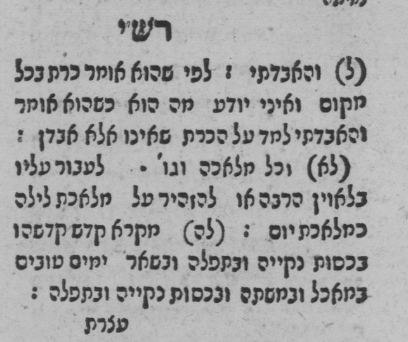
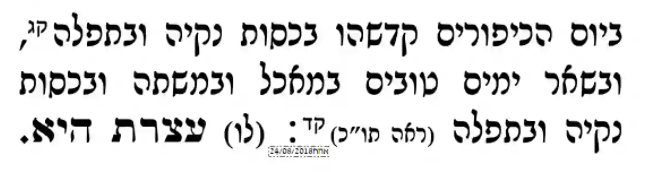
מקרא קדש – קדשיהו בכסות נקייה ובתפילה. וכל שאר ימים טובים, במאכל ובמשתה וכסות נקייה ותפילה

“Sanctify it with clean clothing and prayer, and on other festivals, with food and drink, with clean clothing and with prayer”

There is a disagreement among various editions of Chumash and Rashi on which מקרא קדש Rashi writes his comment. Logically, it belongs on Pasuk 27 which speaks about Yom Kippur. Rashi is telling us that the way you make Yom Kippur into a מקרא קדש is by wearing fine clothes and saying special prayers, and on other festivals, you observe them with food and drink, with clean clothing and with prayer.

This is the Artscroll Stone Chumash (Brooklyn 1993) which place the comment in Pasuk 27

However, there are other Chumashim which do not place the comment in Pasuk 27, and wait until Pasuk 35 to record it. This means that Rashi is telling us that on Succot, we sanctify the day with nice clothing and prayer, and on other festivals, we add in food and drink. It seems to be quite illogical.

This is Chumash Habahir (Jerusalem 2005)

What is the source for recording Rashi’s comment on Pasuk 35?

It turns out that most Rashi manuscripts and early printed editions have it that way.

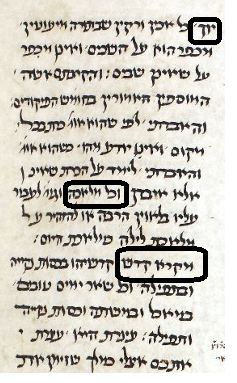
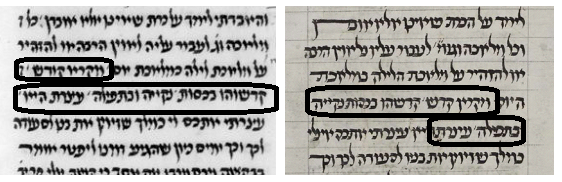
A good example is the authoritative manuscript Leipzig 1 which looks like this:[1]

The manuscript has the comment on the word “אַ֡ךְ” in Pasuk 27, followed by a few more comments continuing on to Pasuk 31, where a comment on the words “וכל מלאכה וגומ’” appears. This is followed by the comment on “מקרא קדש”. Those words only appear afterwards in Pasuk 35 meaning that Rashi wrote his words of “קדשיהו בכסות נקייה ובתפילה” as a comment on the festival of Sukkot.

The website Al Hatorah uses Leipzig 1 as its base text for Rashi, yet it positions this Rashi as a comment on Pasuk 27 which speaks of Yom Kippur. It notes though that this Dibur Hamatchil appears in Leipzig 1 and in other Eidei Nusach after the comment in Pasuk 31

דבור המתחיל זה מופיע בכ”י לייפציג 1 ובעדי נוסח אחרים לאחר הביאור על פסוק ל”א

I looked at many other manuscripts and found it to be true in the following 34 cases. I did not find one manuscript which had the comment on Pasuk 27

Oxford CCC 165 (Neubauer 2440), Munich 5, Hamburg 13, London 26917 (Neubauer 168) (1272), Paris 155, Berlin 121, Vatican ebr. 4, Vatican ebr.18, Vatican ebr.33, Vatican ebr. Vatican ebr. 94, Vatican ebr. 480, London 19665 (Margoliouth 174), London 22122 (Margoliouth 178) Oxford-Bodley Opp. 34 (Neubauer 186), Casanatense 2848 (1284), Berlin Qu 514 (1289), Florence Plut.III.03, Oxford Bodleian 69, Hamburg 32, Vatican urb. Ebr 1, Vienna codex Hebr. 220, Vienna Codex Hebr.3, London Harley 5708, Bavarian State Library, Cod.hebr. 148, HUC JCF 1(called Cincinnati 51), Paris 49, Paris 154, Parma 2708, Parma 3204 (DeRossi 181), Cambridge University Library, Ms. Add. 1828, Casantense 2988, and Sassoon 369.[2]

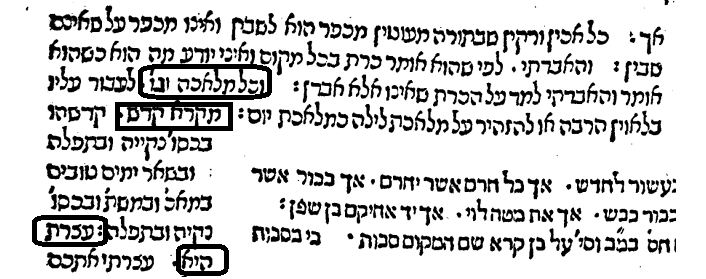
Most of the early printed editions of Rashi also have this comment on Pasuk 35. A good example is Rome 1470 where the comments on “וְהַֽאֲבַדְתִּ֛י” (pasuk 30) and “כׇּל־מְלָאכָ֖ה” (pasuk 31) precede that of “מקרא קדש” (presumably Pasuk 35)

The rest of the incunabula ( the 9 editions printed before 1500) present it that way except for Napoli 1492 where it is presented as part of Pasuk 27[3].

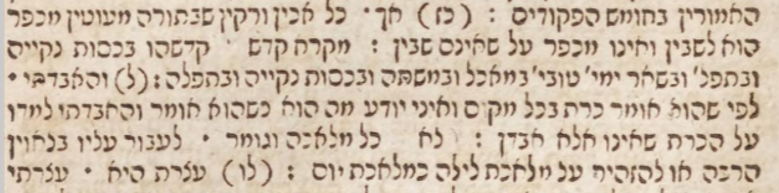
The most influential edition of the 16th century was the Bomberg Mikraot Gedolot Venice edition 1524-26 and it was recorded in the same manner. The comment on מקרא קדש comes after the comment on כָּל־מְלָאכָ֖ה of Pasuk 31, and before עֲצֶ֣רֶת on Pasuk 36. It is clearly assigned to מקרא קדש of Pasuk 35.

Many who analyzed Rashi’s work struggled with the issue of the manuscripts placing the comment on Pasuk 35, and logic dictating that it belonged on Pasuk 27. Chief amongst that group was the dean of supercommentators Rav Eliyahu Mizrachi (רא״ם)

He writes at first that logically Rashi is commenting on the words “מקרא קדש” which are written describing Yom Kippur (Pasuk 27)

שאין פירוש מקרא קדש האמור ביום הכפורי’ כפירוש מקרא קדש האמור בשאר ימים טובים כי פירוש מקרא קדש האמור ביום הכפורים הוא שתקדשהו בכסות נקייה ובתפלה לבד מאחר שאין בו אכילה ושתייה ופירוש מקרא קדש האמור בשאר ימים טובים הוא שתקדשהו באכילה ובשתייה ובכסות נקייה ובתפלה

“The interpretation of מקרא קדש on Yom Kippur is not the same as the interpretation of מקרא קדש on the other ימים טובים, because the interpretation of מקרא קדש on Yom Kippur is that you sanctify it with a nice clothing and prayer alone, since there is no eating or drinking on it, and the interpretation of the מקרא קדש on the other ימים טובים is that you sanctify it with eating and drinking, with nice clothing and prayer”

But Rav Eliyahi ran into the roadblock of the Girsa of all the manuscripts he had seen and it really bothered him

וגם בזה לבי נוקפי שהרי בכל הנוסחאות שראיתי בכולן כתוב הפירוש של מקרא קדש אחר הפירוש של והאבדתי ואחר הפירו’ של כל מלאכה

“But that makes my heart pound, because in all the Nuschaot I have seen, the interpretation of מקרא קדש is written after the interpretation of ” וְהַֽאֲבַדְתִּ֛י” (Pasuk 30) and after the interpretation of כָּל־מְלָאכָ֖ה ( Pasuk 31) .”

He nevertheless concludes that the comment belongs on Pasuk 27

אלא ע”כ לומר דהאי מקרא קדש שפיר’ בו הוא הכתוב ביום הכפורים שהוא משונה מכולם

“but rather one must say that this מקרא קדש, which is the one written on Yom Kippur, is the one which is different.”

Notice how he emphasizes that all the Nuschaot he has seen have it as the Dibur HaMatchil after “והאבדתי” (Pasuk 31) making “מקרא קדש” Pasuk 35. (regarding Succot)

However, there are a number of Rashi supercommentators who try to explain why this comment of Rashi does belongs after Rashi’s comments on Pasuk 30 and 31 (seemingly when it talks about Succot), such as Gur Aryeh( Maharal MiPrague 1512-1609).[4] The Yeriot Shlomo, which is a commentary on the Mizrachi by Maharshal (1510-1573), also addresses the issue.[5] Rav Shabtai Meshorer Bass places Rashi’s comment in Pasuk 35, and in his commentary Siftei Chachamim (Amsterdam 1680) advances this resolution:

 בכסות נקיה. והא דמהפך רש”י הקרא דמקרא קדש דהיה לו לפרש לעיל קודם פירוש והאבדתי וקודם כל מלאכה לא תעשו. וי”ל דלעיל לא יכול לפרש קדשהו בכסות נקיה וכו’ דלמא הא דכתיב מקרא קדש לאסור הלילה כיום לעניין עשיית מלאכה וכרת, אבל עכשיו דכתיב כל מלאכה לא תעשו שהוא מיותר ובא ללמד ולהזהיר על מלאכת לילה כיום ע”כ האי מקרא קודש בא ללמד על קדשהו בכסות נקיה וכו’

“Fine clothing. That which Rashi turned around the verse “מקרא קדש “? He should have explained it [where it first appears in verse 27] before explaining “והאבדתי ” and before ” כל מלאכה לא תעשו?” The answer is: He could not explain above” קדשהו בכסות נקיה,” because perhaps when it wrote ” מקרא קדש ” this was to make the night forbidden like the day regarding work and “.כרת”. But now that it is written ” כל מלאכה לא תעשו ” which is superfluous, it is to teach and warn that work is forbidden by at night as well as by during the day, therefore this ” מקרא קדש ” must be teaching that we ” קדשהו בכסות נקיה.”

How did Rashi’s comment on “מקרא קדש” fare throughout printing history?

As mentioned, 8 out of 9 incunabula placed the comment on Pasuk 35, as did Bomberg’s Mikraot Gedolot of 1524-26. Going forward, the same was true for Augsburg 1533, Bomberg 1548, Sabionetta 1557, Riva di Trento 1561, Cracow 1587, and Mantua 1589

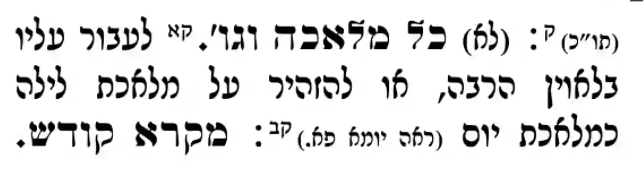
In fact, most editions through the 19th century continued to place the comment in Pasuk 35. Clearly, they were following the manuscripts and the earlier printed editions. Examples of these were Hanau 1611-14‬‬‬‬, Amsterdam 1670, Amsterdam 1701, Venice 1702, Berlin 1703, Amsterdam Proops 1721, Livorno 1807, Ostroh 1827, Warsaw 1854, Vienna 186, Zhitomir 1867, and Vienna 1875

Here is Berlin 1703

The earliest more modern edition I could find the comment placed in Pasuk 27 was the 1787 Devek Tov Hamburg edition.

Another example is Furth 1812

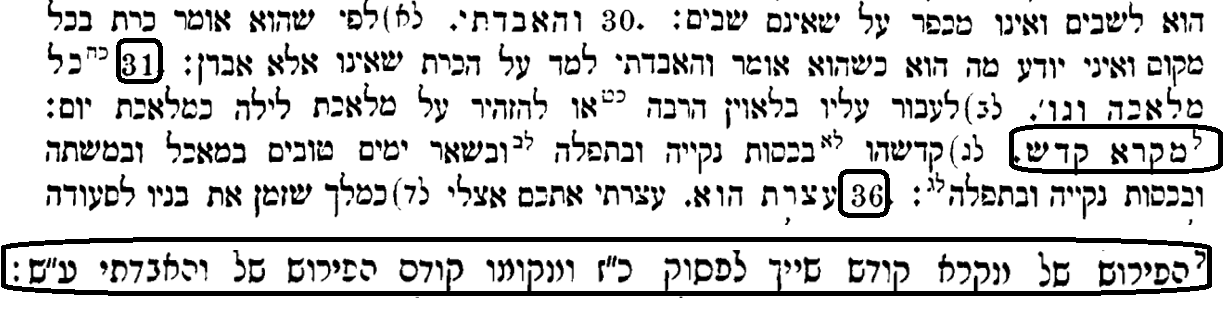
Avraham Berliner in Zechor L’Avraham (Berlin 1867) does not assign a Pasuk number to it but records it after Pasuk 31. In note 30 he writes that it belongs in Pasuk 27, before the comment of והאבדתי which appears in Pasuk 30.

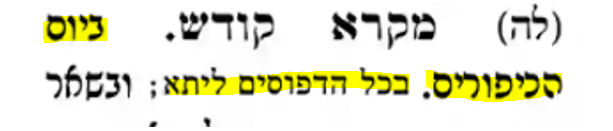
More recently, Oz Vehadar Rashi Mevuar of 2016 does not assign מקרא קדשׁ to Pasuk 35 but just to somewhere after Pasuk 31 but before Pasuk 36. It also adds the words ביום הכפורים to emphasize that the comment is made about Yom Kippur

However it admits that ביום הכפורים is not found in any early edition

Here is an example of the words “ביום הכפורים” appearing in parentheses

Malkah Shel Torah (Jerusalem 1990)

Chumash Torat Chaim (Jerusalem 1993) published by Mosad HaRav Kook maintains that it should be in the Yom Kippur section and places it in Pasuk 27, but admits that the manuscripts and early printed editions do not support this placement.

The Artscroll Elucidated Rashi, Siftei Yeshainim section (Rahway, NJ 2025) writes on this matter

שם: ד”ה מִקְרָא קֹדֶשׁ. בכמעט כל הנוסחאות (כ”י ודפוס, חדשים גם ישנים), דיבור זה כתוב להלן אחרי ד”ה “וכל מלאכה”, וא”כ לפי הסדר נראה שמוסב על פסוק לה (גבי סוכות). אבל לפי הענין נראה ברור שדברי רש”י מוסבים על יוה”כ, וכן כתב הרא”ם כאן, לכן כתבנו אותו כאן. וע’ בדברי המפרשים בפסוק לה.

Rashi Hashalem Mechon Ariel 2019) places it in Pasuk 35 but blames the incorrect placement on the mistake of printers.

Note: I believe it is difficult to assign blame to the printers after looking at all the manuscripts which placed the comment on Pasuk 35.

To summarize:

  1. Rashi made a comment regarding Yom Kippur that one sanctified it as a מקרא קדש through fine clothing and prayer, whereas other ימים טובים are sanctified additionally with food and drink.
  2. The comment of Rashi on מקרא קדש is clearly focused on Yom Kippur
  3. For some reason, all the manuscripts and early printed editions of the Chumash (except for one) place the comment of Rashi in the section dealing with Succot (Pasuk 35)
  4. Rav Eliyah Mizrachi says that logically the comment belongs in the Yom Kippur section (Pasuk 27) but notes that all the manuscripts have it in the Succot section ( Pasuk 35)
  5. Printers chose between three courses of action in terms of where they placed the comment.
  6. Place the comment in Pasuk 35 as it appears in all the manuscripts and rely on supercommentaries to explain why it is there.
  7. Place it in Pasuk 27 which speaks about Yom Kippur and where the comment seemingly belongs
  8. Place it in Pasuk 35 and, even though they appear in no manuscript, add the words ביום הכפורים with or without parentheses

The final word on this perhaps belongs to the Rashi scholar Dr. Aharon Ahrend, who wrote me

“I agree that once you examine many manuscripts, it strengthens the hypothesis that the original text was like the manuscripts. But we must always remember that we do not have Rashi’s own manuscript, and therefore when there is something strange, it can still be attributed to an error by an ancient copyist, from whom others copied.”

Notes

  1.  

    The website Al Hatorah includes this information on the manuscript named Leipzig 1

    “The popularity of Rashi’s Torah commentary and the tendency of medieval scholars and copyists to add to it their marginal glosses combined to create enormous variation between different manuscripts and editions of the commentary. As a result, it is often difficult to determine how Rashi’s original text read, and whether words, sentences, and even entire passages from the commentary, were written by Rashi himself or are merely later accretions… On this backdrop, the importance of the Leipzig 1 (Universitätsbibliothek Leipzig, B.H.1) manuscript of Rashi can hardly be overstated. This manuscript was written in the 13th century by R. Makhir b. Karshavyah, who states that he produced it from a copy of the commentary transcribed and annotated by Rashi’s own secretary, R. Shemayah. R. Makhir not only copied Rashi’s base commentary from R. Shemayah’s manuscript, but he also reproduced many of the marginal glosses contained in R. Shemayah’s text, a good number of which R. Shemayah explicitly attributes to Rashi himself. MS Leipzig 1 is, thus, an extremely valuable textual witness which comes tantalizingly close to the original source. In addition, its glosses shed significant light on Rashi’s thought processes and the development of his commentary.”

  2.  

    There were two manuscripts which had the comment after Pasuk 31, but left out the last part of it which is “וכל שאר ימים טובים”

    Paris 154 Berlin 1221

  3.  

    This is Napoli 1492. It perhaps indicates that there were manuscripts from which it took this Girsa which had it this way

  4.  

    גור אריה ויקרא כ”ג:ל”ו (Maharal Mi’Prague 1512-1609)

    https://hebrewbooks.org/pdfpager.aspx?req=42846&st=&pgnum=193

    קדשהו בכסות נקייה כו’. פירש רש”י דבר זה שלא במקומו אחר “כל מלאכה”, ועוד, דהוי ליה לפרש זה למעלה בחג המצות (פסוק ז). ויראה טעמו, דלמעלה לעולם כתיב איסור המלאכה אצל “מקרא קדש”, ויש לפרש “מקרא קדש” לקדש אותו שלא לעשות בו מלאכה, ובזה הוא מקודש, ו”מלאכת עבודה לא תעשו” פירושו ד”מקרא קדש”, שרוצה לומר בזה הוא קדש – “כל מלאכת עבודה לא תעשו”. אבל ביום הכפורים לא כתיב (בפסוק כז) “מקרא קדש” אצל המלאכה, על כרחך האי “מקרא קדש” מילתא אחריתי הוא, דלא איירי במלאכה, לכך פירש “מקרא קדש” ‘קדשהו כו’. לכך כאשר פירש כאן “וכל המלאכה וכו’ ”, הוקשה לו דלא כתיב “וכל מלאכה” גבי “מקרא קדש”, לכך פירש ד”מקרא קדש” אין פירושו שהוא קדוש ממלאכה, רק ‘קדשהו בכסות נקיה וכו”. אף על גב דהוי מצי לפרש זה על “וכל מלאכה” דלעיל (פסוק כח), אין זה קשיא, דלא פירש עליו מידי, אבל כאן (פסוק לא) פירש על “כל מלאכה” ‘לרבות כו”, פירש אחריו “מקרא קדש” ‘קדשהו כו”

  5.  

    יריעות שלמה ויקרא כ”ג:כ”ז -בד”ה מקרא קדש וכו’ דמה נשתנה וכו’ (רא”ם).

    https://hebrewbooks.org/pdfpager.aspx?req=67451&st=&pgnum=142&hilite=

    ולא הוצרך לומר זה, דבלאו הכי אי אפשר לומר שה’מקרא קדש’ הזה שפירש בו, הוא הכתוב בחג הסוכות (פסוק לה), דאם כן למה נחלק חג הסוכות משאר ימים טובים לענין מאכל ומשתה.

    ואפשר דלכך פירש”י מקרא קדש (פסוק לה) אחר שפירש קרא דכל מלאכה וגו’ (פסוק לא), משום דבזולת זה אפשר לפרש מקרא קדש האמור ביום הכיפורים (כאן) לענין איסור עשיית מלאכה אפילו אוכל נפש, מה שאין כן בשאר ימים טובים דמותרין במלאכת אוכל נפש לכן מפרש זה אחר קרא דכל מלאכה וגו’. כן נראה לי