The Medical Training and Yet Another (Previously Unknown) Legacy of Rabbi Dr. Abraham J. Twerski, zt”l

The Medical Training and
Yet Another (Previously Unknown) Legacy
of Rabbi Dr. Abraham J. Twerski, zt”l

by Edward Reichman and Menachem Butler

Rabbi Dr. Edward Reichman is a Professor of Emergency Medicine and Professor in the Division of Education and Bioethics at the Albert Einstein College of Medicine. He writes and lectures widely in the field of Jewish medical ethics.

Mr. Menachem Butler is Program Fellow for Jewish Legal Studies at The Julis-Rabinowitz Program on Jewish and Israeli Law at Harvard Law School. He is an Editor at Tablet Magazine and a Co-Editor at the Seforim Blog.

On erev Shabbat Shira last week, in the course of a typically wide-ranging conversation between the authors of this article, Menachem mentioned that unfortunately Rabbi Dr. Abraham J. Twerski was critically ill. As hashgachah would have it, Menachem had happened upon a little-known precious work from 1997, entitled Sefer Ye’omar le-Yaakov u-le-Yisrael, compiled by Rabbi Dr. Abraham J. Twerski and comprised of letters written to him by Rabbi Yaakov Yisrael Kanievsky, zt”l (1899-1985), known as the Steipler Gaon and author of the multi-volume work Kehillot Yaakov.[1]

Scion of prominent Hasidic dynasties and related to the current Rebbes of Bobov, Karlin, Klausenberg, Talner, and Skver, Abraham J. Twerski was born in Milwaukee in 1930 to Rabbi Yaakov Yisrael Twerski and his wife Devorah Leah (née Halberstam), where he attended public school as a child.[2] After he received his rabbinic ordination from the Hebrew Theological College in Chicago, he began to serve as an assistant rabbi in his father’s congregation in Milwaukee in the 1950s, as Aaron Katz described in his 2015 profile of Rabbi Dr. Abraham J. Twerski (“The Wisdom of Peanuts”) at Tablet Magazine. He married Goldie (née Flusberg) in March 1952; and starting that summer, directed the Hebrew School at his father’s congregation Beth Jehudah, as well as officiated religious lifecycle events in his father’s community in Milwaukee. However, as he would later reflect in an interview “after I had practiced as a rabbi for a number of years, I felt I was not fulfilled in my work and — after consultation with the Steipler Gaon — I went to medical school to become a psychiatrist.”

Abraham J. Twerski wrote to the Steipler Gaon and expressed concerns about the propriety of attending medical school as an Orthodox Jew. He would regularly visit Rav Kanievsky at his home in Bnei Brak and corresponded with him by mail, maintaining an ongoing relationship with him until the Steipler’s passing in 1985. That year, a volume of collection of letters entitled Karyana de-Igarta was published, and included, for the first time, two letters that the Steipler Gaon had sent some thirty years earlier to a young Abraham J. Twerski in Milwaukee, who was then seeking his advice regarding his career choice.

The first letter was written at the end of the Summer of 1955 by a twenty-four-year-old Abraham J. Twerski and in this letter the Steipler Gaon addresses the value of making one’s livelihood through a non-rabbinic profession. As to the specific profession, he adds that medicine may be a preferred choice, as it is a mitzvah to learn, and additionally, excluded from the ban on secular knowledge of the Rashba.[3] However, this is on the proviso that the education is provided by proper teachers and in an environment conducive to Torah observance. As this is clearly not the case in a modern university, he offers some general guidelines, culled from the seforim hakedoshim, if not to guarantee, at least to enhance the chances of success: 1) kove’a itim – learn in-depth at least two hours daily; 2) recite all tefillos with a minyan; 3) regular mikva immersion; 4) meticulous Shabbat observance; and 5) a daily musar seder.[4]

The second question Abraham J. Twerski posed, the following year, was more specific to his situation. He inquired whether it was preferrable for him to be a rabbi in a largely non-observant community (he was serving as an assistant rabbi to his father in Milwaukee at that time), which would involve immersion in an irreligious environment with potential negative impact on the Jewish education of his children; or should he choose a medical career, which would allow him to remain in an environment of Torah observance.

Suffice it say, the Steipler Gaon’s tone in this letter is less than supportive of a career in medicine than its predecessor. His written response is unequivocal, “the rabbinate is much preferred” (adifa yoter viyoter). He lists no less than five reasons not to become a physician, relating to the challenges in maintaining Torah observance and modesty, as well as the time commitment, which would preclude Torah study. He adds on a personal note that given his estimation of the exceptional talents of the young Rabbi Twerski, the latter would likely become a highly successful and sought-after physician. As such, he would find no rest from those constantly “knocking on his door” and seeking his consultation. He was particularly concerned about what would happen to his Torah learning and observance in such a case.[5]

Notwithstanding the serious concerns expressed by the Steipler Gaon, and perhaps now better informed of the potential pitfalls, Abraham J. Twerski proceeded to pursue his medical education, as he wrote, “I went to medical school with the Steipler’s blessing and continued an ongoing relationship with him for years.”[6] Their fathers both grew up as friends in Hornsteipel, “and spent their boyhood years together and were on first name terms,” reminisced Rabbi Dr. Abraham J. Twerski many years later in a biographical memoir of his Hasidic ancestors.[7]

However, several years into his studies at Marquette University’s medical school, Abraham J. Twerski could no longer afford the tuition.[8] His assistance would come from a most unlikely source, as he would later describe in an interview with the Pittsburgh Quarterly:[9]

By that time, I had several children, so my dad and some members of the congregation helped me to pay for school. I applied for a scholarship through a foundation, but it didn’t come through, so in my third year, I fell two trimesters behind on tuition. One day, I called my wife at lunch as always, and she asked, “What would you do if you had $4,000?” I said, “I’m too busy to talk about fantasies.” She said, “But you really do have $4,000!” I said, “From where?” She said, “From Danny Thomas.” “Who’s Danny Thomas?” She said, “The TV star.” Then she read me an article from The Chicago Sun. Local officials had told Mr. Thomas about a young rabbi who was struggling to get through medical school. Thomas asked, “How much does your rabbi need?” They said, “Four thousand dollars.” He said, “Tell your rabbi he’s got it.”[10] So, I did my internship in general medicine, went to the University of Pittsburgh Psychiatric Institute for three years, and then worked two more years for a state hospital.

While the Steipler Gaon’s assessment of the success of Rabbi Dr. Abraham J. Twerski’s medical career was prophetic, his concerns about Torah observance and learning, at least for Dr. Twerski, would turn out to be unfounded. Upon his graduation from medical school several years later, Time Magazine (June 15, 1959) published a brief article about him entitled “Rabbi in White.” It is worth reprinting in its entirety:

Abraham Joshua Twerski, 28, graduated from medical school this week. It was no mean feat, for Twerski is a Jewish rabbi like his father, two uncles, father-in-law, two older brothers and (when they finish their studies) two younger twin brothers. And to keep the Torah as an Orthodox Jew for six years of studies in Milwaukee’s Roman Catholic Marquette University was something like running a sack race, an egg race and an army obstacle course at the same time.

First there was the problem of keeping his religion from growing rusty: he rose each day at 5:30am, put in an hour’s study of the Talmud before early service at Milwaukee’s Beth Jehuda Synagogue, where he is assistant rabbi. Medical school classes began at 8am, and here real complications set in. His full black beard was a sanitary problem in surgery, requiring special snood-like surgical masks. His tallith katan, a small prayer shawl worn by many Orthodox Jews under their shirts, had to be made of cotton instead of wool – which might set off a static spark and ignite the anesthetic in an operating room.

Lectures on Saturday.[11] Religious holidays sometimes required months of advance planning. The nine-day Feast of Tabernacles, for instance, with four days when work is forbidden, fell during a series of lectures before a make-or-break exam in pathology. Abe, as students and professors call him, met the situation by studying by himself all the preceding summer, put himself so far ahead of his class that he could afford to miss the lectures. “I hated like heck to miss them,” he explains, “but I creamed that exam.”

When lectures came on Saturdays – during which Orthodox Jews are forbidden to work, ride in a vehicle or talk on the phone – Abe would have a friend put a sheet of carbon paper under his lecture notes and hope he remembered to use a ballpoint pen. Sabbath restrictions begin on Friday night, just before sundown, and on occasion Fridays only a lucky break in the traffic has saved him from having to abandon his 1952 De Soto and walk the rest of the way home. On Saturdays Abe was not on duty, but sometimes, to follow up on one of the cases he had been observing, he would leave his car in the garage and walk five miles to the hospital and back.

Work on Tishah Be’ab. Abe brought his own kosher food to school every day and ate it in the student lounge, where he also said his midday prayers in a corner, surrounded by chattering fellow students. Hospital duty during the 24-hour fast without food and water at Tishah Be’ab (commemorating the destruction of the Second Temple in 70 A.D.) Dr. Twerski describes as “murder,” and the last six years have left him hollow-eyed and slightly sallow.[12] But he is eagerly looking forward to the next stage: a year of internship in Milwaukee’s Mount Sinai Hospital, followed by a three-year residency in psychiatry.

“Psychiatric training was the motivation for my going into medicine,” he says. “I felt I could be a better adviser to my people and more help to them with their problems.”

The Time Magazine profile of Abraham J. Twerski included just one photograph (wearing “a snood for surgery” over his yarmulke), but members of the Twerski family have shared in recent years nearly a dozen of the other photographs that were taken by George P. Koshollek Jr., a local photographer with The Milwaukee Journal, and later deposited in the LIFE Photo Archive. The following are two photographs of newly-minted physician Abraham J. Twerski, together with his philanthropic patron who supported his medical school studies, the comedian Danny Thomas:

Upon his 1959 graduation from Marquette University Medical School, Rabbi Dr. Abraham J. Twerski left his pulpit in Milwaukee and moved with his family to Pittsburgh, where he completed his psychiatric training at the University of Pittsburgh’s Western Psychiatric Institute four years later, and was then named clinical director of the Department of Psychiatry at St. Francis General Hospital in Pittsburgh, supervised by Sisters of the Third Order of St. Francis, where he advanced his expertise for treating addiction. In 1972, Rabbi Dr. Abraham J. Twerski founded the Gateway Rehabilitation Center with the Sisters of St. Francis.[13]

Returning to our pre-Shabbat conversation, Menachem suggested that perhaps it might be appropriate for us to study through the 1997 volume of Rabbi Dr. Abraham J. Twerski, Sefer Ye’omar le-Yaakov u-le-Yisrael – one of his only Hebrew-language books of more than his eighty-authored volumes published over the past half-century – as a merit for Rabbi Dr. Abraham J. Twerski’s complete recovery. Menachem further asked if I would perhaps identify any medically related material that might be significant or previously unknown. Before Shabbat, I identified one particular letter, the final one in the book, which was of medical relevance, and I printed it out for learning, with Rabbi Twerski in mind. The topic: the obligation to prolong the life of a critically ill patient.

Just two days after our conversation, we read of the tragic passing of Rabbi Dr. Abraham J. Twerski, whose passing took place on Sunday, Chai Shvat 5781 (January 31, 2021). The nature of the letter from the Steipler Gaon to Rabbi Dr. Abraham J. Twerski, and its heretofore unknown origins, compels us to write this brief note l’zecher nishmato (in honor of his memory) and to add yet an additional item to his legacy.

Rabbi Dr. Abraham J. Twerski’s astonishing accomplishments, known to the Jewish community worldwide, are primarily in the fields of mental health, self-esteem, and addiction medicine.[14] We will leave it those with expertise in these areas to recall and recount his manifold contributions, including his voluminous literary output.[15] Here we note a contribution, which though indirect, may be on par with respect to its Jewish communal impact as those more widely known.

The Letter

In the introduction to this 230-page-work, Sefer Ye’omar le-Yaakov u-le-Yisrael, published in 1997 by the Kollel Bais Yitzchok on Bartlett Street in Pittsburgh (and with an effusive approbation from Rav Chaim Kanievsky, son of the Steipler Gaon), Rabbi Dr. Abraham J. Twerski recounts his unique connection to Rav Yaakov Yisrael Kanievsky, the Steipler Gaon. It stemmed back to the city in present-day Ukraine called Hornsteipel, to which they both trace their roots.[16] Rav Kanievsky had lived there in his youth and the appellation “the Steipler” is derived from the name of the town. Rabbi Dr. Abraham J. Twerski, though born in Milwaukee, Wisconsin is a direct descendant of Rebbe Yaakov Yisrael Twerski of Cherkas, the founder of the Hornsteipel Hasidic dynasty, which originated in that city.[17] His father was named Rabbi Yaakov Yisrael Twerski and was known both as the Hornsteipler Rebbe, and as the Milwaukee Rebbe.[18]

The last letter of this volume presents a medical halakhic query Rabbi Dr. Abraham J. Twerski posed to the Steipler Gaon in the Summer of 1973 about his ailing father. “May a son administer an injection to his ill father?” Despite the fact that Rabbi Dr. Abraham J. Twerski was a physician, and injections were part of his clinical scope of practice, he was acutely aware of the potential halakhic ramification of something as simple as an injection. An injection may cause bodily injury, and it is Biblically prohibited for a son to cause a wound to his father.[19] Rav Kanievsky answered that it would be permitted as long as there are no other options: “On the matter of delivering an injection to one’s father, as it may cause a wound, the law is found in Yoreh De’ah #241:3, that when no one else is available, it is permitted … .”[20]

It appears however that between the sending of the query and the completion of the response, Rabbi Dr. Abraham J. Twerski’s father passed away, as Rav Kanievsky offers condolences: “Behold, I who am bereft of good deeds [an allusion to the introduction to the High Holiday Musaf prayer recited by the chazzan] join in your great sorrow upon the passing of the honorable, great rabbi of the Hornsteipel dynasty. May God comfort you among the mourners of Zion and Jerusalem, and may his memory be a blessing for eternity.”[21]

It is the following paragraph, which includes a general comment about end-of-life issues, to which we draw your attention:

“Regarding the principle that one should do everything possible to prolong the life of the ill patient [even if he is in a terminal state (chayei sha’ah)]. In truth I also heard such a notion in my youth, and I do not know if this derives from a ‘bar samcha’ (authoritative source). In my opinion, this requires serious analysis…”
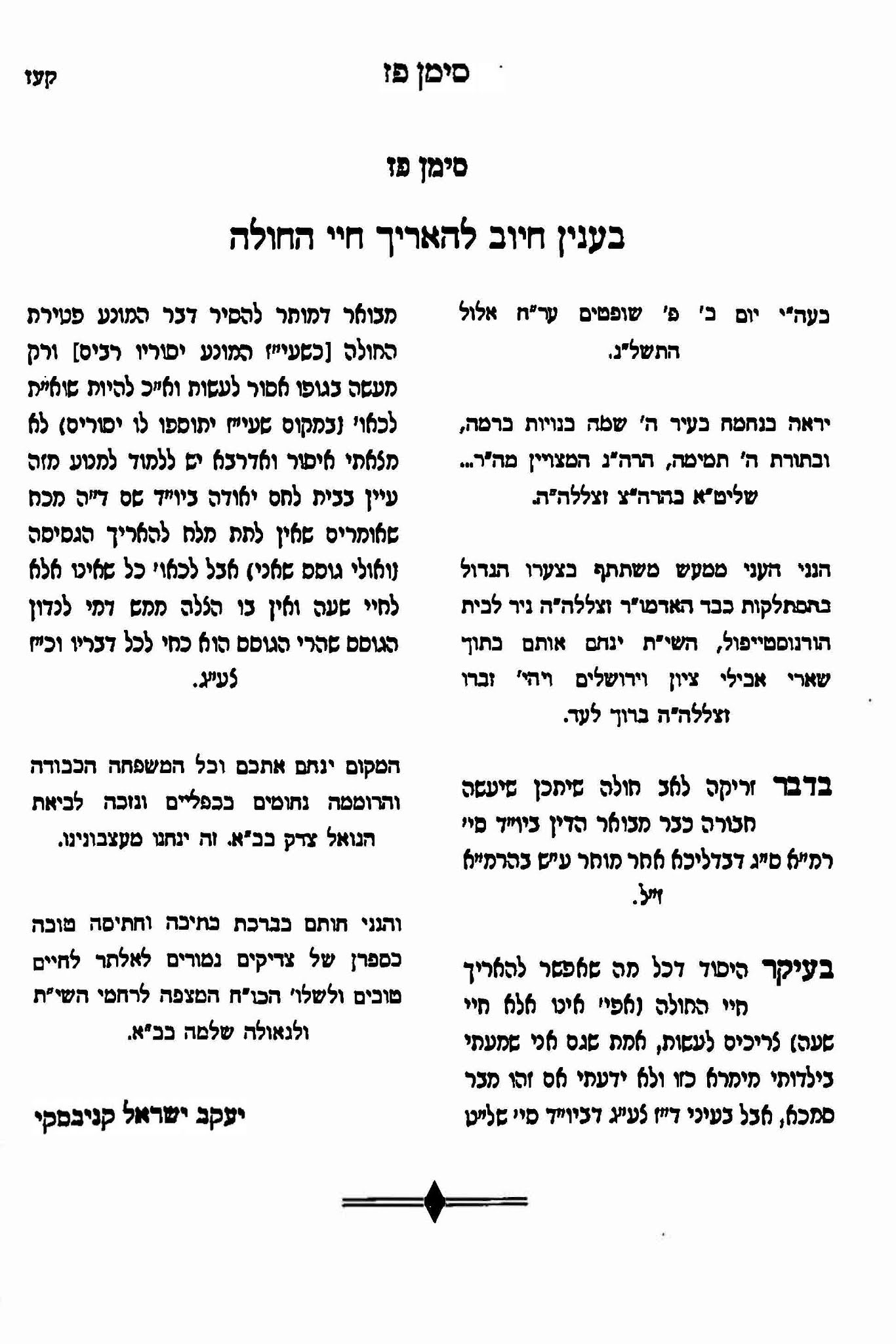
As I [ER] read these words, they were familiar to me. This letter appears in the Steipler Gaon’s collection of letters entitled Karyana de-Igarta,[22] though the questioner is not identified. It is only from this work of their correspondences that we learn that Rabbi Dr. Abraham J. Twerski is the author of the query!

It is not a lengthy halakhic analysis. In fact, the Steipler Gaon goes on to cite only two sources. The citations relate to the passage in Shulhan Arukh, Yoreh De’ah #339 regarding the treatment of a ‘gosses’, one whose death is imminent. Yet this pronouncement of Rav Kanievsky’s on the approach to the patient at the end of life may possibly be his most cited reference on any medical halakhic topic. Moreover, it is one of the more frequently cited sources in contemporary halakhic discussions on the end of life.

In the Modern era, with the likes of respirators and antibiotics, we now have the ability to prolong life to an extent not imaginable in the past. Must we utilize the entire armamentarium of medicine to prolong life in every circumstance, despite any associated suffering? There are some, such as Rav Eliezer Waldenberg, zt”l, who would answer in the affirmative.[23] Others, like Rav Moshe Feinstein, zt”l, allow for circumstances to refrain from aggressive care.[24] This debate has been the substance of halakhic discussions on end-of-life care in our generation.[25]

For someone of the stature of Rav Kanievsky’s to write that the notion to prolong life in all circumstances and at all costs may not derive from a “bar samcha” (authoritative source) is nothing short of revelational. This statement has guided many a rabbinic authority in their general approach to the treatment of the patient at the end-of-life and has certainly been part of the thought process of countless practical halakhic decisions.

It appears that this noteworthy contribution of Rabbi Dr. Abraham J. Twerski, zt”l to medical halakhic discourse, albeit indirect, has gone largely unnoticed. He is not only to be credited for his legendary contributions to broadening the possibilities of mental health in the Jewish community and beyond,[26] but he is also responsible for eliciting this letter of Rav Yaakov Yisrael Kanievsky, which has informed and guided halakhic-decision-making at the ‘end-of-life’ in the Modern era.

Sadly, we now invoke the same sentiment that the Steipler Gaon expressed above about the loss of another great rabbinic leader and member of the Hornsteipler dynasty:

May his memory be a blessing for eternity.

Notes:

[1] See Marc B. Shapiro, “The Tamim: Rabbi Yaakov Yisrael Kanievsky (‘The Steipler’),” in Benjamin Brown and Nissim Leon, eds., The Gedolim: Leaders Who Shaped the Israeli Haredi Jewry (Jerusalem: Magnes, 2017), 663-674 (Hebrew). A full biographical treatise on The Steipler Gaon along the lines of the magisterial scholarly work of The Hazon Ish, in Benjamin Brown, The Hazon Ish: Halakhist, Believer and Leader of the Haredi Revolution (Jerusalem: Magnes, 2011; Hebrew) remains a scholarly desideratum.
[2] In a December 25, 2020 email to Menachem Butler, Rabbi Dr. Abraham J. Twerski clarified some important details of an anecdote from when he participated in the Christmas play at his Milwaukee public school in his childhood. He wrote here:

That’s not quite the way it was. The week after the play, my mother called the teacher, to meet her. The teacher said, ‘I knew that Mrs. Twerski would reprimand me for putting Abraham in the Xmas play. But all she wanted to know was whether Abraham was self-conscious because he was shorter than the other children.’ I said, ‘I thought you were going to reprimand me for putting Abraham in the Xmas play.’ Mrs. Twerski said ‘If what we have given him at home is not enough to prevent an effect of a Xmas play, then we have failed completely.’

[3] For an overview of the controversy, see David Berger, “Judaism and General Culture in Medieval and Early Modern Times,” in Cultures in Collision and Conversation: Essays in the Intellectual History of the Jews (Boston: Academic Studies Press, 2011), 21-116, esp. 70-78. See also Joseph Shatzmiller, “Between Abba Mari and Rashba: The Negotiations That Preceded the Ban of Barcelona (1303-1305),” Studies in the History of the Jewish People and the Land of Israel, vol. 3 (1973): 121-137 (Hebrew); David Horwitz, “The Role of Philosophy and Kabbalah in the Works of Rashba,” (unpublished MA thesis, Yeshiva University, 1986); David Horwitz, “Rashba’s Attitude Towards Science and Its Limits,” Torah u-Madda Journal, vol. 3 (1991-1992): 52-81; and Marc Saperstein, “The Conflict over the Ban on Philosophical Study, 1305: A Political Perspective,” in Leadership and Conflict: Tensions in Medieval and Early Modern Jewish History and Culture (Oxford: Littman Library, 2014), 94-112.
[4] Avraham Yeshaya Kanievsky, Karyana de-Igarta: Letters of Rabbi Yaakov Yisrael Kanievsky, vol. 1 (Bnei Brak: privately published, 1985), 101-103, no. 86 (Hebrew), dated August 31, 1955.
[5] Avraham Yeshaya Kanievsky, Karyana de-Igarta: Letters of Rabbi Yaakov Yisrael Kanievsky, vol. 1 (Bnei Brak: privately published, 1985), 72-74, no. 66 (Hebrew), dated April 5, 1956.
[6] Rabbi Dr. Abraham J. Twerski, “Who is Honored? He Who Honors Others” (Pirkei Avos 4:1) at TorahWeb.org.
[7] See Abraham J. Twerski, The Zeide Reb Motele: The Life of the Tzaddik Reb Mordechai Dov of Hornosteipel (Brooklyn: Mesorah Publications, 2002), 11.

In 1965, Rabbi Dr. Abraham J. Twerski visited Bnei Brak and requested that he be permitted to take a photograph of Rav Kanievsky. After sharing a story about how Rav Meir Shapiro of Lublin convinced Rav Joseph Rosen, the Rogatchover Gaon, to allow him to take a photograph so that future generations would know what “a true Jew should look like,” the Steipler consented to a photograph to be taken.
[8] Financial difficulties for Jewish medical students are certainly not a new phenomenon. Indeed precisely four hundred years before Rabbi Twerski’s financial woes, in 1658, Chayim Palacco, another rabbi training as a physician in the University of Padua Medical School petitioned the Jewish community of Padua for assistance in paying his medical school tuition. The request, the only one of its kind in the archival records, was granted. See Daniel Carpi, “II Rabbino Chayim Polacco, Alias Vital Felix Montalto da Lublino, Dottore in Filosofia e Medicina a Padova (1658),” Quaderni per la Storia dell’ Universita di Padova, vol. 34 (2001): 351-352.

[9] Jeff Sewald, “Abraham J. Twerski, Psychiatrist and Rabbi: The Psychiatrist and Rabbi in His Own Words,” Pittsburgh Quarterly (Winter 2008), available here.

[10] For further details, see “Catholic Danny Thomas to Help Rabbi Become Doctor,” The Wisconsin Jewish Chronicle (27 June 1958): 1 and 3.


[11] The medical student Judah Gonzago, who trained in Rome in the early 1700s, recounts how one of his final (oral) exams was on Rosh Hashana. He recalls how he left the synagogue after the shacharit (morning) service and returned in time to hear the blowing of the shofar. His other trials and tribulations are reminiscent of those of Rabbi Dr. Twerski, though reflect a different historical reality. Though not a rabbi, Gonzago taught Torah in the local Jewish school. See Abraham Berliner, “Memoirs of a Roman Ghetto Youth,” Jahrbuch für Jüdische Geschichte und Literatur, vol. 7 (1904): 110-132 (German), of which excerpts are summarized and translated in Harry Friedenwald, “The Jews and the Old Universities,” in Harry Friedenwald, ed., The Jews and Medicine: Essays, vol. 1 (Baltimore: John Hopkins University, 1944), 221-240.
[12] How Rabbi Dr. Abraham J. Twerski navigated medical school while simultaneously maintaining meticulous religious observance, not to mention finding time for Torah learning, is truly exceptional. It reflects the challenges that every religious Jew faces in pursuing a medical education. These challenges have existed throughout history, though they have evolved over time. See Edward Reichman, “From Maimonides the Physician to the Physician at Maimonides Medical Center: The Training of the Jewish Medical Student throughout the Ages,” Verapo Yerape: The Journal of Torah and Medicine of the Albert Einstein College of Medicine, vol. 3 (2011): 1-25; Edward Reichman, “The Yeshiva Medical School: The Evolution of Educational Programs Combining Jewish Studies and Medical Training,” Tradition: A Journal of Orthodox Jewish Thought, vol. 51, no. 3 (Summer 2019): 41-56. See also Edward Reichman, “The History of the Jewish Medical Student Dissertation: An Evolving Jewish Tradition,” in Jerry Karp and Matthew Schaikewitz, eds., Sacred Training: A Halakhic Guidebook for Medical Students and Residents (New York: Amud Press, 2018), xvii-xxxvii.
[13] See Abraham J. Twerski, The Rabbi & the Nuns: The Inside Story of a Rabbi’s Therapeutic Work With the Sisters of St. Francis (Brooklyn: Mekor Press, 2013).

On his appointment to this position in August 1965, Sister Mary Adele announced: “The addition of Dr. Twerski to our staff is another important move toward our goal of making complete, comprehensive mental health care and treatment available to all the people of the community.” The following month, both Sister Mary Adele and Rabbi Dr. Abraham J. Twerski rejected the suggestion that his appointment embodies any aspect of the ecumenical movement, and she told The Pittsburgh Press: “The appointment came at an opportune time to fit into the spirit… but it was accidental.” See “St. Francis Ecumenical Movement? Rabbi, Catholic Hospital Team Up In Psychiatry: Mental Ward on the Move,” The Pittsburgh Press (26 September 1965): 11
[14] Rabbi Dr. Abraham J. Twerski’s contributions also extend to the sphere of music. A noted composer of Hasidic melodies (and also of musical grammen that he composed to be delivered at celebratory occasions, such as weddings and sheva brachot), one of his best-known (although often unattributed) compositions is “Hoshia Es Amecha,” which he composed more than six decades ago on the occasion of his brother’s wedding, and set to the words from Tehillim 28:9. The song is often chanted on Simchat Torah following each of the hakkafot in the synagogue, and has become a helpful tune to count the minyan-members ahead of starting prayer services. His story of the song’s composition is recorded here. At his request, there were no eulogies delivered at his funeral. Instead, he requested that his family sing “Hoshia Es Amecha,” which he had once described as his “ticket to Gan Eden…because people dance with it.” See the video of the funeral march here.
[15] For example, see Andrew R. Heinze, “The Americanization of Mussar: Abraham Twerski’s Twelve Steps,” Judaism: A Journal of Jewish Life & Thought, vol. 48, no. 4 (Fall 1999): 450-469.
[16] For the geographic map of the Hasidic dynasties that emerged from Hornsteipel, see Marcin Wodziński, Historical Atlas of Hasidism (Princeton: Princeton University Press, 2018), 159,162.
[17] See his book-length tribute to Reb Motele, the father of Rebbe Yaakov Yisrael Twerski of Cherkas ancestor, see Abraham J. Twerski, The Zeide Reb Motele: The Life of the Tzaddik Reb Mordechai Dov of Hornosteipel (Brooklyn: Mesorah Publications, 2002).
[18] See Israel Shenker, “The Twerski Tradition: 10 Generations of Rabbis in the Family,” The New York Times (23 July 1978): 38, which includes a photo of Rabbi Yaakov Yisrael and Devorah Leah Twerski, with their children and their spouses at a family wedding in 1958.

Peter Leo, “He Defies Melting Pot Tradition,” Pittsburgh Post-Gazette (4 September 1978): 15:

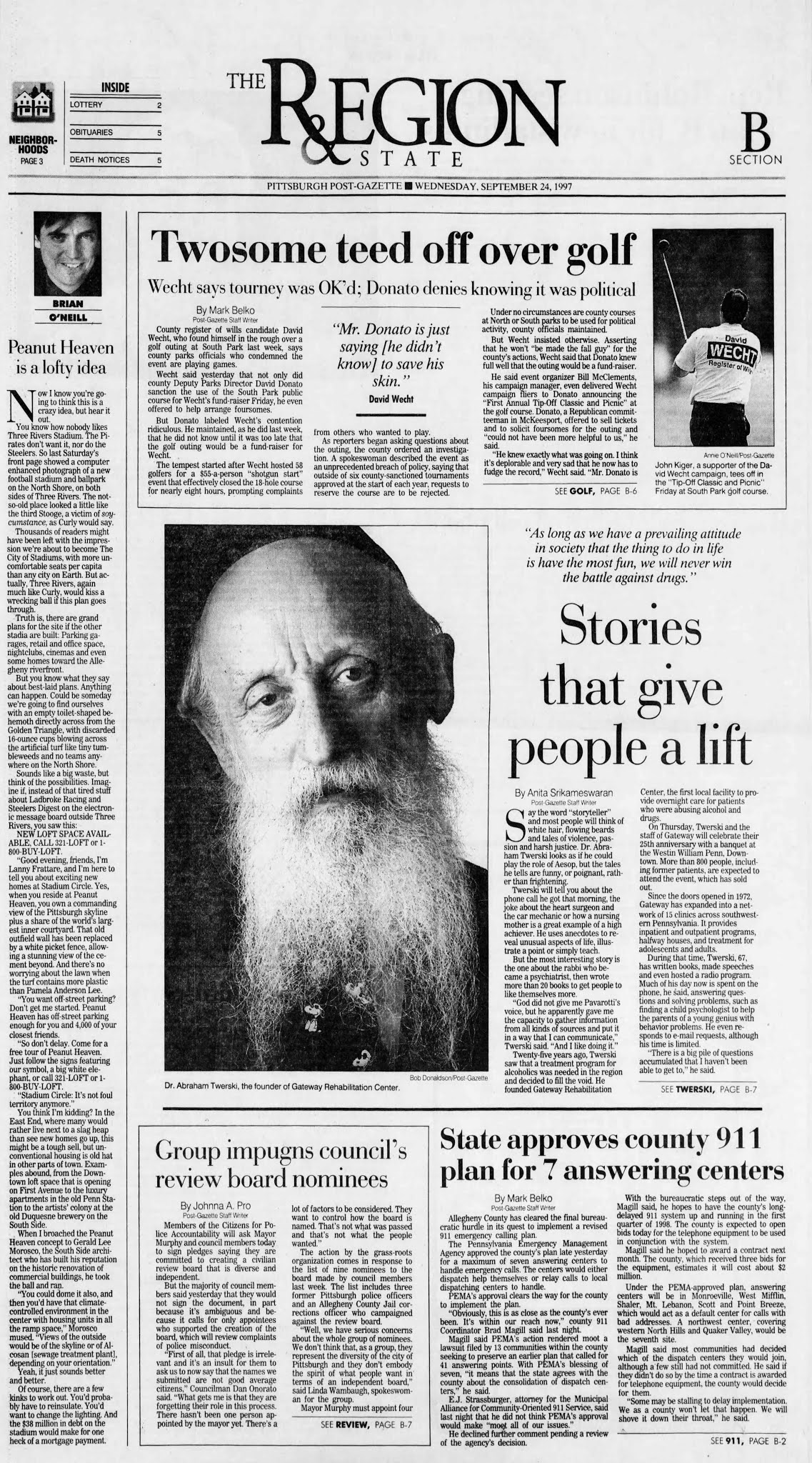
Anita Srikameswaran, “Stories That Give People A Lift,” Pittsburgh Post-Gazette (24 September 1997): B2,B7
[19] For treatise on the topic of providing medical care to one’s parent, see Avraham Yaakov Goldmintz, Chen Moshe (Jerusalem: privately published, 2002; Hebrew), available here.
[20] Abraham J. Twerski, Sefer Ye’omar le-Yaakov u-le-Yisrael (Pittsburgh: Kollel Bais Yitzchok, 1997), 177 (no. 86) (Hebrew), dated August 27, 1973.
[21] Grand Rebbe Yaakov Yisrael Twerski passed away on August 7, 1973.
[22] Avraham Yeshaya Kanievsky, Karyana de-Igarta: Letters of Rabbi Yaakov Yisrael Kanievsky, vol. 1 (Bnei Brak: privately published, 1985), 201, no. 190 (Hebrew)
[23] Alan Jotkowitz, “The Intersection of Halakhah and Science in Medical Ethics: The Approach of Rabbi Eliezer Waldenberg,” Hakirah, vol. 19 (2015): 91-115.
[24] See Moshe Dovid Tendler, Responsa of Rav Moshe Feinstein, vol. 1: Care of the Critically Ill (Hoboken, NJ: Ktav Publishing House, 1996). See also Daniel Sinclair, “Autonomy in Matters of Life and Death and the Withdrawel of Life-Support in the Responsa of Rabbi Moses Feinstein,” Jewish Law Association, vol. 23 (2012): 231-245; and Alan Jotkowitz, “Death as Implacable Enemy – Or Welcome Friend in the Theology and Halakhic Decision Making of Rabbis Moshe Feinstein, Eliezer Waldenberg, and Haim David Halevy,” in Kenneth Collins, Edward Reichman, and Avraham Steinberg, eds., In the Pathway of Maimonides: Festschrift on the Eightieth Birthday of Dr. Fred Rosner (Haifa: Maimonides Research Institute, 2016), 73-99.
[25] For a comprehensive review of the halakhic issues at the end of life – well beyond the scope of this brief essay – see, most recently, Avraham Steinberg, Ha-Refuah ka-Halakhah, vol. 6: The Laws of the Sick, the Physician, and Medicine (Jerusalem: privately published, 2017), 338-388 (section 10) (Hebrew).
[26] See, for example, his books in Abraham J. Twerski, Let Us Make Man: Self Esteem Through Jewishness (Brooklyn: Traditional Press, 1987); Abraham J. Twerski, The Shame Borne in Silence: Spouse Abuse in the Jewish Community (Pittsburgh: Mirkov Publications, 1996); Abraham J. Twerski, Addictive Thinking: Understanding Self-Deception (Center City, MN: Hazelden, 1997); Yisrael N. Levitz and Abraham J. Twerski, eds., A Practical Guide to Rabbinic Counseling (Jerusalem: Feldheim, 2005), and his dozens of other works published over the past half-century, including more than fifty works at the catalog of ArtScroll/Mesorah Publications.


Book Announcements: Five recent works

Book Announcements: Five recent works

By Eliezer Brodt

This post serves a dual purpose; first, to describe some new, very interesting seforim and thereby making the Seforim Blog readership aware of their recent publication. Second, to make these works available for purchase for those interested.

Part of the proceeds will be going to support the efforts of the Seforim Blog.

Contact me at Eliezerbrodt@gmail.com for more information about purchasing or for sample pages of these new works.

The first work I would like to mention is:

מאיר רפלד, המהרשל וספרו ים של שלמה, 288 עמודים

Dr. Meir Raffeld z”l authored a PhD on the Marshal and his work Yam Shel Shlomo in the Talmud Department of Bar Ilan University which was approved in 1991. Over the years, the work was quoted very often as it is the most comprehensive work on the Yam Shel Shlomo. The Yam Shel Shlomo is one of the most important Halachic works of the 16th century. Recently the Raffeld Family decided to print the PhD as a book. With the tremendous help of Dr. Aharon Ahrend, the work was just published. This work has in it the original PhD along with updates and corrections that Raffeld wrote over the years. It also has a thorough index and references to his articles related to the Marshal published in his work Netiv Meir.

Here is a ToC of the work:

The second work I would like to mention is

חסדי אבות, פירוש מסכת אבות לרבי דוד פרווינצאלו, (פעל סביב לשנת ש), מבוא 58 עמודים, תלד עמודים, מכתב יד, כולל מבוא מראה מקומות והערות על ידי פיעקב שמואל שפיגל

This volume was just published by Professor Yaakov Shmuel Spiegel, of Bar-Ilan University’s Talmud department, for the first time from manuscript on Massekhes Avos. This is the fifth work that Speigel has published on Avos from manuscript.

As I have written about him in the past:

Professor Spiegel is one of the most prolific writers on the Jewish academic scene, authoring of over 160 articles and 18 books (16 of those are publications for the first time of works which remained in manuscript). Many suspect that he knows the secrets of Hashba’st Hakulmos (automatic writing) (about which see here).

His articles cover an incredibly wide range of subjects related to many areas of Jewish Studies, including history of Rishonim, piyutim authored by Rishonim, bibliography and minhaghim, to name but a few. His uniqueness lies not only in the topics but also that his work has appeared in all types of publications running the gamut from academic journals such as Kiryat SeferTarbizSidraAlei Sefer, Assufot, TeudahKovetz Al Yad and also in many prominent Charedi rabbinic journals such as MechiltahYeshurunYerushasenuChitzei Giborim, Moriah, Sinai and Or Yisroel. It is hard to define his area of expertise, as in every area he writes about he appears to be an expert!

Worth noting that recently thanks to the hard work of a dear friend of mine, all of his published articles are available for free download here.

He has edited and printed from manuscript many works of Rishonim and Achronim on Massekhes Avos and the Haggadah Shel Pesach (and IYH some more are on the way)…

Another point of interest about Speigel is although he is an Academic and from the Mizrachi world, he is on very good terms with various Charedei scholars. Thus in some of his recent works he thanks Rabbi Shaul Alter, Rosh Yeshiva of Ger who has started reading and commenting about his material. This volume was also read by R’ Alter.

Reviews of other works of his on the Seforim Blog can be found here herehere, here, here and here.

Email me for a PDF of a sample of this new work.

The third work I would like to mention is:

רמשה הלל, חזון טברימון, תעודות מזויפות מבית היוצר של האחים טולידאנו מטבריה, 696 עמודים

A few weeks ago, the very prolific Rabbi Moshe Hillel [Son of Rabbi Yakov Hillel] released a PDF of his latest volume in his recent series of works dealing with exposing forgers and their forgeries titled חזון טברימון.

This volume is devoted to R’ Yakov Moshe Toldedano (1880-1960) and deals with various historical documents that he “discovered” and demonstrates that they are fake. This work is also a biography of Rabbi Toledano and explores various incidents in his life and possible motivations behind some of these forgeries. Similar to previous works in this series, this volume too is an incredible read, 696 pages! Bibliographers and people interested in the world of manuscripts will be sure to enjoy it.

Besides being released as a PDF, the volume was published in an extremely small limited editionFor a very short time, while supplies last, a few copies are available for purchase exclusively through me.

If you are just interested in a copy of the PDF of the work email me to send you a link.

Here is the ToC of the work:

The fourth work I would like to mention is

גיליונות הירושלמי של רבי שאול ליברמן, ג’ חלקים, 2564 עמודים, בעריכת פר’ משה עסיס

No words are really necessary to describe Rabbi Saul Lieberman to readers of the blog, but just in case, I will include one page from the classic article ‘Hamoreh’ written about him by the great Eliezer Shimshon Rosenthal:

This new work publishes for the first time Lieberman’s glosses written on the margins of six different editions of the Yerushalmi found in Lieberman’s library. The glosses were carefully collected and edited for publication by Professor Asis (himself one of the leading experts on the Yerushalmi).

A pdf of some Sample pages is available upon request.

The fifth volume I would like to mention is

  מעגל טוב, יומן מסע של החידא, חלק א, מהדיר: ראסף רביב, כולל הקדמה, 37 עמודים, + 275 עמודים  + נספח בענין החידא ומחבין ריעקב עמדין וריהונתן אייבשיץ, בעריכת ראסף רביב

On a personal note (for whatever that is worth) this work that has a special place in my heart as I have to date authored five articles about Maagal Tov and hope to IYH publish more.

A beautiful new edition was just published. The Sha’ar describes it as follows:

כולל המון תמונות, של מפות, אנשים, מקומות, כתבי ידות, יותר מאלף הערות שוליים, חלק אחד בשם ‘פלס מעגל’, הכולל ידיעות חשובות על האישים אשר עמם נפגש הרב, המאורעות השונים אשר פגש בדרכו, כתבי היד אשר ראה ועוד ועוד. וחלק שני בשם ‘המליץ בינותם’, יבאר את סגנונו של המליצי של הרב, ומראה מקומות לכל מטבעות לשונו במרחבי התנ”ך וספרות חז”ל

A brand-new annotated edition of the Chida’s famous Travel Diary, Volume one, 37 pp. intro, 275 pp. text, and an Appendix. It is a tall volume format, glossy paper, full of Illustrations, maps, pictures of people, places, and numerous images of manuscripts throughout the volume. It looks beautiful. The editor has two sections of notes. One section is devoted to deciphering all of the Chida’s Melitzos מליצות. The second section deals with the people whom he met, what he saw and much more.

The author is hard at work on the second part of the Travels.

Some readers of the blog will be familiar with a previous work of R’ Aviv, the fascinating Maaseh Tzadikim of R’ Avraham Kalfon (friend of the Chida) which he published for the first time from manuscript in 2009.

Just to note, an additional edition of the Chida’s Travels came out a few days later from Mechon Hame’or (800 pp.). This is volume fifty of the Mechon’s set of the Chida’s works that they have been publishing in the past few years.

This new edition is very useful; it does not have full Illustrations etc. like the previous one. However, I think that true seforim “addicts” need to own both. The Hamaor edition includes all the travels in one volume. It has useful notes (not as good as the first one). In addition, it has a lot of material related to the Chida, such as his listing of Hanhaghot, numerous stories he collected and seforim he owned. Some of this material was published here for the first time. It also has a section about the Chida and his seforim. 

Sample pages of both are available upon request.

To add to this earlier this year another volume was published called Kuntres Masaos (243 pp.) This material is also from manuscript and is dated and is Torah of his that he saw or discussed while traveling. Some of this was incorporated into his published seforim (some copies are still available for purchase).


“Whence Worry?” – On the Murky Trail Of An Aphorism

by Yitzhak, of בין דין לדין

[I am greatly indebted to Wolf2191 and Mississippi Fred MacDowell for reading an earlier draft of this essay and for providing numerous valuable references.] This past Rosh Ha’Shanah, my friend A.F. showed me a collection of various homilies of the Rav related to the days of Awe, “prepared, translated and edited by B. David Schreiber”. While browsing through them, I noticed the following passage:

Every Jew must also ensure the continuity of future generations

(45) There is another dimension to the equation between man and tree, כי האדם עץ השדה. In addition to roots, a tree also has נוף, branches which form a panoramic vista. Chazal debate if אילן בתר עיקרו או בתר נופו, whether the roots of a tree are more important than its expanse. A tree must have both roots and branches in order to exist and flourish. Likewise, it is insufficient for man to be merely involved in the past; he must also identify with the future. The roots are bound to the tree’s past; the flowers and branches relate to its future. Likewise, the bris yisroel comprises both past and future. Nowadays, Jews are concerned with the bris of the past, but in the days of antiquity, in the time of Avraham and Moshe, they were concerned with the future. את אשר ישנו פה ואת אשר איננו פה עמנו היום. Moshe was very troubled and wanted to ensure the continuity of the Jewish religion. Through אדם עץ השדה, man is bound to the past, nonetheless, he must anticipate the future and take all actions necessary to ensure that continuity. The past requires a future, and the future requires a past. Had Jews not identified with both the past and the future, the Jewish people could not have survived.

People often say incorrectly and sarcastically,

,העבר אין, העתיד עדיין, ההווה כהרף אין, אם כן דאגה מניין,

The past is remote, the future has not yet occurred, the present is fleeting, why, then, should one be concerned?

Yahadus disagrees. Yahadus proposes:

העבר יש, והעתיד יש, וההווה גשר המקשר את העבר ואת העתיד. אם כן, יש לדאוג.

The past exists. The future exists. The present is the bridge between the past and the future. Therefore, one should be concerned.i

The first time I ever heard this “incorrect, sarcastic” aphorism was a decade or two ago, as a catchy hit song composed by Yossi Green and sung by Mordechai ben David (a contemporary cover of the song at a wedding). In an interview with the Israeli magazine בקהלה, Green discusses the provenance of the lyrics and his composition of the song:

“הקריטריון שלי”, מספק יוסי גרין את הנוסחה, “אינו אם השיר יהיה קצבי או רגוע. הניגון צריך להיות מיוחד וחייב להיות בו חידוש מוזיקלי או קונספטואלי. זה המוטיב המאפיין כל שיר שלי. אתן לך דוגמא. כשהלחנתי את ‘דאגה מניין’, זה היה בתקופה שבה רווח בכל מקום המשפט ‘דונט וורי, בי הפי’ (אל תדאג, היה שמח). לאברמ’ל פריד הלחנתי באותה עת את ‘נישט געדאגהט יידן’ ולמרדכי בן דוד את ‘דאגה מניין’. זה היה בלתי שגרתי בעליל, משהו שכולם דיברו עליו”.

על ‘דאגה מניין’ יש לו גם סיפור, אחד מני רבים. “זאת באמת שאלה טובה, איך הגעתי למילים הללו”, הוא אומר כשאני תוהה על כך באוזניו. “אמי הייתה מאושפזת במצב לא טוב. רציתי להשמיע באוזניה דברים שייתנו מרגוע לנפשה. עיינתי בספרים הקדושים ומצאתי באבן עזרא את המילים הללו, שהן מילים נפלאות והקראתי לה מתוכן. הדברים נסכו בה עידוד רב.

“כשבאתי הביתה, קראתי למרדכי בן דוד לביתי ואמרתי לו, יש לי מילים נפלאות לשיר. כשהשמעתי לו את המילים, הוא אמר לי, אני לא מאמין. איפה מצאת מילים כאלו. הוא תמיד קורא לי, ‘הנה יוסף בעל החלומות’. גם הפעם השתמש בביטוי הזה באומרו, מאיפה אתה מוצא את המילים הללו. כך הולחן השיר”.

Green’s attribution of the aphorism to Ibn Ezra is a common error; while there are, indeed, many relatively recent works that do so (one of which Green probably encountered), none provide a source, and it is fairly certain that this is a misattribution. Wolf2191 points out another apparent misattribution; Rav Baruch Epstein ascribes authorship to Shelah, but unfortunately provides no source:

ולפעמים כשהיה אבי זקני רואה איש שקוע בצער ודאגה, היה משתדל לפזר מעליו ענני העצבות ולהשיב רוחו ולהרגיע נפשו, והטעים לו דברי נחומים ותקוה, ובתוכם זכר את דברי השל”ה שכתב בענין מניעת הדאגה בכלל, כזה:

העבר אין והעתיד עדיין וההוה כהרף עין ואם כן הדאגה מנין

והכוונה, כי אחרי אשר הזמן העבר כבר איננו, ואם כן איננו בדאגה עוד, והעתיד – איש לא ידענו, ועל כן אינו צריך להיות בדאגה עליו, וההוה ימשך כהרף עין, ומה ערכו ושויו של זמן קצר כזה כי נדאג עליו ..ii

As Wolf2191 notes, not only is our aphorism not to be found in Shelah, but on the contrary, Shelah is quite in favor of worrying:

גם יהיה דאגה בלבו. הנה צער ויגון שייך על העבר, שיצטער ויהגה על העבר דהיינו מה שעשה. ודאגה על העתיד, ידאג ויפחד מעונש עוונותיו, כי יש עוונות שהתשובה תולה כפרתן ויסורין ממרקין, כמו שנאמר (תהלים לח:יט) ,כי עוני אגיד אדאג מחטאתי’.

ועוד שנית, ידאג ויפחד תמיד אולי הוא מקצר בחובת התשובה, בצער ובמרירות ובצום ובכי. וגם כי הרבה צער והרבה בכי, יזחיל ויירא, אולי לעומת זה הרבה אשמה ולא השלים חקו, ויבונן בגודל עבודת הבורא על יצוריו, וכי אין קץ לרעת הממרה את פיו. כל אשר יוסיף בעבודת ד’ ובדרכי התשובה, הלא מצער אצלו ויהיה למעוט בעיניו.iii

The aphorism is found, though, in a work by a contemporary of Shelah, whom the latter esteemed – the יוסף אומץ (Frankfurt 5483) of Rav Yosef Yuspa Nördlinger, chief דיין of Frankfurt , who mentions and explains a version of the “מליצה”, but gives no hint of its provenance:

ואכתוב עוד צרי ליגון מחלת לב תוחלת ממושכה על ידי מיעוט הבטחון והיא מליצה, לחזק לב האדם שיבטח בלב שלם באלקיו ולא יצטער כלל על מה שישיגהו בעניני העולם הזה וזאת היא המליצה:

אנוש מה תדאג ותעיין, העבר אין והעתיד עדיין, וההוה כהרף אין, אם כן דאגה מניין.

וזה פירוש המליצה: העבר אין ולמה תצטער עלין הלא מה שעבר עבר ולא תוכל לשנות מה שכבר נעשה, והעתיד עדיין רצוני לומר עדיין עתיד לבא ולמה תצטער עליו והלא ישועת ד’ כהרף עין, גם אפשר שתצטער על עולם שאינו שלך כי שמא קודם באו עת הדאגה שעתה מצטער עליה יקחך ד’ לעולמך, וההוה כהרף עין רצוני לומר ההוה אין זמנו אלא כרגע ואם כן למה תצטער על דבר שאינו אלא כרגע ורצוני לומר אף אם זמן צערך ויגונך ארוך הלא כל רגע ורגע זמן בפני עצמו ואפשר שאחרי כלות הרגע ישתנה ענינו כמו שפירשתי העתיד עדיין.

אתה בן אדם כתוב זאת המליצה על לוח לבך ואז תפיק דאגותיך.iv

[From the Jewish Encyclopedia:

Hahn was the author of “Yosif Omeẓ,” which was published at Frankfort-on-the-Main in 1723 by Moses Reiss Darum, son-in-law of Joseph ben Moses Kosman. This interesting work treats of liturgical questions, of the most important moments of religious life, of education, charity, morality, the Christian holidays, and the civil calendar. It is written in a popular style; and short remarks show the author to have been a master of the Halakah. As such he was acknowledged by his contemporaries Isaiah Horowitz, author of “Shene Luḥot ha-Berit,” and Joel Särkes, author of “Bayit Ḥadash.” He expresses rational views in regard to pedagogics. He recommends adherence to the old rule given in Prov. xxii. 6, “Train up a child according to its way” (A. V. “in the way he should go”), and that the scope, method, and subject of instruction be adapted to the capacity of the child: it should not be compelled to learn what is beyond its comprehension. If not fit for the study of the Talmud, it should receive thorough instruction in the Bible, which is plain and wins the heart for the fear of God. In this work Hahn also tells of the troubles that befell the Frankfort Jews before and during the persecutions caused by Vincent , of their expulsion in 1614, and of their readmission in 1616.]

The יוסף אומץ was brought to my attention by Wolf2191, who also notes that the work הדרת אליהו‎ (Prague 5545) attributes it to “the early ones” and an anonymous “sage”:

והואיל דאתא לידן דברי הרב בעל עקרים הנ”ל … אזכור מה שפרשתי בזה בס”ד דברי התנא במס’ (אבות פרק א’) וז”ל

הוא היה אומר אם אין אני לי מי לי וכו’ ואם לא עכשיו אימתי.

… ועתה לא באתי אלא לפרש הסיפא דאמר ואם לא עכשיו אימתי. אשר בזה נפלא ממני פירושו שעל איזה זמן אמר התנא בלשון עכשיו כאלו הזכיר קודם לזה איזה זמן מוגבל.

אמנם על פי דברי הרב בעל עקרים הנ”ל דיבר התנא דברי תוכחת מוסר. ונפרש תחילה דברי הרב הנ”ל שאמר לעיל וז”ל

ואולם העתה עצמו אינו זמן על דרך האמת וכו’

רצונו בזה כי אין עת בעולם אשר יאמר עליו כי הוא זה עתה או יעלה במחשבה שהזמן זה הוא עתה. כי טרם יכלה מחשבת מלת עתה ממחשבתך אף שהוא זמן קצר מאוד מאוד. עם כל זה כבר עבר וחלף הזמן המעט הזה ונעשה ממנו עבר ואין זמן בעולם נמצא אשר תהיה וחל עליו זמן עתה אף במחשבה ופשיטא שלא יכלכלו הדבור לומר עתה כי טרם יפתח פיו לומר מלת עתה כבר עבר זמנו ובטל מחשבתו ונעשה עבר. ואם כן אין זמן עתה בעולם כי אם העבר והעתיד נפגשים זה בזה תמיד ואין תווך מבדיל בינותם.

וכבר ידוע מה שהביאו הקדמונים ז”ל. אמר החכם

העבר אין והעתיד עדיין אם כן דאגה מניין.

אך פן יאמר האומר אמת דעל זמן העבר אין לי שום דאגה ועל העתיד גם כן לא אדאג כמאמר החכם אל תצר צרות מחר. אך עכשיו הנה רע ומר לי. לזה בא התנא ואמר ואם לא עכשיו כלומר אם אין עכשיו בעולם נמצא על איזה זמן תדאג וק”ל:v

Returning to Yossi Green – he was actually apparently not the first to turn the aphorism into a song; it is claimed that it used to be sung in the great Yeshivah of Novardok:

סיפר הרב שנשאל מהו המקור של המאמר שהיו שרים בנובהרדוק “העבר אין והעתיד עדיין וההוה כהרף אין ודאגה מנין”, ופלוני אמר שהוא ב”אבן עזרא”, ולא מצאתיו אבל מקור המאמר נמצא בספר “פלא יועץ” (אות “דאגה”).vi

The ‘Rav’ (Rav Chaim Kanievsky) refers us to the celebrated nineteenth century moralistic treatise פלא יועץ, by the Bosnian-Bulgarian Rav Eliezer Papo:

כתיב (משלי יב:כה) דאגה בלב איש ישחנה. ופרשו רבותינו ז”ל (יומא עה.) יסיחנה מדעתו, אי נמי ישיחנה לאחרים.

ותרויהו איתנהו, שבתחלה ישתדל להסיחה מדעתו במחשבות טהורות וטענות מספיקות שיש ויש כדי לדחות הדאגה,

ואם לא יכול ישיחנה לאחרים, דהינו תלמידי-חכמים ואנשי מדע שידעו לתקנו בעצה טובה וידברו לו דברים המבטלים הדאגה ומישבים את הלב, כי כבר אמר החכם (מראה מוסר, ה) העבר אין, העתיד עדין, דאגה מנין, קום שתה יין. שאם הדבר כבר עבר מה יועיל בדאגה, האם יוכל להשיבו, ולא די לו רעת הרעה שארע לו אלא שיוסיף רעת הדאגה וחיי צער יחיה יסיחנה מדעתו. ואם הוא דבר שעתיד להיות, אם יש תקנה יעשה התקנה, ואם לא יש תקנה מה יועיל בדאגה, יבטח בשם ד’ וישען באלקיו זה כלל גדול להסיר הדאגה:vii

[The referral of the sufferer of depression to “men of science who will know how to repair him with good counsel and will speak to him words that will nullify the worry and settle his heart” is a remarkably modern-sounding endorsement of therapy.] While the earlier editions of the work, from its first publication in 1824 and on, that I have checked provide no source for the “sage’s” statement, a recent edition (Yerushalayim 5767) refers us to something called מראה המוסר. As described in בית עקד ספרים:

מראה מוסר, דער צוכט שפיגל, איין געטליך אונ’ וועלטליך ספר, שפריך ווערטר פאן אונזרע חכמים, מה”ר זליגמן אולמא מגינצבורג

A mere decade ago, I might have given up here, since I do not have ready access to a good library, but today, thanks to the incredible work of those behind HebrewBooks.org, the work is easily available with the proverbial click of a mouse. While the work is now rather obscure, it was apparently quite popular in its day, going through four printings in the seventeenth and eighteenth centuries. It is an alphabetical collection of miscellaneous aphorisms, moralisms and other quotable passages, in Hebrew and Aramaic, with Yiddish explanations, many from the Talmud, but many of much murkier provenance, our aphorism obviously among the latter.viii HebrewBooks has the third edition (Ovibach 5476):

אנוש אח קין. מה תדאג ותעיין.

בהפקד קנין. ורוב ענין

במשקל ובמנין. הכל הבל ורעיון.

העבר אין. והעתיד עדין.

וההוה כהרף עין. אם כן דאגה מנין:ix

Anyone can use HebrewBooks, but it takes Mississippi Fred MacDowell to point out that the other three editions (in addition to the Ovibach one) are available from the Jiddische Drucke collection at the Universitätsbibliothek Frankfurt a.M.:

The claim that this is the (direct) source of the פלא יועץ is problematic, though, in light of the differences between the versions: R. Papo omits the phrase “וההוה כהרף עין”, and adds the phrase “קום שתה יין”. In any event, here the trail goes cold; while מה”ר זליגמן אולמא מגינצבורג is clearly not the originator of these verses, I have been unable to trace them back any further, and so I pass the baton to the erudite readership of the Seforim blog: where and when does this aphorism originate?

iנוראות הרב, חלק חמשה עשר, דרשות על ברכות מלכיות, זכרונות ושופרות, קדושת יום הכיפורים, והגיונו של אדם, נערך, תורגם והוגה על ידי ב. דוד שרייבער, עמוד 97
iiמקור ברוך חלק ראשון פרק ג’ “החיים והלשון” סעיף ה’ עמודים שפט.-:‏
iiiשני לוחות הברית, מסכת יומא פרק נר מצוה, אות ס”ט
ivיוסף אומץ (פ”פ דמיין תפ”ג) עמוד קסח: – קשר
vהדרת אליהו חלק ראשון דרוש שני סימן ה’ עמודים לד:-לה. ד”ה ונשובה – קשר, קשר
viדרך שיחה עמוד ז.
viiפלא יועץ ערך דאגה
viiiContrary to the citation in the פלא יועץ, it actually appears under the letter א and not ה, as it is part of a larger poem beginning with the word אנוש.
ixמראה המוסר (אוביבאך תע”ו), אות א’ עמוד ה. – קשר
xבית עקד ספרים gives 374, but the title page explicitly states 438, as per the Universitätsbibliothek catolog.
xiבית עקד ספרים has 493; the Universitätsbibliothek gives “ca. 1750”.


Another Obvious Mistake, More Grammatical Points, Bubbe Mayseh, Apostates and the Zohar

Another Obvious Mistake, More Grammatical Points, Bubbe Mayse, Apostates and the Zohar
 
Marc B. Shapiro
1. In my last post here I gave an example of an obvious error in a recent book focusing on the letters of R. Kook. I found another example of an obvious error in R. Dov Eliach’s new book, Be-Sod Siah.

This is quite an interesting volume as it contains interviews with a number of leading haredi rabbis. I could have an entire post on the material in this book, but let me just call attention to a couple of things related to R. Jehiel Jacob Weinberg before dealing with the error. One of the rabbis interviewed is the late R. Moshe Shapiro. In discussing R. Weinberg, he states (pp. 126-127):
דוגמא לתלמיד שהסבא הרבה להשקיע בו לפי טיבו וכישרונותיו – הגר יחיאל יעקב ויינברג בעל השרידי אש“. עלוי וכוח גדולשהיה מה שנקרא אאוטסיידר” – חריג ויוצא דופן באופיושבקלות היה יכול להחליק ולמצוא עצמו בין המשכילים“. ובזכות חכמתו ויגיעתו של הסבא הוא נשאר בבחינת שלומי אמוני ישראל“.
R. Shapiro tells us that R. Weinberg was an “outsider” and that he could have easily gone the way of Haskalah. It is fascinating that a haredi figure says this, because this is precisely the sort of comment that I think might have angered R. Weinberg’s now deceased right-wing students. Yet I have to say that R. Shapiro is exactly correct in his description. I don’t know if his knowledge of R. Weinberg’s life comes from my book or from R. Nathan Kamenetsky’s Making of a Godol – I only spoke to R. Shapiro once, and it was not about R. Weinberg – but he obviously knew something about the ups and downs of R. Weinberg’s life.
Here is p. 273 in the book, which includes a picture of R. Weinberg.
  
Not noted by Eliach is that this picture comes from my post herewhere I published it for the first time (and thanked the person who gave it to me). I realize that once the picture is on the internet it is there for anyone to use it, but it would still be nice if people would acknowledge where it came from.
Eliach also includes a lengthy interview with R. Bezalel Rakow of Gateshead which understandably has a good deal about R. Weinberg. (I have previously discussed R. Rakow here and here.) What I find fascinating is how people like Eliach simply can’t get a handle on R. Weinberg. On the one hand, they know that he was a great scholar and posek. On the other hand, they know that his views were not in line with the haredi world. Eliach asks R. Rakow the following (p. 274):
בשורה התחתונה – שאלתי את הרב ראקוב – האם הרב ויינברג מוגדר על ידכם כמנהיג תורני חרדי?
Eliach wants to know if R. Rakow regards R. Weinberg as a haredi Torah leader. R. Rakow responds very diplomatically:
בודאיהגאון הרב ויינברג היה ירא וחרד לדבר ה‘. איש ההלכה הצרופה שחרד על כל סעיף בשלחן ערוך!
R. Rakow knew perfectly well that he was dodging the question, and if the definition of haredi is one who is completely halakhically observant, then R. Soloveitchik and R. Lichtenstein (and endless others) should also be regarded as haredi leaders. Only in the continuation of the interview does R. Rakow acknowledge that R. Weinberg’s views were not all in line with the haredi approach (p. 276):
ועדיין ניתן לומרשאי אלה ממחשבותיו לא עלו בקנה אחד עם הדרך המקובלת לנו מרבותינו.
Now for the obvious mistake in Eliach’s book. Here is pp. 66-67.


He begins by mentioning that in his book on the Vilna Gaon he told a story that before World War II, R. Aaron Kotler was not sure where he should go, Eretz Yisrael or the United States. He therefore performed the goral ha-Gra and Exodus 4:27 came up: “And the Lord said to Aaron: ‘Go into the wilderness to meet Moses.’” He understood this to refer to R. Moses Feinstein, who at the time was living in the spiritual wilderness of New York.
Eliach states that it has been established that this story is not correct, and he cites the grandsons of R. Kotler who told him that their grandfather was never in doubt about where he was to go. They also pointed out that there is no way that the name “Moses” could have been seen as a reference to R. Moses Feinstein who was not well-known at that time.
So far so good (and these points are so obvious that one wonders how Eliach fell for a typical yeshiva bubbe mayse[1]). However, Eliach continues, and it must be that he is citing something that he was told by one of the current Kotlers, but he has completely mangled it. He writes:
אם היה מקום לסיפורהרי שהפוסק היותר ידוע בימים ההם באמריקההיה הגר יוסף רוזיןנשיא אגודת הרבנים דארצות הברית וקנדה“, ומחבר ספרי “נזר הקודש“.
Eliach tells us that if the story is true, it would have been with reference to R. Joseph Rosen, who was the most well-known posek in America at the time, the honorary president of Agudat ha-Rabbonim, and the author of the books entitled Nezer ha-Kodesh.
The first thing to ask is how could the goral ha-Gra performed by R. Kotler have anything to do with R. Joseph Rosen when the verse that came up mentioned “Moses”? How Eliach did not see this is beyond me. Furthermore, R. Joseph Rosen not only was not a well-known posek, he was not even a little-known posek. He was also not the president of Agudat ha-Rabbonim, and he never wrote a book called Nezer ha-Kodesh. The only thing of interest, and accurate, in Eliach’s discussion is that he somehow got a copy of the document appointing Rosen rabbi of Passaic, New Jersey, and he includes a picture of this in the book.
Here is what happened: Eliach was told that if the story of R. Aaron Kotler performing goral ha-Gra had any truth to it, the “Moses” referred to would have been R. Moses Rosen, who indeed was a great rav, author of Nezer ha-Kodesh, and served for a time as president of Agudat ha-Rabbonim.[2] R. Rosen is most famous for being the rabbi of Chweidan, Lithuania, where the Hazon Ish’s wife was from and where the Hazon Ish lived after getting married. R. Rosen and the Hazon Ish became close, and supposedly it was R. Rosen who first told R. Hayyim Ozer Grodzinski about the unknown genius, R. Abraham Isaiah Karelitz.[3] The Hazon Ish also proofread the volume of Nezer ha-Kodesh on Zevahim. This was published in Vilna in 1929 when R. Rosen was already living in the United States.[4] While R. Rosen is famous for his connection to the Hazon Ish, not so well known is that he was also a Zionist.[5]
3. My last post here gave examples of grammatical mistakes in the ArtScroll and Koren siddurim, which are the most popular in the English-speaking world. I received a lot of feedback about this, and I did not realize that so many people are interested in the often arcane points of grammar. (While I myself am quite interested in this, I am hardly an expert.) Here are a couple of more examples (and interested readers should consult the comments to the last post for additional instances).
In Ashrei we read עיני כל אליך, which comes from Psalms 145:15. The correct way to read עיני is with the accent on the ע, not on the נ. This word is commonly mispronounced, and neither ArtScroll nor Koren place the accent where it should be.[5a]
I found another mistake in the ArtScroll Machzor for Rosh ha-Shanah and Yom Kippur. In the prayer of the chazzan before Musaf, he says הפך [נאלנו ולכל ישראל. Some versions have the first word as הפוך. In both cases, since this is an imperative there needs to be a hataf patah under the ה. Yet in the ArtScroll Machzor there is a patah under the ה and the accent in הפך is mistakenly put on the first syllable, the ה. [After writing this I checked the second edition of the Machzor and was happy to see that it has been corrected. This shows that any errors we point out are valuable, as ArtScroll is prepared to correct them in future editions.]

Btzalel Shandelman wrote to me about ArtScroll’s comment on Genesis 39:8, which explains why there is a pesik following the word וימאן

The adverb adamantly is suggested by the staccato and emphatic Masoretic cantillation of this word: the shalsheles, followed by a psik [disjunction], both of which set off the word and enhance the absoluteness of its implication. It indicates that Joseph’s refusal was constant, categorical, and definite. He repulsed her with absolute firmness. Haamek Davar notes that the Torah gives no reason for his rejection; his sense of right and wrong was so clear that he did not even consider her pleadings. To her, however, he gave an explanation, trying to convince her to stop pestering him.

Shandelman correctly points out that this explanation is based on a mistake, as the vertical line found in the Torah after word וימאן is not a real pesik, as a pesik can never follow a shalshelet in the Torah (or the other sixteen biblical books that use the Torah’s system of cantillation). The reason for this is that a pesik is only found after conjunctive te’amim, and in the Torah shalshelet is always disjunctive. So why is there a vertical line after shalshelet if it is not a pesik? Joshua R. Jacobson explains:

In the te’amim of the three books (ספרי אמת), the shalshelet sign can serve as both a conjunctive and a disjunctive accent. To distinguish one from the other, a vertical line was added after the disjunctive shalshelet. Even though in the twenty-one books the shalshelet sign has only one use – as a disjunctive accent – nevertheless, the Masoretes retained the vertical line. . . . The vertical line after the shalshelet word is not a pasek: it does not indicate an extra pause.[6]

Another way to put this is that in the Torah the vertical line that always follows the shalshelet is not a separate symbol, but rather part of the shalshelet.
Nevertheless, pre-modern Hebrew texts that deal with masoretic matters seem to have no other way to refer to the vertical line, so it is called a pesik even by those who recognize that it does not function as a pesik. Thus, in the Masorah Gedolah to Lev. 8:23 it states:
ז‘ מלין בטעמא מרעימין ומפסיקין
מרעים is another word for shalshelet.
Returning to the example noted by Shandelman, I replied to him that the mistake is not that of ArtScroll. Although it is not clear in the excerpt printed above, the comment about a pesik following the shalshelet has its origin in R. Naphtali Zvi Judah Berlin’s Ha’amek Davar.[7] This is actually a common mistake, as the rules of trop are not well known. Unless someone has studied these rules, he will have no reason to assume that a vertical line is not a real pesik. The next step is to offer explanations of verses based on this assumption that the vertical line represents a real pesik after the shalshelet.
I don’t think that any of the following explanations are based on the mere appearance of the vertical line. Rather, the authors assume that it is a real pesik and one can therefore base interpretations on it.
R. Tuviah ben Eliezer (12th century) writes:[8]
וימאן מיאון אחר מיאון הרבה פעמים דכתיב בפסיק ובשלשלת
Solomon Buber, the editor of the text, explains R. Tuviah’s words:
דורש הטעמיםכי על וימאן הוא שלשלת ואחכ הוא בפסיק
R. Yeruham Levovitz stated as follows:[9]
ועל כן תיכף לוימאן” יש פסיקכי הופסק אצלו כל הענין אף טרם ניתח העולה על הרוחאף טרם נתן כל טעם וביאור על המיאוןכי טרם כל וכל הוא ממאן על הדבר וחסלוהטעמים והביאורים יתן אחרי כןוזהו אמרו אחרי הפסיקואומר אל אשת אדוניו וגו‘.
R. Samuel Borenstein writes:[10]
וימאן מוטעם בשלשלת ופסיקכדי להפרידו בפעוהיינו שהמיאון לא הי‘ מחמת הטעם אלא מצד עצם הנפש למעלה מהטעם.
R. Shlomo Zvi Schueck leaves no question that in his mind the vertical line is a real pesik.[11]
ואמרתי שחכזל דרשו זאת מן הטעם שלשלת העומדת על תיבת וימאן אם רצו להודיע בטעם שלשלת להפסיק שם בדיבור למה בחרו בניגון זה דוקאהא כמה טעמים מפסיקין הםועוד הא אחר תיבת וימאן הוא עומד הקו פסיקולמה לן תרי מפסיקין כאן?
R. Shlomo Amar writes:[12]
תיבת וימאן” הכתובה בפסוק מוטעמת בטעם שלשלתומיד לאחריה מופיע טעם פסקונראה דזה בא ללמדשיוסף הצדיק מיאן במיאון אדיר וחזקוגם מיאונו היה פסוק וחתוך.
I would only add that it is very difficult to say about so many great sages, ועפר אני תחת רגליהם, that they are wrong about the function of the pesik following a shalshelet. What I have written is based on the standard works on the topic. However, if anyone knows of an authentic tradition in which there is a pesik after shalshelet, please let me know. 

Finally, as I am writing this post not long after Hanukkah, here is an example of a translation where ArtScroll gets it right and pretty much everyone else I have checked gets it wrong (though we can understand why they intentionally get it wrong). In Maoz Tzur we read:
לעת תכין מטבח מצר המנבח
אז אגמור בשיר מזמור חנכת המזבח
ArtScroll translates:
When you will have prepared the slaughter for the blaspheming[13] foe,
Then I shall complete with a song of hymn the dedication of the Altar.[14]
Here is Koren’s translation of the first line:

When you silence the loud-mouthed foe.

This a much more comfortable rendering, and if you examine other siddurim you will find similar “softer” translations. Given the choice between “slaughter” and “silence,” most people will pick the latter. Yet unfortunately for them, the text does not say “silence.” It says “slaughter,” and the words תכין מטבח are based on Isaiah 14:21: הכינו לבניו מטבח, “Prepare ye slaughter for his children.” Koren’s translation is thus a politically correct distortion of the text’s meaning.
This is not a matter that started with Koren. For a long time now, translators have been afraid that if people knew what the text actually said that they would not want to sing the song. Yet how can you have Hanukkah without Maoz Tzur? It is even recited publicly at the White House Hanukkah party. (It is amazing to me that no one has yet made an issue of publicly singing these politically incorrect words.) So, a little bit of creative “translating” was thought necessary. Isn’t it interesting that ArtScroll – which has shown us many times that it has no difficulty censoring and distorting texts it finds problematic – has the courage to give us the correct, uncensored translation?
Interestingly, R. Joseph Hertz in his siddur, p. 950 in the note, tells us what the words mean. Yet was uncomfortable with this, and therefore instead of תכין מטבח he changed it to תשבית מטבח. This is not a version attested to in any old text. It was simply made up by Hertz or perhaps suggested by an unnamed collaborator on his siddur commentary. Hertz writes: “By a slight change, this is now ‘when Thou shalt cause all slaughter to cease, and the blaspheming foe, I will complete, etc.’”[15]
4. Since I have been discussing the ArtScroll and Koren siddurim, it is only right for me to mention that there is a new siddur on the market. The new RCA siddur, called Siddur Avodat Halev, has just appeared. For decades, Modern Orthodox synagogues had to make do with the RCA ArtScroll siddur. However, other than including the prayer for the State of Israel, there was nothing in that siddur that made it a good fit with Modern Orthodox synagogues.
The new RCA siddur, which will come to be the standard at hundreds of synagogues for decades to come (especially as the RCA ArtScroll siddur is no longer being sold), is a siddur that the Modern Orthodox community can embrace. The commentary and essays – including essays by R. Jehiel Jacob Weinberg, R. Joseph B. Soloveitchik, R. Aharon Lichtenstein, and R. Yehudah Amital – include both traditional learning and historical scholarship, something that is not found in any siddur on the market. There is also an attention to the role of women that is welcome.[16] Relevant to my last post, this siddur tells women to say מודה אני with a kamatz under the ד. The siddur also offers the option of women forming a mezuman and reciting חברותי נברך. Of particular importance is the inclusion of prayers for Yom Ha-Atzmaut and Yom Yerushalayim. In the instructions before Tahanun, we are informed that Tahanun is omitted on these two days. For Hallel, readers are given the option of reciting with a berakhah or without. I will return to discuss this siddur in a future post, as there is something in it that will be of particular interest to Seforim Blog readers.
Excursus
Earlier in this post I used the expression bubbe mayse. The origin of these words is not “grandmother’s tale,” although that is what is commonly thought. Bubbe mayse is a later corruption of what was originally Bove mayse. I can do no better than quote from the Wikepedia entry here.
The Bovo-Bukh (“Bovo book”; also known as Baba Buch, etc.; Yiddish: בָּבָאבּוּךבּוֹבוֹבּוּך ‬), written in 1507–1508 by Elia Levita, was the most popular chivalric romance in Yiddish. It was first printed in 1541, being the first non-religious book to be printed in Yiddish. For five centuries, it endured at least 40 editions. It is written in ottava rima and, according to Sol Liptzin, is “generally regarded as the most outstanding poetic work in Old Yiddish”. [Liptzin, 1972, 5, 7]
The theme derives from the Anglo-Norman romance of Bevis of Hampton, by way of an Italian poem that had modified the name Bevis of Hampton to Buovo d’Antona and had, itself, been through at least thirty editions at the time of translation and adaptation into Yiddish. The central theme is the love of Bovo and Druziane. [Liptzin, 1972, 6], [Gottheil] The story “had no basis in Jewish reality”, but compared to other chivalric romances it “tone[s] down the Christian symbols of his original” and “substitute[s] Jewish customs, Jewish values and Jewish traits of character here and there…” [Liptzin, 1972, 8]
The character was also popular in Russian folk culture as “Prince Bova”.
The Bovo-Bukh later became known in the late 18th century as Bove-mayse “Bove’s tale”. This name was corrupted into bube mayse “grandmother’s tale”, meaning “old wives’ tale”. [Liptzin, 1972, 7]
Here is the title page of the Bovo Bukh.

R. Elijah Levita (1469-1549), who thought it worth his time to produce Yiddish romances – in addition to the Bovo Bukh he published Paris and Vienna – is also the well-known author of, among other works, the Tishbi, the Hebrew dictionary that is still used today.[17] It was recently reprinted by Yeshivat Kise Rahamim together with comments by later authors including R. Meir Mazuz. Here is the title page.

At the end of the volume, there is a collection of critical comments on the Tishbi by R. Solomon Zvi Schueck, and responses to R. Schueck by R. Aryeh Mazuz. Interestingly, there were two printings of the Kise Rahamim edition of the Tishbi. The one intended for sale in certain haredi neighborhoods did not include the comments of R. Schueck, as he is persona non grata among extremist haredim. Regarding the two editions, see Dan Rabinowitz’s earlier Seforim Blog post here.
For more on Levita, who even has a street named after him in Tel Aviv, see the Seforim Blog post by Dan Yardeni here. It is also worth noting that former British Prime Minister David Cameron is descended from Levita. See here.
I would be remiss in not mentioning that two grandsons of Levita also played a role in Jewish history. One was named Vittorio Eliano (which means “from the house of Elijah”), and the other was his brother Giovanni Battista. They were both apostates. Eliano became a priest as did Battista, who was actually a Jesuit.[18] Battista testified before the Inquisition in Venice and stated that “the Talmud teaches them [Jews] that it is legitimate to orally swear false oaths, even if they do not come from the heart, along with hundreds of thousands of other things which are injurious to Christianity.”[19]
During the great sixteenth-century dispute in Venice between two Christian printers of Hebrew books – a dispute that also involved R. Meir Katzenellenbogen and R. Moses Isserles – both Christian sides denounced the other to Rome “for producing works which contained matter offensive to the Holy Catholic Faith.”[20] Eliano and Battista ended up giving testimony about supposedly blasphemous material in the Talmud, which in turn led to the Talmud being burned in Rome, in the Campo de Fiori, on September 9, 1553. Soon after that the Talmud was burned in Venice and in other places in Italy, and the work itself became an illegal text.[21]
In 2011 the following plaque was placed on the ground in the Campo de Fiori in commemoration of the burning of the Talmud.

Although the Talmud was illegal, the Zohar was not. It was none other than the apostate Eliano who had a central role in the second printing of the Zohar in Cremona in 1559-1560, as he was a proof reader.[22] (The first printing was in Mantua in 1558-1560.) This edition “was the preferred of the two editions by eastern European kabbalists.”[23] Contrary to what appears in many books, the Cremona Zohar was published by Jews (although the actual printing was done by a non-Jew, which was standard practice in Italy).[24]
Here is the title page of the Cremona Zohar. You can see at the bottom the statement that the publication was approved by the Inquisition.

Here is the last page of the Cremona Zohar. You can see that Eliano is mentioned as one of the two people who prepared the text for publication.


הבחור כמר ויטוריי אליאנו נכדו של ראש המדקדקים החר אליהו המדקדק סגל זצל
You can also see the actual Latin approval from the Inquisition.
Seeing how Eliano made sure that he was referred to as הבחור כמר, one who did not know better would assume that he was Jewish. Meir Benayahu chalks this up to one of the paradoxes of Jewish Italy:[25]
משומד שמשתבח במלאכת קודש זו ומזכיר שמו בנוסח רבני ועולה על כך שייקרא בתואר כמר” (בקולופון הזוהר), הוא מן הנפלאות שרק הפאראדוכסים המצויים אצל יהודי איטליה יכולים להסבירם.
Graetz,[26] followed by others, states that Eliano wrote the following Hebrew introduction to the Cremona Zohar.

Graetz does not tell us how he knows that Eliano wrote the introduction, and I find it difficult to believe that this is the case. As we can see from the last page of the Cremona edition (printed above), a Jew was also involved with preparing the text for publication. So why not assume, with Isaiah Tishby,[27] that the Jew wrote the introduction, which is a typical pious introduction that one would expect for the Zohar?
In fact, there is evidence that Eliano did not write it. Avraham Yaari called attention to the fact that in the introduction it subtly tells us that there are printing errors because the book was also prepared for publication on Shabbat, a time when Jewish proofreaders would not be able to examine it.[28]
וחסרון חלוף או השמטת אות יוכל להמנות על היות דבר הדפוס נחוץ לכל שומרי שבת כהלכתה ודל.
The word נחוץ here means something along the lines of “harried”. (See I. Sam. 21:9, for the use of the word in the Bible, which has a different meaning than in modern Hebrew.) He is saying that the reason there are mistakes in the text is due to the problems confronted by shomer Shabbat proofreaders (who do not work on Shabbat). In other words, the mistakes in the text are due to the one who did work on Shabbat. Such a line, criticizing the proofreader who worked on Shabbat, could not have been written by the apostate Eliano. On the contrary, it must be seen as directed against Eliano. This is an important point which I have not seen anyone make. There is another point which no one has made, and that is that on the second line of the introduction the author left an allusion to Eliano:
ואותיות ידועות לפי צורך המקום אלינו
Another book Eliano was involved with was Hizkuni,[29] printed in Cremona in 1559.[30] Here is the last page of the book which states:
הוגה ברוב העיון עי הבחור ויטוריו אליאנו נכד ראש המדקדקים החר אליהו בחור אשכנזי סגל זצל

While on the topic of apostates and the Zohar, here is another interesting point. The Soncino Press of London published a translation of the Zohar. For some of this translation they had the assistance of Paul Levertoff. Here is the title page of one of the volumes.

What makes this so significant is that Levertoff, who began life as a Habad Hasid and later studied in Volozhin, was an apostate.[31] If you search on the internet you will find that Levertoff continues to have a real influence among Messianic Jews.
I find it astounding that the Soncino Press, which was identified with British Orthodoxy, chose to collaborate on the Zohar translation with an apostate, especially an apostate who was a “true believer,” not simply an opportunist like Daniel Chwolson. Supposedly, late in life Chwolson was asked what he came to believe that led him to adopt Christianity. He replied: “I believed that it was better to be a professor in St. Petersburg than a melamed in Anatevka [insert whatever shtetl name you wish].” He also famously said about himself, punning on the words from the Yom Kippur liturgy,[32] “Ve-Akhshav she-Notzarti [= converted to Christianity] ke-Ilu lo Notzarti.”[33]

________________
[1] See Excursus.
[2] See Ha-Pardes (January 1953), p. 52.
[3] Shlomo Kohen, Pe’er ha-Dor, vol. 1, p. 191. As far I as I know, the report in Asher Rand, Toldot Anshei Shem (New York, 1950), p. 62, that R. Rosen and the Hazon Ish established a yeshiva together, is without foundation.
[4] Orhot Rabbenu (2014 edition), vol. 5, p. 138. This source does not mention which volume of Nezer ha-Kodesh it was, but the volume on Zevahim was the only one printed in Vilna. Since R. Rosen was living in the United States, this explains why it would have been much more convenient for for the Hazon Ish to do the proofreading. According to Cohen, Pe’er ha-Dor, vol. 1, p. 270, some of the material in the book in brackets is from the Hazon Ish. Cohen also states regarding these comments:

רובן פותחות במיהו” ולפעמים צויין בראשיתיבות שור (שוב ראיתי). כששאלו אותואיך זה תואם את האמתהשיב החזוןאיש באירוניהלא שוב ראיתי“, כי אם שוב וראה“.
For מיהו see pp. 69, 82, 88. For שו”ר see pp. 84, 86.
[5] See Entzyklopedia shel ha-Tziyonut ha-Datit, vol. 5, cols. 597-598.
[5a] It could be that עיני is not to be read with full stress on the ע, but only a partial stress, with the real accent on the connected word כל (in the Aleppo Codex עיני is joined to כל with a makef). Yet there certainly is no accent on the נ of עיני. See R. Yedidyah Solomon Norzi, Ma’amar ha-Ma’arikh in Norzi, Ha-Nosafot le-Minhat Shai, ed. Zvi Betser (Jerusalem, 1997), pp. 97ff.
[6] Chanting the Hebrew Bible: The Art of Cantillation (Philadelphia, 2002), p. 105 n. 14, 107. See also ibid., p. 233 n. 2, and Mordechai Breuer, Ṭaʻamei ha-Miḳra be-Khaf-Alef Sefarim u-ve-Sifrei Alef-Mem-Taṿ (Jerusalem, 1982), p. 19.
[7] See the Jerusalem, 2005 edition, p. 534. 

ומשום הכי איתא פסיקכדי שלא נפרש דמשום הכי מיאן בשביל ויאמר וגו‘”, אבל הפסיק מלמד שהמיאון היה בפני עצמו.

This comment was not part of the original commentary but was added later by the Netziv. In this edition, the editors have inserted the comment in the text of Ha’amek Davar, but inside brackets that look like this {} to show that it is a later addition.

[8] Lekah Tov, ed. Buber, p. 198.

[9] Da’at Torah: Bereshit (Jerusalem, n.d.), p. 230.
[10] Shem mi-Shemuel (Jerusalem, 1992), parashat Va-Yeshev, p. 69.
[11] Torah Shelemah (Satmar, 1909), vol. 1, p. 179a.
[12] Birkat Eliyahu (Jerusalem, 2007), vol. 1, p. 260.
[13] The word נבח, which literally means “bark” (see Isaiah 56:10, Eruvin 86a), had an anti-Christian connotation in medieval Hebrew. See Eli Yassif, ed. Sefer ha-Zikhronot (Tel Aviv, 2001), p. 404 n. 87; Daniel Goldschmidt and Avraham Frankel, eds., Leket Piyutei Selihot me-et Paytanei Ashkenaz ve-Tzarfat (Jerusalem, 1993), vol. 1, p. 398. Thus, in Maoz Tzur the “blaspheming foe” refers to the Christians.
R. Shlomo Fisher, Derashot Beit Yishai (Jerusalem, 2004), p. 234 writes:
ויבואר עפ כל זהדברי הפייטן בזמר לחנוכהתכון בית לתפלתי ושם תודה נזבחלעת תכין מטבח מצר המנבחדהיינו טביחת היצהר
This would make a very nice derashah on Hanukkah, and had Hertz known of it, he could have offered this perspective in his commentary and kept the original version of the song. Yet in its historical context, this is hardly what the author is referring to. Similarly, R. Raymond Apple is not correct when he writes that the words refer to “the defeat of Gog and Magog who will attempt to overcome Israel before the coming of the Messiah.” See here. When Maoz Tzur speaks of the destruction of the “barking [i.e., blaspheming] foe,” it is referring to a real flesh and blood enemy of the Jewish people, which in the medieval Ashkenazic context means the Christian world. The word “barking” is used in this song as throughout pre-modern Jewish literature dogs were portrayed in a negative way. See also here.
[14] I do not know why ArtScroll capitalizes “Altar”.
R. Meir Mazuz recently commented that while Maoz Tzur is a wonderful song, “it contains small [grammatical] errors, as is the practice with the Ashkenazim who do not know Hebrew well.” Bayit Ne’eman, no. 139 (30 Kislev 5779), p. 1 n. 1. One example he gives is לעת תכין מטבח מצר המנבח. It should say לצר המנבח. He adds:
מאיפה אני לומד את זהמפסוק בישעיה הכינו לבניו מטבח בעוון אבותם” (יד כא), לא מבניו אלא לבניו.
Regarding Hanukkah, I recently found that R. Naphtali Zvi Judah Berlin suggests the possibility that when the Maccabees entered the Temple they did not light the menorah, as we are accustomed to think, but rather only lit one candle. See Ha’amek She’alah, Va-Yishlah, no. 24, p. 173:
ולכאורה הי‘ אפשר לומר שלא היו מדליקים אז במנורה כלל . . . ואכ הי‘ מקום לומר שלא השתמשו באותם שמונה ימים במנורה כלל משום שלא הי‘ להםוהדליקו באותו פך הטהוראו בכלי גללים וכלי אבנים וכלי אדמהואכ לא הי‘ אלא נר א‘ כדי לקיים להעלות נר תמיד

Also of interest is R. Joseph Messas, Otzar ha-Mikhtavim, vol. 2, no. 1305, who cites midrashic sources that there will not be a menorah in the future Temple.

 
I have vocalized the title of the Netziv’s book as Ha’amek She’alah, which is how scholars have been accustomed to write it, based on Isaiah 7:11 where these words appear.
However, Gil S. Perl argues that the correct pronunciation is Ha’amek She’elah. As he puts it, if the pronunciation in Isaiah was intended, “the title would mean ‘sink to the depths,’ the ‘depths’ (from the word she’ol) being a reference to the netherworld or Hell—a rather strange title for a work of halakhic commentary.” Perl therefore suggest that the Netziv “intended his title as a play on those words from Isaiah pronounced Ha’amek She’alah, meaning ‘delve into the question’ or perhaps ‘delve into the She’ilta.’” See Perl, The Pillar of Volozhin (Boston, 2012), pp. 17-18, n. 37.
[15] Regarding how Maoz Tzur appears in British siddurim, see John D. Rayner, “Liturgical Emendation: The Case of the Ma’oz Tzur,” available here.
[16] For more on the new RCA siddur and women, see the anonymous post here.
[17] The Tishbi was first printed in Isny, Germany in 1541. It is one of the first Jewish books to cite biblical passages by chapter. As most people know, the chapters are a Christian innovation. According to Abraham Berliner, the first Jewish scholar to publish a book using the chapter divisions was R. Isaac Nathan, who published a biblical concordance between 1437 and 1448. See Berliner, Ketavim Nivharim (Jerusalem, 1969), vol. 2, p. 134. On this page Berliner also writes:

החלוקה לפרקים של כל ספרי המקרא נתקבלה ונתפשטה רק עם הדפסת המהדורה השניה של המקראות הגדולות (ויניציא רפד).
Yet the first edition of the Mikraot Gedolot, published in Venice, 1518, is on Otzar ha-Hokhmah, and you can see that it too has the chapter divisions.
[18] See Heinrich Graetz, Geschichte der Juden (Leipzig, 1907), vol. 9, p. 320; Encyclopaedia Judaica, vol. 6, col. 615; Meir Benayahu, Ha-Defus ha-Ivri bi-Kremona (Jerusalem, 1971), pp. 95ff.. For sections of an autobiography written by Battista, in which he describes his apostasy, see Isaiah Sonne, Mi-Paʾulo ha-Reviʻi ad Piyus ha-Hamishi (Jerusalem, 1954), pp. 150-155.
[19] See Amnon Roz-Krakotzkin, The Censor, the Editor, and the Text: The Catholic Church and the Shaping of the Jewish Canon in the Sixteenth Century, trans. Jackie Feldman (Philadelphia, 1007), pp. 42-43.
[20] Cecil Roth, The History of the Jews of Italy (Philadelphia, 1946), p. 291.
[21] See Roth, The History of the Jews of Italy, p. 292. For detailed discussion of this matter, which shows all the other factors that were present, see Kenneth Stow, “The Burning of the Talmud in 1553, in the Light of Sixteenth Century Catholic Attitudes Toward the Talmud,” Bibliothèque d’Humanisme et Renaissance 34 (1972), pp. 435-459.
[22] Regarding Allessandro Franceschi, another sixteenth-century Italian apostate who supported the printing of the Zohar, see Yaakob Dweck, The Scandal of Kabbalah (Princeton, 2011), pp. 166-167.
[23]  Marvin J. Heller, The Sixteenth Century Hebrew Book (Leiden and Boston, 2004), vol. 1, p. 503.
[24] See Yitzhak Yudelov, “Al Sefarim, Madpisim, u-Mo”lim,” in Yosef Eliyahu Movshovitz, ed., Ha-Sefer (Jerusalem, 2008), vol. 2, p. 557 n. 22.
[25] Ha-Defus bi-Kremona, p. 97.
[26] Geschichte, vol. 9, p. 345.
[27] “Ha-Pulmus al Sefer ha-Zohar,” Perakim 1 (1967-1968), p. 147 n. 54.
[28] Mehkerei Sefer (Jerusalem, 1958), pp. 170-171. Yaari also mentions other Hebrew books that were printed on Shabbat.
[29] Regarding how חזקוני is to be pronounced, see my post here.
[30] For other examples of Hebrew books whose printing Eliano was involved with, see the index of both Roz-Krakotzkin, The Censor, the Editor, and the Text and Benayahu, Ha-Defus ha-Ivri bi-Kremona.
[31] See Elliot R. Wolfson, “Paul Philip Levertoff and the Popularization of Kabbalah as a Missionizing Tactic,” Kabbalah 27 (2012), pp. 269-320. On p. 272, Wolfson states that Levertoff received semikhah from R. Naphtali Zvi Judah Berlin. He provides no evidence for this assertion so I cannot judge its accuracy. As far as I have been able to determine, Levertoff never received semikhah.
[32] The passage originates in the Talmud, Berakhot 17a, where it is attributed to Rava, and Yoma 87b, where it is attributed to R. Hamnuna.
[33] See Zvi Hirsch Masliansky, Memoirs, trans. Isaac Schwartz and Zviah Nardi (Jerusalem, 2009), p. 138.


Megilat Rut: The night of Boaz and Rut Revisited

Megilat Rut[1]:
The night of Boaz and Rut Revisited
 By Chaim Sunitsky
In a well known story of Megilat
Rut, Naomi tells Ruth to bathe herself, put on her [best] clothes and go down
at night to where Boaz is sleeping. Boaz then will “tell her” what to do. The
simple implication of this story is that Ruth would be sent to make a marriage
proposal to Boaz who could simply consummate the marriage immediately.[2]
It has been already noted[3]
that the story of Boaz and Ruth contains many elements of “yibum” procedure and
therefore it was concluded that at that time “yibum” was practiced by other
close relatives, not just the brother of the deceased.[4]
In theory Boaz could have relations with Ruth and thus do yibum immediately
that night, but since there was a closer kin[5]
he did not touch Ruth but waited until the morning. When in the presence of the
elders Boaz offered the closer relative to redeem the fields left for Ruth, he
was willing to do this, but when Boaz stipulated that he would have to marry
Ruth as well he refused saying: פֶּן אַשְׁחִית אֶת נַחֲלָתִי (lest I destroy
my “inheritance”). Hazal[6]
understand him to argue with Boaz’s opinion that a female from Moav is
permitted to “enter the congregation of Israel” i.e. marry a regular Jew. The
word “inheritance” is thus taken to mean descendants who will not be kosher
Jews and won’t be able to marry others in the Jewish nation[7]. 
Before we go on it’s important to
understand a related issue: in the laws of yibum, what is the meaning of
(Devarim 25:6): “The first child born shall stand up in memory of the deceased
brother.” Hazal understand this not to mean the actual name of the person but
rather to be talking about inheritance belonging to the deceased brother.
However they explain[8]
that this inheritance is transferred to the brother that did the yibum.
According to Shadal[9] this
explanation was needed in order to encourage[10]
the brother to want to do yibum, but the original meaning of the Torah was
actually that yibum caused financial loss to the brother doing it as he would
not partake of the inheritance[11]
as it would all belong to the son born[12].
Another important point we need
to discuss before we continue is the issue of “kri” and “ketiv”: “written” and
“read” forms of words. It is well known that certain words in Tanach are not
read the same way as they are written. The Talmud[13]
assumes that this is part of “halacha leMoshe miSinai[14]”
– part of oral traditions stemming from Moshe who received them at Mt. Sinai.
The difficulty with this is that many of these “kri” and “ketiv” forms are in
Neviim and Ketuvim – prophetic works written long after Moshe. R. Reuven
Margolies therefore concludes[15]  that the expression “halacha leMoshe
miSinai” can mean a decision in some generation by the Great Sanhedrin[16].
Another explanation of “kri” and “ketiv” is offered by Radak[17]
and others: the two are preserved in some of the cases when different
manuscripts[18] had
different version of the word(s). Another possibility[19]
is that “kri” can be a kind of correction to the “ketiv” that the “Men of Great
Assembly” made for various reasons. Many of the “kri” and “ketiv” cases in fact
support this last opinion[20].
Some of the “kri” and “ketiv” differ only in that one of them reads as two
words what the other reads as one word. For example, the “ketiv” in “Devarim
39:2 is “Eshadot” but the “kri” is “Esh” “Dat” – fire of religion. Shadal[21]
writes that Dat is a Persian word and therefore the original meaning must have
been according to the “ketiv[22]”.
Coming back to the story of Ruth,
the key verse (4:5) has a “written” and “read” form:
 וַיֹּאמֶר בֹּעַז בְּיוֹם קְנוֹתְךָ הַשָּׂדֶה מִיַּד נָעֳמִי
וּמֵאֵת רוּת הַמּוֹאֲבִיָּה אֵשֶׁת הַמֵּת קָנִיתָה לְהָקִים שֵׁם הַמֵּת
עַל נַחֲלָתוֹ
The key word is written קניתי but is read as קָנִיתָה. It has been noted by modern scholarship[23]
that according to the ketiv (the written form) an opposite[24]
from traditional understanding immerges. According to “ketiv” Boaz did
consummate the marriage and when talking to the kinsman he says that Ruth is
already his wife. If he will later have a child from Ruth, the child will
inherit her husband’s property and the money the other relative paid to redeem
the field will go to waste.[25]
This then is the meaning of the other relative’s rejection of the offer (4:6):
לֹא אוּכַל
<לגאול> לִגְאָל לִי פֶּן אַשְׁחִית אֶת נַחֲלָתִי גְּאַל לְךָ אַתָּה אֶת
גְּאֻלָּתִי כִּי לֹא אוּכַל לִגְאֹל:
“I will not redeem lest I harm my inheritance”, literally
meaning he would lose the field he would purchase.
[1] Many reasons are offered as to why we read Megilat
Ruth on Shavuot, the simplest being that the main action takes place when
gathering barley and wheat crop, around the time of Shavuot.
[2] While most commentators try to avoid this obvious
interpretation, this is implied by Rut Rabbah 7:4. See also Taz, Yore Deah
192:1 who assumes this and discusses why the gezeira of seven days due to “dam
chimud” did not apply.
[3] See for instance Malbim (Ruth 3:4), see also Ramban,
Devarim 25:6.
[4] Boaz was a cousin of Ruth’s husband Machlon (Baba
Batra 91a).
[5] Referred to as “ploni almoni”, he was Machlon’s
uncle.
[6] Ruth Rabbah 7:7.
[7] The simple meaning may be that he did not want to
marry Ruth since he already had another wife (see Targum ad loc) or so that his
older children won’t have to split the inheritance with his children from her
(see similarly Rema, Even Haezer 1:8).
[8] Rashi in the name of Yevamot 40a.
[9] Ad loc.
[10] Similarly later when Ashkenazi Jews encouraged
halitzah, a financial incentive was used for this too, see Rema, Even Haezer
163:2.
[11] Maybe this is the reason Yehudah’s son Onan did not
want Tamar to have children.
[12] The Ramban hints that this son will have the soul of
the deceased thus the inheritance coming back to the original owner.
[13] Nedarim 37b although it might be this is not the only
opinion in this sugia, see also Orach Chaim 141:8.
[14] Presumably this implies that both kri and ketiv have
meaning. Various propositions have been offered regarding the relationship
between the two.
[15] Yesod Hamishna Vearichata, chapter 2 in
berurim (page 36).
[16] The Rishonim already noticed that at least some of
“halacha leMoshe miSinai” statements should not be taken literally see for
instance Rosh in the beginning of Mikvaot, see also Pesachim 110b.
[17] See his introduction to the prophets; see also R.
Marc Shapiro, Limits of Orthodox Theology, page 101 who brings other
Rishonim that follow the same opinion. In one place in his commentary Radak
goes a step further and notices that Targum Yonatan seems to have a reading
where a letter is moved from the beginning of the word to the end of previous
word (Melachim 1:20:33, see also our next note).
[18] We know that there were variant manuscripts of Tanach
in the times of Second Temple and probably before that as well. There are many
examples of this, see for instance Tosafot s.v. Maavirim and R. Akiva
Eiger, Shabbat 55b. One of the famous examples seems to be the well known
drasha in the Agada that criticizes the “wicked” son for excluding himself from
other participants: “lachem velo lo”. The obvious difficulty is that the wise son
also says: “etchem” (to you). Now we know that in some manuscripts the verse in
Devarim 6:20 indeed uses the expression “otanu” (us), see also Yerushalmi
Pesachim 10:4 (70b), Mechilta, end of Bo (chapter 18 in some editions,
paragraph 125 in others). Note also that many of the variants can be learned by
studying the old Torah translations, for instance Septuagint. It seems that
some of “deliberate changes” mentioned in Megila 9a-b were actually based on
variant manuscripts. In case of “naarei bnei yisrael”, we actually learn from
Masechet Sofrim 6:4 and parallel sources that there were variant manuscripts.
Additional examples can include “hamor” – “hemed” and “bekirba” – “bekroveah”,
where the words are very similar. R. Reuven Margolies in his “Hamikra Vahamesora”,
chapter 17 brings some interesting examples of translations that were based on
variant manuscripts. Without knowing this we can’t understand some words of
Hazal correctly. Just to bring two examples here, the question of how to read
“dodecha” in Shir Hashirim 1:2 (see Avoda Zara 29b) can be understood in light
of Septuagint translation as “breasts” (from the word “dad”; this also explains
why this particular question was asked when discussing the prohibition of
non-Jewish cheese; the verses describe that the Jewish nation’s wine, oil, and
breasts, i.e. milk are the best, and we should not use any of these products
made by non-Jews). In this example the difference with Masoretic text is only
in the vowels that are not written in the scrolls (see another example in
Mishley 12:28 that has in our Masoretic text “al mavet” – “not death” but
according to the Aramaic Targum the verse seems to read “el mavet” – “towards
death”). Another example with a real textual difference in consonants is in the
verse of Bereshit 26:32. The Bereshit Rabbah (end of 64) seems to at first not
be sure whether they found water or not. R. Reuven Margolies claims that the
uncertainty was whether the correct reading is “we did NOT find water” (based
on Septuagint translation) or “we found water” (as it is in our Masoretic
text). The difference is whether the word “Lo” should be with “Vav” (they said
to him) or with Aleph (they said: “we didn’t”, see however Rashash ad loc who
thinks that even according to the Masoretic text there is a possibility to
understand Lo with Vav as “not”).
[19] A similar idea is brought in Abarbanel’s introduction
to Yirmiyahu. This may be related to a similar question of what is “tikun
sofrim
”, see R. Marc Shapiro, Limits of Orthodox Theology, starting
with page 98 and R. Saul Lieberman “Hellenism in Jewish Palestine
starting with page 28.  Indeed in
Midrash Tanchuma (Beshalach 16) the tradition is brought that tikun
sofrim is an actual change made by Anshey Kneset Hagedola.
[20] This might be especially true when the “kri” is a
synonym of “ketiv” but the expression used is a softer form, when the “ketiv”
is too crude, see Devarim 28:27 and 28:30, see also Talmud Bavli Megilah 25b.
[21] Ad loc.
[22] In general some of the commentators sometimes follow
the “ketiv” but most explain the meaning of verses according to the “kri”.
[23] Professor Cyrus Gordon “Forgotten Scripts
1982, page 171. He additionally writes based on discoveries in Ebla that ומאת is to be
understood not as “and from” but rather “but”. For Hazal’s understanding of
this “kri” and “ketiv” see Ruth Rabbah 7:10.
[24] It’s actually quite unusual that kri and ketiv would
offer the exact opposite understanding.
[25] Apparently this is the field that Ruth was selling.
It seems that according to the practice of the time a widow of a person was
able to enjoy some of the rights to his property or possibly make decision as
to which of the relatives takes possession of it.


New Writings from R Kook Part 1 by Marc B. Shapiro

New Writings from R Kook and Assorted Comments, part 1
by Marc B. Shapiro
20 Marheshvan,[1] 5771
I now want to return to R. Kook and discuss some of his writings that have recently appeared. This is the first of what will be a five part post. It will be followed by at least one other multi-part post also dealing with R. Kook’s new writings.
For those who have never read R. Kook and don’t understand why there is such excitement every time a new collection is published, I suggest you do the following: Take one of the volumes and sit with it for an hour, just going through it, page after page. Odds are that you will be hooked. The originality that you find, and the power of his writing, is just breathtaking. It is impossible not to sense the power of his spirit, and it draws you in.
Books will be written on R. Kook, focusing on the insights found in the recently published volumes. They will analyze what is original in these works and the evolution of his thought. My purpose is more limited as I just want to call attention to some passages that caught my attention and which I think are significant, not just in the context of R. Kook’s writings, but also for anyone interested in Jewish thought.
In 2006 R Kook’s Kevatzim mi-Ketav Yad Kodsho appeared, and we can thank Boaz Ofen for this. Included in this volume is what is referred to as the last notebook from Bausk, which was where R. Kook served as rabbi from 1901 until his aliyah in 1904. On pp. 66-67 we find what I think is R. Kook’s first discussion of evolution. Unlike his other writings, here R. Kook mentions that he is relying on Maimonides on how to deal to deal with it. He mentions that Maimonides assumes the eternity of the world when he seeks to prove the existence, unity, and incorporeality of God. Maimonides adopts this model so that his proof will be acceptable to everyone. R. Kook states that this is also how we should deal with the issue of evolution. In other words, even if we don’t accept it, we should, for the sake of argument, assume that evolution is correct and explain the Torah based upon this. This will mean that even people who accept evolution will see the truth of Torah. By rejecting evolution, and declaring that it is in opposition to the Torah, right from the start you are stating that Judaism has no place for those people who accept one of the major conclusions of modern science. It is noteworthy that this text does not have any of R. Kook’s later thought, which speaks of the theory of evolution as being in accord with kabbalistic truth.

Another early statement of his with regard to evolution is found in Shemonah Kevatzim 1:594. Here he says that it is very praiseworthy to attempt to reconcile the Creation story with the latest scientific discoveries. He says that there is no objection to explaining the Creation, described as six days in the Bible, to mean a much longer period. He also states that we can speak of an era of millions of years from the creation of man until he came to the realization that he is separate from the animals. This in turn led to the beginning of family life, in other words, “civilization”.
What R. Kook is saying is that the entire story of the creation of Adam and Eve is not to be viewed as historical. Rather, it is a tale that puts in simple form a long development of man’s intellectual and spiritual nature.[2] He doesn’t see this development as random, for he says that at the end of the long period it was a vision, or perhaps we should call it an epiphany, that offered man the perception that it was time to establish family life. It is, I think, obvious that the אדם referred to by R. Kook as beginning civilized life is not an actual historical man (i.e., Adam), but rather humanity as a whole.[3]

אין מעצור לפרש פרשת אלה תולדות השמים והארץ, שהיא מקפלת בקרבה עולמים של שנות מליונים, עד שבא אדם לידי קצת הכרה שהוא נבדל כבר מכל בעלי החיים, ועל ידי איזה חזיון נדמה לו שצריך הוא לקבע חיי משפחה בקביעות ואצילות רוח.
R. Kook also explains that the deep sleep God placed Adam in (Gen. 2:21) can be understood as representing the length of time it took for humanity to come to the awareness of the idea of “bone of my bones and flesh of my flesh”. In other words, R. Kook sees the opening chapters of Genesis as representing a long period of development of the most important ideas of civilization, that of the dignity of man and the importance of family and the bond of marriage. Nothing here is as it appears, and literalism is out of the question.
We find in R. Kook’s most recently published book, Li-Nevokhei ha-Dor, more passages that relate to what I have been discussing.[4] This is an early work which was being prepared for publication and was released on the internet against the wishes of the editor. It has now been widely distributed and there is no reason not to cite it. R. Kook saw this book as a modern day Guide for the Perplexed, so obviously there is a great deal we can learn from it. Shortly after the work was “released,” another edition of the book was published by the folks at Merkaz ha-Rav. They called it Pinkesei ha-Reiyah, vol. 2, and like everything else produced by these people, it is heavily censored.[5] (Parts of Pinkesei ha-Reiyah have been included in the new Humash ha-Reiyah that was just published. Here is a sample.

Although it would have been better had the editors used Li-Nevokhei ha-Dor, this new Humash is still a wonderful book to take to shul. You can find out more about it here.)

Li-Nevokhei ha-Dor begins (ch. 2) by arguing that it is the “obligation of the true sages of the generation” to follow in the path of the medieval greats who were always concerned about those suffering religious confusion. While the contemporary spiritual leaders must respond to the concerns of modern Jews, R. Kook points out that since the issues confronting people today are so different than those of the medieval period, the works of the rishonim are of only limited value in confronting the current problems.

In ch. 3 R. Kook states that the medieval approach of trying to “prove” religion will not work in our day, and that in place of this, religious leaders should stress justice and righteousness, i.e., the humane values of Judaism.[6] He recognizes that the real problem for modern Jews is not the scientific or philosophical challenges to Torah, but the ethical ones, and that Torah scholars must explain those concepts that appear to stand in contradiction to modern ethical values. He sees this task as just like what the medievals did in dealing with the physical descriptions of God in the Bible, which contradicted the philosophical notion that God has no form. These sages showed the way out of this problem and in the end the truth of the Torah was understood. R. Kook says that contemporary sages must do the same thing with regard to ethical challenges. If not, people will reject the Torah because they view its message as contradicting what they know to be ethical, that which R. Kook refers to as “the laws of natural morality” (חקי המוסר הטבעיים).
With this in mind, let me quote an amazing passage of R. Kook that I have referred to before. It appears in Shemonah Kevatzim 1:75 and the translation is by David Guttmann.[7]

Yir’at Shamayim—fear of heaven—may not supplant the natural sense of morality of a person, for in that case it is not a pure Yir’at Shamayim. The signpost for a pure Yir’at Shamayim is when the natural sense of morality (המוסר הטבעי) that is extant in the straightforward nature of man is improved and elevated by it more than it would have been without it. But if one were to imagine a kind of Yir’at Shamayim that without its input, life would tend to do well and bring to fruition things that benefit the community and the individual, and furthermore, under its influence less of those things would come to fruition, such a Yir’at Shamayim is wrong.

The upshot of this passage is that some (much?) of what passes for piety today is really nothing more than a corrupted religiosity.

This natural morality that R. Kook spoke of was not only in nature, but also in people. This led R. Kook to a unique understanding of the relationship between scholars and masses. Anyone who has studied in a yeshiva knows that it inculcates a certain amount of condescension for the masses. For what could the masses, the typical am ha-aretz, possibly have to offer the scholar? Yet R. Kook saw matters differently, and recognized that there was an element of natural Jewish morality in the masses that was no longer to be found among the scholars, and the scholars ignored this to their own detriment. And let us not forget that the masses that R. Kook was referring to were not like many of our masses who go to day school, yeshiva in Israel, and attend daf yomi before going to work. The East European Jewish masses never opened a Talmud after leaving heder. They were pious and recited Psalms and came to a shiur in Ein Yaakov or Mishnayot, but without having studied in yeshiva, and lacking an Artscroll, the Talmud was closed to them. Incidentally, the rabbis had no problem with this arrangement, unlike today when Talmud study has become a mass movement.

Had the masses in R. Kook’s day had any serious learning, then he couldn’t have said what he did, because his point is precisely that learning “spoils” some of the Jew’s natural morality. Here are R. Kook’s words in Shemonah Kevatzim 1:463:

האנשים הטבעיים שאינם מלומדים, יש להם יתרון בהרבה דברים על המלומדים, בזה שלא נתטשטש אצלם השכל הטבעי והמוסר העצמי על ידי השגיאות העולות מהלימודים, ועל ידי חלישות הכחות וההתקצפות הבאה על ידי העול הלימודי.
This is a an anti-intellectual passage, in which we see R. Kook favoring the natural morality and religiosity of the simple Jew over that of his learned co-religionist. (It was precisely this sort of sentiment that was expressed by Haym Soloveitchik at the end of “Rupture and Reconstruction.”) Can anyone be surprised that this passage was not published by R. Zvi Yehudah? He recognized all too well the implications of these words, which I am only touching on here.

R. Kook continues by saying that the masses need the guidance of the learned ones when it comes to the halakhic details of life. That we can understand, since the masses can’t be expected to know, say, the details of hilkhot Shabbat. But in a passage quite subversive to the intellectual elite’s self-image, R. Kook adds that the learned ones also have a lot to learn from the masses. In fact, if you compare what each side takes from the other, I don’t think there is any question that what the masses give the learned is more substantial than the reverse.
והמלומדים צריכים תמיד לסגל לעצמם כפי האפשרי להם את הכשרון הטבעי של עמי הארץ, בין בהשקפת החיים, בין בהכרת המוסר מצד טעביותו, ואז יתעלו הם בפיתוח שכלם יותר ויותר
In ch. 4 of Li-Nevokhei ha-Dor, R. Kook comes to evolution and here he speaks of the billions of years of history identified by modern science. He says that this is a problem for the קטני דעה who think that evolution is a rejection of God, but those who hold such a position are making a great error. The true believer will be led to even greater wonder at the ways of God when he sees how long it has taken for species to evolve. As for the Creation story, R. Kook begins ch. 5 by telling us that it is not to be understood literally, as Maimonides had already taught. Knowing that some might nevertheless be tied to a literal reading of the opening chapters of Genesis, R. Kook insists that this is not one of the principles of the Torah. (Until a few years ago this was not a principle in the haredi mind either.)
In ch. 5 we see R. Kook’s preference for the evolutionary scheme over the traditional story of creation at one time, and he sees this understanding as bringing us closer to God. Just as we are amazed by the growth of a baby inside the womb, so too we will be in awe at the development of the physical world. He is absolutely clear that the creation story is not a scientific description but is directed towards a moral end:
ויסוד הדבר, שלא דברה תורה כי אם במה שנוגע לכדור ארצינו, וגם זה רק לפי התוכן שיובן הצד המוסרי שנוגע להישרת דרכי האדם הליכותיו החיצוניות ורגשותיו הפנימיים יפה יפה
This is a strong rejection of the neo-fundamentalist hermeneutical acrobatics of people like Gerald Schroeder (and to a lesser extent Nathan Aviezer).[8] They start with the assumption that the Torah’s Creation story is indeed describing scientific reality, yet until they explained it, no one in history had understood the meaning of the verses. From R. Kook’s perspective, this is a great misinterpretation of what the Creation story is telling us. As for the “young earthers’” objection (which I admit to having never understood) that Shabbat depends on seven 24 hour days of creation, R. Kook disposes of that without much ado:
אין כל מניעה בזה לא מצד הכתובים, ולא מצד חובת קדושת השבת שמכוונת כפי הציור הפנימי של האדם
He continues by saying that other parts of the Creation story can also be explained in a non-literal fashion:
ואפילו אם נפרש עוד יותר על פי משל את הסידור של בריאת האדם, שימתו בגן עדן, קריאת השמות, בנין הצלע, אין דבר מתנגד ליסודי התורה . . . ואין קפידא אם נצייר הנחש כולו ציורי, וכן עץ הדעת על התגלות הנטיה לצאת ממצב המנוחה והתמימיות העדינה
Crucial for R. Kook’s understanding is that that there came a point in human development when man was able to recognize the Divine. Only then could he be described as created in the image of God.
Even before the recent publications, these thoughts of R. Kook were not unknown. Here is what he writes in Iggerot ha-Reiyah, no. 134:
אין לנו שום נפ”מ אם באמת היה בעולם המציאות תור של זהב [=גן עדן], שהתענג אז האדם על רב טובה גשמית ורוחנית, או שהוחלה המציאות שבפועל מלמטה למעלה מתחתית מדרגת ההויה עד רומה, וכך היא הולכת ומתעלה
The last part of this quotation refers to the evolutionary understanding, in that existence works its way “from the bottom up”.
Returning to Li-Nevokhei ha-Dor, ch. 5, as an example of how the allegory works, R. Kook refers to Eve being taken from Adam’s rib, which cannot be understood literally if we are dealing with an evolutionary scheme. He sees this as a vision, designed to show that family life can only succeed if both husband and wife join together. The wife cannot be a helpmate alone, but has to be joined with her husband. A surface read of this passage might lead one to think that according to R. Kook this “vision” was an actual event that occurred with the historical “first man”, which would means that this first man had a relationship with God. Yet from Shemonah Kevatzim 1:594, which is a parallel passage to the one in Li-Nevokhei ha-Dor, we see that this is not the case.
להשוות סיפור מעשה בראשית עם החקירות האחרונות הוא דבר נכבד. אין מעצור לפרש פרשת אלה תולדות השמים והארץ, שהיא מקפלת בקרבה עולמים של שנות מליונים, עד שבא אדם לידי קצת הכרה שהוא נבדל כבר מכל בעלי החיים, ועל ידי איזה חזיון נדמה לו שצריך הוא לקבע חיי משפחה בקביעות ואצילות רוח, על ידי יחוד אשה שתתקשר אליו יותר מאביו ואמו, בעלי המשפחה הטבעיים. התרדמה תוכל להיות חזיונית, וגם היא תקפל איזה תקופה, עד בישול הרעיון של עצם מעצמי ובשר מבשרי. והודיע הכתוב שקדושת המשפחה קדם להבושה הנימוסית בזמן, וכן במעלה, שאחר ההתעוררות מהתרדמה הוחלט דבר זאת הפעם, ומכל מקום היו שניהם ערומים ולא יתבוששו.
According to R. Kook’s portrayal of humanity’s development in the direction of a stable family unit, there is only one word to describe the story told in Gen. 2, and that is “myth.” While in the popular mind myth often is identical with fairy tale, this is not how scholars understand myths. For them, myths communicate cosmic truths in non-historical story form, and they are not synonymous with legends. My dictionary explains myth as “a usually traditional story of ostensibly historical events that serves to unfold part of the world view of a people or explain a practice, belief, or natural phenomenon.” This explanation is a perfect description of what R. Kook writes in the passage just quoted from Shemonah Kevatzim.
The problem is, where do you draw the line? Is it only the stories at the beginning of Genesis that can be interpreted in a non-historical fashion, or has the door been opened to other sections of the Torah as well? R. Kook already confronted this issue in one of his classic letters to his student, Moshe Seidel (Iggerot ha-Re’iyah, vol. 2, no. 478), whom he had encouraged to study Semitic languages.[9] R. Kook admitted that there was no clear dividing line, but that the Jewish people as a whole would come to a proper insight.
ואם אין כל יחיד יכול להציב גבול מדויק בין מה שהוא בדרך משל בתורה ובין מה שהוא ממשי – בא החוש הבהיר של האומה בכללה ומוצא לו את נתיבותיו לא בראיות בודדות כי אם בטביעות עין כללית.
Following this, R. Kook raises the issue of what to do if it can be proven that the Torah’s description of matters is not entirely accurate. Often when R. Kook spoke about these matters, he was referring to the Torah’s description of creation vs. what science tells us. Yet I don’t think that this is what he is referring to in this letter. To begin with, he doesn’t speak about issues of science here. He is talking generally about matters described in the Torah that conflict with research (hakirah). These would also include historical descriptions found in the Torah. We must remember that the letter is to Seidel, who was involved in academic Bible study and was struggling with this. I think it is pretty clear that his concern was not with science and creation but with the larger issue of what the Torah recorded vs. what the critical scholars were saying. (Unfortunately, I am informed that Seidel’s letter to R. Kook, which R. Kook is in turn responding to, is not found in the R. Kook archive.)
R. Kook tells Seidel that even if the Torah’s descriptions (“the commonly accepted description”) are not accurate, there must be an important and sacred purpose for these matters to have been presented in this way, rather than being described in an exact fashion. In order to show that this is a proper approach, R. Kook brings two amazing parallels. The first one is the law of yefat toar. In my earlier post dealing with developing morality, available here, I quoted R. Kook’s other recently published comments about yefat toar. Here is making a different point. He refers to the Talmud in Kiddushin 21b which states that this entire law is a concession to human passions, but it is not proper. The proper thing would be for a Jewish soldier never to do this, but since in the real world this sort of thing will happen, the Torah provides a context for it to be done in a more civilized manner.[10] The parallel R. Kook sees is that just like the morality described in the law of yefat toar is not perfect, but rather a concession to human weakness, so too descriptions of various things in the Torah need not be “perfect”, that is, historically accurate. There are times when for its own purposes the Torah needs to describe matters in ways that will accomplish certain goals, even if the descriptions are not “true,” i.e., historically true.
The next parallel he offers is Ex. 18:19, which describes Mt. Sinai at the time of the Revelation and states that “its smoke ascended like the smoke of the lime pit.” Rashi, based on the Mekhilta, comments that this reference to the smoke being like a lime pit was “to explain to the ear that which it can understand (לשבר את האזן).” In other words, it wasn’t really like a lime pit but this description is used to accomplish a larger goal. R. Kook develops this concept, and refers to this Rashi. Here is the passage in full:
ואם נמצא בתורה כמה דברים, שחושבים אחרים שהם לפי המפורסם מאז, שאינו מתאים עם החקירה של עכשו, הלא אין אנו יודעים כלל אם יש אמת מוחלטת בחקירה הזמנית, ואם יש בה אמת, ודאי יש גם מטרה חשובה וקדושה שלצרכה הוצרכו הדברים לבא בתיאור המפורסם ולא המדויק, כמו שהוא פשוט במושגים הרוחנים ובכמה יסודי מעשה, ש”דבר תורה כנגד יצה”ר” או “לשבר את האזן.”
Elsewhere, in Eder ha-Yekar, pp. 37-38, R. Kook explains that the Torah can describe events in a way not in accord with the astronomical or geological (i.e., historical) truth. This is done in order for the Torah to accomplish its goal, which is not focused on such matters but rather on
ידיעת האלהות והמוסר וענפיהם בחיים ובפועל, בחיי הפרט, האומה והעולם
In words very similar to those in his letter to Seidel, R. Kook writes there:
כבר מפורסם למדי שהנבואה לוקחת את המשלים להדרכה האנושית, לפי המפורסם אז בלשון בני אדם באותו זמן, לסבר את האוזן מה שהיא יכולה לשמוע בהוה, “ועת ומשפט ידע לב חכם”, וכדעת הרמב”ם וביאור הרש”ט במורה נבוכים סוף פרק ז’ משלישי, ופשטם של דברי הירושלמי שלהי תענית לענין קלקול חשבונות של תשעה בתמוז.
What R. Kook is saying here is that prophecy uses what is “widely accepted”, even if mistaken, as well as the forms of speech current among contemporary listeners.[11] With this conception, one can’t be disturbed if the Torah or other prophets describe matters not in accord with the facts as we know them today, because the immediate audience of the prophet did think that these were the facts. So, for example, the Torah does not describe a universe billions of years old because that was not part of the mental conception of the ancient Israelites. What is new in this passage is R. Kook’s reference to Maimonides and Shem Tov’s commentary.
He doesn’t explain what he has in mind when he refers to Maimonides, but by examining Shem Tov’s commentary to Guide 3:7, which R. Kook also refers to, all is revealed. Here Shem Tov is discussing Maimonides’ view of Ezekiel and a scientific error the prophet made. Shem Tov concludes his discussion with the following revealing words:
ידבר הנביא בענינים העיוניים במשפט החכם ולא ידבר בהם כמו נביא אם שאמרם הנביא
What this means is that when the prophet is speaking about philosophical or scientific matters, he is speaking from his own wisdom, not prophetic insight. Shem Tov’s point is that the prophet will assimilate his prophetic message to his own words, and the latter, based as they are on his own life experience and knowledge, could also contain error.
This is all based on what Maimonides himself writes in Guide 2:8. Here he explains that there is a dispute if the heavenly spheres emit sounds. The Sages believe they do, and Aristotle rejects this. Maimonides adopts Aristotle’s view and explains that the Sages were mistaken. In Guide 3:3 Maimonides identifies the wheels (ofanim) in Ezekiel’s vision with the spheres, and if you examine Ezekiel 1:24 and 10:5 you find that the prophet describes the wheels (=spheres) as producing sounds. The upshot of this is that according to Maimonides Ezekiel’s prophecy incorporated a mistaken scientific view, a view which he points out was later shared by the Sages of Israel. This explanation of Maimonides, quoted from Narboni, is recorded by Shem Tov in his commentary to Guide 3:7.[12] As mentioned, this is what R. Kook refers the reader to.
Ralbag, commentary to Gen. 15:4 and to Job, end of ch. 39, also refers to Maimonides’ view that the prophets could be in error about scientific matters. He refers in particular to Ezekiel’s scientific error, and expresses his agreement with Maimonides’ position. In his commentary to Job he explains:
ספר זה עם ספורו שאר הדברים הנעלמים להיות זה נעלם לאיוב כי בנבואה יבואו כמו אלו הענינים לפי המקבל . . . שכבר יגיע לנביא דבר כוזב בעת הנבואה, במה שאין לו מצד שהוא נביא מצד הדעות אשר לו בענינים ההם.
In other words, prophetic books might record mistaken ideas because that is what the prophet thought. Ralbag gives another example of this. In Gen. 15 Abraham was told to look at the sky and just as he could not count the stars of heaven so too his children will be so numerous. According to Ralbag, this is an example of a prophet receiving false information in accord with his mistaken conception. Since Abraham falsely believed that there are many stars, his prophecy contained this false conception, while in reality according to Ralbag there are actually a limited number of stars.
Ralbag further explains his view of the stars in Milhamot ha-Shem 5:1:52, which has not yet been published and is quoted from manuscript in the Birkat Moshe edition of Ralbag on Genesis, pp. 222-223. Here Ralbag rejects the view of those who thought that there were many unseen stars and asserts that the only stars are those that can be seen. (Maimonides, Guide 1:31, states that the number of the stars is unknown.) He mentions that others had assumed that there were unseen stars because otherwise the prophecy of Abraham would not make sense. If you look up at the stars there aren’t so many of them, and therefore, what type of promise is it that Abraham’s descendants will be as many as the stars?
Unlike in his commentary to Genesis, here Ralbag does not claim that Abraham’s prophecy was incorrect when it came to the number of stars. Instead, he states that the meaning of the verse is not that Abraham’s descendants will be so many that they can’t be counted. Rather, just like it is difficult to count the stars, so too it will be difficult to count the descendants of Abraham because they will be so many. His proof for this contention is Moses’ words to Israel, Deut 1:10: “The Lord your God hath multiplied you, and, behold, ye are this day as the stars of heaven for multitude.” Moses says this even though he had already counted the Children of Israel. Yet because they were so many that it was difficult to count them, he refers to them as “the stars of heaven”. According to Ralbag, this proves that the comparison with the stars does not mean “too many to count”, but only “difficult to count”.
Ralbag also cites a talmudic passage (Berakhot 32b) which speaks of an enormous number of stars (three hundred and sixty five thousand myriads). This contradicts his own view that the number of stars are quite limited. Yet Ralbag is not troubled and declares, in words that would get him banned today:
שבכמו אלו הדברים לא נרחיק שיהיו לקצת חכמינו אז דעות בלתי צודקות, כמו שיזכרו שחכמי ישראל היו אומרים שהגלגל קבוע ומזלות חוזרים ומה שדומה לזה.
In his commentary to Genesis 15:4 he writes:
לא יחוייב שיהיו אצל הנביא כל הדעות האמיתיות בענין סודות המציאות
Obviously, if you are prepared to say that great prophets such as Abraham and Ezekiel were wrong in scientific matters, it is only natural to assume the same thing when it comes to the Sages.
Of course, we know today how wrong Ralbag was. In fact, it is only in modern times that one can really appreciate Abraham’s prophecy. Later, in Gen. 22:17, he is told that his descendants will be as numerous as the sand and as the stars in the heaven. Centuries ago I think many people must have wondered about this verse. They could understand the promise that his descendants would be like the sand since the sand is so numerous it can’t be counted. Yet how is this comparable to the stars, since anyone can look up at the sky and see that there aren’t that many stars at all? Thus, pre-modern man should have been troubled since the two parts of the verse don’t correspond, even though they are supposed to. It is only with the invention of telescopes that people could see that the two parts of this verse, the sand and the stars, are really saying the same thing. Scientists now believe that the amount of stars runs into the sextillions and that there are more stars than grains of sand on the earth!

Returning to R. Kook’s letter to Seidel, he also refers to the end of Taanit in the Jerusalem Talmud. What is this about? According to Jeremiah 39:2 the Jerusalem city walls were breached on the ninth day of Tamuz. Yet JTaanit 4:5 states that this occurred on the seventeenth of Tamuz. How to make sense of this contradiction? The Jerusalem Talmud answers as follows:
קלקול חשבונות יש כאן

Korban Edah explains:
מרוב הצרות טעו בחשבונות ולא רצה המקרא לשנות ממה שסמכו הם לומר כביכול אנכי עמו בצרה
In other words, the book of Jeremiah records mistaken information, but that is because it chooses to reflect the mistaken view of the people, rather than record the accurate facts. As the final words of Korban Edah explain, there are more important considerations for the prophet than to be accurate in such matters. R. Kook sees the lesson of this talmudic passage as applicable to elsewhere in the Bible, namely, that absolute accuracy in its descriptions (both scientific and historical) is not vital and can therefore be sacrificed in order to inculcate the Bible’s higher truths. R. Kook does not tell us how far to take this principle, and no doubt he himself was not sure.[13] The only thing he could say was that these matters would be settled by, as mentioned already, החוש הבהיר של האומה
Another example of a biblical book containing incorrect information is found in Nehemiah 7:7, as explained by the medieval commentary attributed to Rashi. After noting that the numbers given in Nehemiah ch. 7 are not always the same as those mentioned in the book of Ezra, “Rashi” states:
ולא דקדק המקרא בחשבונות כל כך אבל הכלל שוה . . . ועל זה הכלל סמך כותב הספר ולא דקדק בחשבון הפרטיות כל כך.
What this means is that the author of the book of Nehemiah was not careful in the details he recorded, as long as the big picture—in this case, the total number of people—was correct. How many other places in the Bible can we apply this insight to?
The fourteenth-century R. Eleazar Ashkenazi ben Nathan ha-Bavli has an even more radical approach, as he believes that there are inaccuracies in the Torah itself.[14] It is true that at times he is quite conservative. For example, he rejects Ibn Ezra’s assumption that there are post-Mosaic elements verses in the Pentateuch.[15] He also strongly rejects the aggadah that the Land of Israel was not included in the Flood,[16] because the verse tells us that all life on earth was destroyed: ואין לחוש על דבר משמכחיש גופי התורה
Yet his more “liberal” side is seen many other places. For example, he assumes that the extremely long lifespans found at the beginning of Genesis are not to be taken literally (p. 29).
וימי חייהם אז היו כימי חיי אנשי דורנו לא פחות ולא יותר כי לא היו אז מזהירים כשמש ולא חזקים כנחושה, אבל היו מבשר ודם ומזרע אשה ומדם נדותה ככל אשר אנחנו עושים פה היום
If people never lived so long, why were these number included in the Torah? R. Eleazar claims that Maimonides’ approach is to regard the lengthy lifespans as simple figures of speech, not meant to be taken literally any more than the statement that the Land of Israel was flowing with milk and honey or that the cities in Canaan were “fortified up to Heaven” (Deut. 1:28).[17]

He also offers another explanation for the lengthy lifespans, namely, that the Torah recorded what the popular belief was, no matter how exaggerated, and Moses was not concerned about these sorts of things. In other words, just like today people say that the Torah is not interested in a scientific presentation of how the world was created, R. Eleazar’s position is that the Torah is not interested in a historically accurate presentation. In his mind, this has nothing to do with the Torah’s goals, and therefore there was no reason for the Torah not to present matters as they were believed at the time, even if these perceptions were inaccurate. The important thing, he says, is that the people would know that from the creation of the world until Israel stood at Sinai was close to three thousand years. This would help solidify belief in creation. The records of lifespans are just a means to illustrate this information.[18] He adds that when it came to events closer to Moses’ time, Moses was careful in preserving a more accurate accounting, while leaving the stories of the distant past cloaked in legend.
There are other ways rationalists have dealt with the lengthy lifespans. For example, R. Nissim of Marseilles regards these years not as indicating an individual life, but rather the “lifespan” of the way of life (i.e., laws, customs) instituted by the figure in question, or the time until another one like him arose. He also assumes that when the Torah says that someone bore a son, it doesn’t have to mean a literal son. Here is what he writes in Maaseh Nissim, p. 274:
יש מי שפירש שהכונה בחיים ההם קיום נמוסיו והנהגותיו הזמן [בזמן] הנזכר, בין בחייו בין אחר מותו. כי אלו, אפשר שהיו אנשי שם, מחקים חוקים ונימוסים, ומנהגים במידותיהם, גם במאכלם ומשתיהם ובמלבושיהם, ואחר הזמן ההוא אפשר שנשתכח הכל ובחרו דרך אחרת. או תאמר, שלא קם כמוהו עד זה הסך מן השנים במעלת ידיעת ההנהגה לבני דורו. ובזמן ההוא קם כמוהו במעלה, נמשך לדעתו וכונתו, ונחה רוחו עליו כאשר נחה רוח אליהו על אלישע. ואם לא ראה הראשון זה שקם אחריו ולא היה בזמנו, אפשר למד מספריו או התבונן בדבריו המקובלים, ועל זה כתוב: “ויולד” שהוליד בדמותו במעלה, כאלו הוא הוליד האיש ההוא מאשר הוא בעל הדעת ההוא שלמדוהו.
In support of this approach, he refers to Va-Yikra Rabbah 21:9 which cites an opinion that Scripture intimated to Aaron that he would live 410 years. Although the Torah tells us that he only lived to 123 (Num. 33:39), the Midrash says that the righteous High Priests in the First Temple are called by Aaron’s name. In other words, they represent the spirit of Aaron, so in that sense it can be said that he lived so many hundreds of years. So too, R. Nissim thinks, when Scripture speaks of other people living so many hundreds of years it is to be understood in this fashion.
Another approach was suggested by R. Moses Ibn Tibbon, who is quoted by R. Levi ben Hayyim.[19] According to Ibn Tibbon, the years given for people’s lives are actually the years of the dynasties they established.[20] (His other suggestion is the same as that of R. Nissim, mentioned above.):
והחכם ר’ משה פירש, כי כל אחד מאלו היה מלך או הניח נימוס, וכל זמן התמדת מלכותו ומלכות זרעו, או כל ימי המשכות נימוסו, קרא דור אחד, כאלו היה המלך או מניח הנימוס חי, וטעם “ויולד בנים ובנות” כי לאורך הזמן רבו ועצמו בני מלכותו או אנשי דתו, ושלחו קצתם אל ארץ אחרת.
R. Levi ben Hayyim offers basically the same approach (p. 326):
ונראה לי כי הדורות הנזכרים היו ראשי אבות, וזרע כל אחד נקרא בשמו כפי מספר השנים ההם. כי כל אחד, כמו שנאמר, הוליד בנים ובנות, כמו שנראה היום, עד שנשקע השם מהדורות הבאים אחריו, וקח מאתו זרע איש אחד מפורסם, וקראו בני זרעו ומשפחתו על שמו זמן מה, וכן התמיד עד שנתחדש דור אחר, נקרא [!] בניו ובני בניו על שמו [צ”ל שם] חדש. והורה ספור הדורות ההם מאדם ועד זמן משה על חדוש העולם.
To be continued
* * *
The new semester of Torah in Motion has just begun. The first figure I am dealing with is R. Elijah Benamozegh. You can sign up to participate in the classes here.
You can also sign up for the classes of Moshe Shoshan, Abe Katz, R. Daniel Feldman, and William Gewirtz. Dr. Gewirtz, who has published on the Seforim blog, will be giving three FREE special classes dealing with various aspects of time in Jewish law. This is a topic that few have been able to master and the classes promise to be a treat.
Even if you can’t watch the classes live, videos and audio are sent to you so that you can watch or listen at your convenience.

Also from Torah in Motion, information will soon be coming about the July trip to Central Europe that I will be leading.
[1] For the proper explanation of the etymology of Marheshvan, see Ari Zivotfsky’s article in Jewish Action, Fall 2000, available here. See also Abraham Epstein, Mi-Kadmoniyot ha-Yehudim (Vienna, 1887), pp. 23ff. Zivotofsky does not offer any sources for the mistaken etymology that Heshvan is bitter (mar) because it has no holidays in it. I don’t know the first appearance of this notion, but it already is found in R. David Meldola, Moed David (Amsterdam, 1740), p. 64a.
[2] Among rishonim, Ibn Caspi had already stated that Adam was not the first man. See Matzref ha-Kesef, pp. 16-17 (contained in Mishneh Kesef, vol. 2). In order to understand what Ibn Caspi is saying in this passage, one needs to be attuned to his elusive style. See also his commentary to Guide 1:14, where he understands Maimonides to be saying that the Adam of Genesis is really referring to Moses.
[3] Rishonim already proposed that the word האדם in Gen. ch. 2 refers to humanity, rather than an individual person. See e.g., Ibn Ezra to Gen. 2:8, who states that this interpretation is a secret, i.e., not designed for the masses. See also his commentary to Ex. 3:15. R. David Kimhi also felt that this “truth” should be kept from the masses, who should instead be taught a different “truth”, namely, the Adam and Eve story in a literal fashion. See his esoteric commentary to Genesis, printed in Louis Finkelstein, ed., The Commentary of David Kimhi on Isaiah (New York, 1926), p. LIV:

עתה אשוב לפרש הנסתר אשר מפסוק וייצר ה’ א-להים את האדם (בראשית ב, ז) עד זה ספר תולדות אדם (בראשית ה, א) ותחלה אומר כי האדם הנזכר מפסוק זה עד זה ספר תולדות אדם הנגלה הוא על אדם הראשון והנסתר הוא על שם המין ושניהם אמת אך הנגלה הוא להמון והנסתר הוא ליחידים שהם סגולת ההמון.

Here is how he understands the Garden of Eden (ibid.):

עדן הוא משל לשכל הפועל הוא העדן האמתי הרוחני והא-ל נטע בו גן מקדם בראש בריותיו כשברא השכלים הנבדלים.
[4] You can find the book here
[5] See Eitam Henkin’s post here. For another post by Henkin on this book, see here. English readers are probably unaware of Henkin, the son of R. Yehudah Herzl Henkin. In the last few years he has really created a reputation for himself as he has authored a number of important articles which show an incredible amount of knowledge on the history of Torah Judaism in modern times. He has also written a sefer, soon to be published, which deals with the halakhot of bugs in food. Unlike the rage today, he rejects the extreme positions, one of which is that due to bug infestation, strawberries are no longer permitted to be eaten. See e.g., here. Henkin’s book will carry the following haskamah of R. Meir Mazuz.

[6] R. Jehiel Jacob Weinberg would later argue against trying to “prove” Judaism in the medieval fashion. In the post-Hume and post-Kantian world I thought that this was pretty much agreed upon by everyone. How wrong I was can be attested to all who attended my lecture on Maimonides at the 2008 New York Limmud conference and recall the dispute that took place afterwards. An individual who is involved in kiruv adamantly insisted that the major doctrines of Judaism can be proven to the same degree of certainty as a mathematical proof, and that these truths can thus be proven to non-Jews (who if they don’t accept the proofs are being intellectually dishonest). In this conception, there is no longer room for “belief” or “faith”; since the religion has been “proven” we can only speak of “knowledge”. The notion that Judaism could not be proven in this fashion was, I think, regarded by him as akin to heresy. I have had a lot of contact with “kiruv professionals” and had never come across such an approach. Yes, I know that people speak about the Kuzari proof for the giving of the Torah. However, I always understood this to be more in the way of a strong argument rather that an absolute proof, with the upshot of the latter being that one who denies the proof is regarded as intellectually dishonest or as a slave to his passions. I also know R. Elchanan Wasserman’s strong argument in favor of the viewpoint expressed by my interlocutor (see Kovetz Ma’amarim ve-Iggerot, pp. 1ff.), but before then had never actually found anyone who advocated this position, lock, stock and barrel. So the question to my learned readers is, is there a kiruv “school” today which does outreach based on the “Judaism can be proven” perspective?
[7] See here.
[8] In his latest book, God According to God, Schroeder—who according to his website teaches at Aish ha-Torah— “goes off the haredi reservation” in a much more serious way than Slifkin. Here is how his website describes the book: “In God According to God, Schroeder presents a compelling case for the true God, a dynamic God who is still learning how to relate to creation.” See here. I daresay that one would be hard-pressed to find even a Modern Orthodox rabbi who would not regard this view of an imperfect God as a heretical position.

In a future installment I will deal with Aviezer who unlike Schroeder, has real Judaic learning. Unfortunately, despite his scientific expertise, Schroeder makes numerous errors when he deals with the Jewish side of things. From what I see on the internet, it appears that a majority of his readers are non-Jewish, so these errors will not be noticed by them. Yet they are bound to be annoying to educated Jewish readers. Let me give just a few examples from his new book, God According to God.

P. 11: “The Hebrew word for ‘slave’ is ‘worker’ with all the connotations that differentiate the modern concept of slave from that of a worker.” He then apologetically describes the laws of slavery without distinguishing between the Hebrew slave and the Canaanite slave, and apparently without realizing that the latter was indeed a real slave. See Shulhan Arukh, Yoreh Deah 158:1, where R. Moses Isserles writes:


מותר היה לנסות רפואה בעבד כנעני אם תועיל
P. 11: “Returning an escaped slave to the master was absolutely forbidden (Deut. 23:15-16).” Yet we are not Karaites and a glance at Rashi will show that this is not as “liberal” a law as he makes it out to be.

P. 22: [T]he ancient biblical commentators, those whose writings predate by many centuries the discoveries of modern science (writers of the Talmud, ca. 400; Rashi, ca. 1090; Maimonides, ca. 1190; Nahmanides, ca. 1250), learned from the detailed wording of Genesis that the universe is young and old simultaneously. These ancient commentators actually discuss what science has only recently discovered, that the flow of time is flexible.”

P. 23: “Moses Maimondes refers to a madah teva, the science of nature.”

P. 195: “The [biblical] Hebrew word le’olam has three root meanings: “forever,” “hidden” and “in the universe”.

Nothing I have said should be taken to imply that Schroeder does not have what to offer. However, before he publishes anything it should be reviewed by a Torah scholar, much as I would expect a talmid chacham writing on science to have his writing reviewed by a professional scientist.
[9] See Iggerot la-Re’iyah, vol. 1, no. 108. Seidel would later teach at Yeshiva College where some of the Roshei Yeshiva were upset with his views. See Ari Shvat, “Hahlatato shel ha-Rav Kook le-Tzamtzem et Hazono le-Limud Mehkari-Madai bi-Yeshivat Merkaz ha-Rav,” Talelei Orot 15 (2009), pp. 149-174.
[10] In a recent issue of Iturei Yerushalayim (Sivan 5769, pp. 9-10), R. Shlomo Aviner responds to a soldier who in all seriousness wanted to apply the law of yefat toar today with regard to Palestinian women. The soldier had in mind the understanding that rape of a yefat toar is permitted during battle.
Complete details can be found in the Encyclopedia Talmudit entry for yefat toar. There is a lot in this entry which will distress any reader, and according to the Sages, that is the way people should feel, for the entire law was a concession to human weakness. That is, it was a necessary evil, not something that people should strive for or feel proud of. This is how the entry in the Encylopedia Talmudit begins:

היוצא למלחמה וראה בשביה אשה נכרית וחשק בה, מותר לו לבא עליה – על כרחה.

In other words, it is permitted to rape a captive woman, and it was based on this understanding that R. Aviner was asked the question. Yet it is probably also the case that this view is not held by all. I say this since the Encyclopedia Talmudit entry itself records that there are those who require the woman to be converted before sex, and there are also those who state that the woman cannot be converted against her will. Although I haven’t compared all the positions, it is likely that there is some overlap here, i.e., authorities who require the woman to be converted and also hold that the conversion has to be an act of her free will.

Yet it is also the case that plenty of authorities do permit rape of a yefat toar (including a married woman), either on the battlefield or later. In his commentary to Gen. 34:1, Nahmanides writes:

כל ביאה באונסה תקרא ענוי, וכן לא תתעמר בה תחת אשר עניתה.

I have no doubt that today, when everyone would be horrified by this behavior, and it is forbidden in all civilized societies (and even uncivilized ones), such an action would not be permitted even as a concession to human weakness. I can’t imagine that anyone in our day would condone rape, no matter what the circumstances, and certainly no one would defend the following opinion quoted in the Encyclopedia Talmudit:

היתה השבויה קטנה, כתבו אחרונים שביאה ראשונה – לסוברים שהיא לפני גירות – מותרת אף בקטנותה.

From R. Aviner’s reply we see that he doesn’t believe that the yefat toar law has any applicability today:

בוודאי שאין דין יפת תואר נוהג בימינו, ואני תמה על השאלה הזאת שהנך שואל למעשה, שכידוע לא דיברה תורה אלא כנגד יצר הרע, והרי אדם צריך להלחם ביצר הרע ולא לחפש היתרים ליצר הרע. וכבר כתב רבי יהודה החסיד בספר חסידים [סי’ שעח] שיש דברים שהתורה התירה אבל אם יעשה אותם האדם הוא יבוא לדין עליהם שהרי התורה רק התירה בגלל יצר הרע. ואם אדם נותן שחרור ליצר הרע, הוא ייתן את הדין . . . לגופו של עניין, כל הדין הזה הוא בשביה, ולא שאדם ילך לבתים של אויבים ויעשה שם נבלות, והרי נשים אינן שבויות צה”ל, וגם אם יש שבויה, בוודא שצה”ל לא ירשה כזו נבלה . . . בסיכום, זה לא שייך כלל וכלל. הרחק ממחשבות אלו, אלא אדרבה למד הרבה בספר מסילת ישרים.

In this, R. Aviner is following the approach of R. Kook who speaks of the need to rise above the law of yefat toar. In my previous post dealing with developing morality, referred to in the text, I quoted R. Kook as follows:

כל לב יבין על נקלה כי רק לאומה שלא באה לתכלית חינוך האנושי, או יחידים מהם, יהיה הכרח לדבר כנגד יצר הרע ע”י לקיחת יפת תואר בשביה באופן המדובר. ומזה נלמד שכשם שעלינו להתרומם מדין יפת תואר, כן נזכה להתרומם מעיקר החינוך של מלחמת רשות.

Note that R. Kook speaks of תכלית חינוך האנושי and not Torah education.

We have recently seen the publication of Torat ha-Melekh (which I will discuss in a future installment of this post). When I told a friend about the question of the soldier to R. Aviner, he commented, only half-jokingly, that we will probably soon see a book on how Israeli soldiers can institute the law of yefat toar in modern times.

Finally, I would be remiss in not mentioning that R. Meir Simhah of Dvinsk basically turns the entire law of yefat toar into something completely theoretical, much like ben sorer u-moreh. I say this because R. Meir Simhah assumes that the law is not applicable in a war where the enemy could be holding Jewish prisoners, which in the real world is always the case. Here are his words in Meshekh Hokhmah, Deut. 21:10:

נראה דהוא תנאי בהיתר יפת תואר, שדוקא אם ה’ נותן האויב ביד ישראל. אבל כדרך המלחמות שאלו שובים מהם, והאויב שובה מהם, והדרך כשעושים שלום או בתוך המלחמה, מחליפים שבויים שאינם ניאותים עוד למלחמה. אם כן יתכן כי עבור היפת תואר שמגיירה ונושאה לאשה בעל כרחה, יעכבו ישראל חשוב ונכבד, על זה לא הותר היפת תואר.

[11] The exact same point is made by the Gaon R. Shlomo Fisher, Beit Yishai (Jerusalem, 2004), p. 361:
. . . העיקר גדול שהשרישו לנו הקדמונים שדברה תורה כלשון בני אדם. והכונה היא לאותו לשון שדברו בו בני אדם באותו הדור שבו נאמרו הדברים.

Fisher uses this insight to explain Zechariah 4:10: שבעת אלה עיני ה’ המה משוטטים בכל הארץ

According to Fisher—and this is an incredible insight for a traditional interpreter (although it is already noted in the International Critical Commentary)— this verse alludes to the שבעה כוכבי לכת. These are the seven heavenly bodies identified already by ancient Babylonian astronomers: Mercury, Venus, Mars, Jupiter, Saturn, moon, and sun. Yet with the invention of the telescope we now know that there are more planets, meaning that Zechariah’s prophecy was based on a scientific error. But as Fisher explains, this is not a problem because as mentioned, prophecy is given in accord with the knowledge of the generation. Fisher adds that prophecy is also given in accord with the knowledge of the prophet, which in this case as with Ezekiel was based on a scientific error.
כי הנבואה תבא לו לנביא לפי תמונת העולם שבלבו

As an aside, I wonder why no one has tried to put Fisher’s book under a ban. While Slifkin stated that the Sages didn’t know everything about science, Fisher goes further and says that even the prophets didn’t know it all. He adopts the same approach to explain why classic Kabbalistic texts are based on outmoded scientific assumptions:

שחכמת הקבלה מיוסדת על תמונת העולם וחוקי הטבע שלפי חכמי יון, כגון, מציאות הגלגלים, ז’ כוכבי לכת, וד’ יסודות, וחומר וצורה. וההנחה שכל דבר נמשך למקורו.

Since I deal with R. Eleazar Ashkenazi ben Nathan ha-Bavli in this post, it is worth calling attention to his original understanding of the word שבועה. He sees it as related to the word seven, meaning that one who breaks an oath sins against God who controls the seven heavenly spheres. See Tzafnat Paneah, ed. Rappaport (Johannesburg, 1965), p. 69 (I think he means the seven spheres each of which contains a heavenly body, as opposed to the eighth sphere which contains the so-called כוכבי שבת, or fixed stars):

כי שם נשבעו בשבועת האלה. כי מי שיעבור על הברית ירבצו בו אלות מכח השבעה הגלגלים וזה סוד שם שבועה כי חלל שם ה’ המנהיג השבעה הגלגלים.
[12] Fisher, Beit Yishai, p. 361, accepts this interpretation of Maimonides. Ibn Caspi, Commentary to Guide 2:8, does not believe that Ezekiel’s actual prophecy could contain error. Rather, the error came during a dream of Ezekiel, not an actual prophecy. He also distinguishes between Sages who can err, as they are using their wisdom, and prophets who during actual prophecy do not err. However, when they are not prophesying they are susceptible to error like anyone else.
[13] Shalom Carmy took note of R. Kook’s comments and raised the following questions, without offering any answers:
It seems obvious that Rabbi Kook doesn’t advocate wholesale rejection of biblical statements. To do so would render Tanakh useless as a source of history. Under what circumstances would he countenance “deconstruction” of the text? Only where biblical texts contradict each other or rabbinic statements? Whenever the text appears to contradict well-attested Near Eastern documents? When the exact historicity is immaterial in the judgment of the exegete, to the import of the text? When the exegete detects rhetorical elements in the biblical text itself that point toward such interpretation?
See “A Room With a View, but a Room of Our Own,” in idem, ed., Modern Scholarship in the Study of Torah (Northvale, 1996), pp. 23-24.
[14] As Epstein, Mi-Kadmoniyot ha-Yehudim, pp. 125ff., has shown, Abarbanel used R. Eleazar’s commentary, even though he does not mention him by name (a characteristic that Abarbanel shows at other times as well).
[15] Tzafnat Paneah, p. 46.
[16] Ibid., p. 36. I think one can call this a conservative position with regard to biblical interpretation, but the language he uses to reject the aggadic view, הבל הוא, is quite provocative.
[17] In Guide 2:47 Maimonides says that the people mentioned in the Bible who lived so long were exceptional in this respect, either because of their diet, mode of living, or due to a miracle. R. Eleazar obviously does not see this as reflecting Maimonides’ true view.
[18] He writes (p. 30):

ואל תתמה על זה ואל יקל בעיניך זאת התחבולה הנכבדת שנתכוון אליה כדי לאמץ האמנת החדוש . . . ולזה הוצרך ע”ה לספר לנו חשבון השנים שעברו מזמן חדוש העולם עד זמננו, וזה היה עיקר גדול וצורך נפלא.
[19] Livyat Hen, ed. Kreisel (Beer Sheva, 2004), pp. 324ff. Here is the place to congratulate Howard Kreisel on the publication of the two volumes of Livyat Hen as well as R. Nissim of Marseilles’ Maaseh Nissim. As long as people study Jewish philosophy, they will use these editions. R. Joseph Kafih spent the last night of his life studying Ma’aseh Nissim. See Avivit Levi, Holekh Tamim (n.p., 2003), p. 226.
[20] R. Eleazar Ashkenazi, Tzafnat Paneah, p. 29, cites this approach in the name of Ibn Ezra, but he does not tell us where it is to be found in Ibn Ezra’s Torah commentary or other works.
אבל המשמע מדברי החכם ראב”ע ז”ל שהזקנים היו ראשי האבות לא שחיו המה כל כך.