Rabbi Zeira – Forgetting the Teachings of Babylon

Rabbi Zeira – Forgetting
the Teachings of Babylon

By Chaim Katz
We read in the Talmud (Baba Metziah
85a):

R. Zeira, when he moved to the land of
Israel, observed a hundred fasts to forget the teachings of Babylonia, [1] so
that they should not disturb him.
He fasted another hundred times so that R.
Elazar should not die during his years and the responsibilities of the
community not fall upon him.He fasted another hundred times so that
the fire of Gehenna should have no power over him.

Figure 1 From the first print of Baba Metziah Soncino, Italy 1489
There are some difficulties with R. Zeira
forgetting the teachings of Babylonia:
1) Both the Babylonian and Jerusalem Talmud
contain many interactions between sages who travelled from the land of Israel
to Babylon or from Babylon to the land of Israel. These sages shared their own teachings
and traditions with their counterparts. By forgetting Babylonian teachings, R.
Zeira is choosing not to participate in this knowledge transfer. Why? [2]
2) R. Zeira is mentioned many times in
the Jerusalem Talmud and sometimes he transmits in the name of his Babylonian
teachers. Many of these exchanges clearly took place when he already was in the
land of Israel. How can he transfer Torah information that he has supposedly forgotten?
[3]
3) The Talmud (Shabbat 41a) relates that
when R Zeira was about to leave for the land of Israel, he went out of his way to
hear one more teaching from his teacher, Rav Yehuda.  Why would he go to the trouble of amassing
more Babylonian teachings if he intended to immediately forget them?
4) Forgetting one’s learning purposefully
isn’t a pious thing to do. The Mishna Pirkei Avot 3:10 strongly discourages it,
as does the Talmud:  R. Elazar said:  One who forgets a word of his learning (Talmud)
causes his descendants to be exiled – Yoma 38b. Resh Laqish said:  One who forgets a word of his learning (Talmud)
transgresses a negative commandment – Menachot 
99b.
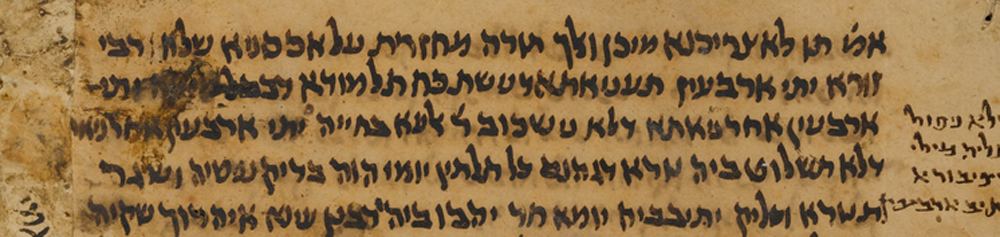
We can find a simple solution to these
questions in one of the manuscripts of Baba Metzia, written around 1137
and housed in the National Central Library in Florence. The manuscript disagrees
with the premise that R. Zeira ever forgot his learning:
R. Zeira fasted so that he would not
forget the teachings of Babylon.
He observed another forty fasts so that
R Il’a should not die in his lifetime.
He observed another forty fasts that the
fire of Gehenna should have no power over him.

Figure 2 Florence
Manuscript BM 85a

As far as I know, this manuscript is unique among the
manuscripts that exist today in defining “not to forget” as the purpose R.
Zeira’s fast. [4] The manuscript is also attractive for a couple of other reasons:

The passage is shorter here
than in the standard version. The explanations “when he moved to the land of
Israel”, “so that it should not disturb him”, [5] “so that the responsibilities
of the community not fall upon him” are all missing. This reduction most likely
indicates that the manuscript reflects an early version of the story – a
version in which marginal commentary had not yet been copied (inadvertently) into
the text.
The paragraph that precedes the story of
R. Zeira (in all versions) tells of Rav Yosef (R. Zeira’s colleague) who also observed
a series of three sets of forty intermittent fasts. The purpose of Rav Yosef’s
fasts was to guarantee that the knowledge of the Torah would not depart from
himself, from his children and from his grandchildren. The goal of Rav Yosef’s
fasts seems to agree with the goal of R. Zeira’s fasts; to remember (i.e., not
forget) the teachings of Babylonia.
According to this manuscript, all of R.
Zeira’s fasts have something in common with each other. He fasted so he would
not forget, he fasted so that R. Ila’i would not die, and he fasted so that the
fire of Gehina would not harm him. He always seems to be fasting so that
something should not happen.
However, many authorities have discussed
the standard version, and no one (as far as I know) has relied on this reading
to resolve the original questions. [6]
Here
are some of the classical interpretations that attempt to solve the problems of
R. Zeira’s forgetting.
Rashi
writes (BM 85a) that the students in the land of Israel were not בני מחלוקת, were not contentious, ונוחין זה לזה, they were pleasant to each other]  . . .   ומיישבין את
הטעמים בלא קושיות ופירוקין and they explained their reasoning without challenging each
other with difficulties and rebuttals.
According
to Rashi , R. Zeira forgets the “atmosphere” of the Babylonian academies.  [7]
Maharsha (1555-1631), disagrees with
Rashi. He argues that the sages in the land of Israel do engage in questioning
and answering like their counterparts in Babylonia.  He cites the Gemara (Baba Metzia 84a) where
R. Yohanan says about Reish Laqish:  he
would raise twenty-four objections, and I would reply with twenty-four answers.

Therefore, Maharsha explains that
possibly the Babylonian piplul was faulty and similar to a style of piplul
that existed in his own time דוגמת חילוקים
שבדור הזה. He objects to this style of questioning and answering because it
distances one from the truth, and can’t help one rule on halakhic issues. Accordingly,
R. Zeira fasted in order to forget how to piplul the Babylonian way.
Abravanel (1437-1508) in his commentary
on Pirkei Avot (on the Mishna in chapter 5 which begins: There are four types
who study with the sages) writes somewhat similarly. The problem with the one who
is compared to a sponge, who soaks up everything – is that he retains things
that are untrue. In the search for truth, there are necessary steps which themselves
are untrue:  כי לא תברר האמת כי אם בהפכו truth can only
be evaluated when compared with its opposite. R. Zeira fasts to forget the stages in
the arguments of the Babylonian Talmud that were untrue.
In summary, all three of these
interpretations agree that R. Zeira didn’t literally forget the Babylonian
teachings. He forgot the “atmosphere” of the Babylonian academies or the
interim discussions that took place there.  [8]
I’d like now to give some examples of
how the story of R. Zeira is presented in some early Hassidic sermons, to show
how the Rebbes and their audiences understood the story of R. Zeira. These
sources aren’t concerned with explaining our Gemara; R. Zeira’s story is cited
to support an ethical or moral lesson.
Torah Or is a collection of sermons by
R. Shneur Zalman of Liadi (1745-1812). On
page 69c, in a discussion about spiritual worlds, the author says:

The purpose of the river diNur, (fiery
river (or maybe fiery light)), in which the soul submerges itself as it passes from
this world to Gan Eden, is to erase its memories of this physical world. If the
soul remembers its encounter with materiality, it can’t experience Gan Eden.
And when the soul goes from the lower Gan Eden to the higher Gan Eden it also must
pass through a river diNur to forget the comprehension and pleasures of the
lower Gan Eden. (Zohar part 2 210a) This is the idea in the Gemara: R. Zeira
observed 100 fasts to forget the Talmud of Babylonia even though he had studied
it with devotion.

In Likutei Moharan (ch. 246), R. Nachman
of Bratslav (1772 – 1810) writes:

A
person sometimes has to feel self-important גדלות, as it says (2
Chronicles 17:6) His heart was elevatedויגבה לבו  in
the service of G-d.  This helps the same way
as fasting helps. For when one needs to attain an understanding or needs to
reach a higher level, he has to forget the wisdom he had previously acquired. R.
Zeira fasted to forget the Talmud of Babylon in order to reach a greater level
of comprehension – the level of the Talmud of the land of Israel.  Similarly through self-importance, one forgets
his wisdom . . . 

In these examples of Hassidic thought there
is no difficulty with the idea that R. Zeira forgets his learning in order to reach
higher spiritual plateau. Forgetting is a purification process that is both
necessary and exemplary. [9]
Returning now to the literal sense of the
Gemara:
R. Issac Halevi (Rabinowitz)
(1847-1914), the author of Dorot Harishonim addresses our problem in a footnote
(Dorot II p 427 footnote 93). He posits that in R.  Zeira’s time there were already two canonized
collections of Talmudic material arranged around the Mishna; each in its own
distinct form and style.

כבר הי׳ להם סתמא דהש”ס על המשנה שגרסו כבר במטבע קבועה,
וכן הי׳  להם אז כבר גם בארץ ישראל.

R. Zeira chose to
forget the Babylonian Talmud (as it existed in his time), because it interfered
with his studies in the land of Israel.
According to this
interpretation, R. Zeira forgot only the redaction or arrangement of the
teachings he had learned.  He didn’t forget
the teachings themselves (or the study method). [10]
I’d like to suggest
an original explanation. It’s based on passages in the Talmud about R. Zeira
and additionally can explain why only R. Zeira decided to forget the teachings
of Babylon when he moved to the land of Israel.

1)     
R.
Yitzhak b. Nahmani said in the name of R. Eleazar: The halakha agrees with R.
Jose b. Kipper.  R. Zeira said: “If I
merit, I’ll go there and learn the halakha from the Master himself”. When R.
Zeira came to the land of Israel he found R. Eleazar and asked him: “Did you
say: The halakha is in agreement with R. Jose b. Kipper?” – Nidda 48a
2)     
R.
Zeira said to R. Abba b Papa: When you go there, detour around the Ladder of
Tyre and visit R. Yaakov b Idi. Ask him if he heard from R. Yohanan if the
Halakha is like R. Aqiba or not – Baba Metziah 43b
3)     
R
Zeira, commented: How can you compare R Binyamin b Yefet’s version of R.
Yohanan’s statement with the version of Rabbi Hiya b Abba. R Hiya b Abba was
precise when he studied the halakhic traditions from R Yohanan but R. Binyamin
b Yefet was not precise. Moreover, R Hiya b Abba reviewed his learning (Talmud)
with R. Yohanan every thirty days.  – Berachot
38b
4)     
R.
Nathan b. Tobi quoted R. Johanan . . . Rabbi Zeira asked: “Did
R. Johanan say this?” Yes, he answered. Rabbi Zeira recited this teaching forty
times. R. Nathan said to R. Zeira: Is this the only teaching that you have
heard or is it a teaching that is new to you? R. Zeira replied: “It’s new to
me. I wasn’t sure if it was taught in the name R. Yohanan or R Yehoshua b
Levi.” – Berachot 28a
We
see that the teachings of the land of Israel (especially R. Yohanan’s) did
reach R. Zeira while he was still in Babylon [11]. R. Zeira, however, didn’t really
trust these teachings. Sometimes he thought they were attributed incorrectly,
or their content was not accurate. He doubted if a statement in the name of R.
Eleazar was correct. [12] He was unsure if R. Yohanan agreed with R. Aqiba’s
position or not. He distinguished between the different amoraim who
transmitted teachings. In general he looked at Torah that reached Babylon as
something that was possibly unreliable, inaccurate or “damaged in transit”.
  
R. Zeira was
only able to resolve his doubts when he moved to the land of Israel and learned
the Torah of the land of Israel there. He then forgot the imprecise version of
these teachings that he had previously memorized in Babylon – “the teachings of
Babylon”. He could forget them because they were superseded by accurate
teachings that he now received in the land of Israel. [13]

I’d like to thank Reb Gary Gleam who
provided the cabbage rolls and coffee, and the late night sounding board.

————————————————————————————————————————–

[1] תלמודא בבלאה is sometimes translated
as Babylonian Talmud, which I think is an anachronism. I will use the translation
“Babylonian teachings”. All the available manuscripts have תלמודא דבבל  =  the teachings of Babylonia. The phrase Talmuda
dBabel
or Talmuda Babelah occurs only here
(Google). Talmud in the sense of teachings occurs many times, often in
comparison to mikra or mishna.
 [2]
Compare Rosh Hashana 20b: “When R. Zeira went up [to the land of Israel], he
sent [a letter] to his colleagues [in Babylonia]  . . .”  R.
Zeira didn’t break off all contact with the old country. He taught them what he
heard and learned in the land of Israel.
[3] See Goldberg, Abraham. “Rabbi Ze’ira
and Babylonian Custom in Palestine” (Hebrew) Tarbiz vol. 36 1967 (pages
319-341), for examples of Babylonian traditions that R. Zeira brought to the
land of Israel. The following quote is from the online abstract:
“R.
Zeira is the outstanding figure among many who came from an area of unmixed
Babylonian tradition and who tried to impose their own Babylonian practice upon
Palestinian custom.”
[4]
The crucial word דלא, is crossed-out
in the manuscript, but I’m assuming that the strikethrough is not the work of
the original sofer. (Didn’t scribes write dots on top of the words they
wanted to erase?) The facsimile shows a number of other emendations that were written
after the manuscript’s creation.
[5] The words “so that it should not disturb
him” would be out of place in this version of the story, since according to
this version, R. Zeria never forgot the Babylonian teachings, but the idea is
that the text is short. There is a geniza fragment from The Friedberg
Project for Talmud Bavli Variants and it is equally as short. (Note
that it matches the standard editions with regard to the goal of R. Zeira’s
fast.)

 Figure
3 Geniza fragment
of our Baba Metziah 85a

Translation of the geniza fragment:
R. Zeira observed forty fasts to forget
the teachings of Babylon.
He fasted another forty times that R
Il’a should not die in his lifetime.
He fasted another forty times that the fire of
Gehenna should have no power over him.
[6]
The author of Dikduke Soferim mentions this version but doesn’t suggest that its
reading is better than the standard one. Dikduke Sofreim has written elsewhere
that this specific manuscript belonged to Christians who translated (into Latin)
passages that were regularly used against Jews in inter-faith disputations.
There’s no Latin on this page, but you can see Latin on some other pages.
[7]
Rashi mentions his source as Sanhedrin 24a. He understands that the students of
Babylon were antagonistic to each other unlike the students in the land of
Israel who were pleasant to each other. Rashi apparently was thinking of this in
his commentary on the prayer of R. Nehunya ben HaKanah – Berachot 28b. The
prayer reads: “May it be Your will that I don’t make a mistake in a halakhic
ruling, and that my colleagues rejoice with me  . . .”  Rashi
understands the prayer this way – May it be Your will that I don’t make a
mistake in a halakhic ruling and my colleagues make fun of me.
[8]
The explanations of Maharsha and Abravanel have prompted subversive
interpretations by the school of the German Jewish historians of the
Talmud.  In the Soncino translation of
Shabbat 41a, the translator, Rabbi DR. Freedman (1901-1982) writes:  “Weiss, Dor, III, p. 188, maintains that R.
Zera’s desire to emigrate was occasioned by dissatisfaction with Rab Judah’s
method of study; this is vigorously combatted by Halevi, Doroth, II pp. 421 et
seq.”

Jacob Neusner’s
in his book A History of the Jews in Babylonia page 218, also questions the
idea that sages of the land of Israel rejected the Babylonian methods of study,
and finds “Halevi’s strong demurrer quite convincing”.
[9]
In this context, the Talmudic statement: גדולה עבירה לשמה ממצווה שלא לשמה   – מסכת הוריות י’ ע”ב may be somewhat
relevant.
[10] I’m not sure, according to R.
Halevi,  did R. Zeira also forget the
anonymous Talmudic layer (stam or redactor) that existed in his time? 
[11]
The first of these conversations definitely took place in Babylon. The fourth
interaction occurred in the land of Israel but revises a teaching that R. Zeira
probably heard in Babylonia. The middle two quotes are may describe R. Zeira in
Babylon, but even if they occurred when R. Zeira was already in the land of
Israel, they reflect doubts that he had while in Babylon.  The number 40 in the last example is also
remarkable. He repeats something 40 times in order to remember. He fasts 40
times to forget. 
[12]
R. Eleazar teaches without citing his source but everyone knows that his
teachings are R. Yohanan’s (Yerushalmi Berakot 2:1 and Yerushalmi Shekalim 2:5).
[13] R. Zeira didn’t forget the native
Babylonian teachings, authored and recorded by the Babylonian amoraim. He
never doubted their accuracy. He brought those teachings to the land of Israel
and enriched the Torah of the land of Israel with them. 


Hadaran: Who is going down to the pit of destruction?

Hadaran: Who is going down to the pit of destruction?
by Leor Jacobi
A siyum of a masechet of gemorah is truly a joyous occasion, usually the culmination of many weeks of rigorous group study; challenging, edifying, and uplifting. The centerpiece of the siyum is undoubtedly the customary recitation of the unique kaddish and special additional prayers framing the accomplishment as an integral link in the chain of dissemination of Torah – from the tannaim and amoraim whose divine words we ponder, to the great rishonim and ahronim who guide us in revealing their talmudic treasures and infusing them into the modern world.
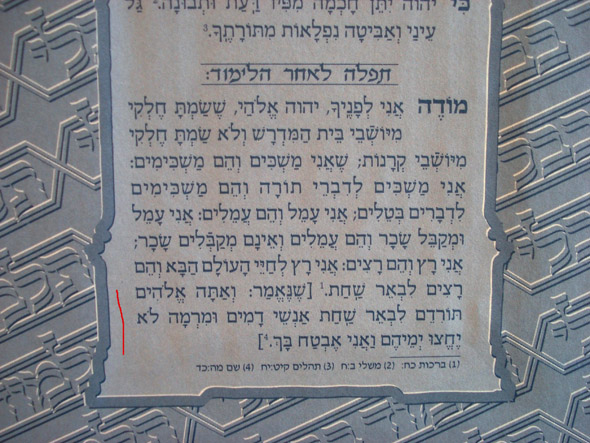
Fortunate is our lot! Our gratitude is expressed in the prayer of Rabbi Nehunia Ben HaKana[1]:
מודים אנחנו לפניך ה’ אלהי ששמת חלקינו מיושבי בית המדרש ולא שמת חלקינו מיושבי קרנות שאנו משכימים והם משכימים אנו משכימים לדברי תורה והם משכימים לדברים בטלים אנו עמלים והם עמלים אנו עמלים ומקבלים שכר והם עמלים ואינם מקבלים שכר אנו רצים והם רצים אנו רצים לחיי העולם הבא והם רצים לבאר שחת שנאמר וְאַתָּה אֱלֹהִים תּוֹרִדֵם לִבְאֵר שַׁחַת אַנְשֵׁי דָמִים וּמִרְמָה לֹא יֶחֱצוּ יְמֵיהֶם וַאֲנִי אֶבְטַח בָּךְ
Our exalted state can only be fully appreciated when contrasted with that of those not fortunate enough to join us in the beis hamidrash. The Yoshvei Kranos, identified by Rashi as idle shopkeepers who waste their time in frivolous conversation, are deprived of the rich rewards of Torah study, both in this world and in the next. They are to be pitied and even disdained for their boorish lack of concern for lofty matters.
The prayer proceeds a step further, however, in the concluding verse from Tehillim 55:24, cursing the ignorant with early death, destruction, and perhaps even damnation! And you, HaShem, lower them into the pit of destruction, murderous swindlers, may they not live out even half their expected lifespan. Are they really so wicked? At our joyous simcha, shouldn’t we rather be resolving to help inspire and mekarev these poor folk?
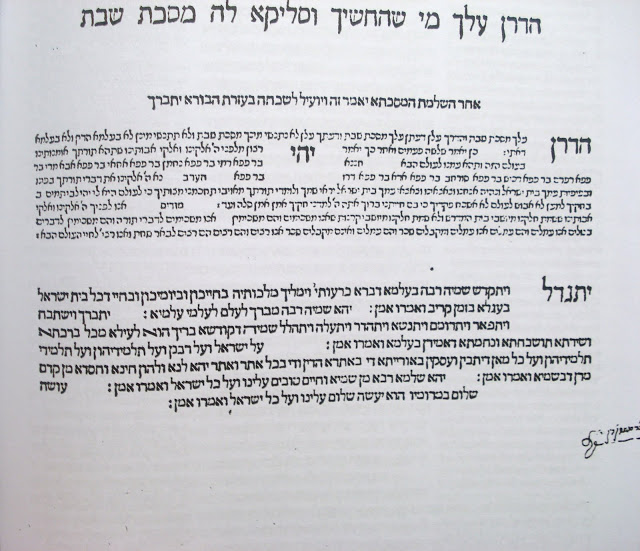
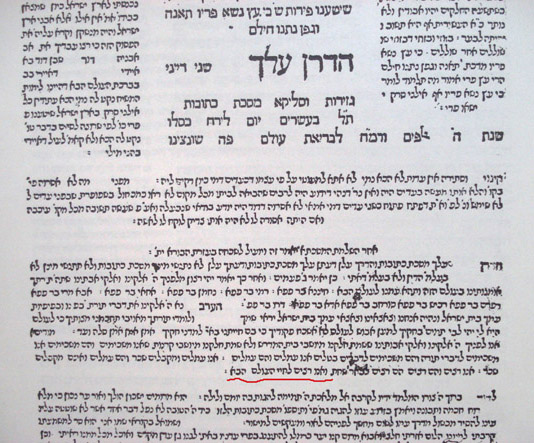
Did the creator of this prayer, Rabbi Nehunia Ben HaKana, or anyone from Hazal recite this verse? (If so, there would certainly be a a good reason for it.) A survey of the sources reveals a resounding: no. Not only does it not appear in Gemara Brachos 28b, but it does not appear in any of the known manuscripts, Rambam[2], or any of the many poskim rishonim that quote the prayer. Early versions of the Hadaran prayer do not include the verse either! See the attached photo of the early Venice and Soncino editions of the Talmud.[3] Nowhere. Gornisht.


In his Sefer Divrei Torah (Mahadura 5)the Munkasczer rebbe, an avid bibliophile, indicates that the verse should be omitted.

The verse only appears in one known halachic source: Halachot of Rif (Rabbi Yitzhak Alfasi). See below (1st edition, Constantinople 1509):

Why would Rif add this verse? He is usually involved with editing away verses from the Gemorrah, not adding them! Does it reflect an ancient custom of his? Why didn’t any of the great Rishonim who studied Rif cite this verse?[4] Ra’ah in his commentary on Rif quotes the entire prayer without mentioning the verse! None of the many known manuscript versions of Rif mention the verse![5] Its earliest known appearance in this prayer is in the first printed edition of Rif (published almost exactly 500 years ago, רס”ט, in Constantinople). Why did the publishers include the verse?
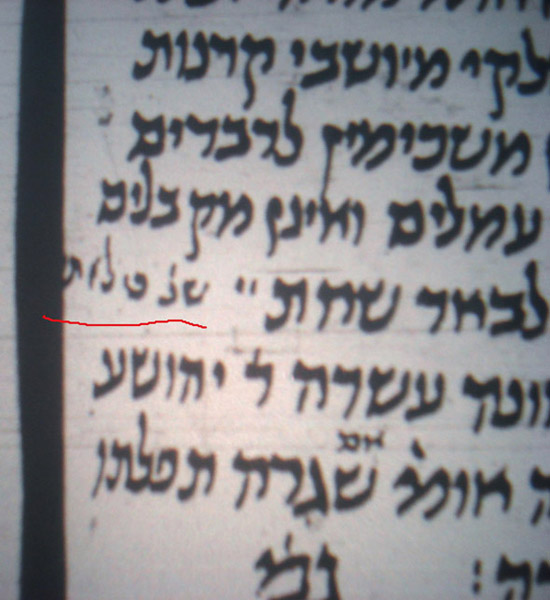
The answer may lie in a marginal gloss of one lone manuscript version of Rif[6].


In the left hand side of the manuscript, one can see that a later scribe added a citation to a verse. Only a few letters are visible in the microfilm: שנ’ כי לא ת
This is clearly referring to a different verse! Without a doubt, it is the same verse cited at the end of the version of the prayer found in the Talmud Yerushalmi:
כִּי לֹא תַעֲזֹב נַפְשִׁי לִשְׁאוֹל לֹא תִתֵּן חֲסִידְךָ לִרְאוֹת שָׁחַת[7]
“For you will not abandon my soul to the grave, you will not allow your pious one to see (his) destruction.”
This verse is most fitting and proper here as a conclusion of the prayer. It lacks all of the problematic vitriol of the commonly found verse. This scribal addition undoubtedly represents an ancient custom[8], which the printers of Constantinople may have been unfamiliar with.[9] The verse they substituted, however, was certainly most familiar to them in a different context:
משנה מסכת אבות פרק ה
אבל תלמידיו של בלעם הרשע יורשין גיהנם ויורדין לבאר שחת שנאמר (תהלים נ”ה) ואתה אלהים תורידם לבאר שחת אנשי דמים ומרמה לא יחצו ימיהם ואני אבטח בך:
The students of Bilaam are certainly deserving of such a curse, for they are involved in sorcery, treachery, and other wickedness – if only they would be idle as the shopkeepers, that would be a tremendous improvement!
The custom of reciting Pirkei Avos on Shabbos afternoon dates back to time immemorial, and as a result of the regular study, many have mastered its teachings literally by heart. It doesn’t seem at all far-fetched to assume that the printing of this verse in Rif was a simple oversight. Eventually the verse entered into the hadaran prayer as we know it.
The prayer of Nehunia Ben HaKana is also found in many printed prayer-books in its original form, to be recited upon leaving the Beis HaMidrash. It is usually located just after shaharith.[10] Many of these contain the verse, such as the prayerbook printed by Rav Ya’akov Emden on his private press[11]. But many do not contain the verse.[12]
Rambam ruled that upon entering and exiting it is obligatory to recite the prayer of Nehunia Ben HaKana[13]. The Shulhan Aruch also follows his psak. In order to further facilitate the fulfilment of this duty, printers have recently begun printing the prayer in the inside front covers of their gemorrahs and mishnayos, including the verse. The editors of Artscroll are the most democratically accommodating – they include the verse in parenthesis. You can decide whether to say say it or not.

It’s well worth noting that a precedent to this custom of the printers is found in the Pesicha to the famous Tosafos Yom Tov commentary on the mishna by Rav Yom Tov Lipman Heller. He writes that since the recitation of these prayers is obligatory, and since many are unfamiliar with them, as they do not appear in the siddur (of his time), that he is printing them, according to the nusach of the RIF. And his nusach follows the printed version of RIF. He does not explain why he chose the RIF’s version over that of the Talmud, but it seems clear that he did not have access to manuscripts of RIF, and, unfortunately, relied on corrupted printed versions. It’s also unclear as to whether his concerns for proper nusach were with the concluding prayer at all, or with the prayer recited upon entering the House of Study, whose wording is much more varied between different manuscripts and printed versions. It could be that this “endorsement” of the Tosafos Yom Tov to the printed version of RIF contributed to the eventual inclusion of the verse in later printings of the Hadaran prayer at the end of tractates and later, in prayer-books.
Hopefully, our good friends, the “yoshvei kranos” will be taking part in a daf yomi shiur and joining us at the next siyum, reciting the Hadaran along with us, and meriting Olam HaBa!
Appendix
Theaters and circuses, the Talmud Yerushalmi (and Rav Kook)
(By a happy coincidence, David Segal recently posted at the Seforim Blog on this very topic!)

We are not the first ones to find the prayer in the hadaran to be overly contentious. No less an illuminary than Rav Avraham Yitzchak Kook, OBM, the first chief Rabbi of Israel, was deeply disturbed by this prayer’s tone. Yoshvei Kranos are today’s ba’alei batim. They keep mitzvos and give tsdakah. The takanah to read the torah on Monday and Thursday is for them, so they should not go too long without hearing words of torah. It goes completely against the grain of Hazal to curse them! In fact, even without the verse, why should they be punished at all?
Rav Kook proposed a truly fantastic solution. A corruption occurred in the text: the yoshvei קרנות of the Talnud Bavli are really yoshvei קרו”ת, roshei teivos for קרקסיות andתרטיות , those who patron theaters and circuses, which in fact, is the exact nusach of the version of the prayer found in the baraisa of the Talmud Yerushalmi!
What exactly goes on in these theaters and circuses? The gemarah in Avodah Zara 18b states that they are essentially a moshav leitzim, foolish and irreverent. Another opinion cited there is that these were much more nefarious centers of Avodah Zara and Shfichus Damim, gladiator sports, public executions and like. Historically, both of these opinions seem correct – theaters and circuses where occasionally more pernicious activities took place. All in all, they don’t seem to be much too different than the modern versions of popular “entertainment”[14].
The curse of Rav Nehunia’s prayer is directed against these insidious people who waste away their free time in such sordid foreign entertainments, as opposed to the Torah-true who spend their free time immersed in learning in the beis hamidrash or in prayer in the beis kneses, even if during the work-day they are but simple “idle” shopkeepers. In this context, even the dubious additional verse is somewhat appropriate[15].
Rav Kook went so far as to call for “correcting” the nusach of the prayer and adopting the version of the Talmud Yerushalmi! That proposition certainly has merit, but is it really the true intention of the Talmud Bavli itself?[16] Perhaps this is not the only suggestion of his that, in retrospect, seems a bit far-fetched.[17] However, it seems that his insight into the tradition of the Talmud Yerushalmi and its stark opposition to “theaters and circuses” teaches a lesson which is especially pertinent today, and can deepen our appreciation of the importance of this truly enigmatic prayer.

Here are Rav Kook’s words (you may click this image to read a larger copy):

The original version of the prayer appears to be found in the Talmud Yerushalmi, produced under the glare of Greco-Roman culture with its ubiquitous theaters and circuses. In Sasanian Babylon, these cultural expressions were unheard of, hence they were restated as the more familiar yoshvei kranos. In contrast, our modern secular culture of entertainment is, for the most part, a western one, and hence the version of the Talmud Yerushalmi takes on crucial added significance today.

Many thanks to Moshe Bloi, Ezra Chwat and Shamma Friedman. All errors are, of course, mine.

Note: This article is based on one which originally ran in Kolmos of Mishpacha magazine and they take no responsibility for the content here. You can read the original article here.

UPDATE 8/18/2011: A song has recently been composed as a result of this article and discussions surrounding it’s Hebrew and English versions. The song lyrics consist of only the two verses and highlights the contrast between them musically.

Here the composer explains the composition in Hebrew and provides a link to the previous Hebrew discussion which inspired it:

[1] Brachos 28b. The Hadaran prayer has been adapted to the inclusive plural form, מודים אנו, rather than the original singular מודה אני
[2] See attached photo of the Tefillah in Commentary on the Mishna, that Rambam himself copied by his own hand!


[3] Note that the order in the prayer is switched around, probably in order to end on an upbeat, good note.
[4] In the back of the new Oz V’Hadar gemarras, the Magid Ta’alumos is cited, who explains that the verse is included in order to end the prayer on a positive note (!), v’ani evtah boch, insead of be’er shachas. The same explanation is offered by the Dinover rebbe, the the author of the classic Bnei Yesoschar, in his Maggid Ta’alumah (פרעמישלא תרל”ו) in his commentary v’Heye Bracha, referring to the inclusion of the verse by the Tosafot Yom Tov in the introduction to his monumental commentary on the Mishna. He makes no reference to the Rif. Perhaps he thought that the verse was added to the Rif according to the Tosafos Yom Tov? It’s worth noting that both the Maggid Ta’alumos and the Maggid Ta’alumah have the same observation on the inclusion of this verse, independently!
[5] Thanks to Dr. Ezra Chwat, of the Israel National Library Manuscript Department, who is preparing a new critical edition of Rif (scheduled to be used in the upcoming edition of Shas Lublin), for allowing me to utilize his forthcoming work. Further, he guided me to four additional “less reliable” manuscripts which are not utilized centrally in preparing his new edition. None of them contain the verse either.
[6] Oxford Huntington 135:
[7] תהלים פרק טז, י
[8] A fascinating new Teshuva by Rav Yitzhak Ratsaby of Benei Brak has been published (Ma’ayan Nissan 5770) on the exact question addressed in this article, the inclusion of the concluding verse in the prayer of Rav Nehunia ben Hakana (link). There, Rav Ratsaby cites Yemenite prayer-books and Teshuvot which demonstrate that the custom of reciting the verse from the Talmud Yerushalmi (like the scribe of the RIF manuscript) continued among certain Yemenite kehillot until almost the present day. Unfortunately, Rav Ratsaby did not check manuscript versions of RIF, and thus understands that the talmud of the RIF himself contained the problematic verse, leading him to propose far-fetched justifications for the custom. Here is my response (Ma’ayan Tammuz 5770).
[9] Although it seems quite doubtful that the printers had this exact manuscript in front of them, it seems likely that they had a similar manuscript. Dr. Ezra Chwat doubts that the Oxford Huntington manuscript was used by the printers as there are many discrepancies between it and the printed version of Rif. It serves as the primary manuscript for Dr. Chwat’s new edition of RIF. According to Dr. Chwat, the manuscripts can be used to resolve many seeming contradictions between RIF and RAMBAM!
[10] So that one may go מחיל אל חיל, from the beis hakneses to the beis hamidrash.
[11] Rav Yitzhak Ratsaby, in his recent tshuva (see note above) argues that the custom in Rav Emden’s siddur was only to recite part of the verse, but it seems more likely that this was simply a printer’s abbreviation. The reliability of the wordings found in this siddur are quite questionable, based on Rav Ya’akov Emden’s own testimony in the introduction that many texts were simply copied from other prayer-books.
[12] Among current prayer-books: the accurate Tefillas Yosef and Ezor Eliahu do not include the verse. Siddur Vilna, on the other hand, does contain the verse.
[13] Commentary on the Mishna. See Levush and Aroch HaShulhan (Orach Haim 110) for explanations as to why many do not recite the prayers.
[14] Internet anyone?
[15] This fact was noted independently in the recent Responsa of Rav Yitzhak Ratsaby, Ma’ayan Nisan 5770
[16] The Aderes in Tefilas Dovid, p.12, states that yoshvei kranos are also engaged in nefarious activities, as seen in the Talmud Yerushalmi. He claims that yoshvei kranos here doesn’t follow its normal meaning, going against Rashi. Rav Kook was the Aderes’ son-in-law so its not surprising that they both have the same approach in understanding the Bavli according the the Yerushalmi. Rav Kook probably favored Rashi’s interpretation of yoshvei kranos, and hence, was forced to actually alter the text of the Bavli.
[17] Rav Kasher, in Torah Shleima, Vol 15 page 140, dismisses Rav Kook’s theory entirely, claiming that the version of the Talmud Bavli is the original one! His proof is the fact that a parallel to the bavli appears in Pirkei Avot d’Rebi Nathan A. However, that collection is widely recognized to post-date the Bavli itself, which it widely quotes from.


Daf Yomi: Seforim on Moed Katan, Part Two and Three

Daf Yomi: Seforim on Moed Katan, Part Two and Three

By Eliezer Brodt

Daf Yomi is in middle of learning Masseches Moed Katan. This week I had two conversations with Rabbi Moshe Schwed of All Daf. The purpose of these conversation were for me to trace the concerns for the fear some had to learn this Masechtah, especially the section devoted to Avelius as it deals with topics related to death.

Part two deals with tracing the sources about this from the Sefer Chasdim, Yosef Ometz and the Chasam Sofer. Some other Mesechtas were added to the list by various sources. I than traced the learning of this topic until the end of the Rishonim period, including a close examination of the significance of the Toras HaAdam of the Ramban.

Part three picks up with the Achronim period. Looking more closely at the Curriculum in Lita, and Volozhin. I continued on with some more contemporary Poskim’s views about learning this subject and conclude with a short bibliography of various seforim on Aveilus.

We recorded them and they are available for viewing: part two is here and here. Part three is here and here.

Part two is forty- seven minutes, which is much longer than most of the previous ones. I apologize for the length in advance, luckily both links have options for one to listen on fast speed! Part three is only 23 minutes long. Many aspects could have been discussed at much greater length but R. Schwed had mercy on potential listeners!

This is an experiment which we are trying on the Seforim Blog and we hope to have other presentations from others over time. Feedback or comments of any sort are appreciated.

This is the seventh and eighth such conversation I have had with him of this kind this year (earlier we discussed Yerushalmi Shekalim [here], Yoma [here], Rosh Hashanah [here] Taanis [here] Megillah [here] and Moed Koton part one [here]).


Easing the Donkey’s Burden: Nitkatnu Hadorot or Nitgadlu?

 Easing the Donkey’s Burden: Nitkatnu Hadorot or Nitgadlu?
By Rabbi Simcha Feuerman
“If the earlier generations were like angels, we are like humans. But if they were like humans, then we are like donkeys.”
(Talmud Shabbat 112b)
One of the basic and fundamental tenets of our tradition is respect and deference for the previous generations.  Although there are notable exceptions, generally, rabbinic authorities do not override or disagree with the rulings of authorities from a previous class, such as Amoraim disagreeing with Tanaim, Gaonim with Amoraim, Rishonim with Acharonim and so on.  While this may be due largely to conceding that their knowledge of, and access to Torah Sheb’al Peh is more accurate[1], there is also an aspect of deference and respect for those who are considered to be of higher moral and spiritual character. [2]
This principle has a subtle but pervasive impact on the chinuch we give our children; it is not uncommon for rebbes and rabbanim to speak of “Nitkatnu Hadoros – The generations have become diminished” as a reason to explain how we are unable to fulfill a particular spiritual, moral or halachic ideal.  For example, while it is virtually unheard of to fast for more than 25 hours today, there were minhagim to fast for two days consecutively – on the 9th of Av and the 10th of Av[3], as well as those who were able to make vows of abstention for penitence.[4]  Apparently, we consider ourselves too morally and physically weak to live up to this standard.  Likewise, based on the accounts of many individuals from the previous generations, it was not uncommon for persons to spend the entire Yom Kippur night standing and reciting Psalms, and THEN praying the full day.  This seems beyond reach for most of us today.  When contemplating this, most people wearily sigh, “Oy, the doiros get more shvach (weak).”  These are but two examples of many instances where the deterioration of subsequent generations is an accepted fact of life in our tradition and our culture.
Is this principle absolutely true in all areas?  Is each successive generation truly less spiritual and less moral than the previous ones?  Are we riding a one-way train down to the depths of oblivion waiting to be rescued by the arrival of Messiah?  This resonates with the midrashic tradition about our ancestors in Egypt, who would have descended past all forty-nine levels of impurity had they not been rescued.[5] While such a belief seems to be well-supported by everything we have studied so far, there is a basic illogic to this position.  What is the spiritual purpose in the divine plan for sustaining us, if indeed each generation is less worthy?  Why not just throw in the metaphysical towel and bring Mashiach now, while we are still partially ahead of the game?
The answer must be, as was undoubtedly true in regard to our ancestors who were slaves in Egypt, that despite our continuous moral deterioration, our experiences must be preparing us and priming us for an ultimate experience of higher spirituality and achievement.  Presumably, the experience as slaves in Egypt somehow was a necessary preparation for acceptance and fulfillment of the Torah.  Indeed, many commandments in the Torah, ranging from Shabbat to the laws of usury, are supplemented with a reminder that we are obligated to follow them “Because I am your G-d who took you out of Egypt.”[6]  Furthermore, in regard to the capacity of empathy and caring for the plight of the downtrodden, the Torah reminds us “And you know the soul of the stranger because you were strangers in the land of Egypt.”[7]  If the experience of slavery in Egypt helped elevate and prime our ancestors for the accepting of the Torah, it may likewise be a fair assumption that while each generation may be undergoing spiritual and moral deterioration, there also is some new quality that is being
developed.  Perhaps this quality is not fully expressed and lays dormant until the time of redemption, or perhaps its quality is available and accessible to all of us right now.
In this essay, I will suggest one specific area where each generation improves its ability and depth to comprehend and fulfill the Torah, as well as the practical implications for the chinuch of our children.  According to fascinating research and statistics regarding I.Q. scores, the ability to perform abstract reasoning increases significantly with every generation.  This has a distinct impact on the ability to understand the more esoteric parts of the Torah, such as the reasons for the mitzvot, ways of understanding reward and punishment, as well as the mystical aspects of religious activities.  The Talmud tells us that “Three things expand a person’s consciousness: A pleasant home, a pleasant wife and beautiful utensils”[8], and it is quite possible that the relative wealth and security of modern life allows for each generation to improve its capacity to understand abstractions, because our surroundings are more pleasant and engender sensitivity and perception. As we shall see, the Sages of the Talmud did not believe the average not-so-learned Jew to be capable of grasping and comprehending many of the deeper aspects of the Torah.  There are numerous examples of this, and we shall study a few of them found in the Talmud and Medieval authorities.
The Truth about the Scrolls
The Talmud tells us that one of the early rabbinic decrees was a form of impurity applying to holy scrolls.  While it seems rather strange to declare holy scrolls to be impure, the rabbis had good reason to do so.  According to the Talmud, the common folk developed an ill-advised habit of storing food consecrated as Terumah in the same areas where they stored the holy scrolls.  The people reasoned, “The Terumah is holy and the scrolls are holy so why not store them together?”  The problem with this practice is that the rodents would come to eat the Terumah and inevitably also chew on the scrolls.  Therefore, the rabbis brilliantly declared that the scrolls are always impure, greatly discouraging people from storing them near the Terumah, which was required to be ritually pure.[9]
This clever bit of social engineering begs one basic question:  If the people were compliant and agreeable to following rabbinic rules and injunctions, why did the rabbis have to complicate matters by decreeing that the scrolls were impure, and of all things, have the audacity to suggest that holy scrolls are impure?  Would it not have been simpler to merely forbid storing holy scrolls alongside Terumah?  This suggests that actually the rabbis could not easily or completely secure compliance via this route and therefore could not directly forbid the co-placement of Terumah and scrolls.  Instead, they needed to tap into an apparent cultural taboo and respect for the laws of Terumah purity as a way to mobilize the people to comply and refrain from storing scrolls next to the Terumah.  In other words, to simply tell people that rodents will chew on the scrolls and therefore it is forbidden to store Terumah next to them would not have been as effective as creating a new form of impurity.  By creating a rabbinic decree of impurity, the rabbis were able to tap into a deeply ingrained respect for the laws of purity and fear of violating them.  This was apparently the most effective deterrent.
Another possible instance where the Sages used the taboo of impurity to shape behavior is in regard to the rabbinic mitzvah of washing hands before eating bread.  The stated reason for this law seems highly convoluted and begs for a deeper explanation.  The reason supplied is that since, when the Temple is rebuilt and the Cohanim will eat Terumah they will need to wash their hands before eating, the rabbis wanted to accustom everyone to wash.[10]  This reason is a quite a stretch, because the original ruling itself that required the Cohanim to wash was only based on another rabbinic declaration that hands are automatically considered ritually unclean.  So, in effect you have a rabbinic injunction to safeguard a rabbinic injunction, in effect a double safeguard, which is usually not the modus operandi of the sages.[11]  Furthermore, let us study the original reason for declaring unwashed hands as impure in regard to Terumah bread.  The Talmud tells us it is because one’s hands absentmindedly touch many objects.[12]  The rabbis therefore enacted a strange form of impurity declaring only the hands and no other part of the body impure, and then allowing a special ritual of water poured from a vessel to act as a mikvah for the purpose of removing the impurity.  This is in itself quite remarkable, because indeed had a person’s hand absentmindedly touched an impure
object such as dead rodent as the stated reason fears, the entire person’s body would be rendered impure and he would need to immerse himself in the mikvah.  Washing his hands from a vessel would accomplish nothing.  So, what problem if anything, did the rabbis
solve?
In fact, Rashi (Ad loc.) finds this explanation so implausible that he suggests another explanation, admittedly overriding what his rabbis taught. Rashi proposes that the requirement to wash before eating Terumah was enacted in order to ensure that the person eats clean hands out of respect for the holy food.  If so, it is not implausible that the rabbis ultimately extended this requirement to all bread in order to encourage sanitary eating habits.[13]   In any case, it is clear that according to Rashi, the rabbis once again used the taboo of impurity to shape social behavior, at least to show deference for Terumah by eating with clean hands, and possibly to eat with general cleanliness.
This deeply ingrained fear and respect for the laws of ritual impurity and regard for the sanctity of Terumah bread cannot be underestimated.  So much so, that according to some interpretations of the Mishna Nedarim, even a thug and a murderer will still be “pious” and careful to make sure he does not defile Terumah.  The Mishna states that if one is accosted by bandits, he may make a false oath declaring his produce as Terumah, so bandits and/or self-appointed tax collectors will leave him alone.  Incredibly, this implies that a bandit, who has no qualms robbing and murdering, will not want to transgress the boundary of defiling Terumah. This brings new meaning to the concept of honor among thieves![14]
These were not the only instances where the rabbis tapped into the taboo against impurity as a way to shape society. The Sages were quite concerned about Jewish children being exposed to inappropriate sexual contact during playtime with their gentile neighbors. They therefore decreed that gentile children be considered to have the impurity of a zav (a certain disease that was considered to cause a high degree of impurity, see Leviticus ch. 15) so that the Jewish children would not play with the gentile children. This decree was enacted to protect them from being subjected to improper contact.[15] One would think it would have been more effective to just educate and warn parents about the dangers of inappropriate sexual contact and/or abuse, as we attempt to do nowadays. Apparently, the rabbis who enacted this decree felt the standards of tznius would be violated if they stated their concerns directly, and/or their warnings would go unheeded because the average parent considered such acts unthinkable. They therefore resorted to the fear of impurity as a way to influence parental behavior and protect the children, taking care of safety concerns without violating tznius or overwhelming people with information beyond their ability to emotionally process.”
We see from the above examples that the rabbis had no qualms about withholding information and influencing people via their taboos, so long as it was for a worthy cause.  Apparently, at least in regard to the examples of the scrolls and molestation prevention, the rabbis did not have enough faith in the average person’s ability to grasp or handle the entire truth.  One wonders if this is an approach that would work well nowadays.  It does not seem likely.  As members of a democratic and open society, people expect and demand transparency from their leaders.  While these may or may not be Torah values, they are expectations that are accepted as our rights.  Furthermore, as we shall see later in this essay, the research shows that in modern times the average person is indeed more capable of understanding and grasping nuances than in previous generations.  [16]
As If They Are Children
In his introduction to Perek Chelek, Maimonides tells us that the pleasures of the soul are as inconceivable to us as color is to person who
is blind from birth.  The ultimate reason for doing mitzvot should not be about reward or punishment, rather one’s focus should be on wanting to become attached to G-d by performing his will.  In the World to Come, the soul will experience great ecstasy to whatever degree it can attain attachment to G-d, and the greatest possible punishment is that of karet, which is the soul’s disconnection from G-d.[17]  Maimonides tells us, despite the value and importance of this lofty concept, the Torah exhorts people in terms of reward and punishment as a concession to the limits of human understanding and motivation.  Few people would be motivated by the abstract notion of connection or disconnection to G-d.  Instead, for most people, the expectation of concrete reward and punishment is necessary to propel people in the direction of spiritual growth.  In time, as the person ascends to greater heights, he may be become capable of fulfilling the commandments completely lishmah, as is prescribed by Antignos Ish Socho in Pirke Avot.[18]   Maimonides explains that this is no different than a parent or teacher who motivates a young child to study by offering him sweets, and then as he gets older, offers even more significant prizes.  Only when the child is a full adult will he realize the value of what he is studying, and will he no longer require material rewards and prizes.
But, again one must wonder, is it true that people today would be insufficiently motivated by a vision of spiritual ecstasy and attachment to G-d?  The thousands of Jews and non-Jews who flock to gurus, ashrams, so-called “Kabbalah” Centers and other similar places seem to indicate this is not quite true.  In fact, perhaps to the modern man, the idea of heavenly reward and punishment may seem juvenile and much less of a motivator than the notion of performing good and moral deeds for their own sake.  Furthermore, although in the intimacy of my counseling practice as a psychotherapist, I indeed have encountered a fair share of clients who express nihilistic sentiments and profess atheism or agnosticism, I also have been deeply moved by persons of high moral character who profess a firm conviction that there is no G-d, nor any afterlife whatsoever.  I have seen such persons withstand remarkable moral tests.  Are they deluding themselves and actually, deep down, fear a final accounting in the Afterlife, or are they truly capable of being moral for its own sake?[19]   Has modern Man expanded his capacity for spirituality, and if so, in what way?
Midrash and Aggadot
Midrash have been explained and interpreted throughout the ages in accordance with various Jewish exegetical and philosophical approaches.  Medieval commentaries throughout the ages have instructed us to understand midrashic stories as allegorical in nature, hinting at lofty concepts such as mystical and kabbalistic teachings which the rabbis were reluctant to state explicitly.[20]   
In his introduction to his commentary on the Mishna, Maimonides states that the aggadot were taught to a general audience, which included children and those who were not scholars.  He therefore explains:
“One cannot teach the general public except by means of parable and riddle so as to include…the youth, in order that when their intellect reach a more complete level, they will understand the meaning of the parables.”
The proper and meaningful study of midrash is in general a vastly unexplored area of learning for most Jews, even those who spend many hours a day studying Torah in depth.  Unfortunately, aggadot are often relegated to the status of Jewish tales told to entertain children without enough thought being given to their deep meanings.
Are children today truly incapable of understanding the deeper meanings of these midrashim?  Personally, I recall studying a midrash with a nine year-old boy which stated that the Torah was primordially written with “Black fire on top of white fire.”[21]  When I asked him what he thought it meant, he told me “The black is the Yetzer Hara, and the white is the Yetzer Hatov.  The Torah needs both in order to be complete.”
Admittedly, this was a particularly precocious young man who had a track record of ingenious insights.  Nevertheless, it is worth considering that children today are quite capable of seeing deeper meanings in aggadot when challenged to do so.  All we need to do is keep an open mind and ask them what they think.  Here is one example of how this can be done with a famous midrash taught to all children.
The Sun and the Moon
“In the beginning of the creation of the world, G-d made the Sun and the Moon to be the same size and equally bright.  After they were created, the Moon approached G-d and said to him, “It does not make sense that two rulers should wear the same crown.”  G-d answered, “Okay, then you be the one who is shrunken to a smaller size and the Sun shall rule!”   The Moon then replied, “Because I said one smart thing you punish me so severely?”  G-d answered the Moon, “I’ll tell you what.  Go, and you shall rule over day and night.”  The Moon then replied, “What purpose is there in my ruling over the day, when there is plenty of light and no one needs my light?”  G-d replied, “Go, and through you the Jewish people will measure the days and the years, and thereby establish the dates of the holy days.  After some additional give and take, G-d saw that the Moon still was not satisfied, and in response he made following
request of the Jewish people: “On every Rosh Chodesh bring a sacrifice on my behalf in order that I obtain forgiveness for having reduced the light of the Moon.””[22]
If encouraged to do so, even young students will have no problem finding the obvious lessons in the story, such as how the Moon’s greed and grandiosity did not pay in the end.  But what about the other ideas in the story?  What can the students make of this give and take between the Moon and G-d?  Not only does the Moon gain concessions, in the end, G-d even asks the Jewish people to seek forgiveness on his behalf!
The Maharsha (Ad loc.) interprets this dialogue to be about the Jewish people.  In order for them to achieve their spiritual goals they must undergo great suffering in this world.  Ultimately, they will reap the reward in the world to come.  Nevertheless, the fact that the Jewish people must suffer so much in exile is, so to speak, painful to G-d, and he therefore tries to console the Jewish people.  First, by giving them the Jewish Festivals, but ultimately by reminding them that just as the Moon waxes and wanes through its cycles, so too the Jewish people will have moments in history when they are powerful and others when they are weak.
Given some chance to discuss this, children can easily be led to see these deeper meanings.  It also gives the teacher an opportunity to discuss the ways in which the Torah presents G-d with human emotions.  Though G-d is not subject to emotional whims, he chooses to reveal himself in such a manner so humans can relate to him.[23]  Within that light, from this story we see a willingness by G-d to enter into a dialogue with the sinner, to make accommodations, adjustments, and surprisingly, even to regret the harshness of the punishment he enacted.  From this story, any chutzpadik and misbehaving child could surely draw comfort.
Surely, with the right kind of instruction, this kind of analysis and understanding is well within the range of even many first graders.  We have a great opportunity to combine intellectual analysis with an emotional component to inspire internalization and practice of Torah values.  Yet previous generations seem to have preferred keeping this treasure trove of information in the form of a child’s tale.  It seems to me that our generation of children have an increased capacity for deeper reasoning and understanding and should be encouraged to look at these stories in a more symbolic light.   My experience talking to children today shows me that they are capable of great depth, analysis and interpretation.  Let us see why this might be true, and what has changed in recent history.
The I.Q.’s Keep Rising
One striking area where each successive generation is superior to the next is in regard to I.Q. Test scores.
“In 1981, New Zealand-based psychologist James Flynn…Comparing raw I.Q. scores over nearly a century… saw that they kept going up: every few years, the new batch of I.Q. test takers seemed to be smarter than the old batch. Twelve-year-olds in the 1980s performed better than twelve-year-olds in the 1970s, who performed better than twelve-year-olds in the 1960s, and so on. This trend wasn’t limited to a certain region or culture, and the differences were not trivial. On average, I.Q. test takers improved over their predecessors by three points every ten years – a staggering difference of eighteen points over two generations.
The differences were so extreme, they were hard to wrap one’s head around. Using a late-twentieth-century average score of 100, the comparative score for the year 1900 was calculated to be about 60 – leading to the truly absurd conclusion, acknowledged Flynn, ‘that a majority of our ancestors were mentally retarded.’ The so-called Flynn effect raised eyebrows throughout the world of cognitive research. Obviously, the human race had not evolved into a markedly smarter species in less than one hundred years. Something else was going on.
For Flynn, the pivotal clue came in his discovery that the increases were not uniform across all areas but were concentrated in certain subtests. Contemporary kids did not do any better than their ancestors when it came to general knowledge or mathematics. But in the area of abstract reasoning, reported Flynn, there were ‘huge and embarrassing’ improvements. The further back in time he looked, the less test takers seemed comfortable with hypotheticals and intuitive problem solving. Why? Because a century ago, in a less complicated world, there was very little familiarity with what we now consider basic abstract concepts. ‘[The intelligence of] our ancestors in 1900 was anchored in everyday reality,’ explains Flynn. ‘We differ from them in that we can use abstractions and logic and the hypothetical … Since 1950, we have become more ingenious in going beyond previously learned rules to solve problems on the spot.’
Examples of abstract notions that simply didn’t exist in the minds of our nineteenth-century ancestors include…the concepts of control groups (1875) and random samples (1877). A century ago, the scientific method itself was foreign to most Americans. The general public had simply not yet been conditioned to think abstractly.
The catalyst for the dramatic I.Q. improvements, in other words, was not some mysterious genetic mutation or magical nutritional supplement but what Flynn described as ‘the [cultural] transition from pre-scientific to post- scientific operational thinking.’ Over the course of the twentieth century, basic principles of science slowly filtered into public consciousness, transforming the world we live in. That transition, says Flynn, ‘represents nothing less than a liberation of the human mind.’
The scientific world-view, with its vocabulary, taxonomies, and detachment of logic and the hypothetical from concrete referents, has begun to permeate the minds of post-industrial people. This has paved the way for mass education on the university level and the emergence of an intellectual cadre without whom our present civilization would be inconceivable.
Perhaps the most striking of Flynn’s observations is this: 98 percent of IQ test takers today score better than the average test taker in 1900. The implications of this realization are extraordinary. It means that in just one century, improvements in our social discourse and our schools have dramatically raised the measurable intelligence of almost everyone.”[24] 
Chinuch Implications
According to these findings, our generation has the highest capacity for abstract reasoning and analysis than ever before.  Young children today who spend a great deal of time on computers, are even more used to hypothetical thought, layers of representation of symbolism, nuances and multiple perspectives than almost every computer game employs.  In fact, the actual use of a computer itself engenders recognition of symbolic content because the entire graphical interface is representation of acts rather than actual physical acts.  Opening “windows”, switching from one program to another, multi-tasking, becoming exposed to world events as they unfold in real time via newsfeeds, and playing role playing games can all lead to expanded consciousness and awareness. True, these same technologies can also lead children to be highly distractibility and crave constant stimulation, but let us focus on this generation’s gifts and strengths instead of bemoaning their shortcomings.
This is not the first time in Jewish history where a successor generation was superior in one aspect over a previous generation.  The Talmud records a remark of Rav Papa to Abaye, who ponders why miracles happened to the earlier generations and not nowadays.  Rav Papa states that it cannot be due to lack of Torah knowledge, as he declares their knowledge to be superior.[25]
I am not an educator by profession, so the definitive implications of these findings for the chinuch of our children require more extensive thought and discussion.  However, some areas that we might consider are :
  1. Increased focus on symbolic meaning, philosophy and the deeper aspects of the Torah.  Our children are indeed capable of understanding the Torah on a very deep level and we should not make the mistake of selling them short.  It is possible to engage them in actively interpreting and delving into a study of reasons for the mitzvot.  Maimonides encourages people to do, regardless of whether the mitzvah is a chok (law without an obvious reason) or a mishpat (law based on apparent logic.)  Maimonides states, “Though all the laws of the Torah are decrees [and not subject to debate]…it is fitting to contemplate them and, to whatever extent possible, try to find reasons for them.”[26]  One should pause to ask why Maimonides considers it important to find reasons for the laws of the Torah if they must be followed regardless of whether they seem logical or not?  Presumably the answer is that when one makes an effort to understand the laws, it helps guide a person to think in consonance with the morals and ethics of the Torah, thereby increasing the development of character.  With proper guidance and encouragement, our children can excel in this area.
  1. Likewise, in regard to the study of aggadot, we could help the children reach for the deep lessons and interpretations of these allegories, to strengthen their belief and respect for the insights found in our tradition.
  1. Every now and then, someone bemoans the fact that in prior generations, the yeshivot covered far more ground and mastered hundreds of blatt, instead of merely focusing on a few blatt per year, studied in great depth.  While this criticism is valid and important, perhaps we also should embrace this situation in recognition that the yeshivot might be indulging in a great deal of analysis for one simple reason – the students are good at it.  As a generation, more individuals are capable of this deeper learning than ever before.  Thus, the desire to do so is understandable, and may need to be given more recognition.  True, the knowledge of basics needs to be encouraged as well, but this can be tempered with a special appreciation that more and more young people have a thirst to study and analyze in greater depth and the drive should not be excessively stunted.  As the Talmud says, “A person should always study in the direction that his heart desires.”[27]
  1. It is well and good to teach our children humility and historical perspective but care might be taken not to overdo and engender an attitude of pessimism and defeatism.  They certainly should understand the brilliance, dedication and awesome spiritual and moral character possessed by sages of previous generations.  Nevertheless, no one wants to be on a losing team, so if we want children to stay loyal to Jewish tradition and practices, they ought to feel like winners.  We can also convey a message of confidence and belief in their ability as Jews and spiritual beings to make new and important contributions, as opposed to being mere paving bricks, biding time on the road to the Messiah.  Showing them their unique strengths and intellectual abilities is one way to do that.
Concluding Thoughts
As they mature in life, our children will be exposed to science and philosophy in various degrees.  Some may learn complex ideas as a result of the professions they choose such as medicine, psychology, sociology or other science-based courses of study, or may just read about these ideas on their own due to the readily available and popular works.  Today, your average person can go to a book store and purchase titles such as Stephen Hawking’s Brief History of Time, which makes physics and astronomy understandable to the common man.  Do we want to run the risk of our children having a grade-school understanding of the Torah, and then as they grow up and learn about the world, find secular ideas to be more sophisticated and exciting?  While indeed, in some respects, our generation is at a spiritual and moral low point, embarrassingly insignificant compared to the giants of years past, we do not have to wallow in self-pity.  Rather, we have an opportunity to modify our curriculum and include deeper and more profound aspects of the Torah, allowing our children to become stimulated as they capitalize on their ever increasing capacity to comprehend what previous generation considered secret, esoteric and beyond the reach of but a few.
Rabbi Simcha Feuerman, LCSW-R is psychotherapist in private practice specializing in high conflict couples and families.  He serves as Director of Operations for OHEL Children’s Home and Family Services, and as President of Nefesh International.  Simchafeuerman@gmail.com


[1] Menachem Kellner in Maimonides on the Decline of
the Generations
(Albany: SUNY Press, 1996) suggests that according to
Maimonides the previous generations of rabbis have superiority on the basis of
their access to a less distorted masorah,
but not due to an inherent supernatural superiority.
[2] See Eruvin 53a which suggests that the deterioration
in Torah knowledge of successive generations as due to many factors including
lack of spiritual breadth and lack of studiousness.
[3] Ba’er Heytev, Shulchan Aruch, O.H. 558:3
[4] Shulchan Aruch, O.H. 563:4
[5] Zohar Chadash, on Parashas Yitro, by the first verse of the Aseret
Hadibrot, 20:1.
[6] Leviticus 25:35-38
[7] See Exodus 23:9 and Leviticus 19:33
[8] Berachot 57b, see also Maimonides, Shemoneh Perakim,
ch. 5, where he elaborates on this concept.
[9] Shabbat 14a
[10] Chulin 106a
[11] Beitzah 3a, see Mesoras Hashas ad loc. for further
references
[12] Shabbat 14a
[13] See Mishna Berurah 158:1 which offers both reasons,
that of habituation in ritual purity for Terumah,
and also physical cleanliness as an aspect or representation of spiritual
purity.
[14] Nedarim 3:4, see Bartenura ad loc.
[15] Shabbat 17b
[16] See R. Eliezer Lippmann’ Neusatz’ Mei Menuhot,
published in 1884.  Here is a quote from
Dr. Marc Shapiro’s discussion on the Seforim Blog (here)
“On p. 16a, after citing Maimonides’ words that the majority err in
understanding aggadot literally, Neusatz comments that this was the situation
in earlier times, which were less religiously sophisticated than later
generations. The proof that the earlier generations were religiously naïve is
that belief in divine corporeality was widespread then. According to Neusatz,
people who were so mistaken about God that they imagined him as a corporeal
being would obviously not be able to understand Aggadah in a non-literal
fashion. He contrasts that with the generation he lived in, which was able to
properly understand Aggadah.
אמנם בדורנו זה נזדככו יותר הרעיונות ונלטשו הלבבות והמושגים האלהיים
הנשגבים האלה מצטיירים בלבות המאמינים בטוהר יותר ורוב זוהר, ונתמעטו אנשי הכת
הזאת, ותה”ל רובם יודעים שחז”ל כתבו אגדותיהם ע”ד משל ומליצה וחדות
וכפי הצורך אשר היה להם לפי ענין הדורות אשר היה לפניהם, פנימיותם הם ענינים
אמתיים נשגבים עומדים ברומו של עולם.”
[17] Also see Maimonides, Mishne Torah, Hilchot Teshuvha
chapters. 8 and 10 where he elaborates on this theme
[18]  Avot 1:3
[19] It is important to point out that though this is
superficially similar to Maimonides’ position, and certainly relatively
admirable, being moral for its own sake with no belief in the ultimate goal of
connection to G-d is problematic.
According to Maimonides, doing a mitzvah
lishmah – for its own sake, does not
mean without connection to G-d.  It just
means without a need or desire for reward as a motivator.  In fact, in Hilchot Melachim (8:11),
Maimonides definitively states that a Gentile who fulfills the seven Noachide
Laws out of logic and morality alone without doing them with the intent to
fulfill the Creator’s mitzvot, will
not merit reward in the World to Come among the righteous gentiles.  This is even more striking because there is
no apparent source for this ruling, which suggests that Maimonides considered
this principle obvious and self-evident, perhaps stemming from his
philosophical beliefs about the nature of the soul and how immortality is
attained through a process of elevating the intellect and character, which
would be impossible without correct beliefs.
It would seem, according to Maimonides, that morality without acceptance
of the yoke of Heaven is simply not considered moral.
[20] See for example Rabbi Moses Chaim Luzzato’s
introduction to Aggadah, found in the beginning of most editions of the Ein
Yaakov, and Maimonides’ commentary on Mishna Sanhedrin, introduction to chapter
10, “the third group”, p. 137, Kapach Edition, and Ibn Ezra’s
introduction to his commentary on Chumash.
[21] Midrash Tanchuma Bereishis 1
[22] Chulin 60b
[23] See Maimonides, Mishne Torah, Yesodei Hatorah
1:9.
[24]
Shenk, David,
The Genius in All of Us, Doubleday Copyright 2010, pp. 35-37.

[25] Berachot 20a
[26] Mishne Torah, Hilchot Temurah 4:13
[27] Avoda Zara 19a


A review of some Recent Torah Journals

A review of some Recent Torah Journals

By: Eliezer Brodt


In this post I would like to focus on some recent Torah Journals that have come out in the past few weeks. In the future I hope to return to this topic of these Journals with a more in-depth look at their goals and the history of early Journals in general in relationship to this.

As many of these journals have only been distributed this week I am just offering some quick remarks on them. In general different people like different journals depending on tastes, interests and what they are expecting from them. If one wants to see some heated and sometimes comical discussions in Hebrew on these journals, one should visit the Otzar Hachochma forums.

1) מקבציאל גליון לז – ישיבת אהבת שלום

Mechon Ahavat Sholom began putting out this journal many years ago. Originally the volumes were very thin and did not come out frequently; over time they started getting thicker and thicker and coming out more often. This volume is the first (as far as I recall) to being printed in hardcover. This Journal focuses on many different areas related to Halacha. A section found in this journal not found in others is devoted to Kabbalah. They usually have a few pieces related to manuscripts that they are working on. However, the time from when they print these sample pieces to the time that the seforim are actually printed takes a long time. Usually the manuscripts and seforim they print are related to Sefaradim. There have been a few exceptions of this of late, namely manuscripts of the Litvish Goan the Aderes. To date they have printed eight volumes of his seforim. (I hope to return to these seforim in a future post). This new Journal has many letters between the Aderes and the famous Maskil R. Yaakov Reifman. Another very interesting section usually found in this journal are a few articles devoted to History. In this volume they have a fascinating manuscript from R. Betzalel Askenazi, famed for his Shita Mikubetzes related to the topic of learning pilpul. This is based on manuscripts (79 pages) on the topic never printed before with a sharp correspondence on the topic with R. Moshe Galante. The letters are preceded with a nice historical overview of the topic.

2) קובץ עץ חיים באבוב- חלק יד, שסה עמודים.

This journal usually focuses on a wide range of topics ranging from manuscripts, to halacha, minhag and even a some history. In general one interested in articles on these topics will not be disappointed, although I must say that some volumes are much better than others. In the past we have pointed out censorships from the editors. The previous issue had a nice piece from R. Goldhaber on the topic of whether there were two people with the name Jesus. However a careful reading of the footnotes will show comical censorships. Besides for this piece, the last volume was rather disappointing compared to their previous volumes. But this recent volume was a bit better. In general it’s a matter of taste what one expects in a journal; I am just expressing my feelings which many could argue on.

3) היכל הבעש”ט גליון לא, רכ”ד עמודים.

This Journal is devoted to Chassidus. Originally it came out four times a year, but now it’s down to two issues a year. There are pieces from manuscripts (of Torah and letters), minhaghim, history and in-depth pieces of Chassidic Torah. Anyone interested in Chassidus will find valuable material in every issue. On page 223 my recent work Likutei Eliezer was quoted – but the author misquotes me on the topic.

4) אור ישראל גליון סב, שנב עמודים.

This Journal has been getting thicker and thicker as time goes on. Originally it came out quarterly, but now it’s down to two issues a year. The main focus is on Minhag and Halacha but there are often some pieces related to seforim or history. There is often a nice piece on a particular Minhag related either to Shabbos or Yom Tov from R. Oberlander; unfortunately this issues does not have such a piece. Some interesting pieces in this issue that I enjoyed were the overview of the controversy in regard to the Turbot Fish, including new manuscripts (this topic has been dealt with in Kovetz Eitz Chaim volume eleven). Another piece of interest was from R. Y. Spitz on the topic of which cheeses one has to wait between eating them and meat. There is a piece on the same topic, though not nearly as thorough, in the current issue of Eitz Chaim. Another piece I enjoyed was from R. Dandorovitz on הא לחמא עניא. This piece has a point of bibliographic information in regard to Yakov Reifman. Reifman had written about the Hagaddah which was collected and reprinted in 1969 by Naftoli Ben Menachem and again in 2001 by S. Sprecher. However neither of them were aware of an additional piece of his printed after his death in Lunz’s periodical Yerushalayim. Another piece worth mentioning was from R. A Meisels on sources of over one hundred pisgamim. It’s unfortunate that he was not aware of R. S. Askenazi’s work on these topics. Another piece worth mentioning is a collection of sources about the famous gemarah of כל מה שיאמר לך בעל הבית עשה חוץ מצא. In the recently printed work of R. S. Askenazi one can find some more information on this topic. Another piece worth mentioning is the sharp piece against Nobel Laureate Professor Yisroel Robert Aumann’s article printed in Moriah a few years ago explaining a gemarah in Kesuvot based on Game Theory. There have been other discussions about this article of Professor Aumann’s in different journals such as Beis Aron Veyisroel and Hamaayan.

5) מוריה שנה שלושים ואחת, ניסן תשע”א (שס”ד-שס”ו), רעא עמודים.

This journal from Mechon Yerushlayim has been coming out for years and it has had its ups and downs. This recent issue has many nice pieces, including a long one from a manuscript of a Talmid of the Rosh on Hilchos Pesach (22 pages). This was published by Professor Yakov Spiegel. There are few other pieces from manuscript and many on Halacha and minhag. When reading this journal one finds news of future works to be released. In this volume we are treated to another section of R. Kinarti’s forthcoming critical edition of the Yosef Ometz. There is a nice piece about the fast of the Bechorim on Erev Peasch (a topic I hope to deal with at length in a forthcoming article). We also learn that after years of waiting Mechon Yerushlayim is about to print their Minchas Chinuch with notes (much more voluminous than the current editions). Amongst other titles they plan on releasing shortly is another volume of the Shu”t Tashbatz, תשב”ץ קטן and a sefer כללי הרש”ש which sounds interesting.

6) המעין, כרך נא גליון ג.

This Journal, although smaller in size than many of the other journals, is always full of excellent content on wide-ranging subjects. The issues usually go up on the web for free download shortly after publication. This issue has a letter on Eretz Yisroel from the Chazon Ish with a part previously unpublished. Another letter printed here for the first time is from R. Aryeh Levine to his future brother-in-law. One can get a glimpse of this special Tzadik from this letter. There is a nice short article from R. Peles on illustrations found in old Haggadas, particularly one than has become famous in recent years of the husband pointing to the wife when he says מרור זה. Another nice piece is from Professor Zohar Amar and Aryeh Cohen on the making of the Lechem Hapanim. Some other pieces of interest to me were the short articles with more information on the great Gaon from Tavrik R. Avraham Aharon Burstein, and the short review on the new edition of Shmirat Shabbat Kehilchata. A very interesting debate can be found in here about a very critical review of the recent edition of Sefer Haterumah printed by Mechon Yerushlayim. The first review was printed in the previous issue. In this issue someone attempts to defend the new edition, but in my opinion does not do a good job. One of my favorite parts of this journal is the last part. In this section, the editor R. Yoel Catane reviews recent Torah works, and he always has interesting points to make.

7) ירושתנו ספר חמישי תשע”א, תמח עמודים , מכון מורשת אשכנז.

This volume, like the previous volumes, has not let us down. The long wait so for it was very worthwhile. As in previous volumes its main focus is on Ashkenaz including sections on manuscripts, Halacha, Minhag history and book reviews. It also has a calendar for all year around of Minhag Ashkenaz. Amongst the pieces of manuscripts there are notes of R. Yeruchem Fischel Perlow on the Shu”t Chasam Sofer and notes of R. Dovid Tzvi Hoffman to Massches Nazir. Some of the pieces are on a much higher level than others. There is a very nice piece on saying Nishmas during the week from R. Y. Stal. Another good piece was from R. E. Blumenthal with new information about the Sefer Haterumah. Some other good pieces worth highlighting is one on Sefer Hatagin, on the Maharam Mi-rutenberg in jail, the Choir and Chazan of R. Hirsch and the early years of London’s Askenazi Community (this last piece is in English). Another piece of great interest is from R. Y. Prager on the topic of the Takkanot against מותרות in Frankfurt. This is a critical edition of the Takkanot printed by Schudt in 1716 with pictures. In the bibliography R. Prager mentions a soon to be printed work on this topic from Professor Rakover.

Another piece worth mentioning is R. Y. Meir on the pilpul method of learning called “Regensburg.” This is R. Meir second article on the topic of pilpul. The first appeared in his father-in-law R. B.S. Hamburger’s book Ha-Yeshiva ha-Rama be-Fuerth and focused on the Nuerenberg method. Both pieces were very good, but they would have benefited from using the academic literature on the topic. One very important but non-academic source on the topic which he also did not use is R. Nachman Shlomo Greenspan’s excellent work Melekhet Machshevet. A great job on this topic can be found in P. Meth, From Pilpul to Lomdut: A chapter in the Development of Derekh Halimmud, Yeshiva University 2008.

One piece which in my opinion is simply incredible was from R. Goldhaver. The gemarah relates that Hillel obligated all poor people to learn – after reading this R. Goldhaver’s piece I think that he will obligate all people who work on researching minhagim to new levels. The topic of the article was about the well known minhag to cover the Shofar during the berachos. I also have a piece in this volume about various things people did to help their memories, including an updated version of what I have written here about Baladhur (link).

8) ישורון כד תשע”א, תתקעד עמודים.

This volume continues in the path set of previous volumes giving readers of all kinds of interests first rate material on a wide range of topics from manuscripts of Rishonim and Achronim, Halacha pieces of famous gedolim of previous generations, pieces of Torah from our times and articles on historical and bibliographical topics. Usually the volumes focus on a few themes. This volume continues with that and focuses on a few topics among them the Haflaah and R. Nosson Adler. There are many new pieces of the Haflaah’s works on Torah never before printed. Besides for this there is an excellent (and long) piece from R. Dovid Kamentsky on the Pinkas of Frankfurt, which includes a lot of new halachah and history material which relates to both the Haflaah and R. Nosson Adler.

Another section of great interest to me is on R. R.N.N. Rabinowich, author of Dikdukei Soferim. This section continues with the project started in the previous volume of Yeshurun. Two more letters of his were printed, including a rare work of his on the gedolim of Cracow. There are two articles in this section from me so I cannot comment on their quality! One article is about the acceptance of the Dikdukei Sofrim. I also deal with other works of R. Rabinowich and his incredible collection of seforim. A second article is comments on the previous volume of Yeshurun where the notes of the Dikdukei Sofrim on the Hida’s Shem Hgedolim were printed.

Other sections deal with R. Eliyahu Weintraub and R. Baruch Solomon. There is a great section devoted to R. Dovid Tzvi Hillman (hopefully in future volumes more material from him will be printed). Besides for all this there are many great articles on random topics. Originally when the journal Yeshurun began they were planning to come out three times a year. But that plan never materialized and instead they came out twice yearly. But over time they went down to one issue a year; this year they printed two issues, just like in the early years. At one point people were saying that they would not be able to continue with being able to put out such top quality and quantity articles. However the past two volumes show that they are still at the top of their game and can still produce top quality volumes. One hopes that they are able to continue with this level in the future.

Table of contents of some of the journals are available upon request. Email me at eliezerbrodt@gmail.com.


New Books

1. Machon Yerushalayim has begun to publish a new edition of the Ramban on the Torah. In this edition they include the Ramban, based mostly on the Lisbon, 1489 edition. The commentaries of the Techeles Mordechai, Kur HaZahav, Kesef Muzukkah, and R. Meir Arik’s are included. For an earlier post at the Seforim blog touching on the Chavel-Mossad HaRav Kook edition of the Ramban, see here.

2. The Onkelos translation has come out on Bereishit, I have previously discussed this translation here. This new volume includes an introduction discussing Onkelos more generally.

3. A newly typeset edition of the Siddur haArizal Rebi Shabbati has come out.

4. All four volumes (complete) of the Siddur HaArizal Kol Ya’akov are now available in a newly typeset edition.

5. The Siddur Vilna has put out a Rosh HaShana machzor.