Daf Yomi: Seforim on Moed Katan, Part one

Daf Yomi: Seforim on Moed Katan, Part one
By Eliezer Brodt

Daf Yomi just started learning Masseches Moed Katan. Earlier today I had a conversation with Rabbi Moshe Schwed of All Daf.  The purpose of the conversation was for me to briefly highlight some of the Rishonim and Achronim “out there” on this masechtah, adding some tidbits of interest about them.

A nice amount of the conversation was devoted to discussing if Rashi on Moed Katan was written by Rashi and some time was spent talking about Mechon Harry Fishel. I also included a short bibliography of works related to Shemitah.

We recorded it and it’s available for viewing here and here. An audio version is available here.

It’s forty- five minutes, which is much longer than previous ones. I apologize for the length in advance, luckily both links have options for one to listen on fast speed! Many aspects could have been discussed at even greater length but R. Schwed had mercy on potential listeners! IYH Next week we will record part two which will deal with the issue of Learning the Mesechtah and Hilchos Aveilus as many avoided learning it as it relates to death.

This is an experiment which we are trying on the Seforim Blog and we hope to have other presentations from others over time. Feedback or comments of any sort are appreciated.

This is the sixth such conversation I have had with him of this kind this year (earlier we discussed Yerushalmi Shekalim [here], Yoma [here], Rosh Hashanah [here] Taanis [here] and Megillah [here]).


Quiz Answers; Response to Criticism; Rav Schwab Writes to the Rogochover

Quiz Answers; Response to Criticism; Rav Schwab Writes to the Rogochover

Marc B. Shapiro

1. Let me begin with the riddles from my last post here.

A. Where do we find that Shammai not only disagrees with Beit Shammai, but also agrees with Beit Hillel?

B. In the days of the tannaim a certain item was unquestionably muktzeh. However, in the post-talmudic period, some hold that this item is no longer muktzeh. What item am I referring to? Provide the actual source in the Talmud and later authorities to justify your answer.

The answer for number 1 that I intended is found in Orlah 2:4-5. Mike Wiessenberg, David, Shimi, and Sam got this right.

Yet Moshe Schwartz offered a different answer which I think is also correct. He wrote:

From the baraisa brought down in Beitzah 20a, it could be suggested that only Beis Shammai held that one can’t bring an olah on Yom Tov, but from the fact that Bava Ben Buta said the halacha is in accordance with Hillel, it can be inferred that he is testifying to Shammai’s opinion as well. Especially since the Gemara in Shabbos 15a doesn’t ask from the machlokes of olah on Yom Yov when it says that there was only three times that Hillel and Shammai argued.  So, all this suggests to me that here Shammai was in agreement with Beis Hillel and Hillel himself that you can bring an olah on Yom Tov. See also Tosafos in Chagigah 7b.

For number 2, no one gave the answer I intended: In the days of the tannaim a get was muktzeh. That was because you could not do anything with it on Shabbat. You could not even use it to learn the halakhot of writing a get since Torah learning was to be entirely oral. Yet after the Oral Law was written, R Moshe Isserles states, Even ha-Ezer 136:7, that according to some it is now permitted to handle a get on Shabbat as it is not muktzeh. In other words, since you can learn various halakhot by examining the get, one is now permitted to do so on Shabbat. That this is what R. Isserles means is made clear by his comment in Darkhei Moshe, ibid.:

בזמן הזה שנתנה תורה שבע”פ לכתוב לכ”ע מותר לטלטל גט שהרי אדם יכול ללמוד ממנו כמה הלכות גטין

It is interesting to note that while in Darkhei Moshe R. Isserles says that everyone agrees with this opinion, in the Shulhan Arukh he writes “some say”.

The Beit Yosef, Even ha-Ezer 136, also says that everyone agrees that today it is permitted to carry a get, but in the Bedek ha-Bayit he questions this permission.

As mentioned, during the era when the Oral Law was not written all agree that a get was muktzeh (and the same law would apply to a ketubah) since all learning had to be oral. What I don’t understand, and maybe some of our learned readers can enlighten me, is what are we to make of what the Talmud refers to as megilat setarim. These were private notebooks that the Sages had during the period when the Oral Law could not be written down for the public. In order not to forget what they were taught, the Sages wrote things down. Rashi, Shabbat 6b and Bava Metzia 92a, tells us that these notebooks had to be hidden. However, Maimonides, in his introduction to the Mishneh Torah, also notes that the Sages recorded both what they were taught and their own independent Torah insights. Yet, unlike Rashi, he does not mention that they hid their notebooks. Furthermore, unlike Rashi, Maimonides does not view the permission to write down Torah thoughts as intended solely to prevent forgetting. For him, Torah she-be-al Peh signifies that Torah is transmitted orally rather than through written means. Nevertheless, it was never forbidden to write down the Oral Torah for personal use; it was kept hidden only to prevent its use for public teaching.[1]

According to Rashi, in the era of Torah she-be-al Peh one was not allowed to study the Oral Law from a written text. Writing it down was permitted only as an emergency measure, to prevent forgetting, but under normal circumstances it was forbidden. On this view, it makes sense that a get would be considered muktzeh. However, according to Maimonides, it was never forbidden to write down the Oral Law for private use. Since, in his opinion, one could study the Oral Law privately from written texts, why should a get be muktzeh? How is it different from a private notebook used for study? If anyone has an answer to this, I would be interested to hear it.

R. Meir Mazuz offers another interesting example of how halakhah has evolved in response to changing realities. Shulhan Arukh, Orah Hayyim 320:6, states: “One is permitted to squeeze lemons [on Shabbat].” R. Mazuz explains that this ruling is not mentioned by the Geonim or by Maimonides because, in their time, lemons were only primarily for medicinal purposes rather than as a food. Consequently, squeezing them for drinking would have been considered forbidden on Shabbat. This is in line with the halakhah recorded in Shulhan Arukh, Orah Hayyim 328:37: “Anything that is not eaten or drunk by healthy people is forbidden to be eaten or drunk for medicinal purposes [on Shabbat].”

2. In my article “The Brisker Method Reconsidered” and also in my book Studies in Maimonides and His Interpreters, I refer to how R. Hayyim Soloveitchik ignored Maimonides’ own explanation to the sages of Lunel of Mishneh Torah, Hilkhot Nizkei Mamon 4:4.[2] Maimonides informed them that their text of the Mishneh Torah was incorrect and supplied the proper reading. However, R. Hayyim, in his commentary, disregarded Maimonides’ correction, illustrating how the Mishneh Torah had taken on a life of its own such that there was no perceived need to follow even Maimonides’ own assertion that the text was mistaken.[3]

In a recent article, Rabbi Elisha Friedman takes issue with my point:[4]

To correct the record it is worth pointing out one error in Shapiro’s overall excellent discussion of this subject. One of his central proofs for his approach, which he repeats in his Studies in Maimonides and His Interpreters (University of Scranton Press, 2008), 55, refers to R. Hayyim’s explanation in Hilkhot Nizkei Mamon 4:4. The problem is that Rambam, in a letter, revised the text of this halakha, as R. Yosef Karo in his commentary Kesef Mishneh, ad loc., cites. R. Hayyim completely omits any mention of this revision in his discussion, which leads Shapiro into a reflection of how to view halakhic works which are based on faulty texts. This point is made even more emphatically in the book he is reviewing, Norman Solomon, The Analytic Movement: Hayyim Soloveitchik and His Circle (Scholars Press, 1993), 219. While the overall point—that R. Hayyim is impervious to such textual matters—is undoubtedly correct and can be proven from other explanations in his work,[5] Solomon and Shapiro’s example is in fact not one of them. The piece is unrelated to the words Rambam changed in his letter; it works according to all versions. R. Hayyim proves that Rambam must be referring to an animal which pays damages from its own value and then wonders why this halakha appears in the context of the watchman’s larger responsibility for damages. Quoting Rambam’s responsum might have been proper scholarly etiquette for the sake of accuracy, but it would not have changed the overall trajectory.

Let us examine this case. Maimonides writes as follows in Hilkhot Nizkei Mamon 4:4:

When a person entrusts his animal to an unpaid watchman, a paid watchman, a renter or a borrower, these individuals assume the owner’s responsibilities. If the animal causes damages, the watchman is held liable. When does the above apply? When they did not guard the animal at all. If, however, they guarded the animal in an excellent manner, as they should, and it got loose and caused damage, the watchmen are not liable, and the owners are liable.

The problem with this halakhah is that if the watchman guarded the animal properly, and it still got out, why should the owner be liable? Maimonides was asked about this by the Sages of Lunel and he told them that they should correct their texts to read: “If, however, they guarded the animal in an excellent manner, as they should, and it got loose and caused damage, the watchmen are not liable. If the watchmen guarded the animal in an inferior manner, they are not liable if they are unpaid. Instead, the owners are liable, even if the animal kills a person. The watchman is liable if he is paid, a renter, or a borrower.”

What I said—and what Friedman criticizes—is that R. Hayyim offered an analysis of the mistaken text. Looking again at R. Hayyim, I see no reason to retract what I wrote, and I don’t understand how Friedman can criticize me. The issue isn’t whether one of R. Hayyim’s hiddushim works with both the mistaken text and the corrected text. The issue is, as I said, that R. Hayyim analyzes and explains the mistaken text. He does not pay attention to Maimonides’ correction, which he knew as it is mentioned in the Kesef Mishneh. Thus, right at the beginning of R. Hayyim’s commentary to Nizkei Mamon 4:4 he writes:

וא”כ הא קשה רישא שכתב הרמב”ם שבשמירה מעולה הבעלים חייבין, ואמאי חייבין כיון דעיקר הנגיחה הויא נגיחה של פטור

Yet in the corrected text of the Mishneh Torah, it never states that the owners are liable. R. Hayyim continues discussing the uncorrected text, leading the Hazon Ish in his comment on this passage to write: וכבר כתב הכ”מ בשם הר”מ בעצמו שהוא ט”ס

In R. Hayyim’s commentary to Nizkei Mamon 4:11, which I additionally mention in Studies in Maimonides and His Interpreters, his analysis also ignores the corrected text. He cites the uncorrected text and states:

הרי דדעת הרמב”ם דרק בזמן שהשומרין פטורין הוא דהבעלים חייבין

He also writes:

ולפ”ז הרי לכאורה יש למידק מדנקט הכא הרמב”ם הך דינא דהבעלים חייבין

Yet as we have seen, in his responsum to the sages of Lunel, Maimonides says that the underlined words are a mistake, meaning that R. Hayyim’s presentation of Maimonides’ view is not in accord with his corrected text.

In response to what we have just seen from R. Hayyim, the Hazon Ish writes:

צ”ע למה לא נקבל מש”כ הכ”מ בשם רבו בתשובתו לחכמי לוניל

In other words, the Hazon Ish calls attention to the fact that R. Hayyim, in his explanation, operates on the assumption that the printed text is correct, while ignoring Maimonides’ responsum in which he states that the text is mistaken.

In Studies in Maimonides and His Interpreters, p. 55 n. 232, I refer to R. Eliyahu Soloveitchik’s note to an article by Prof. Shlomo Zalman Havlin.[6] Let me cite his words, stated with regard to Nizkei Mamon 4:4, as I think they explain well the phenomenon we are discussing and are in line with my approach.

אמנם עיון בספר חידושי רבנו חיים הלוי מראה (וזוהי גם רוח הדברים בבית מדרשו) שכשהוא נפגש עם שינויי גירסה מסוימים בגמרא או ברמב”ם, אין הוא דן בשאלה “מה יצא מתחת קולמוסו של מר בר רב אשי או של רבנו משה בן מימון”, הוא גם לא דן בשאלה הכללית יותר “מהו הנוסח הנכון”. רבי חיים מתייחס לשינויי גירסה אצל הקדמונים כאל כל מחלוקת אחרת בפשט הסוגיה, שלומדים את שתי הדעות בשווה ואלו ואלו דברי אלקים חיים. מבחינה פרשנית אפשר לומר שרבי חיים קידש את אשר היה לפניו והרחיק את עצמו מכל דיון בשאלות עובדתיות היסטוריות, ובמקומו עסק בחקר התבונה הטהורה של תורתינו הקדושה . . . ומאחר שאין ענייננו “בירור הנוסח” אלא לומדים אנו את הנוסחאות השונות, לכן גם כשהרמב”ם בתשובה מגיה את דברי עצמו, ומנמק את הנוסח הנפוץ בטעות מעתיקים, העובדה שלפני המגיד משנה היה נוסח מסויים ברמב”ם (הנוסח הנפוץ) דיה היא כדי לקבוע שהנוסח הזה תורה הוא, ויש להתייגע על פירושו.

The very point I made, and which Friedman criticizes, is also made by R. Yehoshua Inbal.[7] He writes:

והרי הגר”ח קיצוני בדבר עוד הרבה יותר מהחזו”א, וכנודע גם במקום שהרמב”ם עצמו הסביר את דבריו, והובאו הדברים בנו”כ, וגם במקום שהרמב”ם שלפנינו ט”ס לפי עדות הרמב”ם עצמו המובאת בנו”כ, התעלם מכך הגר”ח.

In his note to this passage, he refers to Nizkei Mamon 4:4 and Maimonides’ correction of the text, and then states:

אבל הגר”ח לא קיבל גילוי זה ומיישב הג’ הישנה ובסו”ד כותב שזה גם ד’ הרמב”ם

I realize that Friedman can criticize Inbal just as he criticized me, but I feel comfortable knowing that I am in such good company.[8]

Turning to a related issue, the Hazon Ish is often cited as one who was opposed to the Brisker approach. However, the most famous opponent was R. Jacob David Wilovsky, the Ridbaz. I have discussed his opposition to what he called “chemistry” (which includes the Brisker method) in earlier posts here, and here. In my earlier writing about the Ridbaz, I was unaware of another example of his criticism of the analytic approach. This appears in his Nimukei Ridbaz, Parashat Terumah, p. 24a:

שבעו”ה נתפרצה במדינות ליטא וביחוד בזאמוט ע”י איזה רבנים לימוד בדרך הכאמי או הגיון והוא לא רוח התורה אך רוח זרה באה מבחוץ והכניסו בעו”ה להתורה שבע”פ ונתפשטה לימוד הזה אצל בחורים בעו”ה עד שהתורה לבשה צורה אחרת בעו”ה והמבינים מועטים והוא רחום יכפר עון

Regarding the Hazon Ish’s critique of R. Hayyim’s hiddushim, R. Elyakim Schlesinger reports that this was not intended for public consumption, meaning that it never should have been published.[9]

R. Hayyim Dov Ber Gulevsky, the grandson of R. Simcha Zelig Reguer, also claimed that the critique of the Hazon Ish was published against the wishes of the Hazon Ish’s family.[10]

והנה בשלהי קיץ שנת תשל”ה, שמוע שמעתי שיצאו אנשים בלתי הגונים, ולא שמעו לקול הורים ומורים, ולמשפחת הגאון החסיד צדיק יסוד עולם בעל החזון איש. והוציאו במרמה נגד רצונם את ההשגות שהחסיד הנ”ל רשם על ספר חדושי רבינו חיים הלוי. והדפיסו את זה יחד עם הספר חדושי רבינו חיים הלוי

R. Hayyim Kanievsky also reported that his father, the Steipler, was unhappy that the Hazon Ish’s critique had been printed, though not because he feared it would be seen as disrespectful. Rather, his concern was that among the Hazon Ish’s comments were some weak proofs. Readers might mistakenly assume that these weak arguments formed the basis of the Hazon Ish’s position, when in fact they were merely supplementary points that did not affect his fundamental argument.[11]

3. In Renewing the Old, Sanctifying the New, I discuss R. Kook’s view about the substitution of vegetarian sacrifices in place of animals. I also refer to what the Nazir—who unlike R. Kook was a vegetarian—says about this. Unfortunately, I overlooked an important passage from the Nazir that appears in Elchanan Shilo, Yahadut Kiyumit (Tel Aviv, 2017), p. 199. This text, written after the Six Day war, was published by Shilo from manuscript:

כל רוחי מתקומם לזביחת זבחים ולהזאת דמם. הן אנו מנוזרים מבשר בהמות ועופות, אני בערך ששים שנה, ובני ביתנו כל ימי חייהם. וכיצד תהי עבודת הקודש והמקדש בזביחת בעלי חיים והזאת דמם
אמנם זה רוח טהור, כמו רוח הקודש, המתקומם נגד זה. אבל זאת היא חוקת התורה, חוקה חקקתי, גזרת התורה, ואין לנו רשות להרהר אחריה
אמנם כבר קדמו חכמינו ז”ל ואמרו בגלוי, עתידים כל הקורבנות שיתבטלו, חוץ מתודה. וכן בשערי אורה. ואולי מתקרב ובא העתיד לבא. ומשום זה מן השמים המניעות והמכשולים, לעכב שלא תתחדש עבודת המקדש בזבחים, כמו קרבן פסח. אמנם יכולה להתחדש העבודה במקדש, בהקרבת המנחות

The Nazir wonders if the future time when there will be no animal sacrifices is almost upon us. This would explain why we are precluded from rebuilding the Temple at present, so as to prevent us from having to offer animal sacrifices. In other words, the Temple will only be rebuilt after we have forsaken animal sacrifices and have moved into the era when only vegetarian sacrifices will be acceptable to God.

4. In a nice post on the Seforim Blog here, R. Shmuel Lesher dealt with aspects of R. Shimon Schwab’s approach to R. Samson Raphael Hirsch. I would like to add a few points.

Lesher deals with the famous letter from R. Schwab to the East European gedolim asking about the validity of the Hirschian approach. Lesher writes: “There seems to be some discrepancies among those who record the story. Marc B. Shapiro dates the letter to 1933, whereas Jacob J. Schacter says it was 1934. Most surprising is R. Dr. Norman Lamm’s assertion that the question was posed from America.”

The letter was sent in 1933. I know this because R. Joseph Rozin’s reply has been published in Leo Levi’s Sha’arei Talmud Torah, p. 348. It is dated 25 Adar, 5693 which corresponds to March 23, 1933. In fact, a copy of R. Schwab’s original letter, which identifies him as assistant rabbi in Darmstadt— the senior rabbi was R. Yonah Merzbach—survives in the R. Joseph Rozin archives at Yeshiva University. It is dated Erev Shabbat, Parashat Ki Tisa, 5693. This corresponds to March 17, 1933. Based on the replies that R. Schwab received, I believe that the identical letter was sent to all the rabbis R. Schwab turned to in 1933.

Leo Levi at one time mistakenly assumed that R. Schwab wrote the letters when he was a yeshiva student in Lithuania.[12] Lesher correctly writes: “Contrary to what Dr. Levi writes that R. Schwab was still a student in a Lithuanian yeshiva when he posed the question, R. Schwab had already left the Mir Yeshiva by 1931.”

But then, Lesher also writes:

Nevertheless, there is reason to believe that Dr. Levi’s record of the story should be the most accurate. In addition to publishing the four responses to R. Schwab, Dr. Levi writes in his Torah Study: A Survey of Classic Sources on Timely Issues (New York: Feldheim, 2002), 363n13, available here, that R. Schwab himself shared R. Yosef Rozen’s response with him personally. It is unlikely that Dr. Levi would not have gotten the context of the letters accurately from R. Schwab. Perhaps one can suggest in Dr. Levi’s defense, that R. Schwab may have posed the question at least twice. Once when he was a yeshiva student in Lithuania and then again in writing later when opening a yeshiva in Bavaria.

Yet this is needless speculation, as there is no question that in the text referred to in note 12 Levi was mistaken about the context of the letters. (As we shall soon see, Levi would get something wrong much more significant than this). In fact, in a later article, Levi correctly writes that R. Schwab sent the letter to the gedolim when he was a young rabbi in Germany, but he was wrong is stating that R. Schwab wrote it when it was rabbi in Ichenhausen.[13] As mentioned, he actually sent it before this, when he was assistant rabbi in Darmstadt.

In Ha-Pardes, December 1939, R. Schwab published what he later said was the letter he sent to the gedolim.[14] Yet this is not correct. The article in Ha-Pardes only includes his halakhic discussion about secular studies, which was the main part of the letter.[15] Missing from Ha-Pardes is the introduction to the letter, which is itself a fascinating historical document that illustrates R. Schwab’s disillusionment with the German Orthodox Torah im Derekh Eretz approach. It is published here for the first time, and in the transcription I have added paragraphs for ease of reading:[16]

מו”צ דק”ק דארמשטאדט והגליל

Rabbin. Ass. S. Schwab

Darmstadt

בעה”י דארמשטאדט עש”ק פ’ כי תשא תרצ”ג לפ”ק
החיים הברכה והשלו’ יחולו על מרום פסגת ראש הר קדש ה”ה עטרת תפארת גאון יעקב מחמד עינינו נשיא ישראל שר התורה קדוש וטהור יאמר להוכקשת”ר רשכבה”ג אדמו”ר מרן הגאון האדיר מו”ר הג”ר יוסף ראזין שליט”א ראב”ד דק”ק דווינסק יע”א

אחרי קידה והשתחוי’ מול הדרת קדשו ופ”ש כנכון!

בזה אגיש נגד פני כקשת”ר שליט”א שאלה חשובה למעשה בבקשה שטוחה שכשת”ר ימחל נא בטובו להשיבני דבר ולהודיעני שמעתתא אליבא דהלכתא בענין דלקמן וכוונתי ללבן ולברר האמת לאמיתו בשאלה זו ואציעה שאלתי ובקשתי בזה רק לידע הלכתא בקושטא ותורה היא וללמוד אני צריך ומעומק מקור חכמת תורתו ידלה נא כשת”ר לי מים חיים ויורני דרך הישר ואורח מישור אלך בה בס”ד

הנה בודאי ידוע להוכקשת”ר שיטת רוב יהודי אשכנז החרידים [!] על דבר ד’ ומקורם הטהור הוא הגרש”ר הירש זצ”ל בענין התחברות חכמת התורה עם חכמות אומות העולם וסברתם היא שכך פירוש המשנה באבות: “יפה תלמוד תורה עם דרך ארץ”, כלומר ללמוד חכמת התורה ביחד עם חכמות חצוניות ויסדו מכאן שיטתם שכל מה שרוח האדם פועל טוב בעולם – ר”ל כל מה שקוראין בלשון אשכנז קולטור ה”ה התרבות האנושית וכל מה שסופריהם וחכמיהם של האומות מפרסמים ומודיעים ומלמדים בעולם – שכל זה נובע ממקור חכמתו של הקבה”ו החונן לאדם דעת ולכן ראוי להגות בכל החכמות ולהתעסק עמן ובכלל להיות “געבילדעט” ככל הגוים אשר סביבותינו ואומרים שגם בדורות הראשונים היתה השיטה הזאת מקובלת בקרב עם ישראל כמו במדינות ספרד שגם שם היו לאנשים היותר חשובים שבכלל ישראל עסק עם כל חלקי החכמה והיתה להם יד בפילוסופיא, ברפואה, בתבונה, ובהנדסה ובשאר המדעות ומציאות זו משמשה לאחבנ”י כאן במדינותינו לראי’ חזקה לתמוך שיטתם. (ובפרט שחושבים הם שע”י התגשמותה של השיטה הזאת תהא להם אפשרות להראות לאפקורסים שיכול אדם להיות בעל תורה ויראה וגם בעל תרבות ומדע. ואין אחת מפרעת חברתה אלא אדרבא יחדיו תהיינה תואמות בשלמות.)

כך שיטתו של הגרש”ר הירש זצ”ל והבאים אחריו המשיכו מזה להתיר לעצמם כל מיני עניני החיצוניות, ועל פי שיטתם הזאת מותר בעיניהם ללמוד כל מיני ספרים חצונים בין ספרי טבע ופילוסופיא בין ספרי אפיקורסים ומינים וכופרים וגם ספרי משוררים שונים ואף ספרי “ראָמאַנעֶן” שבהן נכרכו דברי חכמה ומדע עם דברי חשק וספורי אהבת נשים – ושבר אל שבר יחדיו ידובקו – וגם מותר לגמרי בעיניהם לבקר באוניברסיטאות ששם מתעסקים בקביעות בכל מיני חכמה ומדע ואף הרבה פעמים בתוכן עניני מינות ממש, וגם הבקור בבתי טיאטראות כהיתר גמור נחשב להם שאומרים שבל ישגיחו בדברי עגבים שבהן אך ורק ימצאו ענין בחכמת אומנות – הבימה ובחכמת מעשה הציורים והתוארים שישנם שם – ולא אדבר עוד לא על אדות ענין לימודי החול שילמדו את בניהם עפ”י חוקי הממשלה וגזירת המלכות ואפשר שג”כ יש קצת היתר משום אומנות שכמעט א”א למצא פרוטה מספקה במדינות אלו מבלי איזה ידיעות באותן החכמות וגם בזה לא אדע בעניי עד עתה יסוד חזק של היתר ודאין. אולם לא על זאת עיקר שאלתי שכעת לפ[עמים] אפשר נדונים כמוכרחים עפ”י דינא דמלכותא ללמוד קצת חכמות כלליות בבתי ספר עממיים של כל אתר ואתר אך בראש וראשון אדאג איך למצא היתר לאותם שלומדים בלי הכרח רק מחפץ לבם חכמות אחרות מלבד תלמוד תורה בפרט בבתי הגימנסיות וכדומה

וגם אבקש לידע בבירור פירוש המשנה “יפה ת”ת עם ד”א” אם אפשר בעולם לפרשה על אופן שפרשו תלמידי הג’ רש”ר הירש זצ”ל להתאם תורה וחכמות אחרות יחד, כי כמדומה שהיתה בזמנם אז הוראת שעה אך אין להביא ראי’ מש”ס ופוסקים ליסד הוראת שעה שאין הלכה כמותה בשאר העתים ולפי כל הנ”ל לא היתה מעולם לבי שלמה עם בעלי השטה הנזכרת

R. Schwab lays out the case as follows: Most German Orthodox follow the path of R. Samson Raphael Hirsch regarding joining Torah with worldly wisdom, and they think that this is the meaning of the passage in Avot, “Yafeh Torah im Derekh Eretz”. They believe that culture and literature arise from the wisdom that God grants to humanity, and therefore one should engage in these pursuits in order to become cultured, just like non-Jews. They also maintain that this reflects how Jews lived in medieval Spain, where they were involved in philosophy, medicine, astronomy, and other sciences. Furthermore, they argue that this approach best demonstrates to heretics that one can be a pious and learned Jew while also being cultured and educated. In this way, the different aspects of one’s personality coexist harmoniously rather than creating tension.

R. Schwab states forthrightly that this was the approach of Hirsch, and that those who followed him continued in this path, permitting for themselves all sorts of “external things.” Thus, they studied all kinds of books in science and philosophy, including works written by heretics, as well as poetry and novels in which insights of wisdom and science were interwoven with erotic themes. In their view, it is entirely permissible to attend universities, even though one may encounter heretical ideas. They likewise regard going to the theatre as permissible, advising that any erotic elements simply be ignored.

R. Schwab explains that his question does not concern young people who study secular subjects, since this may be considered obligatory due to government requirements. Moreover, such study may be permitted because it is virtually impossible to earn a livelihood without some secular education. His concern, rather, is with those who engage in secular studies not out of necessity, but out of a desire to immerse themselves in Western culture. He also wants to know if the Mishnah’s expression, “Yafeh Talmud Torah im Derekh Eretz,” can really be understood in accord with the approach of Hirsch’s students, that one should join Torah together with secular studies. He assumes that Hirsch’s approach was a hora’at sha’ah but you cannot apply a hora’at sha’ah to other times. R. Schwab confesses that because of the considerations he lays out, he was never comfortable with the German Orthodox approach to Torah im Derekh Eretz. (In his 1966 work, These and Those, R. Schwab recognized that his earlier understanding, that Torah im Derekh Eretz was intended by Hirsch as a hora’at sha’ah, was a mistake.)

This is the introduction to his letter which is followed by the halakhic section of the letter, and it is this section which was published in Ha-Pardes.

Interestingly, a year after R. Schwab sent his letter to the gedolim of Europe, he sent a shorter but similar letter to R. Kook, together with the halakhic section that had been sent to the other gedolim and would later appear in Ha-Pardes. This letter to R. Kook was first published by Levi.[17] It is striking that R. Schwab, who is identified with the Hirschian separatist ideology, nevertheless included R. Kook among the gedolim he consulted. He also addressed R. Kook with exalted titles:

הגאון הנפלא בצדקתו ובחכמת תורתו מרן הגרא”י הכהן קוק

There is no record of Rav Kook replying to R. Schwab.

One point that Levi does not note is that in the halakhic section sent to R. Kook, R. Schwab added a paragraph that is not found in the original article sent to the gedolim, in which he again expresses his view that Hirsch’s approach was a hora’at sha’ah.

האף למ”ד כי שיטת הגרש”ר הירש זצוק”ל שיש חיוב בלימוד כל חכמות האומות בכדי להתאים התרבות האנושית עם חכמת התורה, בתכלית להיות “געבילדעט” ככל הגוים אשר סביבותנו, כי שיטה זאת שאינה מורה היתר בתנאים המובאים הנ”ל רק מלמד גם חיוב – זו היתה רק ואך הוראת שעה בזמנו ועתו, ויש לחקור אם ההוראה חלה ג”כ בזמננו אנו. עיין געזאמעלטע שריפטען צד 449, 456 חוברת ב’ ועוד מקומות [ועי’ בעל חתם סופר בספרו “תורת משה” פרשת שמות ופרשת בשלח]

Let us now return to Levi, who is cited in Lesher’s post. Although Levi considered himself an advocate of Hirschian Torah im Derekh Eretz, his understanding represents a very restricted version of Hirsch’s ideas. Indeed, his conception of the content of Torah im Derekh Eretz appears to be largely identical to that of R. Schwab. If you examine Levi’s Sha’arei Talmud Torah or his article “Torah im Derekh Erets in Our Time”,[18] the advocacy of secular studies is in order that one is able to make a living—Torah im Parnasah—as through work we join with God in perfecting the world. Levi also regards knowledge of science as an integral part of Derekh Eretz, and he further maintains that art and music, when used in the service of God, are also included within Derekh Eretz.

Yet the humanities, the bedrock of Western Civilization, are completely absent from Levi’s understanding of Torah im Derekh Eretz. Despite the fact that he writes that according to Hirsch, “the Torah affirms all that is true in modern culture,”[19] his presentation of Hirsch’s views completely ignores what modern culture means. He even claims that “it may be argued that it [Hirsch’s Torah im Derekh Eretz educational system] was a hora-at sha’ah, a temporary measure.”[20] Since the notion of Torah im Derekh Eretz as a temporary measure stands in fundamental opposition to Hirsch’s own understanding, Levi’s acknowledgment that this might indeed reflect Hirsch’s view highlights the problematic nature of his approach. I say this even though, after mentioning the point about hora’at sha’ah, Levi adds: “though even if we grant this [that the Torah im Derekh Eretz educational system was a hora’at sha’ah], there may be good reason to maintain that its time has not yet passed.”[21] His footnote to this last sentence is itself enlightening as to how Levi understood Torah im Derekh Eretz.

Today science and technology play an increasingly pervasive role, as we rely more and more on technological devices for our daily needs. Hence all that our sages have said about the importance of scientific knowledge applies today with even greater force.

It would therefore seem that R. Hirsch’s hora-at sha’ah, issued 150 years ago, is no less applicable now. However, any decision on this issue must be made by those rabbinic leaders who are shouldering the responsibility for the community’s spiritual welfare.

Here we see that the Torah im Derekh Eretz educational system is unequivocally regarded as a hora’at sha’ah, unlike in the earlier text, where he presents this as a debatable point.[22] He portrays Torah im Derekh Eretz as focused on science and technology. Finally, Hirsch’s imprimatur is not reason enough for it to be regarded as a valid approach, but contemporary rabbinic leaders must decide on the matter.

In a later article, Levi also notes how Hirsch not only advocated the study of science but also history. He then states:[23]

He encourages the study of nature, of the nature of man (through psychology and anthropology), and of history—but not the study of the humanities, which deal with the meaning of the world, man’s place in the world, aspirations and values, goals and ideas. Even when, on one occasion, dictates of good manners compelled him to eulogize a gentile poet, he praised that poet for having absorbed many lofty Jewish teachings, and for having enriched the gentile world by clothing those teachings in an inspiring form. Nowhere, however, in an address of fourteen pages, did he imply that we, as Jews, should—or need to—absorb ideas from a Gentile.

Levi is referring to Hirsch’s famous speech on Schiller, delivered on the hundredth anniversary of his birth. He is saying that Hirsch felt forced to deliver his speech in order that his school not be seen as departing from what was proper. Elsewhere, he makes the outlandish assertion that Hirsch only “permitted” reading German literature in order to learn the language, but not in order to know the content! [23b]

Contrary to Levi, the issue for Hirsch was not whether Jews need to absorb ideas from non-Jews, but if there is value in non-Jewish wisdom. The notion that Hirsch did not encourage the study of humanities is completely false. He, and his followers, believed strongly that great works of literature can often teach lessons fully compatible with authentic Torah teachings, and these writings are therefore to be included in “Derekh Eretz”. In his Schiller speech he explicitly states that “our forefathers in their wisdom have taught us to look among the ‘wise men of all nations’ for the ‘spirit of wisdom imparted by God to mortals.’”[24] Will anyone be surprised to learn that the study of German literature was included in the curriculum of Hirsch’s school. This was to remain a distinctive feature of Hirschian philosophy. I discuss this at greater length in my article “Rabbi Samson Raphael Hirsch and Friedrich von Schiller,” available here.

Naomi Schwab Schendowich has recently written that Hirsch’s intention in instituting Torah im Derekh Eretz in his school “was that the pupils should have intensive Torah studies as well as a wide secular education in preparation for earning a livelihood.”[25] Yet listen to what Hirsch himself says, completely rejecting the notion that Torah im Derekh Eretz is exclusively about earning a livelihood.

A good secular education can give our young people substantial new insights, added dimensions that will enrich their religious training. . . . Any supporter of education and culture should deplore the fact that when these secular studies are evaluated in terms of their usefulness to the young, too much stress is often placed on so-called practical utility and necessity. Under such circumstances the young are in danger of losing the pure joy of acquiring knowledge for its own sake, so that they will no longer take pleasure in the moral and spiritual benefits to be obtained from study.[26]

* * * * * * * *

[1] See R. Bezalel Zolty, Mishnat Yaavetz, Orah Hayyim, p. 95.

[2] For a recent academic article that deals with R. Hayyim, see Sergey Dolgopolski, “Constructed and Denied: ‘The Talmud’ from the Brisker Rav to the Mishneh Torah” in  James A. Diamond and Aaron W. Hughes, eds., Encountering the Medieval in Modern Jewish Thought (Leiden, 2012), pp. 177-200. Despite the title referring to the Brisker Rav, the article is about R. Hayyim. This reminded me of something interesting. I know someone who delivered a Daf Yomi shiur to a Hasidic audience. Unsure how they would react if he quoted Joseph B. Soloveitchik by name, he instead referred to him as the Brisker Rav.

[3] Here are two other points of note regarding R. Hayyim’s commentary.

1. At the end of the introduction the sons include a four-line remembrance of their mother.
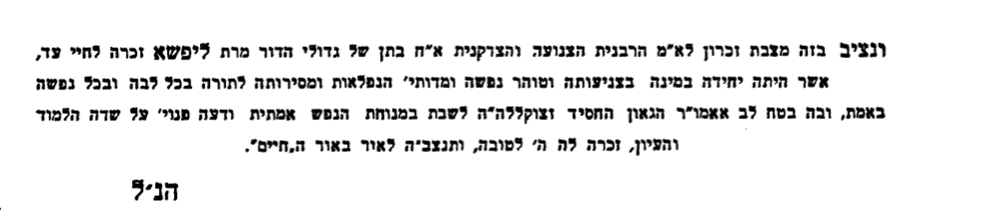
2. It is reported that when R. Hayyim’s commentary was published in 1936, R. Baruch Ber Leibowitz had a ceremony whereby the book was brought into the beit midrash together with music, just as if it were a new Sefer Torah. Students even danced with the book from R. Baruch Ber’s house until the yeshiva. See R. Dov Eliakh, Be-Sod Siah, p. 212.

[4] “Rambam of Brisk: R. Hayyim Soloveitchik’s Relationship with Mishneh Torah,” Tradition 5 (Summer, 2024), p. 2 n. 2.

[5] Friedman, however, points to one example where R. Hayyim suggests that the text of the Mishneh Torah is in error. See Hiddushei R. Hayyim HaleviEdut 21:9. R. Hayyim supports his suggestion by claiming that his preferred reading appears in an old manuscript. However, this raises the question of where he obtained this information, since the Frankel edition of the Mishneh Torah reports that no manuscripts preserve an alternate reading. See Hiddushei R. Hayyim HaleviEdut 21:9 and Friedman, “Kelalei Ha-Gaon Rabbi Hayyim mi-Brisk be-Veur ha-Rambam,” Alumot 1 (2026), pp. 390-391.

[6] “Ha-Yahas li-She’elat Nusah be-Sifrei Hazal,” in Yoel Catane and Eliyahu Soloveitchik, eds., Beit ha-Va’ad (Jerusalem, 2003), pp. 27-28, n. 28.

[7] “Yesodot ve-Ekronot Parshanut ha-Talmud,” Ha-Otzar 6 (Av 5777), p. 266.

[8] See also R. Raphael Amihai Hadad in the recently published Ha-Mashbir, vol. 12 (2026), p. 126:

ושמעתי בשם הגרב”ש דויטש זצ”ל שאף שהגר”ח בחידושו הידוע על “שומר שמסר לשומר” (הלכות נזקי ממון פ”ד ה”ד), בונה מערכת שלמה ליישב ולהסביר דברי הרמב”ם בעוד שהרמב”ם עצמו בתשובתו לחכמי לוניל (הובא במעשה רוקח שם) תולה את זה בטעות סופר, “דומה, כי גם אילו היה הגר”ח יודע את תשובת הרמב”ם, לה היה חוזר בו”

This volume of Ha-Mashbir, edited by the indefatigable Rabbis Yissachar Dov Hoffman and Ovadya Hoffman, is as usual a fascinating publication. It includes a previously unpublished commentary by R. Ovadiah Yosef on Tehillim. It also includes letters I received from R. Meir Mazuz in the years after the publication of Iggerot Malkhei Rabbanan. You can see the letters here.

[9] Ha-Dor ve-ha-Tekufah, p. 48. Truth be told, I am hesitant to quote anything from this book. I say this because the following passage (p. 32), citing R. Isaac Zev Soloveitchik in explaining why R. Kook came to London, is so historically uninformed that it raises questions about the reliability of the entire book. There is no way that R. Isaac Zev could have said what he is quoted as saying.

פעם שאל אותי אם יודע אני איך הגיע רב קוק ללונדון, וסיפר לי כי הוא הורחק מישיבת וואלוז’ין לפי שהי’ קייליקער, ועסק בלימודי השכלה, ואח”כ התחתן וחפש רבנות, כשמוע הגר”ח ז”ל שהוא מחפש רבנות, חרה לו ז”ל מאוד, אמרו לו הלא כבר עשה תשובה, אמר להם וכי ממנים בעל תשובה להיות רב, וכתב הגר”ח לכל העירות שבליטא שלא יקבלוהו לרב, ולכן הוכרח לברוח ללונדון

The statement that we would not appoint a baal teshuvah as rav of a community, which was widely accepted throughout the generations, refers to the classic baal teshuvah, namely, someone who “went off the derekh” and then repented. It does not refer to a “tinok she-nishbah,” i.e., someone born into a non-religious family—either a Converso family or a modern non-Orthodox family—who later in life became religious. The same can be said about a hazzan, concerning which Ta’anit 16b states that he must not have had a bad reputation in his youth. See R. Moshe Sternbuch, Teshuvot ve-Hanhagot, vol. 1, no. 99; R. Netanel Meoded, Mizrah Shemesh, vol. 4, no. 1. See also R. Sternbuch, Teshuvot ve-Hanhagot, vol. 2, no. 462, who sees value in having a baal teshuvah as a darshan. R. Avraham Shapiro has a different perspective; see his Rosh Devarkha (Jerusalem, 2010), p. 565:

כאשר ראה הסבא מסלובודקה זצ”ל שכל הישיבה שלו הלכה לשמוע את הרצאתו של החוזר בתשובה – הרב בירנבוים זצ”ל – הוא אמר: אני הייתי רגיל שבעל תשובה יושב בפינה ובוכה, והיום, יושב על במה ונותן הרצאות

I would only make two points about this passage. The first is that Nathan Birnbaum was a classic baal teshuvah in that he abandoned Orthodoxy before later returning, so his situation is not comparable to current baalei teshuvah who grew up irreligious. Second, Birnbaum was not a rabbi, a mistake that can be attributed to the editor of the book, as R. Shapiro would never have referred to him with the rabbinic title. In R. Shapiro’s Siah Ish, attached to his Hag ha-Sukkot (Jerusalem, 2012), p. 96, R. Shapiro’s comment about Birnbaum also appears. Yet here he refers to “Dr. Nathan Birnbaum,” which is what R. Shapiro would have said.

[10] Gulevsky, Lahat ha-Herev ha-Mithapehet, pp. 5-6.

[11] Kanievsky, Orhot Rabbenu (new ed.), vol. 4, p. 169.

[12] See Levi, “Rabbi Samson Raphael Hirsch – Myth and Fact,” Tradition 31 (Spring 1997), p. 11, called to my attention by Lesher.

[13] Ha-Ma’yan 48 (Nisan 5768), p. 37.

[14] See Jacob J. Schacter, “Torah u-Madda Revisited: The Editor’s Introduction,” Torah u-Madda Journal 1 (1989), p. 15, n. 1.

[15] There are also a few minor differences between the original letter and what appears in Ha-Pardes. The following sentence is only found in Ha-Pardes.

ואם אסור מן הדין בודאי גם כן משום פרנסה אסור ובפרט אם יכול האדם למצא אומנות אחרת נקיה וקלה אף גם שאינו מרויח כך כך

[16] The letter is found in the R. Joseph Rozin Collection, Yeshiva University Archives, MS. no. 1142. I thank Yeshiva University for permission to publish the letter. You can see the original letter here.

[17] Ha-Ma’yan 48 (Nisan 5768), pp. 38-39.

[18] Tradition 28 (Fall 1993), pp. 46-81.

[19] “Torah im Derekh Eretz in Our Time,” p. 68.

[20] Ibid.

[21] Ibid.

[22] When Levi reprinted R. Schwab’s article on Torah im Derekh Eretz in Ha-Ma’yan 48 (Nisan 5768), pp. 38-39, he is clear that Hirsch did not regard Torah im Derekh Eretz as a hora’at sha’ah. See ibid., p. 37.

[23] “Rabbi Samson Raphael Hirsch – Myth and Fact,” pp. 7-8.

[23b] Ha-Ma’yan 48 (Nisan 5768), p. 38 n. 12.

[24] Hirsch, Collected Writings, vol. 9, p. 146.

[25] Schendowich, Hermann Schwab: Historian of German Jewry, His Life and Shorter Works (Jerusalem, 2022), p. 79 n. 24.

[26] Hirsch, Collected Writings, vol. 7, p. 88.


Towards A Reappraisal of the Recent Works of Rabbi Shelomoh Luriah (Maharshal)

Towards A Reappraisal of the Recent Works
Of Rabbi Shelomoh Luriah (Maharshal)
By Rabbi Eliezer Brodt

As previously mentioned on the Seforim blog by myself and others, our generation is privileged to something no previous generation has seen, a sheer volume of Jewish books being printed and reprinted. Many of these works are seeing print for the first time – works of Rishonim and Achronim on all sorts of topics brought to the public eye from manuscript form. Some of these printings are beautiful editions, critically edited, and even glossed with illuminating marginal annotations. Other times the only benefit is to see the change from an illegible typeface to a clear block print (oft as not without any particular in the editing). In many cases, specific institutions are founded solely to deal with works from a particular religious group, while at other times, entire publishing houses are established that deal with the writings of one particular author. Recently one Godol, the great prolific writer, the Aderet (Rabbi Eliyahu David Rabinowitz-Teomim), famous for, amongst many things, being the father-in-law of R Kook, has had over five distinct groups working on printing his writings although almost none of his writings were published in his lifetime.

Recently, a rather modest institute called Makhon Iyay HaYam has begun reprinting as well as publishing for the first time, the many writings of the great gaon R. Shelomoh Luria, Maharshal. To date, this Makhon has already printed a few of his works and is currently working on many more. In this post, I would like to discuss this great person, the Maharshal, some of his printed works, and the current and future projects of this particular Makhon. As much has already been written on this great goan, including several biographical sketches, as well as a dissertation by Dr. Meir Raffeld on the Maharshal’s magnum opus, Yam Shel Shelomoh (more later), I have limited myself to but a few highlights.

The Maharshal was born circa 1510 (most likely in the city of Brisk or Posen), and died in 1573 in Lublin. He was a Rav in many cities, including Brisk,[1] Ostra and Lublin.[2] Alongside the rabbinate, the Maharshal established and ran yeshivot, training many famous students. Amongst these students are, notably, R. Yehoshuah Falk Katz (author of the Preisha), R. Moshe Meis (author of Mateh Moshe on minhagim as well as Hoel Moshe on Rashi; more on him later), R. Shelomoh Efrayim Lunschitz (author of the Kli Yakar), R. Chayim of Friedberg (author of Sefer HaChayim and brother of the famous Maharal of Prague), and R. Eliyahu of Chelm (the great-great-grandfather of the Hakham Zvi and Rabbi Jacob Emden, famous for being the only latter day Godol to have created a documented golem (see here for Prof. Shnayer Z. Leiman’s post, “Did a Disciple of the Maharal Create a Golem?” at the Seforim blog) all studied in the Maharshal’s Yeshiva. As an historical aside, it is worth pointing out that in the biography printed by R. Chechik, Sefer Chasdei Hashem (Yerushalayim, 5767, pg. 3), R. Chechik makes the claim that the major talmidim of the Maharshal studied in his yeshiva in Lublin. This appears highly implausible as the Maharshal only came to Lublin in 1569, and by then most of his talmidim were already accomplished poskim. More likely these students studied in one of the Yeshivot the Maharshal headed prior to the Maharshal’s Yeshiva in Lublin.

R. Shelomoh Luria was a contemporary of and related to R. Moshe Isserles, the Rama. In his Maalot Hayuchsin (Yerushalayim, 5764), p. 15, R. Efraim Zalman Margolis traces the various ways in which the Rama and the Maharshal were related. Among those was through the marriage of Maharshal’s daughter Miriam to Rama’s brother Eliezer. Additionally, these two Gedolim carried on extensive correspondence between themselves, some taking a rather sharp tone (most noted are those letters regarding the study of philosophy and dikduk). Yet, as R. Efraim Zalman Margolis notes, the utmost respect and esteem was maintained between the two. In fact, they seem to have been keenly interested in the other’s works, there is evidence that they read the other’s work prior to publication. (See Klilas Yoffe p. 9b and Maalot Hayuchsin of R. Efraim Zalman Margolis, pp. 27-28.) [3]

While both the Rama and the Maharshal were well respected and many of the Poskim of that generation were the Maharsha’s students, in a choice between the two regarding how to decide halakha, the Rama is the clear winner. The Shelah HaKadosh, however, bemoans the fact the Maharshal’s decisions were not accepted. This is so as the Maharshal followed the Rama (i.e. the Maharshal died later) and, as such, should have been awarded consenting rulings out of principle (halachisha k’basrayi). As a result, the Shelah HaKadosh calls upon those who fear Hashem to take upon themselves all stringent dissenting opinions of the Maharshal in opposition to the Rama (Shnei Luchot HaBrit, Shaar Ha’Otiyot, #100, Kedushah).

The Maharshal is well-known for his caustic tone in his writings. Many biographers note his use of rather sharp epithets in his works concerning other Gedolim. R. Chaim Dembitzer cites many instances where the Maharshal writes sharply against various Rishonim (Klilas Yoffe p. 11). But, some have questioned the focus on the Maharshal’s tone. For instance, Shmuel Abba Horedesky, who authored a biography on the Maharshal, Kerem Shlomo, included a discussion of the Maharshal’s caustic tone. Horedesky sent his book to the Sdei Chemed, and in a recently published letter, the Sdei Chemed sharply critiques Horedesky’s inclusion of that portion on the Maharshal.[4] (Dr. M. Raffeld, in his dissertation also bemoans the misguided focus of previous historians at these caustic remarks instead of researching the more unknown eras of the Maharshal’s life).

Aside from his goanus, the Maharshal was an extremely prolific writer, writing on many areas. Some of his more famous works include an outstanding work on Shas called Yam Shel Shelomoh. For itself, the work is pretty well known, unfortunately it is not used to its full potential in today’s yeshivah world (this due to many reasons, most importantly the current mahalach halimud) although of late it has been reprinted in a nice block print edition. The style of the Yam Shel Shelomoh is oriented toward halakha. Typically, each topic is examined systematically from its beginning sources, through the Rishonim and through (the then) current minhag (see further Dr. M. Raffeld). This work has not reached us in its entirety, as parts are missing from those mesechtos present. Furthermore, it is clear from many places in his writings as well as quotes from his talmdim that he wrote more than what we have. (To date we have volumes on seven masekhtot, but according to various sources, the Maharshal wrote on sixteen masekhtot. Dr. Raffeld attempts to construct a list of the remaining nine; not all agree to this listing and several substitutes have been suggested). I seem to recall that recently they discovered the volume of Yam Shel Shelomoh on masekhet Baba Batra, but the collector who owns it does not allow anyone to print it and is only willing to sell it for a very large sum of money. Likewise, rumors of Yam Shel Shelomoh on masekhet Shabbat have been circulating among professional circles, without any concrete evidence.

In addition to the Yam Shel Shelomoh on the Gemara, the Maharshal penned many other notes on many masekhtot, dealing with, among his personal novella, the correct girsa’ot of the Gemara. Known today as Hagahot Hokhmat Shelomoh, this work was originally printed as a separate volume. Present-day editions of Gemara find some of the comments having added into the text of the Gemara and Rashi over time, and the authorship erased along with the original gloss. The remaining glosses are printed in the back of almost all recent editions of the Gemara. In his editing, the Maharshal used old manuscripts, as well as variant texts. In a lengthy article in Alei Sefer, vol. 15, Y. Ron deals with this work. Later on Professor Yaakov Shmuel Spiegel dealt with this work in his classic Amudim be-Toldot ha-Sefer ha-Ivry, Hagot u-Maghim (pp. 279-285). Hokhmat Shelomoh on Masekhet Gitten has been recently reprinted by R. Y. Satz, (Toronto: Otzreinu, 1990). The foreword includes a detailed article elaborating on the need to reprint this work, basing the glosses on the exact comments of the Gemara used by the Maharshal. Large amounts of the glosses have been deleted by editors who mistakenly attributed them to lines already corrected, while in fact the Maharshal had another point in mind.

A partial list of the Maharshal’s other famous works include Teshuvot Maharshal, responsa quoted by all poskim; glosses on Rashi al haTorah called Yerios Shlomo, reprinted several times of late; glosses to Sefer Shaarey Dura by R. Yitzhak of Duren called Ateret Shelomoh. He also wrote glosses on the Sefer haMitzvot haGadol (SMaG) by R. Moshe of Coucy, called Amudei Shelomoh. Makhon Yerushalayim has issued a critical edition of this work, in three volumes, based on manuscripts and first prints, replete with footnotes by R. Yosef Luban. In addition to stand-alone volumes, the Makhon has also included the Maharshal’s valuable glosses in their critical edition of the Sefer haMitzvot haGadol.

Now for the works printed by Makhon Iyay HaYam:

As previously mentioned, the Maharshal routinely wrote marginal notes on a vast number of seforim. Of the most popular, were his glosses on the side of the Tur. In large, these notes are quoted by his talmid, R. Yehoshua Falk Katz, the Preisha, as well as the Bach (Sefer Bayit Chodosh) and many other Poskim, but until this century, these notes were never printed. In 1957, the editors of Tur Hotzaat ‘El Hamikoros’ commissioned R. S. Werner to ‘liberate’ these notes from manuscript ‘captivity,’ allowing for a tremendous find for the halakhic world. Unfortunately, thirty simanim in Yoreh Deah were lost from the copyist, and were listed as missing in the manuscript. In 1995, R. A. Chavatzelet published these simanim in a Sefer Zikaron for R. Werner, with the intention of completing the sefer on Yoreh Deah.

While researching another work, R. Y. M. Dubovick found citations to glosses not printed in R. Chavazelet’s addendum. Further perusal revealed the existence of more manuscripts in libraries worldwide that R. Werner was unaware of, and of which R. Chavatzelet had not availed himself. With more accurate texts, and numerous additional pieces not found in the manuscripts R. Werner had been given, it was clear of the need to edit the hagahot from the beginning. R. Dubovick decided to print this whole work again with all the corrections and missing pieces. First, R. Dubovick published an expository article in the journal Yeshurun (vol. 11) listing many missing parts on Yoreh Deah. In 2000, he issued a limited printing of the hagahot on Even HaEzer (including hagahot on the last ten simanim, a notable lack in R. Werner’s edition). More recently, he released a critical print of the first sixty simanim of Tur, Yoreh Deah with footnotes, surrounding the text of the Tur (Crimea, 1558) as used by the Maharshal. Therein, he references all the relevant writings of the Maharshal and his talmidim to the glosses on the Tur, as well as citations of these glosses by the poskim.

R. Dubovick intends to conclude the rest of Yoreh Deah in the near future and deal with Orah Hayyim and Hoshen Mishpat next, and finally, a reissue of Even HaEzer.

The focus of this recent volume on Yoreh Deah is the Sefer Ateret Shelomoh a commentary on the Shechitos u’Bedikos of R. Yaakov Weil, the hagahot on Tur an addendum to this rare work. As little as less than a hundred years ago every shochet had been tested specifically on this work, and virtually every small-town rav had to be an expert in this area as well. Many of the she’elot presented to a local rav were on these very topics and could not be referred to another Rav, as by than the animal would spoil. Nowadays, a shochet is tested on Sefer Beit David (R. David Tschechovitz), and unfortunately, the shechitot and bedikot of R. Yaakov Weil are almost unknown by anyone today, save for the occasional excerpt in other seforim.

Seeing how this valuable work has not been reprinted with the Maharshal’s notes in the past 400 years, Makhon Iyay HaYam recently undertook this project to enrich the public with yet another one of the Maharshal’s many invaluable works, reprinting the text based on the only two printings, and a manuscript fragment. R. Dubovick set himself to the task, painstakingly annotating along the way with extremely thorough notes on the entire sefer. Albeit some times his notes are a bit lengthy, there is a wealth of singular information contained in them, both on the halakhic field as well as the bio-bibliographic, which the editor could not deny the public, and did not omit them from print. A few examples; when the Maharshal quotes his grandfather, R. Yitzchok Klauber, noted are many of the places where the Maharshal cites his grandfather, throughout his many seforim (p. 3, n.6), along with a brief biographical sketch. [5] The same style note can be found when the Maharshal mentions his father-in-law R. Kalonymus (Kalman) Havarkstein-Yerushalmi; a listing of other citations, along with a thumbnail bio, including the Maharshal’s wife’s name (p. 38, n.28). With an eye on the halakhic ramifications of reprinting this sefer, R Dubovick notes that R. Efraim Zalman Margolis highlighted the importance of studying this sefer for those learning shechita, and yet, due to the sefer having been published as an addendum to the sefer, Sha’arei Dura, and not having a distinct title page from the Sha’rei Dura, remained unknown. (Introduction to Ateres Shlomo, see also Ma’alos haYhuchsin, p. 35) Additionally, regarding R. Efraim Zalman’s work on treifus in lungs (Rosh Efraim), R. Efraim Zalman states that Shechitot u’Bedikot were written last, even after Yam Shel Shelomoh, and the Halakha should be fixed accordingly, even against a dissenting opinion in Yam Shel Shelomoh (p. 38, n.27). In addition, he includes interesting sources to the practice of watering cattle before shechita (p. 55, n.92), as well as bringing to light a fascinating source to the puzzling minhag of peeling off sirchos (lesions) from the lung (p. 64, n.129).

The Maharshal’s extreme regard for maintaining minhagei Ashkenaz and their halakhic impact are spread throughout both his and his talmidim’s many writings. One can especially find this true with regard to R. Moshe Meis’ classic work Mateh Moshe. A while back, a manuscript was discovered of some minhaghim of the Maharshal called Hanhagot HaMaharshal. Dr. Y. Refael printed this work in a Sefer Hayovel and then later on as a separate pamphlet. These minhagim were written anonymously, and the editor attributes them to R. Moshe Meis, author of Mateh Moshe, and known to have been a personal member of the household of his teacher, R. Shelomoh Luria. As these minhagim do not cover the whole year, Dr. Refael concludes that the text is only a segment of a much larger work, which had unfortunately been lost. Interestingly enough, R. Shmuel Ashkenazi told me recently he did all the work in annotating this sefer and preparing it for print, although for some reason he wasn’t credited for it. (While this edition was printed from a manuscript, copied expressly for R. Nachum Ber Friedman of Sadigura (Areshet, vol. 1 397-98), there is another, variant edition, printed in the back of some copies of Nagid uMitzaveh (Sinai, vol. 63, p. 96)).

Among the interesting minhagim included in here is: [6]

מורי מוהר”ש אמר שקצת מינות באמירת י”ג עיקרים שתקנו באני מאמין שיש בו י”ג עיקרים, כי קצת אומרים וחושבים בלבם כשמאמינים בי”ג עיקירים אף על פי שעשו כל התועבות שבעולם ר”ל מכל מקום יש להם תקנה ואינו כן אלא אפילו מדברי חז”ל הוא עיקיר אחד, כמו שמצינו שאמר מה נאה הלכה זו ולא משבח האחרות גם כן אינו עושה כהוגן. ולא נתקנו אלו הי”ג עיקירים רק בשביל פילסוף מימים הקדמונים שהיו עושים עיקרים בכללים ולא עשו כמנין הללו באו חז”ל ותקנו גם כן בכלליהם וכן ביגדל אלקים חי נתקן י”ג עיקירם גם כן ולא אמר מורי אחד מהם ולא יגדל ולא אני מאמין”.

Also, the Maharshal discusses the Shir HaYichud, and offers a rather radical explanation of who the author of Shir HaYichud was: [7]

ביום טוב אחרון של פסח ביום ב’ אירע שנפל נר על דף של סידור ואמר בחור אחד בבית הכנסת של מורי מהר”ש לכבות אותו ולהציל ספרי קודש מדליקה. ואמר אפשר מותר ובפרט ביום ב’ של יום טוב שהוא דרבנן ובחור אחד אמר שהוא משיר היחוד ואמר מורי מהר”ש אל תבכו, גם זה לטובה שנשרף, שהוא סובר שלא בר סמכא עשאו, שמין עשאו

Similarly, in the Siddur Siddur Shabtei Sofer, vol. 1 pp. 89-90, R. Shabtei records in the name of the Maharshal:

והנה נוהג’ ברוב קהלות אשכנז לומר שיר היחוד הזה בכל יום רק במדינת רוסיא בקהלות אשר נהג בהם רבנות הגאון מהר”ר שלמה לוריא ז”ל אין אומרים אותו כל עיקר. ושמעתי מפי רבים מזקני הדור שהגידו לי ששמעו את מהרש”ל שהיה דורש בק”ק לבוב ובק”ק לובלין בתחלת בואו לנהוג שם רבנות ואמר בדרשותיו שאין לומר שיר היחוד מפני שמצא שחיבר אותו מין, ובעבור זה היה מוחה בכל הקהלות מושבותיו מלאמרו

Another rather unknown work of the Maharshal, is his Zemirot for Shabbat. While this work has been printed many times, not one of these editions has been reprinted based on the first printing and manuscript and many of the modern printings have actually detracted from the sefer’s integrity. This rare sefer is comprised of songs the Maharshal composed for Shabbat and Motzei Shabbat, with the author’s commentary to those songs. Included in his explanations are many halakhot and minhagim of Shabbat. Some examples of which are; women should wear a special garment when lighting the Shabbos candles; a reference to the custom of wearing a kittel on Shabbos. Another example, he praises the people of Ashkenaz for having a set system with regard to hosting yeshiva students for Shabbat meals. (Interestingly enough, while Prof. Simha Assaf mentions this minhag in his biographical sketch of the Maharshal printed in Sefer haYovel Lichvod Prof. L. Ginzburg, he makes no note of it in his Mekorot LeToldot HaChinuch biYisrael, even though he does mention several other sources to this custom pp. 229, 236, 633). [8]

Here too, R. Dubovick is working on reprinting these zemirot, along with an excellent commentary of his own on this work. A few samples of his efforts have been published in the journal Yeshurun (vol. 16). Here, I was simply amazed at the sources and comments of R. Dubovick regarding the various points of the Maharshal. One only hopes he will finish this work soon along with all his many projects relating to the Maharshal.

Notes:
I would like to thank R Y. M. Dubovick and Dan Rabinowitz in for their extremely helpful suggestions and sources in writing this post.

[1] On the Maharshal’s tenure in Brisk see the letter of R. Nosson Rabinovitch (author of Dikdukei Sofrim) in Eyur Tehilah p. 198.

[2] On the Maharshal’s time in Lublin, see the story brought in Simchas Hanefesh (see here for an earlier post, “Simchat ha-Nefesh: An Important But Often Ignored Work on German Jewish Customs,” at the Seforim blog) from R Yehudah Chassid pg 109-110. A similar story is quoted by the Chida in Shem haGedolim, erech R Avrhoum Mocher Yerokos.

[3] For a recent lengthy discussion of these correspondences, see Y. Elbaum in his Pisichut Vehistagrot (pg 156 and onwards), as well Dr. Asher Siev’s biography of the Rama (1972). For the exchange of letters between Rama and Maharshal on philosophy, as part of the appendix of translations of primary texts from 16th-century East-European Jewish Thought, see Leonard Levin, “Seeing With Both Eyes: The Intellectual Formation of Ephraim Luntshitz,” (Ph.D., Jewish Theological Seminary of America, 2003), 299-284, esp. 299-311.

[4] On the caustic comments of the Maharshal see Iggerot S’dei Chemed, vol. 1, siman 11, pp. 24-25; see also R. Barukh haLevi Epstein, Mekor Barukh, Introduction, pp. 89-93.

[5] For more on the Maharshal’s grandfather see M. Rafeld, in Daniel Sperber, Minhagei Yisrael (Jerusalem: Mossad Harav Kook, 2007), 8:174-96.

[6] For more on Ani Manmin see HaSiddur, pp. 232-36; Marc B. Shapiro, The Limits of Orthodox Theology: Maimonides’ Thirteen Principles Reappraised (Oxford: Littman Library of Jewish Civilization, 2004), pp. 19-20 (citing opinion of the Maharshal).

[7] For more on this topic see: A. Berliner, Kesavim Nevcharim, vol 1 pg 145-170; R. Dovid Hanazir , Kol Haneveha pgs 124, 143-144; H.J. Zimmels, Askenazim and Sephardim, pp. 132-134; A Haberman, Shiur Hayichud Vhakovod (intro), Y. Dan, Shiur Hayichud (facsimile edition) with the commentary of R. Yom Tov Muelhausem, Introduction; R.Y. Stal, Sefer Gematryios L’Rabenu Yehudah Hachassid, vol 1 pg 32-38; R. Y. Golhaver Minhaghei Hakehlos, vol 1 p. 132: and my forthcoming article in the Yerushasenu volume two.

[8] Another person who missed this source while discussing this topic is Mordechai Breuer, in his comprehensive book on the Yeshivot, Oholei Torah: The Yeshiva, Its Structure and History (Merkaz Zalman Shazar 2003), pp. 405-409.


Book Week 2011

Book Week 2011

by Eliezer Brodt

Book week has just begin in Eretz Yisrael. As I have written in previous years every year in Israel, around Shavous time, there is a period of about ten days called Shavuah Hasefer – Book Week (see here, here and here). Shavuah HaSefer is a sale which takes place all across the country in stores, malls and special places rented out just for the sale. There are places where strictly “frum” seforim are sold and other places have most of the secular publishing houses. Many publishing houses release new titles specifically at this time. In my reviews I sometimes include an older title if I just noticed the book. As I have written in the past, I do not intend to include all the new books. Eventually some of these titles will be the subject of their own reviews. I try to include titles of broad interest. Some books I cannot provide much information about as I just glanced at them quickly. I apologize in advance for any mistakes regarding transliteration. I also apologize in advance for using the word excellent so many times when describing seforim in this post! Additionally this year I am offering a service, for a small fee to help one purchase these titles (or titles of previous years). For more information about this email me at Eliezerbrodt-at-gmail.com. Part of the proceeds will be going to support the efforts of the the Seforim blog. Earlier this year I posted a list of recent academic titles see here. It’s worth checking back to this post in the next few days as I will probably add some more tiles, especially from Mechon Yerushalaim. 1) Magnes Press has many special titles this year. First and foremost is Benny Brown’s book on the Chazon Ish (see here). Another special title is the three volume critical edition of Sifri from M. Kahane. Another nice title is Kabbalistic Manuscripts and Textual Theory from Daniel Abrams. A nice collection of articles is Chinuch Vedas. There is a new collection of articles related to R. J. B. Soloveitchik called Rav Be-olam Ha-chadosh. There are also some new works on philosophy of Halacha. One is called Halacha, Meta Halacha, u-Philosph. Another one is called Halacha Ke-mecholles Shinu. There is another collection from E. Melamed called Midrashe Halacha shel Ha-amoroyim be-talmud Bavli. Another title is from S. Tzefatman called Rosh Ve-rishon. Another title is from Shlomo Simonsohn on the Jews in Sicily. Another nice collection is related to the Cario Genizah called Ha-kanon Ha-somu Min Hayin. Another nice title is a collection of articles related to Gan Eden called Gan Eden Me-kedem. In English, there is a new title called The Pinnacle of Hatred: The Blood Libel and the Jews.2) Kibbutz Hamechuad has a very special new title from Chanan Gafni called Peshuto Shel Mishana (a table of contents is available upon request). I highly recommend it and hope to return to it a post in the very near future. 3) The Israel Democracy Institute has some very good new titles. One is from Benny Brown (author of the work on Chazon Ish) dealing with R. Elyahsiv, Shlita and Rav Shach. Another work which looks interesting is a collection of articles called Rabnut HaAtgur (two volumes; a table of contents is available upon request). There are some other good titles there for good prices. 4) Caramel reprinted N. Krochamal’s classic work Moreh Nevuchei Ha-zeman.5) The Israel Academy of Sciences and Humanities does not have anything new but has some very good deals on old titles. 6) Merkaz Zalman Shazar has some new special titles. Amongst them is Amram Tropper’s Kechomer Beyad Hayotzer and the Hebrew translation of Professor Kanarfogel’s Peering through the Lattices, called Sod U-magiah Uprishut Bemishnsom Shel Balei Hatosfot. 7) Reuvan Mass has a few new titles. Amongst them works on the Maggid Me-Mezritch, Ha-shar Le-aon and a work on R. Tzvi Mezigitov, Al Derech Ha- avodah.8) The Bialik Institute has a few new titles, amongst them Lo Yossur Shevet Me-Yehudah in honor of Professor Simon Schwarzfuchs, which is a excellent collection of articles including pieces from of Professors Chaim Soloveitchik, Shnayer Z. Leiman, A. Grossman. M. Rosman, Eric Zimmer, R. Reiner ,Simcha Emanuel and many others (a table of contents is available upon request). Another nice title is Legalot Nistorot from Chana Werman. Aharon Shemesh has a book related to halacha in the Dead Sea Scrolls. Another title, Yosef Dat, is a Sefer Hayovel for Y. Salomon. In English there is a new title edited by Boaz Huss called Kabbalah and Contemporary Spiritual Revival. 9) Bar Ilan University has some new titles. The latest volume of Sidra is something specia,l with an all star line-up of writers (see here). A good title for those interested in academic Talmud is called Meleches Machsevet (see here). There are new volumes of Badad and Iyunei Mikra. Another title is on Zionist movement in Poland (see here). 10) Mechon Ben Zvi has some new titles, amongst them some new volumes in their set of critical editions of classics of Sefer ha-Makabim. Other works include Safrut Ha-mikra and a new translation of Shemoneh Perakim of the Rambam from M. Schwartz and two more volumes in their special series.


A Printing Mistake and the Mysterious Origins of Rashbi’s Yahrzeit*

A Printing Mistake and the Mysterious Origins of Rashbi’s Yahrzeit*
by Eliezer Brodt
In this post I would like to deal with tracing the early sources for the great celebrations that take place worldwide on Lag Ba-Omer, specifically at the Kever of Rashbi (R. Shimon b. Yochai) in Meron.[1] A few years back on the Seforim Blog I dealt with some of these issues (link). More recently in Ami Magazine (# 22) I returned to some of the topics. This post contains new information and corrections that I have found which were not included in those earlier articles.
The period of Sefirat ha-Omer is traditionally considered a time of great mourning. The most well-known reason given for the mourning – offered by the Geonim and Rishonim – is due to the death of twenty-four thousand students of R. Akiva who, according to the Gemara in Yevamot 62b, died during this time of the year for not having accorded respect to each other. Because this is deemed a mourning period, we refrain from shaving, taking haircuts, dancing, listening to music, and making weddings.[2] Sefer Ha- Tadir[3] writes:
ומנהג בין פסח לעצרת לומר מסכת אבות בכל שבת ושבת קודם המנחה משום מעשה תלמידי ר”ע… י”ב אלפים זוגות תלמידים היו לו לר”ע… שלא נהגו כבוד זה לזה… (ספר התדיר, עמ’ רכב).
However, the prohibitions associated with sefirah are suspended on Lag Ba-Omer, and many early sources offer reasons for additional levels of simcha on Lag Ba-Omer, which includes omitting tachnun on that day. Additionally, there is a custom to celebrate Lag Ba-Omer at the kever of Rashbi in Meron, amidst great celebration, complete with music, dancing, and bonfires. The remainder of this post at the Seforim Blog will offer some reasons for this practice.
R. Yehoshuah Ibn Shu’eib, a student of the Rashba and a great Mekubal, was unsure of the reason for the custom in his day of taking a break from mourning on Lag Ba-Omer, until he heard some say that it is because the students of R. Akiva stopped dying on that day.[4] He writes:
ולכן נהגו לגדל שפם עד עצרת, ואין כונסין נשים בזה הפרק, ואף על פי שיש טעם אחר במדרש על אותן שנים עשר אלף זוגות תלמידי דר’ עקיבא שמתו מן הפסח עד העצרת. ומה שנהגו רוב העם להגדיל שפם עד ל”ג לעומר לא מצינו בו ענין, ובתוספות פי’ כי מה שאמר ל”ג אינו כמו שנוהגין, אלא ל”ג יום כשתסיר שבעת ימי הפסח ושבעה שבתות ושני ימי ראש חדש שהן ששה עשר יום שאין אבלות נוהג בהם, נשארו מן הארבעים ותשעה ימים ל”ג, וזהו מאמרם ל”ג יום לעומר. שמעתי שיש במדרש עד פרס העצרת והוא חמשה עשר יום העצרת באמרם פרס הפסח פרס החג שהם חמשה עשר יום בניסן ובתשרי, וכשתסיר חמשה עשר יום מארבעים ותשעה יום נשארו שלשים וארבעה, והנה הם שלשים ושלשה שלימים ומגלחין ביום שלשים וארבעה בבקר כי מקצת היום ככולו. (דרשה לפסח יום ראשון)
Some other Rishonim, including the Manhig and Meiri, also give this reason, while others say that the students only stopped dying on the thirty-fourth day of the Omer, the day after Lag Ba-Omer. Thus, according to them, there would be no reason for festive celebrations on Lag Ba-Omer.[5] See, for example, the Tashbetz who writes:
וכן אירע לר’ עקיבא שהעמיד ארבעה ועשרים אלף תלמידים וכולם מתו מן הפסח ועד פרס העצרת אחר עבור ל”ג לעומר, כי פרס הוא חצי חדש שהם חמשה עשר ימים, כמו שנזכר בפרק מעשר בהמה בבכורות [נח א]. וכן בתוספתא [שקלים פ”ב מ”א] אמרו, איזהו פרס, אין פחות מט”ו. וט”ו ימים קודם עצרת, הוא יום ל”ד לעומר. ולזה נהגו להתאבל באותם ימים שהם מהפסח עד ל”ג לעומר ולא נהגו איסור ביום ל”ד לפי שמקצת היום ככולו. וכולם מתו מפני שהיתה עינם צרה זה לזה (מגן אבות, אבות, א:א).
If one looks in the Tur, the Shulhan Arukh as well as the various early commentaries, one will not find any other reason as to why there should be simcha on Lag Ba-Omer, other than that the students of R. Akiva stopped dying on Lag Ba-Omer. Be that as it may, this particular reason offers no insight into the connection between Meron, and more specifically Rashbi, and Lag Ba-Omer.
The most well known explanation to the connection between Rashbi and Lag Ba-Omer is that Rashbi died on that day, and he was one of the students of R. Akiva. Assuming for a moment that this is factually correct, it is quite strange that we celebrate Rashbi’s death. We don’t celebrate the yarzheit of Avraham Avinu, Moshe Rabbeinu, David HaMelech, or any other great people with bonfires. Rather, halakha states the opposite – to fast on a yahrzeit, especially on those days that great people died. This problem is addressed by the Sho’el u-Meshiv (5:39) and because of this question and others, he was very skeptical of the celebration that takes place at Meron. R. Aryeh Balhuver, in his Shem Aryeh (no. 13), points out that because of the celebration that takes place at Meron for Rashbi, people began to be lenient about fasting on the yarzheit of their parents.
Another problem is that neither Chazal nor any of the Rishonim mention Rashbi dying on Lag Ba-Omer; and as a general rule we do not make any form of a Yom Tov on a day that is not mentioned in Chazal. This issue was addressed by the Chatam Sofer in his teshuvot (Y.D. 233) and because of this, he too was very skeptical of the way Lag Ba-Omer is celebrated.
So what is the source that Rashbi died on Lag Ba-Omer? R. Yehosef Schwartz writes in his Tevuot Ha-Aretz (p.224) that he searched all over for the reason for the great simcha at Meron on Lag Ba-Omer, and concluded that it must be because Rashbi died on Lag Ba-Omer. R. Jonathan Eybeschutz, the Ba’al ha-Tanyah, Reb Zadok ha-Kohen, and the Arukha ha-Shulhan also say that Rashbi died on Lag Ba-Omer.
The Shem Aryeh (no. 14) writes that when we celebrate the yahrzeit of Rashbi, we are celebrating that he died a natural death, at the proper time and place, and not at the hands of the Romans, who did not bury the people they killed. The Gemara in Shabbat 33b–34a relates that the Romans wanted to kill Rashbi, and he ran away and hid in a cave for many years until the Romans stopped hunting him.
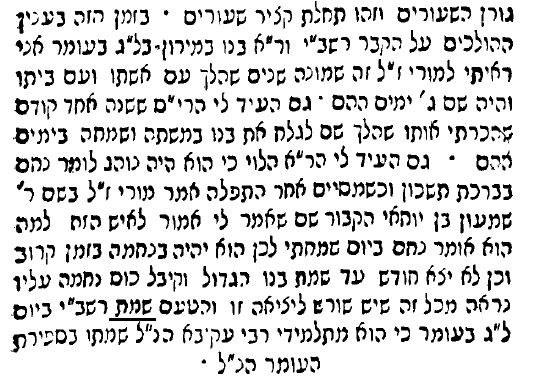
What appears to be an earlier source for some who say that Rashbi died on Lag Ba-Omer is R. Hayyim Vital, quoting in the name of the Arizal, found in the Peri Etz Chaim. Indeed, R. Hayyim Vital states that Rashbi died on Lag Ba-Omer, and he was one of the students of R. Akiva who died during Sefirah. In truth, it is a mistake to give R. Vital credit for this. The source of this mistake was based on a simple printing mistake in two edition of the Peri Etz Chaim. One was printed in Koretz 1785 (p. 108a).
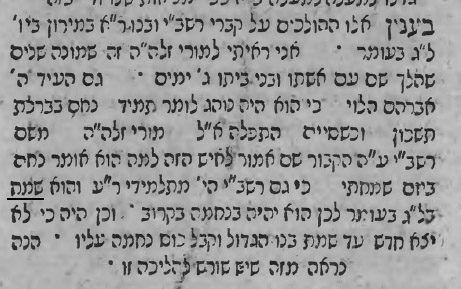
The other was printed in Dubrowno 1802 (p. 124b).

In the first printed edition of the Peri Etz Chaim, which was printed in 1782 (p. 101a), it does not say that at all. Instead of saying “she-meit” (that he died) it has a very similar, but entirely different word, samach (was joyous). The letter chet was apparently confused for a tav in the later version, causing the whole mistake![6] (Interestingly, the Aderes in his work Zecher Davar has a whole collection of cases where a problem arose due only to a קוצו שלו יוד.)
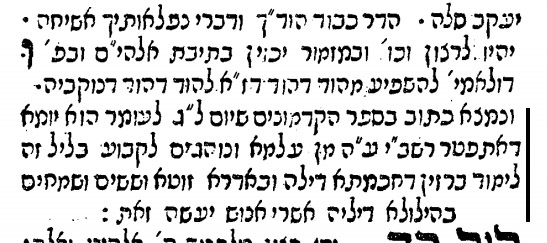
In the Shaar ha-Kavanot from R. Vital first printed in 1752, where the same piece appears, it also reads samach (p. 127) like the first edition of Peri Etz Chaim. In a later edition of of Peri Etz Chaim printed in 1819 it also reads samach. These would seem to confirm that the error is indeed she-met rather than samach.
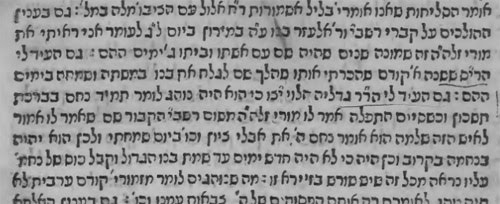
The late Meir Benayahu z”l and, more recently, R. Yaakov Hillel, confirmed, based on many early manuscripts that this reading that does not have Rashbi dying on Lag be-Omer, is the correct reading from the writings of R. Chaim Vital. Recently, R. Yaakov Hillel printed the Sefer Shaar Ha-Tefilah from a manuscript of R. Hayyim Vital’s actual handwriting, and in that location (p. 312), as well, the passage states that it was the day of Simchat Rashbi, not the day he died.[7]
Interestingly, the Chida in his work Birkhei Yosef, printed in 1774, writes that Rashbi died on Lag Ba-Omer. But in a later work of his, Ma’aret Ayin, printed in 1805, he writes that the Prei Etz Chaim is full of mistakes and this statement regarding Lag Ba-Omer and Rashbi’s death day is one of them. So the Chida’s conclusion is that it is not a reference to Rashbi’s day of death at all. This conclusion is accepted by later authorities, including Takfo Shel Nes (p. 59a), Shu”t Rav u-Po’alim (1:11), and Tziyun LeNefesh Chayah (no. 65).[8]
The Lubavitcher Rebbe[9] wrote in a letter to R. Zevin that there is a printing mistake in the Peri Etz Chaim.

הרה”ג הוו”ח אי”א נו”מ וכו’ מהורשי”ז שי’
שלום וברכה!
במקרה ראיתי, בספרית כ”ק מו”ח אדמו”ר שליט”א, את ספרו “המועדים בהלכה” מהד”ת, ומצאתי שם בפרק ל”ג בעומר העתקת לשון הפרע”ח (דפוס דובראוונע ודפוס לאשצוב) שער ספה”ע פ”ז בהערה, וז”ל: והטעם שמת רשב”י ביום ל”ג בעומר כי הוא מתלמידי רע”ק שמתו בספה”ע.
והנה ידוע, אשר קטע זה מוקשה הוא הן בנגלה, כי רשב”י הוא מהחמשה תלמידים שסמך רע”ק אח”כ, הן מצד הנסתר ע”פ המבואר, בפע”ח שם ובסידור האריז”ל, מדריגת הכ”ד אלף תלמידים שמתו ומדריגת ה’ תלמידים הנ”ל. וכבר עמד ע”ז בשו”ת דברי נחמי’ חאו”ח סל”ד סק”ז. וסיים: ואולי יש ט”ס בפע”ח שם במ”ש כי הוא כו’ כנ”ל וצ”ע בדפוס קארעץ ששמעתי ששם נשמט זה.
ואמת כן הוא, אשר בפע”ח דפוס קארעץ לא נמצא קטע הנ”ל. וכן בסידורי האריז”ל ובשני פע”ח כת”י, שישנם באוסף הכת”י אשר לכ”ק מו”ח אדמו”ר שליט”א, חסר כל ענין זה. כן לא מצאתי לביאור הנ”ל בכל דרושי דא”ח שראיתי לע”ע.
וז”ל ספר הכוונות (ענין ספה”ע דרוש יב) בטעמי מנהגי ל”ג בעומר: כי הרשב”י ע”ה הוא מחמשה תלמידיו הגדולים של רע”ק ולכן זמן שמחתו ביום ל”ג בעומר. ועד”ז הוא במשנת חסידים.

– ובעהמ”ס ד”נ כנראה לא ראה את סה”כ, מדאינו מביאו – ומכמה טעמים מהנכון, לפענ”ד, לתקן את הנ”ל בספרו, או עכ”פ להעיר על הספקות שבדבר, בהזדמנות הראשונה. ..

The question then is, what is the earliest printed source that Rashbi died on Lag Ba-Omer. Avraham Yaari and Meir Benayahu demonstrate that the earliest source to mention Lag Ba-Omer as the yarzheit of Rashbi is none other than the Chemdat Yamim. R. Yaakov Hillel also confirms this in his Aid ha-Gal ha-Zeh (p. 13).
The Chemdat Yamim was first printed in the 1730s and has been the source of controversy and debate until today. Some go out of their way to attack it, claiming it has strong ties to Shabbetai Tzvi. Others strongly defend it, saying it is a very special work. Whatever the case is, Chemdat Yamim has been established by many as the source of many different customs that we observe today. It is not necessarily the earliest source, but in the first few years after it first appeared, Chemdat Yamim was printed many times, becoming a bestseller as it were. Because of this, many customs contained therein became widespread. One notable example is the celebration of Tu Be-shevat. After the Chemdat Yamim was printed, many works about the customs of Tu Be-shevat were printed based on it. What is very interesting is that Chasidim, who are principally against the Chemdat Yamim, are very into this concept that Lag Ba-Omer is the yarzheit of Rashbi.[10]

If one looks at all early mentions of Lag Ba-Omer and the Arizal one will not see any mention of it being the yarzheit of Rashbi. Here are some examples:
The Magen Avraham, first printed in 1692, writes when talking about days when we do not say Tachanun writes:
מעשה באחד שנהג כל ימיו לומר נחם בבונה ירושלים ואמרו בל”ג בעומר ונענש על זה מפני שהוא י”ט [כונת האר”י] (מגן אברהם סי’ קלא ס”ק יז)
When talking about Lag Ba-Ome , the Magen Avraham writes:
ומרבים בו קצת שמחה – וכתו’ בכוונות שגדול אחד היה רגיל לומר נחם בכל יום ואמרו גם בל”ג ונענש (מגן אברהם סי’ תצג ג)
We see that he makes no mention of it being the yarzheit of Rashbi when he referencing to the Arizal and Lag Ba-Omer. It is generally accepted that the Magen Avraham is responsible for bringing the writings of the Arizal into the world of halakhic discourse. The question, however, is regarding the Magen Avraham’s source for this specific Arizal. In general R. Yosef Avivi shows that the Magen Avraham when quoting from the Arizal was using the work Shulhan Arukh Shel Arizal.[11] There are many works similar to this work, one was called Nagid U-metzaveh; another was called Lechem Min Hashamayim. In both of these works, the whole story with the Arizal and Nachem appears with the version that this was the day of Simchat Rashbi, and not the day he died.
Now in this work, the story as quoted above appears and no mention of it being the yahrzeit of Rashbi, but rather that it was the day of Simchat Rashbi. However we cannot say, for certain, that his source was the Shulhan Arukh Shel Arizal because he specifically quotes the Sefer Hakavanot as his source. Now the problem with this is, which Sefer Hakavanot was the Magen Avraham referring to? The only edition printed before the Magen Avraham was from R. Moshe Terniki printed in Venice in 1620. In that edition of Sefer Hakavanot, there is nothing about Lag Ba-Omer. In a personal communication, R. Yosef Avivi suggested to me that it was the Sefer Hakavanot that was written in Cracow in 1650 and the Magen Avraham had it in manuscript. This edition of Sefer Hakavanot was later printed under the name Peri Etz Chaim in 1785.[12]
Another example of an early source who quotes the Arizal about Lag Ba-Omer but makes no mention of it being his yahrzeit can be found in the Ateret Zekenim from R. Menachem Auerbach, first printed on the side of the Shulhan Arukh in 1702 (it was written much earlier). He also cites the story of the Arizal:
מנהג ארץ ישראל שנוהגין לילך על קברי רשב”י ז”ל ור”א בנו ביום ל”ג בעומר והעיד ר”א הלוי שהוא היה נוהג תמיד לומר נחם בברכת תשכון וכשסיים התפלה א”ל ר”י לוריא ז”ל משם רשב”י הקבור שם שאמר לו אמור לאיש הזה למה הוא אומר נחם ביום שמחתי ולכן הוא יהיה נחם בקרוב וכן היה שמת לו בנו הגדול (סי’ תצג).
Here too we see a version of the story that has nothing about it being the yahrzeit of Rashbi.
Another example of an early source that quotes the Arizal about Lag Ba-Omer, but makes no mention of it being his yahrzeit can be found in the Sefer Shirei ha-Levim. This work was first printed in 1677; it includes anything having to do with the topic of Shir Shel Yom including the Arizal’s custom that he found in different sources.[13] When talking about Lag Ba-Omer he writes:
ל”ג בעמור שייך מזמור לז על שם שנאמר בו צופה רשע לצדיק וגו’ וזה שייך על רשב”י וחבריו שנשארו מתלמידי ר”ע כמבואר בגמרא ולא שלט בהם המלאך המות ביום ההוא וכן מיום ההוא והלאה כי קצת דיעות. וכתב בספר כוונת האר”י הנדפס שהלך האריז”ל עם אשתו ובניו לגלח על קבר רשב”י ועשה משתה ושמחה ג’ ימים לג לד לה ולמדו ספר הזוהר על קברו לכבודו של רשב”י וחביריו שנשתיירו והעמידו תורה באותו שעה, וע”ש מעשה נפלא על אחד שנענש על שאמר נחם בתפילת יח בעת שמחתו אבל ספר כוונת של הקדוש ר’ חיים וויטל…
I am not sure which printed edition of Sefer Hakavanot he was referring to that contains this passage. However we see here also no mention of it being yahrzeit of Rashbi.
The Mishnat Chassidim, first printed in 1727, collected lots of material from the Arizal. When talking about Lag Ba-Omer, also makes no mention of it being the yarzheit of Rashbi.[14] He just writes:
ועל ידי ר’ שמעון בן יוחאי שהיה אף הוא תלמידו נתקיים העולם לפיכך אין להתאבל ביום זה כלל על החרבן שלא יענש אל מצוה לשמח שמחת ר’ שמעון בן יוחאי ואם דר בארץ ישראל ילך לשמוח על קברו.
Next is the historical work Divrei Yosef from R. Yosef Sambary, completed in 1672 but only printed a few years ago, (although parts were printed by Adolf Neubauer in 1887). When he records the story with the Arizal about someone saying Nachem at the kever of Rashbi, he does not even mention it was on Lag Ba-Omer; he, too, records the story stressing that it was a day of Simcha not the yahrzeit of Rashbi (p. 188).
It is also worth pointing out that the Shelah ha-Kadosh, an earlier work that was influenced by the Arizal, when talking about Lag Ba-Omer, also makes no mention of it being the yahrzeit of Rashbi.
The Divrei Nechemiah, written by the grandson of the Ba’al ha-Tanyah, writes (no. 34) that there is a printing mistake in the Peri Etz Chaim when he says that it was the yahrzeit of Rashbi. However he concludes:
אך המפורסמות אין צריך ראיה שכבר נתפרסם בכל העולם מכמה דורות ע’ הלולא דרשב”י בל”ג בעומר ומסתמא יש מקור לזה בזוהר או בכתבי האר”י ז”ל.
In short it is quite amazing that the whole source for Lag ba-Omer being the day of Rashbi’s death is based on a printing mistake found in only one version of the story with the Arizal, while all other versions I have found of the story does not say anything about it being the yahrzeit of Rashbi!
Returning to the origins of going to Meron on Lag Ba-Omer, Avraham Yaari, has a very detailed article where he collects many early sources[15] for going to Meron in general[16] from famous travelers such as R. Binyomin Me-Tudela in the 1170s, R. Pesachyah Me-Regensburg, but these early sources make no mention of going to Rashbi’s Kever, only to the kevarim of Hillel and Shammai[17] who are also buried in Meron.[18] The first source that Avraham Yaari found that mentions going to Rashbi’s kever is from the twelfth-century in the travels of R. Yaakov HaKohen. After that, he found it in other sources.[19] None of these sources mention to these kevarim at a specific time. In the beginning of the fourteenth century, however, a student of the Ramban mentions going to the kevarim of Hillel and Shammai in Meron on a specific date in the month of Iyar, on Pesach Shnei. We have other early sources that mention going to those kevarim on Pesach Sheini. In the famous letter of R. Ovadiah me-Bertinoro (1488) and the travels of R. Moshe Basola (1521-1523), we also find mention of going to Meron to visit the kevarim of Hillel and Shammai on Pesach Sheini. From many of these sources, we see that the reason they went was to daven for water, and that at times, water would miraculously appear from the caves. However, it is important to stress that while we have many accounts of going to Meron even during the month of Iyar none mention going to the kever of Rashbi during that time of year.
Avraham Yaari and Meir Benayahu cite many sources that clearly demonstrate that the Mekubelei Tzefat would go to Meron to the kever of Rashbi a few times during the year to learn Zohar. However, the first source we have for someone going to Rashbi’s kever specifically on Lag Ba-Omer, is the Talmdim of the Arizal, who say that the Arizal once went to the kever of Rashbi on Lag Ba-Omer while still living in Egypt. When recording this testimony, R. Hayyim Vital writers that he is not sure if this occurred before the Arizal was well versed in Kabbalah. But he stresses that he was doing something done by others before him. We do not know to whom R. Hayyim Vital referred. Meir Benayahu concluded that the custom of going to Meron on Lag Ba-Omer was begun by the Mekubelei Tzefat.
Although Yaari concedes that Mekubelei Tzefat were very into going to the kever of Rashbi, that is not how the minhag to go specifically on Lag Ba-Omer developed. Yaari shows that the custom of going to Meron was taken from an earlier custom of going to Shmuel Hanavi’s Kever on his yahrzeit, which was on the twenty-eighth day of Iyar.[20] The Tur brings down from the Behag that one should fast on this day. We have many early sources of prayers that were recited on this day at Shmuel Hanavi’s Kever.[21] In the travels of Meshulem Me-Volterrah from 1481, the travels of R. Ovadiah me-Bertinoro (1488) and the travels of R. Moshe Basola (1521-1523) we also find mention of going to Shmuel Hanavi’s Kever on his yarzheit. In these sources, we also see that they used to light many big flames. Avraham Yaari believes this to be the source of the minhag to go to Kever of Rashbi.
In sum, the above indicates that there are early sources for people going to Meron during the month of Iyar, on Pesach Sheni, to the kevarim of Hillel and Shammai. The Mekubelei Tzefat went to Rashbi’s kever throughout the year and Meir Benayahu feels that the minhag of going Lag Ba-Omer originated from them too. While Yaari feels that the custom of going to Meron on Lag Ba-Omer was taken from an earlier custom to go to Shmuel Hanavi’s Kever on his yahrzeit, it is also clear that the Arizal did, in fact, go to the kever of Rashbi on Lag Ba-Omer at least once.
However it appears to this writer that it is more likely that the custom of going to Meron to the Kever of R. Shimon Bar Yochai on Lag Ba-Omer grew out of the earlier minhag of going to Meron in the month of Iyar, to the kevarim of Hillel and Shammai on Pesach Sheini which is only a few days before Lag Ba-Omer, and not from the Minhag of going to Shmuel Hanavi’s Kever on his yahrzeit, which was on the twenty eighth day of Iyar, which is not even in Meron. Possibly support to this can be found in the travels of R. Moshe of Basola who writes that after going to kevarim of Hillel and Shammai on Pesach Sheini, the crowd would go to the cave where Rashbi and his son hid for thirteen years and they would spend a few days and nights celebrating in Meron.[22]
In the work Arugat Ha-Bosem, written in 1234, I found a very interesting version to the earlier quoted, famous Gemara of why the sefirah period is considered a time of mourning. He writes:
מה טעם מנהג בישראל אין עושין מלאכה בין פסח לעצרת, משתקשע החמה עד למחרת שחרית, ואמרו לנו שני טעמים אחד על פטירת תלמיד הילל ושמאי, דאמ’ שמוני’ אלף תלמיד’ היו להילל הזקן ושמאי מגבת ועד אנטיפרס, וכולן מתו מפסח עד עצרת על שאלה ונוהגים כבוד זה לזה… [ערוגת הבשם, א, עמ’ 75].
This version would be possible additionally support, that originally in Iyar Jews went to the kevarim of Hillel and Shammai on Pesach Sheini. However I was unable to find any other manuscript that records such a reading of this Gemara.[23]
R. Shemaryhu Adler has a very interesting insight into the deaths of the talmdim of R. Akiva during sefira and when they start dyeing. In this piece he also says as a fact that Rashbi died on Lag B’Omer.
נראה טעם הגון ונכון לעצומו של יום לג בעומר דהוא בכלל יום טוב. ובהקדם להבין עוד מה דלכאורה תמוה דלמה לכולהו הני שיטות ליכא התחלה לאבילות כי אם מזמן התחלת ספירת העומר והיינו מיום ב’ דפסח דאיזה שייכות יש לאבילות ךדלמידי ר”ע לזמן התחלת ספירת העומר כיון דיבמות ס”ב ע”ב אמר כולם מתו מפסח ועד עצרת וסתמא תנא מפסח מנ”ל דזהו מיום ב’ דפסח ולא מיום א’.
נראה ע”פ דאמר במנחות סח ע”ב יתיב ר”ט וקא קשיא ליה מה בין קודם לעומר לקודם שתי הלחם אמר לפניו יהודה בר נחמיה לא אם אמרת קודם לעומר כשן לא הותר מכללו אצל הדיוט כו’ שתק ר”ט צהבו פניו של רבי יהודה בר נחמיה אמר לו ר”ע יהודה הבצו פניך שהשבת את זקן תמהני אם תאריך ימים אר”י ב”ר אלעי אותו הפרק פרס הפסח היה עשעליתי לעצרת שאלתי אחריו יהודה בן נחמיה היכן הוא ואמרו לי נפטר והלך לו עכ”ל הגמרא יעו”ש
ומזה נראה דהי’ קודם פסח ט”ו יום ונשאו ונתנו בענינא דעומר וע”י דצהבו פניו של יהודה בן נחמיה במה דהשיב את ר”ט ועי”ז קפד ר”ע מסברא לומר דבעת שהגיע זמן הקרבת העומר דהוא זמן התחלת ספירת העומר ביום ב’ של פסח מצאה הקפידה מקום דתיחול כיון דעיקר דהשיב לר”ט היה בענינא דעומר וכיון דקפידת ר”ע היה על מה דתלמידו יהודה בן נחמיה התכבד בתשובתו לר”ט ולא נהג בו כבוד כראוי ומצאה הקפידה מקום לנוח בזמן הקרבת העומר דזהו היתה סיבה להא דהשיב הזקן ר”ט שפיר התפשטה קפידת ר”ע ג”כ על כל תלמידיו שלא נהגו כבוד זה לזה והלכך שפיר התחילה פטירתן מאותו זמן דעיקר הקפידה חלה והיינו מיום ב’ דפסח שהוא זמן הקרבת העומר והלכך שפיר שייכא אבילות דתלמידי ר”ע לזמן התחלת ספירת העומר וכנ”ל
ועיין כי רשב”י היה מתלמידי ר”ע והיה קפדן גדול וכדאמר במעילה יז ע”ב… וא”כ הו”א כיון דר”ש ג”ג נפטר ביום ל”ג בעומר נהי דכבר היה זה זמן טובא אחר שמתו תלמידי ר”ע כיון דאמר ביבמות ס”ב והיה… מ”מ כיון דקפידת ר”ע על מניעת נהיגת כבוד חלה בזמן בעומר שוב פטירת ר”ש דהיתה בזמן ימי העומר והיינו ל”ג בעומר ג”כ מקפידת ר”ע רבו על דהיה קפדן ובודאי לא נהג כבוד, והלכך לשלילת מחשבה כזו עושים קצת שמחה להראות דפטירת רשב”י אינו בגדר קפדנותו של ר”ע רבו ומטעמא דנהי דרשב”י היה קפדן מ”מ לא היתה לבד התכבדות בקלונו של חברו ח”ו דז”א דרשב”י הי צדיק גמור ועיקר קפדנותו לא היתה כ”א לכבוד השי”ת וקנאותו וזהו עיקר הלולא דרשב”י (שו”ת מראה כהן, סי’ כט אות ג).
R. Eliezer Dunner, in his work Zichron Yosef Tzvi, offers a very novel reason for the celebration on Lag Ba-Omer. He says that we know that R. Akiva was a strong supporter of Bar Kochba. He suggests that R. Akiva students were soldiers in his army to fight the Romans and they died in this time period of Sefirah. During this time, on Lag Ba-Omer, the Jews were winning, that is why they turned this day into a great day of celebration.
ידענו כי ר’ עקיבא היה הולך ונוסע ומלמד בכל תפוצת הארץ ובכל מקום היה לו תלמידים הרבה מאוד ועין שחושב לבר כוזבא כמשיח קרא כל תלמידיו להלחם בצד בר כוזבא ותחת רגליו נגד חיל האויבים… ואף על פי שבתחילה חלשו היהודים את אויביהם לפי חרב אחר כך גברו הרומיים ולכדו מישראל עיר ועיר ובאותה זמן היתה מלחמה בכל יום יום ובכל מלחמה נפלו ומתו הרבה אנשים מחיל בר כוזבא ובהן כמה תלמידי ר’ עקיבא וכששקעה החמה בכל יום ויום פסקה המלחמה ואז נקברו כל המתים. ואפשר שבתוך כל המלחמות הללו שהיו יום יום ושבהם גברו האויביהם על ישראל היה יום אחד והוא ל”ג בעומר שגבר בו ישראל אותו יום שבו היה להם ישעות ה’ בעת צרתם יום גבורה ותשועה אותו יום קבעו ליום שמחה לדור דורים וכמו כן שמעתי גם מפי הרב דק”ק פוזנא מוהר”ר זאב פיילכענפעלד ז”ל (זכרון יוסף צבי, סי’ תצ”ג).
However, this original explanation, while giving us new insight into the mourning period during sefirah does not help us understand the connection to Rashbi. Avraham Korman in his Pinu’ach Aggadot (pp. 190-210) cites others (not R. Dunner) that tie the death of the talmidim of R. Akiva to the rebellion of Bar Kochba and he goes further to explain the connection between this and Rashbi and other minhagim of Sefirah.
There is a custom in many chasidic courts to use bow and arrows on Lag Ba-Omer. Many explanations are offered, but Korman says that perhaps the bows and arrows serve as a reminder of the war that the students of Rebbe Akiva fought against the Romans. As an aside, although most sources for bow and arrows on Lag Ba-Omer are found in chasidic seforim, I have found a possible source that in Vilna in the early 1800’s they also used bow and arrows on Lag Ba-Omer.[24]
R. Mordechai Ha-Kohen suggests based on this connection between the students of R. Akiva and the battle of Bar Kochba, that we can understand another issue. The Tur brings an old minhag that woman would refrain from doing work at night from after sunset the whole sefirah. He says the reason was the woman too participated in the battles against Bar Kochba they acted as nurses and helped the fallen soldiers and buried the dead every day after sunset when the fighting stopped. Therefore he says a custom developed that woman today do not do work after sunset.[25]
The earliest source who ties the mourning period during sefirah period for the deaths of the students of R’ Akiva and the battle of Bar Kochba that I found was in the magnum opus of the famous Galician maskil, Nachman Krochmal, who write in his Moreh Nevuchei Ha-zman:
אכן נראה כי גברה עתה המחשבה והעצה למרוד גם בין קצת החכמים וביחוד בין התלמידים והבחורים, ויש זכר לדבר גם בתלמוד ובמדרשות, ד”מ השנים עשר אלף תלמידים שהיו לר’ עקיבא מגבת ועד אטניפרוס וכולם מתו מפסח ועד עצרת (כלומר שעזבוהו כולם בזמן קצר לעת המרידה ולבסוף ספו תמו במלחמה) [מורה נבוכי הזמן, שער י, עמ’ קט].
Support to this theory can possibly be found in the Iggeret R. Sherirah Gaon according to Gedaliahu Alon. R. Sherirah Gaon writes:
והעמיד ר’ עקיבא תלמידים הרבה והוה שמדא על התלמידים של ר’ עקיבא והות סמכא דישראל על התלמידים שנייים של ר’ עקיבא דאמור רבנן שנים עשר אלף תלמידים היו לו לר’ עקיבא מגבת ועד אנטיפטרס וכלם מתו מפסח ועד עצרת (אגרת ר’ שרירא גאון, ב”מ לוין, עמ’ 13).
Alon suggests that the words and “there was a Shemad” implies they were killed by the government.[26] However, it is not so simple that this is all historically true as there are many different discussions to what extent was R. Akiva was actively involved in the rebellion. It is well known that the Rambam writes:
וביתר שמה והיו בה אלפים ורבבות מישראל והיה להם מלך גדול ודימו כל ישראל וגדולי החכמים שהוא המלך המשיח, ונפל ביד גוים ונהרגו כולם והיתה צרה גדולה כמו חורבן המקדש (הל’ תעניות ה:ג).
Elsewhere he writes even more clearly:
אל יעלה על דעתך שהמלך המשיח צריך לעשות אותות ומופתים ומחדש דברים בעולם או מחיה מתים וכיוצא בדברים אלו, אין הדבר כך, שהרי רבי עקיבא חכם גדול מחכמי משנה היה, והוא היה נושא כליו של בן כוזיבא המלך, והוא היה אומר עליו שהוא המלך המשיח, ודימה הוא וכל חכמי דורו שהוא המלך המשיח, עד שנהרג בעונות, כיון שנהרג נודע להם שאינו… (הל’ מלכים יא:ג).
The Meiri writes:
וכן בדבור הזה עמד בן עוזיבא ועשה עצמו משיח, וטעו רבים אחריו, ואף ר’ עקיבא היה נושא כליו (סדר קבלה, מה’ אופק, עמ’ 77).
R. Hamberger in his Meshichei Sheker u-Mitnageidheim (pp. 676-681) has a long list of people who agree with the Rambam.
Zecharia Frankel in Darkei HaMishna (p. 128) concludes that he did not really have much to do with the rebellion[27]. Y. Derenberg concludes that R. Akiva and his students were very involved with Bar Kochba.[28] R. Issac Halevi in his Dorot Ha-Rishonim (5, pp. 602- 628) downplays R. Akiva’s role completely saying he did not really endorse Bar Kokhba for that long. From the Rambam and Meiri quoted above it seems they disagree. Aharon Heyman concludes that R. Akiva and his students were actively involved with Bar Kochba (Toledot Tanaaim ve-Amoraim 3, pp. 1002-1004).
To conclude with a well-known cute story related to R. Akiva and Bar Kochba: R. Zevin brings from R. Chaim Soloveitchik:
פעם אחת נסע רבי חיים ברכבת… היה שם איש אחד מן המסיתים, שהירבה דברים להוכיח שאותו האיש הוא המשיח… בתוך הויכוח נענה אחד ואמר להמסית וכי מי יודע יותר בטיבו של אותו האיש התנאים, שהיו בדורו והכירו אותו ואת מעשיו או אתה שאתה רחוק ממנו כאלפיים שנה? והרי התנאים של אותו דור דנוהו ותלוהו. השיב המסית אותם התנאים הרי אנו רואים, שטועים היו שכן טעה רבי עקיבא וחשב את בר כוכבא למשיח. נסתתמו טענותיו של היהודי ורבי חיים כשראה שיד המסית על העליונה, נענה ואמר וכי זו מנין לך שרבי עקיבא טעה בבר כוכבא? נתלהב המסית הרי הרגו את בר כוכבא! אם כן משיב רבי חיים בנחת הרי אתה מודה שמשיח שנהרג אינו משיח. (אישים ושיטות, עמ’ ס).
* Thanks to R. Yosef Avivi for his help with some of the issues related to the writings of the Arizal.
[1] Much has been written about all the customs of Lag Ba-Omer. The best collections of material on the topic appear in Avraham Yaari, Tarbiz 22 (1951); Meir Benayhu, Sefunot 6 pp. 11-40, summarized in Sefer Vilnai 2:326-330] and R. Betzalel Landau, Maseh Meron (1966). See also David Tamar, Eshkolet Tamar, pp. 116-120]. See also R. Shelomo Joseph Zevin, Moadim Bahalcha pp. 359-64; Shmuel Ashkenazi, Avnei Chain pp. 103-11. For more recent collections of sources see: R. Yaakov Hillel, Aid ha-Gal ha-Zeh, pp. 3-29; Moshe Blau, Yeshurun 15 (2008), pp. 854-872; Tuviah Freund, Moadim le-Simcha; Pardes Eliezer s.v Lag ba-Omer;Yitzhak Tessler, Pinnenei ha-Chag.
As I have noted in my previous post at the Seforim blog on the topic of Lag ba-Omer, Freund and Blau have each plagiarized greatly from the works of Landau, Yaari, and Benayahu.
[2] For a detailed discussion, see R. Gedaliah Oberlander, Minhag Avoteinu be-Yadeinu (Merkaz Halakhah, 2005), pp. 528-547.
[3] On this work see R. R.N. Rabinowitz, Ohel Avraham (1898) pp. 14-15; Y.Yudolov, Yeshurun 24 (2011), pp. 893-919.
[4] Dershos Ri Ibn Shu’eib, 1, p. 222.
[5];Peri Chadash, 493:2. See also Beis Yosef and Aruch Ha-shulchan.
[6] For more on this edition, see R. Yosef Avivi, Binyan Ariel, pp. 68-71 and his Kabbalat Ha-Ari, 2, pp. 705-06.
[7] One can see pictures of the manuscripts in the article from Moshe Blau cited in footnote one.
[8] It would appear to me that Reb Yosef Engel also did not think that Rashbi died on Lag B’omer as in his work Otzros Yosef he has many pages on Lag b’omer and talmidei R. akiva etc and he makes no mention that it was the day he died.
[9] Thanks to an anonymous commenter for pointing to this letter.
[10] For a partial list of sources regarding the Chemdat Yamim controversy, see my Likutei Eliezer, p. 2. It’s worth mentioning that a new three volume edition of the Chemdat Yamim has just been printed in Benei Brak. The edition is very nice and was based upon the first edition. However, the 250 page introduction is extremely amusing.
[11] See R. Yosef Avivi, Kabbalat Ha-Ari, 2, pp. 752-753.
[12] See R. Yosef Avivi, Kabbalat Ha-Ari, 2, pp. 593-598, 670-672, 705-06. See also Zeev Gries, Safrot Ha-hanhaghot, pp. 81-84, 87-90; Yaakov S. Speigel, Pitchei Tefilah u-Moed, pp. 308-309.
Edit 6.22.11: However after reading this post R. Bentzion Meisles (In a personal communication) showed me that this whole piece with the Arizal going to Meron does indeed appear in the Sefer Hakavonos of R. Terniki, (In the 2006 edition it appears on pp. 5-6) and it too says שמחתי.
[13] On this work see here and here.
[14] See R. Yosef Avivi, Kabbalat Ha-Ari, 2, pp. 757-759.
[15] The actual sources can be seen in his works Masaot Eretz Yisrael and Iggerot Eretz Yisrael.
[16] Much has been written about davening at kevarim in general see Yehezkal Lichtenstein, Me-Tumah Le-Kedusha, pp. 218-242, 293-386.
[17] M. Zulay published very early Piyutim that seem to show that Hillel and Shammai were brothers! See his Eretz Yisrael u-Piyuteh, pp. 539-545.
[18] On going to the kevarim of Hillel and Shammai see M. Weiss, Kivrei Avos, 129-132; Elchanan Reiner “Pilgrims and Pilgrimage to Eretz Yisrael (1099-1517),” (PhD dissertation, Hebrew University of Jerusalem, 1988), 295-320.
[19] General sources for going to the Kever of Rashbi can be found in M.Weiss, Kivrei Avos pp. 179-81; Z. Vilnai, Mazavos be-Eretz ha-Kodesh pp. 117-150.
[20] On this being his date of death see the Tur (O.C. 580); S. Elitzur, Lamu Tzamnu, pp. 177-180.
[21] M. Zulay, Eretz Yisrael U-piyuteh, pp. 401-412. For more regarding Shmuel ha-Navi and visiting his grave, see M. Weiss, Kivrei Avot, pp. 113-16; Lamu Tzamnu pp. 177-80; Reiner op. cit. pp. 306-20; Y. Lichtenstein, Me-Tumah Le-Kedusha, pp. 298-230.
[22] The Itinerary of R. Moses Basola (David ed.) p.91.
[23] See Makhon Talmud Yisraeli, Yevamot 62b.
[24] Kundes p. 49. For more on this 1824 parody see here. For more sources on using bow and arrows on Lag Ba-Omer: see the sources listed by Landau, ibid pp. 124-26; Moadim le-Simcha pp. 155-59; Pardes Eliezer pp. 229-49; ha-Koton ve-Halachosov chapter 24 p. 59 n. 22; Zikhronot Av u-Beno p. 231; A.S. Sachs, Worlds that Passed (Philadelphia, 1928), p. 112.
[25] Ishim Utekufot, pp. 102-105.
[26] Toldos Hayehudim Beretz Yisroel, 2, pp. 43-44.
[27] See also J. Brull in his Mavo Le-Mishna, 2. pp. 121-122. For more sources on all this see: G. Alon, Toldos Hayehudim Beretz Yisroel, 2, pp. 16-47; S. Safrai, R. Akiva Ben Yosef, pp. 26-33; M. Cohen, Ishim Utekufot, pp. 92-112; R. Y. Tamar, Alei Tamar, Tannis, pp. 390-392;C. Kulitz, Rosh Lechachochim; Ibid, Ben Ha-aliyah; collection of articles in Mared Bar Kochba, Ed. A. Oppenheimer; R. Hamberger, Meshichei Sheker U-misnagdim, pp. 138-155, 665-681.
[28] Maseh Eretz Yisroel, pp. 220-228.


Satmar From As Seen By An Insider: A Review of the New English Biography of Rabbi Yoel Teitelbaum, the Satmar Rebbe

Satmar From As Seen By An Insider: A Review of the New English Biography of Rabbi Yoel Teitelbaum, the Satmar Rebbe
by Ezra Brand

I recently bought the new biography of the Satmar Rebbe, called “The Rebbe. The Extraordinary Life & Worldview of Rabbeinu Yoel Teitelbaum. The Satmar Rebbe זי”ע”, by Rabbi Dovid Meisels (Canada 2011, distributed by Israel Book Shop). Rabbi Meisels is related to Rabbi Teitelbaum, and a staunch Satmar chossid, so you can be sure that the views espoused in the book are Satmar’s true opinions. I also recently bought Solomon Poll’s classic study if chassidim in Williamsburg in the 1950’s, during which Rabbi Meisel’s book is also mostly set. It was interesting comparing the two very different views–that of a Satmar chossid looking back at those times, and that of a contemporary secular scholar like Poll. (See also an interesting review, and comments on it, here.)
The book discusses many opinions of the Rebbe. Besides for his famous anti-Zionist opinion, the book discusses such sundry topics as the required height of the mechitza in shul, metzitza b’peh, television, derech halimud, mikvaos,tznius (married women wearing sheitels, married women shaving their hair, women required to wear thick stockings—at least 90 denier), and the times for beginning and end of shabbos. It is somewhat surprising that the book doesn’t mention the Rebbe’s famous opinion that a boy and a girl shouldn’t meet more than two or three times before getting engaged. On pg. 364 the book does mention the Rebbe’s opposition to “the chosson spend[ing] time with the kallah before and after the engagement,” but no mention is made of how many times the Rebbe held the boy and girl should meet. There is a famous story told, that Reb Moshe Bick, a prominent chassidishe posek in the Bronx, decided that boys and girls should meet at least ten times before getting married. He felt that America was different than Europe, and too many divorces were happening because of improper matches. The Rebbe was strongly opposed to this. Reb Moshe Bick explained that the difference of opinion stemmed from the fact that he was a mesader gittin, while the Rebbe was a mesader kiddushin!
Almost no sources other than Satmar publications are listed as sources. These Satmar sources are listed at the end of the book in the “Bibliography;” there are about thirty or so. The only non-Satmar sources I found were “A Concise History of Agudath Israel” (pg. 97), “Uvdos Vehanhagos Leveis Brisk” (pg. 137) (basically Satmar!), “Hamodia” (pg. 220), and “Rav Shach Speaks” (pg. 528). However, it is a breath of fresh air to see at least some sources listed; most heimishe publication until now have opted to leave them out.
The book is notable in that it is very politically incorrect. It doesn’t beat around the bush when it confronts Reb Yoel’s opinion on Zionism. Reb Yoel was famously extremely anti-Zionist—as are both camps of Satmar today—and Rabbi Meisels emotively explains the basis of his opinion. Of course, there are a lot of polemics, such as the story on page 313, where Rabbi Meisels writes:
Indeed, one measure of the impact of Vayoel Moshe is that whatever books the Zionists have since published purporting to refute it (notably Hatekufah Hagedolah and Nefesh Adah) have not been taken seriously in the general Torah world. To this day, no serious mainstream work has been written to refute Vayoel Moshe. Even those rabbis who continue to advocate voting in the Zionist elections use the terms “eis laasos” and “aveirah lishmah,” indicating that at least in theory they agree with the central concepts of Vayoel Moshe.

Notice that the all-inclusive term “Zionists” is used, without even using the word “rabbis,” even though the authors of the “Zionist books” cited were undoubtedly great Talmidei Chachomim. This pattern of not giving those who hold of Zionism any titles of respect holds true throughout the book. For example, on page 294, Rabbi Yehuda Leib Maimon, the founder of Mossad Harav Kook, is referred to as “Yehuda Leib Maimon.” It is therefore somewhat surprising that on page 317, the Minister of Religious Affairs is referred to as “Rabbi Yaakov Moshe Toledano.” Maybe only Sefardim are allowed to be Zionists!
On pg. 178, the book says about the Satmar newspaper, Der Yid: “The policy of Der Yid was that whenever the State of Israel (Medinas Yisroel) was mentioned, the word “Yisroel” was placed in quotation marks to show that Torah Jewry, the true Israel, did not recognize the Zionists’ right to use their name.” (Notice “Torah Jewry,” not just Satmar.) This is followed by Rabbi Meisels himself, such as on pg. 249 (“…State of “Israel.” “). Usually, just the term “Zionist state” is used (e.g., on pg. 247). It is surprising that on pg. 523 the book mention “[t]he Israeli authorities.” I am sure this oversight will be corrected in future editions.
Throughout the book, the author hints to the Satmar opinion that kiruv rechokim is problematic. On page 13 he writes: “One of the secrets of the Rebbe’s success is that he never tried to perfect all of American Jewry and bring it into his fold. Instead, he worked hard to keep himself and his own community, which was mostly made up of post-War immigrants, unscathed.” Satmar is famous for disagreeing with Lubavitch on this point, however this disagreement is never stated explicitly. Rather, the author says that this is why Rabbonim before the War were not successful in planting Yiddishkeit in America (page 150): “A certain writer wrote that he heard from the Rebbe in 1955, ‘Why was I more successful in planting Torah in America than all the other gedolim who tried? Because they took in too much, they wanted to make the whole America good. In order to reach people, they had to make compromises. But I realized that Yiddishkeit can only grow if you plant perfect seeds. It doesn’t grow from compromises.” This completely ignores the fact that the Satmar Rebbe was working with people who had relatively recently been forcibly plucked from their homes in Hungary, straight into Williamsburg. On the other hand, earlier Rabbonim were dealing with people who had willingly left their very religious hometowns in Eastern Europe to go to America, a much more secular country. In addition, some of the American Jews had been in America for decades, and had gotten used to the freedom of acting how they pleased, without operating within the very strict confines of the Chassidic community. On pg. 515, the book discusses the Rebbe’s opposition to Lubavitcher chassidim putting tefillin on secular Israeli soldiers, based on halachic problems. Impressively, the book quotes the Lubavitchers answer back, albeit with a rejoinder.
For some reason, the Rebbe did not like the chassidim in Borough Park. This is despite the fact that there were also Satmar chassidim in Borough Park. On pg. 400 and pg. 429 derogatory remarks said about Borough Park by the Rebbe are recounted.
Very harsh words are quoted from the Rebbe about the Lithuanian derech halimud. On pg. 457, he is quoted to have said, in response to why bochurim in Litvish yeshivas “undeniably” learn with more enthusiasm and hasmadah than the Satmar bochurim: “…Here too, there is no truth in the ‘belly logic’ (boich svaros) used in these yeshivas. It’s all their own made up ideas, and it’s fun for them to think about ideas that they themselves made up.” And again: “Their style is not more than three generations old. They created it in order to save the younger generation from the Haskalah. It’s a totally new derech. We see that not one halachic authority came out from them. There is one of them who paskens shailos, and he wreaks terrible destruction. It’s a totally new derech, and it’s not Toras Emes.” The Rebbe isn’t exactly the open-minded or “eilu ve’eilu divrei elokim chaim” type. I’m curious to know which specific posek he was referring to that he feels “wreaks terrible destruction.” It shouldn’t be too hard to figure out, because he is the only Lithuanian who paskens! I’m assuming he meant Reb Moshe Feinstein, with whom the Rebbe had many halachic/ ideological disputes.
An interesting story is told on pg. 474. One of the founding parents of “Bais Ruchel”– the Satmar girls’ school—came to the Rebbe with a complaint. “He [had] discovered that the teacher had instructed the girls to write the Hebrew words “Ani ohev es habeged (I love the garment) as writing practice.” Now, you might think the parent had a complaint that the sentence is grammatically incorrect. A girl writing this sentence should write “ani oheves es habeged.” Or, he complained that his daughter shouldn’t be taught to love her clothing, but rather Hashem. But no. His complaint is: “The Rebbe founded a girls’ school to raise a new generation of girls like our mothers and grandmothers in Europe. Now I see that my daughter brought home a notebook in which she wrote ‘Ani ohev es habeged.’ The Rebbetzin argues that the girls can’t be so ignorant; they are allowed to understand what they are saying when they daven. I had a grandmother who passed away at 103, and she knew the entire Tehillim and Maamados by heart. But she didn’t understand what she was saying. That’s how our children should grow up as well.” The Rebbe said to his rebbetzin: “ ‘He’s right!’ “ In other words, this man’s grandmother had lived to such a ripe old age because she didn’t know the words she was saying! Rather, they should be some magical formula not to be understood.
The book discusses at relative length the process of founding “Kiryas Yoel.” On pg. 528, we read that “[a] Yekke from Washington Heights, who agreed with the Rebbe’s views on many issues, wanted to move to the new town. The Rebbe invited him, ‘Bring another nine Ashkenazim with you, and you can start your own minyan in Kiryas Yoel.” I wonder who this “Yekke” was., and how long he would have lasted among the thousands of chassidim in Kiryas Yoel!
On pg. 45, R’ Meisels bring the famous myth that the town “Satmar” in Hungary is named after St. Mary. He writes: “The Rebbe never pronounced the name Satmar, since it is the name of avodah zarah. Instead he would say ‘Sakmar.’ This pronunciation was also customary in Tzanz.” Throughout the book, when the Rebbe himself mentions the name “Satmar,” “Sakmar” is used instead. In truth, “Satmar” is a combination of the Latin word “Sattu,” meaning village, and the Romanian word “Mare,” meaning large. (See the beginning of the Wikipedia article on Satmar here.)
Something that I felt was lacking was any sign of Yiddish whatsoever. The Satmar Rebbe was known as a smart person, and the book brings a nice amount of stories that contain the Rebbe’s witticisms. I enjoy seeing the actual expression used, and since the Rebbe only spoke Yiddish, as the book says on pg. 26, the Rebbe obviously said whatever he said in Yiddish. Most such biographies quote the exact expression, and then translate. Possibly, Rabbi Meisels didn’t use any English lehavdil bein kodesh lechol. I’ll explain. On pg. 13, R’ Meisels writes that he really shouldn’t be writing the book in English, since the Rebbe was against the use of English “as a medium of speaking and reading within the Jewish community.” But since there were many outside of Satmar who were interested in the life of the Rebbe, the decision was reached to write a book in English. On pg. 488, R’ Meisels writes with pride that in the Satmar summer camps, for two months the campers “did not even hear a single English word.” I guess once the decision was reached not to use Yiddish, Yiddish could never be used!
Some surprising stories are told about talmidei chachamim, which seem to be against halacha:
1) On pg. 144, R’ Meisels talks about how after the Rebbe came to America from Israel in 1946, R’ Michoel Ber Weissmandel (Rosh Yeshiva of Nitra Yeshiva in Mount Kisco) wanted to make sure he wouldn’t return to Israel. He therefore took the Rebbe’s passport and ripped it up. What is the heter to destroy someone else’s passport just because you think he shouldn’t continue travelling?
2) The book speaks about how the Rebbe was “very particular not to use tainted or impure money” (pg. 187). It goes on to write that “[m]any times, they also witnessed him taking undesirable money and flushing it down the toilet.” Similarly, on pg. 190-191, it is told that after accepting a ten-dollar bill from “a man who was not properly observant,” the Rebbe “took that ten-dollar bill, rolled it up and began to use it to scratch his ears. Soon he tore off a piece, and continued to scratch his ears with the remainder. He tore off another piece, until the entire bill was gone.” First of all, didn’t all those people who gave the money give it to support charitable causes? Didn’t they want the zchus of their money being put to good use? If the Rebbe was planning on destroying the money, he should not have accepted the money in the first place. In addition, according to American law, it is illegal to destroy money. What happened to dina d’malchusa dina? However, it is possible that the Rebbe wasn’t aware that this was illegal.
3) On pg. 193-194, the book tells how the a man gave money to the Rebbe to pay his debts: “…As soon as the old man heard this, he brought the Rebbe 20,000 crowns. ‘Now you can go and pay your debts.’ “ Soon after, the Rebbe gave the money to a poor girl for her dowry. When the person who gave money to the Rebbe found out, he protested: “ ‘But I gave you the money only on condition that you would use it to pay your debts, not for tzedaka!’ the old chassid protested. The Rebbe replied: ‘The yetzer hara has already been arguing with me for quite some time, trying to convince me to stop giving tzedaka. And now you are arguing with me as well. Don’t worry, I will soon give you back your money.’ “ Here ends the story. The problem is, the halacha clearly states that if a person gives tzedaka with intentions that the money should be used for a specific purpose, the money cannot be used for any other purpose. See Rama; Yoreh De’ah 256:4; Shach ibid. s”k 10; Shulchan Aruch, Choshen Mishpat 125:1; ibid. se’if 5; ibid. se’if 6; ibid. se’if 7; Shach ibid. s”k 25. However, it is possible that the Rebbe thought that the donor wouldn’t mind. But if so, the book should speak that out.
On pg. 268, the book describes the tricks Neturei Karta used to make sure they would win control of the Eidah Hachareidis: “Shortly before the election, the Neturei Karta divided their candidates into two parties, Neturei Karta, under Reb Amram, and Mesores Vene’emanus, under Rabbi Eliyahu Nachum Porush. In the second party they placed candidates who were not so well-known. The goal was that some voters who did not support Neturei Karta would vote for this party and thus take away votes from Agudah.” This kind of book obviously doesn’t bring any stories about its allies which they feel were done wrongly. It is therefore surprising that the book describes these devious schemes were used to rig the election.
All in all, the book tells many interesting stories about the Satmar Rebbe. It also provides a good overview of the growth of Satmar in America from after the War until the 1970’s. However, some of the stories and views are a little extreme for the litvishe palette, and the book is very polemical in nature. However, this biography will be treasured for giving over a truly unique viewpoint of a gadol, a biography so different than other “heimeshe”, biographies.