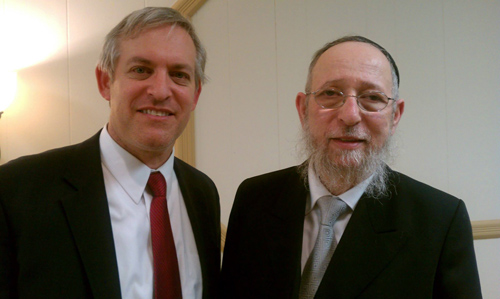
An Appreciation of HaRav Gedalia Dov Schwartz, zt”l

An Appreciation of HaRav Gedalia Dov Schwartz, zt”l

By Rabbi Akiva Males

On Thursday, the 24th of Kislev, 5781 (December 10, 2020), Jews around the world prepared to use their Shamash candles to light their Chanukah Menorahs. On that same day, leading rabbinic representatives of Chicago’s strong and diverse Orthodox community delivered moving eulogies for a world-renowned Torah scholar: Rav Gedalia Dov Schwartz, zt”l. For 95 years, Rav Schwartz served as a powerful living Shamash, using his vast Halachic knowledge to illuminate Chicago — and communities around the world.

Several of the speakers remarked that in addition to all of his responsibilities heading the Beis Din of the Chicago Rabbinical Council (CRC), Rav Schwartz readily made himself available to answer the Halachic questions of rabbis across the USA. As a Shul rabbi who regularly reached out to Rav Schwartz, I can confirm that detail as being absolutely true. However, in all honesty, Rav Schwartz shared so much more than answers to the Halachic questions he was presented with.

Having served for decades as a Shul rabbi himself, Rav Schwartz readily understood the context of the Halachic questions he was presented with. He also knew the challenges, pressures, and anxieties that rabbis ‘out in the field’ often experience. In addition to providing clear answers to the queries of puplit rabbis, Rav Schwartz was an overflowing spring of wisdom, guidance, and practical rabbinic advice.

Why would a Shul rabbi out in Harrisburg, PA (where I served from 2007-2016) join a rabbinical association based in Chicago, IL? While membership in the CRC benefits a rabbi for numerous reasons, for the most part, I joined the CRC because of Rav Schwartz. As a young rabbi in my first pulpit position, I quickly realized how much I needed someone to turn to for Halachic and rabbinic guidance. On what seemed like a near-daily basis, I found myself facing numerous scenarios I had never imagined encountering — and certainly did not learn about in Yeshiva. After reaching out to Rav Schwartz on a few occasions, I quickly felt embraced and supported — and a long-distance relationship was born.

After Rav Schwartz’s funeral, I felt drawn to look over the notes I took of many of our conversations. Packed away in a box, I found a six-inch-thick file containing some of the incredibly diverse Halachic questions that came up — and that I had discussed with different Poskim — during my years in Harrisburg. Reading through those pages brought back a flood of memories and emotions. Using Post-It notes, I began flagging the pages that involved Rav Schwartz. When I was finished, I was shocked by the number of times (and the vast spectrum of issues about which) he had generously shared his time, Halachic knowledge, and direction with me.

Since so many of the matters we discussed were of a sensitive nature, I cannot share the details of those questions — as that would not be fair to the parties involved. However, here is a small sampling of some of the questions I asked Rav Schwartz about:

  • A Shul member is extremely allergic to bee stings. The community’s Eruv will be down for a few weeks for major repairs. Can this fellow go out on Shabbos carrying his EpiPen — or must he stay home and indoors the entire Shabbos?
  • One of the Shul members has an expensive African parrot that will only eat the Chometz crackers that it is used to. What should this parrot’s owner do with it over Pesach?
  • The apartment building in which a Shul member lives installed motion sensitive lights in the halls and stairwells. Is there a Halachically acceptable way for her to leave her apartment on Shabbos?
  • A Jewish-owned chain of stores asked me to be their agent to sell their Chometz before Pesach. However, they will be open and doing business as usual over Yom Tov. Does such a sale of Chometz accomplish anything?
  • A photographer working for the local newspaper took some beautiful pictures of our community while we were reciting Tashlich on the first day of Rosh Hashanah. The pictures appeared in the next day’s paper. Can we purchase those pictures from the paper for our own use?
  • I received a letter from a Pennsylvania State prison inmate claiming to be Jewish. With his newfound free time, he has been exploring his Judaism. He recently learned that although he received a medical circumcision as an infant, in order to meet the Halachic requirements of Bris Milah, he requires a Hatafas Dam. He wants me to advocate for him to be allowed to have this procedure done while serving his time behind bars. Is this a case I should take up?
  • An out-of-town Jewish college student has unfortunately been exploring her interest in Christianity. She reached out to a family in our Shul asking if she could stay with them in order to attend a Messianic conference that will take place in our locale. Could the family agree to host her — with the hope that they will be able to dissuade her from pursuing her attraction to another religion?
  • How far must a Ger Tzedek go to prevent the cremation of his / her non-Jewish parent?

In looking through that file, I was struck by how many of the questions I posed to Rav Schwartz had to do with: A) the myriad of complex issues that result from intermarriage, B) the delicate balance that needs to be found in dealing with the local Jewish Federation and non-Orthodox congregations (and their leaderships) when it comes to matters of communal concern, C) enabling the local Jewish day school to thrive and continue providing a Torah education to as many Jewish children as it can, and D) helping Jewish converts in every way possible.

As stated above, when I called Rav Schwartz, I was looking for more than just his clear answers to the Halachic questions that I had for him. I also craved his sound advice, reassurance, and sometimes, his support. On one page of my notes, I read how I had sought his guidance in a particular thorny issue. He listened to all that had taken place, shared with me what he thought I had done right, what I could have done better, how I might still be able to iron out a wrinkle I had created, and finally, some excellent ideas for dealing with similar situations that might arise in the future.

On another page of my notes, I read how he fully agreed with a position I had taken in a complicated matter. I was set to discuss what had happened with the Shul’s leadership, and had reached out to Rav Schwartz to learn what he thought. He told me he agreed with me 100%, and that if I experienced any pushback, I could let the Shul’s Board know that he absolutely stood behind me. Fortunately, this was not necessary – as, thankfully, the Shul’s Board supported me. Nonetheless, knowing that Rav Schwartz was in my corner, and willing to back me up, gave me the reassurance I greatly needed at that time.

As I looked through my files, the following five stories jumped out at me:

  1. While Rav Schwartz clearly had a phenomenal mastery and memory of all Torah-related subjects, he was also keenly aware of the world around him. His attention to detail — and his recall of those details — was often quite surprising. As an example: I once turned to him with an important Halachic question from an Israeli family who had joined our community for a year so the husband (a high-ranking IDF officer) could attend the U.S. Army War College in nearby Carlisle, PA. After answering the question, Rav Schwartz commented, “I wonder if that college is located on the campus of the boarding school that Jim Thorpe attended.” (Thorpe was a famous Native-American athlete who passed away in 1953 — and indeed, the U.S. Army War College is located on the grounds of the former ‘Carlisle Indian Industrial School’.)
  2. Often, after answering a question, Rav Schwartz would let me know that he could relate to what I was experiencing by sharing a story from his own rabbinic career. He once told me about how decades earlier, while serving as a young pulpit rabbi in Providence, RI he turned down the local Jewish Federation leader’s invitation to deliver an invocation at a gala dinner they were holding to honor one of the most prominent Jews in town (who was intermarried). The guest speaker was going to be the famous Rabbi Abba Hillel Silver (Reform), and the food being served at the dinner was in no way Kosher. Rav Schwartz told me how shocked the Federation head was upon hearing his refusal to deliver a blessing at a dinner that was so at odds with Halacha.
  3. Rav Schwartz once mentioned that Orthodox rabbis will make the greatest impression on the broader non-Orthodox Jewish community through their Chesed and Menshlichkeit — and not via their scholarship. He recalled how once while visiting Cincinnati, OH he leafed through a year book published by the local Jewish Federation. In one year’s edition, there was a small blurb on the great Rav Eliezer Silver, zt”l. (He noted that during the time of Rabbi Silver, Cincinnati’s Jewish Federation did not have the warmest feelings towards Orthodoxy.) In that small write-up they sang Rabbi Silver’s praises. What was it about Rav Eliezer Silver’s many accomplishments that had caught their notice? It was not his Torah brilliance. Instead, the Ohio River had flooded and parts of Cincinnati were devastated. In the middle of all the chaos, Rabbi Silver was spotted in a boat bringing food and aid to others. It was Rav Eliezer Silver’s selfless Chesed that had made a lasting impact on those who were not aligned with him.
  4. In 2011, my wife Layala faced a great health challenge, spent several months in hospitals, and underwent life-saving surgery. Thank G-d, she recovered, and we will always be grateful to everyone who helped us get through that extremely trying time. Over the course of those months (and the months that followed), I reached out to Rav Schwartz with many personal and Shul-related Halachic questions. Inevitably, the first words out of Rav Schwartz’s mouth were, “How’s Laya Adinah bas Chaya Esther?” My wife’s Hebrew name — as well as my mother-in-law’s — was on the tip of his tongue. Not only was Rav Schwartz thinking of my wife throughout that challenging time, but he was letting me know that he was Davening for her as well. I cannot begin to describe how much that meant (and continues to mean) to Layala and me.
  5. I once turned to Rav Schwartz for guidance with an extremely sensitive situation involving a Jewish man who had married a non-Jewish woman. In the course of conversation, Rav Schwartz taught me an important lesson I will never forget. In asking my question, I had initially used the word ‘Shiksah’ in referring to the the gentile spouse. Rav Schwartz stopped me and said that such language is not refined, and is not appropriate for anyone — especially a rabbi — to use. He went on to explain that the term ‘Shiksah’ has a derogatory connotation, and that is why it never appears in any rabbinic responsa literature. Instead, non-disparaging terms like ‘Nochris’ or ‘Goya’ are always used. Rav Schwartz told me that moving forward, I should use those terms as well. I sincerely thanked him for sharing his advice, and have made a conscious effort to remove ‘Shiksah’ from my vocabulary ever since. (Each year, I make a point of sharing this lesson with my high school students as well.)

Unfortunately, the notes of my conversations with Rav Schwartz end in May 2016. That was when the CRC membership received an email informing us that sadly, our beloved Av Beis Din, Posek, teacher, and role model had suffered a debilitating stroke while leading a Daf Yomi Shiur. In the years that followed, I would regularly mail Rav Schwartz cards and hand-written notes. However, that fateful stroke put an end to the phone conversations which I had valued so greatly. (During a quick trip to Chicago in November of 2016, I was able to visit Rav Schwartz at his home. Though my visit was short, I found much meaning in it. I truly envy all the CRC members living in Chicago who were able to regularly visit Rav Schwartz over the past four years.)

Looking back, there are so many matters I would have loved to discuss with Rav Schwartz since the last time I reached him by phone at his CRC office in 2016. Sadly, that was not meant to be.

In reflecting on the interactions I feel privileged to have had with Rav Schwartz I realize something unique about him. Whenever I spoke with him, I gained more than just additional Torah knowledge and the guidance he so generously offered. I always departed (or hung up the phone) feeling I was a better person than I had been before our conversation began. In his very humble — yet noble — manner, Rav Schwartz had a way of elevating and bringing out the best in others. Interacting with Rav Schwartz was an uplifting opportunity for self growth — one that I and so many others wish we could experience again.

_________________________

Rabbi Akiva Males is privileged to serve Young Israel of Memphis as its rabbi, and also teach Torah at the Margolin Hebrew Academy — Finestone Yeshiva of the South. He can be reached at rabbi@yiom.org


New Seforim, books, random comments and Benny Brown’s Work on the Chazon Ish

New Seforim, books, random comments and Benny Brown’s Work on the Chazon Ish.
By Eliezer Brodt

As a courtesy to our readers, below I provide a list of some new seforim and books that I recently have purchased or become aware of. Some are brand-new, others have been out already for a few months. Some of these books, will be reviewed at great length at a later date, B”n. As I note, I have copies of the TOC of some of the works mentioned here, feel free to e mail me if you want a copy of the TOC.

ספרים
1. המעשים לבני ארץ ישראל, יד בן צבי, מהדיר: הלל ניומן.
2. פסקי הרי”ד, מסכת חולין, מכון תלמוד הישראלי
3. תשובות מהר”ם מרוטנבורג וחבירו, על ידי שמחה עמנואל, שני חלקים, 1251 עמודים, איגוד העולמי למדעי היהדות, כולל מבוא של 180 עמודים. ניתן לקבל תוכן הענינים.

This beautiful new work contains 501 teshuvot of Maharam Mi-rotenburg and his colleagues. Over 300 of these teshuvot were never printed before. Many of the others were only printed once before in a rare, little-known work of Y. Kahana.

4. פתחי שערים, ר’ יצחק אייזק חבר, עם הערות.
5. ר’ צבי פסח פרנק, הר צבי על התורה השלם, שס”ו עמודים.
6. ר’ דוב וואלף ליבשיץ, [אביו היה תלמיד של ר’ חיים מוואלז’ין] פרי חיים- כולל בתוכו באר חיים באור על סידור התפילה, רוח חיים באור על קהלת, מעין חיים חלק א חידוש תורה עם תולדות המחבר ומשפחתו, 260 עמודים בערך.
7. ר’ מנחם די לונזנו, דרך חיים, אהבת שלום, כולל מבוא חשוב, מפתחות והערות, שצ”ב עמודים. I will hopefully be dealing with this work at greater length in a future post shortly.
8. ר’ ישכר טייכטאל הי”ד, משנת שכיר, מועדים, ב’ חלקים.
9. ר’ שמואל אויערבאך, אהל רחל, חנוכה פורים, קצ עמודים.
10. חידוש הגר”מ הלוי סולוביצ’יק, מהדורא תנינא.
11. פתח הדביר, ה’ חלקים על שולח ערוך אורח חיים.
12. ר’ שלמה אלפאנדארי, יקהל שלמה, מערכת וזכרונות בהלכה ואגדה, חלק א, אהבת שלום, רס עמודים.
13. ר’ אברהם בן שמואל הלוי אבן חסדאי, בן המלך והנזיר, סידרה שירת תור הזהב, עם הערות ומבוא מאת אילת עטינגר, 242 עמודים. ראה כאן
14. פירוש ר’ יצחק ב”ר יוסף על התורה, מגדולי הראשונים שבספרד, תלמיד חבר של הרשב”א, בראשית, שנט עמודים, י”ל ע”י ר’ דוד וזכריה הולצר.
15. ר’ איתם הנקין, לכם יהיה לאכלה, בירור להלכה בסוגיית חרקים במזון, 167 עמודים, ראה כאן
16. ר’ חיים הלפרין, חמדה טובה, על י”ג עיקרים, לייקוואוד, שצ”ה עמודים. ראה כאן
17. ראש יוסף על מסכת שבת, פרקים ה-ז, עם הערות מר’ אפרים בנימין שפירא, כולל הפתיחה כוללת להלכות שבת ומפתח ענינים, תקע”ח עמודים.
18. ר’ חיים לפידות, עשות פרי, במעלת חידושי תורה, כתיבתם, והוצאתם לאור עולם, תתקנד עמודים.
19. ר’ אהרן בריסק, אוצר הזמנים, בין השמשות השיטות ובירורים, תקצג עמודים.
20. ר’ עובדיה יוסף, חזון עבודה שבת חלק ד.
21. ר’ משה היילפרין, זכרון משה על פירוש רש”י ורא”ם, עם מבוא והערות על ידי, ר’ פינחס קריגער, 249 עמודים, כולל הרבה חומר שלא נדפס במהדורת פייליפ.
22. ר’ יעקב גרייזמאן, ברוך ומקודש, דיני ברכת כהנים הנוגעים לישראל המתברך, דיני מצות וקדשתו ואיסור השתמשות בכהן, רסה עמודים.
23. רבנו חיים כסאר, דרך החיים, מצות תלמוד תורה ודרכי קניינה, מכון מרא”ה, קפ עמודים.
24. ר’ מרדכי הלפרן, רפואה מציאות והלכה, ולשון חכמים מרפא,546 עמודים, [מלא חומר חשוב], ניתן לקבל תוכן הענינים.
25. מציאות ורפואה בסדר נשים, עורך ר’ מרדכי הלפרין מהדורה שניה מורחבת, 462 עמודים, ניתן לקבל תוכן הענינים.
26. ר’ משה לייטער, צום העשרי על צום עשרת בטבת, רפז עמודים.
27. ר’ יצחק טסלר, פניני מנהג, ימי חנוכה ג’ חלקים. כריכה רכה מהדורת כיס.
28. ר’ מנחם גיאת, תורת חכם, אוצר דיני תלמיד חכם, שני חלקים, 1034 עמודים.

מחקר –היסטוריה

29. בן איש חי’ תולדותיו קורתיו ומורשתו לדורות, ניתן לקבל דוגמא מהספר אצלי.
This is a beautifully album size work on the Ben Ish Hai, including many rare documents and pictures.
30. ר’ יעקב ישראל סטל, סגולה, ספר ראשון, 153 עמודים, עיונים וברורים במנהג והלכה, פיוט מדרש ואגדה, נדפס במהדורה מצומצמת של 350 עותקים בלבד. ניתן לקבל תוכן הענינים וחלק מפרק לדוגמא.
This work is a excellent collection of articles on topics not usually written about, by others, full of interesting observations from an extremely rich and wide range of sources.
31. השלשלת מאיש לספר, אבישי יורב, ב’ חלקים, ראה כאן.
32. צורה ועריכה בספרות חז”ל, אברהם גולדברג ראה כאן.
33. כרמי שלי, מחקרים באגדה ובפרשנותה מושגים לפרופ’ כרמי הורוביץ, מכון לנדר. ניתן לקבל תוכן הענינים.
34. דוד סורוצקין, אורתודוקסיה ומשטר המודרניות, קיבוץ המאוחד 443 עמודים. ראה כאן
Some of the topics, dealt with in the book, are about the Maharal, R’. Yehudah Aryeh Modena, R’. Yaakov Emden and the Satmar Rebbe.
35. חנה כשר, על המינים האפיקורסים והכופרים במשנת הרמב”ם, קיבוץ המאוחד, 212 עמודים. ראה כאן.
36. ראשית חכמה, חיבור פולמוסי כנגד חסידים, 120 עמודים, מהדירים: יונתן מאיר ושמואל ורסס י”ל פעם ראשונה מכ”י. This is a critical edition of another very early work from an anonymous author attacking Chasidim. It is unclear if it’s from a maskil or a traditionalist talmid chacham. Much of it deals with attacking the Shivchei Habesht.
37. דניאל בוארין, מדרש תנאים, אינטרטסטואליות וקריאת מכילתא, הרטמן, 319 עמודים.
38. ר’ דוב בער שווארץ, משיב דברים, רעג עמודים, מאמרים ומכתבים בעניני היסטוריה.
39. ר’ חנניה ברוין, דרכי משה החדש, תולדות המהר”ם שיק, ש”ל עמודים.
40. ר’ דב אליאך, אבי הישיבות, תולדות חייו ומשנתו של ר’ חיים חיים מוולאז’ין וסיפורה של ישיבות וולאזי’ן מהדורה מורחבת, 719 עמודים.
41. עמנואל אטקס, בעל התניא, רבי שניאור זלמן מלאדי וראשיתה של חסידות חב”ד, מרכז זלמן שזר, 495 עמודים.
42. יונתן מאיר, רחובות הנהר, קבלה ואקזוטריות בירושלים (תרנ”ו-תשח) יד בן צבי, ניתן לקבל תוכן הענינים.
43. טוב עלם: זיכרון קהילה ומגדר בחברות יהודיות בימי הביניים ובראשית העת החדשה,ספר היובל לכבוד ראובן בונפיל, ביאליק, ניתן לקבל תוכן ענינים.
44. יוסף דן, תולדות תרות הסוד העברית ימי הביניים, חלק ז, מרכז זלמן שזר,480 עמודים
45. ספר תא שמע שני חלקים, מחקרים במדעי היהדות לזכרו של ישראל תא-שמע, הוצאת תבונות, 910 עמודים, ניתן לקבל תוכן הענינים. This collection is simply incredible, full of great articles on a wide range of topics.
46. שירת רבנו תם, מהדיר יצחק מיזליש, 185 עמודים.
47. חוה קליין, מתיר העגונות, 160 עמודים חיבור על אביה, ר’ שלמה זלמן קליין
48. רוח המשפט, מיכאל אברהם.
49. תלמידי הגר”א בארץ ישראל, היסטוריה, הגות, ריאליה, עורכים: ישראל רוזנסון ויוסף ריבלין, ניתן לקבל תוכן הענינים.
50. אפרים חמיאל,הדרך הממוצעת ראשית צמיחת הדתיות המודרנית, על שד”ל רב שמשון רפאל הירש, מהר”ץ חיות, הוצאת כרמל.
51. קובץ עץ חיים גליון טז, ניתן לקבל תוכן העינים.
52. עלי ספר חלק כב אפשר לראות תוכן ענינים כאן
53. קובץ המעין, גליון 200, ניתן לראות כל קובץ כאן.
54. ספר זכרון דגל מחנה ראובן, לזכרו של רבי ראובן אליצור,תקמג עמודים.
This work is composed of a few parts. One part is a biography of R. Reuven Elitzur. There are many interesting tidbits about life Eretz a seventy years ago. R. Elitzur was the long-serving librarian in Sifrat HaRambam in Tel Aviv, and was very knowledgeable about seforim. When asked about the story of the Maharal and the Golem, he said its baloney and was made up much later (p. 312). The second part of the work is a collection of historical articles that R. Elitzur wrote in various newspapers, especially against works written by maskilim (or people whom he claimed were maskilim). Among the topics he wrote about were R. Moshe Kunitz, the Cheshbon Hanefesh and Benjamin Franklin, R. Wolf Heidenheim, R. Zalman Hanau and much more. As R. Elitzur was R. Nissim Karelitz’s chavrusa for many years, some of his articles have the approval of R. Karelitz, such as his attack on publishers for printing Kunitz’s work Beis Rabbi in the introduction of Mishnayos Zeraim. R. Elitzur also used to provide rare seforim for R Chaim Kanievsky, such as the critical edition of the Sheva Massechtos published by Michael Higger which R. Kanievsky mentions in the introduction of his work on Geirim without mentioning Higger’s name.

One last issue related to the last two items mentioned on this list; a few months back Dr. Benny Brown’s magnum opus on the Chazon Ish was printed by Magnes Press, as mentioned here on the Seforim Blog. The book sold out in two weeks – one thousand copies! It was reprinted shortly afterward and copies are still available. Shortly after the book appeared, with much surprise, various attacks began on different forums on the Web (see, e.g., here, here, here, here, here and here). One attack was written under a pen name in the Yated Neeman. Shortly afterward, a more restrained and respectful attack was published by the same author – under his real name, Yehoshua Levine, in the journal Ha-Maayan available for reading here. In the most recent edition of the Ha-Maayan Benny Brown responded, and it is available here. One issue not really dealt with in Levine’s review is that the bulk of Brown’s huge book (951 pages) is about the Halacha of the Chazon Ish, not his history, and whether Brown get that right or not. Levine claims he has an article on that part too, which has yet to be printed. If one is interested in this unpublished part of Levine’s attack e-mail me. In my opinion this part of the article needs a lot of work. As for the other parts, I will let the readers decide for themselves, but I am not at all convinced that Levine is correct in the overall picture.

One of the issues raised by Levine, and many others, was about Brown’s claim that the Chazon Ish had a religious crisis in his youth. They do not find Brown’s proof for this convincing. However, it seems that Brown is most likely correct, although one can never know to what extent this crisis was. In the above mentioned work, Sefer Zichron Degel Machaneh Reuven, they print a hesped given in Bnei Brak by R. Yakov Edelstein, a close friend of R. Elitzur. R. Edelstein also knew the Chazon Ish, and his brother is one of the Roshei Yehsiva of Ponevezh today. R. Edlestein said at this hesped, after quoting the famous Rav Hutner on stories of gedolim in their youth:

ואנשים שהתפרסמו לא נולדו ככה, הם עברו הרבה נסיונות והרבה קשיים, על החזון איש לא מספרים על הילדות שלו, על המלחמות שהיה לו בילדותו והצליח לנצח בהם. החפץ חיים סיפר על עצמו שכשהיה בחור צעיר אולי בגיל בר מצווה, כמעט שנפל במלכודת של המשכלים, שהיו תופסים ילדים בעלי כשרונות, ומתחברים אליהם ומקלקלים אותם, ואמר על עצמו שהו’ עזר לו ונתן לו שכל להיות גיבור ולעמוד בניסונות ולהינצל (ספר זכרון דגל מחנה ראובן עמ’ כג).

Another issue that Levine and others raise is that Brown did not interview any family members or close talmidim of the Chazon Ish. I wonder why there is no mention of R. Gedalyah Nadel in the book. However, a very strong defense for Brown in my eyes is found in a short article written by Prof. Saul Leiberman in the journal Bitzaron printed in 1981, which I was shocked to not see it mentioned in Brown’s book or bibliography. One of Brown’s sources throughout the book is Chaim Grade masterpiece Tzemach Atlas and Milchemes Hayetzer (printed as The Yeshiva in English, trans. by Curt Leviant). Although this book is a novelization of the people and period, almost all the details are true, including all the parts about the Chazon Ish, whom Grade knew very well as he learned and lived with him for many years. I have heard from various people that Chaim Grade had an amazing knack to really penetratingly see into people (see here for one great example). Others told me Grade was 100% on the mark regarding the Chazon Ish. One great person told me that it’s a shame that Grade was not good in learning, than he would have been able to give us a similar write up in that area too. Thus it should be seen as a fairly reliable source (with appropriate caution). Now, Saul Leiberman was a relative of the Chazon Ish, who was very close to him in both Europe and in Eretz a (see Lieberman’s small article about this in Mechkarim Betorat Eretz Yisrael pp.608-611). So he is a good person to see what he would say about Grade’s portrayal of the Chazon Ish. Lieberman writes that in 1946 his brother Meir Lieberman – as an aside this brother was much more Orthodox than Lieberman – gave him a work that he said he must read- it was from Grade. Leiberman writes:

כיצד אפשר לחסוף טובה מאדם מישראל בפרט מאחי ובשרי התחלתי על כן לקרוא בקונטרסן בחיוך, אולם מיד חשתי כי נעלם החיוך מפני ואני לובש רצינות יותר ויותר עד שהרגשתי בענן הכבד שנחת עלי הוספתי לקראו מהחל עד כלה…

Lieberman goes onto describe how he met Grade in New York and how he loved to read his articles in the paper weekly.

התחלתי לקרוא את הפרוזה בעתון ללא דילוג אף שבוע אחד, רציתי לנחש כיצד יתפתח הסיפור ומה יהיה בסופה של המעשיה. עלי להודות שלא הצלחתי בניחושי דבר שלא הייתי רגיל לו בעבודתי המדעית וחקר טכסטים…

Then Lieberman writes about Grade’s description of the Chazon Ish as follows:

כאשר קראתי את צמח אטלס נתמלאתי השתוממות לדיוק התיאורים מלבד הגיבור הראשי צמח אטלס, שהנהו דמות חזונית מרכבת מאידיאות מאליפות, הכרתתי כמעט כל הנפשות הפועולת ברומן הישיבה של גראדה…בעל המחזה אברהם [א.ב. החזון איש]… אף אחד לא היה יכול לתארם ביתר נאמנות…

For me it puts to rest the issue if Brown’s work is based on sources of people who knew the Chazon Ish. Many thanks, to Chanan Gafni for informing me about this small article of Lieberman’s.

I would like to conclude with three comments regarding Brown’s book.

One, throughout the work Brown refers the reader to the appendix of his doctorate which contains an interview that he conducted with Dr. Tzvi Yehudah. This interview is full of great material, and in my opinion should have printed as an appendix in the back of the Magnes book.

Two, in Brown’s discussion of the famous controversy on how to write the letter Tzadi, an important source not mentioned can be found in Prof. Shlomo Zalman Havlin’s article in Alei Sefer (12:13-20).

Three, Brown claims that the Chazon Ish’s writings and language shows he was familiar with haskalah literature. I have no problem with such a claim I just wanted a few actual samples.

There was another review written about Dr. Brown book by Sholomo Tikochinski printed in the latest issue of Akdamus. See also this post.

Small announcement- sale.

There is a special sale on the 11 volume set of Chaim Chamiel’s work on Targum, 100 Shekel for the complete set. Contact Reuven Mass at rmass@barak.net.il.


Pini Dunner — Mercaz Agudat Ha-Rabbanim Be-Lita, Kovno, 1931

Pini Dunner B.A (Hons), formerly rabbi of London’s Saatchi Synagogue, is an avid collector of polemical and controversial Hebraica, with a very large, diverse private collection of such material. Many items in his collection are unknown and unrecorded, and relate to long forgotten, obscure controversies.

This is his first post at the Seforim blog in a series about rare polemical pieces from his personal collection.

Mercaz Agudat Ha-Rabbanim Be-Lita, Kovno, 1931
Pini Dunner
(London, England)

In the mid-1920s the rabbi and rosh yeshiva of Slabodka, R. Moshe Mordechai Epstein (1866-1934), left Lithuania to lead the newly established branch of his yeshiva in Chevron. In his place as rabbi of the Slabodka community he left his son-in-law, R. Yosef Zusmanowitz (1894-1942), renowned in the Lithuanian yeshiva world as the ‘Yerushalmi Illuy’. R. Zusmanowitz was a scholar of repute and a great communicator. The heads of the yeshiva, R. Boruch Horowitz (R. Epstein’s brother-in-law) and R. Yitzchak Isaac Sher (1875-1952; son-in-law of the Alter of Slabodka), were concerned that the young R. Zusmanowitz would also try and take over the yeshiva. They were totally opposed to his involvement in the yeshiva, especially as he was not enamoured with the strong concentration on mussar. Instead they appointed R. Zalman Osofsky as the rabbi of the town.

A fierce controversy erupted between the 2 factions. R. Zusmanowitz’s most vociferous supporter was R. Nota Lipshitz, son of the famous secretary to R. Yitzchak Elchanan Spektor, R. Yaakov Lipshitz. The fight became so personal that R. Lipschitz’s nephew was effectively expelled from Slabodka yeshiva simply because of his uncle’s support for R. Zusmanowitz. As a result, the nephew, and others, began to learn together with R. Zusmanowitz, thereby starting a rival Slabodka yeshiva. At its height the yeshiva had 50 students. Frightened of the competition, and of the fundraising confusion that was impacting on their income (Zusmanowitz fundraisers included the 2 Teitz boys from America), R. Horowitz and R. Sher arranged for the Agudat Ha-Rabbanim (R. Horowitz was chairman) to issue a psak that R. Zusmanowitz had to close his yeshiva. This decision was met with anger and derision by its supporters, but the yeshiva closed. None of the 50 students were allowed back into Slabodka yeshiva – except for R. Ephraim Oshry (1914-2003), and he was subsequently suspected of being a spy who had been planted by the Slabodka yeshiva in R. Zusmanowitz’s yeshiva.

In this stencilled poster, the Agudat Ha-Rabbanim vigourously deny that they had reported R. Zusmanowitz to the authorities as a subversive, as he and his supporters were claiming in posters, pamphlets and correspondence. They also explain that as R. Zusmanowitz refused to sign that he would not open a yeshiva if he won the elections that had been scheduled as a way to resolve the dispute, he had effectively ruled himself out of the election. The status-quo that established itself during this time was that R. Osofsky was the rabbi for the Slabodka yeshiva community and R. Zusmanowitz was the rabbi for the rest of the town. The whole controversy was viewed very negatively by those not involved, and particularly because R. Zusmanowitz’s opponents – who used a variety of nefarious tactics to get their way – were meant to represent the mussar movement and its ethical ideals.

R. Zusmanowitz later became the rabbi of Wilkomir – a position for which R. Yaakov Kamenetsky had been vying, and thought he had secured – when the previous rabbi, R. Arye Leib Rubin, father-in-law of the Ponevezher Rov, died in 1937. It was as a result of this that R. Kamenetsky came to America. He would later say that what had at the time seemed like a tragic failure had in fact saved his life and the lives of his family as he was spared from the Holocaust as a result. R. Zusmanowitz was not so lucky. He was killed in 1942. (With thanks to Rabbi Eliezer Katzman for much of the information concerning this controversy).


The Mother Haggados: Models for Modern Analysis of Printed Jewish Illustrations

The Mother Haggados: Models for Modern Analysis of Printed Jewish Illustrations

There is a long tradition of illustrating Haggados, dating back to at least the early Middle Ages. Likely only a small portion of those manuscripts has survived. However, most have been reprinted, and their imagery has been meticulously analyzed and cataloged. These manuscripts can broadly be divided into two categories based on their places of origin: Sephardic or Ashkenazic countries. The former includes the creation cycle and the Exodus story prior to the Haggadah text, while the latter incorporates the imagery into the text. Within these categories, and with the exception of “brother” or “sister” manuscripts, no single manuscript necessarily influenced subsequent ones. Of course, common manuscript imagery appears in many of these manuscripts, with the hunting scene being the most ubiquitous.

Illustrations in printed Haggados, however, are different. They can be traced back to four “mother” Haggados, each the first in its respective region, representing the three main geographical areas of Jewish settlement and centers for printing Hebrew books: Prague, 1526 (Eastern Europe); Mantua, 1560 (Italy); Venice, 1609; and Amsterdam, 1695 (Western Europe). These specific Haggados were reprinted many times, with the illustrations, motifs, and themes appearing in them—sometimes collectively and at other times singularly—finding their way into nearly all subsequent illustrated Haggados. Some of these illustrations reflect influences from manuscripts, and all three were impacted by the broader non-Jewish culture and geographical iconography (though not directly related to the text itself). For example, an Italian Haggadah shows Avraham crossing a river in a gondola, while Prague incorporates Gothic architecture for the Egyptian cities. Additionally, we can sometimes identify specifically Christian iconography or direct borrowing from Christian sources in these and later Haggados. Occasionally, this involves using an image that carries no specific Christian connotations, while in other instances, the usage is clearly identifiable as specifically and uniquely Christian.

While these Haggados are discussed by many scholars, at best they analyze a few images, and even in many instances, they fail to fully account for the nuance of the images. Instead, they focus on external influences or some exotic element of the images. This form of analysis is no longer in vogue, and as it relates to Hebrew manuscripts, it has seen a substantial correction, most notably in the recent works of Marc Michael Epstein and Katrin Kogman-Appel on Hebrew manuscripts.[1] We hope to make a small contribution to redirecting the narrative regarding the imagery of printed Hebrew Haggados. What follows is not intended to be a comprehensive analysis of all printed illustrated Haggados. Indeed, we do not discuss Prague 1526, as we have dealt with that edition on a few previous occasions (here, here, here, here, here, here, and here). Rather, we hope it serves as a minor contribution in applying the current methodology used for Hebrew manuscripts to the Hebrew book.

Mantua 1560: Many Cooks in the Kitchen

The Mantua 1560 Haggadah is the first Italian-illustrated Haggadah, published by Giacomo Rufinelli and it is available here from a copy in the Braginsky Collection (the NLI recently exhibited the manuscripts from Collection, with a companion book, Encounters with Beauty). The woodblock images were overseen and possibly even executed by Yitzhak ben Shmuel Bassan. However, since they are unsigned, the artist is uncertain. Yet, however, as we will see, there may have been multiple artisans involved in creating the woodblocks. Bassan served as the shamash in the first synagogue established in Mantua by Yitzhak Porto.

Mantua 1560 is the first illustrated Haggadah to include a title page. The convention of title pages became standard in Hebrew books only in the early middle period of the 16th century; see our discussion here. Like many Jewish and non-Jewish title pages, it frames the page with architectural elements, such as arches and pillars. These pillars are unique. They are not traditional columns but helical (twisted) pillars, referred to as barley-sugar pillars.

While at first blush, Rufinelli’s incorporation might seem associated with a distinctly Christian structure, closer examination reveals that the printer’s usage served a different purpose, one explicitly aligned with his publishing house. This style is most well-known for its use in St. Peter’s Basilica in Rome, which was constructed in the 4th century by Constantine the Great and this style is claimed to be derived from the famed pillars of the Solomonic temple, the yachin and boaz pillars (although no Jewish sources describe these as helical). These pillars supported the dome above the main altar. The original Basilica was demolished in the early 16th century and rebuilt at the end of that century. It was most famously reproduced by the school of Raphael in “The Donation of Constantine,” completed around 1524, and adorns the ceiling of Sala di Costantino, one of the four Raphael rooms within the Vatican Palace. Nonetheless, Rufinelli most likely used these pillars not to evoke St. Peter’s but for a more local reason, specifically to identify his books as Mantuan in provenance. The local Cortile della Cavallerizza in the Palazzo Ducale in Mantua, designed by Giulio Romano and completed around 1540, predates Rufinelli’s incorporation of these pillars in his books (they appear in the Haggadah and others). The second elevation is notable for its barley-sugar pillars, an early example of the Mannerist school of architecture and among the Palazzo’s most unique and recognizable features.

Cortile della Cavallerizza

Perhaps, in Rufinelli’s mind, these pillars symbolized Mantua, and he treated them as akin to a printer’s device expressing familial or other aspects of the printer. Indeed, while Italianate books in the 16th century regularly incorporated architectural elements into title page designs, we have not located any books that utilize the Solomonic pillars, despite their history and symbolism in Italy, other than Ruffinelli’s Mantuan prints.[2]

Another image from this Haggadah originates from the Vatican Palace: the depiction of the prophet Jeremiah that Michelangelo painted on the ceiling of the Sistine Chapel. Jeremiah, seated in a contemplative pose with his hand on his beard and legs crossed, is used to illustrate the wise son in the Haggadah. Nevertheless, the image takes on a unique Jewish twist in the Haggadah version. Jeremiah is no longer bareheaded; instead, he wears a Pileus Cornutus, or Jewish hat, the cone-shaped headgear commonly mandated by Christian law.

Mantua, 1560

The first edition of the Maxwell House Haggadah (we discussed the history of the first edition here) also reproduces a well-known Renaissance image of Rembrandt. It includes Rembrandt’s Sacrifice of Isaac, now in the St. Petersburg Museum.

Maxwell House Haggadah, New York, 1932

The illustration of the final son, the one who cannot ask, is also of non-Jewish origin. In this instance, it comes from a biblical illustration by the noted illustrator, Hans Holbein the Younger, and appears in Icones Historiarum Veteris Testamenti, first published in 1538 (page 88). The image is used in a different context, Psalms 53:2, for a fool, but in the Haggadah, it illustrates the son who does not even know how to ask.

Mantua, 1560

Holbein, Icones Historiarum Veteris Testamenti

Determining the source of the remaining images, as well as the number and identity of the artists involved in the production of this Haggadah, is challenging. A close examination of the style and quality of the images suggests that at least three artists contributed. Artist A’s work features detailed, technically accurate German-style drawings, while Artist B’s illustrations resemble almost childlike line drawings that lack perspective and depth. The third artist, Artist C, produces illustrations that are not as crude as those of Artist B, as they possess a sense of perspective. Yet, they are also not executed as well as those of Artist A.

Artists A and B appear on the first page of the Haggadah. In the upper right-hand corner, there is a detailed and precise depiction of a man searching for hametz, dressed in a Germanic style, belted and wearing a beret, with the ceiling and fence rendered with perspective. At the bottom center left is a simple line drawing of the matzah baking scene. The men and women wear Italianate clothing, with the men in unbelted tunics and cloth caps covering their ears or in flat hats, and the women in low-cut dresses with exaggerated shoulders. There is no depth, as the men on the far left overlap on the same plane as the women kneading the dough. Similarly, the two people at the table in the right-center, using the “redler” (dough docker) to mark the matzah, also lack perspective.


Artists A and B are again juxtaposed on facing pages, featuring two images depicting the killing of Jewish babies. On the right page, we see the midrashic image of Pharaoh bathing in the babies’ blood, while the left page shows the act of casting the babies into the water. Here, as well, the illustration on the right side portrays the participants with realism, whereas the left displays simple line drawings. The woman on the far right of the left page, with her hands raised, contrasts sharply with the despondent woman at the far right of the right page, where the anguish of having her child torn from her arms is powerfully conveyed.

Artist C demonstrates intermediate technical skills between those of Artists A and B. Two similar images of the family at the seder demonstrate the distinction between Artists B and C. Artist B’s work consists of line drawings, offering little to no shading or depth on a single plane, whereas Artist C’s piece presents a crowded scene where each figure wears a unique dress, showcasing multiple perspectives and well-rendered depth of perception.

A comparison between two figures, both seated in similar chairs and holding comparable objects, effectively represents the distinct styles of Artists A and C. Rabbi Eliezer, characterized by a disproportionate head and a simpler chair. The king image, however, holds a topped goblet with filigree on the bottom and is seated beneath an elaborate copula. All of the features are well-proportioned and executed within a smaller and more challenging format. These distinctions suggest that the two seated men cannot be the work of the same artist.

Artist C is evident in Moshe leading the Israelites out of Egypt. The large group of Israelites is well drawn (no Artist B line drawings), but Moshe, particularly his head, is not rendered as well as the figures in Artist A’s works.

Similarly, the most recognizable image from this Haggadah, which shows the Messiah on a donkey with Elijah following, displays the hybrid style of Artist C. The Messiah, donkey, Elijah, and especially the figure with the bow and arrow are clearly less refined than those of Artist A, but not as simplistic as Artist B.

None of the Haggadah’s images are signed. One clue to the influence of Artist C is seen in his illustration of Avraham crossing the river. His boat of choice is a gondola, suggesting that Artist C may have Venetian origins.

The gondola also makes a brief appearance in another of Artist C’s images, titled “Building Pitom and Ramses.” There is a small gondolier crossing the river visible at the top center of the image.


Artist A’s city of origin, or where he may have spent time, cannot be determined from his drawings. The wise son, Jeremiah, is depicted by Artist A, but, despite the origins of this illustration in the Sistine Chapel, we cannot identify Artist A as Roman, nor confirm that he viewed the image firsthand in Rome. It is more plausible that he encountered the images only through drawings, whether printed or otherwise. A comparison of the beard in the Haggadah, with its long, wavy hairs, aligns much more closely with this drawing, now in the Metropolitan Museum of Art, printed in Mantua (although its dating is disputed), rather than with Michelangelo’s bushy, untamed beard in the Sestina.[3]


If, indeed, there are three artists, we can tentatively associate the images with their artists as follows:

Artist A: King on chair (p. 2, 3,36, 37, 42, 70), Jeremiah (p. 9), praying man (p. 9, 14), four sons (p. 10-11), Rosh Hodesh (p. 11), Pharoh bathing in blood (p. 20), Aaron with staff (p. 24), angel with sword (p. 24), R. Yosi (p. 26), King pointing finger (p. 27), Israelites escaping Egypt with Egyptian pursuing (p. 28-29), Paschal lamb (p. 32), matzah (p. 33, 40), maror (p. 34, 38, 40),.

Artist B: matza baking (p. 1), family seder (p. 4, 42), children thrown into the river (p. 21).

Artist C: hare hunt (p. 3), enslaved Israelites building (p. 6, 35), Avraham on gondola (p. 13), young woman (p. 18), Pitom and Ramses (p. 19), R. Eliezer (p. 28), Egyptians drowning (p. 31), Moshe leading the Israelites (p. 38), family seder (p. 41), Elijah entering Jerusalem (p. 45).

Venice, 1609 An Egalitarian Haggadah?

The third “mother” Haggadah was conceived by Israel Zifroni, a printer, editor, and typesetter, and published by Giovanni di Gara in Venice in 1609 (briefly discussed here and here).[4] The images are unsigned and it is unclear if they were executed by Zifroni or he just oversaw their production. There were three editions: in Judeo-Italian, Judeo-German, and Ladino.5 On the title page, Zifroni invokes the verse from Psalms 148:12: “‘Youths and maidens, elders and boys, will praise the name of the Lord,’ who inspired me, Zifroni, to bring this crown of beauty to light, so that no eye will be satiated by its forms. Here, one can always find novelties; these were not done in vain, but with intention and purpose. These will prolong the story, for your eyes withhold my glory and my deeds related to it.” In this epigraph, Zifroni alludes to two unique aspects of the illustrations in his edition: its egalitarianism, as it is for everyone, and the deliberate nature of the illustrations, meant to provide additional commentary to the text and fulfill the obligation that “whoever adds in the retelling is praiseworthy.”

While Zifroni surely intended that the Haggadah be used for all age groups, one of the “novelties” in the illustrations is a focus on a female audience. This inclusivity, emphasizing images depicting women, repeatedly appears throughout the Haggadah. Additionally, there are scenes that do not include women, in previous Haggadahs, and it is unclear from the text if women participated. Nevertheless, Zifroni incorporates them into the narrative.[6]

Zifroni’s intentional and distinct approach is already evident from the title page imagery, which contains six images divided between the processes of searching and burning hametz and matzah baking. The people depicted conducting these processes are exclusively women, with no men present. This gendered approach sharply contrasts with the Prague 1526 and the Mantua 1560, which depict a man searching for Hametz.

Mantua, 1560

Prague, 1526

Similarly, while the baking scene at the bottom of the page is very similar to that of Mantua 1560, nearly all the men depicted are now women. Aspects of the process in Mantua were entirely male, whereas in Zifroni’s they are now exclusively female.

Venice, 1609

Mantua, 1560

In Mantua, the kneading depicts three men, while in Zifroni’s there are three participants as well, but one is a woman. Mantua shows two men mixing the dough, whereas Zifroni’s features two women. Mantua has two men shaping and puncturing the dough, while in Zifroni’s there are two women. Even in the scene at the top of the page depicting the harvesting and checking of wheat, where the heavy labor involved could easily be portrayed as exclusively male, Zifroni still includes one woman at the table checking the wheat.

Zifroni’s biblical scenes, when possible, include women. For example, in the scene above depicting Avraham crossing the river in the Prague and Mantua Haggadahs Avraham is shown alone, accompanied only by the rower in Prague (second image below) and the gondolier in Mantua (third image below).

This aligns with the verse in the Haggadah, “that I took Avraham your forefather over the river,” which does not mention anyone else. By contrast, in this seminal scene in the formation of the Jewish people, Zifroni did not limit himself to the literal text. His illustration references the biblical story that includes Sarah. Thus, she is portrayed in the gondola, along with two other women at the dock about to board, while no other men, aside from Avraham, are present, not even Lot. This multitude of women sharply contrasts with the scene on the right, depicting idol worship, where the genders are reversed; here, there is just one woman, and the rest are men.

Another “novel” illustration related to the Israelites time in Egypt. The Talmud offers two reasons why women are obligated to the same degree as men in reciting the Haggadah: they too were included in the Exodus miracle, and, according to Rabbi Avira, they were not just participants, they were the catalyst for the Exodus (Sotah 11b). There are at least three episodes that demonstrate the integral part women played: Shifrah and Pu’ah, women’s roles in the exponential reproduction of the Israelites, and Pharaoh’s daughter saving Moshe. All three feature prominently in Zifroni’s images. While infanticide is illustrated in Prague and Mantua in two panels, one showing the gruesome murder to drain their blood for Pharaoh’s bath and the other showing them being cast in the river, neither Haggadah shows the multiplication of the Israelites. Yet, in Zifroni’s work, in addition to one panel of the babies being cast in the river, he includes two that illustrate the population explosion, specifically highlighting the unique and nearly exclusive role of women.

The first shows four women nursing and raising the children, both alluding to the midrash teaching that Jewish woman in Egypt birthed sextuplets. On the right, one woman is nursing two children while another four are clamoring for sustenance. In the middle, the three other women tend to six children. Two men appear far to the left, only partially depicted with most of their bodies cut from the scene (perhaps alluding to their male parts, their only relevant part in the story). Additionally, as we previously discussed in the article, “Separate Beds,” this printed Haggadah is unique in representing Jewish abstinence. Like the other images, it displays an awareness with rabbinic literature. 

Indeed, this scene is repeated and expanded upon on the next page. Again, a woman nursing six children, this panel now incorporates the earlier part of the story, which emphasizes that the women encouraged their husbands, even after a brutal day of enslavement, to spend time together. This alludes to the Talmudic passage that uses the verse in Shir HaShirim (8: 5), stating that they procreated under the apple tree. The Nile River is included in this scene, not to illustrate infanticide, but to show the women bathing in preparation for their meeting with their husbands.

Even the panel that depicts infanticide is unique in that the largest and most prominent portion of the scene shows Pharaoh’s daughter saving Moshe. Additionally, Shifrah and Pu’ah appear before Pharaoh on the left, unlike any earlier illustrations that omit them entirely.

Contrasting the earlier Haggadahs illustration of the scene with the Israelites safely on the side of the sea and the Egyptians drowning highlights the central role that women play in Zifroni’s version.

In his depiction, the center of the frame shows Miriam playing instruments and singing with the women, while Moshe and the rest of the men are relegated to the right of the panel. In Mantua, (the two images below) Miriam is merely part of the larger group, identifiable only upon close examination.


In Prague, the scene is exclusively male. Likewise, in the scene of the Israelite encampment in the wilderness, Zifroni was careful to include Miriam and her well.

Another scene where there was no need to include women is Avraham meeting Malki Tzedek, where a woman appears at the far right of the panel.

There are other scenes where women take center stage. When eating the matzah, the women at the center distribute it to the men, seemingly indicating that the women are leading the seder. Both Prague and Mantua, show only a lone man.

Mantua, 1560

Women are central in the scene of the Four Questions. Their prominence is particularly noticeable as the image on the following page depicts Rabbi Eliezer and other sages, with him in taking center stage.

Similarly, when Avraham greets the three angels, both he and the angels are shifted to the left of the frame, while Sarah, in the tent, occupies the center.

Finally, most radically, although it is not entirely clear as the top of the head is obscured behind the letter, the wise “son,” upon close examination, it is perhaps a woman. Unlike the other “sons” this child is wearing a skirt whereas the men and boys are in pants!

In conclusion, one prominent and exceptional thematic element in Zifroni’s illustrations is the significant role of women. This leaves little doubt that he intended to portray and elucidate the Haggadah through deliberate images that appeal to and highlight both the feminine and the traditional masculine role in the Exodus.

Amsterdam 1695, A Judeo-Chrisitan Haggadah or an Exemplar for Haggadah Illustrations?

One of the most striking examples of Christian iconography in the Hebrew book is the 1695 Haggadah printed in Amsterdam and illustrated with copperplates by the convert Jacob Bar Abraham. This marks the first use of that technique in a Hebrew book, which allows for a much more refined and precise presentation of images. The Haggadah also includes a fold-out map, though it may not be the first example in a Haggadah.[7] Bar Jacob was originally from the Rhineland and may have even been a Christian preacher.[8] He was not the only convert involved in Amsterdam Jewish printing. According to Yaari, there were at least six others.

These images were used as a template for at least four 18th and 19th-century Haggados in Amsterdam, as well as hundreds of editions printed in Germany and Eastern Europe, and even as far afield as Iran, India, and North Africa.[9] There are at least five 18th-century manuscripts that also utilize Bar Jacob’s images.[10] Despite their popularity throughout the European Jewish world, the source of his images is non-Jewish. Thirteen of the fourteen illustrations in this edition, and six of those on the title page, do not come from any of the three other “mother” Haggados. Instead, these illustrations are sourced from the biblical images created by the Christian artist Matthaeus (Mathis) Merian the Elder.[11] They first appeared in his Icones Biblicae, published in Basel in 1625, and were subsequently incorporated into the most popular Bibles in the Rhineland

Bar Jacob’s source was first identified in 1931, a fact acknowledged by subsequent analyses of this edition. Some critiques are highly critical of Bar Jacob’s model, with one scholar going so far as to assert, without any corroborating evidence, that “there was fierce opposition” to Bar Jacob’s edition.[12] These scholarly critiques generally question the appropriateness of using Christian biblical imagery, the lack of direct relevance of this imagery because it was not designed for the Haggadah, and the failure to follow the “traditional” imagery found in other “mother” haggados. Despite the great scrutiny to which this edition was subjected, the most obvious Christian element that appears in just one of the fourteen images went unnoticed scholars.[13] And in fact, upon close examination, these scholars’ complaints are easily refuted. While Bar Jacob’s source was Merian, he transformed those images to fit the Haggadah, and with one exception, they fall well within the bounds of accepted Jewish imagery and further enhance and clarify the text of the Haggadah.

The six biblical images at the top of the title page predate the Exodus story, which triggered some complaints of them being non-conformist and irrelevant.[14] Yet, this criticism fails to acknowledge the widespread Sefardic manuscript convention, dating back at least to the 14th century, of prefacing the Haggadah with biblical imagery that documents the precursor events to the Exodus. The Sarajevo Haggadah but one of many examples. Indeed, most Jews in Amsterdam in 1695, particularly the wealthier individuals who were likely the target audience for what was presumably an expensive Haggadah, were of Sefardic origin. Some scholars identified examples of borrowing images and motifs from Medieval manuscripts in other “mother” haggados, but they overlook this when it comes to Bar Jacob.

Perhaps the most consistent criticism relates to the disconnect between biblical images and the Haggadah liturgy. Since Merian’s images were designed for the Bible, they do not necessarily correspond directly to the words of the Haggadah. While some parts of the Haggadah reference the biblical story, Merian did not illustrate those specific narratives. To address this limitation, Bar Jacob discovered alternative images and adapted them for the Haggadah. Importantly, Bar Jacob did not merely “cut and paste.” He modified Merian’s images as needed to align with and, crucially, to clarify through illustration the Haggadah and its themes. Since these subtle modifications do not align with traditional scholarly criticism, most remain unmentioned. Although we lack the space to cover all of Bar Jacob’s images and his distinct approach, we will revisit this later. One scholar points out that “the most egregious” example is Bar Jacob’s illustration of the rabbis in Benei Brak. Being that this story post-dated the Bible by many centuries, none of Merian’s images were intended for this scene. Instead, Bar Jacob used Merian’s image of Joseph and his brothers, provoking this scholar’s ire.

From the Gross Family Collection


This is another example of a surface-level examination of printed illustrated Haggadah images. A close look at the image demonstrates that, rather than being an egregious usage of Merian, it perfectly illustrates Bar Jacob’s approach to transforming the image to suit the Haggadah and express the nuance of the text. In adapting Merian’s image, Bar Jacob modified it in three significant ways, all of which render it especially suitable to clarify the text of the Haggadah.

The purpose of the story of the rabbis in Benei Brak is to provide a historical example of people meaningfully discussing the Exodus story all night. The rabbis were so engrossed in conversation that they were unaware that the time for this obligation had ended, and that they were now required to express the Exodus in a different and common format, reciting the Shema. The nocturnal nature of the story is a central element. Thus, in Bar Jacob’s version, the chandelier, which in Merian’s version is unlit, is lit. To further emphasize the fact that this took place at night, Bar Jacob includes two lit candles in the foreground.

Second, the Benei Brak story is predicated on the fact that the rabbis were unaware that the sun had risen. Thus, as opposed to Merian’s version, where Joseph and his brothers are dining in a room with large open windows, Bar Jacob’s version has opaque windows, indicating that the rabbis became aware that the sun had risen only when their students interrupted the discussion. The windows also allow Bar Jacob to avoid the visible church with a cross atop the steeple that is seen through the large opening in Merian’s version.

Third, Bar Jacob has removed the two dogs, a common Christian artistic motif, from the foreground. The Talmud is anti-canine. Indeed, Rabbi Eliezer, one of the sages listed in the Haggadah, stated that “one who breeds dogs is like one who breeds pigs!” Needless to say, it would be highly inconsistent with the text of the Haggadah to retain dogs in the illustration.

The final modification is in the participants’ headgear. In Merian’s version, only Yosef’s head is covered, with a royal turban. Bar Jacob’s version has all the rabbis wearing head coverings. Beyond a possible Jewish halachic requirement to cover one’s head while engaged in Torah study, a close examination of the headgear fundamentally changes the scene’s dynamic. In Merian, the brothers genuflect to who appears to be an Egyptian royal figure. In the Haggadah, all the rabbis are equal in their obligation. This is made clear in the previous statement of the Haggadah, which states that all, whether wise, knowledgeable, and even those proficient in the entire Torah, are equally obligated to discuss the Exodus story all night. Bar Jacob retained a figure at the head of the table, yet his importance is deemphasized because he wears the same hat as the rabbi on his left.

Bar Jacob’s awareness of the limitations of Merian’s illustrations is evident in the one illustration in the text that is not from Merian. Merian’s illustration of Moshe receiving the Torah depicts Aaron meeting Moshe and the Israelites worshipping the Golden Calf. Thus, Merian’s focus is on sin rather than the spiritual importance of receiving the Torah. Therefore, Bar Jacob chose a different image, one that appears in many Amsterdam Bibles (see here, here and here), showing the Israelites celebrating the event.

Yet, there is, one image that seemingly includes an obvious Christian element: a cross. While somewhat unclear due to its minuscule size, Bar Jacob’s depiction of the Temple appears to have a cross on the front of the building’s roof. Bar Jacob did, however, modify the image in another way to clarify the text. Marien’s version features many people outside and inside the Temple. But the text of the Haggadah discussing the Temple is a prayer for the future, and Bar Jacob presented the Temple as empty, symbolic of the fact that Jews today do not have a Temple to visit. We pray that in the future, we will all be among those in its courtyards.

From the Gross Family Collection

Surprisingly, this is not the only instance of a cross in a Hebrew book. For example, in the 1747 Hamburg edition of Mahram Schiff, the bottom image includes two prominent crosses. Likewise, the bottom left image of the 1668 Amsterdam edition of Nahlas Shivah, which uses “Moshiach Bar David Ba” to denote the year, shows a cross in the background.

Finally, we must discuss two additional Haggados, both of which have been repeatedly praised as beautiful examples of illustrated printed Haggados. Unfortunately, upon close examination, they clearly display Christian iconography in an entirely unnecessary and highly problematic manner. The first, Basel 1816, praised by Steinschneider and described as containing “pleasing” woodcuts is the most troubling. In 1997, this edition was even reprinted and colorized to mark the centennial of the first Zionist Congress held in Basel. For centuries, some have claimed a connection between Jesus’ Last Supper and the Pesach seder. Yet, Jews today would reject the notion that they are reenacting the Last Supper. But in the Basel Haggadah the text regarding the three items that one must eat on Pesach is illustrated with the image of Jesus at the Last Supper, surrounded by the Apostles!

The final “Christian Haggadah” is described by Yerushalmi as “undoubtedly the most distinguished illustrated edition produced in Europe during the 19th century,” and the images “welcome a freshness of design.” Alexander Marx praised its “refined artistic taste,” and that the illustrations are “dignified and pleasing and make this edition outstanding among its contemporaries.”[15] Despite these compliments, in truth, most of the images are not fresh but are copies of previous images from the “mother” Haggados, specifically the 1609 Venice Haggadah. In many instances, this “distinguished” edition eliminates the nuance and meaning of those earlier images. In some cases, the images are nonsensical. Finally, many of the designs suffer from blatant non-Jewish imagery.

From the Gross Family Collection

For example, the Venice Haggadah uniquely enhances the image of the Israelites’ encampment with Miriam and her well as part of the theme of emphasizing women’s role in the Exodus. In the Trieste Haggadah, Miriam and a group of women appear in the bottom far right. However, the women seem to be worshipping her as some sort of deity, with one woman bowing to her. The Venice Haggadah includes the scene of Yaakov meeting Lavan after fleeing Lavan’s home. It features four tents in the background, each with one of Yaakov’s wives, as they play a critical role in that story – Lavan’s complaint is that he did not have the opportunity to say goodbye to them, and then Rachel has a calamitous interaction with Lavan. Yet, in the Trieste Haggadah, there are five (!) empty tents.

Finally, in the most egregious image that is not modeled after any of the prior Haggados, Moshe appears before the burning bush, with God depicted as a man with a beard. Of course, direct depictions of God are prohibited. Unfortunately, this is not the only example in Hebrew books depicting God’s face. The title page of the first edition of Minhas Shai, 1742-1744, also includes such an image. However, it appears that, unlike the illustrator of the Trieste Haggadah, the illustrator of that title page was a non-Jew. This is evident from the fact that the artist was unfamiliar with Hebrew, as the letters are crude and obviously copied. Likewise, since the illustrator of the Kaufmann Haggadah was a non-Jew, in the scene with the burning bush God is depicted as a man.[16]


From the Gross Family Collection

The Moss YaKNeHZ: History and Historic Imagery

The four “mother” haggados are not the only examples of thoughtful illustrations in printed haggados. A contemporary work by David Moss, who remains active with his studio in the Artist Colony in Jerusalem, is an exceptional piece that creatively combines the history of illustrated Haggados in both manuscript and print. The original manuscript has been recently acquired (at Sotheby’s auction) and donated to the National Library of Israel, where it is now on display (see here). If one cannot visit, they can still enjoy it in the comfort of their home. Originally, a small number of exact reproductions were produced; however, those are long out of print. Still, copies of a beautiful two-volume reproduction remain available—one volume contains the manuscript, while the other offers explanatory notes. This edition is admittedly missing a few original elements, but it retains many of the most critical aspects, including the papercuts and fold-out pages, leaving most of Moss’s genius still apparent. One version merely reproduces the Haggadah in a flat format, and we recommend splurging for the two-volume version.

As this year’s Pesach begins on Saturday night, we will use Moss’s accompanying illustration of the procedure unique to that evening as an exemplar of his approach. This procedure, referred to by the Talmud by the acronym YaKNHaZ, translates to the order of operations for the blessings: Yayin (wine), Kiddush, Havdalah, and Zeman (the Shehechiyanu blessing). Moss depicts this section with 12 boxes, 11 containing coins adorned with eagles, and the final one showing a hare jumping out of the frame. This illustration references manuscripts, one of the “mother” haggadot, and its subsequent expression, Jewish history more broadly.

Upon closer inspection, the hare makes an appearance not only in the final box but also is present in each of the boxes with eagles, where it is grasped in their talons. The scene of a hare hunt is common in both non-Jewish and Jewish manuscripts, yet in many instances, it is simply aesthetic and disconnected from the text. However, in the Prague 1526 Haggadah, it becomes directly associated with the text. YaKNHaZ sounds similar to the German phrase “Jagen Has,” which means chasing or hunting hares. The Prague illustrator includes an image of hares fleeing from the hunter and seemingly running headlong into a net. In the next illustrated Haggadah, printed in Augsburg in 1534, which mainly uses the Prague illustration, the hare hunt appears on two panels, transforming the narrative from merely evocative of the procedure to becoming symbolic of the Exodus story. The first panel is a copy of the Prague illustration; yet, rather than the hares succumbing to their pursuer, the second panel shows them jumping over the net to safety. The hunter is no longer just a hunter, and the hares are not mere animals of prey. Instead, the hunter symbolizes those who seek to persecute the Jews, while the hares represent God’s promise that the Jews will ultimately prevail against their adversaries.

Moss’s research uncovered that many historically anti-Semitic governments employ the eagle as their symbol. The eleven panels reproduce these symbols. To illustrate those governments’ animosity toward the Jews, the hares are clutched in the birds’ talons. Yet, akin to the optimism of the Augsburg illustrator, the final frame depicts the hare escaping.

In the accompanying commentary, Moss explains that this image proved to be the most controversial in his Haggadah because eagle imagery is not limited to the past. Instead, it is now most associated with the United States. Until recently, one could comfortably distinguish the United States from its eagle predecessor, as it uniquely granted Jews equal rights from its inception. However, during these unprecedented times, one hopes that Moss’s imagery does not turn out to be prescient.

[1] Marc Michael Epstein, The Medieval Haggadah: Art, Narrative & Religious Imagination (New Haven: Yale University Press, 2011); Katrin Kogman-Appel, Illuminated Haggadot from Medieval Spain (Penn State University Press, 2006).
[2] No examples appear in the various collections of Italian books from that period. See, e.g., Harvard College Library Department of Printing and Graphic Arts Catalogue of Books and Manuscripts, Part II: Italian 16th Century Books, Vols. I-II.
[3] See Boorsch and Lewis, The Engravings of Giorgio Ghisi (Metropolitan Museum of Art, 1985), 164-165 (available here).
[4] Regarding Zifroni see Marvin Heller, “Ambrosius Froben, Israel Zifroni and Hebrew Printing in Freiburg im Breisgau,” in Studies in the Making of the Early Hebrew Book (Brill, Leiden, 2008), 131-150.
[5] This edition was analyzed by Bezalel Narkiss in a 1974 reproduction, Tovia Preschel, in the 1973 Diskin Orphan House reproduction, and Ursula Schubert, Jewish Book Arts, 1994, and discussed by Yerushalmi in his Haggadah and History. None mention the uniquely feminine nature of this edition. Instead, they mainly locate it within the Prague and Mantuan traditions, or identify manuscript precursors, or highlight a few additions.
[6] This discussion is largely informed by and indebted to Epstein’s close analysis of the Golden Haggadah. See Epstein, Medieval, 129-200.
[7] See Isaac Yudlov ed., The Haggadah Thesaurus: Bibliography of Passover Haggados (Jerusalem: Magnes Press, 1997) n20; Rehav (Buni) Rubin, Portraying the Land: Hebrew Maps of the Land of Israel from Rashi to the Early 20th Century (Jerusalem: Yad Izhak Bar-Zvi, 2014) (Hebrew), 83-99. For a detailed discussion of the map, see Rubin, id. and David Stern, “Mapping the Redemption,” Studia Rosenthaliana 42-43 (2010-2011), 43-63.
[8] See Abraham Yaari, Studies in Hebrew Booklore (Mossad Harav Kook, Jerusalem, 1958)(Hebrew), 250-251. Habermann asserts without any evidence that while still in the Rhineland Bar Jacob was convinced by Jewish friends, possibly those involved in printing, to convert to Judaism. See A.M. Habermann, The Illustrated Haggada (Safed: Museum of Printing Arts, 1963), 22. Unfortunately, we have very few details regarding his time in the Rhineland, and no information regarding his decision to convert.
[9] See Shalom Sabar, “From Amsterdam to Bombay, Baghdad, and Casablanca: The Influence of the Amsterdam Haggadah on Haggadah Illustration among the Jews in India and the Lands of Islam,” in, The Dutch Intersection.  The Jews and the Netherlands in Modern History (Leiden:  Brill, 2008) ed. Yosef Kaplan, pp. 279-300 and illustrations pp. 498-517.
[10] See, e.g., Oppenheim Haggadah (1719), Cecil Roth Oxford Haggadah (1753), Babad Haggadah (1769), Tel Aviv Haggadah (1771), and Pressburg Haggadah (1777).
[11] Rahel Wischnitzer-Bernstein, “Von der Holbein Bibel zur Amsterdam Haggadah,” MGWJ 75, (1931), 269-286. The Haggadah’s two other images, Moshe and Aaron, flanking the title page, are sourced from the Yiddish translation of Tanakh by Yekuseil Blitz, published in Amsterdam in 1676-78. The Haggadah is not the only Jewish text that was influenced by and adopted Christian illustrations. See Heyd, Milly, “Illustrations in Early Editions of the Tsene-U’rene — Jewish Adaptations of Christian Sources,” Journal of Jewish Art 10 (1984) 64-86.
[12] Ursula Schubert, Umanut ha-Sefer ha-Yehudit (Tel Aviv, Kibbutz Hameuhad, 1994), 50.
[13] This was finally noticed in 2002. See by F. Wiesemann in ‘Kommt heraus und schaut’– Jüdische und christliche Illustrationen zur Bibel in alter Zeit [Katalog zur Ausstellung, Universitäts und Landsbibliothek Düsseldorf) (Essen 2002), p. 30 (cited by Stern, “Mapping the Redemption,” 53n12.
[14] Schubert, Umanut, 48.
[15] Alexander Marx, “Illustrated Haggadahs,” in Jewish History and Booklore (New York: Jewish Theological Seminary, 1944), 275.
[16] Gabrielle Sed-Rajna, ed., Kaufmann Haggáda (Budapest, 1990), 19; Kogman-Appel, Illuminated Manuscripts, 235 n9.


Surrounding Independence Day

Surrounding Independence Day
by Aaron Ahrend

Dr. Aaron Ahrend, a senior lecturer in the Department of Talmud at Bar-Ilan University, has published many studies on Talmudic commentary and Jewish liturgy.

The ancients established a sign by which one could determine on which days certain holidays occur. The sign is based on the pairing of the letters Aleph and Tav (א”ת) and the days of the Passover holiday.[1] Thus is the sign: Aleph-Tav (א”ת) = the day of the week on which the first day of Passover falls is the same day that Tisha B’Av falls in that year. Bet-Shin (ב”ש) = on the day of the week on which the second day of Passover falls, Shavuot falls. Gimel-Resh (ג”ר) = on the day of the week on which the third day of Passover falls, Rosh Hashanah falls. Dalet-Kuf (ד”ק) = on the day of the week on which the fourth day of Passover falls, the reading of the Torah occurs, i.e., Simchat Torah outside of Israel on the second day of Shemini Atzeret. Hei-Tzadi (ה”צ) = on the day of the week on which the fifth day of Passover falls, the fast, Yom Kippur, falls. Vav-Peh (ו”פ) = on the day of the week on which the sixth day of Passover falls, Purim falls before it. The final sign, Zayin-Ayin (ז”ע), remains unresolved: there was no holiday whose name begins with the letter Ayin that fell on the day that the seventh day of Passover falls.

And behold, when the State of Israel was established, the sign was completed: Zayin-Ayin (ז”ע) = the day of the week on which the seventh day of Passover falls is the day on which Independence Day falls, namely the 5th of Iyar (when it is not postponed or deferred). The inclusion of Independence Day within the framework of the אתב”ש signs of the holidays serves as a kind of proof or hint of its status as one of Israel’s holidays. At the entrance of the Tunisian synagogue Or Torah in Acre, a beautiful artistic creation dedicated to Independence Day was established. It was painted blue, the prominent color in the flag of the State of Israel, and it features symbols of the country, the IDF emblem, the flag of Israel, the walls of Jerusalem, the Hatikvah anthem, the blessing Shehecheyanu, excerpts of prayers, and above all these – the seven signs of אתב”ש representing the integration of Independence Day within the framework of Israel’s holidays.

There exists a great similarity between the essence of the seventh day of Passover, when the Egyptians drowned in the Red Sea while pursuing the Israelites upon their exodus from Egypt, and the essence of Independence Day: in both, there was a confrontation between the people of Israel and Egypt, and in it Israel prevailed despite having no chance of victory on its own against Egypt, with its organized army and sophisticated weapons.[2] Therefore, it was determined that the Haftarah of “Od Hayom” read abroad on the second day of the seventh day of Passover would be the Haftarah for Independence Day in the Land of Israel, as it is appropriate in content for this day.

Regarding the aforementioned sign, Rabbi Yoel Bin-Nun added:[3]

Isn’t Zayin-Ayin (ז”ע) a heavenly hint? Didn’t the British Mandate truly end on Saturday, the 6th of Iyar, at midnight, and only because David Ben-Gurion and his colleagues decided to honor the Sabbath, they advanced the declaration of independence of the State of Israel to Friday, the 5th of Iyar, which corresponds to the seventh day of Passover. This alone provides a sufficient reason for all God-fearing individuals to truly celebrate Independence Day.

In other words, the declaration of independence of the state on Friday, the 5th of Iyar, which allows for the sign Zayin-Ayin (ז”ע), occurred solely due to the consent of the heads of state, who were not religious, to consider the Sabbath. This surprising and joyful consideration alone is sufficient reason to celebrate Independence Day.

* * *

Many devout Jews do not celebrate Independence Day at all and do not acknowledge to the Holy One, blessed be He, for the establishment of the State of Israel. In contrast, Zionist rabbis believe that thanks should be given to the Holy One, blessed be He, for the wonder and great miracle of the State’s existence, even though it is not particularly a religious state.[4]

For those who do not celebrate the establishment of the state and Independence Day, we bring here the words of Rabbi Shimon Deutsch (1814? – 1878), one of the important disciples of the Hatam Sofer. This sage had a strong connection and love for the land of Israel, and even ascended and resided in Jerusalem. In his book Imrei Shefer on Tractate Berakhot, he discusses the Mishnah (54a): “One who sees a place where miracles were performed for Israel says: Blessed is He who performed miracles for our ancestors in this place.” Rabbi Deutsch asks why the Mishnah uses the plural form: “where miracles were performed,” when even a person who sees a place where only one miracle was performed for our ancestors should bless with this blessing? He answers: Sometimes the Holy One, blessed be He, performs a miracle for a person, but the one experiencing the miracle does not recognize his miracle. Therefore, it is said: “You give to those who fear You a banner to rally to” (Psalms 60:6), meaning, giving a person a miracle that he recognizes as a miracle. In other words: He will have the miracle that he recognizes and acknowledges to the Holy One, blessed be He. Therefore, when a person blesses for any miracle, there are here two miracles, since recognizing the miracle is considered an additional miracle. In light of this, it is understood why even for one miracle, the Mishnah uses the word ‘miracles’ in the plural form.

On Independence Day every year, we are obligated to thank the Holy One, blessed be He, for many miracles: the establishment of the State of Israel, the victory in the War of Independence of the few against the many, the ingathering of exiles, the development of the Torah world, and the country’s progress in many areas. Many have described the numerous achievements of the State of Israel over the years. Here is an excerpt from the words of Rabbi Jonathan Sacks in his unique formulation:

Israel has done extraordinary things. It has absorbed immigrants from 103 countries, speaking 82 languages. It has turned a desolate landscape into a place of forests and fields. It has developed cutting-edge agricultural and medical techniques and created one of the world’s most advanced high-tech economies. It has produced great poets and novelists, artists and sculptors, symphony orchestras, universities and research institutes. It has presided over the rebirth of the great Talmudic academies destroyed in Eastern Europe during the Holocaust. Wherever there is a humanitarian disaster in the world, Israel is often the first to offer aid and the most efficient in doing so — if only allowed to. It has shared its technologies with other developing countries.[5]

* * *

Following the war that broke out during Simchat Torah this year, synagogues began to increase prayers for the well-being of IDF soldiers, the wounded, and the captives, more than usual.[6] Even artists expressed their opinions on these prayers and designed them in unique forms, two examples of which are presented here.

The company A La Mode from Modi’in designed the Mi Sheberach prayer for IDF soldiers and the prayer for the peace of the State of Israel written on glass perspex within a frame creating the shape of the map of Israel.[7]

The artist Kalman Gavriel from the Jewish Quarter of Jerusalem focused on the soldier. He painted a soldier seen from his back, praying and wrapped in a blue tallit, resembling the flag of the country. The figure of the soldier is composed of words: in the center of the tallit is the Mi Sheberach prayer for the soldiers, at the hem are fitting verses from Psalms: “The Lord shall guard your going out and your coming in, from now and to eternity” (Psalms 121:8), “I will lie down and sleep in peace, for You alone, Lord, make me dwell securely” (Psalms 4:9), and the phrase “He who believes does not fear”; the soldier’s pants and boots are formed from the verse speaking of walking: “Even though I walk through the valley of the shadow of death, I will fear no evil, for You are with me” (Psalms 23:4); on the sides of the soldier there is a sort of “border” composed of symbols of the combat units of the IDF; at the bottom, planes are drawn, a soldier hangs a flag symbolizing the victory in the War of Independence, and three soldiers gaze upward symbolizing the victory in the Six-Day War.

Notes:

[This article is a translation of Aaron Ahrend, “Surrounding Independence Day,” Daf Shvui (Bar-Ilan University), no. 1568: Parashat Kedoshim (11 May 2024): 3-4 (Hebrew).]

[1] Rashi to Arakhin 9b s.v. Sheneihem; Rabbi Simcha Vitry, Machzor Vitry II, 581 (Hebrew).
[2] Yaakov Shmuel Spiegel, “Allusions and Derashot on Yom Haatzmaut,” in Aaron Ahrend, Israel’s Independence Day: Research Studies (Jerusalem: Office of the Campus Rabbi of Bar-Ilan University, 1998), 244-252 (Hebrew).
[3] Yoel Bin-Nun, Nes Kibbutz Galuyot (Jerusalem, 2011), 86 (Hebrew).
[4] Aaron Ahrend, Israel’s Independence Day: Research Studies (Jerusalem: Office of the Campus Rabbi of Bar-Ilan University, 1998), 13-19, 38-41 (Hebrew).
[5] Jonathan Sacks, Future Tense (Jerusalem: Maggid, 2021), 141 (Hebrew). In another context, he raises an interesting point: “I seriously suspect that if Herzl were to rise today for the resurrection, he would recite the Shehecheyanu blessing and also say Al HaNissim. For even he did not envision anything as impressive as the State of Israel today.” See Jonathan Sacks, “Interview with Rabbi Nahum Rabinovitch,” in Nahum Rabinovitch, Mesilot Bilvavam (Maaleh Adumim, Israel: Hotsaʼat Maʻaliyot, 2015), 505 (Hebrew).
[6] Even in the Hasidic world, which does not typically pray for the well-being of soldiers, additional prayers were added as a result of the war. See Levi Cooper, “Hasidim Praying for Soldiers,” in Aviad Hacohen and Menachem Butler, eds., Praying for the Defenders of Our Destiny: The Mi Sheberach for IDF Soldiers (Cambridge, MA: The Institute for Jewish Research and Publications, 2023), 173-197.
[7] In Kehillat Ahavat Tzion in Ramat Beit Shemesh Aleph, members acquired the artwork of the Mi Sheberach prayer for soldiers and placed it on a wall in the synagogue, thereby expressing solidarity with praying families whose children were drafted into the war.


Open Orthodoxy and Its Main Critic, part 1

Open Orthodoxy and Its Main Critic, part 1
Marc B. Shapiro

Please note: The conversation in the comments, while of importance, does not fit the focus of the Seforim Blog. Anyone who wishes to continue can email Dr. Shapiro or the conversation can be continued on a different website.
1. Those who follow Jewish debates on the internet have probably heard of Rabbi Avrohom Gordimer, who has assumed the mantle of defender of the faith. He sees his goal as exposing the non-Orthodox nature of Open Orthodoxy, and has spent many hundreds of hours reading everything written by Open Orthodox figures (and their spouses), looking for a problematic sentence in order to pounce on them. He not only attacks the Open Orthodox rabbis but also shows his contempt for them by generally refusing to even mention their names. Instead, he refers to an unnamed Open Orthodox rosh yeshiva or rabbi and you don’t know who he is speaking about until you click on the link. I realize he doesn’t respect these figures, but to even deny them the simple courtesy of mentioning their names, as if to do so is muktzeh mehamat mius, is in my opinion simply disgraceful (albeit a common writing style in the haredi world).
This obsession with the Open Orthodox reminds me of how in earlier centuries Christian zealots “could declare themselves ‘crusaders’, join a company of St. Peter Martyr, and assume a special responsibility for denouncing suspicious behaviour to the Holy Office.”[1] It also reminds me of how in previous years the right wing would constantly attack YU and Modern Orthodoxy. Now that the Open Orthodox are under attack, YU and Modern Orthodoxy re getting a pass. But make no mistake about it, if there wasn’t an Open Orthodoxy to kick around, YU and Modern Orthodoxy would once again be the focus. It appears to me, and many others, that all of Rabbi Gordimer’s attacks are pretty meaningless by now, as we get it, he doesn’t like Open Orthodoxy and he thinks that they are not “Orthodox” (a Christian term which perhaps it is time to jettison). Simply drumming this point continuously is not going to make it any clearer.[2]
R. Kook famously said that the righteous do not complain about heresy but add faith.[3] In other words, they always focus on the positive. Now the truth is that this quote, taken by itself, is problematic, as we have examples where R. Kook himself complained about heresy. I think that the passage therefore must be speaking in generalities. In other words, he doesn’t mean that the righteous never complain, but that their essential nature does not focus on the negative and finding the flaws in others. Rather, they are focused on adding faith in order to show the truth of their own position.
Rabbi Gordimer gives us a continuing list of controversial statements from people identified with Open Orthodoxy. As mentioned, he will spend hours and hours reading their material until he finally hits pay dirt. We are never told about any of the good things he sees in the writers he so often attacks, and how 99% of what he reads in their writings is not objectionable. I also find it most curious (but not unexpected) that it is only the left who are subjected to this type of detailed examination, all in order to find material with which to attack them. What about people on the right who also say objectionable things? Why are they not subjected to the same criticisms? How come he criticizes Open Orthodox figures for their liberal Zionism, but never says a word of criticism about the anti-Zionism found in Satmar and other haredi groups? The question is rhetorical.
Another problem is that while Rabbi Gordimer himself tries to stick to the issues, the comments to his posts, which have to be approved before being posted, sometimes do contain derogatory and insulting remarks about individuals. How can anyone view this as appropriate?
I have no difficulty if someone wants to criticize, even sharply, Open Orthodox writers, as long as there are no personal attacks. In fact, if the criticisms of Rabbi Gordimer and others were offered on a basis of friendship and common purpose, I can tell you without hesitation that the Open Orthodox writers would be grateful for the criticism and dialogue, as they want nothing more than to engage with all segments of the Jewish world, including the more right wing elements.
As mentioned above, I find it most objectionable that all of Rabbi Gordimer’s (and others’) criticism is of the left, never the right. I have made this point in a number of lectures. Occasionally, individuals have replied to me that it is unfair to compare Open Orthodox ideas with actions of people identified with the haredi world, as these actions are simply the result of people making mistakes and say nothing about haredi Judaism itself. Thus, they claim, if a criminal is haredi, this has nothing to do with the ideals or teachings of haredi society.
While there is some truth to this argument, it is not entirely true. For example, the widespread cover-ups of sexual abuse in haredi society, and the reluctance to go to the authorities, are directly related to haredi ideology. Yet Rabbi Gordimer has never commented on this. I also have no doubt that some financial crimes in the haredi world, including by institutions such as yeshivot, are often related to both the structure of haredi society, which leads many into poverty, and also haredi teachings that may downplay or even deny the halakhic prohibition of certain white collar criminal activity. And you don’t need me to say this. Haredim say the same thing all the time. I mention this only to stress that just as I would be the first to say that there is plenty to criticize in Open Orthodox thought, there is also plenty to criticize in haredi thought (and also in Centrist thought). In fact, as we shall soon see, one can find things written by those on the right that I think many readers, including haredim, would find even more objectionable than what Rabbi Gordimer has written about.
Before going further, let me note that there is much that Rabbi Gordimer criticizes that I don’t find at all objectionable, and I will give an example of this below. By the same token, there are aspects of the Open Orthodox critique of haredism and Centrism that I do not share, and I don’t expect either the haredim or the Open Orthodox to agree with everything I write either. But that is OK, as no one can expect everyone to agree on everything. Well-founded criticism is a vital part of any society and must be appreciated. Just as there is what to criticize in all camps, there is also a great deal to praise in all camps (and in some areas, in particular Torah study and respect for Torah scholarship, the haredi world is far superior to what is found among non-haredim in the United States).
As noted already, Rabbi Gordimer is an avid reader of Open Orthodox writings. In fact, I think he has read more such writings than anyone else (even more than the Open Orthodox!), and yet he is not able to come up with anything positive that they say or do. This shows me that he is not being fair, as I can give a long list of great things that Open Orthodox rabbis have done across the country, things that even the most right wing would applaud. I can do the same with haredi rabbis and I guarantee you that Open Orthodox rabbis would applaud. Contrary to the mean caricatures one finds online, the Open Orthodox are some of the most genuine and giving people I have ever met, and I say this as one who has never been an adherent of Open Orthodoxy. The Open Orthodox leadership and its rabbis show respect not only for those on their left (which leads Rabbi Gordimer and others to criticize them) but also for those on their right, as I can attest from many years of personal interaction. (When I speak of respect for those on their right, I am not referring to people like myself, but of Torah scholars firmly ensconced in the haredi world who do not reciprocate this respect.) In short, we must recognize there is a lot of good in all camps and we should support positive developments no matter where they originate.
Furthermore, it is important for the halakhic community to understand that there needs to be different paths for different people as not everyone has the same spiritual make-up. It is therefore important to have responsible halakhic authorities who can speak to the different communities. Rather than engaging in constant criticism, Rabbi Gordimer should be happy that the communities on the left are able to turn to an outstanding talmid chacham such as R. Dov Linzer, as he understands their situation and can provide proper guidance. I encourage people to examine some of R. Linzer’s recent halakhic writings here.
Returning to an earlier comment I made, if the point of all the criticism of Open Orthodoxy is the protection of authentic Judaism by countering the distortions on the left, then shouldn’t the distortions on the right also be countered? Aren’t these also dangerous, even more dangerous as they reach a wider range of people and are regarded as authentic Torah teachings by many? Since Rabbi Gordimer and others only look to criticize those to their left, never those to their right, they must ask themselves if the protection of Judaism is really their only goal, or if, unconsciously perhaps, their crusade against Open Orthodoxy also has other motivations.
When I have mentioned these points to various people, they always ask me to provide examples of what I am talking about, i.e., of writings from the haredi world that should be criticized by Rabbi Gordimer in the same way he criticizes what Open Orthodox writers are saying. There are lots of examples I could give (and readers can find some of them in previous posts), but let me choose a book that was actually removed from a synagogue library because of the views expressed in it.[4]
In 2007 Rabbi Dovid Kaplan published Major Impact.[5]
It has a chapter entitled “Jews and Goyim”. The chapter begins as follows:
Every Shabbos in Kiddush we declare that HaKadosh Baruch Hu chose us from all the nations. At every Havdalah we declare that we’re as different from them as day is from night. It’s always interesting to see examples of just how different we are. So read this chapter and then enjoy your next Kiddush and Havdalah.
Here are some examples from the chapter:

We once took our kids on a trip to the United States. A goy on the plane asked me how many children we have. I told him five. “How old are they,” he asked. “The oldest is eight, and the youngest is three months.” “Wow,” he said with a look of disbelief, “you have twins?”

COMMENT: The idea of bringing children into the world on a regular basis was utterly foreign to his way of thinking. 

The Polish maid brought her fiancé to meet her employer, Rebbetzin Ruchama Shain. “You have to treat your wife with respect,” she said. “Oh, don’t worry. I’ll only beat her if she disobeys me,” responded the big shaigetz.

COMMENT: And he’ll only steal if he doesn’t have enough money. And he’ll only kill if he’s upset. And he’ll only . . . 

Shechitah houses often employ goyim, big strong ones, to help with the animals. A friend related the following incident to me. A cow had just been shechted. One of the goyim walked over with an empty cup, filled it with blood that was oozing from the neck, and then drank it down.

COMMENT: For him there’s no issue. For us it’s unimaginable. 

I once saw a young boy sitting on a fence at the zoo. A little old goyish lady wearing a zoo maintenance outfit approached him. “Come on down off that fence honey,” she said, “cuz I don’t want you to fall.” Wow, I thought to myself. It’s nice of her to be so concerned. I was really impressed, but only briefly. “cuz if you fall there’ll be brains all over the place, and I don’t wanna hafta clean up no brains.”

COMMENT: Can you imagine a Jewish bubby ever talking like that? 

Dr. Jacobs was making his rounds through the ward accompanied by Dr. Obama [!], an African-American. “What’s happening with Mr. O’Neill?” he asked Dr. Obama. 

“Her blood pressure is up and she has a little edema. Other than that she’s fairly stable.”

“I asked about Mr. O’Neill.”

“And I answered. ”

“But why did you refer to him as ‘she’?”

“Oh, I guess you wouldn’t know. Mr. O’Neill is eighty-eight years old. Back in Africa our native tribe has a custom. Once a man passes eighty-five and can’t do much, he’s referred to as ‘she.’”

COMMENT: We place older people on a pedestal and make every effort to make them feel important. Anything that may even remotely reduce their dignity is by definition pasul. And them? Yuch![6]

I realize that most of these stories are made up in order to make non-Jews look bad, but this last one is really stupid, even as a racist story, since when was the last time you heard an African-American referring to the customs of his native tribe? Also, in case anyone missed it, the name “Obama” is probably not an accident.
I don’t think there is any need for me to elaborate on how offensive this material is. Everyone understands how we would react if the focus was Jews and if one were to extrapolate from a (phony) story with one Jew to the entire Jewish people. The ideology expressed in this book (and others like it) is in direct opposition to everything I was taught about how Torah is supposed to make one a more refined individual. I also wonder, how many potential baalei teshuvah who picked up this book were turned off to Judaism after reading what I have quoted?[7]
I have no doubt that Rabbi Gordimer agrees with me that the views expressed in this book are not in line with what we should stand for as a people. So will we see a condemnation of this book and of ones that express similar views, or do they get a pass because they emanate from the haredi world?
Despite my great opposition to this book, I am willing to acknowledge that other things the author has written can be valuable. Why can’t Rabbi Gordimer, despite his criticism of Open Orthodox writers, admit that even if he disagrees with them about certain things, they can still make valuable contributions in areas where he would agree with them? In sum, when Rabbi Gordimer begins criticizing the problems in the haredi and centrist worlds with the same enthusiasm (or even half the enthusiasm) as he takes on writers in the Open Orthodox world, then I and many others might begin to take him seriously as someone who can offer a valuable perspective.
I should note that R. Yitzchok Adlerstein has made some comments relevant to the matter I have just discussed:

Mean-spirited and racist remarks made on comboxes on websites catering to the Chassidic community turn up quoted on anti-Semitic and anti-Israel websites. . . . Enough material exists to make it easy for intelligent outsiders to get beyond the posturing of spokespeople and learn about attitudes often expressed by the masses. For decades, observant Jews of all persuasions could go about their business flying under the radar of their neighbors. If they stayed out of trouble with the law (or did a good enough job at keeping malefactors out of the headlines), they were more than tolerated by other Americans. There are no longer any secrets. Every small group is the subject of inquiry, and the free sharing of information means that outside investigators quickly learn what people speak about behind closed doors. 

Agudath Israel undertook an impressive program of community education to parts of its membership regarding dina demalchuta[8] and chillul Hashem[9] in the aftermath of too many high-profile scandals. It will not be enough. The next exposés (they have already begun) will not deal so much with criminal behavior as with rejection and contempt. Many Americans who are not anti-Semitic will still not take kindly to the thought that large numbers of people, albeit minorities even within their own communities, have little or no regard for them as human beings, and no concern for their welfare. Those who take the policy of hen am levadad yishkon to the limit will soon learn that there are minimum expectations placed upon citizens not by law but by popular sentiment. If they wish to live as equals in the United States, they will have to come to some sort of modus vivendi with other Jewish values like darkhei shalom and genuine regard for the tzelem Elokim in all people.[10]

Let me now turn to the reason I have been discussing Rabbi Gordimer in the first place, and that is his attack on R. Ysoscher Katz found here. Rabbi Gordimer claims that there is no such thing as Modern Orthodox pesak, and that decisions by Modern Orthodox poskim “should look no different than if [they] were adjudicated by a chareidi posek; process (research) and product (conclusion) should be indistinguishable.” This is simply false, as anyone who knows the writings of Modern Orthodox poskim can attest. A posek is not a computer. All sorts of meta-halakhic considerations go into his rulings and this explains why a Modern Orthodox posek will come to different conclusions than haredi poskim on many issues. I am not referring to whether a tea bag can be used on Shabbat, as in this sort of case there shouldn’t be any differences between haredi and Modern Orthodox poskim, but in matters concerning which the two camps differ (e.g., the role of women) there will obviously be differences among the poskim.
For Rabbi Gordimer, all poskim share the same “process”. Not only is this historically incorrect, it isn’t even “doctrine”. Does he really think that there are any haredim who believe that Modern Orthodox poskim operate the same way as haredi poskim? Of course they don’t, which is precisely the reason why they reject Modern Orthodox halakhists, because they know that their meta-halakhic values influence their halakhic decisions. The haredim don’t oppose meta-halakhic values per se. Meta-halakhah has a very prominent place in haredi halakhah. It is the particular Modern Orthodox meta-halakhic values that they see as problematic.
I realize that for people reading this post what I have just said is neither new or even controversial. Many of you are probably wondering why I am even wasting my time in making an obvious point. So let me mention some important sources that you might have been unaware of that illustrate what I have been saying.
In 1951 R. Joseph B. Soloveitchik was asked if it was permitted to volunteer to serve as a chaplain in the U.S. armed forces, as this might lead to various halakhic problems, in particular with regard to Shabbat. Before analyzing the halakhic sources, R. Soloveitchik gives us an insight into the meta-halakhic factors that are operating within him. He confesses his lack of objectivity in a way that directly contradicts his portrayal of how Halakhic Man operates. A haredi posek who did not see any value in participating in larger American society could never have penned the following words, which stand as a complete rejection of Rabbi Gordimer’s point:
I have undertaken the research into the halakhic phase of this problem, which is fraught with grave political and social implications on the highest level of public relations, with utmost care and seriousness. Yet, I cannot lay claim to objectivity if the latter should signify the absence of axiological premises and a completely emotionally detached attitude. The halakhic inquiry, like any other cognitive theoretical performance, does not start out from the point of absolute zero as to sentimental attitudes and value judgments. There always exists in the mind of the researcher an ethico-axiological background against which the contours of the subject matter in question stand out more clearly. In all fields of human intellectual endeavor there is always an intuitive approach which determines the course and method of the analysis. Not even in exact sciences (particularly in their interpretive phase) is it possible to divorce the human element from the formal aspect. Hence this investigation was also undertaken in a similar subjective mood. From the very outset I was prejudiced in favor of the project of the Rabbinical Council of America and I could not imagine any halakhic authority rendering a decision against it. My inquiry consisted only in translating a vague intuitive feeling into fixed terms of halakhic discursive thinking.[11]
R. Soloveitchik’s description does not only apply to himself, but is how all poskim operate, although, with the possible exception of R. Jehiel Jacob Weinberg, none of them have been as self-reflective as R. Soloveitchik. It would actually be a good project to interview different poskim and see how each of them formulate the role of intuition and their own “ethico-axiological background” in the formation of halakhic decisions. In R. Nachum Rabinovitch’s recently published Mesilot bi-Levavam,[12] he states that a posek who is not guided by broad ethical considerations, a pesak of his “is not worth the paper it is written on.” These ethical considerations will of course vary, depending on whether the posek is haredi or Modern Orthodox/Religious Zionist.
Here are two examples of what I am talking about from R. Jehiel Jacob Weinberg, and which shows how wrong Rabbi Gordimer is in his assumption that one’s ideology doesn’t affect one’s halakhic decisions. R. Weinberg was asked about the halakhic permissibility of autopsies in the State of Israel. He wrote as follows (Kitvei ha-Gaon Rabbi Jehiel Jacob Weinberg, vol. 1, p. 42):
והנה זה דבר ברור, שלעולם לא יגיעו בארץ ישראל לדעה אחת . . . ופתרון השאלה תלוי הרבה בהערכת המצב בעולם הרפואה, וביחס אל המדינה ומוסדותיה; וגם בהבנת המצב במחקר מדע הרפואי, וביחס אל החכמים העוסקים במדע זה, הן במחקר והן בשמוש למעשה.
R. Weinberg explicitly tells us that how one decides the halakhah depends on how one evaluates a series of non-halakhic matters. One of these is how one relates to the State of Israel. Obviously, a haredi posek who sees no real significance to the State of Israel will be inclined to rule one way, while a posek who regards Jewish self-rule as being of momentous significance will be inclined to rule differently. None of what I am saying is at all radical or controversial. It is simply obvious to anyone who studies halakhic literature.
Elsewhere, as we have seen in previous posts, R. Weinberg states that if there is a dispute among halakhic authorities we must reject the view that will bring the Torah into disrepute in people’s eyes (Kitvei ha-Gaon Rabbi Jehiel Jacob Weinberg, vol. 1, p. 60):
ואגלה להדר”ג [הגרא”י אונטרמן] מה שבלבי: שמקום שיש מחלוקת הראשונים צריכים הרבנים להכריע נגד אותה הדעה, שהיא רחוקה מדעת הבריות וגורמת לזלזול וללעג נגד תוה”ק.
Obviously, a posek from a closed haredi society is going to have a different view regarding whether a halakhic decision will bring the Torah into disrepute in people’s eyes. In fact, I would assume that such a posek would reject R. Weinberg’s statement completely, seeing it as giving in to modern values even when in opposition to Torah sources.
Although I can cite numerous other texts to support what I am saying, let me just add one more. The late R. Aharon Felder, She’elat Aharon, vol. 1, no. 12, responded to someone who claimed that R. Moshe Feinstein’s halakhic decisions were not at all influenced by his nature or surroundings. R. Felder completely rejects this claim and adds[13]:
לא נתנה תורה למלאכי השרת וזהו כלל גדול אף בקשר למנהיגי ופוסקי הדור.
I mention R. Felder since I have very fond memories of a Shabbat I spent as scholar-in-residence in his shul not long before his untimely passing. I was fortunate to be able to spend hours talking with him over that Shabbat, and by telephone afterwards. While people generally knew him as a posek, he was also full of information about great rabbis, many of whom he knew personally, and he was happy to share this information. Here is a picture of us together.
One of the interesting things I learnt from speaking to him was that he had semichah from R. Shlomo Yosef Zevin. I think this is very unusual as I have never met anyone else who received semichah from R. Zevin. This connection to R. Zevin probably explained something else that happened over the Shabbat which was also very unusual. On Shabbat morning R. Felder spoke. Usually, when there is a scholar-in-residence the rabbi does not speak, but R. Felder had something he wanted to say. He devoted most of the derashah, which dealt with the importance of truth, to my post here on ArtScroll’s censorship of R. Zevin’s Ha-Moadim ba-Halakhah. Having a derashah focus on a Seforim Blog post was certainly a new one for me. In the derashah, R. Felder mentioned that when he first learnt of the censorship years ago, he told Rabbi Meir Zlotowitz that what ArtScroll did was completely wrong, and that while they are entitled to disagree with what R. Zevin wrote, they had no right alter his words.
To Be Continued
2. This past year we were told that it was Agudath Israel of America’s 93rd convention. This convention was significant as the Agudah finally threw in the towel and accepted the internet, setting up a website for the convention and broadcasting live. See here. The Agudah now has its own website here.
This new policy came in through the back door, with no explanation as to why something that until now has been forbidden is now permitted. This was typical for the Agudah, and years from now we will probably be able to read in the official history of Agudath Israel of America how the Agudah was among the first to recognize the great value of the internet for spreading Torah, and how the Agudah immediately seized this opportunity. Also of interest is that although the website just mentioned is the official Agudah website, and reports on all that is going on with Agudath Israel of America, it is called the Lefkowitz Leadership Initiative. Yet as anyone who examines the website can see, the Lefkowitz Leadership Initiative is only a small part of the website. Apparently, there is still a problem with calling the Agudah website by its proper name so they had to use a bit of false advertising by referring to it as the Lefkowitz Leadership Initiative.
What about the “93rd convention”? This would mean that the first Agudath Israel of America convention was in 1923 (as we are speaking about annual conventions). How is this possible if Agudath Israel in America was not formed until 1939 and its first convention was held on July 9-11, 1939?[14] See here for a 1950 news report which speaks of the 28th annual convention. This would mean that the first convention was indeed in 1923. Yet see here for a 1947 news report that speaks of Agudah’s 9th annual convention. This would mean that the first convention was in 1939, which is indeed correct. In years prior to 1947 the reports of the Agudah conventions also give 1939 as the year of the first convention.
So what happened between 1947 and 1950 and how did the Agudah start portraying itself as having conventions before Agudath Israel of America even existed? Rabbi Moshe Kolodny, the Agudah archivist, informed me that the 93rd year is a commemoration of the founding of the American branch of the World Agudat Israel on July 20, 1921. (As already mentioned, Agudah Israel of America was itself not founded until 1939). The problem with this explanation is that the 2015 convention should then be the 95th convention, not the 93rd. This is quite apart from the fact that I don’t understand how the Agudah can speak of 93 conventions when until 1939 there weren’t any annual conventions for Agudath Israel of America.
1923 as a year is significant in Agudah history, as it is the year when the first World Agudath Israel convention took place in Vienna. This is the convention from which we have the recently discovered video of the Chafetz Chaim. What I think happened is that between 1947 and 1950 some Agudah functionary decided that the annual Agudath Israel of America convention should be tied to 1923, and that is why this year’s convention was called the 93rd convention. The problem with this is, as mentioned, not only that Agudah Israel of America has not had 93 conventions, but that even if you date the conventions to 1923, you still don’t get 93 conventions. I say this because while the first world Agudah convention was held in 1923, this was not a yearly event. The next world convention was not held until 1929.
I have told this to a number of people and they are all surprised. Yet I find it hard to believe that I am the first person to point out that there have not been 93 annual conventions. Maybe some of the readers who attended the convention can weigh in. Can it really be that no one in attendance realized the problem involved in advertising it as the 93rd convention?
I realize that next year when the Agudah announces its 94th convention, opponents of the Agudah will, based on this post, write about how 94 is an incorrect number. But the more important point is that the Agudah actually has an annual convention. Mizrachi used to have an annual convention, but it is no more. Isn’t it significant that the Modern Orthodox have nothing to equal the annual Agudah convention?
3. A couple of months ago I was speaking to two people and one of them asked me why, if the right wing is so opposed to Open Orthodoxy, that they don’t just put its leaders in herem. I replied that in today’s day and age we don’t find anyone being put in herem. They will put books in herem but not individuals, as we saw with R. Nathan Kamenetsky and R. Natan Slifkin. Why don’t they put people in herem anymore? The answer usually given is that no one will pay attention to the herem.[15] Yet people don’t pay attention to the herems on books either, and that hasn’t stopped them from banning books.
In the discussion one of the people said that if they would put a herem on the leaders of Open Orthodoxy, they would have to also to put a herem on some women, and this would never work.  As he put it, the negative publicity would be too much, as the rabbis would be portrayed as big bullies coming after defenseless women. I have no idea if this is the reason why they haven’t put a herem on the Open Orthodox leadership, but I have to confess that I had never thought of the female angle. It probably is the case that putting women in herem would create a public relations nightmare that would equal what we have seen with the sexual abuse cover-ups and the declarations that basic historical and scientific knowledge is to be regarded as heresy. (In fact, I think that even putting men in herem in this day and age would lead to a big backlash.) That then got me thinking, how often in Jewish history have women been put in herem? I am only aware of the following cases: one in the Talmud,[16] two others discussed by R. David Ibn Zimra[17] and R. Meir Katzenellenbogen[18] respectively, and another two separate cases that involved many Italian rabbis.[19] Yet there must be others.
4. As I write this post, Yosef Mizrachi is in the news. It began with his unbelievably ignorant comments about the Holocaust and soon moved into other outrageous things he said, both about the Holocaust and in general.[20] Years ago I found another really offensive comment about the Holocaust, yet in this case the author was actually a well-known posek. In seeking to explain why the Holocaust occurred, R. Ovadiah Hadaya writes as follows, in words that sound like they could have been said by Mizrachi:[21]
לפעמים יש הרבה ממזרים בישראל שלא ידועים ואז הקב”ה מוכרח למחותם וכדי שלא יתביישו משפחתם אז הקב”ה נותן רשות למשחית להרוג גם טובים עמהם בכדי שלא יורגשו מי הם הממזרים.
Just think about the implications of this statement. 6 million pure Jewish souls, including 1 million children, are destroyed, and R. Hadaya suggests this was done to get rid of the mamzerim. Furthermore, in order not to embarrass the families of the mamzerim all the rest had to be killed as well, as if the omnipotent God couldn’t come up with some other way to take care of this. I don’t think that this passage can even be called “theodicy”, as theodicy is the defense of God’s goodness and omnipotence in the face of evil. The theology of this passage, if accepted as true, would actually lead people to doubt God’s goodness and omnipotence.
One day, not long after I found this passage, I was in the National Library of Israel reading room, and there, as usual, was Prof. David Weiss Halivni. I was very comfortable talking with him, but I wasn’t sure if I should tell him about what R. Hadaya said. I thought it might really unsettle him, seeing how a rabbi could give this explanation as to why all his loved ones were slaughtered in the most cruel way. In the end, I decided to share it with him. All Prof. Halivni said, and this is applicable to Mizrachi as well, is that when it comes to the Holocaust Sephardim simply don’t get it. What he meant was that not having the personal connection to the Holocaust, their discussions of it are without the emotional intensity one finds in the Ashkenazic world. In the Ashkenazic world, detached explanations of the sort offered by R. Hadaya and Mizrachi would be too offensive to even consider.
[1] Brian Pullan, The Jews of Europe and the Inquisition of Venice, 1550-1670 (London, 1997),  p. 100.
[2] If one looks at the attacks that have been made on Open Orthodoxy by Rabbi Gordimer and others, you will find the Open Orthodox placed together with Early Christians, Sadducees, Reform, and Conservative Jews. A friend commented that it is a wonder that they aren’t also compared to Sabbateans. I replied that this is probably only because the attackers are unaware of the fact that Shabbetai Zvi gave women aliyot, a step that Gershom Scholem describes as the “substitution of a messianic Judaism for the traditional and imperfect one.” See Sabbatai Zvi, p. 403.
[3] Shemonah Kevatzim 2:99.          
[4] It would be interesting to create a list of books removed from synagogue libraries for heresy or other reasons. When I was in yeshiva in Israel (and some of my classmates will probably remember this episode), Rabbi Alfred Kolatch’s Second Jewish Book of Why popped up in the beit midrash. This volume, and the others in Kolatch’s series, were extremely popular and sold more than 1.5 million copies. See here. Kolatch was a Yeshiva College graduate but he was ordained at the Jewish Theological Seminary. One of the teachers at the yeshiva insisted on having the book removed because the author was a Conservative rabbi. This teacher also wanted to show that Kolatch was an ignoramus. He pointed to a passage, p. 294, where Kolatch discusses why women are not obligated in tzitzit. Kolatch mentions that most assume that it is a mitzvat aseh she-ha-zeman gerama. He also offers another option, that in ancient times the four-cornered type of garment to which tzitzit were attached was a male garment, so women never adopted the practice of tzitzit. The teacher mocked the notion that tzitzit had anything to do with a male garment, and was adamant that the only reason women do not wear tzitzit is because it is a time-bound positive commandment. Unbeknownst to the teacher, and I didn’t feel comfortable mentioning it to him at the time as I thought he might not take it well after making such a public case against Kolatch, Targum Pseudo-Jonathan includes tzitzit (and tefillin) as male garments which women are forbidden to wear. See Targum Ps. Jonathan, Deut. 22:5.
[5] This book was called to my attention by Michael Steel.
[6] It is true that observant Jews place older people on a pedestal. Sometimes they may even go too far. R. Solomon Kluger, one of the most outstanding nineteenth-century poskim, has a passage that is very difficult to understand. It appears in his commentary on the Shulhan Arukh, Hokhmat Shlomo, Hoshen Mishpat 426.
According to R. Kluger, if one has to put oneself in a degrading situation or if it requires too much effort to save the life of another, then one doesn’t have to do it. In giving an example of טרחה יתרה he mentions an old person, who according to R. Kluger would not be obligated to trouble himself excessively to save the life of another. Many have discussed this strange passage (and surprisingly, a number of the discussions do not note that at the end R. Kluger appears to backtrack from his hiddush). R. Moshe Feinstein, Iggerot Moshe, Yoreh Deah 2, p. 290, uses the following very strong language regarding R. Kluger’s suggestion:
הוא טעות גמור ושרי להו מרייהו, דדברי חכמת שלמה הא ודאי ח”ו לאומרם.
As we have come to expect, at least one scholar questioned the authenticity of R. Kluger’s words, a phenomenon we find whenever a radical position is expressed. But in this case the scholar I am referring to is the great R. Reuven Margaliyot who should have known better. He writes (Nefesh Hayah, 13:3):
והנה על כגון דא בוודאי אמרו דחדש אסור מן התורה ותמה אני אם יצאו דברים הללו מפיו הקדוש.
When I first saw R. Kluger’s words, I thought of R. Moses Isserles, Shulhan Arukh Yoreh Deah 251:9:
ואפילו חכם לכסות ועם הארץ להחיות [החכם קודם] ואשת חבירו כחבר.
Many understand להחיות to mean literally to save from death. I think most will offer a sigh of relief that the Shakh writes:
בזמן הזה שאין תלמיד חכם . . . כל שכן דאין לדחות פקוח נפש מפניו.
[7] Contrast what appears in Kaplan’s book with what R. Ahron Soloveichik wrote:

Every human being, regardless of religion, race, origin, or creed, is endowed with divine dignity. Consequently all people are to be treated with equal respect and dignity.  

Anyone who fails to apply a uniform standard of mishpat, justice, tzedek, righteousness, to all human beings regardless of origin, color or creed is deemed barbaric.  

People who refuse to grant any human being the same respect that they offer to their own race or nationality are adopting a barbaric attitude.

The quotations all come from R. Soloveichik’s Logic of the Heart, Logic of the Mind (Jerusalem, 1991), and are discussed in Meir Soloveichik’s recent essay, “Founding Brothers”: The Rav, Rav Ahron, and the American Idea,” in Soloveichik, et al., eds., Torah and Western Thought: Intellectual Portraits of Orthodoxy and Modernity (New Milford, CT, 2015), pp. 96ff.
Torah and Western Thought is quite an interesting book and I highly recommend it. It also contains essays on R. Kook, R. Isaac Herzog, Nehama Leibowitz, R. Immanuel Jakobovits, R. Yehuda Amital, R. Aharon Lichtenstein, R. Norman Lamm, and Prof. Isadore Twersky. For obvious reasons the essay on Twersky, written by Carmi Horowitz, was of particular interest to me, and I was very happy to read, p. 258 n. 26, that Rabbi David Shapiro “is now editing and preparing for publication more than twenty years of Rabbi Twersky’s divrei Torah delivered at the Talner Beit Midrash.”
[8] As long ago as 1819, Leopold Zunz wrote about “the persistent delusion, contrary to law, that it is permissible to cheat non-Jews.” See Amos Elon, The Pity of It All: A Portrait of the Germany-Jewish Epoch, 1743-1933 (New York, 2002),  p. 113. In an earlier post here I wrote:

Isn’t all the stress on following dina de-malchuta revealing? Why can’t people simply be told to do the right thing because it is the right thing? Why does it have to be anchored in halakhah, and especially in dina de-malchuta? Once this sort of thing becomes a requirement because of halakhah, instead of arising from basic ethics, then there are 101 loopholes that people can find, and all sorts of heterim.

After writing this I heard R. Jeremy Wieder’s shiur on the topic of dina de-malchuta dina (available here) and he makes some very similar points.

[9] This is a mistake. It is not Hashem (with a capital “H”, implying “God”) but hashem (or ha-shem). I.e., it is not a desecration of God but of His name. Thus, one should writeחילול השם  not חילול ה’. See Lev. 22:32: ולא תחללו את שם קדשי. Nissim Dana titled his 1989 translation of one of R. Abraham Maimonides’ works ספר המספיק לעובדי השם. Yet the last two words should be ‘לעובדי ה.
Regarding the use the “Hashem”, I found something very confusing in the ArtScroll Stone Chumash. In place of the Tetragrammaton, ArtScroll does not use the word “Lord” but “HASHEM”, as this is how people pronounce the Tetragrammaton. While ArtScroll is the first translation to adopt this approach, it does have a certain logic. However, this logic breaks down a few times on p. 319 when the ArtScroll commentary attempts to explain what occurs at the beginning of parashat Va-Era. For example, “Or HaChaim comments that God’s essence is represented by the name HASHEM.” This makes no sense, as there is no name HASHEM. The commentary should have written that “God’s essence is represented by the four letter name of God.”
[10] “Digital Orthodoxy: The Making and Unmaking of a Lifestyle,” in Yehuda Sarna, ed., Developing a Jewish Perspective on Culture (New York, 2014), pp. 280-281.
[11] Community, Covenant and Commitment, ed. N. Helfgot (Jersey City, 2005), pp. 24-25. See also The Rav Speaks (Brooklyn, 2002), pp. 49-50: “I once said that there exists problems for which one cannot find a clear-cut decision in the Shulchan Aruch (code of Jewish law); one has to decide intuitively.” For another example where we see that R. Soloveitchik did not operate as Halakhic Man, see R. Menachem Genack, “My First Year in the Rav’s Shiur,” in Zev Eleff, ed., Mentor of Generations (Jersey City, 2008), p. 171:

I went to be menachem avel [console the mourner] at his home on Hancock Road in Brookline on Shushan Purim. His aveilus on Shushan Purim itself was something of a chiddush: although the Mechaber writes that one should sit shivah on Shushan Purim, the Remah rules that one should not. And Rav Soloveitchik said that, should he be asked to pasken the question, he would follow the opinion of the Remah. But he himself could not do otherwise than sit shivah on that day. Sitting shivah was the only way he could express himself that day – psychologically he could not do otherwise.

It is impossible to imagine that the Rav’s uncle, R. Isaac Zev Soloveitchik, would have ever consciously allowed his emotions to influence how he decided halakhah. See e.g., here where I write: “Another such example of this is the report that when one of R. Velvel’s sons died shortly after birth, and the family was crying, he was insistent that they stop their tears, since there is no avelut before thirty days.”

[12] (Ma’aleh Adumim, 2015), p. 512.                                                           
[13] R. Menahem Azariah of Fano even states that one can ignore a conclusion of R. Samuel Di Medina as he was angry when he wrote a particular responsum. See She’elot u-Teshuvot ha-Rama mi-Fano, no. 109.
                                                                                              
ואין לחוש לדברי הר”ש די מדינה שכתב ההפך מזה, כי נראין הדברים מתוך התשובה שבא לכלל כעס עם אחד העם שהיה מנהיג כך והוא מוחזק בעיניו שהיה עושה כן להתיהר ושלא לש”ש.
On the other hand, see here for the following story told by R. Eliezer Melamed in which R. Zvi Yehudah Kook turns his father into a religious robot, completely lacking any natural emotion.
פעם ליווה אבי מורי את הרצי”ה בלכתו מהישיבה לביתו, ואז סיפר לו הרצי”ה שלאחר פטירת הרב חיים עוזר גרודז’ינסקי מוילנא, קיימו לזכרו אזכרה בירושלים. אחד הספדנים אמר בתוך דבריו, שאצל רבי חיים עוזר האהבה לישראל לא קלקלה את השורה, והוא אהב את מי שצריך לאהוב. ומתוך דבריו נרמזה ביקורת על מרן הרב קוק, שנפטר שנים ספורות לפני כן, שכביכול אצלו האהבה קלקלה את השורה. דברים אלו ציערו וקוממו את הרצי”ה. זמן לא רב אח”כ התקיימה האזכרה השנתית של מרן הרב קוק, ואז הזכיר הרצי”ה את המשנה בברכות (לג, ב): “האומר על קן ציפור יגיעו רחמיך . . . משתקין אותו”. וזאת משום שהוא תופס את מידותיו של הקב”ה כאילו יש בהן חולשה אנושית של רחמנות שחורגת ממידת הדין והצדק, ואילו האמת היא שגם רחמיו של הקב”ה הם גזרות מדויקות. וכך הוסיף הרצי”ה: הצדיקים הגדולים ההולכים בדרכי ה’, הרחמים שלהם ואהבת ישראל שלהם אינם רגש אנושי שסובל מחולשה וטעות, אלא הם גזרות הנובעות מעומקה של תורה. וכל מי שאומר על הצדיקים שמידותיהם רחמים – “משתקין אותו”! וכך חזר כמה פעמים ואמר כלפי אותו ספדן “משתקין אותו”!
[14] For the founding of Agudath Israel of America and its first convention, see Aharon Rakeffet-Rothkoff, The Silver Era in American Jewish Orthodoxy (Jerusalem/New York, 2000), pp. 162-163.
[15] If they started putting individuals in herem, one of the questions that would be raised is does the banned person’s spouse and children also have to abide by the herem. It is hard to see how a couple could remain married if that was the case. This matter is actually discussed by R. Solomon ben Adret, She’elot u-Teshuvot ha-Rashba ha-Meyuhasot le-Ramban, no. 266. He informs us that R. Abraham ben David (Rabad) did not think that a wife has to observe the herem (we don’t know what he thought about the children). However, the Rashba disagrees and states the wife is indeed obligated to observe the herem.
[16] Nedarim 50b.
[17] She’elot u-Teshuvot ha-Radbaz, vol. 7, no. 50.
[18] See She’elot u-Teshuvot Maharam mi-Padua, no. 73.
[19] See Yakob Boksenboim, ed., Parashiyot me-Havai Yehudei Italyah ba-Meah ha-16 (Tel Aviv, 1986), pp. 29ff.; Nahum Rakover, “Shikulim be-Anishah: Hatalat Ones ke-she-ha-Avaryan Alul la-Tzet le-Tarbut Ra’ah o le-Hishtamed,” in Yitzhak Alfasi, ed., Ha-Ma’a lot li-Shelomo (n.p., 1995), pp. 367ff.
[20] R. Amnon Yitzhak actually spoke about Mizrachi’s statement before anyone else (someone obviously fed it to him). This youtube video was put up on October 25, 2015, two months before Mizrachi’s statement became an international scandal.

After the controversy broke, I looked around a bit and found that from a religious standpoint, Mizrachi has said something regarding the Holocaust that is much worse than what he was called to task over, as his comment defames many great rabbis. In the video below he has the chutzpah to think that he knows why so many tzadikim were killed in the Holocaust. He explains – I hope you are sitting down –  that they were not really complete tzadikim, and he identifies their supposed flaw. On the other hand, he states that the complete tzadikim were saved (and he makes the ridiculous statement that R. Aaron Kotler was a kiruv activist in Europe). Has anyone before Mizrachi ever made the appalling statement that survival of the Holocaust is proof that Rabbi X was more righteous than Rabbi Y who was murdered?

Contrast what Mizrachi said with what R. Jehiel Jacob Weinberg, a survivor of the Holocaust, said (Seridei Esh, vol. 1, p. 1):
רעדה תאחזני ובושה תכסה את פני לבוא ולספר על הנסים והנפלאות שנעשו עם אזוב קטן כמוני, אשר לא אדע במה לתלות נס-הצלתי, בוודאי לא מזכות יתירה, אלא ממיעוט זכות להמנות בין מקדשי השם הגדול והנורא
The only explanation R. Weinberg could give as to why he was miraculously saved was that he was not worthy enough to die al kiddush ha-shem.
In my Torah in Motion classes on R. Elchanan Wasserman I discuss the false claim that R. Elchanan returned to Europe “to die with his students.” I don’t know how this yeshiva myth arose. R. Elchanan left the United States in March 1939, more than five months before the German invasion of Poland. He didn’t know what was coming and would never have returned to Poland if he did. (R. Elchanan’s son, R. Simcha Wasserman, is reported to have made this exact point. See R. Ari Kahn’s post here.)

[21] Yaskil Avdi, vol. 8, p. 200. R. Hadaya was also a kabbalist but surprisingly he makes an obvious mistake, ibid., p. 97, as pointed out by R. Meir Mazuz in his just published Darkhei ha-Limud, p. 7. R. Chaim Vital, Sha’ar ha-Gilgulim, hakdamah 34, states:
והנה משה תחילה היה הבל בן אדם הראשון ואח”כ נתגלגל בשת ואח”כ בנח ואח”כ בשם בן נח
R. Hadaya writes:
הרי לך דעם שמשה היה אחרי כמה מאות שנים, מזמן הבל ושת ונח ובנו שם, עכ”ז נתגלגל בהם
According to R. Hadaya, what R. Vital is saying is that Moses was reincarnated into Abel, and then into Seth, Noah, and Shem, even though Moses lived many years after them. This would be a great mystery if R. Vital had said it, since how could a person be reincarnated into someone who lived before him? Yet this is not what R. Vital said. If you look at the quotation from Sha’ar ha-Gilgulim you can see that its point is that Abel was reincarnated as Seth, and then Noah, and then Shem, and in the end came Moses.