The Vilna Gaon’s Talmud

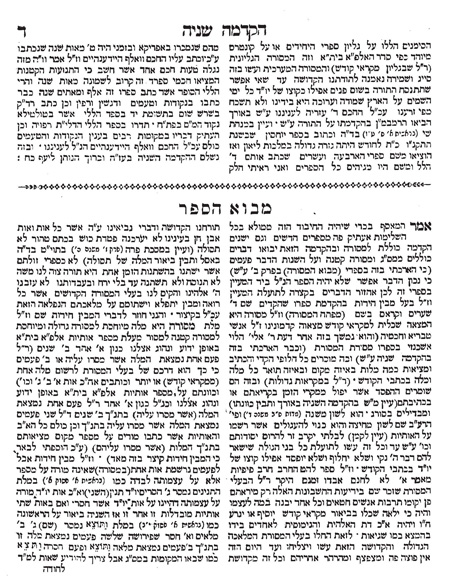
Mississippi Fred McDowell, has posted re: the Vilna Gaon’s Yerushalmi edition. However, I would like to discuss which edition of the Bavli the Vilna Gaon had. This is a rather important especially in light of the numerous emendations to the text the Vilna Gaon made. As when one is amending something it is important to know what exactly they have amended.

Every morning Birkat HaShahar are recited. Among these blessings are three anomalous ones. These there, as opposed to the rest, are in the negative. Specifically, these blessing are for ones legal status, gender, and religion. It is the last one, religion is the one we will focus on.

The Talmud has these blessing, however, there is some difficulty with the text of the religion one. Some editions have this blessing in the positive, i.e. “thank you for making me a Jew,” and some have it in the negative, “thank for not making me a non-Jew.” This confusion prevailed into the medieval period, with some texts containing one iteration of the blessing and some the other. What is unclear, however, is whether this change to the positive was wrought due to censorship or is there some reason this blessing should be in the positive.

R. Yom Tov Lipmann Heller, in his Ma’adani Melekh, claims any passage which is in the positive (“thank you for making me a Jew”) is due solely to censorship. And with this, we get to the crux of our discussion here – the Vilna Gaon’s edition of the Talmud.

The Vilna Gaon, in his commentary on Shulhan Orach says that one should say this blessing in the positive form. He comes to this conclusion because “our editions of the Talmud have the blessing for ‘making me a Jew.'” In theory, the Vilna Gaon’s conclusion is dependent upon whether “our editions” are corrupted or not. That is, if “our editions” are censored then they prove nothing. This contention, that the Vilna Gaon used a corrupted edition is noted by R. Shmuel Feigenshon in the Otzar HaTefilot. Specifically, R. Feigenshon claims that had the Vilna Gaon seen the Amsterdam 1644 edition he would never made this mistake. [Additionally, based in part upon this, Y.S. Speigel notes the Vilna Gaon did not use manuscripts or earlier printed editions when he amended the text.]

It is worthwhile noting that R. Raphael Natan Rabinowich, in his Ma’amar ‘al HaDpasat haTalmud (which has just been reprinted by Mosad HaRav Kook) claims that the Vilna Gaon used the 1644 edition of the Talmud, the very one if he had used it would have avoid this error!!

In the end, we don’t know exactly which edition the Vilna Gaon used and according to Speigel, it is likely that the Vilna Gaon did not use one edition. Instead, it is likely the edition was dependent on the particular volume of the Talmud he had and for each volume it may have been a different edition.

Sources on the blessing: T.B. Menachot 43,b; Dikdukei Sofrim ad. loc.; Rosh, Berakot chapt. 9; Ma’dani Melekh id. at note 24; Tur Orakh Hayyimno. 46:4; id. Bach; Shulchan Orakh and Rama id.; see also, first edition of Rama Prague, 1588 for the proper placement of his comments available here; Biur HaGra id.; see also R. Y. Satnow, Va’yetar Yitzhak, no. 44; R. Jacob Emden, Luach Eres Toronto, p. 24 no. 64; Siddur Otzar haTeffilot, on the blessing in question; On the Vilna Gaon’s edition of the Talmud: Y.S. Speigel, Amudim b’Toldotha Sefer HaIvri: Haga’ot U’Magim, 404-405, 416 and the sources cited therein.


Eliezer Kallir – Updated

Eliezer Kallir, is considered one of the greatest paytanim. He authored some of the most well known piyyutim including those said for geshem and tal, as well as many others (although most of his piyyutim that were included in the Rosh haShana and Yom Kippur prayers are no longer said by most). While his literary output is well-known, “[b]iographical facts about Kallir are shrouded in mystery.” E.J. (new ed.) vol. 11, p. 743. There are many theories about who R. Kallir was and I would like to touch on some of these in this post. (Also see below for a bibliography on R. Eliezer Kallir – provided by a kind reader of the blog.)

R. Shmuel David Luzzato (Shadal) in his Mevo l’Machzor Beni Roma, discusses Kallir and the history of piyyutim at length.[1] “If you will ask who authored the first piyyut and who followed them, I will answer that the first is Yanni or Yinai, and the second is R. Eliezer Berebi Kalir. The product of both is apparent to all in the Haggadah as the piyyut “Az Rov Nissim” is from Yanni . . . and the piyyut “Ometz Gevoroteha” is from R. Eliezer berbi Kallir . . .” Interestingly, “regarding Yanni a nasty rumor has been spread (Zunz found it in a manuscript commentary to the Mahzor), however, anyone who hears it will laugh, . . . [and the rumor is] that Yanni became jealous of his student R. Eliezer and [Yanni] put a scorpion in [Eliezer Kallir’s] shoe and the scorpion killed Kallir.” Shadal, however, dismisses this rumor in light of the fact that Yanni’s piyyutim are still said, especially the one mentioned above during Pesach. Shadal argues that if Yanni was a murderer then there is no way Yanni’s piyyutim would be so popular. Additionally, Rabbenu Gershom mentions Yanni and uses honorific terms, something Rabbenu Gershom would not have done if the rumor is true.

Shadal then turns to the details of R. Eliezer Kallir’s biography. “In many places R. Eliezer signs his name as ‘R. Eliezer beribi Kallir from Kiryat Sefer.’ Many of the early ones believed that this indicated Kallir was from the biblical town of Kiryat Sefer, and many thought that Kallir was a tanna, either R. Eliezer the son of Simon … or R. Eliezer ben Arakh, both of these opinions are recorded in the Sefer HaYuchsin.” Shadal, however shows that it is highly unlikely that R. Eliezer Kallir was a tanna or that he was from the biblical town of Kiryat Sefer. Instead, Shadal quotes the opinion of R. Moshe Landau (grandson of the Noda Be-Yehuda) in his commentary to the Arukh, Maarkhe Lashon. [2]According to Landau Kallir is a reference to the Sardinian city Cagliari. Shadal disagrees with Landau. In the end, after citing other opinions, including identifying Kallir with an Italian city, Pumadisa in Babylon, and Sippara also in Babylon, and to those it should be added, Bari, Ostia, “Civitas Portas, the former port of Rome (Derenbourg); Constantinople; Civita di Penna in the Abruzzi; . . . Normandy, Speyer in Germany . . . Lettere in Souther Italy, . . . Antioch and Hama in Syria . . . Kallirrhoe in Palestine . .. [and finally] Tiberias.” E.J. p. 744. As should be apparent, there is no consensus on where Kallir was from.

Turning to his name – Kallir – the starting place is R. Nathan and his Arukh. He explains that Kallir, means cake (indeed in Greek kalura means cake). And, Kallir was called “cake” because “he ate a cake that had written on a kemiah (amulet) and, as a result, he became smart.” Arukh erekh klr. The idea to feed children cake with inscriptions is a well documented one. R. Eliezer from Worms, the author of the Rokekh records the custom to feed children cakes with the verses from Isaiah 50:4, id.50:5, and Ezekiel 3:3. The children would eat these when they were indoctrinated into Torah study on Shavout. [3]Of course, as noted above, some view the name Kallir as an indication of where Kallir was from. Indeed, many, including Shadal did not swallow (if I may) the Arukh’s interpretation of Kallir.

Again, as we have seen there is a bit of debate when it comes to Kallir, one of the more interesting debates regards which piyyutim can be attributed to him. While in many Kallir provides his name in an acrostic, according to R. Shelomo Yehuda Rapoport (Shir) one can also attribute those piyyutim that there is a gematria that equals some permutation of Kallir’s name. That is, Kallir sometimes signed his name Eliezer haKallir, Eliezer beribi Kallir, Eliezer Kallir me-Kiryat Sefer, and a combination of any of these. Thus, according to Shir, if in the first line equaled any of these Kallir was the author.

R. Efraim Mehlsack, however, took issue with Shir’s use of gematria. Specifically, Mehlsack wrote Sefer ha-Ravyah, Ofen, 1837, against Shir. Mehlsack was a prolific author, he supposedly authored some 72 seforim, but the only published sefer was this one. But before we get into the details regarding Mehlsack we need to discuss his critique of Shir. Mehlsack went to town on Shir and showed that using the gematria for the first line of a book, Mehlsack could make Kallir the author of just about every important Jewish book. Mehlsack goes through Tanakh and uses the first verse of each book to equal some form of Kallir’s name. For example, the first verse in Berashit equals 913 which equals “meni ha-katan Eliezer Kallir.” The first verse in Joshua equals 1041 which equals “ha-katon Eliezer beribi Kallir.” Mehlsack doesn’t stop with Tanakh, he then moves to Mishna noting that the first mishna in Berkhot is 2362 which equals “ani Eliezer berbi Ya’akov ha-Kallir mi-Kiryat Sefer yezkeh be-tov amen.” As a final shot at Shir, Mehlsack has the gematria of I am Shelmo Yehuda Rapoport = 1164 to Eliezer beRebi Yaakov Kallir =1164. Indeed, Mehlsack was not content to provide some 40 odd examples, he had even more and as a result of already printing the pages, the Sefer Ravyah is an interesting bibliographical oddity in that these gematrias appear on page 18 and then continue. Well Mehlsack includes an alternative page 18 in the back which has more examples of these gematrias. Thus, the book goes until page 32 and then there is another page 18. Both versions appear below.

Turning now to Mehlsack. As I mentioned Mehlsack supposedly authored 72 books. We know of 34 titles from that list.[4] Although most of those works have been lost, there are a few, around five, that are available in manuscript. In Boaz Hass’s recent book on the history of the Zohar, he mentions Mehlsack’s translation of the Zohar (Scholem also discusses this work). One of the works lost, is a work permitting one to travel via train on Shabbat. The introduction of this work has been published (in part) and appears below. Additionally, Sefer Ravyah was not Mehlsack’s only attack on Rapoport, Mehlsack attacked Rapoport in a few of his works, and some of his critiques were published in Bikkurei Ha-Ittim.

Returning to Kallir, it goes without saying that Kallir’s piyyutim were controversial. Most famously, the Ibn Ezra complained about them and offered that one should refrain from saying Kallir’s piyyutim. Ibn Ezra’s critique is discussed by R. Eliezer Fleckels, who defends Kallir, and Heidenheim thought it important enough to include this lengthy responsum in Heidenheim’s edition of the Machzor.[For more on the Ibn Ezra see צבי מלאכי “אברהם אבן-עזרא נגד אלעזר הקליר – ביקורת בראי הדורות” פלס (תשם) 273-296)

Bibliography on R. Eliezer Kallir (provided by a kind reader of the blog.)אלבוגן, התפלה בישראל בהתפתחותה ההסטורית, 233 – 239יוסף זליגר, “לתולדות הפיוט והפיטנים (ר’ אלעזר קליר)”, כתבי הרב דר יוסף זליגר, לאה זליגר מו”ל, ירושלים תרצ, צז – קבשלמה דוד לוצאטו, אגרות שדל א, 464 ואילך—, הליכות קדם, גבריאל פאלק, אמסטרדם תרז, מחלקה שניה, 56 – 64.צבי מלאכי, “הפייטן אלעזר הקליר – לחקר שמו ומקומו”, באורח מדע: פרקים בתרבות ישראל מוגים לאהרן מירסקי במלאות לו שבעים שנה, צבי מלאכי, מכון הברמן למחקרי ספרות, לוד תשמו, 539 – 543אהרן מרקוס, ברזילי: מסה בתולדות הלשון העברית, ירושלים: מוסד הרב קוק תשמג, 346עזרא פליישר, תרביץ נ, 282 – 302 —, “לפתרון שאלת זמנו ומקום פעילותו של ר’ אלעזר בירבי קיליר”, תרביץ נד ג, ניסן – סיון תשמה, 383 – 427שלמה יהודה ראפאפארט, תולדות גדולי ישראל, 24 – 55יעקב שור, ספר העתים, 364 – 365 בנועם שיח: פרקים מתולדות ספרותנו, מכון הברמן למחקרי ספרות, לוד תשמג, 114 – 156 המעין טז א, תשרי תשלו, 3 – 14. המשך: ב, טבת תשלו, 32 – 52.

[1] Mevo leMachzor Beni Roma, Habermann ed. Jerusalem[2] For more on this commentary see S. Brisman, History & Guide to Judaic Dictionaries & Concordances, KTAV Publishing House, Inc. 2000, pp. 19-20.[3] For more on this custom see Assaf, Mekorot le-Tolodot ha-Hinukh be-Yisrael, Jerusalem 2002, pp. 80-1 n.9 and the sources cited therein. See also, E. Kanarfogel, Peering through the Lattices, Wayne State University Press, Detroit, 2000 pp. 140-41 and the notes therein (discussing the ceremony generally); id.p. 237 n.47 (discussing some of the halakhik issues with this custom including the “issue” of “excret[ing] these verses”)[4] See G. Kressel, “Kitvei Mehlsack,” Kiryat Sefer 17, pp. 87-96.


Shnayer Leiman: Notes on Rabbinic Epitaphs I

Notes on Rabbinic Epitaphs: I
by Shnayer Leiman

The newly recovered tombstone of R. Yosef Trani (1568-1639), the Maharit, among the greatest of the early aharonim,[1] is a truly remarkable event. The discoverer, the noted bibliophile and book dealer R. Shlomo Epstein, had searched all the Jewish cemeteries in Istanbul (formerly: Constantinople), but could not locate the Maharit’s grave. On a recent visit to Safed, where he went to pray at the tomb of R, Moshe Alshekh (circa 1520-1593), he noticed nearby a fragmented, barely legible tombstone (see figure 1). As he began to decipher the text, he realized that it was the tombstone of none other than the Maharit. In fact, the Maharit died and was buried in Constantinople, but his sons later transferred his remains to Safed (as he had requested) so that he could be interred near his father, R. Moshe Trani (1500-1580), the Mabit.[2]


There is much to learn from tombstone inscriptions. Often they are the only source of precise information about an ancestor or about a gadol be-yisrael. Sadly, tombstones are often neglected, lost, or destroyed. Despite all the claims otherwise, we do not know where Rashi (d. 1105), Ibn Ezra (d. 1164), R. Eleazar b. Yehudah of Worms, author of Sefer Rokeah (d. circa 1230), or Don Isaac Abarbanel (d. 1508) are buried.[3] Moreover, no one took the trouble to copy their tombstone inscriptions – and they can no longer be recovered. In a much later period, the tombstone of R. Aryeh Leib b. Asher Gunzberg (d. 1785), noted author of the Sha’agat Aryeh, was destroyed.[4] Again, no one took the trouble to copy his tombstone inscription before it was destroyed – and it can no longer be recovered. Similarly, Sarah Schenierer’s (see figure 2)[5] headstone in Plaszow (a suburb of Krakow), erected in 1935 and destroyed by Nazi orders in 1942, was neither photographed nor copied during the seven years it stood undisturbed. When the stone was reset in 2003 (see figure 3), a newly invented text, based in part on eye-witness testimony, had to be prepared for it. We need to learn from these instances that it is crucial that we preserve Jewish cemeteries the world over, to the best of our ability. Moreover, tombstone inscriptions in particular need to be photographed while still legible, and – at least in the case of gedolei yisrael – restored or redone so that visitors can read and be inspired by what was said about those gedolei yisrael. When tombstones are restored, the original text is always preferable to a newly invented text. 

In my travels, I often photograph rabbinic epitaphs, and present some samples in this posting.

I. R. Akiva Eger (d. 1837).

There is no need to rehearse here biographical information about R. Akiva Eger.[6] Sadly, his grave in Poznan (formerly: Posen), which was still standing before World War II (see figure 4),[7] was destroyed by the Nazis. 

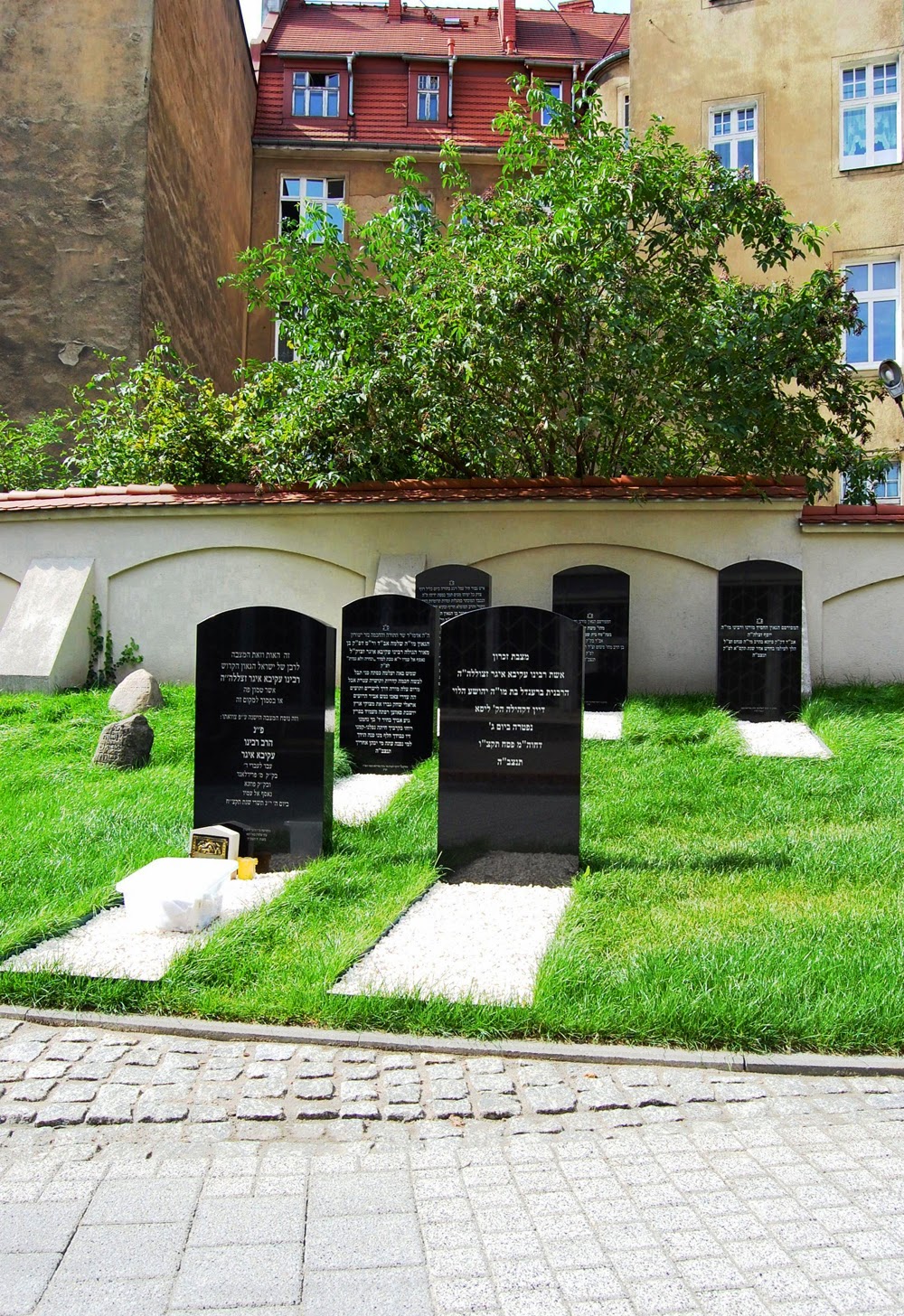
Tombstones from the Jewish cemetery were used to pave roads, and the nineteenth century Jewish cemetery itself – it opened in 1804 – was incorporated into Poznan’s Trade Fair grounds after the war.[8] Ultimately, a housing project and shopping center were built on the grounds of the Jewish cemetery, today at ul. Glogowska corner ul. Sniadeckich. Fortunately, the rabbinic section of the cemetery served as a parking lot (rather than as the foundation of an apartment house), and it was possible to transform the lot into a grassy knoll and to set new tombstones over the old graves (see figure 5). 

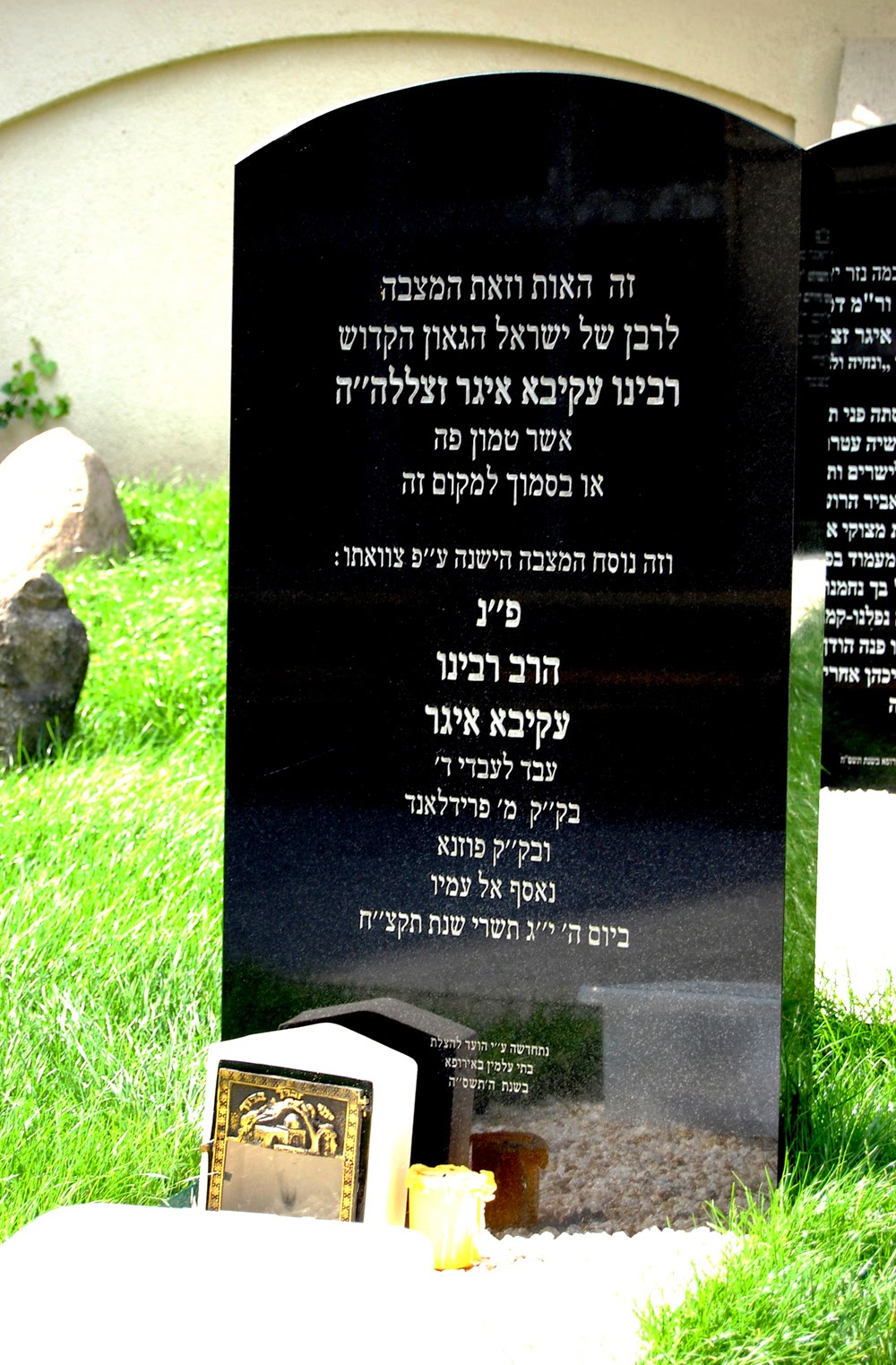
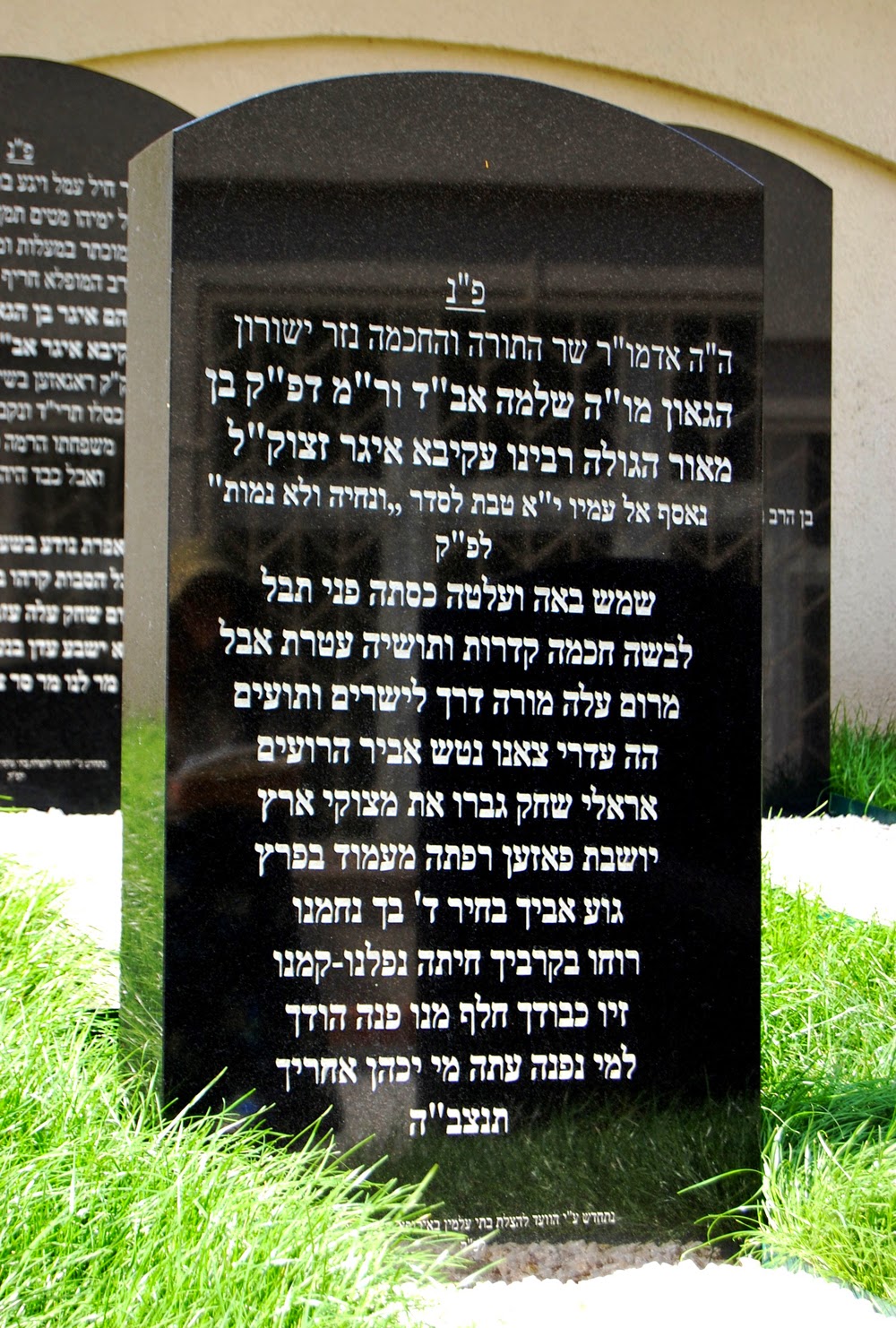
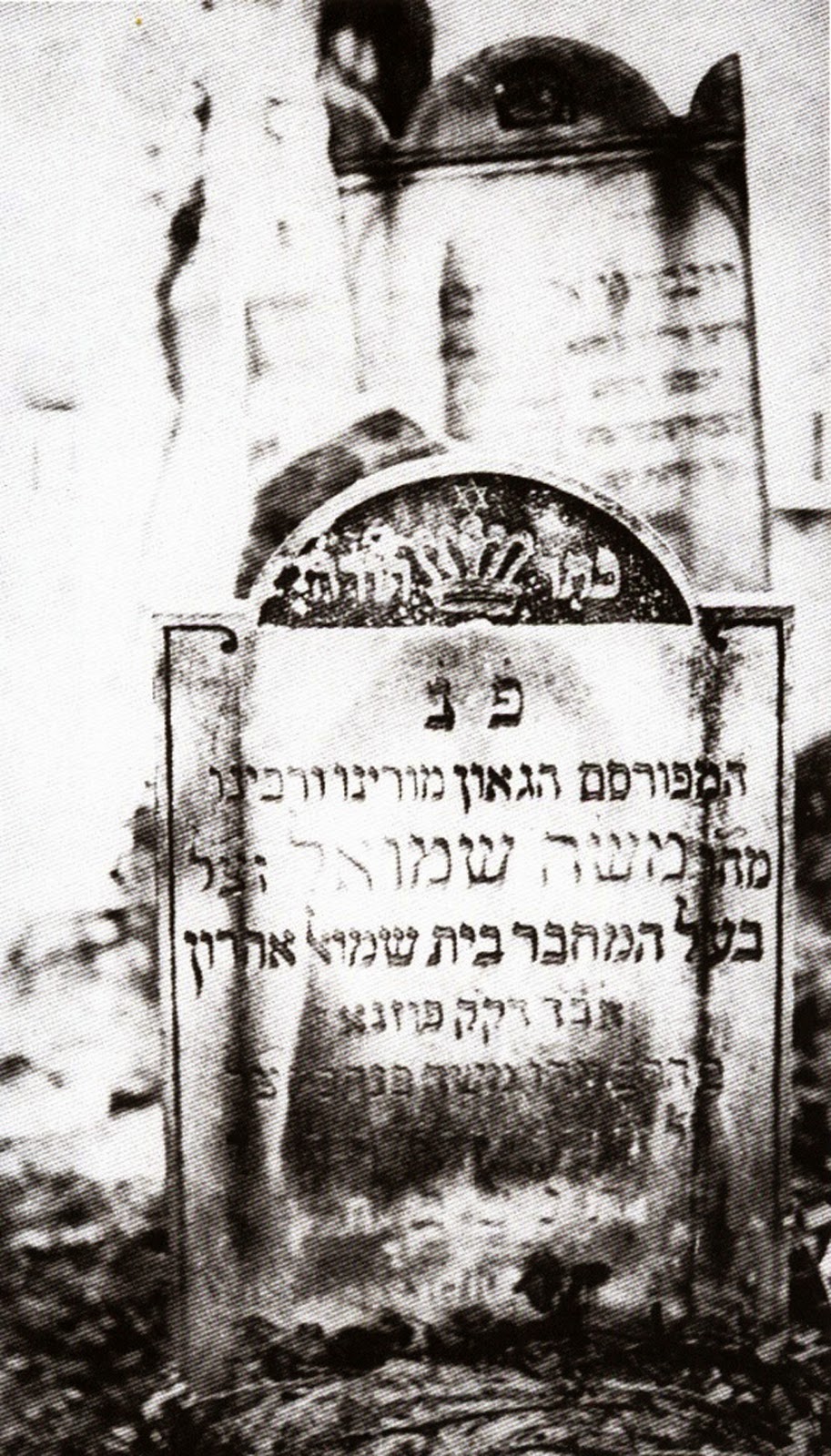
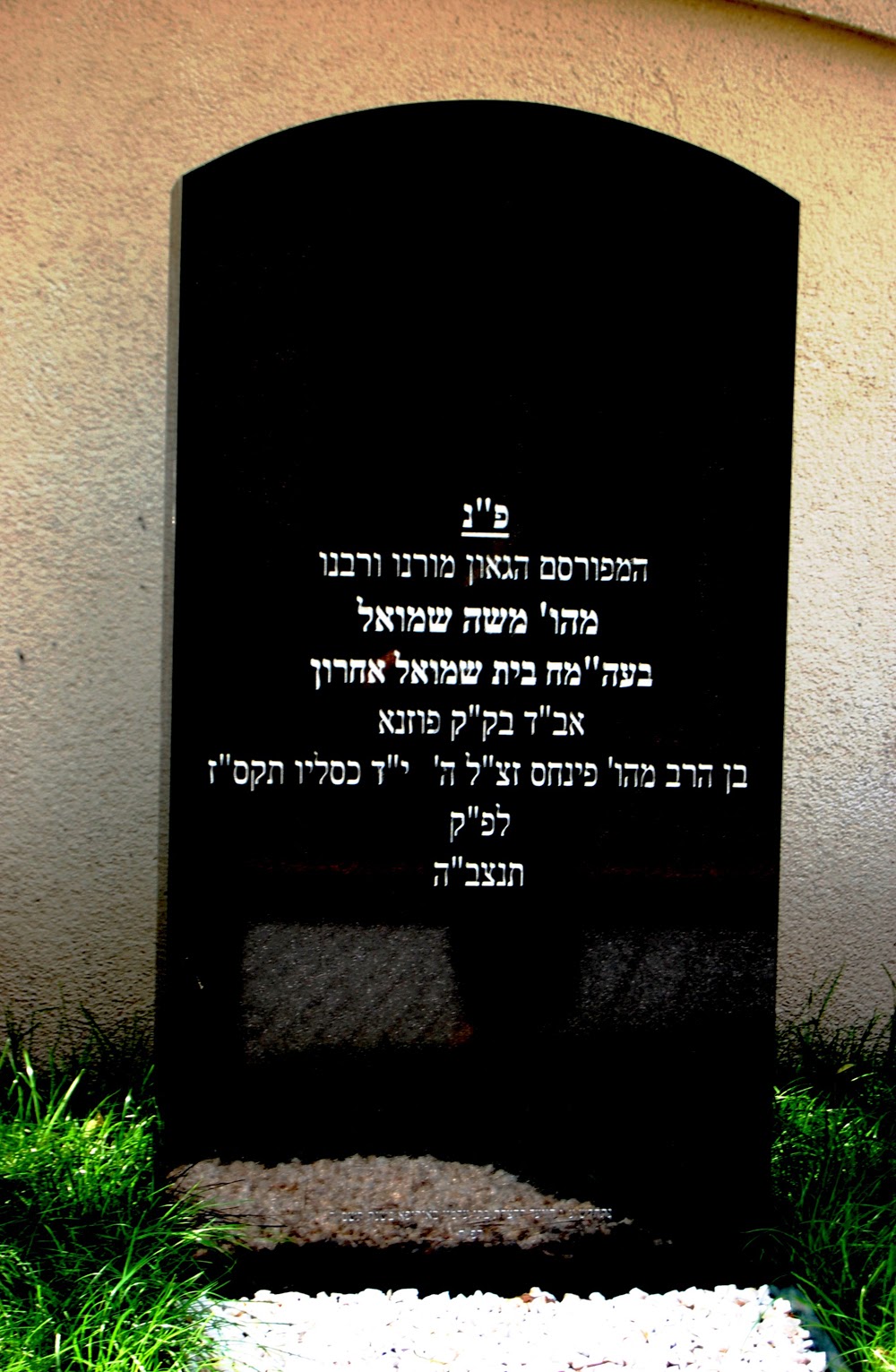
At best, the tombstones are approximately over the gravesites they describe. Even so, it is a great kiddush ha-Shem that this sacred site has been restored. The graves restored include R. Akiva Eger (see figure 6), his second wife Breindel (d. 1836), his son and successor R. Shlomo Eger (d. 1852; see figure 7), and his son R. Avraham Eger (d. 1854). Also restored were the graves of two predecessors of R. Akiva Eger as Chief Rabbi of Posen: R. Yosef b. Pinhas of Posen (son-in-law of R. Yehezkel Landau Prague; see figure 8), d. 1801, and R. Moshe Shmuel, author of בית שמואל אחרון, d. 1806 (see figures 9 and 10 for the original and the restored tombstone inscriptions).[9]

We would be remiss if we didn’t mention that R. Akiva Eger’s likeness is on permanent display in Poznan’s Town Hall (see figure 11). The excerpt in figure 11 is part of a larger mural painted by Julius Knorr (1810-1860) and entitled Marktplatz in Posen. The painting was done during the lifetime of R. Akiva Eger and was first displayed in 1838. R. Akiva Eger can be seen at the bottom right, walking with cane in hand and accompanied by the two other members of his rabbinic court.[10]

II. R. David Hoffmann (d. 1921).

The recent announcement that R. David Hoffmann’s פירוש על ספר שמות (based upon his lecture notes in German) is about to be published by Mosad Harav Kook has brought great joy to biblical and rabbinical scholars alike.[11] Yet another sefer by the Master! It matters not that more than a century has passed since he first taught Exodus at the Hildesheimer Rabbinical Seminary. Of course modern Bible scholarship has changed drastically in the interim. R. David Hoffmann’s commentary will not reflect modern archaelogical advance, will not grapple with the textual readings of the Dead Sea Scrolls, and will not deal with the latest philological discoveries of Semitic linguistics. But those who have read his commentaries on Genesis, Leviticus, and Deuteronomy, and learned from them, will know that regarding R. David Hoffmann “כל מקום שאתה מוצא דבריו עשה אזנך כאפרכסת.”[12] Master of the Oral Law, he of course read the Torah through rabbinic lenses. At the same time, he listened to dissenting voices, weighed all the evidence, and never disparaged others even as he dismissed their arguments. He always judged judiciously and graciously. And even when one disagrees with him, one always gains insight from his comments.

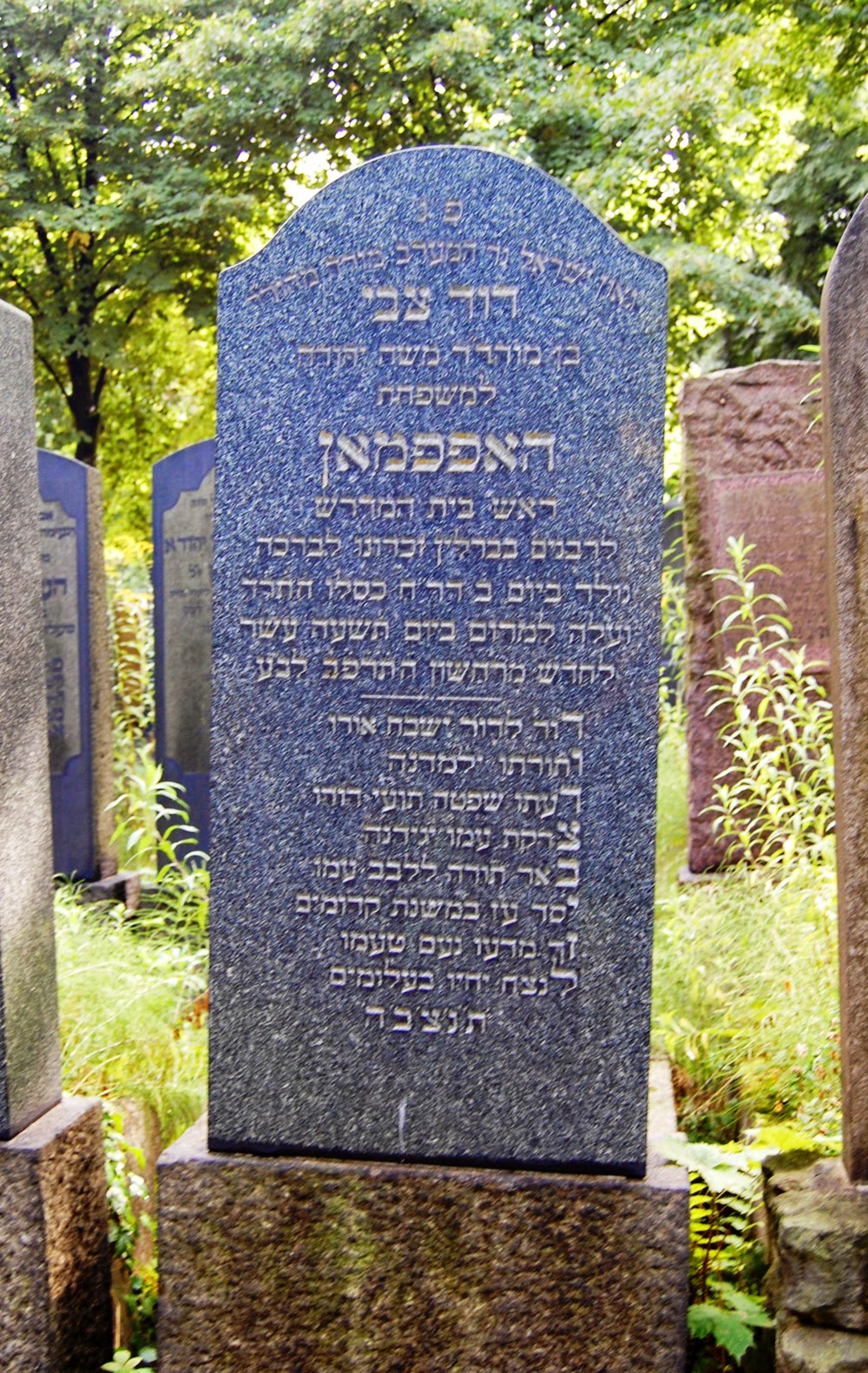
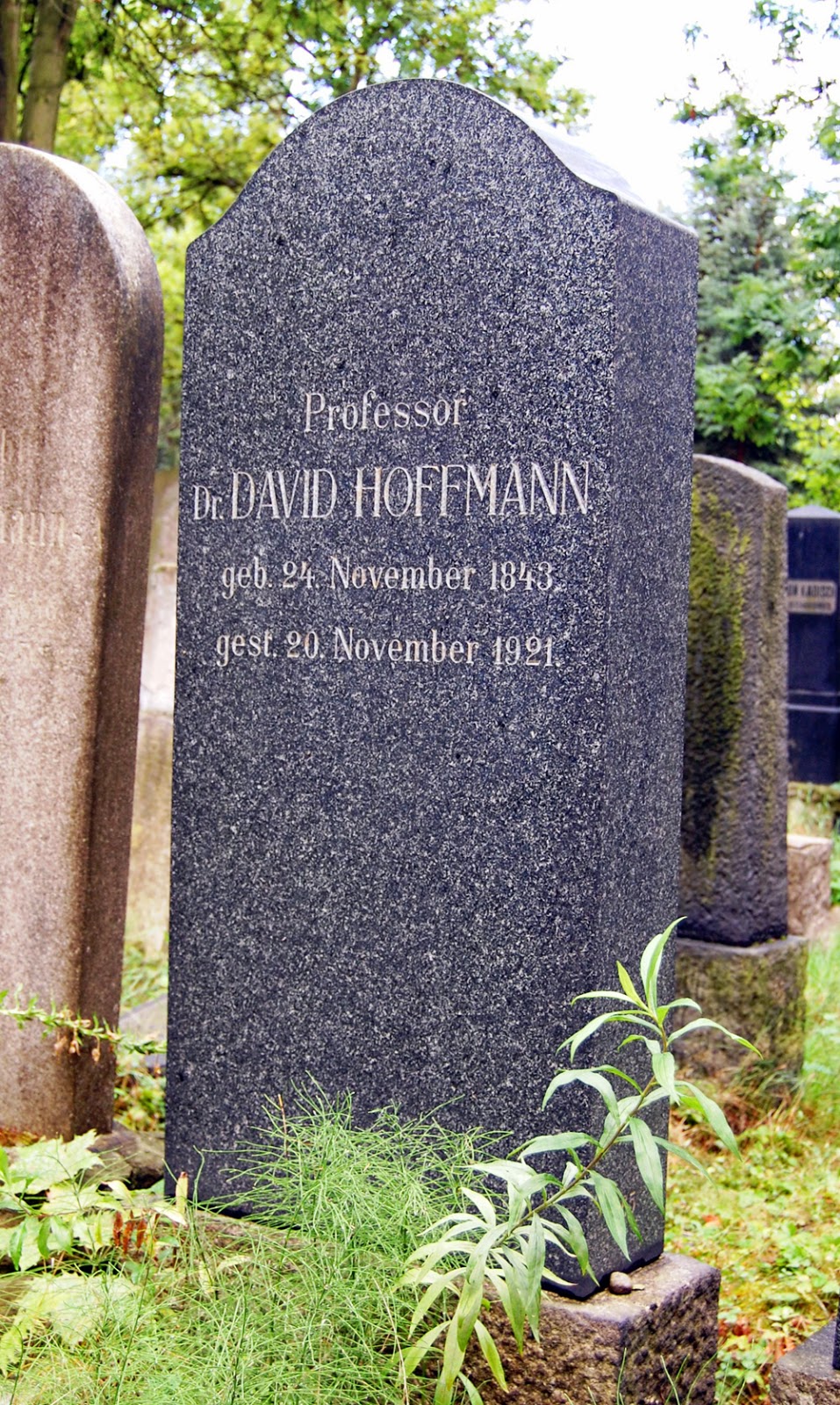
It is sad that this seminal figure, Rector and Rosh Yeshiva, Bible scholar and Posek, Literary Critic of the Mishnah and Restorer of Lost Tannaitic Midrashim, Defender of the Faith and Public Servant, has never been the subject of an intellectual biography worthy of the name.[13] Here we publish, apparently for the first time, his epitaph. R. David Hoffmann is buried in the Adass Jisroel cemetery in the Weissensee section of Berlin.

Obverse (see figure 12):

פ”נ
[גאון ישראל נר המערב מורה מהור”ר [14
דוד צבי
בן מוה”ר ר’ משה יהודה
למשפחת
האפפמאן
ראש בית המדרש
לרבנים בברלין זכרונו לברכה
נולד ביום ב’ דר”ח כסלו התר”ד
ועלה למרום ביום תשעה עשר
לחדש מרחשון ה’ תרפ”ב לב”ע
—————-
דור לדור ישבח אורו
ותורתו ילמדנה
דעתו שפטה תועי דורו
צדקת עמו יגידנה
באר תורה ללבב עמו
יסד עז במשנת קדומים
זך מדעו נעם טעמו
לנצח יחיו בעלומים
תנצב”ה
 

Reverse (see figure 14):

Professor
Dr. DAVID HOFFMANN
geb. 24. November 1843.
gest. 20. November 1921.

[1] According to R. Avraham Yeshayahu Karelitz (d. 1953), “גדול האחרונים הוא המהרי”ט.” See Z. Yabrov, מעשה איש, Bnei Brak, 2001, vol. 4, p. 90.
[2] See E. Zalman, “המהרי”ט קבור בצפת,” Qulmos 65 (2008), pp. 18-21. The photograph in figure 1 is taken from the Zalman essay.
[3] In the case of R. Eleazar b. Yehudah of Worms, he was certainly buried in the Worms Jewish cemetery, standing to this very day. The portion of the cemetery he was buried in was appropriated by the non-Jewish authorities. See R. Juspa Shammes, מעשה נסים, Amsterdam, 1696, p. 20.
[4] See N. Netter, “Les Anciens Cimetieres Israelites de Metz,” REJ 51(1905-6), pp. 280-281. Cf. S. Schwarzfuchs, (תנאי הרבנות של השאגת אריה בק”ק מיץ”,מוריה 15(1986″, pp. 81-90.
[5] The only extant authentic photograph of Sara Schenierer, which scholars in Israel and the United States have kept under wraps for years, was recently published in T. Lesniak, J. M. Malecki, J. Purchla, and A.B. Skotnicki, eds., Swiat przed katastrofa:Zydzi krakowscy w wudziestoleciu miedzywojennym (A World Before a Catastrophe: Krakow’s Jews Between the Wars), Krakow, 2007, p. 128 – and is reproduced here.
[6] See, e.g., Y. Strasser and A. Perl, eds., מאורן של ישראל: רבינו עקיבא איגר, New York, 1990, 2 vols. Cf. J.H. Sinason, The Gaon of Posen: A Portrait of Rabbi Akiva Guens-Eger , Jerusalem, 1991.
[7] Figure 4 is taken from T. Sztyma-Knasiecka, Miedzy tradycja a nowoczesnoscia: Zydi poznanscy w XIX i XX wieku, Poznan, 2006, p. 23.
[8] See Z. Pakula, , The Jews of Poznan, London, 2003, pp. 1-21 and 109. Cf. anonymous, “Jewish Poznan,” Poznan in Your Pocket, July-October 2008, p. 6.
[9] The photograph of the original tombstone inscription is taken from Sztyma-Knasiecka, p. 22.
[10] See Sinason, pp. 100-103; cf. Sztyma-Knasiecka, p. 13.
[11] See A. Wasserteil’s introduction to R. David Hoffmann, (שיעבוד בני ישראל במצרים, המעין 48(2008, number 3, p. 25.
[12] R. David Hoffmann used to apply this Talmudic phrase to the רש”ש, but it surely applies to Hoffmann as well. See his שו”ת מלמד להועיל, Frankfurt, 1932, vol. 3, §71. Cf. R. M. Roth, מבשר עזרא, Jerusalem, 1968, p. 167.
[13] Useful information can be gleaned from the following:
H.J. Bechtoldt, “David Hoffmann,” in his Die jüdische Bibelkritik im 19. Jahrhundert, Stuttgart, 1995, pp. 363-438; D. Ellenson and R. Jacobs, “Scholarship and Faith: David Hoffmann and his Relationship to Wissenschaft des Judentums,” Modern Judaism 8(1988), n.1, pp. 26-70; L. Ginzberg, Students Scholars and Saints, Philadelphia, 1928, pp. 252-262; L. Jung, The Path of a Pioneer, London, 1980, pp. 20-27; J. Marmorstein, “David Hoffmann, Defender of the Faith,” Tradition 8(1966), n.4, pp. 91-101; A. Marx, Essays in Jewish Biography, Philadelphia, 1947, pp. 185-222; Idem, Studies in Jewish History, New York, 1944, pp. 369-376; M. B. Shapiro, “Rabbi David Zevi Hoffmann on Torah and Wissenschaft,” Torah U-Madda Journal 6(1995-6), pp. 129-137; C. Tchernowitz, מסכת זכרונות, New York, 1945, pp. 244-264; and Y. Wolfsberg-Aviad, “David Hoffmann,” in L. Jung, ed., Guardians of Our Heritage, New York, 1958, pp. 363-419 (cf. Wolfsberg-Aviad’s דיוקנאות, Jerusalem, 1962, pp. 57-66). Much more bibliography can be added; the items listed here are intended to get the interested reader started.
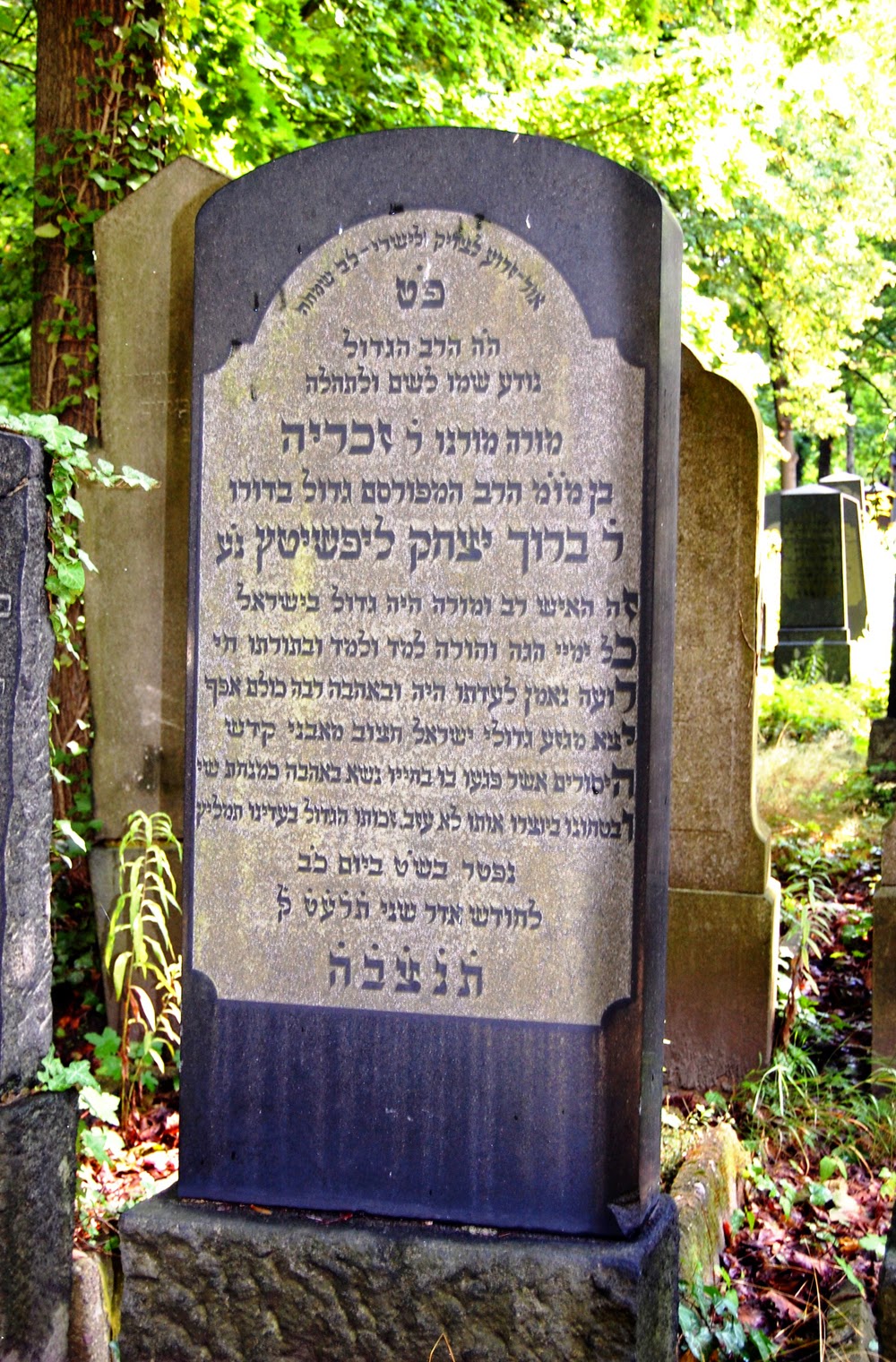
[14] For the honorific title מורה מורנו, see figure 13, also from the Adass Jisroel cemetery. Cf. the very interesting responsum in שו”ת מהרש”ם 2:56.


A Note on the הסכמות of the חפץ חיים

A Note on the הסכמות  of the חפץ חיים
By Shnayer Leiman

All the comments to the previous posting (“A Note on R. Bezalel Alexandrov’s משכן בצלאל and its Prenumeranten”) are deeply appreciated. It’s what makes the Seforim Blog required reading for anyone interested in serious scholarship. I cannot possibly address all the comments. The references in the notes to the essay address some of the issues raised. To Yisrael Dubitsky’s important  comments, one should add that privately owned copies of the two parts of משכן בצלאל  are available, at the very least, in New York and Silver Spring, Maryland. Having said that, the fuller editions of  משכן בצלאל  and  ילקוט בצלאל  remain rare books. Hopefully, online resources such as Hebrew Books and Otzar Ha-Hokhmah will scan the fuller texts and make them available to all. Lest Yisrael’s comment about YU’s copy of   משכן בצלאל  be misunderstood by an uninformed reader (“Mishkan Betsalel is available at 4 libraries that reported to OCLC [YU is not one of them]”), rest assured that the Mendel Gottesman Library at YU owns a full edition of  משכן בצלאל. The Gottesman Library lists some 200,000 volumes of Judaica on its on-line catalogue, and these are reported to OCLC. Those 200,000 volumes form the basic books necessary for a Jewish Studies research library. But like many Jewish Studies research libraries, YU has many other collections of Judaica, catalogued and uncatalogued. One of those catalogued collections (not on-line) lists the full edition of  משכן בצלאל , which, courtesy of the YU librarians, I was able to consult when preparing the essay.

While the focus of the essay was not on  הסכמות , since the bulk of the comments focused on the  הסכמות of the  חפץ חיים  , I shall attempt to address that issue, and only briefly.
1. Whether one chooses to recognize the letter of the  חפץ חיים  as a הסכמה  or not, the letter remains one of the three reasons for bringing  משכן בצלאל  to the attention of the public. Any letter of the  חפץ חיים  is a treasure. This particular one is published only in משכן בצלאל   (and in the secondary sources based upon  משכן בצלאל).
2. It should be noted that   משכן בצלאל  contains three letters of approbation. Aside from the letter of the    חפץ חיים, it includes a letter of approbation from R. Avraham Yoffen (1887-1970), Rosh Yeshiva of Nevarodok in Nevarodok, and then of Nevarodok in Bialystok.  The letter is dated 13 Tishre 5680 [October 7, 1919] and was written in Minsk. A third letter of approbation, from R. Yitzchak Isaac Eliezer Hirshowitz (1871-1941), then a Resh Mesivta in the Slabodka section of Kovno, is dated 5 Tishre 5680 [September 29, 1919] and was also written in Minsk. (Rabbi Hirshowitz is famous, in part, for publishing an early translation into Hebrew of the teachings of Rabbi Samson Raphael Hirsch. His book, מיטב הגיון   [Vilna, 1913] was intended for Lithuanian Jewry and carried an enthusiastic הסכמה from R. Chaim Ozer Grodzenski.) The letters of approbation by Rabbis Yoffen and Hirshowitz not only praise R. Bezalel Alexandrov’s learning and piety, they also indicate that both rabbis examined and approved the manuscript of R. Bezalel Alexandrov’s book. All three letters of approbation are printed together immediately following the title page. All three letters are introduced (separately) with the exact same title: מכתב תעודה מהרב הגאון… To consider the last two letters  הסכמות  ,and the first a private letter that has absolutely nothing to do with the book, seems almost ludicrous. A form-critical analysis leads to the ineluctable conclusion that all three letters of approbation are הסכמות. Moreover, it seems highly unlikely that R. Bezalel Alexandrov, a musar enthusiast, would have placed a letter (by the חפץ חיים) that had absolutely nothing to do with the book, in its הסכמות section and thereby mislead potential buyers and readers of the book. Worse yet, he published the “misleading” letter during the lifetime of the חפץ חיים, and after the חפץ חיים was kind enough to be among the first subscribers to the book! In terms of the nature of the הסכמה by the חפץ חיים, it is paralleled by many others that he wrote in response to specific requests for a הסכמה. He was impeccably honest, and did not want to praise a book he did not read, and was not likely to read. Instead, he showered priestly blessings on the author, מעומקא דלבא.
3. If one examines the first page of prenumeranten in משכן בצלאל (posted with the essay), one will notice that the חפץ חיים’s name appears under the general rubric: אלה שמות הפרענומעראנטין דק”ק ווילנא, שליט”א. This seems awkward, since the חפץ חיים lived in Radin, some 85.6 kilometers from Vilna. The names of no other residents of Radin appear on the four- page list of subscribers. Indeed, the likelihood that anyone would attempt to gather subscriptions from the residents of Radin was probably as high as the likelihood of a Jewish book dealer seeking a copy of the first edition of the נועם אלימלך (one of the rarest of Jewish printed books) in the Serengeti in Tanzania. (Berel Kagan has no entry for Radin.) It is well known, however, that the חפץ חיים frequented Vilna in the 1920’s in particular, and often stayed with relatives in Shnipishok (a Vilna suburb), and would meet with R. Chaim Ozer Grodzenski in order to address the needs of כלל ישראל. Similarly, R. Bezalel Alexandrov was not a resident of Vilna. He was there in 1923 for one purpose only (staying at the home of one of the Vilna subscribers, Shmuel Melamed, at 39 Breite Gass), in order to publish his book. And the letter of the חפץ חיים was written in 1923! It seems likely that the two met in Vilna in 1923 and R. Bezalel asked for a הסכמה, and received the letter he printed at the start of משכן בצלאל.
4. It should be noted that the author of מאיר עיני ישראל (cited in note 7 of the essay), in a chapter entitled “הסכמות מרן החפץ חיים זצ”ל לספרי מחברי תקופתו,” includes the הסכמה  by the חפץ חיים  given to R. Bezalel Alexandrov’s משכן בצלאל.  Also, מפעל הביבליוגרפיה   lists 3  “הסכמות”  for  משכן בצלאל.  It did not imagine that one of the letters was a personal letter unrelated to the book being published.
5. Ultimately the issue is one of definition. What is the definition of a הסכמה ? Or to phrase it another way: what elements must be present in a  הסכמה in order for it to be recognized as a legitimate הסכמה? Here are some possibilities. (I will not bring proofs or disproofs for any of these definitions; in fact, these – and many more – have been suggested as possibilities by leading rabbis throughout the generations.)
1.    A הסכמה  is a legal document by an authorized rabbi that provides copyright protection for the author of a ספר. A הסכמה without such a provision is not a הסכמה.
2.    A הסכמה must be written by an authorized rabbi and he must attest to the integrity of the author and to the integrity of the ספר being published . If the הסכמה lacks the one or the other, it is not a הסכמה.
3.     The  הסכמה  must be written by an authorized rabbi and he needs only to attest to the integrity of the author. Nothing else is significant.
4.    A הסכמה is a promotional document, signed by an authorized rabbi, and necessary for sales. The content of letter is of little consequence.
Whichever definition one chooses, a host of questions will remain to be answered. Who is an authorized rabbi? What if the author of the book, an authorized rabbi, writes the הסכמה for himself? Can a father write a  הסכמה for a son? What shall we do with the many הסכמות that do not fit any of the definitions listed above? Thus, there are censored הסכמות, forged הסכמות, reluctant הסכמות, הסכמות  written under duress, and retracted הסכמות, just to list a few of the many categories. Even aside from these questions, many great rabbis (in all periods) refused to seek הסכמות, and published their books without them. Some stated unequivocally (about their books): מעשיך יקרבוך ומעשיך ירחקוך .
In sum, given the uncertain (and changing) definitions of the term הסכמה through the ages, I cannot speak with confidence that I know precisely, in every case, what is and what isn’t a  הסכמה. And I certainly have no monopoly on wisdom. Nonetheless, for the reasons listed above, I am persuaded that R. Bezalel Alexandrov asked the חפץ חיים for a הסכמה in 1923, and printed the one he received. Readers will have to decide for themselves the precise status of the חפץ חיים’s letter printed at the beginning of משכן בצלאל. But whatever they decide, they need to bear in mind the variety of definitions of הסכמה through the ages, they need to examine all the evidence, and they need to realize that their conclusion will be only one opinion among many others, and not necessarily the correct one.


Akiva Leiman: Gravely Mistaken

Gravely Mistaken
by Akiva Leiman

R. Leiman teaches high school at the Yeshiva of Greater Washington in Silver Spring, Maryland. Additionally, he leads trips to sites of Jewish interest in Eastern Europe. This is his first contribution to the Seforim blog.

One hardly need go far to find errors in published materials, but when even moderate research would suffice to unearth correct information lack of such an effort would seem egregious. Jewish burial sites have often been lost: Nazis or indigenous peoples destroyed cemeteries, acid rain ravages stones, burning candles char monuments and, of course, people just simply forget where things are.[1] Misinformation, however, would seem to be the most preventable culprit in this ever-losing battle to maintain vestiges of our heritage.
A few examples should suffice.[2]
1. In Paul Johnson’s A History of the Jews, in the very first paragraph of the actual text, he says,
There in the Cave of Machpelah, are the Tombs of the Patriarchs . . . . Across the inner courtyard is another pair of tombs, of Abraham’s grandson Jacob and his wife Leah. Just outside the building is the tomb of their[3] son Joseph.
In an endnote he references L.H. Vincent and his depiction of the cave which has been reproduced in EJ XI p. 671. There the caption does read: “Tomb of Joseph.” However, the text of the EJ explicates that, “A Muslim tradition maintains that Joseph was buried here… (t)his tradition is probably due to a corruption of the Arabic name for Esau, whose head, according to aggadic sources fell within the cave…” EJ‘s theory for the mistake aside, Johnson must not have read the text of the article (or: ignored it), for though the diagram’s caption tells us that Yosef is buried in the Cave, the text belies this point.[4] Furthermore, see Joshua 24:32 (providing Shechem as Joseph’s burial place),[5] which must, at the very least, be mentioned in any serious discussion of the final resting place for Yosef.[6]
2. In בשבילי ראדין, by M. M. Palato, Machon B’Shvilai HaYeshivot, (2001), p. 25, we are provided a picture and told “that we are being shown the final resting place of R’ Chaim of Volozhin (d. 5581 – 1821), the most esteemed student of the Vilna Gaon, and he is buried next to his mentor.”[7]
But, R’ Chaim is actually interred in Volozhin[8] and his grave is a regular stopping point for those visiting the Byelorussian town. The picture shown is of the old Ohel over the grave of the Vilna Gaon in the since-destroyed Shnipishok cemetery of Vilna. Of course, R’ Chaim’s grave is not pictured at all.[9]

3. Holy Stones: Remnants of Synagogues in Poland, drawings by Joseph Cempla, Dvir, Tel Aviv (1959) is a beautiful group of renderings of pre-war Poland. From the description for plate number 13 we read:
The gravestone of Rabbi Shalom Shachna in the Lublin Cemetery

Rabbi Shalom ben Joseph Shachna[10] (1510-1550[11]) was one of the greatest Talmudists produced by Polish Jewry. He was the pupil of Rabbi Jacob Polak, head of the Lublin Yeshiva, who created the method of “Pilpul”[12] (casuistics)[13] employed in the study of Talmudic literature.

It is correct that R’ Shalom Shachna was a student of R’ Yaakov Polak, but the stone sketched by Cempla is not R. Shalom Shachna. Here is Cempla’s drawing:

And here is a picture of R’ Shalom Shachna’s grave today in the Old Cemetery of Lublin:

The grave today stands without the adornments found in Cempla’s rendering: no pillars, no arch and no artistic flair filling the arch. Also, Cempla seems to indicate ten or twelve lines of etching while the current stone shows at least fifteen; puzzling, if not insurmountable issues.
A bit more research revealed the obvious error. Within twenty feet of R’ Shalom Shachne stands this prominent headstone:

This is the grave of Rabbi Yaakov Yitzchak Horowitz (d. 9 Av 5575 – 1815), the Chozeh of Lublin.[14] It seems almost certain, upon comparing Cempla’s drawing with that of the Chozeh’s headstone is that Cempla drew the Chozeh’s headstone mistaking it for the tomb of R’ Shalom Shachna which lies in its close proximity.

[1] I can recall, as a young man, visiting the old cemetery in Tzfat immediately after havdalah. I encountered a middle-aged Chassidic Jew at that strange time, and inquired after the grave of Rabbi Chaim Vital (d. 5380) the eminent student and chronicler of R’ Yitzchak Luriah – the Ari Hakadosh (d. 5332). He told me to go up the road and after a bit to ask for directions to Damascus…
[2] For another example see אבי מורי, Dr. S.Z. Leiman, in Who is Buried in the Vilna Gaon’s Tomb? Originally published in Jewish Action, Winter (1998), 59(2), and which can be found online at: http://www.ou.org/publications/ja/5759winter/leiman.htm
[3] Sic, he was the son of Rachel not Leah.
[4] See Z. Vilnai, מצבות קודש בארץ ישראל, pp. 167-176, where (p. 170) sightings of the burial place in Shechem date to 320 AD.
[5] ואת עצמות יוסף אשר העלו בני ישראל ממצרים קברו בשכם
[6] For further discussions, see L. Ginzberg, Legends of the Jews, V1, JPS (2003) p. 430 n. 443. Also, Vilnai pp. 141-144. To come full circle, in Acts 7:16 we are told that Jacob was also buried in Shechem!
[7] See note 1 above.
[8] For a nice photo, see Mishpacha, Special Supplement Succos 5767, pp. 24-25.
[9] The caption also tells us that R’ Zalmaleh of Volozhin, the brother of R’ Chaim and most brilliant student of the Vilna Gaon, is in the photo as well. He is neither in Volozhin, next to his brother, nor in the Gaon’s Ohel. See note 1. His grave has sadly been lost.
[10] I would assume that Shachna was his second, not family name; the stone reads:שלום המכונה שכנה, which would seem to be a nickname rather than a surname.
[11] See S. B. Nissenbaum’s Lekorot HaYehudim B’Lublin, p. 19 for the exact wording on his tombstone. He actually died on Friday Rosh Chodesh Kislev 5319, which was in 1558. See A. A. Akavia לוח לששת אלפי שנה p. 485.
[12] Quotes in original
[13] Parenthetic translation in original
[14]Interestingly, in Y. Alfasi החוזה מלובלין p. 107 nt. 9 there is a discussion if the Chozeh is in fact buried near R’ Shalom Shachna. He relies on a pre-war witness. Today one can go and see for himself, ואין לדיין אלא מה שעיניו רואות.


On some new seforim, Copernicus, saying Ledovid , Moses Mendelssohn and other random comments


On some new seforim, Copernicus, saying Ledovid , Moses Mendelssohn and other random comments
By Eliezer Brodt

Here is a list of recent seforim and books I have seen around in the past few months. This is not an attempt to list everything or even close to it; rather it’s just a list of seforim and books on many random topics, which I have seen while shopping for seforim. I enumerated a few titles which I have a Table of Contents for. Please feel free to e-mail me for them.

1.   רשב”ץ על מסכת ברכות, אהבת שלום, עם הערות של ר’ דוד צבי הילמן

In this work they claim to have double checked the manuscript, thereby fixing some mistakes in the earlier edition of Rav Hilman. They included all of Rav Hillman’s notes

2.    חידושי הריטב”א, מהדורא בתרא, על מסכת קידושין מוסד רב קוק
3.   מנחת יהודה פירוש לתורה לר’ יהודה בן אלעזר מבעלי התוסופת, מכתב יד, על ספר בראשית, מוסד רב קוק, מהדיר: פר’ חזוניאל טויטו, מבוא של 176 עמ’ ורכ עמודים טקסט
4.     אבן עזרא, קהלת, מוסד רב קוק
5.    ספר המחלוקות, ספר הפשוטים, ר’ יהושע בועז [בעל ה’שליטי גיבורים’] ג’ חלקים, נדפס לראשונה מכתב יד על הספר ראה כאן
6.    אגרות ותשובות רבינו חיים בן עטר, בעל האור החיים הקדוש מכתב יד, כולל תפילה, ליקוטי
שמועות, תשובות ופסקים, מכתבים, קינות, הספדים, רעה עמודים.

This volume is nicely done, and it contains many new pieces never before printed. One thing that I found strange is when citing the sources for the various pieces, he did not bother to mention that some of them were already printed many years ago by Binyomin Klar in various journals. Later on they were collected in a volume called Rabbi Chaim Ibn Attar, printed by Mossad Rav Kook in 1951. Oddly enough they do quote some of the original places where Klar had printed the pieces first

7.    עטרת ראש לר’ לוי מקאנדי, על מסכת ברכות.
8.   יין ישן בקנקן חדש, על מסכת ברכות, מכון הדרת חן, תתקצב עמודים, אסופות חיבורים עתיקים מגדולי האחרונים שהיהו גנוזים מעיני הלומדים, בעריכה חדשה בתוספות מראה מקומות מפתחות ותולדות, [עשרים ספרים]. בין הספרים, ולא עוד אלא, בכור שור, גפן פוריה, ויאמר שמואל, לווית חן, מלך שלם, מירא דכיא, גנזי יוסף, למנצח דוד, זרע יעקב, ארץ החיים, איי הים, רוב דגן, מעיל שמואל, קהלת יעקב, צרור החיים, לשמוע בלימודים, ברכת דוד, מכתב לחזקיהו, ילקוט הגרשוני.
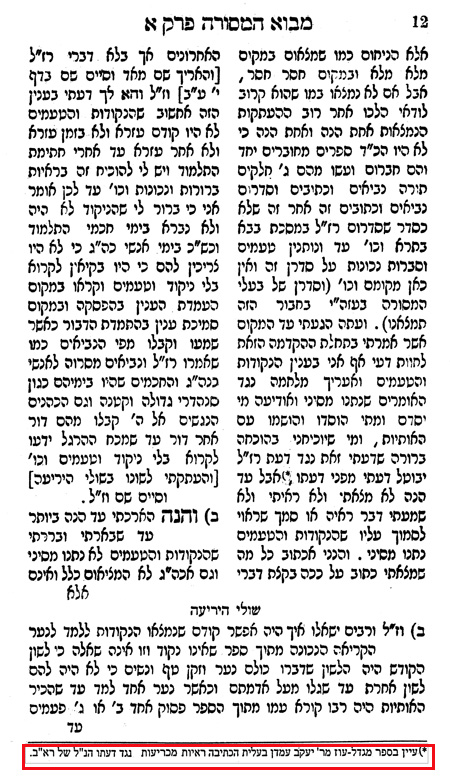
9.     מבוא המסורה, ר’ יוסף קלמן מקאסוויע, נדפס בווארשא תרמ”ט, 112 עמודים.

This work, first printed in 1862 and again in 1889 deals, with the subject of the Masorah by Rabbi Yosef Kalman. One of the points of interest to me about this work is that it received many different haskamot from gedolim of the time. This of interest because the first 15 pages of the work quotes many passages from R. Eliyahu Bachur’s classic work on the subject, including his controversial opinion about the post-Talmudic origin of the nekkudot. Now in the comments on the bottom of the page the author writes that this was already disproven (more on this shortly) but he had no problem to quote this controversial opinion in the main text of the work without arguing on it in the main body or censuring the Tishbi in any form. This is in sharp contrast to the work Nekudot Hakesef printed in 2001.

Now what is interesting is that the person who just printed this new work (someone from Bnei Brak) felt he had to add in one comment to this sefer, so right in the beginning of this long quote from R. Eliyahu Bachur he added in the following:

עיין בספר מגדל עוז מר’ יעקב עמדין בעלית הכתיבה ראיות מכריעות נגד דעת הנ”ל של רא”ב

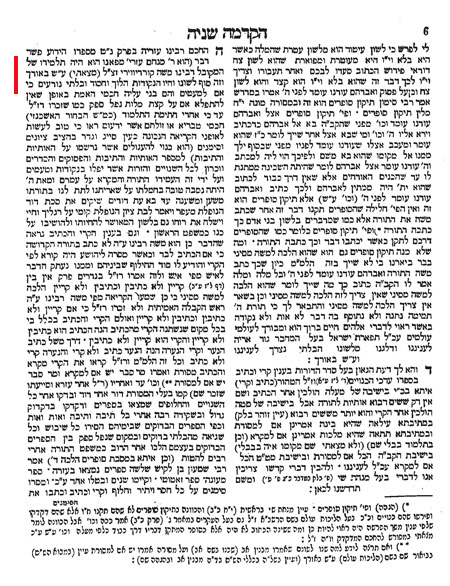
What’s interesting is that on the next page the original author of the sefer writes:

אמר המאסף וכבר השיג עליו בזה בעל אמרי בינה מהזוה”ק והאידרא שהנקודות היו קודם חתימת התלמוד ע”ש באורך הביאו הרמבמ”ן בהקדמתו על התורה ע”ש

I am positive that the recent printer of this sefer did not realize who this was. The original author of this sefer is quoting the Meor Einayim from Rabbi Azariah Min Hadomim who is quoted by Moses Mendelssohn in the introduction to his Chumash, where Mendelssohn quotes him in regard to the origin of the Nekudot. Possibly we can see from this another piece of evidence that it was not considered so bad to quote from Mendelssohn at that time, and especially how well known Mendelssohn’s introduction was. Apparently the printer did not realize the initials הרמבמ”ן refers to Mendelssohn. For a recent case of someone not realizing what these initials are see he work on the Koheles falsely attributed to the Malbim by Oz Vehadar [See Yeshurun 25 pp. 724-735, (PDF available upon request)]
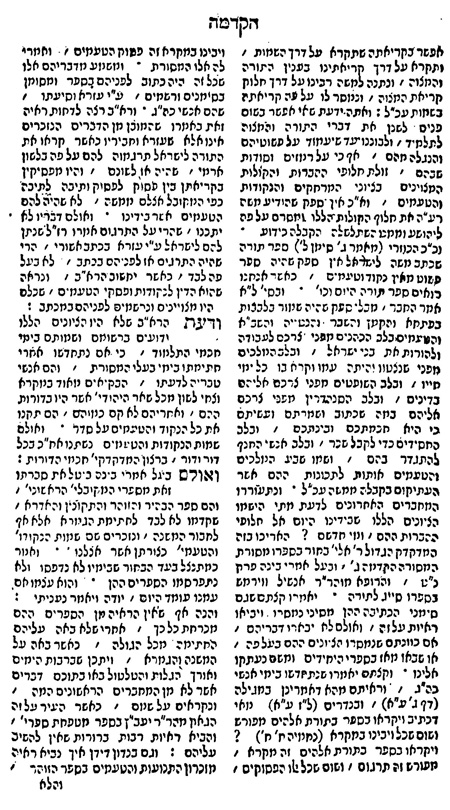
One more addition to all this, in 1870 Rabbi Yosef Kalman put out another sefer on the subject called Shaar Hamesorah which received haskamot from Litvish Superstars of the time. In the introduction he returns to the subject of the origin of nekkudot and again he quotes the Meor Einayim of Rabbi Azariah, who is quoted by Moses Mendelssohn. However here he makes a strange mistake of thinking that the Rabbi Azariah quoted by Mendelssohn was the Rama Mepano!

Returning to the work Mevo Hamesorah, one last discussion of his worth nothing is about Ibn Ezra and his opinion of the origin of Nekudot (pp. 104-105).
[For more on the subject of Nekudot see Dan Rabinowitz’s excellent article available here; Jordan Penkower, The Dates of Composition of the Zohar and the book Bahir (Heb.) Cherub Press; Rabbi Dovid Rothestein work available here. See also my Likutei Eliezer, pp. 71-72]

10. יד יהודה, ר’ יהודה לנדא, תשובות פסקים וכתבים, מכתב יד, קלו עמודים
11. חמודי דניאל עם פ’ רחבת ידים
12.  חמודי דניאל על הלכות נדה, נדפס לראשונה מכתב יד בתוך ספר מעין בינה על מסכת נדה
13. קשר תורה, [לקשר סוף התורה לתחילתה] נדפס פעם ראשונה ווילנא תרסז, ר’ יצחק מו”צ בעיר ריטווא, 112 עמודים.
14. קול חיים, סדרי לימוד ותפילות להגיע האדם לגיל שבעים שנה ואילך, ר’ חיים פאלאג’י, מכון אהבת שלום
15. הקללה לברכה, הלכות איסור קללה, ר’ מרדכי גרוס, קמה עמודים
16.  מנהג אבותינו בידינו, ר’ גדלי’ אבעלראנדר, ביאורים ובירורים במנהגי ישראל מקורותיהם ושרשי טעמיהם, שבת, נישואין שונות, תסד עמודים, ניתן לקבל תוכן העניינים.

This volume is a collection of Rabbi Oberlander’s articles originally printed in the journals Or Yisroel and Heichel HaBesht as well as other places. These essays are very organized and well written on a wide range of interesting topics, all based on a nice collection of sources. I highly recommend this work. Of course one can always add to such collections of material here but לא המלאכה עליך לגמור .

17. אני לדודי, שיחות מוסר וחיזוק לחודש אלול וימים נוראים, ר’ שריה דבליצקי, קעג עמודים
18. ישא יוסף, אורח חיים חלק ב, ר’ יוסף אפרתי, רכו עמודים
19. הטבילה בהלכה ואגדה, ר’ משה סופר, תסד עמודים
20. ביד נביאך, בעניני הפטרות ונביאים, כולל אסופות תשובות ומאמרים בהלכה ואגדה, פרקי הלכה בעיני הפטרה וכתיבת נביאים, כולל כת”י של האדר”ת  על נביאים וכתובים בשם ‘נביאים טובים’, הלכות הפטרה להגר”ש דבליצקי, וס’ סימנים על עניני הפטרה  ונביאים, תרב עמודים
21. שעות שוות בהלכה, כולל מחקר וסקירה על תולדות הפחתות מדידית הזמן לאורך הדורות, ר’ יצחק זילבער, שצ עמודים
22. שמות בארץ, שמות אנשים, ממשנתו של מרן ר’ חיים קניבסקי, דיני וענייני שמות  אנשים ונשים ובשווי שמות בשידוכין, וקו’ שמות נשים, ר’ צבי יברוב, קלט עמודים
23.  ברכת הלבנה, הלכות ומנהגים, ר’ יוסף אדלר, קב עמודים
24.  בים דרך, מאמרי עולם חלק א, ר’ מיכל זילבר, שסז עמודים
25. גם אני אודך על ענייני ברכת כהנים, ר’ גמליאל רבינוביץ, תרלב עמודים
26. ספר פת שחרית כהלכה, ר’ יששכר דוב הופמן, צו עמודים

This is another work from the author of the now-famous recent work all about sneezing in Jewish law..

27. מאורות הגר”א, חלק ב, ר’ רובין, שפ עמודים
28. ר’ ראובן פרידמן, כי עת לחננה, הליה וישיבה בארץ ישראל, 490 עמודים, מוסד רב קוק
29. ר’ ישראל גארפינקל, כיצד מרקדין, בענין ריקודין של מצוה מצוה טאנץ, רמח עמודים
30. חזון עובדיה, שבת חלק ה, ר’ עובדיה יוסף הל’ צובע, קושר ומתיר, תופר צד ממחק כותב ומוחק, השמעת קול, בונה, אוהל, מתקן מנה, תד עמודים
31.הלכה ברורה חלק יג, ר’ דוד יוסף, סי’ רמב-רנב, תקלו +צ+נד עמודים
32. זהב לבושה, איסור פאה נכרית, הלכה הגות מחשבה, שכד עמודים
33. לוח ההלכות והמנהגים לשנת תשע”ג, 372 עמודים
34. קוטנרס האינטרנט בהלכה, קב עמודים
35. ישועות כהן, ר’ יהושע אדלר, ביאור סוגית קוי התאריך, צג עמודים
36. ספר תהלים עם פירוש מפורש, כולל ביאורים על תרגום כתובים ר’ לייביש דיייטש, תק”ח עמודים
37. שערי חג הסוכות, הלכות סוכה, ד’ מינים הו”ר שמיני עצרת ושמחת תורה, ר’ יהודה טשזנר, תקל עמודים
38. קובץ תשובות חלק ד, ממרן ר’ אלישיב זצוק”ל,  שכט עמודים, כולל מפתחות על לארבע כרכי קובץ תשובות, 73 עמודים
39. הערות במסכת ברכות, מר’ אלישיב זצוק”ל, תקמא עמודים
40.  כתבי הגרי”ש, בהלכה ואגדה, מכתבי יד של ר’ אלישיב זצוק”ל, ימים נוראים וסוכות, קס עמודים
41.  אשרי האיש, פסקי מרן הגרי”ש אלישיב זצוק”ל, יורה דעה, ב’ חלקים נלקט ע”י ר’ יחזקאל פיינהנדלר
42.  רישא דגולתא הספדים על ר’ אלישיב זצ”ל
43. שו”ת פוע”ה מניעת הריון, קובץ שאלות רבני פוע”ה ותשובות של פוסקים, 141 עמודים
44.  באמונה שלימה, ר’ יוסף בלאך, תרם עמודים

This work is written by Rabbi Yosef Bloch, who is a well-known Talmid Chacham from Monsey. In this volume Rabbi Bloch deals with many “hot” issues related to Emunah, bringing many interesting discussions to the table. Just to list a few side points of his: he brings that some say that the Chazon Ish’s work Emunah Ubitachon was never supposed to be printed (pp. 69-70) as the Chazon Ish never wanted it printed. He also deals with a piece that was censored from later versions of the Emunah Ubitachon (p. 39). He brings numerous sources against the Ralbag (pp. 140-141). He has a radical statement about what chazal mean when they say “there is wisdom by the Gentiles” (pp. 301-302):

דכל חכמת הגוים הוא בדברים גשמיים דוקא וכגון מכוניות סעלפאון כלי השחתה למלחמה וכדומה, שם ורק שם יש להם חכמה,… ברוחניות אין להם שום מגע והבנה כלל, ותיקון העולם הוא עצמו איבוד חכמיהם וזה כלל גדול בהבנת ענין חכמת האומות בברזל ובעצים ואבנים ובאלקטריק יודעים קצת, בצומחים יודעים פחות מזה בגופות בעלי חיים יודעים הרבה פחות מזה, בגוף האדם עוד הרבה פחות מזה, בחכמת התכונה השמיימית עוד הרבה פחות בנפשיות האדם
יודעים משהו ממשהו ממש , בחכמה עליונה אפס מוחלט לא כלום!

He has a radical explanation for the famous Gemarah about killing lice on Shabbas (pp. 305-307). Another very interesting discussion of his is about the sugyah of Elu Ve-elu Divrei Elokim Chayim (pp. 308-323).

A few years ago I wrote a few comments (here) about Rabbi Bloch’s work against Copernicus. I recently revisited the topic in the last issue in Hakirah. In this new volume Rabbi Bloch includes his anti-CopernicanEssay but with various updates. If one reads the essay carefully one can see many of these updates he is referring to points in my article. Hopefully in the future I will deal with all the issues he raises but for now I would just like to mention two points at one point he writes (p. 358):

ולא מצאתי אחד מגדולי ישראל מכל הדורות שיחזיקו אפילו במקצת דמקצת כדעת התוכנים ומה שהעידו בשם קדוש ה’ המהרי”ל דיסקין זצוק”ל דהיהו סבר ככה, שקר העידו בו דלא כך היה מעשה אלא שענה שלואל דאין הכרח נכד
התוכנים מלשון הברכה כמדומה ממה שנקראת ברכת החמה אבל מעולם לא יצא מפיו הקדוש דנקט איהו כהתוכנים.

I honestly have no idea what he is talking about but as I brought in my article (p.29) the source says as follows:

“וכן אמר לי ידידי הרב וכו’ ר’ אבנר נ”י בעל המחבר סי’ ציר נאמן, בתורת עדות ששמע מפי רבנו הקדוש רשכבה”ג מהרי”ל דיסקין זצוק”ל שהשיטה החדשה אינה מופרכת. ושאל לו מן הכתוב בקהלת א’ וזרח השמש ובא השמש וכו’ הולך על דרום כו’ וענה לו שהכתוב אמר לפי ראות עיני האדם”.

I also explained there (p. 31) why this sources is very reliable. But what bothered me even more was what he writes there on pg. 359.

 ומה שכמה מהמשגיחים וראשי הישיבות מהדור הקודם נ”ע כתבו דרך אגב בין הדברים בספריהם… כשיטת קופעריקוס, אין מזה שום הוכחה כלל לדעת התורה בענין הזה, דלא באו אותם הגאונים זללה”ה ליקח עמדה בהדיון הזה, דלא היתה זו הסוגיא שלהם ולא ידעו שיש בזה סתירה להשקפת התורה שלא ניסו בכגון אלו ולא עיינו בה, ונסתמכו דכיון דככה אומרים הכל מסתמא הוכיחו התוכנים דהאמת כן הוא, ולא ירדו לסוף דעתם של התוכנים לידע שכוונתם עקירת האמת ואין מדבריהם ז”ל הוכחה של כלום, וכאילו לא אמרו כלום בנידון הזה

Now besides for the haughtiness of this statement the only Rosh HaYeshiva I quoted in my article that wrote an essay very pro Copernicus was Rabbi Yonah Mertzbach someone who had a college degree in these areas so I am not really sure what he is talking about.

One last source related to this topic of Copernicus was brought to my attention in a collection of things by Rabbi Zerach Shapiro who was close with the Chazon Ish (part of this booklet was printed in Yeshurun volume 26) where he asked the Chazon Ish about Copernicus:

בענין מה מסתובב השמש או כדור הארץ, אמר שאין הכרעה בדברי חז”ל.

One last point in regard to Rabbi Bloch’s book is he prints an unprinted essay of his father’s, extremely anti Zionistic and the Mizrachi from 1943 (p. 115-116). I think the reason why he is printed this letter here, while it may otherwise seem out of place, is rather simple. In the same issue of the Hakirah where my essay about Copernicus appeared he saw another article froms Elazar Muskin, When Unity Reigned Yom ha’azmaut 1954 which deals with Rabbi Bloch positive attitude to Yom ha’azmaut.

קבצים
1  המעין גליון 203, ניתן לקבל תוכן העניינים
2. אור ישראל גליון סה, שפג עמודים, ניתן לקבל תוכן העניינים
3.  היכל הבעל שם טוב, גליון לד, קצב עמודים
4.  מוריה גליון שעג-שעד
5.  ארזים, גליון א, גנוזות וחידושי תורה, מכון שובי נפשי, תקפח עמודים [כולל רס עמודים של כת”י על ענינים שונים]
6.    קובץ בית אהרן וישראל גליון קסב, ניתן לקבל תוכן העניינים.
This issue includes another attack on Rabbi Dovid Kamentsky (PDF available upon request].

7.  עץ חיים גליון יח, ניתן לקבל תוכן העניינים
8.   ישורון חלק כז,  תתקמ”ב עמודים, ניתן לקבל תוכן העניינים

One piece worth mentioning in this issue is the complete manuscript of the Meishiv Nefesh printed for the first time, edited by Rabbi Yehudah Hershkowitz (59 pp).

מחקר ועניינים שונים
1.  גאון ההוראה אחרי 50 שנה:  היסטוריה, הגות, ריאליה; קובץ מחקרים בעקבות יום העיון במכללת אפרתה על הרב צבי פסח פראנק / עורך – ישראל רוזנסון, קע עמודים, מכללת אפרתה.
2.  המסע האחרון, מאתיים שנה למסעו בעל התניא בעיצומה של מלחמת נפוליאון תקע”ב-תשע”ב, [לאור מסמכים ותעודות, חדשים גם ישנים, וגם סיפורים ושמועות דרושים ומאמרים], יהושע מונדשיין, 378 עמודים.
3.  נתיבי מאיר, אסופות מאמרים, מאיר רפלד, 456 עמודים ]ניתן לקבל תוכן העניינים]

This is a beautiful collection of Dr. Rafeld’s articles on a very wide range of topics. Some of the articles relate to Rishonim on Chumash and many others relate to the world of minhag and Tefilah. There is also a nice collection of important articles related to the Maharshal and his generation (one of Rafeld’s specialties). All these articles show a great breadth and depth in each of their perspective subjects.
4.  הרב פנחס הירשפרונג, מעמק הבכא הנאצי, זכורנות של פליט, 215 עמודים
5.  ר’ יחזקאל סופר, במאי קמיפלגי, הפולמוס המשיחי בתנועת חב”ד, 408 עמודים
6.  הלבוש היהודי באירופה במהלך הדורות, הלכה, מנהגים, גזירות מאבקים, תקנות, מנחם מקובר, ניתן לקבל תוכן העניינים.
7. אביר הרועים, קורות העתים הנהגתו ומשנתו של ר’ עובדיה יוסף, משנת תרפ”א-תשי”א,יעקב ששון, 320 עמודים
8.  רבן של ישראל, מראות קודש ממרן פוסק הדור הגרי”ש אלישיב זצוק”ל, 219 עמודים
9.  יש”א שלום, הערכתו של הגרי”ש אלישיב זצ”ל כלפי מרן הראי”ה קוק זצ”ל, 58 עמודים
10.  הדף היומי, ר’ דוד מנדלבוים
11.  רועה ישראל, על ר’ ישראל יעקב פישר, חלק ב
12. יהדות התורה והמדינה, ר’ אוריאל צימר, בירור רעיוני קצר בשאלת היחס לציונות ולמידנה עם קצת פרקי היסטוריה מן העבר הקרוב, 47 עמודים,
13.  מפיהם אני חיים, ר’ משה קנר, מאמרים על תלמוד בבלי וירושלמי, רב האי גאון, רבינו גרשום, רש”י בעל התוספות, מהר”ם מרוטנבורג וגדולי ספרד, 375 עמודים.
14.   משונצינו ועד וילנא, תולדות הדפסת התלמוד, ר’ יעקב לופיר, 310 עמודים,

I hope to review this book at length here shortly.

15.   משה אידל, שלמויות בולעות קבלה ופרשנות, ידיעות ספרים, 695 עמודים
16.   רשימת הפירסומים, יוסף דן, תשי”ח-תשע”ב, 205 עמודים
17.   יעקב לאטס, פנקס קהילות רומא, שע”ה-תנ”ה, כולל מבוא והערות, מכון יצחק בן צבי, 409 עמודים
18.   משנת ארץ ישראל, שמואל, זאב, וחנה ספראי, מסכת פאה
19.    משנת ארץ ישראל, שמואל, זאב, וחנה ספראי, מסכת כלאים

After recently completing Seder Moed they are now almost finished with Seder Zerayim.

20.  צדיק יסוד עולם, השליחות הסודית והחוויה המיסטית של הרב קוק, סמדר שרלו, 444 עמודים, אונברסיטה בר אילן
21.  דעת גליון 73
22.  מקראות גדולות – `הכתר`-שמות א`-מהדורה מוקטנת
23.  משה פלאי, עטרה ליושנה, המאבק ליצירת יהדות ההשכלה, 501 עמודים, קיבוץ המאוחד
24.  ללמוד את שפת המולדת, מאמריו של י”ל גורדון בשנים 1881-1882, [מאמרי ביקרות על ספרים ועוד], מוסד ביאליק, ספריית דורות, 367 עמודים
25.  כִּתַאבּ אַלנֻּתַף: פירושו הדקדוקי של ר’ יהודה חיוג’ לספרי נביאים בעיבוד עלי בן סלימן מאת אהרן ממן ואפרים בן-פורת, אקדמיה ללשון העברית
26.   פרקי עיון בעברית החדשה ובעשייה בה מאת משה בר-אשר, אקדמיה ללשון העברית  
27.  מקורות ומסורות, סדר ניזקין, דוד הלבני, מגנס
28.  ההלכה: הקשרים רעיוניים ואידאולוגיים גלויים וסמויים, מגנס
29.  סידור תפילות בלאדינו, סלוניקי, המאה השש עשרה, מכון יצחק בן צבי
30.  רעואל וחבריו פרשנים יהודיים מביזנטיון מסביבות המאה העשירית לספירה, גרשון ברין, אוניברסיטת תל-אביב
31.    רבי חיים בן עטר ופירושו אור החיים על התורה, אלעזר טויטו, 291 עמודים, מכללת אורות ישראל
32.  מחשבת ישראל ואמונת ישראל, בעריכת דניאל לסקר, אוניברסיטת בן גוריון, 293 עמודים בעברית, 186 עמודים באנגליש, ניתן לקבל תוכן העניינים.

This volume has many interesting articles. Worth mentioning is Marc Shapiro’s Is there a Pesak for Jewish Thought and  David Shatz ‘s article Nothing but the truth? Modern Orthodoxy and the Polemical uses of History. In the first footnote Shatz mentions Marc Shapiro’s posts on the Seforim Blog. Much can be added to this essay but of note is footnote 28 where he writes:

To be clear, academics, I find, generally shun blogs that are aimed at a popular audience because the comments are often, if not generally, uninformed (and nasty). A few academics do read such blogs, but do not look at the comments. One result of academics largely staying out of blog discussions is that non-experts become viewed as experts. Even when academics join the discussion, the democratic atmosphere of the blog world allows non-experts to think of themselves as experts and therefore as equals of the academicians. Some laypersons, though, as I said earlier, are indeed experts in certain areas of history.

33. חקרי קבלה ותפילה, משה חלמיש, אוניברסיטת בן גוריון, 458 עמודים ניתן לקבל תוכן העניינים

This work is a collection of twenty five articles by Professor Hallamish about tefilah and kabbalah. Some of these articles appeared in print in various journals, festschrifts and memorial volumes, others are supposed to appear soon, and some were written specially for this volume. They all share the common denominator that they are based on research of an incredible amount of manuscripts and rare volumes. I have no idea how he had patience to open up that many books! Based on these discoveries Hallamish shows the influence of Kabbalah on tefilah. One can also find wealth of information on nussach of Tefilah in these volumes. There is a lot to comment on different points on this volume.

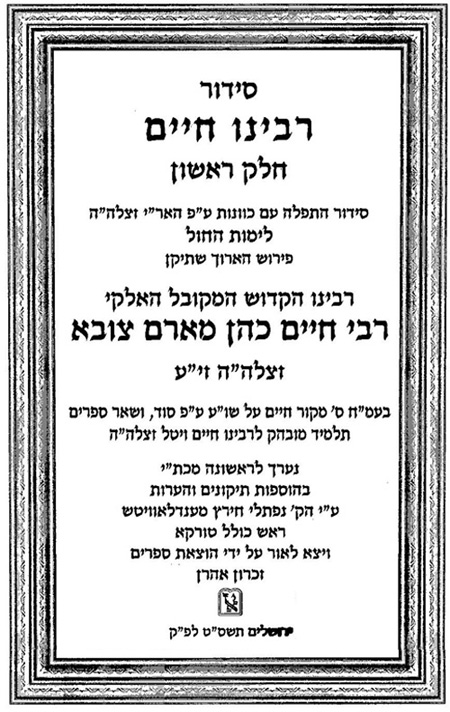
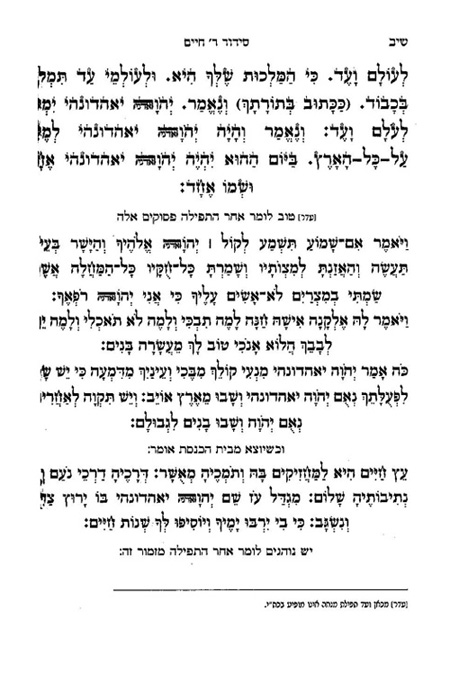
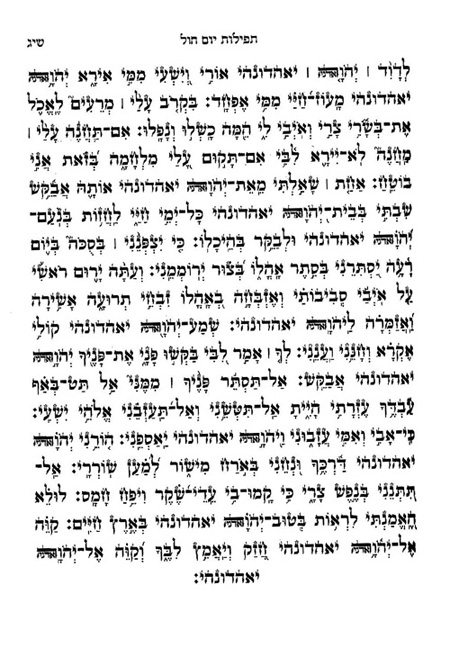
Just to make one small comment as it relates to Elul and a subject I have written about. In chapter thirteen he deals with sources for the custom of saying Ledovid in Elul. He brings early sources for saying it all year around. He quotes the Siddur Shaarei Rachamim which brings this custom to say Ledovid. Now the importance of this find is that this siddur is based on R.Chaim Hacohen who was a Talmid of Rabbi Chaim Vital. If this source is reliable then we have an earlier source for this custom. The first person (not noted by Hallamish) to point to this siddur for an early source for saying Ledovid in Elul was Rabbi Yakov Rokeach in his work Shaarei Tefilah, first printed in 1870. Now it’s well known that the editor of this siddur, Chaim Abadi, added in lots from the Chemdas Yamim and other sources so it’s not so simple if one can consider this siddur a reliable source. However, recently Rabbi Goldhaber checked up the many manuscripts of the actual siddur of R. Chaim Hacohen and found that the custom of saying Ledovid does not appear anywhere in it. Recently part of this siddur was printed by Mechon Zichron Aharon and the custom of Ledovid does appear inside this siddur. So based on this new printed siddur Hallamish has a very early source for saying Ledovid.

First of all what is clear is this is not a source to say Ledovid specifically during Elul but rather an early source to say Ledovid the whole year around. Earlier in this siddur where R. Chaim Hacohen has various chapters of Tehilim to be said on special days he does not include Ledovid to be said during Elul. However at the end of davening Ledovid appears in this new siddur. But more importantly one has to be careful to read the fine print on the page as above where it is printed to say Ledovid in small print the editor adds in that saying Ledovid here does not appear in the original manuscript! Now all this is rather strange; why did he bother adding this in? This is not the place for it as it should be earlier in the siddur with the other chapters said on special days. Even more interesting is that the editor of this siddur says that they decided that four of the manuscripts are authentic but all others have parts added in so they are not going to print all added in pieces  so the question is why did they choose to add in Ledovid
and add nothing else in this printed version.

A few months back I mentioned that the new work by David Assaf Hazitz Unifgah appeared in print. I noted that a complete bibliography of the sources that were used for writing this book was printed in the recent volume of Mechkarei Yerushalayim 23 (2011) pp. 407-481. This was not included in this new work. Recently this bibliography appeared on line here.

English 

1. The Tent of Avraham, Gleanings from the David Cardozo Academy, edited by Nathan Cardozo, Urim Press. 232 pp.
2. Inside Stam, A complete buyers Guide, Rabbi Reuvain Mendlowitz, Israel bookshop, 440 pp.
3.Edward Fram, A Window on Their World: The Court Diaries of Rabbi Hayyim Gundersheim Frankfurt am Main, 1773-1794, Wayne State Univ Press, 653 pps.