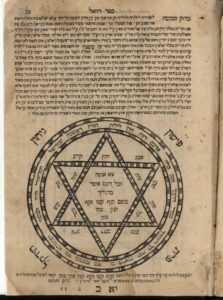
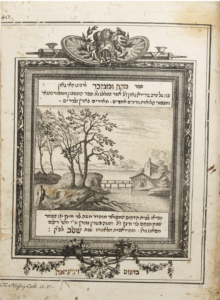
Dr. Leiman’s Post – Two Cases of Non-Jews with Rabbinic Ordination
What follows is an article by Dr. Shnayer Leiman, who I trust is well-known to the readers of this blog. But for the benefit of those who are unfamiliar, Shnayer Leiman is a noted talmid hakham, a professor of Bible and Jewish History and a renowned bibliophile. He has been kind enough to provide the first of (hopefully) many short articles on bibliographical topics of interest. As I am the one who posted this, any typographical errors are my fault alone.
–Dan Rabinowitz
Two Cases of Non-Jews with Rabbinic Ordination:
One Real and One Imaginary
Shnayer Leiman
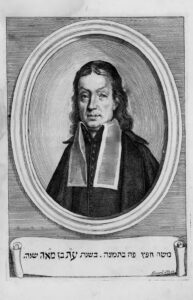
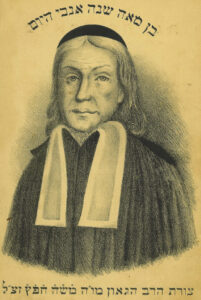
1. Oluf Gerhard Tychsen (1734-1815) was a distinguished Christian Hebraist.[1] A confirmed Lutheran, he devoted his life to Oriental studies, where aside from seminal contributions to Hebrew, Arabic, and Syriac studies, he also made a significant contribution to the decipherment of cuneiform. In 1752, while a student at the Christian Academy in Altona, he also attended the lectures of R. Jonathan Eibeschuetz. From 1755 on, he perused Oriental studies at the University of Jena and then at the University of Halle. In 1759-1760, he served as a missionary to the Jews — with little success — travelling through much of Denmark and Germany. He was thrown out of Altona when he attempted to deliver a conversionary sermon in its main Synagogue. Toward the end of 1760 he was appointed Professor of Oriental Languages at the newly established University of Bützov in Mecklenburg. He later served as Chief Librarian and Museum Director at Rostock. He was a prolific author who published some 40 volumes of scholarly studies during his academic career.
While little honor came his way from the Jewish community in Altona, a rabbi in Kirchheim in Hesse would award Tychsen with rabbinic ordination! Before we present the text of the rabbinic ordination, a word needs to be said about the rabbi and about rabbinic ordination. The rabbi’s name was R. Moshe b. R. Zvi Hirsch Lifshuetz and he served as Dayyan of the Jewish community of Kirchheim in Hesse. Alas, nothing else seems to be known about him.[2] In eighteenth century Germany, two types of rabbinic ordination were prevalent.[3] The higher level of rabbinic ordination bestowed the title of “Morenu” on the recipient. It was usually awarded to a rabbinic candidate who devoted full time to his Torah studies even after marriage, and was intent on serving professionally as a rabbi and rosh yeshivah. The lower level of rabbinic ordination bestowed the title “Haver” on the recipient. It was usually awarded to an accomplished talmudic student when he was about to marry and begin his professional career outside the rabbinate. The rabbinic ordination awarded to Tychsen resembles the lower level of rabbinic ordination. As the text itself makes clear, it was an honorary rabbinic ordination. The text reads as follows:[4]
ויעבור טיכזן מארץ מרחק נדוד מביתו וילך מחיל אל חיל ומישיבה לישיבה למד ויצק מים על ידי גאוני עמו רבים עוסק במלאכת שמים בפלפול ובסברה ה”ה הבחור נחמד המופלא כמ’ אלוף גירהרט טיכזן מהאלזטיין וגם פה עבר עלי הבחור הלז כאשר ראיתיהו שמחתי ואע”ג שאינו בעו”ה נמול רק היה כשותה מים מבארות עמוקות חכמת חז”ל וכמצות ה’ ואהבת לרעך כמוך שמתי על לב לעטרהו ולכבדהו ולסמכהו בסמיכת חכמים שזו תורה וזו שכרה מן השמים להיות קרוא בשם
החבר ר’ טיכזן
לכל דבר שבקדושה ונוצר תאנה יאכל פריו פרי קודש הילולים’ להיות בידו לתפארת ולכבוד התורה ולומדים ולמען שלא תהא האמת נעדרת חקקתי רשמתי וכתבתי דברי בעופרת לכבוד ולתפארת להיות חקוק על לבו ובידו לאות ולמשמרת.
כ”ד המדבר על כבוד התלמידים היום א’ כ”ו למב”י תקי”ט לפ”ק לסדר אלה הדברים אשר דבר.
משה ב”הרב מהור”ר מצבי הירש ליפשיץ יצ”ו מצפה בקרתא קדישא קורך-היים במדינת העסן יע”א
Tychsen traveled a great distance from his home, going from strength to strength, studying at one yeshivah then another, serving the great Gaonim of his people, engaged in the work of the Lord, in pilpul and logical discourse. He is the delightful young lad, the excellent Oluf Gerhard Tychsen of Holstein. He passed through my community as well. When I saw him I rejoiced. Despite the fact that due to our sins he is uncircumcised, he drank from the waters of the deep wells the wisdom of our Sages of blessed memory. And as required by G-d’s commandment: Love your neighbor as yourself, I resolved to crown him and honor him and bestow upon him rabbinic ordination, for such is the Torah and such is its reward from heaven that he be called by the title
The “Haver” R. Tychsen
for all sacred purposes. He who tends the fig tree will enjoy its fruit, an offering of praise, all to his glory and honor, and for the honor of the Torah and those who study it. So that the truth not be withheld, I have recorded this in ink, for honor and glory, to be engraved on the tablet of his heart, and to hold in his hand as a permanent sign.
These are the words of the one who speaks in honor of the students, today, the first day of the week, 26 days in the counting of the Omer, in the year 519 not counting thousands, the parashah of “These are the words that [Moses] spoke,”[5]
Moses the son of Rabbi Zvi Hirsch Lifshuetz, may his Rock and Redeemer watch over him, the rabbinic judge[6] in the holy community of Kirchheim”[7] in Hesse, may He protect it.
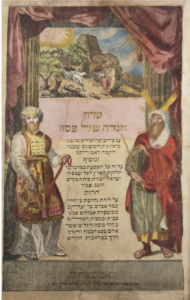
2. Elias Hutter (circa 1553-1609), a pious Christian, studied Oriental languages at the University of Jena and was appointed Professor of Hebrew at the University of Leipzig.[8] His fame rests not so much on his scholarly research as it does on his career as an editor and publisher. He published a series of polyglot editions of the Bible, as well as editions of the Hebrew Bible alone. He is perhaps most famous for his Hamburg, 1587 edition of the Hebrew Bible.[9] Usually bound in one thick folio volume, it is distinguished by the large font he used for the Hebrew letters. Moreover, he printed the root letters of every Hebrew word in the Bible in thick, heavily inked font. In contrast, he printed the non-root letters (such as “vav” copula “and”; or “vav” consecutive, which changes the tense of the verb) in a hollowed-out outline form. Thus, he introduced a major educational tool where a simple glance at the printed biblical text enabled the reader to recognize the root letters of any Hebrew word.
One of the many great Gaonim who lived in the eighteenth century was R. Joseph Teomim (1727-1792) Chief Rabbi of Frankfort on the Oder.[10] His classic commentary on Shulhan Arukh, Orah Hayyim and Yoreh De’ah, the פרי מגדים, is frequently reprinted. In the first edition of the פרי מגדים on Orah Hayyim (Frankfort on the Oder, 1787), R. Joseph Teomim prefaced his commentary with six “letters.” The “letters” were actually an encyclopedic introduction to Jewish law, thought, and practice. Some of the “letters” address such matters as the ideal curriculum for a young Jewish student, and even present lists of which books need to be read and mastered. The “letters” were not always included in the later editions of the פרי מגדים. When Makhon Yerushalayim — a distinguished publishing house for rabbinic literature — undertook to reissue the Shulhan Arukh in a massive, comprehensive, and majestic new edition, it made sure to include the six “letters.”[11] Moreover, as the editors put it: “We have re-edited the letters in clear print, with proper paragraphing and punctuation. We also added notes and references in order to render it easier for the reader to wade his way through these sometimes complex materials.”[12]
In the sixth “letter” (on p. 339 of the Makhon Yerushalayim edition), R. Joseph Teomim notes that the first book that needs to be studied by a Jewish child is the Hebrew Bible in its entirety. He then lists a series of biblical commentaries and tools that are essential for the proper study of תנ”ך. He adds:
גם תנ”ך עם אותיות חלולים, השורש בדיו, והשימושים והחסרים לבינים, טובים מאוד לנער בבחורתו ללמוד מהם
“A young student will gain much by studying from the Tanakh with the hollowed-out letters, i.e., with the root letters inked-in and with the prefixes and suffixes and the vowel letters hollowed-out.”
Since most readers would have no idea which edition of the Hebrew Bible was intended by R. Joseph Teomim, or where to look for it, the editors of Makhon Yerushalayim wisely and correctly indicate in a footnote that the reference is to the Hutter Bible. Alas, they also bestowed a posthumous rabbinic ordination on Elias Hutter, calling him:
הר”ר ע. הוטר
“The Rabbi, Rabbeinu [or: Reb] E. Hutter”
This, of course, is the imaginary case of bestowal of rabbinic ordination on a non-Jew.[13]
2] It is tempting to identify him with R. Moshe b. R. Zvi Hirsch Lifschuetz of Mannheim (Germany) and Modena (Italy), a supporter of R. Jonathan Eibeschuetz. See לוחת עדות, Altona, 1755, pp. 20b-21b. But R. Jacob Emden assures us that the latter Rabbi Lifschuetz was no longer among the living in 1759. See his ויקם עדות ביעקב, Altona, 1755-1756, p. 85a.
3] In general, see M. Breuer, “הסמיכה האשכנזית” in ציון 33) 1968), pp. 15-46.
4] The text is drawn from L. Donath, Geschichte der Juden in Mecklenburg, Leipzig, 1874, pp. 326-327.
5] The date is problematic. In 1759, the 26th day of the Omer (= 11 Iyyar) fell on a Tuesday (May 8), not on a Sunday. Also, the parashah was פרשת אמור, not פרשת דברים. The latter objection is easily met. The author of the rabbinic ordination was simply introducing his signature with an appropriate biblical flourish: These are the words that Moses [the son of Rabbi Zvi Hirsch Lifschuetz] spoke. Regarding the former objection, one suspects that the typesetter of the Donath volume misread a “ג” for an א.
6] Almost certainly the printed Hebrew text needs to be emended and read: מ”צ פה = מורה צדק פה, and we have translated accordingly.
7] Kirchheim here is perhaps to be identified with the town of Kirchhain in Hesse. On the history of the Jewish community in Kirchhain, see K. Schubert, Juden in Kirchhain, Wiesbaden, 1987.
13] Turning non-Jews into rabbis (without prior conversion) is not unprecedented in Jewish literature. Apparently, J. D. Eisenstein, in his אוצר ישראל, included a non-Jew on a list of talmudic rabbis who worked for a living. See R. Abraham Isaac Ha-Kohen Kook’s critique of Eisenstein in אגרות הראיה, Jerusalem, 1962, vol. 1, pp. 161-162.
Appendix:
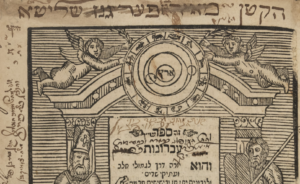
Title Page of 1587 Hutter Bible
R. Shlomo Yosef Zevin and the Army, and Joe DiMaggio
R. Shlomo Yosef Zevin and the Army, and Joe DiMaggio
by Marc B. Shapiro
1. There is a lot of talk these days about haredim serving in the army. Understandably, the famous essay of R. Shlomo Yosef Zevin has been cited. In this essay, R. Zevin rejects the notion that yeshiva students shouldn’t have to serve.[1] The essay used to be found at http://www.hebrewbooks.org/32904 but it was removed, together with other “problematic” books. (You can see evidence of it having been on hebrewbooks by this archive.org snapshot of the page.)
In my series of classes on R. Zevin at Torah in Motion, I discussed this essay and stated that while the sentiments expressed in it are wonderful, I am aware of no evidence that R. Zevin actually wrote it. People say he wrote it but that is not evidence. I also stated that it is not even accurate to say that everyone assumes he wrote it, since his family denies his authorship. That, at least, was the impression I was under.
David Eisen participated in the classes (which were from 4-5am Israel time!), and after hearing what I said decided to pursue the issue further. I am grateful for his research. Here is the first email he sent to me on the topic.
I surfed the web a bit and came across the following website created by Hanan Zevin, R. Zevin’s great-grandson dedicated to R. Zevin and that includes many of his writings: http://ezevin.com/. As the site made no reference to the article from 1948, I contacted Hanan via the e-mail address on the site (see attached).
I just received a phone call from Hanan’s father, [R.?] Yaakov Zevin, who told me that Hanan had forwarded my e-mail to him to respond to me. I subsequently saw that Yaakov also has a website with his own hiddushim on parashat hashavua and the holidays (http://jzevin.com – the cell phone on the website is the same number that called me; interestingly, Yom HaAtzmaut and Yom Yerushalayim are included in the list of holidays and the divrei Torah are quite cynical). He called to tell me that he did not wish to respond in writing as this indeed is a very sensitive matter to the extended family, yet he felt a need to not simply ignore my e-mail. In short, he would not outright confirm that his grandfather indeed wrote the article and repeatedly told me that “if ‘ahad harabbanim’ decided not to disclose his name, he must have had very good reason to do so, yet the authorship of the article is apparent to anyone who is sensitive to the ‘signon’ of the writing in the article.” In other words, he led me to believe that R. Zevin indeed wrote the article but wished to state that “whoever” wrote it had very good reason to have written it anonymously.
I proceeded to ask him if indeed his grandfather ever addressed the question of the article’s authorship, yet he evaded that question. I also told him that the catalog of the Israel National Library attributes his grandfather as the author (see here) and he simply said that indeed this is what is widely accepted but the family does not confirm this. I told him that I heard that his brother, R. Nahum, denies that his grandfather wrote the article, yet he wished to say that he simply does not confirm that their grandfather wrote the piece. I mentioned the Hapardes article that R. Zevin wrote in 1973 (attached is the journal) where he sharply attacked the Mafdal party for supporting the draft of yeshiva students as if to ask if this contradicted the 1948 article, and he simply responded by saying that his grandfather’s views were relevant for each context in which they were made. Personally, I do not see a contradiction either as the war of 1948 was indeed an existential battle for Israel’s survival and its extremely limited and untrained military as opposed to the radically improved situation that existed 25 years later, post-67.
I suggested that Eisen call R. Nahum Zevin, the grandson of R. Shlomo Yosef, and here is the lengthy email he sent me. It is an important document and deserves to be placed in the public sphere.
I just had a lengthy call with R. Nahum Zevin; though we never spoke with one another before, I was very pleased with his accessibility and willingness to speak to a complete stranger on the phone (he answered the phone himself), and above all, I was most impressed by his honesty and candor, which he seems to have inherited from his grandfather.
He wished to clarify that neither he nor anyone else in his family denies that his grandfather wrote the 1948 pamphlet לשאלת הגיוס של בני הישיבות; I did not mention your name, but simply told him that it recently became known to me that the family denies the attribution to him and that this flies in the face of what I grew up upon as a product of Religious Zionist yeshivot and my great admiration for R. Zevin’s writings. He simply said that the family had absolutely no indication that he wrote the pamphlet and proceeded to present the following facts:
1. Of all the grandchildren, he was the closest with R. Zevin, and he went through all of his grandfather’s writings and had a major role in publishing R. Zevin’s posthumous works. He says that he meticulously went through his grandfather’s study and never found a copy or any draft of this pamphlet among the many manuscripts he found in the house.
2. The attribution of this pamphlet to his grandfather was made only years after his grandfather’s petira in 1978. The first time he had heard about this attribution was during the early 1980s from R. Menahem Hacohen when he was still an MK in the Labor party. As such, no one in the family had the opportunity to discuss it with his grandfather. He said that if anyone would have known about his grandfather’s authorship of the article it would have been his father, R. Shlomo Zevin’s only son, yet he told him that he also first heard about this attribution only after his father passed away.
3. He referred to the article entitled אל תגעו במשיחי that was published in 1973 on the heels of the Mafdal’s decision to support drafting yeshiva students. I told him that I am very familiar with that article published in the Iyar 5733 (47:8) edition of Hapardes[3] he told me that he just happened to have a copy of that article on his desk as we spoke yet was unaware of its publication in Hapardes as it was first published on the 12 Adar 5733 edition of Hatzofe and that he (R. Nahum) was the one who personally delivered the text of the article to the editorial staff of Hatzofe. He said that this article created a veritable earthquake in the Dati Leumi camp, and R. Zevin was greatly attacked on the pages of Hatzofe and other related media over the proceeding weeks and months, yet despite the voluminous criticism no one mentioned the pamphlet as if to show that R. Zevin had radically changed his views. I responded that I, too, had the very same question yet nonetheless did not see these two articles as contradicting one another given the existential threat facing the nascent State of Israel as sharply opposed to the hubris-filled post-6 Day War era and preceding the sobering aftermath of the Yom Kippur War that took place half a year later. He agreed with the distinction, yet [to my mind, correctly] noted that had it been known that R. Zevin wrote the 1948 pamphlet it is impossible to think that this connection would not have been made by the numerous pundits.
Apropos the article that originally appeared in Hatzofe and R. Menahem Hacohen’s assertion that his grandfather wrote the pamphlet, R. Nahum told me that there was a good deal of criticism against his grandfather’s article against drafting yeshiva students in the Dati Leumi magazine Panim el Panim. R. Nahum said that he contacted R. Menahem Hacohen after he attributed the pamphlet to his grandfather and reiterated the point that none of the critiques in Panim el Panim mentioned the apparent about-face from 1948, and noted that the editors of Panim el Panim were none other than his brothers, R. Shmuel Avidor Hacohen and R. Pinhas Peli. That said, I probably misunderstood the reference R. Nahum made to Panim el Panim as according to Wikipedia, the magazine was discontinued in 1970, three years before the publication of R. Zevin’s article against drafting yeshiva students.[4]
4. Beyond all of the above points, R. Nahum said that what makes the attribution puzzling is the fact that his grandfather was never reserved about his beliefs, and that it makes no sense to him that he would have published that pamphlet anonymously. After all, his highly positive views on the State of Israel and annual celebrations of Yom HaAtzmaut were well known. He told me that he was so closely linked with the Mizrahi party that he remembers up to the 60’s that R. Zevin would affix his signature along with R. Meshulam Roth and R. Zvi Yehuda Kook on endorsements prior to elections to vote for the Mafdal party (and its Mizrahi and Hapoel Hamizrahi precursors). He also mentioned the parenthetical phrase of “ואשרנו שזכינו לכך” in Moadim B’Halakha with respect to the establishment of the State of Israel and the suggestion that one is no longer required to perform qeriah on Arei Yehuda, and that when it was removed from the English translation (and perhaps a subsequent Hebrew edition).[5] This was used to claim that he no longer held these positive feelings towards the Medina, but R. Nahum utterly rejected this assertion as wholly false and that he never changed his views in this regard.
5. That said, and similar to what his brother Yaakov told me, he said that one cannot avoid comparing the writing style of the pamphlet with R. Zevin’s unique and eclectic writing style; moreover, he said the substance and analysis of the Torah reasoning in the pamphlet is indeed very similar to his grandfather’s Torah writings and very good Torah indeed. R. Nahum clearly has no agenda and was completely honest in saying that this could very well have been written by his grandfather though there is no proof to this effect, and he acknowledged that לא ראינו אינו ראיה so the fact that the family has not found the existence of any manuscripts showing that he wrote the kuntres certainly does not constitute cogent evidence that he did not write it.
I must agree that if indeed no attribution to R. Zevin was made until after he passed away, then this is a major hurdle to address, and while I appreciate his cautious approach in refusing to conclude one way or the other, it seemed to me a bit naive on R. Nahum’s part to think that it was implausible for him to have written this piece anonymously; I remind you of what his brother, Yaakov Zevin, told me that there is no doubt as to the similar writing styles and that if the author felt a need to write it under the pen name of “אחד הרבנים” he must have had very good reason to do so (shiddukhim, etc.?).
As R. Nahum claims that he first heard the attribution from R. Menahem Hacohen who is alive and well, I guess the next step in delving deeper into this investigation would be to contact R. Hacohen himself. What do you think? If I had the time, which I certainly do not, then I would think that it would make sense to find the first time the pamphlet became attributed to R. Zevin in Israeli newspapers and other writings and track down the paper trail.
Some time later I received the following email from Eisen, which only thickened the plot.
I just came back from the Bat Mitzva party of Naama Rosenbaum, Prof. Zvi Yehuda’s granddaughter, whose daughter, Talli, is a very good friend in my Bet Shemesh neighborhood (unfortunately her father was unable to make the trip to Israel from Florida due to an extended illness). The paternal grandfather of the bat mitzvah girl is Irving Rosenbaum Z”L, the founder of Davka Software and who was very friendly with R. Menahem Hacohen, who attended the party this evening. I seized the opportunity to ask him about the attribution of the 1948 essay to R. Zevin. I actually began the conversation by asking him if he is familiar with you, and his eyes lit up and he said, “Yes, he e-mailed me twice in the past few years… though I forget what it was he contacted me about.” When I then mentioned that R. Nahum Zevin claims that R. Hacohen is the one who attributed the essay to his father only after R. Shlomo Zevin passed away, he then confirmed that it was precisely on this issue that you had approached him.
He quickly got to the heart of the matter and said that he had held in his hands an original copy of the essay and said that there was no question that R. Zevin was the author, though he said that he has misplaced the copy and had no proof to substantiate his assertion. He did say that R. Nahum is incorrect in saying that the attribution to his grandfather was made only after his grandfather passed away and that he had already seen the letter in the early 70’s when he was working alongside R. Goren; and that he believes that R. Zevin himself was asked to confirm that he indeed wrote the letter. In R. Hacohen’s words, R. Zevin neither denied nor confirmed that he wrote the letter inasmuch as R. Nahum essentially says the same thing, yet R. Hacohen added that R. Nahum at the time had (as he still has today) an agenda to disassociate himself from the position taken in the 1948 essay as he is well ensconced in the haredi rabbinate. That said, I told him that R. Nahum’s “proof” by omission that in all the criticism levied against his grandfather’s “Al Tig’u BiM’shihai” by religious Zionists, the fact, as he claims, that no one had noted the seemingly about-face that he had made from the essay he supposedly penned 25 years earlier, was pretty compelling to me. He responded by reiterating that R. Nahum’s allegiances render him unable to confirm what R. Hacohen maintains is the simple truth and that he unfortunately does not have any documented proof regarding R. Zevin’s authorship. He also rebuffed the claim that R. Nahum knows everything that his grandfather had written and preferred Yaakov Zevin’s nebulous formulation that the person who wrote that essay must have had good reason to have done so anonymously. With that, we parted.
So, it seems to me that in order to forge ahead on this issue, it remains vital to read the reactions to the Panim el Panim article along with those generated from R. Hacohen’s assertion made when he was a Labor MK.
Here is Eisen’s fourth email to me, which I believe also raises questions about the attribution of the essay to R. Zevin. At the very least, it discounts the notion that this attribution was widely known, which raises the problem as to when and why people started attributing the essay to R. Zevin.
I have additional information that I have been meaning to write to you after spending a number of hours at the National Library going through the 1972-1973 issues of Panim el Panim and the lengthy articles that appeared in the secular (Yediot, Maariv, Haaretz and Davar) and religious newspapers (Hatzofe, Yated and Hamodia) during the 30 month period following his [R. Zevin’s] passing between February to March 1978. In short, I found NO reference to this article in any of the many articles in which his position against drafting the haredi yeshiva students was discussed following his fiery speech delivered before the members of the Chief Rabbinate Council on the heels of the Mafdal’s support of legislation to draft yeshiva students. . . . I then spoke with one of the chief librarians at the National Library asking what is the basis for its attribution of this article to R. Zevin and when was it made. He made an inquiry and said that the attribution indeed was made many years ago (he believe it goes back to the 60’s though he had no documentation to substantiate this).
In his fifth email, Eisen wrote as follows:
On the R. Zevin authorship controversy, I had some meaningful conversations on Friday with Prof. [David] Henschke, who put me in touch with his hevruta at Yeshivat Hakotel, R. Yossi Leichter, who is a senior librarian at the National Library, who in turn put me in touch with R. Yitzhak Yudlow, the now retired head of מפעל הביבליוגרפיה הלאומית that was likely the body that attributed the article back in the 60’s to R. Zevin, and he put me in touch with R. Nahum Neria who said he is quite certain that his father [R. Moshe Zvi Neria] told him that R. Zevin indeed was the author and that he would look through his papers and asked that I follow up with him this week. R. Neria also suggested that I contact R. Shear Yashuv Cohen, which I intend to do tomorrow. In short, none of them had any solid information. David Henschke looked into the matter out of curiosity many years ago and concluded that the attribution made by the National Library was made years before R. Zevin passed away and reliable. . . . It seems that that the first time the article was reprinted with the R. Zevin attribution was back in 1980 in a thin booklet of articles compiled by Dr. Yehezkel Cohen, the founder of נאמני תורה ועבודה. Unfortunately, he passed away this past Sukkot, and as someone who devoted a great deal of research on the topic of military exemptions for yeshiva students and actively worked to stem this tide, he is someone who would have been a vital source. I may call his wife for any leads, especially since he was attacked by R. Mordechai Neugorschel in his polemic haredi work entitled “למה הם שונים” for making this attribution when he claims that there was no way that R. Zevin could have written the article given his impassioned speech delivered in 1973 and the fact that no one noted the change in his position from 1948 as noted by R. Nahum Zevin. When Tradition translated the article into English in 1985, they credited נאמני תורה ועבודה as being the original source for attributing the article to R. Zevin in 1980, see here. Truth be told, when Yehezkel Cohen reprinted the 1948 article, he made a point to also include a photocopy of the National Library’s catalog entry as if to show that he was preceded by the National Library in making this attribution.
Here is Eisen’s final email to me on the topic.:
I just got off the phone with Eliyahu Zevin, 60, the youngest brother of Yaakov and R. Nachum (their father, Aharon, had 3 sons and he passed away in 2006; R. Zevin also had 1 daughter, Shoshana, but I have not been able to track down her family), who is an attorney in Tel Aviv. I believe he is religous-Zionist. He told me that he is certain that his grandfather was not the author of the 1948 article, again, based on his clearly-stated position in 1973, though, he then greed with me that 1948 was an entirely separate matter relating to an existential threat upon the state and the thrust of the article relates only to sugyot of pikuah nefesh and whether or not talmidei hakhamim require protection, without addressing the separate question of whether or not full time yeshiva students should receive an exemption of a military draft. He had no idea what was the source of the attribution to his grandfather and simply said that the similar “signon” of the writing is likely what caused this attribution to be made. I did not discuss with him the fact that I spoke with his other 2 brothers and specifically did not tell him that his oldest brother, Yaakov, led me to believe that his grandfather indeed wrote the article yet had “good reasons” to publish it anonymously.
Regarding the essay and its attribution to R. Zevin, R. Chaim Rapoport has commented to me that since the essay has two references to Shulhan Arukh ha-Rav, this too would seem to point to R. Zevin’s authorship. There is little doubt that in this sort of essay only a Habad author would refer to Shulhan Arukh ha-Rav.
In his research, Eisen discovered this interesting interview with R. Zevin and his son and grandsons that appeared in Maariv, July 31, 1970.
I thought that I found proof for R. Zevin’s authorship in the Torah journal Yagdil Torah, the last Torah journal published in the Soviet Union. The first issue of this journal appeared in 1927 edited by R. Yehezkel Abramsky. The second and last issue appeared in 1928 edited by R. Zevin. In the table of contents there are some contributions by אחד הרבנים. Could this be proof that R. Zevin used this pseudonym already in the 1920s? It turns out, however, that אחד הרבנים in this issue of Yagdil Torah is actually R. Abramsky, and this information has been inserted in the reprint of the journal that is found on Otzar ha-Hokhmah.
Surprisingly, however, the person who inserted this information apparently did not know what to make of the pseudonym ב”מ-ו עזפמט. It doesn’t take much imagination to see that in atbash this equals ש”י-ף זעוין. See Aharon Sorasky, Melekh be-Yafyo ((Jerusalem, 2004), pp. 188-189. See also ibid., p. 241 n. 12, for another time when R. Abramsky signed an article אחד הרבנים.
Finally, here is something very nice put together by Yisrael Kashkin. Most of the great rabbis included were what we can call card-carrying Religious Zionists, and the remaining few were positively inclined to the movement. Not surprisingly, R. Zevin’s picture is found here. Kashkin informs me that anyone interested can order framed 8.5 x 14″ and laminated 8.5 x 14″ copies. The former are meant for a wall and the latter for a Succah. He can prepare and ship the frames for $25 and the laminated for $10. You can contact him at yisrael@email.com. I recommend that every Modern Orthodox school order an enlarged copy in order to hang it in the hallway.
2. Many people wanted to hear more from R. Mordechai Elefant, late Rosh Yeshiva of the ITRI yeshiva, but first, here is his picture.
And now, R. Elefant speaks:
I called Sholom Spitz in Queens the other day. I gave him the phone number of Joe DiMaggio’s secretary, Nick Nicolozzi, and I asked him to wish Joe DiMaggio well from me. Five minutes later he called me back to say that they announced on the radio that he died.
Joe and I were very good friends. I met him through a man from Miami named Kovins, a wealthy man, big in the construction business. He met DiMaggio through Nicolozzi, who had worked in a Sheraton hotel he owned in New Jersey. To make a long story short, I became a partner in the Sheraton. It was a 520-room hotel. Joe, Kovins, and I each had a third. I didn’t buy it. I had made a deal and got it as an agent’s fee. There were halachic problems involved concerning the operation of the hotel on Shabbos, so I wanted to unload it, and I talked Joe into it.
Joe DiMaggio had a suite on the fifth floor of that hotel called ”The Joe DiMaggio Suite.” Rav Zelig Epstein, one of the great Talmudists of our day, came to see me when I happened to be staying on the fifth floor of that hotel. We’re walking along the corridor when out steps Joe. So I introduced Rav Zelig Epstein to Joe DiMaggio. He knew who DiMaggio was. He’s a very intelligent man.
Two years ago when I was sick in bed I got a letter from Joe. There was a picture of him in the paper with a big yarmulke. He sent the accompanying article. Mel Allen died, so he went to the memorial service in the synagogue. Joe writes me, “I did it for you, Rabbi.” He wore the yarmulke just for me.
Joe was from the old days. He was born in America, but had a European sensibility. He never went to school but he had style and he was smart. He wasn’t good looking, but he had great charm. He gave me an autographed copy of his autobiography. He hated the Kennedys. He claimed they killed Marilyn Monroe. It wasn’t a normal husband and wife relationship between them. He was like Marilyn’s patriarch.
They didn’t make big money in baseball in his day, but he would do a lot of advertisements. Joe loved a dime because it wasn’t a nickel. He’s from a place called Hackensack [not true – MS] and he came up the hard way.
I saw the respect people would give. It was like they give Rav Shach (one of the most esteemed rabbis in Israel). I said to him, “You’re nothing but a little wop. I’m the chief rabbi of Bethlehem. They don’t give me the kind of respect you get. And they pay you fifteen or twenty thousand dollars just to come to a party.” It was said in a spirit of good humor. Joe wasn’t offended. He said, “One day I’ll explain it to you.”
Once I was at the hotel in New Jersey, and he said to me, “Rabbi, I have to go to the Super Bowl. Come along.” I didn’t know what Super Bowl meant at the time. Naturally, I paid for his ticket. He loved that. He took me into a fancy hotel on Wilshire Boulevard, into a big ballroom. All the chairmen of the big companies were there. Carl Icahn was there. They had come in for the Super Bowl. Joe was paid to just be there. He walks in, and they all stand up for him, just like for Rav Shach. I can’t imagine what went through their minds when they saw me together with Joe. He said to me, “You see, I’m not just a little wop.”
One Sunday morning he comes into my hotel room – it’s right across from his – and says, “Rabbi, turn on the TV at 2:00 today.” I asked him what’s going to be on. He says, “You’ll see.” He went to Washington on the shuttle. He was invited to meet Gorbachev by President Reagan. Reagan had been a baseball announcer and he was a great fan of DiMaggio’s. Reagan asked him to sign a ball for Gorbachev. Joe tells him, “No problem, Mr. President, but let’s make that three baseballs, one for each of us, and all three of us will sign them.” This is all on TV.
He comes back at night and shows me the ball. I said, “Joe, give it to me.” He said, “Are you crazy, You know what that’s worth?” He did give me ten balls with his autograph. I gave them to children of friends. They would go wild over them.
When Joe was on that trip to Washington, he was on the White House lawn. Everybody gathered around Joe and left Reagan standing alone. I saw it on television. But Joe was so smart. He stepped back and stood next to Reagan. He didn’t want to show that he’s above Reagan. He was humble.
I would sit with him in the lobby of a hotel and people would stand in line to get his autograph. He was really an aristocrat. He was a pleasure to be with.
3. In case anyone is interested, for some reason Amazon is now selling my book Between the Yeshiva World and Modern Orthodoxy for the low price of $16.63. This is a 33% discount..
Notes
[1] I don’t want to go into the matter in too much detail in this post, but I think there has been a lot of confusion in recent months regarding the issue. While the current controversy is often portrayed as the haredim insisting that yeshiva students not be required to serve in the army, my sense is that this is a distortion. It appears to me that the mainstream haredi position in Israel is that no haredi should have to serve, even if he is not in yeshiva and even if his service would be in a haredi unit. In this mindset (which appears to be slowly changing), the rest of the population’s primary purpose is to monetarily support and protect (and if necessary die for) haredi society, while haredi society has no reciprocal obligations and for those in yeshivot not even any financial obligation to support their own children, as this obligation falls upon the population at large which provides the money for welfare payments. (The existence of haredi hesed organizations that also assist non-haredim does not affect my assumption, as I am speaking here about obligations.)
R. Samson Raphael Hirsch wrote (Collected Writings, vol. 7, p. 270): “Judaism believes that a truly viable state cannot be founded solely on collective power or individual need; it must be based on a sense of duty shared by all and on a universal respect for human rights.” (emphasis added) As for the obligation of fathers to support their children, the Shulhan Arukh, Even ha-Ezer 71:1 writes:
חייב אדם לזון בניו ובנותיו עד שיהיו בני שש אפילו יש להם נכסים שנפלו להם מבית אבי אמם ומשם ואילך זנן בתקנת חכמים עד שיגדלו
Seeing the terrible mess Israeli haredi society has created for itself, in which the leadership purposely keep the masses poor and unskilled in the name of ideological conformity (of course, the Knesset members pushing this agenda make a very nice salary, and see this unbelievably sad story about the forced shut-down of a part-time kollel for those who were also working), I thought of R. Samson Raphael Hirsch’s words in a letter he wrote in 1849 while he was rabbi in Nikolsburg (see Ha-Rav Shimshon Raphael Hirsch: Mishnato ve-Shitato [Jerusalem, 1962], p. 337). What he says is neither complicated nor profound, but its value is that it reminds people of what happens when you ignore and even reject the clear teaching of our Sages, who always assumed that not everyone is suited for only Torah study:
ואם שבר בת ציון תעלה על לבך, וראית כי אחת היא מחלתינו ובאחת תעלה ארוכתינו, היא עזיבתנו תורת חכז”ל הצוחת ועומדת מימי קדם: יפה תלמוד תורה עם דרך ארץ ואם אין תורה אין דרך ארץ, ואם אין דרך ארץ אין תורה, ומאז מאסנו לשמוע דברי חכז”ל האלה באמת דרך ארץ שלנו חסר יראת ה’, ואנשי התורה יכשלו רגליהם במעגלי דרך הארץ. והנה רק יגיעת שניהם משכחת עון ויבור רוח הטומאה מבינינו, ופרידתם השכיחה שניהם הדרך ארץ והתורה מבני דורנו
See also my post here where I quoted R. Aharon Leib Steinman’s advocacy, and idealization, of haredi poverty (which by definition means that the welfare state [which in some ways is even worse than the nanny state] will have to provide financial support, which in turn means higher taxes for what is nothing less than enforced charity on behalf of able-bodied people).
In the future, I think people will look back and realize what terrible mistakes the haredi leadership made. Just a few years ago it was obvious that changes were needed and rather than take the bull by the horns and institute these changes and thereby control the direction, the leadership did nothing, meaning that when changes came it was the non-haredim who were in charge. Haredi Judaism, like its pre-haredi predecessors, is completely reactive, never proactive and thinking ahead. It was this trait that led Isaac Breuer to become so disillusioned with Agudat Israel, as he describes in his autobiography. It was also this lack of proactivity that in the early nineteenth century let Reform grow in Germany and in later years allowed secularism to grow in Eastern Europe. Just think about how many young women left traditional Judaism before Beis Yaakov was established, and then consider how many could have been saved if instead of creating Beis Yaakov as a reaction to the widespread defections, it had actually been created thirty years prior by people thinking ahead and acting proactively (traits that while found among German rabbis and R. Israel Salanter, are very hard to find in a traditional conservative society).
My own opinion is that the haredi community has no one to blame but itself for the situation it is in. Much of the ill-will could have been avoided by taking appropriate steps years ago. For example, the haredi community in Israel is the recipient of an enormous amount of what in the U.S. we call “entitlements” (a crazy term if there ever was one). Yet they have never shown any appreciation for this. They are protected by the Israeli army, and yet they refuse to express any thanks for this or say a prayer for the soldiers. Think how public opinion would have been different if the haredim in Israel had acted like American haredim. Just think how people in Israel would view the haredi community if, when the rockets started falling in certain places, instead of yeshivot leaving, young men came to these cities precisely in order to learn Torah. Imagine how people would have reacted if great yeshivot devoted days of Torah study specifically in the merit of the soldiers, or if yeshiva students en masse attended funerals of soldiers, or visited wounded soldiers in the hospital, or paid shiva calls to grieving families to let them know how much they value the sacrifice of those in uniform. Just think how much better the haredi situation would be at present if in past years the haredi community as a whole had simply shown that it cared about what was going on in the rest of the country. One would have thought that this approach would have been followed if only from a purely utilitarian perspective, but again, as Isaac Breuer pointed out, being proactive in meeting challenges has never been a strong point of this community.
A number of years ago I asked someone in Merkaz ha-Rav how his yeshiva differed from the haredi yeshivot, since in both yeshivot one could find people learning instead of going to the army. He replied that there is a great difference since in Merkaz those learning are doing so for the sake of the nation, while in the haredi yeshivot those learning are doing so for themselves. I can’t say how true this statement is, but I mention it to show the sentiment that existed even twenty years ago.
Since I mention Merkaz, let me also note two little known facts that would be unimaginable today. For a long time there was a special shiur given by R. Zvi Yehudah Kook in his home for students and graduates of the Chevron yeshiva. Also, for one winter “zeman” R. Shlomo Zalman Auerbach gave a shiur for students of the highest class at Kol Torah together with students of Merkaz (and it was the Merkaz students who took the initiative in organizing the shiur). See R. Yitzhak Sheilat, “Mi-Seridei Dor ha-Nefilim” in Itamar Warhaftig, ed., Afikei Yehudah (Jerusalem, 2005), p. 18.
Two more points about haredim and the army: (1) There have been some incidents of violence directed against haredi soldiers from extremist haredim. This is not unexpected and one can expect more of this in the future, and it also has historical precdent. See e.g., Degel Mahaneh Ephraim (Elitzur Memorial Volume; Bnei Brak [2012]), p. 304, regarding how a group of Ponovezh students beat up one of their co-students who joined the Irgun. This led to the beaten student entirely abandoning religious life. (2) I might have missed it, but in all the haredi attacks on efforts to draft haredim, I haven’t seen anyone cite Nedarim 32a which states that Abraham was punished and his descendants doomed to Egyptian slavery “because he pressed scholars into his service, as it is written, He armed his dedicated servants born in his own house (Gen. 14:14).”
Regarding the haredi stress on Torah study above all else (and certainly army service) a reader called my attention to R. Hayyim Kanievsky, Derekh Sihah, vol. 2, p. 300, who explains why at a circumcision we speak of raising a boy to “Torah, huppah, and ma’asim tovim.” Shouldn’t “ma’asim tovim” come before “huppah“? R. Kanievsky explains that before marriage the young man should only be focused on Torah, nothingelse. Ma’asim tovim, i.e., hesed,can come after marriage, but should not interfere with a young man’s intensive Torah study..
[2] In the original publication, the author was identified as אחד הרבנים. Saul Chajes, Otzar Beduyei ha-Shem (Vienna, 1933), p. 20, identifies this pseudonym as belonging to R. Isser Zalman Meltzer, and refers to its use in Yagdil Torah, the journal published by R. Meltzer and R. Moses Benjamin Tomashoff. Chajes does not offer any source for this identification. If correct, it would be tempting to see R. Meltzer as the author of the essay we are discussing. He was part of the circle of R. Kook, and later R. Herzog, and his positive attitude towards Zionism is well known.
With regard to R. Herzog, there is a good deal that could be cited about their close relationship. R. Meltzer’s admiration of R. Herzog entered the halakhic realm as well. See e.g., his 1939 responsum in R. Hananyah Gavriel, Minhat ha-Hag, vol. 1, Even ha-Ezer no. 8, where R. Meltzer makes his ruling dependant on the concurrence of R. Zvi Pesah Frank and ידידי הגאון הגדול מוה’ יצחק אייזיק הלוי הרצוג שליט”א הרב הראשי לאה”ק
Nevertheless, any identification of R. Meltzer as the author of the essay attributed to R. Zevin would be incorrect for the simple reason that Chajes was mistaken in stating that אחד הרבנים was R. Meltzer. In Yagdil Torah 9 (1917), p. 136, R. Tomashoff reveals that אחד הרבנים was R. Isaac Jacob Rabinowitz of Ponovezh.
Let me make a few more comments on R. Meltzer: According to an unpublished collection of Brisker stories in my possession, R. Hayyim Ozer Grodzinski opposed R. Meltzer’s selection to the Agudah Moetzet Gedolei ha-Torah since אינו תוקף בדעת, פעם אומר כך ופעם כך
Moshe Tzinovitz, “Gadlut ve-Amkut,” in Pinkas Kletzk (Tel Aviv, 1959), p. 46, claims that R. Meltzer was a member of Nes Tziyonah, the secret Hovevei Tziyon society in the Volozhin yeshiva. Tzinovitz was an expert on the Lithuanian yeshivot and presumably his information is accurate. However, I can find no reference to R. Meltzer in Yisrael Klausner, Toldot ha-Agudah Nes Tziyonah be-Volozhin (Jerusalem, 1954) or in Yedael Meltzer, Be-Derekh Etz ha-Hayyim (n.p., 2006)..
R. Meltzer’s outlook when it came to Zionism was obviously much different than that of his son-in-law, R. Aaron Kotler. In his memoir, Slutzk, Johannesburg, Jerusalem (Pittsburgh, n.d.), Moshe Chigier writes (pp. 41, 42):
I began to think about Palestine. My imagination played strongly and emphatically upon my mind, so that at last I decided to try. I went to Rabbi Meltzer and told him that I would like to go to Palestine with him. At first he hardly realized what I was driving at, but when I unfolded my plan that I would like to go to Rabbi Kook’s Yeshiva, he immediately agreed, possibly because he himself was zionistically inclined and he liked the plan. I immediately wrote a letter to Rabi Kook to which Rabbi Meltzer added a few words of praise about me. . . .
When it became known that I intended to go to Palestine, Rabbi Kottler [!] became furious. He called me and strongly scolded me for my venture. When he saw that I was adamant, he reminded me of my first act of disobedience and rebellion. He simply told me that I had no place in his Yeshiva anymore. This was a hard blow to me. Where could I go? How could I find food to eat? But the Almighty had not forsaken me. When Rabbi Meltzer heard of this situation, he offered me to come to stay in his house until I could go to Eretz Israel. . . . Now that I was provided with board and lodgings, I could manage without the allowance which Rabbi Kottler had withheld from me, and I could continue planning on how to get to Israel.
(I thank David Eisen for providing me with a copy of the memoir.)
[3] Here is the article.
The letter of R. Moshe Feinstein on the first page is directed against R. Emanuel Rackman. He was also the subject of the following attack which appeared in the Nisan 5733 issue of Ha-Pardes.
[4] This is incorrect. Contrary to what it says in the Hebrew Wikipedia. Panim el Panim was still published in 1973 (it stopped sometime that year) See the JNUL catalog (MS)
[5] I am unaware of any removal of this phrase from a Hebrew edition. I will deal with the Artscroll censorship of R. Zevin in my next post (MS).
Rav Shmuel ben Hofni Gaon
Rav Shmuel ben Hofni Gaon
by Rabbi Yosaif Mordechai Dubovick
The 25th of Av of this year marks 1000 years since the passing of Rav Shmuel ben Hofni, Gaon Sura in Baghdad. R. Avraham Ibn Daud writes of him: “he too composed many books”.[1] It is thus fitting that the Seforim Blog dedicated a page presenting a brief biographical sketch in his memory.[2]
Rav Shmuel ben Hofni HaKohen, was born into an aristocratic family among the hierarchy of the Pumbadithan Yeshiva in Baghdad. His grandfather, Rav Kohen Zedek ben Yosef was appointed Gaon of Pumbaditha by the Resh Galuta, David b. Zakkai in 926. Rav Sherira, in his
renowned epistle to Rav Yaakov b. Nissim of Kairouan states: “there was a disagreement between the Yeshiva’s Rabbis and Rav Mevasser HaKohen ben Rav Kimoi Gaon was appointed Gaon, with David Nasi appointing Rav Kohen Zedek b. Rav Yosef HaKohen. This split lasted until Elul 921, at which point a peace was brokered between David Nasi and Rav Mevasser Gaon, [with the elite students remaining with Rav Mevasser, while Rav Kohen Zedek had his own students. In Kislev 924 Rav Mevasser passed away] with his students joining Rav Kohen
[Zedek], who in turn passed away in 934”.[3]
Despite Rav Sherira’s report that the elite students remained with Rav Mevasser, we are informed that Rav Saadiah arrived in Baghdad at the time of the split, and joined Rav Kohen Zedek’s yeshivah, attaining the honorific ‘Alluf’.[4] Hence, Rav Sherira’s words should be taken within the context of the author’s views.
Upon Rav Mevasser’s passing in 942, the two yeshivot were reunited under Rav Shmuel’s grandfather, Rav Kohen Zedek. However, the peace was not a lasting one; in 943, with the passing of Rav Hananiah ben Yehudah Gaon (father of Rav Sherira), Rav Aharon Sarjado appointed himself Gaon of the yeshiva, causing yet another split. Rav Shmuel’s uncle, Rav Nehemiah, rejected Sarjado’s appointment, and formed a break-away yeshiva, himself serving as Gaon and his brother, Rav Hofni (Rav Shmuel’s father) serving as Av Beit Din. We have very scanty information regarding Rav Shmuel’s father, only his appointment as Av Beit Din as well as a list of works he authored: commentary on Devarim, Commentary on Bamidbar, as well as a work of the Laws of Testimony.[5] In 960, upon Rav Aharon Sarjado’s passing, Rav Nehemiah was installed as Gaon of the newly reunited yeshiva. However, upon his passing in 968, with the installation of Rav Sherira as Gaon (taking his father’s place), Rav Nehemiah’s faction again broke away, forming a concurrent yeshiva, with Rav Shmuel assuming a position as its head.
In a effort to broker a peace between the factions within Pumbaditha, sometime after 987 it was decided to re-open the Suran Yeshiva, which had closed with Rav Saadiah’s passing in 944.[6] The first Rosh Yeshiva of the newly reopened Sura was Rav Zemah Zedek ben Yitzchak. Rav Zemah Zedek’s son, Rav Paltoi passed away during his father’s lifetime, leaving him no heir to the Gaonate. Presumably, Rav Shmuel held the position of Av Beit Din, and upon Rav Zemah Zedek’s passing sometime before the turn of the century, Rav Shmuel was appointed Gaon of Sura. Along with the reopening of Sura, a further effort to broker peace between Rav Shmuel’s faction and Rav Sherira’s was advanced; a political marriage between one of Rav Shmuel’s daughters and Rav Sherira’s son, Rav Hayya. However, despite all these efforts, the two Gaonim were engaged in lively dispute over the donations sent by the Diaspora. This is witnessed by the letters both sent to the Diaspora, informing them of each Yeshiva’s superiority over the other, and entreating them to send their queries as well as support to their respective Yeshiva.
Rav Shmuel passed away on Monday, the 25th of Av, 1013.[7] Upon his passing the Gaonate of Sura passed to Rav Dosa, Rav Saadiah’s son, and upon his passing to Rav Shmuel’s son, Rav Yisrael.[8]
As mentioned, Rav Shmuel was noted for his literary oeuvre. Through several booklists of his writings preserved in the Genizah, we can estimate his literary output at close to sixty five works.[9] However, despite this prolific volume of accomplishment, almost none of his works have survived outside the Genizah.[10] The most likely explanation for this is the language he wrote in, Judeo-Arabic, which, while having been the lingua-franca of the Mediterranean, was unknown in European lands. This lack of translation most likely prevented his many halachic and exegetic works from being disseminated in European lands.[11] With the discovery of the Genizah, many Torah Scholars as well as researchers expended great effort to restore Rav Shmuel’s former glory to the bookshelves, and were successful in locating many
fragments of his works and publishing them. The great many of these articles were collected in one volume,[12] and recently of his several works have been published as critical editions.[13]
1) Sefer HaBagrut, ed. T. Meacham, Yerushalayim 1999[14]
2) Sefer HaGerushin, ed. Z.Y. Shtampfer, Yerushalayim 2009[15]
Additionally, G. Libson published a second article containing further chapters of Sefer HaMitzranut: ‘Additional Chapters from Sefer HaMitzranut (Kitab al-Shuf`a) by Rav Shmuel ben Hofni Gaon’ (Hebrew), Kabetz al Yad 13 (1996), pp. 43-89.[16]
It bears noting that a new edition of Rav Shmuel’s Introduction to the Study of the Mishnah and Talmud is currently in preparation.[17]
Scholars of the Geonim era are aware of Rav Shmuel’s rationalistic approach to Torah and Mitzvot. With the publication of D.E. Sklare’s groundbreaking volume on Rav Shmuel,[18] his cultural background in M`utazilite Kalaam (Philosophy), has become more readily understood. Rav Shmuel’s approach was already noted by his son in law, Rav Hayya in a teshuvah,[19] who takes his father in-law to task for delving too deeply into Arabic Philosophy.[20] Perhaps the most well known comment by Rav Shmuel expressing his rationalistic viewpoint is his commentary to the ‘witch of `Ein Dor’ episode (1 Sam. 28:3-25). His view is cited by Radak ad loc as well as in the fragmentary
commentary of R. Yehudah ibn Bala’am, and in a responsa preserved in a Genizah fragment.[21] In short, King Shaul seeks out a witch to raise the spirit of Shmuel HaNavi, who in turn informs him that he will perish tomorrow in battle.
As a rationalist, Rav Shmuel does not accept that there are evil forces in the world (Ruach HaTumah) and as such, sorcery can not conjure up the dead, but rather is nothing more than slight of hand. While Rav Saadiah and Rav Haaya are in agreement with this basic premise, they see the episode as factually having occurred, declaring that HaShem created a miraculous event whereby allowing the witch to raise Shmuel HaNavi’s spirit, and allow for Shaul to converse with him. Thus, while Chazal view the entire episode as factual, based upon their acceptance of evil forces as a reality, and so expounded upon the event, Rav Saadiah and Rav Hayya accept only part of the event as fact, and so accept only part of the midrashim, while rejecting those which are based upon evil forces existing.
In contrast, Rav Shmuel rejects the entire episode, and explains that the witch had concealed someone to speak on ‘behalf’ of the spirit, while she merely acted as if she saw a ‘ghost’. When Shaul arrived, she recognized him as the King, but only pretended not to, so as to strengthen the effect of the ‘spirit’s’ visit. She discerned from his demeanor that he was apprehensive of the upcoming battle, a battle which the nation was already aware would take place in the morning, and she knew of his guilt for executing the Kohanim of Nov, as well as his transgression in not eradicating Amalek along with his punishment for this, and had her accomplice use this knowledge to speak in the name of Shmuel.
Rav Shmuel proposes this explanation because, in his words: ‘the rational mind rejects any other explanation’. In other words, a complex explanation with little textual grounding trumps the literal reading of the text, because in Rav Shmuel’s belief system, evil forces, or even a miracle to raise the dead, is untenable. It is interesting to note the ‘reversal’ of roles in the following issue. Regarding Balaam’s ass, the commentaries[22] cite Rav Saadiah as rejecting the ass as having possessed actual speech, but rather an angel was created and tasked with speaking in the proximity of the ass so as to mislead Balaam.[23] The commentaries inform us that Rav Shmuel opposed Rav Saadiah’s view and accepted the text at face value.[24]
It is our hopes that this biographic sketch, as well as this additional vignette of Rav Shmuel’s Torah commentary[25] serves to promote further discussion both in Rav Shmuel’s works and views, and in the cultural world of the Geonim as well.
[1] Abraham Ibn Daud, Sefer Ha-Qabbalah, ed. G.D. Cohen, Philadelphia 1967, p. 60.
[2] The above is based primarily upon the recent work in this field by D.E. Sklare, Samuel ben Hofni Gaon and His Cultural World; Texts and Studies, Leiden 1996 (herein: Sklare, RSbH); M. Gil, In the Kingdom of Yishmael During the Geonic Era (Hebrew), Tel Aviv 1997 (herein: Gil, Kingdom).
[5] Gil, Kingdom, p. 355, 357. See idem for the possibility that Rav Shmuel’s mother was of the royal Davidic lineage.
[6] The date 987 is based upon Rav Sherira’s Epistle, where he states (p. 118) that: ‘and there is still no Yeshiva in Mehasia (Sura)’, the letter itself dated as written in 987. It should be noted that this comment is cited as proof-text to the originality of the ‘French’ version of the Epistle, while the ‘Spanish’ version contains ‘corrections’ to ‘update’ the later text. See J.N. Epstein, Prolegomena to the Amoraitic Literature (Hebrew), Yerushalayim 1962, p. 612. See further M. Ber, The Sages of the Mishnah and the Talmud (Hebrew), Ramat Gan 2011, pp. 172-187; N.D. Rabinowich, The Iggeres of Rav Sherira Gaon, [Brooklyn,N.Y.] 1988. Contra D. Metzger, Iggeres Rav Sherira Gaon, [Yerushalayim 1997], pp. 7-9
[7] This date is arrived upon by combining the data in two sources; a manuscript published by A. Neubauer, Mediaeval Jewish Chronicles, Oxford 1887 (2nd ed. Jerusalem 1967), p. 189: ‘Our Master Shmuel passed away in the month of Av, 324 Sel. (= 1013)’, and a Genizah fragment T-S 6K2 2r: ‘Our Teacher Shmuel [passed away] Monday the 25th of A[v]. While the 25th of Av, fell out on a Tuesday that year, Rav Shmuel most likely passed away Monday night, thus we read ‘Monday, the 25th by night’. This proposal remains true to the manuscripts cited, contra Gil, Kingdom, p. 358 who proposes emending the Neubauer text to ‘Elul 323 (1012)’, as 25 Elul 2012 was indeed a Monday.
[8] It is possible that the succeeding Gaon, Rav Ezariah, was the son of Rav Yisrael. See Gil, Kingdom, p. 372 and p. 403. We note here that Rav Yisrael composed a siddur tefillah, the fragments of which are currently being edited for publication. See now Sklare, RSbH, p. 25 note 107.
[10] It seems that three works, 1) Shaarei Shechitah ve-Bedikah ve-Shaarei Treifot 2) Shaarei Berachot and 3) Shaarei Eidut were translations of works originally written in Arabic. At some point they were translated in to Hebrew and were thus known by Rishonim outside the Mediterranean basin. See Sklare, RSbH, pp. 24-26. Sklare, ibid, p. 25 note 107 mentions the possibility that the Shaarei Berachot is really a part of Rav Yirsrael’s suddur (above, note 8). R. Brody, however, sees no reason for this. See R. Brody, The Geonim of Babylonia and the Shaping Medieval Jewish Culture, New Haven and London 1998, p, 261 note 48.
[11] Compare the works of his son in law Rav Hayya. While Sefer HaMekach and Mispatei Shavuot were translated and remained extant in manuscript, and were even printed, other works by Rav Hayya, such as ‘Ethics of Jurisprudence (Mussar HaDayanim)’ and Kitab Al-Hawaya (Compendium), were lost to the annals of time, until their partial reconstruction from Genizah Fragments. Sefer HaMekach was translated 39 years after Rav Hayya’s passing, in 1078 by R. Yitzchak b. Reuven of Barcelona. See S. Assaf, ‘Rav Hayya Gaon’s Halachic Works (Hebrew), in: Toratan Shel Geonim (herein: TSG), vol. 5, Yerushalayim 1992, pp. 2-11. See also S. Abramson, ibid, pp. 12-99. Regarding Mishpatei Shavuot, see D. Domb (ed.), Mishpatei Shavuot, Bnei Brak 2002; S. Abramson (ed.), Mishpatei Shavuot, Yerushalayim 2012. [see the review by YB Soloveitchik, HaMaayan 53 (2013), pp. 78-85 (http://www.shaalvim.co.il/uploads/files/13-C-11%2078-85.pdf)].
[12] TSG, vol. 4, ed. S.Z.
Havlin and Y. Yudlov, Yerushalayim 1992. While the value of this compilation for any library or scholar of the period can not be exaggerated, not every article published prior to 1992 was included. We hope that the scholarly editors will prevail upon the publishing house to resume their worthy undertaking and publish supplementary volumes of those articles which were not published, as well as new material published after 1992.
[13] The list here isintended to update the list published by Sklare, ibid.
[19] Published lately by Y.M. Dubovick, “Rav Hayya Gaon’s Response Regarding Four Who Entered ‘The Orchard'”, Yeshurun 25 (2011), pp. 15-23.
[20] This, contra to A. Greenbaum, The Biblical Commentary of Rav Samuel Ben Hofni Gaon (Hebrew), Yerushalayim 1978, p. 316 note 34, who understood Rav Hayya’s comment to refer to Rav Shmuel’s use of the Peshitta.
[21]Genizah Studies in Memory of Dr. Solomon Schechter, vol. 1, New York 1928, pp. 298-309. See also Gil, Kingdom, pp. 360-361.
[22] See the sources cited by HaRav Y. Kafih, Rabbeinu Saadiah Gaon’s Torah Commentary (Hebrew), Yerushalayim 1963, p. 126 note 8. I might note that in his translation, Rav Saadiah does not say the ass spoke, rather ‘HaShem opened her mouth and she spoke’. However, this might merely reflect the standards of translation, and not an implied intent that the ass did not actually speak.
[23] It would seem that this would also be Rav Saadiah’s explanation of the Mishnah in Avot 5:6, as opposed to him rejecting the Mishnah’s authenticity.
[24] Rav Hayya as well authored a responsa dealing with this and cites the words of the pasuk as proof-text of the factuality of the episode. See S. Assaf, Gaonica, Rabbinic Texts and Documents, Yerushalayim 1933, pp. 152-159.
[25] This note is not mentioned in Greenbaum’s edition. The above sources are mentioned in part by R Brody, The Geonim of Babylonia and the Shaping Medieval Jewish Culture, New Haven and London 1998, p. 297. Brody does not mention Rav Shmuel’s opinion regarding Balaam’s ass, rather the similarity of opinion between Rav Saadiah regarding the ass and Rav Shmuel regarding the witch.
Plagiarism, Halakhic Paradox, and the Malbim on Kohelet
Plagiarism, Halakhic Paradox, and the Malbim on Kohelet
by
Marc B. Shapiro
1. A story recently appeared alleging plagiarism in the writings of R. Yonah Metzger.[1] Such accusations are nothing new and the topic of plagiarism in rabbinic history is of great interest to me. Many of the scholars of Jewish bibliography have also written about the phenomenon,[2] and a good deal on the topic has appeared on the Seforim Blog.[3] Suffice it to say that every generation has had problems in this regard, and we see even see apparent instances of it in the Talmud.[4] The examples range from taking another’s ideas (including one’s teacher[5]), to copying sections of another work, to reprinting an entire book and changing the title page.[6] It is interesting that R. Moses Sofer, unlike others, is reported not to have been troubled by people plagiarizing from him. As he put it, he doesn’t mind if they attach his hiddushim to their names, as long as they don’t attribute their own hiddushim to him.[7]
R. Isaac Sternhell, in the introduction to his Kokhvei Yitzhak, vol. 1, gives a good illustration of how widespread the problem of plagiarism has been in explaining why R. Joseph Karo and R. Moses Isserles don’t mention anything in the Shulhan Arukh about the obligation to repeat a Torah teaching in the name of one who said it (itself of great importance, not to mention the geneivat da’at involved if one doesn’t give proper credit [8]). R. Sternhell states that that since so many people plagiarize, including תלמידי חכמים שיראתם קודמת לחכמתם, therefore, just like it is a mitzvah to say that which people will listen to, so too it is best to be quiet about something they won’t pay attention to [9]. R. Sternhell reports that this reason was actually given by R. Yissachar Dov Rokeah of Belz in explanation of why there is nothing in the Shulhan Arukh about the prohibition of leshon hara.[10]
והם מתוך שחששו מלהביא קטרוג על כלל ישראל התעלמו מדינים אלה בפסקי הלכה והשמיטום. ובכך קיימו דברי הנביא עמוס (ה’ ג’) והמשכיל בעת ההיא ידום
R. Sternhell then lists a few books that plagiarized, and the books from which they stole. The problem is that he only identifies the plagiarizing books by their initials, which makes identifying them quite hard.
Today we have Otzar ha-Hokhmah which makes spotting plagiarism easier. Let me share with you one example. I am a long time reader of the journal Or Torah, which is where so many of R. Meir Mazuz’s writings have been published. In Tamuz 5758 an article appeared by a certain R. Daniel Weitzman. Here are the first two pages. On the second page there is something suspicious, which I don’t know if anyone other than me would take notice of. He cites R. Weinberg’s famous responsum on abortion but instead of citing it from Seridei Esh, he refers to an earlier appearance in Ha-Pardes. This sort of thing immediately sets off bells for me, since how would a rabbi in Israel in the pre-hebrewbooks.org and pre-Otzar ha-Hokhmah era have access to a thirty-year-old issue of Ha-Pardes? How would he ever come to that? In fact, if you look at the article, it seems that he doesn’t even know what Ha-Pardes is, referring to it as Pardes. The title he gives to R. Weinberg’s article is also not correct and is taken from the source he plagiarized from.
Now compare what Weitzman wrote with what appears in R. Shmuel Hayyim Katz’s Devar Shmuel (Los Angeles, 1986).
Weitzman has not just plagiarized, but he has copied word for word from Katz. Needless to say, I was quite distressed when I saw this. Since it is rare that someone plagiarizes only once, I decided to check Weitzman’s other articles that appeared in Or Torah.
Here is an article from Tamuz 5757 (first page, but here is a link to the complete article).
This article is also plagiarized from R. Katz’s Devar Shmuel.
And here Weitzman’s article from Or Torah, Av 5758, and it too is plagiarized from R. Katz’s Devar Shmuel.
Here are the pages from Devar Shmuel:
With the aid of Otzar ha-Hokhmah I was able to find the following. Here is the first page of Weitzman’s article that appears in Or Torah, Heshvan 5761.
It is taken almost word for word from R. Mordechai Friedman’s Pores Mapah (Brooklyn, 1997).
Pores Mapah is not a well-known book (although it has much to recommend it), and having been published in the U.S. was probably hard to come by in Israel. This is the perfect sort of book for an Israeli to plagiarize from, and years ago it would have been virtually impossible for anyone to realize what had happened. Yet with Otzar ha-Hokhmah I was able to locate the plagiarism in a matter of seconds.
I think the explanation for plagiarisms like this is simply because people are greedy. They not only want that which they can achieve, but want to take from others as well. To once again cite the Gaon R. Mizrach-Etz, “a man’s got to know his limitations.”
Yet I must also note are cases of men who plagiarized in their early years but later became great Torah scholars, showing that a youthful error need not determine the course of one’s subsequent development.[11]
Sometimes, what appears to be a plagiarism has a much simpler explanation.[12] Here is a page from R. Moses Teitlebaum’s Heshiv Moshe, no. 87.
Compare this responsum with what appears in R. Abraham Bornstein, Avnei Nezer, Hoshen Mishpat, Likutei Teshuvot no. 101. The responsa are basically identical except for the dates and addressee.
What is going on here? I think it is obvious that R. Bornstein had a handwritten copy of the responsum, which he presumably copied out of Heshiv Moshe, a work published in 1866. After his death the one who put together his responsa did not realize that this was a responsum of R. Moses Teitelbaum, so he published it adding Bornstein’s signature and a new date. He also assumed that when the original responsum referred to the questioner as ש”נ it meant שינאווי when in fact it means שיאיר נרו or שיחיה נצח. Furthermore, in the original responsum it states דבר זה מתורת משה ילמדני which is an allusion to the one being asked the question, R. Moses Teitelbaum. Yet this was overlooked when the responsum was included in the Avnei Nezer.
Here is another example of what has been alleged to be plagiarism.[13] It is a passage from the Beur Halakhah, 494, s.v. מבחודש השלישי.
Now look at the Shulhan Arukh ha-Rav, 494:8-11, and you can see that it has been copied word for word, even though at the end of the Beur Halakhah it states: זהו תמצית דברי האחרונים
What to make of this? One of the commenters on the site that calls attention to this text sees here an indication that the Hafetz Hayyim’s son was also involved in the writing of the Mishnah Berurah (as he claimed), since the Hafetz Hayyim himself would not do such a thing. Yet matters are more complicated than this, as there are also other places where the Mishnah Berurah copies word for word from the Shulhan Arukh ha-Rav (and presumably from others sources as well).[14] Are we to assume that these were all inserted by his son?
It appears that the Hafetz Hayyim’s conception of what was proper in using earlier sources differed from what is accepted today, much like standards were also different in medieval times. Furthermore, since the Hafetz Hayyim writes זהו תמצית דברי האחרונים, even from a contemporary perspective we are not dealing with plagiarism. But the question is – and I don’t have the answer – why in some places the Hafetz Hayyim did not indicate when he was taking material from the Shulhan Arukh ha-Rav. He does mention in the introduction that the Shulhan Arukh ha-Rav is one of the sources from which his own commentary derives its material, and he constantly refers to it, so why in this case is there no indication of his source? Maybe one of the readers can answer if the Shulhan Arukh ha-Rav is unusual in this regard, or if this is done with other sources as well. As far as I know, we don’t yet have an edition of the Mishnah Berurah that provides all the sources used in the text.
2. In Ha-Ma’ayan, Tishrei 5771 and Tevet 5771 there are articles on the idea of “Halakhic Paradox” by R. Michael Avraham and R. Meir Bareli. You can see Ha-Ma’ayan online here.
Here is another halakhic paradox that I found in the journal Ohel Yitzhak, Sivan 5668, p. 4b. Take a look at R. Menahem Ratner’s second question. I tried to actually put what he is asking into English but was unsuccessful as my mind kept going in circles. As with all such cases, and one immediately thinks of Zeno’s paradoxes, the problem is to determine if we are indeed dealing with a real paradox or if the paradox is only apparent. So I ask those readers who want to try to get their head around what Ratner is saying, is this a real paradox or is he missing something?
3. In the past few years there were many topics I wanted to get to, but simply didn’t have the time. These matters are not much in the news now so I won’t discuss them in detail as I had originally hoped to. However, I will make a few comments as I think readers will still find the topics of interest.
Let’s start with the commentary of the Malbim on Kohelet that was published in 2008. Here is the title page.
Understandably, there was much excitement when this book appeared since it is quite an event when an unknown commentary of such a major figure is discovered. However, the excitement was short-lived, as it soon became known that the commentary was not by the Malbim but by a nineteenth-century maskil, Jonah Bardah. Even more embarrassing for the publisher, Machon Oz ve-Hadar, is that Bardah’s commentary even appeared in print in 1850. Here are the title pages.
This would be bad no matter who the publisher was, but the fact that Machon Oz ve-Hadar is from New Square, which is as far removed from Haskalah imaginable, makes the mistake drip with irony.
How did such a blunder happen? Today, it seems that everyone is looking for unknown material to publish. There are a number of journals that devote a good deal of space to this, and I often wonder what will happen when we run out of unpublished documents. With this mindset you can imagine how excited the publisher was when he was informed that someone had located a previously unknown commentary by the Malbim. The assumption that this was the Malbim’s text was due to the similarity between the method of commentary in the newly discovered work and other commentaries of the Malbim. Without careful examination, the Kohelet commentary was published and this would in turn lead to great embarrassment, not to mention a lot of wasted time and money.
The story of this mistake is found in a document entitled Sheker Soferim. Here is the title page.
(A softened version of this article appeared in Yeshurun 25 [2011], pp. 724ff., and there the author’s name is revealed: R. Avraham Yeshaya Zecharish.[15]) This is really a damning document as it shows that the publisher had already been told that the handwriting of the commentary was not that of Malbim. I am not going to say that the publisher knowingly printed a fraud in order to profit by the Malbim’s name. But I think it is obvious that that the publisher’s great desire to publish the work caused him ignore what he had been told and to instead rely on his own “experts.” Whoever edited the work also showed his (their?) ignorance, since when the commentary referred to רמבמ”ן , not knowing that this referred to Mendelssohn the text was “corrected” to read רמב”ן!
Despite my sense that there was no intentional fraudulence in this publication, I don’t entirely discount the possibility that the publisher knew the commentary was not by Malbim but printed it anyway. I say this because as shown in Sheker Soferim there is one passage in the commentary where the “Malbim” claims that there is a mistake in the biblical text. The editors censored this passage, and this to be expected as from a haredi perspective such a comment is heretical. But if so, could the publisher actually believe that the Malbim wrote that which was censored?
Lest people think that things like this don’t have real effects in the world, let me just note that, as pointed out by Eliezer Brodt, an entire chapter of a doctoral dissertation is devoted to the false Malbim commentary on Kohelet.[16] Just think of how many hours were devoted to this dissertation chapter, all of which were wasted.
While Zecharish points to various “problematic” elements of the commentary that the publisher should have been aware of, he misses one right on the first page.
The notes at the bottom of the page are found in the original manuscript and publication. Here is the page.
In the commentary to the first verse the “Malbim” explains how the beginning of biblical books, where the author is introduced, is written by a later person.
.ואדמה כי לא יטעה כל משכיל לחשוב אשר המחבר בעצמו דיבר אלה הדברים
In the note the “Malbim” adds:
.עיין בהראב”ע בהתחלת ספר דברים
The beginning of Deuteronomy states: “These are the words which Moses spoke unto all Israel beyond the Jordan.” Upon these words Ibn Ezra introduces his “secret of the twelve” which focuses on post-Mosaic additions to the Torah. It is incredible that while the “Malbim’s” intention is crystal clear, namely, that the beginning of Deuteronomy was written after Moses, the editors didn’t catch this and see anything problematic in the comment, a comment that would never have been made by the Malbim.[17]
——
[1] See here. For former French Chief Rabbi Gilles Bernheim’s plagiarism, see the statement in First Things available here.
I think this sentence, from the article, is particularly apt:
One of the perversions of our era is to make a god of intellectual property. Most commentators described Bernheim as “stealing” words and sentences. This is wrongheaded. Plagiarism is a sin against truth, not property. It’s first and foremost a kind of lying, not a kind of stealing. He violated our trust by speaking in a voice that was not his own, which is why in this and other cases of plagiarism the writer loses intellectual and moral authority broadly.
The importance of our spiritual leaders speaking the truth cannot be stressed enough. R. Kook writes about how forces of heresy were strengthened when people saw unethical behavior among בעלי תורה ואמונה. See Eder ha-Yekar, p. 43.
R. Joseph Ibn Caspi explains at length how a prophet, who models himself on God who is called א-ל האמת, always speaks the truth, even when speaking to his wife and children (!). See Shulhan ha-Kesef, ed. Kasher (Jerusalem, 1996), pp. 146, 163. This is so important to Ibn Caspi that he deals with a number of biblical examples where it appears that a prophet did not speak truthfully, and he argues that the meaning is not what appears at first glance. The one case where he acknowledges that we are dealing with a lie is Jacob telling Isaac, “I am Esau your firstborn” (Gen 27:19). Yet this does not affect Ibn Caspi’s thesis because he claims, p. 150, that when Jacob told this lie he was not yet a prophet.
.הנה כחש אבל עדין לא הגיע למדרגת הנבואה עד היותו בדרך חרן וראה הסולם
After his discussion about prophets and how they were always truthful, Ibn Caspi concludes, p. 163, that this is also how a חכם should behave. Our rabbis now stand in place of the prophets of old, thus they too much be paragons of truth.
With regard to Ibn Caspi’s Shulhan ha-Kesef, I would like to make one further point. In a previous post, see here, I discussed how, according to Ibn Caspi, the Torah contains statements that are not actually true, but were believed as such by the ancients. We see another example of this in Shulhan Kesef, p. 147, where he writes, in seeking to explain an example where it appears a prophet lied:
.כי הנביא שם משותף וכבר הרחיב הכתוב ואמר “חנניה הנביא” בסתם
What Ibn Caspi is saying is that even though the Bible refers to someone as a prophet, this doesn’t mean he was really a prophet. It could be that he is referred to as such because this is what the people believed, even though the people were incorrect. In other words, the Bible incorporates the incorrect view of the people in its narrative. The proof he brings is from Jeremiah 28 where Hananiah is referred to as a prophet but in reality he was a fraud.
[2] See most recently Shmuel Ashkenazi, “Ha-Gonev min ha-Sefer,” Yeshurun 25 (2011), pp. 675-690.
[4] See e.g., Bekhorot 31b, Menahot 93b; R. Moses Zweig, Ohel Moshe, vol. 1, no. 41. The fact that the Sages had this problem in their own day is probably also why they stressed the importance of proper attribution. This is pointed out by R. Nathan Neta Olevski, Hayei Olam Nata (Jerusalem,1995), p. 241:
מזה נראה כי גם בימיהם כבר פשתה המספחת להתגדר בגנבי גנובי את תורת אחרים ולכן ראו חז”ל להגדיל ערך המשתמר מזה ולחשוב דבר זה בין המ”ח דברים שהתורה נקנית בהן
[5] See e.g., R. Yekutiel Yehudah Greenwald, Mekorot le-Korot Yisrael (n.p., 1934), p. 48.
[6] See e.g., Nahum Rakover, Zekhut ha-Yotzrim bi-Mekorot ha-Yehudi’im (Jerusalem, 1991), pp. 38ff.
[7] Otzrot ha-Sofer 14 (5764), p. 91:
.זה אני מוחל לכם אם אתם אומרים חידושיי בשמכם, אבל אם אתם אומרים חידושים שלכם בשמי זה אינני מוחל לכם
For a communal rabbi, who was expected to prepare his own derashot, it was unacceptable to inform his listeners that he was using material from others. However, R. Asher Anshel Yehudah Miller, Olamo shel Abba (Jerusalem, 1984), p. 187, reported one tongue-in-cheek justification of this practice if due to circumstances beyond his control the rabbi was unable to properly prepare for his Shabbat ha-Gadol derashah. Since the Talmud, Pesahim 6a, states שואלין ודורשין בהלכות פסח, one can derive from this that מותר “לשאול” מאחרים בשעת הדחק ולדרוש בהלכות פסח
[8] I mention geneivat da’at, yet according to some one who plagiarizes actually violates the prohibition against actual geneivah. See R. Yaakov Avraham Cohen, Emek ha-Mishpat, vol. 4, nos. 2, 24; R. Yaakov Hayyim Sofer, Hadar Yaakov, vol. 5, no. 38. R. Isaiah Horowitz, Shenei Luhot ha-Berit: Masekhet Shevuot, no. 71, writes about plagiarism: יותר גזילה מגזילת ממון
R. Eleazar Kalir states that the plagiarizer violates a positive commandment. See Havot Yair (Vilna, 1912; printed as the second part of the Malbim’s Eretz Hemdah), p. 26a:
ואומרים חידושי תורה מה שלא עמלו בו רק מפי השמועה שמעו ואומרים משמיה דנפשם ועוברים על עשה . . . שכך אמרו כל האומר דבר בשם אומרו מביא גאולה לעולם
See also the very harsh comments of R. Joseph Hayyim David Azulai in his Berit Olam to Sefer Hasidim, no. 224, which should be enough to scare away at least some of the plagiarizers:
אם כותב ספר וגנב תורת אחרים . . . בחצי ימיו יעזבנו ואחריתו יבא בגלגול אחר ויהיה נבל ויהיה מזולזל כי נבל הוא ונבלה עמו. רחמנא ליצלן
[9] Robert Klein called my attention to the final part of R. Solomon Ephraim Luntshitz’s introduction to his Keli Yekar, where he suspects that some of the commentators who preceded him were guilty of plagiarism. See also his Olelot Ephraim, at the end of the introduction, where he claims that all the plagiarisms are delaying the arrival of the Messiah. He plays on the verse עשות ספרים הרבה אין קץ and explains that since so many new books are full of plagiarisms, עשיית ספרים הרבה גורם איחור קץ הימים.
R. Solomon Alkabetz, Manot ha-Levi (Lvov, 1911), p. 91b, also refers to the plagiarizers of his day. I called attention to R. Eliyahu Schlesinger’s plagiarism in my review of Avi Sagi’s and Zvi Zohar’s book on conversion, available here. See p. 9 n. 29. See also my post from June 25, 2010, available here, where I cite another case of plagiarism from Schlesinger. I found these examples by chance, and I am sure that if I were to carefully examine the latter’s writings I would come up with more. Yet there doesn’t seem to be much point in doing so, since in the haredi world there simply is no accountability in matters like this.
A number of scholars have discussed plagiarism with regard to Abarbanel, and I hope to return to this. For now, let me just note the following. In his introduction to Trei Asar, p. 13, Abarbanel explicitly denies that he plagiarized, while at the same time accusing R. David Kimhi of doing so.
שהמובחרים והטובים מהפירושים שזכר רבי דוד קמחי מדבר [!] הראב”ע לקחה [!], עם היות שלא זכרם בשמו ואני איחס כל דבר לאומרו פן אהיה ממגנבי דברים
At the end of his commentary to Amos, he repeats the accusation:
ומה שפירש עוד בהלא כבני כושיים בשם אביו הנה הוא לקוח מדברי הרב רבי אברהם בן עזרא ומה לו לגנוב דברים
See R. Dovberish Tursch, Moznei Tzedek (Warsaw, 1905), p. 195; Abraham Lipshitz, Pirkei Iyun be-Mishnat Rabbi Avraham Ibn Ezra (Jerusalem, 1982), p. 131.
[10] It is hard to take this explanation seriously. Talking during the repetition of the Amidah has always been common, yet rather than omit mention of this matter, the Shulhan Arukh, Orah Hayyim 124:6, writes:
לא ישיח שיחת חולין בשעה שש”צ חוזר התפלה ואם שח הוא חוטא וגדול עונו מנשוא וגוערים בו
R. Zvi Yehudah Kook reported that his grandfather, R. Shlomo Zalman Kook, once strongly rebuked someone for talking during the repetition of the Amidah. When it was pointed out to him that דברי חכמים בנחת נשמעים, he replied that the Shulhan Arukh uses the word גוערים and that does not mean a gentle suggestion but a sharp rebuke. See R. Yair Uriel, Be-Shipulei ha-Gelimah (n.p., 2012), p. 32. (The story immediately following this one is also of interest. It records that R. Zvi Yehudah opposed the common practice [at least in America] of singing אשמנו בגדנו:
יש לומר את הדברים ברצינות, בצער ובכאב, ולא מתאימה לזה שירה
It seems that R. Abraham Isaac Kook followed in the path of his father. See ibid., pp. 58-59, for the famous story of how R. Kook, while rav in Bausk, once slapped a “macher” in the face when he insulted R. Zelig Reuven Bengis. (The story is told in great detail in R. Moshe Zvi Neriyah, Sihot ha-Re’iyah [Tel Aviv, 1979], ch. 22.) R. Kook later explained that he did not slap the man in a fit of anger, but was of completely sound mind and did it in order to follow the Sages’ prescription of how to respond to one who degrades a Torah scholar:
“וכך אמר: “דינא הכי, מי ששומע זילותא של צורבא מרבנן צריך למחות
All I would say is that one must be careful with who one slaps. R. Yekutiel Yehudah Greenwald, Li-Felagot Yisrael be-Ungaryah (Deva, 1929), p. 25, records a story from mid-eighteenth-century Hungary where in the synagogue and in front of the congregation the head of the community slapped the rabbi in the face. This was the last straw for the rabbi (who was really a phony), and he, his wife, and children converted to Christianity.
R. Naphtali Zvi Judah Berlin would occasionally slap a student in the face. On one occasion it even led to a noisy protest by the students. Because the students refused to back down, the Netziv unable able to deliver his shiur. This led to him making a public apology to the students, which they happily accepted. See M. Eisenstadt, “Revolutzyah bi-‘Yeshivah,’” Ha-Tzefirah, June 2, 1916, pp. 1-2 (referred to by Shaul Stampfer, Lithuanian Yeshivas of the Ninteenth Century [Oxford, 2012], p. 113).
Since we are on the subject of slapping in the face, and since I mentioned R. Yitzhak Zilberstein in my last post, here is something else from his Hashukei Hemed on Bava Kamma, pp. 492-493.
I think it is quite interesting that he takes it as a given that policemen in Israel will beat thieves until they confess. Is there any truth to this at all? He himself thinks it is good that thieves be given a good slap in the face.
There are many more examples I could cite of people being slapped in the face, including by rabbis. One thing that is clear is that face-slapping has gone out of style.. It is like fainting, which was common in old movies. But when was the last time you saw a woman faint? It just doesn’t happen anymore.
Returning to R. Bengis, it is noteworthy that he and R. Kook were great friends from their days in Volozhin. See the booklet Or Reuven (Jerusalem, 2011), which is devoted to their relationship R. Bengis’ letters to R. Kook in Iggerot la-Rei’yah show that he regarded R. Kook as rav of Jerusalem and chief rabbi of the Land of Israel. Only after R. Kook’s death did R. Bengis become Rosh Av Beit Din of the Edah Haredit in Jerusalem. His life-long admiration for R. Kook, even in his new position with the Edah Haredit, is, of course, not usually mentioned in haredi discussions of him. Since in the past I have criticized Yeshurun for its conscious distortions (all in the service of the haredi cause), let me now praise it for including the following in vol. 12 (2003), p. 156 n. 35.
Rabbi Nathan Kamenetsky, Making of a Godol, pp. 305-306, reports in the name of R. Yosef Buxbaum that R. Bengis knew the poetry of Pushkin. (He also quotes a report that R. Bengis did not know Russian and when tested by a government official to ensure that secular studies were being taught in Volozhin, he just repeated the page of Pushkin from memory which he had prepared ahead of time by having another student read it for him. This strikes me as an apologetic attempt to “kasher” R. Bengis, as followers of the Edah Haredit will not take kindly to the knowledge that R. Bengis knew Russian poetry.)
For a recent discussion of R. Bengis and his brother, who went by the name of “Ben Da’at”, see here.
According to an unpublished collection of Brisker stories in my possession, R. Velvel Soloveitchik said about R. Bengis that just because one is a great talmid hakham does not mean that he is also a leader. Perhaps R. Velvel had this view of R. Bengis because the latter’s extremist credentials left something to be desired.
[11] Marvin J. Heller, Studies in the Making of the Early Hebrew Book (Leiden and Boston, 2008), p. 204, writes as follows about R. David Lida: “I would suggest, and this is highly speculative and certainly not a justification, that Lida’s acts of literary piracy were youthful improprieties, albeit of a most serious nature. A young man, inexperienced, perhaps immature, from whom much was expected, hoping to impress others and to further a burgeoning career, erred and claimed authorship of works he had not written, but rather discovered in manuscript.”
[12] The following example, with some of the explanations I give, is found here.
“The part about Anshei Keneset ha-Gedolah requiring the Amidah to be recited twice a day and that women are also obligated in this is not from Nahmanides. This is the Mishnah Berurah speaking.”
Actually, these are the words of the Shulchan Aruch HaRav (או”ח קו,ב), quoted here verbatim.
This practice of the MB citing whole paragraphs from the SAH – without attributing the author – is common throughout the his work, in leads many times to run-on sentences and disambiguation such as the one at hand.
[16] “Ha-Sinonomyah bi-Leshon ha-Mikra al Pi Shitat Malbim,” (unpublished doctoral dissertation, Bar Ilan University, 2009).
[17] See here where I mention how R. Yosef Reinman also didn’t know anything about Ibn Ezra’s “critical” views. In the post I also discuss the controversy regarding Reinman co-authoring a book with a Reform rabbi. In the introduction to his Avir Yosef (Lakewood, 2008), Reinman defends himself.
On Libraries, Bibliophiles & Images: Taj Auction 13
Taj Art Auctions will hold its 13th auction this Sunday, April 7th (the catalog is available here). The auction contains many items worth highlighting, especially those related to historic Jewish libraries, as well as other unique books and ephemera.
Recently, arguably, the most significant Jewish library reopened its doors. The National Library of Israel, housed at Hebrew University for decades, moved into its own building, designed by the starchitects Herzog & de Meuron, who count the Tate Modern among other outstanding projects. Books are integral to the Jewish experience, and the library’s location, next to some of the most important institutions of the Jewish state, the Knesset, the Israel Museum, and the Supreme Court, echoes that sentiment. The library’s ground floor houses the Jewish Studies reading room, which contains over 200,000 volumes. The library itself holds over four million books (and counting). These are now accessed by a quartet of robots that fetch requested books. There is even a window to watch them in action. The Scholem room has been transformed from its small, cramped quarters into a spacious room that houses the collections of several kabbalah scholars. Scholem’s desk is still present. There is a permanent exhibit of some of the library’s treasures, but that is only accessible on an official tour.
Nonetheless, it is undoubtedly worth seeking out. An exhibition of manuscripts of one the greatest privately held collections of Judaica, the Braginsky Collection, opens this month. While the National Library’s new building and collection are exceptional, many precursor Jewish libraries existed throughout the Jewish diaspora.
The oldest functioning Jewish library in the world is the Ets Haim Library in Amsterdam, dating from 1616. (An exhibition of its books was held at the National Library of Israel, then known as the Jewish National and University Library, in 1980). Its antiquity is tied to the date the school opened with the same name. This school became well-known for its unique curriculum and success in imparting that curriculum. Unlike the Central and Eastern European schools that almost immediately started studying Mishna and Talmud, the Talmud Torah applied a more systematic approach to Jewish literature. R. Shabbetai Seftil, the son of R. Yeshaya ha-Levi Horowitz (Shelah or Shelah ha-Kodesh), traveled from Frankfurt to Pozen via ship. That journey took him through Amsterdam, where he saw that the students’ studies operated in sequence. First, they studied the entire corpus of Tanakh and then completed the Mishha, and when they matured, they only began studying Talmud, and this approach contributed to their unique success. Seeing the benefits, he broke down crying, “Why don’t we follow the same approach in our countries [of Central and Eastern Europe]? Suppose only we could institute this throughout the Jewish communities. What would the harm be in first completing the Torah and Mishna until the student reaches thirteen and then begins Talmud? With that background, it will take only a year to become proficient in the intricacies of Talmud study, unlike our current approach that requires years to reach that level of fluency.”
In an example of the intertwining nature of the library and the school, the bibliographer R. Shabbetai Bass (1641-1718), who wrote the first Hebrew bibliography, Sifte Yeshenim (today, most well-known for this commentary on Rashi, Sifte Hakhim). Bass was born and lived in what is today the Czech Republic (Czechia). Around 1680, he went to Amsterdam to print Sifte Yeshenim. During that time, he visited the library and school and described the students as “students of giants: young children dancing like locusts and like so many lambs. To my eyes, they were giants, so well-versed in their knowledge of Torah and grammar. They could write Hebrew verse and poetry in meter and converse in clear Hebrew.” He also describes the unique aspect of the library. “Within the midrash, they have a special school, and there they have many books, and all the time they are in the yeshivah, this room is also open, and whoever wishes to study, anything he desires is lent to him. But not outside the beit midrash, even if he provides a large sum of money.”
Among the Ets Hayim Library treasures is an Amsterdam print, the first Haggadah with copperplate illustrations. While illustrations in printed Haggados began with the Prague Haggadah of 1526, these were woodcuts. Copperplates, however, produce much finer illustrations. In 1695, the convert, Abraham ben Yaakov, designed and executed these copperplates, and the Haggadah was printed by the famed Amsterdam publisher, Proops. (Copperplates were already used in printing decades before the Haggadah. Perhaps one of the most significant recent examples is a 1635 copper etching by Rembrandt that the Jewish art scholar Simon Schama donated to the Rijksmuseum in Amsterdam last year.) The illustrations are based on the Christian biblical illustrations of Mathis Marin. While most are innocuous, the temple image at the end of the Haggadah is topped with a cross. In addition to the fine illustrations, the Haggadah also contains a large foldout map of the Jews’s journeys from Egypt to Israel; it is among the first Jewish maps of the Holy Land.
The Ets Hayim Library holds a unique edition of this Haggadah, considered one of its most treasured books. First, it contains an extra title page. But, more importantly, it is hand colored. While the copperplates are a significant improvement, the coloring makes this an especially striking Haggadah. It is listed among 18 Highlights from the Es Haim: The Oldest Jewish Library in the World, published by the library in 2016. The book includes three full-page reproductions of various details of the Haggadah and smaller reproductions of other pages. There are only two other copies of this version. One is at the Hebrew Union College in Cincinnati, and the other is being auctioned at Taj Art Auctions (lot 89). The copy at the auction was a gift from the printer Solomon Proops.
Similar images from the Haggadah’s title page were reused in Menoras ha-Me’or, Amsterdam, 1722, (lot 84), and the Amsterdam Haggadah final illustration of the Beis ha-Mikdash, that if one looks closely, the Christian cross was left intact from the original Mathis Marin illustration, also appears in the beautiful and unique title page adorning Birkas Shmuel, Frankfurt, 1782 (lot 152).
Birkas Shmuel, Frankfurt, 1782 Note the Cross on the Top of the Temple
Amsterdam was home to another significant library, the Rosenthaliana. It was collected in Hanover but eventually landed in Amsterdam. The catalog related to this library attests to the rarity of another book in this auction. This library was amassed by Eliezer (Leeser) Rosenthal (1794-1868). Born in Warsaw, he eventually traveled to Hanover, where he served as a Rabbi. His wife came from a wealthy family that allowed Rosenthal to indulge in his passion, book collecting. At their death, his library comprised more than 5,200 volumes, including twelve incunabula and numerous rare and unique books. After his death, his son, George, commissioned the bibliographer Meyer (Marcus) Roest to complete a bibliography of the library. It was published in two volumes in 1875 and reproduced in 1966. Roest’s work incorporated Rosenthal’s catalog of his library, Yodeah Sefer. Despite the many rare books in the collections, there was at least one book he could not procure, at least a complete copy. In his entry, 1524, for the Ibbur Shanim, Venice, 1679, he says that “it is a terrible loss, that my copy is incomplete, it is missing the last pages, my copy ends at page 95 … and is missing the calendric charts for 150 years, beginning from 1675, my copy is missing from 95 of these charts, from 1731 onward… This is a scarce (yekar mitzius) book and is not listed in R. Hayim Michael’s [Or Meir] or the Shem ha-Gedolim, or Di Rossi’s bibliography.” The National Library of Israel received a complete copy from the Valmaddona Trust, which was digitized and available online. (One can bid on four of the Valmadonna books, Talmud Bavli, Seder Zeriam, Lublin, 1618, lot 70 , as well as lots 12, 54, and 68). A complete copy of the book appears in the auction at lot 2. (For more on calendar books, see Elisheva Carlebach, Palaces of Time: Jewish Calendar and Culture in Early Modern Europe, and pp. 51-55 regarding Ibbur Shanim. His work is also a source for the Tu be-Shevat seder, see our post, “Is there a Rotten Apple in the Tu be-Shevat Basket“). The book has its own intersting history that is briefly described in the timely post, “Kitniyot and Mechirat Chametz: Paradoxical Approaches to the Chametz Prohibition.”
Yet another seminal Jewish library was that of R. Dovid Oppenheim (1664-1736), considered “the greatest Jewish bibliophile that ever lived.” (See Alexander Marx, Studies in Jewish History and Booklore, 213). Oppenheim started his rabbinic career in Moravia, moved to Prague, and was eventually elevated to Bohemia’s Chief Rabbi. At age 24, his library consisted of 480 books, and by 1711, his library stood at over 2,100 books, missing only 140 books from those listed in Shabbetai Bass’s bibliography of all Hebrew books. After his death (with some additions from his son, Yosef), the library rose to 4,500 printed books and 780 manuscripts. Although Oppenheim lived in Prague, the library was in Hanover. This was due to the heavy book censorship, which included the potential for confiscation by the authorities. Oppenheim visited his library, but perhaps because his time was limited, his works do not indicate that he was acquainted with the book’s contents. Instead, he should be considered a consummate bibliophile, and his collection consisted of rarities and special beautiful and unique copies, with a considerable number on blue paper. For example, there were 51 books printed on vellum, 40 of which he commissioned himself, out of about 200 known books printed on that medium until 1905.
After his death and multiple attempts to sell the library, it eventually went to the Bodleian Library at Oxford University. A complete history of the library was most recently accounted for by Joshua Teplitsky in his Prince of the Press: How One Collector Built History’s Most Enduring and Remarkable Jewish Library. But before its final resting place, there were a handful of catalogs of the library or various aspects of it. The first complete printed catalog of the library was issued in 1782 and was intended to elicit interest from potential Jewish and non-Jewish buyers. Thus, it contains two title pages, one in Hebrew and the other in Latin. This rare bibliophilic item is lot 156.
Finally, the auction also includes books from the library of R. Nachum Dov Ber Friedman, the Sadigur Rebbe. His library was recently described in Amudei Olam by R. Zusya Dinklos, pp. 419-39. Aside from traditional works, the library also held Haskalah works, as the one in lot 71.
Illustrated Books
We discussed Ibur Shanim, and in addition to its rarity, it is also among the small number of Hebrew books that contain illustrations. Because the book’s purpose was to elucidate and explain Hebrew calendrical calculations, including the determination of the tekufos (which he vehemently criticizes some Rishonim and others for dismissing them as old wives tales), there are a handful of tutorial images.
Ibur Shanim Gross Family Collection
Likewise, Sefer ha-Ivronot, Offenbach, 1722 (lot 73) includes celestial images, in this instance, a movable wheel of the heavenly apparatuses. While there was some speculation that the title page image depicting a heliocentric universe was deliberately to align with the book’s contents, that is unlikely as the image was reused in at least three other books printed in Offenbach that are unrelated to astronomy.
Moshe Hefetz, perhaps more well-known for the 19th-century modification of his portrait attached to the first edition of his Melechet Machshevet, which depicts him bare-headed, authored a book on the Bet ha-Mikdash, Haknukas ha-Bayis, 1696, (lot 20), within which several Temple elements are illustrated.
Two books contain eclectic images of the Jewish star. Igeret Ayelet Ahavim, Amsterdam, 1665 (lot 140) and the first edition, 170 Amsterdam, Raziel HaMalach, (lot 120) include unusual adaptations of the star. (For another kabbalistic rarity, lot 116, is the kabbalist, Rabbi Yosef Erges’ personal copy of the Rosh ha-Shana and Yom Kippur machzorim with his kabbalistic additions.)
Iggeres Ayyeles Ahahuvim From the Gross Family Collection
Razeil ha-Malakh From the Gross Family Collection
There are a handful of artistic title pages, with at least two Greek gods, Hercules and Venus (see lots 10 and 48), and some potentially objectionable ones that Marc Shapiro discussed in his book Changing the Immutable (lots 64 & 78).
One of the most unusual title pages is a special one that its owner inserted into the book. The title page, taken from a non-Jewish architectural image by the 18th-century engraver Franz Carl Heissig, was filled in by hand with the book’s publication information (lot 5).
Finally, while censorship in Jewish books is somewhat common, undoing censorship is less common. Lot 62 is a unique copy of the Shu’T Maharshal that includes the otherwise expunged name of an informer. Other copies only refer to the person obliquely; this copy, although crossed out, the name is still visible. For more on this see Elchanan Reiner, “Lineage (Yihus) and Libel: Mahral, the Bezalel Family, and the Nadler Affair,” in Elchanan Reiner, ed., Maharal: Biography, Doctrine, Influence, 101-26 (Hebrew).
New book announcement: Yeshurun volume 36
New book announcement: Yeshurun volume 36
By Eliezer Brodt
This past Wednesday the thirty sixth volume of the Torah journal Yeshurun was released. As I am on the editorial board of this journal, I normally do not write a review of new volumes for fear of being biased, or the appearance thereof. In keeping with my stance, I will not write a review below, but rather just highlight some of the topics in the volume. Normally, Yeshurun is a bi-annual, with a new volume published before Rosh Hashanah and Pesach. This issue is an additional volume to the two regular ones. In general, each volume has a few sections: a section devoted to manuscripts which usually features material from geonim, rishonim or achronim. Then it follows that with a sort of sefer sikaron of a gadol or two that (usually) recently died, featuring an essay about him and a sampling of his Torah and machshavah from the particular gadol. The next section that usually follows are pieces of Torah from different people, some related to halacha. Following this is a section devoted to machshavah and last is Kulmos which generally features pieces related to history or minhag.
The main focus of this issue was to print a volume almost completely devoted to various modern halachic issues (as a result, shrinking the manuscript and Kulmos sections). A few issues back there was a volume devoted almost entirely to halacha (vol. 31). In my opinion and from what I heard from others that volume was not considered as interesting as other volumes. This is the second attempt to issue such a volume and I think this time it is a success. It’s a nice combination of material.
Our volume has a few sections: The first section deals with bein hamitzarim: the Three Weeks, Nine Nine, etc. and begins with the publication of a nice manuscript by an anonymous author from the generation of the Rambam’s father edited by Professor Tzvi Langermann (this is the third chapter he has issued from this work, see here). It also features a collection of material on this time period culled from the various members of the Brisker Dynasty.
The next section, which in my opinion is fascinating and excellent, relates to the Mishna Berurah. The first part of the section contains an essay from Rabbi Trevitz (this is the third installment in the series) related to the numerous contradictions in the Mishnah Berurah and the role of his son R’ Aryeh Leib in writing the MB. There is also an interesting back and forth between Rabbi Trevitz and Rabbi Bergman (another young expert on the MB who has authored four works on the MB) about issues related to this subject. This section also contains some manuscripts of the MB and some new letters by the Chafetz Chaim.
The next section is devoted to R’ Refael Shmulevitz ztz”l. Having seen and heard him up close many times while learning in the Mir, I was always very impressed by this special gaon. The section is a nice tribute to him. It also features some letters related to his role as chief editor of the Encyclopedia Talmudit. In one of them he writes:
ואמרתי בפגישה עם ת”ח בעלי יכולת, שההא”ת מיועדת לכל, הן לבעלי בתים הרוצים לדעת את הענינים מ’למעלה’ והן לת”ח, טעין לי אחד מהם, שהוא אישית אינו מוצא תועלת בא”ת, שכן לפני שהוא לומד את הסוגיא אינו רוצה לעיין בה, ולאחר שהוא גמר את לימודו אינו מוצא בה תועלת. ענינתי לו שאף בענין שהוא לומד אותו בעיון, כדאי מאוד שלאחר שגמר ומיצה אותו ככל יכולתו, שישלים את עיונו בערך המתאים, שכן הא”ת היא עבודת צוות חשוב, וקשה מאוד לאדם יחיד להגיע למה שהצוות מגיע, ואז יתגלו לו עולמות חדשים בסוגיא שהוא למדה כבר… [עמ’ תקח].
The next section is devoted to modern halachic issues featuring pieces from various prominent rabbonim. See below for the Table of Contents.
The last section is dedicated to one of the editors and founders of Yeshurun, my dear friend Dr. Shlomo Sprecher, who was niftar a few months ago. This section includes a hesped for him and a reissued version of his excellent piece written together with his special friend Rabbi Menachem Silber on the topic of הפולמוס על אמרית מכניסי רחמים ותשובות רבי שמשון ב”ר רפאל הירש זצ”ל. This piece contains over twice the volume of footnotes.
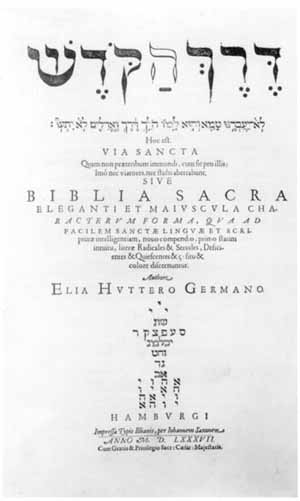


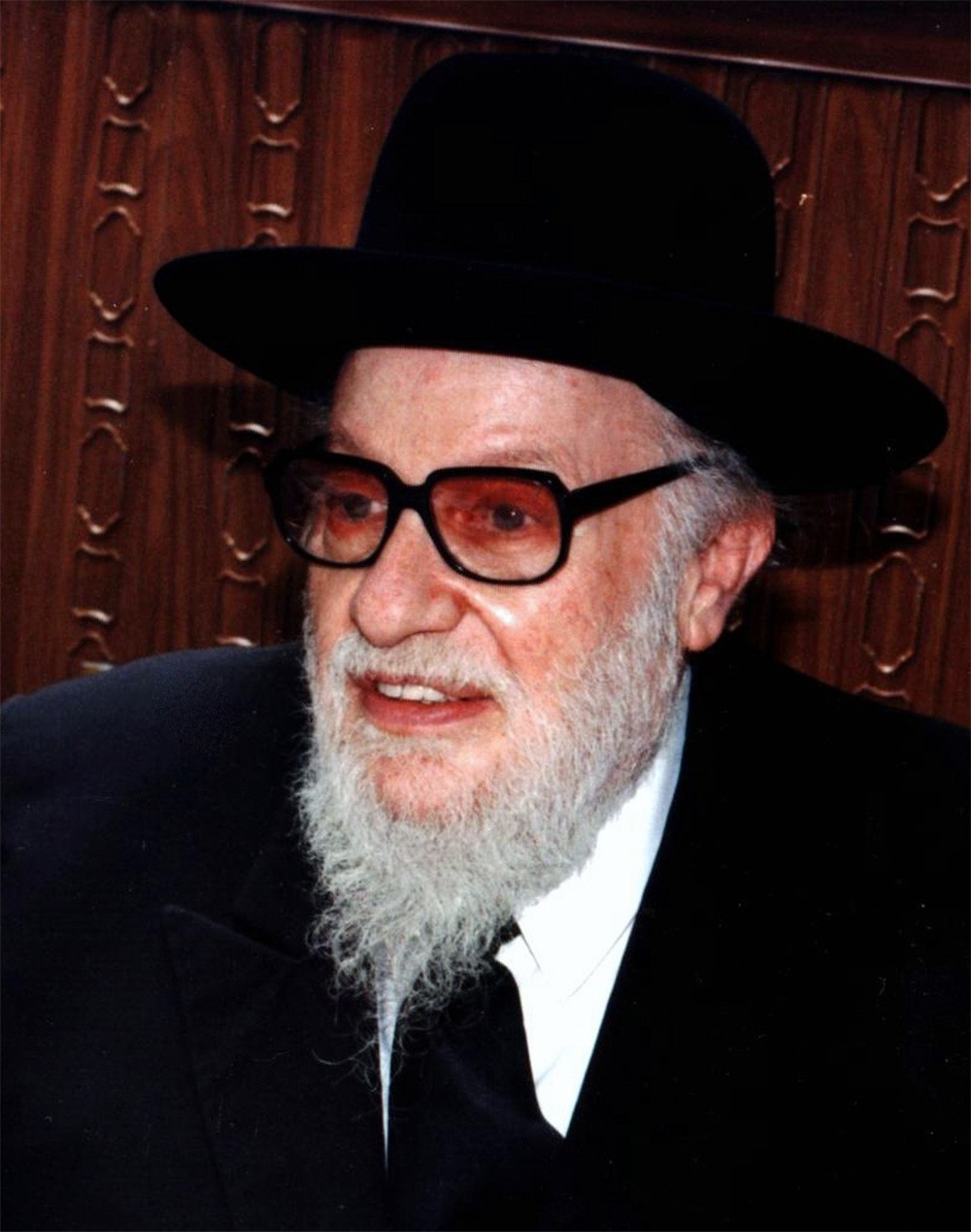


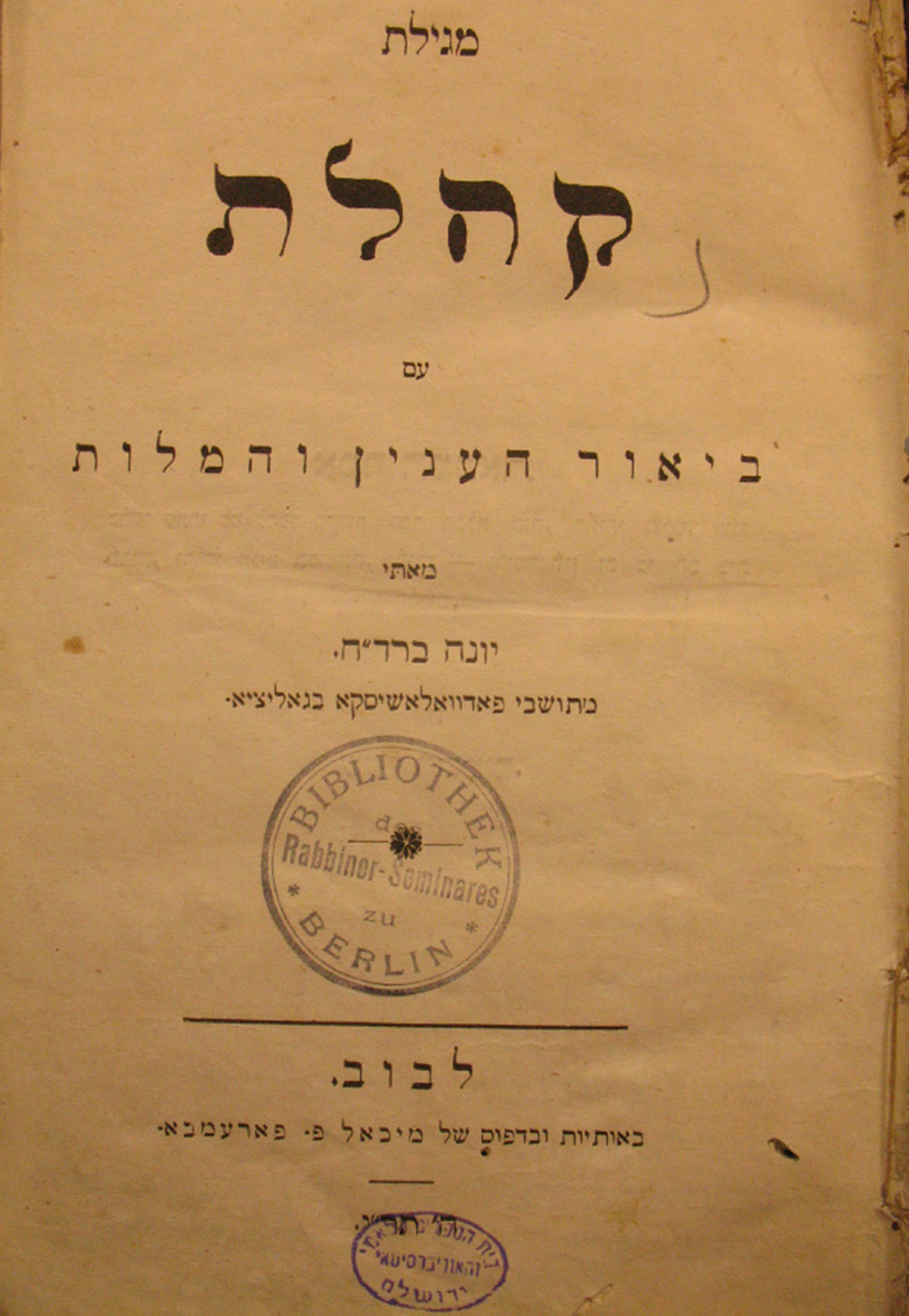

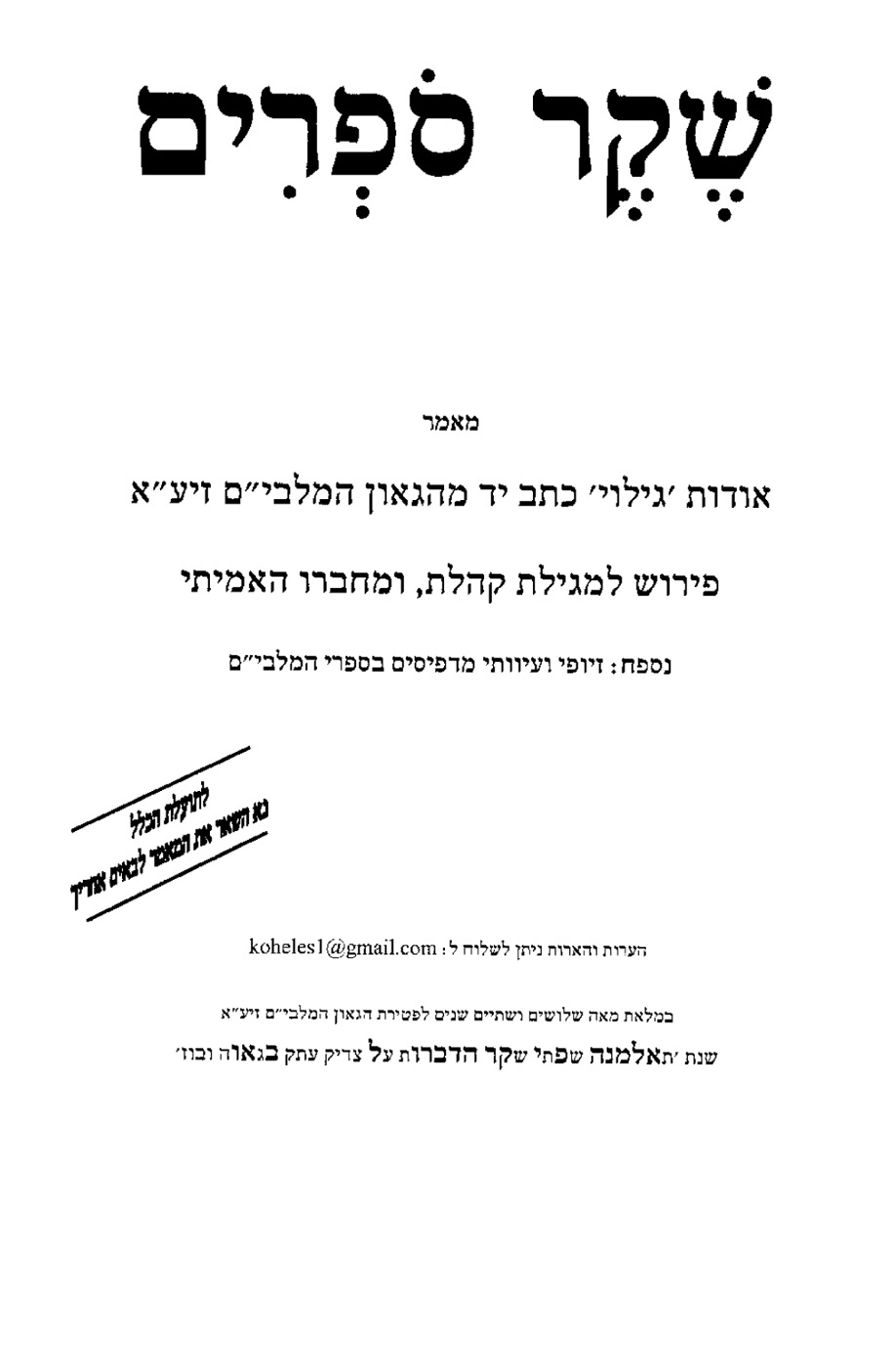-1.jpg)