The Perils of Ignoring Precedent: Alterations in the Kaddish Prayer

The Perils of Ignoring Precedent:
Alterations in the Kaddish Prayer
by Dan Rabinowitz

Recently there has been a renewal in interest in the structure and make up of the liturgy or siddur. While there have previously been critical editions of the siddur or articles on topics related to the siddur,[1] today’s renaissance of the siddur has been precipitated by a different series of events. Specifically, this has been fostered by the publication and republication of some important source material on the topic; these include, among others R. Shabbetai Sofer of Przmysl’s Siddur Rav Shabbetai Sofer and R. Jacob Emden’s Luach Eresh.[2] The Siddur Rav Shabbetai is key in the development of the siddur, in so far that this edition was considered by many to be considered the edition par excellence of the siddur.[3]

While there has been a flurry of source material, at the same time there has been movement in the opposite direction – a movement which tends to ignore this rich legacy and instead has decided issues of the siddur not based upon critical investigation but rather on reliance on sources that my not be trustworthy. The results have been less than salutary.

One example of both of these trends – the new evidence as well as a seemingly blindness to this evidence – can be found regarding the punctuation of the kaddish prayer.

The Early Evidence Regarding Kaddish

There is a dispute how to punctuate the first two words in kaddish – yisgadel v’yiskadesh (as well as other words in the kaddish, as will become apparent). The controversy is whether they have a patach or a tzeirei under the letter dalet.

The historical evidence is absolute – all the early siddurim punctuate these words with a patach.[4] For example, starting from the 1475 (?) Selichot,[5] the 1486, Soncino Machzor,[6] 1519, Prague Teffilot m’Kol HaShana,[7] 1536, Ausberg Machzor k’seder HaAshkenazim, [8] 1541 Bolonga Machzor k’fei Minhagi k’k Roma, [9] and the 1616 Hanau Seder Teffilot k’Minhag Ashkenaz u’Polin [10] all punctuate the first two words of the kaddish with a patach.[11]

The first to raise and discuss the issue of the punctuation was R. Shabbetai Sofer.[12] In his monumental introduction he discusses the proper pronunciation of the kaddish.[13] He cites the two possibilities mentioned above – a patach or a tzeirei. He explains that the evidence from the Bible seems to point to both. Specifically, he points to contradictory verses in the Book of Daniel. One verse has the word yisgadal with a tzeirei while the other has it with a komatz. R. Sofer explains that the latter must have been punctuated with a patach. The reason is this word appears at the end of the verse. When words appear at a stopping point with a komatz, their regular form can only be with either a segol or a patach. In this case it would be a patach. Thus, we have two verses which seem to lend credence to both readings.

R. Sofer, continues and explains that although one may argue that since the verse has the word yisgadal with a tzeirei that would be the more correct pronunciation, this is not the case. He rejects this due to other grammatical considerations. R. Sofer explains that at least one word in the kaddish passage must be punctuated with a patach and thus, “to keep the words the same (l’zaveg et ha’melot) all should be punctuated with a patach.”[14]

Thus, R. Sofer was the first to entertain the notion the word should be punctuated with a tzeirei and he rejected this reading. Additionally, based upon the proof texts R. Sofer marshals from numerous biblical verses, it is clear that he made no distinction between whether the words are Hebrew or Aramaic. In fact, it seems R. Sofer was treating the bulk of kaddish as Hebrew. He discusses other words in kaddish and their counterparts in the Bible.[15]

Perhaps, aside from the grammatical considerations, R. Sofer also wanted to justify the long standing practice regarding the pronunciation. If this is the case, he does not mention precedent. But, one can not rule this out as a possible subconscious motive.[16]

The First Change to Kaddish

For the first to actually advocate for the alteration of the pronunciation to a tzeirei, we need to wait until the early 18th century.[17] In the early 18th century, R. Shlomo Zalman Hanau (Katz) published a work on Hebrew grammar entitled, Binyan Shlomo.[18] He published this at the relatively young age of 21.[19] In this work he advanced that the correct pronunciation of the kaddish is with a tzeirei.[20] But, it is not only the first two words. Instead, based upon the rules of grammar all similarly constructed words in kaddish should also have a tzeirei. Thus, yisbrach, yispaer, and v’yisromam all have a tzeirei.[21]

While at first R. Hanau only wrote a grammar work, he eventually incorporated his alterations into both his work on the siddur – Sha’ari Teffilah[22] – as well as his edition of the siddur – Bet Teffilah.[23] In this instance, this alteration to the kaddish only appears in his siddur.[24] In his siddur, he punctuates the kaddish with a tzeirei throughout.[25] Thus, he has a tzeirei for yisbrach, yispaer, and v’yisromam in the kaddish. Additionally, he is thoroughly consistent in his siddur, any other instance of either the same formulation or the same word, R. Hanau always uses the tzeirei. For example, the same opening words of kaddish appear in the prayer after the removal of the Torah. There R. Hanau has a tzeirei for ‘al ha-kol yisgadel v’yiskadesh.[26] In the Shemoneh Esreh where a similar formulation appears – v’al kulam yisbrach v’yisromam again R. Hanau has a tzeirei.[27] As we shall see, most who followed him were not nearly as careful in their punctuation even when they adopted R. Hanau’s understanding of the kaddish punctuation.

Before we leave R. Hanau, we must first understand how his contemporaries viewed his alterations. When he published his Binyan Shlomo aside from the change in kaddish he also took issue with many of his predecessors understanding of Hebrew grammar. It seems that he did so in a less than respectful fashion. In light of this, he was threatened with a ban on his book unless he would print a retraction of his harsh comments. Needless to say, R. Hanau complied. At the end of his Binyan Shlomo he inserted a page (somewhat smaller than the rest of the book) asking forgiveness from those he may have offended.[28]

Not only was his Binyan Shlomo controversial, but his works on the siddur were as well. R. Jacob Emden’s Luach Eresh is a rebuttal of many of R. Hanau’s changes.[29] R. Emden whose was well known for his acerbic remarks spared none for R. Hanau. He accused Hanua of even forging an approbation Hanau received from R. Emden’s father- R. Tzvi Ashkenazi (Hakham Tzvi).[30]

Thus, it seems far from clear whether R. Hanau’s alteration regarding kaddish would in fact be accepted.[31] In fact, based upon his reputation and the historical precedent this alteration would not be accepted. But, due to two unrelated events, his change has gained more and more credence as time has passed.

The Siddurim Which Followed R. Hanau

While R. Hanau was a singular individual whose own edition of the siddur was printed once, he still had a tremendous impact on the development of the siddur. His influence was felt through the inclusion of some of his changes in two important editions of the siddur. The first is Wolf Heidenheim’s and the second is Seligmann Baer. Both of these siddurim included many[32] of Hanau’s changes.[33]

But, for this change to kaddish these siddurim which did not have qualms about incorporating other changes did not for this. Instead, the prevalence of this change is due to two entirely different events. In fact, Seligmann Baer in another of his works, defends the use of the patach.[34]

The Two Events Which Precipitated the Inclusion of R. Hanau’s Change

The first event[35] which promoted R. Hanau’s alteration was the inclusion of it in R. Yosef Teomim’s Peri Megadim. In his comments on the kaddish, R. Teomim includes R. Hanau’s alteration of a patach to a tzeirei.[36]

While at first glance this may appear strange, incorporating a change of questionable accuracy from a questionable source, a closer look at both R. Teomim’s life as well as his own comments, clarifies why he did so. Originally of Eastern European stock, R. Teomim spent two years in Berlin. During this time he studied in the Beit Medrash of Daniel Yaffo. At the time, this Beit Medrash was populated by the leading maskilim of Berlin. It seems that R. Teomim studied with them and may have been exposed to some of the literature. At the very least, R. Teomim appears to have studied one on one with R. Yitzhak Satnow, a leading maskil and a propend of numerous alterations to the siddur.[37]

R. Teomim absorbed the some of the general ideas which were flourishing in Berlin at the time. R. Teomim advocates for a sweeping reform of the education system. He advocates for a more structured system which includes an emphasis on Bible and proper Hebrew.[38] This is reminiscent of some of the later changes advocated by R. Naftali Hertz Wessley another of the leading Berlin maskilim. It is one of these suggestions which returns us to R. Hanau.

R. Teomim provides a list of books he recommends one teach their child. One of these is one of the works of R. Hanau. Specifically, R. Teomim lists R. Hanau’s work on grammar, Tzohar L’Tevah,[39] as one of these texts.[40] Therefore, far from rejecting the innovations of R. Hanau, R. Teomim embraced him and his works. Thus, his citation to R. Hanau in the kaddish is not an anomaly but instead perfectly in line with R. Teomim’s general view of R. Hanau and these sorts of innovations.

While R. Teomim’s citation to Hanau should not be viewed as an anomaly, a later citation should be. R. Yisrael Meir Ha-Kohen (Kagan), otherwise known as the Hafetz Hayyim, in his Mishneh Berurah discusses the proper pronunciation of the kaddish. In doing so, he cites the comments of R. Teomim that the words yisgadel v’yiskadish should be pronounced with a tzeirei.[41] The Hafetz Hayyim did not display the same view towards the haskalah or to innovation as R. Teomim did. Thus, his comment which, when properly traced to its source, should be viewed as nothing less than shocking. One can not say, as was the case with R. Teomim, that the Hafetz Hayyim agreed with or advocated for any of the books or application of R. Hanau. One imagines had the Hafetz Hayyim been aware of the true nature of this comment, he would not have followed it.[42]

Furthermore, one assumes that had the Hafetz Hayyim known of the clear and unambiguous tradition regarding the pronunciation of the kaddish he would not have offered this alternative reading. But, rather ironically, due to the import and the popularity the Hafetz Hayyim’s Mishneh Berurah enjoys today, R. Hanau’s alternation has become the norm in some circles.

We have now discussed the first strange use of R. Hanau’s position on the kaddish. The second to advocate for this pronunciation was allegedly the Vilna Gaon or the Gra. In the posthumous collection of his customs, Ma’aseh Rav, the Gra is recorded as saying the first two words of kaddish with a tzeirei. The rational offered is that these words are in Hebrew as opposed to the rest of kaddish which is in Aramaic.

As an initial matter, it bears mentioning, that although today many have blindly accepted anything mentioned in this collection of customs, Ma’aseh Rav, as in fact the practice of the Gra, this is far from a certainty. When this book was first printed R. Hayyim of Volozhin, in his approbation,[43] already noted at least two possible errors. It is unclear whether the two he mentions explicitly are the only ones or there are others as well.[44]

Putting aside, however, the problems with the Ma’aseh Rav generally, in this specific instance it is far from clear the comment attributed to the Gra is actually correct. According to the Masseh Rav the rational for the change in the punctuation is the classification of the words as Hebrew and not Aramaic. Yet, we have seen already that R. Sofer makes no such distinction. In fact, he assumes they are in fact Hebrew, but still one should pronounce them with a patach. Thus, the fact that these words may or may not be Hebrew is a distinction without difference. It does not immediately follow that once one has decided the words are Hebrew they must be pronounced using a tzeirei.

The Strange Repercussions of the Alteration of the First Two Words of the Kaddish Elsewhere in the Siddur.

Even assuming the custom as recorded in Masseh Rav is correct, the change in punctuation of those two words raises additional problems. As mentioned before there are other words which are either similar to the grammatical structure of the first two words in kaddish and in at least one case in the siddur the very same words appear – all of which are in Hebrew. Thus, these words should get the same treatment as the kaddish words, i.e. be punctuated with a tzeirei. But, in siddurim which claim to follow either the position of the Gra[45] or that of the Chofetz Hayyim, only the kaddish has been altered and the rest retain a patach.

As here has been a renewed interest in the Gra and his customs and those who follow him, there is no lack of siddurim which this point has been borne out. In the first siddur based upon the Gra – Ishe Yisrael – kaddish (the first two words) get a tzeirei while the other instances throughout the siddur all get a patach. In the more recent Siddur Vilna although the change appears in kaddish in the Shemoneh Esreh where the similar formulation appears there is no change.[46] The Siddur Aliyot Eliyahu which was “edited and reset from anew . . . with great care . . . based upon the text of . . . the Gra” changes the first two words of kaddish. Yet, when it comes to both the Shemoneh Esreh and the very same words – yisgadel v’yiskadesh after the removal of the Torah – it employs a patach.[47]

In the recently printed Yom Kippur Machzor which includes the commentary and customs of R. Joseph B. Soloveitchik the same result occurs. This Machzor which also includes a list of R. Soloveitchik’s relevant customs, includes that of R. Soloveitchik’s views on kaddish. One these customs “based on the tradition of the Vilna Gaon that the opening two words of Kaddish” should be pronounced with a tzeirei. This is so because those “two words are Hebrew words . . . and the proper Hebrew pronunciation of each of those words is with a tzeirei.”[48] The editors are not satisfied with the mention of this custom at the beginning of the book, instead, each and every time kaddish appears they make mention of this custom. While they are punctiliousness regarding kaddish they make no mention by either the shemoneh esreh nor by the very same words after the Torah is removed.[49]

To be fair at least one siddur which is based upon the Gra has been partially[50] consistent. In the Siddur Ezor Elyiahu, when the actual words yisgadal v’yiskadah appear during the removal of the Torah, the editor changes those as well to a tzeirei. He notes explicitly that this change is an extension of the Gra’s custom regarding the kaddish.[51]

The problem of altering the kaddish text but retaining the other examples in the siddur was already noted in the late 18th century! R. Isaac Satanow in decries the “haughty simpletons (am aratzim)” who change the kaddish to a tzeirei but fail to note the others. These who “speak in contradictions,” Satanow applies the verse in Proverbs (18:2) “a fool does not delight in understanding.”[52] The expression “better leave well enough alone” is extremely apt.[53]

In conclusion, it would seem that perhaps what may be viewed as a minor change has much broader implications. These implications include the propriety of the change itself as well as the consequences of the change. It seems that many were unaware of these outcomes and both made the change without full awareness of the history. Further, they were also oblivious to the necessity to alter other portions of the text as well. As one scholar has put it “the critical study of Jewish liturgy is in any case too important to be left exclusively to the ‘daveners’!”[54] In the end, unfortunately, these words have proven to be extremely prescient.

Notes:
[1] For critical edition of the siddur see, e.g., Seligmann Baer, Avodat Yisrael (Rödelheim, 1868); Wolf Heidenheim’s series on siddurim and machzorim published in the 19th century; Machzor l’Yamin Noraim, ed. Daniel Goldschmit (Jerusalem, 1970); Shlomo Tal, Rinat Yisrael (Jerusalem, 1972).
There has also been a significant amount written on the siddur, both its development as well as the text itself. See, e.g., Leopold Zunz, Die Ritus des Synagogalen Gottesdienstes (Berlin, 1859); Abraham Berliner, Ketavim Nivcharim (Jerusalem, 1969); Ismar Elbogen, Jewish Liturgy: A Comprehensive History (Philadelphia, 1993), trans. of the original 1913 German edition; B.S. Jacobson, Netiv Binah (Tel Aviv, 1964); Daniel Goldschmidt, Mehqerei Tefillah u’Piyyut (Jerusalem, 1978); Naftali Wieder, Hitgabshut Nusach HaTefillah ba-Mizrach uva-Ma’ariv (Jerusalem, 1998); Stefan Reif, Judaism and Hebrew Prayer: New Perspectives on Jewish Liturgical History (Cambridge, 1995).
[2] D. Yitzhaki ed., Luach Eresh, Otzoranu (Toronto, 2001). This edition includes other works related to R. Emden’s work as well. While both of these speak to the Ashkenaz Rite (more correctly the Ashkenaz-Polish Rite) there has also been a renewed interest in the Nusach Sefard Rite (the Hassidic not to be confused with those who originated in the Eastern countries) as well. Some of these early prayer books have been republished including Y. Koppel, Kol Ya’akov (Jerusalem, 2005-2006); Siddur Admor HaZakan, Kehot (Brooklyn, 2005). There has also been a critical edition of the Siddur haAriZal published as well, Siddur ha-Ari, ed. Daniel Rimmer (Betar, 2004).
[3] On the import of this edition see S. Reif, Shabbetai Sofer and his Prayer-book (Cambridge University Press, 1979); Siddur Rav Shabbetai Sofer, ed. Yitzhak Satz, vol. 1 (Baltimore, 1987): 7-10 (all citations to the Siddur R. Shabbetai are to this edition).
[4] There is one exception – the Lisbon 1490 (?) Teffilot m’Kol HaShana. In this edition these two words have a komatz. This appears to be in error. This error is based upon the use of the verse in Daniel 11 which has the word yisgadal with a komatz. But, the only reason for the komatz there is due to its placement in that verse, at the end. Shabbetai Sofer records that this error continued to his day. He says “one should not pronounce the word with a komatz like I heard one incorrect hazzan do, perhaps [this hazzan] did so due to the verse in Daniel, but the hazzan was unaware that the reason it was punctuated with a komatz was because it was at the end of the verse.” Siddur R. Shabbetai Sofer, vol. 1, no. 17, p. 83.
[5] Non-paginated, appearing on the Hebrew University copy (which I have used for the other citations and all are available online) at page 10 (all page citations are to the “page” the relevant quote appears in the online version).
[6] Non-paginated Hebrew University copy at page 10. Only the second word – v’yisgadash is punctuated (with a patach) in this edition. Yet, there is no reason to assume the first word would be punctuated in a different manner.
[7] Non-paginated Hebrew University copy at page 196.
[8] Non-paginated Hebrew University copy at page 2.
[9] Non-paginated Hebrew University copy at page 13.
[10] Non-paginated Hebrew University copy at page 55.
[11] Additionally the following twenty-four machzorim or siddurim use the patach: 1490 Napoli, Seder Teffilot; 1503 Fano, Machzor; 1526, Venice Machzor k’Minhag Roma; 1527, Venice, Machzor k’Minhag Aram Soba, 1527 Prague; 1527 Pissarro; 1528 Constantinople, Seder k’Nusach Romania, 1530 Prague; 1532 Constantinople, Machzor l’Rosh HaShana v’Yom Kippur k’Minhag Sefardim; 1551 Lublin; 1562 Mantua, Teffilot m’Kol HaShana; 1566 Lublin; 1567 Lublin; 1584 Venice Machzor; 1585 Cracow Machzor l’Sholosh Regalim; 1598 Venice, Machzor; 1601, Venice, Seder Teffilot k’Minhag K’K Sefard; 1608, Hanau, Machzor l’Sholosh Regalim; 1623, Hanau; 1647, Amsterdam, Teffilot; 1661, Amsterdam, Seder Teffilot Sefardim; 1699/1700, Venice, Machzor Hadrat Kodesh; 1713, Berlin, Teffilah Derekh Si’ah ha-Sadeh; 1727, Amsterdam, Siddur HaShelah. As is apparent, the use of the patach is not dependent upon custom – sefard versus ashkenaz – or geographic location.
[12] R. Sofer lived from c. 1565-1637. His death date reflects the find in the Jewish Theological Seminary library of a manuscript of R. Sofer’s defense of R. David Kimhi’s Sefer HaShorashim which R. Sofer notes was completed in 1637. Reif, in his work on R. Sofer had dated R. Sofer’s death as 1635. R. Sofer’s siddur was first published in 1617 in Prague although nothing remains of this edition. The current edition was published from a manuscript.
[13] Siddur R. Shabbetai Sofer, vol. 1, no. 17, p. 83.
[14] Idem.
[15] See Rief, op. cit., at p. 29-38 discussing considerations in punctuating the siddur.
[16] R. Sofer’s student, R. Hayim Bokhner also defends the use of a patach even though he also considers the first two words of kaddish to be in Hebrew. See R. Hayim Bokhner, Or Hadash (Amsterdam, 1671): 46b. Specifically, R. Bokhner cites to the verse in Psalms 104:1 as a similar conjugation which contains a patach. On R. Bokhner see Yitzhak Yudolov, “HaGa’on Rebi Hayim Bukhner Z’tl Mehaber Sefer Or Hadash,” in Birkat HaMazon l’Mh”r Shabbetai Sofer (2002): 274-276.
[17] This was noted by Hayim A. Cohen, “Yitgadal v’Yitkadash (Iyun b’Zemichat shel Mesorot HeGiyah Hadasha),” Mesorot 8 (1994): 59-69. While Cohen’s article contains some of the history of this change, he neglects some of the historical evidence and does not note what perverse consequences the changes have had on modern-day siddurim.
[18] Binyan Shlomo (Frankfort a. Main, 1708).
[19] He was born in 1687.
[20] Binyan Shlomo (Frankfort a. Main, 1708): 79b-80a. Hanau does not deal with R. Sofer. The reason for this omission is that in all likelihood he was unaware of R. Sofer’s comments. Instead, R. Hanau address the comments of R. Yitzhak b. Shmuel of Posen in his Siach Yitzhak. There, R. Yitzhak makes the claim the words in kaddish should be punctuated with a patach.
[21] See id.
[22] First published (Jessnitz, 1725).
[23] Also published in Jessnitz that same year.
[24] This is contrary to the incorrect assertion in the Makhon Yerushalayim edition of the Shulhan Arukh. They erroneously claim this comment appears in his Sha’ari Teffilah. This appears no where in the Sha’ari Teffilah. Instead, it seems the editor of this edition was unaware of R. Hanau’s siddur and thus was forced to locate any place they could attach as a source for R. Hanau.
[25] Bet Teffilah p. 29a.
[26] Idem., p. 40a.
[27] Idem.,at 21b.
[28] See non-paginated page which follows page 108 in his Binyan Shlomo.
[29] See David Yitzhaki’s Introduction to the Luach Eresh p. 26-66. While Yitzhaki is incorrect in some of his assertions – he is correct in that Hanau’s changes were viewed with distain by some. For more on this issue, see Jacob J. Schacter, Rabbi Jacob Emden: Life and Major Works (unpublished PhD dissertation, Harvard University, 1988), chapter four, passim.
[30] This was later proved to be incorrect. The actual approbation was located and it appears that in fact R. Hanau did receive it. See Dukkes, Hakmei AH”V (1908): 55. This source appears to have escaped the notice of Jacob J. Schacter; see his introduction to the new edition of Luach Eresh (24), where he credits Yekutiel Yehudah Greenwald’s 1954 biography with this find. Additionally, see Jordan Penkower, “Minhag and Massorah: On the Recent Ashkenazic Custom of Double Vocalization of Zekher Amalek,” in Iyuni Mikra U’Parshanut 4 (1997): 127-128 [Hebrew], where he provides other examples of R. Emden’s over zealousness and questionable tactics in this debate. Yitzhaki, supra n. 29, appears to either have been unaware of Penkower’s article or chose to ignore it. Many of Penkower’s findings contradict Yitzhaki’s assertions.
[31] Prior to the discussion below, there is but one siddur which incorportates R. Hanau’s change. In the Altona 1826 edition of the Machzor edited by R. Meir Ganz, he changes kaddish as well as the other permutations to a tzeirei. R. Ganz in his introduction says he was careful with the grammar of the Machzor, however, he does not provide a source for this or any of his alterations.
[32] These include, inter alia, the change in the yehi ratzon following birkat ha-sachar from yashlet to tashlet.
[33] These siddurim also included some of the changes of R. Isaac Satanow, who will be discussed in more detail below. The inclusion of these changes has disturbed some. This is so, as these siddurim were considered the “gold standard” and the lack of deference towards precedent many found difficult to reconcile. Additionally, Heidenheim’s edition received the blessing of one of the great opponents toward change, R. Moshe Sofer (Hatam Sofer). In the Haredi press there has been some discussion on how to reconcile these seemingly incongruous events.
[34] See Seligmann Baer, Tosa’ot Hayyim, reprinted in R. Jacob Emden, Luach Eresh (2001), Kitzerat haOmer, pp. 497-500.
[35] It is noteworthy that Heidenhiem did not include this change in any of his editions of the siddur. While Heidenhiem did include other such alterations this one was apparently went too far.
[36] Misbetsot Zahav, no. 55. Although it is unclear why, R. Teomim only applies R. Hanau’s proposition for the first two words in the kaddish and not the complete kaddish as R. Hanau actually has it.
[37] See Satnow’s comments in his edition of the Kuzari (Berlin, 1795) p. 2, where he claims to have studied with R. Teomim. Additionally, many of Satanow’s books contain approbations from R. Teomim. While some of these are undoubtedly forgeries, there is no reason to assume they all are. On Satnow see Zinberg, A History of Jewish Literature vol. 5, chap. 7, p.112 et. seq.; Fuenn, Kennest Yisrael, Vilna 1886, s.v. Yitzhak Satanow. For biographical information on R. Teomim see R. Tzvi Yehezkel Michelson, Toledot Yosef, in R. Teomim’s Sefer Notrikin (Bilguria, 1910 [Jerusalem, 1964; photomechanical reproduction]), non-paginated introduction.
[38] See his introduction to his commentary on the Shulhan Arukh especially Iggeret Shnei no. 6. R. Teomim provides to lists of recommended reading/teaching materials in his letters. The recommendation for R. Hanau’s book only appears in the second listing.
[39] First printed (Berlin, 1733). It seems the famed town of Volozhin had as their single book of Hebrew grammar present in the Beit Medrash, this work of R. Hanau. See Gershon David Hundert, “The Library of the Study Hall in Volozhin, 1762: Some Notes on the Basis of a Newly Discovered Manuscript,” Jewish History 14 (2000): 237.
[40] Id.
[41] See Mishna Berurah, 56:2; Sha’ar haTzion, id.
[42] It is unclear whether R. Teomim would have either followed this in practice. The siddur Hegyon Lev, ed. Eliezer Landshuth (Königsberg, 1845) which is based upon the comments of R. Teomim, does not alter the punctuation of the kaddish. While it is possible that Landshuth was either unaware or ignored the comments of R. Teomim, it is at least worthwhile to point out this incongruence.
[43] Perhaps it was to avoid his criticism that his approbation was removed from the 1857 and the 1858 editions. See Vinograd, Thesaurus of the Books of the Vilna Gaon (Jerusalem, 2003), #812, 814 (while Vinograd notes the missing approbation in the 1857 edition he neglects to mention it was missing in the 1858 edition as well).
[44] See Penkower, op. cit., at 85-87 discussing problems with the Ma’aseh Rav.
[45] The Gra never wrote or published his own edition of the siddur. Instead, the siddurim which purport to be that of the Gra are only attempting to reconstruct what they view what the Gra would have done had he in fact edited a siddur.
[46] Siddur Vilna (Jerusalem, 1994): 55 (kaddish), 107 (Shemoneh Esreh passage).
[47] Siddur Aliyot Eliyahu (Jerusalem, 1999): 45 (kaddish where the editor notes his change is based upon the Chofetz Hayyim and the Gra), p. 79 (shemoneh esreh), p. 297 (yisgadel v’yiskadesh with a patach).
[48] Yom Kippur Machzor with Commentary Adapted from the Teachings of Rabbi Joseph B. Soloveitchik, (New York, 2006): xxxv. The formulation of this custom is in and of itself problematic. One assumes that R. Soloveitchik did not alter kaddish due to the Maaseh Rav, but instead he followed the custom of his own father and grandfather.
[49] See, e.g., p. 18 (shemoneh esreh) and p. 464 (v’al ha’kol yisgadal v’yiskadah with a patach).
[50] There is no change to the Shemoneh Esereh or the other words in kaddish which contain the same grammatical structure.
[51] Ezor Eliyahu ‘al pe Nusach HaGra (Jerusalem, 1998): 216. Additionally, it bears noting that ArtScroll retains the correct punctuation utilizing a patach for kaddish.
[52] Isaac Satanow, Iggeret l’Bet Teffilah (Berlin, 1769): 21a,b. Satanow himself in his later work, Va’Yetar Yitshak (Vienna, 1815): 47- 48, advocates change to a tzeirei of the kaddish. He claims, contrary to R. Sofer, that there are three verses which illuminate this question of punctuation. While one, Daniel 11:36 points to the patach the other two, Daniel 11:37 and Isaiah 10:15 point to a tzeirei and therefore “two defeat one.” Id. Satanow, however, is consistent and changes the other formulations as well. See id. at 44 on tisromam.
[53] What is rather ironic is that the Siddur Aliyot Eliyah, contains a diatribe against Satanow and his alterations. It would seem that the same criticism could be applied to the itself.
[55] Reif, Judaism and Hebrew Prayer, op. cit. at 10.


TU BISHVAT: TREE AND THOU

TU BISHVAT: TREE AND THOU
by Alan Zelenetz

Rabbi Alan Zelenetz, M.Phil. has been professionally involved in Jewish education, academia, and independent scholarship for more than twenty-five years, including leadership positions as principal of Torah and General Studies of Yeshivah of Flatbush Middle Division and Director of Curriculum Development of Teachers College Innovations, Columbia University.

DYNAMIC GREEN
From their cosmic vantage point in outer space, NASA satellites orbiting our planet beam down real-time streaming video of Earth’s surface. They reveal that 75% of our world is “a relatively unchanging ocean of blue,” the remaining 25% “a dynamic green” terra
firma
, confirming the dominance of vegetation and the fecundity of plant life on dry land. It’s not difficult for us to re-imagine NASA’s spectacular photographs as screenshots capturing the magnificence of the third day of Creation described in Sefer Bereishit, the Book of Genesis – a gathering of waters followed by growing grass and the flourishing of flowers and trees.
NASA’s cutting edge science and technology provide a God’s-eye view of the plant world unique to our modern day and age, but the variety and beauty of Earth’s species of flora has been the subject of literary poets for millennia. From Ovid of Ancient Rome, who sings of elms and oaks and laurel trees transformed, to the 18th century Scottish lyricist Robert Burns, whose “O my Love’s like a red, red rose” remains, perhaps, the best known simile in verse, the botanical side of nature has forever held fascination for us humans who share our globe and gardens with the kingdom of plants. In his fantasy epic, Lord of the Rings, J.R.R. Tolkien goes so far as to envision the Ents, a noble race of
walking, talking trees, while contemporary American poet Louise Glück personifies a real flower, “The Red Poppy,” which speaks to us in a floral first person, “I have / a lord in heaven/ called the sun, and open / for him, showing him / the fire of my own heart…” Though talking trees are nothing if not a prime example of poetic license, there are many scientists today who embrace the metaphor in their practice. In a recent New Yorker essay, “The Intelligent Plant,” journalist Michael Pollan reports the latest research in plant biology. He describes attempts to prove (not without controversy and critics) that plants are capable of cognition and communication, and he includes as an example a leaf’s ability “to signal other leaves to mount a defense” against impending infestation by insects. Astonishing as is the scientific hypothesis of “thinking” plants, emotionally stirring as is the imagery of poets, they ought to be comfortably familiar to us as Jews, who have been sensitive to our seed-bearing cohabitants on earth literally since the beginning of traditional Jewish time.
FIRST PLANT YOUR SAPLING
Had there been an ancient Green Party, the Torah would have been its platform. The very first pages of the Jewish Bible introduce humankind at its origin, woman and man implanted with divine purpose in the Garden of Eden. Commenting on this edenic scene, Rabbi Samson Raphael Hirsch intuits God’s purpose: the destiny of humankind and the earth is Paradise. By working the earth, human beings raise “its purely physical nature into playing a part in the…moral purposes of the world…we are shown what we should be, how we should live, how this world of ours would form a paradise…”
Several Books later, Sefer Devarim offers one of the most celebrated examples of the Written Law’s ethical and ecological sensitivity, “Lo tashchit…do not destroy [fruit-bearing] trees by wielding an ax against them, for from them you will eat, do not cut them down.” Based on this proscription, Judaism derives an overriding moral principle known as bal tashchit, prohibiting any random destruction or wanton waste in all walks of life.
An Aggadic passage in the Oral Law carries Judaism’s recognition of the sanctity of plant life on Earth to an extraordinary extreme: Rabbi Yochanan used to say, “If you are about to plant a sapling and a cry goes out, ‘Come, hurry, the Moshiach is here!’, be certain first to plant your sapling, then go and greet the Messiah.”
Yes, our Jewish love affair with fruit, flower, and foliage has, indeed, been an eternal one. We can already discern the strains of a love song in Talmudic times when the Sages teach us how to bless the trees “who” share our lives, “Tree, O tree, with what should I bless you? Your fruit is already sweet…Your shade is plentiful… May it be G‑d’s will that all the trees planted from your seeds should be like you . . .” And it continues in our own day and age, when Yossi Klein Halevi reminds us – in describing a young Israeli kibbutznik’s attempt to preserve a tactile encounter with the fruit he harvests by machine –  “If you don’t say good morning to the tree, he had learned from the old-timers, the tree won’t say happy new year to you.”
WE HAVE TO TALK ABOUT TU BISHVAT
To speak of plant life and Judaism is to speak, of course, of Tu Bishvat, the day marked in the Mishnah and on the Jewish calendar as our New Year of Trees. This designation carries specific halachic obligations regarding agricultural tithes, both in the ancient and contemporary lands of Israel. But, true to our theme, we keep here to the celebratory and symbolic aspects of the holiday
In his Ziv ha’Minhagim, Rabbi Yehudah Dov Zinger paints a scene of  ”the bare fruit tree in the dead of winter showing little sign of vitality; nonetheless, as its New Year of 15 Shevat approaches, life begins to course through its roots once again, it revives with the flowing sap.” And Eliyahu Kitov, in Sefer ha’Toda’ah, explains why the fifteenth of Shevat is considered a rosh ha’Shanah and celebrated, “…because [Tu Bishvat] has an aspect of praise of the land, as this is the time that the soil renews its vigor and the fruits are full and praiseworthy, which is what the land is known for…Thus, the day the land renews itself is, indeed, a day of great joy for all of Israel.”
To reiterate, in Jewish thought and practice a tree is no simple metaphor. The trees of Tu Bishvat are at the essence of our understanding the interrelatedness of God’s world. The Torah, in fact makes the comparison over and over. In both Tehillim and in the Talmud we find fruit trees and cedars breaking into songful praise of God. And the prophet Isaiah declares explicitly, “For as the days of a tree shall be the days of my people.”
Indeed, Rabbi Menachem Mendel Schneerson, the last Lubavitcher Rebbe, pointedly asks us to “reflect on the lessons we can derive from our affinity with our botanical analogue.” The Rebbe goes on to suggest that, just as a tree’s primary components are its roots, trunk, branches, leaves, and fruit, so, too, people’s spiritual lives consist of the same: “The roots represent faith, our source of nurture and perseverance. The trunk, branches and leaves are the body of our spiritual lives – our intellectual, emotional and practical achievements. The fruit is our power of spiritual procreation – the power to influence others, to plant a seed in a fellow human being and see it sprout, grow and bear fruit.”
A WALK WITH RAV KOOK
This identification of human being and tree is the foundation of the moral dimension of Tu Bishvat. It is the living Torah teaching us Chesed, to feel compassion for all living things, and it is embodied in a living example recounted in the memoirs of Reb Aryeh Levin, who recalls an early afternoon stroll with Rav Kook in the fields of Jaffa: “On the way, I plucked some branch or flower. Our great master was taken aback; and then he told me gently, ‘Believe me: In all my days I have taken care never to pluck a blade of grass or a flower needlessly, when it had the ability to grow or blossom. You know the teaching of the Sages that there is not a single blade of grass below, here on Earth, which does not have a heavenly force (or angel) above telling it, Grow! Every sprout and leaf of grass says something, conveys some meaning… Every creature utters its song…’ ”
In I And Thou, philosopher Martin Buber explores how, as human beings, we come to understand the world by interacting with the others, the objects, and the creatures all around us. Buber posits a higher level of human existence that depends upon a series of  “I/Thou” relationships, the most exalted of which is with the Divine, “One who truly meets the world goes out also to God.”
Not surprisingly, Buber turns to a tree to help define his idea of an “I/Thou” relationship, asserting that “…as I contemplate the tree I am drawn into a relation, and the tree ceases to be an It…Whatever belongs to the tree is included…its conversation with the elements and its conversation with the stars…I encounter…the tree itself.”
A TREE’S EMBRACE
In her book Celebrate!, author Lesli Koppelman Ross catalogues many Jewish holiday practices and customs throughout history and from around the globe. Kabbalists early on created a Tu Bishvat seder that has been perpetuated in many fruits and many forms, ranging from the mystic to the ecological to the feminist, down to our own day. In some Mediterranean Jewish communities on Tu Bishvat “women would embrace trees at night, praying for fertility and many children. In Salonica, it was believed that the trees themselves embrace on Tu Bishvat, and anyone seeing them do so would have his/her wish fulfilled.” And so we seem to circle back, within a Jewish frame of reference now, to Tolkien’s Ents and Ovid’s trees and transformations.
The French linguist Émile Benveniste made the observation that “ ‘personal pronouns’ are never missing from among the signs of a language, no matter what its type, epoch, or region may be. A language without expression of person cannot be imagined.” Poet Maureen N. McClane offers her own riff on Benveniste’s thought, “To command you, to address you, I must think you. ’I’ must think ‘you. And yet even as I think you I interfuse you with my own nature…”
On Tu Bishvat, “I” must think “Tree,” “Tree” must think “Thou.” We may even, in homage to Benveniste, pun on the “Tu” in Tu Bishvat and think of it as “tu,” the French second person pronoun of affection and familiarity, reminding us that You, the trees of Shevat, and we, the people of this planet, share earthly and earthy roots from which we draw succor of body, mind, and spirit. In our oneness we join voices in celebration of our Creator.


Kol Nidrei, Choirs, and Beethoven: The Eternity of the Jewish Musical Tradition

Kol Nidrei, Choirs, and Beethoven: The Eternity of the Jewish Musical Tradition
The Seforim Blog is reposting Dan Rabinowitz’s post from 2018.
On April 23, 1902, the cornerstone to the Taharat Ha-Kodesh synagogue was laid, and on Rosh Ha-Shana the next year, September 7, 1903, the synagogue was officially opened. The synagogue building was on one of Vilna’s largest boulevards and constructed in a neo-Moorish architectural style, capped with a blue cupola that was visible for blocks. There was a recessed entry with three large arches and two columns. The interior housed an impressive ark, located in a semi-circular apse and covered in a domed canopy. But what really set the synagogue apart from the other 120 or so places to pray in Vilna was that above the ark, on the first floor, were arched openings that served the choir. In fact, it was generally referred to by that feature and was known as the Choral Synagogue. The congregants were orthodox, most could be transported to any modern Orthodox synagogue and they would indistinguishable, in look – dressing in contemporary styles, many were of the professional class, middle to upper middle class, and they considered themselves maskilim, or what we might call Modern Orthodox.[1]

The incorporation of the choir should be without controversy. Indeed, the Chief Rabbi of Vilna, Yitzhak Rubenstein would alternate giving his sermon between the Great Synagogue, or the Stut Shul [City Synagogue], and the Choral Synagogue.[2] Judaism can trace a long relationship to music and specifically the appreciation, and recognition of the unique contribution it brings to worship. Some identify biblical antecedents, such as Yuval, although he was not specifically Jewish. Of course, David and Solomon are the early Jews most associated with music. David used music for religious and secular purposes – he used to have his lyre play to wake him at midnight, the first recorded instance of an alarm clock. Singing and music was an integral part of the temple service, and the main one for the Levite class who sang collectively, in a choir. With the destruction of the temple, choirs, and music, in general, was separated from Judaism. After that cataclysmic event, we have little evidence of choirs and even music. Indeed, some argued that there was an absolute ban on music extending so far as to prohibit singing.

It would not be until the early modern period in the 16th century that choirs and music began to play a central role in Jewish ritual, and even then, it was limited – and was associated with modernity or those who practiced a more modern form of the religion.
Rabbi Leon (Yehudah Aryeh) Modena (1571-1648) was one of the most colorful figures in the Jewish Renaissance. Born in Venice, he traveled extensively among the various cities in the region.[3] He authored over 15 books, and made his living teaching and preaching in synagogues, schools, and private homes; composing poems on commission for various noblemen; and as an assistant printer. In 1605, he was living in Ferrara where an incident occurred in the synagogue that kickstarted the collective reengagement with music. Modena explained that “we have six or eight knowledgeable men, who know something about the science of song, i.e. “[polyphonic] music,” men of our congregation (may their Rock keep and save them), who on holidays and festivals raise their voices in the synagogue and joyfully sing songs, praises, hymns and melodies such as Ein Keloheinu, Aleinu Leshabeah, Yigdal, Adon Olam etc. to the glory of the Lord in an orderly relationship of the voices according to this science [polyphonic music]. … Now a man stood up to drive them out with the utterance of his lips, answering [those who enjoyed the music], saying that it is not proper to do this, for rejoicing is forbidden, and song is forbidden, and hymns set to artful music have been forbidden since the Temple was destroyed.[4]
Modena was not cowed by this challenge and wrote a lengthy resposum to defend the practice which he sent to the Venetian rabbinate and received their approbation. But that did not put the matter to rest.
In 1610, as he approached forty, Modena received his ordination from the Venetian rabbis and settled in Venice to serve not only as a rabbi but as a cantor, with his pleasant tenor voice. In around 1628 in the Venetian ghetto, an academy of music was organized with Modena serving as the Maestro di Caeppella . Both in name and motto that academy embraced its subversive nature. It was called the Academia degli Impediti, the Academy of the Hampered, named in derision of the traditional Jewish reluctance to perform music because of “the unhappy state of captivity which hampers every act of competence.” In this spirit, especially in light of Modena’s responsum on music in 1605, the Accademia took the Latin motto Cum Recordaremur Sion, and in Hebrew, Bezokhrenu et Tzion, when we remembered Zion, based paradoxically on Psalm 137, one of the texts invoked against Jewish music: “We hung up our harps…. How shall we sing the Lord’s song in a strange land?”
On Shemini Atzeret and Simchat Torah in October 1628, a spectacular musical performance was held in the Spanish synagogue, which had been decorated with silver and jewels. Two choirs from the academy sang artistic Hebrew renderings of the afternoon service, the evening service, and some Psalms. Their extensive repertoire lasted a few hours. A throng of Christian noblemen and ladies attended the Simchat Torah service. The applause was great, and police had to guard the gates to ensure order
Beyond his musical endeavors, Modena also served as an expert in Hebrew publishing. The two would create a confluence that enabled the first modern Jewish book of music.
For Rabbi Leon Modena, his young friend, the musician Salamone Rossi, would herald the Jewish re-awakening. We know very little about Rossi’s life. He was born circa 1570 and died sometime after 1628, possibly in 1630. He is listed as a violinist and composer on the payroll of the Gonzaga dukes, rulers of Mantua, and was associated with a Jewish theater company, as composer or performer or both. In addition, Rossi was also writing motets – short pieces of sacred music typically polyphonic and unaccompanied – for the synagogue using contemporary Italian and church styles. He was specifically encouraged in this endeavor by Modena, who urged the composer to have this music published so that it could have an even greater impact.[5] In 1622 the publishing house of Bragadini in Venice issued thirty-three of Rossi’s synagogue motets in a collection, Shirim asher le-Shlomo, that Modena edited. This extraordinary publication represented a huge innovation. First, the use of musical notations that required a particularly thorny issue to be resolved right versus left. Rossi decided to keep the traditional musical notational scheme and provide those from left to right and write the Hebrew backward, because the latter would be more familiar to the reader. Second, it was the first time the Hebrew synagogue liturgy had ever been set as polyphonic choral music. Polyphony in the Christian church had begun centuries earlier. Rossi’s compositions sound virtually indistinguishable from a church motet, except for one thing: the language is Hebrew – the lyrics are from the liturgy of the synagogue, where this music was performed.
There was bound to be a conflict between the modern Jews who had been influenced by the Italian Renaissance and who supported this innovation, and those with a more conservative theology and praxis. But the antagonism towards music, especially non-traditional music, remained strong. Anticipating objections over Rossi’s musical innovations, and perhaps reflecting discussions that were already going on in Venice or Mantua, Modena wrote a lengthy preface included the responsum he wrote in 1605 in Ferrara in support of music in which he refuted the arguments against polyphony in the synagogue. “Shall the prayers and praises of our musicians become objects of scorn among the nations? Shall they say that we are no longer masters of the art of music and that we cry out to the God of our fathers like dogs and ravens?”3 Modena acknowledged the degraded state of synagogue music in his own time but indicates that it was not always so. “For wise men in all fields of learning flourished in Israel in former times. All noble sciences sprang from them; therefore, the nations honored them and held them in high esteem so that they soared as if on eagles’ wings. Music was not lacking among these sciences; they possessed it in all its perfection and others learned it from them. … However, when it became their lot to dwell among strangers and to wander to distant lands where they were dispersed among alien peoples, these vicissitudes caused them to forget all their knowledge and to be devoid of all wisdom.”
In the same essay, he quotes Emanuel of Rome, a Jewish poet from the early fourteenth century, who wrote, “What does the science of music say to the Christians? ‘Indeed, I was stolen out of the land of the Hebrews.’” Using the words of Joseph from the book of Genesis, Modena was hinting that the rituals and the music of the Catholic church had been derived from those of ancient Israel, an assertion that has been echoed by many scholars. Although it can be argued that Modena indulges in hyperbole, both ancient and modern with some attributing the earliest ritual music to Obadiah the convert who noted a Jewish prayer that was only then appropriated for use in Gregorian chants.[6]
Directly addressing the naysayers, Modena wrote that “to remove all criticism from misguided hearts, should there be among our exiles some over-pious soul (of the kind who reject everything new and seek to forbid all knowledge which they cannot share) who may declare this [style of sacred music] forbidden because of things he has learned without understanding, … and to silence one who made confused statements about the same matter. He immediately cites the liturgical exception to the ban on music. Who does not know that all authorities agree that all forms of singing are completely permissible in connection with the observance of the ritual commandments? … I do not see how anyone with a brain in his skull could cast any doubt on the propriety of praising God in song in the synagogue on special Sabbaths and on festivals. … The cantor is urged to intone his prayers in a pleasant voice. If he were able to make his one voice sound like ten singers, would this not be desirable? … and if it happens that they harmonize well with him, should this be considered a sin? … Are these individuals on whom the Lord has bestowed the talent to master the technique of music to be condemned if they use it for His glory? For if they are, then cantors should bray like asses and refrain from singing sweetly lest we invoke the prohibition against vocal music.
No less of an authority than the Shulhan Arukh, explains that “when a cantor who stretches out the prayers to show off his pleasant voice, if his motivation is to praise God with a beautiful melody, then let him be blessed, and let him chant with dignity and awe.” And that was Rossi’s exact motivation to “composed these songs not for my own honor but for the honor of my Father in heaven who created this soul within me. For this, I will give thanks to Him evermore.” The main thrust of Modena’s preface was to silence the criticisms of the “self-proclaimed or pseudo pious ones” and “misguided hearts.”
Modena’s absurdist argument – should we permit the hazzan to bray like an ass – is exactly what a 19th-century rabbi, Rabbi Yosef Zechariah Stern, who was generally opposed to the Haskalah – and some of the very people who started the Choral Synagogue, espoused. Stern argues that synagogal singing is not merely prohibited but is a cardinal sin. To Stern, such religious singing is only the practice of non-Jews who “strive to glorify their worship in their meeting house [בית הכנסת שלהם] so that it be with awe, and without other intermediaries that lead to distraction and sometimes even to lightheadedness. In the case of Jews, however, there is certainly be a desecration of G-d’s Name when we make the holy temple a place of partying and frivolity and a meeting house for men and women … in prayer. there is no place for melodies [נגונים], only the uttering of the liturgy with gravity [כובד ראש] … to do otherwise is the way of arrogance, as one who casts off the yoke, where the opposite is required: submission, awe and gravity, and added to this because of the public desecration of G-d’s Name – a hillul ha-Shem be-rabbim.” (For more on this responsum see here.)
Similarly, even modern rabbis, for example, R. Eliezer Waldenberg, who died in 2006, also rejected Modena’s position, because of modernity. Although in this instance, not because of the novelty or the substance of Modena’s decision but because of the author’s lifestyle. Modena took a modern approach to Jewish life and was guilty of such sins as not wearing a yarmulke in public and permitting ball playing on Shabbos.
Despite these opinions, for many Orthodox Jews, with some of the Yeshivish or Haredi communities as outliers, song is well entrenched in the services, no more so than on the Yomim Noraim. Nor is Modena an outlier rabbinic opinion of the value of music and divine service. No less of an authority than the Vilna Gaon is quoted as highly praising music and that it plays a more fundamental role to Judaism that extends well beyond prayer. Before we turn to the latter point it is worth noting that at times Jewish music was appropriated by non-Jews – among the most important composers, Beethoven. One the holiest prayer of Yom Kippur, Kol Nedri, is most well-known not for the text (which itself poses many issues) but the near-universal tune. That tune, although not as repetitive in the prayer can be heard in the sixth movement of Beethoven’s Quartet in C# minor, opus 131 (you can hear a version here). One theory is in 1824, the Jews in Vienna were finally permitted to build their own synagogue and for the consecration asked Vienna’s most famous composer to write a piece of music.[7] Although Beethoven did not take the commission, he may have done some research on Jewish music and learned of this tune. We could ask now, is Beethoven playing a Jewish music?[8]
R. Yisrael M’Sklov, a student of the Gaon records that he urged the study of certain secular subjects as necessary for the proper Torah study, algebra and few other, but “music he praised more than the rest. He said that most of the fundamentals and secrets of the torah … the Tikkunei Zohar are impossible to understand without music, it is so powerful it can resurrect the dead with its properties. Many of these melodies and their corresponding secrets were among the items that Moshe brought when he ascended to Sinai.”[9]
In this, the Gaon was aligned with many Hassidim who regularly incorporated music into their rituals, no matter where the origin. Just one of many examples, Habad uses the tune to the French national anthem for the prayer Aderet ve-Emunah. The power of music overrides any considerations of origin. Indeed, they hold that not only can music affect us, but we can affect the music itself, we hold the power to transform what was impure, the source and make it pure. That is not simply a cute excuse, but the essence of what Hassidim view the purpose of Judaism, making holy the world. Music is no longer a method of attaining holiness, singing is itself holiness.[10]
Today in Vilna, of the over 140 places of worship before the Holocaust five shul buildings remain and only one shul is still in operation. That shul is the Choral Synagogue – the musical shul. Nonetheless not all as it should be. In the 1960s a rabbi from Israel was selected as the rabbi for the community and the shul. When he arrived, he insisted that choirs have no place in Judaism and ordered the choir arches sealed up. We, however, have the opportunity, as individuals and community to use the power of music to assist us on the High Holidays – that can be me-hayeh ma’tim.
[1] See Cohen-Mushlin, Synagogues in Lithuania N-Z, 253-61. For more on the founding of the congregation see Mordechai Zalkin, “Kavu le-Shalom ve-ain: Perek be-Toldot ha-Kneset ha-Maskili ‘Taharat ha-Kodesh be-Vilna,” in Yashan mi-Pnei Hadash: Mehkarim be-Toldot Yehudei Mizrah Eiropah u-ve-Tarbutam: Shai le-Imanuel Etkes, eds. David Asaf and Ada Rapoport-Albert (Jerusalem: Merkaz Zalman Shazar, 2009) 385-403. The images are taken from Cohen-Mushlin.
[2] Hirsz Abramowicz, Profiles of a Lost World (Detroit: Wayne State University Press, 1999), 293.
[3] Regarding Modena see his autobiography, translated into English, The Autobiography of a Seventeenth Century Rabbi, ed. Mark Cohen (Princeton: Princeton University Press, 1988); and the collection of articles in The Lion Shall Roar: Leon Modena and his World, ed. David Malkiel, Italia, Conference Supplement Series, 1 (Jerusalem: Hebrew University Press, 2003).
[4] His responsum was reprinted in Yehuda Areyeh Modena, She’a lot u-Teshuvot Ziknei Yehuda, ed. Shlomo Simonsin (Jerusalem: Mossad Harav Kook, 1956), 15-20.
[5] See generally Don Harrán, Salamone Rossi: Jewish Musician in Late Renaissance Mantua (Oxford: Oxford University Press, 1999); Michelene Wandor, “Salamone Rossi, Judaism and the Musical Cannon,” European Judaism 35 (2002): 26-35; Peter Gradenwitz, The Music of Israel: From the Biblical Era to Modern Times 2nd ed. (Portland: Amadeus Press, 1996), 145-58.
The innovations of Rossi and Modena ended abruptly in the destruction of the Mantua Ghetto in 1630 and the dispersion of the Jewish community. The music was lost until the late 1800s when Chazzan Weintraub discovered it and began to distribute it once again.
[6] See Golb who questions this attribution and argues the reverse and also describes the earlier scholarship on Obadiah. Golb, “The Music of Obadiah the Proselyte and his Conversion,” Journal of Jewish Studies 18: 43-46.
[7] Such ceremonies were not confined to Austria. In Italy since the middle of the seventeenth century, special ceremonies for the dedication of synagogues had become commonplace. See Gradenwitz, Music of Israel, 159-60.
[8] Jack Gotlieb, Funny, It Doesn’t Sound Jewish, (New York: State University Press of New York, 2004), 17-18; see also Theodore Albrecht, “Beethoven’s Quotation of Kol Nerei in His String Quartet, op. 131: A Circumstantial Case for Sherlock Holmes,” in I Will Sing and Make Music: Jewish Music and Musicians Through the Ages, ed. Leonard Greenspoon (Nebraska: Creighton University Press, 2008), 149-165. For more on the history of the synagogue see Max Grunwald, Vienna (Philadephia: Jewish Publication Society of America, 1936), 205-21.
[9] R. Yisrael M’Sklov, Pat ha-Shulhan (Sefat, 1836).
[10] See Mordechai Avraham Katz, “Be-Inyan Shirat Negunim ha-Moshrim etsel ha-Goyim,” Minhat ha-Kayits, 73-74. However, some have refused to believe that any “tzadik” ever used such tunes. Idem. 73. See also our earlier article discussing the use of non-Jewish tunes “Hatikvah, Shir HaMa’a lot, & Censorship.”


Rabbi Zalman Nehemiah Goldberg Eulogizes Rabbi Shlomo Goren

Rabbi Zalman Nehemiah Goldberg Eulogizes Rabbi Shlomo Goren

Marc B. Shapiro

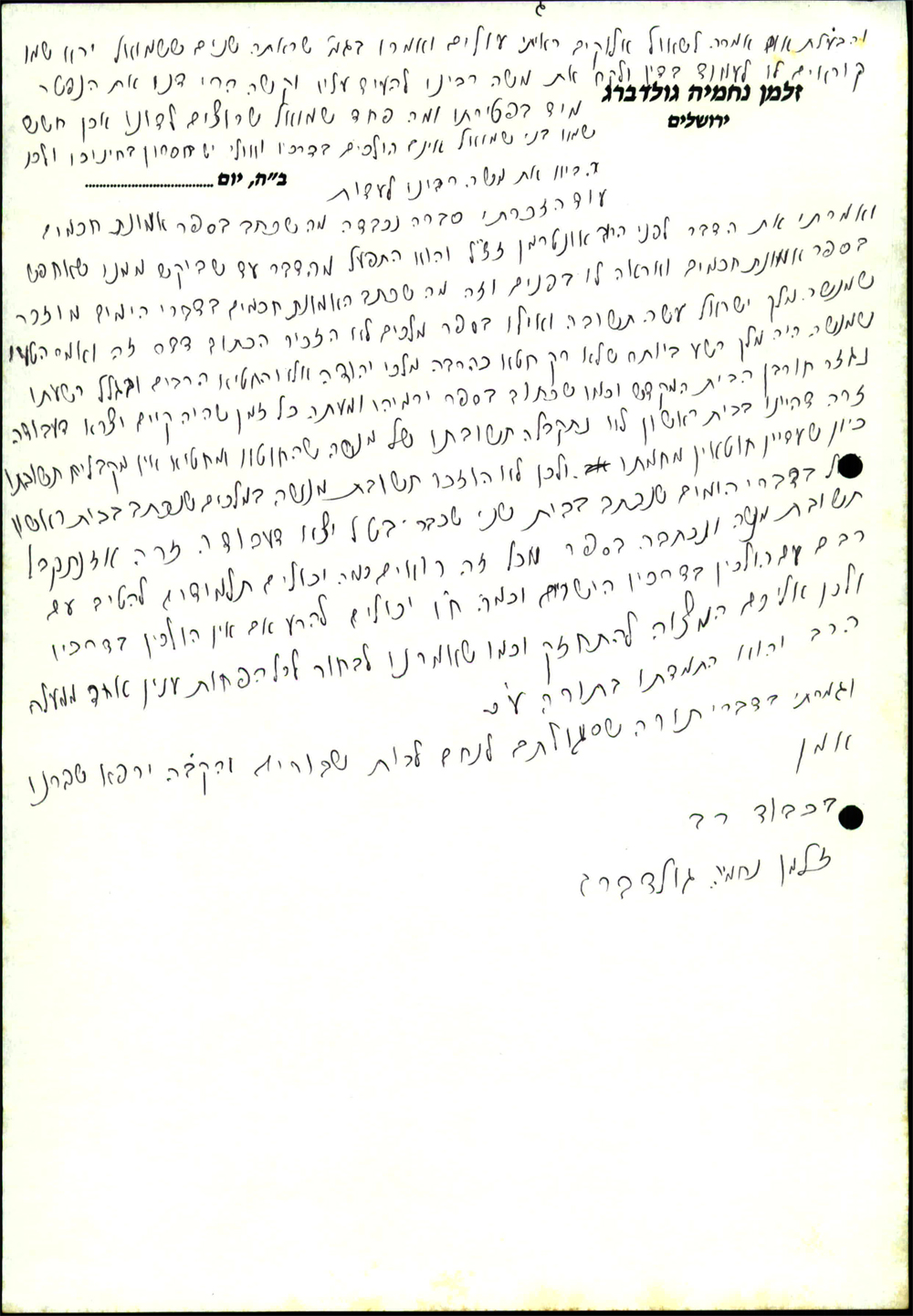
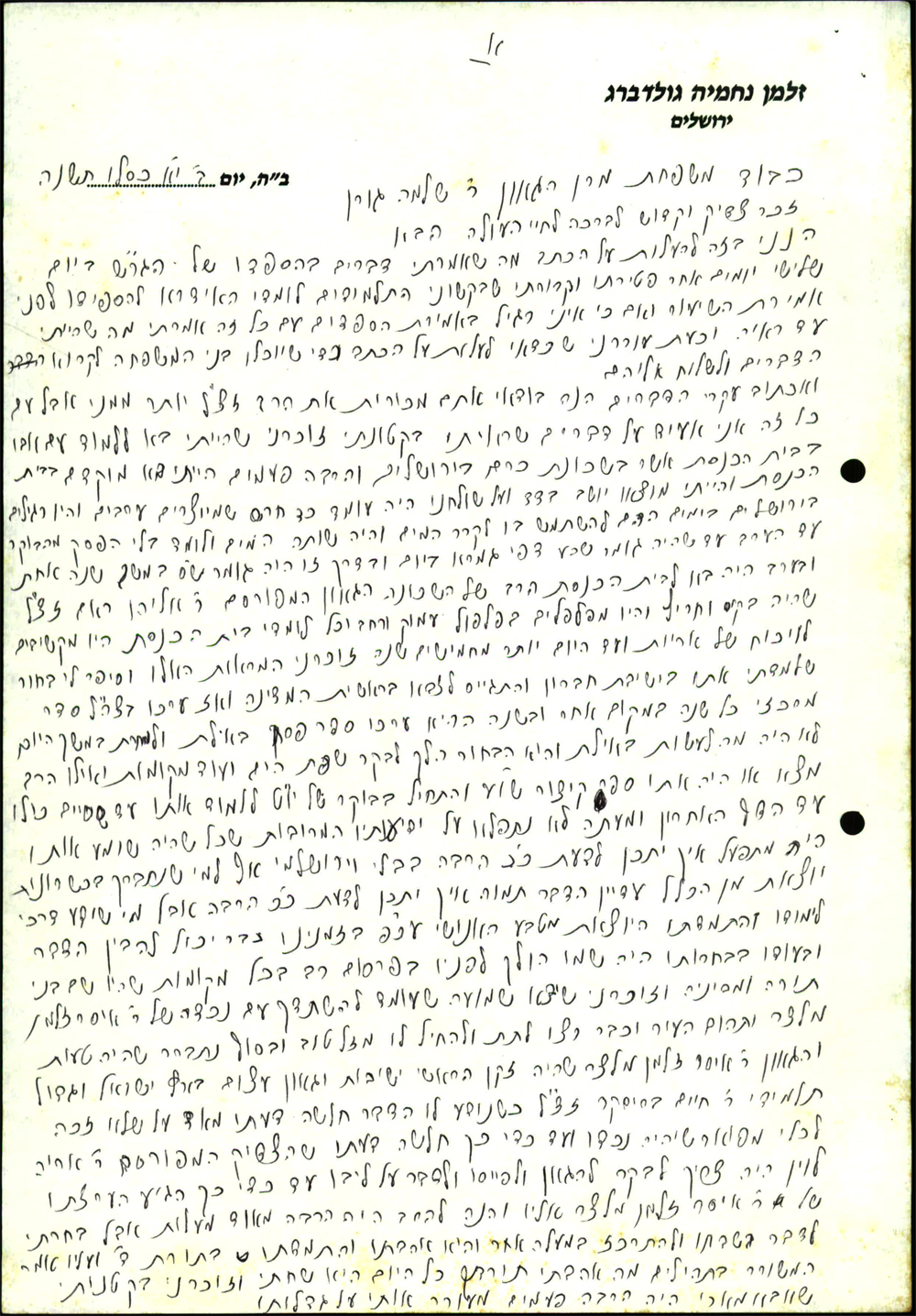
The recent passing of R. Zalman Nehemiah Goldberg was a great loss. It was not just a loss for one segment of the Torah world, as R. Zalman Nehemiah was unusual in that he was part of both the haredi world and the religious Zionist world. He was respected in both of these camps and spent his life teaching Torah among haredim and religious Zionists. One of the places he taught at was Yeshivat Ha-Idra, which was established by R. Shlomo Goren (and which closed not long after R. Goren’s death). I was fortunate to discover a eulogy that R. Zalman Nehemiah delivered for R. Goren.[1] From the eulogy you can see that R. Zalman Nehemiah broke with basically the entire haredi world which had written R. Goren off, and wanted nothing to do with him, either in life or after his death. Significantly, R. Zalman Nehemiah also contributed to the memorial volume published for R. Goren.

You can see the original handwritten eulogy in one document here, and my transcription of the eulogy in one document here.

There are a couple of noteworthy points in the eulogy which I would like to call attention to. R. Zalman Nehemiah mentions that R. Goren would complete seven pages of Talmud a day, and in this way would finish the Talmud in a year. In his autobiography, R. Goren mentions that it was R. Moshe Mordechai Epstein, the Rosh Yeshiva of the Chevron Yeshiva, who recommended to the young Shlomo Gorontchik that he learn seven blatt a day. R. Epstein said that this was what he himself did, and he recommended that R. Goren do this in the morning, while in the afternoon he study the Talmud in depth. This was not long after R. Goren entered the yeshiva, when he was not yet twelve years old.[2] Incredibly, he began learning seven blatt a day, and he tells us that during the winter he finished Yevamot twelve times. He also tells us that as he got older he would do 24 blatt a day with Rashi and Tosafot.[3]

The other point worthy of note is that R. Zalman Nehemiah mentions that there was a rumor that R. Goren was going to be engaged with the granddaughter of R. Isser Zalman Meltzer, and when this turned out to be incorrect R. Isser Zalman was very upset and was comforted by R. Aryeh Levin. In his autobiography, R. Goren discusses this matter but without mentioning any names.[4]

בעת ההיאהחלו גם רבנים ושדכנים שונים לנסות ולשדך לי אישהאחת ההצעות הגיעה מאחד מגדולי ישראלמן הגאוניםשהיה מעוניין מאוד לשדך לי את בתו

R. Goren mentions that since his father was a Gur Hasid he had to get the approval of the Rebbe, who for one reason or another was not enthusiastic about the match, meaning that there could be no shiddukh. R. Goren mentions that the woman who was suggested for him ended up marrying a great rabbi, but the marriage ended in divorce.[5]

The woman proposed for R. Goren was none other than R. Aharon Kotler’s daughter, who went on to marry R. Dov Schwartzman. It makes sense that R. Kotler would be interested in R. Goren, as he would have heard from his father-in-law, R. Isser Zalman Meltzer, about the great illui, R. Shlomo Gorontchik. There even exists a letter in which R. Kotler asks his father-in-law about R. Goren in terms of a possible shiddukh. Here is a selection from the letter which first appeared here.

Incidentally, here is a picture of R. Goren and R. Kotler from 1954 at the Agudah Kenessiah Gedolah in Jerusalem. It first appeared here. The man on the right is R. Shabbetai Yogel, who was on the Moetzet Gedolei ha-Torah.

Also noteworthy is that on one occasion R. Kotler accepted an invitation from R. Goren to speak to a group of Israeli soldiers.[6]

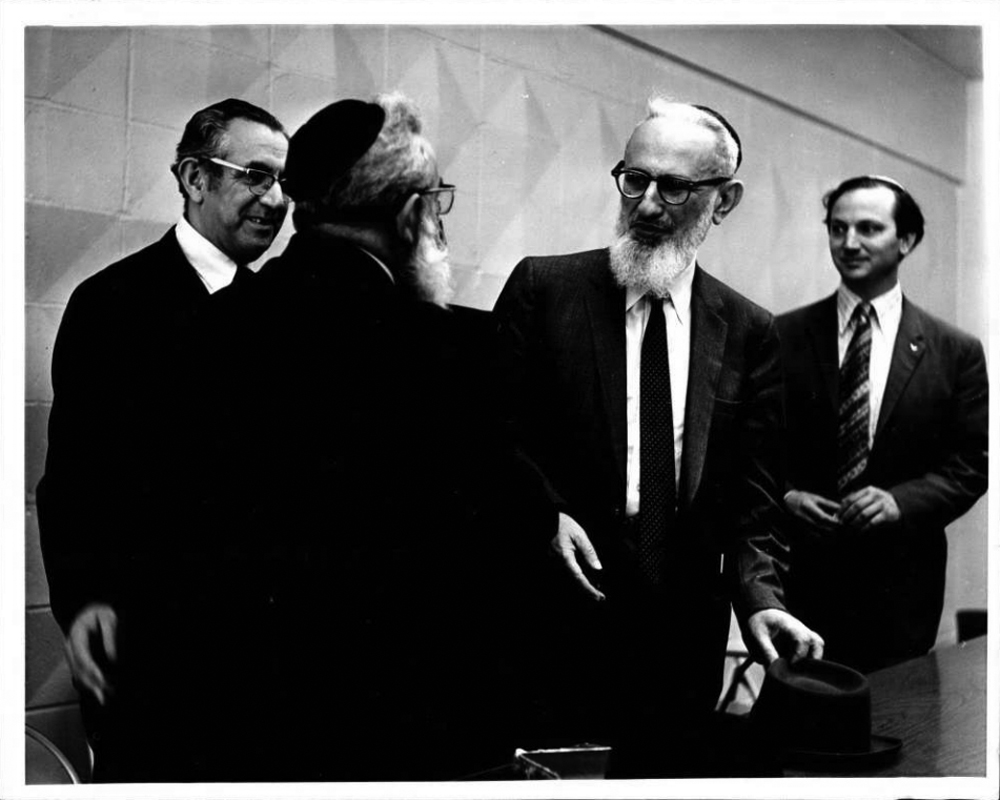
As long as we are talking about R. Goren, here are some unknown pictures of him and R. Joseph B. Soloveitchik.

In this picture the man to the left is Rabbi Israel Miller. I don’t know who is standing behind the Rav.

In this picture Rabbi Zevulun Charlop is standing on the left, and on the right are Rabbis Israel Miller and Samuel Belkin.

Here is a picture of R. Goren giving his shiur at YU. Maybe some readers were in attendance.

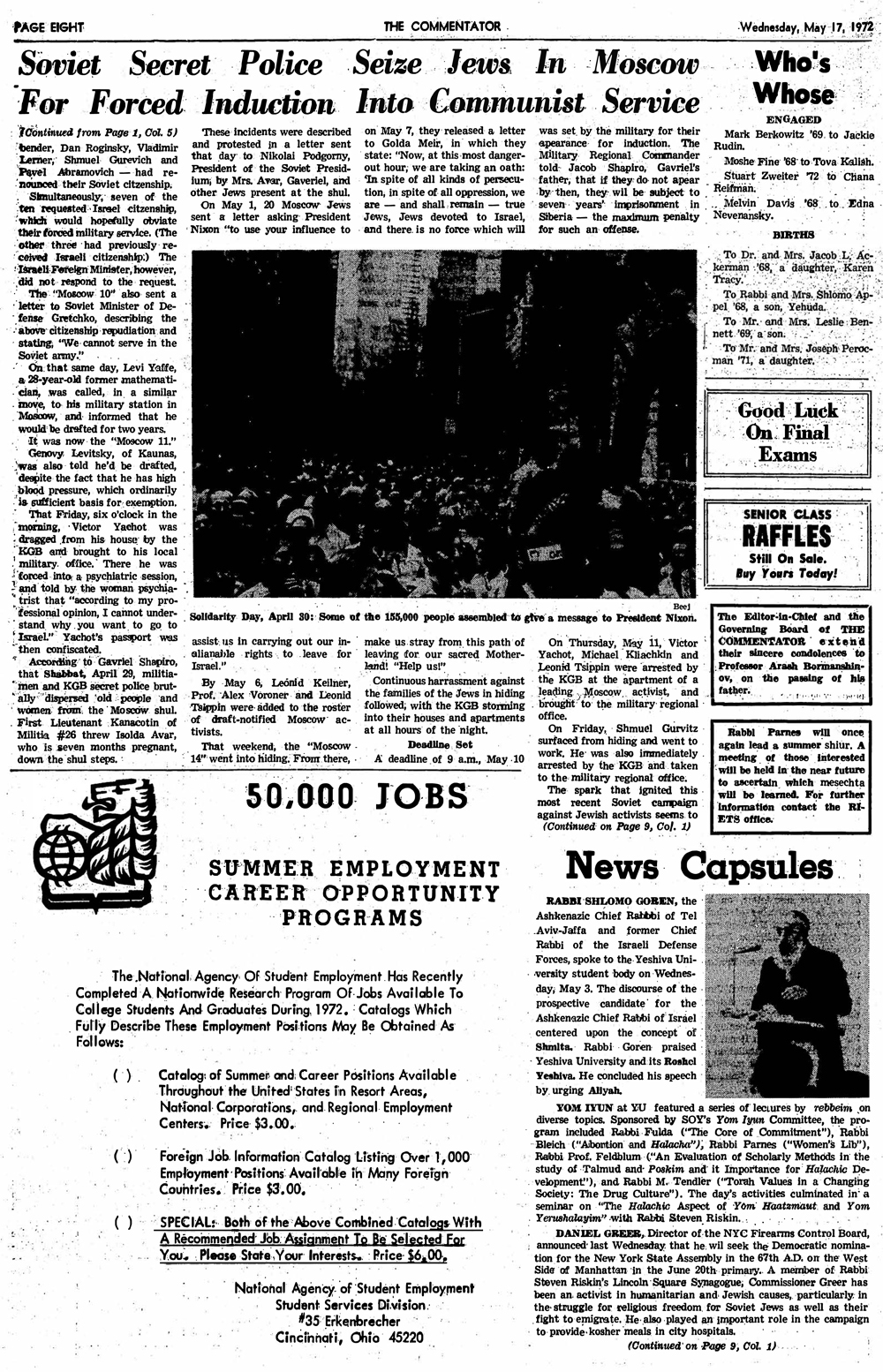
These pictures are found in the Israel State Archives here, and it is indicated in the file that credit should be given to Yeshiva University. No date is given for R. Goren’s visit, but in the Israel State Archives it indicates that the visit took place when R. Goren was Chief Rabbi of Tel Aviv. While he was elected to this position in 1968, he only started serving in 1971. At the end of 1972 he was elected Chief Rabbi of the State of Israel. From this we would conclude that the visit took place in either 1971 or 1972. We can further pinpoint the date of the visit as the file in the Israel State Archives includes the envelope in which the pictures were sent to R. Goren, and it is postmarked May 24, 1972. We thus see that the visit was in the spring of 1972. I then did a Google search, and lo and behold, I found an article on R. Goren’s visit in the May 19, 1972 issue of the Indiana Jewish Post and Opinion.

With this information I went to the online archives of the YU Commentator, and in the May 17, 1972 issue (p. 8), I found a report of R. Goren’s visit. We see from it that R. Goren spoke at YU on May 3, 1972.

*************

[1] The original letter published here is found in the Israel State Archives. Recently, the website for the Israel State Archives was updated, and I can no longer find the file that contains R. Goldberg’s letter, which is why I have not provided a link.
[2] It is commonly said that R. Goren entered the Chevron Yeshiva when he was twelve years old. However, R. Goren stated that he was born at the end of 1917 and he entered the yeshiva in the fall of 1929. See Be-Oz ve-Ta’atzumot, ed. Avi Rat (Tel Aviv, 2013), pp. 21, 61. Some sources, including the English Wikipedia, state that he was born on Feb. 3, 1917. Israel government sources and the Hebrew Wikipedia state that he was born on Feb. 3, 1918. I have no idea where the date of Feb. 3 comes from, as R. Goren himself said he was born at the end of 1917.
[3] Be-Oz ve-Ta’atzumot, pp. 62-63.
[4] Be-Oz ve-Ta’atzumot, p. 97.
[5] Be-Oz ve-Ta’atzumot, pp. 97-98.
[6] See R. Zalman ha-Levi Ury, Kedushat Avraham, vol. 2, p. 199.


Benjamin Richler: “Putting the Pieces Together: The ‘discovery’ of Gershon b. Meir Heilprin (Heilbronn)”

What follows is an original contribution by noted scholar Benjamin Richler to the Seforim blog. Any typographical errors are my fault alone. — Dan

Biographical blurb: Benjamin Richler was born in Montreal, graduated from Yeshiva University in 1960 and from the Hebrew University Graduate Library School in 1963. From 1965 to 1995, he served as the Librarian at the Institute of Microfilmed Hebrew Manuscripts at the Jewish National and University Library, on the Givat Ram Campus of the Hebrew University of Jerusalem. From 1995-2005, he was the Director (now retired) of the Institute. His books include Hebrew manuscripts, a treasured legacy (Cleveland-Jerusalem 1990); Guide to Hebrew Manuscript Collections (Jerusalem, Israel Academy of Sciences, 1994); The Hebrew Manuscripts in the Valmadonna Trust Library (London 1998); Hebrew manuscripts in the Biblioteca Palatina in Parma (Jerusalem 2001); Catalogue of the Hebrew Manuscripts in the Vatican Library, edited by Benjamin Richler (in preparation, to be published in 2007). His three dozen articles (in Hebrew and English) include: “Isaac Abravanel’s ‘lost’ commentary on Deuteronomy,” in Jewish Studies at the Turn of the Twentieth Century I (1999), 199-204; “Resources for the study of Tosafist literature at the Institute of Microfilmed Hebrew Manuscripts,” in Rashi et la culture juive (1997), 383-392; “Rabbeinu Tam’s ‘lost’ commentary on Job,” in The Frank Talmage Memorial Volume I (1993), 191-202; “The scribe Moses ben Jacob Ibn Zabara of Spain; a Moroccan saint?” in Jewish Art, 18 (1992), 141-147; “Manuscripts of Moses ben Maimon’s ‘Pirke Moshe’ in Hebrew translation,” in Koroth 9:3-4 (1986), 345-356; “Resources for the history of medicine at the Institute of Microfilmed Hebrew Manuscripts,” in Koroth 8:9-10 (1984), 407-413; “A Hebrew paraphrase of the Hippocratic Oath (from a fifth-century manuscript),” in Medical History 22:4 (1978), 438-445 (with S. Kottek).

Putting the Pieces Together:
The “discovery” of Gershon b. Meir Heilprin (Heilbronn)
Benjamin Richler

The manuscripts in the collection of the great bibliophile Heiman (Hayyim) Joseph Michael (1792-1846) were purchased in 1848 by the Bodleian Library in Oxford University. One of the manuscripts [1] was described by Adolf Neubauer in his Catalogue of the Hebrew Manuscripts in the Bodleian Library (Oxford 1886), no. 1265 as:

מורה דרך commentary on the 1st part of the Moreh han’N’bokhim by Gershom. …He quotes R. Abraham Broda and מהר’ לובלין (f. 8). For the enumeration of the author’s books in his preface, see Steinschneider’s מפתח האוצר, p. 324.[2]

Steinschneider listed the following works by the author, Gershon[3]: דבר הלכה; בדי שולחן on Shulchan Arukh; חיקור דין responsa; דבר תורה on the Torah ; מאמר אסתר on Megillat Esther; דבר הגדה on the Haggadah; מליצת עיקרים on the 13 Principles of Faith and extracts and sermons.

Most of these works are not recorded in any bibliography, and the full name and identity of the author remained a mystery to Steinschneider.

Another manuscript in the Jewish National and University Library, MS Heb. oct. 711[4], contains commentaries on the Torah, Ruth and Eikhah (Lamentations), based on philosophical and scientific perspectives. The anonymous author quotes Moses Mendelssohn and Copernicus, among others. He mentions several other books he composed, including some of those listed in his preface to מורה דרך , namely מאמר אסתר and דברי הגדה as well as משאת הגרשוני on the 13 Principles of Faith – perhaps another title for מליצת עיקרים on the 13 Principles listed above – as well as commentaries or novellae on the Prophets, Moreh Nevukhim and others. One of the works he mentions is a sermon titled אבל יחיד. The author mentions an explanation he heard from Rabbi Avraham Tiktin, the dayyan of his community ושמעתי פי’ … מהגאון מה’ אברהם טיקטין אב”ד קהילתינו. Needless to say, none of these other sources are recorded in bibliographies.

We can now establish that our author, Gershon, was a pupil, of R. Avraham Tiktin, or at least a resident of the same city in which R. Tiktin officiated. R. Avraham b. Gedaliah Tiktin (1764-1820), was a Rabbi in his birthplace Schwersenz (Polish: Swarzedz) near Posen (Poznan), then in Lenshits (Leczyca) and from 1803 in Glogau and from 1816 until his death in Breslau. We can assume, then, that Gershon resided in one of these communities. Which one? The answer is supplied by a manuscript in the Hebrew Union College in Cincinnati, MS 646, a copy of אבל יחיד, the sermon mentioned in the JNUL manuscript. It contains a 24 page eulogy (“hesped”) on R. Avraham Tiktin written or composed in Schwersenz on the eve of Rosh Hodesh Shevat 5581=January 3, 1821 by גרשון היילפרין or היילפרון (Gershon Heilprin or Heilpron).

A search for other works by the author listed in the Oxford and Jerusalem manuscripts revealed a manuscript in the Jewish Theological Seminary – University of Jewish Studies (Országos Rabbiképzo Intézet – Zsidó Egyetem) in Budapest titled משאת הגרשוני. It is a curious work based on the Thirteen Principles of Moses b. Maimon and its 169 folios include a Fourteenth Principle that incorporates all the other principles and contains a critique of Kant’s theories on the soul. It also includes some explanations of passages in Moreh Nevukhim, on difficult verses in the Bible and a commentary on the piyyut “Ehad Mi Yodea” in the Passover Haggadah. One section התילדות המשפחה deals with the the practice of assigning family surnames and delves into gynecology quoting physicians from Heraclitus until contemporary experts. He describes the wonders of the microscope and relates how a physician in Danzig showed him the sperm of a rooster under a microscope (f. 14r). There are a few poems by the author with the acrostic Gershon b. Meir, that establish the name of the author. The title page reads:

חלק ראשון מספר משאת הגרשני הוא מאיר עינים לאמונת והדיעות האמיתית מוסד על שלשה עשר העיקרים מהרמב”ם ז”ל, יוסף עליו עיקר הארבע עשר הכולל כל העיקרים ונקרא … עיקר הכולל בו אמצא ויכוח עם החכם קאנט בענין השארות הנפש … והראיתי מקורה ממקום נורא נקרא מקור הפילסופיאה … והוספתי התילדות המשפחה ותפארת אדם ופירש על כמה מאמרי ספר המורה להרמב”ם ז”ל וספר המידות לאריסטו … ומאמרי חז”ל הנאמרים בדרך חידה ומשלים … גם מהדברים המוקשים ביותר בתורה ובנביאים ודע מה שתשיב לאפיקורס .

Additional information about the author is found in an inscription by his son, Pinchas Heilbronn, on the title page in which he adds the date of his father’s death, 9 Heshvan 5629=October 25, 1868 אמר פינחס בן מ”ר גרשון הילבראנן ניפטר ט חשון תרכ”ט.

We have now identified the author of these four manuscripts, Gershon b. Meir Heilprin or Heilbronn. We can assume that since he studied under R. Avraham Tiktin or audited his lessons in Schwersenz where Tiktin officiated until ca. 1800 when Gershon was in his late teens or older, that Gershon was born around 1780-1785 and lived well into his eighties, residing for most or all of his life in Schwersenz. On the basis of the cross references to his works in the various manuscripts we can date them approximately. מורה דרך is perhaps the earliest of his works to survive, though by the time he wrote it he had already composed four or five other books or essays. אבל יחיד was composed in 1821. משאת הגרשני is mentioned in the compilation in the Jerusalem manuscript which is the latest composition of Gershon’s extant. If משאת הגרשני on the 13 Principles is the same work on the Principles entitled מליצת עיקרים in the Oxford manuscript then it should be considered the earliest work by Gershon to survive.

The figure that emerges from his extant writings is one of a talmid chacham, or at least of one fairly well-versed in Bible, Talmud and the writings of the Rambam with leanings towards the haskalah. He is familiar with some of the works of Aristotle and the teachings of Kant, though we cannot know if he read Kant in German or if his knowledge is from second-hand sources. He is interested in the sciences and has at least an elementary understanding of biology, astronomy and geography. Yet he remains an enigma. Apart from these four manuscripts no other details about Gershon Heilprin have surfaced. If he was so little known, why should Heiman Michael acquire a manuscript of his? Michael obviously acquired the manuscript before his own death in 1846. Was he offered the manuscript for sale? Did he purchase it because he considered it a worthwhile addition to his collection or did Gershon send it to him hoping to receive a generous donation? Likewise, we do not know how the other manuscripts reached the libraries in Budapest, Cincinnati and Jerusalem that now preserve them. It is ironic that so many unpublished works by better known rabbis and scholars did not survive the ravages of time and the Holocaust while four manuscripts by an otherwise unknown personality remained intact and are kept in libraries on three continents.

This detective work could not have been accomplished without a union catalogue of all the Hebrew manuscripts in the world. While no such tool encompasses 100% of all existing Hebrew manuscripts, there is available on the internet a catalogue that describes over 90% of this corpus, namely the catalogue of the Institute of Microfilmed Hebrew Manuscripts in the Jewish National and University Library in Jerusalem.

For over fifty years the Institute has been collecting microfilms of Hebrew manuscripts and its present holdings of 75,000 manuscripts together with the 8,000 original manuscripts deposited in the Jewish National Library represent an estimated 90-95% of all known Hebrew codices.

In the near future, I hope to write another entry at the Seforim blog about the Institute of Microfilmed Hebrew Manuscripts in the Jewish National and University Library in Jerusalem.

Sources:
[1] MS Mich 126, listed as no. 658 in the posthumous catalog of his library אוצרות חיים (Hamburg 1848).
[2] The reference is to Moritz Steinschneider’s appendix on manuscripts אוצרות חיים (Hamburg 1848).
[3] Neubauer called him Gershom, but Steinschneider called him Gershon.
[4] There is no record in the Jewish National Library concerning prior provenance or from whom the manuscript was acquired. We can assume that it was acquired in the early 1930’s. The catalogue of Hebrew manuscripts in the Library by B.I. Joel, רשימת כתבי-היד העבריים … (Jerusalem 1934), describes octavo manuscripts numbered 1-719, but, strangely, omits no. 711, even though the manuscript was in the Library by 1934.


Hasidism in America

Hasidism in America

Marc B. Shapiro
There is a tape of R. Joseph B. Soloveitchik in the 1950s saying that there is no real Hasidism in the United States. He says that he saw real Hasidism in Warsaw, and America does not have it. When the Rav made this statement, I think most non-hasidim would have agreed that Hasidism did not have any real future in the United States. The 1950s was a time when the focus was on the melting pot. In such an era, Hasidism would have been as out of place in wider American society as Muslim women walking down the streets of New York City or Los Angeles wearing hijabs. How things have changed!
There are many reasons for the great success of Hasidism in the United States, among them the turn to multiculturalism which has made the public square more welcoming of a variety of lifestyles. The coarsening of the wider culture has also pushed religious people to a more inward direction, and those looking to escape from this culture can easily be drawn towards Hasidism. Also important is that for many young hasidim the wider culture does not have the same draw it once did. And for those who do want to be part of the wider culture, in today’s day and age one can be a hasid and live a much more open life, even if only virtually, then people did a generation or two ago. The rise of the welfare state has also been crucial to hasidic growth, as without the welfare state hasidic communities as we know them would be unsustainable.[1] Finally, there is one other element that has been important to hasidic growth, and also to its fracturing, and that is the leadership that has been able to provide guidance in post-war America.

Samuel Heilman’s engrossing new book discusses this very point, that of leadership. Its title is Who Will Lead Us? The Story of Five Hasidic Dynasties in America, and it is required reading for anyone interested in the contemporary hasidic world.

The dynasties Heilman focuses on are Munkács, Boyan, Bobov, Satmar, and Lubavitch. There is also an introductory chapter on succession in Hasidism which itself is an important issue. I do not know if people in the hasidic world give it much thought, but for non-hasidim the whole matter of succession is somewhat strange, since by what right should a son (sometimes even a very young son) or son-in-law be able to take over religious leadership? Very few outsiders will be impressed with the hasidic concept of “holy seed,” as in the non-hasidic world, at least until recent years, it was understood that one rises to greatness based on one’s own achievements, not based on who one’s father was (though that always helps). It is thus interesting to learn that in the early years of Hasidism the concept of family succession did not exist.[2] Yet as we all know, for many years now succession has been based on lineage and in that way the hasidic court is just like the royal court.[3] (I was struck by Heilman’s use of the term “dowager” to describe the widow of the rebbe. I have never seen the term used in this way but is a good usage.) Of course, there have been times when there were disputes as to who should be the rightful successor, and this always had the potential to lead to a split in a hasidic group, a point we will return to.
Heilman was fortunate that he “was helped immensely by several rebbes who graciously consented to be interviewed and who for long hours and over many months and years opened their lives to me” (p. xv). Some readers might find it strange for a rebbe to be so open with an academic researcher, but it shows that at least some rebbes are interested that academic discussions about them be accurate, and that their perspectives be taken into account.[4]
Heilman’s chapter dealing with Munkács is riveting, and never before has the story been told in print. By “story,” I have in mind the life of R. Baruch (Boruchel) Rabinowitz, the rebbe of Munkács, who did what is almost unheard of, namely, giving up his “rebbeship.” Freed from this role, he was able to become more “modern” and publicly abandon the anti-Zionism so much associated with his father-in-law, R. Hayyim Eleazar Shapira, his predecessor as rebbe of Munkács. While living as a rabbi in Brazil (the “chief rabbi” of São Paulo), he even acceded to his new wife’s wishes to get a dog (which he himself walked). He read widely in secular literature, earned a university degree in philosophy and psychology, and taught philosophy at the University of São Paulo. (p. 51).
While some have seen the Holocaust as changing R. Baruch’s outlook, it appears that this is not entirely the case. As Heilman informs us (p. 44), during the Munkácser Rebbe’s famous 1930 trip to the Land of Israel, in which R. Baruch the future son-in-law accompanied him, R. Baruch snuck out at night to meet secretly with R. Yaakov Moshe Charlop, the leading follower of R. Kook. (Heilman refers to R. Charlop as head of Yeshivat Merkaz ha-Rav, but that would only happen after R. Kook’s death.) This shows that already in his youth he had a much broader perspective than his future father-in-law.
By the time his metamorphosis is complete, it appears that R. Baruch should be categorized as a Religious Zionist – or perhaps even a Modern Orthodox – rabbi. There is a picture in the book of him with Ben Gurion. Unfortunately, Heilman does not identify the other rabbi in the picture – R. Shlomo Goren. Here is another picture of R. Baruch in the Sinai desert after the 1967 war.[5]

Because R. Baruch had given up the role of rebbe, this meant that it was to pass to his son. Yet R. Baruch did not seem too happy about this and appears to have never regarded it as a real option, as he did not raise any of his sons to become a rebbe. Heilman does a wonderful job describing how it came to pass that the young Moshe Leib became the rebbe. The story he tells is also one of great sadness, of a deep human tragedy, as in the end there was a complete break between R. Baruch and three of his children from his first marriage (which includes the current Munkácser Rebbe), even to the extent of R. Baruch forbidding them to attend his funeral or to say Kaddish for him. (You can see R. Baruch’s letter here.)  Is there anything more tragic for a family than this?
While it is often stated that the hasidim rejected R. Baruch because he became a Zionist, the truth is that he rejected them, in that he chose not to continue as the rebbe. The bitter and public break with his children was a real family tragedy, but it is difficult to read the book and not conclude that the fault for this lay in R. Baruch’s unresolved issues – Heilman speaks of “Oedipal overtones” (p. 63) – seen most vividly in R. Baruch’s shocking behavior at R. Moshe Leib’s wedding. The result of all this is that R. Baruch has been completely erased from Munkács history and has no significance to the movement. When a book with his approbation is reprinted, such as R. Joseph Lustig’s Amudei Esh le-Veit Yosef, it is not surprising that the approbation is removed. Here is the title page of the edition with the approbation removed.

Despite the family tragedy, it must be said that R. Baruch’s son and successor, R. Moshe Leib, has been remarkably successful in leading a revival of the dynasty. He has also played a role in wider Jewish affairs, both publicly and behind the scenes, and is a fine example of what a successful rebbe can be.
Let me add a few more points about R. Baruch that are not mentioned in Heilman’s book. One might have assumed that as R. Baruch became more modern he would distance himself from his father-in-law, a man very much identified with extremism. But that did not happen. Until the end of his life he continued to display awe for R. Hayyim Eleazar Shapira. In Binat Nevonim (2012 ed.) pp. 153-154, he defends R. Shapira against the accusation that he was a “ba’al machloket.” What about his well-known attacks against the Religious Zionists and those non-Zionist Orthodox who wished to go on aliyah intending to work the land?[6] R. Baruch explains, very unconvincingly, that R. Shapira reacted the way he did because he hoped that the Messiah would soon arrive and people would then be able to immigrate to the Land of Israel without confronting any irreligiosity. R. Baruch’s own opinion comes a few pages later, p. 157, where he writes that the ingathering of Jews, including non-religious, to the Land of Israel is a fulfillment of biblical prophecy. Only later will God send His Holy Spirit to purify the people from all of its sins, and then He will send the Messiah. Such a perspective is very much at odds with what R. Shapira advocated.
Interestingly, in dealing with the accusation that his father-in-law was a “ba’al machloket,” R. Baruch says nothing about R. Shapira’s battles against the Agudah and its rabbis,[7] or his battles against non-Agudah rabbis and rebbes, in particular the Spinka Rebbe, R. Isaac Eizik Weiss, and the Belzer Rebbe, R. Yissachar Dov Rokeah. In the latter case, R. Shapira’s actions were very extreme, and it was alleged that he even attempted to get the government to expel the Belzer Rebbe from the city.[8] He attacked the Belzer Rebbe personally and referred to his hasidim as חזירי בעלז.[9] His attacks on Belz did not stop even after the Belzer Rebbe’s death, and the Belzer community of Munkács decided to separate from the wider Orthodox community of the city which was controlled by R. Shapira.[10] Since they were not legally allowed to create another Orthodox community, they officially became the Neolog community of Munkács. Although they were as distant from the Neologs as their persecutor, R. Shapira, declaring themselves as Neolog was the only way for them to create their own community which would be recognized by the government.[11]
In Binat Nevonim, pp 173-174, we see very clearly R. Baruch’s Religious Zionist feelings. He reviews the modern growth of the Land of Israel beginning with the early immigrations, and mentions how Jews hoped that this growth was the beginning of the redemption. He even states that the British did not live up to their expected role when they removed a large part of biblical Israel from the Jewish homeland. Could anything be further from the old Munkács approach than the following words from R. Baruch, after summarizing the various nineteenth-century attempts to build up the Land of Israel (p. 174)?
הארץ השוממה מתחילה לנשום ולהחיות מחדש. היא מתחילה להעלות תקווה בלב יושבי הארץ ובלב העם היהודי כולו, שהנה הגיע הזמן של שיבת ציון של חזון הגאולה לעם ישראל ולחזון הגאולה לכל העמים שעם יהודי נשא בקרבו מאז אברהם אבינו דרך הנביאים עד היום הזה.
He recognizes that we have not yet reached the end of the road, but like any Religious Zionist he is confident that the time is coming when the State of Israel will live up to its promise (p. 176):
עם ישראל, זה הנולד לגדולות ולנצורות, לא בדור הזה שהוא כדורו של דוד המלך ייהפך לאור לגויים, לא בדור הזה יהפוך את מדינתו למדינה לדוגמא. אבל יבוא הדור, דור שיהיה דומה לדורו של שלמה, דור שידע מנוחה, דור שלא יצטרך לנהל מלחמות, דור שידע להעמיד את כח החכמה לפני כח הגבורה – והדור הזה יקים את המדינה לדוגמא, מדינה שבה מדע התורה, המוסר, והצדק, והשוויון ישמשו תשתית לחיי האנושות, ואז יבוא משיח צדקנו, נצר דוד מלכנו ומציון תצא תורה ודבר ה’ מירושלים.
In discussing the Holocaust, R. Baruch states that we cannot ask why God was silent and did not hear the cries of the millions of victims (p. 158). He strongly rejects the notion that the Holocaust, which was an unparalleled national suffering, can be explained as due to any particular sins (p. 198). Regarding the Holocaust, it is also important to mention that R. Baruch was very involved in the efforts to save Hungarian Jewry.[12]
Returning to Heilman, the story of Boyan, which he tells with great skill, did not have the conflict and tragic aspects that were described in the chapter on Munkács. Yet here too we find the same theme, namely, a dynasty without an obvious successor. And again, we see that with the right man, and with proper guidance from the hasidic elders, he can grow into the role. As with Munkács, the Boyaner Rebbe has blossomed into a respected rebbe, either overcoming his more modern background (as some would say), or using this background to allow him to better understand the Jewish people as a whole.
For those interested in conflict in religious life, the chapters on Bobov and Satmar, focusing on the split in these movements, provide plenty of that. In fact, even before the dispute over who would be the current Satmar rebbe, conflict was a basic feature of Satmar life already in Europe. Heilman writes, “For Satmar hasidim conflicts served as a form of socialization and identity formation. . . . [T]his relish for conflict, framed as a steadfast ideological purity, would become the essential identity of Satmar Hasidism.” (pp. 163, 164)
In addition to discussing the conflicts over succession, Heilman also provides the necessary background to understand matters. Thus, in the chapter on Bobov, long before we get to the conflict that led to the split in the movement, Heilman reviews the history of Bobov, its fate during the Holocaust, and its rebirth after the war. Heilman does the same in all of the chapters, allowing readers to appreciate the unique aspects of each of the different Hasidic groups. In his chapter on Satmar, here is how Heilman summarizes what defined this group for its rebbe, R. Joel Teitelbaum.
The struggle to remain apart as well as distinctive and to argue that these positions were the only and authentic way of being Jewish not only made Yoelish’s followers feel that they were part of a great cause and the true defenders of Jewry and Judaism but made Satmarism and its inventor a kind of model for what steadfast Orthodox Judaism was meant to be, a vanguard of contra-acculturation and authenticity. Second, he had to make sure that his educational system did not provide his hasidim with the skills that would make leaving the enclave easy. Third, he had to demonize the world outside so that his followers would either be afraid of entering it or be confident that their own ways were infinitely superior. (p. 173)
I would like to add a few final comments and corrections.
I am not sure why Heilman includes a chapter on Chabad. While obviously the story here is not the fight over succession but the fact that there has not been a succession, for those who read Heilman’s and Menachem Friedman’s biography of the Lubavitcher Rebbe, the material in Who Will Lead Us? focusing on R. Menachem Mendel is not new. The first half of the chapter deals with prior Lubavitcher rebbes, not really the focus of the book which deals with the American scene, but helpful to understanding later events.[13]
It seems that spending so much time among the hasidim has led some of their hagiography to rub off on Heilman. How else to explain his statements that R. Baruch knew Maimonides’ Guide of the Perplexed by heart (p. 42) and R. Joel Teitelbaum “was able to review a folio of Talmud at age five” (p. 156)? Both of these men were scholars, and thus the hagiography focuses on their scholarship. I would be interested to know if in the hagiography about current rebbes, and in particular the ones discussed by Heilman, is scholarship even mentioned. Do current hasidim even assume that their rebbes are great Torah scholars?
In the preface, p. xiv, Heilman tells us that he will look at five different successions. In Munkács and Boyan a successor was lacking. In Bobov and Satmar two individuals claimed the throne. In Habad, the “hasidim denied a need for a successor at all, claiming that their rebbe had never really died.” While it is true that the Habad hasidim have no interest in a successor, there is only a very small number who claim that the Rebbe did not die (and thus they do not go to his grave). The mainstream messianist view is that the Rebbe indeed died and will be resurrected as the Messiah.[14] Even those who do not write זצ”ל or זי”ע do not deny that the Rebbe died and was buried. Yet they assume that his soul is still involved in this world and as such they do not want to treat him as someone who has passed from the scene.
P. 58. Heilman writes that the Lubavitcher Rebbe “claimed to have attended the Sorbonne and other European universities.” (p. 58) I do not understand the use of the word “claimed,” as it appears to cast doubt on what the Rebbe said. Yet in Heilman’s book, The Rebbe, he himself mentions that the Rebbe was a registered student at both the University of Berlin and the Sorbonne.
Pp. 85-86. Heilman states that R. Yerucham Gorelick “came from Slutzk, Belarus, and had studied in the famous non-Hasidic yeshiva there.” This is incorrect as R. Gorelick studied in Lomza, Radin, and also in Brisk, but not in Slutzk. In fact, in 1923 (when R. Gorelick was twelve years old) the Slutzk yeshiva moved to Kletzk.
P. 169. In discussing the Kasztner train and the inclusion in it of the Satmar Rebbe, Heilman writes: “Kasztner was persuaded, after someone paid a ‘huge sum,’ to include Yoelish and some of those connected to him among the 1670 in the train.” Why the leading anti-Zionist, R. Joel Teitelbaum, was included on the Kasztner train is a question that has never been convincingly answered. A popular legend is that Kasztner’s mother appeared to him in a dream and requested that he include the Rebbe. Yet even if this explains why the Rebbe was included, there were also other anti-Zionist rabbis who were on the train, which was a microcosm of larger Hungarian Jewish society.[15]
Before reading Heilman’s book, I had never heard that it was only money that enabled the Rebbe to be rescued. The source Heilman provides for this is a Satmar biography of the Rebbe that relied on an item that appeared in the Satmar paper Der Yid. These are precisely the sorts of sources that have to be used very carefully, and in many cases are simply useless if one is trying to find out the truth. At the very least, Heilman should have written that it is “alleged” that someone paid a huge sum, rather than state it as fact. One of the “problems” of the Satmar Rebbe’s biography is that despite being saved by the Zionist Kasztner, there is no evidence of the Rebbe ever having expressed any gratitude towards Kasztner or the Zionists as a whole for saving his life, something that has often troubled people. However, if the only reason the Rebbe was on the train was because of a simple monetary transaction, then he would have no reason to feel grateful to Kasztner or the Zionists. To put it another way, there is good reason for Satmar writers to portray the event this way in order to burnish the reputation of the Rebbe. As such, the unsubstantiated report Heilman relies on here must be treated with a great deal of suspicion.
The hasidic world is obviously of great significance in Orthodoxy. There are so many different hasidic groups that just when I think I know them all, I see an article about another rebbe whom I have never heard of. In fact, some years ago someone produced a “yellow pages” of all the hasidic rebbes. There are 554 listed, and by now no doubt a few more need to be added. Here is the first page.
There are significantly more rebbes now than a hundred years ago. Marcin Wodzinski has written that “there were approximately three hundred tsaddikim active in 1900.”[16]
What I know from friends in the hasidic world is that there are also people who should be regarded as “independent hasidim.” I first heard this expression a few years ago in Budapest where I became friendly with a visiting American hasid. When I asked him which group he was part of, he replied, “independent.”
Here was a man who looked like a hasid, who considered himself a hasid, who valued the hasidic way of life, and yet he did not have a rebbe. Since then I have met other “independent hasidim,” and their story is pretty much the same. They grew up as hasidim and love Hasidut, but they do not find any of the rebbes appealing. Some of them have also seen things that caused them to be disillusioned with the contemporary rebbes. They do not deny the value of a rebbe, and believe that great rebbes existed in the past. It is just that today they do not see such figures.
I would love to see an article dealing with the phenomenon of the independent hasidim. Is this something that can continue in a family over generations, or is it a one generation event, with the children brought up in such a family generally joining a hasidic group or linking up with the yeshiva world? Interestingly, Wodzinski notes the existence of independent hasidim around the time of World War I, and I wonder when they first appeared. In Wodzinski’s words: “During the war and after it, shtiblekh sprang up, gathering the half-rejects and half-deserts from the Hasidic world, shtiblekh unaffiliated with any court.”[17]
The independent hasidim should be distinguished from what Wodzinski has termed “à la carte Hasidism.” This is a phenomenon that also existed in the early twentieth century, and consisted of “young Hasidim who sampled different courts, picking various festivals with different tsaddikim depending on individual taste or indeed on the way different tsaddikim enacted different elements of Hasidic ritual.”[18]
Another point of interest which has not yet been analyzed is the position of the rebbe when he was still a child and teenager. Heilman’s book discusses this with regard to the current Munkácser Rebbe, but when he was young there was not yet an expectation that he would become the rebbe. What about those who knew that they would become rebbe. What type of childhood did they have? Did they have friends like other children, or were they regarded as too special to mix with the masses? And how about when they were teenagers and realized the significance of their fathers, who served as rebbes? It would be fascinating to hear from current rebbes about how they experienced childhood and young adulthood. People often forget that even the most important figures were once young and enjoyed the same sort of fun that all young people do. I actually have a photo of a young Shlomo Halberstam (1907-2000) in his bathing suit having fun in a lake. Heilman discusses in detail his experiences during the war and how after the war he rebuilt the Bobov dynasty, a task that fell to him as his father, R. Ben Zion, was murdered by the Nazis.[19] Yet the photo I just mentioned reminds us that even future rebbes were able to enjoy themselves like everyone else.
* * * * * *
Since this post deals with Hasidism, it is a good place to call attention to an unfortunate example of censorship in the writings of the Hatam Sofer. Here is the title page of volume 2 of the Derashot of the Hatam Sofer, first published by R. Joseph Naphtali Stern in 1929. R. Stern’s edition is based on the Hatam Sofer’s own manuscripts.

Beginning on p. 371a one can find the eulogy for the Hatam Sofer’s teacher, R. Nathan Adler. On p. 373a, in speaking of the great piety of R. Adler, the Hatam Sofer writes: ולא כחסידי הזמן ח”ו.


Now take a look at the Pressburg 1881 edition of Torat Moshe, Va-Yikra, p. 41b. You can see that the words ולא כחסידי הזמן ח”ו do not appear. It is not known if the publisher was responsible for this censorship, as he informs us in the introduction to volume 1 that some of what appears in the book was copied from the Hatam Sofer’s manuscripts and sent to him.

And while on the topic of censorship, here is another example dealing with a leading student of the Hatam Sofer, R. Moses Schick. Here is Derashot Maharam Schick, p. 30b, published in Cluj around 1936.[20]

You can see that he mentions Wessely’s Yein Levanon. Now take a look at the Derashot Maharam Schick published in Jerusalem, 2003.

As you can see, the reference to Yein Levanon has been removed. R. Moses Schick believed that Yein Levanon was a fine book, worthy of being quoted. However, the publisher thought differently. Ironically, the new edition was published by Makhon Maharam Schick. Here is the title page

So we have a publishing institute named after R. Moses Schick, and the people who run it would no doubt insist that they have the greatest respect for R. Schick. Yet this respect does not include respecting the sanctity of what he actually wrote.

R. Moses Schick refers to Wessely’s comment to Avot 1:1. In the new edition of Yein Levanon (Rishon le-Tzion, 2003), p. 44, the editor points out that R. Samson Raphael Hirsch, in his commentary to Avot 1:1, also cites Wessely by name. While this comment appears uncensored in the English translation of Hirsch’s commentary, in the Hebrew translation Wessely’s name has been replaced by “one of the commentators.” The editor adds: “The translators think that they are wiser  and more understanding than R. Samson Raphael Hirsch.”

* * * * * *
In Changing the Immutable, p. 211, I write that R. Hayyim Vital “records” and “mentions” certain negative information about Israel Najara. Yitzy Weinberg commented to me that I neglected to state a very important point, namely, the source of R Vital’s information. Weinberg feels, and others probably do as well, that knowing the source is important, since if R. Vital recorded information that he had personal knowledge of it would have more significance than if it came from another source.

Before coming to this point, I must note from a modern perspective, it is hard not to conclude that R. Vital was overly credulous. He was ready to believe the most far-fetched tales of angels, demons, magic, spirit possession, and exorcisms, and has no reticence in describing personal experiences with some of these things. He himself was even possessed by a powerful evil spirit. Morris M. Faierstein has recently discussed this episode and reaches the following striking conclusion: “Within the universe of Lurianic Kabbalah and the stories found in Vital’s mystical diary, the Book of Visions [Sefer Hezyonot], it can only be Jesus of Nazareth who was the evil spirit that possessed Hayyim Vital.”[21] 

Knowing all this, I do not believe that the information about Najara quoted by R. Vital should be accepted at face value,[22] especially when the charges made (homosexual behavior and sexual relations with a non-Jewish woman) are so serious. I would say this even if the ultimate source of this information was R. Vital himself.[23] 
Nevertheless, I agree that I should have mentioned that the information recorded by R. Vital came from a spirit that had entered a woman (a phenomenon that only after R. Vital’s time came to be known as a dybbuk[24]). Furthermore, in the book I noted: “Because of this, Vital wrote that ‘the hymns that he has composed are themselves good, but whoever speaks to him and whatever leaves his mouth is forbidden, because he always used foul languages and was a drunkard his whole life.’” This too is a statement from the spirit.
Among the information revealed by the spirit was that “between the fast days,” Najara “prepared a meal at that hour at the house of Jacob Monides, put his hat on the ground, sang songs in a loud voice, ate meat, drank wine, and even became drunk.”[25] R. Vital writes that Najara admitted that this incident occurred, meaning that in this case R. Vital wants us to know that the spirit spoke the truth. R. Vital does not record asking Najara about the spirit’s more serious accusations, and he would have told us if he had.[26]
Despite what I have just written, some seem to assume that everything that appears in R. Vital’s Sefer ha-Hezyonot must be attributed to himself, even if he attributes it to a spirit. Thus, Lawrence Fine writes: “In his dream diary, Vital alleges that Israel Najara engaged in homosexual behavior in his drunkenness, and contends, in connection with Damascus, that ‘there is much homosexuality . . . in this land.’”[27] As you can see, Fine does not mention the spirit but states that “Vital alleges.”
Another example is that Israel Zinberg writes that “Vital declares,” and then cites the passage I quoted in my book, which first appeared in Shivhei R. Hayyim Vital.[28] “The hymns that he has composed are themselves good, but whoever speaks to him and whatever leaves his mouth is forbidden, because he always used foul language and was a drunkard his whole life.” Zinberg does not mention the spirit.
Avraham Amazleg writes as follows (emphasis added)[29]:
שם רח”ו גם בפי הרוח דברי גנאי וביקורת על נג’ארה. רח”ו או הרוח אמנם מודים שהפזמונים שהוא חיבר הם טובים, אבל אסור לאומרם או לדבר עם המחבר, כי פיו דובר נבלה, וממילא הוא שיכור כל ימיו.
Almog Behar writes[30]:
המקובל רבי חיים ויטאל, תלמיד האר”י, בן תקופתו, כתב עליו ב”ספר החזיונות” שלו.
I could bring a number of additional examples where the words of the spirit are attributed to R. Vital, but I think readers get the point.
Although in all texts of Shivhei R. Hayyim Vital Najara’s name was deleted – it first appeared in the 1954 edition of R. Vital’s Sefer ha-Hezyonot – it was not too difficult for Zinberg and others to figure out who was being referred to. R. Moses Sofer appears to have also been aware of the passage in Shivhei R. Hayyim Vital, or perhaps there even was an oral tradition about the more serious charges against Najara that only appeared in print in 1954. I say this because when asked by his son why he did not sing Najara’s spiritually moving Y-ah Ribon, the Hatam Sofer replied: “Rather than telling you why I do not sing it, it is better to sing it.” From that point on he sang Y-ah Ribon.[31]
* * * * * *
R. Yechiel Goldhaber is well known as an outstanding scholar, whose many publications are always enlightening.[32] Not many know that he also offers tours of the Old City of Jerusalem. Having had the pleasure of participating in one of his tours, I highly recommend it to all who are interested in the history of Jerusalem (which I believe includes all Seforim Blog readers).
My own Torah in Motion tours to Europe in summer 2018 have also been announced. You can read about them here.

The young scholars R. Yisachar Dov Hoffman and R. Ovadiah Hoffman are known to many Seforim Blog readers. R. Yisachar has authored Avodat Ovadiah which focuses on practices of R. Ovadiah Yosef. R. Ovadiah Hoffman is a Seforim Blog contributor, and both of them have published three volumes of Ha-Mashbir, dedicated to studies on R. Ovadiah Yosef. I think readers will be interested to know about an event they are organizing to commemorate the yahrzeit of R. Ovadiah Yosef. It is to take place on Sunday, October 22, 2017, from 6:25pm-9pm (refreshments available), followed by maariv. It will be an evening of shiurim dealing with contemporary halakhic issues and reflections on the legacy of R. Ovadiah Yosef. It will be held at Beis Midrash Kerem Shlomo, 1880 East 27th Street (between Ave. R and S), in Brooklyn. The scheduled speakers are R. Herschel Schachter, R. Aryeh Ralbag, R. Yitzchok Yisraeli, and R. Betzalel Rudinsky. It promises to be a fascinating evening.

[1] See Heilman, Who Will Lead Us, p. 193, where he mentions that in 1984, under the leadership of R. Moshe Teitelbaum, the Satmar were officially designated by the government as a “disadvantaged minority, which allowed them access to various government benefits.”
[2] R. Hayyim Halberstam, Divrei Hayyim,vol. 2,  Hoshen Mishpat. no. 32, writes against the practice of family succession when it comes to the Rebbe, and contrasts this with the position of town rav where there is such a concept:
ועל דבר ירושת הכבוד הנה במח”ת כ”ת הבוררים הרבנים וכי רבני החסידים שליטתם בתורת משרה כמו רב שבנו קודם הלא ידוע שהקדוש ר”א ואביו הק’ זלה”ה לא היו רבנים ורק מחמת גודל קדושתם ויראתם נשמעו דבריהם לכל הגליל וינהו אחריהם ללמוד תורה ויראה מהם גם נתנו להם נדבות לכבד יראי השם כמותם ירבו בישראל ושאלו עצות כאשר ישאל איש בדבר אלקים כי היו בעלי רוח הקודש ותפלתם ודיבורם בקדושה עשו פרי ומה נעשה אם הבאים אחריהם אין בהם קדושה זו. מה ירשו לשאול עצה דעת אין בהם. אם להתפלל מי יודע העולה למעלה לא ידעתי שום צד ירושה בזה. והנה מצינו למופת כגון הרב הקדוש איש אלקים רשכבה”ג מו”ה דוב בער זלה”ה ממעזריטש השאיר הגדולה לתלמידיו הרב הק’ מברדישטוב ומאור עינים ואור המאיר זלה”ה, וכן רבו הבעש”ט הניח המשרה זו לתלמידיו לא לבנו שהי’ קדוש ה’ וכן רבינו הקדוש בעהמ”ח נועם אלימלך הניח המשרה לתלמידיו לא לבנו הגם שהיו קדושים למאד כידוע לכן אין בזה שום ירושה ורק מעשיו יקרבוהו ומעשיו ירחקוהו.
[3] In R. Zvi Yehudah Kook’s recently published Sihot R. Zvi Yehudah: Emunah, ed. S. Aviner (Jerusalem, 2017), p. 200, Berdyczewski is quoted explaining what led him to abandon traditional Judaism. In short, it was seeing how his learned grandfather had to humble himself before a young rebbe. While Hasidism and attachment to a (worthy) rebbe are wonderful things, one should always remember what R. Kook states in Orot, p. 146, about the possible dangers:

הדבקות בצדיקים, כדי שיתערב כח המציאות שבנשמתם עם הנשמה הבלתי-נשלמת, היא דבר נכבד מאד במהלך התפתחות הנפשות, אבל צריך שמירה גדולה, שאם יטעה בצדיק אחד, וידבק בו דבקות פנימים הויתית, וידבק ג”כ בחסרונותיו, הם יפעלו לפעמים על הדבק במדה גרועה הרבה ממה שהם פועלים על האיש המקורי. אשריהם ישראל שהם דבקים בנשמת האומה, שהיא טוב מוחלט, לשאוב על ידה אור ד’ הטוב

[4] Heilman never mentions a rebbe by name as his source, but on p. 53, in quoting the recollections of an unnamed family member, it is the Munkácser Rebbe who is being quoted. There were only two family members who were present at the event discussed, the Rebbe (R. Moshe Leib) and his brother, Chaim Elazar. Since Chaim Elazar spoke on the record and on numerous occasions is mentioned by name as the source for information, the “unnamed family member” must be the Rebbe himself. The Rebbe must also be the source for the information on pp. 57-58, where Heilman records what R. Baruch told the young Moshe Leib, including his recommendation that Moshe Leib attend university. Heilman also mentions what Moshe Leib told his father: “Today, if someone puts a college diploma on his wall, his rebistve is finished.”
[5] The picture comes from this article. For a bar mitzvah video made by one of R. Baruch’s grandsons, see here.
[6] See Yitzhak Alfasi, Ha-Hasidut ve-Eretz Yisrael (Jerusalem, 2010), pp. 175-176; Menachem Keren-Kratz, “The Politics of Jewish Orthodoxy: The Case of Hungary 1868-1918,” Modern Judaism 36 (October 2016), 8pp. 232-233.
[7] As part of his battle against the Agudah, he also took on Daf Yomi which in his mind was simply ridiculous:

טפשות וצחוק מכאיב
“For how can one learn a page every day when the pages almost always end in the middle of a subject.” Divrei Torah (Brooklyn, 1998), vol. 6, no. 82. Elsewhere he explained that the great danger in joining a Daf Yomi group is that one might be led to adopt the Agudat Israel ideology, “and Heaven forbid to join with them.” Iggerot Shapirin (Brooklyn, 1983), p. 319. He also accused the Agudah of initiating the Daf Yomi in order to have at its disposal ready-made groups that could be used to colonize the Land of Israel. See Sha’ar Yisaschar (Brooklyn, 1992), p. 382.
For other examples of rabbinic opposition to Daf Yomi, due to its association with Agudat Israel, see Tikun Olam (Munkács, 1936), p. 106; Aharon Rosenberg, ed., Mishkenot ha-Ro’im (New York, 1987), vol. 3, pp. 901-902; Nitzotzei Or 3 (Elul, 5758), pp. 33-41. While I do not think that R. Joseph B. Soloveitchik can be called an opponent of Daf Yomi, I was present at a shiur in the summer of 1985 where he expressed his dismay that due to the growing popularity of Daf Yomi, people were no longer studying all six orders of the Mishnah, much of which has no Talmud and is thus not included in the Daf Yomi cycle. (For reasons that are unclear, Middot and Kinnim are the only tractates of Mishnah included in Daf Yomi.)
[8] See Yeshayahu A. Jelinek, The Carpathian Diaspora: The Jews of Subcarpathian Rus’ and Mukavchevo, 1848-1948 (New York, 2007), p. 172; Shmuel ha-Kohen Weingarten, “Pulmus Munkács-Belz,” in Yehudah Erez, ed., Entziklopedyah shel Galuyot: Karpatoros (Jerusalem-Tel Aviv, 1959), p. 230; and my Changing the Immutable (Oxford, 2015), p. 229.
[9] See Weingarten, “Pulmus Munkács-Belz,” p. 230.
[10] Not surprisingly, this dispute led to violence. The topic of violence, which has been a part of certain hasidic courts, is worthy of a study. Let me offer a few relevant sources. There is a report of hasidim murdering a mitnaged. See Mordechai Wilensky, Hasidim u-Mitnagdim (Jerusalem, 1970), vol. 2, p. 178. This report, contained in the early anti-hasidic text Shever Posh’im, includes names and places and was written not long after the event described. Nevertheless, I would not accept the story as historically accurate without confirmation from other sources, which as far as I know has not been found. See also S.’s post here which discusses another alleged murder by hasidim. (I do not believe there is any truth to this story.)
There are, unfortunately, hasidic stories that present violence as an acceptable option to settle disputes. It is safe to assume that such teachings have an impact on some impressionable minds (think New Square). For example, in Sippurei Niflaot mi-Gedolei Yisrael (Tel Aviv, 1969), p. 279, it reports that R. Menahem Mendel of Kotzk thought that R. Shmelke of Nikolsburg made a mistake when he forced his “enlightened” opponents to leave the city. What he should have done, according to the Kotzker, is have them killed.
Some relevant material is found in the book Zikhron Asher (1980) by R. Asher Edelstein. This book is not found on Otzar ha-Chochmah or hebrewbooks.org. I learnt about it from R. Nahum Abraham, Darkhei ha-Ma’amarim (n.p., 2017), section Peti Ya’amin le-Khol Davar, pp. 113-114 (who cites the stories I mention). Here is the title page.
Here is pp. 14-15 where we are told that the Kosover Rebbe tried to drown the follower of another rebbe. Following this it mentions how each of the rebbes discussed would bring punishments upon the followers of the other rebbe.
Here is pp. 31-32 where it records that the Kosover Rebbe was angry that one of his hasidim went to the Belzer Rebbe, and this anger caused the man’s factory to burn down. It also tells a story of violence that took place at the wedding of one of the Ruzhiner Rebbe’s sons. This story ends with the death of the man who during the wedding had stabbed the Kosover Rebbe with a needle. 
Here is pp. 63-64 where it describes how the rebbe R. Yissoschar Berish Eichenstein once removed a fly from his plate on Shabbat, in violation of the halakhah. When this was mentioned to him by R. Menahem Mendel Stern, the rav of Sighet, R. Eichenstein replied that a man had been reincarnated in this fly, and he had to be metaken it. R. Stern replied that he does not seen any tikunim but only regular Shabbat violation. The story ends that R. Eichenstein’s brother cursed R. Stern and R. Stern returned the curse, leading to the brother’s early death and R. Stern not having any “nachas” from his descendants. 
None of the pages I have reproduced are found in the 2004 edition of Zikhron Asher. Here is the title page.
Yitzhak Even, Mahloket Sanz ve-Sadegura (New York, 1916), has a lot to see about violence between the Sanzer and Sadegura hasidim. On p. 68, he tells how some Sanzer hasidim murdered a Sadegura hasid. On pp. 79-80, he discusses the stabbing of a Sanzer hasid and further violence against Sanzer hasidim. He also mentions a report that in response to being attacked, the Sanzers murdered an elderly Sadegura hasid. See also pp. 83, 86-87. I do not know how reliable Even’s information is.
[11] See here. This action led to R. Shapira issuing the following statement in 1929, declaring that the Belz community is to be regarded as no different than the Reform community:
הן כבר הודענו כי אותן שמחזיקים בבית התפלה של הנעאלאגים דפה – דינם כמו שאר הנעאלאגים האוכלים נבילות וטריפות – ופשוט שאין להם נאמנות וחזקת כשרות כלל.
See Weingarten, “Pulmus Munkács-Belz,” col. 230 n. 2. See also ibid., col. 232, that originally the Belzers wished to be recognized as a Status Quo community. Only when the government did not agree to this, did they then request, and receive, government recognition as a Neolog community. Weingarten’s father was the secretary of the Munkács community. See Weingarten, “Ha-Admor Mi- Munkács, Rabbi Hayyim Eleazar Shapira,” Shanah be-Shanah (1980), p. 447. Even though Weingarten was a Zionist, he still had a very good relationship with R. Shapira. See Weingarten, Perurim mi-Shulhanam shel Gedolei Yisrael (Jerusalem, 2004), pp. 17-37.
[12] Regarding this, see Binat Nevonim.
[13] On p. 216, Heilman mentions that already the Tzemach Tzedek sent out shluchim to the wider Jewish world. Apropos of this, I know that some have wondered why Chabad calls its emissaries שלוחים and not  ,שליחי which any Hebrew dictionary will tell you is the plural of שליח. Yet as R. Meir Mazuz points out, in rabbinic Hebrew the plural is indeed שלוחים. Thus, we find in Rosh ha-Shanah 18a: על ששה חדשים השלוחין יוצאים. Also, Maimonides has a section in the Mishneh Torah that is called הלכות שלוחין ושותפין. See R. Mazuz’s note to Hannah Peretz, Patish he-Hazak (Bnei Brak, 2013), vol. 2, p. 384 n. 26, and his recently published Mi-Gedolei ha-Dor, vol. 3, p. 129 n. 2. R. Mazuz thinks that the term שליחים originates in Christian circles, and that it was perhaps because of this that Jews used the term שלוחים. Yet as far as I know there is no evidence that Christians used the term שליחים in the days of the Mishnah. 

I do not believe that the term  שלוחappears in classic rabbinic literature, but we do have it with a suffix. E.g., Mishnah Berakhot 5:5: ששלוחו של אדם כמותו. See Ben Yehudah’s dictionary, s.v. שלוח, שליח. Ben Yehudah, s.v. שלוח, explains the difference between שלוח and שליח as follows:

[שלוח] זה שנשלח, בהבדל מה מן שליח, שתפקידו הקבוע הוא לשמש כנשלח בשליחות.
In s.v. שליח he writes:
ואפשר שבא שליח בעקר כצורה ארמית שליח, שליחא במק’ שלוח בעבר.
[14] The only time I have ever had contact with a Chabad group that apparently denies the Rebbe’s death was in New Delhi. Here is a picture of the sign in front of the Chabad House and the stamp that is found in its siddurim and seforim.


ללא שינוי דגניזה means that the Rebbe’s soul continues to function in his body as there was no death.
[15] R. Jacob Elimelech Panet, the rav of Dej, Hungary, was on Kasztner’s list as one of the rabbis to be saved. However, R. Panet refused to leave the Dej ghetto and was later murdered in Auschwitz. See Shlomo Spitzer, Kehilot Hungaryah (Jerusalem, 2009), p. 111.
[16] “War and Religion; or, How the First World War Changed Hasidism,” Jewish Quarterly Review 106 (Summer 2016), p. 289 n. 20.
[17] Wodzinski, “War and Religion,” p. 305.
[18] Wodzinski, “War and Religion,” p. 299.
[19] In the recently published English translation of R. Pinchas Hirschprung’s Holocaust memoir, The Vale of Tears, trans. Vivian Felsen (Toronto, 2016), pp. 152-153, he discusses the Shabbat he spent with R. Ben Zion in Lemberg shortly after the start of the war. This memoir originally appeared in Yiddish in 1944. Fortunately, it was not translated by ArtScroll or one of the other haredi publishing houses as I am certain they would have deleted some of R. Hirschprung’s wonderfully honest comments. See e.g., p. 222, where he confesses that he thought of suicide. On p. 156, he writes, “I slept well, woke up past noon and recited the morning prayers far too late.” P. 160: “I was envious of this woman’s profound belief in divine providence.” P. 166: “I stealthily took some water from the town ritual bath.” On p. 221, he writes that R. Chaim Ozer Grodzinski told him that he was not worried about Lithuania losing its independence, a view that was soon shown to be incorrect. On pp. 246-247, he writes about how R. Chaim Ozer told him that he and his yeshiva should not take the visas for Curacao that were available, but should remain in Vilna. Had R. Hirschprung and his colleagues listened to R. Chaim Ozer it would have meant their deaths. I do not think that a haredi publication would ever record such an error in Daas Torah. R. Hirschprung also mentions how a hasid who was with him argued that precisely because R. Chaim Ozer, the misnaged, said not to get the visas, that this was a sign from heaven to do the exact opposite.
Regarding R. Hirschprung, in 1985 I was present at a siyum ha-shas where R. Shlomo Goren said that R. Hirschprung was the only person alive who knew the entire Talmud by heart. I found two talmudic notes published by R. Hirschprung when he was only fourteen years old. See Or Torah )Lvov) 1 (1926), p. 18, Beit Va’ad le-Hakhamim )Satmar), Adar 5686 (1926), p. 67. See also ibid., Kislev 5687 (1927), pp. 37-38. When he was sixteen he began to edit the Cracow Torah journal Ohel Torah. Regarding R. Hirschprung’s book Peri Menahem, which was written when he was apparently only thirteen years old, see Gedulat Pinhas (Brooklyn, 1999), p. 14; Yaakov Shmuel Spiegel, Amudim be-Toldot ha-Sefer ha-Ivri: Be-Sha’arei ha-Defus (Jerusalem, 2014), p. 65.
At a future time I can discuss the rabbis who told people to remain in Europe even after World War II had begun. Since in this post I have discussed the Satmar Rebbe, I will only mention that R. Asher Anshil Yehudah Miller reports that during the Holocaust the Rebbe told his followers to remain in Hungary, which in hindsight was clearly a wrong decision. See Miller, Olamo shel Abba (Jerusalem, 1984), p. 309. R. Miller writes:
בשעה שהיהודים עמדו במבוכה ולא ידעו להחליט האם כדאי לברוח, מכיון שלא הכירו את מזימתם ואכזריותם של הגרמנים, עשו הוראותיו של האדמ”ר מסאטמער רושם עצום על כל יהודי חרדי “לא להבהל ולא להמלט, כי קרובה הישועה לבוא”. לדאבונינו לא כך היו פני הדברים – אלפי נפשות של יהודים טובים עם בני משפחותיהם הגיעו למחנות השמדה, למרות שהתגוררו בקרבות הגבול.
[20] There is no publication date on the title page, but the introduction is dated 1936.
[21] See Faierstein, “The Possession of Rabbi Hayyim Vital by Jesus of Nazareth,” Kabbalah 37 (2017), p. 36.
[22] In his introduction to Jewish Mystical Autobiographies (New York, 1999), p. 12, Morris M. Faierstein writes:
A related question is how are we to deal with Vital’s assertions when he cites the dreams and visions of others that were supposedly told to him, or when he recounts various “omens” that foretold his greatness in his childhood or youth. Similarly, when he ascribes certain thoughts or actions to others, should we assume that he is a reliable reporter or that these are his own invention? Data that cannot be verified from external sources, and this includes most of the contents of the Book of Visions, must be treated as Vital’s perception or belief. It would not be helpful to use judgmental terms like fantasy or invention or say that Vital “alleges” this or that. It is obvious that we are dealing with a “visionary” document and it should be approached from that perspective.

Regarding the larger question of how seriously we should take accusations found in written works, especially when we know that the author had negative feelings about the person he was writing about, I saw something relevant in Pawel Maciejko’s new book, Sabbatian Heresy. This is a very helpful book, which includes translations of a number of important texts. In the introduction, p. xxiv, Maciejko writes as follows:

While Sabbatians did not always display a positive or even tolerant attitude toward non-Jews, they never ignored other religions and traditions. They studied them with an intensity that sometimes bordered on obsession (according to contemporary testimony, Rabbi Jonathan Eibeschuetz developed an “uncontrolled urge to read books of the priests”). 

What is the source for the information about R. Eibeschuetz? None other than R. Jacob Emden, who said all sorts of negative things about R. Eibeschuetz. Thus, I do not feel it is appropriate to refer to such a source as “contemporary testimony.” 
[23] Israel Zinberg, who died before the most serious accusations against Najara were published, wrote as follows:

To be sure, Hayyim Vital is not a completely reliable witness. Apparently, he had some personal scores to settle with the poet. Furthermore, the vain and arrogant Vital envied Najara, because Isaac Luria was so enchanted by his verses. Luria used to say that even among the “family on high” Najara’s hymns are received with great enthusiasm, and that his soul is a “spark” of no less a soul than that of King David, the godly poet of the Psalms. (A History of Jewish Literature, trans. B. Martin [Cincinnati and New York, 1975], vol. 5, p. 95)
It is one thing to say that R. Vital believed in all sorts of superstitions, but Zinberg crosses the scholarly line by casting aspersions on R. Vital’s character. See also Meir Benayahu, “Rabbi Yisrael Najara,” Asupot 4 (1990), pp. 234-235, who defends Najara against the attacks on him, in particular by R. Menahem Lonzano. He writes:
ואולי דווקא משום הדרשות לתשובה שהיה ר’ ישראל נאגארה דורש ורבים חסידים וישרים נלקטו אליו בג’ובאר, שכל מעיינם היה בתיקון עצמם וקירוב זמן הגאולה, קינאו בו וטפלו עליו דברים שלא כן?
In his criticism of Najara, R. Lonzano pointed to what he regarded as the totally inappropriate erotic language used by Najara in describing the loving relationship between man and God. See Benayahu, “Rabbi Yisrael Najara,”, pp. 223ff. One example of such erotic language is found in Najara’s poem ידד שנת עיני  (Shirim, ed. Tova Beeri [Tel Aviv, 2015], pp. 126-127):
לו אהיה יונק ואתה אומני
אינק שדי יופיך צמאי אשברה
דוד נעלה חמדת מהללי . . .
לו אהיה אהל ואתה שוכני
נתעלסה אהב בגיל נתאזרה
דוד נעלה חמדת מהללי
לו אהיה לשון ואתה מעני
אשקיט יקוד חשקך בשיר ואזמרה
דוד נעלה חמדת מהללי
Here is my attempt at a translation:
If I were a suckling infant and You my wet nurse
I would suckle at Your beautiful breasts, quenching my thirst
My beloved, exalted and praiseworthy . . .
If I were a tent and You dwelled within
We would revel in love, gird ourselves in joy
My beloved, exalted and praiseworthy
If I were a tongue and You my response
I would calm my flaming desire for You with song
My beloved, exalted and praiseworthy
The first line of the last stanza is difficult. I have followed Prof. Joseph Yahalom’s suggestion. Prof. Tova Beeri in her note to the passage believes that the translation should be, “If I were a tongue and You the enabler of my speech,” based on Prov. 16:1. See also here s.v. פירוש. At this time, let me thank the incomparable Peter Cole for his e-mails to me discussing some of the problems of translations of poetry.
Najara would no doubt defend himself against R. Lonzano’s criticism by stating that he was following in the path of Song of Songs. Cf. Andreas Tietze and Joseph Yahalom, Ottoman Melodies Hebrew Hymns (Budapest, 1995), p. 19.
[24] See Encyclopaedia Judaica, s.v. Dibbuk.
[25] Faierstein, Jewish Mystical Autobiographies, p. 71.
[26] Sefer ha-Hezyonot, p. 34. Benayahu, “Rabbi Yisrael Najara,” p. 231, quotes all the bad things the spirit said about Najara and writes (emphasis added):
הרח”ו ראה בכך אשמה כבדה ולכן סיפר לנאג’ארה על כל אשר נאמר עליו, והוא כותב: “והודה לי שכן היה”.
Yet this is incorrect. As I indicated in the text, R. Vital did not speak with Najara about the more serious accusations.
[27] Physician of the Soul, Healer of the Cosmos: Isaac Luria and His Kabbalistic Fellowship (Stanford, 2003), p. 176.
[28] A History of Jewish Literature, vol. 5, p. 95.
[29] Ha-Moreshet ha-Musikalit shel Kehilot Yisrael, vols. 7-8 (Tel Aviv, 1986), p. 76.
[30] See here.
[31] Minhagei Ba’al Hatam Sofer, ch. 5:14 n. 1; Zemirot le-Shabbat Beit Soferim (London, 2015), p. 57. See also here.
[32] A recent video of a lecture of his on “Mesoros of Esrogim” can be seen here.