Wrestling with the Ketsot – Review of ‘New Heavens: The Ketsot ha-Hoshen and the Rise of Lamdanut’, by Noam Samet

Wrestling with the Ketsot

Review of ‘New Heavens: The Ketsot ha-Hoshen and the Rise of Lamdanut’, by Noam Samet

By Moshe Shochat

“…We also studied the Ketsot ha-Hoshen… The book was expensive, and my brother obtained a copy for consultation and decided to transcribe it in his fine handwriting. Only after prolonged arguments with me did my brother agree that we should first study it, and after each sugya and topic decide what was worth copying. We maintained this method throughout the two years we spent at Telz. Day after day we worked through the Ketsot ha-Hoshen, the Netivot ha-Mishpat, the novellae of R. Akiva Eiger, and several other books… My brother preserved the manuscript for many years; it was always for him a source of inner satisfaction and spiritual renewal, an occasion to resume his Talmud study…”[1]

— Ben-Zion Dinur (1884-1973)

“All the devotion of a Telz alumnus to the Gemara and its sharp nosei kelim – the Shita Mekubbetset, the Penei Yehoshua, the Ketsot ha-Hoshen, the Shev Shma’ateta, and works of that kind – a devotion that persisted even after he had turned to heresy and Haskalah – derived from the wisdom residing in the act of study itself, from the logic that bores down to the roots of things, dismantling and rebuilding. The capacity to hold one’s own in learned discourse (kennen redn in lernen) – that is the entire Torah. Where that is present, everything is present. The person who possesses it faces nothing beyond his reach, since everything else is acquired through labor, and it is of no consequence whether it has yet been acquired or not.”[2]

– Meir Shely (1893-1983)

These two descriptions fix the spirit of the Lithuanian yeshiva as it stood more than a century ago. But ask a yeshiva student today, and he will tell you that the hunger for the Ketsot ha-Hoshen – “Ketsoys” or “Ketseys” in Lithuanian-yeshiva pronunciation – has not abated, save for the fact that present-day students are no longer required to copy the book by hand, and copies circulate in abundance. But “why speak of others,” as the Simple Son asks in the Haggadah. Last Shabbat I found myself opening the Ketsot and paging through old notebooks from my yeshiva years – something I had not done in more than twenty years. I returned in my mind to the hours we spent wrestling with the lamdanut arguments of the Ketsot and the Netivot alongside the other commentators, and felt a sharp longing for an experience I have not had since. What accounts for the Ketsot’s hold? What historical and cultural situation produced it? What does it contain that has absorbed thousands of Torah students since it was first printed in Lvov some two hundred and thirty years ago?

It is this question that Rabbi Dr. Noam Samet sets out to answer in his newly-published book, New Heavens: The Ketsot ha-Hoshen and the Rise of Lamdanut.[3] Samet is a rare combination of research scholar and rosh yeshiva, a pairing that serves him exceptionally well in the analysis of the Ketsot’s lamdanut character. Throughout the book his deep investment in the Ketsot’s teachings is evident – a product of serious yeshiva study – alongside the scholarly discipline to organize and properly conceptualize both the novelty of the Ketsot’s work and the intensity of engagement it has drawn from successive generations of students. He addresses this openly in explaining his chosen appellations for his subject: “Choosing the family name or an acronym-based designation (such as ‘Ra’al’ or ‘Heller’) immediately situates the writing in a somewhat distancing register, one I feel is inappropriate to my relationship with the material. I shall therefore permit myself, with the reader’s indulgence, to employ various designations freely – Ra’al, ‘baal Ketsot ha-Hoshen,’ or ‘the Ketsot’ – in the hope that the learned reader will understand that in all cases the reference is to R. Aryeh Leib ha-Kohen Heller and his work Ketsot ha-Hoshen…”[4] For the same reason, I shall follow suit in the review below.

R. Aryeh Leib ha-Kohen Heller (1745-1812) was born and raised in Galicia. He served in the rabbinate of the small community of Rozhnyatov before moving to Stryi. In the year of that move, 1788, the first part of Ketsot ha-Hoshen was printed, accompanied by the Kuntres ha-Sefeikot composed by his elder brother R. Yehuda, later rabbi of Sighet. The second part appeared in 1796. Before going to press the book underwent extensive revision, with numerous passages excised for two principal reasons. First, upon discovering that R. Yonatan Eybeschütz had anticipated him in the Urim ve-Tummim, Heller deleted his own parallel formulations to avoid redundancy. Second, his brother R. Yehuda, who served as his editor, removed passages too heavily marked by the methods of pilpul and thus perhaps not qualifying as davar emet – a true statement. The accumulation of these revisions produced a curious phenomenon: a large proportion of the internal cross-references in the earliest editions are incorrect, reflecting the deletion of entire sections and the consequent displacement of section numbers.

According to Samet, these two editorial interventions together trace the intellectual coordinates within which the work positions itself. On one hand, the Ketsot regards itself as belonging to the nosei kelim literature of the Shulhan Arukh and thus as a natural successor to the Urim ve-Tummim. On the other hand, the removal of pilpul passages registers a methodological tension – between pilpul and halakhic ruling – that runs beneath the surface of the book.

A dedicated chapter in Samet’s study is devoted to the Ketsot’s celebrated introduction. “R. Aryeh Leib did us a service,” Samet writes, “by attaching to his work a searching introduction – a brief theological composition treating the hermeneutical tension, and in particular the gap between man’s finite capacity and the infinite divine Torah,”[5] The introduction centers on a passage from the Zohar according to which, when a person originates a hiddush in Torah, that word of innovation ascends before God, who kisses it, and the one who originated it becomes a partner in the act of Creation. These words elevate the creative act of Torah scholarship despite the tension between innovation and received tradition. The Ketsot proceeds, drawing on rabbinic teaching, to show that the Torah scholar does not merely transmit tradition but acts creatively within it – “and this is the covenant and the wondrous love that He gave us the Oral Torah as an outright gift, and ‘from the wilderness, a gift’ – in accordance with the rulings of the sages.” This wondrous love finds abundant expression in the Ketsot itself, through repeated registers of pleasure and satisfaction, particularly when the author notes that his reasoning coincides with a position of the Rishonim.

The Ketsot adds a further observation: God’s Creation is perfect; human beings are limited and deficient, and their engagement with divine truth is, from an absolute standpoint, error. Yet it is precisely this “error” that is accepted before God, and that even sustains Creation at every moment – and this is what is new in the descent of the Torah to human beings. Samet reads in these words a polemic against the Haskalah critique then being directed at pilpul and hiddush for their supposed falsity. But a competing tendency was also at work within the beit midrash itself – one that placed the recovery of original truth at the top of its agenda and admitted no other pursuit. This was the approach of the Vilna Gaon, as described by his disciple R. Hayyim of Volozhin: the Gaon worked to strip away corruptions and recover “original” truth through philological and critical methods. Samet connects the Brisker school to this same tendency, with its use of abstract conceptual analysis to locate the foundational source of a law. In this view, the quality of a hiddush is expressed not in its formal elegance but in its clarity and internal truth. The Ketsot took the opposing position: hiddush is a distinctive power and a central purpose of Torah study. This does not license falsity or remove all constraints – the indispensable condition for legitimate Torah innovation is mastery of the Torah’s proper methods. The scholar who recognizes that his innovations continue, rather than sever, the interpretive tradition of the Rishonim is the one whose Torah qualifies as truth.

Certain sections of the Ketsot have won particular standing in the batei midrash and are studied and cited repeatedly – it is not unusual to hear scholars say, “this is the Ketsots in lamed-dalet” or “the well-known Ketsot in resh-mem-alef.” In most sections the Ketsot follows the interpretive path of the nosei kelim without distinctive departure; but the sections that secured the book’s authority in the batei midrash are those in which he broke from his predecessors and proposed new insights and conceptualizations that opened fresh avenues of halakhic thought. The author devotes one chapter to the Ketsot’s treatment of the laws of testimony (hilkhot edut) and another to five examples drawn from different areas. To avoid leaving this review guilty of bittul Torah, I will select one of the shorter and more accessible examples from the book, through which some of the aspects the author wishes to illuminate can be seen at work.

In Bava Batra 149a, the Talmud recounts the case of Issur the proselyte, who transferred his assets to his son – who does not inherit him under halakha, owing to Issur’s conversion – by means of an odita, that is, a declaration of acknowledgment (hoda’a). The Rishonim debated the legal character of this mode of acquisition at length. The Ketsot addresses it in sections 40 and 194, and takes the position that odita is a fully independent mode of acquisition operating on the same footing as any other: “It is a complete act of acquisition, in no way inferior to any other mode of acquisition, whether for monetary matters or for ritual prohibitions” (194:4). The acquisition takes effect when a person declares before witnesses that a certain object belongs not to him but to another – the intended transferee. That declaration itself transfers the object, even if both parties know that the admission does not correspond to fact. The Ketsot’s engagement with this mode of acquisition grows out of a discussion of transfer of ownership to a gentile – for example, the sale of a firstborn animal (bekhor) to exempt it from the relevant sanctity, or the sale of hametz. Under halakha, a gentile cannot acquire through all the modes available to a Jew; he cannot, for instance, acquire movables (metaltelin) through the payment of money alone. Some proposed kinyan agav (acquisition incidental to real property), but the Ketsot was not satisfied that this mode applies to a gentile – nor does every seller possess land, and meshikha (formal pulling) is impractical for large quantities of hametz. His proposed solution was kinyan odita, but the mechanics of this mode had not been adequately worked out by the Aharonim; some had in fact restricted it to deathbed declarations (shekiv mera), or confined it to monetary matters and excluded ritual prohibitions – making it very difficult to press into service for hametz sales. This practical problem drove the Ketsot to undertake a lamdanut analysis aimed at clarifying and sharpening the mechanisms through which the acquisition operates.

The analytical discussion of those mechanics is found in section 40. Its foundation is the sugya of Ketubot 101b, concerning one who says to his fellow “I am indebted to you for a maneh.” In R. Yohanan’s ruling – which was accepted as normative – that statement binds him. Rashi and Tosafot understood the case to involve a written document, which they took to be the source of the obligation. The Rif and Maimonides, however, held that the admission itself creates the obligation. The Ketsot explains that kinyan odita is operative here and functions even for movables and in the absence of a written document. In this he also resolves a contradiction in the Shulhan Arukh that I will not pursue here; what matters is that the nosei kelim who addressed the Shulhan Arukh’s ruling kept their discussion within the sugya at hand, while the Ketsot alone saw fit to move outward to the sugya of odita and establish its halakhic principles from the ground up. The principle he extracts is that odita operates specifically through having witnesses attest to a declaration of prior obligation – not through a present-tense act of transfer. A declaration formulated in those terms is itself the act of acquisition. From this he draws a further ruling: kinyan odita requires witnesses; an admission made privately, or even before witnesses without the declarant’s having said to them “atem edai” – “you are my witnesses” – produces no acquisition. This holds despite the general principle that “la ivre sahade ela le-shakkarei” – witnesses exist only for the dishonest – meaning that where there is no suspicion of falsehood, witnesses are ordinarily unnecessary. That principle governs modes of acquisition in which witnesses serve only to document a transaction that has already occurred independently; in kinyan odita, by contrast, the presence of witnesses is constitutive of the transaction itself.

The discussion then turns to the Ketsot’s standing relative to the Rishonim and the pilpul tradition. The Ketsot presents his innovation as a resolution of a difficulty raised by the Tosafists in Bava Metsia 46a: why money cannot be transferred by odita. His answer is the absence of witnesses. R. Yaakov of Lisa, author of the Netivot ha-Mishpat, objects sharply: if Tosafot themselves did not resolve the difficulty in this way, by what right does the Ketsot depart from them? The Ketsot responds in his Meshovev Netivot, holding his ground: in kinyan odita, “as long as one has not said ‘atem edai’ before witnesses, there is no odita here, and if there is no odita there is no acquisition.” He further supports his position with a proof from Ramban, then returns to Tosafot. Committed as he is to the literature of the Rishonim, he insists that his position does not necessarily contradict Tosafot: the reason Tosafot did not themselves answer that witnesses were absent is that the case involves a threshing floor – a place where people are routinely present – but as regards his underlying account of the odita mechanism, Tosafot would, he maintains, concur.

As Samet summarizes, the Ketsot ruled by independent reasoning (sevara) that kinyan odita operates only before witnesses, and was prepared to legislate accordingly even against the surface implication of Tosafot’s words. The Netivot’s objection exposes the substantive disagreement between them over the role of reasoned argument and the degree of independence the lamdan may exercise against the rulings of the Rishonim. The Ketsot is prepared to follow sevara even when doing so forces strained readings of earlier authorities. The lamdanut sequence illustrates a dense interplay of practical necessity and conceptual ambition: the need to solve the hametz sale problem drives the Ketsot to define and conceptualize odita as a fully independent mode of acquisition, reconstructing that category through a series of earlier sources that he rereads and renegotiates in lamdanut terms.

This is a brief and compressed sampling of the work the author unfolds in a substantial book. My review has concentrated on the beit-midrash dimensions, but the book also engages the historical and legal context in which Heller operated – the dissolution of Jewish communal self-governance and the transfer of juridical authority to the state – and a dedicated chapter treats “Naturalism, Nominalism, and Lamdanut,” examining legal theories that may have shaped the development of study methods within the beit midrash. The book is not easy reading; it demands sustained intellectual effort. Yeshiva students and alumni will find a rigorous new account of a work they know well, while the book is structured to be accessible also to readers outside that world who want a serious introduction to the tradition of lamdanut. No copyeditor’s name appears on the book, and professional language editing would have broadened its reach. That aside, I owe the author an acknowledgment of genuine debt for returning me, if only for a few hours, to a part of my life I had set down a long time ago.

This article presents an English translation of a Hebrew review published by Moshe Shochat at his blog, Sefarim ve-Kitvei Yad, which originally appeared May 20, 2026, and available here.

  1. Ben-Zion Dinur, “Two Years at the Telz Yeshiva,” in Immanuel Etkes and Shlomo Tikochinski, eds., Yeshivot Lita: Pirkei Zikhronot (Jerusalem: Shazar, 2004), 250-251 (Hebrew).
  2. Meir Shely, “Shards of Telz,” in Immanuel Etkes and Shlomo Tikochinski, eds., Yeshivot Lita: Pirkei Zikhronot (Jerusalem: Shazar, 2004), 266 (Hebrew).
  3. Noam Samet, New Heavens: The Ketsot ha-Hoshen and the Rise of Lamdanut (Ramat-Gan: Bar-Ilan University Press, 2026; Hebrew).
  4. Ibid., 17n9.
  5. Ibid., 121.


The Unusual Word Tzafufim in Pirkei Avos

The Unusual Word Tzafufim in Pirkei Avos|
עומדים צפופים ומשתחווים רווחים

David S. Farkas*

On a recent Shabbos afternoon I was learning the Yerushalmi to Peah when my thoughts turned – for reasons described below – to the famous passage in Pirkei Avos (5:5) עומדים צפופים ומשתחווים רווחים.

Every schoolboy is familiar with the phrase. The Mishna sets forth ten miracles regularly experienced in the times of the Temple. The eighth of these, as set forth above, is that though the people stood crowded in the Temple courtyard, they were nevertheless able to bow with sufficient space around them. The word צפופים, accordingly, means crowded.

This much is evident from the Mishna itself. But where does this word צפוף come from? Thinking about it further, I could recall no similar examples of the word elsewhere. Indeed, a check of the Concordance (Even-Shoshan) confirmed that no such word exists in all of Tanach.

No matter. There are many words in the Mishna that do not exist in Tanach. Perhaps the word is Mishnaic Hebrew, rather than Biblical. Yet here too, investigation showed no other examples of the word צפוף appearing in the Mishna. At this point we had the makings of a problem. It seems strange for such a familiar word to appear neither in Tanach, nor anywhere else in the Mishna. And yet it does not appear to be a foreign loan word either, with none of the hallmarks of Greek or Roman influence, or that of any other language. Where did it come from?

This is why I mentioned what I had been learning when my thoughts were turned in this direction. For in Peah (3:1, 26a in the excellent Oz Vi-Hadar edition) we find a debate among the two schools of Shammai and Hillel, in a case where numerous small patches of grain were planted between the trees of an orchard. The question is whether, for purposes of leaving Peah, they are to be treated as a single field or as many. The Gemara narrows the inquiry: אם במורווחין אף בש מודים שהוא נותן פיאה אחת על הכל. אם ברצופין אף בה מודים שהוא נותן פיאה מכל אחד ואחד.. If the trees are spread out, even B. Shammai would agree that the patches are treated as single field (i.e., the trees are not seen as intervening) and a single Peah should suffice. If the trees are close together, they are treated as an intervening separation, and even B. Hillel would agree that Peah should be taken from every patch. The Gemara concludes, אלא כי אנן קיימין בנטועין מטע עשר לבית סאה בש עובדי להון כרצופין ובה עובדי להון כמורווחין.. The case must be of trees planted in a certain density (ten per beis se’ah), and the point at issue is whether or not this density is enough to cause the fields to be considered spread out.

Of course, what jumps out to the reader, just as did to me that Shabbos afternoon, is the contrast between רווחין and רצופין. This is the exact same contrast employed in the Mishna in Avos, yet here the word used is רצופין, not צפופים.

Nor is this the only case where such a contrast is used with this exact same pair of words. In Yerushalmi Moed Kattan 1:3 4a (also found in Sheviis 2:7 18a) R. Eliezer ben Yaakov permits diverting pooled water via a channel from tree to tree on Yom Tov, but does not allow an entire field to be irrigated. The Rabbis disagree, and the Gemara again narrows the field of inquiry, observing that if the trees were “spread apart”, all would agree irrigation is prohibited because one is watering more than he needs. If the trees were packed close together, on the other hand, all would agree watering is necessary to keep them from drying out. Thus, the Gemara concludes that the field in question was planted with the standard density mentioned above, ten trees per beis se’ah, and the point at issue between R. Eliezer ben Yaakov and the Rabbis is only whether this density is considered “spaced” or “packed”. מה אנן קיימין? אם במרווחין, דברי הכל אסור. אם ברצופין, דברי הכל מותר. אלא כי נן קיימין בנטועין מטע עשר לבית סאה: רבי ליעזר בן יעקב עבד לון כמרווחין, ורבנן עבדין לון כרצופין. Once again, we see the word רווחין contrasted with רצופין.

Finally, for a third example, see Yerushalmi Nazir 9:3 51b (also found in Kilayim 5:2 48a) We find there a debate as to whether vines planted at 4-cubit intervals are considered a vineyard, or merely a group of individual vines. R. Shimon bar Ba posits that the same question applies to a group of corpses found closely together, and whether or not they constitute a שכונת קברים, a burial ground. (Both questions have halachic import not relevant here.) R. Yose, however, says the two are not comparable: אמר רבי יוסי ולא דמייא. תמן מרווחין ורצפן במחלוקת, רצופין וריווחן דברי הכל. ברם הכא מהו פליגין בשבא ומצאן רצופין. In the case of the vines, even if they were properly spaced when planted and later crowded by adding vines, it would still be a matter of debate. And if they were initially crowded but later spaced by uprooting vines, all would agree it is a vineyard. But with respect to a burial ground, the whole question is when they were found close together, and one does not know how they were originally buried. (See Artscroll translation.) Again, for our purposes, the key point is only the wording. Here again, we see the word רווחין contrasted with רצופין.

All these three examples are from the Yerushalmi – that is to say, from Eretz Yisrael, where the Mishna was written. I have cited them because they show a clear contrast between רצופים and רווחים. These are clearly two parallel technical terms, one the opposite of the other. Thus, while we have not yet formally laid out a case, the reader can already anticipate the closing arguments: Can the real reading of the celebrated Mishna in Avos actually be רצופים, rather than צפופים?

Before pronouncing judgment, let us return to צפופים. We have already stated that no such word appears either in Tanach or anywhere else in the Mishna. If so, where does it come from?

Rashi, in Yoma 21a, where the Mishna in Avos is quoted, says it comes from the word צף, floating. As he explains, it was so tightly packed that people’s feet would actually come off the ground. Bartenura adds, in following Rashi, that their feet remained suspended in mid-air. However, we might wish to interpret Rashi to mean that their feet would rest on their neighbors’ feet packed in next to them. צף in the sense of both floating or being elevated upon something does appear in rabbinic literature, see Sotah 45a (and arguably in Tanach as well, see Eicha 3:54). However understood though, one gets the sense that Rashi was forced to devise this picturesque understanding of צפופים only because of the absence of any comparable words elsewhere. In Zevachim 15b, for example, the Mishna discusses the law of one Kohen standing on the foot of another (and whether it constitutes an interposition) and neither there nor in the ensuing Gemara is there any reference to צף. Further, if this was the true source of the word, shouldn’t the phrase, in fact, simply be צף, as in Sotah 44b צף על פני מים (cited by Bartenura) or צפים, as used in Mikvaos 2:8 אם היו המים צפים על גביו כל שהוא ישבר? This does not explain how we get the unusual word צפופים.

Aruch says it simply means “crowded” (דחוקים) as we translated it above. He brings two other examples in Rabbinic literature of the word צפוף in this sense, which, if not exactly a verse or a Mishna, would still be supportive. Yet neither of these examples are actually extant. The first is from Menachos 85b פעם אחת נצטפצפו אנשי לדקיא לשמן which we are apparently to read as, “it once happened that the people of Laodicea were hard-pressed for oil.” But this would only be a borrowed sense of the term, using “hard-pressed” for “pressed”, and from thence to “crowded”. Further, this too, is not the word צפוף for which we are looking, but only a variation thereof. And more fundamentally, none of our editions today even have such a word, instead reading פעם אחת נצרכו להן אנשי לודקיא לשמן

The Aruch’s other example is from Midrash Yelamdenu, which he quotes in connection with the second set of tablets, ראו האיך עומדין המלאכים צפופין ומרתתין לפני See how the angels are crowded and tremble before me. Yet we do not have the Midrash Yelamdenu, and Midrash Tanchuma – which is sometimes said to be identical with Yelamdenu – also does not have any such phrase.1 We therefore cannot examine this Midrash closely, because it has been lost to us. Indeed, the use of the word “crowded” in the context of this snippet seems strange and out of place. In fact, simply by reading this solitary citation, one wonders if the word really should be כפופין (“bent in submission”) rather than צפופין. We cannot tell.2

A. Kohut, in Aruch Ha-Shalem, fares no better, simply citing other cases where theעומדים צפופים phrase is cited. He also cites possibilities where words similar to צפוף might theoretically be interpreted to mean דחוקים. However, all these examples are rather דוחק. For example, he cites Rosh Hashana 16b, where Jews in the middle category of merits and demerits are described descending to hell. Afterwards, they are מצפצפין ועולין. Rashi explains “they cry out”, and the Aruch says it means “they float out”, but Kohut conjectures it to mean “they are pushed out”, thus a kind of doubtful proof to the usage of צפוף in the sense of “crowded”. A few other similarly doubtful possibilities are put forward, none of which actually use the word צפוף in this form. (Interestingly, Kohut precedes these examples with the curious word אתפלפל – by which, I interpret it to mean, he intended to engage in pilpul for etymologists.)

The case is far different when we come to רצופין. The meaning of the word is “connected” or “contiguous”, and appears in the Bible on multiple occasions in the context of the flooring in the Temple (or in Esther 1:6, the King’s court). These floors – the source of the common word רצפה – were made out of hundreds of connected stones or tiles, from whence the word is easily applied to a large grouping of anything close together, be it people, graves, trees, or anything else.

Three different examples of the word רצופים used specifically in contrast with the word רווחים were cited above from the Yerushalmi. However, when used by itself a crowded field of examples can be shown in the Bavli as well. See Moed Kattan 9a מה יום כולו רצוף אף עשתי עשר כולן רצופין (Rashi – מה יום רצוף שאין בו הפסק אף כולהו יא יום רצוף דליכא הפסק בינתיים); Bava Basra 37b אכלן רצופין אין לו חזקה (Rashi – כגון שנטועין יותר מיבבית סאה); Negaim 11:9 רבי שמעון אומר, השתי אם היה רצוף, מיטמא. (Rash שהחוטים רצופים זה אצל זה כעין רצפה שסמוכים זה אצל זה) The word is also found in the closely related meaning of “consecutive”, as in the requirement for adverse possession of land to be שלוש שנים רצופות three consecutive years, see Bava Basra 29b and Gittin 82a. Many more examples are cited both in the Aruch itself and by Kohut.

Thus, we arrive at the conclusion. In answer to the question posed above, there is good reason to suspect the original phrase was actually עומדים רצופים ומשתחווים רווחים. These two technical terms were often used in parallel contrast with each other in Eretz Yisrael. (That the two words together appear only in the relatively little-known Yerushalmi may, in part, be a reason why this point appears to have escaped notice thus far.) The word רצוף in the sense of crowded or contiguous is well documented throughout chazal, in both the Mishna and the Gemara, and even has a Biblical pedigree. The word צפוף, on the other hand, does not appear anywhere else that we can verify, is not found in Tanach or the Mishna, and can only be explained via questionable or creative etymology. The two words sound very similar and use essentially the same letters, and by a simple metathesis צפוף could easily and early on have arisen from רצוף.

Whether the jury is convinced or not, I am very far from “campaigning” to change a well-known word that Rashi and the Aruch were comfortable using. There is certainly no absolute proof that the reading I suggest is correct, and no manuscript evidence I am aware of to suggest there ever was a different reading. As I have had occasion to write in this space before, there is a perennial balancing act between the freedom of inquiry afforded by the principle of מקום הניחו לנו להתגדר, and actually suggesting change to established rule and precedent. Our thoughts must thus remain within the realm of conjecture. Only this, and nothing more.

* Mr. Farkas is a practicing labor attorney in Cleveland, Ohio, and received his rabbinic ordination from Ner Israel Rabbinical College in 1999. He can be reached at davidsfarkas at gmail.com

[1] Indeed, it is precisely through examples like this that the great 19th century scholars – titans like Zunz, Buber, and others – made their case as to whether or not these two midrashim were identical with each other. The literature on the Yelamednu/Tanchuma topic is extensive, and not the subject of this brief note.
[2]
The word also appears in Midrash Shmuel 9:2 האילה הזו אבריה צפופים והיא מתקשה לילד, ומה הקבה עושה, ממציא לה נחש והוא נושכה ואבריה מתרפים The limbs of the deer are dense and it has difficulty giving birth, so the Lord causes a snake to bite it and loosen the limbs. However, Midrash Shmuel is a late work, and cannot be a source for a word appearing in a Mishna. In fact, it is more likely the opposite is true, that Midrash Shmuel took the word from Avos. Indeed, variations of the theme it mentions (concerning the difficult birth of the deer) appear in the older Beraishis Rabbah (12:9) and Bava Basra (16a), and neither use the expression found in Midrash Shmuel.


Uncensored Books (Dr. Marc B. Shapiro)

Uncensored Books
Marc B. Shapiro


Dan Rabinowitz has provided many examples of censorship in seforim (examples which I look forward to using – with acknowledgment of course – in my own forthcoming book on the subject). What I would like to call attention to are two examples where the publishers would have certainly censored these texts had they known who was being discussed. Presumably, what I mention now has already been pointed out to them and will be excised if the books are reprinted.

1. In the recently published volume of R. Eliyahu Dessler’s letters (Bnei Brak, 2004), p. 166, there is a 1942 letter to Dr. Dov Hyman discussing the Gateshead Kollel. After mentioning how the kollel includes the best young bochurim in England, those who studied in the great yeshivot in Eastern Europe, he writes:

יש שמה צעיר א’ יליד מנשסתר (הוא היחיד מילידי המדינה) ולא אגזם אף מה שהוא אם אומר שמעודי לא ראיתי עלוי בעמקות יחד עם שאר הכשרונות כמוהו זולתי אחד, הוא גדול גדול ממש וכמעט א”א לרדת לסוף עומק דעתו

This passage is referring to none other than the late Rabbi Louis Jacobs — then referred to as Leibl — who was born in Manchester in 1920. In Jacob’s autobiography, Helping with Inquiries (London, 1989), pp. 42, 54, 59 he writes:

When I joined the Kolel, soon after its inception, the other members had all studied at one or other of the famous Lithuanian Yeshivot – Telz, Mir, Slabodka, Kamenitz, Baranowitz, Grodno, and Radin – before coming to England, with the exception of a fiery young Hungarian, Zusya Waltner. . . . As the “babe” of the Kolel (I was only twenty years of age, while some of my colleagues were several years older) and as one who had only studied in a Lithuanian Yeshivah in spirit (I was, so to speak, an honorary Telzer) I was welcomed very good-heartedly by the other members, but with an amused tolerance. . . . Before leaving my account of the Gatesehad Kolel, I feel it would be incomplete unless I said something more about Rabbi Dessler, one of the most remarkable men I have ever met. . . . .I cannot and do not want to forget what I owe to Rabbi Dessler. Although I was never officially his pupil, he was, in many respects, my teacher par excellence. He taught me and so many others to see Judaism in sophisticated terms. He was a great man whose place among the Gedoley Yisrael of the twentieth century remains uncontested.

2. Recently many books by the Gaon R. Eliyahu Rabinowitz-Teomim (the Aderet) have appeared, by publishers with very different hashkafot. The volume of teshuvot, Ma’aneh Eliyahu, was published by Yeshivat Or Etzion in Israel, whose Rosh Yeshivah is R. Hayyim Druckman. It is obvious that the editors have no knowledge of American Jewish history, otherwise, the words I quote (from p. 352) would never have been allowed to appear. The editors no doubt assumed that the Aderet was attacking some phony. The name Jacob Joseph means nothing to them.


וידענו היטב היטב את האיש ואת שיחו תהלוכותיו ותחבולותיו מתחילה ועד סוף . . . ואותו הרב ר’ יעקב, שלא שמש תלמידי חכמים ומלך מעצמו, ע”פ תבונתו, כי פקח גדול הוא, אינו מגיע לקרסולי תלמידי תלמידיו של הגאון חתם סופר ז”ל, לא בתורה ולא במעשים טובים, והרי לפנינו שעזב עיר ווילנא תפארת ליטא, והלך לנוע אל ארצות אמעריקא להיות שם רב ראשון בנויארק כחלומו אשר חלם. והרואה דברי הר”מ פ”ו ה”א מדיעות, יעוי’ שם היטב בלשונו, יראה עד כמה מלאה לבו יראת שמים לעשות כן

He goes on demeaning the Chief Rabbi of New York, but you get the picture.

As long as I am talking about the very interesting sefer Ma’aneh Eliyahu, let me also call attention to something in it that is relevant to what is in the news today. I refer to the problem of rabbis covering up cases of sexual abuse. In no. 32 the Aderet deals with a case where a girl was raped by two young Jewish men. Her family wanted to report this to the police, so that the rapists would receive a fitting punishment. The Aderet writes:

ודברתי אל לבם להשקיט הדבר, לבל יתחלל שם ישראל בעמים מהפקרות ופריצות צעירי הנערים, לאנוס ולנאוף ולחלל שבת ולרצוח, וגם יש סכנה בדבר לריב עם עזי פנים כמותם, ושמעו אלי

We see from this that the practice of covering up these sorts of things is hardly a recent phenomenon.


Hebrew printing in Altdorf: A brief Christian-Hebraist Phenomenon

Hebrew printing in Altdorf: A brief Christian-Hebraist Phenomenon

By Marvin J. Heller[1]

Altdorf is remembered in Jewish history, when it is recalled at all, for the small number of Hebrew, Hebrew/Latin books printed there, beginning in the seventeenth century. Our Altdorf (old village), Altdorf bei Nürnberg, Bavaria, is one of several communities so named, others elsewhere in Germany, France, Switzerland, Poland, and even one Altdorf in the United States.[2] Again, our Altdorf, with the name to distinguish it from other Altdorfs, is Altdorf bei Nürnberg, that is, Altdorf near Nuremberg, a small Franconian town in south-eastern Germany, 25 km (15.53 miles) east of Nuremberg, in the district Nürnberger Land.

First mentioned in 1129, Altdorf was conquered by the Free Imperial City of Nuremberg in 1504. In 1578 an academy was founded in the city, becoming a university in 1622, one that lasted until 1809. Its most prominent student was the polymath Gottfried Wilhelm Leibniz (1646–1716), a discoverer of differential and integral calculus. The university is important to us as it was a center of Christian-Hebraism. An instructor in Hebrew at the university was R. Issachar Behr ben Judah Moses Perlhefter, whom we shall meet, albeit briefly, below. Also active in Altdorf was the renowned Christian-Hebraist Johann Christoph Wagenseil, whom we shall also meet, but in much greater detail, further on in the article, as well as his predecessor at the University of Altdorf, Theodor (Theodricus) Hackspan.

Jewish settlement in Altdorf is not recorded, indeed Altdorf apparently had no Jewish community in the seventeenth century, which makes the publication of Hebrew books in Altdorf of unusual interest. In the seventeenth and eighteenth centuries Christian-Hebraists, particularly in Protestant lands, studied and published Hebrew works for their own purposes, primarily philological and biblical titles, and translations of rabbinic works, often theological titles accompanied by glosses contesting the Jewish authors’ positions, all to better understand the sources of Christian theology and refute Jewish understanding of those works. Parenthetically, Christian-Hebraists often relied on both Jewish apostates and knowledgeable Jews for assistance with Hebrew, attempting to convert the latter to their beliefs.[3]

In Altdorf, in contrast, the Jewish related works are often polemics, including works that Jews might circulate in manuscript but were unable to print on their own behalf. The first Hebrew title printed in Altdorf was R. Yom Tov Lipmann Muelhausen’s Sefer Nizzahon (Liber Nizachon Rabbi Lipmanni . . .), published in 1644.[4] It was preceded and followed by Hebrew/Latin works, again, polemics, primarily comprised of the latter rather than the former, published in the seventeenth century, our subject period. Together with those bilingual titles and three works published in the 1760s, only sixteen works are recorded in a Hebrew bibliography for this period in Altdorf.[5]

A different enumeration of the titles printed in Altdorf, by the National Library of Israel, lists thirty-eight titles for Altdorf through 1765, again mainly Latin works with varying amounts of Hebrew, albeit dealing with Hebrew subjects, among them Kabbalah. However, for our period of interest, that is, the seventeenth century, ten titles only are recorded by the NLI. In addition, there are a number of works not in either enumeration, printed in Altdorf, that pertain to our subject, the works of Christian-Hebraists. Altdorf does not merit an entry in Ch. B. Friedberg’s multi-volume History of Hebrew Typography . . . and in terms of Hebrew printing it might be described as a cul-de-sac, its’ publications being of little import or lasting influence in the history of Hebrew typography. Nevertheless, its publications are of interest, being concerned with Jews, Judaism, and the study of Jewish texts by Christian-Hebraists.

This article, bibliographic in nature, is concerned with those seventeenth century titles published by Christian-Hebraists in Altdorf. In addition to the Hebrew titles a small number of the Christian-Hebraists’ Latin works will be noted as examples of their areas of interest and output, beginning with titles by Theodricus Hackspan. This will be followed in greater detail by a discussion of the first printed edition of the Sefer Nizzahon, translations of Mishnayot, and additional titles published by Wagenseil, among them Tela ignea Satanae, his most famous collection of polemic works.

I

Hackspan (1607-59), a noted Lutheran theologian and Orientalist, studied under renowned individuals in those fields, namely Daniel Schwenter (1585-1636) and Georg Calixtus (1586-1656). From 1636 Hackspan was at the University of Altdorf where he held the chair of Hebrew, was the first to publicly teach Oriental languages, and from 1654 was Professor of theology while retaining the chair of Oriental languages. It is said that “his close application to study and to the duties of his professorships so impaired his health that he died in the fifty-second year of his age. Hackspan is said to have been the best scholar of his day in Hebrew, Chaldee, Syriac, and Arabic.”[6] A prolific author, his works include titles printed as early as 1628 through 1633 in Jenae, and, from 1636, in Altdorf, with minimal Hebrew, beginning with Observationes Philologicae Ex Sacro Potissimum Penu Depromtae, with several coauthors. This was followed, in 1637, by a Hackspan title with somewhat more Hebrew De Necessitate Sacrae Philologiae in Theologia, this on comparative theology. Hackman also wrote works not related to Judaism, for example, Fides et leges Mohammaedis exhibitae ex Alkorani manuscripto duplici (1647) dealing with Islam, well beyond the scope of this article.

Assertio passionis Dominicae adversus Judaeos & Turcas. The first title in our series published in Altdorf by Theodricus Hackspan is his Assertio passionis Dominicae adversus Judaeos & Turcas (Assertive passion of the Lord against the Jews and the Turks), a small quarto (40: 24 pp.) Latin polemic with varying amounts of Hebrew, published in 1642.
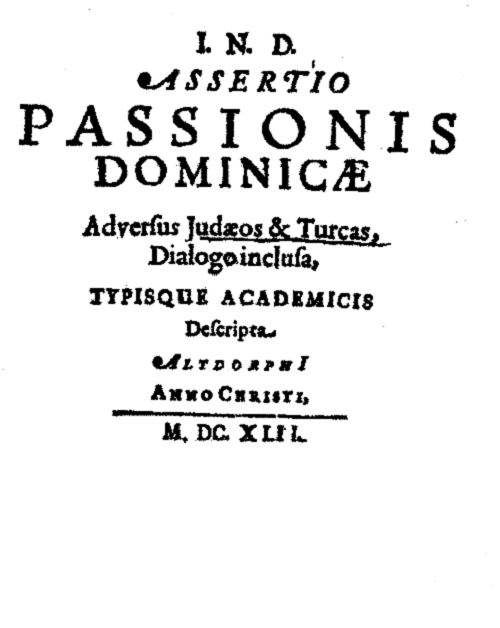
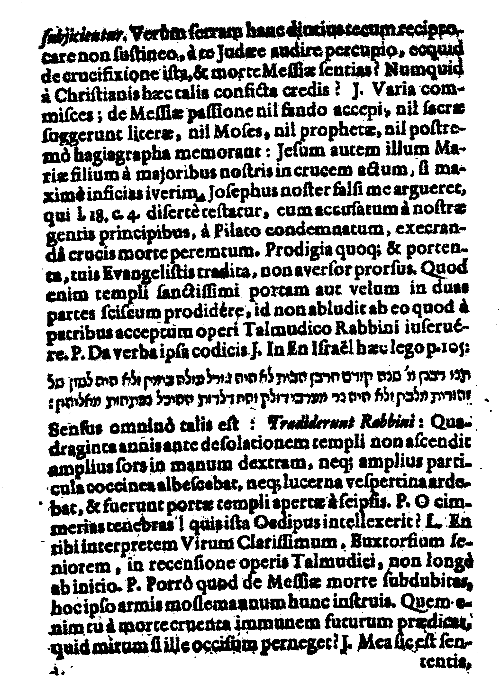
 

Assertio passionis Dominicae adversus Judaeos & Turcas is primarily in Latin with very limited Hebrew and slightly more Arabic text. Several Hebrew sources are referenced. Among them “שלחן ערוך tractatu ארוך חיים Hilcot תשעה באב ושער תעניות.” There are only two full Hebrew passages, both set in rabbinic letters, as well as several brief lines in square letters. The passages, from Ta’anit 5b-6a and Yoma 39b respectively, with Latin translation and commentary, are:

He replied: Let me tell you a parable – To what may this be compared? To a man who was journeying in the desert; he was hungry, weary and thirsty and he lighted upon a tree the fruits of which were sweet, its shade pleasant, and a stream of water flowing beneath it; he ate of its fruits, drank of the water, and rested under its shade. When he was about to continue his journey, he said: Tree, O Tree, with what shall I bless thee? Shall I say to thee, ‘May thy fruits be sweet’? They are sweet already; that thy shade be pleasant? It is already pleasant; that a stream of water may flow beneath thee? Lo, a stream of water flows already beneath thee; therefore [I say], ‘May it be [God’s] will that all the shoots taken from thee be like unto thee’. So also with you. With what shall I bless you? With [the knowledge of the Torah?] You already possess [knowledge of the Torah]. With riches? You have riches already. With children? You have children already. Hence [I say], ‘May it be [God’s] will that your offspring be like unto you.’

Our Rabbis taught: During the last forty years before the destruction of the Temple the lot [For the Lord] did not come up in the right hand; nor did the crimson-coloured strap become white; nor did the westernmost light shine; and the doors of the Hekal would open by themselves.”[7]

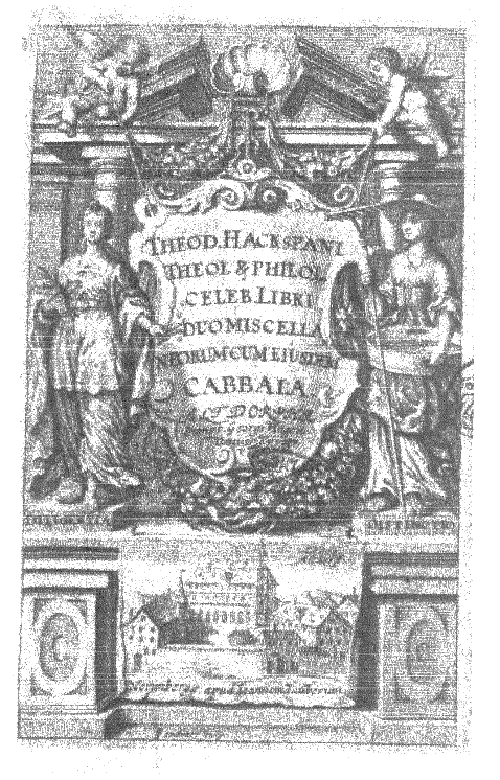
Miscellaneorum Sacrorum libri duo. Another Hackspan title published in Altdorf, this in 1660, is Miscellaneorum Sacrorum libri duo: quibus accessit ejusdem Exercitatio de Cabbala Judaica, a translation of two miscellaneous sacred books (17 cm.: 5, 453, [33] pp.), printed by Georgii Hagen, typos & Sumptibus  Universitatis Typographi together with Johannum Tauberum, Bibliopolam.
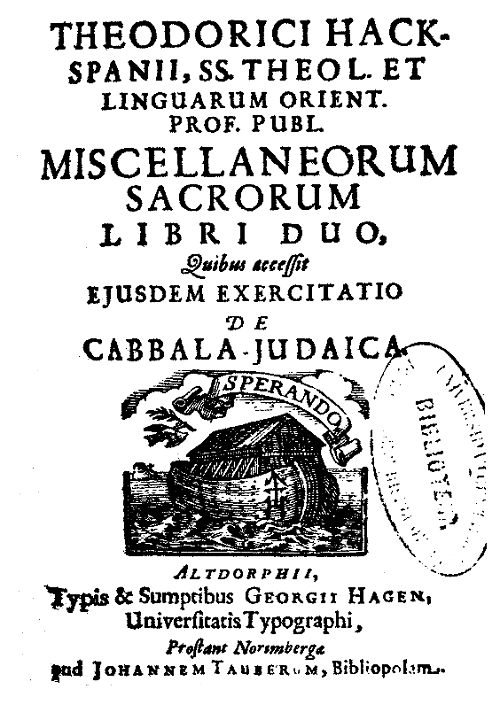
Miscellaneorum Sacrorum libri is a Latin introductory work comprised of introductions to Bible and Kabbalah, the latter section, from pp. 282-453, entitled “Cabbalae Judaicae brevis exposition.”  Miscellaneorum Sacrorum libri duo was has two lead title-pages (above) and, in the Kabbalistic section, a diagram of the tree of life which enumerates and displays the sephirot (emanations).
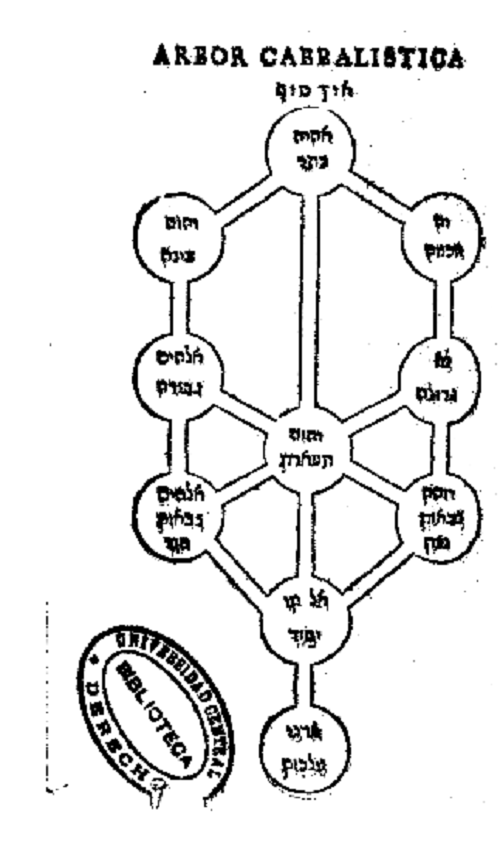
Here too the text is primarily Latin with varying amounts, but generally brief Hebrew, including quotes from the Talmud and other varied Hebrew sources. For example (p. 417) “CXXXII. Nostra aetate quoque familia in scriptus eorum occurrunt (In our time in the writings of these men, too, was met by the family) Kimchi in Obadiam scripit” followed by seven lines of Hebrew beginning ארץ אדום אינה היום לבני אדום כי האומות נתבלבלו רובם הם בין אמונת בנוצרים . . . (Today the sons of Edom, because the nations were confused, are mostly Christians) . . . . Terra Idumea hodie non est filiorum Edom: nam populi confusi sunt (Edom today is the rule (that is the example) for the people were mixed up.

Theologiae talmudicae specimen. Yet another work by Theodricus Hackspan is Theologiae Talmudicae Specimen, certis de causis abruptum: ac si omninò res ita ferat, suo tempore continuandum. Theologiae Talmudicae Specimen (undated, 154 pp.), also printed by Georgii Hagen. The text of Theologiae Talmudicae Specimen is almost entirely in Hebrew, excepting Latin headers and marginal references. Despite the fact that Theologiae Talmudicae Specimen is almost entirely in Hebrew, in contrast to the other Hackspan titles noted here, it is set to read from left to right as if in Roman letters.
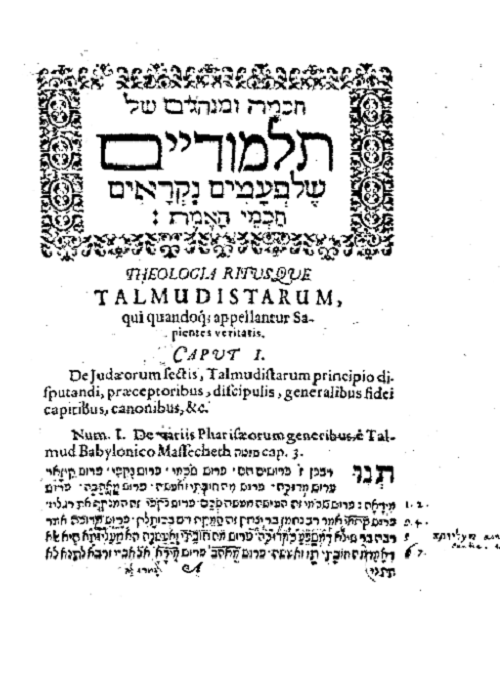
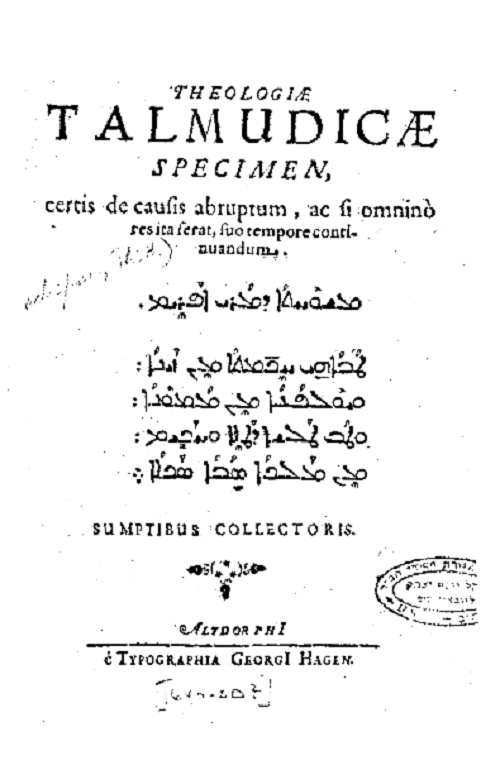
II

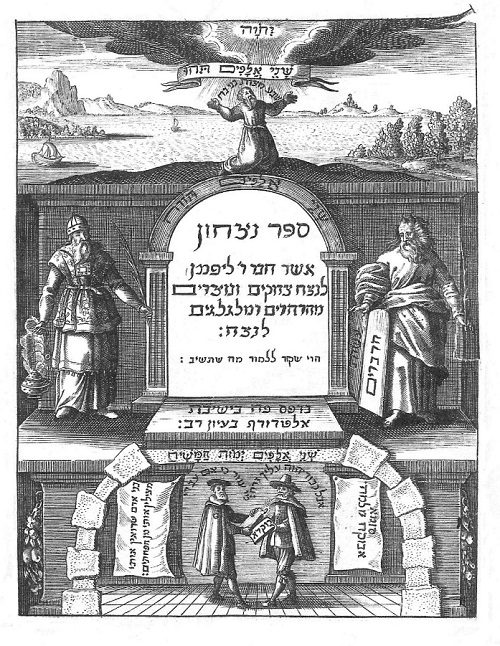
Sefer Nizzahon. The first Jewish title in our series published in Altdorf is R. Yom Tov Lipmann Muelhausen’s (d. 1459) Sefer Nizzahon (1644). This, the first printed edition of Nizzahon, was published in quarto format (40: [14], 512, 24 pp.), It is a polemic defense of Judaism and refutation of Christianity, here with a Latin translation by Theodore Hackspan, It was published so that Christians might be able to attempt to refute its arguments.

Muelhausen was one of the leading rabbinic figures of his time and a dayyan in Prague. His name, Muelhausen, likely derives from an earlier family residence in Muelhausen, Alsace. He studied under R. Meir ben Baruch ha-Levi (c. 1320-1390), Sar Shalom of Neustadt (14th cent.), and R. Samson ben Eleazar. In 1389, Muelhausen was one of a number of Jews incarcerated after an apostate named Peter accused them of defaming Christianity. In addition to his great rabbinic erudition, Muelhausen knew Latin and was familiar with Christian literature, making him a formidable polemicist. He was a prolific writer, his other works are on halakhah, philosophy, aggadah, piyyutim, and Kabbalah. In preparing Nizzahon Muelhausen utilized earlier Jewish polemical works, including an earlier thirteenth century Sefer Nizzahon Yashan (Nizzahon Vetus), with which this work is not to be confused. The effectiveness of Muelhausen’s Nizzahon may be gauged by the appearance of additional Latin editions and bitter attempts at refutations.
In a disputation in which Muelhausen represented the Jews he is reported to have been completely effective in his arguments, with the result that eighty Jews were martyred but Muelhausen miraculously survived.[8] Soon afterwards, in 1390, Muelhausen wrote Sefer Nizzahon for other Jews who had to respond to challenges from Christians. Nizzahon was copied but remained in manuscript until the publication of this edition, as the Church prohibited Jewish possession of a copy.

Christian scholars attempted to print Nizzahon for many years but were unable to obtain a manuscript. In 1644, Theodor Hackspan was successful in getting a copy. He had looked for a Nizzahon for a long time without success until he was informed that a rabbi in the neighboring small city of Schnattach had a copy but would not show it to anyone. Hackspan, together with some friends, paid an unwelcome visit to the rabbi, as if to engage him in a dispute. In the heat of the debate the rabbi took out his hidden manuscript of Nizzahon to look into it. Hackspan immediately seized the book from the rabbi’s hands, ran off with it to his carriage, and returned with it to Altdorf. Then, with a few of his students, they immediately copied the book and soon after printed the editio princeps of Sefer Nizzahon. Ora Limor and Israel Jacob Yuval Shoulson write that Hackspan printed Lippman’s text with care, not making any deliberate changes or alterations. Nevertheless, due to the poor knowledge of Hebrew of his “scribes . . . the book is full of mistakes, especially minor errors.” Meyer Waxman remarks that in his Latin introduction Hackman”attempts to refute Lippman in a dignified manner. Others, however, were not so generous.” [9]
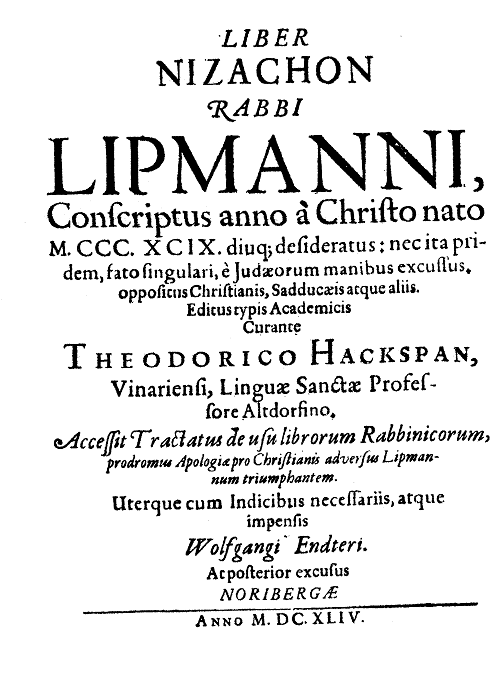
 

Nizzahon has an engraved Hebrew title page (above) followed by a Latin title page, which begins Liber Nizachon rabbi Lipmanni. . . .[10] Next is a dedication to Dn. Johan-Jodoco from Hackspan, introductions, a table of contents, and the Hebrew text set in a single column in rabbinic letters with marginal biblical references. Nizzahon is divided by the days of the week, further organized by books of the Bible, and subdivided into 354 sections, representative of the lunar year. These sections, not in order in the book, are refutations of Christian arguments (66 sections), explanations of dubious actions by the righteous in the Bible (39), explanations of difficult verses (41), reasons for precepts (34), refutations of the arguments of skeptics (55), against heretics and Karaites (47), and concluding with sixteen Jewish principles (48) to be read on Shabbat. Muelhausen refutes the Christian concepts of the Messiah, Immaculate Conception, and original sin. The Latin portion of the volume, printed in Nuremburg, begins on p. 211 and is paginated from right to left.[11]

Nizzahon was printed by Wolfgang Endter (1593 – 1659), a member of the well-known Nuremberg publishing family. The Hebrew title-pages states that it was printed in Altdorf, the Latin title-page gives Nuremberg at the place of publication. Nizzahon was reprinted in Altdorf in 1681 as part of Wagenseil’s Tela Ignea Satanae (below). The first Jewish edition of Nizzahon was published by Solomon Proops in Amsterdam (1709).

III

Kushya belo Zot o Niremberger o Regensburger.
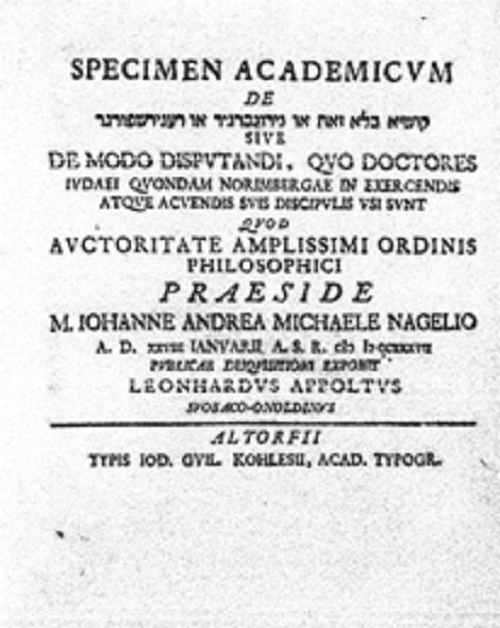
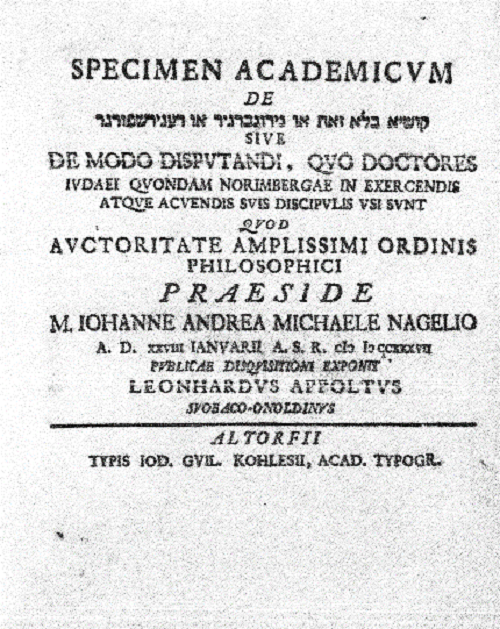
Another work with Hebrew attributed to the Altdorf press was Kushya belo Zot o Nuremberger o Regensburger, a relatively small work (19 cm. 24 pp.), printed in 1670. This very rare work was described in an auction catalogue, the entry stating,

Kushya belo Zot o Niremberger o Regensburger

A composition regarding Talmudic disputation and the ‘chilukim’ method of the Ashkenazim by Leonard Appoltus, supervised by Prof. Johanne Andre Michael Nagelio.

Altorf, [c. 1670].

In Latin with segments in Hebrew.

24 p. 19 cm. Good condition. ‘Blo Zot’, Nirenburger’ and and ‘Regensburger’ are different types of questions that it was usual to ask in the ‘chuilukim’ method.

Very rare. Not in the Jerusalem National Library.

o.b $300     $400/700[12]

From the sale results sheet it appears that this item did not sell.

IV

In 1674 Christoph Wagenseil (1633-1705), professor of Oriental languages at the University of Altdorf from 1667, succeeded Hackspan, becoming the most prominent Christian-Hebraist in Altdorf. Wagenseil, learned his Hebrew from Enoch Levi, a Viennese Jew, and Jewish studies from R. Samuel Issachar Behr ben Judah Moses Eybeschuetz Perlhefter, (d. after 1701), a Prague scholar, kabbalist, and instructor in Hebrew in the University of Altdorf. Perlhefter was the author of Ohel Yissakhar, Ma’aseh Ḥoshen u-Ketoret, and Ba’er Heitev; served as rabbi in Mantua, leaving there over a dispute concerning the pseudo-Messiah Mordecai of Eisenstadt, a follower of Shabbetai Zevi, whom Issachar Behr had initially supported. He subsequently returned to Prague where he held the position of dayyan.

Perlhefter’s wife, Bella, taught Wagenseil’s daughter dancing and music.[13] Elisheva Carlebach elaborates, writing that Wagenseil, as did other Christian-Hebraists, often pressured the Jews who assisted them to convert. In this context, Wagenseil, unable to influence Perlhefter who was residing at the time in Altdorf, turned to Bella, then in Schnattach, inviting her to join his household for a family celebration. Bella responded, in literate Hebrew, that as she had a small child, whom she could not leave, “And if I carry him with me the cold is great, the snow is high, and a tiny child cannot tolerate the cold, for he or she has not been out of the house from the day of his or her birth and is not accustomed to the cold [Mrs. Perlhefter changed genders in mid sentence].” [14]

Wagenseil traveled widely as a youth, serving as a private tutor, and while in North Africa, Wagenseil acquired Hebrew manuscripts. Although “tarred” as an anti-Semite, together with other German Hebraists in the nineteenth century, Wagenseil was an accomplished Hebraist and, despite his opposition to Jewish beliefs, often defended Judaism against its more virulent enemies and their baseless charges. David Malkiel reports that Wagenseil had cordial relations with Jewish contemporaries.[15] Assessments of Wagenseil vary, from Heinrich Graetz, that “he was a good-hearted man, and kindly disposed towards the Jews,” to Frank E. Manuel, for whom he is one of three Christian-Hebraists, with Shickard and Eisenmenger, who “used their learning to cast a glaring light on those texts in the Talmud and later Jewish writings that were either blasphemous or full of hatred for Christians.” Wagenseil confuted Christian charges that the Talmud was blasphemous, senseless and jumbled, arguing that in it were matters of morality, wisdom, and medical advice; he also opposed blood libels. Furthermore, he maintained that Catholic censors had distorted the Talmudic text, particularly of Avodah Zarah.[16]

Wagenseil is credited with assembling the first comprehensive study of Jewish observances and ceremonies by a Christian. Jonathan I. Israel notes that Wagenseil considered much of what he found superstitious and absurd, and that his motivation was to bring Jews to Christianity. Nevertheless, “for all that an unmistakable admiration for Jewish life and Jewish life-style insistently creeps through.” He quotes Wagenseil, who wrote in the forward to the apostate Friedrich Albrecht Christiani’s Der Jüden Glaube und Aberglaube (Leipzig, 1705),

that they show far more care, zeal, and constancy in all this (their religious duties) than Christians do in practicing their true faith, and that, furthermore, they are far less given to vice; rather they possess many beautiful virtues, especially compassion, charity, moderation, chastity, and so forth . . .[17]

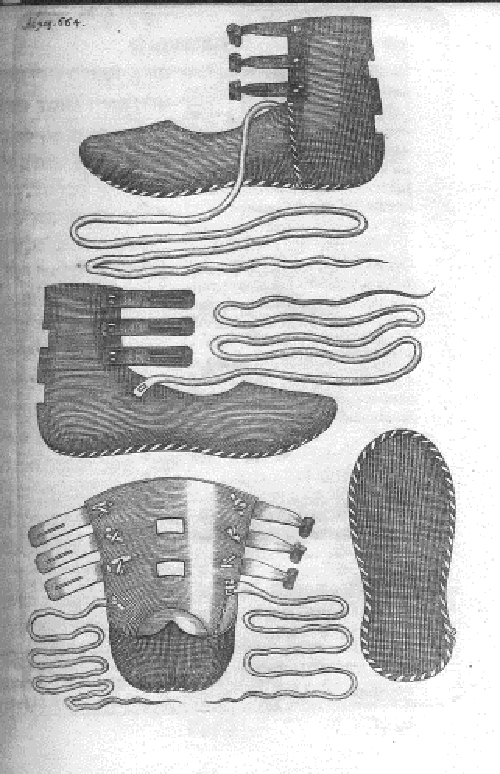
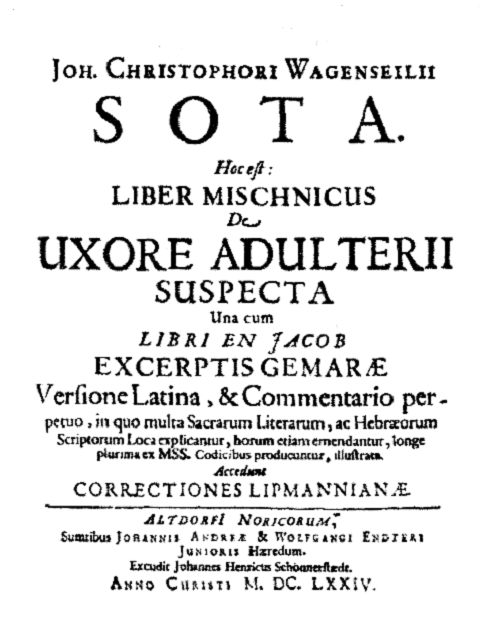
Sotah (the suspected adulterous woman) has numerous illustrations, several being full page, and a detailed attractive copper-plate title page of the Sotah (the wife accused of adultery) being taken by the priests to be tested. The volume opens with a full page depiction of the Sotah being taken to be tested by the priests.

The verso has verses in Latin from Psalms and the Christian Bible. The title page in red and black, begins, Hoc est: liber mischnicus de uxore adulterii suspecta (this book is a work concerning a woman suspected of adulterous behavior). Reading from left to right, the volume begins with considerable prefatory material, including several indices, one in Hebrew, correctiones Lipmannianae (10-81), corrections to Hackman’s edition of the Sefer ha-Nizzahon based on two other manuscripts he was able to obtain, and the text, which has separate pagination.
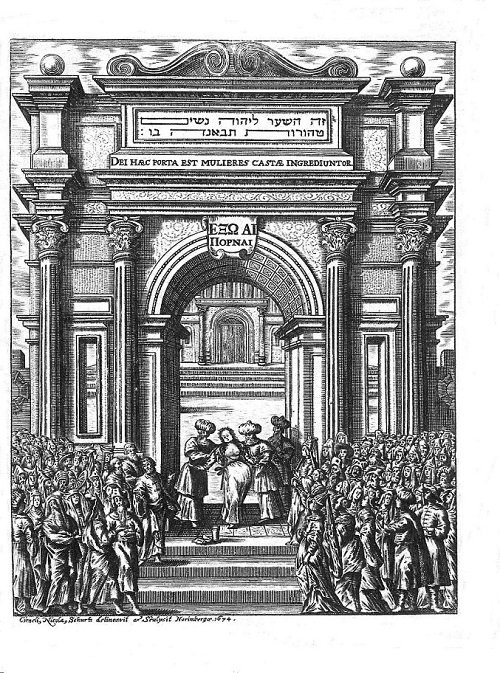
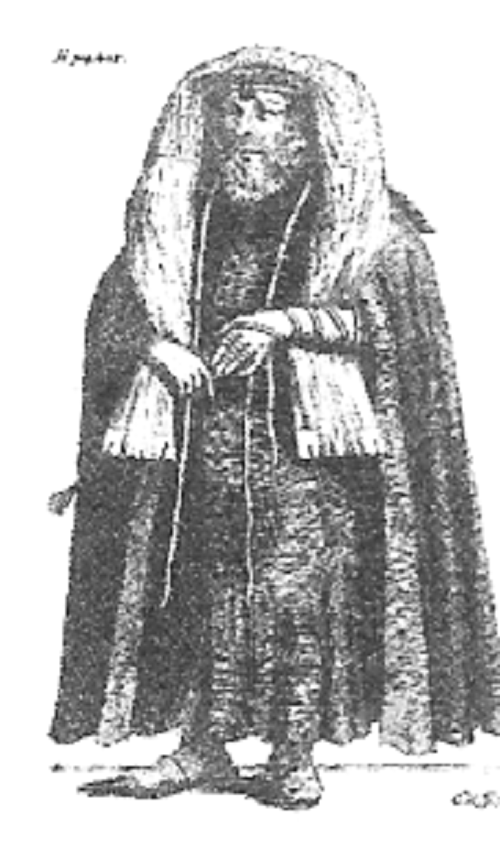
Within the text the Mishnah is always in the left margin in square unvocalized Hebrew, the translation in the right column, accompanied by an extensive Latin commentary with occasional Hebrew, with excerpts from the gemara, including most of the aggadah in the Ein Ya’akov, on this tractate. The volume has numerous illustrations, several being full page. Among them are depictions of the priest wearing talit and tefillin with their straps for the head and arm, magen davids, halizah shoes, coins, and an undressed woman with skull and cross. Negaim was the next tractate translated by Wagenseil, to prove that the Talmud contained valuable and interesting material on medicine.[18]
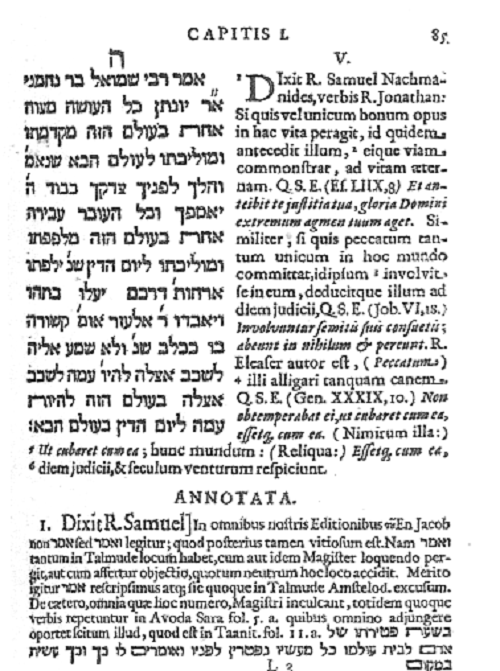
Tractates Avodah Zarah and Tamid. Another translation of Mishnayot tractates, this of Avodah Zarah and Tamid, prepared by the Christian-Hebraist Gustavo Peringero (Gustav von Lilienbad Peringer, 1651-1705), a student of Johann Christoph Wagenseil. Peringero, (1633–1705), was professor of Oriental languages at Upsala (1681- 1695) and afterwards librarian at Stockholm. Charles XI, king of Sweden, who reputedly had an extraordinary interest in Jews and even more so in Karaites, sent Peringero to Poland to learn about the latter and perhaps to attempt to convert the Karaites to Christianity, for, as Graetz notes, they did not have “the accretion of traditions, and were said to bear great resemblance to the Protestants,” nor were they “entangled in the web of the Talmud.” [19]
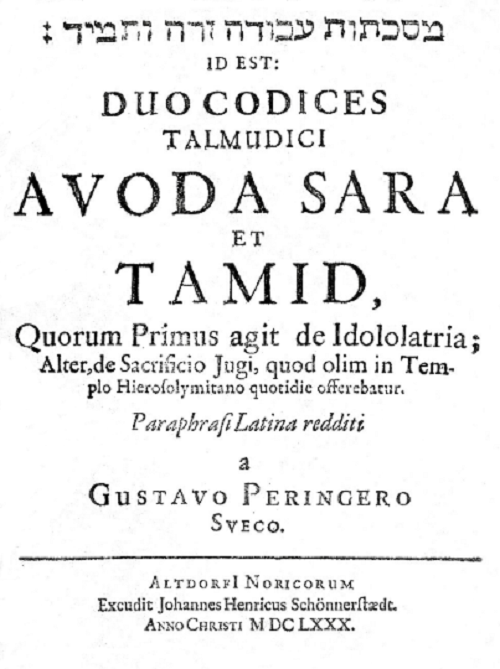
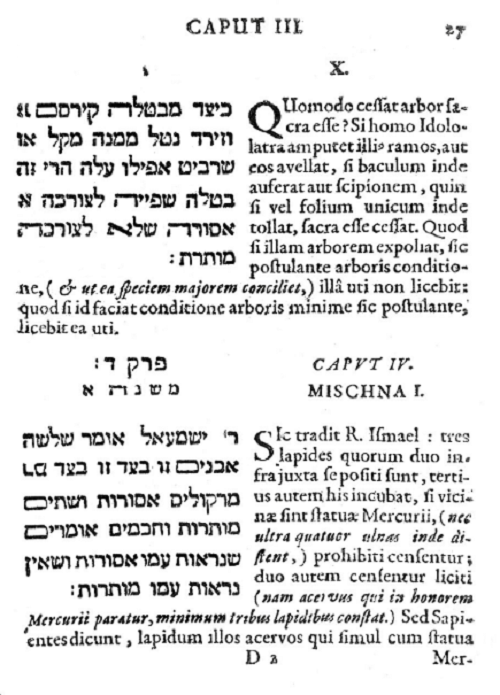
This edition of Mishnayot of tractates Avodah Zarah and Tamid in Hebrew with accompanying Latin translation and annotations by Peringero was published in 1680 by Johannes Henricus Schönnerstadt in a small octavo format (80: [7], 78 pp.).The title page of this volume is, excepting a Hebrew header, entirely in Latin. It states that it is comprised of two codices, primarily about idolatry, and secondly about sacrifices in the time of the Temple. The title page is followed by a dedication to Dominae (Mistress) Ulricae Eleonorae, wife of Charles XI, a preface in Latin with occasional Hebrew, and then the text.

Reading from left to right, the Mishnayot are in the left column, the integrated translation and glosses in the right column. Avodah Zarah concludes on p. 43 and Tamid begins immediately after on the following page. Peringero’s translation of Avodah Zarah was inserted by Wilhem Surenhusius (1666-1729) in his Versio Latina Mischnae (1698-1703). In addition to these tractates, Peringero also translated Abraham Zacuto’s Sefer Yuhasin, portions of Maimonides’ Mishneh Torah (Upsala, 1692), and several other works into Latin. He was also the author of Dissertatio de Tephillin sive Phylacteriis (Upsala, 1690). [20]

In addition to tractates Avodah Zarah and Tamid the printer, Johannes Henricus Schönnerstadt, also published separate editions of Shekalim and Sukkah at this time, also with Latin, but not translated by Peringo.

IV

Returning to Wagenseil, we come to two very different works. The first, although chronologically the later of the two, and not an Altdorf publication, is Belehrung der Judisch-Teutschen Red-und Schreibart (An Instruction Book in the Method of Speaking and Writing Judeo-German, Koenigsberg, 1699). This is, as the title suggests, a Yiddish grammar with a “loose Yiddish version (with German translation) of Hilkhot Derekh Eretz,” a rabbinic work on ethical behavior. Also included is a Yiddish account (with German translation) of the Fettmilch uprising in 1614 in Frankfurt on the Main, as well as selections from tractate Yevamot on levirate marriage as well as the entire tractate Neg’aim on leprosy with notes, this in order to aid in teaching Hebrew.[21]

The second and Wagenseil’s most famous collection of Jewish polemical literature, Tela ignea Satanae, in which Wagenseil, among other subjects, includes his responses to Sefer Ha-Nizzahon. Wagensiel travelled widely, through Spain and into Afric Belehrung e a, to collect these manuscripts.[22]

Tela ignea Satanae. Published in 1681 by Wagenseil in quarto format (40: [2], 635, [12]; 60; 260; [2], 100; 45; 480, [1] pp.) Tela ignea Satanae, perhaps Wagenseil’s best known work, is comprised of six polemical anti-Christian works, almost all not previously printed.
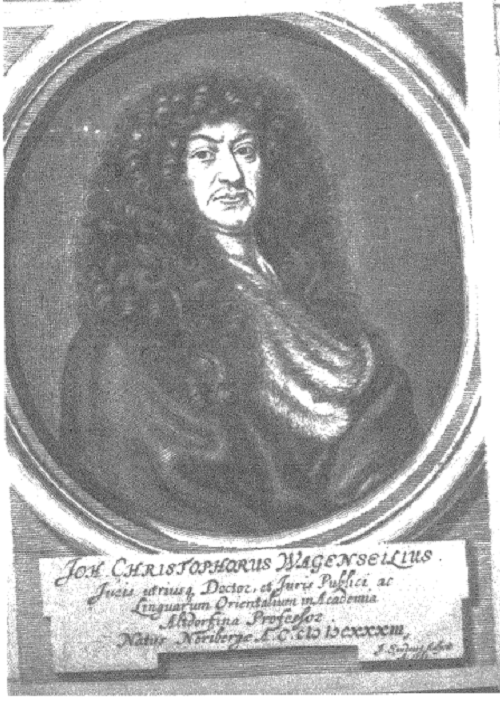
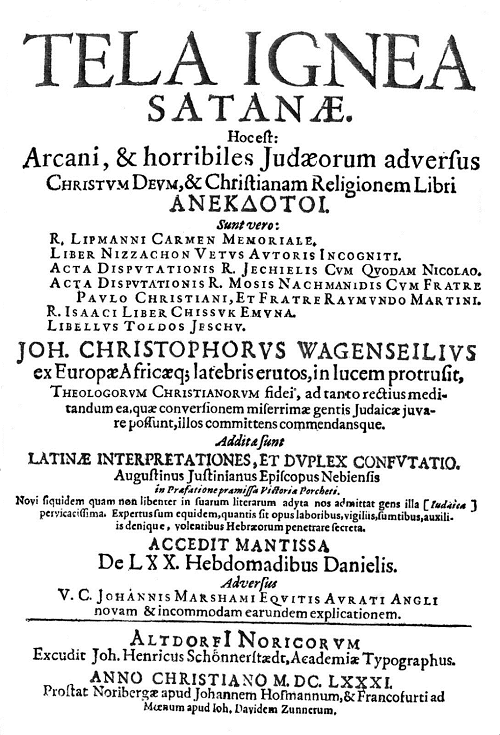
          

The first title page, printed in red and black, has the full title of Tela ignea Satanae. Hoc est: Arcani, et horribles Judaeorum adversus Christum Deum, et Christianam Religionem Libri (Flaming Arrows of Satan; that is, the secret and horrible books of the Jews against God and the Christian religion). After the verse the title-page states,

John Christopher Wagenseil thrusts these forward into the light, bringing them together and entrusting them, dug out from the hiding places of Europe and Africa, to the faith of Christian Theologians, that they may more rightly consider those things, which are able to aid the conversion of that wretched Jewish race. Added are: Latin Interpretations, and Two Confutations. Augustine Justianus Bishop at Nebiensis in the Forward Preface of Victoria Porchetus. I know how unwillingly that most stubborn (Jewish) race admits us into the most secret parts of their literature. I have tried by all means, however great the task, with toil, sleeplessness, expense, with willing helpers finally, to penetrate the secrets of the Hebrews.[23]

The facing page has a full front-piece portrait of Wagenseil. In two volumes, the work begins with a Latin introduction, followed by the six books, each with its own title page with Hebrew headers and Latin text, a Latin introduction (refutation), and then the text in two columns comprised of facing Hebrew and Latin.

That these books were not previously printed but rather circulated among Jews in manuscript only, or where printed were done so by Christian Hebraists with Latin translation and refutation, is due to their polemic and inflammatory content. As a result, these books today exist with variant texts. Tela ignea Satanae, as noted above, is comprised of six independent books, listed below, several described afterwards in somewhat greater detail:

Nizzahon, Polemic in defense of Judaism by R. Yom Tov Lipmann Muelhausen. Printed previously in Altdorf/Nurenburg, 1644 (see above).

Nizzahon, anonymous polemic in defense of Judaism.

Vikku’ah Rabbenu Yehiel mi-Paris, record of the disputation between R. Jehiel of Paris and Nicholas (dispute over the Talmud in Paris in 1240, below, 1681).

Vikku’ah ha-Ramban im broder Paulus, record of the disputation between the Ramban (Moses ben Nahman, Nahmanides) and the apostate Pablo Christiani in 1263 before King James of Aragon.

Hizzuk Emunah, anti-Christian polemic by the Karaite scholar, Isaac ben Abraham Troki.

Jeshu, negative and, from a Christian perspective, highly blasphemous account of the life of Jesus.[24] [25]

Vikku’ah Rabbenu Yehiel im Nicholas Jehiel ben Joseph of Paris. This is a record of the disputation held in Paris on Monday, June 25, 1240, attributed to R. Jehiel ben Joseph of Paris. Jehiel, one of the leading Ba’alei Tosafot, was a student of R. Judah ben Isaac (Sir Leon), whom he succeeded as rosh yeshivah in Paris.  Among Jehiel’s students was his son-in-law, R. Isaac of Corbeil (Sefer Mitzvot Katan, Semak). Jehiel was the author of tosafot quoted by many rabbis and included in those tosafot known as our tosafot. He is also frequently referenced in the Torah commentary Da’at Zekenim. Because of his prominence Jehiel was selected as a primary representative of the Jewish community in the disputation over the Talmud resulting from the charges leveled against it by the apostate Nicholas Donin. The record of that disputation, generally known as Vikku’ah Rabbenu Yeh iel mi-Paris, is the third work in Wagenseil’s Tela ignea Satanae (above, 1681).

        The Vikku’ah follows the same pattern as the other works in Tela ignea Satanae, that is, it has a bilingual Hebrew-Latin title page, followed by a Latin preface, and the text in two columns in facing Hebrew and Latin. Donin’s denunciation of the Talmud included thirty‑five charges which primarily stated that Jewish emphasis on the Oral Law was in itself a blasphemy against the holiness of Scriptures recognized by Jew and Christian alike; the Talmud overtly fostered anti‑Christian attitudes and contained blasphemous statements offensive to Christianity; and that it was irrational, and morally and intellectually offensive.
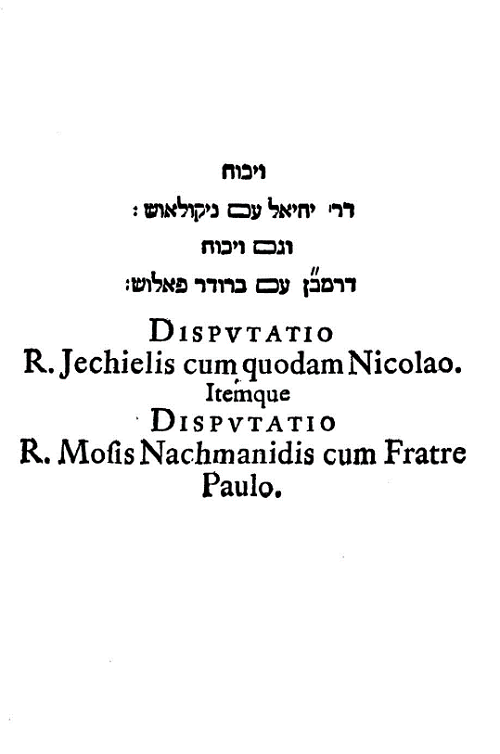
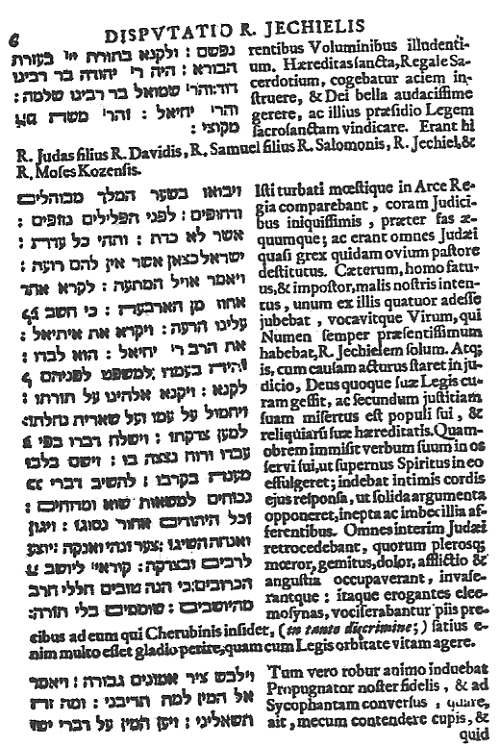
          

        The trial was presided over by the Queen Mother Blanche, who was in an advanced stage of pregnancy. The judges were high Church dignitaries, such as the Archbishop of Sens, the Bishop of Paris, and the Chaplain to King Louis IX, none of whom knew Hebrew. Jehiel, although the primary Jewish spokesman, was assisted by R. Moses ben Jacob of Coucy (Semag), R. Judah ben David of Melun, and R. Samuel ben Solomon of Chateau‑Thierry (all 13th century). Although Jehiel defended the Talmud, noting inter alia, that Donin was the real heretic, justifiably excommunicated by the Jewish community fifteen years before the debate. His arguments were to no avail, for the matter had been predetermined from the outset. Even before the court’s formal decision was rendered, it had been decided to burn the condemned books. In June, 1242, twenty‑four wagon loads of Hebrew books, containing thousands of volumes, were seized and burned in Paris. Jehiel remained for some time in Paris, teaching students from memory. In 1260, Jehiel went up to Eretz Israel, effectively ending the period of the Ba’alei Tosafot.[26]

Hizzuk Emunah. Anti-Christian polemic by the Karaite scholar, Isaac ben Abraham Troki (c. 1533-c. 1594). Hizzuk Emunah is the fifth work in Wagenseil’s Tela ignea Satanae below, 1681). Troki is known by his birthplace, Troki (Trakai), capital of Lithuania until 1323 and home to the most important Karaite community in Lithuania. He was, from the age of twenty, the secretary-recorder of the Karaite General Assembly which met there in 1553. Author of a work on shehitah and religious poetry, Troki became the foremost Karaite scholar in Eastern Europe, serving as dayyan to both Karaite and rabbinic Jews. He studied Bible and Hebrew studies under the Karaite scholar Zephaniah ben Mordecai, and had Christian teachers for Latin and Polish literature. Engaging in dialogues with Christian clergyman of different persuasions, Troki became fluent in Polish and Latin and familiar with their theology and arguments against Judaism. It was those conversations that prompted Troki to write Hizzuk Emunah. Written in the last year of his life, Hizzuk Emunah was completed by Troki’s student, Joseph ben Mordecai Malinovski.
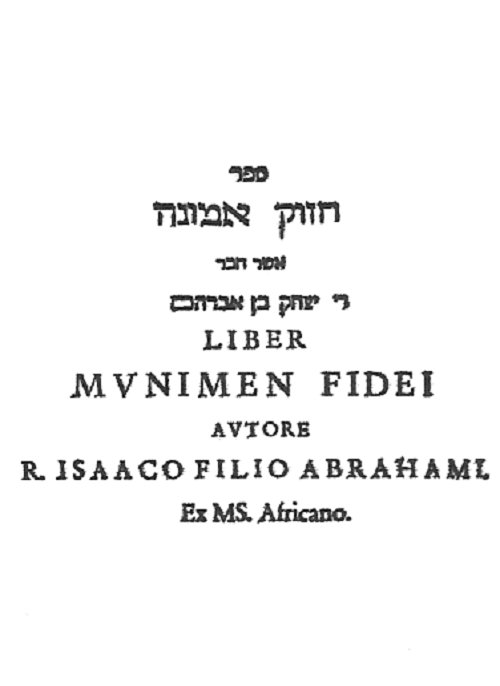
Wagenseil obtained a copy of the manuscript in 1665 on a trip to Ceuta, North Africa. He translated Hizzuk Emunah into Latin, in which form it was widely used not only by Christian missionaries but also by opponents of Christianity, such as atheists, French philosophes, among them Voltaire. Hizzuk Emunah follows the same format as the other polemic works in Tela ignea Satanae, that is, it has its own Hebrew-Latin title page, a Latin introduction, and then the text, in two facing Hebrew and Latin columns. The book, in quarto format, is in two parts comprised of ninety-nine chapters. In the first chapter, Troki begins by questioning the authenticity of the Christian messiah, arguing against his pedigree, acts, the time in which he lived, and the fact that he did not fulfill the promises expected of the Messiah.

As an example of the first argument, Troki writes that he cannot be of Davidic descent due to the concept of virgin birth and that even apart from that, the relationship of Joseph to David is wanting in proof. He also notes contradictions in the Christian Bible on that and other subjects, and compares the Hebrew Bible and Gospels. Most of Troki’s arguments are based on biblical texts, accounting for its effectiveness against Christian arguments. Nevertheless, he also utilizes rabbinic sources, so that Hizzuk Emunah has been accepted by rabbinic authorities, perhaps unique for a Karaite work.[27]

        Hizzuk Emunah is considered one of the most effective polemic works. Although circulated widely in manuscript, Hizzuk Emunah was not printed by and for Jews until the Amsterdam edition of 1705. It has been frequently reprinted, translated into Yiddish (Amsterdam, 1717), English by Moses Mocatta (London, 1851), German (Sohran, 1865), and Spanish as Fortificación de la Fe (1621), extant in manuscript.

Wagenseil would publish several additional Hebrew/Latin collections and works, among them Exercitationes sex varii argumenti (1697); Denunciatio Christiana de Blasphemiis Judæorum in Jesum Christum (1703); and Disputatio Circularis de Judæis (1705) as well as several titles published elsewhere. As might be expected, Wagenseil’s influence in this field was considerable, his students also becoming Christian-Hebraists, for example, Peringer above, and our final Altdorf imprints, the first by a student of Wagenseil.
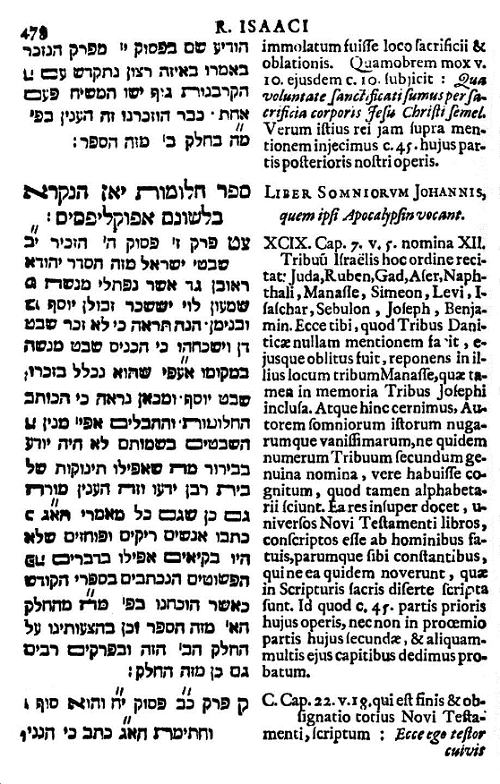
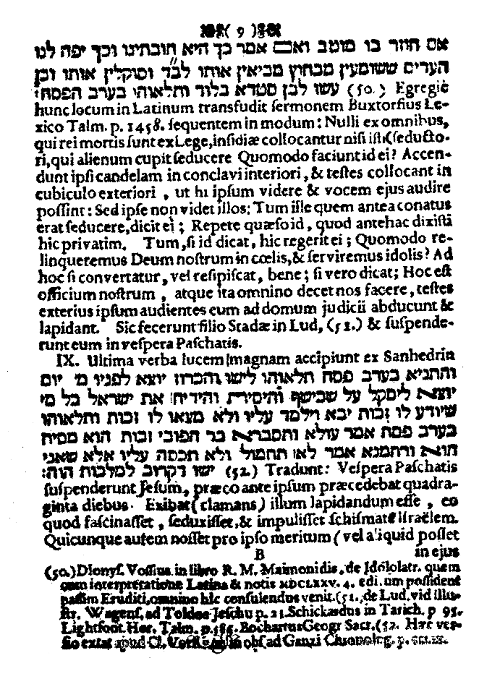
Jesus in Talmude. Our final works are Jesus in Talmude and Der Jüdische Theriak. The former is  dissertation submitted at the University of Altdorf by Rudolf Martin Meelführer (Rudolfo Martino Meelführero, 1670–1729) in 1699, and described by Peter Schäfer as “the first book solely devoted to Jesus in the Talmudic literature;” the latter a refutation by R. Solomon Ẓevi Hirsch Aufhausen (Openhausen, Ufenhausen, of Aufhausen) in Yiddish of an anti-Jewish work. Meelführer was also a Christian-Hebraist, teaching in Altdorf and afterwards as adjunct in philosophy at Wittenberg. The dissertation is important as it was the first study fully devoted to the subject. Meelführer, in contrast to Wagenseil, was almost immediately forgotten.[28] Here too the work is primarily in Latin, but includes examples of the Talmudic text in Hebrew, from early editions of the Talmud, as the later editions available to Meelführer were censored and omitted many of the passages he refers to. Meelführer appears to primarily rely on secondary sources for Talmudic entries, notably R. Gedaliah ben Joseph ibn Yahya’s (1515-1587), Shalshelet ha-Kabbalah (Venice, 1586).[29] An example of the text brought by Meelführer is Sanhedrin 42a (below), censored from most editions of the Talmud,

On the eve of the Passover Yeshu was hanged. For forty days before the execution took place, a herald went forth and cried, ‘He is going forth to be stoned because he has practiced sorcery and enticed Israel to apostasy. Anyone who can say anything in his favor, let him come forward and plead on his behalf.’ But since nothing was brought forward in his favor he was hanged on the eve of the Passover! – “Ulla retorted: Do you suppose that he was one for whom a defence could be made? Was he not a Mesith [enticer], concerning whom Scripture says, Neither shalt thou spare, neither shalt thou conceal him? With Yeshu however it was different, for he was connected with the government [or royalty, i.e., influential].
Der Jüdische Theriak (the Jewish Medicine) by Zalman Ẓevi Hirsch Aufhausen is a point by point refutation of Jüdischer Abgestreifter Schlangenbalg (The Jewish Serpent’s Skin Stripped) by the apostate Samuel Friedrich Brenz of Ettingen. Converted to Christianity in 1610, Brenz wrote Jüdischer Abgestreifter Schlangenbalg (Hanau, 1614) in “the thirteenth year after my rebirth.”[30] Der Jüdische Theriak, first printed in Hanau in 1615, was reprinted in in Altdorf in 1680 by Henricum Meyer, Academiae Typographu, as a small quarto (40: 36, [1] ff.), the text in old Yiddish set in Vaybertaytsh, a type generally but not exclusively reserved for Yiddish books, so named because these works were most often read by the less educated and women.[31] Given that it is a Jewish refutation of Christian ant-Jewish polemics its publication in Altdorf was likely done for the same purpose as Nizzahon, so that Christians might be able to attempt to refute its arguments.[32] In Jüdischer Abgestreifter Schlangenbalg Brenz collected all of the accusations made against Jews, accusing them of making derogatory and blasphemous remarks against the founders of Christianity and the Church, fostering animosity, and stating that the Talmud permits Jews to cheat Christians.
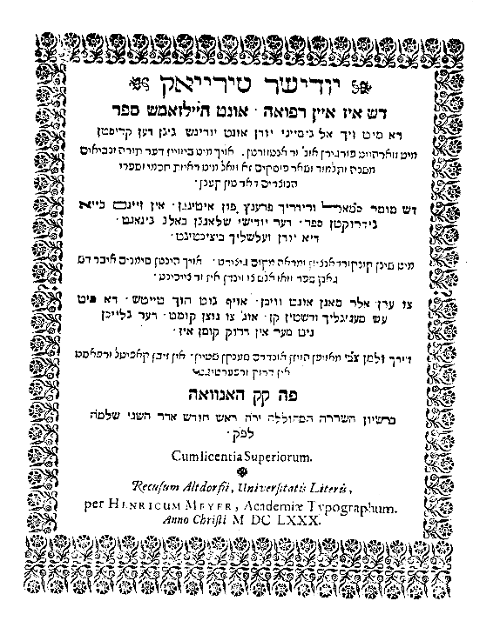
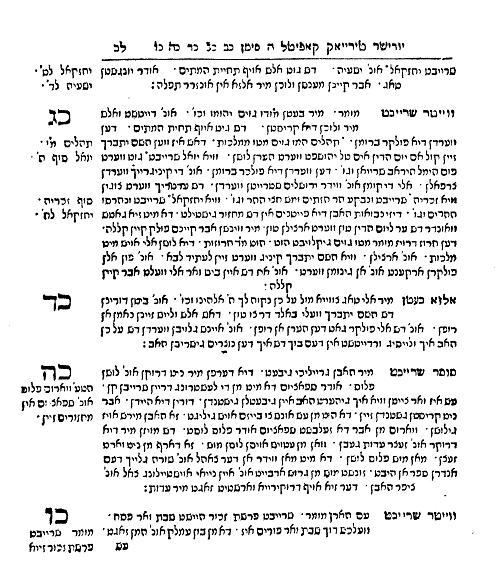
Zinberg notes that there is scant information about Aufhausen and what is known is surmised from remarks in Der Jüdische Theriak. Zinberg conjectures that Aufhausen (b. c. 1565-60) was an itinerant who, driven from his home by “evil Jews” travelled widely, broadening his world-view and culture, knowledgeable with German, knew Luther’s translation of the Bible, and was familiar with Flavious Joseph, Buxtorf the Elder, Pica della Mirandola, and Johannes von Reuchlin on the Kabbalah among others. Furthermore, Aufhausen “displays great knowledge of Talmudic literature, and that he wrote elegant Hebrew is attested to by the poem written in the well known azharot-meter on the front page of the Teryak.” Zinberg infers from Aufhausen’s remarks that he was a shohet and mohel (ritual slaughterer and circumciser) but these professions did not provide well for Aufhausen, his wife, and six children “who were not always well fed.”[33]

Morris M. Faierstein writes that Der Jüdische Theriak is unique, it is the only Jewish response in Yiddish to anti-Jewish polemics by Christians and Jewish apostates in early modern Germany and the only such work printed in Germany.[34] Zinberg quotes Aufhausen that Der Jüdische Theriak is an antidote to the venomous bite of the anti-Jewish snake, that is, Brenz’s work. Aufhausen describes Brenz as “a terrible usurer,” and if one added together all the horses on which he loaned money one could put in the filed a regiment of riders, which is what brought him to baptism, noting that the Jews hated him for his ugly deeds pushing him way with both hands.” Brenz is a “frightful ignoramus and a petty, good for nothing creature, his diatribe lacks any system or order.[35] In his introduction, Aufhausen informs how he came to write Der Jüdische Theriak. Benz’s book was

placed before me, and worthy people waved it under my nose. As a result I called the aforementioned apostate a liar, as I continue to do the present. On Monday, the seventh of Ab, he [Benz] he rode up to my door in a violent manner and threatened me and wanted to kill me. He publicly confirmed the wickedness of his book in front of Jews and Christians, said that it was all true and just and wanted to continue persecuting Jews. However, I sanctified the name of God in response to his desecration of God’s name and called him a liar to his face and swore to write a book against his lies . . .[36]

Der Jüdische Theriak is comprised of seven chapters, each addressing a specific group of accusations. Aufhausen cites numerous examples from the Talmud to show that Jews are commanded to show mercy and friendliness to non-Jews, and those few laws that are not friendly are directed against pagans, not Christians.[37] Der Jüdische Theriak is also directed towards women, for, as Carlebach notes, Christian missionaries had introduced Yiddish into their conversion material to make them accessible to women. Aufhausen refutes their claims writing for “common Jews and Jewesses.”[38] In the final chapters of Der Jüdische Theriak Aufhausen includes an appeal for tolerance advocating equal treatment for all, both Jews and Christians,

I have shown above that [tractate] Baba Kamma and [tractate] Avodah Zarah write: “A heathen who studies Torah and studies the law of Moses is as good as the high priest.” Thus anyone who studies the Law and does not ridicule it, he is an honest person and is highly honored. It is the same whether Christian or Jew. . . .

I had this book printed in Yiddish in the Hebrew alphabet so that someone will know how to respond to Christians in conducive circumstances, and also to understand from this and keep in mind what a great sin it is to deceive Christians, with words or deeds.[39]

The study of Jewish texts by Christian-Hebraists proved to be a passing phenomenon. By mid-eighteenth century the interest of Christian-Hebraists in rabbinic literature and studies had diminished.[40] In Altdorf, in contrast to other locations where, as noted above, Hebrew works, primarily philological and biblical titles and translations of rabbinic works, often theological titles accompanied by glosses contesting the Jewish authors’ positions, were studied by Christian-Hebraists for their own purposes to better understand the sources of Christian theology and to refute Jewish understanding of those works, the emphasis of those studies here was primarily for polemic purposes. Wagenseil, although his object was not always antithetical to Jewish texts, is remembered today as being among the leading exponents of the Christian-Hebraist movement. His works, several described here, as well as those of his contemporaries in Altdorf, represent an attempt by Christian-Hebraist scholars to understand and refute Jewish beliefs. Despite being, from several perspectives, among those of history, a failed and futile effort, it represents an interesting intellectual endeavor.

[1] I am indebted to Eli Genauer for reading the text and his comments, several noted below and to R. Jerry Schwarzbard, the Henry R. and Miriam Ripps Schnitzer Librarian for Special Collections for his assistance. Images are courtesy of the Library of Agudas Chassidei Chabad Ohel Yosef; Yitzhak;Bayerische StaatsBibliothek; the Library of Congress; Hathi Trust; Hebrewbooks.org; and R. Eli Amsel, Virtual Judaica.

[2] The other Altdorf’s are, in Germany, Altdorf, Lower Bavaria, Landshut, Bavaria; Altdorf, Böblingen; Altdorf, Esslingen; Altdorf, Rhineland-Palatinate, Südliche Weinstraße; and Weingarten (Württemberg) or Altdorf: in Swiitzerland, Altdorf, Jura or Bassecourt; Altdorf, Schaffhausen; and Altdorf, Uri: in France, Altdorf, Bas-Rhin” in Poland, Stara Wieś, PszczynaStara Wieś; and Silesian Voivodeship; and in the United States, Altdorf, Wisconsin.

[3] An unanticipated result of the Christian-Hebraists’ efforts, suggested by Eli Genauer in a private correspondence, is that readers of the Christian-Hebraists works might possibly have been influenced in another direction, suggesting that “even though the Christian scholars published these books to show the errors of Judaism, there might have been some people who say “‘hey, the Jews have some pretty good points.’”

[4] Aron Freimann, “A Gazetteer of Hebrew Printing” (1946; reprint in Hebrew Printing and Bibliography, New York, 1976), p. 268; Moshe Rosenfeld, Hebrew Printing from its Beginning until 1948. A Gazetteer of Printing, the First Books and Their Dates with Photographed Title-Pages and Bibliographical Notes (Jerusalem, 1992), p. 64 no. 618 [Hebrew].

[5] Yeshayahu Vinograd, Thesaurus of the Hebrew Book. Listing of Books Printed in Hebrew Letters Since the Beginning of Printing circa 1469 through 1863 II (Jerusalem, 1993-95), p. 23 [Hebrew]. Vinograd notes three additional works, a Mishnayot, printed in 1860, Toldot Jeshu, in a collection of Wagenseil’s works (below), and an undated edition of Hochmah u-Minhag shel Talmidim.ge

[6] John McClintock, James Strong “Hackspan, Theodor” Cyclopedia of Biblical, Theological and Ecclesiastical Literature, ttps://www.studylight.org/encyclopedias/tce/h/hackspan-theodor.html. (New York, 1870).

[7] Translations are from The Soncino Talmud, Judaica Press, Inc. (Brooklyn, NY, 1990).

[8] Israel Moses Ta-Shma, “Muelhausen, Yom Tov Lipmann,:EJ 14, pp. 595-59.

[9] Ora Limor and Israel Jacob Yuval “Skepticism and Conversion: Jews, Christians, and Doubters in Sefer Nizzahon,” in Hebraica Veritas?: Christian Hebraists and the Study of Judaism in Early Modern Europe, Allison P. Coudert and Jeffrey S. Shoulson, editors (Philadelphia, 2004), p. 166; Meyer Waxman, A History of Jewish Literature (1933, reprint Cranbury, 1960), II p. 51.

[10] Eli Genauer, in a separate correspondence, brought the following to my attention concerning the text at the bottom of the title-page of Sefer Nizachon.  “I was curious about the script written at the bottom starting with ‘Suma Avuka Zu Lamah’  . . . continuing on to the other side start from top line 7th word…B’Sefer HaNitzachon…I think the author is using this as an example of Jewish title pages and didn’t realize it was printed by a Christian. It is actually a Gemara in Megillah 24b which goes like this

אמר ר’ יוסי: כל ימי הייתי מצטער על מקרא זה (דברים כח, כט) “וְהָיִיתָ מְמַשֵּׁשׁ בַּצָּהֳרַיִם כַּאֲשֶׁר יְמַשֵּׁשׁ הָעִוֵּר בָּאֲפֵלָה”. וכי מה אכפת לֵיה [=לו] לעיוור בין אפלה לאורה? עד שבא מעשה לידי. פעם אחת הייתי מהלך באישון לילה ואפלה וראיתי סומא שהיה מהלך בדרך ואבוקה בידו. אמרתי לו, בני, אבוקה זו למה לך? אמר לי, כל זמן שאבוקה בידִי, בני אדם רואין אותי ומצילין אותי מן הפחתין ומן הקוצין ומן הברקנין.

Fascinating. I’m not sure what they were trying to point out but I wouldn’t be surprised if it had Christian implications.”

The above text (Megillah 24b) states “R. Jose said: I was long perplexed by this verse, And thou shalt grope at noonday as the blind gropeth in darkness.5 Now what difference [I asked] does it make to a blind man whether it is dark or light? [Nor did I find the answer] until the following incident occurred. I was once walking on a pitch black night when I saw a blind man walking in the road with a torch in his hand. I said to him, My son, why do you carry this torch? He replied: As long as I have this torch in my hand, people see me and save me from the holes and the thorns and briars.”

[11] J. Rosenthal, “Anti-Christian Polemics from its Beginnings to the End of the 18th Century,” Areshet II (Jerusalem, 1960), p. 148 no. 70 [Hebrew]; Waxman, pp. 545-51.

[12] Judaica Jerusalem, “Rare Books, Manuscripts, Documents, and Jewish Arts” (Jerusalem, October 14, 1993), no. 4.

[13] Louis Isaac Rabinowitz, “Perlhefter, Issachar Behr ben Judah Moses” Encyclopedia Judaica, edited by Michael Berenbaum and Fred Skolnik, vol. 20. (2007), vol. 15, p. 777. Concerning the personal life of Bella Perlhefter and letters to Wagenseil see Elisheva Carlebach “Introduction to The Letters of Bella Perlhefter,” Early Modern Jewries, I (2004, Wesleyan University, Middletown, CT), pp. 149-57: https://fordham.bepress.com/emw/emw2004/.

[14] Elisheva Carlebach, Divided Souls: Converts from Judaism in Germany, 1500-1750 (New (Haven & London, 2001), pp. 204-05). Carlebach  continues that Wagenseil subsequently invited her again, this time writing to Samuel Issachar Behr, to which she responded that “‘you have further written to me about coming to your place, to teach dance to the only, wonderful daughter of your master the great scholar, whose name escapes me, May God watch over her, it is puzzling to me  that you add, ‘and to teach her to play the zither,’ for you know that from the day of my mother’s death, I took an oath not to play any musical instrument, and now how can I violate my oath? But it is possible that sometime I will come to teach her to dance.”

[15] David Malkiel, “Christian Hebraism in a Contemporary Key: The Search for Hebrew Epitaph Poetry in Seventeenth-Century Italy,” Jewish Quarterly Review 96:1 (Philadelphia, 2006), pp. 126, 136.

[16] Frank E. Manuel, The Broken Staff: Judaism Through Christian Eyes (Cambridge, Mass., 1992), var. cit.

[17] Jonathan I. Israel, European Jewry in the Age of Mercantilism 1550-1750 (Portland, 1998) pp. 189-90.

[18] Elisheva Carlebach, “The Status of the Talmud in Early Modern Europe,” in Printing the Talmud: From Bomberg to Schottenstein, eds. Sharon Liberman Mintz and Gabriel M. Goldstein (New York, 2005), pp. 87-89; Heinrich Graetz, History of the Jews (Philadelphia, 1956), History of the Jews V, pp. 185-87.

[19] Graetz, History of the Jews V, pp. 182-83. Concerning Peringer’s mission, Graetz writes “Whether Peringer even partially fulfilled the wish of his king is not known; probably he altogether failed in his mission.” Moritz Steinschneider, Catalogus Liborium Hebraeorum in Bibliotheca Bodleiana (CB, Berlin, 1852-60), cols. 270 no. 1876.

[20] Graetz, History of the Jews V, pp. 182-83; Steinschneider, CB, col. 270 no. 1876.

[21] Christian Hebraism: The Study of Jewish Culture by Christian Scholars in Medieval and Early Modern Times, (Cambridge, Mass., 1986), p. 40 no. 61.[22] The Jewish Life of Christ being the SEPHER TOLDOTH JESHU, or Book of the Generation of Jesus, translated by G. W. Foote and J. M. Wheeler (2018), p. 6.

[23] “Wagenseil’s Latin Introductory Material to His Tela Ignea Satanae (The Fiery Darts of Satan) Published in 1681,, Translated into English” Translated by Wade Blocker (wblocker@nmol.com) Dates of Translation: 2000-12-21 through 2001-03-09.

[24] Malkiel,, pp. 126, 136; Manuel, The Broken Staff, pp. 76, 150-51.

[25] Toledot Jeshu, for all its condemnation in Christian sources, is also not well received by Jewish chroniclers. Graetz, vol. v pp. 185-86, describes it as an “insipid compilation of the magical miracles of Jesus (Toldoth Jesho) with which a Jew, who had been persecuted by Christians, tried to revenge himself on the founder of Christianity.” Manuel, p. 150, in even stronger language, describes it as “the most scandalous of all” of the works in Tela ignea Satanae, “a scurrilous account . . . a gross parody that outraged Christians.”

[26] J. D. Eisenstein, ed., Otzar Vikkuhim (Israel, 1969), pp. 82-86 [Hebrew Mordechai Margalioth, ed., Encyclopedia of Great Men in Israel III, (Tel Aviv, 1986), cols. 843-85 [Hebrew].

[27] Gershon David Hundert, Yivo Encyclopedia of Jews in Eastern Europe, (New Haven & London, 2008) p. 1906; Isaac ben Abraham Troki, Hizzuk Emunah or Faith Strengthened, translated by Moses Mocatta, introduction by Trude Weiss-Rosmarin (New York, 1970), v-xii.

[28] Peter Schäfer, Jesus in the Talmud (Princeton, 2007), pp. 3-4.

[29] Shalshelet ha-Kabbalah (Chain of Tradition), a popular and much reprinted mixture of history and tales, is a chronicle of Jewish history from the creation to the time of the author. Parenthetically, the work was completed on the day of the bar mitzvah of ibn Yahya’s eldest son, his first born, Joseph, to whom the book is addressed.

[30] Gotthard Deutsch, S. Mannheimer, “Brenz, Samuel Friedrich,” Jewish Encyclopedia, Isadore Singer, ed. V. 3 (New York, 1901-06), p. 370; Carlebach, Divided Souls, p. 90.

[31] The title-page gives the place of printing in Hebrew as Hanau, 1615, based on the Hebrew text, שלמ”ה (375 = 1615) and right below the Hebrew, in Latin letters, is Altdorf MDCLXXX (1680). This title page is than a copy of the original with the place and date of the second edition noted below the Hebrew. Der Jüdische Theriak was translated into Latin by J. Wülder (Wilfer, 1681) and reprinted again in 1737 by Zusssman ben Isaac Roedelsheim who, according to Israel Zinberg, A History of Jewish Literature, translated by Bernard Martin, IV (New York, 1975), p. 165, further Yiddishized the language of the work somewhat, and in places changed purely German wiods into more Yiddish teems.” Der Jüdische Theriak was translated into English by Morris M. Faierstein as Yudisher Theriak: An Early Modern Yiddish Defense of Judaism (Detroit, 2016).

[32] After writing the above my supposition found support in Faierstein’s introduction (p. 27) where he writes “The work would be useful to Christian Hebraists and help them to formulate counter arguments to the Jewish objections raised by Zalman Zevi against the missionary works that were being produced with the intention of convincing Jews to convert to Christianity.”

[33] Zinberg, pp. 165-66.

[34] Faierstein, p. ix- xi.

[35] Zinberg, p. 166, quoting Der Jüdische Theriak.

[36] Faierstein, p. 38.

[37] Waxman, II pp. 557-59; Zinberg, p. 166, quoting Der Jüdische Theriak.

[38] Carlebach, Divided Souls, p. 185.

[39] Faierstein, pp. 140, 144.

[40] Concerning the diminished interest by Christian-Hebraists in rabbinic literature and studies in the eighteenth century see Elisheva Carlebach, “The Status of the Talmud in Early Modern Europe” in Printing the Talmud: From Bomberg to Schottenstein, eds. Sharon Lieberman Mintz and Gabriel M. Goldstein, (New York: Yeshiva Univ. Museum, 2005), pp.85-88 and Jam-Win Wesselius, “The First Talmud Translation into Dutch: Jacob Fundam’s Schatkamer der Talmud (1737),” Studia Rosenthaliana 33:1 (1999), p. 60.


A Third Way: Iyyun Tunisai as a Traditional Critical Method of Talmud Study

A Third Way: Iyyun Tunisai as a Traditional Critical Method of Talmud Study[1]
by Joseph Ringel 

The following is an excerpt from an article with the above title by Joseph Ringel. The full article, including the footnotes detailing the source materials, and the appendix, have been published in the Fall 2013 issue of Tradition (46:3), and is available for purchase at http://www.traditiononline.org/.

          In recent years, scholars have taken a renewed interest in elucidating the specific methods used to study Jewish texts in yeshivas, both past and present. For example,   Daniel Boyarin elucidated the classical late medieval/early modern Sephardic approach to Talmud study, and Norman Solomon published his dissertation on the development of the Analytic/Conceptual/“Brisker” approach to Talmud study in Lithuania in book form. These works are historical monographs, the purpose of which is to relate to the development of specific methods at specific times in history, not to connect those methods to the approaches utilized in present-day yeshivas. More recently, Mordechai Breuer wrote a magnificent work detailing the curricula and educational methods used in yeshivas throughout the ages until the present. Yet, despite Breuer’s painstaking research, he misses some of the more recent incarnations of older methodologies that he himself mentions. In 2006, Yeshiva University published the proceedings of the 1999 Orthodox Forum, which dealt with issues surrounding contemporary lomdut, in a volume entitled Lomdut: The Conceptual Approach to Jewish Learning. As can be seen from the title, the volume conflates contemporary lomdut (a term that is hard to define with precision but which will be used to describe any form of in-depth study of a text) with the Conceptual/Analytic /Brisker Approach and does not deal extensively with other specific forms of lomdut. In some cases, alternatives to the Brisker approach are presented as either halakha-oriented methods uninterested in more theoretical discussions or as academic approaches that are hostile to Jewish tradition.
     This article will present the basics of one alternative method of lomdut, which is dubbed by its main contemporary champion, R. Meir Mazuz, as “Iyyun Tunisai,” or “Tunisian Analysis.” The first section of the article will present the basics of Iyyun Tunisai and its origins in Jewish tradition, thereby showing that not only is it a viable alternative to the Brisker approach but it is a fully traditional method with roots in classic rabbinic sources. The second section presents R. Mazuz’s critiques of alternative methods of study, in which he claims that the critical approach utilized by the Tunisian method allows the analyst to reach the correct understanding of the text at hand and to appreciate why each element of the text is an integral part of that text. Thus, unlike academic methodologies, which often undermine the sugya (the Talmudic discussion), Iyyun Tunisai uses a critical approach in order to explain and link the different terms of the sugya, thereby strengthening the integrity of the sugya. The third section concludes with an analysis of the place of Iyyun Tunisai in the yeshiva world and its prospects for the future.
I. Jerba in Bnei Brak: Yeshivat Kisse Rahamim and the Renewal of Sephardic Iyyun
     As noted above, one of the main competitors for intellectual dominance in the yeshiva world is Iyyun Tunisai, a Sephardic method of study whose roots go back hundreds of years. Rabbi Meir Mazuz of Yeshivat Kisse Rahamim in Bnei Brak is the one responsible for the revival of this method. In order to gain a full appreciation for the context in which this method is being revived, it is necessary to give a brief overview of Yeshivat Kisse Rahamim. The yeshiva was founded by R. Meir Mazuz’s father, Rabbi and Tunisian Supreme Court Justice Matsliah Mazuz in Tunisia in 1962/63, and then re-established by his sons (Rabbis Meir and Tsemah Mazuz) in Israel in 1971, after having fled their native Jerba (an island off the Tunisian coast whose Jewish community was renowned for its scholarship) following the murder of their father by an Arab nationalist. Their school is an elite yeshiva with a rigorous examination process (only twenty-five percent of applicants are accepted), and its methodology is in keeping with its desire to produce not merely scholars but the leading posekim (jurists) of the next generation. The yeshiva also houses a bookstore that carries books published by Mekhon ha-Rav Matsliah, a press named for R. Matsliah Mazuz that (re-) publishes old Jerban and Tunisian commentaries on Talmud, grammatical works, new commentaries and textbooks written by students, graduates, and rabbis of the yeshiva, as well as siddurim and tikkunim based on the Jerban custom.
     It is in this context of Sephardic-Jerban-Tunisian religious revival that the renewal of this method of iyyun is taking place. In two essays that he wrote on the subject of method of study (derekh limmud), R. Meir Mazuz (henceforth “R. Mazuz”) insists that, though he terms the method he champions “Tunisian analysis,” he assures his readers that the method was not limited to that geographical area but was at one point used throughout the Jewish world. Indeed, Iyyun Tunisai was originally codified not by a Tunisian rabbi, but by the Castilian R. Yitshak Canpanton (or Campanton; 1360-1463) in his Darkhei ha-Talmud (“The Ways of the Talmud”). Sephardic Iyyun as it was originally
practiced was the subject of a seminal study by Daniel Boyarin, who claims that R. Canpanton interpreted various methods of analysis used in the Talmud in light of theories of semantics and language that were current in medieval Scholastic-Aristotelian works. Boyarin remarks that the method spread following the expulsion of the Jews from Spain to the sixteenth and seventeenth-century academies of “Safed and Jerusalem… Constantinople and Salonika… Cairo and Fez,” and then exclaims, “and how surprising it is that this method of learning has been almost entirely forgotten and is barely mentioned in the research laboratory (sadnat ha-mehkar) and in the house of study (beit ha-midrash) up until our very generation.” This carefully worded statement shows that the method has nevertheless not been entirely forgotten, even as the author does not seem to be aware of its existence in any significant beit midrash. This section will show that Sephardic iyyun has in fact been preserved in the “houses of study” of North Africa and is now undergoing a revival in Israel. Because Ashkenazi methods have dominated the yeshiva system for so long, a successful revival must encompass two elements: 1) a re-codification of the fine points of the methodology, with which most yeshiva-educated rabbis would not be familiar, and 2) a well-articulated attack on the regnant
Ashkenazi methods that threaten the revival. R. Mazuz’s writings do both. What follows is an analysis of R. Mazuz’s positions as expressed in his first essay on methods of study, aptly entitled “Ma’amar be-Darkhei ha-Iyyun” (“Article on Methods of Analysis”).
The Basic Assumptions of the Method
     R. Mazuz introduces his first article by terming his analytical approach ha-iyyun ha-yashar, “the straight analysis,” a term that functions as a polemical tool against other methods that he feels muddle the text instead of elucidating it in a step-by-step process. In vouching for the approach of ha-iyyun ha-yashar, R. Mazuz quibbles with Ramban’s theory of law, which asserts that, while scientific discussions result in exact conclusions, Jewish legal argumentation does not allow for definitive proofs. In contrast, R. Mazuz contends that over the centuries a methodology developed with the type of exactness necessary to properly determine the law. R. Mazuz’s rejection of inexactness in law parallels the same rejection that, according to Daniel Boyarin, stood at the heart of R. Canpanton’s methodology and its Aristotelian assumptions, which viewed any idea or interpretation of a text as provable or disprovable based on rational analysis. R. Mazuz’s confidence in the scientific acumen of his method becomes explicit when he states that the method’s goal is to “dig into and penetrate the original intention of the statements [at hand] with full confidence, without any hesitation or doubt.”
     After a discussion of his method’s roots in the rabbinic tradition, R. Mazuz goes on to describe the method in depth:
The foundation of the foundations of iyyun is that there is nothing missing [from] or added onto the language of the Gemara, Rashi, and Tosafot. There is nothing missing – because the text has not come to shut out [information] but to explain [matters], and it is not proper [to think] that the main elements of the matters [under consideration] are missing from the Talmudic discussion [Aramaic sugya] and its commentaries, for they [the rabbis] have not come to test us with riddles… And there is nothing added – because our rabbis have always tried to write with brevity and exactness, [with] the small carrying the abundant [i.e. with a small number of words carrying great depth].
     What R. Mazuz considers to be the foundation of Iyyun Tunisai is in fact already elucidated by R. Canpanton. Elements of one passage of R. Canpanton are echoed in R. Mazuz’s description above:
And always attempt to impute necessity for all of the words of a commentator or an author in all of his language: why did he say it
and what did he intend with that language, whether to explain [an issue] or to derive [a concept] from another explanation or to resolve a difficulty or a problem. And take heed to limit [le-tsamtsem] his language and to derive [concepts from] it in a way that there will not be an extra word, for if it were possible express his intent, for example, in three words, why did he express [himself using] four [words]? And so you should do with the language of the Mishna and Gemara, that is, you should check their language so that there not be an extra word, and when it appears to you to be extra go back and analyze well, for they did not expand their words unnecessarily, for it is not a small matter, and the splendor of sages is to minimize words so that many concepts are included in small [numbers of] words, and to make their words few in quantity but great [lit. “many”] in quality, and there should not be within their words an extra word, even [if it consists] of one letter, as they [the Sages] have said ([B.T.] Hullin 63b), “A person should always teach his students in a concise way,” as you see in our Holy Torah, which was given from the Mouth of the Mighty One, which speaks with a concise language but includes many things…
The Importance of Syntax
    R. Mazuz identifies the importance of syntax as the second major element of Iyyun Tunisai. He criticizes those who downplay the importance of understanding each word and its implications and the proper stopping points of statements, and complains that many students do not know the meanings of basic expressions, which can change depending on context. R. Mazuz then offers an example that highlights the importance of paying attention to syntax. In this example, an erroneous interpretation of a statement could have easily been averted if the commentator had thought about where to properly end the sentence.
     R. Mazuz’s focus on the meaning of words is not paralleled in R. Canpanton’s codification, possibly because it is so simple that no reiteration is needed. However, in the current educational climate, R. Mazuz feels that stating what should be obvious is necessary. It seems that the tendency in many yeshivas to emphasize advanced analysis contributes to the lack of focus on more simple syntax. R. Mazuz feels that this lack of focus on the basics leads to avoidable misinterpretations of the text.
Commentary for the Purpose of Preventing Alternative Mistaken Interpretations
     R. Mazuz proceeds to describe the third major element of Iyyun: “The third general rule of the methods of Iyyun is to ask, in every place, what was Rashi, Tosafot, or Maharsha bothered by, and from which error they were protected from that word and that sentence…”” In other words, the analyst studying the text should ask himself why a classical commentary would add in a seemingly extra word, or would use a seemingly odd phrase. Most often, the answer is that the commentator in question wanted to prevent his readers from making a mistaken assumption about the subject at hand, which they would have made without the quixotic phraseology that the commentator used. It follows that the seemingly extra word or the seemingly awkward phrase is in fact neither extra nor awkward, but necessary for the correct understanding of the text under discussion.
     This type of linguistic analysis assumes that the unusual language of a commentator is used to prevent the reader from coming to an incorrect conclusion. This conclusion is referred to by the classic Sephardic me’ayyenim as sevara mi-baHuts, lit. “the logical construction from the outside” – i.e., a thought process whose origin comes from outside the text. R. Canpanton writes as follows:
… And afterwards [i.e. after reading through the text a number of times and determining what is stated explicitly and what should be
understood implicitly] return to analyze if there is a novelty in what is understood from the language or not… if there is no novelty, raise a difficulty with the one who makes such a statement… “What is it [i.e. the statement] teaching us? [It is] obvious!” And if there is a novelty in its inference [i.e. if there is a novelty in what you have inferred from the statement], but there is no novelty in the essence of the statement [i.e. in the plain meaning of the statement], it is possible to say that he [i.e. the speaker] chose it [i.e. chose to make the statement in the way that he did] because of the inference… And certainly look carefully at every statement [and ask] what you would have thought based on your logic or what you would have adjudicated based on your sense before the tanna or amora would have come [to make his statement], for a great benefit will result for you from this [method], for if you yourself would have thought as he [did], ask him, “What [does this statement] teach us? It is obvious!” And if your logic contradicts his, you should know and search out what the necessity was that caused him to say thus, and [find out] what the weakness or bad element was within what you yourself had thought, and this [i.e. the logic you would have originally assumed] is called “the logical construction from the outside.”
     Due to the abstract nature of this section, it is highly recommended that readers look through the appendix, which offers a concrete example of sevara mi-baHuts.
The Logical Flow of the Text
     R. Mazuz identifies a fourth element of ‘Iyyun Tunisai, which relates to the logical flow of the text of Tosafot, who are known for posing many questions and answers in a row. R. Mazuz suggests stopping after each question-and-answer pair to analyze how each question was
answered and how the next question relates to the previous question-and-answer. In this way, the student can identify in what way the main issue being discussed is resolved. This resolution is known as “the center of the resolution,” or merkaz ha-teruts.
     The assumption that every element in a rabbinic text relates to the previous one or next one is spelled out explicitly by R. Canpanton at the beginning of Chapter Ten of his Darkhei ha-Talmud: “Always, for every statement and for every concept that is situated next to another, whether in Talmud or in  Scripture (ba-Katuv), carefully observe the relationship and connection between those concepts situated next to each other, including what order the speaker is leading (molikh) with his words.”
            R. Canpanton’s statement was made in reference to the literary structure of all rabbinic texts and specifically the Talmud. R. Mazuz’s focus on the literary structure of Tosafot is a natural outgrowth of Sephardic Iyyun’s general concern with the flow of the text. The emphasis on Tosafot began, at the very earliest, during the generation after the expulsion from Spain, with the spread of printed editions of the Talmud that included Tosafot’s commentaries. R. Canpanton himself never mentions Tosafot in his work, probably because manuscripts of Tosafot’s writings did not have widespread circulation in Spain. Instead, other passages highlight the importance of carefully analyzing Rashi and Ramban, whose commentaries were available at the time.
The Role of Writing and Revision
     The fifth and final major element of Iyyun Tunisai that R. Mazuz identifies is the importance of writing and revision following one’s studies. The student should summarize his understanding of the commentary or Tosafot he is studying as a test to see whether he has understood it properly. If the student’s own words seem to match the commentator’s but are simply more expansive, the student has understood; if not, the student should review the commentary and revise his statement. Aside from the clarity of understanding the student gains, frequent writing and revision allows the student to express his ideas clearly. R. Mazuz notes that the rabbis of Jerba traditionally educated their students in such a manner, training their students to write their own novellae in a clear and organized fashion.
R. Mazuz’s Polemic against Lithuanian-style Methodologies and Its Significance
     After having stated earlier in his essay that there is nothing extraneous to, or missing from, the language of the classical Jewish texts, R. Mazuz launches into a justification of this assumption and a polemic against alternative methods of study:
It follows that, if a person overloads explanations and commentaries regarding the intent of the early commentaries that do not flow necessarily (be-hekhreah) from the implication of the language and [of] the style or from the force of a contradiction… we should not accept his commentaries, but [instead] we should ask him, “What forced you [to say] thus? If you would like to dress [i.e., add on layers of meaning to the subject] and to expound [on it], expound and receive reward [for your efforts to come up with original ideas], but to say that Rashi or Rambam or one of the early commentaries intended abstract ideas and definitions that are ‘the finest of fine to the point where they cannot be examined’[2] – from where did this [conclusion] come to you? According to your words [i.e. explanation], why didn’t they [the early commentators] write [what you have expounded] explicitly? Do they speak in secret? Were they, God forbid, challenged [in their ability] to express [themselves] in writing, or did the matter in their eyes [have the status of] ‘the Mystery of Creation and the ‘Mystery of the Chariot,’ until hundreds of years later others arose to explain [their ideas] to them?” – From here derives the expression which is common among us [i.e. the Tunisian Jews], “rather, it is necessary” (ella mukhrah). And it is almost impossible to go through a single discussion in Iyyun Tunisai without [encountering the expression] “rather, it is necessary” tens of times… And in truth, through the necessity, the one who studies arrives at a straight and clear understanding, without dark cracks or crevices [an expression equivalent to “without any ambiguity”]. Everything is clear and lucid. If an objection is
found from elsewhere [i.e. a different source not under discussion], let it remain an objection, as “a person does not die from an [unanswered] objection.” And this is the strength of iyyun: one who learns according to the method of pilpul and of the innovation of and breaking of logical constructions (sevarot) [that derive] from the air [i.e. one who resolves difficulties by advocating ungrounded logical constructions] will many times come across a specific discussion or source that uproots his entire pilpul, and because of his concern for his work, he will [come up with]… different forced explanations and will bend what is upright… But [for] one who learns in depth (ha-me’ayyen), this is not so. If he finds a possibility to iron out difficulties and to resolve contradictions, he is praiseworthy, but if he does not find [a solution], he does not retreat from his iyyun because of this, but says, “this is the [proper] understanding of the matters [at hand], and one should not veer off from the simple explanation (peshat).” Our rabbis the Tosafists, who resolved contradictions between hundreds of Talmudic discussions and [thereby] “made the entire Talmud into the likeness of a sphere”… were not ashamed to admit that there are no fewer than thirteen contradictory Talmudic discussions that are impossible to resolve… but that, nevertheless, the simple explanation should not be stripped [of its plain meaning], and what is concrete [i.e. obvious] should not be denied.
     As a whole, R. Mazuz’s description is much less technical than that of R. Canpanton, thereby showing that it is intended for a different type of audience. This wide audience is the system of yeshiva students and the general community that draws from it, most of whom are studying according to the methods of pilpul mentioned by R. Mazuz. For this reason, R. Mazuz’s description of the method is polemical – he attacks alternatives to Iyyun Tunisai because he feels they project their own ideas onto the statements of earlier commentaries. R. Canpanton’s description is very technical and, in other passages, makes use of contemporaneous philosophical terminology.  His style is descriptive in nature and seems to be merely codifying the specifics of an approach to text that had been developing since the previously popular Tosafist method of dialectic had achieved its aims.Unlike R. Canpanton, R. Mazuz is fighting an uphill battle against dominant alternative forms of learning that he dubs pilpul.
     The term pilpul translates literally as “sharpness” and can be used in a non-technical sense to describe a general way of looking at a text or problem, or it can be a technical term for a very specific type of methodology. (In the past, the expression was even used to refer to methods that were similar to or identical with that of R. Canpanton.) Moreover, the term’s connotation can be positive (if the speaker intends to point out the advantages it offers in solving complex problems), neutral, or negative (as in the present case). By juxtaposing the term to pilpul to the phrase “the innovation and breaking of logical constructions” and by making specific arguments against it, it is clear that R. Mazuz is using pilpul in a technical sense to describe a specific methodology or specific methodologies. While, in theory, R. Mazuz can be referring to any number of alternative methods, it is likely that his polemic is directed against the “Brisker” approach to Talmud study, an approach that will be discussed in the coming paragraphs. There is evidence to support such a contention.
     The first piece of evidence is R. Mazuz’s comments on R. Yehiel Ya’akov Weinberg’s critique of R. Chaim Soloveichik’s “Brisker” approach; these comments were posted by Marc Shapiro in The Seforim Blog in the name of an anonymous rosh yeshiva, but they are
in fact the comments of R. Mazuz.  R. Weinberg accuses R. Chaim of inventing elaborate explanations of the Rambam and the Gemara that do not fit the language of the texts he is interpreting. In contrast, R. Weinberg praises the Vilna Gaon’s more simple analysis as reflecting the true meaning of the text.[3]  Upon seeing R. Weinberg’s critique, R. Mazuz responded that Yeshivat Kisse Rahamim uses the method of the Gaon of Vilna [rather than that of R. Chaim].  Thus, it is clear that R. Mazuz was including the Brisker derekh in his critique of methods that, in his mind, failed to arrive at the original intent of the sources. The second piece of evidence is an interview conducted by David Lehmann and Batia Siebzehner. In this interview, R. Tsemah Mazuz (R. Meir Mazuz’s brother mentioned previously) claimed that, until about two hundred years ago, the methods of study used by Ashkenazim and Sephardim were the same. Apparently lacking knowledge of rabbinic texts and the history of rabbinic thought, these interviewers mistakenly suggest the possibility that he was referring to the onset of the Enlightenment.  Rather, it is more likely that R. Tsemah Mazuz was referring to the flourishing of Ashkenazi rabbanim such as Aryeh Leib ha-Kohen Heller (d. 1813, often known by the name of his major work, Ketsot ha-Hoshen), Ya’akov Lorberbaum of Lissa (d. 1832, often known by the names of his major works, Netivot ha-Mishpat and Kehillat Ya’akov), and Akiva Eiger (1761-1837), who were pre-cursors to the Brisker school in terms of the type of analysis evident in their works.  Third, because the paragraph under discussion functions as a contemporary polemic, R. Mazuz is most likely referring to the popular methods used in yeshivas today; the perception among many analysts is that a large proportion of the yeshiva system has been dominated by the Lithuanian Brisker approach and related methods. For a fuller understanding of R. Mazuz’s polemic, it is necessary to describe the general contours of the Brisker approach as they relate to R. Mazuz’s objections.
     While a number of competing formulations exist for explaining the goals and methods of the “Brisker” approach, Norman Solomon’s is the most extensive. According to Solomon, proponents of the “Brisker” or “Analytic” approach [often referred to as “Briskers” in yeshiva
circles] seek to understand how various legal concepts that underlie a specific text operate. Consequently, Briskers develop every possible meaning they can think of for each concept within the text under discussion. They then re-read the text based on each of those meanings in order to figure out which understanding best sheds light on the subject.  In doing so, they often encounter the contradictory ways in which the local text and alternatives sources seem to use the concept. In order to resolve the contradictions, Briskers create a hakirah, (in this case,
the term would best be translated as a “distinction” or “dichotomy”) in which they would argue that one concept can have different facets that express themselves in different situations. Note that, because these distinctions are often based on the contradictory implications of a concept rather than on a textual ambiguity, they do not flow “necessarily” from the text and are often speculative, an issue that is the crux of R. Mazuz’s critique.
Conclusion: The Re-Codification of Iyyun
     R. Mazuz’s (re)-codification of Iyyun Tunisai functions as a way to make the method meaningful in the contemporary world. His descriptions of the method therefore lack the widespread use of philosophical terms so common among the original codifiers of Sephardic Iyyun.  Instead, they focus on justifying the method through logical argumentation, which this article has already explored, and by reference to the perceived usage of this method by the great rabbis of the past, which lends legitimacy to his project. Even before embarking on his description of the method, R. Mazuz notes that his use of the phrase Iyyun Tunisai does not connote the geographical origin of the method, merely the fact that Tunisian rabbis took pride in perfecting it. He claims that the method was used in all of the classic schools of thought within the Jewish world, starting with the Geonim, moving on to the Tosafot and Rishonim, and lastly, by Maharsha, Rashash, and others, “who excel in the straightness and depth of the[ir] analysis.”  Taken literally, this statement is misleading, as it lumps together rabbis with very different approaches to text. While Maharsha, along with many other Polish rabbis of the sixteenth and seventeenth centuries, did use this method, other commentators such as Tosafot were interested in harmonizing other contradictory texts with the local text through dialectical reasoning rather than focusing on literary issues within the local text – a process not conducive to simple readings of the local text. It is doubtful that R. Mazuz, who is fully familiar with these differences, intends that this statement be taken literally. Rather, the last clause of the sentence, which emphasizes the “straightness” (Heb. yosher) of the commentators’ analysis, is emphasized.  The statement is a rhetorical device that situates Iyyun Tunisai within the mainstream of Jewish tradition. By mentioning that great Ashkenazi rabbis, such as Maharsha, used this method, Mazuz legitimizes its usage for Ashkenazi Jews as well, since, by rejecting the Analytic approach in favor of Iyyun Tunisai, Ashkenazi Jews would not be rejecting their own traditions but reclaiming the “Tunisian” tradition as their own, “going back,” as it were, to the “original” Ashkenazi tradition. In fact, other than the name Iyyun Tunisai and occasional mention of the Tunisian/Jerban community and its rabbis, there is no indication within the article that the method uniquely represents the global Sephardic tradition, as none of the early modern and late medieval Sephardic rabbanim, such as Canpanton or Shemu’el ibn-Sid (or Sidilyo or Sirilyo), are ever cited. Despite the fact that previous sections of this article have proven the method’s Sephardic roots and its historical
uniqueness, most of the rabbis cited in R. Mazuz’s essay are well-known, “classical” Ashkenazi and Sephardic/Jerban rabbis.
     R. Tsemah Mazuz’s claim that, until about two hundred years ago, the methods of Talmud study used by Ashkenazim and Sephardim were identical should be analyzed more fully. One controversial hallmark of the “Analytic/Brisker” approach was the rejection of most of the
later Ashkenazi rabbis such as Maharsha, whose commentary, which often elucidates difficult passages in Tosafot, had been an essential part of the yeshiva curriculum in Ashkenazi lands. Instead, the “Analytic” school favored independent analysis of the classical Rishonim, especially Rambam’s Mishneh Torah, and rejected previous traditional methods of interpretation, and it was this rejection that was the subject of severe censure by critics within the Ashkenazi world. By showcasing the role of tradition in his argument for the revival of Iyyun Tunisai, R. Mazuz taps into this already ongoing debate and reveals that he is not fighting for the supremacy of the Tunisian Method merely within the Sephardic world, but within the yeshiva world in general. The revival of his method is therefore not a separatist attempt to preserve his own tradition (though it certainly encompasses that element) but a hegemonic approach that seeks to influence the entire religious world. R. Mazuz’s fight should therefore not only be analyzed “vertically,” as an expression of a line of Sephardic tradition, but also
“horizontally,” as one battle in an ongoing war against Brisk that dates back to the early years of the movement’s spread. This war has intensified in recent years, which have seen the supremacy of the “Analytic” method challenged by a number of alternative approaches. Therefore, the revival of the Tunisian method is a reflection of current socio-ideological developments within the broader Orthodox world.
     The question, then, is what the prospects for Iyyun Tunisai and other similar methodologies may be. On the one hand, one might argue that, in order to successfully compete with Brisk, Iyyun Tunisai would need to allow for a certain amount of legal conceptualization inherent within the Analytic methodology, since such conceptualization captures the imagination of specific types of students who are attracted to Brisk. While questions focused on syntax and sentence structure would be too “basic” for such conceptualization, questions focused on turns of phrase and flow of text can more easily lend themselves to further conceptualization.
     On the other hand, Iyyun Tunisai can serve as an alternative to the “Analytic” school precisely because it takes literary and historical elements into account, elements that are often ignored within the “Brisker” method. Iyyun Tunisai is ideal for those who want to develop textual skills, and its focus on basic grammatical and syntactic analysis will attract students who feel, as R. Mazuz does, that these elements should be studied before embarking on further analysis. Advanced students who are sensitive to literary structure and grammatical ambiguity will find meaning in the types of questions that Iyyun Tunisai encourages, questions that deal with unusual turns of phrase and that try to connect the different elements of the text. Critics of the Analytic School’s often a-historical approach to text would be pleased with R. Mazuz’s focus on close textual readings and critical analysis. Speaking of the original Iyyun ha-Sefaradi, Daniel Boyarin comments, “It is possible to say that, until the Historical-Philological School of later generations, there did not arise in Israel another house of study that applied with such scope the contemporary general scientific method to analysis of the Talmud.” While this claim may have held true then, strict modern-day historians hoping for a full academic approach would not agree with other assumptions upon which the method is based, most notably the assumption that the Talmudic sages and early commentators foresaw all possible alternate interpretations and rejected them. Yet this non-critical element is precisely the method’s strength. Most students in yeshivas would not be comfortable assuming that an Amora or Rishon should not be given the benefit of the doubt, and would likely view academic interpretations of a sugya as just as speculative as the very explanations that the academic approach purports to “correct.” Iyyun Tunisai strikes a balance between an overly-critical approach, which would undermine the legitimacy of the text under discussion, and an approach that is not self-critical enough to be able to discern between likely and forced interpretations. It is this balance that allows ha-Iyyun ha-Yashar to serve as an alternative to other methods of study current in the yeshiva world.


[1] In memory of my mother, פעריל מאשא בת יעקב ורבקה יענטע, זכרונה לברכה.
[2] Hebrew pun: dak al dak ad ein
nivdak
.
[3] The relevant parts of the letter also appear in ibid.
Some Assorted Comments and a Selection from my Memoir, part 1,” The Seforim
Blog
, Oct. 25, 2009.


R. Hayyim Soloveitchik’s Attitude Towards Girsaot: A Response to Dr. Marc Shapiro

R. Hayyim Soloveitchik’s Attitude Towards Girsaot

A Response to Dr. Marc Shapiro

Elisha Friedman

R. Hayyim Soloveitchik earned his towering stature in Jewish intellectual history for his revolutionary methodology of Talmudic analysis, but scholars have also noted another aspect of his insights, which is a disinterest, bordering on disregard, for textual veracity. In general, traditional Talmudists were not overly concerned with bibliographic issues and girsaot (textual variants), but even within this tradition R. Hayyim stands out as extreme. One of the most glaring, and by extension often quoted, examples of R. Hayyim using a faulty text is his analysis of the passage in Mishneh Torah, Hilkhot Nizkei Mamon 4:4.

In a recent post, Dr. Marc Shapiro responded to my objection to this example. Dr. Shapiro’s clarification was helpful in elaborating on the proof from Nizkei Mamon, as well as documenting a number of scholars who have used it. The basic outlook of this school is that R. Hayyim is entirely removed from girsah considerations. In this post I will articulate an alternative approach to this issue, arguing that R. Hayyim does take girsah factors into consideration. In section one, I sketch Shapiro’s perspective (in my understanding) and the proof from Nizkei Mamon. In section two, I present an alternative reading. In section three, I conclude with some broader reflections on R. Hayyim’s attitude towards girsaot.

  1. R. Hayyim’s Aversion to Girsaot

Traditional Talmudists, with some notable exceptions, generally ignored issues of girsah, preferring to focus on the content and logical flow of classical texts. In many ways this is the defining hallmark of traditional Talmudic scholarship, as opposed to other methods of study which concentrate on textual issues. One of the notable exceptions to this overall trend was Vilna Gaon. As an example, the mishna towards the end of tractate Avot (5:20) reads,

יהודה בן תימא אומר, הוי עז כנמר, וקל כנשר, ורץ כצבי, וגבור כארי, לעשות רצון אביך שבשמים. הוא היה אומר, עז פנים לגיהנם, ובשת פנים לגן עדן. יהי רצון מלפניך יי אלהינו שתבנה עירך במהרה בימינו ותן חלקנו בתורתך.

Yehuda ben Tema said: Be strong as a leopard, light as an eagle, swift as a deer, and brave as a lion, to do the will of your Father in Heaven. He would say: the brazen-faced [is destined] to Gehinom; the shame-faced to Gan Eden. May it be Your will, O Lord our God, that Your city be rebuilt speedily in our days and set our portion in the study of Your Torah

After two statements reflecting on the proper role of aggression in religious life, the mishna suddenly includes an out-of-place prayer for the rebuilding of Jerusalem. It seems clear there is a textual problem with this mishna, and surveying how traditional commentators approached it is illustrative.

Vilna Gaon offered an obvious textual emendation – that this prayer was erroneously copied here, but properly belongs four mishnayot later at the end of the tractate.[1] Meiri offers another textual solution, that originally this mishna was the conclusion of the tractate, so it ended with a prayer, and then subsequently additional statements were added on, but the prayer remained where it had been originally.[2]

Yet the majority of commentators, including Rambam, Bartenura and Tiferet Yisrael, avoid a textual solution. Some suggest a homiletical reason for the insertion of this prayer, based on the notion that God blessed the Jewish people with a lack of aggression. R. Akiva Eger in his commentary cites an interpretation from Radach (R. Dovid Hacohen of Corfu), who explains that since this mishna discusses the proper religious uses of aggression, therefore the mishna prays for the messianic times when we will no longer require any aggression.

This example illustrates the general reluctance of traditional commentators, with some exceptions such as Vilna Gaon, to resolve questions through textual solutions. It also points towards a possible reason for this: avoiding textual solutions generates greater religious and homiletical creativity. Since, in this instance, commentators avoided the textual solution, they were enabled to formulate homiletical insights.

There is no question that R. Hayyim Soloveitchik reflects this traditional hesitancy regarding textual solutions. When R. Hayyim confronts a difficulty, he prefers a conceptual answer over a textual resolution, even when the latter seems evidently correct. As an example, in Hilkhot Hametz u’Matzah 1:3, Rambam ruled that one who did not burn his hametz before Passover does not receive the punishment of lashes because it is a passive violation not active, “for he did not perform a deed” (מפני שלא עשה מעשה). R. Hayyim asks that this statement contradicts the Talmudic rationale exempting lashes (Pesachim 95a), which is that this is a prohibition which is attached to a positive mitzvah to destroy the hametz (לאו הניתק לעשה).

This question is problematic, since there is a seemingly obvious textual answer, namely, that Rambam had a well-attested variant girsah of that Talmudic passage, which omits the entire לאו הניתק לעשה rationale. In fact, in the standard Vilna Shas, this line appears in parentheses to indicate the alternative girsah! Yet instead of offering this obvious girsah solution, R. Hayyim prefers to develop his conceptual insight, which illustrates his general aversion to girsah answers.[3]

When studying R. Hayyim’s insights one can intuit that his avoidance of girsaot goes further than other leading Talmudists, his relentless focus on conceptual analysis seemingly leaves no room for girsaot (or other) concerns. But it can be difficult to express this insight in more precise language. It is particularly challenging because we have no programmatic statement from R. Hayyim as to his outlook on textual issues, as such scholars must try to recreate his attitude from his hiddushim.[4]

There is a scholarly formulation of this which contends that R. Hayyim avoids girsaot to the extent that he is even willing to cite and analyze faulty texts which were retracted by their very own authors. The explanation for this is that when it comes to religious texts R. Hayyim maintains an extreme theory of textual autonomy, that religious texts transcend the author who wrote it. I will cite Shapiro’s formulation of this idea,

On occasion, [traditionalists] even ignored the explanations Maimonides himself later gave for his halakhot… A different justification, with a more modern appeal, is quoted in the name of R. Naphtali Zvi Judah Berlin: “All the works of our teachers, the rishonim, until the era of Pnei Yehoshua, were written with ruah ha-kodesh, and obviously Maimonides’ Code is in this category. What Maimonides wrote in a responsum is Maimonides’ explanation of what he wrote in his Code, but there is still room for other explanations, for there are 70 facets to the Torah.” In fact, even after Maimonides wrote to the sages of Lunel – who had asked about a difficulty in the Mishneh Torah (Nizkei Mamon 4:4) – informing them that their text of this halakhah was mistaken, we still find R. Hayyim Soloveitchik and others offering analyses of the mistaken text!
Marc Shapiro, Studies in Maimonides and His Interpreters, (University of Scranton, 2008), 54-5.

The primary evidence for this formulation derives from R. Hayyim’s comments in Hilkhot Nizkei Mamon, to which we proceed now. The printed editions of Mishneh Torah read,

When a person entrusts his animal to an unpaid watchman, a paid watchman, a renter or a borrower, these individuals assume the owner’s responsibilities. If the animal causes damages, the watchman is held liable. When does the above apply? When they did not guard the animal at all. If, however, they guarded the animal in an excellent manner, as they should, and it got loose and caused damage, the watchmen are not liable, and the owners are liable.

This was a problematic halakha because if the watchmen guarded it excellently no one should be liable. Rambam himself was asked this question as part of a series of questions posed to him on Mishneh Torah by the sages of Lunel. Rambam responded explicitly that this version was an error and instead it should read that the owners are liable in a case of inferior protection,

If, however, they guarded the animal in an excellent manner, as they should, and it got loose and caused damage, the watchmen are not liable. If the watchmen guarded the animal in an inferior manner, they are not liable if they are unpaid. Instead, the owners are liable, even if the animal kills a person. The watchman is liable if he is paid, a renter, or a borrower.

Rambam’s response was cited in Kesef Mishnah, which is printed on the side of the standard editions of Mishneh Torah, such that no reader could miss this retraction. Yet, R. Hayyim wrote two lengthy pieces on Nizkei Mamon, and in both he analyzes this passage using the erroneous text, without ever noting Rambam’s own emendation! This seems to be clear evidence that R. Hayyim disregards textual emendation, even when the text in question is clearly mistaken.

In his recent post Shapiro documents a scholarly consensus which has coalesced around this reading, including rabbis Eliyahu Soloveitchik, Yehoshua Inbal, Norman Solomon and most prominently, Baruch Shmuel Deutsch. This reading of R. Hayyim has widespread support because it is so striking that he is knowingly using a faulty text in his lengthy analysis of this topic. In fact, when I explained this essay in May 2023 as part of a series explaining Hiddushe Rabbenu Hayyim Halevi, I enthusiastically made the same point, influenced by the earlier scholarship, which you can hear at the beginning here.

But after processing the piece, I came to believe that a more careful reading of R. Hayyim shows that in fact he deftly avoids ascribing ideas to Rambam based on the faulty text, in recognition of Rambam’s own emendation. I then found that this view had already been exhaustively presented in 2007 by R. Avraham Lipschitz.[6] In the following section I will present Lipschitz’s approach, that R. Hayyim does not dismiss Rambam’s own emendation of his text, and more broadly that R. Hayyim is not as impervious to textual matters as the prevailing scholarship would indicate.

  1. Re-Reading R. Hayyim

Twice in his comments, R. Hayyim refers to the erroneous version. First, in the opening paragraph in Nizkei Mamon 4:4, where R. Hayyim sets up the piece. In order to explain why R. Hayyim is not in fact basing his insights on the faulty text, let me sketch the broad purpose of this piece. The conceptual insight at the heart of this piece is the idea that when an animal damages something, while being watched by a watchman, the watchman’s financial liability is inherent to his responsibilities as a watchman, and not derivative from the owner’s liability.[7] In R. Hayyim’s framework, the paradigmatic case for this is when the damaging animal was a tam (new damager). When a tam damages, as opposed to a mu’ad (habitual damager), the owner does not pay from their own estate, only from the value of the animal itself. This creates a litmus test for R. Hayyim to explore the watchman’s liability, since there is no financial restitution outside the animal itself.

If we now work backwards to the opening paragraph, we can see that this insight is not dependent on the faulty girsah. In order for the piece to work R. Hayyim needs to establish two things: first, that this halakha is referring to a tam, as Maggid Mishneh in his commentary suggests, second, he needs to introduce the issue of a watchman’s liability, which Raavad in his glosses touches on. Now both Raavad and Maggid Mishneh had the faulty version of Mishneh Torah, so it seems reasonable that when presenting their approaches R. Hayyim sticks with the faulty version, which is a historically accurate reflection of these two commentators.

But as R. Hayyim progresses to his own analysis of this issue, it is no longer relevant which version of Mishneh Torah one uses. In both versions – the mistaken one and the corrected one – Rambam is discussing a tam, and rules that in some cases the owner is liable, while in others the watchman is. The juxtaposition of these two rulings sets up the premise of R. Hayyim’s piece, and it makes no difference whether owners are liable for excellent protection (erroneous version) or inferior protection (corrected version). Rambam’s girsah is incidental to R. Hayyim’s discussion, and as such this piece does not provide evidence for R. Hayyim’s attitude towards girsaot.

Let us move on to the second instance where R. Hayyim analyzes Rambam’s problematic text, in Nizkei Mamon 4:11. This is a much stronger proof than the first instance, since in this piece R. Hayyim cites the erroneous version to prove the point that Rambam sees the owner’s and watchman’s liability as mutually exclusive. R. Hayyim deduces this from the erroneous text, which states the watchman is exempt and the owner is liable, indicating that it is an either-or issue, i.e. only one party will be liable in any given case. He then proceeds to explain the faulty text further, and he does all this without acknowledging Rambam’s own retraction.

From this passage then we do seem to have proof for the extreme formulation of R. Hayyim’s approach to textual autonomy, and Hazon Ish in his glosses (as Shapiro notes in his post) certainly understands it this way. But I would note two counter points. First, Lipschitz counters that R. Hayyim is still not really relying on a faulty text, since his overall discussion is not dependent on this point. The conceptual idea in this piece is whether in a case where the first watchman gave the animal over to a second watchman, the first watchman is entirely removed from the situation, or even though he’s exempt he remains a relevant party. As part of this discussion, R. Hayyim is attempting to explain the related issue of the owner’s role in the situation, which brings him to the faulty text. But even without this digression, the overall piece can stand on its own. According to Lipschitz, this minimizes the implication of R. Hayyim using the faulty text.[8]

Second, I would add that if you follow the contours of R. Hayyim’s discussion, this step is deep into a discussion of Raavad’s glosses. One could argue that in this step he is explaining the debate from the viewpoint of Raavad, who never knew about Rambam’s retraction and had to try and make consistent sense of Rambam’s rulings. Although R. Hayyim does ascribe these ideas to Rambam, it is really Raavad’s strawman version of Rambam. Put differently, had the faulty text not been used by Raavad, R. Hayyim would not defend it.

Lipschitz’s approach (slightly) modifies the prevailing scholarly view that R. Hayyim is entirely impervious to textual emendations.[9] While it is clear that R. Hayyim is largely dismissive of textual issues, even he has his red lines, such as using a faulty text which the author himself corrected. Though, I will note, the broader difficulty of formulating precisely R. Hayyim’s attitude towards girsaot remains.

  1. R. Hayyim’s Attitude Towards Texts

We have explored the debate between Shapiro and Lipschitz, over the extent of R. Hayyim’s disregard for girsaot, namely, whether he would build a hiddush on a retracted girsah. In this conclusion I reflect on the religious motivation for R. Hayyim’s cavalier attitude towards girsaot.

It is important to clarify that R. Hayyim’s opposition to emendations is not rooted in a reverence for the printed text, but rather in a reverence for texts which were used by Torah giants. In other words, if a mistaken girsah can be attributed to a Torah giant, R. Hayyim considers it valid, but if it has no traditional support amongst Torah sages, it is invalidated. For example, if someone were to discover an unknown girsah in the Cairo geniza, it would have little relevance for R. Hayyim. Likewise, a printed version, which was not endorsed by Torah giants, does not have standing in R. Hayyim’s outlook.

For this reason, R. Hayyim is willing to change the girsah at the end of his essay on Hilkhot Edut 21:9, because as he notes none of the commentators on Rambam are bothered by this question (אשר כן משמע מזה שלא העירו בזה המפרשים כלל), which seemingly indicates they had a different girsah. Since no leading Torah scholar can be said to endorse the printed version, R. Hayyim does not need to defend it.

But R. Hayyim is not entirely consistent in this approach, and in another parallel case he does not apply this logic. In Hilkhot Korban Pesah 6:2, Rambam rules that one who slaughters the Korban Pesah for the correct group, but intends to sprinkle the blood for the wrong group, the sacrifice is valid but this group does not fulfill their Pesah obligation. Not only does this ruling seem logically inconsistent – if it is a valid offering why does the group not fulfill their Pesah obligation? – it also seems to blatantly contradict the explicit Talmudic ruling that the group does fulfill their obligation. R. Hayyim’s opening paragraph suggests all sorts of girsah based solutions, except the most obvious one: that there is a misprint in Mishneh Torah.

Here too, the misprint theory could be supported by the fact that none of the classical commentators on Rambam address this question, indicating they had a corrected version. In fact, in a letter critiquing R. Hayyim’s approach, R. Chaim Mordechai Roller, cites this exact consideration as proof that it must be a misprint in Mishneh Torah, since none of the classical commentators raise the question.[10] R. Hayyim’s refusal to accept this girsah change seems to contradict his own logic in Hilkhot Edut.

Be that as it may, R. Hayyim’s attitude seems to be that we must defend any version of a text which was used by Torah giants. Presumably, and this is my own words, it is hard to accept that Torah giants use nonsensical texts, such that any problematic girsah they used must have a good explanation. There may be an additional element of Divine Providence, that we must assume God would not allow Torah giants to get tripped up by worthless texts, so there must be a profound meaning to explain it.

* * * * * *

Notes

[1] Vilna Gaon in his commentary to Avot (on mishna 20 and mishna 24):

טעות סופר כאן, וצריך לומר בסוף הפרק, כמו שכתבתי למטה

[2] This is one option Meiri proposes (in his commentary to mishna 20):

או אפשר שיהיה זה סיום המסכת אלא שנתוספו בה אח”כ דברים אחרים

See also R. Shmuel de Uceda’s related discussion in Midrash Shmuel (end of mishna 21 and beginning of mishna 22), and Tosafot Yom Tov (beginning of mishna 21), about the order of these ending mishnayot. Chanoch Albeck in his edition of the Mishna (Mossad Bialik, 1952) endorses Meiri’s suggestion.

[3] Elsewhere I have documented the nuances of R. Hayyim’s attitude towards girsaot in further detail, see כללי הגר”ח מבריסק בביאור הרמב”ם – ספריית אסיף, pp. 388-92.

[4] Avraham Lipschitz, “יחסם של אחרונים לתגליות נוסח”, סיני, גליון קמא, תשס”ח, עמ’ קג

suggests a possible formulation, pointing to one instance (which will be discussed below) where other traditional commentators explain Rambam’s faulty girsah, but at least pay homage to the girsah issue and note the corrected version, whereas R. Hayyim’s omission of any acknowledgement of the whole issue is more extreme:

לכאורה לפנינו מקרה ראשון של התעלמות גורפת מהמישור הפילולוגי ללא כל צורך בהצדקתה

[5] Marc Shapiro, Studies in Maimonides and His Interpreters, (University of Scranton, 2008), 54-5.

[6] Avraham Lipschitz,

“יחסם של אחרונים לתגליות נוסח”, סיני, גליון קמא, תשס”ח, עמ’ פא-קו

which takes this halakha in Mishneh Torah as a test case for traditionalist attitudes towards girsaot. Lipschitz’s son, R. Uri Lipschitz, is a Rosh Yeshiva at Yeshivat Siach Yitzchak, founded by Rav Shagar.

[7] See R. Baruch Ber Lebowitz’s formulation of this in Birkat Shmuel, Bava Kamma, #7 & 8

[8] Ibid, pp. 103-4.

[9] Lipschitz sums up his conclusion (p. 103):

קיצור הדברים, טענתי היא שאין לגר”ח התנגדות עקרונית להשתמש בנוסחים חדשים, וודאי לא כאלה המוזכרים בכסף משנה, אלא שהקו המנחה אותו הוא הרעיון המרכזי אותו הוא בא לחדש, או הקושי המרכזי בו הוא עוסק

[10] Teshuvot Be’er Chaim Mordechai (3:12).