What is Bothering the Aruch Hashulchan? Women Wearing Tefillin

What is Bothering the Aruch
Hashulchan
?
Women Wearing Tefillin
Michael J. Broyde
mbroyde@emory.edu
Please note that this piece isn’t meant to be construed one way or another as the view of the Seforim Blog.
Introduction
In our previous article,[1]
we focused on the view of the Mishnah Berurah concerning women wearing
tefillin.  In this article, we focus on
the Aruch Hashulchan, whose approach is also complex, reflecting the complexity
of the area.
The Aruch Hashulchan (OC 38:6) states:
נשים ועבדים פטורים מתפילין מפני שהיא מצות עשה
שהזמן גרמא דשבת ויו”ט פטור מתפילין ואם רוצין להחמיר על עצמן מוחין בידן ולא
דמי לסוכה ולולב שפטורות ועכ”ז מברכות עליהן דכיון דתפילין צריך זהירות יתירה
מגוף נקי כדאמרינן בשבת [מ”ט.] תפילין צריכין גוף נקי כאלישע בעל כנפים
ובירושלמי ברכות שם אמרו תמן אמרין כל שאינו כאלישע בעל כנפים אל יניח תפילין אך
אנשים שמחויבים בהכרח שיזהרו בהם בשעת ק”ש ותפלה ולכן אין מניחין כל היום
כמ”ש בסי’ הקודם וא”כ נשים שפטורות למה יכניסו עצמן בחשש גדול כזה ואצלן
בשעת ק”ש ותפלה כלאנשים כל היום לפיכך אין מניחין אותן להניח תפילין ואף על
גב דתניא בעירובין [צ”ו.] דמיכל בת שאול היתה מנחת תפילין ולא מיחו בה חכמים
אין למידין מזה דמסתמא ידעו שהיא צדקת גמורה וידעה להזהר וכן עבדים כה”ג
[עמג”א סק”ג וב”י ולפמ”ש א”ש[:
Women and slaves are
exempt from the mitzvah of tefillin since it is a positive commandment
that is time bound since tefillin are not worn on Shabbat and Yom Tov.  If they wish to adopt this as a stringency,
we should protest.  This is not
comparable to sukkah and lulav from which they are exempt, but nonetheless
recite a blessing. This is because tefillin require extra diligence
regarding cleanliness, as it states in Shabbat (49a) that tefillin need
a clean body like Elisha .In the Jerusalem Talmud (Berachot) it says that
anyone who is not clean like Elisha should not wear tefillin.  Even men must be careful [with cleanliness]
when reciting the Shema and Amida which is why they do not wear them all day,
as I noted in the previous paragraph. 
If this is so, then why should women — who are exempt [from the mitzva
of tefillin] — place themselves under this great risk, since for them,
[wearing tefillin] when the Shema and the Amida are recited is comparable to
men [wearing tefillin] the entire day. 
Therefore, we do not permit them to put on tefillin.  Even though it recounts in Eruvin (96a) that
Michal bat Shaul did don tefillin, and the rabbis did not rebuke her, we
should not extrapolate from this, since they knew that she was very righteous
and could be careful.  Slaves are in the
same situation. [See the Magen Avraham 38:3 and the Bet Yosef; according to
what I have written all makes sense.]
There are a few problems with the Aruch
Hashulchan that are immediately clear. Four come to mind as requiring
resolution in order to understand the Aruch HaShulchan:
·       
Why
does he not cite the primary source for the halacha of rebuking women, which is
the Pesikta?
·       
What
are the characteristics of women who can put on tefillin according to
the Aruch Hashulchan or does he mean that Michal bat Shaul is unique?
·       
Can
all slaves put on tefillin?  Can
any?
·       
What
is the problem with the Magen Avraham and the Bet Yosef that he is seeking to
answer?
In short to understand the Aruch Hashulchan’s
approach, one must first comprehend what is bothering him about other
approaches.  In this case, he tells the
reader what is bother him when he notes in his final parenthetical note [[עמג”א סק”ג
וב”י ולפמ”ש א”ש
in which each word is abbreviate, but crucial to understanding, so we spell it
out:
[עיין
מגן אברהם סעיף קטן ג ובית יוסף ולפי מה שכתב אתיא שפיר[:
[See
the Magen Avraham call note 3, and the Bet Yoesef, and according to what I have
written all is 
logical.]
In this note, Aruch Hashulchan is claiming that
neither the Magen Avraham nor the Bet Yosef have properly solved the problem,
and he thus doing so.  This paper is an
explanation of that.
The
Approach of the Bet Yosef:

Bet
Yosef (OC 38) quotes Tosafot, as well as the Pesikta to explain the reasoning
behind Chazal’s recorded disapproval of Michal bat Shaul wearing tefillin.  Bet Yosef states and elaborates:
כתב הכל בו (סי’ כא) בשם הר”ם שאם רצו הנשים
להניח תפילין אין שומעין להן מפני שאינן יודעות לשמור עצמן בנקיות עכ”ל ובספר
ארחות חיים (הל’ תפילין סי’ ג) הקשה עליו מדאמרינן בריש פרק המוצא תפילין (שם)
דמיכל בת כושי (פירוש בת שאול) היתה מנחת תפילין ולא מיחו בה חכמים. ולי נראה שטעם
הר”ם כמו שכתבו התוספות (ד”ה מיכל) דאיתא בפסיקתא (רבתי פרק כב) שמיחו
בה חכמים ופירשו הם דטעמא משום דתפילין צריכין גוף נקי ונשים אינן זריזות ליזהר
והר”מ רצה לחוש לדברי הפסיקתא:
The Kol Bo (21) writes
in the name of the Maharam that if women wish to wear tefillin, we do
not listen to them, since they do not know how to keep themselves clean.  The Orchot Chaim (Tefillin 3) questioned
this based on the Talmud in Eruvin 96a that Michal bat Kushi (daughter of Saul)
did don tefillin and the rabbis did not rebuke her.  To me, it appears that the view of the
Maharam is like that quoted by Tosafot (sv michal) as it appears in the
Pesikta that the Sages did rebuke her. They explained the reason to be that tefillin
need a clean body and women are not careful about such matters.  Maharam was concerned for the view of the
Pesikta.
The Bet Yosef is clear and simple.  He thinks that there is a dispute between
rabbinic sources about whether any women can ever wear tefillin.  The Babylonian Talmud rules that Michal bat
Shaul can wear tefillin, and she is a model for all other women; the
Pesikta states that such is prohibited to all women, even to women like Michal
bat Shaul.  Some, the Bet Yosef claims,
are concerned with the view of the Pesikta, which they think is normative.
Following his rules to resolve disputes, Rabbi
Karo in the Shulchan Aruch rules against the Peskita and like the Bavli, as
such is the resolution favored by Rambam, Rif and Rosh. Rabbi Karo states
simply:
נשים ועבדים פטורים מתפילין, מפני שהוא מצות עשה
שהזמן גרמא.
Women and slaves are
exempt from the mitzvah of tefillin since it is a positive time bound
commandment.
Nothing is codified to discourage this conduct;
only an exemption is noted.  The view of
our Talmud is codified and nothing else is cited.  According to Rabbi Karo, tefillin are like lulav, sukkah
and shofar, which women need not, but may do, and is a mitzvah for them
to do.  The Peskta is rejected.
The Approach of the Magen Avraham
The Rema, however, adds the alternative:
 הגה: ואם הנשים רוצין להחמיר על עצמן, מוחין
בידם.
If the women wish to be
strict for themselves, we protest.
The Rema seems to be adopting the view of the
Pesikta that we ought to protest such conduct, essentially prohibiting it. Much
is unclear about the Rama, including why and does he mean all women (although
logic inclines one to think that he means all women.)
To explain the position of the Rama, Magen
Avraham (38:3) write:
מוחין כו’ – מפני שצריכין גוף נקי ונשים אינם
זריזות להזהר אבל אם היו חייבים לא היו פטורין מה”ט דהוי רמי אנפשייהו
ומזדהרי כנ”ל דלא כע”ת:
We protest: Since they
need a clean body and women are not particularly careful with cleanliness; but
if they were obligated, they would not be exempt for that reason since they
would accept the mitzvah upon themselves and they would thus be
conscientious.  Such appears to me to be
the rule, and not like the Olat Tamid.
The whole thrust of the Magen Avraham is to
explain the view of the Pesikta in contrast to the Bavli.  The Magen Avraham explains that the Pesikta
rules once one is not obligated in donning tefillin, one is not careful
to be clean and only those obligated are considered careful enough to wear tefillin.  The Magen Avraham’s view is simple and
central.  The halacha follows the
Pesikta’s view which is that the Rabbis made a decree that no one may don tefillin
other than those who are obligated.  Even
Michal bat Shaul may not. The Magan Avraham explains the Rama as clearly
residing in the camp which rules that the halacha follows the Pesikta against
the Bavli.  The whole thrust of the
reasoning of the Magen Avraham is to reject the view of the Olat Tamid who
argues that Rama is codifying only the rule that women who are not clean should
be rebuked.[2]
Understanding the Aruch Hashulchan

The Aruch Hashulchan does not adopt either of
these views.  He thinks that the halacha
is balanced between two textual imperatives, and he thinks that neither the
Magen Avraham nor the Bet Yosef has balanced them correctly, since one accepts
that the Bavli is completely correct and one that the Pesikta is the rule.  Not so the Aruch Hashulchan: he accepts the
ruling of the Pesikta as codified by the Rama that one needs to rebuke women
who don tefillin, but he has to harmonize that ruling with the binding
holding of the Babylonia Talmud, which is the center of his (and our) halachic
universe that Michal Bat Shaul was not rebuked.
How does he do that?  The answer is clear.  He
quotes the Rama’s ruling (twice!) that one rebukes women and then he explains
the rule of the Rama consistent with the Talmud.  He never quotes the view of the Pesikta and explains the
halacha exclusively on the basis of the Bavli.
 His logic is simple and it can be laid out in almost mathematical
form.
1.     
We
are very concerned about physical cleanliness and thus no men wear tefillin other
than during morning prayer time when they are obligated to.
2.     
Men
are obligated and women are not.
3.    Thus,
just like we discourage men from wearing tefillin all day long, we
discourage women from wearing tefillin even during prayer, since they
are not obligated.
4.     But
(just like it is not prohibited for a man who is careful to wear his tefillin
all day long[3]), it is not
prohibited for a woman to wear tefillin if she is careful.  Only exceptional and rare women are careful
in that way.
5.     The
Babylonian Talmudic discussion about Michal bat Shaul is not – as the Bet Yosef
claims – about all women, but only about special and unique women.  The Pesikta claim that the Bavli is wrong
even about these special and unique women has to be rejected as the Bavli is
controlling when directly on point. 
But, in all other cases, we follow the Pesikta, since the Bavli can be
read as only speaking about special cases.
Thus, while he quotes the Rama’s view that we
must object to women donning tefillin, he modifies it in his last
sentence of analysis — exactly because it goes quite clearly and directly
against our Talmud (the touchstone of Jewish law).  Aruch Hashulchan wants to make it clear that we do rule exactly
like the Bavli, but as understood though the lenses of the Pesikta.  When the Peskita and the Bavli directly
conflict or seem to conflict, then we have to adopt the rule of Bavli: when
they do not, we adopt an explanation of the Bavli consistent with that of the
Pesikta.  That explanation focuses on
the rule of cleanliness, and rules that people who might be unclean and who are
not obligated ought to be rebuked when they don tefillin.  In short, the Aruch Hashulchan rules that as
a general rule women are rebuked (as the Pesikta states) but exceptional women
are not, as the Bavli rules, but even the Bavli agrees that women generally
should not don tefillin.[4]
The following things are then apparent from the
Aruch Hashulchan.
·      He
rejects the view of the Magen Avraham that all women and slaves are
categorically prohibited from donning tefillin.
·       
The
Aruch Hashulchan does not cite the Pesikta because he thinks that the ultimate
holding of the Pesikta is wrong, in that Michal bat Shaul is allowed to wear
tefillin without rebuke.  But, he does
not reject the rule of rebuke generally, as he is concerned that women will
cavalierly don tefillin when they are not clean, and that should be
discouraged and rebuked.
·       
The
Aruch Hashulchan thinks that, as a matter of theory, a slave and a cheresh
(who are also not obligated in tefillin) are also allowed to wear tefillin
when concerns of cleanliness are not present. 
It is unclear from his formulation if he adopts the view of the Olat
Tamid that all slaves can wear tefillin, or he adopts the view of the
Tosaphot Yerushalayim that only slaves who are rare and special like Tevi are
allowed to wear tefillin.  But, it is
clear from the Aruch Hashulchan’s formulation with regard to a cheresh
that one who is not obligated but clean may wear tefillin.[5]  (For reasons explained in the previous
article on the Mishnah Berurah, in terms of tefillin law, both slaves
and chereshim are harder cases than women.[6])
In Sum: The Aruch HaShulchan preserves the Talmudic
rule of non-rebuke in a subset of case, as that is the rule codified in the
Talmud.  This is consistent with a
proper methodological understanding of the Aruch Hashulchan, who would be very
hesitant to rule like a Pesikta against a clear Bavli.  He argues with the Magen Avraham and those
many others who codify the rule that rebukes even Michal bat Shaul.  So too, he argues with the Bet Yosef who
simply ignores the Pesikta completely. 
The Aruch Hashulchan codifies both rules while giving priority to the
Bavli when the two sources conflict. 
This approach of the Aruch Hashulchan explains
why he is also comfortable arguing with the inclination of the Magen Avraham
that even men should not wear tefillin other than during the times of
prayer.[7]
 Magen Araham is inclined to rule that
once a man has fulfilled the tefillin obligation, he should not put them
on again, since a man who has already donned tefillin is like a woman
who has not, and neither may don again, (based on the rules of the Pesikta).  Aruch Hashulchab rejects the rule of the
Pesikta as applicable to all women, treating it only as good advice and permits
both very pious and unique men and women to violate it when it is clear that
fears about cleanliness do not apply to them. 
Such men he calls יחידי סגולה and such women he calls צדקת גמורה.
There is one important thing still unclear in
the Aruch Hashulchan.  We do not know
who else fits into the Michal bat Shaul rule besides her?  He classifies women who should not be
rebuked under the heading of צדקת גמורה וידעה להזהר which literally means that “she was a
completely righteous woman who knew to be careful [about cleanliness]”[8]
What is clear, however, is a few things.
1.     
The
Aruch HaShulchan rejects without citing[9]
the view of the Olat Tamid 38:3 that the proper classification of women who may
put on tefillin is as elderly, since the Aruch Hashulchan does not
connect cleanliness to menstruation (other than in some factual way, as he does
in OC 88:4).
2.     
Furthermore,
the Aruch Hashulchan does not limit to the rule of Michal bat Shaul to a
functional null set, like other authorities, who nominally rule like the Bavli
in the case of Michal bat Shaul and the Pesikta in all other cases, but insist
that the Michal bat Shaul case is limited to daughters of kings who are also
wives of kings, as the Levush does (OC 17:2) or various kabbalists (cited by
the Klaf Hachaim 38:9) who limit it to women who cannot have children and do
not menstruate.  These halachic
authorities are trying to solve the problem of the Bavli being in conflict with
the Pesikta as limiting the Bavli to a functional null set and the Aruch
Hashulchan will have none of that.  To
the Aruch Hashulchan, Michal bat Shaul is a functional case, as if he just
sought nominal fidelity to the rule of the Bavli, he would have adopted some
other rule that totally minimizes the Bavli.
3.   The
Aruch HaShulchan, like the Mishnah Berurah before him, rejects without citing
the view of the Gra (38:3) who rules that the Bavli and the Pesikta both agree
that women ought to be rebuked for donning tefillin.
4.     
The
Aruch Hashulchan, like the Mishnah Berurah before him, rejects the rule of the
Magen Avraham that all those who are not obligated in tefillin may not
wear them.
Rather, the Aruch Hashulchan codifies two simple
rules: (1) Women generally should not wear tefillin out of concerns of
cleanliness; (2) special women who are righteous and clean may do so.
Of course, to what extent this has practical
halakhic application is for a different discussion.  For example, there might be other rationales outside of tefillin
law prohibiting such conduct,[10]
or one could look to the view of the Magen Avraham and Pri Megadim and object
to women wearing tefilin due simply
to their lack of obligation.  But, the
Aruch Hahsulchan standing alone as a matter of tefillin law does not
flatly prohibit clean righteous women from wearing tefillin.


[2] As the Pre Megadim
notes in his explanation of the Magen Avraham, the Ashel Avraham 3, Magen
Avraham rules that all those exempt may not put on tefillin.  This is in direct contrast with the Olat
Tamid (38:4) who writes:מהא דאמרנן דלא מיחו בה חכמים משמע
דאם האשה זקנה וידעינן בה שיודעת לשמור את עצמה דאין למחות בה ובה”ג מיירי
התם:
Nevertheless, the source
that says the Rabbis did not rebuke Michal does imply that if a woman is
elderly [i.e., post-menopausal] and we know that she is capable of watching
herself [to stay clean], one should not rebuke her.  And it is such a case that the Talmud has in mind there [i.e. in
me shemeto
, where women are said
to be exempt from wearing tefilin, not categorically forbidden
from doing so].
[3] As Aruch Hashulchan OC
37:3 explicitly notes that uniquely rare men (“יחידי
סגולה“) wear tefillin
all day even nowadays.
[4] Much more can be said
about how the Aruch HaShulchan address tensions between the Bavli and other
Talmudic sources, which needs a much longer essay.   See generally
http://www.torahmusings.com/2011/05/the-yerushalmi-as-a-source-of-halacha/.
[5]Aruch  Hashulchan 37:12 states simply:
וחרש ושוטה ודאי דאין ליתן להם תפילין דבודאי לא
יזהרו בקדושתם:
A cheresh and an insane
person should not be given tefillin since certainly they will not be
careful with their holiness.
Implying that such a person who can be
careful is not prohibited.
[6] See the Mishnah Berurah
article cited in note 1.
[7] See Aruch Hashulchan OC
37:3:
ויש שמשמע מדבריהם שמי שירצה עתה להניחם כל היום
בבטחו שלא יפיח ולא יסיח דעת ומ”מ לא יניחם כל היום [עמג”א סק”ב]
ולענ”ד לא נראה כן וכן שמענו שיש יחידי סגולה ומה גם בדורות שלפנינו שהיו
נושאים כל היום ועכשיו נהגו ג”כ היחידים השרידים ללמוד מעט בהם אחר התפלה
There are those who wish
to derive from their words that one who wishes to don tefillin all day, certain
that he will neither pass gas nor lose focus, still should not do so [Magen
Avraham 37:2] and inmy opinion this does not appear correct, and we have heard
that there are unique special people even in the generations before us who
donned tefillin all day, and even now it is the custom of a few to keep them on
a bit after morning prayers.
[8] As I explain above, I
think it roughly correspondent to the way he understands men who can wear tefillin
all day, who he calls יחידי סגולה (unique and
special people) — special cases which actually do exist, but were not common.
[9] Unlike many of his
contemporaries – including the Mishnah Berurah who cites the Olat Tamid more
than 400 times — the Aruch Hashulchan did not cite the Olat Tamid more than 15
times and even then only when he is cited by others (most commonly, the Aliyah
Rabba).  I suspect that the Aruch Hashulchan
did not actually have the Olat Tamid in his library as it was already a rare
work.
[10] See for example, Piskai
Teshuva 38:3 who provide one such reason or the recent teshuva of Rabbi
Hershel Schachter who provides another.

Book Announcement: Volume Five of Amudim beToldot haSefer haIvri

Book Announcement: Volume Five of Amudim beToldot haSefer haIvri

By Eliezer Brodt

I am very happy to announce the recent publication (and Sale) of an important work, which will be of great interest to readers of the Seforim Blog, the fifth volume of, Amudim be-Toldot ha-Sefer ha-Ivri by Professor Yaakov Shmuel Spiegel, of Bar-Ilan University’s Talmud department.

As I have written in the past, Professor Spiegel is one of the most prolific writers in the Jewish academic scene, authoring of over 160 articles and 18 books (16 of those are publications for the first time of works which remained in manuscript). Many suspect that he knows the secrets of Hashbot Hakulmos (automatic writing) (about which see here).

His articles cover an incredibly wide range of subjects related to many areas of Jewish Studies, including history of Rishonim, piyutim authored by Rishonim, bibliography and minhaghim, to name but a few. His uniqueness lies not only in the topics but also that his work has appeared in all types of publications running the gamut from academic journals such as Kiryat SeferTarbizSidraAlei Sefer, Assufot, TeudahKovetz Al Yad and also in many prominent Charedi rabbinic journals such a YeshurunYerushasenuChitzei Giborim, Moriah, Sinai and Or Yisroel. It is hard to define his area of expertise, as in every area he writes about he appears to be an expert!

Worth noting that recently thanks to the hard work of a dear friend of mine, all of his published articles are available for free download here.

He has edited and printed from manuscript many works of Rishonim and Achronim on Massekhes Avos and the Haggadah Shel Pesach (and IYH some more are on the way). He is of the opinion, contrary to that of some other academics, that there is nothing non-academic about printing critical editions of important manuscript texts. Although there is a known “belief” in the academic world, “publish or perish,” which some claim is the cause of weak articles and books, at times, Spiegel’s prolific output does nothing to damper the quality of his works.

Another point unique to Speigel’s writings, besides his familiarity with all the academic sources, he shows great familiarity with all the classic sources from Chazal, Geonim, Rishonim and Achronim, to even the most recent discussions in Charedi literature – this bekius (breadth) was apparent well before the advent of search engines of Hebrew books and Otzar Ha-hochmah. Alongside all this is his penetrating analysis and ability to raise interesting points.

Another point of interest is although he is an Academic and from the Mizrachi world, he is on very good terms with various Charedei scholars. In his first few volumes, he thanks R’ Yehoshua Mondshine and Rabbi Dovid Tzvi Hillman for their useful comments. In other volumes he thanks R’ Yaakov Stahl. In his two most recent volumes he thanks Rabbi Shaul Alter, Rosh Yeshiva of Ger who has started reading and commenting about his material.

Some of his articles were collected into a volume called Pischei Tefilah u-Mo’ad, which was reviewed a few years back here on the Seforim Blog. This volume is currently out of print.

One of Professor Spiegel’s main areas of interest has been the History of the Jewish Book. He has written numerous articles on the subject and published four books on this topic in a series called Amudim be-Toldot ha-Sefer ha-Ivri

Volume one was first printed in 1996 and is called Amudim be-Toldot ha-Sefer ha-IvriHaghot u-Maghim. It was reprinted with many important additions in 2005 (copies are still available). It was reviewed by Dan Rabinowitz and myself, a few years back here on the Seforim Blog.

The second volume is called Amudim be-Toldot ha-Sefer ha-Ivri; Kesivah Vehatakah. This volume is currently out of print and will hopeful be the subject of a book review by Dan Rabinowitz and myself in the near future.

The third volume is called Amudim be-Toldot ha-Sefer ha-Ivri;Bisharei Hadefus and is out of print. (See here).

The fourth volume is called Amudim be-Toldot ha-Sefer ha-Ivri:Hadar Hamechaber (copies are still available).

I think that anyone who has an interest in the Jewish Book will enjoy this work immensely.

In the near future I hope to review this work in depth.

I am selling copies of this work; part of the proceeds helps the efforts of the Seforim Blog.

For more information about purchasing this work, feel free to contact me at Eliezerbrodt@gmail.com

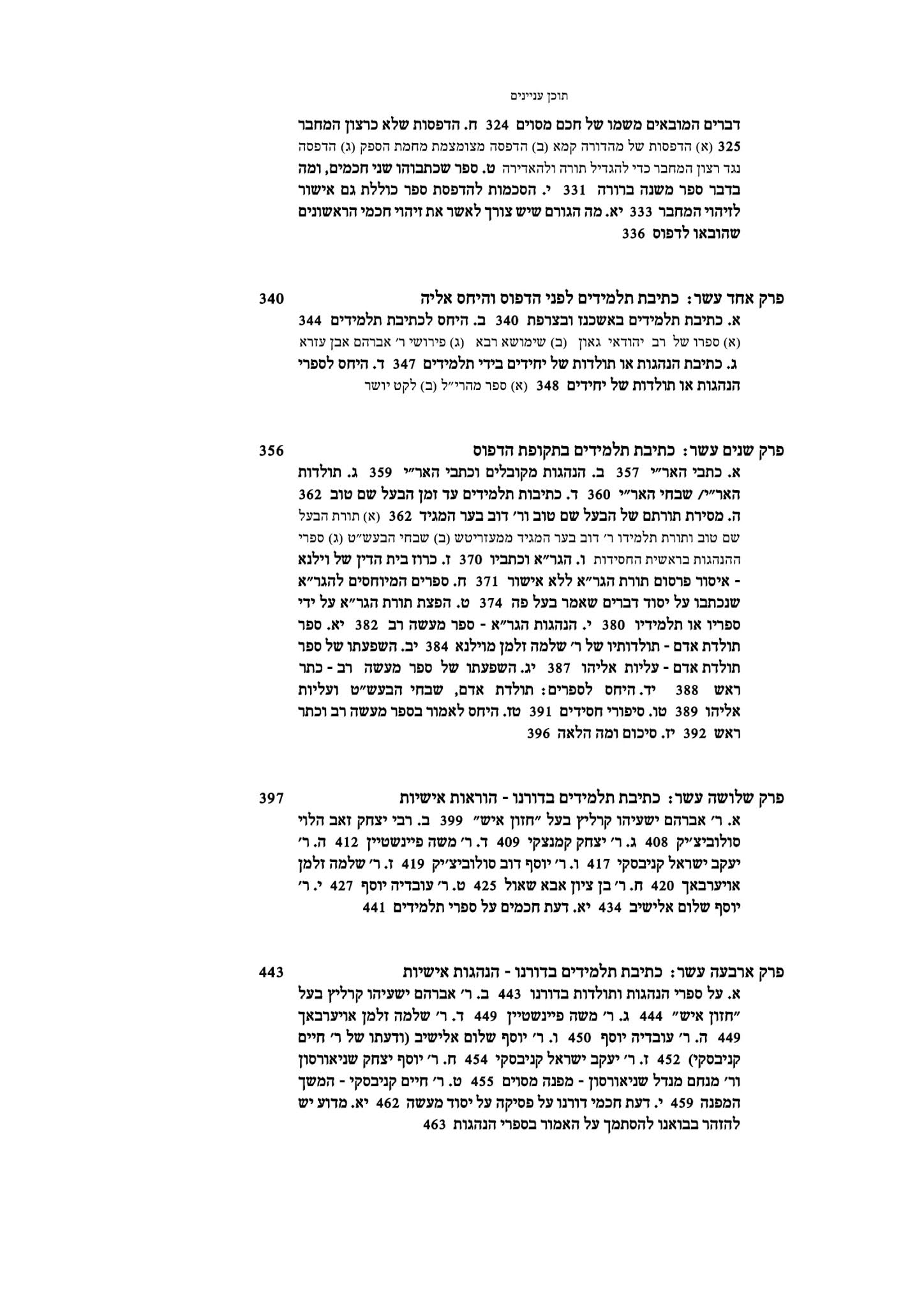
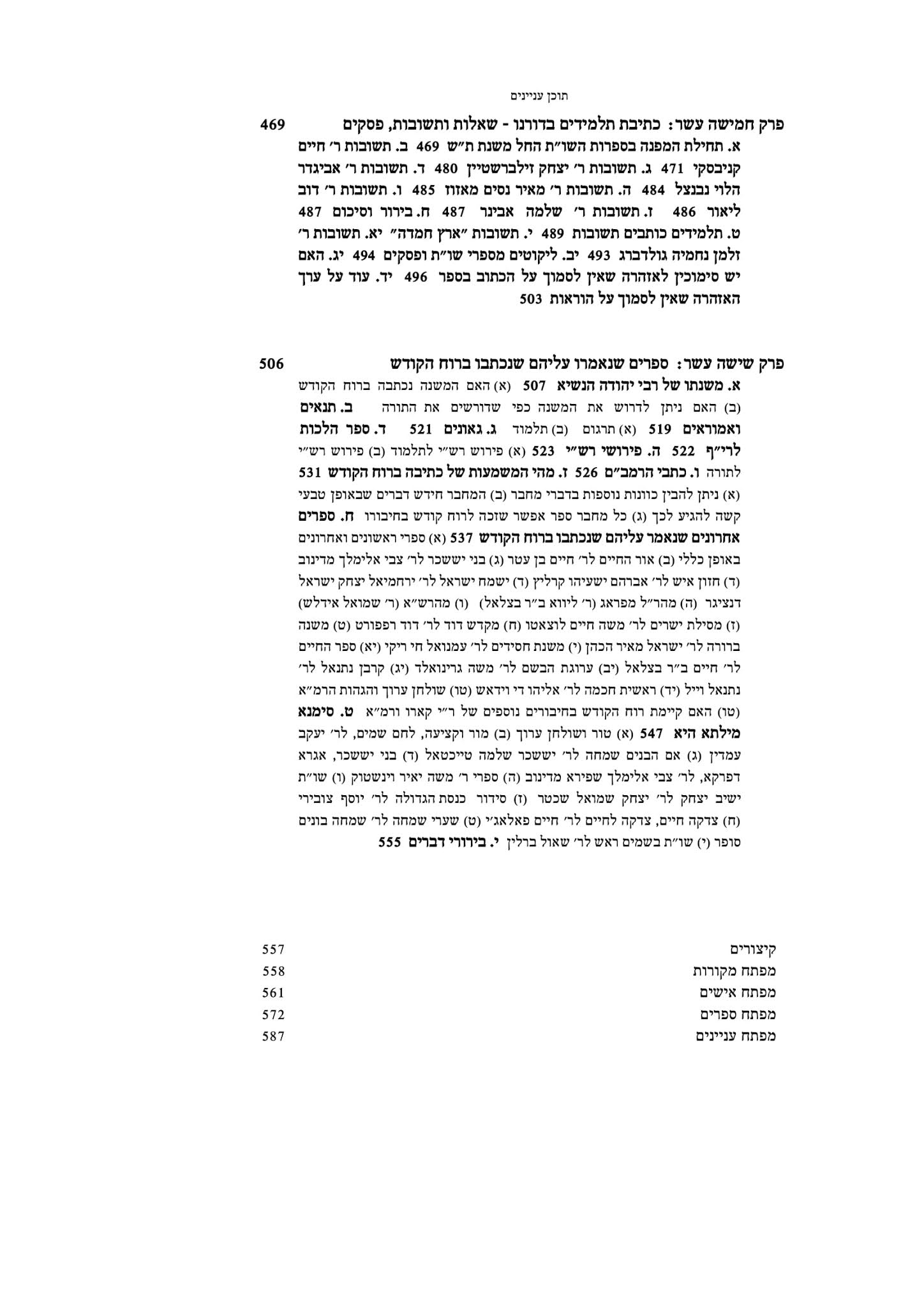
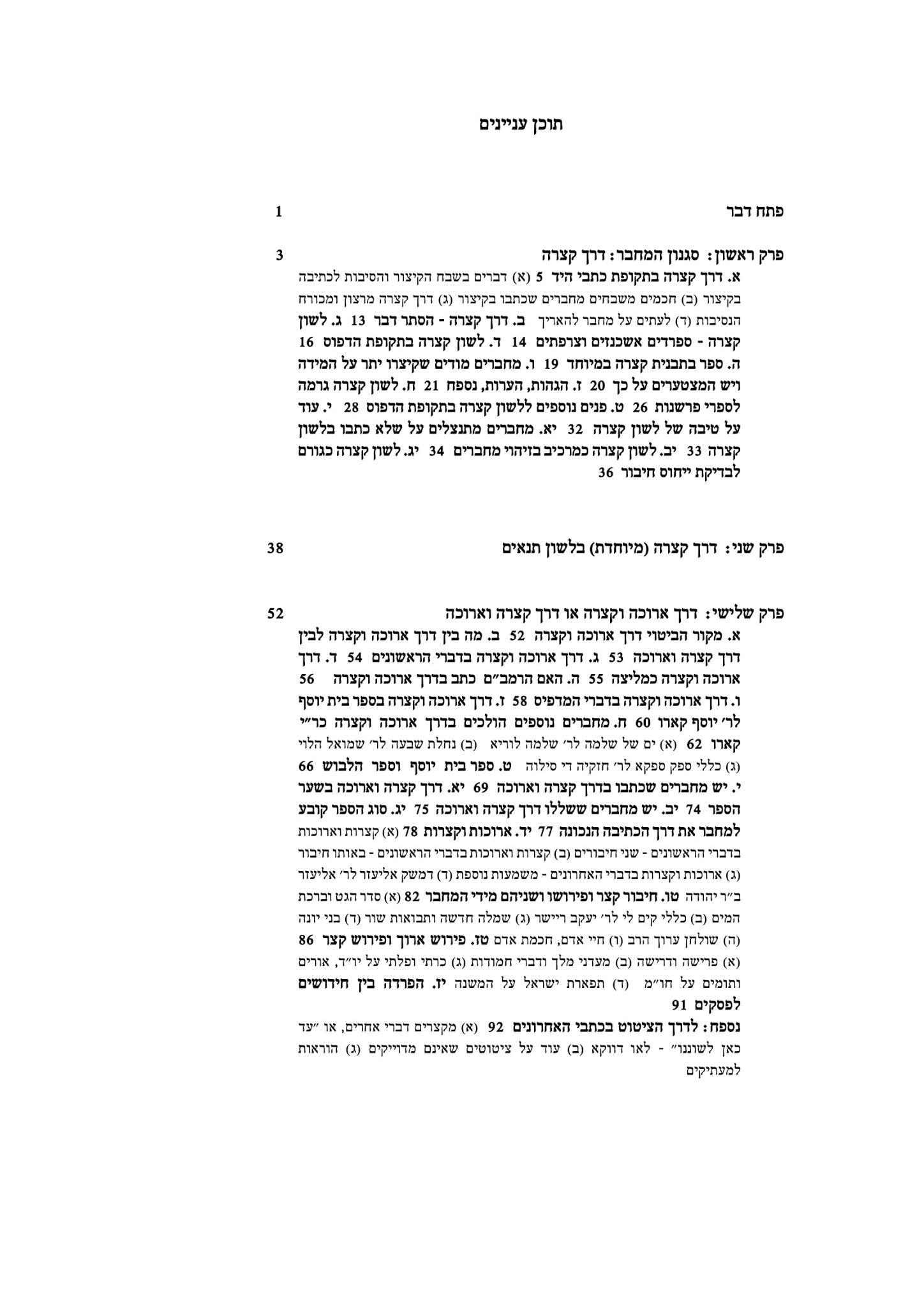
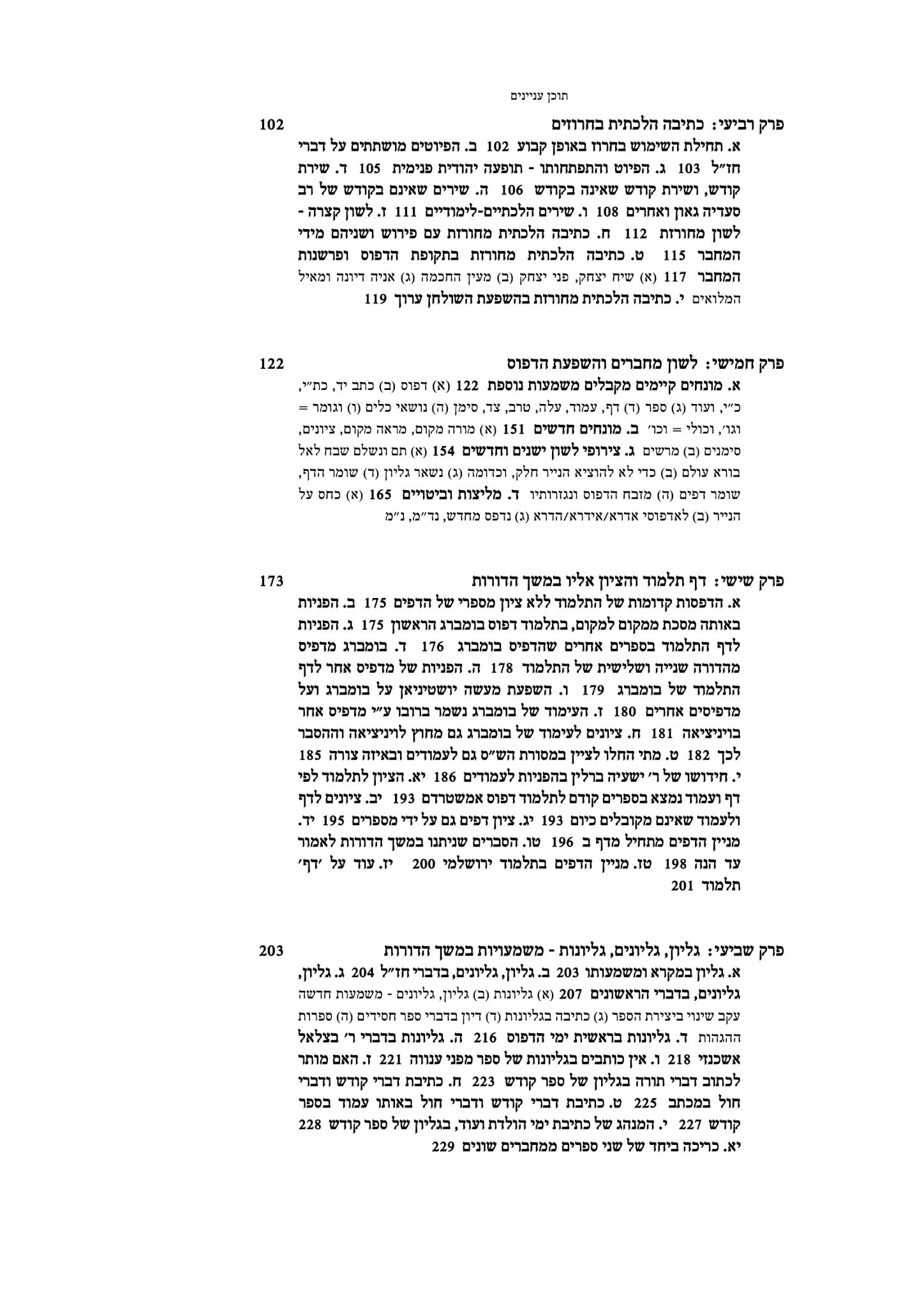
To get a sense of what exactly this new book is about, here are the beginning of the Table of Contents (or view the entire Table of Contents as a PDF):


The First Artichoke Controversy of 2012

The First Artichoke Controversy of 2012
By Leor Jacobi
Recently a kashrut controversy surrounding traditional Italian fried artichokes has received major media coverage in the New York Times and the Seforim Blog (twice, in chronological order, not order of importance).  In order to prove the antiquity of Jewish artichoke consumption, depictions of artichokes in medieval illuminated haggadot have been adduced. These were the topic of a lesser-known artichoke controversy in 2012 here in the comments section of the Seforim Blog, which can be as nasty and difficult to find as artichoke bugs.
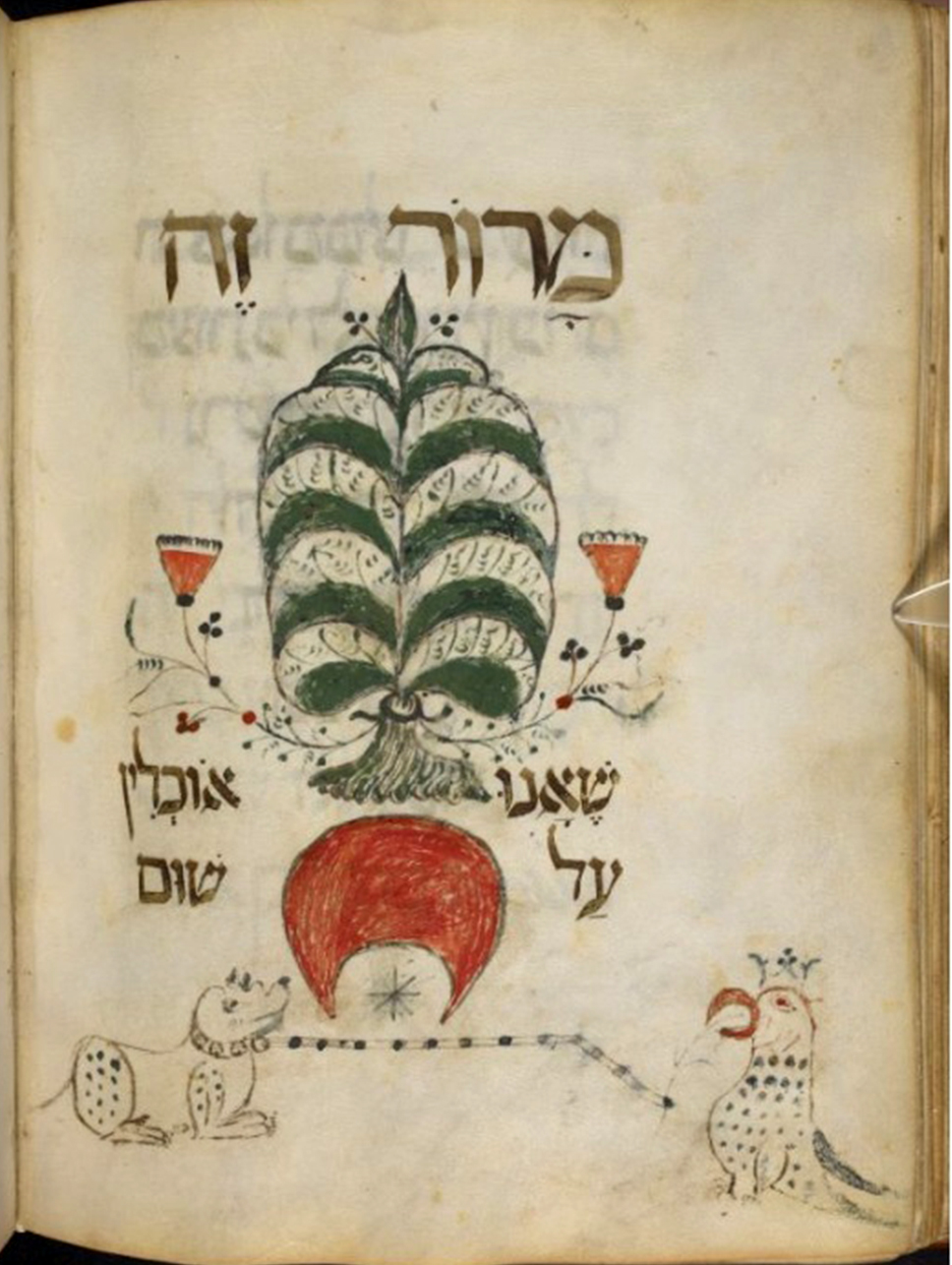
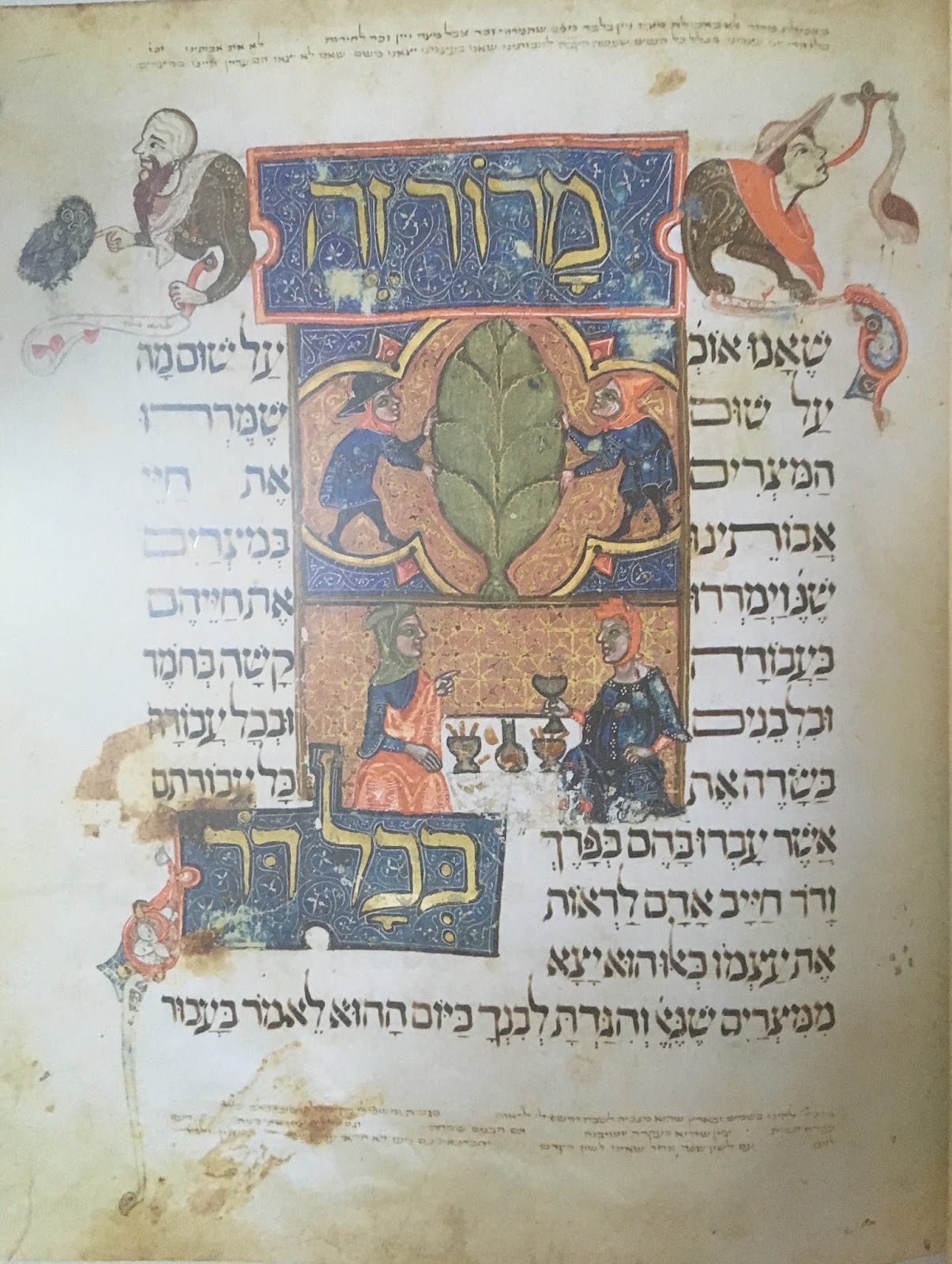
The Controversy: Do Catalonian medieval Haggadot portray maror as an artichoke? Were artichokes actually consumed in fulfillment of the rabbinic requirement to consume bitter herbs found in the Mishnah and Tosefta?
“Brother Haggadah”, BL Oriental 1404, f. 18
Here’s the story behind the scenes as it occurred in real time, during the Pessah season of 2012. I was scheduled to deliver a talk on chrayn at a rabbinic conference on the Hebrew language organized by Yitzhak Frank on April 10, Chol ha-Moed Pessah. In the course of some late preparatory research (= Googling) on April 5 (13 Nissan, the day of bedikat chametz) I came across a fascinating responsum on maror by David Golinkin that had just been published on April 2, 2012.  Struck by the reliance on visual evidence from illustrated manuscripts in establishing a medieval custom to consume artichokes as maror, I sent the post to Marc Michael Epstein of Vassar College for comment. Within an hour he replied:
I don’t believe the Sephardic mss show an artichoke, rather they depict an entire head of romaine lettuce. The way to prove or disprove this would be to compare contemporary or roughly contemporary botanical mss.
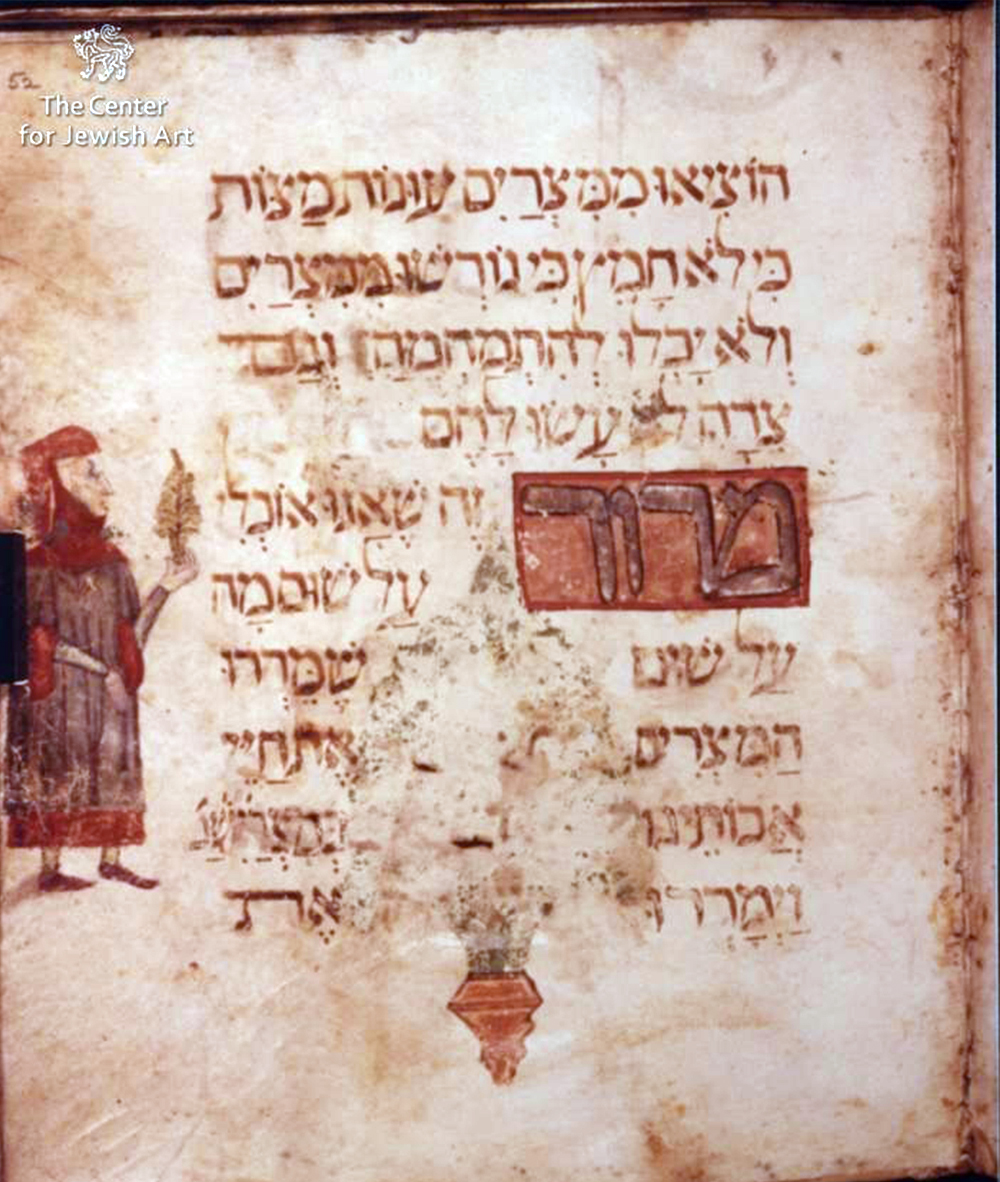
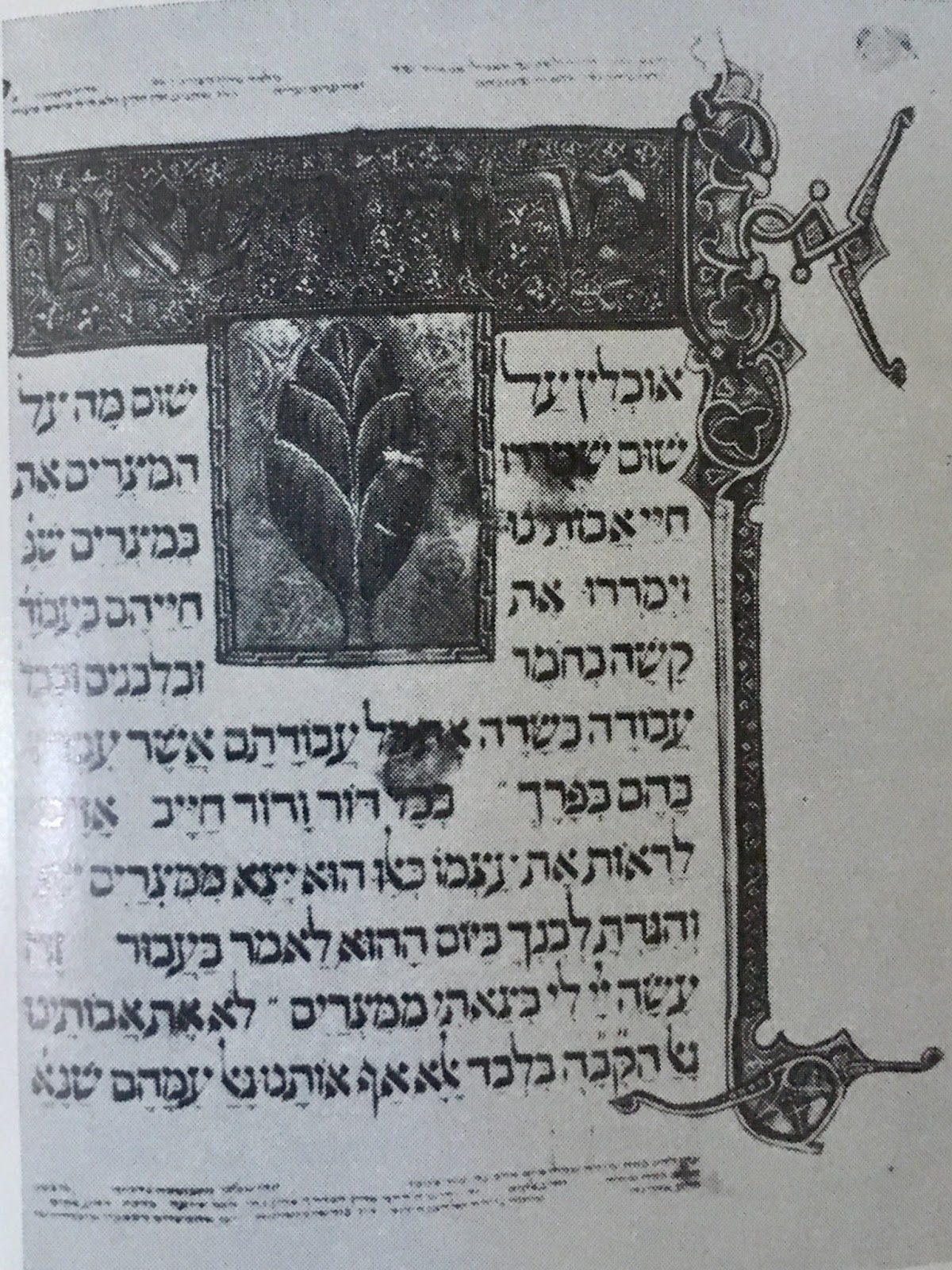
I immediately began “intensive research” (= more Googling) and discovered that the artichoke question was (probably first) posed by Yoel Finkelman and his parents in 2005. Significantly, they already collected the three examples cited by Golinkin: the RylandsBrother, and Sarajevo Haggadot. Finkelman states that his father circulated the query widely.
Rylands Haggadah, 1988 facsimile edition, f. 31v
The next day, April 6, Erev Pessah, I emailed Golinkin directly, requesting sources for his identifications. He replied on the same day that artichokes are definitely depicted in the three illuminated haggadot and that artichokes were probably identified as one of the five plant species mentioned in the Mishnah (Pesahim 2:6). Indeed, in Golinkin’s own post of April 2:
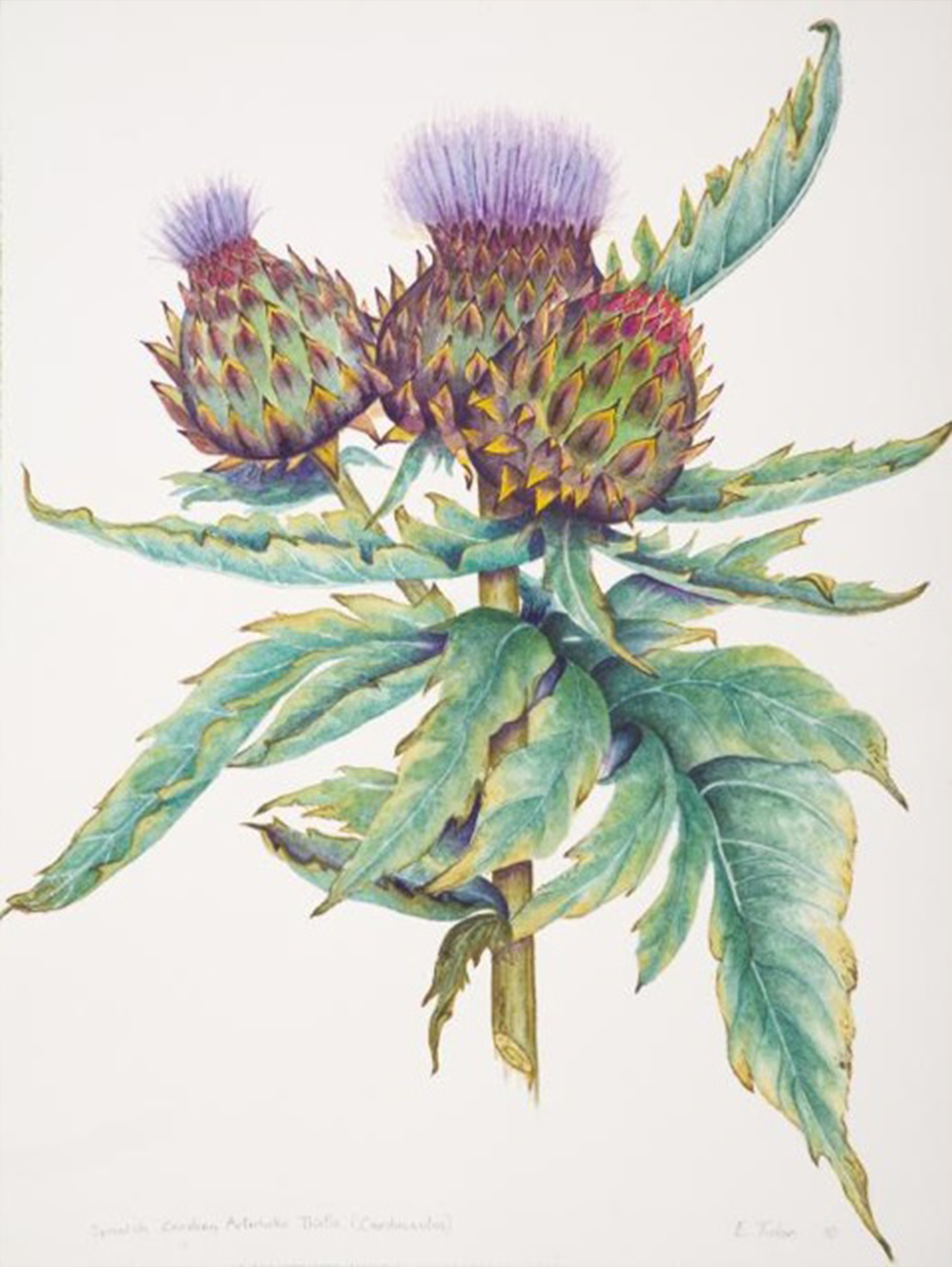
Rabbi Natan ben Yehiel of Rome (1035-ca. 1110) says in his Talmudic dictionary  (ed. Kohut, Vol. 8, p. 245) that tamkha is cardo, which is cardoon. Prof. Feliks says that this is carduus argentatus or silver thistle, while Dr. Schaffer says that it is cynara cardunculus or artichoke thistle.
Cardoon Artichoke Thistle. a painting by Elizabeth H Tudor
So, textual and visual evidence interlock to support the conclusion that artichokes were used as Maror. However, the textual evidence is weak. Sefer Ha’arukh is a dictionary, not a responsum, a legal code or a gloss to one, like Hagahot Maimoniyot which identifies tamkha as horseradish – chrayn, associated with an actual custom. The definition of Ha’arukh is not a singular, definitive identification  (yesh ‘omrimmarrobio, another species, also Rashi’s identification), and according to Prof. Jehudah Feliks cardo does not describe artichokes at all.
Opposite this scanty textual evidence stands a mountain of Rabbinic silence. As far as I am aware, nowhere in any codes, Haggadas, commentaries, or anywhere else do we find even a hint that artichokes were ever used as maror. There are limits to what can be learned ex silentio but we are discussing thousands of sources. If artichokes were used, we would expect a mention somewhere.
As for the visual information, we have “two witnesses and three witnesses”: The Rylands and Brother Haggadahs should be considered one witness because one is copied from the other. Bezalel Narkiss designated the name “The Brother Haggadah” (along with a lot of other names of Haggadah, most of which have stuck, for better or worse) because it is the “brother” copied from the Rylands Haggadah. According to Katrin Kogman-Appel, the Brother was more likely the original from which the Rylands was copied. For our purposes, the direction of the copying makes no difference. Just as the Rosh and Tur can’t really be counted as two legal authorities, these two sources are reflections of one another. What about the other witness, the Sarajevo Haggadah?
I do not think that there is even a remote possibility that the Sarajevo Haggadah depicts an artichoke:
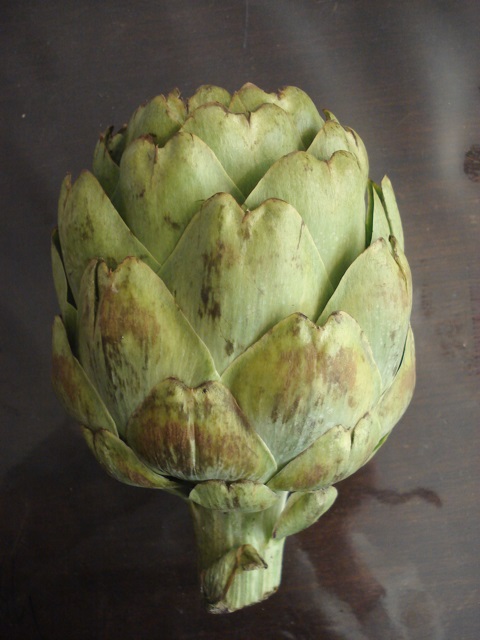
The leaves are ridged but all species of artichoke leaves are smooth save for the thorn in the middle. An artist whose intention was to depict artichokes would not draw them in this manner. Moreover, Epstein, (in personal correspondence) adds that the “artichoke” leaves are “veined” like lettuce leaves, and bound together with a cord at the base.
Israeli Artichoke, Photo: Leor Jacobi, April 20, 2012
The same day, April 6, Erev Pessah, I communicated my skepticism back to Golinkin, especially regarding the depiction in the Sarajevo Haggadah.  Golinkin’s April 2 post had already inspired creative contemporary midrash by April 9 (the truth of which in revealing hidden aspects of the divine plan should be judged independently of the historical claims.) Clearly these progressive folk placed artichokes on their seder plate on seder night, April 6 or 7, 2012, and were already expounding homiletically on the custom they had only learned about on April 2 at the earliest. Epstein notes that this an excellent example in “real time” of a minhag in development thanks to what he calls “the heter of the Internet.”
I gave the Chrayn talk on April 10 and the very next day, April 11, a long and fascinating Seforim blog post by Dan Rabinowitz was published, wherein, inter alia, he stated:
In the Brother to the Rylands Haggadah, marror is depicted as an artichoke, as is in the case with the Sarajevo Haggadah.
Golinkin wasn’t cited but it’s doubtful that his April 2 post is the source —  perhaps serendipity. After some discussion in the comments, Marc Epstein wrote:
Rabbosai (and Marasai): A manuscript is NOT a mirror. Jews depict themselves in their art (or commission art that depicts them) not as they were, but as they desired to be seen. Please please please do not engage in the typical Wissenschaft strategy of looking at illuminated manuscripts for “clues to Jewish life in the Middle Ages” or even to Jewish history. What we can learn from them is histoire des Mentalites, but even that takes a lot of work to get to.
Re: the “artichoke”: I don’t believe the Sephardic mss show an artichoke, rather they depict an entire head of romaine lettuce. The way to prove or disprove this would be to compare contemporary or roughly contemporary botanical mss. It may have been “misunderstood” by some illuminators as an artichoke, but not corrected by the recipients of the manuscript because if you are not looking for an artichoke it seems totally absurd that an artichoke would be used as maror, You don’t SEE an artichoke, but a head of Romaine lettuce, no matter how “artichoke-like” it seems to us in 5772.
Also, because a head of Romaine is SHOWN in the haggadah it doesn’t mean that there a head of (possible unchecked-for-bugs) Romaine on the table. Every image is not a snapshot, but a representation — a combination of the real, the general, the ideal and the symbolic. Showing the head is a way of REPRESENTING Romaine — it says, “We use a type of lettuce that grows with leaves together in a head like this.” It does NOT necessarily mean “We use complete heads of Romaine at the Seder, like this.” Do you see the difference? A representation must shorthand its descriptions for clarity: If you showed individual artichoke leaves, for instance, it would be difficult to ascertain that the plant was an artichoke. Artichoke leaves are shaped like baby spinach leaves, though baby spinach is more pliable. If a leaf of that shape was shown, what would distinguish the artichoke leaves? Showing an artichoke in its entire, thistly configuration makes it indisputable that it is an artichoke.
Epstein’s points are compelling. How does one portray lettuce in an illustration? For example, this modern lettuce clip-art isn’t much more lettuce-like than the illustration in the Brother Haggadah:
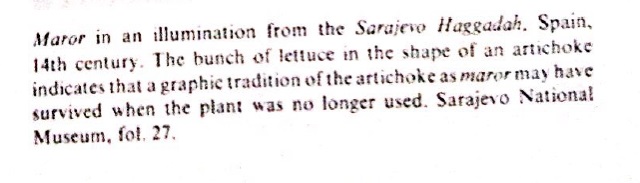
After Pessah, on April 22, I received an additional reply from Golinkin with more sources. The entry for maror in the first edition of Encyclopedia Judaica was written by Jehudah Feliks (pp. 1014-5). The entry includes an image of the maror depiction from the Sarajevo Haggadah with a caption:
According to this astounding caption, lettuce is depicted in the Sarajevo Haggadah but the claim is that it can still be supposed that the artichoke-like shape of the lettuce reflects an old custom of eating artichokes as maror. This custom had already been lost in the 14th century, but was preserved in the form of illustrations of maror in haggadot! (We find something similar in the illustrations of maror in the Prague Haggadah. According to Rav Peles, the custom of pointing at the wife when stating “this bitter[ness/Bitter Herb]” had already disappeared, but was preserved in the caption to themaror illustration in the Haggadah; see also here). However, note that above, in Golinkin’s post, Feliks did not identify the Arukh’s cardo as artichokes. It is not entirely clear that Feliks composed this caption. Bezalel Narkiss served as IIlustrations Consultant on the first edition (sadly most illustrations were cut from the second edition, including this one and the caption).
As Narkiss was then the acknowledged expert in medieval illuminated manuscripts, it stands to reason that he may have either selected the illustration or wrote the caption, either alone or in consultaion with Feliks. In any case, the author(s) of the caption maintain that lettuce is depicted even if the rest of their proposal is extremely speculative.
For the Rylands Haggadah, Golinkin cited the Raphael Loewe facsimile, Steimatzky, 1988: “The bitter herb is intended to be lettuce, despite its artichoke-like compactness.”  This pithy source contradicts Golinkin’s identification, and suggests a practical explanation for this lettuce design.
As for the Brother Haggadah, Golinkin wrote that he learned about this from an expert on Jewish art. However, as far as I can tell this expert does not deal primarily with interpretation of medieval art. Theories are tested by evidence. Thus, it remains that if someone wishes to argue that these images depict artichokes the best way to advance the thesis would be by means of comparisons with contemporary illustrations of artichokes, as Marc Epstein advises.
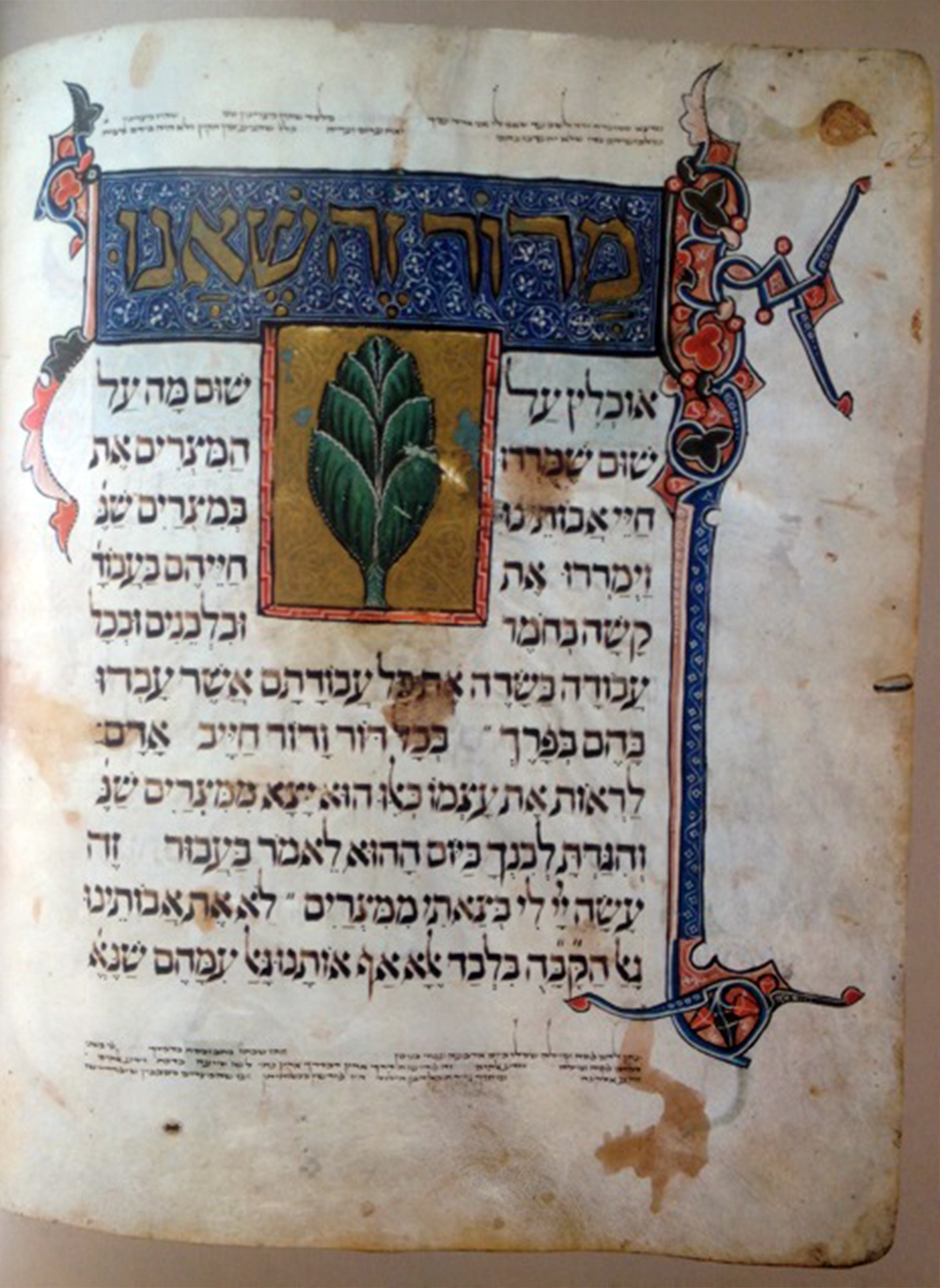
Finally, an image of maror from the Barcelona Haggadah, folio 62, illustrates how creative illustrations of lettuce (?) could get and how dangerous it would be to try to learn history from them as if they were snapshots.
Adapted from Evelyn Cohen’s description in the facsimile volume:
Verso, The scribe left almost the whole of the page for a depiction of the bitter herbs, but the crude illustration we now see was not executed in the Middle Ages, although it may have been based on models from the fourteenth century. The vegetable, commonly portrayed in a highly stylized manner, was no longer understandable to the later artist, and the red holder with which it is sometimes shown seems to have been misunderstood by the artist, who interpreted it as a red crescent.
The post-medieval illustrator here may have utilized haggadah depictions of artichoky lettuce as a model and was probably as bewildered by them as we are.  In note 39 Cohen lists the Hispano-Moresque, Graziano, Golden, and Sister Haggadas as displaying maror holders. The matzot in these haggadot look nothing like real matzot, with elaborate color and geometric designs. The entire maror holder could be a design element in this vein, so that the maror is grounded and not floating in space.
Graziano Haggadah
Sister Haggadah
‘Hispano-Moresque’ Haggadah
Golden Haggadah
Epstein adds (personal correspondence) that we should be wary of concluding on the basis of these images that Jews of Medieval Spain had actual red maror holders. They may have developed from an earlier model like the Golden Haggadah, which only meant to portray a reddish-yellow color which develops towards the base:
I certainly hope enterprising Judaica forgers, the creators of “Marrano cups” and such don’t get wind of this, or appraisers, experts and curators will have a whole new wave of fake “authentic” pre-Expulsion Sephardi ritual items to deal with. Indeed Romaine lettuce is most suitable for maror because it generates increasing bitterness the longer one chews the leaves, and the closer one gets to that all-important base. Romaine is appropriate for maror in metaphoric terms: like the servitude in Egypt, which started out as a “public works” project with the full participation even of Pharaoh, and ended up as the most abject of slavery, a torture inflicted exclusively upon the Israelites. When one first begins to chew the leaves Romaine lettuce, one could think one was eating a lovely salad. More chewing, and getting eventually to the lower “spine,” however, makes the experience increasingly bitter. The rabbis understood that unlike the consistent blast of heat one experiences with horseradish and other truly bitter plants, it is in the initially non-bitter, even pleasant, but then the increasing nature of the bitterness of Romaine that the precise metaphor for the Egyptian servitude is experienced.
It is notable that per Kogman Appel’s dating, the Golden Haggadah is earlier (c. 1320) than some of the examples brought above (c. 1350-), and may have served as their model in some sense, including the fact that whatever we are seeing, (whether the “veins” in a single lettuce leaf, or the ruffled leaves in the head when cut open and depicted laterally, like the Chinese cabbage shown below,) gives the leaf/leaves a  “spiky” appearance. (If there is a lateral view here, the question, of course, is why such a view was taken. Most authorities prefer whole Romaine leaves for maror, so a view “cutting through” the head might be confusing, although some advocate the consumption of only, or primarily the spines.)
The more I think about it, although links and distinctions have been made between the opening sequence of biblical narrative illuminations in the Golden, Sister and Sarajevo Haggadot and the Rylands/Brother Haggadot, the TEXT illustrations (matzahmaror etc.) may have more mutual influence and cross-influence, and relate also to those in the Barcelona Haggadah and others. Since the GH was earlier than the Sarajevo, Rylands/Brother Haggadot, the image of the maror there, clearly— though stylized—Romaine may have influenced, been misunderstood by the artists of the later ms. In other words, the veiny (or the lateral, or side-viewed, rippling) leaves of Romaine could have been mistaken for the “spiky” leaves of an artichoke and thus been illustrated. (The Sarajevo artist, for instance, depicted the “artichoke” leaves not only as serrated but with “veins” more typical of lettuce.)
The Sarajevo, Rylands/Brother ARTISTS  misunderstanding the [veined single lettuce leaf or laterally viewed or cut head of] lettuce in the Golden Haggadah or a similar model, might have thought they were illustrating an artichoke. The PATRONS did not “correct” this because OBVIOUSLY the vegetable could not have been an artichoke as there was no massoret of the use of that vegetable for maror. There for they accepted the “artichoke” of the artists as the “lettuce” of halakhah.
While we can never recover the actual conversation that precipitated the visual result, both consideration of the near-instantaneous creation via “the heter of the Internet” of the minhag of placing artichokes on the seder plate, and the spinning of homiletics around that minhag;  and the invention of the “maror holder”are reflections—within our present conversation!—of the kinds of transmission problems ever present in such conversations in any time or place. This whole adventure has, for me, been very important in thinking about artist-patron relationships.
Cohen adds an interesting point (personal correspondence):
I found other manuscripts where there was a blank space where the image of the maror should have been placed, while all the other areas left blank by the scribe contained illustrations. This lead me to believe that the appearance of the maror was sometimes customized based on the minhag of the patron, who for whatever reason never had it added.
These are fascinating questions. The goal of the artists was to produce art which resonated with their patrons symbolically and aesthetically. By misinterpreting these images as snapshots of historical reality, we can invent artichokes and maror holders. One could just as well conclude that it was customary to only sit on one side of the Seder table!
Fast forward to May, 2018, we find ourselves embroiled in a new artichoke controversy and the Seforim Blog is back with artichokes in the Haggadah. This is a fascinating little post on kashrut and custom, but nothing about ancient or medieval practices can be proven from these sources. A follow-up post based on textual sources by Susan Weingarten, an expert on foods in antiquity (and incidentally, the sister of Elihu Shanun, who also spoke at the rabbinic conference on April 10, 2012 which started us off) provides a much more reliable textual path towards establishing the antiquity of artichoke consumption.
In summary, there is no evidence that Jews ever ate artichokes to fulfill the obligation of consuming maror on the Passover Eve. Maybe b’shas hadahak, but who knows? The textual evidence and visual evidence don’t support each other to advance a radical historical claim. However, artichokes are delicious and, if clean, Kosher for Pessah. Jews very likely did consume them historically wherever they were found.
Thanks to: Marc Epstein, David Golinkin, Evelyn Cohen, Sara Offenberg, Moshe Glass, and Jean Guetta. I also wish to acknowledge the Memorial Foundation for Jewish Culture for their support.


Approbations and Restrictions: Printing the Talmud in Eighteenth Century Amsterdam and Two Frankfurts

Approbations and Restrictions:
Printing the Talmud in Eighteenth Century Amsterdam and Two Frankfurts
by Marvin J. Heller
Approbations designed to protect the investment of printers and their sponsors when publishing a large work such as the Talmud were well intentioned. Unfortunately, the results were counter-productive, resulting in acrimonious disputes between publishers within and between cities. This article discusses the first approbations, issued for the Frankfurt on the Oder Talmud (1697-99), and the resulting dispute with printers in Amsterdam in 1714-17. The background of the presses and the pressmarks utilized by the printers are discussed, giving a fuller picture of the printing of the Talmud in the subject period, as well as addressing antecedent (Benveniste) and subsequent editions.
Approbations for books have multiple purposes, among them commendations, indicating approval or praise for the subject work, confirming that a book’s contents do not contain forbidden or prohibited matter, and to protect a publisher’s investment from competitive editions for a fixed period of time. This article is concerned with the last purpose, here rabbinic approbations (hascoma, pl. hascomot) limiting or preventing rival editions of the Talmud published in the last decade of the seventeenth century into the first half of the eighteenth century.
The restrictive approbations discussed here are unlike those issued previously, such as the first approbations for a Hebrew book, R. Jacob Barukh ben Judah Landau’s (15th cent.) concise halakhic compendium, Sefer Ha-Agur (Naples, 1487), one of seven approbations, that of R. Judah ben Jehiel Rofe (Messer Leone, 15th cent.) stating he has examined ha-Agur, and, “it is a work that gives forth pleasant words. . . . I have, therefore, set my signature unto these nectars of the honeycomb, these words of beauty,” or those in Italy or in Basle, which assured the authorities that nothing untoward or offensive to Christianity was included in the book, or to current approbations, which assure the reader that a work’s contents are in conformity with the community’s religious standards. In contrast, the approbation issued for the Frankfurt on the Oder Berman Talmud, and to subsequent editions, was a license for a fixed number of years, prohibiting other publishers from printing competitive editions that would prevent the printer and his sponsor(s), who would otherwise be reluctant to make the substantial investment required to print such a large multi-volume work as the Talmud, from realizing a return on their investment.
The discord arising from restrictive approbations for printing the Talmud were not the first such disputes. In Amsterdam, disputes between printers arose over editions of the Bible. Johannes Georgius Nisselius and Joseph Athias competed in the mid-seventeenth century over a Sacra Biblia (Hebrew Bible) for the use of students and several years later Athias and Uri Phoebus were involved in controversy over their translations of the Bible into Yiddish, competing for the Jewish market in Poland. Arguing over the right to publish for and sell to that market, they sought to reinforce their positions by seeking approbations from the Polish, as well as the Amsterdam rabbinate.[1] Nevertheless, their competition pales in contrast to the recurring altercations over the right to print the Talmud, which spanned several centuries and much of the European continent.
Raphael Natan Nuta Rabbinovicz writes that the intent in granting this and subsequent approbations was for the good of the community, to insure investors a reasonable return on their investment. The result, however, was that the Talmud was printed only eight times in the century from 1697 to 1797, and the price of a set of the Talmud was dear. Prior to that the Talmud had been printed several times in Italy and Poland within a relatively short period of time, the primary impediment then being the opposition of the Church and local authorities. Rabbinovicz concludes that after 1797 the use of restrictive approbations declined, with the consequence that within four decades, to 1835, the Talmud was printed nine times.[2]
During last decade of the seventeenth century into the first half of the eighteenth century several rival editions of the Talmud appeared, beginning with the Frankfurt on the Oder Talmud (1697-99) followed by two incomplete editions in Amsterdam (1714-17 and 1714), the Frankfurt on the Main Talmud (1720–22), again in Amsterdam (1752–1765), and finally the Sulzbach Red (1755-63) and Black (1766-70). We are concerned with and focus on the early editions, that is, on the dispute between the Frankfurt on the Oder and Amsterdam printers, their dispute resulting from restrictive approbations issued to presses printing the Talmud. This article discusses the background of the Hebrew presses that published these Talmud editions in the seventeenth and eighteenth century; its primary focus, being the disputes resulting from the restrictive approbations.
I Amsterdam – Benveniste Talmud
Amsterdam has a distinguished place in Jewish history. Among the notable features of that city’s Jewish community are its printing-houses, among the foremost in Europe for centuries. Highly regarded, Amsterdam imprints were distributed and sold throughout all of Europe. The preeminence of Amsterdam as a European book center is evident, for it is estimated that the output of the Dutch presses in the seventeenth century exceeded the combined production of all the presses of all other European countries. The number of book-printers totaled 273 at its peak in 1675-99, employing at its height in excess of 30,000 people supported through some facet of the book trade.[3] The important works published by its presses include editions of the Talmud, beginning with the Benveniste Talmud of 1644-47, through the much praised Proops’ Talmud of 1752-65. In addition to complete editions of the Talmud individual treatises, frequently in a smaller format, were also published for students and individuals who did not require or who could not afford a complete Talmud.[4]
The printing of Hebrew books in Amsterdam by Jews begins in 1627, when two printers published books, Manasseh (Menasseh) Ben Israel (1604-57) and Daniel de Fonesca. The former’s press was the first to publish with a Sephardic rite prayer-book, completed on January 1, 1627. Manasseh Ben Israel would achieve acclaim that, together with its founder’s many other achievements, is still recalled today. Manasseh did not publish Talmudic tractates but his press did issue three critical editions of Mishnayot (1632, 1643, and 1646). He also intended to publish an edition of the Talmud but that did not come to pass.
The next printer of Hebrew books of import in Amsterdam was Immanuel (Imanoel) Benveniste. Benveniste is believed to have been among the Jewish refugees from Spain or Portugal, and that he was descended from the illustrious Sephardic family of that name.[5] Beneveniste relocated to Amsterdam because, by the mid-seventeenth century that city offered better opportunities for the distribution of Hebrew books than any city in Italy.[6] Beneveniste was the publisher of the first Amsterdam Talmud, printed from 1644-47. The Benveniste Talmud is in a smaller (c. 260:195 cm.) quarto format than the usual large folio editions.[7]

Fig. 1
Although not subject to restrictive approbations it is included here due to its relevance to the history of the printing the Talmud in Amsterdam and because the title-pages of Benveniste’s publications are distinguished by his escutcheon, an upright lion facing inward towards a tower; a star is above the lion and the tower. The lion is on the viewer’s right, the tower on the left. At least six forms of Benveniste’s device have been identified. In all cases, excepting his Talmudic treatises, Benveniste’s insignia is set in a crest above an architectural frame surrounding the text of the title page. On the title-pages of the Benveniste tractates his mark appears at the bottom of the page in an ornamental shield, with a helmet in the crest (fig. 1). Given the high regard of most Benveniste imprints this device was subsequently used by several printers in Amsterdam, including two of the following subject editions, as well as by other presses in various locations.[8]
This Talmud has been has been praised for restoring expurgated material. Unlike Benveniste’s other publications, however, the Beneveniste Talmud is not highly regarded. Raphael Natan Nuta Rabbinovicz quotes from an approbation given by R. Moses Judah ha-Cohen, Av Bet Din, of the Ashkenazi community in Amsterdam, for the Berman Talmud (Frankfurt on the Oder, 1697-99) which states that Benveniste, due to his concern over expenses, printed a Talmud edition which was, due to its small size, difficult to learn from. Furthermore, Benveniste used letters that were “the smallest of the small and blurred so that the users eyes become heavy and his sight wanders as if from old age.”[9] This notwithstanding, no less a personage than the Vilna Gaon (R. Elijah ben Soloman Zalman, Gr”a, 1720-70) made use of the Benveniste Talmud, Rabbinovicz writing that “he had heard from a great Talmudic scholar who related that he had seen a Talmud from which the Gr”a had learned by R. Judah Bachrach (1775-1846) av bet din Seiny with his (Gr”a’s) handwritten annotations, brief and varied from his printed annotations, and that it was a Benveniste Talmud.”[10]
II – Frankfurt on the Oder – Michael Gottschalk
Printing with Hebrew letters in Frankfurt on the Oder begins when the Christian printers Joachim and Friedreich Hartmann (1594-1631), who, using new Hebrew fonts and vowels cast by Zechariah Crato (?) of Wittenberg, published a Hebrew Bible in 1595-96. While there are references to an even earlier Bible, half a century earlier, that is uncertain. More than a century later, Johann Christoph Beckmann (1641-1711), professor of Greek language history, and theology at the University of Frankfurt on the Oder, operated a printing-press in Frankfurt on the Oder from 1673 to 1717, which he acquired from his brother Friedreich on June 1, 1673 for 400 Thaler; Friedreich, in turn, had purchased the press for a like amount. Beckmann obtained a travel scholarship from the Brandenburg Elector and, during his travels in Europe came to Amsterdam. In 1663, in that city, Beckmann met Jewish students, the renowned R. Jacob Abendana (1630-85), and studied Talmud. In 1666, Beckmann returned to Frankfurt, where he obtained a position at the university (Viadrina), teaching there until his death in 1717 and serving as rector eight times. Because of the admission of Jewish students, the Viadrina became the “Amsterdam of the East,” both Hebrew and oriental studies being of importance.[11]
Beckmann was granted, initially, on May 1, 1675, a license to employ two Jewish workers, under the direct protection of the university, to print a Hebrew Bible, this despite of the protests of Frankfurt city. By 1693, however, Beckmann found that his responsibilities at the university left him with insufficient time to manage the press. Therefore, he contracted with Michael Gottschalk, a local bookbinder and book-dealer to manage the printing-house, transferring all of the typographical equipment and material to Gottschalk. Their arrangement was noted on the title-pages of the books issued by the press, which stated “with the letters of Lord Johann Christoph Beckmann, Doctor and Professor . . . at the press of Michael Gottschalk.” Gottschalk became the moving spirit of the press for almost four decades.
After printing several varied Hebrew titles Gottschalk approached Beckmann, requesting that he obtain permission to reprint the Talmud. Beckmann petitioned Friedreich III, Elector of Brandenburg (1657-1713, reigned 1688-1713, from 1701 King of Prussia), requesting a license to print the Talmud. Friedreich, in turn, sought the counsel of the Berlin professor Dr. Daniel Ernest Jablonski (1660-1741), from 1691, court preacher at Königsberg for the elector of Brandenburg, Friederick III. Jablonski, a Christian German theologian of Czech origin, an orientalist, had been associated with universities in Holland and England, settling in Lissa in 1686, and from there moving to Berlin. In 1700, Jablonski became a member of the Academy of Sciences in Berlin. Jablonski established a Hebrew press in Berlin, publishing a scholarly edition of the Hebrew Bible based on the Leusden edition (Amsterdam, 1667, Atthias) and a translation of Richard Bentley’s A Confutation of Atheism into Latin (Berlin, 1696). Jablonski, was to become personally involved with Hebrew printing in Berlin, and would be participate in the publishing of two later editions of the Talmud.
When a sponsor was sought for the Frankfurt on the Oder Talmud, Beckmann found one in the Court Jew Issachar (Ber Segal) ha-Levi Bermann (1661-1730) of Halberstadt, known as Bermann Halberstadt or, in his commercial dealings with the non-Jewish world, as Behrend Lehmann. It was Bermann who bore the cost of this Talmud, and whose name is associated with it. Selma Stern observes that Bermann was a pious and observant Jew throughout his life. He was held in high regard by his fellow Jews; and was described as “a second Joseph of Egypt” and “the chosen of the Lord, who warns him about the machinations of his enemies and miraculously rescues him when he is in dire straits.” Bermann was known among his people as “the founder of the Klaus in Halberstadt, the publisher of the Talmud, the man who defeated the first Prussian king at chess and who even in the glittering world of the Court never forgot Eternal Truth, corresponded to the ideal which Jews have had of their great men leaders.”[12]
Beckmann and Bermann entered into an agreement to publish the Talmud, Beckmann transferring his rights to Bermann, and the latter accepting responsibility for publishing the entire edition, making an initial payment of three hundred reichsthalers at the time of the agreement.[13] The printer was to be the Christian, Michael Gottschalk. Approximately half of the sets of this Talmud, known as the Berman Talmud, were distributed by Bermann to yeshivot and penurious scholars who could not otherwise have acquired a complete Talmud. Not only did he spend fifty thousand reichthalers of his own money to publish the Talmud, from which he apparently saw no financial gain, distributing copies to Talmudic students, but afterwards granted permission to the Amsterdam and Frankfurt on the Main printers to publish a complete Talmud, this in spite of the fact that he had approbations preventing republication of competitive editions.[14]
Fig. 2
Each volume of this Talmud has two title-pages. The first, a volume header page, has an engraved copper plate title-page (fig. 2) by the craftsman Martin Bernigeroth (1670-1733), Dt. Kupferstecher u. Zeichner (engraver and illustrator).[15] This initial title-page consists of an upright lamb with a pitcher on top of a portico. Below it, on the sides of the page, are Moses to the right and Aaron to the left. Beneath them, similarly situated, are King David with a harp, and King Solomon. Above each figure is that individuals’ name. Avraham Habermann and Avraham Yaari both write that the sheep and laver represent Bermann, who was a Levi. Yaari adds that the sheep further represents Bermann’s “mazel” or constellation, for Bermann was born on the 24th of Nissan (April 23), 1661, the astrological symbol for that month being a sheep.[16]
The second textual tractate title-page follows immediately after the volume title-page. The tractate title-pages are basically copied, with several modifications, from the Benveniste Talmud; but also includes some features characteristic of the Basel Talmud, which is supposed to be the source of this edition. The text concludes in Latin, informing that it is “in accordance with expurgations of the Council of Trent. . . .” and that it was printed in conformity with the Basle edition (1578 – 1581). Between the Hebrew and Latin text is Michael Gottschalk’s printer’s mark (fig. 3), which appears on the title-pages of this Talmud. It is a mirror-image monogram (cipher) of his name, the first usage of such a monogram in a Hebrew book.[17]

Fig. 3
Printed with this Talmud are approbations for the edition. When Johann Christoph Beckmann secured permission in 1695 from the Kaiser, Leopold, and from Friedreich Augustus, Elector of Saxony and King of Poland, to print the Talmud, he was given not only authorization to print the Talmud, but was also granted the sole and exclusive right to do so for twelve years. Leading rabbinic figures, according to Rabbinovicz, issued restrictive approbations, the first instance in which such rabbinic licenses were granted. The rabbis who signed the approbations were R. Naftali ben Isaac ha-Kohen Katz, av bet din (head of the rabbinical court) of Pozna, R. Joseph Samuel of Cracow, av bet din of Frankfurt on the Main, R. David ben Abraham Oppenheim, av bet din of Nikolsburg, and R. Moses Judah ha Kohen and R. Jacob Sasportas of Amsterdam concurred in granting this monopoly, issuing approbations (hascomas) for twenty years.
These approbations were unlike those issued previously in Italy, which assured the authorities that nothing untoward or offensive to them was included in the book, or current approbations, which assure the reader that a work’s contents are in conformity with the community’s religious standards. The approbation issued for this Talmud, and to subsequent editions, was a license for a fixed number of years, prohibiting other publishers from printing competitive editions that would prevent the printer and his sponsor(s), who would otherwise be reluctant to make the substantial investment required to print the Talmud, from realizing a return on their investment.
Oppenheim refers to the burning of the Talmud and other Hebrew books in the Chnielnicki massacres tah ve-tat (1648–49), fires that resulted in the loss of many Hebrew books, resulting in a dire need for Talmudic tractates. Indeed, he writes that the entire Jewish educational system was endangered due to insufficient copies of the Talmud. He praises Lehmann, noting his benevolence in distributing half of the copies to needy students free of charge.[18] Towards the end of his long and flowery approbation Oppenheim forbids the printing of the Talmud by anyone without the permission of Issachar Bermann SG”L, from the day that printing commences until twenty years have elapsed from its completion. This prohibition is “whether for all or for part, even for one tractate only, whether for oneself or for others, and is not to be done by means of guile or ruse.” To enforce his decree R. Oppenheim states that “this decree falls equally upon the purchaser as well as the seller, for that which a rabbinic court declares ownerless is ownerless. Any [such tractate] found in a person’s possession without license, is to be taken forcibly, without payment or deed . . .”[20]
Similarly, R. Joseph Samuel of Cracow begins by praising Berman, noting that all realize that these many days many thought to print the Talmud due to its being unavailable, not to be found, except one to a city and two to a family. He notes, however, that although many wanted to print the Talmud it was to no avail, for it is a large project of much work and difficult to complete, until the Lord aroused the spirit of R. Berman of Halberstadt for the public benefit and the honor of the Torah, to print an entire Talmud on good paper, with fine ink, and diligent workers, well edited. Lest there be many who “bear gall and wormwood” (Deuteronomy 29:17) who also wish to print the Talmud and therefore cause great harm R. Berman’s interests, and “lock the door before him” (cf. Bekhorot 10b) who performs a great mitzvah to benefit the public, for “such is such theTorah, and such is its reward” (Berakhot 21b, Menahot 21b)? He therefore, concurs with the other leading rabbis to decree,
Excommunication and a ban on each and every person who should take it upon himself to print the Talmud in its entirety or in whole or in part without the agreement and knowledge of the noble R. Berman, except for a section needed to learn in yehivot, which is not included in the ban. It is permitted to print only that section and not a complete tractate in order to “magnify the Torah, and make it glorious” (Isaiah 42:21). A blessing should come upon he who hearkens to our words, may blessings of good come upon him and may he receive good from God Who is good. But “he who breaches through a fence, shall be bitten by a serpent” (Avodah Zara 27b) . . . and all the curses written in the Torah shall come upon him. . . .
Even before the privilege for this Talmud had expired the need for a new edition became apparent, numerous appeals being made to Issachar Bermann to republish the Talmud. Gottschalk, who had the rights granted to Beckmann, was also favorable to reprinting the Talmud. The Talmud had sold well and Gottschalk, as a result, had become a wealthy man.[20] Frederick William I of Prussia acceded to their request on May 23, and a new privilege, dated October 13, 1710, was granted to Gottschalk by Joseph I, successor to Leopold, in 1705, to print the Talmud and sell it throughout his domain, albeit with the customary restrictions and with the provision, as with all Hebrew books, that five copies be brought to the Imperial court. Similarly, on January 11, 1711, Frederick Augustus I (Augustus II), Elector of Saxony and King of Poland, also granted such a privilege. Nevertheless, these privileges were not immediately acted upon by Gottschalk and it would be several years before he printed the second of his three editions of the Talmud.[21]
III – Marches and de Palasios and Solomon Proops
Individual tractates were frequently published in Amsterdam, to address the continuing communal need for treatises for study purposes. The printers of these tractates include Moses Mendes Coutinho, Asher Anshel and Issachar Ber, Issac de Cordova, Joseph Dayyan and Moses Frankfurter, the latter two dayyanim (judges) of the Ashkenaz religious court. During the interval between the Benveniste and the Frankfurt on the Oder editions of the Talmud no complete Talmud had been printed. It must have appeared unseemly, however, that in Amsterdam, the center of Hebrew printing, with the greatest number of, and the largest, Hebrew printing-presses, that no Talmud edition had been issued for over six decades.
An attempt to correct this, even if that was not the printers’ primary intent, occurred during the interval between the first and second Frankfurt on the Oder editions of the Talmud. two independent editions of the Talmud were begun in Amsterdam in 1714. The first was published by the partners Samuel ben Solomon Marcheses and Raphael ben Joshua de Palasios, the second by Solomon Proops. Both publishers began to print in 1714; both editions are in attractive large folio format; the title-pages of both Talmuds have, as a printer’s device, copies of the Benveniste escutcheon (figs. 4, 5). Most importantly, neither Talmud edition was completed.
Except for a Sephardic rite prayer-book, printed by Samuel Marcheses at the press of Joseph Athias, neither partner, prominent members of the Amsterdam Sephardic community, had previously published any works. Their motivation in establishing a press was for the specific purpose of printing the Talmud. Furthermore, they intended to do so in such a manner as to produce an especially fine and accurate edition. The workers would not be hurried, so that they could work with care, reducing errors, supervised by R. Moses Frankfurter, who would help establish the correct text.[22] Marcheses and de Palasios did so under the influence of R. Judah Aryeh Loeb ben Joseph Samuel Schotten ha-Kohen (1644-1719), av bet din of Frankfurt on the Main, and his father-in-law R. Samuel Settin of Frankfurt n Main. Judah Aryeh Loeb had previously attempted to have a Talmud printed in Frankfurt in 1710 but, due to the prior approbations granted to the Frankfurt on the Oder Talmud his efforts were to no avail, and he was unable to get authorization from the emperor to print the Talmud. In 1713, Judah Aryeh Loeb explored the possibility of obtaining permission to print in Frankfurt from the Kaiser in Vienna, but did not even receive a response to his inquiries. Judah Aryeh Loeb next turned to Amsterdam where, with the assistance of his father-in-law and the agreement of R. Issachar (Ber Segal) ha-Levi Bermann who had the prior approbation he commenced to print the Talmud.[23] Subsequently Samuel Settin arranged for Samuel Marches and Joshua de Palasios to undertake this venture, arranging for R. Zvi Hirsh of Sharbishin, at the time a resident of Amsterdam, to visit various Jewish communities, seeking subscribers to defray the cost of publication.[24]
Printing began with tractate Berakhot in 1714; the following tractates are recorded by Rabbinovicz as having been printed: 1715 – Shabbat and Seder Zera’im: 1716 – EruvinPesahimHagigahMo’ed KatanYomaShekalimMegillah, and Ketubbot: 1717 – BezahRosh Ha-ShanahSukkahTa’anit, and Yevamot.[25] Printing was discontinued in 1717 due to the approbations issued to the Frankfurt on the Oder printer for the Berman Talmud.
The approbations for this edition appear in tractate Shabbat. They are from R. Solomon ben Jacob Ayllon, R. Gabriel ben Judah Loeb of Cracow, R. Samuel ben Joseph Schotten ha-Kohen, R. Baruch ben Moses Meir Rappaport, R. Ezekiel ben Abraham of the house of Katzenellenbogen, R. Menahem Mendel Ashkenazi, R. Isaac Aaron ben Joseph Israel of Metz, and R. Phineas ben Simeon Wolff Auerbach of Cracow. The approbation of R. Menahem Mendel Ashkenazi, at the time Landesrabbiner in Bamberg and Baiersdorf, subjected anyone who violated the copyright to excommunication, placing a
ban, and anathema, and death on anyone who would reprint the Talmud during twenty years from the completion of this edition without the knowledge or permission of the above [Judah Aryeh Loeb] in any manner, whether in its entirety or in part, even a single tractate, excepting a section needed for learning in the yeshivot according to the requirements of the times, whether by himself or by his agent or his agent’s agent, directly or indirectly, whether a member of his household or not a member of his household . . . and he who heeds our words shall be blessed . . .
Marcheses and de Palasios acknowledge the existence of the prior restrictive approbation for the Berman Talmud on the title-pages of their tractates, which note that most of its benefits can be attributed to the Talmud of R. Issachar Bermann of Halberstadt, and also state
[And even though] most of the qualities to be found in this Talmud were acceded to me by the noble, the eminent, the distinguished R. Issachar Bermann Segal of Halberstadt even though the time restricting publication established by the geonim of the land for the above noble (Berman) for printing his Talmud has not yet elapsed. An palanquin to the above eminent noble for this. Now “My eyes and my heart are always toward the Lord” (cf. Psalms 25:15) . . .

Fig. 4. 1714, Berakhot, Marches and de Palasios 

Fig. 5. 1714, Berakhot, Solomon Proops
In the same year, 1714, that Berakhot was published a second Talmud was begun in Amsterdam. The publisher of that edition was Solomon ben Joseph Proops, then a book dealer, Maecenas to numerous Amsterdam publishers, and the founder of the famous Proops press. He had been a book-dealer and financed and partnered in a number of works published at other presses before establishing his own press in 1704. The printing-house founded by Solomon Proops would become one of the most illustrious in the history of Amsterdam Hebrew printing. It issued, almost simultaneously with the Marches and de Palasios edition, a copy of Berakhot with Seder Zera’im, possibly followed by Bezah.
Proops was unable to continue with his proposed Talmud edition, publishing one (two) volume(s) only. Judah Aryeh Loeb, relying on the approbations given his Talmud prior to the Proops edition, objected to the publication of a rival Talmud, and brought the matter before a rabbinic court. The court’s enjoined Proops from printing additional tractates, and trespassing on Judah Aryeh Loeb’s rights as a printer. To avoid further difficulties of this sort, Marques and de Palasios secured approbations from leading rabbinic authorities for their Talmud, prohibiting other printers from publishing a Talmud.
Rabbinovicz observes that Proop’s defense, that he was unaware that Samuel Marches and Joshua de Palasios were already engaged in the publication of the Talmud, was untenable. Proops had to know that R. Judah Aryeh Loeb was publishing tractates in Amsterdam. Proops might argue that he had begun Berakhot prior to the other press, was unaware of their approbations, and having begun, should be allowed to complete his work.
This was not the last law suit concerning the Talmud that Judah Aryeh Loeb had to contest. Although we can sympathize with Judah Aryeh Leib’s difficulties with Solomon Proops, there is a certain poetic justice to his situation, for just as he protested the Proops Talmud in Amsterdam, so too did he face objections from the Frankfurt on the Oder printer. As noted above, Michael Gottschalk, the Berlin and Frankfurt on the Oder printer, who had printed his first Talmud (1697-99) and would subsequently print two additional two editions of the Talmud (1715-22, 1734-39), brought a suit to force Judah Aryeh Loeb and the partners to cease printing their Talmud. In addition to his prior approbations Gottschalk claimed that he had obtained the sole authorization to print his second Talmud, again for twenty years, from Kaiser Joseph I of Germany in 1710, King Frederick Augusta of Poland and Saxony in 1711, Kaiser Karl VI and King Frederick Wilheim in 1715. Gottschalk filed his complaint in mid-1717.
Rabbinovicz writes that he does not know why Gottschalk waited so long to exercise his rights to stop the printing of this edition. Gottschalk had obtained royal permission, as well as rabbinic approbations, as early as 1715. Instead, he permitted Judah Aryeh Loeb to print a number of tractates over a period of several years before he acted. According to Friedberg, in that year, Samuel Schotten took tractates from the Amsterdam Talmud to the book fair in Lippsia (Leipzig).
There were several book fairs of importance in Germany, among the most important being those of Frankfurt on the Main from as early as 1240 and the Leipzig (Lippsia) fair, which predates it, from 1170. Both locations were centers of the printing industry, Frankfurt midway between north and south, Lippsia in the north. Although Frankfurt initially overshadow Leipzig, it later “was forced to yield to the Saxon city. . . . which became . . . the centre of German book publishing.” Leipzig’s importance can be further credited, “not in its number of presses but in its number of shops, its number of book dealers, and publishing houses.” Furthermore, although many German cities had book fairs, “Leipzig was one of the most important fairs eastern and south Eastern Europe and soon utilized the advantage of her connections for the development of the book trade.”[26] It is not surprising then, that Moses Schotten, the son of Samuel Schotten, attended the book fair.[27]
Returning to Friedberg’s account of events, Moses Schotten attended the Leipzig book fair, bringing samples of the tractates printed in Amsterdam. Gottschalk “waited for him and then ambushed him in secret.” Immediately after Schotten arrived in Leipzig Gottschalk contacted the fair officials, that the tractates brought by Schotten should be confiscated. The fair officials did not act, however, instead awaiting instructions from the prince of the district capital, Dresden, who delayed until the conclusion of the fair. In the interim, Schotten was able to sell the tractates that he had brought without hindrance.
Gottschalk returned home, bitter, and submitted a complaint on January 3, 1716 to the king. In it Gottschalk related what had occurred at the fair and petitioned the king for recourse against those who had trampled “with their feet” on his legal rights. The king responded to affirmatively to Gottschalk on February 12, 1716, prohibiting the sale of the Talmud at the fair by anyone except Gottschalk. Several additional tractates were printed in Amsterdam and Schotten returned, in October 3, 1717, to the fair. Gottschalk, when he became aware of this, informed the officials of their obligations and this occasion all the books (tractates) that Schotten brought with him were seized. Moses Schotten justified his actions, stating that he had come only as an agent of his father, Samuel Schotten, from Frankfurt on the Main. If the fair officials had complaints they should bring them to that city. Although Gottschalk was successful in preventing the sale at the fair and the further publication of tractates from this Talmud in Amsterdam ceased in 1717, his victory was short lived. Soon after Judah Aryeh Loeb was able to resume printing in Frankfurt on the Main, publishing a fine and complete Talmud.[28]
III
Frankfurt on the Main Talmud
Printing was relatively late in coming to Frankfurt on the Main, partly due to its proximity to Mainz, an early center of printing. The first Frankfurt printer was Beatus Murner, who printed nine books in 1511-12. Among those nine titles are the first books printed in Frankfurt with Hebrew letters, a 1512 editions of a Birkat ha-Mazon Benedicite Judeorum’ (Hebrew in woodcut) and Hukat ha-Pesach Ritus et celebrate phase judeorum’ by Beatus Murner’s better known brother, Thomas Murner, a Maronite brother and enemy of Martin Luther.
The printing of a significant number of Hebrew books begins in the last decades of the seventeenth century, in about 1675. Four hundred ninety titles, albeit some questionable, are ascribed to Frankfurt in the hundred-year period from 1640 to 1739.[29] Johann Koelner (1708–28), who published a complete Talmud (1720-22) is credited with more than one hundred titles, although that number includes each of the tractates in his edition of the Talmud.[30] This Talmud was initially the completion of the Talmud begun in Amsterdam in 1714 by R. Judah Aryeh Loeb together with Samuel Marches and Joshua de Palasios interrupted by the suit, based on approbations for his edition, brought by Michael Gottschalk
Judah Aryeh Loeb now attempted, successfully, to complete the Talmud he had begun in Amsterdam in Frankfurt on the Main. Given that Gottschalk, based on the approbations he had received for his second Talmud, was able to prevent publication of Judah Aryeh Loeb’s Talmud in Amsterdam, only three years earlier, how was Judah Aryeh Loeb able to publish a complete Talmud only three years later in Frankfurt? Friedberg writes, tersely, that “the eminent, the prominent R. Samson Wertheimer from Vilna, court Jew of Karl VI, influenced him to give Aryeh Loeb ben Joseph Samuel av bet din Frankfurt on the Main authorization to print a new edition of the Talmud. The sovereign acceded to his request and authorized publication of the Talmud in Frankfurt from 1720.”[31] Rabbinovicz remarks that the interruption in the work on the Amsterdam edition and the ensuing great expense, as well as the bribes in the courts until Aryeh Leib succeeded, left him in reduced financial condition, until Samson Wertheimer, became involved, making it possible to continue and publish this fine edition.[32]

Fig. 6
Approbations were also published with this Talmud, primarily reprints from the Amsterdam edition and with one new approbation, from R. Jacob ben Benjamin Katz (Poppers, Shav Ya’akov) (1719). Another example of the continuity of the two editions is that the volumes issued in both cities are alike, the title pages showing minor textual variations only, such as the new place of publication, and on some but not all of the Frankfurt tractates, the inclusion of accompanying Latin text, confirming that it was printed in accordance with the text of the censor Marco Marino (Basle Talmud, 1578-81) and variations of the printer’s mark. Whereas the treatises printed in Amsterdam have a new woodcut of the Benveniste printer’s mark, the Frankfurt volumes, although retaining the outer crest with helmet, replace the lion and tower with the double headed eagle of the Hapsburgs (fig. 6).
Printing began in Frankfurt on the Main in 1720 with tractate Kiddushin, it having been anticipated that they would be allowed to bring the tractates printed previously in Amsterdam to Frankfurt. However, this was not permitted, so that they began to print the remainder of the Talmud, beginning with Berakhot completing the Talmud until Kiddushin that year, except for Seder Zera’im and tractate Ta’anit which were printed in 1722. Another possibility, suggested by Rabbinovicz, is that they were allowed to publicly sell the tractates printed in Amsterdam in Germany, but the market for the tractates printed in Frankfurt exceeded expectations, so that, to complete sets of the Talmud it was necessary to reprint those tractates printed earlier in Amsterdam.[33]
IV Aftermath
The next controversy over rival editions of the Talmud occurred with the second printing of the Talmud by the Proops’ press in 1752 – 1765. This edition, published by Solomon Proop’s sons, Joseph, Jacob, and Abraham, is a large, very fine folio edition. Publication was interrupted for several reasons, but primarily due to the publication of rival editions of the Talmud in Sulzbach by Meshullam Zalman Frankel and afterwards by his sons, Aaron and Naphtali, that is, the Sulzbach Red (1755-63) and the Sulzbach Black (1766-70). The first Sulzbach Talmud is known as Sulzbach red because the first title-page in the volume was printed with red ink, in contrast to Sulzbach black, in which the first title-page in the volume is printed entirely in black ink. Both the red and the black are smaller folio and not highly regarded.
Resolution of the dispute between the two publishing houses was settled by a rabbinic court that determined, among its findings, that despite Proops’ prior approbations the Sulzbach printer did not have to desist from publishing, for the Sulzbach Talmud was less expensive and therefore available to individuals who could not afford the larger and finer Amsterdam Talmud, the latter marketed to a more affluent market.
One other dispute of significance, that embroiled leading rabbis in Europe, was over the rival editions of the Talmud printed by the Shapira press in Slavuta and the Romm press in Vilna of their respective editions of the Talmud in 1835. Both the Amsterdam-Sulzbach and Slavuta-Vilna disputes are beyond the scope of this article. However, they, as well as the controversy surrounding the Frankfurt on the Oder and Amsterdam editions of the Talmud, the subject of this article, confirm Raphael Natan Nuta Rabbinovicz’s observation as to the negative and disruptive results of restrictive approbations.
Even though the intent in granting approbations was for the good of the community, to insure investors a reasonable return on their investment, the result, as noted above, was detrimental. The Talmud was printed only eight times in the century from 1697 to 1797, and the price of a set of the Talmud was dear. Prior to that the Talmud had been printed several times in Italy and Poland within a relatively short period of time, the primary impediment then being the opposition of the Church and local authorities. After 1797 the use of restrictive approbations declined, with the consequence that within four decades the Talmud was printed nine times, this notwithstanding the Slavuta-Vilna rivalry. Given these controversies and their negative outcomes, perhaps a better course for all would have been to apply Hillel’s admonition in Avot.
Be of the disciples of Aaron, loving peace and pursuing peace.
(Avot 1:12)
[1] L. Fuks and R. G. FuksMansfeld, Hebrew Typography in the Northern Netherlands 1585-1815, (Leiden, 1984-87), I pp. 45-48, II pp. 237-40, 297.
[2] Raphael Natan Nuta Rabbinovicz, Ma’amar al Hadpasat ha-Talmud with Additions, ed. A. M. Habermann pp. 100, 155-56 (Jerusalem, 1952) [Hebrew].
[3] H. I. Bloom, The Economic Activities of the Jews of Amsterdam (Port Washington, 1969), p. 45.
[4] Concerning individual tractates not printed as part of a Talmud in this period see Marvin J. Heller, Printing the Talmud: A History of the Individual Treatises Printed from 1700 to 1750 (Leiden, 1999).
[5] The Benveniste family, distinguished and widespread in Spain and Provence, is mentioned as early as 1079 in documents from Barcelona. After the expulsion of the Jews from Spain in 1492 the family was widely dispersed, but primarily throughout the Ottoman Empire where many eminent rabbis were named Benvensite. (“Benveniste,” Encyclopaedia Judaica. Ed. Michael Berenbaum and Fred Skolnik. 2nd ed. Vol. 3 (Detroit, 2007. 382. Gale Virtual Reference Library. Web. 4 Jan. 2012).
[6] A. M. Habermann, The History of the Hebrew Book. From Marks to Letters; From Scroll to Book (Jerusalem, 1968), p. 155 [Hebrew].
[7] In addition to the well-known commercial edition, there was also a deluxe edition, measuring 310 x 225 mm. This was brought to my attention by of Daniel Kestenbaum of Kestenbaum and Company.
[8] Concerning the widespread use of the Benveniste device see my “The Printer’s Mark of Immanuel Benveniste and its Later Influence,” Studies in Bibliography and Booklore XVIII (Cincinnati, 1993), pp. 3-14, reprinted in Studies in the Making of the Early Hebrew Book (Brill, Leiden/Boston, 2008), pp. 54-71. Parenthetically, among the first to employ the Benveniste escutcheon on a tractate title-page was the press of Asher Anshel ben Eliezer Chazzen and Issachar Ber ben Abraham Eliezer of Minden in their edition of Bava Batra (1702). Their other tractate, Bava Mezia (1699) does not have the Benveniste escutcheon.
[9] Rabbinovicz, pp. 95-6.
[10] Rabbinovicz, p. 129 no. 1. Yaakov Shmuel Spiegel, Amudim be-Toldot ha-Sefer ha-Ivri: Hagahot u-Megihim (Ramat-Gan, 1996), pp. 404-05 [Hebrew] adds that the Vilna Gaon learned from and made annotations on the Berlin – Frankfurt on the Oder Talmud of 1715-23. 
[12] Selma Stern, The Court Jew. A Contribution to the History of Absolutism in Central Europe (Philadelphia, 1950), pp. 55-59.
[13] Friedberg. History of Hebrew Typography of the following Cities in Central Europe: Altona, Augsberg, Berlin, Cologne, Frankfort M., Frankfort O., Fürth, Hamberg, Hanau, Heddernheim, Homberg, Ichenhausen, Neuwied, Wandsbeck, and Wilhermsdorf. Offenbach, Prague, Sulzbach, Thannhausen from its beginning in the year 1513 (Antwerp, 1935), p. 37 [Hebrew].
[14] Manfred R. Lehmann, “Behrend Lehmann: The King of the Court Jews” In: Sages and Saints, ed. Leo Jung (Hoboken, 1987), p. 205; Ya’akov Loyfer, Mi-Shontsino ve-ad Ṿilna (Jerusalem: ha-Modia, 2012), p. 139 [Hebrew].
[15] A highly regarded engraver, Martin Bernigeroth is known to have done as many as 1600 engravings, many portraits. His sons, John Martin (1713-1767) and Johann Benedict (1716-1764), were also worked noted engravers. Concerning the former see, Joseph Strutt, A Biographical Dictionary, containing an historical account of all the engravers, from the earliest period of the art of engraving to the present time, and a short list of their most esteemed works . . . I (London, 1785), p. 88.
[16] Avraham Habermann, Title Pages of Hebrew Books, (Tel Aviv, 1969), pp. 63, 130 no. 47 [Hebrew]; Yaari, Printers’ Marks, pp. 49, 152 no. 78.
[17] Avraham Yaari, Hebrew Printers’ Marks (Jerusalem, 1943), pp. 50, 152 no. 79 [Hebrew]; Marvin J. Heller, “Mirror-image Monograms as Printers’ Devices on the Title Pages of Hebrew Books Printed in the Seventeenth and Eighteenth Centuries,” Printing History 40. Rochester, N. Y., 2000, pp. 2-11, reprinted in Studies, pp. 36-38, 363, figs. 21-23.
[18]  Menahem Schmelzer, “Hebrew Printing and Publishing in Germany, 1650-1750,” in Leo Baeck Institute Year Book XXXIII (London, Jerusalem, New York, 1988), p. 375.
[19] “That which a rabbinic court declares ownerless is ownerless’ is discussed in Yevamot 89b, Gittin 36b and Jerusalem Talmud Shekalim 3a. The source for this concept is Ezra 10:8 “And anyone who will not come within three days, as according to the counsel of the princes and the elders, all his property will be forfeited and he will be separated from the congregation of the captivity.”
[20] Institut für angewandte Geschichte – Gessellschaft und Wissenschaft im Dialog e. V. http://www.juedischesfrankfurtvirtuell.de/en/en_C.php
[21] Friedberg, Central Europe, pp. 40-41; William Popper, The Censorship of Hebrew Books (New York, 1899, reprint New York: Burt Franklin, 1968), pp. 111-12.
[22] Ch. B. Friedberg, History of Hebrew Typography of the following Cities in Europe: Amsterdam, Antwerp, Avignon, Basle, Carlsruhe, Cleve, Coethen, Constance, Dessau, Deyhernfurt, Halle, Isny, Jessnitz, Leyden, London, Metz, Strasbourg, Thiengen, Vienna, Zurich. From its beginning in the year 1516, (Antwerp, 1937), p. 43[Hebrew].
[23] Friedberg, Central Europe, pp 44-45; William Popper, The Censorship of Hebrew Books (New York, 1899, reprint New York: Burt Franklin, 1968), p. 115.
[24] Friedberg, Amsterdam, p. 43.
[25] Rabbinovicz, p. 101.
[26] James Westfall Thompson, The Frankfort Book Fair. The Francofordiense Emporium of Henri Estiene: Edited with Historical Introduction Original Latin Text with English Translation on Opposite Pages and Notes (Chicago, 1911, republished New York, 1968), pp. 10-11, 15, 42.
[27] Jewish attendance at book fairs appears to have been common place. It was at the Frankfurt on the Main book fair in 1577 that Ambrosius Froben met R. Simon Guenzburg (Simon zur Gemze) of Frankfurt, a meeting that eventually culminated in the Basle Talmud (1578-81). Concerning this see my Printing the Talmud: A History of the Earliest Printed Editions of the Talmud (Brooklyn, 1992), p. 244-45.
[28] Friedberg, Central Europe, p. 46.
[29] Yeshayahu Vinograd, Thesaurus of the Hebrew Book. Listing of Books Printed in Hebrew Letters Since the Beginning of Printing circa 1469 through 1863 II (Jerusalem, 1993-95), pp. 579-90 [Hebrew].
[30] Vinograd, I p. 459.
[31] Friedberg, Central Europe, p. 67.
[32] Rabbinovicz, p. 111.
[33] Rabbinovicz, pp. 109-10.


Augsburg and its Printers

Augsburg and its Printers: Printer of the Tur in Ashkenaz: Fragments Censored at the Beinecke’s Augsburg Mahzor
By Chaim Meiselman

Chaim Meiselman catalogs rare books for the Joseph Meyerhoff Collection, originally at Baltimore Hebrew Institute, now at Towson University. He is a bibliophile and intermittently a book dealer. This is his first contribution to the Seforim Blog.

Last summer, I was at Yale University for a conference. Those who have spent time at Yale University will know that their libraries are separated by major subject, and therefore are situated in different buildings. While I was spending a good amount of the time at the Beinecke Rare Book & Manuscript Library for material covering manuscripts, I was able to use downtime for perusing their Rare Book Collection.
This library is a breathtaking edifice erected for books. For those who haven’t had the opportunity to visit it, I highly recommend going, even for a non-research purpose. The reason why I recommend it is because one can see a modern-day example of something which used to be more common during the previous centuries – a temple dedicated to literary craft. As is with many commercial buildings built during the last century, libraries have evolved into storage containers of some kind; this building is built exhibiting manuscripts and books in rich light. Six of the seven stories of volumes are visible from the balcony, where they exhibit items and one can tour the inside.
Here is a picture of the vantage from the inside.
Among their collection of hebrew books is a copy of the very rare imprint of the Machzor ke-seder ha-Ashkenazim, the volume of Machzor printed in Augsburg in 1536 by Haim “ha-mehokek” b. David Shahor (see here). This is a rare and revolutionary title for a number of reasons, some of which I’ll write here.
While I own a facsimile of the Shahor volume, I’ve never before held it in hand. It is about the size of a large size Mechon Yerushalayim Tur, thinner though. The pages were darkened by light exposure but the type was still fresh. More below on his imprint of Tefillos.
The first question (which is relevent to what discovery i will share here) is – who is Haim Shahor. Hayyim b. David Shahor was among the earliest printers of Hebrew books north of the Alps; born in the late 15th century, likely in Ashkenaz, he was involved earlier in Hebrew print than Bomberg and Giustiani, and earlier than Bak, Prosstitz, and Jaffe in ‘Ashkenaz’. He is documented as having printed in tiny hamlets earlier than 1535 – Heddernheim, Oels (Schliesen), yet more famously Augsburg.
Augsburg was where Shahor printed his Siddur, his Machzor, and his Turim. Comparably few copies were created; for every Augsburg volume, Moritz Steinschneider (CLHB) writes “fol. Rara” or “ed. Rara”. Libraries which contain volumes of Hebrew Incunabula often don’t contain a print of Shahor, certainly not an Augsburg volume – they are extremely scarce.
There have been claims that Shahor may have been a Christian printer disguising himself as a Jew. These are very unlikely, and probably aren’t true; in one of the Augsburg printings, a long Tefillah and colophon puts this claim in doubt.
I am pasting copies of the one scanned on Hebrewbooks.org. However, this scan is extremely low resolution, even for HB. If there is a high resolution scan done of the volume, one will be able to see the precise and sharp magnificence of this font, almost like that of Ketav Ashurit. This is an adaptation of the Ashkenazic script from manuscripts centuries older, and it carries that appearance somewhat.

As I see it, it is highly unlikely that this was a Christian family printing – Yosef b. Yakar writes to his brother in law, Ya’akov b. Baruch that he has emended the printing format of the Luach ha-Simanim (in which the Mare’h ha-Mekomot are brief and added are a longer Luach preceding each of the Seder ha-Turim). Many of the examples of the “Luach Gadol” in this Tur no longer exist, making full examples of these even more rare – but they were written in heavy “Rashi script” – and if they aren’t the first tables of contents in printed Hebrew Books, they are almost certainly are the most lengthy and encompassing.
Briefly referenced is a disagreement (regarding this format) with Avraham of Prague, who is a noted editor on the other Augsburg volumes (and selected other Shahor printings).
I will quote a passage from this here: אמנם ראה ידידי … כי לא שמעתי לקולך להדפיס בספר הזה כל אותם ההגהות הארוכים אשר חידש בהם הרב הנ”ל … וכמעט אומר שרוב ההוגותיו “מכלכלים” (מקלקלים) על התלמידים בו … וכן הסכימו עמי. Below, he details exactly what the differences were, and he immediately offers words of thanks for being able to put out this edition, the first Tur to be printed in Ashkenaz, but one which is “without defects”: על כל שבח תהלה והוראה. שהחיינו וקיימנו לזאת השעה. להשלים הטורים ארבעה. אשר אין בו מאומה רעה. It is clear that the novelty of the printed Turim is paramount in the thought of the printers, however what is mentioned and repeated is לחדד התלמידים, כדי שלא יקלקלו התלמידים, and such scripts on the idea of studying the Tur and teaching it to students. This theme isn’t one of Christian influence, especially being that there already was a debate on the proper methods of studying Halacha raging at the time – this language feeds to this writing. Although it was at this time of a smaller scale (because of the not-yet published Bet Yosef and Shulchan Arukh and the later writings on the subject of Rama, Maharal, Maharshal, and R. Yoel Sirkis), the statement completing the enormous printing process was like the one above is directly showing a Rabbinic influence, not a Christian one.
After the letter of Yosef b. Yakar, Shahor writes a “Shevach Tehilla” for finishing the volume. He repeats this theme: בחור תראה | הן תשתאה | ספר נאה | בהדורים |רבה הון מה | לך תתהמה | פן יהיו מה | הד נמכרים … ישמח יסגא | כל בם הוגה | כי ממשגה | הם נשמרים | קונים מהם | יהגו בהם | הם ובניהם | עד דוד דודים | As before, I see it that this is related to the theme of the debate of the proper methods to learn Halacha, and not to neglect the study of Gemara (as it had been in Ashkenaz at the time, according to some accounts.)
Another reason it is highly doubtful that Shahor was a crypto-christian was that his granddaughter married the printer Kalonymus Jaffe, famously as printer (including the printing of the Shas and the Turim) in Lublin. He was the first cousin to R. Mordechai Yaffe, known as the Ba’al ha-Levush; his father Mordechai printed the first copies of the Levushim. This is another hint that Shahor was from a learned Jewish background, not that of a Christian printer. As is documented, from Shahor’s family descended generations of printers in Prague, Krakow, and other centers of printing in Central Europe. See Marvin J. Heller, Studies in the Making of the Early Hebrew Book, pg. 149-151.
In the entry for the Encyclopedia of Hebrew Language and Linguistics (Brill, 2013) title “Hebrew Printing” by Brad Sabin-Hill, it is recorded that Shahor was working among presses owned by Christian humanists; this is likely, in the light of what I will record below.
Leaf 7, the opening leaf of the text of the Tur, is supposedly illustrated by Hans Holbein the Younger (1497-1543), an important late-Renaissance artist originally from Augsburg. I’m not certain where this information is from. Here is the catalog entry from the Selected Catalog of the Valmadonna Trust Selections, which sold at Kestenbaum’s on November 9th.
Back to the Mahzor. Among the differences this Mahzor has with the other editions, one that should be noticeable (as relating to the editor and printer) is the self-censorship of a Piyyut. For the Yom Kippur Piyyutim recited during Shacharit, a Piyyut is supplicated in after אדיר אדירנו. Even though in the Mahzor it is recorded after ובכן יתקדש … ועל מכונך והיכלך, it follows the heading האדיר, and opens another acrostic lines into the Piyyut מי אדיר אפסיך – perhaps this is because of the re-use of the text block for the repeating paragraphs of Rosh Hashanah and Yom Kippur davening.
This is how it appears:
For the Piyyut headed by האדיר, an acrostic begins using Jer. 10:7, מי לא ייראך מלך הגויים, כי לך יאתה: כי בכל-חכמי הגויים ובכל-מלכותם, מאין כמוך. In that Piyyut, there is a portion which was censored in virtually every text. However, the Augsburg Mahzor self-censors three blocks, which would’ve likely been offensive in the eyes of the Church. Although it is possible that he did it out of consideration not to offend the Humanists who had granted him the rights to print (if it is true that this was the case for this printing), it is entirely plausible that he wanted the text to be supplemented by a scribe and didn’t want the internal work of a censor to be involved (both at the time of print and the future viewers).
This is how they look:

Back to the copy at Yale. In the copy I was holding, I saw that it was inscribed with the missing pieces.
There was a scribe who wrote in the margins, crossed through printing mistakes, and marked pieces which would be relevant to a Shaliach Tsibbur. Examples of פזמון, קהל, בניגון, and a type of cantillation abound in the volume by his hand. At the end, he signs his name as ‘Shelomoh b. Ya’akov halevi’ .
The script appears to me to be from the time the volume was printed. It utilizes flourishes and specific criteria of script that I recognize from the hands of (and from the time of) R. Yoel Sirkis, R. David Halevi (Ta”z), and other handwriting of the era.
The themes of the Piyyutim with the inscription additions are now complete, as you can see with my writing below. The paragraphs, especially the second one, are very harsh in their ‘attack’.
First, I will paste photos of the pages:

The writing has faded, and is difficult to make out in some areas. However, I transcribed what was there.

Edited to add: Marc Shapiro pointed out that variants of these paragraphs are in the Goldschmidt Mahzor. I will paste here the my transcription of the written paragraphs in text and Goldschmidt (where he differs strongly) in bold type.

Paragraph one:
הגוים

אפס ותהו נגדך חשובים: בחוניך בדודים לעם לא נחשבים: הגוים גדילים מעשיהו תעתוע והבלים

דבקיך בדולים מסגרי מסגודי לעץ בולים: הגוים הכין פסל מבקשים חרשים: ותיקיך בשהכים והערב [ייחודיך
פורשים: הגוים זהבם לאפדת מסכה מכינים: חרדי דבריך לעבדיך ליראה מוכנים: הגוים]
[שועגים טוענים בכתף יתר כליתם: ידועיך כורעים לך בפיקוק חליותם: הגוים כסף מצפים עץ  מסגריהם]– פסלם
לקחיך בחביון עזך ישימו כסלם: בגוים מכנים קדשתך לעול הזימה: נשואיך משקצים ייחוס ע[רוה]-
וזמה אשת הזמה : הגוים סמל תמונת נאלח מאליהים: עמך מעידים אדנותך אלהי האלהים: הגוים
פגר מובס בחנות פחזות תכליתם צבאך קדוש אתה יושב תהלותם: הגוים קוראים ללא מושיע ומוע—יל
רעך נשענים בך מלמד להועיל : הגוים שקר נכסם לא אמון תמימיך אומן אמונתיך בועד(ם)
ינעמון

ובכן מי לא ייראך מלך הגוים וכו

Paragraph two:

יאתה כי בכל חכמי הגוים הגוים-אמים (זמזומים)
קדר לאדומים. ואדומים
בלעם קלעים גמומים דמומים. הגוים גומר ומגוג אשכנז ורומים. דכאם הכאם זעומים
למוחרמים הגוים הגרים כעורים טורים קטורים לודים ואראמיים. ייכחם וכחם שכחם מתחת רמים. הגוים
זרם נחת מקיצים מזים ושמים. חמסם כרסמם שימם שוממים. הגוים טבח ליתר ראומים. ייסרם
סדם הסירם מהיות אומים. הגוים כפתורים כסלוחים כפלתחים לטושים לאומים . לפתם כפתם
צערם סעורים רעועים. הגוים מבשם ואדבאל משמעים ודומים. נפצם הפילם הפיצם שיתם
הדווחים הדמים. הגוים סבא וחבילה סבתכא ורעמים. ישרם עקרם קרקרם דומים דוויים נמומים. הגוים
פלשת אמון אשור בין אשור לעילמים
צמתם המיתם תנם ייתם למהלומים
—– (לירדם)
קיר ומואב לודים וענמים רטשם נטשם דקים צנומים
שישך ומדי כמים ולב-קמים תעבם העיבם לאין תקומים
זקשם —- לדמים. חכים ששך למדי כיתים ולב רשעים. תבעם תעיבם לאין

מן המים: ובכן מי לא ייראך מלך הגוים…. וכוליה

Paragraph three:
ובכן מי לא יראך מלך הגוים כי לך יאתה
כי ככל חכמי הגוים ובכל מלכותם
מלכותם באבדך עבדי ניטנים פסילי נסכים: תוכן מלכותם תיכון מלכותך מלך מלכי המלכים
מלכותם [בבלעך] בוטחי הבל תעתועים: שמים לארך שבחך יהוי אביעים
מלכותם בצרעך בגדעך מקימי אשירים לחמנים: רומותיך יקראו בגרון המונים המונים
מלכותם בדכאך דורשי קטב תהו ובעלים: קדושה ועוז תיסד כמפי עוללים?
מלכותם בהרסך המתהללים באללילים : צדקתך באיים יגידו באיים אל אלים
מלכותם בווכיך המטהרים והמקדישים: פאר מלוכה ינחלו ככוכבי נטעי כנת קדושים
מלכותם בזעמך שטי כזב פוני אל רהבים: גלו עלוי כבוד שמך יתנו כל באהבים
מלכותם כחסדך בחשפך סוגרי מעשה חדשים: סיפור מעשיך ברינה יפצחו מארישים
מלכותם בטחטאח שועגי טועני עצבים עשוים ברקים ברקים פרקים : וינעם דינו דע יראתך יתממון יתמאלון זורקים
מלכותם בידך כורעי נסבל אשא לעייפה: משתחוים כל בשר לפניך עושה שחר עיפה
מלכותם בכעותך בכלותיך  לנער רשעים מארץ: לכן יכוממו במלכו רשמי —-
ישמחו השמים ותגל הארץ
ובכן מי לא יראך וגומר
I wrote down the notes in my facsimile copy of the Mahzor with a fountain pen using these transcriptions. This part of the Piyyut will survive.

I saw that the Artscroll Mahzor published a heavily censored element of the first paragraph in the back of the book, with the remaining Piyyutim (which avoids translating it into English, although it had been censored far too much to have posed a problem for them.) It appears truncated, because the other paragraphs of the Piyyut are consistently as long as the above quoted. For example, they write for stanza Daled : דבקיך דבוקים באלהים חיים, which poses grammatical and stylistic problems (eg. no other stanza is four words, it should’ve written דבוקיך, etc.) The stanza above reads: הגוים גדילים מעשיהו תעתוע דבקיך בדולים מסגרי לעץ בולים, which follows the ebb-and-flow, הגוים, and מי לא ייראך.
I also saw in the recently printed Mahzor h-Gra the same few stanzas as Artscroll are published, but also with confusions and clearly censored items.
Finally, this Mahzor contains an interesting addition to another Piyyut, that of היום תאמצינו. In this Mahzor, another stanza is added: היום תדרש דם עבדיך השפוך.
I conclude that among the treasures that have been found, that we find (or are waiting to be discovered) the history awaits in the elements that were in the full view of the public (Jewish and Christian alike) and the censored items, which wait to be discovered and to live new life.


The Humble Artichoke

The New York Times recently discussed a novel ruling of the Israeli Chief Rabbinate.  The Rabbanut held that artichokes fall into the category of prohibited foods.  This is not because they are listed as such in the Torah. Rather the expansion of the biblical category is because of a secondary concern, the presence of insects.  Those insects may reside in the heart which without opening the tight leaves that comprise the vegetable one is unable to determine if insects are present, thus, eating artichokes whole risks also ingesting insects.

Jews in Italy, however, took issue with this ruling. They pointed to a long-standing tradition of eating artichokes whole after deep frying.  That tradition places the creation of the dish sometime in the 16th century in the Jewish ghetto in Rome. Indeed, their preparation is so intertwined with Jews, in Italian it is called Jewish-style artichoke—Carciofo alla giudia.  Today many travel books include this delicacy among those to try in Italy listing various kosher restaurants that offer the Jewish Artichoke.  The Rabbi of Rome refused to reform the practice of Italian Jews and continues to eat and provide his hechsher to restaurants which serve this vegetable prepared in the traditional manner.[1]  

The history of how the fried artichoke became associated with Jews is somewhat murky but likely dates at least to the 16th century.  But we have even earlier manuscript evidence that artichokes were eaten by Jews.  Indeed they were eaten at a time when Jews were especially punctilious regarding food, Pesach.  A number of medieval haggadot contain illustrations of marror, most include a leafy green of some type.  Two haggadot, the Rylands and the Brother, composed in the mid/late-14th century depict marror as an artichoke. [2]  

[1] Regarding the autonomy of the local rabbinate see Teshuvot haRosh, Klal 21, 8-4, 9-2, and generally the sources collected in HaMahkloket beHalakha,  Hanina Ben-Menahem, Neil Hecht, Shai Wosner, eds., vol. 2 (Boston:  Institute of Jewish Law Boston University School of Law, 1993), 753-820. 
Students of history will recall that this is not the first time that the norms and traditions of the Italian Jews came into conflict with the different prevailing norms among other groups of Jews. In the controversy engendered by the publication of the pamphlet Divrei Shalom ve-Emet by Naftali Herz Wessely in the aftermath of Emperor Joseph II’s Edict of Toleration, which called for educational reform among his Central European subjects. After his pamphlet was found objectionable and insulting by leading rabbis, Wessely wrote to rabbis in Italy, believing that many of the ideas he was advocating, like a graded curriculum, a non-exclusive emphasis on Talmud, and use of the general vernacular, were well within the norms of their tradition. In fact, with the exception of only one of the Italian rabbis, R. Ishmael Ha-kohen of Modena, all the others agreed and supported him and helped the controversy die out. These aspects of the Wessely affair are discussed in Lois C. Dubin, “Trieste and Berlin: The Italian Role in the Cultural Politics of the Haskalah,” chapter 8 in Jacob Kats, ed., “Towards Modernity: the European Jewish Model” (New York, 1987) and the series of articles by Yisrael Natan Heschel in Kovetz Beit Aharon ve-Yisrael 8 (1993) titled “דעתם של גדולי הדור במלחמתם נגד המשכיל נפתלי הירץ וויזל.”
[2] The Rylands Haggadah manuscript is discussed in Katrin Kogman-Appel, Illuminated Haggadot from Medieval Spain: Biblical Imagery and the Passover Holiday (University Park:  Penn State University Press, 2006) 91-97.  The Brother manuscript has recently been reprinted in full with an excellent introduction by Marc Michael Epstein in addition to other relevant articles.  The Brother Haggadah:  A Medieval Sephardi Masterpiece in Facsimile (New York:  Thames and Hudson, 2016).  For a discussion of the identification of marror see Zohar Amar, Merrorim: Hameshet Minei haMarror sheAdam Yotseh Bahem Yedei Hovato bePesach (Modiin [], 2008).