Further Comments by Marc Shapiro

Further Comments
By Marc B. Shapiro
I had thought that this would be my last post of the current batch, but it turned out to be too long. So I have divided it into two parts. Here is part no. 1.
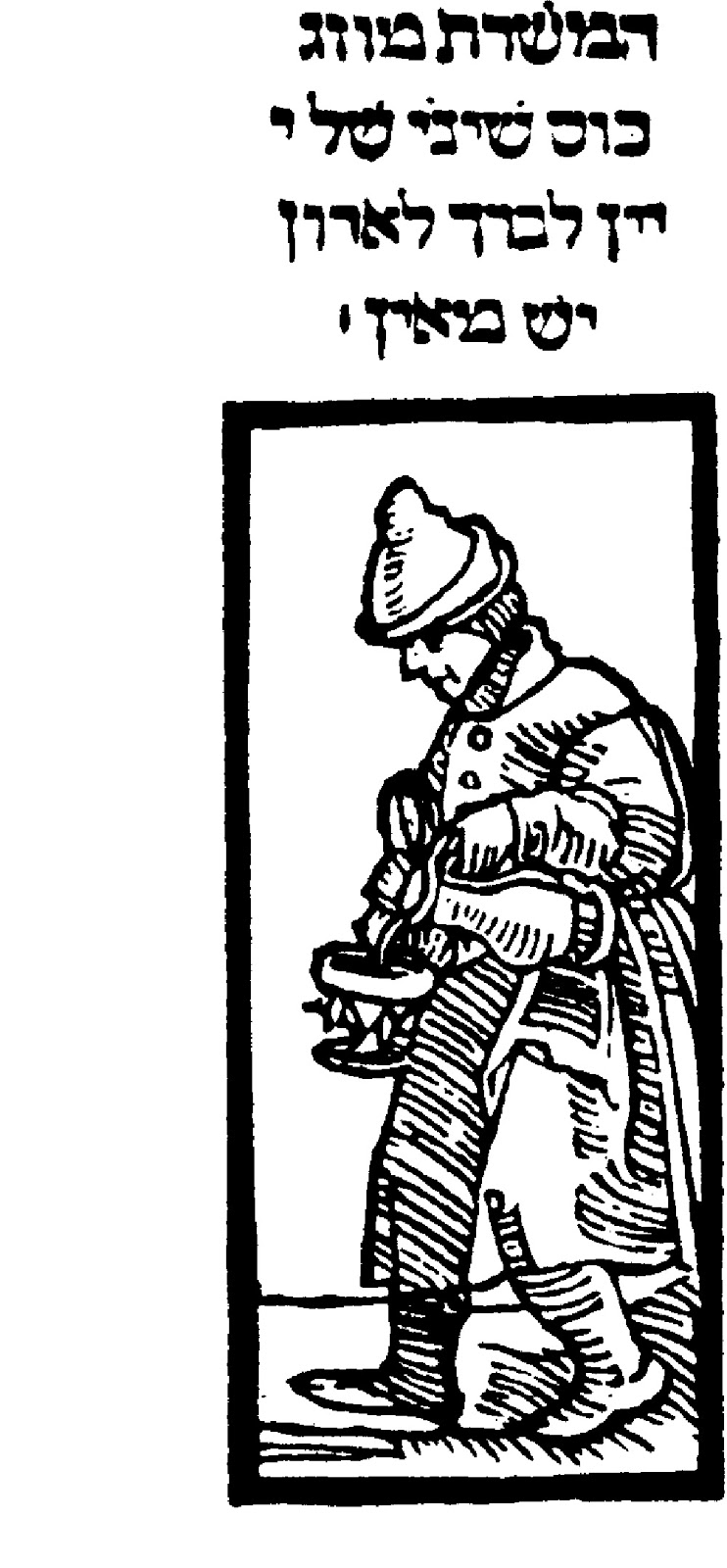
The volumes Shomrei Mishmeret ha-Kodesh, by R. Natan Raphael Auerbach, have just appeared. Here is the cover.

This book is devoted to the Auerbach family, which was one of the great rabbinic families in Germany. They were the “A” in what was known as the ABC rabbinic families (the others being Bamberger and Carlebach). Over 150 pages are devoted to R. Zvi Benjamin Auerbach, who was the most prominent of the Auerbach rabbis. He was also the publisher of Sefer ha-Eshkol, to which he added his commentary Nahal Eshkol. In a number of posts I dealt with Auerbach’s edition of Sefer Ha-Eshkol, and discussed how both academic scholars and traditional talmidei hakhamim have concluded that the work is a forgery.1 Readers who are interested in the details can examine the earlier posts. In this newly published volume, which was called to my attention by Eliezer Brodt, the author speaks briefly about the Sefer ha-Eshkol controversy and responds to those who, in his words, continue to defame a gadol be-Yisrael (p. 382):
הממשיכים לבזות גדול בישראל ולהכפישו באופן אישי

In the note the author refers to Moshe Samet, who earlier had dealt with Sefer ha-Eshkol, and also to one of my posts on the Seforim Blog. While Seforim Blog posts have been cited in English scholarly writings, as far as I know this is the first time that there has been citation in a Hebrew volume.

I understand why members of the Auerbach family might feel obliged to defend him. (Yet one of my college suitemates was a descendant of Auerbach, and it didn’t seem to trouble him when I told him about the controversy.) Why a respected rabbi would forge a book is not something I want to get into now. In the earlier post I assumed that he was schizophrenic, as when it comes to Sefer ha-Eshkol I can’t think of any ideological reason for his actions. (Samet, He-Hadash Assur min ha-Torah [Jerusalem, 2005], p. 152 n. 235, identifies as one of Auerbach’s motivations: מגמה אורתודוקסית).

As for the argument that since he was a leading rabbi we must therefore assume that he couldn’t have done such a thing, this is disproven by all  the recent examples of well-known rabbis who were involved in a variety of types of improper behavior. Before they were exposed, no one could ever have imagined what we learnt, and everyone would have been 100 percent sure that these rabbis could not possibly have been involved in such activities. This simply shows that that just because someone is a well-known rabbi we don’t have to automatically conclude that he is innocent no matter what the evidence says.

In many of the recent cases, at least the ones dealing with sexual abuse, the rabbis no doubt suffered from some sort of mental illness, as I can’t imagine that men who did so much to influence people positively and help them were complete frauds. I think that Auerbach must also have had some psychological issues, and this is actually the best limud zekhut. For once we assume this, it means that we don’t have to view the rest of his illustrious career and achievements as fraudulent. In short, he had a problem and it manifested itself in his forgeries. Yet I admit that I can’t prove my supposition, and at the end of the day we will probably never be able to explain definitively why Auerbach would forge the text any more than we can explain how another great figure, Erasmus, forged a patristic work and attributed it to Saint Cyprian.2 Anthony Grafton, who has written an entire book on the subject, sums up the matter as follows: “The desire to forge, in other words, can infect almost anyone: the learned as well as the ignorant, the honest person as well as the rogue.”3

Unfortunately, Shomrei Mishmeret ha-Kodesh does not seriously deal with any of the evidence that has led to the conclusion that we are dealing with a forgery. (For reasons I can’t get into now, I find it completely implausible that someone in medieval times forged the work and Auerbach was duped. But let me make one point: Auerbach claimed to be working from a very old manuscript, and yet this “manuscript” contains material from the 17th and 18th centuries.). Since the author mentions Sefer ha-Eshkol vol. 4, which was published in 1986 together with the Nahal Eshkol, I once again renew my call for this manuscript to be made public and for some explanation to be given as to where it comes from, since Auerbach’s many defenders were unaware of it. The fact that a portion of Auerbach’s manuscript (i.e. his copy of the supposed medieval manuscript) mysteriously surfaced so many decades after Auerbach’s death, and that we are told nothing about it or even shown a picture of it, certainly raises red flags. As I noted in one of my previous posts, the Nahal Eshkol published here has a reference to a book that only appeared after Auerbach died. This means that quite apart from Sefer ha-Eshkol, we also have to raise questions about whether the Nahal Eshkol published here is itself authentic. It could be that it is indeed genuine, and the reference to the later book is an interpolation, but that is why we have to see the manuscript. After all, if the manuscript is written in one hand, and it includes the reference to the later book, then there is no doubt that it too is a forgery. So let the evidence about Sefer ha-Eshkol vol. 4, together with the manuscript, be placed on the Seforim Blog for all to see. Perhaps then we can begin to understand the mystery of this volume.

As long as the topic has been brought up, let me call attention to Shulamit Elitzur’s new book, Lamah Tzamnu (Jerusalem, 2007). On p. 115 n. 2, she gives an example where the Sefer ha-Eshkol forgery was perpetrated by using a quotation from the Shibolei ha-Leket, and cites a comment in this regard from the noted scholar Simhah Emanuel. On p. 235 n. 3,8 she mentions another example of forgery in the Auerbach Sefer Ha-Eshkol. For further instance, see Israel Moshe Ta-Shma’s posthumously published Keneset Mehkarim, vol. 4 (Jerusalem, 2010), p. 183 n. 28.4 In an article in Atarah le-Hayyim (Jerusalem, 2000), p. 292, Neil Danzig also points to a non-authentic interpolation in Auerbach’s Sefer ha-Eshkol. Yet I am surprised to see that he follows Ta-Shma in thinking that R. Moses De Leon might have had something to do with this.

In terms of traditional Torah scholars, I came across a comment by R. Avigdor Nebenzahl in R. Yaakov Epstein’s recently published Hevel Nahalato, vol. 7, p. 157. (Epstein is the grandson of Prof. Jacob Nahum Epstein.5) Nebenzahl comes from a German Orthodox background, so one might expect him to come to the defense of Auerbach, as did a number of prominent German Orthodox figures. Yet that is not what we find. Epstein had cited a passage from Auerbach’s Sefer ha- Eshkol to which Nebenzahl added that it is well known that some question the authenticity of this edition and claim that it is a forgery. In case you are looking for any non-scholarly motivations for this comment, I should mention that Nebenzahl’s sister was Plia Albeck (died 2005), the daughter-in-law of Hanokh Albeck and a significant person in her own right. (She paved the way for most of the Jewish settlements in the West Bank.) Hanokh Albeck, together with his father, Shalom Albeck, published the authentic Sefer ha-Eshkol, and were both very involved in exposing Auerbach’s forgery. In other words, Nebenzahl’s comment shows that families stick together. (Just out of curiosity, does anyone know if there have been any marriages between the two important families, the Auerbachs and the Albecks?)

In a previous post, I mentioned R. Yehiel Avraham Zilber’s belief that the Auerbach Sefer ha-Eshkol is forged. To the sources I referred to, we can add Birur Halakhah, Orah Hayyim 75. Also, R. Yisrael Tuporovitz, who has written many volumes of Talmudic commentaries, is not shy about offering his opinion. Here is what he writes in Derekh Yisrael: Hullin (Bnei Brak, 1999), p. 8:

וכבר נודע שספר האשכול הנדפס עם ביאור נחל אשכול הוא מזוייף ואין לסמוך עליו כלל

He repeats this judgment on pages 38, 53 and 345.

In one of the earlier posts I mentioned that R. Yitzhak Ratsaby denies the authenticity of Auerbach’s edition. I also quoted from his letter to me. At the time,  I was unaware that portions of this letter also appear in his haskamah to R. Moshe Parzis’ Taharat Kelim (Bnei Brak, 2002). Another new source in this regard from Ratsaby is his Shulhan Arukh ha-Mekutzar (Bnei Brak, 2000), Yoreh Deah 138:3 (p. 287), where he accuses Auerbach of taking something from the Peri Hadash and placing it in Sefer ha-Eshkol

Ratsaby discussed the Sefer ha-Eshkol in his haskamah to Parzis’ book because the latter had called attention to the defense of Auerbach in Tzidkat ha-Tzaddik. Here is the title page of the latter work.

Among the defenders of Auerbach was R. Jacob Schorr of Kuty, Galicia. Schorr was a genius and is best known for his edition of the Sefer ha-Itim.6 He also wrote the responsa volume Divrei Yaakov (Kolomea, 1881), and a second volume, culled from various sources, both published and manuscript, appeared in 2006.  Here is his picture, taken from Aharon Sorasky’s Marbitzei Torah me-Olam ha-Hasidut, vol. 3, p. 11.

It is an unfortunate oversight that this incredible scholar does not have an entry in the Encyclopaedia Judaica. A list of all of his works can be found in the introduction to his Mavo al ha-Tosefta (Petrokov, 1930). This introduction also contains R. Zvi Ezekiel Michaelson’s biography of Schorr. As with everything written by this amazing bibliophile,7 one learns a great deal, not only about the subject he focuses on, but about all sorts of other things.8 Michaelson was killed in the Holocaust and numerous unpublished manuscripts of his were lost. His grandson was Prof. Moshe Shulvass, and a responsum is addressed to him in Michaelson’s Tirosh ve-Yitzhar, no. 158.

Schorr’s son was Dr. Alexander Schorr, who translated many classic Greek and Latin texts into Hebrew.9 Alexander Schorr’s grandson is the well-known Israeli film director, Renen Schorr.10

Since Prof. Leiman has just written about the Maharal, it is worth noting that Schorr tells an incredibly far-fetched story, which he actually believed, about the Maharal and Emperor Rudolph. According to the tale, Rudolph’s biological father was a Jewish man. What happened was that Rudolph’s mother, the queen, could not have children with the Emperor. She therefore asked a Jewish man to impregnate her or else she would unleash persecution on the Jews in the kingdom. Upon hearing this, the beit din gave the man permission to accede to her wishes. I don’t want to repeat any more of this nonsensical story, but those who are interested can find it in R. Abraham Michaelson’s Shemen ha-Tov (Petrokov, 1905), pp. 60a-b. (R. Abraham was R. Zvi Ezekiel’s son.)

Returning to Schorr, one of the most astounding examples of self-confidence—others will no doubt call it arrogance or foolishness—ever stated by a rabbi (in print, at least) was penned by him. In his Meir Einei Hakhamim, reprinted in Kitvei ve-Hiddushei ha-Gaon Rabbi Yaakov Schorr (Bnei Brak, 1991), p. 177, we find the following:

ואני מעיד עלי שמים וארץ כי לא היה ולא יקום עוד אחרי שום חכם אשר יהי’ בקי בטוב [!] בפלפול תנאים ואמוראים כמותי

This text is often quoted by R. Yaakov Hayyim Sofer in his various works.11 This is not the only time Schorr expressed himself this way. On page 129 he writes
ודע דהופיע רוח הקודש בבית מדרשי

(This expression can also be found in other books, and originates in Rabad’s hassagah to Hilkhot Lulav 8:5. But to see this type of language in a sefer written by a someone very young [see below], even a genius like Schorr, is a bit jarring.) Sofer, Shem Betzalel, p. 28, also points to Meir Einei Hakhamim, p. 209, where Schorr writes about one of his ideas:

וזה נכון יותר מפירוש רש”י

(On this page, Schorr alludes to R Zvi Hirsch Chajes, referring to him as אחד מחכמי הזמן. Sofer claims that Schorr’s general practice is to not mention Chajes by name. Sofer wants the reader to think that he doesn’t know why Schorr acts this way. Yet the reason is obvious, and Sofer himself certainly knows that some talmudists were not fans of Chajes.)

Perhaps we can attribute Schorr’s over-the-top comments to his own immaturity. After all, as Sofer, Shem Betzalel, p. 29, points out, Schorr began writing the book  I am quoting from at age thirteen, and completed it by the time he was sixteen. A genius he certainly was, yet I think we should assume that his excessive comments were the product of youthful exuberance. Sofer sees Schorr’s youthfulness as also responsible for the very harsh way he criticizes the writings of various gedolim, which is something that is more understandable, and forgivable, in a teenager than in a mature scholar. I think all writers are embarrassed of things their penned in their youth, and that is to be expected.12 An example I often mention in this regard (when not referring to myself) is Hirsch’s harsh criticism of Maimonides. This appeared in Hirsch’s first book, the Nineteen Letters, published when he was 28 years old. Never again in Hirsch’s many writings does he ever express himself this way. My assumption is that he regretted what he wrote, and in his mature years he would not have used such strong language. Similarly, I wonder if in his mature years R. Soloveitchik would have commented to R. Weinberg—as he did in his twenties—that his grandfather had a greater understanding than even the Vilna Gaon. (I have printed Weinberg’s letter where this appears in a few different places, most recently on the Seforim Blog and in the Hebrew section to my Studies in Maimonides.)

In terms of young achievers in the Lithuanian Torah world, I wonder how many have ever heard of R. Meir Shafit. He lived in the nineteenth century and wrote a commentary on the Jerusalem Talmud, when not many were studying it. Here is the title page of one of the volumes, where it tells us that he became rav of a community at the age of fifteen. 

The Hazon Ish once remarked that the young Rabbi Shafit would mischievously throw pillows at his gabbaim!13

Returning to Schorr and Sefer ha-Eshkol, Ratsaby is not impressed by Schorr’s defense. He notes that in R. Yaakov Hayyim Sofer’s Torat Yaakov, Sofer states that the ideas of Schorr “צריכים בדיקה.”

I found the comment in Torat Yaakov (2002 edition) p. 880. Here Sofer claims that despite his brilliance, Schorr often puts forth unsustainable suppositions, and he calls attention to R. Reuven Margaliot, Ha-Mikra ve-ha-Mesorah, ch. 12. Here Margaliot cites a suggestion by Schorr that the text of Kiddushin 30a should be emended because the vav of גחון is not the middle letter of the Torah. Schorr further states that the editor of Masekhet Sofrim was misled by the error in the Talmud. The implication of Schorr’s comment is that all of our sifrei Torah are mistaken, for they mark this letter as special. Margaliot responds:
ותמה אני על תלמיד חכם מובהק כמוהו איך הרשה לעצמו לחשוב על מסדר מסכת סופרים שהוא טועה ומטעה וגם בודה מלבו מנהגים בכתיבת ס”ת. ב”הגהות” כאלו יכולים לעשות כל מה שרוצים, וכאשר כתב הגר”א [אליהו] פוסק בפסקי אליהו שם: רעדה אחזתני לעשות טעות כזה בגמרא ולחשוב על כל הס”ת שגיונות בדקדוקים דו’ דגחון ודרש דרש.

With regard to Ratsaby, I should also note that his dispute with R. Ovadiah Yosef continues unabated. In his recent Ner Yom Tov (Bnei Brak, 2008), pp. 20-21, he goes so far as to accuse R. Ovadiah of plagiarism.
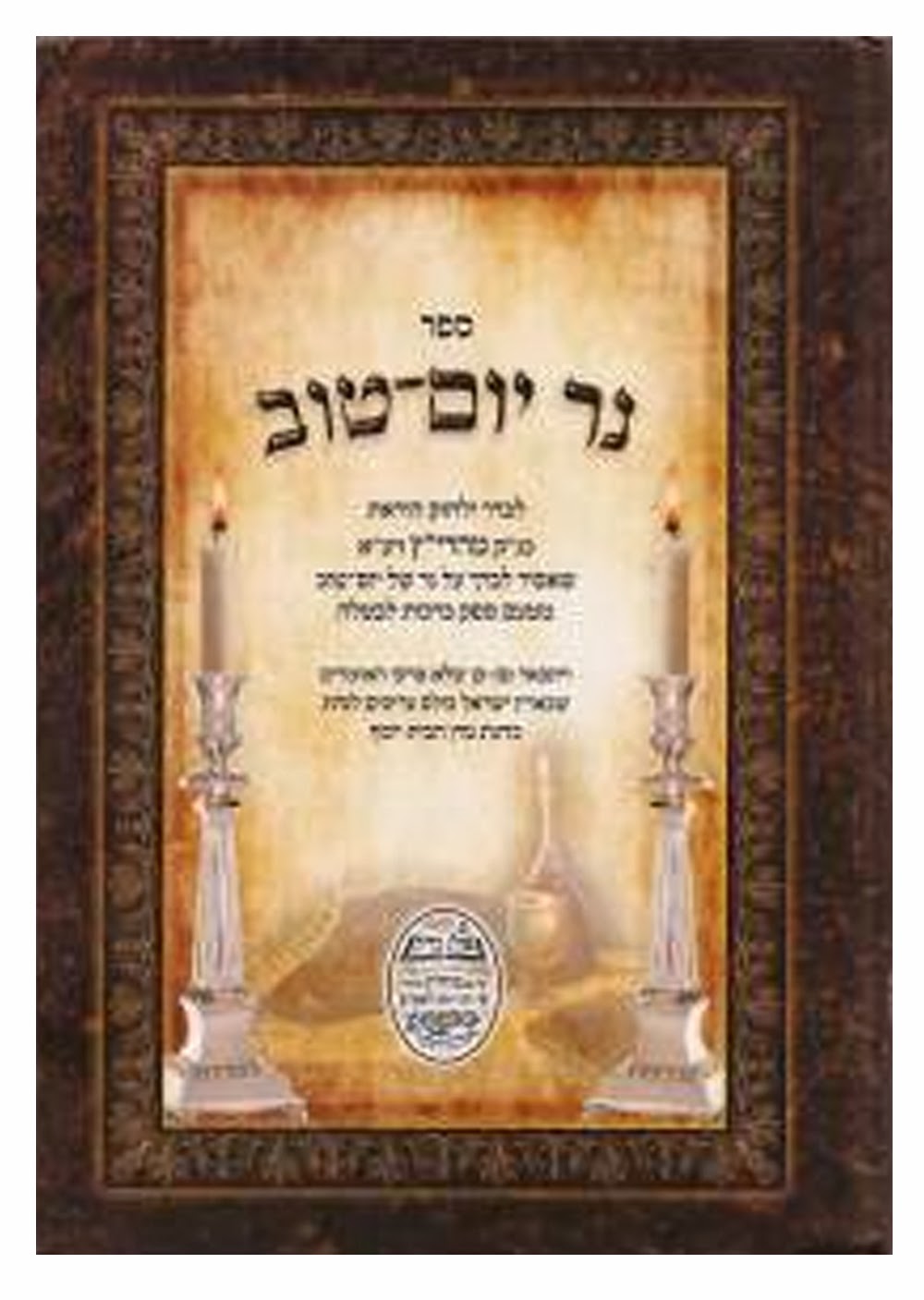
He also states, with regard to R. Ovadiah (p. 100):

 שכבוד התורה אצלו, הוא רק למי שמסכים לדבריו

Ratsaby’s book was written to defend the Yemenite practice of not making a blessing on Yom Tov candles against the criticism of R. Ovadiah. He also deals with R. Ovadiah’s larger point that the Yemenites must embrace the Shulhan Arukh’s rulings now that they are in the Land of Israel. The entire Yemenite rabbinate agrees with Ratsaby’s position, but upon seeing how he attacked R. Ovadiah, the condemnation of him from other Yemenite rabbis was swift. All I can say in defense of Ratsaby is that R. Ovadiah has been criticizing him in a less than respectful way for some time now. But in a sense, Ratsaby got what was coming to him, because for many years he has been writing very disrespectfully about R. Kafih.

In this new book, p. 98, Ratsaby goes so far as to repeat the legend that when Kafih was appointed a dayan in Jerusalem he swore to R. Ovadiah that he accepted the Zohar, and Ratsaby claims that Kafih swore falsely. Kafih, however, denied that he ever took such an oath.14 For a long time Ratsaby has been proclaiming that it forbidden to use Kafih’s books, as he is a member of the kat, i.e., the Dardaim who don’t accept the Zohar or Kabbalah in general. Yet R. Ovadiah has declared that the Dardaim are not to be regarded as heretics.15 This is in contrast to R. Chaim Kanievsky who holds that the Dardaim are heretics who cannot be counted in a minyan.16  R. David Teherani states that since the Dardaim reject the Zohar, their wine is yein nesekh.17 According to Aaron Abadi, R. Shlomo Zalman Auerbach also ruled that rejection of the Zohar and Kabbalah is heresy.18

I can understand those who assert that one must believe that the Zohar was written by Rashbi or at the very least that it was written be-ruah ha-kodesh, and if you deny this it is heresy. Yet what is one to make of the following statement, which greatly enlarges the realm of heresy (R. Menasheh Klein, Mishneh Halakhot, vol. 7, no. 160):
ואם הוא אינו מאמין שהמ”ב [משנה ברורה] נכתב ברוה”ק אזי הוא בכלל אפיקורוס וכופר בתורת ה’ . . . יש בזמן הזה שאין מאמינים שגם בדורינו אנו ישנם חכמי הזמן שיש להם רוה”ק . . . ומי שלא מאמין בזה הרי הוא אפיקורוס וכופר בלי ספק.

Based on this definition, I think the entire Lithuanian rabbinate until World War II would be regarded as heretics. Would such a statement even have been imaginable before twenty years ago? It is, of course, no secret that the Lithuanian rabbinate has been transformed along hasidic lines. This change is undeniable and I can point to many examples of this. Here is one (which was sent to me by R. Yitzhak Hershkowitz).

Would any Jew in Lithuania ever fall for such a thing as magic (or holy) wine? Anyone who tried to peddle this stuff would have been thrown out of the beit midrash. I was actually told an anti-hasidic joke with regard to this picture. I ask all Hasidim not to be offended as neither I nor the management endorse the joke. Yet it deserves to be recorded for posterity, for as we all know, jokes are simply jokes, but the history of jokes (even bad ones), well that is scholarship. The joke goes as follows: “It is incredbible. We now see great Lithuanian Torah scholars doing things that until now only hasidic rebbes did. But even more incredible would be to see the reverse, that is, to see hasidic rebbes write seforim on Shas and poskim.”

With regard to the Zohar, I must mention an amazing point called to my attention by David Zilberberg, from which we see that R. Joseph B. Soloveitchik did not believe that R. Simeon bar Yohai wrote the Zohar, or at least that he didn’t write all of it. I always assumed as much, but as far as I know there was never any proof, until now. In The Lord is Righteous in All His Ways, pp. 206-207, the Rav discusses the Western Wall and says that there is no mention of it in Chazal and very little mention in rishonim. The Wall is mentioned in Shir ha-Shirim Rabbah 2:2219, where it states that the Kotel will never be destroyed, but the Rav says about this Midrash:

I will tell you frankly that I am always suspicious about this midrash, because the classical sources, the Bavli and the Yerushalmi, do not mention the Kotel ha-Ma’aravi. The midrash cited earlier is, perhaps, a later insert. Apparently, Rabbi El’azar ha-Kalir knew the midrash. To my mind, this kinah of Rabbi Elazar ha-Kalir is one of the earliest documents to mention the Kotel ha-Ma’aravi.

Earlier in this book the Rav tells us when Kalir lived:

I do not know why historians have to explore when Kalir lived when he himself states that nine hundred years have passed and the Messiah has not yet arrived. It means that Kalir lived in the tenth century.

Yet as Zilberberg correctly points out, the Western Wall is seen as quite significant in the Zohar (II, 5b), and is referred to as Rosh Amanah.20 The Rav knew the Zohar very well, and therefore, when he tells us that Chazal do not mention the Western Wall, and it is only during the time of the rishonim that we begin to see references to it, he is also telling us that the Zohar (or at least this section of the Zohar) was written in the days of the rishonim.

Returning to Auerbach, let me add in conclusion that he is not the only great rabbi and Torah scholar who was involved in forgery. An earlier case is R. Benjamin Ze’ev of Arta (sixteenth century), author of the well known responsa volume Teshuvot Binyamin Zeev. Here is the title page from the first edition (Venice, 1539):

In the midst of a dispute he was involved in, he forged the signature of the Venetian rabbi, R. Baruch Bendit Axelrad, placing it on a document that supported himself. He also forged an entire letter in R. Baruch Bendit’s name. When all this was discovered, it helped lead to R. Benjamin’s downfall.21

Quite apart from the forgery, R. Solomon Luria, Yam Shel Shlomo, Bava Kamma, ch. 8 no. 72, also accuses R. Benjamin Zev of plagiarism. Here are some his words: 
כל דבריו גנובים וארוכים בפלפול שאינו לצורך וכנגד פנים מראה אחור . . . ושרי לי מרי אם הוא צדיק למה הביא הקב”ה תקלה על ידו הלא הוא היה הכותב ונתן לדפוס הספר מידו ומפיו.
One big question that needs to be considered is how far removed is forgery from false attribution? When it comes to false attribution there is a long rabbinic tradition supporting it, and in the book I am currently working on I deal with this in great detail. If you can falsely attribute a position to a sage, perhaps you can forge a document in his name as well (assuming it is not done for personal gain). Could that be what was driving Auerbach?
*        *        *

A few people have sent me a question about my Monday night Torah in Motion classes, so I assume that there are others who have the question as well. Here is the answer: If you cannot be with us at 9PM and you are signed up, the classes are sent to you so that you can watch or listen at your convenience. This is much cheaper than downloading the classes individually.

Notes

1 From my post here you can find all the links.
2 See Anthony Grafton, Forgers and Critics: Creativity and Duplicity in Western Scholarship (Princeton, 1990), pp. 44-45.
3 Ibid., p. 48.
4 As has been noted by many, Auerbach’s edition of Sefer Ha-Eshkol has misled countless talmidei hakhamim. There is another way in which Auerbach misled a scholar, but in this case it was accidental. In the introduction to his edition, p. xv note 9, Auerbach reports in the name of a supposedly reliable person that the Yerushalmi Kodashim was to be found in the Vatican library. This false report led R. Mordechai Farhand to travel there from Hungary in search of this treasure, and he describes his journey. See Farhand, Beer Mordechai (Galanta, 1927), pp. 154ff. Farhand was a gullible fellow. See ibid. p. 152, where even though it had been a number of years since Friedlaender’s Yerushalmi forgery had been established, he didn’t want to take sides. The legend that there was a copy of the Yerushalmi Kodashim in the Vatican had been disproven already in the nineteenth century. See R. Baruch Oberlander in Or Yisrael (Tamuz 5761),  p. 220.
5 In his review of my edition of Kitvei ha-Rav Weinberg, vol. 2, R. Neriah Guttel, Ha-Maayan (Nisan 5764), pp. 82-83, writes that it was improper for me to publish Weinberg’ judgment of Epstein (p. 430). Although they were friends, and Weinberg thought that Epstein was a great scholar, he also pointed out that that Epstein wasn’t a lamdan. What Weinberg meant is that Epstein wasn’t a traditional talmid hakham but an academic Talmudic researcher. As such, while his publications had great value, in Weinberg’s eyes they didn’t get to the heart of what Talmudic scholarship should be about. In Weinberg’s words:
סוכ”ס אפשטיין אינו למדן, ואיננו אלא פילולוג בעל חוש חד. בלא לומדות אי אפשר לחקור לא את המשנה ולא התלמוד.
Statements like these are vital for evaluating Weinberg’s approach to academic scholarship, and I never would dream of censoring such things.
6 In his Shaar Yaakov (Petrokov, 1922), no. 16, there is a responsum to “Abraham Joshua Heschel.” Shmuel Glick, Kuntres ha-Teshuvot he-Hadash, vol. 3, s.v. Shaar Yaakov, assumes that this is the famous A. J. Heschel, but I don’t think we can conclude this based only on the name, which was shared by a number of others.
7 Eleh Ezkerah (New York, 1957), vol. 2, p. 196 (repeated in the Encylopaedia Judaica entry on Michaelson), states that in Michaelson’s Degan Shamayim (Petrokov, 1901), there are responsa written when he was twelve and thirteen years old. This is a mistake. The earliest responsa dates from when he was seventeen years old. See pp. 10a, 11a.
8 On p. 23 he prints a letter that Schorr wrote to Michaelson’s son, who wanted to translate the Sefer ha-Hinukh into Yiddish. Schorr was strongly opposed to this. He explained as follows, using words that won’t make the women very happy:
רבינו הרמב”ם והחינוך אחריו שהודיעו ברבים טעמי מצות וכו’ יכשלו בזה קלי הדעת לבטל המצוה כפי סכלות דעתם אשר לפי הטעם אין לחוש עוד בזמנינו וכיוצא שבטל בהם טעם זה וכו’ איך ניתן לגלות טעמי מצות גם בפני נשים ועמי הארץ אשר יקראו בו, חלילה לרו”מ לעבור על לפני עור.
9 See here
10 See here
11 Sofer often refers to a similar type of comment by R. Shlomo Kluger, Ha-Elef Lekha Shlomo, Orah Hayyim 367:
אם הייתי זוכר כל מה שכתבתי מעולם לא הי’ שום הערה בעולם שלא הרגשתי בזה.
(I cited both Schorr and Kluger in a footnote in my article on the Hatam Sofer in Beerot Yitzhak: Studies in Memory of Isadore Twersky. Although other writers also cite this comment of Kluger, as with much else, I believe that I first saw the reference in one of Sofer’s writings.) Kluger wrote so many thousands of responsa, that it is not uncommon for him to contradict himself and forget what he wrote previously. See R. Yehudah Leib Maimon, ed., Sefer ha-Gra (Jerusalem, 1954), p. 99 in the note. R. Solomon Schreiber, Hut ha-Meshulash (Tel Aviv, 1963), p. 19, claims that R. Nathan Adler’s reason for not recording his Torah teachings was due to a belief that the permission to put the Oral Law into writing only applies if one is not able to remember this information. Since, according to Schreiber, R. Nathan claimed that he never forgot any Torah knowledge, he was not permitted to take advantage of this heter.
12 Regarding Schorr being a childhood genius, this letter from him to R. Shlomo Kluger appeared in Moriah, Av 5767. 

As you can see, the letter was written in 1860 (although I can’t make out what the handwriting says after תר”ך). We are informed, correctly, that Schorr was born in 1853, which would mean that he was seven years old when he wrote the letter. This, I believe, would make him the greatest child genius in Jewish history, as I don’t think the Vilna Gaon could even write like this at age seven. Furthermore, if you read the letter you see that two years prior to this Schorr had also written to Kluger. Are there any other examples of a five-year-old writing Torah letters to one of the gedolei ha-dor? Furthermore, from the letter we see that the seven-year-old Schorr was also the rav of the town of Mariompol! (The Mariompol in Galicia, not Lithuania.) I would have thought that this merited some mention by the person publishing this letter. After all, Schorr would be the only seven-year-old communal rav in history, and this letter would be the only evidence that he ever served as rav in this town. But the man who published this document and the editor of the journal are entirely oblivious to what must be one of the most fascinating letters in all of Jewish history. Yet all this assumes that the letter was actually written by Schorr. Once again we must thank R. Yaakov Hayyim Sofer for setting the record straight. In his recently published Shuvi ha-Shulamit (Jerusalem, 2009), vol. 7, p. 101, he calls attention to the error and points out, citing Wunder, Meorei Galicia, that the rav of Mariampol was another man entirely, who was also named Jacob Schorr.
13 A. Horowitz, Orhot Rabbenu (Bnei Brak, 1991), vol. 1, p. 364.
14 See Avivit Levi, Holekh Tamim (Jerusalem, 2003), p. 133 n. 161.
15 See R. Yosef Pinhasi, Yefeh Toar, p. 116.
16 See his response in Mordechai Alemkayas, Va-Yikhtov Mordechai (Jerusalem, 2009), p. 340.
17 Yayin le-Nesekh (Betar Ilit, 1996), p. 70.
18 See here.  According to Abadi, R. Shlomo Zalman’s decision was made with regard to a well-known scholar who is very involved with Artscroll.
19 The Rav doesn’t note that there is a mention of the Wall in Shemot Rabbah 2:2 as well, but his judgment would no doubt be the same. Contrary to the Rav, since these midrashim are found in so many parallel sources, I don’t think there is any question that they indeed originate with Chazal.
20 See Pinchas Giller, Reading the Zohar (Oxford, 2001), pp. 12-13.
21 The event is described in Meir Benayahu, Mavo le-Sefer Binyamin Zeev (Jerusalem, 1989),  pp. 120ff. Once the dispute got going, all sorts things were said. R. Benjamin was even accused of purchasing his semikhah. See ibid., p.140. The source for this is R. Elijah ha-Levi,  Zekan Aharon (Constantinople, 1534), no. 184.


The 1526 Prague Haggadah and its Illustrations

The 1526 Prague Haggadah and its Illustrations
By ELIEZER BRODT

This piece was originally printed in Ami Magazine’s Kunteres 9 Nisan 5777 – April 5, 2017

The topic perhaps most written about in Jewish literature is the Haggadah shel Pesach. There are many kinds in many languages and with all kinds of pirushim and pictures. Whatever style one can think of, not one but many Haggados have been written—be it on derush, kabbalah, halachah, mussar or chassidus. There are people who specialize in collecting Haggados, even though they don’t regularly collect sefarim. In every Jewish house today one can find many kinds of Haggados. Over the years, various bibliographers collected and listed the various Haggados. In 1997, Yitzchak Yudolov printed The Haggadah Thesaurus, which contains an extensive bibliography of Haggados from the beginning of printing until 1960. The final number in his bibliography listing is 4,715! Of course, many more have been printed since 1960. New Haggados are printed every single year. Even people who never wrote chiddushim on the Haggadah have had one published under their name based on their collected writings. When one goes to the sefarim store before Pesach, it has become the custom to buy at least one, although it is very easy to become overwhelmed, not knowing which to pick.
The one I would like to focus on in this article was printed in Prague in 1526.[1] The Prague  edition of the Haggadah is considered by experts to be one of the most important illustrated Haggados ever published. It is perhaps the earliest printed[2] illustrated Haggadah for a Jewish audience, and it served as a model for many subsequent illustrated Haggados. Some insist that it is the greatest single Haggadah ever printed. “Certainly it is one of the chief glories in the annals of Hebrew printing as a whole and for that matter in the history of typography in any language.”[3] Printing came to Prague in 1487 (around 40 years after its invention), and the first Hebrew book was printed there in 1518. The Prague 1526 edition was published by the brothers Gershom (Cohen) and Gronom Katz on Sunday, 26 Teves 5287 or December 30, 1526.[4]
This Haggadah contains many of the halachos of the Seder beginning with bedikas chametz, a collection of pirushim on various parts of the Haggadah, and 60 illustrations made from woodcuts. However, we do not know who authored these halachos and divrei Torah (which are full of interesting ideas). The halachos written here are very significant, as they were written and printed before the Shulchan Aruch. The illustrations are also significant, as they had a tremendous impact on the illustrated Haggados printed afterward.
I would like to discuss some of the interesting things we can learn about the Seder and Haggadah via this Haggadah and some of its illustrations.
The first general question is why they chose to illustrate the Haggadah. Who was their intended audience? Various people who studied this Haggadah have debated this issue,[5] but to me it’s pretty clear that it had to do with one of the most important parts of the Seder night—the special audience—the children. This was a tool to help enable us to fulfil the important obligation of v’higadeta l’vincha. Last year, in an article in this magazine, I outlined many customs done during the Seder with the underlying theme to get the children “into” the Seder. One of the best ways to get kids “into” it is via visual aids, showing them pictures or acting out certain things.  Simply reciting the Haggadah and just saying “some Torah” is not as effective. It would seem to me that this was their intention when they illustrated the Haggadah. It could be that some of the pictures were to lighten it up for the adults too, as I will soon explain.
The significance of this point is that Rav Shlomo Zalman Auerbach, zt”l, raises possible issues with looking at illustrated Haggados on Pesach based on the halachos in the Shulchan Aruch (307:15) dealing with reading captions of images on Shabbos.[6]
If we are correct that the purpose is to educate the children, it might be a possible reason to permit looking at these images. To be sure, some of the Haggados with images were printed with the involvement of great gedolim, such as the illustrated 1590 Prague Haggadah, which had a kitzur of the Zevach Pesach of the Abarbanel written by Rav Yitzchak Chayis (1538-1610).
Just to emphasize the significance of visual aids when learning, in a haskamah for a work about shechitah that was written but never printed, the Aderes stresses the benefit of the numerous diagrams and illustrations of animals in the book for the understanding of the various complex halachos of shechitah.[7]
Similarly, Rav Belsky dissected an animal on video to give a visual aid for those learning Maseches Chulin. It is also related that when the Minsker Gadol, Rav Yerucham Perlman, zt”l (1835-1896), first became rav he made it his business to go to the head shochet of the city to learn all the aspects of animals for the laws of treifos and the like. The shochet asked him how he could possibly teach the rav anything. The Minsker Gadol replied, “It’s one thing to learn the halachos in sefarim, but when it comes to psak halachah one needs to know the exact aspects as they are on the actual animal.[8]
Additionally, there is a great benefit for us to analyze the pictures nowadays, as it can give us a glimpse into how they conducted the Seder in those days.
Halachos
One of the first parts of the Seder is the eating of karpas. Nowadays, for the most part, the custom is for the children to say, “We wash our hands, but we don’t say the brachah for this washing.” In the instructions to the Prague Hagadah it says to say the brachah for washing.[9] In fact, there are a number of Rishonim who say that one should say the brachah of al netilas yadayim.
Who pours the wine?
After saying Ha Lachma Anya the cups of wine are refilled. There is a picture of someone refilling the wine with a caption stating that the servant should refill the wine. The Rama in Darchei Moshe says that the person who is conducting the Seder should not fill the cups of wine; rather, someone else should do it for him.[10] This would appear to be an earlier writter source with the same idea.[11] Interestingly enough, the Aruch Hashulchan writes that we do not do this. The leader can pour the wine for himself, and there is no reason that his wife should have to pour for him.[12] Rav Yitzchak Chayis writes in Siach Yitzchak—which is a halachic work about the Seder night first printed in Prague in 1587—that one should train his six or seven-year-old child to do this mitzvah.[13] Perhaps another minhag related to this statement of the Rama is that the one leading the Seder does not get up to wash his hands; rather, the water is brought to him.[14]
Pouring out the wine for the Ten Makkos
 
After saying Ha Lachma Anya the cups of wine are refilled. There is a picture of someone refilling the wine with a caption stating that the servant should refill the wine. The Rama in Darchei Moshe says that the person who is conducting the Seder should not fill the cups of wine; rather, someone else should do it for him.[10] This would appear to be an earlier writter source with the same idea.[11] Interestingly enough, the Aruch Hashulchan writes that we do not do this. The leader can pour the wine for himself, and there is no reason that his wife should have to pour for him.[12] Rav Yitzchak Chayis writes in Siach Yitzchak—which is a halachic work about the Seder night first printed in Prague in 1587—that one should train his six or seven-year-old child to do this mitzvah.[13] Perhaps another minhag related to this statement of the Rama is that the one leading the Seder does not get up to wash his hands; rather, the water is brought to him.[14]
Another minhag found in this Haggadah is the famous custom of dipping the fingers into the wine when saying the Ten Makkos. In this section of the Haggadah there is an illustration of someone dipping his finger into his cup and there is also a caption under the picture stating that some dip with the pinky, followed by a reason for this custom.[15]
The earliest known source for this minhag can be found in a drashah of the Rokei’ach, recently printed from a manuscript by Professor Simcha Emanuel.[16] But this source speaks about dipping the index finger. The Rama also writes to dip the index finger. Interestingly, the Magen Avraham says to dip with the kemitzah, which is the ring finger.
Walking with a sack on the back
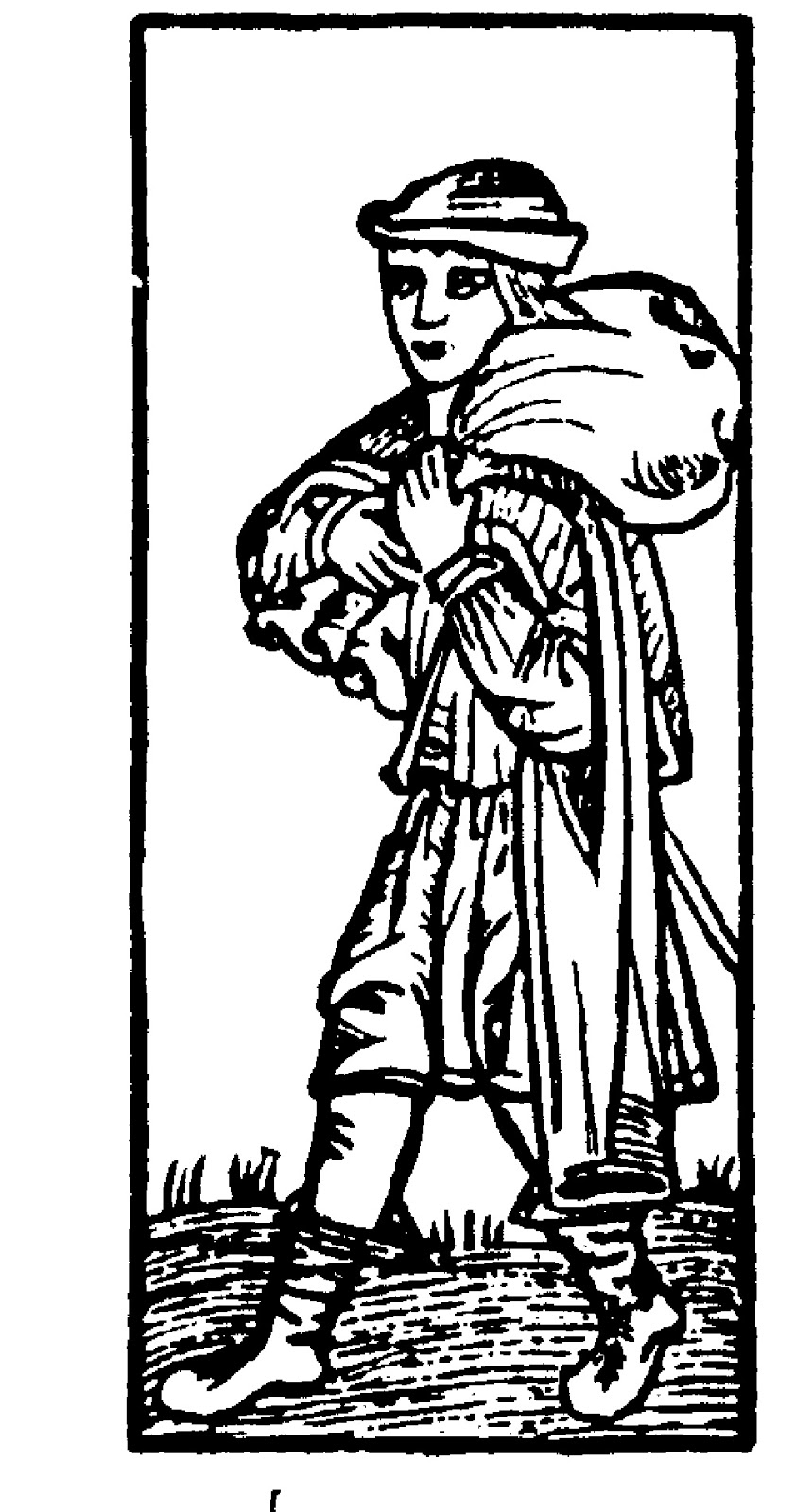
There a few places in the Haggadah, such as near the paragraph of B’chol dor vador, where we find an illustration of someone walking with a sack (of matzah) on his back. The source for this can be found in some of the Rishonim and early Acharonim. After mentioning breaking the matzah in their description of Yachatz they add that the leader of the Seder puts it on his shoulders and walks with it for a bit; others do this only later on when they eat the afikoman.[17]
Eliyahu Hanavi coming to the Seder
I traced the sources for this in a previous article in Ami Magazine. When discussing the sources for this, Rabbi Sperber notes[18] that in a few of the illustrated Haggados there are pictures of a man on a donkey near Shefoch Chamascha. In some of them he is being led by someone else; for example, in the Prague Haggadah of 1526.
I also noted that Rabbi Yuzpeh Shamash writes that mazikin run away from any place where Eliyahu’s name is mentioned. He says that because of this some make a picture of Eliyahu and Moshiach for the children, so that the children seeing it will say “Eliyahu,” causing the mazikin to disappear.[19] This could indicate that the illustrations were shown specifically to the children, as I claimed earlier.
Nusach of the Haggadah
The actual nusach of the Haggadah is its own large topic, starting from the Gemara and moving onward to manuscripts and discussions among the poskim. In the beginning of the Haggadah we begin with the famous Aramaic passage of Ha Lachma Anya. Much has been written about different aspects of this passage. One aspect is whether the exact nusach should be Ha Lachma Anya or K’ha Lachma Anya. The Rama quotes Rav Avraham of Prague, who says to specifically say Ha Lachma Anya and not K’ha Lachma Anya. The Maharal says the same. We see that two great sages from the city of Prague paskened that we should say Ha Lachma Anya.
Who was this Rav Avraham of Prague quoted by the Rama?
Rav Dovid Ganz (a talmid of the Maharal) writes in his historical work Tzemach Dovid that he was the rosh yeshivah and av beis din of Prague in the 1520s. He also authored some notes to the Tur, which were printed by Gershom (Cohen) Katz in Prague in 1540.[20] Thus, it is interesting that in the Haggadah the nusach was different from that of the av beis din of the city. Interestingly enough, his sons printed two more Haggados (1556 and 1590) in Prague and there too the nusach is different from that of Rav Avraham. Ultimately, the Magen Avraham concludes that whichever nusach one says is fine.[21]
What to use for maror
Another interesting picture is of the maror. In two places in the Haggadah the illustration used for maror is that of a lettuce—chasah. This is chazeret, which is the first of the five types enumerated in the Mishnah that one can use for maror.
There is a famous teshuvah from the Chacham Tzvi where he writes at length that this is the ideal item to be used for maror, as it’s the first in the list of the Mishnah.[22] We also find that the Netziv wrote a letter to his son, Rabbi Chaim Berlin, urging him to use it for maror instead of sharper vegetables, especially after fasting and drinking wine.[23] There are also numerous earlier illustrated manuscripts that show pictures of lettuce for the maror.[24]
More on maror
Speaking of maror, the inscription next to the picture is of great interest. It says, “There is a custom when saying maror that the man points to his wife, as it says ‘An evil wife is worse than death.’” Much has been written about this illustration. Some have written that it is ridiculous and there cannot be such a custom. On the other hand, Rabbi Wengrov and, more recently, Rabbi Yisroel Peles,[25] have demonstrated that there are pictures of a man pointing to his wife near the paragraph of maror in various illustrated Haggadah manuscripts. It is clear, however, as Rabbi Wengrov writes, that this was done in a joking manner to lighten up the Seder, but it isn’t serious, chas v’shalom. Rabbi Wengrov demonstrates that other pictures found in these Haggados show that the authors had a sense of humor and drew certain illustrations to lighten up the mood.[26]
Explanation via illustration
 
 
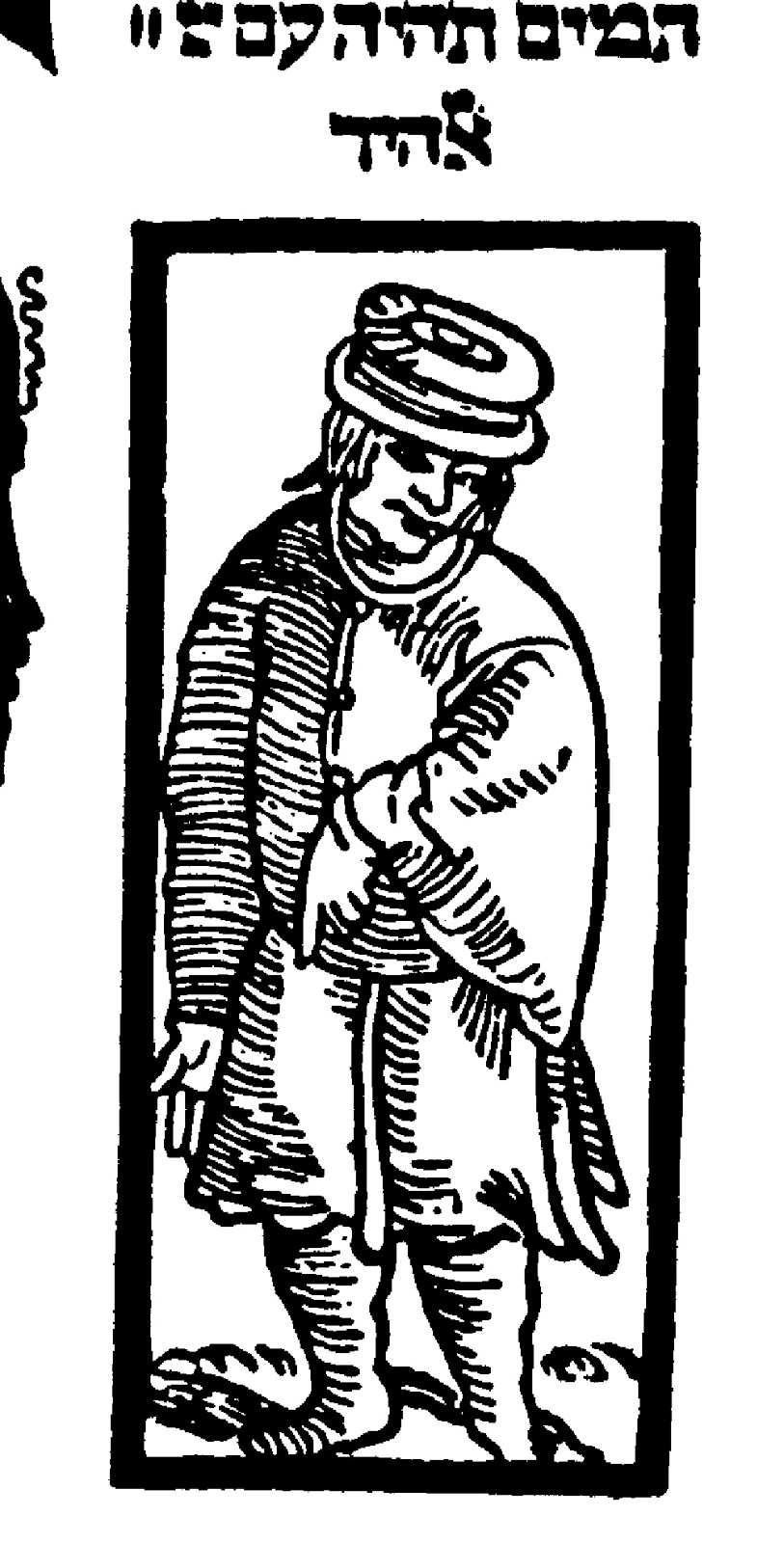
Some of the pictures in the Haggadah are to explain a particular passage. One such example is the image of the four sons. The tam is often translated as a derogatory term—the foolish son. However, the caption above the picture says, “Tamim tihyeh im Hashem” – always be complete with Hashem, which means that they understood the tam to be a man of piety.[27]
Omission
At the end of the Haggadah we conclude the Seder with a few songs, such as Echad Mi Yodei’a[28] and Chad Gadya. The authors and earliest sources for reciting them are unknown.[29] Rabbi Shemaryah Adler suggests that Chad Gadya may have been written by Daniel.[30] Rabbi Yedidyah Tiyah Weil writes in Marbeh L’sapeir on the Haggadah that he heard that these two songs were found in a manuscript from the beis midrash of Rav Elazar Rokei’ach. Numerous pirushim have been written about Chad Gadya, based on all the methods of learning Torah.[31] Be that as it may, many have noted that they are not found in this Haggadah. The first time they appear in print are in the Haggadah printed in Prague in 1590.
Another notable omission is the stealing of the afikoman. I wrote in the past in this magazine that one of the earliest sources in print can be found in the Siach Yitzchak, which mentions stealing the afikoman, but not in the same way as we do it nowadays.[32] It would seem that since no mention of it is made in the instructions of the 1526 Haggadah that it was not yet a widespread custom at that time.
Kiddush and Hunting
 

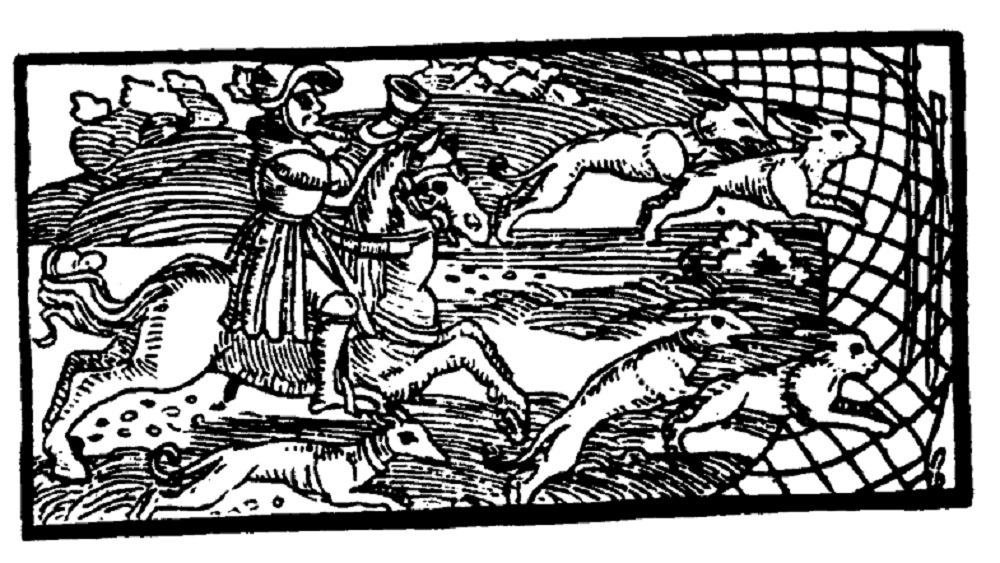
In the beginning of the Haggadah, on the bottom of the page of Kiddush, we find a mysterious picture of someone hunting hares with a horn and dogs. This picture can also be found in a bentcher printed by the Katz brothers in Prague a few years earlier. The question is obvious: What in the world does this have to do with Kiddush, especially as it is not a Jewish hobby? One of the answers suggested is that when Yom Tov occurs on Motzaei Shabbos we use an abbreviation known as Yaknehaz to remember the order in which to say Kiddush and Havdalah. The pronunciation of Yaknehaz is similar to jagen hasen, which is German for hunting hares, so this picture is meant to serve as a reminder of the abbreviation.[33]
Moreon Kiddush
Throughout the Haggadah there are illustrations of people holding cups of wine; sometimes the one holding the cup is dressed like a king. It would appear that this is to reflect the halachah to act like a king on the Seder night as part of the celebration of our freedom.
At other times the image is of an older man holding the cup either in his left hand or in his right. Rabbi Shaul Kook points out that some of the time it’s in the palm of his hand, which is the way it should be held according to various mekubalim, while at other times he holds the cup by its stem. He suggests that near the passage where Rabbi Elazar ben Azaryah says, “I am like someone who is 70 years old,” he is depicted as holding the cup in his left hand while stroking his white beard with the other to show that he’s really not that old.[34] At that point in the Haggadah one would not be holding the cup for the purpose of drinking one of the four kosos and that’s why he’s not holding it in his palm. Whereas in the pictures near where one would hold the cup for drinking he is holding it in the palm of his right hand. However, there is another picture on the page of Kiddush that is similar to the one of Rabbi Elazar holding the cup in his left hand and stroking his beard. Rabbi Kook says that this is because the printer was not educated and, not realizing the reasons for the difference, used the wrong woodcut.[35]
 
The problem with this is that the earliest source we have for holding the cup of wine specifically in the palm of the hand is in the Shalah HaKadosh, which was first printed in 1648—long after this Haggadah was printed.[36] It is, however, very possible that mistakes were made because printing with woodcuts is very difficult and confusing.
Sitting during Kiddush
Other customs that we can possibly learn from the illustration of Kiddush are that the person is both sitting and looking at the cup. These are also mentioned by various poskim in regard to the halachos for how Kiddush should be said.[37] There are other halachos of Kiddush that can perhaps be learned from these illustrations, but one has to be careful as to how much to “read into” them.
[1] On this Haggadah, see A. Yaari, Bibliography Shel Haggadot Pesach, p. 1. Y. Yudolov, Otzar Haggados, p. 2, # 7-8; the introduction to the 1965 reprint of this Haggadah; Yosef Yerushalmi, Haggadah and History, plate 13; Yosef Tabori, Mechkarim B’toldos Halachah (forthcoming), pp. 461-474. See especially the excellent work of Rabbi Charles Wengrov, Haggadah and Woodcut, (1967), which is completely devoted to this Haggadah. Another recent work devoted to this Haggadah was printed this year by R’ Yehoshua Goldberg, Haggadas Prague. Many thanks to my friend Dan Rabinowitz for the discussions about this Haggadah over the past few years. Here are two earlier posts by Dan on manucript Haggados and the 1526 Prague Haggadah: here and here. Thanks also to Mr. Yisroel Israel for his help with the images.
[2] As there are numerous illustrated manuscript haggadas.
[3] Yerushalmi, Haggadah and History, p. 30.
[4] This detailed publication information does not appear on the title page; rather, it appears at the end of the book in what is referred to as the colophon. On the printers see Chaim Friedberg, Toldos Hadefus Haivri, pp. 1-10. On various aspects about printing in these years in Prague, see Hebrew Printing in Bohemia and Moravia (Prague 2012).
[5] Richard Cohen, Jewish Icons, (1998), pp. 94-97; Chone Shmeruk, The Illustrations in Yiddish Books of the Sixteenth and Seventeenth Centuries (Heb. 1986).
[6] Halichos Shlomo (Pesach), pp. 267-268.
[7] Intro to Shu”t Ohel Yosef, 1903.
[8] Hagadol MiMinsk, p.51.
[9] Drashah L’Pesach L’Rabbi Elazar MiVermeiza, p. 96. See: Haggadah Shevivei Eish, p. 152; Y. Tabory, Pesach Dorot, pp. 216-244. See also what I wrote in my work Bein Kesse Le’assor, pp. 148-153.
[10] Darchei Moshe, 486:1.
[11] See also Siach Yitzchak (Brooklyn 2016), p. 241.
[12] Aruch Hashulchan, 473:6.
[13] Siach Yitzchak, p. 239, 252.
[14] Siach Yitzchak, p. 239.
[15] On this minhag see Zvi Ron, Our Own Joy is Lessened and Incomplete; The History of an Interpretation of Sixteen Drops of Wine at the Seder, Hakirah 19 (2015), pp. 237-255. I hope to return to this in the future.
[16] Drashah L’Pesach L’Rabbi Elazar MiVermeiza, p. 51, 101, 127.
[17] Rabbi Wengrov (above note 1), p. 60. See also Hanhagot HaMaharshal, pp. 10-11; Magen Avraham, 473:22; Chidushei Dinim MeiHilchos Pesach, p. 38. See Rabbi Chaim Benveniste, Pesach Me’uvin, 315; Vayageid Moshe, pp. 116-117.
[18] Minhagei Yisroel 4, pp. 168-170.
[19] Minhaghim Dik’hal Vermeiza, p. 86
[20] Tzemach Dovid, p. 139. See also Tzefunot 7 (1990) pp. 22-26.
[21] See also Siddur R’ Shabsei Sofer, 1, p. 5; Rabbi Yosef Zechariah Stern, Zecher Yosef, p. 4. [22] Chacham Tzvi, 119. On using this even though it is not bitter see also Dovid Henshke, Mah Nishtanah (2016), pp. 250-255, 215-220, 224-227, about Maror being bitter.
[23] Meromei Sadeh Pesachim 7b, See also Arthur Schaffer, History of Horseradish as the Bitter Herb of Passover, Gesher 8 (1981) pp. 217-237; Levi Cooper, Bitter Herbs in Hasidic Galicia, JSIJ 12 (2013), pp. 1-40; Z. Amar, Merorim, pp. 67-83. See also Rabbi Yehudah Spitz, Maror Musings, the not so bitter truth about Maror, Ami Magazine (2014), pp. 230-234.
[24] See Rabbi Wengrov (above note 1), p. 54. See also Rabbi Dovid Holtzer, Eitz Chaim 25 (2016), pp. 285-292.
[25] Hamaayan 51 (2011), pp. 11-14.
[26] On this and other pictures related to humor in the Haggadah see Rabbi Wengrov (above note  1),pp. 54-59.
[27] See also Rabbi Wengrov (abovenote 1), pp. 43-44; HaggadasMidrash B’chodesh (2015) of Rav Eliezer Foah (talmid of the Rama MiFano), p.135; R’ Elazer Fleckeles, Maaseh B’Rabbi Elazar, p. 63-64. See also Dovid Henshke, Mah Nishtanah (2016), pp. 358-359.
[28] See Rabbi Toviah Preshel, Kovetz Maamarei Tuviah 2, pp.64-65.
[29] See Chone Shmeruk, “The Earliest Aramaic and Yiddish Version of the Song of the Kid (Khad Gadye),” in The Field of Yiddish, 1 (New York 1954), pp. 214-218; Chone Shmeruk, Safrut Yiddish,pp. 40-42, 57-60; Asufot, 2 (1988), pp. 201-226; Rabbi Yisroel Dandrovitz, Eitz Chaim 23 (2015), pp. 400-416. Shimon Steinmetz discusses the origin of Chad Gadya here.
[30] Minchas Cohen, p. 73. Many thanks to my friend Rabbi Shalom Jacob for sending copies of this extremely rare work.
[31] Marbeh L’Sapeir, p. 140, 151. See also Rabbi Yosef Zechariah Stern in his Haggadah Zecher Yosef (p. 30), who writes that he did not find this piyut printed before the sefer Maasei Hashem. See also the Haggadah Shleimah ad. loc.; Assufot, vol 2 pp. 201-226; Mo’adim L’simcha vol. 5 ch. 11; Y. Tabory, Pesach Doros, pp. 341-342 and the note on pp 379.
[32] Siach Yitzchak, p. 21a. About this gaon see the introduction of Rabbi Adler in his recent edition of Pnei Yitzchak – Apei Ravrevi.
[33] See Rabbi Wengrov (above note 1), pp. 36-37.
[34] See Rabbi Yosef Zechariah Stern, Zecher Yosef, pp. 5a-6a.
[35] See Yeida Haam 2 (1954), p. 148; Iyunim Umechkarim, 1 pp. 81-83.
[36] See also R’vid Hazahav, Vayeishev (Kaf Paroh); Rabbi Mordechai Rosenbalt, Hadras Mordechai, Bereishis, 259. See also Shu”t Beis Yaakov, (1696) 174 who quotes such a custom from the Arizal.
[37] See Rabbi Dovid Deblitsky, Birchos L’rosh Tzaddik, pp. 25-31.


Adam Mintz — Rabbi Yosef Eliyahu Henkin: A Forgotten American Posek

Rabbi Adam Mintz is a visiting professor of Jewish History at Queens College and the immediate past president of the New York Board of Rabbis. He lectures widely on a variety of topics in Jewish History and his weekly streaming video entitled “This Week in Jewish History” is featured on the internet at www.rayimahuvim.org. Rabbi Mintz served in the pulpit rabbinate for over twenty years and is one of the founders of Kehilat Rayim Ahuvim on the Upper West Side of Manhattan. He has recently published a book entitled Jewish Spirituality and Divine Law (Ktav, 2005) and is completing his dissertation “The Evolution of the American Orthodox Community: The History of the Communal Eruv” (New York University, forthcoming). Rabbi Mintz serves on the advisory committee of Sh’ma and is a member of the Board of Directors of The Orthodox Caucus, Kehilat Rayim Ahuvim and Plaza Memorial Chapel.

The post below on Rabbi Yosef Eliyahu Henkin was previously delivered as part of his lecture series “History of American Poskim.” We hope that Rabbi Mintz will contribute several posts, based on this fantastic series, to the Seforim blog.

–Dan Rabinowitz
Rabbi Yosef Eliyahu Henkin:
A Forgotten American Posek
by Adam Mintz

Rabbi Yosef Eliyahu Henkin died in his apartment on the Lower East Side of Manhattan on Shabbat Nachamu, August 12, 1973. Rabbi Moshe Feinstein and Rabbi Yaakov Kaminetzky delivered eulogies at his funeral and Rabbi Joseph B. Soloveitchik attended the funeral but did not speak. Rabbi Henkin was born in White Russia in 1881. He studied, primarily, in the yeshiva in Slutzk and spent ten years as a rabbi and rosh yeshiva in Georgia on the Black Sea. Rabbi Henkin emigrated to America in 1923 and was appointed the rabbi of Congregation Anshei Shtutsen on the Lower East Side. In 1925, he became secretary and then director of Ezras Torah, a rabbinic organization founded in 1915 to assist Torah scholars imperiled by the turmoil of World War I. The organization was later expanded to assist rabbis and their students who attempted to flee Europe during the dark years surrounding World War II. Rabbi Henkin remained at the helm of Ezras Torah for the next forty-eight years. He served as a posek for rabbis and laymen throughout America and wrote numerous articles for a variety of Torah journals. Many of his essays and teshuvot are reprinted in a two-volume work entitled Kitvei ha-Gaon Rabbi Yosef Eliyahu Henkin (New York, 1980).

In spite of Rabbi Henkin’s illustrious rabbinic career, we live today amidst a Torah and scholarly community “who knew not Yosef.” When poskim from the Lower East Side are considered, it is Rabbi Feinstein whose name and works are still authoritative twenty years after his passing. Yet, the first volume of Iggerot Moshe was published in 1959, when Rabbi Henkin was almost 80 years old and had spent a lifetime answering rabbinic questions and recording them for others.

The reasons for the popularity of a posek depend on the culture of the contemporary Orthodox community as much as on the quality of the p’sak. Rabbi Feinstein lived for thirteen years after Rabbi Henkin’s passing. Those years, from 1973-1986, were critical years in the growth of the Torah community of America. Many of Rabbi Feinstein’s teshuvot date from that period and many more teshuvot became known during the last years of his life. Most of Rabbi Henkin’s teshuvot date to an era when interest in the intricate questions of halakhah in America was limited to the scholarly rabbis of the time. Yet, these teshuvot remain relevant for all students of halakhah and of the history of American Orthodoxy. The richness and originality of those teshuvot give us insight into the challenges of that generation of American Orthodoxy and into the pivotal role played by Rabbi Henkin during this period.

I would like to address three issues in which Rabbi Henkin and Rabbi Feinstein reached different halakhic conclusions concerning areas of grave importance to American Orthodoxy.

1. The Mehitzah

While Orthodox leaders have always defined mixed seating in synagogue as the great divide between the Orthodox and the non-Orthodox, the 1950’s and 1960’s saw a growing number of Orthodox synagogues which introduced mixed seating. One source claims that in 1961 there existed “perhaps 250 Orthodox synagogues where family seating is practiced.” While it is difficult to verify the accuracy of this report, it is certain that rabbis serving in mixed-seating synagogues continued to belong to the Rabbinical Council of America without fear of expulsion.[1] The tide began to turn in the late 1950’s as many Orthodox leaders declared their opposition to congregations with mixed-seating. A major step in this direction was introduced by Baruch Litvin, a businessman who belonged to Beth Tefilas Moshe, an Orthodox congregation in Mt. Clemens, Michigan which voted to introduce mixed-seating in 1955. Litvin took up the battle against this ruling based on an established American legal principle that a religious congregation cannot introduce a practice opposed to the doctrine of the congregation against the wishes of even a minority of the congregation. His attorneys, supported by the Union of Orthodox Jewish Congregations of America (OU), introduced a significant amount of evidence to support the claim that mixed-seating was “clearly violative of the established Orthodox Jewish law and practice.” The lower courts sided with the congregation and refused to become involved. However, the Michigan Supreme Court unanimously reversed the decision and accepted the minority’s claim.[2]

Litvin gathered the evidence that he had collected and published it, in 1962, in a volume entitled The Sanctity of the Synagogue. Included in this book are letters from rabbis and roshei yeshiva on the necessity of a mehitzah in an Orthodox synagogue. Litvin incorporated an article by Rabbi Feinstein on the background and requirements of a Mehitzah. Rabbi Feinstein’s opinion is summarized by a personal communication to Litvin dated June 17, 1957 and printed at the conclusion of the article.[3] The correspondence states:

Dear Mr. Litvin,

In reference to what is written in my name, that “the prohibition of mixed pews is Biblical law,” it would be better to change the words to read: “the prohibition against praying in a synagogue without a mechitzah of at least eighteen tefachim (handbreadths) or sixty-five inches high is a Biblical law.” Stronger emphasis should be put on the point that it is prohibited to pray in a synagogue without a proper mechitzah, even though there is separate seating.

Sincerely yours,
Rabbi Moshe Feinstein

This view of the necessity for a mehitzah is shared by Rabbi Joseph B. Soloveitchik and Rabbi Aharon Kotler whose letters are also included in Litvin’s volume.

Rabbi Henkin’s view is not recorded in Litvin’s volume. Rabbi Henkin does, however, take a stand on the issue of mehitzah in a responsum dated 1961 which is included in the second volume of his collected writings.[4] The teshuvah addresses the question whether a Shabbat violator can receive an aliyah. He responds that in our generation in which the Reform movement has “cast its net upon the Jewish people to ensnarl them in their ways” it is incumbent upon the Orthodox community to welcome all Jews without reservation into our synagogues and our communities. In this way many have returned to Orthodoxy and hopefully many will continue to return.

He continues in the following way:

Every individual should live in a place of observant Jews if possible. However, if this is not possible, we should not be strict concerning these matters because it will lead to a potential catastrophe.

However, if the place itself is corrupt in that it has mixed-seating, it has already been established that it is preferable to pray by yourself at home. But, if this is the only synagogue in the area and you will always have to pray at home, you must examine the situation and evaluate the corruption versus the hope that through the involvement of the observant in this congregation, the community will become Orthodox. Yet, in all situations you must reprimand them if you pray in their midst.

While the details of the question addressed to Rabbbi Henkin differ from the issue directed by Mr. Litvin to Rabbi Feinstein, these two great poskim take two very different approaches to the mehitzah issue. Rabbi Feinstein defends the principle of mehitzah and argues that it is a Biblical requirement with no room for compromise or flexibility. Rabbi Henkin, on the other hand, while arguing in favor of the importance of mehitzah and the risks inherent in the movement toward mixed-seating in the synagogue, clearly understands the complexity of the social situation and the possibility that prohibiting someone from praying in a non-mehitzah synagogue may ultimately force that person out of the organized Jewish community and prevent him or her from influencing the community toward observance. Rabbi Henkin argued that the principle of mehitzah must be balanced with an appreciation of the social complexities of the situation and the potential for religious outreach while Rabbi Feinstein contended that the principle is so critical that it cannot be influenced even by the difficult practical problems that may arise.

[to be continued]

Sources:

[1] Jonathan D. Sarna, “The Debate over Mixed Seating in the American Synagogue,” in The American Synagogue: A Sanctuary Transformed, ed. Jack Wertheimer (Cambridge, 1987), 380-81; For a recent overview of the mehitzah within historical context, see Gil Student, “The Mehitzah Controversy: Fifty Years Later,” Bekhol Derakhekha Daehu/BaDaD 17 (September 2006): 7-43.
[2] Jonathan D. Sarna, “The Debate over Mixed Seating in the American Synagogue,” 384.
[3] Baruch Litvin, The Sanctity of the Synagogue (New York, 1962), 125.
[4] Yosef Eliyahu Henkin, Kitvei Hagri’a Henkin (New York, 1989), II: 11.


כעומד לפני השכינה בשעת ער לערנט: Rabbi Aharon Lichtenstein on the Divide Between Traditional and Academic Jewish Studies

כּעומד
לפֿני השכינה בשעת ער לערנט
:
Rabbi
Aharon Lichtenstein on the Divide Between Traditional and Academic
Jewish Studies
By
Shaul Seidler-Feller
Shaul
Seidler-Feller strives to be a
posheter yid

and an oved
Hashem
;
the rest
is commentary. This is his third contribution to the
Seforim blog
;
for his previous articles, see here
and here.
This
post has been generously sponsored le-illui
nishmat
Sima Belah bat
Aryeh Leib, z”l.
Rabbi
Aharon Lichtenstein enthusiasts might be surprised to learn that
there was a time when the rosh
yeshivah
,
zts”l,
lectured publicly in Yiddish. I myself had no idea that this was the
case until my dear friend, Reb Menachem Butler, who fulfills
be-hiddur
the prophetic pronouncement asof
asifem

(Jer. 8:13) in its most positive sense, forwarded me a link
containing a snippet from a talk Rav Lichtenstein had given at the
Yidisher
visnshaftlekher institut-YIVO

on May 12, 1968, as part of the Institute’s forty-second annual
conference. Feeling a sense of responsibility to help bring Rav
Lichtenstein’s insights to a broader audience, I quickly translated
that brief excerpt into English, and, with the assistance of YIVO’s
Senior Researcher and Director of Exhibitions Dr. Eddy Portnoy, my
translation was posted
on the YIVO website in early December 2017. Realizing, however, that
the original lecture had been much longer, Menachem and I made some
inquiries to see if we could locate the rest of the recording, only
to come up empty-handed.
As
hashgahah
would
have it, on the Friday night following the publication of the
translation, I was privileged to share a meal with another dear
friend, Rabbi Noach Goldstein, whose great beki’ut
in Rav Lichtenstein’s (written and oral) oeuvre was already
well-known to me. In the course of our conversation, Noach mentioned
that there was another Yiddish-language shi‘ur
by Rav Lichtenstein available on the YUTorah website. I was stunned:
could this be the missing part of the YIVO lecture? After Shabbat, I
followed up with Noach, who duly sent me the relevant link
– and lo and behold, here was the (incomplete) first part of the
speech Rav Lichtenstein had given at YIVO![1] I told myself at the
time that I would translate this as well; unfortunately, though, work
and other obligations prevented me from doing so…
But
then, in another twist of fate, one
of the orekhei/arkhei
dayyanim

at The
Lehrhaus
,
Rabbi (soon-to-be Dayyan Dr.) Shlomo Zuckier, reached out to me at
the end of December in connection with a syllabus he was compiling
for a class he is teaching this semester at the Isaac Breuer College
of Yeshiva University on “The Thought of Rabbi Aharon
Lichtenstein.” I mentioned to him at the time that Noach had
recently referred me to the YUTorah recording and that I had hoped to
translate it. With his encouragement, the permission of YUTorah
(thank you, Rabbi Robert Shur!), and the magnanimous support of an
anonymous sponsor (Menachem Butler functioning as shaddekhan),
I present below a preliminary annotated English version of the
lecture, whose relevance to the current
debate
about Rav Lichtenstein’s attitude toward academic Jewish studies
should be clear. It is my hope to post my original Yiddish
transcription (which awaits proper vocalization), as well as any
refinements to the English, shortly after Pesah;
please check back then for an update.
[UPDATE
(June 15, 2018): My vocalized Yiddish transcription of both
recordings is now available as a PDF here. The text of the
translation below has also been improved accordingly.]
Note:
As was the case with my translation of the shorter recording
published previously, Romanization of Yiddish and loshn-koydesh
(Hebrew/Aramaic) terms attempts to follow the standards adopted by
YIVO,[2] and all bracketed (and footnoted) references were added by
me. It should also be borne in mind that the material that follows
was originally delivered as a lecture, and while the translation
tries to preserve the oral flavor of the presentation, certain
liberties have been taken with the elision of repetitions in order to
allow the text to flow more smoothly.
[A
Century of Traditional Jewish Higher Learning in America]
[Introduction]
I
beg your pardon for the slight delay. It was not on my own account;
rather, my wife is not able to attend, and I promised I would see to
it to set up a recording for her. In truth, I must not only ask your
indulgence; it may be that this behavior touches upon a halakhic
matter as well. After all, the gemore
says that “we do not roll Torah scrolls in public in order not to
burden the community” [see Yume
70a with Rambam, Hilkhes
tfile
12:23]. It is
for that reason that we sometimes take out two or three Torah
scrolls: so that those assembled need not wait as we roll from one
section to another. The gemore
did not speak of tape recorders, but presumably the same principle
obtains, and so I beg your pardon especially.
When
they originally asked me to speak on the topic of “A Century of
Traditional Higher Jewish Learning in America,” they presented it
to me as a counterbalance, so to speak, to a second talk, which, as I
understand it, had been assigned to Professor Rudavsky.[3] They told
me that since we are now marking the centennial of the founding of
Maimonides College, which, as Professor Rudavsky capably informed us,
was the first institution of higher Jewish scholarship in America,
perhaps it would be worthwhile to hear from an opposing view, so to
speak, from the yeshive
world, regarding another type, another model, of Jewish scholarship.
This was certainly entirely appropriate on their part – and perhaps
it was not only appropriate, but, in a certain sense, there was an
element of khesed
in their invitation to me to serve as such a counterbalance.
I
wish to say at the outset that what I plan to present here is not
meant to play devil’s advocate, contradicting what we heard
earlier; rather, just the opposite, I hope, in a certain sense, to
fill out the picture. However, as proper as the intention was, my
assignment has presented me with something of a problem. Plainly put:
my subject, as I understand it, does not exist. We simply do not have
a hundred years of so-called “traditional higher Jewish learning in
America” – at least, not in public. Privately, presumably there
were “one from a town and two from a clan” [Jer. 3:14], a Torah
scholar who sat and clenched the bench[4] here and there. But in
public, in the form of institutions, yeshives,
a hundred years have not yet passed, and for that centennial, I am
afraid, we must wait perhaps another ten to twenty years. At that
point – may we all, with God’s help, be strong and healthy –
they will have to invite a professor as a counterbalance to the
yeshive
world.
The
first yeshive,
which was a predecessor, in a certain sense, to our yeshive,
the Rabbi Isaac Elchanan Theological Seminary, a yeshive
known as Yeshiva University, was the Etz Chaim Yeshiva, founded in
1886. As a result, I find myself facing something of a dilemma here,
bound in – as it is known in the non-Jewish world – a Procrustean
bed, that same bed familiar to everyone from the gemore
in Sanhedrin.
The gemore
describes that when a guest arrived in Sodom, they had a
one-size-fits-all bed, and it seems that in Sodom they were not
particularly attentive to individual preferences. So they took each
guest and measured him against the bed: if he turned out too short,
they stationed one fellow at his head, another at his feet, and they
stretched him in both directions until he covered the bed; if he
turned out too tall, they would cut him down to size, sometimes at
his feet, sometimes at his head, so that, in any event, he would fit
[Sanhedrin
109b].
Here
I face the same problem, and I have one of two ways to extricate
myself from my present impasse. On the one hand, I could, perhaps,
make a bit of a stretch and broaden the definition of “traditional
higher Jewish scholarship and learning,” so that my title, my
subject, would be accurate and so that I might, after all, be able to
identify a hundred years during which people sat and learned. But, on
the other hand, perhaps I should rather stay firm and close to the
title, maintaining the pure, unadulterated conception of what
constitutes “learning,” “Jewish learning,” “traditional
learning,” even if doing so would come at the expense of completely
fulfilling the task assigned to me: to speak not about a brief span
of years, but a full hundred. You yourselves understand very well
that, given these two options, it is certainly better to choose the
latter – perhaps abbreviating a bit chronologically – in order to
grasp, at least partially, the inner essence of traditional learning
as I understand it.
In
taking up the work of presenting an approach to traditional Jewish
learning here in America, I believe that, in truth, I have two tasks.
The first is to define, to a certain degree, how I conceive of
“traditional Jewish learning,” or, let us say, more or less,
yeshive
learning – what constitutes the idea in its purest manifestation? –
though I fear this might take us to an epoch, a period, that does not
fit the title as it stands, in its literal form.
Second,
having somewhat limited the definition, I wish to briefly introduce
the principal players and give a short report simply on the
historical development of this form of study in the course of the
last hundred, or, let us say, a bit less than a hundred, years.[5]
When
we speak of “traditional higher Jewish learning,” we must analyze
four different terms. And, in truth, one could – and perhaps should
– give a lengthy accounting of each of the four. However, I
mentioned earlier the concept of not burdening the community, so I
will not dwell at all on the latter two. Rather, I will speak about
the first two, “traditional” and “higher,”[6] and it will be
self-understood that my words relate to “Jewish learning.” I
especially wish to focus on the first term, “traditional.”
[Three
Definitions of “Traditional”
]
What
does it mean? When we speak here of “traditional” learning – or
when we speak in general about some occurrence or phenomenon and wish
to describe it as “traditional” – I believe we could be
referring to three different definitions:
First,
learning can be “traditional” in the sense that it involves the
study of traditional texts – khumesh
or gemore
– in the same way that one could say about a given prayer, ballad,
or poem that it is “traditional,” and sometimes we speak of a
custom or even of a food as “traditional.” Here, the adjective
refers, simply, to a text that goes back hundreds or thousands of
years, that is rooted in the life of the nation, and that takes up
residence there – at least, so to speak, in a word.
Second,
we can speak of “traditional” learning and refer thereby to
learning that operates, methodologically, using concepts, tools, and
methods that are old. There were once yeshives
– but this issue does not concern yeshives
only: whatever the discipline, the learning is “traditional” if
one is using methods that are not new, that do not seek to shake up
or revolutionize the field, that have already been trod by many in
the past, with which all are familiar, and that have been employed
for study by a long “golden chain of generations.”
Third,
though, and perhaps especially, when we describe learning as
“traditional,” we refer to a methodology that is not only old,
but that is rooted in – and, to a certain extent, implants within
the student – a particular relationship to the past, or to certain
facets thereof; in other words, an approach to learning through which
the student absorbs a certain attitude to the Jewish past.
Among
these three points, the first – studying traditional texts – is
the least important in establishing and defining what I mean, at
least, when I say that I will speak about “traditional” Jewish
learning. At the end of the day, one can take a gemore
or a khumesh,
study it in a way that is consistent with the spirit of the Jewish
past, and thereby strengthen one’s commitment to Judaism; or,
Heaven forbid, one can do the opposite, studying the same text in
such a way that it undermines that commitment. Khazal
say of Torah learning itself that it can sometimes be a medicine and
at other times, Heaven forbid, a poison [Shabes
88b]. Of course, if one is not dealing with “traditional” texts,
one cannot be engaged in “traditional Jewish learning;” but this
is nothing more than a prerequisite, so to speak, not a determining
factor in establishing what constitutes “traditional Jewish
learning.”
The
second sense – in which one follows a path one knows others have
trod in the past – is much more directly relevant. First of all, it
gives a person a sense of continuity: that he is not the first, that
he is not blazing a trail, that he is not entirely alone, and that
before him came a long chain, generation after generation of Torah
giants, or – excuse the comparison – in the case of another
discipline, of professors, thinkers, or philosophers, who established
a certain intellectual tradition to which he can feel a kind of
connection. This feeling is obviously important not only in relation
to an intellectual tradition; it is significant in general and is
relevant to a person’s approach to social questions writ large –
but perhaps especially to intellectual questions. Second, aside from
not feeling isolated and alone, the benefit is straightforwardly
intellectual: when working in a traditional manner, a person has at
his disposal certain tools that other specialists developed before
him. He also has a common language with others who are engaged in
study, so that it is simply easier for him to express himself,
understand what his fellow says, and communicate with others. For in
the ability to communicate, of course, lies much strength.
However,
I am especially interested in discussing and defining the third
sense: a “traditional” methodology which is not only inherited
from our ancestors, a kind of memento from the house of our
grandfathers and great-grandfathers, but which seeks to implant
within us, on the one hand, and is rooted in, on the other, a
particular relationship to those great-grandfathers. And here I wish
– and I hope you do not misunderstand me – especially to
distinguish and define the wall – and it is a wall – separating
what we conceive of as a yeshive
style of learning from what is considered a more or less academic
approach: that same Wissenschaft
des Judentums
which
Professor Rudavsky mentioned earlier, which was identified with those
pioneers of the previous century – [Leopold] Zunz, [Abraham]
Geiger, and their associates – and which, of course, has many
exponents to this very day.
[Two
Differences Between Traditional and Academic Learning
]
Where,
then, is the point of distinction dividing a yeshive
approach from a more academic one? I believe that there are two
points in particular upon which it would be worthwhile to focus
briefly.
[Historical
vs. Analytical Orientations in Studying the Text
]
First,
the academic approach is more historically oriented. It is more
interested in collecting facts from the past; taking a particular
author or text – it makes no difference: it could be a popular
painter or poet, rishoynim,
Khazal,
even the Bible itself – placing it within the context of a
particular epoch; seeing to it to study, as much as possible, all the
minutiae of that period; and thereby attaining a clear understanding
of the nature, the essence, of the text, work, artist, or author. On
the other hand, the yeshive
or “traditional” approach – “traditional” at least in
yeshives,
and not only in yeshives
but in the study of halokhe
in general – is more analytical in its character. It does not seek
to expand upon a particular work in order to construct an entire
edifice, a whole framework of facts, that would help us understand
the circumstances under which it was written, or what sort of
intellectual or social currents acted upon a person, driving him to
work, paint, or portray one way and not the other. Rather, it is more
interested in exploring and delving deeply into the work itself.
Whatever was happening in the world outside the gemore
has a certain significance, but the main emphasis is not there. The
main emphasis is instead on understanding what the gemore
itself says, what kind of ideas are expressed therein, what sort of
concepts are defined therein, and what type of notions can be
extracted therefrom. In other words, the focus is not so much on
facts as it is on ideas; the approach is more philosophical than
historical; one is concerned more with the text than with the
context.
And
this point – the difference between a yeshive
or traditional approach, on the one hand, and a more academically
oriented one, on the other – is not limited to the walls of the
besmedresh;
it is not our concern alone. Those familiar with the various
approaches to and methods of treating and critiquing literature in
general know that the same argument rages in that field as well –
though perhaps not as sharply. For example, in 1950, during a session
of the Modern Language Association conference, two of the most
esteemed critics in the world of English literature spoke for a group
dealing specifically with [John] Milton. One of them, A.S.P. [Arthur
Sutherland Pigott] Woodhouse, then a professor at the University of
Toronto and a man with a truly incisive approach to literature, gave
a paper whose title – it was given in English – was “The
Historical Criticism of Milton.”[7] From the other side, Cleanth
Brooks, a professor at Yale and one of the “renewers,” so to
speak – or perhaps not a “renewer” but, at the very least, one
of the propagandists arguing on behalf of the so-called “New
Criticism” – gave a different paper entitled “Milton and
Critical Re-Estimates.”[8]
This
is nothing more than a single example – they were specifically
treating Milton in that case – of the aforementioned difference in
approach. On the one hand, Woodhouse argued consistently that in
order to understand Milton, one must delve deeply into the history of
the seventeenth century and of its various intellectual currents –
one of them was mentioned earlier by Professor Rudavsky: the great
interest in Hebrew studies that exerted its influence upon him –
and only once one has gathered together such information and is able,
as much as possible, to reconstitute the seventeenth century as it
was, can one properly understand Paradise
Lost
or Samson
Agonistes
. And Brooks,
who came from an entirely different school of thought – from I.A.
[Ivor Armstrong] Richards’ school and others’ – claimed that
certainly there is some value to that as well, but the main thing, at
the end of the day, is to understand the poem itself. To do so, one
needs to focus on addressing a different set of problems, problems of
form, and to grasp not so much the relationship of Milton to, let us
say, [Oliver] Cromwell, [Edmund] Spenser, or [John] Donne, but rather
the relationship of the first book of Paradise
Lost
– or of
Paradise Regained
– to the second, and so on. And, of course, this difference in
approach, in the goal one wishes to accomplish, manifests as well at
the basic level of one’s work. According to one line of thinking,
one must busy oneself with many small minutiae; according to the
other, one can limit oneself and concentrate on the poem itself.
The
same question can be asked in regard to learning and understanding
Torah. And it is possible that this question presents itself more
sharply with respect to Torah learning than with respect to other
fields of study. In the editor’s introduction to Chaucer’s
poetry, F.N. [Fred Norris] Robinson, one of the most prominent
Chaucer scholars – forgive me, before I became a rosheshive
I studied English literature – mentions that a French professor had
once bemoaned the fact that we find ourselves now in, as he termed
it, l’âge des petits
papiers
,[9] in a
period that busies itself with small scraps of paper. What he in fact
meant was that the aforementioned broadening required by the
historical approach – which was, of course, influenced by German
Wissenschaft,
especially in the last century – can at times simply overwhelm.
Rabbi Zevi Hirsch Berliner put it differently. Someone was once
speaking with him about Jewish Wissenschaft
and the like, so he said to him, “If you want to know what Rashi
looked like, what type of clothing he wore, and so on, go consult
Zunz.[10] But if you want to know who Rashi was, what he said, better
to study with me.”[11]
And
I wish to emphasize: when we speak here of a historical, academic
methodology, we refer not only to research. Those who adopt such an
approach certainly go much further, undertaking not only historical
research but also historical criticism. In other words, after having
studied all the minutiae through various investigations, one assesses
to what use they can be put and what light they can shine on some
dark corner of Jewish history. However, this form of criticism, which
is mainly rooted in a more historical approach, is different from the
yeshive
approach. The question turns mainly on what direction one is looking
in: from outside in, so to speak, or vice versa. Does one stand with
both feet in the gemore,
or does one stand outside and look in?
This
question is particularly important in regard to learning Torah. For,
at the end of the day, when we speak of “traditional learning,”
yeshive
learning,” we are dealing not only with an intellectual activity
but a religious one as well. This means that learning is not only a
scholarly endeavor meant to inform a person of what once existed,
what Khazal
thought, what they transmitted to us, what the rishoynim
held, but is bound up in a personal encounter wherein the individual,
the student, is wholly attached and connected to what he learns and
feels that he is standing before the Divine Presence while he learns.
If one takes to learning in this way, one’s entire approach of
emphasizing the need to keep one’s head in the gemore
attains a special significance unto itself.
Lionel
Trilling once wrote about [William] Wordsworth and Khazal.[12]
There he tells us a bit about his youth – Trilling is, of course, a
Jew – going to synagogue with his father, perusing an English
translation of Pirkey
oves
since he did not
know Hebrew, and years later realizing that the relationship of
Wordsworth to nature is the same as that of Khazal
to the Holy Scriptures and that of the rishoynim
to Khazal.
What they found therein he expresses by quoting the last line of
Wordsworth’s “Immortality Ode”: “Thoughts that do often lie
too deep for tears.”[13] Trilling recognized that for Khazal
or the rishoynim,
the Torah was not simply some sort of intellectual exercise. Rather,
it was something that penetrated into the depths of their souls. It
is to attain that feeling that every yeshive
student strives. Not all achieve it, but everyone does, and must,
aspire to it.
This
is one point distinguishing the method which emphasizes the text from
that which focuses on what surrounds it.
[Respect
vs. Reverence for the Text and the Jewish Past
]
A
second difference between the yeshive
and academic approaches is their respective attitudes to the text. I
just mentioned this a moment ago: a benyeshive
approaches a gemore
and other traditional works with a certain reverence, each time with
a greater sense of “Remove your sandals from your feet” [Ex.
3:5], feeling that he is handling something holy, that he is standing
before a great, profound, and sacred text. And this goes hand-in-hand
with an approach not only to a specific text, but to the entire
Jewish past, a past which a benyeshive
not only respects – after all, academics respect it as well – but
toward which he displays a certain measure of submissiveness and
deference. He stands before it like a servant before his master
[Shabes
10a], like a student before his teacher.
If
we seek a parallel to this point in the world at large, we should not
look to modern literary criticism; I do not know whether such an
approach exists among today’s literary disciplines. Rather, we
should go back, perhaps, to the seventeenth century – Professor
Rudavsky mentioned this as well – and the whole question, the great
debate that raged within various circles in Europe, regarding what
sort of approach one should take to the classical world: the
so-called “battle of the books.” You know well that [Jonathan]
Swift, the English author, once wrote a small work – more his
best-known than his best – about a library whose various volumes
suddenly began fighting with one another, this one saying, “I am
better,” and the other saying, “I am better.” What was the
whole argument about? The debate turned on the issue of which
literature should be more highly esteemed: the ancient, classical
literature, or the new, modern literature?[14]
Once
upon a time, people assumed this was just a parody, a type of jeu
d’esprit
; Swift was,
after all, a satirical writer, so he wrote it as a joke. However,
almost fifty years ago, an American scholar, R.F. [Richard Foster]
Jones, wrote a whole book about it, The
[Background of the]
Battle
of the Books,[15] in which
he demonstrated that this was not merely a parody in Swift’s time.
Rather, he was treating an issue that, for some, actually occupied
the height of importance: the so-called querelle
des Anciens et des Modernes
,
“the battle of the Ancients and the Moderns,” which manifests
itself in many, many literary works, especially in critical works of
the seventeenth century. For example, in [John] Dryden’s essay Of
Dramatick Poesie
,[16]
there is an entire dialogue between four different speakers, each of
whom deals with the question: how should one relate to the classical
world? And let us recall that during the Renaissance and Reformation,
people related to the classical world differently than even a
professor of classical literature does nowadays. For example,
[Desiderius] Erasmus, one of the greatest figures of the European
Renaissance, made it a practice to pray, Sancte
Socrates, ora pro nobis
,
“Holy Socrates, pray for us.”[17] By contrast, today, even in the
classical universities, I do not believe that they pray to Socrates
for help.
By
the seventeenth century, the feeling that was, for Erasmus, so
intense had somewhat weakened, but, nevertheless, the question was
still looming. For an academic today, in his approach to traditional
Jewish texts, “the Ancients
– the classics, Khazal,
rishoynim
– are, in the words of the English poet Ben Johnson, “Guides, not
Commanders.”[18] A bentoyre,
by contrast, recognizes to a much sharper and greater degree the
authority of Khazal,
rishoynim,
Torah, and halokhe.
For him, texts are not only eminent or valuable, but holy. And this
is a basic difference in attitude which, perhaps, distinguishes the
two approaches and leaves a chasm between them.
Edmund
Wilson, writing one time in The
New Yorker
magazine –
he is, of course, a non-Jew, but one who is greatly interested in the
Land of Israel and Jewish matters – mentioned that he believes that
a non-Jew cannot possibly grasp what an observant Jew feels when he
holds a Torah scroll, and not only when he is holding one; how he
thinks about khumesh,
about Torah. To a certain extent, it is difficult to convey to a
modern man who has no parallel in his own experience; perhaps it is
complicated to describe how a bentoyre
or benyeshive
approaches a gemore.
Of course, it is not the same way one approaches khumesh,
for khumesh
is, from a halakhic perspective, a kheftse
of Torah. Of what does Torah consist? Text. However, the kheftse,
the object, of the Oral Torah is not the text alone – which was
itself, after all, originally transmitted orally – but the ideas
contained therein and, in a certain sense, the human being, the mind,
the soul that is suffused with those ideas by a great mentor. Still,
while it may be that the relationship of a benyeshive
to a gemore
is difficult to convey, it is certainly, at the very least, sharply
divergent from the approach of an academic.
And
so, we have, for the time being, two points that distinguish the
traditional form of learning, yeshive
learning, from a more academic approach. But these two points, it
seems to me, are not entirely separate from one another; rather, just
the opposite, one is bound up in the other. At the end of the day,
why does a benyeshive
devote himself so fully specifically to text alone, to the arguments
of Abaye and Rove, and why is he not terribly interested in knowing
Jewish history and the like? Firstly, because he considers the text
so important; if one holds that a text is holy, one wishes to study
it. Secondly, because he believes that the text is not only holy, but
deep – there is what to study there! It contains one level on top
of a second level on top of a third. The more one delves into Torah,
the more one bores into its inner essence, the more distinctly one
senses the radiance and illumination that Khazal
tell us inhere within the Torah [Eykhe
rabe
, psikhte
2].
In
order to establish the various levels of interpretation and maintain
that one can examine a particular nuance with great precision, one
must actually believe that a text is both holy and important and that
it stems from an awe-inspiring source. For example, in the Middle
Ages, in – excuse the comparison – the Christian world, people
were involved in all sorts of analysis, each person seeing from his
own perspective…
Notes:
*
I wish at the outset to express my appreciation to my dear friends,
Rabbis Daniel Tabak and Shlomo Zuckier, for their editorial
corrections and comments to earlier drafts of this piece which, taken
together, improved it considerably.
[1]
The date assigned to the
shi‘ur
on the YUTorah website is erroneous; it should read: “May 12,
1968.”
Those
who listen to the original audio will note that it begins to cut in
and out at about 42:40, thus effectively eliminating the direct
connection between the present recording and the one posted on YIVO’s
website. However, it is clear from the short snatches of Rav
Lichtenstein’s voice that have been preserved after 42:40 that the
recordings do in fact belong to one and the same talk (and not two
separate Yiddish lectures on the same topic). Incidentally, if any of
the
Seforim
blog’s
readers knows where the intervening audio can be found, please
contact the editors so that it, too, can be translated for the
benefit of the public.
For
other Seforim
blog

studies related to Rav Lichtenstein, see Aviad Hacohen, “Rav
Aharon Lichtenstein’s
Minchat
Aviv
:
A Review
,”
the
Seforim blog

(September 8, 2014), and Elyakim Krumbein, “Kedushat
Aviv: Rav Aharon Lichtenstein zt”l on the Sanctity of Time and
Place
,” trans. David Strauss, the
Seforim blog

(December 5, 2017) (both accessed March 25, 2018).
[2]
See
the YIVO website
(accessed March 25, 2018) for a guide to Yiddish Romanization, as
well as Uriel Weinreich, ModernEnglish-Yiddish, Yiddish-English Dictionary
(New York: Schocken Books, 1977) for his transcriptions of terms
deriving from the loshn-koydesh
component of Yiddish.
[3]
David
Rudavsky, research associate professor of education in New York
University’s Department of Hebrew Culture and Education, presented
before Rav Lichtenstein on “A Century of Jewish Higher Learning in
America – on the Centenary of Maimonides College.” See the
conference program in Yedies:
News
of the Yivo
.
See also David Rudavsky, Emancipation
and Adjustment: Contemporary Jewish Religious Movements and Their
History and Thought

(New York: Diplomatic Press, 1967), 318-320, for a brief discussion
of Maimonides College.
For
a history of Maimonides College, founded in Philadelphia in 1867 by
Isaac Leeser – not to be confused with the
post-secondary school of the same name
located today in Hamilton,
Ontario – see Bertram Wallace Korn, “The
First American Jewish Theological Seminary: Maimonides College,
1867–1873
,” in Eventful
Years and Experiences: Studies in Nineteenth Century American Jewish
History

(Cincinnati: The American Jewish Archives, 1954), 151-213. The
charter of Maimonides College was published in “A Hebrew College in
the United States,” The
Jewish Chronicle

(August 9, 1867): 7 (I thank Menachem Butler for this latter source).
See also Jonathan D. Sarna, American
Judaism: A History

(New Haven and London: Yale University Press, 2004), 80,
431.
[4]
Yiddish kvetshn
di bank/dos benkl
is a
particularly evocative way of referring to someone putting in long
hours learning while sitting on a bench or chair in a besmedresh.
[5]
For this part of the
lecture, see my aforementioned, previous translation published on the
YIVO website.
[6]
It appears that the
section of the lecture relating to Rav Lichtenstein’s understanding
of “higher” learning has not been preserved in either of the two
parts of the recording available at present.
[7]
See A.S.P.
Woodhouse, “The HistoricalCriticism of Milton,” PMLA
66:6 (December 1951): 1033-1044.
[8]
See Cleanth
Brooks, “Milton and Critical
Re-Estimates
,” PMLA
66:6 (December 1951): 1045-1054.
[9]
F.N.
Robinson, ed., The
Complete Works of Geoffrey Chaucer

(Boston; New York; Chicago: Houghton Mifflin Company, 1933), xv.
[10]
Leopold
Zunz, Toledot
morenu ge’on uzzenu rabbenu shelomoh yitshaki zts”l ha-mekhunneh
be-shem rashi
,
trans. Samson Bloch ha-Levi (Lemberg: Löbl Balaban, 1840).
[11]
For a
survey and discussion of the various people to whom this critique of
Wissenschaft
has been attributed, see Shimon Steinmetz, “What
color was Rashi’s shirt? Who said it and why?
the
On the Main Line blog

(June 10, 2010) (accessed March 25, 2018). For a recent biography of
Zunz, see Ismar Schorsch, LeopoldZunz: Creativity in Adversity
(Philadelphia: University of Pennsylvania Press, 2016). It should be
noted that Zunz (1794–1886) had just turned six when Rabbi Berliner
(also known as Hirschel Levin or Hart Lyon; 1721–1800) passed away.
[12]
Lionel
Trilling, “Wordsworth
and the Rabbis: The Affinity Between His ‘Nature’ and Their
‘Law,’
Commentary
Magazine
20 (January 1955): 108-119, a revised version of his earlier
Wordsworth and the Iron Time,”
The
Kenyon Review

12:3 (Summer 1950): 477-497. The essay, or a version thereof, also
appeared in a number of other forums.
[13]
William
Wordsworth, “Ode:
Intimations of Immortality from Recollections of Early Childhood
,”
Wikisource,
l.
206 (accessed March 25, 2018). (The poem was first published under
the title “Ode” in Wordsworth’s Poems,
in Two Volumes
,
vol. 2 [London: Longman, Hurst, Rees, and Orme, 1807], 147-158.) This
line does not actually appear in the aforementioned Trilling article.
The Ode itself was the subject of a different essay by Trilling
published under the title “The Immortality Ode” in Trilling’s
The
Liberal Imagination: Essays on Literature and Society

(New York: The Viking Press, 1950), 129-159.
[14]
See
Jonathan Swift, An
Account of a Battel between the Antient and Modern Books in St.
James’s
Library

(London: John Nutt, 1704).
[15]
Jones’
monograph, The
Background of the
Battle
of the Books (St. Louis: Washington University Press, 1920), was
actually an offprint of an article by the same name that appeared in
Washington University Studies: Humanistic Series7:2
(April 1920): 99-162.
[16]
John
Dryden, Of
Dramatick Poeſie, an Essay

(London: Henry Herringman, 1668). See also the version reproduced
here
(accessed March 25, 2018).
[17]
Desiderius
Erasmus, The
Colloquies of Erasmus
,
trans. N. Bailey, ed. E. Johnson, vol. 1 (London: Reeves &
Turner, 1878), 186.
[18]
Ben
Iohnson, Timber:
or, Discoveries…

(London, 1641), 89.


Hayyim ben Benjamin Ze’ev Bochner: Kabbalist, Talmudist, and Grammarian

Hayyim ben Benjamin Ze’ev Bochner: Kabbalist, Talmudist, and Grammarian

by Marvin J. Heller[1]

Hayyim ben Benjamin Ze’ev Bochner (c. 1610–84), a multi-faceted individual, was the author of varied works reflecting diverse contemporary intellectual interests. His books are both independent works and commentaries on earlier titles. A Kabbalist, Talmudist, and grammarian, Bochner wrote on these subjects as well as annotating numerous other works.

Born in Cracow, Bochner’s family was one of that city’s wealthiest Jewish families, owners of a stone mansion and two adjoining stores on Casimir place, a street otherwise without Jews. A student of R. Israel Seligman Ganz (1541-1613) in nigleh (revealed Torah) and of R. Jacob Temerls (Jacob Ashkenazi, d. 1666) in nistar (concealed Torah – Kabbalah), Bochner married the former’s daughter. Upon his father’s death in 1647, Bochner inherited a share in the family business and property. He elected, however, in order to further pursue his studies, to forgo his portion of the business and the properties in lieu of a life-long weekly allowance, selling his share to his three brothers a a sister. Initially, Bochner opened a free rabbinical school and associated with several renowned scholars, among them R. Lipmann Heller. Bochner, however, was subsequently called to serve as rabbi and head of the bet din in Ebenfurth and afterwards in Lackenbach in Austria, maintaining a yeshiva in both locations. He later relocated to Vienna, remaining there until the expulsion of the Jews from that city in 1670. His final residence was in in Fürth, Bavaria, where he passed away on Feb. 2, 1684.[2][3]

Bochner was a Talmudic scholar, reflected in his works. His primary lifetime occupation was writing, editing, and publishing books.[4] In this article we first address books which Bochner authored or seriously annotated, followed by other titles which he edited or annotated to a lesser extent. We begin with Orhot Hayyim published in 1654.

I

Orhot Hayyim – Bochner based his first composition of consequence, Orhot Hayyim, on the Minhagim of R. Isaac Tyrnau (1c. 1380/85-1439/52); it is an abridgment and annotation of that popular work. Orhot Hayyim was published in Cracow in 1654 at the press of Menahem Nahum ben Moses Meisels. It is a small book, a quarto in format (40: [10] ff.). The Meisels’ press was established in 1630, acquiring the typographical equipment that had previously belonged to the Prostitz press. In addition to that acquisition, Meisels had new letters cast in Venice. Meisels’ publications reflect the Prague style, likely due to the influence of his manager, Judah ha-Kohen of Prague. Meisels received a privilege from King Sigismund III Vasa, later reconfirmed by King Ladislaus IV Vasa and the town authorities.[5]

Isaac Tyrnau’s Minhagim was very popular at its time and remains so today. In the Bet Eked Sepharim, Ch. B. 2Friedberg records thirty-two editions of that work, beginning with a 1566 Venice printing though an 1880-88 Munkatch edition, including commentaries and Yiddish translations.[6] Minhagim, a compilation of customs written in the mid-fifteenth century, records the religious conventions and practices of central European Jewry for the entire year.[7]

Tyrnau was born in the Hungarian city of Tyrnau (now in Slovakia) or in Vienna, but later resided in Tyrnau, Austria. He was a student of R. Abraham Klausner, R. Shalom ben Isaac of Neustadt (Sar Shalom), and R. Aaron of Neustadt (Blumlein). Tyrnau later served as rabbi in Pressburg. An interesting digression. It is reported that Tyrnau’s beautiful daughter was kidnaped by the crown prince of Hungary who fell in love with her and subsequently renounced the crown and converted to Judaism. The prince went to study Judaism with Sephardic rabbis, returned to Hungary and had a clandestine marriage with Tyrnau’s daughter. He continued to study, with Tyrnau. Catholic priests, however, accidentally became aware of the prince’s situation, and demanded that he return to Catholicism. Upon his refusal, he was burned at the stake and the Jews were expelled from Tyrnau.[8]

The title page of Orhot Hayyim notes the inclusion of material from the Zohar and is dated, in the year, quiet השקט in the month Menahem (Av) (414 = July/August, 1654). Bochner’s abridgment of Tyrnau’s Minhagim is described on the title page as:

Abridged Minhagim of the gaon R. Eizek Tyrnau with the annotations and many laws collected from the work of the great gaon R. Moses Isserles (Rema, Shulhan Arukh) of which the eyes of all Israel behold and from whose waters they drink and according to whom the halakhah is determined everywhere in these lands and by whom we live and from other poskim who have gathered in their hands the spirit of God. . . . All the customs and laws of the entire year done and mentioned, all the order of prayers and [birkat ha-mazon], piyyutim and yozerot (liturgical poetry), reading of the parashiot and haftarot, all explained. This book includes only that which every man does not know well. . . .

On the verso of the title page is Bochner’s introduction, where he writes that he has written this work because he has seen that the hearts of people are much troubled due to the many hardships and bitterness that have befallen us in our exile, harsh and bitter, in which we have forgotten many customs which are not so frequent. Bochner continues that the gaon [R. Isaac Tyrnau] ז”ל arranged them correctly albeit in a new order, found in most siddurim (prayer books). Nevertheless, it appears to him that they are not understood by all due to their length and errors occur in many matters. Bochner remarks that many entries are not arranged in order but rather are scattered here and there so that it is not easy to locate them. Also, in some instances, they are located in a new entry, others in the applicable laws. With the result that many people, of varying stature, lesser and greater “are astray in the land” (cf. Exodus 14:3) and in doubt about many customs and laws, as Tyrnau brings different opinions that are inconsistent with each other. Furthermore, the gaon, the Rema (R. Moses Isserles, 1530-72) who came after Tyrnau, made great effort as to “search Jerusalem with lamps” (cf. Zephania 1:12) for all the customs related to Ashkenazim. Many customs are found in the Shulhan Arukh that are not among the customs of Tyrnau. Bochner notes that the world is accustomed to follow the decisions of Tyrnau when in truth they should follow the Rema whose rulings they have “ordained and taken upon” (Esther 9:27) themselves to follow. So that there should not be two Torahs he has therefore arranged it with that in mind. He has entitled the book Orhot Hayyim so that one should know the way of life (Orhot Hayyim).

1654, Orhot Hayyim, Cracow

Courtesy of the Jewish National and University Library

There are approbations from R. Gershon Saul Yom Tov, called Lippman ben Nathan ha-Levi Heller, and R. Isaac ben Abraham Moses Israel Eilenberg, a listing of the contents, and the text in two columns in rabbinic type, excepting 7a-b which are primarily in one column. Pages have the heading dinei from the book Orhot Hayyim. Isaac Yudlov observes that the text, as suggested above, is an abridgement of Isaac Tyrnau’s Minhagim with annotations and additions from the Rema’s Shulhan Aruk.[9]

There is only one incomplete edition that survives. It was part of Mehlman and now in NLI. Thus, all of the reprints are also incomplete. It was also republished in 2003, (Zikhron Aaron, Jerusalem), with Or Hadash. It is preceeded by a of part of Yudolov’s article that appeared in Moriah discussing the unicum and Bochner. Apparently Orhot Hayyim was not reprinted for several hundred years. the Jewish National and University Library catalogue records two later editions, that is Jerusalem 1994 and Brooklyn 2006. The former is incomplete, that is, selected portions of Orhot Hayyim, the second not seen.

Luah ha-HayyimOur next Bochner title is Luah ha-Ha-Hayyim, a popular medical work on dietetics. Published in 1669 in Prague by Judah ben Jacob Bak. It too is a small work, quarto in format (40: 4 ff.). The Bak press was a printing house of note, founded by Jacob ben Gershom Bak (d. 1618) in 1605; eight generations of the Bak family printed Hebrew books in Prague until the beginning of the nineteenth century. Jacob Bak was succeeded by his sons Joseph and Judah who, from 1623, printed under the name Benei (sons of) Jacob Bak. After Joseph left the firm in 1660, Judah printed alone until August, 1669, when a libel suit caused a temporary cessation in printing. Two years after Judah’s death (1671), in October, 1673, his sons Jacob and Joseph were permitted to restart the press, afterwards publishing books with Hebrew letters until 1696 under the name Benei Judah Bak.

1669, Luah ha-Hayyim, Prague

Courtesy of the Jewish National and University Library

The first text page has a heading and introductory paragraph in place of a title page, stating that:

It shall be health to your navel” (proverbs 3:8), etc. For to the Lord, “For they are life to those who find them, and health to all their flesh” (Proverbs 4:22).

Concise rules of behavior for a person for medical purposes, to maintain bodily health. This is a great principle in the service of the Rock, may His name be blessed. For the public good it is being published anew by R. Hayyim Bochner of Cracow. And it is ישקיט (429 = 1669). “For this was the custom in former times in Israel” (Ruth 4:7) and it has received approbations from the leading physicians. All these things are correct, “and right to those who find knowledge” (Proverbs 8:9) and thereby merit.

Below this brief header are approbations of two doctors, Dr. Solomon and Dr. Mattathias, both of Lublin, followed by the text, in two columns in rabbinic type with enlarged initial words in square letters. Luah ha-Hayyim, brought to press by Bochner, is frequently attributed to a R. Raphael by distinguished bibliographers such as Isaac Benjacob and Moritz 4Steinschneider, who note that Raphael’s name is formed by an acrostic of the initial letters of the first line, רבות פעמים אשר לקטתי .[10]

Luah ha-Hayyim provides dietary advice, such as not eating or drinking until one is hungry or thirsty; nor immediately after exertion; recommends wheat bread and pure sweet white wine, but in limited measure; strong drink made from wheat is also good but should be aged, pure, and clear, that being a sign that it has been properly and sufficiently cooked. One should eat more in the winter and in those long nights additional sleep is beneficial. It warns against harmful foods, among them fruit from trees, limiting those that are dried and especially those that are more juicy, which if eaten when not ripe are like a two-edged sword; and lists foods that are diarrheic. An example of the text is:

It is beneficial to let blood in the first three hours of the day, for the blood prevails over a person during the first three hours of the day. In the winter bloodletting should be done from the left arm, in the summer from the right arm, indicated by, “Length of days is in her right hand” (Proverbs 3:16). Bloodletting should not be done on a day when one returns from traveling nor on a day when one is intending to leave, nor should one go to the bathhouse that day. Also, on the day before and after one should refrain from marital relations.

At the end of the volume is the following tail-piece.

Luah ha-Hayyim was a popular work. It was also printed in Cracow in 1669 and reprinted by Johann Wagenseil in Altdorf, 1687, is one of four Hebrew translations in Exercitationes sex varii agumenti. [It appears on pp. 78-98.], accompanied by a Latin translation entitled Tabulae vitae…brevis introductio hominis, in viam sanitatis. In that edition the Hebrew text and Latin translation are set in parallel columns. In Prague in1688, Altdorf in 1697, and Berlin in 1699, as well as several later editions.[11] is Menorat Zahav Tohor (4 ff.), a kabbalistic commentary on Psalm 67 attributed to R. Solomon ben Jehiel Luria (Maharshal, c. 1510-64). The Berlin edition is printed together with R. Ze’ev Wolf ben Judah Leib of Rosienie’s Gefen Yehidit, an ethical work based on the memorial prayer El Malei Rahamim, and that commemorates what befell the Jews of Podhajce (Podgaitsy), Ukraine in 1677 during a Tartar incursion and massacre of the Jews.

Parenthetically, Bochner is also credited with a Luah Hayyim, extant as a 12ff. unicum in manuscript only. Written in 1684, shortly before his death, it is in the National Library of Israel, as a 12 ff. The subject matter of Luah Hayyim, in contrast to Luah ha-Hayyim described above, is the calendar.[12]

Or Hadash – Our next Bochner title, Or Hadash, was published in Amsterdam at the press of Uri Phoebus ben Aaron ha-Levi in c. 1671-75 in quarto format (40: [6], 53, [3] ff.). Uri Phoebus ben Aaron Witmund ha-Levi, who had previously worked for Immanuel Benveniste, established his own print-shop in 1658. He would print about one hundred titles, from 1658 to 1689, the period he was active in Amsterdam, generally traditional works for the Jewish community, encompassing Bibles, prayer-books, halakhic works, haggadot, aggadot, and historical treatises (Yosippon). In 1689, Uri Phoebus ceased printing in Amsterdam, in order to relocate to Poland. He established a Hebrew press in Zolkiew in 1691. His descendants continued to operate Hebrew printing-presses in Poland into the twentieth century.

The title page of Or Hadash has an architectural frame. The text notes that it is a very small volume:

“full with the blessing of the Lord” (Deuteronomy 33:23) specifically birkat ha-mitzvot and birkat ha-nehenin, as “men of renown” (Genesis 6:4) testify. Therefore, we said it should be printed, perhaps it will be a refuge in time of trouble for us, “to be enlightened with the light of the living Or ha-Hayyim” (Job 33:30), “and he shall plant the tents of his palace” (Daniel 11:45) . . .

The title-page is dated בו יגדל שלום (in which peace will grow, 431 =1661). The colophon is dated, Monday, Rosh Hodesh Shevat תל”ה (435 = January 28, 1675). It has been suggested that the colophon is a typesetter’s error and should read תל”א (431 = January 12, 1671), both days are Mondays, which would be consistent not only with the title page but also with the dates of the approbations, which were given in 1671 or earlier. The title-page is followed by Bochner’s preface with a border of verses, the first line is from the prayer book “Shine a new light (Or Hadash) upon Zion, and may we all soon be privileged to [enjoy] its brightness.” In the center is an acrostic of Bochner’s name, חיים באכנור Hayyim Bochner (above).[13] This is followed by twenty-six approbations from prominent Ashkenaz and Sephardic rabbis, among them among them R. Yom Tov Lipmann Heller (1579-1654) and R. Jacob Temerls (d. c. 1667).[14] The approbations are followed by a note of appreciation from Bochner (5b), his introduction (1a-6b), and then the text (7a-52b).


c. 1671-75, Or Hadash, Amsterdam

Courtesy of Hebrewbooks.org

The text of Or Hadash encompasses all the blessings of birkat ha-mitzvot and birkat ha-nehenin, excepting those pertaining to prayer. Or Hadash incorporates Or Yisrael, by Bochner’s teacher R. Israel Ganz, as well as his Birkat ha-Nehenin, which is from Bochner’s Orhot Hayyim (Cracow, 1654) on R. Isaac Tyrnau’s Minhagim, as well as other small works.[15]Among its contents, in addition to the blessings over food, are benedictions for a talit katan, tefillin, talit gadol, fixing a mezuzah, lulav, Hanukkah lights, dam betulah, sanctification of God’s name, visiting the ill, comforting mourners, and accompanying a body to its burial. As alluded to on the title-page there is an appendix entitled Or ha-Hayyim, also on dietary issues.

There are copies of Or Hadash in which the title page has a variant arrangement of the text. The text of Or Hadash is set in two columns in rabbinic type, excepting headers and initial words. There are several attractive woodcut tail-pieces, among them one, appearing several times, with a hand pouring water from a lave and two fish on each side, all symbols of a Levi, which here would be the printer, Uri Phoebus.[16] Reprinted and re-typeset in the 2003 Zikhron Aaron edition discussed above.

Or Hadash is recorded in Shabbetai ben Joseph Bass’s (1641-1718) Siftei Yeshenim (Amsterdam, 1680), the first bibliography of Hebrew books by a Jewish author, the only one of the above works so noted.[17]

Tozot Ḥayyim – This is the only edition of Tozot Ḥayyim (the Issues of Life), an abridged grammatical work on the popular Perek Shira by the renowned grammarian R. Elijah Levita (Bahur, 1468-1549). Published together with Perek Shira is Bochner’s Ma’amar al Shimoneh Beninim im ha-cenu’im ha-peshutim ve-ha-Mercovim (Essay on the construction of simple and complex pronouns). Tozot Ḥayyim was published in Hamburg at the press of Isaac Hezekiah di Cordova, one of the first publications of that press, established in 1710-11. Tozot Ḥayyim was issued in duodecimo format (120: 20 ff.).

1710, Tozot Ḥayyim

Courtesy of the Jewish National and University Library

The title-page dates beginning of the work to Tuesday, 23 Adar in the year “In an hour of favor I answer you בעת רצון עניתיך (470 = 23 February, 1710)” (Isaiah 49:8).[18] The text begins that Tozot Ḥayyim is an abbreviated essence of Perek Shira, divided into thirteen stanzas and with the addition of Ma’amar al Shimoneh Beninim im ha-cenu’im ha-peshutim ve-ha-Mercovim.

Perek Shira, the first of four parts of a larger work by Levitas entitled Pirke Eliyahu, was first published in Pesaro in 1520. It discusses in thirteen stanzas the laws of letters, vowel-points, and accents.[19] Ma’amar al Shemoneh Beninim, Bochner’s contribution to Tozot Ḥayyim is a small work, beginning on 12b. The text is bi-lingual, comprised of both Hebrew and Yiddish (Judeo-German) entries, the former in a square vocalized font, the later in rabbinic (Rashi) letters, explaining the rules of Hebrew grammar.

II

Midrash Konen – Our first Bochner title which he edited or annotated to a lesser extent than in the above works is Midrash Konen, printed in 1648 in Cracow at the press of Menahem Nahum Meisels, noted above. It as a small 20 cent. work (8, 5, 4 ff.) published together with Ma’in Hochmah, at the end of the volume.


1648, Midrash Konen

Courtesy of the Jewish National and University Library

Midrash Konen deals with creation, heavens, paradise, and hell. It reflects apocalyptic sources of the Second Temple period and mystic literature of the beginning of the Middle Ages. It was composed in about the 11th century and first published in Venice in 1601.[20] The title-page begins that Midrash Konen is based on the verse “He established the heavens by understanding” Proverbs 3:19). The title-page notes that it was edited by Bochner,

Sefer ha-Nikud vi-Sod ha-HashmalAlso printed in 1648 is Sefer ha-Nikud vi-Sod ha-Hashmal, also in Cracow, also by the Meisels press, in octavo format (80: 13ff.). These are kabbalistic works. Sefer ha-Nikud is a mystical explanation of the vocalization and deeper meaning of the twenty-two letters of the Hebrew alphabet; Sod ha-Hashmal is on the vision of Ezekiel. Both titles, written by R. Joseph ben Abraham Gikatilla (1248–c. 1325), were first published in Venice at the press of Giovanni di Gara in Arzei Levanon, a compendium of seven small independent works.21

1648, Sefer ha-Nikud vi-Sod ha-Hashmal

Courtesy of the Jewish National and University Library

Additional works that Bochner contributed to are Tikkunei Shabbat (Cracow, 1660) based on R. Isaiah Horowitz’s (Shelah ha-Kodesh, 1555-1630) Shenei Luḥot ha-Berit. It was published in octavo format (80: [25] ff.), the press is uncertain. At the conclusion of Tikkunei Shabbat are prayers to be recited at the conclusion of Shabbat. Another small title that Bochner added to is R. Ḥayyim Rashpitz’s (Raschwitz) Iyyun Tefillah (Amsterdam, 1671) on meditation in prayer based on the persecutions and the martyrdoms of Prague. Yet other titles to which Bochner is credited [he lists these, and others at the beginning of Or Hadash as written but yet unpublished] with having contributed to but not seen by this writer include Mayim Ḥayyim, containing homilies on Bible and Talmud according to the peshat, remez, derush, and sod; Beit Tefillah (Arba’ah Roshim), a grammatical and mystical commentary on the prayer-book, the laws concerning prayers; and Patora di Dahaba, a compendium of the Shulḥan Aruk unpublished [a portion (or whole?) was published on circumcision in 2003 as part of Sefer HaBrit].[22]

III

R. Hayyim ben Benjamin Ze’ev Bochner was, as noted above, a multi-faceted individual. He was the author of varied works reflecting diverse contemporary intellectual interests. His books are both independent works and commentaries on earlier titles. A Kabbalist, Talmudist, and grammarian, reflected in the titles he wrote and annotated. In summary, the works addressed in this article, all relatively small, are Orhot Hayyim on minhagim; Luah ha- Hayyim, a medical work; Or Hadash on the blessings birkat ha-mitzvot and birkat ha-nehenin; Tozot Ḥayyim, an abridged grammatical work; Midrash Konen dealing with Creation, heavens, paradise, and hell; and Sefer ha-Nikud vi-Sod ha-Hashmal, kabbalistic works a mystical explanation of the vocalization and deeper meaning of the twenty-two letters of the Hebrew alphabet and on the vision of Ezekiel as well as additional works.

These works were written while Bochner was occupied with communal issues and Torah, for which he gave up his share in a successful family business. Not well remembered today, Bochner led a meaningful and fruitful life, and should be recalled for his lifestyle and personal achievements.

[1] Once again, I would like to express my appreciation to Eli Genauer for reading the article and his constructive comments. I would also like to thank Dan Rabinowitz for his review and additive annotations.
[2] Kaufmann Kohler, S. Roubin, “Bochner, Hayyim b. Benjamin Ze’eb,” ”Jewish Encyclopedia vol. 3 (New York, 1901-06), p. 280; Mordechai Margalioth, ed., Encyclopedia of Great Men in Israel II (Tel Aviv, 1986), col. 492 [Hebrew].
[3] The order of expulsion was issued on Monday, March 1, 1670. By August 1 no Jews remained in Vienna. Soon after there was a reported deficit amounting to 40,000 florins a year in the state tax as well as a loss of 20,000 florins reported in the Landstände due to the departure of the Jews. The citizens of Vienna had agreed to pay the annual Jews’ tax of 14,000 florins but were now unable to pay their own taxes. On Sept. 26, 1673, in a conference in Wischaw, Moravia between government and Jewish representatives, it was agreed that upon payment of 300,000 florins and the former yearly tax of 10,000 florins 250 Jewish families could return to Vienna and occupy fifty business places in the inner city. (Joseph Jacobs, Meyer Kayserling, Gotthard Deutsch, Theodor Lieben, “Vienna,” Jewish Encyclopedia vol. 2 pp. 430-32).
[4] Hayyim Michael, Or ha-Hayyim (Frankfurt am Main, 1891, reprint, Jerusalem, 1965), p. 385 no. 861 [Hebrew].
[5] Krzysztof Pilarczyk, “Hebrew Printing Houses in Poland against the Background of their History in the World,” Studia Judaica 7:2 (Cracow, 2004), pp. 210-11.
[6] Ch. B. 3Friedberg, Bet Eked Sepharim, (Israel, n.d.), mem 2174 [Hebrew].
[7] Chaim Tchernowitz, Toledoth ha-Poskim, II (New York, 1946), pp. 260-61 [Hebrew].
[8] Shmuel Ashkenazi, “Tyrnau, Issac” vol. 20, Encyclopedia Judaica (Jerusalem, 2007), pp. 219-20). Another somewhat similar affair, is that the ruler of Poland, King Casimir the Great (1333-70) fell in love with Esterka, the Jewess daughter of a tailor from a small town. Later generations took this as the reason for Casimir’s noteworthy friendship for his Jewish subjects. However, when the clergy became aware of Casimir’s very close friendship towards Jews, they incited the population against them, resulting in several riotous anti-Jewish outbreaks (Moses A. Shulvass, Jewish Culture in Eastern Europe: The Classical Period (New York, 1975, pp. 4, 6).
[9] Isaac Yudlov, Ginzei Yisrael, The Israel Mehlman Collection in the Jewish National and University Library (Jerusalem, 1984), pp. 135-36, no. 808 [Hebrew].
[10] Isaac Benjacob, Otzar ha-Sefarim (Vilna, 1880), p. 257 no. 92 [Hebrew] and Moritz 5Steinschneider, Catalogus Liborium Hebraeorum in Bibliotheca Bodleiana (CB, Berlin, 1852-60), cols. 825-26 no. 4679.
[11] Yeshayahu Vinograd, Thesaurus of the Hebrew Book. Listing of Books Printed in Hebrew Letters Since the Beginning of Printing circa 1469 through 1863 I (Jerusalem, 1993-95), p. 203 [Hebrew].
[12] I would like to thank R. Eliezer Brodt for bringing it to my attention. Concerning this see the National Library of Israel Jerusalem Israel Ms. Heb. 6678=28 Hekhal Shlomo Jerusalem Israel Ms. Goldschmidt 28
[13] Bochner’s name in the works described here as well as on the title-page of Midrash Konen (below) is spelled באכנור, that is, with an א. For reasons that are not clear, several bibliographic works, including some descriptive entries in the JNL catalogue, spell it בוכנר, that is with a ו.Yet another spelling באכנער is in Isaac Benjacob, Otzar ha-Sefarim, p. 24 no. 487 [Hebrew].
[14] For a complete list of the approbations see L. Fuks and R. G. FuksMansfeld, Hebrew Typography in the Northern Netherlands 1585 – 1815 II (Leiden, 1984-87), pp. 264-65 no. 325.
[15] Benjacob, op cit.; Michael, op cit.
[16] Concerning the fish motif in Hebrew books see Marvin J. Heller “The Fish Motif on Early Hebrew Title-Pages and as Pressmarks” http://seforim.blogspot.com/, September 25, 2019, reprinted in Essays on the Making of the Early Hebrew Book (Brill, Leiden/Boston, 2021), pp. 62-84.
[17] Shabbetai Bass, Siftei Yeshenim (Amsterdam, 1680), p. 5 no. 93 [Hebrew].
[18] Problematically, 23 February, 1710 was a Sunday.
[19] Joseph Jacobs, Isaac Broydé, “Levita, Elijah,” Jewish Encyclopedia vol. 8, pp. 46-49.
[20] Moshe David Herr, “Midrashim, Smaller,” vol. 14 Encyclopedia Judaica (Jerusalem, 2007), p. 189.
[21] Concerning R. Joseph Gikatilla see Marvin J. Heller, “R. Joseph ben Abraham Gikatilla: A Medieval Sephardi Kabbalist,” Sephardic Horizons (Forthcoming). The other titles in Arzei Levanon are Midrash Konen, on the origin of the world, the heavens, paradise, and hell; Ha-Emunah ve-ha-Bittahon, a kabbalistic work generally attributed to R. Moses ben Nahman (Ramban, 1194–1270) but now believed to have been written by R. Jacob ben Sheshet Gerondi (13th century); Pirkei Heikhalot of R. Ishma’el Kohen Gadol, on Merkavah mysticism; Ma’ayin ha-Hokhmah, attributed to R. Jacob ben Sheshet Gerondi; and Klalei Midrash Rabbah, an abridged form of the methodological treatise on the Midrash Rabbah by R. Abraham ben Solomon ibn Akra.
[22] Kaufmann Kohler, S. Roubin, op. cit.


R. Hershel Schachter, Gedolim, Rachel Morpurgo, and More

R. Hershel Schachter, Gedolim, Rachel Morpurgo, and More
By Marc B. Shapiro
1. In listening to a recent shiur[1] on Daas Torah by R. Hershel Schachter, I found a number of noteworthy comments. In this shiur, which has been heard thousands of times, R. Schachter states, “If you have an outlook, if you have what I would consider a crooked, a krum outlook on Yom ha-Atzmaut, then your outlook on eruvin is also crooked. I can’t rely on anything that you say.” I find this difficult to accept, since can’t someone be regarded as a great posek, one that can be relied on, even if one disagrees with important ideological positions he holds? In Eastern Europe, the people all relied on their local rav to decide halakhic questions for them. It didn’t matter to them whether the rav supported Agudah or Mizrachi. He was the halakhic authority of the town.I agree, however, that there are limits. What sense does it make to rely on a Satmar posek for a ruling if one wouldn’t accept anything he said in non-halakhic matters? (It is known that when men want a ruling that they don’t have to give their wives a get, they go to a posek in Monsey whom they wouldn’t ask any other questions of.) I think it is important for R. Schachter to explain what his definition of a “crooked” outlook on Yom ha-Atzmaut is? Does he mean someone who says tahanun on that day, or only someone who thinks it is a day akin to avodah zarah?[2]

Among other interesting comments in R. Schachter’s shiur is that he states that a posek can give you a binding pesak concerning whom you must marry.[3] This too I find difficult, since where does a posek get the authority to tell someone whom he must marry? An individual can certainly consult with a posek for his advice in this matter, but since this consultation is done voluntarily by the potential groom, how do we go from there to a situation of pesak which binds the person asking the question?
[Subsequent to writing these words I saw R. Schachter and asked him about this matter. He reaffirmed his position, stating that whom one marries is a halakhic matter and therefore a posek can indeed tell you whom you must marry. He added that this is almost always theoretical since in order to make such a ruling the posek would need to know both the bride and groom for many years so as to be sure that what he is saying is correct. But he also insisted that if the posek does have the requisite knowledge he can indeed give a binding pesak about whom one must marry.]
In discussing the matter of Israel giving back land for peace, as far as I understand (and this is also the understanding of everyone I have seen who has written on the topic), R. Joseph B. Soloveitchik held that this is not a halakhic matter and therefore there is no place for rabbinic involvement. The political and military leaders should make a decision based on their knowledge of what is in the best interest of the country. However, R. Schachter has a different perspective. He states that according to R. Soloveitchik, first the politicians and military leaders should be consulted, and following this the rabbis need to make a halakhic judgment about what is permissible.[4] Yet the following are R. Soloveitchik’s words from 1967, as transcribed by Arnold Lustiger here:
I give praise and thanks to the RBSO for liberating the Kotel Hamaarovi and for liberating and for removing all Eretz Yisrael from the Arabs, so that it now belongs to us. But I don’t need to rule whether we should give the West Bank back to the Arabs or not to give the West Bank to the Arabs: we rabbis should not be involved in decisions regarding the safety and security of the population. . . . We have to negotiate with common sense as the security of the yishuv requires. What specifically these security requirements are, I don’€t know, I don’t understand these things. These decisions require a military perspective which one must research assiduously. The borders that must be established should be based upon which will provide more security. It is not a topic appropriate for which rabbis should release statements or for rabbinical conferences.
Also of interest in this shiur is that R. Schachter rejects the legitimacy of Daas Torah proclamations by roshei yeshiva who do not deal with practical halakhic questions.[5] In his halakhic-centric approach, there is no room for such proclamations by figures who are talmudically learned but are not poskim. This means that R. Aharon Leib Steinman, for instance, who is not a posek, is not to be regarded as one who transmits Daas Torah. As R. Schachter says, one who does not decide practical halakhic questions dealing with Shabbat, kashrut, and taharat ha-mishpahah is not able to rule on matters that are not explicit in earlier texts, and are often categorized as being in the realm of Daas Torah. He specifically states that the Steipler and R. Shakh, who were not known as poskim, were not the ones people should have been turning to for Daas Torah.[6]
It is hard to imagine a stronger repudiation of the haredi notion of Daas Torah, for while R. Elyashiv was of course a great posek, there has never been an expectation among haredim that the transmitters of Daas Torah must be involved in pesak. Daas Torah depends on the Torah scholar being immersed in Torah and righteousness, but this does not mean that he has to be involved with halakhah le-ma’aseh questions. R. Schachter’s point is obviously in contradiction to the hasidic approach in which the rebbe is the leader, and the job qualifications of a rebbe have nothing to do with deciding halakhic questions.[7]
It is true, however, that R. Schachter’s description of who should be the religious leaders of the Torah community is what historically was the case before the rise of hasidut in the 18th century, the creation of the great yeshivot in the 19th century, and the rise of haredism in the 20th century. But even in previous centuries matters were not absolute. For example, what about R. Moses Hayyim Luzzatto? He was not a posek, yet would anyone today deny that he could speak with Torah authority on matters that fall into the category of Daas Torah? What about R. Nosson Zvi Finkel and many of the other mussar greats, or R. Zvi Yehudah Kook? Using R. Schachter’s halakhic-centric yardstick, they too would have to be excluded from what is today referred to as Daas Torah.
All this of course relates to the subject of gedolim, a topic that has recently seen a lot of discussion at the new website Lehrhaus. Professor Chaim Saiman’s essay, “The Market for Gedolim: A Tale of Supply and Demand,” was followed up by a number of insightful responses from people who represent the Centrist and Liberal Orthodox community, and by Rabbi Ethan Tucker who can be termed a leader of the halakhically committed egalitarian community.[8]
I have made the point a number of times that the twentieth century saw the creation of a new model in the haredi world. It is not just gedolim who are important, but the gadol ha-dor (technically: gedol ha-dor), that is, the gadol who stands above other gedolim. Although you had such figures in earlier times, such as the Hatam Sofer and R. Yitzhak Elhanan Spektor, in the twentieth century the notion of “the gadol ha-dor” has become institutionalized and is a basic feature of haredi society. Gedolim are not enough, but there also needs to be a supreme gadol. Thus, on the passing of the gadol ha-dor, the new gadol ha-dor emerges, (or he can actually be proclaimed, such as what happened when, after R. Elyashiv’s passing, R. Chaim Kanievsky declared that R. Steinman was the new leader). This is now an expectation of laypeople in the haredi world,[9] and obviously satisfies a psychological need, so inexorably one gadol ha-dor will be followed by another.[10]
This can lead to disputes as we see now in the haredi world between the majority who follow R. Steinman and the more extreme elements who have lined up behind R. Shmuel Auerbach. A noteworthy point, which is hardly mentioned in the “mainstream” haredi press, is that the opponents of R. Steinman have been very harsh in their evaluation of him, and a steady stream of publications has appeared designed to show that his views are not in line with the haredi Daas Torah going back to the Chazon Ish and continuing through R. Elyashiv’s leadership. These publications have also attempted to show that he does not have the level of Torah scholarship required to lead the haredi world. Yet R. Chaim Kanievsky, who throughout the controversy has been the most vocal in attacking R. Auerbach and his followers, has, as far as I know, never been subject to written criticism. All of the many attacks on R. Steinman simply omit mention of R. Kanievsky even though R. Kanievsky stands together with R. Steinman. One who claims that R. Steinman’s views are not in line with “correct” haredi thinking must assume that R. Kanievsky has also departed from the “proper” haredi path, which is a difficult position for most haredim to adopt. At the end of the day, R. Kanievsky is the most highly regarded Torah scholar in the haredi world, and if he has subordinated himself to R. Steinman, that will be enough for almost all haredim even if they do have questions about some of R. Steinman’s liberal positions.[11]
There is a lot more to say about this, but I would like to make just one more point about the term gadol ha-dor which is now so important and means the most prominent Torah leader of the generation. I think it is the equivalent of the term manhig ha-dor and is parallel to the other term that has popped up in recent decades, posek ha-dor. Regarding posek ha-dor, since the passing of R. Elyashiv, and then R. Wosner, I haven’t seen the term used for anyone in the Ashkenazic haredi world, and there is no one towering halakhic figure (although one is bound to emerge). In the Sephardic world, after the passing of R. Ovadiah Yosef, both R. Yitzhak Yosef and R. Meir Mazuz have emerged as posek ha-dor as well as gadol ha-dor. When it comes to gadol ha-dor in the Ashkenazic haredi world, both R. Steinman and R. Auerbach are regarded as such, and my sense is that many also regard R. Kanievsky as the gadol ha-dor even though he himself claims that R. Steinman holds this position.
Contrary to what some think, the term gadol ha-dor is not a recent term. Tosafot,[12] and many other rishonim, use it in the sense of a great Torah scholar, but as far as I know, there is no implication in the rishonim that the term means the preeminent Torah leader, as it is used today when people say that X is the gadol ha-dor. (I perhaps should write “scholar-leader”, since one cannot be the gadol ha-dor without being both a scholar and a leader.) When the rishonim use the term it means that X is a gadol ha-dor, i.e., a great sage. Even today, when “the gadol ha-dor” means the preeminent Torah leader, it need not mean that this individual is also the greatest Torah scholar, although sometimes times it does (e.g., when R. Elyashiv or R. Ovadiah Yosef were described as such, I think people assumed that they were the greatest Torah scholars.)
At another time I can discuss different uses of the term gadol ha-dor among rishonim. For now, I want to call attention to a passage in Pesahim 49b: “Let a man always sell all he has and marry the daughter of a scholar. If he does not find the daughter of a scholar, let him marry the daughter of [one of] the gedolei ha-dor.” It is obvious that in this passage the term gedolei ha-dor does not mean great Torah scholars. Rashi explains it to mean: אנשי מעשה וצדיקים. Even in the 16th century R. Moses Isserles uses the term gadol ha-dor to mean communal leader, and puts gadol ha-dor together with am ha’aretz.[13]
ואין איסור לקרות ע”ה נכבד עשיר וגדול הדור לפני ת”ח כי אין זה בזיון לת”ח רק כבוד לתורה שמתכבדת באנשים גדולים.
Yet elsewhere, Shulhan Arukh, Yoreh Deah 244:10 (based on Terumat ha-Deshen: Teshuvot, no. 138), R. Isserles does use gadol ha-dor to mean an outstanding Torah sage.Returning to the articles at Lehrhaus, I would like to call attention to a couple of passages that relate to gedolim in rabbinic literature (there are obviously many more). R. Hayyim Palache states that there is a tradition that every gadol be-Torah has opponents who persecute him.[14] Historically, I think this is the case, as I cannot recall a gadol who did not have enemies who tried to tear him down.

Most people assume that dayanim will know halakhah well, and that the elite and small group of dayanim on Israel’s Beit Din ha-Gadol will certainly be experts in all areas of halakhah. I recently picked up R. Yitzhak Yosef’s new volume of responsa, She’elot u-Teshuvot ha-Rishon le-Tziyon, and he wants to disabuse readers of the understandable notion that dayanim are experts in the breadth of halakhah.[15] He goes so far as to say that there are dayanim on the Beit Din ha-Gadol, men he knows personally, who while knowledgeable in Even ha-Ezer and Hoshen Mishpat, when it comes to Orah Hayyim and Yoreh Deah:
אינם בקיאים כלל וכלל, יודעים קצת מספרי קיצורים, כמו בן איש חי וכף החיים וכדומה. אך אינם בקיאים בב”י ומפרשי השלחן ערוך והשותי”ם.
Being that the Beit Din ha-Gadol is a very small group of dayanim, I am sure people have been trying to figure out who R. Yosef is including in this negative judgment.
Finally, in terms of a definition of a gadol, R. Hayyim Eleazar Shapira actually offers us one:[16]
מפורסם בהרבה מדינות ובחיבוריו יורו המורים ולקולו יחתו וכיוצא.
By saying that a gadol is known in many lands, and his works are widely used, it is clear that we are dealing with a definition for the modern era where there is easy international communication. In pre-modern times there was no expectation that a gadol in say Morocco would be known outside this land. But I think that for the modern era R. Shapira’s definition is an excellent one as it captures the fact that the term “gadol” represents a sociological category. I would also add that the status of “gadol” is significant in that it is a lifetime appointment, as it were. It is almost impossible for one to be removed from “gadol” status once he has been elevated to this level. I think we can be very proud that in the long history of gedolim there are no examples – at least I am not aware of any – where gedolim lost their status because of immoral behavior. (We can be less proud of the language some gedolim have used in denigrating their opponents.[17])
2. In recent posts I discussed the idea of love before marriage in traditional Jewish communities. It is worth noting in this regard Rachel Morpurgo’s book of poetry, Ugav Rahel (Cracow, 1890). Here is the title page.

Rachel Morpurgo was a cousin of Samuel David Luzzatto, and a fascinating and learned figure in her own right. In the introduction to the book, p. 6, R. Isaac Castiglione tells us that Rachel’s parents wanted her to marry a certain man, but she refused as she was in love with Jacob Morpurgo. If she could not marry him, she preferred to remain single. (In the end, they did marry.)
Her cousin Luzzatto sent her a poem, trying to change her mind, and she replied also in a poem, expertly using many of the same words that Luzzatto had used. In her poem she says that if she can’t marry the man she wants, she will never marry, not even if given the possibility to marry the Messiah. Here are both of their poems, from Ugav Rahel, pp. 50-51, and Rachel’s poem in honor of her marriage, p. 52.
 
Here is another interesting poem from p. 71. We see that Morpurgo wanted to join Moses Montefiore on his journey to the Land of Israel.

On p. 73 she has a poem of joy after an evil Catholic priest died and was buried on Purim.

She was also able to write riddle poems, which was a popular genre among the Hebraists. Here is one from pp. 76-77

3. In the archive of R. Isaac Herzog there are a number of letters from R. Herzog relevant to the issue of science and Torah.[18] He was writing to scientists and historians asking them how certain it is that the world is billions of years old and that humanity has been in existence for more than 6000 years. One of the people he wrote to was Professor George F. Carter. Carter was a believing Catholic, and in his letters to R. Herzog you see that he could not understand why there should be any conflict between Torah and science. It astounded him that R. Herzog seemed to feel that the scientific and historical information in the Torah must be accepted as factual, when from his Catholic perspective the point of the Bible is not to provide facts of this nature. In his letter of November 23, 1953, R. Herzog wrote to Carter.
[L]et me recapitulate my problem. Not that we have as a dogma a certain chronology but the chronology automatically results from the plain text of the Book of Genesis, as you undoubtedly know yourself, that troubled the minds of some great rabbis nearly a century ago with the rise of the science of Geology. Most ignore the data of science altogether. Some, however, replied that the world was created enormous [missing word] of time ago, but that at certain points mankind was recurrently blotted out and the present world is a certain phase in that recurrent process of creation and destruction. Hence they explained the fossils which bear evidence of such high antiquity etc. They based their explanation upon an old saying in a pre-mediaeval Rabbinic collection: “The Holy One Best be His Name kept on building up worlds and destroying them.” Note that the meaning of “destroying” in that connection is not total annihilation as you will easily understand. Now the problem as it presents itself to me is whether the short period of less than six thousand years or (counting from the deluge when according to Genesis only a few persons survived) some 5000 years is sufficient to account for the numbers of mankind, for its distribution all over the globe, for the advance and progress of mankind, which in the natural course require considerable time, say the art of recording or writing etc., etc. If you assume divine interposition, the progress could be achieved in much less time. Think of the time according to science it took wood to be turned into coal, and of the time it takes for that process at the kitchen fire-side! Yet the question remains: Is it possible to speak of such constant divine interposition within say the first 2000 years of the past 6 or 5 thousand years since the beginning of the Biblical chronology to promote civilisation, the distribution of mankind and to multiply mankind to such an extent? I may add that our great teacher Maimonides from whom your Catholic great thinker Thomas Aquinas drew so much, was in his time confronted with Aristotle’s eternity of the universe which contradicted Jewish belief. He started out with the premise that if Aristotle’s point was absolutely proved, he would explain bara in Genesis not in the sense of created but in another sense, and would thus reconcile the divine Towah [!] with scientific truth, but he found that Aristotle had not proved his point and he therefore left bara in its plain sense.[19] I say something similar. If men of science prompted by absolute truth definitely and unanimously decide that the above chronology is not only unlikely but is actually impossible and therefore absurd, I would reinterpret the Biblical text in a different sense, but before doing that, I must be perfectly certain. Remember that the divine truth of every word in the Pentateuch is a dogma of orthodox Judaism, is believed to be the word of G-d through Moses. Yet orthodox Judaism is not a slave to the literal sense. It teaches that G-d is beyond all human thought and imagination and therefore it regards the anthropomorphisms as mere figures of speech: it also lays down that the Torah speaks in the language of humans. But there is of course a difference between understanding the Eyes of G-d as meaning divine Providence and interpreting the chronology of six thousand years as standing for aeons!
In this letter, and in other letters in his archive, the issue R. Herzog is most troubled with is not the creation of the world and the evidence that this took place billions of years ago. Rather, his concern is with the length of time of humanity on earth, for if there is indisputable evidence of humanity for tens of thousands or hundreds of thousands of years, then what is one to do with the chronology that “results from the plain text of the book of Genesis,” by which he means the record of generations beginning with Adam? As far as R. Herzog is concerned, this matter is not so much a religious question but a historical question, and that explains why he inquired from experts in this matter.[20] For if we are dealing with a fact, undisputed and recognized by all experts, that humanity has existed for longer than the biblical account would have it, then following Maimonides R. Herzog believes that is no choice but to read the Torah’s account in a non-literal fashion.
Readers can correct me if I am wrong, but I think that in the Modern Orthodox world the matter that R. Herzog was so exercised about has been settled. In other words, I don’t see any evidence that people in these communities are concerned that in Modern Orthodox schools, in classes on ancient history, students are taught things such as that around 10,000 BCE farming communities existed in the Middle East and North Africa. I know from personal experience that textbooks used in Modern Orthodox schools offer precisely this sort of information that assumes that human civilization predates the traditional Jewish reckoning. From what I have seen, this is presented to the students without, however, taking the step that R. Herzog mentioned, namely, explaining what then becomes of the biblical chronology when it is no longer viewed as historical.[21]
4. Following up on this post, here is a picture of a group of Slobodka students.[22]

R. Hutner is sitting in the middle.

Here is another picture of R. Hutner.

Standing next to him is R. Harold Leiman who was principal of general studies at Yeshivat Chaim Berlin’s high school from 1936-1948. Prof. Shnayer Leiman informs me that this picture of his father has to be from 1940 or earlier..
5. In my post here, in discussing the newly published Ha-Mashbir, volume 2, I wrote that one of the articles is by R. Pinhas Zebihi who discusses the practice in Gibraltar that men in mourning do not wear a tallit on Shabbat. I added that this is only the case for the first month of mourning. Mr. Mesod Belilo of Gibraltar has informed me to me that the Gibraltar minhag is that those in mourning do not wear a tallit at all during sheloshim, whether it be Shabbat or during the week. (They do put one on if given an aliyah.) It is Shabbat that makes this minhag halakhically problematic as not wearing a tallit would appear to be an example of “public mourning,” and that is what R. Zebihi deals with. In fact, his conclusion is that the practice should be abolished, but I can’t imagine that the Jews of Gibraltar, even if they knew of R. Zebihi’s position, would give up a minhag that is hundreds of years old and was not abolished by any of the community rabbis. (R. Zebihi’s article is actually a responsum addressed to the rabbi of the small Gibraltar minyan in London.)
One of the editors of Ha-Mashbir is R. Yissachar Dov Hoffman who recently published another book, Avodat Ovadiah, volume 1. It focuses on practices of R. Ovadiah Yosef and deals with the first part of Shulhan Arukh, Orah Hayyim (tzitzit, prayer, blessings, etc.). R. Hoffman’s learned notes include citations from a wide range of contemporary rabbinic works.
6. Here is a quote from the late Robert Liberles that I find quite interesting, and I think readers will as well.
Historians, imbued with curiosity and a fascination with the dark side, can easily be drawn toward the negative, the hostile, the antinomian side of human behavior. In addition, deviant behavior has much to teach about a society under study. There is also the endless fallacy of being drawn by sources deep into the abyss of misrepresentation. Records in the public archives relate strife and despair more often than happiness and love. Rabbinic responsa pertaining to family life also tend to deal with discord. Abuses in Jewish family life can be abundantly documented, and they should be. These sources have been ignored too often, partly because they were not known, partly because they were at times consciously overlooked. Research based on prescriptive sources has depicted a portrait that is quite distant from the harsher reality that emerges from primary descriptive sources.[23]
7. In my post here I mention that in medieval rabbinic literature the words צעירים and דורשים mean Franciscans and Dominicans. David S. Zinberg called my attention to R. Joseph Ibn Caspi, Mishneh Kesef, vol. 2, p. 257. In commenting on how Moses was not celibate and even took a second wife, he writes:
כי אינו צעיר ודורש, או אגוסטי וכרמלי
“For he was not a Franciscan or a Dominican or an Augustinian or a Carmelite.”
Zinberg also called my attention to Mishneh Kesef, vol. 1, p. 106, where he writes about כת הצעירים מארצנו זאת
I also found that R. Israel Moses Hazan, Nahalah le-Yisrael, p. 84, refers to the Dominicans as כת הדרשנים
8. I know readers will be happy to learn of a significant event in the world of Torah and academic Jewish scholarship: A previously unknown responsum by Maimonides has just been published in Divre Hefetz 7 (Tishrei 5777). You can see it here.
9. The newest book in my series, Studies in Orthodox Judaism, has appeared. It is Darren Kleinberg, Hybrid Judaism: Irving Greenberg, Encounter, and the Changing Nature of American Jewish Identity. Anyone interested in a discount copy of the book should be in touch with me.A few other books recently appeared that I would like to bring to readers’ attention. R. Moshe Zuriel published the following works by Naftali Hertz Wessely: Gan NaulSefer ha-MidotMigdal ha-Levanon, and Hikur Din. The first two books have been published before, but Zuriel has included unpublished material. Migdal ha-Levanon appears in print for the first time. All scholars who deal with Wessely will have to examine these works.

Another recent publication is R. David ben Judah he-Hasid, Sefer ha-Gevul, edited by Bentsion Cohen. This is a kabbalistic work published from manuscript. The author, R. David, is none other than the grandson of Nahmanides. Here is how the book is described on the cover: “This book is one of the first attempts by a contemporary of the Zohar discovery to give a lucid and graphical interpretation to the mysterious complex issues of divinity as discussed in the Idra Rabbah of the Zohar. His approach is one of the earliest to present an interpretation of the Sephirot in the image of a person.” The book also includes the numerous illustrations that appear in the manuscript.

10. Readers sometimes ask me about upcoming lectures, so I would like to inform people that on the Shabbat of Dec. 16-17, 2016 (including Saturday night) I will be speaking at Ner Yisrael in London. On Sunday night, Dec. 18, I will be speaking at the Hampstead Synagogue at 8:15pm. The topic is “Some Strange Jewish Christmas Eve Practices.” On Wednesday, Dec. 21, I will be speaking at the London School of Jewish Studies at 8pm on the topic of “Touching God: What Are the Limits of Orthodox Theology?” On Thursday, Dec. 22, I will be speaking at Shomrei Hadath at 8pm on the topic of “Sense and Censorship: Is Historical Truth an Orthodox Value?” On the Shabbat of Dec. 24-25 (including Saturday night) I will be speaking at Kehillat Ohev Shalom.

On the Shabbat of Jan. 6-7, 2017, I will be in Flatbush. During services on Friday night at Bnei Yitzhak, I will give a short talk on R. Elijah Benamozegh. After an early tefillah at the Sephardic Institute, I will be speaking at 8:45am on “The Philosophy of Rav Kook: Is It Still Relevant?” On Shabbat afternoon at 3pm I will be speaking at Beth Torah on “Judaism and Islam: Some Historical and Halakhic Perspectives.” On Saturday night at 8pm I will be speaking at the Sephardic Institute on “Did the Sages Always Tell the Truth (and Should We)?”


[1] “Da’as Torah – What are Its Parameters in non-Halachic Issues”, available here at 26:40.
[2] Usually it is Hungarian extremist rabbis who use terms like avodah zarah with reference to Yom ha-Atzmaut, but I found that R. Yehezkel Levenstein also uses this language. See Or Yehezkel, vol. 3, p. 118:
וברצוני לעורר כי הנה היום היה [!] יום העצמאות, ומה הוא מהותו של יום העצמאות. יום של עבודה זרה, יום שבו מראים הכל כוחי עוצם ידי.
I agree with a friend who wrote to me regarding this passage:
​יש הבדל בין השימוש בשם ‘עבודה זרה’ בהקשר של “כוחי ועוצם ידי”, זה שווה למי שאומר שהרדיפה אחר הכסף הוא עבודה זרה “אלהי כסף ואלהי זהב לא תעשה לכם”, ובין השימוש שסטמר משתמש בו שעובדים “העגל הציוני”.​
[3] At 1:14:30. The Lubavitcher Rebbe had a different perspective. See Joseph Telushkin, Rebbe: The Life and Teachings of Menachem M. Schneerson, the Most Influential Rabbi in Modern History (New York, 2014), p. 189, who quotes what the Rebbe told R. Leibel Groner: “When it comes to a marriage, not I can help you, not your father can help you, not your mother can help you, not your seichel [your intellectual faculties] can help you. The only thing that can help you is your heart. If you feel for her, go ahead. If you don’t do not.”
[4] At 1:11:00. Because R. Schachter is citing from memory, his misremembered one point. At minute 59 he describes a case dealt with by R. Chaim Berlin that took place under communist rule. Yet R. Berlin died in 1912, before the Soviet Revolution. The responsum referred to by R. Schachter can be found in Nishmat HayyimEven ha-Ezer, no. 3, and is from 1911. As R. Schachter notes, it contains the following fascinating words, addressed to someone who was considering whether a certain woman was an appropriate marriage partner:
ויוכל לקיים בה מצות פו”ר להוליד לו בן ובת ויצא ידי חובתו. ובזה”ז דלא אכשור דרי אין להדר להיות לו בנים מרובים, שמי יודע אם ילכו בדרך התורה והמצוה, אך לקיים מצות פו”ר חובה עלינו למלאות חובתינו.
I don’t know of any other rabbinic figure who urged people not to have many children because of a fear that they would not remain religious. The standard rabbinic approach in such matters was to declare בהדי כבשי דרחמנא למה לך. This expression comes from Berakhot 10a where it deals with the exact matter discussed by R. Berlin.
In those days was Hezekiah sick unto death. And Isaiah the prophet, son of Amoz, came to him and said unto him, Thus saith the Lord, Set thy house in order, for thou shalt die and not live etc. (Is. 38:1) What is the meaning of ‘thou shalt die and not live’? Thou shalt die in this world and not live in the world to come. He said to him: Why so bad? He replied: Because you did not try to have children. He said: The reason was because I saw by the holy spirit that the children issuing from me would not be virtuous. He said to him: What have you to do with the secrets of the All-Merciful? You should have done what you were commanded, and let the Holy One, blessed be He, do that which pleases Him
According to R. Berlin, Hezekiah was mistaken in that he chose not have any children. R. Berlin states that one must indeed fulfill the minimal obligation of peru u-revu, but there is no need to have more children than this when there is a strong possibility that the children will not remain on the religious path.
[5] Ibid at 1:01:00.
[6] Hearing this reminded me of R. Avraham Shapiro’s point that certain “Daas Torah” personalities have published Torah works, and in these works they state that what they write is not halakhah le-ma’aseh. “It is as if they are saying that they don’t have the ‘Din Torah,” but they do have the Daas Torah.” See Aharon Eizental, “Ha-Kohen ha-Gadol me-Ehav,” Tzohar 32 (2008), p. 16. A number of times R. Shapiro commented that there is no precedent for the current phenomenon in which Torah scholars who won’t give halakhic rulings on commonplace Shabbat questions feel that they can issue rulings on life and death matters affecting the entire nation. As with R. Schachter, he saw this as a distortion of true Daas Torah.
[7] See R. Israel Berger, Eser Orot (Petrokov, 1907), pp. 13-14, who explains the hasidic perspective that one can be the gadol ha-dor without being an expert in Talmud and halakhah.
[8] None of the responses referred to the following important passage in Aviad Hakohen, “Zot Torat ha-Adam,” in Reuven Ziegler and Reuven Gafni, eds. Le-Ovdekha be-Emet (Jerusalem, 2011), p. 367. It shows that R. Yehuda Amital thought that there is a more important thing to hope for than that one’s sons or students become gedolim, namely, that they should be good Jews.
כמה פעמים סיפר לנו על בר המצווה של בנו היחיד, ר’ יואל, שאליה הגיעו הרבה אורחים שנמנו עם משפחת האצולה הלמדנית של הרבנית מרים, משפחתו של הסבא ר’ איסר זלמן מלצר. בזה אחר זה קמו האורחים, וכמנהג גוברין יהודאין בירכו את חתן בר המצווה שיהיה גדול בתורה, חריף ובקי, סיני ועוקר הרים, רב לאלפים, יודע ש”ס ופוסקים, עמוד החזק ופטיש הימיני. לאחר שסיימו, ניעור רבנו ממקומו ואמר בצורה אופיינית: “אני מודה לכם על דבריכם הטובים, אבל איני מסכים עמם. אבא שלי לא היה גדול בתורה. גם סבא שלי לא היה גדול בתורה. לא אכפת לי שבני יהיה חייט או סנדלר. העיקר שיהיה יהודי טוב.”
[9] Brisk is an exception. A friend writes:
בבית בריסק אומרים מפורש, מאן לימא שיש גדול הדור?
[10] I am referring to the non-hasidic segment of the haredi world. In the hasidic world the followers of a rebbe generally viewed him as the gadol ha-dor, and he was thought to be chosen for this role from Heaven. See Mendel Piekarz, Ha-Hanhagah ha-Hasidit (Jerusalem, 1999), pp. 22ff.; David Assaf, Ne’ehaz ba-Sevakh (Jerusalem, 2006), p. 240. The Steipler actually said that R. Shakh was chosen by Heaven to be the manhig ha-dor. See Avraham Yeshayahu Kanievsky, Toldot Yaakov (Bnei Brak, 1995), p. 263. The Hatam Sofer said that in every generation God establishes one person as the premier posek. Because of his central halakhic position, the Hatam Sofer understandably understood that he was this person. See Maoz Kahana, “Ha-Hatam Sofer: Ha-Posek be-Einei Atzmo,” Zion 76 (2007), pp. 545-546.
[11] In a future post I will discuss R. Steinman in more detail. After examining his writings and public statements, I have to say that I understand well why there is opposition to R. Steinman, and I think that without the support of R. Kanievsky he never would have been regarded as the gadol ha-dor. It appears to me that R. Steinman has indeed attempted  to move haredi society in a different direction, and as such has diverged from some of the previous haredi Daas Torah. Furthermore, there is evidence of his “out of the box” thinking for many decades. As far as I know, there is not even one scholarly article about R. Steinman, which is surprising, to say the least, since he is the single most important haredi rabbinic leader.
[12] Berakhot 31b s.v. מורה. Cf. Rashbam, Pesahim 100a, s.v. ברבי which I also don’t think means the preeminent Torah leader or scholar. See also Or Zarua, Hilkhot Rosh ha-Shanah, no. 276, for the story of R. Amnon of Mainz who is referred to as gadol ha-dor. But again, I don’t think the meaning is that he was the greatest scholar of the generation. He certainly was not the greatest leader of his generation (and indeed, he was not even a real person).
[13] Shulhan Arukh, Orah Hayyim 282:3.
[14] Nefesh Kol Haima’arekhet ת, no. 80. R. Palache also cites R. Nahman of Bratzlav, Sefer ha-Midot, s.v. צדיק no. 136:
אין לך צדיק שאין עליו מחלוקת ומחקרים.
[15] Vol. 2, p. 159. See also ibid., p. 249.
[16] Minhat Eleazar, vol. 3, no. 64 (p. 54a).
[17] There is a long list of negative things rabbis have said about their opponents, and I have cited some in prior posts. Perhaps the worst I have found was stated by R. Sason Elijah Halevi Samoha, the former hakham bashi of Baghdad. He accused R. Elisha Dangoor, his successor as hakham bashi, of murdering his own brother. See Yaron Harel, Intrigue and Revolution: Chief Rabbis in Aleppo, Baghdad, and Damascus 1744-1914, trans. Y. Chipman (Oxford, 2015), p. 98.
[18] The letters I refer to come from the Israel State Archives, R. Isaac Herzog file 4243/6-פ.
[19] For my understanding of Maimonides, which diverges from that of R. Herzog, see here.
[20] In the file that contains the letter to Carter is also found a November 2, 1954 letter to Arnold Toynbee in which R. Herzog writes:
I have been struck by the point that you narrate the history of 5000 years of civilisation. Does that mean that in your view recorded history is not older?
I have been trying recently to explain the Hebrew Bible chronology according to which the creation of man took place only about 5700 years ago. This of course is rejected by anthropologists but may it not mean that man, truly civilised man, man properly called, is only of that age? Or do you begin the history of civilisation with the rise of agriculture?
Another letter in the file is from R. Herzog to Abraham Cressy Morrison, author of the book Man Does Not Stand Alone. R. Herzog’s letter is from December 19, 1951, and here is the section relevant to our discussion:
While not necessarily subscribing to all of its statements, I wish to compliment you on your very interesting and inspiring little book, “Man Does Not Stand Alone.” It is calculated to help many spiritually.
However, permit me the following observations. Whilst you accept the belief in G-D and in providence in as far as the generalities of nature are concerned, you recognise the dates fixed by science as axiomatic. Let me call your attention to the consideration that the ages of the rocks and the like, are computed in the absence of the premise of the Rock of the Ages. Once you grant the agency of a super nature power and intelligence, it does not follow at all that because with the laws and forces working now in nature after the creational work has ended, this or that kind of operation must take so much time, it has been so during the creational process and hence it is not at all certain that G-D tool [!] milliards of years to perform his work as Creator.
The difficulty is great, I admit, when it comes to historic Biblical chronology. Literally taken, the Biblical chronology allows only 5712 years for the period since the creation of Man and the present day. Yet I have the impression that even Wells allotted only a space of about 12,000 years for civilisation. This of course is a different matter. If we take agriculture as marking the emergence from the savage state, some 6000 years would, I feel, be sufficient. We may have to reinterpret the narrative portions of the Pentateuch, but not necessarily to allegorise them.
The same file also contains most of the Herzog-Immanuel Velikovsky correspondence published and analyzed by Raphael Shuchat in The Torah u-Madda Journal 15 (2008-2009), pp. 143-171.
[21] In the Israel State Archives, R. Isaac Herzog file 4253/6-פ there are other letters from R. Herzog focusing on the matter we have been discussing, namely, the short time given to humanity on earth if one reads the Torah literally. On 10 Av 5712, he wrote as follows to Dr. Yitzhak Etzion: 

אפשר לפרש את תוה”ק בצורה אליגורית ושהשמות שבפרשיות הראשונות שבספר בראשית, הן של גזעים ואומות רבים, לא של יחידים, ושהשנים הן לא שנים רגילות אלא תקופות, אבל זהו כבר ענין אחר, ודורש קביעת כללים עד היכן ומהיכן
On 22 Adar 5712 he wrote to Dr. Samuel Belkin.
זה מזמן שאני הוגה רעיון גדול בלבי והוא להוציא ספר גדול בכמות ובאיכות, מעין מורה נבוכים חדש שיכיל תשובותיה של היהדות הנאמנה לכל מתקיפיה, מצד המדע המודרני, האנטרופולוגיה, הגיאולוגיה, הזואולוגיה וכו’, הפילוסופיה, בקורת המקרא, והדתות האחרות, וכן מצד בעלי הכתות שבקרבנו של העבר ושל היום, הצדוקים הקראים והריפורמים
אני קבעתי לי ליסוד את דברי רבינו הגדול הרמב”ם ז”ל, שאם אריסטו היה מוכיח בהחלט את קדמות החומר היה הוא מפרש את פרשיות בראשית בהתאם לה, וד”ל, אך צריך שהחולקים על קבלתנו יוכיחו תחלה את השערותיהם, וכן צריך לקבוע כללים פרשנייים, עד היכן ואימתי מותר להוציא הדברים מפשוטם. זהו מקצוע בתורה שעובד אך מעט מאד
On 11 Shevat 5713, R. Herzog wrote to Professor Ben Zion Dinur, who was then serving as Minster of Education.
ימצא נא בזה סיכום של פעולות שבתכניתי לשם יצירת תנועה רוחנית להגנה על מורשת סיני
בדעתי להתחיל מיד בעריכת ספר גדול על יסוד היסודות של היהדות הנאמנה המאמינה, “תורה מן השמים”. בספר ההוא תופענה הגנות כתובות מאנשי מדע ואנשי אמונה כאחד, מיד כל אחד מנקודת השקפת מקצועו: אנתרופוליגיה, גיאולוגיה, תכונה, זואולוגיה וכו’ וכו’ . . .  כללים הם בידינו מאז מעולם: “דברה תורה בלשון בני אדם”, “שבעים פנים לתורה”, “התורה נדרשת בפרדס” וכו’ וכו’, ומאידך גיסא יש לנו כלל גדול “אין מקרא יוצא מידי פשוטו”. הספר הזה יקבע גבולות על הפרשיות שבתורה שאינן ענין של הלכה למעשה, עד כמה ובאילו תנאים יש להוציא הדברים מפשטותם. לפנינו יהיו למורה דרך דברי המורה הידועים, שאם אריסטו היה מוכיח בהחלט את קדמות החומרeternity of matter  היה הוא ז”ל מוצא דרך לפרש את פרשיות בראשית בהתאם לה.


בהכרח שהיהדות הנאמנה המאמינה תמצא לה פרקליט בתקופה המודרנית הזאת, אך מפני התקדמות המדע בצעדי ענק אי אפשר לעבודה כזאת להעשות באיש אחד. אפילו הרמב”ם, אילו היה חי בדורנו, לא היה יכול להאבק יחידי בכל הזרמים המרובים ההם
In his 29 Shevat 5714 letter to Dr. Aharon Barth, R. Herzog speculates about a possible solution to the problem we have been discussing, and also a solution for other matters in which the Torah’s description does not correspond to what is accepted by modern scientists and historians. He suggests that the Torah’s description need not be factually correct, as it was in line with the conceptions of the generation of the giving of the Torah. 

תאמר, שהיא דברה לא רק בלשון בני אדם, כי גם בלשון המסורת של העברים שבאותו הדור שקיבל את התורה, אעפ”י שבעצם הדברים לא מדויקים. נוסיף ללכת ונאמר כדברי רבינו הקדוש הרמב”ן ז”ל שהתורה כולה שמותיו של הקדוש ברוך הוא, ויש בה בכל אות ובכל תג סודות וסודי סודות, למעלה למעלה מהשכל הרגיל, רזי רזין שרק יחידי סגולה זוכים בהם, ואין חיצוניותה בפנימיותה כלל, והצורה החיצונה נתחברה בהתאמה לדרגת המסורת העברית של הימים ההים – הרבה צריך עוד לדון עד שנקבל תיאוריה כזאת

As can be seen from the last sentence, he was not ready to adopt this approach.

See also the letter from R. Herzog that I published in my “Ha-Im Yesh Hiyuv le-Ha’amin she-ha-Zohar Nikhtav al Yedei Rabbi Shimon Ben Yohai,” Milin Havivin 5 (2010-2011), p. 19.

In his reply to R. Herzog, Dr. Etzion makes the following interesting point which stands in opposition to the approach of some in the Kiruv world (and, truth be told, it is also in opposition to Maimonides’ approach)..


 כבודם של כל חכמי ישראל שהשתדלו להוכיח את האמונה ע”י השכל במקומם מונח, אבל האמונה בה’ ובתורה היא אחת ממצוות התורה ולו היה אפשרות להוכיח את האמונה הזאת, היינו לו אפשר היה להכריח את שכל האדם להאמין, הרי אין מקום למצוה, כמו שאין מקום למצוה ולשכר ועונש אם אין בחירה חפשית בחופש הרצון

[22] The picture can be found here where four of the five young men are identified. It was brought to my attention by Elchanan Burton.
[23] Robert Liberles, “On the Threshold of Modernity: 1618-1780,” in Marion Kaplan, ed., Jewish Daily Life in Germany, 1618-1945 (Oxford, 2005), p. 24.