New Writings from R. Kook and Assorted Comments, part 3

New Writings from R. Kook and Assorted Comments, part 3

Marc B. Shapiro

Continued from here.
As I have dealt in this post with Maimonides and the Genesis story, it is as good a time as any to mention what I believe it to be an error that is repeated very often. I saw it most recently in Nathan Aviezer’s article “When Torah and Science Collide” (Tradition, Fall 2009). He writes as follows:

Did God create the universe? Seemingly a simple question, with the answer given in the very first verse of the Torah. Not so, writes Rambam (Guide 2:25), asserting that Torah hashkafa does not require one to believe that God created the universe. But what about the first chapter of Bereshit, which clearly states that God did create the universe? Rambam writes that one may interpret this chapter metaphorically, as an allegory that never happened, because “the paths of interpretation are not closed to us.”

What Maimonides actually says in Guide 2:25 is that it is a religious requirement to believe that God created the universe. He goes so far as to say that if it could somehow be proven that God did not create the universe, this would give the lie to miracles and Torah itself. In Maimonides’ words: “If the philosophers would succeed in demonstrating eternity as Aristotle understands it, the Law as a whole would become void.” In other words, Torah Judaism stands or falls on this issue, for acceptance of Aristotle’s view means the end of miracles, prophecy, and Torah. Fortunately for Rambam, he believes that eternity of the universe cannot be proven, because if it could be proven, that would be the end of Torah Judaism.[1]

What else does Maimonides say in this chapter? He says two things. 1. If Plato’s view, that the world was created from eternal matter,[2] were to be proven, then this would not destroy the Torah, and in fact the Torah could be interpreted in accordance with this.[3] 2. Even Aristotelian eternity of the world could be reinterpreted in accordance with the biblical verses, just as the verses that speak of God’s corporeality are reinterpreted. This is the context in which Maimonides says that “the paths of interpretation are not closed to us.” Maimonides then explains that because of this, we do not reject eternity of the world because of the simple meaning of the biblical verses (which could be reinterpreted). Rather, we reject it because 1. It has not been proven (and indeed Maimonides does not think that it can be proven). 2. Eternity of the world destroys the foundation of the Torah.

In truth, Aviezer’s understanding is not unique to him but is shared by many. They all assume that if Aristotelian eternity was proven, Maimonides would then reinterpret the Torah in accordance with this, for he says that he is indeed able to do so. This viewpoint is held by some of the top Maimonides scholars alive today. From greats of previous years who hold this position, I can add R. Elijah Benamozegh:[4]

ומה מאד הפריז על המדה הרמב”ם שכתב במורה (ח”ב פרק כה) שאלו נתבאר הקדמות במופת הגיוני היינו מחויבים לפרש הכתובים באופן שלא יכחישו המופת
Centuries earlier, Ralbag advanced the same (what I believe to be incorrect) viewpoint.[5] See Milhamot ha-Shem 6:2:1:
גם כן אמר שאם היה מתבאר חיוב קדמות העולם מדרך העיון שכבר יוכרח לפרש מה שבא בתורה שיראה חולק עם זה הדעת באופן שיאות אל העיון.
As I mentioned, all Maimonides says is that if eternity is proven, the words of the Torah could be reinterpreted to accord with eternity. But according to Maimonides, there would be no reason for doing so. This is so for if eternity could somehow be proven, that would be the end of Judaism, as it would be the end of both miracles and divine providence and thus no possibility of a revelation of the Torah. Thankfully, Maimonides believes that eternity cannot be proven.

I don’t understand why so many scholars—whose knowledge of Maimonides is much greater than mine— interpret this chapter to mean that Maimonides would accept Aristotelian eternity when he says specifically that he wouldn’t. (Again, I am speaking of the exoteric meaning of Maimonides’ words, not about any esoteric interpretation of Maimonides.) When I challenged a number of these scholars on this point, they all acknowledged that Maimonides doesn’t actually say that he would accept eternity. However, in defense of what they wrote they stated that if eternity really was proven, what choice then would Maimonides have? He would have to reinterpret the Torah to agree with eternity since we can never imagine him rejecting the Torah. In this, I agree with them. Faced with the reality that eternity has been proven, and despite what he says in Guide 2:25, he would be forced to reinterpret the Torah. Of this, I have no doubt, simply because Maimonides was a very religious man and I can’t imagine him living without the Torah. Yet my point is that he does not say this in the Guide. In fact, he says the exact opposite, that the Torah cannot co-exist with eternity.[6]
Since I have mentioned Aviezer’s article, let me discuss some other things he says. Aviezer writes:

[Stephen J.] Gould was preceded in this approach by Galileo, who is credited with the famous aphorism: “The Bible teaches us how to go to heaven, whereas science teaches us how the heavens go.” (I can’t believe that Galileo really said these words because, while snappy in English, they make no sense in Latin or Italian.)
I don’t know on what basis Aviezer insists that these words don’t make sense in Latin or Italian. If someone said them in Latin or Italian, why shouldn’t they make sense? In fact, the original text is Italian, and is found in Galileo’s “Letter to Grand Duchess Christina.” In it, Galileo writes:

I would say here something that was heard from an ecclesiastic of the most eminent degree [Cardinal Baronius]: ‘That the intention of the Holy Ghost is to teach us how one goes to heaven, not how heaven goes.’”[7]

Here is the original Italian, and one can indeed see that the words are snappy:

“Io qui direi che quello che intesi da persona ecclesiastica, costituita in eminentissimo grado, ciò è l’intenzione delle Spirito Santo essere d’insegnarci come si vadia al cielo, e non come vadia il cielo.”

Even Pope John Paul II adapted this saying, in a passage that looks like it could have been written by R. Hirsch,[8] R. Kook, or R Natan Slifkin:

The Bible itself speaks to us of the origin of the universe and its make-up, not in order to provide us with a scientific treatise, but in order to state the correct relationships of man with God and with the universe. Sacred scripture wishes simply to declare that the world was created by God, and in order to teach this truth it expresses itself in the terms of the cosmology in use at the time of the writer. The Sacred Book likewise wishes to tell men that the world was not created as the seat of the gods, as was taught by other cosmogonies and cosmologies, but was rather created for the service of man and the glory of God. Any other teaching about the origin and make-up of the universe is alien to the intentions of the Bible, which does not wish to teach how heaven was made but how one goes to heaven.[9]

Chief Rabbi Jonathan Sacks, whose prolific writing continues to astound, has recently said the same thing: “There is a difference between science and religion. Science is about explanation. Religion is about interpretation. The Bible simply isn’t interested in how the universe came into being.”[10] R. Chaim Navon put the matter as follow[11]:

התורה אינה מתעניינת במידע מדעי, אלא בערכים רוחניים. לא כך כך אכפת לתורה מנוסחאות מדעיות; אכפת לה הרבה יותר מדרכי התנהגותו של האדם, מאורחות חייו ובעיקר מעבודתו של האדם את בוראו. משום כך, לא כל כך חשוב לדעת האם האדם היה שייך פעם לעולם החיות; מה שחשוב באמת הוא האם האדם הצליח להיחלץ משם.

In other words, the Torah has nothing to tell us when it comes to science. Therefore, there can be no such thing as a conflict between Torah and science.[12] With such an approach, all of the reconciliations between science and the Book of Genesis (e.g., a “day” is really an eon, the dinosaurs are from prior worlds, etc.), which for awhile were popular in Orthodoxy, are really missing the point. The old apologetics assumed that the Torah was in accord with science, and was even teaching scientific truths. It was just that we had to read the text differently than it had been read until now. Yet as with R. Kook, from Sacks’ and Navon’s perspective the creation story is a myth, namely, a tale designed to impart cosmic truths.[13] Although this position has been argued most forcefully by Slifkin, and has found a very receptive audience at synagogues (as I can attest, having tag-teamed with Slifkin as scholars-in-residence), are there any high schools that teach the Creation story in this fashion?

Returning to Aviezer, he writes:

But what about the geocentric theory of the solar system? Wasn’t that scientific theory universally believed for nearly 1500 years, until finally shown by Copernicus and Galileo to be wrong and then replaced by the very different heliocentric theory? The answer is “no!” The geocentric theory was not a scientific theory at all; it was pure theology, unsupported by any scientific evidence. The theory was universally accepted for over a millennium on religious grounds alone. The beliefs of the Church demanded that man’s place must be at the center of the universe.

This is completely incorrect. First of all, the Ptolemaic system of geocentrism was as much science as the Copernican system, and had nothing to do with theology.[14] Secondly, geocentrism long predates the second-century Ptolemy. Aristotle himself was a geocentrist, and in Aristotle’s view, the most important part of the world is not the center! “For the medieval mind, under the influence of Aristotle, the earth as the center of the world was not a position of honor. On the contrary, as Prof. Lovejoy put it, it was ‘the place farthest removed from the Empyrean, the bottom of creation, to which its dregs and baser elements sank. The actual center, indeed, was Hell; in the spatial sense, the medieval world was literally diabolocentric.’”[15]

Aviezer “blames” geocentrism on the Church, and yet Maimonides (and every other Jewish and Islamic thinker of his day) was a geocentrist. Maimonides also had a strong anti-anthropocentric view, as he did not regard man as the central purpose of the universe. This view of Maimonides was an important source for Norman Lamm in his famous article “The Religious Implications of Extraterrestrial Life.” [16] Only those who are convinced that they are the center of the universe would be troubled by the discovery of other inhabited worlds, and that is why Maimonides’ outlook came in so handy for Lamm.

Returning to Maimonides and creation, I want to call attention to a very interesting article by R Meir Triebitz. It appears in Reshimu, vol. 1 no. 2 (2008), the journal of the so-called Hashkafa Circle. See here.

As explained in the preface to the first volume, this “Circle” aims to fill a gap in haredi yeshiva education by focusing on the classics of medieval Jewish philosophy which are pretty much ignored in contemporary haredi society. We thus have a situation where great talmudists and halakhists ignore major themes of Jewish philosophy, which were dealt with at length by the medieval sages. When there are theological discussions in haredi literature, they invariably reflect a very conservative position, often at variance with the major rishonim. I already touched on this issue in my conclusion to The Limits of Orthodox Theology, and if Triebitz and his group are successful this situation could be reversed.

However, they won’t be successful for the simple reason that the outlook of the medieval Jewish philosophers is opposed in so many ways to haredi ideology that it will never become part of the haredi curriculum. In fact, I don’t think it is possible to be a serious student of medieval Jewish philosophy and at the same time identify with any of the regnant haredi worldviews. (You might dress the part and send your children to haredi schools, but that is not the same thing as identifying with a worldview.) This is so for many reasons, primary of which is that medieval Jewish philosophy is about the search for truth. The papal model of haredi society, where the quest for truth is subordinated to the dictates of the religious authority figure, is diametrically opposed to what our great medieval philosophers taught.

Furthermore, the haredi notion that contemporary gedolim can sit in judgment of the views of the Rambam and other greats, and determine that their views are no longer “acceptable”, will be rejected out of hand by all followers of the philosophic tradition. It is therefore not surprising that when Artscroll was presented with a plan to publish Maimonides’ Guide in English, the response was a resounding no, with the explanation given that the Guide should not be found in a haredi home.[17]

Until now, three issues of Reshimu have been published, all available on its website, and it is refreshing to see haredi writers grappling with important philosophical problems. While in many cases the writers are unaware of basic academic studies in these areas, and the journals could be edited in a better fashion (eliminating typos and stylistic problems), there is a great deal to learn from some of the essays. This is especially the case for Rabbi Triebitz, who because of his wide-ranging knowledge and keen insight deserves to be better known. I encourage all to read his articles and those who have time can also watch numerous videos of his shiurim here.

In his article referred to above, Triebitz offers a commentary on Guide 2:13, where Maimonides discusses the various views of creation. It is a very challenging essay which, unless I have overlooked an academic article, presents a new perspective, not an easy task in Maimonidean scholarship. In this essay Triebitz takes his place with the esoteric readers of Maimonides. He concludes that Maimonides does not really believe in creation ex nihilo, since for Maimonides this is a mental concept, not a scientific fact. From a scientific perspective, Maimonides adopts Aristotle’s view of the eternity of the world, but this is not something that could be communicated to the non-sophisticated reader. However, those who grasp what Maimonides is saying will realize that “Creation ex nihilo is not a contending theory of creation . . . but rather a product of man’s thought which introduces a dimension other than the objective physical world pictured by Aristotelian physics.” (p. 145)

Needless to say, this approach of Triebitz also turns Maimonides’ fourth principle, which insists on creation ex nihilo (including the creation of time), into a “necessary belief.” Here is another selection from the essay:

Rambam is therefore intimating that in order to posit God’s complete incorporeality it is necessary to extend the physical world ad infinitum. Since physical infinity is impossible, it is time which must be infinite. Monotheism demands eternity. Law and ethics, however, are based upon Divine free will and Divine free will in turn demands creation ex nihilo. Since creation ex nihilo, as Rambam has already pointed out, cannot have taken place at any time, it cannot be a theory of creation. The antinomy between eternity theories, particularly Aristotle’s, and the irreducible creation ex nihilo is in fact no other than the dichotomy between ontology and ethics (p. 161).

Triebitz returns to Maimonides and creation in Reshimu vol. 1 no. 3 (2009) and once again explains that in his opinion Maimonides doesn’t really believe in creation ex nihilo.

As a consequence, while Rambam’s discussion of creation begins by asserting that the opinion of Torat Moshe is that the world was created by God ex nihilo, by the time that discussion concludes eighteen chapters later (II. 30), he makes the subtle point, casually dropped as if merely incidental, that one of the terms referring to creation in the Torah (qinyan, qeil qoneh) itself “tends toward the road of the belief in . . . eternity” (71b/358). To the astute ear honed to his method of paradoxical exposition, the underlying thrust is clear: He begins with the assertion he believes to be obvious and most fundamental—namely, creatio ex nihilo—after which, following long diversions, he introduces the contrary premise—creatio continua aeterna—by which time the less aware, less initiated reader will likely not notice the subtle discrepancy and the controversial nuance therein entailed: that creation ex nihilo is not creation in time, chiddush nifla. (p. 82)[18]

I now want to return to the Creation story, and how some have argued that it should not be taken literally. I dealt with this in my previous posts and received some e-mails by people referring to other sources that say so, including R. Gedaliah Nadel. I am grateful for all the e-mails, but the reason I didn’t mention these sources, including R. Nadel, is because all of these sources are well known. Since I was not trying to write a comprehensive study of approaches to creation, I didn’t see any need to cite them. In general, my posts here are not like my articles or books, in that I am trying to call attention to interesting ideas and texts, rather than producing complete studies of any topic.

Yet since people are obviously interested in this topic, and took the time to send me the sources, let me thank you by citing a source that has never been referred to in all of the discussions of creation and biblical literalism. It is R. Shlomo Zalman Shag’s Imrei Shlomo, published in Frankfurt in 1866. (I have transliterated his last name as “Shag”, since that is how the Harvard catalog has it.) Here is the title page, where you can see that he identifies himself as a student of R. Isaac of Volozhin.
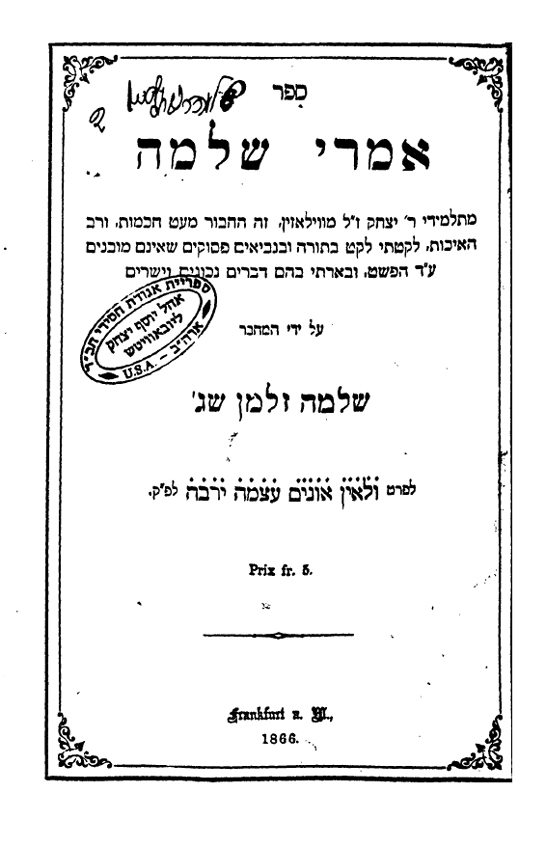
Worthy of note is that among the subscribers one finds, right next to each other on the list, R. Marcus Lehmann, Abraham Geiger, and Ludwig Philipson.

On p. 5 Shag refers to the trees in the Garden of Eden and the snake and says that it is obvious that none of this can be taken literally:

ואם נקח הפרשה הזאת במאזני השכל, ונפלס את הדברים נראה בעליל שהוא רק דברי רמז וחידה, וכפשוטו לא יכנסו כלל בגדר השכל.

On page 10 he explains how the snake represents the evil inclination, an identification pretty standard among the medievals, and he beautifully explains the connection between the two:

והנחש הוא היצר הרע והתאוה . . . היצה”ר נמשל לנחש מה הנחש כשהולך להזיק אינו ברעש ובהלה רק זוחל על הארץ בלחש ומזיק כן הוא היצר הוא בא לאדם בעצה ותחבולה ומראה עצמו כאוהב עד שיפתה, ואח”כ רובץ על צווארי בני אדם כנחש הסובב על הדבר מכל צדדיו.

On p. 21 he even understands the Tower of Babel in non-literal fashion:

ונאמר לראות את העיר ואת המגדל. את העיר זו יושבי העיר כמו העיר ננוה, העיר שושן, הכונה הוא על יושביה, והמגדל הוא המעשים שעשו, נגד רצון השי”ת, כי הם היו מתגאים לעשות להם שם בארץ. והשי”ת שונא גאים ומשפיל אותם, לכן ויפץ ה’ אותם משם על פני כל הארץ.

There have been many understandings of the Tower of Babel, and I don’t want to go into that now, but let me at least mention one of the strangest interpretations out there. R. Menachem Tziyoni (fifteenth century), in his commentary on the episode, claims that the Tower was actually a flying object[19]:

והמגדל הוא הפורח באויר אשר ראו בשמים

At least this is how Tziyoni is usually understood. Yet it is possible that it is not to be taken literally, and I found a post that says precisely this. See here.

Pre-modern man had many stories of those who were able to rise above the ground, either by flying or being transported by God. We find this in Jewish literature as well. See, for example, Bereishit Rabbah 44:8 which focuses on the words in Gen. 15:5 ויוצא אותו החוצה. What does it mean that God brought Abraham outside? The Midrash first quotes R. Joshua in the name of R. Levi:”Did he then lead him forth outside of the world . . . It means, however, that He showed him the streets of heaven.” In response to this R. Judah b. R. Simeon said in the name of R. Johanan: “He lifted him up above the vault of heaven.” Seen in context, as a response to R. Joshua’s explanation, it seems to me that R. Judah b. R. Simeon’s statement must be understood literally. In other words, Abraham was literally transported into the Heavens. See Etz Yosef ad loc: ס”ל דהחוצה כמשמעו שהוא ממש חוץ לעולם

The most famous example of human flight in Jewish literature is that of Jesus. As described in Toledot Yeshu, Jesus was able to use God’s holy name in order to fly, and was brought down by Judas Iscariot who could also fly and defiled Jesus (which caused Jesus to lose his special powers). According to one tradition, he defiled Jesus by urinating on him, but another version has him engaging in homosexual sex while in the air, which in context certainly means rape.

וטנפו במשכב זכור . . . שטנפו במשכב זכור וכיון שטנפו ונפל הזרע על יש”ו הרשע נטמאו שניהם ונפלו לארץ שניהם כאחד

Incidentally, according to Toldot Yeshu this explains why Judas Iscariot is so hated in Christianity:

וכל חכמי הגוים יודעים סוד זה וכופרין אותו ומקללים ומחרימים יהודה אסקריוטו

See Samuel Krauss, Das Leben Jesu nach Juedischen Quellen (Berlin, 1902), pp. 48, 74.

As Morris Goldstein has noted, the second century Acts of Peter describes how Simon Magus flew over Rome, astounding all the onlookers. But Peter, through his prayer to God, was able to force Simon down, a crash landing that caused him to break his leg.[20]

Samael (Satan) can also fly, at least so we are told in the Targum to Job 28:7: סמאל דפרח היך עופא

This should not surprising as according to Isaiah 6:2 the Seraphim fly (with wings), and Hagigah 16a tells us that both angels and demons fly (also with wings).

Midrashic texts speak of two Egyptian magicians who created wings for themselves that enabled them to fly.[21] Rabbinic sources also tell us that Balaam knew how to fly.[22]

With reference to Jesus, it is interesting to note that many Jews actually believed that he performed wonders. However, they attributed it to his knowledge of God’s holy name. Why didn’t they simply assume that all the stories about him were fiction, as modern Jews do? I think the answer is that since all of their neighbors believed the stories, and the miracles Jesus performed are said to have been done before crowds of people, many Jews therefore assumed that these tales must be historically accurate.

In general, it is a common pre-modern assumption that if a group of people, even a group from generations ago, claimed to have witnessed something, that this is a sign that it indeed took place. Today, however, we know how false this argument is. We can cite many examples of mass delusion, not to mention the fact that stories of what people in previous generations witnessed are not actually examples of many people testifying to something, but of one person, the writer, claiming as much.

The stories of Jesus that are found in Toldot Yeshu do not appear in the Talmud, but there are other stories of him found there. However, these stories place Jesus a good 150 years before he actually lived. I say this because the Talmud identifies Jesus as a student of R. Joshua ben Perahyah, who lived circa 120 BCE. In Nahmanides’ disputation, paragraphs 22, 57, he points out that the Christians are wrong on their dates. (R. Judah Halevi, Kuzari 3:65 mentions that Jesus was the student of R. Joshua ben Perahyah and says nothing about the chronological problem. The standard Hebrew edition of the Kuzari is censored [self-censored?], but the reference to Jesus can be seen in the original Arabic published in Kafih’s edition, and also in Hirschfeld’s English translation.)

Others, such as R. Jehiel of Paris in his debate, used the chronological discrepancy to argue not that the Christians are wrong on their dates, but that the Jesus of the Talmud is not Jesus of Nazareth. I used to think that no one actually believed this, but resorted to this argument because it was a good way to deflect the Christian attacks that the Talmud defamed Jesus. However, I recently saw that Tosafot ha-Rosh, Sotah 47a, in a completely non-apologetic comment, assumes that the Talmud refers to two different men named Jesus. See also Meiri, Seder ha-Kabbalah, ed. Havlin (Jerusalem-Cleveland, 1992), pp. 69-70, and especially Havlin’s lengthy note. This was also Rabbenu Tam’s opinion, although it has been censored out of our Talmud. Take a look at Shabbat 104b, Tosafot s.v. Ben Stada in the Bomberg Venice 1520 edition, and compare to the standard Vilna edition.
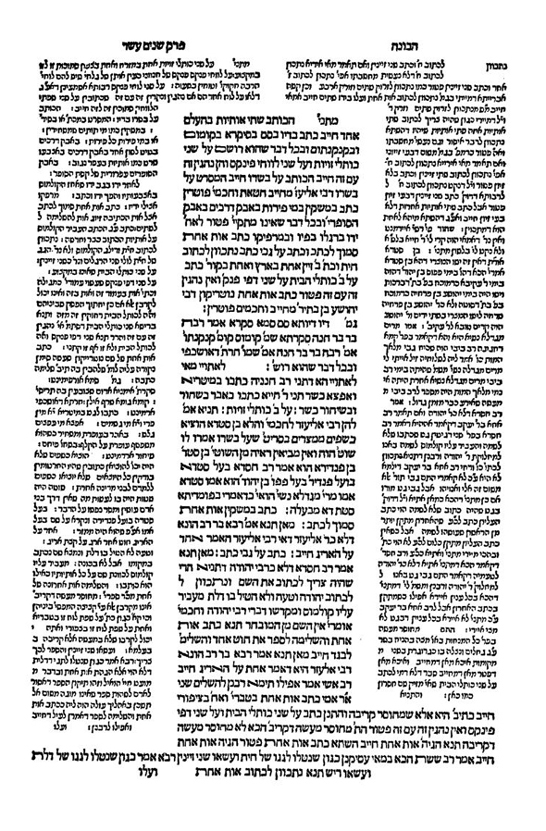
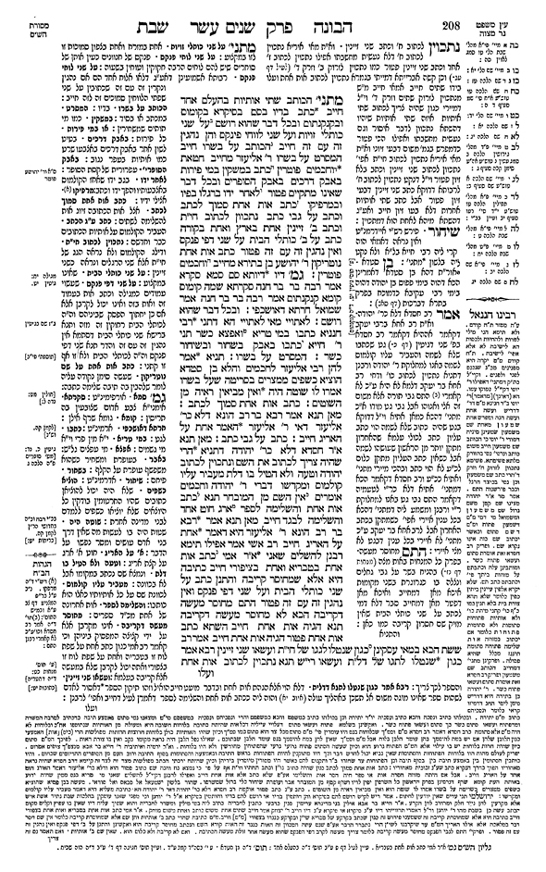

Why does the Babylonian Talmud identify Jesus as a student of R. Joshua ben Perahyah if Jesus lived more than a century later? I think the answer is obvious, namely, that the Talmud had very little knowledge of who Jesus was, and thus did not know when to date him.[23] In fact, the famous story of R. Joshua ben Perahyah pushing Jesus away (Sanhedrin 107b, found in the Soncino translation) is actually a later development of an earlier story that is found in the Jerusalem Talmud. The Jerusalem Talmud’s version does not mention Jesus.[24]

This raises the question of the Talmud as a source of history, which is too large to go into here. But I do want to call attention to what R. Hershel Schachter states in a recent shiur, which I am sure will be surprising to many. The shiur (“Jewish Heritage Tour of Italy, part 2) can be found here.

Beginning at minute 66 R. Schachter acknowledges that the Talmud can err in matters of history. In support of this viewpoint, he cites R. Zerahyah ha-Levi (the Baal ha-Maor) at the beginning of Rosh ha-Shanah and R. Solomon Luria to Sanhedrin 52b. Here is an excerpt:

Today you have people [who] are considered Orthodox and they say [that] the Gemara made a mistake in history. There are a lot of people like that. . . . This is an ongoing debate. Just seventy years ago, before the Second World War, some of the rabbanim in Europe wrote in their seforim [that] it’s a well known fact that the bayit sheni was much more than 420 years. There is 150 years missing there. . . . We are used to this already. When Rabbenu Azariah min ha-Edomim (De Rossi) came out with his sefer Meor Einayim . . . and he said that maybe the chachmei ha-Gemara were wrong in history . . . many rabbanim were so upset they wanted to make a herem against him. I think they did make a herem; I am not sure. . . . Today, everybody is used to this. We assume that the Gemara is not necessarily expert on history, The Gemara can make mistakes in history. Today it’s not assumed to be apikorsus to say [this]. . . . If Azariah De Rossi would have printed his sefer today, no one would have been so excited about it.

For a hasidic perspective on this matter, which is very much in line with modern approaches to Aggadah, see R. Shlomo of Radomsk, Niflaot ha-Tiferet Shlomo (Petrokov, 1923), nos. 73-74. R. Shlomo stresses that when the Talmud tells a story, it does not matter if the facts are contradicted by other talmudic stories, because what is important is not the story itself, which need not be historically accurate, but rather the lesson to be instilled.

ובזה יש ליישב פליאה גדולה אשר יש לשאול, מה זה שמצאנו בכל הש”ס ומדרשים מסופרים מעשיות ומופתים מתנאים ואמוראים בשינוי נוסחאות מאד, זה יאמר כן היה המעשה, וזה יאמר כן . . . דאין אנו דנין על החומר, רק על הצורה, ולפי הצורה המוכנת בענין הזה, באופן זה מספרים חז”ל את המעשה והסיפור, וממ”נ אם להלל ולשבח ולפאר את התנא, או בהיפוך לגנות הרשע, הלא הצורה מוכנת לכ”א . . . ואם להשיג מטרת ותכלית ענין הנרצה בהסיפור הזה לעורר רושם ורעיון להשומע להבין דברי תורה ולעורר אמונת השגחה וכחן וגבורתן של הצדיקים, ג”כ האיכא, ומאי איכפת לן אם החומר מונע, החומר בטל לגבי הצורה, לכן אין נ”מ בין אופן זה לנוסחא אחרת כי הכל תורת אמת.

Returning to the subject of Jesus and R. Joshua ben Perahyah, I think readers might find another text interesting. It is by the kabbalist R. Moses Valle, who was an older colleague of R. Moses Hayyim Luzzatto in Padua. (Although Luzzatto was the leader of their circle, and Valle was thus subservient to him, I don’t know if it correct for the title page to describe Valle as a “student” of Ramhal. I grant that even Italian texts describe Valle as such. See R. Mordechai Samuel Ghirondi, Toledot Gedolei Yisrael [Trieste, 1853], p. 230.)
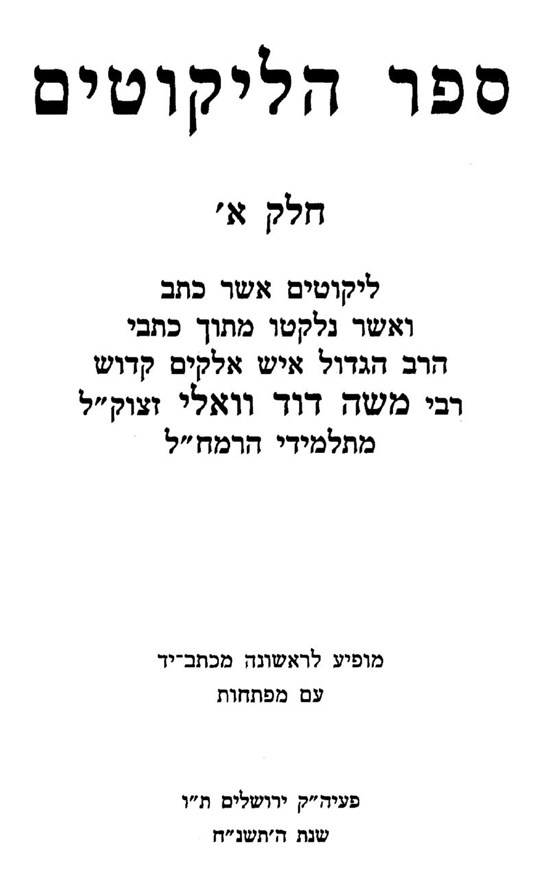
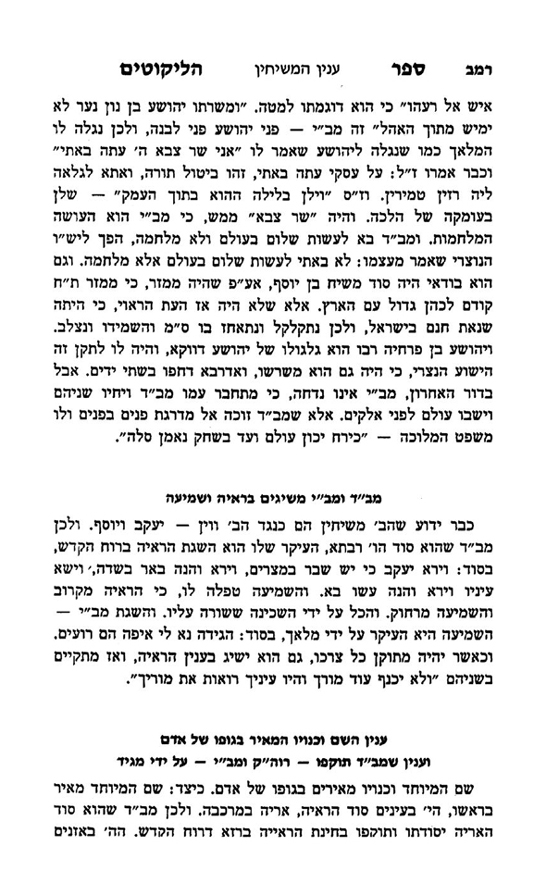
Without seeing the actual text, I don’t think people will believe me if I tell them what he writes, so here is the relevant page from Sefer ha-Likutim p. 242.

According to Valle, Jesus was meant to be Mashiach ben Joseph, but the needless hatred of the Jewish people prevented him from assuming this role. This is such a strange passage that I am impressed that the editor did not censor it prior to publication. For discussion of it, see here.

Interestingly, R. Abraham Abulafia appears to also have identified Jesus as Messiah ben Joseph. See Moshe Idel, Studies in Ecstatic Kabbalah (Albany, 1988), p. 53.

To be continued.


[1] I have explained Rambam according to the exoteric meaning, which is the level that Aviezer is arguing on. Aviezer makes no reference to a possible esoteric teaching.
[2] In the recently published The Rav Thinking Aloud on the Parsha: Sefer Bereishis, p. 8, the Rav misspoke and referred to this conception as the Aristotelian theory.
[3] Thus, I believe that both Rabad in his hassagah to Hilkhot Teshuvah 3:7 and also Kafih in his commentary ad loc., are mistaken in thinking that Maimonides, in listing different types of heretics, is referring here to one who believes in creation from eternal matter. When Maimonides writes about one who does not believe that God is ראשון וצור לכל he is not referring to time but causation. In fact, this formulation of Maimonides is also in accord with Aristotle’s view (that is, how Aristotle was understood by the medievals) that the world is both eternal and ontologically dependant on God. Nowhere in the Mishneh Torah does Maimonides affirm creation, ex nihilo or otherwise. This was recognized by R. Jacob Emden who sees the Mishneh Torah as more radical in this regard than the Guide. See Mitpahat Sefarim (Lvov, 1870) pp. 64-65 (where he also accuses Ibn Ezra of believing in eternity). See also Emden, Otzar ha-Tov (in Birat Migdal Oz [Zhitomir, 1874], p. 22a, who writes, regarding Maimonides’ use in the Mishneh Torah of a proof that assumes the world’s eternity:

לו ידעו הרבנים התלמודיים בפלוסופיא לא היה [!] שותקים לו בכאן

The Maharal, Netivot Olam,p. 224, writes:

והנה בנה עיקר ראייתו על התנועה הנצחית וזהו הפך האמונה שאין אנו מודים בזאת ההנחה. וא”כ כבר נפל הבנין בכללו

That the Guide is actually a theologically more conservative work than the Mishneh Torah has recently been argued by Charles Manekin, “Possible Sources of Maimonides’ Theological Conservatism in His Later Writings,” in Jay M. Harris, Maimonides After 800 Years (Cambridge, 2007), pp. 207-230. One should not forget that the Maimonidean controversy was precipitated by the Mishneh Torah, in particular Sefer ha-Mada, not the Guide.

[4] See the passage quoted from him in Yitzhak Shouraqui, Masoret be-Idan ha-Moderni (Tel Aviv, 2009), p. 34. On p. 44, Benamozegh writes that Ralbag, R. Hasdai Crescas, and R. Nissim did not believe in creation. What he means is that Ralbag did not believe in creation ex nihilo. Crescas did not really believe in creation at all, seeing the universe as eternal, that is, eternally created by God. This means eternal ontological dependence of all existence on the Creator. However, Crescas does believe that our world, as opposed to the universe as a whole, was created at a certain instant. See Warren Zev Harvey, Physics and Metaphysics in Hasdai Crescas (Amsterdam, 1998), pp. 18-19. As I pointed out in Limits, both Ralbag and Crescas stand in opposition to Maimonides’ Fourth Principle. Yet I am unaware of R. Nissim expressing a radical view regarding creation. Does anyone know what he is referring to?
[5] R. Judah Alfakhar also seems to make this error. See Kovetz Teshuvot ha-Rambam ve-Iggerotav (Leipzig, 1859), vol. 3, p. 1b.
[6] I thank Lawrence Kaplan for discussing this matter with me, although this should not imply that he agrees with what I have written.
[7] See here.
[8] Here is what Hirsch writes in Collected Writings, vol. 7, p. 57 (cited by Slifkin, here):

Jewish scholarship has never regarded the Bible as a textbook for physical or even abstract doctrines. In its view the main emphasis of the Bible is always on the ethical and social structure and development of life on earth; that is, on the observance of laws through which the momentous events of our nation’s history are converted from abstract truths into concrete convictions. That is why Jewish scholarship regards the Bible as speaking consistently in “human language;” the Bible does not describe things in terms of objective truths known only to God, but in terms of human understanding, which is, after all, the basis for human language and expression
[9] See here.
[10] See here.
[11] See here.
[12] On this issue, I find mid-twentieth-century Orthodox reconciliations of Torah and science very interesting in that the authors do not seem to be looking over their shoulders, worried about the reaction of the more literalist segment of Orthodoxy. R. Joseph Hertz’s essays following the book of Genesis in his edition of the Pentateuch are a good example of this. Another is R. Samuel Rosenblatt, Our Heritage (New York, 1940), pp. 174-181, in essays entitled “How the World Came Into Being” and “The Garden of Eden, Fact or Fiction.” You can see the essays here, or below.


While reading Rosenblatt’s essays, ask yourself if they could be published in an Orthodox newspaper or shul bulletin today. Note in particular Rosenblatt’s assumption that the Torah makes use of “theories about the nature of the physical world and the details of its generation that were current at the time the Bible was written.” Also relevant to the general issue are his essays on Noah and the Flood, and the Tower of Babel.
[13] For more on “myth”, see my earlier post.

There I wrote:

While in the popular mind myth often is identical with fairy tale, this is not how scholars understand myths. For them, myths communicate cosmic truths in non-historical story form, and they are not synonymous with legends. My dictionary explains myth as “a usually traditional story of ostensibly historical events that serves to unfold part of the world view of a people or explain a practice, belief, or natural phenomenon.”

S. of On the Main Line called my attention to Shadal’s letter in Iggerot Shadal, p. 661, where he speaks about the religious value of “illusions,” that is, matters that are not factual, but nevertheless have great religious value. In this letter we see Shadal, the great opponent of Maimonides, nevertheless adopting his own version of “necessary truths.”

שאין הריליגיאון חביבה לא-ל בשביל אמתתה, רק בשביל תועלתה בתקון המדות, ועל כן אין צורך שיהיו כל דבריה אמתיים, ושאין לנו עכ”ז להרחיק א-להיותה, ושאין להרחיק מהא-ל הגדת דברים בלתי אמתיים כי להגיד כח מעשה בראשית לבשר ודם א”א, ולא יתכן קיום החברה והצלחת האדם בידיעת האמת, אלא באיללוזיון, כי כן הטבע (אשר הוא בלא ספק רצון הא-ל) מרמה אותנו בענינים הרבה.

[14] Rather than refer to any number of books on the history of astronomy, here is what the Wikipedia entry on “Geocentric Model” has to say:

Adherence to the geocentric model stemmed largely from several important observations. First of all, if the Earth did move, then one ought to be able to observe the shifting of the fixed stars due to stellar parallax. In short, if the earth was moving the shapes of the constellations should change considerably over the course of a year. If they did not appear to move, the stars are either much further away than the Sun and the planets than previously conceived, making their motion undetectable, or in reality they are not moving at all. Because the stars were actually much further away than Greek astronomers postulated (making movement extremely subtle), stellar parallax was not detected until the 19th century. Therefore, the Greeks chose the simpler of the two explanations. The lack of any observable parallax was considered a fatal flaw of any non-geocentric theory. Another observation used in favor of the geocentric model at the time was the apparent consistency of Venus’ luminosity, thus implying that it is usually about the same distance from Earth, which is more consistent with geocentrism than heliocentrism. In reality, that is because the loss of light caused by its phases compensates for the increase in apparent size caused by its varying distance from Earth. Once again, Aristotle’s objections of heliocentrism utilized his ideas concerning the natural tendency of earth-like objects. The natural state of heavy earth-like objects is to tend towards the center of the earth and to not move unless forced by an outside object. It was also believed by some that if the Earth rotated on its axis, the air and objects in it (such as birds or clouds) would be left behind.

[15] Norman Lamm, “The Religious Implications of Extraterrestrial Life,” Tradition 7 (Winter 1965) pp. 27-28.
[16] A more academic version of this article appeared in JQR 55 (Jan. 1965), and some points in it were subjected to strong criticism by Harry Wolfson, ibid., 56 (Jan. 1966). Lamm told me that he felt it was a great honor for a young scholar like himself to be criticized by Wolfson. Similar sentiments have been expressed by students who were criticized in class by the Rav and Saul Lieberman.
[17] See here and here (note how the mention of R. [David] Feinstein has been removed from the first source).
[18] One reader asked me if there are traditional sources that speak of God creating things in the world after the initial creation. As a matter of fact, Isaiah 65:17 reads: “For, behold, I create new heavens and a new earth; and the former things shall not be remembered, nor come into mind.” A midrash quoted in R. Kasher’s Torah Shelemah, vol. 1, p. 123, reads as follows:

באותה שעה [כשעברו את הים] ברא להם הקב”ה ארץ חדשה כמו בבריאת העולם בששת ימי בראשית.

These two sources are cited by R. Judah Leib Zlotnick, “Bereishit” bi-Melitzah ha-Ivrit (Jerusalem, 1938), p. 27.

[19] Interestingly, R. Jonathan Eybschuetz, Tiferet Yehonatan, parashat Noah (p. 11a in the standard edition), claims that the builders of the tower were trying to make it so high that they could then launch a spaceship from it that would reach the moon (or perhaps I should say “the sphere of the moon”). This would then become their new home!

וזה היה כונת דור הפלגה ג”כ שבקשו לקבוע מושבם בכדור ירחי ששם יהיו נצולים ממבול וחשבו לעשות ע”י ספינה הנ”ל אפס כיצד יגביהו אותו הספינה למעלה מאויר העכור ולזה חשבו לבנות מגדל גבוה כל כך עד למעלה האויר ההוא ומשם יוכלו להשתמש בספינה הנ”ל לשוט באויר עד כדור הירחי.

[20] See Goldstein, Jesus in the Jewish Tradition (New York, 1950), p. 302 n. 34.

[21] See Louis Ginzberg, Legends of the Jews, vol. 3, p. 28.
[22] See Targum Ps.-Jonathan, Numbers 31:8, Zohar, vol. 3, pp. 194a-194b, Ginzberg, Legends, vol. 6, p. 144.
[23] For more on R. Joshua and Jesus, see Markham Judah Geller, “Joshua B. Perahyah and Jesus of Nazareth: Two Rabbinic Magicians” (unpublished doctoral dissertation, Brandeis University, 1974).
[24] See Peter Schäfer, Jesus in the Talmud (Princeton, 2007), ch. 3. Some readers might also enjoy Herb Basser’s lecture, “How Reliable are the Talmudic Teachings on Jesus,” available here.

The original version of Sanhedrin, which mentions Jesus, is not found in the Artscroll edition. In other words, the Artscroll Talmud, including the Hebrew version, is still a censored, and thus defective, edition. I find this quite amazing. Is there a valid reason why Artscroll has not returned the Talmud to its pristine text? Speaking of internal censorship, here is another amazing example. Gittin 57a has a reference to Jesus, and this is preserved in the Munich manuscript and other uncensored mss. (and recorded in the Soncino translation). Here is a copy of the Munich manuscript. Look three lines above the large word אתרנגול
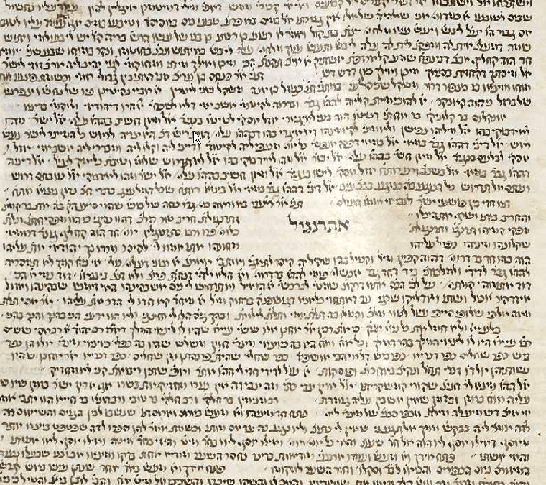
It states that Jesus was raised from the dead through incantations: אסקי’ לישו בנגיד’. In the standard text this has been altered to read, instead of Jesus, לפושעי ישראל. Now here is a copy of Meir S. Feldblum’s Dikdukei Soferim on Gittin. See how he wouldn’t even record what the Munich edition stated, and instead advises the reader to examine Hashmatot ha-Shas!
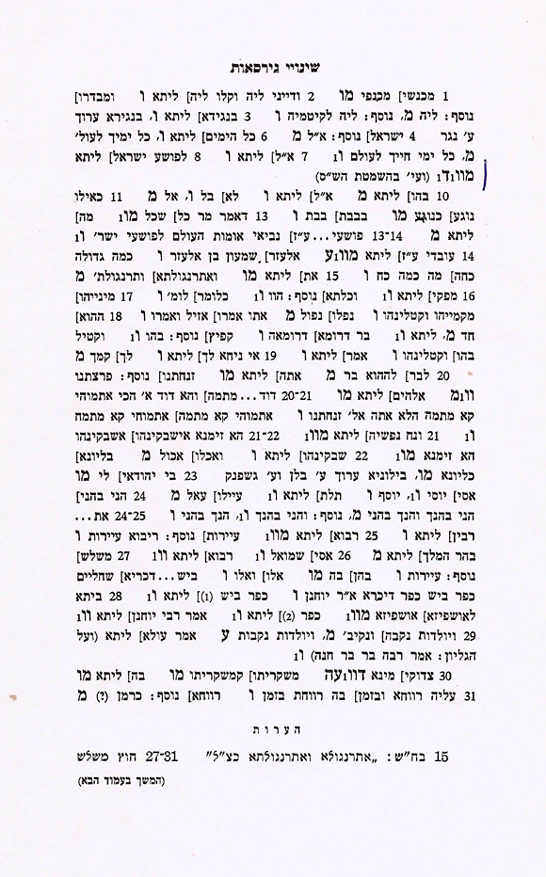
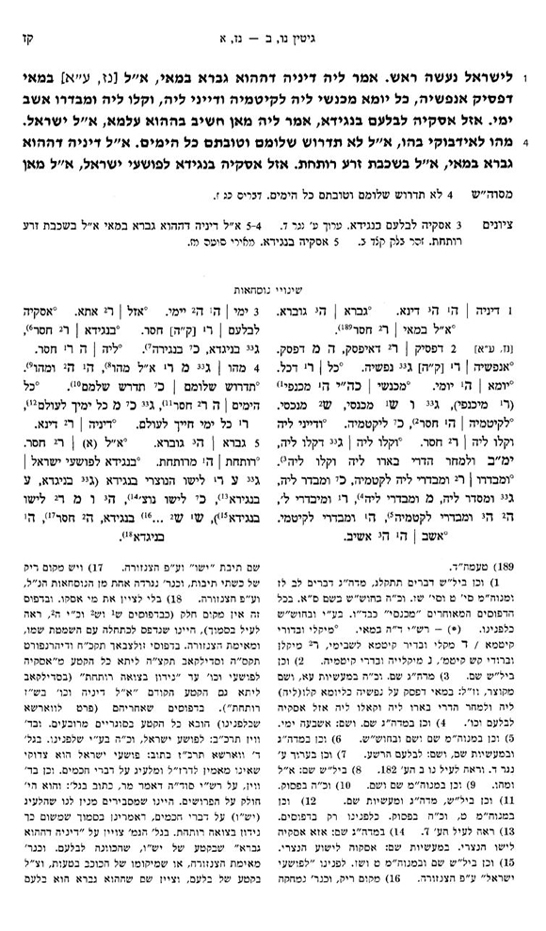
This book was published in 1966 and he was afraid to give us the reading in the Munich ms., yet Rabbinovicz in nineteenth-century Germany has no problem giving us the correct reading in the earlier mentioned story from Sanhedrin (as well as in the other talmudic passages where Jesus is mentioned). Does Feldblum’s action make any sense? I wonder if some future historian will be led to mistakenly conclude that anti-Semitism was more of a problem in 1966 America than nineteenth-century Germany. Fortunately, last year a new edition of Dikdukei Soferim on Gittin was published. Here is the relevant page where we are told what the Munich ms. really says.


In Search of Memory:Towards an Understanding of Baladhur

In Search of Memory:
Towards An Understanding of the Baladhur
By Rabbi Eliezer Brodt

In a recent post at the Seforim blog, while reviewing R. Ovadiah Yosef’s recent work, Chazon Ovadia, I wrote as follows:

“R’ Ovadiah Yosef is world famous for his unbelievable memory, resulting in a tremendous bekius. I once joked that he must have had someone develop a computer program and attach it to his brain to help him retain so much information and recall it at all times.”

To this, one anonymous commenter wrote as follows:

“Actually, there is a (unconfirmed) shmu’a that R. Ovadya partook of the Jewish mythological memory-booster known as Balzar. It is mentioned in different sources as being very dangerous, but granted one survives, it leaves the one who ingested it with a superlative memory. (The Sefer Hakanah refers to this when it says: “chazor chazor, v’al titz’tarech l’balzar”). The Chida is said to have accidentaly ingested it as a child, and fortunately came away with only a few paralyzed fingers — and a great memory. I recently heard a “ma’aseh nora” regarding someone who recently attempted to track this (grass?) down and how min hashamayim he was stopped. Very scary.”

I would like to thank this anonymous commentator for giving me a great excuse to discuss this interesting topic of baladhur, the topic of the post below, which will elaborate on the anonymous above. I would like to explain some possibilities of what this baladhur is, whether or not it’s dangerous to use, and list various gedolim who have actually used it. I will be tracing this through early Jewish and Arabic works – some rather rare and unknown – and I will, as well, provide the background to the authors of those works.

Memory Improvement and Chazal:

Methods for improving memory has been around for a considerable amount of time. Chazal were very concerned with memory, as orignally Torah Shel Ba’al Peh was not allowed to be written. Thus, to ensure correct transmittal, a good memory was essential. Further, (and perhaps based in part on the above concern,) the Mishna in Avos (3:9) states if one forgets his learning, this “sin” is punishable by death. Indeed, throughout Chazal we find many different techniques to help one remember. For instance, the use of Asmachtos, according to some rishonim, is to aid memory. The use of simanim such as the one which appears in the Haggadah from R. Yehuda of Detsach-Adash-Beachav are also for purposes of memory. Many of these simanim are the subject of a recent sefer printed from manuscript of the Aderet called Miglat Samanim. [Additionally, there is an entire work devoted to explicating the simanim, Simanim HaShalem.] Aside from memory tools, we find many things one should refrain from eating or doing because it will cause one to forget. It is also commonplace, to find many different segulos (as opposed to ashmachtos and the like which have a rational connection to memory) to improve one’s memory. R. Yehudah Aryeh (Leon) Modena devoted an entire sefer to this topic, called Lev HaAreyeh. Recently, R. Chaim Kanievsky has also written a complete work on this topic. Even more recently, R. Lerner has devoted a part of his now bestseller (currently over ten printings) Shmirat Haguf VeHanefesh to this topic. This year R. Avraham Zion printed a very comprehensive work on the topic, Zekher Oseh, some 562 pages gathered from many sources (pgs. 323-324 helped me a bit in my preparation of this post).

Returning to the memory segulah, some mention ingesting baladhur as one such segulah. Baladhur became so popular that it even became used in a pisgam used to remind one to review ones learning.

Early Usage of baladhur:

The use of baladhur has early roots. R. Emmanuel Loew in his Die Flora Der Juden (Vol 2 pg 203) cites a source that attributes this discovery of Baladhur to Shlomo Hamelech. The Zohar Chadash relates a story where baladhur was eaten to help them understand Torah; referred to as balad on pg. 8b Margolis edition.

Professor Gerrit Bos has written a very comprehensive article tracing this baladhur, regarding how early one can find that it was used at all and in particular to improve ones memory[3]. Bos provides examples showing how Galen was aware of the baladhur, but the earliest specific reference to it can be found in the writings of Alexander of Tralles (mid-sixth century), with subsequent references found amongst the Arabic physicians Ibn Masawayh (d. 857), Sabur ibn Sahl (d. 869) and ibn Yahya al-Razi (d. 932).

Ibn al-Jazzar, a famous Arab physician (d. 980) and medical author, wrote a treatise entitled Risala Fi Al Nisyan Wa Ilajihi. This work is on “Forgetfulness and its Treatments.” “In 1995 Gerrit Bos printed a critical edition of this Arabic text and all the subsequent Hebrew translations of this work, with an excellent introduction and commentary. The title of this new volume is “Ibn Al-Jazzar on Forgetfulness and Its Treatment.” (This work had been translated into Hebrew many times.) Ibn al-Jazzar writes about baladhur several times – how to use it exactly to help ones memory (pg. 50, 52, 69-70). For more on this work see here.

We now turn to the Jewish sources advocating for the use of baladhur for improved memory. They include: R. Moshe Narboni,[4] R. Meir Aldabi (grandson of the Rosh), R. Yehudah Aryeh (Leon) Modena, R. Hayyim Vital and R. David de Silva (son of the Prei Chadesh). R. Hayyim Vital, besides for providing a recipe for baladhur[5], writes that there were people who used to give it to their sons every day for petihat lev.[6]

What is baladhur?

Chulsis:

Now that we have seen that there is a history to baladhur (and later on we will discuss specific examples of baladhur use), we must now turn to the question of what exactly baladhur is. Meir Benayahu cites “old people in Jerusalem” that baladhur is חלתית (chulsis). Chulsis appears frequently throughout Chazal including in the Mishna, Tosefta, Talmud Bavli and Yerushalmi. Many of these places are quoted by R. Moshe Perlman (Midrash Ha’Refuah, 1:80).[9] In Masekhet Shabbat, chulsis (140a) appears in a discussion about the permissibility of soaking it in water as a medical cure. The Yerushalmi (Shabbat 20:3) brings from Shmuel that chulsis is a healthy food.

The gemara in Chulin (58b) discusses whether swallowing chulsis renders a bird a treifah. Shmuel says it does, as it punctures the bird’s throat. But, the Talmud concludes that it depends whether it is the branch of the chulsis or it was swallowed in its liquid form. Additionally, the Yerushalmi in Shabbat records that R. Yehudah says that if someone eats chulsis on an empty stomach, he will start to burn up and his skin will start peeling. Rav Avuhah says he actually ate chulsis and luckily he was standing in water when he did so as the water cooled him down. From these sources it appears that chulsis is something very sharp physically, as it could harm the throat of a bird, and it also has a sharp effect on the body, i.e. raising one’s temperature.

The Rambam (hilkhot de’ot 4:8) writes that in the rainy season, one should eat a little bit of chulsis. The Avodat Hamelech in his comments on this Rambam references the two statements above discussing the effects of chulsis on body temperature. He most likely means to explain that the Rambam’s source to eat chulsis is based on the gemara in Shabbat that says it’s healthy, however his source to eat only eat a little bit is based on the gemara in Chulin that shows that eating a lot is dangerous.

R. Tanchum Yerushalmi writes that chulsis was a plant whose seeds are eaten for medical purposes (Ha’madreich Ha’maspek, pg. 151). Meiri writes that chulsis was used for heart problems, and R. Ovadiah Bartenurah writes that chulsis is something hot eaten by people in cold places (probably based on the above Rambam). [See also Arukh Hashalem, 3:421.]

Rashi in Shabbat (140a), Avodah Zarah (35b) and Chulin (58b) translates chulsis as לזר”א. Lazei Rashi does not know what this word means in old French (#1251), but לזר”א sounds like it’s our baladhur. The Rosh states explicitly that chulsis is in fact baladhur and there is nothing as sharp as baladhur (Avodah Zarah, 3:166). The Beit David accepts that this is the correct definition of chulsis (Yoreh Deah, #36). Rabbeinu Yerucham writes that the chulsis is the baladhur and although eating it does not pose a problem for hilkhot tereifah, it is prohibited for another reason – sakanat nefashot (Sefer Ha’dom Netiv 15:5, pg. 121b). We see from the above sources that the definition of the “old people” quoted by Meir Benayahu has some support.

The Shulhan Arukh writes that if a bird eats something that punctures its intestines, for example, a branch of chulsis, the bird is rendered a treifah (Yoreh Deah 51:4). The Prei Chadash, after quoting the Rabbeinu Yerucham, says that it can’t be that baladhur is deadly, as we know that people eat this baladhur and it helps the memory. According to the Prei Chadash, the method of eating baladhur was actually by means of a bird (I assume he means they ate birds that were feed the baladhur). He writes that although the gemara in Chulin says that it can dangerously raise one’s temperature, this was only when it was eaten on an empty stomach, as it states explicitly. The Tevos Shor disagrees with this and he says there is a printing mistake in the Rabbenu Yerucham. He meant to say that chulsis is, in fact, assur because it renders the bird a treifah. When he says it is dangerous, he is actually referring to a something else mentioned there, unrelated to chulsis. The Shulhan Gavoah writes that the chulsis is baladhur and he heard that baladhur is extremely sharp and dangerous to eat, but nonetheless improves ones memory. The Shulhan Gavoah brings that in his country, Salonkia (Thessaloniki), there was a great talmid hakham who was famous for his memory and he later found out that they said this memory was a result of his eating the baladhur. The Shulhan Gavoah writes he is not sure exactly what the connection is between baladhur and a bird, but it seems that they would feed a bird this baladhur before shehitah and than one eats this bird.

Chulsis, thus baladhur, is Coffee:

The Kanfei Yonah cites the work Otzar Ha-Hayyim who says the chulsis is coffee! The Kanfei Yonah writes that although we know that coffee is not so sharp, being that the Otzar Ha-Hayyim was a big hakham in his time, especially in medicine, we therefore must follow his opinion. Additionally, according to the Otzar Ha-Hayyim, baladhur is coffee. The Darkei Teshuvah cites the Maaseh Tuviah that chulsis is the actual coffee bean, but not in its more common ground state. The Malbim in his Alim Le’treufah (Rambam, hilkhot de’ot, #21) writes that it’s very hard to accept that chulsis is coffee, as chulsis is supposed to be extremely sharp and we know that coffee is not. (However, this truly really depends on the specific type of coffee, as there are both sharper and milder strains.) Furthermore, the Malbim notes that today people drink coffee on empty stomachs and nothing happens, whereas the gemara said that your skin starts peeling and one’s temperature rises. Therefore, he concludes it is an error to link coffee with chulsis.

The Segulat Yisrael dismisses the Malbim’s question from the gemara in Chulin that the statement that chulsis will cause one’s skin to peel and raise one’s temperature is only when chulsis is eaten alone – that is, without water. But as coffee is typically mixed together with water, that is the reason we don’t see this effect on people who drink coffee even on an empty stomach. Thus, the Segulat Yisrael concludes that coffee does help the memory a bit (pg. 33). This is then quoted in Shmirat Haguf VeHanefesh (2:794) to prove that coffee helps ones memory. The Da’at Torah writes that he experimented with coffee and never found it to be so sharp as to qualify for what the gemara is referring to so it can not be that it is chulsis[10].

Interestingly enough today medical studies show that coffee does help the memory (see here) although some of the sources seem to say it only helps women who drink coffee (see here). It is worth pointing out that that in the popular and excellent historical fiction work by David Liss, The Coffee Trader, one of the main characters, a woman, eats coffee and it has a profound effect on her.

It is clear that R. David de Silva did not think that baladhur is coffee as he has a special entry for the medical benefits of coffee in his Peri Megadim and he does not write its Baladhur. R. David de Silva knew what baladhur is as clear from the story with his grandfather (quoted soon).

R. Samuel Joseph Finn in his Ha’otzar explains that chulsis is Asa Foetida (2:93). R. Emmanuel Loew in his Die Flora Der Juden (3:454) translates it to mean Asa Foeitida. Dr. Katzenelson in his notes on the Midrash Refuah (pg. 147 is missing – by mistake – in the new reprint of this sefer) writes that chulsis is Asa goefida, and that Persians use it for spices. Professor Saul Lieberman also writes its Asa Foeitida (Tosefta Kifshutah, Shabbat, pg. 265 and Baba Kama, pg. 57). Yehudah Feilkeis, in his Hazomach Vhachai Bamishna (pg. 65), and Michael Sokoloff, in his Dictionary of Jewish Babylonian Aramic Of The Talmudic And Geonic Periods, translate chulsis to mean Asa Foeitida (pg. 456).

So it seems that chulsis is not the same as our baladhur.

So what is the baladhur?

R. Hayyim Vital writes baladhur is Anacardium. [5] Much later Ben Yehudah writes this same this baladhur is Anacorde (Milon, pg. 545 “Erech Baladhur”).

Gerrit Bos also documents that it is Anacardium which is the marking nut. Bos writes this is used even today in many medicines. Ibn Al Jazzar in his work on “Forgetfulness and its treatments” gives some exact recipes for this cure. R. Hayyim Vital gives an exact recipe for this baladhur. As noted above (at footnote three), Gerrit Bos brings different recipes for this cure.

People who used baladhur:

There is an old legend that the Rambam when he was twenty he had not learnt anything and he had been working somewhere. Than his master had to go out of town so he told him not to eat from the baladhur. When the master left Moshe ate the baladhur. and he became smart instantly (see Shivchei Harambam pg 76) [Of course this story is not true at all historically and is an embarrassment to the Rambam as much has been written on another such similar legend to this in regard to the youth of the Rambam in the past few months.]

R’ Avraham Kalifon, who knew the Chida personally [7], writes that the Chida, when he was young, ate baladhur. and as a result, the middle finger of his left hand became paralyzed (Sefer Hachida, pg. 185). Incidently Meir Benayahu writes that the Chida had an incredible memory; he remembered whatever he saw (Hachida, volume 1, pg. 91). Others that have used it include the Prei Chadash and R. Chaim Saton – the author of the Aretz Chaim (Benayahu Sinai ibd).

Dangers of using baladhur:

R Avrohum Gibson in his Omer Hashicha writes of a person who he knew who heard of the Baladhur.that it helps ones memory he went and used it incorrectly and died (pg 133). Benayhu brings that R. Chaim Saton mind was effected by his using of the baladhur.
R Yehudah Aryeh Modena writes that people try different ways to help their memories one of the ways is thru the baladhur. However he does not recommend it as it’s very dangerous he knew many people who lost their minds completely from using it (Lev Haryeh pg 13) [8]. R’ Yaakov Emden says that one should be careful not to use the baladhur. because it’s more likely that the person who takes it will lose their memory rather than gain memory (Migdal Oz, pg. 50).

Meir Benayhu printed a letter from a manuscript where the Jews from Fez asked R Yakov ibn Zor to write to R Yosef Konki that some of the Talmidi Chachmim who learn the whole day but forget some of what they learn had heard about the Baladhur. On the one hand they heard that it helps ones memory but on the other hand they heard that its dangerous if used incorrectly so they asked me to write to you R Yosef Konki being that they heard you use it successfully to explain how exactly does one use it. We do not have R Yosef Konki response (Sinai, 36, 1937, 67-70).

In the Prei Megadim of R. Dovid de Silva records an interesting story that happened with himself in regard to this baladhur. He had read somewhere the statement of Chazal that ‘Chazor, chazor val titztarech l’Baladhur’ [more on this soon] so he went and started to eat a lot of this baladhur. His mother saw this and went to ask her father R Refal Malchi who was a doctor if what her son is eating is healthy. R Refal came and saw what his grandson was eating he gave it to him – telling him how could you eat something you do not know about it its something that could make you lose your mind he told him it is lucky you did not eat it wet. He told him the only way you could eat it with it causing damage is to eat it with a bird [more on this soon] (pg 58-59). [These two great people, R Dovid and R Refal will be the subject of an upcoming post.] Interestingly enough Meir Benayhu brings an old rumor that R Dovid’s father the Prei Chadash used the baladhur.

Professor G. Bos brings many non-Jewish medical sources which also say how dangerous the incorrect use of baladhur could be. Bos even brings those who say that Galen died from using baladhur (pg 236). There was a 9th century Persian historian named Ahmad Ibn Yahya al-Baladhuri who lived at the court of the Chaliphs al-Mutawakkil and Al-Musta’in and was tutor to the son of al-Mutazz. He died in 892 as the result of using a drug called Baladhur, hence his name.

Recent Usage of baladhur:

In a recent printing of Lev Ha-Aryeh, R. E. Monzor writes (pg. 31 and on) that he asked his father and many experts in ancient seforim about this baladhur, and he was told that this refuah consists of a few different plants, and the mixture must be exact. He writes about R. Yaakov Katzin, who had a phenomenal memory. He writes that he remembers when he was young, that people heard of the baladhur, and there were three rabbanim who used it. These rabbanim went to consult someone who was an expert in the correct measurements of baladhur. After using it each one suffered from different side effects. One was cold even the summer and R. Yaakov Katzin (who was known for having an incredible memory), who was one of the three, had problems with his intestines. In the Or Torah Journal (Tishrei 5751): 10, there is another source which also claims that he heard that R. Yaakov Katzin used baladhur. In the same journal in a later issue (Tevet 5751): 280, there is a source which brings from R. Ovadiah Yosef that a rebbi of his, R. Eliyahu Lupas, went to purchase this baladhur and the seller told him that it does not really help.

Sources for the Pisgam, ‘Chazor, Chazor V’al Titztarech l’Baladhur’:

As I have mentioned earlier this baladhur, was used in a Pisgam (saying) to remind one to review his learnings. In regard to the sources and evolvement of this pisgam of ‘Chazor, Chazor V’al Titztarech l’Baladhur’. One of the first places to consult is as always the Alpah Beta Kadmita D’shemuel Zeirah of R. Shmuel Askenazi. R. Askenazi has a short comment about it (pg. 595) and than he writes more will be in the second volume. In the back of the sefer amongst the list of future topics he plans on writing about he mentions that this pisgam is one of the topics of the next sefer (pg. 842). For whatever reasons, as of now volume two is not happening. So I asked R. Askenazi if he could give me the material he was planning on printing but unfortunately thus far, he was unable to locate the material. So – as the saying goes – Bemokom Shein Ish, I will attempt to trace it a bit, in a similar style to R. Ashkenazi.

One of the first sources is found in a sefer recently printed from manuscript from R. Yosef Alashkar in his Marchevet Hamishna on the Mishneh in Avot (pg. 139) (see my forthcoming post at the Seforim blog on this topic) where he brings this quote חזור חזור ואל תצטרך לבלדור. R. Yosef Alashkar was a youngster during the Spanish Expulsion. A bit earlier, the Abarbanel in his commentary on Avot, entitled Nachalat Avot (pg. 351) brings this same exact quote. R. Tobias Cohen in his Ma’aseh Tuviah (pg. 133b) brings this quote but adds that it’s mentioned in the gemara. R. David de Silva, a younger contemporary of R. Tobias Cohen also quotes this statement saying it is from Chazal in his Peri Megadim (pg 59). R. Jacob Emden in Migdal Oz (pg. 100) brings the same quote except he says בלאזור. Professor Simha Assaf printed a letter from manuscript that a melamad in Italy who instructed his students רק חזור חזור טוב מבלאזור apparently this is alluding to our pisgam (Toldos Hachinch Byisroel 2:391). R. Yehezkel Feivel, in his Toldot Adam, writes “that there is a famous Mamaor that people say חזור חזור ואל תצריך לבלאזור (vol 1 pg 70).” Levinsohn in his Zerubavel already writes the source for this Toldot Adam is the Ma’aseh Tuviah (pg 42). This pisgam is also found in the Tiferet Yisrael to Avot 1:4.

Azariah de Rossi also alludes to our pisgam at the end of chapter 59 of Meor Einayim:
הטעמים שאינם אלא פרפראות להבנת הענינים ובלאדור נגד השכחה.

R. Yehudah Aryeh (Leon) Modena in Lev Ha-Aryeh brings it a bit different claiming, its from chazal הדור הדור ואל תצטרך לבל דור (pg 7).

R. David Pardo writes it a little different חזור חזור ואל תסתרך לב”ל הדו”ר (Shu”t Michtam LeDavid, Yoreh Deah, pg 87b).

The Da’at Torah writes this baladhur is what the Sefer Hakanah is talking about when he says חזור חזור ואל תצטרך לבלזור. From here the Sefer Hakanah is quoted by many amongst them R. Menachem Mendel Krengel (in his notes Menachim Zion on Shem Hagdolim (pg. 146, note 18), Sefer Hameshalim V’Hapisgamim (by C. Bialik and Y. Rivinski, pg. 167) and R. Lerner in his Shmirat Haguf VeHanefesh (2:794). However both Meir Benayahu and R. Shmuel Ashkenazi have pointed out that all these people are quoting it wrong, as the Sefer Hakanah does not talk about it, rather the author of the Sefer Hakanah does, in a different work of his, the Sefer Hapliah. However the Sefer Hapliah does not bring the pisgam the same way the Da’at Torah quotes it. Rather, he says חזור חזור יפה מבלזור. (Volume 2, pg. 17a)

Interestingly enough R. Yisrael Tayber writes in his book Mikveh Yisrael (which is a biography of the author of the Terumat HaDeshen) that the Terumat HaDeshen used to say this pisgam to his talmidim however, he brings no source for this statement (pg. 16). R. Tauber notes that the Ma’aseh Tuviah cites this quote from chazal. R. Yosef Halpern suggests that the Ma’aseh Tuviah is incorrect, because it is a Sefer Hakoneh not a chazal.[11] But then R. Haplern concludes that perhaps the Ma’aseh Tuviah is correct because the Sefer Hakoneh is a sefer of chazal (Kuntres Me’at Zri pgs. 8-9). Now, R. Yosef Halpern is incorrect for a few reasons first of all, the Ma’aseh Tuviah specifically says it found in the gemara second of all, its in the Sefer Hapliah and not in the sefer Hakoneh and third of all, most agree today that Sefer Hakoneh and Sefer Hapliah are much later from the times of the late rishonim.

Notes:

I would like to thank Professors Gerrit Bos and Zohar Amar for their helpful articles; to Manuscript boy and R. Motti Jackobwitz for their help with finding some references; and, as always, thank you to Dan Rabinowitz and Menachem Butler of the Seforim blog for all of their assistance, especially in helping tracking down some of the more obscure sources.

[1] R. Shabsei Donlo (1:80).

[2] Sori Haguf was a medical work written in the late thirteenth century. Less than a year ago, Professors Zohar Amar and Yael Buchman published part of this work. The piece about baladhur can be found on pages 163-164 of this edition. Not much is known about this work, though Professor Gerrit Bos and Resianne Fontaine have discussed this sefer in their “Medico-Philosophical Controversies in Nathan B. Yoel Falaquera’s ‘Sefer Sori ha-Guf’,” Jewish Quarterly Review 90:1-2 (July – October, 1999): 27-60.

[3] Gerrit Bos, “‘Balādhur’ (Marking-Nut): A Popular Medieval Drug for Strengthening Memory,” Bulletin of the School of Oriental and African Studies, University of London 59:2 (1996): 229-236. See this fantastic article for additional sources and complete citations.

[4] This work only in manuscript, for this quote, see Gerrit Bos, “Jewish Traditions on Strengthening Memory and Leone Modena’s Evaluation,” Jewish Studies Quarterly 2:1 (1995): 48. For more on this author in general, see Gerrit Bos, “R. Moshe Narboni, Philosopher and Physician: A Critical Analysis of Sefer Orah Hayyim,” Medieval Encounters 1:2 (1995): 219-251.

[5] R. Hayyim Vital, the most famous student of the Arizal, wrote many seforim, including a nearly unknown work on medicine and alchemy. It was briefly mentioned by Gershom Scholem. The alchemist section of this book was discussed by Raphael Patai in his book, Jewish Alchemists. Meir Benayahu discusses it in various places in his writings (amongst them in his book on the Ari). Gerrit Boss, “Hayyim Vital’s Kabbalah Ma‘asit we-Alkhimiyah (Practical Kabbalah and Alchemy), a Seventeenth Century ‘Book of Secrets’,” Journal of Jewish Thought and Philosophy 4 (1994): 55-112, wrote an extensive article on this book, and does an excellent job of putting each remedy into its proper categories, as the book is not published in proper order. More recently, Prof. Zohar Amar and Yael Buchman in Sinai 121 (1996): 231-238 and, idem., “Theory and practice in an essay by R. Hayyim Vital,” Sinai 125 (2000): 202-215, about the various halakhic aspects discussed in this work. After that, Yael Buchman wrote her doctorate on this work of R. Hayyim Vital, and a recent article, “A Kabbalist as Healer: The Medical Practice of Rabbi and Healer Hayyim Vital (1543-1620),” Korot: The Israel Journal of the History of Medicine and Science 17 (2003-2004): 7-30 (Hebrew). Less than a year ago, Buchman and Amar printed part of this book, calling it Refuah Maasios L’Rav Chaim Vital. The only part they printed was the medical portion that contains diseases and cures. The recipe for baladhur can be found on page 262 of Buchman and Amar edition. One hopes that they will print the rest of this work in the future. What makes this work very interesting is that we see that R. Hayyim Vital was a medical doctor of sorts, who gave remedies to people for all kinds of illnesses, in all areas of health, whether asthma, infertility, etc. Much of the advice was based on real medical advice that R. Hayyim Vital had read in various medical works, other pieces of advice were based on Segulos or the like. For more on this issue see, the excellent introduction of Amar and Buchman to Refuah Maasios L’Rav Chaim Vital; and Gerrit Boss, “Hayyim Vital’s Kabbalah Ma‘asit we-Alkhimiyah (Practical Kabbalah and Alchemy), a Seventeenth Century ‘Book of Secrets’,” Journal of Jewish Thought and Philosophy 4 (1994): 59-62.

[6] This piece is only in manuscript, its quoted by Gerrit Boss, “Hayyim Vital’s Kabbalah Ma‘asit we-Alkhimiyah (Practical Kabbalah and Alchemy), a Seventeenth Century ‘Book of Secrets’,” Journal of Jewish Thought and Philosophy 4 (1994): 78. The subject of “petihat lev” has been discussed much in recent literature. This concept of petihat lev is found in many different sources where people used to do all kinds of things to help with memory and understanding Torah enabling one to understand and recall the torah effortlessly. One example something done for petihat lev of this are the customs relating to the educational initiation ceremony of young boys still done today in many circles.

Professor Israel Ta-Shma published a piece, included in his Kneset Makcharim (1:1540), from a work written in 1294 called Sefer Hamaskil which gives us a little insight into this petihat lev, which says:

ומאותו היום שאכלו אדם הראשון ניתנו לו חדרדים בלבו לקבל כוח רוח עץ הדעת, שהוא רוח מעורבב מטוב ורע, ויש לו לאדם כמה חדרים בליבו, כל חדר ממונה על ממשלת חכמה אחת, חדר זה ממונה על מלאכת החרש… ובאמצעית הלב יש חדר גדול המקבל רוח שכל עץ הדעת ושותין ממנו שאר חדרים כולו. נסתם חדר אחר או שנים נסתמים ממונים עליהם, כאשר אתה רואה קצת בני אדם שהם סכלים בחכמות העולם והם חכמים גדולים בחכמת המלאכים. ובזמן שהחדר האמצעי כולו סתום, ואין הרוח יכול להתפשט מתמלא המוח עשן ומשתטה

Some general sources on petihat lev can be found in: Ivan G. Marcus, Rituals of Childhood, Jewish Acculturation in Medieval Europe (Yale University Press, 1998), 28; Ephraim Kanarfogel, Peering through the Lattices, Mystical, Magical and Pietistic Dimensions in the Tosafist Period (Wayne State University Press, 2000), 140-141, 156 and 237; and in the excellent article by Yuval Harrari, “‘The Opening of the Heart’: Magical Practices for Gaining Knowledge, Understanding and Good Memory in Judaism of Late Antiquity and Early Middle Ages,” in Shefa Tal: Studies in Jewish Thought and Culture presented to Bracha Sack, eds., Z. Gries, H. Kreisel, and B. Huss (Beer Sheva, 2004), 303–347.

[7] A younger contemporary of R. Hayyim Yosef David Azulai (the Chida), R. Avraham Kalfon (1735-1820) served as a rabbi in Luv. R. Avraham corresponded with the Chida for many years. Later on, he even visited him in Loriano for over a year. They had a close personal relationship. Through his sefarim, he mentions personal anecdotes and discussions he had with the Chida. He also quotes all of the Chida’s works. This piece, where R. Kalfon writes about the Chida using Baladhur, was printed by M. Benayahu in the Sefer Hachida (a collection of articles dealing with the Chida, pages 177-184) More recently, this piece was reprinted in a sefer Igrot V’Haskamot Rabbeinu Hachida (pages 133-134). This book is an excellent collection of letters of the Chida and history of the Chida. One problem with this book, is that in the introduction, the editor acknowledges different sources for helping him write the book, but he doesn’t give credit to his main source, the writings of Meir Benayahu. He does quote these writings extensively, but never uses Benayahu’s name.

R. Avraham Kalfon authored several works, including the small work titled Chayeh Avraham, a collection of reasons of various minhaghim related to Orah Hayyim and Yoreh Deah which he had gathered from many different sources. He authored another work entitled Leket Hakatsir on Orah Hayyim, which remained in manuscript form until a few years ago, when it was printed the first time in 1992. Leket Hakatsir is a large and excellent collection of material gathered from many sources on all topics relating to Orah Hayyim. R. Kalfon quotes many points that he had heard personally from the Chida. Unfortunately, this work is pretty much unused and unknown by our generation of halakhic authors. Nearly thirty years ago, Harvey Goldberg printed Higgid Mordechai (Jerusalem: Ben-Zvi Institute, 1978), from part of a work by R. Mordechai Cohen, entitled Koros Luv ve-Yehuda, and quotes many things from manuscripts of R. Avraham Kalfon.

[8] R. Yehuda Aryeh (Leon) Modena’s Lev Ha-Aryeh was completed in 1611. The idea of this work was to develop a course for memory improvement. In this short work, Modena brings down many ways of how people went about improving their memories, all types of scientific methods, medical methods and segulos for improving memory, and mnemonic systems. For a discussion of this work, see Howard E. Adelman, “Success and Failure in the Seventeenth-Century Ghetto of Venice: The Life and Thought of Leon Modena, 1571-1648,” (PhD dissertation, Brandeis University, 1985), 431-433, who writes that it is possible that Modena’s source was an edition printed in Venice, 1603. For an extensive discussion of Lev Ha-Aryeh, see Gerrit Bos, “Jewish Traditions on Strengthening Memory and Leone Modena’s Evaluation,” Jewish Studies Quarterly 2:1 (1995): 39-58. This work Lev Ha-Aryeh was recently reprinted by Mechon Shuvi Nafshi (2001)

[9] The Midrash Harefuah was written by R. Moshe Perlman, son of R. Yeruscham Leib Perlman (the Minsker Gadol), and is a three-volume-collection of all the health and medical related information that one can find in the Talmud Bavli and Yerushalmi, Tosefta and Zohar. It is incredible to see how much material R. Perlman was able to gather. More importantly, R. Perlman presents the information in an extremely organized manner and brings complete and exact quotations of each source and is careful to properly reference each citation. Additionally, in the footnotes R. Perlman has a brief explanation of some points from the text. This work was first printed in 1936 and a few months ago, thankfully, was reprinted in Jerusalem. R. Perlman writes, in the introduction, that he came to working on Midrash Harefuah while working on a completely different topic, and was going through the abovementioned sources in a systematic manner listing all of the statements that he needed. In working on this project, R. Perlman noticed the many statements throughout chazal about medical and health issues. He began gathering all of the sources – without knowing that others had previously done the same, and had he known, he would likely have not bothered to put Midrash Harefuah together. When he finished the work he went to bring it to a great medical expert Dr. Heindis, who, at first glance, told him not to bother printing the work, as much has already been written on this topic. Dr. Heindis then started to study the work in-depth and could not put it down. Dr. Heindis then asked R. Perlman to leave the work with him for several days. When Dr. Heindis returned the book to R. Perlman, he told him he was unaware that there was so much information in chazal on these topics and this is an important work. Before printing Midrash Harefuah, R. Perlman sent it to medical experts Drs. Katzenelson and Mazeyah for their comments, and their notes on many of the topics are printed in the back of each volume.

R. Meir Halpern, in his excellent work on the Minsker Gadol – the topic of a upcoming post at the Seforim blog – writes about his abovementioned student, R. Moshe Perlman, he was great in learning and eventually entered into a career of business, but did not waste any of his free time. His tremendous knowledge is evident from the work Medrash Harefuah (Hagadol Me-Minsk, pg 208).

[10] For more on chulsis and coffee: see the forthcoming work of R. Yechiel Golhavher (famous for his excellent work Minhaghai Hakehilos) on coffee.What is this sefer Otzar Ha-Hayyim that the Kanfei Yonah is quoting which writes chulsis is coffee? R. Yaakov Zahalon (1630-1693), a graduate of medical college in Rome, became a doctor at the age of twenty-six, and for several years, was also a Rav and Baal Darshan in Rome. He was very involved in the famous plague in the ghetto of Rome in 1656, which he describes at length in his work, Otzar Ha-Hayyim. He wrote many works, amongst them Margolios Tovos (available at HebrewBooks.org), which has prayers for different occasions; including those for a doctor to say before he treated a patient and for a darshan to recite before he spoke in public. R. Zahalon wrote a book called the Or Darshanim, a guide for darshanim on how to compose and deliver sermons. Twenty-years-ago, the work was printed with an extensive introduction and English translation by Henry Adler Sosland, A Guide for Preachers on Composing and Delivering Sermons: The Or Ha-Darshanim of Jacob Zahalon, A Seventeenth Century Italiam Preacher’s Manual (JTS Press, 1987).

However, R. Zahalon’s most famous work was the Otzar Ha-Hayyim, first printed in 1683. It was the first medical work whose original language was Hebrew. This work was intended to be an encyclopedia for the doctor and layman alike. He intended to discuss every aspect related to medical and health issues. Unfortunately, only part of this work was printed only one time, thus making it a very rare book. This definition of chulsis being coffee attributed to him can be found on page seven in the Otzar Ha-Hayyim. R. Zahalon included a whole section in his sefer to explain the fourth chapter of Rambam’s Mishneh Torah, Hilkhot Deot – all of the health related issues, including where this piece related to coffee can be found. Recently Professor Zohar Amar reprinted just this part of the work of the Otzar Ha-Hayyim called Shemirat Haberiut LeHa-Rambam including many additions from an autographed copy of R. Zahalon. One only hopes someone will reprint this whole work again.

For more on Zahalon, see David B. Ruderman, Jewish Thought and Scientific Discovery in Early Modern Europe (Wayne State University Press, 2001), 232-239. See also, J. Leibowitz, “R. Yaakov Zahalon, Man of Rome, His Poem in Honor of the Sabbath, 1687,” Scritti in Memoria di Enzo Sereni: Studies in the History of the Jews in Rome (Jerusalem 1970), 167-181. See also, Professor Zohar Amar in his introduction to his reprinted edition of the Otzar Ha-Hayyim- the part on the Rambam Hilkhot Deot called Shemirat Haberiut LeHa-Rambam.

The question is how this medical work came to R. Yonah Lansdorf. The answer is found by looking in his entry in the Chida’s Shem Hagedolim, where he writes that R. Yonah Landsdorf – besides for being a great Goan – was well versed in all chochmos (Erech Mil Tzedakah). In addition to R. Yonah Landsdorf quoting the Otzar Ha-Hayyim, at least one other goan used Otzar Ha-Hayyim and quotes this definition of chulsis being coffee. R. Yehezkel Feivel, famous for his Toldot Adam, also wrote a work on the Rambam’s Hilkhot Deot and Teshuva, entitled Mussar Haskel. In the beginning of chapter four of Hilkhot Deot (in a section called Loshon Chachamim), Feivel writes that he obtained a copy of the work Otzar Ha-Hayyim and will quote from it throughout the chapter. This explanation of the Lashon Chachamim is quoted by the Sefer Hakovetz in his comments on this Rambam (found in the back of most printings of the Mishneh Torah). R. Yehezkel Feivel and his various works will be discussed at greater length in a future post at the Seforim blog; for now, see the significant discussion in Edward Breuer, “The Haskalah in Vilna: R. Yehezkel Feivel’s ‘Toldot Adam’,” Torah u-Madda Journal 7(1997):15-40.

[11] Much has been written regarding the authorship of the Sefer Hakanah and Sefer Hapliah. Some attribute it to R. Avigdor Kra (see here). See also Sdei Chemed (vol. 9), Klalei HaPoskim V’HaHoraa (15:59), Shorshei Minhag Ashkenaz (3:375, notes 71-72), Chida in Shem Hagedolim (Erech Hakanah and Erech Hapliah , notes of Menachem Zion ibid, notes of Shimon Chanes in Rav Upalim of R. Avraham Ben Hagra (pg. 97), A. Marcus, Hachasidus (pg. 377), and Professor Israel Ta-Shma (Kneset Makcharim, 3:228).


Two Jewish Temples in Egypt

Two Jewish Temples in Egypt

Rabbi Reuven Chaim Klein is the author of the newly-released work God versus Gods: Judaism in the Age of Idolatry (Mosaica Press, 2018). His book follows the narrative of Tanakh and focuses on the stories concerning Avodah Zarah using both traditional and academic sources. It also includes an encyclopedia of all the different types of idolatry mentioned in the Bible. Rabbi Klein studied for over a decade at the premier institutes of the Hareidi world, including Beth Medrash Govoha in Lakewood and Yeshivas Mir in Jerusalem. He authored many articles both in English and Hebrew, and his first book Lashon HaKodesh: History, Holiness, & Hebrew (Mosaica Press, 2014) became an instant classic. His weekly articles on synonyms in the Hebrew language are published in the Jewish Press and Ohrnet. Rabbi Klein lives with his family in Beitar Illit, Israel and can be reached via email to: rabbircklein@gmail.com
 
In this article, we will discuss two different temples which the Jews built in Egypt: the temple at Elephantine, and Chonyo’s Temple. After providing the reader with the historical background to both temples, we will analyze the nature of the worship which took place there, as well as their possible Halachic legitimacy.

The Temple at Elephantine

Ancient papyri found on the Egyptian island Elephantine (יב, Yev in Aramaic) reveal the forgotten story of a Jewish Temple that was built there.
According to those documents, Jews living in Egypt when it was still an independent state built a Temple for Hashem at Elephantine. This occurred after the destruction of the First Temple, but before the construction of the Second Temple. Later, when the Persians conquered Egypt, they destroyed most of its temples,[1] but allowed the Jewish Temple at Elephantine to remain. Sometime afterwards, the priests of the Egyptian deity Khnum and the local Persian rulers colluded against the Jewish community at Elephantine, destroying their Temple and taking the Temple’s gold and silver for themselves.
The Jewish priests of the Elephantine temple, led by a priest named Jedaniah, sent letters appealing to the Persian-appointed Jewish governor of Judah and the Cuthean governate of Samaria to intervene on their behalf, and lobby the Persians for the restoration of their temple. In these letters, the priests of Elephantine repeatedly mentioned that they wished to resume sacrificing meal-offerings, burnt-offerings, and incense (which as we will see seems to be Halachicly problematic). It seems that the Second Temple in Jerusalem had already been built by this time; as the Elephantine priests mentioned in their letter that they had also written to Yochanan, the Kohen Gadol in Jerusalem, but had not received a reply.
The Elephantine Temple was eventually rebuilt, but the Jewish community at Elephantine did not last much longer.[2]

Were the Jews at Elephantine Loyal to Halachah?

The academic consensus views the Jews at Elephantine as practitioners of a syncretistic mixture of Judaism and Egyptian/Aramean idolatrous
cults.
[3] This comes as no surprise, because Jeremiah (Chapter 44) already mentioned that the Jews who remained in Judah after the destruction
of the First Temple and the subsequent assassination of Gedaliah (the Babylonian-appointed Jewish governor over what remained of Judah) migrated to Egypt, where they engaged in idol worship.
[4] As such, the deviant practices of these wayward Jews does not warrant any attempt at justification.[5]
However, some scholars have called this picture into question. In the Ancient Levant, it was standard practice for people to bear personal names
that refer to their gods. Such references to deities within a person’s name is known as a theophoric element. Accordingly, if the Jewish community at Elephantine was truly syncretistic, then we would expect the Jews of that community to incorporate the names of foreign gods into their personal names. But the evidence shows that they did not. Partially because of this lack of idolatrous theophoric elements, some scholars argue that the Jewish community at Elephantine was not idolatrous—rather they remained wholly devoted to Hashem. These scholars explain away alleged allusions to foreign gods at Elephantine as the assimilation of various pagan religious
concepts into their brand Judaism, as opposed to the outright acceptance of pagan deities.[6] Similarly, the Jews at Elephantine may have used Aramean phraseology to refer to Jewish ideas, but they did not adopt Aramean religion.[7]
According to this approach, we must seek out the Halachic justification for offering sacrifices at the temple in Elephantine, a practice which seems to defy the Torah’s ban on sacrifices outside of the Holy Temple in Jerusalem. Assuming that the Elephantine Jews were basically loyal to normative Judaism, how did they justify building a temple, complete with sacrifices?
As mentioned previously, it seems that those Jews who built the Temple at Elephantine only did so after the destruction of the First Temple in Jerusalem. Based on this, R. Ephraim Dov ha-Kohen Lapp (1859–1925) proposes that they followed a minority Halachic opinion which maintains that when the First Temple was destroyed, the site in Jerusalem lost it holy status, thus legitimizing the use of private altars.[8] Accordingly, the Temple at Elephantine had the Halachic status of a legitimate private altar. As a result of this status, the Jews at Elephantine only offered voluntary, votive sacrifices such as meal-offerings, burnt-offerings, and incense (as opposed to obligatory sacrifices, like sin-offerings or guilt-offerings). This
is, in fact, in accordance with the Mishnah
[9] that limits the permissible sacrifices at legitimate private altars to exactly such offerings.[10]

Private Altars in the Second Temple Period

Nonetheless, the issue that remains unresolved is why this temple was not discontinued or dismantled upon the construction of the Second Temple. We can possibly resolve this question by comparing the issue of the temple at Elephantine to the issue of private altars in the Kingdom of Judah.
As evident in the Book of Kings, private altars existed in the Kingdom of Judah throughout the First Temple period. There was no systematic
campaign to destroy them until Hezekiah came along. This begs the question: Why did righteous kings of Judah, such as Asa and Jehoshaphat allow these private altars to remain, if sacrifices were only allowed at the Holy Temple in Jerusalem?
R. Moshe Sofer (1762–1839) answers that many of the private altars in question were built before the prohibition of private altars came
into effect (i.e. before the Temple in Jerusalem was built). Therefore, since these private altars were built legitimately, they maintained a certain degree of holiness. Consequently, it was actually
forbidden to destroy them, and this prohibition remained in effect even once using them for ritual purposes became prohibited (i.e., when the Temple was later built). For this reason, even the “good” kings of Judah did not remove the private altars.[11]
Based on this understanding, we can conjecture that a similar approach may have taken hold at the temple in Elephantine. If that temple was
originally built at a time when private altars were permitted (because the First Temple in Jerusalem had already been destroyed), then perhaps some Jews attached a certain degree of holiness to the temple, and refused to dismantle it after the Second Temple in Jerusalem was built. Nonetheless, even if they were justified in allowing the temple at Elephantine to remain standing, there does not seem to be any justification for continuing to offer sacrifices outside of Jerusalem once the Second Temple was built.

The House of Chonyo

The Mishnah[12] mentions another Jewish temple in Egypt—the House of Chonyo (Onias). Chonyo was the son[13] of Shimon the Just, a righteous Kohen Gadol in the Second Temple in Jerusalem. Before his death, Shimon the Just said that his son Chonyo should succeed him as Kohen Gadol.
The Talmud[14] offers two Tannaic accounts of how Chonyo’s temple came about. According to R. Meir, Chonyo’s older brother Shimi became jealous that their father chose Chonyo to succeed him, so he tricked Chonyo into making a mockery of the Temple rituals and angering the other Kohanim. Shimi gave Chonyo “instructions” for his inaugural service by telling him that he was expected to wear a leather blouse and a special belt.
When Chonyo came to the altar wearing those “feminine” articles of clothing, Shimi insinuated to the other Kohanim that Chonyo wore those clothes in order to fulfill a promise to his “lover”.
[15] This raised their ire and they chased him to the Egyptian city of Alexandria,[16] where he established an idolatrous temple.
According to R. Yehudah, the story unfolds differently. Although Shimon the Just advised that his son Chonyo should become the next Kohen Gadol, Chonyo deferred that honor, allowing his older brother Shimi to be appointed instead. Nonetheless, Chonyo became jealous of his older brother, so he devised a plan to embarrass him and deprive him of his office. Chonyo gave Shimi “instructions” for his inaugural service by telling him that he was expected to wear a leather blouse and a special belt. When Shimi came to the altar wearing those “feminine” articles of clothes, Chonyo insinuated to the other Kohanim that Shimi wore those clothes in order to fulfill a promise to his “lover”. When the other Kohanim found out the truth, i.e. that Chonyo had tricked Shimi by giving him incorrect instructions for his inaugural service, they chased Chonyo to Alexandria, where he established a temple for Hashem.[17]
The Talmud concludes this second account by relating that Chonyo justified the establishment of his temple by citing the words of Isaiah,[18] On
that day, there will be an altar for Hashem inside the Land of Egypt, and a single-stone altar to Hashem next to its border
(Isa. 19:19).

Josephus’ Account of the Chonyo Story

Josephus offers a third account of how Chonyo’s temple was established. After the death of Alexander the Great, Greek holdings in the Middle East were divided between the Seleucid kingdom in Syria and the Ptolemaic kingdom in Egypt. A flashpoint of contention between these two rival kingdoms was the Holy Land, and different groups of Jews took different sides in the conflict. When the Seleucid king, Antiochus Epiphanes, led his army to Jerusalem, he violated the Holy Temple and halted the offering of daily sacrifices for three and a half years.
Chonyo, who was the Kohen Gadol in Jerusalem, was a supporter of the rival Ptolemaic kingdom. When the Seleucids came to Jerusalem, he fled to
Egypt. In Egypt, Ptolemy granted Chonyo permission to establish a Jewish community in the district of Heliopolis. There,
[19] Chonyo built a city resembling Jerusalem, along with a temple that resembled the one in Jerusalem. Centuries later, Chonyos’ temple met its eventual demise at the hands of the Romans. After they destroyed the Second Holy Temple in Jerusalem, the Romans ordered the closure of Chonyo’s temple in Egypt, and eventually its destruction.[20]
Josephus seems to attribute noble intentions to Ptolemy. He was said to have sponsored the establishment of a Jewish temple in Egypt so that the
Jews there would have the opportunity to worship Hashem (and would be more willing to help Ptolemy battle the Seleucids). However, in
explaining Chonyo’s rationale for building the temple in Egypt, Josephus reports that Chonyo built it in order to compete with the Temple in Jerusalem and draw Jews away from worshipping Hashem properly. Chonyo had a bone to pick with the Jewish leadership in Jerusalem on account of their rejection of him, which forced him to flee to Egypt.
Josephus also reports that Chonyo rationalized his building of a temple on foreign soil[22] by citing Isaiah’s above-mentioned prophecy.[22]

Chonyo’s Temple in Halacha

As we have seen above, whether or not Chonyo’s temple was idolatrous remains a matter of contention. According to Josephus and R. Meir,
Chonyo sought to worship something other than Hashem. On the other hand, according to R. Yehuda, Chonyo’s temple was established for
the sake of Hashem. If we follow the first view, then there can be no justification for what Chonyo did and the establishment of his idolatrous temple in Egypt. However, if he sought to worship Hashem, then from a Halachic perspective, there may be two ways of looking at Chonyo’s temple: Either his temple was a place of forbidden worship (albeit not quite idolatry in the classical sense of worshipping a foreign deity), or it might have been a completely legitimate place of worship.
Maimonides[23] follows R. Yehuda’s version of events, and explains that Chonyo’s temple was not idolatrous, per se, even though it violated the ban on sacrifices outside of the Temple in Jerusalem. In other words, the practices at Chonyo’s temple reflected an illegitimate way of worshipping Hashem. Maimonides also notes that many local Egyptians—known as Copts—became involved in Chonyo’s temple, and were thus drawn to worshipping Hashem.
The Tosafists[24] disagree with Maimonides’ premise that Chonyo’s temple violated Halacha. Instead, they explain that Chonyo avoided the prohibition of offering sacrifices outside of the Temple in Jerusalem by only offering sacrifices belonging to non-Jews. According to this approach, there was nothing technically wrong with Chonyo’s temple and the services there.

Gentiles Sacrifices outside of Jerusalem

Nonetheless, the commentators grapple over reconciling the Tosafists’ explanation with the opinion of the Tannaic sage R. Yose who maintains that the prohibition of offering sacrifices outside of Temple even extends to sacrifices of non-Jews.[25]
R. Avrohom Chaim Schor (1560–1632)[26] explains that the dispute about whether Chonyo’s temple was legitimate or not centers around whether or not one accepts R. Yose’s view. In other words, R. Meir accepted R. Yose’s view that even a non-Jew’s sacrifices may only be offered in the Holy Temple. As a result of that, R. Meir understood that Chonyo’s temple must have been illegitimate, so he branded the temple idolatrous. In contrast, R. Yehuda rejected R. Yose’s opinion, so he reasoned that there could be Halachic justification for Chonyo’s temple. Because of this, R. Yehuda asserted that Chonyo’s was not idolatrous, but reflected the genuine worship of Hashem, albeit—as the Tosafists explain—specifically for gentiles.
Alternatively, R. Schor proposes that although R. Yose forbids offering the sacrifices of gentiles outside of the Temple in Jerusalem, this prohibition only applies to Jewish priests. Accordingly, R. Yehuda believed that Chonyo and the Jewish priests at his temple did not actually participate in the ritual offerings there. Rather, they offered instructions for the attending gentiles to properly offer sacrifices to Hashem. In this way, no one at Chonyo’s Jewish-run temple ever violated the prohibition against offering sacrifices outside of the Temple in Jerusalem, because they themselves never engaged in such actions, they only helped the gentiles do so.[27]
Others suggest that even R. Yose differentiates between two different types of sacrifices offered by a non-Jew. If a non-Jew consecrated a sacrifice to be brought in the Temple in Jerusalem,[28] then R. Yose would say that this sacrifice may not be offered outside of the Temple in Jerusalem. However, if a non-Jew consecrated a sacrifice without specific intent that it should be offered in Jerusalem, then his offering may Halachically be brought elsewhere. According to this, all opinions agree that a Jew may offer a gentile’s sacrifice outside of the Temple in Jerusalem provided that the gentile did not initially consecrate the sacrifice with intent to bring to Jerusalem.[29] With this in mind, we may justify the services at Chonyo’s temple by explaining that they only offered the sacrifices of non-Jews that were consecrated without specific intent to be offered in Jerusalem.
R. Yehonassan Eyebschuetz (1690–1764) proposes another answer: the Tosafists’ discussion reflects the rejected opinion of the Amoraic sage R. Yitzchok.[30] R. Yitzchok understood that the prohibition of sacrificing outside of the Temple does not apply outside of the Holy Land, thus justifying the existence of Chonyo’s temple which stood in Egypt.[31]
R. Lapp extends this logic to also justify the continued existence of the Jewish temple at Elephantine (mentioned above), even after the construction of the Second Temple in Jerusalem. He argues that in accordance with R. Yitzchok, the entire prohibition of sacrifices outside of the Temple only applies in the Holy Land, not in Egypt.[32]

Egyptian Temples and Eradication of the Idolatrous Inclination

In short, there were two Jewish Temples in Egypt that coexisted with the Second Temple in Jerusalem: the Jewish Temple at Elephantine and Chonyo’s Temple in Alexandria/Heliopolis. We have shown that it is unclear whether or not these temples were idolatrous. If the two Jewish Temples in Egypt were non-idolatrous, then there may be some Halachic justification for their existence.

This, of course, also does not hamper our understanding of the Talmudic assertion that the idolatrous inclination was abolished with the beginning of the Second Temple Era. However, if these Jewish Temples in Egypt were indeed idolatrous, then they pose a challenge to the Talmudic assertions regarding the elimination of the idolatrous inclination.[33]

We shall resolve this difficulty by addressing each temple separately.

The Elephantine Temple seems to have predated the construction of the Second Temple in Jerusalem, and thus the eradication of the idolatrous inclination. As such, the Temple existed before the sages removed the idolatrous inclination. It is not a stretch of the imagination to postulate that even if the idolatrous inclination suddenly ceased to exist, those who already engaged in systematic idolatry beforehand would continue to do so simply out of habit. Once the Elephantine Temple had already been functioning for some time, it would not simply shut down operations overnight because the sages rid the Jews of the idolatrous inclination. There was too much at stake for the priests and other functionaries who profited from the temple.

Regarding Chonyo’s Temple—which certainly did not predate the construction of the Second Temple—even if it was idolatrous, we can argue that it was not the drive for committing idolatry which led to its establishment. Rather, Chonyo’s own ego and pursuit of honor led him to establish a new Temple in Egypt. Those who participated in his cult were merely supporting characters in Chonyo’s own private scheme. In other words, the existence of Chonyo’s idolatrous temple does not contradict the Talmudic statement that the sages had removed the idolatrous inclination, because the idolatrous inclination was not what drove Chonyo’s temple.

To recap, the Idolatrous inclination was not in play at these two temples. At Elephantine, it was the priests’ greed which motivated their continued idol worship and at Chonyo’s temple, it was a personality cult intended to elevate Chonyo which sponsored idolatry.


[1] The establishment of the Jewish community in Elephantine is uncertain regarding when it happened, although some scholars argue that it predated the destruction of the First Temple. Rabbi Moshe Leib Haberman challenges this assumption, citing the Elephantine Papyri that only reveals that the Jewish settlement was there before Cambyses, but the exact timing is unknown.

[2] Primary sources for the Elephantine Jewish community include B. Porten & A. Yardeni’s Textbook of Aramaic Documents from Ancient Egypt, vol. 1 (1986) and B. Porten’s The Elephantine Papyri in English (1996). Other sources that discuss this community include M.H. Silverman’s “The Religion of the Elephantine Jews—A New Approach” (1973), J.M.P. Smith’s “The Jewish Temple at Elephantine” (1908), and C. Cornell’s “Cult Statuary in the Judean Temple at Yeb” (2016).

[3] The Elephantine Papyri include texts that mention the name of a goddess, Anat-Yahu, which some scholars argue was a syncretistic merge of the Canaanite goddess Anat with Hashem, while others argue that it was wholly an Aramean creation.

[4] J.M.P. Smith suggests that the founders of the Jewish colony at Elephantine were Jews who fled to Egypt instead of remaining in Babylonian-occupied Judah, as called for by Jeremiah.

[5] C. Cornell believes that the Jews in Elephantine worshipped the One Hashem but also held multiple images/idols in their temple, which purported to depict Him in various hypostases.

[6] M.H. Silverman disagrees with the idea that the Jews at Elephantine were entirely idolatrous.

[7] Some scholars suggest that the seemingly idolatrous elements of the Jewish presence at Elephantine were only attempts to evoke Persian sympathy for their cause.

[8] Maimonides rules that the Temple’s site became permanently holy when King Solomon sanctified it, while Raavad disagrees and accepts the opinion that the site was no longer holy after the Temple was destroyed, until it was re-consecrated upon the construction of the Second Temple.

[9] Megillah 1:10 discusses the topic of when the Second Temple was considered to be permanent.

[10] Zivchei Efrayim Al Meseches Zevachim and Responsa Chasam Sofer discuss the question of whether a new site for the Temple would need to be found if the original site was lost.

[11] Responsa Chasam Sofer (Orach Chaim §32). See also R.C. Klein, God versus Gods: Judaism in the Age of Idolatry (Mosaica Press, 2018), pgs. 28–32.
[12] Menachos 13:10.
[13] In Antiquities, Josephus attributes the temple in Egypt to a later Chonyo, who was not the son of Shimon the Just. Nonetheless, some scholars claim that Josephus purposely attributed the establishment of the temple in Egypt to a later Chonyo who had never served as Kohen Gadol in
Jerusalem in order to delegitimize its religious value. See J. E. Taylor, “A Second Temple in Egypt: the Evidence for the Zadokite Temple of Onias,”
Journal for the Study of Judaism vol. 29:3 (1998), pgs. 297–321. Interestingly, R. Yisroel Lipschitz
(1782–1860) in
Tiferes
Yisroel
(Menachos 13:10, Boaz §2)
writes that the Chonyo in discussion was not literally a
son of Shimon the Just, but rather a grandson of Shimon the Just (a son of Shimon’s son Chonyo), accepting
Josephus’s account and adjusting his understanding of the Talmud
accordingly.
[14] TB Menachos 109b.
[15] R. Gershom and Rashi explain that this “lover” was his wife. Maimonides (in his commentary to the Mishnah Menachos
13:10) writes that this “lover” was an alleged mistress.
[16] TB Yoma 38a and JT Shekalim 5:1 relate that the House of Garmu did not wish to reveal the secrets
behind making the shew-bread and the House of Avtinas did not wish to
reveal the secrets behind making the incense for the Temple. In
response, artisans from Alexandria were imported to try and mimic
those secret recipes, but they were unsuccessful in exactly copying
what those families had been able to make. Both R. Yosef Shaul
Nathansohn (1808–1875) in
Divrei Shaul (to TB Yoma
38a) and R. Shalom Massas (1909–2003) in
ve-Cham
ha-Shemesh

(Jerusalem, 2003) pp. 326–327 independently draw an explicit
connection these Alexandrian artisans to Chonyo’s Temple in
Alexandria, although no other authorities do so. The notion of
Alexandrian artisans being unable to exactly replicate something from
Jerusalem is also found in Targum to Est. 1, which relates that
Achashverosh wished to create a replica of King Solomon’s famed
throne, and employed Alexandrian artisans to do so—but to no avail.
That story must have transpired before the establishment of Chonyo’s
Temple in Alexandria because Achashverosh lived before the
construction of the Second Temple. In light of this, we may suggest
that Alexandrian artisans were employed in all cases simply because
Greek Alexandria was a center of knowledge in its time, so the most
knowledgeable craftspeople lived there.
[17] The Jerusalem Talmud (JT Yoma 6:3) slightly differs in its retelling of this discussion. Whilst in
the Babylonian Talmud, the names of the two rival sons of Shimon the
Just are Chonyo and Shimi, in the Jerusalem Talmud, they are
Nechunyon and Shimon. However, R. Tanchum ha-Yerushalmi (a 13
th
century Egyptian Rabbi) writes that Chonyo had two names, Chonyo and
Nechunyo; see B. Toledano (ed.),
ha-Madrich
ha-Maspik
(Tel Aviv, 1961), pg. 154.
Furthermore, according to the Babylonian Talmud, R. Meir believed that Chonyo was
the victim of Shimi’s deceit and ended up establishing a temple for
idolatry, while R. Yehuda believed that Chonyo tricked Shimi, and
ended up fleeing for fear of Kohanic retribution and established a
temple for Hashem. The Jerusalem Talmud echoes the dispute in the
Babylonian Talmud regarding the
story
of Chonyo, but differs in the conclusions. According to the Jerusalem
Talmud, R. Meir understood that Chonyo’s Temple was for Hashem,
while R. Yehuda understood that it was for idolatry. See also
Piskei
ha-Rid
(to TB Menachos 109b)
who copies the entire story as related by R. Meir, but concludes that
Chonyo’s intent was to establish a temple for Hashem—not for
idolatry—in line with the Jerusalem Talmud.
[18] See Isa. 19:18 which calls this Egyptian place Ir
ha-Heres
(עיר ההרס, the city of destruction), which the Talmud (TB Menachos 110a) translates as Karta
de-Beis Shemesh
(קרתא דבית שמש, city of the House of the Sun, i.e. Heliopolis). Indeed, deviant
versions of the Bible (such as the Septuagint and the Dead Sea Scroll
1QIsa3) insert this tradition into the text and read
Ir
ha-Cheres
(עיר החרס, the city of the sun), instead of Ir ha-Heres.
[19] As we saw above, the Talmud locates Chonyo’s temple at Alexandria,
which is quite distant from Heliopolis. We can reconcile this
discrepancy between the Talmud and Josephus by noting that the term
“Alexandria of Egypt” used by the Talmud does not necessarily
refer just to the Egyptian city of Alexandria, but to the entirety of
Egypt; see R. Ulmer,
Egyptian
Cultural Icons in Midrash
(Berlin/Boston:
Walter de Gruyter, 2009), pg. 210 and A. Kasher,
The
Jews in Hellenistic and Roman Egypt: The Struggle for Equal Rights
(Tubingen: Mohr, 1985), pg. 347.
R. Last, “Onias IV and the ἀδέσποτος ἱερός: Placing Antiquities 13.62–72 into the Context of Ptolemaic Land Tenure,” Journal for the Study of Judaism vol. 41 (2010), pgs. 494–516 makes the case that Ptolemey
originally granted Chonyo land in Alexandria for the construction of
the temple, but Chonyo later appropriated other, ownerless lands near
Heliopolis upon which he built his temple.
[20] Josephus concludes with a note that Chonyo’s temple lasted 343 years, although some argue that this figure is exaggerated by close to a
century; see S. G. Rosenberg, “Onias, Temple of.,”
Encyclopedia Judaica 2nd ed. vol. 15 (Detroit: Macmillan Reference USA, 2007), pg. 432. R.
Yisroel Lipschitz writes in
Tiferes Yisroel (Menachos 13:10, Yachin§57) that Chonyo’s temple lasted close to 250 years.
[21] Ibn Yachya in Shalsheles ha-Kabbalah (Jerusalem, 1962), pg. 49 writes that after Chonyo built his temple in Egypt, he later built another temple at Mount Gerizim with the help of the Samaritans. An observation of noted Bible scholar Emanuel Tov accentuates the affinity between these two renegade Jewish cults (i.e. the Alexandrian/Egyptian sect and the Samaritans). Tov
categorizes witnesses of textual variations in the Torah by
essentially dividing them into two blocks: The Masoretic Text (which
Tov admits was the original) and the Septuagint/Samaritan block
(which was derived from the MT, but splinters off into other
directions). By using this mode of classification, Tov recognizes a
certain shared affinity, or perhaps even correspondence, between
these non-mainstream Jewish sects which existed in the Second Temple
period. See E. Tov, “The Development of the Text of the Torah in
Two Major Text Blocks,”
Textus
vol. 26 (2016), pgs. 1–27.
[22] The War of the Jews (Book I, Chapter 1 and Book VII, Chapter 10) and Antiquities
of the Jews
(Book XII, Chapter 9 and Book XIII, Chapter 3).
[23] In his commentary to the Mishnah Menachos 13:10.
[24] To TB Menachos 109b.
[25] Cited in TB Zevachim 45a.
[26] Tzon Kodashim to TB Menachos 109b.
[27] This explanation is also proposed by Sfas Emes (to TB Menachos 109b).
[28] The Mishnah (Shekalim 1:5) rules that the Temple can only accept from non-Jews votive sacrifices, but not what are otherwise considered obligatory offerings.
[29] See Mikdash David (Kodshim §27:9), written by R. David Rappaport (1890–1941), Even ha-Azel (Laws of Maaseh ha-Korbanos 19:7), by R. Isser Zalman Meltzer (1870–1953), and Sefer ha-Mitzvos le-Rasag vol. 2 (Warsaw, 1914), pg. 233b, by R. Yerucham Fishel Perlow
(1846–1934).
[30] See TB Megilla 10a.
[31] Yaaros Dvash (vol. 1, drush #9).
[32] Zivchei Efrayim Al Meseches Zevachim (Piotrków, 1922), pgs. 5–7.
[33] For a fuller discussion of this Talmudic assertion, see R.C. Klein, God versus Gods: Judasim in the Age of Idolatry
(Mosaica Press, 2018), pp. 244–276.


Organizing the Mitzvot and the Sefer Ha-Chinukh

Organizing the Mitzvot and the Sefer Ha-Chinukh
Yaakov Taubes

Yaakov Taubes is the rabbi at Mount Sinai Jewish Center in Washington Heights, New York. He also serves as an assistant director at the Rabbi Isaac Elchanan Theological Seminary at Yeshiva University, and is a PhD candidate in Medieval Jewish History at the Bernard Revel Graduate School for Jewish Studies. He can be reached at rabbi@mtsinaishul.com.

This article follows from the excellent piece by Eli Genauer about the printing and reorganization of the Sefer ha-Chinukh. To review, Genauer described how the Sefer ha-Chinukh’s original order, reflected in both manuscripts and early printed editions, listed the positive commandments followed by the negative commandments in each parasha, but later editions did away with this division and instead listed the mitzvot in strict order of the Biblical  verses. He noted further that, contrary to what is printed in Chavel’s semi-critical edition of the Sefer ha-Chinukh, the first edition to alter the organization was a Chumash with commentaries printed in Amsterdam in 1767 that included the Chinukh. In the first half of this article, I will explain the Chinukh’s original organization, as well as the reasoning behind and impact of the later editions that changed it. In the second half, I will analyze the earliest published mitzvah lists  that enumerated the mitzvot according to the Torah’s order.

Part I
Reorganizing the Chinukh

At its core, the Chinukh is a Sefer Ha-Mitzvot, an enumeration and explication of 613 mitzvot of the Torah. It primarily follows in the footsteps of the Maimonides’s Sefer Ha-Mitzvot, while also regularly citing Nahmanides when he disagrees with Maimonides. In the anonymous author’s opening missive (to which he adjured later copyists by oath to include), he noted that the work of clarifying the mitzvot and halakhot had already been accomplished by R Isaac Alfasi (Rif), Maimonides, and Nahmanides. Indeed, the Sefer Ha-Chinukh did not innovate in in terms of mitzvah enumeration, i.e. in listing what constitutes the 613 commandments, but rather loyally followed the enumeration of Maimonides, even when he found the opinions of Nahmanides more compelling.[1] Instead, the stated goal was to organize the mitzvot based on the parshiyot of the Torah, so that the youth will be inspired to study them on Sabbaths and festivals and “they will be accustomed to inquire as to how many mitzvot appear in a given parasha.”[2] The division into parshiyot was thus for pedagogical purposes (as the title Sefer ha-Chinukh, or Book of Education, implies), namely, to create a separate unit for a student to study each week.

This didactic concern is also evident from the places where the author informs us that a given parasha does not have any mitzvot. By contrast, when Rashi, for example, has nothing to say on a given verse, he does not comment that there is nothing to say on the verse. But as a work based on the parshiyot, to be studied according to the parshiyot, the Chinukh needed to inform the reader that there are no mitzvot on a given week. In addition to its noteworthy contributions to particularly topics, it was the organization that set the Chinukh aside and contributed to its great popularity.

The gemara in Makkot (23b), which serves as the primary source for the idea that there are 613 mitzvot, also notes that there are 248 positive commandments and 365 negative commandments. Maimonides, the Sefer Mitzvot Gadol of R. Moses of Coucy and most other Sifrei Mitzvot divided the mitzvot this way in their respective works, by first listing one category and then the other. The Chinukh maintained this division, but only within each Parasha, first listing all the positive commandments, followed by the negative commandments, and then starting again in the next Parasha.

This division can be found in the original manuscripts of the Chinukh and in the first published editions from the 16th century. In the 18th century, however, publishers began to print the mitzvot of Chinukh in strict order of the verses of the Torah, erasing the division between positive and negative commandments. In Genauer’s article, he noted an error in Chaim D. Chavel’s scholarly introduction to his edition of the Chinukh, where Chavel writes that the first edition to make this change was the edition printed in Frankfurt an der Oder in 1783.[3] In fact, as Genauer notes, the first published book to reorganize the work was the Chumash Tikkun Soferim, published by Yosef, Yaakov and Avraham Proops in Amsterdam in 1767, which included the Chinukh as well as other commentaries on the Torah. This edition printed the Chinukh on the page alongside the Torah text, adjacent to the Biblical verse that are the source for the commandment, and by extension, recorded the mitzvot according to the strict order of the verses, thereby abandoning the original organization. Virtually all later editions of the Chinukh followed this structure such that, apart from Chavel’s edition, the Chinukh was never again printed using the order in which it was originally written.   

This Proops edition did more than change the order of the mitzvot. The reordering also required a modification of the mitzvah list in the introduction to the Chinukh so that that the numbering there accurately reflected the placement of the mitzvot contained within the work. But, confusingly, many internal cross-references to other mitzvot were left intact. For example, at Lev. 19:9, the Chinukh records the prohibition of not leaving over part of the corner of the field (peah). This is Mitzvah 228 in the original work but appears as 217 in the reorganized (now standard) versions. The Chinukh there references what he wrote previously in “Positive Mitzvah 2” of the Parasha, a somewhat less helpful reference to locate if the mitzvot are not divided between the positive and negative commandments.

More generally, this reordering has pros and cons. Putting the mitzvot in the order of the Torah allows related positive and negative commandments to be listed adjacent to one another, which is useful as they may have many aspects in common, including what the author called their shoresh (perhaps meaning “cause”). For example, in the discussion of the holidays in Parashat Emor, the new arrangement places the positive commandment to refrain from labor on a given holiday adjacent to the related negative commandment against working on that holiday.[4] On the other hand, in a number of instances, the reorganization clearly disrupts the disrupts the flow of the work. For example, In Lev. 22:32, the Torah presents the prohibition of profaning God’s name before the obligation to sanctify it. This is how the Proops edition (and subsequent editions) list them, matching the order of the verses. In the original, however, the commandment to sanctify, a positive commandment, is listed first, and it is there that the root and essence of the mitzvot related to sanctifying and profaning God’s name are explained. In the negative commandment, i.e. the prohibition to profane God’s name, the reader is referred to what the author already wrote regarding the positive commandment, which the new editions place afterward. Similar examples can be found throughout the work and modern editions of the Chinukh, including those published by Feldheim, Machon Yerushalayim and Artscroll, will typically provide the appropriate page number or mitzvah reference in their edition. This is helpful, but the need to do so highlights the disparity the reorganization of the work created.          

When the Chinukh was next printed in Frankfurt an der Oder in 1783-4, also part of a Chumash, all of the mitzvot that come from a given book of the Chumash are printed in the back of the relevant volume, divided by parasha with a separate title page introducing them.[5] As in the earlier Proops edition, the mitzvot are listed in strict order of the verses without a division between the positive and negative ones.

The decision to print the Chinukh in strict verse order was significant, even though it had been done previously. As Genauer notes, the Proops edition editors justified their decision to reorganize the Chinukh by saying that it allowed the reader to follow the weekly Parasha more easily. Placing the verse on the page according to the verses facilitated studying the Chinukh almost like a commentary on those verses. Printing the Chinukh in the back of the Chumash on the other hand, meant that a reorganization was no longer necessary; since the Chinukh was no longer alongside the text of the Chumash, it was no longer technically bound to its order. Despite this, the editors still chose to align the Chinukh with the verses, forgoing the original order, presumably to allow easily reference between the Biblical verses and the Chinukh.

In 1783, this same Frankfurt edition of the Chinukh was published as a standalone volume, without the text of the Chumash at all.[6] Printing it as a separate volume would seem to remove any connection to the order of the text of the Torah, yet this edition still follows the strict verse order. It lacks a publisher’s introduction, but the title page includes the following subtitle:

The Sefer Ha-Chinukh with the 613 Commandments to quench the thirsts of the soul. Presented now, newly organized and built upon the order of the Parshiot as they appear written in the Torah, and to not bring the earlier one before the later one, but only in the spot where they are to be found.

As explained, this was not technically new (as Chavel thought) as it had been already been done in 1767 in the Proops/Tikkun Soferim Chumash.[7] But this edition was the first to alter the order when the form did not require it, meaning, it was the first standalone edition to alter the order.[8] As opposed to the Proops edition, where such a edit was more required to integrate the Chinukh into a Chumash, this edition included the change because it was perceived as a better, more intuitive order. That no explanation for the reorganization was provided may be because the publishers thought it was obvious. Indeed, the reorganization certainly makes mitzvot easier to find than if they were divided between positive and negative commandments within each Parasha. Thus, while the Frankfurt edition was preceded in its choice to reorganize the Chinukh, it set the standard for future editions because it was the first to do so as a standalone edition. 

There is no evidence that the publishers of the Frankfurt edition were working off the earlier Proops edition and even if they were, they may have still seen their edition to be innovative by changing the order in a standalone edition. There is, however, a change in the introduction that both editions exhibit that would seem to indicate some level of borrowing. The Chinukh’s introduction can be divided into three parts: (i) an Iggeret (epistle) about the nature, goals and influences of the work; (ii) a list and accounting of the mitzvot contained therein, listed according to the parshiot, with positive commandments listed before the negative ones (this is followed by an overview of the commandments that are applicable and no longer applicable[9]); and (iii) a  longer essay discussing key ideas in Jewish thought and faith.

The Proops/Tikkun Soferim edition maintains this sequence of the introduction but preceding the second part is a title, “Luach HaMitzvot, and then the words “The 613 commandments which were said to Moses, peace be upon him, at Sinai, in the order as they are written in the Torah and according to how they were said by the Rabbi, the author of the Chinukh.” As noted above, the printers also altered the order of the Mitzvot to accord with the verses in the Torah. These added words, “as they are written in the Torah and according to how they were said by the Rabbi, the author of the Chinukh” seems to mean that they have presented a reorganized version of the Chinukh’s enumeration.

Following the list, the publishers added a list of seven rabbinic commandments, followed by the words “the total amount of commandments is the amount of KeTeR [the numerical value of 620, that is 613 biblical commandments plus the seven rabbinic ones] and the way to remember it is KeTeR Torah (the crown of Torah).”[10] In the Frankfurt edition, the mitzvah list (section ii) is moved to the end of the introduction, after the longer essay (section iii).[11] Preceding the list are the same title and introductory lines as the Proops edition. The Frankfurt edition’s use of these words would seem to indicate that they borrowed from the earlier one and made still more changes.

In any event, by the time the Chinukh was printed next in 1799, the reorganization of the mitzvot had already become standard. The publishers, who reference the 1783 edition of the Chumash as well as the standalone edition in their introduction, make no mention that they have altered the original order.[12] The reorganization was the new organization for the Chinukh.

Part II
Early Listing of Mitzvot in the Order of the Torah

While the editions described above were the first to reorganize the Chinukh’s list, neither the Tikkun Soferim/Proops edition nor the Frankfurt edition were the first to organize the 613 mitzvot according to the order of the Torah, either as a separate work or alongside the verses in a Chumash. These particular achievements were already earned by publishers in the early sixteenth century.[13] In Venice in 1517, the famed printer Daniel Bomberg published what is commonly known as the first Rabbinic Bible, a complete Tanakh with commentaries, titled Arba’ah Ve-esrim, namely, the Twenty-Four books of the Hebrew Bible. In the back of the third volume (after the books comprising Ketuvim), the text of Maimonides’s 13 principles of faith from his commentary on Mishnah Sanhedrin are followed by a list of the 613 mitzvot divided by Parasha, but in strict order of the verses, i.e., not divided between positive and negative commandments.         

This listing was originally created by Abraham ibn Hassan HaLevi, an otherwise unknown figure who seems to have thrived in the 15th century.[14] It includes the commandments, the relevant source verse, and a cross-reference to the pertinent discussion in Maimonides’s Mishneh Torah. The version included in the 1517 Bible was a version of ibn Hassan’s that was expanded by R. Yehuda ben Sasson, who added further cross-references to the Talmud and Midrashe Halacha (Sifra and Sifrei etc.).[15]

The brief introduction included before the list explains that the mitzvot enumeration will be based on that of Maimonides but will be organized according to the parshiyot and verses, claiming that this structure is an idea that every child understands and will assist with study and understand of the Parasha. The introduction expresses surprise that such a straightforward system of organization had not been before attempted. Interestingly, he makes no mention of the Chinukh, which had already organized the mitzvot according to the parshiyot. He was either unaware of the work (which, although written in the late 13th century, was not published until 1523) or ‘disqualified’ it, since it was not organized according to strict order of the verses.   

Of the various enumerations of the 613 commandments, that of Maimonides was certainly the most famous and influential of them, and it is thus unsurprising that both the Chinukh and Ibn Hassan made use of it for their own respective works. Additionally, Maimonides’s insistence that each mitzvah be connected to a specific verse meant that reorganizing them according to Torah was a more straightforward endeavor.

Still, even utilizing Maimonides’s enumeration presented difficulties. In his Sefer HaMitzvot, Maimonides often cites multiple verses in the context of a given mitzvah, and it is not always clear which verse is the primary one or if one is to be given precedence over the other. The discussion of the relevant law in his Mishneh Torah did not necessary clarify matters.

Although he followed Maimonides’s enumeration, the Chinukh made his own judgment on the most relevant verse for each commandment. In general, the Chinukh places the commandment in conjunction with the verse where it first appears in the Torah. For example, regarding the mitzva forbidding  labor on the Sabbath, a prohibition that appears many times in the Torah, the Chinukh counts in Exod. 20:9, the first time it appears. But there are exceptions. The mitzvah of Tefillin appears in Exod. 13:9 and 13:16, but the Chinukh does not count it until its appearance in Deut. 6:8,.[[16] When it comes to negative commandments, the Chinukh usually utilizes the azhara, the verse containing the warning, rather than the verse that lays out the punishment. For example, the prohibition to curse a judge is counted at Exod. 22:27 (Mishpatim) instead of Lev. 24:16 since the former is the warning while the latter is the punishment. But again, there are some exceptions. The prohibition to eat slaughter sacrifices outside the Temple, for example, is counted at Lev. 17:3-4 (Acharei Mot) despite the azhara being derived from Deut. 12:14.[17] Ultimately, however, the Chinukh is an independent work with full entries for each mitzvah. The author was thus able explain his choice of placement as he does in the some of the above examples, while also citing any other relevant verses. The verse serves as a positional mechanism and one that structures the entire work, but it was not the complete story for any given mitzvah.

A shorthand list, on the other hand, enjoyed no such luxury, as there was not usually room for further explanation; the mitzvot in such a count follow the order of the verses and the author only provides limited, if any, elucidation. The Mitzvah List originally prepared by Ibn Hassan and printed in the 1517 Rabbinic Bible, solved these issues by basing itself on what is known as the Minyan HaKatzar found in the introduction to the Mishneh Torah. Maimonides there included a shorter enumeration of the commandments almost always listing only the commandment and an accompanying verse, assumed to be the one that most explicitly laid out the commandment. The 1517 Rabbinic Bible list used both the language and verses from this list, reorganized according to Parasha and in strict verse order. In the few places where the Minyan HaKatzar adds a few words of clarification, this language is used in the Chumash list as well.[18]

Although the Chinukh is based on Maimonides, there are discrepancies between the verses utilized by the Chinukh and those of the list based on Maimonides’s Minyan HaKatzar. For example, while the Chinukh (Mitzvah 2) and Maimonides in the Sefer HaMitzvot (P 215) cite the verse Gen. 17:7 (in Lech Lecha) as the source for the commandment of circumcision, the Minyan HaKatzar cites Lev. 12:3, where the commandment is repeated. The 1517 Rabbinic Bible Mitzvah List follows suit placing it in Tazria. Likewise, while the Chinukh places prayer (Mitzvah 433) in Eikev (Deut. 10:20), the 1517 Rabbinic Bible list puts it in Mishpatim (Ex. 23:25), again following the Minyan HaKatzar.

There is an additional (albeit more limited) difficulty with relying on Maimonides enumeration. The second of Maimonides’s 14 shorashim, or principles, used to devise his list was that any mitzvah learned from one of the thirteen exegetical principles would not be counted as part of the 613.[19] There were, however, a few exceptions. For example, Maimonides himself noted that there is no explicit verse prohibiting incest between a father and daughter, and that the Talmud derives it from both a kal vachomer (an a fortiori argument), and a gezerah shavah, two of the 13 exegetical principles by which rabbinic law is derived, about which Maimonides specifically states he will not derive commandments from. Maimonides (Neg. 336) counts the prohibition against father-daughter incest despite this, for reasons he explains at length and need not concern us now. Similarly, the Torah does not explicitly forbid an uncircumcised kohen from partaking of Terumah, but the Talmud (Keritot 5a) derives it from a gezerah shavah (referring to it as gufei torah) and Maimonides counts this as well and once again provides a justification. In the Minyan HaKatzar, when it comes to prohibitions against a father revealing the nakedness of his daughter, and an uncircumcised kohein eating terumah, he writes (following the commandments listing) “that it is not explicit in the Torah“ but insists it still Biblical. If one is placing the mitzvot according to their verse, there might be some question as to where to place these two commandments.

  Perhaps unsurprisingly, the Chinukh places the incest prohibition in Acharei Mot in the context of the other forbidden sexual relationships immediately following the prohibition against sexual relationship with a granddaughter, the source of the kal vachomer. The prohibition for an uncircumcised kohein to eat terumah (282) is placed in Emor immediately following the prohibition for a kohein who is a toshav or sachir to eat terumah, as that verse is part of the gezera shava from which the Talmud derives that prohibition. This too makes sense, although one could have placed it near the prohibition against an uncircumcised person from eating the Passover sacrifice, the other part of the gezarah shavah.

After the mitzvah list printed in the 1517 Rabbinic Bible, there appears an epilogue that provides a tally of the weekly Torah parshiot (and notes that Zot HaBracha is excluded because lacks its own Shabbat to be read on), and that 15 of those parshiot lack any mitzvah, leaving 38 that do contain mitzvot. Gematriot (mnemonics) are provided to remember the totals. The epilogue then notes how 611 commandments were said in explicit verses (followed by another gematria), leaving two which lack an explicit verse and were learned out from tradition at Mount Sinai. The two commandments are, not surprisingly, the aforementioned prohibitions on incest and the uncircumcised priest eating terumah. These can be found, the author tells us, in the Parasha of arayot (in Acharei Mot) and in Emor, the same places where the Chinukh puts them. Again, this is unsurprising as it places them adjacent to the verses from which they are derived from, even if not explicitly. Additionally, Maimonides’s Sefer HaMitzvot and the corresponding Minyan HaKatzar, while not organized according to the order of the verses, also lists them adjacent to the commandment from which they are derived from.

Interestingly, the author felt it important to point this out to the reader, even instructing the reader not to go looking for them. The issue of Maimonides’s statement that some commandments lack underlying verses has attracted attention by modern scholars, who generally find more than two such cases.[20 It would seem that the effort to reorganize Maimonides’s enumeration according to the verses highlighted this issue as well, since the editor had to decide where to place it, something he did not need to do for the other commandments. 

This edition seems to be the first time the mitzvot (of any order) were printed strictly in order of the verses, while also including the Parasha breakdown.[21] The list would prove popular and was included in many future editions. It was even translated into Latin in 1597 by  Phillip Ferdinand, a Jewish convert to Christianity![22]

 There is, however, another possible contender for the first published work to list the mitzvot in the order as they appear in the Torah: the Avodat HaLevi of Solomon b. Eliezer HaLevi.[23] This work is a listing of the commandments which provided references to where the a given commandment was discussed in the Talmud, Midrashe Halacha (Sifra, Sifrei and Mekhilta), Mishneh Torah (spelling out the book, halacha and chapter), Sefer Mitzvot Gadol, Sefer Mitzvot Koton (known as Amudei Golah), the location in the Arba’a Turim of R. Jacob b. Asher (including “column “and siman), Sefer Toldos Adam V’Chava of R. Yerucham ben Meshullam (including exact location), the Kol Bo, the Rokeach, Sefer HaAgur of R. Jacob ben Judah Landau, and the Sefer Halakhot of the Rif. As the author informs us, this list too is based on Maimonides, and the verses and order are based on that of the Minyan HaKatzar (although the language is abbreviated in a few places). This is an incredibly impressive collection of sources and is a good example of the increase of indices with the advent of print.[24] While we know this work was published in Constantinople, it is not evident in what year. The National Library of Israel’s Bibliography of the Hebrew Book catalogue lists it at around 1515, but also cites Morris Steinschneider who suggested that it was published after the end of 1516 when the Sefer Toldos Adam V’Chava (which is one of the works referenced) was printed. In his study of Hebrew printing in Constantinople, Avraham Yaari writes that it was printed between 1515 and 1520.[25] Since the Rabbinic Bible was printed in 1517, the correct year between that range would determine which was the first to list the mitzvot in order of the Torah. Both works predate the printing of the first edition of Chinukh, which was not published until 1523.

In 1547, another Chumash was printed in Venice by the Giustiniani publishing house and included targumim, commentaries, as well as a listing of the 613 commandments in the margins next to the appropriate verse, the first time a list structured this way appeared in print. The title page states that the list will include each mitzvah placed by its appropriate verse, according to the enumeration of Maimonides and according to the opinion of Nahmanides in his calculation of the accounting and listing of the commandments. The inclusion of Nahmanides on the title page would seem to be a mistake, as the Chumash’s introduction, penned by Jehiel ben Jekuthiel, who edited this edition, makes no mention of Nahmanides in his explanation of the work, nor is Nahmanides’ counting of the mitzvot incorporated into the body of the work in any apparent way.[26]

The title plage also write that the work includes a cross reference to the appropriate place in the Talmud, Maimonides, R. Moses of Coucy (in his Sefer Mitzvot Gadol) and R. Jacob, the author of the Tur, “as is explained on the next page in the editor’s introduction.” Indeed, the introduction explains this system in greater depth and then proceeds to include an example from the listing regarding the mitzvah of circumcision.[27]  Students of the Talmud will recognize the list of sources as the very same included in the Ein Mishpat and Ner Mitzvah of R. Joshua Boaz b. Shimon Baruch, which essentially footnotes the Talmud and provides cross-references for where the Talmudic ruling is codified in those works. The Ein Mishpat was incorporated onto the page of the Talmud in the 1546-51 edition of the Talmud, printed in Venice by Marco Antonio Giustiniani, the same publisher as the Chumash under discussion, and is thus not surprising that there is overlap between the referenced works.[28] The mitzvot and references themselves are included in the margins adjacent to the relevant source verse, but as there was not always sufficient space for the full listing of the relevant sources, many mitzvot are instead listed at the end of each Parasha

It is not immediately evident which enumeration Jehiel used to create this list. It certainly does not match the list from the 1517 Rabbinic Bible. While there is no explicit mention of the Chinukh, there is evidence that he relied upon its enumeration and not that of Maimonides or anyone else. In Maimonides’ Sefer HaMitzvot, the prohibition of Yayin Nesekh, wine used for idol worship, is sourced from Deut. 32:38 (in Haazinu).[29] Nahmanides (in his Hasagot to the Sefer HaMitzvot), however, writes that the source of the prohibition is really from Exod. 34:12 (in Ki Tisa). The Chinukh (Mitzvah 111) follows Nahmanides in this instance and explains that while he usually follows the path of Maimonides, he prefers the verse in Exodus due to the specific negative language used there. He also writes that one of the “great Mitzva enumerators,” probably a reference to the Sefer Mitzvot Gadol (SMaG, Neg. 148), cited this as the source verse as well.[30] The 1547 Chumash maintains this order and indeed lists the prohibition of Yayin Nesekh in Exodus instead of Deuteronomy.[31]

Clearer evidence comes from a more direct divergence from Maimonides’s enumeration in the Chinukh. The Chinukh writes in his introduction that his listing will be based on that of Maimonides, even in situations where he finds Maimonides’s inclusion of a mitzvah difficult. There are cases throughout the work where the Chinukh indicates that he finds the view of Nahmanides more compelling but follows Maimonides nonetheless, as per his introduction.[32] Indeed, the Chinukh’s enumeration is identical to that of Maimonides for 612 of the 613 commandments. The discrepancy is the inclusion of the prohibition to bring a Pesach offering on a private altar (Mitzvah 487), which is not counted by Maimonides, and the omission of the prohibition for a non-kohein to eat kodshim kalim, which is counted by Maimonides (Sefer HaMitzvot, Neg. 102). It is likely that both of these changes reflect an alternate text or version of Maimonides’s Sefer HaMitzvot that the Chinukh was utilizing.[33] In the 1547 Chumash, the enumeration of the commandments is identical to that of the Chinukh, including the addition of the prohibition of bringing the Korban Pesach on private altars (in Re’eh) and the omission of the prohibition for a non-kohein to eat kodshim kalim. While there are other Mitzvah enumerators who include the prohibition regarding the Korban Pesach, that the enumeration of Chumash matches the Chinukh identically including for most of the order would seem to belie the latter’s influence.[34]

One more indication of the Chinukh’s influence comes at the end of the Chumash. Following the last mitzvah (in Vayelech), we find the same text as in 1517 Chumash, which describes the number of parshiot and how many lack mitzvot, and the accompanying gematriot. The lines that follow note that not all mitzvot are relevant nowadays, and that among those that are, some are in the category of Mitzvot that a person may never come to be obligated in. After this, there is an accounting of the total number of mitzvot that are relevant nowadays and not situationally dependent, followed by an enumeration of the six commandments that apply at every moment (mitzvot tamidiot). This paragraph is lifted almost verbatim from the Chinukh, with the additional of mnemonics. This Chumash was especially popular and was reprinted multiple times with some minor alterations of the page format. Thus, while it would be another 200 years before the Chinukh was actually reorganized according to the strict order of the verses as described in the first half of this article, it was already influencing other Chumashim that did indeed place the mitzvot in that order.[35]

Once the Chinukh itself was reprinted and reorganized in the 18th century it would reclaim its crown as the primary order of the mitzvot, a role it plays until this day. While one can find lists of the mitzvot organized according to the strict order of the verses based on Maimonides (often printed in the back the Sefer HaMitzvot), as we indexes that reorganize the listing of other mitzvah enumerators to allow for easy reference to the Biblical verses, it is the reorganized Chinukh’s listing that remains the most widely cited and used.    

[1] See Mitzvah 138 and 153. All references to the mitzvot in the Chinukh are to the Mechon Yerushalayim edition unless otherwise specified.
[2] See the Chinukh’s Iggeret HaMechaber.
[3] This mistake is likewise repeated in the Machon Yerushalayim Edition.
[4] I.e. Mitzvot 297-298 are the positive and negative commandments related to rest on the first day of Pesach; 300-30 are the same for the Last Day of Passover; and so on for each holiday.
[5] The Chinukh’s introductions appears in the first volume. The Mossad HaRav Kook Torat Chaim edition, printed in the 20th century, also follows places the corresponding mitzvot from the Chinukh in the back of each volume. The publisher utilized Chavel’s edition for the text and thus the order follows the original division between positive and negative commandments.
[6] It is not clear to me which, if any, volumes from the Chumash, had already come out since they were published over the course of the years 1783-1784. The separate title page for the Chinukh in the Genesis volume has a different appearance than the title page for the standalone volume but the text on it is identical.
[7] It is possible that the publishers’ language here is what led Chavel to mistakenly think this was the first edition to make the change.
[8] I am not aware of any other edition of the Chinukh printed on the page of the Chumash, although the Milstein Edition Chumash with the Teachings of the Talmud printed by Artscroll includes very brief writeups for each mitzvah as they appear in the Chumash based on the Chinukh.
[9] These comments are heavily based on Maimonides’s own overview, placed at the end of the listing of the positive mitzvot in his Sefer HaMitzvot.
[10] The seven rabbinic commandments are not mentioned In original Chinukh, although later editions would enumerate and explicate them further.
[11] Other editions also moved around the different pieces of the introduction. Even the first edition of the Chinukh, published in 1523 in Venice, placed the overview of the mitzvot after section iii. Some variances can be found in a few of the manuscripts as well. See Chavel’s edition, pp. 18-24, where he notes some of the changes to the introduction in the published editions. Interestingly, in the Artscroll edition, the Mitzvah list is likewise placed at the very end of the introduction. They also place the overview paragraph before the mitzvah list instead of following it where it appears it originally appeared. A footnote points out the change and adds “Since in this edition, the list of mitzvos cover many pages, possibly leading many to overlook Chinukh’s concluding remarks, we have followed the precedent of some printed editions which place these remarks before the list of mitzvos.” While this is technically true, it is misleading, as they fail to mention that moving the entire list to the end of the introduction following the longer essay, which is arguably a much larger change.
[12] They also moved around the parts of the introductions and include the Mitzvah list title and the paragraph describing the mitzvot. See Chavel ibid.
[13] The remainder of this essay will focus on published editions of the mitzvot list only. There are several works medieval works that organize the mitzvot according to the verses of the Torah, including of course the Chinukh, but also lesser-known authors. I explore these further in a forthcoming article.
[14] The list is extant in several manuscripts which dated from this time. To be clear, there are other versions of the list of mitzvot according to Maimonides, organized in order of the verses which exist only in manuscript, but the first published one was based on Hassan’s list.
[15] The Jewish Encyclopedia “Abraham Ibn Hassan Ha-Levi” writes that Yehuda Ben Sasson translated the text from Arabic. This seems to be an error, reading ma’atik for “translator” instead of “copyist.” Ben Sasson does mention he had translated other texts, but he is not referring to the Mitzvah list, which was originally in Hebrew.
[16] Although this may be because the command is more explicit in the later source. To pick a prominent (although admittedly less representative) exception, the prohibition of eating a live animal is not counted in Noach (Gen. 9:4), despite its appearing there, and instead listed in Re’eh at Detu 12:23. See Minchat Chinukh after Mitzvah 1
[17] As before, the azhara is far from explicit which is likely the reason the Chinukh used the earlier source.
[18] For example, in the Minyan HaKatzar (N 236), Maimonides clarifies that we derive from tradition that the prohibition referenced in Deut. 23:20 is on the borrower to pay back with interest. This language appears in the Chumash as well.
[19] See Maimonides’s second shoresh in his Sefer HaMitzvot.
[20] See Marc Herman, “What is the Subject of Principle Two in Maimonides’s Book of the Commandments? Towards a New Understanding of Maimonides’s Approach to Extrascriptural Law,” Association for Jewish Studies Review 44:2 (2020), 345-367.
[21] Modern publishers would later reorganize Maimonides’s list according to the verses as well. See Dienstag Jacob I. Dienstag, “Ein ha-Mizvot: A Bio-bibliography of Scholars and Commentators on Maimonides’ Book of Commandments” (Hebrew), Talpioth, vol. 9, no. 3-4 (September 1970): 676-677, 703, 709-710, 738.
[22] This was not the first Latin version of a Sefer HaMitzvot although it seems to have been the first to organize the mitzvot according to the order of the Torah. See Siegfried Stein, “Phillipus Ferdinandus Polonus“ in Essays in honour of the Very Rev. Dr. J. H. Hertz, chief rabbi of the United Hebrew Congregations of the British Empire, on the occasion of his seventieth birthday, September 25, 1942 (5703) ed. I. Epstein, E. Levine et al. (London, 1944), 397–412.
[23]  The work is sometimes called the Moreh Tzedek. The author mentions that he was only 20 years old when he composed although the wandering has made him feel like he was 70. He also writes that he had intended to write out the halakhot as well but did not complete such a work.
[24] See Bella Hass Weinberg, “The Earliest Hebrew Citation Indexes,” Journal of the American Society for Information Science 48.4 (1997): 318–30.
[25] See Abraham Yaari, Hebrew printing at Constantinople: Its History and Bibliography, (Jerusalem, 1967).pp 82.
[26] Thus, the mitzvot which Nahmanides argues are part of the 613, e.g., the mitzvah to live in the Land of Israel, remembering Miriam etc., are not noted.
[27] The introduction mentions a mafteach, or index at the beginning of each book “according to this way.” It is not clear to me what this refers to, as the edition I examined contained no such mafteach. Perhaps it refers to this extended listing at the end of each parasha. The cover page and introduction also mention an index to be included at the end of the twenty-four books listing all the places with references to the page of the Talmud where a verse is explicated.
[28] See Weinberg, ibid., 320 who suggests that the compiler of the Ein Mishpat may have been inspired by Avodat HaLevi. The genesis of the Ein Mishpat itself and how it ended up on the page of the Talmud is beyond the scope of this article.
[29] This verse appears in the Minyan HaKatzar as well as the Mishneh Torah.
[30] It is also likely that the Chinukh diverged from Maimonides on this issue because he wished to have the final mitzvah in the Torah to be the commandment for each person to write a Sefer Torah, a far more dramatic ending. Had he followed Maimonides, Yayin Nesekh would have been the final commandment instead.
[31] It is of course possible that this Chumash was following Nahmanides in this instance or the Sefer Mitzvot Gadol which, as noted, counts the verse from here. This is unlikely, however, since, as noted above, Nachmanides’ enumeration is not incorporated into the Chumash, nor is the SMaG followed in any other instance.
[32] See, for example, Mitzvot 138 and 151.
[33] R. Daniel HaBavli questioned R. Abraham b. HaRambam as to why his father included a prohibition to bring the Korban Pesach on a private altar if the prohibition was no longer relevant once the Temple had been built and all sacrifices on private altars were permanently banned. R. Avraham responded that his father had counted no such prohibition and that R. Daniel HaBavli’s text was inaccurate. See Chavel’s edition of the Chinukh, 8n5 . The author of the Chinukh presumably had a different version or translation of the Sefer HaMitzvot and that this would accounts for the other discrepancies between the two works.
[34] The only differences between the Chinukh’s placement of the mitzvot and this edition are as follows. (1) Chinukh counts the prohibition to curse a parent in Leviticus 20:9 (Kedoshim, 260) but notes that this is really the source for the punishment, not the prohibition. He notes further that Maimonides counts it at Ex. 21:17 but the same problem is present in that verse, so he will count it here. The 1547 Chumash list the prohibition at Ex. 21:17, which means all the following commandments (until Lev. 20:9) are one mitzvah off from the count of the Chinukh (like the later additions discussed above, which reorganized the Chinukh based on the strict verse order, as opposed to the original). (2) The other discrepancy concerns the mussaf sacrifices. The Chinukh counts the mitzvot to bring a korban musaf on Passover, Rosh HaShanah, Yom Kippur, Sukkot and Shemini Atzeret respectively, in Emor (Lev. 23), as they are alluded to there (through the word olah), even though he admits that the full explication of these sacrifices is really in Pinchas (Num. 28). This diverges from Maimonides, who cites the source verses from Pinchas, but the Chinukh explains that he is counting them from their first appearance in the Torah (see Mitzvah 320). This decision forces the Chinukh to divide the commandments relating to the musaf sacrifice with the aforementioned mitzvot counted in Emor, while the Musaf of Shabbat, Rosh Chodesh and Shavuot (which are not mentioned in Emor) are counted in Pinchas. This is somewhat counterintuitive, and perhaps this is why the 1547 Chumash places them all in Pinchas. Following Pinchas, the list and numbering is identical to that of the Chinukh.
[35] In 1590–1591, a different edition of the Chumash was printed by the famed Bragadini publishing house. This edition also included marginal notes which pointed out the placement of each mitzvah near the relevant verse. The title page simply says “…the order of the laws of the TaRYaG mitzvot, each one set in its place” and does not match any of the known lists.


The Princess and I: Academic Kabbalists/Kabbalist Academics

ב”ה
The Princess and I[1]
Academic
Kabbalists/Kabbalist Academics
לכב’ יומא דהילולא דרשב”י ל”ג בעומר
by Josh Rosenfeld
Josh Rosenfeld is the
Assistant Rabbi at Lincoln Square Synagogue and on the Judaic Studies Faculty
at SAR High School.
This is his second
contribution to the Seforim blog. His
first essay, on “The Nazir in New York,” is available (here).
The last few decades
have witnessed the veritable explosion of “new perspectives” and
horizons in the academic study of Kabbalah and Jewish Mysticism. From the
pioneering work of the late Professor Gershom Scholem, and the establishment of
the study of Jewish Mysticism as a legitimate scholarly pursuit, we witness a
scene nowadays populated by men and women, Jews and non-Jews, who have
challenged, (re)constructed, and expanded upon Scholem’s work.[2]
 These men and women themselves have been
variously praised and criticized themselves for sometimes blurring the lines
between academician and practitioner of Kabbalah and mysticism.[3]
Professor Boaz Huss of the Ben-Gurion University of the Negev has done
extensive work in this area.[4]
One of the most impressive examples of this fusion of identities is Professor
Yehuda Liebes (Jerusalem, 1947-) of Hebrew University, who completed his
doctoral studies under Scholem, and rose to prominence himself by challenging
scholarly orthodoxies established by his mentor.
On a personal note, the
initial encounter between so-called ‘traditional’ notions of Kabbalah and
academic scholarship was a jarring one, calling into question aspects of faith
and fealty to long-held beliefs.[5]
In a moment of presumption, I would imagine that this same process is part and
parcel of many peoples’ paths to a more mature and nuanced conception of Torah
and tradition, having undergone the same experience. The discovery of
scholar/practitioners like Prof. Liebes, and the fusion of mysticism and
scholarship in their constructive (rather than de-constructive) work has served
to help transcend and erase the tired dichotomies and conflicts that previously
wracked the traditional readers’ mind.[6]
It is in this sense, and
in honor of the 33rd of the ‘Omer
the Rosh ha-Shana of The Zohar and
Jewish Mysticism that I present here an expanded and annotated translation of
Rabbi Menachem Hai Shalom Froman’s poem and pean to his teacher, Professor
Yehuda Liebes.[7]
Study of the unprecedented relationship between the two, and other
traditional/academic academic/traditional Torah relationships remains a
scholarly/traditional desideratum.[8]
Rabbi Menachem Froman
was born in 1945, in Kfar Hasidim, Israel, 
and served as the town rabbi of Teko’a in the West Bank of Israel.
During his military service, served as an IDF paratrooper and was one of the
first to reach the Western Wall.. He was a student of R. Zvi Yehuda Kook at
Yeshivat Merkaz ha-Rav and also studied Jewish Thought at the Hebrew University
of Jerusalem. A founder of Gush Emunim, R. Froman was the founder of Erets Shalom and advocate of
interfaith-based peace negotiation and reconciliation with Muslim Arabs. As a
result of his long-developed personal friendships, R. Froman served as a
negotiator with leaders from both the PLO and Hamas. He has been called a
“maverick Rabbi,” likened to an “Old Testament seer,”[9]
and summed him up as “a very esoteric kind of guy.”[10]
Others have pointed to R. Froman’s expansive and sophisticated religious
imagination; at the same time conveying impressions of ‘madness’ that some of
R. Froman’s outward appearances, mannerisms, and public activities may have
engendered amongst some observers.[11] He passed
away in 2013.
R. Froman was not known
for his written output, although recently a volume collecting some of his
programmatic and public writing has appeared, Sahaki ‘Aretz (Jerusalem: Yediot and Ruben Mass Publishers: 2014).[12]
I hope to treat the book and its fascinating material in a future post at the Seforim blog. [13]
The Princess and I
Menachem Froman
Translated and Annotated
by Josh Rosenfeld
II Samuel 6:12-23
And she saw him, dancing
and leaping[14]
amongst lambs and goats
it troubled her[15]
and she despised
him in her heart that
had opened to love
she had com/passion
and she sought from her
father to be his wife[16]
And she saw him, dancing
and leaping
with her in the ways of
men amidst the longing of doves[17]
 it troubled her
and she despised
him in her heart at the
moment of intimacy
she had com/passion
upon him like the
embrace of parting moment[18]
And she saw him, dancing
and leaping
amongst foreign matrons
 it troubled her
and she despised
him in her heart that he
had left her in pain
and she resorted to the
honor of her father and the garb of royals
He saw her, and he leapt
and he danced
in the presence of the
glory of his God
he was troubled
and he despised
in his heart conceiving
the troubles in hers
he had com/passion
yet still returned
to his flocks and his
herds
to the dancing and
leaping he loved
______
            It is through this poem, written many years ago, that I
wish to join with those who are honoring my teacher and Rebbe Muvhak [ =longtime teacher] Professor Yehuda Liebes, shlit”a [ =may he merit long life]
(or, as my own students in the Yeshiva are used to hearing during my lectures, Rebbe u’Mori ‘Yudele’ who disguises himself
as Professor Liebes
…).
This poem (at least
according to its authorial intent), describes the ambivalent relationship
between two poles; between Mikhal, the daughter of Saul, who is connected to
the world of kingship and royalty, organized and honorable – and David, the
wild shepherd, a Judean ‘Hilltop Youth’ [ =no’ar
gev’aot
]. Why did I find (and it pleases me to add: with the advice of my
wife) that the description of the complex relationship between Mikhal, who
comes from a yekkishe family, and
David, who comes from a Polish hasidishe  family, is connected to [Prof.] Yehuda
[Liebes]? (By the way, Yehuda’s family on his father’s side comes from a city
which is of doubtful Polish or German sovereignty). Because it may be proper,
to attempt to reveal the secret of Yehuda – how it is possible to bifurcate his
creativity into the following two ingredients: the responsible, circumspect (medu-yekke)
scientific foundation, and the basic value of lightness and freedom.
Seriousness and mirth
(as he analyzes with intensity in his essay “Zohar and Eros”[19]),
formality and excess (as he explains in his book, “The Doctrine of
Creation according to Sefer Yetsirah“[20]),
contraction and expansion, saying and the unsaid, straightness ( =shura)
and song ( =shira). Words that stumble in the dark, seek in the murky mist,
for there lies the divine secret. Maimonides favors the words: wisdom and will;
and in the Zohar, Yehuda’s book, coupling and pairs are of course, quite
central: left as opposed to right, might ( =gevura)
as opposed to lovingkindness ( =hesed),
and also masculinity as opposed to the feminine amongst others. I too, will
also try: the foundation of intellectualism and the foundation of sensualism
found by Yehuda.
Do these two fundamental
aspects of Yehuda’s creativity mesh together to form a unity? This poem, which
I have dedicated to Yehuda, follows in the simple meaning of the biblical story
of the love between Mikhal and David, and it does not have a ‘happy ending’;
they separate from each other – and their love does not bear fruit. Here is
also the fitting place to point out that our Yehuda also merited much criticism
from within the academic community, and not all find in his oeuvre a unified
whole or scientific coherence of value. But perhaps this is to be instead found
by his students! I am used to suggesting in my lectures my own interpretation
of ‘esotericism’/secret: that which is impossible to [fully] understand, that
which is ultimately not logically or rationally acceptable.
I will conclude with a
story ‘in praise of Liebes’ (Yehuda explained to me that he assumes the meaning
of his family name is: one who is related to a woman named Liba or, in the changing of a name, one who is related to an Ahuva/loved one). As is well known, in
the past few years, Yehuda has the custom of ascending ( =‘aliya le-regel)[21]
on La”g b’Omer to the
celebration ( =hilula) of
RaShb”I[22]
in Meron. Is there anyone who can comprehend – including Yehuda himself – how a
university professor, whose entire study of Zohar is permeated with the notion
that the Zohar is a book from the thirteenth- century (and himself composed an
entire monograph: “How the Zohar Was Written?”[23]), can be
emotionally invested along with the masses of the Jewish people from all walks
of life, in the celebration of RaShb”I, the author of the Holy Zohar?
Four years ago, Yehuda
asked me to join him on this pilgrimage to Meron, and I responded to him with
the following point: when I stay put, I deliver a long lecture on the Zohar to
many students on La”g b’Omer,
and perhaps this is more than going to the grave of RaShb”I.[24]
Yehuda bested me, and roared like a lion: “All year long – Zohar, but on La”g b’Omer – RaShb”I!”
            God’s secret is with/in those who fear him, and his
covenant makes it known.[25]


[1] I wish to thank yedidi R’ Menachem Butler for his patient guidance and assistance in the preparation of this short essay. His expertise and erudition is something worthy of true admiration. Thanks, as well, is also due to the other editors at the Seforim Blog for their consideration of this piece, and for providing such a remarkable, long-running platform for the dissemination, discussion, and study of Jewish culture and thought
[2] It is no understatement to say that there is a vast literature on the late Professor Gershom Scholem and for an important guide, see Daniel Abrams, Kabbalistic Manuscripts and Textual Theory: Methodologies of Textual Scholarship and Editorial Practice in the Study of Jewish Mysticism, second edition (Jerusalem: Magnes Press, 2014). See also Gershom Scholem’s Major Trends in Jewish Mysticism 50 Years After: Proceedings of the Sixth International Conference on the History of Jewish Mysticism, eds. Joseph Dan and Peter Schafer (Tübingen: Mohr Siebeck, 1993), 1-15 (“Introduction by the Editors”); Essential Papers on Kabbalah, ed. Lawrence Fine (New York: NYU Press, 1995); Mysticism, Magic, and Kabbalah in Ashkenazi Judaism, eds. Karl Erich Grozinger and Joseph Dan (Berlin: De Gruyter, 1995); Kabbalah and Modernity: Interpretations, Transformations, Adaptations, eds. Boaz Huss, Marco Pasi and Kocku von Stuckrad (Leiden: Brill, 2010), among other fine works of academic scholarship.

For a unique example of a non-apologetic traditional engagement with Scholem’s work, see R. Shimon Gershon Rosenberg (ShaGaR), Nehalekh be-Regesh (Efrat: Mahon Kitve ha-Rav Shagar, 2010), 75-97, especially 77-78 (Hebrew), which I hope to explore in a future essay at the Seforim blog.

[3] While representing a
range of academic approaches, these scholars can be said to have typified a
distinct phenomenological approach to the academic study of Kabbalah and what
is called “Jewish Mysticism.” See Boaz Huss, “The Mystification
of Kabbalah and the Myth of Jewish Mysticism,” Peamim 110 (2007): 9-30 (Hebrew), which has been shortened into
English adaptations in Boaz Huss, “The Mystification of the Kabbalah and
the Modern Construction of Jewish Mysticism,” BGU Review 2 (2008), available online (here);
and Boaz Huss, “Jewish Mysticism in the University: Academic Study or
Theological Practice?” Zeek (December 2006), available online (here).

[4] See Boaz Huss,
“Spirituality: The Emergence of a New Cultural Category and its Challenge
to the Religious and the Secular,” Journal
of Contemporary Religion
29:1 (January 2014): 47-60; see further in Boaz
Huss, “The Theologies of Kabbalah Research,” Modern Judaism 34:1 (February 2014): 3-26; and Boaz Huss,
“Authorized Guardians: The Polemics Of Academic Scholars Of Jewish Mysticism
Against Kabbalah Practitioners,” in Olav Hammer and Kocku von Stuckrad,
eds., Polemical Encounters: Esoteric
Discourse and Its Others
(Leiden: Brill, 2007), 85-104. On the difficulty
of pinning down just what is meant by the word ‘mysticism’ here, see Ron
Margolin, “Jewish Mysticism in the 20th Century: Between Scholarship and
Thought,” in Haviva Pedaya and Ephraim Meir, eds., Judaism: Topics, Fragments, Facets, and Identities – Sefer Rivkah
(=Rivka Horwitz Jubilee Volume) (Be’er Sheva: Ben Gurion University, 2007;
Hebrew), 225-276; see also the introduction to Peter Schäfer, The Origins of Jewish Mysticism
(Tübingen: Mohr Siebeck, 2009), 1-31, especially 10-19, where Schäfer attempts
to give a precis of the field and the various definitions of what he terms
“a provocative title.”  See
Boaz Huss, “Spirituality: The Emergence of a New Cultural Category and its
Challenge to the Religious and the Secular,” Journal of Contemporary
Religion 29:1 (January 2014): 47-60; see further in Boaz Huss, “The
Theologies of Kabbalah Research,” Modern Judaism 34:1 (February 2014):
3-26; and Boaz Huss, “Authorized Guardians: The Polemics Of Academic
Scholars Of Jewish Mysticism Against Kabbalah Practitioners,” in Olav
Hammer and Kocku von Stuckrad, eds., Polemical Encounters: Esoteric Discourse
and Its Others (Leiden: Brill, 2007), 85-104.
On the difficulty of
pinning down just what is meant by the word ‘mysticism’ here, see Ron Margolin,
“Jewish Mysticism in the 20th Century: Between Scholarship and
Thought,” in Haviva Pedaya and Ephraim Meir, eds., Judaism: Topics,
Fragments, Facets, and Identities – Sefer Rivkah (=Rivka Horwitz Jubilee
Volume) (Be’er Sheva: Ben Gurion University, 2007; Hebrew), 225-276; see also
the introduction to Peter Schäfer, The
Origins of Jewish Mysticism
(Tübingen: Mohr Siebeck, 2009), 1-31,
especially 10-19, where Schäfer attempts to give a precis of the field and the
various definitions of what he terms “a provocative title,” as well
earlier in Peter Schäfer, Gershom Scholem
Reconsidered: The Aim and Purpose of Early Jewish Mysticism
(Oxford, U.K.:
Oxford Centre for Postgraduate Hebrew Studies, 1986).
[5] For an example of the
sometimes fraught encounter and oppositional traditional stance regarding the
academic study of Kabbalah, see Jonatan Meir, “The Boundaries of the
Kabbalah: R. Yaakov Moshe Hillel and the Kabbalah in Jerusalem,” in Boaz
Huss, ed., Kabbalah and Contemporary
Spiritual Revival
(Be’er Sheva: Ben Gurion University Press, 2011),
176-177. Inter alia, Meir discusses
the adoption of publishing houses like R. Hillel’s Hevrat Ahavat Shalom of “safe” academic practices such as
examining Ms. for textual accuracy when printing traditional Kabbalistic works.
See also R. Yaakov Hillel, “Understanding Kabbalah,” in Ascending Jacob’s Ladder (Brooklyn:
Ahavat Shalom Publications, 2007), 213-240; and the broader discussion in
Daniel Abrams, “Textual Fixity and Textual Fluidity: Kabbalistic
Textuality and the Hypertexualism of Kabbalah Scholarship,” in Kabbalistic Manuscripts and Textual Theory:
Methodologies of Textual Scholarship and Editorial Practice in the Study of
Jewish Mysticism
, second edition (Jerusalem: Magnes Press, 2014), 664-722.
[6] For a scholarly
overview of Liebes’ work, see Jonathan Garb, “Yehuda Liebes’ Way in the
Study of the Jewish Religion,” in Maren R. Niehoff, Ronit Meroz, and
Jonathan Garb, eds., ve-Zot le-Yehuda –
And This Is For Yehuda: Yehuda Liebes Jubilee Volume
(Jerusalem: Mosad
Bialik, 2012), 11-17 (Hebrew); and for an example of a popular treatment of
Liebes, see Dahlia Karpel, “Lonely Scholar,” Ha’aretz (12 March 2009), available online here
(http://www.haaretz.com/lonely-scholar-1.271914).
[7] The poem and essay were
first published in Menachem Froman, “The King’s Daughter and I,” in
Maren R. Niehoff, Ronit Meroz, and Jonathan Garb, eds., ve-Zot le-Yehuda – And This Is For Yehuda: Yehuda Liebes Jubilee Volume
(Jerusalem: Mosad Bialik, 2012), 34-35 (Hebrew). The translation and
annotation of this essay at the Seforim
blog
has been prepared by Josh Rosenfeld.

[8] For
a sketch of the (non)interactions of traditional and academic scholarship in
the case of Gershom Scholem, see Boaz Huss, “Ask No Questions: Gershom
Scholem and the Study of Contemporary Jewish Mysticism,” Modern Judaism 25:2 (May 2005) 141-158. See also Shaul Magid, “Mysticism,
History, and a ‘New’ Kabbalah: Gershom Scholem and the Contemporary
Scene,” Jewish Quarterly Review
101:4 (Fall 2011): 511-525; and Shaul Magid, “‘The King Is Dead [and has
been for three decades], Long Live the King’: Contemporary Kabbalah and
Scholem’s Shadow,” Jewish Quarterly
Review
102:1 (Winter 2012): 131-153.

[9] See
the obituary in Douglas Martin, “Menachem Froman, Rabbi Seeking Peace,
Dies at 68,” The New York Times (9 March 2013), available online  (here).
Speaking to a member of the Israeli media at R. Froman’s funeral, the author
and journalist Yossi Klein Halevi described “Rav Menachem” as
“somebody who, as a Jew, loved his people, loved his land, loved humanity
– without making distinctions, he was a man of the messianic age, he saw
something of the redemption and tried to bring it into an unredeemed
reality,” available online here (here).

[10] R. Froman’s mystical
political theology permeated his own personal existence. Even on what was to
become his deathbed, he related in interviews how he conceived of his illness
in terms of his political vision: “How do you feel?” “You are
coming to me after a very difficult night, there were great miracles. It is
forbidden to fight with these pains, we must flow with them, otherwise the pain
just grows and overcomes us. This is what there is, this is the reality that we
must live with. Such is the political
reality, and so too with the disease
.” (Interview with Yehoshua
Breiner, Walla! News Org.; 3/4/13, emphasis mine)

[11] See, for example, the
short, incisive treatment of Noah Feldman, “Is a Jew Meshuga for Wanting
to Live in Palestine?” Bloomberg
News
(7 March 2013), available online (here),
who concisely presents the obvious paradox of “The Settler Rabbi” who
nevertheless advocates for a Palestinian State, and outlines the central
challenges to R. Froman’s “peace theology” from practical security
concerns for Jews living in such a state to the challenges of unrealistic
idealism in R. Froman’s thought.

[12] A presentation of some
of the first translations of some of Sahaki
‘Aretz’
fascinating material, can be seen online (here).
[13] A preliminary scholarly
overview of R. Froman’s literary output and sui generis personality is the
forthcoming essay by Professor Shaul Magid, “(Re)­Thinking American Jewish
Zionist Identity: A Case for Post­Zionism in the Diaspora.” To the best of
my knowledge, Professor Magid’s currently unpublished essay is the first
scholarly treatment of R. Froman’s writings in Sahaki ‘Aretz, although see the brief review by Ariel Seri-Levi,
“The Vision of the Prophet Menachem, Rebbe Menachem Froman,” Ha’aretz Literary Supplement (9 February
2015; Hebrew). I would like to thank Menachem Butler for introducing me to
Professor Magid.
[14] King David is at times
referred to as the badhana d’malka,
or “Jester of the King” (see Zohar, II:107a); Liebes treats the
subject at length in Yehuda Liebes, “The Book of Zohar and Eros,” Alpayim 9 (1994): 67-119 (Hebrew).
[15] Gen. 41:8
[16] For an outlining of the
parallel, sometimes oppositional, and rarely unified relationships between the
two royal lineages of Joseph and Judah, see the remarkable presentation of R.
Mordechai Yosef Leiner of Izbica (1801-1854), Mei ha-Shiloah, vol. 1, pp. 47-48, 54-56. On these passages, see
Shaul Magid, Hasidism on the Margin:
Reconciliation, Antinomianism, and Messianism in Izbica/Radzin Hasidism

(Madison: University of Wisconsin Press, 2003), 120, 147, 154, et al. The
marriage of David to Mikhal, daughter of Saul, represented an attempted
mystical fusion of the two houses and their perhaps complementary spiritual
roots, as R. Froman alludes to later in his essay.
[17] Song of Songs 2:14,
5:2. See, most recently, Michael Fishbane, The
JPS Bible Commentary: Song of Songs
(Philadelphia: Jewish Publication
Society, 2015), 75-76, 133-135.
[18] 1 Kings 7:36, see also
b. Yoma 54b with commentary of Rashi.
[19] Yehuda Liebes,
“The Book of Zohar and Eros,” Alpayim
9 (1994): 67-119 (Hebrew)
[20] Yehuda Liebes, Ars
Poetica in Sefer Yetzirah
(Jerusalem:
Schocken, 2000; Hebrew) and see the important review by Elliot R. Wolfson, “Text,
Context, and Pretext: Review Essay of Yehuda Liebes’s Ars Poetica in Sefer Yetsira,” Studia Philonica Annual 16 (2004): 218-228.
[21] See the start of this
essay, where we defined Lag ba-Omer in
the sense of the Kabbalistic/Mystical Rosh ha-Shana. For an overview of Lag ba-Omer and it’s unique connection
to the study of the Zohar, see Naftali Toker, “Lag ba-Omer: A Small Holiday of Great Meaning and Deep
Secrets,” Shana beShana (2003):
57-78 (Hebrew), available online (here).
[22] See Boaz Huss,
“Holy Place, Holy Time, Holy Book: The Influence of the Zohar on
Pilgrimage Rituals to Meron and the Lag ba-Omer Festival,” Kabbalah 7 (2002): 237-256 (Hebrew).
[23] Yehuda Liebes,
“How the Zohar Was Written,” in Studies
in the Zohar
(Albany: SUNY Press, 1993), 85-139. For an exhaustive survey
of all of the scholarship on the authorship of the Zohar, see Daniel Abrams,
“The Invention of the Zohar as a Book” in Kabbalistic Manuscripts and Textual Theory: Methodologies of Textual
Scholarship and Editorial Practice in the Study of Jewish Mysticism
, second
edition (Jerusalem: Magnes Press, 2014), 224-438.
[24] Towards the end of his
life, R. Froman delivered extended meditations/learning of Zohar and works of
the Hasidic masters in a caravan at the edge of the Teko’a settlement in Gush
Etzion. These ‘arvei shirah ve-Torah
were usually joined by famous Israeli musicians, such as the Banai family and
Barry Sakharov. One particular evening was graced with Professor Liebes’
presence, whereupon Liebes and Froman proceeded to jointly teach from the
Zohar. It is available online (here).
[25] Ps. 25:14; See Tikkunei Zohar 17b, 65a; For the
connection of this verse with the 33rd of the ‘Omer, see R. Elimelekh of Dinov, B’nei Yissachar: Ma’amarei
Hodesh Iyyar
, 3:2. For an exhaustive discussion of the 33rd day of the
‘Omer and its connection with Rashbi, see R. Asher Zelig Margaliot (1893-1969),
Hilula d’Rashbi (Jerusalem: 1941),
available online (here), On R. Asher
Zelig Margaliot, see Paul B. Fenton, “Asher Zelig Margaliot, An Ultra
Orthodox Fundamentalist,” in Raphael Patai and Emanuel S. Goldsmith, eds.,
Thinkers and Teachers of Modern Judaism (New York: Paragon House, 1994), 17-25;
and see also Yehuda Liebes, “The Ultra-Orthodox Community and the Dead Sea
Scrolls,” Jerusalem Studies in
Jewish Thought
3 (1982): 137-152 (Hebrew), cited in Adiel Schremer,
“‘[T]he[y] Did Not Read in the Sealed Book’: Qumran Halakhic Revolution
and the Emergence of Torah Study in Second Temple Judaism,” in David
Goodblatt, Avital Pinnick, and Daniel R. Schwartz, eds., Historical Perspectives from the Hasmoneans to Bar Kokhba in Light of
the Dead Sea Scrolls
(Leiden: Brill, 2001), 105-126. R. Asher Zelig
Margaliot’s Hilula d’Rashbi is
printed in an abridged form in the back of Eshkol Publishing’s edition of R.
Avraham Yitzhak Sperling’s Ta’amei
ha-Minhagim u’Mekorei ha-Dinim
and for sources and translations relating to
the connection of RaShb”I and the pilgrimage (yoma d’pagra) to his grave in Meron, see (here).


Ariel Evan Mayse – Kindler of Hearts and Illuminator of Letters

Kindler of Hearts and Illuminator of Letters:
An Essay in Memory of Reb Levi Yitzhak ben Sara Sasha of Berdyczów
by Ariel Evan Mayse
For my wife Adina,
whose illuminating words never fail to inspire.

Relatively few Hasidic masters have enjoyed the enormous and enduring popularity of Reb Levi Yitzhak ben Sara Sasha of Berdyczów (1740-1809), perhaps with the exception of the Ba’al Shem Tov himself. Beginning in the nineteenth century and continuing to the present day, written texts and oral stories have consistently portrayed Reb Levi Yitzhak as a charitable folk hero and beloved communal leader. In these traditions he is an unwavering advocate for the Jewish people who intercedes on their behalf with temporal authorities below, and never fails to plead their case before the Divine tribunal above. In the early twentieth-century, two interesting volumes solely devoted to recalling the inspiring stories of Reb Levi Yitzhak were printed just one year apart, together spanning over one hundred pages of hagiographical tales.[1] Though one of these works was composed in Yiddish and the other in Hebrew, both were obviously intended for a popular readership extending beyond the scholarly elite. Martin Buber also devoted a significant portion of his later collection of Hasidic tales to bringing Reb Levi Yitzhak’s charitable deeds to an even wider audience.[2] Finally, the charismatic image of Reb Levi Yitzhak as a beloved leader, one who was willing to indict the Holy One and put God Himself on trial for His insensitivity to Jewish suffering, has even spilled into the non-Jewish world: a lyrical text traditionally attributed to the Hasidic master inspired American singer and polymath Paul Robeson to write the moving piece “Hassidic Chant” and, on 9 May 1958, even performed “The Hassidic Chant of Levi Isaac” at Carnegie Hall.[3]
The popular memory of Reb Levi Yitzhak of Berdyczów seems only to have increased and expanded from one generation to the next. However, aside from his unforgettable reputation for being an incandescent public leader, it should also be noted that Reb Levi Yitzhak was a brilliant scholar and innovative religious thinker. His homilies, which are framed as a running commentary on the Torah and holidays, were combined with a number of longer, more abstract philosophical excurses to fill the eponymous volume Kedushat Levi. This text is atypical amongst the majority of other early Hasidic works, for a sizable portion of this text was penned by Reb Levi Yitzhak himself and published within the master’s lifetime.[4] The remainder was collated and reprinted alongside it within a few years after his death.[5] It has also been suggested that he had an important role in editing and disseminating the posthumously assembled volume of teachings attributed to his teacher Reb Dov Ber, the Magid of Mezritch (Magid Devarav le-Ya’akov), though this point has not been irrefutably proven.[6] Reb Levi Yitzhak wrote a tremendous number of haskamot, rabbinic approbations that served as temporary copyrights for new printings, for a wide variety of books, and was involved in running a Hebrew-language publishing house.[7] Furthermore, his scholastic efforts were not limited to Hasidic philosophy: in what is perhaps amongst the more humorous machinations of the literary Fates, Reb Levi Yitzhak’s lesser known commentary to the Mishnah was published alongside that of the Gaon of Vilna in some nineteenth century Polish printings.[8] With these accomplishments in mind, it is safe to say that any comprehensive understanding of Reb Levi Yitzhak of Berdyczów must synthesize the scholastic acumen clearly visible in his philosophical teachings with the popular image of an inspiring and emotional communal leader.[9]
Over the past several decades there has been a tremendous outpouring of critical research exploring the theological and mystical facets of Hasidic thought, as well as new studies that reexamine the socio-economic and historical aspects of the Hasidic movement. However, with the exception of the Ba’al Shem Tov,[10] Nahman of Bratslav,[11] and Israel of Ruzhin,[12] nearly all of the Hasidic masters (early or late) still await a critical biography. There are no holistic scholarly accounts of the lives of great Hasidic luminaries such as the Magid of Mezritch (d. 1772), Ya’akov Yosef of Polnoye (d. 1783), Yehudah Aryeh Leib Alter (Gerer Rebbe, and author of Sefat Emet, d. 1905),[13] or, most recently, even Reb Sholom Noah Berezovsky (Slonimer Rebbe and author of Netivot Shalom, d. 2000),[14] to say nothing of the dozens of other important Hasidic rebbes and leaders who contributed to the spread Hasidism and creative energy of Hasidic thought.[15] Writing critical biographies of great men of spirit like these must necessarily include the difficult task wading through hagiographical traditions that are in some cases nearly two centuries thick, as well as examining archive materials in multiple languages aside from the Hebrew and Yiddish in which most chroniclers of Hasidism are used to working. Yet the value of these studies is paramount, and let us hope for the continued expansion of this burgeoning and exciting new field of research, in which individual Hasidic masters are the subject of academic studies that integrate historical fact, intellectual thought, and popular memory.
Given this general desideratum, it should be unsurprising we still lack a comprehensive scholarly analysis of Reb Levi Yitzhak of Berdyczów’s life and philosophy reflecting these historiographical values. This is not to say, however, that he has been marginalized or ignored by the academic community.[16] Samuel Dresner and Michael Luckens have both devoted excellent monographs to examining the figure of Reb Levi Yitzhak, and it is to their works that I defer the reader interested in the specifics of his biography.[17] Yet neither of these works fully satisfies the lacuna noted above. Dresner’s book, although quite detailed and painstakingly researched, was not written solely (or even primarily) with an academic audience in mind, and the majority of his most interesting points are necessarily exiled to the endnotes. Lucken’s dissertation, which remains unpublished, was written nearly four decades ago and must be updated to reflect methodological and technical advances in the study of Hasidism. An illustrative article by Yohanan Petrovsky-Shtern has helped to contextualize our understanding of Reb Levi Yitzhak within the social and cultural background of Eastern Europe, but in a bibliographical footnote reviewing the literature about this Hasidic master, he does not hesitate to remark that Reb Levi Yitzhak’s biography has not been adequately chronicled.[18] Regarding the analysis of his actual teachings, Moshe Idel has convincingly refuted Scholem’s thesis attributing eschatological and even antinomian sentiments to Reb Levi Yitzhak, demonstrating that Reb Levi Yitzhak’s theological philosophy was decidedly traditional (at least, within the context of early Hasidism).[19] To my knowledge, Arthur Green’s entry in the new YIVO Encyclopedia of Jews in Eastern Europe is the most recent detailing of Reb Levi Yitzhak’s biography, and while this lucid and succinct article will provide an excellent starting point for a full-length academic study, the final word on Reb Levi Yitzhak’s life has not been written.[20]
It is true that no critical examination of the life or philosophy of Hasidic rebbe can avoid dealing with the pitfalls of historical memory. At this point we should ask ourselves the following question: is the image of an altruistic Hasidic leader who inspired the common people and broke down barriers between the rabbinic elite and the downtrodden laity is indeed an accurate picture of the “historical” Reb Levi Yitzhak? Though it is nearly impossible to definitively resolve this quandary in one direction or the other, and while we must certainly be wary of basing our opinions solely on late hagiographical collections of tales or posthumous publications,[21] it seems quite unlikely that this portrait is a late attribution fabricated ex nihilo. Just the opposite is the case: the image of Reb Levi Yitzhak as a popular figure and dynamic leader appears to have been forged quite early on in the history of Hasidism. Indeed, he even received positive mention in early anti-Hasidic polemics and was praised as a learned scholar, but was at the same time bitterly criticized for fraternizing overmuch with the common people.[22]
It is my contention that the image of Reb Levi Yitzhak as an inspirational pneumatic leader on one hand, and the evidence that he was accomplished Hasidic exegete and author on the other, should not be framed as inherently contradictory or mutually exclusive. In fact, I suggest that the theoretical groundwork for the popular image attributed to Reb Levi Yitzhak is clearly anticipated by his homiletic teachings. In other words, a model of ideal spiritual leadership nearly identical to the portrait of Reb Levi Yitzhak found in the later hagiographical traditions is already visible in his own theological writings. Examining a few key passages of Kedushat Levi will help us to illustrate this point, and allow us synchronize the images of the Hasidic master as a popular charismatic as well as an gifted intellectual and talented writer.
Reb Levi Yitzhak of Berdyczów devoted a significant portion of his magnum opus to formulating his conception of the exemplary leader. To employ the terminology of the Hasidic masters, much of his work outlines the function of an ideal tzadik (alt. rebbe) – a righteous spiritual guide who is the heart of any given Hasidic society and the focal point around which the entire community rotates.[23] There is scarcely a homily contained in our volume that does not address this theme in some way. Let us begin with a passage in which Reb Levi Yitzhak compares two fundamentally disparate styles of religious service in relation to the archetypical Hasidic leader:
There are two types of tzadikim who serve the Creator: one of them worships God with great fervor, but does so entirely for himself. [This type of tzadik] serves God in isolation, without [seeking] to draw in the wicked and allow them to serve Him as well. Yet there is another kind of tzadik who worships the Creator, [while also] inspiring the wicked to return [from their folly], so that they too may serve Him. Such was the case with the patriarch Abraham, who converted idolaters.[24] It is taught in the writings attributed to Rabbi Isaac Luria that Noah was punished because he did not rebuke the wayward ones of his generation.[25] Therefore, it was necessary for him to be reborn as Moses, who constantly reproved Israel [and returned them to worshipping God].[26]
The binary distinction drawn between the two kinds of tzadikim in this passage is crucial for understanding Reb Levi Yitzhak’s conception of an ideal religious leader. The first of the models is that of a righteous individual who has achieved much in the realm of personal spiritual devotion, but whose accomplishments are solely limited progressing along his own religious path. This model is immediately contrasted with a second type of tzadik, viz. a leader whose fundamental approach to Divine service includes reaching out to people who are on much lower spiritual plane, leading them away from sin and enkindling their sense of piety. An individual of the first, more self-centered model is still considered a saintly person and deserving of the title “tzadik,” but he is clearly of a lower order. Even in this basic comparison it is not difficult to see the author’s thinly veiled displeasure with a religious individual who neglects communal responsibility and focuses solely upon his own journey.
Reb Levi Yitzhak’s critique becomes even more explicit in the final lines of our passage, as the same typological distinctions between tzadikim are hermeneutically mapped onto biblical characters. He compares an individual who follows the self-absorbed model of religious devotion to the decidedly negative image of Noah presented in some rabbinic understandings of the flood story. These accounts suggest that the post-diluvial Noah incurred Divine wrath because he was unable (or perhaps simply unwilling) to adequately reprove the wicked of his generation, or inspire them to repent.[27] The analogy drawn by Reb Levi Yitzhak between this picture of Noah and the first type of tzadik is quite clear, and the author’s underlying position is unmistakable: spiritual fulfillment at the expense of aiding one’s compatriots is both aloof and errant. He then contrasts this mode of piety with the figure of Moses, a leader remembered (even within biblical text itself) for having consistently reproached the infelicitous Israel and returned their allegiance to God. Moses is here presented as the antipathy of Noah and the embodiment of the second, higher model of tzadik, namely a leader who does not shy away from connecting with and ministering to even the wrongdoers of his community.
Elsewhere Reb Levi Yitzhak employs even stronger terms in articulating the preeminence of a tzadik whose religious service includes the people around him. He explains that drawing in prodigal individuals is not only a praiseworthy effort, but an absolute prerequisite for the tzadik’s own experience of Divine favor:
The core of the High Priest’s spiritual level is that he atones for all of Israel, and therefore he must be on a higher rung than them. The Shekhinah rests upon one who is a worldly leader, engaging with every person and returning him to the service of God – each according to his particular level. [This tzadik] merits the Divine Presence because of the merit of his interaction with the masses in helping them to return. The Shekhinah does not dwell with a tzadik who is only for himself and does not bring people near to the worship of God, since he lacks their merit.[28]
This forceful teaching reinforces the preferred model of religious service outlined in the previous passage, but adds that the Divine Presence resides only with those leaders who uplift the fallen and encourage the wicked to repent. According to Reb Levi Yitzhak, bringing the fallen back into the fold should not be considered mere altruistic outreach by the tzadik on their behalf – it strengthens and even adds to the tzadik’s spiritual acumen as well. Indeed, the tzadik’s own experience of the Divine Presence hinges upon his willingness and ability to help others.
The strength of the argument in the text above is by no means sui generis – Kedushat Levi is full of similarly emphatic formulations. To cite but one other example:
This is the meaning of the Tanna’s statement, “do not withdraw from the community”[29] – do not back down from instructing them in the path of divine service, and [showing them] the way of His awe and fear, and cleaving to Him. The explanation of his words: that although it is certainly fitting and proper to do this out of love for the Creator … I will show you that [helping others] is of great importance for yourself as well. The teaching of our Sages, “anyone who confers merit upon the masses, no sin shall come about through him,”[30] is well known. Perhaps you may say that you have no need for this, since you have already reached a very high level of awe. In that case, he [the Sage] has taught that you do not see things as the really are – don’t believe in yourself! That is, when you are just for yourself alone, not assisting the masses and [thus] lacking their merit with you in this world, do not believe in yourself.[31]
Reb Levi Yitzhak recognizes that it may be tempting for some individuals to withdraw away from the world and strive to attain their own spiritual goals wholly undistracted. However, he explains that such an effort will doubtless prove totally futile, for the tzadik’s capacity to reach the heights of religious service is totally dependant upon having the merit of those around him.
Reb Levi Yitzhak is not unaware of the dangers that come along with a model of leadership in which the leader must wholeheartedly engage with persons of much lower spiritual caliber. However, despite the perils inherent in descending to their level, Reb Levi Yitzhak’s admonition is clear: it is the duty of the tzadik to uplift the fallen and wayward, thereby returning them to the service of God. In one passage he writes:
The essence of the tzadik’s service is to uplift the lowest levels to the Creator, as it is written in the Tikkunei Zohar: “[the lower waters say,] we want to stand in front of the Supernal King!”[32] Yet there is great danger for the tzadik to descend in order to raise them up – [while doing this], he must cleave to the Ein Sof.[33]
It is the tzadik’s permanent state of attachment to the Infinite Divine that enables him to descend to the lower levels and uplift them without becoming permanently ensnared below. Note that he uses the superlative term “essence” (ikar) in describing the role of uplifting the fallen in a tzadik’s spiritual regimen. Similarly, Reb Levi Yitzhak writes:
It is known that all of the holy sparks yearn to worship the Creator, just as the angels and holy serafim wish to fulfill the desire of their Creator in fear and awe. However, we must understand why a tzadik may sometimes experience a corporeal desire for something like money, or any other desire of this world. How is it that a tzadik could crave something physical, since a tzadik’s only [true] longing is to worship the Creator? … It is because the tzadik is a servant of the Divine, going after the wicked to reprove them and bring them under the wings of the Shekhinah. Since [such leaders] uplift the wicked ones to serve their Master, a tzadik must wage a sacred battle against the external forces by removing the holy sparks from the husks into which the deeds of the wicked have cast them. The tzadik raises them up to holiness, and it is from this [engagement with the lowest rungs] that he experiences desirous thoughts for things of this world.[34]
Descent to the lower levels has an undeniable effect upon the tzadik, since it allows him to be accosted by the physical desires that would ordinarily have no purchase. However, rectifying the fractures of this world by uplifting fallen sparks and ingathering his wayward coreligionists is an essential component of his raison d’etre.
We have seen that Reb Levi Yitzhak enjoins the tzadik to descending to the lowest levels in order to uplift the wicked, despite the accompanying risks to himself, but we are still left wondering exactly what sort of a process the master has in mind. In his attempts to inspire piety, should the tzadik violently rebuke his fellows with fiery words meant to strike fear into the hearts of the listener and transform them into quaking penitents? Or, perhaps the author imagines another manner of reproach that might prove more effective than accosting them. In this matter the Reb Levi Yitzhak’s answer is unequivocal: the tzadik must use kind words in his effort shepherd the fallen back to a life of religious devotion. Furthermore, it will become clear that both components of this formula are crucial. It is necessary for the tzadik to be warm and compassionate, but it is equally so that words serve as his primary tools for engendering piety:
There are two types [of leaders] who rebuke Israel and exhort them to do the will of the Creator. One reproves [the wicked] with kind words, explaining to each person the greatness of their spiritual rung, and reminding him of the Source from which his soul was hewn, since the souls of the Jewish people are fashioned from the Throne of Glory on high.[35] [He tells him of] the great pleasure, as it were, that the God receives from the mitzvoth he performs, and the great joy in all of the worlds when a Jewish person does one of the Creator’s commandments. In this way he inspires the hearts of all Israel to do His will … the other [kind of leader] reproaches them with harsh words and shameful statements, until they are forced to obey the Creator. The difference between them is that the one who reproves with pleasant words uplifts the Jewish soul higher and higher. He recounts the righteousness and greatness of Israel, and how tremendous is their power above – such [a person as this] is fitting to be a leader, [but] one who rebukes with caustic words is not of this caliber.[36]
Reb Levi Yitzhak has once more outlined a dyadic hierarchy of religious leaders. The lower of these two models is an individual who rebukes the Jewish people by means of invectives and fierce castigation. True, he is able to force them into a state of contrite repentance, but he does totally without enlivening or uplifting them. In contrast, Reb Levi Yitzhak’s then describes a much higher sort of leader who can reproach Israel with supportive encouragement and accolades. Elsewhere he reinforces this by explaining that proper tzadik never uses anger in his reproof.[37] Indeed, since he is by definition already quite spiritually refined, the words of the tzadik are so potent that he must be particularly careful about never speaking unjustly.[38] The ideal spiritual guide has the capacity to utter gentle words with that enkindle the hearts of those who have gone astray, inspiring them to return under the most positive of terms.
As mentioned above, I believe that it is no accident that the tzadik must guide and inspire his community through the sublime medium of language. To be sure, ideal tzadikim also use words in their private devotions to bring themselves to the state of mystical nothingness.[39] However, in the following passage the unique nexus between language and leadership is made most explicit:
The rule is thus: a tzadik should reprove the sinners [and enjoin them] not to act against the Holy Blessed One or against the Torah … [However,] there is another kind of tzadik – when he rebukes the iniquitous, the letters of reproach exiting his mouth illuminate the eyes of the sinner, who is then able to return [to God] and repent. This person has merited the experience of the [tzadik’s] letters shining upon his face and inspiring him, enabling him repent with ease.[40]
It is the role of all tzadikim to reprove and rebuke their wayward comrades, specific method notwithstanding. However, tzadikim of the highest level have the capacity to inspire wicked individuals to change their ways through speech alone. That is, the both the content and the numinous quality of the tzadik’s words incline the heart of the listener towards repentance. In another passage he writes:
There are two types of tzadikim who admonish Israel to follow in the ways of God. One kind of tzadik uses his speech [alone] to influence [others], subduing the heart of the wicked and inspiring him to the way of God. He does not need to give lengthy justification to explain himself, nor must he be a gifted orator – he states the upright path and his [very] words make an impression, entering the heart of the listener.[41]
It is clear that Reb Levi Yitzhak has outlined a strong performative component to the tzadik’s speech acts. That is, the inspirational nature of his words derives not only from their literal message and the information conveyed therein, but perhaps even more importantly from the method of their delivery and the refined spiritual nature of the one who has spoken them. Elsewhere Reb Levi Yitzhak concedes that some tzadikim must provide inspiration through their deeds and physical action, but insists the most exalted spiritual leaders can accomplish this goal with nothing but words alone.[42] When operating within the plane of language, even sharing a mundane conversation with ordinary people is an opportunity for the tzadik to uplift them – his holy thoughts during their interactions raise fallen sparks.[43]
It should be noted that Reb Levi Yitzhak’s attribution of such power to the speech of the tzadik is based on a more fundamental theological perspective in which the animative force of language itself lies at the very core of existence. God created the world through speech, and although He Himself cannot be apprehended or understood through any letter or semantic symbol,[44] His divine words continue to animate all existence.[45] According to the worldview in which perceivable reality is actually an imprint created from the midst of the holiest of all texts, each and every Jewish person represents (or instantiates) a letter of the Torah.[46] Language is the primary method by which humankind (both tzadikim and ordinary people) are able to channel God’s effluence into this world.[47] However, as is evident in the following teaching attributed to Reb Levi Yitzhak, above all the task of the tzadik is intrinsically bound up with harnessing the tremendous potential of language:
There are two categories of tzadikim: one type of tzadik receives illumination from the letters of the Torah and prayer. The other, greater kind of tzadik is one who imbues the letters with brilliance drawn from above. Although the letters are in the supernal world, this greater type of tzadik brings new a luminosity into the world which cannot enter except through being enclothed in the letters – without this garment of the letters, the world would be unable to bear the [raw intensity of the] illumination. Verily, the letters soar upwards once the luminosity has descended, and the illumination remains below. This tzadik achieves such a high spiritual level because he speaks with all his might and with great devotion, entering into the words that he utters with all two hundred and forty-eight limbs and bringing new illumination into them.[48]
The lower type of tzadik is himself inspired by the holy incandescence that exists within the letters used in religious service. Put differently, he appears to be a rather passive recipient of the divine energy concealed within language. However, Reb Levi Yitzhak’s second model of a tzadik is far more dynamic: he is an active leader whose command of the linguistic aspects of prayer and Torah study gives him the power to reinfuse the world with a store of brilliance drawn from on high. When spoken by a tzadik with this type of mastery over them, words are transformed into vessels for focusing new channels of divine energy and effluence into this world.
Reb Levi Yitzhak’s conception of the ideal tzadik, clearly expressed in these passages and in the myriad others throughout Kedushat Levi examining this same theme, is that of a communal leader who does not demur from interacting with people of a lower spiritual grade. Not only is he permitted to engage with the wicked in an effort to draw them back to a life of pious observance, but Reb Levi Yitzhak demands that this be one of his foremost goals, and even describes it as a precondition for experiencing the Divine presence. He accomplishes this task not so much by setting a good example with his actions, though this is undoubtedly crucial as well. The tzadik’s capacity to inspire those around him is rather manifested primarily in his words, since the very letters he articulates have the power to draw down energy from the supernal worlds and illuminate those in need of religious guidance and spiritual reorientation. Though there are undeniable dangers of mutual influence associated with descending to their level, the tzadik’s spiritual abilities grant him the capacity to uplift his wayward coreligionists out of their erroneous ways without becoming mired in their corruption. With all of these points in mind, I hope that the following story, transcribed by one of Reb Levi Yitzhak’s disciples shortly after his master’s death, will serve as a poignant way of summing up our discussion:
Sometimes the tzadik needs to bring in the wicked more than fitting persons, for a iniquitous person allowed to do as he wishes will be consumed by his degeneracy, God forbid, and never repent. However, one who is already walking along the upright path might become conceited, and for this reason it is appropriate [for the tzadik] to send him away at times. Such was manner in which the holy rabbi [Reb Levi Yithak], his soul is at rest in the treasuries on high, rabbi of the holy congregation of Berdyczów, conducted himself: he drew near other people more than his own students.[49]
Zekher tzadik livrakhah,
may the memory of Reb Levi Yitzhak ben Sara Sasha of Berdyczów be a continued blessing.

Ariel Evan Mayse (emayse@fas.harvard.edu) is a third-year doctoral candidate in Jewish Studies at Harvard University, where he is studying with Prof. Bernard Septimus and Prof. Arthur Green (of Hebrew College). His research focuses primarily on the question of language in Hasidut and Kabbalah. Special thanks to the editors (and readers) of the Seforim blog for their gracious consideration of this essay.
[1] Tiferet Beit Levi (Jas: 1910), available here (http://hebrewbooks.org/3935); Nifla’os Beis Levi (Warsaw: 1911), available here (http://hebrewbooks.org/43354).
[2] Martin Buber, Tales of the Hasidim (New York: Schocken, 1991), 203-234.
[3] See Jonathan Karp, “Performing Black-Jewish Symbiosis: The ‘Hasidic Chant’ of Paul Robeson,” American Jewish History 91:3 (March 2003): 53-81. As noted by Karp, The “Hassidic Chant”… is a version of the Kaddish (Memorial Prayer) attributed to the Hasidic rebbe (master), Levi Yitzhak of Berditchev … a piece also known as the “Din Toyre mit Got” (“The Lawsuit with God”). According to tradition, Levi Yizhak had composed the song spontaneously on a Rosh Hashanah as he contemplated the steadfast faith of his people in the face of their ceaseless suffering. He is said to have stood in the synagogue before the open ark where the Torah scrolls reside and issued his complaint directly to God,” and the author used a translation adapted from arranger Joel Engel’s version originally published, in 1923, by the Juwal Publication Society for Jewish Music, under the title “Kaddisch des Rabbi Levi-Jitzchak Barditzewer,” and reprinted as “Rabbi Levi-Yizchok’s Kadish,” in Nathan Ausubel, ed., A Treasury of Jewish Folklore: Stories, Traditions, Legends, Humor, Wisdom and Folk Songs of the Jewish People (New York: Crown Publishers, 1948), 725–727.
[4] Kedushat Levi al Chanukah u-Furim (Sławuta: 1798).
[5] Kedushat Levi al ha-Torah, (Berdyczów: 1811). All citations in this study refer to Kedushat Levi ha-Shalem (Brooklyn: Mekhon Kedushat Levi, 1995).
[6] Rivka Schatz-Uffenheimer, Maggid Devarv le-Ya’akov (Jerusalem: Magnes Press, 1990), xiv-xxiii.
[7] See Samuel Dresner, Levi Yitzhak of Berdichev (New York: Shapolsky Books, 1986), 202-213, n28); Glenn Dynner, Men of Silk: The Hasidic Conquest of Polish Jewish Society (Oxford: Oxford University Press, 2006), 203; Zeev Gries, “The Hasidic Managing Editor as an Agent of Culture,” in Ada Rapoport-Albert, ed., Hasidism Reappraised (London: Littman Library of Jewish Civilization, 1997), 151-152.
[8] (Warsaw: 1860/1861).
[9] I would like to thank Arthur Green our shared conversations in which he helped me to formulate this point.
[10] See Moshe Rosman, Founder of Hasidism: A Quest for the Historical Ba’al Shem Tov (University of California Press, 1996), the early review by Immanuel Etkes, “The Historical Besht: Reconstruction or Deconstruction?” Polin 12 (1999): 297–306, followed by Immanuel Etkes, Ba’al ha-Shem (Merkaz Shazar, 2000), translated as Immanuel Etkes, The Besht: Magician, Mystic, and Leader, trans. Saadya Sternberg (Waltham: Brandeis University Press, 2004). For a recent overview of the state of “Beshtian studies,” see Prof. Yohanan Petrovsky-Shtern, “Hasidei de’Ar’a and Hasidei Dekokhvaya’: Two Trends in Modern Jewish Historiography,” AJS Review 32:1 (April 2008): 141-167.
[11] See the early and important scholarly biography by Arthur Green, Tormented Master: The Life of Rabbi Nahman of Bratslav (Alabama: The University of Alabama Press, 1979), as well as the recent volume by David Assaf, Bratslav: An Annotated Bibliography – Rabbi Nahman of Bratslav, His Life and Teachings, the Literary Legacy of His Disciples, Bratslav Hasidism in Its Context (Jerusalem: Merkaz Zalman Shazar, 2000; Hebrew), third updated edition available here (http://www.tau.ac.il/~dassaf/), and see the important collection of articles on Bratslav in Shaul Magid, ed., God’s Voice from the Void: Old and New Studies in Bratslav Hasidism (New York: State University of New York Press, 2002), as well as the recent article by Batsheva Goldman Ida, The Birthing Chair: The Chair of Rabbi Nahman of Bratslav – A Phenomenological Analysis,” Ars Judaica 6 (2010): 115-132.
[12] David Assaf, The Regal Way: The Life and Times of Rabbi Israel of Ruzhin, trans. David Louvish (Stanford: Stanford University Press, 2002)
[13] Though see the studies by Yoram Jacobson, “Exile and Redemption in Gur Hasidism,” Da’at 2-3 (1978-1979): 175-216 (Hebrew), and Yoram Jacobson, “Truth and Faith in Gur Hasidic Thought,” Jerusalem Studies in Jewish Thought 3 [= Studies in Jewish Mysticism, Philosophy and Ethical Literature Presented to Isaiah Tishby] (1986): 593-616 (Hebrew); Mendel Piekarz, “‘The Inner Point’ of the Admorim of Gur and Alexander as a Reflection of their Ability to Adjust to Changing Times,” Jerusalem Studies in Jewish Thought 3 [= Studies in Jewish Mysticism, Philosophy and Ethical Literature Presented to Isaiah Tishby] (1986): 617-660 (Hebrew); and Michael Fishbane, “Transcendental Consciousness and Stillness in the Mystical Theology of R. Yehudah Arieh Leib of Gur,” in Gerald J. Blidstein, ed., Sabbath: Idea, History, Reality (Beer-Sheva: Ben-Gurion University of the Negev Press, 2004), 119-129.
[14] See Shaul Magid, “The Holocaust as Inverted Miracle: Shalom Noah Barzofsky of Slonim on the Divine Nature of Radical Evil,” in Howard Kreisel, Boaz Huss, & Uri Ehrlich, eds., Spiritual Authority: Struggles over Cultural Power in Jewish Thought (Beer Sheva: Ben-Gurion University of the Negev, 2009), *33-*62; Shaul Magid, “In Search of a Critical Voice in the Jewish Diaspora: Homelessness and Home in Edward Said and Shalom Noah Barzofsky’s Netivot Shalom,” Jewish Social Studies: History, Culture, Society n.s. 12:3 (Spring/Summer 2006): 193-227; Allan Nadler, “The Synthesis of Hasidism and Mitnagdic Talmudism in the Slonimer Yeshivot,” in Immanuel Etkes ed., Yeshivot u-Batei Midrashot (Jerusalem: Merkaz Zalman Shazar, 2006), 395-415 (Hebrew), and Mordechai Meir, “‘On the Miracles and Wonders’: The Slonimer Rebbe After the Release of the Western Wall,” Tzohar 14 (2003): 81-89 (Hebrew).
[15] On the contemporary difficulties of writing Hasidic history, see David Assaf, Untold Tales of the Hasidim: Crisis and Discontent in the History of Hasidism, trans. Dena Ordan (Waltham: Brandeis University Press, 2010), a translation of David Assaf, Ne’ehaz ba-Sevakh: Chapters of Crisis and Discontent in the History of Hasidism (Jerusalem: Merkaz Zalman Shazar, 2006; Hebrew), and see Ada Rapoport-Albert, “Hagiography with Footnotes: Edifying Tales and the Writing of History in Hasidism,” History and Theory 27:4 (Beiheft 27: Essays in Jewish Historiography) (December 1988): 119-159.
[16] For examples of early scholarly work dealing with Reb Levi Yitzhak, see: Shimon Dubnov, Toledot ha-Hasidut (Tel Aviv: 1959), 151-159. See also: Yisra’el Halperin, “Reb Levi Yitsḥak mi-Berdits´ev ve-Gezerot ha-Malkhut be-Yamav,” in Yehudim ve-yahadut be-Mizra Eropah (Jerusalem, 1969), 340–347; Hayim Liberman, Ohel Rahel (New York: 1980), 1:66–68; Mordekhai Nadav, Pinkas Patua: Mekarim be-Toldot Yehude Polin ve-Lita’ (Tel Aviv: 2003), 79–82; Yohanan Twersky, Haye Reb Levi Yitsak mi-Berdits´ev (Jerusalem: 1960). This list has been reproduced for the readers convenience here, but originally appeared as “suggested reading” at the end of Arthur Green, “Levi Yitsḥak of Barditshev,” in Gershon David Hundert, ed., YIVO Encyclopedia of Jews in Eastern Europe (New York: 2010), available here (http://tinyurl.com/27z9j46). The only study of Reb Levi Yitzhak currently underway of which I am aware is Or Rose’s forthcoming dissertation on the concept of leadership in Kedushat Levi.
[17] Samuel Dresner, Levi Yitzhak of Berdichev (New York: Shapolsky Books, 1986), and Michael Luckens, “Rabbi Levi Yitzhak of Berdichev,” (PhD dissertation, Temple University, 1973).
[18] Yohanan Petrovsky-Shtern, “The Drama of Berdichev: Levi Yitshak and His Town,” Polin 17 (2004): 83-95, esp. 83n1.
[19] Moshe Idel, “White Letters: From R. Levi Isaac of Berditchev’s Views to Postmodern Hermeneutics,” Modern Judaism 26:2 (May 2006): 169-192.
[20] Arthur Green, “Levi Yitsḥak of Barditshev,” in Gershon David Hundert, ed., YIVO Encyclopedia of Jews in Eastern Europe (New York: 2010), available here (http://tinyurl.com/27z9j46).
[21] See Joseph Dan, “A Bow to Frumkinian Hasidism,” Modern Judaism 11:2 (May 1991): 175-193
[22] See Samuel Dresner, Levi Yitzhak of Berdichev, 209; Mordechai Wilensky, Hasidim u-Mitnagdim (Jerusalem: Mosad Bialik, 1970), 1:116, 2:358.
[23] See Arthur Green, “The Zaddiq as Axis Mundi in Later Judaism,” Journal of the American Academy of Religion 45:3 (1977): 327-347.
[24] Cf. Bereishit Rabbah 39:14.
[25] Based on Sha’ar ha-Gilgulim, Hakdamah 29.
[26] Kedushat Levi, Noah, 13.
[27] Cf. Zohar, 1:67b, Devarim Rabbah 11:3.
[28] Kedushat Levi, Shemini, 273-274.
[29] Pirkei Avot 2:5.
[30] Pirkei Avot 5:18.
[31] Kedushat Levi, Pirkei Avot, 636-637.
[32] Tikkunei Zohar,19b.
[33] Kedushat Levi, Lekh Lekha, 39.
[34] Kedushat Levi, Noah, 15.
[35] See Zohar, 3:29b.
[36] Kedushat Levi, Hukat, 344-345.
[37] Kedushat Levi, Bereishit, 7; Cf. Likutim, 471-472.
[38] Kedushat Levi, Lekh Lekha, 32.
[39] Kedushat Levi, Likutim, 444.
[40] Kedushat Levi, Va-Yera, 51.
[41] Kedushat Levi, Va-Era, 153.
[42] Kedushat Levi, Korah, 341.
[43] Kedushat Levi, Hayeh Sarah, 62.
[44] Kedushat Levi, Rosh Ha-Shanah, 411.
[45] Kedushat Levi, Bereishit, 6; Shavu’ot, 326.
[46] Kedushat Levi, Likutim, 474.
[47] Kedushat Levi, Shekalim, 255-6; cf. Matot, 364.
[48] Toledot Aharon, Noah (Benei Brak: 1999), 40a. In his article mentioned above, Moshe Idel has presented a brilliant exposition of this passage from a somewhat different angle. Though for reasons of maintaining conceptual and stylistic consistency within this study I have elected to provide my own somewhat freer translation of the passage, this English rendering of the text and my interpretation is based on that of Moshe Idel.
[49] Toledot Aharon, Toledot, 12b. I wish to offer a special thanks to my father-in-law, Prof. Nehemiah Polen, for pointing out the significance of this story.