Torah Under Wraps

Torah Under Wraps

by Yoav Sorek

translated by Daniel Tabak

Their publications are not allowed to get out. Their roiling Internet forums are blocked by filters. The articles they publish omit the names of professors considered verboten. A cohort of Haredi scholars [1] challenge the academy and their natural surroundings, unafraid to deal with subjects deemed taboo in the yeshiva world. Few Religious Zionists have penetrated this alternative ivory tower, but one of them—Eitam Henkin, may his blood be avenged—succeeded in breaking down barriers.

*

One needs to strengthen oneself with faith; one should not entertain philosophical questions nor even glance at the books of philosophers,” said Rabbi Nahman of Bratslav already at the end of the eighteenth century. This motto is particularly popular today, in the post-modern era of “religious strengthening,” in which religiosity is perceived as synonymous with simplicity and unsophistication. Yet that very approach also runs counter to the Jewish mind, which is by its nature anything but naive. The legacy of Jewish erudition constitutes part of the DNA not only of the academy, but of even the most Haredi sectors of the yeshiva world, and it finds expression in the spirited Jewish Studies scholarship flourishing under the radar in circles that are presumed to recoil from it.

Israelis distant from the world of Jewish Studies were offered a glimpse of it in the amusing film “Footnote,” but it portrayed only the nerve center of the field’s academic milieu, when in reality a great deal more is out there. In the reading rooms of the National Library, and in many houses in Bnei Brak and Jerusalem, many scholars sit and study the same topics as academics but without academic degree, without traveling to conferences, without aspirations toward an academic appointment. The history of medieval and modern rabbinic authorities, the stories of their compositions, the manuscripts and their provenances, variant customs, disputes both ancient and alive—all of these preoccupy a non-negligible group of yeshiva graduates, Haredi in dress and behavior, who publish articles in “non-academic” journals of Torah scholarship and produce corrected editions of sacred texts, some of which can even be considered quasi-critical editions.

They number Hasidim and Mitnaggedim, the truly God-fearing and those trapped in the Haredi lifestyle who cut corners, those lacking any academic title and others who have earned one—sharp and knowledgeable one and all, still faithful to, and actively participating in, the intra-Haredi discourse. Some of them evidence a dual non-conformism in their lives: on the one hand, they have opted to put distance between themselves and the safe space of the yeshiva, pasturing in the treacherous fields of scholarship; on the other hand, they are Haredim who hail from circles thoroughly suspicious of academia and would not dream of lending credence to its guiding assumptions. Nearly every remarkable personality in the field originates in the circles of Ashkenazi religious zealots, yet the scholarly discussion—which takes place not only on journal pages but in the lively Internet forums of Be-Hadrei Haredim and Otzar HaHochma—is not private, and sometimes a handful of others participate. Rabbi Yoel Catane of Yeshivat Sha‘alvim, editor of the journal HaMa’yan, is one of those others, as his home is in the Religious Zionist world, and his publication represents the enlightened German Zionist Orthodoxy of bygone years. The late Eitam Henkin also was one of them—a Torah scholar and brilliantly wide-ranging scholar who took prominent part in the back and forth of these torani scholars.

In National-Religious society, there are, to be sure, many others involved in Jewish Studies scholarship, but one would be hard-pressed to find the same kind of polemical verve that exists amongst Haredi scholars. According to K., a young Haredi scholar, the passion attests to the fact that the scholarly endeavor is for them an existential need:

The Haredi does his research in order to mask his own crisis of faith in a world that forbids thinking. Those who try to identify the composer of a liturgical poem or the copyist of an unknown manuscript, and those who uncover a forgotten rabbinical position held by R. Joel Sirkes, and those who wade through tomes to reconstruct a partially extant word in an Akkadian inscription, are all really fleeing forbidden thoughts. They release the tension between the silent extinguishment of faith in the Haredi world and the soul aflame with newly forged ideas by running for the hills of manuscripts and book archives.

K.’s criticism begins with the Procrustean bed of Haredi yeshiva education:

The Haredi kollel fellow is force-fed a diet of Torah study characteristic of the Lithuanian yeshivas of the previous century. Should he not be of a mind to rebel completely, the only somewhat legitimate pursuit open to him is Jewish Studies. In that way he can edit the novellae of the Rosh to tractate Nazir without raising too many eyebrows. For that reason Haredi scholars, at least initially, are more involved in editing and less with research or writing articles. And if they are open to producing scholarship, the closer the subject matter is to our time, the better: better on the modern rabbinic authorities than the medieval ones, better on the medievals than the Ge’onim, and God forbid not on the Talmud—don’t even mention the Bible. Preference is given to writing biographical pieces and endless discussions of historical chronology, such as clarifying the years of rabbi X’s rabbinic post in town Y, rather than anything deep about his method of study.

Not everyone agrees with K.’s psychological diagnosis. “Some have ventured into the academic world not out of frustration with the kollel world, but because they were introduced to scholarship in minute doses and became enchanted by it,” says R. Yosef Mordechai Dubovick, a Boyaner Hasid who recently completed his doctorate on Rabbenu Hananel. He says that this field presents something the young prodigy would find difficult to resist.

We have been taught and trained to question, explore, plumb the depths and not be satisfied with a superficial reading or understanding. When the intellectual yeshiva student is exposed to new tools and unfamiliar hermeneutical lenses and modes of understanding, his natural curiosity—nurtured so well—gobbles them up.

It’s ‘spontaneous academia,’” says Rabbi J., who would prefer to avoid equating it with academia. “It develops independently, without institutional bodies to dictate rules and regulations. It is anarchic, autodidactic, and exhilarating. It is a breathtaking demonstration of unfettered intellectual ability.”

A Scholar is Born

Rabbi Dr. Zvi Leshem, Director of the Gershom Scholem Library at the National Library of Israel, has occasionally bumped into scholars from the very heart of the Haredi world. “They are not the typical kollel fellow because the scholarly approach is not that of yeshiva students,” he says. He continues:

Look, when I began working here I met a senior rosh yeshiva from a respected hesder yeshiva, and I told him about those who come from the yeshiva world to do research here. He was at a loss. “What sort of thing do they research?” he asked me, and I responded in turn with the example of Hemdat Yamim.[2] “Why would they research Hemdat Yamim,” the Torah scholar asked me, “when they can buy it in any seforim store?” That is the mainstream approach. Those who embark on scholarship are atypical.

They may be exceptional and individualist, but one unmistakable quality binds them all together: they are autodidacts. This is evident in how they handle material in a foreign language. Some of these scholars have never studied English or German systematically yet refer to non-Hebrew sources in their articles. Each apparently bridged the gap in his own way.

Anyone interested in this phenomenon is invited to open, for example, a volume of Yerushaseinu, an annual tome published by the Institute for German Jewish Heritage (Machon Moreshet Ashkenaz). Some of the articles published therein would be perfectly suitable for any standard academic journal; among the numerous footnotes adorning the pages one finds references to scholarly literature in Hebrew and other languages. Other publications include Yeshurun, Moriah (published by Machon Yerushalayim, which for decades already has been involved in the professional editing of medieval and modern rabbinic literature), the Chabad journal Heikhal Ha-Besht, and others. Torani scholars fondly remember the journal Tzfunot, which met its demise over a decade ago, and in the meantime they publish in Torah supplements to Haredi newspapers, primarily in Kulmos of the newspaper Mishpacha. Likewise, the new scholarly journal Chitzei Gibborim – Pleitas Soferim, published in Lakewood, NJ, is at the moment taking its first steps.

Prominent names in the field include Mordechai Honig, a Hasid from Monsey who is extremely knowledgeable in medieval rabbinic literature; Yaakov Yisrael Stahl, a scholar of Franco-German Jewry forced to lower his profile in connection with academia; Moshe Dovid Chechik, a historian who until recently co-edited Yerushaseinu and currently co-edits Chitzei Gibborim; Yehudah Zeivald, a Boyaner Hasid who is quite busy with philosophy and Hasidism; Yitzchak Rosenblum, who had to move from Kiryat Sefer to Bet Shemesh on account of the library he opened, and currently teaches at the Haredi yeshiva high school Nehora; Yaakov Laufer, a scholar who focuses on linguistics and on the conceptual mode of Torah study; Betzalel Deblitsky, a prodigious zealot from Bnei Brak who runs the forum associated with Otzar HaHochma (the monumental digitization project of the Jewish library); Nachum Grunwald of Lakewood, NJ, a Chabadnik who grew up a Satmar-Pupa Hasid and serves as editor of Heikhal Ha-Besht; Aharon Gabbai, a rising star from Bnei Brak who graduated from a Lithuanian yeshiva, of course; Yechiel Goldhaber, slightly older than the rest, a historian and bibliographer whose scholarship is famous, and for whom the National Library is a second home; and Avraham Shmuel Taflinsky, who has toiled for the past few years in uncovering the sources of the aforementioned Hemdat Yamim.

Once we are mentioning the denizens of the National Library, mention must be made of the all-important tool in their scholarly work—the Internet. The global web of knowledge enables Haredi men from conservative yeshivas, whose library holdings are what you would expect, to come in contact with Jewish Studies scholarship and its historical-critical mindset. Most Haredi scholars have a home Internet connection, but not all. Zvi Leshem relates that some come to the library not to peruse ancient manuscripts or converse with the university’s scholars who use it as their place of study, but simply to work at a place that provides Internet access.

“In the digital age, Jewish Studies scholarship has successfully managed to wiggle its way, however constrainedly, into Haredi and yeshiva circles via databases such as Otzar HaHochma,” Mordechai Honig relates. “Until recently, it was the books. The birth of a Haredi scholar was generally triggered by incidental exposure to academic scholarship that invitingly charmed him. For me, it was Ephraim Urbach’s The Tosaphists, which I purchased at age fifteen.”

No one can deny the love story between digital media and the world of Haredi scholarship, with the latter exercising its acumen also in its use of technology. Along those lines, a weekly Internet journal popped up several years ago which, in the course of a couple years, became an especially favored forum for the group of torani scholars. It bore the name Datshe (ДАЧА), a Russian word that made its way into yeshivish slang, which evokes a leisurely space in which people enjoy life, a kind of rare legitimation of self-indulgence and letting loose a bit. The journal, founded and edited by Yitzchak Baruch Rosenblum, was, according to its subtitle, “where sages of Israel come to relax.” The publication insisted upon respectable discussion and high-caliber argumentation, but one also could find among the directives to its readers and writers the following note of caution, which furnishes an additional explanation to the choice of digital format: “Please preserve the low profile of this publication. One can print it for ease of reading but should not show it to just anyone. Wisdom belongs to the discreet.”[3]


Instead of Polemic, Shock

Along with Internet databases and online journals, forums also have an important place in the discourse of these scholars. After many long years in which the forum Soferim u-Sefarim on the site Be-Hadrei Haredim served as the water cooler for torani scholars, the baton was passed to the forums of Otzar HaHochma. A lengthy, fascinating thread recently began there, for example, whose purpose is to generate a list of “dissenting opinions [made by lone rabbinic scholars],” that is, halakhic positions taken by well-known decisors over the generations when their colleagues were of a different mind. The thread reveals the foundational analytic-halakhic erudition of the discussants, expert not only in bibliography and history but also in a wide range of positions expressed by medieval and modern rabbinic authorities on scores of issues.

The administrator of the Otzar HaHochma forums is, as was said above, Betzalel Deblitsky (under the username “Ish Sefer”). What had been permissible on Be-Hadrei Haredim the fearless zealot Deblitsky bans, censoring discussions and silencing voices he deems unworthy of being heard. But even those who miss the great openness that marked the forum of yore understand that the change is permanent—discussions of relevance within the scholarly community take place principally on the new forum.

Zeal, parenthetically, is a relative matter: the strict filter Netiv, which runs according to the guidance of a confidential rabbinic board, blocks the Otzar HaHochma forum on account of its content being deemed subversive and problematic. To take but one example, the forum has an intense, politically-charged discussion surrounding one of the veteran decisors of the Edah Haredit in Jerusalem—R. Yitzhak Isaac Kahana. A broadside that circulated in Jerusalem against R. Kahana’s book Orhot Tohorah and his lenient rulings on questions regarding menstruation inflamed not only the physical Haredi street but the virtual one as well, engendering scathing posts on the forum in support of each side. A symptom of one of the forum’s pathologies is partially manifest in this case: the deletion of threads by the moderator, who perceived them as deviating from the Haredi party line. Over three pages of posts inexplicably disappeared from the site, only to return the next day, redacted.

Rabbi Eitam Henkin was among those disappointed by the limits set on the forum’s discourse as compared with past fora, but he nevertheless realized that this was the place to be. Under the username “Tokh Kedei Dibbur,” Henkin took part in discussions on the forum, and at the same time carried on extensive personal e-mail correspondence with scholars who were active on it. This became the gateway through which Israeli reality penetrated the Haredi ivory tower—users discovered that the man murdered together with his wife, in front of his children, in the middle of Sukkot, was none other than “their very own” Rabbi Eitam. The forum was filled with emotional threads of eulogy and anguish, memorial initiatives and activities to be done in his merit, and the revelation of the many connections that Henkin had weaved amongst his Internet friends.

It is difficult not to resort to superlatives when speaking about Eitam Henkin. Anyone who had followed his abundant Torah publications — which were marked by eloquent prose, intellectual honesty, and the self-confidence of someone on home turf — had trouble believing the subject of conversation was so young. Even the conversation about him on the forums sketches a fascinating profile. The user known as “Meholat Ha-Mahanayim wrote:

The distinguished victim, may God avenge his blood, was wondrously knowledgeable about the entire history of our people, and specifically the history of Lithuanian Torah scholars and their writings. I merited corresponding with him a bit here, and as much as he was honest, fair, and truth-seeking, he was also intensely and diligently exacting […] None of his responses contained any triviality; his prose was shot through with words of Torah and wisdom, brimming with old wine […] One could discern his constant drive for the truth from his responses. He was never too flustered for a retort, and he always based what he said on the most solid of foundations. Even when he argued for an alternative position, he was a fair and honest opponent, unafraid to admit he was wrong when necessary.”

None other than Deblitsky (“Ish Sofer”), who is so distant from Henkin’s worldview and rarely treats anything with a velvet glove, eulogized Henkin at length. The forum’s moderator wrote:

His statements stood out in their richness, sharpness, and precision—they have no equal. The wide range of people who corresponded with him is astounding. Despite their working in various fields, his correspondents unanimously attested to the immense benefit they gained from him and to the rich sources with which he magnanimously and pleasantly inundated them. Many a time in answering some inconsequential question, he would—as soon as you could say Jack Robinson[4] whip out one of his many lists, chock-full and cornucopian, while noting that he was collecting additional material on the matter and it would have to wait until a future opportunity […]

Many have mentioned honesty and artlessness among his noble qualities. I would like to emphasize one thing that no one like me realized until they fell prey to it: his sharp and resolute style tended to invite polemic, but anyone who responded harshly as a tit-for-tat comeback found himself embarrassed and pathetic upon discovering the affable and unpretentious man behind those words.

Further on, Deblitsky touched on Henkin’s transcendence of the entire sectoral framework. According to him, Henkin noted in a personal communication “that his unique pedigree as a son and grandson of American rabbis who did not fit in with any of the specific groups of Torah-observant Jews enables him to view himself as free of the shackles of sometimes artificial classification and group affiliation. One could say that this feeling largely allowed him to cast a critical eye upon and evaluate phenomena from all sectors without bias.” Deblitsky claimed this to be evident in the independent stance Henkin took in a slew of polemics, in which his misgivings and speculations were spelled out numerous times in private messages, as he took pains to publish in the forum only those things that he could wholeheartedly stand behind.

“I, for one, find exaggeration on both sides,” wrote Henkin to Deblitsky regarding the polemic within the forum surrounding the figure of the late Rabbi Aharon Lichtenstein. “Be it the disparaging vitriol about him […] or, on the other side, those feigning innocence, as if he was just another link in the chain of Torah sages throughout the ages, some of whom have always engaged to some degree in general culture.” Henkin conceded to Deblitsky that even within the National-Religious community opposition to Rabbi Lichtenstein had existed: “It was undoubtedly quite grating for a regular yeshiva student (excluding those from Har Etzion and to “the left”) to see citations from non-Jewish culture and the like in a Torah article. In this case (of criticism within the National-Religious community—Yoav Sorek), however, opposition to that approach was disjoined from ad hominem attacks.”

“We should be very sad that ‘sectoral’ boundaries make no exceptions for Torah giants,” wrote Henkin in another e-mail to Deblitsky.

The definitive assignment of each person into specifically this community or that one is often artificial. It is absurd that the public considers many comedians, musicians, and low-brow entertainers (for purposes of this example) as “Haredi” because they attended heder and wear a hat in the synagogue, while thousands of families who give their all for Torah and are punctilious about every jot and tittle (not to mention that for them television, secular newspapers, and the like are not even up for discussion) are “not Haredi” because they wear a colored shirt and also rejoice on Yom Ha-‘Atzma’ut. Although people can only see externals, they can ascertain what they will have to account for in the Heavenly court, whether they will be asked about Torah study, honesty in business, and hoping for the redemption,[5] or whom they cast their vote for in national elections.

Henkin wrote the following when describing Rabbi Dov Lior’s Torah greatness. “I can say unhesitatingly that we are talking about a serious heavyweight in Torah erudition and jurisprudence who has the entire Talmud and Shulhan Arukh in his head—incredible!” Still, he noted that the Haredim do not respect him simply because his stance on Zionist matters “meant he was to be associated with only one camp and perforce rendered off-limits for the other camp, even if for him the only thing in his world is Torah, pure and simple. (Elements of Western culture or academia, which are accepted in large segments of his camp, he derides at every turn.)”

In these citations of Henkin one can hear the Haredi lilt. As Deblitsky and others in the forum pointed out multiple times, Henkin had the ability to converse with various people in language they were comfortable with. In private communication with another user in the forum, Henkin disclosed that when he would write on Otzar HaHochma, he would adopt the appropriate style and cautiously promote topics close to his heart.

What motive could there be for entering this lion’s den? Henkin had faith that every place has its bright spots, and he was happy to become acquainted with people he would not have otherwise met. He described himself as “attempting to pursue peace, even in a place where they pursue the likes of me.” As he wrote another time under the username “Tekhelet Domah in the somewhat-calmer forum of Be-Hadrei Haredim: “I try my utmost not to hate anyone and not to write off any community that believes itself to be doing God’s will, even those which, in accord with their own aforementioned belief, would write me off and disparage my Rebbe in an unacceptable way.”

Professor in All But Name

After Henkin’s murder, a debate arose between his acquaintances and family over the the respective value he assigned to the two antipodes of academic study and religious study. Not surprisingly, the tension between the two constantly taxes many torani scholars. In the Otzar HaHochma forum and others, it is not uncommon to find a venomous and disparaging treatment of classic academics, who are caricatured as wasting their time on the trivial or unnecessary because they do not know how to study Torah, plain and simple. In the acerbic language of one forum contributor: “they are incapable of studying a page of Talmud without Schottenstein and a dictionary.”

In this way, the methodology of the elderly professor David Halivni, for example, has been pilloried and subject to sharp ridicule, perhaps also on account of his past affiliation with the Conservative movement. Along the lines of the approach with which he is associated (which presumes that most Talmudic passages were edited by a generation of anonymous sages, termed stamma’im, during the Savoraic period), the user “Afarqasta De-‘Anya” writes that he read Halivni’s introductions to two tractates and concluded: “Halivni did not write them himself; rather, he composed specific passages in which even he did not fully understand what he was writing or what he intended. His editor and publisher added stammaitic passages, thereby integrating the scattered pieces into what appears to be a single, unified text.”

This derision may, of course, result from an inferiority complex afflicting those with no proper academic training, or from the ignorance of those whose intellectual horizons do not extend beyond the narrative in which they were raised. In any case, it is far from being the consensus of the community of torani scholars: some have integrated into academia in recent years, others recognize that the yeshiva world’s disdain toward Jewish Studies is outdated. As Dubovick notes, Jewish Studies of this past generation is not what it had been previously, when scholars had no connection to the traditional study hall, and their scholarship at times revealed their ignorance and at other times could not sort the wheat from the chaff. In this generation, the preeminent scholars in the field are also serious Torah scholars.

Yet, anyone who publishes in Haredi journals or seeks legitimacy from the Haredi street cannot write without inhibition. “They must be careful about how they write, whom they cite, and even what titles they bestow,” explains Zvi Leshem. “I recall someone here who wanted to cite Rabbi Saul Lieberman’s Tosefta Ki-Feshutah, but he could not figure out which was the worse option—writing Rabbi Lieberman or Professor Lieberman. In the end he simply omitted his name.”

Though many of them already bear the title Dr., generally the torani scholars are not in the academic race for positions and recognition, and that fact profoundly impacts their lives. “The disconnect from the academic world and all its rivalry makes it easy for a scholar to share his wisdom with his colleagues, without having to worry about material or future scholarship being stolen, as well as to partake of his colleagues’ wisdom,” says R. Yoel Catane. “At the same time, the pressure to publish quality articles in the academic world, and the need to subject one’s research to peer review, occasionally yields excellent results that cannot be achieved in torani scholarship.”

“The fact that we are not part of that competition,” explains G. to me, “grants us peace of mind, intellectual freedom, the freedom to choose our areas of research without the need for prerequisite courses that are not entirely necessary, and the freedom to develop our ideas as we see fit. I see Haredi scholars benefitting from the sort of freedom enjoyed by the first generation of scholars in the Wissenschaft des Judentums movement.”

Between Seclusion and Entrenchment

The heightened awareness of Jewish sages to the development of their tradition preceded by centuries the Wissenschaft des Judentums movement, which set the critical modern gaze upon the Jewish library. Across the generations there were Ge’onim, medievals, and moderns engaging in textual criticism, historicizing customs, unearthing deep-rooted errors, and looking askance at what the ignorant perceived as a “Judaism” that could not be questioned.

Even from the narrower, more modern perspective of relations between the academy and Haredim, the group that forms the subject of this article certainly cannot claim originality. The “Bibliography of the Hebrew Book,” a superb academic project that catalogs all titles printed in Hebrew and other Jewish languages through the ages, is currently led by Yitzchok Yudlov, an erudite Haredi with no academic schooling. Among the founders of the project Rabbi Shmuel Ashkenazy (Deutsch), raised in Batei Ungarin, stands out. Ashkenazi, one of the most famous Haredi scholars of the book, serves today as an honorary member of the Mekize Nirdamim Society, a venerable publisher identified with the Wissenschaft movement. Two Haredi scholars also stand out among the employees of the National Library: Yehoshua Mondshine, an independently-minded Habadnik known for his scholarship on Hasidism, who passed away this past Hanukkah[6] after a terrible illness; and Meir Wunder, may he live a long life, a bibliophile and historian who wrote, among other things, his monumental project Meorei Galitziya (Luminaries of Galicia). A similar undertaking for Hungarian sages was brought into being by the late Haredi scholar Yitzchak Yosef Cohen, who worked within the framework of Machon Yerushalayim, the most famous of the Haredi publishers with a scholarly inclination. Also worthy of note are Yitzchak Yeshaya Weiss and Moshe Alexander Zusha Kinstlicher, both prolific scholars in the field of rabbinic history, who edited the now-defunct Tzfunot.

What, then, distinguishes the members of this young group from all their predecessors? Perhaps it is the fact that the integration that had once seemed so organic has become more complicated as a result of two parallel processes: the seclusion of Haredi society, and the entrenchment of the academy’s formality. The world of the learned, from all walks of life, for whom knowledge and curiosity are essential, has been replaced by the reality of evaluative categories within the halls of the academy, and an inflexible, censorial “hashkafah within the Haredi camp. Few are those who seek to restore the former glory of scholarship, back when its throne did not have to be an academic chair nor its crown a black hat.

—————————

A DUAL DESTINY

The doctoral advisor of Eitam Henkin, may God avenge his blood, was convinced that his student had chosen academia over the halakhic discourse of the yeshiva. Others attest that Henkin viewed halakhic discourse, in fact, as paramount.

*

Although his world was built upon foundations quite different from those of his Haredi interlocutors, Eitam Henkin had no difficulty finding a shared language with torani scholars. An autodidact to the core, he also held fast to the truth, was intellectually curious, loved profound discussion, and was prepared to swim against the tide. And as can be expected from anyone who has an independent love for knowledge, it turns out that he also wrote for—or at least corrected and made changes to—the Hebrew Wikipedia. On his user page, under the username “Shim‘on Ha-Eitan” (which he used in other contexts, such as on the site Mida), he opted for a pithy self-description that speaks volumes: “a Jerusalemite with diasporic roots, whose world is Torah and whose occupation is writing and research.”

Henkin began his doctoral research under Prof. David Assaf of Tel-Aviv University. He dedicated it to the biography of R. Israel Meir Ha-Kohen of Radun, the Hafetz Hayyim (1839-1933), one of the mythic personalities who have exercised incredible influence on contemporary Orthodoxy. Assaf, who deeply admired Henkin, published a eulogy on his blog Oneg Shabbat that aroused immediate contention. He wrote:

Eitam was a wunderkind. I first met him in 2007. At the time he was an avrekh meshi (by his own definition), a fine young yeshiva fellow, all of twenty-three years old. He was a student at Yeshivat Nir in Kiryat Arba, with a long list of publications in Torah journals already trailing him. He contacted me via e-mail, and after a few exchanges I invited him to meet. […] We spoke at length, and I have cared about him ever since. From his articles and our many conversations I discerned right away that he had that certain je ne sais quoi. He had those qualities, the personality, and the capability—elusive, unquantifiable, and indefinable—of someone meant to be a historian, and a good historian at that.

I did not have to press especially hard to convince him that his place—his destiny—did not lie between the walls of the yeshiva, and that he should not squander his talents on the niceties of halakha. He needed to enroll in university and train himself professionally for what truly interested him, for what he truly loved: critical historical scholarship. […]

Eitam, hailing from a world of traditional yeshiva study that is poles apart from the academic world, slid into his university studies effortlessly. He rapidly internalized academic discourse, with its patterns of thinking and writing, and began to taste the distinct savors of that world.

In the continuation, Assaf heaps praise upon his young student. The sharp opposition that he posed between “the niceties of halakha” and critical scholarship, however, engendered grievances on the part of several Oneg Shabbat readers, particularly those familiar with Henkin’s other side. His brother Dr. Yagil Henkin criticized Assaf’s piece relatively delicately. “He believes Eitam saw himself primarily as a scholar, not a rabbi with plans to fill a rabbinic post,” he told Yosef Ehrenfeld in the newspaper Shevi‘i. “I have a different take on the matter […] His first and foremost desire was to be a Torah scholar, but he also wanted to be an academic scholar. In everything that interested him and everything he engaged in, he strove to do his best, to go the extra mile.”

Rabbi Dr. Michael Avraham protested Assaf’s denigration of Torah discourse, leading with the following cynical preface:

I am unable to restrain myself from making the objective academic comparison (apparently the product of systematic methodology and critical-historical scholarship) between “squandering one’s time on the niceties of halakha” and “entering the precincts (heikhalot) of the academy.” I won’t lie: a quiver of holiness washed over me upon reading those words, but I nevertheless summon my courage and dare to murmur something in the heart of the sanctuary (heikhal). May its priests, Levites, and prophets forgive me after kissing their sacred, perfumed feet.”

Offended, Assaf responded with a stinging riposte of his own, explaining that he was not deriding the yeshiva’s methods of study; rather, he was convinced that Eitam, as a young man who had needed to choose his intellectual path, was inclined more towards academic methods of study and writing. This assertion would seem to fit the activity of Eitam’s final years, but it somewhat contradicts the testimony of Deblitsky, according to which Henkin viewed his thoroughly halakhic composition about Sabbath law—a book that has yet to be published[7]—as his most important work.

Translator’s Notes:

This article was first published in Hebrew in Mekor Rishon (30 October 2015), and is translated here with permission of Mekor Rishon and the author. The translator would like to thank Shaul Seidler-Feller for his invaluable assistance. A groysn shkoyekh!

[1] A preliminary terminological distinction in order to forestall confusion:

  • A hoker is someone with the skills to conduct sustained research on a topic of interest and produce noteworthy scholarship. Such a person may have academic training and credentials, but the subjects of this article, for the most part, do not. I translate ‘hoker’ as ‘scholar.’

  • A hoker torani is such a scholar who happens to be firmly ensconced in the world of Torah, and whose research interests center around topics related to that world. Owing to the lack of suitable English adjective, I will leave the adjective in the Hebrew, yielding “torani scholar.”

  • A talmid hakham is someone with measurably significant Torah erudition, but that knowledge does not necessarily have any bearing on his ability to produce scholarship. I will retain the standard translation of ‘Torah scholar.’

[2] A compilation of customs, prayers, and kabbalistic practices printed about 300 years ago that has had tremendous influence ever since. It nevertheless generated controversy regarding its author’s identity and its content due to suspicions of Sabbateanism.

[3] Cf. Prov 11:2.

[4] The closest idiomatic equivalent of tokh kedei dibbur, Henkin’s username.

[5] cf. Shabbat 31a.

[6] Hanukkah 5775 (24 December 2014). A tribute has been published on these pages by Eli Rubin, “Toil of the Mind and Heart: A Meditation in Memory of Rabbi Yehoshua Mondshine,” the Seforim blog (13 December 2015), available here (http://seforim.blogspot.com/2015/12/toil-of-mind-and-heart-meditation-in.html).

[7] The book, Zeh Sefer Esh Tamid, has since been published by Mossad HaRav Kook in April 2016.


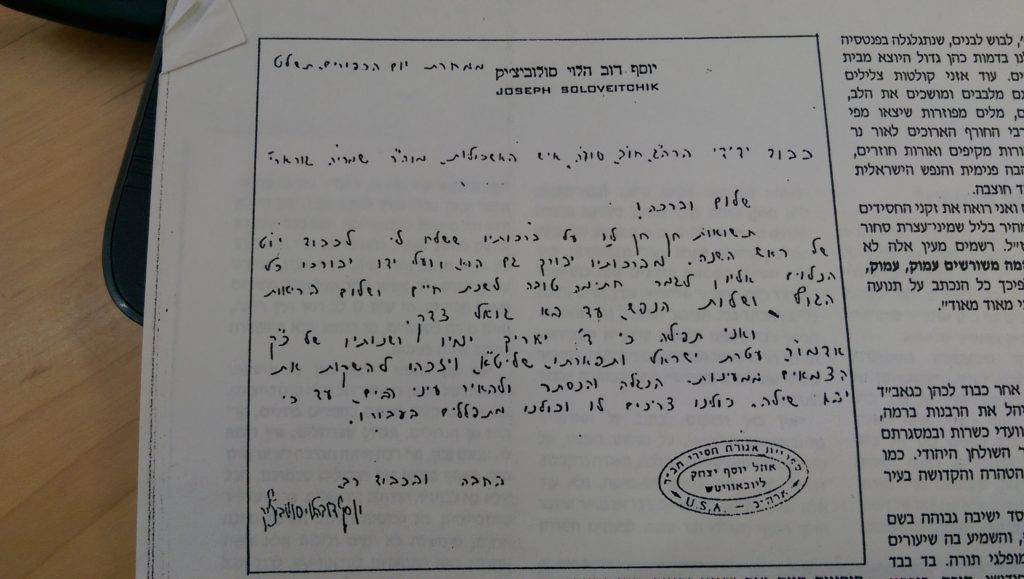
Further On A Forged Letter of Rabbi Joseph B. Soloveitchik

Further On A Forged Letter of Rabbi Joseph B. Soloveitchik

By Mosheh Lichtenstein

Rabbi Mosheh Lichtenstein is a co-Rosh Yeshiva of Yeshivat Har Etzion.

He is a grandson of Rabbi Joseph B. Soloveitchik.

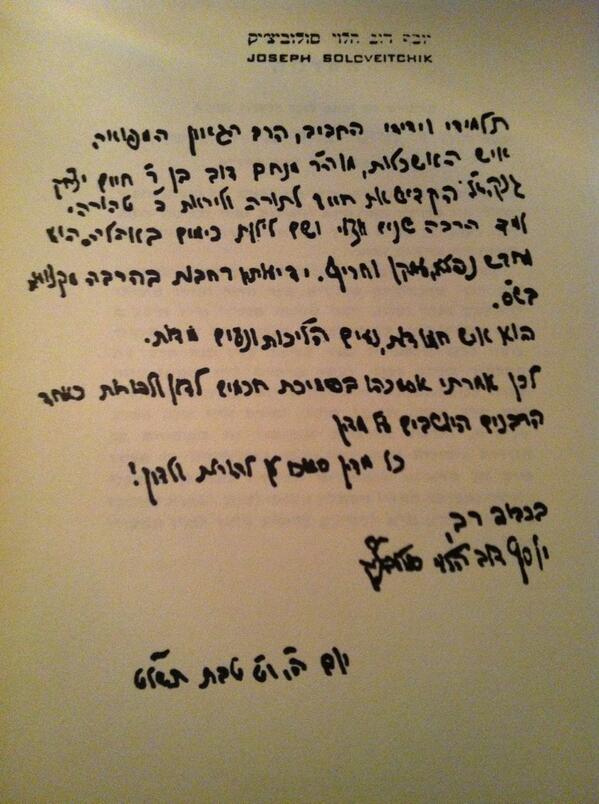
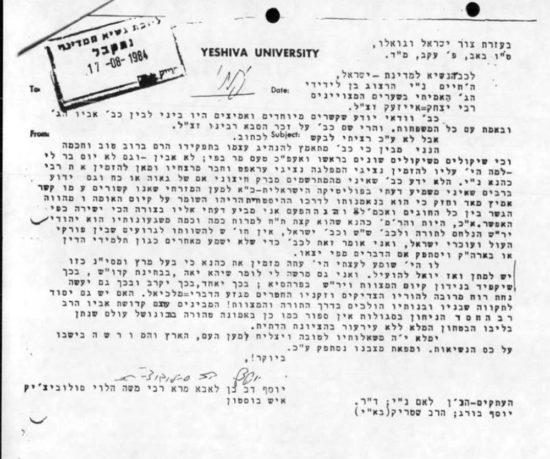
It was recently brought to my attention that various readers of the Seforim Blog have expressed skepticism regarding the determination that the letter found in President Chaim Herzog’s archives and supposedly written by my grandfather, Rabbi Joseph B. Soloveitchik zt”l (hereafter, “the Rav”), is a forgery.


Moreover, some of the commentators have engaged in various conspiracy theories regarding the motivation and the accuracy of the claim that this is a fake letter. See here. Although I do not usually attempt to argue with such claims or engage conspiracy theorists and strongly suspect that penning this response will not necessarily convince those who refused to accept the original clarification, I will, nevertheless, attempt to present the evidence that the letter is indeed a forgery since I fear that future researchers may also question the denial and view the letter’s status as an unresolved issue.

Moreover, since there may be sincere individuals who are indeed skeptical of a forgery claim regarding a letter whose subject is a controversial figure and may suspect that there is an agenda behind the denial of the letter’s legitimacy, I am presenting the evidence for their review and evaluation. Thus, if those who expressed skepticism are indeed sincere and open to evaluating the evidence, it is my hope that they will review the evidence presented below and recognize that the letter is fraudulent.

At the outset, I must re-emphasize what was clearly stated by the editors of the Seforim Blog (here); i.e. that the determination of our family members who saw this letter and judged it to be a “crude forgery” was entirely based upon an examination of the signature, stationery and other such considerations and totally independent of any opinion, positive or negative, regarding the subject of the letter. Having stated for the record what should be obvious, I will now present the considerations themselves.

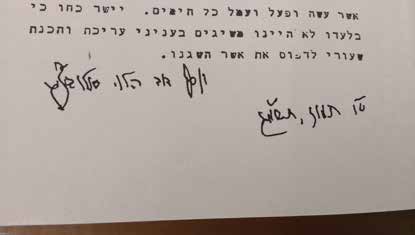
1. First, and this alone should suffice, is the error in the spelling of the name. The Rav spelled his name דוב with a vav in the middle and not דב without a vav. I have never seen a signature of the Rav without the vav and I challenge all of those who doubted our claim to produce a signature of the Rav, in his handwriting, without a vav. As there are a multitude of “semikhah klafim” signed by the Rav, as well as numerous letters that he wrote, I assume that this can be readily verified. I would add that, unlike dates or plain text, it is rare indeed that people make typos in their signature.

2. The Rav’s signature in the letter contains an additional conclusive indication that the Rav didn’t write it which is the mention of his father and his title. The Rav would use the title אבא מרי when referring to his father in his halakhic writings and famously utilized it in the title of a major work, Shiurim le-Zekher Abba Mari (Jerusalem: Mosad ha-Rav Kook, 1984). However, he never used it when referring to his father, Reb Moshe Soloveichik, in his signature. Usually, the Rav signed his name without mentioning his father but if he did mention him, he always used the Brisker title of הגאון החסיד or variations of it and never אבא מרי. Thus, he might sign בן הגאון החסיד or בהגאון מהרמsee Iggerot ha-Grid pp. 139-140 for two such examples – but not אבא מרי as in the letter under discussion.


The vast majority of the letters that I have had occasion to see, as well as those published in *Community, Covenant And Commitment: Selected Letters And Communications*, ed. Nathaniel Helfgot (Jersey City, NJ: Ktav, 2005), and originally written in Hebrew, contain the Rav’s name alone without any reference to his father whatsoever. Moreover, my impression is that the younger the Rav was and the more “rabbinic” and traditional or ceremonial the context (such as HaPardes), he might refer to his father, while in more political or non-rabbinic settings and the older he gets, he rarely signs as his father’s son. This is doubly true of the years when he had physical trouble writing (for examples of 2 late letters in very rabbinic settings in which his father is not referenced in his signature, see the letter published in the beginning of the first volume of the first edition of the Shiurim le-Zekher Abba Mari and/or the letter written to Rabbi Shemariah Gourary in October 1978 and published in a Chabad journal upon his petirah in 1993).

The bottom line is that the vast majority of all his letters don’t mention his father and this is esp. true in the later years. Thus, the very reference to his father in a very late letter to a secular political figure like Chaim Herzog might already raise suspicions about this letter, but the crucial point is that even when mentioning Rabbi Moshe Soloveichik, he is never referred to as אבא מרי. Presumably, the person who wrote this letter was aware of the Abba Mari title because of the book (which had just been published a year earlier), but unfamiliar with the Rav’s normal signature mode and thus blundered into applying the wrong title to Rabbi Moshe Soloveichik.

In an aside, I’ll also mention that the person who wrote this letter was not only woefully unequipped with knowledge of the Rav’s signature, he also didn’t know how to spell אבא מרי properly. Unlike the Rav, who was aware of the phrase’s origin in the Shas (Kiddushin 31b and Sanhedrin 5a) and its usage by the Rambam in Mishneh Torah (Hilkhot Talmud Torah 4:3 and Hilkhot Shehitah 11:10) to refer to his father and, of course, spells it properly, the writer of this letter can’t even spell the title that he chose properly (although I can’t rule out the possibility of a typo, I cannot but have the impression that this is yet another instance of the work of someone who simply doesn’t know what he’s doing).

3. The letter includes the title איש בוסטון together with the signature. I’d love to see another letter of the Rav in which he signed himself as איש בוסטון. Until such a letter is produced, I regard this as an additional example of the fraudulent nature of this letter since the Rav didn’t use such a title to identify himself. He was not Paul Revere and apparently did not consider איש בוסטון to be a defining characteristic.

4. A crucial element in assessing a signature’s authenticity a graphological examination. In our case, the signature of the Rav in the Herzog letter simply fails the most basic graphological test. Since a graphological analysis is by definition subjective, I preferred to present the verifiable objective evidence regarding the Rav’s signature prior to raising this point. I also feel obligated to preface my claim with two preliminary comments about the legitimacy of handwriting comparisons:

a. Halakhah and the American banking system that has utilized handwritten checks for decades as a prime form of payment rely upon comparison and recognition of an individual’s signature. The concept of kiyum shtarot, a major legal mechanism in Halakhah which is crucial to all legal documents, is predicated upon comparing signatures.

b. The Rav’s signature is quite distinctive and remained consistent throughout the years. A clear line runs between all his signatures, from youth to old age. In his later years, the signature is more frail and less forceful than his earlier signatures, but the basic form is constant and readily recognizable. The signature that appears in the Herzog letter is so starkly different from his recognized signature that this is a plain case of black and white and not a grey area. Had it been a grey area which required a judgement call, I would never make such a subjective claim, but the contrast here is so great that it does not require a judgement call. To utilize a Talmudic concept from a somewhat different case of graphological assessment, an average ינוקא דלא חכים ולא טפש could easily make this call.

To back up this claim, I suggest that the interested reader see for himself examples of the Rav’s signature in these years. An example from June 1983 is the letter printed in the first volume of Shiurim le-Zekher Abba Mari (first edition).

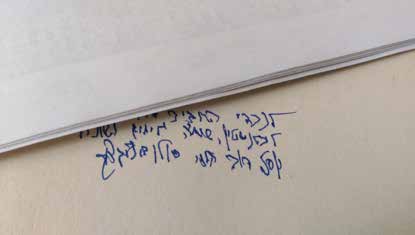
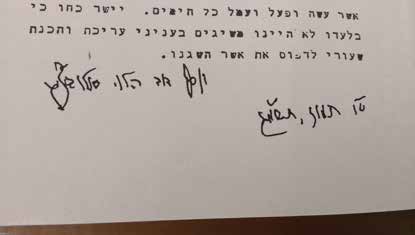
A later example, and even more relevant example, from Winter 1984 (probably January-February 1984) is this (from a dedication he inscribed to me in the Shiurim le-Zekher Abba Mari that he sent me):

One can notice 2 things in this signature: 1. Its basic consistency with his younger signatures 2. the frailty of his writing. The signature in the letter to President Herzog, in contrast, is inconsistent with all of the Rav’s signatures and does not express the frailty of his aging motoric skills, despite supposedly being written months later.

For a somewhat earlier, albeit still late, example, one can see the signature in the haskamah published by Rabbi Menachem Genack in his sefer ברכת יצחק, written in Jan. 1979.

In summary, the signature itself in the document under question is so full of errors that if it were a get, you could say that it contains almost all possible פסולים as it includes א. שינה שמו ב. ושם אביו ג. ושם עירו ד. ואינו מקויים .

From the signature, let us turn our attention to the stationery. Anyone who has seen letters of the Rav knows that the letterhead is always the Rav’s name and usually, but not always, his address as well. He does not use Yeshiva University stationery nor RIETS stationery. I have never seen a letter written by the Rav on a YU letterhead. He was not the Rosh Yeshiva of RIETS or president of YU – he was Rabbi Joseph B. Soloveitchik, the Rav, and his stationery reflects this.

It must also be emphasized that this particular letter is purported to have been written in Boston where the chance that the Rav used YU stationaey is nil. I was with the Rav in Boston during the summer of 1984 and I can attest to the fact that he did not have YU stationery in his study that summer (nor at any other time that I was in Boston).

Thus, it seems fairly obvious to assume, although I cannot verify this, that ‘the writer of this letter’ had access to YU stationery which is dispensed to hundreds of locations but not to the Rav’s private stationery and, therefore, chose to present the Rav as writing on YU stationery, unaware that by doing so ‘he’ is undermining rather than bolstering the credibility of his forgery.

Actually, what ‘the writer of this letter’ is doing is even more bumbling since ‘he’ is not using proper YU letterhead stationery either; if one looks carefully at the letter that was reproduced at the Seforim Blog, it can be noticed that it is written on paper designed for internal correspondence as a memo and is not formal institutional stationery of the sort that is appropriate to use in correspondence with a head of state.

Another suspicious element is the copies of the letter that supposedly were sent to Rabbi Norman Lamm, Dr. Burg and Rabbi Michael Strick. Aside from the fact that to the best of my knowledge, it was not the Rav’s custom to copy others on his letters and this alone is room for additional suspicion, it is unfathomable to think that he would have Rabbi Strick’s name as one of those copied to his letter. Was the Rav even aware that Rabbi Strick worked in YU’s Israel office? Even if so, why would he copy him on a letter to Herzog which does not deal with YU affairs? For that matter, why would he copy Rabbi Lamm?

Since the Rav did not ‘CC’ people and was unaware of Rabbi Strick’s position, this, too, is an additional reason that at least parts of this letter must be considered inauthentic and the work of others. [If one were to argue that this anomaly is reason to support the letter’s authenticity as a lectio difficilior, I would counter that such an argument would be reasonable, if it could be established that the Rav was aware of Rabbi Strick’s role in YU Israel, but since this is definitely not the case, he couldn’t have copied on a letter someone who he was unaware of his position. Thus it is not a more difficult reading, but rather an impossible one and, therefore, proves its inauthenticity rather than its authenticity.]

Next, let us turn our gaze to the top of the page and the salutation of בעזרת צור ישראל וגואלו. Once more, I challenge anybody to produce a letter or document in which the Rav used such a phrase to refer to the KBH in a similar context (or any context, for that matter).

Although one could conceivably argue that he did not normally do so but changed his custom when writing to the president of Medinat Yisrael, I would not accept such a line of reasoning because of the reasons outlined below, but I would also emphasize that the Rav’s letter to Prime Minister David Ben-Gurion does not contain such a phrase nor do any of his other letters to various Israeli Religious Zionist leaders. All of these letters were published in *Community, Covenant And Commitment: Selected Letters And Communications* and are readily available for examination. If one were to argue more ingeniously that he used the phrase only in a letter to Chaim Herzog because of his father, Rav Yitzhak Isaac ha-Levi Herzog’s involvement in the formulation of Tefillah Leshalom Hamedinah, he would have not only to claim that the Rav was attempting to compliment Herzog but also to establish that the Rav was aware of Rav Herzog’s role in the formulation of that text. Personally, I am quite skeptical of this for a variety of reasons, but I will not insist upon it in this discussion.

The crucial point regarding the use of צור ישראל וגואלו is that the Rav would never use such a phrase. Without entering into a protracted discussion of the Rav’s attitude to Zionism in general, a topic that much has been written upon, I will allow myself to state that while undoubtedly supportive of Religious Zionism, he was deeply opposed to three elements of Israeli Religious Zionism that he encountered in his contacts with the Israeli Religious Zionist sector. The first was the ideological position that Jewish Nationalism and its political expression are of the highest religious value. The second, not entirely unrelated to the first, was the perspective that viewed the establishment of the State of Israel and its subsequent achievements as highly significant stages in the Redemption. Regarding those who held to a position that he described as the attachment of “excessive value to the point of its glorification and deification” [of the State of Israel] (*Community, Covenant And Commitment: Selected Letters And Communications*, page 164), he defined them as delusional (the original Hebrew uses the phrase “הוזיםwhich is translated in the published text as “dreamers,” but which actually has a much stronger connation of delusion within it) and in total error. He was also very distant from a historical appraisal that saw the Geulah as imminent. As anyone who has read *Kol Dodi Dofek* or *Hamesh Derashot* is well aware, the Rav emphasizes the Man-God relationship in the context of Zionist history rather than the imminent realization of the promised Redemption.

An additional element that the Rav strenuously objected to was various expressions and formulas in liturgical or halakhic settings that were disconnected from traditional forms of expression and exuded a strong sense of a break with the past and the creation of a new religious language. I would not overstate the case if I stated that such expressions actually caused him to cringe. He certainly was emotionally distant from such phrases and did not use them. A famous example of this was his insistence upon the term “Eretz Yisroel” rather than “Israel,” but there were many such examples, some better known (e.g. translating the text of the ketuba into Hebrew), some not so well known. Even wearing a white shirt on Shabbos (“Israeli style”), rather than a suit, would sometimes annoy him if he sensed that it was an expression of non-traditionalism and “anti-Galut” sentiment. I can attest to this first hand כי מבשרי אחזה זאת. I spent time with my grandfather, the Rav, as a wide-eyed 17 year old youth who often expressed his Zionist sentiments in front of him and occasionally raised his ire by doing so. Once, discussing a related topic, he admitted to me that reciting a certain text was rationally the proper thing to do, but, nevertheless, expressed a personal emotional reluctance to do so because of its novelty and lack of traditional moorings.

Therefore, although this is admittedly a subjective criterion that I am attempting to avoid, I cannot believe that any letter that the Rav wrote or authorized – even to a head of state whose father was Rav Herzog – would contain the phrase בעזרת צור ישראל וגואלו.

Finally, I must point out an issue of content regarding the letter. As I stated at the outset, I am not judging the letter based upon any presumed attitude of the Rav regarding Rabbi Meir Kahane. However, the content of the letter is extremely problematic for totally other reasons. As can be seen, the letter concludes with a clear admonition and rebuke to President Herzog in no uncertain terms regarding his level of observance. Not only does the writer allow himself to criticize Herzog’s standards of public observance, an obviously sensitive topic for someone raised as an observant Jew, he also doesn’t shy away from introducing the extremely sensitive and intensely personal issue of Herzog’s relationships with his parents and children in light of his problematic observance of Mizvoth.

I will allow myself to state that the Rav that I knew, and I assume many of the Seforim Blog’s readers as well, would never enter into such personal matters and grant unsolicited advice and judgement upon his correspondent’s personal life and relationships. For that matter, I cannot imagine that any rational individual who is requesting a favor from a person of stature would conclude his message by rebuking the person and making it clear that he is a disappointment to his parents. Why the writer of this letter thought that this is a reasonable text is beyond me, but if he chose to concoct such a text, I do claim that the Rav would not, and could not, have written such a text. While this is admittedly subjective and, therefore, I do not rest my case upon it but rely upon the above-mentioned considerations, I do believe that the Seforim Blog’s readers should be alerted to this perspective as well.

I will not continue to discuss this letter, although much more could be said about it. In conclusion, I will add that I believe that many of the points that I raised above suffice to individually prove that this letter is utterly false; however, it is also important to emphasize that there is a significance to their cumulative effect. Thus, even if one can argue or suggest alternatives to a particular claim, the accumulation of so many suspicious characteristics is an additional consideration to recognize that the text is much too problematic to be trusted or relied upon.

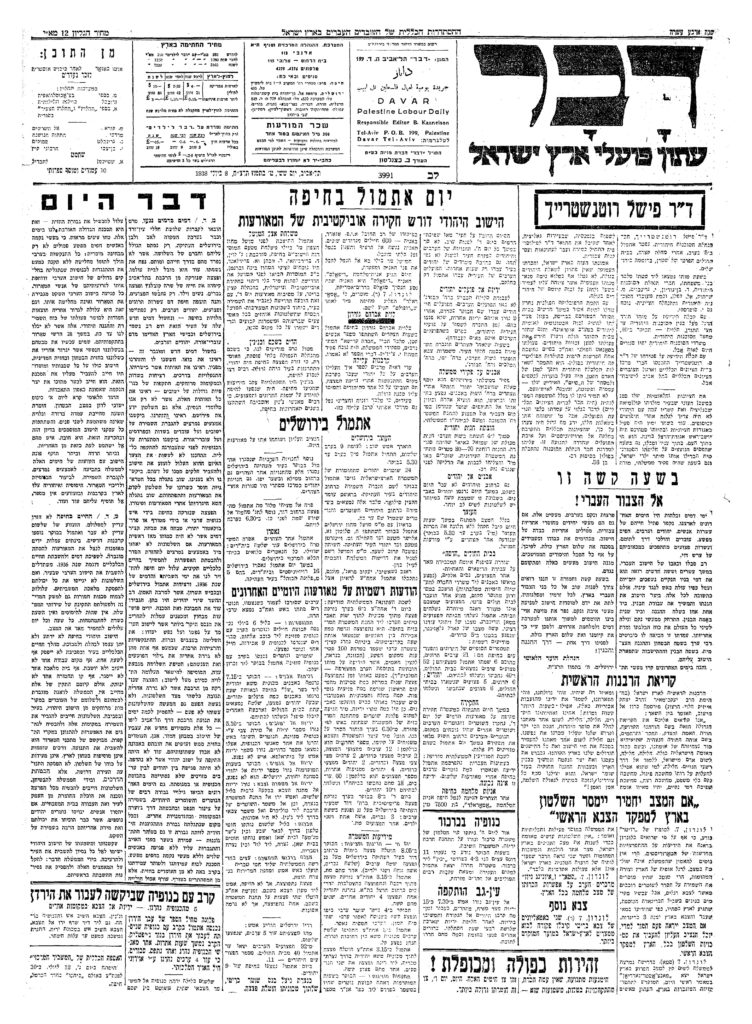
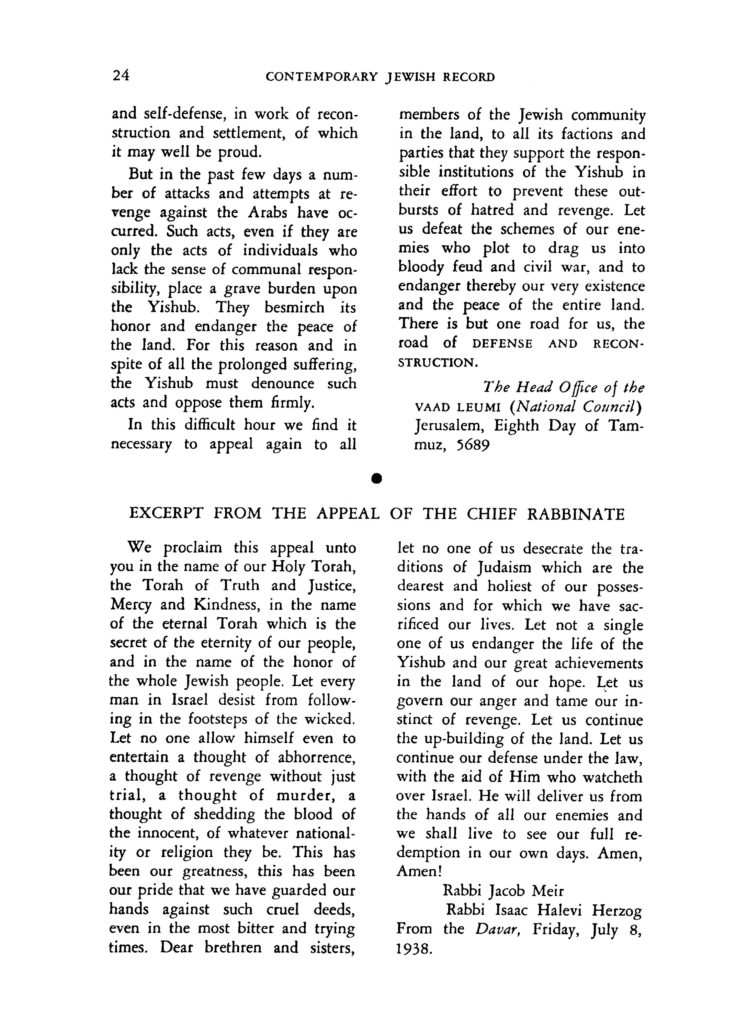
Ironically, whoever thought to send this letter to President Herzog and to appeal to his zekhut avot as part of a letter requesting support for Rabbi Kahane was probably barking up the wrong tree by doing so. Rav Yitzchak Isaac ha-Levi Herzog, whose authority is celebrated in the letter, had the following to say about the issue of retribution and Jewish-Arab relationships in times of terror attacks, published on the front page of the newspaper Davar, Friday, July 8, 1938, and translated into English several months later in Contemporary Jewish Record 1:1 (September 1938):

Why did someone want to counterfeit a letter in the Rav’s name is a question that may be unanswerable, even if we were to identify the person who wrote the letter. It is certainly unanswerable without identifying the writer. It should be recognized, though, that the primary motivation may not have been a political agenda to validate Rabbi Kahane, although it is obvious that the writer’s opinion of him is somewhat favorable and that he is attempting to advance the Kach party’s agenda, but may be rooted in other realms. For instance, the writer may have had a psychological need to empower himself to speak as the Rav, for a variety of reasons, and realized this by counterfeiting a letter in the Rav’s name and sending it to a prominent and famous person.

Whatever the motivation may be – political or psychological – we must recognize that this is a letter that that was not signed or authorized by the Rav and that is what matters.


Engaged Couples, צעירים, and More

Engaged Couples, צעירים, and More
Marc B.Shapiro
Continued from here
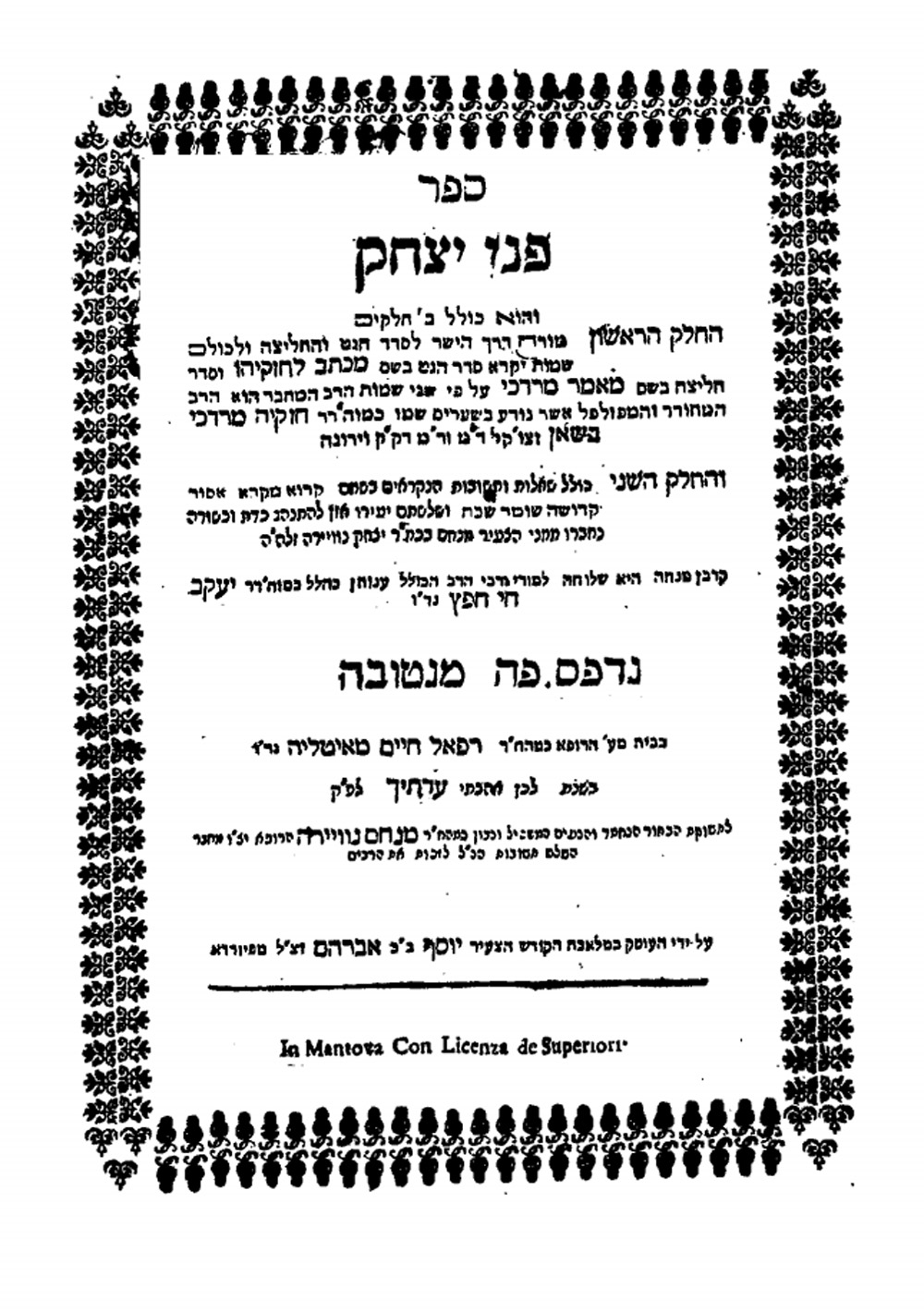
1. Regarding engaged couples having physical contact, this is actually the subject of a section of the book Penei Yitzhak by R. Hezekiah Mordechai Bassan. Here is the title page.
This book was published in Mantua in 1744 by Menahem Navarra who was a descendant of R. Bassan. Navarra, who was at this time a doctor, not a rabbi, was nevertheless very learned in Torah matters. (He would later be appointed rabbi of Verona.[1]) Navarra included three essays of his own in the volume, the second of which is called Issur Kedushah. In this work he criticizes members of the Jewish community for allowing engaged couples to have physical contact before marriage. Here are the first two pages of the work.
Navarra and the others I have referred to are only dealing with an engaged couple touching before marriage, but not with actual sexual relations. Yet this too is mentioned many centuries before Navarra. Ezra 2:43 and Nehemiah 7:46 refer to בני טבעות. A commentary attributed to R. Saadiah Gaon[2] explains this as follows:

בני טבעות: שקלקלו אבותם גם [צ”ל עם] ארוסותיהם קודם שיכניסו אותם לחופה והיו סומכין על קדושי טבעות ומקלקלין עם ארוסותיהן.
What this means is that after kiddushin, which was effected by aטבעת  (ring), but before actual marriage (the two used to be separated, sometimes for many months), the engaged couple would have sexual relations. The children who resulted from this were referred to negatively as בני טבעות. As S. H. Kook points out,[3] R. Saadiah’s explanation is also mentioned by R. Hai Gaon.[4]
R. Hayyim Benveniste, in seventeeth century Turkey, also speaks about how engaged couples would have physical contact. This shows again that there was a divergence between what the halakhah requires and what the people were actually doing (much like you find in a large section of Modern Orthodox society today). Here are R. Benveniste’s words:[5]
להתייחד שניהם כמו שנוהגים פה תירייא ואיזמיר, שאחר השדוכין אחר עבור קצת ימים מתייחדין החתן והכלה ומכניסים אותה לחדר וסוגרין אותן הסגר מוחלט כמו שמסגרין הנשואה אחר ז’ ברכות, מנהג כזה רע ומר הוא, ואיכא איסורא מכמה פנים . . . ועוד שנכשלים באיסור נדה, וברוב הפעמים תצא כלה לחופתה וכריסה בין שיניה, וכמה מהם הודו ולא בושו שבאים עליה שלא כדרכה. אלא א-להים הוא יודע שטרחתי הרבה לבטל מנהג זה פה תיריא ועלה בידי, ועשיתי הסכמה בחרמות ונדויים על זה, ולסבת בעלי זרוע בעלי אגרופין אשר אין פחד א-להים לנגד עיניהם חזר המנהג לסורו רע.
There are a few different points that are of interest in what R. Benveniste writes. The first is that he says that in the majority of cases the bride arrives at the huppah וכריסה בין שיניה. This means that she is pregnant. Even if there is some exaggeration here, R. Benveniste is telling us that many Jewish women were getting pregnant before marriage. Readers might recall my post here where I mentioned R. Ovadiah Bertinoro’s assertion that most Jewish brides in Palermo were pregnant at the time of their wedding.
R. Benveniste mentions how he was able to improve matters by using the power of the herem to keep people in line, but that his success was short-lived as powerful members of the community were able to undermine his authority. This shows us, just as we saw in the text I quoted from R. Eleazar Kalir, that parents were often happy when their children had physical contact before marriage, and they opposed what they regarded as the overly puritanical approach of the rabbis. When R. Benveniste refers to those who באים עליה שלא כדרכה, this means that some of the couples had a sexual relationship, but wanted the woman to be a virgin at the wedding.
R. Jonah Landsofer (Bohemia, died 1712) also testified to the problem we have been discussing:[6]
בבית ישראל ראיתי שערוריה איכה נהיית’ כזאת שאין איש שם לבו להוכיח בשער בת רבים על התקלה וקלקלת שוטי’ שקלקלו והרגלו הרגל דבר עד שנעשה טבע קיים לבלתי הרגיש ברעה אשר ימצאם באחרית הימים והוא אשר נעשה בכל יום ערוך השלחן וצפה הצפית מיום שגומרין שידוכין בין בחור ובתולה מושבים אותם יחד ומוסרי’ הבתולה לזנות בית אביה בחיבוקים ונשוקים ומעשה חידודי’ וכל הקרואים והמסובי’ מחזיקי’ בידו.
Because the masses had no interest in what the rabbis had to say about this matter, R. Landsofer concludes that one need not even rebuke them, as they won’t listen anyway. Not long ago I heard a rabbi going on about the holy communities of Europe of a few hundred years ago, about their support of Torah, the respect they gave to the rabbis, and their commitment to halakhah. All of this is true, but if you look a little closer you find that these communities were actually very much like contemporary Modern Orthodox communities, in that together with a commitment to halakhah, many people also felt that they could determine which halakhot could be ignored. Or perhaps they didn’t even think they were violating halakhah. Maybe they assumed that the rabbis were making their lives difficult with extreme humrot. Either way you look at it, it is very obvious that there were many in traditional Jewish societies who created their own standards of practice which did not always correspond to what the rabbis insisted on, and they had no interest in changing their ways because of what the rabbis were saying.[7]
While the standard rabbinic view has always been that bride and groom are not to have any physical contact until after the wedding ceremony, the rabbis in Germany were a little more lenient. Sefer Maharil records that the practice was for the bride and groom to touch before marriage, but only on the morning of the wedding, a time that also included celebration.[8]
בעלות השחר ביום הששי היה קורא השמש לבא לבה”כ . . . ומביאים הכלה וחברותיה. וכאשר תבא עד פתח חצר בה”כ הלך הרב והחשובים והיו מוליכין את החתן לקראת הכלה. והחתן תופש אותה בידו ובחיבורן יחד זורקין כל העם על גבי ראשן חטין ואומרים פרו ורבו ג”פ. והולכין יחד עד אצל פתח בה”כ ויושבין שם מעט ומוליכין הכלה לביתה.
This detail, that the groom held the bride’s hand prior to the wedding, is found in a number of other German sources.[9] I don’t know how this practice of holding the bride’s hand before the wedding ceremony can be reconciled with what appears in Tractate Kallah, ch. 1:
כלה בלא ברכה אסורה לבעלה כנדה.
The word כלה here means a woman who is betrothed but not yet married.
R. Hayyim Joseph David Azulai, Kisei Rahamim, Kallah, ch. 1, comments on this passage:
כלה בלא ברכה אסורה כלומר אפי’ לחבק או ליגע בה כנדה.
I also find it noteworthy, and strange from our perspective, that Sefer Maharil tells us that for the wedding ceremony the rabbi would bring the bride to the groom, holding her by her robe:[10]
והרב היה תופס אותה בבגדיה והוליכה והעמידה לימין החתן.
R. Israel David Margulies (19th century) cites this text from Sefer Maharil and correctly notes that in medieval times the brides were much younger than in his day. He assumes that the typical bride was under 12 and a half years old, and therefore there was no problem of impure thoughts with such brides.[11]
ואיזה הירהור יהי’ בכלה קטנה או נערה כזאת, ולכן לקח אותה הרב בעצמו אצל מפתן הבית מן יד הנשים, והביאה אל החתן ושארי הנשים נשארו ולא היה להם שום עסק בבהכ”נ ולא היה חשש הרהור במקום קדשו.
2. Recently I heard a shiur where the rabbi said that if there is a Torah or rabbinic commandment to do something, only the talmudic sages can, as an emergency measure, forbid the action. The classic example is the Sages telling us not to blow the shofar if Rosh ha-Shanah falls out on Shabbat. There is nothing controversial in what the rabbi said, and I think most would agree, even if there some exceptions to this general rule. The rabbi further noted that post-talmudic authorities cannot make gezerot as this power is also reserved for the talmudic sages. This viewpoint is shared by many, yet there are important authorities who disagree, and perhaps more significantly there is evidence of post-talmudic gezerot.
I mention this now, after Passover [this post was written a few weeks ago], since those who reviewed the laws of Pesach would have seen Shulhan Arukh 453:5 which states:
האידנא אסור ללתות בין חטים בין שעורים.
“Nowadays, it is forbidden to moisten either wheat or barley [for grinding].”
If you look at the Mishnah Berurah he explains that while the Sages forbid moistening barley because it will easily leaven, according to the Talmud it is permitted to moisten wheat. In fact, according to the Talmud, Pesahim 40a, Rava held that it is an obligation to wash the grains of wheat: מצוה ללתות.
The Mishnah Berurah explains that it is the geonim who forbid moistening wheat since we are not expert at doing it properly, and it might come to be leavened, or we might delay removing the wheat after the moistening (before grinding) and this might lead to leavening. If the geonim forbid something that the Talmud permitted (or even required), isn’t this to be regarded as a gezerah?
3. Let me now mention something relating to Sukkot, which I had hoped to post closer to the holiday, but as the rabbinic saying goes, מה שהלב חושק הזמן עושק.
Shulhan Arukh, Orah Hayyim 649:4 states:
גנות הצעירים של עובדי כוכבים וכיוצא בהם מבתי שמשיהם מותר ליטול משם לולב או שאר מינים למצוה.
[Regarding what has grown in] the gardens of the צעירים of idolators and similar [gardens] of the houses [or: buildings] of their attendants, one is permitted to take from there a lulav or the other minim for the mitzvah.
Who are the צעירים of the idolators? The Taz states that he does not know:
איני יודע פירושו, אבל הוא ענין ממשרתי עבודת אלילים.
It is not just the Taz who doesn’t know, as none of the traditional commentaries have a clue. The Feldheim English translation of the Shulhan Arukh with Mishnah Berurah (which I make use of when I provide translations) doesn’t translate the word הצעירים, and instead simply transliterates it.[12]
In fact, I  am sure that R. Joseph Karo, living in the Muslim world, did not know what the צעירים are either. You might find this a strange assertion. After all, if R. Karo recorded the halakhah, how could he not know what he was writing? However, in this case R. Karo was just recording what appears in R. Aaron Hakohen of Lunel’s Orhot Hayyim (Florence, 1750), Hilkhot Lulav, no. 8, in the name of the Ritva:
כתב הר’ יום טוב אשבילי ז”ל בשם רבו ז”ל הוי יודע שגנות הצעירים והדורסים וכיוצא בהם מבתי הכומרים אינם משמשי ע”ז ולא נויי ע”ז ופירותיהם וכל אשר בהן מותרין בהנאה ומותר ליטול משם לולב או שאר מינין למצוה עכ”ל.
From a halakhic standpoint the importance of the halakhah is that it tells us that one can take a lulav and other other minim from the garden of an idolator, and it is not important exactly what type of idolator the צעירים are.
As mentioned, the halakhah in the Shulhan Arukh is taken from the Orhot Hayyim. It is first quoted in the Beit Yosef, Orah Hayyim 649, where it cited more exactly from the Orhot Hayyim than what appears in the Shulhan Arukh:
כתוב בארחות חיים ]הל’ לולב סי’ ח[ נגות הצעירים והדורסים וכיוצא בהם מבתי הכומרים מותר ליטול משם לולב או שאר מינים למצוה.
In the Beit Yosef (and also in Orhot Hayyim) it says הצעירים והדורסים. Furthermore, instead of מבתי שמשיהם that appears in the Shulhan Arukh, we have מבתי הכומרים, which means the houses (or buildings) of the priests. I have no doubt that the the word שמשיהם is a censor’s replacement of the original הכומרים. In the first printing of the Beit Yosef, Venice 1550, the sentence quoted above appears in its entirety. Yet when the Beit Yosef was next printed, Venice 1564, the entire sentence was deleted, obviously a requirement of the censor. The Shulhan Arukh was first printed in Venice, also in 1564. It thus makes sense that the deletion of the word הכומרים is due to censorship, and it could be that it was this alteration that prevented the entire halakhah from being deleted.
Before we get to הצעירים, what is the meaning of הדורסים that appears in Orhot Hayyim and is copied in the Beit Yosef? If you look at the Ritva that the Orhot Hayyim is citing, he states:[13]
והוי יודע שגנות השעירים והדוכסים וכיוצא בהם מבתי הכומרים, אינם משמשי ע”ז ולא נויי ע”ז, ופירותיהם וכל אשר בהם מותרים בהנאה, ומותר ליטול משם לולב או שאר מינין למצוה וכן קבלנו מרבותינו ז”ל הלכה למעשה.
The first thing to notice is that instead of הצעירים we have the word השעירים. This is a clear mistake, and the editor notes that the word הצעירים appears when the passage is cited in Orhot Hayyim. Unfortunately, the editor doesn’t note that are also least two other places where in speaking about benefit from avodah zarah the Ritva refers to גנת הצעירים.[14]The text from Ritva quoted above also has, instead of הדורסים which appears in Orhot Hayyim, another strange word, הדוכסים. This means “dukes” (or noblemen, princes, rulers, etc.) and makes no sense here since the context is avodah zarah which has nothing to do with a duke’s garden.

So we now have to explain not just what צעירים means but also דורסים or דוכסים. R. Hayyim Joseph David Azulai[15] suggests that צעירים is derived from Zechariah 13:7: והשבתי ידי על הצוערים, “And I will turn my hand upon the little ones.” It is hard to see how telling us that צוערים is related to צעירים helps us to understand the point of the Shulhan Arukh. R. Azulai also refers the reader to Rashi’s commentary on Zech. 13:7:
על הצוערים: על השלטונים הצעירים מן המלכים.
Perhaps I am missing something, but I don’t see what this passage adds other than showing us thatצוערים  and צעירים mean the same thing. Why does R. Azulai have to tell us this? The wordצעיר  is found elsewhere in the Bible, so we already know what it means.
R. Azulai’s short note also refers the reader to Abarbanel’s comment to Zech. 13:7. It is Abarbanel who will help us to understand what is going on with the word צעירים. (As R. Azulai was commenting on the Shulhan Arukh, he did not attempt to explain דורסים/דוכסים which is only found in the Beit Yosef. We shall return to this word soon.)
Abarbanel writes:
והשיבותי ידי על הצוערים שראוי שיפורש כפי זה הדרך על כומרי אדום הדורשים להם אמונתם וכזביהם והם עצמם נקראים אצלם צעירים להורות על ענוותנותם ושפלותם כי בעבור שאלה חטאו והחטיאו את אחרים בלמודם ודרושותיהם [!] אמר השם שישיב ידו ומכותם עליהם.
While this passage has nothing to do with the Shulhan Arukh, R. Azulai saw the relevance of it as Abarbanel makes the connection between צוערים and צעירים as we saw already with Rashi. Abarbanel also specifically connects this to Catholic priests, telling us that these priests would call themselves צעירים as a sign of modesty.
From this we can understand that when the Shulhan Arukh refers to gardens of the צעירים he means gardens belonging to Catholic priests. But who in particular are the צעירים? To answer this question let’s return to the Beit Yosef which referred to both צעירים and דורסים/דוכסים. As already noted, this entire passage is taken from the Orhot Hayyim.
In 1902 R. Moses Schlesinger published the second volume of the Orhot Hayyim. In the introduction he included a helpful list of all the times that the Beit Yosef cites the Orhot Hayyim. When he comes to our example, p. xv, he has a note in which he cites the great Abraham Berliner[16] that the proper reading is גנות הצעירים והדורשים. In other words, instead of דורסים/דוכסים, which appears in the Ritva and the Orhot Hayyim, it should say דורשים. When he wrote the Beit Yosef, R. Joseph Karo probably just copied the word דורסים that was in his copy of the Orhot Hayyim without knowing exactly what it meant (as its exact meaning, while of interest to historians and Seforim Blog readers, is not relevant to the underlying halakhah).[17]
So what does הצעירים והדורשים mean? Berliner explains this as well (and it was actually earlier explained by Leopold Zunz[18]). The two most important medieval Catholic orders were the Franciscans and the Dominicans. The actual name of the Franciscans is the “Order of Friars Minor.” They were often called “Little Brothers” or “Minorites.” Thus, when the Ritva and Orhot Hayyim refer to the צעירים this is just the Hebrew translation of “Minorites”, i.e., the Franciscans. As Abarbanel correctly pointed out, this term was adopted as a sign of humility.[19]As for the דורשים, the meaning of this is obvious (after Berliner and Zunz have enlightened us). The actual name of the Dominicans is the “Order of Preachers,” so דורשים (preachers)=Dominicans. What the Ritva and Orhot Hayyim are telling us is that when it comes to the mitzvah of lulav, one can use that which grows in the gardens of the Franciscans and the Dominicans (and the same halakhah would apply to other Catholic orders. The monasteries would often have gardens and Jews would be able to purchase things from there.)

In Nahmanides’ Disputation[20] he too refers to theצעירים  and the דורשים.
והיו שם ההגמון וכל הגלחים וחכמי הצעירים והדורשים.
In his note, R. Hayyim Dov Chavel identifies the צעירים as the Franciscans. However, he doesn’t know that the דורשים are the Dominicans, and he therefore explains that the word means הנואמים. In his English translation, Chavel writes, “Among them were the bishop [of Barcelona] and all the priests, Franciscan scholars, and preachers.”[21]
It is noteworthy that the fifteenth-century R. Solomon ben Simeon Duran, who lived in North Africa, was apparently also unaware of the meaning of צעירים, and therefore applied it to all young Catholic religious figures, not merely Franciscans. )At least, that is what I think he means, as opposed to understanding his use ofצעיריהם  to refer to young men as a whole.) After contrasting the sexual purity of the Jews with what occurs in surrounding society, he writes, in very strong words:[22]
וצעיריהם הם כולם מטונפים בעריות מנאפים עם נשי רעיהם ובאים על הזכור והטוב שבהם מוציא שכבת זרע לבטלה בידו וזה מפורסם אצלם.
4. Since in a prior post I discussed Jacob’s love of Rachel and Leah, let me share a strange interpretation I recently found, involving love and Jacob’s brother, Esau. The general understanding is that Esau loved Isaac. Indeed, it is very difficult to read the Torah and conclude differently. Therefore, I was quite surprised to find that the medieval R. Abraham Bedersi is of the opinion that, after Isaac gave Jacob the blessing intended for Esau, not only did Esau not love Isaac, but he was ready to cause his death! This would be accomplished by killing Jacob, since Isaac’s great sorrow would bring on his end. To arrive at this interpretation, Bedersi offers a novel understanding of Gen. 27:41: יקרבו ימי אבל אבי ואהרגה את יעקב אחי. The standard understanding of these words is that when the days of mourning for his father arrive, then Esau will kill Jacob. As he didn’t want to cause his father pain, he decided to wait until he was dead to kill Jacob. However, Bedersi understands ואהרגה to mean, “when I will kill Jacob” this will cause my father to die.
Here are his words from his Hotem Tokhnit:[23]
ועשו הרשע ידוע שלא היה אוהב יצחק אביו כמו שתראה שאמר יקרבו ימי אבל אבי ואהרגה את יעקב אחי וביאור נכון בו אהרגה את יעקב אחי ובאמת יקרבו ימי אבל אבי שהוא יצטער על בנו וימות.
As mentioned, this is a strange interpretation so I Iooked around to see if I could find a similar approach. I didn’t see anything in Torah Shelemah. I looked in the ArtScroll extended commentary to Genesis (not the Stone Chumash) and it does not bring any interpretations that suggest that Esau intended to cause Isaac’s death. However, the commentary states as follows:
Ralbag interprets similarly:[24] Even if it accelerates my father’s death [lit. brings near the days of mourning for my father] I nevertheless will kill my brother Jacob (cited by Tur).
I don’t know where they got this from, as Ralbag does not say what is attributed to him. All Ralbag says is that Esau wished to kill Jacob after Isaac’s death. The Tur, who was a contemporary of Ralbag, does not cite him.
R. Abraham Bedersi’s Hotem Tokhnit focuses on Hebrew synonyms and in an era before concordances and computers would have required an enormous amount of work. It found on hebrewbooks.org, but it is not on Otzar ha-Hokhmah.

Among the many interesting things you will find in Hotem Tokhnit is that he says that unlike the word יהודי, the word עברי is only used in the Bible in the context of slavery, and he provides examples of this (p. 152). With this in mind, I can see why some people would prefer the term Mishpat Yehudi instead of Mishpat Ivri.

On p. 202  he quotes an otherwise unknown comment of Ibn Ezra that the meaning of the word סלה is “truth”.
כי ענין סלה אמת ונכונה ועל זה אמר אשרי יושבי ביתך עוד יהללוך סלה (תהלים פ”ד ה’) באמת וביושר.
Beginning on p. 1 in the second section, there is a long letter from Samuel David Luzzatto. He refers to an unnamed scholar who could not accept that Rabad, in his comment to Hilkhot Teshuvah 3:7, would say that people greater than Maimonides thought that God had a physical form. He therefore suggested changing גדולים וטובים ממנו to גדולים וטובים מעמֵנו (tzeirei under the mem).
Luzzatto completely rejects this point, arguing that גדולים וטובים מעמנו means people greater than our nation, i.e., non-Jews. Furthermore, he adds, where do we find Rabad, Rashi, etc. using the word עמנו to refer to the Jewish people.
On p. 2 Luzzatto records the following lines from one of Bedersi’s poems, in which one word summarizes each of Maimonides’ Thirteen Principles:
נמצא כיִחודו והֶבדלו                    קדמות עבודתו נבואתו
משה ותורתו אֲנצחַ                       ידע גמול גואל בהחיותו
Luzzatto also publishes a long poem from Bedersi together with Luzzatto’s commentary, without which it would be very difficult to understand much of what Bedersi was saying. One of my favorite lines is found on p. 13:
ולא תבין שפת כל-עם בשירים        לבד טרחם, כפז על גב בעירי
What this means is that poems are difficult for the masses, of every nation and language, to understand. They regard them as a burden, much like an animal, if you place gold on its back, won’t appreciate what it is carrying. It will only feel the burden of the weight.
5. Since I mentioned Mendelssohn in the last post, let me note the following. I recently saw that Eliezer Segal, in his wonderful book, Introducing Judaism (London and New York, 2009), p. 110, uses a picture of Mendelssohn. You can see it here. (Copyright prevents me from posting the picture.) We are told that the image is from the 18th century, yet there is no doubt that this is not a picture of Mendelssohn. You can look at authentic pictures of Mendelssohn here and they look nothing like this image. Incidentally, in a student’s description of Mendelssohn’s 1777 meeting with Kant, he is described as  having a goatee.[25]
6. In a comment to my last post, Maimon wrote: “On the subject of R. Bachrach’s responsum – it bears noting that the pre-reform homogeneous [should be: heterogeneous] Jewish society (especially in Germany) contained people of varying levels of observance from across the spectrum and as such many behavioral patterns that would be unthinkable in contemporary Orthodox society are detailed in the Halakhic writings from that era.” Maimon is correct, and it is not only in recent centuries or in Germany that one finds communities with people of different levels of religious observance. This is how Jewish societies have always been, in every era and place, at least until the second half of the twentieth century and the creation of haredi societies. I have already cited numerous examples that justify this statement, but let offer one more that shows how even in medieval times young men and women would socialize in a way that Maimon might say “would be unthinkable in contemporary Orthodox society.” I would only add that instead of “contemporary Orthodox society,” I prefer to say “contemporary haredi society,” since as mentioned already, Modern Orthodox society still has significant variations in level of observance. (When I speak of variations in level of observance, I have in mind bein adam la-Makom halakhot. I am not referring to halakhot having to do with monetary issues and dina de-malchuta dina, regarding which I believe the Modern Orthodox community is superior to what we find in the haredi world.)
R. Meir of Rothenburg was asked about young Jewish men and women who were drinking together. As a joke, one of the young women asked one of the men if he would betroth her. He took a ring and threw it to her, and recited the text of kiddushin. (At a future time I can discuss the halakhic arguments that R. Meir used to free the woman from having to receive a get.) One cannot overlook the fact that the way the young men and women were socializing together, much like you would find among kids at Modern Orthodox high schools, shows that there was no strict separation between the sexes. Here is the question, as it appears in Irving Agus, ed., Teshuvot Ba’alei ha-Tosafot, no. 85.

R. Meir of Rothenburg’s answer is found in She’elot u-Teshuvot Maharam mi-Rothenburg, Prague ed., no. 993.7. Two people have asked me to comment on Rabbis Yitzchok Adlerstein’s and Michael Broyde’s article here arguing that hasidic schools shouldn’t be forced to offer secular education. While the Seforim Blog is not the place for commenting on these sorts of matters, after reading the article I felt I had to make one point. Adlerstein and Broyde cite the famous Supreme Court case which allowed the Amish to opt out of secular education and they apply this logic to the hasidic communities. While it is true that if it went to court the hasidic communities would probably prevail, there is a big difference between the Amish and the hasidic communities. The Amish do not take welfare, food stamps, and other forms of government assistance. Thus, they make choices and live with the consequences. However, the hasidic communities refuse to provide their children with the basic skills needed to function in the modern economy, and as a result rely heavily on the welfare state. No one who believes in limited government and is opposed to the welfare state can support a situation where kids are allowed to grow up almost guaranteed to be in need of public assistance.[26]


[1] Regarding Navarra, see Cecil Roth, “Rabbi Menahem Navarra: His Life and Times. 1717-1777,” Jewish Quarterly Review 15 (1925), pp. 427-466.
[2] Perush al Ezra ve-Nehemiah (Oxford, 1882), p. 30.
[3] Iyunim u-Mehkarim (Jerusalem, 1959), vol. 1, p. 259.
[4] Ginzei Kedem 4 (1930), p. 52. While there is no historical evidence for this explanation, it does show that the practice of using a ring for kiddushin existed already in the geonic period. For other sources from this era, see Mordechai Margaliot, ed., Ha-Hilukim bein Anshei Mizrah u-Venei Eretz Yisrael (Jerusalem, 1938), no. 25. For a very detailed discussion of use of a ring for kiddushin, see Pardes Eliezer: Erusin ve-Nisuin (Brooklyn, 2010), vol. 4, ch. 30.
Only in Yemen did the practice of using a ring not become widely accepted (though even there it was used in some places). See R. Yitzhak Ratsaby, Shulhan Arukh ha-Mekutzar, vol. 7, pp. 27-28. There is no mention of using a ring for kiddushin in the Talmud. It does, however, appear in Tikunei Zohar, nos. 5, 10 (as pointed out by R. Moses Isserles, Shulhan Arukh Even ha-Ezer 27:1), but Tikunei Zohar does not date from the tannaitic or amoraic period. The Sefer ha-Hinukh, no. 539, says that the reason we use a ring for kiddushin is so that every time the woman looks at her hand she remembers the following things (which apply to all means of kiddushin, but wearing a ring allows her to remember them).
שהיא קנויה לאותו האיש ולא תזנה תחתיו ולא תמרוד בו ותתן לו יקר והוד לעולם כעבד לאדוניו.
Regarding what I have underlined, even if today some men like being treated like that, going into a contemporary marriage expecting to get this sort of treatment is a recipe for marital disaster.
The ring for kiddushin has nothing to do with the engagement ring. I always wondered why the practice of giving a diamond engagement ring was not condemned as hukkot ha-goyim, especially by those who have an expansive understanding of this halakhah. Even if it is not halakhically forbidden, it is clearly a practice that came from non-Jewish society. How is it that people who refuse to have anything to do with things like Mother’s Day or Thanksgiving have no problem giving a diamond ring as an engagement present? R. Chaim Rapoport pointed out to me that R. Zvi Hersh Ferber of London (d. 1966) condemned the giving of engagement rings as hukkot ha-goyim. See Kerem Tzvi: Bereishit, vol. 1, p. 132.
As for wedding rings for men, R. Meir Mazuz states that there is absolutely no problem with a man wearing a ring. See Asaf ha-Mazkir, p. 194, Bayit Ne’eman, pp. 441ff. He calls attention to Shabbat 62a, וחילופיהן באיש, from which we see that this was not regarded as a problem. He also quotes Kaf ha-Hayyim 161:31 who writes (summarizing an earlier source):
דת”ח שתורתם אומנתם וכן בעלי בתים שעוסקים במו”מ ואין להם מלאכה גרועה א”צ להסיר הטבעות בשעת נט”י אע”ג דמהדקי טובא.
R. Mazuz states that on his wedding day his father, the great R. Matzliach Mazuz, gave him a ring to wear, and that in Tunisia this was the general practice, that a groom received a ring and wore it for the rest of his life. However, upon coming to Israel R. Mazuz saw that it is not accepted for talmidei hakhamim and “fearers of heaven” to wear a ring so he stopped wearing it. (This is his language in Asaf ha-Mazkir. In Bayit Ne’eman he writes that the haredim do not wear rings.) R. Mazuz adds that he does wear the ring on the night of Passover to commemorate the words of Genesis 15:14: “Afterward shall they come out with great substance.” (“Great substance” includes jewelry.)
R. Mazuz notes that in a picture of the Moroccan sage, R. Isaac Bengualid (1777-1870), author of the responsa work Va-Yomer Yitzhak, he is wearing a ring. Here is the picture.

He also mentions a picture of R. Elijah Hazan (1848-1908) of Alexandria, author of the responsa work Ta’alumot Lev, where he is wearing a ring. I have not been able to find this picture. See also here where S. has a picture of R. Bernard Illowy wearing a ring as well as a picture of R. Samson Wertheimer’s wedding ring.
R. Hayyim Amselem, here (from May 5, 2105), writes very strongly against those who oppose wedding rings on religious grounds, using the opportunity to once again blast the Ashkenazic haredim.
איפה ההגיון הבריא?
הבוקר בעתון ישראל היום ובערוץ 7 מפרסמים בהבלטה ובהתפעלות פסק הלכה “חדש” המתיר ואפילו ממליץ בעידן המודרני לגברים נשואין לענוד טבעת נישואין, בעולם הדתי והחרדי, שוללים זאת כי זה “מנהג גוים”, לדעתם וכו’ וכו’ .
מה שהם אינם יודעים שאין כאן כל חדש ובעדות הספרדים היה זה מנהג פשוט שרבים מאוד מהגברים ענדו על ידם טבעת נשואין, או טבעת בכלל ולא היה פוצה פה ומצפצף, ידועות כמה תמונות של גדולי תורה והלכה שבאצבעם טבעת כגון תמונתו של הגאון רבי יצחק בן וואליד רב ודיין בעיר תיטואן במרוקו, וכן עוד רבנים, שכך עשו מעשה, עיין בספר אסף המזכיר עמוד קצ”ד.
מה הבעיה? הבעיה היא שהרבנים האשכנזים ובעיקר החרדים, מה שהם חושבים בדעתם שזה אסור, ובמיוחד אם זה דומה להנהגה לא “חרדית” אז זה כבר אסור וחילול השם וכו’ והם לא מסוגלים להכיל בסובלנות דעה אחרת, מה גם שהם בטוחים לגמרי שהתורה היא רק שלהם ואין לאחרים זולתם כלום, וכמובן ההמון הפשוט שומע ונוהה אחריהם בעינים עוורות.
גם אם תוכיח להם שאפילו בתלמוד כך משמע [עיין מסכת שבת (דף ס”ב ע”א)] לא יעזור כלום, ואם תעיז גם להביע את דעתך, אוי ואבוי אתה חולק על גדולי ישראל? אתה נגד “ההשקופע” החרדית, דמך בראשך.
איי איי איי איפה היהדות השפויה והמתונה נעלמה?
[5] Keneset ha-Gedolah, Even ha-Ezer 66, Tur no. 1.
[6] Meil Tzedakah, no. 19.
[7] In the prior post I gave examples of takanot forbidding an engaged man to enter the house of his fiancée. For another example from 1594 in Italy, see R. Solomon ha-Levi, Divrei Shlomo (Venice, 1594), p. 299a. R. Hayyim Palache mentions that in nineteenth-century Izmir they also proclaimed such a takanah. See Hayyim ve-Shalom, vol. 2, no. 89, Masa Hayyim, ma’arekhet shin, no. 124 (p. 27a). R. Elijah ha-Levi (16th century) of Constantinople, Zekan Aharon, no. 117, discusses the matter as well. He states that in his community there is no “evil practice” of having the engaged couple spend time together at her home, which leads to all the problems that have been mentioned.However, he notes that this was an old practice in some places in the Ottoman Empire, and therefore in order to prevent serious sins the rabbis instituted that at the engagement the wedding blessings were recited and the woman would also go to the mikveh at this time.
Regarding the engaged couple before the wedding, it is also worth noting that among some hasidic groups from the Chernobyl line, there is a festive meal, called a חתן מאהל, the evening before the wedding. At this time, the future bride and groom dance together using a long handkerchief or gartel. At the wedding itself, the practice in a number of hasidic groups (and not only among the Hasidim) is that the bride and groom dance together actually holding hands. See Pardes Eliezer: Erusin ve-Nisuin, vol. 5, p. 538; Ohel Moshe 7 (Kislev 5750), p. 67. Here are two examples of this from Youtube.

Regarding dancing while holding hands, I found something quite interesting in R. Joseph Hahn (d. 1637), Yosif Ometz (Frankfurt, 1928), p. 344:
המספר מעות לאשה כדי להסתכל בה אף על פי שמלא תורה ומעשים לא ינקה מדינה של גיהנם וכל שכן הנוגע בידה ממש, ובמחול של מצוה המדקדקים כורכים סביבות ידיהם בגד שקורין וטשינלן, ואם יודע בעצמו בודאות שלא יבא לידי הרהור שרי.
R. Hahn tells us that during a Mitzvah dance, when there are men and women dancing together, those who are careful about halakhah would wear a type of glove. This means that even if they held hands with a woman they would not touch her skin. R. Hahn says that one who knows that he will not be driven to sexual thoughts is permitted to do this.
R. Ezekiel Feivel, Toldot Adam (Jerusalem, 1987), ch. 15 (p. 215), says that R. Shlomo Zalman of Vilna (the brother of R. Hayyim of Volozhin) used to dance with brides holding their hand. A handkerchief or something other covering ensured that he didn’t touch their skin::
אחז ביד החתן ודבר עמו דברי תורה אשר זורו במזור האמת והאמונה . . . אחר כן רקד עם הכלה אחוזי יד על ידי מטפחת בנועם לב ופנים מאירות ובסדר מתוקן ונעים מאד.
R. Abraham Hayyim Schorr, Torat Hayyim: Avodah Zarah 17a, was very opposed to this practice of holding the bride’s hand, even if separated by something like a handkerchief, which he says was done by some talmidei hakhamim. (He means actually holding hands with the handkerchief ensuring that skin does not touch. He is not referring to when the man and woman each hold a different end of the handkerchief. See R. Yosef Rapoport’s letter in Or Yisrael 24 [Tamuz 5761], p. 245.)
ונר’ דאסו’ ללכת במחול עם הכלה בשבעת ימי המשתה אפי’ אינו אוחז בידה ממש אלא בהפסק מטפחת כדרך שנוהגין מקצת ת”ח שבדור הזה אפ”ה לאו שפיר עבדי.
I will deal with the larger issue of mixed dancing, and the rabbinic responses, in a future post.Regarding R. Shlomo Zalman covering his hands, we are told that he never touched the pages of a sefer with his bare hands. He always turned the pages while wearing gloves or with a handkerchief. One time he didn’t have either with him, and he turned the pages with his lips. See Toldot Adam, p. 214.

We are also told that when he slept he wore gloves in order that his bare hands not touch his body. This way when he woke up he could start studying Torah immediately without washing his hands, so careful was he not to waste even a moment away from Torah study. See Toldot Adam, p. 218. This approach of R. Shlomo Zalman ignores the main reason offered for washing in the morning, namely, that it is to remove the ruah ra’ah. Therefore, R. Hayyim Eleazar Shapira could not believe that the story of R. Shlomo Zalman wearing gloves was true. See Nimukei Orah Hayyim, 4:1


על כן אין להאמין על אותו צדיק טעות ומעשה כזה

.
See also R. Ovadiah Yosef, Yabia Omer, vol. 4, Orah Hayyim no. 2:8-9; and R. Moshe Yehudah Leib Rabinovich’s letter at the beginning of R. Zev Zicherman, Otzar Pelaot ha-Torah, vol. 1 (Brooklyn, 2014)..

[8] Ed. Spitzer (Jerusalem, 1989), p. 464.
[9] See Yaakov Yisrael Stall’s note in R. Judah he-Hasid, Sefer ha-Gematriot (Jerusalem, 2005), p. 309 n. 71. (R. Judah he-Hasid states that the groom would lift up his future bride.)
[10] Sefer Maharil, p. 465.
[11] Har Tavor (Pressburg, 1861), p. 33b. Regarding the age of Jewish brides in medieval times, See Avraham Grossman, Hasidot u-Mordot (Jerusalem, 2001), ch. 2. He makes the following interesting point (Pious and Rebellious, trans. Jonathan Chipman [Waltham, 2004], pp. 47-48):
The phenomenon of beating wives may also have been exacerbated by marriage of girls at an early age. The fact that at times the wife was extremely young led the husband to relate to her as he would to his own daughter. This was particularly true in those places where young girls were married to husbands significantly older than themselves, which was, as we have seen, a common phenomenon in Jewish society, and particularly in Muslim countries. Moreover, it may well be that the beating of the wife, which was a part of the life of the young couple, also continued thereafter.
[12] R. Yihye Moses Abudi, Magen Ba’adi (Jerusalem, 1904), vol. 2, p. 30b, also doesn’t know what the word means. What he thinks is the obvious meaning is, as we will soon see, mistaken.
ול”נ פשוט כיון שהם קורין לה גנות הגדולים אנו מכנים להם שם לגנאי לקרות להם גנות הצעירים.
[13] Hiddushei ha-Ritva: Sukkah 29b, Mossad ha-Rav Kook ed., cols. 278-279.
[14] Hiddushei ha-Ritva: Avodah Zarah 51b, Mossad ha-Rav Kook ed., col. 259; Hiddushei ha-Ritva: Rosh ha-Shanah 28a, Mossad ha-Rav Kook ed., col. 264.
[15] Birkei Yosef, Orah Hayyim 649:3. R. Moses Sofer also refers to Zech. 13:7. See the Makhon Yerushalayim ed. of Shulhan Arukh, ad loc.
[16] Abraham Berliner was an outstanding representative of German Orthodoxy. He was a member of R. Azriel Hildesheimer’s separatist Orthodox community, and he taught for many years at the Rabbinical Seminary of Berlin. Nevertheless, the annual Yerushatenu, which is devoted to the study of all aspects of German rabbinic history, prayers, customs, etc., saw fit to publish a letter which attacks Berliner and places him in what the letter-writer regards as the “anti-Torah” camp. See Yerushatenu 3 (2009), p. 396. This was an unfortunate lapse in judgment by the editors of what is otherwise a fabulous publication. The editors intended to show their open-mindedness by publishing even the nonsense of an extremist, but the job of the editors is to ensure the high quality of their publication, and this means that they have to reject that which is unsuitable.
[17] Unfortunately, the Makhon Yerushalayim edition of the Beit Yosef simply points out that instead of דורסים the text should perhaps read דוכסים. In other words, the editors were unaware that דורשים is the correct reading. Hopefully, in the next printing they will correct this matter. If they do so, based on this post, it will be my second “contribution” to this magnificent edition. Here is the Makhon Yerushalayim TurEven ha-Ezer 173, p. 539.

In note 3 at the bottom of the page it refers to a קושיא גדולה printed in the journal Or Torah in 1992 (Heshvan 5753, no. 23). This was a question I asked R. Meir Mazuz and he replied that instead of ונשא בתו the text should apparently read ונשא בת אשתו .
[18] Zur Geschichte und Literatur (Berlin, 1845), p. 181.
[19] In his defense of R. Moses Hayyim Luzzatto and his circle, R. Jacob Hazak uses the phrase גנות הצעירים to make a nice melitzah. See Iggerot Ramhal u-Venei Doro, ed., Shriki (Jerusalem, 2008), p. 357:
ואל יחשבו אותנו כמורדים וכפושעים ח”ו, וכל מי שתורת אלקיו בקרבו, ואהבתו ית’ גברה בו, ילבש בגדי קנאה ולא ישמע גנ”ות הצעירים.
[20] Kitvei Rabbenu Moshe ben Nahman, ed. Chavel, vol. 1, p. 308.
[21] Ramban: Writings and Discourses (New York, 1978), vol. 2, p. 668.
[22] Milhemet Mitzvah (Leipzig, 1855), p. 14.
[23] (Amsterdam, 1865), p. 16.
[24] The word “similarly” makes no sense here, as the commentary does not previously cite an interpretation similar to the one given by “Ralbag.”
[25] See Paul Mendes-Flohr and Jehuda Reinharz, eds., The Jew in the Modern World (Oxford, 1995), p. 61.
[26] According to the last census, Kiryas Joel has a higher percentage of residents receiving food stamps than any other city or town in the entire country. See here. The taxpayer should never be required to subsidize communities when the poverty is self-imposed.


Kalir, False Accusations, and More

Kalir, False Accusations, and More
by Marc B. Shapiro
1. I now want to return to Kalir and the criticism of me. To recap, I had earlier mentioned how Artscroll originally correctly identified Kalir as post-tannaitic, but later changed what it wrote in order to be in line with Tosafot’s opinion that he was a tanna. Some think that it is wrong to criticize Artscroll by using academic methodology instead of judging them by traditional sources, since they don’t recognize the academic approach.
My first response is that this is nonsense and a textbook example of obscurantism. If there is evidence of a certain fact, one can’t say that it is only a fact if it appears in some “traditional” source, and therefore one who ignores this evidence gets a pass.
Furthermore, when it comes to Kalir one can also date him using traditional sources.[1] One of these sources is quite fascinating. Whether there is any truth to the event described, I can’t say, but the fact that a traditional source dates him after the tannaitic era is what is important for us at present. This shows that Tosafot’s dating is not the only traditional source in this matter. The source I refer to is the medieval R. Ephraim of Bonn who states that the paytan Yannai, who is usually dated to the seventh century but could even be a few centuries earlier (but still post-tannaitic), was the teacher of Kalir.
R. Ephraim notes that Yannai was not the most kind of teachers and he was jealous of his student Kalir, showing that the Sages’ statement that people are jealous of all, except for a son and student (Sanhedrin 105b), can have exceptions. In order to deal with his problem, Yannai decided to terminate Kalir, with extreme prejudice of course. He therefore put a scorpion in Kalir’s sandal which took care of matters. R. Ephraim reports that because of this murder, in Lombardy (Italy) they refused to recite one of Yannai’s hymns.[2]
אוני פטרי רחמתים. ואמר העולם שהוא יסוד ר’ יניי רבו של רבי אלעזר בר קליר, אבל בכל ארץ לומברדיאה אין אומרים אותו, כי אומרים עליו שנתקנא בר’ אלעזר תלמידו והטיל לו עקרב במנעלו והרגו. יסלח ה’ לכל האומרין עליו אם לא כן היה.
R. Ephraim is the source for this report and as you can see from his final words, he took the report very seriously and literally, declaring that if it wasn’t true then those who spread this rumor were in need of repentance. Israel Davidson, however, claims that to take the report literally would be “absurd”, and the report of the scorpion is merely an “idiom, undoubtedly Oriental in origin, for expressing unfriendliness.”[3] The problem with this is, as we have seen, R. Ephraim and the community of Lombardy did take the report literally, so why should Davidson, living well over a thousand years after the supposed event, know more than people who lived in medieval times?[4] It is one thing to say that the murder never occurred, but that doesn’t mean that the story as told was not meant to be understood literally, and there is every reason to assume that it means what it says. If it happened, it would hardly be the first murder committed by a Jew. Thus, although the story is almost certainly a legend, our reason for making this determination is not because it is impossible to imagine one Jew doing such a thing to another.
Another important source is found in R. Hayyim Joseph David Azulai, Mahazik Berakhah, Orah Hayyim 112 (end). Azulai, as we all (should) know, had a keen bibliographical sense, and knew rabbinic history very well. After mentioning how Tosafot and the Rosh state that Kalir was really the tanna R. Eleazar ben Shimon,[5] the Hida quotes R. Isaac Luria as follows:
דהפייטן היה בו ניצוץ מנשמת ר’ אלעזר ברבי שמעון.
In other words, it is not that Kalir was actually a tanna, but that his soul was connected with R. Eleazar ben Shimon. I presume that this is an attempt to preserve the old tradition identifying the two, while at the same time recognizing that historically they were two different people. We find the same approach among many commentaries that deal with aggadic statements that make all sorts of identifications, of what can perhaps be called the rabbinic “conservation of people.” In other words, there is a tendency to identify biblical figures with other known biblical figures, such as Elijah with Pinhas and Harbonah, Hagar with Keturah, Pharaoh with the King of Nineveh, Yocheved and Miriam with Shifrah and Puah, Mordechai with Malachi[6] and Ezra, Tziporah with the Cushite woman,[7] Balaam with Laban, Daniel and Haman with Memukhan, to mention just a few.[8]
I don’t think people should be surprised that also among traditional commentators one can find the viewpoint that these identifications are not to be taken literally[9]—kabbalists are often inclined to see these texts as referring to reincarnation[10]—and some modern scholars have spoken of these identifications as examples of what they term “rabbinic fancy.” Some of these identifications are so far-fetched that I have no doubt that R. Azariah de Rossi and R. Zvi Hirsch Chajes are correct that the Sages who expounded them never intended them to be taken literally.[11]  Although I haven’t investigated the matter, I assume one would find the same tendency to non-literal interpretation when dealing with Aggadot that insert historical figures into other biblical episodes, e.g., Balaam and Jethro becoming Pharoah’s advisors, or when the Aggadah identifies spouses, e.g., Caleb marrying Miriam and Rahab marrying Joshua (and having daughters with him[12]).
2. In the previous post I quoted what the late R. David Zvi Hillman said in the name of R. Shlomo Yosef Zevin regarding Saul Lieberman. Some people were incredulous, and this raises the question of how reliable Hillman was and if he would distort things for ideological purposes.[13] I have spoken about him before, and I reproduced his defense of the Frankel edition of the Mishneh Torah not citing R. Kook.[14] Despite his strong ideological leanings, as of yet I haven’t found any evidence that he would purposely distort. My sense is that he was quite honest in his scholarship (and the issue with R. Zevin and Lieberman might have been something he misunderstood or perhaps R. Zevin wasn’t clear in what he said. It simply is impossible now to reconstruct events.)
Even though I believe that Hillman was honest in his scholarship (i.e., not intentionally distorting as is so often the case with haredi writers), we do find that his ideology led him to unfounded conclusions. These are not intentional distortions because he really believed what he was saying, but they are distortions nonetheless. Here is one example.
In 1999 a memorial volume appeared called Ohel Sarah Leah. Beginning on p. 246 is an article by Hillman dealing with R. Joseph Saul Nathanson’s view of the International Date Line. In this article, he deals with a letter by R. Zvi Pesah Frank published by R. Menachem M. Kasher. He believes that Kasher added material to the letter so as to align it with his own viewpoint. The fact that Kasher published the letter in 1954, almost seven years before R. Zvi Pesah Frank’s death, does not deter Hillman from his argument. Other than Hillman, I think everyone realizes that if you are going to forge something in another’s name, you don’t do it when they are still alive![15] We can thus completely discount Hillman’s argument and see it as an ideologically based distortion.
Despite this defense of Kasher, it must also be pointed out that there are serious questions about the reliability of some things he published. In Between the Yeshiva World and Modern Orthodoxy I mentioned R. Eliezer Berkovits’ claim that the Weinberg letter Kasher published was not authentic. Berkovits clearly thought that Kasher forged it, but when I pressed him to say so openly, he wouldn’t. All Berkovits would say is that Weinberg never wrote such a letter, and it was fraudulent. When I asked, “So R. Kasher forged it?” he replied that he wasn’t going to speculate about this, and would only say that the letter did not exist. Being that Kasher claimed that Weinberg wrote the letter to him, this means that Berkovits was accusing him of forgery, but for whatever reason did not want to say so openly.
I have a 1982 letter from Berkovits to another rabbi, and in this letter he is not as circumspect as he was with me. Here he pretty much states that Kasher forged the letter “le-shem shamayim.”
בענין מו”ר הגאון זצ”ל אני בטוח שהוא מעולם לא כתב אותם הדברים שהרב כשר מוסר בשמו בנועם. אדרבה יראה לנו את מכתבו של מו”ר זצ”ל. לפני כשנה כתבתי לו בדואר רשום ובקשתי בעד צילום או העתק של מכתבו של הרב וויינברג זצ”ל. עד היום לא קבלתי תשובה ממנו. מבטחני שהדברים שנאמרו ושנכתבו בשמו אינם אמיתייים. בעונותינו הרבים הגענו למצב שגם אנשים ירא שמים וכו’ מורים היתר לעצמם בכל מיני ענינים כשהם חושבים שכל כוונתם לשם שמים היא. והוא רחום יכפר וכו’.
In the recently published Genazim u-She’elot u-Teshuvot Hazon Ish, pp. 263ff. the unnamed editor also levels serious accusations against Kasher, in a chapter entitled הזיוף החמור והנורא. He puts forth a series of claims designed to show that another letter Kasher published on the International Date Line, this time a posthumous letter from R. Isser Zalman Meltzer, is also forged. I have to say that in this example, unlike the one dealt with by Hillman, there is at least circumstantial evidence, but no smoking gun. The most powerful proof comes from Kasher himself in which he tells of a meeting with the Hazon Ish and how at that meeting he told the Hazon Ish about the letter he received from R. Isser Zalman in opposition to the Hazon Ish’s position. Yet the letter Kasher publishes from R. Isser Zalman is dated from after the Hazon Ish’s death. There is clearly a problem here, but more likely than assuming forgery is that Kasher was simply mistaken in his description of his visit with the Hazon Ish. Let’s not forget that this element of the account of his visit was published thirty-three years after the event, and it is possible that Kasher didn’t recall everything that was said. The followers of the Hazon Ish have indeed always claimed that his description of his visit, in Ha-Kav ha-Ta’arikh ha-Yisraeli (Jerusalem, 1977), pp. 13-14, is not to be relied upon. Since his own recollection of his visit is the strongest evidence in favor of Kasher forging R. Isser Zalman’s letter, it is not very convincing.
In the previous paragraph I wrote that “this element” of Kasher’s account was published thirty-three years after his visit, so let me explain by what I mean by that. In Ha-Pardes, Shevat 5714, p. 30, soon after the Hazon Ish’s death, he originally published his account. Only when he later published his Kav ha-Ta’arikh ha-Yisraeli did he mention that he told the Hazon Ish that he received letters from R. Zvi Pesah and R. Isser Zalman, and this point is mentioned after his description of his visit. In his original description he mentions nothing about receiving letters, only that R. Zvi Pesah told him his opinion and R. Isser Zalman agreed with this. I think what likely happened is that in the passing decades Kasher forgot that the letters he received only arrived after the Hazon Ish’s death. As mentioned, if you look at what he wrote right after the death of the Hazon Ish, he doesn’t mention any letters, and he even states explicitly that he didn’t have anything in print from R. Zvi Pesah. I think this shows that while Kasher’s recollection was not exact, there is no evidence that he forged the letter.
I do, however, have to mention that in the 1977 version of the visit Kasher adds something that is not in the original recollection and must therefore be called into question. In the original recollection he reports that the Hazon Ish began reading Kasher’s work on the dateline and then said that he is tired and asked if he could hold on to the work to read later. In the 1977 version Kasher then adds the following, which shows the Hazon Ish as not very committed to his own position, a point which is at odds with everything else we know about the Hazon Ish and the dateline:
והוסיף בזה הלשון: נו, יעדער מעג (קען) זיך האלטען ווי ער פערשטעהט. [כל אחד רשאי (יכול) להחזיק כפי הבנתו].
Kasher was also involved in another problematic episode related to his book Ha-Tekufah ha-Gedolah, which is dedicated to showing the messianic significance of the State of Israel. In the book, pp. 374ff., he includes a proclamation urging participation in the Israeli elections. This proclamation is signed my many rabbinic greats and states that the State of Israel is the beginning of the redemption. This is a very significant document and is often referred to, because among the signatories are some who were never identified with Religious Zionism.
But is the document authentic? Zvi Weinman has shown (and provided the visual evidence) that a number of the rabbis signed a document that did not mention anything about athalta di-geula but instead referred to kibutz galuyot.[16] In Kasher’s book, their names are listed together with those who signed the document referring to athalta di-geula, even though they never agreed with this formulation. This would appear to be a Religious Zionist forgery (unless it is simply a careless error), although it is impossible to know whether Kasher was responsible for this or if he was misled by someone else.
If it can ever be proven that Kasher was indeed responsible for a forgery, there is still a possible limud zekhut for this type of behavior (and I mentioned it in a prior post): If you are convinced of the correctness of your position, it is not hard to construct an argument, based on traditional Jewish sources, that false attribution and even forgery is permissible. In the book I am currently working on I bring all sorts of examples of this which I think will be very distressing for readers, as it is in complete opposition to what most of us regard as basic intellectual honesty.
Returning to the recently published Genazim u-She’elot u-Teshuvot Hazon Ish, the editor also makes an outrageous accusation and I am surprised that no one has yet publicly protested. The canard is leveled at Chief Rabbi Isaac Herzog, whose saintliness was universally acknowledged even by those who opposed his Zionist outlook. It was R. Herzog who in early 1940 flew to London and was able to convince the English government to grant a number of visas for Torah scholars. He was thus directly responsible for saving the lives of, among many others, R. Velvel Soloveitchik and R. Shakh.[17] This fact alone should have been enough to prevent any scurillous accusations directed against R. Herzog.
On pp. 226ff. there appears a 1941 letter, dated 24 Elul, from R. Shlomo Yosef Zevin to the Hazon Ish asking him about the problem of Shabbat in Japan for those who had escaped the Nazi clutches. R. Zevin wrote to the Hazon Ish at the request of R. Herzog, who said that only two people in the Land of Israel were expert in this matter, R. Tukatchinzky and the Hazon Ish.
There is a good deal that can be said about R. Zevin’s letter and the Hazon Ish’s response, but that is not my concern at present. Yet I must at least mention that the editor provides another letter from the Hazon Ish in which he expresses his displeasure that R. Zevin’s Torah writings had appeared in the newspaper Ha-Tzofeh. According to the Hazon Ish, these should have been published as a special booklet, as it is inappropriate to publish Torah articles in a newspaper that in the end is used to wrap food in. He also mentions that Ha-Tzofeh itself is not suitable, referring obviously to its Religious Zionist outlook. (R. Zevin would, over his lifetime, write hundreds of articles for Ha-Tzofeh, many of which have not yet been collected in book form.)
Also noteworthy is that in his reply to R. Zevin the Hazon Ish raises the possibility that the viewpoint of the rishonim would have to be rejected if it turns out that they were mistaken in their understanding of the metziut.

העומד עדיין על הפרק הוא אם טעם הראשונים ז”ל הוסד על המחשבה שאין ישוב בתחתית הכדור, ואז נקח עמידה נועזה לנטות מהוראת רבותינו ז”ל ולעשות למעשה היפוך דבריהם הקדושים לנו ולכל ישראל, או שאין לדבריהם שום זיקה לשאלת ישוב התחתון.
(In a later letter, quoted on p. 231, we see a different perspective.) In R. Zevin’s letter he mentions why the issue of Shabbat in Japan was so pressing. R. Herzog had recently received a telegram from Kobe, Japan, asking on what day the Jewish refugees should fast.[18] Here is a copy of the telegram, as it appears in David A. Mandelbaum’s Giborei ha-Hayil, vol. 1.


Genazim u-She’elot u-Teshuvot Hazon Ish, p. 227, makes the astounding assertion that this telegram was a scheme cooked up by the Chief Rabbinate (i.e., R. Herzog).This would enable R. Herzog to call a gathering a great Torah scholars at which time he could push them to accept his opinion in opposition to the viewpoint of the “gedolei Yisrael.” It is hard to imagine a more outrageous accusation directed against a man of unquestioned piety such as R. Herzog.

Quite apart from the slander I have just pointed to, the volume also contains a good deal of ideologically based distortion, which is why it is noteworthy that it not only includes the letter from the Hazon Ish to Saul Lieberman (p. 330) that I published in Saul Lieberman and the Orthodox,,[19] but even identifies him in the following respectful way:
המכתב נשלח לבן דודו פרופ’ ר’ שאול ליברמן ז”ל מחה”ס תוספתא כפשוטה, ירושלמי כפשוטו וש”ס.
Considering how Lieberman is persona non grata in the haredi world, I find this identification, as well as mention of his books, nothing sort of remarkable.[20]
In fact, the story gets even more interesting. A couple of months ago volume two of Genazim u-She’elot u-Teshuvot Hazon Ish appeared. Before I was able to get a copy, people emailed me to let me know that this volume contained a lengthy letter from Lieberman to the Hazon Ish. (I thank Ariel Fuss for sending me a copy of the letter.) It appears on pages 207-209 and is really fascinating. Leaving aside the talmudic analysis, the end of the letter shows the different outlooks of these cousins. We see that the Hazon Ish had criticized Lieberman for referring to Prof. Jacob Nahum Epstein as mori ve-rabbi. Lieberman didn’t understand why the Hazon Ish found this objectionable, since Epstein was a pious Jew and Lieberman learnt many things from him, “true Torah and not the path of the maskilim but that of our teachers of blessed memory, who search for the truth in the words of Hazal, in all possible ways, and many obscure places in the Jerusalem Talmud were explained to me precisely through this approach.”[21]
Lieberman then turns to another criticism of him by the Hazon Ish, that he was not devoting himself adequately to his Torah study. It is hard to know what to make of this critique, as who was more devoted to his studies than Lieberman. Lieberman defends himself from this accusation, noting:
אני לפעמים נופל על הספסל מחוסר אונים מרוב התאמצות ויושב אני לפעמים כמה ימים על סוגיא אחת עם ראש חבוש.
Here is Lieberman’s grave, in the Sanhedria cemetery. Note who he is buried next to. (As I mentioned in Saul Lieberman and the Orthodox, according to Chaim Herzog, Lieberman was R. Herzog’s closest friend. It is therefore fitting that he be buried next to R. Jacob David.)
3. Regarding the last post, a number of people emailed me pointing out other “immodest” title pages and also learned women that I didn’t mention. I thank all who emailed. Many of the other title pages I knew about and might refer to at a future time, but the post was specifically concerned with censorship of title pages, and this explains the ones I cited. One of the commenters did refer to a title page that I did not know, from a 1731 Hamburg manuscript. See here (the rest of the Haggadah has other interesting pictures). If you ever needed an example of how what we today regard as unacceptable is not necessarily how people hundreds of years ago viewed matters, this is it.[22]
Regarding learned women, a great deal has obviously been written about this and I don’t see it as my purpose to simply repeat what others have written elsewhere. I hope that in the prior post (and indeed in all my posts), people find new material and learn things that they wouldn’t know from elsewhere, even those who are experts in the various topics.
Since the matter has been raised again, le me mention something that I originally was going to write about. At the last minute I took it out, as I was convinced (by both a scholar who will remain anonymous and Prof. Shamma Friedman) that I was in error.
Tosefta Ketubot 4:7 (and the parallel passage in J. Ketubot 5:2) reads:
נושא אדם אשה . . . על מנת שתהא זנתו ומפרנסתו ומלמדתו תורה.
It then follows by telling us that R. Joshua son of R. Akiva arranged exactly this sort of marriage. I think that if you show this passage to people, and cover up the commentaries, they will translate it to mean that a man can marry a woman on the condition that she will take care of his physical sustenance “and will teach him Torah.” (This is how Neusner translates in his Tosefta and Yerushalmi translation, and is also found in some academic articles.) Yet all of the traditional commentaries understand this text to mean that the woman provides the financial support her husband needs in order that he is able to study Torah on his own. For a while I assumed that this was an apologetic understanding by the commentators, and we know that the Talmud does offer a few examples of learned women. Yet as mentioned, I was convinced of my error.[23] In email correspondence, Friedman also called attention to other unusual Hebrew formulations which don’t mean what they literally say. For example, Yevamot 13:12 states: בא על יבמה גדולה תגדלנו. Yet this does not mean that she has to raise the boy, but only that she has to wait until he is of age to give her a divorce. He also pointed to Nazir 2:6 (and see also 2:5) which uses the language of הרי עלי לגלח חצי נזיר and this has nothing to do with shaving the Nazir.
One final point I would like to make about learned women is that before drawing any conclusions about their knowledge, we must be sure that we are not dealing with ghost writers. For example, Dov Katz, Tenuat ha-Mussar (Jerusalem, 1982), vol. 1, p. 242 n. 30, refers to the wife of R. Aryeh Leib Horowitz (the son of R. Israel Salanter) as a “learned woman” based on the introduction she wrote to her deceased husband’s Hayyei Aryeh (Vilna, 1907). Here is the text.

I can’t prove it, but I am very confident that someone wrote this on behalf of the wife, who was a traditional rebbetzin, not a maskilah.

4. In preparation for the trip I am leading to Italy in July (we still have room for some more people, and also for the August trip to Central Europe), I thought it would be helpful to read the letters of R. Ovadiah Bartenura. Right at the beginning of the first letter[24] I found something very interesting. I immediately suspected that this passage would be omitted from a translation directed towards the Orthodox masses. I checked, and lo and behold, the passage is indeed deleted. Here is the text:

Note how R. Ovadiah testifies that while the Jews in Palermo were careful about not drinking non-Jewish wine, which was noteworthy since elsewhere in Italy Jews routinely consumed this, their sexual morality and observance of the Niddah laws left something to be desired. He claims that most young women there were already pregnant at their wedding.
Here is how the page appears in the translation by Yaakov Dovid Shulman:
This text was censored even though the preface to the book states: “In publishing these letters in their entirety, including the critical comments made by Rabbi Ovadiah Bartenura of those people and practices of which he disapproved, the assumption is made that these criticisms were written to instruct the reader and not to denigrate any individuals.” As you can see, the letter has not been published in its entirety, and if one were to go through the text carefully, perhaps some other deleted passages would be discovered.[25]
5. I have done six posts on R. Kook and from email I receive I know that some people want me to return to this. I plan to, but I still have a few more posts to do before I get to that. In the meantime, however, I want to inform readers that a new volume of R. Kook’s writings has just appeared. It is called Ginzei ha-Rav Kook and I thank R. Moshe Zuriel for drawing my attention to it. My sense is that this volume does not have much importance, as much of it, and maybe even the majority, has already appeared in other collections, particularly the Shemonah Kevatzim. I was able to determine this using the R. Kook database, which except for the most recently published material includes all of R. Kook’s writings.
I did find one passage (p. 87, no. 85) which I am pretty sure has not yet appeared, even in the most recent writings. It relates back to a point I already called attention to in R. Kook, namely, his privileging of the pious masses over the Torah scholars in certain ways. One rabbinic text that would appear to oppose R. Kook’s conception is the famous Avot 2:5: ולא עם הארץ חסיד. See how R. Kook neutralizes this text, pointing out that there are a lot of things more important than being a hasid. Here is R. Kook, a member of the rabbinic elite, nevertheless insisting that the am ha-aretz can have just as much holiness as the Torah scholar, be visited by Elijah, and even have ruah ha-kodesh:
“ולא עם הארץ חסיד”. אבל מה שהוא למעלה מהחסידות, כמו קדושה וענוה ותחית-המתים וגילוי אליהו ורוח-הקודש, מפני גודל קדושתם הם שוים לכל נפש. כי כל לבבות דורש ד’, ואחד המרבה ואחד הממעיט ובלבד שיכוון לבו לשמים, ומעיד אני עלי שמים וארץ, אמר אליהו, בין איש בין אישה, בין עבד בין שפחה, בין נכרי בין ישראל, הכל לפי מעשיו רוח הקודש שורה עליו. וכיון שלא יצאו שפחה ונכרי מכלל רוח-הקודש, קל-וחומר שלא יצא עם-הארץ שהוא מזרע קודש, מעם ה’ וצבאותיו אשר הוציא ממצרים להיות לו לעם נחלה כיום הזה, סגולה מכל העמים.
(The reference to Elijah is from Tanna de-Vei Eliyahu, ch. 9.)
P. 112, no. 104, returns to a theme I have also dealt with, that study of halakhic details can be problematic for a mystical personality such as R. Kook.[26] Yet he adds that this is still the job of the righteous ones, and we can see here an autobiographical reflection.
אף על פי שלימודם של המצוות המעשיות בדקדוק קיומם מכביד לפעמים הרבה על הצדיקים הגדולים השרויים תמיד באור המחשבה העליונה, מכל מקום מתוך כח היראה העליונה שבלבבם, מתגברים הם גם על שפע קדושתם, ועוסקים בתורה ובמצוות במעשה ובדקדוק, אף על פי שהם צריכים למעט על ידי זה את אורם העליון.
Can we also see an autobiographical reflection on p. 114, no. 106, where R. Kook speaks about the righteous who want the world to recognize their greatness and holiness?
לפעמים מתגלה בצדיקים גדולים תשוקה גדולה, שיכירו הכל את מעלתם ושיאמינו בקדושתם. ואין תשוקה זו באה כלל משום גסות הרוח או אהבת כבוד המדומה, כי אם מפני החשק הפנימי של התפשטות האור הטוב שבהם על חוג היותר רחב האפשרי. וזהו מעין התשוקה של הופעת החכמה על ידי המצאות טובות וספרים טובים שכשהיא אידיאלית היא עומדת בנקודה היותר עליונה שבאור הנשמה הא-להית.
He then returns to the difficulty the Tzaddik has with halakhic particulars (p. 115):
ישנם צדיקים גדולים כאלה, שהם למעלה מכל שרש הדינים, ועל כן אינם יכולים ללמוד שום דבר הלכה. וכשהם מתגברים על טבעם ועוסקים בעומקא של הלכה, מתעלים למעלה גדולה לאין חקר, והם ממתקים את הדינים בשרשם.
[1] R. Yaakov Yisrael Stoll, in his recently published Segulah (Jerusalem, 2012), pp. 50ff., takes it as a given that Kalir is post-tannaitic.
[2] Israel Davidson, Mahzor Yannai (New York, 1919), p. xlix                     
[3] Ibid, p. xxv.
[4] Unless R. Ephraim was misinformed about Lombardy, this practice must have changed at some time because we know that in Lombardy the piyut was recited on Shabbat ha-Gadol. See R. Moshe Rosenwasser, Le-Hodot u-le-Halel  (Jerusalem, 2001), p. 379. As Rosenwasser points out, R. Ephraim is also the source for the story of R. Amnon of Mainz writing U-Netaneh Tokef.
[5] This is impossible as in one of his hymns he tells us that is father’s name is Jacob. See R. Simon Federbush, Ha-Lashon ha-Ivrit be-Yisrael u-ve-ha-Amim (Jerusalem, 1967), pp. 70-71.
[6] This identification explains how in Italy Jews with the Hebrew name Mordechai were sometimes given the vernacular name Angelo (= מלאכי). See Cecil Roth, Venice (Philadelphia, 1930), p. 168.
[7] This identification is rejected by Rashbam. See his commentary to Num. 12:1. Regarding Rashbam’s comment, see the lengthy discussion of Lockshin in his translation. While Rashbam rejects the notion that the Cushite is Tzipporah, he apparently has no problem repeating the legend  that “Moses reigned in the land of Cush for forty years and married a certain queen [from there].” He knew this legend from the work Divrei ha-Yamim de-Moshe Rabbenu, although as Lockshin mentions, it is also found in more “kosher” sources, such as Yalkut Shimoni. Ibn Ezra also cites the legend of Moses ruling in Cush in his commentary to Num. 12:1, despite the fact that in his commentary to Ex. 2:22 he writes:
Do not believe what is written in the book called the History of Moses. I will give you a general rule. We should not rely on any book not written by prophets or by the sages who transcribed traditions passed on to them. We definitely should not rely on these books when they contradict reason. The same applies to the Book of Zerubavel, the Book of Eldad ha-Dani, and similar compositions.
In a previous post I discussed Rashi’s understanding of the word Cushite, and how it is not to be taken literally. Ibn Ezra does take it literally (and still thinks that it refers to Tziporah). As with Rashi, he assumes that Cushites are not very attractive and explains that Miriam and Aaron, who spoke negatively about Moses, “suspected that Moses refrained from sleeping with Tzipporah only because she was not beautiful.” (Commentary to Num. 12:1).
Regarding the Cushite woman, I found something strange in R. Joseph Solomon of Posen’s Yesod Yosef (Munkacs, 1907), p. 8b. This is how he explains Aaron’s and Miriam’s talk against Moses on account of the Cushite he married (Num. 12:1):
מרים ואהרן רצו לתלות בוקי סריקי במשה ולהטיל מום בקדשי’ לפי דברי התרגום שני שפירש אשה כושית מלכה כוש שטימא את ברית קודש ובעל בת אל נכר וכל ביאה שאינה בהיתר נקרא הוצאת זרע לבטלה
R. Joseph Solomon goes on to explain why Aaron and Miriam were mistaken in their judgment.
[8] See R. Joseph Zekhariah Stern, Zekher Yehosef, Orah Hayyim no. 121 (p. 34a). R. Shmuel Avraham Adler, Aspaklaryah, vol. 27, s.v. shem, pp. 119ff
[9] R. Menahem Azariah of Fano acknowledges that when it comes to Elijah-Pinhas, most scholars understood this literally. Yet he rejected this position, perhaps because it would require Pinhas to have lived at least 350 years.) See Asarah Ma’amarot, Hikur Din section 4 ch. 18:
ואף על פי שיש מרבותינו אומרים בפשיטות פינחס הוא אליהו אין הדבר כמחשבת המון החכמים שפינחס לא מת ושקיים בעצמו שנוי השם.
[10] Opponents of gilgul had argued that if this was an authentic Jewish doctrine, certainly the Talmud would have mentioned it. R. Elijah Benamozegh argues that these texts, identifying various people as one and the same, are the proof that the talmudic sages indeed accepted reincarnation. He assumes that for many of these passages, where the different eras of the individuals mentioned is an obvious problem, no one with any intelligence can believe that the Talmud meant these passages to be understood literally. The meaning must therefore be reincarnation. See Eimat Mafgia, vol. 2, p. 2b:
איככה יוכל האיש לא טח עיניו מראות להניח כי לבן הארמי אשר חי בימי יעקב אבינו הוא עצמו בלעם הרשע, אשר היה בימי בני בניו האחרונים . . . וחירם שהיה בימי שלמה הוא אשר היה בימי יחזקאל . . . כיצד נוכל לייחס הבנתם הפשטית לחכמינו הקדושים אשר גם לפי דעות המנגדים לא יתכן לתלות בהם חסרון ושגעון כ”כ עצום כאשר כל אחד יראה בדמיונות האלה.
There are two books entitled Eimat Mafgia, one by Benamozegh and the other by R. Moses ben Ephraim of Brody (Warsaw, 1888). Both of them are directed against R. Leon Modena’s Ari Nohem. The title comes from Shabbat 87b: אימת מפגיע על ארי
[11] Meor Einayim, ch. 18; Mevo ha-Talmud, ch. 21, in Kol Sifrei Maharatz Chajes, vol. 1. In other words, the peshat is not literal. According to traditional commentaries, we find plenty of examples of this in the Bible also. Thus, when the Torah speaks of God’s outstretched arm, Maimonides insists that the peshat is that these words are not to be understood literally. Many have argued that even according to the peshat “an eye for an eye” is not to be understood literally. I think that most people today who read the book of Job will conclude, as did Maimonides, that the peshat is that it is not a historical tale.
[12] See Megillah 14b, Tosafot, Megillah 3b s.v. melamed, Maharsha, Hidushei Aggadot, Eruvin 63b (why does he quote Tosafot and not the Talmud in Megillah14b?), R. Samuel Strashun’s note to Eruvin 63a.
[13] Some people might have been led to thinking this because his letter was published in Yeshurun, which has in the past published articles that have engaged in censorship and ideological distortion. In the most recent volume, Nisan 5772, which also contains the Hillman letter, we find another instance of the disrespect for Torah scholars that is routine, and almost required, in haredi literature, and which in previous posts I have provided numerous examples of. (I refer obviously to Torah scholars not in the haredi camp.) On pp. 456-467,  there are letters from five deceased rabbis to R. Avraham Zeleznik. Four of them have the acronym זצ”ל put after their name. The only one who doesn’t merit זצ”ל, and instead is given ז”ל , is the Zionist R. Avraham Shapira (who incidentally was by far the most distinguished Torah scholar of the five.) R. Shapira also wasn’t provided with a short biography, presumably because then his position as Rosh Yeshiva of Merkaz ha-Rav and Chief Rabbi of the State of Israel would have to be mentioned.
[14] See here. With regard to Hillman, in this post I misstated his genealogy. Prof. Shlomo Zalman Havlin wrote to me as follows:
יש לתקן: הגרד”צ אינו נכד של הגרמ”מ חן הי”ד כפי שכתב [ע”פ האיזכור מבטאון חב”ד שהשתבש.] הוא בנו של ד”ר אשר הילמן בעל משרד רו”ח בת”א, נינו של הגרד”צ, רבה הידוע של צ’רניגוב, אביו של הרמ”מ. אגב, גם המשוררת זלדה [מישקובסקי] היתה נכדת הגרד”צ מצ’רניגוב, ואף אחיינית האדמו”ר האחרון מליובאוויטש.מאחיו של הגרמ”מ היה הרב אברהם חן, שהיה סופר מעולה, מחבר ‘במלכות היהדות’, קונטרס יפה ומרגש על אביו  
הגאון. היה רבה של שכונת בית הכרם [כמדומה שהיתה זו שכונה שלא נזקקה לרב]. מעניין לעניין, כדאי להוסיף, כי לגרמ”מ דובר בשעתו שידוך עם בתו של ר’ חיים מבריסק. לצ’רניגוב בא שליח להכיר את החתן המיועד, ולפי התיאורים ששמעתי ,הוא היה כנראה הגאון ר’ זלמן סענדר, אביו של הגאון ר’ אברהם בעל דבר אברהם, ורבה של קובנה [הוזכר ג”כ במאמר זה]. וכמה נשים ממשפחת הגרד”צ נסעו לבריסק להכיר את הכלה ומשפחתה. בגלל שיבושי הדואר הרוסי, חשבו בצ’רניגוב שאין תשובה, בעוד התשובה החיובית נדדה לעיר אחרת, והשידוך כידוע לא יצא אל הפועל. אגב, שמעתי, כי הנשים ממשפחת הגרד”צ כששבו אמרו, שלאור המסופר על גדולת ר’ ‘חיים וכו’, הרי כאשר שמעוהו בתפילת ערבית, אמרו, אצל אבא רואים יותר אפילו ב”אשר יצר
[15] See the response to Hillman by R. Ephraim Greenbaum (Kasher’s grandson), in Ohel Leah Sarah, pp. 942-943.
[16] Mi-Katovitz ad Heh be-Iyar (Jerusalem, 1995),  pp. 130ff.
[17] See A. Bernstein et al., Yeshivat Mir: Ha-Zerihah be-Fa’atei Kedem (Bnei Brak, 1999), vol. 1, pp. 218-219.
[18] One of my high school teachers was with the Mir yeshiva during the War. He told us how on Yom Kippur some people actually fasted for two days, eating pahot mi-ke-shiur after the first day so that they would be able to fulfill both the opinion of R. Herzog and the rabbis aligned with him as well the Hazon Ish’s view.
Fasting two days on Yom Kippur is actually not new. Ibn Ezra records how certain people did it in medieval times. He minces no words about what he thinks of them. See Sefer ha-Ibur, ed. Halbertam, pp. 4a-b:
ואם טען טוען הלא אתם אומרים כי שני ימים טובים צוו לעשות קדמונינו בעבור הספק למה לא קבעתם צום כפור שני ימים גם יש טפשי עולם מחברינו שיתענו שני ימים ואני אראה להם שלא יועיל להם תעניתם כי הוא שוא ושקר.
[19] This letter was previously printed in Sefer Zikaron Tuv Moshe (Bnei Brak, 2008), p. 253, and here too Lieberman is referred to respectfully. This book does not inform the reader where it found this letter, although Genazim u-She’elot u-Teshuvot Hazon Ish informs us that its source is Sefer Zikaron Tuv Moshe. I know that a number of copies of Saul Lieberman and the Orthodox made their way around Bnei Brak, and one of them apparently found its way to the editor of Sefer Zikaron Tuv Moshe.
[20] With reference to the Hazon Ish’s family, in Saul Lieberman and the Orthodox I noted how the Steipler stated that one should not study Lieberman’s books since he left the Orthodox world. Last year a new edition of the Tosefta was published and included some questions to R. Chaim Kanievsky. In the original question the authors spoke negatively about Lieberman. When they gave the page with their question and R. Hayyim Kanievsky’s reply to the typist (who might even have been a woman) they added the word להשמיט with reference to the comment about Lieberman. Perhaps this was because they didn’t want people to know about the family connection between the Hazon Ish and Lieberman. However, the typesetter didn’t understand their intention and included the word להשמיט, thinking that this word was to be added to the text. Here is the page (click to enlarge, or see detail directly below it).

Portions of the letter of the Hazon Ish to Lieberman, referred to on this page, are also found in Kovetz Iggerot Hazon Ish, vol. 3, no. 2.

I just mentioned women typists, which is common in the haredi world (Kitvei R. Weinberg vol. 1, which was printed by a Satmar company, was typed by a woman.) Let me now turn to what I think is an example of a woman translator, and I thank Elchonon Burton for bringing this text to my attention. Here are two pages from R. Shakh’s Lule Toratekha.

In it he mentions how the Hafetz Hayyim famously referred to Adam ha-Kohen as yemah shemo. Adam ha-Kohen was the pen name of Abraham Dov Baer Lebensohn, and for more on how the Hafetz Hayyim viewed him, see S.’s post here. Note how R. Shakh adds שר”י  to Adam ha-Kohen’s name. This stands for שם רשעים ירקב (“the name of the wicked shall rot” – Prov. 10:7) and is only applied to the most wicked.

Here is how this passage appears in Artscroll’s English translation, Rav Shach on Chumash.

The translator did not understand what שר”י means and assumed that it was part of his name, creating a previously unknown maskil, Adam HaKohen Sherry. Based on this error, I assume that the initial translation was done by a woman who knew modern Hebrew but not “rabbinic code.” The final translator, who is a talmid hakham, probably just revised the initial translation. Now knowing anything about the Haskalah, when he saw the name Sherry it didn’t raise a red flag leading him to check the original. S. pointed out to me that in the Wikipedia entry for Yimach Shemo, Adam HaKohen Sherry also makes an appearance.

[21] While on the topic of Lieberman, let me note that he has an unknown article in Otzar ha-Hokhmah 10 (1934), pp. 83-84, signed ש. ל.. In this short article he criticizes some of what R. Leopold Greenwald wrote about the Jerusalem Talmud. I refer to this article as “unknown” because I have never seen anyone refer to it, and it is not found in Tuvia Preschel’s bibliography of his writings included in Sefer ha-Zikaron le-Rabbi Shaul Lieberman, ed. Shamma Friedman (New York and Jerusalem, 1993).
 [22] After writing these words I saw that the title page of this haggadah was included in Leon Wieseltier’s article in the most recent Jewish Review of Books (Spring 2012), which is presumably where the commenter saw it. See here. See also this post regarding a different Haggadah, and see also Dan’s post here.
Here are some other pictures that I think people will find interesting. They appear in R. Leon Modena’s Tzemah Tzadik (Venice, 1660). This is not found on hebrewbooks.org but is on Otzar ha-Hokhmah (at least for now). This particular copy was originally part of Elkan Nathan Adler’s collection. (Adler used for his middle name the name of his father, R. Nathan Adler, chief rabbi of England. This was not unusual. To give another example, R. Samson Raphael Hirsch’s father’s name was Raphael.) Here is Adler’s book plate. His Hebrew name was Elhanan.
From Tzemah Tzadik, here is an illustration showing love of people.
Here is one showing love of man and wife.

Here is an “immodest” picture showing mermaids, which Modena, like so many others of his time, believed in.

Modena’s name does not appear on the title page of Tzemah Tzedek, but he reveals his authorship at the beginning of ch. 1, where first letters of the first sixteen words read: יהודה אריה ממודינא

Here is the page.

[23] He had already corrected Tal Ilan in this regard. See “A Good Story Deserves Retelling – The Unfolding of the Akiva Legend,” Jewish Studies Internet Journal 3 (2004), p. 85 n. 96.
[24] Darkhei Tziyon (Kolomea, 1886), pp. 5a-b
[25] As part of my preparations for the trip I have also been reading Elliot Horowitz’ many important articles on Italy. Not long after finding the censored text I saw that Horowitz had already discussed this passage and showed that there is indeed a history of omitting and distorting it. See “Towards a Social History of Jewish Popular Religion: Obadiah of Bertinoro on the Jews of Palermo,” Journal of Religious History 17 (1992), pp. 140ff. While the examples Horowitz discussed are motivated by a Victorian style of writing, the example I give is probably motivated by a desire to shield the masses from the knowledge that even in pre-Reform Europe violation of halakhah was in many places a common phenomenon. It never ceases to amaze me how little knowledge of history some otherwise very intelligent people have, which I guess means that the censorship and rewriting of history is having an effect. Not long ago I was with someone who had spent a number of years in yeshiva, and he really believed that in 19th century Eastern Europe the porters and wagon drivers were all great talmidei hakhamim whose free time was devoted to mastering Shas.
[26] See also Tomer Persico, “Ha-Rav Kook: Al Tzadikim Gedolim ve-Yishrei Lev – be-Ma’alah ha-Hasagah ha-Mistit,” Moreshet Yisrael 5 (2008), available here.


Post-script by S. of On the Main Line:

Two points may be of further interest.

1) Regarding the Western Askenazic custom of using the father’s name as a middle name ala  the aforementioned R. Hirsch and Elkan Nathan Adler, E. N.’s two older half brothers also used  their father’s name, Nathan, as middle names; there was Marcus Nathan Adler, best known for his edition of Benjamin of Tudela’s Travels. In addition, Chief Rabbi Herman Adler also used it as a middle name, especially in his earlier years. In his university matriculation record from 1856 he is listed as “Hermann Nathan Adler.”

2) In addition to the coded acrostic self-reference by the author of Zemach Zedek in the opening lines referred to above (‘יושר האהבה וכו), R. Yehuda Aryeh Modena also refers to himself in the opening lines of the hakdamat ha-mekhaber: נודע ביהודה אלקים ובישראל אריה שאג.


Daily Birkat Cohanim in the Diaspora

Daily
Birkat Cohanim in the Diaspora *
By Rabbi Daniel
Sperber
Question: May
Cohanim outside the Land of Israel give the priestly blessing (Birkat
Cohanim
, or Nesiat Kapayim) on weekdays and on regular Shabbatot?
Answer: The
Torah explicitly requires the Cohanim to bless the people (Numbers
6:23), but does not tell us where or when they should do so. Rambam (Sefer
ha-Mitzvot
, Mitzvat Assei 26) who gives no details, but refers us to
B. Megillah 24b, Taanit 
2b, and Sotah 37b, to work out the details. However, there are
versions of the Rambam’s text (edited by R. Hayyim Heller and R. Yosef Kefir)
when there are the additional words “every day”, and this, indeed, is
his ruling in the heading of his Hilchot Tefillah and Birkat Cohanim;
and see further ibid chapter 14, and this also is the ruling in Sefer
ha-Hinuch
, Mitzvah 367. However, there we find the additions that
“the Mitzvah applies in all places at all times…” Hagahot
Maimoniyot,
to Rambam Hilchot tefillah 15:12 note 9 writes, on the
basis of R. Yehoshua ha Levi’s statement in B. Sotah 38b, that any Cohen
who does not bless the people transgresses three commandments, splitting as it
were the biblical verse in Numbers ibid. thus: “So shall you bless
the children of Israel/ say unto them”, adding verse 27 ibid., “And
they shall put my name upon the children of Israel…” The Hagahot
Mordechai
modifies this by adding that if the Cohen has not been summoned
to bless the people, he does not transgress by not doing so, referring to the
Yerushalmi text, and this view is accepted by the Beit Yosef, Orah Hayyim
128. There is also a minority view, rejected by mainstream authorities, that of
Rabbenu Manoah, that even if the Cohen was not called, if he did not bless the
people, he transgresses at least one commandment.
Outside
Israel it is the practice for the Cohanim not to give the priestly blessing, even
though the mitzvah clearly applies abroad (see R. Hayyim Hezkel Medini, Sdei
Hemed
vol.3, p.271, vol.8 pp.177 and 381), and for the congregation not to
request that they do so, – this with the exception of musaf on the
foot-festivals and Yom Kippur – even during Neilah. The Beit Yosef was very
perturbed by this practice. He writes (Orah Hayyim 128):
The Agur wrote that Mahari Kolin [the Maharil] was
asked why the Cohanim do not give the priestly blessing every day, since it is
a positive commandment. And he answered that it was the custom of the priests
to make a ritual ablution [in the Mikvah] before blessing,
* This is
an expanded version of an article published under this title in Conversations
20, 2014, pp.150-155.
as is recorded in Hagahot Mordechai, and to do so
every day in the winter would be very difficult for them.
Hence, the custom evolved to do so only on the
festivals. Furthermore, [doing so] would curtail the business activities (mi-taam
bitul melachah
), and in any case if the Cohen is not summoned he
does not transgress.
However,
the Beit Yosef continues:
He forced himself to justify his local custom; but the
reasoning is insufficient. For that which he said that they were accustomed to
make a ritual oblution every day, this is a stringency – i.e. it is not really
required – which leads to leniency… Since ritual ablution as a requirement for
the priestly blessing is not mentioned in the Talmud. And even if they took
upon themselves this stringency, why would they cancel three commanments, even
if they were not transgressing since they had not been summoned. Surely it
would be better that they carry out these three commandments clearly and not
make the ritual ablutions, since there are not required, and by not doing so
they could fulfill the three commandments.
He ends
by saying:
And praise be to the inhabitants of Eretz Yisrael and
all Egypt who give the priestly blessing every day, and do not make ritual
oblutions for it.
Indeed
there are some congregations that still follow the Beit Yosef’s position. Thus,
the Syrian community has birkat Cohanim every day, (see H.C. Dobrinsky, A
treasury of Sephardic Laws and Customs
, Hoboken N.J., New York 1986, p.168).
This too was the Amsterdam custom of the Portuguese community, (Shemtob
Gaguine, Keter Shem Tov, vol.1, Kédainiai 1934, pp.222-227 note 268, who
also quotes Even Sapir, that this was the practice in Yemen, and
possibly in some Moroccan congregations), while in Djerba they did it on
Shabbatot and festivals, (R. Moshe HaCohen, Brit Kehunah, Orah Hayyim,
pp.101-102, and note 30). Thus, there are several precedants for this practice.
However,
the Ashkenazi Rema, R. Mosheh Isserles, in his Darkei Mosheh ibid. 21,
seeks to justify the Ashkenazi custom. He writes:
Because [doing so] would curtail business activities
for the people in these countries, for the Cohenim are struggling to support
themselves in the exile, and they can barely support their families, other than
the bread they gather by the sweat of their brows daily, and they are not
happy. And it is for this reason that they do not carry out the priestly
blessing, which leads to bitel melachah la-am. And even on Shabbat they
do not do so, because they are troubled and concerned about their future…, and
they are only joyful on the festivals. And thus the custom evolved only to
bless the people on the festivals. So it would appear to me.
The
notion that the Cohen must be joyful when blessing the congregation has its
roots in the early Rishonim, (in Rash’s teacher, R. Yitzhak ben Yehudah).
The Mateh
Efraim
, of R. Efraim Zalman Margaliot, added that this was an ancient
practice, even more than five hundred years old, going back to the Tashbetz
ha-Katan, a disciple of the Maharam Mi-Rothenburg, and the Kol Bo
sect.128, and accepted by the Maharit, the Agur, the Darkei
Mosheh
etc., “and one may not stir from this custom” . He also
gives additional reasons to support this custom.
R. Efraim
Zalman Margaliot (1760-1811) in his response, Beit Efraim, Orah Hayyim 6,
Lvov 1818, also suggested that the reason for the absence of birkat Cohanim
abroad is because in our days the pedigree of Cohanim is questionable, and a Zar,
non-Cohen, may not bless the people (see B. Ketubot 24b), and doing so
several times every day would be making a berachah le-vatalah – an idle,
that is to say, unnecessary, blessing, which is forbidden – on numerous
occasions by many people. However, since birkat Cohanim is a mitzvat
aseh
, a positive commandment, and we rule that even in questions of
uncertainty – safek -, when we are dealing with a mitzvat aseh,
we rule le-humra, stringently; and certainly it is superceded by the
seriousness of the mitzvah. Furthermore, if the Beit Efraim‘s
argument were correct, how come the Cohanim abroad do bless the people
on festivals during musaf?  [1]
The
Sefardi Kaf ha-Hayyim, R. Yaakov Hayyim Sofer, on the other hand (Orah
Hayyim
ibid note 16), cites French R. Yaakov of Marvege, (in his Shut
Min-ha-Shamayim
no.38), who writes that:
In a place where there are suitable Cohanim to bless
the people, and they do not do so even once a year, both the congregation that
do not call them to do so, and the Cohanim themselves, who do not make the
blessing, transgress, also because they seem not to be relying on their Father
in Heaven.
This was
cited by the Egyptian Radbaz, R. David ben Zimra, and especially  the Hesed le-Avraham of R. Avraham
Azulai, who writes at length censuring those who do not bless the people, enumerating
the negative effects of their flawed thinking, concluding that “it be
proper to do so in every place, and not to seek out strategies to avoid doing
so.”
And even
the Ashkenazi Hafetz Hayyim, in his Mishnah Berurah 128:12 in the
Beur Halachah wrote:
It is only because of weekness that the Cohanim can go
out and not go up [to bless the people. For if not so, certainly they are not
acting well to needlessly nulify a positive commandment.
Indeed,
there are some Ashkenazi congregations where they do carry out the priestly
blessing at least once a month, as we learn from the Sefer ha-Miktzoot,
or even every Shabbat, as is mentioned in the Mateh Efraim.
Finally,
we may cite the words of R. Yehiel Michel Epstein, in his Aruch ha-Shulhan,
Orah Hayyim
128:4, who writes:
And behold, it is certainly the case that there is no
good reason to nullify the mitzvah of birkat Cohanim the whole
year long, and [it is] a bad custom. And I have heard that two great
authorities of former generations – probably the Gaon Eliyahu of Wilna and R.
Hayyim of  Volozin – each one wished to
reestablish birkat Cohanim daily in their location, and when they
decided on a given day [to begin], the issue become confused and they did not
succeed, and they said that from Heaven it was thus decreed.
In view
of all the above we may state that Birkat Cohanim does not require
ritual oblution, and in present day diaspora countries, blessing the people
will not effect or curtail any business activities, and people in the diaspora
are not downtrodden nor do they live in permament misery, so that they cannot
be joyful enough to bless the congregation. And according to some opinions
(e.g. the Pri Hadash) even if they are not called to give the blessing,
they may/should do so, (see e.g. Piskei Maharitz, Orah Hayyim vol.1,
Bnei Brak 1987, pp.259-260, with the note of R. Yitzhak Ratzabi ibid. Note 7,
ibid. Beerot Yitzhak). Thus, the reasons given for avoiding giving the
priestly blessing are for the main part largely irrelevant in present-day diaspora
conditions.
On the
other hand, not doing so means not carrying out three positive biblical
commandments, and according to some ,albeit minority, opinions this is also the
case when the congregation does not summon the Cohanim. Some, somewhat mystical
sources also stress the great spiritual benefits of the priestly blessing, and
the considerable negative effect of their absence. Furthermore, we have seen
evidence that in some Ashkenazi communities Birkat Cohanim was practiced
on Shabbatot or monthly, and not merely on the festivals.
Taking
into account all of the above, I would think that nowadays, there is little
justification for not carrying out the priestly blessing daily in our diaspora
congregations.
I would
like again to refer to the Hesed le-Avraham:
מי שאינו
מברך מאבד טובה הרבה ומראה שאינו חפץ במצות ולא חפץ בברכה, ובז לדבר יחבל לו, לכן
הכהן הירא את דבר ד’ ובמצותיו חפץ, לא יעבור מלברך לעשות נחת רוח ליוצרו, כי טוב
בעיני ד’ לברך את ישראל ומה טוב ומה נעים מנהג איזה מקומות, שהכהנים נושאים כפיהם
בכל יום וכן ראוי לנהוג בכל מקום, שלא לבקש תחבולות לבטל מ”ע מן התורה.
To
summarize:
This is a
biblical commandment obligating the Cohanim to bless the people.
Not doing
so means not fulfilling that biblical commandment, and, according to some
authorities, even transgressing three biblical commandments.
Here we
may add yet another element to our discussion. There is a well-known opinion of
R. Eliezer Azikri, in his Sefer Haredim chapter 4 (with the commentary
of R. Yitzhak Leib Schwarz, Kunszentmiklos 1935, p.19), that “those who
stand before the Cohanim in silence and direct their hearts to receive the
benedictions as the words of God, they too are included in the mitzvah
as parts of the 613 [mitzvot]”.
The
commentator, ad loc. (note 18-19) discusses this opinion, printing out that it
is a subject of considerable controversy among the greatest of authorities, but
he quotes the author of the Haflaah, R. Pinhas ha-Levi Horowitz, (in his
notes to Ketubot 24b and Rashi ibid.), that just as there is a
commandment to the Cohanim to bless Israel, so too is there a commandment to
Israel to be blessed by the Cohanim. He states that there are other examples
where the torah, explicitly commands only the active partner and not the
passive recipient, but nonetheless both are obligated. He brings as one example
to mitzvah of yibum which devolves both on the levir (yavam)
as well as the sister-in law (yevamah), even though the Torah
commandment is directed towards the levir alone. The Haredim‘s novum was
widely accepted, even though his source remained to many unclear.
Furthermore,
the Gemara in B. Sotah 38b states in the name of R. Yehoshua ben Levi, that God
Himself yearns to hear Birkat Cohanim, basing himself on the verse in Numbers
6:27, “And they shall put My name upon the children of Israel; and I will
bless them”, further adding that “Every Cohen who blesses [the
people] is blessed”, and he that does not do so is not blessed”, as
it is written, “And I will bless them that bless thee” (Genesis
12:3).
This view
is already found in a statement of the Tosafist R. Yaakov of Mervege,
Sheelot u-Teshuvot min ha-Shamayim
(ed. R. Reuven Margaliot, Jerusalem
1957, no.37, p.69), already briefly 
cited above, who writes as follows:
I was also uncertain as to those places where there
are Cohanim who are suitable to carry out birkat cohanim and were
accustomed not to do so even once a year. And I asked [advice] concerning this
issue, whether [in their not doing so] there is a transgression, or whether one
can rely upon R. Yaakov who said that the Cohanim are not obligated to bless
other than when the people tell them to do so.
And they [i.e. from Heaven] replied: Both these and
these transgress; namely, the people (literally: Israel who do not tell  them [to bless], and appear not to be  fearful of [the requirement to receive] the
blessing of  Father in Heaven, and the
Cohanim, who do not bless on their own accord the nesiat kapayim, for is
it not written, “And I will bless those that bless thee” (Genesis
12:3), and from the positive [statement] we may deduce the negative, (i.e. that
from the positive statement that God will bless the blessers, we may deduce
that he will curse them that do not bless).
Admittedly
this is an opinion of a Kabbalistic nature, and we do not necessarily rule
accordingly when there is an opposing view of the niglah (the
rationalist position), as is well known. However, this same view was also
indicated in the commentary attributed to the Raavad to Tamid 33b, [2] but
which is actually by the rationalist Tosafist R. Baruch be-R. Yitzhak Vermaiza,
[3]  the 
author of Sefer ha-Terumah. This commentary in this instance
bases itself on (the largely lost) Sefer Miktzoot. [4]  The editor of this commentary pointed out (in
note 48) that this was the view of the Haredim, adding that it was also
noted by R. Zeev Pomeranchik, in his Emek Berachah, Jerusalem 1948,
sect.7, further cited by R. Pinhas Horowitz, in his Sefer Haflaah (to Ketubot
24b), and so also in Hagahot R. Akiva Eiger to Shulhan Aruch, Orah
Hayyim
128:1, and similarly in the Beur Halachah ibid.
It should
however not be overlooked that this point of view was not accepted by all
authorities. Thus, it was questioned by R. Yosef Babad, in his Minhat
Hinuch, Mitzvah
378, (ed. Machon Yerushalayim, vol.3, Jerusalem 1991, p.66)  [5],
basing himself on the Ritba to Sukkot 31b,  [6]  who writes explicitly that there is no
obligation on the part of “Yisrael to be blessed. [7]
Nonetheless,
considering the gravity of the iussue, [8] we
should surely take servious account of the Haredim’s view, appearing as
it does in a number of significant rishonim and aharonim, and not
deprive Am Yisrael in the diaspora from having opportunity to participate in
this important mitzvah.
The
reasons given by the various authorities for not fulfilling this mitzvah
regularly in the diaspora, are, of themselves problematic, but in any case
quite irrelevant to present day diaspora communities. There exist precedents in
different congregations, even outside Eretz-Israel, for daily, weekly or
monthly priestly blessings. [9]
In
Jerusalem and in some parts of Eretz Yisrael the priestly blessing is carried
out daily.
This
being the case, why should we deprive Am Yisrael in the diaspora and its
Cohanim, and even, as it were, God Himself, from the opportunity to participate
in this all important mitzvah?
In view
of all of the above, I see no reason why the daily, or at least weekly,
blessing on the part of the Cohanim not be reinstated in diaspora communities.

[1]  R. Shaar
Yishuv Cohen, Shai Cohen vol.1, Jerusalem 1997, pp.54, discusses this
issue in detail, showing that the view of that a Zar is forbidden to
bless was not mentioned in the Rambam, the Rif and the Rosh,
and that there is no issue of a berachah le-vatalah, etc. We shall not
repeat his detailed argumentation, which is beyond the scope of this study.
[2] Ed. Yair
Goldstoff, Jerusalem 1989, p.131.
[3] See E. E.
Urbach, Baalei ha-Tosafot: Toldotehem, Hibburehem, Shitatam, 2nd
edition, Jerusalem 1980, vol.1, pp.346-361, on this personality. He was a disciple
of Rabbenu Tam (ibid. p. 347 note 13), and definitely of the rationalist
school.
That this commentary is by R. Baruch be.R. Yitzhak was
demonstrated by A. Epstein, in his pamphlet on Sefer Yihusei Tannaim
ve-Amoraim
p.16; Poznansky, Anshei Kairuwan, (Harkavy Festschrift
, Petersburg 1909), p.22; Hayyim Michel, Or ha-Hayyim 2nd
edition, Jerusalem 1965, p.28; M.M. Kasher and Y. Mandelbaum, Sarei ha-Elef
2nd edition, Jerusalem 1979, vol.1, p.330 no.4; vol.2, p.629,
referring also to Eliav Schochetman, Alei Sefer 3, 1979, p.83.
Goldstoff, in his introduction seems to have been quite unaware of all of the
above.
[4]  Ed. Simhah
Assaf, Jerusalem 1947, pp.39-40, no.47. In his note at the end of the passage,
he brings a wealth of bibliographic references, which supplements that which
was cited in the preceding note.
[5]  For some
reason that sentence is bracketed in that edition.
[6]  Ed. Eliyahu
Lichtenstein, Jerusalem 1975, p.97. And see editor’s note 319 ibid.
[7]  The editor
also refers us to R. Avraham Dov Shapira, Dvar Avraham, vol.1,
Warsaw-Pietrokow 1906, sect.31, basing himself on Yerushalmi Megillah
4:8, and cited by the Tosafot in Hagigah 16a, s.v. be-Cohanim,
and the Shiyarei Korban to Nazir 7:1, R. Reuven Margaliot, in his
note ibid., also refers to the Rashba to Sukkah ibid. However,
here I think his albeit (prodigious) memory failed him, since there is no
Rashba to Sukkah, and no doubt he really meant the Ritba. And
perhaps his mistake came about because the Ritba to Sukkah was
first published in Sheva Shitot la-Rashba, Berlin 1757, so that many
authorities mistakenly attributed it to the Rashba. See Lichtenstein’s
introduction, ad init and his note 1.
[8]  We may
further note that this has a lively current discussion in Habad circles. See,
for example, Hearot Ha-Temimim ve-Anash, published by Yeshivat
Tomchei Temimim Lubawitz
ha-Merkazit, Kfar Habad, issues 219-221,
224, 233, 239, and in Pardes Habad 15-18. There the discussion is
primarily directed to Eretz Yisrael. And the case for Eretz Yisrael was argued
very persuasively and in great detail by R. Shaar Yashuv Cohen, in his Shai
Cohen
, vol.1, Jerusalem 1997, pp.3-79. And on p.24 he brings a letter from
the Lubawitch Rebbe, in which he mentions that the Baal ha-Tanya
expressed his desire to reinstitute the daily birkat Cohanim, especially
since in his words this blessing “is rapidly drawn throughout all the worlds,
without prevention or hiderance and with no examination of the forces of
stringency” (Likkutei Torah, Korah ad fin.).  However, despite this, he did not do so for
some unknown reason. And it was for this reason that the Rebbe preferred to let
the existing situation be, rather than reactivating the daily blessing. Very
recently this subject has also been discussed in Mosheh Rahamim Shayo’s Mehkerei
Aretz: Hilchot Birkat Cohanim
Jerusalem 2015, chapter 10, pp.128-129, who,
however, makes no significant novum to the whole issue.
A more comprehensive discussion may be found in Eitan
Shoshan, Minhat Eitan, vol.1, Bnei Brak 2003, sect. 7 note 1, pp.141-144.
He refers us to Hatam Sofer, Orah Hayyim sect.22, who seems to find
support for this view from the Tosafot to Rosh ha-Shanah 16b,
s.v. ve-Tokin; but he notes that in a different responsum, (sect. 167),
he wrote that most decisors are of the opinion that there is no obligation upon
the Yisrael to be blessed. The problem of this apparent contradiction is left
unsolved. The Maharsham, R. Shalom Mordechai Schwadron, vol.8, Satmar
1910, sect.25, cites the view of the Ritba, but concludes that,
nonetheless, there is an obligation on the part of the Yisrael, since he
is assisting the Cohen to carry out the mitzvah. (See Bentzion A.
Rabinowitz, Piskei Teshuvot, vol.2, Jerusalem 2002, p.2, note 4.)
Shoshan brings a number of additional sources supporting this view, but also
the opposing position, e.g. Mahari Assad (R. Yehudah Assad) Yehudah
Yaaleh
, Lvov-Petersburg 1873-1880, sect.46, Aruch ha-Shulhan, Orah
Hayyim
128:4; and that this was apparently the view of the Hazon Ish,
according to R. Hayyim Kanievsky, (referring to R. Shalom Yuda Gross, Nesiat
Kapayim ke-Hilchata
p.14). (Incidentally, his references are not altogether
reliable, and his attributions likewise.) Finally, he examines the implications
(nakfa mina) of these two opposing views. And see his summarizing
remarks on p.611.
[9]  Indeed, this
is exactly what R. Y.M. Tycocynsky wrote concerning Eretz Yisrael…”for the
reasons given by the Poskin for abolishing a positive mitzvah
outside Israel every day, and the reasons… because of the need for ritual
ablution and also the problems of livelihood that cause them to be without
being joyful, and birkat Cohanim has to be [carried out] with joy and
good will, since we end the blessing ‘be-ahavah‘, ‘with love’ – [these
reasons] were not sufficient for the greatest of Poskim to abolish a
great mitzvah that [actually] comprises three mitzvot, and
[consequently] they praised the people of Eretz Yisrael who keep this positive
commandment…, (cited by Shaar Yiashuv Cohen, ibid. pp.16-17).


Marc B. Shapiro – Rabbis and Communism

Rabbis and Communism
By
Marc B. Shapiro
I had intended my newest post to be on the Rav’s famous essay “Confrontation,” but I recently received the latest issue of Tradition with Rabbi Yitzchak Blau’s article “Rabbinic Responses to Communism,” so let me make a few comments about it. First, I must say that it is a good read, like all of Blau’s writing, and I was impressed with the range of topics he attempts to tackle. My only suggestion for improvement would have been to examine the larger context of Jewish communist anti-clerical sentiment, which made it very hard for the rabbis to be sympathetic to communism.
Yet this anti-clerical feeling did not arise in a vacuum. Quite apart from the traditional Marxist aversion to religion, the rabbis, like their non-Jewish religious counterparts, were generally aligned with the aristocracy, who paid their salary and took their sons as marriage partners for their daughters. The rabbis were thus seen as standing in the way of economic justice. In fact, there has been a long plutocratic tradition in the Jewish world, which meant complete disenfranchisement of the poor from all communal decisions. I don’t know of any Jewish community in history where people who could not afford to pay taxes were given communal voting rights. (This would be the modern equivalent of not giving welfare recipients the right to vote – wouldn’t the Republicans love to make this the law of the land!)
R. Samuel de Medina goes so far as to argue that the wealthy are qualitatively superior to the poor, citing in support of this horrible notion Eccl. 7:12: “For wisdom is a defense, even as money is a defense.” For him, money and wisdom are two sides of the same coin. [1] He also gives another proof to support his pro-wealth point of view. Gen. 41:56 states: “And the famine was over all the face of the earth (פני הארץ).” Upon this the Midrash comments that the face of the earth refers to the rich people (Tanhuma, ad loc.). From this we see, says de Medina, that the rich are at the head of the community and everyone else in the rear, not a position from which one leads.[2] As he puts it (and note how the poor and the ignorant are treated as one group):
Accepting the will of the majority, when that majority is composed of ignorant men, could lead to a perversion of justice. For if there were one hundred men in a city, ten of whom were wealthy, respected men, and ninety of whom were poor, and the ninety wanted to appoint a leader approved by them, would the ten prominent men have to submit to him regardless of who he was? Heaven forbid, this is not the accepted way (“the way of pleasantness”).[3]
None of this means that de Medina was insensitive to the needs of the poor. This was not the case at all, and he has a responsum in which he requires people to contribute to the building of houses that will be used, among other things, for poor visitors to spend the night.[4] Yet we see in him a sense of paternalism that was common in traditional societies all over the world, and was one of the factors which convinced the lower class that it was time to take matters into their own hands.[5]
When dealing with anti-clericalism in Russia, we must also not forget the masses’ long memory of how some (many?, most?) rabbis were silent during the era of the chappers. This was when children were grabbed for 25 years of military service in the Cantonists, often never again to see their parents and usually succumbing to incessant pressure (including torture) to be baptized. Yet it wasn’t the children of the rich or the rabbis who were taken, but the poor children. Jacob Lifshitz’ defense of the way the Jewish community dealt with the Cantonist tragedy – which he regards as worse than even the destruction of the Temple![6] – and his insistence that no one can judge the community leaders unless they themselves had been in such a difficult circumstance, is something we must bear in mind.[7] Yet all such ex post facto justifications would have no impact on the outlook of those that actually suffered during the Cantonist era, and it is no wonder that many of the common people would not regard the rabbis in a sympathetic light. The rabbis were certainly able to come up with a justification why their sons, the future Torah scholars, should not be taken to the army, just as they continue to make this argument. Yet this would only serve to show the masses that some children’s blood was indeed redder than others.[8]
In his memoir of this era, Yehudah Leib Levin wrote:
“I was relatively calm and personally did not fear the chappers, because my father was an important landlord, distinguished in Torah and highly regarded by everyone. My mother was the daughter of the most famous tzaddik (righteous person) of his generation, Rabbi Moshe Kabrina’at. And I, I was one of the “good children,” a prodigy the likes of whom were not touched by the hand of the masses. Free both of fear and of schoolwork, because the teachers and pupils had all gone into hiding and the chedarim [schools] were closed, I wandered daily around the city streets seeing the little “Russians,” and my heart burst when I realized they were in the hands of non-Jews, who forced them to eat pork – oh dear me!”[9]

Elyakum Zunser was seized when he was away from his hometown. Many years later he wrote:

“Many private individuals engaged in this traffic, seizing young children and selling them to the Kahal “bosses.” Reminiscent of the sale of Joseph by his own brothers, these betrayals occurred daily. Lesser rabbis of small towns assented to such transactions, rationalizing that it was more “pious” to save the children of their own towns than to concern themselves with the fate of strangers.

“Though many important rabbis wept at these outrages, most dared not protest. They were afraid of the consequences if the Jewish community would defy the Tsar’s quota. The rabbis held their positions at the discretion of the Kahal leaders and feared the consequences of displeasing them. They were afraid to be denounced to government officials and exiled to Siberia.[10]”
Michael Stanislawski notes that in one community the communal leaders wanted to grab a poor tailor since he wasn’t observant, but the local rabbi forbid it. Stanislawski also tells us that in Vilna the communal leaders had their sights on a larger prize.
[T]he traditionalist kahal authorities later attempted to forestall the opening of the government-sponsored rabbinical seminaries by drafting the sons of several of its proposed teachers, but this was discovered by the local administration and forbidden.[11]
He also quotes the Hebrew writer Y. L. Katsenson, who describes his grandmother’s shock when she discovered that the chappers in her town were not Gentiles:
No, my child, to our great horror, all khappers were in fact Jews, Jews with beards and sidelocks. We Jews are accustomed to attacks, libels, and evil decrees from the non-Jews – such have happened from time to time immemorial, and such is our lot in Exile. In the past, there were Gentiles who held a cross in one hand and a knife in the other, and said: “Jew, kiss the cross or die,” and the Jews preferred death to apostasy. But now there come Jews, religious Jews, who capture children and send them off to apostasy. Such a punishment was not even listed in the Bible’s list of the most horrible curses. Jews spill the blood of their brothers, and God is silent, the rabbis are silent. . . .[12]
What is incredible is that after all the pressure to convert, some Cantonists remained Jewish. In fact – and here I mention something that I only learnt after my book on R. Jehiel Jacob Weinberg was published – Weinberg’s grandfather was a Cantonist. His father was also a soldier in the post-Cantonist Czarist army.[13] In the book I mentioned that Weinberg’s family was undistinguished, yet if I was writing it now I would speak about how the two generations of army service signifies that this was in fact a very low-class family, and shows how significant Weinberg’s rise to fame was. As I pointed out, while in theory the yeshivot were equal-opportunity institutions, in reality the aristocratic element in them was generally well established and self-perpetuating.[14]
In a strong defense of the rabbis against the charge that they collaborated with the rich people in order to ensure that the poor were taken, R. Moses Solomon Kazarnov calls attention to all that the rabbis did to defend the children of the lower class.[15] But he acknowledges that the rabbis would hand over the non-religious kids, including their own![16] (While I have no doubt that the rabbis joined with the parnasim to hand over the non-religious youth, it strains imagination to believe that there were more than a few who did this with their own irreligious sons.) As Kazarnov puts it (51-52, in words that must cause loathing in any contemporary parent, and I would assume in virtually all parents even one hundred years ago):
והרבנים איפא כבנים נאמנים לתלמודם הורו למעשה את אשר מצאו כתוב להלכה, ותמיד הורו לא אך לאחרים, אך גם לעצמם, אם בניהם לא נהגו כשורה, לנדותם להבזותם ולתת גם את חלקם לטובים מהם; כמה אבות רבנים או חרדים גרידא הנך זוכר קורא יקר, אשר בניהם יצאו לתרבות רעה ואשר התפללו לה’ תמיד כי יחמול ה’ עליהם ויקח את בניהם אלה מהם, כמה מהם השתדלו בעצמם להשיג את בניהם שנתפקרו למען מסרם לצבא תחת יתר בניהם הרודים עם א-ל?
Talk about conditional love! I don’t even want to imagine what it did to the mental state of a child who knew that his father would hand him over to the Czar’s army if he decided that he no longer wanted to be Orthodox. Kazarnov continues:
ואם כן אפוא מי זה יאשימם על הוראתם למסור למלכות לעבודת הצבא את החטאים תחת הכשרים? . . . הלא לא עשו לבני העניים יותר מאשר עשו לבניהם המם. את הכשרים שמרו כבבת עינם, אם שלהם ואם של אחרים, ואת החוטאים מסרו לצבא אם מירכם יצאו או מירך זולתם! . . . במאכלות אסורות ובנבלות, זמה ורשע, בזדונות כאלה שמו החרדים את פניהם להמעיטם מקרב עמם, מקרב משפחתם ומקרב בני ביתם, ומה היא כל החרדה הזאת?
Concerning the general issue of the rabbis being allied with the wealthy, Dan Rabinowitz called my attention to what R. Judah Margaliot wrote in his Beit Middot:
Some of the leaders of Israel do not think of the glory of their Creator but only of their own. They employ all their power merely to terrorize the community. [He then elaborates on how they do this] . . . Do not think that one can turn for help to the great figures of the generation, to our rabbis, whose duty it is to be the protectors and defenders of the people. For they are in league with the oppressors, walk together with the powerful men and rulers of the city, become collaborators of every mischief-maker, give protection to every swindler. They exploit the rabbi’s title and authority for all kinds of evil deeds. Everything obtains the approval of the community rabbi. He who ought to be the guardian of righteousness and justice becomes the protector of robbers and bandits. The righteous judge joins the league of the swindlers. . . . . And these are our judges and lawgivers! Calmly they look on at the robberies and injustices that take place in the community and flatter the rich and powerful from whom every quarrel and plague come.[17]
Returning to the issue of poverty, which de Medina sees as a disqualifier for communal leadership, we can also find more positive evaluations of it. Nedarim 81a tells us not to neglect the children of the poor, for the Torah goes out from them. If you examine the commentaries on this passage you will certainly find those who point out that it is easier for a poor person to study Torah, as he does not have the same attachment to the material world as does the wealthy man, and it is this attachment that prevents one from focusing on Torah. I read these sources as designed to be encouraging. In other words, they are ex post facto judgments of the positive that can be found in poverty, so that people in this unfortunate state don’t think that all is lost.
Yet in the entire history of the Jewish people I don’t know of any source that says that it is good to be poor, and that this is something that one should strive for. In fact, the Talmud states that one who is poor is like one who is dead (Nedarim 64b), and puts poverty in the same category as childlessness, leprosy, and blindness, all things that we hope we never have to deal with. Similarly, R. Phineas b. Hama stated: ”Poverty in one’s home is worse than fifty plagues” (Bava Batra 116a). In Eruvin 41b extreme poverty is listed as one of the three things that “deprive a man of his senses and of a knowledge of his Creator.”
The notion that it is harder for a rich person to get into heaven than to put a camel through the eye of a needle has never been a Jewish teaching, and Jews have regarded wealth as a blessing. It is a challenging blessing, but a blessing nonetheless.
Yet when questioned by those who pointed out how difficult poverty is for the kollel students in Israel, R. Aryeh Leib Steinman responded with what, to my knowledge, is a completely new approach, one which idealizes poverty in a manner not very different than the Christian notion of “Blessed be ye poor, for yours is the kingdom of God.” (Luke 6:20):
While everyone must distance themselves from unnecessary expenditures and luxuries just as they would be careful of fire, Bnei Torah have an especial obligation as the simple life is recommended for acquiring Torah, and they have it better if they live a life of simplicity and tsnius, and even poverty and want. It says: This is the way of Torah – eat bread with salt. But it is important to stress that what is necessary is strengthening emunoh and dedication to Torah. One should definitely not look for solutions that might cause avreichim to leave learning, G-d forbid.
I was asked if it would be a good idea to open offices for chareidi men in the large chareidi cities so that they could work in an appropriate atmosphere. It is obvious that the idea is a bad one though the intentions are good. The fact that the workplaces would be especially suited to the needs of chareidi men, and set up by chareidi people, might encourage people in difficult financial situations to leave learning. It is a spiritual stumbling block for the community at large. It would be terrible even if it would cause just one man to leave full-time learning. . . .
What are the effects of poverty? The answer is that it is better to be poor than to be rich, as Torah comes forth from the poor; they are the ones that become talmidei chachomim. The Jewish People has always undergone difficult trials. Historically, it’s been the poor people who have maintained their commitment to Judaism, despite the difficulties. It was among the rich people that some failed to withstand the temptations and trials. They are the ones that lost their children and grandchildren to Torah. It was the poor who remained especially steadfast in their dedication.
I have personally witnessed, and history testifies, that in all of the places where people learned Torah in poverty, they were able to maintain the Mesorah. In the places where the people had a comfortable standard of living, their learning was not immune to the Haskalah’s influences and many abandoned the Jewish and Torah way of life.[18]
Returning to Blau’s article, I was happy to see that he cited R. Jacob Emden who expressed admiration for shared property. I would just note that as with so many other issues in his writings, Emden had an alternate opinion as well, and here he comes out looking like his contemporary, Adam Smith. Emden explains how poverty is essential to a successful economic order. He notes that without the motivating factor of those who are in need – what Gordon Gekko would call “greed”[19] and what others will call “self-interest” – no economic progress will ever be made. If people are not able to improve their economic state, they will not take the risks that stand behind all new ideas and discoveries, which are precisely what keeps the economic engine of a society going. Communism, which took away the hope of personal gain, stifled all of this creativity.
Showing keen insight, Emden writes that if everyone had sufficient economic security, no one would travel on ships to far-away places and bring back the goods that are so important to people, no one would agree to do the back-breaking work required to build society’s great structures, and no one would take the time to come up with new inventions such as clocks and מחזות, which Azriel Schochet[20] suggests means glasses but I think telescopes is just as likely.
The passage appears in Birat Migdal Oz, 138b, but since the edition I have access to (on Otzar ha-Hokhmah) does not have page nos., I will cite it as it appears in Schochet, Im Hillufei Tekufot, 224-225:
והפלא מהשגחת הבורא הפרטית לתועלת עולמו ולהשלים תקנת בני אדם דרי תבל למלא חסרונם בהמצא בהם עניים ודלים. כי זולתם לא היתה הארץ נעבדת לתת יבולה ופריה, ולא היו מתגלים מחצבי הכסף והזהב ואבנים יקרות וסממני הרפואה ומיני הצבעים הנחפרים מן הארץ להודיע טובה ושבחה ושפעה הרב, לא תחסר כל בה. ואם היו כולם שבעים ומושפעים בשוה לא היה אחד מהם טורח להשיג דבר מן הדברים הנזכרים, ואצ”ל שלא היה שום אדם מסכים לרכוב אניות ולדרוך אניות להביא לחמו ממרחק ולמלא חסרון המדינות נעדרי התבואות והדברים היקרים וראשי בשמים והסמים הפשוטים, ולא היה מי מהם שירצה להעמיס על עצמו המלאכות הכבדות כבנית הבנינים הגדולים והיכלות תמלכים ומגדלים, ערים בצורות וחפירות הבורות והבארות, והיה העולם שמם. וכל שכן שלא היה אחד טורח בשכלו ובכח ידו להמציא תחבולות ואומניות נפלאות, כמו כלי השעות והמחזות והדומה להם מהאריגה והציורים ופתוחי חותם, והרבה מה שיארך זכרו, ולא היה ניכר שוע לפני דל, ובסיבת העוני ישיגו בני אדם כל הטובות הגדולות הרבות ההנה, והעני והחסר ישיג בהם די מחיתו והשלמת חסרונו ברצונו. מלבד מה שישיגו ע”י כך אורחות חיים כי יחלץ עני בעניו ע”י שנצרף בכור העוני, והעושר זוכה בו ומהנהו מנכסיו, מאיר עיני שניהם ה’.
I was also happy to see that Blau mentioned R. Jehiel Jacob Weinberg’s views, although he overlooked Li-Frakim (2002 ed.), 578-582 and Kitvei ha-Rav Weinberg, vol. 2, 404-408,[21] the latter of which is devoted to Marx.
As can be expected, the rabbinic figures Blau surveys in his recent article in Tradition were no great fans of communism.[22] He writes: “My research failed to turn up a single Rabbi [!] of recognized stature who endorsed the communist program.”
.יגעתי ומצאתי After the February 1917 Russian Revolution which brought Kerensky to power, the Orthodox formed a group called Masoret ve-Herut. It contained both Zionists and non-Zionists and was supposed to send a delegation to the All Russian Jewish Congress, which because of the Bolshevik revolution never took place. The group also envisioned itself becoming a real political power with the establishment of the new government. On the seventeenth of Tamuz, 1917, over fifty rabbis came to Moscow for discussions about this, including R. Avraham Dov Shapiro of Kovno, R. Abraham Aaron Burstein of Tavrig,[23] R. Isaac Rabinowitz of Ponovezh (R. Itzele), and R. Aaron Walkin of Pinsk. The Hafetz Hayyim sent greetings but was too ill to attend.
Since the masses did not have any property, one of the issues the new group would have to take a stand on was agrarian redistribution. With the Czar overthrown, it was possible to take not just his land but also the land that belonged to the wealthy princes, noblemen, and magnates and redistribute it, and this was certainly what the average person wanted. However, is this in accord with Jewish law? Can one confiscate another’s property? This was a subject of great controversy among the rabbis, and as can be imagined, many opposed this step. R. Itzele got up and, as recorded by R. Judah Leib Graubart,[24] said the following
החלק הפוליטי נחוץ, כי על ידו נמשוך את בני הנעורים והרחוב להסתדרותנו. גם הלא אנו רואים, כי כלל ישראל חפץ בו, בוודאי מאת ד’ הייתה זאת. וכלל ישראל הוא גבוה ונעלה מגדולי התורה. ישראל אם אינם נביאים, בני נביאים הם.
In other words, if the Jewish people think that the concentration of land in the hands of a minority is unjust and should be redistributed, even if the rabbis claim that redistribution of the land is robbery, the opinion of the Jewish people overrides that of the rabbis.[25] Certainly, all would agree that R. Itzele is a rabbi of recognized stature.
Zalman Alpert called my attention to Jacob Mark’s discussion of R. Itzele in his Bi-Mehitzatam shel Gedolei ha-Dor, 116. Mark mentions that R. Itzele was greatly respected by the radicals (which included at least one of his own sons who was arrested in 1905 for revolutionary activities).[26] He was also very interested in socialism and carefully went through Marx’s Das Kapital. He was greatly impressed by Marx’s ideas, yet Mark notes that he commented: “I cannot agree with his positions, because they oppose the Torah law that protects private property.” I don’t deny that he said as much to Mark, but as we see from Graubart’s book, at the time of the Revolution he had a different perspective.[27] As to how, from a halakhic standpoint, he could have supported redistribution of wealth if the Torah protects private property, this is not a difficult problem. After all, as far as the Rabbis are concerned, governments have the right to engage in all sorts of taxation and redistribution of wealth.[28]
Eliezer Brodt called my attention to R. Moshe Shmuel Shapiro, Rabbi Moshe Shmuel ve-Doro (New York, 1964), 134-135, who tells an interesting story about R. Menashe of Ilya, one of the great students of the Vilna Gaon. (I can’t say whether the story is apocryphal.) R. Menashe was greatly bothered by the terrible poverty in the Jewish community and came up with a revolutionary idea long before Marx. He proposed organizing a meeting of all the great rabbinic and lay leaders in the Jewish community, and their job would be to divide the Jewish wealth evenly. By doing so, the poverty problem would be solved and all would be equal. It is said that he turned to R. Hayyim of Volozhin and asked him to put his stature behind such a gathering. R. Hayyim replied that he is willing to be involved in one half of the program, i.e., the part where the poor receive the money, but the second part, in which the rich have to give up their money, he leaves to R. Menashe. Supposedly, R. Menashe understood from this answer that his plan had no hope.
R. Judah Leib Ashlag was another great rabbi who supported communism (see here ). It is very ironic that today Ashlag’s torch is carried by a few capitalist entrepreneurs, who have become very rich through the Kabbalah Centre.[29]
Isaac Steinberg, while not a rabbi, is a figure that should be mentioned. He was a leader of the Social Revolutionary Party and served as commissar for law in the first Soviet government. There is a lengthy article and picture of Steinberg in the Encyclopedia Judaica. Here is another picture of him.
Steinberg was also an Orthodox Jew. His ability to combine revolutionary views and Torah might be due to the influence of his teacher, the brilliant Rabbi Shlomo Barukh Rabinkow, who was himself “a convinced socialist and revolutionary.”[30]
Abraham Bick (Shauli) is also worth mentioning. He was the brother of R. Moshe Bick, who was a leading posek in the Bronx and later in Boro Park. (This is incorrect. A family member has pointed out that they were distant cousins, not brothers). An early musmach of RIETS (in the days of R. Moshe Soloveichik), he was well accepted in the haredi world.[31] (I recall how happy I was to once stumble upon his shul in Boro Park, having finally found a place that davened nusach ashkenaz.) The Bick brothers were direct descendants of R. Jacob Emden, and Abraham Bick is known for publishing a new edition of Emden’s autobiography, Megilat Sefer. He also published a biography of Emden, Rabbi Yaakov Emden (Jerusalem, 1974).
As has already been pointed out on at the Seforim blog,[32] Jacob J. Schacter commented about Bick’s biography that “is uncritical, incomplete and simply sloppy. It is barely more useful than an earlier historical novel in Yiddish about Emden by the same author with the same title published in New York, 1946. In general, all of Bick’s work is shoddy and irresponsible and cannot be taken seriously.” In R. Meir Mazuz’s recently published Arim Nisi (Bnei Brak, 2008), 42-43, he strongly criticizes Bick’s edition of Emden’s Zoharei Ya’avetz (Emden’s notes to the Zohar). He was unaware that R. M. M. Segal-Goldstein has an article in Or Yisrael 43 (5756): 208ff., in which he deals with Bick’s fraudulence in this work, and much more. Following this article, Yehoshua Mondshine added his condemnation as well.[33] Schacter’s judgment is that Bick’s work is “shoddy and irresponsible.” While there is certainly a good deal of this, the more serious problem with Bick is that he was a forger, pure and simple. (Unlike Chaim Bloch, he didn’t forge complete works, only small sections of otherwise authentic works)
Bick also has an article on religious life in the Soviet Union[34] and he co-edited a volume of Torah writings of rabbis in the Soviet Union.[35] Yet what is most fascinating is that he himself was a communist, and even published a Hebrew volume on Marx.[36] In his early years he also published two volumes on religious socialism, both of which had contributions from Steinberg.[37] According to one source, his attraction to communism began when he was a young man in Eretz Yisrael, during which time he was also close to R. Kook.[38] In 1947 Bick was even identified in Congressional testimony, before the Committee on Un-American Activities, as being on the board of the communist School of Jewish Studies (Institut far Yidisher Bildung) located in New York.[39] In 1950 this institution was placed on the Attorney General’s list of Totalitarian, Fascist, Communist and Subversive Organizations.[40] During World War II Bick was also involved with the Jewish Committee for Assistance to Soviet Russia.[41]
R. Chaim Ozer Grodzinski in a 1923 letter refers to someone whom the communists called “the Bolshevik Rrabbi.”[42] R. Chaim Ozer speaks of him with contempt, and regards him as a phony. Yet this rabbi obviously had an audience, as R. Chaim Ozer writes as follows:
וגם בהיותם פה דרוש דרש כמה פעמים והי’ מטיף להתאחדות הסוחרים הקטנים ללמוד מלאכה, ובתוך הדברים הרבה להטיף בשבח הקומוניסטים ולהביא ראי’ מן התורה ומדברי חכז”ל לשיטתם.
Wouldn’t it be interesting to know whom R. Chaim Ozer was talking about? The reason we don’t know is because the editors of the volume have removed the name. Unlike the Chazon Ish’s letters, names are not generally removed in the letters of R. Chaim Ozer. Does the fact that in this case the name was removed mean that we are dealing with someone who is not an unknown figure, maybe someone who later regretted his actions and became a more conventional rabbi? I have no doubt that examination of the Yiddish press of the period would enable one to identify the figure pretty easily.
In fact, thanks to Zalman Alpert’s assistance, I suspect that R. Chaim Ozer was referring to R. Chaim Faskowitz. Faskowitz studied in Eishishok, Lida, Slobodka and Brisk. He then was a preacher in Vilna and later served as a rabbi in Star-Daragi and Minsk before going on Aliya. He was known as the “Red Rabbi” for his sermons supporting the Soviet Union.[43]
Yet for the best of all quotes in this regard, one which really needs to be unpacked, no one can do better than R. Kook (Shemonah Kevatzim 1:89-90):
הנשמה הפנימית, המחיה את השטה הסוציאלית כפי צורתה בימינו, היא המאור של התורה המעשית, במלא טהרתה וצביונה. אמנם שהשטה בעצמה עומדת היא באמצע גדולה, ואיננה יודעת עדיין את יסוד עצמיותה. אמנם ימים יבאו ותהי למוסר נאמן לאמץ התורה והמצוה, במלא שיגובם וטהרתם.
האנרכיה היא נובעת מיסוד יותר נעלה מהסוציאלי[ו]ת. איננה יסוד לתורה המעשית וקיומה, כי אם להדבקות האלהית, העליונה מכל מעשה וסידור חיובי. על כן היא עוד יותר רחוקה ממקורה, שהוא עומד רחוק מאד משפלות החיים של ההוה, מהסוציאליות, ובמצבה של עכשיו, ומצב החיים של ההוה, היא פרועה כולה, למרות הניצוץ האלהי הנשגב המסתתר בתוכיותה.
Regarding opposition to communism, the following interesting passage is found in Eliezer Zweifel, Sanegor (Warsaw, 1885), 164:
הרב הגדול ר’ יוסף חיים קרא אבד”ק וולאצלאוועק יאריך ה’ ימיו, אמר לי שלדעתו כנו חז”ל את כת הקומוניסטים בשם ע”ה, והם אותה האומרים כיס אחד יהיה לכולנו והכל יהיו עמלים לאמצע, וכמו שהממלכות שבימינו מוצאות אנשי הכת הזו להורסים שלום המדינה, ולמנתקים קשרי החבורה האנושית, כן הרחיקו חז”ל את החבורה המזקת הזו, ולפי דעתו השערתו זו מבוארת היא בדחז”ל עצמה, שהם ז”ל הגדירו תאר ע”ה בזה, באמרם בפרקי אבות, שלי שלך ושלך שלי עם הארץ ע”כ. הנה כללו את כל השטה הזו במלות קצרות, ע”כ.
Returning to Graubart’s Sefer Zikaron, it is actually quite a fascinating text and an important source for Orthodox history during the final days of Czarist Russia and the post-Revolution era. In addition, he includes letters from various rabbis and descriptions of numerous figures in East European Jewish life. He also records the following joke in the name of R. Solomon Zalman Lipshitz (1765-1839), the first chief rabbi of Warsaw (217):
מחבר “חמדת שלמה”, הרב מוורשה, כתב מכתב לרב אחד ויתיארהו בשם “גאון”. וכאשר נשאל: “מה ראה על ככה, הן האיש ההוא אין העטרה הולמתו”? השיב בבדיחות: “הלא הגאונים )אחרי רבנן סבוראי) לא ידעו מה שנאמר ברש”י ותוספות וכמוהם כמוהו איננו יודע. ואם כן, הוא משרידי “הגאונים” הקדמונים.
On the previous page, Graubart asks where the practice arose of addressing people with all sorts of elaborate titles that are a standard feature of the rabbinic literary world, especially in the introductory sections of letters. His answer is very interesting and also relates to the issue of sensual medieval Hebrew poetry, which I have mentioned in a few previous posts at the Seforim blog:
וקרוב לאמת, כי זאת השפעה מן הערביים, שהיו מספיקים בגוזמאות והפרזות, וכמו שחקו אותם משוררינו הספרדים לפנים בשירי יין ואהבה, אף שהמשוררים ההם שתו יין ארבע כוסות אחת בשנה ומעודם לא טעמו טעם חטא, ורק מודה ספרותית היתה בזה.
With regard to elaborate titles and the extreme respect generally shown to halakhic authorities with whom one disagrees, it is worth noting what appears in the recently published Or Bahir of R. Moses Samuel Glasner, concerning whom has recently been two posts on the Seforim blog (here and here). He writes (25):
הסיבה לזה הוא שבדורנו השפל האמת נעדרת, ואין מי שיתחמם בעבורה כבדורות שלפנינו, ולעומת זה גדלה החנופה, ובשלה פרי רעל לדבר אחד בפה ואחד בלב, ומלא הארץ חנף וצביעות בתוארים שונים מגוזמים ומופרזים המחרידים אוזן השומע ועין הקורא.[44]
As I mentioned, Graubart’s book is fascinating reading, but I think many will be upset by the reason he gives for the exclusion of women’s testimony in court (208):
להרוג נפש או להוציא ממון מבעליו, צריך עדות ברורה ואין לסמוך על דברי נשים, שטבען נוטה לדמיונות, הזיות וגוזמאות והן רפות רוח ורכות לבב; ויוכל היות כי מה שאומרות ומעידות שראו עיניהן, הן מרבין לשער אומדות.
To support this understanding he also quotes a few non-Torah sources. One is Josephus who wrote: “Let not the testimony of women be admitted, on account of the levity and boldness of their sex” (Jewish War 4:8). He also quotes Socrates who is said to have made three blessings every day, one of which was that he was not made a woman. The other two blessings were that he was not made a barbarian or a slave – sound familiar?[45]
(To those women who are bothered by the blessing shelo asani ishah, R. Zvi Yehudah Kook has the answer, but you will have to wait until Messianic days! [Ittturei Kohanim, no. 167 (5759), 4-5]):
[ ]הברכות נקבעו על פי ההרגשה האנושית היחסית . . . לעומת זאת, ההשקפה האלהית, האמת המוחלטת, אינה ענין של הרגשה חולפת, אלא האמת הנצחית מראשיתה ועד סופה. לעתיד לבוא, כאשר גם האדם יכיר את האמת, ויהיה כולו מבחינת “הטוב והמטיב”, לא יוכל לברך “שלא עשני אשה”, שהרי אז יכיר שבניינה של האשה יותר רם, יותר אלהי ופחות אנושי, ממצבו הוא.
Following this logic, what about all those men who even in pre-Messianic days don’t regard women as second class in any way? Shouldn’t they be able to dispense with the blessing as early as tomorrow morning?)
Graubart, 65, also notes that many great scholars make simple grammatical errors וכמעט שלשון .עלגים היא סימן ללמדנות
He then tells the following joke, in the name of the Hakham Zvi, which everyone can repeat at their Passover seder.
רבים שואלים, בהגדה של פסח, למה מגנים ומחרפים את הרשע, על אמרו לכם ולא לו, הלא גם החכם אומר “אתכם” ולא “אותנו” – אך באמת, כונת החכם (הלמדן) הוא “אותנו” ורק מפני טרדתו בלמוד הגמרא והפוסקים הוא טועה בכנויים ומבטא “אתכם” תחת “אותנו” שלא בדקדוק, ואין לחשוד אותו כי בכונה אומר “אתכם”. לא כן הרשע שאיננו עוסק בגמרא, והוא מבעלי הדקדוק ויודע את ההבדל בין לכם ולו וב”דעת” שפתיו ברור מללו, אם הוא אומר “לכם” בכונה הוציא את עצמו מן הכלל.
Graubart also explains why Poland wasn’t blessed with the sort of great figures who were found in Lithuania, men who were able to be true rabbinic leaders and respond to problems as the times demanded. He places the blame with the Hasidim. In a passage that could well be written today (although it would then also have to include the contemporary Lithuanian “courts”) Graubart writes (173):
אבל “רבי החסידים”‘, אשר שפכו את ממשלתם על ההמון, קצצו את כנפי הרבנים ולא נתנו להם להרים ראש ולהראות פעלם והדרם. מפני הרביים רפו ידי הרבנים ולא יכלו לעשות תושיה; ואמת נתנה להגיד, כי לא את הרבי היו יראים לעשות דבר, אך מפני בני הרבי וחתניו, והגבורים שומרי משמרת החצר, השוקלים ומודדים את המעשים והפעולות, אם הם מתאימים עם שיטתם ומטרתם הם, והם אשר נתנו חתיתם על הרבנים ומוראם עליהם, כי כל דבר לא יבצר מהם לכבוד שמים, היינו לכבודם ולכבוד בית אביהם. ומי יקשה אליהם וישלם? והרבנים שפטו, כי אם יפרוץ סכסוך בינם לבין חצר הרבי, אז אף אם לא יהי הנצחון על צד השני, ולא ידיחום משאתם, אבל – הלא תהי מריבה בישראל, וגדול השלום.
Among the ideas of new Masoret ve-Herut organization Graubart helped organize was to open new schools (gymnasiums) where all the Jewish studies would be taught in Hebrew, and also to teach secular studies. Graubart tells us that the Lubavitcher Rebbe, R. Shalom Dov Ber Schneersohn, was opposed. This aroused the anger of R. Itzele who declared that anyone who opposes the approach of Masoret ve-Herut is destroying the nation. Graubart then tells us about his own dealings with the Lubavitcher Rebbe, and reveals a little known historical fact that certainly will never appear in any Lubavitch historical literature (120-121):
הגדתי לו, כי אחשוב שאינו יודע כי רוב אנשי חסידיו, היושבים בערים הגדולות, שולחים את בניהם ובנותיהם לבתי ספר העמים ומחללים שבת. וכאשר שאלני: “מנין אתה יודע, שאין אני יודע זאת?” עניתיו: “אם כן יגדל התמהון יותר; מדוע אתה מתנגד לגימנזיות עבריות, אשר תהיינה תחת השגחת חרדים?” ויחשה ולא ענה דבר.
The approach of the Rebbe is not surprising, and a similar thing occurred in Lithuania where, as R. Dessler explained, the rabbinic elite was prepared to see many “go off the derekh” rather than institute any changes in the “Torah-only” approach that dominated in yeshivot.[46]
Yet Graubart’s own approach is seen in the following, which shows his more enlightened Orthodox perspective (98):
התורה קוראת תגר: למה כל הרופאים והסוללים [47] היהודים אינם שומרי דת? בשום אופן אין אנו מודים, כי מי שהוא מתפלל ומניח תפילין, אי אפשר לו להיות רופא אמן, וכי המדקדק בשמירת שבת ובאכילת בשר כשר, לא יהיה למהנדס ותוכן; כל העבר שלנו מעיד נגד זה: רב סעדיה גאון, רמב”ם, רמב”ן, ר’ אברהם זכות, אברבנאל, ר’ יש”ר, ר’ מנשה בן ישראל, יתנו עדיהם כי לא בחלול שבת – פילוסופיה ותכונה – ולא באכילת טרפה – חכמה הרפואה.
His description (55) of his interaction with R. Joseph Rozin is also worth quoting, as it is line with so many other portrayals of the Rogochover, especially that of Rav Tzair in his Pirkei Hayyim.
הוא איש מופת יחיד בדור (וגם בדור ודור) יודע את כל תלמוד בבלי וירושלמי רש”י תוספות ורמב”ם בעל-פה. מן הראשונים הוא מחזיק לאוטוריטטים רק את רש”י ורמב”ם. הוא מכיר היטב את ערך עצמו ומבטל את גדולי הדור, מזכירם בשמם בלי תואר “רבי” ואיננו חושש להוציא עליהם משפט, שאינם יודעים את התורה כלל . . . הוא איש טוב ותמים כילד: שוקד על למודו תמיד; בהוויות עולם איננו בקי. חסידי לובוויץ מפרנסים אותו, ולא בהרחבה כראוי לשר התורה כמוהו, כי ראיתי כלי ביתו מעטים וקלי-ערך.
Notes
[1]Teshuvot Maharashdam, Orah Hayyim no. 37:
שחמשה או י’ אנשים חשובים עולים לאלף בין מצד החכמה ובין מצד העושר כי העושר קרוב למעלת החכמה . . . שמה שאמרו רוב הוא רוב טובי העיר בעלי כיסים הם מה שנקראים רוב אפי’ הם מיעוט בערך דלת העם מ”מ הם הנקראים רוב . . . והעיק’ לילך אחר רוב מנין כשיהיו רוב בנין דאז ודאי לא יבחרו אלא האמת והיושר משא”כ ברוב ההמון
[2] Note how de Medina is arguing from Aggadah to prove a halakhic point, a fact already discussed by Menachem Elon, “Modes of Halakhic Creativity in the Solution of Legal and Social Problems in the Jewish Community” (Hebrew), Yitzhak F. Baer Memorial Volume [= Zion 44] (1979): 259ff. Since Aggadic sources and darshanut can be easily manipulated to say what one wants, do we not really have here an early version of Daas Torah? The only real difference between the modern exponents of Daas Torah and the earlier ones seems to be that the earlier authorities felt the need to support their opinions, which they came to based on logic and intuition, with Scriptural and Aggadic proofs. The modern exponents often feel no need to offer any justification of their views.
[3] Translation in Menachem Elon, “On Power and Authority: The Halakhic Stance of the Traditional Community and Its Contemporary Implications,” in Daniel J. Elazar, ed., Kinship and Consent: The Jewish Political Tradition and Its Contemporary Uses (Washington, D.C., 1983), 309.
[4] Orah Hayyim, no. 20.
[5] R. Shabbetai Hayyim strongly supported de Medina’s approach. See Torat Hayyim, vol. 2, no. 40.
ופוק חזי בעירנו זאת שאלוניקי עיר ואם בישראל מימי קדם בימי איתני גאוני עולם, הממונים המפקחים על ענייני צבור הם העשירים מביני מדע בעצת החכמים השלמים, ואינם משגיחים על דברי רוב רובי דלת העם, והדעת נותן כן שהרי רוב ענייני הצבור הם בהוצאות ופרעונות ולראות ולדקדק להוציא בעת הצורך ובמקום הצורך שלא יצא הממון לאיבוד, ומי יחוש על זה לכוין ולדקדק חוץ מהם שמוציאים הממון.
Yet this opinion was not unanimous, and the poor found at least one defender in R. Isaac Adarbi, de Medina’s Salonikan colleague. According to Adarbi, only in matters concerning outlay of money do the wealthy have authority. In other matters there is no such discrimination. In line with this understanding, he comes to the defense of a community that ousted its parnasim who were ruling in a dictatorial fashion and not responding to the needs of the poor. See Divrei Rivot, Yoreh Deah, no. 224.
[6] See Zikhron Yaakov, vol. 2, p. 196:
אני קורא מגילת איכה, חורבן בית המקדש, אינקוויזיציות ופוגרומים, משא נמירוב, כל הצרות והפגעים שעמדנו בהם כאין נחשבו נגד גזרת הקנטאָניסטין
[7] See Zikhron Yaakov, vol. 1, 122f
[8] R. Barukh Epstein describes how his grandfather stood up to the chappers. See Mekor Barukh, vol. 2, 964ff. I see no reason to doubt the general thrust of his story, although, as is often the case with regard to Esptein, fictional details have no doubt been added to create a better story. Hayyim Karlinsky, Ha-Rishon le-Shoshelet Brisk (Jerusalem, 2004), 214ff., has a long description of how R. Joseph Baer Soloveitchik (the Beit ha-Levi) also stood up to the communal leaders and demanded to know why only the poor kids should be taken. Regarding the future Torah scholars, see ibid., 217: תועבה נעשתה בעיר סלוצק למסור לעבודת הצבא בן-תורה שעתיד להיות גדול בישראל. As with Mekor Barukh, I see no reason to doubt the basic story Karlinsky presents, but this book – which the author tells us in the preface took him over forty years to write – also has all sorts of fictional details added for literary purposes. One might even say that Epstein, Karlinsky and Judah Leib Maimon, the author of Sarei ha-Meah, are midrashic writers, in that they take a story and elaborate on it, thus creating a nice tale that keeps the reader’s interest. While the original story would leave many things unexplained, the midrashic “historian” provides the answers. For Yehoshua Mondshine’s attack on Karlinsky’s reliability, see here.
In “Polmos ‘ha-Rabbanim ve-ha-Shohetim’ be-Harkov,” Zekhor le-Avraham (1999), 383 n. 10, Mondshine writes the following about Karlinsky’s book:
מבחינת ערכו לתיאור ההיסטוריה, משתווה ספר זה לספרים “מקור ברוך” ו”שרי המאה”, שכל דמיון בין המתואר בהם לבין המציאות הוא מקרי בהחלט.
[9] Larry Domnitch, The Cantonists: The Jewish Childrens’ Army of the Tsar (Jerusalem, 2003), 70.
[10] Ibid., p. 127.
[11] Tsar Nicholas I and the Jews. The Transformation of Jewish Society in Russia 1825-1855 (Philadelphia, 1983), 29.
[12] Ibid., p. 33.
[13] See Malkah Peles (Maisler) Va-Yehi ([Haifa], 1988). I thank Dr. Amihai Mazar for sending me the relevant pages from this privately printed volume. Weinberg was a cousin of the Mazar (Maisler) family (famous for its archaeologists).
[14] See my Between the Yeshiva World and Modern Orthodoxy: The Life and Works of Rabbi Jehiel Jacob Weinberg, 1884-1966 (London, 1999), 4.
[15] Ha-Peles 2 (1902): 49ff.
[16] R. Samuel Landau and the Hatam Sofer opposed this approach and believed that that all should be included in the lottery when the community was required to meet a draft quota. (The one exception to this statement is that the Hatam Sofer states that Torah students must be exempted.) See Judith Bleich, “Military Service: Ambivalence and Contradictions,” in Lawrence Schiffman and Joel Wolowelsky, eds., War and Peace in the Jewish Tradition (New York, 2007), 423 (called to my attention by Menachem Butler).
[17] Israel Zinberg, A History of Jewish Literature, vol. 6, pp. 218-219.
[18] See here
[19] See here.
[20] Im Hillufei Tekufot (Jerusalem, 1960), 225.
[21] Volumes 1 and 2 of this set have recently been reprinted. See here.
[22] R. Isaac Bunin, Hegyonot Yitzhak (New York, 1953), no. 2, has a fascinating responsum from 1908, when he was a rabbi in Russia. This was the era of anarchist communists terrorizing the population for “contributions” to the cause. It was this circle that gave us the slogan “From each according to his means, to each according to his needs.” One man decided to shoot the anarchists the next time they came to his town, and the question for Bunin was if he is also permitted to shoot them on Shabbat. The rabbi decided in the affirmative.
[23] Although he is entirely forgotten today, during his lifetime Burstein was regarded as one of the Torah world’s top scholars. Nathan Kamenetsky, Making of a Godol: A Study of Episodes in the Lives of Great Torah Personalities (Jerusalem: Hamesorah Publishers, 2002), 400, quotes a source that “he was considered the third-greatest rosh yeshiva of his time – after R. Hayyim Soloveitchik and R. Itzel Ponivezher.” When R. Jehiel Jacob Weinberg was asked in 1925 about the problem of Austritt, he recommended that his questioner turn to a few different East European gedolim, one of whom was Burstein. See Kitvei ha-Gaon Rabbi Jehiel Jacob Weinberg, vol. 2, 235 (In this letter, Weinberg states that R. Meir Simhah of Dvinsk is a גדול-הדור באמת.) Towards the end of his life, Burstein went on aliyah and taught at Merkaz ha-Rav. His Ner Aharon is currently sold by the yeshiva. See here. Burstein’s son was Reuven Barkat, an important Labor party figure in Israel who also served as speaker of the Knesset. See here
[24] Sefer Zikaron (Lodz, 1926), 107.
[25] See R. Avraham Shapira, Morashah (Jerusalem, 2005), 15.
[26] Mark writes . לר’ איצל היה צער גידול בנים ולא שבע נחת מבניו This is a polite way of saying that his sons did not remain Orthodox, which was a very common phenomenon in those days.
[27] Mark, Bi-Mehitzatam, 118, claims that R. Itzele concluded his speech at the Moscow gathering by stating that the government should only be able to remove property from landowners if payment was made, but this is not what appears in Graubart’s record of his speech and I don’t believe it is correct.
[28] R. Joseph Elijah Henkin used this logic in his defense of rent control laws, which are a terrible intrusion into the rights that a landlord has over his private property. R. Henkin wrote as follows, unfortunately falling into some Democratic class warfare rhetoric (Kitvei ha-Gaon R. Yosef Eliyahu Henkin, vol. 2 [New York, 1980], 175):
חוק הדירות של הממשלה הוא ישר, מתוקן ומקובל בפרט בערים הגדולות, כי הוא מכוון נגד מפקיעי שערים ופושטי עורות עניים. ואף שלפעמים נראה כעול נגד בעלי בתים שאינם עשירים, הנה כן דרך החוק שלפעמים נפגע ביושר ואזלינן בתר רובא. ומה שהחק מפלה בין דירות עניים לבתי לוקסוס אינו מגרע כח החק אלא מעדיפו ומטהו אל צד היושר, וכן מה שהחק משתנה מזמן לזמן.
For a recent attempt by rabbis to enforce a rent control scheme, see here, here, and here. There is an inverse proportion between these rabbis’ talmudic knowledge and their knowledge of economics and what drives markets.
[29] Jody Myers has recently published an entire book about the Kabbalah Centre. See Kabbalah and the Spritual Quest: The Kabbalah Centrein America (Westport, 2007).
[30] See Jacob J. Schacter, “Reminiscences of Shlomo Barukh Rabinkow,” in Leo Jung, ed., Sages and Saints (Hoboken, 1987), 102, 106.
[31] There was one time, however, when he broke ranks with them and this created some controversy. When the divorce rates in the Orthodox world began to move up, R. Bick publicly declared that a few dates were not enough to determine that one had found one’s life partner and people should therefore should stop hurrying to get engaged but take more time to get to know each other better.
[32] Dan Rabinowitz, “Mayim Hayyim, the Baal Shem Tov, and R. Meir the son of R. Jacob Emden,” the Seforim blog (January 29, 2008), available here.
[33] See here
[34] “Glowing Embers: Maintaining Religious Life in the U.S.S.R.,” Tradition 24:1 (Fall 1988): 91-103.
[35] Bick and Zvi Harkavy, eds., Shomrei ha-Gahelet: Divrei Torah me-et Rabbanei Berit ha-Moatzot ve-Artzot ha-Demokratyah ha-Amamit (Jerusalem, 1966).
[36] Netser mi-Shorashav: Motsa’o ve-Olamo ha-Yehudi shel Karl Marx (Tel Aviv, 1984). See also his Me-Rosh Tzurim: Metaknei Hevrah al Toharat ha-Kodesh: Shalshelet ha-Yuhasin shel Avot ha-Socialism (Jerusalem, 1972), and “Between the Holy Ari and Karl Marx” (Hebrew), Hedim 110 (1980): 174–181. I don’t have access to the volume at present, but in Shvut 7 (1980), Bick also has an article on the Jewish roots of various communist figures.
[37] Grunt-Printsipn fun Religyezn Sotsyalizm (New York, 1938), Kemper un Hiter: Di Sotsyaletische Idee in der Yidisher religyezer Literatur un Lebn (New York, 1940).
[38] See here
[39] See here
[40] See here and here

[41] See here

[42] Iggerot R. Chaim Ozer, vol. 2, 69.
[43] See David Tidhar,Entziklopeyah la-Halutzei ha-Yishuv u-Vonav, 1875.
[44] Just glancing through the book, I also found a fascinating passage on p. 31. Here Glasner daringly suggests that the reason for keeping kabbalistic considerations out of halakhic decision-making – and he is referring specifically to a pesak of R. Hayyim Halberstam – is that it permits non-halakhic subjectivity to enter the halakhic process.
ומי שמכוון פסקיו לחכמת הקבלה, מי יודע איזה רעיון קדמה בזמן. ואם הוא מופשט מן החומר וקרוב לשמים ואדוק בעולמות העליונים קרוב לודאי שרואה תחילה בסוד אלקי, וממילא משוחד הוא לכוון ולהתאים הנגלה להאי סוד שראה. לכן לאו דסמיכנא הוא מהאי טעמא גופא.
For a discussion of R. Halberstam’s perspective on the role of Kabbalah on halakha, see Iris (Hoyzman) Brown, “Rabbi Hayyim Halberstam of Sanz: His Halakhic Ruling in View of His Intellectual World and the Challenges of His Time,” (PhD dissertation, Bar-Ilan University, 2004), 162-164 (chap. seven).
[45] See Martin Hengel, “The Interpenetration of Judaism and Hellenism in the pre-Maccabean Period,” in W. D. Davies and Louis Finkelstein, eds., Cambridge History of Judaism (Cambridge, 1989), 184. R. Aharon Lichtenstein commented that some people, upon learning of Socrates’ blessings and the corresponding Jewish blessings, will find that their attitudes towards the latter are “undermined.” He continues: “A different mentality could of course, as did Newman analogously, revel in the scope of its tradition’s prevalence – even if, as with respect to gender here, for radically different reasons – and not feel threatened at all.” See “Torah and General Culture: Confluence and Conflict,” in Jacob J. Schacter, ed., Judaism’s Encounter with Other Cultures: Rejection or Integration (Northvale, 1997), 278. I am certain that R. Lichtenstein knows that there are indeed voices in the “tradition” that approximate the common Greek view of women. R. Lichtenstein is in general opposed to positing outside influences on Hazal’s outlook. See, for example, the following (“Of Marriage, Relationship and Relations,” in Rikvah Blau, ed., Gender Relationships In Marriage and Out [New York, 2007], 23):
To be sure, post-Hazal gedolim, rishonim, or aharonim may be affected by the impact of contact with a general culture to which their predecessors had not been exposed and to whose contact and direction they respond. Upon critical evaluation of what they have encountered, they may incorporate what they find consonant with tradition and reject what is not. In the process, they may legitimately enlarge the bounds of their hashkafa and introduce hitherto unperceived insights and interpretations.
Note how outside influence upon Jewish thought is limited to the post-Hazal era. While this may be good theology, and in some circles is even viewed as obligatory, it is certainly bad history. To mention only one example, Yaakov Elman’s groundbreaking work is revealing all sorts of influences that provide us with a completely new picture of talmudic law and thought. See Yaakov Elman, “The Babylonian Talmud in Its Historical Context,” in Sharon The Talmud in Translation” in Sharon L. Mintz & Gabriel M. Goldstein, eds., Printing the Talmud: From Bomberg to Schottenstein (New York: Yeshiva University Museum, 2005), 19-27; now available online here.
[46] Mikhtav me-Eliyahu, vol. 3 (Jerusalem, 1963), 355ff.
[47] I have no idea what this word means, but it clearly refers to some white-collar profession.