When Rav Yisreal Gustman Zts”l eulogized Harav Moshe Feinstein Zts”l beside his grave at Har Menuchot he mourned the loss of the last real Talmid Hacham, i.e. the last Rav whose knew all of the Torah and Shas Poskim, Rishonim and Ahronim, Midrash and Aggadata, Mussar and Hashkafa. But to comfort the mourners and the holy Niftar, Rav Gustman said something new. He said that today although no individual is likely to approach Rav Moshe in his breadth of knowledge but the sum total of all the individuals learning Torah rivals and even surpasses Rav Moshe. Seeing that today there is an unprecedented number of people studying Torah therefore their common knowledge is like a Rav Moshe! For all his prescience I am not sure that the Rosh Yeshiva Z’l understood then in 5747 (1987) that what he was also prophesying an entirely new phenomenon which would become a reality in a few short years.
It is true today we have unprecedented Koach Haklal . There are more people are sitting and studying Torah that any generation since Har Sinai but unfortunately the Torah of our generation is fragmented and there no one person, no Gadol Hador, who can unify, filter and absorb all of it. Today sadly each Talmid Hacham is sitting in his corner and working on his project but there is no Rav Moshe who can compile it and view it its entirety. Rav Gustman himself was simultaneously a leading: Rav, Dayan, Rosh Yeshiva and a Baal Eitza. How many people in our generation can aspire to all these titles? Today thousands of Talmid Hachamin are working on thousands of Hibburim of Torah all over the world but with little coordination, with much duplication and unfortunately a high percentage of wasted resources.
In terms of printing Seforim I once believed that we need a Vaad HaRabbonim for publishing – a coordinating committee that would approve and recommend who should publish his Sefer and who not. However I quickly rejected this idea as totally undo-able and ill advised. Then I dreamed of a grandiose project which would coordinate authors and tell each Mehaber on what topic to write. Sadly the age of grandiose projects like the Encyclopedia Talmudit has passed and even the Encyclopedia Talmudit which has a good start will need at least another 36 volumes or 75-100 years to reach the end of the aleph-bet!
However it recently dawned on me that there is another approach, an organic approach which is even happening on its own. There is a new Rav Moshe on the horizon,a new star has risen, a new Super Talmid Hachami, and he isn’t even Jewish – his name is Rabbi Google! Before you exclaim
“Rachmane Letzlan” and go on to the next screen let me tell you a story. At a wedding 12 years ago I once asked Hagaon HaRav Shlomo Fisher Shlita if computers are not a “Maase Satan”. His answer shocked me to the core. In his quiet way he dropped a bomb. “There is no such thing as a Maase Satan”. Computers and cell phones and Internet and all of the technology that is driving the world towards distraction are only a Golem. If we choose to use it for good – Hashem Yaazor, and if we choose to use it for bad -Hashem Yaazor. Let’s step back and look at Limud Torah and the Mesora of Torah from generation to generation and lay down certain premises. 1. No word of Torah that has been thought, spoken, written, or printed, from Har Sinai until today, was in vain. Every single Torah Hiddush, idea, expression or word is intrinsically significant. Of course there are levels and levels and levels of Torah thoughts. There are Torah essays that are fully formed, succinct and encompassing and there are those that are far less – but every Torah thought is significant. No Torah thought should be left to wither. Each thought should be explored and examined and if found true recorded somewhere in the Torah of Klal Yisrael. As the Haffetz Haim wrote technology which records past events is only a Mashal (metaphor) how every deed (or for our purposes word of Torah) is remembered in heaven.
2. Hazal themselves say that Rav Eliezer Ben Hyrcanus’ teachings could not be recorded, even if all the inhabitants of the world were Soferim and all the reeds were quills and all the heavens were parchment. What do they mean by this hyperbole? I suggest that it should be taken literally! Today we have almost unlimited machine memory: Terabytes, Petabytes, Exabytes, Zettabytes,and Yottabytes of memory. If this happening now in the physical universe certainly in the spiritual universe all of our Torah is being recorded.
3. Shlomo HaMelech writes that there is no end to books and we all know the adage that not every thing you think should be expressed and not every thing you speak should be written and not everything you write should be printed etc. However I have noticed that almost every Sefer has at least one reader. Among the thousands of Seforim I have handled over the past 40 years invariably someone has become excited and asked me to find that specific Sefer. Even the most unremarkable Sefer in my eyes seems to somehow attract a kindred Jewish spirit somewhere in the world who wants to learn from it. That is not to say that there are no Seforim out there which the groaning bookshelves of the world would prefer not to bear – there are thousands. But nevertheless, at least from the point of view of the author, it was a learning experience – he didn’t waste his time.
So if we posit that the main benefit of publishing Seforim today is for the author and not the reader – how do we restructure Jewish publishing so
that it reflects this new function? The immediate answers are simple:
Rule 1 Stop, Don’t Print – Research! Check your local Seforim store and Torani library to see if your topic is already covered and if your content is original. Look on Google.
Ask the Rabbis who are giving you letters of recommendation for advice. What could I do to improve the book? How can I make it shorter? Soft-cover or Hardcover? How many copies?
Show your manuscript file to a professional editor and book designer and get a price.
Print an edition of 100 copies for distribution via your personal network of friends and students.
If you run out of copies copy in .pdf files or print digitally and bind soft-cover another 10
If you sell out in a month take your Sefer to a commercial publisher or Machon to get their opinion.
Completed all of the above – Now you can print
No matter what we can be sure that printing a “best seller” today on a Torani topic is a major illusion. Today in Jerusalem one only has to pass by one of the Shteiblach to witness the death of uncontrolled Seforim printing. There out in the elements, in winter’s rain and summer’s heat, hundreds of Seforim sit on tables offered for only 5 shekels each and sadly no one is buying them! However the world of joint publishing is coming into its own. The Torani databases: The use of: Otzar HaHachma and Hebrewbooks.com, Otzrot HaTorah and The Judaica Archival Project are growing by leaps and bounds. I have been told that new authors can now send unprinted works in digital format directly to these databases. Electronic books and electronic readers are not at all suitable for commercial Torani publishing but as learning tools and a place to mine information the electronic media have no comparison. Let’s be frank with ourselves sometimes despite the stigma we may feel the best person to ask is “Rabbi Google”.
Marc B. Shapiro: Obituary for R. Yosef Buxbaum zt”l
Obituary: R. Yosef Buxbaum zt”l by Marc B. Shapiro
The Torah world lost a very important figure earlier this month, with the passing of R. Yosef Buxbaum at age 62. In fact, I can’t think of anyone, in the entire history of Torah publishing, who achieved as much as he.
There is a lot that can be said about Rabbi Buxbaum, but for the purposes of the Seforim blog his relevant achievement is the founding, and directing for many years, of Machon Yerushalayim. While at one time Mossad ha-Rav Kook was the center for critical editions of the rishonim, this is no longer the case. Make no mistake about it: Mossad ha-Rav Kook deserves enormous credit for its wonderful Kafih and Chavel editions as well its the critical editions of the Ritva, Ran, Rashba and others. But in recent decades Machon Yerushalayim has taken center stage in this area and truly revolutionized Torah study. This is an amazing achievement that began some forty years ago with Otzar Mefarshei ha-Talmud.
Who can learn today without the Machon Yerushalayim edition of the Tur? Only in this editions has the Tur been restored to its pristine glory. Much like the Frankel Rambam — finally completed earlier this month — is now the only acceptable edition for those who are serious about Mishneh Torah, so too the Machon Yerushalayim edition of the Tur has become a requirements for serious Torah scholars.
The Machon Yerushalayim edition of the Shulhan Arukh is also indispensable (although in this case, other publishers are also involved in producing what will be, when complete, the only reliable edition). It is possible to go on about the numerous other important works, from rishonim and acharonim, published by Machon Yerushalayim, as well as the groundbreaking journal Moriah.[1] However, I would like to call attention to what I think is Rabbi Buxbaum’s most lasting achivement, and it has to do with sociology.
It was Rabbi Buxbaum who brought a central tool of crtical scholarship, namely, the ability to edit manuscripts, to the haredi world. He also who taught the haredi world at large how to appreciate a critical edition. It is now no longer regarded as “maskilish” to produce, or use, a critical text. In fact, to repeat what I have already said, those serious about learning know that when they need to examine a responsum of the Rosh, Rashba, Rivash and so many others the Machon Yerushalayim edition is the only place to turn.
Another great achievement — and it remains to be seen if it will last — was that he was able to preside over a unity in Torah scholarship in a way not seen in the last fifty years. Much like his teacher, R. Shlomo Zalman Auerbach zt”l, was unique in that all segments of the Torah world related to with the greatest esteem, Machon Yerushalayim was also able to achieve this rare feat. Rabbi Buxbaum did this by inviting gedolim from all the different camps, and from both the Ashkenazic and Sephardic worlds, to be involved with Machon Yerushalayim. Many of them were given honorary positions in the various sections most suited for them and there was a section devoted to Sephardic Jewry, German Jewry, Hungarian Jewry, etc.
Who else but Rabbi Buxbaum would have been able to bring together in one undertaking, gedolim with such different hashkafot as R. Yitzhak Yaakov Weiss (author of SHU”T Minhat Yitzhak), R. Ovadiah Yosef (author of, among other works, SHU”T Yabia Omer and SHU”T Yehave Da’at), and R. Avraham Shapira, Rosh Yeshiva of Merkaz ha-Rav (who edited Machon Yerushalayim’s edition of Zekher Yitzchak by the gaon of Ponovezh, R. Isaac Jacob Rabinowitz).
Machon Yerushalayim, at one and the same time, has projects with the Edah Haredit, various haredi yeshivot, Yeshivat Shaalvim and Yeshiva Beit El, among others. Where else but under the auspices of Machon Yerushalayim can you find yeshiva bachurim with such divergent hashkafot engaged in the holy work of editing the writings of rishonim and acharonim?
Machon Yerushalayim’s wings extend to the Diaspora as well, and let me just note one example: The R. Yitzhak Elhanan Spektor project is being carried out together with Yeshiva University and when completed will include ten volumes.
To learn more about this incredible man whose loss must be mourned by the entire Torah world, see here (Hebrew).
Sources: [1] Some might wish to compare Moriah with Yeshurun, and indeed they do have a lot in common. But note that while Yeshurun is more liberal than the typical haredi journal, and will thus publish writings by R. Kook, articles by contemporary gedolim of the religious-Zionist camp, not to mention leading figures of Yeshiva University, are still regarded as off limits by this publication.
Demythologising the Rabbinic Aggadah: Menahem Meiri
The Seforim Blog thanks Ivor Jacobs for sending us this unpublished article by his father.
Demythologising the Rabbinic Aggadah: Menahem Meiri
by Louis Jacobs
Many of the mediaeval Jewish teachers, partly in defence of the Talmud against attack by the Karaites, partly because of their own rationalistic stance, engaged in what Marc Saperstein in a fine study [1] has called ‘decoding the Rabbis’. That is to say, passages, especially in the Talmudic Aggadah, which seemed to them offensive to reason and general religious sensibilities, these teachers interpreted in the light of their own philosophical views, treating the Talmudic Aggadah as if it were a code requiring to be deciphered. Whether or not the ancient Rabbis could have intended to say what these thinkers understood them to have said, whether the Talmudic literature does ever partake of a code, is, of course, quite another matter. Rabbinic thought, whatever else it is, is hardly in the philosophical and systematic vein [2].
This kind of allegorical interpretation of the Talmudic Aggadah, this demythologisation, is found among the Geonim [3], in Maimonides, [4) and even, on occasion, in Rashi [5]. the great French commentator usually indifferent to the philosophical approach. As Solomon Schechter said of the mediaeval French and German schools, they nether neither understood nor misunderstood Aristotle. It is not always appreciated, however, that Menahem Meiri of Perpignan (1249-1316) [6] employs this method throughout his voluminous commentaries to the Talmud as this essay seeks to demonstrate. (The page references are not to the numbers in the various editions of Meiri’s Bet Ha-Behirah but to the pagination of the Talmudic tractates on which he comments).
Without stating it explicitly, Meiri usually allows his readers to see for themselves that his interpretations are intended to avoid attributing to the Talmudic Sages perverse, superstitious or ridiculous notions even though a surface reading of the tests might seem to imply that such notions are acceptable. The following provide examples of Meiri at work in this connection. They are arranged under a number of headings but these are not to be taken too categorically since there is considerable overlapping and do not appear in Meiri’s own writings. Meiri’s chief aim is to explain the Talmudic texts as these appear in the order of the tractates. His methodology has to be assessed by implication.
Anthropomorphism
On the statement (Bava Batra 25a) that the Shekhinah is in the West. Meiri remarks that this in no way implies that God has any spatial location (‘Heaven forbid,’ Meiri adds) but only to indicate that it is preferable not to face East in prayer in order to protest against worshippers of the sun which rises in the East. Nowadays, we do face East in our prayers, adds Meiri, but that is in order to face Jerusalem.
The passage (Berakhot 6a) in which it is stated that the Shekhinah is present when ten assemble in the synagogue for prayer, is interpreted psychologically by Meiri: ‘Whenever a man is able to offer his prayers in the synagogue he should do so since there proper concentration of the heart is possible. They [the Rabbis] have laid down a great principle that communal prayer is desirable and that those who offer their prayers in the synagogue where ten are present the Shekhinah is with them’, This means, presumably, that the ability to concentrate adequately on the prayers is for the worshippers to be nearer to the Shekhinah and hence the Shekhinah is with them.
In the same Talmudic passage it is stated that where three judges sit together judging a case the Shekhinah is with them and when two scholars study the Torah together, instead of each one on his own, their words are recorded in ‘the book of remembrance’ (Malachi 3:16). Evidently, in order to avoid ascribing a spatial location to the Shekhinah and in order to avoid the suggestion that there is a book ‘up there’, Meiri paraphrases:
Let a man take care not to judge a case on his own and should always be one of
three judges. For wherever there are three judges, two of them will argue it
out while the third one will clarify the matter and weigh it up. In this way they
will avoid error and it will be said of them that the Shekhinah is with them.
And so it is with regard to the study of the Torah. Even though this is
desirable and praiseworthy whenever it occurs, where there are two who study
together it is far better for as a result there will be a greeter clarification
of the truth. Furthermore, since each one debates the subject with the other,
the subjects studied become more firmly fixed in their memory. This is what the
author of the saying meant when he said that where two are present their words
are recorded in the book of remembrance.
Meiri has a similar comment of the passage (Berakhot 6b) that when God comes to the synagogue and does not find the quorum of ten present there at the time of communal prayer He is immediately angry. Meiri remarks:
Let the members of a community be energetic in arriving at the synagogue as soon as
the time of prayer has begins. For when time of prayer has come and there is no
quorum in the synagogue it is most disgraceful, demonstrating that the hearts
of people in that city are distant from God and such distance constitutes the
greatest anger and the worst form of wrath. This is what they [the Rabbis]
intended when they said God is immediately angry.
Meiri is evidently bothered not only by the notion of God coming to the synagogue, another spatial location, but also by the gross anthropomorphism that God becomes immediately angry. Meiri hence understands God’s coming to the synagogue to mean that when the members of the community fail to arrive in the proper time their failure to ‘come’ nearer to God represents His coming to the synagogue, as if to say, He is ever ready to hearken to their prayer but they have missed the opportunity and such lack of care constitutes divine wrath.
Again, Meiri is bothered by the Talmudic statement (Berakhot 32a) in which God is made to say to Moses: ‘You have revived Me with your words.’ In the Introduction to his Commentary to tractate Avot, Meiri states that the meaning is, by Moses’ demonstration that God’s existence is necessary rather than contingent God became a living reality for them.
A particularly interesting interpretation by Meiri is given to the passage (Shabbat 12b) in which it is stated that, except when praying on behalf of a sick person, prayers should not be recited in Aramaic, a language the ministering angels do not understand. Prayers for the sick can be recited in this language since the Shekhinah is already present when a person is sick. On a surface reading, the passage means that the ministering angels who do not understand Aramaic cannot bring the prayers to the Throne of God when the prayers are in Aramaic but, where the prayers are on behalf of the sick the mediation of the angels can be dispensed with since the Shekhinah is already there. Meiri’s interpretation relies on the passage (Berakhot 6a), in which it is stated that the Shekhinah is present when prayers are offered in the synagogue. Thus Meiri writes:
Let not a man ever offer supplication for his needs in Aramaic since this language
is not fluent in the mouths of people and they will fail to concentrate
adequately in prayers offered in a language they do not sufficiently
understand. Nevertheless since with regard to a sick person there is a greater
degree on concentration there is nothing to fear. And so do the Geonim write
with regard to communal prayers that these can be recited in any language since
the Shekhinah is with the community, meaning that the Shekhinah is with them.
Meiri here seems to understand the saying about the ministering angels as it were ironic. The Aramaic language is foreign even to the ministering angels who are good at languages. All the more is it foreign to ordinary folk. Thus Meiri neatly side-steps the notion of the angels having to bring the prayers to God. Just as in communal prayer the Shekhinah is there, namely, the type of concentration expressed by the presence of the Shekhinah (as above) so, too, where prayers are offered for the sick, the degree of concentration is sufficiently intense for it to denote the presence of the Shekhinah. There is adequate concentration even when the prayers are offered in a foreign language
Magic and Superstition
In his commentary to the verse: ‘The simpleton believes everything’ (Proverbs 14:15) Meiri observes that the question whether demons exist is a matter not of faith but of investigation. [7] There is no categorical denial of the existence of demons. Nevertheless, throughout his commentaries Meiri prefers to understand Talmudic references to demons in a non-literal fashion.
In tractate Avot (5:8) an opinion is stated that mazikin were created at twilight of the first Sabbath of Creation. The word mazikin (the ‘harmful ones’) is usually understood as the malevolent demons. But Meiri renders it as ‘things not normally found in the natural order’ and he puts forward a further idea that the term denotes the yetzer ha-ra (evil inclination). This inclination is undoubtedly harmful but also beneficial to human life since it provides humans with life’s driving force. Hence it is a twilight thing, belonging and yet not belonging to the beneficent aspect of creation.
The statement in tractate Eruvin (43a) regarding the vast distances covered on the Sabbath by one Joseph the Demon by flying in the air seems to be understood by Meiri as denoting a skilful acrobat performing devil dare acts flying through the air (on stilts?).[9] On the statement (Berakhot 3a) that one of the reasons why it is forbidden to enter a ruin is because of mazikin, Meiri paraphrases this as ‘anything that may cause harm’. On the statement (Berakhot 4b) regarding the recital of the Shema before retiring to sleep, Meiri quotes the Jerusalem Talmud (Berakhot 1:1, 2d) that the purpose of this recital is to drive away the mazikin. Meiri notes that the definite article is used, ha-mazikin, ‘the mazikin’ which, he says, refers to the known harmful ones, namely, thoughts of unbelief which tend to invade the mind when man is on his bed and against which the recital of the Shema is the antidote. This is why the Talmud exempts a scholar from the recital since such a person is immune, in any event, to heretical or idolatrous thoughts [10].
A well-known Talmudic passage (Bava Kama 21a), dealing with the question of whether a squatter has to pay rent, proved embarrassing to Meiri since the law seems to depend on a belief in demons. The teacher Rav is reported as saying, one who occupies a neighbour’s premises without having an agreement so to do is under no obligation to pay rent. This is because Scripture (Isaiah 24:12) says: ‘Through Sheiyyah even the gate gets smitten’. The usual translation of Sheiyyah is ‘emptiness’ or ‘desolation’. But the Talmud seems to understand Sheiyyah as a demon i.e. the squatter benefits the owner of the premises since by living in the premises he keeps away the demon Sheiyyah who haunts uninhabited houses. The Talmud adds that Mar son of Rav Ashi said: ‘I saw him myself and he resembled a goring ox’. Meiri simply writes that the squatter benefits the owner since an empty house becomes desolate there being no one to take care of it properly, understanding Sheiyyah as ‘desolation’. Meiri ignores the report of Mar son of Rav Ashi, unless he understands this teacher to be saying that the effect of leaving as house empty and desolate is as if a wild ox had been let loose there.
On the famous Talmudic passage (Sukkah 28a), where it is said that Rabban Johanan ben Zakkai knew ‘the speech of the demons, the speech of palm trees, and the speech of the ministering angels’, Meiri offers the explanation that he knew how to talk about these creatures, not that he understood what these creatures were saying. Among some of the Geonim there was a tradition according to which if a sheet was spread between two palm trees it could serve as a means of divination and this is ‘the speech of the palm trees’ which Rabban Johanan ben Zakkai
knew. Meiri prefers to understand the passage in a non-magical way, paraphrasing the whole as: ‘matters of great wisdom regarding the natural order of the universe and the supernatural’.
Meiri is certainly not unaware that there are passages in the Talmud based on superstitious beliefs. Unwilling to accuse the Talmudic Rabbis of really entertaining such beliefs, Meiri has recourse to the idea that, while the Rabbis themselves did not believe in the superstitions, they were prepared to tolerate them as a sop to the ignorant masses for whom certain ideas has become so firmly fixed in their minds that nothing could be done to eradicate them. A good example of this attitude is Meiri’s comment to the Talmudic passage (Pesahim 109b-110b) on the avoidance of zuggot (‘pairs’), things that come in even numbers. Here the Talmud states that one should not eat an even number of items of food or drink an even number of cups of wine at the same meal. In that case, the Talmud asks, why do we drink four cups of wine on Passover at the Seder? The reply is that Scripture says of this night: ‘It is a night of guarding’ (Exodus 12:42), which verse is taken to mean: ‘lt is a night of guarding from the mazikin’.
Here Meiri could hardly ignore the fact that the Rabbis must mean understand the term mazikin as harmful spirits who attack those who eat or drink by ‘pairs’ who are powerless to carry out their nefarious designs on this single night. Meiri’s comment should be quoted in full as indicative of his opposition to superstition while acknowledging that superstitions are found frequently, especially in the Babylonian Talmud.
We have often explained that in those times people were attracted to vulgar things
such as incantations, divinations, and other such base practices. For as these
did not partake of the ways of the Amorites [the Talmudic term for illegal;
practices with pagan associations] the Sages did not bother to eradicate them,
still less those which had become too deeply fixed in their [the masses’] minds
whether their belief be strong or weak. As this very passage attests: ‘One who
takes it seriously it has an effect. One who refuses to take it seriously it
has no effect’ Belonging to these topics is that which comes in pairs. Now when
the Sages ordained the drinking of the four cups and refused to tolerate either
diminution nor addition because of such ridiculous notions, they were obliged
to state a reason for a departure from that to which they [the masses] had
become accustomed. So they gave the reason that this night is one of protection
from the demons.
Meiri adopts a similar line in many of his commentaries.
Another striking example of Meiri avoiding a too stark and crude invocation of the supernatural is his comment to the passage (Kiddushin 70a) that when a man marries a woman unfit for him ‘Elijah binds him and the Holy One, blessed be He, flagellates him.’ Meiri understands this to refer to a woman unfit to be married to the man because she is of base ancestry, though her actual legal status is uncertain. Since she comes from a disreputable family this might be an indication that she is legally unfit. Meiri continues:
lt is with this in mind that they [the Rabbis] say that Elijah binds him. That is
to say, philologically and in popular usage Elijah denotes the clarification of
doubtful cases [11] so that her doubtful status will cause him constant
anxiety, this being expressed by him being bound, until he will eventually come
to realise that he will never enjoy any blessing from her and he will come to
appreciate that she is really legally unfit for him. This is the meaning of
‘the Holy One, blessed be He, flagellates him’. This is a parable for the
punishment he deserves.
Dreams
Meiri, in his major extant work, the Bet Ha-Behirah, generally confines his detailed comments to the Halakhic passages, though he frequently quotes the Aggadah where this has practical consequences and thus becomes Halakhah in a sense. He does not explore in any depth lengthy Aggadic passages which have no practical application.
It is, consequently, not surprising that he has only one comment on the famous passage on dreams in tractate Berakhot (55a-57b). The passage contains the formula for ‘making good’ a bad dream (Berakhot 55b). If a man has had a bad dream he should assemble three men and say to them: ‘l have had a good dream’ and they should say to him: ‘Good it is and let it be good. May the All-Merciful turn it to good: seven times may it be decreed concerning thee from Heaven that it be good and may it be good.’ They should then recite three Scriptural verses in which the word ‘turn’ occurs; three verses in which the word ‘redeem’ occurs; and three verses in which the word ‘peace’ occurs. The passage continues that if as man has had a dream the true nature of which he does not know, he should stand in front of the priests when they recite the Priestly Blessing and offer a prayer, given in the passage and later incorporated into various liturgies that his dream be turned to good (i.e. if it is really a bad omen).
All this, obviously partaking of the magical, proved extremely puzzling to the philosophical mind. Meiri does, in fact, refer to the formula as a lahash (‘incantation’) but proceeds to soften the starker magical elements in the procedure, by, as his wont, understanding the procedure more for the psychological than the magical effect. Meiri writes: ‘Whenever a man is troubled, even by a very minor thing, he should scrutinise his deeds and allow it to bring him to repentance. Even when all that happens to him is no more than the fright caused by a bad dream, he should examine [his deeds] and should worry about it so that it moves him to repentance. If it [the dream] has made him very anxious he should go to three men and say to them . . .’ Meiri continues with the formula given in the Talmudic passage.
Interestingly he reads the ‘incantation’ as actually saying: ‘seven times may it be decreed’ and he rejects the version according to which the formula be recited seven times, presumably because a sevenfold repetition would smack too much of the magical. Meiri also seeks to avoid the magical element in the resort to the Priestly Blessing: ‘If he saw a dream the nature of which he cannot fathom, not knowing whether it is good or bad so that his soul is disturbed, he should arrange [to present his special prayer] for the time when the congregation has particularly strong intention, namely at the time of prayer, and certainly at the time when the priests raise their hands and the congregation responds with Amen with special concentration, and he should then offer his own prayer.’ Meiri is obviously concerned lest the Priestly Blessing itself be used as a form of incantation.
The time of the Priestly Blessing is a time when the congregation is especially attuned to concentration and this will help the individual to concentrate on his plight causing him to repent. Here, again, Meiri’s stress on the psychological benefits, on the subjective rather than the objective. lt is not a question of a man removing his anxieties by the utterance of certain words but by removing his anxieties by improving his character. As Evelyn Underhill has put it, the difference between magic and mysticism is that magic takes while mysticism gives.
Figurative Explanation
Meiri frequently states explicitly that, in his opinion, the Rabbis say this or that only as a parable or a hint at some good practice and that they never intended that what they say be taken literally. On the statement in the Talmud (Kiddushin 50b) that God created the Torah as an antidote to the yetzer ha-ra (‘evil inclination’) just as a human king who has wounded his son will provide the son with a plaster to keep on the would to prevent it festering, Meiri comments: ‘Whosoever is diligent in his study of the Torah, even if he has sinned because of the power over him of the evil inclination and he has grown up with evil defects of character, the Torah will shield him. That is to say, it is impossible for the Torah not to train him to overcome them [the evil defects of character] and not to prevent him from becoming submerged in them.’ Meiri them quotes the parable of the king and his son and says: ‘They said ‘by way of note.’” Clearly, Meiri is anxious, as always, to avoid attributing quasi-magical powers to the study of the Torah. The study of the Torah enables the student himself to become a better person.
A similar interpretation by Meiri is of the Talmudic passage (Rosh Ha-Shanah 16b) which states that when a man is in trouble he should change the place where he resides and change his name. A surface reading might convey the thought, totally unacceptable to a thinker like Meiri, that a man can prevent God’s judgment by escaping to another place where God cannot find him (reminiscent of Jonah) or by changing his name. Meiri sees in the change of place and of name as no more than devices through which a man becomes another person i.e. by causing him to give up his former bad ways, repenting and making a new start in life [12].
Similarly, on the statement (Berakhot 7b) that when a man has a fixed place in which to offer his prayers, his enemies fall before him, Meiri (evidently having the reading ‘fixed place for his studies’, not ‘for his prayers’ as in the current edition) paraphrases it as:
Even if a man finds himself broad of heart, with a quick grasp and a good memory, he
should not be soft on himself by failing to have a fixed place [a permanent
place in which to study]. Whoever does have a fixed place will be successful in
his studies and obtain the victory over those who disagree with him. This is
the meaning of ‘his enemies will fall before him’.
Again Meiri is anxious to avoid any suggestion that the Torah is a magical weapon by means of which the student’s foes are vanquished. The ‘enemies’ are colleagues of whom the student will get the better when thy argue things out since, as a result of him having a fixed place for his studies, he has become more proficient in learning.
Meiri takes in a non-literal fashion [13] the teachings about the neshamah yeterah (‘additional soul’) with which man is endowed on the Sabbath (Beitzah 15a). This has to be understood not that a man has more than one soul on the Sabbath but that his soul is enlarged. Free from material concerns on the Sabbath, man devotes himself to spiritual things in a manner of which he incapable on the ordinary days of the week The neshamah yeterah refers to greater soulfulness, a more powerful experience of the spiritual life.
Meiri. in his commentary [14] to tractate Avot, quotes the Midrash (Genesis Rabbah, chapter 1) in which it is stated that the Holy One, blessed be He, looked into the Torah and then created the world. The surface meaning of this is that God used the Torah as an architect uses his blueprint! This is how the Midrash is conventionally and undoubtedly correctly understood. But Meiri finds it more in line with philosophical thinking to understand the saying to mean that God foresaw that He was to give the Torah that would keep mankind on the right path and He therefore created the world. Similarly, in his comment on the statement (Avot 2:1) ‘All thy deeds are written in a book.’ Meiri refuses to treat this as a kind of divine book-keeping but understands it to mean that a man should see his sins as if they were written in a book and which therefore cannot be erased except by resentence.
On the statement (Avot 2:14) ‘Warm thyself by the fire of the sages; but beware of their glowing coals’, Meiri is at pains to point out that this does not mean that the sages have a kind of death ray with which they harm those who come too near to them. According to Meiri the meaning is that one should be warmed through the nearness of the sages but should not become too familiar with them. The saying expresses the need to draw a balance between the familiarity that breeds contempt and the remoteness that is conducive to respect.
Meiri belongs firmly in both the Halakhic and the philosophical traditions, with the emphasis on the former. Or rather he explains both the Halakhah and the Aggadah of the Talmud in such a way as to satisfy both the Halakhic and the philosophical mind. Yet every student of this master’s works knows that his style is all his own, a skillful and harmonious blend of the various trends of thought in his age which has a not inconsiderable attractiveness to modernists as well. This explains why, though the majority of his works have only seen the light of publication in comparatively recent times, they have been republished many times and have won such popularity that they now take their place beside Rashi and the Tosafists as essential guides to the Talmud.
Notes
[1] Marc Saperstein, Decoding the Rabbis: A Thirteenth Century Commentary on the Aggadah, Harvard University Press, 1980. The ‘Thirteenth Century Commentary’ is that of the hitherto unknown, Provencal scholar, Isaac ben Yedaiah, a contemporary of Meiri.
[2] On the problem of the Rabbinic Aggadah see Krochmal, Moreh Nevukhey Ha-Zeman, chapter 14, in The Writings of Nachman Krochmal, ed. S. Rawidowicz, London, 1961, pp. 238-256. On Rabbinic thinking as ‘organic’ rather than systematic, see Max Kadushin, The Rabbinic Mind. New York, 1965.
[3] See e.g. Otzar Ha-Geonim, ed. B.M. Lewin, vol. I, Berakhot, Haifa, 1928, pp. 2-3, on Elijah’s conversation with R. Jose, and pp. 130-132 on earth rumblings. See my Theology in the Responsa, London, 1975, pp. 6-10.
[4] See Maimonides’ Commentary to the Mishnah, Shabbat 2:5. that the ‘evil spirit’ mentioned in the Mishnah means a form of melancholia and Maimonides’ strong approval (Guide, III, 22) of the saying of R. Simeon ben Lakish (Bava Batra 16a): ‘Satan, the evil inclination and the angel of death are one and the same.’
[5] See Rashi’s comment on the story of the Rabbi who challenged Satan (Sukkah 38a) which Rashi understands as a challenge to man’s own evil inclination rather an external force. Cf R. Nissim of Gerona, the Ran, to Rosh Ha-Shanah 16b that blowing the shofar to confuse Satan means to confuse the evil inclination.
[6] For the little known about the life of Meiri see the article by I. Ta-Shema in the Encyclopedia Judaica, vol. 11, pp. 1257-1260 and Saperstein. op. cit., index ‘Menahem Meiri’.
[7] This reference is given in Sefer Ha-Middot Le-Ha-Meiri, ed. M. M. Meshi-Zahav, Jerusalem, 1967, p. 100, based on a Vatican manuscript of Meiri’s Commentary to Proverbs. There is a comprehensive examination of Meiri’s view on superstition in Marc Shapiro, ‘Maimonidean Halakhah and Supersition,’ in Maimonidean Studies, ed. Arthur Hyman, vol. 4, New York, 2000, pp. 61-108.
[8] Cf. Meiri to Makkot 6b on a warning given by a demon (shed) which Meiri understands as pure hyperbole (derekh mashal) and Meiri on the statement (Hullin 91a) that a scholar should not go out alone at night because the mazikin might harm him, paraphrased by Meiri as: ‘people may be envious of him and harm him’. In his comment to Taanit 22b Meiri understands a man afflicted by an evil spirit to be a man suffering from hallucinations.
[9] Meiri adds that the report in the passage about Elijah travelling vast distances refers to a skilful acrobat who, like Elijah, covers huge distance at one go and that Joseph the Demon was such an acrobat.
[10] In all probability Meiri is hinting here at Christian doctrines.
[11] Elijah is associated with the resolving of doubt in the Mishnah (Eduyot 8:7) and see my TEYKU: The Unsolved Problem in the Babylonian Talmud, London, New York, 1981, p. 235.
[12] This comment of Meiri is based on Maimonides. Yad, Teshuvah 2:4 but Meiri stresses the psychological effect to a greater degree.
[13] Hibbur Ha-Teshuvah, ed. Abraham Schreiber, Jerusalem, 1976, II, 12, p. 531.
[14] ed. B. Z. Prag, Jerusalem, 1964, Avot 1:1, ed. Prag p. 5.
Romm Press, Haggadah Art, Controversial Books, and other Bibliographical Historica
Legacy Auctions: Romm Press, Haggadah Art, Controversial Books, and other Bibliographical Historica
Legacy Judaica’s fall auction is next week, September 13, and we wanted to highlight some bibliographical historica. Lot 95 is Elbona shel Torah, (Berlin, 1929), by R. Shmuel Shraga Feigneshon, known as Safan ha-Sofer. He helmed the operations of the Romm Press in Vilna. During his 55-year tenure, he oversaw the publication of the monumental Vilna Shas, among numerous other canonical works that became the model for all subsequent editions. He wrote a history of the press which first appeared in part in the journal HaSofer (vol. 1 27-33 and vol. 2-3 46-57, 1954-55). It was then published in its entirety in Yahadut Lita vol. 1. 1959. This biography was plagiarized in nearly every respect by the Yated Ne’eman. It was a near-perfect reproduction (albeit in English rather than the original Hebrew), except that certain names and select passages were omitted presumably because they reference Jewish academics or other materials deemed objectional to Haredi audiences.
In Elbona shel Torah, (51-52), Shafan Ha-Sofer discusses the censorship of Jewish texts from non-Jewish authorities. There were not only omissions but also additions to the text. He identifies one of the angels mentioned in the supplications between the Shofar sets with Jesus. He claims that “Yeshu Sa’ar ha-Pinim” is in fact Jesus of Nazareth. Nonetheless, he notes that this passage was included in most mahzorim. Indeed, in the first Romm edition of the Mahzor this angel appears. He explains that after it was published a rabbi from Yemen, who was unfamiliar with the historic inclusion of the passage, was shocked when he came this passage. He immediately set about issuing a ban on all the Romm books, classifying them within the category of a sefer torah of a heretic which is consigned to the fire. But the ban was annulled after a Jerusalem rabbi intervened and explained to his clergy brother that in fact the Romm edition merely followed an accepted text. According to Shafan ha-Sofer, after this brush with what is described as potential financial ruin, later editions of the Vilna Mahzor omit Yeshu.
Two books feature on their title pages an immodest Venus rising. The title page of R. Moshe Isserles, Torat ha-Hatat, Hanau, 1628, lot 33, depicts in the bottom center of page Venus with a loincloth. Additionally, on the two sides of the pages two similarly exposed women appear in medieval costume. This particular title page was reused on at least three other books. A similarly undressed woman appears on the title page of R. Isaac of Corbeil’s Amudei Golah, Cremona 1556, lot 1.
Naftali Hertz Wessley’s, Divrei Shalom ve-Emet, Berlin, 1782, lot 99, (volume 2), is the controversial work wherein he provides his educational program. Although some of his other works secured the approbations of leading Orthodox rabbi, some of the more traditional rabbis were opposed to Wessley’s reforms advocated in Divrei. See our discussion here, and Moshe Samet, Hadash Assur min ha-Torah (Jerusalem, Carmel, 2005), 78-83; Edward Breuer, “Naphtali Herz Wessely and the Cultural Dislocations of an Eighteenth-Century Maskil,” in New Perspectives on the Haskalah, Shmuel Feiner and David Sorkin eds., (London, Littman Library, 2001), 27-47.. Wessley advocated for the inclusion of some secular studies, separate grades for children of different ages and abilities, and satisfying testing requirements. These and many others of his suggested reforms are now commonplace in Orthodox schools. He was interested in improving all aspects of Jewish education and chided his more acculturated Jews who only adopted his policies as they related to secular subjects but did not otherwise incorporate contemporary intellectual rigor to their Jewish studies. Copies of the originals of the work are rare.
Another book that aroused a controversy is R. Zechariah Yosef Rosenfeld of St. Louis’ work, Yosef Tikva, St. Louis, 1903. Rosenfeld defends the use of machine manufactured matzot for Passover. There is a significant literature regarding the use of these matzot, see Hayim Gartner, “Machine Matzah, the Halakhic Controversy as a Test Case for Defining Orthodoxy,” in Orthodox Judaism: New Perspectives, (Jerusalem, Magnes Press, 2006), 395-425 (Hebrew) and Jonathan Sarna, How Matzah Became Square: Manischewitz and the Development of Machine-Made Matzah in the United States, (New York, Touro College, 2005) .
Another Passover item Yaakov Agam’s limited edition of the Haggadah, Paris, 1985, lot 138. Agam adds a rich color palette to the otherwise spare style of the German illustrator, Otto Geismar. His 1928 haggadah uses minimalism to great effect and has a whimsical flair, yet at times the thick black ink figures are dark and foreboding. Agam’s offers of a kaleidoscopic version of the haggada that is purely uplifting.
Otto Geismar, Berlin 1928
Yaakov Agam, Paris 1985
Aside from the books, one letter of note, Lot 182. In 1933 letter from R. Hayim Ozer Grodzensky writes that he had proclaimed a fast in Vilna in response to the rise of Hitler and that “the new persecutions will cause the old to be forgotten.” Despite the fact that R. Ozer recognized almost immediately the threat of Hitler, during WWII he was not as prescient. As late as March 1940, he was encouraging Jews to remain in Vilna. See Eliezer Rabinowitz, R. Hayim Ozer’s Prophesy for Vilna has Been Fulfilled,” Morgen Journal, May 8, 1940.
Two final items, both relate to the Volozhin yeshiva. The first is a copy of Meil Tzedakah, Prague 1756, lot 158that belonged to R. Yosef Dov Soloveitchik, the Bet ha-Levi, and rosh ha-yeshiva of Volozhin. The book also belonged to the Vilna rabbi, R. Abraham Pasveller, and R. Chaim Soloveitchik. The second, lot 166, is a letter by the R. Naftali Berlin, Netziv, the Bet Ha-Levi’s co-Rosh ha-Yeshiva and eventual disputant. He writes to the journal HaTzfirah (see these posts (here, here and here) regarding the Netziv and reading the contemporary press), regarding 1886 fire in Volozhin Yeshiva and the rebuilding efforts. Among other things, he sought to publicizes the names of donor and provided a list from memory. Among the donors was Yisrael Brodsky. Although Brodsky was a major donor to the Volozhin Yeshiva and a highly acculturated Orthodox Jews, some have attempted to portray him otherwise. See our post “For the Sake of Radin! The Sugar Magnate’s Missing Yarmulke and a Zionist Revision.”
The Netziv, Reading Newspapers on Shabbos, in general & Censorship (part one)*
The Netziv, Reading Newspapers on Shabbos, in general & Censorship (part one)*
By: Eliezer Brodt
Previously, I have touched on the topic of the Netziv reading newspapers on weekdays and on Shabbos [here and here]. In this post I would like to revisit the subject, and also deal with some cases of censorship in the Netziv’s seforim.[1] I would like to stress at the outset that this is a work in progress[2] and not intended L’Halacha; each person should consult his own Rav.
In 1928, R’ Baruch Halevei Epstein described in his Mekor Baruch how on Shabbos his uncle, the Netziv, would read the Hebrew newspaper:
ואחר שקידש דודי על היין וטעמו מיני מאפה קלה, ואחר שקרא מעט בעתונים שנתקבלו מחדש… [מקור ברוך, חלק ד, עמ’ 1790].Further he adds:
וזוכר אני, כי “המגיד” הי’ דרכו להתקבל בכל ערב שבת לפנות ערב, ובלילה לא קרא אותו, מפני שליל שבת הי’ קודש לו לחזור בעל פה על המשניות ממסכתות שבת ועירובין… וקרא בו (בהמגיד) במשך היום.
וכאשר נקרה, שנתאחר “המגיד” לבא בזמנו בערב שבת, הי’ אומר, כי באותה השבת חש הוא כאלו חסר לו דבר מה, כמו שמרגיש “בשבת חזון”. זה הרגיל ללכת למרחץ בכל ערב שבת, ובערב שבת חזון נמנעים מזה; וכן הי’ אומר כי העתונים יחשבו לו כמביאי אליו ברכת שלום מכל העולם ועל כן יוקירם וייחל להם [מקור ברוך שם, עמ’ 1794].
In 1988, Artscroll published part of this book in English called ‘My Uncle the Netziv‘. Lakewood Cheder distributed it as a fundraiser. A few months later, the Cheder sent out a letter apologizing for having sent the book and recommended not reading it. The Cheder explained that there were statements in the book which did not represent the Hashkofos of the Netziv. Jacob J. Schacter, in his frequently quoted article “Haskalah, Secular Studies and the Close of the Yeshiva in Volozhin in 1892,[3] speculates as to which aspects of the book this letter was referring; was it the author’s description of the Netziv reading of newspapers on Shabbos?
There have been many articles written in the past about the Mekor Baruch, alleging plagiarism and the errors he made in his historical narrative.[4] Some have shown that quotes in his father’s name about Chabad are unreliable. In the present article, I do not wish to add to that. It seems unlikely that that Rabbi Epstein would publish fabrications regarding his uncle’s practices that were common knowledge.[5] His work received a glowing haskamah from Rav Kook; had R. Epstein penned outright lies about the Netziv, Rav Kook’s rebbe, it is doubtful that he would have given such an approbation.
This assumption aside, we may adduce more concrete evidence as to the veracity of R. Epstein’s report. In 1888, when Rav Kook he was 23 years old, he published the first issue of a periodical entitled ‘Ittur Sofrim’.[6] This sefer had many impressive Haskomot from Gedolei Yisroel, among them the Netziv. The volume included a Teshuvah from the Netziv, where he writes:
במכה”ע… ולי נראה דודאי לעיין מותר בפשיטות
Here is a copy of the actual Teshuvah of the Netziv:
Later on in the same year (1888) Rav Zev Turbavitz in a letter to the Aderet, writes:[7]
כאשר הגיע לידי סי’ עיטור סופרים חלק ראשון נבהלתי מראות הלכה הראשונה בראשית הפעלים לתורה מהרב הנצי”ב מוואלאזין שחולק על הש”ע שאוסר גם העיון בשטרי הדיוטות בשבת… והארכתי בזה ובודאי נחוץ הוא להדפיסה כי בודאי רבים יפלו על המציאה הגדולה הזאת, ויתלה עצמן באילן גדול ויתפארו בעצמן שכתורה יעשו…
He also wrote a letter to Rav Kook, where he says:
עיטור סופרים… והנה בפתחי אותו ראיתי ראשית אומרים בד”ת פסק הג’ הנצי”ב מוואלאזין, ונשתוממתי מאד ושלח דברים ע”פ חוצות לחלוק על הש”ע וכן הראשונים והאחרונים בדברים של מה בכך, ובפרט להקל באיסורי שבת… והאמת אגיד לכת”ר כי אם לא היה שמו של הנצי”ב חתום על דבריו לא הייתי מאמין שיצאו דברים אלו מפי בן תורה ומה גם מפי גדול. ונפלאתי על כבודו שנתן להם מקום עוד בראש דבריו…”.
R’ Chaim Berlin writes this about his father’s Heter in 1893:[8]
ועל דבר לעיין בשבת בהרהורא בעלמא בלי קריאה בפה באגרות רשות ובמכתבי העתים לא הי’ כלל דעת מר אבא הגאון שליט”א, לקבוע מסמרים בהלכה זו ככל דבריו שבעטור סופרים, ולא בא אלא ליישב מנהג העולם שקוראים במכתבי העתים בשבת שסומכים בזה על משמעות תלמודא דידן עפ”י דעתם, שמפרשים דתלמודא דידן פליג בזה על תלמוד ירושלמי, אבל להלכה גם הוא יודה דקיי”ל כהירושלמי, וכה”ג מצינו בהרבה מקומות שכתבו הפוסקים ליישב מנהג העולם, שסומכים על דעה יחידית אף שלא כהלכה.
Without going into his reasoning, it seems clear that the Netziv, permitted reading newspapers on Shabbos.
In 1894, The Shut Bikurei Shlomo was printed (with a Haskamah of the Netziv). The first Teshuvah is a letter the author wrote to the Netziv in 1890, commenting on his Heter to read newspapers on Shabbos, which was printed in ‘Ittur Sofrim’. The second Teshuvah is the Netziv’s response clarifying his heter. He did not back down from it.[9] Even more interesting is that the letter of Rabbi Chaim Berlin, previously mentioned, is also to the author of the Shut Bikurei Shlomo.
Worth pointing out is, in the Netziv’s Meromei Sadeh to Shabbos [116 b, p. 94] he writes exactly as he does in Ittur Sofrim, he just does not add in the words ‘newspapers’. This clearly shows that he understood that this was the correct way to learn the Sugyah.
R. Meir Bar-Ilan also writes that his father, the Netziv permitted reading newspapers on Shabbos (Me-Volozhin LeYerushalayim 1:138). Apparently he did not agree with his brother, R’ Chaim Berlin.
The Shut Meishiv Davar
R. Meir Bar-Ilan writes about his father’s Teshuvot:
ולא עלה על דעתו לפרסם חידושיו הרבים על הש”ס ותשובותיו שהגיעו לאלפים. רק בסוף ימיו, כאשר הפצירו בו מאות ואלפי תלמידיו שיפרסם את תשובותיו, הסכים בקושי גדול להדפיסן בשם ‘משיב דבר’, ומפני שלא היה בידו העתקות מתשובותיו, כשם שלא נשארו העתקות משאר מכתביו, מוכרחים היו לקבצם משואלים שונים ולאספם ממקומות רבים. מתוך כך התשובות שנדפסו במשיב דבר אינן אלא חלק קטן מאוד ממה שהשיב… [מוולוזין עד ירושלים, א, עמ’ 138][10].
It is interesting to note that these two Teshuvot [from Ittur Sofrim and Bikurei Shlomo] about reading newspapers were not printed in this 1894 collection.
In 1993, a new edition of the Shut Meishiv Davar was printed with a fifth section, which includes a collection of 109 Teshuvot and articles by Netziv from various places, including manuscripts. Noticeably absent are both of the Netziv’s Teshuvot regarding reading Newspapers, from the Ittur Sofrim and Bikurei Shlomo.
In 2004, Eyal Mishulash was printed on the subject of reading Shtarei Hedyotot on Shabbos. At the end of the work [p. 240], he quotes a response from Shut Bikurei Shlomo and dismisses the opinion, based upon a Mordechai. The author does not bother telling you exactly who he is dismissing, namely the Netziv, which I believe is a problematic way to present facts; at the very least, mention that the author of the Heter is the Netziv. I feel certain that if the Netziv had forbidden it, his Teshuvah would have been printed prominently in the book.
It is worth noting that none of the various compilations dealing with this topic mention the Netziv’s Teshuvot. Even Rabbi Ovadiah Yosef, who discusses reading newspapers on Shabbos in Chazon Ovadiah, 6:70-73 [one of the last things he wrote], does not quote these Teshuvot.
Reading newspapers during the week[11]
Rabbi Epstein writes:
כל מערכות העתונים העברים כמעט, מאלה אשר במדינה ואשר בחו”ל היו שולחים עליו את העתוניהם השבועיים והירחונים… חנם אין כסף, והיו מעתירים אליו כי יחוננם בספורתו מן איזה מין שהוא… והיו עתים ומקרים שנענה להם; ולקריאה תמידית וסדורית היו לו העתנוים “המגיד” ו”הלבנון”… [מקור ברוך, ד, עמ’ 1794].
R Meir Bar-Ilan also writes the same (Me-Volozhin LeYerushalayim 1:138[12]):
כשהתחילו הצפירה והמליץ לצאת בכל יום והדואר בוולוז’ין היה מתקבל פעמיים בשבוע, וכל פעם באה חבילה שלימה של עתונים, היה אבא ז”ל מקפיד על כך, שאיש לא יקח ממנו גליון עתון, קודם שעבר על הכל.
He repeats this in his work Raban Shel Yisroel (p. 112).
Micha Yosef Berdyczewski writes in an article first published in 1886:
נצי”ב… אוהב תורה וחכמה, ומכתבי העתים שלא יקצצו בנטיעות ימצאו מהלכים בביתו… [מיכה יוסף ברדיצ’בסקי, כתבים, א, עמ’ 72]
Another student of Volozhin writes in his memoirs about the Netziv:
היה חותם על כל מכתב עת עברי וקרא בהם כמו ה’מליץ’, ה’צפירה’, ‘היום’, ‘המגיד’ ‘הלבנון’ ועוד [פרקי זכרונות, עמ’ 127].
In his memoirs about the Netziv, yet another student of Volozhin writes:
הגר”הל [הגאון ר’ הירש ליב] כידוע לא היה קנאי, היה גם מקוראי המליץ ואף ליודעי חן היה ביתו פתוח לקרות אותו.[13]
Similarly, Rabbi Moshe Shmuel Shapiro writes:
הנצי”ב עצמו היה מקבל בכל יום את הצפירה והמליץ [ר’ משה שמואל ודורו, עמ’ 62].
Censorship in the Meishiv Davar
Shaul Stampfer writes in his excellent book ‘Lithuanian Yeshivas of the Nineteenth Century‘ (p. 163) “Both R. Berlin and R. Hayim Soloveitchik read newspapers”.
In a footnote he records the following:
“Rabbi Boruch Oberlander pointed out that, in the latest edition of R. Berlin’s Responsa Meshiv Davar there is a curious omission. The original reads ‘as published in Hamelits, 137 in 5687′ but in the new edition reads simply ‘as published in 5687’ (… Meshiv Davar ii. [p.]71 (responsum 8). Despite the omission in the current edition, it is clear that R. Berlin read newspapers.”[14]
My good friend Mr. Israel, upon reading this passage, consulted a copy of the first edition of Meishiv Davar, printed in 1894, and confirmed what Rabbi Oberlander said is indeed correct, the words ‘Hameilits etc.’ appear. However, when he checked another copy of Meishiv Davar, also printed in 1894, he saw that the words ‘Hameilits etc.’ had been removed! Thus proving that this censorship took place already in 1894!
It appears that the Meishiv Davar was printed twice in 1894 and already there are differences between the two editions.
The Mifal Bibliography Haivrit notes:
קיימות הדפסות סטיריאוטיפיות אחדות של ספר זה, ובכולן התאריך תרנ”ד. יש השמטות אחדות שונות בין הדפסה להדפסה.
However, they do not write what the differences are, exactly. It seems we have uncovered one of them.[15]
Shmuel Glick, in his first volume of Kuntres Hateshuvot Hachadoshot, s.v. Meishiv Davar [p. 686 # 2498], does not make any mention of there being two versions of the 1894 edition. However, in volume three [p. 1505], Glick notes that there are different editions of Meishiv Davar and while he does mention one difference between the two editions, he does not note this particular discrepancy. [See the end of the post.]
The story does not end here. When Mr. Israel turned the page to the very next siman in the Meishiv Davar, he again noticed the same occurrence. In one edition of the 1894 Meishiv Davar [p. 73, responsum 9] it says ‘Hameliits etc.’ and in the other edition, also printed in 1894, the word ‘Hameilits‘ had been removed!
Even more interesting is that these two Teshuvot originally appeared as articles in the Hameilits newspaper!!
Additionally worth pointing out, is another mention of Hameilits newspaper in the same siman [no. 9], which was not edited out from either 1894 edition:
אבל אם בעל נפש הוא עליו לבקש תחלה מחילה ברבים באותו מקום הוא המליץ…
[Presumably, those responsible for censoring the edition mistook the word to mean ‘advocated’, not the title of the newspaper]
Images five
In 1968, the Meishiv Davar was reprinted based on the 1894 edition that included the words ‘Hameilits etc.’.
In 2003, a volume called Igrot HaNetziv Me-Volozhin was printed in Bnei Brak, including some letters on this same controversy [pp. 168- 174] [without saying where they are from[16]] with the words ‘Hameilits etc.’
Netziv and his Emek Ha-Netziv
Surprisingly, the story does not end here.
In an article written in 1887 by Rav Kook about the Netziv[17], he writes:
ובהיותו בן עשרים ושלש שנים כבר ראה לבו הרבה חכמה ודעת בכל מקצועות תורה שבעל פה ואז החל לכתוב ספרו הגדול על הספרי חמדה גנוזה עמו עד היום… הננו מעוררים בזה את כבוד הגאון שליט”א לזכות את הרבים מתופשי התורה בהוצאת הספר היקר הזה לאור עולם ולהאיר עיני רבים ממבקשי הדעת [כנסת ישראל, בעריכת ש’ ראבינוויץ, ווארשא תרמ”ח, עמ’ 140(=מאמרי הראי”ה, עמ’ 124)].
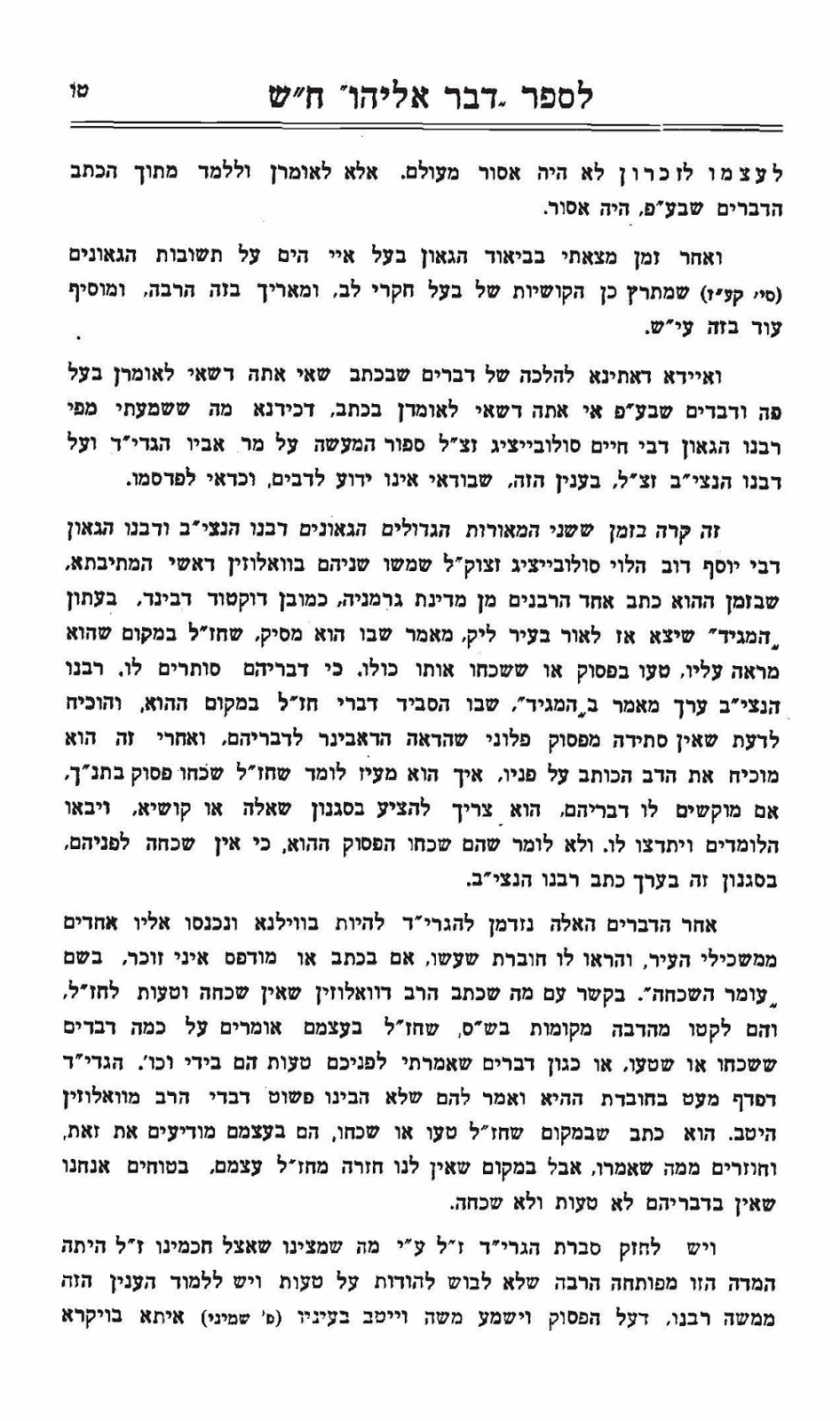
However, the Netziv’s Pirush on Sifrei,[18] entitled Emek Ha-Netziv was first printed from manuscript only in 1959-1969. In the first volume the Netziv quotes the “Zofeh Le-hamagid Year ten, issue 28″. Gil Perl already notes that this is the edition of the Ha -Maggid printed on July 17, 1867.[19] Although Perl noted other cases of censorship in the Emek Ha-Netziv, this source was not censored.[20] We see here clearly that the Netziv read newspapers and even referenced them in his work.
Netziv and his Ha’amek Davar
In 1879, the Netziv printed his classic work on chumash, Ha’amek Davar,[21] based on the Shiurim he gave after Davening.[22] In his Pirush to Parshat Bereishis (2:9), he quotes a manuscript of R’ Maimon (father of the Rambam) which he had seen printed in Ha-Levonon.
In 1937, Rabbi Meir Bar-Ilan printed a collection of almost one thousand and five hundred addenda by the Netziv to his Ha’amek Davar[23] [available here]. On page seven, Netziv quotes the newspaper Ha-tzefirah. Furthermore, Gil Perl points to some additional passages in Ha’amek Davar that seem to be based on material from the newspapers of the time.[24] From all the above, we see him reading newspapers.[25]
Censorship and theHa’amek Davar
In 1999, a new edition of the Ha’amek Davar was printed incorporating many more corrections.[26] They inserted the numerous addenda published by Rabbi Meir Bar-Ilan into their proper places in the chumash. However two pieces were censored out – both of the aforementioned quotes by the Netziv,[27] citing these newspapers!
In 2005, Rabbi Mordechai Cooperman reprinted the Ha’amek Davar; with annotations, his edition does contain both newspaper references.
More on the Netziv and newspapers
In 2003, a volume called Igrot HaNetziv Me-Volozhin was printed in Bnei Brak this volume is full of references and articles by the Netziv from different newspapers of the time.[28]
In Meishiv Davar 1:44 there is a piece titled: “Al Yamin vsmal’.[29] This siman was actually first printed in the newspaper Machzike Hadat[30] and as can be seen from the introductory paragraphs, it was a response to an earlier article that the Netziv had read in that newspaper.
Appendix: Some other Gedolim who read Newspapers
Yitzchak Wetzlar writes in the introduction to his Libes Briv (written in the early 1700’s) about his work: “think of it as a Newspaper. Nowadays the finest and most important people, scholars and Rabbis read them or have them read to them”.[31]
For other Poskim who were known to have read newspapers, see: Rabbi Yakov Emden[32]; Rabbi Yosef Zechariah Stern [as anyone familiar with his writings knows][33]; Yakov Mark, BeMechitzosom Shel Gedolei Hador, p. 34; Roni Beer Marx, ibid, pp. 40-41 [about the Malbim and others]; Rabbi Yitzchak Nissenbaum, Alei Cheldi,[34]; Jacob Katz, With My Own Eyes, pp. 30-31; Pinchas Sirkis, Ish HaEmunah, 1979, p. 82, 86; Jacob J. Schacter, ‘Facing the Truths of History’, Torah U’maddah Journal, 8 (1998), p. 225, 263-264 [about Rav Moshe Feinstein Zatzal]; Benny Brown, Hachazon Ish, 2011, p. 21 [about the Chazon Ish; who even quotes Ha-Tzefirah in his work on Orach Chaim 141:9].
A student of the forgotten gaon,[34b] Rabbi Moshe Nechemia Kahanov (1817-1887) [Rosh Yeshiva of Eitz Chaim[34c]] writes:
ר’ משה נחמיה כהנא או ה’רבה’ מחסלביץ, ראש הישיבה, ידע את נטיתי להשכלה וקרבני על כך, שכן אף הוא היה נוטה בצנעה להשכלה ולמשכילים. בימים ההם אסרו על ה’חבצלת’ לבוא בקהל והרב מחסלביץ היה מקבל אותה מדי שבת בשבת מידי אני. בכל שבת אחר הצהרים הייתי סר אל הישיבה כש’החבצלת’ טמונה בחיקי, מוסר אותה לידיו והוא פורש לחדר קטן הנשען אל הישיבה וקורא בה. כפעם בפעם היה מוסר על ידי שלום לרי”ד פרומקין ומביע לו את ידידותו והוקרתו על השקפתיו של העורך. אוסר אני בכבלים היה מצדיק את הדין על עצמו חולני אני ואין בכחי לעמוד בפני התקיפים ממני [אפרים כהן רייס, מזכרונות איש ירושלים, עמ’ 54].
Worth pointing out is Binyomin Goldberg’s claim that even Rabbi Chaim Soloveitchik secretly read the Hameilits.[35]
Rabbi Moshe Bernstein,[36] Son in law of Rabbi Baruch Ber Leibowitz records the following story about Reb Baruch Ber:
משביקר הגאון ר’ משה סולוביציק, שהיה אז ראש ישיבת תחכמוני בוילנה, כיבדו בהגדת שיעור בישיבה, תלמידי הישיבה שהיו ברובם קנאים התנגדו לזה בכל תקף ובאו לומר לרבם כי הם ילכו מהשיעור הזה, הוא אמר להם כדברים האלה, ת”ל חוננתי בכח מיוחד שלא להאמין בדבר שאינו רוצה, לדידי אין הדבר אמת כלל, ידיד נפשו הגאון ר’ משה אינו כלל בישיבת המזרחי תחכמוני[37], אינו קורא עתונים ואינו מאמין להם, וככה אני יועץ גם לכם, התלמידים שמעו לקולו והקשיבו אל השיעור בנחת ובשלוה [הגיונות, עמ’ עב].
Another Great Gaon who read newspapers was Rabbi Eliyahu Klatzkin. According to his son Yakov, he subscribed to and read several papers in different languages.[38] In an incredible Teshuva of his regarding Tzar Balei Chaim Rabbi Klatzkin quotes numerous medical works in different languages and even newspapers, including The London Times and others papers in Russian and Yiddish.[39]
While Rabbi Moshe Zeirah, Yeshurun 15 (2005), pp. 753-776, refers to the Teshuva on Tzar Balei Chaim and Rabbi Eliyahu Klatzkin’s expert knowledge of science, he does not mention this point.[40]
Another person who read newspapers was Rabbi Shneur Zalman Me’Lublin,[41] author of the Shut Toras Chessed:
רבי ישראל דוד פרומקין שהיה ממעריצי הרב שלח להרב בכל יום ששי העתון חבצלת שהוציא לאור. לקח הרב סכין וחתך למעלה, שיהא נוח לקרות, הביט שניה אחת על העמוד הראשון וכן על השני וכן להלן רק איזה שניות, אחר כך לקח את העתון ופרש על המפה שעל השלחן, ועליו היתה הרבנית מעמדת המנרות של שבת שלא יטפטף מן החלב על המפה. חשבתי שאינו קורא כל הכותב בעתון, המכיל 8 עמודים שלמים, רק מעט בצד זה ומעט מצד שני, וכן הלאה. פעם בין מנחה למעריב, כאשר שכב על מטתו ושמע חדשות (כשאר הבאתי לעיל), ספר אחד חדשות מענינות, אמר הרב זה מדפוס בעתון חבצלת של שבוע זה, ואמר לי להביא את העתון שהיה מונח על האיצטבא. מסרתי לו, ותוך כדי דיבר פתח העתון והראה בעמוד פלוני שורה פלונית כתוב זאת. נשתוממתי שבמהירות כל כך קורא את כל העתון ובשניה אחת הראה איפה מודפס [שלשה עולמות, ב, עמ’ קמז-קמח].
Another person who read newspapers was Rabbi Elchanon Wasserman. The following passage appears on Rabbi Aron Sorasky’s book Or Elchonon [1: 27-28 and the second passage appears in the same book pp. 282-283]. In the English version adaption of this book printed by Artscroll called Reb Elchonon both passage appear uncensored [pp. 28-29, 216] [Thanks to my friend Eli Markin for this source].
Another additional point in all this is there were great Gedolim who wrote articles in some of these newspapers[41b] such as Rabbi Alexander Moshe Lapidus,[42] Rabbi Tzvi Hirsch Kalisher,[43] Rabbi Eliyahu Gutmacher,[44] Rabbi Shmuel Moholiver, [45]Rabbi Mordechai Eliasberg[46] and Rabbi Yechiel Yakov Weinberg.[47]
Just to conclude with one last story related to reading newspaper:
*Special thanks goes to my good friend Yisroel Israel for all his time and help in preparing this article. I would also like to thank my friend Rabbi Yosaif M. Dubovick for editing this article.
[1] For general sources on censorship in Shut [Responsa] Literature see S. Glick, Kuntres Hateshuvot Hachadoshot, vol. 1, introduction, pp. 58-67; ibid, E-Shnev leSafrut HaTeshuvot, pp. 259-290.
[2] In the future, I hope to return to exploring other Heterim for reading newspapers on Shabbos. For now see: Herman Pollack, Jewish Folkways in Germanic lands (1648-1806), Cambridge 1971, pp. 168-169, 235, Daniel Sperber, Darka Shel Halacha, pp. 238-241. I also hope to return to the Netziv and his writings in a special series of articles devoted to him. It must be noted that “newspapers” in this context do not only refer to newspapers like the New York Times. The periodical literature read by the Netziv was not the Times and was not Hamodia. These were in many cases ideologically maskilic papers, and while they contained typical Torah articles, they *also* contained editorials and “academic Jewish” type stuff, and this is what the Netziv read and these are what he is talking about, quoting, etc.
[3] Torah u-Madda Journal 2 (1990), pp. 76-133
[4] See Rabbi Kirshbaum, HY”d, Zion Le-Menachem, New York 1965, pp. 251-265.
[5] Many years ago I discussed the work Mekor Baruch with my Rosh Yeshiva, Rabbi Zelig Epstein Zatzal. He told me he that he had no problem believing this story by Rabbi Epstein or others that people had issues with. He mentioned that when he was learning in the Mir in Europe, he chipped in together with a few friends to purchase a set of Mekor Baruch. When I asked him specifically about this passage of the Netziv reading newspapers on Shabbos, he reiterated that he had no problem accepting its truth. He then told me that he once spent a Shabbos at Rav Dovid Tevil Dynovsky’s home whose daughter would read to him from a Yiddish newspaper. See Rabbi Nosson Kamenetsky, Making of a Godol, 2, p. 1178 who quotes the same anecdote regarding Rav Dynovsky, citing Rabbi Zelig Epstein.
Rav Dynovsky’s anonymously published sefer, Maamar Likrat Tzamei,[which is an attack on Zionism, Hertzl and the Mizrachi movement], is full of quotes from the various Hebrew and Yiddish newspapers of the time [see for example pp. 5, 6, 20, 26, 29, 30, 31, 35, 37, 40, 45, 46 49, 50].
Saul Leiberman considered Rav Dynovsky his main Rebbe [Making of a Godol, 2, p. 1189, based on an interview with Shraga Abramson]. Shraga Abramson who also learnt by Rav Dynovsky writes about Leiberman and Rav Dynovsky the following:
לא רחוק מעיירת מולדתו, מוטלה, היתה ישיבה קטנה שידועה היתה בשעתה, לפני מלחמת העולם הראשונה, זו ישיבת מאלטש, בראשה עמד אדם מיוחד: רב העיירה וראש הישיבה ר’ דוד טעבל דיינובסקי, הי”ד, מבעלי ההגיון שבלימוד התלמוד ומבעלי המוסר מן יסד ר’ ישראל סאלאנטר. היסוד שהונח לו לליברמן בישיבה זאת היינו, לימוד התורה ולימוד המוסר נשאר אצלו חזק בכל ימי חייו. וליברמן ידע את ההשפעה שהושפע בישיבה זאת, וזכר לה חסד נעוריו כל ימיו [לזכרו של שואל ליברמן, האקדמיה הלאומית הישראלית למדעים, ירושלים תשמ”ד, עמ’ 24-25].
For more information on this unknown Gaon see Rabbi Nosson Kamenetsky, Making of a Godol, 2, pp. 1174-1181.
Of course, it bears mentioning (as already noted On the Main Line [here]), Chief Rabbi Herzog’s words, The Jewish Chronicle, February 25, 1927: “On Sabbath morning, while turning the pages of my copy of the Jewish Chronicle, my eye caught under the caption Obituary notices the name of Rabbi Meir Simcha of Dvinsk…”.
See also Rabbi Yechiel Yaakov Weinberg, Kisvei Hagaon Rabbi Yechiel Yaakov Weinberg, 2, p. 396:
אחד מבני המשפחה הזאת הלעיז על הרב שהוא קורא עתונים בשבת.
[6] I hope to return to this journal in a future article. Meanwhile, see Yehudah Mirsky, An Intellectual and Spiritual Biography of Rabbi Avraham Yitzhaq Ha-Cohen Kook from 1865-1904, PhD dissertation, Harvard University 2007, pp. 85-99. I am not sure why this volume [as far as I can see] did not make it to the Kuntres Hateshuvot Hachadoshot of Shmuel Glick.
[7] These letters were printed from manuscript in Moriah 23 (3-4) (1999), pp. 54-60 and more recently in a new edition of the ‘Ittur Sofrim’ printed in 2011, pp. 97-102.
[9] Rav Kook already commented about this Heter at the end of the first issue of the Ittur Sofrim. See also Shut Bikurei Shlomo siman, 3-4 for more on this topic. The Chasdei Dovid, 2, Jerusalem 1994, p. 149, on the related passage in Tosefta, is extremely important for this topic.
[10] See also Rabbi Shlomo Yosef Zevin, Ishim Veshitos, (2007), pp. 17-18; Rabbi Moshe Shmuel Shapiro, R. Moshe Shmuel Ve-doro, p. 54.
[11] Of course, there were many Poskim who were against reading newspapers even during the week. See, for example, the Chofetz Chaim’s son, who writes:
מר אבא לא קרא עיתונים מעולם אף באותם שלא היה בהם מינות, ועגבים וליצנות ולא היה ניחא דעתו מקריאתי אני והיה אומר מה תמצא בעתונים רק צרות וצרות מבלי שאין בידינו להושיע, וידע אנכי זאת גם מבלעדי העתונים כי אין העולם הזה מקום של נחת וקורת רוח וכמו שאמר הכתוב… [דוגמא מדרכי אבי זצ”ל, עמ’ מג.]
See also the Michtavei Chofetz Chaim #42:
See also this passage:
And this passage:
See most recently: Divrei Chachomim, Bnei Brak 1975; Rabbi Kalman Krohn, Harchek Mei’aleha Darcheka, Lakewood 2012. See Rabbi Fuerst, Ir Hagoleh, 1, p. 476. See also Mi’pihem, p. 375.
[12] This passage appears in the original Yiddish version of the book Fun Volozhin Biz Yerushalayim, Chapter 12. See also Me-Volozhin LeYerushalayim p. 163.
[13] Moshe Yuft, Reshumot V’zichronot, 1924, p. 10. This memoir is not found in Pirkei Zichronot, nor was it used by S. Stampfer in Lithuanian Yeshivas of the Nineteenth Century.
[14] This passage appears on page 179 of the Hebrew edition of Stampfer’s book.
[15] See also Rabbi S. Gershuni, Hama’yan, 52:4 [202] (2012), p. 54 note, 22 who mentions this censorship about the Hameilits, but not that there were two editions of the 1894 printing.
[16] It appears that there are additional letters about this same subject. See ibid, pp.163-168. For more on the controversy related to these Teshuvot, see Y. Mondshine, Zechor L’Avraham, (1999) pp. 374- 444 [also available here]. See also Igrot R. Yitzchak Elchanan, 1 (2004), pp. 266-267. See also S. Glick, E-Shnev leSafrut HaTeshuvot, pp.150-154.
[17] On this essay see Yehudah Mirsky, An Intellectual and Spiritual Biography of Rabbi Avraham Yitzhaq Ha-Cohen Kook from 1865-1904, PhD dissertation, Harvard University 2007, pp. 84-85. See also Rabbi Yitzchak Nissenbaum who wrote about this essay:
את… רבי אברהם יצחק הכהן קוק שמעתי זה כבר. בעודני צעיר קראתי את מאמרו ב’כנסת ישראל’ לשפ”ר על הנצי”ב מוואלוזין, וכתלמיד הישיבה, המחבב את רבו הזקן, נהניתי מאד מדבריו [עלי חלדי, עמ’ 188].
[18] I hope to return to this incredible work in the future for now see the beautiful book of Gil Perl, The Pillar of Volozhin, Boston 2012.
[19] Gil Perl, The Pillar of Volozhin, Boston 2012, p. 32.
[21] On this work see: Jay Harris, How Do We Know This?, pp. 239-244; Channah Katz, Mishnat Hanetziv, pp. 93-98; idem, Machanayim 4 (1993), pp. 380-387; Nissim Eliakim, Haamek Davar la-Netziv, Moreshet Yaakov 2003; Gil Perl, The Pillar of Volozhin, pp. 168-237; Rabbi Dov Leor, Aloni Mamrei, 121 (2008), pp. 73-85. For the dating of this work see: Gil Perl, ibid, pp. 169-171; Rabbi S. Gershuni, Hama’yan, 52:4 [202]. (2012), pp. 50-56.
On the Ha’amek Davar, see the article (quoted above) written in 1887 by Rav Kook about the Netziv where he writes:
בעת ההיא כתב גם כן ביאורו על התורה, אשר גם בו היתה לו האמת לקו והבקרת הנאמנה למשקלת יישר דברי חז”ל עפ”י הדקדוק בסגנון מליצת הכתוב…
In a letter to Dr. Eliyahu Harkavi the Netziv writes [I will hopefully return to the nature of their relationship in the future]:
וידעתי כי איני כדאי והגון להדפסה רחבה כזו, ומה אני ומה כחי להוציא לאור ביאור פרוס על חמשה חומשי תורה, וגם בפעלת ההדפסה רבה אשר הגיע עד חמשת אלפים רו”כ, ובחיי ראשי כי לא הי’ מכן בידי גם מאה רו”כ, אך יד ה’ והשגחתו הפרטית הי’ עמדי בזכות הישיבה הק’ שאני מוסר נפשי עליה, והטה דעת המדפסים להדפיס בהקפה יותר משלש אלפים רו”כ… [שנות דור ודור, ב, עמ’ קפג-קפד (=אגרות הנצי”ב, עמ’ לא)].
See also Igrot HaNetziv Me-Volozhin, p. 214.
[22] The subject of these shiurim was not dealt with in the excellent book of S. Stampfer, Lithuanian Yeshivas of the Nineteenth Century or in the volume Toldot Beis Hashem B’Volozhin,.
On these shiurim See the Netziv who writes:
וזכות הרבים עמדה לי שפירשתי בכל יום הפרשה לפני היושבים לפני ה’ בית התלמוד עץ החיים אשר נטע אביר הרועים הגאון מהור”ח זצ”ל [קדמת העמק, אות ה].
In the article (quoted above) written in 1887, by Rav Kook about the Netziv he writes:
בהנהגת הישיבה… גם הרגיל אותם לשנן פרשה אחת בכל יום מפרשת השבוע ויער אזנם למוסר לדעת איך ללכת נגד החיים…”.
See also Pinchas Turberg’s picturesque description of the scene when at age fourteen he first walked in to the Volzhiner Yeshiva on a Friday morning:
בבוקר,… השכמתי לקום וברוח סוערת מהרים לבית הישיבה., הרושם שעשה עלי הבית הגדול… כל זה אי אפשר לתאר באומר ודברים. הרגשתי את עצמי כאלו נכנסתי לתוך עולם אחר… ביחוד משך אליו את העין איש זקן בעל פנים מאירות ועינים טובות ומלטפות, שישב מעוטף בטלית ומעוטר בתפלין ולמד לפני תלמידים פרשת השבוע. הזקן הזה היה ראש הישיבה, הנצי”ב שלמד את שעוריו בחומש לאחרי תפלת שחרית [כתבי פינחס טורברג, ניו יורק תשי”ג, עמ’ קלא (= פרקי זכרונות, עמ’ 195)].
Rabbi Yitzchak Nissenbaum writes in his beautiful memoirs:
זמן מה הייתי שומע גם את שעורי הנצי”ב בחומש, שהיה מטיף אחרי תפילת השחרית [עלי חלדי, עמ’ 45 (=פרקי זכרונות, עמ’ 103].
In an article comparing the Netziv and Rabbi Chaim Soloveitchik, Rabbi Yitzchak Nissenbaum writes a bit more:
הסבא יושב בכל יום ויום אחר התפילה ומטיף לפני התלמידים פרשה בתורה מסדר השבוע, וכה הוא לומד ומלמד במשך השנה את כל חמשת חומשי תורה, עד שנולד לו באורו הידוע ‘העמק דבר’. והנכד חושב כי תורה שבכתב ניתנה רק לתינקות של בית רבן טרם שהגיע זמנם ללוד את תורה שבעל פה” [הצפירה, ו’ תשרי תרע”ט גלי’ 37 עמוד 9].
Micha Yosef Berdyczewski writes:
תפילת שחרית בציבור בשעה 8 בבוקר… ורבים יישארו לשמוע פרשת השבוע מבוארת מפי הרב הגאון ר’ נצי”ב שליט”א על פי דרכו ביאורו הנפלא, הנוטע בקרב לב השומעים רגשות יקרות ואהבת אלקים ואדם. [מיכה יוסף ברדיצ’בסקי, כתבים, א, עמ’ 73 וראה שם, עמ’ 71, 196]
See also Rabbi Meir Bar-Ilan, Me-Volozhin LeYerushalayim pp. 112-113; Pirkei Zichronot, p. 127, 172; Rabbi Moshe Neryah, Toldot HaNetziv, pp. 13-14; Rabbi Moshe Shmuel Shapiro, R. Moshe Shmuel Ve-doro, p. 41, 72; Moshe Tzinovitz, Etz Chaim, p. 235. See also Binyomin Goldberg’s peculiar claim that the general consensus towards the Netziv’s Chumash Shiur was indifference, at best. This passage can be found in Zichron LeAchronim, 1924, p. 21. This book is extremely rare and there is no copy of it in Jewish National Library. Special thanks to Professor Shaul Stampfer for providing me with a photo-copy.
Chumash was learned in Volozhin in the times of Rabbi Chaim Volozhiner and Reb Itzeleh Volozhiner. See: Rabbi Yechiel Yaakov Weinberg, Kisvei Hagaon Rabbi Yechiel Yaakov Weinberg Zal, 2, p. 217; Dov Eliach, Avi Hayeshivot, 2012, pp. 460-462; S. Stampfer, Lithuanian Yeshivas of the Nineteenth Century, p. 42; Toldot Beis Hashem B’Volozhin, p. 63;M. Breuer, Ohalei Torah, pp. 122-123; Shlomo Tikochinski, Darchei Halimud Beyeshivot Lita Bimeah Hatesha Esreh, MA Thesis (Hebrew University, Jerusalem, 2004), p. 34.
In Pirkei Zichronot [p.84] we find a claim from Shmuel Zitron that R. Yehoshua Levin gave a chumash shiur using Mendelsohn’s Biur. However, S. Stampfer [ibid, p. 68] already notes that Zitron’s memoirs are not always accurate.
On Chumash being part of curricula in Yeshivot, see M. Breuer, Ohalei Torah, pp. 118-123. I hope to return to this subject in the future.
[23] The Netziv was always working on adding to this work, In a letter, he writes:
ויאמין לי מעלתו כי נכספתי מאוד לשוב ולהדפיס החומשים עם העמק דבר, כי רבים מבקשים אותם ממני, וגם יש לי הוספות הרבה, אבל אין לי עצה להשיג הוצאות הדפסה… [פרשגן, תרנ”ט ראש הספר].
This letter is also printed in Igrot HaNetziv Me-Volozhin (p. 41) without citing its source.
See also the following interesting letter from the Netziv to Rabbi Eliezer Lipman Prins:
ובכלל אענה על תרעומת מע”כ שקצרתי בלשוני כ”כ כי טוב הוא להתחוקק בראש למי שחפץ להבין ולהשכיל. ובכ”ז מודה אני שיש מקומות שקצרתי יותר מהנדרש וכשאר יזכני ה’ ברחמיו לשוב ולהדפיס החומשים עם באור העמק דבר אי”ה אראה לתקן הלשון באיזה מקומות. לבד אשר אשית נוספות הרבה אשר זכני ד’ לדקדק בלשון המקרא. אך עתה קצרה ידי לשוב ולהדפיס משום חוסר מעות. [פרנס לדורו, עמ’ 208-209].
Worth noting is that the 1999 edition quotes this letter in the beginning of their edition, without giving the source. They also print the whole letter in the back of the volume of Ha’amek Davar on Shemos (p. 21), without referencing the source. This letter is also printed in Igrot HaNetziv Me-Volozhin (pp. 34-35) without citing its source.
The Aderet writes when he first met the Netziv:
העירותיו כמה דברים בביאורו על התורה שהיה מגיהו אז להדפיסו מחדש (סדר אליהו, עמ’ 85).
See also Rabbi Eliezer Lipman Prins’ notes on the Ha’amek Davar, printed in his Parnas Ledoro, pp.241-256.
[24] Gil Perl, ibid, p.81, 176-177. Rabbi S. Gershuni, Hama’yan, 52:4 [202], (2012), p. 54 points to further evidence in the Ha’amek Davar that the Netziv read newspapers.
[25] On this work see the excellent introduction by Rabbi Meir Bar-Ilan [of course it’s not included in the newer editions]; Rabbi Shlomo Yosef Zevin, Ishim Veshitos, (2007), pp. 23-26.
[26] See what they write in the back of the first volume of Ha’amek Davar.
מהדורה מתוקנת המופיעה לראשונה, אשר בו אלפי תיקונים והוספות שהגיהם והוסיפם מרן הגהמ”ח זיע”א בכתב יד קדשו על גליוני החומש עם פירוש העמק דבר שהו”ל בחייו בשנות תרל”ט תר”מ. חלק גדול מההספות כבר נדפס בשנת תרח”ץ בסוף החומש, ועתה זכינו בס”ד להשלים את כל ההוספות וההגהות שנמצאו על גליוני החומש בכתי”ק, וכן לעוד הרבה תוספות מהעתקה אחרת שנערכה גם על מנת לשלב את ההוספות והתיקונים להפירוש.
I just started to compare the editions and noticed many new pieces. For example in the Introduction of the Netziv to the Ha’amek Davar called KadmusHa’amek there are over 20 new lines of text added in different places. In the famous introduction of Netziv to Chumash Bereishis over 6 new lines of text were added. I will hopefully return to all this in the future.
My problem with this edition is that although it’s amazing to have all these new pieces it would have been helpful for one to be able to see what’s new and what’s old. I would have suggested that they use different fonts, one for the original work, one for the 1500 additions from Rabbi Meir Bar Ilan and one for the new material that they added. Similar to the style found in the Eshkol edition of the Siddur of Rabbi Yakov Emden which allows the reader to see easily what is being added. For a different criticism see what Rabbi Mordechai Cooperman writes in the introduction to his edition of the Ha’amek Davar.
For an interesting discussion relating to this edition, see the back and forth which took place in some recent editions of the journal Hamay’an: RabbiAvraham Glanzer, Hama’yan, 52:3 [201], (2012), pp. 94-95; Rabbi S. Gershuni, Hama’yan, 52:4 [202], (2012), pp. 50-56; Rabbi Dovid Shapiro, Hama’yan, 52:4 [203]. (2013), p. 103, Although, Rabbi Shapiro deals with an issue of the editing of the new Ha’amek Davar, he does not talk about the censorship of the Netziv’s newspaper reading.
[27] Rabbi S. Gershuni, Hama’yan, 52:4 [202]. (2012), p. 53 also points to the censorship.
[28] Hacarmel: p. 21; Ha’maggid: p. 54, 198; Hameilits: p. 60, 113, 114, 140, 147, 168, 170; Ha-Tzefirah: p. 112, 120, 133, 134, 140,141. See also Mekor Baruch, 4, pp.1795-1796 what he brings from the Netziv about the fighting between the Ha’maggid and Ha-Levanon.
However in regard to the Newspaper Ha’Shachar he writes to Dr. Eliyahu Harkavi:
עוד בקשתי.. וכן ראיתי באיזה עלה עת שמעכ”ה מעריך דברים בעלה השחר, מבוקשי אם אפשר לשלחם לי כל היוצא, בלי עלה השחר, המשחיר את כבוד התורה וכל קדושיה עמה, וכי יבוא דברי מע”כ אלי וכבדתים להביט בדבריו [שנות דור ודור, ב, עמ’ קפד (=אגרות הנצי”ב, עמ’ לב)].
On these newspapers in general see: E.R. Malachi, Mineged Tir’eh, pp. 17-121; Gideon Kouts, Chadushot V’korot HaYamim, Tel Aviv 2013; Dovid Tal, Yehuda Leib Kantor, Tel Aviv 2011, pp. 367-370; Roni Beer Marx, Between Seclusion and Adaption; The Newspaper Halevanon and East European Orthodox Society’s Facing Up to Modern Challenges,(Heb.), PhD. Dissertation, Hebrew University, 2011.
[29] On this essay see Y. Rivkin, HaNetziv Viyichuso L’Chibbat Tzion, 1919, pp. 7-9; Rabbi Moshe Shmuel Shapiro, R. Moshe Shmuel Ve-doro, p. 63; Moshe Tzinovitz, Etz Chaim, p. 236; Gil Perl, ‘No Two Minds are Alike: Tolerance and Pluralism in the Work of Netziv’, Torah U-Maddah Journal, vol. 12, pp. 74-98.
[30] On this newspaper see: Joseph Margoshes, A world apart, A memoir of Jewish Life in Nineteenth Century Galicia, p. 14, 25-27; Rachel Manekin, The Growth and Development of Jewish orthodoxy in Galicia, The “machsike hadas” Society 1867-1883, PHD, Hebrew University 2000.
[31] [(English translation of Yiddish) The Libes Briv of Isaac Wetzlar, edited and translated by Morris Faierstein, p.43 (see also p. 13)].
For some sources of regular people reading Newspapers see Yakov Mark, BeMechitzosom Shel Gedolei Hador, p. 28; Pirkei Zichronot, p. 256 [In Telz]; Joseph Margoshes, A world apart, A memoir of Jewish Life in Nineteenth Century Galicia, p. 45, 47; Mah Shera’Iti [Zichronotav shel Yechezkel Kotik], p. 184, 297; Chaim Hamberger, Sheloshah Olamot, 2, pp. 40-41; Mi’pihem, p.273. See also M. Zalkin, Be’alot Hashachar, pp. 255-261.
[32] Rabbi J.J. Schachter, Rabbi Jacob Emden: Life and Major Works, PhD. Dissertation, Harvard University, 1988, p. 614; Maoz Kahana, ‘An Esoteric path to Modernity Rabbi Jacob Emden’s Alchemical Quest’, Journal of Modern Jewish Study (2013) 12:2, p. 271 note 70.
[33] See also Rabbi Zev Rabiner, Harav Yosef Zechariah Stern, 1943, p. 24.
[34] pp. 56, 73-74, 76, 78, 87, 128, 132, 137, 165, 167, 196, 318.
[34b] The Mishna Berurah quotes his work Netivot Sholom numerous times in Hilchot Bishul, Sharei Tzion (318: 55, 57, 58, 61, 62).
[34c] About him see Avraham Lunz, Netivot Zion VeYerushlayim, pp. 208-209 [who was a talmid of his]; Rabbi Betzalel Landau, in the back of Sifsei Yeshainyim, pp. 35-58; Pinchas Grievsky, Zichron Lechovvim Harishonim, 8, pp. 391-413; Rabbi Yechiel Michel Tycosinski, Luach Eretz Yisroel, 1, pp. 163-167 [=Chatzer Churvos Rebbe Yehudah Hachassid, pp. 48-53] Yosef Salamon, ‘The Etz Chaim Yeshiva in Jerusalem at the time of Moshe Nechemiah Cahaniu (1866-1887)’, Yeshivot Ubatei Midroshot, pp.187-197. I will hopefully return to this Gaon in the second part of this post.
[35] See his work Zichron LeAchronim, 1924, p. 6. This passage is quoted in Shaul Stampfer ‘Lithuanian Yeshivas of the Nineteenth Century‘, p. 163. See also Rabbi Nosson Kamenetsky, Making of a Godol, 1, p.459 & vol. 2, p. 917 for a possible explanation as to why Rabbi Soloveitchik read the paper.
[36] About him see Li’frakim, pp. 156-157.
[37] However see Rabbi Yitzchak Nissenbaum who was one of the people who ran this Yeshiva who writes:
תכחמוני… כאשר נמנה אחר כך הרב רבי משה סולוביייציק לדירקטור הערכה כבר תכנית ללמוד גפ”ת ובתוכם כבר הובא איזה סדר… [עלי חלדי, עמ’ 344] [וראה: אגרות הרב ניסנבוים, עמ’ 243].
[38] Notrei Morshet, pp.157-169, for a more complete version of this article see Yaakov Klatzkin, Kesavim, pp. 304-320.
[39]Imrei Shefer, Siman 34, pp. 72-73. See also Shnayer Z. Leiman, Rabbinic Responses to Modernity, Judaic Studies 5, 2007 pp. 116-118.
[40] For more on Rabbi Eliyahu Klatzkin, see Rabbi Amram Blau, Heichal Habesht 34, (2013), pp. 159-160.
[41] About him see: Chaim Hamberger, Sheloshah Olamot, 2, pp. 141-158; Yitzchak Shirion, Zichronot , pp. 43-45; Chachmei Polin, pp. 350-353; Igrot Baal Ha’Toras Chesed edited by Y. Mondshine; Y. Chananel, Ha’Gaon Me’Lublin.
[41b] See: Yakov Lipshitz, Zichron Yakov, 2, pp. 15-19, 99-116; Roni Beer Marx, Between Seclusion and Adaption; The Newspaper Halevanon and East European Orthodox Society’s Facing Up to Modern Challenges,(Heb.), PhD. Dissertation, Hebrew University, 2011; Marc Shapiro, Between the Yeshiva World and Modern Orthodoxy, pp. 38-41.
[42] See Toras Ha’Goan Rebbe Alexander Moshe, pp. 583-592. See also Yakov Lipshitz, Zichron Yakov, 2, p. 99.
[43] Many of them are collected in Y. Klausner, Ketavim Tzioni’im, Jerusalem 1947.
[44] Many of them are collected in Succos Shalom, Jerusalem 1990; see for example pp. 31-33, 43, 49, 60, 61, 65, 75, 91, 95, 96, 101, 151, 159, 168, 172.
[45] Yakov Mark, BeMechitzosom Shel Gedolei Hador, pp. 197-198
[46] Shevl Ha’zahav, p. 17; Yakov Mark, BeMechitzosom Shel Gedolei Hador, p. 141, 146; Rabbi Bezalel Naor, The limit of Intellectual freedom, the Letters of Rav Kook, pp. 179-180.
[47] See Marc Shapiro, Between the Yeshiva World and Modern Orthodoxy, pp. 23-26.
The Vilna Gaon, part 3 (Review of Eliyahu Stern, The Genius) by Marc B. Shapiro
The Vilna Gaon, part 3 (Review of Eliyahu Stern, The Genius)
by Marc B. Shapiro
In honor of Sean Penn and Mark Wahlberg, who understand what pidyon shevuyim is all about.
Continued from here.Returning to R. Sternbuch’s Ta’am ve-Da’at, vol. 1, earlier in this book, p. 88, we find the following passage.
שמעתי ממרן הגריז”ס זצ”ל (הגאב”ד דבריסק) שאברהם אבינו לא היה עצבני וחושש ומפחד שהולך לשחוט בנו יחידו, אלא היה לו הלילה שלפני העקדה ככל הלילות, ולא נתרגש מצווי זה וקם בבוקר לקיים המצוה כשם שמקיימים כל מצוה, והשכים כזריזין שמקדימים למצוות, ושש ושמח לקיים מצות בוראו
According to R. Velvel Soloveitchik, Abraham was not emotionally affected by the command to sacrifice Isaac, and on the night before he was to go to Mt. Moriah he slept as well as on any other night. He approached this commandment like any other commandment, and was ready to do it with joy. It is hardly an accident that the Abraham described by R. Velvel very much resembles R. Velvel himself. See also my earlier post here. [1]
Yet doesn’t R. Velvel’s understanding conflict with the notion that the Akedah was a test or trial? What kind of test was it if Abraham related to this command just like any other?
The Gaon is quoted as having a different perspective on the Akedah.[2] According to him, since Abraham was engaged in acts of loving kindness all the time, this commandment was designed to develop in him the attribute of cruelty, which is also required at times.
וז”ש כאן בעקידה עתה ידעתי כי ירא אלקים אתה, לפי שקודם לכן לא היה אלא רחמן מאד שהיה מכניס אורחים וגומל חסדים. אבל המדה של אכזריות ולכוף א”ע ולקיים מצות הבורא ית’ עדיין לא היה ניכר בו והיו יכולים לומר שאברהם איננו צדיק גמור ח”ו. אבל בעקידה שעשה ג”כ מדת אכזריות שרצה בכל אות נפשו לקיים מצות הבורא ולשחוט את בנו יחידו אשר בו תלוי כל חיותו א”כ עתה נשלם וניכר שהוא צדיק גמור
The Gaon connects this to the commandment to send away the mother bird before taking the eggs. In the Guide 3:48, Maimonides understands this as designed to avoid cruelty to the mother bird. However, the Gaon has the exact opposite interpretation. He assumes that sending away the mother is very cruel, and that is the entire point of the commandment. He points out that in only two commandments does the Torah promise long life. One is respect for parents, which is about compassion. The other is sending away the mother bird, which is about cruelty, The complete personality, i.e., the tzaddik, needs to have both of these characteristics.
לפי שאין השלימות ניכר באדם אלא כשיש לו מדות הפוכות, כגון מדת רחמנות ואכזרות
As the Gaon explains, if someone had only one of these characteristics, you could say that this was just his nature. However, when you see in the same person the opposite characteristics of compassion and currently, applied at different times, this shows that the person is a tzaddik. This also explains why God gave commandments that are characterized by compassion as well as commandments that cause one to act with cruelty.(R. Moses Cordovero writes that “kindness is not valued in an individual who is naturally kind, only in a person who overcomes his inclination to act contrary [to the dictates of kindness].” See Or Yakar, Hayyei Sarah, p. 110, translation in Paul B. Fenton, “The Banished Brother: Islam in Jewish Thought and Faith,” in Alon-Goshen-Gottstein and Eugene Korn, eds. Jewish Theology and World Religions [Oxford, 2012], p. 251.)
Directly before this explanation in Divrei Eliyahu, the Gaon discusses God’s commandment to Abraham to circumcise himself and every newborn boy. According to the Gaon, Abraham was in doubt whether he should fulfill the commandment, since the requirement of such a practice would discourage the pagans from conversion. He thought that perhaps it would be better for him to disobey God’s command, and give up his heavenly reward, in order to increase believers in the world.
נתיירא אאע”ה שמא עי”ז לא ימשכו אחריו הבאים להתגייר ונוח היה לו להפסיד לעצמו משכרו הטוב ורק לקבץ מאמינים בעולם
Not knowing what to do, Abraham consulted with Aner, Eshkol, and Mamre, and the first two advised not doing the circumcision, but Mamre advised him to listen to God and that is what he did.
This is a development of an older theme that appears in a number of midrashim and is alluded to in Rashi, Genesis 18:1. According to these sources, Abraham was indeed unsure whether to listen to God, but none of the midrashim offer a reason for Abraham’s hesitation. [3] The midrashic notion that Abraham hesitated over following God’s command is quite startling, and many commentators deal with it in all sorts of creative ways.[4] The Gaon softens the difficulty somewhat by explaining that Abraham was not in doubt regarding whether to follow God’s command because he was afraid of the procedure, but his motivation was much more exalted. Yet the Gaon’s explanation is somewhat difficult because the midrashim have Mamre convincing Abraham to do the procedure by reminding him how God saved him from the fiery furnace or how in general God has always watched over him, and there is thus no justification for ignoring His command. This implies that Abraham’s reason for hesitation was fear over the operation rather than concern that his proselytizing efforts would suffer.
I would love to know what R. Velvel would say about these midrashim, which show Abraham in a very different light than the way he describes the Patriarch.
Finally, let me mention a story famous in Habad and recorded by the Lubavitcher Rebbe in various places. It shows an attitude entirely at odds with the sort of piety we saw in the last post. Here is a selection from the Rebbe’s letter in Iggerot Kodesh, vol. 22, no. 8558 (p. 366). The translation is taken from here.
The Alter Rebbe shared his house with his oldest married son, Rabbi Dov Ber (who later succeeded him as the Mitteler Rebbe). Rabbi Dov Ber was known for his unusual power of concentration. Once, when Rabbi Dov Ber was engrossed in learning, his baby, sleeping in its cradle nearby, fell out and began to cry. The infant’s father did not hear the baby’s cries. But the infant’s grandfather, the Alter Rebbe, also engrossed in his studies in his room on the upper floor at the time, most certainly did. He interrupted his studies, went downstairs, picked the baby up, soothed it and replaced it in its cradle. Through all this Rabbi Dov Ber remained quite oblivious.
Subsequently, the Alter Rebbe admonished his son: “No matter how engrossed one may be in the loftiest occupation, one must never remain insensitive to the cry of a child.”[5]
In the last post I showed examples of removing material from the English translation of a Hebrew book, so as not to scandalize the English reader. Here is another example. The Hebrew text comes from Shimon Yosef Meller’s biography of R. Velvel Soloveitchik, Ha-Rav mi-Brisk (Jerusalem, 2006), vol. 2, pp. 546-547. I previously mentioned this passage here.
Here is the relevant page in the translation, The Brisker Rav (Jerusalem, 2009), vol. 2, p. 573, and you can see that the story I am referring to has been removed.
For another story about vomiting, see the following passage which comes from the introduction of the Gaon’s sons to his commentary on the Shulhan Arukh.
Here is a similar story recorded about R. Yisrael Salanter.[6]
Whether these stories actually happened is not important. What is important is that they were regarded as examples of piety in those days, while today if someone would act this way people would feel revulsion. In fact, since people had such a different response years ago, there is no need to assume that the stories did not happen simply because today the stories seem impossible. When it comes to what people regard as appropriate, one sees enormous changes between generations and cultures. An obvious example is the matter of homosexuality. While a century ago this was pretty much universally regarded as repulsive, among today’s younger generation of college educated people you would be hard pressed to find anyone to say this (as I can attest from interactions with hundreds of college-age students). Even among the halakhically observant, i.e., those who accept the prohibition on homosexuality, many do not regard it as inherently repulsive.
When it comes to The Brisker Rav, I have to confess that I was also certain that another passage would be removed, and it was not. I have in mind vol. 3, p. 428 n. 19 (the last paragraph).[7]
P. 140: Stern cites a comment that appears on every other page in R. Israel Salanter’s journal Tevunah:
All laws concerning monetary transactions have absolutely no practical authority. For we follow the law of the land. And this is the meaning of the great principle of “the law of the land is final.” We study, analyze, and debate monetary topics in the same way in which we study the laws of donations to the temple, tithes, sacrifices and purities, which are not practiced today. They are discussed only in terms of fulfilling our duty to study the Torah.
Upon this, Stern remarks, “While one cannot discount the pressures of governmental censorship that may have contributed to this position, still it marks an important development in rabbinic history. As Elchanan Reiner correctly notes, ‘Diverting attention from the actual ruling to the text itself, namely to the very practice of interpretation, constitutes a dramatic shift in the history of knowledge.’”
I don’t accept this at all. There is no question that the words quoted from Tevunah were directed towards non-Jewish governmental authorities, if not in Germany (where the journal was published), certainly in Russia, where the journal would find its major readership. How is this an important development, and how does it relate to Reiner’s point (made in an entirely different context) when every Jew who read these words understood that that they were not to be taken seriously, any more than the passages on the second page of many rabbinic books stating that all references to non-Jews only refer to pagans in places like China and India?
Let me make just a few more comments about the Gaon. Some people refer to him as Rabbi Elijah Kramer. When I first saw this name a number of years ago, I didn’t know who was being referred to since I had never heard of any Elijah Kramer. The first reference in print to Elijah Kramer (or Kremer) that I have been able to discover is Maurice Samuel’s 1963 book, Little Did I Know, p. 257. (If anyone is aware of an earlier reference, please let me know) The name was later made popular after appearing in the title of Yaacov Dovid Shulman’s 1994 book, The Vilna Gaon: The Story of Rabbi Eliyahu Kramer.[8]
If this post does nothing else, I hope it puts an end to this mistaken practice. The Vilna Gaon was not named Kramer! He was descended from someone named R. Moses Kramer (his great-great grandfather), but the Gaon never used this name and no one ever used it about him, so it is a mistake to call him this.[9] See also note 1 in S.’s post here.
The mistake of referring to the Gaon as Kramer appears in a 2012 book by Rabbis Berel Wein and Warren Goldstein, The Legacy: Teachings for Life from the Great Lithuanian Rabbis, p. 130. The particular chapter I refer to was written by Wein, and on the same page that he mentions Kramer he refers to the Gaon’s foremost student as “Rabbi Chaim Rabinowitz”. As far as I know, this is the first time R. Chaim of Volozhin has been given the last name Rabinowitz, and I have no idea what led Wein to write this. Perhaps there was some confusion between R. Chaim of Volozhin and R. Chaim Rabinowitz of Telz.
This book (which I do recommend) has an approbation by R. Shmuel Kamenetsky in which he writes that “everything in it is true.” I am inclined to think that R. Kamenetsky was only referring to the larger issues discussed in the book rather than attesting to the accuracy of every fact. There is an old saying
כשם שאין בר בלא תבן כך אין ספר ללא טעויות
We can update this saying by adding the word “blog post” after the word “sefer”.
Bezalel Naor has published the following letter he wrote to Elliot Wolfson.
Have you read the new book by Eliyahu Stern, The Genius: Elijah of Vilna and the Making of Modern Judaism (New Haven: Yale University Press, 2013)? In a lengthy endnote on pp. 196-198 (note 19), Stern polemicizes against your reading of the Vilna Gaon’s interpretation of “sefer ve-sefer ve-sippur” (Sefer Yetsirah 1:1). Stern refers to your essay “From Sealed Book to Open Text: Time, Memory, and Narrativity in Kabbalistic Hermeneutics,” Interpreting Judaism in a Postmodern Age, ed. Steven Kepnes (New York: New York University Press, 1996), pp. 145-178, especially footnote 14.
Not wishing to rely on memory alone, I consulted the beginning of the Bi’ur ha-GRA le-Sifra di-Tseni’uta:
Sifra–A book (sefer) is the revelation of the thought, for the thought is closed within man and is revealed only by his speech or by his writing. And so En Sof was revealed, and created the world for [the purpose of] revelation and to make Himself known, as it says in the Zohar, and so the tikkunim that are explained in the continuation [of Sifra di-Tseni’uta] also [come about] through these two things, as it says in Sefer Yetsirah (The Book of Creation), “and [He] created His world with book, book and narrative (sefer ve-sefer ve-sippur). The matter of the two books and [single] narrative is due to the fact that in speech, at one stroke his thought is revealed, whereas in a book it takes two times: once when he writes and his thought is revealed in the world, but the book is yet closed; and a second time when the book is read and then revealed. But in speech, both are included at one time.” (Elijah of Vilna, Bi’ur ha-GRA le-Sifra di-Tseni’uta, ed. Bezalel Naor [Jerusalem, 1997], 1a)Elliot, your understanding of the passage is sound. On the other hand, Stern’s translation of the first term ”sefer” (which he is forced to revocalize “sefar”) as “mathematics,” would appear to be without foundation. As for the revocalization from sefer to sefar, Stern has drawn on Yosef Avivi, whom he cites. (See Yosef Avivi, Kabbalat ha-GRA [Jerusalem: Kerem Eliyahu, 1993], pp. 32-35.) Yet even Avivi did not have the audacity to inject into the Gaon’s commentary the concept of “mathematics.” This mathematicization of Elijah’s worldview awaited Leibniz.
I am not qualified to express an opinion on the merit of Stern’s opinion vs. that of Wolfson when it comes to understanding what the Gaon says. However, when it comes to the Sefer Yetzirah text, we should not assume that Yosef Avivi and Stern are the first ones to revocalize ספר as sefar. This passage in Sefer Yetzirah appears in R. Judah Halevi, Kuzari 4:25, and Hartwig Hirschfeld, in his translation, writes “S’far Sefer, and Sippur.” Also, here is a page from the edition of the Kuzari with the commentary of R. David Cohen, the Nazir (Jerusalem, 2002), p. 227, and you can see this vocalization. (On the previous page, he, like Hirschfeld, vocalizes the word sefar in the text of the Kuzari).
R. Joseph Kafih also vocalizes the word as “sefar” in his edition of the Kuzari.Naor is mistaken when he states that understanding sefar as referring to “mathematics” is without foundation. While it is true that contrary to the implication of Stern, p. 196 n. 19, Avivi does not say anything about mathematics, there are others who do. Returning again to R. Judah Halevi, Kuzari 4:25, here is Hirschfeld’s translation:
As to sefar, it means the calculation and weight of the created bodies. The calculation which is required for the harmonious and advantageous arrangement of a body is based on a numerical figure. Expansion, measure, weight, relation of movements, and musical harmony, all these are based on the number expressed by the word sefar.
See also the page from R. David Cohen above, where he quotes R. Judah Barceloni who states: וספר – זה חשבון והוא המספרHere is another text woth noting. It is from R. Joseph Kimhi’s Sefer ha-Galui (Berlin, 1887) p. 3.
Kimhi tells us that he is going to let us into the secret of this text, which hasn’t yet been explained, and he writes: ספר חשבון ומניין. He then explains that this is one of the wisdoms that only humans are privy to. See also the anonymous commentary on Sefer Yetzirah, published by Israel Weinstock (Jerusalem, 1984), which explains ספר ספר וספור as follows:
לעיין תמיד בספרים, ולספור דרכי המספרים, ולחשוב בם תמיד
There are other sources that can be cited, but I think this suffices to show that Stern’s reading has to be taken seriously.
Let me conclude by mentioning something already well known, that the Gaon’s writings are full of original views. Stern deals with some of them, and there are many others. In TheLimits of Orthodox Theology, p. 14 n. 55, I already note that the Gaon apparently believed that of the Thirteen Principles, only the first and second were real dogmas (in the Maimonidean sense).
Needless to say, each of the views I will now mention could have a detailed post of its own. There are obviously many other unique views of the Gaon, but for now I think these few will be of interest to readers as they are not that well known.
1. The Gaon did not wear R. Tam tefillin. We are told that he didn’t want to be without tefillin for even a small amount of time. Since the halakhah is in accordance with Rashi, the time spent wearing R. Tam tefillin would be regarded as bitul mitzvat tefillin.[10] R. Elijah Rabinowitz-Teomim writes[11]:
מתחרט אני כל פעם בלבי, על שהנהגתי בתפלין של רבנו תם, בראותי דעת רבינו הגר”א זצ”ל בזה, ככתוב בס’ שערי רחמים משמו, אך אי אפשר לי שלא להניח עוד
2. According to the Gaon, non-Jews in the Land of Israel have to observe all the mitzvot. I know this will be hard for people to believe, so here is the text to see with your own eyes. It comes from the first edition of Aderet Eliyahu (Halberstadt, 1859-1860), Deut. 32:9.This is a very unusual position, and I don’t know of any precedent for it.[12] It is so unusual, in fact, that the next printing, Warsaw 1887, simply cut this section out. Here is how the page looks in the Warsaw edition.
Raphael Shuchat notes that in a manuscript version of the Aderet Eliyahu text there is an important addition, which I have underlined:[13]
ואפילו הגוים הדרים בא”י צריכים לקיים כל המצוות, לפי שכל המצוות תלויים בארץ ישראל
But even with this addition the text is still very difficult, and no one has been able to find a source for the notion that Gentiles have to observe all the mitzvot in the Land of Israel, meaning that the idea is probably original to the Gaon. Shuchat offers two suggestions neither of which really fit with the Gaon’s words. One is that the Gaon means to say that since today there is no longer a law of ger toshav, any non-Jew who wishes to live in the Land of Israel has to convert. According to Shuchat, that is what he means when he says that non-Jews in the Land of Israel have to observe all the mitzvot. His other suggestion is that while there is no halakhic obligation for non-Jews to observe the mitzvot, by not doing so they are not respecting the sanctity of the Land.
שנכרי אינו חייב מצד ההלכה במצוות בארץ, אך מצד קדושת א”י הוא פוגם אם לא יקיים את המצוות בארץ
R. Eliezer Waldenberg also takes note of the passage in Aderet Eliyahu, and seeing no way to explain it assumes that the text is a mistake – מפי שמועה לא נכונה.[14]
Yet R. Waldenberg was unaware that in Aderet Eliyahu, Deut. 1:5, the Gaon says the exact same thing, namely, that in the Land of Israel non-Jews are obligated in all the mitzvot.[15]
ולכן נענשו אפי’ נכרים מפני שלא שמרו את התורה בארץ כמ”ש (מ”ב י”ז) לא ידעו את משפט א-להי הארץ, שישראל מצווה על כל התורה בח”ל ובארץ מצווה אפי’ נכרי
This text appears in full even in the second edition of Aderet Eliyahu, which is the edition that censored the comment to Deut. 32:9. R. Elijah Dessler used the censored Aderet Eliyahu so he didn’t know the Gaon’s comment to Deut. 32:9, but he noted the comment to Deut. 1:5 and expressed his great surprise.[16]
וזה דבר פלא לאמר דע”פ דין תורה כל נכרי הדר בא”י יהי’ מחוייב בכל המצוות כל זמן שבחפצו לדור בה, ותו מה יהי’ בדבר שמירת שבת, שהרי הגוי אסור בשמירתה, ומה יהי’ באכילת קרבן פסח, וכדומה.
While I don’t know of any talmudic or midrashic sources to support the Gaon’s position that a non-Jew in the Land of Israel has to observe all mitzvot,. there are some earlier texts that place additional obligations on non-Jews than what we normally assume.
Midrash Tanhuma (ed. Buber), Metzora 13, states that non-Jews are punished with karet if they violate the laws of Niddah.[17]
Ibn Ezra, Ex. 13:7, 20:8, Lev. 17:13-14, 20:25, states that a non-Jew living in the Land of Israel (i.e., a ger toshav) is obligated to observe Shabbat. He is also not to work on Yom Kippur, to refrain from eating hametz on Passover, and to only eat kosher food. This is Ibn Ezra’s understanding of the peshat of the Torah, but the Talmud records no such laws.The most significant of the sources I can cite, and the one closest to the Gaon’s position, is found in Avodah Zarah 64b. Here the Talmud quotes אחרים as saying that a ger toshav has to observe all the mitzvot with the exception of ritually slaughtered meat. The Hazon Ish, Yoreh Deah 65:6 wonders about this position, since does it mean that a non-Jew must wear tefillin and eat in a sukkah? He assumes that the talmudic passage means that non-Jews in the Land of Israel are only obligated in the negative commandments, and this is required so that Jews not be negatively influenced by their non-Jewish neighbors. See also R. Asher Weiss, Minhat Asher, Bereishit, p. 19.
Subsequent to the Gaon, the Hatam Sofer claims, based on a comment of Tosafot,[18] that when the Torah forbids something for Jews, it is praiseworthy for non-Jews to also abstain from this. See Hatam Sofer al ha-Torah, ed. Stern, vol. 1, p. 216:
דמה שהוא מדינא אסור לנו, נכנס עכ”פ בגדר החסידות גבי ב”נ
*******
1. If, after all I have written, people are still not motivated to read Stern’s book, or they simply don’t have the time, you can watch him discuss the topic here.
Quite apart from Stern’s work on the Gaon, Shlomo Pick wrote the following in his just published article, “Al Prof. Shaul Lieberman ve-ha-Makhon ha-Gavoah[19] le-Torah she-Al Yad Universitat Bar-Ilan – Perek me-Hashkafato,” Badad 28 (Kislev, 5744), p. 10 n. 10.
2. On a recent trip to Toronto I had the pleasure meeting the indefatigable Yehuda Azoulay. Anyone who is interested in the history of great Sephardic rabbis should check out his books here.
3. In the previous post I wrote about the title of the newspaper Yated Ne’eman, and how yated is actually a feminine noun. All that I wrote in that section was tongue in cheek, as I think readers realized, but by mistake I didn’t include a footnote that was supposed to go in. In that note I pointed out that despite what the grammarians might say about the word yated, there are plenty of sources, from long before the newspaper came into existence, that use yated as a masculine noun. The following passage, which has both masculine and feminine,[20] appears in Teshuvot ha-Rashba, ed. Dimitrovsky, vol. 2, p. 529:
ובמלאת הימים האלה יהיה היתד הנאמן תקועה בלבם יתד לא תמוט
4. In the last post I referred to R. Mordechai Agasi’s Asurei ha-Melekh, a recent book dealing with the halakhot of being in prison. One of the commenters noted that this is an example of “life imitating art”, and he referred to a parody of Artscroll available here here where you can see the imaginary new English sefer The Laws of Incarceration. (I recommend also clicking on the links at the bottom of phony Artscroll website.)
Yet what we see from Asurei ha-Melekh is that this is anything but a joke. The parody has as one of the questions answered by the fake Artscroll book, “What are the requirements for conducting Bedikas Chometz in one’s cell?” In Asurei ha-Melekh, vol. 1, pp. 161-162, Agasi, discusses this very case. (All references to Asurei Melekh will be to vol. 1 unless otherwise mentioned).
Believe me when I tell you that pretty much all the possible halakhic problems a prisoner can think of are dealt with in the book. He even deals with some very far-fetched cases. For example, on p. 17 he discusses how one is to put on tallit and tefillin if his hands are in chains. His answer is that a non-Jew can put them on the prisoner, and the prisoner can still make the blessing.
I know that many people have made a joke of Asurei ha-Melekh. But this is a very serious book that serves a real purpose. It also comes with a letter of approbation from R. Shalom Lipskar. He heads the Aleph Institute, one of whose purposes is to reach out to Jews in prison. With the great increase in haredi prisoners, it is important for them to be given halakhic guidance, and the way to do this is with a sefer. (The Modern Orthodox will need an English language book.) Just because someone makes a mistake and has to go to prison doesn’t mean that he should make matters worse and give up Torah observance. There are also new halakhic problems that have to be dealt with. For example, Agasi, p. 123, discusses the case of one who is under house arrest but is permitted to go to synagogue. To enforce the house arrest, the man has to wear an electronic monitor. Is one permitted to go to synagogue on the Sabbath with the electronic monitor since as soon as he leaves his house it starts to record his movements and causes various LED lights to go on? Agasi’s answer is that the man must not leave his house on the Sabbath.
The federal government has made matters easier for observant prisoners by turning Otisville Federal Penitentiary into the place where many non-violent haredim (and other Orthodox Jews) are sent if they are convicted of a federal crime. It has a full-time Jewish chaplain and kosher kitchen.[21] The prison commissary list of food[22] helpfully notes those that are kosher (regular hashgachah) and also those that are “super-kosher” under the hashgachah of the CRC (Central Rabbinical Congress, i.e., Satmar).
Returning to Agasi’s book, while it has certain value, as I indicated, it also has great problems. Let me begin, however, by noting something positive. On p. 42 he states in no uncertain terms that one must follow the Law of the Land, and this includes taxes, traffic, and building laws. He states that violation of the Law of the Land is a Torah prohibition.
Yet I must also state that the book is biased against the American justice system, which he thinks is putting away too many haredim. He tells us that Jewish law, unlike secular law, does not sentence people to prison as a punishment (p. 11). Historically this has been true, but that is because the Jewish communities didn’t have real prisons. At most they had small jails to keep people for limited periods of time. (See R. Ephraim ha-Cohen, Sha’ar Ephraim, no. 83, who discusses if the communal jail needs a mezuzah.) If they were dealing with a real criminal who had to be stopped, they turned him over to the non-Jewish authorities or they dealt with him through physical punishments. Jewish courts in Spain would deal very harshly with those they wanted to punish. They even cut off tongues and noses as forms of punishment. Considering the alternative, one would think that Agasi would be happy that we have progressed to prisons, which seem much more humane than how medieval Jews dealt with troublemakers. Yet from Agasi’s standpoint, long prison sentences are what he regards as cruel and unusual punishment.
מאסר למשך זמן רב הינו עונש עינוי אכזרי מתמשך ביותר
He also states that prison is not a deterrent. But his real problem with prison is that the Jewish prisoner, once he is incarcerated, can’t fulfill his appropriate spiritual tasks (p. 12).
המאסר שולל ממנו את החירות הדרושה לו כדי למלא את תפקידו הרוחני בעולם הזה, וכיון שכך, הינו מעכב את טובתו
Agasi contrasts the moral bankruptcy of prison with the Jewish approach, which doesn’t sentence a thief to jail but forces him to become a slave. And when someone kills accidentally, he is not sent to jail but instead has to live in a City of Refuge.[23] Agasi tells those unfortunate enough to be sentenced to prison that they should reflect on the fact that this is not the Torah way (p. 23):
אם חלילה נגזר עלינו לשהות בו תקופה ממושכת, בגין כל סיבה שרק תהיה, יש לנו להתבונן בהבדל המשמעותי שבין תורת ישראל לבין חוקי כל עם ולשון, בבחינת “ראו מה בין בני לבן חמי.”
In order that the prisoner not feel alone in his predicament, Agasi includes a long list of stories so the prisoner can read about how others had also been improperly incarcerated. Among the figures to read about include Joseph, Samson, R. Meir of Rothenburg, R. Yom Tov Lippman Heller, R. Shneur Zalman of Lyady, R. Yehezkel Abramsky, and many others.
At the beginning of vol. 2, pp. 1-2, he notes that many of those sitting in prison are wondering what they are doing there when lots of non-Jews who did worse are free. Agasi’s response is to blame anti-Semitism. The non-Jews have it in for the haredim and that is why they are putting them in jail.
מאז ומקדם היו אומות העולם שונאים לבני יעקב. . . . נהנים ומתענגים לראות את בני ישראל שבורים ברוחם ורצוצים בגופם
His reply to the anti-Semites is that while they can imprison the Jew’s body, they can’t destroy his soul (p. 4):
עם ישראל לכל אורך הדורות תמיד ידע דבר אחד: אפשר לכלוא את גופם בתא מאסר, אפשר להצר את רגליהם מלכת, אפשר לאסור באזיקים את ידיהם, אפשר להשליכם אל צינוק חסר אוויר, אך, אי אפשר לכלוא את רוחם ונשמתם של בני מלכים הדבוקה בחי העולמים, אי אפשר להגיע אל נקודתם הפנימית המקושרת תמיד בבורא כל עולמים.
On p. 43 he states that according to Jewish law you can’t punish someone without two witnesses, even if you have clear proofs: הוכחות אפילו ברורות ביותר
Since the U.S. government is not obligated to operate according to Jewish law, I don’t know why this is relevant (unless he assumes that lacking witnesses the government only has the right to charge non-Jews). I have said it before, and let me now say it again. The Torah obligation for two witnesses was never how Jewish society operated. As has been pointed out by many, it is impossible to run a society that would require two male witnesses – not to mention the requirement of warning a perpetrator – in order to punish criminals, as such a system would not be able to convict anyone and thus would not have any power of deterrence. (Why the Torah has rules and procedures for criminals that can’t be implemented in the pre-Messianic world is a topic for a future post.) Jewish courts always did what they thought was necessary in order to secure order, and halakhah gives them this authority. To say otherwise is itself a hillul ha-shem because it means that when it comes to dealing with crime Jewish law is unworkable, while the truth is that Jewish law can deal with every possible situation.
Here is what the Rashba says on this issue (Teshuvot vol. 3, no. 393), and his words have been quoted again and again. Note expecially his strong language that insisting on Torah requirements will “destroy the world”.
ורואה אני שאם העדים נאמנים אצל הברורים רשאים הן לקנוס קנס ממון או עונש גוף, הכל כפי מה שיראה להם, וזה מקיום העולם, שאם אתם מעמידין הכל על הדינין הקצובים בתורה ושלא לענוש אלא כמו שענשה התורה בחבלות וכיוצא בזה נמצא העולם חרב, שהיינו צריכים עדים והתראה, וכמו שאמרו ז”ל לא חרבה ירושלים אלא שהעמידו דיניהם על דין תורה, וכ”ש בחוצה לארץ שאין דנין בה דיני קנסות ונמצאו קלי דעת פורצין גדרו של עולם ונמצא העולם שמם
See also R. Hayyim Ozer Grodzinski, Iggerot R. Hayyim Ozer, vol. 2 nos. 833, 837.On p. 58, Agasi writes:
הנוגע בנכרי ובכל חפץ של עבודה זרה או הנוגע בישראל מומר יש להחמיר ליטול ידיו
Something tells me that this is not exactly the type of “humra” to be adopted when one goes to prison. Heaven help the Jewish prisoner if the non-Jew or non-observant Jew figures out what’s going on. To put it another way, I wouldn’t want to be in the prison yard when the good ol’ boys hear that Yankel has a problem shaking their hands.
I also wonder how smart it is for Agasi to tell the haredi prisoner the following:
אוכל נבילות להכעיס הרי הוא אפיקורס, והאפיקורס או ישראל המחלל שבת בפרהסיא אסור להחזיר להם אבידה, כעובד כוכבים.
Agasi does add that there are times when the lost object should be returned, but still, why even create the possibility that someone might want to be mahmir? Again, I wouldn’t want to be there when the non-Jew or non-observant Jew figures out who has taken their lost property.
I also don’t know how practical the following halakhah is, since prisoners don’t get to choose who their cellmate is (p. 58).
לא יתייחד ישראל עם נכרי, מפני שחשודים על שפיכות דמים
Finally, on p. 184 he gives us the following halakhah:
אסיר שברח מבית הסוהר, מברך ברכת הגומל, שאף אם ייתפס וייאסר פעם נוספת אין זה המשך המאסר הקודם אלא מאסר חדש, ואין לומר דכיון שיש חשש שמא ייתפס עדיין לא מקרי שישתחרר לגמרי.
When I told a friend this halakhah, he assumed that I was pulling his leg, just like the story of the man who had to be unburied since his tachrichin were made of sha’atnez, which was around the same time as the sha’atnez in the baseball gloves.
[1] Among the stories I record in this post is that when one of R. Velvel Soloveitchik’s sons died shortly after birth, and the family was crying, R. Velvel insisted that they stop their tears, since there is no avelut before thirty days. This sort of response can also be found in medieval times. In thirteenth-century England, R. Moses the Pious’s son hanged himself before Shavuot. R. Moses “did not leave his room nor did he shed a tear, but studied in his library as if no evil had befallen him, asserting that his son had caused his own death.” See Elliot Horowitz, Reckless Rites (Princeton, 2006), p. 154.
[2] See Divrei Eliyahu (Israel, n.d.), parashat Va-Yera. The two passages I quote also appear in Kol Eliyahu (Petrokov, 1905)
[4] For one creative solution, see R. David Halevi (the Taz), Divrei David to Gen. 18:1, that Abraham was never actually commanded to circumcise himself!
אין מצוה זו לאברהם דרך צווי כשאר מצות, אלא נתן לאברהם הברירה אם חפץ הוא שיתקיים העולם ימול, ואם לאו שאינו חפץ לימול לא יתקיים העולם, וא”כ אין הכרח שימול עצמו, לזה ביקש עצה מג’ אוהביו מה יבחר לו
R. Judah Kahana (died 1819), Terumat ha-Kari (Jerusalem, 1997), Introduction, claims that Abraham never had any doubt that he would follow God’s command. However, he wanted his companions to attempt to convince him not to circumcise himself, as his fulfillment of the commandment in the face of such arguments would therefore be a higher level of service of God, as the Sages tell us: לפום צערא אגרא. This is a strange position, since when is one supposed to purposely test oneself in such a way? Just as strange is R. Yisrael Yaakov Fisher, Even Yisrael al ha-Torah (Jerusalem, 2007), pp. 19-20. He argues in a similar fashion as R. Kahana and claims that just as Maimonides in Shemonah Perakim, ch. 6, tells us that the highest level is one who desires to commit (certain) sins but overcomes his inclination, so too one should feel a desire not to observe positive commandments and nevertheless overcome this desire. Since Abraham had no evil inclination, and was obviously going to observe God’s command, he wished to create the equivalent of an evil inclination by having his colleagues argue against circumcision.
מעתה מבואר היטב הא דנטל אברהם אבינו עצה על המילה, דהרי אמרו חז”ל בב”ב (יז ע”א) שלשה לא שלט בהן יצה”ר אברהם יצחק ויעקב, וא”כ כשנצטוה על המילה לא היה לו יצה”ר להסיתו שלא יעשה ויהיה כוסף שלא לעשות, ואח”כ יעשה, כי הוא המעולה והמשובח כמש”כ הרמב”ם, ולכן הלך אצל ג’ אוהביו כדי שהם יסיתוהו שלא יעשה ואח”כ יעשה כי הוא המשובח והמעולה.
Try to imagine going through life thinking that the positive commandments you do (wearing tzitzit, eating matzah, taking a lulav, etc.) you really don’t want to do but only do so because you are commanded. This is not exactly a recipe for making Judaism appealing, however much it might please Yeshayahu Leibowitz.
[5] One day during the forced evacuation of Amona, R. Avraham Shapiro was unable to deliver his shiur. He told the story of R. Shneur Zalman and his son and concluded, “I too cannot teach at a time when children in Israel are crying from the cruel blows delivered by their brothers.” Yitzhak Dadon, Rosh Devarkha, p. 160. See also Daniel Sperber, On the Relationship of Mitzvot Between Man and His Neighbor and Man and His Maker (Jerusalem, 2014), pp. 57-58.
[6] The story appears in R. Ephraim Zaitchik, Ha-Meorot ha-Gedolim (Jerusalem, 1969), p. 38 (no. 108).
[7] This last paragraph brings up an issue that I have discussed quite a bit on this blog. Recently, the news was awash with the great kiddush ha-shem performed by Rabbi Noah Muroff when he returned a bag containing nearly $100,000 to its rightful owner. I then listened to his talk at the Agudah convention here.
I am curious if anyone else had my reaction. While his return of the money was definitely a kiddush ha-shem, I think that his speech has the potential to be a hillul ha-shem, nullifying the kiddush ha-shem. First of all, he lets the world know that there are those who told him that it was forbidden (!) to return this money. He then tells the audience that his justification of returning the money was in order to make a kiddush ha-shem. This approach, which received applause at the convention (but not from those on the dais!), is not what he explained in a prior interview with the Los Angeles Times that his reason was “to do what is right, and thinking about the feelings of others. It’s looking out for one’s fellow man, and not just for one’s self.” (I assume this is how he really feels, not how he expressed himself at the convention.)
Let’s leave aside the point that as best as I can determine, according to secular law one is indeed obligated to return lost property of this sort. I understand that for those who don’t accept the Meiri, the halakhah Muroff is discussing can be quite a challenge in modern times. But I wonder what is going through the heads of the Agudah leadership. Do they really want the entire world to know that their approach in this matter has nothing to do with helping one’s fellow man, but is about doing what will make Jews look good in people’s eyes? Isn’t this the sort of thing that would be best not spoken about in public?
[8] R. Nathan Kamenetsky, Making of a Godol, vol. 2, p. 1261, refers to R. Eliyahu “Kremmer”.
[9] A great nephew of the Gaon was named Elijah Kramer. See R. Avraham Benedikt, “Ha-Gaon Rabbi Yaakov Zvi Neiman,” Moriah 10 (Heshvan 5742), p. 82.
[10] See R. Asher ha-Kohen, Keter Rosh (Jerusalem, 2012), no. 13. See the discussion of the Gaon’s opinion in R. Hayyim Eleazar Shapira, Divrei Torah, vol. 7, p. 865, and in Ot Hayyim ve-Shalom 34:2.
[11] Nefesh David, p. 123, published with Seder Eliyahu (Jerusalem, 1983).
[12] For Karaites who held this position, see David Sklare, “Are the Gentiles Obligated to Observe the Torah,” in Jay M. Harris, ed., Be’erot Yitzhak (Cambridge, MA, 2005), pp. 311-346.
[13] “Eretz Yisrael be-Mishnat ha-Gra,” Ha-Ma’ayan (Tamuz 5758), p. 16.
[14] Tzitz Eliezer, vol. 16, no. 60. (In Hilkhot Medinah, vol. 3, p. 6, R. Waldenberg quotes this text of the Gaon and doesn’t raise any questions about its authenticity.)
This is the exact sort of approach that R. Waldenberg criticized R. Moshe Feinstein for adopting when confronted with a difficult Tosafot. R. Moshe argued that the text should be emended. R. Waldenberg responded forcefully (Tzitz Eliezer, vol. 14, no. 100):
והנה עם כל הכבוד, לא אדוני, לא זו הדרך, וחיים אנו עפ”ד גאוני הדורות, והמה טרחו כל אחד ואחד לפי דרכו לבאר ולהעמיד כוונת דברי התוס’ בנדה וליישבם, ואף אחד מהם לא עלה על דעתו הדרך הקלה והפשוטה ביותר לומר שיש ט”ס בדברי התוס’ ובמקום מותר צריך להיות אסור.
I have earlier commented on how on a number of occasions R. Moshe discarded sources that did not fit in with his understanding. See The Limits of Orthodox Theology, p. 101 n. 73. See also R. Yehoshua Mondshine’s discussion in Beit Aharon ve-Yisrael 21 (Tishrei-Heshvan 5766), pp. 150-151. Mondshine discusses a text of R. Jacob Emden that R. Moshe declared inauthentic, yet we have the text in question in Emden’s own handwriting.
New information on R. Moshe’s outlook can be found in the recently published Mesorat Moshe (Jerusalem, 2013). Not only was R. Moshe’s approach in this area not scientific, but it is quite untraditional, even radical. See ibid., pp. 506, 507, 508, 520, 522, 525, 590, where R. Moshe rejects the authenticity of comments of Rashbam, “Rashi” on Chronicles, Ramban, and Sforno. Regarding the Ramban, he thought that real heresy had maliciously been inserted into the commentary, a view that as far as I know has never before been suggested. In other cases where he rejected the authenticity of comments of Rashbam and Or ha-Hayyim, he only retracted his view when he saw that there was midrashic support for these comments.
After seeing all this, I think it is impossible to take seriously R. Betzalel Deblitsky’s assumption that when R. Moshe referred to a text as inauthentic, it is likely that he didn’t mean this literally but was merely adopting a respectful way of disagreeing with an earlier authority. See Deblitsky, Beit Aharon ve-Yisrael 21 (Kislev-Tevet 5766), p. 170:
והכל יודעים שברוב המקומות אין לשון זו אמורה אלא כלפי דברים הדחוים מחמת עצמם אם מסברא ואם ממשנה. ולשון כבוד הוא, כאומר שאין לתלות האשמה במחבר עצמו ובודאי תלמיד טועה כתבו. הנסיון לאמת קביעה זו של “תלמוד טועה כתבו” בבדיקה בכת”י, משול כמעט למי שילקט לשונות “כי ניים ושכיב אמרה”, ויברר ע”פ מקורות נאמנים כי אותו חכם אשר עליו נאמר לשון זה, אמר לההיא שמעתתא בשעת צילותא ולא כמתנמנם.
See also the discussion here.Finally, R. Hillel Goldberg called my attention to the Gaon’s commentary to Yoreh Deah 201:1 where he writes: וכתבו בספרי הטבע. This is further evidence that the Gaon read scientific works. Goldberg also called my attention to the Hazon Ish, Mikvaot 7:4 (first series) who refers to the Gaon’s commentary ad loc., and writes: ונראה שאין זה ממשנת הגר”א ז”ל. Yet this is incorrect as the Gaon’s commentary was printed from his manuscript without any changes being inserted. Goldberg discusses the Hazon Ish’s comment in his Hallel ha-Gadol (Denver, 2008), p. 20. See also Betzalel Landau, Ha-Gaon he-Hasid mi-Vilna (Jerusalem, 1978), p. 220, who cites a hasidic author, R. Abraham Joshua Freund, who stated that this passage was not written by the Gaon, “but some mistaken student wrote it in his name.”
[15] For earlier statements regarding Aderet Eliyahu, and the assumption that certain passages were actually authored by his son R. Avraham and others, see Dovid Kamenetsky, “Kitvei ha-Gra bi-Defus u-vi-Khetav Yad,” Yeshurun 24 (2011), pp. 940-951. R. Avraham denied the accusation that his words are included in the commentary. See Yeshurun 4 (1998), pp. 2-3. Regarding the general issue of citations of the Gaon in later works, including their reliability, see Yaakov Shmuel Spiegel, “Kuntres Amar Eliyahu,” Yeshurun 6 (1999), pp. 734-762, ibid., 7 (2000), pp. 707-734. (Here is good place to note that many writers use Spiegel’s research without acknowledgment.)
[16] Sefer ha-Zikaron le-Ba’al Mikhtav me-Eliyahu (Bnei Brak, 2004), vol. 1, p. 45. R. Dessler mentions which edition of Aderet Eliyahu he used.
[17] See R. Yaakov Hayyim Sofer, Kerem Yaakov (Jerusalem, 1989), pp. 92-93.
[18] Ta’anit 11a s.v.אסור
[19] According to some, including the Gaon, this is how the word גבוה is pronounced. See the Gaon’s Dikdukei Eliyahu (Lodz, 1939), p. 22. Others think it should be pronounced “gavowah”. See R. Ben Zion Cohen, Sefat Emet (Jerusalem, 1987), p. 59. It is a mistake to pronounce it “govoha” (as in the official name of the Lakewood yeshiva, Beth Medrash Govoha).
[20] It is corrected to all masculine in one of the manuscripts. See Dimitrovsky’s note, ad loc.
[23] R. Yissocher Frand has a similar approach to that of Agassi. See his essay here where he writes:
Torah justice differs significantly from today’s legal systems. Modern justice attempts to go beyond the actual crime, into the mind of the criminal, to determine why he committed the crime. Was he abused as a youngster? Perhaps the discrimination suffered by people of his race caused him to commit the crime? Was he fully coherent when he committed the crime? Maybe he was insane at the time… Hundreds of criminals are freed each year because the jury or judge trying their case felt that they were able to evaluate the motives of the criminal, and based on their evaluation, the criminal should not be punished for his crime.
Truthfully, however, we mortals have no way of determining most people’s motives. In the Torah justice system, the dayanim (judges) are required to rule cases based on cool, calculated examination of the evidence, with absolutely no leniency for what they might consider to be extenuating circumstances.
This is a complete distortion of how Jewish courts operated. There was a reason why it was so rare that the courts executed someone. It was precisely because they did not rule cases “based on cool, calculated examination of the evidence.” Based on what I have quoted, it appears that Frand believes that Jewish courts are supposed to execute someone even if he was not fully coherent. Some people assume that the reason the Sages set up so many roadblocks in the way of executing someone was because they wanted to prevent possible execution of an innocent man. Yet Gerald Blidstein suggests that it might be because they didn’t want to execute a guilty man. See his “Capital Punishment – The Classic Jewish Discussion,” in Menachem Kellner, ed., Contemporary Jewish Ethics (New York, 1978), p. 316.