Special Italian Haftarah for the “Shabbat Kallah”

Special Italian Haftarah for the “Shabbat Kallah”[1]

By Eli Duker

Many communities in Europe and beyond had the practice of reciting a special haftarah from Isaiah 61–62 in honor of a groom on the Shabbat following the wedding.[2] Ashkenazi communities began the haftarah with 61:10 and read until 63:9,[3] which is also the 7th of the haftarot of consolation, which is which was read in most communities on the Sabbath before Rosh Hashanah, and in some others on the Shabbat between Yom Kippur and Sukkot in the event that there was one in a given year.[4]

As the practice to read the seven haftarot of consolation was universal outside in Italy in the late Medieval period, humashim and haftarah books had no reason to cite this practice, as the special haftarah for a groom was read during the calendrical cycle, and was in any event included in the humash for that purpose.

Italy is the exception. The practice in Italy was, and is, not to read special haftarot for the entire three-week period before Tisha B’Av or on the seven Shabbatot between Tisha B’Av and Rosh Hashanah.[5] Rather, a special haftarah is read on the Sabbath before Tisha B’Av and haftarot of consolation are read on the three remaining Sabbaths of the month of Av. The normal haftarah for Pinhas, a rarity in most communities, is read in Italy every year. Matot, Masei, Shoftim, Ki Tetze, Ki Tavo, and Nitzavim all have their own haftarot, which are found in the Cairo Geniza, Siddur R’ Shelomo B’Rabbi Nattan,[6] and in the list of haftarot in the Seder Tefillot of the Rambam.

The result is that in Italy, the haftarah from Isaiah is read only in honor of a groom. Out of the twenty-five Italian humashim and haftarah books in manuscript that I checked, the haftarah for the groom appears in twenty-three of them.[7] Out of the remaining two, one is missing pages at the end and likely had it in the original.

All twenty-three manuscripts have Isaiah 61:9 as the start of the haftarah. In all manuscripts besides one, the haftarah ends at 62:9, which is similar to the practice today in Italian communities, while in one manuscript it ends at 62:12.

One manuscript sticks out: Paris, National Library of France, Ms. hebr. 102. This is a book of haftarot and all of Ketuvim that was copied by Aryeh ben Eliezer Halfon for Rafael ben Yitzhak Malmassa of Voghera in northern Italy and completed on the 11th of Marheshvan 5242 (corresponding to October 4, 1481 in the Julian calendar).

The haftarot are similar to other manuscripts that follow the Italian rite (Jeremiah 1:1–19 for Shemot, Isaiah 18:7–19:24 for Bo, regular haftarot for the two weeks following the fast of 17 Tammuz and for the month of Elul, and the haftarah for the Sabbath of Hol Hamo’ed Sukkot is Ezekiel 38:1–23). There are slight differences concerning the haftarot for the parshiyot of Mishpatim,[8] Vayikra,[9] Tzav,[10] and Metzora.[11]

Interestingly, there is a note before the groom’s haftarah that reads, L’Shabbat Lifnei Hilula, indicating that the haftarah was read not during the “Sheva Brachot” week following the wedding, but before the wedding.[12]

What is unique is yet another nuptial haftarah. Afterward, a haftarah from Isaiah 60:1–19 appears, which is the same haftarah read in non-Italian communities on the sixth Sabbath of consolation, on the Sabbath of Parashat Ki Tavo. Beforehand there a note that reads “Lifnei HaKallah Koddem Hakiddushin.” Although there is no mention of the Sabbath here, the verse from Isaiah 47:4 appears at the end, which according to the practice in Italy was read after the reading of every haftarah. It is therefore clear that it is a haftarah, and highly unlikely that it was read on a weekday.

Evidently, two haftarot were read in honor of the nuptials, one before the “kiddushin” and the other before the “hilula,” as it is highly unlikely that the copyist here used two different phrases for the same event. Moreover, it does not seem likely that the marrying couple were in different synagogues on the Sabbath before the wedding, as towns generally had only one, and travel between different places took time.

The reason for the two haftarot has to do with yet another unique Italian practice. R’ Yosef Colon cites the practice of the native Italian Jews to perform an initial kiddushin privately in front of two witnesses “because they fear witchcraft.”[13] Later, at the nissuin, the kiddushin was performed again in the presence of a quorum of ten men.[14] This seems to be what the word hilula here means (the celebaration of the Nessuin along with the second Kiddushin) Presumably, the reason why Isaiah 60 was chosen to be read before the bride prior to the kiddushin is either that the haftarah addresses Jerusalem in the feminine form. Alternatively, we can suggest that the kiddushin, unlike nissuin, primarily affects the bride, as she is now forbidden as a married woman to all beside her betrothed husband while they would continue to live apart, with the mutual obligations of married life coming into place only after the nissuin, which was created by the “Hillula.

Bibliography

Genizah Fragments (All Cambridge TS B)

14.2, 14.65, 14.74 14.90, 14.105 14.119 16.5, 16.9, 20.1, 20.3, 20.4, 20.5, 20.6, 20.8, ,20.9 20.11

Manuscripts

Library of the Alliance Israélite Universelle, Paris, France Ms. 11

The Bodleian Libraries, University of Oxford, Oxford, England Ms. Can. Or. 75 Borja Library, Sant Cugat del Vallès, Spain Ms. C-I-1

Casanatense Library, Rome, Italy Ms. 2898

Casanatense Library, Rome, Italy Ms. 2919

The British Library, London, England Add. 4709

The British Library, London, England Harley 7621

The Jewish Theological Seminary of America, New York, NY, USA Ms. 571 The National Library of France, Paris, France Ms. hebr. 42

The National Library of France, Paris, France Ms. hebr. 50

The National Library of France, Paris, France Ms. hebr. 102

The National Library of France, Paris, France Ms. hebr. 104

The Palatina Library, Parma, Italy Cod. Parm. 1840

The Palatina Library, Parma, Italy Cod. Parm. 2015

The Palatina Library, Parma, Italy Cod. Parm. 2024

The Palatina Library, Parma, Italy Cod. Parm. 2127

The Palatina Library, Parma, Italy Cod. Parm. 2169

The Palatina Library, Parma, Italy Cod. Parm 2171

The Palatina Library, Parma, Italy Cod. Parm 2538

The Palatina Library, Parma, Italy Cod. Parm 2171

The Palatina Library, Parma, Italy Cod. Parm 2538

The Palatina Library, Parma, Italy Cod. Parm 2690

The Palatina Library, Parma, Italy Cod. Parm 2822

The Palatina Library, Parma, Italy Cod. Parm 2856

The Palatina Library, Parma, Italy Cod. Parm 2894

Trinity College Library, Cambridge, England Ms. F 12 107

Vatican Library, Vatican City, Vatican City State Ms. Ross. 478

Printed Books

(חמשה חומשי תורה. (תקב מנטובה

מהרי”ל. מנהגים (תשמ”ט ירושלים: מכון ירושלים)

משנה תורה לרמב”ם–יד החזקה. (תשל”ד ירושלים)

סידור רבינו שלמה ברבי נתן הסיג’ילמסי. ערוך ומתרגם מערבית. שמואל חגי. (תשנ”ה ירושלים)

פיוטי ר’ יהודה בירבי בנימן / יוצאים לאור בצירוף מבוא, חילופי נוסח וביאורים בידי שולמית אליצור. (תשמ”ט ירושלים: מקיצי נרדמים)

שו”ת מהרי”ק. (תש”ל ירושלים)

אנצקלופדיה תלמודית–כרך עשירי. (תשנ”ב ירושלים: מכון האנציקלופדיה התלמודית)

 ברית כהונה. משה הכהן. (תש”א ג’רבא)

נישואין נוסח איטליה: על יהודי איטליה בראשות העת החדשה. ויינשטיין, ר. (תשס”ז)

עולם כמנהגו נוהג: פרקים בתולדות המנהגים הלכותיהם וגלגוליהם. יצחק (אריק) זימר. (תשעט ירושלים: מרכז זלמן שזר לחקר תולדות העם היהודי)

(סדר קידושין אחרי חתימת התלמוד: מחקר היסטורי דוגמתי בתולדות ישראל. פרימן, א. (תשכ”הירושלים: מוסד הרב קוק

Weinstein, R. (2004) Marriage Rituals Italian Style: A Historical Anthropological Perspective on Early Modern Italian Jews. Leiden: Brill.

Notes

[1] This article is written in honor of the upcoming wedding of my niece Chana Duker to Aryeh Mateh and in order to show the boundless gratitude I have to Chana and the entire family of my brother and sister-in-law R. Yehoshua and Shayna Duker for the devotion and loving care of our beloved Bubby Selma A”H in her last year. I would like to further thank my brother R. Yehoshua for editing this article, as well as R. Elli Fischer, Dr. Gabriel Wasserman, R. Prof. Jeffrey Woolf, Dr. Ezra Chwat and the staff of the National Library of Israel for their assistance.
[2] See S. Elitzur’s introduction to “Piyyutei R’ Yehudah Biribi Binyamin” p. 60, regarding the haftarah apparently appearing in piyyut of R’ Yehudah, who (according to Elitzur pp. 72–77) lived in the east (most likely Bavel) sometime between the mid-9th century and the end of the 10th century. 3 For a discussion of the medieval Ashkenazi practices concerning this haftarah and its relative importance in Western vs Eastern Ashkenaz, see E. Zimmer “Society and Its Customs” (Hebrew) vol. 2. pp. 273–280. The haftarah was read, along with the various piyyutim recited, on the Sabbath following the wedding. This is more reasonable, as that is during the period of the celebration mandated by the Talmud, while beforehand is prior to the kiddushin (outside of Italy, as will be discussed later on), making liturgical changes unlikely. The manuscript presented here is a clear exception to this.

The reading of the groom’s haftarah on the Sabbath following the wedding is explicit in the Maharil (Minhagim: Four Parshiot 7, p. 417), where it is stated that if wedding takes place during the week of Shabbat Shirah, one reads the normal haftarah.
[4] See Talmudic Encyclopedia (Hebrew) Vol X., p. 22 and footnote 367–378א.
[5] Unlike the Nusah Hatefillah, where Italian Jewry retained more of the nusah of Eretz Yisrael, when it comes to haftarot they are more in line with the haftarot listed in the Babylonian Genizah fragments than any other community. Outside of the four special haftarot that they read between Devarim and Re’eh, the only non Babylonian Haftarah they read is for Shemot, when they read from Jeremiah, as opposed to the original Ezekiel 16.
[6] Pp. 201-202
[7] This haftarah, with the length according the standard Italian rite (Isaiah 61:9-62:10), is cited in the Mantua humash from 1742.
[8] The haftarah finishes at the end of Jeremiah 34, while in the standard Italian rite it continues until 35:11. The shorter haftarah also appears in Ms. Paris BN 42.
[9] The haftarah is Isaiah 43:6–44:23, similar to most other communities today. In other Mss. and printed humashim with the Italian rite, the haftarah ends at 44:6, which is the ending of the haftarah in most Genizah fragments I have seen, as well in the Seder HaTefillot that appears in the Rambam and is the practice in Yemenite communities. Talmudic Encyclopedia (vol.10, pp. 447–448) cites Brit Kehuna, which claims that the Djerban practice is to read this as well, but in Brit Kehuna (p. 33) the standard haftarah until 44:23 is brought.
[10] The main part of the haftarah concludes at 7:31 and then continues with 9:22–23. I have found this haftarah in eight Sephardic humashim in manuscript. It also appears in the Mahzor Vitry, and I have found it in over forty Ashkenazi humashim and haftarah books in manuscript. In other manuscripts and humashim with the Italian rite, the haftarah is from Jeremiah 7:21–28 and then continues at 10:6–7.
[11]
The haftarah begins at Kings II 7:1 (similar to other humashim and haftarah books in the Italian rite), and finishes at 8:2 (probably in order to avoid concluding with the death of the official at the conclusion of chapter 7). This haftarah appears in the Ashkenazi Ms. Parma 2005. The standard Italian haftarah (found in all other manuscripts I have seen) skips from the end of chapter 7 and ends with 13:23. This is the haftarah in the Seder HaTefillot in the Rambam and in most Geniza fragments that I have seen.
[12]
The earliest mention of a celebration on the Sabbath prior to the wedding is in Maharil (Hilchot Shiva Asar BeTammuz VeTisha B’Av), concerning the possible suspension of the practice to refrain from wearing Sabbath clothing on the Sabbath before Tisha B’Av for a groom and his father due to the “Shpinholz” celebration the Sabbath before the wedding.
[13] Translation from R. Weinstein, “Marriage Ritual Italian Style” p. 163. His translation of the following words are “I am told they then repeat the ceremony in the presence of ten people and in company, and then recite the engagement blessing [again]. I believe that the words “I am told” are part of the previous sentence (regarding the initial kiddushin) as Maharik, as a rabbi and rosh yeshiva in the French/Ashkenaz community, would not likely be a witness in an extremely private ceremony, as opposed to at the subsequent kiddushin where many would attend, and no reason why he would have to rely on hearsay. Moreover, as the vast majority of communities would have kiddushin together with the nissuin at every wedding, a kiddushin at a wedding is not the type of matter that he would mention as having heard from others, as opposed to a rather strange obscure practice in another community.

For an overview of the Italian kiddushin during the time of the copying of our humash and afterward see ibid. chapter 3. For a general overview of the combination of the kiddushin and nissuin acts in general, see A. Freiman, Seder Kiddushin Aharei Hatimat HaTalmud, pp. 28–31. See ibid. 127–131 concerning Italy in general, where the approach is that by the 16th century Italians had combined the kiddushin and nissuin (as opposed to Marriage Ritual, which claims that separating the two was quite normative through the 17th century). This is beyond the scope of this article, which addresses a late 15th century book. Therefore, Maharik’s testimony concerning the Italian practice suffices, and accords with the custom of the two wedding haftarot.
[14]
See Maharik for a justification of this presumably strange practice


A year in Berlin: The Beginning of Hebrew Printing in Berlin in c. 1699

A Year in Berlin:
The Beginning of Hebrew Printing in Berlin in c. 1699
by Marvin J. Heller

The publishing of Hebrew books in Berlin is a relatively late phenomenon. The article provides a background to early Hebrew printing and then discusses the first Hebrew press in Berlin. It addresses Jewish history in Berlin, explaining why Hebrew printing began there at the end of the seventeenth century, almost two hundred and fifty years after it began elsewhere. Several unique works, rather than the usual communal prayer books and bibles, are described in some detail in the article.

Hebrew printing has a rich and lengthy history. The first Hebrew books were printed close to the mid-fifteenth century, in 1469 and 1472, approximately a decade and a half after Johann Gutenberg printed the first Bible in c. 1455 in Mainz, Germany. Those first Hebrew books, printed in Rome by Obadiah, Menasheh, and Benjamin of Rome, and several who followed, are undated. Their name appears in the colophon of R. Moses ben Nahman’s (Nahmanides, Ramban, 1194–1270) Torah commentary[1] The first dated Hebrew book was Abraham ben Garton ben Isaac’s edition of Rashi’s Torah commentary (Reggio di Calabria, 1475, completed 10 Adar, 5235 = Friday, February 17, 1475). It was followed soon after by Jacob ben Asher’s Arba’ah Turim, printed in Piove di Sacco, Padua province on 28 Tammuz, 5235 (July 3, 1475).[2]

A conservative listing of Hebrew books that can be said with certainty to have been printed prior to 1500 are, according to A. K. Offenberg, 139 titles, which he writes “may yet be too high.”I[3] In an index Offenberg records close to twenty locations in which Hebrew incunabula were printed, in Italy, Spain, and a 1493 Constantinople edition of the Arba’ah Turim.[4] Among the more notable locations in which Hebrew printing occurred in the incunabular period are Mantua, Bologna, Ferrara in Italy, and Guadalajara in Spain.

In contrast to the small number of incunabular imprints, approximately 2,700 titles were printed in the following century, that is, from 1500-1599. To be more precise, 2,672 Hebrew titles (or books with Hebrew letters) were printed, according to Yeshayahu Vinograd, in the sixteenth century. In the seventeenth century the number of Hebrew books published increased to 3,526 entries.[5] The primary centers of Hebrew printing in those centuries were, respectively, Venice and Amsterdam. Parenthetically, the latter’s imprints were sufficiently popular that publishers in other locations frequently wrote with a small font “printed with” and in a large font “Amsterdam,” and again in a small font “letters.” Below, again in a small font, the actual place of printing.[6]

That Hebrew printing began so much later in Berlin than in other centers of printing might seem unlikely, given the subsequent importance of that city’s Jewish community and press. However, it is not surprising in light of the early history of Berlin Jewry, which was difficult, indeed stormy. Expelled in the middle-ages, during the Black Death, Jews were allowed to return in 1354, but not permitted a synagogue. There is no further mention of Jews until the sixteenth century. Subsequently, Jews were expelled and readmitted several times. Gotthard Deutsch and A. Freimann write that “The real history of the Jewish community of Berlin does not begin until the year 1671.” At that time, Jews expelled from Vienna were admitted to Berlin. On Jan. 3, 1676, a decree was issued which stated “die Juden in Berlin in ihren Freyheiten und Privilegien nicht zu turbiren, noch zu kränken, sondern sie vielmehr dabey gebürend zu schützen” (not to disturb or worry the Jews of Berlin in their grants and privileges, but to protect them properly).”[7]

Hebrew printing in Berlin began soon after, that is, in the last decade of the seventeenth century. According to the Jüdisches Museum Berlin, Hebrew printing in Berlin, “which commenced later than in other German cities,” began when Daniel Ernst Jablonski published a Hebrew Bible in 1699.[8] Yeshayahu Vinograd, in the Thesaurus of the Hebrew Book, records eleven works printed from 1690 through 1699, eight in the latter date. He begins with a 1690 quarto format (40) Bible attributed to a Knebell, who Moritz Steinschneider describes in his entry for the 1699 Bible as “Opera et impensis Jo. Henri Knebel . . .” (the works and expenses of Jo. Henri Knebel),” the printer given as Jablonski.

The 1690 Bible entry is followed by two 1698 octavo editions (80: 90 pp., no pagination given for the second edition) of Psalms both in the Bodleian library and then the 1699 imprints.[9] Steinschneider dates the first Psalms as “3–9 Tischri 458 (18-24, Sept. 1697), the second as [ca. 1697-9]. These are followed by an edition of Bereishit (Genesis).[10] Also printed at this time was a siddur (prayer book) and another edition of Psalms. All of these works, as well as the following titles, were printed at the Jablonski press.

Daniel Ernst Jablonski’s (1660-1741) involvement with Hebrew printing is surprising given his background and career. He was the son of Peter Figulus, a minister of Unity of the Brethren (Unitas fratrum) and grandson of Johann Amos Comenius, the last bishop of the Unity. Jablonski served as a preacher at Magdeburg in 1683, and from 1686 to 1691 as head of the Brethren College at Polish Leszno (Lissa), a position filled by his grandfather. In 1691, Jablonski was appointed court preacher at Königsberg by the elector of Brandenburg. In 1693, he was transferred to Berlin as court preacher, and in 1699 he was consecrated a bishop of the Unity of the Brethren, where he worked to bring about a union between the followers of Luther and Calvin. In 1700, Jablonski became a member of the Academy of Sciences (Brandenburgische Societät der Wissenschaften), serving between 1710 and 1731 as director of Philology and Oriental Studies and, from 1733 and 1741, as president of the Academy.[11] He was also the author of several books on Christian theology and philosophy.

In Berlin, Jablonski established a Hebrew printing press. Vinograd very conservatively crediting him with having printed as many as twenty titles. However, a significant multiple of that number of titles were printed in Berlin at that time with no printer’s name assigned to them in the Thesaurus, or, in some instances, attributed to an editor at the press.[12] Concerning Jablonski’s heading a Jewish press in Berlin, it may not seem as improbable as it appears. Jews could not initially obtain licenses to own a printing-press, so that of necessity, the owner had to be a non-Jew, although the managers and workers were usually Jewish. Jablonski employed a number of Jewish workers at his press. The most important was Judah Loeb ben David Neumark (d. 4 Nissan = April 9, 1723) from Hanau, author of Shoresh Yehudah (Frankfort on the Main, 1692), the manager of and an editor at the Jablonski printing-house.[13]

Another of Jablonski’s achievements relates to the printing of the Talmud. He was instrumental in securing approval for Michael Gottschalk, the Frankfurt an der Oder printer, and Johann Christoph Beckman, professor of theology at the University of Frankfurt an der Oder, to publish the Frankfurt an der Oder Talmud (1697-99). Jablonski’s opinion was requested by Friedreich III, Elector of Brandenburg, after Gottschalk and Beckman sought permission to print the Talmud. Jablonski’s measured response was, overall, positive; he found the Talmud to be, with reservations, a work of value, and recommended that Friedreich approve the request to republish that work. Jablonski subsequently printed the first Frankfurt on the Oder/Berlin Talmud together with Gottschalk (1715-22).

We turn now to the more distinct books published at the Jablonski press, that are non-biblical nor prayer books, although the press issued both. Our first title is Azmot Yosef, novellae on tractate Kiddushin by R. Joseph ben Isaac ibn Ezra (c. 1560–1620), attributed in bibliographies to Neimark, as it is his name that appears on the title-page. Perchance, he managed the press and Jablonski was the proforma owner.

Azmot YosefAzmot Yosef was published in folio format (20: 125 ff.) in the year “[Show me a sign of] Your favorאות לטובה ( 459 = 1699) that my enemies may see and be frustrated because you. O Lord, have given me aid and comfort (Psalms 86:17). R. Joseph ben Isaac ibn Ezra (c. 1560–1620) was a scion of the renowned Ibn Ezra family of Spain. Publication of Azmot Yosef is attributed by Vinograd to L. Neimark. Joseph ben Isaac Ibn Ezra was a student of 1R. Samuel de Medina (Maharashdam, 1506-89) and of R. Aaron ben Solomon ben Hasson (16th Cent.). Ibn Ezra subsequently headed the yeshivah of Don David ben Yahya, where he had several eminent students, among them R. Shabbetai Jonah. He later left Salonika for Constantinople, and afterwards served as rabbi in Larissa and Sofia.[14]

The first paragraph of the title-page, a reprint of the first edition, states that it is an explanation of the rules by which the Torah is explicated, and that it is:

a commentary in iyyun and pilpul (deliberation and casuistry) of tractate Kiddushin, from the beginning until the end, on the Talmud, Rashi, Tosafot, Rif, Rambam, Rosh, his son the Ba’al ha-Turim, and others on the laws of kiddushin (betrothal). After the iyyun and pilpul I conclude with the halakhah . . . .

Also, for the benefit of the students [I explain] the rules of [kal ve-homer] (a fortiori inference), dayyo (sufficiency), and other rules: I also delve deeply into the passages of parah ve-rahel in Kol ha-basar and at the end of Kaitzad ha-regel.

The second paragraph, somewhat lengthy, informs that Azmot Yosef was printed previously in Salonica in 1601, further expounds it virtues, and informs that it is being printed for the second time in the praiseworthy city of Berlin and extols Friedreich III.


Azmot Yosef

Courtesy of the Library of Agudas Chassidei Chabad Ohel Yosef Yitzhak

In addition to the peshat (clear meaning of the text) on Kiddushin, Azmot Yosef also addresses Talmudic methodology. Ibn Ezra was also the author of Rosh Yosef, novellae on the Tur, Ḥoshen Mishpat, of which the part on taxes and associated communal issues was published as Massa Melekh (Salonica (1601). Some of his responsa were published in the responsa of R. Shabbetai Jonah, R. Solomon ha-Kohen, and R. Samuel Hayyun.

Azmot Yosef is an important work on Kiddushin and has been reprinted several times. Initially printed in Salonika (1601), as noted above, at the press of Abraham and Joseph BathSheba, this is the second edition; four additional printings of Azmot Yosef are recorded in the Bet Eked Sepharim, the most recent a Warsaw edition (1883).[15]

Gefen YehiditOur next work, Gefen Yehidit is a multi-part work, primarily on ethics, by R. Ze’ev Wolf ben Judah Leib of Rosienie. It was published in a small sextodecimo format (160: 59 ff.)

Gefen Yehidit

Courtesy of the National Library of Israel

The title page of Gefen Yehidit has a brief text that states that it is:

A book, small in size but of great quality. It speaks of matters of ethics and reverence in a clear language . . . The author should have merit. He is one of the maskilim (a person of understanding) and in this small book he demonstrates his expertise and sharpness. . .

Included is Sefer Luah ha-Hayyim which speaks of remedies in order that a person should be healthy and strong in order to serve his God continuously.

The title page is dated “a sign for good אות לטובה (459 = 1669)” (Psalms 86:17). Next is the introduction (1b-2a) of R. Judah Leib Hanau,[16] who brought the book to press. In his introduction, Ze’ev Wolf begins with a quote from Midrash Ruth in which Rav Ashi says that this Megillah is not primarily wisdom nor Torah, but to learn from it gemillut hasadim (acts of kindness), so too the work that he is writing. He informs that he has had a difficult life, and frequently quotes from the Zohar.

The text, in a single column in rabbinic letters, is comprised of Gefen Yehidit, a work of mussar (ethics); an accounting (39a-40b), beginning with and based on the memorial prayer El Malei Rahamim, of what befell the Jews of Podhajce (Podgaitsy), Ukraine in 1677 during a Tartar incursion and massacre of the Jews; followed by a dirge (40b-41a); Zemer le-Purim (42a-46b), verse for that festival in both Hebrew and Yiddish, translated word for word into the latter language because that is the language of Ashkenazim; and concluding with Luah ha-Hayyim (47a-59b), a popular medical work.

Gefen Yehidit has been reprinted several times, beginning with a Hanau (1717) edition.

Luah ha-Hayyim – Although included in Gefen Yehidit Luah ha-Hayyim is an independent work. In contrast to the other additional parts of the former title, Luah ha-Hayyim has its own title-page. Written by R. Hayyim ben Benjamin Ze’ev Bochner,[17] (for our ealier discussion regarding Bochner on the SEfohere), a prolific writer, whose works include Orḥot Ḥayyim, a commentary on R. Isaac Tyrnau’s Minhagim (1669, Prague), Mayim Ḥayyim, homilies and comments on Bible and Talmud, and Toẓeot Ḥayyim on grammar. This edition of Luah ha-Hayyim is based on earlier edition printed by Johann Christoph Wagenseil (Altdorf, 1687), also part of a larger work.

Luah ha-Hayyim

Courtesy of the National Library of Israel

The title-page states that it is:

Luah ha-Hayyim

It will be a cure for your body [a tonic for your bones] (Psalms 3:8) etc.” “They are life to him who finds them; healing for his whole body (Psalms 4:22):

Abbreviated rules of conduct for a person in the matter of healing to maintain a healthy body and it is a primary principle in the service of the Lord. In order to benefit the public, we have printed anew R. Hayyim ben Benjamin Ze’ev Bochner of Cracow’s work. It received in the past approbations from leading medical authorities for all these words are true and correct to those who are knowledgeable and meritable.

This is followed by approbations of two doctors from Lublin. An example of the text (51a-52b) is:

a clear white wine , sweet and aromatic, is healthy and caring. If one drinks a measure of wine, it is a balm for the body, for it increases bodily heat and strengthens as a lion. It gladdens the heart and hones the mind. It also helps in the digestion of food. The measure of a reviis as the amount to drink is logical.[18] More than this measure one should cease and desist. However, if one is accustomed to become inebriated from it and drinks more then enough than the head is ill and the heart is pained. One whose nature is warm and thirsts to drink should mix a little water every time. Honey that is clear and of average sweetness and strength is somewhat comparable to the nature of wine in all respects. . . .

A popular work the Thesaurus of the Hebrew Book records twelve editions of Luah ha-Hayyim, but again these are generally not independent publications.[19]

Keter Torah – Keter Kehunah – our final publication, is a Kabbalistic work on Psalms and liturgy by R. Joseph ben Moses (Ashkenazi), darshan of Przemyslany (17th cent.) Printed in quarto format (40: 91, 62-66, [1]; 76 ff.) Keter Torah and Keter Kehunah are, respectively, the second and third parts of Keter Yosef, the first part of which was printed in 1700.[20] Joseph ben Moses, who was a darshan (preacher), served as rabbi and dayyan in Przemyslany.

Each part was printed separately and has its own title page, albeit with the same frame but somewhat varying text. The pillared frame has cherubim at the top and at the bottom of the frame an eagle with a shield, and holding a sword in one talon and a scepter in the other. In its beak is a banner with the date of the respective volume.[21]

The title page of Keter Torah states that it is the second part of Keter Yosef,

A holy workbook, old replete with new, a desirable commentary, where is its like? On Psalms by the author of Zafenat Pa’ne’ah and Haluka de-Rabbanan. He is the great darshan, grandson of the gaon R. Abraham Ashkenazi, descended from Rashi, son-in-law of R. Abraham av bet din in Luntshits, and a branch and descendant of R. Saul Wahl.

It is dated “Now Israel loved Joseph אהב את יוסף וישראל (459 = 1699)” (Genesis 37:3). Keter Torah has an introduction from the author followed by the text, comprised of Psalms in the middle of the page in square vocalized letters with Joseph’s expansive commentary, Keter Yosef, on the sides in rabbinic letters. The text is divided by the days of the week and has the heading Keter Yosef. The title page of Keter Kehunah states that it is part three of Keter Yosef and that

It is the threefold part that “is not quickly broken” (cf. Ecclesiastes 4:12). In it are found at intervals some sharp novellae on Tosafot and gemara. I have entitled it Keter Torah on the order of the avodah (divine service) for the entire year. It is by the great darshan . . .

Keter Kehunah
Courtesy of Hebrewbooks.org

Keter Kehunah is dated “This is the Torah of the burnt offering זאת תורת העולה (459 = 1699)” (Leviticus 6:2). Here, too, the text is comprised of the liturgy of the daily ma’amadot (division of prayers) in the center of the page in square vocalized letters, the commentary Keter Yosef on the sides in rabbinic letters, and the heading Keter Yosef. After the daily ma’amadot are bakashot for the day and bakashot in the manner of Kabbalah. The daily ma’amadot are followed by kabbalistic prayers for special occasions such as selihot for Mondays and Thursdays, fast days, Rosh Hodesh, Shabbat with special Torah readings, Shabbat Teshuvah, Hanukkah, Purim, brit milah, kinnot for Tishah be-Av, and for dreams. There is also a prayer for someone incarcerated from R. Leone (Judah Aryeh) Modena.

This is the sole edition of any of the parts of Keter Yosef. Joseph was also the author of a commentary included in Haggadah Haluka de-Rabbanan (Amsterdam, 1695), a commentary on the Passover Haggadah; Ketonet Passim (Lublin, 1691), discourses on festivals and the Haggadah; and Zafenat Pa’ne’ah he-Hadash (Frankfurt am Oder, 1693-94, above) on diverse subjects.

In conclusion, we have described individual publications that are not part of the customary frequently printed works comprising traditional and necessary parts of Jewish literature, that is, biblical and liturgical books, although, as noted above, such works were also published by the Jablonski press. The subject matter of these other varied books addressed here encompasses Talmudic novellae, ethics, medical recommendations, and a Kabbalistic work.

What is particularly noteworthy is, given the late start of Hebrew publishing in Berlin, that it rapidly became a center of Hebrew printing. The Thesaurus records 457 titles issued by the Berlin press in the following century (1700-1799), a remarkable growth for a new press that had hardly published any books in the previous century and for a community that was initially young and relatively small compared to other Jewish communities. Despite the small number of works published in that early period, at the end of the seventeenth century, the books published not only addressed communal needs, but also included a variety of valuable works expressing the varied intellectual needs and interests of the community. It quickly grew from a small but press that had from its beginning began by serving its community with needed and valuable varied works to a press of significance.

[1] Concerning those first Hebrew imprints see Moses Marx, “On the Date of the Appearance of the First Hebrew Book,” in Alexander Marx Jubilee Volume (New York, 1950), pp. 481-501.
[2]
The above dates are Julian dates. The dates in the Gregorian calendar, adopted in Rome in 1582 in place of the Julian calendar are, for Rashi’s Torah commentary, February 26, 1475. The Gregorian date for the Arba’ah Turim would be July 12, 1475.
[3] A. K. Offenberg, Hebrew Incunabula in Private Collections (Nieuwkoop, 1990), p. xxiii-xxv, 186-94. It should be noted that other authorities cite a higher number of titles for the incunabular period. A significantly lower number is given by Richard Gottheil and Joseph Jacobs in “Incunabula” Jewish Encyclopedia vol. 6 (New York, 1901-06), p. 575 who write that 101 works printed in Hebrew letters can be identified as certainly printed before 1500. In contrast, according to Herrmann M.Z. Meyer / Angel Sáenz-Badillo, write there are “175 (207) editions printed with Hebrew letters ascertained by copies preserved in public collections.” “Incunabula” (Encyclopedia Judaica, vol. 9 (Jerusalem, 2007),vol. 9 pp. 757-58.
[4] The dating of the 1493 Constantinople edition of the Arba’ah Turim has been questioned, many bibliographers consider the correct date to be 1503. Offenberg in a convincing article, substantiates the correct date as 1493 (Offenberg, “The First printed Book Produced at Constantinople (Jacob ben Asher’s Arba’ah Turim, December 13, 1493),” in A Choice of Corals: Facets of Fifteenth-Century Hebrew Printing, pp. 102-32.
[5] Yeshayahu Vinograd, Thesaurus of the Hebrew Book. Part I Indexes. Books and Authors, Bibles, Prayers and Talmud, Subjects and Printers, Chronology and Languages, Honorees and Institutes. Thesaurus of the Hebrew Book (Jerusalem, 1993-95), pp. xxiv-xxvi [Hebrew].
[6] Mozes Heiman Gans describes this practice, writing “so highly-prized were books ‘printed in Amsterdam’ or ‘be-Amsterdam’ that cunning rivals invented the phrase ‘nidfas ke-Amsterdam’, i.e. in the manner of Amsterdam, hoping to deceive the readers by relying on the similarity of the Hebrew k and b.” Mozes Heiman Gans, Memorbook. History of Dutch Jewry from the Renaissance to 1940 with 1100 illustrations and text (Baarn, Netherlands, 1977), p. 140: Also see Marvin J. Heller, “Who can discern his errors? Misdates, Errors, Deceptions, and other Variations in and about Hebrew Books, Intentional and Otherwise: Revisited,” http://seforim.blogspot.com/, Sunday, July 03, 2016, reprinted in Essays on the Making of the Early Hebrew Book (Leiden/Boston, 2021), pp. 507-36.
[7] Gotthard Deutsch, A. Freimann, “Berlin,” Jewish Encyclopedia vol. 3. pp. 69-71.
[8] Jüdisches Museum Berlin: https://www.jmberlin.de/en/collection-hebrew-printing-in-berlin.
[9] Moritz Steinschneider, Catalogus Liborium Hebraeorum in Bibliotheca Bodleiana (CB, Berlin, 1852-60), col. 112 no. 702; Vinograd, Thesaurus of the Hebrew Book. Part II, p. 111.
[10] Steinschneider, nos. 694, 1050, 1028.
[11] https://en.wikipedia.org/wiki/Daniel_Ernst_Jablonski.
[12] Vinograd, Thesaurus of the Hebrew Book. Part I, p. 451.
[13] Ch. B. Friedberg, History of Hebrew Typography of the following Cities in Central Europe: Altona, Augsberg, Berlin, Cologne, Frankfurt M., Frankfurt O., Fürth, Hamberg, Hanau, Heddernheim, Homberg, Ichenhausen, Neuwied, Wandsbeck, and Wilhermsdorf. Offenbach, Prague, Sulzbach, Thannhausen from its beginning in the year 1513 (Antwerp, 1935), pp. 87-88 [Hebrew].
[14] See Ya’akov Shemuel Speigel’s introduction to Ibn Ezra’s responsa for additional biographical information. She’elot u-Teshuvot Rebi Yosef ibn Ezra, ed. Ya’akov Shemuel Speigel (Jerusalem, 1989), 5-30. Speigel specifically discusses Azmot Yosef, its editions and its reception. Id. 21-24.
[15] Ch. B. Friedberg, Bet Eked Sepharim, (Israel, n. d), ayin 1064 [Hebrew]. Eli Genauer updated the Bet Eked entry, which records books from 1474-1950, informing that later editions of Azmot Yosef were published in Jerusalem by Levin-Epstein in 1951, 1958, 1962, 1969, and 1976. There was also a Warsaw 1912 and a New York edition form the 1950’s as well as a Jerusalem 1988 edition, all attesting to the popularity of Azmot Yosef. Genauer quoted a yeshiva student’s joke concerning Azmot Yosef “how do you know that Jews were learning Maseches Kiddushin when they left Mizrayim [Egypt]? Because it says they took the Atzmos Yosef [bones of Joseph’ with them” (Exodus 13:19) and is also included in Kovets Mifarshim ‘al Meskhet Kiddusin, published in 2000 and 2019.
[16] He is the father of the famed grammarian Shlomo Zalmen Hanau. On some of his title pages, he indicates that his father was a sha”tz (cantor).
[17] For our discussion regarding Bochner and his works, see our post on the Seforim Blog, “Hayyim Ben Benjamin Ze’ev Bochner: Kabbalist, Talmudist, and Grammarian.”
[18] A reviis equals 1-½ eggs (see Mishna Berura 271:68) https://oukosher.org/halacha-yomis/what-is-the-volume-of-a-reviis/.
[19] Vinograd, Thesaurus of the Hebrew Book. Part I, p. 67
[20] Regarding the possible Sabbatian elements in this work, see Shnayer Leiman, Sefarim Ha-Hashudim be-Sha’abatot, in Sefer ha-Zikhron le-Reb Moshe Lipschitz, Rafael Rosenbaum, ed., (New York, 1996), p. 887.
[21] Concerning the eagle motif see Marvin J. Heller, “The Eagle Motif on 16th and 17th Century Hebrew Books,” Printing History, NS 17 (Syracuse, 2015), pp. 16-40, reprinted in Essays, pp. 5-29.


R. Nathan Nata ben Moses Hannover: The Life and Works of an Illustrious and Tragic Figure

R. Nathan Nata ben Moses Hannover:
The Life and Works of an Illustrious and Tragic Figure
by
Marvin J. Heller[1]
Save me, O God; for the waters have come up to my soul. I sink in deep mire (yeven mezulah), where there is no standing; I have come into deep waters, and the flood sweeps over me. I am weary of my crying; my throat is parched; my eyes fail while I wait for my God. Those who hate me without cause are more than the hairs of my head; those who would destroy me, who are my enemies wrongfully, are mighty. (Psalms 69:2-4).
In 1683, R. Nathan Nata ben Moses Hannover, dayyan in Ungarisch Brod, was murdered while at prayers by a stray bullet fired by raiding Turkish troops. Thus was the untimely death of a multifaceted individual, author of highly valued and varied books, congregational rabbi and dayyan, who recorded the tribulations of late seventeenth century Jewry
Hannover’s birthplace and early background is uncertain. Varied locations and accounts are given for Hannover’s origin and early background. Nepi- Ghirondi suggests that Hannover was from Cracow and, based on references in Yeven Mezulah, that he was a student of the kabbalist R. Hayyim ben Abraham ha-Kohen (Tur Bareket c. 1585-1655). Moritz Steinschneider demurs, writing “Nostrum cum Natan Cracoviensi confundit Ghirondi,” that is, Ghirondi is in error and Hannover is not to be confused with R. Nathan of Cracow. William B. Helmreich writes that “Hannover was born in Ostrog, Volhynia in the early twenties of the seventeenth century.
According to Helmreich, Hannover’s parents left Germany at the end of the previous century when the Jews were expelled from Germany. He suggests that they likely lived in Hanover as it was common practice for Jews to take the name of the community in which they resided. He adds that Ostrog was a center of Torah studies and that after studying with his father, apparently a learned man, who perished in the Chmielnicki massacres, Hannover studied in the Ostrog yeshiva headed by R. Samuel Edels (Maharsha, 1555 – 1631). He is also reported to have learned Kabbalah with R. Samson Ostropoler of Polonnoye (Volhynia) who died on July 22, 1648 at the head of his community in the Chmielnicki massacres.[2]
Hannover married the daughter of R. Abraham of Zaslav, had two daughters, it is not known whether he had other children, and delivered sermons and discourses, often based on kabbalistic works. Hannover’s residence in Zaslav, Volhynia, apparently peaceful and untroubled, came to an end with the Chmielnicki massacres of 1648-49 (tah ve-tat), witnessed and recorded by him in Yeven Mezulah. He subsequently wandered throughout Europe, travelling from southeastern Poland to Germany, Amsterdam, Venice, Livorno (Leghorn), and Moldavia. In Venice, Hannover studied Lurianic Kabbalah with Italian and Safed kabbalists then in Italy. For a time, Hannover served as rabbi in Livorno, before accepting several positions in Eastern Europe, the last as dayyan in Ungarisch Brod, Moravia, where, he was murdered by a stray bullet while at prayers, as noted above.[3]
In explaining these peregrinations, David B. Ruderman writes that the many migrations of Jewish intellectuals at this time “especially the large and conspicuous movements of persecuted or economically deprived Jews, constituted a vital dimension of early modern Jewish culture,” citing Hannover as one of many examples.[4] This article, both historical and bibliographic in nature, will describe the books authored by Hannover and the presses that published them. We begin, however, with a brief background as to the events that preceded and caused Hannover’s itinerant life, and are described in detail in Yeven Mezulah.
I
Jewish life in the sixteenth and first half of the seventeenth century Poland was noticeably better than elsewhere in contemporary Christian Europe, resulting in considerable Jewish immigration to Poland, for example, Hannover’s family relocation from Germany to Poland. This is reflected in the correspondence and responsa of the time. Bernard D. Weinryb quotes from R. Moses Isserles (Rema, 1530-90) and R. Hayyim ben Bezalel (c. 1520–1588) to bring contemporary sources in support of this position. Two examples, the Rema and Hayyim ben Bezalel, respectively write,
In this country [Poland] there is no fierce hatred of us as in Germany. May it so continue until the advent of the Messiah.’ He also says: `You will be better off in this country . . . you have here peace of mind. . . .
It is known that, thank God, His people is in this land not despised and despoiled. Therefore a non-Jew coming to the Jewish street has respect for the public and is afraid to behave like a villain against Jews, while in Germany every Jew is wronged and oppressed the day long. . . .[5]
This is not to say that disabilities were not recognized and anti-Semitism was not present. Salo Wittmayer Baron writes, for example, that Jesuit colleges frequently became the centers of agitation and disturbances directed against the Jews. Jewish pedestrians passing the Jesuit college in Cracow were required to pay 4 groszy, if on horseback 6 groszy, and if passing with horse and buggy 12 groszy.[6] Nevertheless, Jewish life in Poland at the time was still understood to be better than elsewhere. All of this changed in 1648 with the Chmielnicki massacres of 1648–49 (gezerot taḥ ve-tat תחתט), led by Bogdan Chmielnicki (1595–1657) head of a Cossack and peasant uprising against Polish rule in the Ukraine in which the Cossacks and Tartars “acted with savage and unremitting cruelty against the Jews.” Chmielnicki is regarded as “one of the most sinister oppressors of the Jews of all generations.”[7]
The sources vary in their accounts of the number of victims. Among the sources quoted by Israel Zinberg those who perished are estimated by R. Mordecai of Kremsier (Le-Korot ha-Gezerot) at 120,000 and R. Samuel Feivish Feitel (Tit ha-Yaven) at 670,000.[8] In contrast, a contemporary writer, Shaul Stampfer, writes that “The number of Jewish lives lost and communities destroyed was immense. However, the impression of destruction was greater than the destruction itself” suggesting that the true number “appears to be no more than 18,000-20,000 out of a population of about 40,000.”[9]
Jonathon Israel, while noting that the Chmielnicki massacres of 1648 was “a horrific episode which dwarfed every other Jewish tragedy between 1492 and the Nazi Holocaust.” He concludes, in contrast to most other historians of the period, that it “was less a turning-point in the history of Polish Jewry than a brutal but relatively short interruption in its steady growth and expansion.” The traditional position that it was a “decisive turn for the worse” for Polish Jewry is, based on more recent research, to place “events in a misleading light.”[10]
In counterpoint, Simha Assaf quotes R. Shabbetai Sheftel Horowitz, son of R. Isaiah Horowitz (Ha-Shelah ha-Kadosh, c.1565–1630), who writes concerning gezerot taḥ ve-tat that the “third Churban (destruction of the Temple) done in our days in the years taḥ ve-tat . . . truly was comparable to the first and second Churban.” Assaf notes that from that time and on the Jews of Poland left to fill positions in the west, especially in Germany. In Poland communities remained depleted, impoverished, and even intellectually in decline until the nineteenth century.[11]
II
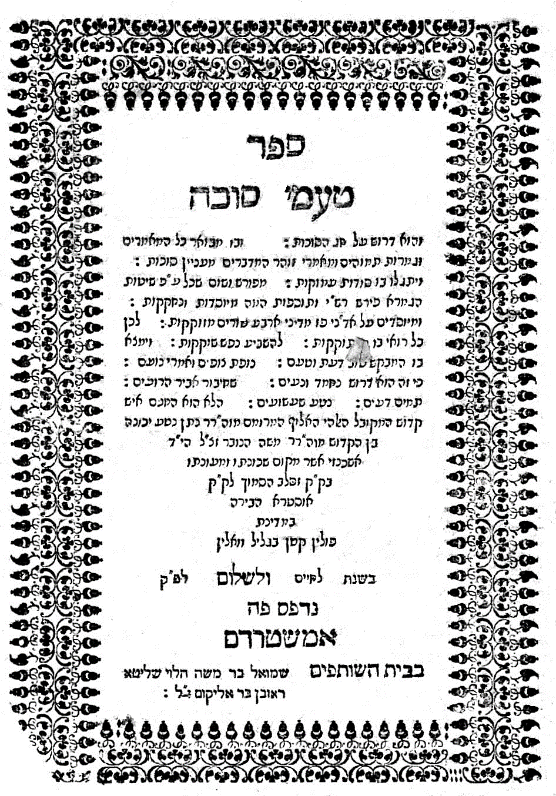
All of this is reflected in Hannover’s itinerant life and, as the chronicler of these events, in his Yeven Mezulah. Nevertheless Hannover’s first published work, Ta’amei Sukkah, is quite different. Based on a sermon delivered in Cracow in 1646 it was published in Amsterdam in 1652 at the press of Samuel bar Moses and Reuben bar Eliakim. In format it is a medium quarto (40: 12 ff.).[12] Samuel bar Moses ha-Levi was, together with Judah [Leib] ben Mordecai ben Mordecai [Gimpel] of Posen, the first Ashkenazi printers in Amsterdam. After their partnership ended in 1651, Samuel ben Moses continued to publish for a brief period in partnership with Reuben ben Eliakim of Mainz. Among their publications is Ta’amei Sukkah.
 
As the title-page makes clear, Ta’amei Sukkah is a discourse on the festival of Sukkot, explaining Talmudic statements by way of esoteric allusions. The title-page states that in the discourse,
are explained all of the hard-to-understand sayings and Talmudic adages, and the accounts in the Zohar related to Sukkot. In it are revealed deep esoterica, explained and made intelligible according to and based on the Talmud, Rashi, and Tosafot and; “set upon sockets of fine gold” (Song of Songs 5:15). . . . to satisfy the soul’s yearning. In it the seeker will find “good judgment and knowledge” (cf. Psalms 119:66), “the honeycomb” and “pleasant words” (Psalms 19:11, Proverbs 15:26, 16:24), for this is a treasured and desirable discourse. . . .
The title page is dated “to life and to peace ולשלום” (412 = 1652″; the colophon dates completion of the work to the month Menahem (Av) Zion and Israel “And this is the Torah וזאת התורה אשר (412 = July/August 1652) which Moses set before the people of Israel” (Deuteronomy 4:44). Hannover’s introduction (1b) follows. He emphasizes his youth and informs that he has written discourses on the entire Torah and festivals, entitled Neta Sha’ashu’im because it contains his name.
Lack of funds have prevented Hannover from publishing the entire work; therefore, at this time he is printing this discourse only, delivered in Cracow in 1646. Hannover’s plaint that due to a lack of funds he has been unable to publish the entire book and at this time is printing one discourse only, really just a pamphlet, that is, Ta’amei Sukkah, is not unique. Indeed, what makes Hannover different from other authors with like difficulties is that in contrast to the other authors, who are printing medium excerpts of their works in hopes of finding a patron to support publication of the larger tome, those authors are today unknown except for their medium works. Hannover, in contrast is relatively well known, if only because of his other published titles.[13]
Hannover entitles this discourse Ta’amei Sukkah because it is on Sukkah and the arba’ah minim; it explains wondrous midrashim and sayings in the Zohar and Talmud relating to Sukkot; and furthermore, the numerical value of Ta’amei טעמי (129) equals his name Nata נטע (129). The text follows, set in two columns in rabbinic type with leaders in square letters. Ta’amei Sukkah is a multi-faceted work with kabbalistic and midrashic content. Within the text are several headings in which Hannover notes that, based on the prior section, he will now explain a Midrash RabbahZohar, or other work, such as the Alshekh. At the end of Ta’amei Sukkah, after the colophon is a tail-piece, the bear pressmark.[14] Ta’amei Sukkah has been reprinted once, in Podgorze (1902).
III
The following year, continuing his peripatetic movements, Hannover was in Venice where he published Yeven Mezulah, his detailed chronicle of the horrific experiences of Polish Jewry during the Chmielnicki massacres of 1648-49 (tah ve-tat) in which, according to contemporary sources, as many as several hundred thousand Jews were murdered and hundreds of communities destroyed.[15] This, the first edition of Yeven Mezulah, is based on first person accounts taken from oral testimony and other contemporary works. It was printed at the Vendramin press in 1653, also in quarto format (40: 24 ff.). Founded in 1630 by Giovanni Vendramin this press, broke the monopoly enjoyed until then by Bragadin. For the first ten years the press operated under the name of its founder, but after his death it became known by the names Commissaria Vendramina and Stamparia Vendramina. The press eventually joined with that of Bragadin and the combined presses continued to operate well into the eighteenth century.[16]
The title is from, “[I sink in] deep mire (yeven mezulah), [where there is no standing; I have come into deep waters, and the flood sweeps over me]” (Psalms 69:3). The title page, which has an architectural frame and is dated “coming ביאת (413 = 1653) of the Messiah,” states that it comes to relate the decrees and wars in the lands of Russia, Lithuania, and Poland. There is an introduction from Hannover, which begins,
I am the man who has seen affliction by the rod of his wrath” (Lamentations 3:1), when the Lord smote His people Israel, His first born. He cast down from Heaven to Earth His glory, the land of Poland, His delight. “Beautiful for situation, the joy of the whole earth” (Psalms 48:3) “The Lord has swallowed all the habitations of Jacob without pity” (Lamentations 2:2) “the lot of his inheritance” (Deuteronomy 3 2:9) “and remembered not his footstool in the day of his anger!” (Lamentations 2:1). All of this was foreseen by King David )may he rest in peace( when he prophesied the joining of the Kadarim (Tartars) and the Greeks to destroy Israel His chosen people in the year זאת (408 = 1648).
Hannover has entitled the work Yeven Mezulah because the events that transpired it are alluded to in Psalms. Also, yeven (yavanim – Greeks) refers to the Ukrainians, who belonged to the Greek Orthodox Church. Hannover writes that he has recorded both major and minor occurrences, all the decrees and persecutions, and their dates, so that families can calculate when their relatives perished. He also describes the customs of Polish Jewry, their religious devotion, based upon the pillars that support the world (ref. Avot 1:2, 18), and notes the high level of Torah scholarship, unmatched elsewhere. Yeven Mezulah has been described as “a complex work that recounts not only the cruel fate of Ukrainian Jewry, but also the socioeconomic and political factors that led up to the rebellion. . . . it is noteworthy that he is able to give details of various political and military developments within the Polish camp.”[17]
The introduction concludes with a request that the book be purchased to enable him to publish Neta Sha’ashu’im, a work that, as noted above, was never published. It then records in detail the tribulations that befell Eastern European Jewry, concluding with a description of the inner life of the Jews, how they lived in accordance with the pillars of Torah, Divine Service, charity, truth, justice, and peace, set forth in AvotYeven Mezulah is organized by community, describing what befell them, excepting an intermediate section on Chmielnicki. Two examples, the first a description of what occurred in 1Nemirow, relating how Chmielnicki and his followers gained entry by the ruse of flying Polish flags and thus passing themselves off as a relief force.
The people of the city were fully aware of this trickery, and nevertheless called to the Jews in the fortress: “Open the gate. This is a Polish army which has come to save you from the hands of your enemies . . . No sooner had the gates been opened than the Cossacks entered with drawn swords, and the townspeople too, armed with spears and scythes, and some only with clubs, and they killed the Jews in large numbers. Women and young girls were ravished, but some of the women and maidens jumped into the moat surrounding the fortress in order that the uncircumcised should not defile them. . . . but the Ukrainians swam after them with their swords and their scythes, and killed them in the water. Some of the enemy shot with their guns into the water, and killed them till the water became red with the blood of the slain. . . . The number of the slain and drowned in the holy community of Nemirow was about six thousand. They perished by all sorts of terrible deaths. . . . May God avenge their blood.
The second example, concerns R. Samson Ostropoler of Polonnoye (Volhynia), and his community,
Among them was a wise and understanding divinely inspired Kabbalist whose name was, Our Teacher and Master Rabbi Samson of the holy community of Ostropole. An angel would appear to him every day to teach him the mysteries of the Torah. . . . He preached frequently in the synagogue and exhorted the people to repent so that the evil would not come to pass. Accordingly all the communities repented sincerely but it did not avail, for the evil decree had already been sealed.
When the enemies and oppressors invaded the city, the above mentioned mystic and three hundred of the most prominent citizens, all dressed in shrouds, with prayer shawls over their heads, entered the synagogue and engaged in fervent prayer. When the enemies arrived they killed all of them upon the sacred ground of the synagogue, may God avenge their blood. Many hundreds who managed to survive were forced to change their faith and many hundreds were taken captive by the Tartars.[18]
A critical view of Yeven Mezulah is expressed by Edward Fram who writes that Hannover, in describing the massacre of Jews in Tulczyn, copied from other works, particularly Zok ha-Ittim, at times paraphrased those works, and “in some instances he took events said to have happened elsewhere and wove them into his own tale of Tulczyn,” without acknowledging his debt, melding them into his own tale of the massacre in Tulczyn. Fram suggests that Hannover did so because Zok ha-Ittim was not compelling enough to emphasize Jewish martyrdom and “place 1648 in the tradition of past tragedies, [therefore] a more resolute image of martyrdom would be necessary.”[19]
Nevertheless, Yeven Mezulah is regarded as the classic and most important work on tah ve-tat and has been frequently reprinted as well as having been translated into Yiddish, French, German, Russian, Polish, and English.
IV
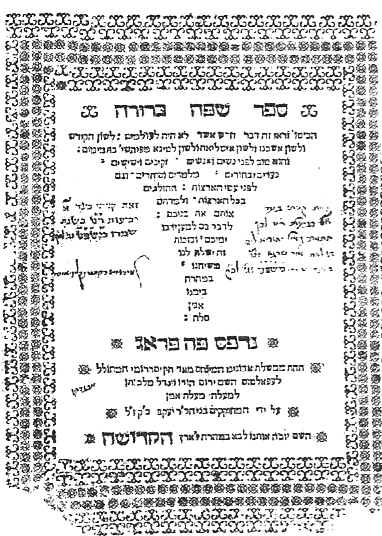
We next, in terms of Hannover’s publications, find him in Prague, where he published Safah Berurah, a popular four language, Hebrew-German-Latin-Italian, glossary for conversation and as a guidebook for travelers. Printed at the renowned press of the Benei Jacob Bak, opened as early as 1605. Safah Berurah is a medium format book (80: [44] ff.). The title is from, “For then I will convert the peoples to a clear language (safah berurah)” (Zephaniah 3:9). The title page states,
Behold, and see” (Lamentations 1:12) this new thing that was not before. The holy tongue (Hebrew), Ashkenaz, Italian, and Latin spread out flawlessly. It is good for women and men, the aged and elderly, adolescents and young, teacher and businessmen and also before the uneducated, who travel through all lands, “And you shall teach them to your children, speaking of them, so that your days may be multiplied” (cf. Deuteronomy 11:19,-21), and in this merit may He send to our Messiah speedily in our day. Amen Selah.
The Lord grant us the merit to come soon to the holy land הקדושה (420 = 1660).
 
The introduction follows, in which Hannover repeats the description of the book from the title-page and adds that it is based on the words in the Torah, the twenty-four books of the Bible, and some words from the six Sedorim (Mishnayot). He follows “after the reapers” (Ruth 2:7), gleaning every strange word in the sheaf: from concordances, Mirkevet ha-Mishneh, and commentaries.[20] Safah Berurah is so entitled because from this straightforward work all four languages will be pure and clear. In the second paragraph, in a mediumer font, Hannover explains the structure of the work, and that the Ashkenaz is not, with rare exception, that of the gentiles but of the Jews (Yiddish), but that the Latin is of the highest order, in order to be able to speak before kings and nobles.
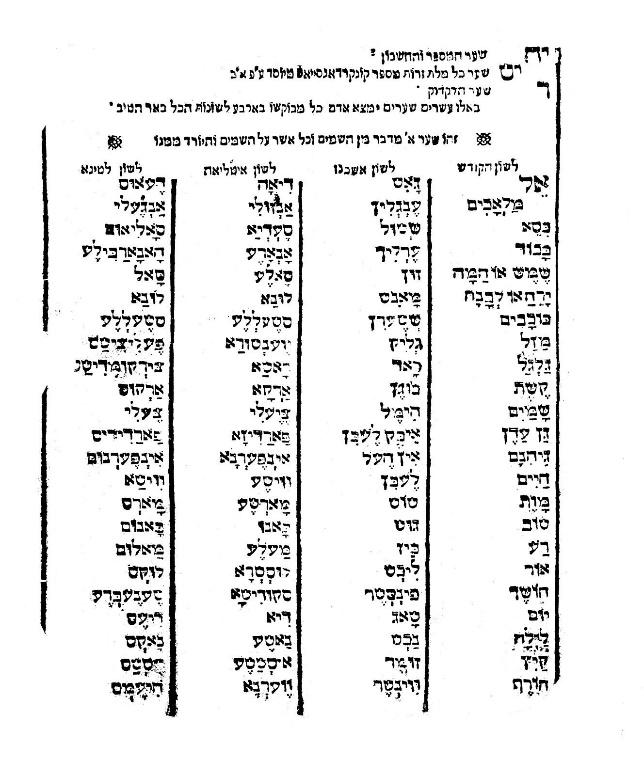
This is followed by a list of the twenty she’arim that make up Safah Berurah, that is, the divisions of the book, which is not alphabetic but by subject. This arrangement was apparently followed because Hannover believed that it would be more convenient for conversation to be able to locate words related by subject. The first two she’arim include terms dealing with the Divine and Torah; the next three with earthly objects; six through nine, fish, birds, animals and humans; continuing with material objects; such as clothing, jewelry, metal, arms, tools, nations, including proper forms of address, business, arithmetic, calendar, and grammar.
The approximately 2,000 words comprising the text follow, in four columns, from right to left, of Hebrew, Ashkenaz, Italian, and Latin, all in square vocalized Hebrew letters. At the end of the book are errata by language and a colophon in which Hannover thanks Gabriel Blanis and Jacob Szebrsziner for their assistance with the Italian and Latin, and notes that it was necessary to reduce the size of the glossary due to conditions in Poland, where there are no buyers.[21]
Safah Berurah has also been republished several times, beginning with an edition prepared by Jacob Koppel ben Wolf that included French at the press of Moses ben Abraham Mendes Coitinho (Amsterdam, 1701), and even an edition with Greek and Turkish (lacking place and date.[22]
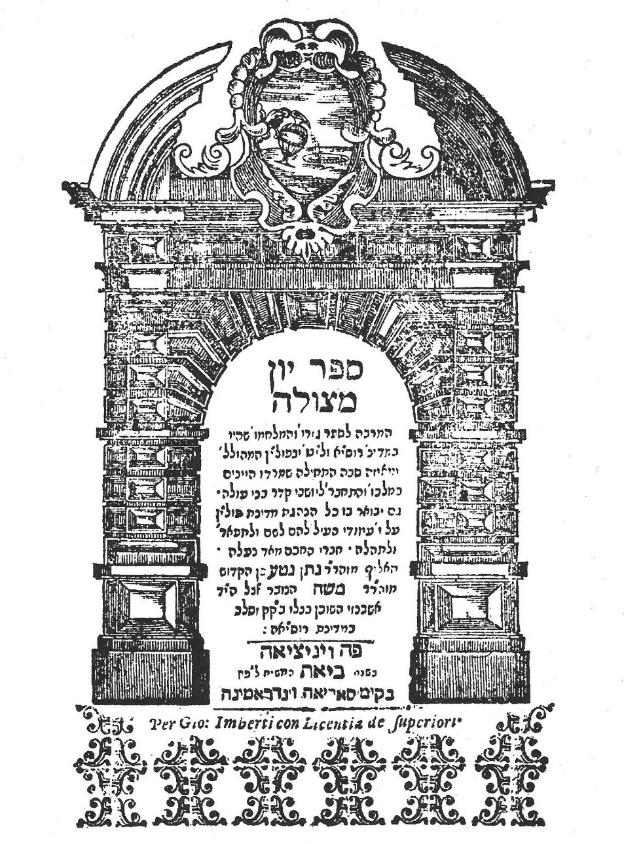
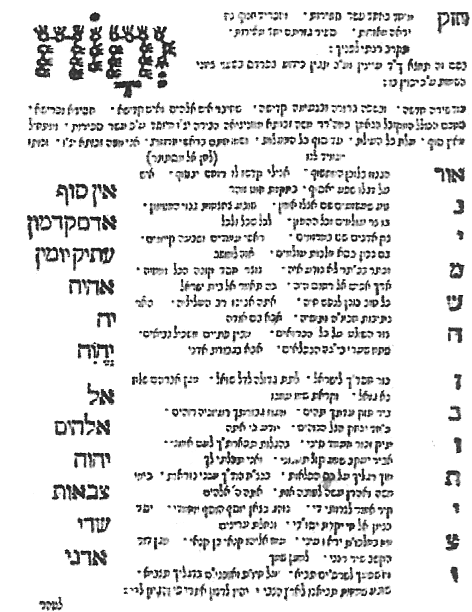
Sha’arei Ziyyon, Hannover’s, last published title, is a collection of Lurianic kabbalistic prayers, particularly for Tikkun Hazot (midnight prayers). First printed in Prague in the year “The trees of the Lord have their fill; the cedars of Lebanon, which he has planted ישבעו עצי י’י ארזי לבנון אשר נטע (422= 1662)” (Psalms 104:16), also at the press of Benei Jacob Bak. Sha’arei Ziyyon is a medium work set in octavo format (80: [38] ff.). The title is from “The Lord loves the gates of Zion (sha’arei Ziyyon) more than all the dwellings of Jacob” (Psalms 87:2).
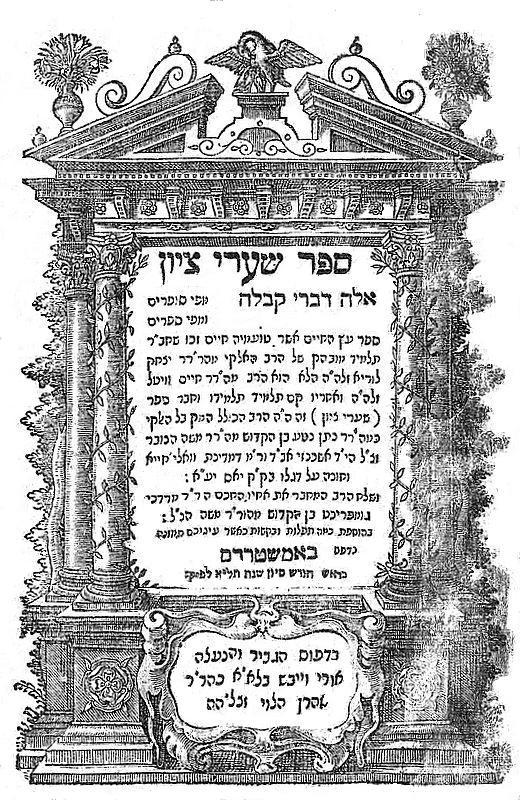
The following text and images are from the Amsterdam 1671 edition, published by Uri Phoebus ben Aaron ha-Levi in quarto in format (40: 54 ff.). Similar but not identical to the earlier Prague printing this edition is dated Rosh Hodesh Sivan 431 (Sunday, May 10, 1671). The title-page has an architectural frame with an eagle at the apex surrounds the text.[23] The text states,
These are the words of Kabbalah according to the scribes and according to the texts, Sefer Etz Hayyim, those who taste it merit life, written by the foremost student of the Godly rav, R. Isaac Luria, that is, R. Hayyim Vital. After him rose up students of his students and wrote this work (Sha’arei Ziyyon) . . .
The author sent his brother R. Mordecai Gumpricht ben Moses with many additional prayers and supplications, as can be seen . . .
The title-page is followed by the approbations reprinted from the first Prague edition, from R. Nahman ben Meir Kohen of Keremenec, R. Samuel ben Meir of Ostrow, and R. Israel ben Aaron Benzion of Satanow. They are followed by Hannover’s introduction, which concludes with a description of the seven sha’arim comprising Sha’arei ZiyyonTikkun Hazot based on R. Hayyim Vital’s Etz ha-HayyimTikkun ha-Nefesh, to be said after Tikkun Hazot with Yedid NefeshTikkun ha-Tefillah according to Kabbalah; Tikkun Kriat ha-TorahTikkun Kriat Shema with the appropriate kavvanotTikkun shel Erev Rosh Hodesh; and Tikkun Malkhut on Rosh Ha-Shanah and Yom ha-Kippurim.
Text is in a single column in rabbinic type, with headers, initial phrases, and some limited text in square letters. The volume concludes with an epilogue dating the conclusion of the work to “half of (15) Kislev, ‘And he shall judge the world תבל (Tuesday, November 17, 1671) in righteousness’ (Psalms 9:9) and compassion.” Printing was supervised by Mordecai Gumpricht ben Moses, Hannover’s brother.[24]
Sha’arei Ziyyon is primarily a compilation of existing prayers assembled into one work. Prayers such as Ribbono shel Olam, recited today prior to the removal of the Torah from the Ark by R. Jeremiah of Wertheim and the Yehi Ratzon after the priestly blessing are taken from Sha’arei Ziyyon. This edition, as stated on the title-page, is much expanded from the first edition (80 38 ff.). It contains additional prayers, piyyutim, and supplications, some of considerable length, among them prayers for someone incarcerated, for those who are ill, and has verse for the dedication of a new Torah scroll in the synagogue.[25]
Gershom Scholem, in describing the influence of Kabbalah on Jewish life writes that one of the areas in which it had the greatest influence was prayer. Among the most influential books in this sphere was Sha’arei Ziyyon in which Lurianic doctrines “of man’s mission on earth, his connections with the power of the upper worlds, the transmigrations of his soul, and his striving to achieve tikkun were woven into prayers that could be appreciated and understood by everyone, or that at least could arouse everyone’s imagination and emotion.”[26]
The popularity of Sha’arei Ziyyon is such that it has been described by Sylvie-Anne Goldberg as “one of the most widely read books in the Jewish world.”[27] Indeed, Sha’arei Ziyyon was reprinted in Prague three times in the seventeenth century (1682, 1688, 1692), and three additional times within a decade, in Dyhernfurth ([1689]), Wilhermsdorf (1690) and Dessau (1698). The Bet Eked Sefarim enumerates fifty-four editions through 1917.[28]
Hannover’s life reflects the times in which he lived, both in the adversity and travail he faced but also in how he overcame them. Just as the Jews of mid-seventeenth century Europe had their lives uprooted but survived to rebuild thriving communities so too Hannover’s accomplishments stand out. Not only did he both live and survive to chronicle the struggles and turmoil of gezerot tah ve-tat in Yeven Metzulah but he also wrote such varied books as Safah Berurah, a lexicography, and Sha’arei Ziyyon, a liturgical work, all three important and much reprinted titles. In addition, Hannover was the author of Neta Sha’ashu’im, noted above; Neṭa Ne’eman, a Kabbalistic work; a discourse on Purim, extant in manuscript, and a commentary on Otiyyot de-Rabbi Akiva, no longer extant. In addition to the printed editions of his books Hannover’s works were sufficiently popular that they were often copied by hand and numerous manuscripts of his works are extant. KTIV, the International Collection of Digitized Hebrew Manuscripts records twenty-six entries under Nathan Hannover, the most popular being by far being Sha’arei Ziyyon.[29]
Despite experiencing suffering and tragedy, Nathan Nata Hannover survived to live a life of meaning and leave us a legacy of value. Yeven Metzulah concludes that the Jews who escaped from the swords of their enemies were treated with kindness in Moravia, Austria, Bohemia, Italy, and especially Germany, given food, drink, lodging, garments, and gifts “each according to his importance,”
May their justice appear before God to shield them and all Israel wherever they are congregated, so that Israel may dwell in peace and tranquility in their habitations. May their merit be counted for us and for our children, that the Lord should hearken to our cries and gather our dispersed from the four corners of the earth, and send us our righteous Messiah, speedily in our day. Amen, Selah..
 
Seforim Blog Editors’ note:
 
For more sources on the significance of the work Sha’arei Ziyyon see Eliezer Brodt’s post on the Seforim Blog here specifically the section headed שערי ציון. Footnote 33 has some more current Hebrew literature on the sefer, and also of interest is the appendix where Brodt has a whole new look at  the relationship between this work and the Magen Avraham.
 
In addition, it’s worth noting that a beautiful new edition of the Sha’arei Ziyyon was printed in 2012 based on the first edition, and the volume includes his Ta’amei Sukkah. The Yeven Mezulah also has also been reprinted a few times in recent years.
[1] I would like to express my appreciation to Eli Genauer for reading the article and his comments. Images are courtesy of the Library of Congress, the Jewish National and University Library, the Valmadonna Trust Library, Ozar ha-Hochmah, and of Virtual Judaica.
[2] Ḥananel Nepi, Mordecai Samuel Ghirondi, Toledot Gedolei Yisrael (Trieste, 1853), p. 270 [Hebrew]; Moritz Steinschneider, Catalogus Liborium Hebraeorum in Bibliotheca Bodleiana (CB, Berlin, 1852-60), col. 2044; and William B. Helmreich, forward to Nathan Nata Hannover, Abyss of Despair (Yeven Metzulah), translator Abraham J. Mesch, (New York, 1950; reprint, New Brunswick, London, 1983), pp. 13-15; Israel Zinberg, A History of Jewish Literature IV (New York, 1975), translated by Bernard Martin, pp. 122-23.
[3] Hersh Goldwurm, ed. The Early Acharonim (Brooklyn, 1989), p. 194; Mordechai Margalioth, ed., Encyclopedia of Great Men in Israel IV (Tel Aviv, 1986), cols. 1181-82 [Hebrew].
[4] David B. Ruderman, Early Modern Jewry: A New Cultural History (Princeton, N. J., 2011), pp. 41, 51.
[5] Bernard D. Weinryb, The Jews of Poland; a Social and Economic History of the Jewish Community in Poland from 1100 to 1800 (Philadelphia, 1972), p. 166.
[6] Salo Wittmayer Baron, A social and religious history of the Jews XVI (Philadelphia, 1976), p. 98.
[7] Shmuel Ettinger, “Chmielnicki (Khmelnitski), Bogdan,” Encyclopaedia Judaica, edited by Michael Berenbaum and Fred Skolnik, vol. 4 (2007), pp. 654-656.
[8] Zinberg, p. 122.
[9] Shaul Stampfer, “What Actually Happened to the Jews of Ukraine in 1648?” Jewish History, 17:2 (2003), pp. 221-222.
[10] Jonathon Israel, European Jewry in the Age of Mercantilism 1550-1750 (London ; Portland, Or, 1998) p. 99.
[11] Simha Assaf, “The Inner Life of Polish Jewry (Prior to the Period of the Haskalah” Be-Ohole Yaʻaḳov: Peraḳim me-hHaye ha-Tarbut shel ha-Yehudim bi-Yeme ha-Benayim (Jerusalem, 1943), p. 80 [Hebrew].
[12] L. Fuks and R. G. Fuks Mansfeld, Hebrew Typography in the Northern Netherlands 1585 – 1815 (Leiden, 1984-87), I p. 197 no. 275.
[13]  Concerning such medium books published as a prospectus see my “Books not Printed, Dreams not Realized,” in Further Studies in the Making of the Early Hebrew Book (Brill, Leiden/Boston, 2013), pp. 285-303.
[14] Concerning the varied usage of the bear pressmark see my “The Bear Motif on Eighteenth Century Hebrew Books” The Papers of the Bibliographical Society of America 102:3 (New York, N. Y., 2008), pp. 341-61, reprinted in Further Studies, pp. 57-76.
[15] Other contemporary works describing the horrors of tah ve-tat are R. Samuel Feivush ben Nathan Feitel’s Tit ha-Yaven (Venice, c. 1650), R. Meir ben Samuel of Shcherbreshin’s Zok ha-Ittim (Cracow, 1650), and R. Jacob ben ha-kodesh (the holy, suggesting that he was among the murdered) Simeon of Tomashov’s Ohel Ya’akov (Venice, 1662). The latter writing ““Light became darkness” (Job 18:6) for me, for they killed my wife and three sons, “and I lived in the land of Nod” (cf. Genesis 4:16) until 1656. In that year arose grievous troubles, old and also new, and I came uponmidat ha-din (strict justice) and “Disaster upon disaster” (Ezekiel 7:26), plunder after plunder, until finally I encountered pestilence, sword, famine, and captivity and every day was worse than before. Also to be noted are selihot commemorating tah ve-tat (1648-19) such as R. Gabriel ben Joshua Heschel Schlussburg’s Petah Teshuvah ([1651], Amsterdam) selihot and lamentation on the Jews massacred in tah ve-tat (written as a commentary on the book of Lamentations and R. Shabbetai ben Meir ha-Kohen (Shah)’s Selihot ve-Kinnot (Megillat Eifah, 1651, Amsterdam).
[16] David Amram, The Makers of Hebrew Books in Italy (Philadelphia, 1909, reprint London, 1963), p. 372; Joshua Bloch, “Venetian Printers of Hebrew Books,” in Hebrew Printing and Bibliography (New York, 1976), p. 86.

[17] Adam Teller, “Hannover, Natan Note,” YIVO Encyclopedia of Jews in Eastern Europe 1 (New Haven & London, 2008), p. 656.

[18] Both translations are from Mesch, pp. 51, 63-64 respectively.
[19] Edward Fram, “Creating a Tale of Martyrdom in Tulczyn, 1648,” Jewish History and Jewish MemoryEssays in Honor of Yosef Hayim Yerushalmi, ed. Elisheva Carlebach, John M. Efron, David N. Myers (Hanover, 1998), pp. 90-91.
[20] Mirkevet ha-Mishneh (Cracow, 1534), by Asher Anshel of Cracow, is a concordance and glossary of the Bible. Published by Samuel, Asher, and Elyakim, sons of Hayyim Halicz, it was the first Yiddish book printed in Poland. Concerning Mirkevet ha-Mishneh see Marvin J. Heller, The Sixteenth Century Hebrew Book: An Abridged Thesaurus I (Brill, Leiden, 2004), pp. 216-17.
[21] Shimeon Brisman, History and Guide to Judaic Dictionaries and Concordances (Hoboken, 2000), pp. 44-46.
[22] Ch. B. Friedberg, Bet Eked Sepharim, (Israel, n.d.), shin 2223 [Hebrew].
[23] “The Eagle Motif on 16th and 17th Century Hebrew Books,” Printing History, NS 17 (Syracuse, 2015), pp. 16-40.
[24] Fuks and R. G. Fuks Mansfeld, II pp. 263-64 no. 32.
[25] A. Z. Idelsohn, Jewish Liturgy and Its Development (1932, reprint New York, 1995), pp. 55, 80, 259.
[26] Gershom Scholem, Kabbalah (NewYork, 1973), p. 193.
[27] Sylvie-Anne Goldberg, Crossing the JabbokIllness and death in Ashkenazi Judaism in Sixteenth through Ninteenth-Century Prague (Berkeley, 1996), p. 88.
[28] Friedberg, Bet Eked Sepharimshin 2148.
[29] I would like to thank Eli Genauer for bringing this to my attention. The address for KTIV is http://web.nli.org.il/sites/nlis/en/manuscript.


Cherubim: Winged Celestial Beings on the Title-Pages of Early Hebrew Books

Cherubim: Winged Celestial Beings on the Title-Pages of Early Hebrew Books
by
Marvin J. Heller[1]


And having driven out the man, He stationed at the east of the Garden of Eden the Cherubim and the flame of the ever-turning sword, to guard the way to the Tree of Life (Genesis 3:24).

You shall make two Cherubim of gold—hammered out shall you make them—from both ends of the cover. You shall make one cherub from the end at one side and one Cherub from the end at the other; from the cover shall you make the Cherubim at its two ends. The Cherubim shall be with wings spread upward, shielding the Cover with their wings with faces toward one another; toward the cover shall be the faces of the Cherubim being turned toward the cover. (Exodus 25: 18-20).

Rav Ketina said: When the Jewish people would ascend for one of the pilgrimage festivals, the priests would roll up the curtain for them and show them the cherubs, which were clinging to one another, and say to them: See how you are beloved before God, like the love of a male and female (B.T. Yoma 54a).

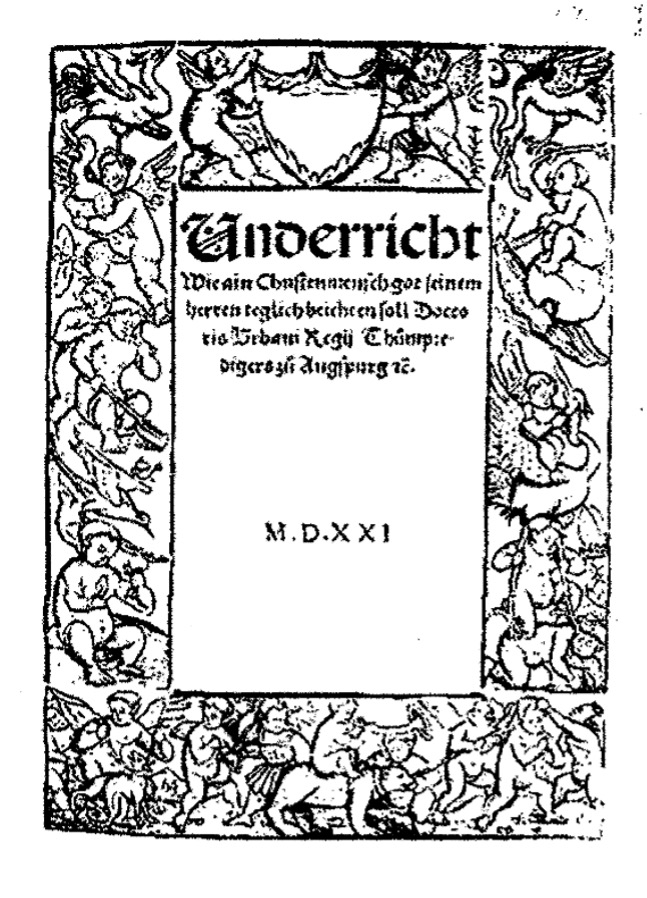
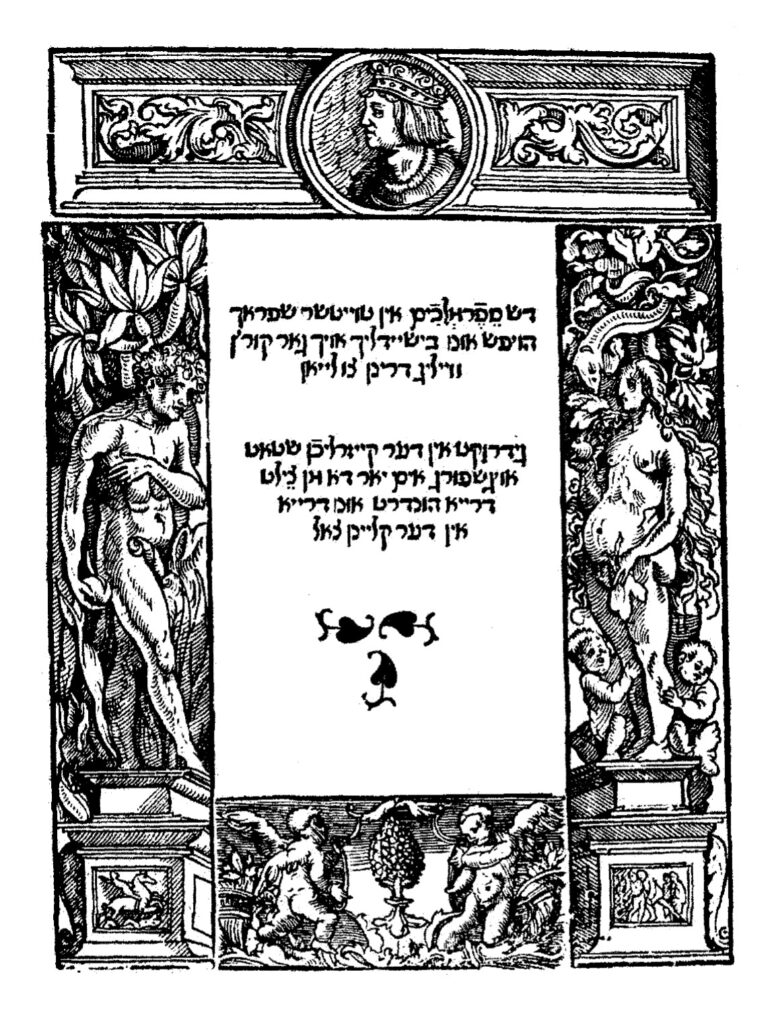
Cherubim (angels) are a frequent presence on the title-pages of early Hebrew imprints in the sixteenth century and afterward, the latter beyond the scope of this article. They are also to be found in incunabula, on the frames of initial pages and head-pieces for text.

How do you define what are cherubim? One definition, that of the Encyclopedia Judaica, is “a winged celestial being which appears in the Bible in several different guises.” It then proceeds to give several descriptions of cherubim. The Jewish Encyclopedia begins with a more detailed description, stating cherubim are “the name of a winged being mentioned frequently in the Bible. The prophet Ezekiel describes the cherubim as a tetrad [set of four] of living creatures, each having four faces—of a lion, an ox, an eagle, and a man—the stature and hands of a man, the feet of a calf, and four wings.”[2]
The use of cherubim is also noted in the 1911 Encyclopædia Britannica where they are described as “imaginary winged animal figures of a sacred character, referred to in the description of Solomon’s temple (1 Kings vi. 23-35, vii. 29, viii. 6, 7), and also in that of the ark of the tabernacle (Ex. xxv. 18-22, xxvi. 1, 31, xxxvii. 7-9). . . . In Gen. iii. 24 the cherubim are the guards of Paradise . . .”[3]
The frequency of the appearance of cherubim in Hebrew literature can be found on Sefaria, a bibliography of Jewish texts, which records fifty-six entries for cherubim under biblical, Mishnah 27, and Talmud 991. Among other entries are Midrash, 590; Halakhah 7947; Kabbalah 747; and yet still others as well as multiples of commentaries on the first works.[4]

These multi-winged creatures are also a feature in general literature. Franz Sales Meyer, under the heading Miscellaneous heads, describes the “Angel faces, youthful heads, with a circular or disc-like halo, are first met-with in the Byzantine style, as the result of ecclesiastic articles,” He continues that in the early Italian Renaissance such renderings were charmingly naïve. They appeared as adornments on friezes and arches, medallions, and in borders. They also are to be found on tombs and are “Much used in Modern ecclesiastical decorations.” The text is accompanied by a page of examples of the cherub head, including one of a skull.[5]

It had been my intention to describe Hebrew title-pages with images of cherubim over a period of two centuries.[6] The numerous instances of such usage, however, has necessitated a considerable limiting of our subject period. Indeed, rather than noting all the examples in our current period, in the sixteenth century, we only describe several exemplars, giving background about the books in which they appear, that is, the publisher, author, and book subject.[7] This article is expansive, that is, in describing cherubim, it discusses the varieties of Hebrew literature, the authors of the subject works, the presses that published them, and even Hebrew book history. The title-pages and infrequent text pages with displays of cherubim addressed here are in chronological order, but from diverse locations and, again, on a variety of books, indicative of how widespread Hebrew publishing was and even more so the depth and nature of Hebrew literature.[8]

1514-18, Hameshei Humshei Torah – Our first work with the appearance of cherubim is a folio (20) edition Hameshei Humshei Torah (Pentateuch) with haftorat and commentary of Rashi printed in 1514-18 in Prague at the press of Gershom ben Solomon ha-Kohen and partners. Gershom later received a royal privilege from King Ferdinand of Bohemia, allowing him, that is Gershom alone, to enjoy a monopoly on Hebrew printing in Prague. His descendants, known as the Gersonides, continued to print in Prague until the mid-seventeenth century.
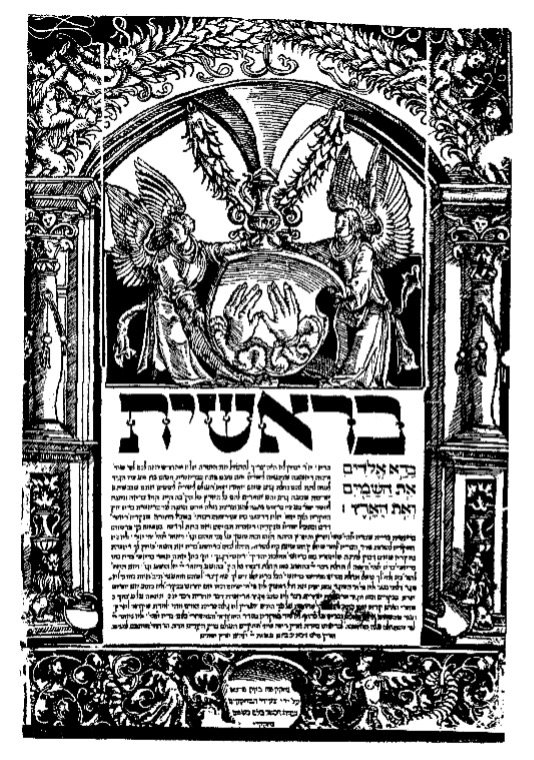
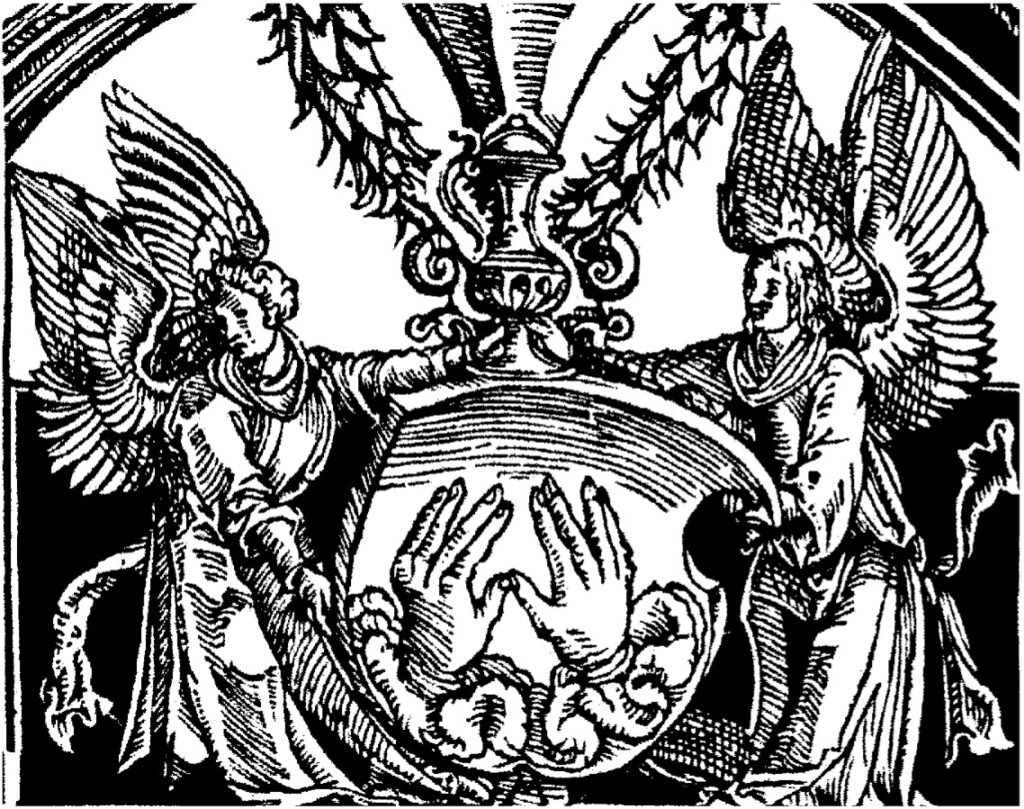
 

1514, Hameshei Humshei Torah
Courtesy of the Library of the Jewish Theological Seminary

A magnificent edition, with ornate woodcut frames and large type for the text. Each book has a unique decorative opening page, there is no title page, comprised of four separate pieces, those on the pillared sides with vases, leaves, and cherubim, similar but not identical, the top piece with a concave bottom edge. Genesis has a convex curved piece to fit with this top piece on the upper half of the page, with winged cherubim holding a shield with the spread hands of the Kohen giving the priestly blessing.[9]

Work on the Pentateuch began on 10 Sivan (June 14, 1514) but, perhaps as a result of the success of the prayer book, the partners found they had overextended themselves and found it necessary to suspend work on this project for two years. In 1530 Gershom and his sons reprinted this Pentateuch in an identical format, except for changes to the decorated initial pages.

1527, Dictionarium ChaldaiOur next entry with cherubim is an Aramaic grammar by the Christian-Hebraist scholar Sebastian Muenster (1489-1552). It was printed in Basle in 1527 at the press of Johannes Froben in quarto format (40: [1], 434, [7] pp.). The Froben family was the most significant printers of Hebrew books in Basle. Johannes Froben published as many as 250 titles, among them Hebrew/Latin books of the Bible and grammatical works, primarily works by Muenster.

Sebastian Muenster, a cosmographer, astronomer, and orientalist was, for twenty three years, professor at Basle. Born in Niederingelheim, Hesse, the son of a Spitalmeister (hospital master), Muenster had no university education nor did he ever receive a degree. His education consisted of some private instruction in Latin and later studies at Frieberg and attendance at lectures given by the Franciscans. In 1506, Muenster entered the Minorite order and was sent to study in Rufach under Conrad Pellican (Pellicanus, 1478-1556). The following year he took vows and, in 1512, was ordained a priest. Muenster assisted Pellican in teaching in Pforzheim and, from 1524-29, occupied the chair of Hebrew at the University of Heidelberg. In 1529, Muenster converted to Protestantism and moved to Basle, where he occupied the chair of Hebrew, at a salary of 60 gulden; from 1547/8 he was rector. From about 1525, Muenster was a student of Elijah Levita, translating and editing his grammatical works. Muenster also translated a number of other Hebrew works into Latin and was a prolific author in his own right. By the time of his death more than 100,000 volumes of his works were in circulation. His Jewish oeuvre, more than three-score publications, covers all aspects of Judaica, excepting Kabbalistic studies, which did not interest him. In 1523, Muenster published Dictionarium Hebraicum . . . adiectis Chaldaicis vocabulis, his study of the Aramaic language. The book reads from left to right but the text follows the Hebrew alphabet. Words are given in vocalized Hebrew, followed by their etymology, definition and examples.

The title page of the Dictionarium Chaldai has an architectural frame with cherubim in various positions, as well as additional cherubim below mounted and otherwise. This title page, designed by Hans Holbein, was used as early as 1516 on Basel statutes and into the seventeenth century.[10] [11]

Not long afterwards, from 1540 through 1543, at least five titles were printed in three locations with varied images of cherubim on the title-page, that is Augsburg, Prague, and Bologna. That is not to say these frames were not used on other books, most likely they were, but rather these are examples of cherubim used by the printers of Hebrew books at the time.

Augsburg has an early history related to Hebrew printing. Several early anti-Jewish works beginning with the apostate Johannes Pfefferkorn’s Der Judenfeind (1509) and other anti-Semitic books by apostates were published there. Another early Augsburg publication of note, this certainly more positive, albeit not a Hebrew edition of that popular and much republished work, is the first printing of R. Joseph ben Abraham Gikatilla’s (1248–c. 1325) kabbalistic classic, Sha’arei Orah, which explains and analyzes the ten Sefirot. This edition of Sha’arei Orah is a Latin translation of that work by the apostate Paulus Ricius (Paulus Israelita, 1480-1541) under the title Portae lucis, published in 1516 at the press of Johann Miller.
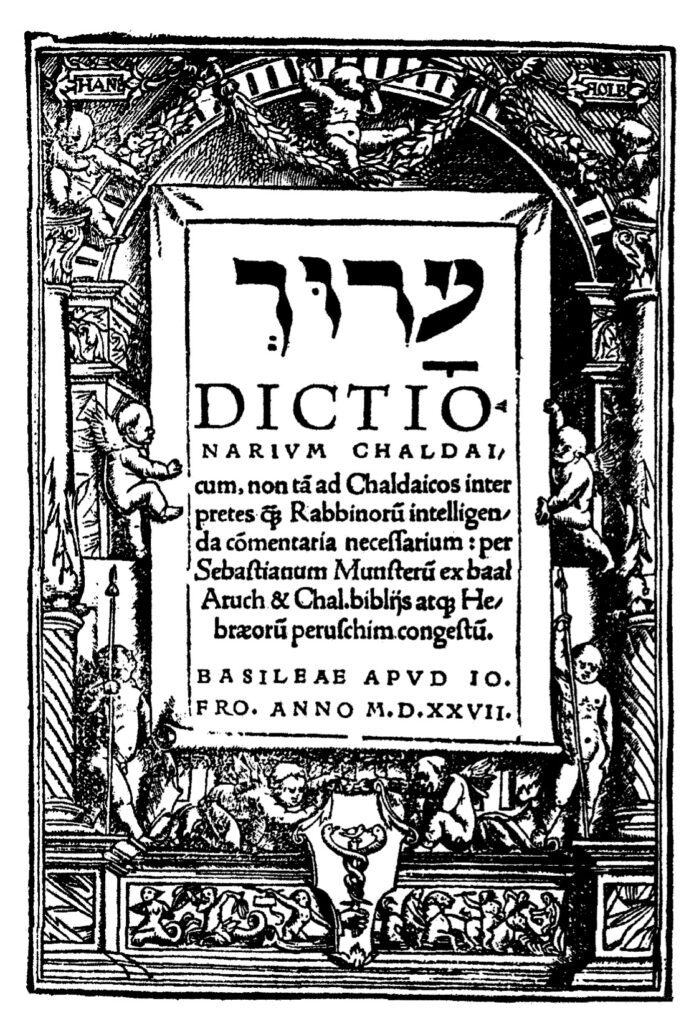
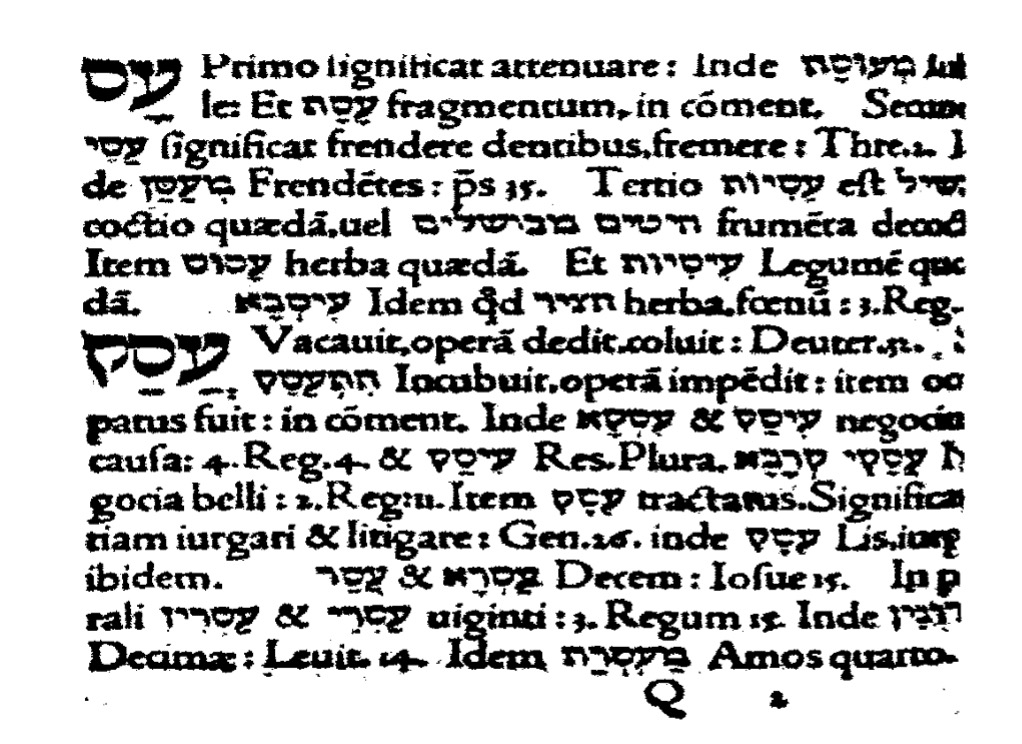
1527, Dictiorionarim Chaldai
Courtesy of the Fales Library and Special Collections, New York University

Serious Hebrew printing in Augsburg begins when Hayyim ben David Shahor, among the pioneers of Hebrew printing outside of Italy, came to Augsburg in about 1533/34. In Augsburg, Schwarz worked in the print shop of Silvan Otmar (d. 1540), a renowned and highly productive printer, and resided in the home of Bonifacius Wolfhart, a Protestant pastor who also served as the censor of Hebrew books for Augsburg.[12] Shahor printed several works in conjunction with his son, Isaac, and his son-in-law, Joseph ben Yakar, who assisted him at the press, although their names are not mentioned on the title-pages.[13]

Shahor likely joined with a non-Jewish printer, perhaps August Wind, a printer of Hebrew works for Christian clergyman. Hayyim left for Italy, returning to Augsburg in 1540. He then printed three books, Avkat Rokhel, Arba’ah Turim and a prayer book for, according to the Thesaurus of the Hebrew Book, a total of ten works in Augsburg. Due to a lawsuit by an apostate, Paulus Aemilus, with whom Shahor had been associated in Ferrara, resulting from their failed venture, Shahor and his family were forced to cease publication and leave Augsburg. Aemilus, seeing a market in Augsburg for Hebrew/Yiddish books, began to print on his own account. He issued a small number of titles, most notably the Melokhim Bukh (1543) and the Shmuel Bukh (1544), Yiddish poetical renditions of the books of Kings and Samuel, both with images of cherubim (below).[14]

1540, Avkat Rokhel Our first Augsburg title is Avkat Rokhel, an eschatological work on the principles of faith attributed to R. Machir ben Isaac Sar Hasid, a student of R. Judah ben Asher, son of the Rosh. Printed in octavo format (80: 18 ff.), perchance by Shahor. The Thesaurus of the Hebrew Book attributes it, albeit in brackets, to Hayyim Shahor, in contrast to the National Library of Israel that records the printer as unknown.[15]

The text of the title page is set within a decorative frame with nineteen cherubim and a number of animals. The title-page states that it is,

Sefer Avkat Rokhel

Printed by the printers named at the end of the volume. Edited with great care, with all our ability, “the good hand of our [Lord] upon us,” (ref. Ezra 8:18). And it was completed, here Augsburg, the great city, with the help of the Lord and His salvation. In the year, “[Rejoice, O you nations, with his people; for he will avenge the blood of his servants,] and will render vengeance to his adversaries, and will make expiation כפר (300=1540) for the land of his people” (Deuteronomy 32:43).

The names of the printers, Hayyim Shahor, Isaac ben Hayyim, and Joseph ben Yakar, the statement on the title page notwithstanding, are not given at the end of the volume. A brief introduction informs that the work was named Avkat Rokhel (the perfumer’s powders, Song of Songs (3:7)) for as the perfumer’s powders strengthen the soul, so too when one reads this book will he fear and cause his soul to be pure and free from all sin and transgression, thus meriting the good.
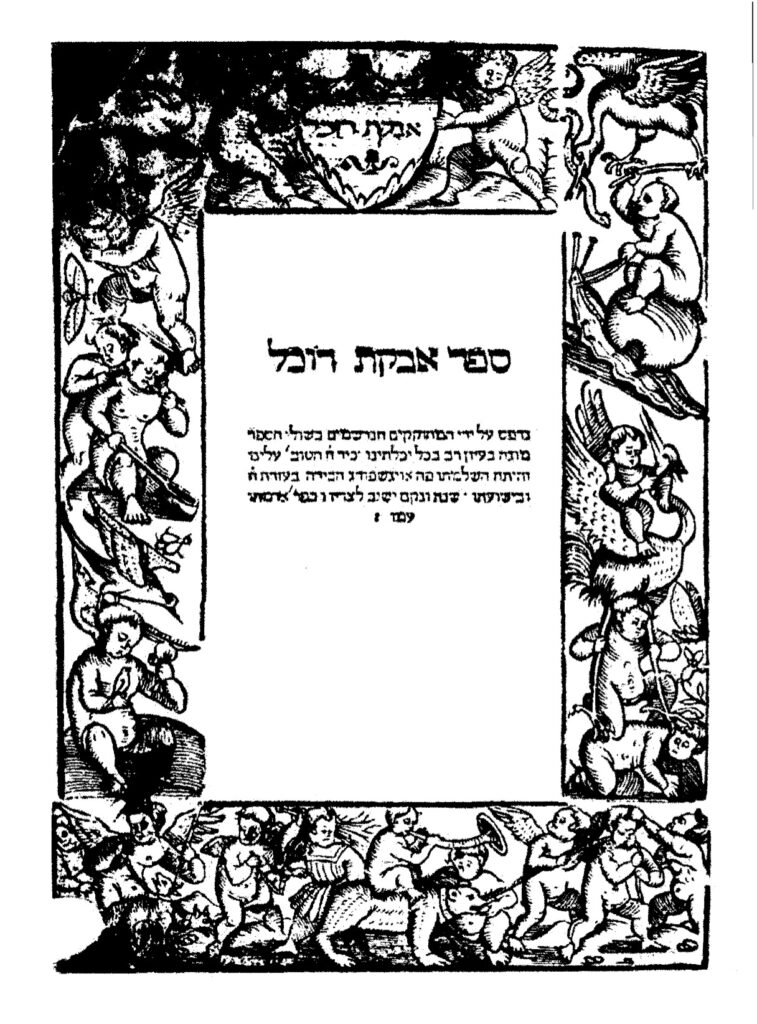
1540, Avkat Rokhel
Courtesy of the Dorot Jewish Division New York Public Library

The like title-pages of Avkat Rokhel and Unterricht Wie ain Christenmensch, the latter a non-Hebrew work printed approximately two decades earlier, reflect a relationship between Jewish and Christian printers, that is, Christian printers published Hebrew books in association with Jewish associates. The relationship between the printers was mutually beneficial. For the Christian publisher “the Hebrew books sector, being unique, was attractive to investors, being more limited and not so wildly competitive as the Italian book sector.”[16] In addition to the non-Jewish printer’s access to the Jewish book market, the Jewish publisher was able to not only publish Hebrew books, but he also gained access to the typographical material of his Christian associate. The latter, for example, frequently provided attractive frames to the former after having used them for his market and the Jewish partner also utilized the printer’s other ornamentation. This was of value to the Jewish partner as he did not have to go the expense of having decorative material prepared, at a relatively much greater expense as it would be utilized for a much smaller market. This despite the fact that the frames were often incompatible with traditional Jewish sensibilities.[17]

1521, Unterricht Wie ain Christenmensch [18]

The like title-pages of Avkat Rokhel and Unterricht Wie ain Christenmensch, the latter a non-Hebrew work printed approximately two decades earlier, reflect a relationship between Jewish and Christian printers, that is, Christian printers published Hebrew books in association with Jewish associates. The relationship between the printers was mutually beneficial. For the Christian publisher “the Hebrew books sector, being unique, was attractive to investors, being more limited and not so wildly competitive as the Italian book sector.”[19] In addition to the non-Jewish printer’s access to the Jewish book market, the Jewish publisher was able to not only publish Hebrew books, but he also gained access to the typographical material of his Christian associate. The latter, for example, frequently provided attractive frames to the former after having used them for his market and the Jewish partner also utilized the printer’s other ornamentation. This was of value to the Jewish partner as he did not have to go the expense of having decorative material prepared, at a relatively much greater expense as it would be utilized for a much smaller market. This despite the fact that the frames were often incompatible with traditional Jewish sensibilities.[20]

The title-page of Avkat Rokhel has the largest number of cherubim of our title-pages, nineteen in all, of our title-pages. The cherubim appear on the bottom, sides, and top of the frame, all active, albeit in different activities. The text of Avkat Rokhel is in three parts, each further subdivided. The first section addresses the struggle against one’s evil urge prior to redemption and the birth pangs and advent of the Messiah, and an explanation of the pertinent midrashim; the second part discusses the rewards and punishments of the soul after the resurrection, the nature of the world to come according to Judaism, in contrast to the views of non-Jews, and resurrection; and the third part the laws stated by the sages of the Talmud as halakhah Moshe me-Sinai, the formation of man and the number 248 limbs in a person, the statement of our sages concerning three partners in that process (God, man, and woman) and some gematriot.

This is the third edition of Avkat Rokhel, it having been printed previously in Constantinople (1516) and Rimini (1526). Ch. B. Friedberg records, in his Bet Eked Sepharim, more than twenty-five printed editions of Avkat Rokhel. It was translated into Latin by A. Hulsius and printed in his Theologia Judaica, (Breda, 1653) and a Yiddish edition was prepared by Naphtali Pappenheim (Amsterdam, 1647).[21]

1543, Melokhim Buch Two additional works printed in Augsburg, attributed to Moses (Esrim ve-Arbeh) Ashkenazi, are Yiddish poetical renditions of the books of Kings and Samuel. Moses’ appellation, Esrim ve-Arbeh (24), derives from either his birthplace, Vierundzwanzig Hoefe (24 courts) in Wuerttemberg, or from his extensive knowledge of the 24 books of the Bible. Moses’ accreditation with either authoring or transcribing the Melokhim Bukh is due to its similarity to the Shmuel Bukh, more reliably attributed to him. Nevertheless, sufficient differences exist between the two works that many scholars believe they do not share a common author. It is clear, however, that the author, even if not this Moses, was an Ashkenazi Jew. The Melokhim Bukh was published in quarto format (40: [123] ff.) by, according to the colophon, Paulus Aemilus. A Latin colophon states, Augustae Vindelicorum/ per Paulum Aemilium, Anno/ Domini M. D. XLIII. Meyer Waxman suggests that it is doubtful, the colophon notwithstanding, that the publisher was Aemilus; more likely it was Hayyim Shahor.

We have noted above that the frames on these title-pages were first used by Christian printers and that when that market no longer needed the frames, they were made available to Jewish printers. The cherubim frames noted above were generally acceptable to a contemporary renaissance Jewish public, although some, many, were questionable and would not be used today. In contrast, the title-page of the Melokhim Buch has a border made up of a four-part frame, the top with a representation of a king, the left and right sides respectively with images of Adam and Eve, unclad, the latter with the snake, two small children, and expecting. At the bottom are two cherubim. Use of this frame is surprising, for in contrast to other frames its’ contents appear to be objectionable, more so than other frames, even those with mythological characters. It seems likely that this frame might also be distasteful to Christian sensibilities.[22]

1543, Melokhim Buch
Courtesy of Dr. Moshe Rosenfeld

The title page states that it is “The book Melokhim (Kings) in Taytsher sprach, beautiful and clear and very entertaining to read. Printed in the imperial city of Augsburg in the year 303 (=1543)” [23] The colophon dates the completion of the work to Friday, 14 Av, 303 (July 25, 1543), which was a Sunday in 1543.

The Melokhim Bukh was not written as a sequel to the Shmuel Bukh. It is the older of the two books, originally written as a separate work, possibly as early as the fourteenth century. The format of the Melokhim Bukh, a rhymed paraphrase of the book of Kings, is that of the heroic epic, stylistically modeled after comparable German sagas, such as the Nibelungen. The subject matter is the events in Kings I and II, imaginatively and colorfully enhanced by material from the Talmud and Midrashim, all expressed with a deep piety. Intended as a complete history, it begins with a hymn of praise to God in three strophes followed by nine strophes from the Exodus to the last days of David, the contents of Kings, and as a sequel, the history of the Jews to the end of the second commonwealth in thirty strophes). An example of the text is,

You have frequently performed signs for the children of Israel;

Therefore they are obliged to have You for their Lord.

And to fear Your name-that is useful and good for them.

That man is foolish who acts contrary to Your word.[24]

1544, Shmuel Bukh The Shmuel Bukh was published, also likely by Hayyim Shahor in quarto format (Format 40: [102] ff.). It has an ornate title page made up of figurines above and about pillars with cherubim on the sides. It too is in Vaybertaytsh; among its reprints is a Latin edition (Ingolstadt,(1562). Waxman suggests that the Shmuel Bukh was likely written at least a hundred years earlier, most likely an original production of medieval Jewry. The author reworked the biblical material and incorporated aggadic elements. It was written in “vigorous poetic style” in eight line strophe and was meant to be sung.[25]

1544, Shmuel Bukh
Courtesy of Dr. Moshe Rosenfeld

In contrast to what was written above, “works that many scholars believe they do not share a common author,” Zinberg informs that both the Melokhim Bukh and the Shmuel Bukh are composed in the same verse-meter. Moreover, the title-page states that “Shmuel is the first part of

the book Melokhim, for it is all related.” Nevertheless, Zinberg quotes other sources that “these are two quite different works and were probably written by two different poets.”[26]

1553, Ma’yan GannimA composition book comprised of sample letters from R. Samuel ben Elhanan Jacob Archivolti (c. 1515-1611). Ma’yan Gannim was published in a small sextodecimo format (160: 45, [1] ff.) at the Venice press of Alvise Bragadin. The Bragadin press was active before the papal bull, dated August 22, 1553, by Cardinal Giovanni Pietro Caraffa, the future Pope Paul IV, an extreme reactionary and bitter anti‑Semite, who ordered the confiscation and burning of the Babylonian and Jerusalem Talmuds. This had a chilling effect on Hebrew printing and resulted in a considerable decline if not outright cessation of printing in Venice, and the subsequent expurgation and censorship of Hebrew books. When Hebrew printing resumed in Venice in 1563, among the Christian printers who took up the publication of Hebrew books was Alvise Bragadin. Bragadin died in the mid-1570’s, he was succeeded by his son, and after him by successive members of the family well into the eighteenth century, the last known Bragadin being Alvise III. Throughout that time the press remained a leading printer of Hebrew books in Venice.
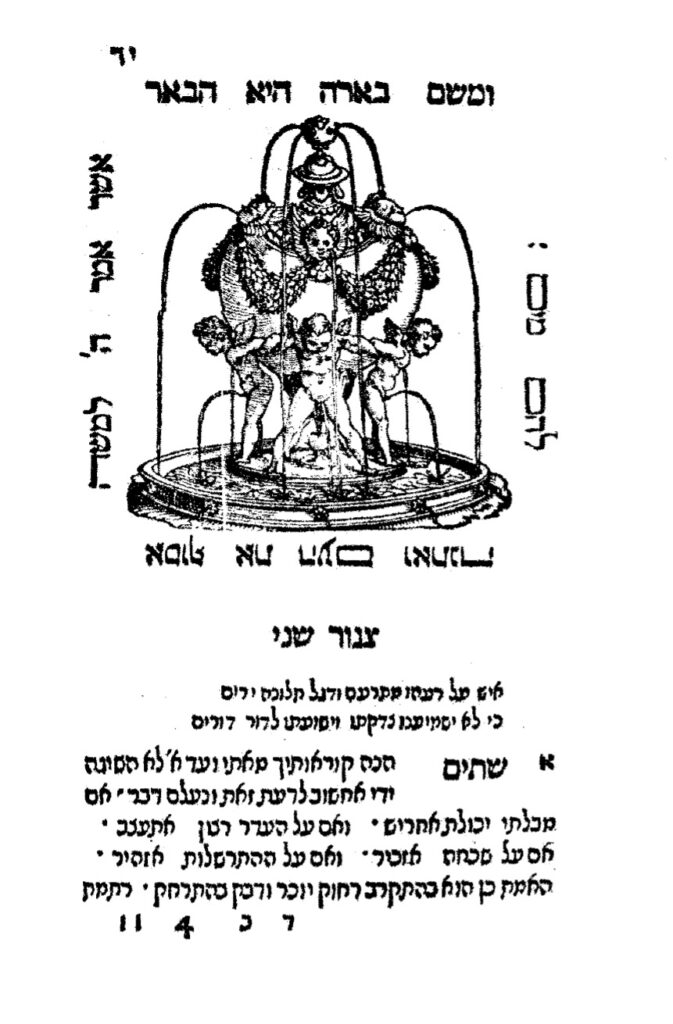
1553, Ma’yan Gannim
Courtesy of the Library of Agudas Chassidei Chabad Ohel Yosef Yitzhak

Archivolti, a student of R. Meir Katzenellenbogen (Maharam, 1473-1565), served as rabbi, av bet din, and rosh yeshivah in Padua. Among his students was R. Judah Aryeh (Leon) Modena (1571-1648). Prior to settling in Padua in 1568, Archivolti worked as a corrector for the Hebrew presses in Venice.

In contrast to our preceeding examples of cherubim, this exemplar does not appear on the title-page of the book, which has the Bragadin device, that is, three crowns, but rather at the beginning of each of the book’s five chapters, a woodcut illustration comprised of three cherubim in a cage, surrounded on all four sides by a verse.

The title is from “A fountain of gardens (ma’yan gannim), [a well of living waters, and streams from Lebanon” (Song of Songs 4:15). The text states that there are fifty letters, that is, twenty-five letters with their responses, written by Archivolti. There is a preface and introduction from Archivolti, followed by a table of contents, and, beginning on 7a, the text. Ma’yan Gannim is the first book written by Archivolti, for he describes it as his first fruits, an offering to the Lord. Archivolti also wrote Degel Ahavah (Venice, 1551), an ethical work; He’arot le-Sefer he-Arukh (Venice, 1553), textual references for the Arukh of Nathan ben Jehiel; and, his most important title, Arugat ha-Bosem (Venice, 1602) a grammatical work in 32 chapters.

The sections or chapters, each on a different theme, are correspondence between a father and son; between friends; from an older to a younger man; with government officials; and others, including letters of a romantic, and even sensual nature. Such letters, at the very least inappropriate by modern religious standards, are intermingled with those of a sacred nature, reflecting contemporary mores and addressing current issues, including therefore, information of historical and cultural value. Ma’yan Gannim is designed to teach through example the rules of correspondence. The letters are in metrical form, designed by Archivolti as literary models, many with ethical content, for his students.[27]

1556, She’ilot u’Teshuvot Jacob ben Moses Moellin (Maharil) – Two hundred and five responsa from R. Jacob ben Moses Moellin (Maharil, c. 1360-1447). The She’ilot u’Teshuvot were published in Cremona at the press of Vincenzo Conti in octavo format (80: [7] 79 ff.). After the Talmud was burned in Venice in 1554 there was a precipitous decline, if not a complete cessation, in the number of Hebrew books printed in Venice for several years. The breach was filled by presses in Ferrara, Sabbioneta, Cremona, and Riva di Trento. Vincenzo Conti (d. 1569) printed briefly in Sabbioneta and subsequently in Cremona, where his press was active from 1556 to 1567, issuing more than forty titles.

Maharil was the leading halakhic authority of his time. His most important work is Sefer Maharil (Minhagei Maharil, 1556, Sabbioneta), a popular and influential work on customs and laws. It was composed by his pupil Eleazar ben Jacob (Zalman of St. Goar), from the discourses that he heard from Maharil. She’ilot u’Teshuvot is comprised of Two hundred and five responsa, a small part only of Maharil’s responsa. The subject matter, as in the Sefer Mahril, deals to a great extent with custom, but also includes much personal material. They also reflect Maharil’s considerable humility and compassion.
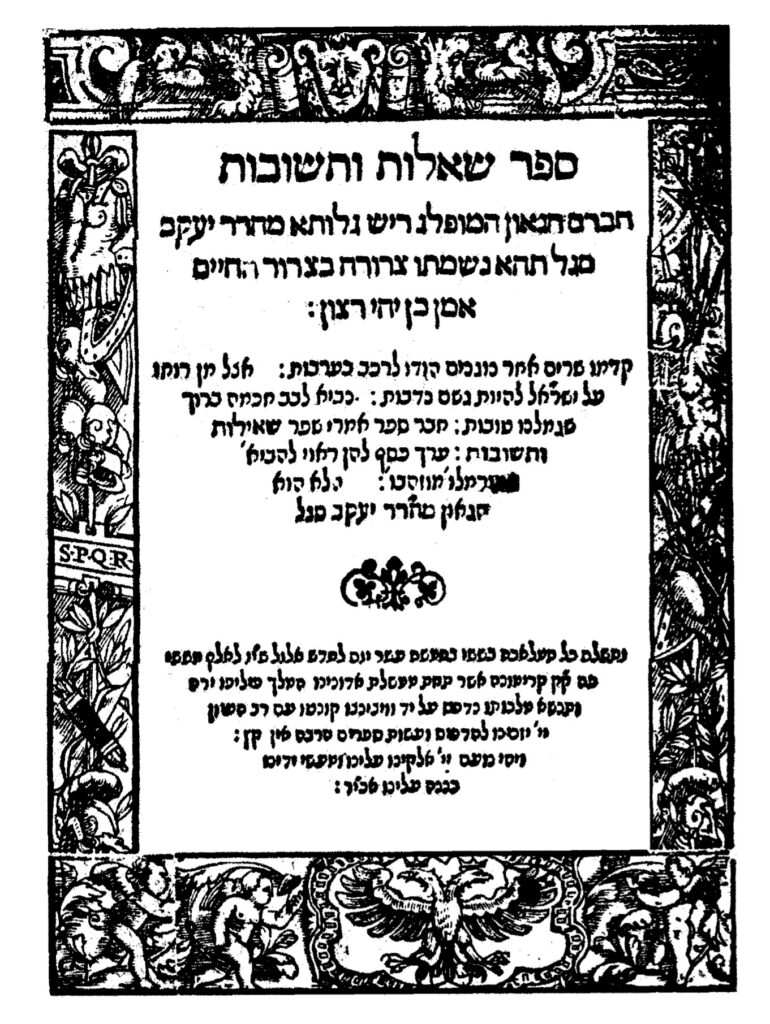
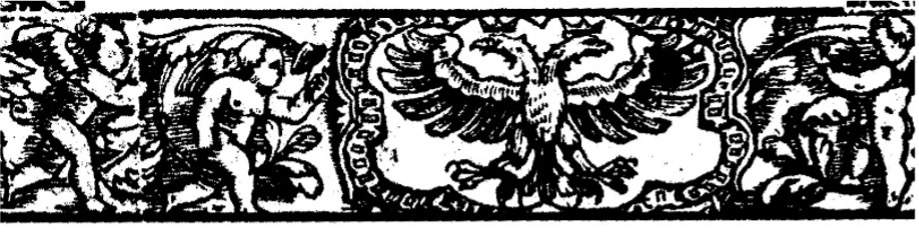
1556, She’ilot u’Teshuvot Jacob ben Moses Moellin (Maharil)
Courtesy of the Library of Agudas Chassidei Chabad Ohel Yosef Yitzhak

The title-page has an ornamental frame made up of four parts, enabling the printer to use them in other arrangements, although this is the manner in which the parts are most often employed. The top frame has the face of a man and cherubin; on the sides are suits of armor, shrubs, and musical instruments and, in the center of the left vertical frame the letters SPQR, reputedly standing for Senatus Populusque Romanus; and on the bottom a two headed crowned eagle and on the sides the cherubim. This frame was used by Conti on his early imprints, appearing on about ten works.

1558, Sefer Rav Alfas Sefer Rav Alfas, (Hilkhot Rav Alfas, Sefer ha-Halakhot of Alfasi, Rif) was published in Riva di Trento by R. Joseph Ottolenghi and Cardinal Cristoforo Madruzzo in a three volume folio format (20: 288, 268, 302 [8] ff.). The Tyrolese town of Riva di Trento is the source of an unusual episode in the history of the Hebrew book. It was for a short time, from 1558 to 1562, a refuge for the Hebrew book; one in which about forty Hebrew titles were printed. Believed to be the first work printed in Riva di Trento, Hilkhot Rav Alfas was likely selected, in addition to its inherent popularity and value, due to the ban on the Talmud, the Rif, being a halakhic compendium of the Talmud, filling, to some extent, the gap left by the scarcity of that work.

It was in Riva di Trento that Cardinal Cristoforo Madruzzo (1512-78), Cardinal of Trent, a scholar and supporter of learning, who argued at the Council of Trent (1562) for leniency and moderation in condemning books, became the patron and protector of a Hebrew press, which was also a source of revenue for him. Ottolenghi (d. 1570), originally of Ettlingen, in Baden, Germany, reflected in its Italianized form in his name, was rosh yeshivah at Cremona, and under his tutelage Talmudic studies had continued in Cremona after that work had been banned and burned elsewhere. He assisted the press, providing indices and annotations to a number of works and assuring that material offensive to the church had been deleted from those books of value to his yeshiva. and R. Jacob Marcaria, a dayyan on the bet din presided over by Ottolenghi and a physician, recruited by Madruzzo help finance and play a role in the press. Marcaria edited and wrote brief prefaces for most of the books printed in Riva di Trento. The press was located in the house of Antonio Broën.

Sefer Rav Alfas is a halakhic compendium by R. Isaac ben Jacob Alfasi (Rif, 1013-1103). Alfasi, born in the Algerian village of Qal’at Hammad, was a student of the great sages R. Nissim ben Jacob (c, 990-1062) and Hananel ben Hushi’el (d. c. 1055) in Kairouan. After learning with them Alfasi relocated to Fez, from where his surname al-Fasi (Rif) is derived, and became recognized as the leading Talmudic sage of the time. In 1088, at the age of 75, two informers denounced him to the government – the charges are unknown – and he was forced to flee to Spain. Eventually settling in Lucena, Alfasi succeeded R. Isaac ben Judah ibn Ghayyat (c. 1020-89), who had died a few months earlier, as head of the yeshiva.
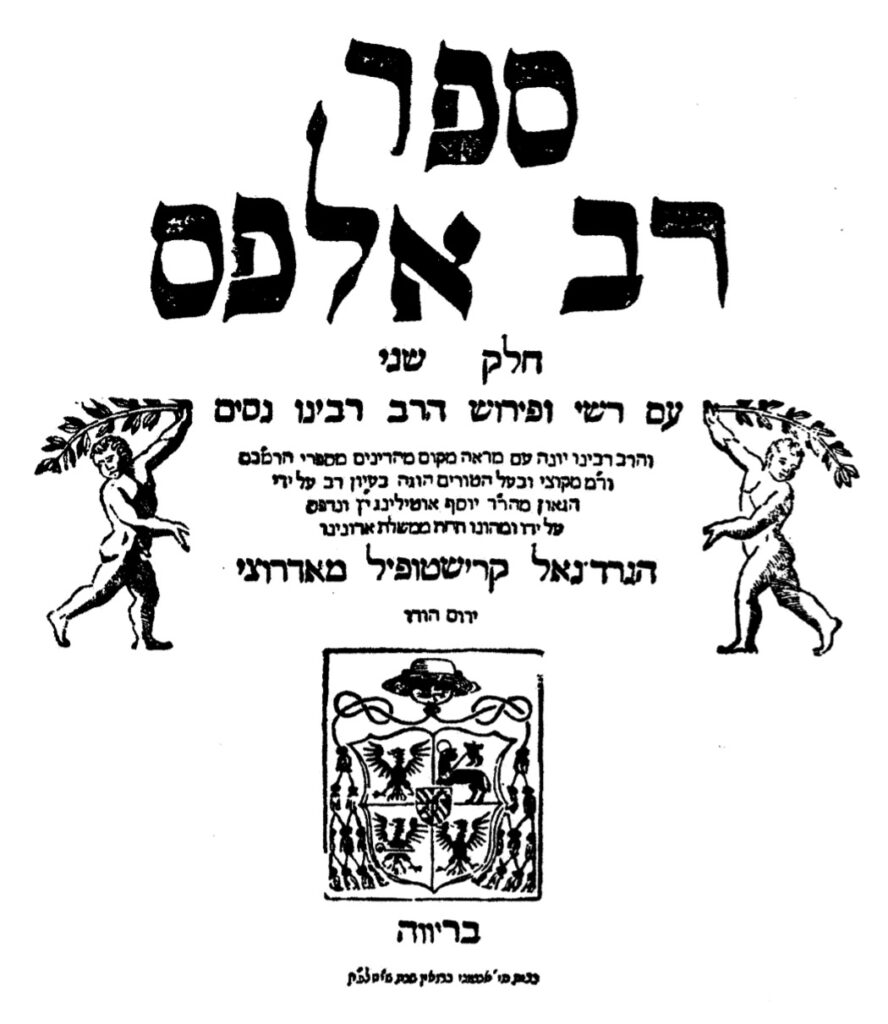
1558, Sefer Rav Alfas
Courtesy of the National Library of Israel

The text of the title-page of each volume has cherubim at the sides, and below bears the Cardinal’s coat‑of‑arms , a significant statement of the Cardinals’ support and protection of the press at a time when his church was burning and banning Hebrew books. Furthermore, the title pages informs that Sefer Rav Alfas was edited with great care by the gaon R. Joseph Ottolenghi and was printed and financed by him, and that this was done, “in the dominion of” the following in bold letters “Cardinal Cristoforo Madruzzo.”

Sefer Rav Alfas, Alfasi’s major work, is one of the greatest works in halakhic literature. It is extracts all pertinent legal decisions from the Talmud, eliminating non-halakhic material, discussions, and subject matter not applicable today. It covers the following orders of the Talmud, Mo’ed, Nashim, and Nezikim, as well as tractates Berakhot and Hullin. Laws in Kodashim and Tohorot, such as mezuzah and tefillin, are organized as Halakhot Ketannot. Sefer Rav Alfas differs from earlier works, such as Halakhot Gedolot, in that it is more comprehensive, more detailed, and by the inclusion of material from the geonim, although, like them, it follows the order of the tractates.

1559-60, ZoharClassic kabbalistic work of Jewish mysticism, attributed to R. Simeon bar Yohai (second century). This, the second printing of the Zohar, it was published previously in Mantua (1558-60), published in Cremona at the press of Vincenzo Conti in a three volume folio format (20: 132, 122, 146 ff.) by Vincenzo Conti (d. 1569). Conti, who had printed briefly in Sabbioneta, is better known for his activity in Cremona, where his press, active from 1556 to 1567, issued more than forty titles.

The title page of has a decorative architectural frame with an arch, at the top a vignette of Akedat Yizhak (the binding of Isaac), surmounted by an eagle, and accompanying cherubim; below in the bottom squares, figurines, perchance also cherubim. It is dated, “For the Lord will not forsake כי לא יטש (319=1559) his people [for his great name’s sake] (Samuel I 12:22), and it was completed in the year ש”ך ([5]320=1560).” At the bottom of the page is an imprimature from the Inquisition on the title page, the sole Cremona imprint to place it there, as well as a longer permission at the end of the book.
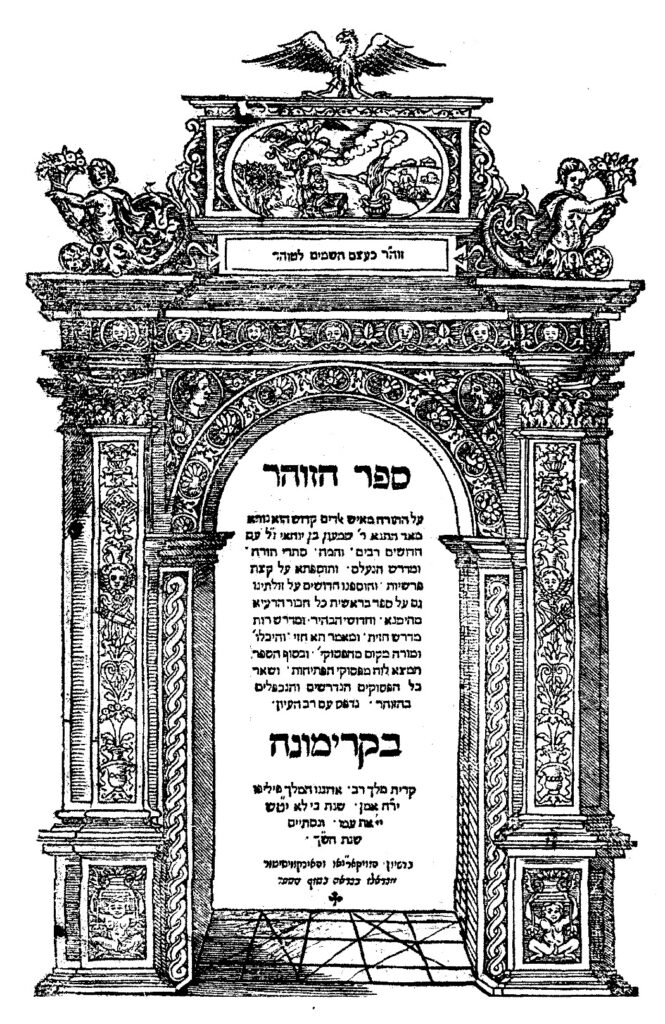
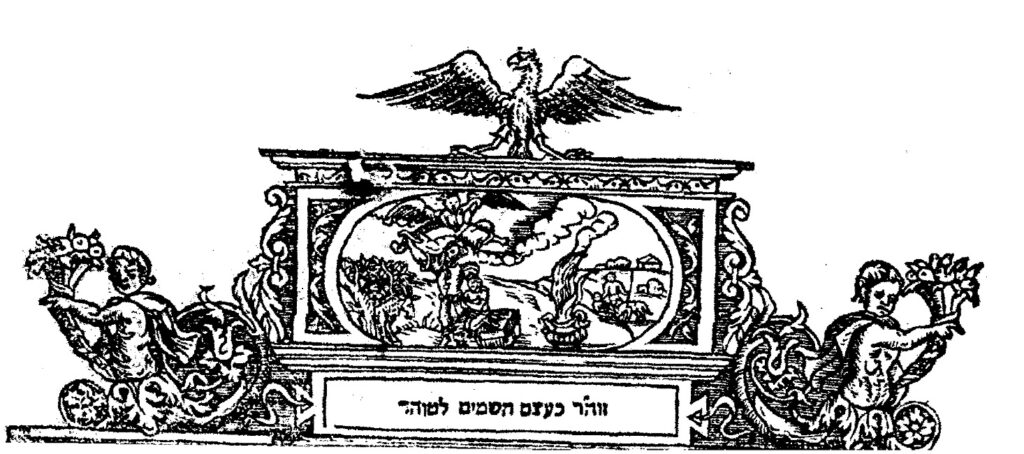
1559-60, Zohar
Courtesy of the Library of the Jewish theological Seminary

Written in Aramaic and Hebrew, Sefer ha-Zohar al ha-Torah is a comprehensive system of kabbalistic theosophy, encompassing cosmology, the soul, and good and evil. It is an esoteric commentary on the Torah, with homilies, midrashic passages, parables, and numerous discursive passages. It is based on the concept that within scriptures is a concealed stratum, deciphered by Kabbalah, expressing the inner meaning of the Torah, with its “splendor, beauty, and greatness.”

The corrector (and expurgator) was the apostate Vittorio Eliano, grandson of the foremost grammarian, Elijah Bahur Ashkenazi Segal. A member of a Dominican commission to review Hebrew books, Eliano was associated with all the books published by Conti from 1558 through 1559. Although begun later than the Mantua edition, noted above, this printing, done in haste, was completed earlier. Nevertheless, it was not immediately released for sale, for when more than 10,000 Hebrew books were burned in Cremona, with the complicity of Eliano, the entire edition was seized. It was just barely saved, in contrast to other works, by the apostate Dominican, Sixtus of Siena. It is known as the Zohar Gadol (large Zohar), in contrast to the smaller Mantua edition (Zohar Katan), and is also referred to, because of Eliano’s involvement, as the “Christian edition.” This notwithstanding, the Cremona edition was the preferred of the two editions by eastern European kabbalists.[28]

1560, Shir ha-Yihud – Shir ha-Yihud (Hymn of Divine Unity) an anonymous piyyut (liturgical poem) written in the mid-twelfth century, most often attributed to Samuel ben Kalonymus he-Hasid (c. 1130-1175), less often to his son, Judah ben Samuel he-Hasid (c. 1150-1217), author of the Sefer Hasidim, both among the foremost representatives of the Hasidei Ashkenaz, and, on occasion, to yet others.
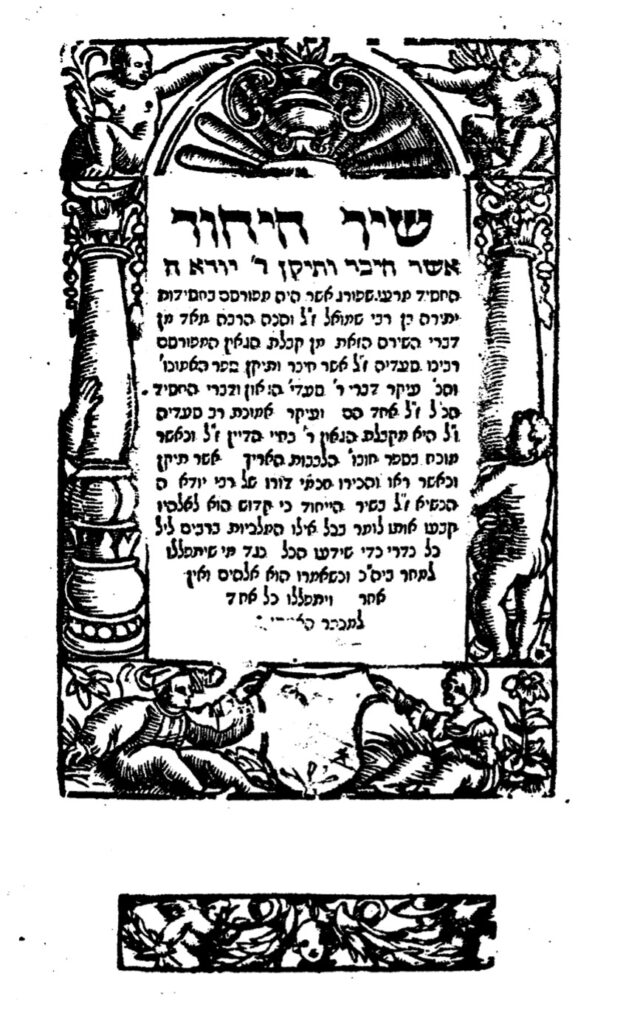
Shir ha-Yihud
Courtesy of the National Library of Israel

Shir ha-Yihud was published at the press of Eliezer and Joseph ben Naphtali Hertz Treves. Active for one year only, in 1560, they issued six books, before being forced to close by a meeting of the leaders, both Protestant and Catholic, of the Swiss Confederation in June, 1560, who feared that they were about to print the Talmud.

The frame, one of several with cherubim employed by the press, also was used on the title-page of Begidat Hazman, an allegoric maqāma (a poetic narrative in rhymed prose) by Mattathias (Mattityah ben Moses), a 15th century Spanish or Provençal Hebrew poet or Mattathias ha-Yiẓhari, a representative of the Jewish communities of Aragon at the Tortosa disputation (1413–14).

1568, Passover Haggadah Passover Haggadah printed in Mantua in folio format (20: 36 ff.) by Joseph Shalit ben Jacob Ashkenazi of Padua. This edition is a reprint of the 1560 Passover Haggadah, also printed in Mantua, but with modifications and the addition of the marginalia of R. Joseph Shalit ben Jacob Ashkenazi of Padua entitled Nimukei Yosef.
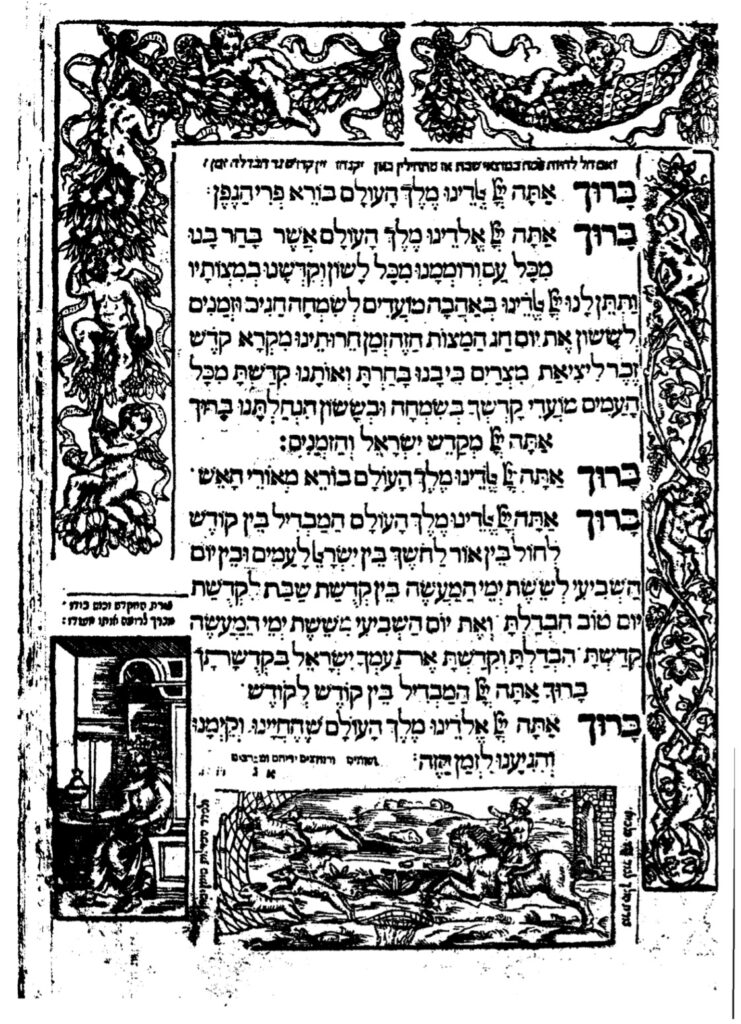
1568, Passover Haggadah
Courtesy of the National Library of Israel

The title page frame has representations of the Mars and Minerva followed by the first text page, which has two woodcuts of cherubim along the top. Following text pages have those cherubim image, as well as numerous other cherubim images, including several marginal cherubim images. This Haggadah shares some features with the Prague Haggadah of 1526. Woodcuts are accompanied by captions, given as rhymed couplets, a feature of Ashkenaz manuscript Haggadot. In some instances, for example, by the four questions, the earlier edition was framed by a lush Italian border, without illustrations. Here the types and the top and upper left borders with their vines and cherubs only are alike.[29]


1576, Yosef LekahYosef Lekah is a commentary on Megillat Esther by R. Eliezer ben Elijah Ashkenazi (1513-86). It was published in Cremona in 1576 by Christopher Draconi in octavo format (40: 83, 1 ff.). Draconi, previously associated with Vincenzo Conti, attempted to publish Hebrew books in Cremona. Although he would issue Latin books from 1569 to 1614, he printed one Hebrew book only, Yosef Lekah.
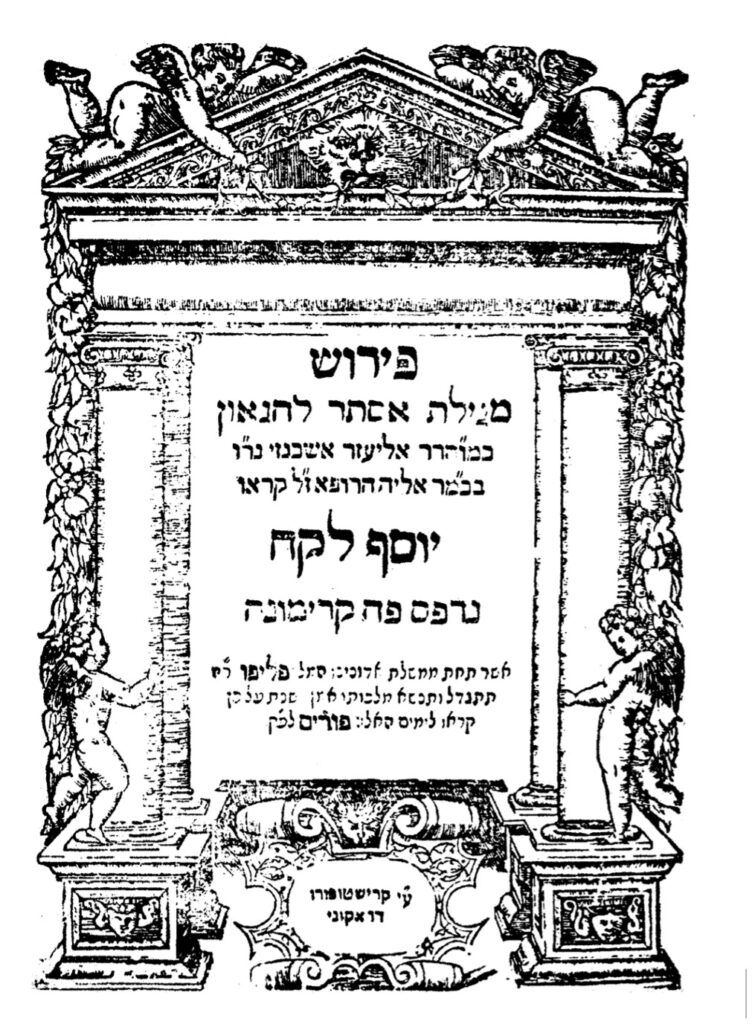
1576, Yosef Lekah
Courtesy of the Fales Library and Special Collections, New York University

R. Eliezer ben Elijah Ashkenazi was a multi-faceted individual, a Talmudist, physician, and well-rounded scholar, who served as rabbi in a number of varied communities. His first rabbinic position, from 1538-61, was in Fostat, Egypt. Forced to leave Fostat, Ashkenazi went to Famagusta, Cyprus, where he was rabbi for two years, and then to Venice. He left for Prague (1561), after a dispute with the Maharam of Padua, and after traveling as far as the Crimea, returned, via Famagusta, to Venice. Ashkenazi was next rabbi in Cremona, where he published Yosef Lekah. Shortly after he left to be rabbi of Posen, and, from 1584, was in Cracow. Ashkenazi experienced difficulties in Poland, disputing over his right to open a yeshiva in close proximity to an existing yeshiva, so that Joseph Solomon Delmedigo (1591-1655) wrote about him, “You have brought a vine from Egypt; you have cast out the nations, and planted it” (Psalms 80:9). Ashkenazi was highly regarded by his contemporaries, corresponding with prominent rabbinic figures such as R. Joseph Caro, R. Joseph Ha-Kohen (Katz), R. Moses Isserles (Rema), and R. Solomon Luria (Maharshal), several mentioning him in their responsa. R. Elijah of Pesaro, in Famagusta in 1563, praised Ashkenazi’s scholarship, noting that he was fluent in twelve languages.

The title-page has four cherubim images, two reclining at the top of the structure, two standing erect by the pillars at the sides. The title-page is dated “Therefore they called these days Purim קראו לימים האלו פורים (336 = 1576)” (Esther 9:26). Yosef Lekah is dedicated to Don Joseph Nasi, Duke of Naxos, whom Ashkenazi, in the introduction, compares to Joseph in Mizraim and Mordecai at the time of Ahasuerus. Ashkenazi, therefore, entitled this work Yosef Lekah. Two, almost identical, editions of Yosef Lekah exist, both dated 1576. Although almost exact copies of the original, it is clear, upon close examination, that the book was reset. Christopher Draconi’s Yosef Lekah was the last Hebrew book printed in Cremona.

Ashkenazi’s most important work is Ma’aseh HaShem (Venice, 1583), on the historical occurrences in the Torah, with a commentary on the Passover Haggadah; selichot; and, not extant today, a super-commentary on the Ramban (Nachmanides) and annotations to R. Caro’s Beit Yosef.[30]

Conclusion – In this article we have described books printed in Augsburg, Basle, Cremona, Mantua, Prague, and Venice. The cherubim imagery on these title-pages, reflecting the influence of Renaissance humanism, their attractiveness notwithstanding, do not appear on the title-pages or accompanying the text in Hebrew books published in more modern times. A review of the title-pages reproduced here, all dissimilar, with their numerous depictions of cherubim, attest to the popularity of that image. Given the strictures on Hebrew printing from the mid-sixteenth century in Italy, the frequent use of cherubim testify to the cooperation of Jewish and non-Jewish printers, their frequency perchance suggesting a positive relationship going beyond mere monetary gain.

We conclude with the Talmudic statement above, which suggests why the image of cherubim was so popular:

Rav Ketina said: When the Jewish people would ascend for one of the pilgrimage festivals, the priests would roll up the curtain for them and show them the cherubs, which were clinging to one another, and say to them: See how you are beloved before God, like the love of a male and female. (Yoma 54a)

Lastly, in conclusion an image of a cherub, both chronologically and, in cherubian activity, quite different from those depicted in this article. It is included as it is unusual and eye catching, an image of a Cherub smoking a pipe. It appears in in at least two Basle imprints published by Israel ben Moses ben Abraham Halle, active in Offenbach, although not continuously, from 1718/19 to c. 1738/43. The works are Anaf Etz Avot, R. Benjamin ben Yekutiel Wulff’s commentary on Pirke Avot, and tractate Sanhedrin (1721).[31]

  1. Once again, I would like to express my gratitude and appreciation to Eli Genauer for reading the article and his insightful comments.
  2. Emil G. Hirsch, W. Muss-Arnolt, J. Frederic McCurdy, Louis Ginzberg, “Cherub ( ; plural, Cherubim)” Jewish Encyclopedia IV (New York, 1901-06), pp. 13-16; Shalom M. Paul, Louis Isaac Rabinowitz, “Cherub” Encyclopedia Judaica IV (Jerusalem, 2007), pp. 600-01.
  3. Thomas Kelly Cheyne, 1911 Encyclopædia Britannica, Volume 6, reproduced in https://en.wikisource.org/wiki/1911_Encyclop%C3%A6dia_Britannica/Cherubim
  4. https://www.sefaria.org/search?q=%D7%9B%D7%A8%D7%95%D7%91%D7%99%D7%9D&tab=text&tvar=1&tsort=relevance&svar=1&ssort=relevance.
  5. Franz Sales Meyer, Handbook of Ornament: a Grammar of Art, Industrial and Architectural Designing in all its Branches for Practical as well as Theoretical use (New York, 1957), pp. 108-09.
  6. Codices and early imprints did not have title-pages, the first leaf normally being left blank to protect the book, that page later becoming a dedicated page. The first book with a detailed title-page was the Calendarium of Johannes Regiomontanus, appearing in 1476 (Venice), being a fifty-five year calendar (1475-1530), printed by Johannes Regiomontanus. The first Hebrew book with a title-page was the Sefer ha‑Roke’ah (Fano, 1505) of R. Eleazar ben Judah of Worms (c. 1165 – c. 1230).
  7. Cherubim also appear on the frames of Hebrew books printed in the incunabular period. For examples of such frames see Marvin J. Heller “Behold, you are beautiful, my love: The Use of Ornamental Frames in Hebrew Incunabula” Printing History NS 10 (New York, July, 2011), pp. 39-55, reprinted in Further Studies in the Making of the Early Hebrew Book (Leiden/Boston, 2013), pp. 3-33.
  8. The following book descriptions are selected, modified from Marvin J. Heller, The Sixteenth Century Hebrew Book: An Abridged Thesaurus ( Brill, Leiden, 2004), var. cit.
  9. Avraham Yaari, Hebrew Printers’ Marks (Jerusalem, 1943), pp. 7 and 126-27 n. 10 [Hebrew].
  10. Jerome Friedman, The Most Ancient Testimony. Sixteenth-Century Christian-Hebraica in the Age of Renaissance Nostalgia (Athens, Ohio, 1983), pp. 44-48, 214-15; A. M. Habermann, Title Pages of Hebrew Books (Tel Aviv, 1969), p. xi [Hebrew with English introduction], pp. 19-20, 125-26 nos. 4-5; Joseph Prijs, Die Basler Hebräischen Drucke (1492-1866) (Olten, 1964), pp. 49-51 n. 26; Frank Rosenthal, “The Rise of Christian Hebraism in the Sixteenth Century,” Historia Judaica II (New York, 1945), (New York, 1945), pp. 182-91; and Richard S.Westfall, “Sebastian Muenster,” http://es.rice.edu/ES/humsoc/Galileo/Catalog/Files/muenster.html
  11. An interesting example of this later usage is R. Moses ben Hanokh Altschul’s (c. 1546–1633) Brant Shpigl, a popular Yiddish work on ethics, correct demeanor, and customs for women, published by Konrad Waldkirch (Basle, 1602), also indicative of the passage of typographic material between printers.
  12. Stephen G. Burnett, “German Jewish Printing in the Reformation Era (1530-1633),” University of Nebraska – LincolnUniversity of Nebraska – Lincoln DigitalCommons@University of Nebraska – LincolnDigitalCommons@University of Nebraska.
  13. Ch. B. Friedberg, History of Hebrew Typography of the following Cities in Central Europe: Altona, Augsberg, Berlin, Cologne, Frankfort M., Frankfort O., Fürth, Hamberg, Hanau, Heddernheim, Homberg, Ichenhausen, Neuwied, Wandsbeck, and Wilhermsdorf. Offenbach, Prague, Sulzbach, Thannhausen from its beginning in the year 1513 (Antwerp, 1935), pp. 29-31 [Hebrew].
  14. A. M. Habermann, “The Printer Hayyim Shahor, his Son Isaac and Son-in-law Joseph Yakar,” in Studies in the History of Hebrew Printers and Books (Jerusalem, 1978), pp. 103-07 [Hebrew].
  15. Yeshayahu Vinograd, Thesaurus of the Hebrew Book. place, and year printed, name of printer, number of pages and format, with annotations and bibliographical references II (Jerusalem, 1993-95), p. 2 no. 10 [Hebrew].
  16. Zipora Baruchson, “Money and Culture: Financing Methods in the Hebrew Printing Shops in Cinquecento Italy,” La Bibliofilia 92 (1990), 25.
  17. For examples of such usage see Marvin J. Heller, “Behold, you are beautiful, my love: The Use of Ornamental Frames in Hebrew Incunabula” Printing History NS 10 (New York, July, 2011), pp. 39-55, reprinted in Further Studies in the Making of the Early Hebrew Book. (Brill, Leiden/Boston, 2013), pp. 3-33; “Mars and Minerva on the Hebrew Title Page,” The Papers of the Bibliographical Society of America 98:3 (New York, N. Y., 2004), pp. 269-92, reprinted in Studies in the Making of the Early Hebrew Book (Brill, Leiden/Boston, 2008), pp. 1-17; and the “The Printer’s Mark of Marc Antonio Giustiniani and the Printing Houses that Utilized It,’ Library Quarterly, 71:3 (Chicago, July, 2001), pp. 383-89, reprinted in Studies, pp. 44-53.
  18. Unterricht Wie ain Christenmensch by Urbanus Rhegiosu (1489-1541), a Protestant Reformer active in Northern and Southern Germany promoting Lutheran unity in the Holy Roman Empire. Unterricht is one of several titles with this frame printed by Silvan Otmar of Augsburg (https://www.flickr.com/photos/58558794@N07/6576279085).
  19. Zipora Baruchson, “Money and Culture: Financing Methods in the Hebrew Printing Shops in Cinquecento Italy,” La Bibliofilia 92 (1990), 25.
  20. For examples of such usage see Marvin J. Heller, “Behold, you are beautiful, my love: The Use of Ornamental Frames in Hebrew Incunabula” Printing History NS 10 (New York, July, 2011), pp. 39-55, reprinted in Further Studies in the Making of the Early Hebrew Book. (Brill, Leiden/Boston, 2013), pp. 3-33; “Mars and Minerva on the Hebrew Title Page,” The Papers of the Bibliographical Society of America 98:3 (New York, N. Y., 2004), pp. 269-92, reprinted in Studies in the Making of the Early Hebrew Book (Brill, Leiden/Boston, 2008), pp. 1-17; and the “The Printer’s Mark of Marc Antonio Giustiniani and the Printing Houses that Utilized It,’ Library Quarterly, 71:3 (Chicago, July, 2001), pp. 383-89, reprinted in Studies, pp. 44-53.
  21. Ch. B. Friedberg, Bet Eked Sepharim, (Israel, n. d), alef 286 [Hebrew].
  22. A later example of an objectionable title-page is the responsa of R. Joel ben Samuel Sirkes’ (Bach, 1561-1640), She’elot u-Teshuvot Bayit Hadash, printed in Frankfurt am Main (1697) by Johann Wust. The title-page had an ornate frame with forms of unclad women which aroused rabbinic opposition, for those authorities considered the title-page inappropriate and offensive to Jewish sensibilities. The quire had to be reprinted with a new title-page, now with two cherubim holding a floral wreath with grapes. A similar situation occurred earlier in Hanau in 1630. Sefer ha-Roke’ah, by R. Eleazer of Worms, was issued in a small format, 12×16 cm., due to the economic restrictions resulting from the Swedish War. On the title-page “Venus rises naked from the waters on a seashell – a common pagan motif” (The book was issued by a press belonging to a non-Jew, Hans Jacob Hena, so that, it has been suggested, no attention was initially given to the title-page. When the book was sold, “many Jewish purchasers tore out the offending page” (Raphael Posner and Israel Ta-Shema, ed. The Hebrew Book: An Historical Survey [Jerusalem: Keter Publishing House, 1975]). There does not appear to have been any opposition to this last title-page in Venice, for the Venus rising from the waters motif appears in Hebrew works printed there, where it was the press mark of Alessandro Gardoni (Venice, 1577-78) and can be found in the Mishneh Torah printed by Meir Parenzo at the press of Alvise Bragadin in 1574.
  23. Taytsher sprach (Vaybertaytsh), is a type generally but not exclusively reserved for Yiddish books, so named because these works were most often read by the less educated and women. Concerning the early use of Vaybertaytsh see Herbert C. Zafren, “Variety in the Typography of Yiddish: 1535-1635,” Hebrew Union College Annual LIII (Cincinnati, 1982), pp. 137-63.
  24. Israel Zinberg, A History of Jewish Literature, translated and edited by Bernard Martin VII (Cleveland, 1973), p. 116.
  25. Meyer Waxman, A History of Jewish Literature (1933, reprint Cranbury, 1960), II pp. 632-33.
  26. Zinberg, p. 106.
  27. Robert Bonfil, Jewish Life in Renaissance Italy (Berkeley, 1994), tr. Anthony Oldcorn, pp. 133, 169; Deror Schwartz, “Samuel Archivolti, his Life and Writings,” Asufot VII, ed. Meir Benayahu (Jerusalem, 1993), pp. 82-83 [Hebrew]; and Zinberg, II p. 130.
  28. Amram, pp. 324-27; Robert Bonfil, “Change in the Cultural Patterns of a Jewish Society in Crisis: Italian Jewry at the Close of the Sixteenth Century,” in Essential Papers on Jewish Culture in Renaissance and Baroque Italy, ed. David B. Ruderman (New York, 1992), p. 418; Rachel Elior, “Messianic Expectations and Spiritualization of Religious Life in the Sixteenth Century,” in Essential Papers . . ., p. 286.
  29. Yaari, Printers’ Marks, pp. 12, 132 n. 19; Yosef Hayim Yerushalmi, Haggadah and History (Philadelphia, 1975), nos. 28-31; and Isaac Yudlov, The Haggadah Thesaurus. Bibliography of Passover Haggadot: From the Beginning of Printing until 1960 (Jerusalem, 1997). p. 4 n. 25 [Hebrew].
  30. David Amram, The Makers of Hebrew Books in Italy (Philadelphia, 1909, reprint London, 1963), p. 319; Meir Benayahu, Hebrew Printing at Cremona: Its History and Bibliography (Jerusalem, 1971), pp. 22-24, 232-34; and Jacob Elbaum, Openness and Insularity. Late Sixteenth Century Jewish Literature in Poland and Ashkenaz (Jerusalem, 1990), p. 47, [Hebrew].
  31. This image appeared in my article “Offenbach Revisited: An enigma Reexamined,” published in the Gutenberg-Jahrbuch (Mainz, 2012), pp. 219-28, and reprinted in Essays on the Making of the Early Hebrew Book (Brill, Leiden/Boston, 2021) pp. 273-92. It was noted there that “in his observations to a draft of this paper, Professor Dr. Hans Schneider observes that he has never seen ‘a cherub smoking a pipe’ and suggests that if the figure is an angel the instrument is a flute. He agrees, however, that the object in question does look like a clay pipe as in the self-portrait of Gerrit Dou. Professor Dr. Schneider suggests that the figure might be an oriental man or boy, as was often painted in the seventeenth and eighteenth century, wearing a turban-like cap with plumes, and that what appears to be an angel’s wings might be a fluttering cape. The reader may draw his or her own conclusions.”


Review of Shaul Stampfer, Families, Rabbis & Education

Review of Shaul Stampfer, Families, Rabbis and Education: Traditional Jewish Society in Nineteenth-Century Eastern Europe
by Marc B. Shapiro
The continuation of my last post will be ready soon, but in the meantime I am posting my short review of Shaul Stampfer’s new book. It appeared on the H-Judaic listserv, but since most readers of Seforim Blog probably did not see it, I am posting it here as well.
For many years, Shaul Stampfer has been recognized as an authority in all things dealing with nineteenth-century Jewish Eastern Europe. In his newest book, we have a collection of numerous essays representing more than twenty years of his scholarship, including one essay published for the first time (“The Missing Rabbis of Eastern Europe”). Stampfer’s focus is not on the purely intellectual debates between rabbinic elites. He is more interested in social history, how average people and in particular women lived. Even his discussions of rabbis emphasize such matters as inheritance of rabbinic positions and the rabbi’s role in communal life. His sources are quite broad: traditional rabbinic works as well as Hebrew, Yiddish, and Russian texts and newspapers.
I could write extensively about every essay, each of which taught me a great deal. (And I never imagined that an entire essay could be written on the pushke and its development.) Yet to remain within the word limit for this review, let me just mention some of Stampfer’s most important points, the major theses of the book.
People have generally assumed that marriages in Jewish Eastern Europe were very stable, with divorce being quite rare. Stampfer, however, provides evidence to demonstrate that divorce was common and not shameful. Based on his evidence, he is fundamentally correct. In addition to citing statistics, Stampfer also refers to memoir literature that mentions divorce. Yet I also think that Stampfer (and ChaeRan Y. Freeze before him) exaggerates the frequency of divorce. For example, one of his statistics of marriage and divorce is from the 1860s in the city of Berdichev where for every three to four marriages, there was one divorce. He cites similar statistics for Odessa (p. 46). Stampfer goes so far as to claim that “it may well be the case that there were thirty divorces for every hundred weddings in the nineteenth century” (p. 128). However, these numbers are certainly skewed for the simple reason that while marriages took place in every town, to obtain a divorce couples had to travel to a larger city where there was a beit din and scribe. Thus, divorces from any one city do not reveal a ratio of marriage to divorce. The situation is identical to what happens today. Couples get married anywhere they want, but must come to a central location for their divorce.

Stampfer also argues that contrary to another popular stereotype, early teenage marriage was not at all common in traditional Jewish society. While it occurred among the economic and intellectual elite, and is immortalized in memoirs of the latter, early teenage marriage does not reflect the life experience of the average young Jew. Similarly, the lower class, which encompassed most Jews, did not have much use for matchmaker services, and indeed, romance was a factor in their marriages.

Tied to the points made so far is the place of women in society. Many of us are accustomed to think of traditional society as one in which men had all the power and made all the decisions, and in which the husband went out to work while the wife served as a homemaker. Yet Stampfer shows that while this perception fits in very well with contemporary “family values,” it is not how East European Jewish society functioned. Women generally worked, were involved in business ventures, and were thus “out of the home.” Unlike today, the stay-at-home wife and mother was not necessarily an ideal. Stampfer also notes that many Jewish names were created from women’s names, which he thinks “reflects a reality in which both men and women could be in the centre” (p. 133).

Adding to these arguments, Stampfer includes the following suggestive comment: “Another indication of the place of women in Jewish society can be found in the aesthetics of Jews in Eastern Europe. Males were regarded as attractive if they were thin, had white hands, and wore glasses. These were all reflections of lives devoted to study and perhaps to asceticism. On the other hand, attractive women had full bodies and were strong and active. Their appearance promised work and support. Different ideals are expressed here, but the image of the ideal woman is not one of weakness” (p. 133). In short, East European Jewish society was not what we would regard as a patriarchy. Conservative views on the importance of women staying in the home to raise children might be sound social policy, yet we should not assume that this is how East European Jews ever actually lived.

Another fact noted by Stampfer, which will no doubt be surprising to readers, is the existence of coed heders. This is certainly not the image that people have of this institution. Yet while the coed aspect is interesting, especially, as Stampfer states, “given the contemporary concern (or obsession) in certain very Orthodox Jewish circles regarding co-educational education even in elementary grades,” even more significant is what this says about education for girls (p. 169 n. 11; see also p. 32). Contrary to what many think, there were East European Jewish girls who were educated just like their brothers, and Stampfer thinks that the ratio of girls to boys in heder was approximately one to eight (p. 170).

As for education in general, while some people like to imagine Eastern Europe as a placenwhere Torah study always thrived, Stampfer notes that “one can safely conclude that by the mid-1930s there were far more young Jewish males in secondary schools than in yeshivas” (p. 272). Also worthy of note is Stampfer’s point that the kollel (a school of rabbinic studies for married men) system developed because there were no longer many rich fathers-in-law willing to support a son-in-law who was studying. In addition, he argues that the shrinking of the job market for rabbis also had a share in the development of the kollel.

Let me conclude with some minor comments and corrections. On page 69, note 39, the proper reference in  Pithei Teshuvah  is  Even ha-Ezer 9:5, and the rabbi cited should be R. David Ibn Zimra (Radbaz), not R. Jacob Willowski (Ridbaz).On page 181, Stampfer discusses the famous description by R. Barukh Epstein of his aunt, Rayna Batya, the wife of R. Naphtali Zvi Judah Berlin. While acknowledging that some have doubted the veracity of Epstein’s story, Stampfer states that “the account seems plausible.” Here I must disagree. While there can be no doubt that Batya was an unusual woman, Epstein’s account of his conversations with her, as with much else in his autobiography, cannot be relied on. I have discussed this at length elsewhere, and readers can examine my arguments at the Seforim Blog here.

On page 285, Stampfer refers to the Moscow crown rabbi Jacob Mazeh (1859-1924) as having been martyred. Yet this is incorrect as Mazeh died a natural death. On page 326, note 6, regarding the Vilna Gaon’s attitude toward R. Jonathan Eibeschuetz, see Sid Z. Leiman, “When a Rabbi Is Accused of Heresy: The Stance of the Gaon of Vilna in the Emden-Eibeschuetz Controversy,” in Ezra Flescher, et al, eds., Meah Shearim (2001). Finally, on page 327, Stampfer offers evidence of criticism of the Vilna Gaon during his lifetime. In my September 12, 2009, post at the Seforim Blog, available here, I offer another example of such criticism. This is reported by R. Hayyim Dov Ber Gulevsky who heard it from his grandfather, R. Simhah Zelig Rieger, the dayan of Brisk. (Incidentally, Gulevsky is quoted by Stampfer on page 353.)

As mentioned at the beginning of this review, there is much more that can be said about Stampfer’s careful scholarship, which is a treat for all readers. I know that many share my wish to soon see in print the English edition of his classic work on the Lithuanian yeshivot.
* * *
Let me now add a few additional comments especially for the benefit of those who had already read the review before I posted it here.
1. Stampfer’s book is published by my favorite press, Littman Library. I want to call readers’ attention to another recent and wonderful book published by Littman: Sharon Flatto, The Kabbalistic Culture of Eighteenth-Century Prague. Interestingly, two dissertations were written at the same time on the Noda bi-Yehudah. The other was by David Katz, which bears the interesting title “A Case Study in the Formation of a Super-Rabbi: The Early Years of Rabbi Ezekiel Landau, 1713-1754 (University of Maryland, 2004). Although Katz’ dissertation has not yet appeared in print, there is definitely room for the two as they focus on different areas and are both works of great learning. (Yet I hope that when Katz publishes his book, he changes the title. It is bad enough that today we have people writing about how they “consulted Daas Torah” as if there is such an individual so named. The only thing worse would be to hear people recount how “I asked the Super-Rabbi his opinion” or to have Yated tell how how “The Super-Rabbi has issued his Daas Torah.” That will surely leave the religious Zionists reaching for their kryptonite.)

Regarding how Landau was indeed a “Super-Rabbi,” to use Katz’ expression, I found interesting testimony in R. Shraga Feivish Shneebalg, Shraga ha-Meir, vol. 2, no. 76. He states that he heard from R. Dov Berish Wiedenfeld, who heard from R. Meir Arik, that the Noda bi-Yehudah was the posek ha-dor. Assuming there is such a position, I don’t know of anyone more qualified for it than Landau. I must admit, however, that this is an Ashkenazic-centered perspective, because it is unimaginable that a Sephardic scholar would ever come into consideration by most of those who like to speak of the gadol ha-dor. Thus when people refer to R. Yitzhak Elhanan Spektor, R. Hayyim Ozer Grodzinski, etc. as the gadol ha-dor. they never wonder if perhaps there was a great sage in the Sephardic world who fit the bill. When people speak about the gadol or posek ha-dor, it really means the gadol or posek of their world.

Returning to Arik, he said that after the Noda bi-Yehudah the Hatam Sofer held that role. Here again, I don’t think there will be much argument. But the names he gives after this show how Arik, a Galician scholar, sees matters differently than a Lithuanian. He claimed that R. Solomon Drimer was the next posek ha-dor, yet I don’t think most people reading this post have even heard of him. For the next period, he gave the Hungarian posek R. Solomon Leib Tabak of Sighet (died 1908), author of Erekh Shai. Again, I don’t think most people reading this post have ever heard of Tabak. Yet Arik regarded him as the posek ha-dor. As a Galician, not a Lithuanian, Arik had a different perspective on who the great poskim were.[1] Yet a Lithuanian hearing this would laugh. If you asked him who the posek ha-dor was for the period of Tabak, he could give all sorts of names: R. Yitzhak Elhanan Spektor, R. Naftali Zvi Judah Berlin, R. Jehiel Michel Epstein, R. Joseph Zechariah Stern, and the list goes on, but Tabak wouildn’t even make it to the top twenty.

This different perspective was recognized by R. Jehiel Jacob Weinberg. In one responsum (Kitvei R. Weinberg, vol. 1, no. 11), after quoting a position of a Hungarian posek, Weinberg writes:

ודאי שרבני ליטא ופולין ילעגו על דברים אלה ואולם המחבר הנ”ל הי’ גאון וצדיק מפורסם וחלילה לבטל דבריו בתנופת יד גרידא. כתבתי כל הנ”ל כדי להוכיחו שצריך הוא להיות זהיר ומתון ולא להמשך אחרי הקולות של רבני ליטא ופולין שהם גדולים וחכמים בהלכה אבל בהוראה למעשה עולה עליהם רבני אונגארן וגאליציען ומובחרי השו”ת בהוראה למעשה שיצאו בזמן האחרון נתחברו על ידם.
Earlier in this responsum Weinberg writes:
כבר רמזתי לכת”ר שבעינים כאלו יש לסמוך יותר על רבני אונגארן הקרובה לאשכנז ויודעים מצב הדברים באשכנז יותר מרבני פולין וליטא. ובכלל נוטה אני מדעת חברי ורבותי רבני פולין וליטא שאינם משגיחים הרבה ברבני אונגארן. גם אני הייתי סבור כן קודם בואי לכאן, אבל אח”כ ראיתי כי בעניני הוראה עולים הם על רבני פולין וליטא, כי יש להם חוש מיוחד להוראה מעשית וכמעט כולם נתחנכו בבית מדרשו של רבינו שבגולה החת”ס ז”ל שהוא הי’ עמוד ההוראה כידוע ומפורסם.
These words are amazing because Weinberg is admitting that before he came to Germany, he too shared the feeling of superiority that he describes here. Before then it was unimaginable to him that a posek outside of Lithuania or Poland would have had much of value to add.
2. In a previous post, available here, I wrote about rabbis who began writing books at a very young age. I was asked if there are additional examples of this. There are indeed a number, and in a future post I will discuss one in more detail. For now, here is the title page of R. Aaron Friedlander’s Avrekh, where it tells us that part of the book was written when the author was nine years old! See also the approbations to this volume.

Here is the title page of R. Hezekiah David Abulafia’s Ben Zekunim. If you read the introduction you will see that the first part of this book was written when the author was thirteen years old.

R. Yitzhak Arieli reported being told by R. Kook that the latter authored a book on Song of Songs when he was only eleven years old. You can find Arieli’s testimony here.
As I am writing this people are once again outraged by something R. Ovadiah Yosef said, in that he attributed the fires in Israel to lack of Sabbath observance. Obviously, this is not the sort of comment that appeals to those with a modern temperament, but in traditional societies it is an expectation of the people that the leading rabbis will find some spiritual reason to explain tragedies. So why I am mentioning this now? Because in the document from Arieli, no. 38, he quotes R. Kook as saying something that people will find even more shocking than anything R. Ovadiah has ever said. (I don’t think you will find the students of R. Kook ever repeating it.) R. Kook wondered if the 1929 pogrom in Hebron was perhaps due to the fact that the Hebron Yeshiva brought in their “modern” ways to Israel, by which he means their way of dressing, hair style and beardless faces.
בהפרעות (בשנת תרפ”ט) בחברון מצאתיו ביום ראשון יושב ובוכה והבליט מפיו שמא מפני שהכניסו תלבושת והנהגה חדשה בארץ (היה מתנגד לגלוח הזקן (כמובן במכונה או בסם) ובלורית ואולי גם בגדים קצרים, ובישיבה העיר כ”פ ע”ז ( אבל קשה היה לשנות ההרגלים שבחו”ל).
I agree that this sounds shocking and offensive to modern ears, especially to those who lost family members in this event. I mean, can you imagine telling someone whose child was killed that it was because certain yeshiva students were dressing in a modern fashion? But again, the traditional mind works differently than the modern mind. I say this not to recommend that we all reprogram our minds so that these sorts of explanations are once again appealing, any more than I would wish that, as with Jews in medieval Germany, we once again believe that demons are all around us causing all sorts of problems. I mention it only to add some context and help explain how the most influential rabbinic mind of the twentieth century could say something which to modern ears sounds outrageous. Just as it wrong to judge pre-modern science negatively because it didn’t have access to modern technology, so too we must be careful about being prejudiced against traditionalist explanations because we might no longer share the same assumptions as our predecessors
3. With regard to R. Baruch Epstein’s discussions about his uncle the Netziv in Mekor Barukh, the irony is that the Netziv thought that there was no good purpose in reading the biographies of great Torah sages. He thought that this was nothing less than bitul Torah. See the letter from R. Hayyim Berlin printed at the beginning of his father’s Meromei Sadeh.
The Netziv’s concern with bitul Torah was such that when his wife (I presume his first wife, Rayna Batya) had to have an operation and the students wanted to say Tehillim for her, the Netziv refused to stop the learning for this. After the students continued to push, he agreed to allow five minutes of tehillim. This was reported by R. Zvi Yehudah Kook, who must have heard it from his father. See R. Hayyim Avihu Schwartz, Be-Tokh ha-Torah ha-Goelet (Beit El, 2006), p. 201.
In an e-mail discussion with one reader, he contrasted the Netziv to R. Chaim Soloveitchik and R. Velvel ,saying that the Netziv was so “normal”. I don’t want to use words like that, and while R. Chaim had many unique qualities, I don’t think the stories told about him are any more unusual than those told of other gedolim. Most of these stories are, in fact, quite inspiring. The stories about R. Velvel are, I admit, of a different flavor. I mentioned two such examples here.

Yet lest one thing that these type of stories are unique to R. Velvel, let me mention a story about the Aderet “brought down” (to use the yeshiva lingo) in the book I just referred to, Be-Tokh ha-Torah ha-Goelet, p. 324. R. Zvi Yehudah told how one of the Aderet’s sons died right after birth, just as Shabbat was starting . The Aderet told his wife that she should perpare the Shalom Zakhor as if everything was normal, for there is no avelut on Shabbat and the community does not need to know that anything is wrong. When the Rebbetzin began to cry the Aderet replied to her that she is acting this way because she doesn’t study Talmud. If she studied Talmud she would know that there are often times when we are left with questions, and the same is true in life.

4. Stampfer’s point about the frequency, and lack of shame, of divorce in Eastern Europe was an eye-opener to me. In Between the Yeshiva World and Modern Orthodoxy, p. 22, I mention that divorce was very uncommon in traditional Lithuanian Jewish society, and almost unheard of among the rabbinate. I now see that I was mistaken in this assumption (which was based on my general impressions, not on the sort of evidence Stampfer makes use of). For examples of rabbinic figures who got divorced, see here.
5. I referred to Daas Torah above, and since someone asked me if I could write up what I said about it in a recent lecture, I will do so now. In this lecture I quoted what appears in R. Yitzhak Dadon’s new book, Rosh Devarkha. This is the follow-up to his earlier book, Imrei Shefer, both of which record the teachings of R. Avraham Shapiro, Rosh Yeshiva of Merkaz ha-Rav. On p. 10 one finds R. Avraham’s very harsh comments against Daas Torah. He would refer to it as Ziyuf ha-Torah. Here are some of his words:

האם התורה עוברת רק דרך אדם אחד?! בחו”ל לא היה כדבר הזה! זה אמר כך, וגדול פלוני חלק עליו וחשב אחרת, מישהוא אמר שהפלוני הזה הוא נגד “דעת תורה”?! מהיכן הביאו את הדבר הזה? אם ה”חפץ חיים” סבר כך ורבי מאיר שמחה אחרת ופלוני גדול אחר
חלק עליהם, יש מי מהם שהוא נגד “דעת תורה”? איזו הנהגה היא זו? זו השתלטות על דעת הרבנים, ולא היה כזאת בעם ישראל.

As for the practice of declaring what the Daas Torah is through the newspaper or through placards, without any sources to support this, here are R. Avraham’s strong words (and apologies if any wives are offended):

כלפי רבנים המוצאים חוות-דעת ותלמידיהם מפרסמים זאת תחת הכותרת: “דעת תורה”, בלי שום אסמכתאות ומקורות נאמנים היה מרן זצ”ל אומר: “איזו מין דעת תורה היא זו? כשאדם אומר “דעת תורה” בלי שום מקורות, אז הכוונה היא כזאת: זה קצת מבוסס על מה שהוא למד, והרוב זה מה שאשתו אמרה לו, זה הפירוש דעת תורה.

Anyone who is honest will admit that the current practice of Daas Torah is completely phony. My proof of this is very simple. If tomorrow R. Elyashiv would declare that everyone has to say hallel on Yom ha-Atzmaut, would the Lithuanian yeshiva world listen to his Daas Torah? Of course not. They would simply replace him with another gadol whose Daas Torah is more palatable to them. In other words, the gadol only has Daas Torah because the masses, or the askanim, let him have it, and only when they like what he says. (I am curious. Has R. Elyashiv’s ruling that fashionable sheitls are forbidden had any effect on his supposed followers?).

Try to imagine what would happen if someone in the haredi world discovered a letter from the Hazon Ish, the ultimate Daas Torah authority, in which he said that only the best and the brightest in the State of Israel should devote themselves to Torah study. However, everyone else should go to work. Does anyone think that this letter would ever see the light of day? Of course not! We all know what would happen. The letter would be kept hidden, and if by chance some rebel did publish it, the haredi world would find a way to justify why they don’t accept the Hazon Ish’s viewpoint.

6. In this post I referred to a mistaken point by R. Ezriel Tauber in his recent book Pirkei Mahashavah al Yud Gimel Ikarim le-ha-Rambam. I was asked if my negative comment relates to the entire book, or just the one point I referred to. My answer is that I wasn’t referring to the entire book, and I am sure that people will find things that are valuable in it. Yet I have to say that I don’t find it helpful when an author like Tauber asserts, p. 428, that people who claim to be atheists are really not. Rather, they just don’t want to believe, but deep down they know the truth.

Contrary to Tauber (and he is not the only one to express himself this way), the only intellectually honest position is to take people like Christopher Hitchens at their word and deal with it. Claiming that the atheist really believes is no better than the atheist saying that the believer really knows the truth that there is no God.
Furthermore, from my perspective I can’t take an author seriously when he says things like how in the Far East there are people who have the power to use black magic, and their knowledge is part of a tradition that goes back to Abraham. P. 133:
ואכן במזרח הרחוק יודעים שמות של טומאה, ויש להניח ששורש הידיעה היא מאברהם אבינו. ואף על פי שהם כוחות אמיתיים, אסור לנו להשתמש בהם.
*  *  *
I want to take this opportunity to invite all Seforim Blog readers on what I know will be an amazing Jewish heritage tour to Central Europe this summer. Details can be found here. They are still working on the price, and it will be posted soon. Those who want further details are invited to contact me.
With Christmas Eve almost upon us, I also invite readers to watch, or listen to, my lecture “Torah Study (or Lack of It) On Christmas Eve: The History of a Very Strange Practice.” It is available here. The few dollars (Canadian) that it costs go to support a very worthy organization, Torah in Motion.
Notes


[1] Wiedenfeld, who is the source for the information from Arik, actually had a special place in the eyes of the Lithuanian yeshiva  world. Haym Soloveitchik writes (TUMJ 7 [1997],  p. 144):

Intellectually, the Lithuanian approach to talmudic study (derekh ha-limmud) has triumphed. One could scarcely imagine a Hungarian rosh yeshiva being considered as a candidate to head a Lithuanian yeshiva. Nor is it accidental that with one early, minor exception (the Tchebiner Rav [Wiedenfeld]), all the embodiments of da’at Torah, both in America and Israel, have been Lithuanian.


Will the Real Shas Kattan Please Stand Up

Will the Real Shas Kattan Please Stand Up[1]
Shmuel Lubin

Shmuel Lubin is a doctoral candidate in biology and creator of “The Rishonim” podcast.

There is an old tradition commonly referenced in the yeshiva community that Masekhet Ketubot is the “Shas Kattan” of Talmud Bavli, that is, it contains ideas that connect to just about every other area of Shas (short for “Shisha Sidrei,” all six orders of the Mishnah). The source and importance of this idea is the subject of a nice article by R. Tovia Preschel, found here.[2]

Personally, I have long thought that this doesn’t really seem to be the case. While it is true that Ketubot includes lots of discussions of civil law (which connects it to many topics covered in tractates Bava Metzia, Bava Batra, and Shevu’ot), and one does encounter the laws of Shabbat and Yom Tov in the first 10 pages, it doesn’t contain much from Zera’im, Kodshim or Taharot (or Mo’ed really, after the beginning). It seems to me that if one truly considers “Shas,” that is, all six orders of the Mishnah, there are much better candidates for the title of “Shas Kattan,” such as Pesachim, which contains a good deal of material from Kodshim and Taharot.

Some time ago I realized that this question can be answered empirically, depending on how it is defined. Can one computationally determine which tractate is the real “Shas Kattan”; that is, which tractate of the Talmud Bavli is the best representative for the rest of Shas (all six orders)?

A map demonstrating the connections between each tractate of Shas. “Kol ha-Torah kulah ‘inyan ehad” (Tosefta Sanhedrin 7:6)

Approach 1: Unique Tractate Scoring

One simple approach is to count unique citations. For every tractate in Talmud Bavli, we can simply tally up how many unique tractates (whether it is a citation to the Mishnah, Bavli/Yerushalmi, or Tosefta) are cited within that tractate of Talmud, with the highest possible score of 62. Before you scroll down, here’s a challenge: there is only a single tractate of Talmud Bavli that contains at least one reference to every single tractate in Shas. Can you guess which one it is?

The obvious limitation to this approach is that as long as any tractate is cited at all, there is no difference between a single citation and one hundred citations to that same tractate, which is perhaps unfair (After all, should the “Shas Kattan” determination really hinge upon whether the tractate includes a single citation each to Parah, Yadayim, and Uktzin, instead of a hundred citations to Bava Metzia?). On the other hand, we could count up the total number of citations to other tractates, but this approach also suffers from the opposite problem (namely, that the presence of many citations to a single tractate does not demonstrate a representation for all of Shas).

A slightly more complicated way of scoring citations beyond simple counting methods would be to use a points system, whereby additional citations to the same tractate improves the score incrementally but by decreasing amounts. For example, if the first page of a tractate quotes from Shabbat, Eruvin, and Pesachim, that’s three points, and then the second page quotes Shabbat and Gittin, then it will get one more point for Gittin but only another fraction of a point for the additional Shabbat reference, since Shabbat was already cited on the previous page. My thinking is that scoring in such a matter should decrease geometrically: for the second time that tractate is referenced, add 0.5 points, then for the third time, allot 0.25, etc. (So, for example, if a tractate quotes Berakhot once and Shabbat thrice, it will have a score of 1 + (1 + 0.5 + 0.25) = 2.75). In the end, however, none of these alternative counting methods turned out to change the ranking very much.

Below, I used Sefaria’s list of its library connections to collect the number of times any tractate of Shas was quoted by each tractate of Talmud Bavli. Below is a table of how many unique other tractates are cited by each tractate of the Talmud Bavli. In this case, a ‘citation’ counts whether it is a reference to the Mishnah, Tosefta, Talmud Yerushalmi, or Talmud Bavli to any one of the 63 tractates in Shas. With both the highest “geometric decrease score,” the most citations overall, and the only tractate to cite all 62 tractates of Shas, the clear winner is…. Chullin! In all likelihood, this is simply due to the fact that Chullin is one of the largest tractates of Talmud Bavli.[3]

Tractate Unique Tractates Referenced Geometric-Decrease-Score Total References to Elsewhere in Shas
Chullin 62 116.90 1373
Menachot 58 104.11 1335
Eruvin 58 104.12 1104
Berakhot 56 101.77 881
Gittin 55 99.06 1124
Avodah Zarah 55 93.15 720
Bekhorot 55 95.36 711
Bava Metzia 54 96.76 1184
Pesachim 53 98.13 1192
Niddah 52 91.60 494
Chagigah 51 87.71 322
Shabbat 51 93.73 1351
Bava Kamma 51 91.51 1133
Bava Batra 51 93.48 1225
Kiddushin 50 90.78 1174
Ketubot 48 86.27 1086
Beitzah 47 79.65 537
Sukkah 47 84.70 956
Sotah 45 76.47 468
Megillah 45 77.96 382
Arakhin 45 76.91 408
Sanhedrin 44 83.25 1088
Makkot 44 75.13 400
Nazir 44 78.29 350
Keritot 44 71.54 356
Nedarim 43 75.32 372
Temurah 41 70.45 407
Shevuot 41 72.19 591
Rosh Hashanah 40 68.45 312
Moed Katan 37 63.70 204
Horayot 37 56.53 171
Yoma 36 71.15 712
Yevamot 36 69.95 999
Zevachim 36 70.46 991
Meilah 35 54.75 207
Taanit 33 57.52 235
Tamid 20 26.12 61


As an aside, we can use this database to ask of Masekhet Ketubot (or any tractate): does it have the most references to Nashim and Nezikin, compared to any other tractate? If not Shas Kattan, is it at least “Bas Kattan” (for ב סדרים)? The answer to that question is also no; all three “Bava”s beat Ketubot if you sum up citations to both Nashim and Nezikin. Here are some of the heavy-hitters in terms of “Bas Kattan”:


Tractate Citations to Nashim Citations to Nezikin
Ketubot 689 385
Gittin 627 311
Kiddushin 502 284
Bava Kamma 279 854
Bava Metzia 334 775
Bava Batra 401 706


Approach 2: Balance Between “Six Orders” References

There is another possible way of interpreting “shas kattan”-ness, which would refer to how well ‘balanced’ all of the citations are relative to each other in terms of being a fairer representation of the six orders of the Mishnah. A perfectly ‘balanced’ tractate will have 1/6 of its references to tractates in Seder Zera’im, 1/6 of its citations would be to Mo’ed, and so on.[4] If we categorize each citation according to the six orders of the Mishnah, which tractate is closest to this idealized representation of Shas? 

Here too I used the cross-references (“link”) count from Sefaria’s github, and categorized the results based on Seder, which are color-coded differently in the bar graph below (click here for a colorblind friendly version). Although there are ways to put numbers on this dataset to calculate a “balance score,” from the figure below it seems like, once again, Chullin is in the running for the tractate of Talmud Bavli with the most evenly balanced set of references![5] In this case, we cannot simply blame it on the fact that Chullin is one of the longest tractates, since this is normalized to how many citations appear in total. (Numbers in parentheses reflect the fraction of citations to that Seder, if the number fits in the bar).

This dataset might indicate something interesting about Ketubot, which is that once you discount the self-references (that is, citations to other places in Masekhet Ketubot, or to its own Tosefta and Talmud Yerushalmi), Ketubot has more citations to Seder Nezikin than to Nashim. However, Ketubot is not at all unique in having more citations to tractates that are “out of order [seder]” than to its own. Berakhot, Avodah Zarah, Horayot, Arakhin, Keritot and Niddah all have more citations to Mo’ed than to their own order, Pesachim and Yoma both have more citations to Kodshim, and so on. On the other hand, it is worth noting that both Nedarim and Nazir, which might not seem like natural fits for Seder Nashim,[6] do both have more citations to Nashim than any other Seder.  

Approach 3: Diversity of Topics

Another legitimate approach would be to understand the term “shas kattan” as a non-literal reference to “all the topics in the Torah,” and ask the question: which tractate of Talmud Bavli covers the most unique topics? In the past, this question would have been much more difficult to answer simply because there were no tools which identified “topics” as they appear in the Talmud in the same way that people have been identifying talmudic cross-references since R. Nissim Gaon in the 11th century.

But today, we have Sefaria! Included in the Sefaria database and API docs is a way to identify which topics come up in any source which the Sefaria team (and users) culled from few sources to make something rather impressive. Of course, the reality is that the topic ontology is still kind of messy. For one thing, some topics are much broader than others, to the point where smaller topics might even be included in larger ones. (For example “Moses/Moshe” is a topic, but so is “Moshe’s Anger,” and most of the sources belonging to the latter also belong to the former). Additionally, because of how the topics list was built, there is an over-representation of topics belonging to Aggadah and the halakhot that appear in the Shulhan Arukh, as opposed to halakhot dealing with sacrifices and ritual impurity. With all its faults, the topics count still seems like it could be interesting, so I also used Sefaria’s API to count up all the unique topics that show up throughout each tractate of Talmud Bavli.

And the winner of the most unique Sefaria-topics referenced is… Shabbat! This is not so surprising, considering that Shabbat is the largest tractate by word count (Chullin, which won the last two rounds, is third-longest), and its central topic is one that takes up nearly 10% of the Shulhan Arukh, which is responsible for many of these “topic” identifications in Sefaria’s database. Likewise, the second-to-longest tractate by word count (Sanhedrin) takes second place in Sefaria’s topics count. 


Tractate Topics Count Unique Tractates Referenced
Shabbat 1133 51
Sanhedrin 1038 44
Berakhot 954 56
Pesachim 864 53
Bava Batra 781 51
Sotah 708 45
Bava Metzia 680 54
Ketubot 678 48
Eruvin 662 59
Yevamot 634 36
Kiddushin 630 50
Chullin 623 63
Gittin 616 55
Bava Kamma 611 51
Yoma 592 36
Avodah Zarah 577 55
Nedarim 541 43
Megillah 537 45
Taanit 488 33
Menachot 462 59
Chagigah 394 51
Rosh Hashanah 393 40
Niddah 384 52
Sukkah 351 47
Zevachim 313 36
Bekhorot 310 56
Moed Katan 293 37
Arakhin 289 45
Makkot 272 44
Nazir 251 44
Shevuot 242 41
Beitzah 217 47
Keritot 193 44
Horayot 183 37
Temurah 177 41
Meilah 104 35
Tamid 101 20

As mentioned, this Sefaria-based topic count comes with many caveats as to how much it truly represents the number of topics discussed. Therefore, one more attempt in this vein is worth trying, in order to salvage the idea that Ketubot is “Shas Kattan.” After all, what people truly intend when using this term is probably not that Ketubot has quantitatively the most citations to elsewhere in Shas, or even that it has the most topics as would be defined by aggadic encyclopedias such as Aspaklaria or topics found in Tanakh. What they mean, surely, is that Ketubot is the most central location for the most topics frequently encountered in “real” Gemara learning, the study of halakha and its conceptual foundations.[7] Instead of using Sefaria’s topics, then, I tried to use the citations in the popular book Kovets Yesodot ve-Hakirot by R. Ahikam Keshet, which the author has conveniently made available online through a few websites. The version I used, from the “Wikishiva” website hosted on yeshiva.org.il, had 419 unique entries.[8]

Unfortunately, no edition of Kovets Yesodot ve-Hakirot has a clear way to identify the citation to a particular tractate, and so as a shorthand I simply counted up the number of entries containing the name of a tractate (e.g., ‘ברכות’, ‘שבת’, etc.). This is certainly not perfect,[9] but I believe it serves our purposes well enough. Using this tally, we come to the rather surprising conclusion that the tractate cited by the most entries in Kovets Yesodot ve-Hakirot is, once again, Shabbat! In this case, Ketubot at least does well for itself, ranking in fourth place after Shabbat, Kiddushin, and Bava Batra. 


Tractate Kovetz Topics Sefaria Topics
Shabbat 201 1133
Kiddushin 177 630
Bava Batra 167 781
Ketubot 163 678
Bava Metzia 152 680
Bava Kamma 119 611
Gittin 117 616
Pesachim 114 864
Yevamot 102 634
Nedarim 92 541
Sanhedrin 91 1038
Chullin 85 623
Berakhot 84 954
Sukkah 67 351
Eruvin 58 662
Avodah Zarah 58 577
Shevuot 49 242
Makkot 48 272
Yoma 48 592
Beitzah 47 217
Nazir 43 251
Bekhorot 40 310
Temurah 39 177
Megillah 34 537
Chagigah 33 394
Sotah 33 708
Niddah 32 384
Zevachim 29 313
Rosh Hashanah 29 393
Meilah 28 104
Taanit 25 488
Menachot 23 462
Keritot 19 193
Arakhin 17 289
Moed Katan 16 293
Horayot 9 183


As a final note, I’d like to mention an article I saw a few years ago by Daniel Boyarin about Rabbi Haim Zalman Dimitrovsky. Boyarin records how Rabbi Dimitrovsky helped prepare him for his doctoral exam in talmud: 

…he also wanted me to learn several whole mesechtas or sections of the Talmud. Kesubos was one of the mesechtas that he insisted I learn, because as the proverb goes: “Kesubos holds the shlisslokh,” the keys to the entire Talmud. It is sometimes called “Shas Katan” (“the little Talmud”) because it includes virtually all of the halakhic themes that the Talmud explores. He used to say, “In order to be a Talmid hakham, you have to know three massekhtas really well”—Kesubos was one of them, along with Baba Metzia, but now, after nearly 60 years, I can’t remember the third. He said, “If you know those three massekhtas”—and when he said know, he meant know, which included Rashi, the tosafot, all the rishonim, and selected aharonim—“then you will be a talmid hakham.” I never learned the third massekhet.[10]

When I originally read this, I was intrigued by the thought that there was a mysterious ‘third tractate’ that held the keys to becoming a talmid hakham, alongside Ketubot and Bava Metzia. After thinking about it for a little while, I speculated that the third tractate Boyarin couldn’t recall was Shabbat. Considering Rabbi Dimitrovsky’s own publications of Rashba’s commentary to tractates of Mo’ed, he was certainly not one to underestimate the importance of learning a large tractate from that seder, even if many yeshiva curricula today emphasize Nashim and Nezikin over the rest. Whether or not my guess is correct, it seems as though Shabbat and Hullin, in addition to being among the largest tractates, also have good claims to holding the keys to the rest of Shas.

[1] This article was expanded from a post on the website MiYodea, the Judaism StackExchange: https://judaism.stackexchange.com/q/141647/5083
[2] According to the website, the original article was printed in Ha-Tzofeh 21, Tishrei 5729 (1970).
[3] In theory, this can be corrected for by normalization, but because tractates of Talmud Bavli vary so widely in word count, simply using a tractate’s length as a denominator will provide a skewed picture; I believe that the approach taken in the next section is a better method of normalizing to ‘total citation count’.
[4] In reality, each Seder is a different size, and so an “ideal balance” would cite each Seder proportional to its size. I believe that this is not worth correcting for, because we would also need to correct for the fact that some tractates have two Talmuds, while some tractates only have a Talmud Bavli and others only a Talmud Yerushalmi or neither, and so a true correction would have to account for all the possible citation material of each tractate.
[5] Actually, to be precise, Chullin may come in second place to Bekhorot in terms of most balanced tractate. To calculate a “balance score”, I used a chi-square test to determine the extent to which the citation counts to each Seder deviates from an ideal ⅙ of the total citations. According to this calculation, Chullin is narrowly beaten by Bekhorot. However, because the six orders of the Mishnah are not equally large in ways that are not so easily accounted for (see previous footnote), this balance test (of expecting ⅙ of citations to refer to each Seder) is imprecise.
[6] See the discussion in Talmud Bavli Sotah 2a and Rambam’s observation in his Introduction to the Mishnah that the Torah’s presentation of vows is in the context of marriage.
[7] This statement is reflective of an attitude that is not necessarily shared by this author, but this is not the place to discuss the question of what constitutes the “true” or “primary” learning of Shas.
[8] Although there are many more unique titles, nearly a third of these are merely redirect pages to other entries.
[9] Importantly, it is possible that an entry might reference the concept of “Shabbat” without citing Tractate Shabbat. I mostly assume that citations to either the concept or the tractate of the same name will overlap, with one major exception: my guess is that the word תמיד likely appears in more contexts as a concept and not as a citation to a particular tractate. Since the tractate of Tamid is obviously not in the running for “Shas Kattan,” however, I believe it is safe to ignore.
[10] Walking and Learning on Shabbos with Prof. Haim Zalman Dimitrovsky – Tablet Magazine