A Footnote on What the Chasam Sofer Did Not Say

A Footnote on What the Chasam Sofer Did Not Say

By Shnayer Leiman

The Problem. I’m the proud owner of a copy of Rabbi Shimon Finkelman’s Rav Pam: The Life and Ideals of Rabbi Avrohom Yaakov HaKohen Pam (second edition, seventh impression, June 2023, ArtScroll History Series, Mesorah Publications, Rahway, N.J.). It is a magnificently written and produced biography of Rav Pam, a close friend of my father, who like Rav Pam was a disciple of both Rav Shraga Feivel Mendlowitz and Rav Dovid Leibowitz. The biography captures Rav Pam as our family knew him. Indeed, it is the definitive model of how a biography of a גדול בישראל should be written. It informs and inspires as it tells the truth.

As we shall see, a minor error made its way into the volume, and no one can really be faulted for the error. Nonetheless, I am confident that Rav Pam being the איש אמת that he was, will surely not fault me (in עולם האמת) for making the correction.

The reader, at p. 336, is informed that at the 1991 Torah Vodaath dinner at which Rav Pam was the Guest of Honor, he thanked the one thousand guests for coming, and then said:

Often, I think to myself that I go around with a “false pass,” for people think I am that which I am not. But I take comfort in a comment of the Chasam Sofer. Rema is of the opinion that if a stranger enters a shul and claims to be a Kohen, we may rely on his word and call him to the Torah for the Kohen’s aliyah, for even if he is, in fact, not a Kohen, calling him to the Torah would not involve a biblical transgression. Asks the Chasam Sofer: Why would calling up a non-Kohen not be a transgression of “Vekidashto” (And you shall sanctify him),[1] the requirement that we accord honor to those who truly are Kohanim? He answers that this mitzvah is fulfilled when we show honor for the Kehunah (the exalted status of the family of Kohanim). Therefore, even if the person whom we honor is, in fact, not a Kohen, we are fulfilling the mitzvah of “Vekidashto” if we honor someone whom we think is a Kohen.

Therefore, even though, in fact, I am not deserving of honor, if people honor me thinking that I deserve it, then they are considered as having shown k’vod HaTorah (honor for the Torah).

This is truly an inspiring דבר תורה – worthy of the Chasam Sofer and appropriately selected by Rav Pam, a Kohen, for the occasion. Alas, it was not said by the Chasam Sofer.

A Brief Survey of the Chasam Sofer’s Attitude Toward the Publication of His Writings.

Much has been written about the Chasam Sofer (1762-1839), and much more remains to be written. He was a remarkable גדול הדור and פוסק הדור. He lived in a world without radio, TV, telegraph, telephone, or digital communication, yet was recognized during his lifetime as גדול הדור and פוסק הדור. What makes this even more remarkable is the simple fact that he refused to publish any of his Torah insights or halakhic rulings during his lifetime. Of course, the fact that he served as Chief Rabbi of Pressburg (today: Bratislava) and simultaneously as Rosh ha-Yeshiva of the Pressburg Yeshiva – with thousands of disciples during his long reign (1806-1839) – spread his fame throughout the Jewish world. And while he refused to publish his Torah insights, he had a gifted pen and wrote thousands of Jewish legal responsa which he sent to all who asked. All of Torah Jewry knew who the Chasam Sofer was and what he could do.

It is worth examining what the Chasam Sofer had to say about publishing one’s Torah insights. In 1841, his son R. Shimon Sofer, who would later serve as Chief Rabbi of Krakow, published for the first time a personal letter of the Chasam Sofer dated 1829, where he addressed the issue.[2] It reads in part:

Regarding the rumor that you heard that I published a particular volume, and you requested that I send you a copy,[3] I never considered such a matter; it has not even entered my mind, at least until the present time. For the majority of the [Torah] world, that are greater and better than I am – or, at the very least, at the same level that I am – they have no need for me. For the minority of a minority that are less learned than I am, why should I weary myself for a minority? And if, perhaps, it were true that the majority of the [Torah] world needs me – heaven forbid – I am unaware that I would have the obligation to publish my Torah insights and distribute them to the public. So long as G-d grants me life and strength, I am prepared to study [Torah] with all who are interested in learning with me. I will neither pause nor rest – as the L-rd my G-d has commanded me “Just as I teach without charge, so you shall teach without charge”[4] – in responding, as far as my hand and mind reach, to all who ask, at no charge. It is my practice to record in writing whatever Torah insights G-d has graced me with, whether in Halakhah or Aggadah. These writings are freely available. Whoever wishes to copy them is welcome to do so. Such was the practice before the invention of the printing press. More I am not obligated to do. If, heaven forbid, one publishes in order to increase his fame, I worry about the curse of our Sages, of blessed memory: “He who seeks fame will lose his name.”[5] Indeed, such has been the fate of most authors of seforim. How much more so is it prohibited for an author to publish his sefer for financial gain! For these reasons, it never entered my mind to publish a sefer.

Only once did several of the Chasam Sofer’s Responsa and Torah insights appear in print during his lifetime. A disciple of the Chasam Sofer who had access to manuscript copies of his writings, published an edition of חידושים על מסכת שבועות מאת רבינו יוסף הלוי אבן מיגש (Prague, 1826), and appended some 14 large folios of Chasam Sofer’s Responsa and Torah insights to the volumeThe Chasam Sofer was livid when he learned about this unauthorized publication of his writings, but ultimately granted his approval. Towards the end of his life, and at the constant urging of members of his family, he agreed to publish some materials, including a review of R. Zvi Hirsch Chajes’ תורת נביאים . The project fell through, perhaps due to the illness and subsequent death of the Chasam Sofer, but not before he addressed an important note to Rav Zvi Hirsch Chajes, which sheds light on his view of the publication of Torah insights in general, and on his sensitivity to the effect his writings could have on others. The letter was written in 1837, when the Chasam Sofer was 75 years old, and at the height of his fame. Rav Chajes, was 32 years old, still at the start of a brilliant career.[6]

I keep the L-rd before me always. Pressburg, the evening preceding Monday, 27 Marchechvan, 598 according to the short account.

Greetings and blessings for all that is good to my friend and dear Rabbi, the great Rabbi and Gaon, master of Torah, discerning in study and expert in mastery of texts, whose many words are beautifully expressed, the honorable teacher and rabbi Zvi Hirsch, may his light glow, Chief Rabbi and Head of the Yeshiva of Zolkiev, may G-d watch over it.

Dear Friend,

I have a request to make of you. It has never entered my mind to publish a sefer. However, several years ago, some pages of my Responsa and Torah insights were published by a certain rabbi, R. Mordechai Schlank, who set out to publish Ramban’s commentary on Kiddushin and R. Yosef Ibn Migash’s commentary on Shavuot. He had copies of some of my writings with him and published them in the back of the books mentioned. This was done initially against my will, but ultimately with my permission, for he was not with me here [in Pressburg], but was rather in Prague.

Now the following has occurred. A worthy individual from Brody, R. Mordechai Bisliches,[7] a printer who publishes the works of the Rishonim, has managed to get copies of 3 or 4 of my Responsa and copies of some of my Torah insights. He plans to append them to one of the above publications of the Rishonim. Initially, this was done against my will and protest, but my family forced me to acquiesce and remain silent. (For all my Torah insights and writings are freely available for anyone to copy them. I do not discourage anyone from doing so, for nothing I wrote was intended as a secret.) The above mentioned printer is already engaged in the process of publishing my material. These include two responsa that I addressed to you, one on whether a physician who is also a Kohen can administer to a dying or already dead patient,[8] and the other regarding my comments on your sefer, Torat Nevi’im.[9] Now I said: I can do as I please regarding my property; but I cannot do as I please regarding someone else’s property.” Perhaps you don’t want your name, and the name of your community, mentioned regarding that matter. Or, perhaps you will find some passage that, heaven forbid, is a slight to your honor. For those reasons, I implore you to review my comments and let me know what you think. In my humble opinion, there is nothing in my responsa that in any way slights you, heaven forbid. Quite the opposite, they are sources for you of glory and praise. And if, when engaged in halakhic discourse, I criticized something you said, it means nothing. Such are the ways of Torah discourse. Perhaps you will publish yet another sefer and you will be able to defend yourself against any and all criticism. But heaven forbid that I should allow my pen to record anything that would dishonor you! Should you feel that anything I wrote [about you] is improper, I will erase those words, or if necessary, I will neither mention your name or the title of the book. I hope this won’t be the case, and anxiously await your quick reply, before the volume goes to press. I sign with all the usual blessings, the one who loves your soul,

Moshe ha-Katan Sofer of Frankfurt-am-Main

We have included this brief survey of the Chasam Sofer’s attitude toward the publication of his writings, in order to bring home the message that, with one or two exceptions, the Chasam Sofer did not edit, or prepare for publication, any of his writings during his lifetime. He left a vast literature, literally thousands of manuscripts, ranging over a wide variety of topics (such as Responsa, Lectures on the Talmud, Sermons, Commentaries on the Torah, Notes on the Shulchan Arukh, Poetry, personal letters, and more), all still being published – and always in better editions – to this very day.

The Solution. What remains to be addressed is:

1. Why did Rav Pam ascribe the passage (that justifies why a stranger who claims that he is Kohen is allowed to get an aliyah to the Torah as a Kohen, even though we have no evidence other than his say-so) to the Chasam Sofer?

2. How do I know that it wasn’t said by the Chasam Sofer?

3. Who did contribute the insightful justification that ultimately was misattributed to the Chasam Sofer?

Rabbi Finkelman provides a helpful footnote, in an attempt to identify the source of the alleged Chasam Sofer comment.[10] He sends the reader to Toras Moshe on Vayikra 21:8. Alas, in all of the recent editions of Toras Moshe published under the auspices of Makhon Chasam Sofer, the official collection of all of the genuine Chasam Sofer commentaries on the Torah published in the various editions of Toras Moshe (as distinct from his sermons [דרשות] or other collections of Torah commentary that never appeared under the name Toras Moshe ), no such passage appears. See, e.g., the massive six-volume edition of Toras Moshe ha-Shalem veha-Mefoar (Jerusalem, 2021), vol. 3, p. 255, to Vayikra 21:8. There is a comment on Vekiddashto, but not a word about the fact that a stranger who claims that he is a Kohen is allowed to get an aliyah to the Torah as a Kohen, even though we have no evidence other than his say-so.

Almost certainly, neither Rav Pam in 1991, nor Rabbi Finkelman in later years, had access to a Makhon Chasam Sofer edition of Toras Moshe. But they certainly had access to earlier editions of Toras Moshe, which is what led them astray. It’s best to begin our examination with one of the earliest editions of Toras Moshe – and little more needs to be said.

Like almost all the writings of the Chasam Sofer, his Toras Moshe was published posthumously. It first appeared in print in a three-volume set published in Pressburg between 1879 and 1893. The editor of the three-volume set was an אדם גדול, a grandson of the Chasam Sofer, Rav Shimon Sofer (1850-1944). He was the son of Rav Avraham Shmuel Binyamin Sofer (1815-1871), the כתב סופר, who succeeded the Chasam Sofer as Chief Rabbi and Rosh ha-Yeshiva of Pressburg. Rav Shimon Sofer, a distinguished rabbinic scholar in his own right, served as Chief Rabbi of Erlau and was the founder of the Erlauer Chasidic dynasty. In 1893, he published for the first time the third and final volume of Toras Moshe, the volume with the Chasam Sofer’s comments on Vayikra-Devorim. Later editions were usually printed in 2 to 5 volume sets.

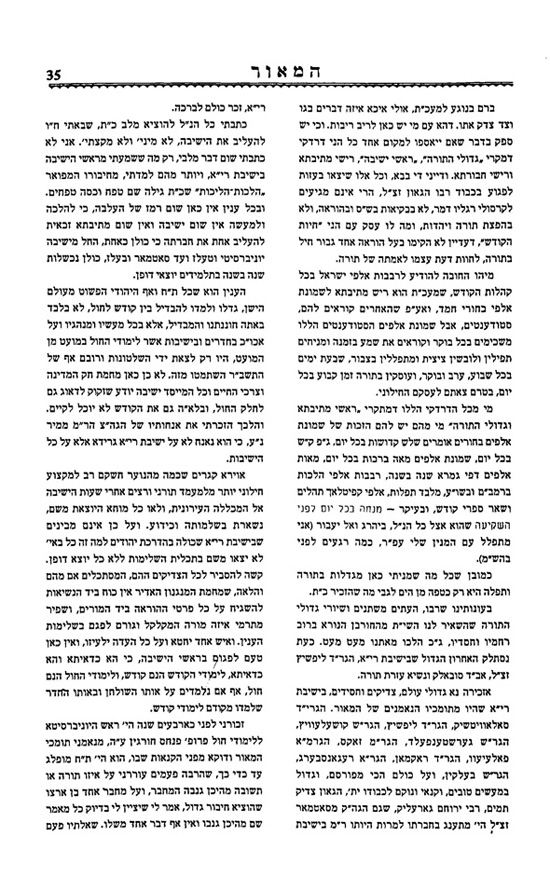
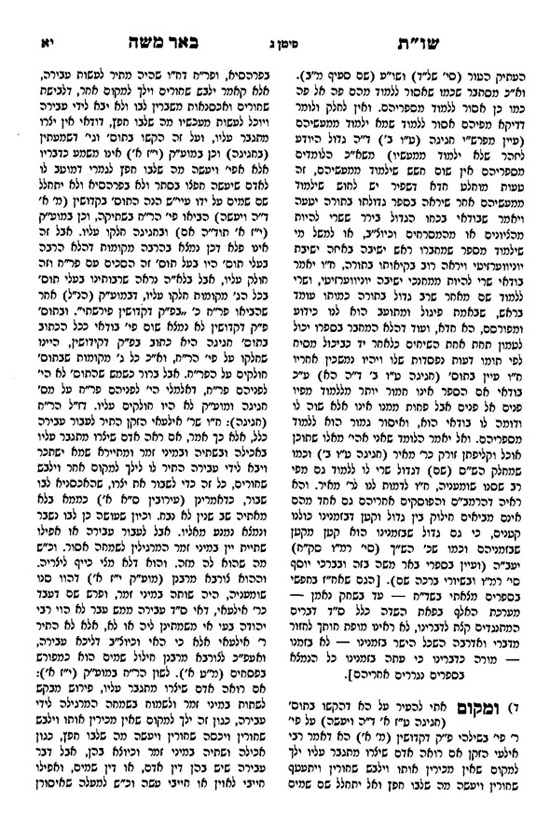
Here is what Rav Pam saw and quoted (almost certainly from one of the many later photo-mechanical reprints of the 1893 volume that appeared throughout the 20th century).

He may have owned a copy of a reprinted edition, and if not, he surely would have had access to a copy at the famed Torah Vodaath Library, curated for many years by the late R. Yitzchok Meir Traube and catalogued by the late R. Shlomo Biegeleisen. It is a library I remember well that (in my day) was just-off to the side of the main Bais Medrash at the South Third Street campus in Williamsburg.


No one could really fault Rav Pam for citing a passage – and with great precision – in the name of the Chasam Sofer, when that very passage appears in a sefer entitled Toras Moshe, and whose title page clearly identifies the author of its content as being none other than the Chasam Sofer! Moreover, the sefer was edited by the grandson of the Chasam Sofer, who surely wouldn’t misrepresent what his grandfather wrote!

But it is clearly a case of אליה וקוץ בה. If one examines carefully the text that Rav Pam cited (as seen in the scan above), one notices a coded abbreviation at the end of the paragraph that reads in parentheses: (משמ). (Other passages on the page are coded with an asterisk at the start of each paragraph; they need not concern us.) No dictionary of Hebrew abbreviations will solve the strange abbreviation משמ. But what will solve the problem for us is the editor’s full introduction to his edition of Toras Moshe.

It appears only, as one might expect, at the start of the volume on Bereshis. Here is the key passage, which appears at the very end of the lengthy introduction.

Translated it reads: “I also had in my hands a handwritten book, named Shir Ma’on. The author’s name is not recorded in it. But I felt comfortable taking some of its fruits and inserting them into the present text, for there is a proper time for everything, a fixed time for every desirable matter.”

Incredibly, there are many passages, marked with the code משמ strewn throughout the Toras Moshe volume! What the editor was really telling us is that he had access to a handwritten notebook with no personal name recorded in it. Of course no personal name was recorded in it; it was his private notebook! The Hebrew title Shir Ma’on clearly alludes to the name “R. Shimon.” And משמ is surely an abbreviation for מספר שיר מעון. As a gifted rabbinic scholar, and as the grandson of the author of most of the passages in Toras Moshe, he felt comfortable adding appropriate passages to the volume. But being scrupulously honest, he knew that he could not do so without informing readers of what he was doing, and clearly identifying which passages belonged to his grandfather, and which passages belonged to him.

It is all to the credit of the editors of the latest editions of Toras Moshe that they now publish two separate sections of the book, each with its own title page, and both with notes and commentary. One section is called Toras Moshe and prints only what the Chasam Sofer wrote, and the other section is called Shir Ma’on and prints only what R. Shimon Sofer wrote.


In sum, Rav Pam resonated to a beautiful 
דבר תורה he saw in an early edition (or reprint) of Toras Moshe, and cited it in the name of the Chasam Sofer at a Torah Vodaath dinner held in his honor. Opening to a page in Sefer Vayikra of the multi-volume set of Toras Moshe, there was no obvious reason for him to assume that it was not a Torah insight of the Chasam Sofer. In fact, it was a Torah insight of the Chasam Sofer’s grandson, R. Shimon Sofer, who served with great distinction as Rabbi and Rosh ha-Yeshiva of Erlau in Hungary for over 50 years, and authored the multi-volume שות התעוררות תשובה (printed mostly in Budapest, 1923-1944), and died a martyr’s death in Auschwitz at age 94.


Notes

[1] The reference is to Vayikra 21:8. See b. Gittin 59b, where the verse is understood as a general obligation to honor all Kohanim.
[2] R. Shimon Sofer, “
פתוחי חותם,” introduction to R. Moses Sofer, ספר חתם סופר חלק יורה דעה (Pressburg, 1841). It is reissued in שות חתם סופרחלק יוד, vol. 1 (Jerusalem, 2000), introductory pages, p. 15.
[3] The reference is to the unauthorized publication in 1826 of several of the Chasam Sofer’s responsa and Torah insights, for which see below.
[4] See b. Bechorot 29a.
[5] M. Avot 1:13. Cf. 
שות חתם סופראוחסימן רח.
[6] The letter is included R. Yisrael Stern’s anthology, 
לקוטי תשובות חתם סופר (London, 1965), pp. 92-93.It was first published in 1842 by the recipient of the letter himself, R. Zvi Hirsch Chajes. See presently: כל ספרי מהרץ חיות (Jerusalem, 1958), vol. 1, p. 206. For a comprehensive study of the relationship between the Chasam Sofer and R. Zvi Hirsch Chajes, see Mayer Herskovics, מהרץ חיותתולדות רבי צבי הירש חיות ומשנתו – מהדורה מתוקנת  (Jerusalem, 2007), pp. 143-189.
[7] Mordechai Leib Bisliches (1756-1851) was a bibliophile, dealer in manuscripts, and printer. He printed books that were published in Carlsruhe, Lvov, Prague, and Pressburg. At least two of his printed books carried 
הסכמות from the Chasam Sofer (אוצר נחמדחדושי הרמבן על מסכת שבת , Pressburg, 1837; and מנחת קנאות מהרב הגדול אבא מרי בר משה מחכמי לוניל , Pressburg,1837). In 1846, Bisliches and his partner S.G. Stern sold 111 manuscripts in 102 volumes to the archduchess Marie Louise of Parma, which were added to the de Rossi Collection in the Biblioteca Palatina. See the entry “Bisliches” in Encyclopaedia Judaica and cf. N.M. Gelber’s תולדות יהודי ברודי (Jerusalem, 1955), p. 204.
[8]
 In the standard printed editions, this responsum appears in שות חתם סופריודסימן שלח.
[9]In the standard printed editions, this responsum appears in
שות חתם סופראוחסימן רח .
[10] 
Rav Pam: The Life and Ideals of Rabbi Avrohom Yaakov HaKohen Pam, p.336, note 9.


Keter Shem Tov: A Study in the Entitling of Books, Here Limited to One Title Only

Keter Shem Tov: A Study in the Entitling of Books, Here Limited to One Title Only[1]

by Marvin J. Heller

Entitling, naming books is, a fascinating subject. Why did the author call his book what he/she did? Why that name and not another? Hebrew books frequently have names resounding in meaning, but providing little insight into the contents of the book. This article explores the subject, focusing on one title only, Keter Shem Tov. That book-name is taken from a verse “the crown of a good name (Keter Shem Tov) excels them all (Avot 4:13). The article describes the varied books with that title, unrelated by author or subject, and why the author/publisher selected that title for the book.

  1. Simeon said: there are three crowns: the crown of Torah, the crown of priesthood, and the crown of royalty; but the crown of a good name (emphasis added, Keter Shem Tov) excels them all (Avot 4:13).

“As a pearl atop a crown (keter), so are his good deeds fitting” (Israel Lipschutz, Zera Yisrael, Avot 4:13).

Entitling, naming books, remains, is, a fascinating subject. Why did the author call his book what he/she did? Why that name and not another? Hebrew books since the Middle-Ages often have names resounding in meaning, but providing little insight into the contents of the book. A reader looking at the title of a book in another language, more often than not, is immediately aware of the book’s subject matter. This is not the case for many Hebrew titles, the name having been selected by the author for any one of a number of reasons, least of all the book’s subject matter, but rather the intention is/was to give the book “the crown of a good name (Keter Shem Tov).”

Book titles have been addressed in both books and articles. Menahem Mendel Slatkine wrote a two volume work, Shemot ha-Sefarim ha-Ivrim: Lefi Sugehem ha-Shonim, Tikhunatam u-Te’udatam (Neuchâtel-Tel Aviv, 1950-54) on book names; it has been the subject of encyclopedia articles in both The Jewish Encyclopedia and the Encyclopedia Judaica; and such authors as Abraham Berliner, Joshua Bloch, and Solomon Schechter have written articles on book titles, all this apart from this subject being mentioned in passing in numerous other works. I too have addressed the subject, first in “Adderet Eliyahu; A Study in the Titling of Hebrew Books,” describing about thirty books with that single title, two only related to each other, and in “What’s in a name? An example of the Titling of Hebrew Books,” describing varied books taken from a single verse “Your neck is like the tower of David built with turrets, on which hang one thousand bucklers, all of them shields of mighty men (Song of Songs 4:4).[2]

What then is the justification for yet another article on the same subject? It is, as suggested above, the allure of how authors of varied unrelated works came to entitle their books, reflective of their intellectual or emotive processes or objectives. The title selected here, Keter Shem Tov, unlike Adderet Eliyahu, is not the title of as large a number of books, but the titles here are certainly as varied as those in the previous articles. Indeed, the works so entitled are sufficiently different, again providing insight into authors’ thoughts and, perhaps, an article of interest to the reader. We will not attempt to second guess or analyze an author’s motives, all of whom intended their book to have the crown of a good name (Keter Shem Tov), but rather we will let the authors speak for themselves when describing their books

In several instances, books are so entitled as to reflect the author’s name, Shem Tov. The use of a line from Avot, to reiterate the injunctions noted previously (“Adderet”), rather than directly using the author’s name, is to avoid violating R. Judah ben Samuel he-Hasid of Regensburg’s (c.1150-1217) proscription to not do so, so as to not benefit from this world, thereby decreasing one’s portion in the world to come, or to not reduce their offspring and the good name of their progeny in this world.[3] The Roke’ah (R. Eleazar ben Judah of Worms, c. 1165–c. 1238), however states at the beginning of the introduction to his Roke’ah, that everyone should inscribe his name in his book, as we find in the Tanna de-Vei Eliyahu.[4] Indeed, the Sefer ha-Roke’ah, is so entitled because the numerical value of the family name, Roke’ah (רקח=308), equals his personal name, Eleazar (אלעזר=308). It is, therefore, permissible to allude to the author’s name, for example, a Shem Tov using the title Keter Shem Tov, a quotation from Avot. Indeed, a substantial number of the books described here refer to the author’s name.

Our selection encompasses homilies on the Torah, Kabbalah on the Tetragrammaton, halakhah and minhagim (customs), the sayings of the Ba’al Shem Tov, in praise of Sir Moses Montefiore, a letter on behalf of the Jewish community in Tiberias, and a highly unusual work on the Dead Sea scrolls. Finally, this article is a vignette, no more no less, an insight into and, in a manner of speaking, a photograph of one manner of how Hebrew books are named.

Several caveats. First, our Keter Shem Tovs are organized within subject categories, beginning with 1) discourses, both literal and kabbalistic on the Torah, followed by 2) halakhah and minhag (custom), 3) biographical and related anecdotal works, 4) miscellanea, all ordered chronologically within category, and concluding with 5) a brief summary. Secondly, our approach will be somewhat expansive, the various Keter Shem Tovs giving us entry into related aspects of Hebrew printing and Jewish history. Lastly, while the number of works entitled Keter Shem Tov is not large, that notwithstanding, our examples are an overview and not meant to be all inclusive or comprehensive but intended as an interesting insight into an aspect of Hebrew book practice.

I Discourses, Literal and Kabbalistic on the Torah

Keter Shem Tov, R. Shem Tov ben Jacob Melamed, Venice, 1596: Our first Keter Shem Tov is a commentary on the Torah by R. Shem Tov ben Jacob Melamed. It was printed in Venice (1596, 20: 136, 16 ff.) at the press of Matteo Zanetti. This Zanetti, a member of the famous Venetian printing family of that name, established his print-shop on the Calle de Dogan, publishing seven books from 1593 to 1596. Among his titles, in addition to Shem Tov Melamed’s Keter Shem Tov, are R. Nathan Nata Spira’s (Shapira) Be’urim, R. Bezalel Ashkenazi’s responsa, and R. Solomon le-Bet ha-Levi’s Divrei Shelomo.

The title page has the decorative frame employed by Zanetti on several of his books with a smaller frame in the center about the text. The title-page states that,
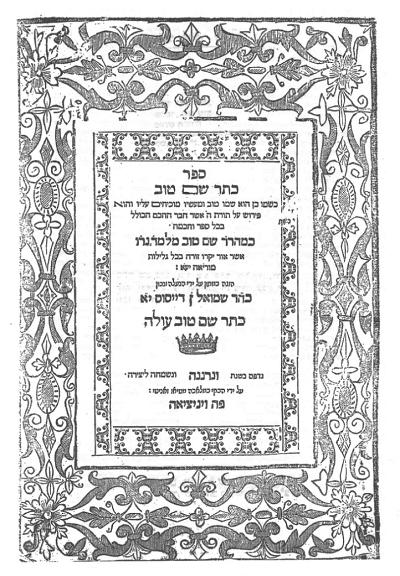
Keter Shem Tov

As is its name so is his name good and his deeds confirm it of him. It is a commentary on the Torah of HaShem written by the sage, the complete, in every book and wisdom.

Shem Tov Melamed

Whose precious light shines throughout [may

God shield him].

Edited patiently by the lofty and exalted

Samuel ibn Dysoss [may God watch over him]

Keter Shem Tov excels

Printed in the year, “that we may rejoice ונרננה (5356=1596) and be glad [all our days]” (Psalms 90:14) from the creation.


The introduction, from a student of the author, R. Samuel ben Solomon Segelmassi follows (2a), then a page of verse from the editor Samuel ibn Dysoss, the text (3a-136a), his apologia (136b), indexes (1a-16a), errata (16a), and the colophon (16b), which states that it was completed, “on the very day that Moses went up to the firmament (6 Sivan) and the Egyptians drowned in the sea (21 Nissan), in the year, “Then he saw it, and declare it ויספרה (5356=1596) (Job 28:27), from the creation.” It is unclear why there are two apparently contradictory completion dates. The text is in two columns in rabbinic type, excepting headings and initial words.

In the introduction Samuel ben Solomon writes that one who knows matters in truth and faithfully,

“shall come back with shouts of joy” (Psalms 126:6), “to perceive the words of understanding” (Proverbs 1:2) and this is the first intent of every man who presumes in his heart (Esther 7:5) to write “goodly words” (Genesis 49:21) in a book to leave after him a blessing. . . . It is a commentary on the holy Torah, “high and lofty” (Isaiah 6:1, 57:15), on each and every parshah . . .

The introduction continues that it contains derashot (discourses) according to the literal meaning, casuistic (pilpul), and very sharp. In the following paragraph we are informed that not everything that was said on every parshah was printed because of financial restraints. In the apologia ibn Dysoss adds a familiar plaint for the period, type set late erev Shabbat could not be properly corrected. Moreover, the compositors, not Jewish and not fully familiar with Hebrew and Hebrew letters, did that which was right in their eyes, and for which he should not be held responsible.

That the title clearly alludes to the author’s name, R. Shem Tov ben Jacob Melamed, is further suggested by the last line of verse at the end of the introduction, which states that “you will find that the crown of a good name (KETER SHEM TOV) excels them all. This is, as noted above, that authors’ names were frequently employed in book-titles, but, in keeping with the injunction of R. Judah he-Hasid, indirectly, here by referencing a quote from Avot.

Shem Tov Melamed was also the author of Ma’amar Mordekhai (Constantinople, 1585), a commentary on Megillat Esther, printed by Joseph Jabez. Melamed is described on the title of this work as a physician.

Keter Shem Tov, Amsterdam, R. Abraham ben Alexander (Axelrad) of Cologne, c. 1810-16: A kabbalistic Keter Shem Tov on the Tetragrammaton by R. Abraham ben Alexander (Axelrad) of Cologne (13th century). In Judaism the Tetragrammaton, the four letter divine name, is not directly expressed but instead referred to with a euphemistic name for God. The title-page describes this Keter Shem Tov as,
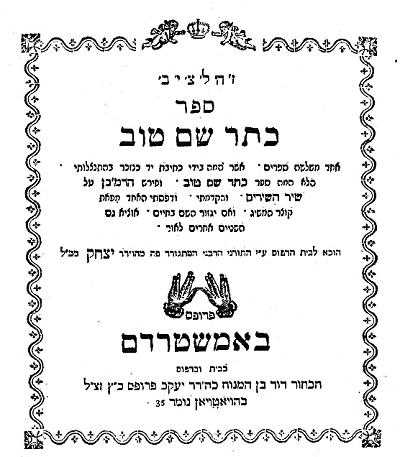
זהלציב [This is the gate of the Lord: the righteous shall enter through it] (Psalms 118:20)

Sefer

Keter Shem Tov

One of three books in my hand in manuscript, as described in my apologia. They are Keter Shem Tov and the commentary of the Ramban (R. Moses ben Nahman, Nachmanides, 1194–1270) on Shir ha-Shirim (Song of Songs). I have first printed one book only due to limited means. If the Lord will so decree I will publish the other two books. . . .


Although the title-page refers to three books two only are mentioned. The third work, noted in the editor’s apologia, is a commentary on the Merkavah of Ezekiel. Keter Shem Tov is not dated, so that various bibliographic sources date it as 1810 or 1816. The title-page is embellished by the Proops’ family press-mark, consisting of the kohen’s spread hands at the time he pronounces the priestly blessing. This edition of Keter Shem Tov (80: 5, 7 ff.) was printed in Amsterdam by David ben Jacob Proops. The Proops’ press, founded by Solomon Proops in 1704, was the longest lasting and most productive of the Hebrew printing-houses in Europe in the eighteenth century; it would continue to print Hebrew books until the mid-nineteenth century when, in 1869, the widow of David Proops sold the press to the Levissons, who printed until 1917.

Abraham, a student of R. Eleazar ben Judah of Worms (c. 1176–1238, Roke’ah), traveled through Spain between approximately 1260 and 1275, where he reportedly studied with R. Solomon ben Adret (Rashba, 1235–1310), the latter praising Abraham’s oratorical skills. Keter Shem Tov, as noted above, deals with the Tetragrammaton and also the Sefirot, addressing sacred names, using gematriot and synthesizing the mysticism of the Ashkenaz pietists (Hasidim) and Sephardic Kabbalistic methodologies.[5] Here too the reason for the title is not explicitly stated but, given the subject matter, is obvious.

This is not the first printing of Abraham ben Alexander’s Keter Shem Tov. It appeared earlier, included in a collection entitled Likkutim me-Rav Hai Gaon (Warsaw, 1798), under the title Ma’amar Peloni Almoni (ff. 26-32a). It has since been reprinted several times, often among collections of other works.

Ma’or va-Shemesh, R. Shem Tov ben Abraham ibn Gaon, Livorno, 1839: The next Keter Shem Tov, by R. Shem Tov ben Abraham ibn Gaon, is also a kabbalistic discourse on the Torah, this part of a larger multi-volume work entitled Ma’or va-Shemesh (Livorno, 1839, 80: [3], 3-11, [1], 128 ff.) printed by Eliezer Menahem Ottolenghi. The inclusion of Ma’or va-Shemesh represents a more expansive view of works entitled Keter Shem Tov as it is an independent work included in a larger collection of dissertations. The author (compiler) of Ma’or va-Shemesh, R. Judah ben Abraham Coriat (d. 1787) of Tetuán, was a scion of a distinguished Moroccan family.

  1. Shem Tov ibn Gaon (c. 1287-c. 340) was born in Soria, Spain and went up to Eretz Israel in 1312, settling in Safed where he wrote most of his books. He was a student of R. Solomon ben Adret (Rashba, 1235–1310) and R. Isaac ben Todros (13th cent.). Best known of ibn Gaon’s titles is Migdal Oz, on Maimonides’ Mishneh Torah as well as several works in manuscript. Keter Shem Tov, his first book, was reportedly written in Spain, while Rashba was still alive.[6]

The title-page of Ma’or va-Shemesh has a frame comprised of verses, all from Psalm 119:
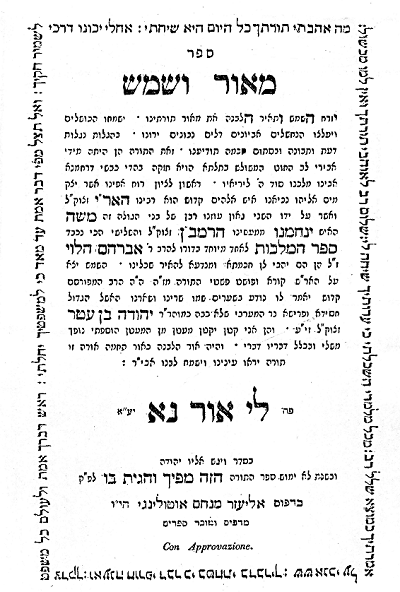
“O how I love your Torah! It is my meditation all the day” (Psalms 97);

“O that my ways were directed to keep your statutes!) (5);

“The sum of your word is truth; and every one of your righteous judgments endures for ever” (160);

“So shall I have an answer for him who insults me; for I trust in your word” (42);

“So shall I have an answer for him who insults me; for I trust in your word” (162);

“I have more understanding than all my teachers; for your testimonies are my meditation” (99); “Great peace have those who love your Torah; and nothing can make them stumble” (165).


An additional verse is employed for the date, “This Book of the Torah shall not depart from your mouth; but you shall meditate on it הזה מפיך והגית בו (599 = 1839)” (Joshua 1:8). The title too is from Psalms, “The day is yours, the night also is yours; you have prepared the light and the sun (Ma’or va-Shemesh)” (Psalms 74:16).

The text of the title-page notes several of the authors whose kabbalistic works comprise Ma’or va-Shemesh, notably the Ari ha-Kadosh (R. Isaac Luria, 1534 – July 25, 1572), R. Moses ben Nahman (Ramban), Sefer ha-Malkut, and R. Judah ben Attar, Coriat’s maternal grandfather. The verso of the title-page has a pressmark, a lion rampant holding thistle under crown and below it the phrase Gur Aryeh Yehudah. This device was used previously in Livorno by Eliezer Saadun. When employed by Ottolenghi the lion has been turned to face right, it having previously faced left.[7]
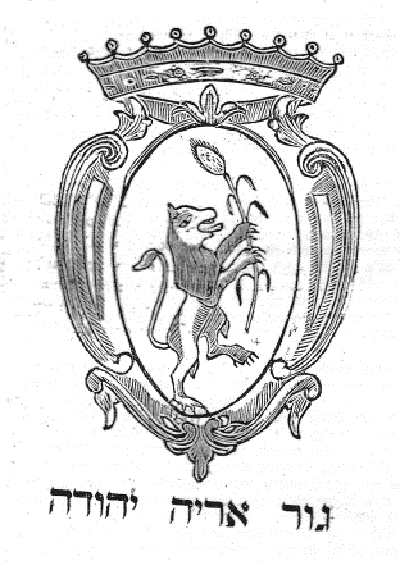


There are introductions from R. Elijah Benamozegh and Abraham ben Judah Coriat, the former comprised of five paragraphs, each beginning with the word Kol and concluding with Judah, the latter’s introduction comprised of eight paragraphs, each beginning with Ben and concluding with Av. The text is comprised of several kabbalistic works, among them Shem Tov ben Abraham ibn Gaon’s Keter Shem Tov (ff. 25-54a), here not explicitly stated but rather entitled Perush Sodot ha-Torah. Shem Tov was a kabbalist, who studied with the Rashba and R. Isaac ben Todros. He was greatly influenced by the Ramban (R. Moses ben Nachman), reflected in his Keter Shem Tov, which is a kabbalistic super-commentary on Ramban’s Torah commentary. Here too, the title comes from the author’s name, Shem Tov.

A small portion of ibn Gaon’s Keter Shem Tov was printed previously (ff. 41b-44a), in R. Jehiel ben Israel Luria Ashkenazi’s Heikhal ha-Shem (Venice, 1601), on the ten Sefirot, Likkutei Kabbalah Kadmonim.
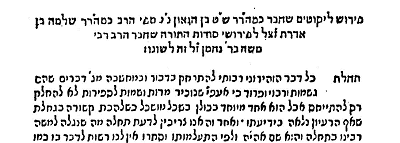


This much expanded version of Keter Shem Tov is based on an 1810 manuscript prepared by R. Elijah Lombroso.

II Halakhah and Minhag

Keter Shem Tov, R. Shem Tov ben Isaac Gaguine, Kaidan, Lithuania, 1934: An encyclopedic work on the varied customs and liturgy of eastern and western Sephardim and Ashkenazim by R. Shem Tov Gaguine (Gaguin, 1884-1953). Gaguine, scion of a famous Moroccan Rabbinical dynasty which emigrated to Palestine from Spain, was a great-grandson of R. Hayyim Gaguin the first Hakham Bashi of Eretz Israel in the Ottoman Empire and a great-great grandson of the kabbalist Sar Shalom Sharabi. Gaguine, who received semicha (ordination) from R. Hayyim Berlin, served as a dayyan in Cairo, rabbi and dayyan in Manchester, England, Rosh Yeshivah of Judith Montefiore Theological College, Ramsgate, and, from 1935, as head of Sephardi Medrash Heshaim in London.[8]
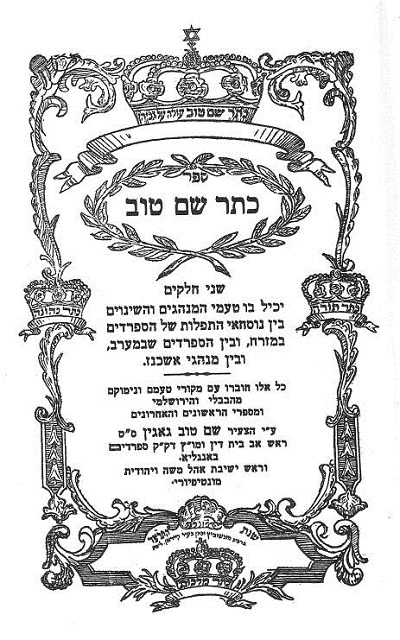


This Keter Shem Tov is comprised of seven volumes, the first two published in 1934, and the last four published posthumously by his son Dr. Maurice Gaguine. The complete work has been republished several times.

As noted above, Keter Shem Tov is a comprehensive work describing the liturgy and customs of eastern and western Sephardim and of Ashkenazim, accompanied by detailed footnotes from the Babylonian and Jerusalem Talmuds and later halakhic authorities. Although most of the entries explain more familiar customs, many are unusual. Example of the latter are:

The custom in [Eretz Israel and Syria, Turkey and Morocco] when the father, grandfather, father-in-law, one’s rabbi, or elder brother has an Aliyah, to stand on one’s feet until he returns to his place, and to go to them, kiss their hand and receive a blessing (I:213).

An unusual custom of the Sephardim in the city of Algiers is the phrase “marror zeh (this marror)” is said three times and then thrown to the ground, and afterwards picked up and returned to the ka’arah (Seder plate).[9]

Why is the marror called hasa or hazeret (lettuce or horse raddish)?

The Ashkenaz custom is to take, in place of hazeret a type of dry radish called in their language hrain, which is as sharp as mustard and does not have a bitter taste. The Sephardic custom is specifically hazeret. . . . (III: 158-59).

Keter Shem Tov, R. Avishai Taharani, Jerusalem, 2000: Another work on halakhah and customs, this most specific, described on the title-page as “a treasure of all the halakhot and personal customs concerning naming sons and daughters” by R. Avishai Taharani. The title-page continues that in it are explained the basic guidelines for giving names “by whose observance man shall live” (Leviticus 18:5, Ezekiel 20:11, 13, 21). Also addressed are the names that one should refrain from using.

In the introduction (pp. 1-23) to this two volume work, Taharani informs that he has so entitled the book, based on the injunction of the Roke’ah (above), as well as several other works. He has done so, however, with gematriot (numerical equivalencies) for “Avishai Taharani ben my lord and father Isaac אבישי טהרני בן לאדוני ואבי יצחק (977) which corresponds to Keter Shem Tov כתר שם טוב (977).” The text is wide ranging, comprehensive, and accompanied by detailed footnotes. Several examples of the more unusual entries in the text are:

If a father errs and calls his son or daughter with two names, forgetting that the additional name was given to another child, there are those who say that until thirty days he may change the name (I:118).

Some say that if one has a child from an unmarried woman, the child should be called with a name that predates [the time of the] Patriarch Abraham or with a name that is not customary, for example, Dan, so that he will be judged according to his problem. There are places that it is customary to give these names to those who are kosher and Heaven forfend one should come to question those who are kosher (I: 237-38).

Some say that one should not call [a child] with one of the names that predates the Patriarch Abraham, for example: Adam, Noah, and all who call by a name that predates the Patriarch Abraham is not in the category of one who “labors in the Torah, and does not give pleasure to his Creator” (cf. Berakhot 17a). (I:397-400).

It is permissible to shorten a name, whether for a son or a daughter, as long as that name is used only casually, and it is best to use the full name at least once a day in order that the short form dies not become customary (II:110-13).

In a lengthy footnote to the third entry concerning names that predate the Patriarch Abraham a source for the entry is given, ha-Mabit (R. Moses ben Joseph of Trani, 1500 – 1580). It is followed by a number of contrary sources by other prominent rabbis, and then a lengthy discussion. That this Keter Shem Tov has proven to be a relatively popular work is evident from the publication of two additional editions, the last in 2007.

Keter Shem Tov, Kollel Keter Shem Tov, Kiryat Bialik, 2002: Collection of discourses and responsa on Shulhan Arukh Hoshen Mishpat by rabbis from the Kollel Keter Shem Tov in Kiryat Bialik, located in the vicinity of Haifa. There is an introduction from R. Mahluf Aminadav Krispin, Chief Rabbi of Kiryat Bialik, followed by the text, comprised of nineteen articles, including one by the Rosh Yeshiva R. Solomon Shalosh. Examples of the articles are 5) “on the prohibition turning to secular courts” by R. Efied Hagibi, member of the Kollel; 6) finding a relative or one who is unfit among the judges by R. David Alharar, member of the Kollel; 9) witnesses who have fulfilled their charge” by R. Evied Elul, member of the Kollel; 11) “the obligation of rent after divorce, the portion in the residence” by R. Abraham Atlas, av bet din, Haifa; 14) “acquisition through forgiveness (relinquishment) by R. Solomon Shalaoh; and 19) “the wages of a worker and contractor who did not provide the agreed upon benefit” by R. Abraham Atlas.

The title-page numbers the volume as no. one, but it is not known whether additional volumes were published.

III Biographical and Related Anecdotal Works

Keter Shem Tov, R. Aharon ben Zevi ha-Kohen of Apta, Zolkiew, 1794/95: The most popular of our Keter Shem Tovs, based on the printed editions, is the collection of tales and stories of the remarkable and astounding deeds of the Ba’al Shem Tov (R. Israel ben Eliezer, Besht, c. 1700–1760), founder of the Hasidic movement, as well as his recorded sayings, assembled from the works of his disciples. This collection of tales and sayings was assembled by R. Aaron ben Zevi Hirsch ha-Kohen of Opatow (Apta).
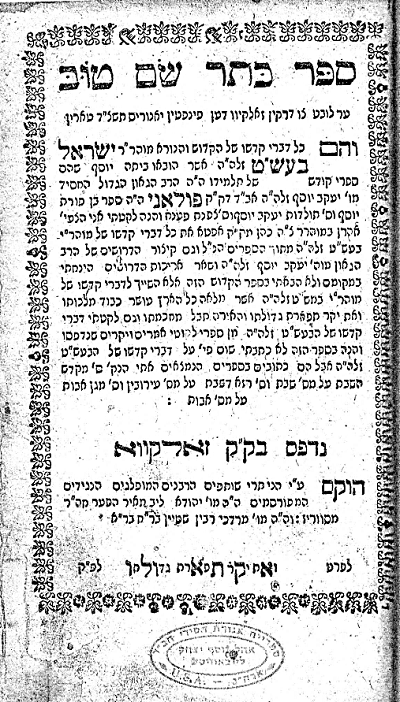
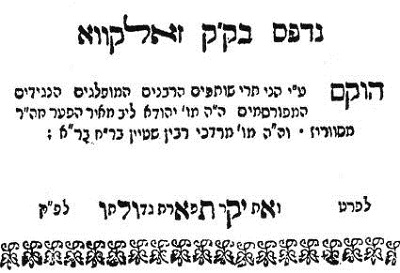


The book is in two parts, each with its own title-page but identical text, except that the first title-page is dated with a chronogram, the second title-page, printed a year later, is dated in a straightforward manner, תקנ”ה (555 = 1795). Perhaps the reason that the second title-page is so dated is that the first title-page exists in two forms, the rare first title-page, is dated “and the glory of his splendid majesty ואת יקר תפארת גדולתו (544 = 1784)” (Esther 1:4), which is incorrect, the book having been printed a decade later. The error was likely quickly caught, for the corrected and much better known title-page has the same chronogram, now reading ואת יקר תפארת גדולתו, the yod in the second word enlarged and emphasized, for a correct total of 554 (1794).[10] The variants are recorded separately in several bibliographic works.[11]

The title-page informs that that much of the contents are from the works of R. Jacob Joseph ben Zevi ha-Kohen av bet din of Polonnoye (d. c. 1782), the Ba’al Shem Tov’s leading disciple, that is, Toledot Ya’akov Yosef, Ben Porat Yosef, and Zafenat Pa’ne’ah, as well as discourses, also from other works. Among these latter sources are Likkutei Amorim and the sayings of the Ba’al Shem Tov, all collected by R. Aaron ben Zevi Hirsch ha-Kohen of Opatow (Apta).

In addition to the variations to the first title-page, the second title-page also exists in two formats, with, unlike the first title-page, some textual variations. Within the text of the book, despite Aaron ben Zevi Hirsch ha-Kohen’s comments that he has assembled the Ba’al Shem Tov’s words from the above mentioned titles, he did not, in fact, merely transcribe them in toto, nor did he distinguish which were the words of the Ba’al Shem Tov and those of Jacob Joseph.[12]

Keter Shem Tov has an approbation from R. Menachem Mendel of Liska, followed by the famed Iggeret Hakodesh, a letter from the Ba’al Shem Tov to his brother, dated Rosh Ha-Shanah, 1747, in which he relates that his soul ascended to heaven where he met with the Messiah, and then the text. This Keter Shem Tov, as noted above, has proven to be an enduring and popular work; it was printed soon after in Korezec (1797), Lemberg (1809) and several times afterwards there, in numerous other locations, and continues to be republished to the present.

Keter Shem Tov, Abraham Menahem Mendel Mohr, Lvov (Lemberg), 1847: Sir Moses Montefiore (1784–1885) was one of, if not the most prominent member of English Jewry in the nineteenth century. Cecil Roth described him as “the most notable Jew, and indeed one of the most notable Englishmen, of the 19th century by virtue of his outstanding philanthropic work extending over a period of three-quarters of a century, into his venerable old age.”13 Montefiore traveled to the Middle East during the Damascus Affair, to Russia, Morocco, and Rumania on behalf of persecuted Jewry, as well as providing leadership and support of Jewry at home and in Eretz Israel. His indefatigable efforts on behalf of world Jewry are recorded and acknowledged in books, articles, and newspapers, several works entitled Keter Shem Tov.

The first Keter Shem Tov praising Sir Moses Montefiore is by Abraham Menahem Mendel Mohr (1815–1868), a scholarly maskil, author of a number of Hebrew and Yiddish books. The title-page states that it is,
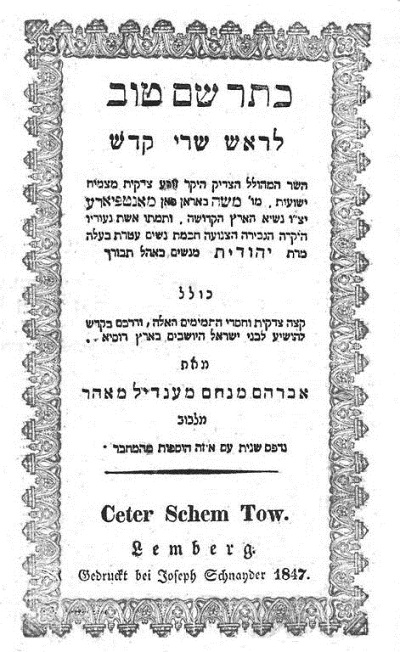
Keter Shem Tov

For the chief, holy prince

The praiseworthy, the righteous, the dear, who sows righteousness and brings forth salvation. Our teacher, Moses Baron from Montefiore [May his Rock and Redeemer protect him], prince of the holy land. And the pure wife of his youth, the honorable lady, the modest, the wisdom of women “is a crown to her husband” (Proverbs 12:4), the lady Judith “blessed shall she be above women in the tent” (Judges 5:24). . . .

The title-page continues that the text includes some of the righteousness and perfect kindness on behalf of the Jews in Russia. A small book, (80: 16 pp.: Joseph Schnander), the text begins with verse, with the header “from Moses to Moses there was none like Moses” normally referring to Maimonides but here applied to Montefiore. The verse beginning,

“Moses ben Amram brought Israel out from the burdens of Egypt

and Moses Montefiore redeemed them from death to life.

Moses ben Amram “struck the rock, so that the waters gushed out” (Psalms 78:20)

and Moses Montefiore softened the heart of stone with “words of lips” (cf. II Kings 18:20, Isaiah 36:5). . . .


The volume concludes with a letter of appreciation from Sir Moses Montefiore.

A Ladino (Judeo-Spanish) version of Mohr’s Keter Shem Tov was printed in Salonika (1850, 80: 48, 53-80 ff.) together with two other works, Tiferet Yisrael on the Rothschilds, and Ma’aseh Eretz Israel on Eretz Israel from the destruction of the Temple to the nineteenth century. Among the many other works either praising or including a section on Montefiore are Kol Kitvei Rabbi Ya’akov Saphir ha-Levi (Jerusalem, 1934), the writings of R. Jacob Saphir (1822–1886), an emissary of the Jewish community in Jerusalem and the author of Even Saphir on the Jewish communities in such varied places as Yemen, Egypt, India, and India that he visited. In Kol Kisvei is a section entitled Keter Shem Tov Kenaf Renanim Sir Moses Monrefiore, accompanied by a cameo of Montefiore.
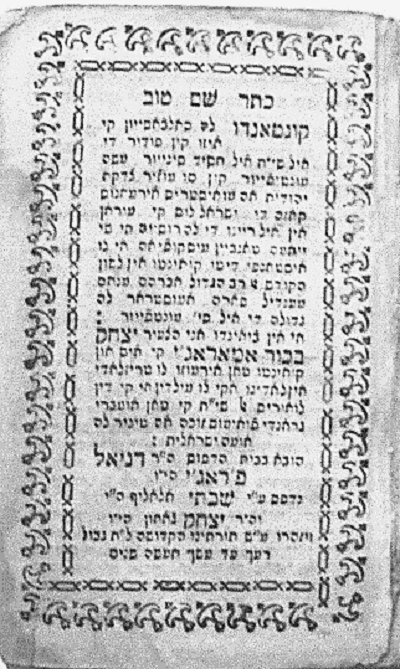


Yet another Keter Shem Tov about Montefiore was published by Hayyim Guedalla (London, 1884). The Hebrew title-page is followed by an English title-page that states,

The Crown of A Good Name

a brief account

of a few of the

Doings, Preachings, and Compositions

On

Sir Moses Montifieore’s Natal Day,

November 8th, 1883,

on which he was favored with a succession of telegraphic

Congratulations from the QUEEN OF ENGLAND and many

Eminent People of all Creeds.

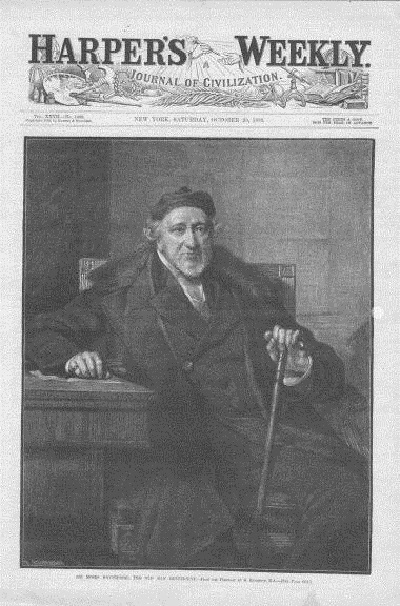
Below is the quote from Pirke Avot. The text includes congratulatory letters from the Queen, the Duke of Edinburgh, many others, and special services in both Hebrew and English. In addition, many other publications relate to Moses Montefiore, among them, albeit this not directly pertinent to the article but of interest as a further example of how widespread the high esteem in which the venerable Sir Moses Montefiore was held, is the title page of the October 20. 1883 Harper’s Weekly Journal of Civilization (New York), with a full cover portrait of Montefiore.


Keter Shem Tov (Ehrenkranz des guten Rufes), R. Josef Natonek, Budapest, 1880: German Keter Shem Tov by Josef Natonek in honor of Rabbi Dr. Moritz Landsberg (1824-80), son of R. Elias Landsberg (1800-79). Except for a Hebrew header the title page is entirely in German, as is the text (32 pp.), with only occasional Hebrew.
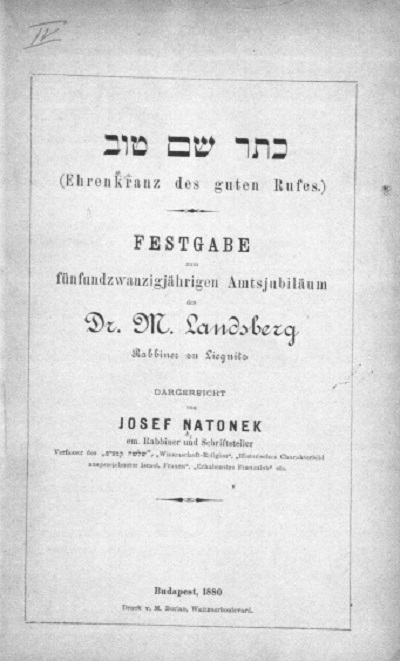


The title, Ehrenkranz des guten Rufes, is our “crown of a good name,” a Festgabe zum fünfundzwanzigjährigen Amtsjubilaeum des Dr. M. Landsberg, Rabbiner zu Liegnitz dargereicht von Rabbiner Josef Natonek em Rabbiner und Schriftsteller verfasser, that is a festive volume presented to Landsberger on the twenty-fifth jubilee of his service as rabbi in Liegnitz, by R. Josef Natonek (1813-92), a rabbi and author. Landsberg, doctor of philosophy educated in Berlin, became, in 1854, the rabbi of Legnica. Born in Rawicz, He served as rabbi for twenty-five years until his death in Liegnitz (Legnica, Silesia).[14] Landsburg was also the author of a number of studies on the history of medicine, particularly in ancient times, published for the most part in the journal Juno, published by von Henschel.[15]

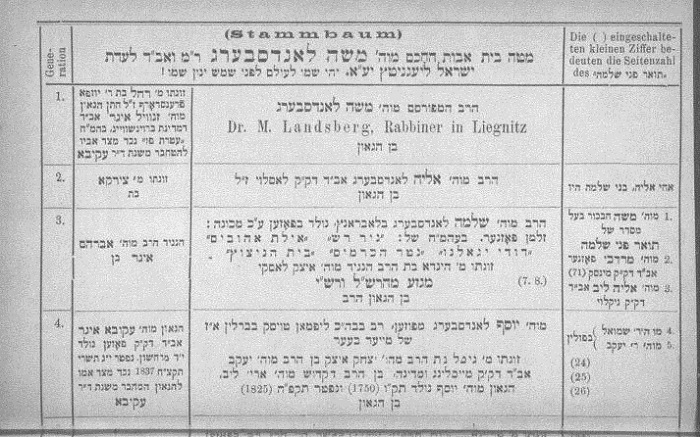
At the end of the volume is a two page Stammbaum (family tree) of the Landsberg family.


IV Miscellanea

Keter Shem Tov, R. Solomon Zalman ben Zevi Hirsch ha-Kohen, Livorno, c. 1789: Our next Keter Shem Tov is a quarto sized page printed in Livorno in c. 1789 for the Hassidic Tiberius Kollel Ashkenazim. It informs that R. Solomon Zalman ben Zevi Hirsch ha-Kohen (d. 1799) is an emissary of the Merciful One and of us (the Ashkenaz Hasidic community of Tiberias). The letter is signed by twenty-one rabbis.[16]
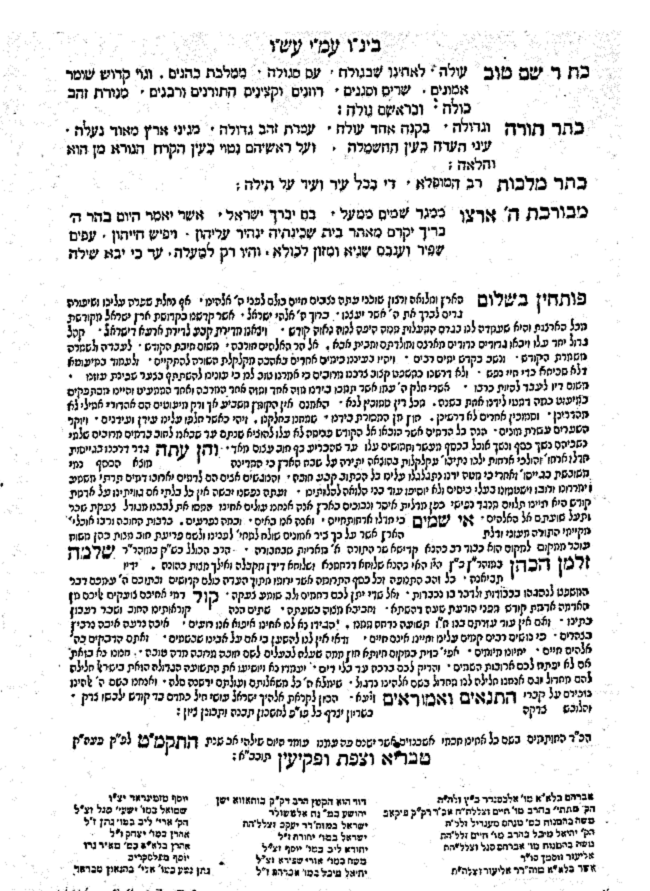


The letter begins with a reference to Keter Shem Tov followed by a list of honorifics “but the crown of a good name (Keter Shem Tov) excels them all. To our brothers in the exile, a treasured people, ‘a kingdom of priests and a holy nation’ (Exodus 19:6), keepers of the faith, princes and chieftains, princes and leaders, ‘a lampstand all of gold’ (Zechariah 4:2) Torah scholars and rabbis.”

It informs about their joy in the merit to live in Eretz Israel. Until now they had relied upon support from the country from which they had come; but now, however, due to war between Russia and the Ottoman Empire, they could no longer depend on that funding, so that they are now turning to Jews in other lands for support. Indeed, in describing the situation the letter notes the dire financial situation and that the land “‘is infested with bandits’ (Yevamot 115a, 122a) ‘the task masters hurried them’ (Exodus 5:13), they ‘lie in wait for blood’ (Micah 7:2). . . . ‘But now our soul is dried away; there is nothing at all (Numbers 11:6)’”

Solomon Zalman had traveled twice previously as an emissary to Russia (1779-81/1784-85), but this was his first trip to Western Europe. Avraham Yaari relates that Solomon Zalman’s undertaking was not without objection. The Sephardic community protested that the Hasidic community, which had previously received support from Eastern Europe, a venue now closed to them, was, by sending an emissary to Western Europe, entering into the domain of the general Tiberias community. The dispute was resolved several years later when joint representatives of both communities went to Eastern Europe.[17]

The letter begins with that part of the phrase from Avot referring to Keter Shem Tov intimating that a way one obtains the “crown of a good name (Keter Shem Tov)” is through good deeds and charity, which, as noted above, is “As a pearl atop a crown (keter), so are his good deeds fitting,” certainly appropriate for an appeal for the destitute community in Israel, the subject of the our Keter Shem Tov.

Keter Shem Tov, Shani Tzoref, Ian Young, Editors; Piscataway, NJ, 2013: A highly unusual Keter Shem Tov, this the proceedings of a conference on the Dead Sea scrolls held in memory of the late emeritus professor Alan David Crown in late 2011 at the University of Sydney, Mandelbaum House. This volume is part of a series entitled Perspectives on Hebrew Scriptures and its Contexts published by Gorgias Press, which describes itself as “an independent academic publisher of books and journals covering several areas related to religious studies, the world of ancient western Asia, classics, and Middle Eastern studies.” Among their subject matter is Ancient Near East, Arabic and Islam, Archaeology, Bible, Classics, Early Christianity, Judaism, Linguistics, Syriac, and Ugaritic.

Professor Alan David Crown (1932-2010) in whose memory this book was published, was Professor in Semitic Studies at the University of Sydney, and a renowned scholar and author. As noted on a website referring to him the title relates to the name Crown (Keter), for “He may have inherited the name Crown from his parents, but he earned the title ‘CROWN’ – the Crown of Torah, through his own merit, his sharp intellect and his deep respect for scholarship.”[18] The editors are Dr. Shani Tzoref, Ph.D., Skirball Department of Hebrew and Judaic Studies, New York University and currently a Qumran Institute Fellow, Seminar für Altes Testament, Georg-August-Universität Göttingen, and Dr. Ian Young, Associate Professor, Chair of Department at the University of Sydney, Australia, teaching Classical Hebrew and Biblical Studies.

This edition of Perspectives on Hebrew Scriptures and its Contexts 20: Keter Shem Tov (x, 400 pp.) is comprised of sixteen articles on various subjects in the field of Qumran studies (Dead Sea scrolls) from scholars in the field. The articles encompass the development and phases of Qumran scholarship; textual transmission of the Hebrew Bible, including Samaritan texts and Masada Biblical Scrolls; reception of Scripture in the Dead Sea Scrolls; community and the Dead Sea Scrolls; and eschatology and sexuality in the So-Called Sectarian Documents from Qumran; and the Temple and the Dead Sea Scrolls.

V Summary


This concludes our survey of books with the title Keter Shem Tov. As noted above, the article is vignettes of books so entitled. There is no single pattern in the use of the title, it being applied to a wide variety of books. There are discourses on the Torah, both literal and kabbalistic, works on Jewish law and customs, biographic or anecdotal, and several miscellaneous works, among them an appeal for support of Jewish communities in the Holy Land and on the Dead Sea scrolls. The title Keter Shem Tov has been chosen because it refers to an author’s name, for example, R. Shem Tov Melamed, R. Shem Tov ibn Gaon, and R. Shem Tov Gaguine; bibliographical works such as those referring to the Ba’al Shem Tov, Sir Moses Montefiore, and Rabbi Dr. Moritz Landsberg; and more diverse works, such as one being the novellae of a Kollel, the Dead Sea scrolls, and even topically related as in R. Avishai Taharani’s Keter Shem Tov, which actually deals with laws and customs applicable to names.

We began by noting that the title of Hebrew books, unlike books in other languages, may have “been selected by the author for any one of a number of reasons, least of all the book’s subject matter; rather the intention is/was to give the book ‘the crown of a good name (Keter Shem Tov)’.” Indeed, not one book in this article, with the possible exception of Taharani’s Keter Shem Tov, indicates its subject matter by the title. What each of these examples do have in common, is the intent to associate the name of the author, subject, or even organization with the Mishnah in Pirke Avot, which states,

  1. Simeon said: there are three crowns: the crown of Torah, the crown of priesthood, and the crown of royalty; but the crown of a good name (emphasis added, Keter Shem Tov) excels them all (Avot 4:13).

[1] I would like to thank Eli Genauer for reading the article and his comments and my son-in-law, R. Moshe Tepfer, for his assistance and research in the National Library of Israel, including getting the 1789 Livorno illustration from
[2] Marvin J. Heller, “Adderet Eliyahu; A Study in the Titling of Hebrew Books,” in Studies in the Making of the Early Hebrew Book (Brill, Leiden/Boston, 2008), pp. 72-91; idem. “What’s in a name? An example of the Titling of Hebrew Books,” in Further Studies in the Making of the Early Hebrew Book (Brill, Leiden/Boston, 2013) pp. 371-94.
[3] Judah he-Hasid, Sefer Hasidim (Jerusalem, 1973), ed. Re’uven Margaliot, pp. 210-11, n. 367 [Hebrew].
[4] Eleazar ben Judah, Sefer Roke’ah ha-Gadol (Jerusalem, 1967), ed. Barukh Shimon Shneurson, p. 1 [Hebrew].
[5] Gershom Scholem, Kabbalah (New York, 1974), p. 51.
[6] Shimon Vanunu, Encyclopedia Arzei ha-Levanon. Encyclopedia le-Toldot Geonei ve-Hakhmei Yahadut Sefarad ve-ha-Mizrah IV (Jerusalem, 2006), pp. 2152 [Hebrew].
[7] Avraham Yaari, Diglei ha-Madpisim ha-Ivriyyim (Jerusalem, 1943, reprint Westmead, 1971), pp. 96, 174 no. 160, [Hebrew].
[8] Shimon Vanunu, Encyclopedia Arzei ha-Levanon. Encyclopedia le-Toldot Geonei ve-Hakhmei Yahadut Sefarad ve-ha-Mizrah IV (Jerusalem, 2006), pp. 2155-56 [Hebrew].
[9] In contrast, the Mishnah Berurah (477:1:5) quotes the Shelah ha-Kodesh who states that ” have seen people of status who kiss the matzah and the marror . . . all to cherish the mitzvah.”
[10] Such errors and their corrections are known as stop-press corrections. Sheets were proof read while the press-run was under way; while it certainly was preferable to correct the sheets before the run began, reading also took place while the run was under way. When the corrector would find an error he would stop the run, remove the forme, quickly correct the error, and resume printing. Unless substantial, stop-press corrections did not necessitate disposing of the previous sheet – four pages in a folio, more so in a smaller format – but rather both the altered states and the originals are used. In such a case, there will be variant copies of the book, consisting of sheets printed from forms in both the earlier and later states, as is the case here.
[11] The copy with the misdated title-page in the Chabad-Lubavitch Library is attractively bound in a soft brown leather, the cover stamped כתר שם טוב ב”ק אדמו”ר שליט”א, that is, it was in the private library of the Lubavitcher Rebbe, R. Menachem Mendel Schneeersohn (1902–94). The reading room librarian, R. Zalman Levine, informs me that to his knowledge this is the only book so bound, and that it “was given to the rebbe with this binding.
[12] Keter Shem Tov (Brooklyn, 1972), p. v [Hebrew].
[13] Cecil Roth, “Moses Montefiore, 1784-1885,” in Essays and Portraits in Anglo-Jewish History (Philadelphia, 1962), p. 262.+
[14] As an aside, Jewish settlement in Lieignitz can be traced to the Middle Ages, interrupted by pogroms, the first in 1447 due to a dispute between Elżbieta, Duchess of Legnica with Jewish bankers, who demanded that she return a loan. Liegnitz is best remembered for a battle that took place there in 1241, when a Polish-German Army lead by Duke Henry II of Silesia engaged invading Mongol near the town. The Mongols were victorious, collecting nine sacks of ears from their fallen enemies, all of whom perished.
[15] Klatzkin, Jacob and Ismar Elbogen, editors, Enyclopaedia Judaica: Das Judentum in Geschichte und Gegenwart 10 (Berlin, 1928-34), p. 619.
[16] The signatories are R. Abraham ben Alexander Katz of Kalisk; R. Matthias ben Hayyim; R. Moses ben Menahem Mendel; R. Jehiel Michal ben Hayyim; R. Moses ben Abraham Segal; R. Eliezer Sussman; R. Asher ben Eliezer; R. David he is the Katan, rav of Bohava Yeshain; R. Joshua ben Noah Altshuler; R. Israel ben Jacob; R. Israel ben Judah; R. Judah Leib ben Joseph; R. Moses ben Uri Shapira; R. Jehiel Michal ben Abraham; R. Joseph of Zimigrad; R. Samuel ben Isaiah Segal; R. Aryeh Leib ben Nathan; R. Aaron ben Isaac; R. Aaron ben Meir; R. Joseph of Poloskov; and R. Nathan Nata ben Eli of Brod.
[17] Avraham Yaari, Sheluhei Eretz Yisrael II (Jerusalem, 1951, reprint Jerusalem, 1997), pp. 619-28 [Hebrew].
[18] http://learning.mandelbaum.usyd.edu.au/about-us/alan-crown/


Comments on This and That, part 2

Comments on This and That, part 2
by Marc B. Shapiro

Continued from here.

Barth’s opinion was shared by R. Joseph Hertz, who referred to Song of Songs as a “collection of ancient lyrics of the spring-time and youthful love.”[1] Some might regard this as a radical, even un-Orthodox opinion, but from Avot de-Rabbi Natan 1:4, we see that the early Jewish leaders did not regard the Song of Songs (and Ecclesiastes and Proverbs) as anything special.


Originally, it is said, Proverbs, Song of Songs, and Ecclesiastes were suppressed, for since they were held to be mere parables and not part of the Holy Writings [the religious authorities] arose and suppressed them. [And so they remained] until the men of Hezekiah came and interpreted them.

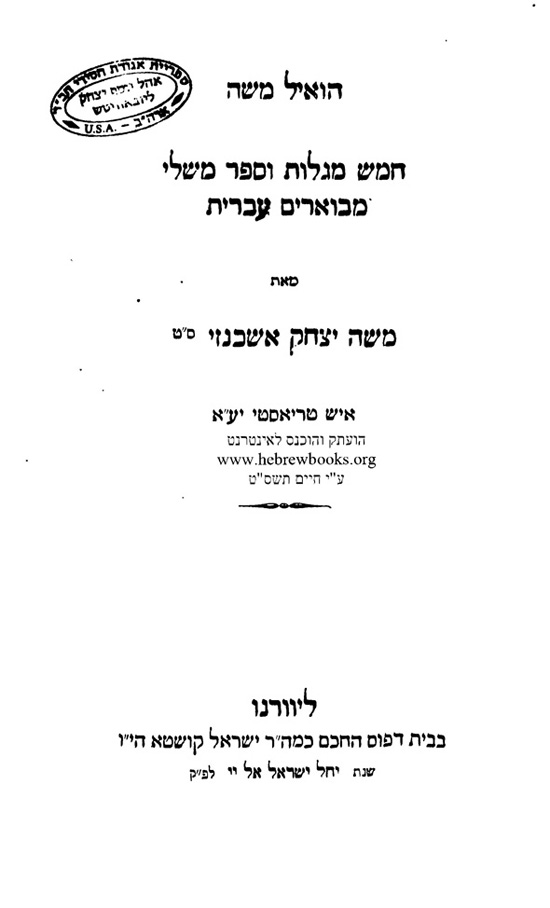
I already quoted a couple of times from R. Moses Isaac Ashkenazi’s Ho’il Moshe, so let me mention that in the introduction to his commentary on Song of Songs, he assumes that the book was indeed sung as part of the wedding celebrations, and as with Barth, he thinks that this was the original purpose of Song of Songs. He also suggests that perhaps שיר השירים אשר לשלמה  does not mean that Solomon wrote it, but that it was written for Solomon. He compares this to Psalm 72:1 which begins לשלמה and means “[A Psalm] for Solomon.” Interestingly, he also thinks that the Shulamite (7:1) is none other than Abishag the Shunamite.[2] Here is the title page of his book.


While Artscroll sees a literal interpretation of Song of Songs as blasphemous, Ashkenazi (together with Breuer and Barth) sees the book as teaching the values that make for a successful marriage. This viewpoint is also expressed in the introduction to the Soncino translation:

The main moral of the Book is that love, besides being the strongest emotion in the human heart, can also be the holiest. God has given the gift of love to sweeten the toil of the laborer, as in the case of Jacob to whom the fourteen years in which he toiled for Rachel appeared but a few days, for the love he had for her (Gen. xxix. 20). Love transfigures and hallows, but it’s a boon that requires zealously to be guarded and sheltered from abuse. This Book pictures love as a reward enjoyed only by the pure and simple, a joy not experienced by the pleasure-seeking monarch and the indolent ladies of the court. It is a joy reserved for the loyal and the constant, and is denied to the sensual and dissolute.

Ashkenazi concludes with these strong words:

גם אם נפרשהו ע”ד הפשט, נוכל ללמוד ממנו דברים נאותים. . . . רק אנשי חונף העושים מעשה זמרי ומבקשים שכר כפנחס יטילו בו דופי, בעוד שהם בשבתם על השולחן בבית חתן וכלה יוציאו מפיהם דברי נבלה המלבינים פני כל אדם ישר השמועה; והלואי ואולי היו משוררים שיר נחמד זה בסעודת חתנים. ויופי הקולות והנגינה ישמחו הלבבות ויגדילו חשק חתן וכלה זה לזה, ויגביהו לבות הבחורים והעלמות ברחשי הכבוד הראוים והנאותים להם.

Finally, let me mention Amos Hakham’s introduction to the Daat Mikra edition of Shir ha-Shirim. While he isn’t sure if the entire book can be traced to wedding feasts, he is certain that this is so for at least one section, namely, the song that ends in 5:1:: “Eat, O friends; drink, yea, drink abundantly, O beloved.” How could this not originate in a wedding feast? As for dance songs, Hakham points to 7:1 as an example: “Return, return, O Shulamite; Return, return, that we may look upon thee.” As with those already cited, Hakham argues that the allegory only adds a deeper level to our understanding, but it in no way discounts the peshat of the verses.[3] This is in direct opposition to Artscroll’s position that “The literal meaning of the words is so far from their meaning that it is false” (Artscroll Pesach Machzor, p. 567).

Hakham also calls attention to Va-Yikra Rabbah 9:6, where R. Yohanan understands Song of Songs on the peshat level to be referring to a real married couple. Based on two verses in Song of Songs, R. Yohanan derives “that a bridegroom should not enter the bridal chamber unless the bride gives him permission.”

Hakham states: “It is unimaginable that prophecy would use matters that are distasteful in themselves as an allegory for holy and pure matters.” Here is how he sums up his main point (pp. 8, 9):

כלומר שאמנם לפי המשמעות המילולית הפשוטה מתוארת בשיר השירים אהבה שבין דוד ורעיה שהם שניהם בשר ודם, אלא שבהיות אהבה זו תמה, זכה, טהורה וקדושה, ראויה היתה שתשמש סמל ודוגמה לאהבה נעלה יותר. . . . טעות ביד מי שחושב, שחז”ל דרשו את שיר השירים על דרך הרמז משום שבפירושו כפשוטו היה נראה בעיניהם כשיר העוסק בענינים שאינם ראויים להכלל בכתבי הקודש. לא כן הדבר. כבר העירו גדולי המפרשים שאין להעלות על הדעת, שהנבואה תקח עניינים מאוסים כשלעצמם כמשל לענינים קדושים וטהורים, אלא ודאי שכמו הנמשל כן גם המשל קודש הוא. ואם מצאנו שהנבואה ממשילה את הברית שבין כנסת ישראל ובין הקב”ה כברית שבין איש ואשתו, משמע שהברית הזאת שבין איש ואישה קדושה היא ונעלה. וכבר אמרו חז”ל: איש ואשה, זכו – שכינה ביניהן.

I would assume that if a Modern Orthodox Machzor for Passover is ever published, that Hakham’s perspective will be the one to be included rather than what we find in Artscroll.

R. Zvi Yehuda has the same perspective, writing that the literal meaning has an independent existence, and “it too is raised to the level of holiness, not just on account of the nimshal, but on its own strength.”[4] He quotes Rashi who in his introduction to Song of Songs stresses that the allegory must be attached to the peshat of the verse:

ואף על פי שדברו הנביאים דבריהם בדוגמא, צריך ליישב הדוגמא על אופניה ועל סדרה.

Yehuda brings a wonderful example of this. Song of Songs 4:1 reads: “Behold, you are fair, my beloved; behold, you are fair; your eyes are [like] doves; from within your kerchief your hair is like a flock of goats that streamed down from Mount Gilead.” Rashi explains the second part of the verse as follows: “This praise is a paradigm of the praise of a woman beloved by her bridegroom. Within your kerchief, your hair is beautiful and glistens with brilliance and whiteness like the hair of white goats descending from the mountains whose hair gleam in the distance.” The biblical text does not give any color to the goats, and Yehuda notes that the standard approach is that the goats are black, so that the hair being praised is also black. Yet Rashi speaks of light hair as being beautiful, and therefore he understands the color of the goats differently. Based on this, Yehuda concludes that “Visions of female beauty, in his [Rashi’s] time and place, influenced his commentary.”

The fact that the mashal needs to reflect reality is seen in another Rashi as well (not cited by Yehuda). Song of Songs 7:5 reads אפך כמגדל הלבנון. Rashi writes: “I cannot explain this [אפך] to mean a nose, either in reference to its simple meaning or in reference to its allegorical meaning, for what praise of beauty is there in a nose that is large and erect as a tower? I say therefore that אפך means a face.”
If the allegory is all that is important, then Rashi would not have a problem. He could translate אפך as nose, which is the literal translation,[5] and offer the allegorical explanation. Yet precisely because it is important that the peshat be coherent, Rashi is forced away from the literal meaning, for what man can praise his bride as being beautiful for having such a nose?[6]

One other interesting point that I learnt from Yehuda’s article is that the rishon, R. Avigdor Kohen Tzedek, gives the following strange explanation for why God’s name doesn’t appear in Song of Songs.[7]

ולא נכתב שם קודש בשיר השירים לפי שנאמר כל הספר בלשון חשק ואהבה ואינ’ דרך כבוד להזכיר השם ב”ה על דבר חשק.

Yehuda also cites the sharp comment of R. Solomon Akriti in R. Joseph Kafih, ed., Hamesh Megilot (Jerusalem, 1962), p. 19:

ואחרי אלה ההערות אינני רואה שיסופק שום משכיל בדברי הספר לחשב בם שהם כפשוטם, ואלו היו כפשוטם לא היו חולי חולין בעולם כמותם, ולא היה נזק גדול לישראל כיום שניתן להם שיר השירים, כי פשוטו יעורר תאוה וביותר תאות המשגל אשר היא המגונה מכלם

Yet after quoting these passages, which Artscroll would be very happy with, Yehuda takes his place with the others I have referred to and insists on the validity, and holiness, of the peshat interpretation (p. 478):

שיר השירים, על כל בחינותיה ורבדי מובניה – ואף לפי פשוטה – היא “קודש קודשים”. האהבה האנושית המתוארת בה – מתרוממת לגובהי קדושה.

He concludes (p. 481) that it is a mistake to think that the Sages explained Song of Songs allegorically because they had a problem with its literal meaning. According to Yehuda, the opposite is the case, and it is precisely because the Sages valued the literal meaning of the book that they explained it allegorically. It is because they saw the human love described in the book as so exalted that they were prepared to also view the book as an allegory for heavenly love.

With reference to Song of Songs, there is another reason why it is important to know the peshat. Maimonides’ Hilkhot Teshuvah 10:3, speaks about the love of God. He compares it to the love of a woman. Just as one who is in love constantly thinks about the woman, so too should be your love for God. He concludes that “The whole book, Song of Songs, is an allegory on this subject.” In other words, only one who understands what human love is all about can move to the next level and achieve love of the Divine. This is elaborated upon by R. Mordechai Gifter in his Hebrew preface to the Artscroll Shir ha-Shirim. One can only wonder why Artscroll did not see fit to translate R. Gifter’s important words into English. R. Gifter even mentions the importance, indeed centrality, of sexual desire. He does so not to speak of its great danger, as is often the case, but to stress how vital the sexual urge is even from a spiritual sense:

וכל זה מבו’ בדבריו של ר’ יצחק דמן עכו ז”ל שהביא בראשית חכמה – בסוף פ”ד משער האהבה – שמי שלא חשק לאשה הוא דומה לחמור ופחות ממנו והטעם כי מהמורגש צריך שיבחין העבודה האלקית.

He also writes:

שכל הלשונות שבמשל הן עצמיים ובשרשם העליון ענינם נשגב למאד, אלא שהענינים הרמים אלה משתלשלים ויורדים מעולם לעולם עד שמגיעים אלינו מצטיירים לנו צורה זו הנאותה לפי מציאות האדם בעולם הזה.

With regard to Artscroll, everyone knows that the “translation” they provide of Song of Songs is allegorical. In the Passover Machzor that is all you get, but in their separate edition of Song of Songs they do provide the literal translation in the commentary, for those who wish to look at it. Artscroll’s approach vis-à-vis the Song of Songs has been the subject of harsh criticism in the Modern Orthodox world, especially from its intellectual elite. In fact, I think when people criticize Artscroll, this is one of the things that is high on the list of what annoys them.

Yet it must also be noted that Artscroll’s method of translation is exactly what the Targum does.(See also R. Nahum Finkelstein’s Yiddish “translation” of Song of Songs [Jerusalem, 1929]) So it is not like Artscroll invented this approach. In addition, there is a responsum of R. Joseph Hayyim in Rav Pealim, vol. 1, Yoreh Deah no. 56, that is relevant. Here he states that a teacher in Baghdad translated the Song of Songs into Arabic, and the children copied this translation. R. Joseph Hayyim opposed this, stating that one should not teach the children and the masses the literal meaning of the words because they are not meant to be understood literally. The literal meaning of the book, he states, is no different than a love song (he adds “has ve-shalom”),[8] and unlike the opinions we have already noted, for R. Joseph Hayyim (as with Artscroll) the literal meaning of the Song of Songs is obscene.[9] The same viewpoint is expressed by the nineteenth-century R. Elijah Schick in his Ein Eliyahu, Yadayim 3:1:

כל הכתובים יש פשטות ג”כ אבל בשיר השירים אין שום פשטות אלא הכל קאי על יראת שמים וקבלת עול מלכות שמים, כי על פי פשט היא דברי חשק וזה אי אפשר לומר וקאי הכל על דביקות בה’.

Today we have an interesting phenomenon. When the Targum was written the vernacular was Aramaic, so the typical Jew would not be able to understand Song of Songs in the original. Only the scholar could understand the actual words, and he would know that they were to be interpreted allegorically. Today, in America, the situation is the same, as the typical Jew also cannot understand the Hebrew. Artscroll’s English “translation” therefore serves the same function as the Targum did centuries ago.

Yet what about Israelis? We now have a situation where “the masses” can understand the Hebrew Bible since Hebrew is their vernacular. This is a completely new phenomenon. How are these masses to be protected from reading the text literally, for as we have seen, Artscroll tells us in the Pesach Machzor that “the literal meaning of the words is so far from their meaning that it is false”? In the Introduction to the Artscroll Shir ha-Shirim, p. lxiv, we are told that when the words שני שדיך, “your bosom” [Artscroll won’t use the word “breasts”] refer to Moses and Aaron, this is not

departing from the simple literal meaning of the phrase in the least. Song of Songs uses words in their ultimate connotations. Just as geshem, rain, means the power of stimulating growth, shodayim, the bosom, refers to the Heavenly power of nourishment. . . . They [Moses and Aaron], Israel’s sources of spiritual nourishment, are not implied allegorically or derived esoterically from the verse; the verse literally means them.

In other words, Shir ha-Shirim (in this instance, at least) is not even speaking about a woman, not even on the level of peshat. I have to admit that all this seems like a lot of double-talk to me. I can understand if you tell me that “breasts”, excuse me, “bosom”, allegorically means “Moses and Aaron.” But when you tell me that even the literal meaning of shodayim is “Moses and Aaron”, that’s when I have difficulty.

(Speaking of haredi circumlocutions, since the Agudah convention is in a few days I can’t resist mention of the following. A letter was sent out to attendees inviting them to a breakfast at which they will be addressed by a psychologist and and rabbi-lawyer. You can see the letter here. Notice that the letter speaks about how “the issue of child abuse has become a major topic in our society and children in our community have been and continue to be at risk.” Of course, child abuse is not the issue at all. We are not being confronted on an almost weekly basis with stories of children in our communities being beaten or anything like that. What we have is child sexual abuse, and yet the author of this letter can’t even bring himself to say the word “sexual.” It’s like we are all in grade school and this word is off-limits.)

One opinion in Shir ha-Shirim Rabbah 1:10 states that Solomon wrote Song of Songs in his youth. This is elaborated upon by R. Hayyim Jeremiah Flensburg, Markevot Ami (Vilna, 1910), p. 6. He explains how Solomon’s words are indeed drawn from the real world he experienced, which once again shows how important the peshat, the literal meaning of the words are:

שאף שהנמשל של שיר השירים הוא קודש קדשים, עכ”ז מתוך המשל שעשה לעטוף בו הנמשל, ניכר שהיה אז ילד, שהוא נשא משלו מחתן וכלה, ומגנים ושושנים יפים, ומכל הדרת האביב, וזמרת צפרים.

R. Yosef Ben Arzah, in his popular Yosef Da’at, Bava Kamma 97, also explains in this fashion.

וידוע, האהבה זמנה בימי הנעורים, משא”כ בימי הזקנה “ותפר האביונה”. וכמו שאמרו ששלמה המלך עליו השלום, בילדותו אמר שיר השירים, שהוא תוקף האהבה.

When Ben Arzah writes that the time of love is the youth, he is clearly referring to sexual love, for he follows this by noting that this is not the case in old age when (quoting Eccl.12:5) “[sexual] desire fails.” In other words, the Midrash means that because Solomon wrote the Song of Songs in his youth, that is why it has sexual imagery, for sexual love is strongest when one is young.[10]

I don’t think anyone is going to suggest that Artscroll produce a Hebrew version of its allegorical translation and that this is what the masses should be looking at during the reading of Song of Songs. But why not? If it is religiously objectionable for English speakers to be exposed to the literal meaning of the words of Song of Songs, then it is just as objectionable (if not more so) for Hebrew speakers to read the actual words and understand them literally.

Despite my facetious comment, no one has ever assumed that the Israeli masses should be told not to look at the actual text of Song of Songs. Rather, they are provided with commentaries that explained what the allegorical meaning of the text is. If it is therefore acceptable for Israelis to first understand the text literally, and then see what the allegorical meaning is, I ask Artscroll, why can’t American Jews be given the same prerogative, namely, to have a literal translation together with a commentary that offers the allegorical interpretation?

Finally, let me mention that for Sefer Hasidim it was important to know what the Song of Songs literally meant, for he declares that all the parts of a woman’s body mentioned in the book are forbidden to be seen. See no. 110: שער באשה ערוה לגלות וכל האמור בשיר השירים כגון בטנך ערימת חטים שוקיו עמודי שש שני שדיך וכו’ וכל שדרך לכסות ערוה לאשה לגלות He repeats this in no. 614 where he also adds the following, which never became normative halakhah: צריך להזהר שלא ישמע קול אשה והוא הדין לאשה שלא תשמע קול איש.

Adopting this position might be a good strategy for those who have been trying unsuccessfully to shut down the Jewish concert scene. They haven’t been able to convince the haredi masses that these are in any way problematic, especially when men and women sit separately. But perhaps the new humra that could achieve their objective is that it is forbidden for women to hear men singing. A few years of indoctrination of this view in the various Bais Yaakovs should be able to convince the younger generation, and would mean the end of the haredi concerts.[11]

* * *

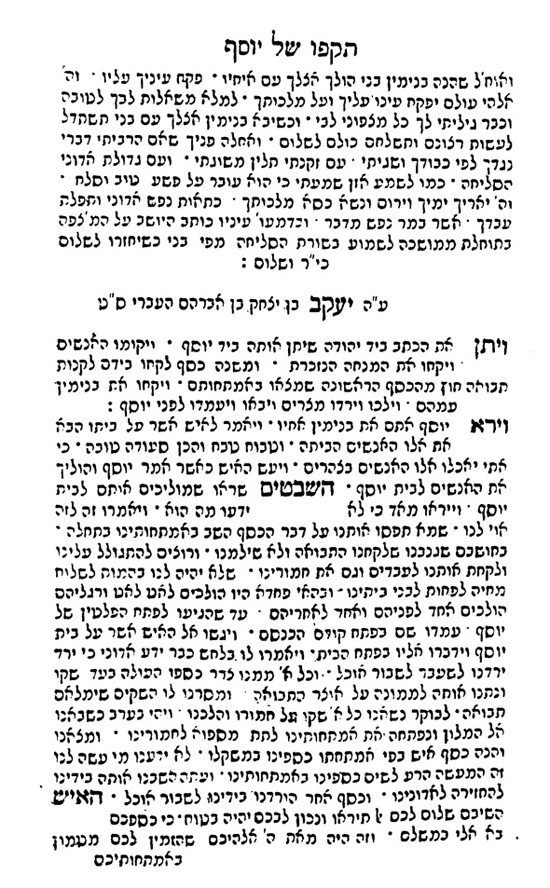
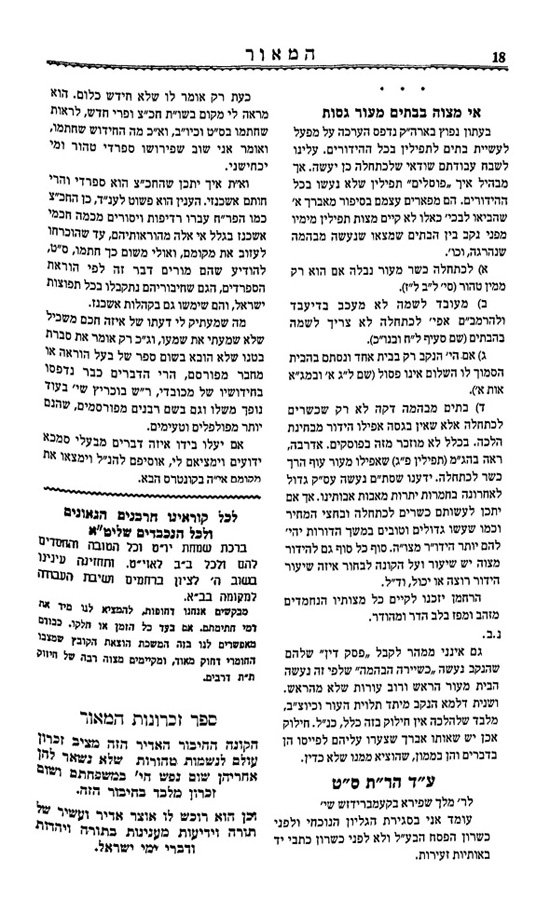
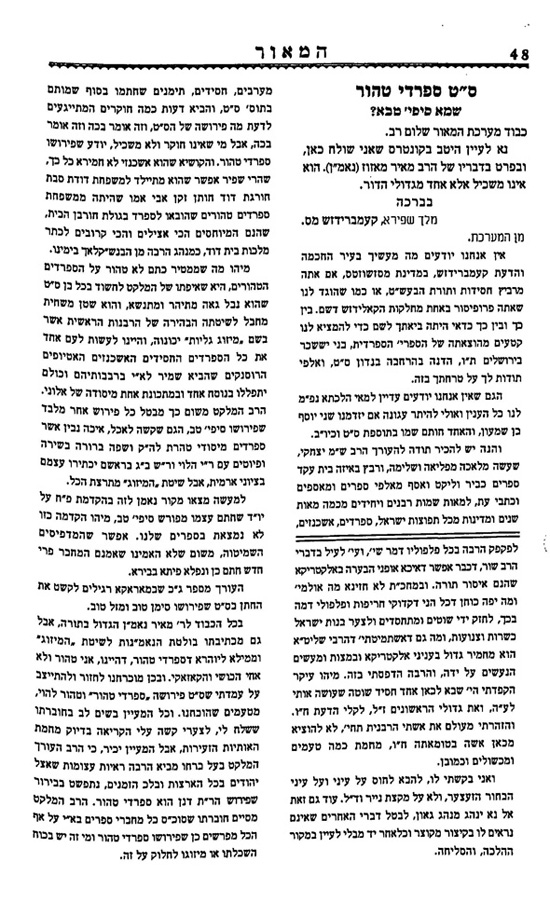
Returning to my post on Adon Olam, the other point dealt with in that post was the meaning of the abbreviation ס”ט. I don’t think anyone who read the post still thinks that it means “Sephardi Tahor.” But in case there are still any doubters, let me offer the following. Here is a page from R. Joseph Shabbetai Farhi’s Tokfo shel Yosef (Livorno, 1846), p. 38b. It contains the end of a letter from none other than Jacob the Patriarch, and you can see clear as day that he also signed himself ס”ט. Now if that isn’t a proof, I don’t know what is. . . .


There was, in fact, one person who did refuse to change his mind, even after I presented him with the evidence. I refer to the late R. Meir Amsel, editor of Ha-Maor. Amsel is deserving of his own post, having edited Ha-Maor for over fifty years. If I were to ever write a history of Orthodox Jews in America, this journal would be an important source, together with its competitor, Ha-Pardes, because in these journals one finds most of the important issues that were part of the American Orthodox experience. Ha-Maor was the more extreme of the two journals, and all sorts of polemics were carried in its pages. But it would also contain all sorts of surprises, and Amsel’s viewpoints were not always predictable. Yet as I mentioned, he didn’t accept what I told him, and changing his mind even in the face of evidence to the contrary was not something he was prepared to do.

Imagine my surprise when after sending Amsel a letter on the topic he published his response in his journal (Jan.-Feb., 1993). Here it is.

I sent him a second letter which he published, together with his response, in the March-April 1993 issue. Notice how he subtly mocks me at the beginning of this reply.


I didn’t take offense at the mocking as this was classic Amsel. Few had such a sharp pen as he, and woe to those he turned it against. To give one example of his many polemics, readers of the journal will never forget how he targeted R. Elya Svei. Yet he wouldn’t mention him by name. Instead, and as a way to show how little he thought of Svei, he referred to him as “the melamed in Philadelphia.”[12]

The March-April 1993 issue of Ha-Maor, in which he responded to me, is of broader interest for another reason. It contains his hesped for R. Joseph B. Soloveitchik, who had recently passed away. In this hesped he mentions a few things, among them that the Rav told him that he wasn’t really a Zionist, and that while Yeshivat R. Yitzhak Elhanan was not in accord with his family’s philosophy, nevertheless he taught there as it provided intellectual freedom.

In the next issue (June-July, 1993), Amsel printed a letter he received from R. Norman Lamm, thanking Amsel for what he wrote about the Rav, and also criticizing him for mentioning the point about the Rav not feeling connected to RIETS. Note how Lamm specifically asked Amsel not to publish his letter, and Amsel published it anyway.

Also, look at the first paragraph on p. 35, as it shows how the Hungarian extremist Amsel was happy to point out how Lamm was head and shoulders above those in the Lithuanian yeshiva world. (I wonder, where did Amsel get the crazy figure of eight thousand students, that he mentions in the second paragraph? Even if you include the post-graduate schools you won’t get to that number. Did Amsel even realize that non-Jews attend Yeshiva University’s medical and law schools?)


* * *

In my original post on Adon Olam I dealt with Artscroll, so here is as good a time as any for some assorted Artscroll comments.

The custom on Rosh ha-Shanah is to sound additional shofar blasts towards the end of the morning prayers. Most sound these blasts after Musaf of Rosh ha-Shanah, while some sound thirty of them during the silent Amidah. There is no talmudic source for this practice. Why then do we do it? Here is how the Artscroll Machzor explains the matter, citing Eliyahu Kitov’s Sefer ha-Toda’ah as the source:

The source of this custom is the Scriptural narrative of the triumph of Deborah the Prophetess over Sisera, the Canaanite conqueror. In her song of gratitude for the victory, Deborah noted that Sisera’s mother whimpered as she worried over the fate of her dead son. Her friends comforted her that he had surely won a great victory and was apportioning spoils and captive women among his officers and troops (Judges 5:28-30). According to the Midrashic tradition she whimpered and groaned 101 times. Although one cannot help but feel sympathy for a worrying, grieving mother, one must be appalled at the cruelty of a mother who could be calmed by the assurance that her son was busy looting and persecuting innocent victims. The Jewish concept of mercy is diametrically opposed to such barbarism. By sounding the shofar one hundred times, we seek to nullify the forces of cruelty exemplified by Sisera and his mother, and bring God’s compassion upon us. Although she whimpered one time more than a hundred, we do not sound the shofar 101 times, because we, too, feel the pain of a mother who loses a child, even one as loathsome as Sisera.

The first thing to note is that for some reason, the explanation offered by the Taz is ignored. According to the Taz, the reason for the extra blasts is because people might not have properly heard the earlier kolot (Orah Hayyim 596:1). Furthermore, despite what is written, there is no source that speaks of Sisera’s mother whimpering 101 times. What we have is a story in the Arukh s.v. ערב , about Sisera’s mother (אימיה דסיסרא) and her one hundred cries or laments (פועיות This does not mean whimpers! The Arukh cites the story as coming from the Jerusalem Talmud. It is lacking in our versions of the Talmud, but the term “Yerushalmi” was also used for various Midrashim written in the Land of Israel.)

Ashkenazim, therefore, indeed sound the shofar the same amount of times as Sisera’s mother’s cries. Yemenites and Sephardim, on the other hand, blow an extra kol at the end, called Teruah Gedolah,[13] so they actually sound 101 blasts. Many explain that they do this precisely in order to be different than Sisera’s mother.

Here for example is what R. Ovadiah Yosef states, Shiurei Maran ha-Rishon le-Tziyon (Jerusalem, 2008), vol. 1, p. 75:

והנה אם סיסרא פעתה ובכתה מאה בכיות, ואנו תוקעים מאה תקיעות ועוד אחד, כדי לבטל הקטרוגים הנמשכים מהבכיות שלה . . . וזהו “הן אתם מאין ופעלם מאפע.” “מאין” = 101 הן ה100 פעיות של אם סיסרא שבמאה ואחת תקיעות שלנו ה’ מכפר לנו, ומתקנים אנו את הפעיות [“אפע” נוט’ פעיות אם] של אם סיסרא.

The Arukh’s explanation is quoted in a number of medieval sources, Yet what is the logic here? Why would anyone have thought of connecting Sisera’s mother’s cries with how many shofar blasts we sound, as they have nothing to do with each other? Is it really possible that how we blow the shofar has anything to do with what the mother of the wicked Sisera did?

It has been suggested by R. Hayyim Yehudah Ehrenreich[14] and R. Menachem M. Kasher[15] that there is a copyist’s error in the Arukh, and instead of reading it should read אמנו שרה , or something along these lines. This suggestion is made based upon the following passage in Pirkei de-Rabbi Eliezer ch. 32:

When Abraham returned from Mount Moriah in peace, the anger of Samael [Satan] was kindled, for he saw that the desire of his heart to frustrate the offering of our father Abraham had not been realized. What did he do? He went and said to Sarah: “Hast thou not heard what has happened in this world?” She said to him: “No.” He said to her: “Thy husband, Abraham has taken thy son Isaac and slain him and offered him up as a burnt offering upon the altar.” She began to weep and to cry aloud three times corresponding to the three Tekiot, three howlings corresponding to the Teruot. and her soul fled, and she died.

In this text we have a connection made between the cries of Sarah and the blowing of the shofar. Here it states that she cried three times corresponding to the Tekiah and three times corresponding to Teruah. (What we call Shevarim is one possibility for how the Teruah should be sounded.) Alternate versions have Sarah crying aloud six times or ninety times.

We still have the problem: How did the name Sarah become confused with Sisera? It turns out that there is indeed a connection between the mother of Sisera and the shofar. Rosh ha-Shanah 33b states:

The length of the Teruah is equal to the length of three yevavot. But it has been taught that the length of the Teruah is equal to three Shevarim. Abaye said: Here there is really a difference of opinion. It is written, It shall be a day of Teruah unto you [Num. 29:1], and we translate [in Aramaic], a day of yabava, and it is written of the mother of Sisera, Through the window she looked forth [va-teyabav; Judges 5:28]. One authority thought that this means drawing a long sigh, and the other that it means uttering short piercing cries.

We see from here that the Sages, in attempting to figure out how the Teruah should be sounded, looked for evidence in a biblical passage dealing with Sisera’s mother. Since she is thus connected to the Shofar blowing, it is not hard to see how the other passage, which describes how Sarah cried, could have morphed into Sisera’s mother.

The problem with this suggestion, one must acknowledge, is that we have no evidence of a text that has Sarah crying one hundred times. Yet it is certainly possible that this tradition did exist, and is now lost.

Here are some more comments about Artscroll. In the original post I mentioned how in the Artscroll Siddur, p. 870, it mistakenly places R. Elaazar Kalir in the second century. R. Avrohom Lieberman pointed out to me that in the original edition of this Siddur they placed Kalir centuries later. Here is a copy of the page.

The change was obviously made in response to criticism. Yet they should have stuck with the original version, since what appears in the “corrected” edition is mistaken. I assume that Artscroll knows it is mistaken, but leaves it in anyway so as not to antagonize its critics.

Before Lekhah Dodi the Artscroll Siddur writes: “לכה דודי is recited responsively. In most congregations, the chazzan repeats each verse after the congregation. In others the procedure is reversed.” More Artscroll siddurim are sold to Modern Orthodox synagogues than to anywhere else. This is especially the case due to the RCA version of the siddur. So wouldn’t one expect that the instructions would reflect reality? In my entire life I don’t think that I have ever been in a Modern Orthodox synagogue that recites Lekhah Dodi responsively. While in the previous post I wrote how the Artscroll instructions have changed how Modern Orthodox synagogues recite Hallel, as far as I know no synagogue has given up the practice of communal singing for Lekhah Dodi because of this particular instruction. As it stands, this particular instruction is a sign of how little Artscroll respects the customs of the Modern Orthodox world.

Also on Friday night, the Siddur states that each stanza of Shalom Aleikhem is recited three times. Why not mention that there is also a common practice to only recite each stanza one time?

In the Machzor for Sukkot, p. 132, in discussing the different practices when it comes to wearing tefillin on hol ha-moed, it states: “It is not proper for a congregation to follow contradictory customs. Thus, if one whose custom is not to wear tefillin during Chol haMoed prays with a tefillin-wearing minyan, he should don tefillin without a blessing. Conversely, if one whose custom is to wear tefillin prays with a non-tefillin-wearing minyan, he should not wear his tefillin while praying but may don them at home before going to the synagogue.” The source for this ruling is the Mishnah Berurah. Yet with the exception of hasidic synagogues, where I presume everyone does the same thing, this ruling is no longer applicable. In all the synagogues I have ever been in, both Modern Orthodox and non-hasidic haredi, there is no one minhag and everyone does what his family practice is. In other words, the minhag today is for everyone to follow his own personal minhag, and shuls do not have a “custom” in this regard.

Also in the Sukkot Machzor, p. 957 (as well as in the other Machzors), it writes as follows: “It is virtually a universal custom that those whose parents are still living leave the synagogue during Yizkor. This is done to avoid the ‘evil eye,’ i.e., the resentment that might be felt by those without parents toward those whose parents are still living.” Can one conclude from this that Artscroll has a Maimonidean approach to the concept of the “evil eye”?

Quiz

In past posts I have offered a quiz and given out prizes to the ones who answered the questions. People have wondered why I stopped doing this. The answer is simple: I didn’t have anything to give out. But now I have a few items so I can do some more quizzes. For the winner of this one I can give a CD of the music of R. Baruch Myers, rav of Bratislava. Rabbi Myers is a trained classical musician and his music is very different from what you think of when you think hasidic music. Unlike in the past, I will not give the prize to the one who answers the question first. This is unfair as due to the different time zones, some people won’t see the question until it has already been answered. I will give people a couple days and if more than one has answered correctly, I will randomly choose a winner. You will also have to answer two questions, in different genres. Yet even if you only know the answer to one, send it in, for if no one gets both answers, I will give it to a person who got one correct. Send answers to shapirom2 at scranton.edu

Question 1: The word for turkey is תרנגול הדו There is a dagesh in the dalet. Why? Bring a proof for your answer from Berakhot between page 34a and 38a.

Question 2: There is a rabbinic phrase that today is used to praise a Torah scholar, but in talmudic days was used in a negative fashion (at least according to Rashi). What am I referring to?

* * * *

Some people have asked me if I am leading a Jewish history trip to Europe this summer. Actually, I am leading two trips, one to Italy and the other to Central Europe. (The latter is a repeat of the sold-out trip from last summer). Both trips are sponsored by Torah in Motion and details will be available soon.


* * * *

Here is something I think readers will enjoy. It is a picture from Prof. Isadore (Yitzchak) Twersky’s wedding. I thank R. Aharon Rakefet for sharing the picture. According to R. Rakefet, the man second to the left, whose face is obscured by an unknown rabbi, is R. Zev Gold. (R. Rakefet claims that the hair gives it away.) Beginning with Gold, we find Dean Samuel Sar, Isadore Twersky (standing) R. Dovid Lifshitz, R. Eliezer Silver, the Rav, R. Chaim Heller, R. Meshullam Zusia Twersky, Tolner Rebbe of Boston, R. Moshe Zvi Twersky, Tolner Rebbe of Philadelphia.

[1] Authorized Daily Prayer Book, p. 790.

[2] This identification has recently been advocated by Christopher W. Mitchell in his massive work, The Song of Songs (St. Louis, 2003), pp. 130ff.

[3] Medieval commentators, notably Ibn Ezra, put a great deal of effort into explaining the peshat. See also the medieval commentary on Song of Songs written by R. Joseph Ibn Aknin, entitled Hitgalut ha-Sodot ve-Hofa’at ha-Meorot (Jerusalem, 1964). Ibn Aknin provides a three part commentary, with one section focused on peshat, and the other two on derash and sod. From more recent times, see R. Samuel Naftali Hirsch Epstein, Imrei Shefer (Vilna, 1873), and R. Eliyahu Halfon Shir ha-Shirim im Perush Ateret Shlomo (Nof Ayalon, 2003).
[4] “Shir ha-Shirim” Kedushatah shel ha-Megilah u-Farshanutah,” Sinai 100 (1987), p. 475.
[5] Soncino explains: “The comparison is between the well-proportioned nose and the beautiful projecting tower.”
[6] This point was made by R. Isaac Jacob Reines. See R. Judah Leib Maimon, ed., Sefer Rashi (Jerusalem, 1956), vol. 2, pp. 12-13. See also Rashi to Song of Songs 1:2 “Let him kiss me with the kisses of his mouth.” Rashi comments: “In some places they kiss on the back of the hand or on the shoulder, but I desire and wish that he behave toward me as he behaved toward me originally, like a bridegroom with a bride, mouth to mouth.” Artscroll does not mention this Rashi. The Vilna Gaon has an interesting comment on this verse. He notes the plural “kisses,” and explains: כמו שנושק הבעל לחשוקתו א’ על מה שמתחברת עמו והב’ על שאינה מתחברת באחר
[7] Perush Shir ha-Shirim (Jerusalem, 1971), p. 11.
[8] See also Ibn Ezra’s introduction to Song of Songs: וחלילה חלילה להיות שיר השירים בדברי חשק Despite saying this, he still feels it is important to explain the peshat.
[9] See also Rav Pealim, vol. 4, Sod Yesharim no. 11, where R. Joseph Hayyim explains why God’s name does not appear in the Song of Songs.
[10] Since we are speaking of love, I should also mention Elhanan Reiner’s provocative claim, put forward in very stylistic Hebrew, that R. Yair Haim Bachrach’s responsum, Havot Yair, no. 60, is not a real case, but simply a fictional love story that Bacharach inserted into his responsa. See here. For Raphael Binyamin Posen’s response see here, and Reiner responds to Posen here.
[11] Incidentally, the opposition of haredi gedolim to these concerts is often portrayed as if the only issue is tzeniut, and therefore, when men and women sit separately there should be no problem. This is a complete distortion of the issue, for even without tzeniut concerns, the main reason for the opposition, and I know this will be hard for American haredim to stomach, is that the Israeli haredi gedolim are opposed to all musical entertainment, and “fun” in general, when not connected to simchah shel mitzvah, such as Purim, a wedding, etc. Concerts are doubly problematic since these gedolim believe that is forbidden to listen to live music when not connected to a seudat mitzvah. Here is one proclamation that makes this clear (from Hashkafatenu [Bnei Brak, 1985], p. 77).

In R. Yaakov Yisrael Lugasi’s Mar’ot ha-Tzovaot (Jerusalem, 2009), p. 401, he states flatly: “The entire concept of entertainment is pasul. This is a condition of moshav leitzim and throwing off the yoke, and is the culture of the non-Jews and the secularists.” Interestingly, a few pages after this, Lugasi prints the herem against wearing jeans skirts. For those who never saw it, here it is.

[12] It is no secret that R. Svei was a polarizing figure in Orthodoxy, even in haredi circles. This is also seen in the book on R. Ahron Soloveitchik written by his son, R. Yosef. It was uploaded to the internet a few weeks ago and until recently was found here. Since many people downloaded the book when it was up, I think it is worthwhile to make some comments about it. I understand that it is a preliminary version of what will be published in book form. I hope the author takes the necessary time to revise it properly, because as it stands, it is an unfortunate publication. On the positive side, it includes a great deal of Torah from R. Ahron, and shows his strong insistence on honesty when it comes to dealing with non-Jews and the government. There are also wonderful tidbits of historical interest. See p. 5 that R. Baruch Ber Leibowitz used to stand up for R. Ahron when he was a child, since he was, after all, the grandson of the Rebbe (R. Hayyim).

See also p. 404 for the following incredible statement: “Rav Ahron told his son that it is not right to print his brother’s דרשה of יוסף ואחיו about the Mizrachi because his brother regretted saying this דרשה ” This is perhaps the most important derashah the Rav ever delivered and is a basic text of study for religious Zionists. It explains how the Rav could break from his family tradition and become a Zionist. It is also the derashah that R. Shakh attacked, saying that it contained דברים שאסור לשומען וכש”כ להפיצן ברבים (Mikhtavim u-Ma’amarim, vol. 4, no. 320). What are we to make of R. Ahron stating that the Rav regretted this derashah?

Among other passages that caught my eye, see e.g., p. 6, where R. Ahron tells a bubba maisah about a rabbi in Auschwitz who killed some twenty Nazis with a chair. On p. 327 R. Ahron claims that Bible Criticism “paved the road for the Nazi ideology.” On this page he also states that Catholics do not support Bible Criticism. This is incorrect. The Catholic Church accepts Bible Criticism and does not see this as harming the holiness of the Bible. In fact, there are only two religious groups that do not accept the academic approach to the Bible, namely, Christian fundamentalists and (most) Orthodox Jews. (In a future post I will explain why I use the word “most”.

Why do I say that this is an unfortunate publication? Because there is a way to write and a way not to write, and someone who is very upset about how his father was treated is not the best person to review important incidents in his life. I can’t see how anyone could believe that the book brings honor to R. Ahron. I am impressed, however, that despite the harshly polemical tone, the author included documents directed against R. Ahron, as this helps with the historical record.

I have to say that after reading the publication, I think I have a better understanding of why R. Ahron had so many difficulties. In order to be a successful leader, one must, at times, be willing to compromise. One must also recognize when the time for battle is over. R. Ahron was so guided by the truth as he saw it, that he appears to have been unable to do this. For him, it was worth fighting a battle to make a point, even if there was no chance of emerging victorious and it would cost lots of money to do so. (I refer to his attempt to cancel the sale of the Chicago Mizrachi building to Buddhists.)

When publishing the letter of the other faculty members of Hebrew Theological College stating that they do not want R. Ahron in a leadership position, the author would have been wise to explain the different perspectives of the protaganists, rather than heaping abuse on them. The same is true when it comes to how he describes the haredim. There is no question that many of his complaints are justified. This is especially the case when he deals with the support given by the haredi gedolim to Elior Chen, which makes everything else pale in comparison. Yet despite this, the language Soloveichik uses in is really over the top.

I also can’t imagine that the family of the Rav will be happy to see how he too makes appearances in the book. Is it really appropriate to quote the Rav’s harsh comment against a certain Agudah leader? And I have a more fundamental question with regard to this last example. When two people agree to take their dispute to a beit din, not a government beit din but a private beit din, don’t they have an expectation of confidentiality? This is especially the case when one of the disputants is still alive. What gives the author the right to reveal the content of a private dispute brought before a private beit din, even if one of the participants did act in a disgraceful manner?

Apropos of R. Ahron, let me mention two things he told me so as to preserve them for posterity.

1. He stated that because of what R. Moshe Stern wrote about the Rav, one should not quote Stern in halakhic discourse. In truth, as I later learnt, it is not so clear that Stern’s harsh comments (pigul, metuav) are about the Rav. It is possible that he is referring to teaching and study at Yeshiva University. (See David Berger in Tradition 27 [Winter 1993], p. 94.) I will let readers judge for themselves. The text appears in Be’er Moshe, vol. 8, no. 3.

2. R. Ahron told me, halakhah le-ma’aseh, that if you have food in the oven when Shabbat starts, that this food can be returned to the oven on Shabbat morning in order to heat it up. I have heard that the Rav gave the same pesak to NCSY, but I have not confirmed this.

[13] See Shulhan Arukh, Orah Hayyim 596:1; Sefer Zikaron Divrei Shelom Hakhamim (Jerusalem, 2003), p. 264.
[14] Otzar ha-Hayyim, Tevet 5695, pp. 87-88.
[15] Ner Maaravi 2 (1925), pp. 227-228; Divrei Menahem, vol. 4, no. 13.


Book Review: Pischei Tefilah u-Mo’ad by Y. S. Spiegel

Book Review

by Eliezer Brodt

פתחי תפילה ומועד, יעקב שמואל שפיגל, ירושלים תש”ע, 540 עמודים.

Pischei Tefilah u-Mo’ad, Y. S. Speigel, Jerusalem: 2010, 540 pp.

Professor Speigel is one of the most prolific writers in the Jewish academic scene, as the author of over 160 articles and 18 books (16 of those are publications for the first time of works which remained in manuscript. The other two are his own original and important studies; one of the latter is reviewed here). His articles cover an incredibly wide range of subjects related to many areas of Jewish Studies, including history of Rishonim, piyutim authored by Rishonim, bibliography and minhaghim, to name but a few. His uniqueness lies not only in the topics but also that his work has appeared in all types of publications running the gamut from academic journals such as Kiryat Sefer, Tarbiz, Sidra, Alei Sefer, Assufot, Teudah, Kovetz Al Yad and also in many prominent Charedi rabbinic journals such a Yeshurun, Yerushasenu, Moriah, Sinai and Or Yisroel. It is hard to define his area of expertise, as in every area he writes about he appears to be an expert! His doctorate was related to later additions in the Talmud by the Savoraim but most of his subsequent work focused on completely different areas. He has edited and printed from manuscript many works of Rishonim and Achronim on Massekhes Avos and the Haggadah Shel Pesach. He is of the opinion, contrary to that of some other academics, that there is nothing non-academic about printing critical editions of important manuscript texts. Although there is a known “belief” in the academic world, “publish or perish,” which some claim is the cause of weak articles and books, at times, Spiegel’s prolific output does nothing to damper the quality of his works. Another point unique to Speigel’s writings, besides his familiarity with all the academic sources, he shows great familiarity with all the classic sources from Chazal, Geonim, Rishonim and Achronim, to even the most recent discussions in Charedi literature – this bekius (breadth) was apparent well before the advent of search engines of Hebrew books and Otzar Ha-hochmah. Alongside all this is his penetrating analysis and ability to raise interesting points. This new collections contains 32 articles related to tefilah, kriyas ha-Torah, halacha and minhaghim related to the mo’adim. Four of these articles are entirely new, and some of the reprinted articles are already classics, quoted and used many times in recent literature. I would just like to list and describe some of the topics, found in this excellent collection. There are parts of the Zecher Tzadik (written in 1467) which is still in manuscript. The section on Pesach was printed by Speigel in a separate book via Ofek. In this collection the Halachos of tefillin and Rosh Hashana were printed. Other articles are various Shu”t from manuscript on a wide range of topics, amongst them, where the Kohanim should say Nesiat Kapayim, a Kotton davening for the Amud, washing when eating vegetables, the fast of the Bechor on erev Pesach, and consumption of sesame oil on Pesach. Each piece has a thorough introduction about the author and topic and the texts contain many useful notes. There is a great article of Hilchos Rosh Hashnah in the Azharot form from Reb Pinchas Halevei, the brother of the Reah. The notes and introduction are very good. I should point out that in the introduction to this piece, Spiegel deals a bit with the famous question of who was the author of the Sefer Hachinuch. Similar pieces in this collection are Azharot from other Rishonim which contains Hilchos Yom Kippur and another on HILchos Succos. Another piece worth mentioning is a teshuvah printed for the first time about the Beracha on Coffee. In the introduction of this piece, Spiegel collects many different aspects of coffee that early Halachic works dealt with. But we should note that his discussion regarding the appropriate shiur (amount) that would require making a beracha acharona really requires an examination of the various forms in which coffee was historically drank. Some coffees are meant to be consumed in small doses while others in larger formats. Today, for example, a typical espresso shot is just an ounce, while a standard cup of coffee is 12 ounces. While espresso is a more recent, it would be helpful to know if one’s position regarding beracha achrona is more a function of size of common cup where the person lived than a sweeping position on coffee generally. There is an article discussing the piyut Achlu Mashmanyim which is customarily recited on Shabbos Chanukah. As an aside, he provides an early source for eating sufganiyot on Chanukah. For Purim he has a large collection of Halachos pertaining to the concept of Venahaphechu – that we do the opposite of what we would think. Another special article related to Purim is a very comprehensive discussion on cross-dressing on Purim and other happy occasions throughout the year. He prints in this collection a Derasha of a talmid of the Rosh on Pesach for the first time (the Halacha part was printed by Speigel in a recent issue of Moriah). One interesting passage in this Derasha which I found was: אם אנשי’ באים ללמוד ונשים באות לשמוע טף למה בא, כדי לתת שכר טוב למביאיהן, אלמא שהתינוקות כמו כן יש שכר גדול למביאיהן לחנכם במצות. ויותר חביב לפני הב”ה בשעה שהתינוקות עונין קדיש או קדושה יותר מגדולים, שאינו דומה הבל שיש בו חטא להבל שאין בו חטא… Hopefully in the future I will return to this topic of bringing kids to shul. Amongst my favorite pieces in this collection is his article on the piyut which we say on the Yomim Noraim of Useshuvha Usefilah Utzedaka. In this piece he deals with piyutim and Halacha- namely, did Paytanim say things contrary to halacha. He deals with the Rambam’s negative opinion of Baalei Azharot (see here). He also deals with the sources of the famous story of Reb Amnon and Unesaneh Tokef. Another favorite piece is his discussion of saying Chazak! when we finish reading each book of the Chumash. A side topic of interest dealt with in this same piece is saying Yashar Koach to the Kohanim after they do nesiat kapyim. Other pieces worth mentioning are his discussions of saying Parsahas Hazinu daily. Another important part of this piece is a discussion of sources for saying Maamodos daily. Another comprehensive piece deals with when the crowd says a Passuk during Krieas Hatorah and Megilot. One last piece worth mentioning is an excellent collection of sources dealing with who decided where the baal koreh stops by each Aliyah. We can only hope that Professor Speigel collects the rest of his articles into a few volumes similar to this collection.


The Religious-Zionist Manifesto of Rabbi Yehudah Leib Don Yahya

The Religious-Zionist Manifesto of Rabbi Yehudah Leib Don Yahya

by Bezalel Naor

In 1901 there appeared in Vilna a 32-page booklet entitled, Ha-Tsiyoniyut mi-nekudat hashkafat ha-dat (Zionism from the Viewpoint of Religion). The author was Yehudah Don Yahya.[1] The final eight pages of the work contain a supplement (Milu’im) by one Ben-Zion Vilner, criticizing the anti-Zionism of the Rebbe of Lubavitch. (One ventures that “Ben-Zion Vilner” is a pseudonym.)

What is remarkable about this manifesto that argues that Zionism is totally compatible with traditional Judaism, is that the author, Rabbi Yehudah Leib Don Yahya, was an intimate student of Rabbi Hayyim Soloveitchik, a most outspoken opponent of the Zionist movement.[2]

To add to the intrigue, Don Yahya’s grandfather, Rabbi Shabtai Don Yahya of Drissa, had been an ardent Hasid of Rabbi Menahem Mendel of Lubavitch (known by his work of Halakhic responsa as “Tsemah Tsedek”).[3] Yehudah Leib himself would go on to serve as rabbi of the Habad Hasidic community of Shklov.[4] Although, as we shall see, within the Habad community, there were differing responses to Zionism along the fault line of the Kopyst—Lubavitch dispute.

Today, students who immerse themselves in the Torah novellae of Rabbi Hayyim Soloveitchik may come across the name of Rabbi Yehudah Leib Don Yahya, but they have no idea who this disciple was. Appended to Hiddushei ha-GRaH he-Hadash ‘al ha-Shas (issued upon the ninetieth anniversary of Rabbi Hayyim’s passing in 2008) are Don Yahya’s memoirs of his beloved mentor in the Volozhin Yeshivah. In 2018 (coincidentally a century since Rabbi Hayyim’s passing) there appeared in print a Tagbuch or diary, in which Rabbi Hayyim jotted down his insights on Talmud and Maimonides’ code.[5] In his introduction to the volume, the editor, Rabbi Yitshak Abba Lichtenstein, notes that Rabbi Hayyim would allow some scholars to copy down entries from the journal. Indeed, one such scholar was Rabbi Yehudah Leib Don Yahya. Two novellae that appear in the Tagbuch were previously published in Don Yahya’s Bikkurei Yehudah (1939).[6]

One asks: What would prompt such a devoted disciple to break from his master’s ideology concerning Zionism?

To understand how such a phenomenon as Yehudah Leib Don Yahya was possible, one needs to trace his membership in Nes Ziyonah, the underground proto-Zionist movement that existed in the Volozhin Yeshivah from 1885 until its disbandment in 1890.let

This was the era of Hovevei Zion (Lovers of Zion), a Russian Jewish movement to settle the Land of Israel that predated Herzlian political Zionism. Nes Ziyonah, which blossomed independently within the ranks of the student body of the famed Volozhin Yeshivah, interfaced with Hovevei Zion, presided over by Rabbi Samuel Mohilever of Bialystok. Members of Nes Ziyonah were sworn to secrecy. The membership included such illustrious scholars as Moshe Mordechai Epstein of Bakst,[7] Menahem Krakovsky,[8] and Isser Zalman Meltzer. Moshe Mordechai Epstein would eventually become Rosh Yeshivah of Slabodka. Menahem Krakowsky would one day assume the position of “Shtodt Maggid” of Vilna. Finally, Isser Zalman Meltzer would become Rosh Yeshivah of Slutzk and later ‘Ets Hayyim of Jerusalem.[9]  It was through the last-mentioned disciple, who was especially close to Rabbi Hayyim Soloveitchik, that Rabbi Hayyim was able to discover the identities of the students who belonged to Nes Ziyonah.[10]

Nes Ziyonah had sprung up without the knowledge of the elder dean of the Yeshivah, Rabbi Naftali Tsevi Yehudah Berlin (NeTsIV). In fact, according to Israel Kausner, who wrote a history of Nes Ziyonah, the members of the secret society prided themselves that they had been able to prevail upon Rabbi Berlin to join the greater Hovevei Zion movement and to assume a role of leadership alongside Rabbis Samuel Mohilever and Mordechai Eliasberg of Bausk.[11] In 1890, somehow Nes Ziyonah came to the attention of the Russian government authorities. One of its leaders (Yosef Rothstein) was arrested but subsequently released. When Rabbi Berlin learned that such a society had sprung up in the Yeshivah under his very nose, he was aghast. He feared that Nes Ziyonah might jeopardize the existence of the Yeshivah, which was under constant government scrutiny.[12] Leaving aside pragmatic considerations, in principle, Volozhin had always been a bastion of pure Torah learning; there was no room in it for Zionist activism.[13] Nes Ziyonah ceased to exist. (Hovevei Zion, with its office in Odessa, was legalized by the Tsarist government in 1890.)[14]

The idealistic young men who had formed Nes Ziyonah were not ones to easily give up. Nes Ziyonah morphed into Netsah Yisrael, whose express goal was to advocate on behalf of Zionism and religion. (Nes Ziyonah had restricted its activities to settling the Land of Israel.) Most prominent in this reincarnation of Netsah Yisrael was—Yehudah Leib Don Yahya.[15]

It is against this backdrop—the publicistic activity of Netsah Yisrael—that one must view Don Yahya’s tract, Zionism from the Viewpoint of Religion.

Let us briefly sum up some of the more salient points of the booklet.

Don Yahya begins by clarifying that the return of the nation to its land can in no way be viewed as the complete redemption prophesied in Scripture. The prophets’ vision, while including the ingathering of exiles, extends beyond that to global mankind’s acknowledging God and embracing His Torah.[16]

On the other hand, Don Yahya is flummoxed by various rabbis who adopt an all-or-nothing attitude to the Zionist organization’s striving to secure from the Ottomans a safe haven for Jews in the Holy Land. Just because the Zionist dream does not encompass the comprehensive vision of our prophets of old, is no reason to reject Zionism. Granted that the Zionist goals are much more modest in scope; that still does not justify opposing the movement. Don Yahya’s own reading of the sources—Biblical and Rabbinic—is gradualist. He anticipates a phased redemption. The Jews’ return to the Land is certainly the beginning, the first installment in a protracted process which will eventually—upon completion of “the full and encompassing redemption” (“ha-ge’ulah ha-sheleimah ve-ha-kelalit”)—culminate in the restoration of the Davidic dynasty in the person of King Messiah and the rebuilding of the Temple.[17]

The author adopts as his paradigm the Second Temple period. Taking issue with those who construe the return from Babylonian captivity as a “temporary remembrance” (“pekidah li-zeman mugbal”), Don Yahya maintains that the Second Commonwealth had the potential to develop into full-blown redemption. With that model in mind, he writes that return from exile and settling the Land can evolve beyond that to greater spiritual dimensions.[18]

After having made his case for the compatibility of the nascent Zionist movement and Judaism, Don Yahya tackles the painful question why some of the great Torah geniuses oppose Zionism.[19]

Don Yahya has a couple of explanations. First, knowledge of Torah is divided into Halakhah and pilpul, on the one hand, and matters of belief and opinion, on the other. Contemporary ge’onim (unlike their medieval predecessors Maimonides and Nahmanides) have devoted their lives to Halakhah, to the exclusion of emunot ve-de‘ot (beliefs and opinions). “In regard to the portion of Torah which is beliefs and opinions, their view does not exceed the view of an average Jew.”[20]

Rather conveniently, Don Yahya holds up as examples of recent Torah authorities who plumbed the depths of the beliefs contained in the Aggadah, and who concluded that the redemption shall begin with the Jews receiving permission to settle the Land of Israel—Rabbis Naftali Tsevi Yehudah Berlin and Mordechai Eliasberg—two rabbis who stood at the helm of Hovevei Zion.[21]

A second reason for the opposition of some ge’onim to Zionism is that they have been fed misinformation (or disinformation) by those of lesser stature who surround them. As the great men eschew reading newspapers, they must rely for information on extremists (kana’im) who skew their perception. They are told that the leaders of the Zionist movement are men who are not simply unobservant in their private lives, but furthermore, intent on uprooting Judaism.[22]

According to Don Yahya, the Zionist leaders profess no proficiency in matters of religion and are amenable to working with the great rabbis in matters pertaining to religion. He cites the example of a responsum from one of the great halakhic decisors of the generation to accommodate the Colonial Bank so that the prohibition of charging interest (ribit) be not transgressed. Don Yahya personally witnessed both the question from Zionist officialdom and the responsum issued by the elderly ga’on.[23] (Undoubtedly, “the elderly ga’on” [“ha-ga’on ha-yashish”] was Don Yahya’s own father-in-law, Rabbi Shelomo Hakohen, the dayyan or chief justice of Vilna.)[24]

Don Yahya points out the democratic character of the Zionist congresses. If more religious Jews would join the ranks of the Zionist movement, they would be able to turn the tide and steer the movement in a more religious direction.[25]

The author chides those religious elements opposed to Zionism not to gloat and say, “We told you so.” In the event that Zionism deviates from Judaism, this will be a self-fulfilling prophecy of doom; the anti-Zionist agitators will then be held responsible for bringing about that outcome by instructing observant Jews to stay clear of the movement.[26]

II.

As stated above, the Milu’im or Excursus of the pamphlet is a harshly worded rejoinder to the Rebbe of Lubavitch, Rabbi Shalom Dov Baer Schneersohn (1860-1920), who had made public his vehement opposition to Zionism on religious grounds.[27]

Again, one asks: How is possible that a staunch Habad Hasid such as Rabbi Yehudah Leib Don Yahya appended such an excursus to his work? From a remove of more than a century this seems inconceivable.

We need once more to place this pamphlet within the context of the times. Today, Habad has assumed a monolithic character, but at the turn of the twentieth century there existed a great divide between two competing “courts” within Habad Hasidism: Kopyst and Lubavitch. When Rabbi Menahem Mendel Schneersohn of Lubavitch (author of the responsa Tsemah Tsedek) passed in 1866, a dispute erupted over succession to the throne. The youngest son, Shmuel (Maharash), remained in Lubavitch and inherited control of that city. An older son, Yehudah Leib (Maharil), moved to the city of Kopyst, taking some of the Hasidim with him.[28] When within a year of the Tsemah Tsedek’s passing, Yehudah Leib passed, his son Shelomo Zalman (author of the Hasidic work Magen Avot) became the Kopyster Rebbe. And when in 1900 the Kopyster Rebbe passed, he was succeeded by his younger brother Rabbi Shemaryah Noah Schneerson (author of the Hasidic work Shemen la-Ma’or). Though there was a brief attempt on the part of Rabbi Shemaryah Noah Schneerson to establish himself in the city of Kopyst, eventually he returned to his rabbinate in Bobroisk, which then became the center of this branch of Habad Hasidism.[29] With the passing of the Rebbe of Bobroisk in 1923, this branch ceased to exist, leaving only the Lubavitch faction. At that point, remnants of the Bobroisker Hasidim transferred their allegiance to the Lubavitcher Rebbe.

In the early years of the twentieth century there erupted a major financial dispute between Bobroisk and Lubavitch regarding control of the purse strings of Kollel Habad in Erets Yisrael. (One may find evidence of the dispute in letters of Rav Kook from this period, when as Rabbi of Jaffa he offered guidance how to come to a compromise.)[30] The tension arose because each Rebbe wanted his representative in Erets Yisrael to be responsible for disbursement of the funds raised by the Hasidim in Russia for the support of their brethren in the Holy Land.

Thus, there are historians who would explain the tension between Bobroisk and Lubavitch as being purely financial.[31] Truth be known, there were ideological issues dividing the two cousins, Rabbi Shemariah Noah of Bobroisk and Rabbi Shalom Dov Baer of Lubavitch. In general, it may be said that the Bobroisker was more progressive, more forward-looking. The Lubavitcher was more old-school, more conservative in outlook. These different Weltanschauungen found expression on many fronts.

When the Russian government sought to demand of the rabbis proficiency in the Russian language, the Bobroisker (as Rabbi Meir Simhah Cohen of Dvinsk) found this a reasonable demand; the Lubavitcher (as Rabbi Hayyim Soloveitchik of Brisk and Rabbi Israel Meir Kagan [a.k.a. Hafets Hayyim]) fought against this proposal tooth and nail.[32]

When it came to deciding which city should serve as the center of Habad Hasidism in Erets Yisrael—Hebron or Jerusalem—Rabbi Shalom Dov Baer militated to retain the center in the provincial town of Hebron rather than allow the center to shift to Jerusalem.[33] In this way, the Lubavitcher Rebbe believed he could shield the Hasidim from the distractions of urban civilization. The Bobroisker did not think it realistic to keep the Hasidim “down on the farm.” Willy-nilly, establishment of a lending library in Hebron would bring secular literature to the curious eyes of Hasidic youth.[34]

And finally, we arrive at the issue with which we began: Zionism. While Lubavitch would have no truck with Zionism, out of the “Kibbutz” (study-hall for advanced rabbinic students) of Bobroisk there would emerge prominent rabbis of the Mizrahi or Religious Zionist movement.[35]

The answer to the question how Rabbi Yehudah Leib Don Yahya, a fervent Habad Hasid, could oppose the Rebbe of Lubavitch is simple: Don Yahya was a Kopyster Hasid,[36] not a Lubavitcher Hasid.

Epitaph on Tombstone of Rabbi Eliezer Don Yahya in Ludza (Lutzin)

צנא מלא ספרא

כלו ספרא מבעל —-

מגזע רבני —-

מחבר אבן שתיה

הרב הגאון ר’ אליעזר

בהרב ר’ שבתי

דון יחייא

ויאסף אל עמיו

ד’ ימים לחדש תמוז

שנת תרפו

[1] Yehudah Leib Don Yahya was born in Drissa (today Verkhnyadzvinsk, Belarus) in 1869 and passed in Tel-Aviv in 1941. Besides this Zionist manifesto, Rabbi Don Yahya published two volumes of Halakha and essays and sermons: Bikkurei Yehudah, vol. 1 (Lutzin, 1930); vol. 2 (Tel-Aviv, 1939).

Volume One of Bikkurei Yehudah was published in Lutzin (Ludza) by the author’s cousin, Rabbi Benzion Don Yahya, Rabbi of Lutzin. At that time Rabbi Yehudah Leib served as Rabbi of Chernigov, Soviet Russia. In his preface to the work, Benzion Don Yahya explains that the manuscript was sent to him for publication because there is no longer a Hebrew press in Russia. On pages 36-38, the Editor traces the lineage of the Don Yahya family. We learn that his paternal grandfather was Rabbi Shabtai Don Yahya, Rabbi of Drissa for sixty years until his death at approximately age 90 in 1907. One of Rabbi Shabtai’s sons, Rabbi Eliezer, became Rabbi of Lutzin (Ludza), a rabbinate inherited by his son, the Editor (Rabbi Benzion). In 1840, there were born to Rabbi Shabtai twins: Menahem Mendel and Hayyim. Menahem Mendel served as Rabbi of Kopyst for some years, passing there in 1920. Hayyim served as Rabbi of Shklov, and after his father Shabtai’s passing, as Rabbi of Drissa, until his own passing in 1913. Hayyim’s son, Yehudah Leib, served as Rabbi in Shklov and Vietka, until he inherited from his father the Rabbinate of Drissa in 1913. (In Bikkurei Yehudah, vol. 2, f. 159, there is a letter dated 5673 [i.e. 1913] from Rabbi Meir Simhah of Dvinsk to Rabbi Don Yahya congratulating him on assuming the rabbinate of his father and grandfather in Drissa.) In 1925, Yehudah Leib was accepted as Rabbi of Chernigov.

In Shklov, Rabbi Yehudah Leib Don Yahya ministered to the “Kehal Hasidim” (exclusive of the Mitnagdim, who would have had their own Rav). (See below note 4.) However, it should be mentioned that the communities of Vietka and Chernigov as well figure prominently in the annals of Habad Hasidism.

The Rabbi of Vietka, Rabbi Dov Baer Lifshitz, author of an important commentary on Tractate Mikva’ot, Golot ‘Iliyot (Warsaw, 1887), refers to Rabbi Shneur Zalman of Liadi as “dodi zekeini” (“my great uncle”). See ibid., Addendum to Introduction, and 7c.

The man who immediately preceded Rabbi Don Yahya as Rabbi of Chernigov, Rabbi David Tsevi (Hirsch) Hen (referred to by the Hasidim as “RaDaTs”) was acknowledged as one of the greatest of Habad Halakhists in his day. In 1925, through the intervention of Chief Rabbi Kook, he was able to emigrate from the Soviet Union to Erets Yisrael together with his daughter Rahel, son-in-law Rabbi Shalom Shelomo Schneerson (brother of Rabbi Levi Isaac Schneerson, Rabbi of Yekaterinaslav, today Dnieperpetrovsk, and uncle of Rabbi Menahem Mendel Schneerson, Lubavitcher Rebbe of Brooklyn), and granddaughter Zelda, who would later achieve fame as a Hebrew poet. See Igrot Re’iyah, vol. 4 (Jerusalem, 1984), Letter 1330 (p. 251), in which Rav Kook attempts to install the recently arrived Rabbi S.S. Schneerson as Rav of Haderah. Rav Kook’s involvement in bringing RaDaTs and family to Erets Israel is discussed in the recently published annals of the Hen Family, Avnei Hen, ed. Eliezer Laine and S.Z. Berger (Brooklyn, NY: Kehot, 2015).

Reviewing the second volume of Bikkurei Yehudah, Rabbi Zevin wrote an especially insightful appreciation of Rabbi Yehudah Leib Don Yahya. Rabbi Zevin, himself a Habad Hasid, noted how rare it was to find in the twentieth century a Habad Hasid who combined both persona of the maskil (intellectual) and the ‘oved (master of contemplative prayer). (In the latter connection, Rabbi Zevin observed that Rabbi Don Yahya wore daily three pairs of tefillin: Rashi, Rabbenu Tam, and Shimusha Rabbah.) Beyond Habad Hasidism, Don Yahya mastered Rabbi Hayyim Soloveitchik’s method of Talmudic analysis and the process of pesikah (Halakhic decision) of Don Yahya’s father-in-law, Rabbi Shleimeleh Hakohen, the Dayyan of Vilna. See Rabbi Shelomo Yosef Zevin, Soferim u-Sefarim (Tel-Aviv: Abraham Ziyoni, 1959), pp. 296-300.

It is noteworthy that the volume contains a responsum to Rabbi Mordechai Shmuel Kroll, the Rav of Kefar Hasidim in Erets Yisrael, and a Halakhic novella of Rabbi Kroll. See Bikkurei Yehudah, vol. 2, ff. 121-129, 160-162. Rabbi Kroll was the eminent disciple of Rabbi Don Yahya.

[2] Rabbi Hayyim Soloveitchik’s opposition to Zionism is well known. One particular statement should illustrate how extreme was Rabbi Hayyim’s opposition to the new movement. The following incident took place in Minsk in 1915 (when many Jews were forced to flee their homes before the German invasion and seek refuge in the large city located farther east).

Young Raphael Zalman Levine was walking down the street with his father, Rabbi Abraham Dov Baer Levine (known as the “Mal’akh,” the “Angel”). Pinned to the adolescent’s lapel was an insignia of the Keren Kayemet le-Yisrael (Jewish National Fund), to which he had recently donated. The elder Levine was adamantly opposed to the Zionist enterprise and demanded that his son remove the pin, which he found offensive. Father and son were in the midst of an intense argument when, lo and behold, they saw approaching them from the opposite direction none other than the great Rabbi Hayyim Soloveitchik.

Rabbi Levine said to Rabbi Soloveitchik: “My son wants to ask you a she’elah (question).”

Rabbi Soloveitchik turned to Raphael Zalman: “You can ask your father.” (Rabbi Levine and Rabbi Soloveitchik were friends.)

Rabbi Levine persisted: “My son wants to ask you a she’elah in emunah (a matter of faith).”

“Emunah?” Rabbi Soloveitchik’s face now assumed a serious expression.

Young Raphael Zalman was put on the spot and forced to ask Rabbi Hayyim what he thought of his donation to the Jewish National Fund.

It just so happened that across the street was a church.

Rabbi Hayyim responded to his young questioner: “If you have a few spare kopecks in your pocket, you can place them there rather than in the pushke of the Keren Kayemes.”

(Reported by RYYL and by Prof. Richard Sugarman who both heard this anecdote from the mouth of Rabbi Raphael Zalman Levine of Albany, New York, on two separate occasions.)

The episode is also reported in Rabbi Raphael Zalman Levine’s name in Rabbi C.S. Glickman, Mi-Pihem u-mi-Pi Ketavam (Brooklyn, NY, 2008), pp. 119-120.

Though the sharpness of Rabbi Hayyim Soloveitchik’s statement is shocking, Halakhic opposition to donating to the Zionist cause was shared by several East European rabbinic leaders. A decade later in 1925, four distinguished leaders of Polish Jewry, the Hasidic Rebbes of Gur, Ostrovtsa, Radzyn, and Novominsk, addressed a letter to Rav Kook adjuring him to curtail his support of Keren Kayemet le-Yisrael and Keren ha-Yesod. See Igrot la-Rayah, ed. B.Z. Shapiro (Jerusalem, 1990), Letter 199 (pp. 303-304); facsimile on p. 590.

Rav Kook, unlike the Polish Rebbes, differentiated between the two funds, lending his support to Keren Kayemet le-Yisrael, which directed funds to the physical reclamation of the land, but not to Keren ha-Yesod, which funded secular (and perhaps anti-religious) culture. See Rabbi Tsevi Yehudah Hakohen Kook, Li-Sheloshah be-Ellul, vol. 1 (1938), par. 44 (p. 22); Igrot ha-Rayah, vol. 5: 5682, ed. Ze’ev Neuman (Jerusalem, 2019), pp. 407-413.

[3] According to his namesake and great-grandson, journalist Shabtai Don Yahya (who wrote under the pen name of “Sh. Daniel”), the Rabbi of Drissa was known in Lubavitch as “Reb Shebsel Drisser.” Sh. Don Yahya wrote that it was said that the Rabbi of Drissa might have become one of the great men of the generation in terms of Talmudic learning, but his Hasidic exuberance stunted his academic growth. See Shabtai Don Yahya, Rabbi Eliezer Don Yahya (Jerusalem, 1932), pp. 10-11.

(The title-page makes the point that the book bears the encomium of Chief Rabbi Kook. Shabtai Don Yahya was one of the first students of Merkaz Harav and a devoted disciple of Rav Kook. Rabbi Eliezer Don Yahya is a biography of the author’s paternal grandfather, the Rabbi of Lutzin, son of Rabbi Shabtai Don Yahya. As a youth, Avraham Yitshak Hakohen Kook studied under Rabbi Eliezer Don Yahya in Lutzin. Rabbi Eliezer Don Yahya was born 4 Tammuz 5598 [i.e. 1838] and passed on his birthday, 4 Tammuz 5686 [i.e. 1926]. See the epitaph on his tombstone at the conclusion of this article. A photograph of the funeral of Rabbi Eliezer Don Yahya in Lutzin in 1926 may be found in Rabbi Yitzhak Zilber’s autobiography, To Remain a Jew. Zilber’s original surname was “Ziyoni.” Rabbi Eliezer Don Yahya inherited the rabbinate of Lutzin from his illustrious father-in-law Rabbi Aharon Zelig Ziyoni.)

Rabbi Yehudah Leib Don Yahya often quotes the Tsemah Tsedek in his Halakhic responsa.

[4] In the biography of Rabbi Yehudah Leib Don Yahya in Shmuel Noah Gottlieb’s Ohalei Shem (Pinsk, 1912), p. 207, s.v. Shklov, it states that Don Yahya assumed the rabbinate of Shklov in 1906. However, as early as Friday, 17 Menahem Av [5]664,” i.e. 1904, Rabbi Shelomo Hakohen addressed his son-in-law as “Rav Av-Beit-Din of the congregation of Hasidim of Shklov.” See Bikkurei Yehudah, vol. 2 (Tel-Aviv, 1939), 145a.

In Shklover Yidden (1929) and Feter Zhoma (1930), the Yiddish and Hebrew poet and writer Zalman Shneur portrayed the Hasidim of his birthplace.

Earlier, Rabbi Yehudah Leib’s father, Rabbi Hayyim Don Yahya, had served as Rabbi of Shklov. A halakhic responsum of Rabbi Hayyim Don Yahya (datelined “5653 [i.e. 1893], Shklov”) was published in the journal of the Skvere Kollel, Zera‘ Ya‘akov 26 (Shevat 5766 [i.e. 2006]), pp. 17-21. On p. 20, Rabbi Hayyim mentions the learned opinion of his brother from Kopyst [i.e. Rabbi Menahem Mendel Don Yahya].

[5] Rabbi Yitshak Lichtenstein writes in the introduction to the volume that there were many such Tagbikher that were lost to posterity. This particular journal was inherited by Rabbi Hayyim’s son, Rabbi Moshe Soloveitchik. (Behind the scenes, the Tagbuch was made available to Rabbi Lichtenstein by his maternal uncle, Prof. Haym Soloveitchik of Riverdale, son of Rabbi J.B. Soloveitchik of Boston, son of Rabbi Moshe Soloveitchik.)

[6] See Bikkurei Yehudah, vol. 2 (Tel-Aviv, 1939), 142a-144b. The volume was edited by the author’s son-in-law Rabbi Yitshak Neiman. Rabbi Zevin explains that though the volume was submitted for publication in 1939, it was not issued until 1941, a few weeks before the author’s passing. See S.Y. Zevin, Soferim u-Sefarim (Tel-Aviv: Abraham Ziyoni, 1959), p. 297. The two novellae of Rabbi Hayyim Soloveitchik (to Bava Kama 13a and Ketubot 21a) were reprinted in the memorial volume for Rabbi Neiman, Zikhron Yitshak (Jerusalem, 1999), along with several novellae of his father-in-law, Rabbi Don Yahya.

[7] See Israel Klausner, Toledot “Nes Ziyonah” be-Volozhin (Jerusalem: Mossad Harav Kook, 1954), pp. 25, 65, 113. Moshe Mordechai Epstein appears in a group photo on p. 26.

[8] Ibid. p. 24.

[9] Rabbis Epstein and Meltzer would eventually become brothers-in-law by their marriage to two sisters, daughters of the Maecenas Shraga Feivel Frank of Kovno.

[10] Heard from Rabbi Yosef Soloveichik of Jerusalem (son of Rabbi Ahron Soloveichik of Chicago), a great-grandson of Rabbi Hayyim Soloveitchik. Rabbi Yosef Soloveichik explained the exact halakhic reasoning whereby his ancestor was able to release young Isser Zalman Meltzer from his solemn oath.

This Soloveichik family tradition, which reflects Rabbi Hayyim’s disapproval of Nes Ziyonah, seems to fly in the face of Yosef Rothstein’s memoir, whereby Rabbi Hayyim rejoiced at Rothstein’s release after he had been arrested by the Russian police:

Also the Gaon Rabbi Hayyim of Brisk, of blessed memory, greatly rejoiced over me. He received me with joy and brought me before the NeTsIV, of blessed memory, who was pleased by my return, though he did say to me that this is not the place [for activism]. “A mitsvah that can be performed by others, we do not cancel for it the study of Torah” [MT, Hil. Talmud Torah 3:4]…Evidently, the NeTsIV too was content but had to act as if he disapproved…

(Yosef Rothstein, in Israel Klausner, Toledot “Nes Ziyonah” be-Volozhin, p. 123)

See earlier on p. 13 the NeTsIV’s opposition to students taking time out from their Torah study for activism—even on behalf of a cause as dear to NeTsIV’s heart as Yishuv Erets Yisrael.

[11] Ibid. p. 14.

[12] Ibid. p. 19.

[13] See above note 10.

[14] Klausner, Toledot “Nes Ziyonah” be-Volozhin, p. 21.

[15] Ibid. pp. 22-24. The members of Netsah Yisrael were also sworn to secrecy. Netsah Yisrael lasted until the closing of the Volozhin Yeshivah by the Russian authorities in 1892.

[16] Ha-Tsiyoniyut mi-nekudat hashkafat ha-dat, pp. 5-6.

[17] Ibid. pp. 6-7.

[18] Ibid. pp. 7-10.

[19] Ibid. p. 15.

[20] Ibid.

[21] Ibid. p. 16.

[22] Ibid.

[23] Ibid. pp. 16-17. Don Yahya does not go into Halakhic details. Usually, the way to circumvent the problem of ribit (interest) is by drafting a “heter ‘iska.” Rabbi Tsevi Yehudah Hakohen Kook relates that when the Zionist Colonial Bank was founded, his father, Rabbi Avraham Yitshak Hakohen Kook, entered into negotiations with the Zionist officials and rabbis, which resulted in a “shtar heter ‘iska.” See Rabbi Tsevi Yehudah Hakohen Kook, Li-Sheloshah be-Ellul, vol. 1 (1938), par. 17 (pp. 11-12).

[24] The elderly Dayyan of Vilna, Rabbi Shelomo Hakohen (author of Heshek Shelomo) was exceptionally respectful of Theodor Herzl when the latter visited Vilna, extending to him the priestly benediction at a reception in Herzl’s honor. See Israel Cohen, History of Jews in Vilna (Philadelphia: Jewish Publication Society of America, 1943), p. 350; and Israel Klausner, Vilna: “Jerusalem of Vilna,” 1881-1939, vol. 2 (Hebrew) (Israel: Ghetto Fighters’ House, 1983), p. 339.

Another son-in-law of Rabbi Shelomo Hakohen, Rabbi Nahum Greenhaus of Trok (Lithuanian, Trakai), a suburb of Vilna, was, like Don Yahya, an outspoken advocate of Zionism. Because of their support of the movement, both Rabbi Shelomo Hakohen and Rabbi Nahum Greenhaus suffered persecution by anti-Zionist elements in Lithuanian Jewry. See Klausner, ibid. pp. 330-333.

Rabbi Nahum Greenhaus’ namesake was Rabbi Nahum Partzovitz (known in his youth as “Nahum Troker”), who would one day become the illustrious Rosh Yeshivah of the Mirrer Yeshiva in Jerusalem. Rabbi Nahum Partzovitz’s father, Rabbi Aryeh Tsevi Partzovitz, inherited the rabbinate of Trok from his father-in-law, Rabbi Nahum Greenhaus.

A third son-in-law of Rabbi Shelomo Hakohen of Vilna was Rabbi Meir Karelitz, older brother of Rabbi Abraham Isaiah Karelitz (author of Hazon Ish), who was prominent in Agudah circles, both in Vilna and later in Erets Yisrael.

[25] Ha-Tsiyoniyut mi-nekudat hashkafat ha-dat, p. 17.

[26] Ibid.

This modern disagreement sounds vaguely reminiscent of the disagreement between Resh Lakish and Rabbi Yohanan in Talmud Bavli, Yoma 9b-10a. Resh Lakish said of Babylonian Jewry: “God hates you. If you had gone up to the Land of Israel en masse in the days of Ezra, the divine presence would have rested in the Second Temple and there would have been a resumption of full-blown prophecy. Now that you have gone up in pitifully small numbers (dalei dalot), but a remnant of prophecy remains, the bat kol (heavenly voice).” Rabbi Yohanan responded: “Even if all of Babylonian Jewry would have gone up to the Land in the days of Ezra, the divine presence would not have rested in the Second Temple, for it is written: ‘God will broaden Japheth and dwell in the tents of Shem’ [Genesis 9:27]. Though God will broaden Japheth, the divine presence rests only in the tents of Shem.” Rashi explains that the divine presence was prevented from resting in the Second Temple because it was built by the Persians; the divine presence rested only in the First Temple which was built by Solomon of the seed of Shem.

Evidently, Rabbi Don Yahya (like Resh Lakish) was convinced that that what was crucial to effecting a spiritual revolution in Erets Yisrael was a critical mass. His opponents (like Rabbi Yohanan) could not be swayed that it was merely a matter of numbers. To their thinking, non-Jewish influence at the very inception of the Zionist movement would preclude it from bringing about the hoped for spiritual renascence so woefully lacking in the Jewish collective.

[27] See ’Or la-Yesharim (Warsaw, 1900), pp. 57-61. For other (later) recordings of Rabbi Shalom Baer Schneersohn’s anti-Zionist stance, see Bezalel Naor, When God Becomes History: Historical Essays of Rabbi Abraham Isaac Hakohen Kook (New York, NY: Kodesh Press, 2016), p. 168, n. 10.

[28] In his autobiography, Chaim Tchernowitz (“Rav Tsa‘ir”) revealed some of the intrigue in the aftermath of the Tsemah Tsedek’s passing that led to the Kopyst-Lubavitch schism. See Ch. Tchernowitz, Pirkei Hayyim (New York, 1954), pp. 104-106.

[29] See Hayyim Meir Heilman, Beit Rabbi (Berdichev, 1902), vol. 3, chap. 9.

[30] See Igrot ha-Rayah, vol. 1 (1962), Letter 39 (pp. 34-36), to Rav Kook’s maternal uncle, Rabbi Yehudah Leib Felman of Riga, a Kopyster Hasid. The letter is datelined, “Jaffa, 3 Marheshvan, [5]667,” i.e. 1906.

[31] Roughly thirty years ago I heard this monetary explanation from Rabbi Chaim Liberman, who had served as personal secretary and librarian of Rabbi Joseph Isaac Schneersohn of Lubavitch.

Interestingly enough, in the 1880s there emerged a theological dispute between the Rebbes of Kopyst and Lubavitch. The way it came about was in the following manner. After the passing of Rabbi Samuel (Maharash) of Lubavitch in 1882, his sons published an edition of their ancestor Rabbi Shneur Zalman of Liadi’s Torah ’Or on the first three parshiyot or pericopes (Bereshit, Noah, Lekh Lekha). Entitled Likkutei Torah, it was brought out in Vilna in 1884. The publishers took the liberty of incorporating into the text comments of the recently deceased Rabbi Samuel Schneersohn. The Kopyster Rebbe, Rabbi Shelomo Zalman Schneerson (author of Magen Avot) was outraged and penned a public letter of protest.

One comment of his uncle Rabbi Samuel (to Parashat Noah) in particular provoked the Kopyster Rebbe, this touching on the proper way to understand Rabbi Isaac Luria’s metaphor of Tsimtsum. In three letters to Rabbi Dan Tumarkin of Roghatchov (a Lubavitcher Hasid), the Kopyster Rebbe clarified his position on Tsimtsum and how it differed from that of Rabbi Samuel Schneersohn. The correspondence is briefly alluded to in H.M. Heilman, Beit Rabbi, vol. 3, chap. 10, s.v. Rabbi Dan Tumarkin. The entire exchange is available in Rabbi Mordechai Menashe Laufer, Ha-Melekh bi-Mesibo, vol. 2 [Kfar Habad, 1993], pp. 283-293. (This truly fascinating correspondence was brought to my attention a generation ago by Baruch Thaler.)

Regarding the publication of Likkutei Torah (Vilna, 1884), see further Hayyim Meir Heilman, Beit Rabbi, vol. 1, 87a; vol. 3, 16a, 28a; Rabbi Yehoshua Mondshine, “‘Likkutei Torah’ le-Shalosh Parshiyot,” Kfar Habad, nos. 931, 933. Available online at http://www.shturem.net/index.php?section=blog_new&article_id=29

[32] This issue was raised at the rabbinical conference held in St. Petersburg in 1910. The decisions reached by the delegates were relayed to Stolypin, Minister of the Interior. Some of the heated exchange between the Bobroisker and the Lubavitcher behind closed doors has been preserved in the memoirs of Isaac Schneersohn, one of the delegates to the conference; see I. Schneersohn, Leben un kamf fun Yiden in Tsarishen Rusland 1905-1917 (Paris, 1968). The chapters concerning the 1910 conference were translated from Yiddish into Hebrew by Rabbi Yehoshua Mondshine, “Asifat ha-Rabbanim be-Rusya bi-Shenat ‘Atar,” Kfar Habad, no. 898. Availble online at: http://www.shturem.net/index.php?section=blog_new&article_id=24

According to Isaac Schneersohn, it was none other than he (Crown Rabbi of Chernigov) who proposed abolishing the position of Kazyonny Ravin (in Hebrew, “Rav mi-Ta‘am,” or Crown Rabbi), thus wresting authority from the secular-trained, modern “Rabbiner” and consolidating communal power in the hands of the Talmudically-trained traditional Rav—provided he be proficient in the Russian language.

[33] Historically, the Habad community in Hebron preceded that of Jerusalem. In 1823, Rabbi Dov Baer Shneuri of Lubavitch (“Mitteler Rebbe”), the second-generation leader of the Habad movement, founded a Habad community in Hebron. Later, in 1847, a group of Habad families from Hebron relocated to Jerusalem.

[34] See Kuntres me-Admo”r shelit”a mi-Bobroisk: Teshuvot nitshiyot va-amitiyot ‘al Kuntres Admo”r shelit”a de-Libavitz (1907).

[35] Two names come to mind: Rabbi Nissan Telushkin in the United States and Rabbi Shelomo Yosef Zevin in Erets Yisrael. Both studied in the “Kibbutz” of the Bobroisker Rebbe and received ordination from him. Eventually, with the extinction of Bobroisker Hasidism, both Telushkin and Zevin would transfer their allegiance to Lubavitch. However, their affiliation with the Religious Zionist movement could at times place them in an unenviable position. Particularly Rabbi Zevin oftentimes found himself between a rock and a hard place. Rabbi Menachem Mendel Schneerson, the Lubavitcher Rebbe residing in Brooklyn, would on occasion expect of Rabbi Zevin to promote positions at variance with his Mizrahi colleagues in Erets Yisrael (such as Chief Rabbi Isaac Halevi Herzog). See Marc B. Shapiro, Changing the Immutable: How Orthodox Judaism Rewrites Its History (Oxford: Littman, 2015), pp. 235; 238, n. 87.

A brief autobiographical sketch of Rabbi Telushkin (a native of Bobroisk) is found at the conclusion of his Halakhic work on mikva’ot (ritual baths), Tohorat Mayim (Brooklyn, NY: Kehot, 1990), pp. 355-356 (“Le-Zikaron”).

[36]In Rabbi Don Yahya’s letter to Rabbi Shelomo Yosef Zevin concerning the counterintuitive thought process that informed Rabbi Hayyim Soloveitchik’s Halakhic decisions, Rabbi Don Yahya refers to himself as a “Hasid [of] Kopyst.” The context is Rabbi Hayyim’s desire to procure a “Yanover esrog” (citron from Genoa, Italy) to fulfill the commandment, in compliance with the tradition of Habad, and earlier the Hatam Sofer, Orah Hayyim, no. 207. See Hiddushei ha-GRaH he-Hadash ‘al ha-Shas (B’nei Berak: Mishor, 2008), p. 586.

However, in Zikhron Yitshak (Memorial Volume for Rabbi Yitshak Neiman) (Jerusalem, 1999), p. 141 (which is the source of Hiddushei ha-GRaH), Rabbi Don Yahya refers to himself as a “Hasid (Habad).” It would be interesting to see the original of the letter, which may yet be in the hands of the heirs of Rabbi Zevin. From the fact that the word “Habad” is placed in parentheses, one is inclined to assume that this is an addition on the part of an editor (Rabbi Zevin?). According to the Introduction (“Petah Davar”) to Zikhron Yitshak, this is the first publication of the letter from Rabbi Don Yahya to Rabbi Zevin.

Klausner, Toledot “Nes Ziyonah” be-Volozhin, p. 17, records that in 1889, the members of Nes Ziyonah were able to elicit letters of support for the conception of Yishuv Erets Yisrael from the Hasidic Rebbes of Kopyst and Bohush (a branch of Ruzhin).


Book review – Nafshi BiShe’elati: The Halakhot of Mental Health

Book review – Nafshi BiShe’elati: The Halakhot of Mental Health

Ben Rothke


T.J. Hooper was a precedent-setting tort case[1] in 1932. Two tugboats, one of which was The T.J. Hooper, were towing barges. During a storm, the barges sank, and their cargoes lost. The owners of the cargo sued the barge owners, who in turn sued the tugboat owners. The barge owners claimed that the tug operators were negligent because they failed to equip their tugs with radios that would have warned them of the bad weather.

The tugboat companies defended under the prevailing practice theory. They claimed that because no other tugboat operators in the area were using radios, this constituted the industry standard of care.

Judge Learned Hand found the tugboat companies liable because they did not use readily available technology, radio receivers, to listen for broadcast weather reports, even though radio use was not yet standard industry practice 

Judge Hand observed, “Indeed, in most cases, reasonable prudence is, in fact, common prudence, but strictly it is never its measure. A whole calling may have unduly lagged in the adoption of new and available devices. Courts must in the end say what is required. There are precautions so imperative that even their universal disregard will not excuse their omission”.

I thought of the T.J. Hooper case when reading a most remarkable new book Nafshi BiShe’elati: The Halakhot of Mental Health[2] by Rabbi Yonatan Rosensweig and Dr. Shmuel Harris. Mental health is virgin ground in halacha and requires the subtle judgment of the most seasoned poskim. When Rav Asher Weiss used the term OCD in his teshuva in 1994 (Minchat Asher 2:134), it was, as I understand it, the first usage by a posek of the term OCD.

The authors quote Rav Shlomo Zalman Auerbach (1910-1995) who was asked if one may turn on an electronic device on Shabbat to play music for a choleh sheyesh bo sakana who likes it. Rav Auerbach responded, “My son may permit this, but I have difficulty.”

He explained, “When I was growing up, a sick person needed warmth, food, and drink. While I can understand these new psychological needs, like music, are in fact needed—of course you are right—it is very difficult for me to permit them.”

A century ago, giving the sick person, be it one who was physically ill or with a mental malady, warmth, food, and drink was all one could do. This was an era where ear infections were fatal, and those with mental illnesses were considered incapable of being productive members of society or even counted as part of a minyan.

Today, with far-reaching advances in mental health care and pharmacology, a rabbi today who provides a congregant with warmth, food, and drinks instead of a referral for psychological care may have blood on his hands. The authors write that rabbis should avoid trying to provide psychological treatment in place of a licensed professional.

This is required even though the rabbi’s role throughout history as a spiritual guide in whom his disciples and community can confide is still as crucial as ever. He should differentiate between someone in need of sage counsel or an attentive ear and someone with a mental illness who needs professional care. Consequently, it is imperative that rabbis receive mental health training so that they can adequately distinguish between mental states and identify signs that warrant referral for professional treatment.

The authors are a remarkable pair with Rosensweig, the accomplished rabbinic scholar, and Harris, the physician. Rosensweig serves as the Rabbi of the Netzach Menashe synagogue in Beit Shemesh, Israel. He also teaches in various post-high school institutions and is the author of a number of books. In 2021, he founded Maagalei Nefesh[3], on an organization that deals with issues about mental health and halakha.

Harris is a psychiatrist who has served as the former head of psychiatric services at Hadassah Mt. Scopus. He is also the founder of Machon Dvir[4], a mental health organization servicing the English-speaking community in Israel.

The late Chicago-based posek Rav Gedalia Dov Schwartz said when dealing with transgender issues, “They didn’t really prepare me for this in yeshiva.” Schwartz echoed the sentiment that what was studied in the pristine study halls was often theoretical and abstract and didn’t match what was occurring in the real world.

When it comes to mental health, many communal rabbis are finding that yeshiva didn’t prepare them to deal with congregants who have mental health issues. Many of which can be exacerbated by halacha. These rabbis must be educated in various areas and understand the many mental health issues to properly and effectively minister to their congregants.

Eating, for example, plays a large part in Jewish life. Between the weekly Sabbath meals, the Passover seder, and various holiday meals, nearly 20% of the Jewish calendar revolves around meals or a fast.

So when a rabbi has a congregant with anorexia nervosa or other types of eating disorders, how they respond can have life or death repercussions as eating disorders have one of the highest mortality rates in comparison to other psychiatric illnesses, as 20% of anorexia nervosa deaths, are due to suicide. In addition, those with eating disorders are much more likely to engage in self-harm and experience suicidal ideation.

Anorexia nervosa is germane not just to eating but to fasting also. The authors detail situations where a person suffering from anorexia nervosa would be obligated to eat on a fast day, including Yom Kippur.

Most rabbis will wear out their copies of Hamadrich, The RCA Lifecycle Guide[5], as it is the go-to guide for various lifecycle events. Yet when it comes to mental health and halacha, there is no Hamadrich. And that is precisely the gap that Nafshi BiShe’elati brilliantly fills.

The book deals with every area where mental health and halacha intersect: Shabbat and holidays, marriage, divorce, relationships, prayer, kashrut, and much more.

As the authors live in Israel, they quote heavily on Israeli poskim. Readers will be introduced to poskim such as Rabbis Eliyahu Abergel, Reem Hacohen (Rosh Yeshiva of Yeshivat Otniel), Yuval Cherlow (Rosh Yeshiva of Yeshivat Hesder Amit Orot Shaul), and more.

In many areas, halacha addresses the status of the shoteh, someone not in total control of their mental facilities. The concept of shoteh is a difficult one to define and has been applied in relation to many different cases. The most common uses of the term have been reserved for and most closely describe the clinical phenomenon of psychosis, the state in which the individual lacks the ability to distinguish reality from fantasy.

With that, the book open with an analysis of shoteh, and the different levels it entails, including shoteh gamur, general shtut, shoteh ledavar ehad, and more. Defining what and who a shoteh is not an academic exercise. It can, in fact, have life-and-death consequences.

One is allowed to violate the sabbath for someone as the presumption is that it will enable them to observe many sabbaths in the future. One could argue, although the halacha is not like this, that Shabbat may not be violated to save a shoteh, as it will not bring them to observe more Shabbatot.

While a shoteh is exempt from the performance of mitzvot, the Maharil writes that if a man has a son who is a shoteh, he has fulfilled the mitzva of procreation, as writes that the shoteh has a soul, is a bar mitzva, and those of sound mind are cautioned about him.

The authors quote heavily from the late Rav Nahum Rabinovitch (former Rosh Yeshiva of the hesder yeshiva Birkat Moshe in Ma’ale Adumim). Rav Rabinovitch’s genius was matched by his sensitivity to the human condition.

Rav Rabinovitch believed that the very act of performing a mitzva can preserve a sense of being in good health for the shoteh, so it is important for them to perform mitzvot with or without assistance.

In Rupture and Reconstruction: The Transformation of Contemporary Orthodoxy[6] Professor Haym Soloveitchik writes of the swing to the right, where a significant increase in chumras has had significant consequences for Jewish society and the nature of Jewish spirituality.

When dealing with the halachic needs of those with mental health issues, the authors quote valid halahic sources which show how far right and strict things have become as normative halacha. This includes countless things from running and jumping on Shabbat, having non-Jews play instruments on Shabbat for newly married couples (which was the custom in Ashkenaz during the Middle Ages), certain aspects of mikvah usage for women, and more.

As to mikvah use, women with anorexia suffer intensely whenever they must attend to their body or appearance. Cleaning the body and preparing it for mikvah immersion is not a simple affair for them, as it brings negative feelings about their body, sometimes including disgust, to the surface.

The authors write that it is very important for rabbis answering questions from women with eating disorders to be sensitive to their tremendous difficulties and instruct them to go easy on the mikvah preparations and do only the absolute minimum required by Halacha.

Similarly, the mikveh attendants must be aware when someone has an eating disorder and should respect their privacy and do their best to create a pleasant and relaxed environment for them.

The concept of yeridat hadorot is the belief in the intellectual inferiority of subsequent and contemporary Torah scholarship and spirituality compared to that of the past. Yet when it comes to dealing with those who are deaf, mute, or both; and those with mental health issues, one can certainly say it is aliya hadorot. Our ability today to deal with and integrate Jews with those maladies pales in comparison to how they were handled and treated in generations past.

This is a book of unique erudition on a crucial topic, and Nafshi BiShe’elati: The Halakhot of Mental Health is a remarkable guide that is required reading not just for every rabbi but for everyone. Most of us know someone who has a mental health issue or is just one degree of separation from those who do.

It wasn’t that long ago that those with Down Syndrome were never let out of the house, and those with severe mental issues were lobotomized. Society in general, and Jewish society specifically, has come a long way in terms of mental health and how to deal with it. The book shows how Halacha is more than able to deal with these mental health situations. It’s incumbent on every rabbi and member of the Jewish community to understand how to deal with our brothers and sisters suffering from mental health issues.

This extraordinary book should be read by those looking for a serious and scholarly guide about halacha and mental health, a reference completely dedicated to halacha’s fealty.

[1] http://itlaw.wikia.com/wiki/T.J._Hooper
[2] https://korenpub.com/products/nafshi-bisheelati-halakhot-of-mental-health
[3] https://mnefesh.org
[4] https://machondvir.org/
[5] https://korenpub.com/products/hamadrikh-the-rca-lifecycle-guide
[6] https://traditiononline.org/rupture-and-reconstruction-the-transformation-of-contemporary-orthodoxy/