A nay bintl briv: Personal Reminiscences of Rabbis Baruch ha-Levi Epstein and Aaron Walkin from the Yiddish Republic of Letters

A nay bintl briv:

Personal Reminiscences of Rabbis Baruch ha-Levi Epstein and Aaron Walkin

from the Yiddish Republic of Letters

Shaul Seidler-Feller

Editor’s note: The present post is part two of a two-part essay. Part one can be found here.

Second Letter

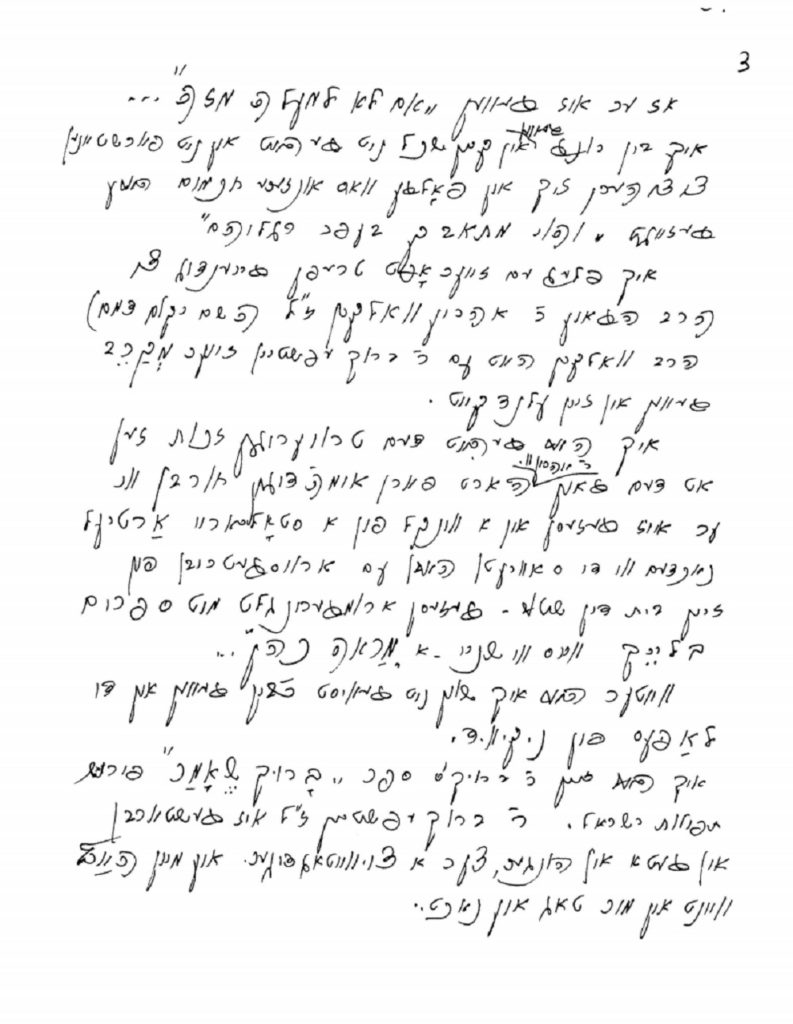
Approximately eight and a half years after his column on the Hafets Hayyim appeared, Rabbi Aaron B. Shurin penned another essay, entitled “The Mistake of the Austrian Emperor” and about the meaning behind the observance of the Three Weeks, which was published 18 Tammuz 5756 (July 5, 1996), a day after they had begun.[1] In the first line, he quoted Rabbi Baruch ha-Levi Epstein (1860–1941/1942) as citing a story about Austrian Emperor Franz Joseph I’s (1830–1916) negative response to a group of Hungarian nationalists who wished to establish a day of mourning for the loss of their independence in 1848, using the Jews’ observance of Tish‘ah be-Av as a model.[2] This prompted Simon Paktor to write in:
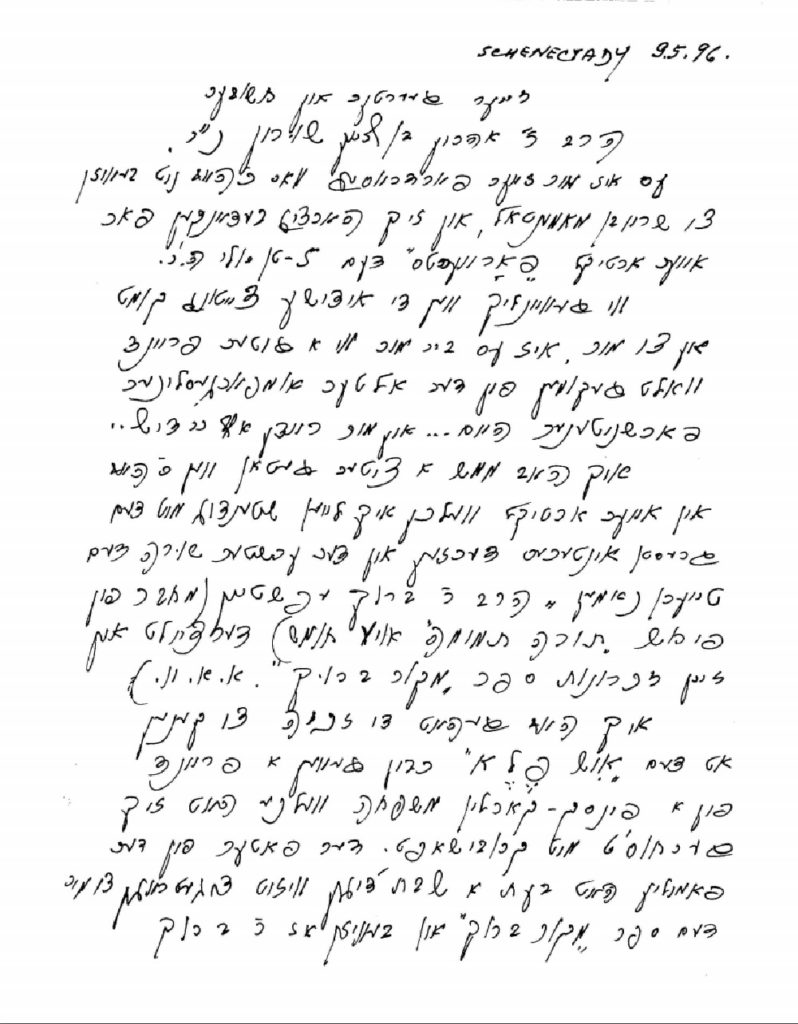


SCHENECTADY 9.5.96.

זייער געערטער און חשובער
.הרב ר״ אהרון בן ציון שוּרין נ״י


עס איז מיר זייער פארדראסיג וואס כ׳האב ניט בעוויזן
צו שרייבן מאמענטאל, און זיך הארציג בעדאנקען פאר
.אייער ארטיקל ״פאָרווערטס״ דעם 5-טן יולי ה.י

ווי געוויינליך ווען די אידישע צייטונג קומט
אן צו מיר, איז עס ביי מיר ווי א גוטער פריינד
וואלט געקומען פון דער אלטער אומפארגעסליכער
..פארשניטענער היים… און מיר ריידן א[וי]ף יידיש

איך האב ממש א ציטער געטאן ווען כ׳האב
אין אייער ארטיקל וועלכן איך לייען שטענדיג מיט דעם
גרעסטן אינטערעס דערזען אין דער ערשטער שוּרה דעם
טייערן נאמען ״הרב ר׳ ברוך עפשטיין (מחבר פון
פירוש ״תורה תמימה״ אויף חומש) דערציילט אין
[3](זיין זכרונות ספר ״מקור ברוּך״ א.א.וו

איך האב געהאט די זכיה צו קענען
אט דעם ״אִיש פֶלֶא״ כבין געווען א פריינד
פון א פינסק-קארלין משפחה וועלכע האט זיך
געיחוס׳ט מיט קרובישאפט. דער פאטער פון דער
פאמיליע האט בעת א שבת׳דיגן וויזיט צוגעטראגן צו מיר
דעם ספר ״מקור ברוך״ און בעוויזן אז ר׳ ברוך

2

ווייזט אן אז אין שׁימל פון ברויט ליגט
דער פאטער אלתר סלוּצקי .PENECiLiN רְפוּאָה ווי
איז געווען א לאַווניק אין שטאט ראַט און די טאכטער האט
געארבעט אין דער יידישער אפטיילונג. אזוי ווי פינסק
האט געהאט א פנקס פון 800 יאר האט זיך זי געהאט די
א מעגליכקייט אויסגעפינען און אנטקעגן קומען ר׳ ברוך עפשטיינס
ביטעס אין די ארכיווע אויסצוזוכן. ער פלעגט זיך שטענדיג
בעדאנקען צו איר דורך שיקן א ״באָמבאניערקע״
דא הייסט עס א באַקס שאקאלאד)… איך)
.מיט טרערן אין די אייגן און מוז א וויילע איבערייסן

.ער האט מיר אויסגעלערנט אן אריטמעטיג פארמוּלע
איך דערמאן זיך ווען כ׳האב שבת נאכן דאוונען אין פינסקער
גרייסער שוּל אראבגעגאנגען צום ברעג פון אונזער
און בעמערקט ר׳ ברוך עפשטיין ז”ל PiNA שיינער טייך
זיצט אויף א באַנק כ׳בין צוגעגאנגען צו עם און געזאגט

״גוט שבת ר׳ ברוּך גום ברוך יהיה״

ער האט געענטפערט ״גם אתם״ און צובייגענדיג צו מיר
געפרעגט ״אפשר האט איר די פאָלקס צייטונג״
(א בונדיסטישע צייטונג וואס איז ארויס אין ווארשע)
(ווען איך האב עס דערציילט א היגן רָב (ניט קיין ראביי
האט ער צו מיר געזאגט יעצט זע איך

3

…אז ער איז געווען ״אם לא למעלה מזה״
איך בין יונג געווען און קיין שכל ניט געהאט און ניט פארשטאנען
צו צוהערן זיך און פאָלגן וואס אונזערע חכמים האבן
געזאגט ״והוי מתאבק בעפר רגליהם״

איך פלעג עם זייער אָפט טרעפן גייענדיג צו
(הרב הגאון ר׳ אהרון וואלקין ז״ל השם יקום דמם
הרב וואלקין האט עם ר׳ ברוך עפשטיין זייער מְקַרֵב
.געווען אין זיין עלנדקייט

איך האב געהאט דעם טרויעריגן זכות זען
אט דעם גאון ר׳ אהרון וו. הארט פארן אימה׳דיגן חורבן ווי
ער איז געזעסן אין א ווינקל פון א סטאָליאריי אַרטיעל
נאכדעם ווי די סאוויעטן האבן עם ארויסגעטריבן פון
זיין בית דין שטוב. געזעסן ארומגערינגלט מיט ספרים
…בליֵיך ווייס ווי שניי. א ״מַראה כהן״

ווייטער האב איך שוין ניט געווּסט כ׳בין געווען אין די
.לאַפּעס פון נ.ק.וו.ד

איך האב זיין ר׳ ברוּך׳ס ספר ״בָרוּך שֶאָמַר״ פירוּש
תפילות ישראל. ר׳ ברוך עפשטיין ז״ל איז געשטארבן
אין געטא אין הונגער, צער א צוּווייטאגדיגער. און מיין האַרץ
..וויינט אין מיר טאג און נאכט

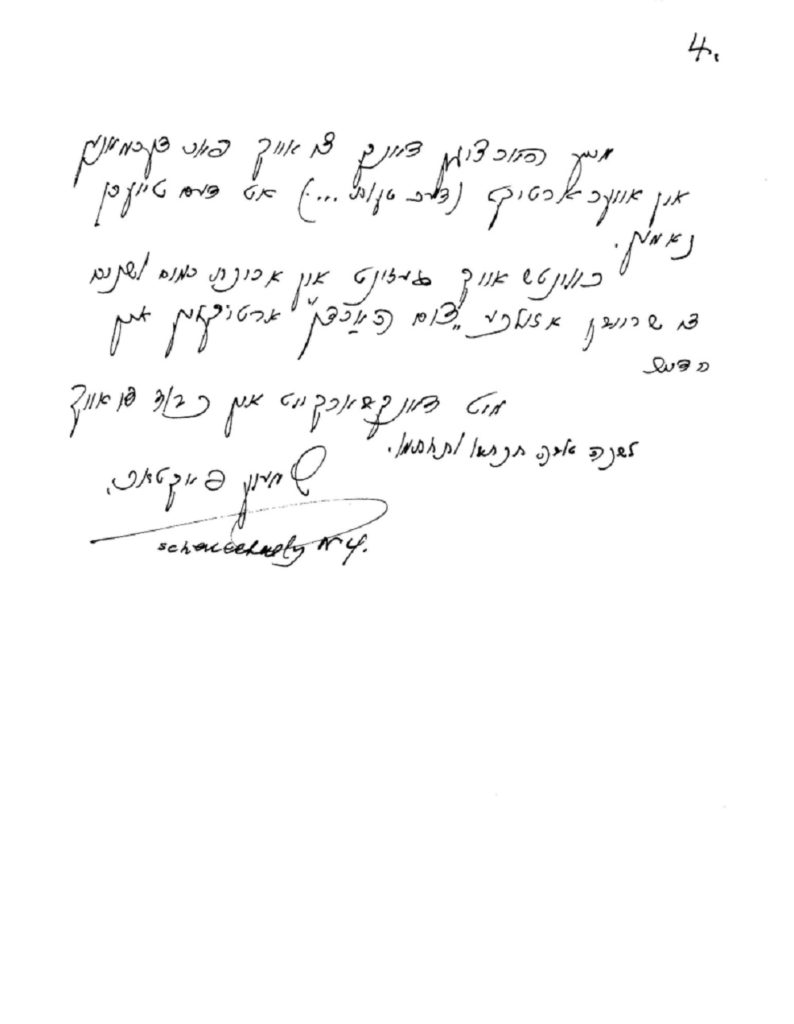
4

מיין הארציגן דאנק צו אייך פאר דערמאנען
אין אייער ארטיקל (דער טעות….) אט דעם טייערן
.נאמען

כווינטש אייך געזונט און אריכת ימים ושנים
צו שרייבן אזעלכע ״צום האַרצן״ ארטיקלען אין
יידיש

מיט דאנקבארקייט און כבוד צו אייך
.לשנה טובה תכתבו ותחתמו
.שמעון פאקטאר
Schenectady NY.

Schenectady 9.5.96

To the highly esteemed and eminent Rabbi Aaron Benzion Shurin, may his light shine,

I am greatly displeased that I did not manage to write immediately to offer my sincere thanks for your column in this year’s July 5th issue of the Forverts.

As is usual when the Yiddish newspaper is delivered, I felt then as if a good friend had arrived from the unforgettable, obliterated old country… and we were having a conversation in Yiddish…

I literally shuddered when I noticed in the first line of your column – which I always read with the greatest interest – the dear name “Rabbi Baruch Epstein (author of the Torah temimah commentary on the Pentateuch) relates in his memoir Mekor barukh,” etc.

I had the good fortune to know that “amazing man.” I was friendly with a family in Pinsk-Karlin that took pride in its kinship with him. The head of the family, during a visit of mine one Sabbath, brought me the book Mekor barukh and showed me that R. Baruch

2

points out that medicine akin to penicillin can be found in moldy bread.[4] The father, Alter Slutzky, was an alderman on the city council, and his daughter worked in its Jewish division.[5] Since Pinsk had a communal register going back 800 years,[6] she had the opportunity to learn of and accommodate R. Baruch Epstein’s requests to search in the archive. He would always thank her by sending a bombonierka (here, we would call it a box of chocolates)…[7] I write this with tears in my eyes and must pause for a moment.

He taught me an arithmetic formula. I remember how one Sabbath, after services in the Great Synagogue of Pinsk,[8] I descended to the banks of our beautiful Pina River and caught sight of R. Baruch Epstein, of blessed memory, sitting on a bench.[9] I approached him and said, “Good Sabbath, R. Baruch – may you, too, be blessed [barukh].”[10] He responded, “The same to you”[11] and, leaning over to me, asked, “Maybe you have a copy of the Folkstsaytung?” (a Bundist newspaper published in Warsaw). When I recounted this story to a local rov (not some non-Orthodox rabbi),[12] he said to me, “Now I see

3

that he was ‘if not even higher than that’[13]…”[14] I was young and foolish and did not realize that I should really listen to and follow that which our Sages taught: “And sit in the dust of their feet.”[15]

I would very often meet him on his way to the ga’on Rabbi Aaron Walkin, of blessed memory (may God avenge their blood). R. Walkin drew quite close to R. Baruch Epstein in his loneliness.

I had the tragic fortune to see that ga’on, R. Aaron W., right before the horrific Holocaust, sitting in a corner of a carpentry workers’ cooperative after the Soviets had banished him from his rabbinic courtroom. He sat surrounded by books, his complexion pale white as snow, like leprosy shown to a priest…[16]

I knew nothing more of him; I was caught in the clutches of the NKVD.

I have R. Baruch’s book Barukh she-amar, a commentary on the Jewish prayers.[17] R. Baruch Epstein, of blessed memory, died in the ghetto a distressed man, starving and suffering. And my heart cries within me day and night…

4

My sincere thanks to you for mentioning in your column (“The Mistake…”) that precious name.

I wish you health and many long days and years so that you might continue writing such “heartwarming” columns in Yiddish.

With gratitude and esteem,
May you be inscribed and sealed for a good year,
Simon Paktor
Schenectady, NY

Although the author of our letter offers precious few details about himself in the body of the document, we know from other sources that he was born to Moishe and Gittel Paktor on January 18, 1913 in Pinsk (then part of Russia, now in Belarus).[18] At the time, Pinsk was one of the most Jewish (percentage-wise) of the major cities in Eastern Europe, with a Jewish population in 1914 of 28,063 out of 38,686 total residents (approximately 72.5%).[19] Presumably because Paktor was young and politically active, the NKVD (Soviet secret police) arrested him toward the beginning of World War II, when Pinsk was occupied by the Red Army, and sent him eastward to a Siberian labor camp, thereby inadvertently saving his life.[20] When he was released, he traveled to Munich where he met and married his first wife, Helen (1925–2019), and the two of them, together with their young son David Leon (b. 1949), immigrated to the United States in 1952.[21] Sometime thereafter the couple divorced, and in 1973 Simon moved to Schenectady to serve as the Ritual Director at Congregation Agudat Achim, a Conservative synagogue (located at 2117 Union Street).[22] There, in 1976, he married Anne Smuckler (1914–2014), whose own husband had passed away three years prior,[23] and continued serving the shul faithfully until his retirement in 1993.[24]

Paktor’s letter, like Dickman’s before it, transports us back in time, providing rare firsthand testimony that sheds light on several aspects of interwar Eastern European rabbinic culture. It deals primarily with the figure of R. Epstein, a brilliant Talmudist and polymath who decided not to enter the rabbinate but instead to support his family as a banker, all the while composing important Torah works in a non-professional capacity.[25] Perhaps the most eclectic of these is Sefer mekor barukh (Vilna, 1928), a multivolume compilation of his novellae and studies in various fields of Jewish scholarship, as well as personal reminiscences about members of his family. Paktor’s letter briefly discusses this book but also, en passant, and intriguingly, references Epstein’s research in the Pinsk Jewish communal archive; could he have been working there on his never-published bilingual (Hebrew and Yiddish) treatise on the history of Pinsk, written in the aftermath of World War I?[26]

Also interesting is Epstein’s request for a copy of the daily Folkstsaytung, not only on account of the paper’s strictly secular orientation – indeed, it, like the Forverts, was published on Shabbat and yom tov[27] – but also because halakhah, according to a number of interpretations, generally disapproves of reading printed matter like newspapers on Shabbat[28] (some would say during the week as well[29]). In apparently seeing nothing wrong with this practice, Epstein was following the example of his maternal uncle and eventual brother-in-law, Rabbi Naphtali Zevi Judah Berlin (Netsiv; 1816–1893), last rosh yeshivah of the famous yeshivah in Volozhin (present-day Vałožyn, Belarus), who, by Epstein’s own account, would regularly peruse a newspaper on Shabbat day.[30]

In addition, the letter opens a window onto the relationship between Epstein and Rabbi Aaron Walkin (alternatively spelled Wolkin; 1865–1941/1942).[31] By the period in question, Epstein had suffered a number of tragedies and personal setbacks: his wife Sophia (Sheyne), the daughter of Eleazar Moses ha-Levi Horowitz (Reb Leyzer Pinsker; 1817–1890), former chief rabbi of Pinsk, had passed away due to influenza in 1899 before the age of 40; the Mutual Credit Society, the large private bank at which Epstein had worked as an officer, closed at the beginning of World War I; and three of his four children were no longer in Pinsk.[32] Though his daughter Fania (Feygl) remained in the city,[33] Epstein was lonely and lived in a hotel.[34] Into this void stepped Walkin, who arrived in Pinsk circa 1923,[35] becoming its chief rabbi in 1933[36] and there growing close to Epstein. The two men had much in common: both had studied at the feet of Netsiv in Volozhin, married around the age of 18, endured great misfortune, visited America but decided to return to Europe, and sympathized (at least somewhat) with the Zionist movement.[37] As Paktor testifies, Epstein, who lived (as of 1930) at 89 Dominikańska (present-day Gor’kogo [renamed by the Soviets]) Street,[38] would often visit Walkin at his home at 71 Dominikańska, a claim confirmed by the latter’s son, Rabbi Samuel David (1900–1979),[39] who refers to Epstein on at least one occasion as yedidi ne’eman beitenu (my friend, a confidante of our household).[40]

Finally, the letter touches directly on the last years of Walkin’s and Epstein’s lives. Shortly after Soviet forces entered Pinsk on September 17, 1939, they banned Hebrew language instruction, abolished the traditional Sabbath and Jewish holidays, and converted the Great Synagogue into a theater.[41] We know from Paktor’s letter and other sources that Walkin, who had been imprisoned by the Russians previously,[42] largely escaped persecution at the hands of the Soviets and even managed to continue performing his rabbinic functions, including scholarly writing, in secret.[43] Epstein, by contrast, was evicted from the hotel in which he had been living and was forced to wander, further weakening him in his old age.[44]

With the Nazi advance into Pinsk on July 4, 1941, an already dire situation was made even more terrifying: Jews were wantonly robbed and beaten, forced to wear Stars of David, ordered to provision the German occupiers, forbidden to leave the city, and detained for labor or ransom. About a month later, on August 5–7, the first Aktion took place, in which the Nazis murdered approximately eight thousand Jewish men outside the city. The following May 1, a ghetto meant to concentrate the approximately twenty thousand remaining Jews was established in the poorest and most crowded part of town; this was later almost completely liquidated in the second Aktion of October 29–November 1, 1942.[45]

What became of Walkin and Epstein during this frightful time? Theories about each man’s demise abound. R. Samuel David refers to his father on several occasions with the acronym reserved for martyrs, H[ashem] y[ikkom] d[amo], following his name.[46] Indeed, at least two Pinsk natives have written that R. Aaron perished together with his flock (presumably in one of the two major Aktionen).[47] Others have hazarded guesses dating his passing to around Passover 1941 or to the summer of 1942.[48] Similarly, as surveyed recently in part by Shemaryah Gershuni, hypotheses regarding Epstein’s date of death range from 1940 to 1942 and, regarding the circumstances of his death, from natural to painful to violent.[49]

In his letter, Paktor himself could not say what had happened to Walkin, while with respect to Epstein, he claimed that he had died in the Pinsk ghetto (he, too, adds Hashem yikkom damam after mentioning them).[50] However, so far as I have been able to ascertain, and as already pointed out by Gershuni, the only eyewitness testimony to have come down to us – that of a nurse named Mila/Michla Ratnowska (b. 1916) who, together with her mother Zlata (1890–1962) and four others, survived the Nazi occupation of Pinsk in hiding – records that both men died (at home) due to illness in the winter of 1941–1942.[51] This timing is corroborated, if only implicitly, by the absence of Walkin and Epstein from the list of over eighteen thousand Jews living in the Pinsk ghetto, drawn up by the Germans “sometime in 1942.”[52] Until additional evidence surfaces, it would seem prudent to accept this as the most reliable version of the events leading up to the passing of these great men, about whom we can say (with a bit of poetic license) that they were “beloved and cherished in their lifetimes, and they never parted, even in death” (II Sam. 1:23).

Conclusion

Like the giants about whom they wrote, Shurin, Dickman, and Paktor have all passed on (in 2012, 2011,[53] and 2003, respectively). How fortunate we are, though, that their memories are preserved for us in this nay (new) bintl briv! Through these simple documents – penned in an age (not too long ago) when people still took the time to correspond thoughtfully with journalists after reading and reflecting on their essays – we are able to reconstruct, if only partially, the lives and deeds of some of the most prominent leaders of Eastern European Jewry in a prewar world now lost.


* I would like to thank Yehuda Geberer for respectfully commenting that he felt I had made a mistake in the first part of this essay, in which I had identified the Chaim Lieberman who assisted Shurin in landing a job at the Forverts as “the famed historian and bibliophile” who lived 1892–1991 (and who often spelled his name Haim Liberman in English). While Geberer is almost certainly correct that Shurin was actually helped by the man of the same name (1890–1963) who, according to his entry in the Leksikon fun forverts shrayber zint 1897, 42-43, worked as a teacher of Yiddish literature and Forverts Yiddish literary critic, I was influenced (apparently unduly so) in my (mis)identification by Yisroel Besser who, in his Mishpacha article (p. 30), writes as follows: “He went to meet the person he considers the greatest Orthodox writer of the century, Chaim Lieberman. Lieberman was a bibliophile, researcher, and historian, who suggested that young Shurin leave him some writings to peruse.”

I also wish to thank Yehudah Zirkind for kindly bringing to my attention another Yiddish-language memoir about the Hafets Hayyim, in which the author, a Radin native, tells a number of interesting stories about the great sage and also notes that he passed away “before reaching his ninety-fourth birthday”; see Abrashka-Kives Rogovski, “Der khofets-khayim in radin,” Oksforder yidish 3 (1995): 193-200, at col. 200.

[1] Aaron B. Shurin, “Der toes fun estraykhishn keyzer,” Forverts (July 5, 1996): 9, 20.
[2] See Baruch ha-Levi Epstein, Sefer mekor barukh, pt. 2 (Vilna: Romm, 1928), 515a-b, citing what he heard from Isaac Hirsch Weiss of Vienna (1815–1905). Epstein refers to the ruler as Franz Joseph II, but in point of fact the relevant Austrian emperor at the time was Franz Joseph I (whose official grand title, interestingly, included the style “King of Jerusalem”).
[3] The quotation of the original Yiddish here is not exact but is certainly close enough.
[4] I have so far been unable to locate the passage referred to.
[5] Jacob-Alter Slutzky was a prominent Orthodox lay leader of the Jewish community of Pinsk who was s/elected to serve on the city council at several points during the interwar period when Pinsk was under Polish rule; see Azriel Shohet, The Jews of Pinsk, 1881 to 1941, ed. Mark Jay Mirsky and Moshe Rosman, trans. Faigie Tropper and Moshe Rosman (Stanford: Stanford University Press, 2012), 469-470, 552-556, 559, 580-581. For the original Hebrew, see Wolf Zeev Rabinowitsch (ed.), Pinsk: sefer edut ve-zikkaron li-kehillat pinsk-karlin, vol. 1, pt. 2 (Tel Aviv; Haifa: Irgun Yotse’ei Pinsk-Karlin bi-Medinat Yisra’el, 1977; also available through the New York Public Library Yizkor Book online portal [accessed August 19, 2019]), using the index. See also Slutzky’s mini-bio in Nachman Tamir (Mirski) (ed.), Pinsk: sefer edut ve-zikkaron li-kehillat pinsk-karlin, vol. 2 (Tel Aviv: Irgun Yotse’ei Pinsk-Karlin bi-Medinat Yisra’el, 1966; also available through the New York Public Library Yizkor Book online portal [accessed August 19, 2019]), 538, where it is noted that Slutzky, like Epstein, was a member of Netsiv’s family (see below) and that he had two daughters, Zhenya and Eve. Based on a daf-ed filed by the former’s sister-in-law, Sonia Goberman (accessed August 19, 2019), it appears that Zhenya was the one who worked in the Jewish division. For Epstein’s endorsement of Slutzky during a campaign season, see “Eyn goldene keyt fun maysim toyvim,” Unzer pinsker lebn 3,42 (102) (October 16, 1936): 5.
[6] An old Pinsker tradition has it that the Jewish community was founded some time in the tenth century; see Benzion Hoffman (ed.), Toyznt yor pinsk (New York: Pinsker Branch 210, Workmen’s Circle, 1941), ix-x (notice the book’s title), and Tamir, Pinsk, 249, 252. Some have averred that an exact date for the start of the community cannot be established at present, given the number of times the Great Synagogue, and any historical documents it may have housed, burned down (on which, see n. 8 below); see, e.g., Saul Mendel ha-Levi Rabinowitsch, “Al pinsk-karlin ve-yosheveihen,” in Judah ha-Levi Levick and Dovberush Yeruchamsohn (eds.), Talpiyyot (me’assef-sifruti) (Berdychiv: Joseph Hayyim Zablinsky, 1895), 7-17, at p. 7. In any event, the current mainstream position holds that it began around 1506, the year in which a privilege issued by Fyodor Ivanovich Yaroslavich, Prince of Pinsk, granted local Jews land for a synagogue and cemetery in perpetuity; see Mordechai Nadav, The Jews of Pinsk, 1506 to 1880, ed. Mark Jay Mirsky and Moshe Rosman, trans. Moshe Rosman and Faigie Tropper (Stanford: Stanford University Press, 2008), 13-14.
[7] For a similar story, see Hillel Seidman, “Ha-rav r. barukh epstein – pinsk,” in Isaac Lewin (ed.), Elleh ezkerah: osef toledot kedoshei [5]700-[5]705, vol. 1 (New York: Research Institute of Religious Jewry, Inc., 1956), 142-149, at p. 145; reprinted with some variations in Seidman’s Ishim she-hikkarti: demuyyot me-avar karov be-mizrah eiropah (Jerusalem: Mossad Harav Kook, 1970), 108-116, at p. 111. Relatedly, see the Rosh Hashanah greetings sent to Epstein by the typesetters and printers of the Pinsker vort 2,40 (86) (September 30, 1932): 1, and of ibid. 3,38 (138) (September 20, 1933): 1.
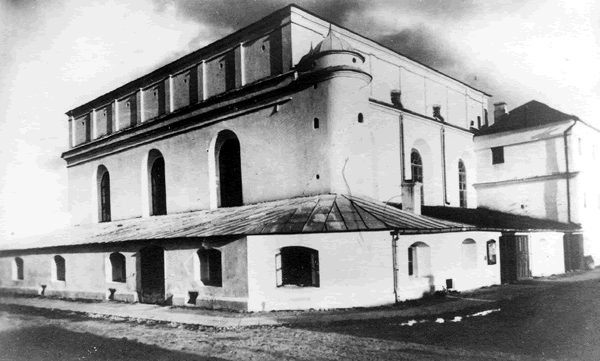
[8] For some of the turbulent history of the Great Synagogue of Pinsk, which fell victim to fires on multiple occasions, see Nadav, The Jews of Pinsk, 1506 to 1880, 463-465; Shohet, The Jews of Pinsk, 1881 to 1941, 217-220, 300-301, 463, 648, 656; and Tamir, Pinsk, 249-252. For photographs of the synagogue, see here and here (accessed August 19, 2019). For a map of Pinsk from 1864 illustrating the location of the Great Synagogue, see Hoffman, Toyznt yor pinsk, 88-89 (in Yiddish), and Nadav, The Jews of Pinsk, 1506 to 1880, 498-499 (in English). For later maps of Jewish Pinsk, see Hoffman, Toyznt yor pinsk, 232-233, and Tamir, Pinskfoldout preceding p. 97.
[9] Epstein generally prayed not in the Great Synagogue but in the Pinsker Kloyz, a beit midrash with a firmly mitnaggedic orientation. Ze’ev Rabinowitsch reports that, “in years past, it was said that the walls of the Pinsker Kloyz do not give out in deference to R. Baruch Epstein…” (“Akhsanye shel toyre,” in Tamir, Pinsk, 264). See also Rabinowitsch, Pinsk, 412.
[10] See Gen. 27:33.
[11] In Yiddish, one appropriate response to a greeting like gut shabes! is gam atem!, using the plural atem even when only one person is being addressed. See Sol Steinmetz, Dictionary of Jewish Usage: A Guide to the Use of Jewish Terms (Lanham, MD: Rowman & Littlefield Publishers, Inc., 2005), 53.
[12] American Yiddish will often distinguish between Orthodox and non-Orthodox (particularly Reform) rabbis by referring to the former as rov/rabonim (singular/plural) and the latter as rabay/rabays (singular/plural). As essentially transliterations from the English, these terms for non-Orthodox rabbis are usually intended somewhat derogatorily in the mouths of frum Yiddish speakers.
[13] Oyb nisht nokh hekher or, as the phrase appears here in Hebrew, Im lo le-ma‘lah mi-zeh, is the title of a short story by the famous Yiddish and Hebrew classicist I.L. Peretz (1852–1915) about a Litvak who refuses to believe that the Nemirover Rebbe (a fictional character probably based on Rabbi Nathan Sternharz of Niemirów [1780–1845]) ascends on High during the annual period of selihot, as his Hasidim claim he does, instead of coming to the synagogue. Determined to find out where the Rebbe disappears to, he hides under the Rebbe’s bed one night and is amazed to discover that the Rebbe wakes early in the morning, dresses as a Polish peasant, and goes out to the forest to chop firewood for poor bedridden Jewish widows. He thereupon decides to join the Rebbe’s Hasidim, and from then on whenever anyone claims that the Rebbe flies up to Heaven to petition on behalf of his flock before Rosh Hashanah, this Litvak-turned-Hasid responds, “If not even higher than that.”

The story was first published in Yiddish in 1900 as “Oyb nisht nokh hekher! A khsidishe ertseylung,” Der yud 2,1 (January 11, 1900): 12-13. The following year, it appeared, in the author’s own Hebrew adaptation, as “Im lo le-ma‘lah mi-zeh,” Ha-dor 1,17 (1901): 207-211; for the Hebrew text, see here (accessed August 19, 2019). For editions using modern Yiddish orthography, see here and here (accessed August 19, 2019). For side-by-side Yiddish with English translation, see “Oyb nisht nokh hekher/And Maybe Even Higher,” in Itche Goldberg and Eli Katz (eds.), Selected Stories: Bilingual Edition, trans. Eli Katz (New York: Zhitlowsky Foundation for Jewish Culture, 1991), 270-281. For extensive discussions of the story’s subversive messages, historical sources, and inspirations, see Menashe Unger, “Mekoyrim fun peretses folkstimlekhe geshikhtn,” Yidishe kultur 7,3-4 (March–April 1945): 54-59, at pp. 56-57; Samuel Niger, Y.l. perets: zayn lebn, zayn firndike perzenlekhkeyt, zayne hebreishe un yidishe shriftn, zayn virkung (Buenos Aires: Confederacion pro Cultura Judia, 1952), 286-289; and Nicham Ross, Margalit temunah ba-hol: y.l. perets u-ma‘asiyyot hasidim (Jerusalem: Magnes Press, 2013), 17-83 (ch. 2).

In our context, the phrase is deployed by Paktor’s rabbinic interlocutor to express his realization that Epstein was even greater than he had originally thought.
[14] Paktor apparently also shared this story about Epstein and the Folkstsaytung with Mark Jay Mirsky; see the latter’s introduction to Shohet, The Jews of Pinsk, 1881 to 1941, xxix-xxx.
[15] mAvot 1:4.
[16] The Hebrew phrase deployed here is mar’eh kohen, a reference to the requirement that those afflicted with biblical tsara‘at must consult with a priest before the healing/atonement process can move forward (see Lev. 13). The expression, as used by Paktor, does double-duty by playing on the title of the well-known piyyut recited on Yom Kippur, which refers to the priest’s (radiant) appearance, not that of the biblical skin disease.
[17] Barukh she-amar was the last book Epstein printed before he passed away. It originally appeared in Pinsk in 1939 (publisher: Drukarnia Wolowełskiego), but, according to Aaron Z. Tarshish, Rabbi barukh ha-levi epstein[,] ba‘al “torah temimah” (Jerusalem: Mossad Harav Kook, 1967), 189, even though the work achieved great popularity within the city, it did not spread beyond. Epstein sent a single copy to the famous Strashun Library in Vilna, which then passed it on to YIVO, and the latter institution transferred it to its headquarters in New York (see the online catalog record for this copy here [accessed August 19, 2019]). This, then, was apparently the only exemplar of the book to survive the war, and when it was discovered at YIVO some time thereafter, it was used to print the photo-offset reproduction published in Tel Aviv in three parts: vol. 1 on the haggadah (1965), vol. 2 on Pirkei avot (1965), and vol. 3 on the siddur itself (1968). (For a slightly different account of Barukh she-amar’s original publication and rediscovery after the war, see Seidman, “Ha-rav r. barukh epstein,” 148. Based on a helpful personal communication from Lyudmila Sholokhova, Director of the YIVO Library, it would appear that Tarshish’s version of the story is the more accurate one.)

I assume that Paktor owned a copy of the Tel Aviv reprint, not the original Pinsk edition.
[18] See the obituary for Rev. Simon Paktor published in the Albany Times Union (March 2–3, 2003), available here (accessed August 19, 2019).

Franz J. Beranek, in his Das Pinsker Jiddisch und seine Stellung im gesamtjiddischen Sprachraum (Berlin: Walter de Gruyter & Co., 1958), discusses certain distinctive features of the dialect of Yiddish spoken in Pinsk. Upon examination of our letter, we find some of the markers of this litvish (Northeastern Yiddish) dialect reflected in such forms as eygn (eyes; see p. 33, §38, 1), greyser (large; see p. 25, §26), arobgegangen (descended; see p. 53, §48, 2a), em (him; see p. 21, §18, 1), etc. (I suspect that his use of the forms idishe [Jewish/Yiddish], reydn [to speak], and fardrosig/hartsig/shtendig/etc. [displeased/sincerely/always/etc.], instead of the expected yidisheredn, and fardrosik/harstik/shtendik/etc., is the result of Paktor following common journalistic orthographic conventions and is not reflective of his actual pronunciation of those words.) (For a recent look at Beranek’s relationship with some of his Yiddish scholarly contemporaries, see Kalman Weiser, “‘One of Hitler’s Professors’: Max Weinreich and Solomon Birnbaum confront Franz Beranek,” Jewish Quarterly Review 108,1 [2018]: 106-124.)
[19] See Mordechai Nadav, “Pinsk,” in Shmuel Spector (ed.), Pinkas ha-kehillot: polin, vol. 5 (Jerusalem: Yad Vashem, 1990), 276-299, at p. 276 (available in English translation here [accessed August 19, 2019]). See also Dov Levin, Tekufah be-sograyim, 1939–1941: temurot be-hayyei ha-yehudim, ba-ezorim she-suppehu li-berit-ha-mo‘atsot bi-tehillat milhemet ha-olam ha-sheniyyah (Jerusalem: Hebrew University of Jerusalem; Tel Aviv: Hakibbutz Hameuchad, 1980), 26, for a chart comparing the populations of cities in eastern Poland in 1931.
[20] See the aforementioned obituary for Paktor published in the Albany Times Union. On NKVD activity in Pinsk during the Soviet occupation, see Pesah Pakacz, “Shilton ha-soviyyetim be-pinsk,” in Tamir, Pinsk, 315-320, at pp. 317-320, and Shohet, The Jews of Pinsk, 1881 to 1941, 639-650. On NKVD activity among occupied Polish Jewry in general, see Yosef Litvak, Pelitim yehudim mi-polin bi-berit ha-mo‘atsot[,] 1939–1946 (Jerusalem: Hebrew University of Jerusalem; Tel Aviv: Ghetto Fighters’ House; Hakibbutz Hameuchad, 1988), 118-156. As noted by Eliyana R. Adler, the similar situation of Baltic Jews exiled to the east by the Soviets demonstrates that had they not suffered that fate, they most likely would have fallen victim to the Nazis when the latter invaded the Soviet Union on June 22, 1941; see her “Exile and Survival: Lithuanian Jewish Deportees in the Soviet Union,” in Michal Ben Ya’akov, Gershon Greenberg, and Sigalit Rosmarin (eds.), Ha-kayits ha-nora ha-hu…: 70 shanah le-hashmadat ha-kehillot ha-yehudiyyot be-arei ha-sadeh be-lita: historiyyah, hagut, re’aliyyah (Jerusalem: Efrata College Publications, 2013), xxvii-xlix, at pp. xlv-xlvi.
[21] See the Holocaust remembrance seminar announcement published in the Clifton Journal (October 30, 2015), p. 36 (available here [accessed August 19, 2019]; make sure to click “View Details”). The Air Passenger Manifest recording the Paktors’ arrival in New York, available to subscribers through the MyHeritage database (accessed June 20, 2019), is dated May 19, 1952; curiously, it lists Simon’s wife’s name as Sabina.
[22] According to Michael C. Duke, “Historian Is CBY Scholar In Residence, Oct. 8–10,” Jewish Herald-Voice (October 7, 2010) (accessed August 19, 2019), Paktor was trained as a rabbi. While I could find no direct corroborating evidence for this claim elsewhere, it is true that he is sometimes referred to in writing with the title “Reverend.” His work at the shul, for which he came to be well loved and respected, included serving as cantor and Torah reader, running the daily minyanim, preparing youth for their bar and bat mitzvahs, and even teaching Yiddish classes; Stephen M. Berk, Year of Crisis, Year of Hope: Russian Jewry and the Pogroms of 1881–1882 (Westport, CN; London: Greenwood Press, 1985), xv, credits Paktor with introducing him to the world of Yiddish scholarship. See also the aforementioned obituary in the Albany Times Union and the above article by Duke. I thank Robert Kasman, Stephen M. Berk, and Mendel Siegel for the information they provided me on Paktor’s life and service to the shul in personal communications.
[23] See the obituary for Anne Paktor published here (accessed August 19, 2019).
[24] Henry Skoburn, The Agudat Achim Chronicle: Commemorating 120 Years[,] 1892–2012 (Schenectady: Congregation Agudat Achim, 2012), 10, 12.
[25] The only book-length biography of Epstein is Tarshish’s (above, n. 17), though, as noted by Eitam Henkin, “Perakim be-toledot ba‘al arukh ha-shulhan: mishpahto ve-tse’etsa’av,” Yeshurun 27 (2012): 879-895, at p. 879, this work is in need of a thorough update that takes a scholarly-critical approach and considers the abundant literature on Epstein and his oeuvre that has appeared over the past fifty-plus years. For a shorter essay on Epstein’s life, see Seidman’s “Ha-rav r. barukh epstein” (above, n. 7). And for a famous photograph of Epstein in his younger years, see Hoffman, Toyznt yor pinsk, 335; reproduced (seemingly with modifications) as the frontispiece of Tarshish’s biography and in Zvi Kaplan, “Hiddushim ba-halakhah shel gedolei pinsk ve-karlin,” in Rabinowitsch, Pinsk, 367-406, at p. 393. (I find it hard to believe that the person in the portrait accompanying the Epstein mini-biography printed in Tamir, Pinsk, 489-491, is actually him but would be happy to be corrected.)
[26] See Baruch ha-Levi Epstein, Sefer mekor barukh, introduction (Vilna: Romm, 1928), 2 n. 1.
[27] The Folkstsaytung (People’s Paper) was the official organ of the General Jewish Workers Union in Poland, also known as the Bund. As such, it espoused a secularist, socialist Weltanschauung and polemicized against Communists, Zionists, and Orthodox Jews, among others. In addition to covering politics and workers’ issues, the paper devoted space to science and technology, sports, culture, and (Jewish and non-Jewish) literature. At its height in 1935, the Folkstsaytung had an approximate circulation of eighteen thousand. See Jacob Shalom Hertz, “‘Folkstsaytung’ 1918–1939,” in David Flinker, Mordechai Tsanin, Shalom Rosenfeld et al. (eds.), Di yidishe prese vos iz geven (Tel Aviv: Veltfarband fun di Yidishe Zhurnalistn, 1975), 151-169, and Boris Kotlerman, “Folks-tsaytung,” trans. I. Michael Aronson, in the digitized YIVO Encyclopedia of Jews in Eastern Europe (accessed August 19, 2019).

According to Seidman, “Ha-rav r. barukh epstein,” 144-145:

[Epstein] had an expansive [intellectual] horizon. He was interested in and familiar with all that was happening in the world. He read Russian and German newspapers. He also visited Vienna and Berlin in the ’20s, meeting with scholars and intellectuals there, and maintained an epistolary correspondence with the towering Jewish figures of the generation. When they visited Pinsk, he would host them. In 1914, Rabbi Hayyim Soloveichik visited Pinsk and stayed with Rabbi Baruch Epstein for Shabbat.

In addition to regularly reading the paper, Epstein also contributed to a number of (rabbinic and general Jewish) periodicals, including HavatseletYagdil torahHa-levanonHa-maggidHa-melits, and Ha-pardes; see Baruch ha-Levi Epstein, Sefer mekor barukh, pt. 3 (Vilna: Romm, 1928), 701b, and Shemaryah Gershuni, “Rabbi barukh epstein – ba‘al ha-torah temimah: beirur nesibbot petirato,” Yeshurun 29 (2013): 885-892, at pp. 886 n. 13, 889 n. 25. He even wrote a weekly column on the parashah for the Pinsker shtime; see Seidman, “Ha-rav r. barukh epstein,” 145, 148-149. While I have not examined issues of the Pinsker shtime, I know that Epstein’s parashah columns in a different local paper, Pinsker vort, were entitled Fun gebentshtn kval (=Mi-makor barukh); see the announcement in the February 20, 1931 edition, p. 1.
[28] For a summary of some of the halakhic literature on the topic and a defense (in most cases) of the widespread contemporary disregard of this prohibition, see Eitam Henkin, “Keri’at divrei defus be-shabbat be-yameineu le-or din shetarei hedyotot,” Melilot 3 (2010): 49-63 (the pagination in the printed version is slightly different from that of what I presume to be the prepublication copy available on Henkin’s website).
[29] Indeed, the Hafets Hayyim was particularly vociferous in his opposition to the practice of many of his contemporaries to regularly read newspapers, not only because of their often-improper content (heresy, scoffing, leshon ha-ra, licentiousness, etc.), but also due to the drain on one’s time involved in their consumption. See, e.g., Israel Meir ha-Kohen, Kunteres zekhor le-miryam (Piotrków: Hanokh Henekh Fallman, 1925), 8b; Aryeh Leib Poupko, Mikhtevei ha-rav hafets hayyim z[ekher] ts[addik] l[i-berakhah]: korot hayyav, derakhav, nimmukav ve-sihotav, 1st ed. (Warsaw: B. Liebeskind, 1937), 96-98 (second pagination; no. 42); ibid., 42-43 (third pagination; par. 82); idem, Mikhtevei ha-rav hafets hayyim z[ekher] ts[addik] l[i-berakhah], ed. S. Artsi, 2 vols. (Bnei Brak: n.p., 1986), 2:157-158. Relatedly, see also idem, Mikhtevei, 1st ed., 27-29 (second pagination; no. 9). It is clear, however, that the Hafets Hayyim was, at times, exposed to periodical literature; for a letter he sent to the Haredi paper Kol ya‘akov, responding to an earlier issue thereof, see idem, Mikhtevei, ed. S. Artsi, 1:297-298 (no. 122).
[30] See Baruch ha-Levi Epstein, Sefer mekor barukh, pt. 4 (Vilna: Romm, 1928), 895b, 897b-898a. Epstein’s report about his uncle’s behavior in this connection has aroused a good deal of controversy, as discussed by, e.g., Eliezer Brodt, “The Netziv, Reading Newspapers on Shabbos & Censorship,” Seforim Blogpt. 1 (March 5, 2014) and pt. 2 (April 29, 2015). Like Brodt, Marc B. Shapiro, “Clarifications of Previous Posts,” Seforim Blog (January 16, 2008) (accessed August 19, 2019), believes that one can rely upon this account. On the general question of the historical accuracy of Sefer mekor barukh, see, e.g., Eitam Henkin, “R. yehi’el mikhl epstein ve-ha-‘tsemah tsedek’ ba-adashat ha-sefer ‘mekor barukh’,” Alonei mamre 123 (Winter 2011): 189-215, and Moshe Maimon, “Od be-inyan ba‘al ha-torah temimah u-sefarav,” Kovets ets hayyim 12,1 (2018): 409-420 (among many others).
[31] Probably the two most authoritative biographies of Walkin to date are that appended to the beginning of the second volume of the New York, 1951 photo-offset edition of his responsa, Sefer she’elot u-teshuvot zekan aharon, composed by his son, Rabbi Samuel David (on whom, see below), and entitled “Toledot maran ha-ga’on ha-mehabber z[ekher] ts[addik] v[e-]k[adosh] l[i-berakhah]”; and Hillel Seidman, “Ha-rav r. aharon walkin – pinsk,” in Lewin, Elleh ezkerah, 64-71; reprinted with some variations in Seidman’s Ishim she-hikkarti, 20-28. Eliezer Katzman used these two sources in compiling much of his own profile of Walkin – “Ne‘imut ha-torah: ha-g[a’on] r[av] aharon walkin z[ekher] ts[addik] v[e-]k[adosh] l[i-berakhah,] a[v] b[eit] d[in] pinsk[,] ba‘al beit aharon, zekan aharon v[e-]ku[llei],” Yeshurun 11 (2002): 891-904; 12 (2003): 727-739 – but added some material not found in either. (It seems that unacknowledged verbatim use was made of Seidman’s and/or Katzman’s work in the Walkin biography printed in Daniel Bitton’s editions of Sefer beit aharon on Bava kamma [Jerusalem: Mekhon ha-Ma’or, 2003] and of Sefer hoshen aharon [Jerusalem: Mekhon ha-Ma’or, 2005].) For additional appreciations of Walkin’s Torah, see Kaplan, “Hiddushim ba-halakhah,” 399-406, an earlier version of which had appeared as “Ba‘al ha-‘battim’,” Ha-tsofeh 10159 (June 24, 1966): 5, 7; and of his religious persona, see the excerpt from Rabbi Joseph B. Soloveitchik’s letter to R. Samuel David, dated 8 Shevat [5]712 (February 4, 1952) and printed at the foot of the introduction to Aaron Walkin, Sefer beit aharon al massekhet gittin, 2nd ed. (New York: S. Walkin, 1955).

For photographs of Walkin, see Anon., “Shlukhim fun agudes yisroel shoyn do,” Yidishes tageblat (December 11, 1913): 8; Anon., “Visiting Rabbis Explain International Jewish Union,” The Pittsburg [sic] Press (January 27, 1914): 3; Anon., “Noted European Rabbis Greeted by Orthodox Jews of Greater Boston,” The Boston Post (February 7, 1914): 16; Kaplan, “Hiddushim ba-halakhah,” 399; Moshe Rosman, “Pinsk,” in the digitized YIVO Encyclopedia of Jews in Eastern Europe (accessed August 19, 2019); Marc B. Shapiro, “A Tale of Two Lost Archives,” Seforim Blog (August 12, 2008) (accessed August 19, 2019); the Jewish Pinsk memorial page here (accessed August 19, 2019) (Walkin is leading the Agudah procession); and David Zaretsky, “Rabbah ha-aharon shel pinsk: le-hofa‘ato me-hadash shel ha-sefer sh[e’elot] u-t[eshuvot] ‘zekan aharon’,” in Zikhram li-berakhah: ge’onei ha-dorot ve-ishei segullah (Israel: n.p., 2015?), 33-39.
[32] See Jacob Goldman’s obituary for Sophia Epstein, entitled “Allon bakhut,” in Ha-tsefirah 26,60 (March 24, 1899): 293. See also the report issued by Aaron Tänzer, “Von Brest-Litowsk nach Pinsk,” Allgemeine Zeitung des Judentums 80,1 (January 7, 1916): 6-10, at p. 9, in which he mentions Epstein’s widowhood and the bank closure. Of Epstein’s four children – Cecilia (Tsile), Meir, Eleazar Moses, and Fania – Tänzer makes specific reference only to the last, suggesting that the other three were no longer in Pinsk by that point. Indeed, we know that Cecilia’s husband Nathan (Nahum) Bakstansky (Bakst) arrived at Ellis Island in 1907 (see his Geni record here [accessed August 19, 2019]); that they and their children Aaron and Jacob were registered voters as of 1924 (see Anon., “List of Registered Voters for the Year 1924: Borough of Brooklyn—Sixteenth Assembly District,” The City Record [October 16, 1924]: 2); and that Cecilia is registered as the copyright holder for the New York, 1928 edition of her father’s Torah temimah (see Anon., Catalogue of Copyright Entries: Part 1, Group 1 […] for the Year 1929 [Washington: United States Government Printing Office, 1930], 1825-1826). In addition, according to family records made available to Henkin, Eleazar Moses had moved to Leningrad (present-day St. Petersburg, Russia) (see the corrections appended to the online version of his aforementioned article, “Perakim be-toledot”). And if Seidman is correct that one of Epstein’s sons wound up working as a physician in New York (see the Ishim she-hikkarti version of his article, p. 110), that may mean Meir, like Cecilia, made it to America as well. (I find the idea that Meir and Fania died in their youth, as reported on Henkin’s website, difficult to believe, considering that Tänzer makes no mention of this in 1916, based on a visit to Pinsk in November 1915; see also next note. But until additional information becomes available, this will be virtually impossible to definitively reject [or accept].) In this connection, see also Maimon, “Od be-inyan,” 418-419, for an interesting interpretation of a passage in Sefer mekor barukh, pt. 4.
[33] Fania was instrumental in founding a Jewish girls’ gymnasium in Pinsk in the fall of 1915, reportedly with her father’s approval. See Tänzer, “Von Brest-Litowsk,” 9, and Shohet, The Jews of Pinsk, 1881 to 1941, 34, 183, 350-351, 596-597; see also Tamir, Pinsk, 510-512. She apparently passed away during World War II, given that she (like her father) is listed among the martyrs of Pinsk in Tamir, Pinsk, 627. (It is unclear to me whether or not the Meir cited there was R. Baruch’s son.)
[34] As of Tänzer’s visit, it seems that Fania attended to the needs of her father’s house (“Von Brest-Litowsk,” 9). Tarshish notes, however, that at a certain point he began living in a local hotel, whose proprietors took care of him honorably and with dedication (Rabbi, 127; though cf. below, n. 38). Seidman adds that he ate his meals at a restaurant in the city while living in the hotel (“Ha-rav r. barukh epstein,” 144). Three hotels, all under Jewish ownership, are named in the “List of Subscribers of the Telephone Network of the Postal and Telegraph Directorate in Wilno in 1939” (select p. 52 from the drop-down menu) (accessed August 19, 2019). I have not been able to ascertain at which of these three Epstein lived.
[35] See Kaplan, “Hiddushim ba-halakhah,” 399; see also Ben-Mem, “Ha-ga’on r. aharon walkin z[ekher] ts[addik] l[i-berakhah],” in Tamir, Pinsk, 499-500, who notes that Walkin eulogized Rabbi Jacob Mazeh of Moscow (1859–1924) within the first year of his arrival in the city. Cf. the introduction to Aaron Walkin, Sefer beit aharon al massekhet bava kamma (Vilna: Shraga Feivel Garber, 1923), which the author signed (seemingly in 1923) while living in the Jewish community of Amtshislav (present-day Mscisłaŭ, Belarus). Cf. also Anon., “Horav r. arn wolkin vegn zayn raykher lebns-fargangenheyt,” Unzer grodner ekspres 2,79 (April 2, 1929): 1, the second part of an interview with Walkin, which claims that he emigrated from Russia in 1922; as well as Aaron B. Shurin, “Tsvey shayles utshuves sforim fun letstn pinsker rov,” Forverts (October 14, 1977): 3, 6, at p. 3, who writes that Walkin came to Pinsk in 1924. (On his way from Russia to Poland, he had an extended stopover in Danzig; see M. Lyubart, “Vegn yidishn lebn in danzig,” Pinsker vort 2,11 [57] [March 11, 1932]: 5.)
[36] See Anon., “Horav walkin oysgeveylt als rov fun pinsker kehile,” Pinsker vort 3,32 (132) (August 11, 1933): 6, and Shohet, The Jews of Pinsk, 1881 to 1941, 571. Cf. Ben-Mem, “Ha-ga’on r. aharon walkin,” 500, who gives the date as [5]688 (1927–1928). (His election to the rabbinate of neighboring Karlin had taken place over a year earlier; see Anon., “Horav walkin als karliner rov,” Pinsker vort 2,6 [52] [February 5, 1932]: 6.)

Relatedly, see Dov Rabin (ed.), Grodnah-Grodne (Jerusalem: Encyclopaedia of the Jewish Diaspora, 1973; also available through the New York Public Library Yizkor Book online portal [accessed August 19, 2019]), col. 352, on the brief period in 1929 when the Jews of Grodno – then part of Poland but now in Belarus – considered appointing Walkin as the chief rabbi of their community (an episode that deserves fuller historiographic exploration); see also Anon., “Kehile-rat geg[n] horav wolkin,” Unzer grodner ekspres 2,88 (April 12, 1929): 15.
[37] For Epstein, see Tarshish, Rabbi, 70-80 (relationship with Netsiv), 84-89 (marriage at approx. 18), 120-126 (visit to America), 134-135, 148-149 (Zionist sympathies) (all based primarily on passages in Sefer mekor barukh); Shohet, The Jews of Pinsk, 1881 to 1941, 536 (Zionist sympathies); and Gershuni, “Rabbi barukh epstein,” 890-892 (visit to America). For Walkin, see his undated introduction to Sefer beit aharon al massekhet bava kamma (visit to America); the postscript to his undated introduction to the commentary Saviv li-yere’av, vol. 1 (Pinsk: Drukarnia Wolowełskiego, 1935), and the wishes of nehamah printed in Dos naye pinsker vort 7,51 (356) (December 3, 1937): 6 (personal misfortune); his son’s “Toledot maran ha-ga’on ha-mehabber” (relationship with Netsiv, marriage at approx. 18, visit to America); and Ben-Mem, “Ha-ga’on r. aharon walkin,” 500, and Rabin, Grodnah-Grodne, col. 352 (Zionist sympathies). Relatedly, Walkin’s son Hayyim married the daughter of Rabbi Abraham Isaac ha-Kohen Kook (1865–1935); see the mazl tov wishes on the occasion of their engagement printed in Do’ar ha-yom 8,182 (April 28, 1926): 1, and in Ha-arets 9,2041 (May 2, 1926): 4.

For a lecture delivered in Yiddish during Walkin’s visit to the United States, undertaken December 1913–February 1914 in order to help establish Agudath Israel in America, see Aaron Walkin, Di printsipen un tsveke fun agudes yisroel: fortrog gehalten fir amerikaner idn (New York: Office of Agudath Israel, n.d.). (During his trip, Walkin visited the Rabbi Isaac Elchanan Theological Seminary at 156 Henry Street; for his comparison of the yeshivah with that of Volozhin [!], see Anon., “Agudes yisroel shlukhim in yeshives rabeynu yitskhok elkhonen,” Der morgen zhurnal [December 24, 1913]: 4. Cf. Anon., “Horav wolkin begaystert fun idishe anshtalten in amerika,” Der morgen zhurnal [January 13, 1914]: 4.)

Tragically, Epstein and Walkin shared another fate: each printed a sefer in 1939 in Pinsk, only one copy of which survived the war and was later used for photo-offset reprinting. On Epstein’s Barukh she-amar, see above, n. 17, and on Walkin’s Sefer beit aharon al massekhet gittin, see his son’s introduction to the 1955 edition.
[38] See the address given for Epstein on the title page of his Sefer tosefet berakhah ha-kolel he‘arot ve-he’arot le-sefer “megillat sefer” al hamesh megillot ha-kodem (Krakow: [Michael Horowicz], 1930) (the same address appears on the title pages of the five parts of Sefer gishmei berakhah that appeared at the same press in the same year). It is unclear to me at what point he moved into the hotel referred to by Tarshish (see above, n. 34), though it seems, based on the aforementioned “List of Subscribers,” that as of 1939 a fellow named Dawid Giler was living at Epstein’s former address on Dominikańska Street.
[39] For several biographical sketches of R. Samuel David, the only child of R. Aaron to survive the war, see Samuel David Walkin, Sefer ramat shemu’el al ha-torah: sefer be-reshit (Jerusalem: Walkin Family, 1982), 11-27; the unpaginated introductions to idem, Sefer shevivei or: likkutim, ed. Samuel David Walkin [the grandson], 2nd ed. (Jerusalem: n.p., 2011); and idem, Sparks of Light: Jewels of Wisdom from the Chofetz Chaim ZT”L (New York: Kol Publishers, 2012), 83-86. For descriptions of R. Samuel David’s efforts on behalf of his fellow Pinskers, see Rabinowitsch, Pinsk, 547, and Tamir, Pinsk, 598-599. Unsurprisingly, given the interconnectedness of Lithuanian rabbinic dynasties, R. Samuel David became close with both the Hafets Hayyim and R. Soloveitchik; for photographs of him with the former, see the plates at the end of Sparks of Light, and with the latter, see Marc B. Shapiro, “Assorted Matters,” Seforim Blog (February 17, 2016) (accessed August 19, 2019).
[40] See Samuel David Walkin, Sefer kitvei abba mari: hiddushim u-be’urim al tanakh u-midrashav, ed. Moishe Joel Walkin (Kew Gardens: Yeshiva Beth Aron, 1989), 345; see also pp. 73, 132, 160, 266, 497, 512. For other instances of R. Samuel David quoting Epstein, often preceded by honorifics, see idem, Sefer ramat shemu’el al ha-torah, 108-109, and idem, Sefer kitvei abba mari: hiddushim u-be’urim al massekhtot ha-shas, u-mo‘adei ha-shanah[,] ve-nosaf aleihem derashot ve-he‘arot be-inyanei de-yoma, ed. Moishe Joel Walkin (Kew Gardens: Yeshiva Beth Aron, 1982), 33, 176, 193, 277, 314. For a reproduction of a letter written by Epstein (on his own letterhead) to R. Samuel David on the occasion of the latter’s appointment to the rabbinate of Lukatsh (present-day Lokachi, Ukraine) in 1935, see Tamir, Pinsk, 490. On the relationship between Epstein and R. Aaron, see also Seidman, “Ha-rav r. barukh epstein,” 144, 149. (Seidman, “Ha-rav r. aharon walkin,” 69, notes that Walkin opened his home and heart “to anyone suffering or in pain.” See also Zaretsky, “Rabbah ha-aharon shel pinsk,” 36. For a similar description of R. Samuel David, see Aaron B. Shurin, “Horav hagoen r. shmul wolkin, vitse prezident fun agudes horabonim, iz nifter gevorn,” Forverts [August 29, 1979]: 1, 8, at p. 1.) Another home Epstein visited was that of Yankev Epstein in Minsk; see Devora Gliksman, A Tale of Two Worlds (Brooklyn: Mesorah Publications, ltd, 2009), 113-114.
[41] Shohet, The Jews of Pinsk, 1881 to 1941, 642, 648; see also Tamir, Pinsk, 319-320.
[42] Walkin himself refers to this, en passant, in the introduction to Sefer beit aharon al massekhet bava kamma, saying that he was jailed bi-shevil alilah, hattat ha-kahal hu (on account of libel; it is the sin of the community). R. Samuel David, in “Toledot maran ha-ga’on ha-mehabber,” explains that his father was one of those fighting to defend Jewish tradition against the edicts of the Bolsheviks and was therefore imprisoned for about half a year. Seidman, “Ha-rav r. aharon walkin,” 67, adds (perhaps by logical deduction) that the Yevsektsiya (Jewish section of the Communist Party) was responsible for informing on him to the authorities.
[43] For examples of Walkin’s wartime rabbinic activities, see Shohet, The Jews of Pinsk, 1881 to 1941, 649; Tamir, Pinsk, 320; and Seidman, “Ha-rav r. aharon walkin,” 69, 71. For his commitment especially to Torah study and creativity in this period, see the excerpt from the last letter R. Samuel David received from him printed in “Toledot maran ha-ga’on ha-mehabber,” as well as the excerpt from a letter by Rabbi Zalman Sorotzkin (1881–1966) reproduced in the introduction to Aaron Walkin, Sefer beit aharon al massekhet kiddushin, ed. Aaron ben Moishe Joel Walkin (Queens: Aaron Walkin, n.d.).
[44] See Tarshish, Rabbi, 127; see also p. 128 on Epstein’s avoidance of the Soviet authorities, even when it meant skipping meals. Zvi Gitelman, “Afterword: Pinsk in Wartime and from 1945 to the Present,” in Shohet, The Jews of Pinsk, 1881 to 1941, 652-659, at p. 653, notes that local leaders organized a committee to aid impoverished clergy, including Epstein, during this period.
[45] For harrowingly detailed accounts of the fate of Pinsk Jewry during the Nazi onslaught, see Nahum Boneh (Mular), “Ha-sho’ah ve-ha-meri,” in Tamir, Pinsk, 325-388 (a Yiddish translation by Leib Morgenthau appears on pp. 389-458 and an English translation by Ellen Stepak appears online here [accessed August 19, 2019]); Nadav, “Pinsk,” 294-298; Tikva Fatal-Knaani, “The Jews of Pinsk, 1939–1943, Through the Prism of New Documentation,” trans. Naftali Greenwood, Yad Vashem Studies 29 (2001): 149-182; Gitelman, “Afterword,” 652-654; and Katharina von Kellenbach, Nahum Boneh, and Ellen Stepak, “Pinsk,” in Martin Dean with Mel Hecker (eds.), The United States Holocaust Memorial Museum Encyclopedia of Camps and Ghettos, 1933–1945, vol. II, pt. B (Bloomington and Indianapolis: Indiana University Press, 2012), 1442-1444. For a map of the Pinsk ghetto, see Tamir, Pinsk, 334 (in Hebrew), and here (in English) (accessed August 19, 2019). For photographs of the memorials set up on the sites of mass murder, see here (accessed August 19, 2019).
[46] See, e.g., R. Samuel David’s introductions to Sefer she’elot u-teshuvot zekan aharon, vol. 2 (the one entitled “Hakdamat ben ha-mehabber maran ha-ga’on z[ekher] ts[addik] l[i-berakhah]”) and to Sefer beit aharon al massekhet gittin; see also the entries on R. Aaron maintained by Yad Vashem (1234) (accessed August 19, 2019). (I am aware that Hy”d is sometimes used even when a person was not literally killed by an enemy but rather died as a[n in]direct result of enemy persecution.) Strangely, Tamir, Pinsk, 636, does not list any members of the Walkin family among the martyrs of Pinsk.
[47] See Tamir, Pinsk, 500, and Zaretsky, “Rabbah ha-aharon shel pinsk,” 33, 37. For a relatively recent study of rabbinic leadership during the Holocaust, see Havi Dreifuss (Ben-Sasson), “‘Ka-tson asher ein lo ro‘eh’? rabbanim u-ma‘amadam ba-sho’ah,” in Asaf Yedidya, Nathan Cohen, and Esther Farbstein (eds.), Zikkaron ba-sefer: korot ha-sho’ah ba-mevoʼot la-sifrut ha-rabbanit (Jerusalem: Rubin Mass, 2008), 143-167.
[48] See Aaron B. Shurin, “Ha-rav aharon walkin: rabbah ha-aharon shel pinsk,” in Keshet gibborim: demuyyot ba-ofek ha-yehudi shel dor aharon, vol. 3 (Jerusalem: Mossad Harav Kook, 2004), 92-97, at p. 92 (ca. Passover 1941), and Seidman, “Ha-rav r. aharon walkin,” 71 (summer 1942).
[49] See Gershuni, “Rabbi barukh epstein,” 887-890. It seems that Tarshish’s version of the events (Rabbi, 128), according to which Epstein died in a Jewish hospital shortly after the Germans’ invasion in July 1941, has gained some traction. See, e.g., N.T. Erline’s epilogue in Baruch ha-Levi Epstein, My Uncle The Netziv, trans. Moshe Dombey, ed. N.T. Erline (Brooklyn: Mesorah Publications, 1988), 223; Prof. Meir Bar-Ilan’s family tree (accessed August 19, 2019); and Pnina Meislish, “Epstein, barukh, ben yehi’el mikhl,” Rabbanim she-nispu ba-sho’ah (accessed August 19, 2019). By contrast, Gitelman, “Afterword,” 728 n. 7, claims that “Epstein died a natural death in Pinsk in 1940,” while Ber Schwartz, Sefer artsot ha-hayyim (Brooklyn: B. Schwartz, 1992), 23, writes that Epstein was killed by the Nazis in 1942. Here again, Samuel David Walkin, Sefer ramat shemu’el al ha-torah, 108, refers to Epstein with the acronym Hy”d, suggesting martyrdom; see also the entries on Epstein maintained by Yad Vashem (123) (accessed August 19, 2019).
[50] Paktor could not have directly witnessed Epstein passing away in the ghetto, as by the time of its establishment he had long been exiled to Siberia by the Soviets. Interestingly, Aaron B. Shurin, in an article published about six years after Paktor sent this letter, also writes that Epstein died in the ghetto (“Ha-rav barukh epstein: mehabber ‘torah temimah’,” in Keshet gibborim, vol. 3, pp. 38-44, at p. 44). He adds (without citing a source) that Epstein was buried in the Karlin Jewish cemetery next to the grave of Rabbi David Friedman of Karlin (1828–1915). Unfortunately, the Karlin cemetery is no longer extant, making it difficult to verify this claim; see here (accessed November 24, 2019).
[51] Ratnowska’s account (committed to writing twenty years after the Holocaust) is cited by Boneh, “Ha-sho’ah ve-ha-meri,” 333. (Pnina Meislish, it should be noted, accepts this timing with respect to Walkin’s passing only; see “Walkin, aharon, ben yosef tsevi,” Rabbanim she-nispu ba-sho’ah [accessed August 19, 2019].) Cf. Rabinowitsch, Pinsk, 399 n. 3, where he quotes slightly conflicting testimony from Ratnowska, according to which Epstein passed away “suddenly” a few weeks before the establishment of the Pinsk ghetto (which sounds more like springtime than winter). In addition, according to her, Epstein was buried in the cemetery in Pinsk, not in the Karlin cemetery as posited by Shurin (see previous note). For Ratnowska’s description of life in hiding during the war, see Boneh, “Ha-sho’ah ve-ha-meri,” 357.

Interestingly, Irina Yelenskaya places both rabbis’ deaths more specifically in January 1942 in her article on Pinsk for the Shtetl Routes project (accessed November 4, 2019), though I do not know on which of her sources she bases this date.
[52] See the description of the Pinsk Ghetto Database available here (accessed August 19, 2019). By contrast, Rachel Walkin (1876–1942?), R. Aaron’s wife, is listed in the Database as living at 35 Polnocna (in German: Nord) Street (the present-day approximate equivalent is Leningradskaya Street). Also listed are Mila Ratnowska and Eve Slutzky (who is presumably to be identified with the daughter of alderman Jacob-Alter bearing the same name).
[53] See the May 2, 2011 funeral announcement published in the Chicago Tribune and currently available here (accessed August 19, 2019).


Aryeh A. Frimer Review of Daniel Sperber’s Darka shel Halakha

Lo Zu haDerekh: A Review of
Rabbi Prof. Daniel Sperber’s Darka shel Halakha

by Aryeh A. Frimer

Rabbi Prof. Aryeh A. Frimer is the Ethel and David Resnick Professor of Active Oxygen Chemistry at Bar Ilan University. He has lectured and published widely on various aspects of “Women and Halakha.”

Among his many articles, Rabbi Frimer is the author of “Women and Minyan,” Tradition, 23:4 (Summer 1988): 54-77, available online here; “Women’s ‘Megilla’ Reading,” in Ora Wiskind Elper, ed., Traditions and Celebrations for the Bat Mitzvah (Urim Publications: Jerusalem, 2003), 281-304, available online here (PDF); “Guarding the Treasure: A Review of Tamar Ross, Expanding the Palace of Torah: Orthodoxy and Feminism,” BDD – Journal of Torah and Scholarship 18 (April 2007): 67-106 (English), available online here (PDF); “Feminist Innovations in Orthodoxy Today: Is Everything in Halakha – Halakhic?” JOFA Journal 5:2 (Summer 2004/Tammuz 5764): 3-5, available here (PDF).

Over a three year period, from 5758-5760 (Fall 1997-Summer 2000), Rabbi Frimer delivered in-depth high-level shiurim on “Women and Halakha” to the Women of Rehovot at the Tiferet Moshe Synagogue – Rabbi Jacob Berman Community Center. The basic sourcebook for these lectures was R. Elyakim Getsel Ellinson, haIsha ve-haMitsvot – Vol. I: Bein Isha leYotsra, and this series of classes were regularly recorded as MP3 files, and the source materials, handouts and lecture notes were converted into PDF files and these files are now available here.

Aryeh A. Frimer and Dov I. Frimer are the co-authors of “Women’s Prayer Services – Theory and Practice,” Tradition 32:2 (Winter 1998): 5-118, available online here (PDF); and of the forthcoming “Women, Kri’at haTorah and Aliyyot.”

This is his first contribution to the Seforim blog.

Allow me to begin my review of Rabbi Prof. Daniel Sperber’s new volume Darka shel Halakha, with a few words of introduction.[1] I have the greatest respect for Prof. Sperber both as a scholar par excellence and as a human being. Over the almost 35 years I have been at Bar-Ilan University, we have developed a warm friendship and mutual respect. He writes clearly and beautifully, with great knowledge, sensitivity and depth – and his book Darka shel Halakha is no exception. Nevertheless, I am forced to disagree with his analysis and conclusions. I strongly believe that we have to be sensitive to women’s spiritual needs or as Hazal say: לעשות נחת רוח לנשים (Sifra, Parsheta 2; Hagiga 16b). But at the same time, we have to be honest about what the halakha clearly states – so that, at the same time, we will not be guilty of האהבה מקלקלת את השורה.

The question of women receiving aliyyot, which lies at the center of Darka shel Halakha, is briefly discussed in a baraita cited in the Talmud Megilla (23a) which reads (Source 1):

(1) תלמוד בבלי מסכת מגילה דף כג עמוד א
תנו רבנן: הכל עולין למנין שבעה, ואפילו קטן ואפילו אשה. אבל אמרו חכמים: אשה לא תקרא בתורה, מפני כבוד צבור.

Despite the above negative ruling of the Talmud and, in its wake, of all subsequent codifiers,[2] within the last decade, there have been two major attempts to reopen this issue. One was penned by R. Mendel Shapiro[3] who argues that kevod ha-tsibbur is a social concept – and a woman’s general standing in society was lower than men’s. Nowadays when this is no longer true, a community can be mohel on its kavod – voluntarily set aside its honor. He errs, however, since the vast majority of rishonim and aharonim disagree with his analysis. Kevod ha-tsibbur has nothing to do with social standing. The vast majority of posekim maintain that kevod ha-tsibbur stems from women’s lack of obligation in keri’at haTorah, and expresses itself either in terms of tsniut or zilzul ha-mitsvah. The Tsniut School argues that women should not be at the center of communal ritual unnecessarily – and this is particularly true by keri’at haTorah, from which they are freed. The second school maintains that there is an issue of zilzul ha-mitsva in that the men who are duty-bound should fulfill the mitsva that is incumbent upon them – and not delegate it to those who are not obligated.[4]

The second attempt is that of R. Prof. Daniel Sperber,[5] in Darka shel Halakha, and I would like to focus on two major issues.

Kevod haTsibbur: Instruction or Recommendation?

Firstly, R. Sperber has suggested that the phrase in Megilla 23a “However, the Rabbis declared: a woman should not read from the Torah – because of kevod ha-tsibbur” describes what Hazal believed to be the preferred or recommended mode of conduct, the ideal way of performing keri’at haTorah.

Indeed, ke-darko ba-kodesh, Prof. Sperber surveys all the places where it states אבל אמרו חכמים and shows that some cases are merely expressions of the ideal, while others refer to things that are actually assur. Yet, he concludes [Note 19, p. 21] that that in the case of women’s aliyyot: “לא נראה שמדובר … בתקנת חז”ל אלא שאינו ראוי”

This position is very problematic, particularly in this case of women’s aliyyot which is one of kevod ha-tsibbur.

(1) Firstly, Meiri, Kiryat Sefer, Ma’amar 5, sec. a, writes (Source 2):

(2) מאירי, קרית ספר, מאמר חמישי חלק א
נמצאת למד …שהכל עולין למנין ז’ אפילו אשה וקטן…, אלא שמיחו באשה מפני כבוד צבור…

The word “מיחו” appears many times in the Mishnaic and Tamudic literature and it refers to strongly verbalized objection and public reproof. See for example, Source 3.

(3) מסכת פסחים פרק ד משנה ח
משנה: ששה דברים עשו אנשי יריחו על שלשה מיחו בידם ועל שלשה לא מיחו בידם
רמב”ם: אלו הששה דברים כולם היו שלא ברצון חכמים, אלא שעל שלשה מהם – והם הראשונים – לא מיחו בידם חכמים, ושלשה המנויים באחרונה מיחו בידם.

Clearly, from the Meiri’s perspective, the statement אבל אמרו חכמים by women’s aliyyot is not a simple recommendation.

(2) Secondly, there is a group of rishonim and aharonim who maintain that in the specific case of women’s aliyyot, women cannot receive aliyyot, even in cases of she’at ha-dehak or be-diavad. This school includes the Rambam and Semag and many subsequent aharonim (R. Abraham Pinso; R. Matsli’ah Mazuz; R. Ben-Zion Lichtman, R. Zalman Nehemiah Goldberg and R. Isaac Zilberstein). For example, Rambam (Sources 4 and 5) writes without any qualification that women may not receive aliyyot:

(4) רמב”ם הלכות תפילה ונשיאת כפים פרק יב, הלכה יז
אשה לא תקרא בציבור מפני כבוד הציבור…

(5) הרב מסעוד חי רוקח, מעשה רוקח שם
ורבינו כתב קיצור הדין ד-“אשה לא תקרא מפני כבוד הציבור”, א”כ נאסר לגמרי…

Semag (Source 6) records that minors may receive aliyyot, but makes no mention of women whatsoever. On the contrary, he maintains (Sources 7 and 8) that women cannot motsi men in megilla, even be-di-avad, just as they can’t receive aliyyot.

(6) הרב משה בן יעקב מקוצי, ספר מצוות גדול (סמ”ג), עשין סימן יט
כמה [הם] הקוראים, בשבת בשחרית שבעה .. וקטן היודע לקרות ויודע למי מברכים עולה בשבעה למניין.

(7) ספר מצוות גדול – מצוות מדרבנן, הלכות מגילה
…דאף על גב דנשים חייבות במקרא מגילה אינן מוציאות את הזכרים. ואל תשיבני נר חנוכה דאמרינן בפרק במה מדליקין (שבת כג, א) דאשה מדלקת משמע אף להוציא האיש. דשאני מקרא מגילה שהוא כמו קריאת התורה לכך אינה מוציאה את האיש.

(8) מגן אברהם סימן תרפט ס”ק ה
“וי”א שהנשים אינם מוציאות את האנשים “
אינם מוציאות – ול”ד לנרות חנוכה דשאני מגילה דהוי כמו קריאת התורה (סמ”ג) פי’ ופסולה מפני כבוד הצבור ולכן אפי’ ליחיד אין מוציאה דלא פלוג (רא”ם)

Clearly, according to these authorities, the statement אבל אמרו חכמים is not a simple recommendation.

(3) There is another very large group of posekim (perhaps the majority) led by the R. Yoel Sirkis (Ba”h; Sources 9 and 10) who maintain that one cannot be mohel on kevod ha-tsibbur – particularly in the case of women’s aliyyot. However, bi-she’at ha-dehak – where there is no alternative or no one else eligible – a woman can read, lest keri’at haTorah be cancelled. It is to such cases that the Gemara in Megilla was referring.

(9) הרב יואל סירקיס, בית חדש (ב”ח) טור או”ח סימן נ”ג ד”ה “ואין ממנין”
…אלא הדבר פשוט, כיון שכך תקנו חכמים דחששו לכבוד ציבור, אין ביד הציבור למחול.

(10) בית חדש, טור אורח חיים סימן קמ”ד
… מה שתיקנו חכמים .. משום כבוד הציבור לא תקנו מתחילה אלא היכא שאפשר

For example, in a case of a city with only kohanim cited by Rabbi Sperber himself, Maharam mi-Rothenburg (Source 11) permits women to receive the third through seventh aliya. Otherwise the Torah reading would not occur, for the lineage of the kohanim would be challenged were they to receive the remaining aliyyot. In the language of the Maharam:

(11) שו”ת מהר”ם מרוטנברג חלק ד (דפוס פראג) סימן קח
…ועיר שכולה כהנים ואין בה [אפי’] ישראל אחד נראה לי דכהן קורא פעמיים ושוב יקראו נשים דהכל משלימי’ למנין ז’ אפי’ עבד ושפחה וקטן (מגילה כ”ג ע”א). ונהי דמסיק עלה אבל אמרו חכמי’ לא תקרא אשה בתורה מפני כבוד הצבור, היכא דלא אפשר ידחה כבוד הצבור מפני פגם כהנים הקוראים שלא יאמרו בני גרושות.

Maharam mi-Rothenburg was only willing to permit bi-she’at ha-dehak. This certainly doesn’t sound like a recommendation המלצה. Rather it is permission given only bi-she’at ha-dehak.

It would seem to me that in Darka shel Halakha there is a blurring of the difference between le-khathila and be-di-avad. For example, Hazal say that one should not use a milchig spoon שאינו בן יומו (not used in last 24 hours) to stir hot chicken soup. Similarly, Hazal indicate that one shouldn’t eat out of utensils that haven’t been immersed in a mikva. In both cases, be-di-avad, the food remains perfectly kosher. Hazal’s ruling in both these cases is not a recommendation – but rather a clear directive how one is required to act; under normative conditions, it is assur to act otherwise. This is also true regarding women’s aliyyot Hazal forbade it le-khathila, even though be-di-avad or bi-she’at ha-dehak the aliyya may be valid.

Now it should be appreciated that from Prof. Sperber’s perspective it is important that אבל אמרו חכמים be only a המלצה. Prof. Sperber wants to maintain that there really is no “down side” to women getting aliyyot. However, to my mind, he errs – kevod ha-tsibbur is a takana le-khathila, not a recommendation.

In this regard, I would also like to briefly mention one further crucial point, relevant to both the papers of R. Mendel Shapiro and R. Daniel Sperber – but which we will not be able to develop fully here at the Seforim blog.[6] When Hazal talked about women getting aliyyot, they were referring to a system in which the oleh made the berakhot and read aloud – for himself and the community. However, nowadays, the job of the oleh is bifurcated: the oleh makes the berakhot and ba’al korei reads aloud. This raises a fundamental question: how can one person make berakhot, while another does the ma’aseh ha-mitsva. For there not to be a berakha le-vatalah there must be a mechanism to transfer the reading from the ba’al korei to the oleh. That mechanism is either shom’eah ke-oneh or shelihut. But both mechanisms require that both the oleh and ba’al korei be obligated – otherwise there is no areivut. Since women are not obligated in keri’at haTorah, they can serve neither as the oleh nor as the ba’al korei – me-ikkar ha-din – because the birkhot haTorah of the oleh will be berakhot levatalah. Note that all this has nothing to do with kevod haTsibbur. The only case in which the issue of kevod haTsibbur begins is in the uncommon case where a woman makes the berakhot and reads for herself.[7] Hence, under a bifurcated system, there is a clear downside in allowing women to read or serve as olot – a proliferation of berakhot le-vatala!

Does Kevod haBeriyyot Defer Kevod haTsibbur –
The Rules of Kevod haBeriyyot

Lets now turn to the second issue – and this is Prof. Sperber’s major hiddush in this book. Briefly, Prof. Sperber notes that there is a concept in halakha called kevod ha-beriyyot which refers to shame or embarrassment (בושה או בזיון) which would result from the fulfillment of a religious obligation. The view of the halakha is that kevod ha-beriyyot can defer rabbinic obligations and prohibitions. Hence, Prof. Sperber maintains that if there is a community of women who are offended by their not receiving aliyyot – because of the rabbinic rule of kevod hatsibbur, then kevod ha-beriyyot should defer kevod ha-tsibbur.

Professor Sperber’s book is devoted to describing the use of kevod ha-beriyyot in the halakhic literature. He is by no means the first to do this and the subject is extensively reviewed and analyzed by Rabbis Rakover,[8] Blidstein,[9] Lichtenstein,[10] Feldman,[11] and many others.[12]

Let’s begin with the Gemara in Berakhot 19b:

(12) תלמוד בבלי מסכת ברכות דף יט עמוד ב
(א) אמר רב יהודה אמר רב: המוצא כלאים בבגדו פושטן אפילו בשוק, מאי טעמא (משלי כ”א) “אין חכמה ואין תבונה ואין עצה לנגד ה'” – כל מקום שיש חלול השם אין חולקין כבוד לרב.
(ב) מתיבי: קברו את המת וחזרו, ולפניהם שתי דרכים, אחת טהורה ואחת טמאה, בא בטהורה – באין עמו בטהורה, בא בטמאה – באין עמו בטמאה, משום כבודו. [רוב הראשונים גורסים: באים בטמאה, בא עמהם משום כבודם] אמאי? לימא: אין חכמה ואין תבונה לנגד ה’. תרגמה רבי אבא בבית הפרס דרבנן
(ג)…תא שמע: גדול כבוד הבריות שדוחה [את] לא תעשה שבתורה. ואמאי? לימא: אין חכמה ואין תבונה ואין עצה לנגד ה’! – תרגמה רב בר שבא קמיה דרב כהנא בלאו (דברים י”ז, יא) דלא תסור [מן הדבר אשר יגידו לך ימין ושמאל[ …כל מילי דרבנן אסמכינהו על לאו דלא תסור, ומשום כבודו שרו רבנן.
(ד) רש”י: כל מילי דרבנן וכו’ – והכי קאמר להו: דבר שהוא מדברי סופרים נדחה מפני כבוד הבריות, וקרי ליה לא תעשה – משום דכתיב לא תסור, ודקא קשיא לכו דאורייתא הוא, רבנן אחלוה ליקרייהו לעבור על דבריהם היכא דאיכא כבוד הבריות.

The upshot of this Gemara is that if one is wearing sha’atnez – the wearer is obligated to remove it even in the marketplace, despite any possible embarrassment. The Gemara explains that G-d’s honor/dignity takes priority over that of Man. However, if the garment is only rabbinically forbidden, one can wait until they return home to change. The reason is that kevod ha-beriyyot, the honor of the individual, can defer rabbinic prohibitions.

Prof. Sperber adequately shows that kevod ha-beriyyot has always been an important consideration in pesak. However, an in-depth survey of the responsa literature over the past 1000 years makes it clear that it cannot be invoked indiscriminately. Indeed, as the gedolei ha-posekim make apparent, there are clearly defined parameters which Prof. Sperber seems to ignore. Hence, R. Sperber’s application of kevod ha-beriyyot to the issue of women’s aliyyot is seriously flawed. In this brief presentation, we will discuss nine of the aforementioned principles.

(1) Firstly, kevod ha-tsibbur is merely the kevod ha-beriyyot of the tsibbur.[13] Hence it makes no sense that the honor of the individual should have priority over the honor of a large collection of individuals. Indeed, this is explicitly stated by the 13th century Meiri. [Source 13; Meiri is referring to Source 12ב]
(13) מאירי, בית הבחירה, ברכות דף יט עמוד ב:
{יש גורסים בא בטומאה באין עמו. ואין הדברים נראין} שאין כבוד רבים נדחה מפני יחיד או יחידים, [וכן הוא] באבל רבתי…ואף בתלמוד המערב…

(2) Secondly, The Meiri (Source 14) also emphatically states:
(14) מאירי, בית הבחירה, ברכות דף יט עמוד ב:
…שלא אמרה תורה כבד אחרים בקלון עצמך…

Giving women aliyyot by overriding kevod ha-tsibbur with kevod ha-beriyyot would effectively be honoring women by dishonoring the community – and, hence, cannot be done.

(3) R. Sperber’s suggestion would ask us to uproot completely the rabbinic ban on women’s aliyyot. However, kevod ha-beriyyot can only temporarily set aside a rabbinic ordinance. As stated in the Jerusalem Talmud (Source 15):

(15) תלמוד ירושלמי כלאים פ”ט ה”א, לב ע”א
הרי שהיה מהלך בשוק ונמצא לבוש כלאים, תרין אמוראין (שני אמוראים חולקים בדבר): חד אמר אסור; וחרנה (ואחר) אמר מותר. מאן דאמר אסור – דבר תורה; מאן דאמר מותר – כההיא דאמר רבי זעירא: גדול כבוד הרבים שהוא דוחה את המצוה בלא תעשה שעה אחת.

Many of the commentaries on the Yerushlami and posekim hold that this proviso of sha’ah ahat applies to Rabbinic mitsvot as well – including: Tosafot, Ketubot 103b, end of s.v. “Oto”; Or Zarua, Hilkhot Erev Shabbat, sec. 6; Penei Moshe; Vilna Gaon; R. David Pardo; Arukh haShulhan (Source 16); and others.

(16) ערוך השולחן, יו”ד סימן ש”ג, סעיף ב:
שאני הכא [בכלאים] דהוא לשעה קלה, דכשיבא לביתו יגידו לו ויפשוט. ..ואפי’ באיסור דרבנן תמידי נ”ל דמחוייב להגיד לו, ואין למנוע מצד כבוד הבריות

(4) Next, many posekim including R. Yair Hayyim Bachrach, R. Meir Simha of Dvinsk (Source 17), R. Jeroham Perlow, R. Moses Feinstein, R. Chaim Zev Reines indicate that the “dishonor” that is engendered must result from an act of disgrace – not from refraining to give honor. As Rabbi Meir Simcha of Dvinsk writes:

(17) אור שמח (הרב מאיר שמחה הכהן מדווינסק) הלכות יו”ט פרק ו, הלכה י”ד
גדול כבוד הבריות…זה דווקא במידי דבזיונא הוא לבריות, אבל…ענין של כבוד…מי שרי?

Only in cases where kavod is obligatory (e.g., for a King or mourner) is the absence of kavod considered embarrassing, as indicated by R. Isaac Blazer (Source 18),

(18) שו”ת פרי יצחק, נד (הרב יצחק בלזר)
צריך לומר דסבירא להו לגמרא במקום שהכבוד מחוייב גם העדר כבוד הוא בכלל כבוד הבריות, דהעדר כבוד הוא כמו גנאי… ועיין בכתובות (דף סט) מניין שאבל יושב בראש….

Prof. Yaakov Blidstein discusses burial on Yom Tov sheini shel galuyot, which is permitted because Yom Tov sheni is de-rabbanan, while not burying is kevod ha-beriyyot.[14] However, a long list of posekim will not permit 20 individuals to violate Yom Tov sheni to attend to a burial, when only 10 are required to bury the deceased and the additional 10 would be coming along out of honor. Only the first 10 are permitted.

Similarly, in the case of aliyyot, no act of shame has been performed to all those not called to the Torah (both men and women); they are simply not honored. Kevod ha-beriyyot cannot be activated under such conditions.

R. Daniel Sperber in his book Darka shel Halakha (p. 77, note 104) attempts to challenge this principle – that kevod ha-beriyyot is inapplicable when no act of shame has been performed. He cites the fact that a bride is permitted to wash her face on Yom Kippur (Source 19).

(19) מסכת יומא פרק ח משנה א
משנה: יום הכפורים אסור באכילה ובשתיה וברחיצה ובסיכה ובנעילת הסנדל ובתשמיש המטה והמלך והכלה ירחצו את פניהם והחיה תנעול את הסנדל דברי רבי אליעזר וחכמים אוסרין:
רשי והכלה – צריכה נוי עד שתחבב על בעלה, וכל שלשים יום לחופתה היא קרויה כלה.
ר’ עובדיה מברטנורא: והכלה – צריכה נוי כדי לחבבה על בעלה. וכל שלשים יום קרויה כלה:

R. Sperber assumes that the prohibition against washing on Yom Kippur is rabbinic (when many authorities hold it is biblical) and that the permission to wash stems from kevod ha-beriyyot. Based on this, he wants to demonstrate that the shame here results from something that was not done.

This analysis is in error because the leniency for a bride has nothing to do with kevod ha-beriyyot. What was forbidden was rehitsa shel ta’anug, but not washing of necessity, e.g., for cleanliness. A bride is permitted to wash her face on Yom Kippur, so that her face would not be displeasing in her new grooms eyes – and this is considered laving of necessity. As Rashi and Rav write (Source 19 above), a bride requires beauty.

R. Sperber (p. 83) further cites a responsum of R. Isaiah of Trani, Resp. haRid, sec. 21 which permits the lighting of candles in the synagogue on Yom Tov because of “kevod ha-beriyyot.” R. Sperber attempts to use this example to demonstrate that kevod ha-beriyyot can set aside prohibitions even if it is only to honor those who are attending synagogue.

Unfortunately, he errs in his analysis here as well. Similar teshuvot are found from the Rid, Rosh and Maharam of Rothenburg.[15] And their goal is to show that lighting candles in the synagogue come under the rubric of tsorekh okhel nefesh because they honor people (Rid), the synagogue (Maharam) or the holiday (Rosh). Once it its tsorekh okhel nefesh, it is the tsorekh okhel nefesh which defers the prohibition.

(5) Nearly all authorities – including, inter alia, R. Naftali Amsterdam (Source 20), R. Elhanan Bunim Wasserman, R. Makiel Tsvi haLevi Tannenbaum, Rav Yitzchak Nissim (Source 21), R. Joseph B. Soloveitchik, R. Elijah Bakshi Doron (Source 22), R. Israel Shepansky – maintain that kevod ha-beriyyot requires an objective standard that affects or is appreciated by all.

(20) שו”ת פרי יצחק, נג
הרב נפתלי אמשטרדם: כי הנה כבוד הבריות לא נאמר רק על דבר שהוא גנאי לכל מין האנושי יהיה מאיזה מין שיהיה, כמו מת מצוה או לילך ערום שרוב בני האדם מתביישים מזה. אבל בדבר שהבזיון מתייחס רק לאדם הזה לפי תכונתו, כמו לישא שק או קופה, בזה לא שייך כלל לפטור מטעם כבוד הבריות.

(21) הרב יצחק ניסים, תשובה כתב יד, מרחשון תשכ”ד (יד הרב ניסים)
וכמובן שתלך [הבת מצווה] לפני כן לבית הכנסת להתפלל, אבל לא לעלות לתורה. הלכה מפורשת היא שאין אשה קוראת בתורה בציבור, ואין משנים את ההלכה לפי הרגשות של בני אדם.

(22) הרב אליהו בקשי דורון, שו”ת בנין אב, ח”ב, סימן נ”ה, אות ג’
…כבוד האבל דין הוא שיש לכבד כל האבלים, ובכגון זה כבוד הבריות שיכבדו האבל… אבל אדם פרטי שמחליט לכבד את עצמו…כבודו משיקולים פרטיים אינו יכול לפטור אותו, או לדחות איסור דרבנן.

This view explicitly rejects subjective standards – in which what is embarrassing results from the idiosyncrasies or hypersensitivities of an individual or small group. The vast majority of religiously committed women are not offended when they do not receive an aliyya. Indeed, they understand and accept the halakhic given, although some might clearly have preferred it to be otherwise.

More importantly, does it make halakhic sense that if a group of women – nay, any group, says: “this Rabbinic halakha offends me” – be it mehitsa, tsni’ut, kashrut, stam yeynam, many aspects of taharat ha-mishpahah, who counts for a minyan, and who can serve as a hazzan – then we should have a carte blanche to go about abrogating it. Such a position is untenable, if not unthinkable.[16]

(6) Many leading scholars[17] emphasize that, as in the cases of kevod ha-beriyyot discussed in Berakhot 19b and elsewhere, the shame must result from extraneous factors. Thus, removing the kilayyim garment per se’ is not what causes the shame. Rather, it is that one has no other garment underneath and, hence, remains naked. In such cases, kevod ha-beriyyot can be invoked to nullify the rabbinic commandment which leads to the dishonor. However, kevod ha-beroyyot cannot be invoked to nullify a rabbinic commandment, where the shame comes from the very fulfillment of the rabbinic injunction itself.

Take for example one who is invited to dine with his colleagues or clients, would we allow him to avoid embarrassment by eating fruit and vegetables from which terumot and ma’asrot (which nowadays is Rabbinic) have not been removed, or by consuming hamets she-avar alav haPesah, or by drinking stam yeynam (wine touched or poured by a non-Jew). Or alternatively, suppose someone is at a meeting and is ashamed to walk out in order to daven Minha. And what about prayers at the airport in between flights. Would we allow him to forgo his rabbinic prayer obligation because of this embarrassment?

The answer is that in those cases where acting according to halakha – be it to not eat terumot and ma’asrot, or to not drink stam yeynam, or to fulfill ones prayer obligation – creates the embarrassment, then kevod ha-beriyyot cannot set aside the Rabbinic prohibition. One should be proud to be fulfilling the halakha. Similarly, kevod ha-beriyyot cannot be invoked to uproot the rabbinic consideration of kevod ha-tsibbur which prevents women’s aliyyot. This is because the dishonor stems directly from the very fact that women are not given aliyyot in accordance with the rabbinic guidelines.

(7) That the rabbis of the Talmud were sensitive to women’s spiritual needs is evident from the rabbinic concept of nahat ru’ah (spiritual satisfaction), which was invoked in a variety of instances to permit certain special dispensations for women.[18] R. Sperber maintains that this concept is an expression of kevod ha-beriyyot.[19] Yet, despite this admitted sensitivity, Hazal themselves were not concerned about kevod ha-beriyyot when they ruled that, because of kevod ha-tsibbur, women should not le-khathila receive aliyyot. Hence, how can we?

This argument is all the more true according to the explanation of Rashi on the mechanism of kevod ha-beriyyot deferments. Rashi (Source 12ד cited above) explains that in instances of kevod ha-beriyyot the Rabbis “forgo their honor to allow their edict to be violated.”

(12) תלמוד בבלי מסכת ברכות דף יט עמוד ב
….. כל מילי דרבנן אסמכינהו על לאו דלא תסור, ומשום כבודו שרו רבנן.
(ד) רש”י כל מילי דרבנן וכו’ – והכי קאמר להו: דבר שהוא מדברי סופרים נדחה מפני כבוד הבריות, וקרי ליה לא תעשה – משום דכתיב לא תסור, ודקא קשיא לכו דאורייתא הוא, רבנן אחלוה ליקרייהו לעבור על דבריהם היכא דאיכא כבוד הבריות.

It is one thing if the clash is unexpected, unanticipated and accidental. But in the case of keri’at haTorah, it was Hazal themselves who knowingly set up the rule of kevod ha-tsibbur which precludes women from aliyyot. Why would we expect them to forgo their honor in such a case?

(8) The Rivash (Resp. Rivash, sec 226) forbade sewing baby clothes during hol ha-moed for a newborn’s circumcision despite the parents’ desire to dress him properly and festively for the event. One of Rivash’s rationales is that since all understand that new clothes cannot be sewn on hol ha-moed – because Hazal forbade it, kevod ha-beriyyot cannot be invoked to circumvent this rabbinic prohibition. Similarly, one cannot invoke kevod ha-beriyyot to allow women to receive aliyyot, because all understand that this has been synagogue procedure for two millennia and that the Rabbis of the Talmud themselves prohibited it.

(9) Rivash (ibid.) and Havot Yair (sec. 95) and others rule against extending the leniency of kevod ha-beriyyot beyond those instances explicitly discussed by Hazal – honor of the deceased (כבוד המת), personal hygiene dealing with excrement, undress, and the wholeness of the family unit. New cases may not be comparable in their nature or severity to the original examples. Indeed, as noted by Prof. Blidstein and R. Aharon Lichtenstein,[20] throughout the two millennia of post-Talmudic responsa literature, kevod ha-beriyyot is rarely if ever cited as the sole or even major grounds for overriding a bona fide rabbinic ordinance. It always appears as one of many additional reasons to be lenient (snif le-hakel). This is indeed the case in nearly all the instances cited at length by R. Daniel Sperber in his book Darka shel Halakha.

What’s more, in those instances where kevod ha-beriyyot is invoked essentially alone, it is because the matter being deferred is a mere, often unbased, stringency (humra be-alma). For example, the custom in some communities prohibiting menstruants to enter the synagogue – which Prof. Sperber has returned to repeatedly (Sperber, pp. 74) – is what the posekim call a humra ve-silsul be-alma. Hence, the fact that even in such stringent communities, menstruants visited the sanctuary on the High Holidays – would be a classic example of kevod ha-beriyyot overruling a humra be-alma.

Now Prof. Sperber will respond, that he too would only invoke kevod ha-beriyyot in the case of women’s aliyyot. After all, there is no real down side – at most we have only violated a recommendation. However, as we have argued above, “aval amru hakhamim” is not a recommendation by women’s aliyyot – but a prohibition le-khathilla. What’s more, a woman who gets an aliyya without reading for herself or who is only the ba’alat keria is responsible for generating berakhot levatala. We have also argued that Prof. Sperber has improperly invoked kevod ha-beriyyot for the case of women’s aliyyot because he has not taken into consideration the kelalim of the gedolei ha-posekim.

I would like to close with one last point. Despite the fact that we strongly disagree with Prof. Sperber’s conclusion, he after all did what a Torah scholar is bidden to do. He made a creative suggestion, documented his arguments, published his suggestion in the rabbinic literature for all to examine, and awaits criticism or approval. After thrashing out the issue, back and forth – one hopefully will be able to discern where the truth lies.[21]

However, we take issue with those who would enact women’s aliyyot in practice, hastily undoing more than two millennia of halakhic precedent – simply because an article or two has appeared on the subject. Considering the novelty of this innovation, religious integrity and sensitivity requires serious consultation with renowned halakhic authorities of recognized stature – prior to acting on such a significant departure from normative halakha. It often takes several years time before a final determination can be reached as to whether or not a suggested innovation meets these standards. But that cannot provide adequate justification for haste.

The halakhic process has always been about the honest search for truth – Divine truth.[22] To adopt one particular approach – simply because it yields the desired result, lacks intellectual honesty and religious integrity. It is equivalent to shooting the arrows and then drawing the bull’s-eye. To paraphrase Prof. Yeshayahu Leibowitz: we must always ask ourselves whether we are in reality serving the Divine will or our own.[23]

Notes:
[1] R. Daniel Sperber, Darka shel Halakha – Keri’at Nashim baTorah: Perakim biMediniyyut Pesikah (Jerusalem: Reuven Mass, 2007). The phrase “lo zu ha-derekh” used in the title of this book review appears in Bava Metsi’a 37b and Kalla Rabati 9:19. This critique is essentially the combined text of two lectures given at Bar-Ilan University (17 March 2008) and at Lander Institute, Jerusalem (4 May 2008), and is based on a forthcoming article by Aryeh A. Frimer and Dov I. Frimer, “Women, Kri’at haTorah and Aliyyot” (in review). A complete list of sources and references will be fully delineated therein. The author would like to acknowledge the kind and gracious support of this research afforded by The Bellows Family Foundation. The author also wishes to express heartfelt thanks to Prof. Dov I. Frimer for reviewing the manuscript and for his many valuable and insightful comments.
[2] See, for example, Maimonides, Yad, Hil. Tefilla, sec. 12, parag. 17; R. Joseph Karo, Shulhan Arukh, O.H., sec. 282, parag. 3.
[3] R. Mendel Shapiro, “Qeri’at ha-Torah by Women: A Halakhic Analysis,” The Edah Journal 1:2 (Sivan 5761): 1-55 – available online here; R. Mendel Shapiro and R. Yehuda Herzl Henkin, “Concluding Responses to Qeri’at ha-Torah for Women,” ibid., 1-4 – available online; R. Mendel Shapiro, “Communications,” Tradition 40:1 (Spring 2007): 107-116.
[4] See Aryeh A. Frimer and Dov I. Frimer, “Women, Kri’at haTorah and Aliyyot,” (forthcoming).
[5] (a) R. Daniel Sperber, “Congregational Dignity and Human Dignity: Women and Public Torah Reading,” The Edah Journal 3:2 (Elul 5763): 1-14 – available online; (b) R. Daniel Sperber, “kevod ha-tsibbur uKhevod haBeriyyot,” De’ot 16 (Sivan 5763, June 2003): 17-20 and 44 – available online; (c) R. Daniel Sperber, Darka shel Halakha – Keri’at Nashim baTorah: Perakim biMediniyyut Pesikah (Jerusalem: Reuven Mass, 2007). (d) See also a recording of a lecture given by R. Sperber in Modi’in, Israel, July 3, 2006 – available online.
[6] See note 4, supra.
[7] See, inter alia, R. Yosef Dov Soloveitchik, miBeit Midrasho shel ha-Rav, Hilkhot Keri’at haTorah, p. 31; Shiurei haRav haGaon Rabbi Yosef Dov haLevi Soloveitchik zatsa”l al Inyanei Tsitsit, Inyanei Tefillen veHilkhot Keri’at haTorah, p. 154.
[8] (a) R. Nahum Rakover, haHagana al Kevod haAdam (Jerusalem: Misrad haMishpatim, 5738); (b) R. Nahum Rakover, “Kevod haBeriyyot,” Shana beShana (5742): 221-233; (c) R. Nahum Rakover, Gadol Kevod haBeriyyot: Kevod ha-Adam ke-Erekh-Al (Jerusalem: Sifriyat ha-Mishpat ha-Ivri, 1998).
[9] (a) R. Ya’akov (Gerald J.) Blidstein, “Gadol Kevod haBeriyyot – Iyyunom beGilguleha shel Halakha,” Shenaton ha-Mishpat ha-Ivri 9-10 (5742-5743): 127-185; (b) R. Ya’akov (Gerald J.) Blidstein, “Kevod ha-Beriyyot uKevod haAdam,” in Joseph David, ed., She’eila shel Kavod – Kevod haAdam keErekh Mussari Elyyon baHevra haModernit (haMakhon haYisraeli leDemokratiya and Magnes Press: Jerusalem, 2006), 97-138 – available online.
[10] (a) R. Aharon Lichtenstein, “Kevod haBeriyyot,” Mahanayim 5 (Iyar 5753): 8-15; (b) R. Aharon Lichtenstein, “Kevod Ha-beriyyot: Human Dignity in Halakha” – this is an English translation of reference 10a – available online; (c) R. Aharon Lichtenstein, “Kevod haBeriyyot” – available online; (d) R. Aharon Lichtenstein, “‘Mah Enosh’: Reflections on the Relation between Judaism and Humanism,” Torah u-Madda Journal 14 (2006-2007): 1-61, p. 30ff – available online.
[11] (a) R. Daniel Z. Feldman, The Right and the Good: Halakha and Human Relations (Brooklyn, NY: Yashar Books, 2005 – Expanded edition), 197-214 (chapter 14); (b) R. Daniel Z. Feldman, “K’vod haBeriyyot – Human Dignity,” shiur (18 March 2005) available online; (c) R. Daniel Z. Feldman, “Kavod haBeriyos,” audio shiur (26 June 2007) available online.
[12] (a) “Kevod haBeriyyot,” Encyclopedia Talmudit 27, pp. 477-542; (b) R. Chaim Zev (Wolf) Reines, “Kevod haBeriyyot,” Sinai 27:7-12 (159-164; Nisan-Elul 5710): 157-168; (c) R. Israel Shepansky, “Gadol Kevod haBeriyyot,” Or haMizrah 33:3-4 (118-119; Nisan-Tammuz, 5745): 217-228; (d) Danny Eivers, “Kevod haBeriyyot,” Talelei Orot 7 (5757): 125-135 – available online; (e) R. Benayahu Broner, “Kevod haBeriyyot keBitui leHofesh haPerat,” Talelei Orot 8 (5758-5759) – available online. (f) R. Mark Dratch, “The Divine Honor Roll: Kevod ha-Beriyyot (Human Dignity) in Jewish Law and Thought,” (2001; revised 2006) – available online; (g) R. Hershel Schachter, “Kavod haBriyot,” audio shiur available online; (h) R. Mosheh Lichtenstein, “G-d’s Handiwork: Human Dignity as a Halakhic Factor (Part 2)” – available online; (i) Hershey H. Friedman, “Human Dignity in Jewish Law,” 2005 – available online; (j) R. Daniel Sperber, supra, note 5; (k) Eliezer ben-Shlomo, “kevod haAdam mul Shelom haTsibbur beHashpalat Asir,” Tehumin 17 (5754): 136-144.
[13] Rabbi Judah ben Isaac Ayash, Resp. Bet Yehuda, O.H. 58, s.v. “veKhi teima”; R. Israel Shepansky, supra, note 12c based on Rabbenu Nissim and R. Eliezer ben Nathan (Ra’avan).
[14] Rabbi Judah ben Isaac Ayash, Resp. Bet Yehuda, O.H. 58, s.v. “veKhi teima”; R. Israel Shepansky, supra, note 12c based on Rabbenu Nissim and R. Eliezer ben Nathan (Ra’avan)
[15] Resp. Rosh, Kelal 5, Din 8; Resp. Maharam ben Barukh, III, sec. 387.
[16] See the comments on point of R. Aharon Lichtenstein, supra note 10a and b.
[17] R. Meir Simha of Dvinsk, Or Same’ah, Bava Metsia 32b; Resp. Mishpitei Ouziel, I, Y.D., sec. 28, s.v. “Ulam ma she-katav” – reprinted in Piskei Ouziel biShe’eilot haZeman, sec. 32, s.v. “Ulam ma she-katav,” pp. 175-176; R. Joseph B. Soloveitchick, Divrei Hashkafa, pp. 234-235; R. Joseph B. Soloveitchick cited by R. Zvi (Hershel) Schachter, “miPeninei Rabbenu,” Beit Yitshak 36 (5764): 320ff; R. Jacob Israel Kanievsky, Karaina deIggarta, I, secs. 162 and 163; R. Avigdor Nebenzahl, “Without Fear of G-d there is nothing,” Parsha Values (Yeshiva Netiv Aryeh) – vaYera 5762, available online; R. Yehudah Herzl Henkin, “Amirat sheLo Asani Isha beLahash,” mi-Peirot ha-Kerem: An Anniversary Book for Yeshivat Kerem BeYavneh (5764): 75-81, sec. B.1, s.v. “laAharona”; R. Yehudah Herzl Henkin, Resp. Bnai Vanim, IV, sec. 1, no. 3, “laAharona”; R. Yehudah Herzl Henkin, personal communication to Aryeh A. Frimer (26 November 2007); R. Ari Friedman, Kavod haBerios, Parsha Encounters (Chicago Community Kollel), 8 Tammuz 5765 (15 July 2005) – available online.
[18] Sifra, Parsheta 2; Hagiga 16b.
[19] R. Daniel Sperber, Darka shel Halakha, supra, note 5, pp. 72-74 and note 98 therein.
[20] See: R. Ya’akov (Gerald J.) Blidstein, supra, note 9a, pp. 170-172; R. Aharon Lichtenstein, supra, note 10a, pp. 14-15 and note 10b.
[21] A series of critiques of the analyses of R. Shapiro and R. Sperber have recently been published; see: (a) R. Eliav Shochetman, “Aliyyat Nashim leTorah,” Sinai 135-136 (2005): 271-349; (b) R. Gidon G. Rothstein, ”Women’s Aliyyot in Contemporary Synagogues,” Tradition 39:2 (Summer 2005): 36-58, and R. Gidon Rothstein, “Communications,” Tradition 40:1 (Spring 2007): 118-121. (c) R. Ephraim Bezalel Halivni, Bein haIsh laIsha (Jerusalem: Shai Publishers, 5767): 58-71, 102-105, and in the English section, 12-21. In addition, two prominent religious Zionist rabbis have published responsa highly critical of the practices of Jerusalem’s Kehillat Shira Hadasha in which women are given aliyyot. See: R. Jacob Ariel, “Bet Kenesset Shira Hadasha” available online; R. Jacob Ariel, “Aliyyat Nashim laTorah: Hillul haKodesh,” Hatsofe (12 July 2007) – available online; R. Dov Lior, “Minyanim Mehudashim beHishtatfut Nashim” available online. See also the recent responsa of R. Ahiyya Shlomo Amitai (rabbi of Kibbutz Sedei Eliyahu), “Madu’a Nashim Lo Olot laTorah,” available online; R. Rami Rahamim Berakhyahu (rabbi of Yishuv Talmon), Resp. Tel Talmon, II, sec. 91, note 1, p. 113.
[22] See: R. Aryeh A. Frimer, “Feminist Innovations in Orthodoxy Today: Is Everything in Halakha – Halakhic?” JOFA Journal, 5:2 (Summer 2004/Tammuz 5764): 3-5 – available online.
[23] R. Prof. Yeshayahu Leibowitz, “On Faith and Science,” Rabbi Moshe Zev Kahn – Mr. Samuel G. Bellows Memorial Lecture, Rabbi Jacob Berman Community Center – Tiferet Moshe Synagogue, Rehovot Israel (April 1986).


Purim and Parodies

Purim and Parodies

by Eliezer Brodt

Happiness During the Month of Adar and its Discontents

The month of Adar begins a time of joy, as the mishna says “mi shenechnas Adar marbim b’simcha.” Interestingly, it’s been noted here that this halacha is not codified by either the Rambam or Shulchan Orach. R. Yissachar Tamar in his classic work on Yerushalmi, Ali Tamar, notes that some have suggested that this is the reason why many shuls in Europe hung signs proclaiming Mi Shenechnas Adar with pictures of bottles of wine and Jews happy was to announce this halacha! [1] Furthermore, the Ali Tamar provides additional sources that demonstrate that some were punctilious about in their observation of this halacha and would begin celebrating from rosh hodesh Adar. In light of this concept we could perhaps understand how many halchahos are relaxed during and around Purim-time. For example, after the destruction of the Bes HaMikdash, Chazal enacted a prohibition against “”.שחוק This is recorded in the Gemara (Berchos 31a):

אמר רבי יוחנן משום רבי שמעון בן יוחאי: אסור לאדם שימלא שחוק פיו בעולם הזה, שנאמר: ‘אז ימלא שחוק פינו ולשוננו רנה’, אימתי – בזמן שיאמרו בגוים הגדיל ה’ לעשות עם אלה. אמרו עליו על ריש לקיש, שמימיו לא מלא שחוק פיו בעולם הזה מכי שמעה מרבי יוחנן רביה.
This is codified in Shulchan Orach (O.C. siman 560, 5) to which the Taz (ibid) comments:
בשם רבינו יונה דמשמע גם שלא בזמן הגלות דלא כנוסח הטור שכתב בגלות הזה ונלע”ד שיש חילוק בזה דלענין שמחה שאינו של מצוה ודאי אסור אפי’ שלא בזמן הגלות למלא פיו שחוק אבל בשמחה של מצוה היה היתר בזמן שב”ה קיים כגון שמחת בית השואב’ ושמחת דוד שהיה מכרכר בכל עוז ובזמן הגלות ערב’ כל שמחה ואפי’ בשמחה של מצוה כגון בחתונה או פורים מ”מ לא ימלא פיו שחוק כנלע”ד נכון:
Thus, according to the Taz, even during happy events such as a wedding or Purim, there is a a restriction on שחוק. R. Yosef Engle in his Dershos Otzros Yosef (Vienna 1921, pg 36-37) and R. Teichtel author of the Aim Habonim Semechaih, in his Shu”t Mishnat Sachir (# 2) both justify the minhag of Klal Yisroel everywhere to be joyous at weddings and on Purim. [R. Yosef Engle seems to take this concept a bit further than R. Teichtel as he even justifies cross dressing].

In fact, we find times that chazal themselves allowed שחוק as we find מילתא דבדיחותא in Chazal. Those instances, however, appear to be limited to when the purpose was waking a sleeping or otherwise uninterested audience and involving them in Torah study.

Setting aside the opinion of the Taz who holds that שחוק is prohibited even on Purim, it appears that many disagreed with this position. This is borne out by various halachos that relate to Purim. For instance, the Rema in Hilchos Purim (696 end) writes some allow cross dressing and wearing shatnes d’rabanan. Additionally, if someone damaged his friends property due to simchas Purim they do not have to pay. And, perhaps most notable, getting drunk which in general is very much frowned upon. While the Rama and others seems to permit these actions many disagreed for example R. Shmuel Aboab in his Sefer Zichronos [2] writes very strongly against these actions.

Another Italian rabbi, R. Shmuel Me-Sha’ar Areyeh, who was a contemporary of the Rama Me-Fano, writes similarly in his (still in manuscript) commentary on the Bet Yosef [3] :

אין לסמוך על דברי זאת ההגהה לחטוא, לא לענין מלובשי איש ואשה, ולא בכלאים דרבנן, ולא בגזל אפילו כל שהוא, ושומר נפשו ירחקו מהם ולא יסמוך על המתיר כי אין בידו דבר ברור להיתר, ולא כתבו כן הפוסקים הראשונים ובמקום אחר הוא כתב: “מנהגים הללו בורות הם ויש להמנע מהם”.
And more recent the Orach Ha-shulchan writes:
ועכשיו בעונותינו הרבים ערבה כל שמחה ואין אנו נוהגים לשמוח כל כך עד שיבא להיזק ולכן עכשיו כשהזיק חייב לשלם ואפילו בזמן הקדמון חייב בנזק הגוף A bit later he elaborates:
ומה שנהגו בימים קדמונים בלבישת פרצופים משעטנז ושל איש לאשה עכשיו לא נהגו כן וכן מי שהזיק חייב לשלם דעתה בעונותינו הרבים ערבה כל שמחה ואין אנו במדריגה זו [ומ”ש הרמ”א בסעיף ח’ הוא לקיים מה שנהגו בימיו ולא עכשיו]: [4]
Parodies for Purim

In light of the above, we see that while there is some dispute about how far one can go on Purim, joyful acts (depending on their degree) are encouraged. Parodies and plays (this topic will be dealt with in my next post) which were written and some preformed during Purim-time.
Israel Davidson writes in the introduction to his classic work on this topic, Parody in Jewish Literature, [5] the following:

“The Range of Jewish parody is as wide as the range of general parody. The Jewish parodist has invaded every department of literature and every walk of life. He has drawn upon the various phases of Jewish life for his subject matter and upon the various forms of Jewish literature for his models. . . . It would indeed be easy to make a collection of representing the bible, Talmud, midrash liturgy zohar codes… It is equally no exaggeration to say almost all the great movements in modern Jewish history are reflected in Jewish parody . . . on the other hand the study of this branch of Jewish literature will also reveal the serious side of Jewish humor. . . . Tears and laughter lie very closely together in Jewish humor, and the Jewish parodist is not always a mere clown, but more often is a preacher disguised in the garb of a jester. Like general parody Jewish parody has a moral aim. It is opposed to every kind of untruth to bombast to hypocrisy.”

In this post I would like to point out a few such parodies to show some general customs which are mentioned in them, with a specific eye towards Purim. One of the earliest such pieces was a piyut printed in the Machzor Vitri (p. 583) to say during Ma’ariv of Purim. It starts out saying:
ליל שיכורים הוא זה הלילה, לשמוח ביין הטוב ולגילה… בליל הזה ישכרו כל יצורים…
This piece was authored by a Menachem ben Aron. It has been debated from exactly which time period this piece was written but Davidson believes that he was active as early as 1140 and as late as 1244. Rav Zevin and others note that it is quiet strange to allow such a crazy piyut to be said during Ma’ariv. But, Rav Zevin does point out that although the halacha is not to get drunk on Purim at night at least in the times of R Eliezer Fleckles people definitely did get drunk then.[6] A. Haberman reprinted a much lengthier version of a piuyt composed in 1695, by a dayan, for the whole Ma’ariv.[7]
Although there are no real sources that one has to get drunk on the night of Purim I did find Rav Nissim Goan writes:
ושנהגו בלילי פורים לעשות מדורות האש וקופצין עליהן אית ליה נמי עיקיר.
This seems to imply that there is a some notion of שחוק or שמחה on Purim night. This custom of Rav Nissim Goan is brought down by the Sefer Hamanhig, Avudraham and others.[8]

One of the most famous parodists in Jewish history was Emanuel HaRomi author of the infamous Machberes Emanuel (also called Sefer Hamachberes). Davidson calls him “the father of of exegetic parody and one of its best masters.” This work was written in circa 1321-28. This work includes a good bit of parodies. One of the parodies is a very detailed description of the excessive drinking and drunkenness of people in his time on Purim.[9] [10]

Just to quote one line from this particular parody as it is extremely graphic:
יצאתי אם השר בימי הנעורים אחר סעודת פורים, לראות בשחוק השכורים…ויאמר כי היא מצות עשה שהזמן גרמא והשכרות והפריצות ביום הזה ערמה וקצתם יחולו במחולות בחורים וגם בתולות…
As is very well known this work was banned by the Beis Yosef [11] who writes very strongly against it:
מליצות ומשלים של שיחת חולין ודברי חשק, כגון ספר עמנואל, וכן ספרי מלחמות, אסור לקרות בהם בשבת; ואף בחול אסור משום מושב לצים ועובר משום אל תפנו אל האלילים לא תפנו אל מדעתכם; ובדברי חשק, איכא תו משום מגרה יצר הרע; ומי שחיברן ומי שהעתיקן, וא”צ לומר המדפיסן, מחטיאים את הרבים.

Although the Beis Yosef wrote strongly against it R. Shmuel Askenazi pointed out to me a very interesting source. The Chida in his Shem Hagedolim [12] writes as follows:

שמעתי שאמרו בעל הפרשים שבאיוב יקרא האדם פ’ רלב”ג וירוה צמאוני ובמשלי יקרא פ’ עמנואל ובתהלים יקרא פ’ ר’ דוד קמחי ואתנח סימנא שפת אמת תכון לעד. אמת ר”ת איוב משלי תהלים. לעד ר”ת לוי עמנואל דוד והם כסדרן.
What the Chida is saying is that the best work on Mishlei was written by Emanuel!

One other point of interest about this work: I found in the list of works for students to learn thought out a new school system written by R. Meshulam Roth the great Galicianer posek at the request of R. Meir Shapiro amongst the many interesting things he wanted talmdim to read was the Sefer Machberes![13]

Another one of the earliest parodies written was called Mesechtas Purim, written by R. Kallonyms ben Kallonyms (1286-1328) a good friend of Emanuel Haromi.[14] This parody was perhaps the most famous one written on Purim which inspired many others especially of note was two others written a little later by the Ralbag.[15] Masechtas Purim was first written between 1319-1322 and printed in 1513, again in 1552 than again in 1871. This was written in the style of gemarah including drashos and everything found in regular sugyos – mimicking the talmudic style very well. Most of the humor is clean and not pocking fun at anyone. Davidson devotes a large part of his book to discussing the various editions of Masechtas Purim with many important notes. Haberman provides all the printings of this book in a facsimile edition of this sefer which he printed. As many other books this to was banned, by many, most notably R. Shmuel Aboab (siman 193). Others who opposed these works were authors of Chemdas Hayomim, Beris Mateh Moshe and the Chida.[16] At some points certain versions of Mesechtas Purim were even burned![17]

Haberman, however, points out a very interesting observation on all this and that is that this work of Mesechtas Purim was not banned immediately. Rather, it was only much later that any bans were directed at Mesechtas Purim. According to Haberman, this demonstrates that in the beginning there was no great opposition against it. He writes it is clear from the writings of R. Kalonymus and the Ralbag that it was just for Simchas Purim with no evil intent at all.[18] Besides for this both R. Kalonymus and the Ralbag were known as great people and not latzanim. To support this theory a bit one just has to read the end of the edition of R. Kalonymus where he writes:

ולמה השלים המסכתא בפרק אין קורין לפי שאין קורין בו אלא בשעה שאינו לא יום ולא לילה שלא נכתב אלא לשחוק בעלמא לשחוק האנשים ביום פורים והקורא בו לא הפסיד אלא כמי שקורא בספרי רפואות ובדברים המועלים לגוף ואינן מזיקין לנפש…
To support Haberman’s theory even more I quoted earlier that the Orach Hashulchan writes about all the actions permitted according to the Rema that nowadays we are not on the level of this and they are prohibited but in those days it appears they were on a higher level so it was permitted.

Be that as it may, these parodies are great sources for information of Purim in their respective author’s times as Davidson notes. Just to list some of the many things which Davidson notes we see described in them is gambling [19], playing backgammon,[20] , mock hanging of haman [21] excess drinking and eating all kinds of foods (in one list there is over twenty seven types) [22].

Another interesting thing we find in R. Kalonymus’ Mesechtas Purim is the making of a Purim King. It would seem that from here developed in many towns and yeshivas there was a concept called a Purim rav where a rav was hired who would make fun of the local rav or rosh yeshivah. One additional source of doing this can be found in the travelogue of the Chida.[23]

Another interesting point I think we see in R. Kalonymus’ Mesechtas Purim is the custom of dressing up more specifically cross dressing. Many of those who have discussed [24] this topic note an early source from the Sefer Hamaskil [25] a nephew of the Rosh who writes:

טובה תנחל ושלוה תירש אם תשמור מלאו דלא ילבש גבר שמלת אשה כגון בחורים הנותנים צעיך בראשיהם ולובשים בגדי נשים בחנוכה ובפורים ואל תהיה כאחד מהם בדבר הרע הזה ואפילו אם תעשהו לשם מצוה יצא השכר בהפסד.

Another early source which many have noted is from R. Kalonymus author of Mesechtas Purim in his work Even Bochen when talking about Purim he writes:

ובארבעה עשר לחודש אדר, בחורי ישראל לכבוד ולהדר… זה ילבש שמלת אשה ולגרגרותיו ענקים… וזה יתחקה כאחד הרקים תף ומחול שמחה ושלישים. אלו עם אלו אנשים עם נשים…

I think that in Mesechtas Purim there is another source on this which no one seems to have mentioned on this where R. Kalonymus writes:

רבי דניאל איש כפר … הוה יתיב בבי מדרשא שאלו מקמיה מהו למעבד מחולא בפורייא אמר להו אנשים לבד והנשים לבד מותר איתביה רבי שחקו והכתיב אז תשמח בתולה במחול בחורים וזקנים יחדו אמר ליה רבי דניאל האי קרא לעתיד לבא הוא דכתיב ולעתיד לבא אין יצר הרע שולט שנאמר והסירותי את לב האבן מבשרכם ונתתי לכם לב בשר.. אבל בזמן הזה יצר הרע שולט האנשים לבד והנשים לבד מותר אבל אנשים ונשים אסור שהרי אמרו חכמים זמרן גברי וענין נשי פריצותא זמרן ונשי וענין גברי כאש לנעורת כל שכן לחול במחול אנשים ונשים יחד שהוא אסור לימא מסייע ליה לא תלבש אשה לא בגדי צבעונין ולא כלי פשתן המגוהצין ולא תסור מראש חדש אדר עד ששה עשר בו טעמא מאי שלא תחול במחול אם האנשים…

One thing lacking when it comes to Mesechtas Purim is a critical edition. Although Davidson did an excellent job in general on Mesechtas Purim it could still use a critical edition explaining what each point in the meschtah is based on.

On the subject of parodies I would just like to mention one other parody. This parody is called the Sefer Hakundos, It was printed in Vilna in 1824. This parody was written by a maskil as a vicious attack on the Jews of the time pocking fun at many things. The plus about this parody is we get a very interesting glimpse into Jewish life in those days – very detailed. This parody was very rare and almost unknown except by a few scholars. Until recently in 1997 Professor M. Zalkin reprinted it in a critical edition by Mercaz Dinur, with an excellent introduction giving a complete historical background of who possibly wrote this work why it was written so sharply and about the different versions of this work that seemed to exist. The introduction by Zalkin is 30 pages and the actual text of the sefer is twenty seven pages. He includes over four hundred very helpful notes to the actual text to the work explaining many points. Although he did an excellent job I feel that he could have added even more sources and commented on points which for some reason he did not.

Zalkin notes how the authorship was debated and discusses all the possibilities offered to its authorship. [26] According to some scholars it was even banned and burned. [27] If one reads this whole work one can very well understand why it would have been burned as it was a very cynical work. I would just like to mention the style of this work briefly and give some samples of sources one can find in it especially in regard to Purim.

To begin with this work was titled Sefer Hakundaskundas means trickster. We find in different memoirs such as in Zecronot Av Ubno (p. 206) and in Eiryati Mottlee (pp. 178-179) such a term (see also Zalkin Introduction pp. 9-10) it was a kid who was a big trouble maker who was everywhere in everything. The style of this work is its eleven chapters written like a Shulchan Orach dealing with “halchos of the kundas” it goes thru his jobs where he hangs out how to identify one – from his clothes what he eats, which things he is from the first ten to do – what he does in shul and on yom tov.

Just to give some examples of what he did that help us get a glimpse into life in those days:

בימים שאומרים יעלה ויבא… כשמגיע באמצע התפלה למקום הכרזה מרים קולו באמירתו בכדי להשמיע לכל העם וכשסיים תפלתו מחוייב לסבב בבית המדרש אצל כל הנערים ולשאול מהם אם לא שכחו לאמרו. ואם הודה לו אחד מהם ששכח מיד הוא רץ לשואל את פי המורה שם ומעמידו לתפילתו. (עמ’ 52) Another Example:

פטרוהו מספירה. רק בשעת ספירה מחוייב להיות בבית המדרש והסופר ההולך לשאול מה שפגמתי בספירה, מחוייב להשיב לו תיכף ומיד. כי הקונדס מחוייב לידע היסוד והכלל. ובתוך כך מחוייב לשאול לבני אדם איזה יום היום הוא בספירה וכשיגידו לו מחוייב לצעוק בקול גדול עכשיו ספור בלא ברכה כי הגדת לי יום הספירה (עמ’ 57).
Another Example:
גם פרטוהו מקידוש לבנה. רק שמחוייב להיות בכל מקום שמקדשין ויקדים שלום עליכם לכל אדם (שם)
Another Example:

בשעה שהחכם יושב ודורש בבית המדר. אזי הוא נמצא אחורי בית המדרש בין בני גילו וקודם הדרשה כשבית המדרש מלא מפה לפה מחוייב הקונדס לדוחק את עצמו ביניהם להיות צופה ומביט בפני הדרשן וחוזר לעבודתו וכצאתו מבית המדרש הוא צועק בקול רק אל הנערים אשר בגילו אי איך האב אים שון גיזעהן עד שישמע הדרשן (עמ’ 62).
Specifically, discussing Purim it says:

בפורים מחוייב להכות המן בכל עת שיזכרוהו בבקעת של עץ בכל כחו עד משליכין אותו. או משתקין אותו. ואם הקונדס מאריך בהכאה עד שמשליכין אותו מבית המדרש לגמרי. אז אשרי לו ואשרי יולדתו. ובשעת קריאת המגילה כשהחזן קורא המן מחוייב לצעוק בכל כחו ברוך הבא (עמ’ 67).[28]
Just to conclude with one last parody as the famous expression goes ” As mein Ret shon vegen Korech.” This parody deals with drinking of wine called Hatikun. It was written in the form of a shulchan orach on the topic of the Chassidish custom of “tikkun.” In doing so it pokes lots fun at the Chasdic Minhag of observing tikun. The authorship of Hatikun has been debated. Davidson (p. 219) writes that it was written by a David Apotheker. But Rabbi B. Oberlander in his excellent series of articles on the infamous forgery Yerushalim al Seder Kodshim (that is being turned into a full length book) demonstrates that the author is none other than Friedlander the forger of the Yerushalmi on Kodshim. (Or Yisrael, no. 15, 1999, 174-75)
Notes:

[1] Alei Tamar, Megilah pg 3-4.

[2] Quoted by M Benayhu, Yosef Becherei, pp. 495, 483. On this very interesting personality see Benayhu, ibid pp. 415- 520.

[3] Sefer Zichronos pp. 61-64

[4] Aruch Ha-shulchan, 695:10 and 696:12.

[5] Israel Davidson, Parody in Jewish Literature, p. xix (available for free download here). [All of my quotes from Davidson are from this work]. This work is an incredible job on the topic of Jewish parodies. He does a terrific job of covering the entire history and pointing out many fascinating things in his many discussions. He also has an extensive section on the various parodies written for Purim especially Mesechtas Purim. Besides this he includes an excellent bibliography of all the various parodies that he tracked down four hundred and twenty one in total.

[6] Davidson, ibid pg 4; A. Haberman, Iyunim Bshira Ubpyuit, p. 311; Sperber, Minhagei Yisroel, 6, p. 211, Moadim Be-halacha, p. 246, see also Alei Tamar pp. 13-14 about eating seuda at night. Interestingly, it appears that in Otzar Yad Hayyim (p. 1) that he was unaware of this whole piece was a joke, as he uses this line to “prove” that drinking wine of Purim night will destroy our enemies.

[7] A. Haberman, Iyunim Bshira Ubpyuit, pp. 303-306.

[8] S. Abramson, Rav Nissim Goan, p. 278; Sefer haManhig, Mossad Harav Kook ed. vol. 1, p. 249 (see notes therein); Abudraham p. 209. It appears that this has to do with the custom of hanging of a mock Haman mentioned in note 21.

[9] See Machbres Emauel Haromi – Dov Yardan edition, machbres twenty five pp. 451-469. On this edition it is well worth reading the excellent review and notes from R. S. Askenazi printed in Kiryat Sefer 35, pp. 157 -162, omitted from the bibliography of R. Ashkenazi’s writings in Alpha Beta Kadmita deshmuel Zerah.

[10] On Emanuel Haromi in general see: M. Steinschneider, Jewish Literature, p. 176, Landshuth, Amudei Havodah pp. 304-305; Davidson, ibid, pp. 17-19; Y. Zinberg, Toldos Safrus Yisroel, 1, pp. 387-410; A. Haberman, Toldos Hapiyut Ve-hashira, vol. 2, pp. 43-61; Dov Yardan in his intorduction to his edition of Machbres Emauel Haromi pp. 11-18.

[11] On the banning of Machberes Emanuel see: Beis Yosef, (O. C. 307:16); Moshe Carmily, Sefer Ve-sayif pp. 40-44; A. Haberman, Toldos Hapiyut Ve-hashira, vol. 2, pp. 56-58.

[12] Shem Hagedolim, Marches Seforim: Kuntres Achron printed at the end of letter beis. This work on Misheli was one of the first books ever printed in Naples 1487. It was reprinted in a limited facsimile edition in 1981 with an excellent introduction.

[13] Printed in back of his R. M. Roth Mevaser Ezra on Ibn Ezra p. 176. To be sure R. Roth was not a liberal, as is well known with the incident when he was supposed to receive the Kook prize with Saul Lieberman and he refused. See: Igros of R. M. Roth recently printed; Marc B. Shapiro, Saul Lieberman and the Orthodox, pp. 27-36.

[14] On R. Kalonymus ben Kalonymus much has been written already see: Y. Zinberg, Toldos Safrus Yisroel, vol. 1, pp. 411-427; Uberto Cassuto in the intro of the facsimile edition of Mesechtas Purim printed by A. Haberman in 1978; A. Haberman, Toldos Hapiyut Ve-hashira, vol. 2, pp. 142-149; A. Haberman Iyunim Bshira Ubpyuit, pg 162-179; C. Shirman, Toldos Ha-shira Haivirit Be-sefard, pp. 514-541

[15] The author of the Megilat Setharim and Sefer Chabakuk was a mystery until Davidson correctly identified it to be none other than the famous Ralbag: Davidson, ibid 131-133. The Ralbag authored Megilat Setarim around the year 1332 and Sefer Chababkuk a little before. See also C. Shirman, Toldos Ha-shira Haivirit Be-sefard, pp. 527-528.

Another parody that Mesechtas Purim inspired was Mesechtas Chanuka. See Areshet, 3, page 173-192 (not the one mentioned by davidson on pg 39).

[16] Sources against Meschtas Purim See: Davidson ibid, xxi; A. Haberman, Iyunim Bshira Ubpyuit, p. 312; Sperber, Minhagei Yisroel,6, pp. 204-205, Maran V’Rabanan, 2, p. 90,

[17] See Steinschneider, Arshet, 4, p. 88, Moshe Carmily, Sefer Ve-sayif p. 248.

[18] A. Haberman, Iyunim Bshira Ubpyuit, pp. 273, 303.

[19] On gambling on Purim see Davidson, ibid pp. 31, 145; H. Pollack, Jewish Folkways in Germanic Lands (1648-1806), pp. 181, 329.

[20] On playing backgammon on Purim see Davidson, ibid p. 146.

[21] On mock hangings of Haman see; R. S. Schick, Sefer Haminhaghim p. 51 a; Davidson, ibid, p. 21-22; E. Horowitz, Reckless Rites, pp. 93-106.

[22] Davidson ibid, p. 22.

[23] On Purim Rav see: the account in Magel Tov of the Chida pp. 138- 139; A.S.Sachs, Worlds that Passed, pp. 232-234 has a very descriptive account of this; Davidson pp. 26-27, 30-31; Sperber, Minhagei Yisroel, 6, pp. 202-203. see also M. Breuer, Ohelei Torah, pp. 418-419; Pinchas Torborg in his memoirs also writes about the purim Rav in Volzhin but it was not around in his times he just said he heard about it from people from before his time. (Pirkei Zichronois p. 197). R Ovadih Yosef is very aginst this concept see Chazon Ovadia pp. 201-203.

[24] On cross dressing see: Aven Bochen, Haberman ed. p. 30; R. M. M. Honig, Yerushcanu, 1, p. 240; Professor Y.Speigel forthcoming article on the topic.

On dressing up on Purim in general see: Hyam Isaacs, Ceremonies Customs Rites and Traditions of the Jews, in 1836 (second edition) where he writes (p. 91) “Both male and female dress themselves in all kinds of Gaudy dress . . .”; Chida in his travels, Magel Tov, p. 139; The memoirs printed by M. Richarz, Jewish Life In Germany, pp. 83, 159; H. Pollack, Jewish Folkways in Germanic Lands (1648-1806), pp. 184, 331-332; Sperber, Minhagei Yisroel,6, pg 192-200; R. G. Oberlander, Minhag Avosenue Be-yadneu, vol. 1, pp. 293- 306; Moadim Le-simcha pp. 443- 458; R. Ovadih Yosef is very aginst this concept see Chazon Ovadia pp. 199-201.

[25] On the Sefer Hamaskil in general see R. M. M. Honig, Yerushcanu, vol. 1, pp. 196-240.

[26] On authorship of this work see; Y. Zinberg, Toldos Ha-safrus Be-yisroel, vol. 6, pp. 356-357; Davidson, ibid, p. 211; Zalkin intoduction pp. 15-21.

[27] On the banning of this work see; Y. Zinberg, Toldos Ha-safrus Be-yisroel, vol. 6, p. 226; Moshe Carmily, Sefer Ve-sayif p. 238; Zalkin intoduction pp. 21-22.

[28] On banging during Megilah at the mention of Haman’s name, see the following sources: In the sefer Eshkol Hakofer from Zeror Hamaor in his work on Megilat Esther:

ועל סמך זה יש היום מקומות יכו שתי אבנים זה על זה בהזכרת המן בקריאת המגלה בבית הכנסת (עמ’ צו)

R. Yehudah Aryeh Modean writes in his Shulchan Orach:

ונוהגים קצת בשמעם בקריאה השם המן לשקשק ולשרוק כעין סימן למחות זכרו (עמ’ 84)

In the Present State of the Jews written in 1675, Lancelot Addison (p. 182) writes: “both the women and children… at the naming of Haman make a hideous noise with their hands and stamping with their feet”. [Thanks to S. From on the Main line for this book]

In the Ceremonies of the Present Jews written in 1728 we find “and as often they hear the name of Haman pronounced they clap their hands or beat the benches to signify that they curse him.” (p. 44) [Thanks to S. From on the Main line for this book]

In the book of Religion Ceremonies And Prayers of the Jews by Gamaliel Ben Pedazhur written in 1738, he writes (p. 43), “and every time the reader pronounces the name haman in reading… all the jews young and old stamp their feet on the floor by the way of treading haman down and the children have generally Hammers with them at the Synagogue…”

Hyam Isaacs in Ceremonies Customs Rites and Traditions of the Jews, printed in 1836 (second edition) writes (p. 89) “and as often as the reader mentions the name Haman… it is customary for the children , who have little wooden hammers to knock against the wall as a memorial that they should endeavor to destroy the whole seed of Amalek.”

S. Ansky writes in his memoirs of World War One, The Enemy at his Pleasure (p. 284): “On purim I went to Synagogue to hear the reading of the book of Esther. At the the mention of Haman’s name the children traditionally make noise say by clapping but when these children tried to clap. Though very softly, their frightened parents hastily shushed them. Why didn’t they let the children make noise? I asked somebody afterword. Someone might object he stammered. Try and prove that they meant the ancient haman and not the present one.”

See also: D. Sperber’s book on the topic – Keisad Macim Es Haman 47 pages; Sperber, Minhagei Yisroel, vol. 3, pp. 156-159; Sperber, Minhagei Yisroel, vol. 6, pp. 244-256; E. Horowitz, Reckless Rites, pp. 274- 276; Moadim Le-simcha, pp. 299-323; Minhag Avosenue Be-yadneu, vol. 2, pp. 307-324.


“Seeing the Infinite in Torah” A Memorial to the Gaon Rabbi Shelomo Fisher (Author of Beit Yishai)

Seeing the Infinite in Torah”: A Memorial to the Gaon Rabbi Shelomo Fisher (Author of Beit Yishai)

By Rabbi Bezalel Naor

ANCESTRY

Rabbi Shelomo Yehonathan Yehudah Fisher was born in Jerusalem in 1932 to Rabbi Aharon and Devorah Fisher. He was named after his paternal grandfather, Shelomo Fisher (1852-1932), Rabbi of Karlsburg, Siebenbürgen.

Rabbi Shelomo Fisher the Elder, an Oberlander, was a disciple of Rabbi Abraham Samuel Benjamin Schreiber of Pressburg (Ketav Sofer) and of Rabbi Isaac Dov (Seligmann Baer) Bamberger (Würzberger Rav). When Rabbi Fisher assumed the rabbinate of Karlsburg in 1891, it was a Status Quo community. Eventually, he prevailed upon the community to become Orthodox. (In Hungary there were three types of Jewish communities: Neolog or Reform, Status Quo Ante, and separatist Orthodox.) After his passing, his son Aharon published in Jerusalem his sefer, Korbani Lahmi (2 parts, 1933-1937). Besides Talmudic erudition, the work evidences linguistic ability. (His son Aharon was also known to be a talented linguist.) At the beginning of the sefer there is a photo of the author. Our Rabbi Shelomo Fisher bore an uncanny resemblance to his paternal grandfather.

Rabbi Aharon Fisher arrived in Jerusalem in 1919. Settling into the Old Yishuv, he changed his clothing from European couture to the traditional Yerushalmi levush. Thus, the inhabitants of the Old Yishuv viewed him as a “ba‘al teshuvah,” or newcomer in their midst. In 1923, he married Devorah Yager. (See more on her background below.) Aharon became a disciple of the venerated Sephardic sage, Hakham Shelomo Eliezer Alfandari (MaHaRaShA, later known as the “Sabba Kadisha”) (d. 1930). Ideologically, Aharon Fisher followed Rabbi Yosef Hayyim Sonnenfeld, Rabbi of the separatist community of Jerusalem, known as the ‘Edah ha-Haredith. Along with the Dutchman Dr. Jacob Israel de Haan, Aharon Fisher lent a worldliness to Rabbi Sonnenfeld’s camp. Subsequent to de Haan’s assassination in 1924, Rabbi Aharon Fisher named his son “Yisrael Ya‘akov” after him. The Gaon Yisrael Ya‘akov Fisher (1928-2003) would go on to become the Rav of the Zikhron Moshe neighborhood of Jerusalem and dayyan of the Beth Din Tsedek of the ‘Edah Haredit, as well as author of the multivolume set Even Yisrael on Rambam and responsa.

Rabbi Aharon Fisher was the brother-in-law of the renowned posek, Rabbi Alter Shaul Pfeffer (1874-1936) of New York. They were married to two sisters. Rabbi Feffer’s Rebbetsin Hayah Sarah and Rabbi Aharon Fisher’s Rebbetsin Devorah were the daughters of R’ Meir Yehudah (Leib) and Rahel Yager of Bitchkov, Hungary. (Rabbi Pfeffer, a born and bred Galician, went to reside in Bitchkov, where he established a yeshivah, and would later serve as Rabbi of New York’s Beth ha-Medrash ha-Gadol Anshei Ungarn.) Responsum no. 99 of the second volume of Rabbi Pfeffer’s Avnei Zikaron (New York, 1931) is addressed to his brother-in-law Aharon Fisher of Jerusalem. The responsum concerns something Aharon Fisher’s maternal ancestor, “ha-gaon he-‘atsum Tiv Gittin” (i.e. Rabbi Tsevi Hirsch Heller) wrote concerning the mahtot (fire-pans) of Korah’s congregation. Rabbi Pfeffer also wrote to his brother-in-law a letter approving Korbani Lahmi.

ROSH YESHIVAH AND DAYYAN

Rabbi Aharon died prematurely in 1942, leaving young orphans. In the introduction to his Derashot Beit Yishai, his son, Rabbi Shelomo Fisher expresses his gratitude to the gaon and tsaddik, Rabbi Matisyahu Davis who raised him and his brothers. (Rabbi Matisyahu Davis was a kanai, a zealot, who after Rav Kook’s passing, revised his thinking about the man, and pointedly attended the levayah or funeral procession of Rebbetsin Reiza Rivkah Kook in 1951.) Rabbi Shelomo Fisher edited Rabbi Davis’ posthumous work on Rambam, Matat Melekh (Jerusalem, 1968).

In that same preface, the author expresses his eternal gratitude to Rabbi Eliezer Yehudah Finkel, Rosh Yeshivah of Mir in Jerusalem, where Rabbi Shelomo studied for some years. As he put it, he merited Rabbi Finkel’s “great closeness” (“kirvato ha-gedolah”).

Rabbi Fisher married Leah Brandt, the daughter of Rabbi Eliezer Brandt, a Jerusalem Torah scholar. (More on this remarkable tsaddeket later.)

Rabbi Fisher’s first “shtelle” (position) was as a maggid shi‘ur in Rabbi Yissakhar Meir’s Yeshivat ha-Negev in Netivot. Later he would become Rosh Yeshivah of Rabbi Mordekhai Elefant’s Yeshivat ITRI in Beit Tsefafa, Jerusalem. (Rabbi Elefant, an American, called his yeshivah, “Israel Torah Research Institute,” or ITRI.) Rabbi Fisher remained in that position for decades until his passing.

The lifestyle of Rabbi Fisher was spartan, to say the least. The entire week, he resided in a simple room of the yeshivah dormitory. There were no “creature comforts,” to speak of. In Lithuanian tradition, Rabbi Shelomo would learn standing at his “shtender” for hours on end. To that barebones room, would come visitors of various types: questioners seeking halakhic guidance; young men thirsting for knowledge. On one of my visits, Rav Shelomo told me that I had been preceded by three “mekubbalot” (women kabbalists)!

Once a week, for Shabbat, Rabbi Fisher would return home. Originally, the Fisher family lived in Me’ah She‘arim. Later, Rabbi and Rebbetsin Fisher moved to Rehov Hakablan 13 in the new Har Nof section of Jerusalem.

Rabbi Fisher would speak to his wife on the yeshivah phone in the morning at the conclusion of Shaharit. Otherwise, the Rebbetsin was on her own. In the introductions of all his works, Rabbi Fisher sings the praise of his beloved wife, “the tsaddeket Mrs. Leah who … all the days carries alone with true love and amazing devotion the entire yoke of the house and the family, and ‘without her help, Tushiyah (i.e. Torah) would be far from me.’(Rabbi Aharon Fisher had written those last words—a quote from Job 6:13, as interpreted in b. Yevamot 62b—concerning his wife, Shelomo’s mother, Devorah; see Korbani Lahmi, Introduction, p. 12.) Rebbetsin Leah Fisher passed in 2016.

At the invitation of Chief Rabbi Avraham Shapira, Rabbi Fisher also served for a time, in the 1990s, as a dayyan of the Beit Din of Jerusalem.

DEREKH HA-LIMMUD (METHODOLOGY)

Rav Shelomo Fisher’s intellectual hero was the Hazon Ish, Rabbi Abraham Isaiah Karelitz, the sage of B’nei Berak. In the introduction to Beit Yishai Hiddushim, he refers to him as “the greatest of the aharonim (late authorities), the man of God (ish ha-Elohim), our teacher, Maran he-Hazon Ish, of blessed memory.” Though Rav Shelomo encountered the Hazon Ish but once in his life, when, as a youth, he filed by to give “Shalom” to the great man, his printed works exerted an enormous influence upon him.

Rav Shelomo had some exposure to the Brisker Rav, Rabbi Isaac Ze’ev Soloveichik, in Jerusalem, yet his hero was definitely the Hazon Ish.

These two sages—the Brisker Rav and the Hazon Ish—represented two different darkhei ha-limmud or methods of studying Talmud. Rabbi Hayyim Soloveichik of Brisk had innovated a new method of analyzing a Talmudic sugyah. His hasbarah or conceptualization conquered the yeshivah world. The Hazon Ish, on the other hand, maintained the older method of peshat, or simple reading of the text. The Hazon Ish viewed himself as preserving the legacy of the Vilna Gaon, the pashtan par excellence. (It is not coincidental that Rabbi Fisher became proficient in the works of the Gaon, both nigleh and nistar, exoteric and esoteric. He once edited from manuscripts the Gaon’s notes to the Sifra or Torat Kohanim.)

In none of this was there any personal animosity. This was truly a “mahloket le-shem shmayim,” “a controversy for the sake of heaven” (m. Avot 5:17). Rabbi Fisher related that the Hazon Ish’s critique of Hiddushei Rabbeinu Hayyim Halevi (since published) was delivered to the Hazon Ish’s students on the Eve of Yom Kippur, so that none would suspect him of harboring any “negi‘ot” or vested interests.

Rav Shelomo did not think that the two methods of Brisk and the Hazon Ish were mutually exclusive. He viewed them as complementary, and in his teaching and writing, he would present insights of both the Brisker Rav and the Hazon Ish, providing the best of both worlds.

BEKI’UT (ENCYCLOPEDIC KNOWLEDGE)

Besides his photographic recall of the Talmud, Rabbi Fisher was also thoroughly conversant with Hakirah, or Jewish philosophy, and Kabbalah (Jewish mysticism). His penchant for philosophy led him to publish a new edition of Hasdai Crescas’ ’Or Hashem (Jerusalem, 1990). His attraction to Kabbalah expressed itself especially in the expertise he developed in the Kabbalistic writings of the Vilna Gaon.

This made him unique among the sages of Jerusalem. Those in his league in Halakhah, such as Rav Yosef Shalom Elyashiv and Hakham ‘Ovadiah Yosef, did not claim proficiency in these other fields of Jewish learning. In this respect, Rav Fisher resembled—Rav Kook.

RAV FISHER AND RAV KOOK

Many wonder about Rav Fisher’s relation to the works of Rav Kook. One might say that he viewed Rav Kook’s sifrei mahshavah (works of Jewish Thought) the way Maimonides’ Guide of the Perplexed is viewed by some. Which is to say, if one is perplexed, then one needs to study the Guide; if one is not perplexed, then one need not study it. There were individuals whom Rav Fisher advised to study Rav Kook’s works; others, he would dissuade. He found ludicrous the recitation of Orot as if it were the Book of Psalms, just as he derided Breslover Hasidim who recited Likkutei MOHaRaN in this manner. (Rav Fisher himself made a careful study of Likkutei MOHaRaN and occasionally quoted the book.)

Rav Fisher came from a background that was highly critical of Rav Kook, yet he was able to free himself of many of the prejudices of his upbringing. (For the record, this writer [BN] once read a letter written by Rav Shelomo’s father, Aharon Fisher, to the editor of Kol Yisrael, the Agudah’s newspaper in Jerusalem, insisting that the paper not disrespect Chief Rabbi Kook.)

The last time I visited Rav Fisher, on a Friday morning, in his home in Har Nof, he gifted me the second, revised editions of his works, Beit Yishai Derashot and Beit Yishai Hiddushim, which had been recently published. On that occasion, he showed me how he slipped into a footnote a reference to Rav Kook’s Eder ha-Yekar. (See Beit Yishai Derashot [2004], p. 126, end note 3. In the earlier edition of 2000, the footnote is found on page 110.) The context is the important concept of “kabbalat ha-’ummah,” Kelal Yisrael’s acceptance as a Halakhic principle. The chapter in Beit Yishai (chap. 15) is entited “Be-‘Inyan Kabbalat ha-Rabbim.”

Perhaps the best way to sum up Rav Fisher’s perspective on Rav Kook, is by saying that it was “yeshivish” by today’s standards. He shared this outlook with his mehutan, Rabbi Simhah Kook of Rehovot, shelit”a. (Rabbi Fisher’s daughter is married to Rabbi Kook’s son, Rabbi Hayyim Kook.)

KELAL YISRAEL

Rabbi Fisher was unique in yet another aspect: his ability to bridge the gap between the “black hat” yeshivot of the so-called Haredim and the yeshivot of the “knitted kippot” (kippot serugot) or so-called Datiyim-Le’umiyim. (Back in the day, it was the great divide between Agudah and Mizrahi.)

Dressed in his distinctive Me’ah She‘arim apparel, consisting of a long black frock and a low, flat samet hat, Rav Fisher taught in the many yeshivot hesder: Kiryat Arba, Beit El, Gush ‘Etsion, Ma‘aleh Adumim, Sha‘alvim.

THE SPIRITUAL RENASCENCE IN ERETS YISRAEL

Rav Shelomo viewed our post-Holocaust era as being on a par with the generation that followed the Spanish Expulsion of 1492. In the aftermath of that tragic event, there exploded in Tsefat in the sixteenth century a burst of unparalleled creative energy. In a single generation, there was produced both Rabbi Joseph Caro’s Shulhan ‘Arukh and the Kabbalah of Rabbi Moses Cordovero and Rabbi Isaac Luria. Rabbi Fisher viewed the rebirth of Torah in Erets Yisrael after the terrible destruction of World War Two on such a grand historical scale.

REPOSITORY OF THE HISTORY OF THE OLD YISHUV

I would be remiss if I did not mention Rabbi Fisher’s role as a historian. Having grown up in the Old Yishuv of Jerusalem, he was often able to set the record straight on many accounts.

For starters, Hakham Shelomo Eliezer Alfandari—unlike the distortion of Rabbi Asher Zelig Margulies and the dramatization of Mas‘ot Yerushalayim (Munkatsh, 1931)—was not a kanai or zealot. (On the other hand, Rabbi Shelomo Eliashov, author of the kabbalistic work, Leshem Shevo ve-Ahlamah, was a kanai.)

Rabbi Fisher knew too of the intimate friendship of Rabbi Akiva Porush and Rabbi Ya‘akov Moshe Harlap before “a mountain rose up between them” (“gavah tura beinayhu”). Once an inseparable havruta, Rabbi Porush would go on to become Rav Kook’s worst detractor, and Rabbi Harlap, Rav Kook’s greatest defender.

LAKU HA-ME’OROT” (“THE LIGHTS WENT OUT”)

Rav Shelomo passed on the fourteenth of Kislev, 5782. He was buried that evening on the Mount of Olives. On that very night, the fifteenth of Kislev, in faraway North America, we witnessed a spectacular lunar eclipse. (Some astronomers called it “a once in a century celestial event”; others, “once in five hundred years”; others, “once in a millennium.”) The beraita in b. Sukkah 29a states: “A lunar eclipse is a bad omen for Israel, for Israel count time by the moon.” (See the discussion in Beit Yishai Derashot, pp. 207-208, note 13, regarding the supposed philosophic problem posed by the scientific predictability of eclipses.)

SEEING THE INFINITE IN TORAH

If one would ask me what was so special about Rabbi Shelomo Fisher, I would respond (in the words of Rav Ya‘akov Moshe Harlap): Through Rabbi Shelomo, hk”m, “we merited to see the aspect of the Ein Sof, the Infinite, that is in Torah.” (See Mei Marom, vol. 8, Bereshit [Jerusalem, 1994], Noah, ma’amar 8, p. 28.)


Minhagim Books No. 1

I hope to present a couple of post on various Minhagim books. Some will focus on communal Minhagim books, and others on the minhagim of specific people.

The Tashbetz, also known as the Tashbetz Koton to distinguish between this the teshuvot haTashbetz, are the customs of R. Meir of Rothenburg as recorded by his disciple. The disciple’s name formed the title, however, it is unclear what exactly was his name. Obviously, it is linked to the title, Tashbetz. Some explain the title as Talmid Shimon ben Tzodok others say he was Talmid Shmuel ben Tzodok, or Tosefot Shimon ben Tzodok, Tosefot Shimon ben Yoitz, orTikkun instead. The book was supposedly written when R. Meir was imprisoned.

The book collects all the customs of R. Meir dealing with the holidays, prayers and everything in between. As R. Meir is one of the gedoli Ashkenaz many of his customs were followed by subsequent generations. Of course, his customs were generally highly influential also due to his students, R. Mordechi ben Hillel haKohen, author of the Mordechai code on the Talmud, R. Asher b. Yehiel (Rosh) as well as his son R. Jacob (Tur) as well as many others.

There are many fascinating customs, whose sources are from the Tashbetz. , standing during the recitation of the Torah, washing ones hands after the kiddush, eating head of a ram on Rosh haShana, saying Zikhron Terura when Rosh haShana is on Shabbat, reciting both Eloki ‘ad shelo netzarti and aloki netzor on Yom Kipppur and the list goes on. There are also some key passages, which explain other unclear customs. For instance, Naftali Wieder explains a rather cryptic passage in the Tashbetz as offering a totally new rational for why some people switch the word b’Fie (Bet-Peh-Yud) in Barukh She’amar to b’Feh (Bet-Peh-Hey). According to Wieder, Fie, is a curse in numerous languages, [think fie fi fo fum] and thus, the Tashbetz is saying for that reason one must alter the word.

There is actually a new edition of this book, however, it has some rather glaring flaws. The editor of this edition, [Sefer Tashbetz haKoton, Israel, 2005 Machon Torah S’beketav] states that he used a specific manuscript for this version, namely the one that he matched up with R. Yosef Karo. From the fact that this manuscript conformed with R. Karo’s readings, this was the manuscript of the Tashbatz. Why the manuscript R. Karo, who lived some 300 years after the time of the transcription of the book, is left wholly unanswered. Further, aside from matching up a couple of passages from the Tashbetz with that of R. Karo, nothing further is offered about this manuscript. The editor never dates the manuscript, talks about where it was written and by whom. In fact, the reader is left to guess whether this manuscript was written after the Shulhan Orakh and Bet Yosef and was done with the specific purpose of conforming with the readings of R. Karo. The editor never says which of the “hundreds” of manuscripts there are of the Tashbetz is actually the oldest. Only that if R. Karo may have used one then that one is dispositive of R. Meir of Rotenberg’s statements. Obviously, this is absurd.

This fundamental flaw aside, there are some positive points of this reprint. The first is that they have reproduced the first edition of the Tashbetz, Cremona 1556. This is reproduced fully, including a interesting title page which can be added to a previous post of mine. The editor has also added some notes, which at times are helpful. He generally uses abbreviation in referencing other books, he includes a key to explain these abbreviations. However, he cites to R. Daniel Goldsmit’s Machzor as well as Weider (cited above) but for those abbreviations, the reader is left on there on. I assume he did not want to “taint” anyone with citations to scholars that although he saw fit to use, did not wish to fully reveal to his readers.

For further reading on both R. Meir and the Tashbetz, see Arbach Ba’alei haTosefot, 552-564; Yode’a Sefer (in vol. 2 of the Roest Catalog) no. 2525; Encyclopedia Judaica 11:1247-53; N. Wieder, Hisgabsut Nusakh haTeffila b’Mizrak u’Ma’ariv (The Formation of Jewish Liturgy in the East and the West) Jerusalem 1998 469-491.


Rabbi Steinman and the Messiah, part 3

 Rabbi Steinman and the Messiah, part 3

Marc B. Shapiro

Continued from here

1. In the last post I wrote: “R. Hayyim Soloveitchik is reported to have said that if the messianic era will bring even one Jewish death, then he doesn’t want it, and if we had a choice in the matter the halakhah would require us to reject the Messiah in such a circumstance.” A perspective quite different than that of R. Hayyim was offered by R. Menahem Mendel of Rimanov. He thought that it would be good if Jews, even many Jews, were killed during Napoleon’s war against Russia, as he believed that this loss of life would bring the redemption.[1]

ואמר כי לדעתו טוב שישפכו דם ישראל ומפריסטיק עד רימנוב ילכו עד ארכבותיהם בדם ישראל כדי שיהי’ הקץ לגאולתנו

R. Moshe Sternbuch has an interesting passage, the upshot of which is that we shouldn’t be so anxious for the Messiah to come, as from at least one perspective, namely, the reward given those who observe the Torah in the pre-messianic era, it is better for us without the Messiah.[2]

וקבלה שמעתי שכמה צדיקים וקדושי עליון לפני פטירתם אמרו כשיעלו למרום לא ינוחו אלא יתחננו ויפצירו שמשיח יבוא ונזכה כבר לגאולה, ובאו אח”כ לתלמידיהם בחלום וגילו שבעולם האמת רואים את הכל אחרת, כשרואים את השכר הגדול הגנוז לעולמים למי ששומר אמונים כראוי לתורה ומצוות בסוף הגלות בזמן הסתר תוך הסתר, אינו [!] מפציר כ”כ לביאת המשיח שאז לא יהא כבר נסיונות ושכר רב, וכ”ש בני תורה בזמנינו שהם כצבא ה’, שכר כפול ומכופל

There are a few more things about the Messiah that I could not include in the last post. I mentioned reasons why rabbinic leaders offered dates for the Messiah’s arrival even though the Talmud, Sanhedrin 97b, states: “Blasted be the bones of those who calculate the end (i.e., the Messiah’s arrival).” I neglected to quote the even stronger passage in Derekh Eretz Rabbah, ch. 11:

רבי יוסי אומר הנותן את הקץ אין לו חלק לעולם הבא

An interesting perspective is suggested by R. Isaac Abarbanel who claims that the opposition to calculating the date of the Messiah was only directed against those who do it by astrological means. However, the talmudic sages did not oppose those who calculate the end by using biblical texts. He also adds that this lack of opposition is only when those who offer predictions are clear that their predictions are not absolute.[3]

I mentioned the concept of Messiah ben Joseph. It is worth noting that Samuel Feigenzohn argues that any passage in rabbinic literature that mentions Messiah ben Joseph, such as Sukkah 52a-b, is a heretical insertion by the early Christians and refers to Jesus (son of Joseph)![4]

Regarding R. Akiva and Bar Kokhba, it is significant that R. Jonathan Eybeschuetz writes that R. Akiva declared Bar Kokhba the Messiah, not because he really believed this – although presumably he had hope that it might be the case – but in order to give strength to the Jewish people, so that they not despair in the face of all their difficulties. In doing so, R. Akiva was following in the path of earlier sages and even prophets who also proclaimed that the Redemption was near even though they did not believe this, or at least were not certain of this. R. Eybeschuetz even sees the rabbinic obligation to observe certain agricultural laws in parts of the Diaspora as part of this plan to keep Jews believing in the soon-to-come Redemption.[5]

ואמר במדרש [איכה פ”א נד] קראתי למאהבי המה רמוני, הם נביאים שתקנו תרומה וחלה בבבל, וכי חייב חוץ לארץ בתרומה, אלא שרמוני. והקשה היפה ענף, ודאי שאמרו להם כי מהתורה פטור רק הם תקנוהו, כי ח”ו לומר להם דין שקר על דבר שמהתורה . . פטור, ולהורות שלא כהלכה, ועל כן תפוג תורה, וכמה מכשולים יבואו על ידי כך, ולאין ספק שאמרו להם שהוא רק חומרא וגזירה שלהם, וא”כ מה רמוני, ומה ערמה יש בזה . . .

אבל הענין, כי אילו ידעו ישראל ההולכים בגולה שיהיה קץ כל כך ארוך, וישבו זמן רב כזה בעוונותינו הרבים בגולה, היו מאבדים עצמם לדעת לרוב השבר, והיה נאבד שארית יעקב, ובפרט בזמן השמדות, בעו”ה לא היו אוזרים חיל כל כך לעמוד בנסיון. ולכך התחכמו תמיד לקרב הקץ, לומר חזו דאתא, חזו דאתא, ובזה חזקו ידים רפות וברכים כושלות אמצו. ותמיד בבוא עקא וגזירא לישראל, תלו אותו בחבלי משיח לומר, הנה מלכנו יבא ויושיענו. ולכך רבי עקיבא תיכף אחר חורבן התחיל לומר משיח על בן כוזיבא וכדומה, כולם כדי לחזק ומבלי להכניע לבבות בני ישראל. ולכך נסתם ונסתר הקץ, שלא ידעו אריכות הגלות.

ועל זה צווח ירמיה (ירמיה יג, יז) במסתרים תבכה נפשי, וכוונתו על קץ שהוא נסתר כל כך עד שלבא לפומא לא גליא, על זה תבכה נפשי, כי זהו לאות שיהיה לזמן ארוך למאוד מאד. והנה לכך הנביאים וחכמי קדם התחכמו לתקוע בלבב ישראל כי קרובה ישועת ה’ לבוא, ובל יתייאשו מן רחמים, ולכך תקנו תרומות ומעשרות בחוץ לארץ באומרם הטעם, מחר ישובו לארץ ישראל ויאמרו כמו שאכלנו בחוץ לארץ בלי תרומה כן בארץ ישראל נאכל בלי תרומה, ושם חיוב גמור, ולכך תקנו אף בחוץ לארץ, והרגל נעשה טבע, וזהו אם הגאולה מהר מהר, אבל אם היא לזמנים ארוכים, ויעברו קרוב לב’ אלפים שנה, מה צורך לתיקון הזה, הלא דורי דורות לא יצטרכו לזה, והנח לחכמים שיהיו בדור אחרון, ואם כן ברואים ישראל שתיקנו כך, ישפטו לאות אמת כי תהיה מהר הגאולה, וזו היתה עורמת נביאים וחכמים.

וזהו אמרו, קראתי למאהבי המה רמוני, כי תקנו תרומות ומעשרות בחוץ לארץ, שאחשוב שישועה תהיה מהר, ובעו”ה עברו דורי דורות, ואין קול ישועה.

In terms of hoping for the Messiah’s arrival, R. Moses Sofer makes a fascinating point. He claims that to pray for the Messiah to come shows a lack of faith, because God has already promised that we will be redeemed. Therefore, he says that one should pray that the Messiah come speedily as this is something extra that has not been promised.[6]

אע”פ שבטוחים אנחנו בביאת המשיח והמתפלל עליו הוא מחסרון אמונה אבל מ”מ יתפלל שימהר ויחיש במהרה בימינו

Once the Messiah arrives, he stills needs to be accepted by the people. Thus, R. Yaakov Kamenetsky stated that the Messiah will have to be a real Torah scholar so that the Litvaks accept him, he will have to pray with enthusiasm so the hasidim accept him, he will have to fight against the evildoers so the zealots accept him, and he will have to rebuild the Land of Israel and work on its behalf so the Religious Zionists accept him.[7]

Let me make another point about the Messiah. The Jerusalem Talmud, Kilayim 9:3 states:

רבי מאיר הוה אידמך ליה באסייא אמר אימורין לבני ארעא דישראל הא משיחכון דידכון

ArtScroll translates:

R’ Meir was dying in Asia. He said [to those surrounding him], “Tell the residents of Eretz Yisrael, ‘This your great one [who has passed away here. Please assist in bringing him to Eretz Yisrael for burial].’”

The first thing I should mention is that there should have been a note on the word “Asia,” as most people who see this word this think about territory such as Russia or China. However, as Jastrow points out, when the word appears in rabbinic literature it usually refers to what we call Asia Minor, which is today part of Turkey.[8] Interestingly, Jastrow himself, following Adolphe Neubauer, assumes that in this case what the Talmud refers to is a town called Essa, east of the Sea of Galilee.[9] However, the commentators, both traditional and academic, generally agree that the Talmud here refers to Asia Minor.

The last part of the sentence has R. Meir saying הא משיחכון דידכון. What does this mean? The literal translation is “This is your Messiah.” Is it possible that R. Meir would refer to himself this way? ArtScroll thinks not and in its note justifies its translation as follows:

The term משיחה is used sometimes in the sense of authority and greatness [and not anointment] (Rashi to Exodus 29:29, from Sifri, Korach §2). That seems to be its sense here.

ArtScroll’s approach is found in the standard commentaries to the Yerushalmi, including that of R. Hayyim Kanievsky, but other approaches have also been suggested.[10]

2. Returning to the passage from R. Hayyim quoted at the beginning of this post, R. Joseph B. Soloveitchik had a different perspective than his grandfather.[11] Here is what he writes in Kol Dodi Dofek, available here

Second, the knock of the Beloved was heard on the battlefield. The tiny defense forces of ‎‎[the ‎State of] Israel defeated the mighty Arab armies. The miracle of “the many delivered into ‎the ‎hands of the few” materialized before our eyes, and an even greater miracle happened! ‎God ‎hardened the heart of Ishmael and commanded him to go into battle against the State of ‎Israel. ‎Had the Arabs not declared war on Israel and instead supported the Partition Plan, the State ‎of ‎Israel would have remained without Jerusalem, without a major portion of the Galilee, ‎and ‎without some areas of the Negev.

R. Soloveitchik sees it as a positive thing that God hardened the hearts of the Arabs so that they went to war against Israel, allowing Israel to conquer more territory than it was given in the Partition Plan. Yet this war brought about many deaths, so wouldn’t R. Hayyim say, “How can we see this as a good thing, and a miracle no less, that God ‘hardened the heart of Ishmael’?”

In a talk after the Six Day War, R. Soloveitchik offers what appears to be a different perspective than what I just quoted, as he stresses the importance of human life over territory, including the Western Wall. The following appears on the Mesora.org website here and was originally posted here.[12] I have underlined the crucial words for the purposes of this post.

Rav Joseph B. Soloveitchik on Territorial Compromise

[Translation of a five-minute segment of the Rav’s 1967 Teshuva drasha (although the drasha was summarized in “Al Hateshuva”, this portion never appeared. From Arnold Lustiger)

I don’t intend here to engage in politics, but this is a matter that has weighed heavily upon me since last June. I am very unqualified to assess the extent of the deliverance that the Ribono Shel Olam accomplished on behalf of Klal Yisrael and the Jewish victory over those who hate Israel. But in my opinion, the greatest deliverance, and the greatest miracle, is simply that He saved the population of Israel from total annihilation. Don’t forget that the Arabs were Hitler’s students, Amalek, and in regard to the Arabs there is a Mitzvah of utterly blotting out Amalek’s memory. Today, they are Hitler, they want to uproot the Jewish people, and it is possible that Russia is together with them in this regard, so the status of Amalek falls upon Russia as well. The blood congeals when one considers what would have happened to the Yishuv, to the hundreds of thousands of religious Jews, of gedolei Yisrael, or to all the Jews in Israel for that matter — “there is no difference” — all Jews are Jews. This is the greatest salvation — but also that the State itself was saved. Because even if the population would remain alive, but if God forbid the State of Israel would fall, there would be a wave of assimilation and apostasy in America as well as in all Western countries. In England I heard that Rothschild said that Israel’s victory saved Judaism in France. He is 100% correct — this was better articulated by him than many Rabbis in Israel regarding the ultimate significance of the victory.

But one thing I want to say. These reasons constitute the primary salvation behind the Six Day War. Indeed, we rejoice in the [capture of] the Western Wall, in the Cave of the Patriarchs, in Rachel’s tomb. I understand the holiness of the Kotel Hamaarovi. I studied Kodshim since I was a child: Kidsha le’asid lavo, kedushas makom, kedushas mechitzos, lifnei Hashem — these are concepts with which I grew up in the cradle. The Kotel Hamaarovi is very dear, and the Har Habayis is very dear to me: I understand the kedusha perhaps much more than many religious journalists who have written so much about the Kotel Hamaarovi. But we exaggerate its importance. Our Judaism is not a religion of shrines, and it seems from this that it lies in the interests of the Ministry of Religions to institute a [foreign] concept of holy sites in Judaism — a concept we never had.

We indeed have the concept of kedushas mokom, this is the Bais Hamikdash, [but] graves are not mekomos hakedoshim. As important as kivrei tzaddikim are, they are not holy. Perhaps there is a different halacha. To visit kivrei tzaddikim is important, like mekomos hakedoshim. I will tell you a secret — it doesn’t matter under whose jurisdiction the Kotel Hamaarovi lies — whether it is under the Ministry of Parks or under the Ministry of Religions, either way no Jew will disturb the site of the Kotel Hamaarovi. One is indeed on a great spiritual level if he desires to pray at the Kotel Hamaarovi. But many mistakenly believe that the significance of the victory lies more in regaining the Kotel Hamaarovi than the fact that 2 million Jews were saved, and that the Malkhut Yisrael was saved. Because really, a Jew does not need the Kotel Hamaarovi to be lifnei (in front of) Hashem. Naturally, mikdash has a separate kedusha which is lifnei Hashem. But there is a lifnei Hashem which spreads out over the entire world, wherever a Jew does not sin, wherever a Jew learns Torah, wherever a Jew does mitzvos, “minayen sheshnayim yoshvim ve’oskim beTorah hashechinah imahem” — through the entire world.

I want you to understand, I give praise and thanks to the Ribono Shel Olam for liberating the Kotel Hamaarovi and for liberating and for removing all Eretz Yisrael from the Arabs, so that it now belongs to us. But I don’t need to rule whether we should give the West Bank back to the Arabs or not to give the West Bank to the Arabs. We Rabbis should not be involved in decisions regarding the safety and security of the population. These are not merely Halakhic rulings. These decisions are a matter of pikuach nefesh for the entire population. And if the government were to rule that the safety of the population requires that specific territories must be returned, whether I issue a halakhic ruling or not, their decision is the deciding factor.

If pikuach nefesh supersedes all other mitzvos, it supersedes all prohibitions of the Torah, especially pikuach nefesh of the yishuv in Eretz Yisrael. And all the silly statements I read in the newspapers — one journalist says that we must give all the territory back, another says that we must give only some territory back, another releases edicts, strictures and warnings not to give anything back. These Jews are playing with 2 million lives. I will say that as dear as the Kotel Hamaarovi is, the 2 million lives of Jews are more important.[13] We have to negotiate with common sense, as the security of the yishuv requires. What specifically these security requirements are, I don’t know, I don’t understand these things. These decisions require a military perspective, which one must research assiduously. The borders that must be established should be based upon that which will provide more security. It is not a topic appropriate for which rabbis should release statements or for rabbinical conferences.

3. In the last post I mentioned a couple of great rabbis from earlier eras, and how the praise they were offered for mastering the Talmud is nowhere near what is said about great rabbis in more recent years. A few people emailed me with examples of how different rabbis in modern times are praised for having completed Shas twenty or thirty times. R. Kook’s father stated that when his son, R. Abraham Isaac Kook, was in Volozhin he completed 60blatta day be-iyun.[14] Chaim Meiselman, whose videos about seforim can be seen here, called my attention to R. Samuel Darmstadt of Mannheim (died 1782),[15] who is reported to have completed Shas 112 times.[16] But this is nothing compared to what R. Shlomo Lorincz writes about R. Moshe Feinstein. He reports in the name of R. Reuven Feinstein that R. Moshe completed Shas over two hundred times. (R. Reuven denies having said this.) If that is not enough to impress you, he also states that R. Moshe finished Tractate Shabbat every week, and he quotes an unnamed member of R. Moshe’s family who claims to have been at a siyum where R. Moshe completed Shabbat for the thousandth time.[17] One would think that a member of the Kenesset for over thirty years would know enough not to repeat such an obviously ridiculous and impossible story.

4. In June 2018 Yaacov Sasson published a letter, found in the Israel State Archives, from R. Joseph B. Soloveitchik to President Chaim Herzog dealing with R. Meir Kahane. See here. In two later posts it was claimed that this letter is a forgery. See here and here. After careful analysis, I, too, agree that the letter is a forgery. (I also know that had I discovered the letter, I would have been very excited to publish it and would have never considered the possibility of forgery.)

Sasson does not mention that the Chaim Herzog archive also contains Herzog’s reply to the Rav upon receipt of the letter. One can only wonder what the Rav’s reaction was when he received this correspondence responding to the forged letter.

I found an interesting letter from Kahane in the Israel State Archives.[18] R. Dov Katz’s reply to Kahane is from December 22, 1954, which means that Kahane’s letter was written when he was 22 years old. Kahane’s letter was not addressed to an individual chief rabbi, but the Chief Rabbinate as a whole. It deals with something he was concerned with his entire life, namely, the place of non-Jews in the State of Israel. In his later years, Kahane was adamant that it was against halakhah for non-Jews to have any political role in Israel, including serving in the Knesset. Here we see that he was not sure about the matter, and wonders if the Meiri’s more liberal view on these sorts of issues should be our guide. It is not surprising that in his response R. Katz dodges the issue.

Regarding Kahane, a few days before his November 5, 1990 assassination, he delivered a public lecture at Brandeis University. I uploaded the video to YouTube.

In 1985 Kahane debated Brandeis Hillel Director Rabbi Albert Axelrad. Only a portion of this debate survives, and I have uploaded it to YouTube.

For R. Shear Yashuv Cohen’s response to Kahane, referring to him as an am ha-aretz, see here. Among other things he writes:

כל מי שחושב, שאפשר לקחת את הסעיפים מ”משנה-תורה” לרמב”ם ולהפוך אותם לחוק המדינה כמות שהם, בלי להתחשב בנסיבות, הוא לא רק עם-הארץ, הוא יותר מזה, הוא טועה ומטעה את הרבים. משום שהרמב”ם לעצמו היה כותב את הלכותיו בפני המדינה, עם בעיותיה העכשוויות, אחרת מאשר הוא כתב אותן בזמנו. לא שהתורה משתנית, חלילה, אלא המושגים החברתיים הם אחרים ולכן הניסוח של ההלכה מוכרח להיות מחודש. ניסוח של הלכה נצחית צריך להתמודד עם בעיות חדשות שעולות לפני הפוסק. אי אפשר לפסוק היום על סמך ניסוח קדום ומבלי להביא בחשבון את השינויים שחלו מאז ועד היום

4. During the Rosh ha-Shanah and Yom Kippur prayers there are times when we prostrate ourselves. Many people use a cloth for this even though technically, if the floor is not stone, there is no need. Where are people supposed to put the cloth, under their head or under their knees? I have looked around and also asked people from a variety of synagogues, including Modern Orthodox, yeshivish, and Hasidic. What I have learned is that while many put the cloth under their head, many also, in all sorts of Orthodox shuls, put it under their knees. In some shuls, almost everyone puts it under their knees.

The ArtScroll Machzors for Rosh ha-Shanah and Yom Kippur state the following in Musaf before Alenu (and I have underlined the relevant sentence):

The Torah forbids one to prostrate himself (i.e., with outstretched arms and legs) on a floor of hewn stone (Leviticus 26:1). The Sages forbade complete prostration even on a floor not of hewn stone, and they forbade even kneeling (without outstretched limbs) on a stone floor. Therefore, if the synagogue has a stone floor, one must cover the surface upon which he will kneel (Rama, Orach Chaim 131:8; Mishnah Berurah §40). There are some views, however, that it is preferable to cover the floor no matter what it is made of. This is the source of the general practice to put something on the floor when kneeling, even if the floor is surfaced with linoleum or carpeting.[19]

ArtScroll states that if there is a stone floor then you must cover the surface upon which you kneel. It doesn’t say to cover the surface upon which you place your head. This means that according to ArtScroll the cloth should be under your knees.

Yet this is mistaken, and the sources ArtScroll cites do not support this claim. Rama, Orah Hayyim 131:8 states:

וכן אסור לכל אדם ליפול על פניו בפישוט ידים ורגלים אפילו אם אין שם אבן משכית אבל אם נוטה קצת על צדו מותר אם אין שם אבן משכית וכן יעשו ביו”כ כשנופלין על פניהם אם יציעו שם עשבים כדי להפסיק בין הקרקע וכן נוהגין

The Rama says nothing about covering the surface where you kneel, and neither does the Mishnah Berurah. The point of the Rama is that on Yom Kippur, when you bring your head entirely to the ground – he does not mention doing this on Rosh ha-Shanah – that you need to have something separating between your head and the ground. The Mishnah Berurah, in the section directly after the one referred to by ArtScroll, 131:41, is explicit that the issue is one’s head touching the floor not one’s knees.

ודוקא כשפניו דבוקים בקרקע אבל אם שוחה בתפלה אפי’ יש שם רצפה שרי

A complete discussion of this issue, with the point of correcting the widespread error, is found in R. Elhanan Printz, Avnei Derekh, vol. 4, no. 99.[20]

5. Since theMishnah Berurah just quoted mentions the word רצפה, let me say something about this as well. There is a common mistake that many readers of Megillat Esther make. From speaking to people, and watching online videos, it seems that at least 75 percent of Ashkenazim who read the Megillah make this mistake. Among Sephardim it is significantly less.

Esther 1:6 reads:

ח֣וּר ׀ כַּרְפַּ֣ס וּתְכֵ֗לֶת אָחוּז֙ בְּחַבְלֵי־ב֣וּץ וְאַרְגָּמָ֔ן עַל־גְּלִ֥ילֵי כֶ֖סֶף וְעַמּ֣וּדֵי שֵׁ֑שׁ מִטּ֣וֹת ׀ זָהָ֣ב וָכֶ֗סֶף עַ֛ל רִֽצְפַ֥ת בַּהַט־וָשֵׁ֖שׁ וְדַ֥ר וְסֹחָֽרֶת

The fifth word from the end of the sentence reads רִֽצְפַת. However, when the Megillah is read this word is usually pronounced as ritzpat. This is a real mistake, the sort that should be corrected. Since it is not pleasant to correct the Megillah reader during the reading, the best thing is to speak to him (or her) beforehand.

The reason this mistake should be corrected is that if you read the word as ritzpat, it is actually a different word, with a different meaning, than the word that appears in the Megillah: רִֽצְפַת. In the Bible, the word for floor or pavement is רִֽצְפָה. There is no dagesh in the פ. For example, II Chron. 7:3 reads:

וַיִּכְרְעוּ֩ אַפַּ֨יִם אַ֤רְצָה עַל־הָרִֽצְפָה֙ וַיִּֽשְׁתַּֽחֲו֔וּ

Ritzpah, with a dagesh in the פ, means glowing stone or hot coal. See Isaiah 6:6:

וַיָּ֣עָף אֵלַ֗י אֶחָד֙ מִן־הַשְּׂרָפִ֔ים וּבְיָד֖וֹ רִצְפָּ֑ה בְּמֶ֨לְקַחַ֔יִם לָקַ֖ח מֵעַ֥ל הַמִּזְבֵּֽחַ

People make the mistake in reading the Megillah since in modern Hebrew, unlike biblical Hebrew, “floor” is ritzpah, with a dagesh in the פ. Eliezer Ben Yehudah in his dictionary, s.v. רצפה, already noted the mistake of Hebrew speakers (כטעות המדברים) who put a dagesh in the פ of רצפה when saying “floor”. Languages change so today we would not say that this is a mistake, but when reading from the Megillah on Purim it certainly is an error, and one that should be corrected.

Some people who are careful readers see that there is no dagesh in the פ and therefore read the word in the Megillah as ritzfat. However, this is also incorrect. If you look in the Bible you will find that all the times the words רצפה and רצפת appear there is a gaya after the ר. You can also see this in the two examples given above. This indicates that the shewa under the צ is a vocal shewa. There are different traditions as to how exactly to pronounce the vocal shewa, but all are in agreement that pronouncing this word as ritzfat is a mistake (though it is not a mistake that needs to be corrected). You can hear the outstanding ba’al keriah R. Jeremy Wieder read the verse here.

6. Since the publication of Changing the Immutable, I have discovered many more instances of censorship, almost enough for a volume 2. Readers have also alerted me to a number of examples, and let me now share one that I was recently sent.

In the Ralbag’s commentary on the Torah, for each parashah he includes all sorts of lessons under the heading תועלת. Here is a page from parashat miketz (in the Birkat Moshe edition).

In no. 13 Ralbag states that the Torah teaches us to avoid inappropriate sexual relations, which only people lacking in intelligence fall into. He adds that Reuben, who slept with Bilhah, is portrayed in the Torah as a חסר דעת, which I guess could be translated as “imbecile.” He gives another example of Reuben’s foolishness in that when attempting to reassure Jacob that he would bring Benjamin back to him after taking him down to Egypt, Reuben states: “Thou shalt slay my two sons, if I bring him not to thee.” Ralbag sees this as unbelievable stupidity, since if Jacob were to lose Benjamin, how would he be comforted by killing two of his own grandchildren?

Here is the corresponding page from the work Toaliyot ha-Ralbag (Jerusalem, 2006). This volume is a collection of all the Ralbag’s “lessons” from the parashiyot of the Torah.

As you can see, lesson no. 13 has been deleted. I am actually surprised that the publisher did not simply renumber the lessons, so people would not realize that no. 13 is missing. The “problem” with what Ralbag wrote is not simply his judgment about Reuben’s intelligence, but that he also understands Reuben to have slept with Bilhah, following the simple meaning of Genesis 35:22 as opposed to the talmudic explanation (Shabbat 55b) that the verse is not to be understood literally.[21]

Once again, we can only wonder where a 21st century editor gets the idea that it is OK for him to censor the writings of one of the great rishonim.

7. In the past, I have shown how material I have posted on the Seforim Blog has appeared in other places, sometimes with acknowledgment and other times without. I also have shown how pictures posted here have become public domain and understandably no one even remembers where they first appeared, and this is indeed the case with all images posted online. Here is another example which I recently came across. In an earlier post I included this picture of myself with the late Rabbi Aharon Felder.

Both The Yeshiva World here and the Keystone-K Kashrus organization here have the following picture of R. Felder on their websites.

I am happy that in looking for a picture of R. Felder they thought that the one he took with me was nice enough to use. In a circumstance like this, there is nothing wrong with cropping the picture (unlike, for instance, in pictures of historical significance, like when R. Soloveitchik was removed from a picture with R. Aaron Kotler or the Hafetz Hayyim’s wife was removed from the famous picture of her standing behind her husband).

I had thought that in this post I would discuss R. Mordechai Elefant’s memoir and offer my take on it, but I see that the post is already long enough so I will return to this in the future.

***************

[1] R. Zvi Ezekiel Michaelson, Ateret Menahem, pp. 35b-36a (no. 182).
[2] Teshuvot ve-Hanhagot, vol. 4, p. 206.
[3] Ma’aynei Yeshuah, printed in Abarbanel’s commentary to the Prophets, p. 283.
[4] Elbonah shel Torah (Berlin, 1929), pp. 24a-b. See similarly Joseph Judah Leib Sossnitz, Ha-Maor (Warsaw, 1889), p. 103.
[5] Ye’arot Devash, vol. 2, Derush 6 (p. 95 in the Jerusalem 1988 edition). See R. Chaim Rapoport, “Shitat ha-‘Ye’arot Devash’ be-Inyan Rabbi Akiva u-Ven Koziva,” Kovetz Divrei Torah 27 (5770), pp. 101-105. The words I have underlined were previously emphasized by R. Rapoport. Elsewhere, R. Eybeschuetz presents a different perspective and states that R. Akiva erred in declaring Bar Kokhba the Messiah. By saying that R. Akiva erred it means that R. Akiva really believed what he said. See Elyasaf Frisch in Ha-Ma’yan 57 (Nisan 5777), pp. 84-85. Because he views R. Eybeschuetz’s opinion as shocking, R. Yaakov Koppel Schwartz suggests that the passage, or at least the section dealing with Bar Kokhba, is not authentic but is either a “mistake” (whatever that is supposed to mean) or was inserted by an unknown heretic. See Yekev Efraim: Mikhtevei Torah, vol. 5, p. 215.

In discussing R. Akiva’s belief that Bar Kokhba was the Messiah, Maimonides writes (Mishneh Torah, Hilkhot Melakhim 11:3):

והוא היה אומר עליו שהוא המלך המשיח ודמה הוא וכל חכמי דורו שהוא המלך המשיח עד שנהרג בעוונות

R. Zvi Yehudah Kook claimed that out of respect Maimonides did not use the wordטעהwith reference to R. Akiva and the other sages. Instead, he used the word דמה. See Yosef Badihi, Yosef Lekah (Jerusalem, 2012), p. 224. See, however, R. Chaim Rapoport, “Be-Inyan Ben Koziva ha-Melekh ve-ha-Lekah Mimenu le-Dorot,” Kovetz Hearot u-Veurim 920 (5766), pp. 11ff., who cites passages from the Mishneh Torah that show that when Maimonides uses the word דמה it means טעה.

One other point about the word דמה is worth noting. In the Bible you find this word, but you also find a similar word whose root is דמם. (There is a another word which also has the root דמה, and means “to cease”, see e.g., Lamentations 3:49. But I will not deal with it at present). The difference between דמה and דמם is seen clearly in a verse that we all know, as it is a part of the daily prayers (Exodus 15:16):

                          בִּגְדֹל זְרוֹעֲךָ יִדְּמוּ כָּאָבֶן

In this verse, the word ידמו comes from the root דמם. As noted by R. Seraya Deblitsky, in his haskamah to R. Yehudah Aryeh Gutman, Kelalei Ta’amei ha-Mikra (Brooklyn, 2001), it is vital that the ba’al keriah reads the word ידמו with a vocal shewa on the ד (indicated by the dagesh). The words then mean: “By the greatness of thine arm, they are as still as a stone.” If, however,  ידמו is read with a silent shewa, it means that the word comes from the root דמה. In that case, the verse means that the Egyptians “appear like a stone”. Correct me if I’m wrong, but it appears clear to me that if ידמו is read this way that the ba’al keriah should be corrected, as the word has a different meaning than what it should have.
[6] Torat Moshe ha-Shalem, vol. 2, p. 66 (parashat Be-Shalah, s.v. מה תצעק אלי). See R. Yaakov Koppel Schwartz, Likutei Diburim, vol. 3, p. 179.
[7] Emet le-Yaakov al Nevi’im u-Ketuvim (Jerusalem, 2015), p. 424 n. 4.
[8] Regarding this place, see Michael Guttmann, Mafteah ha-Talmud, vol. 3, s.v. אסיא.
[9] Neubauer, La géographie du Talmud (Paris, 1868), p. 38.
[10] See e.g., R. Zechariah Frankel, Darkhei ha-Mishnah (Leipzig, 1859), p. 155 n. 7, who suggests a textual emendation. For other suggestions, see R. Jacob Brill, Mavo ha-Mishnah (Frankfurt, 1876), pp. 162-163; R. Judah Leib Landesberg, Hikrei Lev (Satmar, 1909) vol. 4, p. 44; R. Hayyim Fishel Epstein, Teshuvah Shelemah, vol. 2, Yoreh Deah,no. 15.

R. Elijah ben Solomon ha-Kohen,Mizbah Eliyahu(Izmir, 1867), p. 229b, writes:

שרבי מאיר הכיר בעצמו שאם הדור היה זכאי היה ראוי הוא להיות משיח. וכשמת וראה שלא זכה הדור גילה להם הדבר ומה שגרמו עוונותיהם

Interestingly, in the days of R. Saadiah Gaon there was a Karaite scholar named Hasan ben Mashiah, who generally is referred to as simply בן משיח. Ibn Ezra mentions him in the introduction to his commentary on the Torah. In this case משיח must have been an actual name. The nineteenth-century rabbinic scholar R. Israel Moses Hazan, author of Kerakh shel Romi, would occasionally sign his name משי”ח (the letters of his name), but more often he would use המשי”ח (the ה standing for הרב). You also find him writing about himself: אמר המשי”ח


[11] Although he idealized his grandfather, R. Soloveitchik was not a blind follower. See Zorah Warhaftig, Hamishim Shanah ve-Shanah: Pirkei Zikhronot (Jerusalem, 1998) pp. 100-101, who reports that he was told by R. Soloveitchik that his grandfather made three mistakes: 1. He opposed the new aliyah to Eretz Yisrael, as he was worried that it would lead to a religious decline among the settlers. 2. He did not grasp the significance of Jewish immigration to America. 3. He thought that the religious life of Brisk would not be affected by the societal changes sweeping Europe.
[12] See also the recently published letter of the Rav to Prof. Ernst Simon in Yair Kahn and Kalman Neuman, “A Rabbinic Exchange on the Disengagement: A Case Study in R. Aharon Lichtenstein’s Approach to Hilkhot Tsibbur,” Tradition 47 (Winter 2014), pp. 161-162, 185-186, available here.
[13] The Rav has often been quoted as saying that it if it cost even one life to recapture the Kotel, it was not worth it.
[14] See R. Yehoshua Kaniel’s eulogy for R. Kook in Me-Avnei ha-Makom 11 (2000), p. 57. I wonder how many pages a day this amazing kid is doing? At age 11 he already knew the entire Mishnah by heart.

[15] See Isak Unna, Die Lemle Moses Klaus-Stiftung in Mannheim (Frankfurt, 1908), pp. 13-14.
[16] Unna, Die Lemle Moses Klaus-Stiftung in Mannheim, p. 63.
[17] Shlomo Lorincz, Bi-Mehitzatam shel Gedolei ha-Torah, vol. 2, p. 610. He also reports that R. Moshe reviewed fifty pages of Talmud a day, and that he had a siyum upon completing the Shulhan Arukh for the seven hundredth time.
[18] File 8564/4, new call no.: 000i8nt. The file can be seen here.
[19] Is this indeed the general practice? In my experience it seems that many people do not put something on the floor if there is a carpet. See also R. Aharon Leib Steinman’s Ke-Ayal Ta’arog be-Inyanei ha-Moadim, p. 423:

הרה”ג רבי דוד הילמן שלח לשאול את רבנו האם בבתי כנסת שהרצפה מעץ צריך לכרוע בהפסק על פניהם או לא, דהרי כל החסרון הוא באבן דמחזי כאבן משכית ולא בעץ. וענה רבנו שבעיר בריסק הרצפה היתה מאבן וע”כ כולם עשו כורעים עם הפסק, אבל במשך השנים יצא לו להתפלל גם בבתי כנסת מעץ ושם רוב האנשים עשו כורעים בלי הפסק מלבד כמה יחידים (מפי נכדו הרה”ג ר’ אשר שטינמן. ועי’ הליכות שלמה תפילה יט, ו [צ”ל ח] שבשטיח מחובר שהוא קבוע המנהג להחמיר, אם כי מעיקר הדין מותר

[20] Regarding ArtScroll, someone I know mentioned that he thinks it is surprising that ArtScroll does not have יתגדל ויתקדש with a tzere under the ד in accord with the Mishnah Berurah’s opinion (56:2), or at least mention that this is the opinion of the Mishnah Berurah. As he put it, in yeshivish circles, the Mishnah Berurah is king and ArtScroll comes from that world.

I don’t think it is surprising that they did not change the text (although I would have expected them to note the different vocalization in a note). ArtScroll is producing a siddur for the Jewish community as a whole, and the overwhelming majority of people pronounce the words with a patah under the ד. In fact, I am sure that there are a number of other examples where ArtScroll does not follow the Mishnah Berurah’s opinion. I found one such case: In 8:10 the Mishnah Berurah states that when putting on one’s Tallit, in the blessing להתעטף בציצית, there should be shewa under the ב in the word בציצית. Yet ArtScroll places a patah under the ב which is the standard Ashkenazic practice. In fact, other than Tehillat Hashem (Chabad), are there any other current Ashkenazic siddurim that have a shewa under the ב?
[21] For other rishonim who reject the talmudic reinterpretation of the verse, see Changing the Immutable, p. 5.