Gems from Rav Herzog’s Archive (Part 1 of 2): Giyus, Professor Lieberman and More

Gems from Rav Herzog’s Archive (Part 1 of 2):
Giyus, Professor Lieberman and More
By Yaacov Sasson
A tremendous resource that will be of great interest to Seforim Blog’s readers has been made available to the public. The entire archive of the great Rav Yitzchak Eizik Halevi Herzog, Ashkenazi Chief Rabbi of Israel, has been scanned and is now available online.[1] The archive contains hundreds of files on a wide range of topics, including Rav Herzog’s Piskei Halacha and Torah novellae, extensive correspondence on Israeli politics, Rav Herzog’s efforts to save Jews of Europe, and much more. Each file is dedicated to a specific topic, and many of these files contain upwards of a hundred pages of material. In short, the archive is a veritable treasure trove, and will be of great interest to those who are students of Torah, Halacha and Jewish history. Much of Rav Herzog’s Torah has been published in his numerous seforim; however, there is a significant amount of unpublished material in the archive. The purpose of this article is to make readers aware of some of the gems found in the archive, in particular the significant unpublished material. I have only begun to look through the vast amount of material that is available, and I am certain that there is much more to be found. The following are a select number of documents and files that I think will be of interest to the Seforim blog’s readers.
Giyus Bnai Yeshivot
The archive contains an entire file dedicated to the always controversial issue of giyus bnai yeshivot, whether yeshiva students ought to be drafted to the army or exempted from the draft.[2] Within this file, there is an approximately 50-page kuntres written by Rav Herzog in 1948, dedicated to a halachic analysis of the topic. To the best of my knowledge, this very significant kuntres was never published, and it does not appear in any of Rav Herzog’s seforim.[3]
Rav Herzog addresses the issue in an extremely thorough manner, and deals with a wide variety of relevant sources and issues, such as the definition of milchemet mitzvah, and the words of the Rambam at the end of Hilchot Shemita VeYovel, among other issues. For example, on page 27, he discusses the possibility of milchemet mitzvah in the absence of a king, and concludes that milchemet mitzvah is still possible if the community of Jews living in Eretz Yisrael approves of the war. On page 12, Rav Herzog suggests, based on a diyuk, that the Rambam’s words at the end of Hilchot Shemita VeYovel exempting talmidei chachamim from waging war do not apply to a war of ezrat yisrael miyad tzar. (A similar reading of the Rambam was suggested by Rav Aharon Lichtenstein, in “The Ideology of Hesder” (Tradition Fall 1981), and was reprinted in Leaves of Faith Volume 1.) Rav Herzog also makes a fascinating contention (on page 2), that the British were the current-day manifestation of Esav, putting forward their split hoof and hypocritically claiming to seek justice, while quietly attempting to undermine the Jewish cause by supporting their enemies. It is obviously not feasible to summarize a 50 page kuntres in a single blog post; I will simply present Rav Herzog’s main conclusion. Rav Herzog suggests (pages 12 and 34) that yeshiva students should not be subject to giyus malei, full conscription, even during wartime. Rather, they should be subject to giyus chelki, partial conscription of a few hours a week, doing what Rav Herzog terms “hishtatfut” in the war effort, such as local shemira and the like.
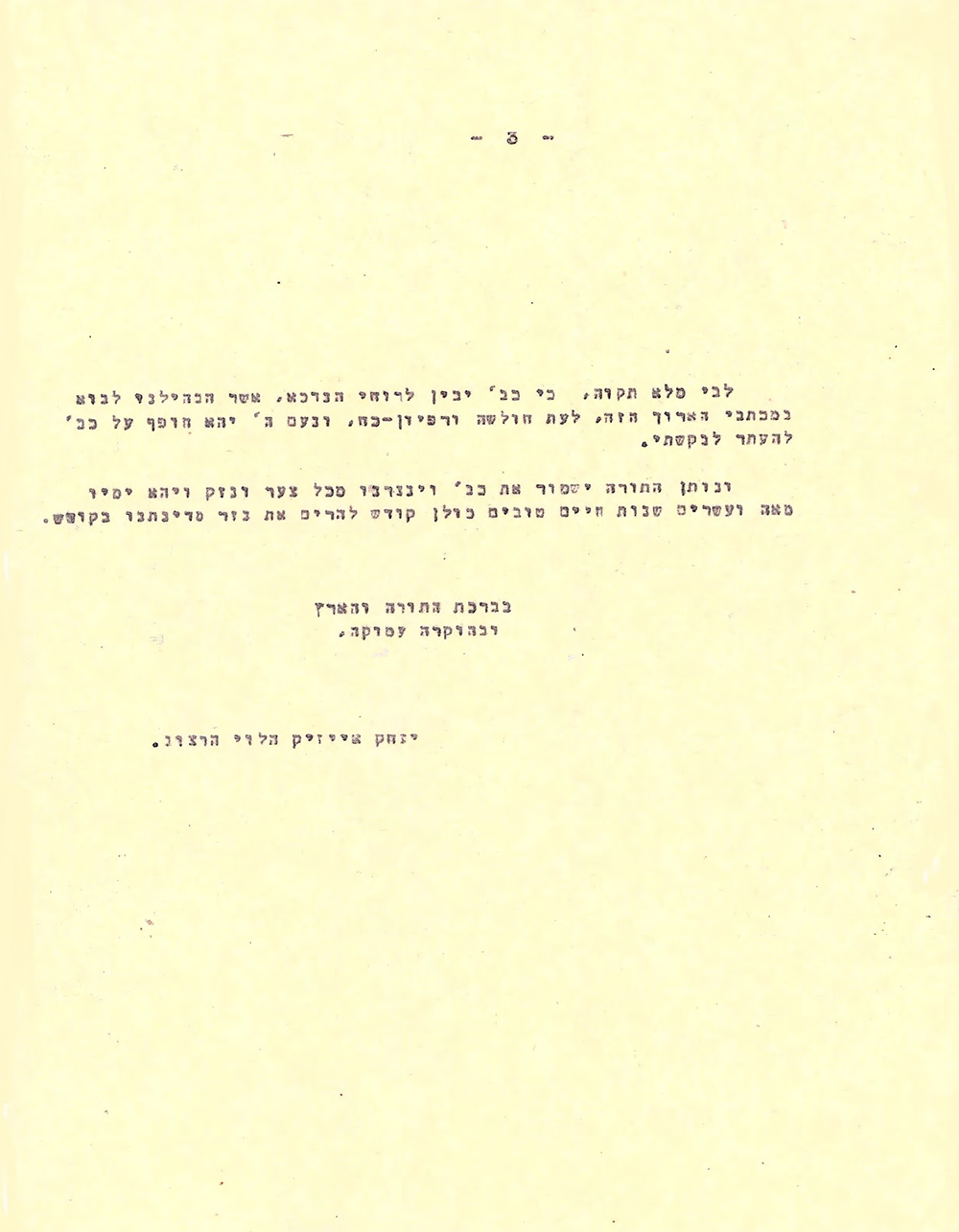
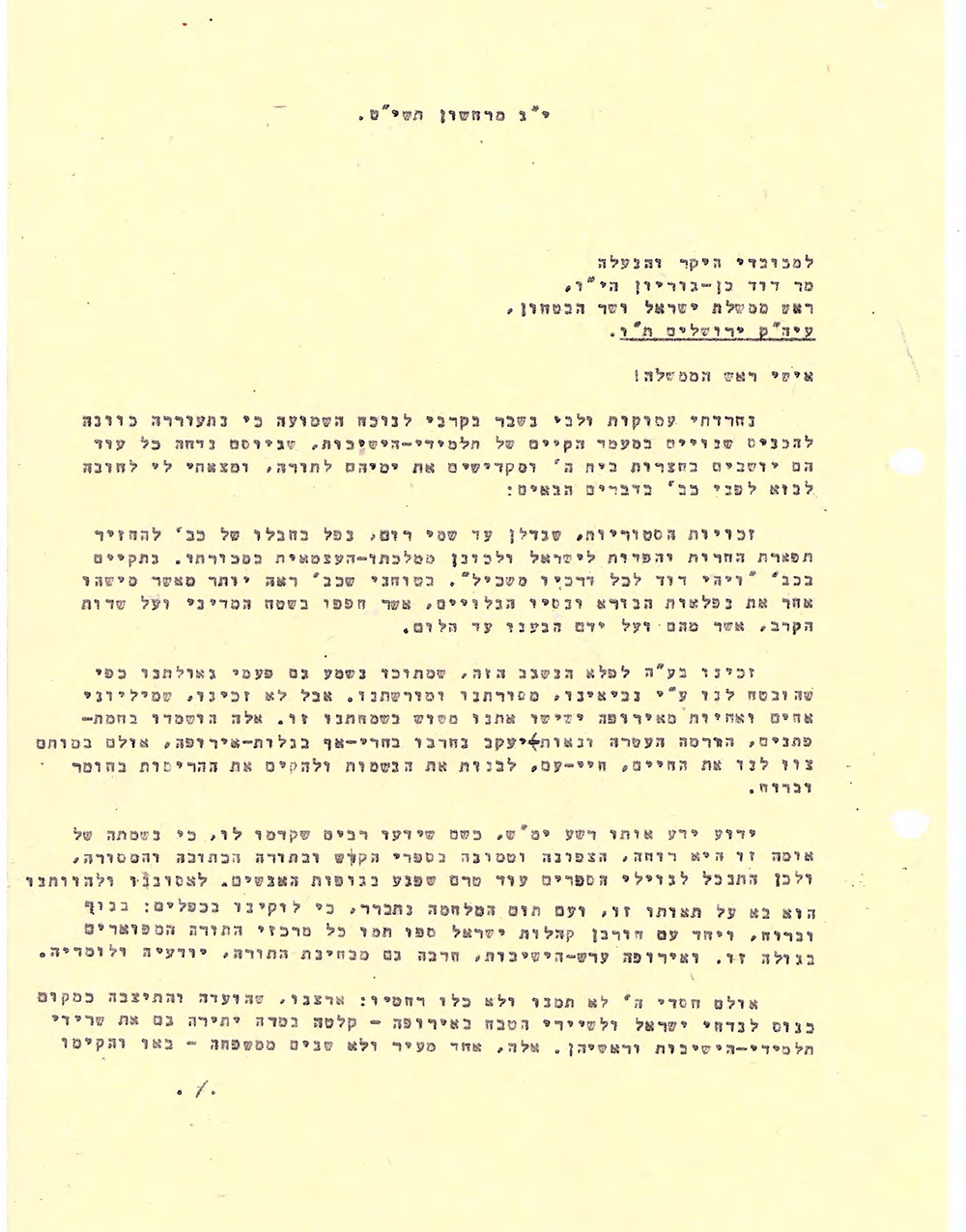
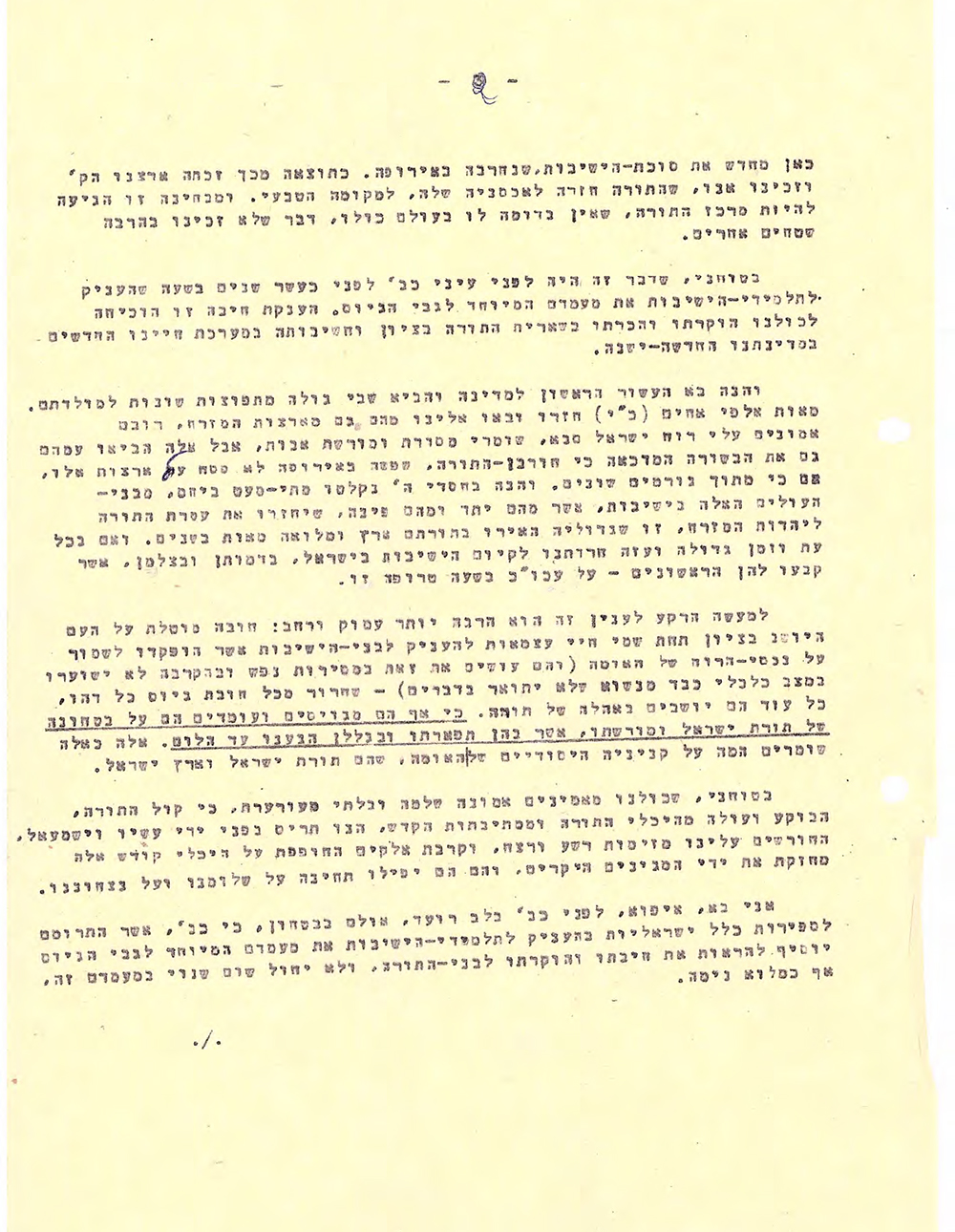
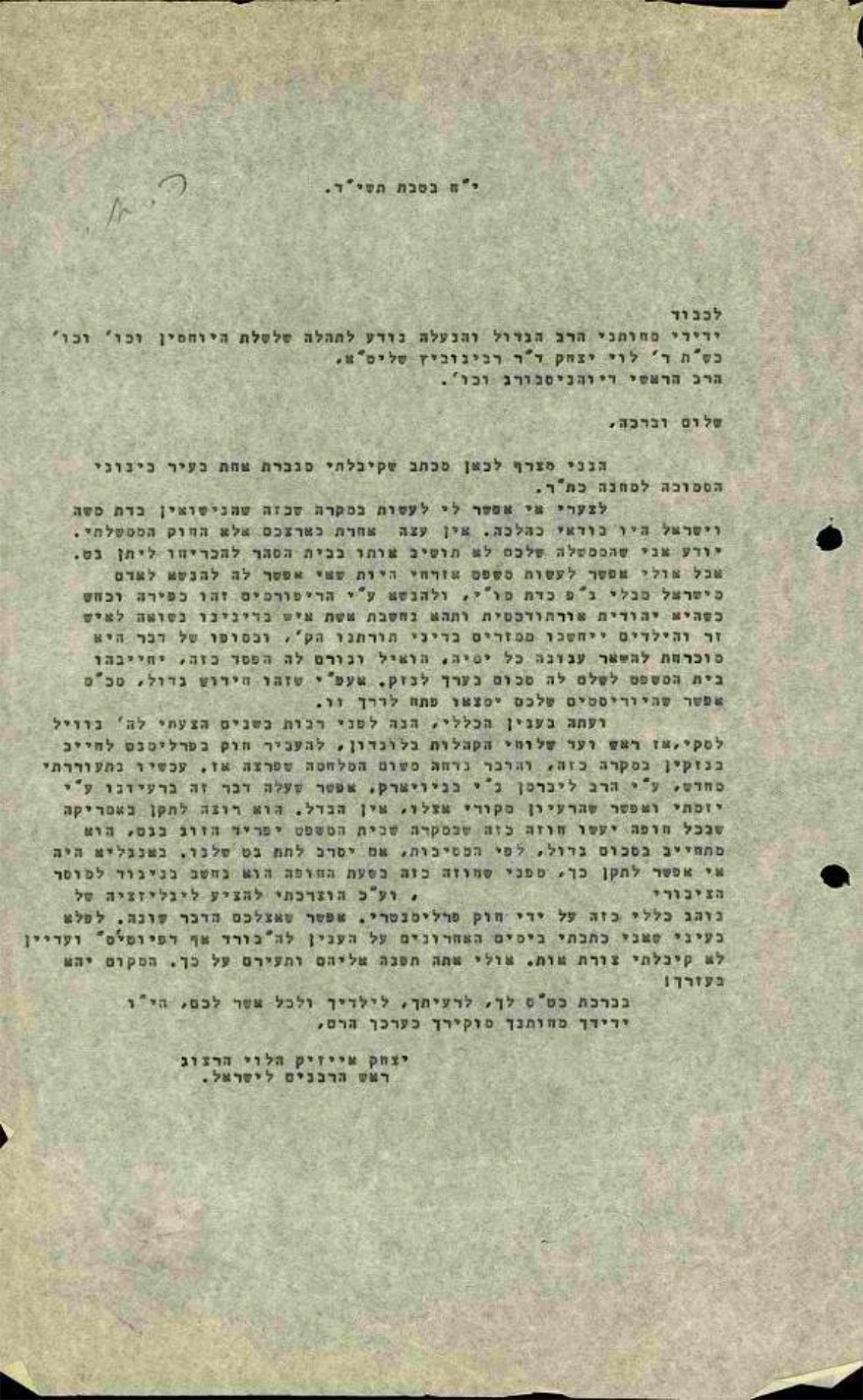
While this was Rav Herzog’s halachic conclusion in the kuntres, when the issue of forced conscription became a potential reality ten years later, Rav Herzog sent a heartfelt letter to Ben-Gurion, pleading for the exemption of bnai yeshivot, since they are already conscripted to the security of Torah and the heritage of Am Yisrael, and their Torah learning is a shield for Am Yisrael. This letter, which is found in the file of Rav Herzog’s correspondence with Ben-Gurion[4], appears below:
Another noteworthy document in the file on giyus bnai yeshivot is a 1948 telegram from the Roshei Yeshiva of the American yeshivot, expressing their shock at the possibility of giyus bnai yeshivot, and urging Rav Herzog and Rav Uziel to make sure that bnai yeshivot remain exempt from army service. The telegram appears below, as well as my transcription of the telegram into Hebrew:
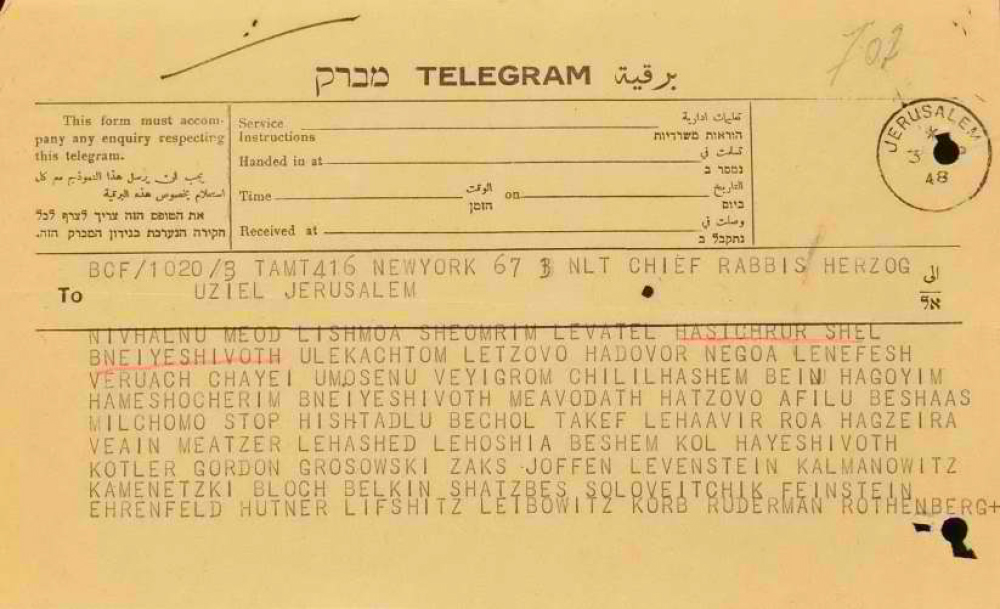
נבהלנו מאד לשמוע שאומרים לבטל השחרור של בני ישיבות ולקחתם לצבאהדבר נוגע לנפש ורוח חיי אומתנו ויגרום חילול השם בין הגויים המשחררים בני ישיבות מעבודת הצבא אפילו בשעת מלחמההשתדלו בכל תוקף להעביר רוע הגזירהואין מעצר להש[םלהושיעבשם כל הישיבות,

Kotler Gordon Grosowski Zaks Joffen Levenstein Kalmanowitz Kamenetzki Bloch Belkin Shatz[k]es Soloveitchik Feinstein Ehrenfeld Hutner Lifshitz Leibowitz Korb Ruderman Rothenberg[5]
The telegram is especially noteworthy because of the appearance of the names of the Charedi Roshei Yeshiva, such as Rav Aharon Kotler, Rav Reuven Grozovsky, Rav Moshe Feinstein etc. together with the names of the more modern Roshei Yeshiva of RIETS: the Rav, Rav Yosef Dov Soloveichik, and Dr. Samuel Belkin. Such collaboration would seem to be almost impossible in later years.
II Professor Saul Lieberman on Rav Herzog’s Torat Ha-Ohel
Rav Herzog maintained a close relationship with Professor Saul Lieberman, as Dr. Marc Shapiro has mentioned previously on the Seforim blog[6], and noted in his “Saul Lieberman and the Orthodox”, page 22.[7] It should therefore come as no surprise that Rav Herzog’s archive contains correspondence between him and Lieberman. The letter that appears below was sent by Lieberman to Rav Herzog, and contains Lieberman’s haarot on Rav Herzog’s Torat Ha-Ohel, his sefer on the Rambam’s Hilchot Sanhedrin.[8] In this letter, Lieberman first discusses the proper girsaot in the relevant Rambam and the gemara in Makot regarding minuy dayanim. He then addresses Rav Herzog’s question of how it could be possible that bnai noach have a more extensive obligation of dinim than do Yisrael,[9] and Lieberman offers an elegant yeshiva-style distinction between dinei yisrael and dinei bnai noach to answer the problem. (A similar distinction was offered by Rav Aharon Lichtenstein, in Beit Yitzchak 8, page 89, and reprinted in his Minchat Aviv.) He offhandedly mentions that Rav Menachem Kasher had recently “acquired” some of his material, and then bemoans the fact that RY”D is too involved in the ol ha-tzibur and is not dedicating himself sufficiently to his Torah study, although he has the potential to become the Gaon Ha-Dor.
Lieberman’s letter appears below, and a transcription appears in Appendix A.
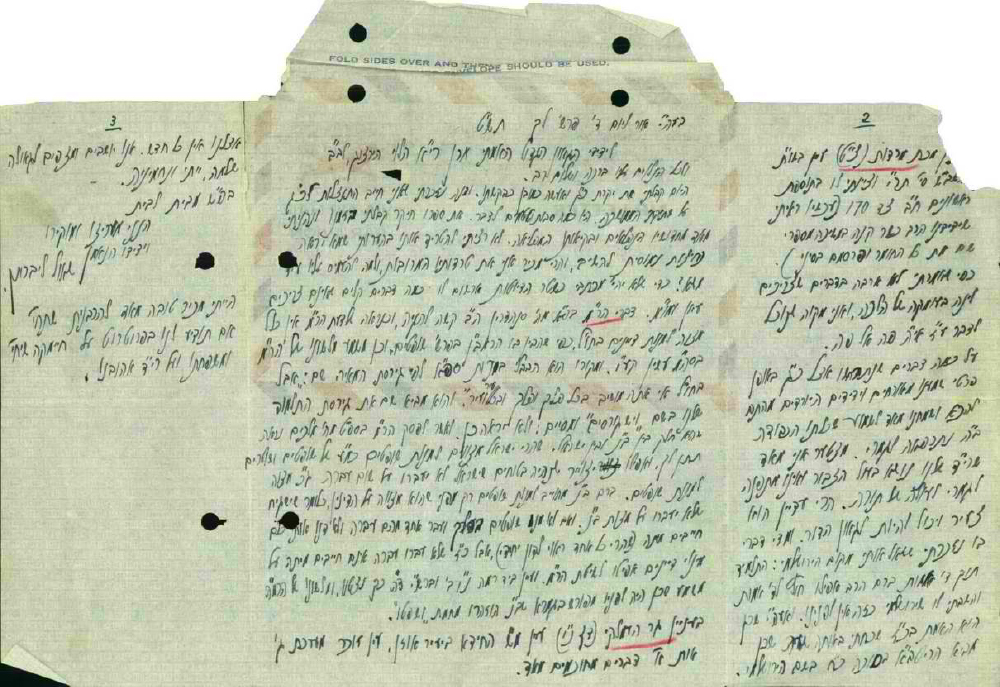
It is most likely that the RY”D to whom Lieberman referred was Rav Yaakov David Herzog, Rav Herzog’s son, as the context within the letter is dealing with Rav Herzog’s family. Rav Yaakov David had already published a scientific/critical edition of Mishnayot Brachot/Peah/Demai in 1945, at the young age of 24, and Lieberman wrote a Foreword to the volume.[10] Rav Yaakov David Herzog was eventually selected as Chief Rabbi of Great Britain in the 1960s, but declined the post due to his ill health.[11]
I also entertained the possibility that the RY”D to whom Lieberman referred is the Rav, Rav Yosef Dov Soloveichik. While this seems unlikely, it would fit nicely with the comments made by Rabbi Jacob Radin, as quoted by Rav Aaron Rakeffet[12], contrasting the Rav and Lieberman:
You know that I have attended classes in both the Seminary and the Yeshiva. I have studied with Professor Lieberman and the Rav. The Professor lectures a few times a week. He hurriedly finishes and rushes back to his research. Outside of his formal lectures, he is barely available to the students. On the other hand, the Rav is never alone. He has never finished a lecture on time. He always goes overtime. He remains in the classroom afterwards to carry on the Talmudic give and take with the students who cannot part from him. Even when he rises to leave, his disciples surround him and the discussion continues…This is the basic manifest difference between these two prodigious scholars.[13]
On Lieberman’s mention of Rav Kasher, this is the page that Lieberman referenced from Tosefet Rishonim:
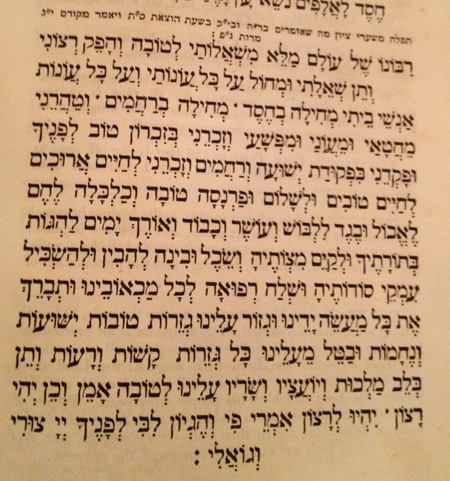
And the page from Rav Kasher’s article in Sinai, Volume 18:
A number of the rather obscure sources in Rav Kasher’s lengthy footnote 2 appear to be taken from Lieberman’s Tosefet Rishonim.
III The Lieberman Ketuba
As is well-known, Lieberman introduced a new clause into the ketuba in the early 1950s in order to alleviate the aguna problem. The clause stipulated that the couple recognizes the authority of the beit din of the Rabbinical Assembly, and that upon dissolution of the marriage, the beit din would be empowered to administer penalties as it sees fit. The aim of these penalties would be to pressure the husband to give a get. In a number of letters from the 1950s (in a file regarding Even HaEzer issues[14]), Rav Herzog mentions that he himself came up with such an idea many years earlier when he was still Chief Rabbi of Ireland. He envisioned a separate document which would empower the beit din of London to administer financial penalties on a husband withholding a get. He mentions that he is unsure of Professor Lieberman came up with this idea himself, or if Lieberman actually got the idea from Rav Herzog.

Rabbi Emanuel Rackman wrote that it was widely believed that the Lieberman clause was examined by Rav Herzog, and that he had no objections.[15] This belief is certainly false, as Rav Herzog penned a strong protest to the proposed addition to the ketuba.[16] Rav Herzog’s main protest was due to the authority granted to the Conservative beit din. It is possible that the root of this misconception (that Rav Herzog approved of the Lieberman clause) is the fact that Rav Herzog independently envisioned a similar document or agreement, and that he entertained the possibility that Lieberman actually got the idea from him.
IV The Epstein Proposal
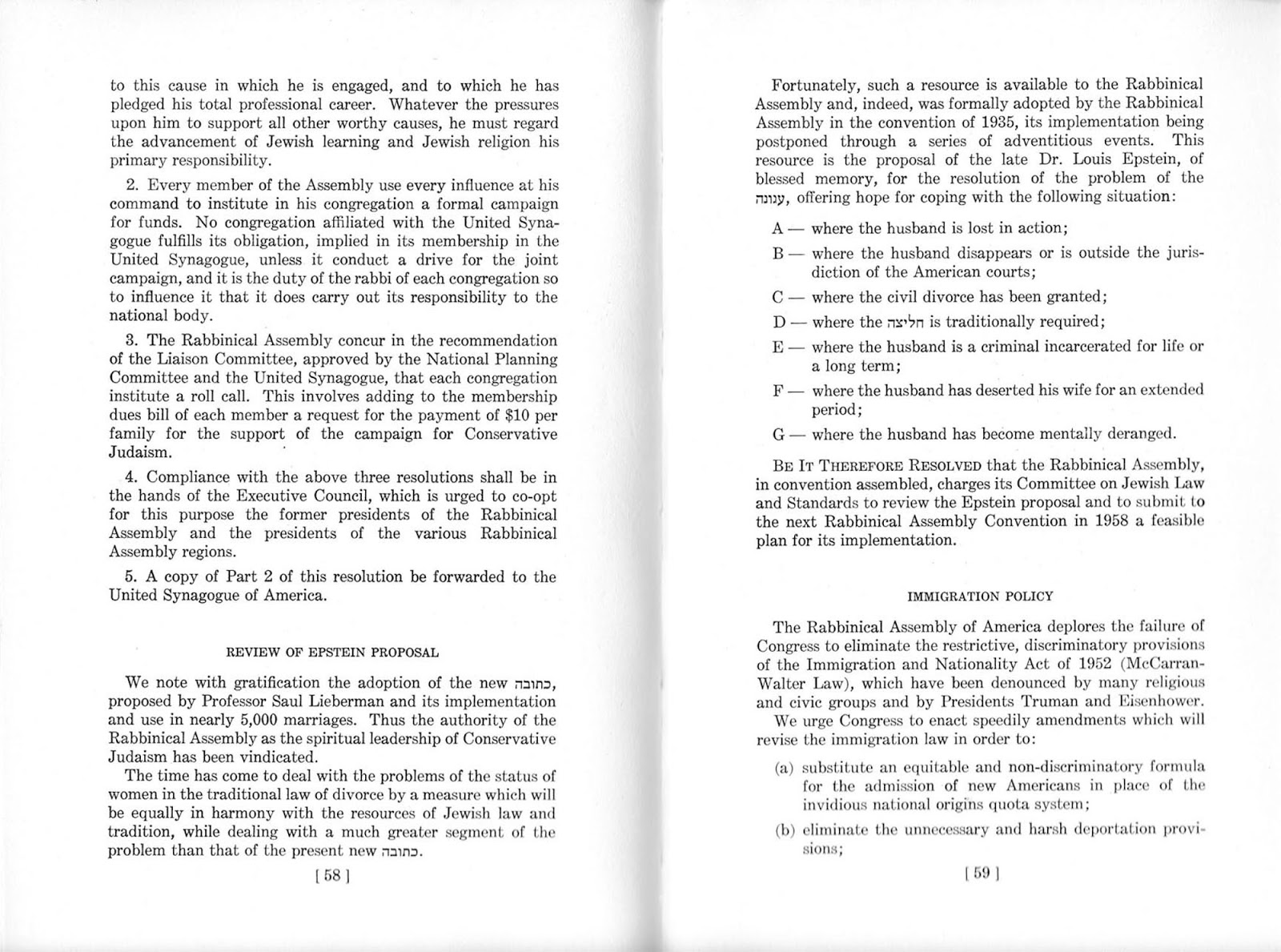
Another fascinating exchange between Rav Herzog and Lieberman is found in Rav Herzog’s file dedicated to Reform[[17] and Conservative Jewry[18], and relates to the Rabbinical Assembly’s 1957 attempt to resuscitate the Epstein proposal. Rabbi Louis Epstein had proposed, in his 1930 book Hatzaa Lemaan Takanat Agunot, that every husband, at the time of marriage, ought to designate his wife as a shliach to deliver her own get, in order to eliminate the aguna problem in the case of a missing husband or a get-refuser. The proposal was never implemented, in large part due to Orthodox opposition. In May of 1957, the Rabbinical Assembly attempted to resuscitate the Epstein Proposal at their Annual Convention at the Concord Hotel in Kiamesha Lake, New York. However, this attempt to revive the Epstein proposal must be viewed in light of the politics within the Conservative movement at that time. The following is an excerpt from the Presidential Report of Rabbi Aaron Blumenthal at the Rabbinical Assembly Convention[19]:

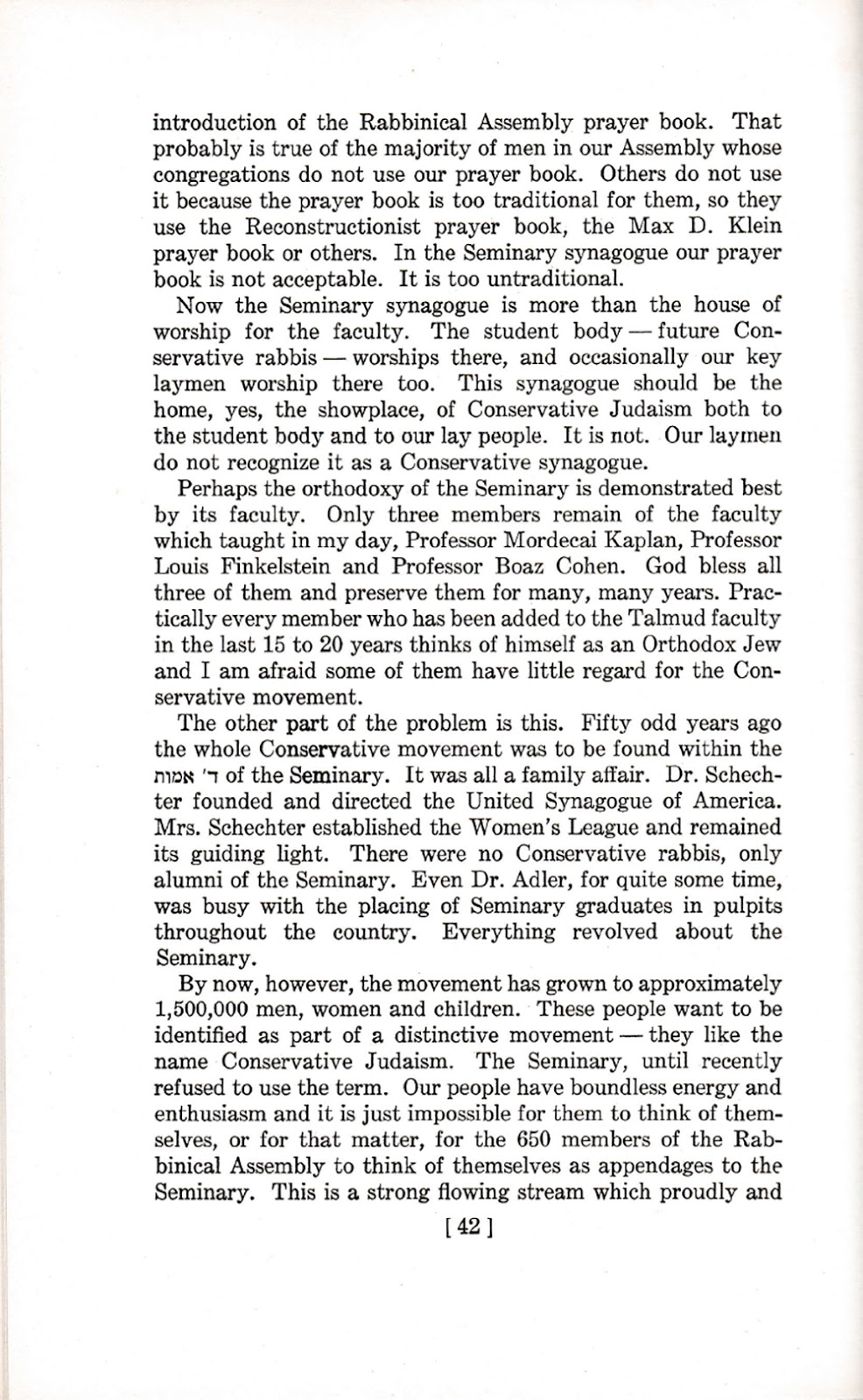
Note in particular Rabbi Blumenthal’s comments that the Seminary is an Orthodox institution, that its synagogue has separate seating and does not use the Rabbinical Assembly siddur, and that practically every faculty member added to the Talmud faculty in the last 15 to 20 years thinks of himself as an Orthodox Jew and has little regard for the Conservative movement. Given that Lieberman was the de-facto Rabbi of this synagogue, and that Lieberman ensured that the synagogue did not use the Rabbinical Assembly siddur, and that the synagogue maintained separate seating until Lieberman’s death[20], it would seem that Rabbi Blumenthal’s words were directed primarily at Lieberman, who arrived at the Seminary some 17 years prior.
It is against this backdrop that the Rabbinical Assembly passed a Resolution that the Rabbinical Assembly Committee on Jewish Law and Standards review the Epstein proposal and submit a plan for its implementation.
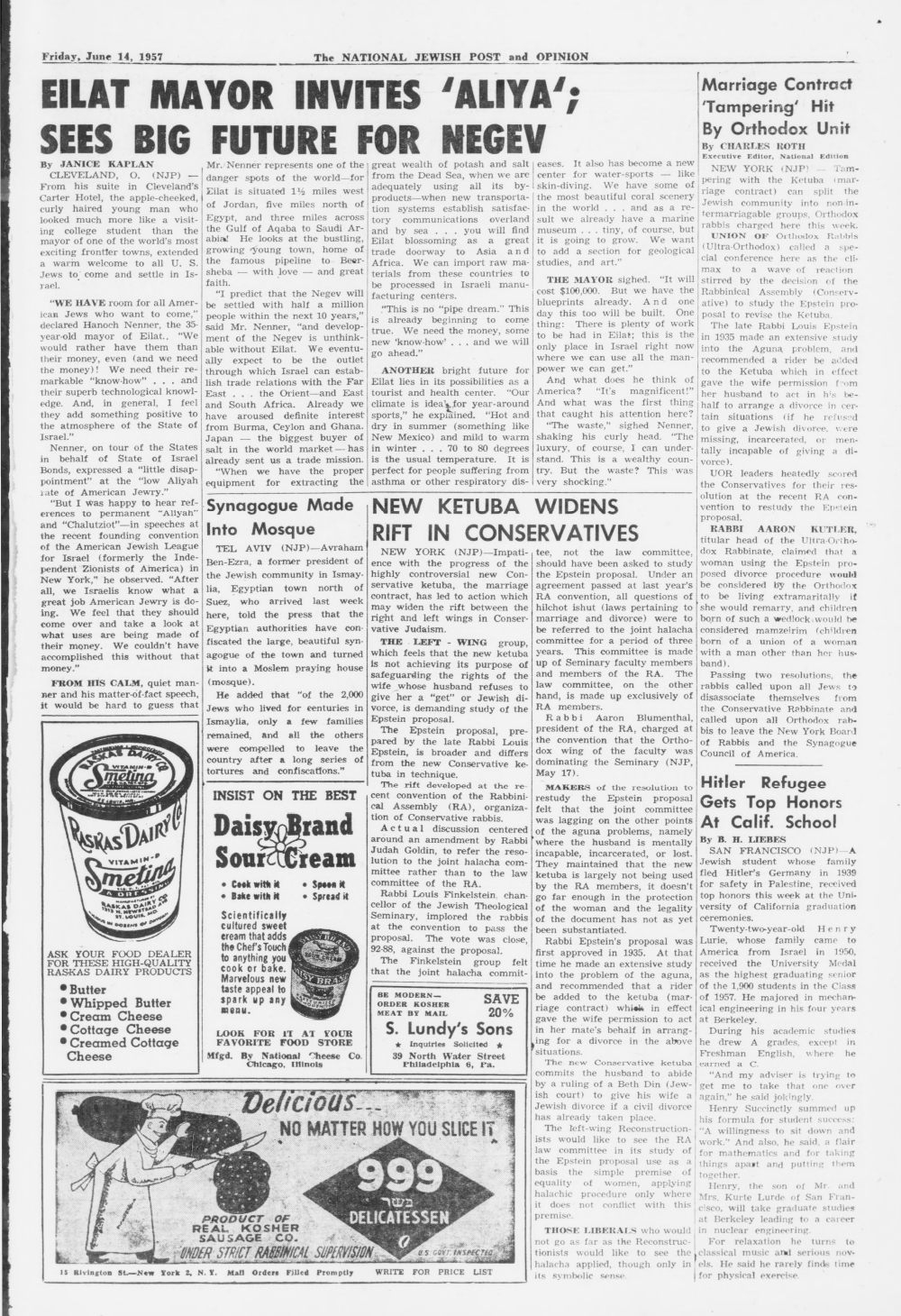
The report below from the National Jewish Post and Opinion makes clear that the left wing of Conservative Judaism felt that the Lieberman ketuba did not go far enough in addressing the aguna problem and therefore sought to institute the Epstein proposal. On the other hand, the more traditional wing of Conservative Judaism, led by Rabbi Louis Finkelstein, Chancellor of JTS, wanted the proposal referred to a joint committee made up of JTS faculty and RA members. Rabbi Blumenthal’s complaint about the Orthodox character of the Seminary faculty was not just an observation, but also a charge to the RA regarding the Epstein proposal, that they not allow the Seminary faculty to torpedo the proposal. Rabbi Finkelstein’s group lost the vote 92-88, in what was, in a sense, a repudiation of Lieberman’s Orthodox influence, and a rejection of his ketuba as too Orthodox and not impactful enough.[21] The majority of the RA membership was prepared to head in a more liberal direction.
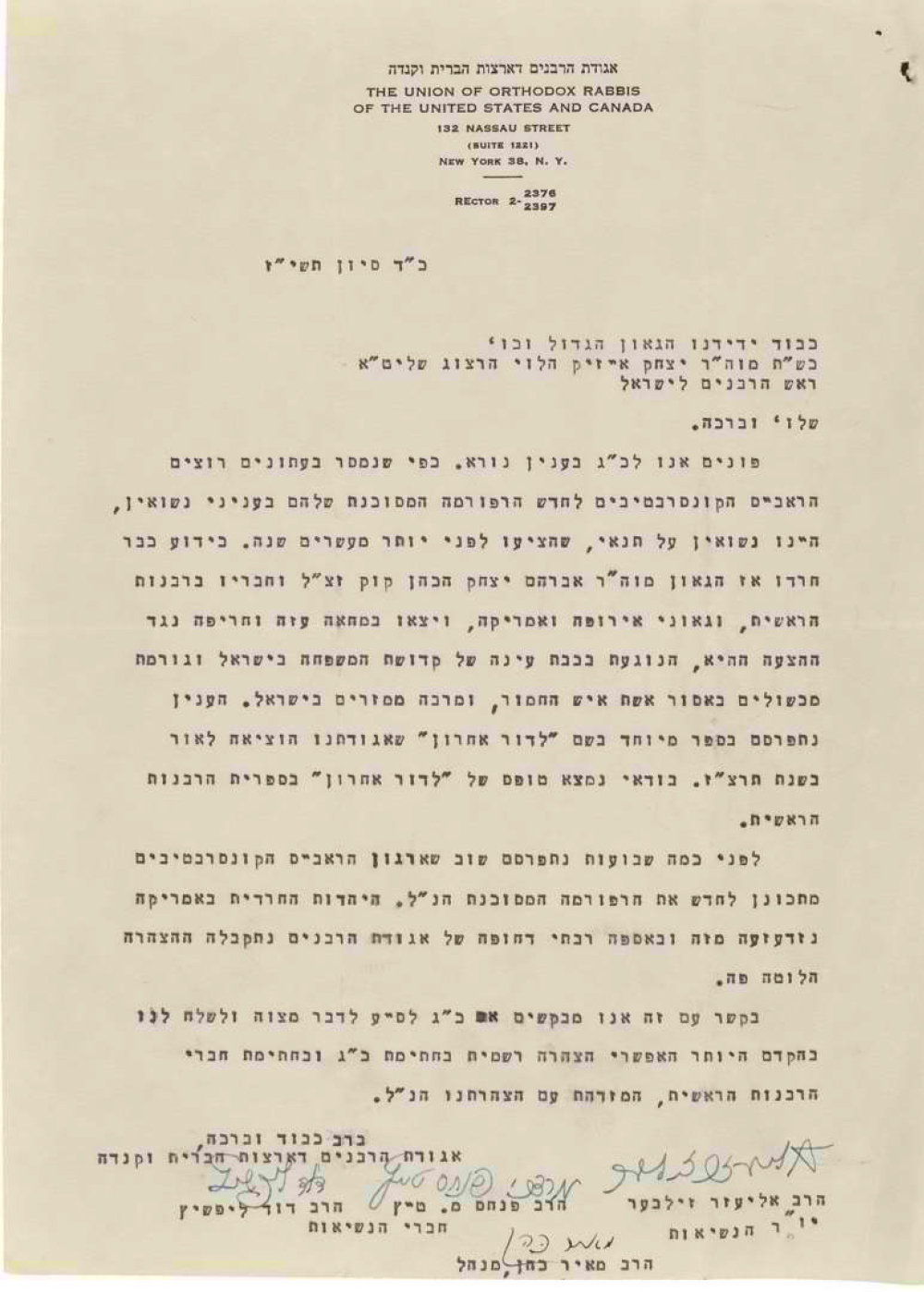
After the passage of the Rabbinical Assembly resolution, the Agudat HaRabbanim turned to Rav Herzog in the letter below, asking him to intervene and prevent this breach of kedushat hamishpacha beyisrael.[22] (It is not clear to me why they termed the Epstein proposal nisuin al tnay, or conditional marriage, which is a different attempted mechanism to prevent aguna situations.)
In response to the request of Agudat HaRabbanim, Rav Herzog turned to Lieberman in the letter below, asking him to intervene and prevent the implementation of the proposed nisuin al tnay.[23] (Rav Herzog apparently understood the proposal to be literally one of conditional marriage, and thus referred Lieberman to the book Ain Tnay Benisuin, rather than the book LeDor Acharon, mentioned in the Agudat HaRabbanim letter, which deals with the Epstein proposal.)
In response to Rav Herzog’s letter, Lieberman sent Rav Herzog the very fascinating letter below. (A transcription of this letter appears in Appendix B.) Lieberman tells Rav Herzog that the Orthodox Rabbis are simply looking for excuses to make machloket, that Rabbi Finkelstein strongly protested the re-introduction of the Epstein proposal (as we noted was reported in the National Jewish Post), and that the President of the Assembly (Rabbi Blumenthal) also denied the claim of the Agudat HaRabbanim. He then says that the entire purpose of his revised ketuba was to bury the possibility of the Epstein proposal! He also mentions that some Orthodox Rabbis have claimed that any wedding which uses the new ketuba is invalid, and the kiddushin are not tofsin. (I have been unable to find any documented source of a Rabbi who made such a claim. I would be indebted to any of the readers who could provide such a source.) Lieberman concludes by assuring Rav Herzog that he would be the first to protest the implementation of the Epstein proposal, and that such a nevala could never happen while he is at the Seminary.
Rabbi Blumenthal’s denial was in fact reported by the JTA.[24] He said that the Assembly only authorized a committee to re-study the problem.
Some points remain unclear to me, as Rabbi Finkelstein’s group did indeed lose the vote, and the RA did pass a resolution that the Rabbinical Assembly Committee on Jewish Law and Standards submit a plan for the implementation of the Epstein proposal. I find it hard to understand Rabbi Blumenthal’s denial, or how Lieberman could claim that the Orthodox Rabbis were simply seeking machloket, when the RA passed a resolution for implementation (even documented in the RA Proceedings), with the left-wing defeating the traditional wing.
(to be continued)
Appendix A
Letter from Lieberman to Rav Herzog about Torat Ha-Ohel
בע”ה אור ליום ד’ פרש’ לך תש”ט
לידידי הגאון הגדול האמתי מרן רי”א הלוי הירצוג, לב”ב ולכל הנלוים עליו שלום רב.
היום קבלתי את יקרת כ”ג ואעשה כמובן כבקשתו. והנה נזכרתי שאני חייב התנצלות לכ”ג על שתיקתי הממושכה. היו כמה סיבות וטעמים לדבר. את ספרו היקר קבלתי בזמנו ונהניתי מאד מחידושיו הנפלאים ובקיאותו המפליאה. לא רציתי להטריד אותו בהערותי שמא יראה נחיצות נמוסית להשיב, והרי מכיר אני את טרדותיו המרובות, ולמה להעמיס עליו עוד משא? כדי שלא יהי’ מכתבי כשטר הדיוטות ארשום לו כמה דברים קלים שאינם צריכים עיון ומו”מ. דברי הר”מ בפ”א מהל’ סנהדרין ה”ב קשה להגיה, וכנראה שלדעת הר”מ אין כלל מצוה למנות דיינים בחו”ל, כפי שהבין בו הרמב”ן בפרש’ שופטים, וכן משמע מלשונו של הר”מ בסה”מ עשין קע”ו ומקורו הוא הבבלי במכות ספ”א[25] לפי גירסת המאירי שם: “אבל בחו”ל אי אתה מושיב בכל פלך ופלך ובכל עיר ועיר.” והוא מביא שם את גירסת התלמוד שלנו בשם “ויש גורסים” ומסיים: ולא נראה כן. ואשר לפסק הר”מ בספ”ט מה’ מלכים נראה שהוא חלק בין ב”נ ובין ישראל. שהרי ישראל מצווים למנות שופטים כמ”ע של שופטים ושוטרים תתן לך, ואפילו יצוייר שנהיה בטוחים שישראל לא יעברו על שום עברה ג”כ מצוה למנות שופטים. ברם ב”נ מחוייב למנות שופטים רק מפני שהוא מצווה על הדינין, כלומר שישגיח שלא יעברו על מצות ב”נ. ואם לא מנה שופטים בפלך ועבר אחד מהם עברה ולא דנו אותו כלם חייבים מיתה (שהרי כל אחד ראוי לדון יחידי), אבל כ”ז שלא עברו עברה אינם חייבים מיתה על מינוי דיינים אפילו לשיטת הר”מ.[26] ועיין ביד רמה נו ע”ב וברש”י ד”ה כך נצטוו, ומלשונו של הרמ”ה משמע שכן היה לפניו מפורש בגמרא שבני נח הוזהרו מחמת “ושפטו.”
בענין גר העמלקי (דף נ”ו) עיין מ”ש החיד”א ביעיר אוזן, עין זוכר מערכת ג’ אות א’ דברים מחוכמים מאד.
[בעני]ן מכת מרדות (צ”ט) עיין בשו”ת [הר]שב”ש סי’ תר”י וציינתי לו בתוספת ראשונים ח”ב צד 170 (עכשיו ראיתי שידידנו הרב כשר קנה במשיכה מספרי שם את כל החומר ופרסמם בסיני.)
כפי שאמרתי לא ארבה בדברים שצריכים לינה בעומקה של הלכה, ואני מקוה שנוכל לדבר ע”ז אי”ה פה אל פה.
על כמה דברים שנתחדשו אצל כ”ג באופן פרטי שמענו מאורחים וידידים היורדים מהתם להכא ושמחנו מאד לשמוע שכלתו הכבודה ב”ה נתרפאה לגמרי. מצטער אני מאד שרי”ד[27] שלנו נושא בעול הצבור ואינו מתפנה לגמרי לעולה של תורה. הרי עדיין הוא צעיר ויכול להיות לגאון הדור. ומדי דברי בו נזכרתי ששאל אותי מקום הירושלמי: התלמיד תוך ד’ אמות ברם הרב אפילו חוץ לד’ אמות והשבתי לו שירושלמי כזה אין לפנינו. ואעפ”י שכן הוא האמת בכ”ז שכחתי באותה שעה שכן מביא הריטב”א בסוכה כ”ח בשם הירושלמי.
אצלנו אין כל חדש. אנו יושבים ומצפים לגאולה שלמה, ייתי ונחמיניה.
בפ”ש מבית לבית
הנני מעריצו ומוקירו וידידו הנאמן
שאול ליברמן
הייתי מכיר טובה מאד לרבנית שתחי’ אם תודיע לנו בפרוטרוט על חיימקה שיחי’ ומשפחתו ועל רי”ד אהובנו.[28]
Appendix B
Letter from Lieberman to Rav Herzog about the Epstein Proposal
בעה”י יום ה’ פרש’ מטות תשי”ז
לכבוד ידידינו הגאון הגדול האמיתי מרן הרי”א הלוי הירצוג הרב הראשי לא”י ברכה ושלום רב.
יקרת כ”ג מי’ תמוז הועברה אלי לכרם מרתה[29], ומאד מאד התפלאתי שכ”ג האמין לדיבת הרבנים כאן. אמנם בכנסיית הרבנים השמרנים דברו על עיון מחדש בשאלת תנאי בקידושין, אבל ד”ר פינקלשטיין יצא בכל תוקף נגד חידוש העיון. ונשיא הכנסיה הנ”ל הכחיש בעצמו את דיבת הרבנים. אבל הללו מחפשים רק אמתלאות למחלוקת. כל עניין הכתובה היה כדי לקבור לגמרי את שאלת התנאי. הסברתי להם שאם ליחיד אפשר פעם לחשוב ע”ז הרי לרבים אין הדבר בא כלל בחשבון שהתנאי יעשה ע”פ דין, וישתקע הדבר ולא יעלה שוב על הפרק. וכולם הסכימו ל[י]. עכשיו יש מהם שבאים בטענות ואומרים: הרי הרבנים הארתודוכסים טוענין שאף הכתובה נעשתה שלא כדין, ויש מהם (כלומר מהרבנים הארתודוקסים) שאמרו שהמתחתן בכתובה החדשה אין הקידושין תופסין, והאשה מותרת בלי גט (ממש לא יאומן כי יסופר! אבל לצערי נאמרו הדברים), א”כ הרי מוטב לעשות תנאי בקידושין, ולהפטר מכל שאלת העגונה בבת אחת. והנני מבטיח את כב”ג שאין לשמועה שום יסוד, אחרת הייתי אני בין הראשונים למחות, וכל זמן שאני בסמינר לא יתכן שיעשו נבלה כזו.
בפ”ש ובברכה לכל המשפ[חה]
בהערצה ובידידות
שאול [ליברמן]
[1] See here.
[2] See here.
[3] A short one-page summary of the kuntres appears in R’ Zorach Warhaftig’s Chuka Leyisrael, page 236. However, R’ Warhaftig neglects to mention that Rav Herzog advocated only giyus chelki.
[4] See here.
[5] Every name on the telegram is relatively well known, except for Rothenberg. I assume this is Rav Moshe Rothenberg, founder of Yeshivat Chachmei Lublin of Detroit. See Toldot Anshei Shem page 126, here.
[6] See here.
[7] For the following sections related to Lieberman, I made extensive use of Dr. Shapiro’s “Saul Lieberman and the Orthodox.”
[8] See here.
[9] Here in Yeriot Ha-Ohel 1.
[10] See here. Interestingly, Lieberman signed the Foreword as “Saul Lieberman, Dean, Harry Fischel Institute, Jerusalem”, even though Lieberman had been teaching in JTS for five years already. (In the Foreword, he notes that the publication of the volume coincided with Harry Fischel’s 80th birthday, in 1945.) In fact, Lieberman’s name appeared atop the Harry Fischel Institute’s stationery as late as 1949 (can be seen in Rav Herzog’s file on Machon Harry Fischel.) It would appear that Lieberman continued to serve in some capacity as Dean of the Harry Fischel Institute even after he left Israel to come to America. Incredibly, he held one foot in each world simultaneously, as Dean of the Harry Fischel Institute and Professor in JTS, a fact that has heretofore eluded his biographers. My good friend Rabbi Dovid Bashevkin reports in the name of Mr. Carmi Schwartz, Executive Vice President of the Council of Jewish Federations, that Lieberman willed most of his considerable life savings to the Harry Fischel Institute after his death, and not to JTS.
[11] See here.
[12] Mentor of Generations, page 119.
[13] For more on the Rav and Lieberman, see Rav Rakeffet’s “A Note on R. Saul Lieberman and the Rav”, in Tradition, Winter 2007. Also noteworthy is the following story that appears in Rav Hershel Schachter’s Mipninei Ha-rav:
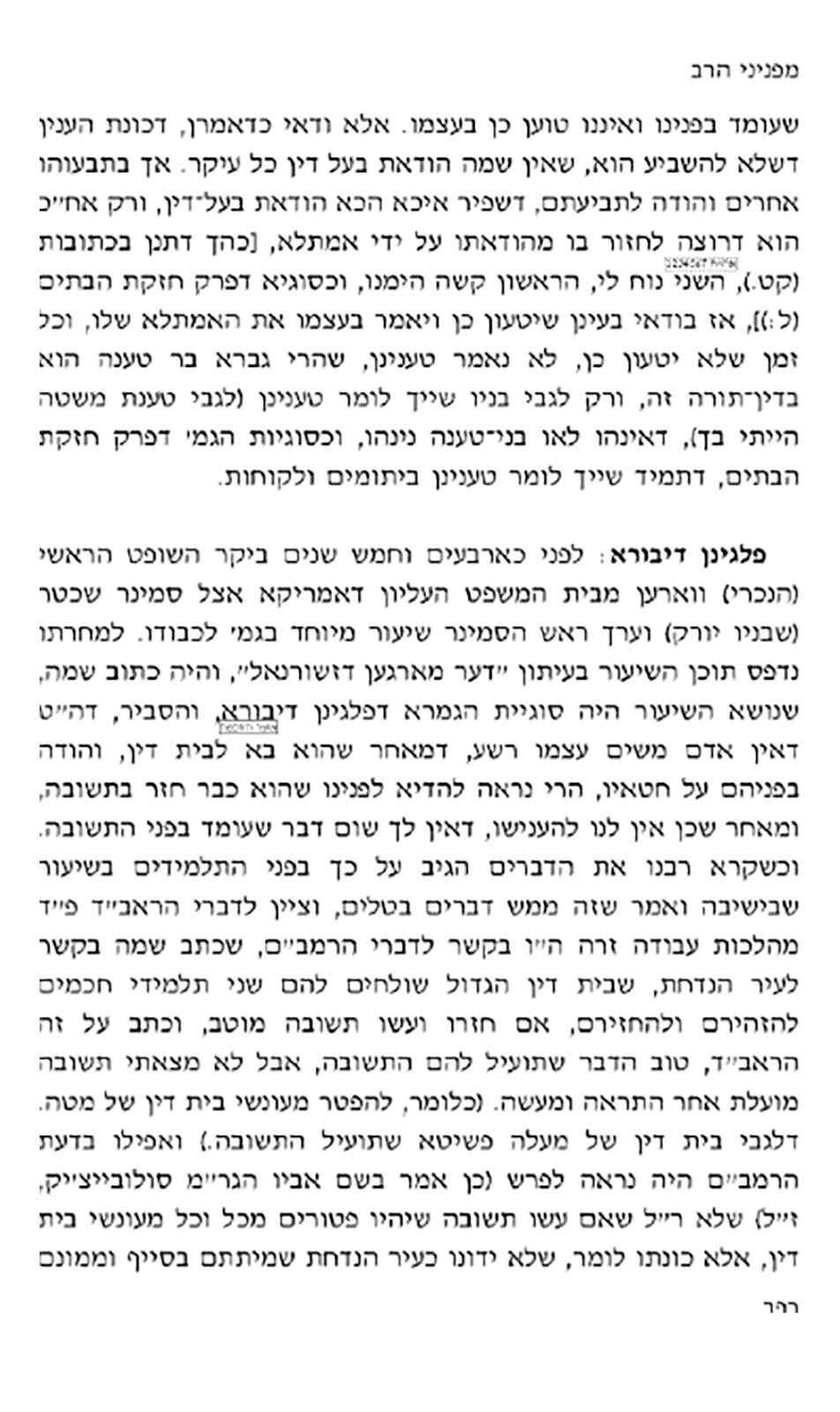
The head of the Seminary who gave the shiur with which the Rav disagreed so vehemently is none other than Lieberman. Warren’s visit to the Seminary was covered on the front page of the New York Times (September 14, 1957.) (For a humorous account of how Lieberman sipped tea through a sugar cube that weekend in the presence of former president Harry Truman, see “The Rabbi as Symbolic Exemplar” by Jack Bloom, page 37.) Here is the New York Times’ account of Lieberman’s shiur:
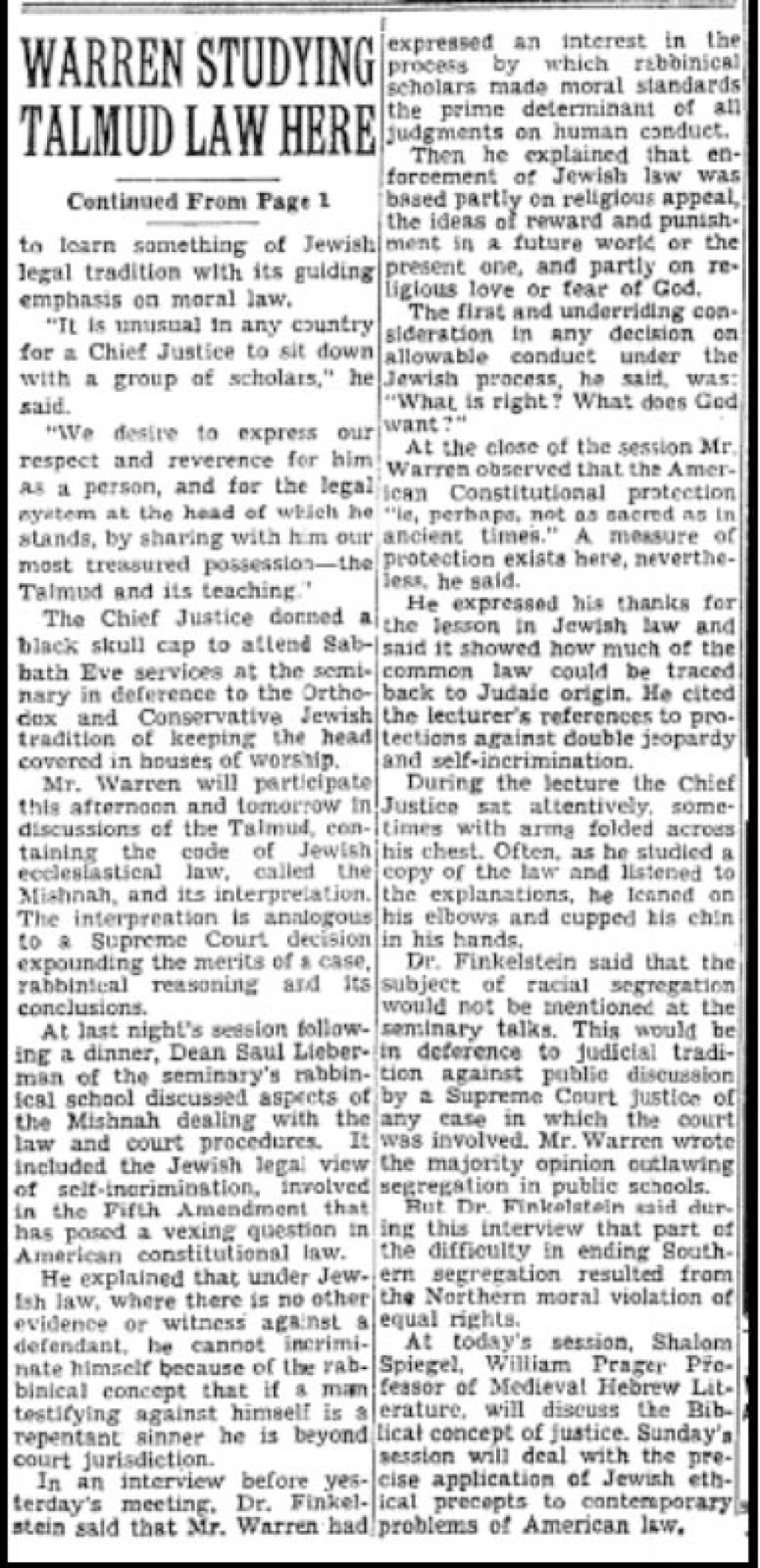
A similar account of the shiur appears in the Sentinel (September 26, 1957)
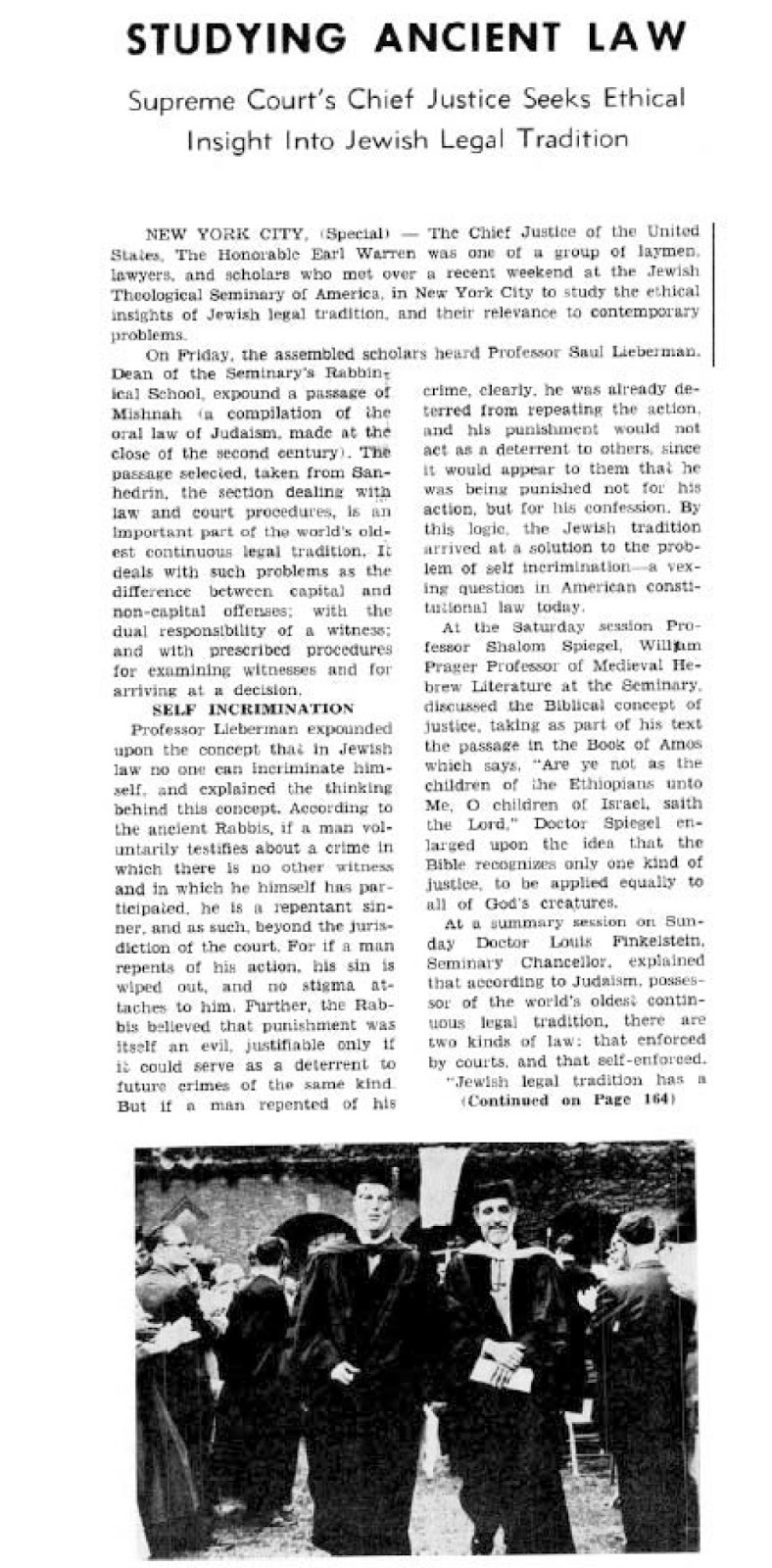
Regarding Lieberman’s suggestion that the principle of Ain Adam Meisim Atzmo Rasha is predicated on the presumption of teshuva, there appears to be another difficulty, in addition to that raised by the Rav. The gemara in Makot 13b states:
חייבי מיתות ב”ד אינו בכלל מלקות ארבעים שאם עשו תשובה אין ב”ד של מטה מוחלין להן
The gemara states explicitly that teshuva is not efficacious in absolving a sinner of capital punishment, which would seem to contradict Professor Lieberman’s thesis. My good friend Rabbi Dovid Bashevkin has offered the following original suggestion to resolve the problem. Professor Lieberman might have believed that the gemara in Makot which states that teshuva does not absolve capital punishment is referring to after gmar din, when the sinner has already been tried and sentenced. At that point, teshuva is no longer effectual. However, the principle of Ain Adam Meisim Atzmo Rasha applies before trial and sentencing, and teshuva would absolve a sinner before sentencing. This reading of the gemara in Makot is certainly plausible, although it does run contrary to the reading of the Noda B’Yehuda (Orach Chaim 34, s.v. ela), who assumes that the gemara is referring to before gmar din as well. Additionally, it would seem difficult to assume that a confession is indicative of teshuva if a sinner is aware that he can absolve himself of punishment by simply admitting his guilt in beit din. However, this approach would explain why the Rav raised a difficulty based on the words of the Raavad, and not the gemara in Makot, as the gemara in Makot is not a conclusive proof.
[14] See here.
[15] “Conflict and Consensus in Jewish Political Life”, page 120, also cited in “Saul Lieberman: the Man and his Work”, page 45. My thanks to my good friend Dr. Josh Lovinger for bringing this to my attention.
[16] Techuka leYisrael al pi Torah, volume 3 page 210.
[17] The correspondence in that file also shows the effort that Rav Herzog expended in an attempt to prevent the Reform movement from gaining any foothold whatsoever in Israel.
[18] See here.
[19] Proceedings of the Rabbinical Assembly of America 21, 57th Annual Convention (1957), pages 41-42.
[20] See here.
[21] National Jewish Post and Opinion, June 14, 1957.
[22] See also HapardesTamuz, 1957 for details of the protest arranged by Agudat HaRabbanim.
[23] This letter also appears in “Saul Lieberman and the Orthodox”, Hebrew section, page 6.
[24] See here.
[25] Makot 7a
[26] This would also answer the (similar) question of the Gvurot Ari in Makot 7a, s.v. UveChu”l.
[27] As mentioned, I believe that this refers to Rav Yaakov David Herzog.
[28] Future president of Israel, Chaim Herzog, and Rav Yaakov David Herzog.
[29] Martha’s Vineyard.


Tracing the History of Shavuos Night Learning

Tracing the History of Shavuos Night Learning
By Eliezer Brodt
This article will trace some of the earliest sources for the Minhag observed by many to stay up learning Torah throughout the entire night of Shavuos.[1] At the outset I would like to note that the focus of this article will be not be about the exact seder that was learned i.e. Tikun Lel Shavuos.[2]
Different versions of this article originally appeared in the Kulmos Supplement of Mishpacha in 2014 and then in English in 2015. I returned to all this in my doctorate Halachic Commentaries to the Shulchan Aruch on Orach Chayim from Ashkenaz and Poland in the Seventeenth Century.[3] This post contains important additions to some of the earlier versions. One day I hope to update it properly.
That the minhag of staying up on Shavuos night to learn was observed widely in recent history is very clear. For example, the author of a nineteenth-century Lithuanian memoir describes how her brothers would stay up the entire night.[4]
In a memoir about Yeshivas Lomza, the author writes in passing “after staying up the whole night, the whole yeshiva would take part in a milchig kiddush at the Rosh Yeshiva’s house”.[5]
Chaim Grade writes: “On the First night of Shavuoth, the lamps in the Beth Medrash and the candelabra were still lit well past midnight. The benches were packed with men from the courtyard and from the neighboring streets who, as the custom on this night, came to study until dawn.”[6] Grade’s books are fiction, but his descriptions are based on life in Vilna.
A bochur describing Shavous in the Mir to his parents in 1938, writes in passing that the bnei hayeshiva had stayed up the whole night learning.[7]
Rav Chaim Stein, Rosh Yeshivah of Telz wrote an incredible World War II diary chronicling his great Mesiras Nefesh for whatever mitzvos he was able to do during that time. He also describes staying up the entire night learning.[8]
Earliest sources
But what are the earliest sources for this practice? It is not mentioned by either R. Yosef Caro or the Rama in Shulchan Aruch’s discussion of the halachos of Shavuos.
One of the earliest printed sources for this custom is a work entitled Sefer Ha-Mussar, authored by Rav Yehudah Kalatz and first printed in 1537, which states that there was a custom to stay up throughout both nights of Shavuos to learn various parts of Tanach and Kabbalah.[9] Today we know that the prior written source for this piece is Rav Dovid ben Rav Yehudah Hachassid.[10] This piece is also printed in the Mateh Moshe of Rav Moshe Meis (1591) without citing its source.[11] In 1558, the Zohar was printed for the first time, and in it we find that “righteous ones” would learn Torah during the entire night of Shavuos.[12] These words of the Zohar are already quoted in two early and important collections of material culled from the Zohar, the Mareh Cohen of Rav Yisachar Katz,[13] first printed in 1588 and in the Yesh Sachir of Rav Yisachar M’Karmintz,[14] first printed in 1609. It is also brought down in important works such as Rav Moshe Makir’s classic Seder HaYom [first printed in 1599],[15] Tikunei Shabbos (1613),[16] Tur Barekes (1650),[17] Heichal Hakodesh (1653)[18] and Sha’arei Tzion (1662).[19]
Who followed this minhag in earlier times?
From the Zohar it appears that this practice is limited to yechidei segulah, select spiritually exalted individuals. This is also how it appears that some sources that quote this Zohar, such as the Heichal Hakodesh, Magen Avraham,[20] Eliyah Rabba[21] and Me’orei Or,[22] understood it.
A number of gedolei Torah themselves wrote of having stayed up learning the whole night of Shavuos. In his Sefer Chizyonos, R’ Chaim Vital writes that he stayed up the whole night of Shavuos learning with the Arizal.[23] The Chida writes in the account of his travels[24] and in his autobiographical cheshbon hanefesh of having done so,[25] as does the Aderes.[26]
But other sources seem to have understood that this is a custom to be followed by all. Rav Moshe Makir in his Seder HaYom writes so clearly, and indeed, in a letter he wrote circa 1610 to Poland, Rav Shlumiel of Tzefas describes how everyone stayed up to learn on Shavuos night in keeping with the Seder HaYom.[27] The Shelah Hakadosh also describes how everyone stayed up learning, as did Rav Moshe Prague in a letter written in 1650 describing the scene in Yerushalayim.[28]
Thus, we see that what was originally a minhag only for the very learned evolved in a few decades into a practice observed by the broad masses. One may conjecture that the spread of the minhag occurred due to the fact that some of the seforim that mentioned it were very popular and widely read.
The promise of the Arizal
Another possible catalyst for the popular adoption of this minhag was the promise of the Arizal that “he who stays up the whole night learning will survive the year and not suffer any harm during the entire year.” This guarantee first appeared in a work called Shulchan Aruch Shel Ha-Arizal printed in 1650,[29] and was later reprinted in numerous widely-read works such as Sha’arei Tzion and Sefer Zechirah.[30]
Relatedly, R. Yosef Kapach, discussing the observance of this minhag in Teiman, writes that this night is a special time during which the gates of Heaven are open for the acceptance of tefillos. He cites a legend of a woman who was looking outside a window and she asked for her head to be made bigger. When that occurred, she could not get her head back inside through the window. It thus became necessary to feed her for the duration of the Yom Tov by means of a ladder, and it was only after Yom Tov, when the window could be broken, that she was finally extricated.[30]
The Visit of the Magid on Shavous night
Yet another reason this minhag may have become so widespread relates to the Maggid, the Heavenly emissary that would regularly visit the Beis Yosef to teach him Torah. The Shelah Hakadosh quotes from a lengthy letter that Rav Shlomo Alkabetz wrote describing the events of one particular Shavuos.[32]
Rav Shlomo Alkabetz writes that he and Rav Yosef Caro along with some others in their circle decided to stay up the whole night of Shavuos learning a specific seder limud from Tanach and Mishnayos. At about midnight, a voice was heard emanating from the throat of Rav Yosef Caro praising them for staying up to learn Torah and advising them that it would be even more praiseworthy if they were to do so with a minyan. And, indeed, the next night, the scene was repeated, this time with a minyan present.
This letter was first printed in 1646 in the introduction to the first edition of the Magid Meisharim, which records the teachings that the Magid conveyed through the Beis Yosef. It was then reprinted by the Shelah Hakadosh in 1648[33] and in the very popular and somewhat controversial anonymous work Chemdas Yomim in 1731.[34]These last two sources contributed to widespread knowledge of the story of the Magid of the Beis Yosef, which, in turn, enabled the minhag of learning throughout Shavuos night to become even more popular.
Why doesn’t Rav Yosef Caro mention this minhag?
In order to consider some possible reasons for the Rav Yosef Caro’s omission of this minhag from both his Shulchan Aruch and his commentary on the Tur, despite the fact that he was personally told by the Magid about the great importance of remaining awake throughout Shavuos night to learn Torah, it is important to first discuss some issues related to the Magid Meisharim.
Many Gedolim merited visits from Magidim who taught them secrets of Torah, but the most famous person to have been so visited was Rav Yosef Caro. Magid Meisharim, the work that emerged from those visits, is comprised mostly of Kabbalistic teachings, although there is some Halachic discussion there as well. Was that work intended only for Rav Yosef Caro or for the general Jewish populace as well? When there is a contradiction between this work and the Shulchan Aruch, according to which of these works are we to rule?
From the fact that numerous Poskim quote from the Magid Meisharim in their halachic works, it would seem that that at least some of the material was intended for everyone. One famous example concerns eating meat on Rosh Hashanah, which the Magid told Rav Yosef Caro not to do.[35] The Magen Avraham and other poskim bring this down, implying that they felt the halachic material in this work is applicable to the masses.[36] Many other examples this are collected in a series of articles written by Rav Klieres in the Torah journal Tzefunot.[37] However, the Munkatcher Rebbe held that the Magid Meisharim was intended for Rav Yosef Caro alone.[38]
A careful examination of the sefer shows that it also contains many hanhagos, practices that are not mandated by Halacha per se, but are recommended for a righteous person to adopt. Some feel that these pieces were meant for the masses, whereas others are of the opinion that these too were meant only for Rav Yosef Caro to follow.[39] Staying up on Shavuos night could be an example of such an hanhaga.[40] There is no halachic obligation to do so, but, as we have seen, it was widely practiced by righteous people, and sometimes the masses adopt such practices.
However, Rav Yaakov Emden brings from his father, the Chacham Tzvi, that the Magid Meisharim did not influence his halachic rulings in any way.[41] In his siddur, Rav Yaakov Emden writes that it is well-known that the Beis Yosef and Rav Shlomo Alkabetz stayed up Shavuos night and were visited by the voice of the Magid, but that this does not obligate the masses to follow suit.[42]
Based on the above, it becomes understandable why R. Yosef Caro did not cite the custom to stay up on Shavuos night in his halachic works despite knowing very well its importance from his Shavuos night experience with the Magid. As important a practice as it is, in his opinion it was not intended for the broader community.
The principle of Lo BaShamayim Hi and the Magid
In truth, there may well be more to the story of why Rav Yosef Caro did not bring this custom down in his halachic works. The Gemarah in Bava Metzia (59b) sets forth is the principle of “Lo BaShamayim Hi“, meaning that the halachic process is not influenced by other-worldly revelations such as a Heavenly voice telling us what to do, or the like.[43] Rav Akiva Yosef Schlesinger uses this axiom to explain why we do not find Rav Yosef Caro bringing anything he learned from the Magid in his Beis Yosef or Shulchan Aruch.[44] This general approach is found by numerous Achronim to dismiss material found in such ‘heavenly’ works to reach halachic conclusions. To list some: R. Alexander Moshe Lapidus,[45] R. Aron Mi-Pinsk,[46] R’ Yitzchack Issac Chaver,[47] and R. Yaakov Emden.[48]
However, the question remains as to why the principle Lo BaShamayim Hi did not prevent various poskim from citing works like that of the Magid in halachic discussions. For example, numerous poskim quote rulings from the Sh’ailos v’Teshuvos Min Hashamayim, in which a rishon collected the responses he received from Heaven in his dreams to questions he had posed before going to sleep.[49]
One possible explanation as to why some poskim cite these works is based on an idea found in the work Seder Mishnah by Rav Zev Wolf Boskovitz.[50] Rav Boskovitz writes that one can rely on such works when their conclusions are not contradicted by anything in Shas.
Other achronim, however, hold that the principle of Lo BaShamayim Hi is applicable under all circumstances and thus, we are not to rely on works like the Magid Meisharim and Sh’ailos v’Teshuvos Min Hashamayim for practical guidancePerhaps, then, Rav Yosef Caro held a similar position as these achronim and for this reason never quotes the Magid in his halachic works.
The Magen Avraham and the Shavuos night minhag
One final point: According to most of the early sources for this Minhag, it is based on Kabbala and was originally intended only for the most learned of the community, but eventually became the minhag of the masses too. However, it is interesting that the Magan Avraham, after quoting the Zohar as the earliest source for this minhag, gives his own reason for it.
He writes, based on the Midrash, that at Har Sinai, the Jews slept during the night before the giving of the Torah, and Hashem had to awaken them. As a form of teshuvah for our ancestors’ lack of zeal and appreciation for the Torah at Har Sinai, we stay up the entire night learning.[51]The Magen Avraham thus turned a Kabbalastically based custom into one with a basis in the revealed Torah.
Moreover, while most of the sources deal with the special seder of learning one is supposed to follow on Shavuos night, the Magan Avraham does not mention such a seder limud, choosing instead to address various halachic questions that arise for those who stay awake through the night, such as the halachos relating to Netilas YadyimBirchas Hatorah, the bracha on the Talis and Kriyas Shema Al Hamitah, thereby further giving a halachic focus to this Kabbalistically rooted minhag. In so doing, the Magen Avraham, a preeminent work on Orach Chaim, may have helped ensure the widespread adoption of the minhag of learning throughout Shavuos night.
[1] There are many collections of material on this subject. The most in depth treatment is that of R. Binyomin Hamberger, Shorshei Minhag Ashkenaz, 3, pp. 268-364. For additional useful material see : Yosef Yahlom, Alei Eyin, pp. 125-146; R’ Mordechai Spielman, Tiferes Tzvi, pp. 74-79; Meir Bar-Ilan, Mechkarei Hachag 8 (1997), pp. 28-48; Moshe Chalamish, HaKabbalah Betefilah Uminhag, pp. 595-612; R’ Yakov Hillel, Shut Shorshei Hayam, 2:12; Pardes Eliezer, pp. 70-171; Moadim L’simcha 6, pp. 420-448; Rabbi Yitzchak Tessler, P’ninei Minhag, pp. 120-166. See also Herman Pollack, Jewish Folkways in Germanic Lands (1648-1806), pp. 191-192. For a very interesting article connecting this minhag to the availability of coffeesee Elliott Horowitz, ‘Coffee, Coffeehouses, and the Nocturnal Rituals of Early Modern Jewry,’ AJS Review 14:1 (Spring 1989), pp. 17-46 and Assaf Nabarro, Tikkun from Lurianic Kabbalah to Popular Culture, PhD dissertation, Ben Gurion University 2006, pp. 87.
[2] For this see the sources in note one. See also most recently this article from Eli Stern.
[3] Eliezer Brodt, Halachic Commentaries to the Shulchan Aruch on Orach Chayim from Ashkenaz and Poland in the Seventeenth Century, PhD, Bar Ian University) July 2015, pp.354-360.
[4] Pauline Wengeroff, Memoirs of a Grandmother, 2010, p.150.
[5] See Pirkei Zichronos, (2004), p. 359
[6] Rabbis and Wives, p. 159.
[7] Letters from the Mir, p. 145
[8] Mi-Telz Ad Telz, p.212, 362.
[9] Sefer Hamusar, p. 59a. For information about this work see the introduction to the facsimile edition printed in Jerusalem 1973.
[10] Or Zarua, p. 233, first printed in its entirety from manuscript in 2009. See Chalamish (above, note 1), pp. 596-597; Eliezer Brodt, Halachic Commentaries to the Shulchan Aruch on Orach Chayim from Ashkenaz and Poland in the Seventeenth Century, pp. 355, fn. 117.
[11] Mateh Moshe 3:694.
[12] ZoharEmor p. 88a
[13] Mareh Cohen, p. 117, 280. On this work see Zev Gries, Safrut Hanhaghot, pp. 41-42, 71-75.
[14] Yesh Sachir, p. 33b.
[15] Seder HaYom, p. 183.
[16] About this work see Eliezer Brodt, Halachic Commentaries to the Shulchan Aruch on Orach Chayim from Ashkenaz and Poland in the Seventeenth Century, PhD dissertation, Bar Ian University, pp. 264-278
[17] Siman 494.
[18] Heichal Hakodesh, p. 60a.
[19] About this work see the appendix to this earlier post here.
[20] Magen Avraham, 494: introduction.
[21] Ibid.
[22] Od LaMoed, p. 33a.
[23] Sefer Chizyonos, 4:17 (end).
[24] Ma’agel Tov, p. 66, 154. See my article in Yeshurun 26 (2012), pp. 853-874 for more about this work.
[25] Sefer HaChida, 2, pp. 534, 538,539,540, 544.
[26] See his Nefesh Dovid, p. 129 [printed in the back of Seder Eliyhau]. In his work Har Hamoriah, he describes a time when he was ill on Erev Shavuos but that evening felt well enough to stay up and learn [first printed in Shnos Dor Vedor, 1. p.125 and then in Har Hamoriah, p. 59].
[27] First printed by Simcha Assaf, Kovetz Al Yad 3, p. 131.
[28] Masos Eretz Yisroel, p.300.
[29] See Eliezer Brodt, Halachic Commentaries to the Shulchan Aruch on Orach Chayim from Ashkenaz and Poland in the Seventeenth Century, PhD dissertation, Bar Ian University, pp.191-198
[30] Sefer Zechirah, p. 258. On this work, see my Likutei Eliezer, pp. 13-25.
[31] Halichos Teiman, p. 32
[32] Shelah, Shavuos, pp. 29b-30a. About this letter see: Rabbi Leopold Greenwald, Harav R’ Yosef Caro Uz’mano, pp. 197-199; Tzvi Werblowsky, Joseph Karo, Lawyer and Mystic, pp. 19-21, 108-114; A. Ya’ari, Ta’alumot Sefer, p. 106; Y. Tishbi, Chikrei Kabalah UShlucoseha, 2, pp. 391-393; Dovid Tamar, Mechkarim Betoldot Hayehudim B’Eretz Yisroel, pp.195-196; R’ Blau, Kulmos, 100 (2011), p.14,29.
[33] See Chalamish (above note 1), p. 599.
[34] On this work, see my Likutei Eliezer, p. 2.
[35-36]] On this subject see my Likutei Eliezer, pp. 90-100. For a new approach to all this see most recently Eliezer Brodt, “The Relationship of the Magen Avraham to the Work Magid MeisharimYeshurun 35 (2016), pp. 738-787. Also see Eliezer Brodt, Halachic Commentaries to the Shulchan Aruch on Orach Chayim from Ashkenaz and Poland in the Seventeenth Century, PhD dissertation, Bar Ian University, pp. 284-290.
[37] Tzefunot 6 (1990), pp. 79-86; 8 (1990), pp. 23-31; 9 (1991), pp. 25-33.
[38] Nimukei Orach Chaim, 426:1.
[39] See Meir Benayahu, Yosef Bechiri, pp. 396-401; Tzvi Werblowsky, Joseph Karo, Lawyer and MysticSee also Likutei Eliezer, pp. 100-103.
[40] This is not found in the Magid Meisharim that we have today. But the Chida has already written that the sefer that is extant today is only a small part of the original work.
[41] Torat Hakanaot, p. 48a.
[42] Siddur Rav Yaakov Emden, 2, p. 159.
[43] For a very useful summary of material about this, see Encyclopedia Talmudis, 33, pp. 869-882. M. Goldstein, The Assistance of Celestial Bodies in Halachic Decisions, (heb.), PhD dissertation, Bar Ilan University 2004.
[44] Beis Yosef Hachadash, p. 424.
[45] Toras HaGaon R’ Alexander Moshe, p. 328.
[46] Tosfos Aron, p. 42a.
[47] Magan Vtzinah, pp. 27b-28a.
[48] Torat Hakanot, p. 48a.
[49] About this work, see Rav Aron Marcus’ and Rav Reuven Margolios introductions to their respective editions of Sh’ailos v’Teshuvos Min Hashamayim. See also E. Kanarfogel, “For its not in Heaven: Dreams as a Determinant of Jewish Law and Practice in Northern Europe During the High Middle Ages,” Studies in Medieval Jewish Intellectual and Social History (2012) pp. 111-143; Unpublished lecture of Pinchas Roth, “Questions and Answers from Heaven: Halakhic Diversity in a Medieval Community”; Pinchas Roth, “Responsa from Heaven: Fragments of a New Manuscript of “She’elot u-Teshuvot min ha-Shamayim” from Gerona,” Materia Giudaica 15-16 (2010-2011) pp. 555-564; Likutei Eliezer, pp.59-63.
[50] Seder Mishnah, Madah, pp. 113-114.
[51] See the Radal’s notes to Pirkei D’Rabi Eliezer, Perek 41: 41-42.


Rav Kook’s Missing Student

Rav Kook’s Missing Student[1]
by Bezalel Naor
Recent years have seen a breakthrough regarding the elusive identity of “Monsieur Chouchani,” the mysterious vagabond who in the capacity of mentor, exerted such an incredibly profound effect upon the Nobel-laureate novelist Elie Wiesel as well as the philosopher Emmanuel Levinas in the post-war, post-Holocaust years in France. I am referring to the identification of Chouchani as none other than Hillel Pearlman, an early student of Rav Kook in his short-lived Jaffa Yeshivah.[2]
Pivotal to the identification (which we shall not enter into here) is a letter that Rav Kook penned from exile in St. Gallen, Switzerland to two students of the Yeshivah. We offer the letter in English translation:
With the help of God
6 Tishri 5676 [i.e., 1915]
A good conclusion[3] to my beloved soul-friends, each man according to his blessing,[4] the dear “groom,” the Rabbi, sharp and encyclopedic, crowned with rare qualities and character traits, our teacher Rabbi Hillel, may his light shine; and the dear “groom,” exceptional in Torah and awe of heaven, modest and crowned with rare character traits, Mr. Meir, may his light shine.
Peace! Peace! Blessing with abundant love.
My dear friends, for too, too long I delayed the response to your dear letter. In your goodness you will give me the benefit of the doubt. Only as a result of the preoccupation brought on by the pain of exile and the heart’s longing produced by the general situation (God have mercy), were things put off.
Many thanks to you, our dear Mr. Meir, for your detailed letter, whereby you deigned in your goodness to write to us in detail the state of our family members in the Holy Land, especially the state of the girls, may they live.[5] May the Lord repay your kindness and gladden your soul with every manner of happiness and success, and may we together rejoice in the joy of the Land of Delight upon the holy soil, when the Lord will grant salvation to His world, His land and His inheritance, speedily, speedily, soon.
And you, my beloved Mr. Hillel, all power to you for your dear words, upright words pronounced with proper feeling and the longing of a pure heart. We are standing opposite a great and powerful vision previously unknown in human history. There is no doubt that changes of great value are hidden in the depths of this world vision. There is also no doubt that the hand of Israel through the spirit, the voice of Jacob,[6] must be revealed here. Far be it from us to treat as false all the deeds and events, the longing for general life, that we experienced the past years. As much as they are mixed with impurities; as much as they failed to assume their proper form, their living description, their true life—we see in them in the final analysis, correspondence to the holy vision, unmistakable signs that things are happening according to a higher plan. The hand of the Lord holds them, to pave a way for His people, weary from its multitudinous troubles, and also for His world, crouching under the weight of confused life.
It is certainly difficulty at this time to trace which is the way of the process, but in this respect we may be certain: The terrible wandering of such great and essential portions of our nation residing in Eastern Europe, where the spiritual life of Israel is concentrated, and the necessity of rebuilding physically and spiritually new communities, educational institutions and Torah academies—will bring numerous new results, certainly for good. From those new winds that have been blowing in our world for the past half-century and more, something is to be derived, if we can purify them, erecting them upon foundations of purity and holiness. The opinions and longing for spiritual and physical building of Israel; the mighty desire of building the Land and the Nation, despite external and internal obstacles; the visions tucked away in the hearts of numerous thinkers to uplift the horn of Israel and its spirit, to bind together the strength of life with the sanctity of the soul, the talent of understanding with the depth of faith, immediate implementation with longing for salvation—all these are things that will bear fruit, and the Master of Wars, blessed be He, will grow from all of them His salvation.[7]
One thing we know for certain, that we are invited to great projects: philosophic projects; literary and publicistic projects; practical and social projects; projects at the interior of eternal life and projects of temporal and secular life; projects that remain within the border of Israel; and projects that overflow and touch the streams of life of the world at large and their many relations with the world of Israel, which was, is, and will be a blessing to all the families of earth,[8] as the word of the Lord to our ancestor [Abraham] in antiquity.
My beloved, I request that you write to us whatever is [happening] to you, your situation in detail, whether in spiritual or material matters; whatever you imagine might interest us, whether of private or public affairs. For all I will be exceedingly grateful to you, with God’s help.
I am your fast friend, looking for your happiness and success, and your return together with all our scattered people to the holy soil in happiness and success. May the Lord bless you with all good and extend to you peace and blessing and a good conclusion, as is your wish and the wish of one who seeks your peace and good all the days, longing for the salvation of the Lord,
Abraham Isaac Ha[Kohen] K[ook][9]
In order to understand the contents of the letter, the better to grasp the identities of its two recipients, we must first acquaint ourselves with the circumstances in which it was written.
For one decade, from 1904 to 1914, Abraham Isaac Hakohen Kook served as Rabbi of the port city of Jaffa (precursor to Tel-Aviv). During those years in Jaffa he taught a select group of students in a yeshivah of his own making. (This yeshivah is not to be confused with the famous Yeshivah Merkaz Harav founded by Rav Kook in Jerusalem in the early 1920s.) In summer of 1914, Rav Kook set sail for Europe to attend the Knessiyah Gedolah or World Congress of the recently organized Agudath Israel movement. Due to the outbreak of World War One (on Tish’ah be-Av of that year), the conference was cancelled. Unable to return to Jaffa, Rav Kook remained stranded in Europe for the duration of the War, first in St. Gallen, Switzerland, where his needs were provided for by a sympathetic Mr. Abraham Kimhi, and later in London, where Rav Kook served as Rabbi of the Mahzikei Hadat synagogue in London’s East End.[10]
Much concerning the Jaffa yeshivah remains shrouded in mystery. No archive remains of this short-lived institution.[11] Thus we are pretty much left in the dark as to the curriculum,[12] enrollment, and even location. Fortunately, significant headway has been made in this direction in the recent article by Moshe Nahmani of the Yeshivat Hesder of Ramat Gan, “She’areha Ne’ulim—Yeshivat Harav Kuk be-Yaffo” (“Closed Gates—The Yeshivah of Rabbi Kook in Jaffa”).[13] Through painstaking research, the author was able to put together a list of students. Researchers had no difficulty identifying the “Hillel” of the letter as Hillel Pearlman. It was merely a case of “connecting the dots.”[14] But Nahmani was baffled by the “Meir” who is one of two co-addressees in our letter.[15]
I believe that I have solved the mystery of the missing Meir. In 1977, I was a visitor to the home of Rabbi Mayer Goldberg of Oakland, California. Rabbi Goldberg was a successful businessman (at that time in real estate) and a Jewish philanthropist, especially supportive of yeshivot or rabbinical academies. Rabbi Goldberg revealed to me that he had studied under Rabbi Kook in Jaffa.[16] He then went on to share with me a teaching of Rav Kook that I have since repeated on many an occasion. He said that before being exposed to Rav Kook’s teaching, the term “yir’at shamayim” (“fear of heaven”) had only a restrictive, narrowing connotation. Rav Kook explained the term in a totally different light. By the term “yir’at shamayim,” Rav Kook conveyed to his young listeners the vastness, the enormity, the infinitude of the universe.
Reading Moshe Nachmani’s article concerning Rav Kook’s yeshivah in Jaffa, and his bafflement as to the full identity of the student named simply “Meir,” I recalled my meeting with Rabbi Mayer Goldberg. I resolved that during my forthcoming visit to the East Bay area (as it has come to be known) I would meet with the late Rabbi’s children to learn from them more details of their father’s involvement with Rav Kook. What emerged from our discussion (conducted on February 14, 2013) is the following reconstruction of events.
Mayer Vevrick was born circa 1890 “near Kiev.”[17] At some time before World War One, Mayer boarded a ship from Odessa to Jaffa. In the words of his daughter Rachel Landes:
Once he arrived in Jaffa, he sought out the yeshiva of Rabbi Kook. Rabbi Avraham Kook was a world renowned scholar and it was there my father headed to study further. He became a “hasid,” a follower of the Rabbi, and thoroughly enjoyed his studies there. He lived in Rabbi Kook’s home.[18] He studied Talmud…with Rashi and the commentaries, for many hours a day with the other young men. These were the happiest days of his life, with uninterrupted Torah study, and the joy of learning with Rabbi Kook. Mayer adopted [Rabbi] Kook’s philosophy and was guided by it for the rest of his life.[19]
In World War One, Mayer left Jaffa for Egypt. There he was held by the British in an internment camp. Eventually, with some ingenuity, he was able to book passage on a boat to the United States.[20] Initially he resided on the East Coast. In Boston, he received a ketav semikha (writ of ordination) from Rabbi [Joseph M.] Jacobson. The semikha was written by Rabbi Jacobson on the spot in recognition of Mayer’s knowledge of Torah.[21] Later, Rabbi Mayer relocated to the West Coast, first to Washington State and finally to California.[22]
What becomes apparent from the letter of Rav Kook is that “Meir” remained in Jaffa after Rav Kook’s departure for Europe (followed almost immediately by the outbreak of World War One), and thus was in a position to give the Rav an update on the welfare of his daughters left behind in Jaffa. What also becomes apparent, is that in the Fall of 1915, “Meir” and his companion Hillel were no longer in the Land of Israel but somewhere else, for in his concluding remarks Rav Kook expresses the wish that they return to the Holy Land. This is consistent with Rabbi Goldberg’s biography, whereby he (along with countless other Jews of Erets Israel) was forced to flee the Holy Land at that time.[23]
This also coincides with the reconstructed biography of Hillel (Pearlman). Both students of Rav Kook, Hillel (Pearlman) and Meir (Goldberg) ended up in the United States in World War One. Whereas we are being told that Hillel (Pearlman) later left the United States for Europe and North Africa, reinventing himself as the mysterious “Monsieur Chouchani,” Mayer Goldberg remained in the United States.
Rabbi Mayer Goldberg passed away on September 25, 1992, a centenarian.[24] Shortly before his passing, Rabbi Goldberg had published in Jerusalem a collection of kabbalistic insights (culled from his marginalia in the books of his library), entitled Margaliyot shel Torah (Pearls of Torah). Much of the material in the book is attributed to the kabbalistic work Yalkut Reubeni.[25] My attention was riveted to an unattributed piece, which would appear to originate with Rabbi Mayer Goldberg himself:
In Exodus 2:12 we read that Moses slew the Egyptian (who was beating a Hebrew) and buried him in the sand. The Hebrew words are: “Vayyakh et ha-mitsri vayitmenehu ba-hol.”
Rabbi Goldberg observes that the word “ha-mitsri” (“the Egyptian”) has the same numerical value (gematria) as the word “Moshe” (“Moses”). In other words, Moses slew himself! The Rabbi then goes on to explain that what is truly conveyed by the verse, is that Moses slew the opinions of Egypt. Moses, growing up in the house of Pharaoh, had imbibed secular knowledge stripped of Godliness. So in other words, on a deeper level, what Moses was actually slaying was himself, or a part of himself that was thoroughly Egyptian in outlook. He then buried that secular learning devoid of Godliness “in the sand.” Here the Rabbi plays on the word “hol,”which may have another meaning beside “sand”: the secular. This is to say, Moses buried that tainted learning in the secular realm.[26]
Mayer Goldberg in youth:


Rabbi Mayer Goldberg in rabbinic attire:
©2013 by Bezalel Naor
[1] The writer wishes to express his gratitude to Eve Gordon-Ramek and Robert H. Warwick, children of the late Rabbi Mayer Goldberg, for their invaluable contribution to the preparation of this article.
[2] Prof. Shalom Rosenberg, former Professor of Jewish Philosophy at Hebrew University in Jerusalem, who was present at the time of Chouchani’s death in Uruguay, was so convinced of the identification that he named his son “Hillel” after his revered master. See Moshe Nahmani, “Mi Kan Hillel,” Mussaf Shabbat, Makor Rishon, 3 Ellul, 5771 [2.9.2011]; Yair Sheleg, “Goodbye, Mr. Chouchani,” Haaretz, Sept.
26, 2003; Solomon Malka, Monsieur Chouchani: L’énigme d’un maitre du XXème siècle (Paris, 1994). Recently, a website has been devoted exclusively  to Chouchani. At www.chouchani.com we are told that a film is being produced of the life of Mr. Shushani!
I have two anecdotes to contribute to the growing literature on Chouchani, the first heard from Prof. Andre Neher (1914-1988), the second from Rabbi Uziel Milevsky (former Chief Rabbi of Mexico).
·
My dear friend Andre (Asher Dov) Neher z”l had been a distinguished professor of Jewish studies at the University of Strasburg. I knew him in his last years after his retirement to Jerusalem. Neher told me that in his youth, his father had hired Chouchani to teach him Talmud. At their initial meeting it was decided that they would study Tractate Beitsah. Chouchani said to the young Neher: “In the next hour I can either teach you the first folio of the Tractate, or sum up for you the entire Tractate!”
Similarly, in the final phase of Chouchani’s career (in Montevideo, Uruguay), Rabbi Aaron Milevsky (1904-1986), Chief Rabbi of Uruguay, hired Chouchani to tutor his young son Uzi in Talmud. Chouchani rewarded Uzi’s diligence by allowing him to quiz him on any entry in the dictionary. Uzi asked Chouchani for the Latin name of some obscure butterfly, which Chouchani was able to supply without hesitation! (Heard from Rabbi Nachum Lansky of Baltimore, shelit”a, quoting Rabbi Uziel Milevsky z”l.)
At the onset of this article I wish to clarify one point. Should the identification of Hillel Pearlman with “Monsieur Chouchani” one day prove incorrect, that would in no way affect the positive identification of Rav Kook’s addressee “Meir” as Rabbi Mayer Goldberg of Oakland, California. The identification of the mysterious “Meir” as Rabbi Meir Goldberg is in no way contingent upon the identification of Hillel Pearlman as “Chouchani,” but rather stands on its own merits.
[3] Traditional blessing for the New Year uttered between Rosh Hashanah and Yom Kippur.
[4] Cf. Genesis 49:28.
[5] While Rav Kook and his Rebbetzin (as well as their only son Tsevi Yehudah) were together in Europe, their daughters were left behind in Jaffa, and Rav Kook was most anxious as to their welfare. The family would not be reunited until after World War One, when Rav Kook returned from European exile to the Holy Land.
[6] Genesis 27:22.
[7] Allusion to the conclusion of the Yotser prayer recited in the morning service: “ba’al milhamot, zore’a tsedakot, matsmi’ah yeshu’ot” (“Master of wars, Planter of righteousness, Grower of salvations”). A year into World War One, Rav Kook already envisioned that the outcome of the War would be a shifting of the center of Jewish life from Eastern Europe elsewhere, as well as the further advancement of the building of the Holy Land.
[8] Genesis 12:3.
[9] Igrot ha-Rayah, Vol. III (Jerusalem: Mossad Harav Kook, 1965), Letter 740 (pp. 2-3).
[10] Mr. Jacob Rosenheim, organizer of the Knessiyah Gedolah, subsequently penned a letter of apology to Rav Kook, for by extending the invitation to him to attend the conference, Rosenheim had indirectly brought about Rav Kook’s misfortune.
[11] Moshe Nahmani posits that it existed for 6-7 years from 1909/10-1915.
[12] We do know that one subject on the curriculum, namely Kuzari by Rabbi Judah Halevi, aroused the ire of the Jerusalem zealot Rabbi Isaiah Orenstein. See my translation of Orot (Spring Valley, NY: Orot, 2004), p. 236, n. 169.
[13] Available on the website www.shoresh.org.il, dated 4/17/2012 or 25 Nissan, 5772.
According to Moshe Nahmani, the true reason that so little is known of this earlier yeshivah of Rav Kook is that Rav Kook himself suppressed publicity concerning its inner life, for fear that should word of the curriculum leak out, the yeshivah would come under attack from the ever vigilant rabbis of Jerusalem. (In fact, Rav Kook’s teaching of Kuzari to the students was sharply criticized by the zealous Rabbi Isaiah Orenstein of Jerusalem.) Nahmani believes that Rav Kook was dispensing the arcane wisdom of Kabbalah to the students—sufficient grounds for keeping publicity away from the yeshivah. (But the Kabbalah may not have been the standard Kabbalah as taught in Jerusalem. We know that one of the instructors in the yeshivah was Shem Tov Geffen (1856-1927), an autodidactic genius who fused the study of Kabbalah together with mathematics and physics.) Of course, this is speculation on Nahmani’s part. What is factual, is that Rav Kook taught in Jaffa the Kuzari of Rabbi Judah Halevi and Maimonides’ Eight Chapters (Maimonides’ introduction to his commentary to Tractate Avot or Ethics of the Fathers)—which in themselves represented a departure from the standard curriculum of the contemporary yeshivot.
[14] In one day, 26 Iyyar, 5675, Rav Kook sent two letters from St. Gallen to America (Igrot ha-Rayah, Vol. II [Jerusalem: Mosad Harav Kook, 1961], Letters 733-734 [pp. 329-330]). The first letter is addressed to Rabbi Meir Berlin asking that he lend assistance to Rav Kook’s student, newly arrived immigrant Hillel Pearlman. The second letter is addressed to Hillel Pearlman himself, expressing pain that he too was exiled from the Holy Land, and offering encouragement, as well as the practical suggestion that he establish contact with Rabbi Meir Berlin, and with Rav Kook’s staunch friend Dr. Moshe Seidel, who might be in a position to help. In a postscript Rav Kook, noting that Hillel Perlman had spent some time in the house after Rav Kook’s own absence, asks for details concerning the welfare of the two Kook daughters left behind in Jaffa, Batyah Miriam and Esther Yael. Logic dictates that our Hillel is Hillel Pearlman of the earlier letters. What eventually became of Hillel Perlman and whether he in fact “morphed“ into “Monsieur Chouchani” remains something of a mystery. See Moshe Nahmani, “Mi Kan Hillel?”
[15] “She’areha Ne’ulim—Yeshivat Harav Kuk be-Yaffo,” Part II, note 51. So too in Nahmani’s earlier article “Mi Kan Hillel?”
[16] He told this writer that before arriving in Jaffa from his native Russia, he had studied under the “Gadol of Minsk.”
According to the memoir of Rabbi Goldberg’s daughter, Rachel Landes, “My Father, Mayer Goldberg” (October 15, 2009), her father grew up in Krementchug, Ukraine. She also writes that at one point in his career, her father studied in a Yeshivah Gedolah under Rabbi Zimmerman. Though Landes does not specify that the Yeshivah was located in Krementchug (to the contrary she writes that the Yeshivah was in Kiev), one ventures a guess that this Yeshivah of Rabbi Zimmerman was actually that of Rabbi Abraham Isaac Halevi Zimmerman, Rabbi of Krementchug. The latter was the father-in-law of Rabbi Baruch Baer Leibowitz (famed student of Rabbi Hayyim Halevi Soloveitchik, known as “Rabbi Hayyim of Brisk,” and himself Rosh Yeshivah of Knesset Beit Yitzhak, first located in Slabodka, and between the two World Wars in Kamenetz) and grandfather of Rabbi Dr. Aharon Chaim Halevi Zimmerman (1915-1995), Rosh Yeshivah of Beit ha-Midrash le-Torah (Hebrew Theological College) in Skokie, Illinois. (Rabbi Dr. Zimmerman’s father, Rabbi Ya’akov Moshe Halevi Zimmerman was the son of Rabbi Abraham Isaac Halevi Zimmerman of Krementchug.) But again, this is mere conjecture on my part.
[17] According to Rachel Landes’ memoir, her father was born in Krementchug. In his Application for a Certificate of Arrival and Preliminary Form for Petition for Naturalization (1940), Mayer writes that he was born in “[illegible] near Kiev.” Mayer adopted the surname “Goldberg” in the United States.
[18] The fact that Meir (or Mayer) resided in the Kook home would explain how he was able to supply Rav Kook with information concerning the Rav’s daughters. Nahmani noted that Rav Kook had earlier asked Hillel Perlman for details concerning the girls, the assumption being that Hillel Perlman had resided in the Rav’s home (though that is not explicitly stated in Rav Kook’s letter to Hillel Pearlman). See Moshe
Nahmani, “Mi Kan Hillel?”
[19] Rachel Landes, “My Father, Mayer Goldberg” (2009), p. 2.
[20] According to Mayer Warwick Goldberg’s Application for a Certificate of Arrival and Preliminary Form for Petition for Naturalization (1940), he booked passage on a Greek steamship from Alexandria, Egypt to New York under the assumed name “Othniel Kaplan” in Spring of 1915 or 1916. Writing twenty-five years after the fact, Mayer could no longer recall the precise date, whether the arrival in New York had taken place in Spring of 1915 or Spring of 1916. We are in a position now to aid his memory. We know from Rav Kook’s letters to Rabbi Meir Berlin and to Hillel Pearlman, both datelined “St. Gallen, 26 Iyyar 5675,” that as of Spring 1915, Hillel Perlman was in America. In order for Rav Kook’s letter of 6 Tishri, 5676 to be addressed jointly to Hillel and Meir, Meir too would have had to reside in America by Fall of 1915. That could only be so if Meir (or Mayer) arrived in New York in Spring of 1915—not 1916!
[21] The fact that Rav Kook does not address Meir by the title “Harav” in the salutation (as he does Hillel) indicates that Meir was not yet an ordained rabbi in the Fall of 1915.
[22] According to information supplied in his 1940 Application for…Naturalization, Mayer resided in New York City and Brooklyn from 1916 to 1917; in New Haven and Colchester, Connecticut from 1917 to 1919; in Seattle and Tacoma, Washington from 1919 to 1922; in San Francisco from 1922 to 1930; and in Oakland from 1930 to 1940.
[23] To quote from Rachel Landes’ memoir (p. 2): “…World War I broke out. The Turks, who were in control of Palestine, sided with Germany, and Russia was on the side of the Allies. My father, being from Russia, found himself classified as an enemy alien. The Turks began to round up all foreign nationals. It became clear that my father could not stay there.”
[24] At the 24th Annual Banquet of the Hebrew Academy of San Francisco, held on Sunday, December 6, 1992, a moving tribute was paid to the recently departed Rabbi Mayer Goldberg.
[25] Yalkut Reubeni (Wilmersdorf, 1681), by Reuben Hoshke HaKohen (Sofer) of Prague (died 1673), is a kabbalistic collection on the Pentateuch.
[26] Rabbi Mayer Goldberg, Margaliyot shell Torah (Jerusalem, 5750), p. 112. The Hebrew original reads:
ויך – 36 כמנין ל”ו כריתות [משנה, כריתות א, א], משה כרת את המצרי, כרת את החיצונים, ויטמינם בחולין. המצרי שהרג משה – הדעות של מצרים שמשה למד, חיצוניות בלי אלוהות –הרג וטמן בחולין, כי מש”ה בגימטריא המצר”י.


Lag B’Omer through the eyes of a Litvak in 1925

Lag B’Omer through the eyes of a Litvak in 1925[*]
By Shimon Szimonowitz


Dov Mayani (1903-1952)

A Static and Evolving Chag

Lag B’Omer has infiltrated Jewish culture as a bona fide holiday. While the day is celebrated throughout the Jewish world, it tends to take on added significance in Eretz Yisrael. This age-old disparity has seen a little easement, probably as a result of enhanced communication between the Promised Land and the rest of the world, but the difference is still obvious.

R. Chaim Elazar Shapira of Munkács[1] (1868-1937) states, as a point of fact, “It has been the custom for hundreds of years in the holy land, especially in Meron, to make se’udos accompanied by dancing and music on Lag B’Omer. He goes on to state that conversely, in Chutz L’Aretz, although Chasidim do make Se’udos, “to also have music and dancing as in Meron would be very bizarre[2] since it is not practiced in our lands.”[3] There is no question that a lot has changed since the publication of that Teshuva in 1922.[4]

The purpose of this article is to travel back in time and view Lag B’Omer through the eyes of a Lithuanian Yeshivah student studying in the Chevron Yeshivah in 1925. By comparing his attitude to the festivities to the ones prevalent currently, we can bear witness to the evolution that Lag B’Omer has undergone outside of Eretz Yisrael in the last hundred years. At the same time, it will underscore how little it has changed in Eretz Yisrael.

On his first Lag B’Omer in Eretz Yisrael,[5] in May of 1925, Dov Mayani (1903-1952)[6] penned a letter[7] to his close friend Ari Wohlgemuth[8] who was in Europe at the time.[9] In exquisite prose,[10] Mayani vividly describes the Lag B’Omer celebration in Eretz Yisrael. One can sense surprise and even a measure of bewilderment which Mayani in turn thought he would provoke in his friend back home as well.

Dr. Joseph Wohlgemuth – Ari’s father

On one hand, we see from this letter that very little has changed in almost a century regarding how Lag B’Omer is celebrated in Eretz Yisrael. On the other hand, we see how much has changed in the rest of the world. Today we are accustomed to the festivities in Meron and we see similar events taking place all over, even outside of Eretz Yisrael. What was entirely novel to a Lithuanian Yeshiva student and his German counterpart in 1925 has now become the norm in many circles.

The letter includes many other interesting and valuable tidbits of information regarding the Chevron Yeshiva,[11] but for the purpose of this article we will focus only on the portion concerning Lag B’Omer.

Presented below is a translation of said excerpt of the letter.


The letter

B’Ezras HaShem, Chevron Ir HaKodesh Tibaneh V’Sikonen, Tuesday- Behar Bechukosai

Chavivi!

[Following several handwritten pages concerning various important matters, Mayani continues…] Now I will write to you about our life [in Chevron] … Let me now go over to lighter matters.[12] Today is Lag B’Omer. Today is the day that the entire Yeshiva was desperately[13] waiting for, since they are now able to remove the mask[14] of hair which was covering their faces. You should know that here [in Eretz Yisrael] there are more stringent customs. Starting from Pesach, no man may raise a hand to touch his beard.[15] [The beard] grows and increases until it matures; the hair sprouts and there is no respite from it.[16]  Picture for yourself, that even mine [=my beard] got big and wide, and I already have an idea what I will look like in the future.

Dov Mayani with his friend Yitzchak Hutner in 1928

Rabbi Dov Mayani in his later years

And now on to the topic of the fires… You should know that here there is a custom of lighting a bonfire on Lag B’Omer. And what do they do? They light a bonfire and all the people of the moshav gather next to it and they sing and dance. The source of the custom seems to be in Kabala but it used to have a different character.[17]

Lag B’Omer is the Hilula [lit. a celebration] of Rabbi Shimon Bar Yochai, the anniversary of his death. It is brought in the Zohar that his disciples would come to his grave and light candles in his memory and they would spend the day as a quasi-holiday.[18] The Mekubalim in the days of the holy Ari z”l [R. Yitzchak Luria (1534-1572)] renewed the custom and through the influence of Chasidim and their entire sect[19] it was adopted by the entire nation. It is self-understood what kind of form it has already taken on by now…

On the day [of Lag B’Omer] they gather from the entire land [Eretz Yisrael], mostly from the Chasidim, Sefardim, and the Bucharim, at the grave of Rabbi Shimon Bar Yochai in Meron, near Tzefas, and they make a big fire and they light candles and oil; all that they can get their hands on.[20] They throw all kinds of clothes into the fire, expensive items, and notes with requests on them.[21] This custom, although opposed by many of the Gedolim, still remained strong, and the masses believe in it and in its powers[22] It used to be a Yom Tov of Chasidim and Anshei Ma’aseh, but now it has the character described above, and it is certainly not appropriate to be excited about it.

From all corners of the Land, they come with their sick children, and with the young ones which are to get a haircut for the first time[23] and the hair is then thrown into the fire etc. They break out in dances and circles.[24] In short, these festivities are celebrated with magnificence and splendor.[25]

Lighting of smaller fires is also done throughout the land. In Chevron the townspeople made a fire last night and they invited the entire Yeshiva. The Hanhala [management] of the Yeshiva itself with the Rav [Rabbi Moshe Mordechai Epstein (1866-1933)] at its helm didn’t respond to the invitation at all, and declared that it totally doesn’t recognize it [= the festivities]. But many of the Yeshiva students came to see, and I[26] too was among the onlookers.

They went climbed up on to the roof after Ma’ariv and lit a large bonfire at the center and sang a Chasidic song. The students of the Yeshiva joined in spontaneously and many of them danced around the fire. It was an amazing sight, albeit a bit wild and lacking Jewish flavor. In didn’t find favor in my eyes at all, but it was interesting to watch.

Mainly it was a Chag for their children[27] who went around with fireworks[28] in their hands and with beaming and shining faces.

Analysis

[1] “…here there are more stringent customs…”

Mayani comments that in Eretz Yisroel there are more stringent customs regarding shaving during Sefirah. In HaHar Hatov (p. 49) it is suggested in a footnote that it can be deduced from this comment that in Berlin [whence Wohlgemuth hailed] they were lax regarding the customs of the Sefirah days.

I believe this to be in error. It seems that Mayani was referring to the difference in custom between Lithuania and Eretz Yisroel. In Lithuania, religious Jews refrained from shaving only from Rosh Chodesh Iyar until Lag B’Omer [18 days] and then again from Lag B’Omer until the Sh’loshes Yemei Hagbala [13 days], thus never allowing the beard to grow too long. See Aruch HaShulchan (493:6) where he confirms this to be the custom in Lithuania”.[29] In Eretz Yisrael, the Yeshiva students felt compelled to conform to the local custom which was to observe Sefirah from Pesach until Lag B’Omer. Since they couldn’t shave from Erev Pesach, it forced them to grow their beard for twice as long as they had been accustomed to in Europe.

Regarding laxity with Sefirah, R. Eliezer Brodt pointed me in the direction of a letter dated May 10, 1938, in which Ernst Guggenheim, a French Yeshiva student who traveled to study in the Yeshiva in Mir, reports “everyone has a dirty beard, but in other yeshivot, like the one in Brisk, for example, the whole Yeshiva, with the Rosh Yeshiva in the lead, shaves during this period” (Letters from Mir: A Torah World in the Shadow of the Shoah pp. 127-128). Guggenheim writes again about his beard on May 29th (ibid p. 137) “I wear a quite gorgeous beard at this moment, six-week-old and cleaned on Lag B’Omer. It’s not simply a piece around the chin, but a collar à la Hirshler before he trimmed it. Moreover, soon I will make it disappear even though it is already popular at the Yeshiva.” See Nefesh HaRav p. 191.

[2] “Lag B’Omer is the Hilula of Rabbi Shimon Bar Yochai, the anniversary of his death”

Lag B’Omer is not mentioned anywhere in the Mishnah or Talmud. An early reference to it can be found in the name of R. Zerachya HaLevi of Gerona (c. 1125-1186). Accordingly, R. Zerachya was in possession of an old Sephardic manuscript of the Talmud which alludes to the fact that Rabbi Akiva’s disciples ceased to die on that date.[30] R. Menachem HaMeiri (1249 – 1306) is probably one of the earliest sources to explicitly mention the day of Lag B’Omer. [31] Despite that fact that these Provencal sages[32] do mention this day as the end of the mourning period, they do not mention it as a reason to celebrate it in any shape or form.

There is also very little in the classical Poskim regarding the origins of Lag B’Omer. R. Moshe Isserls (1520-1572), based on Maharil, simply states that one must ‘celebrate a bit’[33] on Lag B’Omer.[34] The Vilna Gaon (1720-1797) indicates that the reason for celebration is the fact that the disciples of Rabbi Akiva ceased to die on that day.[35] This would also appear to be the reason given by the Maharil. The problem is, as pointed out by R. Aryeh Leibish Balchubar (1801-1881), that the reason they stopped dying is because there were none left. Why would this be a reason to celebrate?[36]

R. Avraham Gombiner (c. 1635-1682) relates in the name of R. Chaim Vital (1542-1620), that someone once said Nachem [a prayer with an expression of mourning] on Lag B’Omer and was punished.[37] It would seem that this event was unrelated to Rabbi Shimon Bar Yochai or his place of burial. R. Aaron Alfandari (c. 1700–1774) questions this omission and points out that the reason why the man was punished is only because he said Nachem on the Hilula of Rabbi Shimon bar Yochai and not because it was Lag B’Omer… if it was because of Lag B’Omer”.[38] R. Menachem Mendel Auerbach (1620-1689) prefaces the abovementioned story by saying that it is the custom in Eretz Yisrael to visit the graves of Rabbi Shimon and his son Rabbi Elazar on Lag B’Omer. He identifies the anonymous man mentioned by R. Gombiner as a Rabbi Avrohom HaLevi, and adds that R. Yitzchak Luria delivered a message from Rabbi Shimon bar Yochai to R. Avrohom HaLevi, that the latter is going to be severely punished for saying Nachem on the day of “my happiness”.[39]

Regarding R. Alfandari’s argument that Lag B’Omer was not the reason for R. Avrohom Halevi’s punishment, but rather due to the Hilula of Rabbi Shimon bar Yochai, R. Chaim Yosef Dovid Azulai (Chida, 1724-1806) suggests that Lag B’Omer and Hilula of Rabbi Shimon are one and the same. In other words, the source of celebration on Lag B’Omer was the fact that it was the Hilula of Rabbi Shimon. Still, R. Alfandari viewed these as mutually exclusive. In any event R. Azulai also concedes that the opposition to saying Nachem was confined to the place of Rabbi Shimon’s burial. Interestingly enough, R. Azulai ends his remarks by praising R. Gombiner’s ambiguous wording since it leads to what he sees as a positive conclusion, that one should celebrate on Lag B’Omer regardless of whether he is at the gravesite of Rabbi Shimon or not. He merely points out that the intensity of the celebration is greater near the gravesite.

Although we now know that Lag B’Omer is the Hilula of Rabbi Shimon, we are still left in the dark regarding the exact reason for celebration. The most popular explanation is the one which Mayani mentions here, that it was the anniversary of Rabbi Shimon’s death. R. Azulai mentions this possibility, but elsewhere in his writings he questions it. R. Dovid Avitan in his notes on the Birkei Yosef, argues that R. Azulai’s conclusion was that it was not the anniversary of Rabbi Shimon bar Yochai’s death. This is corroborated by a more reliable manuscript of R. Shmuel Vital’s (1598 – 1677) writings. Instead R. Azulai suggests that perhaps Lag B’Omer was the day that Rabbi Shimon began studying Torah at the feet of Rabbi Akiva.

Lag B’Omer has confounded many halachic authorities throughout the generations.[40] For a more comprehensive treatment of this subject, the reader is referred to R. Eliezer Brodt’s Seforim Blog article: http://seforim.blogspot.co.il/2011/05/printing-mistake-and-mysterious-origins. and for a great lecture on the subject, Professor Shnayer Leiman’s the strange history of Lag B’Omer is strongly recommended.

[3] “…at the grave of Rabbi Shimon Bar Yochai in Meron, near Tzefas…”

It is safe to say that nowadays the name Meron garners instant recognition among most religious Jews. Yet in 1925 this was apparently not the case. Mayani felt compelled to identify Meron as being situated “near Tzefas.” The Chasam Sofer, in his teshuva about the Lag B’Omer festivities, writes that “they gather from all over in the holy city of Tzefas to celebrate the Hilula of Rabbi Shimon bar Yochai”.[41] Throughout the entire Teshuva he fails to mention Meron by name. While it is true that in those days they would gather from all over the Land and converge in Tzefas and then go on to Meron, as recorded by Rabbi Menachem Mendel of Kaminetz (1800-1873) in his Koros Ha’itim, it is still noteworthy that the Chasam Sofer does not mention the name of the town. When discussing the custom of gathering in Meron on Lag B’Omer, R. Aryeh Leibish Balchubar also feels a need to add that this takes place in the village Meron “which is near Tzefas”.[42]

[4]They throw all kinds of clothes into the fire, expensive items… opposed by many of the Gedolim…”

The custom of throwing expensive clothes into the fire in honor of Rabbi Shimon is well documented. One of the earliest descriptions available is found in a letter written by a student of R. Chaim Ben-Attar (1696-1743) in which he writes that R. Chaim went to Meron the day after Purim of 1742 and “lit many clothes” in honor of the Tanna.[43] R. Menachem Mendel of Kaminetz (1800-1873) is an early eyewitness who describes how this was practiced on Lag B’Omer itself. He relates that they would sell the honor of igniting the fire for a large sum of money and the one who bought it would take a large scarf in good wearing condition, light it, and throw it into a bowl of oil. Additional historical accounts of burning clothes are compiled in the introduction to the 2011 edition of R. Shmuel Heller’s Kevod Malachim.

This custom merited the ire of R. Yosef Shaul Nathanson (1808–1875). In a Teshuva concerning an event that took place in 1842, R. Nathanson writes that he has a lot to say about the custom of burning clothing in honor of Rabbi Shimon on Lag B’Omer. He maintains that “they are transgressing the prohibition against wasting[44]  and are engaging in superstitious practices[45] which are forbidden”. He adds that this custom was obviously not practiced in the days of the Ari z”l and he is certain that R. Yosef Karo would not have allowed it. R. Nathanson ends off by saying that he guarantees that if they were to take all that money [wasted on the burning of clothes] and use it to support the poor of Eretz Yisrael, Rabbi Shimon bar Yochai would derive much more pleasure from it.[46] These very sentiments are also expressed by the Sephardic Rishon L’Tzion, R. Rafael Yosef Chazan (c.1741 – 1820).[47]

In 1874 the Chief Rabbi of Tzefas, R. Shmuel Heller (1803-1884), authored a pamphlet named Kevod Malachim, in which he vehemently defended this practice and thereby encouraged its continuation despite of the abovementioned opposition. For a more comprehensive treatment of this fascinating subject, the reader is referred to Prof. Daniel Sperber’s Minhagei Yisroel vol. 8 pp. 72-83.

It is also possible that Mayani was referring to the Teshuva of R. Moshe Sofer (1762–1839) in which he takes issue in general with the festivities in Meron. According to R. Moshe Sofer, turning a day on which no miracle occurred into a Chag, constitutes a transgression of the commandment against adding to the Torah.[48]  Allusion to the lighting of the fires is treated with similar disapproval.[49]


Kever of Rabbi Shmuel Heller

[5] “It used to be a Yom Tov of Chasidim and Anshei Ma’aseh…”

Mayani obviously did some research on Lag B’Omer. In a letter dated April 25, more than a week before Lag B’Omer, he writes:

Here in the Land, Lag B’Omer, the anniversary of the death of Rabbi Shimon bar Yochai and many of his disciples, is a great Chag for the people of the Yishuv. Originally it was [intended] only for the Talmidim and people of a high caliber, but now ‘that there are scarcely any men of high caliber and there is an influx of big-mouths and strongmen’, it has lost it pure character. I heard from people in Jerusalem that very few of the very pious[50] visit the village of Meron on that day.[51]

This sentiment that Lag B’Omer used to be celebrated in a more spiritual manner in earlier times is found in some other sources as well. Among others, R. Nathanson (שואל ומשיב מהדורה חמישאה סימן לט) argues that in all probability back in the days of the Ari z”l, they would only learn by the graveside of Rabbi Shimon and recite prayers so that he should awaken the mercy of Heaven.

[6] “…sang a Chasidic song…”

From his letter one gets the sense that Mayani was a bit prejudiced against chasidim as was typical of a Lithuanian Misnaged. This happens to be far from the truth. On his farewell trip leaving Europe he stayed by a Chasid who was an Agudah leader and in addition to discussing with him Torah topics, Dov Mayani learned many Modzhitzer Nigunim during his stay. According to his daughter this encounter made a deep impression on Mayani’s musical style.[52] She also says that in general her father had an affinity toward Chasidus.[53]

Nevertheless, Mayani can be critical at times of what he called a “Chasid Shoteh”. In a letter describing his fellow passengers on the boat trip to Eretz Yisrael, Mayani describes a Belzer Chasid whose entire Judaism was encompassed in his sidelocks, his beard, his long gabardine, despised Lithuanians, and minimized interaction with any other kind of people (תמצא לו החברה חסיד בלזאי שוטה, אשר כל יהדותו בפאותיו וזקנו וקפוטתו תלויות, ושונא הליטווקים תכלית שנאה וממעט מכל שיח ושיג עם אנשים אחרים.). On the other hand, in that same letter, he describes a Chasid of Chabad in glowing terms, as someone he considers to be a Lamdan and an important man… (גם חסיד ליטאי, מחסידי חב”ד איש למדן וחשוב בעירתו אשר ירד מגדולתו ועשרו לרגל המלחמה ובעוד כוחו עמו עולה לארץ ללמד בה ולהאחז בה).

Later in his life he came even closer to Chasidus. His daughter Rivka states that despite his Lithuanian upbringing and education, her father possessed a Chasidic soul.[54] He especially appreciated the emphasis placed on music. In his later years, he became close to some Chasidic leaders such as R. Yisrael Alter (1895-1977) and R. Simcha Bunim Alter (1898-1992). He was even asked by the latter to deliver sermons in the Gerrer Yeshiva in Tel Aviv in 1941. He also forged a close relationship with R. Chaim Meir Hager of Viznitz (1887-1972) and Reb Arele Roth of Jerusalem (1894-1947), and even prayed with a Gartel given to him by R. Hager.[55]

[*] I would like to express my appreciation to Professor Shlomo Tikochinsky (See note below) and my friend Eliezer Brodt for providing me with important sources for this article. A tremendous debt of gratitude is owed to my mother for spending her precious time editing this article. I also need to mention my friends R. Eli Reisman and Binyamin Steinfeld for reviewing this document and offering insightful edits that have been incorporated in the final version. Many thanks also go to R. Shaul Goldman for reviewing it and contributing to its style and final form.
[1]  חלק ג סימן ס
[2] “כזרות יחשב”
[3]
“כיון שזהו אינו נוהג פה במדינתנו”
[4] Here the present Munkatcher Rebbe can be seen lighting a Lag B’omer fire and dancing in front of it. This is a clear deviation from the teshuva of his Grandfather, the Minchas Elazar. While one can be sure that he found good reason to institute the change, for our purposes this observation helps document the evolution of the Chag.

The same change has recently been observed in Satmar. The present Satmar Rebbe of Monroe is on record for having once spoken out against bonfires on Lag B’omer in Chutz La’aretz, saying that they are against the custom, yet he later reversed himself and instituted perhaps the biggest bonfire festivity outside of Eretz Yisroel. See here for more details and for a link to his original speech against bonfires. See also חידושי תורה מהר”א ט”ב תשס”א אמור/ל”ג בעומר p. 194 where the Rebbe writes:

וזה הענין מה שנוהגין גם בחוץ לארץ להדליק נרות ומאורות בלילה הזה…

[5] He arrived in Eretz Yisrael on the tenth day of Shevat 5685 (February 4th 1925).
[6] He was born Dov Karikstansky. In Yeshiva, he was nicknamed ‘Berel Grodner’ after his hometown Grodno. Shortly after arriving in Eretz Yisrael he Hebraized his surname to Mayani. See אעברה נא p. 71 for the story behind the name change.[7] The letter was transcribed in its original Hebrew and published by his daughter Rivka Monowitz in the digital supplement to her אעברה נא, called ההר הטוב. The letter begins on p. 46 of ההר הטוב. Pictures of the original letter were supplied to me by Professor Shlomo Tikochinsky who transcribed the letters published in ההר הטוב. Almost the entire portion of the letter presented here also appears in the original Hebrew in Tikochinsky’s latest and most fascinating book, למדנות מוסר ואליטיזם p. 243. Prof. Tikochinsky was also kind enough to supply me with the pictures of Dov Mayani.
[7] Ari studied together with Dov at the Slobodka Yeshiva in Europe. Later they studied together at the Berlin seminary where they both became attached to the legendary Rabbi Avraham Eliyahu Kaplan. Ari was from Berlin, where his father Dr. Joseph Wohlgemuth served as a professor of Talmud and Jewish philosophy at the Rabbinical Seminary. The younger Wohlgemuth was constantly struggling to reconcile his “Yekkeshe” upbringing with his Eastern European Lithuanian Mussar education. In this matter Dov and Ari were soulmates who worked together to synthesize these two different worlds. (See אעברה נא p. 127)
[8] Ari studied together with Dov at the Slobodka Yeshiva in Europe. Later they studied together at the Berlin seminary where they both became attached to the legendary Rabbi Avraham Eliyahu Kaplan. Ari was from Berlin, where his father Dr. Joseph Wohlgemuth served as a professor of Talmud and Jewish philosophy at the Rabbinical Seminary. The younger Wohlgemuth was constantly struggling to reconcile his “Yekkeshe” upbringing with his Eastern European Lithuanian Mussar education. In this matter Dov and Ari were soulmates who worked together to synthesize these two different worlds. (See אעברה נא p. 127)
[9]
We can assume that Ari was in his native Germany at the time. One can also glean this information from the last few lines of this letter. Dov writes to Ari that he and another student at the Yeshiva were debating whether Graetz’ book ‘Geschichte der Juden’ [History of the Jews] begins with the Exodus or only after Joshua conquered Eretz Yisroel. Dov says that he remembers reading a half a year ago in a Russian translation of the book about the Exodus, but his friend insists that the book only begins after they entered Eretz Yisroel. He asks Ari to take a look at the book and let him know who is right. It would seem that since Ari was in Berlin he was in the position to easily look up the answer.

For the benefit of the curious reader, it is worth noting that there was merit to both sides of the argument. Graetz begins with the crossing of the Jordan, but then goes back to describe the Exodus. See here.
[10] The letter was written in beautiful Hebrew. It is quite amazing that a Yeshiva student in 1925 mastered Modern Hebrew. See אעברה נא p. 34 for a discussion regarding how Mayani mastered the relatively new language.
[11] There are many interesting parts to the letter, but it is worth mentioning in particular Mayani’s description of Rav Isser Zalman Meltzer’s (1870 – 1953) visit to the yeshivah. Rav Isser Zalman was a brother-in-law of the Slobodka Rav and Rosh Yeshiva, Rav Moshe Mordechai Epstein. Mayani writes that Rav Isser Zalman came to spend the weekend in the city of Chevron to which his brother-in-law had just relocated from Slobodka. He describes an exciting shiur which Rav Isser Zalman delivered on Sunday. He adds that Rav Isser Zalman is a more outstanding Magid Shiur [ר”מ יותר מצויין] than his brother-in-law Rav Moshe Mordechai. He also praises Rav Isser Zalman’s personality by noting that he is a very gentle sweet person with a young spirit which draws his students. Mayani also shares that Rav Isser Zalman had a Yahrtzeit and davened all the Tefillos for the Amud. One cannot help but smile while reading that the musical Mayani admits that he “begrudgingly” (בדיעבד שבעתי מזה רב רצון) immensely enjoyed Rav Isser Zalman’s davening.
[12]
Earlier in the letter Mayani tells Wohlgemuth about how he spent the “יום הזכרון” dedicated in memory of their joint Rebbe, the legendary Rav Avraham Eliyahu Kaplan. In spite of the fact that the Alter of Slobodka had an unspoken agreement with Rav Avraham Eliyahu that the latter was not to attract Slobodka students to the Berlin Seminary, Mayani was attracted to R. Kaplan when he visited Slobodka and subsequently joined R. Kaplan in Berlin. This went against the Alter’s view that the Seminary was only for German-born students who grew up with a “Torah im Derech Eretz” upbringing. See אעברה נא p. 45.
 [13] “בכיליון עיניים”
[14] “מעטה”
[15] “לנגוע בזקנו”
[16]

Utilizing a clever play on the words of the prophet Yechezkel (16:7), Mayani writes:

“ויגדלו וירבו ויבואו בעדי עדים, השער צמח ואין נגדו עזרה”

[17] “ואף צביון לגמרי אחר היה לו”
[18] “ומא דפגרא”
[19] כת was a derogatory term used by Misnagdim when referring to Chasidim.
[20] “ל אשר ידם מגעת”
[21] “ופתקאות בקשה”
[22] “סגולות”
[23] This custom has many sources and is beyond the scope of this article.
[24] “מחול”
[25] “פאר והדר”
[26] “אני הקטן”
[27] In many sources, Lag B’Omer is described as a day focused on children. Among others see Minhagim of Worms (מנהגי וורמיישא ח”א אות צה וח”ב עמוד קע”ה) were it is described as a relaxed day in which the teachers provide their students with goodies.
[28] In the source, it says אבוקות קטנות – “Feuerwerke”. In HaHar Hatov it is mistakenly transcribed as “Feueraserke”.
[29] וכן המנהג שלנו.
[30] See Sefer HaManhig הלכות אירוסין ונישואין סימן קו.
[31] בית הבחירה יבמות סב, ב וע”ע תשב”ץ חלק א סימן קעח.
[32] R. Zerachya, Me’iri, Sefer Hamanhig were all from the Province. See also Kaftor V’Ferach (פרק ז עוד בענין טבריה) where another Provincial sage mentions Lag B’omer as the end of the mourning period.
[33] מרבים קצת שמחה ואין אומרים תחנון.
[34] רמ”א סימן תצג סעיף ב.
[35] ביאור הגר”א שם ד”ה ומרבים.
[36] שו”ת שם אריה סימן יד.
[37] מגן אברהם שם סעיף ב.
[38]  יד אהרן שם.
[39] עטרת זקנים שם.
[40]
R. Yosef Shaul Nathanson (שואל ומשיב מהדורה חמישאה סימן לט) questions why one would celebrate the anniversary of a Tanna’s death. He points out that on the anniversary of Moshe Rabbeinu’s death on the seventh of Adar it is customary to fast, so why would we celebrate on the anniversary of Rabbi Shimon’s death:

תמהתי דהרי אדרבא במות צדיק וחכם יש להתענות ואנו מתענין על מיתת צדיקים ואיך נעשה יום טוב במות רבינו הגדול רשב”י ז”ל ובמות מבחר היצורים משה רבינו ע”ה אנו עושין ז’ אדר בכל שנה ואם הזוהר קרא הלולא דרשב”י היינו לו שבודאי שמחה לו שהלך למנוחה אבל אותנו עזב לאנחה.

R. Aryeh Leibish Balchubar (שו”ת שם אריה סימן יד) penned a responsum in which he criticized the “newfangled” custom of turning a Yahrtzeit into a day of celebration. He insinuates that the Chasidim are responsible for what he sees as a deviation, and he chastised them for doing so:

בימים ההם ובזמן הזה החלו בני עמנו במקצת מחוזות, כמו וואלין פאדליא אוקריינא ועוד, לשלוח ידם במנהגים שנהגו בהם אבותינו ואבות אבותינו מעולם.. ועתה באתי לדבר על מה שכתב הרמ”א ביורה דעה ס”ס ת”ב בשם הרבה פוסקים קדמונים שמצוה להתענות יום שמת בו אביו או אמו… ומשנים קדמוניות נהגו כן כל מדינתנו והוא מנהג וותיקין שנתיסד מקדמונים ואין אדם רשאי לבטלו אם לא ע”פ אונס.

R. Balchubar writes that the Chasidim bring proof from the celebrations on Lag B’Omer that a Yartzeit is a cause for celebration. As can be expected he rejects their claim, by saying that it is not the reason why we celebrate Lag B’Omer:

ואומרים כי חלילה להתענות ביום מיתת הצדיק רק מצוה להרבות בשמחה וראייתם ממה שמרבים בשמחה בל”ג בעומר על קרב הצדיק בוצינא קדישא רשב”י כידוע שמתאספים שמה מכל הארצות ומדליקים שם הדלקות ומאורות רבות וששים ושמחים במקום מנוחתו בכפר מירון הסמוך לצפת. ואומרים בתר רשב”י אנן גררינן וממנו אנו לומדים לעשות כן להצדיקים האלה הקדושים אשר בארץ. ומה שנהגו עד כה להתענות ולהתאבל ביום זה, הוא נתקן רק לפני אנשי ההמון ואנשים פשוטים אשר צריכים להתאבל במיתתם, לא הצדיקים והחסידים המפורסמים אז הוא יום שמחתם כידוע מהמעשה בכתבים ובמגן אברהם וכו’ ומזה נתפשט המנהג הרע הזה כמעט בכל האנשים כי כל אחד יאמר אבי היה צדיק וחסיד וכו’ וכדי לבטל פטפוט דבריהם ושיחה בטלה שלהם נגד תורה שלמה שלנו…

After rejecting the possibility that a Yahrtzeit is a reason for celebrating, R. Balchubar continues with a lengthy discussion regarding the cause for celebration on Lag B’omer.
[41] שו”ת חתם סופר יורה דעה סימן רגל
[42] שו”ת שם אריה סימן יד
[43] אגרות ותשובות רבינו חיים בן עטר אגרת ז’
[44] בל תשחית
[45] דרכי אמורי
[46] שואל ומשיב מהדורה חמישאה סימן לט
[47] חקרי לב מהדורה בתרא יורה דעה סימן יא
[48] בל תוסיף
[49] שו”ת חתם סופר יורה דעה סימן רגל
[50] היראים
[51] ההר הטוב עמ’ 43-44.
[52] אעברה נא עמ’ 58
[53] שם עמ’ 63
[54] היה בעל נשמה חסידית
[55] אעברה נא עמ’ 262-263


Post on my sefer

Announcing The Publication of Eliezer Brodt's Bein Kesah L'Asurby Eliezer Brodt This post is not a review of a sefer as one can not review ones own sefer. Rather it is a simple announcement and book description. Last year I posted a chapter from my sefer about the minhaghim of Rosh Hasnaha. I was hoping to complete that work this year but as the material grew I realized that would not be possible. Around Pesach time I decided that I would take some of the parts about aseret yemei teshuvah and print it as its own pamphlet. The pamphlet grew into its own 286 page sefer. The name of the sefer is Bein Kesah L'asur. The central topics of the sefer revolve around the chumras (stringency) that people practice during aseret yemei teshuvah.The sefer begins with a chapter to explain why we observe these chumras even though right afterwards we revert back to our old ways. This follows with a chapter about the special power of Teffilah during this period. In the next chapter I trace at length the source of the minhag to take on chumros during this period starting with the Yerushalmi and up until recent literature showing how this minhag developed over time. Throughout I discuss many topics that were inter related to this Yerushalmi such as baking challos for shabbos that it should be specifically Pas yisroel, the minhag of people of Tzefas to eat chulin B'taharah, going to the Mikvah erev Yom Tov especially Rosh Hashana and Yom Kippur, and if there was Efar Parah Adumah after the destruction of the Bes Hamikdash. Besides this I deal with other topics such as the time period one has to observe these chumros. After which I have a few chapters disusing at length the actual chumras that people did, such as washing hands before eating vegetables, giving tzedakah in asret yemei teshuvah, checking ones tzizits before putting it on, sleeping during the day and on shabbos. There are some interesting appendixes in these chapters such as where the source for sleeping on Shabbos is considered oneg shabbos, wearing teffilin the whole day or at least during mincha. The last two chapters are about chumras in general (the pros and cons), and about the famous Asrah Mili Dechasdusad'Rav (the 10 pious practices of Rav) – in particular "Rav Lo soch Sicha Bitalha Miyomov" (Rav never spoke unnecessary words his whole life). I conclude the sefer with a chapter about the sefer Simachat Ha-nefesh which I used many times through out this work. I included an index of some 40 entries of some obscure seforim and topics that I discuss in the footnotes.  The sefer is available in Girsa, Otzar haseforim, next to the Mir and Shankies. It is en-route (arriving right after Rosh ha-Shana) to Biegeleisen and Judaica plaza. For all information about this sefer including donations for this one or the upcoming volume contact me at eliezerbrodt-at-gmail.com What follows is a sample chapter based on one of the most famous things everyone learns about in school about asret yemei teshuvah that if you do teshuvah each day of the week has power to fix all of those days of that year. החומרות בעשרת ימי תשובה ככפרה על ימות השנהא. אלולא דמסתפינא הייתי אומר, שהסיבה שישראל קדושים לאחוז בחומרות יתירות בעשרת ימי תשובה היא משום היסוד המפורסם על שמו של האריז"ל:אמר לי הרב משה גאלאנטי, ששמע ממורי ז"ל: שאם האדם יתענה בשבעת ימים שבין ראש השנה ליום הכפורים ויעשה בהם תשובה גמורה, כל יום מהם מכפר על כל העונות שחטא כל ימיו, ביום שכיוצא בו… ואם התענה ועשה תשובה בכל שבעת הימים ההם, יתכפרו לו כל עונותיו שעשה כל ימיו[1].ומשום כך נהגו בחומרות יתירות בימים אלו, כדי שיעלה להם שעשאום בכל ימות השנה. ואכן ראיתי שהדברים נתבארו בכתבי ר' דוד מנובורודוק (רוסיה הלבנה, תקכה-תקצג), בעל 'גליא מסכת': ועוד ראיתי, שענין הזה שאמרו דורשי רשומות, דכל יום מימי עשרת ימי תשובה עומד ומעותד שיהיה ניתקן בו כל מה אשר עיות, חס וחלילה, בכל יומו מימות השנה. ויש לזה סמיכות בירושלמי… דרבי חייא רבה מפקיד לרב: אי אתה יכול למיכל כולה שתא חולין בטהרה – אכול, ואם לאו – תהא אכיל שבעה יומין מן שתא. וכתב ראבי"ה: קבלתי, שאלו שבעה ימים בין ראש-השנה ליום כיפור… אם כן נראה, שבחר שבעה ימים מעשרת ימי תשובה כדי שכל יום ויום, הן יום ראשון או יום שני וכן כולם, יתקן כנגדו מכל ימות השנה[2]. ב. רעיון זה שר' דוד מנובורודוק הביאו בשם "דורשי רשומות" הוא באמת מתורת האריז"ל, וכאמור. ונוסיף בכך דברים. ר' רפאל עמנואל חי ריקי (תמז-תקג), מגדולי מקובלי איטליה שגם שהה בצפת ובירושלים מספר שנים, כותב בשנת תפב בספרו משנת חסידים: "ובעשרת ימי תשובה… המתענה בהם ועושה תשובה גמורה, מוחלין לו בכל יום מימי השבוע שבעשרת ימי תשובה מה שחטא ביום ההוא לעולם"[3]. כמו חיבורים אחרים, גם משנת חסידים הינו סיכום מתורתו של האר"י כפי שקיבלו המחבר מתלמידי תלמידיו בארץ-ישראל ובאיטליה, ולפיכך אנו מוצאים את הרעיון המדובר גם בכתבים אחרים שאספו לקרבם מתורת האר"י. ר' מאיר פופרש כותב: "מי שיחזור בתשובה גמורה ויתענה בשבעת ימי התשובה, נמחלו לו כל עונותיו. דהיינו, אם חל ביום ראשון משבעת ימי התשובה ביום א דשבת – מתכפרים לו כל עונותיו שחטא ביום א דשבת… וכן כולם. זה וודאי בלי ספק"[4]. הדברים הובאו גם במקורות מאוחרים יותר, ולא תמיד בשמו של האריז"ל. כך כותב הגר"א (ליטא, תפ-תקנח) בלשונו התמציתית: "…ולכן המעשים הנאותים הנפעלים בימים אלו [=בעשרת ימי תשובה], חשובים ככל השנה"[5]. אחריו כותב תלמיד-תלמידו, ר' יצחק אייזיק חבר (ליטא, תקמט-תריג): "לכן בימים המקודשים האלו… מחויב כל איש… לטהר עצמו מכל חטא ואשמה על-ידי תשובה גמורה… בימים אלו [ש]הם כלל כל ימות השנה, וכמו שכתב האריז"ל, שבשבעת הימים – כל יום ויום נתקן בו מה שפגם באותו יום מכל ימות השנה…"[6]. גם באחד מספריו של ר' יוסף תאומים (פולין ואשכנז, תפז-תקנב), בעל 'פרי מגדים', נאמר: "כי יקר הזמן מאד מאד, על כן ימהר יחיש מעשיו לתקן את כל אשר עיות בכל השנה. כי בעשרת ימי תשובה, בכל יום יתקן מה שפגם בכל השנה באותו יום"[7].וכך אצל עוד רבים מרבותינו האחרונים[8].   ג. אמנם ראוי לציין שהיסוד המובא על-שם האריז"ל מצוי, ברמיזה, באחד מספרי בן-דורו המבוגר, ר' משה קורדובירו (הרמ"ק; שאלוניקי-צפת, רפב-של)! וזה לשונו: עשרת ימי תשובה… ועשרה ימים אלו הם עשרה ימים שבהם עשר ספירות ודאי. ואולם מלת 'תשובה' נודע פירושה: תשובת הדברים אל שרשם… וכפי פעולת האדם בימים ההם כן יפגום בימים או ישלימם במעשיו הטובים… [ו]נתן הקב"ה לישראל עשרה ימים אלו, שהם של תשובה, שמתגלה המקור, שהיא הבינה, על הימים – שהם העניפים, להמשיך להם שפע רב, ולתקן על ידי התשובה כל פגם שפגם בימים הנזכרים שחלפו[9].אך הפלא הוא, שהמקור הראשון המזכיר ענין זה בשם האריז"ל הוא ר' משה גלנטי[10], שרבותיו המובהקים היו: ר' יוסף קארו (בתורת הנגלה) והרמ"ק (בתורת הנסתר)![11]. על פרט נוסף ראוי להתעכב מעט. במובאות הראשונות שמשם האריז"ל הודגש, ששבעת ימים אלו מתקנים את כל ימות השנה רק "אם האדם יתענה" בהם "ויעשה בהם תשובה גמורה"[12]. ואילו מתורתו של הרמ"ק אנו שומעים ש"ישלימם במעשיו הטובים" בלבד, וניתן להבינם כמחייבים רק את התשובה ולא גם את התענית. ולמרות כל זאת, רוב המקורות המאוחרים המביאים יסוד זה בשם האריז"ל[13], ואף-על-פי-כן אינם מציינים שיש להתענות, אלא רק מחייבים את התשובה! ד. היה שמצא את שורש יסודו של האר"י בתורת הנגלה, וזולתו מצאה בתורת הנסתר. הראשון הוא ר' יחזקאל לנדא (פראג, תעד-תקנג), בעל 'שו"ת נודע ביהודה', המוצא לכך סמך מהמסופר בתלמוד בבלי (חגיגה ה סע"ב):רב אידי, אבוה דרבי יעקב בר אידי, הוה רגיל דהוה אזיל תלתא ירחי באורחא וחד יומא בבי רב. והוו קרו ליה רבנן: 'בר בי רב דחד יומא'. חלש דעתיה… נפק רבי יוחנן לבי מדרשא ודרש: "ואותי יום יום ידרשון ודעת דרכי יחפצון" (ישעיה נח ב), וכי ביום דורשין אותו ובלילה אין דורשין אותו? אלא לומר לך: כל העוסק בתורה אפילו יום אחד בשנה – מעלה עליו הכתוב כאילו עסק כל השנה כולה…מסיק מכך ר' יחזקאל לנדא: "הרי מפורש בגמרא, שיום אחד יוכל לתקן כל השנה. ואם כן יפה כתב האר"י, שיוכל לתקן בימים הקדושים הללו מעשה כל ימות השנה"[14].מאידך, ר' רפאל כ"ץ (המבורג, תפג-תקסד) מוצא סמך לדברי האריז"ל בנאמר בספר הזוהר[15]:בכל יומא ויומא כרוזא נפיק וקרי ולית מאן דישגח. דתניא: אינון יומין דבר-נש כד אתברי בההוא יומא דנפק לעלמא, כלהו קיימין בקיומייהו ואזלין וטאסין בעלמא נחתין ואזהרן לבר-נש כל יומא ויומא בלחודוי. וכד ההוא יומא אתי ואזהר ליה ובר נש עביד בההוא יומא חובא קמי מאריה, ההוא יומא סליק בכסופא ואסהיד סהדותא וקאים בלחודוי לבר. ותאנא בתר דקאים בלחודוי, יתיב עד דבר-נש עביד מניה תשובה. זכה – תב ההוא יומא לאתריה; לא זכה – ההוא יומא נחית ואשתתף בההוא רוחא דלבר ותב לביתיה ואתתקן בדיוקניה דההוא בר-נש ממש… בין כך ובין כך, אתפקדן אינון יומין וחסרים ולא עאלין במניינא דאינון דאשתארו. ווי לההוא בר-נש דגרע יומוי קמי מלכא קדישא ולא שביק לעילא יומין לאתעטרא בהו בההוא עלמא – – -מסיים ר' רפאל הכהן ואומר: "והנה, כתבו בעלי מוסר, שסגולת הימים האלו [=עשרת ימי תשובה], שאם שב לפניו ברוך הוא, מוחלין לו כל מה שחטא באותו יום בשבוע כל ימות השנה. נמצא על ידי מה ששב בימים הקדושים האלו, גורם שחוזרים הימים שחטא בהן במנין הימים, כמבואר בזוהר. ועל ידי זה נכון הוא לקרוא לאותן הימים 'ימי תשובה', כי על ידי ימים האלו משיבין לו הימים שנאבדו ממנו בחטאתו בהן"[16].  ה. יסודו של האריז"ל, ששבעת הימים מעשרת ימי תשובה מתקנים את היום השבועי שכנגדו, שימשו שורש ועיקר גדול; ממנו נוספו כמה הנהגות טובות ואף נתבארו על-ידו כמה מהִלכות ימים אלו.1. ביטול השינה ב'שבת תשובה'. המחבר האנונימי של ספר חמדת ימים הבין מיסוד זה, שבשבת החל בעשרת ימי תשובה ('שבת תשובה') אין לקיים בו את מצוות 'שינה בשבת תענוג': בשם הרב ז"ל, כי כל יום מעשרת ימי תשובה, מה שיעשה האדם בתשובה בהם – מתכפר מה שפגם באותו יום כל ימות השנה. וכן על זה הדרך בכל עשרת הימים. והאיש השלם עם השם, צריך לתת אל לבו אם פגם באיזו משבתות השנה בשיחת חולין ודברים בטלים או כעס… צריך… בשבת זו לתקן את אשר עוותו, להיות תמיד … ולמעט בדיבורו. ואף שאמרו דורשי רשומות: שינה בשבת תענוג. לאו משנת חסידים היא לשבת זו, שבת תשובה, כי לא אמרו זה רק לשאר שבתות… כי גדול הוא לפני אבינו שבשמים לתקן בו כל שבתות השנה[17]. הדברים האחרונים יומתקו בצירוף דברי ר' צבי הירש הורוויץ (פפד"מ, תקו-תקעז) על חובת האדם לפשפש במעשיו בשבת תשובה דווקא: "וידוע מה שכתבו בספרי מוסר, שבכל יום ויום מימי השבוע יראה לפשפש במעשיו של כל השנה מה שפגם באותו יום. אשר לדעתי, נכון מה שמכנים העולם בפרטות יום השבת יותר משאר הימים לקרותו בשם 'שבת תשובה', מפני שבשבת מחויבים לפשפש במעשיו ולתקן מה שפגם בחילול שבתות של כל השנה, ואין לך שום עבירה שבעולם שיהא נכלל בה הרבה עבירות כמו ענין שבת, שיש בה ל"ט אבות מלאכות, ולכל אחד כמה תולדות וכמה איסורי דרבנן…"[18].2. היתר התענית ביו"ט שני וב'שבת שובה'. באמצעות יסוד זה יש המיישב את תמיהת הרא"ש על היתר התענית ביום שני דראש-השנה וב'שבת שובה'. רב נטרונאי גאון סובר, שביום-טוב ראשון דראש-השנה אסור להתענות, כי הוא מדאורייתא, אבל ביום-טוב שני של ראש-השנה וכן בשבת שלאחריו – מותר, "משום דעשרה ימים אינון משונין מכל ימות השנה, לפיכך נהגו רבותינו לישב בהן בתענית בין בחול בין בשבת"[19]. הגיב על כך הרא"ש: "ודבריו תמוהין, שאסר להתענות ביום-טוב ראשון של ראש-השנה והתיר להתענות בשבת!"[20].אמנם אחרי שנודע לנו מיסודו של האריז"ל לא רואה ר' יחזקאל לנדא (פראג, תעד-תקנג), בעל 'שו"ת נודע ביהודה', כל קושי בשיטת רב נטרונאי גאון: כתבו בשם האר"י ז"ל, דבכל יום בין ראש-השנה ליום-כיפורים צריך האדם לתקן אותו היום של כל השנה. דהיינו, ביום ראשון צריך לשוב אל ה' על כל מה שחטא תמיד ביום הראשון, וכן ביום השני… ואם לא עשה כן ועבר יום אחד משבעת ימים אלו, הרי זה מתחייב בנפשו, והוא מעות לא יכול לתקן עוד. אמור מעתה, יום ראשון של ראש-השנה יהיה אותו גם אחר ראש-השנה, [אם כן] למה לו להתענות ולחלל את יום-טוב דאורייתא חינם? דרך משל, אם חל ראש-השנה ביום השני, יהיה יום השני אחר בין ראש-השנה ליום-כיפורים… אם כן, יום ראשון [שהוא] דאורייתא, אין צריך להתענות חינם. אבל שבת שבתוך הימים, שבין ראש-השנה ליום-כיפורים, דאי אפשר לתקן עוד, התיר להתענות – להציל ממות נפשו. וזה אשר דקדק רב נטרונאי [לומר]: 'דעשרת ימים אינון משונין מכל ימות השנה'. רצונו לומר, בהם צריכין אנו לתקן כל הימים מימות השנה, ולפיכך נהגו רבותינו לישב בהן בתעניות בין בחול ובין בשבת"[21].3. ריבוי צדקה בעשרת ימי תשובה. את המנהג שהביא הרמב"ם: "נהגו כל בית ישראל להרבות בצדקה… מראש-השנה ועד יום-הכפורים יתר מכל השנה"[22], ביאר ר' נסים אברהם אשכנזי על-פי יסודו של האריז"ל:דכוונת הזקנים הללו לקבל מכל איש ואיש שהיה נותן להם מפרי צדקתם [רק] בין ראש-השנה ליום-הכפורים[23], דבאלו הימים היה התועלת וזכות גדול מאוד, מה-שאין-כן בשאר הימים… והיינו טעמא דצריך להרבות בצדקה בימים ההם יותר מכל השנה הוא משום, דהשב בעשרת ימי תשובה – כל יום מכפר על כל הימים שכמותו. כלומר, עשה תשובה ביום ראשון דשבוע של עשרת ימי תשובה – מכפרת על כל יום ראשון שבשבוע שכל ימי חייו… ולכן, כדי לזכותם בזכות גדול, היו מקבלים הזקנים הללו מבין ריש שתא… משום דגדולה תשובה של אלו הימים שכל יום ויום מכפר… מה-שאין-כן שאר הימים, דאין-הכי-נמי דזכות הוא להם, מכל מקום אינו כל-כך זכות ותועלת לאדם כעשרת הימים האלו שבין ראש-השנה ליום-הכיפורים[24].4. ריבוי דרשות בעשרת ימי תשובה. על-פי יסוד זה מסביר ר' שלמה קלוגר, מדוע נהגו ישראל קדושים להרבות בדרשות בימים אלו. שבנוסף לטעם הפשוט – לעורר את לב השומעים לאביהם שבשמים, הוא רואה בכך גם תיקון פגמי הדרשות של כל ימות השנה:והנה יש לומר תועלת הדרוש בימים הללו. כיון שימים הללו כל אחד מתקן יומו של כל השנה, דתקנו ימים כנגד ימים. ולכך… אולי הוי חטא בידינו בדרשות של כל השנה, הן המגיד הן השומע, ויתוקן בדרשה זו, לתקן דרשות כל השנה[25]. 5. מעלת התשובה בימים אלו. ר' שמואל גינצלר (הונגריה, תקצה-תרעא) מבאר מדוע האדם השב מחטאיו בעשרת ימי תשובה, תשובתו "מתקבלת היא מיד"[26]. כי קיימא לן, שהשב על חטאו באותו היום שחטא – תשובתו מקבלת מיד ואינו צריך לארבעת חילוקי הכפרה[27]. אם כן, "הוא הדין אם אפילו לא עשה התשובה ביומא ממש, רק בעשרת ימי תשובה שב, [כי משום] שכל יום ויום מעשרת ימי תשובה הרי הוא מתקן בתשובתו היום ההוא של כל השנה, [לפיכך] התשובה ההיא שעשה בעשרת ימי תשובה – הרי הוא גם כן כאילו עשה תשובה באותו יום ממש שחטא בו, שאז אין צריך לארבעה חלוקי כפרה". ומשום כך השב בעשרת ימי תשובה – תשובתו מתקבלת מיד, שאינו צריך לארבעת חילוקי כפרה[28].6. האכילה בערב יום-הכיפורים ב'מורא שמים'. בספרו עבודת הקודש כותב החיד"א: "בערב יום הכיפורים, גם [כ]שיאכל ממצותו – מורא שמים יהיה חופף עליו"[29]. וביאר דבריו ר' יהושע קפלן מוולאז'ין:פירוש, שיאכל על טהרת הקודש בכוונה שיוכל מזה לעבוד ה' יתברך… ואם זה בשאר ימות השנה, כל-שכן בערב יום-כיפורים שהוא יום אחד מעשרה ימי התשובה, וידוע מה דאיתא בשם האר"י ז"ל, שבכל יום ויום מעשרת ימי תשובה מתקן בכל מה שחטא בכל השנה ביום ההוא לעולם, אם כן במה שאוכל בכוונה הנ"ל, מתקן בזה האכילה במה שפגם בכל השנה באותו היום ובאיזה אכילה שלא כהוגן, ובפרט באיזה דבר איסור, חס וחלילה, על כן מה מאד ראוי להתאמץ בזה בכל יום של עשרת ימי תשובה[30]. כיוצא בזה כותב גם ר' שלמה קלוגר: "כיון שימים הללו כל אחד מתקן יומו של כל השנה, דתקנו ימים כנגד ימים. ולכך הוי מצות אכילה בערב יום כיפור, לתקן אכילת כל השנה…"[31]ו. שמענו עד עתה על יסודו של האריז"ל, שכבר רמזו הרמ"ק ושורש לו בתלמוד בבלי ובספר הזוהר, שכל יום משבעת הימים שבעשרת ימי תשובה מתקנים את היום השבועי שכנגדם. אולם כדרכה של תורה, גם יסוד זה זכה לפיתוח והרחבה. ר' ישעיה הורוויץ, בעל 'שני לוחות הברית' (שבמקום אחר מביא לשיטת הרמ"ק![32]), כותב, שכל יום מחודש אלול מכפר על פגמי השנה החולפת! וזה לשונו: "אלול, חודש זה מוכן לתשובה. ומסתברא, מאחר שהוא החודש האחרון מהשנה לעשות בו תשובה, על כל מה שפגם בכל השנה"[33].     

[1]שער הכוונות, דרושי ראש השנה, הקדמה.[2] ר' דוד מנובורודוק, גליא מסכת, ב, חלק הדרשות, ד"צ: ירושלים תשכט, דף יט ע"ד ואילך.בהמשך הוא מבאר, שלדבריו מובן מדוע רב חייא הזהיר רק על שבעה ימים מתוך עשרת ימי תשובה ולא על עשרה ימים: "ובזה ניחא דנקט ירושלמי 'שבעה יומי', וקשה, דהא עשרת ימי תשובה – עשרה יומי אינון, אלא על-כרחך דלא צריכי אלא להיות שמור יום כנגד יומו של כל השנה". [3] ר' רפאל עמנואל חי ריקי, משנת חסידים, ח"ג, מסכת ימי תשובה, אות ג, ד"צ: ירושלים תשמב, דף קמב ע"ב.קביעת שנת תפב כתאריך כתיבת החיבור, הוא לנאמר בשער המהדורה הראשונה (משנת חסידים, אמשטרדם תפז): "…שחברתי אני… עמנואל חי בלא"א אברהם ריקי תנצב"ה בעיר ליוורנו בשנת ד"ל לימי שני חיי, הוא שנת ה'כ'ו'נ'ו'ת' ליצירה". חישוב הגימטריא מעלה שכוונתו לשנת תפב[4] אור צדיקים, ענין עשרת ימי תשובה, סי' לו, סעיף א, תל-אביב תשכ, עמ' לז.[5] הגר"א, אדרת אליהו, בראשית א יד.[6] ר' יצחק אייזיק חבר, שיח יצחק, דרוש תוכחת מוסר, אות כו, ירושלים תשס, עמ' נה טו"ב. למקור זה הפנני ידידי הרב פרופ' י"ש שפיגל, ויישר כוחו.[7] ספר המגיד, ג, לונדון תשנ, עמ' קיט.[8] אציין ככל אשר מצאתי: ר' יהונתן אייבשיץ, יערות דבש, ח"א, דרוש א, דף ה ע"א; שם, דרוש ה, דף מה ע"א; ר' ידידיה טיאה ווייל, לבושי בדים, ירושלים תשמח, עמ' קפה; ר' דוד זכות ממודינא, זכר דוד, מאמר שלישי, פרק סח, ירושלים תשסא, עמ' תצא-תצב; ר' יהודה עלי, קמח סלת, הלכות עשרת ימי תשובה, סעיף ה, ירושלים תשסה, עמ' תד; ר' אורי מסטרילסק, פתורא דאבא (מנהגי האריז"ל), ירושלים תרסה, דף מא ע"ב; ר' אלכסנדר זיסקינד מהורודנא, יסוד ושורש העבודה, שער האיתון (אחד עשר), פרק חמישי, ירושלים תשכה, עמ' שי; ר' דוב בער קאראסיק, פתחי עולם ומטעמי השלחן, סי' תרג, סעיף א; ר' אברהם שלום חמוי (ארם-צובה, נפטר תרס), מחזור בית דין, ירושלים תשמו, דף קעג ע"ב, סעיף א; ר' יוסף כנאפו, זך ונקי, פרק יט, ירושלים תשסה, עמ' קנט ואילך; ר' משולם פינקלשטיין, אלף המגן, סי' תרג, ס"ק ו; רי"ח סופר, כף החיים, או"ח, סי' תקסב, ס"ק יד; ר' ישראל מאיר הכהן, משנה ברורה, סי' תרג, ס"ק ב; נ' סטפנסקי, ועלהו לא יבול, א, ירושלים תשסה, עמ' ריב-ריג (בשם ר' שלמה זלמן אויערבאך); הרב עובדיה יוסף, חזון עובדיה על ימים נוראים, ירושלים תשסה, עמ' רט, הערה יב.[9] ר' משה קורדובירו, זבחי שלמים, הקדמה, ירושלים תרמג, דף ב ע"ב. משם העתיקו ר' ישעיה הלוי הורוויץ (שני לוחות הברית, מסכת ראש השנה, אור תורה, סי' כג, דף נח ע"א), וממנו לספרו של ר' דוד זכות ממודינא (זכר דוד, מאמר שלישי, פרק סח, ירושלים תשסא, עמ' תפט).[10] עי' לעיל, ליד הערה 1.[11] ראה: מ' בניהו, יוסף בחירי, ירושלים תשנא, עמ' רצח-שה, ובמיוחד בעמ' שב-שג; הנ"ל, תולדות האר"י, ירושלים תשכז, עמ' 113.[12] כך הביא ר' חיים ויטאל בשם ר' משה גלנטי ששמע מהאריז"ל. ראה לעיל, הערה 1. וכך במקורות יותר מאוחרים, כמו: משנת חסידים ואור צדיקים. עי' לעיל בסמוך.וזו אכן שיטת האריז"ל, שיש להתענות בעשרת ימי תשובה. ראה מה שהביא ר' דוד זכות ממודינא (זכר דוד, מאמר שלישי, פרק סח, ירושלים תשסא, עמ' תצא) מספר כתב-יד לר' חיים ויטאל. ובחיבורי עורו ישנים משנתכם, המצוי בעריכה סופית, הארכנו בזה טובא. [13] ראה הנסמן לעיל, הערה 8.[14]דרשות הצל"ח, דרוש יט, ביתר עילת תשסב, עמ' קלג.כיון לכך מדיליה ר' דוד מנובורודוק, שם (לעיל, הערה 2): "ואפשר לסמוך לזה האמור בפרק קמא דחגיגה, על קרא ד'אותי יום יום ידרשון', דהעוסק יום אחד בשנה בתורה ומעשים טובים מעלה עליו כאילו עסק כל השנה כולו. ולכן כל ימי השבוע מעלה יומו ומתקן נגד מה שעיות בכולהו". [15] זוהר, ח"א, דף רכד ע"א.[16] מרפא לשון, עמוד יום הדין, ירושלים תשסה, עמ' שב-שג. הועתקו דבריו אצל ר' אהרן קוטלר בספרו משנת ר' אהרן, ב, ירושלים תשמח, עמ' רכא. גם ר' שמואל גינצלער (הונגריה, תקצה-תרעא) הבין שיסודו של האריז"ל הוא בזוהר הנ"ל. ראה בספרו: משיב נפש, ברוקלין תשסה [נדפס לראשונה בסיגט תרעב], עמ' תצב.יתכן גם, שהאריז"ל הושפע גם משיטת ר' יוסף גיקאטיליה וספר הזוהר שהתפילות שבכוונה הנאמרות בעשרת ימי תשובה מעלים ומתקנים את כל התפילות הפסולות של ימות השנה (בענין זה, ראה להלן, פרק…). אלא שהאריז"ל הרחיב את הרעיון לכל החטאים, שאת כולם ניתן לתקן בעשרת ימי תשובה. ועיין בזה. [17] חמדת ימים, ימים נוראים, פרק ו ('שבת תשובה'), דף סב ע"א. וראה דבריו שם, דף מו ע"ב.[18] לחמי תודה, ברוקלין תשיז, דף נו ע"ב, דף עו ע"ב. בספר זה נזכר יסודו של האריז"ל פעמים נוספות, בסגנונות ואופנים שונים, ראה: שם, דף עו ע"ב, דף צג ע"ב, דף קי ע"א, דף קכט ע"א, דף קע ע"א.[19] כך הובא בטור, או"ח, סי' תקצז. וראה: י' ברודי (מהדיר), תשובות רב נטרונאי גאון, או"ח, סי' קפב, ובהערות, וש"נ המקבילות.[20] רא"ש, ראש השנה, פרק ד, סי' יד. הובאו דבריו אצל בנו: טור, שם.[21] דברי ר' יחזקאל לנדא הובאו אצל תלמידו ר' אלעזר פלקלס (פראג, תקיד-תקפו), בספרו שו"ת תשובה מאהבה, ח"ב, סי' תקצז, פראג תקעה, דף לח ע"ג. וכך גם כותב בשמו ר' ישעיהו ווינר, בגדי ישע, או"ח, סי' תקצז, ס"ק ו. וגם כאן זכה ר' דוד מנובורודוק לכוון לדעת קודמיו, ראה בספרו גליא מסכת, ב, חלק הדרשות, ד"צ: ירושלים תשכט, דף יט ע"ד.[22] רמב"ם, הלכות תשובה, פ"ג ה"ד.[23] כוונתו למסופר בירושלמי, פאה פ"ח ה"ח: "אמר רבי חייא בר אדא: אית הוו סבין ביומינו, מן דהוה יהבין לון מבין ריש שתא לצומא רבא הוון נסבין, מן בתר כן – לא הוון נסבין; אמרי, רשותא גבן".[24] נחמד למראה, פאה פ"ח ה"ח, שאלוניקי תקצב, דף מ סע"ג-ע"ד. בגוף הנושא שיש להרבות בצדקה בעשרת ימי תשובה, הארכתי להלן, פרק…[25] קהלת יעקב, ירושלים תשסב, דף טז. וראה עוד: שם, דף שעט.[26] רמב"ם, הלכות תשובה, פ"ב ה"ו: "אף-על-פי שהתשובה והצעקה יפה לעולם, בעשרה הימים שבין ראש-השנה ויום-הכפורים היא יפה ביותר ומתקבלת היא מיד…"[27] מבוארים ביומא פו ע"א (מובא בדילוגים שלא נסמנו): "שאל רבי מתיא בן חרש את רבי אלעזר בן עזריה ברומי: שמעת ארבעה חלוקי כפרה שהיה רבי ישמעאל דורש? אמר: שלשה הן, ותשובה עם כל אחד ואחד. עבר על עשה ושב – אינו זז משם עד שמוחלין לו; עבר על לא תעשה ועשה תשובה – תשובה תולה, ויום הכפורים מכפר; עבר על כריתות ומיתות בית דין ועשה תשובה – תשובה ויום הכפורים תולין, ויסורין ממרקין; אבל מי שיש חילול השם בידו – אין לו כח בתשובה לתלות, ולא ביום הכפורים לכפר, ולא ביסורין למרק. אלא כולן תולין, ומיתה ממרקת".[28] ר' שמואל גינצלר, משיב נפש, ברוקלין תשסה [נדפס לראשונה בסיגט תרעב], עמ' תצג.וקדם אותו ר' משה סופר, ה'חתם סופר' (פפא"מ ופרשבורג, תקכג-תר): "…קיימא לן, שאינו יכול לתקן מעוות יום זה – בחבירו. [כמו,] אם לא בירך היום, אי אפשר לברך מחר בשביל היום… והטעם, משום שכל יום יש לו אור מיוחד למעלה בשמים ממעל, והוא מבקש ברכותיו ותקנותיו. ואם-כן ממילא, הדין בחטא, שפגם באותו יום, צריך לשוב באותו יום ממש; ולכן צדיקים שבים בכל לילה. מכל מקום, ברב חסד השם עלינו, כי ימי תשובה, שבעה ימים שבין ראש-השנה ויום-כפור, שכל יום כלול מכל ימות השנה. הא כיצד? שבת של ימי התשובה, כלול משבתות של כל ימות השנה, ויכול לתקן כל אשר פגם בשבת; ראשון בשבת כלול מכל [ימי] ראשון בשבת של כל השנה כולה; וכן כולם" (דרשות חתם סופר, ח"ב, ירושלים תשמט, עמ' מ טו"ב. למקור זה הפנני ידידי הרב פרופ' י"ש שפיגל, ויישר כוחו). [29] עבודת הקודש, מורה באצבע, סי' ט, אות רסט, ירושלים תשמ, עמ' מט.[30] פירוש שערי הקודש, שם, הערה יח.[31] ראה לעיל, הערה 25.[32] עי' לעיל, הערה 9.[33] שני לוחות הברית, מסכת ראש השנה, נר מצוה, סי' א, דף נג ע"א.


What’s Wrong With Wealth and Honor?

What’s Wrong With Wealth and Honor? 
by Eli Genauer
                                                                    
Below, we will present some timely notes regarding an English/Hebrew Machzor for Rosh Hashana which was printed in England in 1807.  We will touch upon a variety of issues, and thus first present general backgrounds regarding Hebrew printing in London, the prayer for the state, and Kol Nidrei.  
Hebrew Typography in London  
The earliest use of Hebrew typography in England is sometime in the middle to the late 1520s.  Of course, at that time, Jews were banned from England and the earliest works containing Hebrew type in England were produced for non-Jews.  
The prize of first was thought to go to Thomas Wakefield’s publication of his address regarding “Three Languages” – Hebrew, Arabic and Chaldean (Oratio de laudibus et utilitate trium linguarum [link]). The type, as you can see, was quite primitive.
This lecture was given in 1524, and as the book itself is undated, it was assumed that the lecture was published soon after it was given.  Thus, many dated it to 1524/25.  Wakefield, a noted Hebraist, actually spends the majority of the book discussing Hebrew and the other two languages get short shrift.[1]   
Recently, however, the dating of this work has been challenged and been shown to likely incorrect.  The author, in the self-described “Holmesian manner,”[2]   highlights the various persons Wakefield claims to have tutored in Hebrew and the honorifics used to describe those persons.[3] Based upon some of the descriptions, it seems likely that Wakefield’s work was not published prior to 1527 and most likely in 1528.   [4] This conclusion, coupled with the dating of another work by a different author, unseats Wakefield’s book claim to first.  Instead, Richard Pace’s Praefatio in Ecclesisten, printed in August 1527, is the most likely candidate for the first use of Hebrew typography in England.[5] Here is a sample:
It took nearly two hundred years after the appearance of Hebrew typography for the first Hebrew book published for a Jewish audience in England.  The controversy surrounding R. David Nieto’s remarks and their affinity or lack thereof to Spinoza would produce the first printed Jewish Hebrew book in England.  The first was a very small one, only a few pages, of a responsum written by R. Tzvi Ashkenzi, in R. Nieto’s defense, and published in 1705. It included both Spanish as well as Hebrew (available here).[6]   For more on R. Nieto and this controversy, see the Seforim Blog’s earlier post here
The Prayer for the Welfare of the State
The prayer for the welfare of the king or ruler is ancient.  Many point to the statements of Ezra as well as the passage in Avot as early sources for the prayer.  A variety of rationales are offered for this obligation.  For example, Rabbenu Yonah interprets the need for these prayers as indicative of a Universalist worldview, which requires all humans to display empathy for one another.  In order to effectuate that goal, Jews therefore pray for not only the Jewish leaders but also the secular one.  R. Azariah di Rossi, claims that the prayer carries a pacifist message as he emphasizes the lack of allegiance to a specific ruler or country and thereby transforms the prayer into one arguing for peace among all nations. 
The earliest extant prayers are from the Geniza, and can be dated to between 1127 and 1131.  The prayer is for the “Fatimid caliph al-Amir bi-ahkam Allah who ruled Egypt and its regions during the years 1101-1131.” See S.D. Goitein, “Prayers from the Geniza for Fatimid Caliphs, the Head of the Jerusalem Yeshiva, the Jewish Community and the Local Congregation,” in Sheldon R. Brunswick, ed., Studies in Judaica, Karaitica and Islamica: Presented to Leon Nemoy on His Eightieth Birthday (Ramat-Gan: Bar-Ilan University Press, 1982), 47-57.[7]   In this instance, the prayer includes not only a prayer for the secular ruler, but also a prayer for the local Rosh HaYeshiva.  Additionally, it blesses all of the Rosh HaYeshiva’s deceased predecessors, providing a nice genealogy. Goiten posits that these prayers may have been written in response to specific historical events and may not be indicative of the general practice in 12th century Egypt.  See id. at ___. 
The earliest sources, however, do not include the modern formulation of HaNoten Teshua.  Instead, early on there was a lack of conformity regarding this prayer.  Kol Bo records the custom but indicates that each community had its own practices.  But, none used the HaNoten Teshua formulation.  The first extant example of HaNoten Teshua is found in a Spanish manuscript dated between 1479-92.[8]   Ironically, this example was prepared for King Ferdiand V, who, in 1492, issued the expulsion order.  
It appears that with the expulsion and dispersion of the Spainish Jews, the HaNoten Teshua was disseminated throughout the Jewish world.  Indeed, the inclusion of this prayer in Yemenite rites, appears to undermine a major thesis of the noted Yemenite scholar, R. Yosef Kapach.  He asserts that the rite presents a pristine rite, unchanged over hundreds of years.  But, as the Yememite rite includes HaNoten Teshua, which is from the 15th century, indicates that the Yemenite rite is less pristine than Kapach would have it. [9]  
The prayer is also linked to the readmission of Jews into England.  Menasseh ben Israel in his plea  for readmission of the Jews to England (link) provides the full text – in English – of the HaNoten to demonstrate the Jews’ loyalty to their rulers.[10]
A English Hebrew Machzor Printed in London
The Jewish Encyclopedia notes “In 1794 David Levi published an English version of the services for New-Year, the Day of Atonement, and the feasts of Tabernacles and Pentecost, and thirteen years later gave a new version of the whole Mahzor. This second edition was “revised and corrected” by Isaac Levi, described as a “teacher of the Hebrew Language.”
The Machzor features a frontispiece with various engravings of the Jewish holidays. The engraving for Shavuos features Moshe Rabbeinu dressed in a manner probably unknown 3,000 years ago, and holding the Aseres HaDibros with the numerical sequence from left to right. Yom Kippur correctly shows two identically sized “Se’irim” as per our tradition.
If you look closely at the name of the engraver, you will see that it was done by an R. Gavey.
I tried to find out more about R. Gavey and finally came upon a website which dealt with his family. I sent an email to the address listed and waited and waited. Two years later, I received the following response from a fellow in Australia:

“Robert Gavey b.1775 London was my 4xGreat Grandfather. He is listed as an engraver. Both his father and grandfather were watch makers.  Robert Gavey’s daughter Harriot Angelina Gavey  married my 3x Great Grandfather whose son James Fletcher  emigrated to Australia 1852. The Fletchers were originally Huguenot silkweavers with the surname Fruchard and I believe the Gavey’s would have been Huguenots also.” 

It turns out that Robert Gavey’s Australian descendent had a copy of his certificate of indenture as an engraver to a goldsmith named William Norris. Robert was 15 years old at the time (1790) and his period of indenture lasted for seven years. He promised not get married during that time period or play cards or dice. He also was forbidden to frequent taverns or playhouses or engage in any act which would cause his master a loss of money. (Click to see a large, high-resolution image.)


The certificate of indenture was signed in May of 1790 which was noted as the thirtieth year of the reign of George III who is described as the king of Great Britain, France, and Ireland.
Speaking of George III, he received much better treatment in this Machzor than in our American Declaration of Independence. On our side of the pond, we know George III as a man who “ has plundered our seas, ravaged our Coasts, burnt our towns, and destroyed the lives of our people.” As part of the agreement by Cromwell to allow Jews back into England, the Jews promised to always pray for the welfare of the ruler. Accordingly, this Machzor blesses King George in this manner:

This is not the only edition that continued to praise the monarch.  Isaac Lesser, published the first complete machzor in the United States in 1837-38, for the Spanish and Portuguese rites with an English translation.  Lesser’s translation relies heavily upon that of David Levi’s translation.[11]   In an attempt to sell his machzor in both the United States as well in other English-speaking locals, he includes two version of the prayer, one asked that God “bless, preserve, guard, assist, exalt, and raise unto a high eminence, our lord the king.”  The other, replaced this phrase with the request that God “bless, preserve, guard, and assist the constituted officers of the government.”[12]  

The person who finally brought the prayer for the government more in keeping with American democratic values was Max Lilienthal (1814-1882).[13]   While some had been willing to change the prayer, they did so only in the vernacular but retained the Hebrew HaNoten Teshua.  Lilienthal, however, totally reworked the prayer, altering its tone and focus.  Lilienthal removes all mention of kings, focuses on the country more than its rulers, and seeks to bestow God’s blessing, not on the ruler but on all the inhabitants of the land.  This version was included in Henry Franks’s Teffilot Yisrael, a siddur containing the Orthodox liturgy. This siddur was first published in 1848, and reissued in more than 30 editions.  As Sarna notes, the acceptance of the prayer is somewhat ironic in that Lilienthal, later became part of the American Reform movement, was the author of a prayer that became the standard even in Orthodox siddurim.[14]  Id. at 436.

Aside from changing the text of the prayer to fit American sensibilities, how the prayer was recited was also changed.   Congregation Shearith Israel, in New York, after the revolutionary war, “ceased to rise for Hanoten Teshu’ah. According to an oral tradition preserved by H.P. Solomon, ‘the custom of sitting during this prayer was introduced to symbolize the American Revolution’s abolition of subservience.’”[15]

The United States was not the only country to undergo significant changes to its governmental structure.  France, in 1787, abolished (temporarily) the monarchy.   After which the prayer for the welfare of the government was radically changed.  Instead of praying for the benefit of kings and rulers, the French prayer focuses upon the Republic and its people.  All the biblical verses included bless the people and not the king.   [16] The prayer begins “Look down from your holy place on our land, the French Republic, and bless our nation, the French people, Amen.”

Other changes to the prayer, due to time and place, were common. For example, during the height of the Sabbati Zevi messianic frenzy, two versions of the prayer were produced, not asking to bless the secular ruler, but, instead, blessed Shabbati Zevi.

Today, the most significant change to this prayer has been the new prayer on behalf of the State of Israel.  The authorship of the prayer as well as its use is subject to controversy.[17]

In the most recent “Prayer For the State” news, French President François Hollande, specifically invoked this prayer when discussing French Jews’ relationship to the state.  He included in his remarks, translated in NYRB, commemorating the round-up of Jews at the Vélodrome d’Hiver: “Every Saturday morning, in every French synagogue, at the end of the service, the prayer of France’s Jews rings out, the prayer they utter for the homeland they love and want to serve. ‘May France live in happiness and prosperity. May unity and harmony make her strong and great. May she enjoy lasting peace and preserve her spirit of nobility among the nations.'” 

Kol Nidrei 
The Yom Kippur volume of this set contains a detailed “apology”for the Kol Nidre prayer. The Jews endeavored to incorporate themselves into general society and felt the need to emphasize that their word was binding on them. Kol Nidre was seen as indicating otherwise, so an explanation of the prayer was seen as necessary, both for Jew and Gentile. (See Y. Goldhaver, Minhagei Kehilot, Jerusalem: 2005, pp. 209-19 on the history of Kol Nidre and the controversy.) It concludes as follows.

Finally, I would like to focus on the special prayer said during the Yamim Noraim when the Torah is taken from the Aron Kodesh. It first appeared in the Siddur Shaarey Tzion of Rabbi Nathan Hanover and begins with the words “Ribbono Shel Olam”.

In it we ask Hashem to remember us for a long and good life, with everything that comes along with that. We include in our request that Hashem should provide us with “Lechem Le’echol, Beged Lil’Bosh, V’Osher V’Chavod”.  Let us see how David Levy translates these words.

As you can see, the request for “wealth and honor” is nowhere to be found in the English translation. I was curious about this and asked Dan Rabinowitz for his opinion. He offered that it is possible that this Machzor was printed at a time when the English community was quite interested in the Hebrew language. Non-Jewish scholars eagerly bought any books printed in Hebrew. As such, it could be that Levy decided to leave out the reference for our desire for wealth and honor because, well, maybe it was a bit too pushy on our part.

I hope all of you are blessed with a Shana Tova, even one that includes within it the promise of wealth and honor.

[1]  See Marvin J. Heller, The Sixteenth Century Hebrew Book, Brill, Leiden:2004, entry for Oratio and pp. 959-60 and the sources cited therein. But see Brad Sabin Hill, Incunabula, Hebraica & Judaica . . .” Ottawa:1981, #52 asserting that 1561 is the earliest introduction of Hebrew typography to England. It is unclear what the basis of that assertion is.

[2] Richard Rex, “Review: Robert Wakefield On Three Languages 1524,” The Journal of Ecclesiastical History 42:1 (Jan. 1991) 159.
[3] Richard Rex, “The Earliest Use of Hebrew in Books Printed in England: Dating Some Works of Richard Pace & Robert Wakefield,” Transactions of the Cambridge Bibliographical Society, Vol. 9, No. 5 (1990), 517-25.
[4] Id. at 517-18.
[5] Id. at
[6] See B. Roth, The Hebrew Printing Press in London, Kiryat Sefer 14 (1937), pp. 97-99.
[7] See also, Fenton,
[8] See Aaron Ahrend, “Prayers for the Welfare of the Monarchy and State,” in Aaron Ahrend, ed., Israel’s Independence Day: Research Studies (Ramat-Gan: Bar-Ilan University Press, 1998), 176-200 (Hebrew). This date is contrary to Schwartz who incorrectly posits that there is no evidence of HaNoten Teshua prior to the 16th century, and none in pre-expulsion Spain. See Barry Schwartz, “Hanoten Teshua: The Origin of the Traditional Jewish Prayer for the Government,” in HUCA, 57, (1986) 113-20. Sarna appears unaware of Ahrend’s article as he continues to assert that HaNoten Teshua was not composed prior to the 16th century. See Jonathan Sarna, “Jewish Prayers for the United States Government: A Study in the Liturgy of Politics and the Politics of Liturgy,” in Ruth Langer & Steven Fine, eds., Liturgy in the Life of the Synagogue: Studies in the History of Jewish Prayer (Winona Lake, Indiana: Eisenbrauns, 2005), 207 & n.9 (link).
[9] See Ahrend, “Prayers for the Welfare,” at 183.
[10] See Menasseh ben Israel, The Humble Address to his Highness the Lord Protector, 1655.
[11] Leeser was not the first American to utilize Levi’s translation. The first Hebrew prayer book published in the United States, The Form of Daily Prayers (Seder Tefilot), New York, 1826, also includes an English translation by Solomon Henry Jackson. Jackson, who emigrated to the United States from London, also relied heavily upon Levi’s translation. Jackson, in the introduction, indicates that HaNoten Teshua was adapted for U.S. audience, in fact, the Hebrew remained the same, only the “translation” was altered. See Sarna, Jewish Prayers, 213.

Additionally, some time in the 1820s, there was an attempt to reprint Levi’s machzor in the United States. A prospectus was issued, but Levi’s machzor was never reprinted in the United States. See Yosef Goldman, Hebrew Printing in America 1735-1926, Brooklyn, NY, 2006, no. 33.
The first appearance of HaNoten Teshua in the United States is found in the first prayer book published in the United States. Isaac Pinto’s holds that honor. In his English only edition whose first volume was published in 1761 with the second volume published in 1766, he includes HaNoten Teshu’ah.
[12] Jonathan Sarna, “Jewish Prayers for the United States Government,” at 215.

[13] See Jonathan Sarna, “A Forgotten 19th-Century Prayer for the United States Government ,” in Hesed ve-Emet, Studies in Honor of Ernest S. Frerichs, ed. Magness & Gitin, Atlanta, Georgia, 1998, 431-40.

[14] Today, however, the most widely used Orthodox siddur in the United States, Artscroll, does not include the prayer in any form in its standard editions. It is unclear why Artscroll omitted this very old prayer.

[15] Sarna, Jewish Prayers, at 210.

[16] Moshe Katon, “An Example of the Revolution in the Hebrew Songs of the French Jews,” Mahut 19 (1997) 37-44, esp. 37-8.

[17] See Aharon Arend, “The Prayer for the Welfare of the Monarchy and Country, in Arend ed., Pirkei Mehkar le-Yom ha-Atzmot, Ramat Gan: 1998, 192-200.