Review of Mada Toratekha: Studying Gemara in Broad-based Depth 

Review of Mada Toratekha Rav Yehuda ZoldanStudying Gemara in Broad-based Depth

ר’ יהודה ברנדס מדע תורתך מסכת ברכות, מכללת הרצוג, אלון שבות תשעט 

The Following post is a short review on a new work from Rabbi Professor Yehuda Brandes on Berakhot.
For another recent article of Rabbi Brandes about Learning Gemara see this issue of Hakirah.
For a sample chapter of this new work or to purchase this work email Eliezerbrodt@gmail.com 

Over the years, a variety of different styles and approaches have been developed and applied by people who devote themselves to the study of Gemara in a serious manner. Popular genres include: iyun, pilpul, emphasis on the halakhic outcome, ethical and value-based insights, academic studies, linguistic content and literary structures, historical aspects and Talmudic realia, among others. Few individuals can successfully apply all – or even most – of the styles in their own learning, as it would require the ability to understand and master different approaches and “languages” of learning. 

Most people who sit down to learn and teach Gemara look at each issue on its own, using the approach with which they are most comfortable. They comment and suggest novel approaches on one specific matter or another, noting an interesting ruling of Maimonides or of one of the other commentaries on the issue, and so forth. In the commentaries of the aharonim (later commentaries), even after analyzing a topic in the Gemara and delving into its many details, we almost never find the presentation of a broad perspective containing insights that reflect on our place in the contemporary world. 

Rabbi Professor Yehuda Brandes, who serves today as head of Herzog College in Alon Shvut, is one of the few individuals who is conversant in the almost all of the abovementioned areas. He has succeeded in weaving all of this together in an impressive whole in his newly published book Mada Toratekha on Tractate Berakhot, the tractate that is currently being studied in the new daf yomi cycle. His yeshiva background – at Yeshivat Netiv Meir and Yeshivat HaKotel – the academic track in the Talmud that he has pursued, his rich experience as a high school teacher and lecturer in academic settings and in his community, his experience with different types of learners of different ages, his personal skills including an impressive ability to analyze different “languages” in depth, and the broad perspective that he offers, create a new and unique mix that is manifest in the book. [A previous book in this series, on Tractate Ketubot, was published in 2007.] 

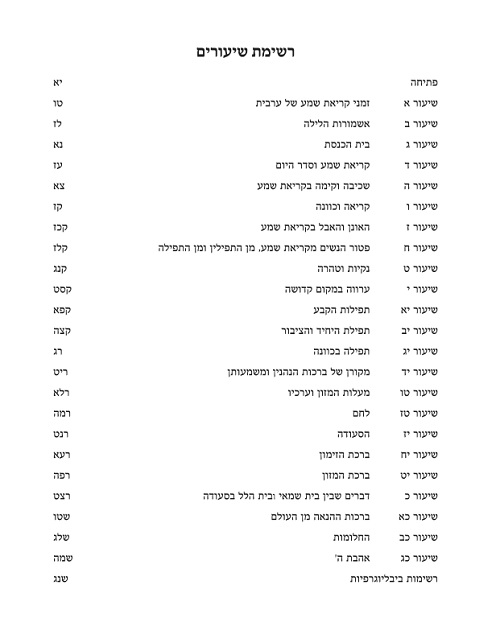
There are 23 presentations in the book, each of which deals with topics appearing in Tractate Berakhot. Each one of the presentations contains material from the Jerusalem Talmud and from Midrash Halakha, together with the approaches of rishonim and aharonim (early and later commentaries), classic Yeshiva-style exegesis, references in footnotes to academic research, together with Hassidic and theological works that relate to the topic under discussion. All of this is presented succinctly, with grace and sensitivity, using modern language. The writing is both challenging and thought provoking. 

One place where this broad sweep can be seen is in the list of books and articles that appears in the bibliographic section at the end of the book – something that you rarely find in traditional commentaries. Under “alef,” for example, we find Rabbi Moshe Alashkar, Professor Hanoch Albeck, Rabbi Yosef Shalom Eliashiv, Professor Yaakov Nahum Epstein, Rabbi Yechiel Michel Epstein, and more – unusual neighbors to find sharing space on a bookshelfThis work represents a unique composite of different worlds. 

Structural analysis and existential insights 

Here is an example of one of the presentations in the book: “Praying with intent (Chapter 13). The presentation opens with the well-known Mishnah that appears at the beginning of the fifth chapter: 

One may only stand and begin to pray from an approach of gravity and submission (koved rosh). There is a tradition that the early generations of pious men would wait one hour, in order to reach the solemn frame of mind appropriate for prayer, and then pray, so that they would focus their hearts toward their Father in Heaven. Standing in prayer is standing before God and, as such, even if the king greets him, he should not respond to him; and even if a snake is wrapped on his heel, he should not interrupt his prayer. 

(b. Berakhot 30b) 

Rav Brandes gets right to the point, noting that the Mishnah contains three distinct messages:  

– One must pray from an approach of gravity and submission (koved rosh) 

– Serious preparation for prayer is an indication of piety;  

– It is forbidden to interrupt one’s prayers. This is emphasized by the Mishnah by presenting extreme situations, e.g., when greeted by a king or challenged by a snake. 

These three messages touch on different points. Submissive prayer describes the behavior and mental state of the worshiper. Preparation and focus in prayer concentrates on the content, the interpretations of the words, and the very consciousness of standing before God. The prohibition against interrupting one’s prayers is a practical issue emphasizing the need to maintain continuity in prayer even in the face of imminent danger. 

From here Rabbi Brandes moves to the Gemara’s discussion, analyzing the four Amoraitic opinions offered, interpreting the concept of koved rosh. Although only one opinion will be accepted as law, Rabbi Brandes examines each of the four opinions – and the verses that they quote – deriving how we are to approach prayer, how we can connect awe and fear, joy and trembling. From here we are treated to a close reading of the baraitot that are brought by the Gemara that parallel the structure of the Mishnah:  

One may neither stand to pray from an atmosphere of sorrow nor from an atmosphere of laziness, nor from an atmosphere of laughter, nor from an atmosphere of conversation, nor from an atmosphere of frivolity, nor from an atmosphere of purposeless matters. Rather, one should approach prayer from an atmosphere imbued with the joy of a mitzva. 

We continue with the flow of the Gemaraas the author deals with such issues as how we can focus our hearts towards heaven in prayer, or how to train ourselves in “the art of restraint” by emulating Rabbi Akiva who prayed privately in an enthusiastic manner, in contrast with his restrained prayer when praying in public. 

In the context of prayer, the Gemara brings a number of aggadic statements about Hannah, the prophet Shmuel’s mother, whose prayer (see 1 Sam. Chapter 2) serves as an archetype for Jewish prayer generally. These statements are analyzed and recorded under a series of headings, like: “Midrash Hannah – Characteristics of an eminent worshiper,” “Intoxicated prayer,” “The expanse of the worshiper.”  

Having gathered the many sources appearing in the Gemara together with those that he introduced in his presentations, Rabbi Brandes sums them up with insights that are practical, yet existential, and applicable to the here and now. He writes: “Every individual, whether young or old, has his or her role in prayer. The Talmudic discussions, both halakhah and aggadah, can serve as a guide and a compass, directing us towards the study and experience needed for meaningful prayer. Still, the unique characteristics and personal meaning of prayer can only be attained through the efforts of the individual and the community in every generation. They must shape their experiences according to their own image and principles, based on the guidance of the prophets of Israel, its sages and its founders” (p. 217). In concluding his lesson on birkat hamazon (the Grace After Meals), Rabbi Brandes writes: “When reading the Shema and its blessings, the worshipper accepts the Yoke of Heaven when you sit at home and when you travel on the way, with eyes closed and focused intent, disengaged from the surrounding environment. When going to pray in the synagogueone stands before God in the midst of one’s community. It is at the dinner table at home when we have the opportunity to bring Godliness into the very heart of the physical world. This is the responsibility of the Jewish people living in God’s land, enjoying the sweetness of its fruit and enjoying God’s presence (p. 243). 

The lessons on other topics that appear in this book are treated in a similar fashionThese include, for example: “Times of the evening recitation of the Shema,” “Women’s exemptions from the commandments of Shema, Tefillin and prayer,” “Sources of blessings and their significance,” “Bread,” “Points of difference between Bet Shammai and Bet Hillel in regard to a meal,” “Dreams,” and more. 

Calling for a New Approach 

The format of the book is also unusual. There are two columns on each page, with a different font for the sources quoted from the Talmudic works and the commentaries, and with rich footnotes for referenceThe book is written in a literary Hebrew and is well edited. This design is reminiscent of the layout in traditional commentaries on the Talmud, which often appear in two columns, albeit usually in “Rashi script,” with no subheadings, no footnotes, no language editing and many abbreviations. One can assume that the choice of this format is meant to suggest that what is found in this book is “new wine in a venerable container. 

In his introduction to the book, Rabbi Brandes notes the context in which these lectures were presented over the years: in the Himmelfarb school in Jerusalem, in Beit Morasha and in community lectures. Each group contributed their part, and the unique structure of these lessons drew from their participation. The variety of students and their different ages reinforces the argument that a high quality and challenging Gemara class speaks to everyone. The tempo may be different, the emphasis might change – there are bound to be other differences, as well – but if a broad and in-depth presentation is offered, everyone becomes a partner in thinking and suggesting solutions. The outcome will be fresh insights and understandings with no limitations based on age or place. 

Many of the Talmudic tractates – and Berakhot is among them – have a myriad of recent commentaries on them that have been publishedTo that list of books on Tractate Berakhot we now have a new – and unique – addition. This work offers a new approach that can speak to contemporary students.  We are a generation that collects everything that has been written throughout the ages. The challenge taken up by Rabbi Brandes is to gather all those styles of learning in a respectful and harmonious fashion, and to use them to build additional layers, in a manner that both inspires and challenges. 


Conservative Conversions, Some Grammatical Points, and a Newly Published Section of a Letter from R. Joseph B. Soloveitchik

Conservative Conversions, Some Grammatical Points, and a Newly Published Section of a Letter from R. Joseph B. Soloveitchik

Marc B. Shapiro

 
1. Since I mentioned R. Ovadiah Hoffman in the last post, I would be remiss in not noting that he and his brother, R. Yissachar Dov, recently published volume 4 of Ha-Mashbir, devoted to R. Ovadiah Yosef. It can be purchased here.
The volume contains a previously unpublished letter by R. Ovadiah Yosef that I provided, dealing with a rabbi who improperly converted people. It also contains a number of other noteworthy sections, such as R. Ovadiah’s notes to R. Ben Zion Uziel’s Mishpetei Uziel, talmudic notes from R. Uziel published from manuscript, R. Meir Mazuz’s notes to R. Ovadiah’s Yehaveh Da’at, and many valuable articles by contemporary Torah scholars, including the editors. Of particular interest to me was R. Yissachar Dov Hoffman’s article on the practice of a number of great Torah sages of prior generations not to kiss their children. Such a practice is so much against the contemporary mindset of what is regarded as healthy that, as R. Hoffman notes, even a Satmar rabbi, R. Israel David Harfenes, has stated that “in our time it is forbidden to follow this path” (p. 293).
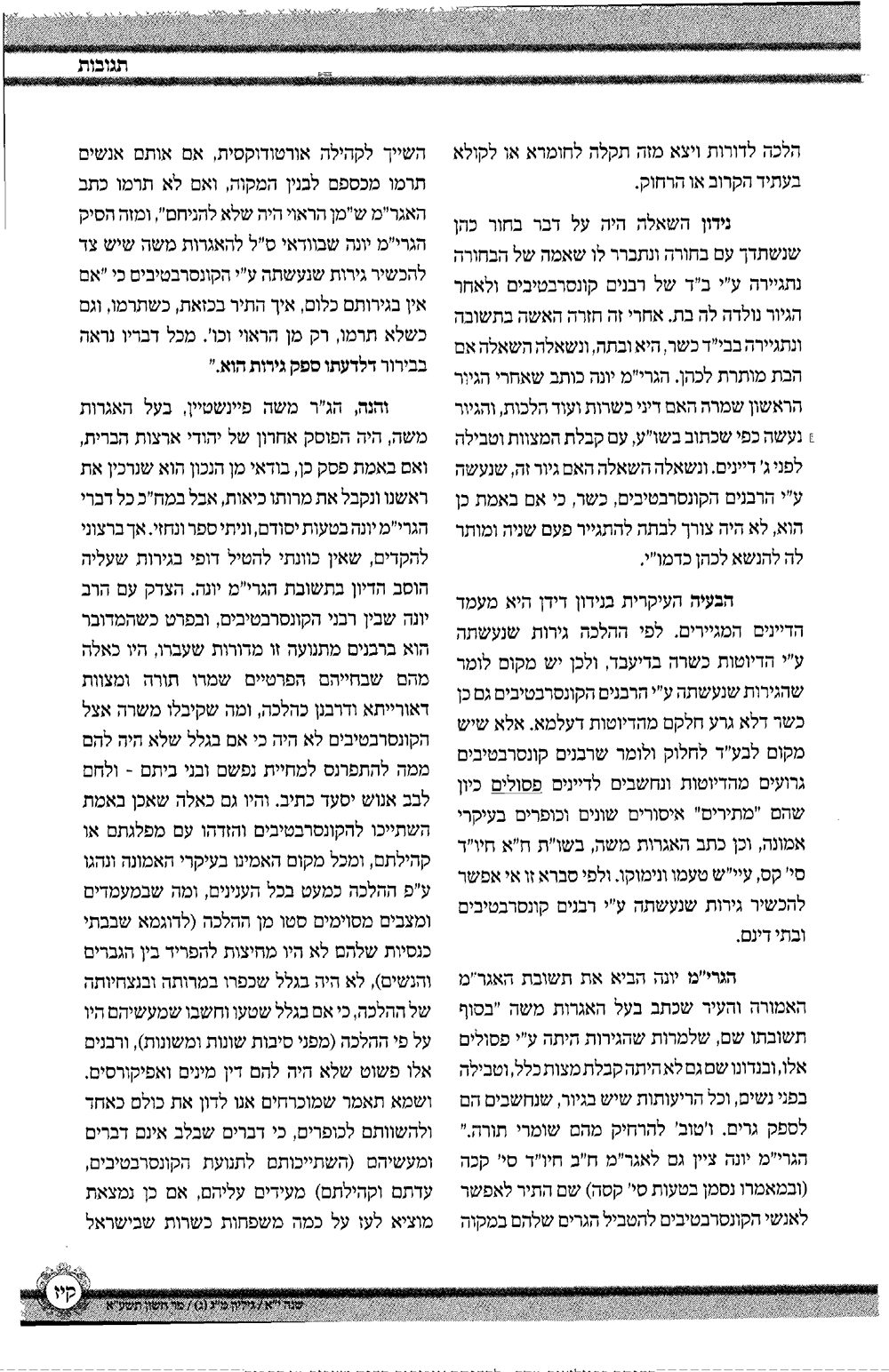
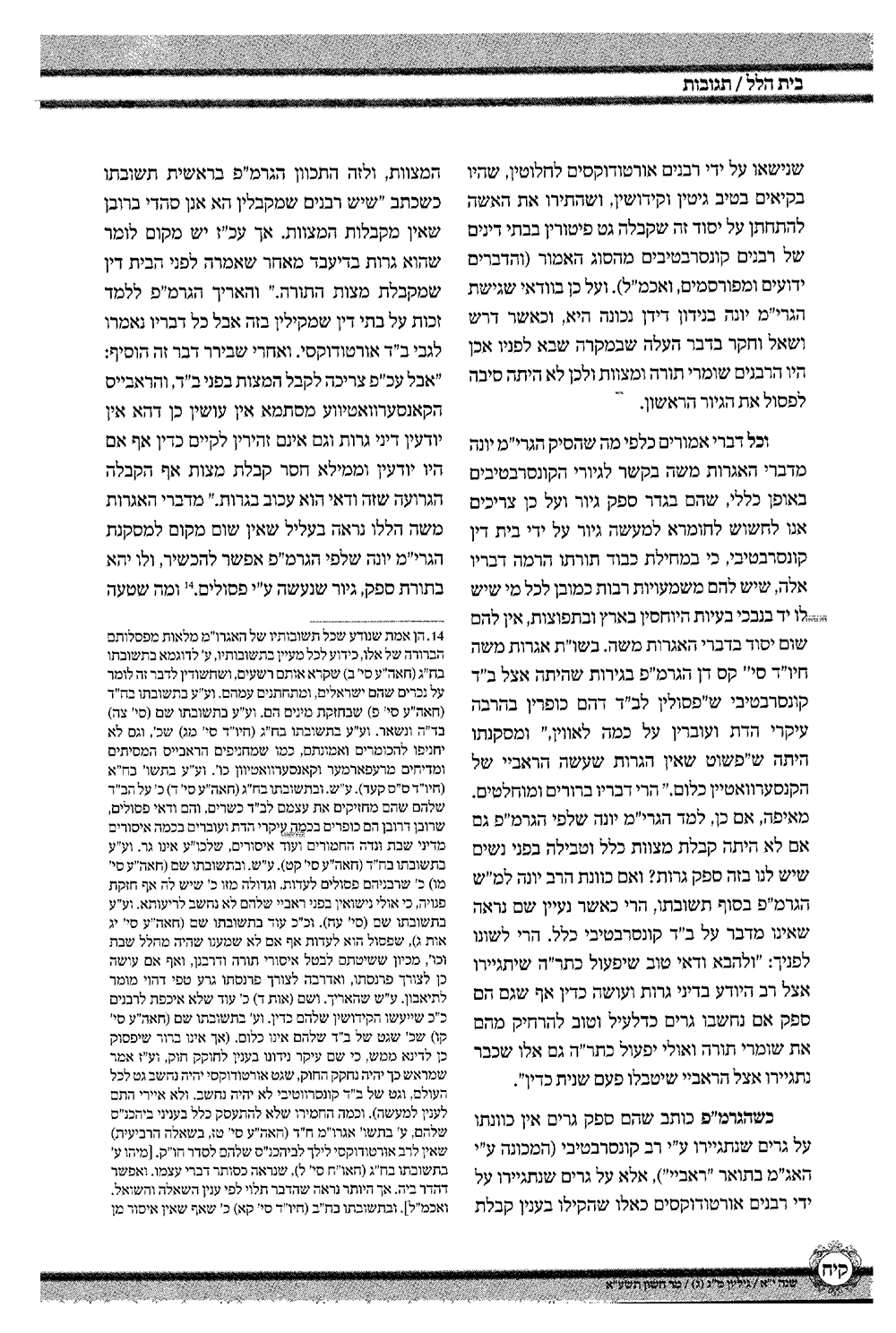
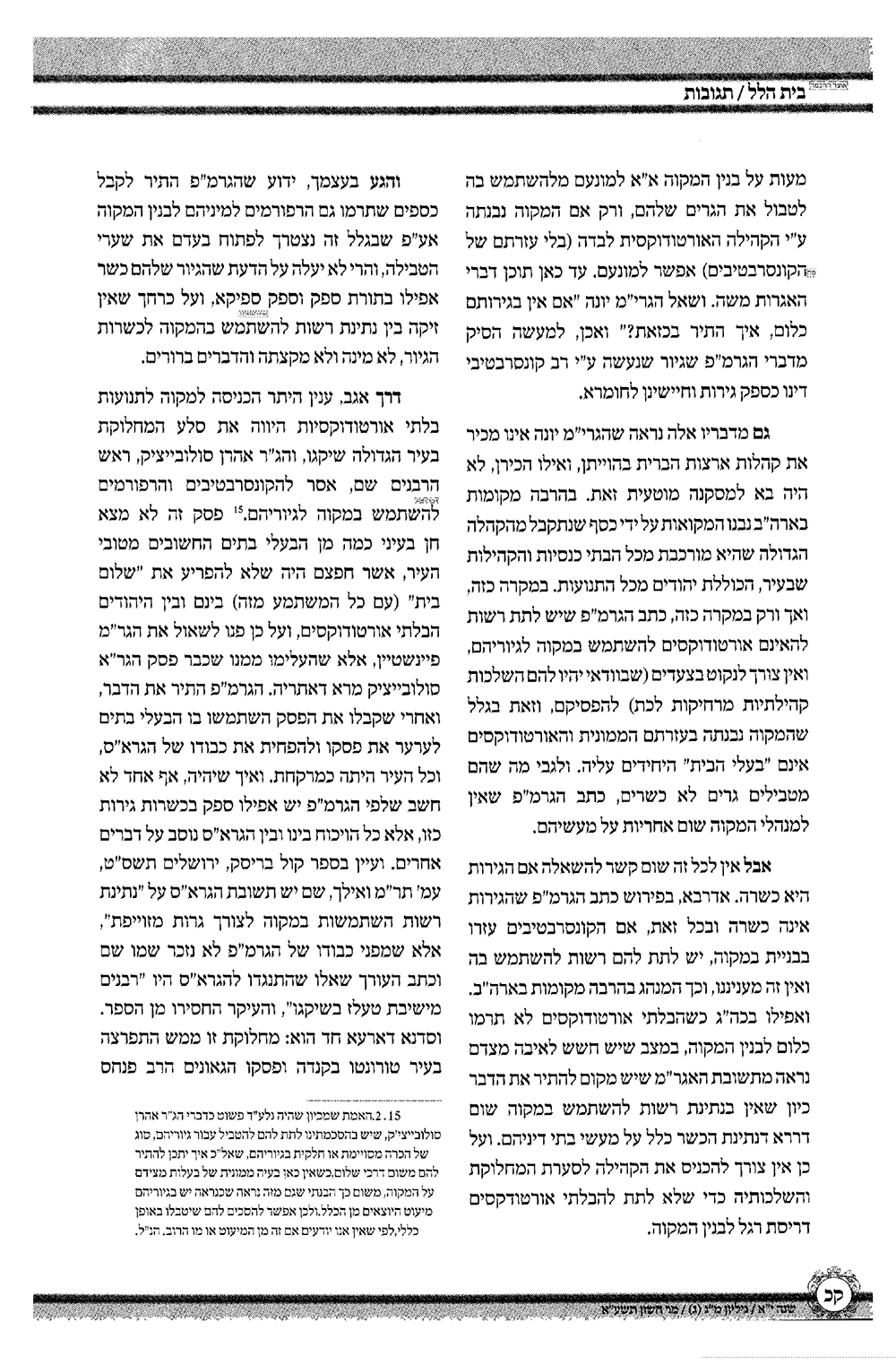
Apropos of the above-mentioned responsum on conversion by R. Ovadiah Yosef, in Beit Hillel, Adar 5770, R. Yisrael Meir Yonah deals with a conversion done by a Conservative beit din. He rules that in this particular case the conversion is valid. This ruling was affirmed by R. Ovadiah.In his responsum, R. Yonah states that R. Moses Feinstein regarded Conservative conversions as doubtful conversions rather than completely invalid, and brought two supposed proofs for this. I responded to R. Yonah in Beit Hillel 43 (Heshvan 5770), and you can see my letter here.[1]

To his credit, R. Yonah acknowledged that he was mistaken in his reading of R. Feinstein’s responsum.[2] It is also the case, as I mention in my letter, that it is possible that a conversion done by a Conservative rabbi, especially from years ago, could be halakhically valid. R. Feinstein himself, who wrote very strongly against Conservative conversions, also writes about such a conversion: כמעט ברור שאין עושין הגרות כדין. The word כמעט shows us that even R. Moshe recognized that there are times when a Conservative conversion can be halakhically valid. In Mesorat Moshe, vol. 1, p. 327, we see as well that R. Moshe acknowledged the possibility that a Conservative conversion could be valid:
אולי יש להסתפק דאפשר לא היו ב”ד של פסולים, דיש אנשים, בעצם דתיים ומאמינים, שמחמת דוחק פרנסה מקבלים משרה כרבנים אצלם, ואפילו אם למדו בסמינר שלהם, אולי בעצמו כן מאמין. ולפיכך למעשה, אם זה אפשר לברר, תבררו. ואם קשה לברר, אז אולי שייך להגיד השערה, שאם זה בכפר או עיר רחוק מעיקר ישוב היהדות הדתי מסתמא אין להסתפק, בוודאי אינו כלום. ואם זה בעיר שיש בו ישוב דתי, נו, אזי כן יש ספק.
I also know someone who offers eyewitness testimony that R. Moshe did not think that every Conservative conversion could be voided without investigation, especially as this would mean that women married to these converts would then be able to remarry without a get. R. Moshe was not willing to go this far.
Similarly, R. Ovadiah Yosef, when asked about a Conservative conversion, replied that before giving a ruling it was necessary to find out which Conservative rabbi did the conversion, “since the Conservatives are not all alike.”[3]
R. Ovadiah was also asked about a woman who had become religious and was interested in going out with a kohen for the purpose of marriage. The problem was that she had slept with a man whose mother was converted by a Conservative rabbi. This man’s family was somewhat traditional as they kept kosher, made kiddush, and lit Shabbat candles. Could the woman in question marry a kohen, which is forbidden if she had slept with a non-Jew? The answer to this question depends on the status of the man whose mother was converted by a Conservative rabbi. If the conversion was invalid then the man was also to be regarded as a non-Jew, and the woman we are discussing, who slept with this man, would be forbidden to a kohen.
R. Ovadiah replied that the woman could marry a kohen, which means that be-diavad he accepted the Conservative conversion. He gave this ruling without even seeking further knowledge about the particular rabbi who did the conversion under question, which appears to me to be an incredible leniency. In seeking to explain this ruling, R. Yehudah Naki writes, “We see that they observed some mitzvot, so be-diavad there is more room to be lenient, at least not to forbid others” (that is, to forbid the woman from marrying the kohen).[4]
As mentioned, R. Ovadiah accepted R. Yonah’s pesak that a particular conversion carried out by a Conservative beit din was valid. In this case, the daughter of a woman who had been converted wished to marry a kohen. This would only be allowed if the daughter was born Jewish, meaning that everything depended on the status of her mother’s conversion. Here is how R. Yonah described this particular Conservative beit din.[5]
ובירורים שעשינו בנ”ד התברר לנו שב”ד הזה שגיירוה, הם אנשים שנקראים וידועים כשומרי תורה ומצוות, ובעצם הם אורטודוכסים, וגם הגיור שעשו, ע”פ כל החקירות ודרישות שעשיתי, הקפידו בכל הדברים כולם, הן בטבילה, חציצה וכו’ וכו’, הן בקבלת מצות, ולימודי יהדות קודם הגיור, לא פחות ואולי יותר, מהרבה בתי דינים אחרים שנחשבים לחרדיים. וא”כ אין כל סיבה לפע”ד לפסול גיור זה.
Here is R. Ovadiah’s affirmation of R. Yonah’s pesak, from Beit Hillel, Adar 5770, p. 60.

That a Conservative conversion might be valid also appears to be assumed by R. Mordechai Eliyahu. This is what he writes in his Ma’amar Mordechai, vol. 2, Even ha-Ezer, no. 16:
ובענין הגר שנתגייר אצל הקונסרבטיבים והוא אינו שומר תורה ומצוות, והיה לכם ספק אם אפשר לכתוב שם יהודי שניתן לו, שם שלא השתמש בו מעולם, או לכתוב בן אאע”ה. נראה לי, מאחר וכל עצם נתינת הגט של אדם זה הוא לחומרא ולא מדינא, כי מי אמר שגרותו – גרות, וגיוריהם של הרבנים הקונסרבטיבים – גיור . . .
R. Eliyahu does not say that there is absolutely no reason for a get when dealing with a Conservative conversion. Rather, he refers to it as a humra. Also, note how he states, “who says that his conversion was a [valid] conversion?” This is the language of safek. He does not say, “certainly his conversion was invalid.”[6]
2. In a previous post here I mentioned a few common pronunciation mistakes in Kiddush. There is one more that I would like to mention, but it is a little more complicated than the ones I previous noted. In the Friday night kiddush we say כי הוא יום תחלה למקראי קודש. Where is one supposed to put the accent in the word למקראי? If you look at ArtScroll you find that it puts the accent on the penultimate syllable, the ר. However, Koren and most of the other siddurim I checked put the accent on the final syllable, the א.
I don’t know why this should be a matter of dispute, because the Torah itself uses the expression מקראי קודש three times (Lev. 23:2, 4, 37), and in every case the accent in מקראי is on the final syllable.[7] The Yom Tov morning kiddush also begins: אלה מועדי ה’ מקראי קודש. For some reason ArtScroll is not consistent, and in this case it puts the accent in מקראי on the א.
After my last post someone emailed me pointing out that another “common mistake” is that in Birkat ha-Mazon, in the second paragraph, people say נודה לך putting the accent on the first syllable instead of the second. In fact, the tune for Birkat ha-Mazon that American children are taught at schools around the country has the word נודה recited with the accent on the first syllable. Should we now start teaching all the children differently, so that they pronounce נודה with the accent on the second syllable which is how ArtScroll, Koren, and almost all the other siddurim have it?
Actually, this matter is not clear at all. I say this because if you open up a Tanakh to Psalms 79:13 and look at the words נודה לך you will find different versions. Some have the word נודה with the accent on the final syllable and others have the accent on the first syllable. The Aleppo Codex has the accent on the first syllable and puts a dagesh in the ל of לך. Although the practice of American children (and adults) pronouncing the word נודה with the accent on the first syllable has nothing to do with the Aleppo Codex, the fact that this pronunciation appears in such an important source means that there is no reason to change how the children are taught. However, this creates a problem because in the Amidah, in Modim, we say נודה לך ונספר תהלתך. If we are going to recite נודה of Birkat ha-Mazon with the accent on the first syllable, then we should be consistent and do the same thing in the Amidah, in ברוך ה’ לעולם in ma’ariv: נודה לך לעולם, and also in the so-called “Three-Faceted Blessing” (ברכה מעין שלש – Al ha-Mihyah): ונודה לך על הארץ.
Speaking of consistency, in Birkat ha-Mazon, the Amidah, ברוך ה’ לעולם, and the Three-Faceted Blessing, both the regular ArtScroll siddur and Koren have the accent in נודה on the final syllable. However, in the Amidah, ברוך ה’ לעולם, and the Three-Faceted-Blessing they both place a dagesh in the ל of ונודה לך and נודה לך, but do not place a dagesh in the ל of נודה לך in Birkat ha-Mazon. This makes no sense. If there is a dagesh in one there must be a dagesh in all of them. (In the Hebrew-only ArtScroll siddur they also put a dagesh in the in the ל of נודה לך in Birkat ha-Mazon.)
I think it is a mistake for ArtScroll and Koren to place a dagesh in לך in any of these instances. Since no exception with נודה לך is found in Tanakh, the only reason there would be a dagesh in לך is if the word נודה has the accent on the first syllable, as in the Aleppo Codex (and unlike what appears in ArtScroll and Koren), or if there is a makef between the two words.[8]
Regarding the word נודה, it is worth noting that in Ein Ke-loheinu there is no question that נודה is to be read with the accent on the final syllable (as the matter of where to put the accent in נודה only concerns the phrase נודה לך). Here is an example where the common tune, which puts the accent on the first syllable, cannot be defended grammatically.
I noticed two mistakes in the regular ArtScroll siddur which appear correctly in Koren. In the morning blessings we say אשר נתן לשכוי בינה. Where is the accent in the word לשכוי? ArtScroll puts the accent on the final syllable, and Koren puts the accent on the penultimate syllable, on the ש. Koren is correct as there is an explicit verse in Job 38:36: מי נתן לשכוי בינה. If you look at the trop on this verse you will find that the accent in לשכוי is on the penultimate syllable. Interestingly, in the Hebrew-only ArtScroll siddur they get this right.
The other mistake is that in Birkat ha-Mazon on Sukkot we say:
הרחמן הוא יקים לנו את סכת דויד הנופלת
ArtScroll puts a kamatz under the פ in הנופלת. Koren puts a segol and that is correct. We see this from the appearance of the word in Amos 9:11, and there is no change of vowel even on the etnahta.[9]
I also found an example where ArtScroll gets it right and Koren is mistaken. In ma’ariv, in the paragraph ואמונה כל זאת, we say העושה לנו נסים. Koren has העושה with the accent on the final syllable and the ל of לנו with a dagesh. Yet this doesn’t work. For there to be a dagesh in the ל, the prior word, העושה, has to have the accent on the penultimate syllable, which is how it appears in ArtScroll.
Another example where ArtScroll gets it right and Koren gets it wrong is in the morning blessings where we say שעשה לי כל צרכי. Koren puts the accent in שעשה on the final syllable. Yet this is a mistake, and as is correctly found in ArtScroll the accent is on the penultimate syllable, the ע.
Since I have been speaking about the ArtScroll siddur, let me add a couple of comments about the Yom Kippur Machzor. Here is how Shema Kolenu appears in my copy of the Yom Kippur Machzor (p. 596).

The instructions tell us that “the first six verses of the following prayer are recited responsively, chazzan then congregation.” The problem is that I have never seen a synagogue that says the verses beginning אמרינו and אל תעזבנו responsively. What all these synagogues do is say the following four verses responsively:
שמע קולנו
השיבנו
אל תשליכנו מלפניך
אל תשליכנו לעת זקנה
In my experience, not only does no one say the verses beginning אמרינו and אל תעזבנו responsively, but they don’t say יהיו לרצון quietly either.
The text recorded by ArtScroll is the one found in many old Ashkenazic machzorim. So when and how were אמרינו and אל תעזבנו dropped from the responsive reading, or is it that from the beginning they were not included? As for יהיו לרצון, the old machzorim do not indicate that this is said quietly, so was there ever a tradition to recite it quietly or is ArtScroll simply trying to make sense of a verse that is found in the Machzor but no longer appears to be recited? If יהיו לרצון was originally part of the public reading, we again have to ask, why was it dropped?
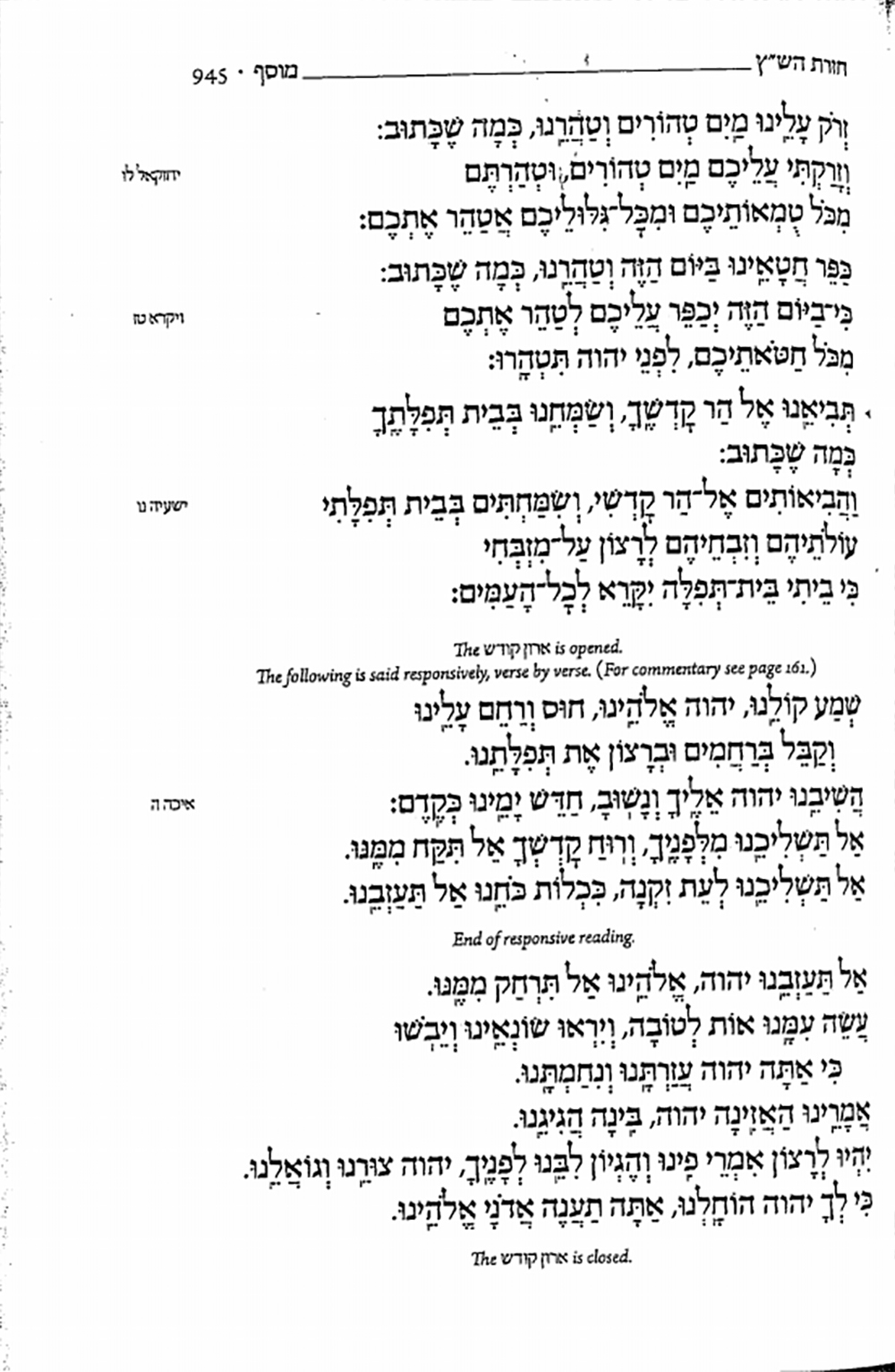
Recognizing the problem, in the new edition of the ArtScroll machzor they made a change.
As you can see, אל תעזבנו has now been pushed to the next paragraph. We are also instructed that both אמרינו and יהיו לרצון are to be said quietly. Yet this doesn’t seem to make any sense, as those who are reciting Shema Kolenu responsively will not be saying these verses quietly. And again, I ask, is there any real tradition that these verses are to be said quietly, or is this something made up by people in an attempt to keep the traditional text of the Machzor while dealing with the fact that these verses are not part of the responsive reading? Unfortunately, when updating the Machzor, ArtScroll did not correct the instructions which still refer to the “first six verses” as being recited responsively, when instead it should say the “following four verses”.
Here is how Koren has the prayer.
This version, which puts אמרינו and יהיו לרצון before the final verse, is also attested to in prior machzorim, though the order found in ArtScroll appears to be the older version.To sum up, I am not sure what the best path for ArtScroll would have been. On the one hand, they could have adopted the version found in Koren, which solves all the problems. Keeping what appears to be the more authentic version, which they did, also makes sense, but then they were forced to add the instructions that certain verses are to be said silently. I have checked numerous old machzorim and there is no indication that these verses are to be said silently. Was there perhaps an oral tradition in this matter? Perhaps readers can comment on this. In any event, ArtScroll’s instructions are problematic, since, as mentioned, if people are reciting the prayer responsively, they are not going to be inserting two consecutive sentences quietly.

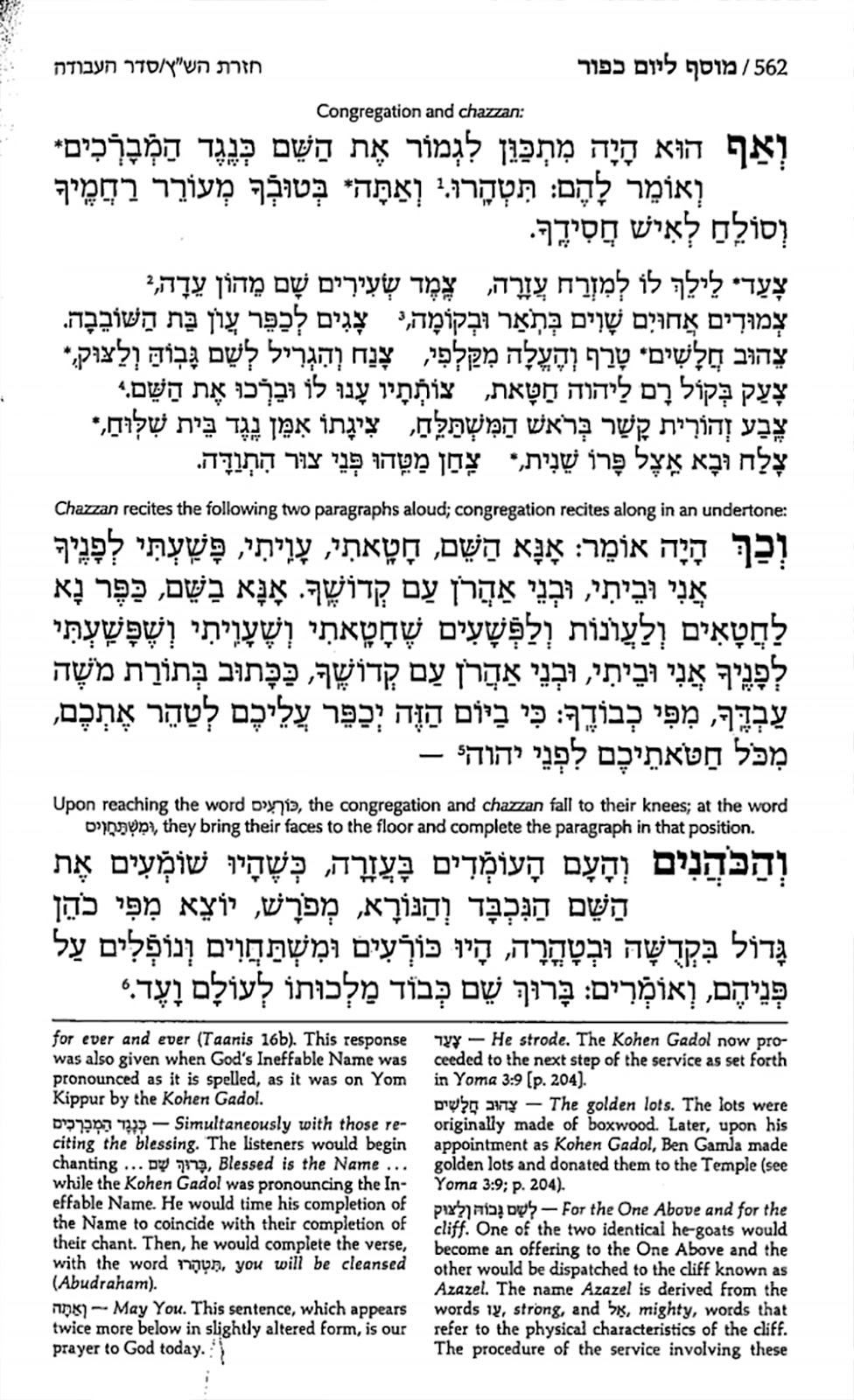
I noticed another interesting change in the ArtScroll Yom Kippur machzor between the old edition and the new one. Here is והכהנים והעם in the old edition.
It reads היו כורעים ומשתחוים ומודים ונופלים על פניהם.
Here is the new edition, where the word ומודים has been deleted. ArtScroll neglected to change the English translation, so it still appears, now incorrectly, as: “they would kneel and prostrate themselves, give thanks, fall upon their faces.”
Why was the word ומודים deleted? Based on what I have been able to determine, the version without the word ומודים is more common, so presumably that is the reason. Although most people might just chalk this up to a different girsa, R. Soloveitchik saw great significance in the alternative versions, and explained their different implications.[10]
Here are a couple of random mistakes I found in ArtScroll. (I use the ArtScroll siddur every day of the week, which is how I have come across these. I am sure that if I used Koren, I would find mistakes there too.) In the ArtScroll siddur, p. 86 it reads:
ואל מאורי אור שעשית, יפארוך, סלה
There is a dagesh in the ס of סלה. This means that the comma after יפארוך is a mistake, as you cannot place a dagesh in this ס if preceded by a comma.
Another mistake is found on p. 702, in the prayer for dew, which states בעם זו בזו. Its translation is correct: “Among this people, through this prayer.” However, I would have preferred if it appeared as follows: “Among this people, through this [prayer],” which would be a more accurate rendition of the few words. (This is indeed how it is translated in the ArtScroll Passover Machzor.)ArtScroll vocalizes these words be-am zu be-zu. Yet this is incorrect. בזו should be pronounced be-zo, referring to תפלה, the feminine Hebrew word for prayer. Koren gets this correct. This confusion of ArtScroll with zu and zo is also found on p. 202, where in the marriage service we find בטבעת זו and ArtScroll pronounces it zu, instead of zo. Again, Koren gets it right. (The word זו often appears in the Talmud, and the ArtScroll Talmud always pronounces it correctly.)

Let me close with one final mistake in ArtScroll, or perhaps it is not a mistake; readers can decide on their own. The ArtScroll Ohel Sarah Women’s Siddur is a special siddur designed for women. On the very first page of the prayers, this siddur has מודה אני with a segol under the ד. In a women’s siddur doesn’t there need to be a kamatz under the ד so that it reads modah?
This might reflect a broader issue. My experience is that in co-ed kindergartens the girls are also taught to say modeh. This might not be surprising, but I was also told by a number of people that even in girls-only kindergartens, both Ashkenazic and even some Sephardic ones, the girls are taught to say modeh. No doubt recognizing this problem, R. Yitzhak Yosef makes a point of placing a kamatz under the ד so that people will know how women are to pronounce the word.[11] R. Shlomo Zalman Auerbach likewise told the women in his family to say modah.[12]It is noteworthy that in one of the editions of Wolf Heidenheim’s Siddur Sefat Emet, found on Otzar ha-Hokhmah, girls are instructed to say modah.

However, this edition appeared after Heidenheim’s death, and unfortunately there is no way to determine exactly when. (The Basel 1956 date on the title page is just the date of the photo-offset edition, not the original.) As far as I can tell, none of the siddurim that appeared in Heidenheim’s lifetime distinguish between men and women with regard to modeh-modah.In response to questioners, R. Hayyim Kanievsky also stated that women are to pronounce the word as modah.[13] Despite this, when R. Meir Arbah asked Rebbetzin Batsheva Kanievsky, R. Hayyim’s wife, what she did, she replied that she pronounced it modeh![14]

The ArtScroll Women’s siddur also has שלא עשני גוי and not גויה and שלא עשני עבד instead of שפחה. This too would seem to be incorrect in a women’s siddur, but the standard version is defended by R. Shmuel Wosner, as he claims that the words גוי and עבד include both men and women.[15] More about this in the next post.
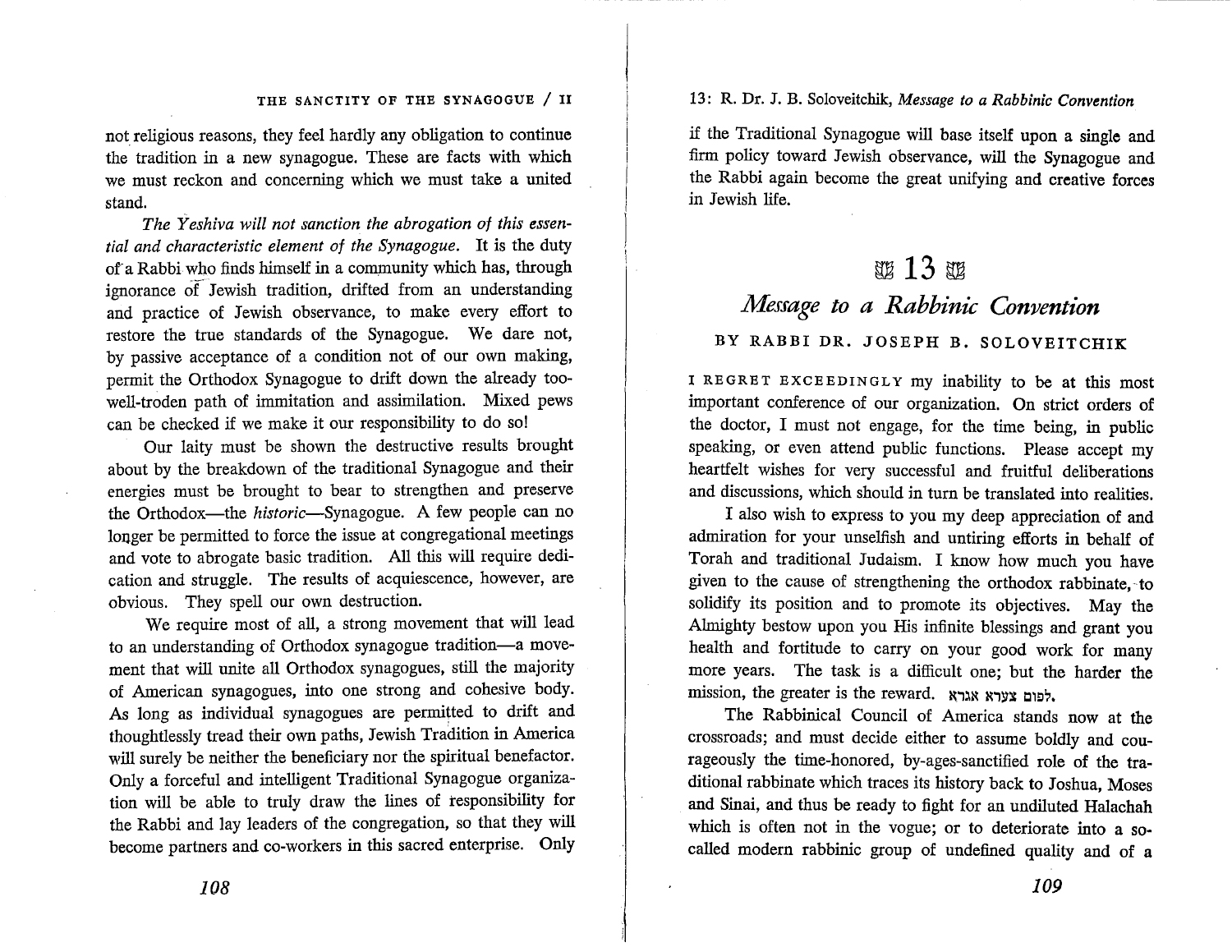
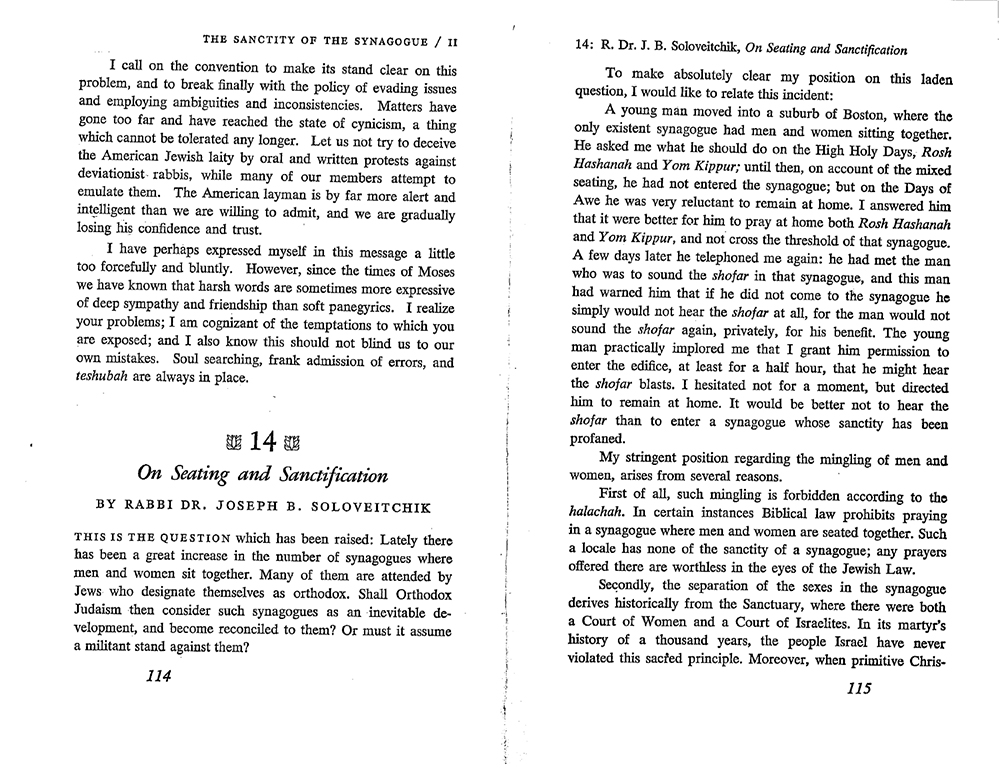
3. We all know that everything written by R. Joseph B. Soloveitchik is precious.[16] One area in which the Rav was very eloquent and forceful was with regard to the necessity of having a mehitzah in shul. In Baruch Litvin’s 1959 book, The Sanctity of the Synagogue, pp. 109-114, it prints a letter from the Rav to an RCA convention. 


This letter has been reprinted in Nathaniel Helfgot, Community, Covenant and Commitment, pp. 139-142.
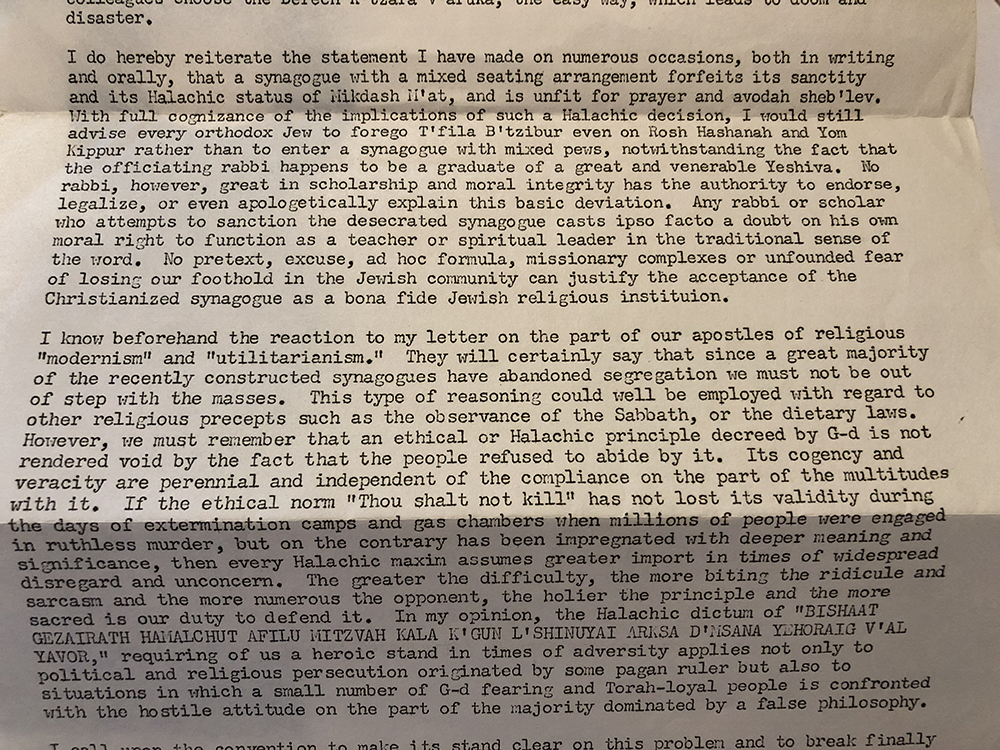
Moshe Schwartz found a copy of the original letter in the papers of his grandfather, R. Gedaliah Dov Schwartz. I thank him for sending it to me.

One interesting point which is not found in the Litvin book is that the Rav’s letter, while intended for RCA members, was addressed to R. David Hollander, the president of the RCA at the time. This is important to note because in the second paragraph he is speaking personally to R. Hollander and praising him for his good works. However, the reader of the letter in Litvin’s book will mistakenly think that the Rav is speaking to the RCA as a whole.
Furthermore, some of what R. Soloveitchik included was deleted from the letter as it appeared in the Litvin book. This was apparently because his points were not specifically relevant to the mehitzah issue. I am happy to be able to present here the omitted words of the Rav which until now have never been published, and which present an important personal statement about the halakhic process. Readers should note the end of the second paragraph that is transcribed below, as it is criticism of certain members of the RCA. Similar sentiments are found earlier in the letter (Litvin, p. 110, first paragraph), where the Rav concludes his paragraph with the strong words: “However, many of our colleagues choose the derech ketzarah va’aruchah, the easy way which leads to doom and destruction.”
As chairman of the Vaad Halachah I intended to inform the conference about our activities during the past year. Since I am prevented from doing so I have asked my friend Rabbi Joseph Weiss to take my place.
Permit me to say the following. One of the fundamentals of my faith is that the Halachah is an all-inclusive discipline and system of thought capable of meeting any challenge of modern times and of confronting the most perplexing problems which a technically progressive and scientifically minded society may periodically pose. This optimistic formula, however, cannot always be successfully applied because of the limited knowledge and the imperfect intellectual capability of the human being. I for one, am not always able to behold the Halachic truth and to see the light under all circumstances. Many a time I grope in the dark, pondering, examining and re-examining an intricate Halachic problem – and find myself unable to arrive at a clear decision. Even the Talmud has not solved all problems and has not answered all questions. The Teiku is a very prominent and characteristic feature of Torah She-B’al Peh. We members of the Halachah Commission are not partners in a contracting firm whose task it is to provide every member of the Rabbinical Council of America with a clear-cut answer to his problems. Quite often the solution eludes us. We are beset by grave doubts. We face many alternatives not knowing which to choose since each is supported by sound logical reasoning. We cannot be guided in our decisions by emotional factors or pragmatic arbitrariness and hence we are impelled to employ in such situations the principle of “B’divrai Torah Haloch Achar Hamachmir” which seems to inconvenience some of our members.
Religious Jews have of late developed an intolerant attitude towards what they call the shyness and reluctance on the part of scholars to commit themselves on Halachic issues, not knowing that there is no omniscience in this world and that doubt is an integral part of the Halachic experience as it is of every scientific performance. A rabbi who thinks that he can solve all problems is implicitly admitting his own ignorance. I implore the convention to abstain from leveling charges of evasion at the Halachah Commission. Let us not repeat the complaints which are so common in religious circles in Israel about a lack of boldness on the part of the rabbinate. They come, for the most part, from people who are not conversant with Halachic scholarship. If there is in our ranks some one wise enough to undertake to answer all Halachic questions by return mail, I would not hesitate to relinquish my position as chairman to him.
In the last paragraph of the letter, as it appears in Litvin, p. 114, the following words that I have underlined are omitted (and this appears to be a simple mistake rather than an intentional deletion): “I realize your problems, I am cognizant of the temptations to which you are exposed and I also know the great work you have been doing in the remote parts of our country.”
In this case I think that the Rav is speaking to the RCA members as a whole, not to R. Hollander personally.
The P.S. found in the Rav’s letter is also of interest.
P.S., I would suggest that the convention adopt a resolution condemning the Humphrey Bill pertaining to humane method of slaughter. The convention should also send a letter of thanks to the State Department for the special attention of Assistant Secretary Herbert Hoover, Jr., for its stand against the proposed calendar reform.
4. In my previous post about young rabbis I neglected to mention another such rabbi. R. Yekutiel Yehudah Teitelbaum (born 1912) succeeded his father as rabbi of the town of Sighet, and also as leader of the local hasidic group, at the age of 14.[17]
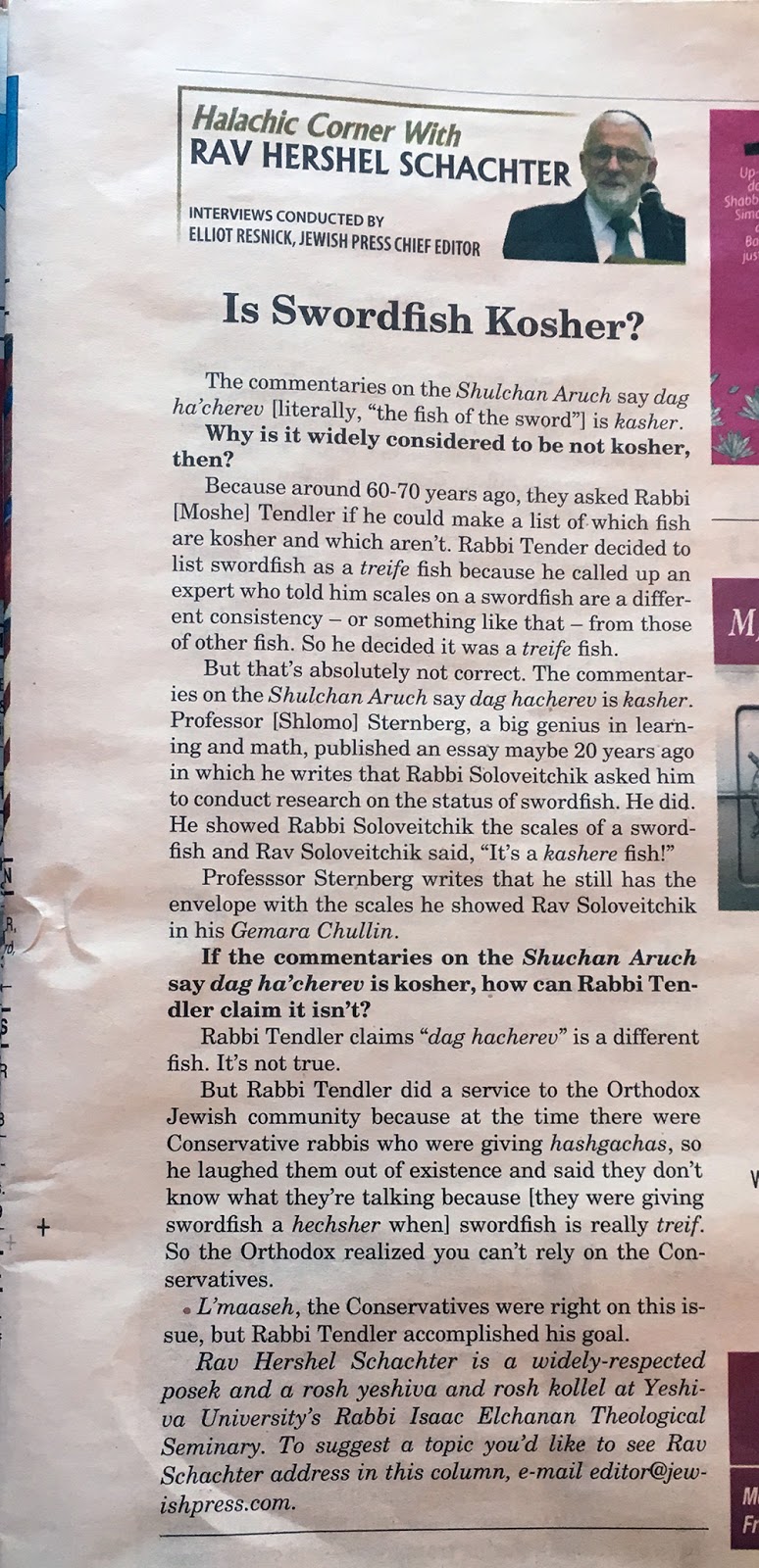
5. In addition to being the posek of the OU, R. Hershel Schachter is also the one Kashrut Vaads all over America turn to for halakhic decisions. That being the case, now that R. Schachter has publicly declared that swordfish is kosher[18] (his private opinion has been known for a long time), how come no Vaads in the United States will certify it as kosher? (In the first half of the twentieth century Orthodox Jews in the U.S. ate swordfish. See my post here.) Does this mean that in the U.S. the practice of not eating swordfish is for all intents and purposes now regarded as binding, and cannot be overturned even by a great posek?

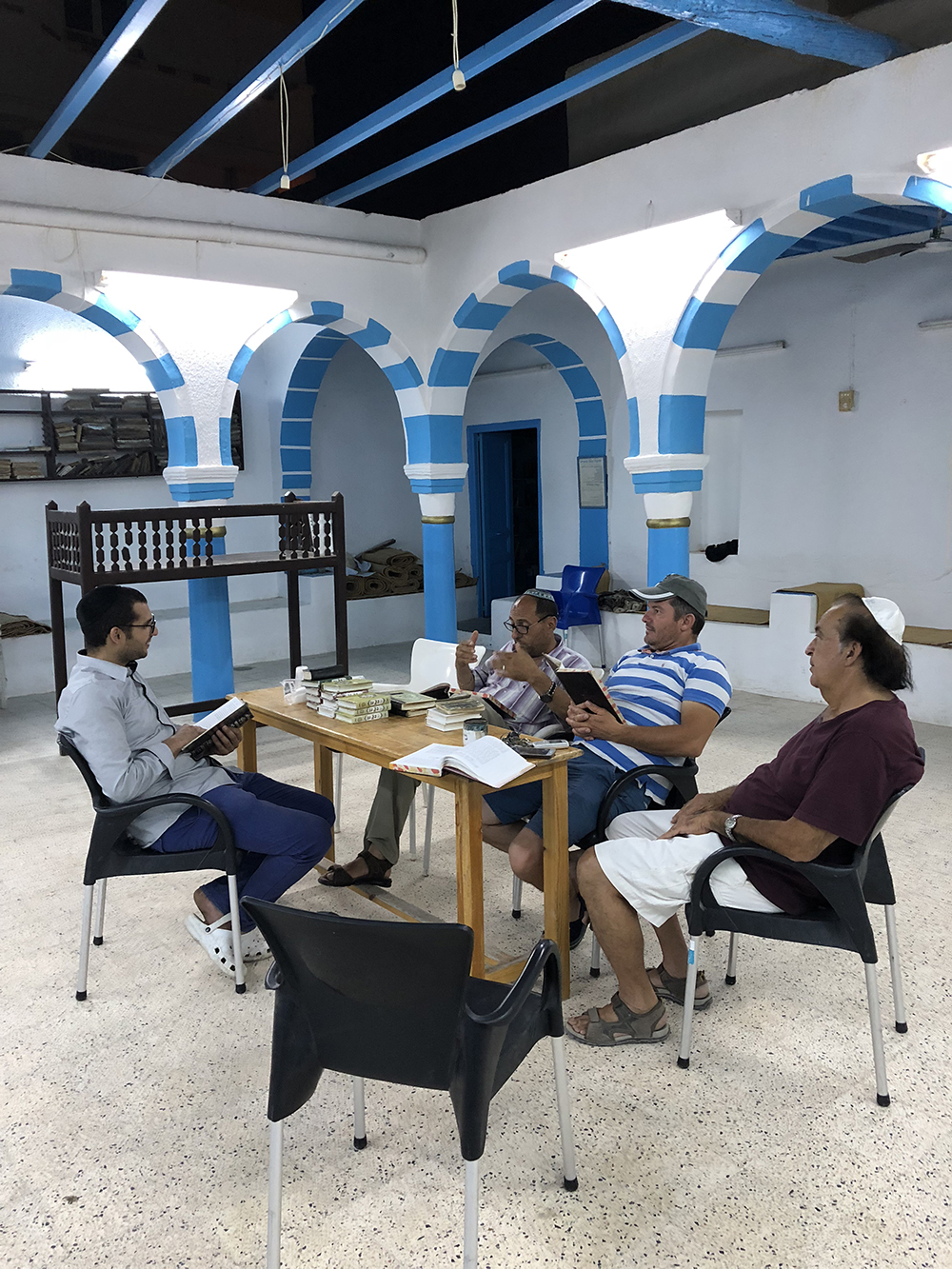
6. Last summer I spent time in Djerba, Tunisia. I hope to write up my impressions of this amazing community of over one thousand Jews, all of whom are shomer Shabbat. Djerba, and the nearby town of Zarzis which has around a hundred Jews, are the last Arabic speaking Jewish communities in the world. (In Tunis and Morocco the Jews speak French.) Here are some pictures from inside the R. Pinhas Yanah synagogue in Djerba, where you can see the signs in Arabic. 


Here is a small learning group in one of the synagogues after ma’ariv. They invited me to participate but not knowing Arabic I couldn’t follow.

When I came back one of my friends told me that I must share one particular story on the Seforim Blog, so here goes. There are fourteen different synagogues in Djerba. After visiting a number of them I noticed that they had no women’s sections. I asked one of the rabbis about the lack of ezrat nashim. He replied, in words that must sound blasphemous to Modern Orthodox ears, “What do women have to do with a synagogue?” While in the U.S. we build “women friendly” mehitzot, so that as much as possible the women can feel part of the synagogue service, in Djerba women’s spirituality has nothing to do with the synagogue. While I later learned that three of the synagogues do have an ezrat nashim, women never attend on Shabbat, only on Rosh ha-Shanah, Yom Kippur, and Purim. The popular Modern Orthodox notion that it is important for women, especially unmarried ones, to attend synagogue on Shabbat is something the women of Djerba know nothing about.
___________
[1] If I were writing the letter today, I would not refer to R. Ahron Soloveichik as rosh ha-rabanim and mara de-atra. I did so to give him respect, but it is not really accurate. While many people certainly did regard him as the leading rabbi of Chicago, and accepted his halakhic rulings as authoritative, this was by no means everyone’s opinion. Regarding R. Moshe Feinstein’s view permitting the non-Orthodox to use the community mikveh for their conversions, which is mentioned in my letter, it is important to note that this was only when the non-Orthodox institutions contributed to building the mikveh.
[2] The same mistake made by R. Yonah is also made by R. Yehudah Naki in his notes to R. Ovadiah Yosef, Ma’yan Omer, vol. 7, pp. 362-363, 390, 400-401.
[3] Ma’yan Omer, vol. 7, no. 38.
[4] Ma’yan Omer, vol. 7, no. 42.
[5] Beit Hillel, Adar 5770, p.
[6] R. Eliyahu’s responsum was sent to R. Gavriel Cohen, who has a beit din in Los Angeles. See here. This Beit Din also does conversions, and they have a very detailed curriculum for prospective converts. You can see a practice test of the 45 topics prospective converts are supposed to learn about here.
I have to say that until the last generation, converts were never required to have such detailed knowledge. Leaving aside all of the detailed issues of Jewish law the convert is instructed to learn about (including “Trumot and Maasarot, Challah, Bikurim, Maaser Ani and other types of charity”), does a convert really need to know about Elijah at Mt. Carmel or about “Tzedukim, Prushim, Charedim, Zealots (anti Romans and Greeks)”? Does a convert need to be able to “develop in detail” the following: Joshua, Judges (“mention at least 10 Judges and their stories”), Samuel, Saul, Jonathan, Isaiah, Jeremiah, the Twelve Prophets, Daniel, Ezra-Nehemiah, to list just some of the topics required? And  what about Rif, Rosh, Rashba, Tur, Zohar, Kabbalah, Shabbetai Zvi, Orhot TzadikimMesilat Yesharim, etc.? Since when do converts need to know about these things?
In the section dealing with the history of converts, R. Cohen’s website mentions Nero and Antoninus as things to know. Does this mean that if the future convert does not believe that these Roman emperors actually converted to Judaism, that he will not be accepted? (My next post will discuss Nero and Antoninus.) On the positive side, if even yeshiva educated people knew all the things the converts are being asked about, we would be in very good shape.
Contrast all this with how Maimonides says that we deal with future converts, in words that today would be regarded as “non-Orthodox,” or presenting a very low standard. Issurei Biah 14:2 states: “He [the prospective convert] should then be made acquainted with the principles of the faith, which are the oneness of God and the prohibition of idolatry. These matters should be discussed in great detail; he should then be told, though not at great length, about some of the less weighty and some of the more weighty commandments.”
[7] See also here.
[8] See Israel Yeivin, Introduction to the Tiberian Masorah, trans. E. J. Revell (n.p., 1980), no. 404. See also R. Adir Amrutzi, Dikdukei Aviah (Tel Aviv, 2010), p. 146. Regarding the Aleppo Codex and use of the dagesh, the following point is also of interest. Many people wonder why in Hallel the words הושיעה נא and הצליחה נא, taken from Ps. 118:25, only have a dagesh in the נ in הושיעה נא. In fact, in the Aleppo Codex both occurrences of the word נא have a dagesh. Also of interest, since it goes against what one would expect from the grammatical rules, the Aleppo Codex puts the accent on the final syllable of both הושיעה and הצליחה, and there is no makef after either of these words. See Yeivin, Introduction to the Tiberian Masorah, p. 291.
Regarding the makef, ArtScroll has omitted it from its siddur. Yet once they do so, it appears to me that there are a number of corrections that need to be made. For example, in shaharit of Shabbat we read
מי ידמה לך ומי ישוה לך
ArtScroll tells us that ידמה and ישוה have the accent on the final syllable and ArtScroll also puts a dagesh in the ל of לך. Yet the Masoretes who told us that in such a case you put a dagesh in the ל, also told us that you would only do so if there is a makef connecting the word לך and the prior word. Since ArtScroll has deleted the makef, why should the dagesh be included, as there is no reason for one without the other? (Koren also includes the dagesh without a makef.)
For those who want to be technical, once the makef is removed we even have a problem with the word כל. כל, meaning “all”, is only spelled with a kamatz (katan) when it is connected with a makef. However, when the makef is removed it is to be spelled with a holem. (The two exceptions are Ps. 35:10 and Prov. 19:7.) See Bayit Ne’eman 130 (15 Tishrei 5779), p. 5.
In biblical Hebrew there is even a word כל with a kamatz (gadol) and no makef. It is found in Isaiah 40:12:
וכל בשלש עפר הארץ
The passage means, “and comprehended the dust of the earth in a shalish-measure.” The word כל with a kamatz and no makef is from the root כול. The word כל with a kamatz and makef, which is the word we are all familiar with, is from the root כלל.
[9] This point was also noted by the Dikdukian here. For those who don’t know this website, it is a great resource for anyone interested in grammatical matters.
[10] Shiurei Ha-Grid: Kuntres Avodat Yom ha-Kippurim (Jerusalem, 2005), pp. 66-67.
[11] Otzar Dinim la-Ishah ve-la-Bat, ch. 1, no. 2 (p. 22), Yalkut YosefDinei Hashkamat ha-Boker, 1:9. It is noteworthy that R. Yom Tov Lippman Heller was also interested in ensuring proper pronunciation. Mishnah, Toharot 8:5 reads: שוטה אחת בעיר. Tosafot Yom Tov comments:
בקמץ הטי”ת כמו כי רועה היא (בראשית כט)
[12] Halikhot Shlomo, Tefilah, ch. 2 n. 17.
[13] Halikhot Hayyim, ch. 1 no. 1, Da’at Notah, vol. 1, p. 16. The very title of the last book mentioned is an example of what we are talking about, as it is more common for people to write “da’at noteh”, but this is not grammatical.
[14] Meir Oz, vol. 1, p. 27.
[15] Shevet ha-Levi, vol. 10, no. 8.

[16] I have been fortunate to discover a number of unknown letters by the Rav which I hope to publish.
[17] See Isaac Lewin, ed., Eleh Ezkerah (New York, 1961), vol. 4, p. 147. R. Jacob Elimelech Paneth was chosen to succeed his father as rabbi of Marosújvár at age fourteen, but he did not assume the office in practice until four or five years later. See Yosef Kohen, Hakhmei Transylvania (Jerusalem, 1989), p. 37. I thank R. Baruch Oberlander for informing me of the Hungarian name of the city R. Paneth served in.
[18] The interview with R. Schachter reprinted in this post is from the Jewish Press, April 20, 2018.


Simchas Torah & a Lost Minhag of the Gra

Simchas Torah & a Lost Minhag of the Gra
By Eliezer Brodt
Chol HaMoed Succos is the Yarzheit of the Vilna Gaon (for an earlier post on the Gra see here and here). In this post I hope to show a source for a “forgotten” Minhag of the Gra.
In 1921 the great bibliographer (and much more) Yitzchak Rivkind described a strange custom he saw during the time he learned in Volozhin (after it was reopened and headed by R’ Rephael Shapiro), in an article about Minhag HaGra. On Simchas Torah they would open the Aron Kodesh when saying Aleinu, both at night and during the day, and while singing the Niggun of Mussaf of Yom Kippur would bow on the floor exactly like we do on Rosh Hashonah and Yom Kippur. When he asked for the source of this Minhag he was told it comes from the Gra. When he visited Vilna sometime later he found the only place that they observed this unique Minhag was in the Kloiz of the Gra, but nowhere else in Vilna.[1] 
In 1933 R’ Meir Bar Ilan printed his memoirs in Yiddish for the first time (in book form); in it he describes the great Simcha in Volozhin on Simchas Torah, that of his father the Netziv and of the Talmidim. He then writes that when they got to Aleinu they would open the Aron and with Niggun of Mussaf of Yom Kippur would sing and bow on the floor exactly like we do on Rosh Hashonah and Yom Kippur.[2] However, this custom is not mentioned in the Maaseh Rav or any of the other collections of Minhagim of the Gra.
Earlier this year (2018) R’ Dovid Kamenetsky published a very important manuscript related to the Maaseh Rav. This work sheds light on how this important sefer of the Gra’s Minhaghim was written. The Gra had a very close talmid named R’ Saadyah who wrote up the various things he witnessed the Gra doing. This formed the basis of the Maaseh Rav who then went and added to it from other sources. This original manuscript work was recently discovered and printed by Rabbi Kamenetsky; in it we find that R’ Saadyah writes that on Rosh Hashonah and Yom Kippur the Gra would fully bow (prostrate himself) during Aleinu, and did the same on Simchas Torah at night. Thus we now for the first time have the actual exact source of the Gra doing this.[3] 
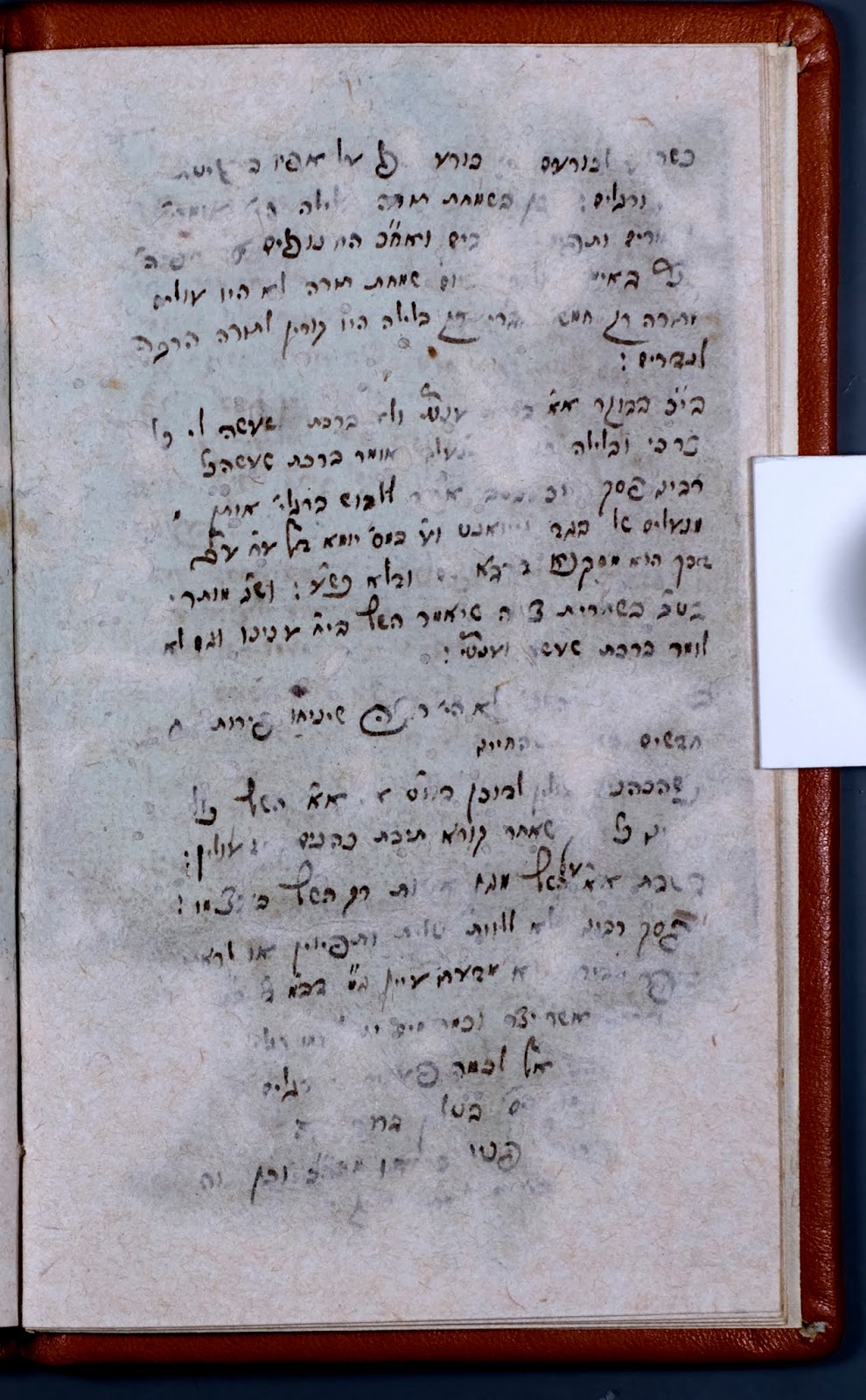
בר”ה וי”כ וש”י כשאומר הש”ץ זכרנו:… כשהגיע לכורעים הי’ כורע ונופל על אפיו בפשיטת ידים ורגלים וכן בשמחת תורה בלילה היו אומרים מזמורים ותפילות …בים ואח”כ היו נופלים על אפיה’ כנ”ל באימ[ה] בעלינו…
Here is a copy of the page in the manuscript (thanks to Rabbi Dovid Kamenetsky):
A possible explanation for this Minhag is that when things were getting a bit too wild, i.e. too leibedek, they did this to remind the crowd it’s a Yom Tov. This is not the only minhag done like Yomim Noraim, in one account we find “The Musaf was chanted with the music of the New Year’s ritual.”[4] 
[1] HaIvri, 10:35, (1921), pp. 6-7. See Yaari, Toldot Chag Simchas Torah, p. 366.
[2] MeiVolozhin Ad Yerushlayim, 1, p. 115.
[3] See TorasS Hagra, p. 212. On this work see Toras Hagra, pp. 127-226.
[4] Between Worlds, p. 93


Woe Is Unto Whom?

Woe Is Unto Whom?  Christian Censorship of a Sugya in Berachos 3a 

(or What Was Bothering the Censor II)


By: David Zilberberg 
I.        A Censored Text in Berachos 3a
The Vilna Edition of Berachos 3a states as follows:
אמר רב יצחק בר שמואל משמי’ דרב ג’ משמרות הוי הלילה ועל כל משמר ומשמר יושב הקב”ה ושואג כארי ואומר אוי לבנים שבעונותיהם החרבתי את ביתי ושרפתי את היכלי והגליתים לבין אומות העולם
The identical statement is cited by R. Yose in a Braisa that follows the above-cited section.  The Braisa records the story of R. Yose’s visit to a ruin in Jerusalem to pray and his subsequent conversation with Eliyahu HaNavi upon leaving the ruin.  At the end of the conversation, Eliyahu haNavi asks R. Yose whether he heard a “kol” in the ruin.  R. Yose responds as follows:
 ואמרתי לו שמעתי בת קול שמנהמת כיונה ואומרת אוי לבנים שבעונותיהם החרבתי את ביתי ושרפתי את היכלי והגליתים לבין האומות
The meaning of the statement reported by R. Yitzchak bar Shmuel and R. Yose seems straightforward:  God is expressing the magnitude of the Jewish people’s loss.  And, by attributing this loss to the nation’s own sins and repeating this statement on a regular, thrice-nightly, basis, the statement serves as a constant reminder to the nation that their loss is their own fault.[1]  While an element of rebuke is not explicit in the statement, it dwells right beneath the surface. 
However, as noted in Dikdukei Soferim, the version of the statement appearing in the Vilna edition is incorrect.  The version of the sugya that appears in all extant manuscripts (at least those available on the JNUL online repository),[2] the earliest printings of the Talmud and various Rishonim who cite it, does not include the phrase “לבנים שבעונותיהם”.  Thus, in the Munich and the Firenze manuscripts and in citations to the sugya in the Menoras Hamaor (which is cited in the Dikdukei Soferim), and the Kuzari,[3] the statement reads:
אוי לי שהחרבתי את ביתי ושרפתי את היכלי והגליתים לבין אומות העולם
Early Talmud printings (e.g., Soncino, Bomberg), the Rosh, Rav Hai Gaon and Rabbenu Chananel have it slightly differently:

אוי שהחרבתי את ביתי ושרפתי את היכלי והגליתים לבין אומות העולם

The Paris manuscript follows the Munich and Firenze version (“אוי לי שהחרבתי”) in the story of R. Yose and follows the Soncino version (“אוי שהחרבתי”) in the statement of Rav.  Similarly, the Tosafist R’ Moshe Taku, in Kesav Tamim, cites both versions.
Either alternative has a profoundly different meaning than the Vilna version.[4]  A statement casting blame at the nation for their exile becomes a statement of divine mourning or regret. Dikdukei Soferim explains the change as follows:
ובד׳ בסיליאה (של״ט) שינהו הצענזור וממנו בדפוסים האחרונים
Thus, the original text was changed in the notorious Basel edition of the Talmud at the behest of the Christian censors, and this change was retained in subsequent versions.[5]
Why was this statement censored?  What did the censors find objectionable about the original version?
II.         Overview of Christian Censorship of the Talmud and the Basel Edition
To answer this question, it would be useful to briefly outline the history of censorship of the Talmud by the Church.  According to William Popper’s The Censorship of Hebrew Books, from the time it was first committed to writing until the High Middle Ages, the text of the Talmud survived in manuscript form relatively undisturbed by outside scrutiny.  The first significant efforts against the Talmud occurred in 13th Century France.  These efforts, spearheaded by Jewish apostates, culminated in the the burning of thousands of volumes of Hebrew books in the 1230s and 1240s.    Similar but less extreme efforts were taken against the Talmud in Spain as well.
The Golden Age of Hebrew printing that developed in Italy in the late 15th century was abruptly ended by a “golden age” of censorship.  Within years of the invention of the printing press, Italy quickly became the center of Hebrew printing.  In 1483, Gershom Soncino set up a printing press, and only a year later published Masekhes Berachos.  While this volume was not the first printed Talmud, it established the classic tzuras hadaf that has become synonymous with Talmud study until today. During the first half of the 16th century, other Italian printers published volumes of the Talmud, including Daniel Bomberg, who published multiple editions of the Talmud including at least one complete set.  These early printed editions encountered little interference by the Christian authorities. In fact, the Bomberg edition was printed with the permission of Pope Leo X (this is not to say that the printers did not engage in self-censorship). 
Starting in the end of 15th century, the Church, concerned about the ease with which the written word could now be disseminated unimpeded throughout the Christian world, began to take measures to regulate the publishing industry.  The focus of these efforts was initially on books designed for Christian readers.  However, as these measures became stricter, they ultimately focused on Hebrew books.  In 1550, the events of 13th Century France began to replay themselves in Italy.  Accusations against the Talmud by several apostates led to a renewal of anti-Talmud sentiment and ultimately to decrees directing the burning of the Talmud and prohibitions against possessing it.  The Talmud benefitted from a reprieve in 1563, when the Council of Trent modified the ban against the Talmud to allow its printing as long as it was renamed (to Gemara) and the “calumnies and insults to the Christian religion” were removed.  However, this limited dispensation was not exploited for many years, most likely because the risk of printing even an expurgated Talmud was deemed too great to justify the financial investment.  Finally, in 1578, a printer in Basel, Switzerland decided to print a version of the Talmud that would be acceptable to the Church and hired two well known figures with solid censorship credentials — Marco Marino, the papal inquisitor of Venice, and Pierre Chevallier of Geneva — for the task.[6]  The Talmud that produced in Basel was a thoroughly butchered work that was considered an utter abomination by the Jewish community. In the words of R. Rabinowitz in Ma’amar al Hadpasas Hatalmud:
ובמגינת לב ודאבון נפש ראו היהודים את התלמוד אשר הוא חיי רוחם וכל מעיינם בו נתון למרמם ביד הצענזור אשר שם בה שמות ופרעות ולזרה היה הדפוס הוה בעיניהם
Certain words were systematically replaced, sections were removed or changed and “explanatory” notes were added. The entirety of Maseches Avodah Zara was omitted. Most shocking were the notes added to Maseches Bava Metzia. An example is the following amud:
The marginal note in the lower left hand corner is a comment on a derasha regarding the purity of a person upon entry into this world.  Although difficult to read in the image posted above, Ma’amar cites the text of the note as follows:
רוצה לומר שהאדם בביאתו לעוה״ז עדיין לא חטא בעצמו ואמנם לפי אמונת הנוצרים הכל נולדים בעון אדם הראשון כדכ‘ ובחטא יחמתני אמי
There you have it – the Christian doctrine of Original Sin on a blatt Gemara.
As unconscionable as these notes are, any harm they did was short term.  These changes were both clearly gratuitous and easy enough for printers to spot.   Accordingly they were removed (for the most part) in later printings. The changes to the text of the Talmud itself were more pernicious because not only were they harder for printers to identify, printers of the 17th and 18th century were content with sticking with a text that passed muster rather than risking problems with the censors by reverting to the pre-Basel text.
III.        Explaining the Work of the Censors
Our original questions remains:  what did the censors find objectionable about our sugya?
It should be noted at the outset that it is impossible to determine definitively the reasoning of the censors. The censors left no detailed notes explaining the basis for their decisions.  In addition, the censorship of the Basel Talmud, and Hebrew books more generally, was not systematic or consistent.  Many have pointed out the almost comical examples of censorship revealing the utter incompetence of certain censors, who for example, indiscriminately replaced certain “buzzwords” such as “גוי” or “אדום” without regard to context.  In addition, identical or near identical texts that appeared in multiple places received different treatment by the Basel censors for no apparent reason other then lack of diligence (or perhaps due to the use of two censors).[7]  Thus, any attempt to divine why a particular change was made involves a bit of guesswork.
A. Anthropomorphism
Some scholars have suggested that the censors objected to the anthropomorphic nature of the original version’s portrayal of a sorrowful or regretful God, as it were.[8]  However, this reason appears to be incomplete.  The first Chapter of Berakhos is replete of anthropomorphic statements.  God wears Tefillin, God davens and God asks for a blessing from the Kohen Gadol.  All of these statements escaped the scrutiny of the censors.  Anthropomorphism, it would seem, didn’t always bother them.  While it might be argued that expressions of regret or sorrow by God was a form of anthropomorphism more troubling to the censor then other “garden variety” forms of anthropomorphism, I find this reasoning unsatisfactory.[9]

B.  Supersessionsism
A hint at what I believe is the true reason for the change in our text is found in a book called Sefer HaZikuk. This book was printed in different versions at various times but its purpose was the same: to provide the censors with Hebrew language guidance (which, because the censors were apostates, for the most part, was the only language they could read) as to what kind of passages were considered contrary to Church doctrine.
A. M. Haberman quotes a number of the guidelines printed in one of the versions of the book.[10]  Among these guidelines is:
כל מקום שאומר, שהקב”ה מצטער על אבדן של ישראל, ימחק לגמרי
The censored passage in Berachos 3a fits this guideline precisely.
Note that this book was not used by the censors of the Basel Talmud – it was written after the printing of the Basel Talmud.  However, Haberman states that this book was based on the censorship standards used for the Basel Talmud.  Accordingly, it provides a strong hint as to the kind of concern this passage likely raised with the Church and why it was changed.
While the Sefer Hazikuk doesn’t answer our original question, it certainly points us in the right direction.  Why would an expression of divine “pain” over the Churban be objectionable?  The answer would appear to be supersessionism. Supersessionism is (or at least was) a central tenet of Church doctrine.  It aims to explain the status of various Divine promises to and covenants with the Jewish people contained in Tanach in light of the New Testament.  The basic idea is that these promises were superseded by a new covenant with the followers of the Christian faith because the Jews failed to live up to their obligations.  Thus, the destruction of the Temple and the exile and persecution of the Jewish people is a fulfillment of Church teachings.
The notion of Divine lament or pain over these events is therefore a direct affront to this brand of Christian theology – if God “replaced” the Jews due to their failures with a new people and a new covenant why would he lament or feel pain over the rejection of the Jews or the destruction of the Temple that facilitated His relationship with them?  Supersessionism not only explains the “offensiveness” of the original text, but the rationale for the revised text as well.[11]
While many cases of censorship merely show the ignorance of the censor, the censorship of the passage before us should actually deepen our understanding of it.  What set off alarms in the minds of Medieval Church officials should likewise signal to us that the sugya is not merely a puzzling anthropomorphic statement attributing emotions to God but, but an implicit affirmation of God’s relationship with the Jewish people.[12]  In fact, this is the precisely the interpretation offered by R. Avraham Yitzchak HaCohen Kook in his commentary on our sugya in Ayn Ayah:

III.   A Note Regarding Recent Talmud Printings
It’s troubling enough that censored passages continued to be retained in nearly all printings of the Talmud over the several hundred years after the Basel Talmud.  But what is completely unconscionable is that many of the “Mifuar” reprintings of the Talmud in recent years have retained these passages as well, including certain editions that boast of teams of editors exerting painstaking effort to fix the text.   Most puzzling is the English Schottenstein edition of Berachos which not only retains the censored text and fails to note the correct original text, but includes a note providing a commentary on the censored text:
Accordingly, the statement “Woe to the children because of whose sins I destroyed My Temple…” may be meant to convey that since it is only because of our sins that the Temple was destroyed and our people were scattered among the nations, it is only because of our failure to repent them that the Temple continues to lie in ruins and we remain scattered among the nations.  God, however, yearns for our repentance and if only we will cry out to Him in anguish and repent over our sins and return to Him, He will surely restore us to our land and rebuild the Holy Temple.
While the notion that we can extract important lessons from texts written by medieval Christian censors is somewhat peculiar, it is ironic that the explanation somehow manages to retain the hopeful message of the original uncensored text.  Thankfully, the Hebrew Schottenstein edition, as well as the Oz v’Hadar and Steinsaltz editions, include the original texts in footnotes.
We are blessed to live in a society where we benefit from nearly absolute freedom of religion.  All sorts of expression — even the most vile, hateful and offensive sorts – receive broad protection under law.  Why do we continue to print and study editions of the Talmud marred by the fingerprints of the 16th Century Catholic Church?
Notes
[1]  The statement is echoed a third time later in the sugya but with somewhat different wording.  This post does not directly address this statement, although much of what is said here may apply to it.
[2] The JNUL repository shows three manuscripts of the sugya:  Munich, Firenze and Paris. 
[3] Saul Lieberman notes that this version of the text also appears in several anti-Talmud polemical texts by Christians and Karaites.  Shki’in at 69-70.  Lieberman demonstrates that (contra other scholars) these polemic works are valuable and trustworthy sources of Hebrew texts.
[4] More about the difference between the two alternatives below.
[5] Notably, the Firenze manuscript itself reflects the work of the censor.  Here is the relevant portion of our sugya below.

As you can see, a censor sought to remove the text under review and a later scribe apparently sought to reinsert it.  According to this, this manuscript was censored in Florence in 1472.  See below for another example of the expurgation of the passage:

This is an image of an expurgated version of the first page of Ein Yaakov (renamed “Ein Yisrael” due to the listing of Ein Yaakov on the Index Librorum Prohibitorum) taken from the Printing the Talmud website.
[6] See Stephen G. Burnett, The Regulation of Hebrew Printing in Germany, 1555-1630: Confessional Politics and the Limits of Jewish Toleration (available here) for background regarding the printing of the Basel Talmud.
[7] Although not quite a parallel text, Chagiga 5b includes identical themes to the uncensored version of our sugya, namely, God mourning, as it were, over the persecution of the Jews and nonetheless appears in the Basel edition unscathed.
[8]  Popper, Censorship at 59; Nehemia Polen, Modern Judaism, Vol. 7, No. 3 (Oct., 1987), “Divine Weeping: Rabbi Kalonymos Shapiro’s Theology of Catastrophe in the Warsaw Ghetto” at n. 18.
[9]  While I am no expert on Christian censorship or Christian theology, I don’t understand why the Catholic Church would find expressions of anthropomorphism a basis for censorship. In fact, the use of the uncensored version of this passage and others like it in anti-Talmud polemical texts discussed by Lieberman would seem inconsistent with this argument.  Presumably, these texts sought to ridicule and belittle the Talmud based on the anthropomorphism of the passage.  Why would anthropomorphism become a reason for Christians to censor these passages a few centuries later?  
[10] A. M. Habermann, The Oral Law During the Manuscript Era and the Publishing Era, available here.
[11] Credit for this insight goes to my clinical psychologist wife Penina whose prowess apparently extends to long dead church officials.
[12] Significantly, the Rosh and Rabenu Chananel, both of whom had the version of the sugya without the word “לי”, interpret the expression of woe as applying to the wicked (i.e., that due to the their misdeeds, God is compelled, as it were, to punish the Jewish nation) rather than God Himself.  This less radically anthropomorphic interpretation brings the original version of the text (at least the version that the Rosh and the Rabenu Chananel had) closer in line to the Basel text.  One can speculate that this line of interpretation provided a rabbinic basis for retaining the Basel text. However, this understanding cannot explain the version of the sugya in the extant manuscripts, which employ the word “לי”, thereby clearly attributing the expression of woe to God Himself.
It should be noted that Lieberman asserts that the “correct” version of the text includes“לי” based on the prevalence of this version in the manuscripts and in anti-Talmud polemical tracts.  He speculates that the removal of the word “לי” is an example of Jewish self-censorship resulting from discomfort with the radical anthropomorphism of the original text.  Shki’in at 70.


Rabbi Eliezer Brodt on Haggadah shel Pesach: Reflections on the Past and Present

Haggadah shel Pesach:
Reflections on the Past and Present
by Eliezer Brodt

Perhaps the topic which has engendered the most commentary in Jewish literature is the Haggadah shel Pesach. There are all kinds, in all languages, and with all types of commentary, pictures, etc. Whatever style one can think of, not one, but many Haggadahs have been written. So, whether it’s derush, kabbalah, halakha, mussar or chassidus there are plenty of Haggadahs out there. Then, there are people who specialize in collecting haggadahs although they do not regularly collect seforim. In almost every Jewish house today one can find many kinds of Haggadahs. In 1901 Shmuel Wiener, in A Bibliography of the Passover Haggadah, started to list all the different printings of the Haggadah. Later in 1960, Abraham Yaari, in his work titled A Bibliography of the Passover Haggadah, restarted the listing and reached the number 2700. After that, many bibliographers added ones which Yaari omitted. In 1997, Yitzchak Yudlov printed his bibliography on the Haggadah, entitled The Haggadah Thesaurus. This thesaurus contains a beautiful bibliography of the Pesach Haggadahs from the beginning of printing until 1960. The final number in his bibliography listing is 4715. Of course ever since 1960 there has been many more printed. Every year people print new ones; even people who had never written on the Haggadah have had a Haggadah published under their name, based on culling their other writings and collecting material on the Haggadah. When one goes to the seforim store before Pesach it has become the custom to buy at least one new Haggadah; of course one finds themselves overwhelmed not knowing which to pick!

Every year, besides for the new Haggadahs being printed, old ones are reprinted, some in photo off-set editions, others with completely retype set. One such Haggdah that has been reprinted and retype-set is the Haggadah Marbeh Lesaper. The author is R. Yididiah Tiyah Weil the son of R. Nesanel Weil, the author of the well-known commentary on the Ro”SH – the Korbon Nessanel. This Haggadah was first printed in 1791 and until 2002 it was never reprinted. See Yudolov, The Haggadah Thesaurus pg. 32 #355). Others point out an interesting bibliographical note, specifically that there is no mention of the author on the title page. There is, however, a haskamah (letter of approbation) from Reb Yididiah Weil to the sefer. However, we know that aside from giving a haskamah, he is also the author. R. Eliezer Fleckeles in his sefer Teshuva MeAhavah (vol. 2 siman 239) writes that Reb Yididiah Weil is the author. R. Fleckeles points out that in the Haggadah, the author cites from his father the Korbon Nessanel. Additionally, today we can be certain that R. Yididiah is the author as we have the original manuscript of this work in R. Yedidyah’s handwriting is sitting at the Jewish National and University Library on the Givat Ram campus of the Hebrew University of Jerusalem (Ms. Heb. 8°2744).

A bit of biographical information about R. Yedidiah. He was born in 1722 and died in 1806 at the age of 84. He was a student of both his father the Korban Nesanel, and R. Yonason Eibyshutz, and served as the Rav of Karlsruh, and as the Rosh Yeshiva. He wrote much, however, aside for this Haggadah nothing else of his was printed until 1977.[1] And, although some has been published, much of his work remains in manuscript as is apparent here.

The style of this Haggadah is not limited to peshat, rather he includes much in the style of derush and remez. It has many original and interesting explanations on the Haggadah. He also quotes a few things from his father the Korbon Nessanel. Additionally he cites to “old manuscripts” which he found as well.

I would like to give a few samples of the many interesting points I found throughout this Haggadah not specifically related to Pesach. He brings that he heard Jews have one more tooth then non-Jews, 16 on top and 16 on bottom (pg. 33). While discussing if there was the plague of lice afflicted even the Jews, as it appears from the well known Midrash that Yaakov did not want to be buried in Egypt as he didn’t want his body affected by the lice plague. R. Weil wants to suggest that in fact the lice did enter even Goshen, however, this was limited to the animals and did not affect the people themselves. (pg 58). He has an interesting explanation regarding the Midrash that says Yishai, the father of Dovid haMelech, had planned a relationship with his handmaid which supposedly should have resulted in Dovid haMelech’s birth; Dovid’s mother having switched places with the handmaid resulted in Dovid haMelech being a suspect mamzer in his father’s eyes. [2] (pg 100) He brings from an “old manuscript” that the author of Nishmas was ר’ שמעון בן כיפא . (pg 114).[3] Another point which he cites to an “old manuscript” is that Shlomo Hamelech wrote ישתבח.(pg 121).[4] He writes that on Yom tov there is a נשמה יתירה although we do not make a מיני בשמים after Yom Tov (pg 115). He also says there are two types of נשמה יתירה on shabbos, although not everyone gets them (pg 115). He brings an interesting discussion from his uncle R. Avraham Brodie about the possibility that Sarah’s pregnancy with Yitzchak lasted 12 months (pg 124- 125).[5] He says that he heard the פיוטים חד גדיא ואחד מי יודע were found on a manuscript from the Beis Medrash of the R. Elazar Rokeach (pg 140 and pg 151).[6] He writes that many do not like to say הרחמן הוא יקים לנו סוכת דוד הנופלת on Shabbos and Yom tov because the Beit Hamikdash can not be built on shabbat and Yom Tov. However he writes they are mistaken because Rashi and Tosafot both write (see Rosh Hashanah 30a) that the third Beit Hamikdash will be built by Hashem Himself, which could be even on shabbat and Yom Tov (pg 138). He poses an interesting question in regard to the minhag brought down in the Shulhan Arukh. On Pesach the custom is to use fancy flatware as well as other fancy utensils. The rest of the year, however, we refrain from doing so due to zecher le-churban. Why then, on Pesach can we ignore the concept of zecher l’churbon. He answers from his father that this is the hidden meaning behind חד גדיא, that we remember the churban of both batei mikdash. He then goes on to explain exactly how it is hidden (pg 148).

Feldheim Publishers is to be commended for their choice in investing to reprint this valuable Haggadah, and making it accessible to the Torah community. I heard the sefer has recently gone out of print; my hopes are that Feldheim will see to make the sefer available once again.

Sources:
[1] See the Introduction to R. Weil’s Hiddushe Rabbi Yedidiah Weil: Masekhet Niddah (Machon Ahvat Shalom, 2003).
[2] Yalkut Mechiri 118:28. See also Birkei Yosef O”Ch 240:4, Siddur HaYaavetz; Siddur HaShL”H to Hallel, and Pesach Einayim to Sotah 10b and Shivli hamaneuh pg 61; Sefer Kushiyot pg 115 and the notes there and Alpha Bet Kadmitah D’Shumuel Zeira from R. Shmuel Ashkenazi pg 239 and onwards.
[3] See also Elbogen, Ha-Tefillah b’Yisrael, pg 86- 87; M. Bar Ilan, Sisrei Tefilah pg 84 and onwards; Mo’adim l’Simcha volume 5 pg 206 – 209 and the Mispacha, Kulmos, issue 34.
[4] See also the Siddur Rokeach pg 233; Siddur R. Shlomo M’Germazia pg 75 and Abudraham (with pairush Tehilah l’Dovid) pg 153 who say the same thing. See the Sha’ar HaKollel (chap. 6, no. 13) and Siddur Tzlusa d’Avraham (vol 1 pg 238) who bring others that argue. However I found that R. Yitzchak Sagi Nohar (the blind) who was the son of the Raavad writes in his pamphlet titled Sod HaDlakas Neros Chanukah at the end (printed in Sefer Zicharon to Rav Yitzchak Hunter and reprinted in back of the Shvut Yitzchak on Chanukah) that Avraham Avinu was the author. See also Ha-Tefillah b’Yisrael pg. 67 and Mo’adim l’Simcha volume 5 pg 210.
[5] see also the lengthy discussion in the recently printed Sefer Amaros Tohros Chitzonis U’Pnimis from R. Yehuda Ha’Chasid in the miluim at the end of the sefer from R. Stal, #6, pg 328-332.
[6] see also R. Yosef Zechariah Stern in his Haggadah Zecher Yosef (pg 30) who writes that he did not find this piut printed before the Sefer maseo Hashem. See also the Haggadah Shelaimah ad. loc.; Assufot, vol 2 pg 201-226; Mo’adim l’Simcha volume 5 chapter 11; Y. Tabory, Pesach Doros, pg. 341-342 and the note on pg 379.


The Fish Motif on Early Hebrew Title-Pages and as Pressmarks

The Fish Motif on Early Hebrew Title-Pages and as Pressmarks

by Marvin J. Heller
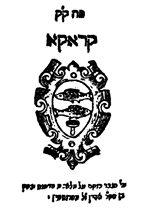
            Fish are a symbol replete with meaning, among them, in Judaism, representing fertility and good luck, albeit that fish are not an image that, for most, quickly comes to mind when considering Jewish iconography. Created on the fifth day of creation, fish symbolize fruitfulness, and, as Dr. Joseph Lowin informs, the month of Adar on the Hebrew calendar (February-March, Pisces) is considered “a lucky month for the Jews (mazal dagim).” He adds that in Eastern Europe people named sons Fishl as a symbol of luck, and that in the Bible, the father of Joshua is named fish, that is, Nun, which is fish in Aramaic.[1] Similarly, Ellen Frankel and Betsy Platkin Teutsch note the allusion to fertility and blessing, the former that when Jacob blesses Ephraim and Manasseh, Joseph’s sons, he says “May they multiply abundantly ve-yidgu, like fish) in the midst of the earth” (Genesis 48:16) and the latter to the Leviathan, the great sea monster the Jews will feast upon in the messianic age.[2]

Other biblical references to fish include Dagon, the fish-god of the Philistines, also worshipped elsewhere in the Middle East, mentioned several times in the Bible (Joshua15:41, 19:27; Judges 16:23; I Samuel 5:2–7; and I Chronicles 10:10).  A fish also appears in the biblical story of Jonah, a large fish (dag gadol), not the popular whale that swallowed the prophet.

            Not only Jewish sources and printers used devices that were fish related. The Medjed fish, a species of elephant fish, a medium-sized freshwater fish with a long downturned snout, abundant in the Nile, was worshipped at Oxyrhynchus in ancient Egypt and appears in Egyptian art. Fish are a not infrequent image on medieval coat of arms. Indeed, there are as many as 181 shields of salmon alone in heraldry.[3] The most well-known printer device with a fish is the anchor and dolphin of Aldus Manutius (1449-1515), albeit not strictly speaking a fish, as a dolphin is actually an aquatic marine mammal. Among the most novel of the marine pressmarks is that of the Liege printer J. M. Hovii, active during the latter half of the seventeenth century, whose mark consisted of a mermaid enwrapped about a tree with a skull at the foot of the tree.[4]

            This article is the most recent in a series describing printer’s devices and motifs appearing on the title-pages and with the colophons of early Hebrew printed books.[5] The use of the fish images described here are varied, comprised of pressmarks and full page frames which include representations of marine life. The discussion of the images and the presses are for the sixteenth into the eighteenth century. Although a number and variety of presses that that utilized marks with fish are addressed in this article they are examples only and not necessarily complete. Furthermore, the entries are expansive, that is, printers’ marks are not described in isolation but with discussions of the presses that employed them and examples of the books on which they appeared. Entries are in chronological.[6]

            As noted above, the month of Adar is, if not exactly, coterminous with the astrological sign of Pisces. That sign is represented by a pair of fish swimming in opposite directions, as fish swimming against the stream represents the powerful Pisces potential. They can be ‘sharks’ – charismatic, strong leaders with vision and clarity about leadership that can guide an entire nation, like Moses, who was also a Pisces. But those Pisces who prefer to go with the flow can be weak people who get carried away easily and are prone to addictive patterns of behavior.

Pisces is known for the holiday of Purim. According to the sages, it will be the only holiday to continue to be celebrated throughout the world after the Messiah comes. “When Adar begins, joy enters,” as the famous Hebraic phrase goes. It is a month of happiness, miracles and wonders. It affords us the ability to achieve mind over matter, to overcome our doubts, and connect to the Light.[7]

            Another compatible view of Adar and fish states that “The astral sign of Adar is the fish (Pisces). Fish are very fertile, and for that reason are seen as a sign of blessing and fruitfulness. The Hebrew word for blessing is bracha, from the root letters betreish, kaff. In Jewish numerology (gematria), the letter bet has a value of 2, reish is 200 and kaff is 20. Each of these is the first plural in their number unit. What this tells us is that the Jewish concept of ‘blessing’is intertwined with fertility, represented by the fish of Adar.”[8]

            Our first example of a pressmark with a fish is the most unusual in the article, the only device in which the fish is not only completely inconsistent with the above description but is the least prominent representation of a fish of all the pressmarks in the article. Among the earliest printers to make utilize of the fish in a pressmark is Joseph ben Jacob Shalit in Sabbioneta. Although the Sabbioneta press is commonly associated with Tobias ben Eliezer Foa, it was Shalit who appears to initially have been the motivating force behind the press and, with other partners, the provider of necessary financial support. Tobias Foa is credited with providing only the physical quarters, Duke Vespasian Gonzaga’s patronage, and limited financial assistance. Also associated with the press were Cornelius Adelkind, Vincenzo Conti, and R. Joshua Boaz Baruch, all prominent names in mid-sixteenth century Hebrew printing in Italy.

The first title printed at the press was Don Isaac ben Judah Abrabanel’s (1437-1508) Mirkevet ha‑Mishneh (1551), a commentary on Deuteronomy. Abrabanel began work on Mirkevet ha‑Mishneh when still in Lisbon, unlike the remainder of his commentary on the Torah which was written much later. Its completion was postponed, however, due to his responsibilities at the Portuguese court. The incomplete manuscript of Mirkevet ha-Mishneh was lost when Abrabanel was forced to flee Portugal in 1483. However, on his later peregrinations after the expulsion of the Jews from Spain Abrabanel came to the island of Corfu in 1493, where he serendipitously (miraculously) found a copy of the manuscript. Leaving aside other work he turned to completing this commentary, but after the departure of French troops from Naples, Abrabanel went to Monopoli (Apulia), where Mirkevet ha-Mishneh was finally completed in the first part of 1496.

The title page, dated 5311 Rosh Hodesh Sivan (Wednesday, May 16, 1551) is comprised of an architectural border with standing representations of the mythological Mars and Minerva. This border was first employed by Francesco Minizio Calvo in Rome in 1523 and as late as 1540 in Milan. This is its earliest appearance in a Hebrew book. It would be often reused and copied, appearing on the title pages of books printed as far apart as Salonika and Cracow.[9]

On the final unfoliated leaf are two devices, on the right that of Foa, a palm tree with a lion rampant on each side and affixed to the tree a Magen David, about it the verse, “The righteous flourish like the palm tree” (Psalms 92:13), all within a circle, and to the sides the letters ט and פ for Tobias Foa. On the left is Shalit’s device, a peacock standing on three rocks, facing left, with a fish in its beak within a cartouche, although Avraham Yaari, after describing the peacock with a fish, adds, in parenthesis, (or a worm?). The letters יביש about this device stand for Joseph ben Jacob Shalit. Also printed by the press that year was R. Isaac ben Moses Arama’s (c. 1420–1494) Ḥazut Kashah, on the relationship of philosophy and religion. It too has the Mars and Minerva title-page, but here the last leaf is foliated and has one pressmark only, the peacock with fish of Shalit.[10] Parenthetically, Arama too was a refugee from Spain.

Fig. 1 pressmarks of Joseph Shalit (left) and Tobias Foa (right)

The peacock with fish pressmark was reused by Shalit in Mantua at the press of Venturin Rufinelli with the colophon of several works, for example the late 10th century ethical work based on animal tales, translated from the encyclopedic Arabic Rasa`il ikhwan as-safa` wa khillan al-wafa` (Epistles of the Brethren of Purity and Loyal Friends) into Hebrew by Kalonymus ben Kalonymus (c. 1286-c. 1328) as Iggeret Ba’alei Hayyim (1557). The original is comprised of 52 eclectic volumes (pamphlets) on philosophy, religion, mathematics, logic, and music. The portion from which Iggeret Ba’alei Hayyim is taken appears at the end of the 25th book. The original was prepared by the Brethren of Purity, a secret Arab confraternity which flourished in Basra, Iraq in the second half of the tenth century. The tales themselves have an Indian origin. Four other varied works of note with the peacock with fish pressmark are R. Saadiah ben Joseph Gaon’s (882-942) Sefer ha-Tehiyyah ve-Sefer ha-Pedut (1556) on resurrection; R. Abraham ben Samuel ha-Levi ibn Hasdai’s (13th century) Ben ha-Melekh ve-ha-Nazir (1557), also based on an Indian romance and here derived from the Arabic; Berechiah ben Natronai ha-Nakdan’s (12th-13th century) Mishlei Shu’alim (1557-58) popular collection of fables, and a Haggadah with the Mars and Minerva title-page (1568).

The Shalit pressmark also appears on the title-page of several books printed in Venice at the press of Giovanni di Gara, without mention of Shalit, so that Yaari suggests he was not involved with the books but it was used simply as an ornament. Among the titles with this pressmark are R. David Kimhi’s (Radak, c. 1160-c.1235) commentary on Psalms (1566), R. Moses ben Baruch Almosnino’s (c.1515 – c.1580) Me’ammez Ko’ah (1587-88), R. Samuel ben Abraham Laniado’s (d. 1605) Keli Hemdah (1596), each with a biblical verse about the frame, and R. Aaron ibn Hayyim of Fez’s  (1545–1632) Lev Aharon (1608), this last without the biblical verses about the cartouche. The Shalit pressmark appears in various places in the books, after the introduction, by the colophon, least often on the title-page. Yaari notes that the Shalit device was also employed by Georgi di Cavilli in an Ashkenaz rite Mahzor (1568).[11]

Leaving Italy, for now, and Shalit, we turn to Cracow where Isaac ben Aaron Prostitz, who together with his sons after him, printed Hebrew books for fifty years, beginning in 1569. In 1578, Prostitz printed at least three large format attractive tractates from the Talmud, Avodah ZarahKetubbot, and Rosh Ha-Shanah, the last extant in a ten folio unicum fragment in the library of the Jewish Theological Seminary. Moritz Steinschneider writes that Avodah Zarah was printed “si revera Supplementi tantum instar ad ed. Basil,” and “seu castrata . . .Cracoviae vero supplementi instar excusus,” that is, to compensate for its omission of the entire tractate from the much censored Basle Talmud.[12] Another feature of this tractate is that it is the first employ by Prostitz of the shield with two fish facing in opposite directions, the upper facing left, the lower facing right, above a printer’s inker, as his device.

Prostitz’s apparent next use of this device, this the first noted in bibliographic sources, is a Mahzor (1584) printed with the support of four partners, and reused frequently afterwards on such varied titles as Josippon (1589) at the end of the book, Avot with the commentary Derekh Hayyim by R. Judah Loew ben Bezalel (Maharal of Prague, c. 1525-16) after the introduction (1589), R. Moses ben Jacob Cordovero’s (Ramak, 1522-1570) Pardes Rimmonim (1591), between the books introductions, R. Bahya ben Joseph ibn Paquda’s (late 11th century) Hovot ha-Levavot, after the translator’s preface (1593) and R. Naphtali Hirsch ben Asher Altschuler’s (16th-17th cent.) Ayyalah Sheluha c. 1595. Pardes Rimmonim was actually printed in Cracow/Nowy Dwor, the change in location due to a serious outbreak of plague in Cracow, Prostitz and his family forced to flee to Nowy Dwor with the press’ typographical equipment. Pardes Rimmonim was completed in that location, the only Hebrew book printed in that Nowy Dwor.[13]
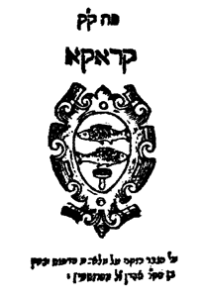
Fig. 2 Pressmark of Isaac Prostitz

Yaari questions Prostitz’s use of this pressmark. While the employ of the printer’s tool is clear, that is not the case for the fish. He suggests that it might be a propitious sign for the partners in the printing of the Mahzor in 1584, which Prostitz continued to use afterwards. This is unlikely, however, for, as we have noted, this device had been employed previously in 1578 on tractate Avodah Zarah. Another possibility is that the fish alludes to the month (Adar) in which Proztitz was born, but he then inquires why the pressmark was not used previously on all the books printed by the press. Yaari notes Steinschneider’s suggestion that the fish represented Prostitz’s entreaty for children, as his sons were borne at an old age. Here to, however, he observes that Prostitz’s four sons were born earlier, being mentioned in the colophon to Toledot Yitzhak in 1593. Another suggestion is that the fish allude to the name of R. Naphtali Hirsch ben Asher Altschuler who was known by all as Hirsch mokhir seforim (bookseller) in Lublin and for whom Prostitz printed books, for example Hovot ha-Levavot, the fish alluding to the name Naphtali, for the portion of the tribe Naphtali included the Kinneret Sea, in which fish were plentiful, but Yaari concludes this is only speculative.[14] I would question why, even if this is true for R. Altschuler, what does this have to do with Prostitiz and why he should have adopted this fish image for his pressmark?

A short lived press existed in Thannhausen, Bavaria, near Augsburg, a zoltot (supplementary festival prayers for the period between Passover and Shavu’ot) and a Mahzor (c. 1594) for the entire year according to the Ashkenaz rite were printed in the last decade of the sixteenth century. The press was a furtive effort to print Hebrew books by R. Isaac Mazia, whose name, it has been suggested, is an abbreviation for mi-zera Yehudim anusim, that is, he was of Marrano origin, or that he had served as rabbi in several communities in southern Germany, together with R. Simeon ben Judah ha-Levi of Guenzburg (Simon zur Gemze) of Frankfurt, who arranged with the Munich printer Adam Berg, to issue those works. When printing the mahzor the printers, concerned about the Christian response to sensitive passages and accusations of blasphemy, left blanks to be filled in by the purchasers.

After an examination of the still incomplete mahzorim by the censor at the University of Ingolstadt the press run of 1,500 copies was destroyed; only five copies are known to be extant today. In August, 1597, Mazia was fined 200 florin and released, while Berg, as late as 1604, was still attempting to have his impounded press returned. All of this occurred despite the fact that the authorities concurred that the mahzorim had been approved for publication by the imperial authorities in Prague. Nevertheless, the printers had neither received nor sought permission from the local authorities in Burgau to print. Moreover, as the books were for export they gave the impression that printing was done with the permission of those authorities.
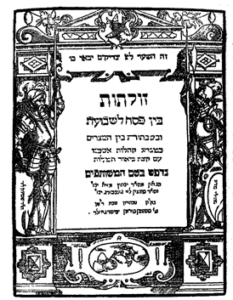
 Fig. 3b Zoltot


Fig. 3a Zoltot Extract

Both titles have a like frame comprised of an ornamental border with three entwined fish at the top (the signet of Mazia), at the sides are armed men in armor each with a shield, the right shield engraved with the name R. [Isaac] Mazia, the left with the name R. Simeon Levi. At the bottom is a laver pouring water on two hands, representative of the [Simeon] Levi. Isaac Yudlov informs that the fish here represent Isaac Mazia; this appearance of three fish as a printer’s mark is apparently unique. [15]

Not long afterwards we find the fish image employed in Lublin at the press of Zevi bar Abraham Kalonymous Jaffe. Lublin has a long and proud history as a Hebrew printing center, beginning with the press established by the family of Hayyim Shahor (Schwarz), that is, his son Isaac and his son-in-law Joseph ben Yakar. This press, through descendants and collateral members, would be active for almost a hundred and fifty years. The presses’ began publishing in 1551, with a folio Polish rite mahzor for the entire year, continuing until 1646 when a fire forced the press to close; printing resumed in 1648 when tah-ve-tat (gezerot Polania, the Chmielnicki massacres of 1648-49), broke out. That and the 1655-60 Swedish Muscovy wars, combined with others conflicts besetting the area made it impossible for Jaffe to continue and he had to close the press. Printing did resume when Solomon Zalman Jaffe ben Jacob Kalmankes of Turobin, encouraged and supported by his father, reestablished a Hebrew press. He printed 30 books until 1685 and the entire Jaffe family is credited with as many as 180 Hebrew titles.

Fig. 4 Pressmark of Zevi Jaffe

A device employed by Zevi Jaffe, found on the title page of tractates in the large folio edition of the Babylonian Talmud published from 1617-1639, and after the introduction to R. Joel Sirkes’ (Bah, 1561–1640), Meishiv Nefesh, and possibly other works is a deer with raised forelegs, above a crown atop a shield with two fish, the upper facing left and the lower facing representative of the fact that he was a Levi, often accompanied by two fish, here too indicating that he was born in the month of Adar.

Among the many prominent printers of Hebrew books in Amsterdam is Uri Phoebus ben Aaron Witmund ha-Levi. He had previously worked for Immanuel Benveniste; in 1658, Uri Phoebus established his own print-shop. He would print about one hundred titles, from 1658 to 1689, the period he was active in Amsterdam, generally traditional works for the Jewish community, encompassing Bibles, prayer-books, halakhic works, haggadotaggadot, and historical treatises (Yosippon). Prostitz’s first pressmark, employed in 1569 on the title-page of R. Naphtali Hertz ben Menahem of Lemberg’s Perush le-Midrash Humash Megillot Rabbah and intermittently afterwards was a stag within a cartouche. Subsequently, Uri Phoebus employed as his device a hand pouring water from a laver, representative of the fact that he was a Levi, often accompanied by two fish, here too indicating that he was born in the month of Adar.

The first usage by Uri Phoebus of this device was in 1660 on the title-page of Ketoret ha-Mizbe’ah, R. Mordecai ben Naphtali Hirsch of Kremsier’s (d. 1670) work on the aggadic portions of tractate Berakhot dealing with the destruction of the Temple and the length of the exile. The title-page of this folio book has an arabesque frame and across the lower half of the page is Uri Phoebus’s fish mark. That device would be frequently used as a decorative ornament in many of the books that Uri Phoebus printed, placed in various locations, after introductions or the colophons.
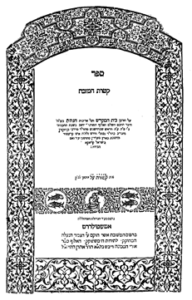
Fig. 5a Ketoret ha-Mizbe’ah

Fig. 5b Ketoret ha-Mizbe’ah Extract

Examples of the fish woodcut appears in other works, but not necessarily on the title-page, for example, in R. Hayyim ben Benjamin Ze’ev Bochner’s Or Hadash (c. 1671-75), on the laws of benedictions in a concise and abridged form, the title page of Or Hadash has an architectural frame headed by an eagle but no fish, that device being but one of several tail-pieces.

In 1662 Uri Phoebus printed an illustrated Haggadah accompanied by the commentary of R. Joseph Shalit ben Jacob Ashkenazi of Padua entitled Nimukei Yosef. The title-page of this quarto Haggadah has an architectural frame with two robed men at the sides, above winged cherubim and between them two fish with the winged head of a cherub. At the bottom are two vignettes; on the left the punishment of Shehem for the rape of Dinah and on the right the tribe of Levi killing the worshipers of the golden calf. In 1667-68, Uri Phoebus printed, also with this title-page, Nahalat Shivah (below and extract to right), R. Samuel ben David Moses ha-Levi’s (c.1625–1681) work on legal documents, particularly relating to divorce and civil matters. Nahalat Shivah has the same title-page as the Haggadah, here dated, “The Messiah ben David is coming משיח בן דוד בא (427 = 1667),” reflecting the referring to the false messiah Shabbetai Zevi. This title-page and fish crest (below) would be reused by Uri Phoebus for many years and elsewhere besides Amsterdam.

Fig. 6a Nahalat Shivah
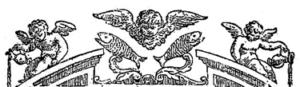
Fig.6 Nahalat Shivah Extract

Other title-pages employed by Uri Phoebus, with different architectural frames but with a like laver and fish image include such varied works as R. Jonah ben Isaac Teomim (d. 1669) of Prague’s Kikayon di-Yonah (1669-70), novellae on tractates of the Babylonian Talmud and, attributed to R. David ben Aryeh Leib of Lida (c. 1650-96) Migdal David (1680), both with the Benveniste frame; and R. Isaac Benjamin Wolf ben Eliezer Lipman (d. c. 1698), rabbi of Landsberg, Germany’s Nahalat Binyamin (1682), the first part of a commentary on the taryag [613] mitzvot and R. Shabbetai ben Meir Ha-Kohen’s (Shakh, 1621–1662) Siftei Kohen, a commentary and halakhic novellae on Shulhan Arukh Hoshen Mishpat these with a frame with rectangular shapes, all with the fish and lave at the apex.[16]  The title-page of Siftei Kohen, the first part of a commentary on the taryag [613] mitzvot dates the beginning of the work to 21 Tammuz, days of the Messiah ימי המשיח (423 = Thursday, July 26, 1663). The colophon dates completion of the work to Monday, 21 Heshvan, in the days of the Messiah בימי   המשיח (425 = November 9, 1664, actually a Sunday), both dates (Messiah) a possible allusion to Shabbbtai Zevi.[17]

Among the more elaborate title-pages is that of the first complete translation of the Bible (1676-78) into Yiddish by R. Jekuthiel ben Isaac Blitz, a rabbi from Witmund, Germany and corrector at the press of Uri Phoebus. This edition was the subject of a serious controversy with the Amsterdam printer Joseph Athias, who published an almost simultaneous and related Yiddish edition by Joseph Witzenhausen printed (Amsterdam, 1679-87).

Fig. 7a Bible – Engraved Front-piece
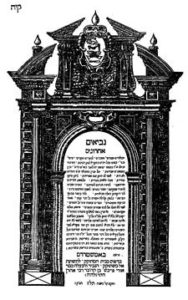
Fig. 7b Later Prophets

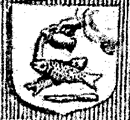
Figs. 7c, 7d Extracts

The Bible has an engraved front-piece title-page with depictions of Moses and Aaron, Mount Sinai at the top, and in the lower right hand corner a coronet and below it the raised hands of the Kohen giving a benediction. In the lower left hand corner is a fish and laver image, here the two fish are crisscrossed. The engraved title page is incorrectly dated תזל כטל (439 = 1679), whereas the like title-pages for each of the biblical divisions are correctly dated  תלז(437 = 1677), such as Later Prophets, below. The text has a separate but like title-page for Former Prophets, Later Prophets, and Writings. Note that in the otherwise like depictions of the fish and laver the position of the laver and water is reversed.

In 1689, Uri Phoebus ceased printing in Amsterdam, in order to relocate to Poland. Faced with competition from the large number of Hebrew printers in Amsterdam, Uri Phoebus felt that he would be more successful in Poland, located closer to its large Jewish population, a major market for the Hebrew printing-houses of Amsterdam. He established the first Hebrew press in Zolkiew in 1691, bringing his typographical material with him. Uri Phoebus’ descendants continued to operate Hebrew printing-presses in Poland into the twentieth century.

One of, if not the first book printed by Uri Phoebus in Zolkiew is R. Mordecai ben Moses Katz of Prostitz’s Derekh Yam ha-Talmud (1692) a super-commentary on the Hiddushei Halakhot of R. Samuel Eliezer ben Judah ha-Levi Edels (Maharsha). The title-page of this small work (40: 8ff.), much worn, appears to be the Benveniste frame, but at the apex is the same fish image as at the apex of Siftei Kohen. Among the decorative material, after the introduction and after the colophon is Uri Phoebus’ four fish mark, one on each side facing a laver from which water is being poured.

Among the other works published by Uri Phoebus in Zolkiew with the Nahalat Shivah title page reproduced above, is R. Jekuthiel ben Solomon Zalman ha-Levi Suesskind’s Dat Yekuthiel (1696,), a concise (80: 16 ff.) versified enumeration of the taryag mitzvoth (613 commandments). After the approbations to Dat Yekuthiel, there are thirteen, is the press mark comprised of four fish and laver. The title-page informs that the manuscript was found by Jekuthiel’s son Jonah of Kalish in his father’s bag, and arranged and brought to press by his grandson Menahem Feibush.

After the approbations is a letter from Jekuthiel to his son Eliezer. Jekuthiel, who was incarcerated at the time, in which he writes from his dark cell of his painful existence, where he had “wormwood, and gall to drink” (cf. Jeremiah 9:14) until “‘My soul is weary of my life’ (Job 10:1) ‘and my soul became impatient’ (Zechariah 11:8) to die in this way with this ‘light bread’ (Numbers 21:5) that I eat, absorbed in all my limbs, ‘the bread of adversity, and the water of affliction’” (Isaiah 30:20). Jekuthiel continues, describing his hardships, and then writes, “I will pay my vows to the Lord” (Psalms 116:14, 18) and that he took “of that which came to my hand a (new) offering” (cf. Genesis 32:14) on the taryag mitzvot. He thought to write on them in verse, “parallel, one with the other” (Exodus 26:17, 36:22), in single stanzas to the end, in the order of the Torah with references to the Hamishah Homshei Torah in the margins. Jekuthiel tells his son to take this as his blessing, which will be for a remembrance for both of them.

Uri Phoebus passed away in c. 1705.[18] He was succeeded in Zolkiew by his son Hayyim David, who had assisted his father at the press. Unfortunately, Hayyim David died shortly after his father, leaving the print-shop, in turn, to his sons, Aaron and Gershon. Uri Phoebus’ descendants continued to operate Hebrew printing-presses in Poland into the twentieth century. Aaron and Gershon did not use the ornamental material brought by Uri Phoebus to Zolkiew, instead preparing new frames that also reflected that they were Levi’im, and employed on such small format books as R. Raphael Lonzano’s Kinyan Avraham (1723) and R. Meir ben Levi’s Likkutei Shoshanim (1727). This ornate frame continued to be used by their descendants, among them Judah Solomon Yarsh Rappaport in Lvov on a Shir ha-Shirim with the commentary Magishi Minhah (1817) in Lvov.[19]
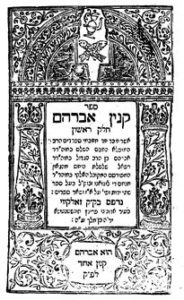
Fig. 8a Kinyan Avraham
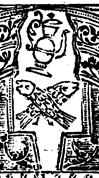
Fig. 8b Kinyan Avraham Extract

            Turning to, Germany, we find two fish, here facing in the same direction, on a title-page with an architectural pillared title-page, and at the bottom a palm tree, about it on the left a crab facing right and on the right two fish, both facing left, the former the sign of Tammuz (Cancer, scorpio), and, as already well noted, the latter the sign of Adar. The two zodiacal emblems may have had a personal significance, but, as Yosef Hayyim Yerushalmi observes describing a slightly later usage “the significance of this combination is difficult to ascertain.[20]

First employed in Fuerth by Joseph ben Solomon Zalman Schneur and his sons from 1691 through 1698, beginning with Torat Kohanim, and other folio volumes, primarily from the Shulhan Arukh, a like frame was subsequently used by Aaron ben Uri Lippman Frankel beginning with a Haggadah, in Sulzbach (below). Aaron was active in Sulzbach from the mid-1690’s until he passed away in 1720 at the age of seventy-five, first utilizing the fish image on a Mahzor printed in 1699 and afterwards in his folio imprints. Among those titles is a Haggadah (1711) with an attractive engraved copperplate front-piece (but without fish) followed by the second architectural pillared title-page described above. The architectural title-page was subsequently reused in Feurth by Hayyim ben Zevi Hirsch, who is credited with printing as many as 164 titles in that location, among the works with this frame and fish mark are several Haggadot (1746, 1752, and 1756).[21]
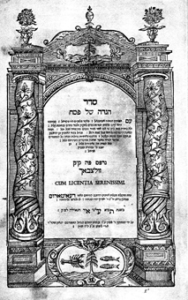
Fig. 9a Aaron ben Uri Lippman Frankel
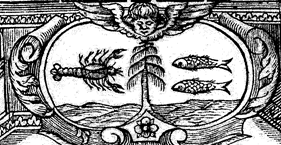
Fig. 9b Aaron ben Uri Lippman Frankel Extract

The site of yet another press that employed fish on the title-page, here apparently once only, was in Wandsbeck, a borough in north-west Hamburg in Schleswig-Holstein. The first printed books in Wandsbeck are dated to the late sixteenth and early seventeenth centuries, beginning with the Astronomiae instauratae Mechanica of Tycho Brahe (1546-1601), the famous Danish astronomer, published in 1598 by the printer Phillip van Ohr. Hebrew printing in Wandsbeck is a later occurrence, beginning approximately a century after its non-Jewish counterparts. It flourished for a brief period, primarily, albeit not solely, at the press of Israel ben Abraham.[22] The Thesaurus of the Hebrew Book enumerates forty-four titles from 1688 through 1744, several of which, including the titles previous to Israel’s sojourn in Wandsbeck, are listed as doubtful and includes duplicates as well.[23]

Israel ben Abraham was a proselyte who, reputedly, had previously been a Catholic priest. After his conversion Israel eschewed the sobriquets common among converts such as Avinu or the Ger (convert). Israel converted to Judaism in Amsterdam, where he wrote a Yiddish-Hebrew grammar Mafte’ach Leshon ha-Kodesh (Amsterdam, 1713). In 1716, after leaving Amsterdam, Israel ben Abraham acquired the typographical equipment belonging to Moses Benjamin Wulff, the court Jew in Dessau, and printed in Koethen, Jessnitz, and then in Wandsbeck from 1726-33, returning, after a brief retirement, to Jessnitz in 1739, printing a small number of titles to 1744.
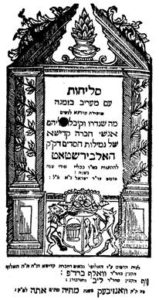
Fig. 10a Selihot with ma’ariv be-zemanah
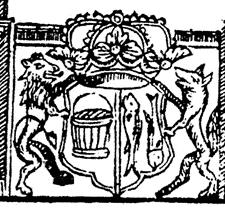
Fig. 10b Selihot with ma’ariv be-zemanah Extract

Selihot with ma’ariv be-zemanah (evening prayers in its time) is one of if not the first dated book attributed to Israel ben Abraham in Wandsbeck; it is a small octavo book (80: 7, 9, [4], 10-13, 13-23, [3] ff.). Its distinct title-page states that it is a Selihot with ma’ariv be-zemanah and that it contains matter pertaining to women; it informs that it was printed “as vowed and accepted upon themselves by the men of the hevra kaddisha (burial society) of the gemilut hasadim (charitable association) of HALBERSTADT,” and that it was “brought to press by the heads, the officers of the hevra kaddisha, R. Wulff and the noble R. Leib Warburg.” The title-page is dated in the year “You resuscitate the dead מחיה מתים אתה (469 = 1709),” a misdate, as noted by Moritz Steinschneider, who rejects the 1709 date (non admittunt; recusus ergo . . .) and dates it to 1730?[24]  At the bottom of the title-page are images of a lion at the left supporting a signet enclosing a pail, at the right a wolf supporting on the right side of the signet, two vertical fish, facing in different directions. The symbolism of these images is not clear, although it might be related to Wulff and Warburg, prominent contemporary family names.

The most dramatic, eye catching title-page with a fish motif was printed in Bad Homburg vor der Höhe at the press of Aaron ben Zevi Hirsch of Dessau. This Homburg is the district town of the Hochtaunuskreis, Hesse, Germany, on the southern slope of the Taunus, bordering, among others, Frankfurt am Main and Oberursel.[25] The title-page appears on successive editions of R. Meir ben Jacob ha-Kohen Schiff’s (Maharam Schiff, 1605-41, var. 1608-44) Hiddushei Halakhot, novellae on tractates of the Talmud, printed in Homburg in 1737, 1741, and 1747. Maharam Schiff, scion of a distinguished rabbinic family, a prodigy, was appointed rabbi of the important city of Fulda at the age of 17, where he was also served as a Rosh Yeshivah. There is a tradition that he was appointed rabbi of Prague in 1641, but if, as his grandson, who brought his works to press, reports, that he lived only 36 years, Maharam Schiff must have passed away immediately after his appointment. Maharam Schiff’s novellae are highly regarded and are reprinted in standard editions of the Talmud.[26]

The title-page has a four part frame, the top image of a fish (sea creature) attacking a ship and within the fish two men, apparently roasting a small fish (?). Below the fish (sea creature) appears to be the face of a man. On the other editions the other portions of the frame are varied. A. M. Habermann, in his work on Hebrew title-pages describes the top portion of the frame as mythological.[27]
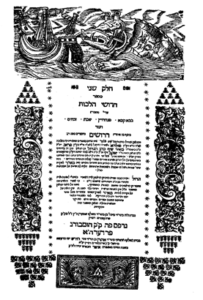
Fig. 11 1741, Hiddushei Halakhot

Returning to Amsterdam, an edition of Avot de-Rabbi Nathan with the commentary Ahavat Hesed (1777) by R. Abraham ben Samuel Witmond (1696-1773), also the author of novellae on the Pentateuch and Babylonian Talmud (1734). Avot de-Rabbi Nathan is one of the minor tractates, fourteen (fifteen, depending upon the enumeration) minor non-canonical tractates of the Talmud today appended to Seder Nezikin. It is an ethical work, considered a supplement to or a further development of Avot but with much aggadic material not related to the Mishnah, suggestive of an aggadic midrash. Ahavat Hesed was published posthumously by Witmond’s son-in-law and grandson at the press of Gerard Johann Janson. The header and place of publication on the title-page are printed in an oversized font in red letters. At the bottom of the page is a pressmark
Fig. 12a Ahavat Hesed

Fig. 12b Ahavat Hesed Extract

At the bottom of the title-page is a shield with topped by a coronet and within it on the right are two fish facing in opposite directions, above them the sun, moon, and a star, and above them the phrase “and (Samson) said, [O Lord God,] remember me, I pray you, and strengthen me” (Judges 16:28); on the left a hand holding a pail above water, again above the sun, moon, and a star, and above the phrase “And David blessed the Lord” (I Chronicles 29:10). Yaari informs that the two phrases, allude to Witmond’s son-in-law, R. David, son of the late Solomon Bloch, together with the author’s grandson, Samson ben Moses, who brought the book to press. Furthermore, the fish refer to Samson ben Moses, born in the month of Adar, the sign of which is a fish, and the pail refers to his son-in-law David, born in the month of Shevat, that month’s sign being a pail.[28]

            The fish image, replete with its symbolism of fertility and good fortune, continued to be used in Jewish imagery and pressmarks. Indeed, shortly after its appearance on Ahavat Hesed it was again employed, if only occasionally, on the title-page of works from another Amsterdam printer, this into the nineteenth century. The usage over centuries depicted here attest to the popularity and power of the fish image, persisting to the present.
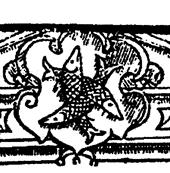
[1] Joseph Lowin, “Hebrew Root Word [D-Y-G]” Jewish Heritage on Line Magazine, http://www.jhom.com/topics/fish/lowin.html.
[2] Ellen Frankel and Betsy Platkin Teutsch, The Encyclopedia of Jewish Symbols) Northvale, London, 1995), p. 55.
[3] https://commons.wikimedia.org/wiki/Category:Salmons_in_heraldry
[4] W. Roberts, Printers’ Marks. A Chapter in the History of Typography, (London, 1893), pp. 201-02.
[5] Previous articles in this series are “Mirror-image Monograms as Printers’ Devices on the Title Pages of Hebrew Books Printed in the Seventeenth and Eighteenth Centuries,” Printing History 40 (Rochester, N. Y., 2000), pp. 2-11, reprinted in Studies in the Making of the Early Hebrew Book (Brill, Leiden/Boston, 2008), pp. 33-43; “The Cover Design, ‘The Printer’s Mark of Marc Antonio Giustiniani and the Printing Houses that Utilized It,’” Library Quarterly, 71:3 (Chicago, July, 2001), pp. 383-89, reprinted in Studies, pp. 44-53; “Mars and Minerva on the Hebrew Title Page,” The Papers of the Bibliographical Society of America 98:3 (New York, N. Y., 2004), pp. 269-92, reprinted in Studies, pp. 1-17; “The Bear Motif on Eighteenth Century Hebrew Books” The Papers of the Bibliographical Society of America 102:3 (New York, N. Y., 2008), pp. 341-61, reprinted in Further Studies in the Making of the Early Hebrew Book (Brill, Leiden/Boston, 2013), pp. 57-76; “Akedat Yitzhak (the Binding of Isaac) on the Title-Pages of Early Hebrew Books,” in Further Studies, pp. 35-56; “The Eagle Motif on 16th and 17th Century Hebrew Books,” Printing History, NS 17 (Syracuse, 2015), pp. 16-40; “The Lion Motif on Early Hebrew Title-Pages and Pressmarks,” (Printing History, NS 22, (Syracuse, 2015), pp. 53-71.
[6] Among the primary sources for this article are my The Sixteenth Century Hebrew Book: An Abridged Thesaurus (Brill, Leiden, 2004) and my The Seventeenth Century Hebrew Book: An Abridged Thesaurus. Brill, Leiden/Boston, 2011, and Avraham Yaari, Hebrew Printers’ Marks From the Beginning of Hebrew Printing to the End of the 19th Century, (Jerusalem, 1943), Hebrew with English introduction.
[7] Kabbalah Centre, https://livingwisdom.kabbalah.com/pisces-adar.
[8] Aish.com, http://www.aish.com/h/pur/b/The_Choice_of_Adar.html.
[9] Concerning the widespread use of this frame see my “Mars and Minerva on the Hebrew Title Page,” noted above.
[10] Yaari, Hebrew Printers’ Marks, pp. 12, 132 no. 19.
[11] Yaari, p. 132.
[12] Moritz Steinschneider, Catalogus Liborium Hebraeorum in Bibliotheca Bodleiana (Berlin, 1852-60), col. 220 n. 1407, col. 228 n. 1427.
[13] Nowy Dwor, Polish for ‘new manor’, is the prefix of several locations with that title. Another Nowy Dwor, Nowy Dwor Mazowiecki, was home to a Hebrew press in the late eighteenth – early nineteenth centuries, printing a significant number of Hebrew titles from 1781 through 1818.
[14] Yaari, pp. 26, 139 no. 42.
[15] A. M. Haberman, Title Pages of Hebrew Books (Safed, 1969), pp.m 48,129 no. 34; Isaac Yudlov, Hebrew Printers’ Marks: Fifty-Four Emblems and Marks if Hebrew Printers and Authors (Jeruslaem, 2001), pp. 36-40 [Hebrew]. He also informs that three small fish are the mark of the Gronim family of Prague in the sixteenth century, appearing on their headstones.
[16] Concerning Lida and Migdal David see my“David ben Aryeh Leib of Lida and his Migdal David: Accusations of Plagiarism in Eighteenth Century Amsterdam,” Shofar 19:2 (West Lafayette, Ind., 2001), pp. 117-28, reprinted in Studies in the Making of the Early Hebrew Book, pp. 191-205.
[17] Another work refering to Shabbetai Zevi noted by Ch. B. Friedberg, History of Hebrew Typography of the following Cities in Europe: Amsterdam, Antwerp, Avignon, Basle, Carlsruhe, Cleve, Coethen, Constance, Dessau, Deyhernfurt, Halle, Isny, Jessnitz, Leyden, London, Metz, Strasbourg, Thiengen, Vienna, Zurich. From its beginning in the year 1516 (Antwerp, 1937), p. 29 [Hebrew] published by Uri Phoebus is Tikkun Keria with a depiction of Shabbetai Zevi “sitting upon a throne, high and lifted up” (Isaiah 6:1).
[18] Ch. B. Friedberg, History of Hebrew Typography in Poland from the beginning of the year 1534, and its development up to our days . . . Second Edition, Enlarged, improved and revised from the sources (Tel Aviv, 1950), p. 64 [Hebrew] and Yaari, p. 158, date Uri Phoebus death to 1705. L. Fuks and R. G. In contrast, Fuks-Mansfeld, Hebrew Typography in the Northern Netherlands 1585 – 1815, II (Leiden, 1984), p. 242, writes that although Uri Phoebus was very productive in Zolkiew, he returned to Amsterdam in 1705, where, in 1710, he wrote “a short history of the first settlement of the Sephardic Jews in Amsterdam,” and where he died on 23 Shevat 5475 (17 January, 1715).
[19] Yaari, p. 158.
[20] Yosef Hayyim Yerushalmi, Haggadah and History, A Panorama in Facsimiles of Five Centuries of the Printed Haggadah from the Collections of Harvard University  and the Jewish Theological Society of America, (Philadelphia, 1976), plates 64, 65.
[21] Yeshayahu Vinograd, Thesaurus of the Hebrew Book. Listing of Books Printed in Hebrew Letters Since the Beginning of Printing circa 1469 through 1863 I (Jerusalem, 1993-95), I, p. 450 [Hebrew]; Yaari, pp. 51, 152-52 no, 82; Yudlov, pp. 59-61
[22] Concerning Hebrew printing in Wandsbeck see Marvin J. Heller, “Israel ben Abraham, his Hebrew Printing-Press in Wandsbeck, and the Books he Published,” Further Studies in the Making of the Early Hebrew Book (Brill, Leiden/Boston, 2013), pp. 169-93.
[23] Vinograd, II, pp. 168-69.
[24] Steinschneider, cols. 2792-93 no. 7517, 446-47 no. 2939.
[25] Concerning Hebrew printing in Homburg see my “Early Hebrew Printing in Bad Homburg vor der Höhe,” in progress.
[26] Itzhak Alfassi, “Schiff, Meir ben Jacob Ha-Kohen,” Encyclopaedia Judaica, (Detroit, 2007) vol. 18, p. 131; Mordechai Margalioth, ed. Encyclopedia of Great Men in Israel IV (Tel Aviv, 1986), col. 1028-29 [Hebrew].
[27] A. M. Habermann, Title Pages of Hebrew Books (Tel Aviv, 1969), pp. 104, 134 no. 88 [Hebrew].
[28] Marvin J. Heller, Printing the Talmud: A History of the Printed Editions of the Talmud from the mid-17th Century to the end of the 18th Century and the Presses that published them (Brill: forthcoming); Yaari, Hebrew Printers’ Marks, pp. 89, 169-70 no. 145.