‘Yikar Sahaduta Dipum Bidatta’ R. Tzvi Hirsch Levin, the Besamim Rosh and the Chida

Yikar Sahaduta Dipum Bidatta’

R. Tzvi Hirsch Levin, the Besamim Rosh and the Chida

Rabbi Moshe Maimon, Jackson NJ

Some of the worst epidemics we have known in our history have indirectly been the catalyst for important contributions by scholars who produced their valuable works under quarantine. Eliezer Brodt has published in these pages considerable lists of such scholarship, from bygone plagues down to the current terrible epidemic, which highlight the vast scope of this literary bounty.

I recently came across a very interesting sefer-epidemic connection which I have not seen mentioned yet. This material highlights the contribution of a scholar who was quite probably in quarantine when he produced his indices to a well-known and much debated sefer—R. Saul Berlin’s storied publication, Besamim Rosh. Perhaps most famous (or infamous) for its reputation as the ultimate rabbinic forgery, an exhaustive history of this volume has already been written (and interested readers would do well to refresh their memory with the excellent survey in this blog post by Dan Rabinowitz & Eliezer Brodt; see also Eliezer Brodt’s exhaustive bibliography on the subject in a footnote in Yeshurun, vol. 24, pp. 425-427). My own study of the saga of this sefer during the present COVID-19 quarantine era can hopefully shed light on some striking details pertaining to this account.

R. Tzvi Hirsch Levin in defense of Besamim Rosh

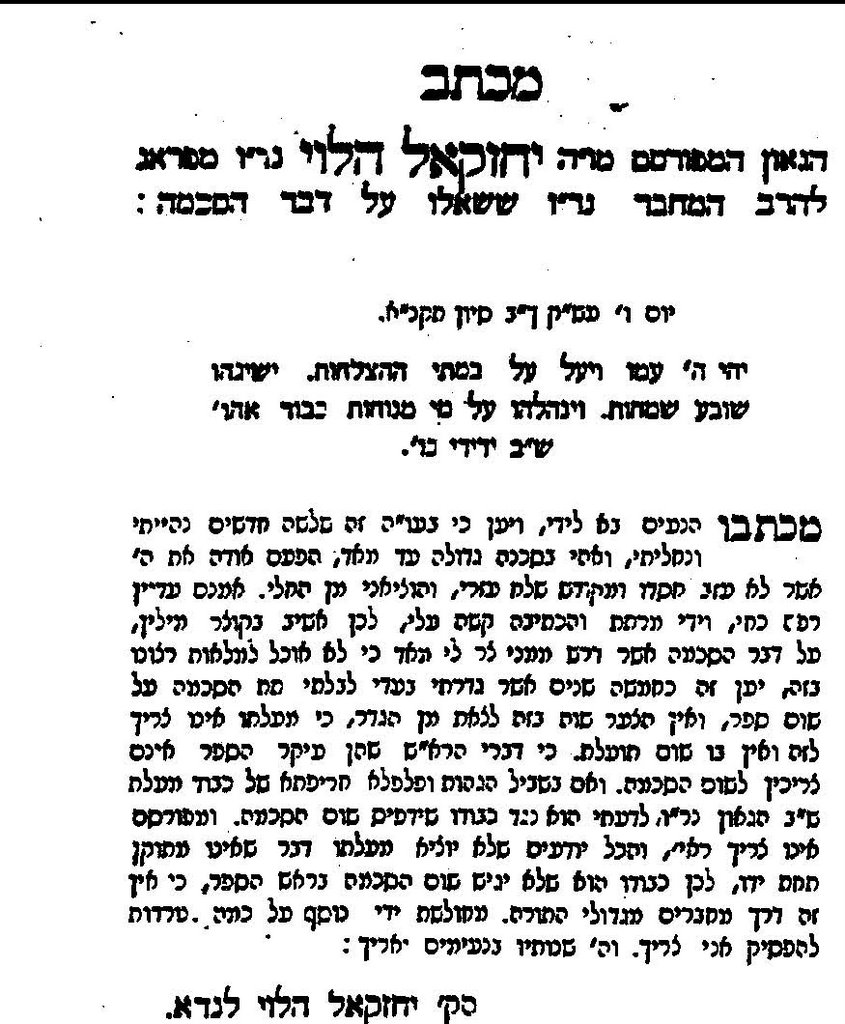
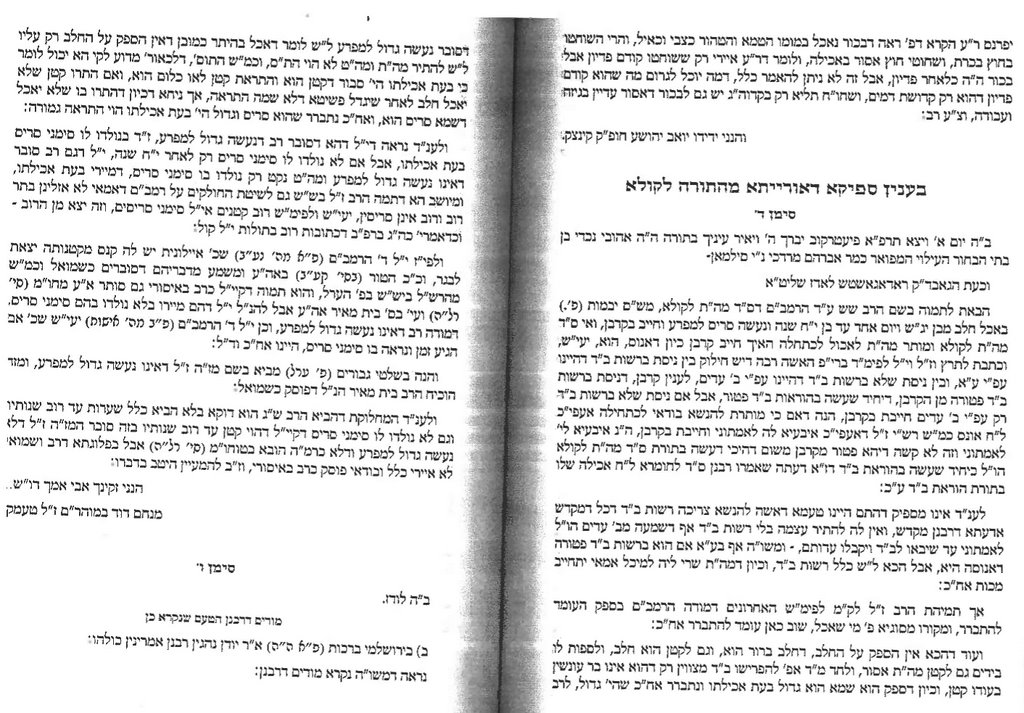
Those who have followed the rocky history associated with Besamim Rosh will recall the strenuous defense of this sefer penned by R. Saul’s father, R. Tzvi Hirsh Levin, rabbi of Berlin, and reproduced in the introduction to Rabbi Amar’s recent edition of Besamim Rosh, and most recently, together with a facsimile of the original, in R. Yisroel Chaim Tessler’s comprehensive overview of the history of R. Saul Berlin and the Besamim Rosh in Pe’alim LaTorah (vol. 34 pp. 226-229).

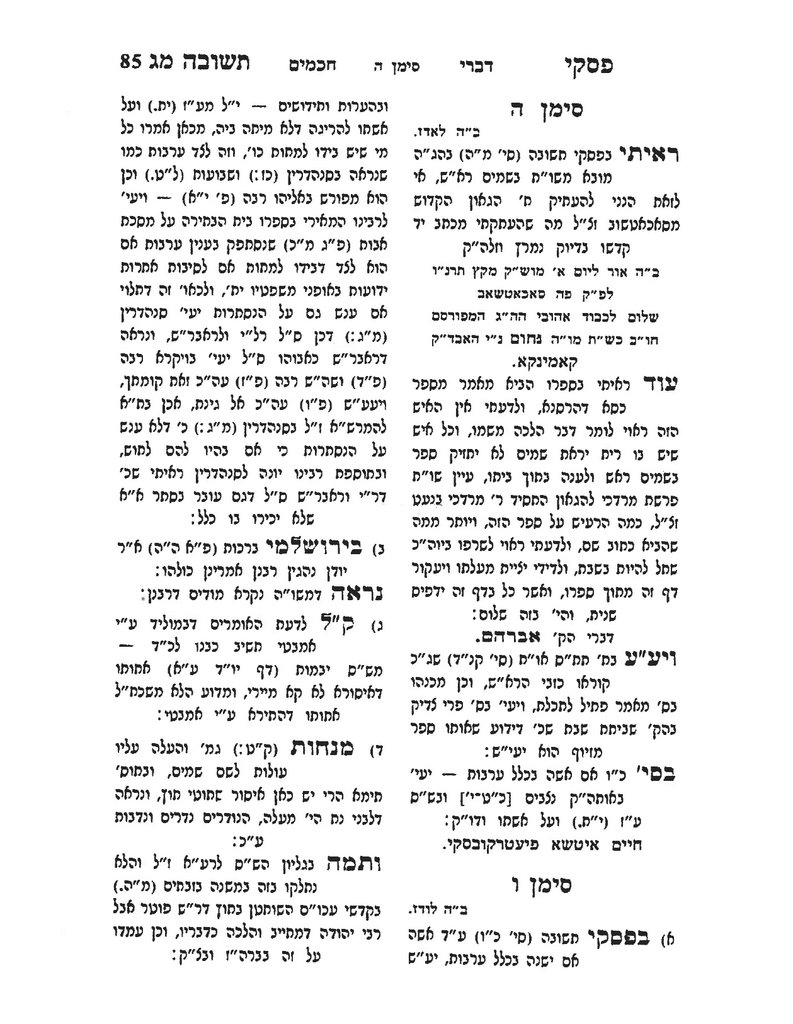
Modern books of Hebrew Bibliography, such as Friedberg’s Bet Eked Sefarim and Winograd’s Otzar HaSefer Ha’Ivri, contain an entry for a separate pamphlet published by R. Zvi Hirsch Levin written in defense of the Besamim Rosh entitled Yikar Sahaduta. This has led some to conclude that in addition to his letter of defense, R. Levin also wrote an additional pamphlet to clear his son of any suspicion. As far as I could tell, a separate pamphlet by this name is not to be found in any library or other public holding (cf. the aforementioned Pe’alim LaTorah article fn. 61), however, the Heimann Michael collection catalogue אוצרות חיים contains an entry on p. 250 for a copy of Besamim Rosh which has an additional pamphlet by R. Tzvi Hirsch Levin by this name appended to it, and this is likely the source for the entry in the aforementioned bibliographies.

As the printed books from Heimann Michael collection were later purchased by the British Library, it stands to reason that we may yet be able to ascertain if this Yikar Sahaduta is indeed a separate publication, though I have a hunch it is none other than R. Levin’s famous (untitled) letter that must have been bound at a later date with the sefer (as it is in R. Levin’s manuscript copy of the Besamim Rosh held at The Russian State Military Archives, see here).

The existence of a volume of R. Saul’s earlier controversial work, Mitzpeh Yakte’el (Berlin 1789), bound with R. Levin’s letter in defense of the Besamim Rosh, would lend some weight to this supposition. This copy is attested to by Moshe Carmilly-Weinberger, in his Sefer VeSayaf (New York 1967, pp. 213-215), who was somehow misled by it into thinking that the defense of Besamim Rosh was written and published with Mitzpeh Yakte’el four years prior to the actual publication of the Besamim Rosh! In any event, the British Library is at present closed to staff and public alike due to Covid-19 restrictions, and I have had to arrest my investigation of the matter for now.

While In Seclusion…

This untitled letter starts with some rhymed prose, beginning with the words איש עניו, and continues on with a passionate defense of the integrity of the sefer, and includes a barely restrained attack on those who dare to impugn it. R. Levin writes that anyone who disparages this sefer is besmirching the good name of R. Levin himself, for it was he who had given the sefer his imprimatur after reading it in manuscript form (prepared for him by his other son, R. Shlomo, later famous as R. Solomon Hirschell, Chief Rabbi of Great Britain). The manuscript had been in his possession for close to ten years prior to its 1793 printing, and it was R. Levin himself who had helped prepare the indices for this volume during his stay in Pyrmont:

והנה מעידני עלי שמים וארץ כי הספר הלז הועתק לי מבני הרבני המופלג ומושלם כמוהר”ר שלמה נר”ו זה כעשר שנים, ואני בעצמי עשיתי לו המפתחות כסדר הטורים בפרמונד… ואם כדברי המתקדשים הללו בי אני העון אשר הסכמתי להוציאם לאורה ולא על בני הגאון נר”ו לבד תלונתם כי אם גם עלי.

[I call heaven and earth as my witnesses that this sefer was copied for me about ten years ago by my son, the distinguished and perfect rabbi, R. Solomon, may G-d protect and keep him, and I personally prepared the indices according to the order of the Tur in Pyrmont… and if these sanctimonious hypocrites are correct, then the fault lies with me for sanctioning the publication; their grievance is not just with my son [R. Saul], the exemplary scholar, may G-d keep and protect him, but rather with me as well]

R. Menachem Silber pointed out to me that this Pyrmont is most probably the resort and spa town Bad Pyrmont. Here is a contemporary depiction of the promenade between the baths and the town of Pyrmont from 1780, about the time of R. Levin’s stay there, courtesy of Wikipedia.

R. Levin does not explain in this letter the significance of his stay in Pyrmont. However, in an entry in his journal, published by his descendant, R. Tzvi Michaelsohn, in his responsa Tirosh VeYitzhar in the section at the end of the sefer devoted to his antecedents’ novellae (new pagination, p. 35), we read the following:

כל זה כתבתי לי זה רבות בשנים ועתה בשנת תקו”ם לפ”ק בהיותי בפירמונד ונשב בד בבד ואין ספרים הצריכים בידי כי אם מעט אשר לקחתי מביתי ומהם ס’ בשמים ראש כ”י )ברור שכך צ”ל, ובמקור “כו'” וכנראה נשתבש המעתיק בהעתקת כתה”י – MM).

[I had written the above some years ago, but now in the year 1786, while dwelling in solitude in Pyrmont, I have few sefarim with me save for the few that I was able to take with me from home, including the sefer Besamim Rosh in manuscript].

This manuscript’s placement in Pyrmont is further evidenced by an inscription on the manuscript by one Yechiel Michel b. R. Isserl who, writing in Pyrmont (the date 1757 given in the JNUL catalogue is obviously an error in transcription), attests that the volume was in the possession of “the exemplary scholar and great rabbi of Berlin and its environs” (a reference to R. Levin himself). Later (p. 41), R. Levin writes further of his stay in Pyrmont:

ב”ה פירמונד. לאשר אין אתי כי אם ספרי משניות ושאר ספרי דבי רב אינם נמצאים כאן אמרתי לרשום כל העולה בלבי עד ירחם ה לנו ונעיין בה.

[By the Grace of G-d, Pyrmont: Having no sefarim with me here, save for a set of Mishnayot and a few other rabbinic volumes, I have determined to note whatever thoughts occur to me until God has mercy on us and I have the opportunity to do further research on them].

I have not found confirmation of an epidemic in the environs of Berlin in the year 1786, but the fact that R. Levin bemoaned his having to remain in solitude in Pyrmont, bereft of his holy works, until God shows mercy on his people, does strongly indicate that he was not there on vacation, but was forced to shelter in place there to avoid the plague. Perhaps one of the readers can supply more information and shed light on this episode.

Be that as it may, it is clear that R. Levin took advantage of his time in Pyrmont to thoroughly review the manuscript volume of Besamim Rosh (see also further references to Besamim Rosh in his novella, ibid. p. 38 section 41:3, 42:6 and p. 44 section 56:1), and it was then that he created the indices for the sefer. This must have been no small feat, as he was likely forced to rely in great part on his prodigious memory due to the dearth of basic source material available at Pyrmont.

Noteworthy in itself is that the manuscript of Besamim Rosh was among the few volumes R. Levin took with him to Pyrmont, indicative of his interest – unique among his contemporaries – in manuscript works of Rishonim. Further testament to this interest is R. Levin’s copy of a manuscript of Sefer Ra’avyah (today known as The Beth Din & Beth Hamidrash Library, London, England Ms. 11) which later formed the basis of the new edition published by R. David Deblitzky (Bnei Braq 2005), and which contains many glosses in R. Levin’s hand. One such gloss actually concerns the Besamim Rosh, and it is published here for the first time in its entirety (it is cited in R. Deblitzky’s edition, vol. 1 p. 40 fn. 14, though R. Deblitzky had trouble deciphering a couple of words):

נראה שיש כאן חסרון לשון ומ”מ אנו למדין ממנו שמחלוקת ישנה היא אי בעל קרי מותר בתפילין וכאשר כתבתי במקום אחר לסתום פי דוברי נבלה אשר שננו לשונם דבר מר על ספר בשמים ראש

[There appears to be a lacunae here, however, we may adduce from this statement that the debate with regards to the permissibility of a Ba’al Keri to wear tefillin is an old one, and I already wrote on this elsewhere to silence the speakers of mendacity (cf. Yeshayahu 9:16 – MM) who sharpened their tongues to speak ill of the sefer Besamim Rosh].

Besamim Rosh in the Chida’s Shem HaGedolim

Once on the topic of the Besamim Rosh and R. Levin’s letter of defense of it, I would like to revisit the issue of the Chida’s opinion of the sefer, and his response to R. Levin’s missive supporting it. (I had touched on this previously in a note to an article for Yeshurun vol. 28 p. 935 fn. 3).

Our primary concern will be with the entry on Besamim Rosh in the Chida’s popular bibliographical work, Shem HaGedolim, though our study of his views will give us occasion to examine statements in various other works of his as well (followed by loose translations of these statements that aim to preserve the intent of the Chida’s rich rhetorical melitza, if not necessarily its literal translation). In the course of our study, it will serve us well to bear in mind that the Chida was ever the prolific writer who particularly favored the Sephardic style of journalistic study, and in the course of his study he would constantly note in his journals anything he wished to be able to refer to later.

[In Sephardic parlance these journals would be called Zichronot – perhaps best rendered in English as ‘reminders’ – as distinct from the same term used in Ashkenazic circles to denote memoir literature. For the Chida’s own use of the term in describing his journals see the list in the bibliographical work Maranan VeRabanan appended to the Machon HaMao’r edition of Shem HaGedolim vol. 2 p. 52 #17. This list adds to the scant entry in the previous edition of Maranan VeRabanan, Jerusalem 1991, though it is far from comprehensive. The Chida also alluded to this term in the naming of his sefer Eyn Zocher as evidenced in his prelude there].

The Chida’s prolific sefarim output was based on this method of study, as he would use the material in these diaries for publication in his many sefarim (compare in general Meir Benayahu’s description of the Chida’s method of arranging his notes for publication in his biography, Rabbi Chaim Yosef David Azulay, Jerusalem, 1959, p. 93). Perhaps unique among his peers in this regard, the Chida, with his keen bibliographical instinct, was also accustomed to jot down historical and bibliographical items of interest to him, and these notations would later form the basis of his various works which together form his celebrated Shem HaGedolim (cf. Oded Cohen’s doctoral dissertation on the Chida’s cultural world: Chadashim Gam Yeshanim, Tel Aviv University, 2016, from p. 169, and recently, in the introduction to the new edition of Shem Hagedolim published by Machon HaMa’or (Jerusalem, 2019).

Contemporary editions of this work are all based on the 1852 edition, edited and published in Vilna by Yitzchak Isaac Ben-Jacob. This volume is an amalgamation of two separate, though similar, works published in various editions by the Chida, Shem HaGedolim and Va’ad Lechachamim, along with various supplemental additions appended by him to some of his subsequent works, ordered in separate arrangements – by names of scholars and by names of publications. On this edition in general, and on the editorial discretion (and liberties) employed by its publisher in particular, see the excellent article by Oded Cohen, ‘The Freedom of Editing: Isaac Benjacob’s Re-editing of Hida’s Shem Ha-gedolim’, in Zutot 10 (2013), pp. 71-87 (based on his aforementioned dissertation, from p. 182; in both sources the date for Ben Jacob’s edition is given as 1853, seemingly based on a simple computation of the Hebrew date, תרי”ג, however the date 1852 is clearly listed on the title page, so the sefer must have been published in the few months remaining to that year after Rosh Hashana).

This streamlined format is very beneficial as it made it easy to access all of the Chida’s previously disassembled comments on a particular sefer or author, and this popular format has been reproduced in all subsequent editions. Yet, while Ben-Jacob was careful to delineate the various sources from the Chida’s publications used in each particular entry, and noted them in his footnotes, the later editions omitted his notations altogether. This has proven to be a major drawback since when attempting to unpack the chronological progression of the Chida’s views concerning a specific sefer, tracking down the earlier works that now comprise the Shem HaGedolim is often indispensable in determining what he had written when.

The new Machon HaMa’or edition does make some headway in this regard, and many times the varying publications that make up a specific entry in this edition are sourced in the notes. However, as explained in their introduction, they chose not to replicate Ben-Jacob’s system, but rather to incorporate these sources in their own notes when deemed important, without systematically annotating the text. This is a regrettable decision, as without a systematic formula by which the reader can identify the different sources, the reader is often at a loss in determining that what appears at times to be one unified entry, has in fact been culled from a variety of sources.

The entry on Besamim Rosh is one such example, since this entry contains three separate statements regarding the sefer – from two different publications and espousing different views. The written record in the Chida’s other works contains varied positions towards the sefer; an initial enthusiastic reception shifting to reserved suspicion, and finally, unqualified acceptance. Only by classifying the differing statements chronologically, is it possible to ascertain the progression of his opinions.

The Chida’s Evolving Assessment

The first statement in Shem HaGedolim concerning this sefer comes from the entry for Besamim Rosh in the first volume of his sefer Va’ad LeChachamim, a bibliographical sequel to the two previously published volumes of Shem HaGedolim. Va’ad LeChachamim was first published in 1796, though this entry was apparently written very shortly after the 1793 publication of Besamim Rosh, as indicated by the opening words “עתה מקרוב” =“just now”:

בשמים ראש – עתה מקרוב נדפס ספר זה בברלין ושיש בו סימנים שצ”ב מתשובות הרא”ש ושאר גדולים וזה שמו בשמים גימטריא שצ”ב. רא”ש תשובות הרא”ש. וזה הספר הכינו וקבצו וחקרו הרב הגדול מהר”ר יצחק די מולינא ז”ל אשר מצא ספר גדול משו”ת הרא”ש וגדולים אחרים אצל גביר אחד והוא סילת וזיקק ולקט קובץ זה ועשה עליו הגהות כמפורש שם. ועוד יש הגהות כסא דהרסנא.

[Besamim Rosh – This sefer has just now published in Berlin, and it has 392 responsa from the Rosh and other great rabbis, and it is thus called Besamim, the numerical value of which is 392. This volume was collected and prepared for publication by the great rabbi, our esteemed teacher R. Yitzchak De Molina of blessed memory, who found a large volume of responsa from the Rosh and other great rabbis at the home of a wealthy patron, and he sifted through them and collected the select ones to which he appended his comments as described within. There are also included a section of comments entitled Kasa DeHarsena].

The decidedly reserved tone of this entry is readily apparent, and the reason for this is immediately explained by the Chida’s observation below:

ואשמע אחרי קול רעש כי יש בספר זה קצת דברים זרים ואמרו שהמעתיק הראשון בארץ תוגרמה מכ”י הרב יצחק די מולינא ז”ל יש לחוש שהוסיף וגרע. ולכן הקורא בס’ זה לא יסמוך עליו דאפשר דתלי בוקי סריקי בגדולים עד אשר יחקור ויברר הדברים ודברי אמת ניכרים. ודי בזה.

[I subsequently heard a clamor to the effect that there are some strange things in this sefer, and that the person in Turkey who first transcribed this sefer from the original manuscript of R. Yitzchak De Molina of blessed memory, may have perhaps added and detracted. Therefore, one who reads this sefer should not rely on it as there exists the possibility that nonsensical things have been attributed to great rabbis, unless he first investigates and clarifies the matter; and indeed, authentic material is recognizable as such. Let this suffice].

The Chida, one of the most outstanding rabbinic scholars and bibliophiles of his time, was typically very enthusiastic about newly published rabbinic manuscripts. His writings are replete with references to new ones he had seen, and from which he gleaned various insights for inclusion in his own sefarim.

The publication of the Besamim Rosh understandably excited him and he perused it for insight into topics he had himself dealt with in his writings. In his collection of halachic essays, Tov Ayin, published in the same volume as the aforementioned Va’ad LeChachamim, some of the insights gleaned from this perusal are recorded in various sections (#8, 9, 18:12,29,86).

In fact, one particular section (#9), is devoted solely to halachic observations pertaining to the Besamim Rosh. This section consists of various entries, culled by the Chida from his many diaries, to which were added notations pertaining to thoughts he had seen in the copy of Besamim Rosh that he had borrowed for a few days.

[The Chida was careful to note when he quoted from a borrowed sefer so that contemporaries could not criticize him for not citing a specific source from a volume he had himself quoted elsewhere; see for example Shu”t Chayyim Sha’al, vol. 2, section 10 paragraph 1, to wit: “והיטב חרה לו דהיה לי להביא דברי ספר הכוונת… אך גר אנכי בארץ וכמה ספרים עיקריים אין בידי ואם חיי”ם שא”ל ספרא וספרי מקיים מצות השבה” =“He was greatly upset that I did not cite Sefer HaKavanot… however I am but sojourner in this land and I lack many basic sefarim. Even when I did borrow a specific sefer, I was quick to return it”].

One entry in this section (#9:2) records the Chida’s enthusiastic reception of the new sefer (“היום נראה בעליל ספר בשמים ראש”), and all the entries show how various notations in the Chida’s writings were enhanced by his brief study of the sefer. The section concludes with the Chida’s measured remarks concerning the suspicion that had been raised in connection with this sefer:

הן בעודני קורא דרך ארעי בספר בשמים ראש הנזכר אחרי כתבי קצת פרטים שכתבתי לעיל שמעתי שיש מפקפקים בספר הזה כמו שכתבתי בקונטריס ועד לחכמים ריש מערכת בי”ת והנה צור”ף כי הספר הנזכר שאול הוא אתי לכן עמד קנה במקומו לעת הלום וה’ יצילנו משגיאות ויראנו מתורתו נפלאות כי”ר.

[During my perfunctory study of the aforementioned sefer Besamim Rosh, after I had written the few things previously mentioned, I heard that there are those who view this sefer with suspicion as I have written in my work Va’ad LeChachamim at the beginning of section Bet, which is appended to this work. As it was a borrowed sefer, I desisted from further study of it for now. May God protect us from blunders and may it be His will to reveal wondrous Torah insights to us].

This passage is revealing in that it demonstrates how the Chida’s writings were constructed. As mentioned earlier, the Chida only had the Besamim Rosh in his possession for a few days before desisting from studying it upon hearing the negative rumors surrounding the sefer. Nevertheless, in this short amount of time he had managed to write down several pages of novellae, as well as add various notations to existing entries in his diaries. Only after hearing the rumblings did he go back to add a cautionary note vis-à-vis the Besamim Rosh.

It is alluring to visualize the Chida sitting diligently at his desk with his notebooks open and pen in hand, variously writing and studying, studying and writing. The Chida describes his decision to desist from further study of the Besamim Rosh with the phrase, “לכן עמד קנה במקומו” =“and so the pen stopped here”—likely a quite literal statement.

The language in the aforementioned entry in Va’ad Lechachamim, “ואשמע אחרי” =“I subsequently heard,” also suggests that the two paragraphs were written at separate intervals. It seems that the first paragraph was written almost as soon as the Chida held the sefer in hand, and he quickly noted the bibliographical information in the manuscript of Va’ad LeChachamim that he was working on. Only later, upon hearing of the suspicions leveled against the sefer, did he go back and added the cautionary note. (I might add that I think it likely that the original entries pertaining to the Besamim Rosh contained some of the Chida’s customarily laudatory language, such as we find in Tov Ayin, but were later mildly edited for publication in light of the new findings).

Further evidence for the two stages in the Chida’s early reception of the Besamim Rosh can be adduced from an earlier entry for Mar Avraham Gaon in Va’ad LeChachamim, where the Chida first notes a responsum of Besamim Rosh pertinent to the discussion of using the biblical name of Yishma’el, and only in a later paragraph adds the disclaimer:

ואחרי כותבי יצאו עוררין על ספר זה כמו שכתבתי להלן במערכת בית ע”ש.

[After this writing, rumors were spread impugning this sefer as noted further in section Bet, see there].

The notebooks that were to become the Va’ad LeChachamim and the Tov Ayin were not the only volumes on the Chida’s desk at the time he conducted his survey of Besamim Rosh. He was simultaneously in the process of publishing his Nachal Kedumim, a running commentary on the Chumash culled from manuscript works of Rishonim along with his own observations, which appeared alongside the classic Chumash commentaries in the five volume set of Torah Ohr, in the years 1795-1797. In this work too, the Chida had occasion to reference the Besamim Rosh, though only in the addendum, Arvei Nachal. This was pursuant to his comments on Shemot (25:4) regarding the identity of the Chilazon from which the t’chelet dye was extracted for use in the construction of the Mishkan:

אחר זמן נדפסו שו”ת בשמים ראש ומשם הוכחתי בקונטריס טוב עין סי’ ט’ אות י”ב דחלזון הוא טהור ולפי”ז נחה שקטה האר”ש כל זמן שלא מצינו בדברי רז”ל להיפך.

[After some time, the responsa Besamim Rosh were published and from there I was able to prove in my compendium Tov Ayin, section 9 paragraph 12, that the Chilazon was a kosher species, and accordingly, the matter is settled as long as we don’t find any contradictory passage in the words of our sages of blessed memory].

Interestingly, here the Chida refers to what he had written in his Tov Ayin based on the Besamim Rosh, though this is already after the Chida became aware of the calumnies leveled against the Besamim Rosh, and he therefore adds the postscript that he is only relying on the Besamim Rosh as a proof text inasmuch as the conclusion drawn from this particular responsum is not contradicted by any Talmudic findings. It is instructive to contrast this position with his initial position regarding Besamim Rosh, displayed earlier in Tov Ayin (section 8) whereby the Chida exhorts his correspondent to follow the ruling of Besamim Rosh, as they are the words of the Rishonim.

One reference to Besamim Rosh in Tov Ayin (18:29), where the Chida highlights the finer points of his earlier discussion regarding the propriety of using the name Yishma’el, was similarly penned after the Chida had begun to view the sefer with suspicion, and he reiterates the disclaimer that he had made in Va’ad LeChachamim:

ועוד האריך בשו”ת בשמים ראש סימן י”ט ובתשובה לא חתים שמה דמארה עלה ואין לסמוך עליה, ומה גם שנשמע שערערו שהמעתיק תשובות אלו בתוגרמה הוסיף איזה דברים כמ”ש בקונטריס ועד לחכמים.

[This is elaborated on in the responsa Besamim Rosh section 19; however that particular responsum is unsigned and it cannot be relied upon – especially after hearing the rumors claiming that the copyist of these responsa in Turkey added some interpolations, as I have written in Va’ad LeChachamim].

Suspicion Raised by Anonymous Responsa

Throughout, it is apparent that the Chida’s main suspicion lay with those responsa that appear in Besamim Rosh anonymously. This concurs with the gist of the rumors that had reached the Chida, spelled out in the aforementioned entry in Va’ad LeChachamim and also mentioned briefly in Tov Ayin, namely, that an unnamed scribe in Turkey was responsible for inserting non-authentic responsa into his transcription of the original collection.

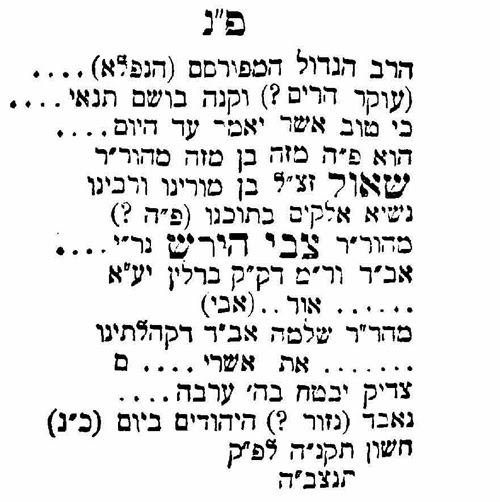
This brings us to the letter of defense of Besamim Rosh penned by R. Levin, and the Chida’s reaction to it. Though this letter was penned in 1794, it only reached the Chida’s attention after the 1796 publication of the first volume of Va’ad LeChachamim – though sometime before the 1798 publication of the second volume (a digital copy of which can be found here), for only in this second volume, does the Chida record his reception of this letter:

בשמים ראש – עמ”ש בח”א, ואחר זמן ראיתי בדפוס דברי הגאון הגדול המפורסם ר”מ ואב”ד דק”ק ברלין יע”א מהר”ר צבי הירש נר”ו, אמר מר כי שמע מוציאי דבה על הס’ הנז’, והפיץ והדיח כל הדברים יגעים ואסהדתיה דרב כי הספר תמים כתיב ביה והיה עשר שנים בביתו טרם שנדפס ואהניא לן יק”ר סהדותא דפום בדת”א.

[Besamim Rosh – See what I wrote in volume one. After some time I saw a printed letter from the great and famous exemplary scholar, Chief Rabbi and Academy head of the holy community of Berlin, may G-d rebuild His city Amen, our esteemed teacher and rabbi R. Tzvi Hirsch, may G-d protect and keep him. Our master said that he heard of people spreading calumnies against the aforementioned sefer, and he shattered and discredited all the inane words. The rabbi testified regarding the integrity of the sefer which had been in his possession for ten years prior to its publication, and we were pleased with his testimony against the deceitful speech].

Mystery Phrase

At the end of this volume, in a section devoted to corrigenda entitled Shulchan BaMidbar, the Chida noted that two words should be added to the concluding sentence of this entry: ותנן בבחירת”א.

However, the meaning of this rhetorical flourish is not entirely clear. In my aforementioned Yeshurun article, I suggested that these words be taken in context of the Chida’s generally strong aversion to controversy, and translated accordingly as “and it was therefore chosen for inclusion.”

Later, R. Betzalel Deblitzky wrote to me proposing that these words be understood as the Chida’s emphasis of his endorsement of R. Levin’s testimony, which he did by applying to it the same Talmudic phrase used to indicate that the Halacha is in accordance with those choice halachic testimonies recorded in Masechet Eduyot (cf. Rashi Kiddushin, end of 54b).

This reading, however, is not without difficulty. At the outset, if nothing essential has been added, it is hard to see why the Chida would trouble himself to add these two words in the corrigenda. Furthermore, in an addendum to what was to be the Chida’s final publication, his Mar’it Ha’Ayin, in a parallel passage to this one in Va’ad LeChachamim 2, the Chida writes:

ועתה אמת אגיד כי בקונטריס ועד לחכמים, ושם בטוב עין כתבתי דיצאו עוררין על ספר בשמים ראש, ע”ש, ואחר זמן ראיתי פתקא אחת שהדפיס הגאון מוהר”ר הירש אב”ד דק”ק ברלין להפיץ ולהדיח מה שערערו על הס’ הנזכר, והעיד שהס’ הנזכר הוא אמיתי ולא חלו בו ידים כלל, והוא היודע ועד, ועוד האריך בזה. ובודאי דסמכינן אהימנותיה ואהניא לן אסהדתיה.

[And now, I must tell you the truth; previously I had written in the compendium Va’ad LeChachamim, and in that same volume, in Tov Ayin, that rumors were spread impugning the sefer Besamim Rosh – see what I wrote there. Yet, after a while I saw a single flyer printed by the exemplary scholar, our esteemed teacher and rabbi R. Hirsch, Chief Rabbi of the holy community of Berlin, in order to shatter and discredit the rumors impugning the aforementioned sefer, and in it he testified that the aforementioned sefer is authentic and has not been tampered with at all, saying that he knows this to be true firsthand; and he elaborated in this vein. We should certainly rely on his trustworthiness, and I was pleased with his testimony].

It is instructive to note the similarity in language in these two parallel passages. It would appear that one of these passages actually served as the basis for the other. The fact that the Chida in this Mar’it Ha’Ayin passage only refers to the first volume of Va’ad LeChachamim and not to the updated entry in Volume Two, is a strong indication that this particular passage had been penned before the 1798 publication of Volume Two, in which case it is more than likely that the Chida copied the gist of this paragraph into his final draft of Volume Two as he readied it for publication. This possibility is further bolstered by the observation that the Chida’s language in this passage indicates that this is his first telling of his about-face on the Besamim Rosh on account of R. Levin’s bulletin.

The upshot of this is that in view of the source for the entry in Va’ad LeChachamim, the addition of the two words ותנן בבחירת”א in the corrigenda, which do not appear in the original source, does not appear to serve the purpose of emphasis alone. More likely, those two words serve a purpose germane to the context in which they appear, namely as an apologetic for the inclusion of the Besamim Rosh entry in the Chida’s sefer.

My final objection to this reading is based on my understanding of the Chida’s rhetorical melitzah style. This reading would have it that the term ותנן בבחירת”א here is borrowed from its Talmudic context, with the intent to draw a parallel from its usage there. I feel this reading is more typical of the Ashkenazic melitzah of Chida’s contemporaries – such as the celebrated R. Ya’akov Emden – who would throw around Talmudic and biblical phrases in loose context just to emphasize a point connected to the meaning of the phrase in its original context. In this sort of melitzah, one cannot fully comprehend the import of the words without knowledge of their meaning in the original, though oftentimes the message of the passage is abundantly clear on its own.

The Chida’s Sephardic melitza, however was of a rather different sort. In his melitzah, the words from the fragmented biblical or talmudical quotation – applied with little regard to proper syntax and grammar – are intended to take the place of words with similar meaning, and must be read with the sentence in order to make sense. As such, it would be expected that these two words are to be understood as saying something distinct and are not just intended to add fuel to the fire.

In this case, the Chida hyphenated בבחירת”א, which he invariably does in order to highlight that the word is being used in a different manner, or with a different spelling, than in its original context. This leads me to believe that בבחירת”א here is not a reference to the Talmudic use of the phrase in which בחירתא is the name given to the collection of choice testimonies in Masechet Eduyot, but is rather used here as to indicate the Chida’s choice (בחירה) in including the entry in his bibliographical compendium.

Unequivocal Acceptance

It may also refer to the Chida’s general acceptance of the sefer, as from this point forward, the Chida freely references the sefer without adding any note of reservation, such as in his Kisse Rachamim (Livorno 1803, Soferim, Tosefot, 1:9). Especially noteworthy is the citation in his 1798 publication Shu”T Yosef Ometz (section 11) where for the third time the discussion is raised about the permissibility of using names such as Yishma’el. While in the first two discussions cited earlier, the mention of the responsum in Besamim Rosh prompted the Chida’s subsequent disclaimer, here the mention of this responsum is stated with equanimity.

Despite the ambiguity of this particular addendum, it is clear that the Chida relied completely on R. Levin’s letter and that, in his mind, the sefer was now clear of all suspicion. Yet, one question remains. If, as the Chida stated in the Besamim Rosh entry in Va’ad LeChachamim, the suspicions concerned additions to the manuscript by an unknown scribe while still in Turkey—that is before reaching the hands of the publisher in Berlin, R. Saul Berlin, and his father, R. Hirsch Levin—how would R. Levin’s testimony to the integrity of the manuscript allay these suspicions? After all, R. Levin’s manuscript was based on the one which contained these alleged interpolations! (An editorial footnote to my article points out that this question already bothered the author of Dikdukei Soferim in his glosses to Shem Hagedolim).

In my Yeshurun article, I posited that the Chida deliberately concealed the real suspicions surrounding the sefer, namely that R. Saul himself was responsible for the fraudulent interpolations in Besamim Rosh, and out of respect for R. Saul’s father, the Chida instead blamed these insertions on some anonymous copyist in Turkey. Later, I saw that R. Matisyahu Shtrashun had already reached a similar conclusion in his notes to Sh. Y. Fuenn’s Kiryah Ne’emanah (Vilna 1915, p. 47-48).

An observation noted in the new edition of Shem HaGedolim by Machon HaMa’or may lend weight to this interpretation; nowhere in all the entries pertaining to this sefer does the Chida so much as mention the name of the publisher R. Saul Berlin. This is all the more conspicuous after the Chida mentions that the notes, Kasa DeHarsena, were appended to the sefer, without mentioning the author of these notes, R. Saul Berlin himself.

On the surface, this may indeed be indicative of the Chida’s holding of R. Saul in contempt for his role in the forgery. Yet, as noted in the same Yeshurun article, the Chida rarely cites his contemporaries in his Shem HaGedolim, and little can be deduced from the omission of R. Saul’s name. This is particularly true in light of the fact that previously, in his 1785 Machazik Beracha, and his 1790 Petach Eynayim, the Chida responded to critical glosses penned by the same R. Saul Berlin on the Chida’s Birkei Yoseph on Yoreh De’ah, and when referring to these glosses, the Chida does not name the author, whom he describes as ‘a formidable scholar’ (גברא רבא), and refers to him only as ‘the German Rabbi’ (see R. Reuven Margalios article in Areshet, Jerusalem 1944, pp. 414-417, and R. Ya’akov Chaim Sofer, Menuchat Shalom, vol. 8 p. 229). Similarly, when the Chida refers in his Shu”T Yosef Ometz (section 7), to something R. Saul wrote in Kasa DeHarsena, he refers only to the sefer but does not mention the author by name.

Furthermore, we have already seen how the Chida reiterates the claim about the errant Turkish copyist in his Tov Ayin, itself an indication that this is an accurate description of the claim countered by the Chida. As previously indicated, this passage underscores that the Chida was not worried about forgery as much as unworthy interpolation; he was therefore only concerned about an unattributed and unsigned responsum.

In the Final Analysis…

I now think that the Chida’s report of interpolations by an unnamed Turkish copyist should be taken at face value. Though the Chida’s language indicates that the complaints leveled against the Besamim Rosh were mere hearsay (as opposed to R. Levin’s defense which the Chida stresses he saw in print), and we cannot specifically identify the source of the rumors that reached his ears, we do know that similar rumors did indeed abound. Take for instance this quote from one of the leading antagonists, R. Mordechai Benet, in his Parashat Mordechai (section 5, page 8): ‘He amassed a heap of untoward sources,’ and compare also this selection from R. Levin’s letter in response to the accusations:

כי מצאו בתוך הבשמים חלבנה, והדברים לא יצאו מפי המחברים אשר נקרא שמם עליהם כי דבר בליעל יצוק בו להדיח עם ה’ מעל אלהיהם.

[They claimed to have found foul-smelling Galbanum among the Besamim incense, and that the essays are misattributed to the authors whose names they bear, for malicious content has been added in to cause Hashem’s nation to stray from their God].

Though R. Levin’s description of the charges does include the charge of forgery, it still does not name R. Saul as the culprit, and it may indicate the presence of rumors that accused him of negligence in publishing a work that contained forged and misattributed material, while stopping short of accusing him of actually perpetrating the forgery. It should be pointed out that from a historical perspective, the notion that a rabbinic work could be a complete forgery was such an outlandish proposition at that time that even the detractors wouldn’t openly make such a claim. It would be almost a hundred years before someone like R. Matisyahu Shtrashun would seriously consider the possibility that the entire work was the brainchild of R. Saul alone, and even after that we still find the likes of the great R. Meir Simcha of Dvinsk insisting that the Besamim Rosh does contain legitimate Rishonaic responsa (see Chiddushei R. Meir Simcha, vol. 2, p. 372).

As such, we should understand that the Chida accepted R. Levin’s defense of the Besamim Rosh more as vouching for the content of the sefer, and less as attesting to his son’s innocence. Contrast this with the comments of the author of Dikdukei Soferim and R. Matisyahu Shtrashun (cf. the earlier citations to their respective comments), who both wondered how the Chida could rely on R. Levin’s testimony and ignore a father’s obvious partiality towards his son. Obviously, whereas they took R. Levin’s missive as an argument in support of his son, the Chida took it as a vindication of the sefer itself.

The Chida’s reading is in fact borne out by the bulk of R. Levin’s circular (which R. Matisyahu Shtrashun admits he had not actually seen) in which R. Levin asserts that that the presence of some strange content in a sefer should by no means disqualify it, as the same can be said of many sefarim, and it is wrong to characterize a sefer on the basis of a few anomalous statements (“for this is typical of [Jewish] apostates, they collect what appears to them as strange Aggadot and unjust laws, and they then slant them in a way that will incite hatred and animosity towards us”). In any case, he adds, when taken in context these passages can often be explained in a satisfactory manner. The Chida thus appeals to R. Levin’s authority and esteem, and after reading R. Levin’s strenuous claim for the veracity and integrity of the content of Besamim Rosh, the Chida readily accepted his testimony, and discounted the false rumors without equivocation.

Ironically, though R. Matisyahu Shtrashun has all but discounted the Chida’s reliance on the testimony of R. Levin, my reading of the Chida actually anticipates R. Shtrashun’s own opinion of the sefer. R. Shtrashun concludes his brief survey of the reception of Besamim Rosh with the following remarks:

ואחרי כל אלה יש להעיר כי אף אם נחליט שכל הספר מראשיתו ועד אחריתו מעשי ידי ר’ שאול הנהו, לא נוכל לדחותו כלאחר יד חלילה, ואחרי אשר נסיר ממנו איזה דברים שנפש היפה סולדת בהם (אשר אמנם גם שם נשאר מקום רחב ידים להפוך בזכותו) הנהו מלא תורה כרמון וריח בשמיו נודף כאפרסמון בלול בחריפות ובקיאות, מחברו חותר ומעמיק בפלפול ישר בדברי הש”ס ובדברי הראשונים והאחרונים כאחד ממיוחדי גאוני זמנו.

[Having said all this, it is worth noting that even if we were to conclude that the entire sefer from beginning to end is but the handiwork of R. Saul, we still cannot discount it out of hand. For once we remove some of the more objectionable content (although there is actually ample ground to find justification even for this content), we will find it be full of excellent Torah insight, replete with ingenuity and proficiency. The author utilizes sound sophistry in developing his penetrating arguments from the Talmud and the works of Rishonim and Acharonim, like one of the special exemplary scholars of his time].

R. Shtrashun, like most of the others who dealt with the subject, was primarily concerned with the question of the sefer’s authorship, and indeed in this regard the jury has come out strongly on the side of those who claim R. Saul produced this volume on his own. Yet, as demonstrated above, the Chida’s main interest in the provenance of the sefer was to ascertain the reliability of its content. As such, the Chida was delighted with R. Levin’s yikar sahaduta – esteemed testimony, who concluded, much as R. Shtrashun was later to write, that despite some of its questionable content – for which a justifiable argument could be made in any case – the sefer on the whole was full of valuable content, and all reports to the contrary were but pum bidatta – salacious rumors.

Taken this way, R. Levin’s appraisal, enthusiastically received by the Chida, and echoed in the assessment of R. Shtrashun, may yet stand the test of time.



Who can discern his errors? Misdates, Errors, Deceptions, and other Variations in and about Hebrew Books, Intentional and Otherwise: Revisited

Who can discern his errors?
Misdates, Errors, Deceptions, and other Variations in and about Hebrew Books, Intentional and
Otherwise: Revisited[1]
by Marvin J. Heller

Marvin J. Heller is the award winning author of books and articles on early Hebrew printing and bibliography. Among
his books are the Printing the Talmud series, The Sixteenth and Seventeenth Century Hebrew Book(s): An Abridged Thesaurus, and collections of articles.

R. Eleazar once entered a privy, and a Persian [Roman] came and thrust him away. R. Eleazar got up and went out, and a serpent came and tore out the other’s gut. R. Eleazar applied to him the verse, “Therefore will I give a man (אָדָם adam) for thee (Isaiah 43:4).” Read not adam [a man] but אֱדֹם edom [an Edomite = a Roman] corrected by the censor to “but a Persian.” (Berakhot 62b)
 “R. Eleazar said: Any man who has no wife is no proper man; for it is said, Male and female created He them and called their
name Adam” corrected by the censor to “any Jew who is unmarried” (Yevamot 63a).[2]
Sensitivity to the contents of Jewish texts by non-Jews, and apostates in their employ, was a feature of Jewish life at various periods, one particularly notable and noxious time being in the sixteenth century when, during the counter-Reformation, the Church undertook to censor and correct those Hebrew books that were not placed on the index and banned in their entirety. In the first example, the understanding based on the reading of adam אָדָם as edom אֱדֹם (Rome) is completely lost by the substitution of Persian for Edom. In the second example “Any man who has no wife is no proper man” was deeply offensive to a Church that required an unmarried and celibate clergy. In both instances the text was altered to adhere to the Church’s sensibilities despite the fact that not only was the original intent lost but that, particularly in the first case, it ceased to be meaningful.
            Books, and even more so Hebrew books, often underwent modifications, textual changes, due to the vicissitudes and complexities of the Jewish condition, frequently involuntary. The subject of “Misdates, Errors, Deceptions, and other Variations in and about Hebrew Books, Intentional and Otherwise,” addresses textual changes, as well as other errors, intentional and unintentional, that may be found in Hebrew books. Addressed previously in Hakirah, this is a companion article, providing additional examples of book errors, variations, and discrepancies. As noted previously, errors “come in many shapes and forms. Some are significant, others are of little consequence; most are unintentional, others are purposeful. When found, errors may be corrected, left unchanged, or found in both corrected and uncorrected forms. . . . Other errors are not to be found in the book per se but rather in our understanding of the book. This article is concerned with errors in and about Hebrew books only. It is not intended to be and certainly is not comprehensive, but rather explores the variety of errors, some of consequence, most less so, providing several interesting examples for the reader’s edification and perhaps enjoyment.”[3]
Among the errors discussed in this article are 1) those dealing with the expurgation of the Talmud; 2) expurgation of other Hebrew works; 3) internal censorship, that is, of Hebrew books by Jews; 4) accusations of plagiarism and forgery; 5) misidentification of the place of printing; 6) confusion due to mispronunciations.
I
            Returning to the beginning of the article, the Talmud, initially banned in 1553 and placed on the Index librorum prohibitorum in 1559, was subsequently permitted by the Council of Trent in 1564, but only under restrictive and onerous conditions. Reprinted in greatly censored form, the introductory quote refers to modifications in the Basle Talmud (1578-81). A condition of the Basle Talmud was that the name “Talmud” be prohibited. Heinrich Graetz explains the Pope’s and Council’s considerations in forbidding the name.
the Council only approved the list of forbidden books previously made out in the
papal office, the opinion of the pope and those who surrounded him served as
a  guide in the treatment of Jewish writings. The decision of this point was left to the pope, who afterwards issued
a bull to the effect that the Talmud was indeed accursed – like Reuchlin’s ‘Augenspiegel
and Kabbalistic writings’ – but that it would be allowed to appear if the name
Talmud were omitted, and if before its publication the passages inimical to
Christianity were excised, that is to say, if it were submitted to censorship
(March 24th, 1564). Strange, indeed, that the pope should have allowed the
thing, and forbidden its name! He was afraid of public opinion, which would
have considered the contradiction too great between one pope, who had sought
out and burnt the Talmud, and the next, who was allowing it to go untouched. At
all events there was now a prospect that this written memorial, so
indispensable to all Jews, would once more be permitted to see the light,
although in a maimed condition.[4]
            Among the most egregious examples of censorship of the Talmud is Bava Kamma 38a. That amud (page) of the Talmud, dealing with financial relations between Jews and non-Jews, was expurgated, almost in its entirety. Prior to the much censored Basle Talmud (1578-1581) the text was completely printed, for example, in the 1519/20-23 Venice edition of the Talmud published by Daniel Bomberg. After the censored Basle Talmud was published, initially, rather than contract the text, large blank spaces were left, clearly indicating that text had been expurgated.
            Abraham Karp notes that in some editions of the Talmud “many expurgated passages are restored, and where deletions are retained, blank spaces are left to indicate the omission to the reader and, no doubt, to permit him to fill in by pen what they dared not to print.”[5] An example of the blank spaces can be seen from the Frankfurt an der Oder Talmud 1697-99, printed by Michael Gottschalk. Such omissions are to be found in almost all seventeenth and early eighteenth editions of the Talmud, a notable exception being the Benveniste edition (Amsterdam, 1644-47).[[6]  Rabbinovitch too notes that blank spaces were left for expurgated text, those omissions being consistent with the Basle Talmud. He adds, however, that this policy was followed until the 1835 Vilna Talmud. At that time government officials prohibited the practice so that the omissions would not be so obvious.[7]  In fact, text was consolidated much earlier, as evidenced, by the illustrations of Bava Kama 38a from the 1734‑39 Frankfurt an der Oder Talmud. This expurgated material is restored in current editions of the Talmud.

Frankfurt an der Oder – 1697-99

Frankfurt an der Oder – 1734-39

Another example of interest, one that has not fared as well, the text not yet restored in most editions of the Talmud, is to be found in Shabbat 104b and Sanhedrin 67a. The reference there is to Ben Satda, beginning, in the latter tractate “and so they did to Ben Satda
in Lod, and hung him on erev Pesah. Ben Satda? He was the son (ben) of Padera . . .”[8] Popper notes that Gershom Soncino, when publishing “a few of the Talmudic tracts at Soncino during the last decade of the fifteenth century, he took care not to restore any of the objectionable words in the MSS. from which he printed.”[9] Here too the text is complete in the Bomberg Talmud. Two subsequent exceptions in later editions of Sanhedrin where the Ben Satda entries do appear are in the Talmud printed by Immanuel Benveniste and in the edition of Sanhedrin printed in Sulzbach in or about 1696.

Sanhedrin 67a, Benveniste Talmud
However, in two complete editions of the Talmud (1755-63, 1766-70) printed in Sulzbach, the Ben Satda entries are omitted, as is the case of most modern editions of the Talmud.[10]
II
            The Talmud isn’t the only work to have been censored. Amnon Raz-Krakotzkin provides several examples of text in books
that were modified due to the censor’s ministrations. Among them is R. Abraham ben Jacob Saba’s (d. c. 1508) Zeror ha-Mor, a commentary on the Pentateuch based on kabbalistic and midrashic sources.[11] On the passage “They would slaughter to demons without power, gods whom they knew not, newcomers recently arrived, whom your ancestors did not dread” (Deuteronomy 32:17), referring to “Christians in general and priests in particular as ‘demons’ (shadim): ‘For as the nations of the world, all their abominations and vanities come from the power of demons, hence, the monks would shave the hair of their heads  and leave some at the top of the head as a stain.’” This passage continues, referring to bishops and popes, concluding that their entire heads are shaved like a marble with only a bit of hair about their ears, so that they have the appearance of demons, hairless, and like demons, provide no blessings, are like a fruitless tree, and “thus, it is fitting that they bear no sons of daughters.” Raz-Krakotzkin informs that this passage appeared in the first two editions of Zeror ha-Mor printed by Bomberg, and the Giustiniani edition (1545) but was already expurgated by the Cavalli edition (1566), a blank space in place of the text. That space subsequently disappeared and, although a Cracow edition based on the Bomberg Zeror ha-Mor restored the text it remains missing from most later editions.[12] Raz-Krakotzkin continues, citing additional examples.
            Early halakhic works were also subject to the ministrations of the censor.[13] Among them are such works as R. Samson ben Zadok’s (thirteenth century) Sefer Tashbez (Cremona, 1556). Samson was a student of R. Meir of Rothenburg (Maharam, c. 1220-1293). When the latter was imprisoned in the tower of Ensisheim, Samson visited him regularly, serving as his attendant and carefully recording in Tashbez Maharam’s teachings, customs, and daily rituals, as well as what he heard and observed, from the time Meir rose in the morning until he retired at night, on weekdays, Sabbaths, and festivals. Although a relatively small work (80: [6], 55 leaves), it consists of 590 entries beginning with Sabbath night (1-17), Sabbath day (18-98), followed by festivals, Sefer Torah, priestly benedictions, prayer, slumber, talis and tefillin, benedictions, issur ve-heter (dietary laws), redemption of the first born, hallah, vows, marriage and divorce, monetary laws, and piety. Expurgation by the censor of Tashbez was done sloppily, for terms such as meshumad and goy, normally excised, remain, but with a disclaimer near the end that they refer to idol worshipers only.[14]
III
Not all errors are due to the ministrations of the censor. Jews, too, at times, have taken their turns at modifying the text of books.
            A recent and perhaps quite surprising example of internal censorship is to be found in R. Solomon Ganzfried’s (1804–1886) Kizzur Shulḥan Arukh. First printed in 1864, that work an abridgement of the Shulhan Arukh for the average person, went through fourteen editions in the author’s lifetime, and numerous editions since then, as well as translations into many languages and has been the subject of glosses.[15] Marc B. Shapiro informs that in the Lublin (1904) edition of the Kizzur Shulḥan Arukh and several other editions the entry (201:4) that “apostates, informers, and heretics –for all these the rules of an onan and of mourners should not be observed. Their brothers and other next of kin should dress in white, eat, drink, and rejoice that enemies of the Almighty have perished,” the words “apostates, informers, and heretics” have been removed. In the Vilna edition (1915) the entire paragraph is removed and the sections renumbered from seven to six. In the Mossad Harav Kook vocalized edition a new halakhah was substituted, but that has since been corrected to reflect the original text. The reason, according to Shapiro, is that with the expansion of Jewish education to include girls, it was felt that schoolchildren, with assimilated relatives, would see this as referring to family members.[16] Several recent editions of the Kizzur Shulḥan Arukh that were examined, in both Hebrew and English, have the original text.
            R. Abraham Isaac Kook (1865–1935), chief rabbi of Jerusalem and first Ashkenazic chief rabbi in Israel (then Palestine),
was a profound, influential, and mystical thinker. Highly regarded by his contemporaries, his strongly Zionist views also resulted in some opposition, but even most of his contemporaries who disagreed with him held him in high regard. Shapiro notes that with time, Kook’s reputation changed. Despite the fact that such pre-eminent rabbis as R. Solomon Zalman Auerbach (1910-95) and R. Joseph Shalom Elyashiv (1910-2012) were unwavering in their high regard of Kook, strong anti-Kook sentiment developed later in religious anti-Zionist circles. Shapiro notes that “Kook has been the victim of more censorship and simple omission of fact for the sake of haredi ideology than any other figure. When books are reprinted by haredi and anti-Zionist publishers Kook’s approbations (hascomas) are routinely omitted.” One of several examples of this modified opinion Shapiro cites is a lengthy eulogy delivered by R. Isaac Kossowsky (1877-1951) praising Kook. When the eulogy was reprinted in She’elot Yitzhak, a collection of Kossowsky’s writings, the name of the subject of the eulogy, Rav Kook, was omitted. In the reprint of She’elot Yitzhak the eulogy is deleted in its entirety.[17]
            Shapiro’s observation about Rav Kook’s approbations is confirmed in several books. R. Eliezer Mansour Settehon’s (Sutton, 1860-1937) Notzar Adam: Hosafah Notzar Adam (Tiberius, 1930), discourses on spiritual development, has approbations from R. Abraham Abukzer, R. Moses Kliers, and R. Jacob Hai Zerihan, and R. Abraham Isaac ha-Kohen Kook. In a description of Notzar Adam in in Aleppo, City of Scholars (Brooklyn, 2005), Kook’s name, Kook’s name is omitted from a list of the book’s approbations.[18]

In a variation of this, two internet sites that reproduce the full text of Hebrew books both include Rav Isaac
Hutner’s (1906-80) Torat ha-Nazir (Kovno, 1932). This, the first edition, has three approbations; a full page hascoma from R. Hayyim Ozer Grodzinski (1863–1940), and the following page two approbations, side by side, from R. Abraham Duber Kahana (1870–1943) and Rav Kook. The first internet site, with more than 53,000 books for free download, follows R. Grodzinski’s approbation with a blank page and then the text. The second, a subscription site with more than 76,000 scanned books, goes directly from R. Grodzinski’s hascoma to the text, dispensing with the blank page, also not reproducing the second page of approbations. It is not clear whether the copies scanned were faulty, the scanning incomplete, or the omission intentional. Nevertheless, to conclude this section on a positive note, surprisingly, given the omission of Rav Kook’s approbation in both scans of Torat ha-Nazir, both sites list and provide an extensive number of Rav Kook’s works.

IV
Accusations of plagiarism accompany the publication of two works by and/or attributed to R. Nathan Nata ben Samson Spira (Shapira, d. 1577). Spira, born to a distinguished family that was, according to the Ba’al Shem Tov, one of the three pure families throughout the generations in Israel (the others being Margulies and Horowitz), served as rabbi in Grodno (Horodno) until 1572, when he accepted a position in Posnan. His grandson was R. Nathan Nata ben Solomon Spira (Megalleh Amukkot, c. 1585-1633). Among Nathan Nata Spira’s works is Imrei Shefer (20: [1], 260 ff.), a super-commentary on Rashi and R. Elijah Mizrahi (c. 1450–1526). The book was brought to press by Spira’s son R. Isaac Spira (d. 1623), Rosh Yeshiva in Kovno and afterwards in Cracow. Work on Imrei Shefer began in Cracow in 1591 but before printing was finished Isaac Spira accepted a position in Lublin where publication was completed at the press of Kalonymus ben Mordecai Jaffe (1597).[19]
The title-pages states that Spira, “gives goodly words (Imrei Shefer)’ (Genesis 49:21) and he gives, ‘seed to the sower, and bread לזורע ולחם (357=1597) to the eater’ (Isaiah 55:10) of Torah.” In the introduction, Isaac informs that the work is entitled Imrei Shefer from the verse, “he gives goodly words” (and the word “he gives הנתן” in the Torah is without a vav), implying the name of the author [Nathan נתן] and Shefer שפר is language of Spira שפירא the family name of the author. Isaac then addresses the existence of an unauthorized and fraudulent edition ascribed to his father, printed in Venice (Be’urim, 1593),
found and brought out by men who lack the yoke of the kingdom of heaven. A work discovered, who knows the identity of the author, perhaps a boy wrote it and wanted to credit it to an authoritative source אילן גדול), [my father my lord]. God forbid that his holy mouth should bring forth words that have no substance, vain, worthless, and empty, a forgery, “[And, behold], it was all grown over with thorns, and nettles had covered it over” (Proverbs 24:31).
Isaac Spira took his complaint to the Va’ad Arba’ah Artzot (Council of the Four Lands), requesting they prohibit the distribution of the Be’urim in Poland. The response of the Va’ad is printed at the end of the introduction,
It has been declared, by consent of the rabbis, and the [communal] leaders of these lands,
that these books shall neither be sold nor introduced into [any Jewish] home in
any of these lands. Those who have [already] purchased them shall receive their
money back and not keep [such] an evil thing in their home.
What was and who wrote the Be’urim, the reputedly plagiarized copy of R. Nathan Nata ben Samson Spira’s Imrei Shefer? The title-page of the Be’urim (40: 180 ff.), printed in Venice in 1593 “for Bragadin Giustiniani by the partners Matteo Zanetti and Komin Parezino at the press of Matteo Zanetti,” states that it was written by ha-Rav, the renowned, the gaon, R. Nathan from Grodno in the year, “For you shall go out with joy בשמחה (353=1593), and be led forth with peace” (Isaiah 55:12). Be’urim does not have an introduction nor a colophon that provides any additional information.
Isaac Spira’s accusation that the Be’urim is a forgery, not to be ascribed to his father, but rather was written by an unknown young man who then attributed it to Spira, is confirmed by R. Issachar Baer Eylenburg (1550-1623), who writes in his responsa, Be’er Sheva (Venice, 1614) and also in his commentary on Rashi, Zeidah La-Derekh (Prague, 1623) that it is obvious that the Be’urim were not the work of the holy Spira, but rather of an erring student “who hung (attributed it) to himself, hanging it on a large tree” (cf. Pesahim 112a).[20]
Among the distinguished sages of medieval Sepharad is Rabbenu Bahya ben Asher ben Hlava (c. 1255-1340). Best known for his popular, multi-faceted, and much reprinted Torah commentary, written in 1291 and first published in Naples (1491),  Rabbenu Bahya was also the author of Kad ha-Kemaḥ (Constantinople, 1515) and Shulḥan shel Arba (Mantua, 1514). The former, Kad ha-Kemaḥ, is comprised of sixty discourses on varied subjects, among them festivals, prayer, faith, and charity, all infused with ethical content. Among the numerous editions of Kad ha-Kemaḥ is a scholarly edition entitled Kitvei Rabbenu Baḥya (Jerusalem, 1970) edited and with annotations by R. Hayyim Dov Chavel (1906–1982).
Among the essays in Kad ha-Kemaḥ is one entitled Kippurim, on Yom Kippur. Part of that discourse includes a commentary on the book of Jonah, read on Yom Kippur. Chavel, in the introduction to his annotations on Rabbenu Bahya’s commentary on Jonah, suggests that Rabbenu Bahya took his commentary from R. Abraham ben Ḥayya’s (d. c. 1136) Hegyon ha-Nefesh, first published by E. Freimann (Leipzig,
1860). Abraham ben Ḥayya, a resident of Barcelona, was a philosopher, mathematician, and astronomer, reflected in his several works, including translations from the Arabic. Hegyon ha-Nefesh “deals with creation, repentance, good and evil, and the saintly life. The emphasis is ethical, the approach is generally homiletical – based on the exposition of biblical passages – and it may have been designed for reading during the Ten Days of Penitence.”[21] Kitvei Rabbenu Baḥya and Hegyon ha-Nefesh are sufficiently alike to support Chavel’s contention that
Rabbenu utilized the Sefer Hegyon ha-Nefesh (or Sefer ha-Mussar) of the earlier sage R. Abraham ben Ḥayya ha-Nasi, known as ṣāḥib-al-shurṭa . . . In it is found this commentary on the book of Jonah. This was already noted by the author of Zaphat ha-Shemen – the usage by Rabbenu of this book is comparable to his use of other works: according to his needs. The reason that he does not mention it in his commentary is, perhaps, because the books of R. Abraham ha-Nasi were well known, and the leading sages, such as the Rambam, Ramban and other leading rabbis utilized it, comparable to “Joshua was sitting and delivering his discourse without mentioning names, and all knew that it was the Torah of Moses” (Yevamot 96b).[22].
We leave accusations of plagiarism and turn to forgery, a well-known case involving a person of repute, Saul Hirsch (Hirschel)
Berlin’s (1740-94) Besamim Rosh.[23] Berlin was a person of great promise; the son of R. Hirschel Levin (Ẓevi Hirsch, 1721–1800), chief rabbi of Berlin, ordained at the age of twenty and in 1768 av bet din in Frankfurt an der Oder. At some point Berlin became disillusioned with what he believed to be antiquated rabbinical authority. He gave up his official rabbinic position in Frankfurt, removing to Berlin. There Berlin was an associate of Moses Mendelssohn (1729–1786), providing, in 1778, an approbation for Mendelssohn’s Be’ur (Berlin, 1783) and was a supporter of the enlightenment figure Naphtali Herz Wessely (1725–1805), writing an anonymous pamphlet in defense of  Wessely’s
Divrei Shalom ve-Emet (Berlin, 1782) entitled Ketav Yosher (1794).[24]
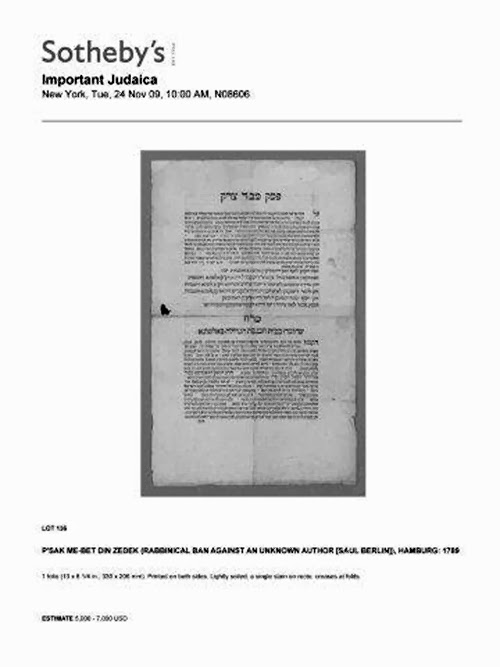
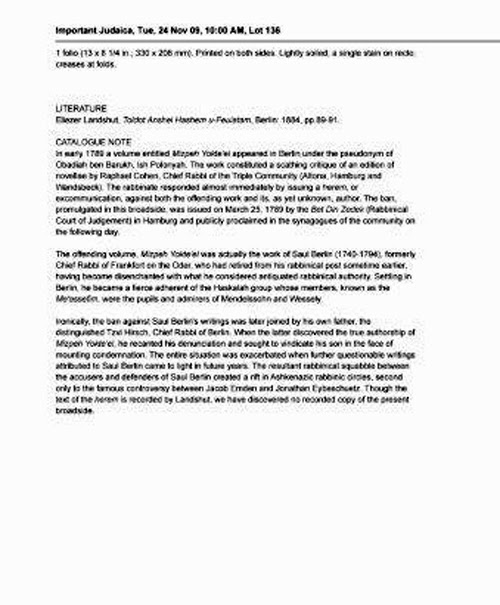
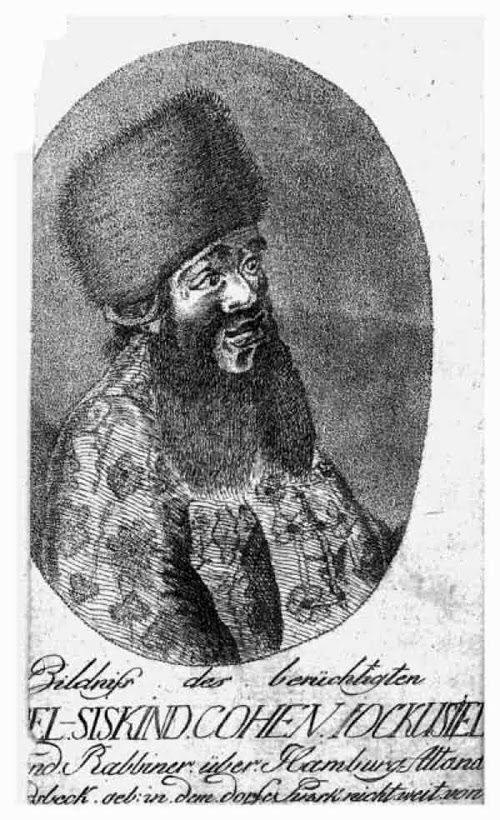
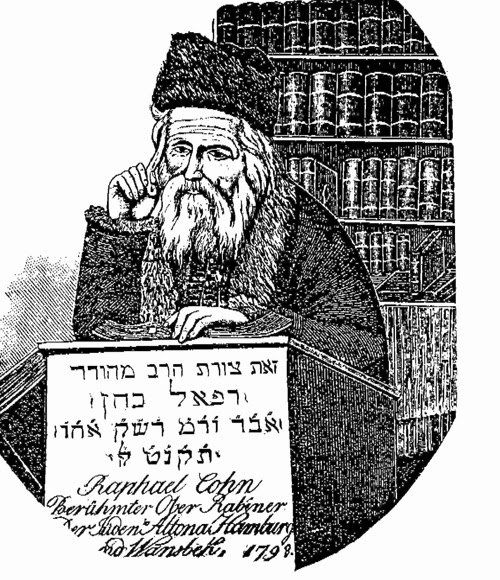
An earlier forgery of Berlin, described by Dan Rabinowitz, this under the pseudonym of Ovadiah bar Barukh Ish Polanya, was Berlin’s Mitzpeh Yokteil (1789), a vicious attack on R. Raphael Kohen, rabbi of the three communities, Altona-Hamburg-Wansbeck, who had opposed Mendelssohn’s Be’ur, and on Kohen’s Torat Yekuteil (Amsterdam, 1772) on Yoreh Deah. The Communities’ beit din placed Ovadiah, the presumed author, under a ban. The ban’s proponents approached R. Tzevi Hirsch, the chief rabbi of Berlin and Saul Berlin’s father, seeking his signature on the ban.[25] It appears that Tzvi Hirsch initially concurred with the ban, but, as he was close to deciding in favor of signing the ban, someone whispered in his ear the verse “woe is me, my master, it is borrowed שאול” (II Kings 6:5), – which he understood to be a play on שאול (borrowed), referring to his son, Saul, the true author of Mitzpeh Yokteil.[26]
 

Turning to Besamim Rosh Saul Berlin’s infamous forgery, it claims to be the responsa of R. Asher ben Jehiel (Rosh, c. 1250–1327), among the most preeminent of medieval sages of European Jewry. The title-page describes it as the responsa Besamim Rosh, 392 responsa from books from the Rosh and other rishonim (early rabbinic sages) compiled by R. Isaac di Molina and with annotations Kasa de-Harshana by the young Saul ben R. Ẓevi Hirsch, av bet din, here (Berlin).[27] It is dated “and will keep you in all places where you goושמרתיך בכל אשר תלך   553 = 1793)” (Genesis 28:15), note Asher אשר in the date. In Besamim Rosh Berlin, having become an adherent of the haskalah, presents ideas inconsistent with and at variance with traditional halakhic positions. Among the novel responsa are removing the prohibition on suicide due to the difficult conditions of Jewish life; permitting shaving on Hol ha-Mo’ed; requiring a shohet to test the sharpness of his knife on his tongue; saying a blessing over non-kosher food; disregarding commandments that are upsetting; not taking Megillat Esther seriously; and that Jews beliefs can change. An example of the responsa, albeit a brief one and without Berlin’s Kasa de-Harshana, is the much quoted responsum concerning “legumes, rice, and millet which some Ashkenazic rabbis prohibit and is the practice in some communities. . .” (105b: no. 138): The responsum states:

This is very strange, for the Talmud permits it and no bet din is known to have made such an enactment. It is not for us to inquire why such an enactment was made and why it was followed by some. Possibly because of the exiles and the confused גירושים והבלבוחים, weighed down in poverty . . . and also due to the small community of Karaites in their midst who were also exiled. . . . unable to distinguish between bread and bread and all leavening from which it is possible to make flour and bread. But, God forbid, that we freely prohibit that which is permitted, and all the more because of the poor and needy, who lack sufficient meat and bread all the days of the festival. . . . “who eat [but] a litra of vegetables for at a meal” (Sanhedrin 94b). Also “a leap year is not intercalated in the year following a Sabbatical year for this reason.” All the more (kal ve-homer) to prohibit most types of food to the poor and needy on festivals and the overly strict (mahmerin) will have to answer on the day of judgement.
            How has Besamim Rosh been received? Soon after its publication R. Wolf Landsberg, in Ze’ev Yitrof (Frankfurt an der Oder, 1793), stated that Besamim Rosh was a forgery, and R. Mordecai Benet (1753-1829) wrote to Berlin’s father, that Besamim Rosh was “from head to foot only wounds and grievous abscesses from sinful, vile men.”[28] R. Hayyim Joseph David Azulai (Hida, 1724–1806) in his Shem ha-Gedolim, one of several works in which he mentions Besamim Rosh, states “I have heard ‘a voice of a great rushing’ (Ezekiel 3:12) that there are in this book strange things. . . . Therefore the reader should not rely on it.”[29] The Hatam Sofer (R. Moses Sofer, 1762–1839), based on the responsum on suicide, also concluded that Besamim Rosh was a forgery.[30] Among the varied modern authorities who quote Besamim Rosh, albeit critically, are R. Solomon Joseph Zevin (1885–1978) and R. Ovadia Yosef (1920-13) the latter writing an approbation for the 1984 edition of Besamim Rosh.[31]
How influential was Besamim Rosh? Fishman writes that “Besamim Rosh is of itself cast as a work of rabbinic literature, a Trojan horse of sorts, capable of injecting reformist viewpoints directly into the camp of halakhic discourse. Indeed, the sheer frequency with which Besamim Rosh has been cited in subsequent halakhic writings [documented by Samet] raises the question of whether the work may not have been effective in introducing unconventional perspectives into rabbinic thought.”[32] Similarly, Shmuel Feiner notes that “Some scholars
regard Besamim Rosh as the beginning of the reform of Judaism.”[33] Finally, knowledge that Besamim Rosh was a forgery was so widespread, that it is even so described in a book dealers catalogue, that of Jakob Ginzburg, in Listing of Rare and Valuable Books (Minsk, 1914), stating “565 Besamin Rosh attributed to the Rosh, poor condition Berlin, 1792, 50 1.”
V
Of less consequence is a common error, if it may be so described, that is, the misleading identification of the place of printing on the title-pages of late seventeenth through the early nineteenth century books. Amsterdam, from the early seventeenth century, was the foremost center of Hebrew printing in Europe. Its reputation was such that printers in other lands, often with the only the most tenuous, if any, connections with Amsterdam, attempted to associate their imprints with that city. In a wide variety of locations the actual place of printing is minimized; what is enlarged is that the letters are באותיות אמשטרדם Amsterdam letters. Mozes Heiman Gans describes this practice,
Amsterdam may have had an embarrassing lack of rabbinical training facilities, but thanks to the Hebrew printing works it nevertheless had a great name in the world of Jewish scholarship. Moreover, the haskamot (certificate of fitness) was also sought by Jewish printers abroad, and so highly-prized were books ‘printed in Amsterdam’ or ‘be-Amsterdam’ that cunning rivals invented the phrase ‘printed ke-Amsterdam’, i.e. in the manner of Amsterdam, hoping to deceive the readers by relying on the similarity of the Hebrew k and b.[34]
            An early example of this practice is in Dessau, where the court Jew, Moses Benjamin Wulff, established a Hebrew press in Anhalt-Dessau.[35] Approval for the press was given on December 14, 1695 by Princess Henriette Catherine of Orange, Prince Leopold I’s mother, acting as regent in her son’s frequent absences in the service of the Prussian army. The first books were published in 1696, among them R. Jacob ben Joseph Reischer’s (Jacob Backofen, c. 1670–1733) Hok Ya’akov and Solet le-Minhah ve-Shemen le-Minhah, and the following year R. Shabbetai ben Meir ha-Kohen’s (Shakh, 1621–1662) Gevurat Anashim, each with a title-page, with a pillared frame topped by an obelisk and the statement,
Printed here [in the holy congregation of] Dessau with AMSTERDAM letters
Under the rule of her ladyship, the praiseworthy and pious Duchess, of distinguished birth HENRIETTE CATHERINE [May her majesty be exalted]
Another notable instance are the title-pages of R. Judah Leib ben Enoch Zundel’s (1645–1705) Hinnukh Beit Yehudah (Frankfurt am Main, 1708), a collection of one hundred forty-five responsa, among them several by the author. Zundel (1645–1705), who succeeded his father as rabbi of the district of Swabia in 1675, subsequently relocated to Pfersee, where he remained until his death. Judah Leib was also the author of Reshit Bikkurim (Frankfurt, 1708), homilies by Judah Leib and his father. The sermons in that work are on festivals and Sabbaths based upon R. Joseph Albo and includes excerpts from a commentary on the Bible which Judah Leib had intended publishing.[36]

 The publisher of these books was Johann Koelner, the distinguished Frankfurt am Main printer (1708-27), credited with publishing half of the Hebrew books printed in Frankfurt up to the middle of the nineteenth century as well as a fine edition of the Babylonian Talmud.[37] Koelner began printing with Hinnukh Beit Yehudah; it is unusual in that there are two title-pages for the book, one noting that it was printed in Frankfurt am Main, the other stating that Hinnukh Beit Yehudah was printed, in an enlarged font with, Amsterdam, in a smaller font, letters, and the place of printing, Frankfurt am Main, also set in a smaller font.[38]

Another way of emphasizing Amsterdam fonts rather than the city in which a book was printed is evident from R. Jacob Uri Shraga Feival’s ben Menahem Nachum’s Bet Ya’akov Esh (Frankfurt an der Oder, 1765) on Job. Here, somewhat unusually, even the reference to the source of the fonts is highlighted, saying with Amsterdam letters. The place of printing is given below in abbreviation in a slightly smaller font as printed here פ”פ דאדר (Frankfurt an der Oder).
In addition to several locations in Germany, such as Hamburg and Jessnitz, we also find this practice in such varied locations as in Zolkiew, for example, R. Aaron Moses ben Zevi Hirsch of Lvov (Lemberg) Ohel Moshe (1765) on grammar; in Lvov, on the title-page of R. Jacob ben Baruch of Tyczyn’s (c. 1640-1725) Birkat Yosef (1784) on Shulhan Arukh Hoshen Mishpat; and with a mahzor that states, in large red letters, that it was printed in Slavuta and, in a small font in German only, that is, it was printed (gedrukt) in Lemberg. We also find this done, somewhat far afield, in Livorno; the title-page of Seder Nezikin of the Jerusalem Talmud (1770), printed with a frame that is like but not exact of the Amsterdam edition of Seder Nashim (1754), by Carlo Giorgi, stating “printed here, Livorno, with Amsterdam letters.
            And then there are inadvertent errors, such as misreading a colophon. Popular books, frequently reprinted, go through numerous editions. At times it is difficult to identify early editions and, as might be expected, books are occasionally misidentified, attributed to the wrong press, misdated, and there are instances when editions are recorded that never existed. All of these errors can be found in R. Leon Modena’s (Judah Aryeh, 1571-1648) Sur me-Ra.[39]
Sur me-Ra, a popular and much reprinted tract opposing the snares and consequences of gambling, was written by Modena when, according to his autobiography, he was only twelve or thirteen years old. Paradoxically, Modena would later become a compulsive gambler, even gambling away his daughters’ dowries. Translated into Latin, German, Yiddish, French, and English, Sur me-Ra is not a straightforward denunciation of gambling but rather a dialogue between two friends, one opposed to games of chance, the other a proponent of such games, both positions well argued, accounting for its popularity. It was first published in Venice in the year בשמחה (with joy, [5]355 = 1594/95) by the Venetian press of Giovanni di Gara as an anonymous tract on the evils of gambling, Modena initially choosing to be anonymous. Sur me-Ra was republished, not long afterwards, twice, according to several bibliographic sources, in 1615. One edition, attributed to a Venice press, appears to be dubious, it not being recorded in any library collection and the sources that list it do so without descriptive details.[40]
The two 1615 Prague editions are recorded in a library listing, one published at the press of Moses ben Bezalel Katz, octavo in format, here consisting of ten unfoliated leaves. The second Prague edition, a bi-lingual Hebrew-Latin edition, is not so much dubious as mislabeled, having been printed several decades later and elsewhere. The Katz edition has an introduction from R. Jacob ben Mattias Treves which concludes “And it came to pass, because the midwives feared God, that he made them houses” (Exodus 1:21) at a goodly בשע”ה (375 = 1615) time, “a time to cast להשלי”ך (75 = 1615) away stones” (cf. Ecclesiastes 3:5).
A bi-lingual Hebrew-Latin edition of Sur me-Ra was purportedly printed in Wittenburg in 1665 by Johannis Haken. This edition is physically small, octavo in format, measuring 18 cm.; otherwise it is an expanded edition of Sur me-Ra, being comprised of [134] pp. and ending on quire Q3 followed by several index pages. There is a Latin title-page with a Hebrew heading, giving the place of printing, printer’s name, and date, followed by considerable preliminary matter in Latin. There is a second Hebrew-Latin title page, lacking all of these particulars about the edition and with a somewhat dissimilar briefer Latin text.
This Wittenburg edition of Sur me-Ra has been incorrectly recorded in at least one major library as a second 1615 Prague Hebrew-Latin edition of that work. The reason for the error appears to be twofold. First, the library copy lacks the first descriptive title-page and the second title page, as noted, lacks identifying information. Moreover, the introduction to the Prague edition is included, with its reference to Prague at the beginning and, at the end, two highlighted dates, although the first “at a goodly בשע”ה (375 = 1615) time” is not highlighted here and a close reading indicates that the second date was set improperly, that is, the Prague edition which concludes with the date “a time to cast להשלי”ך (375 = 1615)” here, reading להשלי”ך, the final khaf being emphasized as if to be included in the enumeration of the letters, which likely misled a reader looking at it too casually, as it results in a figure (395) too large for the Prague edition and too small for the Wittenburg edition.[41]
Another edition of Sur me-Ra was printed in Leiden by Johannes Gorgius Nisselius. An orientalist, Nisselius, poor and unable to obtain a post as a teacher, became a printer. The title-page is misdated תנ”ו (456 = 1696) instead of 1656, attributed by L. Fuks and R. G. Fuks‑Mansfeld to Nisselius’ unfamiliarity with Hebrew chronology, and causing Moritz Steinschneider to describe it as an “edition negligenitissime curate (a very slipshod edition).[42]
Three reported bi-lingual editions of Sur me-Ra, Hebrew with Latin translation, quarto format, are recorded in bibliographic sources. The dates given are 1698, 1702, and 1767. These editions are listed, without further details, in Julius Fürst’s Bibliotheca Judaica, Benjacob’s Otzar ha-Sefarim, and Vinograd’s Thesaurus of the Hebrew Book, each likely repeating the entries in the previous earlier work.[43] That three editions of Sur me-Ra were printed in Oxford within this time frame seems highly unlikely, given that from the first Hebrew book reported for Oxford, Maimonides’ commentary on Mishnayot, with Latin, printed in 1655, concluding with a Bible in 1790, only sixteen titles with Hebrew text are reported. One printing of Sur me-Ra seems reasonable, two less so, three unlikely.
VI
            Mispronunciations and misunderstandings are the source of numerous errors, a problem that persists from biblical times, as in the following passage from Judges (12:36)
And the Gileadites took the passages of Jordan before the Ephraimites; and it was so that when those Ephraimites who had escaped said, Let me cross over; that the men of Gilead said to him, Are you an Ephraimite? If he said, No; Then said they to him, Say now Shibboleth; and he said Sibboleth; for he could not pronounce it right. Then they took him, and slew him at the passages of Jordan; and there fell at that time of the Ephraimites forty two thousand.
R. David Cohen observes that not all typesetting errors can be attributed to the compositor selecting the wrong letters. In Kuntres ha-Akov le-Mishor: le-Taken ta’uyot ha-Defus shel ha-Shas Hotsa’at Vilna he observes that there are mistakes that can only be attributed to hearing. Many printers realized that it was possible to save hours of labor by having type set by a pair of workers, one reading to the setter, who either did not hear correctly or misunderstood due to different dialects. Cohen provides several examples from the 1880-86 Vilna Talmud, for example, פסח in place of פתח, and comments that much ink has been has been spent resolving apparent difficulties that are in reality nothing more than printers’ errors. Among the numerous examples are:[44]
Rosh HaShanah 14a: Rashi בקוביא (dice-playing) – a piece of עצם (bone) . . . other reading עצים (wood).
Megillah 14a: Many prophets arose for Israel מי-הוה, (it should say מיהוי) [double the number of [the Israelites]
who came out of Egypt].
Zevahim 48a: Rashi Midrasha – (Leviticus 4) . . . Should say 6.
           
Similarly, R. Menahem Mendel Brachfeld (Brakhfeld, 1917-84), in his two volume work, Yosef Halel, based on the Reggio di Calabria (1475) and other early editions, provides a lengthy listing of emendations to current texts of Rashi. He informs that numerous errors in more recent editions of Rashi are due to errors in transmission, frequently compounded by editors, printers, and the unkind modifications of censors. Indeed, R. Solomon Alkabetz, the grandfather of the eponymous author of Lekhah Dodi, in his edition of Rashi’s Torah commentary (Guadalajara, 1476), admittedly corrected it according to his own reasoning. Furthermore, explanations of Rashi are often based on these faulty editions.[45] At the beginning of each volume are the detailed emendations and at the end a brief summary of the changes, for example:
Leviticus 10: 16) The goat of the sin-offering, the goat of the additional service of the month and the three goats of sin-offering sacrificed on that day, the he-goat, the goat of Nahshon, and the goat of [Rosh Hodesh], etc. According to this version it is not clear what Rashi is suggesting by the he-goat. In the first edition (Reggio di Calabria) and the Alkabetz edition, the text is three goats of sin-offering sacrificed on that day, take a he-goat and the goat of Nahshon, etc. and with this Rashi alludes to the verse at the beginning of the parasha that speaks about the obligatory offerings of the day, writing take “a he-goat.”[46]
Leviticus 26: 21) Sevenfold according to your sins, seven other punishments, etc. Seven שבע is in the feminine,
and others ואחרים is male. In the first edition and in the Alkabetz edition the text is seven other punishments, as the number of your sins חטאתיכם.[47]
Our text
16) the he-goat, the goat of Nahshon,  and
the goat of [Rosh Hodesh].
21) Sevenfold according to your sins, seven other punishments,
Text first edition
16) take a he-goat and the goat (RH) of Nahshon, the goat of Rosh Hodesh.
21) seven other punishments as the number of your sins.[48]

            Another, quite different, inadvertent, error is of interest. In the late seventeenth- early eighteenth century a small number of printers of Hebrew books employed monograms, formed from the Latin initials of the Hebrew printer’s name, as their devices. Several were mirror-image monograms, which can be read directly and in reverse (mirror) image, resulting in more attractive and certainly more complex pressmarks than the simple interlacing of letters; perhaps graphic palindromes.[49] They are, however, often difficult to interpret; the undiscerning reader is often unaware that the mark is a signet rather than an ornamental device.


Gottschalk device correct usage – Frankfort am Main

 Gottschalk device inverted – Zolkiew


The first usage of a monogram in a Hebrew book is that of the Frankfurt-am-Oder printer, Michael Gottschalk, noted above. Over several decades his mirror-image monogram appears in  all of his Talmud editions, in three forms, all consisting of Gottschalk’s initials interwoven in straight and mirror images (MG), that is, it can be read in straight and reverse images. The last of his mirror-image monograms, employed on the title-pages of the Berlin and Frankfurt an der Oder Talmud editions (1715‑22, 1734‑39) is an elongated form of his initials. Gottschalk’s place in Frankfurt was taken by Professor F. Grillo, who, in association with the Berlin printer Aaron ben Moses Rofe of Lissa, completed the third Talmud. The printer’s device on the title pages of this edition is the elongated Gottschalk Mirror-monogram.  It is correctly placed on most tractates but inverted on tractate Niddah.  The error was quickly corrected, for on the title page of Seder Tohorot, printed immediately after and bound with Niddah, the monogram is right side up. We also find the elongated Gottschalk monogram, inverted, employed in Zolkiew on the title-page of  the responsa of R. Saul ben Moses of Lonzo’s Givat Shaul (1774) by David ben Menahem, who, in this instance, likely did not realize that it was comprised of Gottschalk’s initials.[50]
            At the beginning of the article it was stated that “this article is concerned with errors in and about Hebrew books only.” While the following example might tend to belie that statement, that is so only if the reader does not accept that the Bible is a Hebrew book, even if in translation. With that caveat, we bring an interesting and, from the printer’s perspective, an especially unfortunate error. For centuries the King James Bible was the authoritative English translation of the Bible by and for English speaking non-Jews. First published in 1611 by Robert Barker, it was reissued in 1631 by Barker, together with Martin Lucas, then the royal printers in London. This edition of the King James Bible is now best known as the Wicked Bible, but is also referred to as the Adulterous Bible or Sinners’ Bible. The error is in the Ten Commandments, in which the prohibition against adultery (Exodus 20:14; Heb. Bible 20:13) reads “Thou shalt commit adultery,” the “not” having been omitted, thus accounting for this edition of the King James Bible being referred to as the wicked Bible.
King Charles I was made acquainted with the error and the printers were called before the Star Chamber, where, upon the facts being proved, the printers were fined £3,000 about 34,000 pounds today). Subsequently, Barker and Lucas lost their printer’s licenses. The Archbishop of Canterbury, angered by the mistakes in this edition of the Bible, stated:
I knew the tyme
when great care was had about printing, the Bibles especially, good compositors
and the best correctors were gotten being grave and learned men, the paper and
the letter rare, and faire every way of the beste, but now the paper is nought,
the composers boyes, and the correctors unlearned.[51]
Printed in a press run of 1,000 copies, the wicked Bible was subsequently ordered destroyed; a handful of copies only are extant today.[52]
This article began with censorship, primarily of the Talmud and other Hebrew books, followed by internal censorship of Hebrew books, plagiarism and forgery, errors intentional (misleading) and unintentional, of varying levels of consequence. As noted in the previous article, “what they have in common is the consequence of inadvertently or deliberately misleading the reader. This is a subject that fascinates and certainly deserves further study. Nevertheless, even this overview should caution the reader that not everything in print, no matter how innocuous or well received, is necessarily so, for,”
Who can discern his errors? Clean me from hidden faults. Keep back Your servant also from presumptuous sins; let
them not have dominion over me; then shall I be blameless, and innocent of great transgression (Psalms 19:13-14).[53]


[1] I would like to express my appreciation to Eli
Genauer for reading the article and for his many corrections, my son-in-law, R.
Moshe Tepfer at the National Library of Israel, Israel Mizrahi of Mizrahi Book
Store, and R. Yitzhak Wilhelm and R. Zalman Levine, reading room librarians,
Chabad-Lubavitch Library for providing me with facsimiles of the rare books
described in this article.
[2] William
Popper, The Censorship of Hebrew Books (New York, 1899, reprint New
York, 1968), pp. 59, 60.
[3] “Who can
discern his errors? Misdates, Errors, and Deceptions, in and about Hebrew
Books, Intentional and Otherwise” Hakirah: The Flatbush Journal of Jewish
Law and Thought
12 (2011), pp. 269-91, reprinted in Further Studies in the Making of
the Early Hebrew Book
(Brill, Leiden/Boston, 2013), pp. 395-420.
[4] Heinrich
Graetz, History of the Jews IV (Philadelphia, 1956), p. 589.
[5] Abraham J. Karp, From
the Ends of the Earth. Judaic Treasures of the Library of Congress
(Washington,
1991), p. 47.
[6] Despite having a more accurate text than later seventeenth
and eighteenth editions, the Benveniste Talmud is, with exceptions, not always
highly regarded due to its small size. An
interesting early example of this relates to the handsome Lublin Talmud
(1617-39), from the perspective of the seventeenth century. In correspondence
between a representative of Duke Augustus the Young of Braunschweig [1635-66], founder
of the Ducal Library in Wolfenbuettel and R. Jacob ben Abraham Fidanque, author
of a super-commentary on the Abarbanel’s commentary on Nevi’im Rishonim and a dealer,
Fidanque writes “My lord’s letter arrived today, Wednesday, Erev Rosh Hodesh
Tevet, concerning the Lublin edition of the Talmud. I have one to sell, and it
is very fine in its beauty and its paper, in sixteen volumes and new. If my
lord wishes to give me 40R, that is, forty R. I will send it to him immediately
upon receipt of his response. I will sell it for less, but if my lord wants to
purchase an Amsterdam edition I will sell it for 14R. . . .” (K.
Wilkelm, “The Duke and the Talmud” Kiryat Sefer, XII (1936), p. 494
[Hebrew).
[7] Rabbinovicz, p.
100.
[8] Ben Satda, a
surname of Jesus of Nasereth, is, according to Marcus Jastrow, A Dictionary
of the Targumim, the Talmud Babli and Yerushalmi, and the Midrashic Literature

(Brooklyn, N.Y., n. d.), p. 972, probably of Greek origin. The section on Ben
Satda (Sanhedrin 67a) begins “and so they did to Ben Satda in Lod, and
hung him on erev Pesah. Ben Satda? He was the son (ben) of Padera . . .,
Padera being a name given to both the mother and father of Jesus.” As noted
above, neither this or comparable entries appear in many current editions of
the Talmud.
[9] Popper, p. 21.
[10] A somewhat inconsistent exception is
the Soncino translation of the Talmud. In the edition of Sanhedrin
published by the Traditional press (New York, n. d.) the Ben Satda entry is
omitted from both the Hebrew and English text. However, in the Judaic
and Soncino Classic Library (Judaica Press, Brooklyn, NY) edition, translator
David Kantrowitz, the Ben Satda entry is
available in Hebrew but not in English. However, in the Rebecca Bennet
Publications (1959) Soncino edition of Shabbat and the Judaic and
Soncino Classic Library edition of that tractate the Ben Satda text appears in both the Hebrew and in the English
translation, as well as in the Art Scroll Schottenstein edition of Shabbat.
That entry, however, is incomplete, and the Hebrew portion of the Judaic
and Soncino Classic Library edition notes that the censor has removed part of
the text.
[11] Abraham
Saba rewrote Zeror ha-Mor in Portugal from memory, having lost his writings
after the expulsionof the Jews from Spain.. Saba was imprisoned in Portugal for
refusing to accept baptism. Eventually released, he resettled in Morocco. Less
well known is what occurred afterwards. R. Hayyim Joseph David Azulai (Hida,
1724–1806) informs that Saba, after residing in Fez for ten years, traveled to
Verona, Italy. En route, a storm arose. The captain, in despair, requested Saba
pray for the ship’s safety. He agreed, but on the condition that, if he were to
die at sea, the captain should not bury him at sea, but rather take him to a
Jewish community for proper burial. The captain agreed, Abraham Saba’s prayed
and the storm abated. Two days later, on the eve of Yom Kippur, Saba died. The
captain took his body to Verona, where the Jewish community buried him with
great honor. (Hayyim Joseph David Azulai, Shem ha-gedolim ha-shalem with additions by Menachem Mendel Krengel
I (Jerusalem, 1979), pp. 13-14 [Hebrew].
[12] Amnon
Raz-Krakotzkin, The Censor, the Editor, and the Text: the Catholic
Church and the Shaping of the Jewish Canon in the Sixteenth Century
,
translated by Jackie Feldman (Philadelphia: University of Pennsylvania
Press, 2007), pp. 142. My edition of Zeror ha-Mor,
published by Heichel ha-Sefer (Benei Brak,1990) includes this passage.
[13] Among other censored halakhic works are R. Menahem ben Aaron ibn
Zerah’s (c. 1310-1385) Zeidah la-Derekh (Ferrara, 1554). The entry in Zeidah
la-Derekh
on malshinim (slanderers, informers), comprising almost an
entire leaf, was removed and the enumeration of the prayers comprising the Amidah
was correspondingly adjusted when the second edition (Sabbioneta, 1567) was
printed. The expurgated material has not been restored in subsequent editions. Another
contemporary halakhic work that was also censored is R. Isaac ben Joseph
of Corbeil (d. 1280) of the Ba’alei Tosafot’s Amudei Golah (Cremona,
1556), in which objectionable terms, and occasionally entire paragraphs, were
either substituted or suppressed. Concerning Zeidah la-Derekh and Amudei
Golah
see my “Concise and Succinct: Sixteenth Century Editions of Medieval
Halakhic Compendiums,” Hakirah: The Flatbush Journal of Jewish Law and
Thought
15 (2013), pp. 122-24 and 114-16 respectively.
[14] Isaiah
Sonne, “Expurgation of Hebrew Books,” in Hebrew Printng and Bibliography, Editor
Charles Berlin (New York, 1976), p. 231.
[15] Jacob S. Levinger, “Ganzfried, Solomon ben Joseph,” Encyclopaedia
Judaica
. Ed. Michael Berenbaum and Fred Skolnik, 7 (Detroit, 2007),
379-380.
[16] Marc B.
Shapiro, Changing the Immutable: How Orthodox Judaism Rewrites its History
(Oxford, Portland, 2015), p. 85-89.
[17] Shapiro, pp. 142 ff.
[18] David Sutton, Aleppo, City of Scholars
(Brooklyn, 2005), p. 334 no. 539.
[19] 1575, Birkat
ha-Mazon
, Lublin – Birkat ha-Mazon, facsimile reproduction
(Brooklyn, 2000), with introductions by Dovberush Weber and Eliezer Katzman,
pp. 6-23, 1-10 [Hebrew].
[20] Katzman, facsimile, p. 3; Meijer Marcus Roest, Catalogue
der Hebraica und Judaica Rosenthalishen
Bibliotek. Bearbetet von M. Roest,
with Anhang by Leeser Rosenthal (Amsterdam, 1875, reprint Amsterdam,
1966), II p. 42 n. 243  [Hebrew].
[21] Geoffrey Wigoder, “Abraham Bar Ḥiyya,” EJ 1, pp. 292-294.
[22] Hayyim Dov Chavel, “Kitvei Rabbenu Baḥya (Jerusalem, 1970), pp. 213-14 [Hebrew]. These remarks
are preceded by Chavel in the introduction to Kitvei Rabbenu Baḥya (p.
13), where he writes similarly that “the entire commentary on Jonah (in the
essay on Kippurim) is from this author (R. Abraham
ben Ḥayya). It is not clear to me why he concealed his name. Perhaps the reason
is that his books were very well known. . . .”
[23] Besamim
Rosh
was briefly referred to in “Who can discern his errors? . . .” in
footnote (25). It is addressed here in greater detail. Besamim Rosh has
been the subject of considerable interest. A sample biography includes the
following: Raymond Apple, “Saul Berlin (1740-1794) – Heretical Rabbi,”
Proceedings of the Australian Jewish Forum held at Mandelbaum House, University
of Sydney, 8-9 February 2004, Mandelbaum Studies in Judaica 12,
published by Mandelbaum House,
here; Samuel
Joseph Fuenn, Kiryah Ne’emanah (Vilna, 1860). pp. 295-98 [Hebrew];
Reuben Margaliot, “R. Saul Levin Forger of the book ‘Besamim Rosh’,” Areshet,
ed. Isaac Raphael, (1944) pp. 411-418 [Hebrew]; Moses Pelli, The age of
Haskalah, (Lanhan, 2010) pp. 171-89; idem., “Intimations of Religious
Reform in the German Hebrew Haskalah Literature” Jewish Social Studies 32:1
“(Jan. 1970), pp. 3-13); “No Besamim in this Rosh,” On the Main Line May
12, 2007, here; Dan
Rabinowitz, “Besamim Rosh,” The Seforim Blog, October 21, 2005, here;
Moshe Samet, “The Beginnings of Orthodoxy,” Modern Judaism, 8: 3
(1988), pp. 249-269;
[24] Abraham
David, “Berlin, Saul ben Ẓevi Hirsch Levin,” EJ 3, 459-460.
[25] The ban called for Mitzpeh Yokteil to be
burned  and destroyed with “great shame,”
and, in Berlin, it was so burned in the old synagogue courtyard (Israel
Zinberg, A History of Jewish Literature VIII (New York, 1975),
translated by Bernard Martin, p. 195.
[26] Dan
Rabinowitz, “Benefits
of the Internet: Besamim Rosh and its History
,” The Seforim Blog,
April 26, 2010, here.
[27] Talya
Fishman suggests that Berlin selected di Molina because little was known about
him and “it is probably of significance that this halakhist was ridiculed by
the Shulhan arukh’s (sic) author as one who failed to understand
the teachings of his predecessors and who said things of his own opinion, as if
‘prophetically, with no basis in Gemara or poskim [i.e. decisors]’.
Halakhically erudite readers of Besamim Rosh who learned that it was discovered
and compiled by R. Isaac di Molina might not have suspected the volume’s
dubious provenance, but they might well have been negatively prejudiced in
their assessment of its reliability as a legal source.” (Talya Fishman,
“Forging Jewish Memory, Besamim Rosh: and the Invention of
Pre-Emancipation Jewish Culture” in Jewish History and Jewish Memory: Essays
in Honor of Yosef Hayyim Yerushalmi
, ed. Elishiva
Carlebach
, John
M. Efron
, David
N. Myers
, pp. 78). Zinberg (p. 197) suggests that this
di Molina is a fabricated person, noting that the gematria
(numerical value) of di Molina equals di Satanow,
(137), a maskilic collaborator of Berlin.
[28] Zinberg, p. 197.
[29] Azulai, Shem
ha-Gedolim
II, p. 34 no. 127.
[30] Dan Rabinowitz, “Benefits
of the Internet.”
[31] Fishman, p. 75.
[32] Fishman, p. 81.
[33] Shmuel Feiner, The
Jewish Enlightenment
, tr. Chaya Naor (Philadelphia, 2011), p. 336.
[34] Mozes
Heiman Gans, Memorbook. History of Dutch Jewry from the Renaissance to 1940
with 1100 illustrations and text
(Baarn, Netherlands, 1977), p. 140.
[35] Concerning
Moses Benjamin Wulff see Marvin J. Heller, “Moses Benjamin Wulff – Court Jew in
Anhalt-Dessau,” European Judaism 33:2 (London, 2000), pp. 61-71,
reprinted in Studies in
the Making of the Early Hebrew Book
(hereafter Studies, Brill, Leiden/Boston,
2008), pp. 206-17.
[36]  Yehoshua Horowitz, “Judah Leib ben Enoch Zundel,” EJ 11.

[37] Richard Gottheil,
A. Freimann, Joseph Jacobs, M. Seligsohn,
“Frankfort-on-the-Main,” JE.

[38] The left
image is courtesy of Israel Mizrahi, Mizrahi Book Store.
[39] For a more detailed discussion of Leon (Judah Aryeh) Modena and Sur
me-Ra
see my “Sur me-Ra: Leone (Judah Aryeh) Modena’s Popular and
Much Reprinted Treatise Against Gambling” (Gutenberg-Jahrbuch, Mainz,
2015), pp. 105-22).
[40] Isaac Benjacob,
Otzar
ha-Sefarim: Sefer Arukh li-Tekhunat Sifre Yiśraʼel Nidpasim ṿe-Khitve Yad
(Vilna, 1880), p. 419, samekh 314 [Hebrew];
Ch. B. Friedberg, Bet Eked Sefarim, (Israel, n.d.), samekh
331 [Hebrew]; Yeshayahu Vinograd, Thesaurus of the Hebrew Book. Listing of
Books Printed in Hebrew Letters Since the Beginning of Printing circa 1469
through 1863
II (Jerusalem, 1993-95), p. 266 no. 1084 [Hebrew].
[41] The library in question was contacted and has since
modified their catalogue.
[42] L. Fuks
and R. G. Fuks‑Mansfeld, Hebrew Typography in the Northern Netherlands 1585
– 1815
(Leiden, 1984-87), I pp. 47-48 no. 53; Moritz Steinschneider, Catalogus Liborium Hebraeorum in Bibliotheca
Bodleiana
(CB, Berlin, 1852-60), no. 5745 col. 1351:24.
[43] Isaac Benjacob,
Otzar ha-Sefarim, p. 419, samekh
317 [Hebrew]; Julius Fürst, Bibliotheca Judaica: Bibliographisches Handbuch
der Gesammten Jüdischen Literatur . .
.II (1849-63, reprint Hildesheim,
1960), p. 384; Vinograd, Thesaurus of the Hebrew Book. II pp. 14-15 nos.
6, 8, 15.
[44] David
Cohen, Kuntres ha-Akov le-Mishor: le-Taken ta’uyot ha-Defus shel
ha-Shas Hotsa’at Vilna
(Brooklyn, 1983), pp. 4, 18, 22, 40.
[45] Menahem Mendel Brachfeld, Yosef Halel I (Brooklyn,
1987), pp. 8-9.
[46] Brachfeld, II p. 36. An accompanying footnote notes
that this is also the order in the Rome, Soncino, and Zamora editions, as well
as in many manuscripts on parchment.
[47] Brachfeld, II p. 102. The accompanying footnotes
states that this is also the text in the Rome and Zamora editions.
[48] Brachfeld, II, pp. 13, 33.
[49] A
palindrome is a word, line, verse, number, sentence, etc., reading the same backward as forward, for example, Madam, I’m Adam; able was I ere I saw Elba; and mom.
[50] Concerning
the usage mirror-image monograms see Marvin
J. Heller, “Mirror-image Monograms as Printers’ Devices on the Title
Pages of Hebrew Books Printed in the Seventeenth and Eighteenth Centuries,” Printing
History
40 (Rochester, N. Y., 2000), pp. 2-11, reprinted in Studies, pp. 33-43. The
title-page of Givat Shaul, as does other of works printed in various
locations, as noted above, states that it was printed, in Zolkiew, in small
letters, with fonts, again small letters, and then Amsterdam, in a very large
font.
[51] Louis Edward Ingelbart, Press
Freedoms: a Descriptive Calendar of Concepts, Interpretations, Events, and
Courts Actions, from 4000 B.C. to the Present
, (Greenwood Publishing,
1987), p. 40.
[52] A copy was
recently offered for sale for $99,500. here.
Among other errors in early editions of the Bible are the “Cannibal Bible,”
printed at Amsterdam in 1682, with the sentence “If the latter husband ate her
[for hate her], her former husband may not take her again” (Deuteronomy
24:3); a 1702 edition has the Psalmist complaining that “printers [princes]
have persecuted me without a cause” (Psalm 119:161); and  an edition published in Charles I’s reign,
reads “The fool hath said in his heart there is a God” (Psalm 14:1) here.
[53] Having pointed out the errors of others, I thought, in
all fairness, to note some errors in my own work, both those of consequence and
those less so. Those errors, however, in both categories, being too numerous,
might, given the length of this article, prove excessive and tedious for the
reader. They need, therefore, to be saved for a later day, for a possible
future article.


The Enigma of the Besamim Rosh – Solved by an Amateur – Not!

It seems that my recent posts on the Besamim Rosh have been placed into the wilds of the internet. Someone, however, took issue with the very notion that the Besamim Rosh was a forgery. He claimed he could demonstrate that the Besamim Rosh was legitimate and solve this problem which has vexed people for the last three hundred years. Not only could he do so, he could do so in under a minute by executing a search on the Bar-Ilan responsa CD.

This person did so and he came up with hits mentioning the Besamim Rosh prior to its publication in 1793. One of these luminaries includes R. Tzvi Hirsch Ashkenazi (Hakham Tzvi). Additionally, he found R. Yehezkiel Landau (according to the CD) quotes the Besamim Rosh and the person points out this should be impossible as R. Landau died the very year the Besamim Rosh was published – 1793. These together, according to this person, demonstrates that people were aware of the existence of the Besamim Rosh prior to R. Saul Berlin’s discovery and thus it is a legitimate work.

Of course, anyone with the most basic familiarity with the Besamim Rosh realize this is a ludicrous claim. Let’s first deal with the Noda B’Yehuda “issue.” First, the year 1793, or more exactly 5553, was a full 12 months and the Noda B’Yehuda died in April some 6 months into the year. Second, there is absolutely no doubt the Noda B’Yehuda was aware of the Besamim Rosh – he in fact gave an approbation to the work! The second approbation given to Besamim Rosh came from R. Saul Berlin’s father, R. Tzvi Hirsch Levin, Chief Rabbi of Berlin.

Second, the supposed earlier sources that quote the Besamim Rosh. This claim on its face is astounding as well. The name “Besamim Rosh” was not the actual name which appeared on the manuscript. Instead, this was the name R. Saul Berlin picked. He decided on the name due to the numerical value of Besamim = 392 the same number of responsa which appear in the work (Rosh is self evident). Thus, unless these earlier citation were mind-readers as well, there is no way they could be citing this Besamim Rosh. So, who in fact are they citing? The answer is no one. Instead, this person was unaware the Bar Ilan CD includes notes which appear in the text of the responsa from the editors of the Bar Ilan project! These notes are set off by + signs so that people don’t make this very mistake and think these are part of the text. Thus, for instance, in the case of the Hakham Tzvi the passage in question looks like this:

שו”ת חכם צבי סימן א ד”ה וראיתי להרב
+/רצ”ה לוין/ נ”ב. מיהו גם הרא”ם ז”ל בסי’ כ”ד התיר מטעמים אחרים וכן מצאתי בתשו’ כ”ו דאתי לידי נקרא בשמים ראש (סי’ רע”ו) ועם היות שאין דבריהם מוכרחים מ”מ הא חזינן דנסבי אפי’ שלא במקום מצוה ואין מוחה בידם+

As I mentioned previously, there is no dearth of literature discussing the Besamim Rosh after its publication (see Samet and the sources cited therein) but it is 100% erroneous to claim anyone beforehand was citing to this work.

Appendix:
R. Yehezkiel Landau haskamah to the Besamim Rosh (1793)


Benefits of the Internet: Besamim Rosh and its History

Benefits of the Internet: Besamim Rosh and its History
By: Dan Rabinowitz & Eliezer Brodt
    In a new series we wanted to highlight how much important material is now available online.  This, first post, illustrates the proliferation of online materials with regard to the controversy surrounding the work Besamim Rosh (“BR”). 

[We must note at the outset that recently a program has been designed by Moshe Koppel which enables one, via various mathematical algorithims, to identify documents authored by the same author. We hope, using this program, to provide a future update that will show what this program can demonstrate regarding the authorship of the BR and if indeed the Rosh authored these responsa.]

Background

    Before turning to the BR and discussing its history we need to first discuss another work.  R. Raphael Cohen the chief rabbi of triple community, Altona-Hamburg-Wansbeck (“AH”W”), [1] published a book, Torat Yekuseil, Amsterdam, 1772 regarding the laws of Yoreh DeahTorat Yekuseil is a standard commentary and is unremarkable when compared to other works of this genre.  While the book is unremarkable in and of itself, what followed is rather remarkable. 

    Some years later, in 1789, a work with the putative author listed listed as Ovadiah bar Barukh and titled Mitzpeh Yokteil [2] was published to counter R. Raphael Cohen’s Torat Yekuseil (“TY”)Mitzpeh Yokteil (“MY”), was a vicious attack both against the work TY as well as its author, R. Raphael Cohen.  R. Raphael Cohen was a well-known and well-respected Rabbi. In fact, he was the Chief Rabbi of the triple community of AH”W.  The attack against him and his work did not go unanswered.  Indeed, the beit din of Altona-Wansbeck placed the putative author, Ovadiah, and his work, under a ban.

    The Altona-Wansbeck beit din could not limit the ban to just Altona-Wansbeck as the attack in the MY was intended to embarrass R. Raphael Cohen across Europe.  Indeed, the end of the introduction to MY indicates that copies were sent to a list of thirteen prominent rabbis across Europe.  Specifically, copies were sent to the Chief Rabbis of Prague, Amsterdam, Frankfort A.M., Hanover, Bresslau, Gloga, Lissa, etc., “as well as The Universally Know Goan haHassid  R. Eliyahu from Vilna.”  Thus, the intent of the book was to diminish R. Raphael Cohen’s standing amongst his peers. 

    The Altona-Wansbeck beit din, recognizing the intent of the book, appealed to other cities courts to similarly ban the author and book MY – the ban, entitled, Pesak mi-Beit Din Tzedek, the only known extant copy was recently sold at Sotheby’s (Important Judaica, Nov. 24, 2009, lot 136).[3]


These concerns lead the ban’s proponents to the Chief Rabbi of Berlin, R. Tzvi Hirsch Berlin, and to solicit him to join the ban. Initially, it appeared that R. Tzvi Hirsch would go along with the ban.  But, as he was nearing deciding in favor of signing the ban, someone whispered in his ear the verse in Kings 2, 6:5, אהה אדני והוא שאול – which R. Tzvi Hirsch understood to be a play on the word “שאול” in the context of the verse meaning borrow, but, in this case, to be a reference to his son, Saul. That is, the real author of MY was Saul Berlin, Tzvi Hirsch’s son.  Needless to say, R. Tzvi Hirsch did not sign the ban. [4]

    Not only did he not sign the ban, he also came to his son’s defense.  Aside from the various bans that were issued, a small pamphlet of ten pages, lacking a title page, was printed against MY and Saul. [5]  Saul decided that he must respond to these attacks.  He published Teshuvot ha-Rav. . . Saul le-haRav [] Moshe  Yetz,[6] which also includes a responsum from R. Tzvi Hirsch, Saul’s father.  Saul defends himself arguing that rabbinic disagreement, in very strong terms, has a long history.  Thus, a ban is wholly inappropriate in the present case. 

    R. Tzvi Hirsch explained that while MY disagreed with R. Cohen, there is nothing wrong with doing so.  The author of MY, as a rabbi – Saul was, at the time, Chief Rabbi of Frankfort – Saul is entitled to disagree with other rabbis.  Of course, Saul’s name is never explicitly mentioned. Moreover, in the course of R. Tzvi Hirsch’s defense he solicits the opinions of other rabbis, including R. Ezekiel Landau.  R. Landau, as well as others, noted that aside from the propriety of disagreement within Judaism, the power of any one particular beit din is limited by geography.  Thus, the Altona-Wansbeck’s beit din‘s power is limited to placing residents of Hamburg under a ban but not residents of Berlin, including R. Saul Berlin, the author of MY.[7]

    The controversy surrounding the MY was not limited to Jewish audiences. The theater critic, H.W. Seyfried, published in his German newspaper, Chronik von Berlin, translations of the relevant documents and provided updates on the controversy.  Seyfried agitated on behalf of the maskilim and editorlized that the Danish government should take actions against R. Cohen. It appears, however, that Seyfried’s pleas were not acted upon.[8] 

The Publication of Besamim Rosh


    With this background in mind, we can now turn to the Besamim Rosh.  Prior to publishing the full BR, in 1792, Saul Berlin published examples of the responsa and commentary found in the BR – a prospectus, Arugat ha-Bosem.  This small work whose purpose was to solicit subscribers for the ultimate publication of BR. It appears that while Saul may have been trying for significant rabbinic support, the majority of his sponsors were householders. 

    In 1793, the BR was published.  The BR contains 392 responsa (besamim equals 392) from either R. Asher b. Yeheil (Rosh) (1259-1327) or his contemporaries.  This manuscript belonged to R. Yitzhak di Molina who lived during the same time period as R. Yosef Karo, the author of Shulchan Orakh.  Additionally, Saul appended a commentary of his own to these responsa, Kasa de-Harshana

    The BR contains two approbations, one from R. Tzvi Hirsch Berlin and the other from R. Yehezkel Landau.  R. Landau’s approbation first explains that Rosh’s responsa need no approbation.  With regard to R. Saul Berlin’s commentary, he too doesn’t need an approbation according to R. Landau.  This is so because R. Saul’s reputation is well-known.  R. Landau’s rationale, R. Saul’s fame, appears a bit odd in light of the fact that among some (many?) R. Saul’s reputation was very poor due to the MY. 

    R. Tzvi Hirsch’s approbation also contains an interesting assertion. Saul’s father explains that this book should put to rest any lingering question regarding his son.    

    In addition to the approbations there are two introductions, one from di Molina and the other from Saul. Di Molina explained the tortured journey of the manuscript. He explains that, while in Alexandria, he saw a pile of manuscripts that contained many responsa from Rosh that had never before been published. He culled the unpublished ones and copied and collected them in this collection.  What is worthy of noting is that throughout the introduction di Molina repeatedly asks “how does the reader know these responsa are genuinely from Rosh.” 

    R. Saul, in his introduction, first notes that the concept of including introductions is an invention long after Rosh, and is not found amongst any of the Rishonim. 

    As mentioned previously, the BR is a collection of 392 responsa mostly from Rosh or his contemporaries.  Additionally, R. Saul wrote his own commentary on these responsa, Kasa diHarshena. [9]  This commentary would contain the first problem for Saul and the BR.  In responsum 40, Rosh discusses the position of Rabbenu Tam with regard to shaving during the intermediate days (ho ha-moad).  While Rosh ultimately concludes that one is prohibited from shaving on hol ha-moad, R. Saul, in his commentary, however, concludes that shaving on hol ha-moad is permissible.  In so holding, R. Saul recognized that this position disagreed with that of his father.  Almost immediately after publication, R. Saul printed a retraction regarding this position allowing for shaving on hol ha-mo’ad.  This retraction, Mo’dah Rabba, explains that Saul failed to apprise his father of this position and, as Saul’s father still stands behind his negative position, Saul therefore retracts his lenient position. [Historically, this is not the only time a father and son disagreed about shaving on hol ha-moad.  R. Yitzhak Shmuel Reggio (YaSHaR)and his father, Abraham, disagreed on the topic as well.  As was the case with Saul and his father, the son, YaSHaR took the lenient position and his father the stringent.  Not only did they disagree, after YaSHaR published his book explaining his theory, his father attacked him in an anonymous response.  For more on this controversy see Meir Benayahu, Shaving on the Intermediary Days of the Festival, Jerusalem, 1995.] 

    This retraction, while may be interperated as evidence of Saul humbleness in his willingness to admit error and not stand on ceremony, others used this retraction against him.  The first work published that questioned the legitimacy of BR is Ze’ev Yetrof, Frankfort d’Oder, 1793, by R. Ze’ev Wolf son of Shlomo Zalman.  (This book is very rare and, to my knowledge, is not online.  Although not online, a copy is available in microfiche as part of the collection of books from the JTS Library, and on Otzar Hachomah see below)  The author explains that eight responsa in BR are problematic because they reach conclusion that appear to run counter to accepted halahik norms. In addition, the author states in his introduction, “that already we see that there is something fishy as it is known that the author [Saul Berlin] has retracted his position regarding shaving.” It should be noted that no where does R. Ze’ev Wolf challenge the authenticity of the manuscript for internal reasons – it is incorrectly dated, incorrectly attributed etc.  Apparently, Ze’ev Yetrof, was not well-known as it is not cited by other contemporaries who too doubted the authenticity of BR.  Samat theorizes that either wasn’t printed until later or, was destroyed.[10]  

    The second person to question the legitimacy of BR was R. Rafael Hamburg’s mechutan, R. Ya’akov Katzenellenbogen.  In particular, he wrote to R. Cohen’s student, R. Mordechai Benat. As was the case with Wolf, R. Katzenellenbogen located 13 responsa where he disagreed with the conclusions.  R. Katzenellenbogen indicated that R. Benet shold review the BR himself and apprise R. Katzenellenbogen regarding R. Benet’s conclusions. 

    R. Katzenellenbogen also wrote to Saul’s father, Tzvi Hirsch, and Tzvi Hirsch eventually responded in a small pamphlet.  R. Tzvi Hirsch first deals with the predicate question, is the manuscript legitimate. That is, prior to discussing the conclusions of particular responsum, regarding the manuscript, R. Tzvi Hirsch testifies that he is intimately familiar with this manuscript. He explains that for 11 years, the manuscript was in his house.  In fact, R. Tzvi Hirsch created the index that appears in BR from this manuscript.  Additionally, he had his other son Hirschel (eventual Chief Rabbi of London) copy the manuscript for publication.  Thus, R. Tzvi Hirsch argues that should put to rest any doubt regarding the authenticity of the manuscript.

    R. Tzvi Hirsch then turns to the issue regarding conclusions of some of the responsa. He first notes, that at most, there are a but a small number of questionable responsa.  Indeed, it is at most approximately 5% of the total responsa in BR.  That is, no one questions 95% of the responsa (at least not then).  Second, with regard to the conclusions themselves, that some conclusions are different than the halahik norms, that can be found in numerous books, none of which anyone questions their authenticity.  Thus, conclusions prove nothing.

Leaving the history and turning to the content of BR.  One of the more controversial responsa is the one discussing suicide.  In particular, according to the responsum attributed to Rosh, the historic practices that were applied to a suicide – lack of Jewish burial, no mourning customs – are not applicable any longer.  This is so, because suicides can be attributed to the poor conditions of the Jews and not philosophical reasons.  Thus, we can attribute the motivations of a suicide to depression and remove the restrictions that applied to suicides. 

    This responsum was what lead some, including R. Moshe Sofer (Hatam Sofer), to conclude that the entire BR was a forgery.  Indeed, this responsum was one of the two that were removed in the second edition.  Others, however, point out this responsum and its conclusions are not in any conflict with any accepted halakhic norms.  And, instead, while providing new insight into the current motivations of a suicide, the ultimate conclusion can be reconciled with all relevant laws.  [11]  

This particular example illustrates the problematic nature of merely relying upon a particular conclusion to demonstrate the authenticity or lack thereof of a work. Although R. Sofer was certain this responsum ran counter to a statement of the Talmud, others were easily able to reconcile the Talmudic statement with the conclusion of the responsum.

    Another controversial responsa deals with someone who is stuck on the highway as the Shabbat is fast approaching.  The traveler is thus faced with the following dilemma, stop in a city where he will require the charity of strangers or continue on and get home.  The BR rules that the traveller can continue and is not required to resort to charity.  This, like the responum above, was similarly removed from the second edition. These are the only two responsa removed from the second edition.  Of course, this removal isn’t noted anywhere except that the numbers skip over those two.  In fact, the index retains the listing for the two responsa. 

    Other controversial responsa include one dealing with belief in the afterlife and messianic era, kitnoyot – BR would abolish the custom, and issues relating to mikvah. 

Today, common practice regarding suicide appears, for the most part, to conform with the position of BR.

Status Today

    After its publication in 1793, it would be almost one hundred years before the BR would be reprinted.  In 1881, the BR was reprinted in Cracow.  This edition was published by “the well-known Rabbi Yosef Lazer from Tarnow'” R. Lazer’s was part of a well-known Hassidic family.  His grandfather, R. Menachem Mendel Lazer was the author of Sova Semochot, Zolkiov, 1845.[12] It appears that the BR was the only controversial book that R. Yosef Lazer published.  Although he published approximately 30 books, the are mainly run-of-the mill works, Machzorim, haggadot, as well as some standard rabbinic works. It is unclear what prompted R. Lazer to republish the BR.  Lazer provides no explanation.  Although Lazer’s publishing activities are difficult to reconcile with his publication of the BR, the printers, Yosef Fischer and Saul Deutscher, other publications indicate that they were more open to printing all types of books. For example, the same year they published BR, they published a translation of Kant, Me-Ko’ach ha-Nefesh, Cracow, 1881.  In all events, it appears that Lazer (or perhaps the printers) was aware of the controversy surrounding the BR as he removed Saul Berlin’s introduction as well as two of the more controversial responsa, one discussing suicide and the other allowing one to continue to travel home after sunset on Friday to avoid having to rely upon the charity of strangers.  In addition, one responsa was accidentally placed at the end of the volume, not in its proper order.[13]  Although the two responsa were removed in the text, they still appear in the index. A photo-mechanical reproduction of this edition was published in New York in 1970, and a copy is available on Hebrewbooks. 

    In 1984, the BR was reprinted for only the third time.  This edition, edited by R. Reuven Amar and includes an extensive introduction, Kuntres Yafe le-Besamim, about BR.  Additionally, commentary on the BR by various rabbis is included.  The text of this edition is a photo-mechanical reproduction of the first edition.  This edition contains two approbations, one from R. Ovadiah Yosef, who in his responsa accepts that BR is a product of R. Saul Berlin, but R. Yosef holds that doesn’t diminish the BR’s value.  The second approbation is from R. Benyamin Silber.  But, R. Silber provides notes in the back of this edition and explains that he holds the BR is a forgery and that he remains unconvinced of Amar’s arguments to the contrary.

    In his introduction, Amar attempts to rehabilitate the BR.  Initially, it should be noted that Amar relies heavily upon Samet’s articles on BR, but never once cites him.  Samet had complied a bibliography of works about BR as well as where the BR is cited, Amar also provides the latter in a sixty four page Kuntres, ריח בשבמים, in the back of his edition. In his introduction Amar relates the history of the BR and attempts to demonstrate that many accepted the BR and those that did not, Amar argues that many really did accept BR.  This introduction contains some very basic errors, many of which have been pointed out by Shmuel Ashkenazi in his notes that appear after the introduction.  

Difficulties in Authentication   

    Today, various theories have been put forth to demonstrate that the BR is a forgery.  Specifically, some have pointed to “hints” or “clues” that R. Saul left for the careful reader which would indicate that BR is a carefully created forgery.  For example, some note that the number of responsa, 392, the Hebrew representation of that number is שצ”ב which can be read to be an abbreviation of Saul’s name – Saul ben Tzvi.  Others take this one step further and point to the was R. Asher (Rosh) is referenced – רא”ש – which again can be read R. Saul.  Obviously, these clues are by no means conclusive.  In the academic world, the BR is written off as a “trojan horse” intended to surreptitiously get R. Saul’s masklik positions out in the masses or something similar.  All of these positions, however, rely upon a handful of responsa at best and no one has been able to conclusively demonstrate that the entirety of BR is a forgery. At best, we are still left with the original criticisms – that a few of the responsa’s conclusions espouse positions that appear to be more 18th century in nature than 13th century. [14]   

 R. Yeruchum Fischel Perlow aptly sums up much of what has been written regarding the question of authenticity of BR:

Just about all who have examined [the question of the authenticity of BR] walk around like the blind in the dark, and even after all their long-winded essays, they are left with only their personal feelings about the BR without ever adducing any substantive proofs in support of their position. And, on the rare occasions that they actual do provide proofs for their positions, it only takes a cursory examination to determine that their is nothing behind those proofs. [R. Yeruchum Fischel Perlow, “Regarding the book ‘Besamim Rosh,'” Noam 2 (1959), p. 317. For some reason this article is lacking in some editions of Noam]

    Assuming that one discounts the testimony of Saul and his father regarding the manuscript, it is not easy to determine if the BR is authentic or not.  For example, responsum 192, according to R. Moshe Hazan, one of the defenders of BR, this responsum “is clear to anyone who is familiar with the language and style of the Rishonim, from the Rishonim.” Responsum 192, is attributed to R. Shlomo ben Aderet (Rashba), and discusses the opinion of Rosh that allowed for capital punishment for pregnancy out of wedlock.  Thus, according to R. Hazan, 192 is conclusive proof that BR is authentic. 

    Simcha Assaf, however, has shown that responsum 192 is a forgery – or there is a misattribution.  Assaf explains that if one looks at the date of this incident, responsum 192 could not have been written by Rashba.  Rashba died 10 years prior to this event.  Simcha Assaf, Ha-Onshim Ahrei Hatemat ha-Talmud, Jerusalem, 1928, pp. 69-70.  Thus, the very same responsum whose “language and style” demonstrated that it was from the times of the rishonim has attribution problems.  To be sure, Assaf isn’t saying this responsum isn’t necessarily from the rishonim period, however, it surely isn’t from Rashba.[15]

    Or, to take another example. Talya Fishman argues that “[halakhic literature of the seventeenth and eighteenth centuries . . . climbed to new (and fantastic) heights of theoretical speculation, creating, in effect, a body of non applied law.”  Talya Fishman, “Forging Jewish Memory: BR and the Invention of Pre-emancipation Jewish Culture,” in Jewish History and Jewish Memory, ed. Carlbach et al., Hanover and London: 1998, pp. 70-88.  Based on this understanding of seventeenth and eighteenth century literature, as contrasted with literature from the period of Rosh, she turns to the BR and finds such speculative responsa.  This, according to Fishman, implicitly demonstrates that BR is a product of the seventeenth or eighteenth century. Indeed, Fishman concludes “[i]n short, [BR], has an unusually high concentration of eyebrow-raising cases.”  Id. at 76. 

    But, if one subjects Fishman’s argument to even a minimal amount of scrutiny, her argument, as presented, is unconvincing.  First, in support of Fishman’s “high concentration” of odd responsa, Fishman provides three examples.  That is, Fishman points to three out of 392 responsa that contain “eyebrow-raising cases” and concludes this represents “an unusually high concentration.”  I think that most would agree that less than 1% does not represents an unusually high concentration.  Second, of the three examples Fishman does provide, one is from Kasa deHarshena, which everyone agrees is a product of the eighteenth century.  Third, one of the examples, no. 100, it appears that Fishman misread the responsa.  Fishman provides that responsa 100 is a “bizarre question about whether a one-armed man should don tefilin shel yad on his forehead alongside tefilin shel rosh.”  Id. at 76.  Indeed,  responsa 100 is about a one-armed man and whether because he cannot fulfill the arm portion of tefilin if that absolves him of the head portion.  Nowhere, however, not in BR or Kasa de-harshena, does it mention the possibility of putting the tefilin shel yad on one’s forehead.  Thus, if we discount these two responsa, Fishman is left with a single responsum to prove her generalization about BR.[16]   

    Regarding the manuscript, that too is an unsolved mystery.  We know that a manuscript that may have been the copy which R. Hirschel made is extant but the manuscript from di Molena is unknown.  Additionally, although we know that the Leningrad/St. Petersberg library had Tzvi Hirsch’s copy with his annotations, the current location of that book is unknown. See Benjamin Richler’s post regarding the manuscript here.

    The BR’s most lasting effect may be in that this was to be the first of many newly discovered manuscripts to be accused of forgery because of the conclusions reached.  Subsequent to the BR, responsa or works in other areas of Jewish literature were tarred with cry of forgery because of their conclusions. [See Yaakov Shmuel Spiegel, Chapters in the History of the Jewish Book, Writing and Transmission, Ramat-Gan, 2005, 244-75, (“until the publication of BR, there were no questions raised regarding the authenticity of a book”) Spiegel also demonstrates that we now know that in many instances that the charge of forgery was wholly without basis and today there is no question that some of the books that are alleged forgeries are legitimate.]

Other Works by Saul Berlin

    One final point.  While we discussed Saul’s work prior to BR, there was another book that he wrote, that was published posthumously.  This work, Ketav Yosher, defended Naftail Wessley and his changes to the Jewish educational system.  Indeed, Ketav Yosher, is a scathing attack on many traditional sacred cows. [17]  Ketav Yosher, like MY, was published without Saul’s name, but again, we have testimony that Saul was in fact the author.  In light of the position Ketav Yosher takes, it is no surprise that this book doesn’t help Saul’s standing among traditionalists.  

    Saul may have written additional works as well, however, like the BR itself, there is some controversy surrounding those additional works.  R. Saul’s son, R. Areyeh Leib records an additional 11 works that Saul left behind after he died.  The problem is these very same works – although all remaining in manuscript – have been attributed to someone else.  But, before one jumps to conclusions, it should be pointed out that this story gets even more complicated.  The book which attributes these works to another is itself problematic.  Indeed, whether this list attributing the books to another even exists is a matter debate.  And, while that sounds implausible, that, indeed is the case.  Ben Yaakov, Otzar ha-Seforim (p. 599 entry 994) says there is a 1779 Frankfort Order edition of Sha’ar ha-Yihud/Hovot ha-Levovot that includes an introduction (and other material) that lists various manuscripts which the editor, according to Ben Ya’akov, was a grandson of Yitzhak Yosef Toemim, ascribes to his grandfather – and not Saul. Weiner, in his bibliography, Kohelet Moshe, (p. 478, no. 3922) says that Ben Ya’akov is wrong – not about the edition, Weiner agrees there was a 1779 Frankfort Oder edition, just Weiner says there is no introduction and Toemim wasn’t the editor (and other material is missing). Vinograd, Otzar Sefer ha-Ivri lists such a book – 1779 Frankfort Oder, Hovot ha-Levovot/Sha’ar ha-Yichud, but there is no such edition listed in any catalog that we have seen including JNUL, JTS, Harvard, British Library etc. It appears that Samat couldn’t locate a copy either as although he records the dispute between Weiner and Ben Yaakov, he doesn’t offer anything more.  Thus, Saul’s other writings, for now, remains an enigma.

    It is worthwhile to conclude with the words of R. Matisyahu Strashun regarding Saul and the BR:

“After all these analyses, even if we were able to prove that the entire BR from the begininning to end is the product of R. Saul, one cannot brush the work aside . . . as the work is full of Torah like a pomegranate, and the smell of besamim is apparent, it is a work full of insight and displays great breadth, the author delves into the intricacies of the Talmud and the Rishonim, the author is one of the greats of his generation.”  Shmuel Yosef Finn, Kiryah Ne’amanah, notes of R. Strashun, p. 93.

The Internet


    As hopefully should be apparent, most of the books discussed above or referenced below are available online.  These include the rare retraction that R. Saul published regarding his position on shaving on hol ha-ma’od, Ketav Yosher, the prospectus for BR, as well as the BR itself.  Indeed, not only is the BR online but both editions are online. And, the BR exemplifies why one should be aware of multiple internet sources.  Hebrewbooks has a copy of BR which they indicate is the first edition “Berlin, 1793,” however, in reality it is the later, 1881 Warsaw edition of the BR.  As noted above, that edition, however, is lacking two responsa.  This highlights an issue with Hebrewbooks, the bibliographical data is not necessarily correct.  The JNUL, has the first edition. Indeed, in the case of the JNUL, the bibliographical information is much more reliable than Hebrewbooks. Thus, one needs to use both the JNUL as well as Hebrewbooks if one wants to get a full picture of the BR. Or, another example.  Both the JNUL site as well as Hebrewbooks has MY online; but, the JNUL version was bound with two rare letters at the end and those appear online as well.  Additionally, when it comes to Hebrewbooks, one must be aware that they have removed books that someone presumably finds objectionable so although MY and KY are there now, there is no guarantee it will be in the future.  Similarly, although not online, and unlike the MY the JNUL has, Otzar haChomah has the Ze’ev Yitrof with additional material bound in the back. Besides for all these rare seforim mentioned, many of the other seforim quoted in this post, as is apparent from the links, can now be found on the web in a matter of seconds instead of what just a few short years ago would have taken a nice long trip to an excellent library.

Saul’s Epithet, he was buried in the Alderney Road Cemetery in London, next to his brother, Hirschel, Chief Rabbi 
Notes

[1] For more on R. Raphael Cohen see the amazingly comprehensive and insightful bibliography by the bibliophile R. Eliezer Katzman, “A Book’s Luck,” Yeshurun 1 (1996), p. 469-471 n.2. See also R. Moshe Shaprio, R Moshe Shmuel ve-Doro pp.103-110 especially on the BR see 108-09. C. Dembinzer, Klielas Yoffee, 1:134b, 2:78b writes that the work on TY caused R. Saul to lose his position as Chief-Rabbi of Frankfort and his wife divorced him because of it. See also, S. Agnon, Sefer Sofer Vesipur, p.337. On R. Raphael Cohen and his connection with the Gra and Chasidus see D. Kamenetsky, Yeshurun, 21, p. 840-56. As an aside this article generated much controversy for example see the recent issue of Heichal Habesht, 29, p.202-216 and here.
[2] Regarding the correct pronunciation of this title see Moshe Pelli, “The Religious Reforms of ‘Traditionalist’ Rabbi Saul Berlin,” HUCA (1971) p. 11.  See also R. Shmuel Ashkenzi’s notes in the BR, Jerusalem, 1983 ed., introduction, n.p., “Notes of R. Shmuel Ashkenzi on Kuntres Yefe le-Besamim, note 6.  
Additionally, MY was not Saul’s first literary production, nor was it his first that was critical of another’s book.  Instead, while he was in Italy in 1784, he authored a kunteres of criticisms of R. Hayyim Yosef David Azulai’s Birkei Yosef.  See R. R. Margolis, Arshet pp. 411-417; Moshe Samat, “Saul Berlin and his Works,” Kiryat Sefer 43 (1968) 429-441, esp. pp. 429-30, 438 n.62.  On Chida’s opinion of the BR see for example Shem Hagedolim:

עתה מקרוב נדפס ספר זה בברלין… ועוד יש הגהות כסא דהרסנא. ואשמע אחרי קול רעש כי יש בספר זה קצת דברים זרים ואמרו שהמעתיק הראשון בארץ תורגמה מכ”י הרב יצחק די מולינא ז”ל יש לחוש שהוסיף וגרע. ולכן הקורא בסי’ זה לא יסמוך עליו דאפשר דתלי בוקי סריקי בגדולים עד אשר יחקור ויברר הדברים ודברי אמת ניכירים ודי בזה… (שם הגדולים, ערך בשמים ראש, וראה שם, ערך מר רב אברהם גאון)

See also the important comments of R.Yakov Chaim Sofer, Menuchas Sholom, 8, pp. 227-230 about the Chida.
[3]  Eliezer Landshut, Toldot Anshei Shem u-Puolotum be-Adat Berlin, Berlin: 1884, 89-90 for the text of the ban as well as its history.  Additionally, for the proclamation read in the main synagogue of Altona see id. at 90-1. This proclomation has been described as “one of the harshest condemnations” of the time.  See Shmuel Feiner, The Jewish Enlightenment in the Eighteenth-Century, Jerusalem: 2002, p. 310. 
[4]  Id. at 91. Samat, however, notes that neither Saul nor his father ever admitted Saul’s authorship of MY.  Samat, “Saul Berlin and his Works,” p. 432, 4.  
[5] According to A. Berliner, the author of this pamphlet is R. Eliezer Heilbot. See Samat, id. Saul and MY were not the only ones attacked. The publisher of MY, Hinukh Ne’arim, was also attacked and, not only MY but all the books they published were prohibited by some. The publishers, however, defended their decision to publish MY.  They argued that the whole point of MY was to ascertain if R. Raphael Cohen’s book was riddled with errors or, the author of MY was mistaken.  The publishers pointed to the above mentioned introduction to MY wherein the MY’s author explains that he has sent copies of the book to leading rabbis to determine the question regarding R. Cohen’s book. Thus, MY is either right or wrong, but there can be nothing wrong with merely publishing it.  See id. at 92-3.
Additionally, it should be noted that according to some, Saul authored a second attack on R. Raphael.  R. Raphael published Marpeh Lashon, Altona, 1790, and was soon after attacked in the journal Ha-Meassef by someone writing under the pen-name EM”T.  Many posit that this is none other than Saul.  Katzman, Yeshurun 1, 471 n.3, disagrees and points to internal evidence that it is unlikly that Saul is the author of this critique. 
According to Feiner, these attacks were not one-sided.  Feiner argues that R. Cohen criticizes Saul, albeit in a veiled manner, in Marpeh Lashon.  See Feiner, Jewish Enlightenment, op. cit., 314-15.  
[6] Landshuth, id., suggests that Moshe is a non-existent figure like MY’s putative author Ovadiah. See also, Samet, “Saul Berlin and his Works,” 432 n.4 who similarly questions the existence of Moshe.  Carmilly-Weinberg makes the incredible statement that his Moshe is none other than Moses Mendelssohn.  Carmilly-Weinberg, Sefer ve-Seiyif,  New York, 1967, p. 215, (Carmilly-Weinberg’s discussion about both MY and BR are riddled with errors).  As Pelli notes this is impossible as the letter is signed 1789, the same year MY was printed, and Mendelssohn died three years prior. Pelli resurrects Moshe and links him with a known person from Amsterdam, Saul brother-in-law. See Pelli, HUCA (1971) p. 13 n.75.  Ultimately, however, Pelli rejects this and demonstrates that Moshe is indeed a pseudonym but a well-selected one.  See id.  
[7]  See Landshuth, 93-9; Pelli, 13-15.  See also R. Alexander Sender Margolioth, Shu”t ha-RA”M, Lemberg, 1897, no. 9.    
[8] See Feiner, The Jewish Enlightenment, op. cit., 312-13.  This newspaper is online here, and Feiner provides the relevant issues which are 1789 pp. 484-88, 520-24, 574-81, 680-82, 768-74, 791-802, 867-92, 932-72.   
One of which includes this portrait of R. Cohen.
Which is a very different portrait, both in time and look, to the one appearing in E. Duckesz, Ivoh le-Moshav, Cracow, 1903.

[9] For the deeper meaning of the title Kasa de-Harshena, see Moshe Pelli, The Age of Haskalah, University Press of America, 2006, 183 n.51.
[10] See Samat, who discusses the exact progression of the ban.

[11] See Yechezkel Shrage Lichtenstein, Suicide: Halakhic, Historical, and Theological Aspects, Tel-Aviv, 2008, pp. 438-44. See also,Yeshurun 13:570-587 especially pp.578-581; Marc B. Shapiro, “Suicide and the World-To-Come,” AJS Review, 18/2 (1993), 245-63. 
On the issue of suicide there are others who similarly reach the same holding as the BR see Strashun in his מתת-יה pp. 72a-72b (this source is not quoted by Samet or Amar).
[12] Biographical information on R. Yosef Lazer is scant.  For information on his father and grandfather, see Meir Wunder, Me’orei Galicia, Israel, 1986, vol. III, pp. 456, 462-3. See also T.I. Abramsky, “‘Besamim Rosh’ in the Hassidic Milieu,” Taggim, (3-4), 56-58.   
[13] Samat only notes the removal of one responsum, he fails to note that exclusion of the second.  He does, however, note the misplaced responsum.  Additionally, Kuntres ha-Teshuvot ha-Hadash, fails to record that any are missing or that one responsum was moved to the end. 
[14] See Pelli, Age of Haskalah, pp. 185-89, comparing a few responsa with 18th century haskalah literature.
[15] Assaf was not the first to use this responsa and note its historical anacronisms.  Leopold Zunz, also highlights the issues with this responsum (as well as others).  Leopold Zunz, Die Ritus des Synagogalen Gottesdienstes, Geschichtlich Entwickelt, Berlin: 1859, 226-28.  Zunz’s critique is quoted, almost in its entirety by Schrijver, but Schrijver appears to be unaware of Assaf’s additional criticisms of the responsum (and others).
Assaf provides one other example where he shows through internal data that there is a misattribution.  Assaf concludes that he has other examples of historical anacronisms in BR but doesn’t provide them here or, to our knowledge, anywhere else.
[16] For another critique of Fishman’s position see Emile G.L. Schrijver, “Saul Berlin’s Besamim Rosh: The Maskilic Appreciation of Medieval Knowledge,” in Sepharad in Ashkenaz, Netherlands: 2007, pp. 249-259, esp. pp. 253-54. 
[17] Regarding Ketav Yoshor see Pelli, Age, 176-79. See also here and here.

Additional Bibliography:
M. Samet has two articles on the topic, R. Saul Berlin and his Writings, Kiryat Sefer, 43 (1969) 429-41; “Besamim Rosh” of Saul Berlin, Kiryat Sefer 48 (1973) 509-23, neither of which are included in the recent book of Samet’s articles.

To add to Samet’s and Amar’s very comprehensive lists of Achronim who quote BR: (I am sure searches on the various search engines will show even more): Malbim in Artzos Hachaim, 9:41 (in Hameir Learetz); Shut Zecher Yosef,1:32b; Keter Kehunah p. 30; Matzav Hayashar 1:2a; Pischei Olam 2:218,228; Birchat Yitchcak (Eiskson), pp. 6,14,24; Maznei Tzedek, p.26,45,254; R.Yakov Shor, Birchat Yakov, pp.212  Sefer Segulos Yisroel pp.116b; R. Rabinowitz, Afekei Yam 2:14; R. Leiter, Zion Lenefesh Chayah# 43; Shut Sefas Hayam, OC siman 14; R Meir Soleiveitck, Hameir Laretz 45a, 45b, 54b, 55a; Emrei Chaim p.26; R. Sholom Zalman Auerbach, Meorei Eish p. 108 b

In general on BR see: R.Yakov Shor,Eytaim Lebinah (on Sefer Haeytim) p. 256; Pardes Yosef, Vayikrah 220b Pardes Yosef, Shelach p. 517; R.Yakov Chaim Sofer, Menuchas Sholom, 8, pp. 222- 230; Shar Reven p. 54; A. Freimann, HaRosh ; Y. Rafel, Rishonim Veachronim, pp. 123-130; B. Lau, MeMaran Ad Maran, pp.133; S. Agnon, Sefer Sofer Vesipur, pp.337-339.

R. Pinhas Eliyahu Horowitz writes:

ולפעמים תולים דבריהם באילן גדול וכותבים מה שרוצים בשם איזה קדמון אשר לא עלה על לבו… כספר בשמים ראש שחיבר בעל כסא דהרנסא לא הרא”ש וזקני ישראל תופסי התורה יעלו על ראשם… (ספר הברית, עמ’ 232).

The Steipler was of the opinion in regard to the BR that:
שבאמת ניכר מהרבה תשובות שהם מהרא”ש ז”ל רק כנראה שיש שם הרבה תשובות מזויפות שהמעתיק הכניס מעצמו כי ישנם שם דברים מאד מזורים ואיומים  (ארחות רבנו, א, עמ’ רפה)

R Zevin writes in Sofrim Veseforim (Chabad) p.354 :
אלא שבתשובות בשמים ראש המיחוס להרא”ש ושכידוע נמנו וגמרו שמזוייף הוא

R. Yakov Kamenetsky said: “Do you think Just we (he meant people of his own caliber) were fooled? Even R. Akiva Eiger was fooled.” (Making of a Godol, pp.183-184)

About Rav Kook and the BR see: http://www.biu.ac.il/JS/JSIJ/5-2006/Gutel.pdf

R. Avigdor Nebensal writes:

כשמביאם את הבשמים ראש ראוי להזכיר שיש מסתייגים חריפות מהספר הזה (השתנות הטבעים, עמ’ 16).
R Zalman Nechemiah Goldberg writes:
אכן בעיקר הענין אם להביא דברי בשמים ראש בודאי צדק הג”א נבנצל שליט”א שיש להביאו בהסתייגות, ובפרט בענינים אלו שהוחזק למזייף ולמביא עקומות וכוזבות (השתנות הטבעים, עמ’ רסד).


Besamim Rosh

In the previous post, I mentioned a new book which is a collection of articles by Moshe Samet, who is well-known for his studies of the Besamim Rosh. In the comments section it appeared that some wanted more information regarding the Besamim Rosh. I hope this will answer some of the questions raised and give a more comprehensive background.

The Besamim Rosh is a book of reponsa first published in Berlin in 1793. It contained two parts, the teshuvot and a commentary titled kasa d’harsena. The person who published it, R. Saul Berlin was the Berlin Chief Rabbi’s son. R. Saul claimed the teshuvot were from a manuscript which he attributed to the Rosh, R. Asher ben Yehiel. The commentary, kasa d’harsena, was from R. Saul. Right after it appeared there were some that doubted the authenticity of atleast some of the teshuvot. They claimed that those teshuvot were not from the Rosh.

There were many novel teshovot. Among these was one permitting shaving on Hol haMo’ad, permitting kitneyot and claiming kitneyot was actually a Karite custom, and relaxing the restrictions on a suicide.

The first book to come out against the Besamim Rosh was written by R. Ze’ev Wolf, titled Ze’av Y’trof and was published that same year, 1793. In it he takes issue with some of the teshuvot that are in the Besamim Rosh. He also, claims that R. Saul retracted one, the teshuva permitting shaving on hol haMo’ad. However, it is unclear whether R. Saul admitted it was a forgery or he retracted in a less sensational manner.

After this book, there were numerous others who doubted either the entirety or at least portions of the book. However, R. Saul’s father, R. Tzvi Hirsch Levin (Berlin) defended the work of his son and vouched for the authenticity of it. He claimed to have seen the actual manuscript, something that no one else had seen. There were others who also supported the book. It appears that R. Yosef Hayyim David Azulai, Hida, also vouched for it, based upon the testimony of R. Tzvi Hirsch.

R. Saul, actually had a history that may explain why some were suspect of him. He published under a pseudonym a book title Mitzpeh Yekutel which attacked R. Rafeal Hamburg, the chief Rabbi of Altona, Hamburg, Wansbeck (AH”U). This book was put in herem and burned in some cities. [As an aside after he was unmasked there were at least two teshovot published by different authors dealing with jurisdiction in herems. That is, whether the herem of one city, namely AH”U, can be enforced in another, namely Berlin. Obviously, this has many modern day implications, but it appears that many are not aware of such jurisdictional limitation of herems.]

Thus, it appears that some people already had rather negative opinions of R. Saul and this may have influenced their opinion of the authenticity of the Besamim Rosh.

As mentioned above, the Besamim Rosh was first published in 1793, however, it was not republished until 1881, nearly 100 years later. In this edition, two teshuvot were removed. The teshuva relaxing the rules for a suicide as well as one that permitted one riding on a horse on Shabbat. This second teshuva dealt with a case where one was riding on a horse and the Shabbat was approaching. The rider was faced with a dilemma, should he stop and thus have to scourge and rely on the hospitality of others or continue on to avoid that type of “embarrassment.” The teshuva permits him to continue based upon the rule kovod habreiot dokhe l’o s’ashe. That is, for respect one can violate certain prohibitions.

Finally, the Besamim Rosh was republished from the original edition in 1984. This edition has an extensive introduction that attempts to rehabilitate the Besamim Rosh. However, there are numerous flaws with the introduction. The publisher twists and in some instances perverts statements of those that question the authenticity of Besamim Rosh. He also make absurd arguments in support of his goal.

For example, one of the people that doubted the authenticity of the Besamim Rosh was R. Moshe Sofer, Hatam Sofer. Hatam Sofer calls the Besamim Rosh the Ketzvi haRosh -the lies of the Rosh. (Orakh Ha’ayim no. 154) However, the publisher claims this is an error. He explains that the Vienna edition (1895) of the Teshvot Hatam Sofer don’t read kitzvi haRosh, rather it reads kitvei haRosh- the writings of the Rosh. Thus, according to the publisher, all the editions of the Hatam Sofer that people relied upon were incorrect.

This, of course, is silly. The first edition of the Teshvot Hatam Sofer of this volume, was NOT the Vienna edition, rather it was Presburg, 1855. In that edition, which the publisher conveniently ignores, it says “kitzvei haRosh” the lies of the Rosh. This is but one of the numerous examples that can be found in this 1984 reprint.

In conclusion, there is a long running debate about the authenticity of this work, which has not been fully resolved, although at least one blogger may have a method to do so.


A Bizarre Case of Censoring the Besamim Rosh

In the majority of cases of self-censorship it is fairly easy to surmise why something has been removed. Most typically, it is due to the current writer or publishers either fear of offending their audience or their own ideological sensibilities. Thus, commonly statements, approbations and the like which at the time seemed innocuous, today some may take offense for ideological reasons and thus some people remove them. This, of course, is not to say this justifies such practices but instead is merely to point out the reasons underlying them.

But, it seems there is a very curious case of such self-censorship. This case, where a teshuva [responum] has been removed does not readily conform with the above understanding. Instead, the teshuva in question espouses a rather popular view and while discussing a controversial topic comes out on the traditional side. This case deals with the well known work Besamim Rosh attributed to R. Asher b. Yechiel and claimed to be a forgery. [For more on the history see my earlier post here and upcoming posts.]

Now, to discuss our instance of censorship. One of the more well-known statements against the Besamim Rosh is by R. Avraham Bornstein (Sochaczew Rav) author of the Avnei Nezer and Eglei Tal. His statement was recorded in the book Piskei Teshuvot. The Piskei Teshuvot is a collection of interesting responsa, which have been abridged and notes added by the editor R. Avraham Pietrekovski. It was published in three volumes and included a fourth volume which contained comments from others about the work and was thus titled Divrei Chachamim. In the Divrei Chachamim, R. Nachum Kamikna wrote in to express his puzzlement at R. Pietrekovski’s mention, in one of his notes, of the Besamim Rosh. R. Kamikna includes the opinion of R. Bornstein on the entire Besamim Rosh issue.

R. Bornstein writes:

I believe that the person [the author and editor of the Besamim Rosh – R. Saul Berlin] is not one who is worthy of quoting any halakha in his name, any person who has a fear of heaven should not have the book Besamim Rosh in his house . . . I believe the book is worthy to be burnt [even] on Yom Kippur that falls on Shabbat.

Needless to say, this is not a ringing endorsement of the Besamim Rosh. But, in 2001, a reprint of the Piskei Teshuvot was done, with reset type and organized according the Shulhan Arukh’s divisions. For some reason, however, this teshuva does not appear. In the earlier editions it was number 5 in Divrei Chachamim in this edition the numbering skips from four to six.

While recently, some have attempted to rehabilitate the Besamim Rosh, most notably in the 1984 reprint, these attempts are not part of the mainstream and it does not appear the Besamim Rosh is any more accepted today than he was previously. This is not to say he is never quoted, only that most are aware of the storied history and the question of whether in fact it is representative of the Rosh. In fact, since 1984 no further attempts to reprint this work have materialized. Thus, in light of this, it is rather odd this particular teshuva has been removed.

In addition to my previous post on the Besamim Rosh, see Moshe Samet, “R. Shaul Berlin’s Besamim Rosh: Bibliography, Historiography and Ideology,” (Hebrew) Kiryat Sefer 48 (1973): 509-523; and upcoming posts at the Seforim blog.

Appendix:
Divrei Chachamim: Before/After