Rav Shmuel Ashkenazi: a Hidden Genius

Rav Shmuel Ashkenazi: a Hidden Genius
By Eliezer Brodt

This Monday night is the first yahrzeit marking the passing of a unique Talmid Chacham, R’ Shmuel Ashkenazi of Yerushalayim, at the age of ninety-eight. R’ Shmuel was one of the hidden giants of the seforim world, in both ultra-orthodox and academic circles. I had the Zechus to learn much from him and in this article, I wish to describe this fascinating but hardly known Gaon and what we can learn from his life. An earlier abridged version of this article appeared in the Ami Magazine last year. IY”H in the future I will expand this essay.

One day back in 2000, while learning in the Mir as a Bochur, I was having a conversation with a friend, R’ Yaakov Yisrael Stahl, and R’ Shmuel Ashkenazi’s name came up, R’ Yaakov described him as an extraordinary Talmid Chacham. A little while later, during one of my daily seforim store trips I noticed a recent arrival, a very heavy sefer (844 pp.) with a peculiar title, Alfa Beta Kadmita de-Shmuel Zeira. I opened it up and immediately put two and two together, realizing that the author is the same R’ Shmuel Ashkenazi I just heard about. Upon purchasing it, I could not put it down. Learning through it I was immediately able to tell that my friend had not exaggerated in the slightest way. It appeared that this person knew literally everything about anything connected to Torah.

First Meeting

At the time, I had been working on researching and publishing my first article which dealt with tracing everything about the custom of not sleeping on Rosh Hashanah. One of the earliest sources quoted was in the name of a Yerushalmi which appeared to have been lost at some point. I had been searching all over for any information on this topic, and it was then that I noticed that R’ Ashkenazi was planning on writing about this topic in the next volume of his. I am not sure why but at the time I did not make an effort to speak with him about this. I returned to the US for a few years, and while in the US I drafted a letter to him listing all of my issues on this topic but I never got around to sending it. When I returned to Eretz Yisroel in 2004, one of the first of my planned stops was to visit R’ Shmuel Ashkenazi. Almost immediately upon returning a newly made friend, R’ Duvid Vieder, a Toldos Aharon Chossid who was close to R’ Ashkenazi, brought me into him to visit. From then on, I began to visit him regularly, this custom continued until a few weeks before the 2020 coronavirus lockdowns. At times I visited him once a week for an hour or so, other times once a month, other times I would speak to him on the phone.

I must preface my reminiscences by saying that, sadly, I did not heed the advice of the Chasam Sofer who told his children and talmidim that since he won’t be around forever, they should “chap arein” and listen to his stories. Unfortunately, this is not the first person with whom this has happened to me. I took for granted that Rav Ashkenazi would be around forever, (he did die at the age of 98!) and assumed I would always be able to ask him again for a particular story or an idea that he mentioned.

What was the connection?

Basically, each visit I would prepare lists of questions to ask him. I would also bring him new seforim or articles (printed out in big letters, to help him read it easier). Sometimes when I would ask him something, he would say he is old and his head does not work, other times it was amazing what he remembered – on the spot. Sometimes he would pull down a file of material stored in – no jokes here – old cornflakes boxes.
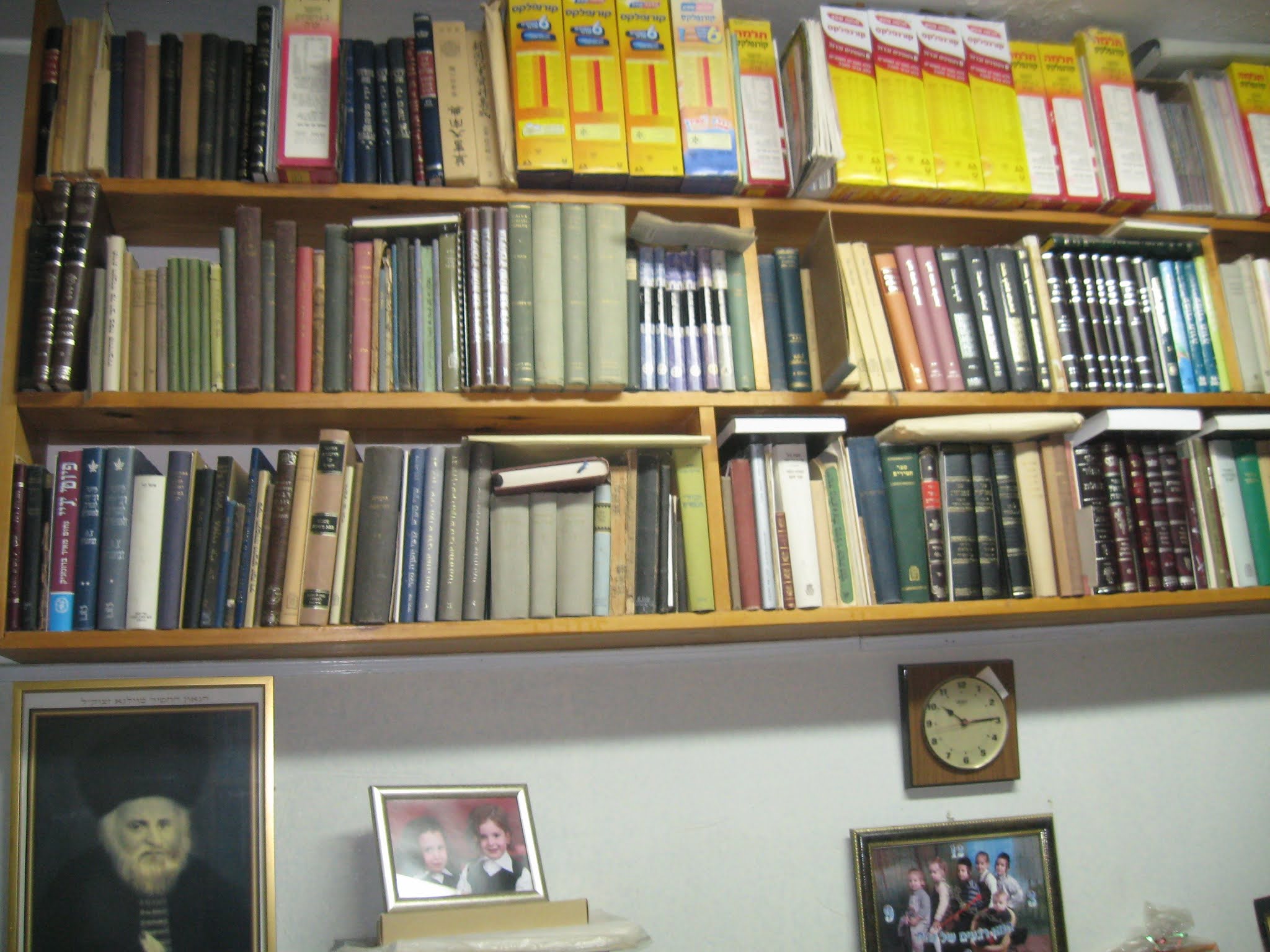
I would then scan some of the material. Other times he offhand did not have anything to add on a particular topic but when looking at a particular sefer I would find a note written on the side or in a paper stored in the sefer that would be related to what I was searching. Other times I would find something else which was of great importance. Rarely did I leave his house empty handed. We both shared a love for seforim and information on a wide range of topics.

Love of Seforim

What drew me to him, and particular developed my relationship with him, was our shared love of seforim. I would update him on new seforim. At times he would ask me to purchase it for him or would borrow my copy for a bit. He told me numerous times how he enjoyed visiting and buying seforim from various shops for many years and that he started collecting when he was seven years old! Now he could not go to stores as he was too old; I got to know him when he was over eighty.

When I joined the editorial board of the journal Yeshurun, I would bring him each new volume as it was printed. Each visit he would ask me to check on the shelf where he kept them, to see if he was up to date and if needed, to update him with any missing volumes. A true lover of seforim, his face would lit up at each new volume. I would then point out some of the articles I thought he would enjoy and he would put in markers to read them.

I always wondered if he read the various volumes of Yeshurun I brought him. After he was niftar, while going through his seforim, I found inserted in one rare book a small paper which he wrote: “for more information about this author see the article in Yeshurun”. Then in a different pen he added another cite from another issue from Yeshrun from a few years later.

This small story also demonstrates a bit of his methodology; he would collect all kinds of information and store them at times in a related sefer and would constantly update these notes.

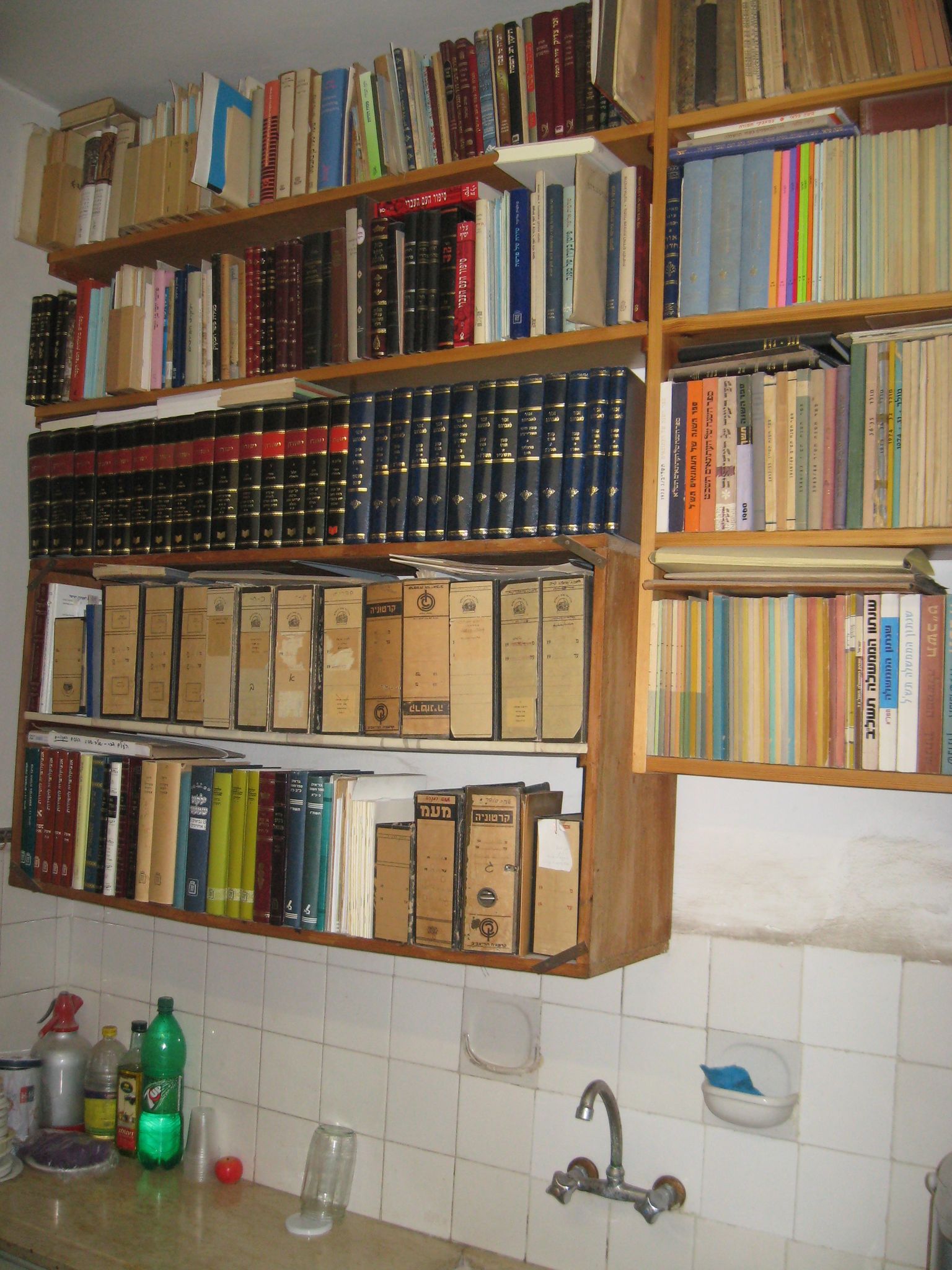
His love for seforim was something unique, the glow on his face when he opened up a new sefer, especially of someone he was into, was simply priceless. He would look carefully at the Shaar and if it was a reprint of an older sefer he would immediately check if they included the front page of the older edition to compare. He had seforim in every space possible in the four rooms of his apartment, including his porch. Many visitors noticed how even his kitchen was lined with seforim!
Dikdueki Sofrim Haskomot

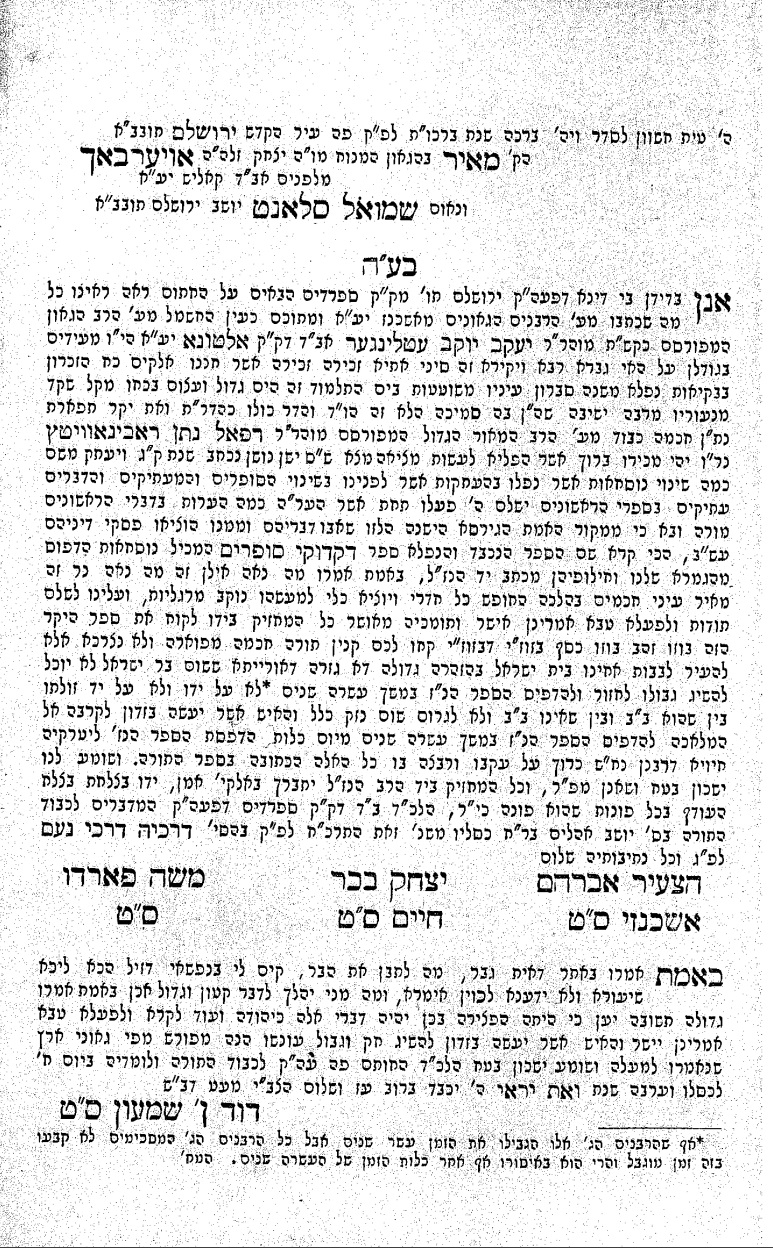
An interesting story happened with me and his library. While working on an article about the Dikdueki Sofrim I was unable to track down some recorded Haskomot that the author R’ R.N.N. Rabinowitz had received for the first edition of his work. I, along with other scholars, had searched numerous copies of the first edition, but with no luck. Late one night, I came to R’ Ashkenazi’s house and mentioned to him my problem. He said “show me the issue inside,” keeping with his custom to take care to always view the source material firsthand (Osiosi Machkemios – a topic he wrote a lot about). I took down his copy of the sefer, and lo and behold it was a first edition with the missing Haskamot! I published these missing Haskamot in my article on the Didukei Sofrim, and attributed this rare and miraculous find to his extraordinary library.

His History:

Where this unique Talmid Chacham came from is simply a mystery. He was born in Yerushalayim and lived in Batei Ungarn. He learned by Rav Yosef Tzvi Dushinsky of the Edah HaChareidis. Originally, his name was Deutsch but, at some point changed it to Ashkenazi. He had four children with his wife who died over forty years ago. Since then, he lived alone in his apartment near some of his children. His son did an excellent job of Kibud Av bringing him food every day and looking on him a few times a day. Yom Tov and Simchos he spent time with his family.

When I and others asked him, who was his Rebbe, he would just smile and say no one in particular. The truth is the Mishnah in Avos states: Knei Lecha Chaver. Aside from the simple peshat, Rashi explains this Mishnah by citing some who say it means via Seforim others commentators explain this as ‘buying a pen’ (see R’ Ashkenazi’s in-depth article on this for sources). R’ Ashkenazi employed all of these methods; his friends and teachers were his seforim and his pen.

R’ Ashkenazi was a short, quiet and unassuming person. Most, having seen him walking on the street, would never believe he was such an erudite Gaon. Many times, R’ Ashkenazi did not express much emotion except to give a pleasant smile and was friendly and polite in conversation. But there were times he got very excited; for example, when he recalled a good story from his younger years or something unique that he discovered years ago. He was very polite and was a real Yekeh; for example as soon as they bentched Rosh Chodesh Kislev his Menorah was already prepared in the window.

R’ Yechiel Goldhaber, a Talmid Chacham and author of numerous articles and seforim had a close relationship with R’ Ashkenazi for many years. He recalled when he was introduced to R’ Ashkenazi for the first time by his father-in-law, he thought to himself who is this simple looking man? He soon learned that this man was a master of all of Torah and swiftly became a close Talmid of his.

Many times, he would tell me he wishes he could come visit my library. In Later years he would spend his Yomim Tovim at his daughter. One Chol Hamoed Succos, when he was over ninety, he made the difficult trek from her house to mine in order to spend time in my library.
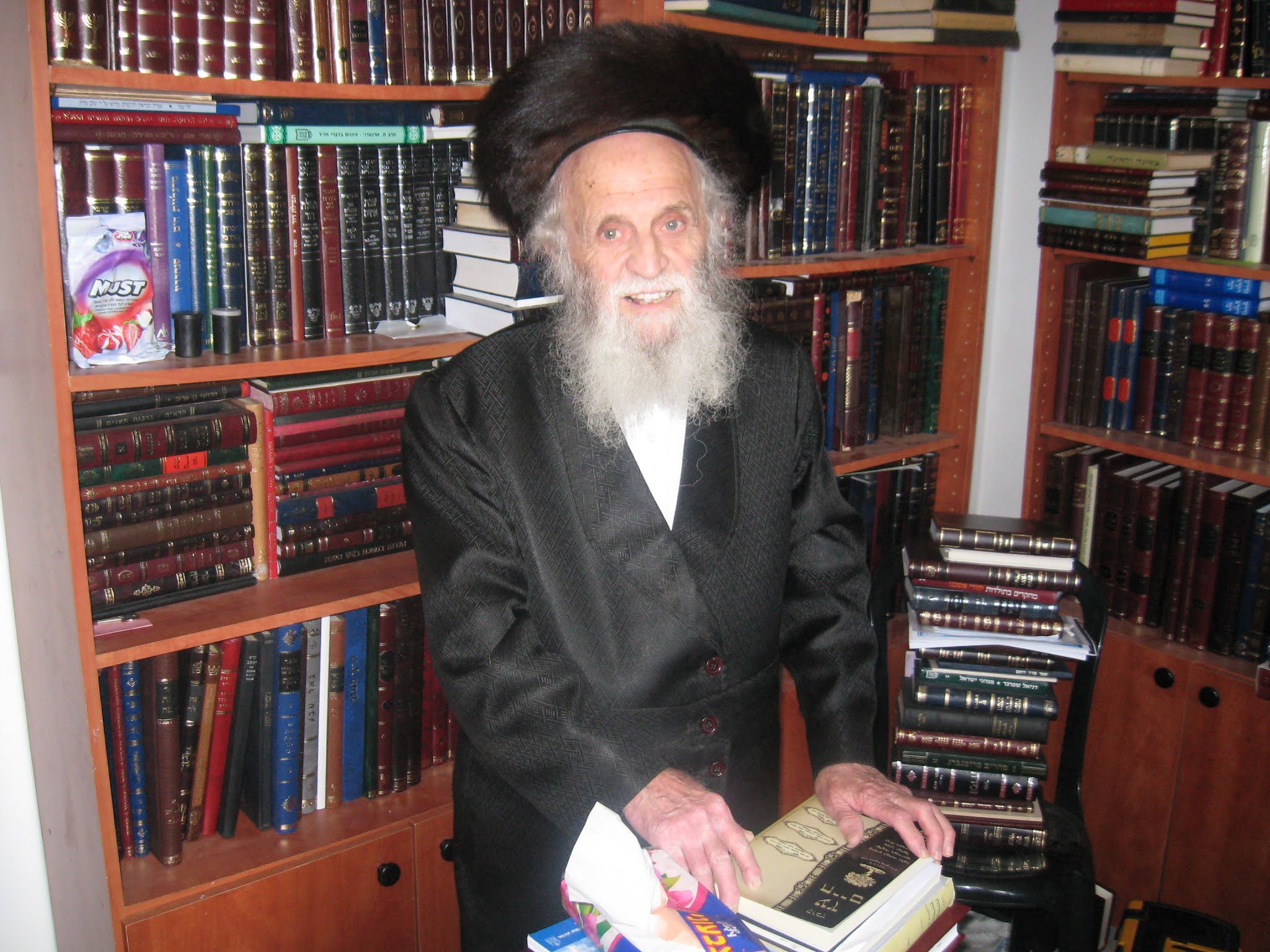
He would love to read everything he could get his hands on. I visited him at many different times of day, even late at night and I always found him learning a sefer – even when he was over ninety. He read everything newspapers, books – he was just curious about everything with an incredible thirst for knowledge.

I recall visiting him a few times when he eighty-five and noticed he was learning the Shelah Hakodosh very carefully. I asked him why (of course he had learned through this sefer numerous times before!) and he responded that someone is reprinting the sefer and asked him to go through the sefer and send comments. He therefore sat down to learn the whole sefer, line by line, after which he wrote a ten-page letter with his comments on the sefer.

Over time, I learned again and again that R’ Ashkenazi personally believed his purpose in this world was to help people with the incredible amounts of information that he had gathered over the years of intense learning. This incredible Middah can be seen in this light; he did not feel that he was the “owner” of this extraordinary wealth of information he had collected, and thus gave very willingly without any conditions. He never asked me to cite him when he gave me some rare source even – although I always told him I would; he just was so happy to help someone else.

He would collect and catalog much of what he read. He had all kinds of systems to file the information he had gathered over eighty plus years of learning. When he would read an important article in a magazine or journal, he would cut out the parts and store them in their appropriate place. He gathered information on thousands and thousands of subjects (not an exaggeration in any form) which had some connection to our rich heritage. What’s more astounding is that R’ Ashkenazi never used a computer or the internet; all of his erudition came about simple by learning through thousands of seforim; a great many of them rare or unknown.

Over the years he helped so many people and for many years after he retired, he would visit the National Library of Israel on Tuesdays, where throngs of people would line up in wait to speak with him about all kinds of subjects.

Many years ago, he received a call from a young chassidish Talmid Chacham living in Monsey who was starting to work on publishing a new edition of the classic historical work Seder Hadorot. He started asking him questions about various issues he had. Over many phone-calls R’ Ashkenazi answered many of his difficulties while training him in proper research and writing skills. This year some volumes finally were published (see here). And this was not a onetime occurrence – he helped so many more people. He used to remark to me that when he was younger so many people would come to visit him – until the late hours of the night.

He was an expert in so many different topics, whether it was the standard ones like Tanach, Chazal, Halacha, Minhag or Chassidus or less commonly studied subjects such as Tefilah, Piyut, Dikduk, Kabbalah, Philosophy, Machshavah, History and Bibliography. In all of these areas his expertise was remarkable.

His Uniqueness

A sample of his bekius; one time I noted that the Maharsha often quotes a “Sefer Yoshon Noshon” and asked if we have any idea which sefer this is? He immediately responded that he found it usually refers to R’ Todros Abulafiah’s Otzar Hakavod.

His incredible Bekius was bolstered by an almost photographic memory, as the following story demonstrates. Once someone used the Bar-Ilan Responsa search engine to locate a passage in the Tana DeBei Eliyahu to no avail. He went to ask R’ Ashkenazi who immediately told him where the passage could be found. Checking the Bar-Ilan text, it was discovered that when the sefer was being entered into their database the passage in question had been mistakenly omitted. I first heard this story from someone else, so to make sure it was accurate I asked him about it and he confirmed it. A similar story happened with him and a passage from the Shut Chasam Sofer.

A few years back a friend was working on publishing out an esoteric Rishon on Mesechet Megillah. He thought no one ever heard of this author and randomly mentioned this to R’ Ashkenazi – without batting an eyelash – replied “of course, and one can find material by this author in the work of Rav Shlomoh Alkabetz on Megillas Esther (Manos Halevi). The fellow was stunned in elation; he had just been gifted new and important material for his project.

This remarkable Bekius which even beat out computer search engines, was just one aspect that made him remarkable. He would receive numerous calls and letters from all over the world from people of all walks of life seeking his assistance in tracking down a statement. He had an incredible knowledge of all of Chazal. I do not just mean the “standards”; Bavli, Yerushalmi and Midrash – even all the numerous and very often almost unknown Midrashim printed over the years. He was also expert in what is known as the lost Midrashim. Over the years many Midrashim we had were lost but some traces of them can be found in various Piyutim, cited by Rishonim or in other obscure places. Through his incredible amounts of learning and his phenomenal memory he was able to recall so much in this field.

To illustrate this with some samples. A few years back someone who was editing for publication a never before printed pirush of a Rishon on Avos came across a few statements in the name of Chazal. This person, a Talmid Chacham in his own right and familiar with tracking down such material, could not locate sources for these statements. Immediately he penned a letter to R’ Ashkenazi. A few days after he received a letter from R’ Ashkenazi with various incredible sources for his questions. This was a very common occurrence.

Piyut, Tefilah and language

Earlier, I mentioned his expertise in Piyut, Tefilah and language. A bit of background is needed to explain this. Rabbi Joseph B. Soloveitchik, when describing Rabbi Elazar Hakalir’s greatness, (Koren Mesorat Harav Kinot (pp. 386-388) wrote the following:

The piyutim of Rabbi Elazar HaKalir, including his kinot, serve two purposes. The first is limmud, learning. Every sentence of the piyut quotes m’aamarei Chazal… The second purpose is tokhaha, rebuking the people for their misdeeds and instructing them in the proper way to act. These piyyutim deal with… repentance… acknowledgment of God’s justice. The shali’ah Tzibbur was not merely a chazan…, but was one of the great scholars of the generation who was the principal… moral critic of the people… Rabbi Elazar HaKalir was (also) a master of the Hebrew language and very creative in his use of Hebrew. If not for him, modern Hebrew could not have come into existence. Before HaKalir, the Hebrew language was very rigid. For example, the noun and verbs were fixed in their form… But HaKalir made a critical contribution to the development of the Hebrew language by endowing the language with flexibility… Rabbi Elazar haKalir’s piyutim served two purposes: limmud, study… As for the element of study, one of the dimensions of HaKalir’s piyyutim is that they are compilations of the statements of the sages. Most of us, who are expert in neither Hebrew nor aggadot Hazal, find HaKalir’s corpus of piyutim boring. But it is not boring at all; it is like a gold mine. His piyutim for Yom Tov explain the essence of the Yom Tov. The midrashim concerning Sukkot are replete with information about the sukka, etrog and lulav, and all the explanations in the Midrash, all the ta’amei sukka, the reasons for the sukka, all of the ma’amarei Hazal, are together in the HaKalir’s piyutim for the first day of Sukkot… If one were to study carefully and thoroughly the piyutim of Rabbi Elazar HaKalir for Rosh HaSahana, Yom Kippur, Sukkot, and Pesah, one would find many applicable halakhot and the entire pertinent Midrash, including many midrashim that are unknown to us from any other source.

Rav Ashkenazi was an expert on everything related to Tefilah and Piyut. He somehow read it all and retained it. But in addition, he was able to use his expertise in Chazal and Hebrew language to understand it on a much higher level and as a result was often contacted by the world experts on Tefilah and Piyut for his assistance. These requests came from experts such as Professor Shalom Speigel, Chaim Schirmann, Avraham Haberman, Ezra Fleischer and Daniel Goldschmidt who constantly sought his assistance while working on their Tefilah and Piyut related projects.

In an interview with Ami Magazine printed a few years back, Professor Shulamit Elitzur mentioned:

“there’s another amazing thing I find when doing research. I am constantly coming across midrashim that were lost to the ages… example, everyone knows that Haman was referred to as ‘the Agagi’ because Shaul allowed Agag to live one extra night, which allowed Haman’s ancestor to be born. However, the earliest makor we find in writing in the 16th century; this fact was discovered by Rav Shmuel Ashkenazi of Yerushalayim. But I found a ktav yad of a piyut about Purim that describes this very story and explains how Haman’s ancestor was born, which gives us a source from 1,000 years earlier! And there are many similar examples of lost midrashim being kept alive through unknown piyutim.”

R’ Ashkenazi wrote some articles on Piyut and Tefilah, but we have found much more among his papers and hopefully if I can raise enough funding all his fascinating material on Tefilah will come to light.

When the important Siddur Ezer Eliyahu (sponsored by his late friend Yeshaya Vinograd) was first printed, one can see R’ Ashkenazi’s name in the introduction, thanking him for his assistance (he assisted them for some of the later additions) and his great knowledge in this field.

I mentioned that he had an incredible knowledge of Dikduk and the Hebrew language and used it towards better understanding Piyut and Tefilah. He also authored articles on these subjects and in 1967, when reviewing an important dictionary, wrote a long article demonstrating this very point – and article that garnered much praise. He was very proud of this essay and mentioned it to me many times. A few years ago, I reprinted it with additions he had made in his own copy and a nine-page topical index.

One of the ways he developed this expertise was via learning Tanach so many times. He was an expert in Tanach and all the Rishonic commentaries (including the unknown ones); he even authored a small book of Riddles of Tanach.

He also used his extraordinary skills to become a master editor. However, in addition to the work he was born with an incredible innate sensitivity for text and language which made him one of the best editors out there. For many years he worked at the famous publishing house Mossad HaRav Kook, editing various works. He told me more than once how there was an expert there who would brag (jokingly) that after he read through an article it was impossible to find mistakes. The only person who could still find mistakes was R’ Ashkenazi. He had razor-sharp vision and could immediately spot a mistake.

Many times, I would bring an edited piece of mine to read. As soon as I put it down in front of him, he would take out a red pen and start marking it up and say to me “are you sure it’s been edited?”. He told me he had to mark up everything before he could read it properly, errata were so painful for him to see that it was hard for him to read something on Shabbos! He told me he was punished; when his work Alfa Beta Kadmita de-Shmuel Zeira came out, although he had edited it numerous times, he still found mistakes.

During his learning over the years, he found many people, great Gedolim as well as famous academics, had made mistakes, sometimes quite basic ones. At one point he printed two articles about this. However, he prefaced his articles that his intent was not to mock those who erred but to vividly illustrate that people are human and mistakes will happen. He was a master of humility and never held it over anyone that they did not know what he knew.

He was not only a great expert in all aspects of the Hebrew language but was an expert in Aramaic and Yiddish, both of which he displayed in various publications of his. Related to his expertise in Aramaic, which is very important for learning Gemara, is a very unique essay which he authored related to the Rambam as a translator of the Gemara. One of the world experts in old Yiddish is Professor Chava Turniansky, who has noted on many occasions that one of the people who have always helped her from her days as a student, was R’ Ashkenazi.

Related to this was another talent of his, which at first appears trivial; he was an expert on acronyms. This led to authoring a thesaurus of acronyms together with Dov Yardan, called Otzar Roshei Tevot, with a multitude of obscure and often almost impossible entries. His sensitivity to the text and work in the field of editing drew him to this field. Anyone who learns a lot, especially older material comes across abbreviations, and many times they cause great difficulty in understanding various passages. Abbreviations were employed in writing, sometimes as mnemonic devices and other times simply to save on printing costs. But over time many meanings were forgotten. This work is an extremely useful tool for solving this issue.

Ghostwriting

One day I was in a used bookstore and I noticed a small sefer titled Harif Umishnaso about the Rif. I recalled that this title appeared in the list in beginning of his work, Alfa Beta Kadmita de-Shmuel Zeira which listed out the various works he helped with over the years. I asked R. Ashkenazi if it’s worth buying and what his connection to the book was, as a different name appears on the cover.

R’ Ashkenazi replied “I can tell you it’s an important sefer and worthwhile to buy.” I noticed he was hesitant to continue the conversation. He then said “I will tell you something I did not tell anyone in over forty years – I wrote the whole sefer from beginning to end and it was one of the most important works I ever wrote.” The original plan was to for him to write a series of biographies on various Rishonim – in this book he already references a work on the Ri Migash – but due to a lack of funding this series was discontinued. However, not all of this remained unpenned; he wrote numerous entries in various encyclopedias. It turns out that R’ Ashkenazi had over fifteen different pen names!

I would like to elaborate on this work a bit more and thus cast further light upon R’ Ashkenazi’s uniqueness and greatness. The Rif’s Halachic work is one of the most important sources in Halacha, but what exactly makes it so unique has remained a mystery. R’ Ashkenazi sought to answer this question by collecting and collating all the authentic information we have about the Rif, from the Rif and from other Rishonim. He went through the Rif carefully examining what he did to each Gemara evaluating if remarks or material was added or not and to figure out why, allowing the reader to begin to understand the Rif’s significance. R’ Ashkenazi’s writing methods were honed to precision. He had an uncanny ability to utilize every piece of information without writing an extra letter and assemble it all in perfect order sans speculations commonly found in historical works. At times one does not need grand theories to understand something; just seeing all the known material in proper order helps one understand things. The wealth of material that Rav Ashkenazi commanded in producing this work is outstanding; this book was written in 1967 – long before any of the various search engines used today.

Haggadah Sheleimah

Similar to this is another work by R’ Ashkenazi, Haggadah Sheleimah. I hope to publish an article about this work in the near future, including the numerous additions R’ Ashkenazi found over the years and kept in his files. This work is highly unique for the following reasons. The collected bibliographies by Avraham Ya’ari and Yitzchak Yudlov bear witness to thousands of Haggados written throughout the generations in a multitude of styles, such as Pilpul, Peshat, Kabbalah, Derush and more. However, until 1955 there was no one work on the Haggadah which collected all the sources for each and every Halacha and minhag related to the Seder night. There was no volume which dealt with the various manuscripts of Geonim and Rishonim and at the same time to deal with the exact text of the Haggadah. Haggadah Sheleimah set out to fill those needs, and at the same time offer a running collection of Pirushim culled from over fifty different commentators focusing just on Peshat. In order to produce such an exacting work, it’s not good enough to just be a talented writer, one must also possess a keen understanding of all the material and relay this with incredible clarity. R’ Ashkenazi was such a person; one who sought out the simple Peshat, able to put this myriad of information together in so beautiful a fashion, and with tremendous clarity. His work in Haggadah Sheleimah is so clearly organized and always straight to the point that it is no wonder that to this day Haggadah Sheleimah remains a classic in both the Torah and Academic worlds.

Rav Ashkenazi once explained to me that one has to write precisely and to the point, not lengthily. He said he believed that one of the reasons Rashi’s works survived was due to his concise way it was written, as opposed to various works of Geonim which did not really survive as they were written in a much lengthier format.

Why didn’t he publish his material?

A few years ago, a partial bibliography of his writings was printed in his Alfa Beta Kadmita de-Shmuel Zeira. The listing is close to three hundred articles and seforim that he wrote or assisted in on some level. He started writing under various pen names over eighty years ago. The background to the publication of this volume was, as I mentioned previously, R’ Ashkenazi had been writing and collection information on thousands of topics for over eighty years. Unfortunately, he did not print much of what he gathered. The main reason for this was R. Ashkenazi’s “weakness”; he demanded incredible levels of perfection from himself. Although he strived for great perfection, nonetheless he stressed to me numerous times that he was mistaken in that approach and that I should not follow in his path. In his words it is better I print my work to the best of my current abilities and that worse comes to worse you can always reprint with additions and corrections. Over twenty years ago, R’ Teflinsky somehow convinced R’ Ashkenazi that his material needed to be printed. Together they began compiling some of his material for print, resulting in a volume over eight hundred pages!

After that experience both R’ Ashkenazi and R’ Teflinsky stopped, with no plans of continuing this project. A few years later my good friend, R’ Yaakov Yisrael Stahl and myself were able to convince him to continue. R’ Stahl took upon himself the daunting task to prepare the material for publishing; since, than three more volumes were printed.

Here is a small video clip of R’ Ashkenazi, when we brought him copies of the second and third volumes of his writings, ten years ago.

The topics that these works deal with cover, on some level, virtually everything; sources for expressions and idioms, for minhag, Halacha, the evolution of famous stories, bibliography, corrections of authors’ errors, encyclopedic style information on thousands of topics culled from thousands of seforim – many of them very rare or unknown. (A PDF of the Table of contents of this work is available upon request).

His Letters

Earlier I mentioned the story of someone who wrote him a letter seeking help. This was not a one-time occurrence. He authored well over a thousand such letters in response to such questions. Some requests were for sources to various Halachos or Minhagim, numerous others are various queries related to out rich literature. R’ Ashkenazi always invested his time to answer properly and clearly. Recently, R’ Stahl and I collected these letters for publication and the result is a three-volume set, available for purchase.

Over seventy years ago he purchased a typewriter which he used until his passing.

In an article written by the late Gaon R’ S. Deblitsky, he writes out various proper actions a Rav should “observe.” One of them is to respond to people who write to him, whether the issues are big or small. R’ Ashkenazi was very careful to try to respond promptly. Many people would send him their seforim after they were printed asking him for his comments. He would usually respond with a multi-page letter, beginning by thanking the author for sending it to him, then listing out some criticisms, usually written delicately, while adding all kinds of comments. He always tried to look to say something positive. Some people who heard of him through various channels over the years contacted him before they printed their works. Many times, he would write a collection of comments and corrections to such works. A sample listing of some of those works that benefited from him before going to print include recent editions of: Sefer Zechirah, Kav Hayasher, Sefer Hachayim and many others.

Thanks to the efforts of my special friend Menachem Butler, various academics wrote some praises about the significances of these letters; to partially quote one letter written by the esteemed Professor Shnayer Z. Leiman:

Reb Shmuel was

“bibliographer, bibliophile, and book collector, and his encyclopedic knowledge of all of Hebrew and Yiddish literature remains unparalleled in our time.” His collected writings are an intellectual treasure trove, “covering a wide range of topics in the field of Jewish Studies. Aside from his scholarly distinction, R. Shmuel Ashkenazi wrote in an elegant Hebrew with its own special charm. Not only did he advance discussion, but he did so in an aesthetically pleasing manner. Let it be said openly: this… set will enlighten every reader and will significantly advance scholarship. Anyone concerned with advancing the cause of quality Jewish scholarship will take special delight in the publication of these volumes…During his lifetime [Ashkenazi] corresponded with the greatest Jewish scholars and bibliographers the world over. They wrote to him, for only he could solve the countless historical and literary problems that stumped them…”

Another person to whom Menachem Butler reached out to via his numerous contacts was former editor of Mekizei Nirdamim’s journal Kabez Al Yad, Professor Shulamit Elizur of the Hebrew University of Jerusalem. In her aforementioned interview in Ami Magazine several years ago she said this:

“I am unequal to the task of adequately singing the praises of Rabbi Shmuel Ashkenazi, an erudite bibliophile. His familiarity with rabbinic writings from throughout Jewish history is unparalleled, and he is well-versed in the research literature of academic Jewish studies as well. I first met Rabbi Shmuel Ashkenazi through my teacher, the late Professor Ezra Fleischer. Prof. Fleischer, who was one of the greatest scholars of all time, would often chat with Rabbi Ashkenazi on scholarly topics, and he was careful to send Ashkenazi every article or book he published, knowing that in return he would receive enlightening comments on his work. When I began my own research, Prof. Fleischer instructed me in turn to send my publications to Rabbi Ashkenazi, and I too was privileged to learn a great deal from his comments. It once happened that I was searching for a particular midrashic theme which was alluded to in a liturgical poem (piyut), and although I consulted the leading scholars of Jerusalem who responded that it was a well-known homily, I was unable to locate its specific source. In my hour of need, I turned to Rabbi Ashkenazi, who immediately gave me several references. It emerged that every one of these references post-dated the piyut by almost a thousand years, and that this ancient tradition alluded to in the poem had been transmitted orally for that long period before being committed to writing in the later midrashim. Rabbi Shmuel Ashkenazi’s correspondence is a tremendous resource of Torah and scholarship. Every paragraph encapsulates a great deal in just a few words, and sometimes even with allusions whose explication require deep learning.”

Here is a short letter from Professor Gershom Scholem to R’ Ashkenazi:

Expressions and famous stories

In his writings some of the topics of these are about tracing expressions or the evolution of famous stories. Based on his knowledge, he was able to contribute a lot to these areas even editing some works on these topics.

One such story related to a supposed legend of a portrait of Moshe Rabbeinu which caused a great controversy over a century ago. In 1830, Rav Yisroel Lipschutz started printing his magnum opus, a commentary on the Mishnah titled Tiferes Yisroel. In the section on Maseches Kiddushin first printed in 1843, he brings a story about a king who lived in the time of Moshe, who, after hearing incredible things about this great leader, hired a painter to paint a picture of him so he could have his features analyzed by experts. The people who analyzed the picture reported that the person pictured was evil. The king went in person to visit Moshe Rabbeinu in the midbar and asked him how was it that an analysis of his pictures showed him to be of such wicked character. Moshe told him that the analysis was indeed true; however, after much work, he changed his character and became the great Moshe Rabbeinu.

In 1894 a booklet by the Vilkomir Maggid was printed railing against this story. This booklet presented numerous sources stating that Moshe Rabbeinu was born a kadosh and it was unthinkable to print such a story about him. Indeed, this story was censored out of the 1956 edition of the Tiferes Yisroel. In truth, this ancient legend can be found in various sources and in regard to different luminaries, some claiming it about Aristotle others, Socrates. In fact, R’ Ashkenazi documented it was long used in various Musar and Chasidus sefarim cited as an important lesson that one can change one’s born nature for the good, but not that it actually was true about Moshe Rabbeinu.

Another such story relates to a famous legend about the site where the Beis Hamikdash was built. Told in short, two brothers inherited a field, one brother had a family one did not. At the end of the harvest they divided up the wheat equally. That night the childless brother felt bad for his brother with a large family and said to himself “it’s unfair that while my brother needs more than I, we shared equally”, so he brought over from his pile to his brothers. The other brother thought that since his brother was childless, he should have a larger share of the crop, as consolation, so he added from his share to his brother’s. In the morning each brother realized their piles remained the same and this went on for two more nights. On the third night they met, realized each of their intentions was out of deep consideration for the other and hugged. Numerous people have searched for the early sources for this story. I decided to ask R’ Ashkenazi if he had any material on the subject. He found his file on the story and within was a letter from R’ Yudlov who had been asked by someone in the Education Ministry for the sources on this story. R’ Ashkenazi traced its first appearance in print to 1832 and from there he traced it to other sources.

Bibliography

I would like to conclude with just one more area in which R’ Ashkenazi was truly a legendary master: Bibliography. For many years, R’ Ashkenazi worked in the (now) National Library’s Bibliography of the Jewish Book Project. He also contributed to some of the important bibliographical works and journals written in the past century such as Kiryat Sefer, Otzar Sefer Haivri (Vinegrad) and Sifrei Yerushalyim Harishonim.

A few years back, while working on an article about the origins of eating Hamantaschen (see here), I found an important article from Dov Sadan containing sources on this topic. One of the sources was the interesting, controversial work Machberet Emanuel. I had a nice conversation with R’ Ashkenazi about this work – he had helped Dov Yardan prepare a critical edition of the work and even wrote a long book review on it (which he said he received a lot of Kovod for).

He mentioned two points of interest which will serve as a sample to some of his expertise. One, he noted that Emanuel of Rome wrote a commentary on sefer Mishlei. Interestingly, the preface to the Mishlei commentary sefer is signed Emanuel son of Yaakov, whereas Emanuel’s father’s name was Shlomo. Some have noted that this discrepancy and explained it is a mistake. R’ Ashkenazi suggested this was not a mistake, rather an intentional typo intended by the author to hide his connection to his controversial Machberes Emanuel. The second point he made to me was how the Chida writes in Shem Hagedolim that the best commentary to learn on Mishlei that by Emanuel of Rome. R’ Ashkenazi said he checked into the words of the Chida and he learned through all the works on Mishlei and concluded that the Chida was quite correct. He once had a dream to write a whole work on Mishlei, he even started to pen his comments in a special notebook, but the plans never worked out.

One final last story about R’ Ashkenazi’s bibliographic acumen. In 2009 my special friend Dr. S. Sprecher z”l (about him see this article on the seforim blog here) wished to reprint and distribute a small work called Tshuvah Be’Inyan Kriat HaKetubah, in honor of his son’s upcoming wedding, under that assumption that, just as the title page and the publisher’s introduction indicated, it represented an actual Halakhic Responsum issued in 1835 by the Chief Rabbi of Bialystok, one Rabbi Nechemiah. Sprecher wrote:

However, our close reading of this Tshuvah led us in an entirely different direction. To us, the work’s style manifested clear Maskilic echoes, and its arguments rejecting the binding nature of centuries-old Minhagim were clearly not in accord with 19th–century Halakhic thought. Our reaction was that the work must certainly be pseudepigraphal and could not have arisen from the pen of the Chief Rabbi of Bialystok. In fact, a quick perusal of the reference literature demonstrated that there never was any Chief Rabbi of Bialystok named Nechemiah.

At an impasse, we reached out to Professor Shnayer Z. Leiman, who suggested that the scholar most likely to solve the mystery would be the doyen of Israeli bibliographers, Rabbi Shmuel Ashkenazi. We were rewarded thanks to the tireless efforts of Eliezer Brodt who, on our behalf, pestered the aged Jerusalem sage until he successfully unmasked the name, but not quite the identity, of the author. Rabbi Ashkenazi concluded that the first line of the introductory poem that prefaced the Halakhic query contained the acrostic – “Meir Ish-Shalom”. (His initial contention was that this could not be the noted 19th–century Viennese scholar, Meir Ish-Shalom, because his heretofore known literary output began only some five years later, with his publication of the Sifre in 1864.)

Once Rabbi Ashkenazi had provided the key to the author’s name via the acrostic, it became apparent that all along the title page had been proclaiming that very same message. Let us recall the passage in Bavli Eruvin 13b where it is recorded that the celebrated Tanna, known to us as Rabbi Meir, was actually named Nehorai, according to one opinion; or alternatively, that both Meir and Nehorai were laudatory appellations reflecting his enlightening wisdom, whereas his actual name was Nechemiah. Recall also that the query first originated with Rabbi “Shalom” of Novgorod, and the word “shalom” appears twice more on the title page and is highlighted by the placement of a circle above one of its appearances.

In his copy of this work that Dr Sprecher printed for the Chasunah which I brought him, I found this paper inside:

A few weeks after R’ Ashkenazi’s Petirah the national library held a session devoted to him where Professor Zev Gries, Professor Chava Turniansky and R’ Yechiel Goldhaber spoke about him (here is a link to the whole session). I too had the privilege of being interviewed about him that night (Here is a link to my interview).

Publication of his writings

Last year, immediately after Rabbi Shmuel Ashkenazi was niftar I, along with my special friend Menachem Butler, initiated a campaign to raise funds to publish R. Ashkenazi’s letters via the Seforim blog. Baruch HaShem, and thanks to the help of some readers, enough money was raised to go to print and in the beginning of this past January copies of the book, coming in at over 1,700 pages, (three volumes!) arrived as announced (here). The Letters sold out in a few days. A second edition was printed right before Pesach (see here). Currently copies of the second edition are available for sale.

Future volumes

Already during the Shivah, R’ Stahl began going through the materials of R’ Ashkenazi to sort out what materials are print worthy.

Here is a picture of R’ Stahl taken during one such session which a friend of his humorously put side by side a famous picture of Solomon Schecter when working on Geniza documents.
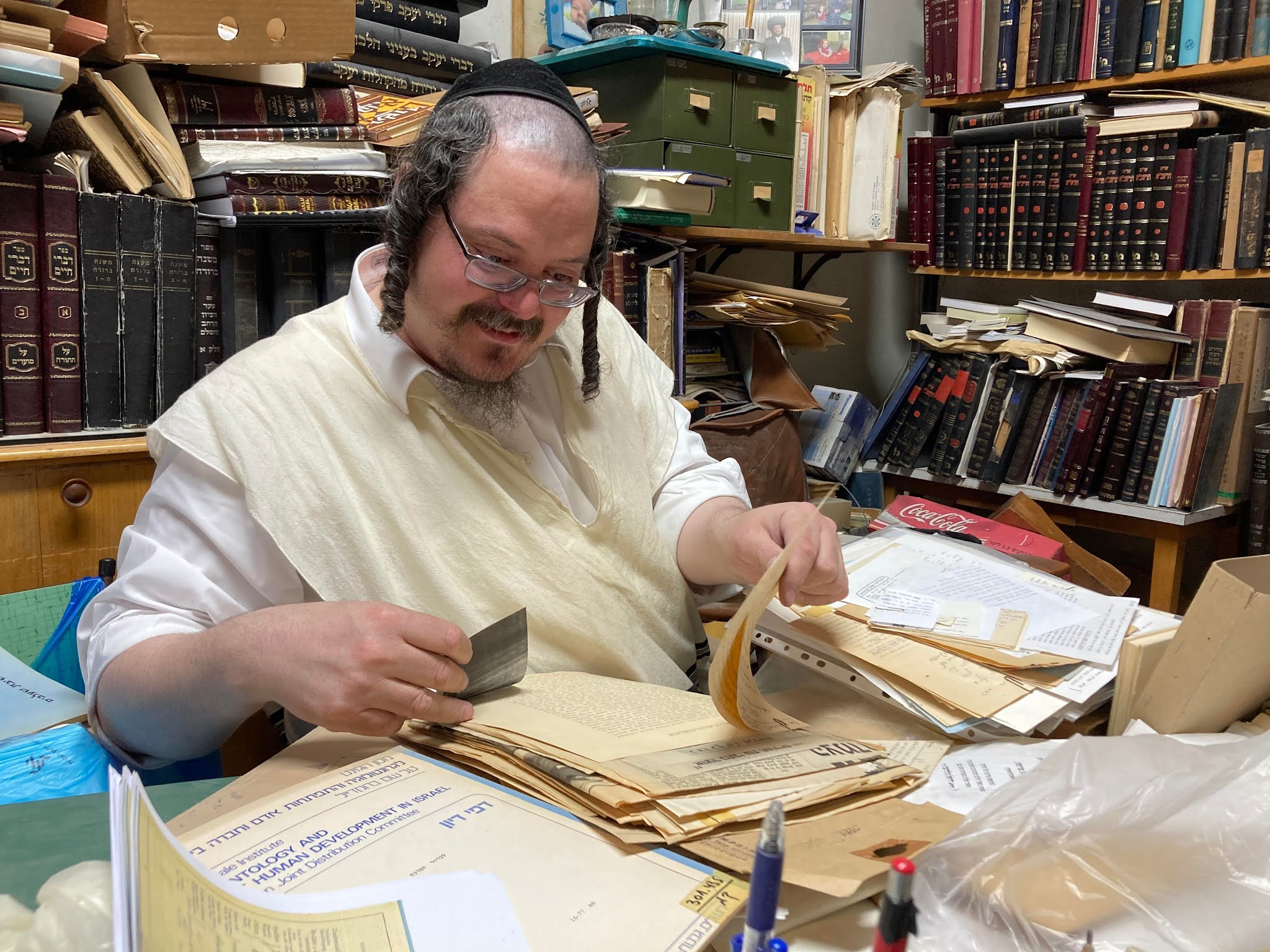
We never imagined we would find so much print-worthy material that we were not previously aware of; at least eight volumes’ worth of prepared writings which we hope to print. Currently, we are in the process of categorizing the material. Among the topics are: Tefilah, Minhag, articles on Seforim and authors – and much, much more. As we sort and scan R’ Ashkenazi’s legacy, some material is already being sent out to be typed up for publication. Each of the above endeavors comes at a price, and every contribution to the cause helps greatly. IY”H in the near future I will make a more formal announcement with precise details regarding the works slated for print. Anyone wishing to help with funding this project can contact me at Eliezerbrodt@gmail.com


Two Editions of R. Chaim Berlin’s Responsa: An Egregious Example of Censorship

Two Editions of R. Chaim Berlin‘s Responsa: An Egregious Example of Censorship
by Eliezer Brodt

R. Chaim Berlin, Sefer Nishmat Hayyim, She’elot u-Teshuvot, R. Ya’akov Kosovsky-Shachor ed., Beni-Brak, 2002, 412 pp.

R. Chaim Berlin, Sefer Nishmat Hayyim, Mamorim u’Mechtavim, R. Ya’akov Kosovsky-Shachor ed., Beni-Brak, 2003, 424 pp.

R. Chaim Berlin, Otzar Reb Hayyim BerlinShu”t Nishmat Hayyim, Jerusalem, 2008, 4 vol., 446, 462, 449, 298 pp.

R. Chaim Berlin (1832-1912), the son of the R. Naftali Tzvi Yehuda Berlin (author of the Netziv), although well known until recently none of R. Chaim’s extensive torah has been published. To be sure, some of R. Chaim’s torah can be found scattered throughout the seforim of his time, but never in a book of its own. In 2002, R. Kosovsky-Shachor (“R. KS”) published a collection of R. Chaim’s responsa entitled Nishmat Hayyim. These responsa were collected from various manuscripts in many collections as well as correspondences which R. KS found in the Rabbinic literature from R. Chaim’s era. A year later R. KS printed a second volume of letters, derashot, articles and approbations of R. Chaim Berlin also entilted Nishmat Hayyim. In the back of the volume of responsa, R. KS includes a nice historical write up of R. Chaim Berlin’s life (corrections and additions to the biography appear in the back of the second volume).

A few months ago another collection of R. Chaim Berlin’s respona were published by Yeshivat ve-Hegaditah le-Vinkha entitled Otzar Reb Hayyim Berlin. This version was published in four massive volumes on all areas Shulchan Orach, Shas and more. In this post I will discuss a bit about the two versions, some of the interesting teshuovs found in them and many instances of censorship in the later edition. Regarding these examples of censorship, I can only assume that there are many more examples as I haven’t compared every line of the four volumes with the original. But, as will be apparent, the examples provided below are fairly egregious. Additionally, these works touch on the important topic of the reason behind the closing of Volozhin Yeshiva.

For purposes of this post, I will refer to the Nishmat Hayyim as the older edition and the Otzar Reb Hayyim Berlin as the new edition. The earlier edition contains about 200 responsa while the new version has well over 800 responsa. In the earlier edition they printed a volume of letters and haskamos which the new version did not do yet include but promises to print shortly. The newer version has an excellent index based on the order of shas and topics. Just a quick glance shows the tremendous wealth of topics discussed. They also included a list of all the people R. Chaim corresponded a veritable “who’s who” of the gedolim from that time period.

Some Highlights

Amongst the many interesting teshuvos there is one about riding on a train on Shabbas (1:171-172), creating something via the Sefer Yetzira on Shabbas (1:418), asking an agent to give a Get via a phonograph (4:39), throwing grass when one leaves the cemetery (2:359) and burning dead bodies as opposed to burial (2:353-355).

In the new edition there is a lengthy discussion (1:70-77) about answering Amen when one is in middle of davening. In the midst of this responsa (1:73) R. Berlin notes a very interesting thing :

נראה לענ”ד שאף במקום שמותר להפסיק בפשיטות ואין שם בית מיחוש כלל להחמיר כמו להפסיק מפסוקי דזמרה לקדושה, אין זה אלא רשות שמותר להפסיק אבל לא חיוב, וטעמא דידי, משום דקי”ל העוסק במצוה פטור מן המצוה….

Another interesting statement found in a correspondence between him and R. Sholomo Hakohen where R. Shlomo writes (#67 in the old edition and # 191 in the new edition):

כן שמעתי מפי אביו הצדיק זצ”ל (הכוונה להנצי”ב) שאמר בשם חמיו זקנו הצדיק מו”ה חיים מוואלזין זצ”ל שיש לומר פירוש בלשון הרמב”ם והשו”ע אם הוא עולה ע”פ ההלכה אף שבודאי לא כוונו לזה משום שרוח הקודש נזרקה על לשונם, וכן מצאתי כעין זה ממש בס’ בית אלוקים להגאון המבי”ט זצ”ל בסוף פ’ ס”ד ע”ש”

While discussing the topic of gramophones, R. Chaim Berlin (#1 in old edition) writes that they had these already in the time of Chazal:

ובזה נראה לי לפרש לשון הש”ס בפ’ ראוהו ב”ד רה”ש כ”ח ב’ דמשני הש”ס על הא דתנן הי’ עובר אחורי בית הכנסת ושמע קול שופר או קול מגילה, אם כיון לבו יצא ואם לאו לא יצא מאי לאו אם כיון לבו לצאת, ושמע מינה מצות צריכות כונה, ומשני לא לשמוע, והא שמעי, סבור חמור בעלמא הוא, ופירש רבינו חננאל בש”ס החדשים דפוס ווילנא אם כיון לבו לשמוע ולהבחין אם הוא תקיעת בן אדם או צהלת סוס, ותמוה דהא ניחא בקול שופר שיש לטעות שהוא צהלת סוס, אבל בקול מגילה דלא שייך לטעות שהוא צהלת סוס, מאי איכא למימר, ותפשוט מינה דמצות צריכות כונה, וכבר תמהו בזה הטורי אבן במקומו, והפרי חדש או”ח (סי’ תר”צ סעי’ י”ג). ונראה דבימי הש”ס הי’ כלי זו של הגרמפון עשויה כצורת חמור והליצנים היו משתמשין בו, וזהו חמרא דאכפא דאמר ר’ אבהו בפ’ במה אשה שבת ס”ו ב’ ופירש”י חמור הנישא בכתפים והליצנים עושים אותו ובמקומנו נקרא ארדפיסא, ותרגם בש”ס החדשים דפוס ווילנא שזה קומנדינט או פארשטעלונג, וביותר היו עושין כן בפורים לבדח ולשמח את ההמון, והיה הדבר מצוי לשמוע מהחמור הזה גם קול מגילה, ומבואר דאם הוא קול החמור הזה, אינו יוצא ידי חובתו, כנלע”ד, וה’ יודע האמת

Another nice point is found while dealing with the issue of reciting the tefilah of Birkat Rosh Chodesh in light of the general prohibition against praying for one’s livelihood on Shabbos. R. Chaim Berlin writes (#23 old version):

ע”ד אשר שאל, היאך מצלינן בשבת שמברכין החודש על חיים של פרנסה, לפלא שלא שאל גם על נוסח מי שברך שאומרים בכל שבת אחר יקום פורקן, דמצלינן וישלח ברכה והצלחה בכל מעשי ידיהם, וגם על נוסח בריך שמי’ שאומרי’ בהוצאת ס”ת דמצלינן יהא רעוא קדמך דתוריך לן חיין בטיבותא. אבל כבר כתבו האחרונים ליישב מנהג ישראל, שלא אסרו לתבוע צרכיו בשבת, אלא ביחיד העושה לעצמו תפלה מיוחדת על איזה מקרה, הנחוצה לו באותה שעה לפרנסה או לרפואה וכדומה, אבל נוסח תפלה הקבוע לכולם בשוה בנוסחא אחת, אין קפידא בזה, וגם זה נכלל בלשון הירושלמי טופס ברכות כך הוא

Another nice piece (# 52 old version) I found is in regard to the famous discussion for those who observe gebrucks how can they make kneidel on Chol Hamoed Pesach?

והנה, קרבו ימי המועד לבוא, אשר לא אאחוז עט בידי לכבודו משך שמונת ימים, ע”כ אמרתי להודיעו מה שעוררתי את בני עדתי בדרשת שבת הגדול העבר, ע”ד האנשים הנזהרים ממצה שרוי’ כל ימי הפסח לבד מיום האחרון, ויש גם נשים הנזהרות בזה. ואותן הנשים שנזהרות בזה ואין להם משרתת בבתיהם ואופות ומבשלות בעצמן, הנכון שיזהרו בשביעי של פסח מלהכין תבשילי מצה שרויה על יום המחרת, מאחר שאין התבשילין הללו ראויין להן ביו”ט, ואפי’ אם יקלעו להם אז אורחים ביו”ט שביעי של פסח, ג”כ לא יתנו להם מצה שרוי’, הרי לא מהני עירוב תבשילין בזה, כמש”כ הרמ”א בסי’ תקכ”ז סעי’ כ’ לענין מי שמתענה ביו”ט ועי’ מגן אברהם שם

It is also apparent from this teshuvah that R. Chaim did not even write Torah on Chol Hamoed.

Another very interesting Teshuvah (new edition 3:1-3) is where he deals with the Tzavas R. Yehudah Hachassid, as he was asked about marrying someone where it would be against one of the statements in the Tzavah. To which he replied:

.מכאן נלמוד לכל האזהרות שהזהיר רבינו החסיד ז”ל בעניני זיווגים, שאם אין בדבר זה שום מצוה, אלא שחפץ בה לשם ממון או לשם נוי, ודאי יש ליזהר בכל אזהרותיו, אבל מי שעושה מעשיו לשם שמים, ומכוין למצוה, עליו לא הזהיר החסיד כלל

Another interesting piece found (#24) is about a piece of the Netziv in the journal of Rav Kook, Iytur Seforim where the Netziv wrote that it is permissible to read newspapers on Shabbas. Regarding this point R. Chaim Berlin wrote:

ועל דבר לעיין בשבת בהרהורא בעלמא בלי קריאה בפה באגרות רשות ובמכתבי העתים לא הי’ כלל דעת מר אבא הגאון שליט”א, לקבוע מסמרים בהלכה זו ככל דבריו שבעטור סופרים, ולא בא אלא ליישב מנהג העולם שקוראים במכתבי העתים בשבת שסומכים בזה על משמעות תלמודא דידן עפ”י דעתם, שמפרשים דתלמודא דידן פליג בזה על תלמוד ירושלמי, אבל להלכה גם הוא יודה דקיי”ל כהירושלמי, וכה”ג מצינו בהרבה מקומות שכתבו הפוסקים ליישב מנהג העולם, שסומכים על דעה יחידית אף שלא כהלכה

The Netizv defends his opinion in the Shut Bikurei Shlomo (1:2). Interestingly enough there is testimony to the contrary from R. Baruch Halevei Epstein who writes how on Shabbas his uncle the Netziv used to read the Hebrew newspaper, Hamagid (Mekor Baruch 4:1794). R. Meir Bar-Ilan echoes R. Baruch Halevi’s testimony about his father the Netziv that he would read newspapers on Shabbas (Me-Volzhin LeYerushalim 1:138).

Much has been written about how the responsa literature can aid in reconstructing the history of the period, this sefer also shows us this. Just to cite one example in volume one (p. 88) of the newer version (which shockingly was not edited out) someone wrote to R. Chaim:

גלוי וידוע לכבודו עד כמה פשתה הנגע בארצינו וביתר שאת בארצות אוירפפה ושדה תיכלה כמעט בכל בנות ישראל שוע ודל אשר גם בעליהן ואבותיהן המה משלומי אמוני היהודים המחזקים בדתינו הקדוש והמה גם הנה אינן ח”ו מפורקי עול בדרך כלל, ובכל זאת עברו ושנו ונעשה להן כהתיר לילך בגליות שער ראשיהן אחת המרבה ואחת המטמעטת, עיר ועיר ומדינה ומדינה כמנהגה וכפי חוקות המאדע שלה. ולא ישמרו את נפשותיהן מזה לילך כן גם בבתי כנסיות ובבתי מדרשות ובמסיבות אנשים שרים סביב לשלחן בעת סעודות נשואין שבת ויום טוב

We see from this that the well known phenomena of woman not covering their hair in previous generations. The question which was posed to R. Chaim was what one should do about saying berokhot or Shema in front of such a woman. To which R. C. Berlin replied:

לענין קריאת שמע גופא יש מקילין בזמן הזה שכבר נהגו לגלות ראשן ודומה לשער שמחוץ לצמתן… ומעתה למעשה בזמן הזה, מי שאינו מחפש למצוא לו יתד על מה לסמוך, ומקלו יגיד לו, יוכל לסמוך על המקילין. ומי שהוא ירא חטא, ורוצה לצאת ידי שמים גם בסתר כבגלוי, ודאין אין לו לסמוך על המקילין

This is similar to the famous controversial pesak of the Aruch Hashulchan (O.C. 75:7):

עתה בואו ונצווח על פרצות דורינו בעוונותינו הרבים שזה שנים רבות שנפרצו בנות ישראל בעון זה והולכות בגילוי הראש וכל מה שצעקו על זה הוא לא לעזר ולא להועיל ועתה פשתה המספחת שהנשואות הולכות בשערותן כמו הבתולות אוי לנו שעלתה בימינו כך מיהו עכ”פ לדינא נראה שמותר לנו להתפלל ולברך נגד ראשיהן המגולות כיון שעתה רובן הולכות כך והוה כמקומות המגולים בגופה… וכיון שאצלינו גם הנשואות כן ממילא דליכא הרהור

Censorship in the New Edition

Of course this post would not be complete without mentioning some censorship in the new edition. Although I mentioned that the later edition has much more material than the first edition it seems a few teshuvos got “lost” in the later edition. [The family involved with the printing of this sefer is the same one mentioned by Dr. Gil S. Perl, in his Emek ha-Neziv, A Window into the Intellectual Universe of Rabbi Naftali Zvi Yehudah Berlin (PhD, Harvard, 2006), on pages 49-50, in light of Dr. Perl’s comments, it is of no surprise that they edited out these particular teshvot].

In the first edition (# 135, see volume 3:5 of the new edition) there is a discussion about shaking woman hands which has been a very controversial topic [See the recent Bina Ve-das p. 117]. Perhaps shockingly to many R. Chaim Berlin replied:

ואשר שאל על דבר נתינת ידו לרשעים או לנכרית, הנה ליתן יד לפושעים אין שום איסור בזה אם אין בזה הודאה וחיזוק להנהגותיהם בשרירות לבם. ולתת יד לאשה לשון הש”ס הוא ברכות ס”א א’ המרצה מעות לאשה מידו לידה כדי להסתכל בה, מבואר דאם אינו מכוין לשום דבר וכש”כ שאינו עושה כדי להסתכל בה כמו מעלתו שכל מעשיו לשם שמים אין איסור בזה לרצות מעות מידו לידה. ודאי אם יוכל להזהר בזה מה טוב, אבל אם אי אפשר לו להנצל מזה כגון אם הנכרית הקדימה והושיט לו את ידה ואין דעתו לשום הרהור ח”ו אין להחמיר בזה, ודרכיה דרכי נועם, ואהבת את ה’ אלקיך אמרו חכמים יומא פ”ו א’ שיהא שם שמים מתאהב על ידך, ולא יאמרו על יראי ה’ שהם משוגעים ואינם בעלי דרך ארץ

Two other pieces edited out from that same teshuvah in the new edition I am not sure as to why, are:

ועל דבר כסוי ראש האשה במטפחת אחת, אם אין שערה נראין אין בזה שום איסור, ועדיף טובא מפיאה נכרית, ואין צריך כלל שני כסויין, ואם אך אין השער נראה בחוץ די בכסוי אחד אף ברשות הרבים, ורשאי גם לקרות ק”ש כנגדה, ואין להחמיר עוד בזמן הזה

ולדבר עם אשה בשוק לא נאסר אלא לתלמיד חכם ולא למי שאינו מוחזק בתלמיד חכם, וכשם שתלמיד חכם המדבר עם אשה בשוק גורם בזה חלול השם כן מי שאינו מוחזק לתלמיד חכם הנזהר בזה שלא לדבר עם אשתו לעיני הבריות הוא מיחזי כיוהרא, ויש בזה גם כן חלול השם

Another very interesting statement which was edited out of the second edition is about Chasidim (# 7 in the old edition) where he writes:

ולהתפלל בבית הכנסת של החסידים אין שום חשש בזה, וגזירת רבינו הגר”א ז”ל לא הי’ אלא בזמנו שהקילו אז בכבוד תלמידי חכמים לומדי תורה, ולא כן בימינו שהחסידים חולקים כבוד לכל לומדי תורה והם יראי ה’ ושומרים תורה ומצוה. אך על דבר שינוי נוסחת התפלה, אסור לשנות בפרהסיא ממנהגיהם ומנוסחאותיהם ובנוסח הקדושה יאמר קדושת כתר בשביל שנאמרת בקול רם ויש בזה איסור לא תתגודדו, וגם שלא לעורר מחלוקת ח”ו, אבל בתפלה בלחש לא ישנה כבודו ממנהג אבותיו וממנהגו מעולם, ויתפלל שמונה עשרה בלחש כנוסח אשכנז

Another piece which was censored out although I am not sure what is so bad with it (#200 in the old edition) where he writes that there were additions to Mishnayos after Rabenu Hakadosh edited it:

שביארתי מאמרם ז”ל התמוה מאד בשלהי מס’ סוטה מ”ט ב’ על משנתינו משמת רבי בטלה ענוה ויראת חטא א”ל ר”י לתנא לא תיתני ענוה דאיכא אנא א”ל ר”נ לתנא לא תיתני יראת חטא דאיכא אנא. והתמיה מפורסמת איך אמוראים קדושים כאלה ישבחו עצמם בענוה ויראת חטא, והמלך החכם אמר יהללך זר ולא פיך. וביארתי בס”ד על פי מש”כ הרע”ב ז”ל על האי בבא משמת רבי בטלה ענוה שתלמידיו של רבי הוסיפו וכתבו זה במשנה, וכ”כ בתוס’ רע”ק בשם הרמב”ן בחי’ ע”ז ל”ז א’ שהוא תוספת שהוסיף בר קפרא או לוי במשנה, והמה היו תנאים אחרונים תלמידי רבי. ואמרתי שהוא הוא התנא שדברו עמו רב יוסף ורב נחמן, שרב יוסף א”ל לזה התנא שהוסיף במשנה משמת רבי בטלה ענוה א”ל לא תיתני ענוה שאתה מסתיר מדותיך הטובים ושונה במשנה משמת רבי בטלה ענוה ואנא ידענא שגם אתה ענוותן כרבי ועדיין לא בטלה ענוה משמת רבי, וכן א”ל רב נחמן לזה התנא שהוסיף במשנה משמת רבי בטלה יראת חטא א”ל לתנא לא תיתני יראת חטא שאתה מסתיר מדותיך הטובים ושונה במשנה משמת רבי בטלה יראת חטא ואנא ידענא שגם אתה ירא חטא כרבי, ועדיין לא בטלה יראת חטא משמת רבי, כן ביארתי זה המאמר לפי חומר הנושא

This censorship or editing goes the other way as well. In the first edition there is a piece (#120 old edition) about being a vegetarian but the whole question is not included for some odd reason but in the new version (#222) the whole question is printed out in full. R. Chaim Berlin was asked by R. Menashe Grossburg:

אם ראוי לישראל להיות מהחברה צער בעל החיים, ואם מותר לאכול בבית מרזח שלהם, שאין אוכלים אפילו חלב ובצים. לדעתי נראה לי בחפזי לפי מה שכתב הט”ז כמה פעמים דמה שמפורש התיר בתורה אין כח לשום אדם לאסור ובתורה מפורש התיר לאכול בשר מזמן נח. והם אומרים שכשם שאסור רציחה באדם גם כן אסור בבהמה אפילו בשחיטה, וזה נגד דעת תורתנו. ועוד ששמחת יום טוב מצות עשה גם בזמן הזה בבשר

To which R. Chaim Berlin answered:

נראה דעד כאן לא אמר הט”ז אלא דאין כח ביד חז”ל לגזור איסור לכל ישראל על דבר שפירשה התורה בפירוש להיתר, אבל מי שירצה לאסור על עצמו אכילת בשר, אין זה בכלל דברי הט”ז, והרי הוא ככל הנדרים שכתבה תורה בפירוש איש כי ידר נדר או השבע לאסר אסר על נפשו לא יחל דברו, אלא שחובה להתרחק מן הנדרים, והנודר כאלו בנה במה, ונקרא רשע כדתנן בפ”ק דנדרים ט’ א’ כנדרי רשעים, וביו”ד סי’ ר”ג

This teshuvah was a list of questions from R. Menashe Grossburg to R. Chaim Berlin which the old edition broke up and put it in the different places and never even included the name of R. Menashe Grossburg [at one time the editor makes it as if someone else asked the question (see p. 104)].

Some Final Points

When talking about the Malbim in a hesped (printed in volume two of R. KS Nishmat Chaim p. 14) R. Chaim Berlin said:

לחזק תורה שבעל פה כהגאון המלבי”ם ז”ל, ובענין זה לא הניח כמותו, ממלא מקומו, כי הניח כל החריפות והפלפולים שמילדותו והקדיש כל כחותיו להראות איך התורה שבעל פה מבוארת בבאר היטב בתורה שבכתב, אשר הענין הזה נחוץ ביותר בזמנינו

In another teshuvah we see how much he respected the Marsham as he (#19 old version) writes:

ואני אין רצוני להיות מדייני גזירות, אם לא שיבוא האיסור גם מרבנים זולתי כמו מהגאון ר’ שלום מרדכי הכהן מברעזאן וזולתו, אז יוכל לצרף להם גם את שמי ולא באופן אחר

His very close friend the Adres also felt the same way about the Marsham as the Adres even asked him to be his Rebbe in Halacha after R. Yitzchak Elchanan died (see Rabbosenu she-begoleh 1:13-125 and R. E. Katzman in his introduction to Chidushei Hagoan Hadres pp. 25-26).

I write that the Adres was very close to him based on two things. One, besides for the Netziv and other family members the most correspondences are with the Adres. Two, in his Tzevah he writes:

מקום קבורתי, קניתי בחיי, על יד קבר אהובי הרב ר’ אלי’ דוד ראבינאוויץ תאומים ז”ל

[On the friendship between Adres and R. Chaim Berlin see also the letter printed in the most recent volume of Shnos Dor Vedor (3:355-356).]

In a letter from the Adres (new edition 1:382) to R. Chaim Berlin the Adres describes to him when he first met the Netziv. The Netziv got up and made a Shecheaynu! [The Adres also records this incident in his now rare, autobiography Seder Eliyhu p. 85]. [On the friendship between Adres and Netziv besides for what Adres writes there in his autobiography (ibid) see the letter printed in the most recent volume of Shnos Dor Vedor (3:485-486).]

In a letter to a friend written when he first got to Yerushalim R. Chaim Berlin writes:

והנני מברך בכל יום בשמחה רבה שלא עשני עב”ד (אב”ד)

He also writes this statement in a short history of himself which he sent to R. Eisenstadt for his Doros Achronim (1:71-72). [This short history is included in the new edition of Nishmat Chaim p. 8 without providing their source.] [On this “Beracha” see R. S. Askenazi in his Alpha Beta Kadmita Deshmuel Zeria p. 469 where he shows five places where R. Yakov Emden said this.]

In the newer edition of R. Chaim Berlin they write that they did not include a biography of R. Chaim Berlin in light of R. Chaim’s opposition to such biographies or histories:

The Closing of Volozhin

But they did include one historical thing which they felt was very important to be printed, the statement of R. Chaim Berlin about the closing of the Volozhin Yeshiva (based on a copy of the manuscript) where he writes:

מה שהזהירני וצוה עלי מר אבא הגאון זצלל”ה הכ”מ קודם פטירתו. על דבר שמסר נפשו על ענין ישיבה דוואלוזי’ין, שלא להכניס לתוכה שום לימוד חול ולסיבה זו נסגרה הישיבה ומזה נחלה בחוליו אשר לא עמד ממנה. וצוה לי באזהרה שלא להסכים לענין זה בלא שום הוראת היתר בעולם. ואמר שהקב”ה רמז כל זה בתורה. שאמר להבדיל בין הקודש ובין החול היינו שכל עניני חול המתערבים בקודש בלי הבדל. לא די שאין עניני למודי חול מקבלים קדושה אלא אף זה שעניני למודי קדש מתקלקלים מהם. ע”כ לא ירע לך בני מה שהענין זה גרם לי לצאת מן העולם כי כדאי הוא הענין הגדול הזה למסור נפשו עליו. כל זה דיבר אלי ביום ג’ כ”ו מנחם אב תרנג בוורשא עכ”ל

This piece has been printed before in many places (at times even an exact picture of it see S. Roz in his Tzadik Yesod Olam pg 142 and from there R. Eliach in Hagoan pg 629; see also Yeshurun 7:675). The letter was called into question as to its authenticity see R. Ben Zion Yadler in his Betov Yerushlaim pg 388-389. [These sources escaped Professor Stampfer’s notice see his book Hayeshiva Halitais Behishavetah pg 224].

The topic of the closing of Volozhin has been the subject of much discussion especially the often quoted article of Jacob J. Schacter, “Haskalah, Secular Studies and the Close of the Yeshiva in Volozhin in 1892,” Torah u-Madda Journal 2 (1990). See even more recently the interesting discussion by R. N. Kamenetsky in his Making of a Godol (1: 442-455). Although we have this statement of R. Chaim Berlin about the closing of the Yeshiva but based on historical facts it can not be true. While it was very true that the government and maskilim had been making terrible trouble for years about learn2ing secular studies in the Yeshiva and for the most part were unsuccessful. We do have clear documentation that Secular studies were taught in Volozhin on some scale a few years before its closing. ]See Hayeshiva Halitais Behishavetah p. 223.] The various theories discussed in these articles attribute the close of the Volozhin Yeshiva to the fight of R. Chaim Berlin taking over his father’s position as the Rosh Hayeshiva. R. M. Shapiro in R. Moshe Shmeul Vedoro (an eyewitness to the closing) also writes that one factor in the closing of the Yeshiva was the rebellion against R. Chaim Berlin (p.76) [This excellent book was not used by R. KS in his writing up about R. Chaim Berlin.] Most recently all this has been reexamined by two people especially based on new evidence – documents that have been discovered after the Iron Curtain fell.

What I find interesting is how two people can see the same documents and came to completely different conclusions. A few years back R. Frank printed a book on yeshivas Volozhin called Toldos Beis Haskem Bevolozhin. This book deals with the history of the Yeshiva from the beginning until the end including a brief history of all the Roshei Hayeshiva. Although the book is weak on quoting sources it has many important discussions about the topic of Volozhin. One of the real new important things printed here is government documents dealing with the closing of the Yeshiva (pp. 274-96). Although he edits out many parts due to respect for R. Chaim Berlin and R. Chaim Solovetick he prints parts and concludes that the maskilim and a few renegade bochrim influenced by the maskilim caused the government to close down the Yeshiva and it revolved learning secular studies in the Yeshiva. A few years later Professor Saul Stampfer reissued his excellent book Hayeshiva Halitais Behishavetah with many important additions and corrections amongst the additions were these same documents but unedited. The picture one gets from these documents (as he shows pp. 245-66) is something else entirely. Specifically, the cause for the government closing down the Yeshiva was not because of learning secular studies, instead the closure was because of the whole terrible and disgusting controversy about the succession of R. Chaim Berlin for his father the Netziv to be the Rosh haYeshiva of the Yeshiva. The bochurim got the government involved and they were very unhappy how the whole thing was dealt with so they shut down the Yeshiva.

One of the things the Bochrim did was interrupt the shiur of R. Chaim Berlin constantly bombarding him with many questions. According to some, they used many seforim borrowed from R. Chaim’s vast library to stump him. This terrible act was done a few times before in Volozhin. Once when R. Alexander Moshe Lapides visited the Yeshiva the bochrim did the same thing to prove a point (see Yeshivos Lita, Pirkei Zicronos pp. 75-77). [This account is not included in the otherwise excellent edition of R. Alexander Moshe Lapides writings called Torah Hagoan R. Alexander Moshe.] When R. Yitzhkach Elchanan Spektor visited the yeshiva at a different time they tried the same thing but were unsuccessful in stumping him (see Toldos Yitchack p. 61 see also Harishon Leshalshles Beis Brisk pp. 128-32).

As an aside in researching this topic I was (and still am) horrified about this whole controversy how the bochurim (even if it was not the majority of the Yeshiva) could do all the terrible things they did during the whole fight. Ultimately causing the close of the Yeshiva and the premature death of the Netziv!

In the Derech Etz Chaim, Y. Meltzer (pp. 51-52) prints a letter of someone (he edits out the name) (see also Nishamt Chaim old edition 2:122) who asked mechilah from R. Chaim Berlin for making him trouble when he was supposed to take over Volozhin and R. Chaim Berlin writes back:

אנכי עפר ואפר ואין אני כדאי לפני המקום יתברך שמו, כי יענש חס ושלום שום אדם בסיבתי. ובר מן דין, כבר באותם הימים שצערוני אמרתי בכל לילה כמר זוטרא מגילה כח א’ שרי ליה לכל דצערן לי ואין לו לחוש כלל לדרוש ממנו מחילה כי מצדי כבר מחלתי. אמנם מאי דשקליה למטרפסי ונענש מן השמים זה בשביל שני דברים: אחד בשביל חילול ה’ הגדול שגרם… ב. בשביל צערו של רבו המובהק, מר אבא הגאון מאור הגולה זצוקל”ה, שגרם לו אז כמובן… ובפרט שיכול להיות שמהצער הגדול הזה שגרם לו היה התחלה למחלתו האחרונה, שנפטר על ידה מן העולם

Another famous piece printed in Nishmat Chaim (volume two of the old edition pp. 380-83) is the dream he had after his very close friend R. Yitchack Blazaer died and R. Chaim Berlin gave a hesped although he requested that there be no hespedim. R. Chaim Berlin described the dream as follows:

נשמע אליו בזה שלא לספר בשבחו כלל, אולם על שלא נבכה על ההעדר לא צוה כלל… בא המונח אצלי בחלום ואמר לי יישר כח על שלא הגדתי שבח. ושאלתי ממנו מה נעשה בדינו בעולם ההוא, ואמר לי שדין של מעלה הוא חמור מאד שאי אפשר לשום אדם בעולם הזה לשער כלל, וביחוד מקפידים מאד על דבורים האסורים שנדברו שלא כהוגן

Another thing which R. Chaim Berlin was very famous for was his massive library which consisted of thousands of volumes. [See R. KS in Nishmat Chaim p. 376, vol 2 pp. 398, 352]. There are even some nice letters of his to his (and his fathers) friend E. Harkavy thanking him for some recent volumes from the Mikitze Nerdamim society with some comments on the seforim. This letter was printed in the first volume of Shnos Dor Vedor (p. 199) and than again in the second volume of the Nishmat Chaim of R. Kosovsky-Shachor. In the recent version of Nishmat Chaim (4: p. 45 part two) only part of the letter was printed. In the edited out piece R. C. Berlin wrote:

זה שנתים ימים, אשר הריצותי כסף שלומים, בעד שנת מקיצי הנרדמים חמשה רו”כ שלמה ליד בחיר החכמים, ידידנו הגאון ר”מ שטראשון ז”ל, ויענני במכתב, כי הריץ את הכסף לידדנו הרב הד”ר א’ ברלינר הי”ו בברלין

I am not sure why it’s a problem to acknowledge that R. Chaim Berlin liked R. Strashun but it’s not a problem in regard to R. Harkevey. As an aside we see R. Chaim Berlin wrote respectfully about A. Berliner contrary to the recent complaint voiced by someone in the recent Yerushenu (3:396).

This library also consisted of manuscripts one of which was the Seder Hadoros with the comments of the Radal. [There is a teshuvah (new edition 1:96) of his to the Radal someone who his father was also very close with] When R. Chaim Kahana was working on the Seder Hadoros R. Chaim Berlin gave him this sefer. R. Kahana included these notes which are very valuable to the topic in his Kochvei Or (available here ).

The bulk of this library passed on to R. Isser Zalman Meltzer. In Derech Etz Chaim, Y. Meltzer brings a few stories of how R. Isser Zalman Meltzer made use with it (pp. 451-52) and even had the editors of Otzar Haposkim use it (p. 328). Although Y. Meltzer writes that in the Tzevah of R. Berlin it said that if a Talmid Chaham moves into my apartment after my death he should get it (p. 50) but in the version of the Tzevah printed in Nishmat Chaim (vol. 2 pp. 403-05) it does not say any such thing. [See Nishmat Chaim volume one (old edition p. 376).]

R. KS brings a story (2:377) to show his incredible yedios which I find hard to believe. Someone asked R. Chaim Berlin where is the first time that the name Chaim is mentioned in our literature as its not found in Talmud, Medrash or the era of the Geonim. R. Chaim Berlin replied the first time the name is found is in Tosfos and than he started listing the rest of the people with that name. The reason I find it hard to believe this story is we do find this name in the era of the Geonim. As R. Sherirah Gaon and Ravad in Sefer haKabalah [Cohen ed. p. 41] bring that Rav Zemach Goan father was Chaim. A look at the index of Moshe Gil’s Bemalchut Yishmael Betekufos Hageonim (volume 4 p. 853) shows that the name Chaim was fairly common in the era of the Geonim [thanks to M.M. Honig for this source]. R. Chaim Palgai (Kol Hachaim 8:15) cites a Medrash in Bamedbar (14) that shows an Amorah had the name Chaim. But it seems to be a printing mistake as in our edition it says Chiyah [see also Kesser Shem Tov vol 1 pg 300].

I mentioned that R. KS collected the Haskomos of R. Chaim Berlin reaching over 140 but at least one is missing a haskamah to a reissue of Seder Hadoros that R. Yeruchem Leiner brother of the Radziner Rebbe started working on with many additions.

One weakness both editions have which E. Katzman in his introduction to Chidushei Hagoan Hadres (p. 42) already complains about, is that the older edition left out all the sources for the pieces. The second edition at times does quote the sources from where they found the pieces but more often than not they do not quote their sources.

In conclusion, to obtain the full version of R. Chaim Berlin’s responsa, both edition are necessary, and definitely worth owning.


Pets on Shabbat, Rabbi Morenu, and Epidemics

Pets on Shabbat, Rabbi Morenu, and Epidemics

Marc B. Shapiro

1. In my last post here I wrote as follows:

R. Yitzhak Nahman Eshkoli calls attention to what he sees as another mistake made by those who published R. Moshe Feinstein’s works.[1] Here is Iggerot Moshe,Orah Hayyim 5, 22:21.

According to the text of R. Moshe’s responsum, animals are muktzeh, even those that children play with. This means that R. Moshe held that pets are also muktzeh. Yet in the small print the editor added that pets are permitted, even though this completely contradicts the first part of the sentence. See also Iggerot Moshe, Orah Hayyim 4, no. 16 (end), where R. Moshe forbids moving a fish tank on Shabbat and Yom Tov: דבע”ח מוקצין.

If you search online you will find a number of people who deal with R. Moshe’s view of pets on Shabbat. R. Chaim Jachter, referring only to Iggerot Moshe, Orah Hayyim 4, no. 16, states that R. Moshe held that pets are muktzeh. See here. Rabbi Dov Lev writes:

See Orach Chaim 308:39 that all animals are considered muktzeh. However, see Shu”t Igros Moshe (Orach Chaim 5:22:21) that rules that designated pets are exceptional and are not muktzeh. On the other hand, Rabbi Y. P. Bodner writes (Halachos of Muktzeh, Feldheim, p. 118) that he heard from Rabbi Feinstein that pets are indeed muktzeh. This is supported by Rabbi Feinstein’s responsum (#24) at the end of the book as well as by Shu”t Igros Moshe (Orach Chaim 4:16).

There are two interesting things here. The first is that R. Lev cites the most recent responsum in Iggerot Moshe that pets are not muktzeh without taking note of what many have seen as a contradiction between what R. Moshe wrote and the small print added by the editors. Also of significance is that R. Pinchas Bodner, who wrote a book on muktzeh and consulted with R. Moshe, claims that R. Moshe told him that pets are muktzeh. See also R. Natan Slifkin, Man and Beast: Our Relationships with Animals in Jewish Law and Thought, p. 237 n. 1.

R. Yonason Rosman, Petihat ha-Iggerot, p. 314, quotes R. Moshe Kaufman, a son-in-law of R. Mordechai Tendler, that after R Moshe gave his stringent answer to R. Bodner, he then reconsidered and came to a lenient opinion. R. Kaufman adds that  R. Moshe permitted his son-in-law, R. Moshe Tendler, to handle his cat on Shabbat.

R. Doniel Yehuda Neustadt, The Daily Halacha Discussion, p. 115, n. 108, writes that “there are conflicting sources regarding Harav M. Feinstein’s opinion on this subject.”

R. Anthony Manning writes:

In the 8th volume of Iggrot Moshe (published posthumously) (O.C. 5:22:21) Rav Moshe again rules that animals are muktza. However Rav Moshe’s grandson, R. Mordechai Tendler, adds afterwards – (אלא א”כ הם מיוחדים לשעשועים (פעטס. It is not clear if Rav Moshe agreed with this addition. Rabbi Pinchas Bodner writes (Halachos of Muktza p. 119 footnote 6) that he heard directly from Rav Moshe that pets are muktza.

R. Zvi Ryzman was also troubled by the apparent contradiction inIggerot Moshe,Orah Hayyim 5, 22:21. He wrote to R. Shabbetai Rapoport, as it was R. Rapoport and R. Mordechai Tendler who were the editors of this posthumous Iggerot Moshe volume and the ones responsible for the small print. Ryzman published his correspondence with R. Rapoport in Moriah 36 (Nisan 5778), pp. 358-359.[2]


I think that for most people R. Rapoport’s letter will settle the matter that R. Moshe did not regard pets as muktzeh. It would thus be permissible to handle your own cat that lives in your home, but not to do so with a stray cat or with an animal on a farm, as they are not pets. While we must be grateful to R. Rapoport for explaining matters, there is no question that this should have been properly explained in Iggerot Moshe, as the poor editing job there has created an enormous amount of confusion.[3]

Ryzman provides a number of sources in traditional texts that express a negative view of having dogs as pets. Chronologically, the first on his list is R. Jacob Emden in She’elat Ya’avetz, vol. 1, no. 17.[4] It is worth noting that R. Emden also discusses this matter in Birat Migdal Oz (Warsaw, 1912), p. 127a (5:16):

.ולגדל לשחוק בהן אית ביה איסור מוסיף אחד אנשים ואחד נשים ביחוד אותן המשתעשעים ומגעגעים בכלבים חלקים מעשה עכו”ם הוא ר”ל

R. Emden had another issue with dogs, in that he tells us that one of the leading members of the Ashkenazic community of Amsterdam named his dog after R. Emden’s father, as a way of showing how he despised him. This matter greatly upset R. Emden, and all he can write is:[5]

‘שהיה מגדל כלב וקורא לו שם כו
‘הוא גידל כלב וקרא שמו כו

We thus don’t know what exactly he called the dog. Azriel Shohet writes that he called it “Hakham Zvi,”[6] but that is not in the text, and he could have just as easily called the dog simply “Zvi” or some other form of the name.

Regarding dogs, the Shulhan Arukh, Even ha-Ezer 22:18, states:

אלמנה אסורה לגדל כלב מפני החשד

“A widow is forbidden to raise a dog, because of suspicion [people will suspect her of bestiality].”

As far as I can tell, there is agreement among the aharonim that this law also applies to a divorced woman, but there is no consensus about a single woman. There also seems to be agreement that there is no problem with a female dog.

Despite the fact that this halakhah is found in the Shulhan Arukh, there is no question that it is ignored in the Modern Orthodox world, either because people don’t know about it or because they find it far-fetched or even offensive. The Taz, Even ha-Ezer 22:10, brings a limud zekhut for ignoring this law from Tosafot, Bava Metzia 71a, s.v. lo, who understood the matter as being in the realm of humra, but that there is no actual prohibition as Jews are not suspected of bestiality:

לא תרבי כלבא: משום לזות שפתים בעלמא לפי שהולך אחריה שלא נחשדו ישראל על הזכור ועל הבהמה וגם אין אסור להתייחד

(The Taz’s words should be examined in the Machon Yerushalayim or Rosh Pinah editions which are corrected based on manuscripts.)

R. Isaac Lampronte (1679-1756) testifies that in eighteenth-century Italy theShulhan Arukh‘s ruling was ignored and the rabbis did not protest.[7]

אלמנה לא תגדל כלב בתוך ביתה . . . והאידנא לא ראיתי מוחים באלמנה מלגדל כלב אולי דעתה לא נחשדו ישראל על כך

In general, dogs don’t come out looking too well in rabbinic literature, something which must be distressing for all of us dog lovers. In a future post I will give examples of what I am talking about. However, there are a few positive things said about dogs as well. For example, Yalkut Shimoni, Shemot ch. 11 (no. 187), tells us that the dogs were rewarded for not whetting their tongues against the Israelites (Ex. 11:7):

שזכו לעבד עורות מצואתן לכתוב בהן ספר תורה תפילין ומזוזות

In this same section of Yalkut Shimoni there is the following passage about dogs, but I don’t think you can regard it as saying anything positive about them:

כת’ לכלב תשליכון אותו (שמות כב, ל) ללמדך שהכלב מכובד מן הגוי שהרי טריפה לכלב ונבילה לגוי

Let me make one final point about dogs. In Louis Jacob’s autobiography, Helping With Inquiries, pp. 54-55, he writes:

Before leaving my account of the Gateshead Kolel, I feel it would be incomplete unless I said something more about Rabbi Dessler, one of the most remarkable men I have ever met. Until he became the spiritual guide of the Ponievezh Yeshivah in B’nai B’rak, near Tel Aviv, Rabbi Dessler was the moving spirit behind the Kolel and his wise counsel was sought by its members even when he had moved to Israel. He was physically small and had a full but neatly trimmed beard until he went to Ponievezh, when he allowed it to grow long. He had studied in his youth at the famed Musar School in Kelm, presided over by the foremost disciple of Reb Israel Salanter, R. Simhah Züssel. He married the daughter of Reb Nahum Zeev, son of Reb Simhah Züssel. Reb Nahum Zeev was also an outstanding Musar teacher. He earned his living as a merchant in Koenigsberg, where he dressed and conducted his life in Western style. His wife and daughters dressed in the latest fashion. He even had a dog. Rabbi Dessler told us of the occasion when a Polish rabbi, in Koenigsberg to consult a physician, was invited by Reb Nahum Zeev to be a guest in his home. Witnessing the Western style in which the home was conducted, the rabbi was careful to eat very little, suspecting that the food was not completely kosher. Late at night, the Polish rabbi was awakened from his sleep by the sound of bitter weeping from a nearby room. Thinking someone needed help, the rabbi went on tiptoe to the room from which the sobs were coming only to hear the “Westernised gentleman” sobbing his heart out as he chanted the verse from Ecclesiastes: “Vanity of vanity; all is vanity.” Needless to say, after this experience, the rabbi had no further qualms about eating at Reb Nahum Zeev’s table.[8]

I cite this passage because it reports that that R. Ziv had a dog, and this information must have come from R. Dessler.

R. Ziv was a very great man and there is a lot more that can be said about him. R. Jehiel Jacob Weinberg reports that when he lived in Germany, not only did he dress in a modern fashion, but he also trimmed his beard and shook the hands of women. R. Yosef Yozel Horowitz of Novardok was very upset about these things and asked the young R. Weinberg, at this time serving as a rabbi in Pilwishki, to rebuke R. Ziv. R. Ziv told R. Weinberg, “What does he want from a Jew in Germany? I am just a simple Jew and I do not wish to cause ahillul ha-Shem. I behave like the other German Orthodox Jews.”[9] R. Weinberg added that all of R. Ziv’s actions were infused with Mussar ideals, and when he had a question, he traveled to the Hafetz Hayyim to consult with him.[10]

2. In my last post here I gave an example where the people who put together Mesorat Moshe from R. Mordechai Tendler’s notes did not understand what was being discussed. Here is another example from Mesorat Moshe, vol. 3, p. 343, no. 1.

It begins by saying that R. Moshe Feinstein receive a letter from רב מורינו. The editor explains that this refers to Jacob Rosenheim. When I read this I immediately knew it was a mistake. This volume of Mesorat Moshe covers Tevet 5735-Tevet 5736, and Rosenheim died ten years prior to this, in 1965.

Leaving this aside, the editors were led to think that the story concerned Rosenheim as he was given the honorary title “Morenu ha-Rav” by the Agudat Israel organization.[11] Yet even if he was alive at the time of the story, no one would have referred to him as “Rabbi Morenu.” In fact, he was not a rabbi even though subsequent to his death and continuing until now he is constantly given this title,[12] much like today every askan or writer associated with the Agudah is referred to as “Rabbi”. (R. Jehiel Jacob Weinberg commented that for the Agudah every rabbi who joins them is treated like a great gaon,[13] to which we can add that every askan is treated like a rabbi. For the haredi critics of the Agudah, it is not only that the askanim are treated like rabbis, but that they are often treated like gedolim. A recurring theme in haredi criticism of the Agudah, since the beginning and continuing until today, is that many of the important decisions taken by Agudat Israel in the past century were made by the askanim without consultation with the Torah leaders who are supposed to be in charge.[14])

Although I knew that Mesorat Moshe could not be referring to Rosenheim, I had no idea who רב מורינו was, and assumed that there was some problem in the transcription. It never occurred to me that מורינו here was actually a name. I have to thank R. Mordechai Berger who pointed out to me that the letter is referring to R. Zev Moreno (Morejno in Polish), who served as rabbi in Lodz until 1973 when he came to New York. R. Moreno has a Wikipedia page devoted to him here.

Even after leaving Lodz, R. Moreno continued to be regarded as the chief rabbi not only of this city but of the entire country of Poland. R. Moshe Feinstein even ruled that in all matters dealing with religious life in Poland, such as appointing rabbis or shochetim, R. Morenu had to give his approval. See here and here. When R. Menahem Joskowitz arrived in Warsaw in 1989 and started functioning as the Chief Rabbi of Poland, this caused a big dispute with R. Morenu who travelled to Warsaw to confront the new rabbi. See here.

R. Morenu was clearly somewhat of a character, as only such a person would have written letters to President Ephraim Katzir, Prime Minister Menachem Begin, and Foreign Minister Moshe Dayan with the following “genius” suggestions, in which great rabbis are placed in the highest political offices as figureheads, while the politicians do all the real work: The president of the State of Israel should be the Satmar Rebbe, three vice presidents (a position that Israel does not even have) should be R. Moshe Feinstein, the Gerrer Rebbe, and the Lubavitcher Rebbe, who will serve together with Katzir. R. Zvi Yehudah Kook should be appointed prime minister, while the real work of the prime minister’s office should be conducted by Begin. The foreign minister should be R. Yosef Shalom Elyashiv while Dayan carries out the actual duties of the foreign ministry. You can read all about his political suggestionshere.

R. Berger also called my attention to another source relevant to my last post where I discussed R. Abraham Sofer. In 2018 Minhagei Yeshivat Torah va-Da’at (Torah Vodaath)[15] was published. On p. 23 n. 45, the following story about Sofer appears. Particularly interesting is the report that the Satmar Rebbe told the young man who refused to allow Sofer to get an Aliyah and publicly embarrassed him to ask Sofer for forgiveness.

פעם נכנס לישיבת ביהמ”ד עליון תלמיד חכם נכבד נכד החת”ס, אשר מחמת דוחק הפרנסה עבד במוסד של קאנסרבטיבים. כאשר כבדו הגבאי בעליה, קפץ אחד מתלמידי הישיבה ועלה במקומו לס”ת, והוכיח את החכם הנכבד האיך יכול הוא לעבוד אצל פוקרים בעוד שסבו נלחם במסי”נ נגד הניאולוגים, וביישו ברבים עד שההוא יצא מביהמ”ד מבוייש. כאשר סיפרו זאת להרב ראובן גרוזובסקי זצ”ל, אמר שהוא בבחינת הלכה ואין מורין כן, וכשסיפור זה הגיע לאזניו של האדמו”ר מסאטמאר זצ”ל הגיב שהבחור עשה כהוגן, אך משום כבודו של החת”ס שהוא זקנו של הלה .הורה לבקש ממנו מחילה.

3. Since so many have recently discussed rabbinic responses to epidemics, let me add the following. In years past there were two understandings of how diseases were spread. One is known as the Miasma Theory, and I can do no better than to quote the opening lines of the Wikipedia entry on the topic: “The miasma theory (also called the miasmatic theory) is an obsolete medical theory that held diseases—such as cholera, chlamydia, or the Black Death—were caused by a miasma (μίασμα, ancient Greek: ‘pollution’), a noxious form of ‘bad air’, also known as night air. The theory held that the origin of epidemics was due to a miasma, emanating from rotting organic matter.”

The other theory is Germ Theory, which in non-scientific language must be regarded as a fact. Germ theory explains the spread of disease as coming about through the spread of living organisms. Until the second half of the nineteenth century, both the Miasma Theory and Germ Theory (in earlier versions) found supporters in the scientific community.

In an article published in 1851,[16] Joseph Loewy claims that the amora Samuel accepted the Miasma Theory. He calls attention to Bava Metzia 107b: “And the Lord shall take away from thee all sickness (Deut. 7:15). . . . Samuel said: This refers to the wind. Samuel follows his views, for he said: All [illness] is caused by the wind.”

Loewy also cites Ta’anit 21b:

Once Samuel was informed that pestilence was raging amongst the inhabitants of Be Hozae, and he ordained a fast. The people said to him: surely [Be Hozae] is a long distance away from here. He replied: Would then a crossing prevent it from spreading?

4. In my last post I discussed letters from R. Hayyim Ozer Grodzinski and R. Jehiel Jacob Weinberg to R. Isaac Unna that were sold by two auction houses. I mentioned how these letters came from the Unna archive at Bar Ilan University which had disappeared. A third auction house has also gotten into the act, and on June 30, 2020 the following letter from R. Grodzinksi to R. Unna is being auctioned. See here.

I refer to this letter in Between the Yeshiva World and Modern Orthodoxy, p. 126 n. 69.

Obviously, the person who acquired the Unna archive has decided to unload it, and as mentioned in my last post, Bar-Ilan University could not care less that documents that it agreed to watch over are now being sold at public auctions. In the previous post I showed how the Bar-Ilan manuscript numbers are clearly visible on the letters that were sold. Take a look at the letter above from R. Hayyim Ozer to R. Unna. There is no manuscript number visible. Yet this is how the letter really looks (ignore my handwriting at the top of the page).

The manuscript number appears right above the name “Grodzienski,” but has been removed from the image used by the auction house (yet presumably is still found on the actual letter).

Excursus

The general practice is to transliterate יעבץ in שאילת יעבץ as Ya’avetz. Yet in I Chron. 4:9-10, the Bible mentions a righteous man named יעְבּץ, and his name is spelled with a sheva under the ע and a dagesh in the ב. When speaking of R. Jacob Emden, יעבץ stands for יעקב בן צבי. Yet in the introduction to שאילת יעבץ, R. Emden tells us that the title also alludes to the righteous man named יעבץ in I Chron. 4:9-10, as both of their births came with pain. On the title page of his responsa, in giving the publication date, R. Emden also cites I Chron. 4:10 with the name of יעבץ.

I assume, therefore, that R. Emden intended us to pronounce the word in the title as Ya’betz. This is also grammatically correct, as there is a sheva under the ע. Regarding the title, also note that the word is written as יעבץ and not יעב”ץ.

In the introduction to שאילת יעבץ, R. Emden mentions that the mother of Othniel ben Kenaz named him Ya’betz because of her painful childbirth. It is true, as Jacob J. Schacter points out, that there is nothing in Chronicles “to support Emden’s assertion that Yavez and Athniel were the same person.” See Schacter, “Rabbi Jacob Emden: Life and Major Works” (unpublished doctoral dissertation, Harvard University, 1988), p. 70 n. 18. However, when R. Emden writes

קראתי בשם ספרי זה שאילת יעבץ, נסמך הכתוב בד”ה שאמו של עתניאל בן קנז קראתו יעבץ לאמר כי ילדה בעוצב

he has in mind Temurah 16a: “A tanna taught: Othniel is the same as Ya’betz. . . . He was called Othniel because God answered him, and Ya’betz because he counselled and fostered Torah in Israel.”

In I Chron. 2:55 it mentions “the families of scribes that dwelt at יעבץ.” Does this city have anything to do with the person Ya’betz mentioned in I Chron. 4:9-10? We have no evidence, but Radak, I Chron. 2:55, suggests that perhaps Ya’betz built the city and it was named after him. Rashi, ibid., connects יעבץ with the city אבץ in Josh. 19:10.

There is another noteworthy point about the name יעבץ. We find the following in Derekh Eretz Zuta, ch. 1:

ט’ נכנסו בחייהם בג”ע ואלו הן חנוך בן ירד ואליהו ומשיח ואליעזר עבד אברהם וחירם מלך צור ועבד מלך הכושי ויעבץ בנו של רבי יהודה הנשיא ובתיה בת פרעה וסרח בת אשר ויש אומרים אף ר’ יהושע בן לוי

This is a list of those who entered Paradise during their lifetimes. A few of the names are not what we would expect and need to be explained. There is also a textual issue, as another version has R. Joshua ben Levi replacing Hiram of Tyre rather than being added. Why Hiram should be on the list in the first place is something I can take up on another occasion. For now, I just want to note that the son of R. Judah ha-Nasi (other versions read בן בנו) was also named Ya’betz, and that he is reported to have entered Paradise alive.

There is another version that lists Ya’betz separately from the son of R. Judah ha-Nasi. See R. Matityahu Strashun, Mivhar Ketavim, pp. 90-91. Alfa Beita de-Ben Sira (Warsaw, 1927), p. 23, has both עבדו של רבי יהודה and Ya’betz.

The Jerusalem Talmud, Hagigah 2:1, refers to an amora named Ya’betz. For a list of post-talmudic figures named יעבץ, see R. Zev Aharon Teller in Beit Va’ad le-Hakhamim (Tishrei 5769), p. 504 n. 88. See also Asher Weiser, “Ya’betz,” Sinai 78 (1975), pp. 6-8. Masoretic scholars know of Ya’betz ben Shlomo. See e.g., Shlomo Zalman Havlin, Masoret Torah she-Be’al Peh (Jerusalem, 2012), p. 611.

For others who referred to themselves as יעבץ, including Judah Leib Gordon, see Saul Chajes, Otzar Beduyei ha-Shem (Vienna, 1933), pp. 162-163.

A very important figure called יעבץ is R. Emden’s contemporary, R. Jacob Ibn Tzur (Abensur; 1673-1753) of Fez, author of the responsa work Mishpat u-Tzedakah be-Ya’akov. For generations, all Moroccan Jews knew R. Ibn Tzur, who was also a poet, yet he is pretty much unknown in the Ashkenazic world. Menachem Elon recalls how he learned about R. Ibn Tzur. He was doing research on a topic and יעבץ was mentioned, but he could see that it did not refer to R. Emden. He investigated the matter and learned that there was another great halakhic authority who also is known as יעבץ. He writes:

גאון מופלג זה, שיותר ויותר התודעתי לתורתו ולאישיותו, היה זמן ניכר בבחינת נעלם בעולם התורה והישיבות הגדולות שבפולין, ליטא ואשכנז, וכמעט לא היה ידוע בין החוקרים, ומאד חוששני שכך הוא הדבר, עד עיצומם של ימים אלה

See Elon, “Yihudah shel Halakhah ve-Hevrah be-Yahadut Tzafon Afrika mi-le-Ahar Gerush Sefarad ve-Ad Yamenu,” in Moshe Bar-Yuda, ed., Halakhah u-Fetihut: Hakhmei Morocco ke-Foskim le-Dorenu (Tel Aviv, 1985), p. 24.

After R. Emden, the most famous יעבץ is R. Joseph Jabez of Spain, author of Or ha-Hayyim among other works. His name is often written as Yavetz or even Yaavetz, but I don’t know how he himself pronounced the first three letters. The one thing I can say is that he did not pronounce the final letter of his name as “tz”, as that is an Ashkenazic (inauthentic) pronunciation which never would have been heard in Spain and won’t even be heard today among Sephardim who have had a traditional Sephardic upbringing. See R. Benzion Cohen, Sefat Emet (Jerusalem, 1997), pp. 114ff. This explains why, for instance, in Hebrew Barcelona is written as ברצלונה and Safed is written as צפת.

With regard to צפת, the modern pronunciation is Tzefat. However, R. Meir Mazuz notes that the correct pronunciation is indeed Safed (using “s” for צ and the accent on the first syllable), and this is in line with the Arabic pronunciation. See his introduction to R. Hayyim Joseph David Azulai, He’lem Davar (Bnei Brak, 2006), p. 27. See also R. Jacob Saphir, Even Sapir (Lyck, 1866), p. 1a. In previous generations, this is how the Sephardim in Eretz Yisrael would pronounce it. See R. Elijah Hazan, Ta’alumot Lev, vol. 3, no. 19 (p. 38b). In the page on Otzar HaChochma the vowels are not clear, but you can see them clearly here.

R. Ovadiah Bartenura, in a letter sent from Eretz Yisrael, refers to the city as ספיתה. It should be vocalized as סׇפֵיתׇה as this is how the locals pronounced it, non-Jews and Jews alike. See Avraham Yaari, Iggerot Eretz Yisrael(Ramat-Gan, n.d.), p. 151.

It is true that there is a city צְפֵת (Tzefat) mentioned in Judges 1:17, yet this is a city in the south and has nothing to do with the northern city of Safed we all know so well. צְפֵת is never again mentioned in the Bible, which is understandable as Judges 1:17 tells us that the city was destroyed and its name was changed to Hormah.

As for the original pronunciation of צפת, R. Mazuz does not note that R. Elazar Kalir indeed pronounced the name of the city as Tzefat. Look at the first two lines below, which come from Kalir’s kinah איכה ישבה חבצלת השרון (from the Goldschmidt edition of Kinot, p. 50).

As you can see, the final word צפת can only be read as צְפַת. It thus seems that the pronunciation as Safed only dates from the medieval period. See Encyclopaedia Judaica, s.v Safed: “Between the talmudic period and the Crusades the history of Safed is not known. The town reappears in 1140 under the name Saphet.”

* * * * * *

[1] Tza’ar Ba’alei Hayyim be-Halakhah ve-Aggadah, p. 514 n. 1171
[2] This was called to my attention by Yonatan Emett. R. Rapoport mistakenly refers to R. Shimon Eider as the recipient of R. Moshe’s responsum instead of R. Pinchas Bodner. He also refers to R. Eider as shlita, even though he passed away in 2007.
[3] From the various quotations, you can see that there are different ways people have transliterated the first word of R. Moshe’s responsa, אגרות. There is a dagesh in the gimel perhaps because of a nun that dropped off. Regarding the word, see R. Solomon Judah Rapoport, Toldot Rabbenu Natan Ish Romi (Warsaw, 1913), p. 24; R. Matityahu Strashun, Mivhar Ketavim (Jerusalem, 1969), p. 82 n. 9.
[4] See Excursus regarding the word יעבץ.
[5] Megilat Sefer, ed. Bombach (Jerusalem, 2012), pp. 41, 64.
[6] Im Hilufei Tekufot (Jerusalem, 1960), p. 104.
[7] Pahad Yitzhak, s.v. almanah.
[8] The same story, with slight variations, is found in Kitvei ha-Saba ve-Talmidav mi-Kelm, vol. 2, p. 649.
[9] That German Orthodox Jews shook hands with women is mentioned by R. Solomon Carlebach, who states that he also does so if the woman puts her hand out and to not shake it would embarrass her. See Meir Hildesheimer, et al., eds. Le-David Tzvi (Berlin, 1914), p. 218 (Hebrew section).
[10] From an unpublished letter of R. Weinberg.
[11] At the beginning of the Hebrew section of the Festschrift fuer Jacob Rosenheim (Frankfurt, 1931), the Agudah declaration is printed.

[12] For R. Zvi Yehudah Kook, the “original sin,” as it were, of Agudat Israel is precisely that it was founded by a layperson (Rosenheim), and R. Zvi Yehudah contrasts this to Mizrachi which was founded by a great Torah scholar, R. Isaac Jacob Reines. See Be-Ma’arakhah ha-Tziburit (Jerusalem, 1986), p. 76. In his eulogy for Rosenheim, R. Jehiel Jacob Weinberg, Li-Frakim (2016 edition), p.  607, also refers to him as the founder of Agudat Israel. Yet it is more correct to say that Rosenheim was the major force in the founding of Agudat Israel, as he cannot be identified as the organization’s sole founder.
[13] “Scholars and Friends: Rabbi Jehiel Jacob Weinberg and Professor Samuel Atlas,” Torah u-Madda Journal 7 (1997), p. 111.
[14] See here for a recent example of the Agudah rabbinic leadership responding to such a claim (regarding synagogue closures and coronavirus). See here regarding Yaakov Litzman serving as minister in the current Israeli government, which was never approved by the rabbinic leadership of Yahadut ha-Torah. See also here.

In R. Jehiel Jacob Weinberg’s letter to R. Moshe Soloveitchik, dated Oct. 20, 1949, and published here for the first time, R. Weinberg writes (ellipsis in original):

.וצדק הרבי ממונקאטש ז”ל שאמר לי כי עתידה האגודה להעביר את מרכז היהדות מביה”מ לאולם האספות ושם ימחאו הרבנים מחיאות כף לנאומים והאדמורי”ם יתכבדו באמירת ברכות . . . חכם עדיף מנביא

[15] On its hundredth anniversary in 2019, Torah Vodaath put out a beautifully produced book, America’s Yeshiva: Celebrating a Century of Torah Leadership in America. The pictures are wonderful and the story of the yeshiva’s beginning and growth are told in an honest way. Also noteworthy is that the yeshiva has a website with a lot of historical information, including most of the high school yearbooks that were produced. See here. Just going through the yearbooks, looking at the pictures, and reading the entries on each of the graduating students makes history come alive. The following yearbooks are missing from the website: 1944, 1947, 1948, 1951, If anyone has these yearbooks, please reach out to the yeshiva so they can be uploaded. The last yearbook on the website is 1978, which I assume means that the students did not publish any more yearbooks.

I do have two comments about the Torah Vodaath website and book. On the website herethere are biographies of the roshei yeshiva. However, there is no biography for R. Dovid Leibowitz, even though the book, pp. 150-152, devotes three pages to him, as well as mentioning him elsewhere. I hope that the omission from the website is not an intentional slight because of the dispute between R. Leibowitz and R. Shraga Feivel Mendlowitz that led to R. Leibowitz leaving Torah Vodaath and founding his own yeshiva. See Moshe D. Sherman, Orthodox Judaism in America (Westport, CT, 1996), p. 129.

While I think the book as a whole is great, there is a real blemish on p. 630 when the newest rosh yeshiva is discussed. I think most will understand why this is a terrible bizayon ha-Torah (a double bizayon ha-Torah, i.e., omitting mention of grandfather and father).

We are grateful that in 2018, just as Torah Vodaath began to mark its milestone centennial year, the Yeshiva welcomed Rav Yitzchok Lichtenstein, a descendant of Rav Chaim Soloveitchik and a grandson through marriage of Rav Reuven Grozovsky, to lead the Yeshiva. Rav Lichtenstein was a talmid of Rav Dovid Soloveitchik in Yerushalayim.

On p. 628 the other rosh yeshiva, R. Yosef Savitsky, is introduced as follows: “Rav Yosef Savitsky was raised in Boston by his father Rav Mordechai, a highly-respected Rav.”

If R. Lichtenstein had distanced himself from his family, I could understand the omissions (not that it would be right, but I could understand it). Yet not only has R. Lichtenstein not done so, but he himself has contributed to the legacy of his grandfather, with his most popular contribution undoubtedly this edition of R. Soloveitchik’s insights on the Haggadah.

[16] “Toldot Shmuel,” Kokhvei Yitzhak 15 (1851), p. 31.


Dovid Bashevkin – Perpetual Prophecy: An Intellectual Tribute to Reb Zadok ha-Kohen of Lublin on his 110th Yahrzeit

Perpetual Prophecy:
An Intellectual Tribute to Reb Zadok ha-Kohen of Lublin on his 110th Yahrzeit
by Dovid Bashevkin
Reb Zadok ha-Kohen Rabinowitz of Lublin (hereafter: “Reb Zadok”) was born in 1823 into a noted rabbinic family. From a young age, we are told, he displayed signs of astonishing genius.[1] While many of these stories are questionable, it is evident that by the time he celebrated his bar mitzvah he was extremely thoroughly familiar with the standard rabbinic corpus and could navigate it easily.[2] By the time he turned twenty he had already written several works on Talmudic law and showed his interest in matters historical. From studying his earlier works it becomes abundantly clear that even prior to his later Hasidic transformation he was quite an original thinker. Though many of his works are in the form of traditional rabbinic writing, there is much that is truly striking, both in terms of the topics which he broached, which included historiography, chronology,[3] and astronomy, and the manner in which they were discussed. From an early age he was quite fond of amalgamating the normally distinct worlds of legal Talmudic discussion and aggadah.
During the mid-twentieth-century, Reb Zadok’s thought was first taught in America by R. Shraga Feivel Mendowitz, who gave classes on his works during his tenure as administrator and Rosh Yeshiva at Yeshivas Torah V’Daas.[4] The works of Reb Zadok also deeply influenced the works of R. Eliyahu Dessler,[5] R. Gedaliah Shor,[6] and R. Yitzchak Hutner.[7] These roshei yeshiva brought Reb Zadok’s works to American yeshivot. Often unknown to those studying the works of these aforementioned rabbis, some of who rarely, if at all, cite Reb Zadok by name, the thought and influence of Reb Zadok is manifest in their work. It is fair to say that the resurgence of the study of what has become known as “mahshava” in contemporary yeshivot truly owes a great deal of credit to the works of Reb Zadok.
The academic study of Reb Zadok is surely in debt to Prof. Yaakov Elman, who brought the thought of Reb Zadok to the English speaking academic world in a series of articles published over the past twenty-five years.[8] His analysis of many of the central themes simultaneously charted new grounds in Hasidic scholarship and remain the standard from which subsequent scholarship on Reb Zadok is measured.[9]
Recently, Reb Zadok has begun to receive much deserved attention from the academic community. Historians, theologians, and sociologists have begun to explore the works of “The Kohen,” as he is often referred to colloquially, for his timeless and penetrating approach to Jewish thought. On the occasion of Reb Zadok’s 110th yahrzeit, a brief history of Reb Zadok’s thought, as expounded in the last few generations and a never-before-published original essay (“The World as a Book: Religious Polemic, Hasidei Ashkenaz, and the Thought of Reb Zadok”), is presented for the readers of the Seforim blog.
The turning point in Reb Zadok’s life was his divorce from his first wife. At the age of twenty-one, after getting married in his mid-teens, he decided to seek a divorce. The reasons for his insistence on a divorce are not clear, though it seems that Reb Zadok was led to believe that his wife had not maintained the level of piety that was required for him, as a Rav and Kohen. His wife, however, refused to accept a bill of divorce, forcing Reb Zadok to travel as an itinerant scholar throughout Europe in order to obtain a heter meah rabbanan.[10] Of the many rabbinic personalities he met during the trip, it was R. Mordechai Yosef Leiner of Izbica who would completely transform Reb Zadok’s life.[11]
After his encounter with the Rebbe of Izbica, Reb Zadok decided to begin living as a Hasid. Though such a transition, as pointed out by Alan Brill, was certainly not as dramatic as it would have been several generations earlier, when the Hasidic-Mitnaggedic feud was in its fullest thrust, the cultural change was still quite significant. Reb Zadok spent nearly a decade at the court of R. Leiner after which he left to remarry and settle near Lublin. His second marriage, sadly, did not produce any children. For the remainder of his life, Reb Zadok remained immersed in study and contemplation from which he produced volumes of writings, none of which were published in his lifetime. He spent thirty-four years, from 1854 until 1888, in seclusion. It was only during the final thirteen years of his life, following the death of his dear friend R. Leible Eiger (who had succeeded R. Leiner after his death in 1854), that Reb Zadok functioned as a traditional Hasidic Rebbe.[12] On the ninth of Elul (Monday, 3 September 1900), in the seventy-seventh year of his life, Reb Zadok passed away.
Reb Zadok incorporated his own life struggles and frustrations into his own work. Over the course of his life there were two struggles that loomed large: his divorce and subsequent wandering through Europe, and his childlessness. Regarding the former, it is difficult to find even an allusion to the emotional toll which this difficulty took on Reb Zadok’s life. However with regard to the latter, it is quite clear that his childlessness was a major theme in his works. The title of Reb Zadok’s sermon collection, Pri Tzadik, is an allusion to his own perception of his children (referred to Rabbinic literature as pri [“fruits] of an individual) being the Torah teachings imparted to his students.[13] Additionally, Reb Zadok dedicated an entire work, entitled Poked Akarim (“The Visiting of the Barren”), first printed in 1922, for this theme to be made apparent.
The only source of directly autobiographical information from Reb Zadok is his fascinating work, Divrei Halomot (“The Message of Dreams”), first printed in 1903, of his own documentation of his dreams. The dreams, which are dated starting in 1845 and end in 1883, are mostly theological or Talmudic in nature, but many autobiographical insights can be gleaned from them as well.[14] Particularly, as been noted by several scholars, the third dream recorded, dated 1843, has provided particularly rich insight into Reb Zadok’s self-perception:
“I dreamt a dream [when I was present in Izbica] in which certain ideas were reveled to me from the roots of my soul. And among the ideas which were told to me is that the generation of Messiah will consist of those souls of the Generation of the Wilderness… whom are in turn comprised of the souls of the Flood… and they (the Generations of the Flood) corrupted their ways and sinned in what is known in rabbinic works as the sin of youth[15]… and the rectification of this is in the Generation of the Wilderness for which is was called ‘the kindness of youth.’ As it is written “I have remembered for you the kindness of my youth.” (Jeremiah 2:2).”[16]
Undoubtedly, this text, described by Reb Zadok himself as “the roots of my soul,” is the most authoritative presentation of Reb Zadok’s self-image in his extant writings. While its interpretation is ambiguous, the thrust of the dream is the powerful religious energy which is present even in sins and the potential to channel such energy into positive direction, ultimately resulting in the redemption. Why this relates to “the root” Reb Zadok’s soul is less clear. What emerges from this dream is THE central role the Hasidic idea of “descent in order to elevate” played in Reb Zadok’s life, where in his methodology, as articulated by Yaakov Elman, “the great Lurianic drama of cosmic catastrophe and slow rebuilding takes on a decided epistemologic cast.” This “cosmic drama,” which Reb Zadok brilliantly presents through his mastery of halakha, aggada, and the unfolding of Jewish History, was just as evident in the story of his life.
While the following appendix is, of course, not an exhaustive presentation of Reb Zadok’s thought, the following brief essay should serve as a call for scholars from across academic disciplines to carefully re-consider Reb Zadok’s contribution to modern intellectual thought.
Appendix:
The World as a Book:
Religious Polemic, Hasidei Ashkenaz, and the Thought of Reb Zadok
Sweet are the uses of adversity,
Which like the toad, ugly and venomous,
Wears yet a precious jewel in his head;
And this is our life, exempt from public haunt,
Finds tongues in trees, books in the running brooks,
Sermons in stones, and good in everything
-William Shakespeare (As You Like It, Act II, 1.14-17)
Mainstream Orthodox Jewish religious thought views the Bible as the exclusive representation of God’s will. Certainly, experiential reality may serve as testimony to His will or may inspire others to follow His will, however the arbiter of what His will precisely is, is restricted to the domain of the Bible. This view is clearly reflected in the oft-cited formulation of the Zohar that “God looked into the Torah and created the world.”[17] The all encompassing will of God is clearly represented in the statement by the Torah, while “the world” is merely an expression of its truth. The world is not given any independent status as a prophet of sorts for the word of God.
Yet, a second model exists. Reb Zadok cites that he has heard from his master, “That God created a book, and that is the world, and the commentary (on the book), and that is that Torah. For the Torah is akin to a commentary of God’s possessions.”[18] This analogy clearly places a greater focus on the world as a repository for Godly revelation. While the Torah clearly functions as a means of deciphering for the revelatory code of the world, it still remains to be seen within this analogy if the world can relate the will of God without the expository aid of the Torah. Moreover, does this analogy leave room for the possibility that the World may contain truths that do not even exist within the Torah? In order to understand the broader implications of this analogy, this essay will explore its origins and counterparts predating Reb Zadok and its specific influence on his general theology.
The notion that the word of God is revealed in two books, the Bible and the “Book of Nature,” dates back to beginning of the Common Era.[19] Throughout the centuries this idea was developed by many thinkers, each of whom expanded and evolved the scope and nature of the implications of this concept. While discussing its relationship to the Hasidei Ashkenaz, which will be discussed later, Haym Soloveitchik has argued that the analogy of the world as a book played an essential role in medieval thought:
“This implicit doctrine of dual revelation bears a familial resemblance to the common idea of the ‘book of creatures,’ which, in one form or another, shaped the entire medieval perception of the outside world and, as it also underlay most of its art, found expression in every frontal, portal, and stained-glass window of the cathedrals of the time. The doctrine taught that God has declared Himself in two manifestations: in the Holy Scriptures and in the Book of Nature. The world of sense is what it appears to be – a structure of physical objects – but it is at the same time a mirror and mystical typology of the attributes of the Creator Himself.”[20]
Following the humanistic revolution and the Renaissance the notion of the “Book of Nature” lost its prominence in Christian theology. The advances of science and humanistic thinking forced Christians to focus on other ideas to further their own theological agenda.[21]
Overall it seems there are two primary themes that can be culled from the vast array of presentations this analogy has taken in Christian thought relate to its objective and its substance. Firstly, in regards to its objective, the analogy served an important polemical role in the Church’s battles with the Cathar heresy which maintained that a “radical dualism of evil matter and divine spirit” existed in the world. Cathar dogma was founded upon the notion that two Gods existed, one evil who was the creator of matter, and one good, who controlled the world of spirituality.[22]
This approach is innovative for two reasons. By definition, proposing that God has revealed Himself outside the explicit prophetic revelation of Scriptures is novel to a normally prophetically based religion. Yet Christian theologians were uniquely innovative in that they actively pursued God’s implicit revelation in nature in its most basic sense, namely, flora and fauna. While other theologians were content with the first innovation, it was a markedly Christian exercise to search for Gods message in the pedals of roses and the contours of a nut.[23]
Eventually, with the advent of the scientific revolution, the Church and its sacrosanct “Book of Nature” faced tremendous controversy. The Galileo affair managed to shift the astronomical view of our universe and consequently redefine the essence of the Book of nature.
In response to a letter from his student Castelli, who informed him of the concerns of the Grand Duchess Christina regarding the relationship between religious dogma and Copernican theory, Galileo wrote her a short essay entitled “Letter to the Grand Duchess.” It was in these letters, to his student Castelli in 1613 (“Letter to Castelli”) and to the Grand Duchess in 1615, that Galileo began to release the shackles restricting the Book of Nature to the Domain of the Book of Scriptures. Later, in 1623 Galileo finally made it abundantly clear in which domain the Book of Nature resided.[24] He wrote:
“Philosophy is written in this grand book, the universe, which stands continually open to our gaze. But the book cannot be understood unless one first learns to comprehend the language and read the letters in which it is composed. It is written in the language of mathematics, and its characters are triangles, circles, and other geometric figures without which it is humanly impossible to understand a single word of it; without these, one wanders about in a dark labyrinth.”[25]
The sacred Book of Nature, which had for so long served as theological tool of the Church was now beginning to lose its authority. Galileo was careful not to deny the authority of the Book of Scriptures; it was with the interpretive framework of the Book of Nature that he took issue. Criticizing the Church’s claim as the exclusive authority in the Book of Nature’s interpretation, he felt the church had overstepped its boundaries in so narrowly defining the scope of legitimate interpretation. In his opinion the Church believed that, “Theology is the queen of all the sciences and hence must not in any way lower herself to accommodate the principles of other less dignified disciplines subordinated to her; rather, there others must submit to her as to a supreme empress and change and revise their conclusions in accordance with theological rules and decrees.”[26] Galileo did not seek to delegitimize the Church’s claim to truth in the Book of Scriptures; he just wanted that the Book of Nature be approached and understood on its own terms as a concurrent source of truth, rather than a truth subordinate to the truth of the Church.
Scholars have pointed out that it was not Galileo’s intention to engage in religious polemic, and he was, in fact, quite hesitant to respond to the Duchess, due to his concern that his innovative ideas would shake her faith. Most notably, Galileo never published the letter, a testament to his honest intentions to simply allay the Duchess’s theological concerns. However the letter did eventually circulate locally and found its way into the Congregation of the Holy Office in Rome, eventually setting the stage for Galileo’s trial of 1633 and the placement of Copernicus’ De revolutionibus on the banned Index of the Church.[27]
Ultimately Galileo’s presentation of the parallel truths of the Book of Nature and the Book of Scriptures did not help mitigate the attacks of his persecutors. As described by Biagioli, “The book of nature, therefore, was a Trojan horse: it seemed to pay homage to the theologians and their regime of truth, but it would have restricted their authority if they allowed it through their gates.” The Church did not allow itself to be fooled.
Emerging from this entire affair is a new chapter in the evolution of the interpretive framework of the Book or Nature. No longer was nature a hermeneutical resource for theological pontification, now it had a life and a message of its own, independent from theological dogma.
As the “Book of the Nature” received serious attention in the world of Christian theology, it also managed to infiltrate the medieval world Hasidei Ashkenaz. In a pioneering study, Haym Soloveitchik presented the primary text of the Hasidei Ashkenaz as Sefer Hasidim and explained that “underlying much of Sefer Hasidim, is the idea that the will of God, the rezon ha-Bore has not been cabined or confined within the overt dictates of the Torah, written or oral.”[28] The author of Sefer Hasidim seemed convinced that a vast body of unexpressed commandments exists outside of the explicit ruling of the Torah. Soloveitchik suggested that such an assumption is derived from “the vast disparity between Biblical and Rabbinic norms, and the testimony of God’s actions (both His wrath and His favor) in the Bible and in daily experience, [which] stand witness to the operation in history of standards of judgment other than those articulated in the Torah.”[29] Indeed, the introduction to Sefer Hasidim makes this goal quite clear:
“[This book] is written for those who fear God and are mindful of His name. There is a hasid whose heart desires, out of love for his Creator, to do His will, but he is unaware of all these things-which thing to avoid and how to execute profoundly the wish of the Creator. For this reason the Sefer Hasidim was written so that all who fear God and those returning to their Creator with an undivided heart may read it and know and understand what is incumbent upon them to do and what they must avoid.”[30]
Perhaps this statement may not at first glance seem relevant to the previous discussion, but it underlying assumption is extremely important to the general notion of the Book of Nature. Heretofore in Jewish theology it was generally assumed that all of God’s commandments were explicit either in the Written Law or the Oral Law which was simultaneously handed to Moses on Sinai. Generations following the canonization of the Talmud viewed it is the final authority on Jewish law not only in terms of deciding existing law but also in determining which laws even existed. Those within the Hasidei Ashkenaz were revolutionary in the sense that they suggested that the Law as revealed through the existing Torah was incomplete and an independent set of directives could be derived implicitly that had not been previously expounded in the Bible or Talmud.
To be sure, as Soloveitchik is quick to point out, the notion of a separate implicit revelation played significantly different roles in Hasidic thought and Christian theology. The differences, as presented by Soloveitchik, were as follows:
“The Hasidic doctrine dealt with Divine imperatives, the Christian one with Divine attributes; the former asserted deductions of new truths, the latter symbolic reflections of known ones. They share, however, one common assumption: outside the binding, canonized corpus, a ‘larger scripture,’ as it were, exists which can yield up religious truths upon proper inspection.”
Regardless of Soloveitchik’s distinction, the innovation of the Hasidei Ashkenaz serves as a powerful precedent in Jewish theology for extra-Biblical revelation. Reb Zadok employs the analogy of “The Book” in several different places and contexts.
As previously mentioned, in Reb Zadok’s first work after becoming joining the Hasidic ranks of Izbica, he presents the following:
“Every day there are innovations in Torah, for God recreated every day his works of the world, and the works of the world (maaseh bereishit) is through the Torah as cited in the beginning of Bereishit Rabbah,[31] and logically the recreation of the world as well is though the Torah. And it is for this reason that after the blessing [of the Shema] ‘Yotzer ha-Meorot,’ which relates to the recognition of the recreation of the world every day, [the Rabbis] established a second blessing which functions as a blessing on the Torah as explained in [TB] Berahot 11b (i.e. ‘Ahava Rabba’). One requests (to God) to know the innovations of the Torah which are through the recreation of the world. And as I have heard, that God created a book, and that is the world (olam),[32] and the commentary (on the book), and that is that Torah. For the Torah is akin to a commentary of God’s possessions.”[33]
As is typical of much of Reb Zadok’s writings in Tzidkat ha-Tzadik, he is quite brief and does not go onto lengthy expositions as found in his later writings. In this passage it is seems clear that he is following traditional Jewish thought in ascribing precedence to the book of God (i.e. the Torah) over the book of Nature. His citation of the classical passage in Midrash Rabbah, aside from lending traditional pedigree to his thought,[34] clearly articulated the traditional Jewish view that the world is an outgrowth of the Torah and not vice versa. After establishing this traditional premise, Reb Zadok proceeded to present an atypical understanding of the relationship between the Torah and the world, namely, that the World is a book while the Torah is mere commentary. Certainly it seems fair to presume that a commentary is ancillary to the book to which it is attached; therefore this relationship must be more carefully examined and defined in the context of broader Jewish thought and the full scope of Reb Zadok’s writings.
In his work Mahshavot Harutz, Reb Zadok returns to and elaborates upon the usages of the book analogy.[35] In this essay, he proposed that the essence of all existence in this world is comprised of the letters of the Torah. Similar to his previously cited comments, he once again invokes the oft-quoted passage in Bereishit Rabbah that the Torah is the blueprint of the world. However in this passage he elaborates much further upon the concept of the world as a book and its relationship to the Torah.
Reb Zadok began the essay by citing the Talmudic passage that on Rosh Hashanah “three books are opened”: The book of the righteous, the book of the wicked, and the book of the ambivalent. Each of these books, in Reb Zadok’s thematic archetype, corresponds to a different expression of spiritual existence. The book of the righteous corresponds to the objective truth contained in the Written Torah, which in effect corresponds to the world of writing. The book of the ambivalent corresponds to the Oral Law thus representing the world of speech. While the Book of the wicked, corresponding to the implicit essence of spirituality, which is the only vestige of spiritual connectivity which remains for the wicked, this, says Reb Zadok, is the world of thought. Such a presentation is counterintuitive, for it posits that the highest expression of truth is found in the Book of the Wicked. Yet, it is precisely the transcendental nature of this concealed element of Godliness which demands that it be referred to as “The Book of the Wicked;” for the only remaining grasp which the wicked have into the world of spirituality exists within this book.
Though Reb Zadok expands his tripartite correspondence, what is crucial for our discussion is his explanation as to why the Talmud ascribes the description of “writing” to all three books, even the book of thought. He writes:
“And the language of writing is relevant in all (three books). For all of them are called books…and also on the book of thought its writing is the physical world which is a remnant of the letters of thought which are faintly recognizable through their (i.e. the wicked) actions. And so I have received that this entire world is a book which God created. And it appears to me that as a child I saw such a formulation in the work Me’or Einayim[36] which cited the formulation in a gentile work of pedagogy. Seemingly, it was found there a slight parallel of this idea that all of the creations of the world are the forms of the letters which God inscribed in his book, the worlds. The Torah is the commentary on that book and adorns the world with truth for within the Torah the letters of thought are explicitly manifest, as opposed to in the World which only presents vestige and a remnant. And through the Torah we are able to understand the hints of the remnants and recognize that within the worldly actions contain the thoughts of God. Nevertheless, one must bear in mind, that all worldly actions and creations of the world are a Book unto themselves on which the letters of God’s thoughts are inscribed through great concealment. There is no creation which is not marked for a specific purpose in the mind of God.”[37]
In this remarkable passage, Reb Zadok presents more clearly his understanding of the relationship between the Book of Nature and the Book of Scriptures. Reb Zadok believed that the experiential world functioned as a means of revelation, though the cryptic revelatory language of the world is chiefly deciphered though the explanation of the Torah. Yet all of the experiences of the world are infused with spiritual and theological significance through which God’s glory can be revealed. It is clear from the passage that “The Book of Nature” in Reb Zadok’s thought it not restricted to mere flora and fauna, but encompasses more broadly the entire experiential world. Whether such experiential revelation can ever occur without the aegis of the Torah still remains to be seen.
Another point worthy of note in this passage is Reb Zadok’s willingness to cite a Gentile work which obscurely alludes to his idea. In fact, citing the controversial work Me’or Einayim, is in itself quite noteworthy bearing in mind the scathing criticism the work endured in previous generations. Certainly such citations should be seen in light of Reb Zadok’s general open mindedness to scholarly inquiry, particularly historical studies,[38] and his nuanced attitude toward gentile wisdom, all of which have been previously noted by scholars.[39] Ironically, this controversial citation may very well be justified based on the import of the very idea he is citing it for, namely, that all of creation, even gentiles, are passages in the God’s grand book: The World.
Reb Zadok’s view of the “Book of Nature” contrasts strongly to the Christian conception. Whereas Christians took a markedly literal approach to the theological messages of nature, in Reb Zadok’s works such messages are restricted to experiential sentiments and personal directives. Reb Zadok’s avoidance of homiletical deductions from nature’s structure sidesteps the potentially officious theological implications of the Book of Nature which arose for the Church during the time of Galileo.
Reb Zadok’s conception of the revelatory consequences of the “Book of Nature” appears in his novel understanding of the “bat kol” (trans: heavenly voice). Departing from the more traditional description of the bat kol,[40] which understood the phenomena quite literally, Reb Zadok proposed a new approach (which seems to be theologically rooted in his aforementioned conception of “The Book of Nature”):
“And our Rabbis have revealed to us stories which discuss the bat kol, which is defined as listening to the voices of everyday people who are discussing daily matters and do have other intentions. Rather one listener is able to be informed, through their words, what is required of him… Namely, God articulates the will of his voice through regular people. Even though they have their own intentions when they speak and the directives do not seem to emanate from God with intention and clarity, rather His will relates to us implicitly…For example when God wishes good it is manifest personally in each of his creations according to their conception of good. The Jewish people relate according to their conception of good, gentiles relate each according to their own conception…and so it is with all creations according to their own conception. And therefore it is nearly impossible to define what is the implicit will that God intends to impart since it is manifest through different being, each with their own conceptions and notions of that message.”[41]
Undoubtedly, Reb Zadok maintains that there are vital messages contained in the Book of Nature. However, the implicit revelatory message through which the Book of Nature operates often obfuscates our ability to properly decipher its contents. The Torah contains God’s explicit spoken word, while Nature, or more precisely experiential life, only relates implicitly God unarticulated will. Yet all of Nature remains, as Reb Zadok often quotes from his Hasidic predecessor R. Simha Bunim of Przysucha, “a means of acquiring God.”[42]
Indeed, Reb Zadok allowed for the actual interpretation of Natures message, yet only by those properly initiated to the methods of interpreting bat kol, as demonstrated in a widely-told story:
“As is well known in the name of Zusia of blessed memory that he was once walking along the road and it chanced upon him that a Gentile wagon driver, who was transporting hay, fell over. The man requested help, to which he responded, ‘I cannot.’ The Gentile said to him, “You can, but you just do not want to.” Regarding this Rebbe Zusia said to himself that it must be an allusion to the fallen hey (referring to the fifth letter in the Hebrew alphabet) represented in God’s name. It has fallen and it is in my power to pick it up, I just don’t want to. And so it is with all occurrences that chance upon a person, for all worldly events are really spiritual allusions.”[43]
Reb Zadok believed that the everyday experiences of life are in truth lessons which provide spiritual guidance. Often these experiences can compel one to reexamine or develop a novel approach to Torah scholarship. As Reb Zadok relates in several places, the Talmud classic presentation of a legal opinion, “A’leiba d’man d’amar,” derives from the leiv, the experiential heart, of each scholar.[44] Yet unlike to the Christian conception, which allowed viewed the Book of Scriptures and the Book of Nature as competing voices, Reb Zadok only considers the Book of the World on matters which have not yet been clearly articulated in the Torah. Though the prophetic gates of the Book of Scriptures have closed, God continues to speak.

Dovid Bashevkin studied for several years at Yeshivat Shaalavim and at Ner Israel Rabbinical College, and is completing his rabbinic ordination at RIETS (Yeshiva University), and holds an MA in Jewish philosophy the Bernard Revel Graduate School (Yeshiva University), where he focused on Polish Hasidut and the writings of Reb Zadok ha-Kohen of Lublin and studied with Prof. Yaakov Elman. The article was written on the occasion of the sixth yahrzeit, on 2 Ellul, of his grandmother, Zlata Golda bas Gershon Binyamin ha-Levi a”h. The author would like to offer a tremendous thanks to his mentor, Prof. Yaakov Elman, who continuously offers selflessly of his time, energy, and much saged advice to an ever inquiring and searching student, and under whose guidance this essay was privileged to have been written. Special thanks, as well, is extended to a very dear and longtime-friend, the ever patient and indefatigable Menachem Butler, for his assistance in many of the nuances of this essay, and to the editors (and readers) of the Seforim blog for their gracious consideration of this essay. Of course, any errors contained in this essay are the responsibility of the author, and he can be reached here (dovidbash@yahoo.com).
[1] For some astounding tales of genius and piety from Reb Zadok’s youth, of which include recitation of a blessing on his mother’s milk and the ability to count how many leaves were on a tree, see Abraham Isaac Rabinovitch, Malachei Elyon (Jerusalem: Otzar HaSippurim, 1966), 19 (Hebrew). For more general information on Reb Zadok’s life, though mostly hagiographic, see ibid. 18-32; see also Shlomo Zalman Sheragaʼi and Avraham Bick, be-Heikhal Izbica-Lublin (Jerusalem: Mosad ha-Rav Kook, 1977; Hebrew) which includes some fascinating, though almost certainly apocryphal, tales about Reb Zadok’s initial meeting with R. Mordechai Yosef Leiner. Also see the more recent work, Sefer ha-Kohen (Bnei Brak: Mekhon Shem Olam, 2004), 11-24 (Hebrew).
[2] The sermon delivered at his bar mitzvah has been subsequently published in Collected Writings of Reb Zadok of Lublin, vol. 2 (Jerusalem: Mekor ha-Seforim, 2001), Meishev Tzedek, 69-78 (Hebrew), and bears the mark of a mature and erudite scholar. Additionally see Reb Zadok, Or Zaruah, 53, which contains some remarks he wrote at the age of thirteen.
[3] See Reb Zadok, Kuntres Zikeron la-Rishonim printed in Sinai 21 (Nisan, 1947) and Kuntres Shemot ba-Aretz which discuss, respectively, the history and chronology of the prophets and the post-Talmudic sages. Reb Zadok himself dates Zikeron la-Rishonim as being written in 5597 (1837), thus placing this astounding work under the pen of a thirteen year old!
[4] This was reported to me by several students who attended these classes. See, as well, Aharon Suraski, Sheluha de-Rahmana (New York: Feldheim 1992), 126. I am especially grateful to Prof. Shnayer Z. Leiman for his assistance in locating this source.
[5] For example see Mikhtav me-Eliyahu, vol. 3 (Bnei Brak: Committee for the Publication of the Writings of E.L. Dessler, 1964), 277-278 (Hebrew).
[6] For example see Or Gedalyahu: Sihot u’Mamarim ‘al Mo’adim (Brooklyn, 1981), esp. the talks on Hanukkah.
[7] R. Hutner’s relationship with Reb Zadok’s work is particularly mysterious. Nowhere in Pahad Yitzhak does R. Hutner mention Reb Zadok explicitly by name, though those familiar with Reb Zadok’s work can sense his influence throughout. The only explicit reference to Reb Zadok can be found in an introductory letter to the publication of work Alfasi Zuta, later republished in his collected letters #80, where R. Hutner cites a passage from Reb Zadok’s Sefer Zichronot, one of his lesser studied works, explaining the permissibility to learn the works of the students of the R. Yisrael Sarug, despite the ban imposed by R. Hayyim Vital on learning Kabbalah of the Arizal from any sources other than his own. R. Hutner’s citation of this obscure passage in R. Zadok’s works definitely betrays his intimate familiarity with his works. Why Reb Zadok is never cited by name in Pahad Yitzhak is a matter which must be considered and see Steven S. Schwarzschild, “An Introduction to the Thought of R. Isaac Hutner,” Modern Judaism 5:3 (October 1985): 235-277, who discussed some of the influences of Reb Zadok’s Rebbe, R. Mordechai Yosef Leiner of Izbica on the thought of R. Hutner, and noted (in 264n27) that “R. Hutner occasionally cites R. Zadok, in a heavily chassidic, messianic context: cf. e.g. ‘This Week’s Biblical Lesson’ (Yiddish), Algemeiner Journal, Dec. 23, 1977, p. 5, col. 5,” and see also Yaakov Elman, “R. Zadok Hakohen on the History of Halakah,” Tradition 21:4 (Fall 1985): 20-22 (“Addendum”). Surprisingly, the recent exhaustive and important work by Shlomo Kasirer, “Repentance in the Thought of R. Isaac Hutner,” (PhD dissertation, Bar-Ilan University, 2009; Hebrew) does not consider the influence of Reb Zadok on R. Hutner.
[8] Shai Hadari should certainly be given due credit for his Hebrew works on Reb Zadok, the first academic presentation of R. Zadok’s works, in Shai Hadari, “Roshei Hodashim be-Mishnei R. Zadok ha-Kohen,” Sinai 56:1-2 (1965): 84-99 (Hebrew); idem, “Purim be-Mishnato shel R. Zadok ha-Kohen mi-Lublin,” Sinai 46:6 (1960): 333-369 (Hebrew); idem, “Shir Shel Yom,” Sinai 53:1-6 (1963): 75-91 (Hebrew). In addition, an excellent biographical portrait can be found in Alan Brill, Thinking God: The Mysticism of Rabbi Zadok of Lublin (Jersey City, NJ: Ktav Publishing House, 2002), 15-51, though (to date) the most comprehensive analysis of Reb Zadok’s overall works and thought remains Amira Liwer, “Oral Torah in the Writings of Reb Zadok ha-Kohen of Lublin,” (PhD dissertation, Hebrew University, 2006; Hebrew), and see, as well, her earlier work in Amira Liwer, “Paradoxical Themes in the Writings of Reb Zadok ha-Kohen of Lublin,” (MA thesis, Touro College, 1992; Hebrew). Those interested in comparative theology would certainly enjoy Chaim Hirsch, Ahavat Tzedek (Jerusalem, 2002; Hebrew), which compares the thought of Reb Zadok to that of R. Kook. In a similar vein, see Bezalel Naor, “Zedonot Na’aseh ki-Zekhuyot be-Mishnato shel ha-Rav Kook,” Sinai 97 (1983): 78-87 (Hebrew); and see also idem, “Hashpat Nefesh ha-Hayyim al Reb Zadok ha-Kohein mi-Lublin,” Sinai 104 (1989): 186-188 (Hebrew). Much can be learned from the overlap and nuanced differences of these innovative thinkers. For a comprehensive bibliography of Reb Zadok’s works, and secondary works discussing Reb Zadok’s life and scholarship, see Gershon Kitsis, ed., Me’at Latzadik (Jerusalem: Beis Publications, 2000; Hebrew), and Alan Brill, Thinking God, 378-390 (Appendix I).
[9] See Yaakov Elman, “R. Zadok Hakohen on the History of Halakah,” Tradition 21:4 (Fall 1985): 1-26; idem, “Reb Zadok Hakohen of Lublin on Prophecy in the Halakhic Process,” Jewish Law Association Studies 1 (1985): 1-16; idem, “The History of Gentile Wisdom According to R. Zadok ha-Kohen of Lublin,” Journal of Jewish Thought & Philosophy 3:1 (1993): 153-187; idem, “Progressive Derash and Retrospective Peshat: Nonhalakhic Considerations in Talmud Torah,” in Shalom Carmy, ed., Modern Scholarship in the Study of Torah: Contributions and Limitations (Northvale, NJ: Jason Aronson, 1996), 227-87; and idem, “The Rebirth of Omnisignificant Biblical Exegesis in the Nineteenth and Twentieth Centuries,” Jewish Studies Internet Journal 2 (2003): 199-249.
[10] A heter meah rabbanan is a document signed by one hundred rabbis which allows one to take a second wife in the event that the current wife refuses to willingly accept a divorce. The specific Halakhic details of this document, while fascinating, are beyond the scope of this paper. For more on the issues surrounding this document see “Herem de-Rabbeinu Gershom,” Encyclopedia Talmudit, vol. 17, cols. 378-454, esp. 447-452 (Hebrew).
[11] See Alan Brill, Thinking God, 24, for an impressive list of some of the personalities encountered during his travels. Notably, Reb Zadok is mentioned in R. Joseph Shaul Nathenson’s Shoel u-Meshiv 6th ed., no. 54.
R. Mordechai Yosef Leiner, originally a student of R. Simcha Bunim of Prysucha, and afterwards of R. Menachem Mendal of Kotzk, famously departed Koztk in 1840 to establish his own Hasidic court. For more details on the life of R. Leiner and the reasons for his schism with R. Menachem Mendel, see Morris M. Fairstein, All is in the Hands of Heaven: The Teaching of Rabbi Mordechai Joseph Liener of Izbica (New York, 1989), and, more recently, in idem, “Kotsk-Izbica Dispute: Theological or Personal?” Kabbalah 17 (2008): 75-79. A more detailed discussion of Izbica’s radical philosophy of determinism and sin can be found in Aviezer Cohen, “Self-Consciousness in Mei haa-Shiloah As the Nexus Between God and Man” (PhD dissertation, Ben-Gurion University of the Negev, 2006; Hebrew), and Aviezer Cohen, “Capability as a Criterion for Observance and Non-Observance of the Mitzvot: Religious Existentialism in the Thought of Franz Rosenzweig and Rabbi Mordechai Leiner of Izbica,” in Haviva Pedaya and Ephraim Meir, eds., Judaism, Topics, Fragments, Faces, Identities: Jubilee Volume in Honor of Rivka (Beer-Sheva: Ben-Gurion University of the Negev Press, 2007), 525-575 (Hebrew). See also the important work by Shaul Magid, Hasidism on the Margin: Reconciliation, Antinomianism, and Messianism in Izbica/Radzin Hasidism (Madison: University of Wisconsin Press, 2003), and Don Seeman, “Martyrdom, Emotion and the Work of Ritual in R. Mordecai Joseph Leiner’s Mei ha-Shiloah,” AJS Review 27:2 (November 2003): 253-280.
[12] R. Leible Eiger was the grandson of the pre-eminent Rav, R. Akiva Eiger and the son of R. Shlomo Eiger, a major rabbinic figure in his own right. Similar to Reb Zadok, he also left his Lithuanian upbringing for the world of Hasidut. Initially he began as a student of R. Menachem Mendel Morgenstern, the Rebbe of Kotzk, however he left in 1840 with the court of R. Mordechai Yosef Leiner to Izbica. Reb Zadok’s and R. Leible’s similar life trajectories made them natural friends and they remained as such their entire lives. For more on the life of R. Leible, see the three volume work Yehudah leKasho (Tel Aviv, 1999) and for a letter from Reb Zadok to R. Leible, responding to the former’s legal query regarding the laws of circumcision, see Collected Writings of Reb Zadok of Lublin, vol. 5 (Jerusalem: Mekor ha-Seforim, 2001), Levushei Tzedakah, 34-35 (Hebrew). R. Leible’s works, Torat Emet and Imrei Emet, have not received any attention in the academic community and a complete study on the intellectual oeuvre remains a scholarly desideratum.
[13] See Elchanan Dov’s biographical sketch appended to Reb Zadok, Otzar ha-Melekh (Bnei Brak: Yahadut, 1968), 3, who cited Midrash Tanhuma, Noah 3, which reads: “When a person leaves the world without children he is pained and tearful. God says to him: Why are you crying? Because you did not grow any fruits in this world? There is a fruit more beautiful than children…the Torah of which it is written, ‘The fruits of the Righteous is the Tree of Life.’”
[14] See the important study by Martin Ritter, “Scholarship as a Priestly Craft: Harry A. Wolfson on Tradition in a Secular Age,” in Klaus Herrmann, Margarete Schlüter, and Giuseppe Veltri, eds., Jewish Studies Between the Disciplines: Papers in honor of Peter Schäfer on the Occasion of his Sixtieth Birthday (Leiden and Boston: Brill, 2003), 435-455, who has noted that “only by a careful reconstruction of the scholar’s complete writings is [the reader] able to discover the speculative underlying dimension that is often inter-woven with dry and long-winded interpretations. For later generations it thus remains a complex challenge to reconstruct the ideas of those polymaths from their vast publications, correspondence, and papers” (436). The same methodological inquiry, suggested Ritter, could be extended to Henry Corbin, Étienne Gilson, Erwin R. Goodenough, Gershom Scholem, and Leo Strauss, and one would not be incorrect to also include Reb Zadok, and R. Nahman of Bratslav, R. Joseph B. Soloveitchik, among others.
[15] This is a rabbinic euphemism for the sin of wasting seed, about which see Shilo Pachter, “Shmirat ha-Berit: The History of the Prohibition of Wasting Seed,” (PhD dissertation, Bar Ilan University, 2006), esp. 247-255, for a discussion of Reb Zadok. Recently, Reb Zadok’s theology has been used to formulate an appropriate response to the growing issue of sexual impropriety within the Modern Orthodox community, as discussed in Jennie Rosenfeld, “Talmudic Re-Readings: Toward a Modern Orthodox Sexual Ethic,” (PhD dissertation, City University of New York, 2008), esp. 73-123 (“Nineteenth Century Polish Hasidism’s Radical Ethics: R. Mordekhai Yosef Leiner of Izbica and R. Zadok ha-Kohen of Lublin”), and though her interpretations and applications are often questionable, the discussion is nonetheless fascinating. For an additional perspective, listen to the lecture by R. Mayer Twersky and Dr. David Pelcovitz, “Maintaining Kedusha in an Overexposed Society,” YUTorah.org, delivered on 8 February 2009, available here (http://tinyurl.com/274omzd).
[16] See Alan Brill, Thinking God, 27.
[17] Zohar, vol. 2, 161a.
[18] This comment is prefaced with “sha’mati” (trans: I have heard) indicating, as all of his comments which such prefaces, that he heard this from his Rebbe, R. Mordechai Yosef Leiner of Izbica. For more on the phrase “I have heard” in the writings of Reb Zadok and its relationship to the similar “I have received” found in his works, see Amira Liwer, “Oral Torah in the Writings of Reb Zadok ha-Kohen of Lublin,” (PhD dissertation, Hebrew University, 2006), 426-428 (Hebrew). Yaakov Elman, “The Rebirth of Omnisignificant Biblical Exegesis in the Nineteenth and Twentieth Centuries,” Jewish Studies Internet Journal 2 (2003), 224n62, cites the comments of Mei ha-Shiloah on TB Nedarim (22b) as a source for Reb Zadok’s words. However, Liwer points out, 373n26, that the aforementioned source in Mei ha-Shiloah does not present the analogy of the world as a book, but rather relates that the Torah incorporates all of the knowledge of the world. Liwer does, however, cite two sources in Mei ha-Shiloah which refer to the Jewish people as a book, which, as will be discussed later, seems to be the essential point and source of Reb Zadok’s comments.
[19] For a detailed history of this concept see E.R. Curtius, European Literature and the Latin Middle Ages, trans. W.R. Trask (New York: Harper & Row, 1953), 304, who cites an early Babylonian reference to stars as “the writing of the sky.” See also Ilse N. Bulhof, The Language of Science: A Study of the Relationship between Literature and Science in the Perspective of a Hermeneutical Ontology. With a Case Study of Darwin’s The Origin of Species (Leiden: Brill, 1992), passim, and C.J. Glacken, Traces on the Rhodian Shore: Nature and Culture in Western Thought from Ancient Times to the End of the Eighteenth Century (Berkeley: University of California Press, 1967), 204.
[20] Haym Soloveitchik, “Three Themes in the Sefer Hasidim,” AJS Review 1 (1976): 315-16.
[21] For a more detailed discussion of the interaction of science and nature in Christian theology, see David C. Lindberg and Ronald L. Numbers, eds., God & Nature: Historical Essays on the Encounter between Christianity and Science (Berkeley: University of California Press, 1986).
[22] See Per Binde, “Nature in Roman Catholic Tradition,” Anthropological Quarterly 74:1 (January 2001): 15-27. In regards to its substance, the analogy has a markedly literalist tone to its message. Nature was not simply a product of God’s handiwork, but His spiritual message can be deciphered from within Nature to inspire man. Émile Mâle cites a gross example of literalism from Adam of Victor who, while contemplating a nut, remarked, “What is a nut if not the image of Jesus? The green and fleshy sheath is His flesh, His humanity. The wood of the shell is the wood of the Cross on which that flesh suffered. But the kernel of the nut from which men gain nourishment is His hidden divinity.” See Émile Mâle, The Gothic Image: Religious Art in France of the Thirteenth Century (New York, 1953), 30, citing Adam of St. Victor, Sequentia. Patrol, cxcvi, col. 1433. Mâle also noted other literalist interpretations of the spiritual message within nature such as Peter of Mora musing on the roses of a pedal and Hugh of St. Victor thoughts of the dove.
[23] This is not to say that such ruminations do not appear in Jewish theology. Certainly, reflections on the significance of the structure of nature are only to be found scattered in Jewish thought (see for example TB Eiruvin 100b). However the centrality and seriousness of this discipline is entirely absent and on whole the practice altogether disappeared following the redaction of the Talmud.
[24] See Mario Biagioli, “Stress in the Book of Nature: the Supplemental Logic of Galileo’s Realism,” MLN 118:3 (April 2003): 557-585, for a detailed analysis of evolution of the Book of Nature in Galileo’s thought.
[25] Galileo, “The Assayer (1623),” in Stillman Drake, trans., Discoveries and Opinions of Galileo (New York: Doubleday, 1957), 238.
[26] Galileo, “Letter to the Grand Duchess (1615),” in Maurice Finocchiaro, The Galileo Affair: A Documentary History (Berkeley: University of California Press, 1989), 99.
[27] For more details on the affair, see Maurice Finocchiaro, The Galileo Affair: A Documentary History (Berkeley: University of California Press, 1989).
[28] Haym Soloveitchik, “Three Themes in Sefer Hasidim,” 313.
[29] Ibid., 314.
[30] “Introduction,” in Judah Wistinetzki, ed., Sefer Hasidim (Berlin: M’kize Nirdamim, 1891), trans. Soloveitchik, in ibid., 312. For a related article on the background of Sefer Hasidim, see Ivan G. Marcus, “The Recensions and Structure of Sefer Hasidim,” Proceedings of the American Academy for Jewish Research 45 (1978): 131-153; and on the early 152 sections of Sefer Hasidim (dubbed “Sefer Hasidim I”), see Haym Soloveitchik, “Piety, Pietism and German Pietism: ‘Sefer Hasidim I’ and the Influence of Hasidei Ashkenaz,” Jewish Quarterly Review 92:3-4 (January-April 2002): 455-493. See, as well, the recent symposium about Sefer Hasidim that appeared in Jewish Quarterly Review 96:1 (Winter 2006).
[31] Most likely this is referring to the first passage in the introduction to Bereishit Rabbah which, based on Proverbs 8:30, refers to Torah as an instrument of a craftsman used in order to fashion the world.
[32] Our translation of the word “olam” as “the world” is important as it clearly varies from the Christian concept of “The Book of Nature.”
[33] Tzidkat ha-Tzadik 216.
[34] Reb Zadok truly made an art out of finding traditional textual support for otherwise innovative ideas. His expertise in this area was twofold. Firstly the very act of finding sources for ideas which were genuinely innovative and oftentimes radical. Secondly his command of such a wide ranch of sources allowed him to ‘create’ fascinating connections between texts which were seemingly unrelated. Oftentimes he would find support for Kabbalistic idea in Halakhic texts. For a more detailed discussion regarding Reb Zadok’s methods of interpretation, see Amira Liwer, “Oral Torah in the Writings of Reb Zadok ha-Kohen of Lublin,” (PhD dissertation, Hebrew University, 2006), especially 379-382 (Hebrew).
[35] Mahshavot Harutz #11.
[36] Written by Azariah de’ Rossi (1513-1578). For more on the thought of Azariah de Rossi and the work Me’or Einayim, see Lester A. Segal, Historical Consciousness and Religious Tradition in Azariah de’ Rossi’s Me’or ‘Einayim (Philadelphia: Jewish Publication Society, 1988), Giuseppe Veltri, “The Humanist Sense of History and the Jewish Idea of Tradition: Azaria de’ Rossi’s Critique of Philo Alexandrinus,” Jewish Studies Quarterly 2:4 (1995): 372-393, the very important scholarly contribution in Azariah de Rossi, The Light of the Eyes, trans. Joanna Weinberg (New Haven: Yale University Press, 2001), as well as Giuseppe Veltri, “Conceptions of History: Azariah de’ Rossi,” in Renaissance Philosophy in Jewish Garb: Foundations and Challenges in Jewish Thought on the Eve of Modernity (Leiden & Boston: Brill, 2009), 73-96.
[37] Mahshavot Harutz ibid.
[38] See the work of Reb Zadok, “Kuntres Zikeron la-Rishonim,” published many years later in Sinai 21 (Nisan, 1947) and Kutres Shemot ba-Aretz which discuss, respectively, the history and chronology of the prophets and the post-Talmudic sages. For further discussion regarding Reb Zadok’s iconoclastic approach to historical study and scholarly analysis see Gershon Kitsis, ed., Me’at Latzadik (Jerusalem: Beis Publications, 2000), 255-268 (Hebrew).
[39] For a detailed analysis of Reb Zadok’s innovative approach towards Gentile wisdom, see Yaakov Elman, “The History of Gentile Wisdom According to R. Zadok ha-Kohen of Lublin,” Journal of Jewish Thought & Philosophy 3:1 (1993): 153-187.
[40] About “bat kol,” see Encyclopedia Talmudit, vol. 5, cols. 1-4 (Hebrew). See also Aspaklarya, vol. 4 (Jeruslaem: Hotzat Aspaklarya, 1998), 381-385 (Hebrew).
[41] Dover Tzedek #111.
[42] Reb Zadok cites this statement of R. Simcha Bunim, which is a Hasidic reinterpretation of Psalms 104:24, in several places. For some examples see Tzidkat ha-Tzadik #232, Mahshavot Harutz, ibid. Reb Zadok was deeply influenced by the thought of Przysucha and in many ways his thought is built upon the foundation built by Przysucha. Though Reb Zadok personally never studied under R. Simcha Bunim, his Hasidic master, R. Mordechai Yosef Leiner of Izbica, was initially a student of R. Simcha Bunim. Thought much has been written about the influence of Izbica on Reb Zadok’s thought, sadly, the effects of Przysucha have been generally neglected by the scholarly community. For more on the life of R. Simcha Bunim of Przysucha, see the very important work by Michael Rosen, The Quest for Authenticity: The Thought of Reb Simhah Bunim (Jerusalem: Urim Publication, 2008), and see the earlier article by Alan Brill, “Grandeur and Humility in the Writings of R. Simha Bunim of Przysucha,” in Yaakov Elman and Jeffrey S. Gurock, eds., Hazon Nahum: Studies in Jewish Law, Thought, and History Presented to Dr. Norman Lamm on the Occasion of His Seventieth Birthday (New York: Yeshiva University Press, 1997), 419-448.
[43] Pri Tzadik Nassoh #13. See also Pri Zadik Balak #2. This approach, that the experiential life of man serves as a repository for God’s messages, can also be found in other Jewish thinkers, most notably R. Nahman of Bratslav (in, for example, Likkutei Moharan 54:2). For more on the intriguing relationship between Reb Zadok and R. Nachman’s writings, see my unpublished essay “Between Bratslav and Lublin,” written as a graduate seminar paper for Prof. Jonathan Dauber at the Bernard Revel Graduate School (Yeshiva University).
[44] See Likkutei Amarim #7, Divrei Halomot #23, and Pri Tzadik, Naso #5.


Abraham’s Chaldean Origins and the Chaldee Language

ABRAHAM’S CHALDEAN ORIGINS AND THE CHALDEE LANGUAGE

by Reuven Chaim (Rudolph) Klein
Rabbi Reuven Chaim Klein is the author of the newly published Lashon HaKodesh: History, Holiness, & Hebrew [available here]. His book is available online and in bookstores in Israel and will arrive to bookstores in America in the coming weeks. Rabbi Klein published articles in various journals including Jewish Bible Quarterly, Kovetz Hamaor, and Kovetz Kol HaTorah. He is currently a fellow at the Kollel of Yeshivas Mir in Jerusalem and lives with his wife and children in Beitar Illit, Israel. He can be reach via email: historyofhebrew@gmail.com.
For the purposes of this discussion, we shall divide the region of Mesopotamia (the area between the Tigris and Euphrates Rivers) into two sub-regions: the southern region known as Sumer (Shinar in the Bible) and the northern region known as Aram. Under this classification, Sumer incudes Babylon and the other cities which Nimrod (son of Cush son of Ham) built and ruled in southern Mesopotamia (Gen. 10:8–10). The northern Mesopotamian region of Aram includes the city of Aram Naharaim, also known as Harran, and Aram Zoba, also known as Aleppo (Halab). Both regions of Mesopotamia shared Aramaic as a common language.

ABRAHAM WAS BORN IN SUMERIAN UR

In painting the picture of Abraham’s background, most Biblical commentators assume that Abraham was born in Ur and that his family later migrated northwards to Harran. The Bible (Gen. 11:28; 11:31; 15:7; Neh. 9:7) refers to the place of Abraham’s birth as “Ur Kasdim,” literally “Ur of the Chaldeans.” Academia generally identifies this city with the Sumerian city Ur (although others have suggested different sites).[1]
According to this version of the narrative, Abraham’s family escaped Ur and relocated to Aram in order to flee from the influence of Nimrod. The reason for their escape is recorded by tradition: Nimrod—civilization’s biggest sponsor of idolatry—sentenced Abraham to death by fiery furnace for his iconoclastic stance against idolatry.[2] After Abraham miraculously emerged unscathed from the inferno, his father Terah decided to relocate the family from Ur (within Nimrod’s domain) to the city of Harran in the Aram region, which was relatively free from Nimrod’s reign of terror (Gen. 11:31). It was from Harran that Abraham later embarked on his historic journey to the Land of Canaan (Gen. 12).
Josephus in Antiquities of the Jews mentions a similar version of events. He quotes the first-century Greek historian Nicolaus of Damascus who wrote that Abraham, a “foreigner” from Babylonia, came to Aram. There, he reigned as a king for some time, until he and his people migrated to the Land of Canaan.[3]

NAHMANIDES: ABRAHAM WAS BORN IN HARRAN

Nahmanides (in his commentary to Gen. 11:28) offers a slightly different picture of Abraham’s origins and bases himself upon a series of assumptions which we shall call into question.
He begins by rejecting the consensus view that Abraham was born in Ur Kasdim by reasoning that it is illogical that Abraham was born there in the land of the “Chaldeans” because he descended from Semites, yet Chaldea and the entire region of Sumer are Hamitic lands. He supports this reasoning by noting that the Bible refers to Abraham as a “Hebrew” (Gen. 14:13) not a “Chaldean.”
He further proves this point from a verse in Joshua (24:2) which states, Your forefathers always dwelt ‘beyond the River’, even Terah, the father of Abraham, and the father of Nahor. The word always (m’olam) in this context implies that Abraham’s family originated in the “beyond the river” region, even before Terah. Similarly, he notes, the next verse there (24:3) states And I took your forefather Abraham from ‘beyond the river’ and led him throughout all the land of Canaan, which also implies that Abraham is originally from the region known as “beyond the river.” For reasons we shall discuss below, Nahmanides assumes that the term “beyond the river” favors the explanation that Abraham was originally from Harran, not Ur Kasdim.
Nahmanides further proves his assertion from the fact that the Bible mentions Terah took Abram his son, and Lot the son of Haran, his grandson, and Sarai his daughter-in-law, his son Abram’s wife and he went forth with them from Ur Kasdim to go into the land of Canaan and they came unto Harran and dwelt there (Gen. 11:31). In this verse, the Bible only mentions that Terah travelled to Harran with Abraham, Sarah, and Lot, yet elsewhere, the Bible mentions Nahor lived in Harran (see Gen. 24:10 which refers to Harran as the City of Nahor). Nahmanides reasons that if Abraham’s family originally lived in Ur Kasdim and only later moved to Harran without taking Nahor with them, then Nahor would have remained in Ur Kasdim, not in Harran. Hence, the fact that Nahor lived in Harran proves that the family originally lived in Harran, not Ur Kasdim.
Elsewhere in his commentary to the Bible (Gen. 24:7), Nahmanides offers another proof that Abraham was born in Harran and not Ur Kasdim. He notes that when Abraham commanded his servant to find a suitable bride for his son Isaac, he told him, Go to my [home]land and the place of my birth (Gen. 24:4), and the Bible continues to tell that the servant went to Harran, not to Ur Kasdim, implying that Harran is the place of Abraham’s birth. He further notes that it is inconceivable that Abraham would tell his servant to go to Ur Kasdim to find a suitable mate for Isaac, because its inhabitants—the Chaldeans—were Hamitic and are therefore unsuitable to intermarry with the family of Abraham (who were of Semitic descent).

Abraham’s early travels according to Nahmanides

In light of his conclusion that Abraham was born in Harran, not in Ur Kasdim, Nahmanides offers a slight twist to the accepted narrative. He explains that Abraham was really born in Aram, which is within the region known as “beyond the river,” and is well within the territory of Shem’s descendants. He explains that Terah originally lived in Aram where he fathered Abraham and Nahor. Sometime later, Terah took his son Abraham and moved to Ur Kasdim, while Nahor remained in Aram in the city of Harran. Terah’s youngest son, Haran, was born in Ur Kasdim. Based on this, Nahmanides explains that when the Bible says Haran died in the presence of his father Terah in the land of his birth, in Ur Kasdim (Gen. 11:28), the Bible means to stress that Ur Kasdim only was the city of Haran’s birth, but not the city where Abraham and/or Nahor were born. After living in Ur Kasdim, Terah and his entourage eventually left and returned to Harran (when Abraham was en route to the Land of Canaan).
The Talmud (TB Bava Batra 91a) mentions that Abraham was jailed in the city Cutha and identifies that city with Ur Kasdim. Nahmanides also cites Maimonides (Guide to the Perplexed 3:29) quotes the ancient gentile author of Nabataean Agriculture[4] who writes that Abraham, who was born in Cutha, argued on the accepted philosophy of his day which worshipped the sun, and the king imprisoned him, confiscated his possessions, and chased him away. Nahmanides explains that researchers have revealed that the city of Cutha is not in Sumer, the land of Chaldeans, but is, in fact, located in the northern Mesopotamian region of Aram between Harran and Assyria. This city is considered within the region of “beyond the river” because it lies between the Euphrates and Tigris Rivers (making it “beyond the Euphrates” if the Land of Israel is one’s point of reference).[5] Thus, argues Nahmanides, the Talmud also shares his view that Abraham was born in Aram, not Sumer.
Based on his view of Abraham’s early life, Nahmanides explains an inconsistency addressed by the early commentators. When God commanded Abraham to go to the Land of Canaan, He told him to leave from your [home]land and from the place of your birth and from the house of your father (Gen. 12:1). The early commentators (see Rashi and Ibn Ezra ad loc.) address the following question: If Abraham had already left Ur Kasdim, the presumed place of his birth, and had moved with his father to Harran, then why did God tell him again to leave the place of his birth? Nahmanides answers that according to his own understanding, this question does not even begin to develop because Abraham was not born in Ur Kasdim, he was born in Harran and later moved to Ur Kasdim, only to return to Harran from where God commanded him to go to the Land of Canaan.
In addition to what Nahmanides wrote in his commentary to Genesis, he repeats this entire discussion of Abraham’s origins in his “Discourse on the words of Ecclesiastes.”[6]

QUESTIONING NAHMANIDES’ ASSUMPTIONS

As we have already mentioned, Nahmanides’ position is based on several assumptions, each of which needs to be examined. Firstly, Nahmanides asserted that it is illogical to claim that Abraham was born in Ur Kasdim because the inhabitant of Sumer were Hamitic peoples, yet Abraham was a Semite. This claim is unjustified because there is no reason to assume that only Hamites lived in Sumer, only that Sumer was, in general, a Hamite-dominated principality. Furthermore, even according to Nahmanides’ own internal logic, this argument is certainly flawed because Nahmanides himself admits that Abraham and his family did live in Ur Kasdim at some point, thus he clearly concedes that Semites could live there.
Secondly, Nahmanides maintains that while Terah and his two eldest sons were born in Harran, he later relocated with Abraham alone to Ur Kasdim. Nahmanides fails to explain Terah’s rationale for moving with Abraham Ur Kasdim and why he did not take Nahor with him. This vital part of the story should have been explained by the Bible or at least by tradition. Abarbanel (to Gen. 11:26) raises this issue as one of five difficulties with Nahmanides’ approach. He compounds the difficulty by arguing that if Terah’s family originally lived in Harran and only later moved to Ur Kasdim, then the Bible should read and he went forth with them from Ur Kasdim to go into the land of Canaan and they returned to Harran and dwelt there, to imply that they had once lived in Harran. Yet, instead the Bible says and they came unto Harran and dwelt there, implying that they reached Harran for their first time.
Furthermore, Nahmanides proves that Abraham’s family originated in Harran not Ur Kasdim from the fact that after Terah took Abraham, Sarah, and Lot from Ur Kasdim to Harran—leaving Nahor where he was—Nahor was also found in Harran, even though he did not come there with his father. However, this proof is also unjustified and had already been addressed by Ibn Ezra (in his commentary to Gen. 11:29). Ibn Ezra writes that it is likely that Nahor arrived to Harran either before or after his father and for that reason he is not listed amongst Terah’s entourage when relocating from Ur Kasdim to Harran. In fact, there is Biblical precedent for Ibn Ezra’s first suggestion, for when Jacob and his family relocated from the Land of Canaan to Goshen in Egypt, Judah was sent there ahead of the rest of his family (see Gen. 46:28). In the same vein, it is likely that when Terah relocated his family from Ur to Harran, Nahor was sent ahead of everyone else.
In addition, Nahmanides proves from Abraham’s incarceration at Cutha that he lived in Aram at the time; however, contemporary scholars seem to agree that Cutha is actually in Sumer, not in northern Mesopotamia as Nahmanides mentions in the name of other researchers.[7]
Nonetheless, to Nahmanides’ credit, there is some proof that Cutha is in northern Mesopotamia, not in Sumer: The abovementioned Talmudic passage (TB Bava Batra 91a) notes that in addition to his incarceration at Cutha, Abraham was also jailed at Kardu. Where is Kardu? When the Bible tells that the Ark of Noah landed at the mountains of Ararat (Gen. 8:4), all the Tagumim (Onkelos, Jonathan, Neofiti, and Peshitta) explain that Ararat is Kardu. This leads to the conclusion that the location of Abraham’s imprisonment was Armenia, north of Assyria and northeast of Aram, the region in which the Ararat mountains lie (in present-day Turkey). In fact, the name Kardu is preserved by a contemporary nameplace in that region: Kurdistan and its inhabitants who are called Kurds.[8] Based on this, one can argue that if Abraham was incarcerated at Kardu, then Cutha is also likely in that same general area, placing the city closer to Aram than to Sumer.

R. NISSIM OF GERONA AND ABARBANEL DISAGREE WITH NAHMANIDES

R. Nissim of Gerona (1320–1376), in his commentary to the Torah, quotes Nahmanides and then proceeds to disagree. He argues that even if Ur Kasdim is in Sumer as Nahmanides assumes, the verse Your forefathers always dwelt ‘beyond the River’ is still not true. This is because the word always implies that Abraham’s family never lived elsewhere, yet even Nahamanides freely admits that the family lived in Ur Kasdim, which he does not consider within the region of beyond the river. R. Nissim reasons that if Haran and Lot were born in Ur Kasdim, then Terah’s family must have stayed there for at least thirty years (a reasonable age of fatherhood in the post-Babel era, see Gen. 11:10–26) for Haran to be born, mature, and father Lot.
Instead, R. Nissim proposes that Ur Kasdim is, in fact, considered beyond the river. Accordingly, he understood that Ur Kasdim is actually located in northern Mesopotamia [9] and Abraham was born there, as were Haran and Lot, before the family relocated to Harran, which is also within the same region. According to this explanation, Your forefathers always dwelt ‘beyond the River’ literally means that Abraham’s family never left that region, even when they lived in Ur Kasdim.[10] This view is also adopted by Abarbanel.[11]
In addition to the two difficulties mentioned above and R. Nissim’s question, Abarbanel points out two more difficulties with Nahmanides’ approach. He quotes the verse And Abram and Nahor took for themselves wives… (Gen. 11:29) and notes that by grouping together Abraham and Nahor’s respective marriages, the Bible implies that Abraham and Nahor married their wives together—at the same time and place. If so, this passage is at odds with Nahmanides’ explanation who understood that at that time, Nahor was in Harran while Abraham was in Ur Kasdim.
Abarbanel’s fifth and final difficulty is with Nahmanides’ assumption that Ur Kasdim is not considered beyond the river. He cites two Biblical verses which together imply that Ur Kasdim is considered beyond the river. When God identified Himself to Abraham He said unto him: ‘I am the LORD that brought thee out of Ur Kasdim, to give thee this land to inherit it’ (Gen. 15:7). Quoting God, Joshua says I took your father Abraham from beyond the River, and led him throughout all the land of Canaan, and multiplied his seed, and gave him Isaac (Josh.24:3). When analyzing these two verses collectively, one concludes that Ur Kasdim and beyond the river are synonymous, casting suspicion on Nahmanides’ view that Ur Kasdim is not considered beyond the river. (Nahmanides himself addresses this issue by differentiating between being “brought out of” Ur Kasdim and being “taken” from beyond the river, a distinction which Abarbanel rejects.)

WHO WERE THE CHALDEANS?

Another issue with Nahmanides’ abovementioned explanation (although not necessarily crucial to his position on Abraham’s birthplace) is his assumption that the Chaldeans were Hamites who did not live together with Semites and would certainly not marry them. This assumption is clearly at odds with other early commentators who assume that the Chaldeans were indeed Semitic peoples. Furthermore, the Bible never explicitly mentions the “Chaldean” people in connection with Sumer until the time of King Nebuchadnezzar of Babylon; thus, there is no reason to assume that the Chaldeans occupied Sumer in the time of Abraham.
The notion that the Chaldeans are Semitic peoples has its roots in early works. Josephus writes in Antiquities of the Jews that the Chaldeans descend from Arphaxad, the son of Shem,[12] an assertion echoed by R. Gedaliah Ibn Yahya (1515–1587).[13] Interestingly, the last three letters of Arphaxad’s name (KHAF-SHIN-DALET) spells Kesed (Chaldea), the eponym of the Kasdim (Chaldeans).
Ibn Ezra (to Gen. 11:26) writes that while Abraham was born in Ur Kasdim, the city was not yet known under that name in his time because Kasdim are descendants of Abraham’s brother Nahor.[14] It seems that Ibn Ezra understood that in Abraham’s time, the Chaldeans had not
yet developed into a nation. Similarly, Radak (to Gen. 11:28) writes that Ur Kasdim was not actually called “Ur of the Chaldeans” at the time that Terah’s family lived there because the Chaldeans did not yet exist. He explains that the Chaldeans are descendants of Terah’s grandson Kesed, son of Nahor (mentioned in Gen. 22:22, see Radak there) who was born later. Radak mentions this a third time in his commentary to Isaiah 23:13 where he notes that the Chaldeans, who descend from Kesed, son of Nahor, conquered the cities originally built by Assur and his descendants.
Maharal of Prague (1520–1609) explains[15] that the Chaldeans were mostly descendants of Assur (a son of Shem, see Gen. 10:22) but were called “Chaldeans” because the descendants of Kesed conquered them. Maharal also equates the Chaldeans with the Arameans, implying that the Chaldeans were not a Hamitic nation, but rather a Semitic nation descending from Aram, another son of Shem (see Gen. 10:22). By equating the Chaldeans with the Arameans, Maharal understood that the Chaldeans were not a Hamitic nation; but were Semitic. Maharal elsewhere[16] also identifies the Chaldeans with the Arameans and notes that his explanation is inconsistent with the words of Nahmanides in Parshat Hayei Sarah, but does not specify what Nahmanides says or even to which passage in Nahmanides he refers. Given our discussion, it seems that Maharal refers to the passage in question in which Nachmanides writes that the Chaldeans are descendants of Ham. In fact, Maharal in his commentary to the Torah (Gur Aryeh to Gen. 24:7) explicitly rejects much of what Nahmanides there writes.[17]
In short, most commentators understand that the Chaldeans were actually Semitic peoples, unlike Nahmanides’ assumption that they were Hamitic. Nonetheless, there is some support for Nahmanides’ position in the apocryphal Book of Jubilees (11:1-3) which tells that Reu, the great-grandfather of Terah, married the daughter of Ur, son of Kesed, who founded the city Ur.[18] While according to Radak, the Chaldeans descend from Kesed, a grandson of Terah, Jubilees seems to maintain that the Chaldeans descend from an earlier person named Kesed who already lived in the time of Reu, Terah’s great-grandfather, and merely married into the Semitic family.[19] Either way, there is certainly no validation of Nahmanides’ assertion that the Hamitic Chaldeans and the Semites were completely separate.

NEBUCHADNEZZAR THE CHALDEAN WAS A HAMITE

There is one Talmudic source which, by reasonable extension, might serve as a source for Nahmanides’ assumption that the Chaldeans were Hamitic peoples. The Talmud (TB Hagiga 13a) states that Nebuchadnezzar was “a son of a son of Nimrod.” As explicitly noted in the Bible, Nimrod was a Hamite (a son of Cush, son of Ham).[20] Prima facia, the Talmud explains that Nebuchadnezzar was a grandson of Nimrod, thereby making Nebuchadnezzar a Hamite. Although the Bible never mentions explicitly that Nebuchadnezzar was a Chaldean, it certainly implies such by calling his subjects in Babylonia “Chaldeans.” Furthermore, the Talmud calls Nebuchadnezzar’s granddaughter Vashti a Chaldean (see below), implying that Nebuchadnezzar himself was also Chaldean. All of this together raises the likelihood that the Talmud understood that Chaldeans are Hamites.
Rashi (to TB Pesahim 94b) endorses a somewhat literal reading of the Talmud and explains that Nebuchadnezzar was not really Nimrod’s grandson; he was simply a descendant of Nimrod (a view shared by Tosafot to TB Yevamot 48b). Rabbi Aryeh Leib Ginzberg (1695–1785) favors this approach in his work Turei Even (to TB Hagiga 13a), giving credence to the notion that Nahmanides took this Talmudic passage literally as well.
However, the Tosafists (there) reject a literal reading of the Talmud. They argue that since there is no source to the notion that Nebuchadnezzar was a descendant of Cush (Nimrod’s father), then the Talmud must not mean that Nebuchadnezzar was literally a grandson or even descendant of Nimrod.[21] Instead, the Tosafists explain that the Talmud was simply drawing an analogy between Nimrod, who was a wicked ruler of Sumer and persecuted Abraham, and Nebuchadnezzar, who was also a wicked king there and persecuted the Jews, as if to imply that Nebuchadnezzar was his “spiritual” heir. Furthermore, there is a Jewish legend which states that Nebuchadnezzar descended from the union of King Solomon and the Queen of Sheba.[22] According to this legend, Nebuchadnezzar was certainly not paternally Hamitic.[23]
Finally, some commentators understand that the Talmud does not mean that Nebuchadnezzar was literally a genealogical descendant of Nimrod, rather that he was a reincarnation of Nimrod.
All in all, there is no clear proof from the Talmud’s assertion about Nebuchadnezzar that the Chaldeans were Hamites.

THE LANGUAGE OF THE CHALDEANS

We shall now turn to a discussion concerning the Chaldean language, which may help us better understand the origins of the Chaldean people and whether they were Hamitic or Semitic.
The prophet Isaiah relates that God said, I will rise up against them—the word of God, Master of legions—and I will discontinue from Babylonia its name and remnant, grandchild and great-grandchild—the word of God (Isa. 14:22). The Talmud (TB Megillah 10b) tells that R. Yonatan would expound this verse as an introduction to the Book of Esther. The Talmud understood that this verse refers to the Chaldeans (the people of Babylonia) who destroyed the First Temple. R. Yonatan would explain that its name refers to their script, remnant refers to their language, grandchild refers to their monarchy, and great-grandchild refers to Vashti—the last scion of the Babylonian royal family who was wed to the Persian king Ahasuerus and was executed at the beginning of the Book of Esther. Accordingly, declares the Talmud, the Chaldeans are a nation that has neither script nor language.[24]
However, in actuality, the Chaldeans did have a language, for the Chaldeans spoke Aramaic. Why then does the Talmud not reckon with the fact that they spoke Aramaic? This question is asked explicitly by the Tosafists (to TB Megillah 10b, Avodah Zarah 10a) and is addressed by many commentators.
Rashi[25] explains that the Talmud does not mean that the language spoken by the Chaldeans would cease to exist, but rather that the Chaldeans borrowed their language (Aramaic) from other people (Arameans). According to this understanding, the Chaldeans were the inhabitants of Southern Mesopotamia (i.e. Sumer, where Babylon lies), while the Arameans were the inhabitants of Northern Mesopotamia (i.e. Aram) and are not the same people, they simply shared a common language. Although Rashi fails to explain the significance of the fact
that the Chaldeans borrowed Aramaic from the Arameans, his explanation does shed light onto the Talmud’s declaration that the Chaldeans do not have a language; the Talmud means that the Chaldeans do not have their own language.
The Tosafists (there) offer another answer. They explain that the when the Talmud states that the Chaldeans have neither language nor script, this does not refers to a common language and script, but rather to a royal language and script. That is, the Talmud acknowledges that the Chaldeans spoke Aramaic, but understood that they are to be “discontinued” in that their royal class would no longer have a special language of its own. It seems that the Babylonian royalty originally spoke a separate language (perhaps Akkadian[26] or the even older Sumerian) than did the rest of the nation, and this language was eventually lost as punishment for their role in the destruction of the First Temple.[27]
R. Shlomo Alkabetz (1500–1580) proves this explanation in the introduction to his work Manot HaLevi (a commentary to the Book of Esther). He shows from the fact that Nebuchadnezzar and all the Babylonian kings after him spoke Aramaic—by then the dominant language in the Ancient World—that the original Chaldean language fell into disuse. In fact, he notes, the Bible tells that the Chaldean language had to be taught to members of the royal household (see Dan. 1:4), proving that it was by then relegated to obscurity. It is unlikely that the “Chaldean Language” referred to is actually Aramaic because one would assume that members of the royal court in Babylon already knew Aramaic![28] R. Alkabetz further notes that by the time of Ahasuerus, king of Persia, the Chaldean language was almost extinct and with the demise of Vashti, the language completely died, allowing Ahasuerus to declare each man shall rule over his house and speak the language of his nation (Est. 1:22), marking the utter end of the language of Babylon.
Interestingly, R. Moshe Ashkenazi Halpern (c. 1555)[29] writes in his work Zikhron Moshe (to Est. 1:22) that Vashti justified her impudence by claiming not to understand the language of Ahasuerus. He explains that this is the meaning of the verse the queen Vashti refused to come at the king’s commandment (Est. 1:12) which can super-literally be translated as the queen Vashti refused to engage in the king’s words. Because of this, upon executing Vashti, Ahasuerus proclaimed that each man should be able to speak the language of his nation, i.e. without his wife claiming not to understand him.
Maharsha and R. Yehuda Aryeh Leib Alter (1847–1905)[30] reject a literal reading of the Talmud and instead explain it esoterically. They understand, in slightly different ways, that when the Talmud mentions that the language of the Babylonians would be discontinued, it does not refer to their actual language but to the “essence” of their existence, which their language represents. They are therefore not bothered by the question of the Tosafists that Aramaic continued and continues to exist as a spoken and written language because they understood that the Talmud was not actually talking about the discontinuation of their language, it was discussing the discontinuation of their core essence. Once their core essence disappeared, they needed to adopt the “essence” of other nations in order to continue to exist, thereby losing their own identity. If this meta-physical reality was mirrored by physical reality (a point which is unclear in those sources), it would probably mean that the Chaldeans originally spoke Akkadian and/or Sumerian, but when their “essence” was lost, they needed to borrow Aramaic from the Arameans, their northern neighbors (similar to the understanding of Rashi).
However, Maharal, who similarly interpreted this passage esoterically[31] and understood that the Chaldeans and Arameans are one and the same (as mentioned above), would certainly not agree with this theory. Instead, Maharal cites a Talmudic passage (TB Sukkah 52b) which relates that God “regretted” that He created the Chaldeans. Because of this “regret,” the Chaldeans are considered non-existent, personae non grata. If the Chaldeans do not exist, then their language, Aramaic, is to be considered equally non-existent, lingua non grata. For this reason, explains Maharal, Aramaic is not counted in the seventy languages.[32]

THE CHALDEAN LANGUAGE IN PERSPECTIVE

To summarize, according to Maharal, the Chaldeans and the Arameans are one and the same, so the Chaldean language is to be identified with Aramaic. This explanation precludes the view of Nahmanides who maintains that the Chaldeans were Hamitic people (as opposed to the
Arameans who were Semitic). In fact, we have already shown that Maharal explicitly disagrees with Nahmanides on this issue.
On the other hand, Rashi (and perhaps others) understood that the Chaldeans took Aramaic from the Aramean inhabitants of northern Mesopotamia. According to this explanation, the Chaldeans are a distinct people from the Arameans. This explanation leaves open the possibility for Nahmanides’ view that the Chaldeans were the original Hamitic inhabitants of Sumer, albeit their Semitic neighbors to the north influenced them linguistically.
Similarly, according to the Tosafists, the Chaldean language was spoken by the royal court in Babylon in tandem with Aramaic. This explanation also leaves open the possibility for Nahmanides’ explanation that the Chaldeans were the Hamitic inhabitants of southern Mesopotamia, and despite their acceptance of Aramaic (which originated from their neighbors to the north and had spread throughout most of the civilized world), they also maintained a distinct Chaldean language to be used by the ruling class.

IN SUMMATION

In short, Nahmanides proposes a new theory that Abraham was actually born in Harran (in the northern Mesopotamian region of Aram), before his family relocated to Sumerian Ur and eventually returned to Harran. Nahmanides offers several justifications for his theory, most significant of which is the notion that Sumerian Ur, which was inhabited by the Chaldeans, was Hamitic territory and it is therefore unlikely that Abraham’s family, who were Semitic, originated there. We cast doubt on this proof by noting that even if the Chaldeans occupied Sumer at that time, they were not necessarily Hamitic peoples and certainly there is no justification for arguing that non-Hamitic families could not live there. Additionally, we explored the possibility of Hamitic origins for the Chaldean by surveying various commentators’ understandings of the “Chaldean Language” mentioned in the Talmud. While some of those explanations definitely allowed room for Nahmanides’ position, none of them directly support it. Finally, each of the proofs that Nahmanides offers for his view is based on certain assumptions and we have shown that each of those assumptions is not universally agreed upon.


[1] A. Marcus, Keset
HaSofer
(Tel Aviv, 1971) pgs. 296–297 writes that Ur Kasdim was definitely
in the southern region of Mesopotamia, close to the Persian Gulf.

[2] TB Pesachim 118a, Bereishit Rabbah §38:13, Targum Jonathan
(to Genesis 11:28), and more.

[3] See Kitvei Yosef ben Matityahu, Kadmoniut
HaYehudim
Vol. 1 (Jerusalem: Reuven Mass, 1939) pg. 31.

[4] The work Nabataean
Agriculture
was written in Arabic by the 9th century Muslim
philosopher Ibn Wahshiyya. It is supposedly an Arabic translation of an ancient
Syriac text describing the beliefs of the Sabian religion. However, academia
believes this work to have been forged (at least in part) by Ibn Wahshiyya
himself.

[5] Interestingly, several
popular maps place Ur Kasdim southwest of the Euphrates River, meaning that it
is on the same side of the Euphrates as is the Land of Israel, technically
outside of Mesopotamia, albeit still within the same general vicinity. This lends
credence to Nahmanides’ view that Aram is considered “across the river”
while Ur Kasdim is not, even though both are in the general region of
Mesopotamia. See A. Kaplan, The Living Torah (New York: Maznaim
Publishing Corporation, 1985) pg. 42; Ramban Al HaTorah Bereishit
Vol. 1 (Artscroll/Mesorah Publications, 2004) pg. 593; and Y. Elitzur & Y.
Keel (eds.), Atlas Da’at Mikra (Jerusalem: Mossad HaRav Kook, 1998) pg.
66.

[6] C. Chavel (ed.), Writings
of the Ramban,
Vol. 2 (Jerusalem: Mossad HaRav Kook, 1963) pp. 202–203.

[7] M. Berenbaum and F.
Skolnik (eds.), “Cuth, Cuthah,” Encyclopedia Judaica 2nd ed.
Vol. 5. (Detroit: Macmillan Reference USA, 2007) pp. 344–345.

[8] Y. Elitzur & Y.
Keel (eds.), Atlas Da’at Mikra (Jerusalem: Mossad HaRav Kook, 1998) pg.
386.

[9] P. Berlyn, “The Journey
of Terah to Ur-Kasdim or Urkesh,” Jewish Bible Quarterly Vol. 33:2
(Jerusalem: Jewish Bible Association, 2005) suggests that Ur mentioned in the
Bible is actually Urkesh, an ancient city in Northern Mesopotamia. Other than
that, she accepts the narrative proposed by Nahmanides (that Terah
originally lived in Harran where Abraham was born, relocated to Ur, and later
returned to Harran), without mentioning him by name.

[10] L. A. Feldman (ed.), Pirush
HaRan Al HaTorah
(Jerusalem: Machon Shalem, 1968) pp. 153–154.

[11] See there for an
explanation of why Ur is associated with the “Chaldeans” if it is located in
Aram. Rabbi Eliezer Ashkenazi (1512–1585) disagrees with Nahmanides’
narrative and instead proposes that Abraham never lived in southern
Mesopotamia. He argues that Abraham’s family moved from within northern
Mesopotamia from Aram Naharim to Harran (which he understands to be two
separate places) and all references to Ur of the Chaldeans do not refer to a
southern Mesopotamian city named Ur but rather to the Chaldean (Sumerian?)
dominion over northern Mesopotamia in Abraham’s time. See Ashkenazi’s Maasei
HaShem
(Warsaw, 1871) pp. 78a–79a .

[12] Kitvei Yosef ben
Matityahu, Kadmoniut HaYehudim
Vol. 1 (Jerusalem: Reuven Mass, 1939) pg.
27.

[13] Shalshelet
HaQabbalah
(Jerusalem, 1962) pg. 218.

[14] A. Marcus, Keset
HaSofer
(Tel Aviv, 1971) pgs. 296 criticizes Ibn Ezra for confusing Kesed
son of Nahor with Kesed of the family of Arphaxad.

[15] Gur Aryeh to
Deuteronomy 32:21.

[16] Gevurat HaShem (Ch.
54).

[17] See also “Galut
V’Geulah”
(by Rabbi Chaim Wallin of Baltimore) printed in Kovetz
Yeshurun
Vol. 7 (New York-Jerusalem: Machon Yeshurun, 2000) pg. 572 who
elaborates on what Maharal writes there.

[18] E. Yassif (ed.), The
Chronicles of Jerahmeel
(Ramat Aviv: Tel Aviv University, 2001) pg. 121
gives “Milcah bat Ruth” as the name of Reu’s wife.

[19] Nonetheless, Jubilees
(9:4) mentions that Arphaxad’s land includes Chaldea, which implies that the
Chaldeans are descendants of Arphaxad (as Josephus understood).

[20] Rabbi Gershon Chanoch
Heinich Leiner (1839–1891) discusses Nebuchadnezzar’s lineage in light of his
previous position at the court of the Assyrian king Sannechreb. See Rabbi
Leiner’s Petil Tekheilet, (Lublin, 1904) pp. 137–138.

[21] R. Hayyim Yosef
David Azulai (1724–1806) in his work Petah Einayim (to TB Hagiga 13a) notes that a contradiction
between selections of Tosafot to differing tractates is not considered a
contradiction because they were authored by different people. However, Tosasfot
HaRosh
, which was ostensibly written by one person, namely R. Asher ben Yehiel
(1250–1327), also contains this contradiction: In Tosafot HaRosh to TB Hagiga
13a, he writes that Nebuchadnezzar was not literally a descendant of Nimrod,
while in Tosafot HaRosh to TB Yevamot 48a, he writes that he was. This
contradiction has yet to be resolved.

[22] See Rashi to I Kgs.
10:13 and J.D. Eisenstein (ed.), Otzar Midrashim (New York, 1915) pg. 46
and Rabbi David Yoel Weiss’ Megadim Hadashim (to TB Hagiga
13a).

[23] Nonetheless, it is
possible that his Hamitic lineage comes from his maternal genealogy, for Sheba
is listed as a grandson of Cush (Gen. 10:7). However, it is equally plausible
that the Queen of Sheba herself was Semitic as the name Sheba also appears
twice in Semitic genealogies, namely as a son of Joktan (Gen. 10:28) and as a
grandson of Abraham (Gen. 25:3).

[24] The Talmud elsewhere
(TB Avodah Zarah 10a) makes a similar comment about the Romans (who destroyed
the Second Temple), see the commentators there.

[25] To TB Megillah 10b, as
explained by R. Yosef Hayim of Baghdad (1832–1909) in his Talmudic work Ben Yehoyada (there).

[26] If, in fact, the
“lost language” to is Akkadian, then it is much easier to understand
how and why Aramaic suddenly superseded Akkadian as the lingua franca of the
Ancient world and why rabbinic literature seemingly never refers to that
language.

[27] Azulai in Petah
Einayim (to TB Megillah 10b) quotes
an anonymous scholar who explains the juxtaposition of the lack of a royal
language and the death of Vashti. He explains that because Vashti rejected
Ahasuerus’ request to appear before him unclothed by publicly responding to him
a disrespectful way, Ahasuerus had no choice but to execute his wife in order
to save face. Had there been a royal language used internally by the ruling
class, Vashti’s insolence would not have created such an impact because she
would have responded to her husband in that language, limiting the knowledge of
her disrespectful response to her husband and his royal courtiers, while the
other attendees at the party would not have realized what transpired.

[28] Ibn Ezra (Daniel 2:4)
writes that when the Bible says that Nebuchadnezzar’s necromancers spoke to him
in Aramaic, this refers to the Chaldean language, which was spoken by the king.
See also M. Amsel, Shut Hamaor Vol. 1 (Brooklyn, 1967) pp.
472–474.
[29] R. Halpern was either
the father-in-law or brother-in-law of the more famous scholar R. Shmuel
Eliezer Eidels (Maharsha). See Zikhron Moshe (Jerusalem: Zichron
Aharon  Publications, 2003) pp. 7–9 for
further discussion.
[30] Sfat Emet (to TB Megillah 10b).
[31] In the introduction to Ohr Hadash (a commentary to the Book of Esther).
[32] See Tiferet Yisrael (Ch. 13), Gevurat
HaShem,
(Ch. 54) and Chiddushei Aggadot (to TB Sotah 33a).


Yehuda Azoulay’s Maran: The Life and Scholarship of Hacham Ovadia Yosef

Yehuda Azoulay’s Maran: The Life and Scholarship of Hacham Ovadia Yosef has just appeared. The Seforim Blog is happy to present this excerpt.

Chapter 17: Back to Jerusalem

In 1958, Hacham Ovadia was invited to serve as a judge on the Jerusalem bet din, beside Rabbi Waldenberg and Rabbi Qafih.[1] His gratitude for being able to move back to Jerusalem is displayed in his third volume of Yabia Omer, published in 1960, and his joy and satisfaction at serving on this prestigious bet din with first-class scholars is evident in a number of places where he mentioned this job.
Rabbi Waldenberg,[2] author of the Tzitz Eliezer responsa, was the head of the bet din and he became Hacham Ovadia’s study partner at this time. Despite their disagreements on many issues of practical halachah,[3] the two enjoyed each other’s company very much. Rabbi Waldenberg was very pleased with the addition of Hacham Ovadia to the bet din; he referred to Yabia Omer in the warmest of terms.[4] Hacham Ovadia as well mentioned Rabbi Waldenberg endearingly throughout his works. He learned much in this forum regarding working on a bet din.[5]
In Petah Tikvah, though Rabbi Katz accorded him great respect and placed him in charge of writing the Sephardic divorces, Hacham Ovadia was frustrated that the court did not see the significance of following Rabbi Yosef Karo for the Sephardic population. Finding himself – the one Sephardic judge – always the minority in the court of three, he could not always convince the two Ashkenazic judges of the importance of his approach.[6] In Jerusalem, he usually served beside the Yemenite Rabbi Qafih, finally creating a majority of Sephardic-Eastern scholars in the courtroom. Rabbi Waldenberg understood early on that, so long as the litigants were Sephardic, the pair could not be swayed by his Ashkenazic leanings and traditions.
In 1964, the issue of ethnic name spellings came up again. This time, however, Hacham Ovadia did not have to resign in protest.
Rabbi Yehezkel Abramsky[7] had been the Av Bet Din of London until his retirement in 1951, when he moved to Bayit Vegan. His bet din in London, who followed his instructions and was still in touch with him for guidance, wrote a divorce with Ashkenazic spelling of the husband’s name “George” for a Sephardic couple; the wife lived in Jerusalem and Hacham Ovadia was on the bet din that reviewed it. The couple themselves preferred the Ashkenazic spelling, but Hacham Ovadia refused to deliver the bill of divorce to the woman, and wrote to the London bet din asking for it to be rewritten. The bet din, however, had followed Rabbi Abramsky’s guidelines in writing the names, so they called Rabbi Abramsky with the story.
Rabbi Abramsky called Rabbi Waldenberg for a meeting and the two agreed that they thought the Ashkenazic spelling correct, but Rabbi Waldenberg was familiar with the tenacity of the two Sephardim on his bet din, and since they were the majority, he explained to Rabbi Abramsky that there was no way they could get the divorce approved without changing the spelling. Eventually, Rabbi Abramsky recognized that he had no recourse but to ask the London bet din to rewrite it.
Maran concluded, “Rabbi Abramsky is indeed a brilliant man, but when it comes to Torah we do not let the honor of any man color our rulings. Our Torah is a Torah of truth.”[8]
Hacham Ovadia’s confidence in and loyalty to his own approach in halachic matters shows up throughout his work on this bet din. Just as he felt it a holy mission to teach halachah without giving precedence to the Ben Ish Hai or the Arizal, he would not change his mind for the honor of teachers, mentors, or peers once he was convinced of his position. In 1962, for example, his bet din had ruled that a husband should not have to pay child support for his stepdaughter in a certain case. The appeals court, which had the final say, overturned the ruling, and sent back the file requesting that their court determine the amount of child support. Hacham Ovadia refused to deal with the procedure, because he continued to maintain that the man should not have to pay. The other members of the court backed him up. He refused to listen to the appeals court against his better judgment, even though it consisted of Rabbi Yaakov Ades – his former teacher, Rabbi Elyashiv – the Torah giant whom Hacham Ovadia held in high esteem, and Rabbi Zolty – a friend and colleague whom he respected as well.[9]
Rabbi Yitzhak Nissim was the Sephardic chief rabbi at that time, following Rabbi Benzion Meir Hai Uziel’s passing in 1953. Sometime during those first few years, Hacham Nissim made it clear to Hacham Ovadia that “I know you will take over for me.” In 1960, as Rabbi Nissim was completing a five-year term, the Sephardic Community Council, headed by the committee’s heads, Elyashar and Sitton, nominated Hacham Ovadia as a candidate for the position.[10] Rabbi Tzvi Pesah Frank pushed him unremittingly to submit his candidacy. At the end of 1962, the rabbis of the Sephardic Council declared Hacham Ovadia the chief rabbi, but in the end, even after postponing the elections twice, Hacham Ovadia did not submit his candidacy, but lingered a few years longer in the world of writing and teaching, his labor of love.

Kol Sinai Magazine[11]

While Hacham Ovadia’s status was steadily rising among the Sephardic sector of Jerusalem through the few hundred who attended his lectures, his true greatness was only known by those who could read Yabia Omer, which was written for a somewhat more scholarly audience.
In 1962, the Sephardic Community Council asked Hacham Ovadia to write a column in its monthly magazine, Kol Sinai. The magazine published biographies and articles that related to Sephardic Jewry. Hacham Ovadia undertook the task, and stood by it monthly for seven years. This magazine, read by many in and out of Israel, is what positioned Hacham Ovadia as the authority and number one address for any Jew, in any area of halachah.
The writing style he adopted in Kol Sinai is nothing like that of Yabia Omer. His magazine articles were very focused and, though he brought support for all his rulings and noted all his sources, he did not go into detail. He generally followed Rabbi Yosef Karo, and noted this whenever the prevalent custom followed the Ben Ish Hai or others. There is no smattering of ethics or stories; these are encyclopedia-like entries by topic: laws of Shabbat, holidays, prayers, etc. He wrote them in language that the layman could understand and relegated any technical discussion or sources to footnotes.
The Hazon Ovadia series on the laws of the festivals, published forty years later, was based on these magazine articles.[12]

Friday Night Classes

Hacham Ovadia delivered a very popular class on Friday nights in Yeshivat Porat Yosef. His brother Naim was the manager of a synagogue, and one week in 1965, he asked his famous elder brother to come speak there. Although Naim knew it probably wasn’t feasible, as Hacham Ovadia had a commitment to Porat Yosef at that time, he nonetheless made his request, and was quite surprised when Hacham Ovadia agreed. That Friday night, he first gave the class in Naim’s synagogue and led the evening prayers there, and afterward left for Porat Yosef to deliver his regular lecture, somewhat later than usual.
While they waited for Hacham Ovadia, Rabbi Binyamin Jorgi informed the students that Hacham Ovadia would arrive late and he gave a mini class in the meantime. Hacham Ovadia arrived about half an hour later and delivered the class as usual.
Toward the end of the lecture, the third floor of the yeshivah suddenly collapsed. Chunks of concrete, iron beams, and planks of wood fell to the street on all sides of the building. The ground floor, however, was unaffected, and everyone within the building remained safe. Had Hacham Ovadia began the class at the usual time, hundreds of students would have been milling around the building at the time of the collapse, and there could have been fatal injuries.
Exiting the building by way of a shattered window and mattresses laid over the debris, the students accompanied Maran all the way home with song and dance. The building was closed off until it was safely renovated.
When Hacham Ovadia spoke to his brother on Sunday, he asked him, “You’ve been managing the synagogue for four years and you never asked me to speak. What made you do so this week, when you knew I wouldn’t be able to come without rearranging my regular class?”
When Naim had no material answer, Hacham Ovadia continued pensively, “And I wonder what made me agree. G-d performs miracles through those who have merit and both of us were fortunate to protect the participants at the Friday night class. This was a truly joyous event.”
Naim suggested that they share the story with a reporter, but Hacham Ovadia insisted there was no need.[13]
Rabbinical High Court
The Rabbinical High Court is the appellate court for Israel’s municipal rabbinical courts. One of the chief rabbis serves as its Av Bet Din. The bet din was established during the years of the British Mandate.
When Hacham Ovadia began his term there, the bet din met in Hechal Shelomo on King George Street. In 1967, it moved to the Old City. Today it shares the Frumin House on King George with the Jerusalem bet din and is headed by Chief Rabbi Yitzhak Yosef.
The Rabbinical High Court appointed new judges in 1965. Hacham Ovadia was already a favored candidate, and he joined at age forty-four. Hacham Salman Hugi-Aboudi,[14] Rabbi Eliezer Goldschmidt,[15] and Rabbi Shaul Yisraeli[16] were appointed on the same occasion.
Already on the bet din were Rabbi Elyashiv,[17] fifty-five at the time, and Rabbi Zolty,[18] who was the same age as Hacham Ovadia.[19]
Hacham Ovadia found a close friend in Rabbi Elyashiv, and said he was like a brother to him.[20] He enjoyed tackling the country’s most complex halachic issues together with Rabbi Elyashiv for he valued the latter’s extraordinary proficiency and clarity of understanding. This friendship between the two leading poskim of the generation continued after Hacham Ovadia became the chief rabbi and Rabbi Elyashiv resigned from his position.
He remained on this bet din, becoming its Av Bet Din with his election to chief rabbi in 1973. As with all his bet din jobs, many of those rulings were printed in Yabia Omer.[21] In 1984, he led the bet din, joined by Rabbi Waldenberg, Rabbi Yitzhak Kolitz,[22] and Rabbi Qafih who was promoted in 1970.[23]
The Sephardic Torah Student[24]
At the beginning of the twentieth century, Porat Yosef was the only major Sephardic yeshivah in Israel. Many Sephardic students went to the Ponevezh yeshivah in Bnei Brak, and when Porat Yosef’s building was destroyed by the Arab Legion during the War of Independence, prominent Jerusalem Sephardic families turned to Ashkenazic yeshivot, especially Kol Torah, run by Rabbi Shelomo Zalman Auerbach. In this way, many hundreds of Sephardic and Yemenite youth internalized the ideas and mentality, and adopted the unique language and dress of their teachers and peers in Lithuanian-style yeshivot.
Students of a yeshivah are in most cases expected to follow the practices of the school; thus Sephardic boys learned to pray with an Ashkenazic accent, at least for those paragraphs recited aloud, wear the garb of a Lithuanian Torah student, and generally conduct themselves according to the norms accepted within those halls. This was a very difficult as well as formative experience for many of these boys.
Hacham Ovadia dealt with the halachic issues that cropped up from this situation,[25] always with the goal of fortifying a distinct Sephardic identity, without alienating the boys from their yeshivot.
Sephardic students of the Ashkenazic Hevron yeshivah asked[26] whether it would be acceptable for them to shave until the first of Av, in accordance with Sephardic custom, or if they were obliged to follow the prevalent custom in the yeshivah and stop shaving from the beginning of the Three Weeks.
Hacham Ovadia answered that since Jews worldwide are aware that Sephardim follow the Shulhan Aruch, and since every group of Jews knows that varying customs are all holy, there is no concern that one will violate the prohibition of splitting the community[27] – a prohibition which does not apply in situations where each group is following its own custom. Everyone must follow his family customs, even within the same synagogue. Nevertheless, he recommended that the boys refrain from shaving, out of respect for and sensitivity to their environment.
Another question[28] deals with the Sephardic custom of wearing tzitzit tucked in, among their Ashkenazic friends who wear them out. According to Kabbalah, tzitzit are tucked inside the pants, to conform with the mandate to “walk modestly with your G-d.”[29] Hacham Ovadia encouraged Sephardic boys to follow this practice and Rabbi Ezra Attiya maintained that “a Sephardic boy who wears his tzitzit out may be guilty of disparaging previous generations.”[30]
Ultimately, however, Hacham Ovadia concluded that the obstacles to developing as a Sephardic yeshivah student in the genuine sense within the Lithuanian yeshivot were insurmountable, as the Ashkenazic yeshivot were fundamentally different from Sephardic ones as far as their underlying visions and goals. This will be discussed more fully in the coming chapters.
Hacham Ovadia, then, wished to reverse the trend of Sephardic boys studying in Ashkenazic yeshivot. He hoped that attracting them back to their own yeshivot would help preserve a unique Sephardic religious identity. Sociologically, he wished to present an alternate image of the ideal Torah lifestyle. Yet perhaps more importantly was the alternative he offered in actual study. He sought to reestablish a distinct Sephardic learning style, which in certain respects is markedly different from that of the Lithuanian Torah world.
Despite the religious intensity of Porat Yosef, the larger Sephardic community in Israel was losing its independent character of cultural codes and halachic customs. The 1940s in Jerusalem saw the Sephardic community join the underground resistance movements, which meant integrating into the Ashkenazic hegemony and cultural assimilation (often characterized by adopting an irreligious lifestyle).[31] Hand in hand with the experience of cultural assimilation, Jerusalem’s Sephardic Jews suffered from a shortage of Torah leadership of any stature. Outside Porat Yosef and its rabbis, few scholars carried the banner of Sephardic tradition, either in Torah study or halachah. Those years witnessed prolific Ashkenazic halachic literature, while Sephardic Jews published next to nothing. Seventy-five percent of rabbinical judges were Ashkenazic. The number of Sephardim who took the test for the judicial rabbinate was negligible and these usually hailed from Lithuanian-style yeshivot and had adopted an Ashkenazic tradition of study and halachic ruling.[32] Meanwhile, most litigants of these bate din were Sephardic.[33]
Sephardic Torah Judaism was in crisis.
Hacham Ovadia jumped in headlong to change all that. In 1965, he approached the heads of the Sephardic committee and established the Study Hall for Rabbis and Rabbinical Judges which would train young men to lead communities and serve as judges carrying the tradition of Sephardic Judaism. The committee provided him with a building that they owned in Talbieh, as well as scholarships. It opened in 1966 with fifteen students. The course provided three years of study, culminating in a test on sections Even Ha’ezer and Hoshen Mishpat, toward the judicial examinations administered by the rabbinate. After the Six Day War, the school moved to the Old City, to synagogue Tiferet Yerushalayim. Hacham Ovadia stood at its head and gave halachah classes three times a week. He tested the young men weekly and supervised their well-being.[34]
There was a yeshivah high school on the premises as well, run at the time by Rabbi Yehuda Amital. Hacham Ovadia maintained a loose connection with the high school, delivering lectures to the students periodically. Upon the graduation of the first class of the yeshivah, Hacham Ovadia pronounced this project “the crown of the Sephardic Committee in Jerusalem, which took the responsibility upon themselves of establishing a generation of rabbis and judges who shall restore the crown to its former glory.”[35]
Hacham Ovadia worked to shape the Sephardic yeshivah world into a vehicle that would continue restoring the crown to its former glory. Later joined by his sons, he established a few elite Sephardic educational institutions that adopted his learning style and halachic methodology. In 1973, when he was elected chief rabbi, he promptly set up a bet midrash for judges called “Hazon Ovadia,” and financed stipends for the married students. The kollel’s alumni serve as judges and rabbis both in Israel and abroad. In 1986, Hacham Ovadia established another kollel, Yehaveh Da’at, with his son, Rabbi David, at its helm. It is considered the premier Sephardic kollel the world over. Hacham Ovadia delivered regular lectures there and kept in close touch with its students. In 1993, Hacham Ovadia opened a yeshivah for higher learning, headed by his son, Rabbi Yitzhak, where hundreds of students were trained in his father’s methods. In 1996, the kollel Ma’or Yisrael opened. At its head stands Rabbi Moshe, Hacham Ovadia’s youngest son. Through these institutions, Maran molded the next generation of Sephardic Torah scholars.
Rabbi Zevin, quoted in the preface to Yabia Omer volume I, cheered the “redeemer” of Sephardic Jewry who will raise it from its humbled state. The editor of Kol Sinai[36] said the same: “This hero has given form to the period of history in which he lived – the period that restored the crown of Torah and glory to Sephardic Jewry – and is the artisan who molded a new spiritual period that shall be known, in the religious annals of our nation, as the period of Rabbi Ovadia Yosef.”
The day Rabbi Attiya disengaged the young man from his father’s shop and brought him back to the yeshivah, Hacham Ovadia was adopted by another world. His spiritual father was the rosh yeshivah, his closest relatives were the boys beside him on the bench, and the library, his playground. It was from the yeshivah that he embarked, protected by his spiritual father, to give his first classes. It was the rosh yeshivah who sat beside him on his first job on the rabbinical court, his intervention which brought him to Cairo, and to him Hacham Ovadia returned at the end of his mission there. His repeated attempts, almost unknown to the public, to establish a body of higher learning for Eastern spiritual leadership, point to the horizon on which his eyes were set: a generation of rabbis and judges proudly bearing the tradition of Sephardic Jews in the holy land of Israel.

[1] Pronounced Kapah; 1917-2000; born in Sana’a, Yemen, he immigrated to Israel in 1943, and worked as a judge on the Jerusalem bet din and then the Rabbinical High Court. He was the rabbi of the Yemenite community and is best known for his translations and commentaries of the Rambam’s works and the translations of other Sephardic literature of that time period.
[2] 1915-2006; Eliezer Yehuda Waldenberg was known as “the Tzitz Eliezer” after his encyclopedic halachic treatise which was one of the great achievements of halachic scholarship of the twentieth century. He was a leading rabbi and Av Bet Din of Jerusalem, and then a judge on the Rabbinical High Court, and was the rabbi of the Sha’are Zedek Medical Center in Jerusalem. He won the Israel Prize for rabbinical studies in 1976. He also wrote Hilchot Medinah, three volumes dealing with halachot regarding the State of Israel.
[3] See, for example, the discussion in chapter 7 regarding whether women should make a blessing when performing time-bound mitzvot such as lulav.
[4] Yabia Omer vol. IV, O.H. 31
[5] Yabia Omer vol. III, introduction; Hazon Ovadia – Eulogies, p. 474
[6] Ovadia Yosef, Biography
[7] 1886-1976; born in present-day Belarus, Rabbi Abramsky studied at premier Lithuanian yeshivot, particularly Brisk, and became a practicing rabbi by the age of seventeen. Following the Russian Revolution, he was at the forefront of opposition to the Communist government’s attempts to repress the Jewish religion and culture. As a result, the Russian government refused Abramsky permission to leave and take up the rabbinate of Petah Tikvah in Palestine in both 1926 and 1928. In 1928, he started a Hebrew magazine, but the Soviet authorities closed it after the first two issues. In 1929, he was arrested and sentenced to five years of hard labor in Siberia. Upon his release in 1931, he moved to London where he was the Av Bet Din until he retired and made aliyah. In Israel, he served as rosh yeshivah of Slabodka. He received the Israel Prize in 1956 for his twenty-four volume Hazon Yehezkel on the Tosefta.
[8] Yabia Omer vol. X, E.H. 34; also retold in Ma’adane Hamelech (Transcriptions of Maran’s Lectures) vol. II, pp. 370-371.
[9] Yabia Omer vol. IX, E.H. 27
[10] Although until then chief rabbis usually served until their passing, the rabbinical establishment was calling for shortening the term and holding elections.
[11] MiMaran ad Maran, pp. 86-87
[12] See introduction to Hazon Ovadia – High Holidays, Sukkot, Hanukah, Tu BeShevat, Purim, and Holidays, where he wrote that the material in those volumes are based on his articles in Kol Sinai forty years earlier.
[13] Sha’ah Tovah interview with Naim
[14] He served until his retirement in 1970.
[15] 1909-1992; born in Lithuania, he aided his teacher Rabbi Yitzhak Isaac Sher in founding the Slabodka yeshivah.
[16] 1909-1995; he was born in Belarus, studied under Rabbi Yehezkel Abramsky in Lithuania, and when he moved to Israel became a prominent religious Zionist rabbi and posek.
[17] He served on this court from 1956 until his resignation in 1973.
[18] Also elected in 1956
[19] Hazon Ovadia – Eulogies, p. 476
[20] Mishpacha, July 2012
[21] For example, a ruling written in 1980, when he was joined by Rabbi Zolty and Rabbi Shaul Yisraeli, is recorded in Yabia Omer vol. VII, H.M. 4.
[22] Yabia Omer vol. VII, E.H. 23; Rabbi Yitzhak Kolitz, 1922-2003, was a Lithuanian Av Bet Din of Tel Aviv, then joined the high court in the late seventies, and became rabbi of Jerusalem in 1983.
[23] Yabia Omer vol. X, E.H. 31
[24] Largely translated and adapted from MiMaran ad Maran, pp. 91-92 and 199-200
[25] E.g., see reply to students in Lakewood, in chapter 44.
[26] Yehaveh Da’at vol. IV, p. 190; see also Hazon Ovadia – Fast Days, p. 159.
[27] See Yevamot 13b based on Devarim 14:1 for the prohibition against forming separate groups among Israel (“lo titgodedu”).
[28] Yabia Omer vol. IX, O.H. 108:18 states that while tzitzit should be worn under the clothing, individuals in Ashkenazic yeshivot, or those new to Judaism, can wear them out.
[29] Yehave Da’at vol. II, p. 5
[30] Ohr LeZion vol. II, p. 27, note 2 by Rabbi Benzion Abba-Shaul
[31] See N. Horowitz, pp. 30-60.
[32] See report by A. Doron, Kol Sinai, 1965, p. 401.
[33] This is the case in many vicinities, as secular Ashkenazim bring their cases to the secular courts system, while the Ashkenazic haredi community is more likely use the rabbinical courts of the Edah Haharedit. Sephardic litigants across the religious spectrum more often bring their complaints to the State-regulated bet din system.
[34] Details found in Bama’aracha, Tishre 1968, p. 1.
[35] MiMaran ad Maran, pp. 91-92
[36] Shevat 1971, page 340