The Creative Craftsman: Adorning The Torah, One Crown At A Time

The
Creative Craftsman: Adorning The Torah, One Crown At A Time
By Olivia
Friedman
Olivia Friedman received
her M.A. in Bible from the Bernard Revel Graduate School of Jewish Studies.
Based in Chicago, she is a Judaic Studies teacher, tutor, writer, and lecturer
and can be reached at oliviafried-at-gmail-dot-com.
It’s not surprising that
there are many overlooked biblical commentators. However, R’ Zalman Sorotzkin’s is one who ought to be rescued from relative obscurity. Sorotzkin’s biography and
tumultuous history helped shape his unique outlook upon Tanakh. His vision and
appreciation for cultural context allows readers access to the text via the
road of personal relevance. His biblical commentary’s contemporary resonance
will recommend him to modern day Jews in particular.
Biography
Born in 1881 in
Zachrina, Lithuania (Sofer), he was influenced by his father, R’ Benzion, a man
who spent much of his time learning Torah and bringing others closer to God
(Anonymous 4). A brilliant orator, R’ Benzion had the ability to move people to
tears. This last extended even to his son, whom he always cautioned, warning
him that if he did not shed tears when he prayed the words ‘And light up our
eyes with Your Torah’ he would not be successful in his studies that day
(Anonymous 4). R’ Benzion’s wife, Chienah, was the daughter of the sage and
kabbalist R’ Chaim who wrote the work Divrei
Chaim
on the Torah (Anonymous 4). Born to two such illustrious people, it
was hardly surprising that Zalman, a young prodigy, applied himself to his
studies. He learned in his father’s house and then in the famous Slobodka
yeshiva alongside the esteemed R’ Moshe Danishevsky, choosing later to study in
Volozhin under R’ Raphael Shapiro (Anonymous 4).
            Zalman
created a name for himself due to his diligence and success in his studies; his
reputation spread throughout the land and even reached Telz. Rabbi Eliezer Gordon,
Dean of Telz, gave R’ Zalman Sorotzkin his daughter’s hand in marriage. Her
name was Sarah Miriam. Once married, Sorotzkin chose to learn in seclusion for
many years in Volozhin, after which he returned to Telz because the yeshiva had
burned down. He accepted the position of principal in order to rebuild the
yeshiva, a mission he successfully completed (Anonymous 5). Upon the death of
his father-in-law, he was invited to Voronova, which is situated between Lidda
and Vilna, to be the spiritual leader and Rav. R’ Zalman accepted the offer and
immediately set his sights upon recreating the city. At this time he also
became good friends with R’ Chaim Ozer Grodzinski, who lived nearby in Vilna
(Sofer). As soon as R’ Zalman came to Voronova, he made a yeshiva for young
students and did his utmost to forge strong relationships with the community
members, who saw him as a mentor, teacher and spiritual guide (Anonymous 5).
            When
he had completed his task in Voronova, R’ Zalman determined to move to Zhetel,
where he focused on important work such as constructing its Talmud Torah
(Sofer) and offering support in the areas of financial upkeep of the home.
Sorotzkin was never divorced from the reality of everyday living or hardships
within the Jewish communities. Indeed, such hardship and misfortune struck him
as well. Upon the arrival of World War I, he and his family were forced to flee
and escape to Minsk (Sofer).[1]
His name having preceded him, upon his arrival he immediately utilized his time
and energy in serving the people of the community, specifically working to
ensure that as many rabbis and Torah students as possible could be spared from
conscription to the Russian army (Anonymous 5).[2]
Sorotzkin traveled to St. Petersburg and due to his connections with General
Stasowitz, “managed to procure ‘temporary deferments’ for hundreds of rabbis
who were not recognized by the Polish government” (Sofer). Due to a mistake on
General Stasowitz’s part, these deferments remained in effect throughout the
entire period of the war. R’ Sorotzkin also spoke and offered words of
encouragement and praise to the Jews of the community; he was known to possess
a golden tongue (Anonymous 5).
            After
the war was over, Sorotzkin returned to Zhetel briefly. Due to his fame and
abilities, he was courted as potential Rav by many different communities; in
1930, he finally determined to head the community of Lutsk. He transformed the
community, working to ensure that the schools and yeshivot were of top quality
(Sofer) while also focusing on national matters. He was appointed by R’ Chaim
Ozer Grodzinski to head the Committee for the Defense of Ritual Slaughter, as
Poland had determined that halakhic ritual slaughter was cruel. When the law
against ritual slaughter was passed, R’ Sorotzkin countered by “placing a ban
on meat consumption” (Sofer). Three million Polish Jews no longer purchasing
meat was enough to cause cattle-owners to place pressure upon the government, who
then cancelled the decree. When the Polish government decided to establish an
elite rabbinate, one of those chosen was R’ Zalman Sorotzkin (Anonymous 6).
            Upon
the outbreak of World War II, the Soviet authorities planned to arrest R’
Zalman Sorotzkin (Anonymous 6). Thus, he and his family were forced to flee to
Vilna, where R’ Chaim Ozer Grodzinski “instructed him to immediately attend to
the needs of the yeshivas” (Sofer). It was only once Vilna was taken over by
the Bolsheviks that Sorotzkin and other escapees began a long, arduous journey
to Israel (Anonymous 6). They were helped by the sages and rabbis in America.[3]
            Despite
the many tragedies that had occurred in his family (the loss of his only
daughter, his son, his father-in-law and grandchildren during World War II), R’
Zalman Sorotzkin remained undeterred and threw himself into communal
obligations once more. He created a Vaad HaYeshivos in Israel similar to the
one that had existed in Vilna. Its first task was to “provide a financial base
for the yeshivas” (Sofer). When Agudas Israel was organized in Israel and the
Moetzes Gedolei HaTorah [Council of Torah Sages] was formed, the Gaon R’ Isser
Zalman Meltzer was appointed and R’ Sorotzkin was chosen to assist him. After
R’ Isser Zalman Meltzer passed away, R’ Sorotzkin took over the position as
head of the Moetzes Gedolei HaTorah himself (Anonymous 7).
            When
the Israeli government decided to start government-structured education and do
away with certain aspects of Judaic education that had existed until then, the
Moetzes Gedolei HaTorah banded together in order to create a chain of schools
that would accord with their views on education (Anonymous 7). The plan by the
Israeli government was to create three different streams of education- “one for
general Zionism, one for Labor-oriented Zionism, and one for the Mizrachi”
(Sofer). Later, the government wished to reduce these streams to two- “a
secular state system and a religious state system” (Sofer). This was not
something the Moetzes Gedolei HaTorah could support; they had very particular views
regarding Jewish education and having their curriculum approved or managed by
the government was unacceptable. They therefore created the Chinuch Atzmai
initiative.[4] R’ Zalman
Sorotzkin took over leadership for this project and put much effort into it. He
started many schools while simultaneously recording his novel insights into
Torah, publishing several works, including Aznayim
L’Torah,
his commentary on the Torah, Moznayim
L’Torah
, his commentary on the festivals, and HaDeiah v’HaDibur, which focuses both on Torah and the festivals.
Having dedicated his life to the betterment of circumstances for the Jewish
people, he passed away on the 9th of Tamuz 5726 (1966).
Masterwork
            One
of R’ Zalman Sorotzkin’s seminal works – perhaps the seminal work – was his Aznayim
L’Torah
[Ears for the Torah]. His introduction to the work, printed in
front of his commentary to Genesis, contains his personal outlook on life and
an explanation of what inspired him to write this commentary. He begins by
noting the distinction between simple praise and the higher level of praise and
thanks. Praise is offered when someone does a positive action in a normal or
traditional manner. But the higher level of praise and thanks occurs when
someone does something in an unusual way, where they are coming from a place of
love and compassion. Sorotzkin argues that all of the Jews who were blessed and
gifted with survival after the horrors of World War II need to thank God for
their salvation. All the more so does this apply to those who were lucky
enough, like himself, to make their way to the land of Israel.
            Sorotzkin’s
humility is demonstrated by his passionate belief that he, his wife and his
family are so insignificant in relation to the many other people who perished
in the Holocaust. “Who am I and who is my household that You saved us?” he
questions God. He explains that he feels truly blessed that he was able to see
his books in print and come to Israel where he could serve God. Then,
shockingly, he also blesses and praises God with regard to all the horrors that
had been visited upon him. Despite the fact that many of his family members
perished in the Holocaust, he chooses to see this as the will of God and thinks
that he too has a portion in their blood of atonement. He wholeheartedly
believes that God will be good and avenge their blood and that because of this
physical death they have all earned eternal life.
            At
this point in the introduction, R’ Sorotzkin begins to delineate the sources
and motivations for his commentary. There are four of them. First, he credits
his rebbe, who taught him Chumash [Bible] and accustomed him to review it
diligently. There were times that R’ Sorotzkin reviewed an entire book of the
Five Books in a day, and completed all five within the week. Due to this wide
exposure to Tanakh, R’ Sorotzkin was given a wonderful background off of which
to compose speeches and to find answers to the problems of life within the
Torah.
            Second,
he credits his son. He desired to fulfill the commandment of V’shinantam l’vanecha [and you shall
teach/ make it sharp for your son] for at least one day a week without making
use of a shliach [agent]. Thus, he
accustomed himself to learn the portion of the week on the Sabbath with his
son, doing his utmost to plant the seeds for love of Torah and fear of God. His
son had many excellent questions and R’ Sorotzkin explains that he learned a
lot from his son, who would offer
lots of novel insights to him.
            Third,
R’ Sorotzkin was not limited to learning with his son but also learned with
many other people. He explains that throughout his career in Lutsk, Zhetel and
Voronova and continuing to Jerusalem, he would give over short speeches and
lectures themed as pertaining to Torah. In this way he created flowers and
adornments for the section of the week, beautifying it and making it holy. He
tried to find connections between the Written Law and the Oral Law in order to
truly connect with and reach other people.
            Fourth,
R’ Sorotzkin was bothered by all the troubles that beset the Jews- decrees,
wars, a time of destruction, leaving religion, breaking educational boundaries
and exile. He therefore decided to write a commentary that would speak to the
times and address the issues of the generation, trying to show his beleaguered
people that the light of God that comes from understanding the Bible and
Prophets may illuminate their lives as well.
            R’
Sorotzkin writes that he looked over his lifework a number of times before
publishing it, adding sections and subtracting others until he felt that he had
truly created his masterwork. He specifically chose the name Aznayim L’Torah because it reflected the
essence of the work- this demonstrates his own experience in listening to the
messages the Torah conveys as well as the way in which the book was formed,
through listening to the ideas and insights of others (such as his students).
Perhaps the most important aspect of Sorotzkin’s work was his clear desire to
enable it to be accessible to all. He offers a guide as to what many different
members of society will be able to discover within its covers. Rabbis and
scholars will appreciate finding the words of our sages and other interwoven
concepts in clear and concise language. Teachers will find explanations and
clarifications in accordance with the simple understanding of the text and
ideas that will enter into the minds of their students. Learned people will
find new insights and explanations, specifically words that are accepted into
the heart. In this way, his commentary aims to be useful to and appreciated by
all.
            Sorotzkin
explains a stylistic choice he made regarding his utilization of the words
‘Maybe’ or ‘Perhaps’ throughout his commentary. He explains that he wrote his
commentary keeping the adage of the Tosfos Yom Tov in mind (Brachot 85: 44)
that it is permissible to offer explanation and commentary on the Torah only
via the method of explicating the simple understanding or a more complicated
understanding so long as one does not claim this is the final and inarguable
mode of comprehending the text. Sorotzkin explains that his commentary reflects
his thoughts and the reader is welcome to take them or leave them; he
understands that there are seventy facets to the Torah and the reader should
feel free to choose whichever snippets of his commentary speak most to him.
            Sorotzkin
concludes by dedicating his work to the memory of his father and mother, whom
he praises and admires, and thus begins the reader’s journey into the mind and
methods of a nobly intentioned man.
Examples of Sorotzkin’s Unique Approach Via Deuteronomy
What Sets Deuteronomy Apart
            Sorotzkin
begins his commentary to the Book of Deuteronomy by noting the distinct
differences between this book and the other four books of the Torah. The other
four books are linked to Genesis and appear to be one Torah, but this work
begins with the words ‘These are the words’, making it stand alone. It even has
its own title, he explains- that of Mishnah Torah. The second distinction
appears in the way the narrative is told over. Throughout the rest of the
Torah, lashon nistar – secretive or
hidden language- is utilized. Events are told over in the third person: ‘And
God spoke to Moses.’ In contrast, here much of the book is recorded in the
first person. Third, the content of Deuteronomy is quite different: it seems to
be review of precepts formerly discussed in the other works alongside rebuke
and chastisement. Fourth, aside from the title Mishnah Torah, the work has
another name, Sefer HaYashar [The Book of the Righteous] which also requires
explanation.
            Sorotzkin
argues that the entire Torah is from God and anyone who suggests that even one
verse was written by Moses of his own initiative is incorrect. If so, however,
why are there all the aforementioned distinctions between this work and other
works? R’ Zalman explains that it would have been difficult for a generation
steeped in idolatry to serve God appropriately, which was part of the reason
that God decreed that the generation had to stay in the desert for forty years,
during which time its children could grow up knowing only God and unfamiliar
with idols and other forms of impurity. Moses wished to ensure that this second
generation would not sin and thus wanted to paint a vivid picture of all that
had transpired in order to warn and guide them so that when they crossed the
Jordan they would not be lost. Sorotzkin cites the Abarbanel who explains that
first Moses spoke these words and afterwards God gave him leave to include them
within the Torah. Thus, the fact that they were written within the
authoritative text was not of his own initiative. Due to this work’s emphasis
on reviewing the commandments and offering rebuke, it was entitled Mishnah
Torah.
            Yet
why was it entitled Sefer HaYashar? This is due to the verse in Deuteronomy 6:
18, ‘And thou shalt do that which is right and good in the sight of the Lord
that it may be well with thee.’ Yet doesn’t it also mention the word ‘yashar’
in Exodus? Yes, explains R’ Sorotzkin, but the word is mentioned far more
frequently in Deuteronomy than Exodus and the title of a book follows the
frequency of the topic/ theme mentioned therein. He cites the Maharsha, who
explains the verse in 6:18 as referring to the need to operate lifnei m’shuras ha’din [above and beyond
the letter of the law]. Moses is thus instructing the Jews to follow God’s law
but not just the letter of the law; rather, the spirit of the law as well.
            R’
Sorotzkin then offers a beautiful understanding of the Midrash Rabbah which
suggests that this particular work was found in Joshua’s hands and that it is
thus understood that the King of the Jews must carry it with him at all times.
Since all of the Torah is meant for all Jews, why is Deuteronomy specifically
offered to/ meant to be found upon the person of a king? R’ Sorotzkin explains
that it is because the king has special powers to put people to death simply
due to his law (outside of the typical workings of a Jewish court). Thus, the
king might be tempted or fall prey to acting in a cruel manner. It is
specifically this book which focuses upon the need to operate in a way which is
above and beyond the letter of the law that will remind him that he is
accountable for his actions and it is better to be merciful and charitable, as
King David was, than to be too quick to punish. This is the reason that
throughout Tanakh the words yashar [righteous]
and tov [good] are associated with
David and those who follow in his footsteps. This explains the reason that this
work specifically should not be forgotten and should not ever be absent from a
leader’s lips; he must know and understand and remember the need to act in a
just and righteous manner so as not to betray God and the mission God offered
him.
Various Orientations to Text- Literary,
Realistic, Personal, Psychological
            R’
Zalman Sorotzkin’s commentary is both beautiful and peculiar in that it does
not seem to follow simply one methodological method or attempt to reach one
goal. Since the main themes that motivated him in the writing of it were
accessibility to the populace and speaking to the times, it is perhaps not
surprising that his analysis, ideas and thoughts are so varied. He particularly
focuses upon literary and psychological problems within the text, but also
appeals to modern readings of the verses in addition to consistently comparing
verses that appear within one text to those found in a different place. By dint
of these comparisons he desires to draw out a point, sometimes an important and
overarching message that helps demonstrate the particular significance of the
passage he is currently explicating. The varied and sporadic nature of his
commentary typifies its genius. There is something here for everyone, from the
child to the scholar. It is almost like attending a banquet where many
sumptuous foods and delicacies are served. One person may prefer the chocolate
mousse while another may enjoy tenderloin steak, and both are lovingly
presented upon the table.
            Sorotzkin’s
careful reading of verses translates to a fascinating analysis ranging from the
more obvious understanding that Deuteronomy begins without use of the
conjunctive vav to his more subtle reading of Deuteronomy 1:5. There, R’
Sorotzkin questions how it would help to ‘explain’ the Torah in foreign
languages seeing as the Jews would not have understood these languages. He then
offers a reading where the Hebrew word lashon
means ‘idiom’ and thus Rashi is referring to the fact that Moses in fact
explained the seventy facets of the Torah as opposed to writing them down in
different tongues. Sorotzkin is concerned with reality and with events making
sense on a logical plane; thus his worry over an ‘explanation’ that wouldn’t
actually help explain anything!
            Similarly,
in keeping with his desire to link the Written Torah and Oral Torah,
Sorotzkin’s careful literary analysis allows him to demonstrate that there are
places where this must be so. In Deuteronomy 1:11, he comments on the words
‘May God add to you…a thousand times yourselves.’ In keeping with Maimonides’
understanding regarding cities of refuge, where an additional three cities were
not yet added and thus it means that they will be added in the time of Messiah,
Sorotzkin notes that there has not yet been a time in history where there have
been six hundred million Jews. Since the Torah does not offer false promises,
he argues, this blessing too must refer to a future time (that of the Messiah).
            Yet
his literary awareness also leads him to shed light upon deceptively simple
texts. For instance, in Deuteronomy 2:6, he comments to the verse ‘You shall
purchase food…so that you may eat, also water…so that you may drink.’ After
citing other commentaries’ explanations of this verse, the question being why
it was necessary to explain that the people would eat or drink the food (isn’t
that evident?) he offers his own, elegantly linking it back to the complaints
registered against the manna in Numbers 21:5. There, the Hebrews had declared
that they were ‘disgusted with the insubstantial food.’ There were also those
who found fault with the water from the miraculous well, as stated by the
Netziv. Here, notes R’ Sorotzkin, the people will have a chance to purchase
food and water as opposed to the manna and miraculous well upon which they had
previously been subsisting. God knew, however, that as soon as they did so they
would realize that they had in fact lacked nothing for the forty years in which
they had traipsed through the desert, and that God’s food was superior to
anything they could purchase. Thus, the simple explanation of the verse is that
the Hebrews purchased food as opposed to eating their own because they longed
for something to eat which was not miraculous in origin.
            R’
Sorotzkin’s appreciation for stylistic literary choices is further demonstrated
in his understanding of Deuteronomy 1:44. He elaborates upon the verse ‘As the
bees would do,’ creating an extended metaphor that explains how precisely the
actions of these men who desired to possess the land of Israel were akin to
those of bees. He explains that “[b]ees make honey, but also sting” (Lavon 24)
which is why, when a beekeeper desires to harvest his honey, he must first
light a fire with green wood, which will send up lots of billowing smoke. The
bees “run inside the hive and cower” (Lavon 25) upon smelling the smoke, at
which time the beekeeper is able to harvest the honey. In contrast, someone who
desires to steal the honey will not be able to announce his presence by
kindling a fire. Thus, he must approach unshielded and the bees will sting him
to death. In the end, he must flee in order to preserve his life (Lavon 25).
            Similarly,
explains R’ Sorotzkin, the men who wished to possess the land of Israel did so
unlawfully and therefore the pillar of cloud which accompanied them in the
desert did not protect them. Indeed, if they had received God’s explicit
command and blessing, that cloud would have annihilated their enemies and
caused them to fall dead in their path. The Jews would then be able to possess
the land which was flowing with milk and honey, the Amorites having left them
untouched. However, “when these willful people barged in unlawfully, they were
like thieves seeking to take honey from the hive without a smokescreen” (Lavon
25). For this reason, the Amorites were able to fall upon them “like bees”
(Lavon 25) and far from conquering the land flowing with milk and honey, these
Hebrews lost their lives in the attempt. Sorotzkin’s reading is imaginative,
creative and extremely vivid; he takes one sentence within the verse and
conjures up an entire scenario which adds flavor and meaning to the text.
            Sorotzkin’s
playful personality arguably appears in his analysis of Deuteronomy 3:26.
There, God has informed Moses that rav
lach
[it is too much for you]. Sorotzkin interprets this as a literary play
on words. Rav lach could also mean ‘a
Rabbi for you.’ Moses had suggested that even if he was not permitted to lead the Israelites into the Promised
Land, perhaps he could act as an ordinary citizen and follow Joshua’s command.
God’s answer to this was rav lach
‘acting as a Rav is the task for you’ and that he would be unable to be a mere
student. Sorotzkin notes that this fits perfectly with the Midrash Tanhuma’s
understanding that after Moses learned Torah from Joshua he said, “Until now I
requested my life, but now, my soul is Yours for the taking.”
            Aside
from puns and creative interpretation, Sorotzkin’s commentary is also sprinkled
with comments that show his humility. In his commentary to Deuteronomy 1:15, he
gives credit to his nephew for the explanation he offers. In Deuteronomy 1:15,
he frankly admits that he did not fully understand the Vilna Gaon’s holy words.
He is not shy of admitting his lack of understanding. Similarly, in Deuteronomy
1:46, he seems puzzled, explaining that he cannot understand why Rashi offered
an interpretation that is contrary to the one found in Seder Olam. This is
aside from the fact that his commentary as a whole is peppered with sources
outside of himself, whether they are traditional greats like Rashi, Maimonides
and the like or the Vilna Gaon, Melo HaOmer or Ka’aras Kesef. Sorotzkin clearly
valued the contributions of those other than himself and uses them as
springboards off of which to base his own ideas.
            Perhaps
Sorotzkin’s most compelling renderings of Tanakh appear in his psychological
readings of various verses. Indeed, he often links the literary to the
psychological, noticing particular wording in a verse or the placement or
juxtaposition of several verses, and then coming to conclusions about the
significance of this order. In his commentary to Deuteronomy 1:1, ‘The words
that Moses spoke,’ Sorotzkin explains that people will listen to a speaker for
one of two reasons. One: The speaker may be a gifted orator who knows how to
latch onto and grab hold of the hearts of men. Two: He is speaking on behalf of
a famous and important person, and thus even if his tongue is made of stone, he
will still command attention. For this reason, when Moses speaks with God by
the burning bush, the objections he has reflect his psychological state. Moses
realizes that he will not be able to command the attention of the Hebrews
because they do not know who God is and thus will not attend since reason two
will not apply in their case. Due to this, he concludes his conversation with
God by explaining that he is not a man of words as opposed to opening with that
objection.
            Similarly,
in his commentary to Deuteronomy 1:17, Sorotzkin is surprised by Moses’
language. The verse seems to suggest that Moses sees himself as capable of
solving any problem; indeed, he declares that “any matter which is too
difficult for you, you shall bring to me and I shall hear it” (Deut 1:17)! How
can it be that the humblest man on earth, deemed so by God Himself, can be so
arrogant as to suggest that he will be able to solve any problem, no matter how
thorny? R’ Sorotzkin delves into the psychological underpinnings of Moses’
statement and determines that in fact there is no contradiction at all. What
Moses is really stating is that perhaps the judges will come upon a difficult
litigant who will not allow them to proceed in their task. Under such
circumstances, since Moses has already warned the judges not to ‘tremble before
any man,’ he now cautions them that if a litigant comes before them who is too
difficult for them, “’bring [this case] to me and I shall hear it,’ for I am
willing to suffer the slings and arrows of this difficult man” (Lavon 15). Far
from declaring his superiority and claiming that he has the ability and insight
to rule in every single case, Moses is acting humbly, explaining that he is not
too proud to bear the contempt of a dissatisfied plaintiff.
            But
it does not end there. Sorotzkin’s entire interpretation of the phrase ‘As the
Lord, your God, commanded you’ (Deuteronomy 5:16) as it refers to the
commandment of honoring one’s father and mother reflects his sensitivity to the
psychological conditions under which that generation had been raised. He
explains:
Normally, children’s
love and respect for the parents who brought them into the (present) world
grows steadily through the years. The more the child enjoys his life, the more
happiness he discovers, then the greater will be his love for the parents who
gave him this happy life.
In the plains of Moab,
Moses was confronted with children who had suffered greatly from wandering in
the desert, all because of their parents’ misdeeds. It was their parents who
had brought down upon them the decree that “Your children will roam in the
Wilderness for forty years and bear [the guilt of] your guilt” (Numbers 14:33).
Therefore Moses stressed what God had told him on Mt. Sinai: that this
commandment must be done “as the Lord, your God, commanded you”: to honor your
parents during their life and afterwards, regardless of how well or ill
satisfied you are with your life. (Lavon 79)
Once again, Sorotzkin succeeds in making the
Torah a contemporary and caring book, demonstrating that Moses understood and
spoke to the nation’s psychological state.
            Sorotzkin’s
practical advice and use of anecdotes and stories to flavor his point helps him
to fulfill his goal of making his commentary easy and accessible. In his
commentary to Deuteronomy 1:1 on ‘These are the words that Moses spoke’ he
explains that Moses only engaged in words of Torah, a small matter in those
times. Relating the point to his own generation, however, he mentioned that:
For Moses, a man of God,
this was merely a minor accomplishment. Yet in our own times we merited the
example of the Chafetz Chaim, zt”l,
who used his tendency to be talkative as a tool to keep away from sin. In order
to avoid speaking or hearing idle words, he would talk endlessly to both
students and visitors about Torah subjects and Jewish ethics. The great tzaddik R’ Chaim Ozer Grodzinski, zt”l,
bore witness that the author of the Shemiras
HaLashon
guarded his own tongue in a most original way: not by keeping
silent, but by always fulfilling v’dibarta
bam
so that there was never a moment for idle talk. (Lavon 3)
Similarly, in his commentary to Deuteronomy 1:1
on the words ‘To all Israel,’ he offers an example from his time, stating:
A story is told about a gaon who was famous for his moving
discourses. Everyone would run to hear him speak and listen to his words of
rebuke. After his death, his discourses were collected and published, but for
some reason they did not have a profound effect on their readers. People
commented that although these were the very same speeches they remembered
hearing from the great man himself, something was missing—the sigh that would
escape his lips when he paused. That sigh, which rose from the depths of his
heart, broke their hearts when they heard it. For only words that come from the
heart can enter the heart. (Lavon 4)
Through interweaving these stories and
anecdotes, Sorotzkin manages to capture the attention of an element who might
not feel connected to the text otherwise.
            His
penetrating psychological insights and evaluations of characters within the
text also help to add a dimension of reality to an otherwise distant story. For
example, Sorotzkin notices that Moses states “I cannot carry you alone” in
Deuteronomy 1:9 only to later state “How can I alone carry your contentiousness?”
in verse 12. Why the need for repetition? Answers R’ Sorotzkin:
The fact is that being a
ruler of Israel is similar to being a slave. Even after Moses, the acknowledged
ruler of his people, decided that he was unable to bear all their problems and
judge all their cases himself, as he declares in this verse, he asks himself
what the people will say. Perhaps his ‘masters’ would think he was shirking his
duty towards them, and that he was really capable of bearing the burden by
himself. Therefore, he asked them if they agreed with him (v. 12). Let them
tell him, if they can, how he can bear it all by himself! Only after they
answered him, “The thing that you have proposed to do is good” (v. 14) was his
mind at ease. (Lavon 10)
Through careful reading of the verses and
appreciating the literary significance of the seeming repetition, R’ Sorotzkin
seeks to unveil the thoughts that were pressing upon Moses’ mind. Similarly, in
Deuteronomy 2:6 in his commentary to the verse ‘Also water shall you buy from
them for money’ R’ Sorotzkin deducts the Israelites’ state of mind from the
unusual Hebrew word used to mean ‘buy.’ The word is tikhru. R’ Sorotzkin explains that Scripture uses this rare word
due to the fact that “the Jewish people may have considered digging a cistern
on Edomite land without permission” (Lavon 30). The word tikhru means both ‘buy’ and ‘dig.’ Thus, the hint being given is
that if the Israelites wish to “dig for water, they must buy the water!” (Lavon
30)
            R’
Sorotzkin often identifies echo narratives or notes places where he feels light
can be shed by making a comparison (of characters, texts or storylines). In
Deuteronomy 1:3, when commenting on ‘In the eleventh month, on the first of the
month’ Sorotzkin compares Moses to R’ Hanina bar Papa. He notes that Moses
reviewed the Torah with the Jews for a total of thirty-six days, since he began
on the first day of the eleventh month and concluded on the seventh of Adar. In
contrast, R’ Hanina reviewed Torah for a mere thirty days. Why did it take the
latter sage less time? The difference, argues R’ Sorotzkin, is contained in the
mode of study and delivery. Moses was speaking to the entire people and needed
to elucidate the commandments before all of them whereas R’ Hanina was only
learning for and by himself. Thus, the seeming discrepancy is explained.
            While
in that case Sorotzkin drew a comparison between a character in Tanakh as
opposed to a different one who appears in the Talmud, he also uses his
comparison technique and notices differences and similarities between various
characters when solely in their Tanakh context. In his commentary to
Deuteronomy 3:27 on ‘For you shall not cross the Jordan’ he explains:
Joseph spoke with pride
about his native land, saying, “For indeed I was kidnapped from the land of the
Hebrews” (Genesis 40:15). He was therefore rewarded with burial in his own
land. Moses did not admit to his native land. When Jethro’s daughters said of
him, “An Egyptian man saved us” (Exodus 2:19), he heard and was silent. Therefore,
he did not merit burial in his land (Deuteronomy 2:8).
People commonly point
out that Moses not only refused to admit his native land, but he also denied
his people. For Jethro’s daughters called him ‘an Egyptian man’ and that is not
only a land but a people. Why was he not punished for this denial as well?
Perhaps we can explain
this in accordance to the Midrash. When Potiphar saw the Ishmaelites offering
Joseph for sale, he said to them, “In all the world the white people sell black
people and here are black people selling a white man! This is no slave”
(Genesis Rabbah 86). Since the Egyptians were even darker-skinned than the
Ishmaelites, everyone must have known that the Jethro’s daughters weren’t
referring to Moses as an ethnic Egyptian when they said that “an Egyptian man”
had saved them. Clearly he was of the lighter-skinned Hebrews living in Egypt
at the time- a resident of the country, but not one of its natives. At this
point, Moses should have corrected them and told them that he was not an Egyptian
at all, but “from the land of the Hebrews.” (Lavon 51)
Sorotzkin not only delineates the differences
between the two characters but also uses an appeal to common sense as
understood by the Midrash. The Midrash offers its commentary based on (in its
view) the realistic approach that Joseph was white and that slaves who were
commonly sold were black. This is enough of a proof to demonstrate that Moses
could not possibly have been seen as a true Egyptian. Sorotzkin’s appeal to the
cultural standard, milieu or conditions of the time is not only expressed here,
but often occurs within his commentary. He deliberately chose to read the Bible
with modern eyes. In his commentary to the verse ‘Then you spoke up and said to
me, ‘We have sinned to God!’(Deuteronomy 4:1), he explains that “[p]erhaps by
behaving this way they were straying into the ways of idolaters, who
customarily confess sins before their priests” (Lavon 24) which is “not the way
of Israel, who confess their sins directly before God- after asking forgiveness
from the person they have wronged, if it is a sin between man and his neighbor”
(Lavon 24). Sorotzkin’s reference to the practice of confession echoes Catholic
practice and creates a situation where the general populace can understand why
it was improper for the Hebrews to come weeping to Moses as opposed to simply
turning to God.
            Another
example of R’ Sorotzkin’s awareness of the times appears in his commentary to
Deuteronomy 12:8 on the verse ‘Every man what is proper in his eyes.’ He sadly
notes:
Look at the difference
between recent generations and the generation of Moses.
In more recent times
when we talk about, ‘You shall not do…every man what is proper in his eyes,’ we
mean things like theft, robbery, adultery, murder or even idolatry, whereas in
the generation of Moses, it meant that one must not bring a sacrifice to God on
a bamah, a private family altar.
Private altars were permissible at that time, of course, but here the Torah is
referring to someone who brings to a private altar one of those sacrifices
which should be offered only at the national atar at Shiloh.
Times change, and we
change with them. (Lavon 154)
Similarly, Sorotzkin understands the verse in
Deuteronomy 12: 23, ‘Only be strong not to eat the blood’ as referencing blood
libels in addition to the typical explanation of the verse, which refers to
simply not partaking of the lifeblood of an animal. As part of his commentary,
he writes:
A Jew has a
“face-to-face” battle with blood, to the point where, if he finds a speck of
blood in the egg, he throws away the entire egg.
Yet, even though the
gentiles see how Jews are repelled by any sort of blood, they do not hesitate,
nor do they feel the slightest shame, to bring “blood accusations” against us.
This battle, too (an attack from behind) must be fought by us, by convincing
just-minded people among the nations that such accusations are groundless.
It could be that this
kind of ‘blood,’ too, is included in the Torah’s dictum: “Only be strong not to
eat the blood,” and that the Torah is encouraging us to remember that with the
merit of this mitzvah “it will be
well with you and with your children after you” forever, and the gentiles who
spilled your blood will perish. (Lavon 161)
Could there be a more apropos understanding of
the verse in the light of the recent horror that was the Holocaust? When
Sorotzkin looked at this verse, he saw it with eyes that had witnessed the mass
spilling of Jewish blood and therefore sought to find places where God promised
to avenge this loss.
            In
Deuteronomy 13:4, R’ Sorotzkin once again makes use of explanations gleaned
from the times in which he lived. He elucidates the verse ‘Do not hearken to
the words of that prophet or to that dreamer of a dream, for the Lord, your
God, is testing you’ in the following light:
This verse was used by
the community of converts that flourished in the time of the Czars along the
shores of the Caspian Sea, to refute the priests sent by the Russian government
to attempt their return to the Christian fold—Their fathers had been Christians
for centuries, but suddenly they had seized upon the idea of converting to
Judaism, owing to their habit of constantly reading Scripture on the Christian
holidays.—The priests began to tell them all of the signs and wonders that the
man the Christians worship had done, and asked them, ‘Was this not enough to
warrant believing in his prophetic message?” But one of the elders answered
that this man’s prophecy was based upon the Torah of Moses, and there is
written, “If there should stand up in your midst a prophet or a dreamer of a
dream, and he will produce to you a sign or a wonder…Do not hearken to the
words of that prophet…for the Lord, your God, is testing you.” In that case,
what use are the signs and wonders that this man showed, seeing as God Himself
has warned us not to listen to such a prophet no matter what wonders he
performs? (I heard this from the elders of a group of converts when I was in
Tzeritzin, now called Stalingrad, visiting my brother, the Gaon R’ Yoel zt”l who
was the Rav there and afterwards in Stoipce.) (Lavon 167)
Thus, rather than offering an explanation of the
plain meaning of the words, R’ Sorotzkin tells an anecdote that his readers
will appreciate and which will demonstrate the real-life applicability of these
verses. Sorotzkin constantly sprinkles these anecdotes or references to modern
times throughout his commentary. In his understanding of Deuteronomy 13: 7 to
the words ‘Who is like your own soul’ he explains that the person being
referenced here is one’s father. The father was not listed first in the passage
since it was not normal in those times for the father to persuade the son to
become an idolater. However, laments R’ Zalman Sorotzkin, “In that case, what
can we say about some fathers in our times, who hand their sons over to
missionaries? This is a disaster that even the Torah chose not to write out
explicitly, only indirectly” (Lavon 169).
            In
his understanding, comparison with and appeal to modernity, Sorotzkin is able
to make his commentary that much more meaningful and more pertinent to his
audience. For example, when offering his explanation of the verse ‘And you will
be completely joyous’ in Deuteronomy 16:15, he notices that the word ach also appears in another place,
namely the verse ‘Only [ach] Noah
survived’ (Genesis 7:23). In that case, the sages understood this to mean that
‘even he was coughing up blood because of the cold [in the Ark]’ (Lavon 199).
Posits R’ Sorotzkin, “The use of the same word indicates a link between the two
verses. We can learn here that even in times of trouble, when Israel is
‘coughing up blood,’ we are commanded to rejoice in our festival” (Lavon 199).
As someone who knew what trouble meant, having lost the majority of his family
to the Holocaust but still determined to serve and appreciate God with a full
and joyous heart, Sorotzkin’s words are particularly resonant.
            Does
Sorotzkin’s commentary aid in understanding the plain sense of the biblical
text? This changes verse by verse. Sometimes Sorotzkin is citing Midrash or
drawing grand conclusions through comparing various texts. At other times, he
focuses on the literal meaning of the text and the reason for this rendering.
However, on a whole, his commentary is more story-driven and thus filled with
anecdotes, explanations, lessons, derivations and colorful characterization,
than a dry analysis of wording and phraseology. If Sorotzkin is interested in
the literal meaning of the verse, it is generally due to the lesson he wishes
to derive from it.[5]
His Impact
R’ Zalman Sorotzkin’s
stated goal in writing his work was to create a commentary that would be
accessible to all and penetrate the hearts of many different sorts of people.
For this reason, whether he is carefully analyzing a literary tract, making
assumptions about the psychological underpinnings of various characters,
utilizing comparisons to shed light upon particular differences or similarities
between characters or reading the text with fresh, modern eyes, he works these
techniques and insights into his commentary. As an exegete, his commentary is
refreshing due to its being so varied. Rather than adopting one methodological
perspective and consistently following it, Sorotzkin chose to act as a
dilettante, dabbling in many different methods of analysis. In this way, he
pays homage to the many different rabbis and sages who have lived over the
centuries, working their contributions into his own understanding of the text
while simultaneously, at times, differing from them due to his appeal to modern
context.
            When
it comes to the question of what kind of impact Sorotzkin has made upon
subsequent commentary on Deuteronomy or the Jewish exegetical world at large,
it is difficult to answer. On the one hand, there does not seem to be a
well-known definitive or authoritative biography of R’ Zalman Sorotzkin, encyclopedia
entries or other official recognition of him. He is not cited by other
commentators to the text or used as an authoritative arbiter of disputes. On
the other hand, he passed away recently, in 1966. A century hasn’t passed since
his death. There is still time for his impact upon exegesis to grow and his
words to spread. The very fact that his commentary upon the Torah has been
translated into English by Artscroll means that this publishing house has made
it accessible to many different people and thus he can still affect the
understanding that many have of the text. Especially in our modern society,
where Torah learning is institutionalized and often occurs in the classroom as
opposed to on one’s own,[6]
there is hope that slowly but surely, R’ Zalman Sorotzkin’s ideas and
creativity will spread. As his commentary is aimed at the general populace in
addition to scholars, and since it contains all manner of innovative ideas, one
would think its appeal should be more widespread than it currently is.
Unfortunately, as of now his work appears relatively undiscovered. Hopefully,
as time progresses, this will change and the man who set out to document the
novel insights of his son and students, properly use the breadth of knowledge
his rebbe had afforded him, and speak to the times will be recognized as the
forward-thinking and warm individual that he was.
Works Cited
Anonymous. Rabi Zalman
Sorotsḳin : …[le-yom Ha-zikaron Ha-rishon…]
. Yerushalayim : [Merkaz
Ha-ḥinukh Ha-ʻatsmaʼi Be-Erets Yiśraʼel], 1967. Print.
Lavon, Yaakov, Trans. Sorotzkin,
Zalman. Insights in the Torah: Devarim. Vol. 5. Artscroll Mesorah,
1994. Print.
Sefer Bereishis … Min Ḥamishah
ḥumshe Torah : ʻim Targum Onḳelos U-ferush Rashi, Baʻal Ha-Ṭurim, ʻIḳar śifte
ḥakhamim ṿe-Toldot Aharon ; ʻim Perush Oznayim La-Torah / Me-et Zalman B. Ha-g.
Ha-ts. Bentsiyon Sorotsḳin
. Vol. 1. Jerusalem: Mekhon Ha-deʻah ṿeha-dib,
2005. Print.
Sefer Devarim … Min Ḥamishah
ḥumshe Torah : ʻim Targum Onḳelos U-ferush Rashi, Baʻal Ha-Ṭurim, ʻIḳar śifte
ḥakhamim ṿe-Toldot Aharon ; ʻim Perush Oznayim La-Torah / Me-et Zalman B. Ha-g.
Ha-ts. Bentsiyon Sorotsḳin
. Vol. 5. Jerusalem: Mekhon Ha-deʻah ṿeha-dib,
2005. Print.
Sofer, D. “Rav Zalman Sorotzkin
ZT”L: One of Chareidi Jewry’s Main Helmsmen.” Yated Neeman [Monsey]. Tzemach
Dovid
. Web. 4 May 2010. .
[1] At this point, R’
Zalman Sorotzkin became good friends with the Chazon Ish. He noted that his
wife “rented an apartment with three rooms” (Sofer) and the Chazon Ish rented
one of the rooms from her. 
[2] Rabbi Sorotzkin felt
that there should be no discrimination between priests and rabbis; both of them
were clergymen and members of the faith. Thus, when asked by a war minister as
to how he could countenance trying to allow healthy young men to evade their
lawful obligation to serve in the army, he explained that it was only logical
to expect fair and equal treatment. (Sofer)
[3] In The World that Was America 1900-1945 – Transmitting the Torah Legacy to
America
by Rabbi A. Leib Scheinbaum, the situation is explained as follows:
Hatzalas
Nefashos Supersedes Shabbos
The roshei
yeshiva
who had escaped to Vilna cabled Rabbi Shlomo Heiman. They informed
him of the dire need to immediately raise $50,000, to help the rebbeim and
talmidim from the various yeshivas escape imminent death at the hands of the
Russians, if the visas and the permits for the trans-Siberian trip from Vilna
to Vladivostok could not be purchased. Many gedolim,
including Rabbi Aharon Kotler, had escaped to the Vilna area. At this time
their lives were endangered. Despite months of work on an escape plan, the Vaad
was unsuccessful. Now it aappeared that there was a viable solution. All that
was necessary was the cash.
The gedolim in America- Rabbi Moshe Feinstein,
Rabbi Shlomo Heiman and Rabbi Shraga Feivel Mendlowitz- considered this a
matter of pikuach nefesh (a life and
death situation), and as such it superseded even Shabbos. Consequently, on a
Shabbos in November 1940, Rabbi Sender Linchner, Rabbi Boruch Kaplan and Irving
Bunim traveled by taxi throughout the Flatbush section of Brooklyn raising
money, because time was of the essence. With the help of the Almighty, they
were successful in raising $45,000 and the Joint released the money- adding the
$5000 deficit- to Vilna. Miraculously the rebbeim and talmidim were rescued!
Among the rescued gedolim were the Amshenover
Rebbe, Rabbi Shimon Sholom Kalish, Rabbi Zalman Sorotzkin, the Lutsker Rav,
Rabbi Eliezer Yehuda Finkel, Rosh HaYeshiva of the Mirrer Yeshiva and the son of
the famed Rabbi Nosson Tzvi Finkel (the Alter of Slobodka) who went to
Palestine; the Modzitzer Rebbe; Rabbi Reuven Grozovsky, the Kaminetzer Rosh
Yeshiva; Rabbi Avraham Jofen, the Novardoker Rosh Yeshiva who came to the
United States; and Rabbi Yechezkel Levenstein, mashgiach of the Mirrer Yeshiva
who went to Shanghai. (82)

[4] In an amusing exchange,
the minister of education once spoke to R’ Sorotzkin and inquired, “Why do you
have to split off the government network? Why should it bother you if we
supervise your curriculum?”
R’ Sorotzkin responded, “Would you ever
expect a person like me to supervise your secular schools? Can a person
supervise something that he virulently opposes?” (Sofer)
[5] For example, when
Sorotzkin comments to Deuteronomy 22:7 ‘So that it will be good for you and
will prolong your days’ he focuses upon the fact that longevity is promised
both by the commandment of sending away the mother bird and also by honoring
one’s parents. He questions why this is so (seeking to understand the plain
sense of the verse) and explains:
It is because the two
are related. The mother bird must be sent away free, because rather than escape
and save herself when her nest is approached by humans, she risks her life out
of love for her young. The Torah, therefore, forbids us to seize her and
thereby exploit her meritorious behavior. (It is permissible to catch her the
normal way, with a snare [Chullin 141b]). The two commandments, then, have a
common element of respect for one’s parents who are even willing to endanger
themselves to raise their children and preserve the species. Honoring one’s
parents may seem to us the gravest of obligations, and shiluach hakein the slightest, but that is only because of our
superficial view of things. In fact, deeper reflection can show us that shiluach hakein is actually a graver
matter than honoring one’s parents.
Consider, one who honors
his parents “repays” them, albeit minimally, for all they do for him until he reaches
maturity and independence. However, if the same person should happen to find a
bird’s nest, he may not take the mother, even if she actually belongs to him
and fled from his hatchery, and even if she is nesting on his property.
Although this bird has never benefited him in the least he is forbidden to take
her simply because she is a mother who is raising her children. He personally
gains nothing from her devoted child-rearing, yet must still restrain himself.
He will surely find this difficult, though no such difficulty exists with
honoring his parents. Therefore this mitzvah
shares the same reward with honoring parents. (Lavon 264)
Thus Sorotzkin is uninterested in looking
at the plain sense of the verse for its
own sake
but is interested in noting it/ focusing on particular phrasing in
terms of the lessons that can be learned from the text.
[6] Indeed, I learned of R’
Zalman Sorotzkin’s writings in the context of the classroom, as did a friend of
mine who has also studied his works. I learned about Aznayim L’Torah from Rebbetzin Sarah Greer, who utilized it when
teaching her classes at Stern College for Women. My friend heard about it via
the Rosh Yeshiva at his yeshiva in Israel, or as he put it, “I had a rebbe in
Shana Bet who I used to learn Parsha with- and he always quoted him.” 


Hakirah, Metzitzah, and More


Hakirah, Metzitzah
, and More
Marc B. Shapiro

Hakirah has performed a valuable service in dealing forthrightly with the matter of homosexuality. Issue no. 13 (2012) contains R. Chaim Rapoport’s “Judaism and Homosexuality: An Alternative Rabbinic View,” which I think is an outstanding presentation of the alternative to what has seemingly become the “official” haredi position in this matter. This “official” position is, in my opinion, so misguided that I would like to say a few words on the topic, since R. Rapoport did not go far enough in his criticism.
To remind readers, Hakirah no. 12 had a discussion on homosexuality with R. Shmuel Kamenetsky. This was followed by the publication of a document signed by many rabbis which follows R. Kamenetsky’s approach. It is available here. (The document is also signed by an assortment of mental health professionals,  rebbitzens and “community organizers”.)
There are so many problems with the approach found in this document (called a “Torah Declaration”), some already noted by R. Rapoport in his response to R. Kamenetsky, that it would take a lengthy piece to go through them all. Let me just call attention to a few points that I don’t think have been made yet. To begin with, while many rabbis have signed this document, including a number that I know personally, I have yet to speak to someone who actually believes what the document says, and this includes the people who have signed it! Many will regard what I have just said as pretty shocking, in that I have declared that people who signed the document do not believe what it says. Yet I know this to be true, at least with regard to some of the signatories (those that I know personally), and I suspect that other than R. Kamenetsky, it might be that no one who signed the document really believes what it says (and it wouldn’t be the first time that people sign declarations that they really don’t believe in).
Let me explain what I mean. According to the document,
Same-Sex Attractions Can Be Modified And Healed. From a Torah perspective, the question whether homosexual inclinations and behaviors are changeable is extremely relevant. . . . We emphatically reject the notion that a homosexually inclined person cannot overcome his or her inclination and desire. . . . The only viable course of action that is consistent with the Torah is therapy and teshuvah. The therapy consists of reinforcing the natural gender-identity of the individual by helping him or her understand and repair the emotional wounds that led to its disorientation and weakening, thus enabling the resumption and completion of the individual’s emotional development.
The ideas just quoted are the very foundation of the Torah Declaration, and as we see in his Hakirah interview, R. Kamenetsky has been convinced by the dubious proposition that homosexuals can change their sexual orientation. He goes so far as to say that “no one is born gay with an inability to change” (p. 34 [emphasis added]. Not long after the appearance of the interview and the Torah Declaration, the man most prominently identified with the notion that gays can change publicly rejected his earlier viewpoint.)
Whether people can change their sexual orientation is a scientific or psychological issue, no more and no less. The first objectionable point of R. Kamenetsky’s approach is turning this into a matter of theology. Indeed, R. Kamenetsky has created a new dogma in Orthodoxy. According to him, believing that a homosexual can change his orientation is a basic Torah value. The reason for this is stated in the document: “The Torah does not forbid something which is impossible to avoid. Abandoning people to lifelong loneliness and despair by denying all hope of overcoming and healing their same-sex attraction is heartlessly cruel. Such an attitude also violates the biblical prohibition in Vayikra (Leviticus) 19:14 “and you shall not place a stumbling block before the blind.”[1]
There you have it. Human beings are deciding what God can and cannot do and declaring that it is impossible for someone to be created with an inalterable homosexual nature. That this is completely incorrect is acknowledged by none other than the most extreme advocates of reparative therapy. They themselves acknowledge that there is a significant percentage of people who cannot change their orientation. They have never claimed that everyone can change. What the document gives us, therefore, is a theological statement that is rejected by all scientists and psychologists, including the ones who provide the very basis for reparative therapy. That itself should be reason enough to reject it. (On Nov. 29, 2012 the RCA acknowledged “the lack of scientifically rigorous studies that support the effectiveness of therapies to change sexual orientation.” See here.)
This relates to my point above that no one really believes what they signed. To those who doubt what I say, do the following experiment and report back if your results differ. Ask someone who signed the document if he really believes that every homosexual can change his sexual orientation. The answer you will get will be “Of course not everyone. You can never speak about everyone. But many (or most) can change.” In other words, the signatories will acknowledge that they diverge from the document on a basic point. You will have to ask them why they signed a document if they don’t accept everything it says, and the response will probably be that there is much about the document that they do accept, and that is why they signed it. But I repeat my point that this is an unusual document in that I don’t think that there is any signatory, with the possible exception of R. Kamenetsky, who accepts the Torah Declaration on Homosexuality in its entirety.

Furthermore, it is not a “liberal” idea to say that people can’t change their sexual inclinations. By looking at another example we can see that it is indeed nonsense to say that everyone can change their sexual orientation and recreate themselves as typical heterosexuals. There are some men who have strong urges for pedophilia. No matter what they do, and how much therapy they get, they can’t get rid of these urges. (I am obviously not comparing homosexuals with pedophiles, or implying that there is any connection between the two. I am only using the example of pedophiles to make a point.[2]
) If we adopt the theology of the Torah Declaration, it means that even hardened pedophiles, who have abused lots of children, can change, because God wouldn’t create someone without a possibility for a healthy sex life. Yet we know that this isn’t the case, and some people simply can’t change. They might be able to control their urges, but as they have told us again and again, the urges don’t go away. It is hardwired into them. (Is it perhaps the false theological notion expressed in the Torah Declaration that explains why yeshivot continued to allow known pedophiles to work? That is, did the rabbis assume that just because someone sexually abused children last week, there is no reason to think he can’t repent and cease to be a danger this week?)
And what about the people who are created with uncontrollable urges to kill? We know about these people, as they usually become murderers. And what about the people who are created with diseases that kill them before they are able to marry and have children, or the ones created without arms so they can’t wear arm tefillin[3]? In other words, sometimes people are created a certain way and they are not what we regard as normal. That is the world, and we simply can’t understand why things are the way they are. But one thing I would hope that we can agree on is if people can keep their faith in a good God even while knowing that some children are born with terrible illnesses that will cause their death, it certainly should not shake their faith to believe that some people are born with inalterable homosexual urges. A homosexual who can’t be changed hardly presents a challenge to theodicy the way a child with cancer does, so I can only wonder why the Torah Declaration feels that only the former is theologically untenable.
All traditional sources cited in support of the Torah Declaration’s assumption that people can change their orientation only refer to behavior. That is, it is an accepted belief that all people have the ability to control their behavior. Without this belief, the notion of a mitzvah doesn’t make sense. This distinction between orientation and behavior is so obvious that I don’t know how so many learned rabbis overlooked the document’s collapsing the two categories.
The more problematic element of the document, which I have already mentioned and which verges on the blasphemous, is that the Torah Declaration presumes to tell God what he can and cannot do. Based on the human intellects of the authors of the document, they establish as dogma that God would never create someone whose only sexual attraction is to his own gender. This is all very nice, but since when can humans dictate to God what he can and cannot do? If God “wants” to create a person who only has same-sex attraction, He can, and the proper response is silence, since we can’t understand why God would do that. Humans don’t have all the answers, and the Torah Declaration should stop pretending that we do. Whether homosexuality is nature or nurture is something the scientists and psychologists can discuss, but contrary to the document, all of the evidence is that there are plenty of people who cannot be “fixed.”
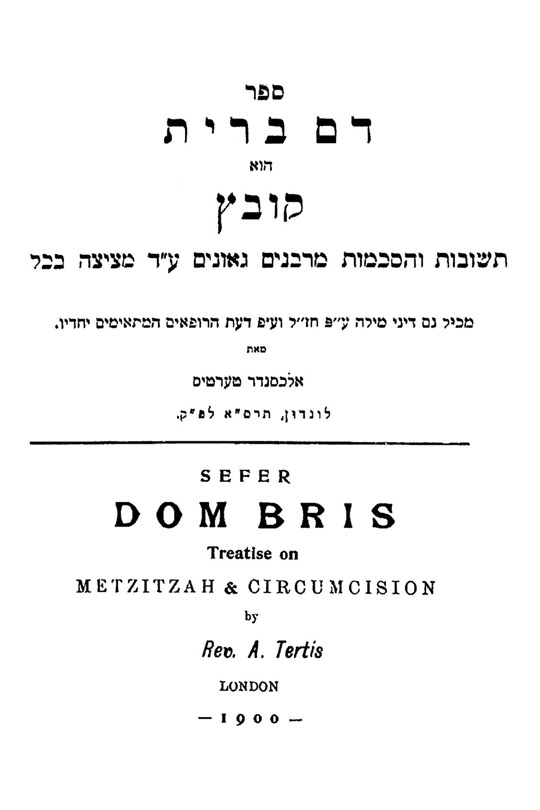
2. In my last post I mentioned that Agudat Israel has transformed itself into a lobbying organization. One of the areas they have been involved with is metzitzah ba-peh, so let me say a few things about this. It is really incredible how for many the debate around metzitzah ba-peh has become one in which the Modern Orthodox are one side, and the traditionalists on the other. I say this because the truth is that the virtually all of the rabbinic greats of Lithuania approved of metzitzah without oral contact. Alexander Tertis’ Dam Berit is a valuable resource that all interested in this matter must consult. Here is the title page.
On p. 33, R. Shlomo Cohen, the famed dayan of Vilna, says the following about metzitzah, which is very relevant to what we ourselves have seen (namely, the rejection of the firm opinions of countless doctors and scientists on the matter, all in the name of tradition).
דבר הזה אינו שייך לרבנים רק לרופאים המומחים ולכן אין לי מה להשיב על שאלתו
According to R. Shlomo, the question of how to perform metzitzah is entirely a medical issue, and the rabbis therefore have nothing to say on this matter, much like in all other halakhot dealing with medical issues the opinions of the doctors are determinative. (It hardly needs to be said that in matters of pikuah nefesh the opinions of thousands of experts, including the world’s most outstanding authorities, cannot be overruled by one idiosyncratic figure who appears to be motivated by non-scientific concerns.) 
Also of interest is that in 1906 R. Hayyim Ozer Grodzinski reported that in Vilna virtually all of the mohalim did metzitzah with a sponge. He wasn’t happy with this, but this was the reality.[4]
An interesting tidbit regarding metzitzah ba-peh is found in the Taz, Orah Hayyim 584:2. Here he mentions that he heard that R. Feivish of Cracow, when he circumcised on Rosh ha-Shanah, would not clean the blood out of his mouth. Rather, he would blow the shofar with the blood in his mouth so that the mitzvot of milah and shofar were joined.
Finally, for those who want to understand why it was only in the nineteenth century that metzitzah came to be regarded as central to the mitzvah of milah, Jacob Katz’s article “Polmos ha-Metzitzah” in his Ha-Halakhah ba-Metzar is crucial. In short, the centrality of metzitzah, and its description as a basic part of milah, is a product of the Orthodox defense of metzitzah in the face of Reform attacks. I think we are seeing something similar today. The digging in of haredi heels in defense of metzitzah ba-peh, complete with over-the-top rhetoric, is understandable (to a certain extent) and due precisely to the fact that it is an outside force that is threatening the practice. Had their own poskim suggested what the government is now insisting on, we would not have seen the same reaction. Yet it is still difficult for outsiders to grasp why some rabbinic leaders of these communities seem entirely oblivious to any medical dangers associated with the practice,  וסלחת לעונם כי רבנים המה
Let me say a few more things about metzitzah ba-peh. 

1. I saw on one of the blogs (I can’t locate it at present) that someone stated as self-evident that metzitzah ba-peh is only done with babies, not adults. The truth is that while the accepted opinion is indeed that metzitzah ba-peh is only done on babies (and maybe also on older child converts – I haven’t been able to find an answer to that), there are indeed opinions that even adult converts have to have metzitzah ba-peh performed on them. R. Moshe Klein (the son of R. Menasheh), Mishnat ha-Ger, p. 71, states without qualification that a convert has to have metzitzah, and if the mohel is afraid of catching a disease he should inquire of a posek if it can be done without the mouth. However, R. Yitzhak Yosef, Yalkut Yosef, Hilkhot Milah 6:1, rejects this viewpoint and states that there is no metzitzah, ba-peh or otherwise, with an adult convert.

2. According to R. Marcus Horovitz, Mateh Levi, vol. 2, Yoreh Deah no. 60, R. Samson Raphael Hirsch was prepared to accept the government’s abolishment of metzitzah without objection. It is difficult to square this assertion with Hirsch’s writings on the topic that show him as a strong defender of the practice.[5] Is it possible that Horovitz’s comment, meant as a criticism of Hirsch, reflects the difficult relationship these two men had?
3. In Iggerot Moshe, Yoreh Deah I, no. 223, R. Moshe Feinstein, in writing to a hasidic rebbe, expresses the standard viewpoint that metzitzah is only a medical procedure and has nothing to do with the mitzvah of milah. There is nothing surprising here. However, his correspondent had written otherwise, that metzitzah was an essential part of the mitzvah. In response to this, R. Moshe writes: חושב אני שהוא רק פליטת הקולמוס. The language R. Moshe uses implies that he did not know that among the hasidim metzitzah isindeed viewed as part of the mitzvah. Is it possible that R. Moshe was unaware of this? I don’t think so. It would appear, therefore, that the words I just quoted are a polite way of R. Moshe telling his correspondent that “what you wrote is without any substance.”
4. In 1994 R. Schachter’s Nefesh ha-Rav appeared. On p. 243 he states that R. Soloveitchik thought that today there is no need for metzitzah at all, not just metzitzah ba-peh. I remember how shocked I was when I read this, and was certain that it had to be wrong. As far as I know, no Orthodox authority has ever agreed to abandon metzitzah entirely, and I therefore couldn’t believe this report. My doubts were strengthened by the fact that R. Schachter quotes the Tiferet Yisrael as agreeing that metzitzah could be abandoned, when the truth is that the Tiferet YisraelShabbat 19:2, says the exact opposite, that metzitzah must be continued no matter what the doctors say.
As part of this post I wanted to include this page of Nefesh ha-Rav, so I went to Otzar ha-Hokhmah to download a PDF. Here it is.

Lo and behold, the copy on Otzar ha-Hokhmah is the third edition published in 1999, and there is a note on this page in which R. Schachter states that he has been told that what he wrote was incorrect, and that R. Soloveitchik only opposed metzitzah ba-peh. This makes much more sense and is what I assumed all along, so I was happy to see that my suspicions were confirmed.

R. Schachter recently spoke publicly about metzitzah ba-peh, and he is entirely opposed to it.[6] You can listen to his talk here.
Some might be surprised to hear R. Schachter say, after explaining that the Sages followed the most advanced medicine of their times, “When we look back at Chazal, look at medical statements in the Gemara, we laugh. . . . So you look back in the Gemara, it’s ridiculous, but the Gemara, in the days of the Tannaim, they were following the latest information of the doctors of their generation, of the scientists of their generation.”
I have to say, however, that R. Schachter is mistaken in his description of how the Hasidim understand metzitzah ba-peh. He incorrectly assumes that no one really regards it as a basic part of the mitzvah, i.e., halakhah le-Moshe mi-Sinai. “You know and I know and we all know that it is not halakhah le-Moshe mi-Sinai.” He claims that all those who do say it is halakhah le-Moshe mi-Sinai are exaggerating for rhetorical purposes, much like the expression yehareg ve-al yaavor is used for all sorts of things but is not meant to be taken literally. (R. Schachter himself created a good deal of controversy a couple years ago when he said that the refusal to ordain women was a matter of yehareg ve-al yaavor.)
Finally, I would like to make a general statement about how many in the Modern Orthodox world have been relating to metzitzah ba-peh. There is no question that for those in this segment of Orthodoxy, metzitzah ba-peh should not be done, both for medical reasons and also, I have learnt, for aesthetic reasons. With regard to the latter point, there is a sense among many in the Modern Orthodox world, and I myself have heard this and seen it in writing, that metzitzah ba-peh is “disgusting”. I understand that this is how people feel, but it is an improper feeling. Until the nineteenth century, metzitzah ba-peh was universal at every circumcision. How can observant Jews regard a practice that was basic in every Jewish community of the world as “disgusting”? I understand that it doesn’t fit in with today’s aesthetic sense, and that itself is perhaps reason enough for people not to do metzitzah ba-peh. However, everyone should be careful to avoid any denigration of metzitzah ba-peh that does not originate in medical concerns.
Don’t get me wrong, as I don’t mean that every practice that we find in Jewish communities throughout history should get such a “pass”, but here we are talking about a universal practice over thousands of years. It can’t be denied that there were “repulsive” and “gruesome” practices in Jewish communities.[7] Here are two cited by Shlomo Sprecher in his article mentioned in note 6: 1. Barren women would swallow the foreskin of newly circumcised boys as a segulah so that they could become pregnant. 2. Epileptics drank a potion that contained a girl’s first menstrual blood as a segulah to cure them of their epilepsy.[8]
I recently found another bizarre segulah that also falls under the rubric of “repulsive”, and I think that it would probably also be regarded by law enforcement as a form of sexual abuse. It comes from R. Zvi Hirsch Kaidonover (1646-1712), Kav ha-Yashar, ch. 51. For obvious reasons I am not going to translate this into English.
ועוד סגולה נפלאה לתינוק הנולד שלא יקרה עליו חולי נכפה בר מינן, מיד כשנולד ישימו בפיו ברית קודש של תינוק ויהיה ניצול כל ימיו מחולי נכפה
3. Following one of my previous posts I had correspondence with a reader and the discussion turned to the issue of how much of rabbinic literature is inner directed, that is, from intellectuals to other intellectuals.[9] I assume that this was the mindset of the Sages, and this explains some texts that I don’t think would have been recorded had there been an expectation that the masses would ever see them. In particular, I have in mind the talmudic stories that do not reflect well on certain rabbis. If we understand these texts as scholars talking to other scholars, then it makes sense that they would criticize each other, and even make fun of one another.[10] People in a closed community (in this case, the rabbinic elite) converse with one another in a different way than when outsiders are allowed in.[11] The problem is when the masses are studying Talmud, as today, that they have a difficult time with these texts, and Artscroll needs to explain them in an appealing fashion.
Here is one example of the sort of story I am referring to, that I assume was designed for internal consumption only, as it doesn’t reflect well on one of the Sages who is portrayed as being quite rude and insensitive. Taanit 20a-20b:
Our Rabbis have taught: A man should always be gentle as the reed and never unyielding as the cedar. Once R. Eleazar son of R. Simeon was coming from Migdal Gedor, from the house of his teacher, and he was riding leisurely on his ass by the riverside and was feeling happy and elated because he had studied much Torah There chanced to meet him an exceedingly ugly man who greeted him, “Peace be upon you, Sir”. He, however, did not return his salutation but instead said to him, “Raca,1 how ugly you are. Are all your fellow citizens as ugly as you are?” The man replied: “I do not know, but go and tell the craftsman who made me, ‘How ugly is the vessel which you have made’.” When R. Eleazar realized that he had done wrong he dismounted from the ass and prostrated himself before the man and said to him, “I submit myself to you, forgive me”. The man replied: “I will not forgive you until you go to the craftsman who made me and say to him, ‘How ugly is the vessel which you have made’.” He [R. Eleazar] walked behind him until he reached his native city. When his fellow citizens came out to meet him greeting him with the words, “Peace be upon you O Teacher, O Master,” the man asked them, “Whom are you addressing thus”? They replied, “The man who is walking behind you.” Thereupon he exclaimed: “If this man is a teacher, may there not be any more like him in Israel”! The people then asked him: “Why”? He replied: “Such and such a thing has he done to me.” They said to him: “Nevertheless, forgive him, for he is a man greatly learned in the Torah.” The man replied: “For your sakes I will forgive him, but only on the condition that he does not act in the same manner in the future.” Soon after this R. Eleazar son of R. Simeon entered [the Beth Hamidrash] and expounded thus, A man should always be gentle as the reed and let him never be unyielding as the cedar. And for this reason the reed merited that of it should be made a pen for the writing of the Law, Phylacteries and Mezuzoth.[12]
It appears that we see a continuation of this internal conversation in post-talmudic times. For example, I don’t think the rishonim who so harshly criticize their colleagues — I am referring to the colleagues they respected — would speak this way in a derashah before the common man. However, in internal dialogue they exercised more freedom. I think this can also explain the strange way that R. Isaac of Corbeil, the author of Sefer Mitzvot Katan, is referred to. He is called בעל החוטם. According to tradition, he was called this לפי שהיו לו שערות על החוטם.[13] Here too, I think that this was a humorous nickname that his colleagues knew him as, but not something that the average person would be expected to use. (Those who went to BMT will probably recall how various rabbis would speak of “Whitey Horowitz”. I don’t recall students ever referring to R. Moshe Horowitz this way.)  
I came across another example of what appears to be “internal conversation” from modern times that I think readers will find interesting. Both are found in R. Pinchas Miller’s Olamo shel Abba. Miller’s father, R. Asher Anshel Yehudah Miller, was a posek and author of seforim. I can’t imagine that the following comment, cited in the name of R. Shmelke of Nikolsburg, was something Miller, or R. Shmelke, wanted the masses to hear. Rather, I assume that it was an insider’s joke, designed to be shared among colleagues.
Shabbat 118b states that if Israel observes two Sabbaths properly they will immediately be redeemed. R. Shmelke explained that this refers to Shabbat ha-Gadol and Shabbat Shuvah. It is traditional that on these Sabbaths the rabbis give derashot before the community. R. Shmelke added that the rabbis act as if what they are saying is original to themselves, even though they have taken it from others. The Sages say that if you repeat something in the name of one who said it, you bring redemption to the world (Avot 6:6). Based on this text in Avot, R. Shmelke explained the above talmudic passage as follows: “If Israel observes two Sabbaths properly”, that is, if the rabbis who give the derashot on Shabbat ha-Gadol and Shabbat Shuvah (“two Sabbaths”) actually acknowledge where they get their ideas from (“repeat something in the name of one who said it”), “immediately Israel will be redeemed” (p. 501). This is such a provocative text because not only does it accuse the rabbis of plagiarism, but it states that the redemption itself is being delayed because of their behavior. If it was repeated by the masses it would be regarded as terribly degrading of the rabbis, but seen as a somewhat playful “derashah” to be shared among rabbinic colleagues, it loses much of its sharpness.[14]
There is another interesting passage on p. 326, which despite being humorous, I would have also assumed could only be said among colleagues. Yet Miller’s son tells us that his father used to repeat the following in his derashah at weddings: We know that it is a mitzvah to help the bride and groom to rejoice, but the rabbis come to weddings and instead of doing this, they deliver a long derashah and speak words of mussar to the young couple and thus disturb their joy.[15] That is why at the sheva berakhot we state שמח תשמח רעים האהובים כשמחך יצירך בגן עדן מקדם. In other words, we wish the bride and groom that their joy should be complete like the joy Adam felt when Eve was created for him, because in their time, in the Garden of Eden, there were no rabbis around who were able to disturb their joy!
* * * *
4. I want to call attention to a book that has just appeared. Its English title is Jewish Thought and Jewish Belief and it is edited by Daniel J. Lasker. You can read more about it here. It is available for purchase at Bigeleisen.
This is just the latest in a series of valuable books published by Ben Gurion University Press as part of the Goldstein-Goren Library of Jewish Thought. The articles that I think readers of this blog will find particularly interesting are David Stern, “Rabbinics and Jewish Identity: An American Perspective;” David Shatz, “Nothing but the Tuth? Modern Orthodoxy and the Polemical Uses of History,” Baruch J. Schwartz, “Biblical Scholarship’s Contribution to the Concept of Mattan Torah Past and Present;” Menachem Kellner, “Between the Torah of Moses and the Torah of R. Elhanan;” Tovah Ganzel, “‘He who Restrains his Lips is Wise’ (Proverbs 10:19) – Is that Really True?” and the symposium on Jewish thought in Israeli education, with contributions from R Moshe Lichtenstein and Adina Bar Shalom (R. Ovadia Yosef’s daughter).
Here are a few selections from Shatz’s article:
To be clear, academics, I find, generally shun blogs that are aimed at a popular audience because the comments are often, if not generally, uninformed (and nasty). A few academics do read such blogs, but do not look at the comments. One result of academics largely staying out of blog discussions is that non-experts become viewed as experts. Even when academics join the discussion, the democratic atmosphere of the blog world allows non-experts to think of themselves as experts and therefore as equals of the academicians. Some laypersons, though, as I said earlier, are indeeed experts in certain areas of history.
(In this quotation, one could also substitute “rabbis” or perhaps better, “poskim”, for “academics”, and “areas of halakhah” for “areas of history.”) Shatz is specifically speaking about historians, and contrasting experts vs. non-experts in this area. Yet when it comes to the sort of things I often write about here, I can attest that it is usually non-academics who are the real experts. Time and again I am amazed at the vast knowledge of so many of the people who read this blog. As for the general phenomenon of blogs, there are many people who for whatever reason (usually lack of interest, ability, or patience) are not going to write lengthy articles. Yet they often have a great deal to contribute, much of which is very important to the world of scholarship (almost always in terms of uncovering unknown sources and correcting earlier errors, as opposed to offering new interpretations or original theories). Academics ignore this to their own loss.[16]
In my future book I refer to numerous blog posts, and posts from the Seforim Blog have already been mentioned in a number of scholarly publications. My own reason for writing posts is because most of the material I discuss is, I think, interesting and sometimes even important. While this material is often not of the sort that can be included in a typical article, the genre of the blog post suits them just perfectly. Speaking of the Seforim Blog in particular, its readership encompasses a very large percentage of English speaking traditionally learned Jews of all backgrounds, beliefs, and professions (from Reform rabbis to Roshei Yeshiva and poskim, and everything in between). Thanks again are due to Dan Rabinowitz for providing this unique and wonderful platform.
Here are two more quotes from Shatz:
Be the causes what they may, there is an intramural struggle among the Orthodox, a competition for the soul of Orthodox Judaism, and the primary weapon with which it is being waged is history. For Modern Orthodox Jews today, instead of history being a threat to belief, as in earlier periods, it has become a way of arguing for one version of Othodoxy over another. And it is used for polemical purposes far more than philosophy. There are today few Orthodox philosophers, but comparatively many Orthodox academically trained historians.
Can the Modern Orthodox explain why it is admissible for Hummash and the Sages (in aggadot) to write non-accurately and provide inspiration and memory, but inadmissible for those on the right to write in that genre?
My article in Jewish Thought and Jewish Belief is entitled “Is there a ‘Pesak’ for Jewish Thought.” Those who publish know that it is often the case that only after it is too late does one realize that one’s article or book omits something important. Here too that was the case. In the article I discuss Maimonides’ view in Guide 3:17 that there is no punishment without transgression. That is, he rejects the notion of yissurin shel ahavah. I note that Maimonides claims that this is the opinion “of the multitude of our scholars,” and he cites R. Ammi’s opinion in this regard from Shabbat 55a. What is significant is that later in the sugya the Talmud states that R. Ammi’s opinion was refuted. Maimonides ignores this rejection, and even states that R. Ammi’s opinion is the majority view. This illustrates how Maimonides felt free to reject a talmudic viewpoint in a non-halakhic matter, even when it seems that the opinion is deemed authoritative by the Talmud.
What I unfortunately neglected to mention is that in Guide 3:24 Maimonides also deals with yissurin shel ahavah. Here he acknowledges that there are talmudic sages who accept this notion, but he adds that his own opinion, i.e., the rejection of yissurin shel ahavah, “ought to be believed by every adherent of the Law who is endowed with intellect.” In our own language, we might say that this viewpoint should be obvious to anyone with “half a brain.” Yet this is quite a shocking statement when one considers that there were talmudic sages who had a different perspective. Did Maimonides regard them as lacking intellect?
Here is another point I would like to add: In my Limits of Orthodox Theology I argue that it is most unlikely that Maimonides would choose to establish something as a dogma if it was a matter of debate among the Sages. (If establishing dogma was simply part of the halakhic process, this would not be problematic.) I see that R. Shlomo Fisher apparently has the same perspective, as he writes in his Hiddushei Beit Yishai, no. 107 (p. 413):
וגוף הדברים שכתב הרמב”ם בפה”מ ועשאן עיקר גדול תמוהין מאד. חדא, אם הם עיקר גדול היכי פליג עלה ר’ יהודה.
The issue of deciding matters of hashkafah in a halakhic fashion has also recently been discussed by R. Yaakov Ariel in his new book Halakhah be-Yameinu, pp. 18ff. I have to say that the more I read by Ariel the more impressed I am, as everything he writes is carefully formulated and full of insight. He strikes me as very open-minded with a good grasp of Jewish philosophy. He is, of course, also an outstanding posek. I now understand why it was so important for the haredim, under R. Elyashiv’s lead, to prevent him from being elected Ashkenazic Chief Rabbi of the State of Israel. What the haredim wanted, and were successful in this, was to destroy the Chief Rabbinate as a force to be reckoned with. The way to do this was to make sure that its occupant would be nothing but a “crown rabbi”. That is, they wanted to appoint a chief rabbi who is a figurehead, who interacts with the government on behalf of the haredi leadership, who goes around the world speaking about Jewish topics to the masses, and who can deal with non-Jews. What they absolutely did not want in a chief rabbi was a figure who had any rabbinic standing and who could thus challenge haredi Daas Torah.
At a time when much of the right wing religious Zionist world appears to have gone off the deep end, R. Ariel stands as a voice of sanity. Be it his attack on Torat ha-Melekh (a book which I still plan on discussing) or his strong rejection (together with R. Aharon Lichtenstein and R. Nachum Rabinovitch) of the outrageous letter written by Rabbis Tau, Aviner and others in support of Moshe Katzav, or his defense of women voting (arguing that today R. Kook would not be opposed; Halakhah be-Yameinu, p. 189) he shows that right wing religious Zionism need not be identified with the craziness we have been accustomed to see in recent years. 
Let us return to his recent essay where he argues, in opposition to what I wrote in my article, that Maimonides often does “decide” in matters of hashkafah no different than in halakhah. To illustrate his point, Ariel notes that there is a dispute among the Sages about whether there are reasons for commandments. He claims that Maimonides מכריע ופוסק  in accord with the position that there are reasons. He concludes:
אף על פי שלדעתו כללי ההלכה אינם חלים בענייני אמונה, בכל זאת ניתן להכריע את האמונה על פי דרך הלימוד הנקוטה גם בהלכה.
The notion of a pesak emunah, if it is to be parallel to a pesak halakhah, would mean that after Maimonides gives his pesak, in his mind it is now forbidden to adopt the other viewpoint (just as when Maimonides rules that something is forbidden on Shabbat) .Yet where does Maimonides ever say that there is an obligation to accept his viewpoint about reasons for the commandments? What Maimonides does is show why his viewpoint is correct, and Ariel cites these sources. But just because Maimonides wants his readers to adopt his own viewpoint, in what way is this a “pesak emunah”? Maimonides is simply expressing his strongly held belief. He is not ruling alternative positions out of bounds, as he does in deciding halakhah. This appplies as well to the other examples Ariel brings to prove his point. All he has established is that Maimonides argues for a position in matters such as the nature of prophecy and providence, but that is far removed from the notion that Maimonides saw his opinions as halakhically binding. On the contrary, just because Maimonides tells us what he thinks the Torah’s position is in a matter such as providence, he had no expectation that the masses would (or in some cases even should) follow him in this, and he was fully tolerant of the masses holding to their errant opinions as long as the matter was not an authentic dogma.
5. I have now finished my book on censorship. I can’t say when it will appear as it still has to be properly edited, typset etc., but hopefully this won’t take too long. I have loads of interesting material that for various reasons I was unable to include in the book, so the Seforim Blog will give me a good opportunity to bring it to the public’s attention. Let me begin with something sent to me by Rodney Falk.
Professor Louis Henkin, the son of R. Joseph Elijah Henkin, died in 2010. Here is his obituary as it appeared in Ha-Modia.


Notice what is missing! The obituary won’t even mention who his father was. Had Louis Henkin been a businessman or a doctor this information would not have been excluded, of this there is no doubt. But it is considered a disgrace to R. Henkin’s memory that his son was an intellectual, one who lived the life of the mind, and yet he didn’t become a rav or a rosh yeshiva . People in the haredi world can understand how not everyone is cut out to be a rosh yeshiva or sit in kollel, and these “unfortunates” are therefore forced choose a profession. But apparently, the notion that one who has the brains and intellectual stamina to become a great scholar might choose to devote himself to non-Torah subjects borders on the blasphemous for Ha-Modia. As such, while Louis Henkin can be acknowledged for his achievements, he has to be severed from his father’s house (the same father who sent him and his two brothers to Yeshiva College).
I think Yoel Finkelman has put the matter quite well in discussing the larger issue of which this example is  part and parcel of:
Haredi writers of history claim to know better than the great rabbis of the past how the latter should have behaved. Those great rabbis do not serve as models for the present. Instead, the present and its ideology serve as models for the great rabbis. Haredi historiography becomes a tale of what observant Jews, and especially great rabbis, did, but only provided that these actions accord with, or can be made to accord with, current Haredi doctrine. The historians do not try to understand the gedolim; they stand over the gedolim. Haredi ideology of fealty to the great rabbis works at cross purposes with the sanitized history of those rabbis.[17]
6. Rabbi Jason Weiner, a fine musmach from Yeshivat Chovevei Torah, has recently published a Guide to Traditional Jewish Observance in a Hospital. Formerly assistant rabbi at the Young Israel of Century City, he now serves as Senior Rabbi and Manager of the Spiritual Care Department at Cedars-Sinai Medical Center in Los Angeles. The book comes with approbations from R. Asher Weiss and R. Yitzchok Weinberg, the Talner Rebbe, and the halakhot in the book have been reviewed by Rabbis Gershon Bess, Nachum Sauer, and Yosef Shuterman. The book can be downloaded here.
7. Some readers have asked me about upcoming shul lectures. Here is what is on my schedule through Passover.
Feb. 15-16: Sephardic Institute of Brooklyn
March 1-2: Beth Israel, Miami Beach
March 8-9: Shearith Israel, New York
March 15-16: Beth Israel, Omaha
If any readers are interested in having me speak at their shuls, please be in touch.
8. No one got the answer to the last quiz, so let me do it again. The winner gets a copy of one of the volumes of R. Hayyim Hirschensohn’s commentary on Rashi. If you know the answer to the question, send it to me at shapirom2 at scranton.edu.

What was the first Hebrew book published by a living author?

[1] What does this last sentence mean? How can an attitude violate a biblical prohibition?

[2] As a good illustration of changes in attitude in the last forty years, here is what R. Norman Lamm wrote in his classic article on homosexuality in the 1975 yearbook of the Encyclopaedia Judaica. Such a sentence would, today, be quite politically incorrect, and regarded by gays as incredibly offensive: “Were society to give its open or even tacit approval to homosexuality, it would invite more aggresiveness on the part of adult pederasts toward young people.” 
[3] R. Meir Schiff (Maharam Schiff) is unique in believing that one without arms should put the tefillin shel yad on the head, together with the tefillin shel rosh. This is the upshot of his comment to Gittin 58a.
[4] See R. Sinai Schiffer, “Mitzvat ha-Metzitzah,” p. 106 (printed together with R. Sinai Adler, Devar Sinai [Jerusalem, 1966])
[5] See Eliyahu Meir Klugman, Rabbi Samson Raphael Hirsch, pp. 292-293.
[6] “Following in the Footsteps of Our Fathers,” Nov. 13, 2012.
[7] The words are those of Shlomo Sprecher from his article on metzitzah in Hakirah 3 (2006), p. 51.
[8] Speaking of drinking, take a look at this strange passage. It appears in R. Hayyim Rabbi’s letter at the beginning of R. Haggai Ben Hananyah’s Nimukei Levi (Ashdod, 2008), p. 2. Add this to the long list of texts that I refuse to translate.
בדין חלב אשה. נשאלתי פעם, אם בזמן תשמיש עם אשתו, החלב שלה אסור עליו, או שבעל ואשתו כגופו, ואין בו דין של יונק שרץ. ובפרט לטעם שמא יינק מבהמה טמאה, ובאשתו כגופו שהתירו לו בשעת פיוס וכו’, לא גזרו בזה. ויתכן שמותר כדין פסיק רישיה בדרבנן. ובנידון כזה, שזה חשש גזירה, גם בניחא ליה יש מקום להתיר. כן נראה לכאורה.
[9] The previous post is found here.
In the comments, Yehudah Mirsky wrote:

Fwiw, as I recall, Steve Wald in his book on Eilu Ovrin shows that the genuinely awful am-haaretz passages in Pesachim are a later stammatic addition, and that Jeff Rubinstein argues has a chapter on this in his “The Culture of the Babylonian Talmud” where he argues both that that sugya in Pesachim is sui generis in Hazal and – interestingly – reflects the Stammaim’s needing to justify their very scholastic lifestyle vis-a-vis people who were working for a living. Rubinstein cautions that the whole sugya may have been intended as a series of private jokes and need not necessarily reflect actual social relations between the stammaim and their surrounding society.

[10] Yeshayahu Leibowitz quipped that the Sages must have had a good sense of humor, since they included the following passage in the Talmud: תלמידי חכמים מרבים שלום בעולם. See Sihot al Pirkei Ta’amei ha-Mitzvot (Jerusalem, 2003), p. 289. In all seriousness, however, there are indeed humorous passages in the Talmud, as pointed out by R. Moses Salmon, Netiv Moshe (Vienna, 1897), pp. 45-46. Here is one example he gives (Bava Batra 14a).:
The Rabbis said to R. Hamnuna: R. Ammi wrote four hundred scrolls of the Law. He said to them: Perhaps he copied out the verse  תורה צוה לנו משה
Salmon claims that anyone with a bit of sense can see that R. Hamnuna’s reply is a wisecrack made in response to the obvious exaggeration about R. Ammi.
Nehemiah Samuel Leibowitz states that even in the Zohar we have passages that show a humorous side. One of the many examples he points to is Zohar, Bereshit, p. 27a:
וימררו את חייהם בעבודה קשה בקושיא. בחומר קל וחומר. ובלבנים בלבון הלכתא. ובכל עבודה בשדה דא ברייתא. את כל עבודתם וגו’ דא משנה.
See Leibowitz, “Halatzot ve-Divrei Bikoret be-Sefer ha-Zohar,”Ha-Tzofeh le-Hokhmat Yisrael 11 (1927), pp. 33-45. For more on humor in the Talmud, see Yehoshua Ovsay, Ma’amarim u-Reshimot (New York, 1946), ch. 1; R. Mordechai Hacohen, “Humor, Satirah, u-Vedihah be-Fi Hazal,” Mahanayim 67 (5722), pp. 8-19.
[11] Such a community also establishes special rules for itself, of which I can cite many examples. Here is one, from R. Solomon Luria, Yam Shel Shlomo, Bava Kamma 8:49:
ואם חוזר בפעם השלישי א”כ הוא משולש בחטא, אזי אין מניחין כלל לפדותו מן המלקות אלא ילקה בב”ד ודיו, אם לא שהוא בר אורין שאין ראוי להלקותו
After all we have seen in the last few years, I am quite certain that today the average person would not accept that when it comes to criminal matters that the rabbis should be given special privileges and exemptions.
[12] See also Va-Yikra Rabbah 9:3 where it describes how R. Jannai called his host “a dog”, and then learnt how wrong he was.
[13] See the introduction to the Constantinople 1510 edition of the work, reprinted in the Jerusalem, 1960 edition.
[14] On p. 187 Miller offers a different perspective. Here he quotes another rabbi who said that if necessary it is OK for one to repeat another’s hiddushim in the Shabbat ha-Gadol derashah, because the Sages tell us (Pesahim 6a): שואלין ודורשין בהלכות פסח.  This means:
מותר “לשאול” מאחרים בשעת הדחק ולדרוש בהלכות פסח
[15] I am told that it is still the practice in certain communities for the rabbi to deliver a derashah at a wedding..
[16] I think in particular of S.’s wonderful blog On the Main Line, which routinely provides important, and until now unknown, primary sources that are vital to a wide range of areas of scholarship.
[17] Strictly Kosher Reading, p. 122.


Marc Shapiro: What Do Adon Olam and ס”ט Mean?

What Do Adon Olam and ס”ט Mean ? [1]
by
By Marc B. Shapiro ס”ט
1. People often refer to me as a Modern Orthodox intellectual. There are actually quite a number of us out there. If you hear someone using words like “ontological,” “existential,” “mimetic,” and now, “tergiversation”[2] you can assume he in in our club. Also, another telltale sign is that when we give divrei Torah you will hear us refer to Philo, the Apocrypha, Pseudepigrapha (if we are confident that we can pronounce the word properly[3]), Shadal, or Cassutto.[4] Of course, we are careful to only say Midrash, and never Medrish, as the latter pronunciation is a sure sign of a Philistine.
It is no secret that Modern Orthodox intellectuals like to look down on Artscroll, and to let others know about this. So we must find places where Artscroll makes mistakes. It is not enough to point to the vastly different historical conceptions between us and Artscroll; we need to find places where Artscroll simply got it wrong (for one such example see here). This will show that even if they are conquering the world, they shouldn’t think that they are so brilliant. I am not speaking about the Artscroll Talmud (which we use when no one is looking) or the Artscroll “History” series, which is not popular with the Modern Orthodox.[5] I am referring to the Artscroll siddur and chumash which have taken over the Orthodox world. (The Modern Orthodox intellectuals must have been so busy these last twenty years producing articles read by each other that it never occurred to them to produce their own siddur and chumash.)[6]
But finding these errors is easier said than done. I am not referring to run-of the-mill errors, but the sort that will impress people at your Shabbat table. That way you can show them that you are a Modern Orthodox intellectual, and not afraid to stand up to Artscroll, this generation’s anti-Messiah. Artscroll is the Goliath, and if it can be felled, then Feldheim, Targum and certainly the minor leaguers at Aish Ha-Torah will be that much easier to take down. If the obscurantists are not yet shaking in their feet, once they see our ever-forthcoming translation of the Arukh ha-Shulhan, which will bring back the 1950’s and the “mimetic tradition”, this will put them in their place.
As I state, it is not so easy to find the perfect mistake. One could point out that in the Artscroll siddur, p. 320, it refers to a “responsa” of Maimonides, when the word they should have used is “responsum.” But this clearly won’t do the trick. After all, no one assumes that Artscroll is an expert in English; it is because Artscroll is expert in Jewish things that it has become so popular. For a while I thought that I could impress those ever-impressionable Shabbat guests by pointing out that contrary to what the Artscroll siddur, p. 870, states, R. Eleazar Kalir was not a tanna. But again, this is not something that most people care about. Besides, someone always ended up pointing out that no less than Tosafot claims that he was a tanna, and my protestations about what Shir proved were always met with blank stares, for what does a Prague song have to do with anything?
And what about when I showed people that in the chumashim printed until 1999, Lord Jakobovits, who died in that year, is referred to as Emeritus Chief Rabbi of the British Empire (see one of the first pages of the chumash where it lists the important people involved with Artscroll). On the title page of Hertz’s chumash he is referred to as “Late Chief Rabbi of the British Empire,” and the Jakobovits reference might be trying to parallel this. All my protestations that Jakobovits was never Chief Rabbi of an Empire (which had ceased to exist before he came into office) but of a Commonwealth have never found anyone showing much interest. (The technical title is Chief Rabbi of the United Hebrew Congregations of the Commonwealth. The title is more grandiose than the office. At most, there are 300,000 Jews in the United Kingdom (as, at present, no one in Australia, Canada, Zambia, etc. looks to the British Chief Rabbi for religious guidance). Subtract the unaffiliated, Reform and Masorti from this, and then subtract the Haredim and the Sephardim and this will give you the number of Jews represented by the Chief Rabbi.)
There was actually a very big error I used to point out, and this was found in the Artscroll Shabbat Zemiros (it has since been corrected). At the beginning of the Shalosh Seudos section Artscroll wrote:
The three meals of the Sabbath symbolize the three Patriarchs, the three divisions of Scripture: Torah, Prophets and Hagiographa, and the three feasts through which Esther brought about Haman’s downfall. Many matters of awesome spiritual significance are dependent on the Third Meal as the Zohar discusses frequently (Aruch HaShulchan 291).

This is a very strange passage, since what does Esther have to do with the Three Sabbath meals? Furthermore, since when did Esther organize three feasts? Everyone who attends synagogue on Purim knows that there were only two feasts. This is what the Arukh ha-Shulhan states:
ויהא זהיר מאד לקיים סעודה שלישית ואמרו חז”ל דכל המקיים סעודה ג’ ניצל משלש פורעניות . . . ואם אפשר שאינן ממש מן התורה מ”מ ודאי מתקנת משה רבינו הם שכן קיבל מסיני והם מרמזים נגד ג’ אבות, נגד תורה נביאים וכתובים, ובשעה שניתן להם המן ניתן להם על ג’ סעודות
What happened was that whoever wrote the commentary to the Zemiros understood the word המן (the manna) to mean Haman, and that he was given into the Jews’ hands because of three feasts![7]
Artscroll did what everyone should do when an error is brought to their attention, namely, correct it in a future edition.. (In another post I plan on noting a couple of corrections to my own writings.) In fact, this is a good lesson to all of us, because if Artscroll, whose writers are big talmidei hakhamim, could make such a simple mistake, then all of us should realize that we too can make simple errors.
The important thing is that they corrected the error. If only the same could be said about Mossad ha-Rav Kook. There has already been discussion on this blog about some problems with the Chavel edition of Ramban. In fact, although both the Commentary on the Torah and Kitvei Ramban have been reprinted about twenty times, many obvious errors have still not been corrected. I was planning on giving one example, but I wasn’t sure which one to use. About five minutes before writing this I received a call from the owner of www.publishyoursefer.com, which will soon be reprinting Kitvei R. Weinberg. He informed me that there are many students at the Ner Israel yeshiva who follow the Seforim Blog, pleasant news indeed. In their honor, since unlike myself, they spend most of their day involved in the intricacies of the Talmud and its commentators, my example will be from the introduction of Ramban to his Dina de-Garmei, a work which only a real talmid hakham would try to tackle. The text is found in Kitvei Ramban, vol. 1, p. 417. Ramban writes
אבל יש אשר קולמוס הראשונים סתמן
ועתה נעלם טעמן מעיני תלמידי הזמן
וחכמי הצרפתים אספו רובן אל עמן
הם המורים, הם המלמדים, הם המגלים לנו נטמן
Chavel explains the third line to mean
חכמי הצרפתים אספו רובן של הטעמים הללו לתוך ספריהם להיות לעינים של תלמידי הזמן
Yet this is incorrect. What the Ramban means is that most of the French sages have left this world and gone on to their eternal reward.
Getting back to Artscroll, I was pleased when I found the perfect example of an Arscroll error, and this in a prayer that we all know well, Adon Olam. What do these words mean? To answer this, most people will open their Arscroll siddur.[8] Artscroll translates, “Master of the Universe”. This, or similar translations (e.g., Lord of the Universe, Master of the World) seem to be standard. Yet for a while I was convinced that the proper translation was “Eternal Lord.” After looking at the song as a whole, and seeing how it speaks of God’s eternity, it appeared clear to me that this is what the first two words mean.
I was happy to find that both Birnbaum and De Sola Pool (both of which are now almost impossible to find in any synagogue) understood the first two words this way as well. So happy was I with my idea that I made sure to tell lots of people about it, all of whom were very impressed, since here was a bona fide correction to Artscroll. I was in London a couple of months ago and was davening with the new siddur published by Rabbi Jonathan Sacks. Lo and behold, I found that he too translated the words as did Artscroll. After davening the rabbi of the shul asked me if I liked the new siddur and I told him yes. I also used the opportunity to point out that even this wonderful siddur mistakenly translates the first words of Adon Olam. It seemed that he too was impressed. I certainly thought that for the rest of my life I would be able to pull this out of my back pocket whenever I needed to show that even Artscroll, the veritable Urim ve-Tumim, can make a mistake.
But alas, all good things come to an end. The very next morning after speaking to the London rabbi, I went to a hashkamah minyan and the siddur I chose to use was Ha-Siddur ha-Meduyak. This siddur is produced by the Kise Rahamim Yeshiva in Bnei Brak. This is a Tunisian yeshiva under the leadership of R. Meir Mazuz, who is known by the acronym נאמן ס”ט. In addition to the siddur, they have also produced a variety of other books with the title “Meduyak.” This is because every line has been carefully examined by R. Mazuz, who does not hesitate to make corrections, even if the version he is correcting has been in use for many hundreds of years.[10] This has been very controversial and R. Dovid Yitzchaki, in various articles, has harshly polemicized against R. Mazuz. As we have come to expect, Yated Ne’eman quoted the condemnation issued by maranan verabonon gedolei Yisroel, in which these books were described as terrible breaches in Judaism. The implication to be drawn from the attack is that R. Mazuz and his students are dangerous reformers.[11]
R. Mazuz did not rest, and the 2005 edition of the siddur (which I purchased from mysefer.com) contains letters of support for R. Mazuz from R. Ovadiah Yosef, R. Shlomo Amar, R. Shmuel Wosner, and R. Shimon Alouf of the Brooklyn Syrian community. There is also a letter from “Ha-Gaon he-Hasid” R. Dov Kook, the son-in-law of R. Yitzhak Zilberstein, who is himself the son-in-law of R. Eliashiv. This is significant since R. Elyashiv was at the forefront of the condemnation. As the Yated article states:
Woe to a generation in which every man does as he sees fit. And the matter should be publicized to prevent others from being drawn in by their ways,” write maranan verabonon gedolei Yisroel headed by Maran HaRav Yosef Sholom Eliashiv shlita, in a letter opposing the publication of “precise” (“meduyak”) editions of Chumoshim and Tehillim as well as new siddurim and machzorim that contain grave breaches and changes from the accepted tradition handed down to us.
Yet R. Dov Kook writes to R. Mazuz about how much he benefited from using the Siddur Ha-Meduyak!
R. Mazuz is a very interesting personality. To begin with, he had a close connection to Habad for many decades, having taught in a Habad school in Tunis in the 1960’s. Yet when he saw the Messianic fever and other problems in Habad, he publicly condemned what was going on and wrote a long letter detailing his objections.[12] In addition, he was very vocal in support of the Gaza settlers.[13] He is also the only one of our gedolim who is an expert in arcane areas such as grammar,[14] Masorah, and medieval Hebrew poetry.
In fact, since he is an expert in this latter field, I knew that I could ask him a question about which most other gedolim would probably have no clue what I was talking about. One doesn’t need to have read Steve Greenberg’s book, or have listened to some of the gay advocates speaking around the time of the recent Jerusalem parade, to know that man-boy love is a theme in a number of medieval Hebrew poems.[15] I raised this issue with R. Mazuz, and was pretty sure that he would answer the way he did:
חס וחלילה להאמין שחכמי ספרד כתבו שירים מענין משכב זכור. וראה בסוף ס’ תחכמוני שהביא עשרה שירים לקלל ולארר נבל אחד שכתב “לו שר בנו עמרם פני דודי” וכו’. צבי חן הוא כינוי לעלם יפה ואין בו כל דופי. חוקרי זמננו מהרהורי לבם ותעתועי רוחם כותבים מה שכותבים
(The reference to the Tahkemoni can be found in the Warsaw, 1899 edition, ed. Kaminka, pp. 430ff.)
R. Mazuz is also the final halakhic authority for the Tunisian community. With the death of R. Shalom Messas, chief rabbi of Jerusalem, I think that after R. Ovadiah, R. Mordechai Eliyahu and R. Shlomo Amar, R. Mazuz is the most important of the Sephardic rabbis in Israel. He is also very close to R. Ovadiah, who has had a long attachment to Kise Rahamim. The yeshiva is unique in that it focuses on the old Tunisian approach to the study of Talmud (the Tunisian iyyun), and from very young the students are taught to master the art of Hebrew writing [16] and to acquire wide-ranging knowledge of Tanach. We are clearly dealing with an unusual man and an unusal yeshiva. Returning again to the Chavel edition of the Ramban, I should mention that R. Mazuz is pretty harsh in his evaluation of it, and he lists a number of errors.[17]
When I first starting looking into the Thirteen Principles, I wondered how, in the Eighth Principle, Maimonides could insist on complete Mosaic authorship, and assert that denial of this equals heresy. After all, there is a view mentioned in the Talmud, and quoted by Rashi on chumash, that the last eight verses were written by Joshua. And yet, people were saying that since kelal Yisrael accepted the Ikkarim, this view must now be regarded as kefirah. I asked R. Mazuz about this and he replied:
ולענין שמנה פסוקים אחרונים ודאי האומר שכתבן יהושע אינו נחשב אפיקורוס ח”ו
I was also curious to know what he would say about study of the Ralbag’s Milhamot ha-Shem, which differs with Maimonides’ principles when it comes to creation ex nihilo and God’s knowledge of particulars.[18] He wrote to me as follows:
ודברי רלב”ג במלחמות ה’ ידועים. וזו היתה צרת הפילוסופיא היונית שלכדה ברשתה רבים וכן שלמים (כמו שלכד יצה”ר דע”ז בזמנו את מנשה בן חזקיה וחבירו ואפ”ה למדים מהם הלכה למעשה ע’ סנהדרין דף קב ע”ב). בס’ מלחמות ה’ אסור ללמוד רק מי שמילא כריסו ש”ס ופוסקים וצריך לעיין בו משהו לפי שעה. וכבר כינוהו הרב אברבנאל והיעב”ץ “מלחמותיו עם ה'” (ח”ו). אבל בפירושו על התנ”ך מותר ללמוד ויש בהם דברים נפלאים וחכמה עמוקה, אם כי לפעמים נטה מדרך היושר. וה’ הטוב יכפר בעדו
Throughout R. Mazuz’s writings, one finds interesting comments about the great medieval Jewish philosophers. Let me offer one such example.
In Guide 2:32 Maimonides speaks about the nature of prophecy and the prophet. One of the qualifications for a prophet is that he be intellectually advanced. Maimonides writes:
But with regard to one of the ignorant among the common people, this is not possible according to us – I mean, that He should turn one of them into a prophet – except as it is possible that He should turn an ass or a frog into a prophet.
Both Efodi and Shem Tov understand the last words as an allusion to Balaam’s ass and the fish that swallowed Jonah (and to whom God spoke), and understand both stories to have happened in dreams. Maimonides is, of course, explicit about the Balaam episode, and Efodi and Shem Tov see no difference between this and the Jonah story. Interestingly, Efodi says this elsewhere as well, but as Lawrence Kaplan has pointed out it was censored from the 19th century edition of the Guide that remains the standard edition (full details will be found in my forthcoming book). But the reason why that passage was censored was not because of the Jonah reference. After all, no less a figure than the Vilna Gaon saw the Jonah story as an allegory. The problem with the censored passage, and the reason it had to be taken out, was because there Efodi writes that according to the Rambam the Akedah also only happened in a dream.
According to R. Mazuz, Efodi and Shem Tov misunderstood Maimonides here, and if he was alluding to what they claim, he would have written fish, not frog. The key to understanding Maimonides are his words earlier in the chapter:
It is not possible that an ignoramus should turn into a prophet; nor can a man not be a prophet on a certain evening and be a prophet on the following morning, as though he had made some find.
In R. Mazuz’s opinion, this is a clear allusion to Muhammad, who according to Muslims was an illiterate man to whom Gabriel appeared and commanded “Read” (or “Proclaim”), and he was thus turned into a prophet. R. Mazuz concludes, “It is this sort of ‘prophet’ that Maimonides refers to as an ass or frog.”[19]
What does any of this have to do with Adon Olam? When I was using the siddur I began to study R. Mazuz’s notes (pp. 660ff.) to R. Yehudah ha-Levi’s piyyut Mi Kamokha, which Sephardim recite on Shabbat Zakhor. (For those who are Haim Sabato fans, this piyyut makes an appearance in ch. 10 of his recent book, Ke-Afapei Shahar) The first stanza of the alphabetical piyyut begins with the word אדון. On this word, R. Mazuz explains why the first letter has a kametz under it, and he contrasts that with אדון עולם אשר מלך, in which the aleph has a hataf patah since it is a construct, and means אדון של עולם.
When I saw this I was quite surprised, and upset, because here was R. Mazuz, whose knowledge of the ins and outs of the Hebrew language is perhaps unmatched except by a few specialists who spend their lives on this (while R. Mazuz’s forays into Hayyuj, Ibn Janach, and Radak’s Shorashim are as rakahot ve-tabahot to the study of Talmud and halakhah). Yet here he was explaining Adon Olam as Master of the World. I wrote to him asking why he assumed this is what it meant, especially as the piyyut as a whole seems to be speaking of Eternal Lord, the one who was here before the world and who will be here when the world ceases.
Although Adon Olam is a post-biblical prayer, as a side point I also noted that as far as I knew, the word עולם in Tanakh never means “world” (for which תבל is used) but always means ancient, eternal, eternity, or something along those lines. In fact, I was actually certain of this, and I had first heard this point twenty years ago when I was spent my junior year at the Oxford Centre for Hebrew Studies. I was fortunate to be able to study Biblical Hebrew, one-on-one, for an entire year with Professor Jeremy Hughes, author of Secrets of the Times: Myth and History in Biblical Chronology. Hughes was a strange combination of hippie and Bible scholar, and I learnt a great deal from him. I still remember my surprise at being told, when I used the word חזר in one of my exercises, that this is not a biblical Hebrew word, and I must use שב. He also pointed out the error in Weingreen’s Practical Grammar for Classical Hebrew, p. 110, which gives “world” as one of the translations of עולם. I wasn’t sure that he was correct, but a glance at the BDB confirmed his point.
A few weeks ago I received a letter from R. Mazuz, and well, let’s just say that I won’t be trying to impress people any more by pointing out that Artscroll has mistranslated Adon Olam. To begin with, R. Mazuz insists that Adon Olam is identical with Ribbono shel Olam. As for my point about “olam” never meaning “world” in the Bible, he writes:
זו דעת החוקרים האחרונים שעולם בתנ”ך פירושו נצח, אבל חז”ל לא הבינו כן
As proof for this he refers to Berakhot 54a
כל חותמי ברכות שבמקדש היו אומרים: עד העולם. משקלקלו הצדוקין ואמרו אין עולם אלא אחד התקינו שיהו אומרים מן העולם ועד העולם
At the conclusion of the benedictions said in the Temple they used at first to say simply, “forever.” When the Sadducees perverted their ways and asserted that there was only one world, it was ordained that the response should be “from world to world” [i.e., two worlds].
He also called attention to a passage in Sanhedrin 58b where the verse in Ps. 89:3, עולם חסד יבנה, is understood not as “forever is mercy built,” but as “the world shall be built up by grace.”
As I said, I am forced to conclude that in this case Artscroll gets a pass. What then is a Modern Orthodox intellectual to do? Anyone want to hear about Kalir?
Since everything with me seems to come back to the Thirteen Principles let me make one more point about Adon Olam. This time, I refer to the appearance of these words in Yigdal, and here there is no question that the words mean “Master of the Universe”. The passage reads
הנו אדון עולם לכל נוצר יורה גדולתו ומלכותו
Artscroll translates: “Behold! He is Master of the universe to every creature, He demonstrates His greatness and His sovereignty.” The translation is correct, but the problem is that this has nothing to do with the Fifth Principle. The Principle says that one cannot worship any other being but God (or use these beings as intermediaries to reach God). Because of this Birnbaum has the following in his siddur:
הנו אדון עולם וכל נוצר יורה גדולתו ומלכותו
By changing one letter, the stanza now agrees with the Principle. The problem here is that Birmbaum’s emendation, while it makes sense, is not actually a “version”. That is, there is no manuscript that reads as such. It is a speculative emendation. Abraham Berliner,[20] on the other hand, cites an actual variant text:
הנו אדון עולם וכל יוצר יודה גדולתו ומלכותו
The word יוצר is presumably a mistake for נוצר, although יודה makes sense. In fact, the Siddur ha-Meduyak offers וכל נוצר יודה as an alternate version for those who prefer that Yigdal actually correspond to the Principles.
2. Since I mentioned the Gaon נאמן ס”ט now is as good a time as ever to explain what the acronym ס”ט means. I am sure that even after what I write people will continue to err, but at least the yehidei segulah who make up the Seforim blog readership will know the truth, and will be ready offer a correction next time they hear someone refer to a ספרדי טהור.
Contrary to widespread belief ס”ט does not mean ספרדי טהור!! To be sure, you can find people today, even Sephardim, who will assert that this is what it means. But historically, it never meant this, and today, among the talmidei hakhamim who use it, this is not what it means.
How, you might be thinking, do I know this? The easiest answer is that the Hakham Zvi and R. Yaakov Emden both use the abbreviation, and neither of them were Sephardi. What it does show, however, is that the Hakham Zvi, who studied in Sephardic yeshivot and served as hakham to the Sephardic community in Sarajevo, adopted an abbreviation common in the Sephardic world. Those who study Sephardic works know that this is hardly the only example of an abbreviation which is not found in Ashkenazic works.
Furthermore, we have to ask what could the very expression ספרדי טהור mean? Presumably, it would refer to those who are not descended from Marranos. Yet we find that the abbreviation was used in an era before there was religious persecution in Spain. For example, R. David Abudarham, in the introduction to his work, attaches ס”ט to his name. Also, in Teshuvot R. Yehudah ben ha-Rosh, no. 75, two people sign with the abbreviation. What possible sense could ספרדי טהור have in early fourteenth century Spain, before the religious persecutions, not to mention in a place where everyone was Sephardic and there was no need to differentiate oneself from the uncultured Ashkenazim?
So what does ס”ט mean? Some have suggested that it stands for סין טין which is the Aramaic for רפש וטיט (Isaiah 57:20) and means mire and dirt. This would be like many other rabbinic expressions that show the author’s humility. H. J. Zimmels has correctly noted that “this explanation is not convincing as one would expect SvT = Sin ve-Tin (mire and dirt).[21] I would also add that while authors often use similar expressions – e.g., עפר ואפר – when referring to themselves, who ever heard of referring a great rabbi in such a way? It would be the height of disrespect, and yet we do find people writing to sages and attaching ס”ט to their names, showing that they didn’t have this explanation in mind.
Zimmels notes that Zunz already pointed out that the abbreviation stands for סופו טוב, which means, “may his end be good.”[22] It is also possible that the Aramaic סיפיה טב was intended.[23] This is parallel to the Ashkenazic שליט”א, the difference being that, unlike with ס”ט, no one adds שליט”א to his own name. R. Mazuz sums up the matter as follows (Or Torah [Tamuz 5733], no. 110):
ומכלל האמור תבין, שמה שכותבים כמה מאחינו האשכנזים (כגון בספר שם הגדולים וואלדען) על רבנים ספרדים ס”ט לאחר פטירתם, ויש אפילו הכותבים רב פלוני ס”ט זצ”ל, הכל טעות, ויסודו בפירוש המשובש הנ”ל ספרדי טהור, כאילו ישנה התנשאות הגזע לספרדים על אחיהם האשכנזים. ולפי הבאור הנכון “סיפי טב”, נמצא הכותב ס”ט זצ”ל ככותב שליט”א זצ”ל בנשימה אחת. ופשוט שגם “אשכנזי טהור” יכול לחתום ס”ט בלי שום פקפוק, כמו שחתמו הגאונים חכם צבי והיעב”ץ הנ”ל. ותשקוט הארש
(The last words are a play on the expression ותשקוט הארץ that appears a number of times in Tanakh. Its meaning here is that all speech or utterance will cease, i.e., there is no need for any more discussion or argument about the issue.[24])
If there are still any who have doubts, let me also quote the words of the great R. Shalom Messas, late Chief Rabbi of Jerusalem and unquestioned leader of the Moroccan community until his death a few years ago. In 2007 the fourth volume of his Shemesh u-Magen appeared. On p. 193 he writes:
הדבר פשוט וגם ברור אצלינו שהכוונה היא סיפיה טב, ר”ל שאחריתו יהיה טוב, ומעולם לא נתכוונו על ספרדי טהור כלל . . . ורק פירוש זה יצא מהמקנטרים שרוצים לעשות פירוד בין הספרדים לאשכנזים, ובאמת כל ישראל קדושים וטהורים הם בני אברהם יצחק ויעקב, אין ביניהם כמלא נימא
Now if only Yated Ne’eman and the haredi school systems in Israel would take these last words to heart![25]
Appendix 1
In my post responding to Rabbi Leff I elaborated on the fact that according to the Rambam the mezuzah does not provide any physical protection. Most Jews throughout history have disagreed with Maimonides, and a good example of this can be seen in the song my children learned in nursery school. The lyrics are as follows, and in the song each line is repeated twice.
I have a mezuzah
On my door
Now I will tell you
What it’s for
To protect us
Day and night
Kiss it when you enter
It’s on your right
This summer my three year-old came home from camp with the same song, but with different lyrics.
I have a mezuzah
On my door
Now I will tell you
What it’s for
To kiss it
That’s our aim
For on it is written
Hashem’s name
While the original manuscript of the song appears to be lost, I have no doubt that the first version is the original. The words in the second version are clumsy, and don’t fit the song very well. I therefore assume that the second version contains theologically-based textual emendations of the sort Geiger describes in his Urschrift. A critical edition of Jewish children’s songs remains a scholarly desideratum.
Appendix 2
When I asked R. Mazuz about his abbreviation ,נאמ”ן ס”ט he told me that in the book Rosh Mashbir by R. Berdugo one can find a number of examples of rabbis using such abbreviations. I haven’t yet looked through the book, but I did glance at the introduction by R. Yosef Messas. Messas was Chief Rabbi of Haifa, pride of the Moroccan rabbinate, and a great defender of R. Kook, yet unfortunately fate has destined him to be only remembered as the posek who permitted marrried women to go with uncovered hair and who permitted the use of electric hanukkah menoras. He ends his introduction to Rosh Mashbir with following words
עבד אל דוק וחוג אשש יוסף משאש ס”ט
This is a very unusual expression. I recalled that I had seen his cousin R. Shalom Messas also use it. In fact, I did a search on the various databases and other than these two, no one else signs his name this way, so it obviously was a family tradition..But what does it mean? In the search I turned up a comment by Shalom Albeck, in his edition of the Eshkol (the authentic Eshkol), p. 11 n. 9, who notes a piyyut by R. Yitzhak Ibn Ghiyat that begins
ברוך אשר אשש דוק וחוג בעשרה מאמרות
This piyyut was recited on Yom Kippur morning in North Africa, and we now know that the author was actually R. Joseph Ibn Avitur. But the question still remains, what do these words mean? Fortunately, R. Simeon ben Zemah Duran (the Tashbetz) wrote a commentary on this piyyut, and it has been published in a wonderful edition by Raphael Kohen (Jerusalem, 2002). Citing the relevant biblical texts upon which the words are based, Tashbetz explains the line as follow: “Blessed be he who established heaven and earth with ten utterances.”[26]
Thus, the Messas expression means “Servant of God, who established heaven and earth.”
Incidentally, Kohen, the editor of the Tashbetz’s commentary, is also the editor of R. Solomon ben Samuel’s Pithei Olam (Jerusalem, 2004). Kohen adds his own lengthy essay to this volume and it is of bibliographical interest in that it is probably the most vicious and insane attack of other scholars in the last hundred years (much worse than anything R. Shemariah Menasheh Adler wrote). When Kohen hates you, he says so openly. Thanks to him, we can even add two new acronyms to the Hebrew language. He adds the following after the names of all the distinguished scholars he despises (and it’s the final two acronyms that appear to be original to him).
שר”י ישו”ז תו”ע אל”ב
This means:
שם רשעים ירקב ימח שמו וזכרו תימקנה ותשחקנה עצמותיו אסור לעסוק בקבורתו


Notes:
[1] I had intended my next post to be part 2 of my discussion of Auerbach’s Eshkol. However, I still need a couple of books to complete it, so instead I decided to post this.


[2] For example see here.
[3] A number of years ago I attended a session at the American Academy of Religion annual conference. I am not ashamed to admit that I didn’t understand what they were talking about. I understood the words, but the sentences didn’t make any sense to me. It was a different language. Yet there was a woman sitting near me who kept making comments and referring to gnosis, but the problem was that she kept pronouncing the “g”. I didn’t hold that against her. You can certainly know what you are talking about and mispronounce a word, since if you have never heard it spoken, how are you supposed to know? And there are certainly many examples of people who pronounce a word perfectly, but don’t know what it means. I struggled with myself as to whether I should put a note in front of her, pointing out that the “g” is silent.. I decided not to, figuring that since she didn’t know she was mispronouncing it, she was not embarrassed, and over time she would learn. This is different than the case of the speaker some years ago who kept referring, in his talk on Hasidism, to the Zaddik, pronouncing the “z” as a “z”, not a “tz”.
[4] I was at an event where one such intellectual even referred to the Tao!
[5] The one quality history book – and it is a really fine piece of work – published by Artscroll is Eliyahu Klugman’s biography of Hirsch. But unfortunately, even he couldn’t be totally honest. Thus, we find the following on page 66: “Reb Shraga Feivel Mendlowitz, the first great Torah educator in America . . .” Is it possible that Klugman has never heard of Rabbi Bernard Revel and Yeshivas R. Yitzchak Elchanan? Regarding Mendlowitz, and the great respect he gets from the haredim, I have always assumed that they are unaware of his great love for the teachings of R. Kook. Listen to Menachem Mendlowitz, “The Complexity of Greatness: My Grandfather, Rav Shrage Feivel Mendlowitz” at Torah In Motion here.
R. Shraga also planned to open, together with R. Hutner, the American Hebrew Theological University. This is discussed in Helmreich’s World of the Yeshiva. This institution would have been just like Lander College. For a relevant source which, as far as I know, has gone unnoticed, see Otzrot Yerushalayim (5741), no. 601. Here we find that Mendlowitz wanted the Mir Yeshiva in New York to institute secular studies. (The author of this report, R. Moshe Yehudah Blau, was the world’s greatest editor of rishonim from manuscript, long before this became fashionable.)
[6] It is easy to see why the Artscroll siddur replaced the Birnbaum. It is simply better, i.e., much more complete (although I wonder who gave them the crazy idea to put the English in italics). But I am not sure what makes the Artscroll chumash “better” than Hertz. It is different, to be sure, but I think that a typical Modern Orthodox congregation would still be well-served by Hertz, if not exclusively, certainly in addition to Artscroll. I don’t understand why all the Hertz chumashim were carted away, never to be seen again. The RCA chose to make the Artscroll siddur its siddur (adding in the prayers for the government, the State of Israel, and the IDF). The fact that the first RCA siddur, edited by De Sola Pool and published in 1960, never achieved lasting popularity, and Artscroll was willing to put aside its anti-Zionist ideology when presented with the possibility of selling hundreds of thousands of siddurim, no doubt influenced the RCA to go with a tried and true product. (I understand Arscroll leaving out the prayer for Israel, but how did the haredi community come to the view that the prayer for the government is not “frum”.and thus is neither recited nor included in the siddur?). The RCA’s reluctance to actually produce a new siddur on their own was probably influenced by the controversy that ensued when their first siddur was released. This siddur was banned by Agudas ha-Rabbanim. One of the reasons was that the Song of Songs appeared with a literal translation, and this no doubt helps explain Artscroll’s method of translation of this text. For details on the ban, see see Ha-Pardes, Feb. 1961.
Let me also note that in his 1987 introduction to the RCA Artscroll siddur, RCA president Rabbi Milton Polin wrote about the original De Sola Pool RCA Siddur, that it “has been reprinted many times since its original publication and continues in use in most large Orthodox congregations.” I don’t believe the last part of this sentence is correct. In fact, even if there were some large congregations that used the original RCA siddur as the “official” shul siddur, Birnbaum certainly outnumbered De Sola Pool 10-1 in this respect.
[7] See R. Menashe Klein, Shanu Hakhamim bi-Leshon ha-Mishnah (Brooklyn, 1994), p. 108.
[8] No one has yet written about the great influence of Artscroll in influencing prayer in the English-speaking world. Let me offer an example that everyone can observe during the coming holidays. When I was growing up, during Hallel everyone sung Hodu, Yomar Na, etc. together with the chazan. That was the minhag although I don’t know if it was a minhag of long standing. The Shulhan Arukh, Orah Hayyim 422:3 says that with regard to how these verses are recited – and he assumes that they will be done responsively – כל מקום כפי מנהגו. The fact that the Mishneh Berurah points out that they are supposed to be recited responsively was ignored, much like on Rosh Hashanah there are piyyutim which the machzor says should be recited responsively but are sung together, or like Yigdal or Anim Zemirot which are sometimes recited together rather than responsively. Yet today this practice of singing Hodu, etc. together with the chazan has almost completely disappeared from the American scene, and if you do try to sing along, you will often be the only one doing so and will probably get dirty looks. In the last twenty years, what has happened is that the chazan recites the verse, and the congregation is quiet and responds Hodu and then reads the next verse. Sometimes the congregation sings the Hodu response and sometimes not, but they never sing the other verses. How did the practice change? It was a direct result of the Artscroll siddur which tells people that only the chazan recites the verse and the congregation responds.
Minhagim have a funny way of starting. In my shul, for some reason, the chazan does not recite Mussaf from the middle bimah, but from the front of the shul. I am told that this is a Hungarian practice. No one I have asked seems to know how this started, and the synagogue is less than 10 years old. Currently, I am watching a minhag develop before my eyes. A couple of years ago I noticed that people were reading the Haftorah from the side of the bimah. If I’m not mistaken this is a hasidic practice. In any event, when this first started it was only one or two people who did so, Now, virtually everyone who comes up does so, no doubt thinking that this is the halakhah and they don’t want to do something incorrect. In another year, it might even be possible to declare that the minhag of the shul is to read from the side. There are many more examples of this I can give. Let me conclude with a story of one shul that refused to be run over by Artscroll. The year was 2001 and on Shabbat morning I was davening at the Rydniker Shtiebl on the Upper West Side which was across the street from my apartment. The late Rabbi Orenstein, who had studied in Kamenitz before the war, was the rav. It was one of those Shabboses where there is some confusion as to which Haftorah is read. Rabbi Orenstein told the reader what he should do, and someone called out that Artscroll says that we should read a different haftorah. Dr. David Diamond stood up, banged his hand on the bimah, and very sternly declared: “In this shul we have a rav, and we follow what he tells us to do. Artscroll is not the rav and Artscroll does not tell us which Haftorah to read!” With that he sat down, and never again did anyone dare ask a “kasha” on the Rav from Artscroll.
[9] R. Mazuz told me that the acronym stands for נאם מאיר נסים. He also informed me that he was following in the path of Moroccan sages who signed with acronyms, such as
המרבי”ץ (מרדכי בן יוסף [בירדוגו]), יעב”ץ (יעקב בן צור), משבי”ר – משה בירדוגו
[10] Unfortunately, the newest editions of the siddur do not include his lengthy essay in which he justifies his emendations.
[11] See here.
[12] See the volume Ve-Al Titosh Torat Imekha (n.p., n.d).
[13] See here.
[14] He has a number of notes in the new edition of R. Elijah Bahur’s Tishbi. Dan Rabinowitz wrote about this edition here. After seeing what R. Mazuz wrote about the proper way to pronounce the Kaddish (see Or Torah (5750), pp. 747, 875), I abandoned my practice of Yitgadel and returned to the the time-honored Yitgadal. See Dan Rabinowitz’ review of the evidence, here.
[15] Unless I missed something, I didn’t see any of the gay advocates mention that R. Hayyim Vital recorded the accusation of a dybbuk that when drunk, R. Israel Najara would engage in homosexual behavior. This passage was censored in a recent publication, as noted by Dan Rabinowitz. See here.
[16] Recently, one of the students, R. Ovadiah Hen, published the book Ha-Ketav ve-ha-Mikhtav which attempts to bring this to the Torah world. One interesting thing he notes is that one should not write עיין ברמב”ם. Instead, one should write
עיין להרמב”ם
[17] See his introduction to R. Hayyim Amsellem, Minhat Hayyim, (Sharsheret, 1986), vol. 2. Chavel’s error cited above was first noted by R. Mazuz here.
[18] Regarding Ralbag, this comment is addressed to the few guys I was speaking to in Teaneck a few weeks ago (whose names I can’t recall and who are probably reading this). I mentioned that in my next posting I would give another example of Ralbag differing with the Thirteen Principles that I only recently found. I was referring to prophets equalling Moses during the Messianic era. However, I misspoke. Ralbag’s oppositon to Maimonides, in that he thinks the Messiah will be a superior prophet to Moses, is mentioned in my book. What I meant to say was not Ralbag, but Radak. In his commentary to Joel 3:1, in speaking of the great spirit of prophecy that will come upon people in Messianic days, Radak writes of the possibility that among these people (including women!) there may be some who will equal Moses.
והבנים והבנות יתנבאו בנערותם כמו שמואל הנביא והנבואה תהיה להם במראה החלום כמו שאמר חלומות חזיונות, וכן היתה נבואת רוב הנביאים, כמו שאמר אם יהיה נביאכם ה’ במראה אליו אתודע בחלום אדבר בו, וכן יהיו בהם מעלות זה למעלה מזה כמו שהיו בנביאים שעברו עד שאולי יהיה בהם כמשה רבינו ע”ה
[19] Kovetz Ma’amarim (Bnei Brak, 2003), p. 270. This example is not noted by Yehuda Shamir, “Allusions to Muhammad in Maimonides’ Theory of Prophecy in His Guide of the Perplexed,” JQR 64 (1975), pp. 212-224.
[20] Ketavim Nivharim (Jerusalem, 1969), vol. 1, p. 20.
[21] Ashkenazim and Sephardim (London, 1976), additional note to p. 286.
[22] Ibid., p. 287.
[23] For those who want more information on this topic, R. Shlomo Yitzchaki has written the most detailed study to date. See “Be-Inyan Roshei Tevot S”T,” Or ha-Ma’arav (Adar-Nisan, 5750), pp. 39-56.
[24] In a few weeks, in shaharit of Yom Kippur, we will recite the piyyut אדר יקר, the first line of which reads: אחוה בארש מלולי
[25] Lest people think that when it comes to Sephardi-Ashkenazi relations it is only the latter who have behaved in an improper manner, let me quote some interesting historical tidbits from Zimmels, Ashkenazim and Sephardim, p. 62:
In the year 1766 the Sephardi congrgation in London passed a law forbidding a Sephardi to marry an Ashkenazith and stipulated that the wife or widow could not obtain any relief from the ‘Zedakah’ (charity). Moreover, in the year 1772 a Sephardi asked the permission of the ‘Maamad’ to marry a “Tudesca’ but was refused, and in the Sephardi Synagogues in Amsterdam and London the Ashkenazim were prevented by wooden barriers from proceeding beyond the place permitted to them.
However, I have not yet found any sources in which Sephardim claim that Ashkenazim smell (Yated’s latest outrage, this time said about the Yemenites). It appears to me that the greatest social achievement of the religious Zionist movement in Israel has been the complete breakdown of the Ashkenazi-Sephardic divide.
[26] See also R. Abraham Ibn Ezra, Diwan, ed. Egers (Berlin 1886), p. 109: דוק וחוג התרועעו ממזרח ומים


Torah & Rationalism – Writings of the Gaon Rabbenu Aaron Chaim HaLevi Zimmerman zt”l

Torah & Rationalism – Writings of the Gaon Rabbenu Aaron Chaim HaLevi Zimmerman zt”l (Feldheim 2020, 216pp.)*

Ovadya Hoffman

Deviating from conventional book reviews I shall not enter into a discussion of the author – R. Chaim Zimmerman’s genius, schooling, breathtaking erudition, oeuvre, philosophies or his broader Weltanschauung. I leave that for the biographers, that is, if any will take up the challenge.[1] Nor does this survey qualify as a comprehensive book review as I will explain later on. 

First, a word on the book itself. When a posthumously published book appears any critical minded reader wonders where the material came from, in what condition it was, did the publishers do any editing at all to the materials etc.? These are very important questions with serious ramifications and any responsible publisher should want to provide as much detail as possible. Unfortunately, in the present book we are presented with a vague picture. The reader is only informed (Preface, viii) “The text presented includes redacted variants of articles published during the 1980s under the headline Torah and Logic.” No precise list of the publications’ previous appearances is given, a proper bibliography, no exact description of the redactions or even who committed the redactions – the editor, Moshe Avraham Landy, or R. Zimmerman himself. One example, which relates to the section I’d like to focus on, is Landy’s note on p. 131 n. 265 (duplicated in the Hebrew section, p. 174). He informs us that R. Zimmerman “compiled a page by page critique of Professor Ginzberg‘s A Commentary on the Palestinain Talmud that shows most of the sources quoted by Ginzberg are found explicitly in earlier lesser-known printed books on Talmud Yerushalmi; and any chiddush, or “original idea”, offered by Ginzberg could also be found in sefarim and books of previous rabbis and scholars. This critique was written about 1950, and for various reasons was not published. Some galley proofs and other remnants of this manuscript are in the archive of the collected writing of the Gaon Rabbenu… They are presented herein for the reader in the original Hebrew…” I am unsure if what is presented are pieces of a longer manuscript which runs “page by page” (on all three volumes of the Commentary and the posthumously published fourth volume) or if this is the complete critique which, in its current composition, only encompasses the first eighty or so pages of the first volume. Again, a precise description and an unequivocal report of the materials would have obviated any confusion. 

CHAPTER IX – The Falsity of Chochmas Yisrael

I shall focus on R. Zimmerman’s charges leveled at Professor Louis Ginzberg’s Perushim VeChiddushim BaYerushalmi (herein, “Commentary”); specially the explicated charges mentioned in this chapter as they are reflective of the criticisms in the Hebrew recension, “רצנזיה” (Appendix, 175ff.), which will not be treated in this essay. I do not think such a presentation is misrepresentative or fragmentary of R. Zimmerman’s complete critique since he himself maintained that “[f]or the intelligent reader, the following evidential examples should suffice” (p. 131). Additionally, I resisted from responding to the cryptic one-liner allegations sprinkled on the preceding pages (pp. 127-130) since I’m not at all sure to what precisely R. Zimmerman was referring to and are, supposedly, detailed only in the Hebrew section. I surmise that the citations to the Commentary referenced in the notes of those one-liners were provided (or, suggested) by the editor of the manuscript, either Landy or Rabbi Eliyahu M. Zelasko (cf. p. 175). Finally, to assay the buildup and the opinions expressed in the chapter of the wider “Falsity of Chochmas Yisrael” is more tedious and requires a much more in-depth systematic debate as it relates to their different schools of thought, principles and religious philosophies, which is entirely beyond the scope of this scrutiny. This review is not intended as a rejoinder or an exculpation of Chochmas Yisrael, its “truthfulness” or its fidelity to Halachah and tradition. In this brief register it is strictly Ginzberg’s [rabbinic] scholarship I attempt to address in light of R. Zimmerman’s allegations; not the man, his beliefs or his affiliated institution(s). Transliterations below follow the method employed in the book under review. Emphasis, in italics, are of the current writer. 

P. 127
He [Ginzberg] writes in his book that he developed a novel approach and a scientific method to Halachah.
These are Ginzberg’s actual words (English intro., viii):
In these volumes an attempt has been made to deal with the writings of the mishnaic-talmudic period as a unit and, within the framework of a commentary on the first treatise of the Palestinian Talmud, to present a novel approach to the study of this literature.
To the initiated with the Yerushalmi’s commentaries I think a tenable argument can be made that Ginzberg’s tomes are a unique attempt at approaching the study of Talmud Yerushalmi with modern methods through the very framework he delineated in his introductions. Alas, R. Zimmerman did not offer examples to the contrary, i.e. books predating Ginzberg which approached the Yerushalmi mirroring the latter’s methods. This is in stark contrast to Solomon Zeitlin’s perspective who wrote in his review of the Commentary: “It is the first and only serious rabbinic work published so far in this country. Ginzberg is the first to give us a thorough, scholarly treatment of the Palestinian Talmud from the old rabbinic and also scholarly point of view.” Zeitlin, not being one to ingratiate with embellishment, went so far to suggest “Solomon ibn Adret said there was only one in a generation who could understand the Palestinian Talmud. Prof. Ginzberg, I believe without exaggeration, has no equal in our generation and is one of the greatest authorities on the Palestinian Talmud since the time of the Gaon of Vilna.”[2] Among the many Roshe Yeshivot and rabbanim who respectfully referred to and/or corresponded with Ginzberg, mention should be made here of what R. Mordechai Gifter wrote to Ginzberg upon receiving a copy of the Commentary
זה כשבוע שהובא אוצר גדול לביתי הוא ספרו של כבודו “פירושים וחידושים בירושלמי”, ואתמול גמרתי העיון בכרך הראשון על שני פרקים הראשונים במס’ ברכות. ואף שאין כבודו צריך לדכוותי, לא אוכל להתאפק לומר לו “יישר חילו לאורייתא”, ואקוה שיזכה להו”ל ספרו על כל הירושלמי, להאיר עיני ההוגים בתלמוד זה. הספר גזל ממני הרבה שינה, ואקוה שיהיו לרצון לפניו הערות אחדות שמצאתי להעיר בדבריו[3]
P. 132 

R. Zimmerman introduced the question regarding the strength of the obligation to recite the paragraphs of the Shema section; is it Biblical or rabbinical and, if any, which paragraphs? He called attention to the Peri Chadash and Sha’agas Aryeh who offered their respective
“great pilpulim… The Sha’gas Aryeh in his great teshuvah [responsum] has a pilpul on the subject, where he quotes some pieces of the Peri Chadash and argues against them… Ginzberg writes in a very trivial and casual tone against these two renowned geonim… Ginzberg writes that these two geonim, despite all their lengthy pilpul, overlooked an explicit and open source in the Talmud Yerushalmi.”
Not only is this an overly exaggerated characterization of Ginzberg’s actual words, the irony is eyebrow raising as Ginzberg’s words are presented in the footnote and the readers can detect this themselves, save for the note which contains a truncated text of Peri Chadash and therefore gives a different impression of what Peri Chadash actually wrote and how he formulated his discussion. These are Ginzberg’s words [with emphasis on the phrasing under attack]:
האחרונים האריכו לפלפל אם למ”ד ק”ש מן התורה ב’ פרשיות הן מן התורה או רק פרשה ראשונה (עיין פרי חדש ס”ו [ע.ה.: צ”ל ס”ז], ושאגת אריה ס’, ב’) ולא העירו על דברי הירושלמי כאן, שכבר אמרנו בכמה מקומות שלהירושלמי ק”ש מן התורה, ומ”מ טרחו למצוא טעם למה אין צריך כוונה רק פרק ראשון ולא אמרו שפרק ראשון מן התורה ולכך צריך כוונה ופרק שני מדרבנן ולכן אינו צריך כוונה, וע”כ ששניהם מן התורה, ועיין ראש דבור הקודם, ואכמ”ל
First of all, such common stock phrases, in all of rabbinic literature, needs no elaboration other than to say that it is not perceived as an undermining and disdainful “very trivial and casual tone” (never mind the harsher verbiage, and no less from R. Hezkiah de Silva himself). 

After repeating this same stricture (p. 133) R. Zimmerman adds:
…it is astonishing that the academic “scientific scholar” Louis Ginzberg either did not understand the words of the Peri Chadash and Sha’agas Aryeh, or deliberately deceived to discredit them. The error of Ginzberg here is because in the same chapter of the Peri Chadash, the Peri Chadash himself quotes this Talmud Yerushalmi, and brings this very proof with respect to which Ginzberg claims that he “caught” the Peri Chadash and the Sha’agas Aryeh in overlooking the Talmud Yerushalmi. Of course, the Sha’agas Aryeh makes reference to the Peri Chadash, so obviously he does not have to repeat the proof from this Yerushalmi which is clearly stated by the Peri Chadash.
Let us inspect the Peri Chadash. He begins chapter 67 with a thorough exposition determining what the obligatory status is with regards to reading chapters of the Shema. After about eight long paragraphs he arrives at his own conclusion that the reading of both chapters are biblically mandated and suggests that Rambam’s words appear to evoke the same opinion. He writes:
מעתה נשאר לנו לברר הדעת השלישי’ והיא היותר אמיתי מכולן דפרש’ שמע ופרשת והיה אם שמוע השתי פרשיו’ הוו מן התור’… וכך מטין דברי הרמב”ם ז”ל… וזו היא דעתי ומסתייעא הדין סברא דילן מהא דגרסינן בפ’ היה קורא…
Moving on to a dissection of the respective topic in the Bavli in order to prove his opinion, Peri Chadash qualifies that there is a Tanaitic dispute if the reading of both also require intent (“kavannah”) or only one of the chapters and adduces support from a Tosefta, interpreting the two opinions to be debating this last question vis-à-vis intent. To further corroborate this interpretation Peri Chadash finally adds:
ובירושלמי אמרינן מה בין פ’ ראשון דבעי כוונ’ לפ’ שני דלא בעי כוונ’ ומשני לה, נמצא דהני תנאי ס”ל דשתי פרשיו’ ראשונו’ הוו מן התור’…
It seems it is quite reasonable, if not absolute, to understand Peri Chadash’s usage of the Yerushalmi only as support to his interpretation of the views in the Tosefta regarding intent as it relates to “דהני תנאי” of the Tosefta. In other words, Peri Chadash did not cite the Yerushalmi in order to settle the question regarding the status of the Shema passages. One would imagine that if it was his intention do so he would have introduced such a critical source much earlier in his discussion and devoted more than a brief quote of this Yerushalmi passage. It appears that Sha’agas Aryeh too understood the Peri Chadash in this vein since, in his responsum, he does not merely “make(s) reference to the Peri Chadash” – he systematically went through Peri Chadash’s proofs and refutes them one by one, yet he does not single out the Yerushalmi in attempt to disprove the proof from it.
PP. 134 

Before moving to this example it is important to present the relevant rabbinic materials. Briefly put, the Yerushalmi presents two opinions as to why one must have his feet together when praying. One of the two opinions learns this from the exegetical requirement of the Kohanim to walk heel-beside-toe (“עקב בצד גודל”). A mishnah in Yoma (2:1) tells us that prior to certain Temple regulations Kohanim would race up the ramp in order to merit doing a particular service. The Tosefos Yeshanim (Yoma 22a s.v. bezman) points to this contradiction; namely, how were the Kohanim permitted to run if it is indicated in the Yerushalmi that the Kohanim were required to walk heel-beside-toe? Dismissing the possibility that they ran heel-beside-toe (“ואין נראה לומר דרצין עקב בצד גודל קאמר”) Tosefos Yeshanim goes on to present what appears as two answers. Answer 1: “ושמא כיון שלא [היו] עדיין עסוקין בעבודה כמו בהולכת אברים לכבש יכולין לרוץ” (= since they had not yet been involved in a service, such as the delivering of the limbs via the ramp, they were allowed to run). Answer 2: “אי נמי רצין עקב בצד גודל שלא להראות כמו עושה כן אלא כי כן צריך לו לילך בשעת עבודה כדפי’”. One readily discerns that this reading is textually defective. On the margin of this folio in the standard Vilna edition, a gloss is brought closing with “וע’ ש”י” (= see Siah Yitzchak [Nunes Vaes, Jerusalem 1960, p. 293]), presenting a substantiated alternative reading which, for the sake of brevity, I will not get into other than to point out that the alternative phrase indicates that there is no second answer. Instead, the rest of the text is a further explanation of a particular, related Talmudic passage elsewhere. On the other hand, in R. Avigdor Arieli’s edition of the Tosefos Yeshanim (Jerusalem 1993, p.30) some text of Tosefos HaRosh is incorporated and such is the text given: “אי נמי רצין עקב בצד גודל [קאמר שהיו ממהרין ללכת בענין זה…]”. This answer seems to say that the Kohanim would hurriedly walk heel-beside-toe. The nuanced difference borne in this answer compels one to consider that Siah Yitzchak’s emendation is more likely. 

This now brings us to the commentary of R. Avraham Abba Schiff in his To’afos Re’em which R. Zimmerman uses to level charges against Ginzberg. Here is the pertinent text of R. Schiff:
…ובירושלמי… אמרו זהו שעומד ומתפלל צריך להשוות את רגליו כו’ ח”א כמלאכים וח”א ככהנים כו’ שהיו מהלכים עקב בצד גודל וגודל בצד עקב משמע משם דוקא וכ”כ התוס’ ישנים יומא שם עיי”ש שכ’ אי נמי רצין עקב בצד גודל שלא להראות כחו עושה כן אלא כי כן צריך לו לילך בשעת עבודה כדפי’ עכ”ל ודבריהם אלו אינם מובנים והנראה לי דט”ס יש שם וכנ”ל אי נמי רצין ועולין בכבש עקב כו’ ור”ל דמתני’ ה”ק היו רצין עד לכבש והולכין בכבש כדרכן עקב בצד גודל וזהו שסיימו בת”י שלא להראות כחו עושה כן כו’ פי’ במ”ש ועולין בכבש לא להראות כחן היו עולין לכבש דעולין בכבש כדרכן עקב בצד גודל אלא עיקר הקדמתן במ”ש היו רצין דהיינו עד לכבש…
R. Schiff likewise noted the textual difficulty of the Tosefos Yeshanim and therefore suggested a different reading. He proposed that the second answer means (reads) the Kohanim would run up until the ramp but from there they would walk heel-beside-toe. If this is the second answer it seems somewhat forced as its underlying rationale is presumably to restrict running when ascending the ramp, i.e. executing a designated service, and it is essentially the same as the first answer. 

Returning to R. Zimmerman, after he informs us of the aforementioned Tanaitic contradiction, he continues:
Tosefos Yeshanim… gives these two terutzim [solutions] to answer this contradiction. On the Sefer Yere’im… there is a perush [commentary] by the name To’afos Re’em where he brings all the bekiyus [referecnes] on this subject. He also writes this contradiction and explains both terutzim. And after he writes these two terutzim, he references the Tosefos Yeshanim, as quoted above.
Next, R. Zimmerman asserts that:
…with the claim of originality, Ginzberg answers the contradiction asked by the Rishonim and of Tosefos Yeshanim with these two solutions, not being aware that Tosefos Yeshanim himself wrote these two answers word for word.
Here too, Ginzberg’s text is presented and the reader can see that he nowhere asserts any claim of originality. He merely referenced the classic sources, including the Tosefos Yeshanim, and then paraphrased what some of the Rishonim asked and answered. The only phrase one can guess (or, read into) which R. Zimmerman based this imputation is where Ginzberg wrote, regarding the distinction of ascending the ramp when executing an actual part of the service, “והיה אפשר לומר”. But, this is borderline pedantic as any accustomed student of rabbinics does not expect an author to reiterate every time they allude to an aforementioned source. He essentially claimed that Ginzberg quoted the sources but “did not make the effort to look up the Tosefos Yeshanim, and he plagiarized the words of the To’afos Re’em… taking credit for himself, and taking for granted that no one will catch him in plagiarizing these two big “chiddushim” word for word from the To’afos Re’em.” By that token one must assume as well that the other sources which Ginzberg quoted and dealt with were also gotten from a different (albeit, unnamed) source. More importantly, it is not entirely clear that To’afos Re’em even spelled out both answers of Tosefos Yeshanim, precluding the possibility that Ginzberg plagiarized “word for word from the To’afos Re’em”. Never mind the strange notion that Ginzberg wouldn’t look up an explicit Tosefos Yeshanim which he cited and instead opted to quote an unclear formulation of the To’afos Re’em.

(The reference in p. 135 n. 279 to the Commentary should read: ‘עמוד 45’, and “שהרי על הלכה כהנים זו” should read ‘…הלכת כהנים זו’. For “keves” on p. 134, “keveṣ” or “kevesh” should be supplied.)
PP. 136
R. Zimmerman opined that with all the reference books on the Yerushalmi et al.
…if someone has in front of him all these sefarim when he learns Talmud Yerushalmi (he does not have to be an expert in Halachah), he could produce most of Ginzberg’s works.
Leaving aside this fantastic assumption and the certain debatable quality of the older reference books, one wonders if the careful inclusion of “most” was some admission that even with all reference books at one’s disposal, Ginzberg’s monumental ‘Legends of the Jews’, however, could certainly not have been produced by just anyone, not even today with our advanced digital databases. If this assumption is correct, one wonders how to reconcile the acknowledgment of Ginzberg’s singular erudition but then to accuse him of plagiarizing even known, classical sources.

PP. 137 

R. Zimmerman gave some examples to illustrate Ginzberg’s dependency on the various reference books and in particular Rabbi Dov Ber Ratner’s ‘Ahavas Tzion vi-Yerushalayim’ of which he alleges:
Ginzberg being aware that one may discover the obvious, that most of his references and citations are plagiarized from Ratner… and others, always tries to disqualify Ratner and others.[4]
I’m going to leave aside the obvious question as to the merit of such a claim, whether or not an author should always cite a reference book at every instance. Instead, I prefer to determine if there is any basis at all to the claim of deceit.

The first example of Ginzberg’s alleged attempt to disqualify Ratner’s work is R. Zimmerman’s oblique citation to the English introduction of the Commentary. Here are Ginzberg’s actual words:
The most important source for establishing a correct text are the numerous quotations… and one must be grateful to Baer Ratner (1852-1917) for collecting them in twelve volumes of his work… The parallels must however be used with great caution for the following reasons…
Ginzberg then continued to list three sound and ostensibly true critiques and words of caution.[5] Perhaps interpretation is in the eyes of the reader so suffice it to say there is no readily discernible attempt to “disqualify Ratner’s work”. Conversely, in Ginzberg’s Seride Yerushalmi, after he described the importance of collecting and collating quotes of Yerushalmi as found in Rishonim, he stated “וכבר התחיל במצוה הרב הגדול וכו’ כמוה”ר בער ראטנער נ”י בספרו יקר הערך ורב השבח ספר “אהבת ציון וירושלים” אשר בו העיר על גרסאות הירושלמי שבספרי הראשונים והאיר עיני לומר הירושלמי.”” (New York 1909, intro. IV). Such statements would be counterproductive and ineffective if attempting to disqualify a work.

IBID
He copies from Ratner verbatim without mentioning his name.
The reference is given to Commentary p. 54 where Ginzberg indeed quoted the same two passages from the Yalkut which Ratner quoted. Now, even before analyzing the material one must wonder if two authors cite the same classical and relevant sources is that sufficient to presume one copied from the other?[6] In any case, if one reads the detailed discussion of Ginzberg it is unmistakable that he independently studied and scrutinized the sources for he included much detail of which Ratner does not give the slightest mention. Furthermore, mention should be made of the fact that the referenced volume of Ratner was published in 1901 and the first volume of Ginzberg’s ‘Legends’, a work which had begun in 1903 was published in 1909 (JPS 2003[7], intro. XVI). There, in describing the distance between earth and heaven (the focus of the aforementioned Yalkut) Ginzberg referenced the Yerushalmi under discussion in addition to numerous other sources (ibid. p. 10 n. 31 & 32). Interestingly, he did not, however, cite the Yalkut which he later cited in his Commentary. With intent to minimize Ginzberg’s scholarship we can fault him for not referencing the Yalkut in the notes to his ‘Legends’. But, an obvious explanation can be, due to the enormous and difficult task in reworking all available ancient texts and incorporating them into a flowing narrative by necessity would require paraphrasing and omitting subtle Aggadic amplifications. The passage in the Yalkut, which Ginzberg expresses doubts per its original text, contains almost identical phrasing as the Yerushalmi and therefore added nothing for his sources. Had Ginzberg only known about the Yalkut passages from Ratner he should have referenced it in his ‘Legends’. This is, again, leaving aside the perplexing claim that someone who organized and authored the intricate, colossal and scholarly sources and discussions in the notes to the ‘Legends’ did not independently know the Yalkut, a primary text quoted throughout the ‘Legends’.

IBID
…he writes “many erred” because they did not know the sources, but the sources are written by Ratner…
Ginzberg commented that a particular passage of the Yerushalmi is found similarly in the Bavli, and while some Rishonim/Geonim quote the passage as it’s reflected in the Yerushalmi Ginzberg posited that their source was from the Bavli, unlike Ratner who quoted the parallels in the Sheëltot and BH”G and determined that their source was the Yerushalmi. Ginzberg concluded the brief comment by exclaiming
וטעו אלה שאמרו שבהג והשאלתות השתמשו כאן בירושלמי, עיין מה שכתבתי גואניקא א’, פד.
Ginzberg clearly was taking issue with what some erroneously assumed that the Yerushalmi was the common source for those two authorities, not that some did not know the sources. Besides for his objection being rather clear, when one examines the reference to Geonica they are met with a more detailed analysis of this error. As if it’s not explicit enough, there Ginzberg wrote:
“In his learned scholia… Ratner does not hesitate to attribute it to the Yerushalmi as Rabbi Aha’s source, and yet it can be readily demonstrated, from the words of the Sheëltot, that it goes back to the Babli.” 
P.138
Again, Ginzberg writes ‘Ratner did not indicate this source’, and this is an outright falsification, because in that same place Ratner quoted the source.
The reference here is to Commentary (p. 75 fn. 84). Ginzberg writes
לאוהבו של מלך שבא והרתיק על פתחו של מלך. במחזור ויטרי שי”ג (וראטנער לא העיר על מקור זה) גרס, תערו במקום פתחו, וזה יותר מדויק…
In the parenthesis, after “מקור זה”, a footnote reads
וכן לא העיר על הילקוט… אשכול… ושלחן ארבע שמביאים דברי הירושלמי על התכיפות
R. Zimmerman must have been referring to the Yalkut reference since Ratner (cited by R. Zimmerman) does not refer to Mahzor Vitri, Eshkol or Shulhan Shel Arba. Yet, even the Yalkut is only cited by Ratner on the preceding piece of Yerushalmi “מי שתוכף לסמיכה שחיטה”. On the piece under discussion, indicated by the caption of Ginzberg’s quote, Ratner only makes reference to the Amsterdam ed. of the Yerushalmi and did not note the textual variants contained in the Yalkut. Aside for this not being “an outright falsification”, the language used to quote Ginzberg is misleading. R. Zimmerman specifically referred to the footnote in Commentary, though it does not say there “Ratner did not indicate this source”; that exact phrasing is in the main text regarding the Mahzor Vitry which Ratner did not reference. The footnote says (if rendered in English) “he also did not indicate A, B and C.” If one were to object that A was indeed indicated by Ratner then a fairer phrasing would be something to the effect of “one of the sources was quoted by Ratner” thereby not wholly discrediting the author’s point. 

At this junction I’d like to refer to one piece produced in the Hebrew section (p. 211) as it directly relates to this piece. Ginzberg’s aforementioned text is quoted and then R. Zimmerman notes
מ”ש “במחזור ויטרי שי”ג גרס תערו במקום פתחו” לא היה ולא נברא. וזה לשונו [במחזור וויטרי] סימן י”ז [עמוד 13] א”ר חמי של מי שאינו סומך גאולה לתפלה למה הוא דומה לאוהבו של מלך שבא והרתיק על פתחו של מלך… וכו’. ואמנם הגירסא זו [תרעו ולא כמ”ש גינזבורג תערו] הובא בספר המנהיג [דיני תפלה, עמוד מ”ד, הוצאת מוסד הרב קוק] וכבר ציינה ראטנער [אהבת ציון וירושלים, צד 11] וזה המחבר זייף דברי ראטנער כדרכו. ואמנם כך פירשו שמה המחזור וויטרי, תרפ”ד, דף 31, כמו שציין גינזבורג אלא שהרי המחזור וויטרי סותר את עצמו…
Admittedly I’m unsure what to make of this protest. R. Zimmerman unabashedly quotes a second text from Mahzor Vitry, which Ginzberg was explicitly not referring to, and then impugns Ginzberg of quoting a spurious text from Mahzor Vitry (and plagiarizing from Ratner), despite R. Zimmerman’s subsequent acknowledgment that Mahzor Vitry does elsewhere contain the very text quoted by Ginzberg. Additionally, the bracketed words, which dismiss Ginzberg’s quote of “תערו”, are also disingenuous since Ginzberg was not referencing the Manhig’s text at all. This also brings us back to my earlier suspicion of the editor’s methods: Who inserted these erroneous brackets? Was R. Zimmerman being unfair or was the editor unmindful?

In summation, a pattern emerges before the reader which betrays a vendetta against Ginzberg; picayune criticisms and inflated accusations which don’t hold much water. Any time a reference provided by Ginzberg had been cited elsewhere it is automatically assumed to be stolen and any explanation offered is deemed unlearned, unless there is precedence to it then it is assumed to be plagiarized. It appears it was Ginzberg himself who was the object of R. Zimmerman’s attacks, while grasping at straws under the pretense of a scholarly critique. One cannot but wonder why R. Zimmerman did not publish these galleys while Ginzberg was alive, affording him the opportunity to respond. It is not as if R. Zimmerman was one to shy from polemicizing, as he famously engaged with R. Menachem M. Kasher over the International Date Line matter. Had R. Zimmerman published the materials while Ginzberg was still alive perhaps he, and its current readership, would have merited the author’s own rebuttal.[8]
___________
 
*My thanks to the editors at the Seforim Blog and R. Moshe Maimon for reviewing the paper and offering their suggestions.
[1] For a brief biographical sketch, see the journal Yeshurun (Israel 2012, Vol. 27, 855ff.).
[2] JQR (April 1943, p. 433).
[3] Marc B. Shapiro, Saul Lieberman and the Orthodox (Scranton 2006, p. 13 n. 45, 31-21; for R. Gifter see n. 117). It would not be out of place to note how R. Zimmerman addressed Prof. Saul Lieberman, 

לחד מתקיפי דורנו הגאון המופלא הבקי בכל מכמני התורה והחכמה
(Shapiro, ibid. p. 42), while Lieberman referred to Ginzberg
 
מרא דהלכתא ומרא דאגדתא הגר”ל גינצבורג
 
(Sinai, Jerusalem 5739, p. 225; repub. Mehkarim BeTorat Eretz Yisrael, Jerusalem 1991, p. 127). On a different occasion Lieberman estimated:
ודבר אחד מבליט את גינצבורג מתוך כל החכמים שקדמו לו. בספריהם של בעלי “חכמת ישראל”, ואפילו מן הגדולים שבהם, אתה מוצא לפעמים טעויות גסות בפירושן ובפשטן של הסוגיות אשר לפניהם. מה שאין כן אצל גינצבורג העומד למעלה מזה. בכל ספריו ומאמריו המרובים אין אף פעם טעויות ממין זה ודומה להן. ואין לזלזל בפרט חשוב זה, כי טעויות גסות מן המין הנ”ל פוסלות את כל הספר בעיני בני תורה והמחבר מאבד על-ידי זה את הסמכות ואת ההשפעה שלו. ועוד זאת: גינצבורג באחת מחוברותיו “תשובה בדבר יינות הכשרים והפסולים למצוה”… הראה את כוחו גם בפסק הלכה כאחד הרבנים הגדולים, ואף בני הישיבה שאין להם עסק עם חכמת ישראל רואים בו מתוך ספרו זה אחד משלהם, את העילוי מישיבת טלז וסלובודקה. 

(ibid., pp. 613-614)
[4] Noteworthy is Ratner’s own declaration that in preparation for his volume on mas. Rosh Hashanah he utilized Ginzberg’s Seride Yerushalmi on Rosh HaShanah:…היו לנגד עיני הספר היקר שרידי ירושלמי מאת הרב הגדול ר’ לוי גינצבורג מנויארק והשתמשתי בו במס’ רה”ש (Ahavas Tzion vi-Yerushalayim, Vilna 1911, Rosh HaShanah, petah davar). Indeed the two had maintained correspondence even prior to the publication of Seride Yerushalmi, as is evident from the letter Ratner quoted which he received from Ginzberg (Ahavas Tzion vi-Yerushalayim, Piotrków 1908, Pesahim p. 55) and in the subsequent volumes he continued to use Ginzberg’s Seride Yerushalmi and Geonica. Incidentally, one instance akin to the “trivial and casual tone” but in Ratner’s work which, with equal justice, should have awakened the ire of R. Zimmerman, Ratner wrote: המפרשים יגעו בזה לפרש, אבל הגי’ הנכונה בשרידי ירושלמי… (Ahavas Tzion vi-Yerushalayim, Vilna 1913, Bez. p. 10).
[5] Similar words of caution were likewise expressed a few years later by another contemporaneous eminent scholar and expert on Talmud Yerushalmi, Professor Saul Lieberman (HaYerushalmi Kiphshuto, N.Y. & Jerusalem 1995, intro. p. 24). The words of caution had already proven to be wise and advisory as Lieberman, earlier in his ‘Al HaYerushalmi’ (Jerusalem, 1929), in multiple instances called attention to some mistakes in Ahavas Tzion vi-Yerushalayim. Cf. also J.N. Epstein in Mehkarim BeSifrut HaTalmud uVeleshonot HaShamiot, Jerusalem 1988, Vol. 2 Part 1, p. 263 n. 1. More currently, Prof. Yaacov Sussmann acutely demonstrated the shortcomings of Ratner’s magnum opus in the journal Mada’ei HaYahadut (World Union of Jewish Studies 2002, vol. 41 pp. 23; my thanks to R. Eliezer Brodt for this last reference.)
[6] It would appear that the only distinction with regards to Ginzberg is that he belonged to the “Chochmas Yisreol” camp which R. Zimmerman frequently disparaged. Otherwise, what would prevent R. Zimmerman from leveling the same charges against R. Chaim Heller, a universally recognized talmid hacham and scholar par excellence, who compiled a collection of parallel sources of the Yerushalmi in his essays ‘HaMa’alot LeShlomo’ (LeShelomo, Berlin, 1910, 246ff.) and ‘A”D [‘Al Derech] Mesoret HaShas BeYerushalmi’ (LeDovid Zvi, Berlin 1914, 55ff.), both published after Ratner’s Ahavas Tzion vi-Yerushalayim? The same can be said for R. Ze’ev Wolf Rabinovitz’s ‘Sha’are Torath Eretz Israel’ (Jerusalem, 1940) who certainly made use of Ahavas Tzion vi-Yerushalayim but only seldom referenced it, as did R. Shlomo Goren in his ‘HaYerushalmi HaMefurash’ (Jerusalem, 1961). Is one to accuse them too of plagiarism in all the instances they could have quoted Ratner? Conversely, in his review of Prof. Ginzberg’s posthumously published fourth volume of the Commentary and R. Goren’s HaYerushalmi (Kirjath Sepher, Jerusalem, vol. 33 p. 199), Professor Avraham Goldberg noted the common sources often cited by both in drawing parallels between the Yerushalmi and other rabbinic texts, yet he apparently saw no oddity and did not go as far as to accuse the later of the two, R. Goren, of plagiarism, for obvious reason.
This point of common sources is of serious significance as it relates to multiple instances where R. Zimmerman alleges the charge of plagiarism. One in particular is found in the Hebrew section (199ff.) where R. Zimmerman claims that Ginzberg copied from Jehiel Bornstein and the texts of both of these figures is then presented side-by-side (in Bornstein’s text “היה ראוי לו” should read “היה נראה לי”; “את” in “את הכוכבים הסמוכים לארץ” should be omitted; “ג’ פעמים”should read “ג’ כוכבים”; “אולי ישיבני” should read “…ישיבנו”; “שיבאו השמש והריח” should read “…והירח”; “לא” in “לא נבעו להם” should be omitted; in Ginzberg’s text “ורבי חנינא כוונו” should read “ורבי ור’ חנינא כוונו”; “רבי ב’ דקים” should read “רק ב’ דקים”). The subject under discussion pertains to the solar and lunar rotations in calculating the time of twilight (ben hashmashot). R. Zimmerman points out that Bornstein had explained the Talmudic passage in an essay published in the journal ‘HaTekufah’ (Warsaw 5786) and Ginzberg copied his explanation, even including what Bornstein had inserted in parenthesis, except that the former Anglicized the word “refraction” [presumably to conceal the plagiarism]. In truth, there’s reason to believe that Ginzberg had seen Bornstein’s essay since he referenced Bornstein’s incipient essay in his ‘Legends’ (JPS Philadelphia 1968, VI p. 129 n. 758). However, since the objective was to explain a Talmudic passage, to offer “the simple peshat”, avouched by the titular “פירושים וחדושים”, is it incredulous that Ginzberg independently arrived at the same explanation? Did R. Goren, who suggested the same explanation in his HaYerushalmi (p. 8), also plagiarize from Bornstein or Ginzberg? The parenthesis in question are in fact a parenthetical explanatory gloss which would have rightfully been placed as such by any commentator expounding the given Talmudic passage and the usage of the word “refraction” is common locution for the subject under discussion. Let us not forget that Ginzberg was a highly competent mathematician to the extent that Albert Einstein was impressed with his knowledge in mathematics (cf. The Responsa of Professor Louis Ginzberg, N.Y. & Jerusalem 1996, intro. pp. 3, 15). In all likeliness, an individual of such caliber would have independently comprehended this passage, as did Bornstein. Furthermore, the collated texts of Ginzberg and Bornstein bear very dissimilar phraseology in their attempts to explain the passage. (See also Heshey Zelcer’s comparison of three later commentaries on this passage, Ḥakirah N.Y. 2004, vol. 1 p. 113).
[7] This edition of the Legends should be used with caution as there are numerous typographical and referential errors in the main text as well as in the notes. As with all publications, Ginzberg’s Commentary was at the mercy of its publishers and it too suffered corrupted passages, some of which he communicated to S. Petrushka (see below, fn. 8).
[8] For instance, Simcha Petrushka published in the Bitzaron periodical a letter which he had sent Ginzberg containing questions and notes on his Commentary. Upon receiving a letter in response to each of his claims, Petrushka had the letter published in the following Bitzaron issue (N.Y. 1945, vol. XII, 214ff.).


Interview with Professor Lawrence Kaplan

Interview with Professor Lawrence Kaplan
Conducted by Baruch Pelta on December 22, 2008 at the 40th Association for Jewish Studies Conference
Transcribed Using the Services of Olivia Wiznitzer
Co-edited by Lawrence Kaplan and Baruch Pelta 


Lawrence Kaplan received his BA from Yeshiva College, his MA and PhD from Harvard University, and his rabbinical ordination from Rabbi Isaac Elchanan Theological Seminary. He has taught at McGill University since 1972, and is currently Professor of Rabbinics and Jewish Philosophy in its Department of Jewish Studies. In the spring of 2004 he held a Harry Starr Fellowship at the Center for Jewish Studies of Harvard. Baruch Pelta is a senior at Touro College South majoring in Jewish Studies. Olivia Wiznitzer is the Editor-in-Chief of “The Observer,” the Stern College for Women and Sy Syms undergraduate student newspaper. Olivia may be reached at chanawiz@gmail.com for those interested in contacting her. 


I have conducted two semi-formal interviews with Dr. Kaplan. While both interviews were conducted simply out of personal interest, I believe the latter will be of interest to Judaic Studies scholars, especially those who are interested in how Orthodoxy has developed. What follows is an edited transcript of said interview with footnotes. Although I meant to focus this conversation around his scholarly opinions about the rise of Daas Torah in Orthodoxy, we were able to discuss other topics within Dr. Kaplan’s realm of expertise as well. –BP 


Baruch Pelta: I guess my first question has to be if you changed your position since writing your famous essay on Daas Torah [1] and also, has Daas Torah evolved as a conception since then?
Lawrence Kaplan: It’s an interesting question. I pretty much stumbled upon the subject- here’s a little prehistory. When Rav Hutner’s article on the Holocaust appeared in the Jewish Observer, it upset me greatly [2]. Oftentimes, things that get you angry turn out to be productive (similar to my being upset with Rabbi Meiselman’s article on the Rav [3] which led to my writing “Revisionism and the Rav” [4]). Most of my article in Tradition was really a critique of Rav Hutner’s basic position on the Holocaust—mainly a historical critique, but also somewhat of a theological critique [5]. While Rav Hutner himself did not refer to his article as  a Daas Torah perspective on the Holocaust, the editors of the Jewish Observer did. So just at the very end of my Tradition article, I decided to raise some issues about Daas Torah in a somewhat critical vein. Despite the rather tentative and preliminary nature of my remarks on the subject, it seems they received a fair amount of attention.  Therefore, when YU was having a symposium on “Rabbinic Authority and Personal Autonomy,” the very  first Orthodox Forum, the organizors asked me to give a full-blown talk on the subject, which obviously required a good deal of work on my part. And, actually, I have a later Hebrew version of the article, where I elaborate upon some things I write in my English version, correct a few errors of mine – something I attributed to the Meiri was not really by the Meiri – and update a few comments here and there [6]. But what I want to emphasize is that, as I  explicitly state in my article, I wasn’t putting forward my own positive view of rabbinic authority. I was more criticizing the idea of Daas Torah as I think it’s popularly presented in the Haredi world. Some people might have misunderstood me to mean that I believe that all rabbis should speak only about pots and pans and should not have any say on communal matters. I never said that. And the other point which I made in my article is that I’m not sure if there’s necessarily throughout Jewish history one view of the limits and scope of rabbinic authority. Moreoever, I  acknowledged the traditional rabbinic authority accorded to the rabbi who is the rav of the kehillah – actually I may have done this more in my Hebrew article, based on a reference that Professor Marc Shapiro pointed out to me – where the rav of the kehillah, by virtue of being rav of the kehillah, is granted a good deal of extra-halakhic authority on general communal issues. But even with respect to the rav of  a kehillah, it’s not so clear – if you look at the Vaad Arba Aratzot, the laypeople oftentimes kept the rabbis on a short leash. If you look at the community in Amsterdam, it was the lay figures who put Spinoza in Cherem. Not the rabbis. Even though there were some prominent rabbis there at the time. To repeat, a lot of times, even in term of rabbis of communities – certainly in the Middle Ages and early modern times – lay leaders played quite a great role. Now the Rashba, on the other hand –but again, he was the official head of the community – obviously played a major role in the Maimonidean Controversy. But it should be pointed out that other people weren’t afraid to disagree with him, even though they admitted his preeminent stature. Other figures weren’t afraid  to take issue with him, obviously respectfully, but they weren’t afraid to take issue with him.  The idea of Daas Torah, as a charismatic notion of rabbinic authority, is something different. It doesn’t come out of nowhere, so it’s not yeish me-ayin. But, as I and others see it, it is an expanded view of traditional conceptions of rabbinic authority, precisely because of greater challenges in the modern period to rabbinic authority. And the classical sources which have been cited as support for it don’t seem to prove the larger claims made on its behalf. One such source is the notion of Emunas Chachamim.  But it must be said that the phrase is very general; what it means is not so clear. The meaning attributed to it by the exponents of  Daas Torah seems to be a late nineteenth century development, imported from the Hasidic view of the Rebbe. The source cited most often in support of the notion of Daas Torah,  and which I focused on most in my article, is Lo Sasur. As I pointed out, according to most authorities it applies only to the Beis Din Hagadol. I further pointed out that the view of Afilu omrin lekha al yemin shehu semol is that of the Sifre. The Yerushalmi is the other way, that only if they say yemin is yemin  and semol is semol do you have to listen to them. In my article, particularly the Hebrew version, I went through all the different ways how different scholars try to reconcile the two sources. The authority who seems to be the key figure for the exponents of Daas Torah is the Sefer HaChinuch — he’s the one who  applies the Sifre generally to Chachmei HaDor. But the Sefer HaChinuch’s view is more of a practical view; you have to submit to the authority of Chachmei HaDor not because they necessarily have such great understanding, but just because otherwise you’re going to have chaos and anarchy. So it’s a more practical view. So what I suggested is that the modern view of Daas Torah – again, I’m not saying it was made out of whole cloth – is arrived at by taking the idea of the Sefer HaChinuch applying Lo Sasur to all Chachmei HaDor and combining that with the view of the Ramban who talks about the Beis Din Hagadol’s great understanding and how God will protect them from error, etc [7].  Part of the problem in writing a critique of the concept of Daas Torah is that it is a moving target; people keep on defining it differently. When people are oftentimes defending it, they define it more modestly: it’s a limited notion, we’re not saying the “gedolim” are infallible, maybe there’s a plurality of views that are Daas Torah, but obviously rabbis should have some say on broader communal issues, etc. There was an exchange in The Journal of Halacha and Contemporary Society between me and Rabbi Alfred Cohen — where if I understood him correctly, he proposed this type of scaled-down notion of Daas Torah [8]. And if that is all that is meant by it, I’m not sure if I would necessarily disagree that much.  But what I find is that when it’s actually used in the rhetoric of the Haredi world, it’s used to make rather extreme claims. First of all, despite the idea of the plurality of Daas Torah, it’s pretty clear to me that originally within the Agudah circles, it was used to legitimate the Haredi world and to delegitimate the Modern Orthodox.
BP: You’re saying now or back then?
LK: Certainly there was no pluralism in Rav Shach‘s use of Daas Torah in  his harsh critique of Rav Soloveitchik [9], and I think that’s the way it’s still generally used. And the second thing is that it really is used to stifle dissent and any type of criticism. I think the example of Rabbi Slifkin is the key example. It’s really clear to me that initially many prominent American Roshei Yeshiva were upset at the way he was treated. I just reread the original ban on Rabbi Slifkin [10] and was struck by the extremity of the language, almost the violence of the language — kefirah, minus, afrah le-pumei, it’s just such a terrible book, etc.   Then the banners claimed that the rabbonim who had given the book haskamos supposedly hadn’t really read the book, but they heard it was being used for kiruv so they wrote haskamos. But, of course, they all retracted their haskamos once the terrible kefirah in the books was called to their attention. We know all that is not really true, and it is also clear that the way he was treated, without giving him any time to present his case, was extremely unfair and unjust [11] –
BP: Can I interject right there, though –the story is that a lot of askanim had a lot to do with this ban [12]. So what’s the difference between those askanim and the Spinoza case?
LK: The difference is that in the Spinoza case the lay leaders were the ones who officially in the name of the community banned Spinoza. Here supposedly the askanim were there just to advise or inform the gedolim, but ultimately the idea is that the gedolim are the ones who make the final decision based on their good judgment. Of course, the question is often raised as to what extent are these askanim really limiting the flow of information and shading it and presenting it in ways in which they will get the conclusions they want to get, and I think that’s a serious question.  But getting back to the point, it seems to me pretty clear that to begin with the American Roshei Yeshiva were not happy with the ban, certainly with its language. I think they were upset and felt they would be looked upon by the general world as some type of primitives. But the bottom line was that there was no public criticism. They all fell into line. There can’t be any type of dissent. How can you disagree with the Gedolim, with Daas Torah? There was no one who actually publicly criticized the ban – supposedly, Rav Aharon Feldman originally supported Rabbi Slifkin– that’s the word. But then he too fell into line and  came out with a public attack on him [13].
BP: Maybe Rav Kamenetsky or Rav Belsky – they seem to have dissented from everybody else; they never retracted their haskamos.
LK: They never retracted their haskamos; that’s true. Then there was Rav Aryeh Carmell who continued to support Rabbi Slifkin [14]. But no one would actually criticize the actual banning of Rabbi Slifkin’s books.
BP: I think Rav Kamenetsky said they’ll have to answer for it after the Resurrection [15]. It could be he’s an exception to the rule.
LK: Okay; perhaps he’s an exception. I wonder though if he made the statement publicly. To return to the general issue of Daas Torah and to your original question as to what extent am I rethinking things. Dr. Benny Brown wrote about Daas Torah in an article, I think, in Mechkerai Yerushalayim [16]. His general point is that scholars like Professor Jacob Katz, his students, and  others who were influenced by his approach – including myself among those others – overemphasize, maybe, the break between Orthodoxy in the modern era and pre-Modern traditional Judaism. Brown also sees stages in development in the idea of Daas Torah. His more specific point is that people who wrote about the idea of Daas Torah – Jacob Katz, Gershon Bacon, myself – ignored the idea of d’kula ba, that everything somehow is contained, hinted at, or alluded to in the Torah, as one source for the idea of Daas Torah. But from my reading of the sources Brown cites, it seems to me that d‘kula ba was traditionally used not so much in the modern communal and political Daas Torah sense –  that is, d’kula ba gives the right to great rabbinic scholars to make authoritative and final decisions on matters of policy. It was generally used in more of a non-political sense, that is, you study the Torah and you get a great insight into nature and reality and history. The one who first used dekula ba in the modern Daas Torah sense was Rav Elchanon Wasserman, I think at the Agudah convention in 1937. Here Brown criticized me, and he was right.
BP: Because you said Rav Elchonon Wasserman never mentions it.
LK: Yes, so I was wrong on that. I mean, based on the writings of Rav Elchonon I had read,  I said that Rav Elchonon only speaks about de’ot torah, but doesn’t really speak about Daas Torah in the sense of this idea of special knowledge given to great Rabbis enabling them to make a final authoritative decision on public policy. There I was simply wrong, and I overlooked this talk of Rav Elchonon at the Agudah convention. But my present view is that this political communal twist to dekula ba was actually Rav Elchonon’s own innovation, and here I would disagree with Brown.  Brown pushes it back to the Chafetz Chaim. As Brown pointed out, the Chafetz Chaim speaks about dekula ba extensively. In my article I quote a text of the Chafetz Chaim – or rather  an oral shemuah attributed to the Chafetz Chaim by Rabbi Greineman. And I say there that I’m not sure whether  the Chafetz Chaim said this or not, because it’s an oral shemuah.  I’m not saying Rabbi Greineman  was dishonest, but people remember things how they remember them; we have that all the time. That’s why we have to check the archives.
BP: Did you see Yoel Finkelman’s recent article [17]? It’s very relevant to what you’re saying. 
LK: I responded to Toby Katz’s comment on Hirhurim about it [18].  Her view was that either something is 100% objective or it’s manipulation. In my view, good scholars try to be honest and present all the relevant evidence and different ways of interpreting it.  Of course, you have your own interpretation and cannot be completely objective, but still you try to give all the evidence, whether it supports your view or calls it into question, and try to be as fair as possible to opposing views. So I think it’s a false dichotomy she was drawing there.  Anyway, getting back to what I was saying. Someone was writing a memoir and remembered a conversation he had with Roosevelt on the day that Pearl Harbor was attacked. And he remembered the meeting so clearly that he even remembered the chairs in which he and Roosevelt sat! And then he checked his diary, and he wasn’t in Washington that day! So he wasn’t there! He checked his diary or his journal of appointments, and realized he must have conflated different meetings.  So, how is this relevant to the Chafetz Chayyim’s view regarding de-kula ba? The point of the shemuah of the Chafetz Chaim that was attributed to him by Rabbi Greineman was [Dr. Kaplan opens up my copy of Rabbinic Authority and Personal Autonomy and finds page 8] — “The person whose view is the view of Torah can solve all worldly problems, both specific and general. However, there is one condition attached: the Daas Torah must be pure, without any interest or bias. However, if a person possesses Daas Torah but it is intermingled even slightly with other views of the marketplace,” then that’s not real Daas Torah. That’s a good example of Daas Torah delegitimating the more modern type of rabbis. Now Benny in his article was willing to attribute more authenticity to this statement of the Chafetz Chaim than I was. And what he found in his research were many other statements of the Chafetz Chaim in the area of d’kula ba that I didn’t know about. But it seems to me at least, and I discussed this with him, that none of the other statements of the Chafetz Chayyim that Benny cited actually made the point made by the statement attributed to him by Rabbi Greineman. All the other statements of the Chafetz Chaim were more general statements that a person who studies Torah is given insight into reality, can understand many things, etc. But the more political and delegitimating emphases of the statement attributed to him by Rabbi Greinman are not found in his other statements. The point, then, that I made to Benny was that the statements he cites from actual texts of the Chafetz Chaim himself do not really go as far as the oral shemuah. So my assumption is that Rabbi Greineman perhaps heard other statements of the Chafetz Chaim regarding d’kula ba, statements presenting the old, non-political version of de-kula ba, and he honestly misremembered them and inadvertatly conflated them with Rav Elchonon’s version of de-kula ba.  Again, I don’t think I ever said that the notion of Daas Torah was invented out of whole cloth; I do try to speak of a certain type of development. And perhaps Benny is right, and it has somewhat deeper roots than I or Gershon Bacon were willing to acknowledge. But this is a matter of degree;  I still maintain that in its current form maybe it’s drawing upon certain sources, but it’s pushing them and extending them in a more extreme direction.  You  asked me to look at ten statements and sources that Rabbi Dovid Gottlieb had cited in support of the concept of Daas Torah [19]. I have to say I was very unimpressed.
BP: But there was one that a lot of people I asked didn’t know why it wasn’t Daas Torah, where there was a pesak in the mahloket between Beit Shamai and Beit Hillel about…
LK: Oh yes, that was the gemara in Eruvin about whether noach lo l’adam she’nivra o she’lo nivra [20]. And because nimnu ve-gamru– whatever that means – that noach lo l’adam she’lo nivra mi she-nivra — does that mean  that you have to believe that? Is that an authoritative hashkafic pesak, as it were? I mean, does the Rambam ever quote that – the Rambam obviously believes all existence is good; so does he believe it would have been better for man not to be created? Actually, the Rambam says that in matters of aggadah there is no pesak. There’s also another quote where I think Rabbi Gottlieb was simply wrong. Supposedly in  Hilkhos Mamrim the Rambam attributes authority to Beis Din HaGadol in matters of hashkafah. But the Rambam doesn’t talk about that there. He speaks about three types of law: peirushim mekubalim mi’pi ha’shmuah, laws derived through interpretation– that is, through the use of the 13 Middos— and Takanot and Gezeirot. I don’t see him speaking there about issues of hashkafah. Now, there are mitzvos that deal with emunah. That’s something else.  Returning to the larger isue: There are issues of public policy, which is one thing, and then there are issues of hashkafah. I think the issue of Rabbi Slifkin is more a matter of the limits of hashkafah. I firmly believe that  there’s a great  deal of room for plural views on matters of hashkfah, and equally firmly reject the idea that only the views I accept are legitimate, while the other views  are illegitimate. Rabbi Slifkin also said that if the Haredi gedolim had said that they don’t want his books in their communities – okay, that their right, it’s their communities. But to issue general bans is a different story [21].
BP: But to return to the gemara Rabbi Gottlieb cites about whether it would have been better for man ot be created or not…how would you deal with that one?
LK: It’s a very strange thing, but I didn’t really check it carefully. My knowledge of the Rambam, which is pretty good, is that the Rambam doesn’t agree with  the supposed pesak that it would have been better for man not to have been created – maybe others do. You can do some type of computer  search through the Bar Ilan program or one of the other programs, check all of the 5000 books on file. Actually, Maimonides says it’s the other way around; Maimonides attacks, for example, Razi — in the Guide 3:12 I think it was–where Razi claims there’s more evil than good in the world. So it’s very hard to imagine how the Rambam would agree with that. In his letter on astrology to the Sages of Montpellier,  when discussing maamarei Hazal apparently disagreeing with his position, he says there are three possibilities. Either it was a daas yachid, or maybe the rabbi was saying it for his particular  audience, sort of like de’ot hechrachiyot –necessary beliefs – or maybe the rabbi didn’t mean it literally but  intended some type of metaphorical interpretation. And in this connection, what exactly does noach lo l’adam she’lo nivra mi she-nivra mean? Perhaps the Rambam would give it a metaphorical interpretation .  But it certainly seems to me that traditionally – obviously, there have been debates about these issues – but traditionally there has been a sort of general consensus that within matters of hashkafah there are certain very broad boundaries, but there’s lots of room for differences within those boundaries, and we’re not really dealing with some type of pesak. Attempts to limit or narrow those boundaries, I find troubling. Particularly, getting back to Rabbi Slifkin, when it seems that the majority of rishonim actually agree with his position. Someone had this long list- I mean, a very long list of rishonim who support his position [22]. So you want to say it was good for them, it’s not good for us, OK. You want to say that we don’t accept Rabbi Slifkin’s position, fine. But to call it kefira, minus, etc.– that’s pretty bad.
BP: I guess the question that a Haredi person would ask is okay, let’s say that’s all true. But why not have the rabbis as the ultimate authorities? In other words, let’s say we err. Like I want to be a good mitzvah-observing yid and if I err and the rabbis tell me what to do and I decide not to do it, right, so I’m erring – I’m going against the rabbis. But if I do what the rabbis say, I’m going to heaven on Rav Elyashiv’s coattails.
LK: But I think you have a certain responsibility to use your –
BP: To use your mind. But there’s a long anti-rationalist tradition within Judaism. So l’chora that’s the safe side, so why not just go with that? Because there you don’t have to think; you can do what they say to do and there’s long Jewish roots for such a tradition.
LK: Yes, but there’s the issue of whether you believe that what they say is really true. And is the anti-rationalist side so safe? This relates to some famous criticisms of Pascal’s Wager. First, Pascal is just assuming the issue is choosing between Christianity and Atheism. But what about Hinduism or Islam? But the other criticism is what happens if we get to Heaven and sure enough there is a God, but He says, “All those people who played it safe? I don’t like those types. The ones who used their own judgement, even if it led them not to believe in Me, them I like.” So how do you know that when you get to heaven, and you say to God that you latched on to Rav Elyashiv’s coattails, that God won’t reply, “Hey, c’mon, why didn’t you start thinking on your own? Obviously you should respect Rav Elyashiv’s view, of course take it seriously, study it, don’t just dismiss it out of hand. But who says I want you just to swallow it whole, particularly since there are other views out there. So why just him, and why did you assume that all the other views are illegitimate?” And of course, the truth of the matter is we know that within the Agudah’s circles there’s been a breakdown of the old unity. Rav Shach and others broke with the Agudah. It would be a worthwhile thing to read the Jewish Observer and see if they ever allude to the fundamental break when Rav Shach broke with the Agudah and founded his own party.
BP: The impression I get from the Haredi world is that even in their rhetoric there’s a certain allowance for limited pluralism. Kimmy Caplan and Nurit Stadler had an article in the AJS Perspectives on Haredim. So they emphasized in that article how this is a heterogenous community [23]. So I mean I think people say you have your Gadol, I have my Gadol and nobody can have Rav Soloveitchik because he’s treif. But I’m saying, that’s the impression I get. Is that what it is, is that how it’s always been? Or not really?
LK: It’s a complicated question. My impression is that there are two levels. When they’re explaining the idea of Daas Torah, they explain it in a more pluralistic way. But in practice, Rav Elyashiv says something and everybody falls into place.
BP: Here’s another topic: You wrote your article about Rav Hutner, then you wrote your article about Daas Torah, and you also wrote to the Novominsker Rebbe about how he misunderstood Rabbi Lamm [24]. And so I was wondering if there were any consequences to that – did anyone talk to you, did you get emails, did you get letters…?
LK: I remember ages ago when my article on Rav Hutner appeared, somebody came up to me—he is now a very noted scholar–and he told me oh how brave I was. But I don’t live in New York, I don’t live in Boro Park, I don’t live in a yeshivishe community, I don’t owe my parnassah to them. I live in Montreal and teach at McGill. I don’t think it required any particular bravery on my part. I know my article on Daas Torah has acquired a certain amount of fame –some might say notoriety– but I would say that from my standpoint, I always thought my most important article—which I wish were better known– is my article on the Shemoneh Perakim [25].
BP: That’s your real scholarship.
LK: Real scholarship, and I feel that it’s an important article, really a basic essay on the Rambam. I think I got to the heart of the Shemoneh Perakim, and various people who have studied the Shemoneh Perakim and then read my article tend to agree. I remember that I was once asked by a student what I thought  was my most important article,  and I answered the one on the Shemoneh Perakim. He said, “What about your article on Daas Torah?“ But from a scholarly point of view I think  my article on the  Shemoneh Perakim is more important. Not that there isn’t any scholarship in my Daas Torah article. Sometimes I feel bad because people assume it’s more of a critique or polemic, so they overlook the scholarly discussion. Like my discussion of Lo Sasur. As I said before, I explore in a systematic way—actually,  I probably do this more in my Hebrew article than my English one – all the different ways in which both medieval and modern rabbinic scholars and commentators have tried to deal with the issue of the apparent contradiction between the Sifre, as quoted by Rashi, and the Yerushalmi. I went through all the ways they either tried to harmonize the apparently conflicting views, as well as looked at those who say, as does Rav David Zvi Hoffman, that maybe the Sifre and the Yerushalmi  simply disagree. So I think that there are certain discussions of Lo Sasur in more strictly scholarly articles which don’t quote me, when I feel they should have quoted me. Professor Moshe Halbertal in his book on the Ramban makes a point that there are two ways of reading the Ramban on Lo Sasur, a soft reading of the Ramban and a hard reading of the Ramban [26]. When the Ramban says that Torah nitna al daatam shel Hakhmei ha-Torah, does it mean that the Sages could be wrong in their ruling, but they’re given the authority to rule, so you can’t disagree with them? Or does it mean that the meaning of the Torah is indeterminate, and the Sages determine its meaning, in which case they can’t be wrong? Already in my article, I show how Avi Sagi opts for the soft reading and Aaron Kirschenbaum for the hard reading – or is it vice-versa, I don’t remember. So Halbertal mentions these possibilities; he refers to some scholars who have discussed this; but he doesn’t refer to me, although I had already anticipated his point, because I don’t think he thought of looking at my article, since it’s considered more of a polemical work than a work of scholarship. And the truth is that it is both, and I say so in the article. I say, look, my article is not a strictly scholarly article,  but I would like to believe that it’s based on sound historical rabbinic scholarship, but obviously it has a certain ideological tendenz.  Anyway, I gather a lot of people have read it. It’s always nice when you write something and you find out people have read it and even appreciated it. Sometimes I feel I write articles and who knows who reads them. Perhaps they sunk like a stone into oblivion.This past summer I was at a conference in Frankfurt, and a young scholar said to me, “I was very influenced by your article on Maimonides and Mendelssohn [27].” So I said “Really?” He replied that he liked my idea of looking at the roots of Mendelssohn‘s thought, of showing how Mendelssohn used Maimonides, and the article  influenced his way of looking at things.  But again, even though I obviously have my own take on things, I try to be as objective and scholarly  as possible. Someone actually once wrote – which I took as a compliment – that they feel that Kaplan has no agenda, particularly in terms of his interpretation of the works  of Rav Soloveitchik. I try to see things how they are. Well, everyone thinks that’s what they are trying to do.
BP: Speaking of the Rav, maybe we could briefly discuss “Revisionism and the Rav.” So you took on the left, took on the right –
LK: More the right.
BP: Would you take issue with anybody more towards the center?
LK: The way it seems to me is that there are issues about Rav Soloveitchik which are really open to interpretation, and I might have a different interpretation of these issues than others. I wasn’t really speaking about that; I was speaking about clear cases of ideological revisionism, where I think the Rav’s position on the issues in question is pretty clear, but scholars try to deny the obvious for ideological reasons.
BP: In general, you don’t see revisionism from the center.
LK: No, I don’t see revisionism from there. People have different opinions, both legitimate. For example, I disagree with Professor Dov Schwartz. Schwartz sees a very sharp difference between the figure of halakhic man in Ish Hahalakha and the figure of ha-Ish Elokim in U-Vikashtem Misham, while I see them as much more similar [28]. That’s a matter of interpretation; that’s not a matter of revisionism. Even with regard to secular studies – there are aspects of this issue where the Rav was vague, and there’s room for disagreement. In a forthcoming essay, I take issue with Professor David Shatz’s reading of The Lonely Man of Faith. Overall, I think his article is a great article,  but I think he had a bit too much of a positive take of the Rav’s portrait of Adam 1 in The Lonely Man of Faith [29]. He said that Adam 1 in imitating God’s creativity fulfills the comand of v’halakhta b’drachav; but the Rav, when he speaks about Adam 1’s creativity, never quotes v’halakhta b’drachav. I also note that the term Hesed is only applied to Adam 2. Adam 1 attains dignity and responsibility, but only Adam 2 is motivated by a sense of Hesed. My feeling is – and I state this in my article – that David’s essay would have been stronger had he focused more on the concrete man of faith who is both Adam 1 and Adam 2. So there are legitimate issues of interpretation.  Another issue open to disagreement is how you relate The Lonely Man of Faith to Ish Hahalakha or to other essays.Yet another is the Rav’s view about evolution, and the import of his statement about it  in the beginning of The Lonely Man of Faith.  All these matters are open to interpretation. I might have my reading and have my reasons for thinking it is the most convincing reading, but I don’t think those who have other readings and disagree with me are engaging  in revisionism. There are also many similar questions about how to interpret Rav Kook. In general, only now with the publication by the Toras Horav Foundation of many of the unpublished manuscripts of the Rav are we beginning to get a clearer picture of his thought. For example, the volume  The Emergence of Ethical Man, edited by Dr. Michael Berger, sheds new light, in my view, on the Rav’s view concerning evolution. In this connection, I want to add something even if it’s off the topic. The Emergence of Ethical Man quotes Buber extensively, particularly Buber’s Moses. And not only does the Rav quote from it, but also, interestingly, the Rav’s idea that Avraham in leaving Mesopotamia behind to go to the land of Canaan was leaving the city behind for a more pastoral form of life is taken from Buber. You probably could find meforshim, maybe Abarbanel, who might say something similar, but the Rav’s way of phrasing the matter — the pastoral mode of life as opposed to the urban mode of life– reflects the influence of Buber, whom, again, he explicitly cites.  It seems he had read Moses at about the time he was writing his essay,  and obviously those views of Buber which are not Orthodox he leaves out, but other, “kosher“ views of Buber, as it were, he feels free to cite and make use of. I was thinking when I get around to it I’d like to write  a review essay of that volume. But, then again, I often tell my students I have two lists. I have a list of articles I’ve written, and another list of articles I haven’t written, but hope to get around to writing someday.  And the second list is much longer and also probably much more interesting than the first list.
BP: What are you looking at writing?
LK: Well, I have this paper I gave yesterday which I am in the middle of  writing up on the Rambam’s Hakdamah to the Peirush HaMishnah. There are also essays I’ve already written which haven’t appeared yet, but are forthcoming – one of these days! I have an article about the concept of faith in Rabbi Azriel of Gerona, where I take issue with Mordechai Pachter’s article on the subject, and offer a very different reading [30].Then I just mentioned my critique of David Shatz. It is part of a long article, which is taking forever to appear, on The Lonely Man of Faith and contemporary modern Orthodox Jewish thought. Most of the article is about Rabbi David Hartman’s readings of The Lonely Man of Faith. Another article which I wrote – but is sitting in limbo, and I have no idea when it will appear – is on Rav Hutner’s implicit theology of the Holocaust. I looked at a maamer in Pachad Yitzchak, Maamer Daled in the volume on Rosh Hashanah, where he speaks about Geon Yaakov. What does it mean when we use the phrase “Geon Yaakov“ on Rosh Hashana? My argument there is – the maamar, by the way, is a very fascinating maamar – that even though Rav Hutner in the maamar never mentions the Holocaust, I can’t imagine – and most people I discussed this with tended to agree with me—that in light of several radical and daring points he makes in the maamar, that the Holocaust wasn’t on his mind when he wrote it. So these essays should be appearing eventually. Ironically,  one article, which I  completed after all of these, but which will most probably be appearing before all of them – it should be out fairly soon – is an essay on the relationship between Rabbi Emanuel Rackman and the Rav, in which I  show that they had a close working relationship in the 1950s and that Rabbi Rackman basically – and with the Rav’s approval – assumed the role of his intellectual lieutenant. For people who only know about the Rav’s famous public attack in 1975 on Rabbi Rackman, it should prove to be an eye opener. So, stay tuned! Getting back to future projects, people tell me that I should collect my essays on the Rav and make a book of them, and do the same for my essays on the Rambam. But I still have more essays to write on the Rambam and the Rav. As I just mentioned, I am in the middle of  writing a long, and – at least I would like to believe– very important essay on the Rambam’s Hakdamah to the Peirush HaMishnah. I’ve pretty written up the first half, but I have to do the  second half and then the  footnotes. And I don’t know if you heard the paper of Dr. Mordechai Cohen this morning on Ein Mikrah Yotzei Midei Peshuto in the Rambam. I have had an ongoing discussion with him about this, we’ve been exchanging emails; I have a different take on the subject, and one of these days I would like to write about this as well.  There are a number of review essays I would like to write as well.  First a review essay on some of the recent literature on the Ramban, then another review essay on some of the recent literature on Halevi. Finally, I’d like to write a review essay on the third volume in Toras HoRav, the one on mourning, death, and suffering – Out of the Whirlwind. This review will be different from my review essay of Worship of the Heart in Hakirah, where I was quite hard on its editor, Rabbi Shalom Carmy [31]. Parenthetically, while I still believe that my criticisms of the editing were correct, and, as far as I can tell, they remain unrefuted, in retrospect it seems to me that I might have softened somewhat a harsh phrase or two, and I regret that I did not do so. Be this as it may, I thought the editors of Out of the Whirlwind did a very good job of editing. There are a few points here or there where certain things could be a little clearer; they could have given a few more references here or there, but on the whole they did a very good job, and I will be happy to say so. Contrary to what some people seem to believe, I do not take particular  pleasure in writing negative reviews. And then in the review essay, assuming I will ever get around to writing it, I will discuss the Rav’s views on aveilus and  how one should respond to evil and suffering, and, with reference to aveilus, take issue with the Rav about some matters – his reading of a comment of Rashi and his understanding of certain aspects of the Rambam on the subject. I checked my ideas out in a phone conversation with Rav Elyakim Koenigsberg, who is a Rosh Yeshiva of YU who edited  a volume of the Rav’s torah on aveilus [32]. That is a more lomdishe volume than Out of the Whirlwind. So I ran my criticisms by him, and he said okay. He’s not saying that he agrees with my criticisms, but I’m not off the wall. So if he says I’m not off the wall, you can agree, disagree, but it sounds okay to him—that’s good enough for me to go ahead. I feel safe  in putting them forward, and that no one will say “Kaplan, you’re such an am haaretz, how can you even say such things?”  Things always take longer than you expect. My daughter-in-law was recently joking that  she can see me 50 years from now still writing [Dr. Kaplan scribbles on piece of paper in mock anger], “This guy got it all wrong.”  Actually, I told people that I’m not going to write any more negative reviews, like my review of David Sorkin’s book [33]. From now on, I will review a book only if I can honestly say that it is a good book. Then, of course, I can proceed to discuss the issues the book raises, disagree with the author’s intepretation, you read the evidence this way and I read it that way, etc. Not that I don’t think it’s not important to write harsh reviews sometimes. You have to maintain standards and scare people, so people should know that you should write about things you know about and not write about things you don’t know about, do your homework, and don’t assume that you can write something sloppy and you’re not going to be called on it. Someone may sit down and rip you to pieces, so be careful! But I’ve written  my share –some may say more than my share –of such reviews, and from now on I’ll leave that necessary, but unpleasant job to other people.
[1] Lawrence Kaplan, “Daas Torah: A Modern Conception of Rabbinic Authority,” in Rabbinic Authority and Personal Autonomy, ed. Moshe Z. Sokol (Northvale: Jason Aronson, 1992), 1-60[2] Yitzchok Hutner, “Holocaust – A Study of the Term, and the Epoch It Is Meant to Describe” trans. and ed. Yaakov Feitman and Chaim Feurman, Jewish Observer, October 1977: 6-12[3] Moshe Meiselman, “The Rav, Feminism, and Public Policy: An Insider’s Overview,” Tradition 33.1 (1998): 5-30[4] Kaplan, “Revisionism and the Rav: The Struggle for the Soul of Modern Orthodoxy,” Judaism 48, no. 3 (Summer 1999): 290-311(accessed July 29, 2009).[5] Kaplan, “Rabbi Isaac Hutner’s ‘Daat Torah Perspective’ on the Holocaust: A Critical Perspective,” Tradition 18, no. 3 (Fall 1980): 235-248[6] Kaplan, “Daat Torah: A Modern View of Rabbinic Authority,” in Zev Safrai and Avi Sagi, eds., Between Authority and Autonomy in Jewish Tradition, 105-145. Tel Aviv: Hakibbutz Hameuhad, 1997 [Hebrew].[7] For the location of all of these sources and explication on how Dr. Kaplan interprets them, see “Daas Torah.”[8] See Alfred Cohen, “Daat Torah,” Journal of Halacha and Contemporary Society 45 (Spring 2003): 67-105 and the ensuing correspondence between Rabbi Cohen and Dr. Kaplan in idem. 46 (Fall 2003): 110-123.[9] Eliezer Menachem Man Shach, Michtavim U’Maamarim Mimaran Hagaon Rabbi Elazar Menachem Man Shach 4:320 [10] Michel Yehuda Lefkovitz, Yitzchak Shiner, and Yisrael Elya Veintraub, “Giluy Daat,”Zoo Torah,  (accessed July 28, 2009) [Hebrew][11] For an example of an article which promulgated the rumor that rabbis who gave their haskama to the book retracted, see the cached version of G. Safran, “Gedolei Yisrael Ban Rabbi Nosson Slifkin’s Books,” Yated Ne’eman, January 12, 2005, (accessed July 28, 2009). The Yated’s website later “updated” this article correcting this error while neither the Yated nor the website issued an official retraction of the claim. See G. Safran, “Gedolei Yisrael Ban Rabbi Nosson Slifkin’s Books,” Yated Ne’eman, January 12, 2005,  (accessed July 28, 2009). For Rabbi Slifkin’s account of how his books were banned and he was not given a chance to present his case, see Natan Slifkin, “Account of Events,” Zoo Torah,  (accessed July 28, 2009).[12] “Account”[13] See idem. on Rabbi Feldman’s original support for Rabbi Slifkin. Rabbi Feldman later wrote an essay attacking the positions espoused by Rabbi Slifkin. See Aharon Feldman, “The Slifkin Affair – Issues and Perspectives,” Zoo Torah,  (accessed July 29, 2009).[14] Rav Aryeh Carmell gave a haskamah and, when the ban came out, reiterated his support for Rabbi Slifkin. See Aryeh Carmell, Zoo Torah, (accessed July 28, 2009) and Aryeh Carmell, “Re: ‘The Science of the Torah’ by Rabbi Nosson Slifkin” Zoo Torah, (accessed July 27, 2009).[15] Daniel Eidensohn, “Age of the Universe,” Hirhurim, entry posted June 20, 2006,  (accessed July 28, 2009). There have been a few other Haredi dissenters: see Toby Katz, “My 300-Page Book on the Slifkin Affair,” Cross Currents, (accessed September 9, 2009); Rav Chaim Malinowitz’s letter of support for Rabbi Slifkin available at Zoo Torah  (accessed September 9, 2009); and Marvin Schick, “Richuk Karovim,” Cross Currents,  (accessed September 9, 2009)[16] Binyamin Brown, “The Da’at Torah Doctrine: Three Stages,” Jerusalem Studies in Jewish Thought 19 (2005): 537-600 [Hebrew] [17] Yoel Finkelman, “Nostalgia, Inspiration, Ambivalence: Eastern Europe, Immigration, and the Construction of Collective Memory in Contemporary American Haredi Historiography” Jewish History 23, no. 1 (March 2009): 57-82[18] The original comment by Mrs. Katz reads as follows:…I have news for you. EVERYONE manipulates history, everyone. Have you read any history textbook lately, and compared it to any history textbook of thirty or forty years ago? Women are much more prominent, Indians are noble and pure and one with nature, yada yada. No matter who writes the book, there is an agenda. Everybody has an agenda. Everybody. The myth of pure, dispassionate research — “just the facts, ma’am” — is just that, a myth. And academics are just as guilty of selective memory and revisionism as ArtScroll hagiographers, if not more so.      See Toby Katz, comment on “Nostalgia as History,” Hirhurim, comment posted December 17, 2008, #604322 (accessed July 27, 2009).[19] Dovid Gottlieb, “Sources for Daas Torah,” DovidGottlieb.com,  (accessed July 27, 2009)[20] Eruvin 13b[21] Rabbi Slifkin discusses this view in various articles on his website. See for example Slifkin, “In Defense of My Opponents” Zoo Torah, (accessed July 29, 2009).[22] DES, “Sources Indicating That Chazal Did Not Possess Perfect Scientific Knowledge,” Torah, Science, Et Al., entry posted April 30, 2006,  (accessed June 27, 2009)[23] Kimmy Caplan and Nurit Stadler, “Haredim and the Study of Haredim in Israel: Reflections on a Recent Conference,” AJS Perspectives, Spring 2008, 32[24] Kaplan, “Modernity vs. Eternity” Jewish Observer, April 1994: 13[25] Kaplan, “An Introduction to Maimonides’ ‘Eight Chapters,'” The Edah Journal 2, no. 2 (June-July 2002): 2-23[26] Moshe Halbertal, Al derekh ha-emet : ha-Ramban ṿi-yetsiratah shel masoret (Jerusalem: Mekhon Shalom Hartman, 2006) [Hebrew][27] Kaplan, “Maimonides and Mendelssohn on the Election of Israel, the Origins of Idolatry  and the Oral  Law” in Perspectives on Jewish Thought and Mysticism, edited by Alfred L. Ivry, Elliot R. Wolfson, and Allan Arkush (Amsterdam: Harwood, 1998), 423-445 [28] Dov Schwartz, Religion or Halakha: The Philosophy of Rabbi Joseph B. Soloveitchik, Trans. Batya Stein (Leiden: Brill, 2007)[29] David Shatz, “Practical Endeavor and the Torah u-Madda Debate,” Torah U-Madda Journal 3: 98-149. See also Kaplan, “Rabbi Soloveitchik’s Lonely Man of Faith in Contemporary Modern Orthodox Thought” (Lecture, Studies Exploring the Influence of Rabbi J. B. Soloveitchik on Culture, Education and Jewish Thought: An International Conference Commemorating the Centenary of his Birth, Van Leer Jerusalem Institute, December 31, 2003), Van Leer Jerusalem Institute,  (accessed July 29, 2009).[30] Mordechai Pachter, “The Root of Faith is the Root of Heresy,” in Roots of Faith and Devequt: Studies in the History of Kabbalistic Ideas (Los Angeles: Cherub Press, 2004), 13-51. [31] Kaplan, review of Worship of the Heart: Essays on Prayer, by Shalom Carmy. Hakirah 5 (Fall 2007): 79-114.[32] Elyakim Koenigsberg, Shiuirei ha-Rav `al Inyenei Aveilus ve-Tisha be-Av (Jerusalem: Mesorah,1999)[33] Kaplan, review of Moses Mendelssohn and the Religious Enlightenment, by David Sorkin. AJS Review 23, no. 2 (1998): 300-307.


The Enigma of Abraham Rosenberg, R. Yitzchak Scheiner, Mordecai Kaplan, and Prof. Marvin Fox

The Enigma of Abraham Rosenberg, R. Yitzchak Scheiner, Mordecai Kaplan, and Prof. Marvin Fox


Marc B. Shapiro

Abraham Rosenberg made his first appearance during the dispute over Solomon Friedlaender’s forged Yerushalmi Kodashim. He portrayed himself as a student of Friedlaender. Here is the title page of his booklet Aneh Khesil in which he defends Friedlaender from the attacks of his critics.


Rosenberg also wrote some other things in defense of Friedlaender, including an article in the Frankfurt Orthodox paper Der Israelit and letters to various figures who were involved in the dispute over the Yerushalmi Kodashim.

Who was Rosenberg? Discussion of this will be found in R. Baruch Oberlander’s forthcoming book on the forged Yerushalmi Kodashim, a work which is sure to be a tour de force of scholarship. (The Hungarian version of the book has already appeared.) Based on what R. Oberlander documents, I don’t think there can be any doubt that Rosenberg was not a real person but was a creation of Friedlaender. Even the city that Rosenberg claimed to be rabbi of does not exist. In the meantime, for those who want to learn about this fascinating story, I recommend this video from R. Oberlander.

The story becomes even stranger, as beginning some fifteen years after Rosenberg’s first appearance in the Yerushalmi Kodashim controversy, a few articles written by an otherwise unknown “A. Rosenberg” appeared in 1923 and 1924. Friedlaender died in January 1924, so in theory it is possible to argue that he is the author of these articles that appeared in the Hebrew section of the German Orthodox journal Jeschurun.[1] Yet it is much more likely that the articles were written by someone else who took the pseudonym. Two of the articles in Jeschurun focus on the Jerusalem Talmud. The other article deals with how biblical verses are cited with variations in the Babylonian and Jerusalem Talmuds, and Rosenberg argues against the notion that these quotations are evidence of biblical readings at variance with what is found in the so-called Masoretic text. In addition to these articles, Oberlander also refers to A. Rosenberg’s Al Devar Tikunei Nushaot bi-Yerushalmi, which was published in Lodz, 1928 (so at least it says on the book’s title page). This is four years after Friedlaender’s death, so he could not have been the author.


If you look at Rosenberg’s book, you can’t help but be impressed that the author knows the Jerusalem Talmud and rishonim, and he is also on top of modern scholarship. At first glance, it seems that were very few people in the world at that time who were able to write such a work, which has led to speculation about who the author could be. Oberlander, in his forthcoming book, writes as follows:

מהרב פרופ’ ש”ז הבלין שמעתי את ההשערה ש”א. רוזנברג” מירושלים אינו אלא פרופ’ שאול ליברמן (1898-1983), שידוע כמי שאהב מעשה קונדס כאלו (ראה גם י”ש שפיגל: ’עמודים בתולדות הספר העברי – בשערי הדפוס ‘עמ’ 46 הערה 151, 48 הערה 161). אמנם פרופ’ מלך (מרק) שפירא במכתבו אלי דוחה השערה זו, שהרי עד שנת 1928, כשהתחיל ללמוד באוניברסיטה העברית בירושלים, לא היה לו לליברמן שום ידע מדעי ולא השתמש בשיטות מדעיות בלימודים שלו. ראה Elijah J. Schochet and Solomon Spiro, Saul Lieberman – The Man and His Work, New York, 2005, p. 7-8

Oberlander cites Prof. Shlomo Zalman Havlin who speculates that A. Rosenberg is none other than Saul Lieberman. Indeed, a cursory examination of Rosenberg’s book shows great similarity with Lieberman’s works on the Yerushalmi and Tosefta. Yet when R. Oberlander asked me about this, I told him that Lieberman could not have written Al Devar Tikunei Nushaot bi-Yerushalmi. On p. 106 we see that the book, which shows great awareness of modern scholarship, was completed erev Yom Kippur 1926. Rosenberg’s articles in Jeschurun from a few years before also show an awareness of modern scholarship. Yet until Lieberman began studying at the Hebrew University in 1928, he had not been introduced to academic scholarship on the Talmud,[2] and he certainly was not writing anything about this in the early 1920s.

If Lieberman is the author of Al Devar Tikunei Nushaot bi-Yerushalmi we must assume that there are three A. Rosenbergs. 1. Friedlaender, 2. the author of the Jeschurun articles, 3. Lieberman. Even if Lieberman has nothing to do with the book, it is still possible that the author of Al Devar Tikunei Nushaot bi-Yerushalmi took the name “A. Rosenberg” in imitation of the earlier author in Jeschurun, but they are not the same person.

I asked Havlin what led him to conclude that Lieberman is the author. He replied by noting that we cannot learn anything from the name “A. Rosenberg”, and he added that even the year and place of publication (Lodz) are not certain. In other words, it is possible that the book actually appeared after 1928 and was published in Palestine.

Havlin noted a few other considerations that led him to his conclusion: The book appeared at the same general time as Lieberman’s Al ha-Yerushalmi (Jerusalem, 1929), the improbability of attributing such a work to anyone else during this period, Lieberman’s relationship with J.N. Epstein (see below), and that Lieberman had a mischievous streak that could have led him to publish the book anonymously. Havlin also noted that he heard the following from Prof. Yaakov Sussman. Sussman asked Lieberman about Al Devar Tikunei Nushaot bi-Yerushalmi, and Lieberman responded: “Sheigetz, how did you come to this book?” By refusing to discuss the book with Sussman, or even to comment about who authored it, it is obvious that Lieberman was hiding something. Furthermore, I would add, isn’t it strange that Lieberman never refers to this book in any of his writings on the Yerushalmi? Here is a book with the exact sort of research that Lieberman was doing and yet he doesn’t mention it. דבר זה אומר דרשני.

Havlin also noted the following: On p. 19 n. 31 the author refers to a book of his in manuscript with the title המדע התלמודי וצרכיו. This is actually the title of a 1925 lecture delivered by J.N. Epstein upon assuming his position at the Hebrew University. The lecture was later published in Yediot ha-Makhon le-Madaei ha-Yahadut 2 (1925), pp. 5-22. Clearly the author was having some fun here, and we know that Lieberman had an interesting relationship with Epstein. Another personal comment is found on p. 91 where the author refers to R. Chaim Heller as “my friend”.

Returning to the quote above from R. Oberlander, he cites Yaakov Spiegel who gives two examples of Lieberman being a bit unconventional in some of his writings. In his book Amudim be-Toldot ha-Sefer ha-Ivri: Be-Sha’arei ha-Defus,[3] Spiegel notes that in the preface to the 1970 publication of the first volume of R. David Pardo’s Hasdei David on Taharot, which was edited by Lieberman (as were the next two volumes on Taharot), Lieberman signs his name in the preface as .ש.ל. Spiegel adds:

יש אומרים שחתם את שמו בראשי תיבות ולא בשמו המלא, מפני שרצה שהספר יכנס לבית המדרש, והמבין יבין

Yet this is incorrect, as Lieberman always ended the prefaces to his books with his initials. We see this beginning with his first book, Al ha-Yerushalmi, published in Jerusalem, 1929, long before he ever thought of joining the JTS faculty.


So his use of initials has nothing to do with covering up who he was, and on the very first page of the preface to Hasdei David he refers to what he wrote in Tosefta ki-Feshutah. However, it is noteworthy that Lieberman’s name does not appear on the title page of the book as you can see here.

This, perhaps, was due to a desire to have the book accepted in yeshivot. It is one thing to have references to Tosefta ki-Feshutah inside the book, and something else entirely to have Lieberman’s name on the title page, which might have prevented yeshivot from purchasing Hasdei David.

Spiegel also notes that Louis Finkelstein is referred to in the preface to Hasdei David as ר’ אליעזר אריה נר”ו בהרב ר’ שמעון הלוי ז”ל, without his last name. Spiegel sees this as a way of hiding Finkelstein’s identity, just as Lieberman did with the others mentioned in the preface. One of the people Lieberman refers to is הרב ר’ יהושע נר”ו בהרב ר’ יהודה ליב who discovered the manuscript of R. Pardo. (This is R. Yehoshua Hutner.) Lieberman also mentions two other people, one who transcribed the manuscript and another who proofread the book. It is possible that one or more of these individuals did not want to be mentioned by name as helping Lieberman, and this explains why Lieberman abridged all the names, including Finkelstein’s. But I repeat, Lieberman’s name in the preface is not in code, as .ש.ל is how he always signed the end of the prefaces of his books.

Spiegel[4] also notes that in Sinai 85 (1979), p. 199, the following short piece is signed בלי שם.

It is known, Spiegel tells us, that this was written by Lieberman. He also mentions that there is a hint to Lieberman’s authorship in that all the letters in בלי שם are found in Saul Lieberman’s name. This is indeed significant, as it shows us that for whatever reason, Lieberman was not averse to writing anonymously. In fact, in 1932 Lieberman used the pseudonym .ל.ל when he published a note in Tarbiz.[5] In 1936 he again published a note with this pseudonym.[6]

When I first examined Al Devar Tikunei Nushaot bi-Yerushalmi, I too thought that Lieberman must have written it, for the reasons already mentioned. What stood out most to me, as I have mentioned already, is that Lieberman in his many writings, including those that focus on the Jerusalem Talmud, never referred to the book even though it does the same thing what he was doing in Ha-Yerushalmi ki-Feshuto. I assumed that had anyone other than Lieberman written the book he certainly would have mentioned it, at least in the introduction to Ha-Yerushalmi ki-Feshuto, even if only to express his disagreement about certain matters. Obviously, Lieberman had a reason for not referring to this book, and I assumed it was because he did not want to associate his later scholarship with it.

Yet when I looked carefully at Al Devar Tikunei Nushaot bi-Yerushalmi and compared it to other writings of Lieberman on the very same sugyot, I was not able to find any parallels. This is so even though the book is written in the same style as Lieberman’s writings. Just when you would have expected some repetition from Al Devar Tikunei Nushaot bi-Yerushalmi in Yerushalmi ki-Feshuto and Tosefta ki-Feshutah, you find nothing.

I also noticed that there is a good deal of fraudulence in Al Devar Tikunei Nushaot bi-Yerushalmi, and it is impossible to imagine that Lieberman, in his alter ego “Rosenberg,” would have been a part of this. For example, on p. 5 in the note he cites Solomon Buber from Ha-Levanon, Sep. 18, 1872, as stating that there is a Yerushalmi Kodashim in the Vatican. Yet if you look at Buber’s article you find that he says the exact opposite, that there is no such manuscript there. Buber further states that he doesn’t believe that there ever was a Yerushalmi Kodashim. What is the point of “Rosenberg” providing such misinformation other than to play games with the readers? On p. 30 n. 37, “Rosenberg” actually states that he thinks that portions of the Yerushalmi Kodashim published by Friedlaender are authentic. This makes no sense, as there was no manuscript to which Friedlaender could have added his own material.[7] All academic scholars in the 1920s knew this, so what kind of fraudulence is “Rosenberg” peddling here? Interestingly, on pages 3 and 8 “Rosenberg” also refers to the earlier work by the other Rosenberg (i.e., Friedlaender), the booklet Aneh Khesil. This must be seen as an inside joke, especially since the page number given is 36 but the booklet doesn’t have this many pages.

Only after I had gone through Al Devar Tikunei Nushaot bi-Yerushalmi did I learn that the entire book is a series of plagiarisms from earlier authors, as has been noted by Elyashiv Cherlow[8] and an anonymous commenter here. Cherlow also points out that “Rosenberg” quotes a Geniza text that he invented from thin air. I too found an example of the author’s plagiarism that is not noted by Cherlow or the anonymous commenter: The lengthy passage, with numerous sources, found on pp. 71-72 n. 57, is lifted word for word from Avigdor Aptowitzer’s article in Ha-Tzofeh le-Hokhmat Yisrael 1 (1911), pp. 87-88.

There are some other strange things in Al Devar Tikunei Nushaot bi-Yerushalmi. For example, what is one to make of the dedication to the Jewish communal leader Louis Marshall?

Since this post has dealt with Lieberman, even if only to reject the notion that he is the author of Al Devar Tikunei Nushaot bi-Yerushalmi, let me add a couple of more points about him. From 1918-1962 there was an Orthodox publication called the Jewish Forum.[9] In the January 1961 issue there appeared an article by “Dayyan al-Yahud” sharply criticizing Conservative Judaism. In this article the author also took aim at Lieberman, referring to him as a “careerist”. He writes:

We ask, in all sincerity, where is the steadfastness of principle and consistent loyalty to Torah-Tradition on the part of the same Professor? This “guiding spirit” of the new kethubah, who only a few years ago, when the Agudath Harabbanim of the United States and Canada had declared Dr. Mordecai M. Kaplan under “herem” (anathema), himself recognized the “herem” as binding upon all Traditional Jews and refused to be in Kaplan’s company, as evidenced, in our presence, by his demonstrably stepping out of the Seminary elevator at the very entrance to the main building of the Seminary, no sooner than Dr. Kaplan had stepped in.

Such incongruous and compromising practices on the part of the Seminary’s present “scion” of Halakhah must of necessity lead to lack of reverence for time-honored traditions by its student body and graduates. No wonder that the latter, with few exceptions, are now groping in darkness and exhibit vacillation and uncertainty in their respective ministries.

Quite apart from the criticism of Lieberman, the passage is significant because the author testifies to having personally seen that Lieberman had previously observed the herem against Kaplan and refused to be in his presence.[10]

Who is Dayyan al Yahud? If you google the name, you will find that he also wrote articles critical of Kaplan and Heschel, yet none of the American authors who refer to Dayyan al Yahud identify who he is. He also wrote a number of articles under this pseudonym in Or ha-Mizrah. Yet his identity was never really a secret and is none other than the noted scholar Israel Elfenbein (1891-1964). The author of many works, Elfenbein is most known for his scholarly edition of Teshuvot Rashi (New York, 1943), which incidentally also includes notes from Louis Ginzberg. Elfenbein became a significant figure in American Orthodoxy, serving as editor of Or ha-Mizrah and education director of Religious Zionists of America. He was also honored with a Jubilee Volume (Jerusalem, 1963), which in addition to articles from various academic scholars, also has contributions from R. Eliezer Silver, R. Yehudah Gershuni, R. Nissan Telushkin, R. Leo Jung, and R. Menahem M. Kasher. Elfenbein also engaged in polemics against Conservative leaders. Yet one would not have expected his prominence in Orthodoxy, as in his early years Elfenbein received semikhah from the Jewish Theological Seminary and served as rabbi of the Conservative congregation Adath Israel in Nashville from 1915-1916.[11] 

In truth, Elfenbein’s identification with Orthodoxy was a return to his youth, as before he came to America he had studied in Pressburg and had received semikhah from R. Shalom Mordechai Schwadron. That at least is the story told by his relative, Y. N. Adler,[[12] but being that Elfenbein came to America when he was fifteen years old, is it really possible that he received semikhah at such a young age?[13] Upon arriving in New York in 1906 he entered Yeshivas Rabbeinu Yitzchok Elchonon (where his classmate was Bernard Revel, who himself had received semikhah at age 16).[14] With such a background in traditional Torah learning, how did Elfenbein end up at JTS?

Adler tells a fascinating story, different versions of which we know from other sources as well, although as far as I can tell, only the Rabinowitz article (see note 15) mention Elfenbein’s name. During Elfenbein’s time at RIETS—from other sources we know that the year was 1908—he and some friends wanted to study at a university (Yeshiva College did not yet exist). They therefore took the regents exam which allowed them to apply to institutes of higher learning. According to Adler, among the students who were part of this group, and who later became quite distinguished, were Rabbi Baruch Shapiro, who later served as rav in Seattle, Rabbi Louis Epstein, Rabbi Yehiel Kaplan, Dr. Israel Efros, Rabbi Solomon Goldman of Chicago, and Dr. Abraham Neuman.

This action, Adler tells us, greatly upset the rabbinic leadership of RIETS. In response to this, Elfenbein and his friends stopped learning at RIETS and set up a beit midrash, which they called Beit ha-Midrash ha-Elyon, in the Adass Bnei Yisrael synagogue of R. Solomon Elhanan Jaffe. (Other sources record the name as “Yeshivah le-Rabbanim”.) This beit midrash did not last long, and most of the students, including Elfenbein, transferred to JTS.[15]

Returning to Lieberman, there is another interesting comment in R. Dov Cohen’s Va-Yelkhu Shneiheim Yahdav, p. 168. He mentions how in Jerusalem Lieberman was treated with great respect at the Chevron Yeshiva, even after he had gone to the university. As for his going to JTS, Cohen recalls a biting hasidic comment about mitnagdim, that for Torah study a Litvak would even enter a church!

האיש היוה דוגמא למה שהיו החסידים טוענים על המתנגדים, כי התורה בליטא התקדשה עד כדי כך שעבורה היה מוכן הליטאי להכנס לכנסיה. . . [הנקודות במקור] אחר שהתגורר כמה שנים בירושלים, נמלך בדעתו כי מוטב שילמד באין מפריע. מאחר שהציעו לו משרה חשובה בסמינר קונסרבטיבי באמריקה, נסע שם וקיבלה. הוא לא שיתף עמם פעולה בסיוע לדרכיהם הנלוזות, חלילה. גם שם היה יושב בחדרו ועוסק בגמרא וכן בחיבור ספריו על התוספתא. זכורני שבכינוס של אגודת הרבנים באמריקה, בו השתתפתי, התייחסו אליו כאל “אחד משלנו” שיכול לעזור ולסייע, אף שהוא “אצלם”. גם הרב אברמסקי, התקיף והלוחם, קיבלו בכבוד גדול. שמעתי גם כן, שהוא החזיק מכספו כמה וכמה בני תורה בירושלים.

Regarding Lieberman, I have one final point to make. In Saul Lieberman and the Orthodox, p. 7, I mentioned a November 1930 letter from Lieberman to Louis Ginzberg in which Lieberman writes that he began working on a great project on the Jerusalem Talmud, but had to stop because one cannot work on Berakhot without knowing all of the Yerushalmi. Only when he finished the entire Jerusalem Talmud did he pick up the project again. I added that the project Lieberman refers to must be Ha-Yerushalmi ki-Feshuto, which appeared in 1935.

Here is the relevant section of Lieberman’s letter:

 התחלתי ג”כ בעבודה גדולה על שדה הירושלמי אבל הוכרחתי לעזוב אותה מפני שאי איפשר [!] לעבוד ב”ברכות” כל זמן שאינם יודעים [!] את כל הירושלמי עד “נדה” ורק בקיץ זה אחרי גמר הירושלמי שבתי עוד הפעם לברכות

The problem with my assumption that Lieberman’s project was Ha-Yerushalmi ki-Feshuto is that this book includes his commentary on ShabbatEruvin, and Pesahim, and in his letter he speaks of returning to Berakhot. Yet I didn’t know of anything else that could fit the description of a great project on the Yerushalmi during this time period. 

Dan Rabinowitz has, I think, provided the answer. He called my attention to Tovia Preschel’s article in Ma’amrei Tuviah, vol. 2, pp. 155-156. Preschel recounts that not long after Lieberman settled in Jerusalem in 1928, he was asked by R. Michel Rabinowitz to assist him in translating the Yerushalmi into Hebrew. Lieberman replied that he had never studied the Yerushalmi and he can’t translate a work that he doesn’t know. He asked for time to immerse himself in it, and for the next year and a half he completed the Yerushalmi a few times. In the end, the Hebrew translation did not appear, but I have to agree with Dan that it is this project that Lieberman is referring to in his letter to Ginzberg, not Ha-Yerushalmi ki-Feshuto.

2. Since I mentioned RIETS earlier in this post, let me add the following. In 2022 the ArtScroll biography of R. Yitzchok Scheiner appeared, authored by Nachman Seltzer.[16] This book tells how R. Scheiner was living in Pittsburgh and was intending to attend a local university. However, a fundraiser for RIETS (i.e., Yeshiva College) was in Pittsburgh and convinced R. Scheiner’s parents to send him there. Seltzer, p. 30, includes all of one paragraph dealing with R. Scheiner’s time at Yeshiva College. I quote it here, followed by the two subsequent paragraphs.

The winter that Yitzchok Scheiner enrolled at Yeshivas Rabbeinu Yitzchok Elchonon was cold, dark, and dreary. Though he had been raised in Pittsburgh and was no stranger to the grayness and never-ending winter months, the young man came down with the kind of cold that turned into something more serious and that he couldn’t seem to shake.

The illness that plagued him for so many months would turn out to be a blessing in disguise, because it forced him to find a place to convalesce.

In those early years, Jewish camps suitable for yeshivah bachurim were few and far between, which is why, come summertime, Yitzchok Scheiner found himself on a bus headed up to the mountains, to the one and only Camp Mesivta, founded by the legendary R. Shraga Feivel Mendlowitz. It was a summer that would change his life.

Seltzer continues by describing how at camp R. Scheiner was influenced to enroll in Torah Vodaath at the end of the summer. Interestingly, the book never refers to Yeshiva College, only Yeshivas Rabbeinu Yitzchok Elchonon, but R. Scheiner was enrolled in the college, in addition to studying in the yeshiva.

According to Seltzer, R. Scheiner was only at Yeshiva College for less than one academic year, for he tells us that he enrolled in the winter. As far as I know, this is incorrect, and he was at Yeshiva College the entire academic year 1939-1940. In fact, he was on the chess team and was even chosen as the captain.

This page from the Yeshiva College yearbook, Masmid 1940, can be seen here.

What complicates matters is that R. Scheiner himself said that he was at Yeshiva College for two years (and this was after a semester at the University of Pittsburgh, a point which is not mentioned by Seltzer).[17] According to the records of the University of Pittsburgh, Office of the University Registrar, Isadore Leon Scheiner attended the University of Pittsburgh for a semester in 1938-1939, during which time he took seven classes (I presume that the semester ended in January.) Even if R. Scheiner entered Yeshiva College for the spring 1939 semester, his time there would have been three semesters, not two years, so presumably when he said “two years” he was not being exact. By fall 1940 R. Scheiner – who was on track to graduate in 1942 – had left Yeshiva College. We know this because the Sep. 18, 1940 issue of the Yeshiva College Commentator mentions that he is no longer there.[18]

In discussing his time at Yeshiva College, R. Scheiner states: “When I got there, I discovered that the other students did not take Torah learning as seriously as I wanted to or as seriously as some of the rabbeim wanted them to, so I left.”[19]

Interestingly, in an interview that appeared on Matzav.com here, R. Scheiner does not mention that he attended Yeshiva College, or perhaps this was censored by Matzav.com:

Where did the Rosh Yeshiva learn in his youth?

HaRav Scheiner: I learned in the United States, in Yeshivas Torah Vodaas, from Rav Reuven Grozovsky zt’l, Rav Boruch Ber’s son-in-law and from Rav Shlomo Heiman zt’l. There was a group of students who would go to Lakewood to hear Rav Aharon Kotler’s shiurim and I sometimes joined them. Some of them stayed on afterwards to learn there permanently, among them HaRav Elya Svei. The Rosh Yeshiva, Rav Reuven Grozovsky, made my shidduch.

R. Scheiner would later teach at the Etz Chaim Yeshiva in Montreux, Switzerland, where he developed a close relationship with R. Jehiel Jacob Weinberg who lived in the town. For R. Scheiner, it was a great privilege to be in such close proximity to one of the gedolei Yisrael, and they spent much time together “talking in learning.” When R. Scheiner moved to Jerusalem, they continued their relationship by mail, with many Torah letters going from one to the other.

Here is a never-before publicized picture of R. Weinberg, together with R. Scheiner. The man in the middle who is speaking is R. Meir Just of Amsterdam. I thank Israel Bollag for sending it to me. (In a future post I will include more unknown pictures of R. Weinberg, including some in color.)

Unfortunately, the only mention of R. Weinberg in Seltzer’s book is in the following paragraph (p. 81).

There were other great Torah scholars teaching at the yeshivah in Montreux alongside Rav Yitzchok. One of them was R’ Betzalal Rakow, who would later be appointed rav of Gatesehad, England. R’ Yechiel Yaakov Weinberg, also known as the Seridei Eish, also spent time in the yeshivah.

R. Weinberg never officially taught at the yeshiva, although he would sometimes give the opening shiur of the semester. I assume this is what Seltzer means by “spent time in the yeshivah.” The real problem with the paragraph is that it makes it seem as if these three figures were colleagues, and at the same level. The truth is that both R. Scheiner and R. Rakow regarded R. Weinberg as a rebbe of sorts, which is understandable, especially as he was decades older than them.

3. In my last post here, I linked to a lecture from Professor Isadore Twersky that I found at the University of Scranton. Dr. Marc Herman called my attention to another video here in which Prof. Twersky appears. Unlike the video I posted, in this video you can hear Prof. Twersky very clearly. I was at Harvard when this presentation took place, yet I had no idea that Twersky was ever on this panel.[20] I think people will find it interesting that the moderator is none other than Alvin Bragg, the current Manhattan District Attorney. Prof. Harvey Mansfield also appears and is provocative as always (this time saying that grade inflation came about because of Affirmative Action).

4. Earlier in the post I mentioned Mordecai Kaplan, so here is a good place to add another point about him. Kaplan’s father, R. Israel, was close to R. Isaac Jacob Reines. (Mordecai Kaplan was actually born in Svencionys, where R. Reines had served as rav.) This explains why Kaplan, who had already been ordained by the Jewish Theological Seminary, turned to R. Reines when he wished to acquire a semikhah from a well-known rabbi. Everyone who writes on this matter refers to Kaplan traveling to Europe on his honeymoon after his June 2, 1908 wedding, at which time he also received semikhah from R. Reines who was then serving as rav in Lida.[21] People have generally assumed that he traveled to Lida to receive the semikhah.

In 1994 Jacob J. Schacter published a picture of R. Reines’ semikhah, dated 28 Elul, 5668 (Sep. 24, 1908). From this document we see that Kaplan actually met R. Reines in Frankfurt, and that is where they “spoke” in learning, following which R. Reines gave him semikhah. Schacter writes: “While traveling through Frankfurt he met his father’s old friend, Rabbi Yizhak Reines, spent some time with him, and received rabbinic ordination from him.”[22] This is based on Kaplan’s own recollection where he writes: “I had the opportunity to meet the late Rav Yitzhak Reines in Frankfort-on-the-Main and to obtain the requisite Hatarat Hora’ah from him.”[23]

Did Kaplan just happen to be passing through Frankfurt while on his honeymoon? The answer is no, and I’m happy to share something that is completely unknown: Kaplan was actually in attendance, together with R. Reines, at the 1908 Frankfurt Mizrachi conference. Here is the report of the conference in the Sep. 4, 1908 issue of the Cracow newspaper Ha-Mitzpeh. Kaplan is mentioned in the first paragraph.

5. In Hakirah 32 (2022), I published a number of letters from R. Joseph B. Soloveitchik. One of them was sent to Professor Marvin Fox who had asked the Rav about the synagogue he attended, Agudas Achim of Columbus, Ohio. The synagogue had recently built a new building and instituted mixed seating.[25] Fox also turned to R. Mordechai Gifter. Here is R. Gifter’s letter to Fox.

Here is a draft of a Hebrew letter from Fox to the Rav.

It is not known if Fox ever sent the Hebrew letter, or if he sent an English one. I would presume the latter, as the Rav’s reply, that appears in Hakirah, is in English. 

Fox’s archive also contains the following English letter. In the Rav’s June 1955 letter in Hakirah, he is responding to Fox’s 1955 question about praying in a synagogue without a mechitzah (i.e., Agudas Achim). The letter below is from a later period and asks about praying in the synagogue’s beit midrash, in which no women are present. (As Fox’s son Avi informed me, Fox was at Harvard during much of 1956; this letter to the Rav is from when he returned to Columbus after his time in Boston.)  Fox’s archive does not contain a reply to this letter.

Here is the letter that Fox sent to Rabbi Samuel Rubenstein, the rabbi of Agudas Achim.


Fox’s reference in the Hebrew letter concerning the synagogue of R. Leopold Greenwald—of Kol Bo al Avelut fame—as not having a regular mehitzah is of interest. R. Greenwald was a strong opponent of anything smacking of reform. He himself spoke strongly against mixed seating in the synagogue and would never enter a synagogue with such an arrangement. Yet his own synagogue, Beth Jacob, against his wishes also decided to remove the mehitzah. Since it still kept separate seating, R. Greenwald felt that he could remain as rabbi even though he was not happy with the situation.[25]

While Beth Jacob remained in the Orthodox fold, and would later reinstall a regular mehitzah, in 2004 Agudas Achim decided to affiliate with the Conservative movement.

All the letters published above are found in the Marvin Fox Papers, Box 11 and Box 29, Brandeis University, and appear here courtesy of the Robert D. Farber University Archives and Special Collections Department, Brandeis University.

Since in this post I mention both R. Bernard Revel and R. Mordechai Gifter, let me add one more point regarding them. In 2011 Milei de-Igrot, vol. 2, appeared. This contains the letters between R. Gifter and his rebbe at RIETS, R. Moshe Aharon Poleyeff.

In addition to all the Torah the volume contains, it also offers us insights regarding both of these rabbis’ personalities and the history of Orthodoxy in the U.S. and Lithuania. Here is p. 168.


In addition to describing the incredible effect that Telz had upon him, R. Gifter also levels strong criticism against the אדמון running Yeshiva College who is destroying young people by exposing them to heresy. This refers to R. Revel who had a red beard. In fact, R. Aharon Rakeffet informed me that the opponents of R. Revel used to refer to him in a disgusting way as the “reiter hunt”.

6. In my last post I had the following quiz questions:

1. Which Hebrew book was the first one to use footnotes (and the footnotes even used Arabic numerals)?

2. Point to a halakhah on Pesach that the Shulhan Arukh decides in accord with the Rosh, while the Rama records the practice in accord with the Rif and the Rambam.

The answer to no. 1 is R. Noah Hayyim Zvi Hirsch Berlin, Ma’yan ha-Hokhmah (Rodelheim, 1804).[26] No one answered this question.


The answer to no. 2, which a few people answered correctly, is found in Shulhan Arukh, Orah Hayyim 474. Here R. Joseph Karo rules like R. Asher ben Jehiel, cited in Arba’ah Turim, Orah Hayyim 474, that there is no blessing on the second and fourth cups of wine at the Passover seder. R. Moses Isserles rules like the Rif, Pesahim 24a in the Alfasi pages, and the Rambam, Mishneh Torah, Hilkhot Hametz u-Matzah 8:5, 10, that one recites the blessing on all four cups.

*********

[1] “Pesukei Mikra she-be-Talmud,” Jeschurun 4 (1923), pp. 43-47, available here,“Le-Heker ha-Talmud ha-Yerushalmi,” ibid., pp. 109-112, available here, ibid., 5 (1924), pp. 18-20, available here.

[2] See Elijah J. Schochet and Solomon Spiro, Saul Lieberman: The Man and His Work (New York, 2005), p. 8.

[3] (Jerusalem, 2014), p. 46 n. 151.

[4] Amudim be-Toldot ha-Sefer ha-Ivri: Be-Sha’arei ha-Defus, p. 48, n. 161.

[5] “Od ‘le-Tikunei Girsaot be-Sifrei,’” Tarbiz 3 (1932), p. 466.

[6] See B. M. Lewin, ed., Alumah (1936), p. 156. This source and the prior one are listed in Tovia Preschel’s bibliography of Lieberman’s writings here. While this is a very complete bibliography, it omits one source that is completely unknown, and which fans of Lieberman will certainly want to examine. Here is a short article by Lieberman that appeared in Otzar ha-Hayyim 10 (1934), pp. 83-84.


[7] In the article in Jeschurun, “Le-Heker ha-Talmud ha-Yerushalmi,” p. 110, “A. Rosenberg”  states that the Jerusalem Talmud to Kodashim is lost, and he does not mention Friedlaender. Regarding the Yerushalmi Kodashim, I recently found that R. Mordechai Vorhand, Be’er Mordechai, p. 152, states that he is not going to take a stand regarding its authenticity. This is quite strange as Be’er Mordechai appeared in 1927 and the forgery had already been established for a number of years. Even stranger is that R. Menahem Mendel Kirschbaum, Menahem Meshiv, vol. 2, p. 8, also cites the Yerushalmi Kodashim. His responsum is from 1933 and Menahem Meshiv, vol. 2, was published in 1938. How could anyone at this late date still cite the Yerushalmi Kodashim? Interestingly enough, R. Kirschbaum disputes “the commentator’s” (i.e., Friedlander’s) understanding of the passage he is dealing with. Of course, “the commentator” is none other than the author (forger) of this passage, who presumably knows what he himself intended. This point is made by R. Shlomo Yosef Zevin, Soferim u-Sefarim, vol. 1, p. 307. In Menahem Meshiv, vol. 1, p. 163 (published in 1936), R. Kirschbaum shows that he is aware of the forgery, so he must have assumed that despite the forgery, some of the Yerushalmi Kodashim published by Friedlander is authentic. This explains how in Menahem Meshiv, vol. 1, pp. 70, 234, he cites Yerushalmi Bekhorot as authentic. R. Yeruham Fishel Perla states that portions of the Yerushalmi Kodashim are indeed authentic, while Friedlander forged the rest. See his edition of R. Eshtori ha-Parhi, Kaftor va-Ferah, p. 145b.

[8] “Toldot ha-Nusah shel ha-Talmud ha-Yerushalmi: Iyunim be-Kit’ei ha-Genizah,” Tarbiz 87 (2020), p. 610 n. 70.

[9] See Ira Robinson and Maxine Jacobson, “When Orthodoxy was not as Chic as it is Today”: The Jewish Forum and American Modern Orthodoxy,” Modern Judaism 31 (Oct. 2011), pp. 285-313.

[10] Regarding Lieberman and the herem against Kaplan, see my Saul Lieberman and the Orthodox, pp. 19-20. See my post here for the text of the herem against Kaplan. Here is a tidbit that is not generally known: As late as 1945, when Kaplan’s theological views were public knowledge, he was still a member of the Rabbinical Assembly’s Committee on Jewish Law. See David Golinkin, ed., Proceedings of the Committee on Jewish Law and Standards of the Conservative Movement 1927-1970 (Jerusalem, 1997), vol. 1, p. 155.


[11] See herehere, and here.

[12] See Adler’s article in the Elfenbein Jubilee Volume, pp. 9-14. Adler twice says that Elfenbein studied nine years at RIETS, but this is an obvious mistake, and is contradicted by the dates in Adler’s own article.

[13] For an earlier post in which I deal with young rabbis, see here. R. Ovadya Hoffman called my attention to another young rabbi (I also mention Hoffman in the post just linked as he noted an additional young rabbi): It is reported R. Yitzhak Isaac Katz (1753-1787) was thirteen years old at his marriage and was also appointed rabbi of Koretz at this time. His Wikipedia entry is here. The information about him becoming rav at age thirteen in found here in the biographical introduction to his Zikhron Kehunah (Lvov, 1863). I don’t know of any other examples of a thirteen-year-old who served as the official rav of a community. In the Encyclopaedia Judaica entry on R. Meshullam Roth (called “Rath” in the EJ), written by R. Mordechai Hacohen, it states that he was ordained at the age of 12 by R. Isaac Shmelkes and R. Jacob Teomim. This detail is not found in any of the sources listed in the bibliography so it is hard to know where R. Hacohen came to this information. One of the descendants of R. Roth told me that he never heard that R. Meshullam received semikhah at age 12.

[14] Aaron Rakeffet-Rothkoff, Bernard Revel: Builder of American Jewish Orthodoxy (Jerusalem/New York, 1981), p. 30.

[15] For more on student restlessness at RIETS and the 1908 student strike, see Gilbert Klaperman, The Story of Yeshiva University (London, 1969), chs. 5-7 (on pp. 115ff. he discusses the Elfenbein group); Hayyim Reuven Rabinowitz, “60 Shanah li-Shevitot bi-Yeshivat R. Yitzhak Elhanan,” Ha-Doar, June 14, 1968, pp. 552-554. See also Eli Genauer’s Seforim Blog post here which includes R. Baruch Shapiro’s recollections of the 1908 student strike.

[16] Nachman Seltzer, Rav Yitzchok Scheiner: The Life and Leadership of the Kamenitzer Rosh Yeshivah (Brooklyn, 2022).

[17] See the Pittsburgh Post-Gazette, May 1, 1998, p. A-14; Samuel Heilman, Defenders of the Faith (Berkeley and Los Angeles, 1992), p. 262. Chapter 17 in Heilman’s book is an interview with R. Scheiner, and as Heilman informed me, R. Scheiner told him that was at Yeshiva College for two years. He must have also provided this information to the Pittsburgh Post-Gazette. See also here.

[18] This page from the Commentator was posted by Dovi Safier here.

[19] Heilman, Defenders of the Faith, p. 262. I have corrected Heilman’s spelling of “rabbaim” to “rabbeim”.

[20] Regarding Twersky, I found it interesting that in a recent article Levi Cooper refers to him as a “noted academic and hasidic master.” See Cooper, “Jewish Law in the Beit Midrash of Hasidism,” Dine Israel 34 (2020), p. 63.

[21] See e.g., Mel Scult, Judaism Faces the Twentieth Century: A Biography of Mordecai Kaplan (Detroit, 1993), pp. 26, 96.

[22] Jacob J. Schacter, “Mordecai M. Kaplan’s Orthodox Ordination,” American Jewish Archives 56 (1994), p. 6.

[23] Ibid., p. 7. Schacter , ibid., also writes that R. Reines did not rigorously examine Kaplan, and therefore the semikhah should not be “considered an indication of any advanced talmudic scholarship on Kaplan’s part.” This reminded me of something interesting regarding the name “Mordechai”. According to Tosafot, Menahot 46b, s.v. amar, the name Mordechai was a second name given to those who showed great intellect and knowledge: בקיאים בעלי שכל ומדע. See also Tosafot, Bava Kamma 82b, s.v. ve-al:

דכל אותן שהיו בקיאים ברמזים ובלשונות היו נקראים על שם מרדכי לפי שהוא היה ראש וחכם להכיר

In Italy, people with the Hebrew name Mordechai were often named Angelo in Italian. This is likely because of the rabbinic identification of the biblical Mordechai with the prophet Malachi (and Malachi is akin to מלאך, i.e., “angel”). See Megillah 15a; Moshe David Cassuto, Ha-Yehudim be-Firentzi bi-Tekufat ha-Renesans, trans. Menahem Hartom (Jerusalem, 1967). p. 183.


[24] According to Marc Lee Raphael, Jews and Judaism in a Midwestern Community: Columbus Ohio, 1840-1975 (Columbus, 1979), p. 348, the synagogue also had mixed seating even before the new building, but as we see from Fox’s letter this was not the case.

[25] See Raphael, Jews and Judaism in a Midwestern Community, p. 348; Adam S. Ferziger, Beyond Sectarianism: The Realignment of American Orthodox Judaism (Detroit, 2015), p. 26; Rivka Schiller’s article on Greenwald here.

[26] This is noted by R. Binyamin Shlomo Hamburger, Ha-Yeshivah ha-Ramah be-Fiorda (Bnei Brak, 2010), vol. 2, p. 115. How is the first word of the sefer, מעין, to be pronounced? It has become common in modern Hebrew to pronounce it as “ma’ayan”. Yet this is not how it appears in the Bible. There the word has a shewa under the ayin, מַעְיׇן, so the word is to be pronounced ma’yan. The change in pronunciation of this word is noted by Joshua Blau, “Al ha-Mivneh ha-Murkav shel ha-Ivrit ha-Hadashah le-Umat ha-Ivrit she-ba-Mikra,” Leshonenu 54 (1990), p. 106. The plural of מעין is מַעְיָנוֺת, as seen in Is. 41:18, Prov. 8:24, II Chron. 32:4 (Ps. 104:10 has מַעְיָנִים). Therefore, it is unfortunate that the popular Bergen County, N.J. girls’ school has as its name “Ma’ayanot,” instead of the correct word, “Ma’yanot”. Yet in conversation, it appears that pretty much everyone seems to pronounce it correctly as Ma’yanot.