Musings on the Piyut היום הרת עולם

Musings on the Piyut היום הרת עולם

By Joseph Wertzberger

The following post is based in part on a lecture by Rabbi Ben Greenfield, newly installed Rabbi of the Greenpoint Shul, and several of its key ideas are his.

*  *  *

The poem היום הרת עולם is a very early piyut by an unknown author, appearing in writing as early as Siddur Rav Amram Ga’on, and is very widely recited after each of the sets of Tekiyot during the Shemonei Esrei of Mussaf on Rosh Hashana.  The poem is an elegy eloquently expressing the sense of fear, awe and dread in the uncertainty of judgement that the world experiences each year on the birthday of its creation.

היום הרת עולם

היום יעמיד במשפט

 כל יצורי עולמים

אם כבנים

אם כעבדים

אם כבנים רחמנו

כרחם אב על בנים

ואם כעבדים

 עינינו לך תלויות

 עד שתחננו

 ותוציא כאור משפטנו

איום קדוש

I’d like to help shed light on some of the wide-ranging, poetic meanings and allusions of the piyut, by examining the meanings of the words, phrases and concepts that appear, as well as their sources in Tanach and Chazal.  As we examine more closely the sources of these very short, alliterative phrases and ideas; alternate and variant layers of meaning present themselves to be revealed.

היום הרת עולם

The word הרת is commonly translated as birth, conception or (probably more accurately) gestation – from the root הָרָה, as in האנכי הריתי את כל העם הזה in במדבר יא.  The first line of the poem, in its simplest reading, announces very plainly: “Today is the birth of the world”.

The source of the phrase הרת עולם is in ירמיהו כ, where Jeremiah says “Cursed is the day in which I was born, the day in which my mother birthed me; let it not be blessed. Cursed is the man… who did not kill me from the womb. If only my mother were my tomb – ורחמה הרת עולם – and her womb an everlasting pregnancy.” (ארור היום אשר ילדתי בו יום אשר ילדתני אמי אל יהי ברוך.  ארור האיש אשר בשר את אבי לאמר ילד לך בן זכר שמח שמחהו.  והיה האיש ההוא כערים אשר הפך ה’ ולא נחם ושמע זעקה בבקר ותרועה בעת צהרים.  אשר לא מותתני מרחם ותהי לי אמי קברי ורחמה הרת עולם. למה זה מרחם יצאתי לראות עמל ויגון ויכלו בבשת ימי.)

Disconcertingly, the passuk is harshly negative, with a tone and meaning very different from the piyut.  Not only that, but the word עולם is used with a completely different meaning (world/forever).

Curiously, however, if we reread the piyut translating עולם as ever, the phrase הרת עולם suddenly switches to mean an everlasting birth, like it does in the passuk.  The piyut is refocused into pronouncing, “Today is an everlasting birth.”  In other words, the birth of the world that began the first Rosh Hashana is everlasting through history on this day. And the reason for that is because:

היום יעמיד במשפט

The source of the phrase is in משלי כט ,מלך במשפט יעמיד ארץ. “A king with justice raises up (alternatively: sets right) the world.”  G-d, as king and judge of the world is מעמיד the world, so to speak, through the power of Mishpat.  רבן שמעון בן גמליאל אומר, על שלשה דברים העולם קיים, על הדין… שנאמר אמת ומשפט שלום שפטו בשעריכם. אבות א יח

Which means that while we can initially read the first two lines of the poem as, “Today is the birth of the universe, all the world’s creatures are presented to judgement”, we can also read it at a second level as, “Today is an everlasting birth; today G-d raises, through Justice, all creatures of the universe”.  Rosh Hashana is the continual rebirth of the world, because the world is repeatedly raised up through Justice on this day – the original purpose of the world’s creation repeated each year as Justice is manifest into the world.  (Thank you again to Rabbi Ben Greenfield for this most wonderful and key idea.)

Even more deeply, the two readings mirror and are extensions of each other.  An abstract truth and idea such as Justice, that we perceive in G-d, becomes real – that is it is expressed, instantiated and concretized, and its realization occurs – by its enactment in the universe, much as a king’s rule is only realized through the existence of his subjects (a common concept in Chabad Chassidic writings, אין מלך בלא עם, based initially on Tanya ch. 7, with its earliest source appearing in כד הקמח, ראש השנה ב, and elsewhere in the writings of Rabbeinu Bachya ben Asher, student of the Rashba).  G-d’s משפט isn’t manifest until he expresses it in something, and by judging us he expresses Justice; we might even say he ‘creates’ it.

A third reading of the poem’s introductory lines is that היום הרת עולם, today, Rosh Hashana, is an everlasting, recurring gestation, because each year is pregnant and gestates on its Rosh Hashana when יעמיד במשפט כל יצורי עולמים, Judgement is implanted into the world, for it to become realized, expressed and carried out later on, during and throughout the year.

אם כבנים אם כעבדים

The simplest reading of our dual presentation as sons and slaves in the poem, and its initially apparent meaning on a first pass through the poem, is that while our relationship with G-d is in one sense as a son to his father, and in another as a slave to his master – either way, we beseech you G-d, judge us favorably today.

A second layer of meaning, though, sits just beneath the surface, waiting to be revealed as we reread the poem more closely.  And that is that whether we’ll be judged as children or as slaves is also hanging in the balance:  אתם קרוים בנים וקרוין עבדים. בזמן שאתם עושין רצונו של מקום אתם קרוין בנים, ובזמן שאין אתם עושין רצונו של מקום אתם קרוין עבדים (Bava Basra 10A, and see also Kidushin 36A).  We are also judged on whether to be judged as a son or as a slave.  The poem alludes to this again later on: ואם כעבדים – whether or not we are as slaves, עינינו לך תלויות – this too hangs in the balance.

A third reading of אם כבנים אם כעבדים and its dichotomy is based on the passuk in Malachi 1, בן יכבד אב ועבד אדניו. ואם אב אני איה כבודי, ואם אדונים אני איה מוראי – whether we are children and whether we are slaves – in either case we may be judged for transgressing G-d’s will.  Either way, we should have respected or feared G-d, and we now tremble to be judged for not having done so.

But nevertheless:

רחום וחנון

The interplay of כרחם אב for בנים on the one hand, and עד שתחננו for עבדים, on the other, is an obvious parallel to רחום and חנון, two primary attributes that G-d exhibits in judgement (שמות לד).  In the beautiful words of the Rambam in Chapter 54 of the Guide:

הנה נתבאר כי הדרכים אשר ביקש משה רבנו ידיעתן… הם הפעולות הבאות מאתו יתעלה, וחכמים קוראים אותם מידות ואומרים שלוש עשרה מידות. ואין העניין כאן שהוא בעל מידות, אלא עושה פעולות הדומות לפעולות הנעשות על ידינו כתוצאה ממידות… כל פעולה שנשיג מפעולותיו, נתארו יתעלה בתואר שאותה הפעולה יוצאת ממנו, ונקראהו בשם הנגזר מאותה הפעולה.  המשל בכך, כאשר הושגה עדינות ניהולו בהתהוות עוברי בעלי החיים, והמצאת כוחות בו ובמגדליו לאחר לידתו המונעים ממנו את המוות והאובדן, ושומרים עליו מן הנזקים, ועוזרים לו בצרכיו החיוניים, וכעין פעולה זו לא תיעשה מצדנו כי אם לאחר התפעלות והתרגשותו והוא עניין הרחמנות, לכך נאמר עליו יתעלה רחום כדרך שנאמר כרחם אב על בנים… לא שהוא יתעלה מתפעל ומתרגש, אלא כאותה הפעולה הבאה מצד האב כלפי הבן שהיא תוצאה של רגישות וחמלה והתפעלות בהחלט, תבוא מצדו יתעלה כלפי חסידיו. וכשם שכאשר אנו נותנים דבר למי שאין לו עלינו חובה נקרא זה בלשוננו חנינה… והוא יתעלה ממציא ומנהל את מי שאין לו עליו חוב בהמצאתו והנהלתו ולפיכך

 נקרא חנון

G-d can be said to act as a רחום in situations similar to where a human would behave as a רחום, for example as a human to its child, where the nature of the familial relationship emotively drives, and filially obligates, a behavior of רחמים.  G-d also acts as a חנון, providing bounty completely undeserved, in situations where nothing is deserved at all.

The dynamic is two-fold, and bi-directional.  Just as in our world favor is shown by the parent to the child both because it’s in the nature of the parent to provide (parents simply well up with רחמים for their children), and because the child also deserves, and has a right and a claim to, the parent’s favor by virtue of being their child (האנכי הריתי את כל העם הזה אם אנכי ילדתיהו כי תאמר אלי שאהו בחיקך, in במדבר יא); similarly, G-d acts as a רחום relative to creations with which he exhibits a father-son relationship, that is he exhibits mercy and compassion as an expression of the relationship – that’s simply what fathers do; but it’s also true that if we are his children we have a claim to his mercy –  he owes it to us – as a child has a claim to their parent’s effort and favor, and we have a right to ask for it.

A slave on the other hand is owed nothing, and can’t ask for mercy by right.  A slave can only hope for grace, מתנת חינם.

Thus, as G-d’s children, conceived in הרת עולם and created for the purpose of receiving his bounteous good (אמונות ודעות סוף מאמר א וריש מאמר ג, מורה ג כה, דרך השם ב, ועוד הרבה), we ask for G-d’s mercy.  As your children, you must have mercy on us like a father.  And G-d accedes to our request, he is רחם אב על בנים, as the passuk tells us in Tehilim 103, the phrase’s original source: לא כחטאינו עשה לנו ולא כעונתינו גמל עלינו… כרחם אב על בנים רחם ה’ על יראיו.

But we are also G-d’s slaves, in a manner יצורי עולמים, existing simply as of the universe he created למענו יתברך, at his whim and for his sake alone, because he willed it so and for purposes unfathomable (אמונות ודעות סוף מאמר א, מורה א יג, ועוד).  As slaves we don’t get to say ואם כעבדים חננו (the parallel of אם כבנים רחמנו) because we have no right to ask or expect it.  Notice also how the son’s רחמנו is immediate while the slave’s עד שתחננו is delayed and future oriented (until you will grace us).  In our presentation as slaves, we can ask for nothing, because nothing is deserved and we have nothing coming to us.  Our embarrassed gaze simply hangs towards G-d, in shame and with no claim, until he provides us his undeserved grace. אליך נשאתי את עיני… הנה, כעיני עבדים אל יד אדוניהם, כעיני שפחה אל יד גברתה, כן עינינו אל ה’ אלהינו עד שיחננו (Tehilim 123).

We are both your child and your creation.  The case of the child is hopeful, looking towards his father’s mercy, while the case of the slave is hopeless, with nothing to confidently depend upon, except to beseech the master.

אם כבנים רחמנו כרחם אב על בנים, ואם כעבדים עינינו לך תלויות… עד שתחננו

ותוציא כאור משפטנו

In its simplest reading (and particularly in נוסח ספרד, which reads ותוציא לאור משפטנו), the phrase means, “Present for us a positive judgement”, or “judge us favorably”.  The wording has its source in Tehilim 37 והוציא כאור צדקך ומשפטך כצהרים – “He will express as light your righteousness, and your [good] judgement as the mid-day”.  The sentence is Tehilim, when read in the context of its surrounding verses, says that, firstly, when you follow G-d’s ways, that path will enable your positive behavior and attributes to be expressed to the world, and secondly, they will express themselves through G-d in a way that will benefit you positively. (The surrounding verses, for full context, read, אל תתחר במרעים אל תקנא בעשי עולה. כי כחציר מהרה ימלו וכירק דשא יבולון. בטח בה ועשה טוב שכן ארץ ורעה אמונה. והתענג על ה’ ויתן לך משאלות לבך. גול על ה’ דרכך ובטח עליו והוא יעשה. והוציא כאור צדקך ומשפטך כצהרים.  דום לה’ והתחולל לו.)

Turning that back around to the piyut we find ourselves asking G-d, not only to simply judge us positively, but more deeply to express and reveal the good that is within us, the righteous משפט that we ourselves express all year – let G-d reveal it and express it back to us on Rosh Hashana, and bring our righteousness and justice to light, and see and express the good that is within us.

A third reading of ותוציא כאור משפטנו, based on the same set of verses in Tehilim 37, is that since as slaves we have no right or claim to G-d’s good judgement, and all we can do is simply hang our eyes and look to G-d and hope – when we do that, that is sufficient to have G-d bring to light our righteous judgement, גול על ה’ דרכך ובטח עליו והוא יעשה. והוציא כאור צדקך ומשפטך כצהרים – by the act of hanging onto G-d and throwing our lot and entrusting our judgement to him, we bring about his good judgement onto us – עינינו לך תלויות עד שתחננו ותוציא כאור משפטנו – we look to you as a servant to their master – and for that alone, תחננו ותוציא כאור משפטנו, bring to light our judgement.

איום קדוש

How awesome, great and holy!

עלי שיר: Poetic Allusions, Alliterations and Constructs

Some additional points relating to the poetic aspects and expressions of the piyut:

  1. It immediately brings into focus, on the very first two lines, the two main themes of the day – creation and judgement.
  2. The word הרת also brings to mind the words רתת ,הרס and הס – the latter as in וה’ בהיכל קדשו הס מפניו כל הארץ in חבקוק ב – all of which serve alliteratively to impress upon our mind the awe and dread of the day.
  3. The repetition of the word אִם, אִם, אִם brings to mind cries of אֵם, אֵם, אֵם – mother, mother; and together with רחמנו and כרחם (in addition of course to the lead-in הרת) representing רֶחֶם, give voice to maternal instincts of רחמים.
  4. Most wonderfully, if you read the poem with the pronunciation and meter of ancient Hebrew, the way it would have likely been chanted by early congregations, you’ll notice that the meter of the verse lilts and lulls quite rhythmically and evenly until hitting the word תלויות , at which point the meter is chopped off, sounding at an uneven kilter and creating a break in the meter flow, almost as if hitting a cliff – and then the original meter returns for the rest of the poem through the ending. Now, once you notice this, read and listen again even more closely, and you’ll hear a similar, but smaller and less prominent break, at the words אם כבנים אם כעבדים.
  5. Lovers of ancient piyut will no doubt know that many piyutim (and even parts of Tanach) were written with geometric configurations, with parts of the poem setting off or mirroring other parts in structural patterns. היום הרת is no exception, and is entirely marvelous:

היום הרת עולם                                                                                                               איום קדוש

היום יעמיד במשפט                                                                              ותוציא לאור משפטנו

כל יצורי עולמים                                                                     עד שתחננו

אם כבנים אם כעבדים                                       עינינו לך תלויות

אם כבנים                       ואם כעבדים

רחמנו כרחם אב על בנים

The top line at both ends represents the awesome day.  (Notice the juxtaposition of the very similar words היום and איום – there are also old versions of the piyut that read היום קדוש – see המנהיג and שבלי הלקט).  We descend and enter into the poem with the awareness of the day’s awesome moment, and then the poem itself impresses upon us G-d’s and day’s awesome holiness, and we leave with that impression imprinted upon us.

The second line on both sides is the concept of justice, descending into and standing facing justice, and then emerging with justice.

The third line represents G-d’s free-flowing grace, in creation and in granting us today his goodness.

The fourth line presents the tension and uncertainty of אם כבנים אם כעבדים on the one hand, and עינינו לך תלויות on the other (Note also above the second explanation above of אם כבנים אם כעבדים, עינינו לך תלויות – we are also תלוי as to whether a בן or an עבד).

The fifth line is the juxtaposition of sons and slaves, a central theme of the entire poem.

And finally, the sixth line fills with the central role of G-d’s mercy.

  1. An alternative configuration of the middle section into a precise mirror image is:

אם כעבדים                                      ואם כעבדים

אם כבנים                    אב על בנים

רחמנו        כרחם

Using this arrangement for the middle requires us to arrange the rest of the piyut differently, potentially as follows:

קדוש

היום                              היום

            הרת עולם                      ותוציא לאור משפטנו

היום יעמיד במשפט         עד שתחננו

כל יצורי עולמים              תלויות

אם כבנים                      עינינו לך

I excluded קדוש from this arrangement because it’s the lead-out from the piyut and also because it refers to G-d in this reading (“and bring to favorable light our judgement today, Holy G-d”), and I utilized early versions of the piyut where היום is referenced at the end instead of איום (see for example שבלי הלקט).  The middle portions on either side are not mirror images now, but complement each other with respect to meaning.

  1. Lastly, עינינו לך תלויות, ותוציא לאור משפטנו: At the time of creation, just prior to יצירת עולם, creation is hanging (תולה ארץ על בלימה), and G-d exists alone, and then G-d brings forth אור.  This parallels “our eyes are תולה to You, until You bring forth like אור our judgement…” (I admit this one is a stretch!)

So many ideas and layers of meaning, and so much beauty – all in only 32 words!


Simchas Torah and its Customs Including an Appendix from: R’ Chaim Zev Malinowitz Zt”l Celebrating Simchas Torah All Year Round

Simchas Torah and its customs
Including an Appendix From R’ Chaim Zev Malinowitz Zt”l
Celebrating Simchas Torah All Year Round

By Eliezer Brodt

At the end of the Yom Tov of Succos there is a special Yom Tov called Simchas Torah. While in Eretz Yisroel it’s celebrated on the eighth day of Succos, Shmini Atzeret; in Chutz L’Aretz it’s celebrated the day after Shmini Atzeret. Simchas Torah is a day of great Simcha and like all of our Yom Tovim is replete with its own unique customs. This article is in no way an attempt to cover all of the many aspects of this Yom Tov, but rather to touch upon some of its rich minhaghim, an intellectual smorgasbord of sorts.[1]

The Name of the Chag

The Tur and other Rishonim write that the reason behind the name Simchas Torah is that on this day we complete our weekly reading of the Torah and as such it is proper to be BeSimcha. The Tur also points out that the custom is to begin reading Parshos Bereishis on this day to prevent the Satan from denigrating the Jewish people.

The Hagahos Haminhagim on R’ Issac Tirnah’s Sefer Minhagim expands this point thusly: the Satan berates the Jews before Hashem with the claim that they study Torah but never complete it, and even when they finish the Torah, they do not begin their study anew.[2] Therefore, the minhag is to begin the Torah anew immediately upon its completion in order to preemptively silence the Satan from offering any critique.

The Tur continues by noting that in some communities many Piyutim are said, some of them having the custom to take out all of the Sifrei Torah from the Aron Kodesh while doing so. Other communities make a big Seudah to celebrate the Simcha of completing and starting the Torah anew.[3] From other Rishonim it appears that those responsible for the Seudah are the Choson Torah and Chosson Bereishis.[4]

The Rama adds to above explanation of the Simcha on Simchas Torah as a celebration of completing reading the Torah by correlating the minhag to circle the Bima with the Sifrei Torah to that with the Daled Minim on the earlier days of Succos.[5]

However, in a late-antiquity work called Chilukim Bein Bnei Bavel L’bein Bnei Eretz Yisroel we find that while Bnei Bavel celebrated Simchas Torah every year, the custom in Eretz Yisroel was to finish the Torah once every three and a half years (or so), and only then did they celebrate ‘Simchas Torah’.[6] This custom is mentioned by the Rambam who notes that most communities finished once a year but some had a custom to do so only once every three and a half years. The famous traveler, R’ Binyomin of Tudela, mentions[7] seeing these two customs still in practice in Egypt in the 1160’s-1170’s, as does R’ Avraham ben HaRambam a few years later.[8] [I deal with this last aspect in my Presentation on All Daf Here.]

Additional insight into this special day can be found in the Netziv who writes:

ובהעמק שאלה סוף סימן קע”א הראינו לדעת דסיום התורה הוא גם כן יום שמחה לישראל, ובסימן קמ”ו אות ה’ הכרחנו משיטת רבותינו התוספות, דזה שאומרים הלל ומברכים ביום שמחת תורה, אינו משום ספיקא דיומא של שמיני עצרת, אלא משום שמחת גמרה של תורה, והיינו משום דזהו כעין חנוכת בית המקדש. ונראה דמשום הכי משונה קריאת התורה דזה היום מדיני קריאת התורה בכל השנה, והיינו משום דהוא כמו יום חנוכת המזבח דמשונה הבאת הקרבנות מדיני הקרבנות בכל השנה, כמו שכתבתי לעיל ז’ י’ עיין שם, כן היום ביום סיום התורה משונה מנהגיה מכל השנה. ובאמת הוא זה בעת שאנחנו בגלות והשגחת ה’ עלינו על ידי ד’ אמות של הלכה הוא דבר אחד עם חנוכת המזבח בזמן שישראל בארץ ישראל ובית המקדש קיים, שהשגחת ה’ עלינו ושכינתו היה תלוי בעבודת בית המקדש, שמשום הכי כתיב בכרובים שעשה שלמה ופניהם לבית, ללמדנו שגם עיני ה’ וגם עינינו תלויות על הבית כמש”כ בפרשת תרומה ובפרשת פקודי. כך בזמן הזה סיום התורה והתחלתה הוא שמחת לבבנו. דרך כלל אין שמחת ישראל כמו בזמן שאנחנו עושים סיבה להשכין את אלהי ישראל בקרבנו, כי הוא חיינו הרחב דבר, פרשת בהעלותך, י:י אות (ב) ]9

Simcha and Dancing

One of the ways to find data and get a glimpse of how Yom Tovim were celebrated in the past is through personal memoirs and autobiographical accounts.

Rabbi Elozor Reich described Simchas Torah in Eretz Yisroel in 1953, while he was learning there, thus:

On Simchas Torah in Yerushalayim, Chevron is the center of attraction and hundreds of people pack the beis hamedrash for hakafos and the actual dancing is a showpiece here. The queue of spectators waiting to get into the gallery stretches for a distance. So as to enable them to dance with energy the oilam makes kiddush and has a snack straight after maariv, and in the morning session the hakafos are also preceded by dinner! Even though the chevron performance was outstanding with special shticklech and minhagim I must say that the simchah in Yeshivas Hamasmidim with a heimishe oilam appealed to me more. Just before Yom Tov ends the yeshiva makes a rekkidah which is joined by hundred’s and watched by hundreds more in a square near the yeshiva called Kikar Shabbos. It is near to the entrance to the Meah Shearim area and has been the scene of many battles against chillul Shabbos.[10]

Further on R’ Reich describes[11] Simchas Torah in 1954:

“On Simchas Torah all, or nearly all, Yerushalayim comes to Chevron. The art of singing and dancing has been developed to a fine degree and it is one of the sights of the year. One of the specialties is “Se’u she’arim rasheichem” when the sifrei Torah are taken out. The is a block of about a hundred jumping up and clapping over their heads in front of the aron kodesh, whilst behind them are seim-circle and semi-circle charging backwards and forwards to the magnificent tune. The hakafos ended at 2 a.m. but singing continued until 3:30. You must be wondering when we ate – well, Kiddush was made before Maariv and dinner was served all through the night and the oilam went down in groups. To return to Simchas Torah. In the morning the seder was davening until after mussaf and then dinner followed by hakafos which carried on until four, when after mincha the ulam went out to the main crossroads and several hundred watched by many more, continued enthusiastic rekidos (if not without alcoholic support) until well after nightfall, when the crowd danced up to the Brisker Rav shlit”a and back. What a sight!

Rabbi Reich’s lengthy descriptions grant us a rare glimpse of the Yerushalayim Yeshivah world in the 1950’s.

Rav Chaim Stein, Rosh Yeshivah of Telz kept a diary throughout his travels during World War II. It chronicles his great mesiras nefesh for whatever mitzvos he was able to perform during that bleak period. The entry on Simchas Torah in his home town in 1940 relates Yom Tov was celebrated with great simcha despite the foreboding and funereal atmosphere.[12]

In an account about Mir Yeshivah before the war we find:

בשמחת תורה היה שמח משהו משהו! ר’ ירוחם היה נוהג לתת בשמחת תורה שיחה קצרה בין כל הקפה להקפה. הבחורים רקדו ורקדו זמן ממושך, ואז בתום כל הקפה היו נאספים ליד הבימה, ור’ ירוחם התיישב ודיבר כעשר דקות עד רבע שעה… [שמך לא שכחנו, א, עמ’ 190-191].

In a different account of pre-World War Two life, we find many very familiar details:

Simchat Torah begins, there were processions… the reins are almost completely released. We start with the verse “You have learned to know” and at times the right of distributing to prominent townsmen the honor of reciting the appropriate selections, verse by verse, was sold for the benefit of the synagogue.Sometimes this led to quarrels and to a diminution of the honor, since the person buying the right would privilege only his own relatives and friends, which the town considered to be spiteful. Eventually, selling the right to distribute these verses was abandoned in our town. Then the synagogue official or officials begin to distribute the honor of carrying the Torahs in procession: First the kohanim and Levites, then the town dignitaries, and after them the others. And woe to the official who does not follow the rules of precedence, especially with the procession during which the verse “Helper of the weak” is recited.The cantor leads those holding the Torah scrolls and the children follow them, holding flags. They circle the bimah, then stop before the ark to sing and dance, and the first circuit is completed. And we dare not stop until seven circuits around the synagogue are completed. After the processions, members of the congregation are honored by being called up for the reading of the Torah,… and then people disperse to their homes to eat and to rejoice in the spirit of the holiday.”[13]

A Galician author details the tremendous Simcha felt on Simchas Torah, relating how everyone would visit the Chasan Torah, Chasasn Bereishis and other important members of the city to take part in a kiddush… and how during the Hakafah of ‘Ozer Dalim’ the simcha felt was incredible; in the main shul people from all backgrounds dancing together…[14]

Why is Dancing Permitted?

An important Halachic question that needs to be addressed is, how is all aforementioned dancing etc. permitted if the Halachah rules[15] is one may not dance on Yom Tov?

The Rama, in his Darchei Moshe (OH 699), cites a Maharik who quotes the Geonim as having ruled to permit dancing on Simchas Torah since it is for the Kovod of the Torah.[16]

It is worth noting that the original German Minhag was not[17] to perform any sort of Hakofos with the Sifrei Torah[18] or dancing on Simchas Torah, neither by night or by day!

However, The Arizal and Gra did dance with great Simcha with Sifrei Torah.[19] As the Chayay Adam writes:

והגר”א היה מקיף שבע פעמים ואמר הנוסח שנדפס בסידורים ואחר כך אתה הוא אלהינו, והאדרת והאמונה כמו שנדפס במחזורים, והיה מקיף ומרקד לפני הספר תורה בכל כחו [כלל קנג]

R’ Nochumka of Hordona would also show tremendous simcha on Simchas Torah and even sang special niggunim.[20]

R’ Yaakov Ettlinger writes that one should not say that it’s not befitting my Kovod and Kovod Hatorah, to dance as this was exactly the sin of Michal, Shaul’s daughter.[21] Since the Mishna Berurah cites this ruling,[22] it is quite interesting to find in his son R’ Aryeh’s glowing biography of his father, the Chafetz Chaim, a description of the Chafetz Chaim’s display of intense Simcha during the Hakofos; encouraging all present to take an active part, he himself danced with the Sifrei Torah each Hakafah… he also wanted everyone to get a chance to dance with the Torah and avoid fights.[23]

In Rav Chaim Stein’s World War II diaries (quoted above) he describes how in 1941 he and his friends danced with great simchah; having no Sefer Torah, they danced instead with Chumashim.[24]

In a similar vein, it is reported that R’ Meir Shapiro of Lublin would dance with Gemaras printed by the Slavita publishing house.[25] R’ Aryeh Kagan, son of the Chafetz Chaim, recalls how in his youth the children would dance with the Megilot of Neviyim, but this lead to physical fights among the children at which point the Chafetz Chaim gave his son R’ Aryeh a copy of the Semag to dance with, explaining to him this is an important work that included both the written and oral Torah.[26]

Which brings us to point regarding children and Simchas Torah.

Children and Simchas Torah[27]

It hardly bears saying that this Yom Tov was extremely special for children all over, and they took an active part in the singing and dancing. Thus we find quoted in the account above “the cantor leads those holding the Torah scrolls and the children follow them, holding flags”.

In another account we find:

Every child carried a paper flag or banner on which were painted a lion and hare and the words: “Be swift as a hare and strong as a lion to carry out the commandments of the Torah.” On the flag was perched a large red apple and on top of the apple a lit candle. I still picture all the townspeople gathered in the Beis Medrash , the Torah Scrolls taken out of the Holy Ark, the seven Hakafot (processional circuits) around the synagogue, the men taking turns in carrying the Torah Scrolls and the singing and the dancing. We children joined the processions and heard the Yiddish expression “Derlebt iber ah-yohr” (may you have a good year and be privileged to celebrate again next year) repeated over and over again.[28]

This minhag is noted as early as the Orach Hashulchan.[29] In 1824 a parody called the Sefer Hakundas (trickster) printed in Vilna. Through this parody we get a very interesting glimpse into Jewish life in those days. When talking about Simchas Torah he mentions the big flags carried by ‘the trickster’.[30]

There is a special minhag in Stolin that before the Hakofot they say the 13 Anei Mamin with the children in Yiddish. Rabbi Abish Shor points to early origins for this minhag.[31]

Children participated in numerous other ways and even receive Aliyot; some chicken out or are too young and just stay under the Talis during Kol HaNe-Aryim!

Dancing around a Bonfire

The Magan Avraham rules the following: it is prohibited to light Pulvyer to produce Noise as a form of Simcha. What is he referring to?

The answer is ‘Pulvyer’ is gunpowder and the sentence refers to a custom of making a fire, leaping over it and shooting gunpowder. As mentioned earlier, the custom in many German communities was not to dance with Sifrei Torah or to perform any sort of Hakofos. However, in an early account of life in Worms by Rav Yuzpeh Shamash (1604-1678) we find a lengthy description at how later on in the day, when the Chasan Torah and Chasan Bereishis would make their Seudah, they would light a big fire and eventually they would dance around it. The hagahos to R’ Yuzpeh sefer describe how the Pnei Yehoshua took part in one such fire, during his temporary residence in the city (1753-4).[32]

Interesting enough the Maharil (already quoted by the Darchei Moshe) relates how some children would take apart the Sucah and burn it on Simchas Torah in this fire. The Maharil’s father did not let him do it but the Maharil himself did allow the children do it because of simchas Yom Tov.[33]

Another item that was burned in this fire, according to R’ Pinchas Katzenelenbogen’s account in his fascinating autobiography, was the Shul’s sheimos.[34] Apparently at some point they began adding gun powder to the fire and this is what the Magan Avhrhom is referring to in his aforementioned prohibition.[35]

These are not the only minhaghim the children were involved in.

Fruit and Fruit throwing[36]

In R’ Binyamin Halevi’s Machzor Maagalei Tzedek (first printed in 1550) we find that the adults would give out fruits to the children.[37] Much later, we find this custom mentioned by Y. Gibralter in his memoirs of pre-World War II Kovno, describing how the Gabbai would give out fruit to the children.[38]

Certain Rishonim mention that the adults would through the fruit at the children. Eliyahu Raba says that Rabbenu Bechayah was against this, but he says there is a source for this custom in the Midrash. Although he does not give precise details to his source, it appears that he is referring to a midrash quoted in the Targum Sheini on Esther (3:8), which says that on Atzeres they would go to the roofs of their shuls and they would throw down stuff, which is then gathered. In Amsterdam in 1770 a commentary on this Targum was printed, which added in a few words to this Midrash, to wit that they threw down apples and grass. This is the source for many to show that spreading out grass on Shavuos is a very early minhag. However, the words apples and grass are absent in all earlier editions of Targum Sheini; neither do they appear in other midrashic works that quote this same midrash. Still, there are numerous early sources in the Rishonim to throw apples on Simchas Torah; some chassidim still do so today, understanding the word ‘Atzeres’ as referring to Sukkos-Shemini Atzeres and not Shavuos. Thus, this midrash is not a source for Shavuos but rather for Simchas Torah.[39]

In Rav Yuzpeh Shamash’s work on Worms, while discussing throwing fruit at the children, he describes how a non-Jewish woman bequeathed the Jewish Community her garden upon her death, on condition that they use her garden for the Simchas Torah fruit. R’ Yuzpeh writes that he saw fruit from this garden used.[40]

Related to this last point, this is not the only “involvement” of Goyim with Simchas Torah.

One of the more famous accounts is the British diarist Samuel Pepys’ unexpected visit to Congregation Shaar Hashamayim in London on Simchas Torah in 1663. In his diary entry for Wednesday, October 14th, he writes:

after dinner my wife and I, by Mr. Rawlinson’s conduct, to the Jewish Synagogue: where the men and boys in their vayles, and the women behind a lattice out of sight; and some things stand up, which I believe is their Law, in a press to which all coming in do bow; and at the putting on their vayles do say something, to which others that hear him do cry Amen, and the party do kiss his vayle. Their service all in a singing way, and in Hebrew. And anon their Laws that they take out of the press are carried by several men, four or five several burthens in all, and they do relieve one another; and whether it is that everyone desires to have the carrying of it, I cannot tell, thus they carried it round about the room while such a service is singing. And in the end they had a prayer for the King, which they pronounced his name in Portugal; but the prayer, like the rest, in Hebrew…”.[41]

Women

We now return our focus to the custom to throw fruit; according to some accounts, it was the women who threw the fruit. This in turn leads our attention to the role of women and Simchas Torah.

Rebbetzin Ginsburg, R. Yechezel Levenstein’s daughter, while describing Simchas Torah in Yeshivas Mir in Europe said: “the woman stood behind the mechitzos and watched”. However, I had heard that other witnesses of Simchas Torah in the Mir in Europe had said that the women were not relegated behind the Mechitzah.[42] While checking up the source of Rebbetzin Ginsburg’s interview, I saw that it’s a Hebrew version of an article originally printed in English in the book Daughters of Destiny (Artscroll). However, in the original English version it says, as I had heard from others: “The woman would stand in a corner of the bais medrash separated from the men and wait excitedly for the Hakofos to begin” (p.76). No mention of the woman standing behind a Mechetziah.

Elsewhere I found someone write about the Mir;

בשמחת תורה היה… מעמד זה היה מאד יפה… כל העיירה היתה באה גם נשות העיירה באו לחזות בשמחת תורה מעזרת הנשים… [שמך לא שכחנו, א, עמ’ 190-191].

There are few other sources from other communities that woman came in to the Beis hamedrash on this night to watch the dancing up close.[43] Rav Yuzpeh Shamash of Worms describes how the woman would gather in a circle outside of shul and sing with the wives of the Chasan Torah and Chasan Bereishis.[44] In Baghdad, R’ David Sasson relates a local custom involving woman; all of the shuls would leave the Sifrei Torah out and men and woman would go from shul to shul to kiss them.[45] We find a similar custom mentioned a bit earlier, in his letters, R’ Ovadia Bartenurah relates seeing women doing so on Yom Kippur and Hoshanah Rabah night.[46]

In yet another account we find as follows:

“Simhat Torah is considered the most joyous day in the Hebrew calendar. It is the holiday to commemorate the occasion when the reading of the Pentateuch is finished. On the eve of this day the cantor leads the hakafot as it encircles around the almemer, and girls as well as married women are permitted to take part in some of the exercises usually reserved for men in the bet hamidrash. Everyone lines up to kiss the Torah and to participate in the singing when the hakafot changes hands. The services of the following morning were a repetition of those of the evening before and were characterized by singing and dancing”.[47]

In an Italian work from 1801 we find:

חיפוש דשלושה ס”ת, שאנו עושים תכף אחר ערבית, וכשגמר… פותחים הארון הקודש ומוציאים הג’ ס”ת, וס”ת נותנים אותו למע’ הרב ויוצא עם הס”ת לעזרה, עם זקן א’ ללוות הס”ת כדי לזכות את הנשים שבאות לנשק התורה… [פינקסי קהילות אשכנזיות באיטליה, עמ’ 89]

One other point regarding woman and Simchas Torah; Rivkah Tiktiner (died in 1605), the first Jewish woman to write a complete work (Minkes Rivkah) composed a Yiddish song for Simchas Torah. Yaari suggested that this song was sung while the woman decorated the Sifrei Torah.[48]

Excessive Drinking[49]

By way of introduction to this topic, the Mishna Berurah writes here in his introduction to the Siman about Simchas Torah

מה שנוהגין באיזה מקומות שאחר מנחה של יום טוב ראשון קובעין עצמן לשתות עד הערב ולפעמים נמשך ד”ז עד שעה ויותר בלילה שלא כדין הוא מפני כמה טעמים א) דקי”ל בסימן צ”ט דאם שתה יין כדי רביעית אל יתפלל אף שיכול לדבר עדיין בפני המלך וה”ה אם שתה שאר משקין המשכרין עי”ש בסק”א ואפילו אם שותה שאר משקין שאין משכרין כיון שהגיע ספק חשיכה חל עליו חובת קידוש ואסור לטעום עד שיקדש ואפילו לאחר קידוש הלא מעוכב לאכול מחמת ק”ש של ערבית ואינו מותר רק טעימה בעלמא דהוא מיני פירות או פת כביצה ולא יותר אכן יש לחפש עליהם זכות דרבים מדכרי אהדדי ולא יבואו לשכוח תפלת ערבית אבל עכ”פ יש ליזהר שלא לשתות אז משקה המשכר ומבואר הכל לעיל בסצ”ט ס”ק א’ וב’:

The Source for this (even though the MB does not cite it here) is the Shulchan Shlomo (1771) who writes:

מה שנוהגין בכל י”ט אחר מנחה של יום ראשון שותין ומשתכרין מאוד שאסור לקבוע לשתות דבש או יין ע”ש לעיל ועוד דמשתכרין ואין יכולים לעשות הקידוש ובפרט בשמחת תורה כי אז אחר המנחה מסורין הפתקין מה שנחתם על כל כל השנה ואין להשיב לכן יזהר ללמוד באותו הזמן א”א או להתפלל או לדבר צרכי מצוה…

Then the Shulchan Shlomo writes: that when they would dance around the Bima there were many fights, oftentimes leading to violence especially as some offenders were drunk and people were jealous who got to hold the Torah first. To prevent any altercations, he suggested assigning the honors through Gorel.[50] He then concludes this siman by again encouraging people not to get drunk and fight.[51]

As mentioned, the Chosson Torah and Chosson Bereishis made a Kiddush for the town or shul. In different accounts it was held in shul before Mussaf. Numerous sources describe how the participants would become a bit tipsy and even drunk.[52]

Drunkenness had “Halacha ramifications” too. The Levush writes that although the Kohanim normally Duchen on Yom Tov[53] but as drunkenness is common on Simchas Torah, we do not Duchen on Simchas Torah!

The Mishna Berurah writes:

בא”ר כתב שבפראג נוהגין לעלות במוסף ויש עולין בשחרית וכל מקום לפי מנהגו ויזהרו שלא ישתו [סק יז]

The Menucha uKedusha writes:

תקנו לקדש על יןן טוב המשמח… לעבוד ה’ בשמחה, וכל זה לשתות מעט יותר מהרגלו עד לשמחה, וחס ושללום להשתכר אף בשמחת תורה, ואסור הוא! אבל המתקבצים בבית היין וששים ושמחים ומרקדים בשירים על מלוי תאותם, ובפיהם יתברכו לאמר לכבוד התורה, גונבים דעת של מעלה וסוברים שאין הקדוש ברוך הוא יודע עשתונותיהם [מנוחה וקדושה, עמ’ רעא].

Others got tipsy later on in the day. Pauline Wengeroff (b. 1833 in Minsk), writes:

“On simkhas torah this joy burst all bounds. On this day, you saw drunken Jews in the streets, something we otherwise only very rarely had occasion to experience. In our house, too, there was plenty of excitement. All kinds of drinks were prepared; the Jewish kitchen had to offer the best foods. Many guests were invited to lunch; the children and servants, too, were given full freedom, and strict discipline was abolished. My father, like all the guests, considered it a mitsve (a religious deed) to get tipsy at the table. My parents did not stop the young men when they danced and sang playfully, indeed wildly; Father even sang gaily along with them. Only the notes of the fiddle were missing, since the Jew was never allowed to touch a musical instrument on the festivals. There were also many religious table songs that made allusion to this joyful day and were sung in chorus. For my father, simkhas torah day had particular significance. As I have already said, my father’s main occupation was Talmud study, which he was even more eager to pursue whenever his business suffered losses. He would turn his back to the world, escape into his study room, and live only al hatauro ve‘al ho‘avaudo, as the Jew put it succinctly, that is, only in learning the laws and in prayer, which was the chief purpose of his life. Thus, from time to time, he would make a siyyum; such an event was celebrated very joyously and brought respect and honor, especially when it was a siyyum over the whole shas, that is, completing study of the entire Talmud, whose extent and unfathomable depth our sages compared to the ocean! My father used to keep his siyyum for a simkhas torah”.[54]

This account is of particular significance, as her father was R’ Yehudah Epstein, a talmid of R’ Dovid Tevel, author of Nachalas David; who was a talmid of R’ Chaim Volozhiner.[55]

In another account we find:

“After the processions, members of the congregation are honored by being called up for the reading of the Torah, … and then people disperse to their homes to eat and to rejoice in the spirit of the holiday. Again, the reins are loosened. People go from house to house and drink no end of liquor. Even those who have taken a vow of abstinence don’t abide by it strictly on this day; they get drunk and engage in all sorts of childish behavior, all in the name of rejoicing over the Torah”.[56]

See this special letter of R’ Zundel of Salant, Talmid of R’ Chaim Volozhiner from 1865 who wrote asking for Mechilah from a friend of his which happened when he was younger due to drinking in Yeshiva. The original letter was recently sold by Genazym Auction 8 (2020) item #90 for $4000.

While the Mishna Berurah is against getting drunk, he does encourage A seudah with Simcha quoting the Bikurei Yakov and others:

כתב הא”ר מבואר מהפוסקים דיש לשמוח לרבים בכל מה דאפשר בשמחה של מצוה ודלא כיש שמכין ודוחין אלו לאלו עד שהשמחה נהפך לתוגה ח”ו גם מתוך כך מונעין משמחה של מצוה ולכן יש לגעור בהן עכ”ל גם מהרי”ק בשורש ט’ האריך מאוד שלא לבטל שום מנהג שנהגו לכבוד שמחת התורה ע”ש ולכן רעה עושין בהרבה מקומות במה שביטלו מקרוב שלא לעשות משתה ושמחה בשמחת תורה אף גם ששמחין בשארי ימים וכל ימיהם כחגים ובעו”ה ביזוי כבוד התורה גרם זה שהתורה מונחת בקרן זוית ואין דורש ואין מבקש ומי יתן ישיב וירחם שבר ב”י ב”ב [בכורי יעקב]

R’ Avhrhom Zakheim writes in his memoirs, about Simchas Torah of Volozhin in 1874:

בשמחת תורה נערכה סעודה לכל התלמידים. אם מספרם לא היה גדול עשו את הסעודה בבית הנצי”ב, ואם היו תלמידים רבים ערכו את הסעודה בבית הישיבה. והנצי”ב היה נוהג ביום זה לשרת בעצמו את התלמידים, מגיש להם משקאות, עוגות ופרות. בסעודה היו מאריכים עד השקיעה. תיכף אחר הסעודה מהרו כל התלמידים לתפוס את החזקות. וזה דבר החזקה: כל תלמיד קנה לו זכות על מקום קבוע ללמודיו, והתפיסה נכללה מזה שהוא מהר על המקום שנתן עיניו בו, הניח את הגמרא על השלחן פתחה ולמד בה שעה קלה, וע”י כך קנה לו חזקה על מקומו לכל השנה. ומחר התחדשו הלמודים כסדרם על פסח… [נטעי איתן, ה, עמ’ 50]

Strange custom of Bowing

In 1921, Yitzchak Rivkind described a strange custom he saw when he was learning in Volozhin (after it was reopened and headed by R’ Rephael Shapiro); they would open the Aron when saying Aleinu and then, with the Niggun reserved for Mussaf of Yom Kippur, they would sing and bow on the floor exactly like we do on Rosh Hashonah and Yom Kippur. When he asked for the source of the Minhag he was told it comes from the Gra. Upon visiting Vilna, sometime after, he found the only place where this unique Minhag was observed was in the Gra’s Kloiz, and nowhere else in Vilna.[57]

In 1933, R’ Meir Bar-Ilan printed his memoirs in Yiddish; there he describes the great Simcha in Volozhin on Simchas Torah, both his father, the Netziv’s and the Talmidim’s. Amidst this recollection he relates that when they reached Aleinu the Aron was opened and then, with the Yom Kippur Mussaf Niggun, they would sing and bow on the floor exactly like we do on Rosh Hashona and Yom Kippur – just as Rivkind described.[58] Curiously, this custom is not mentioned in the Maaseh Rav or any of the other collections of the Gra’s Minhagim.

Recently, R’ Dovid Kamenetsky printed a very important manuscript related to the Maaseh Rav, which sheds light on how this important sefer of the Gra’s Minhaghim was written. The Gra had a very close talmid named R’ Saadyah who wrote down various customs he witnessed by his Rebbe, which formed the basis of the Maaseh Rav. He then embellished his work with material from other sources. The original work was recently discovered by Rabbi Kamenetsky who subsequently published it Within, we find that R’ Saadyah writes that on Rosh Hashonah and Yom Kippur the Gra would prostrate fully when saying Aleinu and did the same when saying Aleinu Simchas Torah night.

בר”ה וי”כ וש”י כשאומר הש”ץ זכרנו:… כשהגיע לכורעים הי’ כורע ונופל על אפיו בפשיטת ידים ורגלים וכן בשמחת תורה בלילה היו אומרים מזמורים ותפילות …בים ואח”כ היו נופלים על אפיה’ כנ”ל באימ[ה] בעלינו

Thus for the first time we have the exact source of the Gra’s and Volozhin custom in regards to Simchas Torah.[59]

In an incredible manuscript called Sefer LiKutim written in Vina during the life time of the Gra we find about RH and YK But not about ST:

הנה ראיתי הרבה ב”א מתמיהים על מנהג החסיד דקהלתינו בענין ההשתחואה ברה וביוהכ – שהוא משתחוה בפישוט ידים, לא כמנהג העולם. אבל אדרבה, הם מן המתמיהים, שהחסיד הנ”ל קיים דינא דגמרא, דאי’ בדף הנ”ל [מגילה ד’ כב] ע”ב דיליף מקרא, ד’השתחואה’ זו פישוט ידים ורגלים, ע”ש. רק על כל ישראל יש לדונו ג”כ לכף זכות, שא”א להם לעשות כן אא”כ נעשה לנו נס כמו שהיה בזמן שבהמ”ק היה קיים, שהיו עומדים צפופים ומשתחוים רווחים כי סדנא דארעא חד הוא, שבימים נוראים שחיוב להתפלל בכנופיא ובפרט ע”פ זוה”ק ובכל המדינות בב”כ ובבתי מדרשות דחוק מאוד [ספר הליקוטים, הובא ב’ישורון ו, עמ’ רמז-רמח].60

A possible explanation for this Minhag is when things were getting a bit wilder, i.e. too Lebidick, this served to remind those gathered of Kedushas Yom Tov. This is not the only Simchas Torah minhag based upon the Yomim Noraim; in one account we find: “The Musaf was chanted with the music of the New Year’s ritual”.[61]

Interesting we find in the memoirs[62] of R’ Avrohom Zakheim about Volozhin in 1874, where he describes the Simchas Beis HaShoeva as follows:[63]


Leining at night

Returning to the Night of Simchas Torah. After the dancing and after the Sifrei Torah are returned, Rav Isaac Tirna writes in his Sefer Minhagim that the custom was to again take out the Sifrei Torah and make sure they are prepared for the next day’s leining. However, the Rama both in his Darcei Moshe and in his Mapa writes they the minhag is not so; rather Parshas Nedarim was read. This statement is very puzzling for a few reasons: One there does not appear to be any early sources that mention such a custom; in point of fact, we never find any Leinig from the Torah at night the rest of the year.[64] Two, what does he mean by ‘Parshas Nedarim’? Three, does he mean to do so with a Beracha and call up others.

The Chayay Adam writes that in Prague they did not lein at night. In the various numerous collections of Minhaghim of German Jews we do not find any of them mentioning such a Leining. Neither did the Chasam Sofer Lein in his minyan.[65] The Orach Hashulchan says it’s a strange custom and thus many do not lein at night.[66] However, the Gra did do s [67] and R’ Efrayim Zalman Margolis brings it down in his classic work, Sharei Efrayim.[68]

A possible suggestion as to where this Minhag came from could be based on the fact that some Rishonim bring a custom that some had to finish leining the whole Torah on Simchas Torah night while some had the custom to do so Hoshana Rabbah at night (others did just Sefer Devaryim).[69] In a recent manuscript printed for the first time just a a year ago called Emek Succos we find that at the beginning of the fourteenth century there was a custom in Provence to Lein the whole Torah on Simchas Torah at night in front of the men, woman and children.[70] Most possibly this Minhag has to do with what the Rama brings and eventually they just leined only a small part.

Some other Halacha Questions

What happens when there are only Kohanim and Yisraelim that did not get an Aliyah do we call up a Levi that already got one?

So the Netziv writes once we do the five Aliyot than we do not need to call up the Levi again.

בעזהי”ת יום ה’ ה’ ניסן, תרמ”ג: להרב וכו’ מ’ אליהו ליבאן נ”י מו”צ בקאלאניע זאטישאק מכתב מע”כ מיום ב’ תזריע הגיע במועדו, ומחמת טרדות הימים נתאחר תשובתו, ועתה באתי בעזרו יתש

עוד שאל מע”כ נ”י בשמחת תורה שמרבים לקרות את כל הנמצאים בביהכ”נ, וקורין כ”פ כהן, ואם אין שם לוי שלא עלה לתורה אם יותר טוב לקרות עוד הפעם אותו לוי, או לקרות הכהן במקום לוי, זה הדין מבואר באו”ח (סי’ קל”ה ס”י) נהגי לקרות כהן אחר כהן בהפסק ישראל ביניהם, והקשה הב”י הרי יש לחוש לפגם השני, ויישב דקורא עוד הפעם ללוי בין הכהן וישראל, והקשו האחרונים אם אין שם לוי מה יעשו, ויישב המג”א דקורא הכהן פעמים, וסיים ואפשר לומר דכולי האי לא שרינן לקרות כהן באמצע ושיקרא פעמים, והט”ז יישב בא”א. הא כו”ע מודו שא”א לקרות את הלוי שקרא בראשונה עוד הפעם, והכי מוכח בטור שם שכתב בשם רב עמרם ובתר דקרי כהן לוי וישראל קרי מאן דבעי אי בעי כהן למיתני ומיקרי שפיר דמי, וכשאין שם כהן וקורא לישראל במקומו אומר במקום כהן כדי כו’, אבל העולה במקום לוי א”צ לומר במקום לוי כו’. ולכאורה אינו מובן היאך אפשר לעלות במקום לוי הלא הכהן קורא פעמים, אלא צ”ל דמיירי בפעם השני אחר שקרא ישראל שקורין כהן ואח”כ ישראל במקום לוי, כיון שאין שם לוי שלא קרא עדיין, וכך המנהג אצלנו בשת… ומרוב טרדא הנני בחותמי שים שלום וברכה יאושר חילו ויושבי בצלו ישאו ברכה לרגלו כנפשו ומשאלו וכנפש העמוס בעבודה: נפתלי צבי יהודא ברלין. [שות משיב דבר, ב ,סי’ מח].71

In addition, see the Mishna Berurah

במקום צורך ודחק וכו’ – כגון בשמחת תורה וכה”ג יש לסמוך דמיד שקרא ג’ קרואים הראשונים כהן לוי וישראל מותר לקרות אח”כ כהן או לוי וכמ”ש לעיל בדעת המחבר… [קלה ס”ק לז]

Chasan Torah

Much has written about different aspects of the Chasan torah.

Just to mention two sources:

R’ Efrayim Zalman Margolis writes in his, Sharei Efrayim

יש מקומות שנהגו לעשות חתן תורה אף הקטן פחות מבן יג שנה אך ברוב המקומות נוהגין סלסול בעצמם לכבוד גמרה של תורה ומהדרי’ שיהיה ת”ח הגון ועכ”פ אדם נכבד וגדול במקומו מחמת חשיבתו ועשרו וכך ראוי לעשות [שערי אפרים, שער ח’ אות סא].

Here is a Takanah from Prague 1823 from R’ Eleazar Fleckeles and his Beis Din[72]

Appendix:

By R’ Chaim Zev Malinowitz Zt”l

Celebrating Simchas Torah All Year Round[73]

Yes, I know that Sukkos is already over. Sorry, I am simply not ready to get back to the weekly parshah just yet. The month of Elul, Rosh Hashanah, Aseres Yemei Teshuvah, Shabbos Shuvah, Yom Kippur, preparing for Sukkos, Sukkos, Simchas Beis Hashoeivah, Hoshanah Rabbah, Shemini Atzeres, tefillas geshem, Simchas Torah… It is no small feat to return to “plain ordinary” life. On the other hand, that is exactly what Hashem wants of us. Moreover, the true test of what the Yamim Tovim did for us —did to us— is, of course, the manner we return to what most of our lives consist of —the routine, the standard, the customary. Are we different, did we gain anything more than pounds or inches to our waistlines? It is told that a Rebbe of mine, Hagaon Harav Mendel Kaplan zt”l, was asked the inevitable question, “Nu, Rebbe, how was Yom Tov?” His answer? “I don’t know, come back to me in about a year and I’ll be able to tell you.” Clearly, Reb Mendel had a definitive grasp of what a Yom Tov is and what is supposed to be accomplished through it.

Let us at least dwell on the last day of Yom Tov, Simchas Torah, on which we rejoiced with the Torah and our accomplishments in learning Torah.   This is a universal celebration, encompassing the more learned, the less learned, men, women and children. We rejoice with our communion with the wisdom and ratzon of Hashem, and with our ability to understand it with our human, finite minds and intelligence. Let us delve into this a bit deeper, and try to understand it on a more profound level.

It is really quite interesting that we are so insistent on immediately starting Bereishis after finishing Vezos Haberachah and Sefer Devarim. However, we do so, barely giving the ba’al koreh a chance to catch his breath. We have a Chasan Bereishis, as we have a Chasan Torah. The poem we sing to the Chasan Bereishis when we call him to the Torah speaks darkly in one line of the Satan trying to trip us up in the Heavenly Court if we would dare not start again upon finishing. What is that all about?

Hashem is perfect. That premise is absolutely true by definition, not by happenstance. Which makes it quite peculiar to find as we go through the Torah that —ostensibly— everything He seemed to want to happen —did not! From Adam’s original sin which changed the course of all of history, to Cain’s  inability to share a world with just four other people, to the Flood (which apparently has Hashem saying, “Ok, let’s try this again…”), to Bnei Yisrael’s sin at the very giving of the Torah, which resulted in the breaking of the original Tablets of the Ten Commandments resulting in their having to be “re-given.”, to the sin of the spies which irrevocably changed the history of Bnei Yisrael’s entry into their land, the land of Israel… Why is our history so peppered with doing it over again? Why is Hashem’s world always developing through second chances?

The answer lies in the very purpose of the world’s creation. Hashem said, “Na’aseh Adam,” “Let us make man.” This can be interpreted to mean that man actually shares in the creation. It is man’s input, humankind’s struggles, in which Hashem wants to be a partner in the development of history and humankind. We struggle, we attempt, we try, we fail, and we try again. Hashem is interested in the human struggle. Therefore, imperfection is perfect —for it is exactly and precisely what Hashem is looking for— for that indeed is human nature.

We do not have Torah in an ex-post facto situation. Hashem’s world is not a world of ex-post facto. Eretz Yisrael was not obtained in a second-class way. The failures of mankind are in effect their successes —if, of course, they repair that which they have wrought. For such a world manifests the handiwork of humankind, rather than one handed to humankind on a silver platter.

The Rambam (Hilchos Tefillah 13:8) makes clear that the reading of Vezos Haberachah on Simchas Torah is not simply because that is the end of the Torah and, after all, we are now concluding the Torah and celebrating Simchas Torah.  Rather, there is some aspect of parshas Vezos Haberachah that is inyana deyoma —a timely topic, having to do with the celebration of Simchas Torah. What would that be though?

I would suggest that the answer lies in the famous passuk at the beginning of the parshah, “Torah tzivah lanu Moshe, morashah Kehillas Yaakov.” “Moshe Rabbeinu commanded us concerning the Torah; it is a heritage for the Congregation of Jacob.” Rashi provides some context for this verse, explaining that despite the many persecutions, pogroms, expulsions, killings, attempted forced baptisms and all of the other forms of oppression that the Jewish people have endured; we still maintain the Torah, understanding that it is our heritage.

Now, the word morashah is closely related to the word yerushah —an inheritance. And what is a morashah if not an inheritance of sorts? However, the difference between the two is that an inheritance that I have received is mine, and I am free to do with it as I please. A heritage, a morashah, on the other hand, implies that I have something very unique and special to a particular group. Thus, even when I get it, I have a responsibility to future generations to maintain it and treasure it and make sure that it survives me, and is handed over intact to the future. Truly, the Torah is our morashah.

It is truly our Torah; it is ours to treasure, ours to maintain. Na’aseh —we too have a share in the Torah’s existence in this world. We had to go through the ordeal of the Golden Calf to get the luchos sheniyos (the second tablets). We had to survive centuries of persecution… but the reading of Simchas Torah is the statement that the Torah is indeed our morashah —and we have it in our peculiarly human way. We finish it and we immediately start it again. We may never relinquish our diligence in studying it and maintaining it. We have it as our morashah.

This is a truly inspiring and practical message to take with us into the sometimes cruel, sometimes just cold and indifferent world. Something to teach to and a message with which to inspire our children.

[1] This piece was originally written but not published in 2018. I updated it since then and hope to elaborate on it more in a future Hebrew version IYH.

For useful collections on this topic, the most comprehensive work on this day was written by the legendary expert on Seforim, Avraham Yaari, Simchas Torah (530 pp.) See also the Recently published comments of R’ Shmuel Ashkenazi, in Igrot Shmuel pp. 273-274, 291-293 to his Friend Avraham Yaari. Many later authors who wrote on the Chag seem to have “borrowed” material from Avraham Yaari and “forgot” to attribute it to him. A more recent, comprehensive work, written in a different style is called Simchas Torah from Rabbi Tzvi Varshner.

For general information see R’ Y. Reifmann, Shulchan HaKriyah, Berlin 1882, pp. 92a-99b; Rav Zvi Hirsch Grodzinsky, Mikraei Kodesh, 2, pp. 61-74; R’ S.Y. Zevin, HaMoadim BeHalacha, pp. 158-164; R’ Yechiel Goldhaber, Minhagei Hakehilot 2, pp. 153-182; R’ Ovadiah Yosef, Chazon Ovadiah (Sukkos), pp. 455-478; Luach HaHalachos Uminhaghim; R’ Deblitsky, Kitzur Hilchos HaMoadim (Sukkos), pp. 244-281; R’ Tchezner, Sharei Chag HaSukkos, pp. 273-305, 472-491; Rabbi Tuviah Freund, Moadim L’Simchah, 1, pp. 452-529; R’ Y. Mondshine, Otzar Minaghei Chabad, pp. 345-400; R’ Cohen, Olat Cohen (2014). See also the recently published manuscript by R’ Yakov Stahl [from 1359-1390] published in Yeshurun 37 (2017), pp. 167-199.
[2] In regards to when to do Shnayim mikra ve-echad targum See R’ Yismach, HaOtzar 20 (2019), pp. 244-289.
[3] Tur, no. 669. See Beis Yosef ibid.
[4] See Darchei Moshe ibid.
[5] For recent discussion about the Rama See R’ Shaul Bar ilan, HaMayan 239 (2022), pp. 54-68; Ibid, HaMayan 243 (2023), pp. 44-53.
[6] Chilukim Bein Bnei Bavel, no. 48. See R’ Ezra Altshuler’s comments on this chiluk. See also R’ Greenspan, Melches Machsheves, 2, pp. 353-355; R’ Greivisky, Bris Halevi, p. 480; the final piece of Meshech Chochma, V’Zos Habracha. For the most current bibliography on this work, see Rabbi Y.M. Dubovick, Yeshurun, 34, pp. 15-24.
[7] The Itinerary of Benjamin of Tudela, (Adler Ed.), p. 70.
[8] HaMaspik (Dana Ed.), p. 180.
[9] The following ideas were sent to me by my friend, R’ Benish Ginsburg based on ideas he heard from R’ Chaim Malinowitz (and can be found in his book R’ Benish Ginsburg, Ki BaSukkos Hoshavti, Insights into Sukkos, 2016, pp. 299-307): “Shemini Atzeres is a day on which one can achieve tremendous closeness to HaKadosh Baruch Hu... After achieving kedusha and tahara on Rosh Hashana and Yom Kippur, we experience the simcha of Sukkos, when we feel the hashra’as hashechina in the sukka. In the sukka, one is in the same dwelling, so to speak, as the Shechina. He is very close to Hashem. But there is an even higher level, and that level can be reached on Shemini Atzeres. I heard a mashal… from Rav Chaim Malinowitz… If you have a roommate in yeshiva, that creates closeness. After all, you share a room. But if your roommate is a family member, there is an extra level of love and connection. On Sukkos, we share a dwelling with Hashem, but on Shemini Atzeres, we become, in a sense, family with Hashem, “בנים למקום.” You don’t need any ma’aseh mitzva to help you focus on your simcha and closeness when you are with a family member, because the closeness is just there… However, Chazal understood that this is difficult for us. To focus on the special closeness without doing anything special… That is why the minhag developed to complete the Torah reading cycle so that we celebrate Simchas Torah on Shemini Atzeres. The way we express our highest level of closeness to HaKadosh Baruch Hu is through limud Torah and our dedication to limud Torah. On Shavuos, we celebrate kabbalas haTorah and the opportunity to learn. Shemini Atzeres is when we celebrate learning itself, as that is what helps us develop this direct connection with Hakadosh Baruch Hu. This is why we dance with the sifrei Torah on Simchas Torah. We are celebrating the special closeness with HaKadosh Baruch Hu that results from our limud Torah.
[10] A Treasure of Letters, pp. 57-58
[11]  A Treasure of Letters, pp. 148-149
[12] Mi-Telz Ad Telz, pp. 147-148.
[13] A Jewish Life on Three Continents, pp. 160-161
[14] Zichronos Av Ubno, p. 352
[15] See Rabbi Gedaliah Oberlander, Minhag Avoseinu B’yadeinu (Shonot), pp. 134-147.
[16] See Bikurei Yakov, 669:5,6,9; Rabbi Tzvi Varshner, Simchas Torah, pp. 41-46. See also VaYishma Koli, (Yaakov Spiegel Ed,) pp. 165-166.
[17] See R’ Geiger, Divrei Kohlet, p. 340. See Yerushaseynu 10 (2019), pp. 654-655.
[18] About the Amount of Sifrei torah and the origins of this aspect of ST See Yari, pp. 287-290; Yakov Spiegel, Moriah 37:7-9 (2019), pp. 49-61.
[19] See Maseh Rav, #232-233.
[20] Toldos Menachem, p. 41 see also ibid, p. 128. See Yari, pp.259-318.
[21] Bikurei Yakov, 669:9.
[22] Shar HaTzion, 669:10.
[23] Dugmah MeDarchei Avi, p. 33.
[24] Mi-Telz Ad Telz, p. 277. See also p. 319.
[25] Eleph Kesav, 2, p. 44.
[26] Dugmah MeDarchei Avi, p. 33. See also See also R’ Benish Ginsburg, Ki BaSukkos Hoshavti, Insights into Sukkos, 2016, pp. 328-331; R’ Asher Weiss, Minchas Asher, Sichos al HaMo’adim, pp. 225-226 (cited by R’ Ginsburg).
[27] See Yari, pp. 243-250; Tali Berner, Al Pi Darkom, pp. 237-240, 268-273.
[28] A. Gannes, Childhood in a Shtetl, p. 94-95.
[29] 154:11.
[30] Sefer HaKundas, p. 66. See also Hugo Mandelbaum, Jewish Life in the Village Communities of Southern Germany, p. 69. On flags, see R’ Shevat, L’Harim Es Hadegel; Aron Arend, Pirkei Mechkar LeYom Ha’atzmaut (1998), pp. 103-117.
[31] Ketavim, pp. 1216-1219.
[32] Minhaghim D’Kehal Vermeiza, (1988), pp. 229-232.
[33] See MaHaril, pp. 376-377; Bikurei Yakov, 669:5. On the significance of this passage in the MaHaril see R’ Peles, Sifri Maharil, p. 38, 399.
[34] Yesh Manchilin, pp.319-320. On the author see Maoz Kahana, From the Nodeh Be-Yehudah To the Chasam Sofer, pp.53-60,77-79.
[35] See Herman Pollack, Jewish Folkways in Germanic Lands (1648-1806), pp.174-177.
[36] This custom has been the subject of a many recent articles. See: A. Yaari, Toldos Chag Simchas Torah, pp.231-237; D. Sperber, Minhaghei Yisroel, 6, pp.140-154; R’ S. Hamberger, Shorshei Minhag Ashkenaz, 4, pp. 430-461; R’ Y. Goldhaver, Minhaghei Hakehilos, 2, pp. 147-152; R’ Y. Tessler, Hiechiel Habesht, issue 20, pp. 75-100; Or Yisroel, 41, p. 187.
[37] See Maglei Tzedek, p. 142.
[38] Yosor Yasrani, p. 110. See also Hugo Mandelbaum, Jewish Life in the Village Communities of Southern Germany, p.72.
[39] See My article in Ve-Hinneh Rivkah Yotzet, (2017), pp. 215-217.
[40] Minhaghim D’Kehal Vermeiza, (1988), pp. 228-229.
[41] The Diary of Samuel Pepys, vol. 4: 1663, eds. Robert Latham and William Matthews (London: HarperCollins, 2005), 334-336. My thanks to Menachem Butler for this source. See also Yaari, pp. 255-258 for more sources on this.
[42] Mi-pehem (p. 199) which is a collection of interviews with various Gedolim.
[43] See also Toldos Chag Simchas Torah. pp.251-252.
[44] Minhaghim D’Kehal Vermeiza, (1988), p. 220.
[45] Masseh Bavel, p. 227.
[46] Igros Eretz Yisroel, p. 106.
[47] Between Worlds, p. 93
[48] Toldos Chag Simchas Torah, p.464. This song was recently reprinted by Y. Levine with an introduction and a translation in Hebrew (Simchat Torah Leyad). On Rivkah Tiktiner, see Levine’s Introduction (ibid); Z. Gries, Hasefer Kesochen Tarbut, p.172. Meneket Rivkah, with Introduction of Frauke Von Rohden (2009).
[49] See the results of drunkenness in R’ Avhrhom Zakheim, Nitei Eytan 3 (1927), pp. 11-12.
[50] Shulchan Shlomo, 669:3-4
[51] About this important work see Yeshurun 35 (2016), pp. 788-814
[52] See Kotik, Ma Sherueti, p.330; David Daiches, Two Worlds, p. 127; A. S. Sachs, Worlds That Passed (Jewish Publication Society of America, 1928), pp. 198-204.
[53] See Zichronos Umesoras Al HaChasam Sofer, p. 203; Aderet, Tefilas Dovid, p. 147; R’ Yechiel Goldhaver, Minhagei Hakehilot 2, pp.169-170; Yaari, pp. 237-240; Rabbi Akiva Males, Friends Don’t Let Friends Drink and Dukhen: Birkat Kohanim and Simhat Torah in the Diaspora, Tradition 49:2 (2016), pp. 53-64. See also Hugo Mandelbaum, Jewish Life in the Village Communities of Southern Germany, p.71.
[54] Memoirs of a Grandmother, pp. 167-168.
[55] Her father authored an important work called Minchas Yehudah. On this work see S. Abramson, Sinai, 112 (1993), p. 1-24; N. Steinschneider, Ir Vilna, pp. 248-249.
[56] A Jewish Life on Three Continents, pp. 160-161.
[57] HaIvri, 10:35, (1921), pp. 6-7. See Yaari, p.366.
[58] MeVolozhin Ad Yerushlayim, 1, p. 115. See also Yeshurun 40 (2019). P. 775; HaTzadik R’ Shlomo Bloch, pp. 112-113, (cited in the Yeshurun article).
[59] See Toras Hagra, p. 212. On this work see: Toras Hagra, pp. 127-226.
[60] See also R’ Slutzki, Etz Efrayim, p. 4A; Yakov Spiegel, Moriah 38:10-12 (2023). Pp. 43-54.
[61] Between Worlds, p. 93
[62] Nitei Eytan 5 (1931), p. 50, quoted by Rabbi Feffer, Simchas Beis HaShoeva LeHagra, pp. 216-217.
[63] For discussion about the Gra and the tremendous Simcha in regards to the Simchas Beis HaShoeva See Rabbi Feffer, Simchas Beis HaShoeva LeHagra.
[64] See Yaari, pp. 194-203; Bikurei Yakov, 669:13; R’ Yechiel Goldhaver, Minhagei Hakehilot 2, pp.161-165, 271-277; Rabbi Gedaliah Oberlander, Minhag Avoseinu B’yadeinu, 1, pp.164-184; Rabbi Tzvi Varshner, Simchas Torah, pp. 47-49.
[65] Zichronos Umesoros Al HaChasam Sofer, p. 202.
[66] 669:2.
[67] Maaseh Rav, #230.
[68] See also Aderet, Tifelas Dovid, p. 110, 146.
[69] See my previous article in Ami Magazine “The Mysteries of Hoshana Rabbah”, for sources about this.
[70] See R’ Yakov Stahl, Ginzei Chag HaSuccos, p.95, 152.
[71] See the Luach Halachos Uminhaghim who brings this down, p. 155 and Rabbi Tzvi Varshner, Simchas Torah, pp. 208-212 challenges the Pesak of the Netziv.

This Particular Teshuvah of the Netziv is special to me. I heard it mentioned many times by my Rav, R’ Yisroel Reisman, growing up as a Teenager, along with the following beautiful story. R’’ Reisman was a Levi, he related:

“Twenty years ago, as I began developing a relationship with Rabbi Pam, an incident tozok place, on a Simchas Torah night at the Yeshiva. I had a she’eila, which would come up the next day. At a break in the hakafos, I asked Rabbi Pam this query. He replied that the question had been addressed by the Netziv, in his Meishiv Davar, but struggled to remember the response. (The sefer was then out of print, and not available at the Yeshiva.) After a few moments, his face lit up. He remembered the Netzivs ruling, and the Tur on which it was based. I was certainly satisfied, and returned to the hakafos. A little while later, as I was dancing, I felt a tap on my shoulder. It was Rabbi Pam. “Do you have a raincoat? Come. I have a Meishiv Davar at home. Let’s look up the teshuva (responsum).” I was surprised, and very excited to have the opportunity for such a close personal experience. I rushed to get my coat. As we were leaving, Rabbi Avrohom Talansky, a member of the Yeshiva staff, approached us. He had heard of my question. He told us that Rabb Yaakov Kamenetzky had been asked the she’eila, and had responded in the same manner. My heart sank. I thought our walk home was lost. Rabbi Pam politely thanked Rabbi Talansky and then – together -we went to his home, where we learned through the teshuva. It was exactly as he had said. Rabbi Pam’s Meishiv Davar was full of notations. Numerous teshuvos were marked off; he had listed others in the back cover. (Rabbi Pam enjoyed learning teshuva sefarim. His personal notes contain many pages of she’eilos tha crossed his path and the sefer in which he had come across a p’sak.) We learned through two other teshuvos before heading back to Yeshiva It was a wonderful experience but quite unusual. During the walk back to Yeshiva, I gently asked Rabbi Pam what had prompted him to walk home during the hakafos. Was he unsure if he had remembered the teshuva correctly? Rabbi Pam answered that the bachurim from the dorm had visited his home that day for a Simchas Yom Tov. Rabbi Pam had spoken of dedication to learning, and in particular, mentioned Reb Zalmen of Volozhin’s mesiras nefesh in traveling a distance to look up a teshuva. He explained, “Initially, I could not remember the teshuva. It disturbed me that, at that moment, I didn’t plan to go home to check the teshuva. I had just spoken about this! This is why I had to walk home to check the sefer. “A person must always be honest with himself. (Jewish Observer, 2001, pp. 15-16).”

[72] Published in Kerem Sholomo 8 (1985) (80), pp. 46-47. I found this in R’ Shmuel Ashkenazi’s copy of Avraham Yaari, Simchas Torah which he had received as a gift from Yaari in 1965.
[73] This is an article of the Rav’s published in a Local Newspaper a few years ago. Published here with Permission from the Malinowitz Family.


The Hafetz Hayyim’s Statement on Teaching Torah to Girls in Likutei Halakhot: Literary and Historical Context

The Ḥafetz Ḥayyim’s Statement on Teaching Torah to Girls in Likutei Halakhot: Literary and Historical Context

Rachel Manekin and Charles (Bezalel) Manekin

Rachel Manekin is Associate Professor of Jewish Studies at the University of Maryland.

Charles (Bezalel) Manekin is Professor of Philosophy at the University of Maryland.

The authors live in Jerusalem, Israel.

Dedicated to the memory of our mothers, Matel Becher ע”ה and Dorothy Manekin ע”ה

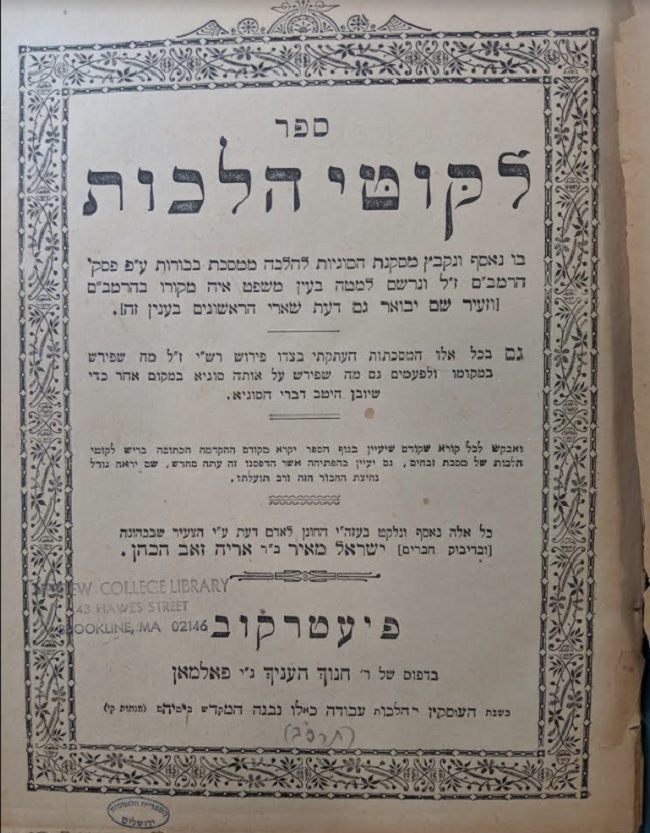
R. Israel Meir ha-Kohen Kagan’s statement in his Likutei Halakhot that it is “now” a “great mitzvah” to teach Torah to girls, has attracted a great amount of attention in recent years.[1] Benjamin Brown, dating the statement to 1911, suggests that it was instrumental in the founding of the first Bait Yaakov school in 1917 by Sarah Schenirer in Kraków.[2] Haym Soloveitchik, dating the text to 1918, views it as R. Kagan’s (late) perception of the erosion of the mimetic society in the wake of World War I.[3]

We show below that the statement was published some time in תרפ”ב (last third of 1921, first two thirds of 1922), after R. Kagan, known after his book as the Ḥafetz Ḥayyim, returned to Radin (Raduń), then Poland, on 25 Sivan [=July 1], 1921. The Ḥafetz Ḥayyim had spent the previous six years in Russia at a time of revolution, civil war, and the beginnings of communist policy toward Jewish religious institutions.[4] The timing of the statement on Torah education for women is significant. Several months before his arrival in Radin, a gymnasium (high school) for Orthodox girls had been established in Telz, with the direct involvement of the rosh yeshiva, R. Yosef Leib Bloch, his son, and his son-in-law.[5] Girls were taught there ḥumash and nevi’im. A primary school for girls was also established there. This was the latest in a series of Orthodox initiatives for the formal Torah education of women in Lithuania. In Kovno, a Jewish realgymnasium for Orthodox boys and girls had been established already in 1915 through the efforts of the Neo-Orthodox R. Dr. Leopold Rosenak, a brother-in-law of Emanuel Carlebach, and Joseph Carlebach, Emanuel’s brother. These initiatives were introduced as responses to the requirement of mandatory primary education, first by the German military occupying Lithuanian and later by the government of independent Lithuania. Also, in Kovno, at the initiative of Ze‘irei Yisrael, which was composed of representatives of Agudat Yisrael and the Mizrahi, the Yavne Central School System was founded in 1920; in its first year, forty schools were founded; some included girls.[6] In Kraków, then in Habsburg Galicia, Sarah Schenirer founded her afternoon supplementary school in 1917 with the blessing of the Belzer rebbe; several other schools followed in 1921 and 1922. In Warsaw, formerly in Congress Poland, R. Emmanuel Carlebach founded the Chavatzelet Orthodox women’s gymnasium in the same year, with the blessing of the Gerer rebbe. Chavatzelet taught girls ḥumash and nevi’im in the Hirschian spirit of Torah ‘im derech ’ereẓ.[7] In the 1930s the school was attended also by Hasidic girls, including the Gerer rebbe’s granddaughter.[8]

Moreover, in late January, 1922, the year in which the Ḥafetz Ḥayyim’s statement was published, the assembly of the Agudat ha-Rabbanim of Poland issued a series of calls upon its members that included the following:

11. To educate the daughters in the spirit of yiddishkeit and to learn with them from their early childhood some words of Torah and musar, and commensurate with their age to continue to learn with them their obligations in such a manner that when they reach the age of marriage, they will easily accept the obligations pertaining to the purity of the daughters of Israel. And the members are obliged to establish in their towns for this purpose a special school for the young women.[9]

As we shall see below, the resolution that called upon all communal rabbis in Poland to establish schools for women followed an impassioned speech on the challenges facing Torah education in Poland by the Galician rabbi, R. Meir (Maharam) Shapira, then the Rav of Galina, and shortly to become one of Agudat Yisrael’s representatives to the Polish Sejm and the Rosh Yeshiva of Yeshivat Ḥakhmei Lublin.

In light of the above, the Ḥafetz Ḥayyim’s statement on teaching Torah to Jewish daughters should be read as a hekhsher of formal Jewish education for women after and while schools for Orthodox girls were established in Poland and especially in Lithuania. All the aforementioned schools had strong connections with Agudat Yisrael operatives in their various locales. As is well known, the Ḥafetz Ḥayyim was a major rabbinical authority for the Agudah; several months after his return to Poland (which now incorporated parts of Lithuania), he and R. Ḥayyim Ozer Grodzinsky of Vilna, called for the strengthening of the Lithuanian Agudah.[10] He was most likely informed about these schools, certainly the women’s gymnasium in Telz, upon his return to Radin, if not earlier.

In any event, the 1924 decision to have Keren ha-Torah, the education fund of Agudat Yisrael, support a network of Jewish schools for girls was sanctioned by the Ḥafetz Ḥayyim’s aforementioned statement, according to Dr. Leo Deutschländer, the head of Keren ha-Torah, and subsequently one of the administrators of the Bait Yaakov seminary in Krakow.[11]

It is important to emphasize that the educational policies of all Orthodox schools in Poland-Lithuania were subject to rabbinical authority, and that no pedagogical steps were taken without consultation with, and approval, by rabbinical leaders.[12]

Part One. The Literary Context of the Ḥafetz Ḥayyim’s Statement on Women’s Education

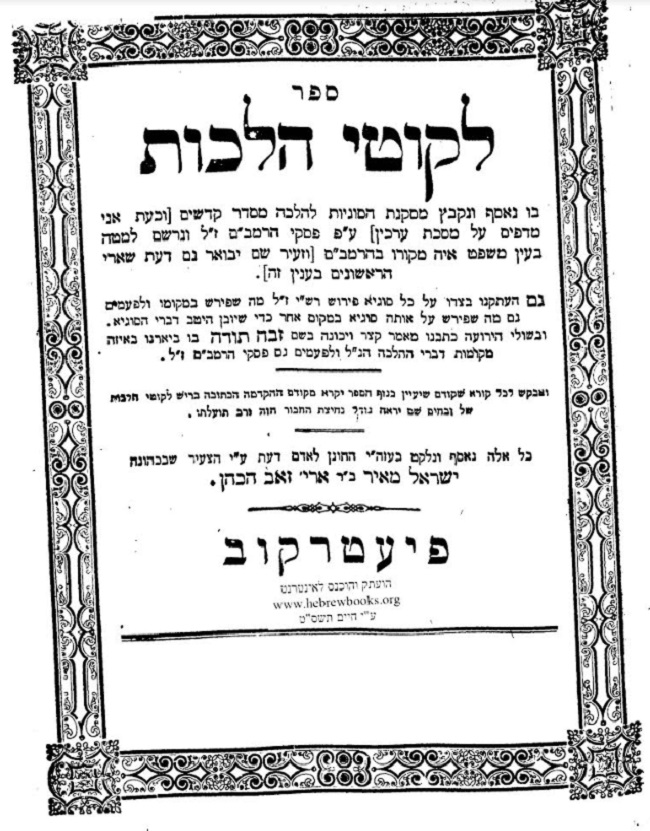
The Ḥafetz Ḥayyim’s comment does not appear as a formal response to a halakhic question of the permissibility of teaching Torah to women. Rather it appears as a footnote to the halakha that women should not be taught written Torah ab initio cited in his Likutei Halakhot on Sotah. Likutei Halakhot is a condensation of the halakhic sections of the Gemarah in the manner of R. Isaac Alfasi’s Halakhot Gedolot. Initially a project to provide students with a halakhic digest to sugyot having to do with kodeshim, the study of which the Ḥafetz Ḥayyim considered to be unduly neglected and of capital importance,[13] the project was ultimately expanded to provide a halakhic digest of all sugyot on which there was no Rif or Rosh (R. Asher b. Yehiel). Unlike the Rif, the Ḥafetz Ḥayyim’s’s aim was not to decide the halakha, but rather to provide student with an abridged description of the development of the halakha through the Rambam.[14] The Ḥafetz Ḥayyim believed that by reading halakhic condensations of the Rif with Rashi, and Likutei Halakhot with Rashi, the students would be able to master the fundamental halakhot of the Talmud – something that he felt could not be easily accomplished by reading the Mishneh Torah with its commentaries.[15] In later years he recommended such a program of study for those who lacked the time for in-depth study of the Gemarah.[16]

Before we analyze the footnote, we need to justify dating Likutei Halakhot on Sotah to תרפ”ב. Unfortunately, determining the publication history of Likutei Halakhot is complicated. The work was published serially, beginning with Zevaḥim, in 1899/1900,[17] in the form of kuntresim, which could be bound and published as seen fit by the Ḥafetz Ḥayyim; the published volumes did not carry a separate title page from the individual kuntresim comprising them. The title pages of the kuntresim often do not mention all the titles of the individual tractates contained therein, and, like many Torah publications, their dates of publication on the title page have to be derived from gematriyot of rabbinic statements in which certain letters are in bold typeface. Sometimes tractates that were published earlier were republished with the same title page. The individual tractates themselves have their own pagination. An edition of the entire work was published by the Ḥafetz Ḥayyim’s son-in-law, R. Menaḥem Mendel Yosef Zaks, in Brooklyn in 1960, and in Jerusalem 10 years later. The edition contains, dispersed throughout the work, some of the original title pages, but not always with their original dates. The order of the tractates in the R. Zaks edition is also not always according to the order of publication; sugyot from the same tracate that appeared in different kuntresim are placed together.

As noted above, two dates for Likutei Halakhot on Sota appear in the secondary literature, 1911 and 1918. We have found no textual basis for either date. The 1911 date appears in M. Gellis’s bibliography of the Ḥafetz Ḥayyim’s writings without explanation.[18] We do not know what is the source for the 1918 date.[19]

The volume of Likutei Halakhot including Sotah that we inspected in the National Library of Israel binds three kuntresim together. The first consists of Bekhorot and Keritot, printed by H. H. Fohlman, the second consists of Arakhin, Nazir, and Sotah, with only Arakhin mentioned on the title page, without a date; the third consists of Niddah, printed by M. Cederbaum, undated. Of these tractates, only Sotah and Niddah appear for the first time. (Niddah also appears published with its own title page by Cederbaum in תרפ”ג.) The date on the cover page, תרפ”ב was added in pencil, perhaps by a library cataloger or book seller, after calculating the gematriya; the volume, belonged formerly to the Boston Hebrew College library.


The תרפ”ב date is derived from the gematria of the emphasized letters: The saying (העוסקין בהלכות עבודה כאלו נבנה המקדש בימיהם (מנחות קי totals 682 ( 25 + 49 + 107 + 56 + 87+ 63 + 295), i.e., תרפ”ב.

As noted, the separate cover page for Arakhin (including Sotah and Nazir) is undated:


The Ḥafetz Ḥayyim, who was in charge of the printing and distribution of his books, advises on the title page of Likutei Halakhot on Bekhorot not only to read the Introductions, but also to look at the Preface (הפתיחה) “which we have now newly printed” (אשר הדפסנו זה עתה מחדש). The phrase “which we have now newly printed” is ambiguous; it can mean that the Preface is being reprinted or printed for the first time. Although the natural reading today would be the former, we found the Preface printed only in Likutei Halakhot on Sanhedrin, which we date to late תרפ”ב. And on the title page of Niddah, published by Cederbaum in תרפ”ג, we find a reference to the Preface אשר נקוה שנדפיסה בקרוב (“which we hope to print soon.”) This sort of discrepancy should not worry us, especially since Likutei Halakhot on Sanhedrin was printed by Fohlman and on Niddah by Cederbaum.

The Preface, published for the first time in תרפ”ב enables us to provide a clear terminus a quo for the publication of Likutei Halakhot on Sotah. In the middle of the first paragraph, the Ḥafetz Ḥayyim lists the tractates already completed (parentheses in the text below appear originally in the kuntresim as square brackets; the square brackets here are our own):

Barukh Ha-Shem, we have collected, according to our meager opinion, the words of the Rambam that he codified from the sugyot on thirteen tractates that pertain to matters of kodeshim, namely, Zevaḥim, Menaḥot, Tamid, Pesaḥim (from Tamid ha-Nishḥat to ‘Arvei Pesaḥim), Hagigah, Yoma, Tamid, Temurah, Keritot, Bekhorot [the three final chapters), ‘Arakhim, Me‘ilah, and Nazir (the later also has many things that are relevant to kodeshim), and likewise the first two chapters of Shavuot […] and now, only a few tractates are missing from the Shas, may God grant that over time some Jews will be found to complete the entire Shas […].[20]

And in the second paragraph he writes:

I wrote all this [i.e., the Preface until the present point] more than ten years ago. We have experienced many wanderings because of the war. Barukh Ha-Shem, who has kept us alive and did not allow our feet to falter. And now that I have come from the diaspora to my home, Ha-Shem, yitborakh, has helped me in his abundant kindness and goodness for the merit of Israel to complete Likutei Halakhot on the other tractates of the Shas that do not have the commentaries of the Rif and the Rosh. (And these are: Rosh Hashanah, Makkot, Horayot, Sotah, and Niddah […]).[21]

The second paragraph of the Preface attests to a time gap in both the composition of the Preface and in the publication of the tractates. The first paragraph of the Preface was written more than ten years earlier, i.e., no later than late 1910 or 1911. At that time the Ḥafetz Ḥayyim had completed, but not published, all the tractates mentioned in the first part of the Preface. Again, he did not publish the Preface itself until late 1921 or 1922. So although there is no date on Likutei Halakhot of Sotah itself, we can infer that it was published in תרפ”ב. As for the date of actual composition, we have no evidence in the Preface or anywhere else to suggest that it was written much earlier. Given that Niddah appears separately in תרפ”ג, the kuntres containing Sotah may have appeared late in תרפ”ב, after the aforementioned assembly of the Agudat Rabbanim in Warsaw. The Ḥafetz Ḥayyim would go on to complete other tractates and finish the work in 1925.

In short, the publication of Likutei Halakhot on Sotah is to be dated to late 1921 or the first two-thirds of 1922 (תרפ”ב) and not to 1911 or 1918,[22] according to the date of the aforementioned volume, and no earlier than Summer 1921, the date of the Ḥafetz Ḥayyim’s return to Radin, according to the Preface.

Part II. The Historical Context of the Footnotes on Jewish Education in Likutei Halakhot on Sotah

The Ḥafetz Ḥayyim was 83 years old when he declared it to be a great mitzvah to educate women in various Torah matters. To understand both the context and content of the statement, we first present the text and the two relevant footnotes. The main text of Likutei Halakhot on Sotah 11a (p, 21) may be translated as follows:

Rabbi Eliezer says, “Whoever teaches his daughter Torah teachers her tiflut.” You thought [actual] tiflut? Rather [it is] as if he teaches her tiflut. R. Abbahu says, “What is R. Eliezer’s reason? It is written, ‘I, wisdom, dwell with cunning,’** When wisdom enters a person, cunning enters with it.” And how do the Rabbis understand “I, wisdom”? The verse is needed for [the interpretation] of R. Yossi b. Rabbi Haninah, for R. Yossi b. R”H says, “The words of Torah stand permanently only for the person who makes himself naked for them, as it is written, ‘I, wisdom, dwell with nakedness.” In any event, the reasoning of R. Eliezer is not thereby rejected, and the halakha is according to his statement. [Later] rabbis said that “Torah” here refers davka to the Oral Torah. But even though the Written Torah should not be taught to one’s daughter ab initio,*** [teaching her Written Law] is not as if one teachers her tiflut. And women are obligated to learn from the Oral Torah the laws that pertain to them.[23]

(The asterisks refer to footnotes on this passage. Footnotes are rare in Likutei Halakhot, and rarer still are footnotes that refer to contemporary issues.)

Let us begin with the note preceded by three asterisks, on the prohibition of teaching the written Torah to women ab initio (based on M.T. Hilkhot Talmud Torah 2:13):

It seems that all this [the admonition not to teach written Torah ab initio to women] applies to previous times, when everyone dwelled in the place of his fathers, and the paternal tradition was very strong for each person to behave in the way that his fathers had tread, as the verse says, “Ask your father and he will tell you”. [Then] we could say that [a woman] should not learn Torah but should rely for her conduct on her upright fathers. But now, on account of our many sins, the paternal tradition has weakened considerably, and it is common that one does not dwell in one’s fathers’ location at all, and, particularly for those [women] who have accustomed themselves to learn to write and speak the languages of the nations, it is certainly a great mitzvah to teach them ḥumash, and also nevi’im and ketuvim, and the musar lessons of Ḥazal, such as tractate Avot, and Menorat ha-Ma’or, and the like, in order that our holy faith be confirmed for them. For otherwise, they are liable to stray completely from the way of the Lord, and to transgress all the foundations of the religion, God forbid.[24]

The Ḥafetz Ḥayyim holds that the admonition not to teach women written Torah ab initio pertained to the past, when a woman could rely for her conduct on the example of her fathers. But today, we find a weakening of paternal tradition and the dislocation of the Orthodox from their paternal homes, which requires educating women, especially those women who are accustomed to learn the language of the gentiles; without Torah education, such women are likely to stray from the true path and to become heretics. What historical reality does this reflect?

As is well known, the use of legal literature as a source of history, even literature that purports to refer to historical events, is not unproblematic. On the one hand the geographical dislocation of Polish Jews because of the war indeed meant that many parents and children were no longer in the town and villages that had anchored their faith and practices for generation.[25] On the other hand, it would be wrong to infer from the Ḥafetz Ḥayyim’s remarks that in his view, pre-war Poland reflected a golden age of Jewish observance. Throughout much of his life he had railed against the weakening of observance among the Orthodox, and many of his published works tried to strengthen observance through teaching both the halakha and its centrality in the life of the Jew – and the penalties for its non-observance.

For example, the Ḥafetz Ḥayyim was well aware that for decades there had been a weakening of traditional observance among women from some Orthodox homes. His son, R. Aryeh Leib Kagan, relates that when he came of marriageable age in the early 1880s, his father would not consider a match for him with a young woman from an Orthodox family who had attended a gymnasium (high school), or even an elementary school; such women and their families, even though they were Orthodox, were suspect in his eyes. In one case, the Ḥafetz Ḥayyim ultimately forbade his son to accept an offer of the substantial financial assistance by a wealthy prospective father-in-law; it turned out that the prospective bride’s sister had been sent by her father to learn at a gymnasium in Grodno, where she had fallen in love with a gentile officer whom she had met (“presumably at the theater”), converted, and died in childbirth at the age of 15.[26]

In his 1905 handbook on family purity laws, Taharat Yisrael, the Ḥafetz Ḥayyim attributes the decline of some women observing the mitzvah of mikveh to the shame they feel, not because of any foolish modesty (which is the case with some other women), but because they have been educated to look down at the laws of Torah. These women feel shame because

they have been raised in their free-thinking ways from their youth, when they attended schools, and became “wiser in their own eyes” than their predecessors, to the extent that they feel shame in observing the laws of the Torah according to the law of Moses and Israel, and particularly in a matter they consider to be beyond the boundaries of modesty.[27]

The Ḥafetz Ḥayyim responds to such women’s contempt of the Torah by providing well-worn arguments for its superiority and perfection. His defense is part of the larger project of the book, written both in Hebrew and Yiddish, to educate men and women in the importance of observing family purity laws. Urging Jews to observe Torah and mitzvot, and educating them for that purpose, is the leitmotiv that runs throughout the Ḥafetz Ḥayyim’s writings. Even his Likutei Halakhot on Kodeshim, though ultimately intended as an educational tool for learning Torah, was written as practical halakhic guide for the messianic age that Ḥafetz Ḥayyim thought imminent.[28]

This emphasis on deepening Torah observance in all sectors of the Orthodox community led him to publish a kuntres directed to women, Geder Olam, in 1889, on the importance of covering their hair. The kuntres was published in Hebrew and in Yiddish, and it includes at the end a basic halakhic guide to the laws of Niddah.[29] The halakhic guide was reprinted by the Ḥafetz Ḥayyim in two other works: his book addressed to Jews migrating to places like America and South Africa, Nidhei Yisrael (1895), and his aforementioned book on family purity laws, Taharat Yisrael (1905); The Yiddish translation appears in all three works, which indicates that these sections were intended also for women to read.[30] Indeed, the Ḥafetz Ḥayyim urges women who are literate to teach the book to women who are not, and to learn the Maayan Tahor of R. Moshe Teitelbaum of Ujhely (the Yismah Moshe) (reprinted many times in the Korban Minḥah siddur for women). The Ḥafetz Ḥayyim writes, “We have written only the legal principles that are most common, that all women are obligated to learn abundantly, and to become expert in them, so they not stumble because of them.”[31] This is a clear call for women to learn halakha, albeit in a rudimentary fashion, from books written for them.

From the above we see how important it was for the Ḥafetz Ḥayyim to write educational materials for women on family purity and female modesty. This in itself was a novelty; we are not aware of such materials being written in Lithuania at the time by Orthodox talmidei ḥakhamim of the Ḥafetz Ḥayyim’s stature. Contrast, for example, the words of the Ḥafetz Ḥayyim’s contemporary, Rabbi Yehiel Mikhel Epstein, in Arukh ha-Shulḥan, Yoreh Deah 246:19:

Ours has never been the custom to teach [women] from a book, and we never heard of that custom. Rather every woman teaches the relevant laws to her daughter and daughter-in-law. Recently, laws pertaining to women have been published in the vernacular for women who can read from them. Our women are fervent (zerizot); in every doubtful matter they ask [a rabbi] and don’t decide for themselves in the smallest matter.[32]

To what recently-published laws pertaining to women was R. Epstein referring? Arukh ha-Shulḥan, Yoreh Deah was composed in the years, 1887-1894;[33] the early editions of Geder Olam were 1889, 1893, and 1894. In the latter, the Ḥafetz Ḥayyim admonishes women who need to ask a halakhic question not to ask another women, but only a moreh hora’ah, “and for G-d’s sake, a woman should not dare to decide the law!”[34] It is very likely that R. Epstein was referring to this when he wrote, “Our women are eager; in every doubtful matter they ask [a rabbi] and don’t decide for themselves in the smallest matter.” Here we have two conflicting views on the education of women in practical halakha: R. Epstein sees no need to compose halakhic guidelines in Yiddish for women, since the women with whom he is familiar have learnt the material from their mothers or mothers-in-law and know when to ask questions. The Ḥafetz Ḥayyim, observing women who are lax about observance, writes a halakhic/hashkafic manual in Hebrew and Yiddish that urges them (and their husbands) to study these guidelines diligently and to teach them to other women.

The importance of educating women in their religious duties, especially in the realm of family purity, remained with the Ḥafetz Ḥayyim for the rest of his life. As is well-known, he traveled to Vilna when he was old and frail to deliver a lecture in Yiddish at the central Synagogue on the importance of observing the mitzvah of mikveh in front of an audience of hundreds of women, with men listening in from the women’s gallery.[35]

To be sure, publishing educational materials on family purity for women is not the same as advocating Torah education for girls, but then, again, the situation in 1905 for Polish and Lithuanian Orthodox Jewry was not the same as in 1922. Orthodox Jewry in the Second Polish Republic was under severe stress. Dislocation and pressures – economic, ideological, and governmental — had accelerated the defection of Jews from the tradition; the dire situation provided an opportunity for conservatives to respond positively to new Orthodox initiatives to stem the tide. In particular, Orthodox Jewish education was at a crisis point, even more so for boys than for girls, which explains in part why much more attention was paid by Orthodox politicians and rabbis to the challenges facing the ḥadarim, than to the education of women, since, as we noted above, the compulsory education of law of 1919, which was in the early stages of implementation, required all Polish boys and girls to attend government certified schools. Agudat Yisrael negotiated repeatedly with the Polish authorities to have the ḥadarim certified, which meant that they needed to include subjects mandated by the Polish ministry of education; otherwise, even more ḥadarim would close. The negotiations with the government concerned how many hours of secular subjects would be taught, and what were those subjects to contain.[36] Formal Torah education for girls was already well underway, partly as a response to mandatory education, the general trend in female education, and the prevalence of alternatives to the ḥeder that attracted Orthodox parents, partly as a response to the weakening of observance among the Orthodox.

When the Ḥafetz Ḥayyim returned to Radin in 1921, he was faced not only with the fait accompli of formal Jewish education for women in Telz, Kovno, and elsewhere, but with the threat to both boys and girls posed by the implementation of universal compulsory education by the State. Unlike in Russia and Lithuania, compulsory education for Jewish girls had been the norm in Galicia, the part of Poland that had belonged to the Austrian Empire until the end of the First World War. Galician Jewish Orthodox girls, bereft of formal Jewish education, had attended Polish private and public schools for decades with disastrous consequences; the same now happened elsewhere in Poland. When, in his footnote, the Ḥafetz Ḥayyim refers to “those [women] who have accustomed themselves to learn to write and speak the languages of the nations” he was, whether aware of it or not, referring to all Jewish girls in the Second Polish Republic, since, as Polish citizens even the strictest Hasidim were required to send their daughters to government certified schools. And unlike the case of their brothers, no Orthodox politicians negotiated with the government to exempt girls from these schools. School attendance for Hasidic girls was a well-entrenched tradition, even among the daughters of the zealots.

It is not surprising that the rabbi who raised the issue of women’s education at the assembly of the Polish Agudat ha-Rabbanim in 1922, Maharam Shapira, hailed from Galicia, where the situation had been bleak for decades. In his survey of the state of Orthodox Jewish education, he first turns to the challenges facing the ḥeder from the mandatory education law, on the one hand, and the attacks from the [Jewish] leftists (smoliyim) on the other. If the Polish government wished to spread general education among the people, it should take into consideration the most necessary requirements of the [Jewish] nation, which is the ḥeder. And if the Orthodox try to accommodate the government’s demands, it can only be in such a way that will not destroy the ḥeder. Most importantly, Orthodox boys need to be exempt from the obligation to attend general schools. And since the ḥadarim will now have to limit somewhat their hours for Jewish subjects, it is important that they be subject to universal standards, and that the instruction be overseen by experts and pedagogues. The Maharam Shapira then turned to the question of the education of girls:

We speak a great deal about the education of girls, which is a very painful subject for us. Our situation has become so bad because we have only taken a little interest in the subject for many years. At the same time as we devoted much of our thought, and always concerned ourselves, whether a lot or a little, with the education of boys, we continued to apply to the girls, “Kol kevudah bat melekh pnimah” as in earlier times, when a Jewish daughter did not come into contact and connections with the marketplace and the public sphere, and with the currents of the time that mostly oppose Yahadut. Then we did not need to give her an antidote and a powerful and effective counterforce against them. (“Whoever teaches his daughter Torah is as if he teaches her tiflut. (Sotah 20a).” Only men had in particular to learn Torah, for they needed the antidote – the countercurrent that repels foreign currents. But the daughter and the Jewish woman sat at home, where only that environment acted educationally upon them, and developed them and made them into true Jewish women and fit Jewish daughters.) We thus did not pay attention that the girls, unarmed and lacking any concept pertaining to Torah and Yahadut, have been taken outside from us into cultures and currents. They have become so educated and raised in the lap of foreign culture and anti-Jewish ways that every “common wind” and light attempt to ensnare their spirits, to penetrate into their souls, to poison and uproot them from their place, have wielded their evil ways upon them.

And we are faced with another grave question, which is strongly related with the education of the daughters, and this is the purity of the daughters of Israel….[37]

The Maharam Shapira diagnoses the illness but does not prescribe the remedy, anyway, not in the written version of his address. But as we saw above, the Assembly subsequently called for the establishment of Jewish schools for girls (supplementary to the general schools which they would attend). Connecting the crisis in the observance of the family purity laws with girl’s lack of education meant that rabbis like the Maraham Shapira understood that female observance of Jewish law could not be taken for granted. The Maharam Shapira also called for the production of Jewish youth literature, including textbooks, for the youth that would be free of all defect, and that would educate them in the spirit of faith and religion. This call was also ratified by the Assembly.

The question of the creation of textbooks that would be appropriate for use in ḥadarim seems to be alluded to in the earlier note in Likkutei Halakhot on Sotah on R. Abbahu’s explanation to R. Eliezer’s prohibition that “once wisdom enters into an individual, cunning enters with it.” The Ḥafetz Ḥayyim writes:

According to this, one should be even more careful not to teach boys and girls flippant writings and romances, which consume their heart and soul. One who reads them regularly is in the category of one who reads external books, who was treated with great severity by our sages, as is in the beginning of Helek (Sanhedrin 90). It makes no difference wheteher they are published in the Holy Tongue or the vernacular. See S. A. Orah Ḥayyim.307:16, and in the Mishnah Berurah ad loc.[38]

While attention in recent years has been focused on the footnote on Torah education for women, the Ḥafetz Ḥayyim’s previous footnote on the education of boys and girls appears to have been entirely neglected. Why would a halakhic authority like the Ḥafetz Ḥayyim be concerned with teaching Orthodox Jewish boys and girls “flippant writings and romances”, i.e., literature written by Poles or by Jewish maskilim? Yet his concern makes sense in the context of the new Polish government’s requirement that general studies be included within the curriculum of the ḥadarim, and also in the context of Orthodox parents sending their children to non-Orthodox Jewish schools, like the Tarbut and Yiddishist schools. Even though the Ḥafetz Ḥayyim acquiesced to the limited introduction of secular subjects in the ḥadarim, we see from this note and the passage below that he insisted that only appropriate books be read by children. That was also the line taken by Agudat Yisrael in its attempts to control the growing popular youth literature, both in lending libraries youth, and in curricular materials for the ḥadarim and the Bais Yaakov schools under its auspices.[39]

In short, underlying both footnotes referring to contemporary matters in the Likutei Halakhot on Sotah are not the challenges of “modernity” in general, but rather the specific challenges facing the Polish Orthodox leadership in the interwar period brought about by the weakening of traditional authority, geographical dislocation, the introduction of universal primary education in the Second Polish Republic, and the attraction of Bundism, Zionism, and Socialism to the youth. Although the weakening of traditional authority, and the phenomena of Orthodox women attending Polish schools predated by decades World War I, the situation after the war threatened the very future of Torah Judaism in the eyes of the Orthodox establishment.

Part III. Other Statements of the Ḥafetz Ḥayyim on Torah Education for Women

In the waning years of his life, the Ḥafetz Ḥayyim returned several times to the question of Torah education for girls. Thus we read in his 1930 “Admonition to Kelal Yisrael”:

There is another principle that every talmid hakham in every town needs to enact, namely, to see to it that there is a kosher ḥeder in which our little sons (and also our little daughters) will be provided a kosher education in the way of the Torah, and not in schools that are full of heresy and sectarianism, which are completely bereft of teaching our holy Torah….

[One should accustom his son to learn the the aggadot of the Talmud…]. But even more one should distance his son from schools in which heresy and sectarianism is taught, where instead of the holy ḥumash, they make up books in which are found only stories of the ḥumash that they have copied without any sense of our Holy Torah – and that’s Torah in its entirety for them And all the laws and mitzvot like in Vayikra and Devarim they denigrate and do not copy. A father must be exceedingly careful not to allow his son to go to such schools where he destroys them with his own hands (and likewise he should be careful to educate his daughters in the way of Torah).[40]

And in a public appeal for the strengthening of religion that that he published in Sivan, 1931:

First of all, we must become fortified with all our strength in the education of boys and girls, to establish for them ḥadarim and kosher schools according to the law of our Holy Torah, not to deviate to the right or the left, or to forego anything of our Holy Torah, and not to allow them to attend such schools as are full of heresy and sectarianism, God save us….”[41]

We have found no mention of the importance of educating girls in the Ḥafetz Ḥayyim’s numerous writings devoted to education before World War I: educating women to observe and appreciate family purity, yes, but not teaching Torah to girls. This changed after the Ḥafetz Ḥayyim’s return to Radin in 1921. Already in 1922 there is abundant reason to believe that the Ḥafetz Ḥayyim’s foonote in Likutei Halakhot on Sota referred to formal Jewish education for girls, which was already well underway. As we noted above, his position was used to justify the establishment of schools for girls by the Agudah’s Keren ha-Torah in 1925. From the 1930s he made his position explicit: teaching Torah to Jewish daughters includes establishing “kosher schools” for them.

So it is hardly surprising that in 1933, when attempts to open a Bait Yaakov school in Fristik (Frysztak), Poland, were met with opposition by the local rabbi, R. Menachem Mendel Halberstam, the Ḥafetz Ḥayyim signed a public approbation of Beit Yaakov in order to convince Jewish parents from the town to send their daughters to the school:

B”H 23 Shevat, Tarzag [= Feb. 19, 1933]

To the worthy lovers and esteemers of Torah, the Godfearing people of Fristik, may the Rock guard them,

When I heard that Godfearing people had devoted themselves to establish in the towns a Beit Yaakov school, in which is taught Torah, the fear of Heaven, morals, and manners, which is Torah for the girls of our Jewish brethren, I addressed their fine action [saying] “May the Lord strengthen them and establish the work of their hands!” For [that action] is a greatly needed matter in these day, when the current of heresy, God save us, reigns in all its force, and all sorts of freethinkers lie in wait to ensnare the souls of our Jewish brethren. Whoever’s heart has been touched with the fear of God is obligated to send his daughter to learn in this school. And there is no room for concern in this day and age for all the apprehensions and doubts arising from the prohibition of teaching one’s daughter Torah. This is not the place to elaborate.

For our generation is not as the earlier ones, for in previous generations each Jewish house had a paternal and maternal tradition to walk in the way of Torah and religion, to read Zeenah u’Reenah every Shabbat. But this is not the case, due to our many sins, in our generation. Therefore we must strive to increase schools such as these and to save everything that we possibly are capable of saving.[42]

The appeal seems to have worked because there was still a Beit Yaakov in Fristik in 1935, according to the list of schools provided by Deutschländer.

* * *

We conclude with a final comment: Some have inferred from the Ḥafetz Ḥayyim’s footnote in Likutei Halakhot and the appeal on behalf of Bais Yaakov schools that in his eyes formal education for girls should be considered “bediavad”, i.e., that in an ideal Jewish world, girls would not need to be taught Torah outside the home. If that is true, then the bediavad status of women’s education is somewhat akin to the bediavad status of the compilation of the Mishnah: in a world without the persecution and dispersion of the Jewish people, Rabbi Judah ha-Nasi would not have had to compile the Mishnah and thereby transgress the prohibition of committing Oral Torah to writing.[43] But the Torah, which is eternal, is adapted by the Torah sages in each generation to the world in which God-fearing Jews live. Formal Torah education for girls became for the Ḥafetz Ḥayyim “in this day and age” a “mitzvah gedolah,” in other words, lekhatkhilah, and his statements on the subject reflect that.

On the other hand, to say that it is a mitzvah gedolah to teach Torah and yirat shamayim to women is not to say that the Ḥafetz Ḥayyim wished to extend the commandment of Talmud Torah to include women.[44] That conflates the commandment of Talmud Torah, which applies only to Jewish men, with the obligation of teaching yiddishkeit to Jewish women through teaching them, inter alia, selections from Tanakh. While the Ḥafetz Ḥayyim emphasizes the former repeatedly and at great length in his writings and public activity, he barely mentions the latter. One need only compare his brief mention of teaching girls “ḥumash, nevi’im, ketuvim” in his footnote in Likutei Halakhot with his frequent statements about the necessity of teaching ḥeder boys ḥumash with Rashi “without skipping anything.” Even after his return to Radin, his public activities on behalf of women’s observance focused mainly on family purity, modesty, shabbat, and kashrut – not girls’ education.

Still, it is no wonder that the conservative Ḥafetz Ḥayyim, who had written numerous tracts to strengthen the observance and piety of Jewish baalei ha-batim and their families, embraced in later years the formal Jewish education of girls. Decades earlier he had called upon literate women to teach their illiterate sisters family purity laws from a book. He was not concerned with expanding the study of Torah among women, as much as expanding its observance and taking its message to their hearts. The Torah these girls were to be taught was a combination of Torah, the fear of heaven, morals, and manners. His goals were similar to that of Bais Yaakov movement, which was not to teach Torah to the daughters of Israel as an intellectual activity, or to make them life-long learners of Torah, but to form their character as religiously observant Orthodox Jewish women.[45]

Notes:

[1] Likute Halakhot on Sotah, 11ab (pp. 21-2). Unless otherwise stated, we have consulted the 1969-1970 edition of R. Menahem Mendel Yosef Zaks (Jerusalem, 1969-1970). This appears to be a reprint of the edition published in Brooklyn 10 years earlier.
[2] “This leniency enabled the opening of the first school of Beit Yaakov.” See Benjamin Brown, “The Baal ha-Bayit: R. Yisrael Meir ha-Cohen, the Ḥafetz Ḥayyim,” in Benjamin Brown and Nissim Leon, ed., Ha-Gedolim’: Ishim she-‘izvu et pene ha-Yahudut ha-haredit be-Yisrael. ed. (Jerusalem: Magnes, 2017), 106-151, esp. 133 (Hebrew)
[3] See Haym Soloveitchik, “Rupture and Reconstruction: The Transformation of Contemporary Orthodoxy,” Tradition, vol. 28, no. 4 (Summer 1994): 106-107 note 6.
[4] M. Yashar, Dos leben un shafn fun Ḥofets Ḥayyim (New York, 137), II, 377, 381.
[5] This is inferred from the celebration in Purim of 1931 of the school’s tenth anniversary.
[6] Yizhak Rafael Ha-Levi Etzion (Holzberg), “The Yavneh Educational System in Lithuania,” in Yahadut Lita (Tel-Aviv, 1972), II, 160-163
[7] According to one graduate of the school, “Chavatzelet’s general studies program was of a high caliber. It was headed by a non-religious woman and the teachers were either gentiles or secular Jews, since it was very difficult for a religious Jew to obtain the degree needed to teach secular studies. The religious studies, however, was not so successful […] The religious studies principal was the only religious faculty member – a Yekke (a German Jew). Under his influence Chavatzelet was conducted in the German manner of Torah im Derech Eretz. He taught us Chumash, Navi, history, and basic Hebrew grammar […] At any rate, the Torah portion of our education took only an hour of the day. The other six hours were devoted to secular studies.” Gutta Sternbuch and David Kranzler, Gutta: Memories of a Vanished World (Jerusalem and New York: Feldheim, 2005), 19-20.
[8] Ibid., pp. 17, 21.
[9] יא) לחנך את הבנות ברוח היהדות וללמוד עמהן מראשית ילדותן מעט מעט דת ומוסר, וכפי רבות שנותיהן כן יוסיפו ללמוד עמהן היובים שעליהן באופן כשיגיעו לפרק נישואין יקבלו בנקל החיובים השייכם לטהרת בנות ישראל, והחברים מחויבים להשתדל שיתיסד בעירם בית ספר מיוחד לזה בעד הנערות. Peratei-kol me-ha-ve‘idah ha-rishonah shel agudat ha-rabbanim be-Folin (Warsaw, January 23-25), published at the end of Kovetz Derushim, Ḥelek Rishon, Kera Sheni, ed. M. Warszawiak and Y. M. Sagaloṿits (Piotrkow, 1924), f. 9b.
[10] Mikhtavim u-maamarim mi-Maran Rabenu ba‘al ha-Ḥafetz Ḥayyim, Ḥelek Bet, ed. Z. H. Zaks (Kol Kitvei ha-Ḥafetz Ḥayyim [Jerusalem, 1990], IV, pp. 83-34)
[11] Leo Deutschländer, ed., Beth Jakob: 1928, 1929 (Frankfurt a. M.: Hermon, 1929), p. 7. Deutschländer cites the footnote and refers to it as a pesak din in Keren ha-Torah’s report on the state of Jewish education delivered at the Second World Assembly (ha-Knesiyal ha-Gedola) of Agudat Yisrael (Vienna, Elul,1929), 44-45. (The full report is available at https://hebrewbooks.org/36599.)
[12] In The Rebellion of the Daughters: Jewish Women Runaways in Habsburg Galicia (Princeton UP, forthcoming), p. 204, Rachel Manekin discusses a 1923 letter from Sarah Schenirer, in which she reveals that she consulted with the Belzer rebbe over whether the girls in her school could stage her play, Judith. Although the rebbe forbade staging it as “uqqat ha-goy,” she expressed the hope that it could be performed as a declamation. From this one may infer that the Belzer rebbe was the school’s rabbinic authority until it came under the auspices of the Keren Ha-Torah of Agudat Yisrael in 1924-1925.
[13] See, for example, the letters in Mikhtavim u-ma’amarim, Ḥelek Bet, 24-39 (Kol Kitvei ha-Ḥafetz Ḥayyim, IV, 24-39), and the kuntres, Torah Or at the end of Kol Kitvei ha-Ḥafetz Ḥayyim, II.
[14] See Likutei Halakhot, Second Introduction, f. 6a-b.
[15] Ibid., f. 7a
[16] Likutei Amarim, ch. 7, pp. 10-12, esp. p. 11 (Kol Kitvei ha-Ḥafetz Ḥayyim III).
[17] The Bar Ilan University Library web catalogue lists a copy of Likutei Halakhot on Zevaḥim with prenumerants, bound with the gemarrah of Zevaḥim, that dates from 1891/2. See R. Aryeh Leib ha-Kohen’s account of the delays in publishing Likutei Halakhot in his biography of his father, Mikhtevei ha-Rav ha-Ḥafetz Ḥayyim, ed. Aryeh Leib ha-Kohen, p. 51, in Kol Kitvei ha-Ḥafetz Ḥayyim, III. R. Aryeh Leib saw his father’s decision to write on Kodeshim, in part, as a reaction to the wave of migration to Eretz Yisrael from Eastern Europe following the expulsion of Jews from Moscow in 1890-1891, and the sense of messianic expectation; see ibid., pp. 38-39.
[18] M. Gellis, Kitvei ha-Ḥafetz Ḥayyim…reshimah bibliografit (Jerusalem, 1984), p. 56. Brown (see n. 2 above) relies on Gellis.
[19] The date also appears in Shoshana P. Zolty, And All Your Children Shall Be Learned: Women and the Study of Torah in Jewish Law and History (Northvale, N.J: J. Aronson, 1993), p. 67, n. 34 (The place of publication is given as “St. Petersburg” rather than Piotrków.) An edition of Likutei Halakhot, Part Two, of R. Natan Sternhartz, was published in Warsaw in 1918-1919; perhaps this explains the confusion
[20] ובה על י״ג מסכתות ששייכים לעניני קדשים והם זבחים ומנחות ותמיד ופסחיס (מפרק תמיד הנשחט עד ערבי פסחים) וחגיגה ויומא ותמיד ותמורה וכריתות ובכורות (שלשה פרקים אחרונים), וערכים ומעילה ונזיר (שגם היא יש בה הדבה ענינים ששייכים לקדשים) וכן שני פרקים הראשונים ממסכת שבועות על כל אלו לקטנו בעניות דעתנו מדברי הרמב״ם מה שהעתיק מהסוגיות לדינא […].וכעת אין חסר מן השס רק איזה מסכתות יתן ד׳ שבמשך הזמן ימצאו בישראל משליטים לכל הש״ס […]
[21] והנה כל זה כתבתי יותר מעשרה שנים ועבר עלינו נדודים הרבה מפני המלחמות וב״ה ששם נפשינו בחיים ולא נתן למוט רגלינו. וכעת שבאתי מן הגולה בשלום לביתי עזרני הש״י ברוב חסדו וטובו בזכות כלל ישראל להשלים הליקוטי הלכות גם על יתר מסכתות של הש״ס שאין עליהם רי״ף ורא״ש (ואלו הן ראש השנה וסנהדרין ומכות והוריות וסוטה ונדה […]) ]. The Ḥafetz Ḥayyim mentions that there are other tractates on which there are no Rif and Rosh, and he suggests that others may come to complete his work. In fact, he himself completed the work and revised the Preface in 1926; the revised Preface was published posthumously as chapter seven (“A Worthy Article on the Study of the Holy Torah”) in Likutei Amarim, pp. 10-12 (In Kol Kitvei ha-Ḥafetz Ḥayyim, III.)
[22] Although Deutschländer writes in his 1929 historical account of Bait Yaakov schools that their legal sanction had been provided “decades ago” (vor Jahrzenten) by the Ḥafetz Ḥayyim in Likutei Halakhot on Sota, he may have been unaware of the publication history of Likutei Halakhot. In any event, he does not repeat the claim in his more detailed Hebrew report, published in the same year. For references see n. 8 above.
[23] ראליעזר אומר כל המלמד את בתו תורה מלמדה תפלות. תיפלות סד אלא כאילו מלמדה תפלותאר אבהו מאי טעמא דרבי אליעזר דכתיב אני חכמה שכנתי ערמה מכיון שנכנסה חכמה באדם נכנסה עמו**) ערמומית. ורבנן האי אני חכמה מאי עבדי ליה מיבעי ליה לכדריוסי ברבי חנינא דאמר רבי יוסי ברח אין דת מתקיימין אלא במי שמעמיד עצמו ערום עליהן שנאמר אני חכמה שכנתי ערמה וממ לדינא אין נדחה מפני זה סברת ראליעזר ונקטינן כן להלכה. וכתבו רבוותא דהיינו דווקא תורה שבעפ אבל תורה שבכתב אף שאין ללמדה ***) לכתחילה ממ המלמדה אינו כמלמדה תפלות וגם מתורה שבעפ הדינים השייכים לאשה מחוייבת ללמוד.
[24] **ונראה דכל זה דווקא בזמנים שלפנינו, שכל אחד היה דר במקום אבותיו, וקבלת האבות היה חזק מאוד אצל כל אחד ואחד, להתנהג בדרך שדרכו אבותיו, וכמאמר הכתוב שאל אביך ויגדך‘; בזה היינו יכולים לומר שלא תלמוד תורה, ותסמוך בהנהגה על אבותיה הישרים. אבל כעת בעוונותינו הרבים, שקבלת האבות נתרופף מאוד מאוד, וגם מצוי שאינו דר במקום אבותיו כלל, ובפרט אותן שמרגילין עצמן ללמוד כתב ולשון העמים, בוודאי מצווה רבה ללמדם חומש וגם נביאים וכתובים ומוסרי חזל, כגון מסכת אבות וספר מנורת המאור וכדומה, כדי שיתאמת אצלם עניין אמונתנו הקדושה; דאי לאו הכי עלול שיסורו לגמרי מדרך ד‘, ויעברו על כל יסודי הדת חו
[25] According to Leo Deutschländer’s report of Keren ha-Torah at the Second Kenesiya Gedolah in Vienna in 1929, between 40 and 50 thousand children had been taken from their parents during the war and its aftermath, and these children had grown up without Torah, ethics, education, and faith. See Ha-Kenesiyah ha-Gedolah ha-Sheniyah shel Agudat Yisrael, ed. Shabbetai Sheinfeld (Vienna, 1929), p. 29. The situation among Polish Orthodox youth led Agudat Yisrael to establish, for the first time in Poland, organizations for the purpose of strengthening the faith and commitment of the younger generation. See Gershon C. Bacon, The Politics of Tradition: Agudat Israel in Poland, 1916-1939 (Jerusalem: Magnes, 1996), 181-141.
[26] Mikhtevei ha-Rav ha-Ḥafetz Ḥayyim, pp. 20-22, in Kol Kitvei ha-Ḥafetz Ḥayyim, III.
[27] Taharat Yisrael, ch. 8, pp. 10-11, esp. 10, in Kol Kitvei ha-Ḥafetz Ḥayyim, III.
[28] See Mikhtevei ha-Rav ha-Ḥafetz Ḥayyim, pp. 53-54, in Kol Kitvei ha-Ḥafetz Ḥayyim, III.
[29] This guide is attributed in the early editions of Geder Olam to a יצחק ברז, who says that they are based on the tract, Dinei Niddah, by Shlomo Zalman Lifschutz, the authors of the Ḥemdat Shelomo on the Shulhan Arukh. יצחק ברז is likely the Ḥafetz Ḥayyim’s close associate in Warsaw, R. Isaac b. Zeev (“Itche”) Grodzienski. According to R. Aryeh Leib Kagan, R. Grodzienski translated Geder Olam into Yiddish in a second printing, in 1890, which explains why the name Isaac is on the title page. However, the first 1889 edition also has both Yiddish and Hebrew and more to the point, subsequent editions remove all mention of Isaac. Since the the Yiddish appears in two other books by the Ḥafetz Ḥayyim printed under his own name, one assumes that the Yiddish translation, too, was the work of the Ḥafetz Ḥayyim, perhaps in partnership with R. Grozdienski
[30] The reference to the Dinei Niddah of the Ḥemdat Shelomo is omitted in these works. The Yiddish is absent from R. Zaks’ edition, which also omits the chapter on family purity in Geder Olam. It was not unusual for the Ḥafetz Ḥayyim to reuse parts of his kuntresim.
[31] Geder Olam (Warsaw 1889), f. 19 ,p. 37.
[32] Arukh ha-Shulhan (Jerusalem, 1969), VI, f.18, p. 35.
[33] Eitam Henkin, “The Books of the Arukh ha-Shulhan – The Order of Their Composition and Their Publication,” Ḥitzei Giborim –Pleitat Soferim, vol. 7 (2014): 515-536, esp. 516 (Hebrew), available online here (https://tinyurl.com/y8t7a7ncThis).
[34] Ed. 1895, 15a, p. 29
[35] For the Yiddish address, with Hebrew translation, see Kol Kitvei ha-Hafetz Ḥayyim III, 171-174.
[36] For an account of these negotiations, and the “quiet revolution” in Orthodox education, see Bacon, The Politics of Tradition, pp. 147-177.
[37]מדברים אנו הרבה עד חנוך הבנות, שהוא אצלנו שאלה מכאבת מאד. מצב הענין הזה רע אצלנו כל כך משום שאך מעט מזעיר התענינו בו שנים הרבה, בה בשעה שעל אודות חנוך הבנים הרבינו לחשוב מחשבות ולהתעניין בו תמיד ברב או במעט, השארנו הבנות על חשבון כל כבודה בת מלך פנימה“, כבשנים קדמוניות, בשעה שבת ישראל לא באה כל כך ביחס וקשור עם השוק ורשותהרבים, עם זרמי העת המתנגדים לרוב להיהדות ולא היינו צריכים גכ לתת לה איזו תבלין וכחמנגד חזק נגדם. (‘כל המלמד את בתו תורה כאילו למדה תפלותתורה היו צריכים ללמוד ביחוד רק הגברים, שהיו נחוצים להם תבלין, זרםמנגד ודוחה לזרמים הזרים, אולם הבת והאשה הישראלית ישבו להן בביתן, במקום שרק הסביבה פעלה עליהן פעולה חנוכית ופתחה ועשתה אותן לבנות ישראל כשרות ויהודיות אמתיות). לא שמנו אפוא את לבנו לזה, כי גם הבנות מוצאות לחוץ, ברשות הרביות וזרמים זרים המזורה לרגליהן, בהיותן אימזוינות, בלי היות להן כל מושג בתורה ובהיהדות, נתחנכו ונתגדלו בחיק תרבות זרה, ודרכים אייהודיים, וכל רוח מצויוכל נסיון קל לצודד נפשותיהן ולחדור לתוך נשמותיהן ולהרעיל ולעקרן ממקומן – פעלו עליהן את פעולתם הרעהץ עומדות לפנינו עוד שאלה חמורהת הקשורה בקשר אמיץ עם חנוך הבנות והיא טהרת בנות ישראל.
[38] **) הערה ולפז כש שיש ליזהר מללמד להנערים והנערות כתבי לצון ובדברי חשק שזהו ממש מכלה לבן ונפשן והמרגיל עצמו בזה הוא בכלל הקורא בספרים החצונים שהחמירו החכמים מאוד בזה כדאיתא בריש פרק חלק (סנהדרין דף צ) ואין נמ אם הם נדפסות בלשהק או בלשון לעז ועיין בשוע אוח בסימן שז סטז ובמב שם.
[39] The Maharam Shapira, in the aforementioned address to the Polish Agudat ha-Rabbanim, also remarks on creating appropriate literature for Jewish youth.
[40] עוד ישנו עיקר גדול שעל כל התח שבכל עיר לתקן והוא לראות שיהבעירו חדר כשר שבו יתחנ כובנינו הקטנים (וגם הבנות הקטהות שלנו) בחינוך כשר בדרך התורה ולר בבתי ספר כאלו המלאים כפירה ומינות שאין בהם שום זכר ללמוד תורהקאבל ביותר צריך להרחיק את בנו מבתי ספר כאלו שלומדים שם כפירה מינות, שבמקום החומש הקדוש המציאו ספרים כאילו שבהם נמצאו רק סיפורי החומש שהעתיקו אותם בלי שום טעם וריח של תורהק, וזה להם כל הצורה כולה. וכל דיני התורה והמצוה כמו ספר ויקרא וספר דברים בזו להם ולא העתיקם כללומאד מאד יזהר האב, מלהניח את בניו ללכת לבתי ספר כאלה שהוא מאבד בידים את בניו (והה גם בנותיו יזהר לחנכן בדרך התורה) Mikhtavim u-ma’amarim, Ḥelek Bet, pp. 56-57 (Kol Kitvei ha-Ḥafetz Ḥayyim, IV). For the Ḥafetz Ḥayyim’s attack on the “methods” pedagogy of the non-Orthodox Hebrew schools, see Ḥomat ha-Dat, pp. 20, 52-55 (Kol Kitvei ha-Ḥafetz Ḥayyim, II), and his 1927 appeal against teaching the Bible in this fashion in Mikhtevei ha-Rav ha-Ḥafetz Ḥayyim, pp. 24-26 (Kol Kitvei ha-Ḥafetz Ḥayyim, III)
[41]ראשית הדבר,עלינו להתחזק בכל כחנו בענין חנוך הבנים והבנות,ליסד עבורם חדרים ובתי ספר כשרים כדין תורהק, שלא להטות ימין ושמאל ושלא לוותר על שום דבר מתורהק ולא להניחם ללמוד בבתי ספר כאלו, מלאים כפירה ומינות, רל…. “Appeal for the Strengthening of Religion,” in Mikhtevei ha-Rav ha-Ḥafetz Ḥayyim, p. 99 (Kol Kitvei ha-Ḥafetz Ḥayyim, III).
[42] בה, יום כג לחודש שבט תרצג אל כבוד האלופים הנכבדים חובבי ומוקירי תורה החרדים לדבר האשר בעיר פריסטיק ני. כאשר שמעתי שהתנדבו אנשים יראים וחרדים לדבר דליסד בערים ביס בית יעקבללמוד בו תורה וירש מידות ודרך ארץ זו תורה לילדות אחינו בני ישראל. אמרתי לפעלם הטוב יישר דחילם ומעשה ידיהם יכונן כי ענין גדול ונחוץ הוא בימינו אלה. אשר זרם הכפירה רל שורר בכל תקפו והחפשים מכל המינים אורבים וצודים לנפשות אחבי וכל מי שנגעה יראת דבלבבו המצוה ליתן את בתו ללמוד בביס זה וכל החששות והפקפוקים מאיסור ללמד את בתו תורה אין שום מיחוש לזה בימינו אלה. ואין כאן המקום לבאר באריכות. כי לא כדורות הראשונים דורותינו אשר בדורות הקודמים היה לכל בית ישראל מסורת אבות ואמהות לילך בדרך התורה והדת ולקרות בספר צאינה וראינהבכל שבת קודש מה שאין כן בעוונותינו הרבים בדורותינו אלה. ועל כן בכל עוז רוחנו ונפשנו עלינו להשתדל להרבות בתי ספר כאלו ולהציל כל מה שבידינו ואפשרותנו להציל. הכותב למען כבוד התורה והדת ישראל מאיר הכהן, in Mikhtavim u-ma’amarim, Ḥelek Bet, pp. 24-39 (Kol Kitvei ha-Ḥafetz Ḥayyim, IV).
[43] See Mishneh Torah, Introduction. Although Rambam does not say explicitly that the compilation of the Mishnah was a violation of the prohibition of writing Oral Torah down, he suggests that the compilation was a novelty required by the travails of the time. For a look at this question see Michael Wygoda, “‘You Are Not Permitted to Write Down Oral Statements,’ On the Development of a Forgotten Halakha,” Dimuy 26 (1996): 48-63 (Hebrew).
[44] Cf. Benjamin Brown, “The Value of Torah Learning in the Ḥafetz Ḥayyim’s Writings and His Ruling on Women’s Torah Learning,” Diné Yisrael, vol. 24 (2007): 79-118, esp. 116-11
[45] For this see Manekin, The Rebellion of the Daughters, 182-235.


Forgetfulness & Other Human Errors a New Monography by Marc Shapr

As a religion based on tradition, Judaism places great stock in the words and opinions of its early Sages. This is so to the extent that there is great debate as to whether it is even possible that these early authorities could err. In fact, throughout Jewish literature one can find many areas where people argue for deference based on seniority. For instance, there is an extensive debate on the binding authority, and to what extent, with regard to the Rishonim or the Shulhan Arukh. Similarly, there are those who refuse to allow that the Rishonim or earlier authorities erred. Recently, some accused Rabbi Natan Slifkin of allowing that certain statements of Hazal require reappraisal and that those statements are wrong. In the case of Slifkin, his issues with the particular statements of Hazal were not novel and mainly he repeated some of the same arguments that have been bouncing around for the last 400 years or so without adding anything new to that particular debate. A more important case, however, was that of R. Hayyim Hirschensohn in his discussion of whether women are allowed to hold positions of power.[1]

In the early part of the 20th century there was a debate of the appropriateness of women taking part in elections – whether they can vote or run for office. (Of late, this debate has been renewed by the Young Israel stance regarding women becoming a synagogue president.) Most are aware that those who argue that women cannot hold positions of power rely upon the Rambam, hilkhot melakhim 1:5, who in turn in relying upon a Sifre 147 to Devarim 17:15. R. Hirschensohn, however, understood the Sifre in a radically different manner and in doing so allowed that the Rambam erred in his interpretation of the Sifre. Specifically, R. Hirschensohn argues that the Sifre that states “that the verse (Devarim 17:15) ‘You shall place upon yourselves a king’ limits the placement to a king and not a queen” should be understood that the requirement for a king does not require a queen. That is, should the queen die she need not be replaced; however, should the king die there is a commandment to replace him.” Furthermore, according to R. Hirschensohn, the Sifre has nothing to do with the other statement from Hazal (Yevamot 45b) based on this verse, that “any leadership you shall establish should only be from your brethren [they must be Jewish].”[2] Thus, the Rambam erroneously conflated the two statements and thereby misunderstood the Sifre and came to the incorrect conclusion – that women are barred from all positions of power. As R. Hirschensohn explains “that even one as great as the Rambam in his knowledge and wisdom is not immune from error, an which then caused many who followed after him to rely upon and led to other errors. It is without a doubt the Rambam relied upon memory regarding these statements, and did not have time to reexamine them again” (See Malki ba-Kodesh 2:194).

As one would expect, aside from taking issue with R. Hirschensohn’s position on women holding power, many took issue with R. Hirschensohn’s claim the Rambam erred. R. BenZion Uziel said that although he respects R. Hirschensohn — in fact R. Uziel ultimate held like R. Hirschensohn on this issue — R. Uziel “believed that [R. Hirschensohn] erred in hastily writing such things about our master, Maimonides. For, while we may indeed take issue with his position, we may not characterize him as having committed [elementary] errors in understanding the text, or as having been mislead by custom and historical context. [R. Hirschensohn’s] remarks to such effect are, no doubt, a slip of the pen.” Mishpetei Uziel, vol. 2, Hoshen Mishpat, no. 6 (the translation comes from this article). R. Uziel was not alone in disputing R. Hirschensohn’s assessment of the Rambam as is evidenced by the many letters to R. Hirschensohn and his responses on the issue of the Rambam erring. See, e.g. Malki ba-Kodesh 4:131, 6:103-104 (letter from R. Yosef Babad).[3] It is worth noting that R. Hirschensohn seemed to have tired defending this opinion saying in one letter “that any further argument about this point is only repetitive.” Malki ba-Kodesh 6:100.

Another more recent example was noted by R. Eliezer Brodt in the magazine Datza, no. 15 (19 Kislev 5368): 4, where he calls to attention the recent edition of R. Yosef Karo’s Maggid Mesharim edited with notes by R. Yosef Kohen. In the Maggid Mesharim, amongst the many halakhic statements from the Maggid — the legendary angel that visited R. Karo and whose remarks are recorded in this work — is that “on Rosh ha-Shana one should not eat meat or drink beer [wine] and one should be careful about other foods as well. And, although Ezra said [regarding Rosh ha-Shana] ‘go eat sweet food’ that was only said for the populace, I [the Maggid] am speaking to the special ones.” The problem with this specific statement is that, as many commentaries have noted, it contradicts various Talmudic statements – including a Mishna or two – that imply one should eat meat on Rosh ha-Shana. (For more on the topic of eating meat on Rosh ha-Shana see Eliezer’s post earlier post, available here, additionally, Eliezer’s forthcoming volume on many of the customs of Rosh ha-Shana will also discuss this custom amongst others.)

Amongst the many others who attempted to explain this statement of R. Hayyim of Volozhin explained that the entire power of the Maggid only came from R. Karo himself. Thus, if R. Karo forgot a Mishna or a source then the Maggid wouldn’t know it either. Therefore, “it is clear that at that moment the Bet Yosef [R. Karo] forgot the relevant Mishna, or there was some lack in his recollection or understanding, and due to that the light [understanding] of the relevant Mishna was also held back from the Maggid.” R. David Luria, Kadmut Sefer ha-Zohar 5:4 (Koenigsberg, 1856), p. 35a (quoting R. Hayyim). Thus, according to R. Hayyim, R. Karo could forget and make mistakes.

R. Hayyim of Volozhin’s understanding, however, is completely rejected by R. Yosef Kohen in his new edition of the Maggid Mesharim. R. Kohen commenting on R. Hayyim’s explanation says “I am extremely troubled, how is it possible to say that the great Rabbi Bet Yosef, who understood and was completely fluent in the entire Talmud and Mishna, that he forgot a simple Mishna or that he was weak in a particular Mishna.” Maggid Mesharim, R. Yosef Kohen ed. (Jerusalem, 2007), 418.

Again, we see the two camps clearly, those who allow for human error and forgetfulness and those who refuse to believe great Rabbis could fall prey to these human frailties. An examination of the relevant sources shows that those in the former camp have the greatest support. To return to the Rambam that R. Hirschensohn argued erred in his understanding of the Sifre. The Rambam himself in his famous answer to the Hakhmei Lunel, admitted that he had made a mistake. Similarly, the Rambam’s son, R. Abraham when presented with a contradiction between his father’s statement and a Talmudic passage said “it is possible that my father forgot this passage when he wrote this.”

Likewise, R. Yair Hayyim Bacharach, author of Shu”t Havvot Yair, explains in a responsum “to one Godol who cast aspersions on [R. Bacharach] for claiming errors in the writings of the great earlier ones. That is, you asked how can I have the gall to dispute the earlier ones which we are much smaller. And, that I went further and said [at times] that they had forgotten the words of the Talmud and the Poskim.” R. Bacharach answered “I turn the question back on you, is not this language, that is, ‘you have forgotten [אשתמיטתיה]’ taken from the Talmud itself and applied to the greatest Amoraim . . . using [forgetfulness] is a respectful way to allege that one didn’t remember a relevant passage. Forgetfulness is human nature and affects everyone. Of course, how forgetful one is depends on the person.”

R. Bacharach then offers historical examples to support his contention. “Who is greater than Moshe the greatest prophet who forgot two laws (Shapiro notes that Bacharach erred – Moshe made three errors! (Shapiro, 52 n.220)) due to anger . . . and who is a greater Posek than the Rambam who understood the entire oral Torah as is evidenced by his work and who also authored a commentary on the entire six volumes of the Mishna based on the Talmud . . . who also forgot . . . and Rashi, who was a repository of Torah, but who writes in his commentary to the Torah . . . ‘I don’t know . . . and whom the Ramban wrote that [Rashi] forgot a passage from Midrash Ruth.” R. Bacharach continues to list other such examples. He concludes “there is no shame in saying that the Rishonim and the Achronim . . . forgot a Talmudic passage or Tosefot . . . and this position is evident from the writers in all the generations that precede me, they never held back from saying on the great ones before them.” R. Yair Hayyim Bacharach, Shu”t Hut ha-Shuni, no. 20.

R. Ya’akov Hayyim from Baghdad, in the introduction to his responsa Rav Pealim, echos R. Bacharach’s sentiment. “In truth one can find that many great ones that they made terrific errors, errors that even children wouldn’t make, and at times they made mistakes in quoting biblical verse, as was the case with the goan, wonder of his generation the Hida [R. Hayyim Yosef David Azulai, one of the most erudite scholars of his period] . . . on these sorts of errors the verse ‘that one is blameless from error’ (Psalms 19:13).” By way of example R. Ya’akov Hayyim highlights four such errors R. Yosef Shaul Nathanson, author of the Shu”t Shoel u-Meshiv made in his work. R. Ya’akov Hayyim concludes “therefore, do be surprised to find I disagree with the great ones . . . when I argue they erred because they forgot. Because, such allegations [of forgetfulness] are not unique and in no way take away from their greatness.”

It is particularly ironic that the Hida fell prey to this very type of forgetfulness as he wrote an entire book, Helem Davar, [4] showing exactly these types of mistakes in other’s works. The title of the Hida’s work, Helem Davar is rather instructive when discussing the possibility of sages erring. Helem Davar refers to the sacrifice the members of Sanhedrin would bring should they all err, indicating that even groups of great people are not immune from making mistakes.

With the above introduction we now turn to Professor Marc Shapiro’s new book Studies in Maimonides and His Interpreters (Scranton and London: University of Scranton Press, 2008), 205 pages, where one of the three articles is devoted to showing exactly the type of errors that must be attributed to forgetfulness or faulty memory that appear in the Rambam. This volume is an expanded discussion of Prof. Shapiro’s two earlier articles “Maimonidean Halakhah and Superstition” (2000) and “Principles of Interpretation in Maimonidean Halakhah: Traditional and Academic Perspectives” (2008), both of which originally published in Yeshiva University’s Maimonidean Studies, and includes a Hebrew section of several letters from two twentieth-century Torah giants (R. Joseph Kafih and R. Yehiel Yaakov Weinbeg), as well as from the nineteenth-century-maskil Nahman Isaac Fischmann to R. Samuel David Luzzatto zt”l (ShaDaL).

Shapiro provides many examples of persons who held Maimonides and others could err as well as many who hold that one cannot attribute difficult passages to error. For example, notes that the Hida (contrary to what we have seen above regarding his view of other scholars) held that one can not write off difficulties in Maimonides’ statements to error as “[i]f such approaches are adopted every insignificant student will be able to offer them, and what value is there in writing such thing?” (Shapiro, 8)[5]. On the other hand Shapiro marshalls numerous sources, including the Ramabam himself, who allow for the errors in the Rambam. In the letter to the sages of Lunel, the Rambam states that in his old age he suffers from forgetfulness. (See Shapiro 73 n.295, 76 nn. 308, 309 discussing the controversy over the authenticity of these letters). However, even explict statements from the Rambam himself have been disputed by later authorities. For example, although the Rambam condeeds regarding a law in Yad that he erred, the Gra says that the Rambam was erring is saying he erred. The Gra explains that the original law in Yad is indeed right contrary to the Rambam’s own position. (Shapiro 69 n.282). The Gra’s position is somewhat tenuos, aside from the obvious issue of ignoring the statement of the original author, as “a number of . . . achronim provided what they believed to be better proofs for Maimonides’ decisions than he himself was able to supply” but is has been shown “that the aharonim who adopted this approach erred in almost every example.” (Shapiro 54 n.227).

Included in the book is a short “Note on Maimonides and Muhammad” following censorship that occurred in his “Islam and the Halakhah,” Judaism 42:3 (Summer 1993): 332-343, about which Shapiro writes:

The “Note on Maimonides and Muhammad” found at the end of the English section requires a bit of explanation, as it speaks to the times in which we live and the sometimes precarious state of scholarship when it comes up against larger political forces. In 1993, I published an article in Judaism entitled “Islam and the Halakhah.” In the version of the article submitted to the journal, I mentioned that Maimonides referred to Muhammad as a “madman,” and in a few lines I also explained the origin of the term. When the article appeared in print, however, I was surprised to find that this had been removed without my knowledge. Naively, I thought that this was an innocent mistake, and I inquired as to what had happened. Imagine my shock when I was told that my article had been censored because the journal did not want to publish anything that could be seen as offensive to Muslims! While some may see this as understandable in the wake of the Salman Rushdie episode, it was nevertheless a betrayal of scholarship, which cannot be guided by political correctness. I would hope that any Muslims who see the “Note on Maimonides and Muhammad” will understand that its intent is not to insult their prophet, but rather to clarify a historical issue.

Studies in Maimonides and His Interpreters is available for purchase here at Amazon.com.

The editors of the Seforim blog take great pride in the first post (of hopefully many frequent posts) at this new web address being able to discuss Professor Shapiro’s new work. This is so, as Professor Marc B. Shapiro has been (as many others) a frequent contributor to the Seforim blog. It is such contributions that make the blog so much better.

Notes:
[1] Much of the material on R. Hayyim Hirschensohn was brought to my attention by Marc Herman, “Orthodoxy and Modernity: Rabbi Hayyim Hirschensohn’s Malki ba-kodesh,” (BA thesis, Brandeis University, 2005), 18-51. For a recent review of the scholarly consensus on R. Hayyim Hirschensohn, see Marc B. Shapiro, “Review of Jewish Commitment in a Modern World: Rabbi Hayyim Hirschenson and His Attitude to Modernity by David Zohar,” The Edah Journal 5:1 (Tammuz 5765): 1-6. Additionally, parts of the material on this topic of claiming that people forgot, comes from R. Shmuel Ashkenazi’s article “Helem Davar u-Tous Sofer.” Ashkenazi’s article was originally supposed to appear in the journal Or Yisrael no. 15 (Nissan 5659), but at the last minute the editors decided not to publish it and instead the article was published separately in a run of 25 copies. Ashkenazi, himself an outstanding repository of material – it seems unlikely he forgets but he is human – in this article lists numerous examples of errors that can only be attributed to forgetfulness or printing error. For instance, Ashkenazi notes that R. Yechiel Epstein in his Arukh Ha-Shulhan states “it is surprising that the Rif does not mention the laws of yayin pagum, not in the eigth chapter of berakhot discussing the laws of wine for blessing, or in the tenth chapter of Pesachim regarding kiddush and havdalah.” In fact, however, the Rif in the tenth chapter of Pesachim does discuss the laws of yayin pagum.
Or, the case of R. Aryeh Leib ben Asher Gunzberg (author of Shu”t Shaagat Aryeh), who notes in his Turei Even, that “we never find anywhere that the reading of the Bikurim passage is called Vidyu.” Turei Even, Megilah, 20, s.v. mihu. Ashkenazi cites R. Yeruchum Fishel Perlow’s comments in the journal Noam who notes R. Gunzberg forgot the mishna in Bikurim 2:2 which calls this recitation “viduy” as well as the Rambam in the laws of Bikurim 3:5, who says “it is a mitzvah to preform viduy on the bikurim.” Ashkenazi adds the Tosefta in Bekurim chapter one and the Yerushalmi Bikurim, chapter 2 also refer to this process as viduy.

Another example, this one with the Hida. The Hida in Machzik Beracha (O.C. 468:10) and Lev David (end of chapter 10) states the author of the SeMaK is R. Yecheil. But, the real author is R. Yitzhak Corbeil. The Hida, in his own work on Hebrew bibliography, Shem ha-Gedolim, actually gets it right. But, it appears that he forgot that when he wrote these other works.

[2] R. Moshe Feinstein also argues the Sifre is not connected with the Talmudic statement. See Iggerot Moshe, Yoreh Deah II, #44-45. R. Feinstein, however, ultimately comes to the opposite conclusion then that of R. Hirschensohn – the opinion of the Rambam must be followed and women cannot hold high office.

[3] As an aside, one of the many letters to R. Hirschensohn regarding women’s voting rights came from Yehiel Mihel Goldberg from Radom. Goldberg attempts to bolster R. Hirschensohn with the (now) well-known statement of R. Shmuel Archivolti in his Ma’ayan Ganim and recorded by R. Barukh ha-Levi Epstein in both his Torah Temimah and Mekor Barukh that supposedly is a halakhic statement which allows for women to study Talmud. As I have demonstrated elsewhere, the Ma’ayan Ganim is not a responsa work or halakhic work. But, Goldberg’s use of the Torah Temimah for this point seems to be the earliest. While the Torah Temimah was first printed in 1902 and then reprinted in 1904, it was not reprinted until 1928 and Goldberg’s letter was written in 1921. Perhaps Goldberg’s use evidences that the Torah Temimah was well received soon after it was published.

[4] This work, Helem Davar was recently printed (Beni Brak, 2006) for the first time in book form from manuscript – it also was printed as part of the lager book Iggerot ve-Haskmot Rabbenu ha-Hida also in 2006. Prior to this 2006 publication, R. Yehuda Leib Maimon published Helem Davar in the journal Sinai 43 (1948): 301-15. The 2006 edition includes Maimon’s original article as well as a commentary on Helem Davar, Hokher Davar.

[5] This argument, essentially a slippery slope argument, is also applied to making textual emendations. See, e.g. R. Y. Landau, Noda be-Yehuda Kama, Even ha-Ezer, 32; this issue is discussed by Y.S. Spiegel, Amudim be-Tolodot Sefer ha-Ivri Haghot u-Maghim, Ramat Gan, 2007, pp. 255-56.


Some Recollections of R. Jehiel Jacob Weinberg, Love Before Marriage, and More

Some Recollections of R. Jehiel Jacob Weinberg, Love Before Marriage, and More
Marc B. Shapiro
1. In my last post I mentioned R. Nosson Zvi Finkel, the Alter of Slobodka, so let me add the following. There is a transcript of a 1965 taped conversation between R. Jehiel Jacob Weinberg and R. Yaakov Herzog.[1] Herzog had come to Montreux to speak to R. Weinberg, and here is a picture from that meeting which appears in Michael Bar-Zohar, Yaacov Herzog: A Biography.

R. Weinberg, who knew R. Finkel very well, stated as follows.

הרב ויינברג: דער אלטער ז”ל (דער סלאבאדקער, זאגט מען דער אלטער), ר’ נטע הירש, ער איז דאך א צדיק.

הרצוג: אבער נישט קיין למדן.

הרב ויינברג: נישט קיין גרויסער למדן. ער האט געקענט לערנען, אבער ער איז נישט געווין קיין גרויסער למדן. אבער ער איז געווען א חכם, א גרויסער.

הרצוג: יא, דער חכם פון סלאבאדקע.

הרב ויינברג: און ער איז געווען א איידעלער מענטש זייער.

Some sections of this conversation appeared in the English Yated Ne’eman, Nov. 5, 1999. Yet as is to be expected, they appeared in a censored form as Yated Ne’eman would never record R. Weinberg’s statement that R. Nosson Zvi Finkel was not a great talmudic scholar. This judgment is not to be regarded as a put-down, as everyone in the Lithuanian yeshiva world knew that R. Nosson Zvi Finkel’s original insights were focused on Mussar, not analytical Talmud study.[2] Needless to say, the Alter always made sure that outstanding talmudic scholars were on the Slobodka faculty.
Speaking of censorship, here is another example. In the Yated Ne’eman article just mentioned, we find the following passage which is a quote from R. Weinberg.
I was intimately acquainted with R. Eizik Sher. . . . His son-in-law, R. Mordechai Shulman, visited me in Berlin and wanted to hear shiurim from me. I told him: This is not your place. Return to Slobodke.[!] Maybe you will some day become the son-in-law of R. Eizik.
This is what R. Weinberg actually said to Herzog:

ויינברג: ער איז ארויפגעקומען צו מיר אין סעמינאר. ער איז געווען אין בערלין, זיך ארומגעדרייט צוויי מאנאטן. געוואלט אריין אין סעמינאר. האב איך אים געזאגט: הערט זיך איין, ר’ מרדכי, ער איז א טיקטינר. דו וועסט נישט ווערן קיינמאל קיין דאקטאר. און אויב דו וועסט זיין א דאקטאר אפילו, וועסטו קיינמאל נישט קריגן קיין רבינער שטעלע אין דייטשלאנד. וואס טויג עס דיר? וועסט נישט מאכן קיין קאריערע. איז גיי אוועק צוריק אין סלאבאדקע. אמאל קען זיין, דו וועס זיך פארליבן אדער זי וועט זיך אין דיר פארליבן, די טאכטער פון ר’ אייזיק’ן, וועסטו ווערן ר’ אייזיק’ס א איידים.

.הרצוג: וכך הווה

 .ויינברג: און איך האב אים דערמאנט דאס. אז איך האב עס אים אמאל פאראויס געזאגט

R. Weinberg tells us that R. Mordechai Shulman, who was from Tiktin and later became Rosh Yeshiva of Slobodka in Bnei Brak, wanted to enroll in the Rabbinical Seminary of Berlin. Yated doesn’t want its readers to know this, so it “translates” the passage as saying that R. Shulman “visited” R. Weinberg and “wanted to hear shiurim” from him. R. Weinberg told him that he would never get a doctorate, and even if he did he would not get a rabbinic position in Germany, so he should return to Slobodka. R. Weinberg adds that when he returns it could be that he “will fall in love” with the daughter of R. Isaac Sher, or she will fall in love with him, and he can then become the son-in-law of R. Sher, the rosh yeshiva of Slobodka. In fact, this is exactly what happened.[3]
The Yated “translation” omits anything about R. Shulman and R. Sher’s daughter “falling in love.” This is because there is no such concept in the haredi world (and in traditional Jewish societies, in both the Ashkenazic and Sephardic worlds, such a notion was hardly found at all). Any love between husband and wife is said to come after marriage, and the biblical support for this concept, repeated in numerous texts (both haredi and pre-haredi[4]), is found in Genesis 24:67: “Isaac brought her into the tent of his mother Sarah, and he married Rebekkah. So she became his wife, and he loved her.” This verse states that Isaac loved Rebekkah, but only after he married her.[5] R. Gamaliel Rabinowitz goes so far as to state that any love that is found before marriage arises from sin, as there is no room for “feelings” before marriage.[6]
האהבה באה רק לאחר הנישואין, כל אהבה שלפני הנישואין מקורה בחטא רח”ל, ענין ה”רגשות” בכלל אין לו מקום לפני הנישואין, וזה דבר פשוט וברור שאין צריך לבארו.
R. Reuven Margaliyot mentions an interesting interpretation in support of this perspective.[7] There are two contradictory biblical verses. Proverbs 18:22 states מצא אשה מצא טוב, while Ecclesiastes 7:26 states ומוצא אני את האשה מר ממות. The contradiction can be explained as follows.
In earlier years parents would arrange marriages for their sons, and the overwhelming majority of the marriages succeeded. This is alluded to by the verse in Proverbs: מצא אשה מצא טוב. Now, however, things are different, and young men find their own brides, “and most of the time there isn’t peace between them after the marriage.” This is alluded to by the verse ומוצא אני את האשה מר ממות . In other words, if I find a wife for myself, most of the time it will turn out to be “more bitter than death.”
I think there might be another text that speaks to this concept, though I have not seen anyone who has made this point. The sixth of the sheva berakhot recited at a wedding states שמח תשמח רעים האהובים. The words רעים האהובים mean “beloved friends” or “beloved companions.” I don’t think one would use the word רעים to describe a man and woman who are “in love.” I believe that the words of the blessing mean a love that is found between two friends, rather than romantic love. 
R. Moses Gruenwald writes as follows:[8]
וענין חתונה א”א אלא בין רעים האהובים דמי שאינם אוהבים זה את זה א”א להם להתחתן.
What he says is that people who do not love each other cannot get married. I believe that he means the sort of “friendship love” I mentioned in the previous paragraph, rather than romantic love. I find his formulation particularly interesting, since R. Gruenwald was a Hungarian rav typically viewed as being on the extreme side of things. Yet here he is saying that there needs to be a sort of love between the bride and groom.
Could this really have been the norm in R. Gruenwald’s Hungarian (non-hasidic) community? Maybe some readers who come (or descend) from this type of community can offer some comments. I have also wondered what hasidim mean when they say רעים האהובים, since the people getting married hardly know each other. A friend from the hasidic world acknowledged that he doesn’t know if these words can be reconciled with the current reality. He also suggested that perhaps the words can be understood like יומת המת in Deuteronomy 17:6. In this verse the word המת does not mean one who is dead, but rather one who will soon be dead. So perhaps האהובים means “the ones who are in the process of becoming אהובים.”
I found another interesting passage that speaks about love of bride and groom. It is attributed to R. Isaac Luria by R. Hayyim Vital. As part of his explanation of a verse in Song of Songs, R. Luria writes:[9] מחמת רוב אהבת חתן לכלה. These words are explained allegorically, but their simple meaning also reflects a reality, one in which there is real love between bride and groom which could only have flowered prior to the wedding.
Returning to the traditionalist value that love only comes after marriage, this is all fine and good, but R. Weinberg specifically spoke of falling in love before marriage, and that this could lead R. Shulman to become R. Sher’s son-in-law. From the Yated “translation” the reader would assume that R. Weinberg was telling him to return to Slobodka and become a big learner, and that this might lead to him becoming R. Sher’s son-in-law.[10]
Regarding love letters, the following appears in R. Nathan Kamenetsky, Making of a Godol, p. 802, and was one of the passages that led to the book being banned:
A reliable source reported that R’ Aaron [Kotler] wrote a letter to his fiancée of which her father, R’ Isser-Zalman Meltzer, disapproved. When it was shown to the Alter, he rejoined, “I did not tell you he was a tzaddiq. I said he had other qualities, but he will yet become so frum that everyone will suffer from him.”
Many who read Making of a Godol assumed that the letter allegedly sent by R. Kotler was a love letter. In order to counter this understanding, in the second edition of Making of a Godol Kamenetsky added: “This author conjectures that the letter concerned an impressive hasbarah he had delivered.” This conjecture doesn’t seem to fit with the Alter’s reply about R. Kotler not being a “tzaddiq” and becoming “frum”. If R. Isser Zalman was upset because he thought that the young R. Kotler was a bit too impressed with himself, then the Alter would presumably have replied differently. The words that he allegedly used, “tzaddiq” and “frum”, have a certain meaning, and it thus is not surprising that the family of R. Kotler was so strongly opposed to the book and viewed this passage as insulting. (Another report has it that R. Kotler had suggested that his fiancée read a certain book and that was what upset R. Isser Zalman.)
In the second edition of Making of a Godol, the last sentence of the passage in question was altered to read, “But his frumkeit will yet become so great that everyone will suffer its brunt.” 
In my review of Making of a Godol, I wrote as follows:
Another problematic element of the book, admittedly found only on occasion, is its use of unnamed sources. This is acceptable in journalism, but not in scholarship. For example, the evidence for one of the most controversial passages in the book, concerning R. Aaron Kotler, his future wife, and his future father-in-law, R. Isser Zalman Meltzer, is “a reliable source” (p. 802). I understand why the source would not want his or her name to be given, but when repeating such a loaded story, which one knows will be controversial and its veracity challenged, the author is obligated to name the source, thus allowing the reader to judge its reliability. After all, if the source is R. Kotler’s daughter, its authenticity is more apparent than if it is another example of what X heard from Y. If the source does not wish to go on the record, it is best for the story to be omitted. (In my own biography of R. Weinberg, I was forced to leave out a number of “juicy” details, precisely for this reason.)[11]
I have previously discussed R. Samuel Archivolti’s book of melitzah letters, Ma’yan Ganim, and how it was misused by R. Baruch Epstein. See here.[12] This book is described in the Encyclopaedia Judaica as follows: “Archivolti’s most important works are . . . Ma’yan Ganim (Venice, 1553), divided into ‘passages’ containing 25 letters in metrical form designed to serve as models for students of this classic literary genre.”[13] It is worth mentioning Ma’yan Ganim now because on pp. 39ff. Archivolti includes two love letters. It appears clear to me that the focus of these letters is an unmarried couple, and first letter begins with the following heading: אגרת חושק לחשוקתה. 

Also of interest is this picture that appears at the beginning of each section of the book. As I learnt from Shimon Steinmetz, urinating putti were a common theme in the art of Archivolti’s day. You can read about it here

While Ma’yan Ganim is a book of melitzah letters, not responsa, R. Archivolti (1515-1611) was indeed a halakhic authority who served as rabbi of Padua. His pesak in the famous Rovigo mikveh controversy appears in Palgei Mayim (Venice, 1608), p. 15a.
 

R. Archivolti is referred to as מ”ד which stands for מרא דאתרא. In Renaissance Italy this title was only used for very important rabbis,[14] unlike today when all communal rabbis are given the title.
Interestingly, I found that a Hebrew manuscript from R. Archivolti’s era includes a love charm. The woman is told to write יריש ליאוש פילוש on her left hand, and this will cause the man she desires to fall in love with her.[15]
R. David Cohen, the Nazir, is an example of one who fell in love before marriage. In fact, his relationship with his future wife, Sarah, is a great love story. They were separated from each other for twelve years. He was in Europe and Eretz Yisrael and she was in Russia and later trapped behind the Iron Curtain. Throughout these long years they remained committed to each other, and the Nazir kept her picture on his desk. As reported by R. Avraham Remer, R. Zvi Yehudah Kook saw fit to mention this last point at the Nazir’s funeral.[16]
אמר עליו: “אור מופלא”, וציין אז שתי נקודות בחייו של רבי דוד: האחת, תחילת הנזירות בעת היותו באוניברסיטה, כדי לשמור על הפיאות והזקן. והשניה, שעל שולחנו הציב תמונת ארוסתו, כדי שחס-ושלום לא יתן עיניו באחרת.
R. Shear Yashuv Cohen tells us that the Nazir and Sarah also exchanged wonderful love letters during this time, letters which have not been made public:[17]
שמורים בארכיון המשפחה מכתבי-האהבה הנפלאים, ואף קטעי-יומן מלא רגש רוטט שנכתבו על ידי אבא מארי זצ”ל בימי הפירוד שנתמשכו הרבה מעבר למתוכנן ולמצופה . . . הכלה הצעירה מונה ימים ושנים, ונשארת בנאמנותה לבחיר לבה. אף הוא שומר לה אמונים ומתנזר מכל אפשרות של ברית או קשר אחר, בקפידה ובנאמנות יסודית.
When Sarah finally made it to Jerusalem, the Nazir was in the midst of a ta’anit dibur. R. Kook summoned R. Zvi Pesah Frank and R. Yeruham Fishel Bernstein so that they could sit as a beit din and void the ta’anit dibur, thus allowing him to speak to his soon-to-be bride.[18]

Regarding falling in love before marriage, R. Jehiel Jacob Weinberg, in his Oct. 12, 1960, letter to Samuel Atlas, states that R. Soloveitchik came to Berlin intending to marry R. Hayyim Heller’s daughter:
השידוך בטל. ס’ התאהב בזו שהיא עתה אשתו.
According to members of the Soloveitchik family, there is no truth to this, and R. Weinberg was simply repeating a rumor. But it is true that the Rav fell in love with his future wife in Berlin. R. Ronnie Ziegler writes as follows here:
The Rav’s most important and fateful encounter in Berlin was that with his wife, Dr. Tonya (Lewit) Soloveitchik (1904-1967). A student at the University of Jena, where she obtained a Ph.D. in education, she was introduced to Rav Soloveitchik by her brother, a fellow student at University of Berlin. Although a scion of the illustrious Soloveitchik family was expected to conclude a match with the daughter of a prominent rabbi or at least a successful businessman, Rav Soloveitchik fell in love with Tonya Lewit and married her in 1931 despite her family’s undistinguished lineage and lack of means.
R. Ziegler continues by describing the deep connection between the Rav and Tonya.
As mentioned in the previous lecture, the Rav’s relationship with his wife was one of the two most significant relationships in his life. He had unlimited esteem for her – his dedication of “The Lonely Man of Faith” reads: “To Tonya: A woman of great courage, sublime dignity, total commitment, and uncompromising truthfulness.” He respected her opinion and heeded her advice, both in practical and in intellectual matters. It was on her advice that he changed the topics of his annual Yahrzeit (memorial) lectures for his father, which attracted thousands of listeners, to matters which non-scholars could relate to (such as prayer, Torah reading, and holidays). [The halakhic portions of some of these lectures are collected in the two volumes of Shiurim Le-zekher Abba Mari z”l.] In a poignant passage in a teshuva lecture delivered after his wife’s death, he recounted how he used to consult her before speaking:
The longing for one who has died and is gone forever is worse than death. The soul is overcome and shattered with fierce longing. . . . Several days ago, I once again sat down to prepare my annual discourse on the subject of repentance. I always used to discuss it with my wife and she would help me to define and crystallize my thoughts. This year, too, I prepared the discourse while consulting her: “Could you please advise me? Should I expand this idea or cut down on that idea? Should I emphasize this point or that one?” I asked, but heard no reply. Perhaps there was a whispered response to my question, but it was swallowed up by the wind whistling through the trees and did not reach me.” (On Repentance [Jerusalem, 1980], p. 280)
Rav Soloveitchik’s wife was his best and perhaps only real friend. His natural proclivity towards loneliness, which we will encounter repeatedly in his writings, was heightened in his philosophy to an ideal, which expresses itself in an invigorating sense of one’s own uniqueness. One can be lonely even, or perhaps especially, when surrounded by friends, colleagues, and family. This is a constructive force which propels a person toward his individual destiny, while also propelling him to seek a depth-connection with God and with his fellow man. Aloneness, as opposed to loneliness, is a disjunctive emotion – it is a sense of lacking companionship, of being abandoned and forlorn. The passage above highlights the Rav’s almost unbearable sense of aloneness following his wife’s death in 1967 after a long struggle with cancer. He is reported to have said, “After my father’s death, I felt like a wall of my house had fallen down. After my wife’s death, I felt like the entire house had collapsed.”
Concerning the matter of falling in love before marriage, it is noteworthy that the great R. Hayyim Joseph David Azulai (the Hida) was in love with the woman who would later be his wife, and whom he knew for a number of years before they were married. Here is what Meir Benayahu has to say about this.[19]
את אשתו השניה, רחל בת משה הלוי מפיסה, הכיר כחמש שנים לפני שנשא אותה ונקשר עמה בקשרי אהבה. החלומות שחלם עליה לפני הנישואין מעידים על יחסו הנכבד לאשה. הוא שאף ל”נשואים רעננים” ובהנשאו לה ראה שהוא מתעטר בכבוד והדר. בנסיעותיו רכש לה מתנות ומסר לה אותם לפני הנישואין. כסף הרבה הוציא עליה למלבושיה ולהנאותיה, ומותה בשנת תקס”ד הקדיר עליו את עולמו.
Benayahu mentions the Hida’s dreams. Here is a passage that the Hida recorded from one of his dreams.[20]
תשרי תקל”ו . . . וראיתי בחלומי שהייתי בא על אשתי [שהיתה כבר נשואה עמי ולא זכרתי מי] ומוציא בתוליה ורואה דם. [קמ]תי והלכתי אצל אמ”ן [אבי מורי נ”ע] ושאלני ברמז והשבתיו ברמז . . . ונתעוררתי. ותכף הבנתי שהוא תשו’ שאלה מיום [ראש השנה?] לטובה. וב”ה שלא אירע לי שום מקרה ח”ו. הוא ית’ ירחם וייטיב אחריתי מראשיתי לאי”ט וש”ח.
Most people will probably feel uncomfortable reading this sort of passage. Yet the performance of the mitzvah the Hida discusses appears very natural to him and nothing to be ashamed of. Perhaps it is only uncomfortable to read because we have become overly puritanical regarding these matters which are also part of Torah. Nevertheless, it does remind me of other “uncomfortable” passages found in R. Jacob Emden’s autobiography.
I found another interesting passage that deals with love between a bride and groom in R. Aaron Fried’s Zekan Aharon (Munkacz, 1904), p. 52a. Here is the passage.
I am quite surprised by the example the author uses. In commenting on the rabbinic derashah connecting the words מורשה and מאורסה,[21] he uses an example that portrays a romantic relationship. He tells of a rich man, apparently newly married, who loved his wife and tried to woo her by telling her how greatly he loved her. “His love for her increased in quantity and quality beyond how other grooms love their brides.”
This type of description would be unusual enough in a rabbinic work. Yet it gets even more unusual when R. Fried continues by telling us that the rich man showered her with hugs and kisses and placed an expensive necklace around her neck as a sign of his love. R. Fried also elaborates on why, despite all these signs of affection, the woman did not reciprocate with any feelings of love. Later he explains that since the Torah is to us like one bound with erusin, that is why we show it love, decorate it with silver and gold, and even kiss it, just like a groom does with his bride! It happens to be a clever derashah, and ends with how if you want the Torah (i.e., God) to love you back, it is not enough to only support the Torah. One must also support the poor Torah scholars, the “relatives” of the Torah.
Is it just me, or is anyone else surprised by this derashah? I can’t imagine using the imagery found here as part of a derashah before a haredi audience in order to inspire them to be generous with their support of Torah scholars. With the mention of hugging and kissing the bride, I don’t even think this would go over well in front of a Modern Orthodox audience. [22]
I am doubly astounded by the fact that the derashah we have just seen was written by an outstanding student of the Hatam Sofer, one who also showed his halakhic expertise by authoring a volume of responsa titled שו”ת מהרא”ף.
I found the derashah so unusual that I was curious to see if anyone cited it. Using Otzar ha-Hokhmah I found two citations. The first is by a Hungarian rabbi, R. Efraim Balati, who authored Hamudei Efrayim (Galanta, 1935). In vol. 1, p. 35, he cites R. Fried’s comment.
Once again, I am surprised that a Hungarian rabbi would include such information in a derashah, even if, in R. Balati’s retelling, he leaves out the words ומחבב אותה בחיבוק ונישוק. Even though he doesn’t mention how the rich man showed his affection with hugs and kisses, he does include the rest of R. Fried’s words, including how we kiss the Torah just like a groom kisses his bride.
The other source I found that cites R. Fried’s passage is R. Barukh Moskovits, Tenuvot Barukh (Jerusalem, 1969), vol. 2, pp. 326-327.
If you examine the passage, you will see that he is quoting from R. Fried’s text, not R. Balati’s version. Yet R. Moskovits also alters R. Fried’s words ומחבב אותה בחיבוק ונישוק. In R. Moskovits’ text this appears as ומחבב אותה מאד. Since R. Moskovits copied R. Fried’s text basically word for word, I don’t understand why at the end of the passage he writes שמעתי. Why doesn’t he tell the reader the source of the passage? 
To be continued
2. The most recent book to appear in my series with Academic Studies Press is Maxine Jacobson, Modern Orthodoxy in American Judaism: The Era of Rabbi Leo Jung. Anyone with an interest in the history of Orthodoxy in America will want to read this book, and I am very happy that I was able to include it, together with other high quality works, in my series, “Studies in Orthodoxy.” Rather than offer my own description of the book, here is an “official” description, which appears on Amazon.
This work presents the issues of Modern Orthodox Judaism in America, from the decades of the twenties to the sixties, by looking at the activities of one of its leaders, Rabbi Dr. Leo Jung, pulpit rabbi, community leader and writer, whose career spanned over sixty years, beginning in the 1920s. Jung is a fulcrum around which many issues are explored. Rabbi Jung’s path crossed with some of the most interesting people of his time. He worked with Chaim Weizmann, the first president of Israel, with Albert Einstein to promote Yeshiva College, with Herman Wouk, American author and Pulitzer Prize winner, and with Pearl Buck, a Nobel Prize laureate and Pulitzer Prize winner.
Modern Orthodoxy went from being a threatened entity on the American scene to a well- recognized and respected force in Judaism. Orthodoxy, at first, was seen as alien to the American environment. Marshall Sklare, perhaps the most influential exponent of this notion, wrote in the 1950s that the history of Orthodoxy in America could be written in terms of a case study of institutional decay. He realized the errors of his ways in the 1970s. This is the story of the renaissance of American Modern Orthodoxy, from the disorganization of the older Orthodoxy to the new spirit of confidence that emerged after World War Two. The phenomenon of Modern Orthodoxy is examined in the context of Orthodox invigoration and change. This book has relevance for further studies in various areas. It is part of the study of religious acculturation, of the conflict between tradition and modernity and of religious reinvigoration in a secular society.
Another noteworthy recent book is Michael J. Harris, Faith Without Fear: Unresolved Issues in Modern Orthodoxy. In my blurb that appears on the back cover, I write: “A proud and sophisticated manifesto of Modern Orthodoxy, one which builds on past thinkers but does not hesitate to chart new ground as well.” Rabbi Harris deals with a number of issues such as the role and status of women, mysticism, academic biblical scholarship, and religious pluralism. He generally comes down on the more “liberal” side of what is known as Modern Orthodoxy. (An exception to this generalization is his chapter on academic biblical scholarship.) Anyone who is interested in the intellectual trends of Modern Orthodoxy will want to read Harris’s book, as it is engaged scholarship at its best.
I would also like to call attention to R. Shimon Szimonowitz’s just published Haggadah shel Pesah: Aleh Zayit.[23] I know that there are a lot of Haggadot out there, but for talmidei hakhamim this is one of the special ones. I say this because of the many learned comments, including full-length essays, that are found in the volume. Of particular interest to me is R. Szimonowitz’s lengthy article on le-shem yihud. It is crucial reading for anyone interested in the dispute over the le-shem yihud formulation, in particular the positions of R. Ezekiel Landau, R. Eleazar Fleckeles, and R. Moses Sofer. Among other noteworthy things found in this Haggadah are an article by R. Chaim Rapoport and the Yiddish version of a few beloved Passover songs.
3. On June 5, 2016, in honor of Yom Yerushalayim, I will be speaking at the Community Synagogue of Monsey, 89 West Maple Avenue. The title of my talk is “R. Shlomo Goren: The Revolutionary Chief Rabbi.” The talk will follow minhah which is at 8:15pm.

[1] Israel State Archives, Yaakov Herzog Collection, 2989-4/פ. R. Yaakov David Herzog was the son of R. Isaac Herzog. He was named after R. Yaakov David Wilovsky, the Ridbaz, from whom R. Isaac Herzog received semikhah. In addition to his public role in government and as a diplomat, Yaakov Herzog was also a rabbinic scholar. In 1945 he published a translation and commentary of Mishnah Berakhot, Peah, and Demai. This translation was actually ready for publication by the end of 1942, before Herzog was even 21 years old (he was born Dec. 11, 1921). See Michael Bar-Zohar, Yaacov Herzog: A Biography (London, 2005), p. 50.
In Iggerot Moshe, Hoshen Mishpat no. 1, R. Moshe Feinstein critiques an article of R. Isaac Herzog that appeared in Ha-Pardes. R. Moshe’s own article originally appeared in installments in Ha-Pardes, Tamuz and Av 5703. Yaakov Herzog defended what his father wrote in Ha-Pardes, Elul 5704, pp. 36-38, and Tishrei 5705, pp. 25-27. He was only 23 years old when he wrote these articles.
After the retirement of R. Israel Brodie, Herzog was offered, and accepted, the position of British Chief Rabbi. The common view is that Herzog’s health problems prevented him taking up the post, but the truth is more complicated. See Bar-Zohar, Yaacov Herzog, ch. 13.
Since I have spoken in prior posts about religious men not wearing kippot, Herzog should be added to the list. Not only did he go bareheaded when representing the State of Israel in the Diaspora (and also in his famous debate with Toynbee), but as you can see from pictures in Bar-Zohar’s book, he also did so in Israel, while at work in various important government positions. Bar Zohar writes, “Even as a very young man, when he was working at the Foreign Ministry and then in the Prime Minister’s office, Yaacov did not wear a skullcap, except when saying blessings or praying.” (Yaacov Herzog, p. 111) Because of the vast changes that have taken place in Israeli society, it is hard for us to appreciate why, in the early decades of the State of Israel, some religious men, even those who were not of German background, felt that government work required removing their kippah.
You can listen to the Herzog-Toynbee debate here.
In a previous post here I referred to Yitzhak Nebenzahl as not wearing a kippah, and I mentioned that this German practice continued into his old age. In 1974 Nebenzahl was a member of the Agranat Commission which investigated the Yom Kippur War. In pictures of him from this time you can see that he was still without a kippah. A couple of people emailed me to say that by the 1980s he had abandoned the galut custom and indeed wore a big black kippah. One of them even sent a picture of him and Nebenzahl together.
In the post referred to in the previous paragraph, I also discussed Aharon Barth, who like Nebenzahl came from Germany and did not wear a kippah while at work. Subsequent to the post I found that Zorach Warhaftig mentions that after the death of Chaim Weizman, Ha-Poel ha-Mizrachi recommended to Ben Gurion that Barth be a candidate for president of the State of Israel. Warhaftig reports that Ben Gurion rejected this since Barth was too religious and thus not an appropriate representative for the average citizen. See Warhaftig, Hamishim Shanah ve-Shanah (Jerusalem, 1998), p. 116.
[2] Shlomo Tikochinski, Lamdanut, Musar ve-Elitizm (Jerusalem, 2016) p. 111 n. 131, cites Israel Zissel Dvortz and Dov Katz who claim that R. Finkel was indeed a “gadol” in talmudic learning, but he hid this knowledge even from those who were close to him. Some will no doubt regard this judgment as motivated by “religious correctness,” especially as R. Weinberg had a particularly close relationship with R. Finkel and was privy to all sorts of private information. See, however, Nathan Kamenetsky, Making of a Godol, pp. 777ff., who cites additional sources testifying to R. Finkel’s talmudic knowledge.
[3] R. Shulman’s early shiurim were not very successful in drawing a following. Ben-Tsiyon Klibansky writes (Ke-Tzur Halamish: Tor ha-Zahav shel ha-Yeshivot ha-Lita’iyot be-Mizrah Eiropah [Jerusalem, 2104], p. 342):
בסלבודקה הורגשה אי-נחת כשמינה בה הרב יצחק אייזיק שר את חתנו מרדכי “טיקטינר” שולמן לר”מ בשנת 1935. בישיבה הוא היה תלמיד ותיק נודע, ולאחר נישואיו ב-1929 הועיד את כל זמנו להתעלות בלימודיו. אולם משהחל להרצות את שיעוריו בישיבה לא מצאו בחוריה הדעתנים לנכון להשתתף בהם, ובשיעורים הראשונים נכחו חניכים יחידים בלבד.
Here is a picture of R. Weinberg and R. Shulman in Montreux. It appears in Joseph Friedenson, Heroine of Rescue (Brooklyn, 1984), p. 230.

[4] R. Samson Raphael Hirsch, in his commentary to Gen. 24:67, writes as follows:
Like the marriage of the first Jewish son [Jacob], Jewish marriages, most Jewish marriages, are contracted, not by passion but by reason and judgment. Parents, relations and friends consider which young people are really suited to each other, bring them together, and then love grows more and more, the more they get to know each other. But most non-Jewish marriages are made by what they call “love”, and one has only to glance at the novels depicting life to notice what a gulf there usually yawns between the “love” before marriage and after, how rapid and insipid everything then seems, how different from all the glamour one had imagined etc. etc. Such “love” is blind, every step into the future brings disappointment. But of Jewish marriage it says: ויקח את רבקה ותהי לו לאשה ויאהבה. There the wedding is not the culmination but the seed, the root of love!
The Malbim is another pre-haredi figure who speaks of love coming after marriage and cites Gen. 24:67. See his commentary to Deut. 24:1 (p. 169b). Yet he differs from others who make the same general point in that he acknowledges that at the beginning (which appears to mean even before marriage) there is indeed a “spark of love,” זיק אהבה. In context, these words might only mean a healthy attraction. The Malbim continues that the essence of love between a man and woman comes only after marriage:
ונמצא שעקר האהבה היתה נגלית רק אחר הנשואין.
R. Hayyim Hirschensohn, whose outlook was as far from a haredi perspective as can be imagined, also points to Gen. 24:67 as providing the proper approach to love and marriage. He even throws in a negative comment about American mores which is not what most would expect to come from him. See Apiryon 3 (1926), p. 29:
ותהי לו לאשה ויאהביה, לא כמנהג אמריקא שהאהבה בא קודם הנשואין ומתה עם הנשואין, אבל יצחק אהב את רבקה אחרי הנשואין.
Reading all of these passages shows us how much has changed both culturally and sociologically. I don’t think there is a parent in the Modern Orthodox world who would support a child’s marriage if the son or daughter was not convinced that he/she loved the future spouse.
I asked a friend if in the haredi world people would ever say that the bride and groom loved each other (i.e., before marriage). He replied:
לא היו אומרים, אבל אצל הישיבתיים זה בסדר גמור – ואולי גם יותר טוב – שיהיה אהבה ביניהם, אבל לא היו מביעים את זה, קוראים לזה chemistry, רוצים שיהיה chemistry ביניהם לפני שסוגרים את השידוך. אצל חסידים זה לא מקובל.
Radak, in his commentary to Gen. 24:67, is not concerned with using the verse to show that love should only come after marriage, and indeed, in his day this was generally not even an option. Yet in discussing the verse he makes a very telling comment, as true today as in his times:
רוב בני אדם אוהבים נשותיהם.
Most men love their wives.” If you read Hirsch’s grand rhetoric you feel carried away with the purity and perfection of Jewish love after marriage. Radak, however, brings you down to the real world, where unfortunately the truth is that not all men really love their wives.

[5] See, however, Gen. 29:18, 20, where it says that Jacob loved Rachel, and this was before he married her. In Gen. 29:30 the verse states: ויאהב גם את רחל מלאה. Most understand this to mean that while Jacob loved Leah, he loved Rachel more. However, according to one interpretation of the Tosafists, Jacob did not love Leah at all. See Tosafot ha-Shalem al Torah, Nevi’im, u-Khetuvim, vol. 3, p. 145:
ויבא גם אל רחל ויאהב גם: ב’ פעמים גם, אין ריבוי אחר ריבוי אלא למעט, מיעט את לאה מן האהבה, שלא אהב אותה כלל, שנאמר “וירא ה’ כי שנואה לאה”.
See also Nahmanides, Commentary to Genesis 29:31: ולכן שנאה יעקב. He also offers an alternative explanation.
[6] Tiv ha-Emunah (5769 ed.), p. 142.                                         
[7] Devarim be-Itam (Tel Aviv, 1959), p. 57.
[8] Arugat ha-Bosem (Huszt, 1913), parashat Emor, p. 52a.
[9] Humash in Perush ha-Arizal (Jerusalem, 1993), Song of Songs 6:5 (p. 295).
[10] There is a story in yeshiva circles that before R. Isaac Hutner went to Berlin, he was supposed to marry R. Sher’s daughter, whose name was Chava Miriam.
R. Weinberg mentions both R. Sher and R. Shulman in his letter to Samuel Atlas, dated Jan. 17, 1950. (The letter is found in the Jewish Theological Seminary Library, Samuel Atlas collection.) The young rosh yeshiva R. Weinberg refers to is R. Chaim Kreiswirth, who was the son-in-law of the martyred R. Abraham Grodzinski. In this letter R. Weinberg frankly explains why he could not accept a position at Hebrew Theological College in Chicago.
וכן הדבר בשיקאגו. הרב המנוח שאול זילבר כתב לי קודם פרוץ המלחמה ואח”כ כמה וכמה מכתבים ובקשני שאבוא אליהם. גם ידידי הרב רגנסבורג כתב לי. ויש לי שם ידיד אוהב ומעריץ גדול, הרב ר’ אפרים עפשטיין, אחד מחבשי הקוראטוריום של בית המדרש לתורה וגם הוא הפציר בי לבוא לאמיריקה. ובכ”ז לא זכרו אותי בשעה שנפנתה משרת “ראש הישיבה” ונתנוה לאחר. אפשר שרצו באדם צעיר ואפשר שיד סלאבודקי באמצע. הראש ישיבה החדש הוא חתנו של ר’ אברהם ווארשאווער הי”ד, מי שהי’ מנהל ישיבת סלאבודקי. שמעתי שהוא דרש שיתנו לו משרה בישיבת סלאבודקי אשר בבני ברק. טען טענת ירושה. אבל ר’ אייזיק שער נ”י וחתנו ר”מ שולמן שהם כוננו את ישיבת סלאבודקי בבני ברק דחוהו ולפיכך הצטרכו למצוא לו מקום חדש . . .
עכ”פ אי אפשר לי עכשיו לחשוב ע”ד קבלת מינוי בביהמ”ד אשר בשיקאגו. הנ”ל הוא ראש הישיבה ולי אי אפשר לעמוד תחת מרותו של אדם צעיר, ואפילו יהי’ גדול שבגדולים. וצריך אתה לדעת, כי לביהמ”ד זה יש אופי של ישיבה ונוהגים בה כל מנהגי ישיבה, בכבודים ובתוארים וכו’ וכו’ וא”כ איך אפשר לי לעמוד במחיצתם והם ינהגו בי מנהג זלזול כנהוג בישיבה למי שאינו “הראש”.
ב”ה יש לי תלמידים שתופסים משרות רבנות בערים גדולות וגם בבמשלה העברית שבא”י יש לי תלמידים. ומשום כבודם בלבד אסור לי להעשות אסקופה בשביל פרנסה.
Regarding broken engagements, here is the front page of Doar ha-Yom, April 28, 1926 (called to my attention by Moshe Dembitzer).

As you can see, there is an ad wishing R. Kook mazal tov on the engagement of his daughter, Basya, to R. Hayyim Walkin, the son of R. Aaron Walkin. R. Hayyim Walkin would later break this engagement and marry the daughter of R. Yaakov Shapiro, who was the Rosh Yeshiva of Volozhin. After R. Shapiro’s death R. Walkin became Rosh Yeshiva (and was later martyred in the Holocaust). See here.           
[11] Edah Journal 3:2 (Elul 5763), p. 8, available here.
[12] Regarding R. Baruch Epstein’s supposed conversations with his aunt, Rayna Basya – conversations that I have argued here were invented by R. Epstein and thus cannot be regarded as having any historical value – see also Eliyana Adler’s fine article, “Reading Rayna Batya: The Rebellious Rebbetzin as Self Reflection,” Nashim 16 (Fall 2008), pp. 130-152. Another completely fictional account is provided by R. Hayyim Haikel Greenberg in Beit Yaakov 8 (Tevet 5720).

Greenberg has R. Hayyim Ozer Grodzinski pull out Ma’yan Ganim from his bookshelf and read from it during a discussion about the Beis Yaakov school system. Had R. Hayyim Ozer actually had this rare book in his library he would have known that it is a book of melitzah letters, not a book of responsa as stated by Greenberg. (R. Epstein was responsible for creating the false notion that Ma’yan Ganim is a book of responsa. As shown in my post referred to in the previous paragraph, R. Epstein never actually saw Ma’yan Ganim, and I can now add, neither did Greenberg.)
[13] Encyclopaedia Judaica, vol. 3, col. 397.
[14] See Robert Bonfil, Rabbis and Jewish Communities in Renaissance Italy, trans. Jonathan Chipman (London and Washington, 1993),  p. 139.
[15] See Max Grunwald, “Kleine Beiträge zur jűdischen Kulturgeschichte,” Mitteilungen zur jűdischen Volkskunde 19 (1906), p. 112. We know of love charms from ancient times as well. Sefer ha-Razim, which was written in either the tannaitic or amoraic period, records a spell that will cause a woman to fall in love with you. See Michael Satlow, Jewish Marriage in Antiquity (Princeton, 2001), p. 130. Mif’alot Elokim is a book of segulot that has been printed many times since first appearing in 1710. Here is the title page of the Lemberg 1858 edition.

In ma’arekhet aleph, s.v. אהבה, it contains a number of segulot to help women get rid of their “love sickness.” Shimon Steinmetz pointed out to me that R. Jacob Zahalon (17th century), Otzar ha-Hayyim (Venice, 1683), p. 58b, also explains איך יתרפא חולי אהבה. Yet unlike the segulot that appear in Mif’alot Elokim, Zahalon actually has some real psychological insight. His advice is to think about the flaws of the person you are infatuated with, to occupy yourself with other things (that way you won’t be focused on the object of your infatuation), and to move to a different city.
The phrase חולי האהבה is used by Maimonides in Mishneh Torah, Hilkhot Teshuvah 10:3 (חולת אהבה appears in Song of Songs 2:5). He states:
What is the love of God that is befitting? It is to love the Eternal with a great and exceeding love so strong that one’s soul shall be knit up with the love of God, and one should be continually enraptured by it, like a love-sick individual, whose mind is at no time free from his passion for a particular woman, the thought of her filling his heart at all times, when sitting down or rising up, when he is eating or drinking.
Although some have described Maimonides as akin to Spock when it comes to emotions, anyone who reads the passage just quoted will see that Maimonides understood very well what being in love is all about.
[16] Gadol Shimushah (Jerusalem, 1994), p. 47. 
[17] Mishnat ha-Nazir (Jerusalem, 2005), pp. 26-27.
[18] See Mishnat ha-Nazir, pp. 27-28.
[19] Rabbi Hayyim Yosef David Azulai (Jerusalem, 1959), vol. 1, p. 161.
[20] Ibid., p. 559. Benayahu informs us that the first passage in brackets is written above the text in the manuscript.
[21] Actually, מאורשה, see Berakhot 57a.

[22] A friend in the haredi world commented as follows: “Why is this different than the imagery used in שיר השירים? Or in the zemer written by the אריז”ל and sung at my Friday night seudah every week: יחבק לה בעלה?” To this I replied that if someone today would write an erotic poem and say that it really represented God’s love for Israel, it would nevertheless be put in herem.
[23] Regarding the words עלה זית (and עלה תאנה), Samuel David Luzzatto points out that in Biblical Hebrew the word עלה is used for singular and plural. This is similar to how the word פרי is singular and plural in biblical Hebrew. Later Hebrew created the words עלים and פירות. That is why people began to write עלי זית, something which upsets the purist Luzzatto. See his letter at the end of R. Abraham Bedersi, Hotem Tokhnit (Amsterdam, 1865).


More on R. Kook’s Recently Published Writings

More on R. Kook’s Recently Published Writings
by Marc B. Shapiro

In my post here here I mentioned that R. Kook argued that there is good reason to observe mitzvot even if one does not have a traditional view of the Torah’s authorship. On the one hand, there is nothing surprising in this. After all, would anyone tell a non-Orthodox Jew that it is OK if he eats on Yom Kippur?[1] R. Kook’s originality is therefore not seen in the bottom line, but in the argument he uses.[2] He notes that Maimonides and other medieval greats used arguments that they themselves did not accept in order to make religious points. For example, Maimonides used an argument that assumed the eternity of matter in order to prove the existence of God.[3] This was valuable in that those who accepted the former point would also be forced to acknowledge the latter point, i.e., God’s existence. Only then could he attempt to weaken the belief in eternity. Similarly, R. Kook is prepared to argue for the binding nature of Torah law even on the assumption that it was not given to Moses. This is valuable since, in his day at least, it was the acceptance of biblical criticism that encouraged people to give up the observance of mitzvot. If R. Kook can therefore show that even an acceptance of biblical criticism does not mean that there is no place for mitzvot, it will be a great achievement.[4]
R. Kook notes that traditional Jews observe rabbinic laws and even customs. His point is that these are regarded as valuable and help form the religious personality Yet no one believes that they were given to Moses by God. Why, then, should believers in biblical criticism not feel bound to other laws, which while traditionally seen as from Sinai, can also be regarded as rabbinic or even as customs (“folkways” in Mordecai Kaplan’s language). In other words, the mitzvot should be seen as having value regardless of their origin.
I have to say, however, that the weakness in R. Kook’s argument should be apparent. For those who accept the entire system, it makes sense that on top of the divinely revealed Torah laws, that rabbinic laws and customs are also added. But if one rejects the basis of Torah law, then the other two components simply fall away.
R. Kook picks up with his theme in a later passage.[5] Before dealing with the matter of biblical criticism, he briefly discusses the so-called dispute between science and Torah that caused so much difficulty in his day. In a passage that is very similar to one that appears in his letter to Moshe Seidel,[6] R. Kook explains that the Torah makes use of the “science” of its day, and writes about such matters in a simple and understandable fashion. The Torah makes no attempt at scientific accuracy (which would not have been understandable in earlier days). As R. Uri Sharki, a follower of R. Kook, puts it, the creation story (which contains great secrets) is presented in the language of myth בסגנון המיתי.[7] Most people today who have examined the matter accept this approach, but since the average person does not understand what myth is (seeing it as synonymous with fairy tale or legend), you don’t have a typical Orthodox rabbi using this language in his sermon on parashat Bereshit.
I have discussed this matter in detail in an earlier post here so there is no need to repeat what I have already said. Let me only add that the use of the term “science” in this context is not really accurate. What R. Kook is discussing is the early history of the universe, knowledge of which we have arrived at by means of science. R. Kook is saying that we should not treat the Torah’s descriptions as “history”, as that is not the Torah’s purpose. As I have pointed out in the post mentioned above, I believe that R. Kook’s approach was not only intended to answer problems dealing with the first chapters of Genesis but with any problems that might arise between what historians conclude and what appears to be the peshat in the Torah, e.g., the lifespans recorded in Scripture, the description of the Flood, and the huge number of people who took part in the Exodus, to mention just a few that are often discussed.[8]
Following this matter, R. Kook returns to the issue of Torah mi-Sinai. He states that even if one believes that the Torah was written after Moses or that the text has been corrupted, this does not affect his obligation to observe the mitzvot, since the acceptance of the Torah was dependent on its acceptance by the nation. Therefore, an individual cannot remove himself from this group. This is no different than a host of other matters where we say that an individual cannot choose a separate path from that which was decided by the group.[9]
Regarding the revelation of the Torah, it is important to also cite R. Kook’s words in Shemonah Kevatzim 1:633, about which an entire post could be written. I ask readers to focus carefully on the implications of what he says.
There is denial that is like an affirmation of faith, and an affirmation of faith akin to denial. A person can affirm the doctrine of the Torah coming from “heaven”, but with the meaning of “heaven” so strange that nothing of true faith remains. And a person can deny Torah coming from “heaven” where the denial is based on what the person has absorbed of the meaning of “heaven” from people full of ludicrous thoughts. Such a person believes that the Torah comes from a source higher than that! . . . Although that person may not have reached the point of truth, nonetheless this denial is to be considered akin to an affirmation of faith. . . . “Torah from Heaven” is but an example for all affirmations of faith, regarding the relationship between their expression in language and their inner essence, the latter being the main desideratum of faith.[10]
Since we are speaking about R. Kook, let me also call attention to a few more significant passages in the newly published Li-Nevokhei ha-Dor. I previously referred to this text which a few years ago was somehow illegally placed online. In 2014 R. Shahar Rahmani published the work with notes, and it is to this edition that everyone should now refer. In studying Li-Nevokhei ha-Dor, readers should remember that it was written before R. Kook came to the Land of Israel.
In chapter 13 R. Kook acknowledges that in a future era, when we will have a Sanhedrin, there will be a need for new derashot in halakhah, which will respond to the then current circumstances, something we at present cannot do. In this future era people will no longer be able to complain, as they do now, that the rabbinic obligations are not suitable for the current time. This is an acknowledgment that there are indeed aspects of rabbinic law that should, and will, be changed. But R. Kook falls back on the procedural problem of doing this prematurely, before the mechanism to do so exists (i.e., the Sanhedrin).
I have no reason to assume that R. Kook is speaking about the messianic era, since he does not mention this, instead writing about the “far off future”. Had he intended the messianic era, he would have said so. What this means is that when the Jews are once again dwelling in their land there is a possibility for the revival of a living halakhah, by means of a Sanhedrin which would create derashot. See, e.g., these two sentences, where he responds to suggestions by those living in Europe to alter halakhah. He insists that no changes in halakhah can take place at present, but it is significant that he does not mention the messianic era (and note the positive way he describes the רגש of the advocates of halakhic change). In other words, while haredim push off all such talk to the messianic era, R. Kook is not bound by such conservatism and could imagine halakhic change via a Sanhedrin in the pre-messianic era as well.
אבל הרוצה לדחוק את הקץ, ולהתנהג בדרישות שאנו חייבים ויכולים לקיימן רק בהיותינו בבית חיינו, גם לעת פזורינו ודלדולינו, ופורץ גדר של המרכז הלאומי הנשגב, התלמוד וחתימתו, בשביל קורת רוח של חיי שעה ודרישת אסתתיקא זמנית, הוא מחליף עולם קיים בעולם עובר בכלל האומה ומביא אנדרולומוסיא לעולם
ידעתי אמנם שהדעה הנשאה הזאת תוכל להיות למפגע לקלי דעת החפצים לדחוק את הקץ ורודפים את העתיד הרחוק בלא זמנו, אלה הם השועלים המחבלים, שאף שהרגשתם היא הרגשה רוממה ונעלה, אבל רוחם אינו רוח שוקט הראוי לכל איש ישר היודע את אשר לפניו
The future Sanhedrin will be able not only to overturn talmudic halakhot, but it will also be able uproot Torah laws if it finds it necessary. R. Kook further tells us that if the Sanhedrin is able to change our understanding of a biblical law by means of a derashah, it is not even to be regarded as an “uprooting.” It is by means of derashot that the Sanhedrin would be able to permanently alter the way of Torah observance. Consider for example the matter of women not being accepted as witnesses for certain matters. Rather than using apologetics to explain this to contemporary women, R. Kook’s approach allows people to say that indeed, this can be changed by a future Sanhedrin by means of a new derashah, but that today there can be no change since we do not have the mechanism to do so. The matter is thus turned into a technical problem rather than an ideological one.[11]
R. Kook also elaborates on the idea that the closing of the Talmud was a historical phenomenon brought on by the difficulties of the galut. But the Jewish people only accepted such a closure until the time that they returned to their land and the nation was once again rejuvenated.
Chapter 13 of Li-Nevokhei ha-Dor can stand alone as an essay. It is a very important statement of how R. Kook understood Jewish law, and I hope someone will translate it into English. I think what R. Kook was talking about is the same thing later advocated by R. Eliezer Berkovits, although I am not claiming that R. Kook would have supported Berkovits’ ideas as practical in our time. However, the concept that Berkovits was speaking about, of an Eretz Yisrael halakhah, is exactly what R. Kook had in mind.[12]
If this wasn’t enough, R. Kook has more to say in chapter 13. He discusses how the great stress on Talmud study in recent centuries has brought much that is positive to the Jewish people. However, he also notes the downside of this single-minded focus on Talmud study, a criticism that (for those who accept it) would be even more applicable in our day. He says that this focus on Talmud study has led to a weakness of the body for many students, a point already known from Orot. He also states that the Talmud-only curriculum has led people to be unaware of those secular studies that are indeed essential.[13]
חסרון המדעים הנחוצים לאדם באשר הוא אדם
Most interesting, however, is the additional problem R. Kook sees with the exclusive focus on Talmud study. He says that it has led to ethical problems, problems that arise when people spend their time focused only on halakhic details without seeing the broader picture, that of the heart which cannot be encompassed in halakhic details but only in a broad ethical vision.
וגם חסרונות מוסריים שבאו לרגלי התיחדות העסק השכלי רק בפרטי ודקדוקי הלכות מאין שם לב לרגשי לב והגיוני מוסר כלליים
R. Kook is quick to point out that it is not the study of Talmud per se that is responsible for the problem he mentions, but rather the single-minded focus on Talmud to the exclusion of all else, meaning that there is no room for secular studies, physical exercise, and exposure to the larger ethical teachings of the Torah.
אמנם כל המגרעות האלה לא באו לנו מצד השקידה על למוד התלמוד וקיומו, כי אם מצד ההפרזה הקיצונית על שלא הנחנו מקום לחלקי החינוך האחרים להכשרת החכמות והמדעים, לחוזק הגוף, להרחבת הדעה וההגיון המוסרי שבתורה, שעל זה כבר צוחו גם כן גדולי הדורות, ומקוצר רוח לא היה להם שומע
For good measure R. Kook adds that extremism, be it in actions or beliefs, is always bad for us.
והנטיה הקיצונית היא לעולם מכאבת בנו כל חלקה טובה, הקיצוניות בחינוך ובמעשים וכמו כן הקיצוניות בדעות
I will continue with more from Li-Nevokhei ha-Dor in future posts, but for now I would like to add one more comment about R. Kook. At least one reader is upset that I haven’t focused on R. Kook’s halakhic and talmudic writings, as he thinks that this is the main aspect of R. Kook, while his philosophical writings were only done on the side, as it were. This exact same point has been made with regard to R. Soloveitchik. That is, people have criticized certain academics for portraying the Rav as primarily a philosopher for whom his talmudic studies were a secondary element. In this case the criticism is certainly correct, as when it came to the Rav his talmudic studies were the main focus and it was his philosophical writings that were secondary.
Yet this is not the case when it comes to R. Kook. It is true that he was a great posek, however this was not where his heart was. In his inner essence he was a thinker and kabbalist, not a talmudist or halakhist. This is not just my own speculation. R. Kook himself said as much to both R. Reuven Margaliyot and R. Moshe Zvi Neriyah. Here is what he told R. Neriyah:[14]
שעה שחפץ היה הפילוסוף קנט להנפש מקצת ממחקריו הפילוסיפיים, עסק בגיאוגרפיה. וכך היה אומר: “מחמת שאני איש האבסטרקים, חש אני הרגשת-נופש וחילוף כחות כשאני מעיין בדברים מוצקים כגון: הר, נחל, עיר כפר וכדומה,” אף אני כך – ציין הרב – הרי אני מטבעי איש המחשבה והרגש, אולם בבואי להנפש, אני עוסק בהלכה ואני חש שרגלי עומדות על קרקע מוצק.
R. Kook told R. Margaliyot the same thing:[15]
מטבעי “בעל מחשבות” אנכי ושורש נשמתי היא “המחשבה”, וכשאני זקוק למנוחה והחלפת כוח הנני מתעסק בהלכה.
See also my post here where I discuss R. Kook’s belief that the nitty-gritty of halakhic study can have a negative effect on great people’s spiritual life. 
All that I have just mentioned is far removed from R. Soloveitchik’s understanding of the role of halakhic study and its place in his own spiritual personality.[16]
Based on what I have cited, we can also reject what Hillel Goldberg has written in a generally very positive review of Yehudah Mirsky’s new book on R. Kook.
R. Kook’s status as a major halakhic decisor was not just something added onto an already impressive resume. It was not just one more remarkable thing he did. It was of his essence. And the elevation and illumination it entailed were of a piece with, perhaps even a spur to – certainly not in opposition to – the strivings of his soul.[17]
These are very nice words by Goldberg, but the problem is that they are contradicted by none other than R. Kook himself who denies that halakhic study is “of his essence” and confesses that halakhic study was at times indeed in opposition to “the strivings of his soul.”
In previous posts I have quoted all sorts of amazing passages from R. Kook, and here is another one. It appears in Shemonah Kevatzim 2:34.

At the beginning of the passage R. Kook refers to those special tzaddikim who do not need to learn Torah or pray on a regular basis. (When he speaks of learning Torah he is referring to traditional talmudic learning.) That there are some individuals who are so close to God that they don’t need to learn is not that surprising, as one can find the idea in certain hasidic texts that learning Talmud removes one from devekut with God. Some hasidic texts also state that the tzaddik does not need to heed the proper times of prayer, as he is above time. Yet I don’t know if there are any hasidic texts that go as far as R. Kook in assuming that that since the tzaddik is so closely connected to God that he can go for weeks without praying. I assume all this was only theoretical for R. Kook. I stress this since when one studies the totality of his writings it is obvious that R. Kook includes himself among the special tzaddikim he speaks of.
Now look at how this passage appears in Arpilei Tohar,[18] p. 16. 

The words לפי מדרגתם have been added to the original. This entirely alters the passage’s meaning, turning it on its head. R. Kook is now saying that there are tzaddikim who only rarely need to learn or pray at their special level (meaning that on a daily basis they learn and pray at a lower level, like everyone else). This alteration completely removes the antinomian sense of the passage, since one reading Arpilei Tohar will have no way of knowing that in the original text R. Kook’s point was that the tzaddikim only rarely need to learn or pray at all.
There has been a great deal of discussion about the changes made in Arpilei Tohar, and how they subverted R. Kook’s original intent. In this example, however, it was R. Kook himself who made the change,[19] obviously because he regarded his initial formulation as too provocative to appear in print.
Returning to the matter of Torah mi-Sinai, I was recently asked the following question. In Genesis 46:23 it says ובני דן חושים. “And the sons of Dan: Hushim.”[20] Many commentators discuss why it says “the sons” and not “the son”, since only one son is mentioned.[21] We find the same issue in 1 Chronicles 2:7-8 where it states ובני כרמי and ובני איתן but in each case only one son is listed. The Malbim wrote a commentary on Chronicles entitled Yemei Kedem. In this commentary, ibid., he explains that Carmi and Eitan had more sons, but Ezra, the author of Chronicles, was simply copying this information from an earlier source and only gave the name of the son that was important for his purposes. However, he kept the earlier part of the sentence, which mentions “sons”, and in the original source from which he was quoting other sons’ names also appeared.
Say what you will about this explanation, there is nothing radical in it. However, following this the Malbim says that the phenomenon he just described also explains the verse in Gen. 46:23: ובני דן חושים as well as the verse in Num. 26:8: ובני פלוא אליאב. That is, there were other sons but “he” only included the names that were important for his purpose.[22]

The questioner wondered, who is the “he” that the Malbim is referring to? Is it possible that he has Ezra in mind? I find this most unlikely, as everything that I know about the Malbim argues against the notion that he could have thought that Ezra had a role in the writing of the Torah. This leads me to assume that when the Malbim writes ולא חשיב רק הצריך לו לענינו that he is referring to Moses, and saying that just like Ezra only included the information that he needed, so too Moses chose to leave off the additional names since it wasn’t important for the story he was telling. This preserves complete Mosaic authorship, which I believe the Malbim genuinely affirmed (i.e., I don’t think he is hinting to a more radical view here). 
Some will still see the Malbim’s explanation as problematic in that it assumes that Moses independently made choices about what to include in the Torah. But in truth, even from a traditional perspective this is not problematic, and no different from the many other sources that speak of Moses formulating passages in the Torah on his own. As I pointed out in Limits, p. 113, the traditional view has always been that God’s imprimatur, as it were, was later given to those words originally stated by Moses on his own. So too the Malbim would say that while Moses originally chose what to include here, when the Torah was later given to the Children of Israel this was done at God’s direction, and this is what sanctified the text. So there is really nothing radical about what the Malbim is saying.[23]
Regarding the Malbim, R. Mordechai E. Feuerstein shares the following from R. Soloveitchik.[24]
He told me about the Malbim, the great Torah commentator, who in 1834 paid a visit to the Chasam Sofer in Pressburg. The Malbim was a younger person, about twenty-five years old at that time, while the Chasam Sofer was at the zenith of his career, one of the greatest rabbanim of the 19th century and of the whole period of the Acharonim. The Chasam Sofer accorded much honor to the Malbim, seating him on his right side at the Shabbos table, enabling them to speak together at greater length.
Apparently, after the Shabbos-day meal, the Malbim was so engrossed in what he had heard from the Chasam Sofer that he wandered back to the shul, lost in thought. It was quite dark inside the empty shul, and the Malbim found a place to stand near what seemed to be a wall, and remained there in profound contemplation.
Later when the congregants began returning to shul for Mincha, they were stunned to see the Malbim standing near the aron, still deep in thought, right in the makom kavua of the Chasam Sofer! An angry murmur swept through the crowd; people were about to step forward to rebuke the Malbim when the Chasam Sofer walked in. Quickly sizing up the situation, he stopped them and said: Zol ehr blaiben shtayn (“Let him remain standing there”). The Malbim awoke from his trance and, horror-struck to discover that he had inadvertently been standing in the Chasam Sofer’s place, offered the Chasam Sofer profuse apologies, which were accepted.
For the rest of his life, the Rov told me, the Malbim used to sequester himself in a room for a period of time, right after Shabbos Mincha. Afterwards, he would emerge red-eyed from weeping. With the passage of years, he gradually came to interpret the Chasam Sofer’s words, Zol ehr blaiben shtayn as a punitive decree: Let him remain standing where he is now—his qualitative advance in Torah knowledge is over. Where he is now is where he will stay. The Malbim sensed that the divine gift of creative inspiration which he had experienced before his inadvertent slight to the honor of the Chasam Sofer, had been irrevocably taken away.
R. Hershel Schachter, Nefesh ha-Rav, pp. 251-252, also tells the story, as he heard it from R. Soloveitchik, and in his version there are some differences. To begin with, he records that the Malbim came to Pressburg to request a haskamah on his halakhic work Artzot ha-Hayyim, which the Hatam Sofer provided. According to R. Schachter’s version, the mistake happened not when the Malbim returned to the synagogue before minhah, but when he returned for maariv. Furthermore, the Malbim was not standing in the Hatam Sofer’s place, but actually sat in his seat. As he explains, this was an understandable mistake as it was dark and throughout Shabbat he has been sitting in the seat next to that of the Hatam Sofer. When one of the laypeople tried to point out to the Malbim that he was in the Hatam Sofer’s seat, the latter was so involved in his learning that he did not even realize that someone was speaking to him. It was then that the Hatam Sofer said to leave him be. From that time on the Malbim’s main area of hiddush was in the study of Tanakh but not in halakhah[25]:
וכאילו לשונו של הח”ס שאמר לו “שישאר שמה” היה מוסבת על דרגת הלימוד שלו, שלא יעלה עוד הלאה בהלכה
* * * *
I was hoping to discuss the recent political developments that revolve around R. Meir Mazuz, but I see that the post is already quite long as it is. I will therefore postpone this discussion until a future post.

[1] R. Elhanan Wasserman suggests that it makes no difference if a non-believer fulfills a mitzvah since he does not believe in the concept of mitzvot. See R. Elhanan’s Kovetz Ma’amarim ve-Iggerot (Jerusalem, 2000), vol. 1, p. 96. However, this does not mean that R. Elhanan would actually tell a non-believer that he can violate the Torah, and I am certain that he would encourage him to fulfill mitzvot, as a means of kiruv.
[2] See Kevatzim mi-Ketav Yad Kodsho, pp. 125-12.6
[3] See his addition to the Fourth Principle, found in the Kafih edition of Perush ha-Mishnah, Sanhedrin, introduction to ch. 10 (p. 142), Guide 1:71.
[4] In Yehudah Mirsky’s fantastic new book (which deserves all the accolades it has received), Rav Kook: Mystic in a Time of Revolution (New Haven, 2014), p. 38, he writes: “He [R. Kook] suggests that one may accept the findings of biblical criticism and still keep faith with tradition.” This sentence is poorly formulated as it implies that R. Kook thought that biblical criticism was acceptable. Yet this is not true, as all R. Kook was saying is that even if one unfortunately does accept the falsehoods of biblical criticism, this does not mean that he should then discard Torah observance.
[5] Kevatzim mi-Ketav Yad Kodsho, p. 133.
[6] See Iggerot ha-Re’iyah, vol. 2, no. 478.
[7] See here. R. Chaim Navon apparently approves of Cassutto’s contention that the Torah incorporates pagan mythological conceptions, such as the taninim referred to in Genesis 1:21. See Navon, “The Torah and Ancient Near Eastern Culture,” available here.
[8] Regarding non-historical understandings of the Torah, let me call attention to an unpublished medieval work, falsely attributed to Ramban, entitled Zekhut Adam ha-Rishon. A selection of it is published in Adolf Jellinek’s edition of Ramban’s Torat ha-Shem Temimah (Leipzig, 1853), pp. 39-40. (This text I print below is not included in the second edition of Torat ha-Shem Temimah that Jellinek published in Vienna in 1873.)
I have not seen any discussion of Zekhut Adam ha-Rishon among modern scholars. This work advocates taking the narrative sections of the Torah literally, including the Cain and Abel episode. However, when סברא האנושית הישרה tells us that the text is not to be taken literally, then it is time to offer a non-literal interpretation, for the Torah does not require us to believe things that are impossible or מהתלות which I would translate as  “absurdities”:
חובה עלינו שנבין ונקבל כל תרי”ג מצות על פשוטיהם כמו שעשו אבותינו כאמרו כל אשר דבר ה’ נעשה, לכן כל הנביאים כולם היו שומרים מצות התורה ועושים אותן לפי דרך המצווה, הם עשיית הפסח בימי חזקיהו וככה בימי עזרא, ועל כולם היו מזהירים באמרו זכרו תורת משה עבדי ובזה אין חולק ואין מדחה חלילה, אבל הספורים הרומזים או הנבואיים אשר אין מצוה תלויה בהם דין אחר, וזה כי אם סברא האנושית הישרה לא תבגוד [צ”ל תנגוד] ותקביל לספור ההוא אין ראוי לנו שנתן לו ציון וחקוי דמוי או המשל אבל ראוי שנבינהו על פשוטו כמדרגת ספור עניני האבות, כמו נצחון אברהם את המלכים וספור הריגת משה רבינו ע”ה את המצרי, כי הספורים האלם [צ”ל האלה] יגידו הענינים אשר קרו בימים ההם ומה לנו לתור אחריהם חקוי ודמוי, ומזה המין הוא אצלי הפירקין והכל [צ”ל בפ’ קין והבל], אבל כאשר ימצא ספור מה בתורה אשר הסברא האנושית הישרה תחלוק עליו, ותספק בו בצדדים ודרכים עיוניים אמיתיים, ראוי שנעזב הפשט מהספור ההוא ונתן לו ציור או דוגמה מה, כי לא בא התורה להכריחנו להאמין נמנעות או מהתלות חלילה, כי תורת ה’ תמימה מחכימת פתי
[9] See also R. Kook, Eder ha-Yekar, pp. 38-39. Regarding Torah mi-Sinai, and how some segments of the Modern Orthodox world have begun to accept aspects of Higher Criticism, see my post here.
In that post I wrote: “In the next installment of this series I will present further evidence that in some parts of the Modern Orthodox world the old taboo against Higher Criticism has begun to fade.” I have decided to incorporate this further material into an academic article. Once this appears, I will summarize matters on the Seforim Blog. But in the meantime, let me offer the following interesting example relevant to the wider subject (called to my attention by a reader). 

Ba’al ha-Turim to Lev. 1:1 states that because Moses was so modest, he did not want to write the word ויקרא, but instead ויקר which implies happenstance. God however told him that that he should also include the aleph at the end of the word, so Moses wrote this letter smaller than the other letters. In other words, this was done independently by Moses, without being told to do so by God. (The comment of Ba’al ha-Turim in the standard Mikraot Gedolot humashim is abridged. The entire comment can be seen in R. Yaakov Koppel Reinitz’s edition [Jerusalem, 1996]).
R. Akiva Eger, Teshuvot, Mahadura Kamma, Orah Hayyim no. 75, summarizes the Ba’al ha-Turim as follows:
שמשה רבינו ברוב ענותנותו לא רצה לכתוב אלא ויקר ואמר לו הקב”ה לכתוב בא’ זעירא
R. Akiva Eger summarizes Ba’al ha-Turim as saying that when Moses did not want to write the word ויקרא, God told him to write the word with a small aleph. Yet this is not what Ba’al ha-Turim says. According to Ba’al ha-Turim, Moses made this decision on his own. The abridged version of the commentary available to R. Eger reads:
                       
ואמר לו הקב”ה לכתוב גם באל”ף וכתבה קטנה
The complete version printed by Reinitz reads
ואמר לו הקב”ה לכתוב גם האל”ף ושוב אמר לו משה מחמת רוב ענוה שלא יכתבנה אלא קטנה יותר משאר אלפי”ן שבתורה וכתבה
The person who alerted me to this assumes that this is a form of censorship, i.e., for dogmatic reasons R. Akiva Eger altered what Ba’al ha-Turim wrote. I think it is more likely that when he wrote his responsum he did not bother to check the actual words of Ba’al ha-Turim and simply misremembered, and thus unintentionally altered Ba’al ha-Turim’s explanation so that the provocative element was removed.
In the forthcoming article I will deal not merely with biblical criticism, but also with those who assume that the Torah is not necessarily teaching historical truths. One such example is R. Shlomo Riskin’s Oct. 14, 2014 devar Torah, available here After telling us that the Torah is “not interested in conveying literal and chronological facts in its story of creation,” R. Riskin writes:
Maimonides, in his Guide for the Perplexed, interprets all of the early biblical stories until the advent of Abraham as allegories, whose purpose is to convey moral lessons rather than historical fact.
What R. Riskin says about Maimonides is simply incorrect, as Maimonides does not say what he attributes to him. However, R. Riskin does reflect a common sentiment in the Modern Orthodox world that the first eleven chapters of Genesis (i.e., up until Abraham) are not to be understood as “history” in the way we think of it today. (Yet contrary to his point, other than the Garden of Eden story, I don’t think that there are many who would regard any of the other stories in the early Genesis chapters as allegories.)
It will be the task of Modern Orthodox theologians to explain why it not problematic to regard Gen. 1-11 as (prophetic) myth, and at the same time to insist that the events dealing with the Patriarchs are to be regarded as historical. Why the distinction?
R. Kook already stated that when it comes to determining which portions of the Torah’s narrative section should be taken literally, this is something that is left to the “clear feeling of the nation”. He also acknowledges, as I  have mentioned already, that the Torah’s descriptions could be in line with how matters were understood in ancient times, which need not be historically or scientifically accurate. See Iggerot ha-Re’iyah, vol. 2, p. 119:
ואם אין כל יחיד יכול להציב גבול מדויק בין מה שהוא בדרך משל בתורה ובין מה שהוא ממשי,  —בא החוש הבהיר של האומה בכללה ומוצא לו את נתיבותיו לא בראיות בודדות כי-אם בטביעות-עין כללית. ואם נמצא בתורה כמה דברים, שחושבים אחרים שהם לפי המפורסם מאז, שאינו מתאים עם החקירה של עכשו, הלא אין אנו יודעים כלל אם יש אמת מוחלטת בחקירה הזמנית, ואם יש בה אמת, ודאי יש גם מטרה חשובה וקדושה שלצרכה הוצרכו הדברים לבא בתיאור המפורסם ולא המדויק.
As with the matter of biblical criticism, R. Kook believed that there could be a source of spiritual growth and value even in the mistaken view that none of the stories recorded in the Torah are historical. See Iggerot ha-Re’iyah, vol. 1, pp. 48-49:
                       
שמא כל החלק הספורי שבתורה, אומרים הם, איננו כ”א דברי אגדה ולא דברים שבפועל . . . ונאמר להם: אחים, אם כדבריכם, —דברי אגדה, שכ”כ הם יכולים לפעול לטובה ולברכה, לתקות עולמים ולמוסר השכל, הם כ”כ יקרים ונכבדים עד שהנם ממש דברי אלקים חיים, והם ראויים שכל מה שנעוץ בזכרונם יהי נשמר בכבוד ואהבה רבה. זה לא יספיק להחיות לגמרי בכל המילוי, אבל יספיק לפתח פתח, להסיר את הבוז והשנאה, את המאיסה והבחילה, מכל אשר ליהדות, ג”כ בלבם של הבנים הרחוקים.
Both of these sources from R. Kook have been cited by Tamar Ross in various publications, and I will deal with her position in my forthcoming article.
[10] Translation in Jerome (Yehuda) Gellman, “Judaism and Buddhism”, in Alon Goshen-Gottstein and Eugene Korn, eds. Jewish Theology and World Religions (Oxford, 2012), p. 315.
[11] See here where I discussed R. Kook’s suggestion that the future Sanhedrin could come up with new derashot to put an end to the practice of animal sacrifice.
[12] See my “Rabbi Eliezer Berkovits’s Halakic Vision for the Modern Age,” Shofar 31 (Summer 2013), pp. 16-36.
[13] R. Zvi Yehudah Kook stated that working the Land of Israel was the equivalent kiddush ha-shem as studying in yeshiva. See Hilah Wolberstein, Mashmia Yeshuvah (Merkaz Shapira, 2010), p. 248.
[14] Neriyah, Likutei ha-Re’iyah, vol. 1, p. 427.
[15] Quoted in R. Ze’ev Aryeh Rabiner, Or Mufla  (Tel Aviv, 1972), p. 80.
[16] In my post here I wrote: “There are, of course, many other differences between R. Soloveitchik and R. Kook. From the excerpt printed in The Rav Thinking Aloud, pp. 155-156, we see that the Rav regarded R. Kook as a saintly figure, but not as an intellectual great. Yet this impression was derived from one short conversation. All the gedolim who knew R. Kook had the exact opposite impression. They correctly saw that R. Kook was a master of the entire Torah, in all of its facets. I think you have to go back to Maharal, or perhaps even Nahmanides, to find such a wide-ranging Torah scholar as R. Kook.”
In addition to what I wrote, readers should be aware that R. Kook was quite ill when R. Soloveitchik spoke to him.
Here are the pages from R. David Holzer, The Rav Thinking Aloud.

When The Rav Thinking Aloud was reprinted, what I refer to was deleted. Here is how it looks in the currently available edition.

Regarding how R. Soloveitchik viewed R. Kook, R. Ezra Bick called my attention to his important comments from 1959 available here beginning at minute 10.
While R. Soloveitchik might not have been intellectually impressed by R. Kook after his one meeting with him, R. Kook saw in R. Soloveitchik the continuation of his grandfather, R. Hayyim. Because of this, R. Zvi Yehudah Kook made a point of attending all of the shiurim delivered by R. Soloveitchik when he was in Eretz Yisrael. Here is the recollection of R. Avraham Shapira, from Siah Ish (published with his Hag ha-Sukot [Jerusalem, 2012), p. 123.

In my previously mentioned post I wrote, “I think you have to go back to Maharal, or perhaps even Nahmanides, to find such a wide-ranging Torah scholar as R. Kook.” Subsequent to writing this I saw that R. Simhah Assaf, in his eulogy at R. Kook’s funeral, stated as follows (Zohar Elyon [Jerusalem, 2011], pp. 25-26):

ממהר”ל מפראג לא קם כמוך, איש המוח והלב הגדול והרגיש. איש הרגש והמחשבה, יושב אוהל ושקוע בתורה ויחד עם זה איש המעשה, שידע ללכת לפני העם.

Since I mentioned R. Ezra Bick, let me also note the following. In an earlier post from March 11, 2013, available here, the following appears:
In my post of January 13, 2013, I wrote: “R. Meir Schiff (Maharam Schiff) is unique in believing that one without arms should put the tefillin shel yad on the head, together with the tefillin shel rosh. This is the upshot of his comment to Gittin 58a.” I saw this comment of Maharam Schiff many years ago, and unfortunately did not examine it carefully before adding this note. As R. Ezra Bick has correctly pointed out, Maharam Schiff is not speaking about wearing tefillin shel yad on the head to fulfill the mitzvah, but only stating that this is a respectful way to carry the tefillin shel yad if you have to remove it from your arm. This has no relevance to what I wrote about someone without arms (unless he has to carry the tefillin shel yad).
Yet I have now seen the following responsum of R. Jacob Meskin in his Even Yaakov: Rosh ha-Shanah (New York, 1954), no. 55 (p. 101a), who indeed derives from the Maharam Schiff that one can fulfill the mitzvah of the tefillin shel yad by putting it on one’s head.

[17] “Rav Kook: Mystic in a Time of a Revolution,” Tradition 47:3 (2014), p. 71.
[18] The title of R. Kook’s work is ערפלי טהר. How is one to pronounce the first word? I write Arpilei since in my experience this is how it is pronounced in Religious Zionist circles. It also appears this way in some machzorim (mussaf of Rosh ha-Shanah, at the beginning of Shofarot, in the paragraph (אתה נגלית. Most importantly (to me at least) is that R. Meir Mazuz states that the word is pronounced this way. See Ha-Mahzor Ha-Meduyak: Rosh ha-Shanah, at the end of לאוקמי גירסא which is found at the beginning of the volume. He sees ערפל (segol under the peh) as parallel to כרמל  (segol under the mem). In Isaiah 1:18 the latter word appears as וכרמלו, with a hirik under the mem.
Others write Arpelei, with a sheva under the peh, and intuitively this is what most would assume. This is also how the word is vocalized by R. Seraya Deblitzky, Tikun Tefilah (Bnei Brak, 2010), vol. 2, p. 27, and by the ArtScroll machzor. Wolf Heidenheim, Philip Birnbaum, and Daniel Goldschmidt, in their editions of the machzor, place a patah under the ayin and under the peh. They also do not put a dagesh in the peh, so ערפלי is pronounced Arfalei. Heidenheim explains some of his reasoning in the Rodelheim Machzor (1872), p. 63b, and says that his vocalization is “without any doubt the correct version”.
                       
Regarding the words ערפלי טהר, it is also worth noting that in Bereshit Rabbah 99:3 the following words appear: ערפלא טורא. When I first saw this I thought that there must be some connection to the Rosh ha-Shanah prayer, and this is indeed noted by Matenot Kehunah, ad loc. Yet the truth is that none of the commentaries really know what to make of these words, and it would appear to be a corrupt text. See Albeck’s note in his edition of Bereshit Rabbah, vol. 3, p. 1275.
[19] See Omer Silber, ‘Ha’arafel be-Taharato,” Ma’galim, 5 (2007), p. 311.
[20] חושים is written defective in the Torah.
[21] In Bereshit Rabbah 46:26 it states:
בתורתו של ר’ מאיר מצאו כתוב ובן דן חשים
This apparently means that R. Meir’s Torah scroll differered from the current Masoretic text. However, many traditional commentators assume that it is only referring to a note that R. Meir added to his personal copy of the Torah or to a book of his commentaries on the Torah.
[22] The book of Jubilees must have also been troubled by the plural ובני דן, as it provides us with the names of Dan’s other sons and tells us that they died in the year that they entered Egypt. See Jubilees 44:28-30.
                       
According to Sotah 10a Hushim killed Esau. However, the Jerusalem Talmud, Ketubot 1:5 and other rabbinic sources state that that Judah killed him. See S. Buber’s note to Aggadat Bereshit (Cracow, 1903), p. 160 n. 14. Tosafot, Gittin 55a s.v. bihudah, tries to reconcile the conflicting sources, but there are difficulties with this reconciliation. See Buber’s note referred to above. Regarding this matter, R. Samuel Jaffe, in his classic commentary on the Jerusalem Talmud, Yefeh Mar’eh (Venice, 1590), to Ketubot 1:7 (p. 264a), has quite a strange passage. In commenting on the text in the Jerusalem Talmud that Judah killed Esau, rather than note that this is disputed by the Babylonian Talmud, Jaffe writes:
וליתא דחושים בן דן הרגו ביום קבורת יעקב אבי’ ע”ה כדאי’ בפ”ק דסוטה
Has anyone ever seen this type of language – וליתא – used with reference to a talmudic source? It is one thing to use the term וליתא when rejecting a view put forward by one’s contemporary, but here Jaffe is rejecting a passage in the Jerusalem Talmud.
[23] In my post here I wrote:

In Limits of Orthodox Theology, I did not discuss the commentary of Ibn Ezra (Ex 20:1) referred to by Schonblum. That is because I assumed that he agreed with the standard medieval view that even though Moses may have written things on his own accord, when these texts were later included as part of the Torah given to the Children of Israel, this was done at God’s direction and that is what sanctified the text. I am no longer convinced of this. All Ibn Ezra says in his commentary to Ex. 20:1 is that minor variations in wording are due to Moses changing God’s original words. Nowhere in his commentary does Ibn Ezra state that Moses’ changes were ever given divine sanction. 
[24] “The Rov zt”l: The Nigleh and the Nistar,” in Zev Eleff, ed., Mentor of Generations (Jersey City, N.J., 2008), pp. 262-263.
[25] For other versions of the story, see Nathan Kamenetsky, Making of a Godol (Jerusalem, 2002), vol. 2, pp. 1118ff. See also Otzrot ha-Sofer 14 (5764), for a story (really a fairy tale) about how the Malbim came to the Hatam Sofer to request a haskamah. He falsely told the Hatam Sofer that the haskamah was for a book of his teacher when it was actually for a book the Malbim wrote. When the Hatam Sofer learnt of this deception, he declared that the Malbim’s life would bring him no peace, which is indeed what would later happen.