What Did the Willows Ever Do to Deserve Such a Beating? An Original Explanation for a Perplexing Custom

What Did the
Willows Ever Do to Deserve Such a Beating?
An Original
Explanation for a Perplexing Custom

By Steven Weiner 

Steven had the privilege and good fortune of
learning from Rav Aharon Lichtenstein ztz”l and Rav Yaakov Meidan
Shlit”a at Yeshivat Har Etzion (1982-83) and prior to that from Rav
Yisroel Mendel Kaplan ztz”l and other Rabbeim at the Talmudical Yeshiva of
Philadelphia.  He is currently working on a series of essays on the theme
of Shivat Tzion and its contemporary resonance.

Introduction
The
seventh day of Sukkot – the day we now call הושענא רבה – has no special significance in the Torah.  The day has no distinctive name; no mitzvot
or rules distinguish it from the rest of Sukkot; its sacrifices follow
precisely the same pattern as the previous six days; and, unlike the seventh day
of Pesach, the seventh day of Sukkot is not even a מקרא קדשIn other words, the seventh day of Sukkot
appears in the Torah as indistinguishable from the other days of המועד חול.
Nevertheless,
the Talmud describes several unique practices that were performed on הושענא רבה.  One such practice is the custom we still
observe today known as חיבוט ערבות (chibut aravot),
beating our ערבות against the ground. 
What is the meaning of this strange ritual, and does it have any meaningful
relationship with הושענא רבה?
In
this article, we suggest an original answer grounded in a deep connection
between the curious practice of beating ערבות and the teachings
of the final נביאים who were active during the early days of
the Second Temple, also known as the period of שיבת ציון.
A
most mysterious
מנהג
נביאים
According
to the Mishna (Sukka 4:5), on each day
of Sukkot the people brought tall ערבות branches to the מקדש and stood them on the
ground surrounding the מזבח,
thereby adorning the מזבח with an overhanging
canopy of leaves.  The Gemara (Sukka
44a-44b) concludes that this practice is rooted in a הלכה למשה מסיני
(an
oral tradition received at Sinai).  However,
while the Mishna describes only a ritual performed inside the מקדש, the Gemara adds that a custom involving ערבות also
developed later outside of the מקדש – but only on one day of Sukkot, הושענא רבה.[1]  The Gemara describes this custom using the
verb חיבוט –
understood by Rashi as waving the ערבות,
and by Rambam as beating them e.g. against the floor.  The familiar custom nowadays is to take a
bundle of ערבות on הושענא רבה and strike it
sharply, several times, against the floor or a chair.
What is the
source and meaning of חיבוט ערבות outside the מקדש?  The Gemara (Sukka 44b) calls this practice a מנהג נביאים (“custom of the
prophets”).  Rashi and other traditional
commentators understand this as meaning that the custom was instituted by the trio
of prophetsחגי
זכרי’ ומלאכי , who prophesied during the early Second Temple period and were
members of אנשי כנסת הגדולה.  However, barely one page earlier (44a), the Gemara indicates חיבוט ערבות is a זכר למקדש!  Indeed, Rambam and numerous other subsequent authorities
who discuss the practice of חיבוט
ערבות echo the Gemara on both counts, dubbing
the practice a זכר למקדש
as
well as a מנהג נביאים.  But performing a זכר למקדש
is
an act of דרישת
ציון, a response to Yirmiyahu’s cry that poor
Zion lies destroyed and abandoned with none seeking her.[2]  How could a זכר למקדש in
the spirit of דרישת ציון possibly make sense in the earliest days
of the Second Temple, centuries before its destruction[3]? 
Furthermore, why
does the Gemara ascribe this custom specifically to the prophets?  The intriguing term מנהג נביאים is not used elsewhere
in the Talmud.  While many familiar practices
are known as enactments of אנשי
כנסת הגדולה (the Rabbinic authority during שיבת ציון, whose
members included חגי זכריה ומלאכי as well as other leading scholars of that period), they are not
labeled as מנהג נביאים.  What significance is to be found in the
Talmud’s attribution of חיבוט ערבות specifically to the prophets of the early Second
Temple?
In addition, the
peculiar way we perform this custom – beating ערבות against the ground[4] –
also cries out for explanation.  What does
beating branches symbolize?  Moreover, if
the custom is intended to remind us of the ערבות ceremony inside the מקדש, shouldn’t we instead encircle and adorn
the שלחן with
our ערבות, just as the מזבח was
encircled and adorned with ערבות in the מקדש?  After all, we commemorate the practice of הקפות in
the מקדש (Mishna Sukka 4:5) by marching around the שלחן in very similar
fashion.  Why then do we commemorate a
ceremony of adorning the מזבח by beating our ערבות against the ground?
A well-known Kabbalistic explanation
views חיבוט ערבות as a rite of atonement, and interprets הושענא רבה as
a day of final judgment and forgiveness. 
Beating the branches symbolizes, and mystically brings about, a
sweetening of the Divine attribute of justice.[5] While a mystical interpretation is certainly possible,
the Talmud never mentions judgment or atonement regarding חיבוט ערבות or הושענא רבה.  For
those of us who might prefer a less esoteric alternative, I wish to propose an
explanation for חיבוט ערבות that is
grounded in Biblical sources, and which also helps to resolve the puzzle of exactly
how and why a זכר למקדש
was
initiated as a מנהג נביאים in the early
days of שיבת
ציון.  I am not sure that
difficulty is tackled by the Kabbalistic approach.
Others have suggested that חיבוט ערבות represents
a prayer for rain, the sound of beating ערבות evoking the sounds
and sights of a rainstorm.[6]  This seems plausible, as the Talmud and
Midrash indicate that arba minim and
other practices of Sukkot are in part connected to our prayers for rain, which
begin at this time of year.  However, once
again this explanation fails to shed light on why the custom was initiated specifically
by the prophets of שיבת ציון, or how we can possibly reconcile the seemingly
self-contradictory, dual status of מנהג
נביאים and זכר למקדש.
Affirming a powerful prophecy by acting
it out
I believe the
key to unlocking the significance of חיבוט ערבות may be found by
examining the visions proclaimed by the prophets of שיבת ציון.
The Second
Temple was built in a climate of intensely mixed emotions.  The austere structure of שיבת ציון paled against the splendid, opulent בית ראשון
constructed
by Solomon.  Celebrating their first
Sukkot shortly after rebuilding the מזבח,
the people of Ezra’s time offered the obligatory holiday offerings בְּמִסְפָּר
כְּמִשְׁפַּט דְּבַר־יוֹם בְּיוֹמוֹ – “by number, according to the obligation of each day.”  In contrast, Solomon offered such bountiful
sacrifices for the inauguration of בית ראשון that the capacity of the מזבח was
overwhelmed and more space had to be specially consecrated![7]  Moreover,
בית ראשון
was
graced with a visible appearance of God’s presence, ‘ה כְּבוֹד, with clouds filling the Temple upon its
dedication, just as occurred in the original משכן.[8]  No comparable revelation is reported for בית שני.  Accordingly, elders who remembered the
magnificent First Temple wept loudly over the Second Temple’s modest foundations,
and the inaugural ceremony was accompanied by a heart-rending mixture of tears
and rejoicing (Ezra 3:12-13).  To make matters even worse, Persia soon
suspended further rebuilding of the Temple
in response to slander against the Jews by their envious, non-Jewish
neighbors (see Ezra 4).
Against this painful
backdrop, the prophet חגי received a stirring vision on the 21st day of Tishrei – i.e.
on
הושענא רבה,
the same date when Solomon had concluded his spectacular חֲנֻכַּת הַמִּזְבֵּחַ for the
First Temple centuries earlier:
חגי פרק ב
(א)
בַּשְּׁבִיעִי בְּעֶשְׂרִים וְאֶחָד לַחֹדֶשׁ הָיָה דְּבַר־יְקֹוָק
בְּיַד־חַגַּי הַנָּבִיא לֵאמֹר:
In a powerful message
of hope and encouragement, God first acknowledged that the Jewish people were demoralized
by the humble stature of בית שני
(“it is nothing in your eyes”) in comparison to the glorious Temple and kingdom
of Solomon:
(ג)
מִי בָכֶם הַנִּשְׁאָר אֲשֶׁר רָאָה אֶת־הַבַּיִת הַזֶּה בִּכְבוֹדוֹ הָרִאשׁוֹן,
וּמָה אַתֶּם רֹאִים אֹתוֹ עַתָּה? הֲלוֹא כָמֹהוּ כְּאַיִן בְּעֵינֵיכֶם:
Nevertheless, God
urged the people and their leaders to strengthen themselves and take action (continue
rebuilding), mindful that He is with them.  God declared that in but a moment He could
shake (מַרְעִישׁ)
the heavens and the earth, overturn (וְהִרְעַשְׁתִּי) powerful empires and deliver their wealth
to Israel, and “fill this house with כָּבוֹד.”[9]  The כָּבוֹד of
the new Temple could then exceed even the כָּבוֹד of
the First Temple, in both material wealth and Divine presence:
(ד) וְעַתָּה חֲזַק זְרֻבָּבֶל נְאֻם־יְקֹוָק, וַחֲזַק יְהוֹשֻׁעַ
בֶּן־יְהוֹצָדָק הַכֹּהֵן הַגָּדוֹל, וַחֲזַק כָּל־עַם הָאָרֶץ נְאֻם־יְקֹוָק,
וַעֲשׂוּ – כִּי־אֲנִי אִתְּכֶם, נְאֻם יְקֹוָק צְבָקוֹת:
(ה) אֶת־הַדָּבָר אֲשֶׁר־כָּרַתִּי אִתְּכֶם בְּצֵאתְכֶם
מִמִּצְרַיִם וְרוּחִי עֹמֶדֶת בְּתוֹכְכֶם אַל־תִּירָאוּ:
(ו) כִּי
כֹה אָמַר יְקֹוָק צְבָקוֹת:
עוֹד אַחַת מְעַט הִיא, וַאֲנִי מַרְעִישׁ
אֶת־הַשָּׁמַיִם וְאֶת־הָאָרֶץ וְאֶת־הַיָּם וְאֶת־הֶחָרָבָה
:
(ז) וְהִרְעַשְׁתִּי אֶת־כָּל־הַגּוֹיִם וּבָאוּ חֶמְדַּת
כָּל־הַגּוֹיִם וּמִלֵּאתִי אֶת־הַבַּיִת הַזֶּה כָּבוֹד אָמַר יְקֹוָק
צְבָקוֹת:
(ט) גָּדוֹל
יִהְיֶה כְּבוֹד הַבַּיִת הַזֶּה הָאַחֲרוֹן מִן־הָרִאשׁוֹן
אָמַר יְקֹוָק
צְבָקוֹת וּבַמָּקוֹם
הַזֶּה אֶתֵּן שָׁלוֹם נְאֻם יְקֹוָק צְבָקוֹת:
I suggest our מנהג נביאים of
beating ערבות has its roots in this prophecy.  When חגי received these powerful words, cutting
to the heart of the difficult challenges that he and his generation faced, he responded
by
acting out his own prophecy
וְהִרְעַשְׁתִּי /אֲנִי מַרְעִישׁ, “God
will shake the heavens and the earth” – by striking the earth sharply with a
bundle of
ערבות.[10]
 Using ערבות poignantly evoked the
similar branches that were used on that same day by the people within the מקדש to
encircle and celebrate their modest, fragile מזבח.
Prophets
in the Bible often acted out the imagery of their prophecies, as a way of affirming
and reinforcing their visions.  Ramban notes
this phenomenon in his commentary to the Torah (Breisheet 12:6).  One famous example
is even highly reminiscent of חיבוט
ערבות: Elisha instructed the King of Israel to bang arrows on the ground,
in order to affirm Elisha’s prophecy that Israel would smite and defeat its enemy
(Melachim II 13:16-17).  It is easy to picture חגי
following
in Elisha’s path and striking the ground with ערבות in place of
arrows, as an affirmation of his own prophecy ofוְהִרְעַשְׁתִּי /מַרְעִישׁ and
as a prayer to God that it be completely and speedily fulfilled.[11]
Thus,
חיבוט ערבות was from its very
inception both מנהג נביאים
and זכר למקדש – a זכר למקדש ראשון!!  Our puzzle is solved!  חגי and his colleagues performed חיבוט ערבות in the purest spirit of דרישת ציון.  Their ritual expressed a heartfelt plea for
the redemptive upheaval (רעש) that they envisioned, so that the full glory of בית ראשון could be
restored and exceeded.  At the same time,
the custom also served as a reminder of God’s command to חגי that we
strengthen ourselves and act courageously in fulfillment of God’s mandate to
continue rebuilding.
Although
בית שני was eventually completed, the longed-for glory of Solomon’s
era remained elusive. Judea was a vassal state for most of the Second Temple
period.  God’s presence (שכינה) was not manifest in בית שני, at least in
comparison with בית ראשון.[12]
 Therefore, it makes sense that חגי
and
his colleagues, and eventually all Jews, would annually repeat the custom of חיבוט ערבות outside
the מקדש on
הושענא רבה, affirming the
yearned-for prophecy on its anniversary.  To this day, in the prayer we recite just
before חיבוט ערבות – known as (“”קול מבשר) אומץ ישעך – we plead for complete and imminent
redemption by evoking “sounds” of deliverance including the earth-shaking upheaval
around Jerusalem foretold by זכרי’ , close colleague of חגי.  Like the original
prophecy of חגי, and much
like אני מאמין,
our custom of beating ערבות expresses both a prayer to God for redemption as well as
an uplifting pledge of faith and determination.
Our
novel interpretation also explains why the custom of חיבוט ערבות outside the מקדש is unique
to הושענא רבה.  The Gemara (Sukka 44a) explains why חיבוט
ערבות is performed on only one day of
Sukkot, as opposed to all seven days, but never explains the choice of which
day.[13]
 According to our explanation, the prophecy
of חגי
is
naturally reenacted and reaffirmed on its anniversary.  Intriguingly, Taz[14] suggests
חיבוט ערבות is
performed on הושענא רבה because of its unique holiness: יותר קדושה ביום זה.  Our proposal offers one way of interpreting
that special holiness.  הושענא רבה, the anniversary of בבית ראשון
חנכת המזבח
and
of נבואת חגי, is a day
of yearning for full redemption and the imminence of God’s presence – precisely
the theme expressed by חיבוט ערבות.
Counterpoint: who dares scorn the day of
small beginnings
?
While
beating ערבות outside of the מקדש expressed a deep longing for more
completion redemption, adorning the מזבח with a beautiful canopy of ערבות sounded a complementary
note inside the מקדש.  I believe this latter
practice acquired particular poignancy during the Second Temple period,
precisely because nagging feelings of disappointment over the limited “glory”
of that redemption were so palpable from the very start.  As cited above from Ezra 3, tears threatened
to drown out the shouts of joy heralding the inauguration of the Second
Temple.  Likewise, חגי
in
his הושענא רבה prophecy hears God say: “Who among you remembers the
glory of the First Temple, and what do you think of this house now?  It is nothing in your eyes!”
In
the prophecy of חגי, God’s primary response to these feelings of disappointment is
a promise that the future can be brighter if the people will only be strong and
act with courage and faith.  However, in 4:10
זכרי’, we hear
a somewhat different response: כִּי מִי בַז לְיוֹם קְטַנּוֹת?  – Who scorns
the day of small things?  I sense a sharp
tone of rebuke in the word “scorn”: Who dares to scorn the גאולה of שיבת ציון simply because it appears “small” and
modest compared to Solomon’s empire?  Shouldn’t
the people be grateful for even the smallest beginnings of גאולה?  Perhaps
חגי
2:3
contains a hint of the same rebuke: is the nascent בית שני really nothing
in your eyes?
I
suggest that for the Jews of the Second Temple[15],
adorning the מזבח with ערבות
became a deeply meaningful way of expressing gratitude and appreciation for the
redemption they enjoyed, imperfect as it was. 
The ceremony became a way of saying: we will never scorn you, oh מזבח, you are precious to
us!  In fact, the Mishna (Sukka 4:5) records that when the
ceremonies in the מקדש were completed on הושענא רבה, the people shouted: יופי לך מזבח, יופי לך מזבח
(“beauty is yours, מזבח”).  The reason for this charming salute to the
altar is not discussed in the Talmud, and several commentaries have commented
on it.[16]  Personally, I cannot help but hear an unmistakable
echo of the “cheers of ‘Beauty! Beauty!’” foretold in 4:7 זכרי’:
מִי־אַתָּה הַר־הַגָּדוֹל לִפְנֵי זְרֻבָּבֶל לְמִישֹׁר וְהוֹצִיא
אֶת־הָאֶבֶן הָרֹאשָׁה תְּשֻׁאוֹת חֵן חֵן לָהּ
:
Whatever great mountain
[obstacle] lies before Zerubavel –will be flattened!  He will present the cornerstone amid cheers of
“beauty, beauty!”
This vision of זכרי’
is adjacent
to his rebuke against those who scorn the day of small things.  The prophet’s message is that when the cornerstone
of the new Temple is placed, the proper response is joyous applause of “beauty,
beauty!”  Do not dare to be so ungrateful
as to scorn the modest beginnings of our new מקדש, thunders זכרי’!  I suggest that for the
people of בית שני,
the ערבות ceremony around the מזבח was an opportunity
to align themselves with those who gratefully cheered the cornerstone, and to
distance themselves from any thoughts of scorn.
Our
novel interpretation of the ערבות ceremony in the מקדש is further supported by the Gemara’s
citation (Sukka 45a) of Tehilim
118:27 – אִסְרוּ־חַג
בַּעֲבֹתִים עַד־קַרְנוֹת הַמִּזְבֵּחַ – as a source for encircling the מזבח with a canopy of ערבות. 
In
this section of Tehilim, familiar to us from Hallel, just a few verses earlier (118:22)
we read:
אֶבֶן מָאֲסוּ הַבּוֹנִים
הָיְתָה לְרֹאשׁ פִּנָּה
The
lowly stone once scorned by many is now the celebrated cornerstone!  This echoes the message and “stone” imagery
of זכרי’ that we
read above.  As Tehilim 118 continues, we
rejoice in this remarkable gift from God (23-24), we bless those who come
paying respects to the מקדש (26), and we gratefully salute the מזבח by encircling it
with leafy boughs (27).  The Gemara’s
citation of this excerpt from Tehilim as a source for adorning the מזבח makes perfect sense.
A Message for Our Own Era
We
have suggested a new interpretation for the mysterious custom of חיבוט ערבות, attributed by the
Gemara to the prophets of שיבת ציון.  We suggest the custom
arose from confrontation with the incomplete redemption of the Second Temple era.  The seemingly bizarre ritual of shaking
branches and striking the ground expressed profound longing for (and faith in) a
more perfect גאולה,
by vividly acting out the vision of חגי that one day God will bring a fully redemptive
“upheaval” when His presence returns to “shake” the earth and overthrow all
oppressors.  This same theme is
emphasized even today on הושענא
רבה in our prayers accompanying חיבוט ערבות.
At
the same time, we have also suggested that the related practice of adorning the
מזבח with
a beautiful canopy of boughs and shouting יופי לך מזבח expressed a complementary
sense of gratitude.  Even as the people
of בית שני pined
for complete redemption, they acknowledged the partial, beautiful redemption
which they had merited to receive, and did not dare scorn it.
How
fortunate are we in contemporary times, two thousand years after the Second
Temple’s destruction, that while still yearning for שלמה
גאולה, we can once again also express gratitude
for an imperfect but precious redemption already granted us.  Indeed today’s Jerusalem and Israel are
beautiful gifts – יופי לך
– as well as a work-in-progress.  As we
continue to beat our branches against the earth crying out for the קול מבשר heralding our ultimate redemption, and committing ourselves to the national
project of rebuilding (materially and spiritually), we dare not forget to appreciate
the remarkable gifts God has already bestowed upon us.
[1] It is evident
from the Gemara’s complicated discussion on Sukka 43b-44a, and is universally
accepted by all subsequent authorities, that חיבוט ערבות outside the מקדש is
performed only on הושענא רבה.
[2] Sukka 41a, ditto Rosh Hashana 30a, citing Yirmiyahu
30:17.
[3] One might attempt
to answer that חיבוט ערבות was originally a מנהג נביאים, but after המקדש חורבן it became instead, or in addition, a זכר למקדש.  See Tosafot Yom Tov
(Sukka 4:5), the only source I have seen so far who addresses this apparent
contradiction between מנהג
נביאים and
זכר למקדש.  But this answer seems
problematic.  Following Gemara Sukkah
44b, all of the major poskim rule that we recite no blessing on חיבוט ערבות precisely because it is a mere custom,
a מנהג נביאים.  But
if the practice was converted after the חורבן into a זכר למקדש, then why shouldn’t it warrant a blessing, just like holding arba minim after the first day of Sukkot
זכר למקדש?  Evidently then, even
the זכר למקדש
aspect
of חיבוט ערבות itself only has
the authority of a מנהג נביאים, which leaves our question unanswered.
[4] This question
is strongest according to Rambam and others who understand חיבוט as
banging against a surface, as is our common practice nowadays.  According to Rashi, who interprets חיבוט as
a synonym for waving or shaking, the ritual would not stand out as so unusual per se.
[5] Zohar parshat Tzav (end of 31b); see also
Ramban on Bamidbar 14:9.
[6] E.g. Rabbi Dr. Louis
Jacobs, in The Jewish Religion: A Companion, reprinted  here.
[7] Compare Ezra 3:4 versus Melachim I 8:63-64 and Divrei
HaYamim II 7:5, 7
.
[8] Melachim I 8:10-11, Divrei HaYamim II 7:1-3, Exodus
40:34-35
.
[9] Compare Melachim I 8:11 and Divrei HaYamim II 7:1-2 (כִּי־מָלֵא כְבוֹד־יְקֹוָק אֶת־בֵּית יְקֹוָק).
[10] The same verb רעש

upheaval, literally shaking the earth – also appears prominently in the visions
of final redemption recorded by זכרי’
(contemporary of חגי) and יחזקאל (slightly earlier, during the Babylonian exile), traditionally
read as haftarot during Sukkot.
[11] There is also
Midrashic precedent for the notion that shaking the branches of ארבע מינים symbolizes
the overthrow of our enemies and the redemption of Israel.  See ספר הרוקח,
in the attached source sheets.
[12] Yoma 21b. 
See also Yoma 9b
: because the Jews of that era did not return to
Israel en mass “like a wall”, and instead mustered only a relatively weak
return, God’s presence likewise returned only to a limited extent.
[13] Admittedly, the
choice of הושענא רבה might be
arbitrary: might as well pick the last day, if we must pick one.  Compare Sukka 43a, explaining why ערבה was
taken in the מקדש
on הושענא רבה even on Shabbat.  Essentially, the Gemara explains that הושענא רבה was selected by Chazal for this purpose not necessarily due to its inherent special
character, but perhaps simply because it happens to be “the last day.”  Beit Yosef and Bach (O.C. 664) both suggest explaining
the assignment of חיבוט ערבות to הושענא רבה in a similar manner.  However, it is more satisfying to find an underlying
connection between the day and its practices, if we can.
[14] Taz O.C. 664
note 2; cited by Mishna Berura in note 11. 
Taz also connects the special holiness of הושענא רבה to the performance of seven הקפות in
the מקדש; we hope and intend בעזרת
ה’ to
explore the meaning of הקפות in a separate, companion essay.
[15] The precise
origin of adorning the מזבח with a tall canopy
of ערבות is unclear.  I am not aware of any indication that it was an
essential part of the original הלכה למשה מסיני of
holding extra ערבות in the מקדש.  However, for our
purposes, it doesn’t really matter if the practice originated during the Second
Temple era, or if it was initiated earlier and simply took on additional
meaning later.
[16] See Aruch
Le-Ner (Sukka 45a); Tiferet Yisrael in הלכתא גבירתא
on Mishna Sukka chapter 4.


Lithuanian Government Announces Construction of a $25,000,000 Convention Center in the Center of Vilna’s Oldest Jewish Cemetery

Lithuanian Government Announces
Construction of a $25,000,000 Convention Center
in the Center of Vilna’s Oldest Jewish Cemetery
by Sid Leiman

According to Russian statistics, Vilna had close to 200,000 inhabitants just prior to World War I, roughly forty percent of whom were Jewish, more than thirty percent were Polish, and about twenty percent were Russian and the rest consisted of small Lithuanian, Byelorussian, German and Tartar minorities.[1]

In 1919, the Paris Peace Conference was convened by the winning parties of World War I. Its purpose was to map the future of postwar Europe. When the status of Vilna came up for discussion, the Lithuanians claimed Vilnius as the rightful historical capital of independent Lithuania; the Poles rejected such claims on the basis of the cultural and linguistic affinities of Wilno to Poland. The Soviet regime, in diplomatic isolation, voiced its opinion that although Vilna had been part of Russia, the Bolsheviks were ready to share it with the oppressed peoples (mostly peasants) of Lithuanian and Byelorussian origins. Nobody asked or wanted to hear what Vilne meant to the Jews.[2]

I. Prologue.

In the summer of 1935, the municipal authorities of Vilna, then under Polish rule, announced that a sports stadium would be constructed on the site of Vilna’s oldest Jewish cemetery.3 At the time, the graves and tombstones of such greats as R. Menahem Mannes Chajes (d. 1636), one of Vilna’s earliest Chief Rabbis; R. Moshe Rivkes (d. 1671), author of Be’er Ha-Golah, a classic commentary on the Shulhan Arukh; R. Shlomo Zalman (d. 1788), younger brother of R. Hayyim of Volozhin and a favorite disciple of the Gaon of Vilna; R. Elijah b. Solomon (d. 1797), the Gaon of Vilna; and R. Abraham Danzig (d. 1820), author of Hayye Adam, a digest of practical Jewish law, stood in all their glory together with several thousand graves of all the Jewish men, women and children who had lived and died in Vilna between the years of 1592 and 1831.[4]

Tombstone Inscription of R. Menahem Mannes Chajes (d. 1636), embedded in the wall at the extreme left, in the Old Jewish Cemetery.
Tomb of R. Shlomo Zalman (d. 1788), younger brother of R. Hayyim of Volozhin, in the Old Jewish Cemetery.
Tomb of R. Elijah b. Solomon (d. 1797), the Gaon of Vilna, top right, in the Old Jewish Cemetery.
Grave and Tombstone Inscription of R. Abraham Danzig (d. 1820), center, in the Old Jewish Cemetery.

R. Chaim Ozer Grodzenski, spiritual leader of Vilna Jewry, as well as the leading Torah authority of his generation, interceded on behalf of Vilna and worldwide Jewry. He made it clear than no such desecration of a Jewish cemetery would be tolerated by the Jewish community. When the municipal authorities informed him that under the laws that applied at the time any cemetery not in use for one hundred years or more (the old Jewish cemetery was closed in 1831 due to lack of space) could be demolished by government decision, R. Chaim Ozer was adamant and informed the authorities that Jewish law prohibits the desecration of any Jewish cemetery, whether or not presently in use. Moreover, R. Chaim Ozer informed the authorities that the Jewish community would not comply in any way with the immoral demands of the municipal government. An attempt at a compromise was then made by the authorities; they were prepared to allow the section where the famous rabbis were buried to remain standing, so long as the Jewish community would agree to allow the government to demolish the remainder of the cemetery – where ordinary folk, i.e., men, women, and children were buried. R. Chaim Ozer ruled out any such compromise solution and, instead, engaged in a tireless, worldwide lobbying campaign, in an effort to persuade the government officials to rescind their decree.[5]

R. Chaim Ozer Grodzenski (in 1939).

When some rabbis in Palestine – sensing the gravity of the situation – issued a broadside calling for the grave of the Gaon of Vilna to be exhumed so that his remains could be transferred to the Holy Land, R. Chaim Ozer was livid. For, explained R. Chaim Ozer, by acquiescing to the exhumation and transfer of famous rabbis, one in effect consigns the rest of the cemetery to mass destruction. Moreover, it sets a precedent for all governments in Europe – just transfer the famous rabbis out of the Jewish cemetery and the Jews will agree to abandon the remainder of the cemetery.[6] The upshot of R. Chaim Ozer’s wisdom and intransigence was that under his watch,

no sports stadium was constructed on the old Jewish cemetery.[7] R. Chaim Ozer died on August 9 [= 5 Av], 1940.[8] Vilna, and arguably world Jewry, would never again have a leader who so deftly and gracefully combined within himself mastery of Torah, practical wisdom, and an unswerving commitment to the dissemination and protection of Jewish values – with profound and unstinting loyalty to his people, both living and deceased – under any and all circumstances.

II. Statement of Faina Kukliansky, Chairperson of the Lithuanian Jewish Community, Vilnius, August 15, 2015:[9]

Despite a Jerusalem Post story that would suggest otherwise (“Anger Flares Over Lithuanian Sports Palace,” Sam Sokol, 8/11/2015) there is today a remarkable consensus in Vilnius that the site of the former Snipiskes Cemetery and the graves beneath must be protected. On this matter, the government of Lithuania, the Lithuanian Jewish community which I chair, and the Committee for the Preservation of Jewish Cemeteries in Europe (CPJCE), which is Europe’s foremost halachic authority on cemeteries, all agree.

Attention is now focused on the abandoned former Soviet Sports Palace, which partially sits on the cemetery grounds and in its current condition is mostly a gathering place for graffiti artists and alcoholics. The government rightly wants to remove the building and turn it into a center for conferences and cultural events. Because the building itself has been designated an architectural heritage site, no significant structural changes are possible, but the interior will be renovated. The surrounding area will be maintained as a memorial park with inscriptions that describe some of the most famous people who were buried there.

The Lithuanian government and the CPJCE have an agreement dating to 2009, concerning the cemetery site. Even though we are only in a planning stage and still months away from any construction, recent discussions between the two have worked out an understanding for dealing with the renovation of the former Sports Palace. The CPJCE will provide rabbinic oversight and ensure that there are no halachic violations in the course of the work that takes place. The government has further agreed to limit the type of activities that will take place in the renovated center so that they are in keeping with the special nature of the site.

If anything, this should be a cause for celebration and a model for how other governments in our part of the world should deal with similar challenges of respecting and protecting Jewish cemeteries and the mass graves of Holocaust victims.

So what accounts for the “angry voices” in your story and the outrageous claims that a “desecration” is taking place?

No doubt some of those quoted are simply uninformed, and this fuller explanation will assuage their concerns. But sadly there are others who do know better but are using this issue to advance their own personal feuds and grievances. Some of them are rivals to the CPJCE, and while they would never publicly criticize its eminent Chairman, Rabbi Elyakim Schlesinger, they pretend not to know his involvement here. Perhaps even more destructive is the role being played by our community’s former rabbi, Chaim Burstein. His contract was recently terminated – he has spent more days abroad on his personal business than serving our Jews here in Lithuania – and so he is spreading these stories in order to attack me. It pains me to say these things, but your readers should know the truth.

As a proud Litvak who has the honor to chair a small but resilient Jewish community I have been part of many difficult struggles during these past decades as we have pressed the Lithuanian government to return former Jewish property and pressed the Lithuanian people to squarely confront the history of our Holocaust-era past. Those struggles are not over, but we have had much success. How ironic that as we now have Lithuanian leaders who are prepared to see clearly what happened in the past, we have fellow Jews who refuse to see clearly what is happening today.

Faina Kukliansky

III. Response to the Chairperson of the Lithuanian Jewish Community:
           

On August 15, 2015, Faina Kukliansky, Chairperson of the Lithuanian Jewish Community, issued a statement regarding the planned $25,000,000 Convention Center to be constructed by the Lithuanian government, and funded in large part by the European Union’s Structural Funds Program, in the center of Vilnius’ oldest Jewish cemetery – in use from the 16th through the 19th centuries – in the Shnipishkes (Yiddish: Shnipishok) section of Vilnius.

In the opening paragraph of the statement, Faina Kukliansky assures all concerned “that the site of the former Snipiskes cemetery and the graves beneath must be protected.” Her assurance, however, rings hollow, for as one reads on, it becomes apparent that she fully supports the idea of a Convention Center being constructed over the remains of the Jews buried in the cemetery.[10]

Ms. Kukliansky writes about the “abandoned former Soviet Sports Palace, which partially sits on the cemetery grounds.” One gets the impression that perhaps an annex to the Soviet-era Sports Palace, or its outer wall, sits on the cemetery grounds. In fact, the Soviet-era Sports Palace sits squarely in the very center of the old Jewish cemetery.[11]

Soviet-Era Sports Palace in Vilna, as it looks today, in the Old Jewish Cemetery.

Ms. Kukliansky continues: “Because the building [i.e., the Soviet-era Sports Palace] itself has been designated an architectural heritage site, no changes are possible.” Really? It was in the Soviet period that all the tombstones were systematically removed from the cemetery between 1948 and 1955, and it was in the Soviet period that a Sports Palace was constructed over the dead bodies of thousands of Vilnius Jews.[12] Now who was it that designated the Soviet Sports Palace an architectural heritage site? If it was the Soviets, what has this to do with Independent Lithuania? If, however, it was Independent Lithuania that made this designation, then rectification is long overdue. Indeed, the government of Lithuania should recognize the Shnipishkes Jewish cemetery as a heritage site of the Jewish community of Vilnius from the 16th through the 19th centuries. It should certainly not condone and perpetuate the Soviet desecration of a Jewish cemetery. That the EU supports such misuse of funds is nothing short of scandalous. Surely, there is ample room in and around Vilnius for the construction of a Convention Center someplace other than smack in the center of historically, the single most important Jewish cemetery in Lithuania and one of the most important in all of Europe.

Ms. Kukliansky labels those who disagree with her as “simply uninformed” or having a particular axe to grind. She does not entertain the possibility that building a Convention Center over a Jewish cemetery is not everybody’s cup of tea. I’m afraid it is Ms. Kukliansky who seems to be unaware of how many thousands of graves remain on the site, of how often bones have surfaced in recent years on the face of the cemetery,[13] and how despite prior agreements with the Lithuanian authorities, two entire buildings were constructed in recent years on the cemetery grounds.[14] Does she really believe – as she claims – that the construction of a $25,000,000 Convention Center will involve no excavation outside the present perimeters of the Soviet-era Sports Palace? Does she really believe – as she claims – that the type of activities that will take place in the renovated center will be in keeping with the special nature of the site? I wonder who is “simply uninformed.”

Faina Kukliansky writes: “If anything, this should be a cause for celebration and a model for how governments in our part of the world should deal with similar challenges of respecting and protecting Jewish cemeteries and mass graves of Holocaust victims.”

Nations of Eastern Europe take note! If you want to deal with respecting and protecting Jewish cemeteries, learn from the Vilnius experience. First remove and destroy all Jewish tombstones, and afterwards excavate wherever possible and destroy the remains of those who were buried there. Then build a Sports Palace or a Convention Center in the heart of the Jewish cemetery! Make certain that the new structures are designated architectural heritage sites, so that they cannot be dismantled. This should be followed by a celebration of how Jewish cemeteries have been respected and protected in the most proper fashion.

Faina Kukliansky is to be congratulated for assuming the responsibility of leading a “small but resilient Jewish community.” Sadly, she makes no mention of the fact that heartfelt and pained voices have been raised by a number of distinguished members of her small community, voicing strong opposition to the construction of the Convention Center in the Jewish cemetery.[15] But there is another issue here. Faina Kukliansky is much too modest in thinking that the “small and resilient Jewish community” of Vilnius is her only constituency. The Vilnius Jewish cemeteries belong not only to Vilnius and its Jewish community. The spiritual, as well as the genetic, descendants of the thousands of men and women buried in the Shnipishkes and Zaretcha Jewish cemeteries live the world over. They remember their ancestors, study their writings, often live by their teachings, and should have the right to pray at their graves in a cemetery not desecrated by a Convention Center.

Faina Kukliansky would do well to weigh carefully the consequences of the precedent she is setting. By lending her support to the construction of a Convention Center over the old Jewish cemetery, she places in jeopardy every Jewish cemetery in Europe and, perhaps, elsewhere as well. True, she claims that she relies on a rabbinic ruling issued by the CPJCE in London. Distinguished rabbis the world over, however, have raised their voices in unison against the construction of a Convention Center in the old Jewish cemetery, rendering the London opinion – at best – a minority one. These voices include the leading halakhic authorities in Israel16 and the United States,17 and the present heads of the great yeshivot that once graced Lithuania, which due to the Holocaust and Soviet repression had to resettle elsewhere.18 Faina Kukliansky would also do well to remember the voice raised long ago by her pre-World War II predecessor in Vilna, Rabbi Chaim Ozer Grodzenski. He did not allow the Polish government to desecrate the very Jewish cemetery that is about to be desecrated by the Lithuanian government with her approval.

Sid Leiman
Professor Emeritus of Jewish History and Literature
Brooklyn College

September 13, 2015
Erev Rosh Ha-Shanah 5776

Notes:

[1] Laimonas Briedis, Vilnius: City of Strangers (Vilnius, 2009), p. 168.
[2] Briedis, op. cit., p. 195. [The Briedis quotes have been slightly edited by me for the sake of clarity. -SL]
[3] See Yaakov Kosovsky-Shahor, ed., אגרות רחיים עוזר (Bnei Brak, 2000), vol. 1, pp. 400-401. Cf. Dov Eliach, הגאון (Jerusalem, 2002), vol. 3, p. 1142. See also the brief notice in Israel Klausner,
וילנא ירושלים דליטא: דורות האחרונים (Tel-Aviv, 1983), vol. 2, p. 554.
[4] For a concise history of the old Jewish cemetery in Vilna, see Israel Klausner, קורות בית העלמין הישן בוילנה (Vilna, 1935).
[5] In general, see Kosovsky-Shahor, op. cit., vol. 1, pp. 400-405.
[6] Kosovsky-Shahor, op. cit., vol. 1, pp. 402-403.
[7] A soccer field, just north of the old Jewish cemetery, was initiated in 1936 and eventually became Zalgiris Stadium when construction was completed by the Soviets in 1950. See Antanas Papshys, Vilnius: A Guide (Moscow, 1980), p. 127. It is still in use in Vilnius.
[8] For a moving account of his funeral, see Yosef Friedlander, “The Day Vilna Died,” Tradition 37:2 (2003), pp. 88-92.
[9] Faina Kukliansky’s statement was translated from Lithuanian into English and posted on August 15, 2015 on the Lithuanian Jewish Community website here. For the full context of the “Convention Center on the Old Jewish Cemetery” controversy, and for a comprehensive paper trail of statements made by Faina Kukliansky and the various parties involved in the controversy to date, see here. This site exists due to the incredible industry of the indefatigable Professor Dovid Katz of Vilnius, who also has prepared a register of all public voices that have been raised in opposition to the proposed construction of a Convention Center on the old Jewish cemetery, available here.
[10] One suspects that Ms. Kukliansky distinguishes between the land under the former Soviet-era Sport Palace (which, due to the excavations necessary for its construction, presumably led to the disposal of all Jewish remains that had been buried there) and the land surrounding the former Soviet-era Sports Palace (which presumably retains the remains of all those Jews who had been buried there). Thus, she feels comfortable with the construction of a Convention Center over the former Soviet-era Sports Palace. In terms of Jewish law, however, such a distinction is meaningless. Once a Jewish cemetery is consecrated it becomes a hallowed place, much like a synagogue. Like a synagogue, it cannot be used for secular purposes and it may not be desecrated in any way. And like a synagogue, it retains its sanctity whether or not Jews are actually present at any specific time or on a specific day. The Jewish cemetery remains hallowed in its entirety, even if all the remains have been removed from it; how much more so if remains are strewn throughout the cemetery! On the hallowed status of a Jewish cemetery, see, e.g., R. Jacob Moellin (d. 1427), ספר מהריל: מנהגים (Jerusalem, 1989), laws of fasting, p. 270; R. Elijah Shapira, אליהו רבה על ספרי הלבושים, to שלחן ערוך אורח חיים 581:4, note 39; and R. Judah Ashkenazi (d. circa 1742), באר היטב, and R. Samuel Kolin (d. 1806), מחצית השקל, to שלחן ערוך אורח חיים 581:4. In all the passages just cited, every Jewish cemetery is described as a מקום קדוש, i.e. a holy place – which is precisely why Jewish cemeteries are designated as places appropriate for prayer. When a municipal office building, or an apartment house, or a convention center is constructed on a Jewish cemetery, it as an act of desecration. Ms. Kukliansky seems upset about “the outrageous claims that a desecration is taking place.” The claims are hardly outrageous; it is the desecration that is taking place that is outrageous.

That a Jewish cemetery retains its hallowed status even if some or all the remains are removed from it and buried elsewhere is an official ruling of many rabbis, including R. Shlomo Zalman Auerbach (d. 1995), one of the greatest halakhic decisors of modern times. At שות מנחת שלמה (Jerusalem, 1999), vol. 2, responsum 88, p. 338, he rules unequivocally: “A Jewish cemetery, even if should happen that its remains have been exhumed, remains prohibited [for secular use, or for being sold to a second party], and always retains its character as a Jewish cemetery.” Cf. R. Moshe Feinstein,אגרות משה: יורה דעה חלק ג (New York, 1982), responsum 151, pp. 418-419.
[11] This can be seen by examining maps of the Jewish cemetery prepared during the last 200 years, as well as detailed photographs of the Jewish cemetery taken in the last 100 years. Even U.S. intelligence reports released by Wikileaks concede that “the Sports Palace property indisputably rests in the middle of the former cemetery.” See here.
[12] The Soviet-built Sports Palace, used primarily for volleyball and basketball games, was opened in 1971 and remained in use in Independent Lithuania until 2004.
[13] The evidence here is shocking indeed. See, e.g., Binyomin Rabinowitz, “Can Anything Be Done to Save the Remnants of Vilna’s Old Jewish Cemetery,” Dei’ah VeDibur (August 31, 2005), pp. 1-9, available online here.
[14] See, e.g., the Wikipedia entry on “Jewish Cemeteries of Vilnius”: “The Palace of Concerts and Sports (Lithuanian: Koncertų ir sporto rūmai) was built in 1971 right in the middle of the former cemetery. In 2005, apartment and office buildings were built at the site,” here.
[15] See, e.g., Ruta (Reyzke) Bloshtein’s stirring plea to the Lithuanian government online here.
[16] E.g, Rabbi Samuel Auerbach of Jerusalem, son and successor of R. Shlomo Zalman Auerbach.
[17] The list is much too long to be included here. Suffice to mention: Rabbi David Feinstein (head of Mesivta Tiferet Jerusalem), Rabbi Aharon Feldman (head of Ner Israel Rabbinical College), Rabbi Shmuel Kamenetsky (head of Talmudical Yeshiva of Philadelphia), and Rabbi Aaron M. Schechter (head of Mesivta Chaim Berlin).
[18] These include Rabbi Chaim Dov Heller, head of the Telz Yeshiva, formerly in Telshiai, Lithuania; Rabbi Osher Kalmanowitz, head of the Mirrer yeshiva, formerly in Mir, Greater Lithuania (today in Belarus); and Rabbi Aryeh Malkiel Kotler, head of the Beth Medrash Govoha in Lakewood, formerly in Kleck and Sluck, Greater Lithuania (today in Belarus).


Can Orthodoxy Decide Its Own History?

Can Orthodoxy Decide Its Own History?

Rabbi Shmuel Lesher 

The Making of a Godol

In his 2004 review of Rabbi Nosson Kamenetsky’s controversy-sparking Making of a Godol,[1] Professor Mordechai Breuer notes a marked change happening within haredi culture, specifically book culture:

The contents of the traditional Haredi bookshelf have expanded and transformed beyond recognition in recent generations. Alongside … the rabbinic classics … the shelves are now filled with books of types our ancestors could not have imagined.[2]

Breuer is referring to the proliferation of a new form of biography, or hagiography, of gedolim, or “Torah scholars” sometimes referred to as “Shivhei Tzaddikim” (Praises of the Righteous).

To be sure, historically, the practice of telling stories of praise and piety about gedolim is not new. Records of this literature can be found as early as the 19th century.[3] However, the recent proliferation and high demand for these works within contemporary haredi society is a fairly recent phenomenon.

It is against this backdrop that, in his review, Breuer celebrates R. Kamenetsky’s publication of Making of a Godol. He correctly notes that this book is not just another routine addition to the existing genre of hagiography. Quite the contrary, employing the rigorous research of an academic, the book makes a serious effort to depict the lives of Lithuanian yeshiva personalities as they truly were, without embellishment or distortion. In stark contrast to those who advocate for the idealized and sanitized portrayal of gedolim as saintly individuals devoid of human flaws or weakness, R. Kamenetsky authored a book whose content was subject to a single test: the test of truth.[4]

It is for this very reason that others did not celebrate the publication of Making of a Godol. In fact, shortly after the book was published in 2002, it was subject to a ban and removed from bookstores.

Breuer has his own critiques of the book. In addition to a number of serious methodological issues he raises with the book from an academic historical perspective, Breuer takes issue with a number of passages from a religious perspective, some of which may have been the reasons why it was banned within parts of the haredi community:

It is unfortunate that the author did not refrain from delving into minutiae that lack historical significance, including the personal weaknesses of Torah scholars… Yet, the author makes no effort to reconcile this phenomenon with the ideal of shemirat halashon (guarding one’s speech) …. The extensive treatment of such topics, without any attempt to analyze or integrate them into a cohesive picture of the “Making of a Godol” borders on gossip for its own sake. It would have been better to omit such material altogether.[5]

Jewish History: Lashon Harah?

Although Breuer categorizes the inclusion of some trivial and negative descriptions of gedolim in R. Kamenetsky’s book as “bordering on gossip for its own sake,” someone who levels the claim of actual lashon harah (prohibited negative speech) against any and all accurate history-keeping is Rabbi Shimon Schwab.

R. Schwab correctly notes that history must be accurate:

History must be truthful, otherwise it does not deserve its name. A book of history must report the bad with the good, the ugly with the beautiful, the difficulties and the victories, the guilt and the virtue. Since it is supposed to be truthful, it cannot spare the righteous if he fails, and it cannot skip the virtues of the villain. For such is truth, all is told the way it happened.[6]

Clearly, there is little use for inaccurate history books. 

R. Schwab further notes that since the canonization of Tanakh, no works of Jewish history were composed by our Sages. It appears that when prophecy ceased, the recording of Jewish history stopped at the same time.[7]

This phenomenon was noted by historian Yosef Hayim Yerushalmi. He writes that after the canonization of the Bible, it appears that Jewish historiography abruptly stopped:

After the close of the biblical canon the Jews virtually stopped writing history…. It is as though, abruptly, the impulse to historiography had ceased.[8]

This, Yerushalmi writes, is remarkable. Biblical Jewry and subsequent generations of Jews drew deep meaning from history. Their people’s history was deeply wedded to their sacred scripture. They came together weekly to read aloud from these passages in synagogues for thousands of years. Generation of scribes would copy and transmit these texts to the next generation with the utmost care and concern for their sacred task.[9]

Moreover, the Torah itself commands the Jewish people to remember “the days of old and to contemplate the years of every generation”:

זכר ימות עולם בינו שנות דור ודור שאל אביך ויגדך זקניך ויאמרו לך

Remember world history, study the generational epochs. Ask your father and he will relate to you, your elders and they will tell you (Devarim 32:7).

Therefore, R. Schwab asks: Why did our great Torah leaders not deem it necessary to register in detail all the events of their period just as the Torah and the prophets had done before them? 

R. Schwab’s answer will likely be shocking to all those who love history:

Only a prophet mandated by his Divine calling has the ability to report history as it really happened, unbiased and without prejudice….An historian has no right to take sides. He must report the stark truth and nothing but the truth…if an historian would report truthfully what he witnessed…He would violate the prohibition against spreading loshon harah which does not only apply to the living, but also to those who sleep in the dust and cannot defend themselves any more. What ethical purpose is served by preserving a realistic historic picture? Nothing but the satisfaction of curiosity. [10]

Using the imagery of Shem and Yefet who covered the nakedness of their father Noah when he became intoxicated, preserving their saintly memory of their father (Bereishit 9:23), R. Schwab argues for a more synthetic and sterilized version of Jewish history:

We should tell ourselves and our children the good memories of the good people, their unshakeable faith, their staunch defense of tradition, their life of truth, their impeccable honesty, their boundless charity and their great reverence for Torah and Torah sages. What is gained by pointing out their inadequacies and their contradictions? We want to be inspired by their example and learn from their experience. Rather than write the history of our forebears, every generation has to put a veil over the human failings of its elders and glorify all the rest which is great and beautiful. That means we have to do without a real history book….We do not need realism, we need inspiration from our forefathers in order to pass it on to posterity. 

Because a historian must record the facts, and the facts remain lashon harah and therefore forbidden, R. Schwab argues that Torah-true “historians” should engage in the genre of “story-telling” rather than truthful history focusing on telling the stories that will inspire, leaving out the truth if unflattering.

Is R. Schwab correct in asserting that the reading or writing of all accurate history is in violation of the formal prohibition(s) of lashon harah and therefore renders the field of Jewish history decidedly quite “un-Jewish”? Any serious student of history must respond to this question.[11]

It appears from the literature that the standard prohibition of lashon harah only applies to the living. The Gemara in Berakhot (19a) cites Rabbi Yitzhak who states, “Anyone who speaks negatively about the deceased is as if he speaks about a stone. Some say this is because the dead do not know, and some say that they know, but they do not care [about such speech].

Simply understood, R. Yitzhak’s statement means that just as there is no formal prohibition of lashon harah for slandering inanimate objects, there is no lashon harah when speaking negatively about the dead.[12]

Although the Raavya[13] and the Mordekhai[14] quote an ancient heirem (ban) against falsely libeling the deceased which is codified in Shulhan Arukh,[15] this would not constitute formal lashon harah.[16]

Interestingly, the father of the aforementioned R. Nosson Kamenetsky, Rabbi Yaakov Kamenetsky, writes that even this ban, which reaches beyond the scope of normative lashon harah, only forbids false libel. Whereas lashon harah is forbidden when speaking about living persons even when true,[17] one is permitted, according to the elder R. Kamenetsky, to tell negative stories about people from the past as long as they are true. R. Gil Student notes that when applied to history, this principle would provide a heter (allowance) for the accurate, albeit occasionally negative, recording of facts.[18]

On the other hand, R. Binyamin Yehoshua Zilber argues, contrary to the simple reading of the Gemara cited above, the dead do, in fact, know about and are affected by what is said about them. Therefore, he rules that one may not say anything bad about the dead, false or true.[19]

The Allowance of “Toelet

Either approach one takes to lashon harah about the dead, the allowances to permitted lashon harah would seem to apply to the dead just as it applies to the living. Regarding history, two allowances outlined by the Hafetz Haim seem particularly relevant: one permitting the “sharing of public knowledge”[20] and another based on “toelet” — having a legitimate or constructive purpose.[21] If something is already public knowledge, its inclusion in history books is permitted under the category of “sharing public knowledge.” If it is not already known, I would argue that documenting it for posterity, when it serves a constructive purpose for the historical record, should also be allowed.

Returning to Making of a Godol, R. Kamenetsky was aware of the potential for Breuer’s critique of lashon harah. In defense of his choice to include some less than savory passages in his book apparently for the sake of the historical record, R. Kamenetsky appears to utilize the “toelet argument”:

It goes without saying that R. Mordekhai Schwab [brother of R. Shimon Schwab who supported the study of accurate Jewish history] did not approve of revealing faults in any man without constructive purpose; and neither do I.[22]

R. Kamenetsky makes another argument to support disclosing even unsavory information. He claims there is some form of halakhic statute of limitations on people’s embarrassment. Things that transpired over a century ago are no longer subject to the rules of lashon harah:

I did not give much consideration to concealing then-sensitive matters for the reason that when my father talked about these long-past episodes he specifically applied the verse גם שנאתם גם קנאתם כבר אבדה (Both their [the principals’] enmity and their envy are already bygone)[23]…. In fact, my father considered the passage of only 50 years – a יובל (which the Torah labels ” לעולם [forever]”) – to have enough of a cumulative effect to erase one world and bring a new society in its stead.[24]

This rationale goes well beyond the toelet allowance or limiting lashon harah to the living. If one accepts this contention, any information that is at least 50 years old can be written even if the individual would not want this information shared.

Whatever the assumed allowance is, in recent years, it appears that many, even within the haredi community, have taken a more open approach to the study of Jewish history. 

Although Making of a Godol was banned, this did not impede the public’s interest in historical scholarship. Over twenty years after the Making of a Godol ban, interest in the academic study of Jewish history has only grown. Today, there is a new wave of Jewish historians, writers, and podcast hosts who are engaged in rigorous study and writing of Jewish history. In their weekly column in Mishpacha magazine “For the Record,” Yehuda Geberer and Dovi Safier cite directly from historical documents and materials from Jewish history. Geberer hosts a popular podcast entitled “Jewish History Soundbites (here).”Nachi Weinstein of Lakewood, New Jersey, the host of the Seforim Chatter podcast (here), routinely interviews academic historians and professors well outside the typical sources found in the more insulated Yeshiva community.

Although there is still a strong presence of the typical biographical or hagiographical, any careful observer of the Jewish community can discern a largely different approach being taken to the study of Jewish history.

The Ethical Imperative of Accurate Historiography

I have shown that, although debated, there is a halakhic basis for the study of accurate and truthful Jewish history. However, is there a moral imperative to study Jewish history? It may be permitted halakhically, but is there inherent value in the recording of history?

According to Rabbi Samson Raphael Hirsch, we can derive from the Torah itself that there is an ethical value in preserving history. R. Hirsch notes that the Torah “does not hide from us the faults, errors, and weaknesses of our great men” and narrates events simply “because they took place”:

The Torah never hides from us the faults, errors, and weaknesses of our great men. Just by that it gives a stamp of veracity to what it relates . . . The Torah never presents our great men as being perfect, it deifies no man, says of none ‘here you have the ideal, in this man the divine became human’ . . . The Torah is no collection of examples of saints. It relates what occurred, not because it was exemplary, but because it did occur.[25]

In fact, recording the mistakes of our biblical heroes provides more credibility to the Torah.

R.Yehuda Leib Bloch, the Rosh Yeshiva of Telshe, Lithuania makes a similar point:

At the very moment it describes the greatness and holiness of the Patriarchs, [the Torah] does not remain silent about their shortcomings. It does not conceal their flaws, nor does it portray them as divine beings possessing every virtue without defects or shortcomings….Our Torah is a Torah of truth, a Torah of life. It teaches us that a person, by virtue of being human, cannot be divine.[26]

Aside from the lesson of our Patriarchs’ and Matriarchs’ humanity and the credibility gained by the Torah, the fact that the Torah records events simply “because they took place” is significant for R. Hirsch. The very notion that something occurred, in and of itself merits being recorded in the Torah because the Torah values the truth of history. Throughout many of his works, R. Hirsch emphasizes the importance of historical awareness and the necessity of the study of history.[27] One citation will suffice:

To obtain knowledge of Nature and History…is not only something permitted but something which is desirable to the fullest extent, for only a mind armed with such a wide panoramic view on all matters can draw the right conclusions of the Jewish position in the world, in the whole of its speciality.[28]

Censoring the “Inconvenient Truths” of History 

Rabbi Dr. Jacob J. Schacter has argued in a number of important essays that there is an ethical imperative to preserving historical truth about our past and “facing the truths of history.”[29]

In support of his position, which he notes has historically been the minority one, R. Schacter draws from R. Yaakov Emden,[30] R. Hirsch,[31] and the Hazon Ish.[32] Critical of hagiographic works that censor or remove “inconvenient truths” about gedolim, R. Schacter writes:

Is overlooking part of the truth, in fact, any less of a lie than actively distorting it? Do not both result in a less than true—let us call it what it really is, i. e., false—picture of the facts or figure being presented? W. E. B. Du Bois wrote: “One is astonished in the study of history at the recurrence of the idea that evil must be forgotten, distorted, skimmed over.”[33]

R. Schacter also responds to R. Schwab’s rationalization for omitting parts of history:

It is interesting that Rabbi Schwab does not deny that “important people” and “good people” have failings and inadequacies. Rather, he suggests that they are best overlooked and forgotten. However, even this…explains only the neglect and disregard of history; it does not justify the distorting of history. While it may explain why one should not write about the past, it does not justify distorting the past when one does write about it. Inventing the past is as foolish as foretelling the future, but more scandalous.[34]

Suffice it to say, although “facing the truths of history” may be difficult, even prohibitive according to some, according to R. Schacter and those of his school, it is imperative.

The Miracle of Jewish Survival 

There may be yet another reason to study Jewish history from a religious perspective. In an often-cited passage, R. Yaakov Emden writes that Jewish history very well may be the repository of the greatest miracle known to man:

Who is so blind as to not see the divine providence?… We the exiled nation, a dispersed sheep. After all the troubles and shifts for two thousand years. No nation in the world is as pursued as us….[Our enemies] have brought on us great sufferings but were never able to triumph over us…All these ancient, powerful nations have gone by, their strength has withered, their protection has eroded. But we who cling to G-d are all alive today…Can the hand of chance do all this? I swear by my soul that…these ideas are greater [miracles] in my eyes than all the great open miracles G-d has performed for our forefathers in Egypt, the Sinai Desert, and in the land of Israel. The longer the exile lasts, the more the miracle is confirmed…[35]

If, as R. Emden argues, the story of Jewish people’s survival is even more miraculous and contributes more to our faith than the Exodus, it would follow that the study of the Jewish people’s history and its survival would be a critical part of Jewish education and faith-building.

In fact, R. Emden’s theory of the significance of the Jewish story of survival and its place within history, was felt by Catholic historian Paul Johnson. In the prologue to his A History of the Jews, Johnson gives his fourth and final reason why he chose to write this book and to study the Jewish people:

The book gave me the chance to reconsider objectively…the most intractable of all human questions: what are we on earth for? Is history merely a series of events whose sum is meaningless?….No people has ever insisted more firmly than the Jews that history has a purpose and humanity a destiny. At a very early stage in their collective existence they believed they had detected a divine scheme for the human race, of which their own society was to be a pilot. They worked out their role in immense detail. They clung to it with heroic persistence in the face of savage suffering. Many of them believe it still….The Jews, therefore, stand right at the centre of the perennial attempt to give human life the dignity of a purpose.[36]

For Johnson, the Jews stand at the centre of the very question of history and of human existence itself. Believing and arguing, by their very existence, that mankind does matter, and that there is moral significance to the history of the human race. 

In sum, the value of the rigorous and accurate study of Jewish history has been the subject of debate. From the standpoint of halakhah, I have argued that even negative information that can provide a greater understanding of our history is permitted to be recorded if it serves a constructive purpose for the historical record. However, more fundamentally, I believe that the proper study of Jewish history is not only a moral imperative ensuring an accurate picture of the past, it provides us with a deep sense of memory and Jewish identity. 

Rabbi Jonathan Sacks notes that although Jews were the first people to write history, biblical Hebrew has no word for “history.” Instead it uses the root zakhor, meaning “memory.”[37] History and memory are not the same thing. History is about facts, memory is about identity. History is about something that happened to someone else. It is “his story.” Memory is my story, the past that made me who I am, of whose legacy I am the guardian for the sake of generations yet to come. While, as I have argued, the study of history is crucial, without memory, there is no identity, and without identity, we are “mere dust on the surface of infinity.”[38]

[1] R. Nosson Kameneksty, Making of a Godol: A Study of Episodes in the Lives of Great Torah Personalities (Mesorah, 2002).
[2]
 Mordechai Breuer, “Gidulo Shel Gadol (Making of a Godol)” Hamayan 44:2 Teves 5764, pp. 81-82. For more reviews of Making of a Godol see Zev Lev, “Al Gidulo shel Gadol,” Hamayan 50:1 (Tishrei 5770) , pp. 100-104; “Teguvah le-divrei Prof. Lev z”l al ha-sefer Gidulo shel GadolHamayan 50:7 (Tishrei 5770), pp. 77-104.
[3]
See Immanuel Etkes, “On Shaping the Image of ‘the Gedolim’ in Ultra-Orthodox Lithuanian Hagiographic Literature,” in Benjamin Brown and Nissim Leon, eds., The Gedolim: Leaders Who Shaped the Israeli Haredi Jewry (Magnes, 2017), p. 26 (Hebrew). I was introduced to this and several other sources referenced in this article through R. Dovid Bashevkin. See his “Is Jewish History Lashon Harah,” Reading Jewish History in the Parsha (April 10, 2024) (available here).
[4]
 Breuer, “Gidulo Shel Gadol,” p. 81.
[5]
 Breuer, “Gidulo Shel Gadol,” pp. 83-84. For more on Making of a Godol and the ban on it see R. Nosson Kameneksty, “Anatomy of a Ban: the Story of the Ban on the Book Making of a Godol; R. Nosson Kamenetsky, “Making of a Ban: A Look At the Banning of Making of A Godol,” YUTorah.org (March 12, 2005) (available here); Marc B. Shapiro, “Of Books and Bans,” The Edah Journal 3:2 (2003) (available here) and his “On Re-Reading a Banned Book: Nathan Kamenetsky’s Making of a Godol,” Jewish Review of Books (Spring 2022); Dovid Lichtenstein, “Supermen or Super Men: Acknowledging the Faults and Mistakes of Gedolim,” Headlines 3: Halachic Debates of Current Events (Mekor, 2021), pp. 385-413 and his Halacha Headlines podcast on the topic.
[6] R.
Shimon Schwab, Selected Writings, (1988), p. 233.
[7] Ibid.
[8]
 Yosef Hayim Yerushalmi, Zakhor: Jewish History and Jewish Memory (Seattle and London, 1982), 15-16.
[9]
 Yerushalmi’s thesis has been the subject of much debate in academic circles. See perhaps most notably,  Robert Bonfil, “How Golden was the ‘Golden Age’ of Jewish Historiography?” History and Theory, Vol. 27, No. 4, Beiheft 27: Essays in Jewish Historiography (Dec., 1988), pp. 78-102. Also see Amos Funkenstein’s Perceptions of Jewish History (University of California Press, Berkeley, 1993); David N. Myers and Amos Funkenstein, “Remembering “Zakhor”: A Super-Commentary [with Response], History and Memory, Vol. 4, No. 2 (Fall – Winter, 1992), pp. 129-148; David Berger, “Identity, Ideology and Faith: Some Personal Reflections on the Social, Cultural and Spiritual Value of the Academic Study of Judaism,” in Howard Kreisel (ed.), Study and Knowledge in Jewish Thought (Ben-Gurion University, 2006), pp. 15-16. Thanks to Dr. Marc Herman and Dr. Tamar Ron Marvin for these sources.
[10] R.
Schwab, p. 234.
[11]
 For a discussion of the position of the Rambam on this question see R. Zev Eleff, “The Intersection of Halakhah and History,” Beit Yitzhak, Vol. 42 (5770), p. 425n4.
[12]
It should be noted that R. Yosef Shalom Elyashiv is cited as reading this Gemara differently and thereby prohibits lashon harah spoken of the dead the same as the living. See R. Benzion Kook (ed.), Shiurei Maran HaGrish Elyashiv, Berakhot 19a, with nn. 53-54.
[13]
Yoma, no. 531.
[14]
Yoma, no. 724.
[15]
 Orah Hayim 606:4.
[16]
 Mishnah Berurah 606:16.
[17]
Emet Liyaakov al Hatorah, Vayeishev, p. 194.
[18] R.
Gil Student, “Toward a Halakhic Philosophy of History,” Torah Musings (March 15, 2011).
[19]
 Shu”t Az Nidberu 14:68. For more see R. Daniel Feldman, False Facts and True Rumors: Lashon Hara in Contemporary Society, (2015), pp. 228-230 and R. Eleff, pp. 422-431.
[20]
 Hafetz Hayim 1:2:2.
[21]
 Ibid. 1:10:2.
[22] R.
Nathan Kamenetsky, Making of a Godol, Vol. 1 (Improved Edition, 2004), p. xxv.
[23]
Kohelet 9:6.
[24] R.
Kamenetsky, Making of a Godol, pp. xxiii-xxiv.
[25] R.
Samson Raphael Hirsch, The Pentateuch, Genesis 12:10-13.
[26] R.
Yosef Yehuda Leib Bloch, Shiurei Daat, Vayikra Bishem Hashem, p. 157.
[27]
 See R. Hirsch, “On Hebrew Instruction As Part of General Education,” Judaism Eternal, Vol. 1 (Soncino, 1956), p. 199; The Nineteen Letters, Letter Eighteen (Feldheim, 1995), p. 273; Pentateuch, Devarim 4:32, 6:4, and 16:1. I am indebted to Professor Yehuda (Leo) Levi for many of these citations. See his “Rabbi Samson Raphael Hirsch: Myth and Fact,” Tradition (Spring 1997), 31.3, p. 7 and 18.
[28]
 Pentateuch, Devarim 4:32.
[29]
See his “Haskalah, Secular Studies and the Close of the Yeshiva in Volozhin in 1892,” The Torah u-Madda Journal, vol. 2 (1990), pp. 76-133 (available here) and “Facing the Truths of History,” The Torah u-Madda Journal, vol. 8 (1998-1999), pp. 200-276 (available here).
[30]
 “Facing the Truths of History,” pp. 203-204.
[31] R.
Jacob J. Schacter, “On the Morality of the Patriarchs: Must Biblical Heroes be Perfect?” in Zvi Grumet, ed., Jewish Education in Transition (2007), p. 5.
[32] Koveitz Iggerot Meiet Hahazon Ish, Vol. 2, no. 133.
[33]
 “Facing the Truths of History,” pp. 230-231.
[34] “Haskalah, Secular Studies,” pp. 111-112.
[35]
Siddur Yavetz, Vol. 1, Introduction.
[36]
 Paul Johnson, A History of the Jews (1988), p. 2.
[37] R.
Jonathan Sacks, “A Nation of Storytellers,” (Ki Tavo), Lessons in Leadership (2015), p. 278.
[38] R.
Sacks, Morality (2020), p. 15.


“I Do Not Understand a Single Word of What I Wrote in My Book”: Rav Kook, Saul Lieberman, and a Literary Mishlo’aḥ Manot Exchange

“‘I Do Not Understand a Single Word of What I Wrote in My Book’: Rav Kook, Saul Lieberman, and a Literary Mishlo’aḥ Manot Exchange”

By Aviad Hacohen

The festival of Purim, with its customs and traditions, has long constituted a broad and fertile field for a vast body of research, folklore, and ritual practice associated with the “Jewish carnival.”[1] The drinking of wine, the wearing of costumes (which have no foundation in early sources and, in the view of many scholars, were influenced by the Venetian carnival),[2] the use of noisemakers for the purpose of “blotting out Amalek,”[3] and the practice of mishlo’aḥ manot have all added layers of joy and exuberance to the festival, at times reaching the point of genuine revelry and even debauchery,[4] and giving rise in certain historical contexts to acts of mockery, hostility, and ritualized violence that have attracted sustained scholarly attention.[5]

Two of the day’s commandments explicitly mentioned in the Scroll of Esther are “the sending of portions, each man to his fellow, and gifts to the poor.”[6] Whereas the giving of charity to the poor assumed a more or less uniform form, the “sending of portions” became a platform for no small measure of creativity. Already in the Talmud,[7] it is related that the amora Rabbi Yehudah Nesi’ah (the grandson of the tanna Rabbi Yehudah ha-Nasi)[8] sent his colleague Rabbi Hoshaya an especially splendid mishlo’aḥ manot, consisting of choice veal and an entire jug of wine.

To this day, one may observe throughout Israel, particularly in Haredi concentrations, especially elaborate mishlo’aḥ manot, laden with assorted and varied food items, accompanied by ornate trays and crackling cellophane wrapping. Alongside the traditional commandment, in recent decades in particular, a rich vein of humor has developed portraying the familiar bottle of wine and dry cake as completing an entire “circuit” within the community, passed from hand to hand as a repeatedly re-gifted mishlo’aḥ manot, until it ultimately returns to its original sender.[9] In light of this reality, many today prefer to refrain from preparing an individualized mishlo’aḥ manot, much of whose content is ultimately discarded after the festival, and instead opt for a standardized communal mishlo’aḥ manot distributed collectively to members of the community. The funds thereby saved, rather than being expended on redundant food items and decorative packaging, are redirected toward a range of charitable and benevolent causes.

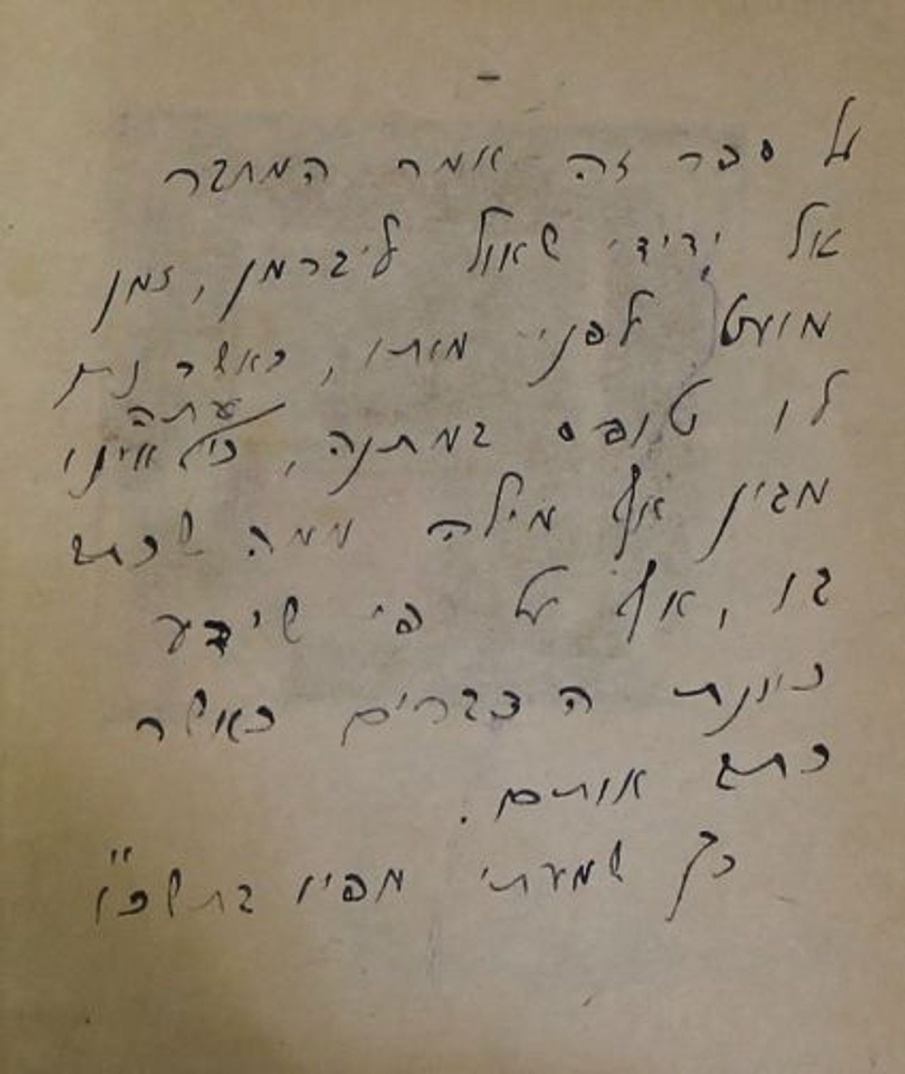
These contemporary developments, however, merely underscore a broader point: the commandment of mishlo’aḥ manot has long been characterized by considerable elasticity in both form and practice. Indeed, halakhic literature contains an extensive discussion concerning the question of how one may properly discharge one’s obligation with respect to this commandment. One of the more intriguing debates in this context concerns whether one may fulfill the obligation of mishlo’aḥ manot not through edible “portions,” but rather through “words of Torah,” by sending a book, each person to his fellow. There is, in fact, no small body of testimony regarding sages of Israel, such as Rabbi Shlomo Alkabetz and Rabbi Yehudah Aszod, who sent, as “mishlo’aḥ manot, each person to his fellow,” their own Torah novellae or scholarly compositions.[10]

This halakhic discussion is not merely theoretical. In the course of my research on Rabbi Professor Saul Lieberman (1898-1982),[11] I encountered a striking modern resonance of precisely this idea, one that illuminates the enduring cultural and intellectual valences of mishlo’aḥ manot beyond its strictly culinary expression. Although he arrived in Jerusalem at a relatively late age, being about twenty-nine, Lieberman quickly became integrated into Jerusalem’s intellectual milieu. As a member of the first cohort of students at the Institute of Jewish Studies at the Hebrew University on Mount Scopus (which had been founded only a few years earlier), he listened with great thirst to the teachings of the leading scholars in Jewish Studies and in classical studies, among them his teacher and master Professor Yaakov Naḥum Epstein,[12] Professor Shmuel Klein, and Professor Moshe Schwabe,[13] one of the foremost scholars of classical culture.

Alongside his academic studies, he soon acquired a reputation as an exceptionally great Torah scholar, for whom no secret of rabbinic literature was lo anīs lei, that is, nothing lay beyond him and nothing escaped his grasp. For many hours he would labor diligently over his learning, memorizing Mishnayot and Talmud – Bavli and Yerushalmi – by heart,[14] and within a few years he produced several exemplary works, such as On the Yerushalmi (1929) and The Talmud of Caesarea (1931), which to this day are regarded as foundational texts in the scholarly study of rabbinic literature.[15]

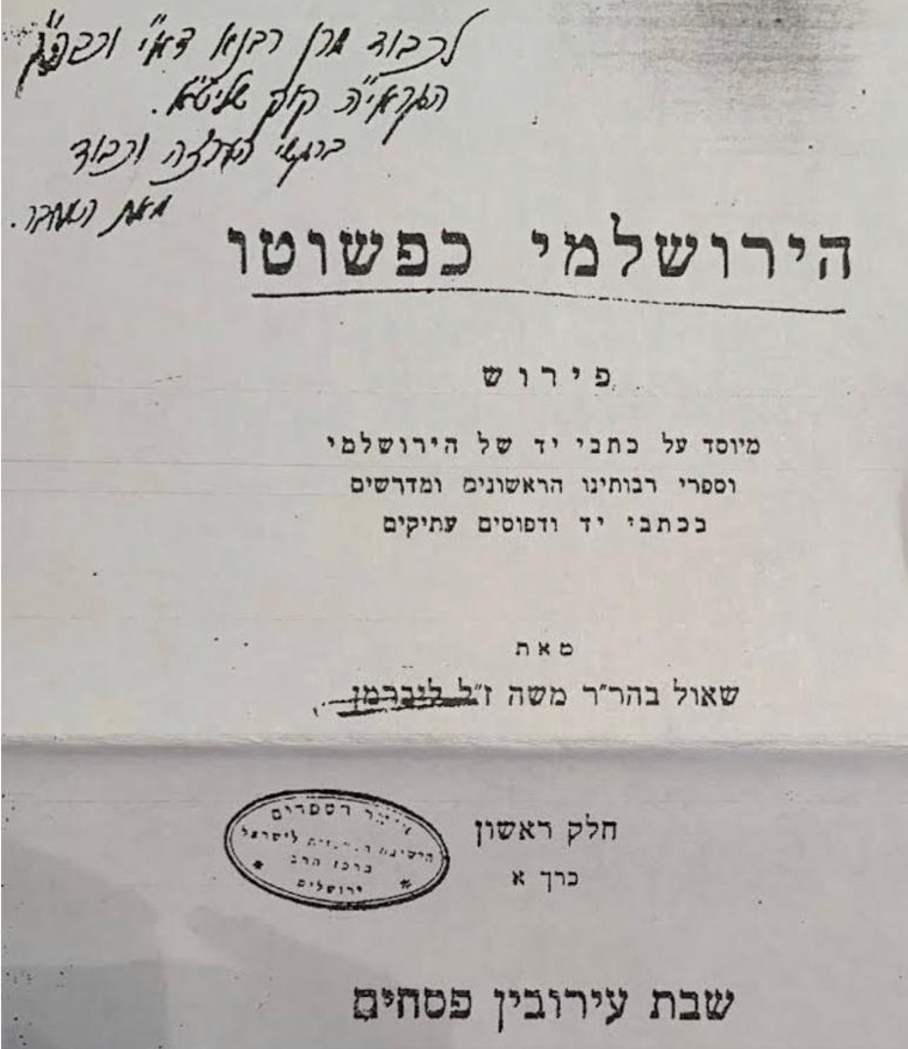
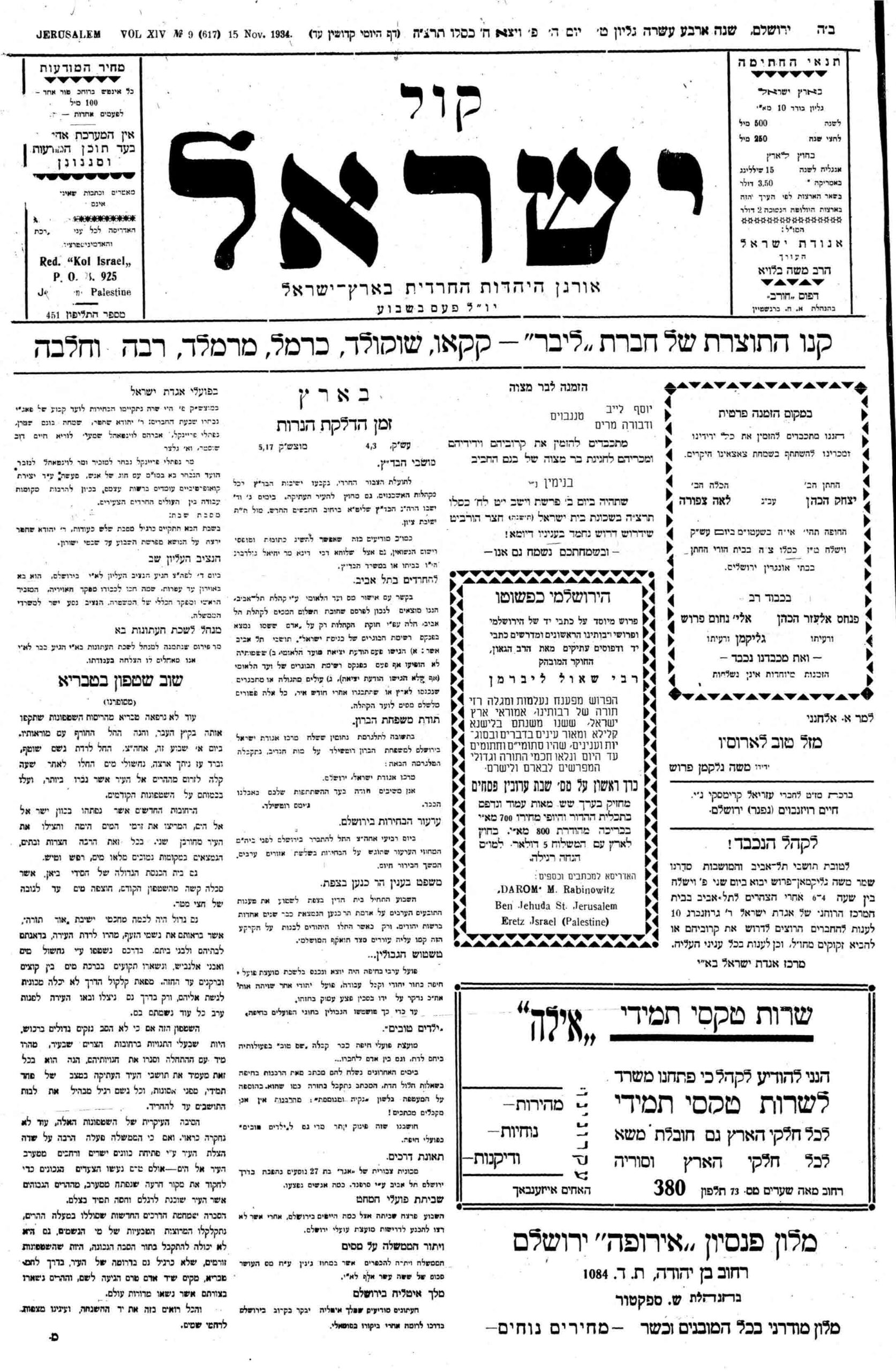
Upon the completion of his studies, Lieberman began teaching in the Talmud preparatory program of the Institute of Jewish Studies, while simultaneously devoting himself to the composition of The Yerushalmi According to Its Plain Meaning (Ha-Yerushalmi Ke-Peshuto) (1935), intended as a comprehensive commentary on the entire Jerusalem Talmud.

On the personal plane, life did not treat him kindly. A short time after his arrival in the Land of Israel, he was bereaved of his youthful wife, Rachel née Rabinowitz, daughter of the rabbi of Pinsk and a descendant of a distinguished rabbinic dynasty. Some time later, he married his second wife, Judith, likewise of illustrious lineage in her own right, the daughter of Rabbi Meir Berlin (later, Bar-Ilan), leader of the Mizrachi movement, and granddaughter of the Netziv of Volozhin. She accompanied him faithfully until the end of her days. The couple did not merit children, and Lieberman immersed himself in his learning.[16]

In the course of these years he became integrated into the “circle of Jerusalem sages,” forming close friendships with many of its members, among them the writer S.Y. Agnon[17]; the scholar Gershom Scholem[18]; the bookseller and proprietor of the Darom publishing house, Michl Rabinowitz; the educator Eliezer Meir Lifshitz; and the merchant and cultural patron Shlomo Zalman Schocken,[19] who in those days founded the Institute for the Study of Medieval Hebrew Poetry.[20]

One figure with whom Lieberman developed an especially close relationship was the Chief Rabbi of the Land of Israel, Rav Abraham Isaac Hacohen Kook. Rav Kook was revered by many members of the Yishuv, among them Berl Katznelson and S.Y. Agnon, and even by self-described “heretics” such as Gershom Scholem and Justice Haim Cohn, who in his youth studied Torah for a year in Rav Kook’s yeshiva together with his cousin, the journalist Azriel Carlebach.[21]

Despite the age gap between them (Rav Kook was twenty-seven years older than Lieberman), the two formed an exceptionally close bond, so much so that Rav Kook, despite being heavily burdened with unceasing rabbinic and public responsibilities, agreed to reserve a fixed hour each day to study in ḥavruta with Saul Lieberman the Tur on Ḥoshen Mishpat, together with Rabbi Joseph Karo’s Beit Yosef.[22]

Like many others, Lieberman, who would later come to be recognized as the greatest scholar of the Talmud in the twentieth century, continued to revere Rav Kook until his final days, and on more than one occasion cited his teachings. Thus, for example, in a letter dated 29 December 1981 to his younger colleague, Professor Ephraim E. Urbach, Lieberman opens with the following sentence:

“You wrote to me that ‘you were ill,’ and I was reminded of the words of Rav Kook, of blessed memory, who said: I prefer to hear ‘I was ill’ rather than ‘I was wealthy’….”[23]

According to a widespread Jerusalem legend, Lieberman and Rav Kook stipulated that they would not cancel their daily study session for any amount of money in the world, and that should either of them violate this condition, he would be required to pay a substantial “fine” to his counterpart. For Lieberman, whose daily schedule was relatively free, fulfilling this condition was easy. For Rav Kook, who in those days was already in poor health and burdened to exhaustion with the needs of the public, fulfilling it was far more difficult, almost impossible.

And indeed, on one such day Rav Kook was compelled to cancel the study session after being invited to serve as sandek at the circumcision of the child of one of Jerusalem’s notable residents. Lieberman, of course, did not forget the matter,[24] and resolved to vindicate the affront at an appropriate time.

In the late afternoon of the “Purim of the unwalled cities,” the fourteenth of Adar 5695 (1935), when Rav Kook was preoccupied with the final preparations for the reading of the Megillah that night in Jerusalem and with organizing the charity funds of matanot la-evyonim to be distributed the following day (for in Jerusalem Purim is celebrated on the fifteenth of Adar), Lieberman appeared unexpectedly at his home and demanded payment of the “fine”: one hour of study in exchange for the hour that had been cancelled several months earlier.

Rav Kook, who recognized the justice of the claim, had little choice. He set aside all his affairs, and the two sat and studied together for a full hour.

Thus far the story, which circulated in Jerusalem for many years. I confess that for a long time I regarded it as no more than a charming “urban legend,” one of those anecdotes that naturally crystallize around towering figures, depicting them not only in their greatness in Torah but also, in the manner of the early sages, as men of wit who knew how to tease one another with affectionate irony.

The story took root, and its echoes may be found in various books as well, albeit in an imprecise form, such as in the writings of Rabbi Moshe Tzvi Neria on Rav Kook.[25] The source material for Rabbi Neria’s account is preserved in his personal archive, now housed in the National Library of Israel, and includes a remarkable series of recollections that Lieberman shared with him in the summer of 1979.[26]

To my astonishment, however, two concrete pieces of evidence that have come to light in recent years in the course of my research on Lieberman do more than merely gesture toward the plausibility of the account. They substantially corroborate it. The first emerged many years ago in the main library of Yeshivat Mercaz HaRav – a library endowed in the name of Markus Cohn, the father of Arthur Cohn, the eminent Hollywood producer who passed away only recently.[27]

On the first volume of The Yerushalmi According to Its Plain Meaning (Ha-Yerushalmi Ke-Peshuto) (also the last, for Lieberman ultimately decided to abandon his projected commentary on the Yerushalmi and to turn instead to the Tosefta, on which he produced his monumental Tosefta Ke-Peshutah), there appears a dedication that Lieberman wrote to Rav Kook, composed, as was customary, in rabbinic idiom and in abbreviations:

“In honor of our master, the rabbi of the Land of Israel and of all the Diaspora, the Gaon Rav A.I.H. Kook, may he live a long and good life, with feelings of admiration and respect, from the author.”

Attention should be paid to the date on which these words were written. The work was published in 5695 (1935). Lieberman signed his introduction at the beginning of that year, on Sunday, 7 Tishrei 5695, between Rosh Ha-Shanah and Yom Kippur, corresponding to 16 September 1934.

Obviously, the printing also took a certain period, probably a few months.

Greater precision can be established regarding the date of publication. A notice announcing the appearance of Ha-Yerushalmi Ke-Peshuto was printed on the front page of Kol Yisrael, the organ of Agudat Israel in Jerusalem (edited by Rabbi Moshe Blau), on 8 Kislev 5695 (15 November 1934). The advertisement’s conspicuous placement on the newspaper’s front page indicates that the volume had only recently emerged from the press and was then being introduced to the reading public. It therefore provides a reliable terminus post quem for any presentation of the work to Rav Kook.

Lieberman therefore could not have presented the book to Rav Kook before that date. The possible window is accordingly narrow: from mid-November 1934 until the onset of Rav Kook’s final illness around Passover 5695 (April 1935). It is thus plausible that Lieberman brought the newly printed volume to him on the eve of Purim of that year, perhaps as mishlo’aḥ manot, or shortly beforehand, and that Rav Kook, in return, presented him with a copy of Rosh Milin bearing the distinctive Purim dedication.

Rav Kook passed away in Elul of that year. Approximately six months earlier, around Passover, he had contracted his final illness and was already confined to his deathbed in a state of severe suffering. Consequently, even had Lieberman wished to do so, he could only have presented him with the work during the brief period at the beginning of that year, from the book’s publication until Passover.

The second surprise came to my attention several years ago, when a friend sent me a photograph of the title page of Rav Kook’s small and enigmatic kabbalistic work, a copy of which was in his possession.

The work, Rosh Milin, on the Hebrew letters, was written in 1917, during Rav Kook’s exile in London in the course of the First World War.[28] Thus did Rav Kook write, in the affectionate dedication he inscribed to his young colleague and ḥavruta:

“A gift of true love to the chosen of my heart, Rabbi Saul Lieberman, may he live a long and good life. Abraham Isaac, the small [i.e., the humble one]. Purim of the unwalled cities, 5695 [1935].”

Anyone familiar with the dedications and expressions of esteem that Rav Kook addressed to various individuals, including leading Torah scholars, will recognize that the phrase he wrote to Lieberman, “true love to the chosen of my heart,” is striking in its exceptional character.

Incidentally, Gershom Scholem later related that, despite his expertise in Kabbalah, he did not succeed in understanding Rosh Milin. He further added – “on the testimony of trustworthy informants,” by which he meant his close friend Saul Lieberman (and he even recorded the remark in his personal copy of the book, now preserved in the National Library of Israel) – that Rav Kook himself told Lieberman:

“Regarding this book, the author [i.e., Rav Kook] said to my friend Saul Lieberman, shortly before his death – when he presented him with a copy as a gift – that he now does not understand a single word of what he wrote in it, even though at the time of writing he fully grasped the meaning and intent of the matters.”[29]

Although Lieberman was as far removed from engagement with Kabbalah as east is from west, he once gave memorable expression to this distance when asked to introduce a lecture by his close friend Gershom Scholem. Lieberman opened his remarks with an immortal quip about Scholem’s field of research, Kabbalah and Jewish mysticism: “Nonsense is nonsense, but the study of nonsense may be a science….”[30] Nevertheless, Rav Kook chose, of all his writings, to present Lieberman with this particular book as a gift, perhaps so that it might serve as a kind of “amulet,” or perhaps as an act of Purim mischief on the part of the aged rabbi; we cannot know.

The unusual date recorded in the dedication, “Purim of the unwalled cities, 5695,” suggests that the booklet was presented to Lieberman on that very occasion, when, according to the account, he chose to collect the aged Rav Kook’s “debt” during their joint study session, perhaps their last, on Purim of that year.

It is entirely plausible that on that occasion Lieberman brought Rav Kook his newly published work, The Yerushalmi According to Its Plain Meaning, and that in return Rav Kook presented him with mishlo’aḥ manot in the form of his small and enigmatic book.

Thus the Jerusalem legend seems to acquire flesh and sinew, and what once appeared to be no more than a charming anecdote may in fact preserve a genuine historical memory: a literary mishlo’aḥ manot exchanged between two towering figures, in which Torah, affection, and Purim playfulness were delicately intertwined.

Appendix A: Rabbi Moshe Tzvi Neria’s Archival Notes on Saul Lieberman’s Recollections of Rav Kook (Summer 1979)

The following translation is based on Rabbi Moshe Tzvi Neria’s handwritten notes preserved in his personal archive, currently housed in the National Library of Israel (Jerusalem). The notes record a conversation held during Summer 1979 in which Rabbi Professor Saul Lieberman recounted a series of episodes relating to Rav Abraham Isaac Hacohen Kook and the influence that Rav Kook exerted upon him. The material corresponds in its essentials to passages later published by Rabbi Neria, but the archival version preserves additional details and a more expansive formulation of Lieberman’s testimony.

Rabbi Neria was accustomed to preserving every scrap of paper containing substantive content that passed through his hands. Alongside newspaper clippings in which several articles about Lieberman appeared, Rabbi Neria preserved the remarks he heard directly from him in the summer of 5739 (1979). According to his account, Lieberman requested that he telephone him in the early morning (“from eight o’clock onward I disconnect the telephone, lock the door, and engage in my Talmudic study without interruptions”), and he did so.

Lieberman told Rabbi Neria that his first visit to Rav Abraham Isaac Hacohen Kook took place on the night of Shavuot:

“I heard that he was teaching Sefer ha-Mitzvot [i.e., Maimonides’ Book of the Commandments]. I came and sat down by the table. In the course of the study I made a remark, and the Rav answered me briefly. Later I made another remark, and again I received a brief reply. When I remarked upon his words a third time, the Rav turned to me and said: ‘Come in to me tomorrow.’ When I came after the festival, the Rav received me with great warmth, asked about my family, and it emerged that he knew several rabbis among my relatives. After a Torah conversation, he asked that I come to him frequently, and thus I did. On the way to the Rav’s visit to the Gerrer Rebbe (to R. Neḥemyah’le [??]), the Rav delayed at my apartment and became engrossed in a halakhic give-and-take concerning a matter I was then studying. I would come and present my novellae before him, ask about what had been difficult for me, and the like. His warm attitude toward me greatly encouraged me. He had a mystical influence upon me, even though I am far from mysticism. I had ‘tests,’ and he influenced me to remain in the study of Torah.”

Lieberman recounted to Rabbi Neria one such “test.” According to his account, a dispute arose between Rabbi Fishman [i.e., R. Yehudah Leib Maimon] and Bank Mizraḥi. The parties decided to submit to arbitration before attorney Mordechai Eliash. Lieberman represented Rabbi Fishman, whereas the bank was represented by attorney Mordechai Levanon. Rav Kook summoned Lieberman and instructed him to cease representing him in the arbitration:

“You have acquired a reputation for involving yourself in arbitration, and that will draw you away from your learning.”

Rabbi Neria further adds and cites in Lieberman’s name words of admiration and reverence for Rav Kook:

“Not only did his greatness in Torah exert influence – and he knew the entirety of Torah – but his entire personality. Matters of the people of Israel and the Land of Israel were not for him merely pathetic rhetoric; rather, they overflowed from his depths, from his hidden world, and there was something mystical in it. This was a figure overflowing with light, and his light would penetrate in its own ways… The Rav was an artist. Not merely a man with poetic sensibility, but truly an artist. In his writing there is a sacred grandeur. His words are like the tones of the shofar’s sound. The ease of his writing is astonishing, yet it is the result of abundant knowledge. They once told of a certain wealthy man who marveled at the request of a great painter to receive an enormous sum of money for a sketch he drew within ten minutes. ‘Not so,’ replied the painter; ‘I labored sixty years in order to attain an ability to draw in such a manner.’”

According to Rabbi Neria, Lieberman told him that he was occupied with printing Ḥasdei David, the commentary of R. David Pardo on the Tosefta, and that through printing his own work on Seder Ṭohorot he repaid his debt…

In this context Lieberman added:

“I also must repay a debt to the Rav [i.e., Kook]. He greatly encouraged me in the study of the Jerusalem Talmud. Several times I presented before him my Torah insights in elucidating difficult passages in the Jerusalem Talmud, and he took great pleasure in them.”

In response to Rabbi Neria’s question, “Was the Rav [i.e., Kook] as proficient in the Jerusalem Talmud as in the Babylonian?” Lieberman replied:

“The Rav was proficient in everything: Babylonian and Jerusalem Talmud, Tosefta and Midrashim, Rishonim and decisors. The Rav was the only one who encompassed the entirety of Torah, and this influenced his encompassing vision. The Rav’s vast scope contributed greatly to the richness of his personality. This was also the greatness of the Netziv, who knew the whole of Torah. I am deeply impressed by the Netziv. So too was R. Meir Simḥah [of Dvinsk, author of Or Sameaḥ].”

In this connection, Rabbi Neria cited words written by Rav Kook:

“The originality of the ‘ever-strengthening spring’ and the ‘river that does not cease’ (Avot, beginning of ch. 6) is the primary aspiration of one who engages in Torah for its own sake, which comes from divine cleaving. The inner spiritual bond with that which is all, the source of all, and beyond all. The desire filled with purity, which steadily intensifies to absorb the distilled essence of the supernal sap within the supernal realms—these are they who always seek the ennobled renewal in its vigorous force” (Iggerot ha-Ra’ayah, vol. 3, p. 4).

(“The Rav’s [i.e., Kook’s] vast scope contributed greatly to the richness of his personality. His opponents fought against him because they recognized his power, because they knew his greatness.”) According to Rabbi Neria, Lieberman described the Rav’s words as expressing a “sacred grandeur.”

Rabbi Neria further relates, in Lieberman’s name, that in the summer of 5690 (1930) Rabbi Moshe Ostrovsky came to the apartment where Rav Kook was staying in Kiryat Moshe in order to pressure him to agree to the compromise proposal then being circulated, according to which the people of Israel would relinquish part of their rights in the Land of Israel, including at the Western Wall. Lieberman was present. The visitor wished that he leave the room so that he could speak with Rav Kook privately; however, Rav Kook detained Lieberman and instructed him to continue sitting there.

Years later, after the passing of Rav Kook, Rabbi Neria heard at a memorial gathering held in the Jewish Agency building that Rav Kook had told Rabbi Ostrovsky:

“The people of Israel has not empowered any person to relinquish the Western Wall. If we relinquish it, the Holy One, blessed be He, will not wish to restore it to us.”

Rabbi Neria testifies that while he lived in Jerusalem in the 1930s, Rabbi Professor Saul Lieberman would customarily pray on the High Holy Days together with the students of Yeshivat Merkaz ha-Rav, who had established their place of prayer at Yeshivat Etz Ḥayyim in the Maḥaneh Yehudah neighborhood.

Among other matters, Rabbi Neria wrote down what he heard from Lieberman regarding his shared study with Rav Kook, and according to what is stated there. The accounts found in Rabbi Neria’s handwritten notes correspond in their essentials to what he later presented in his book.

Alongside them, I found in this archive and in additional archives details concerning Lieberman’s involvement, at the request of his friend (and relative) Rachel Yanait Ben-Zvi, wife of the late President Yitzḥak Ben-Zvi, in the establishment of a yeshivat hesder in Peki’in. Within this framework he approached Rabbi M. Z. Neria and asked him to assist in realizing the idea in practice. Concerning this episode I intend to write, God willing, elsewhere.

Notes

I would like to express my sincere gratitude to my friend and colleague Mr. Menachem Butler, who devoted considerable effort to translating and editing this article into English. I am also grateful for his valuable contributions, including bibliographical references and precise citations.

  1. See Harold Fisch, “Reading and Carnival: On the Semiotics of Purim,” Poetics Today, vol. 15, no. 1 (Spring 1994): 55-74.
  2. See, for example Yaakov Shmuel Spiegel, “Cross Dressing for Special Occasions,” in Joseph R. Hacker, Yosef Kaplan, and B.Z. Kedar, eds., Rishonim ve-Aharonim, From Sages to Savants: Studies Presented to Avraham Grossman (Jerusalem: Shazar, 2010), 329-352 (Hebrew), available here; and Gedalia Oberlander, “The Custom of Disguising Oneself on Purim,” Or Yisrael, vol. 2, no. 3 [#7] (April 1997):125-131 (Hebrew), available here; Moshe Leib Halberstadt, “Costumes on Purim and at Various Events,” Yerushatenu, vol. 5 (2011): 169-175 (Hebrew).
  3. See Shamma Friedman, “Erasing Haman,” Leshonenu, vol. 61, no. 3 (June 1998): 259-263 (Hebrew), available here; Daniel Sperber, “Destroying the Name of Haman,” Shana be-Shana, vol. 32 (2001): 203-211 (Hebrew), available here; and Daniel Sperber, How To Strike Haman (Jerusalem: The Wolfson Museum of Jewish Art, 2002; Hebrew), available here. For a comprehensive survey of the halakhic and historical sources concerning this custom, see Eliezer Brodt, “The Pros and Cons of Making Noise When Haman’s Name is Mentioned: A Historical Perspective (updated),” The Seforim Blog (22 March 2016), available here.
  4. See Dan Rabinowitz, “Purim, Mixed Dancing, and Kill Joys,” The Seforim Blog (6 March 2006), available here.
  5. See Elliott Horowitz, Reckless Rites: Purim and the Legacy of Jewish Violence (Princeton: Princeton University Press, 2006).
  6. Esther 9:22.
  7. Megillah 7a.
  8. See Alan Appelbaum, “Why the Rabbis of the Yerushalmi Called R. Judah Nesiah ‘a Great Man’?” Journal of Ancient Judaism, vol. 3, no. 3 (December 2012): 339-365.
  9. One can hardly help but wonder how long it will be before a kunṭres devoted to the halakhic parameters of re-gifting mishlo’aḥ manot appears, if indeed one has not already been published, systematically treating such questions as whether the initial recipient must effect a formal kinyan; whether the mitzvah requires that the gift be given mi-shelo (“from one’s own”); the respective roles of the giver’s kavvanah and the recipient’s awareness; the permissibility of re-gifting absent the donor’s consent (da‘at ba‘alim); whether the obligation may be discharged through an intermediary (shaliaḥ); whether one may fulfill the mitzvah with an item received earlier that same day; and whether a package that circulates through multiple hands constitutes mishlo’aḥ manot at all, or merely an elaborate exercise in communal redistribution, together with the host of subsidiary questions such a case inevitably generates.
  10. For more on this practice, see Meir Wunder, “Books as Mishlo’aḥ Manot,” Moriah, vol. 5, no. 5-6 [#53-54] (November 1973 – January 1974): 83-86 (Hebrew); and Tovia Preschel, “Mishlo’aḥ Manot of Books from Authors,” ha-Doar, vol. 53, no. 19 (8 March 1974): 295 (Hebrew).
  11. I am currently at work on a biography of Professor Saul Lieberman; for now, my earlier writings on him, see Aviad Hacohen, “Two Scholars Who Were in Our City: Correspondence between Saul Lieberman and Jacob David Abramsky,” ha-Tsofeh Literary Supplement (21 April 1984): 5 (Hebrew), available here; Aviad Hacohen, “Schlemiel, Schlimazel, and Nebbich: Letters from Saul Lieberman to Gershom and Fania Scholem,” Haaretz Literary Supplement (25 April 2000): H1 (Hebrew) , available here; Aviad Hacohen, “The Tannah from New York: A Selection of Professor Saul Lieberman’s Letters,” Jewish Studies, no. 42 (2003): 289-301 (Hebrew), available here; Aviad Hacohen, “Six Days and Seven Gates: Between Israeli President Izhak Navon and Professor Rabbi Saul Lieberman,” Oneg Shabbat (9 June 2023), available here; Aviad Hacohen, “Lieberman Kifshuto: Personal Letters Revealing the Sensitive and Playful Side of a Talmudic Genius, On the 40th Yahrzeit of Professor Saul Lieberman,” Makor Rishon, Sabbath Supplement, no. 1338: Parashat Tzav (31 March 2023): 8-11 (Hebrew), available here; Aviad Hacohen, “The Generation Did Not Appropriately and Duly Appreciate Mr. Schocken [Eulogy by Rabbi Prof. Saul Lieberman for Shlomo Zalman Schocken, March 1960],” Haaretz Literary Supplement (28 April 2024): 1 (Hebrew), available here; Aviad Hacohen, “The Story of the Rabbi Who Rejected the Maxim: ‘Torah Scholars Increase Peace in the World’,” Haaretz Literary Supplement (25 May 2023): 8 (Hebrew), available here; and Aviad Hacohen, “‘A Lithuanian Mind in Its Lithuanian Essence, From Volozhin to Jerusalem’: R. Shaul Lieberman’s Intellectual Kinship with the Legacy of Lithuanian Torah & Its Bearers,” in Martin S. Cohen, ed., Essays in Jewish Studies in Honor of Rabbi Prof. David Golinkin (Jerusalem: Schechter, 2025), 101-139 (Hebrew), available here.
  12. See Shmuel Glick and Menachem Katz, “‘A Threefold Cord’: On Saul Lieberman and His Relationship with the Hazon Ish and Jacob Nahum Epstein,” in Shmuel Glick, Evelyn M. Cohen, Angelo M. Piattelli, et al., eds., Meḥevah le-Menaḥem: Studies in Honor of Menahem Hayyim Schmelzer (Jerusalem: Schocken, 2019), 269-289 (Hebrew).
  13. See Saul Lieberman, “Ten Words,” in Texts and Studies (New York: Ktav, 1974), [1-20], where Lieberman refers explicitly to “my teacher, Prof. Moshe Schwabe, of blessed memory,” and describes Schwabe’s long-standing aspiration to produce a new dictionary of Greek and Latin loanwords in rabbinic literature. For the subsequent realization of this lexicographical program in systematic form, see Daniel Sperber, A Dictionary of Greek and Latin Legal Terms in Rabbinic Literature (Ramat-Gan: Bar-Ilan University Press, 1984); Daniel Sperber, My Rabbinic Loanwords Card Index of More Than a Half-Century: A Companion Volume to Professor Samuel Krauss’ Griechische und Lateinische Lehnwörter im Talmud, Midrasch und Targum, ed. Menachem Butler (Cambridge, MA: Shikey Press, 2022), esp. the introduction, available here, where Sperber describes the work as the product of “more than fifty-years of collection and research,” originally conceived as an annotated continuation of Krauss’s Lehnwörter, and acknowledges Lieberman’s personal role in encouraging his philological work, noting that Lieberman “adopted me as his disciple in this field.” Sperber also reproduces a letter of approbation from Lieberman dated 19 Shevat 5738 (27 January 1978), praising Sperber’s “objective evaluation of Krauss’s volume” and commending the “great progress” reflected in his conclusions.
  14. A fine “real-time” description of his path during those years appears in a letter written at the time by his father-in-law, Rabbi Meir Bar-Ilan, leader of the Mizrachi movement. Writing to his son Tuvia (a chemist and later the first Director-General of Bar-Ilan University) on 25 Marḥeshvan 5694 (5 November 1933), Bar-Ilan remarked“…And so, my dear, everything I have found here: outwardly nothing has changed in our home, but inwardly part of our apartment has been transformed into a beit midrash. For our Shaul sits and engages in Torah and scholarship with remarkable diligence. Your small room has been turned into a library, for Shaul has many books – among them items of precious value – and there he labors over them, if I am not mistaken, some ten hours a day and at night. Apart from those hours in which he teaches at the Teachers’ Seminary and at the university – only twice a week – he sits “over Torah and avodah.” He is engaged in writing a great book [this refers to Ha-Yerushalmi Kifshuto, published in 5695 (1935)], which, upon its completion and publication, will, it seems to me, renew a momentum among Talmudic circles and scholars of Israel with respect to the Jerusalem Talmud. Shaul is great – loftier than I had known – “full and overflowing” in an excellent measure; his knowledge is astonishing and his intellect clear, and beyond this he is an outstandingly diligent scholar. I do not know whether he will persist in his diligence, for it is possible that only on account of his literary work does he not divert his mind from his studies, but at present he continues his work with diligence and industriousness…”
  15. See, recently, Moshe Assis, Saul Lieberman’s Marginalia on Talmud Yerushalmi (Jerusalem: Carmel, 2022; Hebrew).
  16. On Judith Berlin Lieberman’s lineage, intellectual formation, and educational career, see Judith Berlin Lieberman, Autobiography and Reflections, eds. Menachem Butler and Abraham Lieberman (Cambridge, MA: Shikey Press, 2022), available here. See especially the autobiographical memoir (pp. 20-38) and the introductory essay by her nephew Hillel Halkin (pp. 15-19).
  17. See Aviad Hacohen, “‘Honey and Milk Are Under His Tongue, Yet Beneath It Burns a Blazing Fire’: On the Relationship between S.Y. Agnon and Saul Lieberman,” Haaretz Literary Supplement (6 October 2023): 7 (Hebrew), available here.
  18. See Aviad Hacohen, “Schlemiel, Schlimazel, and Nebbich – Letters from Saul Lieberman to Gershom and Fania Scholem,” Haaretz Literary Supplement (25 April 2000): H1 (Hebrew), available here.
  19. See Aviad Hacohen, “The Generation Did Not Appropriately and Duly Appreciate Mr. Schocken [Eulogy by Rabbi Prof. Saul Lieberman for Shlomo Zalman Schocken, March 1960],” Haaretz Literary Supplement (28 April 2024): 1 (Hebrew), available here.
  20. See, for example, Menahem Zulay, “The Research Institute for Hebrew Poetry,” Haaretz Literary Supplement (31 October 1947): 9 (Hebrew); and A.M. Habermann, “Salman Schocken and The Research Institute for Hebrew Poetry: On His Fifth Anniversary of His Death,” Haaretz Literary Supplement (17 July 1964): 13 (Hebrew).
  21. See Aviad Hacohen, “If every Sabbath were like Yom Kippur: An Interview with Haim Cohn,” Meimad, no. 17 (August 1999): 12-15 (Hebrew), available here; and Aviad Hacohen, “Apikores with Divine Grace – Review of ‘Being Jewish: Culture, Law, Religion, State’, by Haim Cohn,” ha-Tsofeh Literary Supplement (27 April 2007): 10, 13 (Hebrew), available here; and see also Azriel Carlebach, “The Rav Renowned for Halakhic Expertise,” Maariv Literary Supplement (19 February 1956): 4 (Hebrew), and Haim Cohn, “The Yeshiva of Rav Kook,” in Haim Cohn, A Personal Introduction: Autobiography, ed. Michal Smoira-Cohn (Kinneret: Dvir, 2005), 96-102 (Hebrew).
  22. Ari (Yitzchak) Chwat, “Rabbi Kook’s Connections with Prof. Rabbi Saul Lieberman as a Model for His Attitude Towards Critical Torah Research,” Tzohar, vol. 35 (2009): 59-66 (Hebrew), is especially important for situating the Rav Kook-Lieberman relationship within the broader question of Rav Kook’s principled openness to rigorous philological and historical methods in Torah study, and for treating Lieberman as a case study for the category Rav Kook termed ḥokhmat yisrael be-qedushatah. For further development of this concept, see Ari (Yitzchak) Chwat, “‘Hokhmat Yisrael in Its Holiness’: Rav Kook’s Vision for True Critical-Scientific Study,” Talelei Orot, vol. 13 (2007): 943-976 (Hebrew).
  23. The letter, preserved in the Professor Ephraim E. Urbach Archive at the National Library of Israel in Jerusalem, is scheduled for publication in my forthcoming volume, Pirkei Shaul, which, God willing, is expected to appear in the coming year.
  24. Many stories concerning Lieberman’s extraordinary powers of memory circulated among people already during his lifetime. One of the sages of Jerusalem, who sought to clarify the difference between Lieberman and other great Torah scholars endowed with remarkable mnemonic ability, described it as follows: “So-and-so, the gaon, knows the entire Talmud by heart. Say to him a particular word, and he will immediately tell you where it appears throughout the whole of the Talmud. Lieberman is greater than he: he can tell you with certainty that a particular word does not appear anywhere in the entire Talmud…”
  25. See Moshe Tzvi Neria, “From the Testimony of Rabbi Saul Lieberman,” in Likkutei ha-Ra’ayah, ed. Moshe Tzvi Neria, vol. 2 (Kefar ha-Ro’eh: 1990), 336–341 (Hebrew), which preserves a version of the Rosh Milin anecdote attributed to Lieberman (based on an interview conducted by Neria in Summer 1981), though without the later bibliographic framing and transmission history found in Scholem’s formulation. Neria’s presentation should also be situated within his broader editorial enterprise of collecting and disseminating Rav Kook-related reminiscences for a wide Hebrew readership, both in his books and in his ha-Tsofeh newspaper columns in the Religious Zionist press.
  26. For a translated excerpt from Rabbi Neria’s handwritten archival notes recording his 1979 conversation with Saul Lieberman, see Appendix A below.
  27. See Yair Sheleg, “King Arthur: Members of the Family of Arthur Cohn, Who Passed Away Last Week, Recount His Scrupulous Observance of the Sabbath Even on the Most Prestigious Stages, and His Profound Love for the State of Israel, Expressed Not Only Through Generous Donations,” Makor Rishon, Sabbath Supplement: Parashat Vayigash (25 December 2025; Hebrew), available here.
  28. See Aaron Ahrend, “About Rav Kook’s ‘Rosh Millin’,” Da’at, no. 27 (Summer 1991): 73-85 (Hebrew), available here; and Aaron Ahrend, “Further on Rav Kook’s ‘Rosh Millin’,” Sinai, vol. 110 (June – July 1992): 190-192 (Hebrew), available here.
  29. Zvi Leshem, “‘He Does Not Understand a Single Word of What He Wrote’: Gershom Scholem and Rabbi Abraham Isaac Hacohen Kook – A Story of a Marginal Note,” Ha-Safranim, Blog of the National Library of Israel (19 August 2019), available here and here.Rabbi Moshe Tzvi Neria transmitted these remarks in the name of Saul Lieberman himself. See Moshe Tzvi Neria, “From the Testimony of Rabbi Saul Lieberman,” in Likkutei ha-Ra’ayah, ed. Moshe Tzvi Neria, vol. 2 (Kefar ha-Ro’eh: 1990), 339 (Hebrew). On the affinity between the Rav Kook and Saul Lieberman, see ibid., pp. 92, 337-341, 369. From there also in Elijah J. Schochet and Solomon J. Spiro, Saul Lieberman: The Man and His Work (New York: Jewish Theological Seminary of America, 2005), 52-53, 101.
  30. See Daniel Abrams, “Defining Modern Academic Scholarship: Gershom Scholem and the Establishment of a New Discipline,” The Journal of Jewish Thought and Philosophy, vol. 9 (2000): 267-302, esp. 268n1, where he writes:“Lieberman’s statement has been circulating as an oral tradition amongst scholars and students of the Jewish Theological Seminary. The only printed reference to it I have found is offered by Joseph Dan in his “The Revelation of the Secret of the World: The Beginning of Jewish Mysticism in Late Antiquity” (Brown University Program in Judaic Studies, Occasional Paper Number 2, Providence 1992, p. 3): “We all know that mysticism is nonsense, but the history of mysticism is a science.” See however Lieberman’s article “How much Greek in Jewish Palestine,” Biblical and Other Studies, ed. A. Altmann, Cambridge, Mass. 1962, p. 135 [reprinted in Texts and Studies, New York 1974, p. 22), Lieberman offered the following formulation: “Nonsense is nonsense, but the history of nonsense is a very important science. In certain respects it is more revealing than the history of sciences based on reason.” (see also Mortimer Ostow, Ultimate Intimacy; the Psychodynamics of Jewish Mysticism, London 1995, p. 362) Lieberman apparently regretted his statement and wrote an appendix for Scholem’s Jewish Gnosticism based on these lectures.”


A Letter from R. Nathan Kamenetsky

A Letter from R. Nathan Kamenetsky
In response to my last post on the Seforim Blog, R. Nathan Kamenetsky sent me a long e-mail. Because of its value to those with an interest in the Lithuanian Torah world, I asked Rabbi Kamenetsky for permission to post it here, and he graciously agreed – Marc Shapiro
The central figure, albeit a mostly passive one, in the story I shall tell below is R’ Maisheh Finkel, one of the twin sons who were the youngest children of the Alter of Slabodka, born around 1887. The other twin was R’ Shmuel Finkel, whose son became a caterer in Chicago and is the father of the recently deceased son-in-law of R’ Bainish Finkel (son of the the Alter’s oldest son R’ Laizer-Yudel), R’ Noson-Zvi Finkel, a namesake of his great-grandfather the Alter of Slabodka who served as the Rosh of the mighty Yeshivat Mir of Jerusalem for about thirty years.
R’ Maisheh was far superior in Torah talent to his twin R’ Shmuel. Someone described to me R’ Maisheh’s learning pose; he would pace back and forth the length of the beit midrash, and if someone asked a good question, R’ Maisheh would give him one reply as he passed the questioner on the first time he transversed the beit midrash, then give him a second answer when he passed by him a second time, and a third answer when he passed him by for the third time. Raised by his mother – the Alteh lived in Kelem, not Slabodka, till the latter part of the first decade of the 20th century: see MOAG pp. 594-596 — the Alter had at first sent him to learn under R’ Baruch-Ber Leibowitz in Hlusk, and then brought him to Slabodka. R’ Maisheh married Zlateh, the daughter of the Slabodka Rosh Yeshiva, R’ Moshe-Mordkhai Epstein, in 1913, and was appointed as a maggid shiur in the Slabodka Yeshiva.
When the Slabodka Yeshiva opened a branch in the city of Chevron in the winter of 1925, R’ Maisheh was sent along with the first talmidim to be a maggid shiur there. The Alter himself came to Palestine in the summer of 1925 – not as the mashgiach, but as a retiree – and three months later, R’ Maisheh died. Chiddushei Torah of R’ Maisheh Finkel were published beginning in 1986 by R’ Chaim-Dov Altusky, Rabbi Pinchas Scheinberg’s late son-in-law, under the name “Chiddushei Hagram Mislabodka” (together with “Chiddushei Hamasbir”, with the last word created from the acronym of Harav Morainu Soloveitchik Ber Yosheh, Reb) on various massekhtot. Rabbi Altusky had gotten R’ Maisheh’s manuscripts from a (posthumous) daughter-in-law of R’ Maishe’s.
Before we go on with the story, I will quote Rabbi Altusky from one of the introductions of “Chiddushei Hagram Mislabodka” where he quotes R’ Yeruham Levovitz, celebrated Mashgiach of the Mirrer Yeshiva, as having written about R’ Maisheh: “I always said that in a generation which has a great timber as he (ilan gadol kamohu), Israel is not yet widowed (od lo alman Yisrael), and in his light shall we see radiance (b’oro nir’eh or).” Rabbi Altusky points out that R’ Yerucham wrote this when such greats as R’ Chaim-Ozer, R’ Shimon Shkop, R’ Baruch Ber Leibowitz and the Kovner Rav fully functioned; but Rabbi Altusky does not explain why it was R’ Maishe Finkel’s presence that assured R’ Yeruham that lo alman Yisrael. The Alter and his talmid R’ Yeruham saw the ideal gadol baTorah, the ilan hagadol, as one who is equally great in Torah and in Musar – and this combination was very rare to find. They both saw that R’ Maishe filled that prescription – also cf. MOAG pp. 805-806 on what the Alter thought of his son.
Verily, according to one of Altusky’s introductions, R’ Maisheh was “designated (m’yu’ad)” to succeed both his father as Mashgiach and his father-in-law as Rosh Yeshiva; this is surely something that his daughter-in-law had heard within the family and passed on, together with the manuscripts, to Rav Altusky. Also see MOAG pp. 756 and 765 that R’ Maisheh would be his father’s agent to carry through sensitive matters. [Do you, R’ Mailech, have my Improved Edition or only the original MOAG? The Improved Edition has a asterisked footnote on page 1278 regarding the Alter’s high estimation of his son and also pertains to the subject of your landmark book, viz., to R’ Yehiel-Yankev Weinberg.]
Now to the body of the story. I shall tell it in the way it came to me. My father had said several times, “The (Slabodka) Yeshiva was so dear to the Alter, that he would be willing to sacrifice a child for it.” I never understood what he meant by this Aqaidah metaphor (nor did I question my father about it) until I arrived in Israel and repeated it to R’ Laizer Goldschmidt, a dayyan on the Beit Din Hagadol and husband of Miriam nee Plachinsky, a granddaughter of the Alter of Slabodka, asking him what my father had meant. He explained that Slabodka talmidim attributed R’ Maisheh death at so early an age to his having broken his engagement to another girl in order to marry R’ Moshe-Mordkhai’s daughter. He had been engaged to Chava-Leah Hutner of Warsaw (who later became the wife of R’ Tzvi-Yehudah Kook). (You may look up MOAG pp. 791-798 where I conjecture that this breakup brought about [in a convoluted way] R’ Hatzqel Libshitz’s decision to turn down the rabbanut of Kovno – thus opening the door for R’ Avraham-Dober Kahana-Shapiro’s appointment.) Incidentally, when R’ Yitzchak Hutner, later of Yeshivat Rabbenu Chaim Berlin, came to study in Slabodka after WWI, the Alter was ill at ease with him because he was closely related to the jilted young lady, and had his major talmid R’ Avrohm Grodzinsky, by then part of the Musar-hanhalah – see MOAG p. 806 – deal with the neophyte.
And why did R’ Maisheh break up? Because the wife of the Rosh Yeshiva, R’ Moshe-Mordkhai, insisted on it: she insisted that R’ Maisheh marry her daughter Zlateh. The Alter of Slabodka felt that if he would enter into bad relations with (Menuhah Epstein, and hence with) R’ Moshe-Mordkhai, the yeshiva would suffer. And he was willing to sacrifice his son on the altar of Yeshivas Slabodka. It is said that when the Alter was told of his son’s demise, he repeated Job’s words (3:25) “What I greatly feared is come upon me; what I had apprehended has come on me.” In MOAG, I have an excursus on pp. 1061-1064 about the power certain wives of rashei yeshiva wielded in some old yeshivot – especially the Netziv’s (niece, who became his) second wife, sister of R’ Baruch Epstein. When R’ Maisheh broke his engagement, R’ Hayyim Soloveichik was angry with the Alter, saying, “For politics one does not embarrass a Jewish daughter” – see MOAG pp. 419-420.
But I had a problem: if Menuha Epstein was intent enough on having the ‘iluy Maisheh Finkel marry her daughter that she would have him break his earlier engagement, why did she allow him to get engaged to someone else to begin with? Why didn’t she interfere with Maisheh Finkel’s proposed shiddukhim immediately?. This was bothering me for a long time – until I heard another story about R’ Avrohm Kalmanowitz, of Va’ad Hatzalah fame, from a son of his sister, R’ Osher Katzman, an author of many popular articles in the Aguda monthly “Dos Yiddisheh Vort” (and whose son Eli’ezer is on the editorial board of “Yeshurun”).
R’ Avrohm Kalmanowitz had learned in Slabodka, having come there from the town of Aishishok (the town perpetuated by Yaffa Eliach) where he learned with its rav, Reb Zundel Hutner. In his famous speeches in the United States after WWII, Rav Kalmanowitz would often refer to his study sessions with Reb Zundel and would recall that they studied through the long commentaries of the Shakh in Section 25 of Hoshen Mishpat (about the laws of a judge who erred in his ruling) – and that Reb Zundel lamented that there is no one “nowadays” who learns thoroughly through the subject at which the Shakh had toiled so hard. R’ Avrohm then studied under Reb Laizer Gordon in Telz (see fn. t on p. 964 of MOAG), and, by the time he came under the wing of the Alter of Slabodka, he was already close to 20 years of age. By that time he had already completed the 4 Sections of the Shulkhan ‘Arukh. In fact, when he arrived in Slabodka, he would look down upon a bachur his age who had not completed covered as much Torah as he had. He was considered a ‘iluy in the yeshiva, and there was an ongoing debate among the talmidim of the Yeshiva on who was the greater ‘iluy, Avrohm Kalmonowitz or Aaron Sislovicher (later Kotler). In fact, when R’ Avrohm died, in 1964, two years after R’ Aaron Kotler, my father za”l remarked, “The last member of our chabhurah in Slabodka is gone.”
According to “Kulmos Hallev”, a volume about Rav Kalmanowitz and “his Da’ath Torah and spiritual fervor (sa’arot ruach)” (published by his family in Jerusalem, 1996), p. 4, R’ Zundel had spread his pupil’s fame as a “wondrous ‘iluy” and the Alter sent a wagon to fetch him and bring him to Slabodka; the Alter then arranged that he should learn together with his talented son R’ Maisheh. R’ Avrohm’s father,
who served as rav in Volhyn, in the town of Barashi, near Rogachov, once came to Slabodka to see how his son was faring. When the Alter told him, “He can already lead half the world,” he became upset, and said, “I sent him here to learn, not to lead.”
The story Katzman told was as follows: R’ Avrohm had gone home for Pesach, at a time when two shiddukhim were being proposed to him; one was a daughter of his rosh yeshiva R’ Moshe-Mordkhai Epstein, and the other was an orphaned daughter of the Rav of Rakov, a town between Volozhin and Minsk, and he had already met both young ladies. From home, he wrote out two envelopes addressed to the two female candidates, and then sat down to write out the letters he was planning to send them. First he wrote the letter to the Rakov girl and he put her letter into an envelope and took it to the post office. He then wrote a letter to the Epstein girl, and as he was putting the letter into the remaining envelope — woe is him! – he saw that the remaining envelope was the one addressed to Rakov. This meant that the letter to the Rakov girl would arrive at the home of the Epstein girl. He rushed to the post office and asked the postman to return the letter he had given him, but the postman refused. R’ Avrohm went on to offer the postman up to 10 Rubles to get his letter back, but the postman explained that the law is that once a letter is in his hand he must deliver it only to the addressee. In short, when the Rakov girl’s letter arrived in Slabodka, and the daughter of R’ Moshe-Mordkhai saw that Avrohm had even considered another shiddukh but herself, the proud granddaughter of the famous Kovno philanthropist R’ Shraga-Feivel Frank (cf. MOAG Index), was beside herself, and decided she would hear no more of Avrohm Kalmanowitz.
When I heard this story I pieced two and two together, to wit: in the winter of 1913, Rebbitzen Epstein was not interested in Maisheh Finkel because she had as good a catch, if not a better one, for her Zlateh in Avrohm Kalmanowitz, the latter being not only a great ‘iluy, but a tall, handsome and charismatic leader as well. So why should she care if R’ Baruch-Ber Leibowitz, by-this-time the Rosh Yeshiva of Knesset Beit Yitzchak, the “other”, non-Musar, yeshiva in Slabodka, had cast his eye on Maisheh for his daughter (see MOAG p. 525), and why should she care if Maisheh gets engaged to Chava-Leah Hutner of Warsaw? At the beginning of that winter, R’ Moshe-Mordkhai presented R’ Avrohm with an effusive Certificate of Ordination (Smikhah) testifying that he is “a wondrous baqi in all of Shas with Tospoth, and in the posqim, rishonim v’acharonim, as one of the greats of the generation.” The Certificate manuscript is pictured on the page facing page 1 of “Kulmos Hallev”, and is laid out in print on p. 5, together with ordinations by R’ Elya-Barukh Kamai, Rav of Mir, and R’ Rephael Shapiro of Volozhin, both awarded to R’ Avrohm about a month later than R’ Moshe-Mordkhai’s, the manuscripts of which are pictured on the page following p. 220 of “Kulmos”, the last page of the volume.
It is worth noting that in transcribing the manuscript of R’ Moshe-Mordechai, the family misread one word, for, after praising the ordainee as “yet from his youth he stood out as a wondrous ‘iluy,” the end of the fifth and beginning of the sixth written lines read: “Va’yiph va’yigdal va’yehi l’erez may’arzei Hatorah (he became beautiful and grew to become a cedar among the cedars of Torah),” while the printed transciption misreads the beginning of the quotation, that is, its first word, to: “Aph va’yigdal va’yehi (he also grew and became).” The family obviously did not realize that R’ Moshe-Mordkhai used the language of Ezekiel 31:7 which describes “a cedar of Lebanon, that is Assyria (Verse 3)” which “Va’yiph b’godlo (became beautiful in its greatness)” to describe R’ Avrohm who, after being a wondrous ‘iluy in his youth, grew to become a cedar-like tall and handsome young man and one of the Torah cedars of his generations. (I had seen the manuscript Smikhah before “Kulmos Hallev” was published, and I immediately connected R’ Moshe-Mordechai’s expression to Ezekiel. I’ll just add that R’ Moshe-Mordechai used the expression from his by-heart knowledge of the verse, and did not look up the verse in a Tanakh before penning it, else he would have spelled the word “va’yiph” with two Yoddim – and the family would not have been mislead to read his Vav and single Yod as an Aleph, “aph” instead of “va’yiph.)
I believe that R’ Moshe-Mordkhai wrote the extremely flattering Smikha when R’ Avrohm was a candidate to become his son-in-law, but R’ Avrohm obtained the other two smikhot soon thereafter because he was also interested in the Rakov girl whose hand was offered together with her late father’s rabbanut of the town of Rakov – as you know from the case of R’ Yehiel-Yankev Weinberg of Pilvishok, a town would keep its rabbinical post vacant until their deceased rav’s daughter would find a match suitable to take over the rabbinate. Therefore, R’ Avrohm sought out ordinations from well-known rabbanim who served in towns close to Rakov, not in faraway Slabodka. During the same winter that the Epsteins were sure that R’ Avrohm would close a shidduch with their Zlateh, R’ Maishe became engaged to the well-to-do and pedigreed Chava-Leah, daughter of R’ Yehudah-Laib Hutner, a Motz in Warsaw who also owned a printing company. After Avrohm’s Pesach blunder, Zlateh was left with a second-choice mate, one who was already engaged, Maisheh Finkel: her mother took care of the rest. Under the hand of the daughter-in-law who supplied Rav Altusky with R’ Maishe’s Torah manuscripts, I saw the ketubah of Zlateh and Maisheh: they were married two months after the Pesach debacle, in Sivan 5673 (June 1913), and one of the two witnesses thereon is my grandfather, R’ Bereh-Hirsh Heller, the “younger” mashgiach of the Slabodka Yeshiva. Rav Kalmanowitz went on to wed the Rakov girl and its rabbinate, and became known throughout his lifetime as “the Rakover Rav”. It is said that R’ Laizer Rabinowitz, who succeeded his father-in-law the Minsker Godol, R’ Yeruham-Yehudah-Laib Perlman, as Rav of Minsk, took no major action in that metropolis without first discussing it with Rav Kalmanowitz. The latter verily became a great Torah leader as the Alter had predicted.
I’ll end by doing justice to the historically underrated Rav Kalmanowitz. During the First World War, Rav Kalmanowitz organized aid for the refugees who streamed from Poland into Russia, as recorded at length in “Kulmos Hallev”. He also went on to become close to the Chafetz-Chaim and followed the latter’s guidance in klal Yisrael activism. When the Mirrer Yeshiva underwent a financial crisis, he became the major fundraising representative of the Mirrer Yeshiva in Europe, and then traveled to America on behalf of that yeshiva. Because he was not a simple executive director but a great talmid chakham, he was given the title of “Nasi” of that yeshiva, and was promised that he would eventually deliver shiurim therein. (Nowadays, many religious institutions raise their stature by claiming to be uner the “n’si’ut” of one gadol or another. But the first to hold that title was Rav Kalmanowitz, who not only contributed his good name to the Mirrer Yeshiva, but earned the title by literally saving it from collapse.)
But delivering shiurim in the Mirrer Yeshiva never worked out for R’ Avrohm. I conjecture that it was due to the opposition of Reb Yeruham Levovitz, the Mashgiach who shared at least equally with the Rosh Yeshiva, R’ Laizer-Yudel Finkel, the adulation of the talmidim. As a ba’al Musar who sought to raise the stature of bnai Torah who devoted themselves exclusively to Torah study, R’ Yeruham felt that super-activist Rav Kalmanowitz was an improper role model. (See MOAG pp. 573-576 that R’ Yeruham disagreed strongly with the Chafetz-Chaim’s approach to the training of yeshiva students.) Instead, the Mirrer Yeshiva fulfilled its obligation by providing a group of its outstanding talmidim to set up a kolel in Otwotzk (near Warsaw) for its Nasi to head. The Kalmanowitz family told me that R’ Avrohm always looked back at that time in his life when he sat and learned in the Mir-sponsored kolel as the happiest period of his lifetime.
In spite of this, Rav Kalmanowitz could not bring himself to shun the public arena for long. He returned to his activism and became Rav of Tiktin, an ancient and highly prestigious rabbanut. His many activities on behalf of Jewry and his prolific writings about them are recorded in “Kulmos Hallev”, a book which should be read by all bnai Torah. When the Second World War broke out, he happened to be fundraising in the United States, and there became the linchpin of the Vaad Hatzalah organization. Among other accomplishments, he raised the monetary means to sustain the Mirrer Yeshiva throughout its Shanghai exile. In connection with this supreme achievement, there is a famous vort which R’ Avrohm expounded. He asked: why did the lion claw and injure Noah when he was once late feeding it in the Ark, when, after all, he had fed it in time all the other meals? And he answered: there can be no excuse for treating the very last lion in the world in any manner less than royally. Rav Kalmanowitz used this bon mot when asking people to contribute to saving the last yeshiva remaining when the Jewish world was destroyed with the onset of the war.
I’ll end with an exchange between gedolim that R’ Yankel Leshinsky witnessed and relayed to me. The three Slabodka talmidim, R’ Reuven Grozovsky, R’ Avrohm Kalmanowitz, and R’ Aaron Kotler were meeting in the Vaad Hatzalah office, and a heated argument broke out between Rav Kalmanowitz and Rav Aaron Kotler as to which course of action to take. Rav Kalmanowitz lost his composure and said, “Listen R’ Aaron, if I had sat and learned all the years as you did, I would have been greater than you.” To which R’ Reuven retorted, “Yes, R’ Avrohm, but R’ Aaron did learn!” The point is that Rav Kalmanowitz sacrificed the pinnacle of personal rank in favor of the public needs: and he was never properly appreciated for it.


Daf HaYomi: Seforim on Masseches Rosh Hashanah

Daf Yomi: Seforim on Masseches Rosh Hashanah

By Eliezer Brodt

Daf Yomi just started learning Masseches Rosh Hashanah this week. This past Monday evening I had a conversation with Rabbi Moshe Schwed of All Daf.

The purpose of the conversation was to briefly highlight some of the Rishonim and Achronim “out there” on this Messechtah, adding some tidbits of interest about them. We recorded it and it’s available for viewing here or here.

It’s only half an hour long. Many aspects could have been discussed at greater length but R. Schwed had mercy on potential listeners!

This is an experiment which we are trying on the Seforim Blog and we hope to have other presentations from others over time. Feedback or comments of any sort are appreciated.

This is the third such conversation I had with him of this kind this year (earlier we discussed Yerushalmi Shekalim [here] and Masseches Yoma [here]).