Controversial Book on the Development of the Siddur

In the Jewish liturgy there is a fundamental question dealing with the composition of the Hebrew found therein. There are two major types of Hebrew – Rabbinic and Biblical. The question becomes which should one be using when praying. This at first blush may appear to be of minor significance, however, most controversies regarding various words throughout the prayer book can be traced to this one point. This issue of which Hebrew to follow was brought to head in the 18th century. During this period there were a few books published dealing with the proper nusach (composition of the prayers). Some of these works advocated for various changes in the prayer book based upon the authors understanding of which Hebrew to follow when praying. This in turned provoked a fairly large controversy which can be felt today by anyone sensitive to the nusach of the prayers.

Today, although most may be unaware, many changes effected during the above referenced time period are still to be found in almost all the standard prayer books. This is so, as Wolf Heidenheim in his prayer book, which became the standard for most which followed him, relied and incorporated numerous changes based upon these 18th century works. Heidenheim’s book became, in part, the standard after he was able to secure an approbation from one of the most traditional Orthodox rabbis of the day – R. Moshe Sofer (Hatam Sofer). R. Sofer, whose well known statement “anything new is prohibited” was either unaware of the “newness” of Heidenheim’s work or perhaps agreed with his alterations, ensured Heidenheim’s work would become the exemplar for all subsequent prayer books.

One of the more interesting books to come out of this period has recently been reprinted. This book, Yashresh Ya’akov, was originally published around 1768 and, according to the title page, was authored by R. Ya’akov Babini. The work is supposedly based upon a question which R. Babini was asked. Specifically, someone wrote that he entertained an Italian guest. This guest when it came time to say birkat hamazon (grace after meals) said the prayer with numerous changes from the standard format. The host wrote to R. Babini to ask whether these changes were in fact correct. All of these changes are more or less based upon the notion that one should follow the Biblical Hebrew as opposed to the Rabbinic Hebrew. R. Babini defends the guest’s alteration and demonstrates that in each instance the changes were correct.

That is the basic background on the book. Yet, there are numerous other important facts that are not necessarily apparent from just a casual read of the book. First, as I mentioned, taking a position that Biblical Hebrew is the correct Hebrew and thus one should alter the standard was highly controversial. In an effort to avoid controversy the true author of the book – not R. Babini – hid his name. The true author is really R. Ya’akov Bassan.[1] R. Bassan gave an approbation to this work although he did not use his own name as the author. Instead, R. Bassan picked someone who had less than a stellar reputation – R. Babini. R. Babini in 1759 published a book under his own name titled Zikhron Yerushalayim which listed various holy places in Israel as well as where certain Rabbis are buried in Israel. R. Babini, neglected to mention in this publication that this work had already been published in 1643 under the very similar title Zikhron B’Yerushalayim, which contains, with minor changes, the very same text R. Babini offered as his own. Thus, looking for a patsy, R. Bassan picked someone who already did not have such a great reputation. R. Bassan although unwilling to offer his name to his own publication decided to instead offer his approbation to his own work.

Aside from hiding the authorship, the place of publication was also altered. The title page reads Nürnberg as the place of publication. This is incorrect, in actually this was published in Altona. The date on the title page reads 1768, however, the date on the approbation reads 1769 thus making the date offered an impossibility. All of these “hints” should lead an observant reader to realize something funny is going on here – namely nothing is what it appears. These types of hints to the ultimate author were actually somewhat commonplace during this period. Most famously, R. Y. Satnow would publish books not under his own name, instead either in the approbation or the title page he would offer hints that only an astute reader would notice demonstrating that R. Satnow was in fact the true author.[2]

As R. Bassan correctly surmised, his work was in fact controversial. R. Binyamin Espinoza wrote a work directed at disproving the underlying premise of R. Bassan’s that one should stick with the standard liturgy and not change it to conform with Biblical Hebrew. R. Espinoza, originally from Tunisia was unsuccessful in publishing his rebuttal and it remained in manuscript, although its existence was known to many. R. Espinoza pulls no punches and takes R. Bassan to task in very sharp terms for his advocating these changes. As mentioned above this was to no avail as either surreptitiously or knowingly many of the changes and other similar ones have in fact become standard today.

Recently both the Yashresh Ya’akov and R. Espinoza’s work Yesod HaKium have been republished together. This edition which includes an extensive introduction which contains all the history above and more is excellent. Obviously, for understanding the development of the liturgy of the prayer book this is extremely important. Also those interested in bibliographical quirks will also enjoy these books. The book is available from Beigeleisen books (718-436-1165) who has informed me he has recently received a new shipment of these as the prior one had been sold out. This new edition was edited by Rabbis Moshe Didi and David Satbon from Kiryat Sefer, Israel (ת.ד 525 and 154 respectively).

For more on these books see here.

Sources:
[1] This understanding that R. Ya’akov Basson is the actual author runs counter to many earlier assertions that the author was R. Avrohom Basson. In the new edition of this work, however, they demonstrate the problems with associating R. Avrohom and instead argue that in fact it is R. Ya’akov.

[2] Satnow was not the only one; according to some, R. Saul Berlin, in the Besamim Rosh, offered similar hints to his authorship of this controversial work.


Listing of New Seforim

What follows is a list of new seforim I have recently purchased; for prior lists see the “New Books Lists” on the sidebar.

1. Indices To The Emden-Eybeschuetz Controversy Literature by Gershom G. Scholem. As the title implies, this is an index, divided by person, book, and geographic place. Additional, many of the abbreviations used (R. Emden constantly uses abbreviations, many obscure) are explained. This index was culled from Scholem’s index cards where he kept these records. The editors have done nothing to update them nor have they attempted to ensure consistency. So, in essence they had these cards typeset and published.

But, as part of this publication Hebrew University has scanned all of the books and manuscripts covered by this index and put them on a CD. This is especially important, as many of these are very rare and hard to come by. This CD is supposed to be available directly from Magnes Press, however, I could find no other information on this on their website.

2. On the topic of Scholem there is a fairly recent book, Pithe ‘Olam which is a critical edition of R. Solomon ben Samuel’s work by that name. This is a work of kabbalah. However, perhaps the most interesting piece of this book in not the manuscript but what the editor, Rafeal Kohen, has appended to it. R. Kohen has included his own polemic against modern kabbalah scholars. He accuses them, among other things, to have stymied the publication of numerous manuscripts to benefit their own careers, racism against those not in academia, as well as plain sloppy scholarship. He backs some of these claims up with concrete examples. In particular he savages Paul Fenton’s edition of R. Yosef b. Avrohom’s Sheroshi HaKabbalah with numerous examples of errors and mistakes. R. Kohen, also goes University by University and points out who he has issues with. R. Kohen is particular of appending each of the names of the people he discusses with the ignominious abbreviation meaning שם רשעים ירקב ימח שמו וזכרון תימקן ותשחקן עצמות אוסר לעסוק בקבורתו or שר”י יש”ו תו”ע אל”ב at every single mention of their names. He covers Hebrew University, Bar Ilan, Sorbonne, and the Schechter Institute. It makes for some entertaining, if over the top, reading.

3. Journal Mayni HaYeshua from Biala Hassidim contains a 23 page article against Eliach’s Sefer HaGaon.

4. Ziv haSemot or What’s in a Name. This book on everything having to do with names and naming is perhaps the 4th book on this extremely important, life or death topic which has come out in the past few years. This one is in both Hebrew and English. Curiously, although there is a chapter on using a name that a wicked person had such as Yismael. The author does not cite to or quote the Shu’t Besamim Rosh on the topic. Whose pronouncement has broad implications for naming. He says even if a evil person happen to have the name, if it is a nice name then you can use it.

I purchased these at Biegeleisen in Boropark.


Upcoming December Auctions

In the next few weeks there are a bunch of auctions. First, is Sotheby's auction of the "Delmonico" collection.  This collection, of an anonymous collector, is amazing.  It includes fifty incunabula with the balance of the auction being 16 and 17th century books.  Included in the later portion are volumes of the first edition Bomberg Talmud printed on blue paper.  These are the only known copies of these volumes. The incunabula includes the first edition of the Rambam's commentary on Mishna, the second edition of the Mishna Torah, the first book printed in the author's lifetime – the Nofet Zufim by R. Yehudah Messer Leon, first edition of the Ramban's Commentary on the Torah, the first Hebrew book with a printer's mark, as well as many, many other gems. This auction takes place on December 17th in the morning, there is another Sotheby's auction of Jewish books and Judaica taking place that afternoon as well.

The next auction is Kestenbaum which takes place a day later, on the 18th.  Some highlights from the catalog include a letter from R. Joseph B. Soloveitchik (318) regarding the permissibility of teaching Talmud to girls.  "Rabbi Soloveitchik declines to present his views."  Because "'We have reached a stage at which party lines and political ideologies influence our Halachic thinking to the extent that people cannot rise above partisan issues to the level of Halacha-objectivity. . . . I am not inclined to give any of these factions an opportunity for nonsensical debates.'"  Also, in the manuscript section, are a collection of letters from R. Samson Morpurgo, (308) many dealing with the Ramchal controversy. While some have been published it appears there are discrepancies between the published versions and that of the letters in this collection.  Or for those interested in the R. Naftali Hertz Wessely controversy, the scribal copy of R. Tzvi Hirsch Berlin's resignation letter (296) is included.  Due to R. Wessely's Divrei Shalom ve-Emet, R. Berlin wanted Wessely expelled from Berlin; however, Mendelssohn defended Wessely leading Berlin to tender his resignation as Chief Rabbi of Berlin.  Later, Berlin, recinded his resignation and remained Chief Rabbi until his death in 1800.  Of course, R. Berlin was R. Saul Berlin's (publisher of Besamim Rosh) father. Although not as rare as the blue paper Bomberg, Kestenbaum has a complete copy of the Slavita, 1817-22 Talmud (256). The publication of this Talmud eventually led to the controversy betwen the Slavita and Romm presses.

When it comes to colored paper there are two lots of interest.  The first is Deinard's edition of the Zemir Aritzim (124) which is printed on multi-colored papers including blue, green, pink, and yellow, indeed, there are only two white pages in the book. The Amsterdam, 1669 Seder Keriah ve-Tikun le-Leilei Chag Shavout ve-Hoshana Rabba, "at the request of wealty bibliophiles, a handful of copies of this work were printed on colored paper" including blue or green paper.  This one (213) is on blue paper.  Returning to Deinard, there are three other books of his, including one which he inscribed (122-25).  As is well-known Deinard travelled the world, what is lesser known is the the book Sefer ha-Berit ha-Chadash (On the Life and Customs of the Jews of China), Pietrokov, 1911, (108) which Uzeil Haga describes his travels with the U.S. Armed Forces expedition in 1901 to China. In the end Haga "was suspected of espionage and was imprisoned by the Boxers where he died after suffering torture."  Two bibliographical notes.  The first is a rare catalogue of R. Pinner (translator of the Talmud into German) for the Odessa Society for History and Antiquities Holdings of Ancient Hebrew and Rabbinic Manuscripts (81).  The second is Ben-Zion Eisenstat's Otzar ha-Temunot (85) which is a collection of photographys of over 150 Rabbis from the turn of the twentith century.  The full catalog can be downloaded here


Concerning the Zohar and Other Matters

Concerning the Zohar and Other Matters
Marc B. Shapiro
1. In the last issue of Milin Havivin I published an article dealing with the Zohar and the supposed obligation to accept that it was written by R. Shimon ben Yohai. You can see it here. In the article I mentioned authorities who pointed to passages that in their minds were certainly post-Rashbi interpolations.[1] At the end of the article I also published a letter from R. Isaac Herzog in which he briefly deals with the issue of non-literal interpretation of the Torah. We see that he was uncertain as to what the boundaries are in this matter, and thought that this was an issue that needed to be worked out. That is, he did not believe that the last word on this issue had been stated.
Subsequent to publication I found some more interesting material and I also received a number of emails making various points, so now is as good a time as ever to return to the topic.
First, let me mention what David Farkas wrote to me in an email. In the article I cited Bruriah Hutner-David who brings the following proof that R. Zvi Hirsch Chajes rejected the traditional authorship of the Zohar: In order to show that the Targum to Ecclesiastes should be dated to the geonic period, Chajes notes that while the angel Raziel is mentioned in this Targum, he is not mentioned in talmudic literature. Hutner-David notes that Raziel is mentioned in the Zohar, a fact that Chajes was presumably aware of, meaning that he was hinting that the Zohar is also a late work.
Chaim Landerer called my attention to the fact that in a talmudic era Aramaic incantation bowl the name Raziel does appear, and I cited this to show that Chajes was incorrect in his assumption that the name Raziel post-dates the rabbinic period. However, Farkas has correctly noted that the name Raziel in the bowl refers to God, while Chajes was specifically referring to Raziel as a name of an angel. In other words, there is no refutation of Chajes. Yet I still think that Chajes assumed that the name Raziel itself was post-talmudic. Once we see that the name existed in the rabbinic period, even if so far the only evidence of its use is for God, it is certainly possible that it was also used for angels as well. If that is the case, there is no evidence that the use of the word Raziel as an angel’s name points to a post-rabbinic date.
I also found that Saul Berlin notes, in the introduction to his Kasa de-Harsana (his commentary to Besamim Rosh), that unlike all other ancient Jewish books, the Zohar has an introduction. Because of this, he writes that when it comes to the authorship of the Zohar he inclines to the view of his great-uncle, R. Jacob Emden.
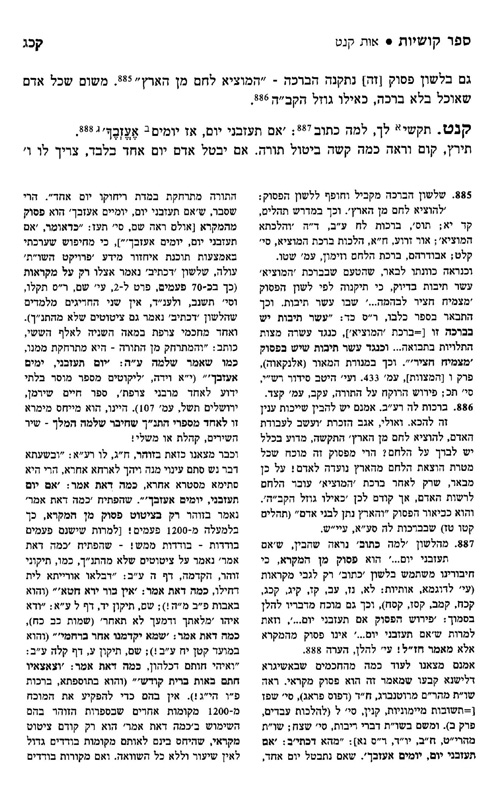
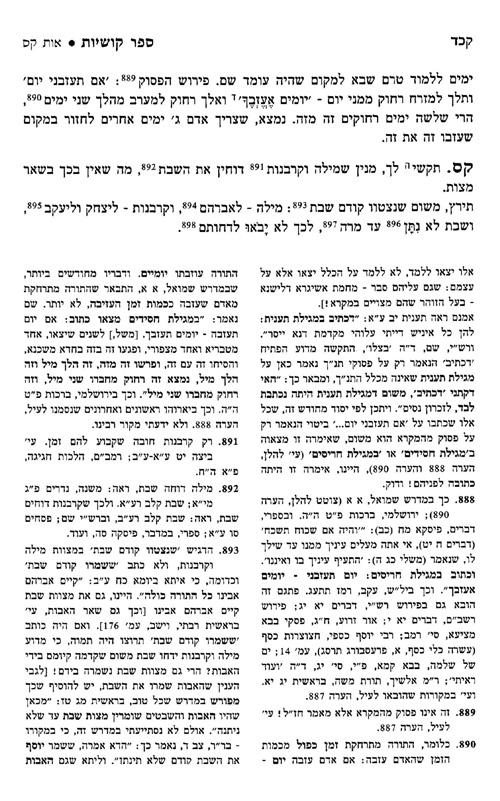
A few years ago the outstanding scholar, R. Yaakov Yisrael Stoll, published the anonymous Sefer Kushyot. Here are pages 123-124.

I ask readers to look at note 887. He discusses a mistake made by many in assuming that an expression is a biblical verse. He then notes that the Zohar also makes the same mistake, and refers to other such mistakes made by בעל הזוהר. He doesn’t say so explicitly, but I think the way he formulates the note lets the reader, who is attuned to these things, know that in his mind בעל הזוהר is not R. Shimon ben Yohai.

Someone called my attention to this video

I have no idea who the speaker is, and if he has ever even read a page of the Zohar, but he does seem very sure of himself. I have no objection to discussing the authorship of the Zohar and the ideas found there, or Kabbalah as a whole. However, I would think that a little humility is called for when discussing a discipline that was a basic part of the religious worldview of so many central figures. Do the names Nahmanides, R. Joseph Karo, or the Vilna Gaon mean anything to this speaker?
In my article, I cited all sorts of texts by Orthodox figures dealing with the authorship of the Zohar. Yet I overlooked the following by R. Joseph Hertz.
The question of the authorship of the Zohar, like that of Sefer Yetzirah, is one of the cruces of Jewish literature. The authorship by Simeon ben Yochai, or by his immediate disciples, though this is still an article of faith with millions of Jews in Eastern Europe, has from internal evidence long proved to be untenable. The Zohar explains Spanish words, contains quotations from Gabirol, and mentions the Crusades.[2]
As noted, in my article cited a number of sources that point to additions to the Zohar. Rabbi Akiva Males commented to me that I neglected to mention R. Isaac Haver, Magen ve-Tzinah, ch. 21. This book was written in response to R. Leon Modena’s Ari Nohem, a work aimed at disproving the antiquity of the Zohar. Unless one’s head is totally in the sand, it is impossible to deny that there are passages in the Zohar that post-date the tannaitic era. For Modena, this was proof that the Zohar could not have been written by Rabbi Shimon ben Yohai. Haver, who wants to hold onto the ancient dating, adopts the only path open to him, arguing that there are indeed many post-tannaitic additions, but the core of the book is ancient.
ובאמת ספר הזוהר נכתב כמה דורות אחר רשב”י מה שנכתב ונתקבל משמו ומשאר חבריו ותלמידו שהיו בימיו, וגם זה נעשה בו הוספות רבות עד מאוד מן אחרוני האחרונים אחר שבאו בכתב וניתנו להעתיק ושלטו בו ידי רבים כל אחד מה שנראה בדעתו ומה שנתחדש לו וכתב בגליון על ספר הזוה”ק מן הצד ואח”ז בא ריעהו מעתיק מן המעתיק ומצא בגליון דברים רבים ובמעט התבוננות חשב שזה היה חסרון בגוף ספר והכניסם בפנים.
Haver points out that is how we can explain the obviously late passages, where we see that the Zohar includes material that comes from Rashi and R. Tam. Among kabbalists, it was not unheard of to say that Rashi actually knew the Zohar and was influenced by it.[3] But Haver will have none of this and recognizes that the influence is in the reverse direction, i.e., Rashi influencing the Zohar. He states that anyone who understands the Zohar will recognize these additions.
What does Haver mean when he mentions that there is material from R. Tam in the Zohar? I am aware of one obvious example. It says in Kiddushin 30b that “one should always divide his years into three: [devoting] a third to Mikra, a third to Mishnah, and a third to Talmud.” R. Tam explains why the practice in his day was not in accord with what the Talmud states, an explanation that became very influential and served as a justification for the widespread ignoring of the study of Tanakh in the Ashkenazic world[4]
בלולה במקרא ובמשנה וכו’: פירש רבינו תם דבתלמוד שלנו אנו פוטרין עצמנו ממה שאמרו חכמים לעולם ישלש אדם שנותיו שליש במקרא שליש במשנה שליש בתלמוד.
What he says is that since the Talmud itself contains Bible and Mishnah, there is no need to divide one’s time among the three categories. Rather, by studying Talmud one combines all three areas. I always found this a difficult explanation, for if the Talmud agreed with this perspective, it would have said so, instead of stating that one is to divide one’s time. The intention of the talmudic instruction in Kiddushin was that people become well acquainted with all three subjects, and if they only devote themselves to Talmud, there is a great deal of Bible and Mishnah[5] they will never encounter. (According to Maimonides, Hilkhot Talmud Torah 1:12, once one is already a scholar, he does not need to divide his time between the three areas, but can focus almost entirely on Talmud.)
Despite what R. Tam says, R. Samson Raphael Hirsch claims that it was due to a misunderstanding of this opinion that people were led to stop studying Tanakh.[6] Not mentioned by Hirsch is that even before R. Tam some scholars ignored Tanakh. There were even talmudic Sages who were not expert in Bible. Bava Kamma 54b-55a states:
R. Hanina b. Agil asked R. Hiyya b. Abba: Why in the first Decalogue is there no mention of wellbeing [טוב], whereas in the second Decalogue there is a mention of wellbeing?[7] He replied: While you are asking me why wellbeing is mentioned there, ask me whether wellbeing is in fact mentioned or not, as I do not know whether wellbeing is mentioned there or not.
Tosafot, Bava Batra 113a, s.v. travayhu, cites this text to support its contention about the amoraim: .פעמים  היו שלא היו בקיאין בפסוקין After referring to this strange passage in Tosafot (concerning which there is an entire literature), R. Moses Salmon sarcastically declares[8]: ועל זה סומכים הלומדים עמי הארץ וד”ל
Unlike Salmon, R. Samuel Strashun, in his note to Bava Batra 8a, defended those talmudists who were deficient in knowledge of Bible.
משמע דאפשר שיהיו בעלי משנה או בעלי גמרא ולא בעלי מקרא . . . ודלא כאותן ששופכין בוז על מקצת גדולי זמנינו בש”ס ופוסקים ואין להם יד כ”כ במקרא.
So returning to my question, what does Haver mean when he says that there is material from R. Tam in the Zohar? Well it turns out that R. Tam’s explanation, which we have just been discussing, is also found in the Zohar Hadash (ed. Margaliyot), Tikunim p. 107b:
תקינו רבנן לשלש שנותינו במקרא בתלמוד . . . ואוקמוה דמאן דמתעסק (במשנה) [בתלמוד] כאלו התעסק בכלא בגין דאיהי בלילא במקרא במשנה בתלמוד.
There is no question that this passage is adopted from R. Tam, who lived a millennium after R. Shimon ben Yohai.
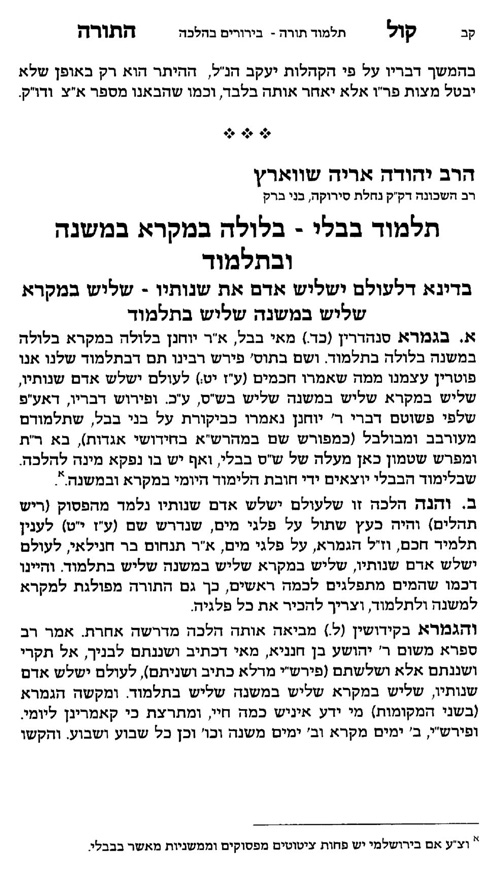
Incidentally, regarding R. Tam’s view, here is a page of an article by R. Yehudah Aryeh Schwartz that appeared in the Agudah journal Kol ha-Torah, Adar 5765 [2005], p. 102 (second pagination).

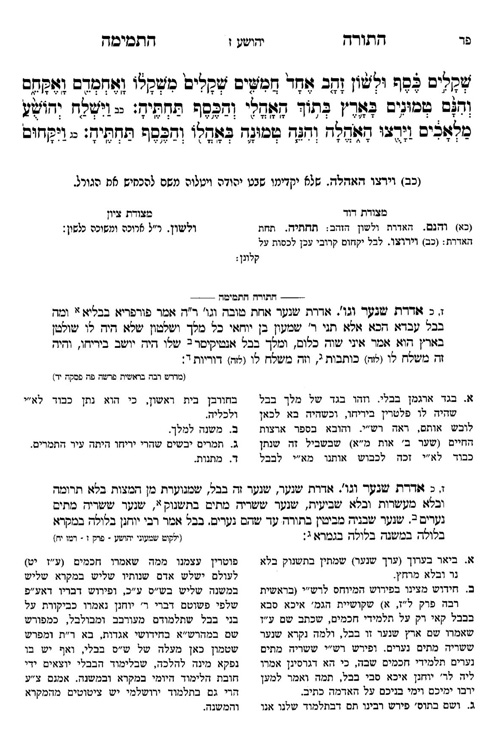
The following page comes from R. Yehiel Michel Stern’s Ha-Torah ha-Temimah on the Book of Joshua, p. 84 no. 3, which appeared in 2009.

As you can see, Stern’s comment is lifted word for word from Schwartz’s article. I am not sure what to make of this. That is, are dealing with a simple plagiarism? Perhaps one of the readers has some insight. (Stern may be the world’s most prolific writer of Torah publications.)

In my article I referred to passages in the Zohar which traditional authorities had claimed were really later interpolations. There are examples of the opposite phenomenon as well, namely, attributing things to the Zohar that are not found there. The most famous instance of this that I know of is found in the Bah, Orah Hayyim 4 (and quoted from there in Be’er Heitev, Orah Hayyim 1:2) that upon waking up if you walk four amot without washing your hands you are subject to the death penalty![9]  This Zoharic text is quoted in the name of the work Tola’at Yaakov, authored by R. Meir Ibn Gabai (1480-ca. 1543). The passage is cited over and over again by aharonim in trying to show the importance of the morning washing. Yalkut Meam Loez, Deut. 4:9, doesn’t even mention the Zohar, stating simply:
ואמרו חז”ל כל המהלך ד’ אמות בלי נטילת ידים חייב מיתה
A few scholars actually point out that this passage is not to be found in the Zohar.[10] One of those who realized this is R. Eleazar Fleckeles, Teshuvah me-Ahavah, vol. 1 no. 14, whom we will come back to later in this post. He writes that he looked in the Zohar and didn’t find the passage referred to. With reference to the Tola’at Yaakov, whom he (falsely) thinks cited the Zohar (since that is what it says in the Bah), Fleckeles writes:
ושארי לי’ מארי’ שעשה רוב ישראל לחייבי מיתות
Because very few of the aharonim actually had the sefer Tola’at Yaakov (which is itself a little strange as the book was printed a number of times), they were unable to see that the Tola’at Yaakov never quotes the Zohar!  Here is p. 9a from the Cracow 1581 edition.

If you look in the second paragraph you will see that Ibn Gabai does state that one who doesn’t wash his hands is חייב מיתה, but he doesn’t attribute this to the Zohar. How he derives this idea is worthy of investigation at a different time. For now, it is important to just note that what we have here is an independent idea of a sixteenth-century Kabbalist which for some reason was misquoted by the Bah as if Ibn Gabai was citing the Zohar. This misquotation was to be repeated again and again, down to the present day.

The supposed Zohar text has led to additional stringencies. For example, the hasidic master R. Meshulam Zusha of Anapole stated that that one should not even to put one’s legs on the ground before washing one’s hands.[11]

Here is an interesting story that relates to the false Zohar quotation: A very learned and rich student came to study with R. Simhah Bunim of Peshischa.[12] The problem was that this young man was a bit of an independent thinker, and the Kotzker, who was also there, didn’t think that the young man belonged with them. The story explains how the Kotzker was able to convince the young man to leave. What was it about this man that turned the Kotzker against him? We are told the following:
הוא הגיה בזוה”ק שכתב “ההולך ד’ אמות בלי נטילת ידים חייב מיתה”, והוא הגיה: “והוא שהרג את הנפש”, וזה נגד חז”ל.
So here we have a story of an emendation of a non-existent Zoharic text. And even if we assume that the man was emending the text as it appears in the Bah, we see from the story that the Kotzker thought that the quote was authentic.

I wasn’t sure what to make of this passage. I therefore consulted a learned friend who said that the problem was that the young man who emended the text to read והוא שהרג את הנפש was making a joke at the expense of the (supposed) Zoharic passage. He was saying that you are only deserving of the death penalty if you kill someone while walking the four amot. I then sent him a page from R. Zvi Yavrov, Ma’aseh Ish, vol. 4, p. 113, where it appears that the Hazon Ish took the emendation-explanation just mentioned as an authentic understanding of the passage. The text in Yavrov reads as follows:

על מה שהביא ה”באר היטב” (או”ח סימן א’ סק”ב) שההולך ד’ אמות בלי נטילת ידים שחרית חייב מיתה, אמר רבינו להגאון ר’ שמריהו גריינימן זצ”ל, שמישהו כתב בגליון הספר “והוא שהרג את הנפש” (מבנו הג”ר ברוך שליט”א).

My friend replied by referring me to a discussion on Hyde Park here where the text from Yavrov is also mentioned. One of the commenters there claims that the Hazon Ish was also joking in his remark, and the one who heard this (who was hardly a tyro), or the person who passed on the information to Yavrov, didn’t realize that it was a joke. The commenter also assumes that despite what appears in the Bah and Be’er Heitev, the Hazon Ish would have known that that it wasn’t an authentic quote from the Zohar. I find this very unlikely, as the Hazon Ish is not known to have been an expert in the Zohar, and what reason would there be for him to doubt that which is quoted in numerous earlier sources? 

The one point that the commenter has going for him is that he is correct that there are many examples in this book, and others like it, from which we see that the author does not know how to distinguish between what should and should not be included in a book. The commenter gives an example to illustrate this. In vol. 5, p. 141, Yavrov gives us the following important information about the Hazon Ish, recorded by one of his students: They never saw the Hazon Ish picking his nose! I kid you not.

העיד אחד מגדולי תלמידי רבינו: מעולם לא ראו את הרבי עם אצבע באף (מהרב מרדכי ויספיש)

Regarding this issue, R. Eliezer Melamed – who really is a great halakhic scholar – writes that picking one’s nose in public is forbidden.[13]

ויש מעשים שכשאדם עושה אותם בסתר, אין בכך פגם, אבל בפני אנשים אחרים הם נחשבים למגעילים ואסורים משום ‘בל תשקצו’ ומשום המצוות שבין אדם לחבירו. למשל, המחטט באף או מגרד פצעונים שבפניו, עובר באיסורים אלו. וכן אמרו חכמים (חגיגה ה, א): “כִּי אֶת כָּל מַעֲשֶׂה הָאֱלוֹהִים יָבִא בְמִשְׁפָּט עַל כָּל נֶעְלָם. אמר רב: זה ההורג כינה בפני חבירו ונמאס בה. ושמואל אמר: זה הרק (היורק) בפני חבירו ונמאס בה”. ובמיוחד בעת שאוכלים, צריך להיזהר בכך יותר, כי מעשים מאוסים, וכן דיבורים מגעילים, מבטלים את התיאבון ומעוררים בחילה בקרב הסועדים.
Getting back to the supposed Zoharic passage, R. Yitzhak Abadi discusses this in Or Yitzhak, vol. 1, no. 1. He begins his responsum by pointing out that despite the fact that the Mishnah Berurah records how one is not to walk four amot before washing one’s hands, R. Aaron Kotler did not concern himself with this. Abadi then explains that the words of the Zohar are not intended for everyone,[14] and none of the rishonim write that it is forbidden to walk four amot before washing. He concludes by stating that he is inclined to rule – ולולי דמסתפינא הייתי אומר להלכה למעשה – that the entire practice of negel vasser is no longer relevant to us because ruah ra’ah is no longer a concern.[15] Here again we see that the author of a responsum assumes that the issue he is discussing, of not walking four amot before hand washing, is based on the Zohar, when in fact the Zohar doesn’t mention this at all.

Finally, I must mention that R. Hayyim Joseph David Azulai, Birkei Yosef, Orah Hayyim 1:1, recognizes that there is nothing in the Zohar about being subject to the death penalty for walking four amot. However, he notes that both he and his forefather, R. Abraham Azulai, saw an alternate version which indeed states that one who walks four amot אתחייב מיתא לשמיא. Based on this alternate text, the Hida declares that the Tola’at Yaakov is correct in how he quoted the Zohar, and the criticism of him for the inaccurate quotation is therefore misplaced. Even the Hida didn’t have access to the Tola’at Yaakov, and based on the Bah assumed that the Tola’at Yaakov quoted the Zohar and must indeed have had the alternate text. Yet as we have already seen, the Tola’at Yaakov does not quote the Zohar, and there is no actual alternate version of the text such as quoted by the Hida.

What happened was that someone saw the Bah quoting the Tola’at Yaakov as quoting the Zohar that one who walks four amot is subject to the death penalty. Not finding this passage in the Zohar, this individual inserted it into his text of the Zohar in the section that deals with hand washing in the morning (Zohar, vol. 1 p. 10b). I don’t think this was intended as a forgery. Rather, whoever put it in assumed that it was an authentic Zoharic teaching, found in an alternate text, and he was inserting it where it should be. He thought that it was an authentic Zoharic teaching because the Tola’at Yaakov had testified to it. But as we have already seen, Tola’at Yaakov said nothing of the sort. This alternate girsa can therefore be traced back to the Bah’s misquotation of the Tola’at Yaakov.

How can we explain the Bah? I think the answer is simple. When the Bah cited the Tola’at Yaakov he did not have the book in front of him, and was relying on his memory, the sort of mistake that is found among all of our great sages. That is how this error crept in which has had a great influence on Jewish religious texts and practice for hundreds of years, and yet it all goes back to a simple mistaken quotation.

Returning to my article on the Zohar, Rabbi Akiva Males called my attention to the following paragraphs that appear in an essay by R. Aryeh Kaplan.[16] It would be great if a reader has examined the manuscript and can testify to the accuracy of what Kaplan reported.

Rabbi Yitzchok deMin Acco is known for a number of things. Most questions regarding the authenticity of the Zohar were raised by him, since he investigated its authorship. He was a personal friend of Rabbi Moshe de Leon, who published the Zohar. When questions came up regarding the Zohar’s authenticity, he was the one who investigated, going to the home town of Rabbi Moshe de Leon. The whole story is cited in Sefer HaYuchasin, who abruptly breaks off the story just before Rabbi Yitzchok reaches his final conclusion. Most historians maintain that we do not know Rabbi Yitzchok’s final opinion – but they are wrong.

Around three years ago, someone came to me and asked me to translate parts of a manuscript of Rabbi Yitzchok deMin Acco, known as Otzar HaChaim. There is only one complete copy of this manuscript in the world, and this is in the Guenzberg Collection in the Lenin Library in Moscow. This person got me a complete photocopy of the manuscript and asked me to translate certain sections. I stated that the only condition I would translate the manuscript is if I get to keep the copy. This is how I got my hands on this very rare and important manuscript.

Of course, like every other sefer in my house, it had to be read. It took a while to decipher the handwriting, since it is an ancient script. One of the first things I discovered was that it was written some 20 years after Rabbi Yitzchok investigated the Zohar. He openly, and clearly and unambiguously states that the Zohar was written by Rabbi Shimon bar Yochai. This is something not known to historians, and this is the first time I am discussing it in a public forum. But the fact is that the one person who is historically known to have investigated the authenticity of the Zohar at the time it was first published, unambiguously came to the conclusion that it was an ancient work written by Rabbi Shimon bar Yochai.
Leaving aside for now the important information recorded by Kaplan, there is a good deal that can be said about R. Moses de Leon and the creation of the Zohar, and it is questionable if one can even speak of a single author. One essential point that must be recognized by all who investigate this matter is that De Leon himself was involved in other forgeries, in particular forgeries of geonic responsa.[17] As such, he obviously is not the most reliable source when he announces to the world that he is in possession of a text of mystical lore dating from the tannaitic period.

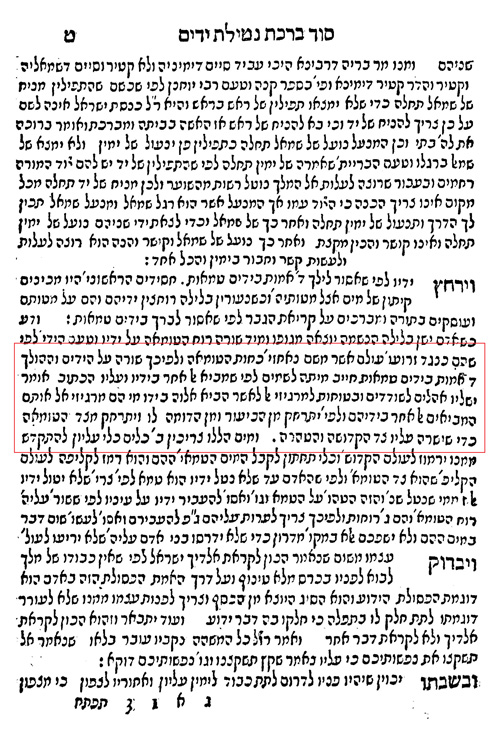
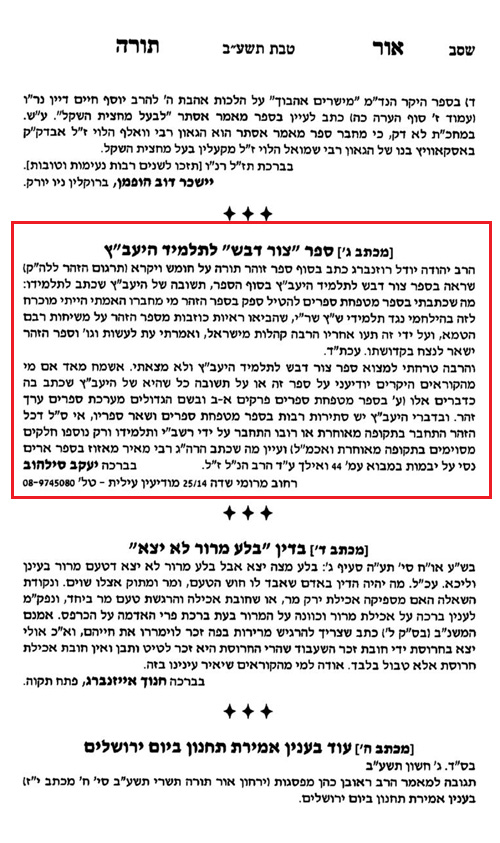
Regarding the Zohar and forgery, I think readers will also find the following interesting.  (Many already know some of the story, but it is worth repeating for those who don’t.) In the journal Or Torah, Tevet 5772, p. 362, a reader, whose knowledge of Jewish bibliography is not that great, had a question. He saw the following page in R. Yudel Rosenberg’s Hebrew translation of the Zohar to Va-Yikra.


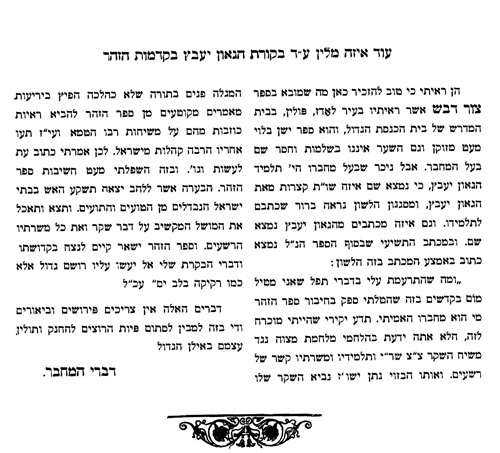
This is important information, as Emden confesses that his attack against the Zohar was only designed to pull the wool out from under the Sabbatians, whose ideology was linked to the Zohar. The man who wrote to Or Torah, not knowing anything about Rosenberg, asked for help from the readers. He tried to locate the book Tzur Devash quoted by Rosenberg, but was unable.

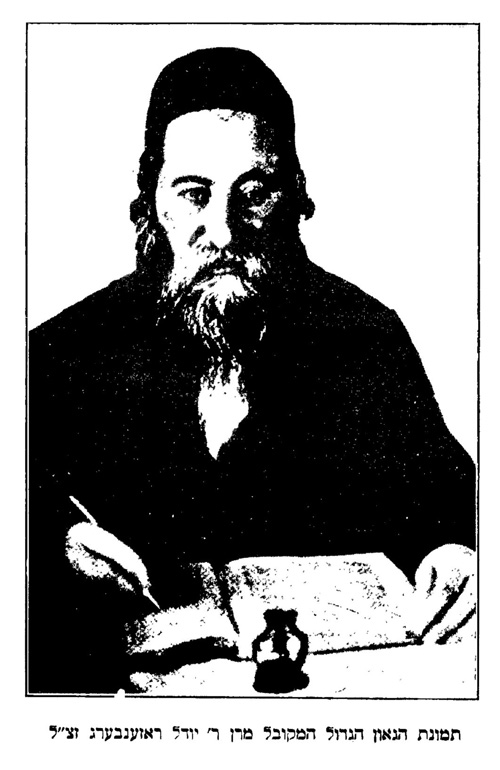
In Or Torah, Adar 5772, pp. 555-557, two individuals let the first writer in on the “not-so-secret” that there is no book Tzur Devash, and that Rosenberg had a long history of making up texts; see here. This is so even though Rosenberg was a respected rabbi and posek. Here, incidentally, is the picture of Rosenberg that appears at the beginning of his Zohar translation.

With some of Rosenberg’s “forgeries”, it seems that what he was doing was creating a form of literature, and anyone who takes the story literally has only himself to blame (much like anyone who thinks that Animal Farm is really about animals has no one to complain to but himself). At times, Rosenberg would even hint to the reader what he was doing, as in Hoshen ha-Mishpat shel ha-Kohen ha-Gadol, where in the preface he mentions that part of the story also appeared in a work of Arthur Conan Doyle. If any reader would have taken the time to find out who this was, he would have realized that we are dealing with a fictional account. At other times, however, Rosenberg offers no such hint, at least none that I am aware of, and what we have appears to be a simple forgery. That would seem to be the case here, with the phony letter from Emden.

The second correspondent in Or Torah also calls attention to R. Yaakov Hayyim Sofer’s discussion in Etz Hayyim 7 (5769), pp. 267-268. While for a long time everyone has known that the Emden letter was a forgery, Sofer identifies another forgery. Rosenberg’s translation (second edition) vol. 1, contains a letter of approbation from R. Hayyim Hezekiah Medini, the Sedei Hemed.[18] Sofer claims, and I think he is correct, that this approbation is a forgery. His prime proof is that in the approbation Medini refers to the Hida as האזולאי. There are many hundreds, if not thousands, of references to the Hida in Medini’s work, and not once does he refer to the Hida as האזולאי, which is a form only used by Ashkenazic rabbis. What Sofer didn’t realize, and further supports his point, is that Rosenberg himself, in his introduction, p. 5a, refers to Hida as האזולאי.

In Or Torah, Iyar 5772, p. 744, another writer called attention to Sedei Hemed, Peat ha-Sadeh, kelalim, mah’arekhet bet, no. 47, where Medini states that it is disrespectful to use this sort of language, referring specifically to the expression האלגאזי.[19] This is another proof, if any was needed, that Medini would never have referred to the Hida as האזולאי. Let me also add that the way Medini (=Rosenberg) concludes the forged haskamah is not like any of his other letters, which are included in Iggerot Sedei Hemed (Bnei Brak, 2006). In the authentic letters, before his name Medini always adds הצב”י or הצעיר , which he does not do in the forged haskamah.. In his authentic letters, he also never closes them by adding to his name רב ומו”ץ בעיר הקדש חברון. Therefore, there can be no doubt that the letter of approbation sent by Medini to Rosenberg is simply another one of the latter’s forgeries.

Now let us turn to the incredible recent publication of a derashah by R. Yehezkel Landau, the Noda bi-Yehudah.[20] But before doing so, it is necessary to say a few words about R. Eleazar Fleckeles, the outstanding student of the Noda bi-Yehudah. (Fleckeles’ grave, entirely ignored by tourists, stands right near that of his teacher.) Ever since the publication over two hundred years ago of the strong comments of Fleckeles downplaying the authority of the Zohar, people have wondered where this came from. It just seemed strange that an 18th-19th century traditional Torah scholar would express himself this way. We now have the answer. Fleckeles was following in his teacher’s footsteps. Thanks to the publication of the Noda bi-Yehudah’s derashah by Michael Silber and Maoz Kahana, a derashah that had previously only appeared in a censored form, we now know that that the Noda bi-Yehudah had a skeptical view of the Zohar, at least in the form that it has come down to us. The issue that the Noda bi-Yehudah was concerned with was the same thing that bothered Emden and Fleckeles, namely, distinguishing the authentic ancient Jewish mysticism from the many later additions that found their way into the Zohar.

What caused the Noda bi-Yehudah in his later years to adopt a skeptical position, one so much at odds with his earlier outlook, is of course worthy of investigation and something for the scholars to fight over (and they already have!).

Regarding Fleckeles, his negative comments about the Zohar that appear in Teshuvah me-Ahavah are well known and have often been cited. In my article I also referred to Fleckeles’ citation of Wessely who quoted R. Jonathan Eibschuetz as supposedly stating that one need not believe in Kabbalah. (Needless to say, it is very difficult to believe that Eibschuetz could have ever expressed himself this way.) In preparing for my Torah in Motion talks on R. Moses Kunitz,[21] I found another relevant text from Fleckeles that as far as I know has gone unnoticed among those who have discussed the matter. It appears in Kunitz’s responsa Ha-Metzaref,[22] which happens to be one of the strangest responsa works ever published. It is also noteworthy in that it contains something extremely rare, namely, a responsum from R. Nathan Adler, the Hatam Sofer’s teacher. Knowing that some people might doubt that the teshuvah could really have been authored by R. Nathan, he also included a letter from the Hatam Sofer testifying to the responsum’s authenticity. 

In Ha-Metzaref, vol. 1 no. 11, Fleckeles again focuses on additions to the Zohar that are not part of the authentic work, but here he adds a new point which is important for an accurate description of Fleckeles’ position. He says that if a Zoharic text is quoted by R. Isaac Luria, R. Moses Cordovero, or R. Menahem Azariah of Fano then you can assume that it is part of the original Zohar, authored by R. Shimon ben Yohai.

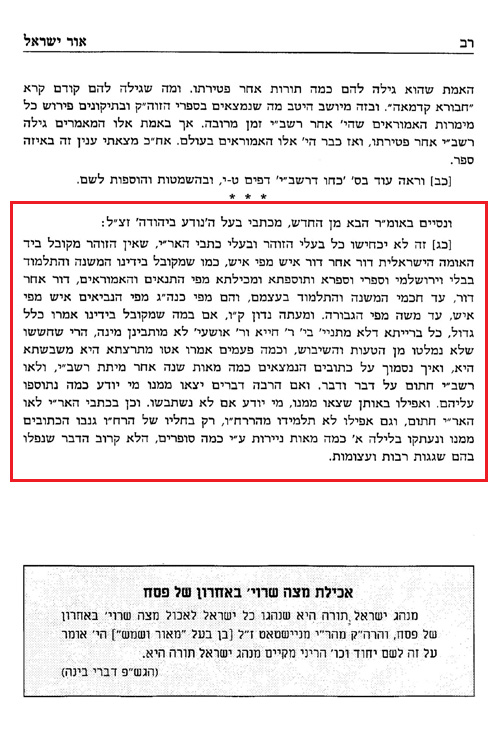
One final comment regarding the Noda bi-Yehudah’s derashah: Yehoshua Mondshine somehow got hold of it before it was published by Silber and Kahana. Here is the relevant page, from Or Yisrael, Nisan 5766, p. 202.

Notice how Mondshine doesn’t reveal where this text comes from, something not expected from a careful scholar. Since this is such an amazing passage, and Mondshine’s article was the first time it appeared in print, you can be sure that loads of people must have turned to Mondshine asking him for its source. Presumably, when he was given the text he gave his word not to reveal its source. He might not have even known the source, and was only given the small passage.

2. Due to correspondence with a couple of people, I realized that I forgot to include something about the word מחיה in my last post. So here it is now.

In the Amidah we say מחיה מתים אתה. There is a tzeirei under the yod meaning that this is not a verb. Artscroll correctly translates “Resuscitator of the dead.” Sacks,[23] on the other hand, gives the mistaken translation “You give life to the dead”. The next line reads

מכלכל חיים בחסד, מחיה מתים ברחמים רבים

Is מחיה in this verse a verb? Ifמכלכל  is translated as a verb, then מחיה will also have to be translated this way. The Tehilat ha-Shem siddur has a segol under the yod of מחיה, and with this vocalization it is correct to translate it as a verb. However, for siddurim with a tzeirei the only accurate translation is a noun. Metsudah, which we have seen is consistent in this matter, translates: “Sustainer of the living with Kindliness, Resurrector of the dead with great mercy.” Both Artscroll and Sacks, however, translate מחיה as a verb which is incorrect. But why is it incorrect? It is only incorrect because of the vocalization (tzeirei), but I think that in the sentence מחיה is indeed a verb. This means that it is the vocalization that is incorrect, and that instead of a tzeirei under the yod, there should be a segol, as in the Tehilat ha-Shem siddur[24]. So my recommendation to Artscroll and Sacks would not be to change the translation, but only to change the vocalization.

After reading my last post, Ben Katz sent me an example where of all the translations, only Artscroll gets it right. The last lines of Adon Olam read:
בידו אפקיד רוחי בעת אישן ואעירה
ועם רוחי גויתי ה’ לי ולא אירא

Sacks translates as follows (and Metsudah is similar):

Into His hand my soul I place,
when I awake and when I sleep.
God[25] is with me, I shall not fear;
Body and soul from harm will He keep.
What this means is that God has my soul at all times, when I am awake and when I sleep, and  that that is why I have no fear.

Artscroll translates as follows:

            Into His hand I shall entrust my spirit
            When I go to sleep – and I shall awaken!
            With my spirit shall my body remain.
            Hashem is with me, I shall not fear.
Before getting to what I think is the significant  part of the translation, let us look at the last line: ועם רוחי גויתי, ה’ לי ולא אירא. In his translation, Sacks has turned the order of the sentence around. That is OK as it was done so that the rhyme works (and Sacks deserves enormous credit for having most of the song rhyme in English). The real problem is Sacks’ rendering of the words  ועם רוחי גויתי. There is no way this can be translated as “Body and soul from harm will He keep.” The words imply nothing about keeping from harm. The typical translation sees ועם as referring to God, meaning that God is with my soul and body and therefore I will have no fear.

However, Artscroll gets it right, I think, by translating these words literally: “With my spirit shall my body remain.” To see how Artscroll gets to this translation, we have to look at the previous verse, and that is where we see Artscroll’s brilliance. בידו אפקיד רוחי בעת אישן ואעירה. The other translations understand this to mean that I place my spirit (or soul) in God’s hands when I sleep and when I am awake. The problem with this rendering is that if my spirit is always in God’s hands, then what sense does it make to say that I place it there? If it is always there, during the day and at night, there is nothing for me to place.

Artscroll translates: “Into His hand I shall entrust my spirit when I go to sleep – and I shall awaken!” This is an allusion to the famous Midrash that we are all taught in school, that when you go to sleep your spirit returns to God, and is given back to you in the morning.[26] This isn’t just some random Midrash, but is derived from Psalm 31:6, which states: בידך אפקיד רוחי.[27] In other words, the Midrash is commenting on the exact words used by Adon Olam. This shows that Artscroll’s translation has indeed beautifully captured the correct meaning.

We now can properly understand the next verse. Since my spirit has returned and joined with my body, I know that God is with me and I shall not fear.

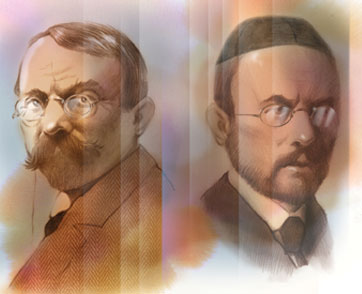
3. There is a relatively new publication for all who are interested in Jewish intellectual life. I refer to the Jewish Review of Books, expertly edited by Abraham Socher. Modeled after the New York Review of Books, each issue is full of great material. In the latest issue I published a translation of part of an essay by R. Jehiel Jacob Weinberg on Berdyczewski. Only subscribers can access the essay, but everyone can see the artwork that went along with it. See here. (Due to copyright restrictions, I can’t reproduce the artwork in the post.)

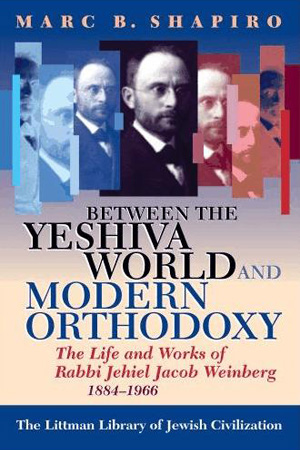
If you examine the picture of Weinberg produced by the artist, you will see that it was modeled after this picture that appears in my book on Weinberg, and also on the front cover of the soft-cover edition.


The original photograph was part of a faculty picture taken when Weinberg taught at the University of Giessen. However, the artistic reproduction adds something that is not found in the original, something that the artist assumed no rabbi should be without; see here.

4. Those outside of the United States who want to post (or read) comments, please access the Seforim Blog site by going to http://seforim.blogspot.com/ncr.  Only by doing this will you be taken to the main site (and not have a country code in the URL). Readers outside the United States do not have access to the comments posted in the U.S. We don’t know why this is, or how to fix it yet, but the above instruction fixes the matter.

* * * *
Quiz

I have an extra copy of one of the volumes of R. Hayyim Hirschensohn’s commentary on Rashi. The person who answers the following question will receive it. Send answers to me at shapirom2 at scranton.edu

1. Tell me the only place in the Shulhan Arukh where R. Joseph Karo mentions a kabbalistic concept? I am referring to an actual concept e.g., Adam Kadmon, Ein Sof, etc.

2. If more than one person answers the above question correctly, the one who answers the following (not related to seforim) will win: Which is the only United States embassy that has a kosher kitchen?

If no one can answer question no. 2, I will do a lottery with the names of those who answer no. 1 correctly.

[1] R. Moshe Zuriel kindly sent me the following additional sources that should be added to my list.

[א] ספר “אור החמה”, ביאור בשלשה כרכים על הזוהר, נלקט ע”י הרב אברהם אזולאי, מביא דברי ר’ אברהם גלאנטי שם על זהר ח”א קסח, והוא בנדפס דף קנט ע”א ראש טור שמאל, “הם דברי מחבר הספר בימי הגאונים או חכמים אחרים שחברו כל המימרות יחד שכתב ר’ אבא, שהיה סופר של רשב”י והם חלקום לפרשיות כל פסוק בפרשה שלו, והם אמרו משלהם”.
[ב] בפירוש ר’ יוסף חיים מבבל (בן איש חי) בשם “בניהו” (דף ד ע”ב בנדפס) פירוש על תיקוני זהר, בתחילת ההקדמה לתקו”ז (ב ע”ב) מזכיר “ועל האי ציפור רמיזו רבנן בהגדה דבתרא דרבה בר בר חנה” כותב הרב: “נראה פשוט בספר בתקונים הראשון אשר הועתק מכתיבת יד חכמי הזוהר כך כתוב ‘קא רמיזו רבנן’ וכו’ אך חכם אחרון שראה דבר זה כתוב בגמרא דבתרא במאמרי רבב”ח הוסיף על הגליון תיבות אלו בהגדה דבתרא דרבב”ח וכו’ ואחר כמה שנים המדפיסים הכניסו בפנים מה שראו כתוב בגליון. ועל חינם הגאון יעב”ץ הרעיש העולם לערער בדבר זה וכיוצא בו”.
[ג] אדמו”ר ר’ יצחק אייזיק קומרנא בספרו “נתיב מצותיך” שביל התורה אלף, מהד’ שנת תש”ל עמ’ קא  כתב: “ור’ אבא היה כותב כל מה ששמע, הן ממנו הן מהחברים וכו’ בסוף ימי רבנן סבוראי תחילת הגאונים היה איש קדוש אאחד שהיה בו נשמת משה רבנו ממש וכו’ וכו’ והוא חיבר ספר רעיא מהימנא וקרא לזוהר חיבורא קדמאה”.
[ד] ר’ צבי אלימלך (מחבר בני יששכר) בספרו “הגהות מהרצ”א” (נמצא בתוכנת אוצר החכמה) על פרשת בא לח ע”א (בנדפס בספר שם דף קכו) כותב: “לפי גירסא הזו ע”כ [על כרחך] צ”ל דהזהר נתחבר בג”ע [בגן עדן] בזמן הגאונים, דהרי רב חסדא אמורא היה בזמן האמוראים” עכ”ל.
[ה] הרב אברהם יצחק קוק, מאמרי הראי”ה, עמ’ 519: מתוך מכתב להרב קאפח: “אפילו אם נשתלשלו דורות רבים והיו בהם הוספות והערות מחכמים שונים, ואם אפילו נתערבו בהם איזה דברים שראויים לביקורת, כמו שעשה הגאון יעב”ץ במטפחתו, אין העיקר בטל בכך”.
[2] Sermons, Addresses and Studies, vol. 3 p. 308. I learnt of this passage from Ben Elton, Britain’s Chief Rabbis and the Religious Character of Anglo-Jewry, 1880-1970, p. 176.
[3] See Studies in Maimonides and his Interpreters, p. 89 n. 376, where I mention that R. Abraham ben ha-Gra, who (for his time) had a critical sense, was among those who thought that Rashi knew the Zohar.
[4] Tosafot, Sanhedrin 24a s.v. belulah. The uncensored text, found in the Venice edition, reads בתלמוד, but the Vilna edition has בש”ס.
[5] Since the Daf Yomi siyum is just about upon us as I write these words, let me add the following: While I don’t think that R. Joseph B. Soloveitchik can be called an opponent of Daf Yomi, I was present at a shiur in the summer of 1985 where he expressed his dismay that due to the growing popularity of Daf Yomi, people were no longer studying all six orders of the Mishnah, much of which has no Talmud and is thus not included in the Daf Yomi cycle. (Due to how the Talmud was printed, Kinnim and Middot are the only tractates of Mishnah included in Daf Yomi. )
[6] Nineteen Letters, Letter Eighteen.
[7] See Deut. 5:15: כבד את אביך ואת אמך כאשר צוה ה’ אלקיך למען יאריכן ימיך ולמען ייטב לך על האדמה אשר ה’ אלקיך נתן לך
R. Samuel Schonblum offers an explanation of the talmudic passage that many will no doubt claim attributes a heretical assumption to one of the Sages. See his edition of R. Isaac Ibn Latif, Rav Pealim (Lemberg, 1885), p. 54:
כפי השקפה הראשונה נוכל לומר כי השנוים שבדברות האחרונות משה אמרן מדעת עצמו כמ”ש הראב”ע ז”ל כמוסיף וגורע ואפשר לומר כי לא נאמר טוב בסיני כלל ע”כ כאשר שאל לו מ”מ [מפני מה] בראשונות לא נאמר טוב ובאחרונות נאמר טוב השיב לו שאלני אם נאמר טוב אם לאו, שאפשר שגם באחרונות לא נאמר טוב כך משה הוסיף או גורע עד שבא לר’ תנחום בר חנילאי ואמר לו כי באמת נאמרו כך בסיני ע”י משה וזה שלא נכתבו על הלוחות הראשונות יען כי היו עתידין להשתבר ע”כ לא נאמר ע”י הדיבור הנעלם רק ע”י משה, ה’ יראני מתורתו נפלאות.
In Limits of Orthodox Theology, I did not discuss the commentary of Ibn Ezra (Ex 20:1) referred to by Schonblum. That is because I assumed that he agreed with the standard medieval view that even though Moses may have written things on his own accord, when these texts were later included as part of the Torah given to the Children of Israel, this was done at God’s direction and that is what sanctified the text. I am no longer convinced of this. All Ibn Ezra says in his commentary to Ex. 20:1 is that minor variations in wording are due to Moses changing God’s original words. Nowhere in his commentary does Ibn Ezra state that Moses’ changes were ever given divine sanction.
[8] Netiv Shalom (Budapest, 1898), p. 33.
[9] I wonder if this exaggeration is related to the seeming exaggerations found in Sotah 4b regarding those who are not careful with netilat yadayim:  כל האוכל לחם בלא נטילת ידים כאילו בא על אשה זונה . . . כל המזלזל בנטילת ידים נעקר מן העולם  See also Yalkut Shimoni, Ki Tisa, no. 386:  כל האוכל בלא נטילת ידים כבא על אשת איש (I say “seeming” exaggerations, because maybe these are not exaggerations. See the story with R. Akiva in Eruvin 21b.) Why were the Sages so strident in this matter? After citing the two rabbinic passages just mentioned, R. Zvi Hirsch Chajes points to an anti-Christian motivation. See Kol Sifrei Maharatz Chajes, p. 1003:
והטעם שהחמירו חז”ל בזה, דענין נטילת ידים הוא הענין הראשון אשר זלזל בו המחוקק לנוצרים, כמבואר בספריהם דשאלו אותו מדוע תלמידיו אוכלים בלי נטילת ידים והשיב מה שיצא מן הפה הוא טמא ומה שהולך לפה הוא טהור, ומפני זה למען לא יהיה לנו השתוות עמהם, החמירו בנטילת ידים, דהמזלזל בזה הוי כמודה להם.
See R. Mordechai Fogelman, Beit Mordechai, part 2, no. 15:2 (p. 224), who uses the Christian angle to explain another talmudic passage dealing with washing of hands. (Those who have read R. Israel Meir Lau’s wonderful autobiography will recognize Fogelman’s name.) See also Abraham Buechler, Am ha-Aretz ha-Gellili, ch. 4.
[10] See e.g., R. Pinchas of Koretz, Imrei Pinhas ha-Shalem (Bnei Brak, 2003), p. 209:
מה שכתב הבאר היטב (או”ח א, ס”ק ב) בשם תולעת יעקב בשם הזוהר, ההולך ארבע אמות בלי נטילת ידים חייב מיתה, הקפיד מאד הרב ז”ל על זה, שאינו בזוהר כלל, וגם במגן אברהם (או”ח ד, א) ובתולעת יעקב עצמו לא כתב בשם הזוהר רק דעת עצמו.
[11] See R. Zvi Elimelech of Dinov, Igra de-Firka, no. 9.
[12] See Menachem Yehudah Baum, Ha-Rabbi Rabbi Bunim mi-Peshischa (Bnei Brak, 1997), vol. 1, p. 212.
[13] See here.

See also R. Shmuel Eliyahu’s responsum on the topic here, R. Yaakov Peretz, Emet le-Yaakov (Jerusalem, 1979), p. 29, and R. Moshe Zuriel, Tziyon be-Mishpat Tipadeh (Bnei Brak, 2007), pp. 107-108. The section in Zuriel’s book is entitled
                               
 בענין הנוהג הנפסד של חיטוט באף ובאוזן, בעת לימוד תורה והתפילה
There might even be enough material for a booklet dealing with the halakhot related to picking one’s nose. I know some of you are laughing right now, but I am entirely serious. See also R. Israel Pesah Feinhandler, Avnei Yoshpeh, vol. 5, Orah Hayyim no. 71, who discusses if it is permissible to pick one’s nose on Shabbat.

See also R. Ovadiah Yosef, Yabia Omer, vol. 5, Orah Hayyim no. 30:

ואתה תחזה שע”פ האמור יש להעיר עמ”ש הגאון מהר”ח פלאג’י בס’ רוח חיים (סי’ שכא סק”ב וסי’ שמ סק”א), ובס’ כף החיים (סי’ ל אות קה), שיש להזהיר לאלה שמקנחים צואת החוטם (ובפרט כשהיא יבשה), שתולשים עי”ז כמה שערות, ואע”ג דדבר שאינו מתכוין מותר, היכא דפסיק רישיה יש להחמיר

There is also the issue of phlegm and hatzitzah that has been dealt with by many. It is interesting that halakhic sources regard putting one’s finger in one’s ear the same way as in one’s nose (e.g., in discussing if you have to wash your hands after this), while contemporary mores sees the latter as being in much poorer taste.

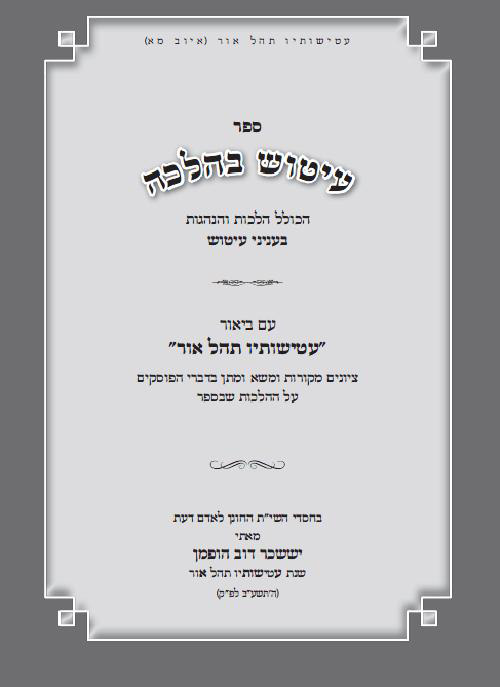
While on the topic of unusual halakhic subjects, let me call attention to a new book by the young scholar R. Yissachar Hoffman, from whom I have learnt a great deal. It focuses on sneezing. In his approbation, R. Gavriel Zinner writes: ראינו חשיבות התורה שיכולים מכל ענין לעשות ספר שלם

Here is the title page.

[14] I heard from a former student of the Lakewood yeshiva that someone once challenged one of R. Abadi’s pesakim by pointing out that the Mishnah Berurah stated that a “ba’al nefesh” should be stringent in the matter. Abadi replied that in the entire yeshiva, of which he was the official posek, maybe there were four people who would fall into the category of what the Mishnah Berurah designates a “ba’al nefesh”.

[15] I asked R. Yehudah Herzl Henkin the following question: Would you have any hesitation telling someone who didn’t believe in demons that it’s OK to only wash one time in the morning, in accordance with the Rambam’s opinion?
He replied:
“I don’t think ruach ra’ah has any operative role nowadays, either, but I hesitate to encourage the abandonment of accepted practices particularly when they are innocuous (as opposed, say, to doing kaparot with a live chicken). There is something to be said for doing what klal Yisrael does even if one doesn’t believe in the activity. That being said, yes, certainly, if the person is bothered about it to that extent, tell him to follow the Rambam.”
Another posek wrote to me: “These are in my view simply matters of minhag yisrael, and not subject to psak in the classical sense of the word. There are questions of minhag ha’avot and the like – but in the end, I do not sense that one would be sinning if one washed only once.”
[16] “The Age of the Universe:  A Torah True Perspective,” pp. 17-18, available here.
[17] See Elliot R. Wolfson, “Hai Gaon’s Letter and Commentary on Aleynu: Further Evidence of Moses de León’s Pseudepigraphic Activity,” JQR 81 (1991), pp. 365-409; and the sources cited by Shmuel Glick, Eshnav le-Sifrut ha-Teshuvot (New York, 2012), pp. 237-238. Meir Bar-Ilan sugests that the Zohar is the first example of what would later become a common practice: the creation of a forgery by attributing one’s own work to an ancient manuscript. In earlier times, pseudepigraphical works made no such claims. See “Niflaot Rabbi Yehudah Yudel Rosenberg,” Alei Sefer 19 (2001), available here
[18] Sofer didn’t realize that the Medini approbation is also found in the first edition, published in 1906.
[19] Medini also says that he will not mention the name of the rabbi who used this expression. Regarding whom he had in mind, see R. Yaakov Hayyim Sofer in Moriah, Av 5769, pp. 143-144. Despite Medini’s feeling, the expression האלגאזי does appear in numerous rabbinic texts.
[20] All bibliographical information for sources cited in this paragraph is found in my article.
[21] Torah in Motion how has a great deal. For only $10.99 you can get a silver membership (good for one month) that allows unlimited access to recorded lectures. See here.
[22] Some have mistakenly transliterated the title as Ha-Matzref. On the title page itself it is spelled in Latin letters Hamzaref; see here.
[23] Regarding the Sacks siddur, I recommend that all listen to the wonderful dialogue between Rabbi Sacks and Leon Wieseltier available here.

I have to say, however, that I was surprised to hear Sacks say at minute 49: “There is no doubt that the actual construction of the Temple was an extraordinarily disastrous moment for the Jewish people.” He then discusses how Solomon, in order to build the Temple, used force labor and thus “turned Israel into Egypt.” What surprises me is that I know of no other Orthodox thinker who sees the building of the Temple as a negative development in Jewish history. Nor, for that matter, have I ever seen an Orthodox thinker read the Bible as criticizing Solomon for this endeavor. If the construction of the Temple was such a negative event, then why on Tisha be-Av are we supposed to mourn its absence?
[24] On my recent trip to Italy, I learnt that the Italian nusah also always puts a segol under the yod of מחיה.
[25] Sacks does not consistently translate ה’ as “Lord”. Metsudah actually translates it as “A-donay”, which I have never seen before.
[26] This is also the meaning of the blessing המחזיר נשמות לפגרים מתים . A similar concept is found among Christians. I am sure many are aware of the Christian prayer recited by children
Now I lay me down to sleep,
I pray the Lord my soul to keep,
If I shall die before I wake,
I pray the Lord my soul to take. Amen.
[27] Midrash Tehillim (ed. Buber), 252::
זהו שאמר הכתוב: ‘בידך אפקיד רוחי’ . . . וכשהוא ישן הוא יגע, ומשלים [ומשליש?] נפשו ונפקדת ביד הקב”ה, ולשחרית היא חוזרת לגופו בריאה חדשה, שנאמר ‘חדשים לבקרים רבה אמונתך’.
See also Devarim Rabbah 5:14
והן ישנים וכל הנפשות עולות אצלו, מנין, שנאמר ‘אשר בידו נפש כל כי’, ובבקר הוא מחזיר לכאו”א נשמתו, מנין, שנאמר ‘נותן נשמה לעם עליה’.
Bereshit Rabbah 78:1 (parallel text in Eikhah Rabbah 3:21) states:
על שאתה מחדשנו בכל בקר ובקר אנו יודעין שאמונתך רבה להחיות לנו את המתים.
See also Tosafot, Berakhot 12a s.v. le-hagid.


Attack on Rabbinic Judaism and Historical Orthopraxy

What is perhaps one of the more intreging sefarim ever published. Behinat HaKabbalah is two books in one. The first, Kol Shakal (the voice of a fool), is a scathing attack on Rabbinic Judaism. Basically, anything not found explictly in the Torah is claimed as false. For example, the requirment of mikva is deemed wrong as the verse only requires one to “wash one’s body.” This first portion takes up the majority of the book. The second half, Sa’agas Areyeh, (roar of the lion) is a defense of Rabbinic Judaism. However, the defense in some sense proves the first half as it is so sparse leaving the reader to posit that the author of Sha’agas Areyeh actually agreed with the author of Kol Shakal. Some even go so far to claim the author really wrote both works in an extremly sly attempt to gain wider readership. That is, they created a work which externally would be viewed as a defense of Rabbinic Judaism i.e. Sha’agas Areyeh, only to be able to slip in the most more persausive Kol Shakal.

Typically, the second portion is attributed to R. Yehuda Areyeh of Modena. (Mar Gavriel has an excellent post on him here). If that is so, some then argue he was a closet heritic or perhaps in today’s vernacular- Orthoprax. That is, although R. Modena sat on the Venice Bet Din, wrote numerous traditional sefarim, and even authored on the selichot that is said on Yom Kippur Katan, in his heart he really did not believe in any of it. This, of course, is rather shocking.

In truth, the authorship of both of these works is somewhat up in the air. As mentioned, some attribute it to R. Modena, however, this is not certian. The reason being, this work was not published until 1852 and Modena died in 1648. The work was first published by Isaac Shmuel Reggio (YaSHar) a rather interesting character in his own right. [As an aside, Reggio was far from what many would consider “traditionally orthodox” he permitted shaving on Hol HaMoad which got him into trouble. (His father wrote a pamphelet against him on that issue). However, this year someone from Monsey reprinted his commentary on the Torah, apparently Reggio’s biography was unknown to the sponser of the printing.] Reggio claimed to have published this from a manuscript in Modena’s own hand. He has an extensive introduction as well as notes thourhout.

Others have questioned Reggio’s assertion that it emenates from Modena. One has even pointed to Saul Berlin the author of the noted forgery Besamim Rosh as the author of this. However, that has been discredited.

In the end, whom ever the author maybe this work still stands as one the most interesting and entertaining attacks on Rabbinic Judaism.

There is much in this area and the interested reader can consult Reggio’s introduction; T. Fishman, Or Hadash al Zemano shel Sefer Kol Shakal v’al Mekom Hibburo, in Tarbiz 59 (1990) 171-190; Fishman’s book length treatment in “Shaking the Pillars of Exile‘Voice of a Fool,’ an Early Modern Jewish Critique of Rabbinic Culture;” E. Rivkin, Leon da Modena and the Kol sakhal; B. Kahlar, Shagas Areyeh al Kol Shakal in Mehkarim v’Inyuim (Tel Aviv, 1954) 357-378.


Neturei Karta; ArtScroll, Arius, and Orangutans; Suicide and the Law of Rodef

 Neturei Karta; ArtScroll, Arius, and Orangutans; Suicide and the Law of Rodef

Marc B. Shapiro

1. We have recently seen behavior by so-called religious Jews that is vile. I refer to the actions of Neturei Karta. Of course, we have all seen their antics in the past, but I think most of us looked at them as clowns and sick people that maybe we should feel sorry for. This is no longer the case. Now they are marching in support of the murderers of Jews, aligning themselves with the enemy, and attempting to destroy the State of Israel. They are doing this at the very time that Jews are being killed at war. It is true that in the past as well they openly aligned themselves with the PLO,[1] and R. Moshe Feinstein already in the late 1970s referred to Neturei Karta as reshaim.[2] But to be allied during wartime with Iran and Hamas is I think beyond what we have seen before.

Here you can see a video of a Neturei Karta delegation that went to Iran to pay respects after the death of President Raisi. Here a different delegation visits the Iranian ambassador to the U.N. to pay respects. Here they are in Qatar at the funeral of Ismail Haniyeh whose death they mourned in a public statement here. It is hard to imagine anything more obscene than this. What we have seen from Neturei Karta since October 7 goes way beyond making a hillul ha-shem.[3]

Until his death, the spiritual leader of this group was Rabbi Moshe Beck (1934-2021). Here you can see him showing his affection for the Iranian leader Ahmadenijad. In the ultimate obscenity, in his book Derekh ha-Hatzalah (Monsey, 2002), pp. 40ff., Beck actually explains why it is halakhically appropriate to congratulate terrorists on a “successful” operation, namely, when they murder Jews. Thus, it is entirely in line with Neturei Karta ideology for them to praise the October 7 “resistance.” Here is his outrageous conclusion (p. 44):

מותר לומר להפאלעסטינים יפה עשיתם שהרגתםכיון שעי דיבורים אלו יצמח הצלה להרבה מישראל המתנגדים לציונות

And what about the fact that even pious Jews will be hurt if Neturei Karta’s propaganda is successful and U.S. government aid to Israel is cut? Beck explains that this is not a problem, as the Zionists cannot be helped, even if the pious also would benefit (p. 41):

ועל אחת כמה וכמה לענין מורדים בה‘ וכופרים ומחטיאים כמו הציונים וכל כתותיהםשבודאי נאסר הסיוע להם בכל אופןאפילו שלא בענין העבירהואפילו יוצא תועלת מסיוע זה לצדיקים ועובדי ה

Over thirty years ago I was naive and thought that I might be able to have a productive correspondence with Beck. Here are three letters I received from him.


Regarding the third letter, I am not sure why he wrote that I “disguised” myself in my first two letters. I simply wrote to him with questions and never said or implied that I agreed with him in any way. In my second letter I actually strongly protested how he referred to Rav Kook. In his response to this letter he also answers my question how he could cite from R. Reuven Margaliyot’s commentary on Sefer Hasidim when R. Margaliyot was a religious Zionist whose book was published by Mossad ha-Rav Kook. (I never said that he was a maskil). In my third letter I attacked him for degrading great Torah scholars and I mentioned that R. Aharon Kotler supported the State of Israel. I never said he was a Zionist. My point was that once the State of Israel was declared, with the lives of millions of Jews depending on it, anti-Zionism in the sense of opposing the creation of a Jewish state was now no longer relevant. Once the State of Israel was created, anti-Zionism came to mean working to destroy the Jewish state, and thus putting millions of Jewish lives at risk. Satmar anti-Zionism is religiously based but remains entirely theoretical, even eschatological, and Satmar has always been absolutely opposed to allying with anti-Semites and terrorists and their supporters.)

See also here where a number of years ago I wrote the next few paragraphs (now updated slightly).

Readers should examine the following document, which is found in the Central Zionist Archives S25/4752

It is a copy of a letter sent to the Supreme Muslim Council in Jerusalem from Aryeh Leib Weissfish. Weissfish was later to become famous as one of the leaders of the Neturei Karta, and strangely enough he was also a great fan of Nietzsche. You can read about his colorful career here, where it mentions how he illegally entered Jordan in 1951 to bring a message from the Neturei Karta that Jordan should invade Jerusalem and the Neturei Karta would be its ally in this. When he was deported to Israel he was put on trial and sentenced to six months in prison.

In view of the fact that during World War II there was a fear that Germany would invade the Land of Israel and that this would also lead to the Arabs persecuting Jews, Weissfish wrote to the local Muslim leaders to let them know that the Old Yishuv type of Jews that he is speaking about are not involved in politics and that they oppose the Zionists. They have always treated the Arabs with respect and he therefore requests that these Jews be protected. He also offers to provide the names of the families who should be given this special treatment. As you can see from Yitzhak Ben-Zvi’s handwritten note at the bottom of the letter, Ben-Zvi copied it from the original letter which he found in the Supreme Muslim Council’s archives.

R. Shlomo Brody has recently published a fabulous book, with a great title, which is unfortunately very timely: Ethics of Our Fighters: A Jewish View on War and Morality. While I am sure I will have more to say about this book at a future time, I would for now just wish to add that when it comes to Neturei Karta and those of a similar mindset, I was wondering about some halakhic and ethical issues that Brody does not discuss. (In general, he does not discuss the home front.) For example, can such people be counted to a minyan? Are you allowed to give charity to them, and if not, how about the children who will suffer through no fault of their own? Can the children of such a family be kicked out of a yeshiva? If these people have businesses, should we boycott them, again, causing the children to suffer for the sins of their fathers? Or should we just ignore these people entirely? These questions are not only relevant when it comes to Neturei Karta, for as we have seen since October 7 there are many other enemies of Israel and the Jewish people. Some of them who support Hamas are themselves Jewish. As far as I know, there has not yet appeared an analysis of how such traitors are to be regarded in Jewish law.

2. A couple of people sent me something that was going around the internet asking what I thought, so I figured I would elaborate on the blog. Rashi, Deut. 1:12, quotes the Sifrei, Devarim, no. 13, that אריוס asked Rabbi Yose a question. In the ArtScroll translation of Rashi by R. Yisrael Isser Zvi Herczeg there is the following note on this passage: “Nothing other than what is mentioned here is known about this person. His name appears nowhere else in Torah literature.”

This is not exactly correct. As Louis Finkelstein points out in his edition of the Sifrei (p. 22), Tosefta Bava Metzia 3:11, records a question Arius asked the Sages. This is what appears in the important Erfurt manuscript of the Tosefta used by Zuckermandel in his edition, but Arius’ name does not appear in the Tosefta published in the back of the Talmud.[4]

In the updated version of the ArtScroll Rashi translation, they explain who Arius was (R. Herczeg had nothing to do with this update): “A 4th century C.E. Christian theologian whose views on religion clashed with standard church teachings; his followers are called Arians. (An analysis of his question to R’ Yose appears in Likkutei Sichos, Vol. 34, p. 15.)


I do not know why someone working at ArtScroll decided it was important to add this information. I also do not know why the person who added the information did not see the immediate problem. Arius, who at most was only in the Land of Israel for a short time, was a fourth-century theologian in the period of the amoraim. How then could he be asking questions of the tanna R. Yose or any of the other tannaitic sages? This alone should have been enough to show that the Arius mentioned by the Sifrei is not the Christian theologian Arius. When the ArtScroll Rashi is next reprinted, the updated note should be deleted as it is clearly in error, and the original note should be reinserted. I have to say that I find it of interest that the updated note has a reference to the Likutei Sihot of the Lubavitcher Rebbe, a figure who does not appear often in ArtScroll publications. This reference should definitely remain.

Where did ArtScroll get the information in the new note? Perhaps from the entry on Arius in the Otzar Yisrael encyclopedia (vol. 2, pp. 192-193). The Otzar Yisrael entry states, without any evidence, that the R. Yose mentioned in the Sifrei is one of the amoraim named R. Yose, not the tanna. But there is no reason to assume this to be the case, and lots of reasons to assume it is not so. We are fortunate that the Otzar Yisrael entry has a bibliography and we are thus able to see where they got their information from: R. Elijah Benamozegh’s Em la-Mikra to Deut. 1:13, which goes on for many pages.

I have great respect for R. Benamozegh and have given a number of classes on him.[5] Yet as mentioned already, there is no reason to think that the R. Yose mentioned in the Sifrei is an amora as R. Benamozegh claims. We should assume that he is the second-century R. Yose ben Halafta for this is how the tanna R. Yose is mentioned in rabinic literature, namely, without his father’s name. I would also note that the Talmud records a number of R. Yose ben Halafta’s conversations with non-Jews. Therefore, his interaction with Arius makes perfect sense

As for Arius, Moshe David Herr believes that he must have been a convert to Judaism. Referring to his mention in Tosefta, Bava Metzia 3:11, Herr writes “This question, which manifests expert knowledge of the halakhah on the part of the inquirer, proves that he was a Jew.”[6]

Returning to R. Benamozegh, it needs to be mentioned that his commentary on the Torah suffers from the same problem as many others, in that as one who was up to date in modern historical scholarship and science, he tries to explain the Torah in the light of this knowledge. Yet mid-19th century understandings in these areas has usually been rejected and thus cannot speak to 21st century readers. On occasion, what he says will be found offensive by modern readers, such as his discussion of the curse of Canaan in his Em la-Mikra to Genesis 9:25. Here it is from R. Eliyahu Zini’s wonderful new edition.

Although it could be that R. Benamozegh himself held the liberal view of Tiedemann, the even-handed way he discusses the matter does not make for comfortable reading today.

R. Israel Lifshitz, the author of Tiferet Yisrael on the Mishnah, also liked to connect modern scientific discoveries with Torah and rabbinic texts. Unfortunately, not all of his information  was correct. Since R. Benamozegh mentions orangutans, let me tell you what R. Lifshitz has to say about them, which he must have read in some book or newspaper. In his commentary to Kil’ayim[7] 8:5, he states that in Africa orangutans are taught to chop trees and draw water, to wear human clothes and to sit at a table and eat with silverward. (In truth, orangatuns are not found in Africa but are native to parts of Asia.) And in case people were wondering, he also adds that despite the orangutan’s near-human characteristics, when it dies it is regarded like every other animal and does not create ritual impurity as do dead humans.[8]

Although, as mentioned, R. Lifshitz must have acquired his incorrect information about orangutans from some book or newspaper, I should note that the Talmud discusses how monkeys are capable of performing various tasks for humans and this might have influenced R. Lifshitz in assuming the same to be true of orangutans. The expression מעשה קוף is well known, and this page gives a number of talmudic references to actions of monkeys. However, the list is not complete and it omits Bava Kamma 101a which mentions a monkey dying wool with a particular dye. It also omits Yadayim 1:8 which refers to a monkey pouring water over a person’s hands. For those interested in the topic, R. Baruch Plotchek wrote an article on monkeys in the Bible and Talmud.[9] One of the interesting things he points out is that Kohelet Rabbah comments on Eccl. 6:11: כִּי יֵשׁדְּבָרִים הַרְבֵּהמַרְבִּים הָבֶל, that included in the “vanity” is the raising of monkeys. This shows that when this Midrash was written, people, presumably including Jews, kept monkeys as pets. Also of interest is that Plotchek identifies what we can term proto-Darwinian ideas in some rabbinic statements. As far as I know, he was the first to make this point, which was later picked up by others trying to reconcile Torah and evolution.

3. In the last post I pointed to an interesting explanation of R. Chaim Heller that solved a textual problem. Here is another one he offered: Piskei Tosafot (at the back of the Vilna Shas), Shabbat, no. 130, states that in a city that has pigs, the buildings in it are exempt from the law of mezuzah: עיר שיש בה חזירים פטורה מן המזוזה

There is no talmudic source for this passage and on its face it is astounding, as why should the presence of pigs mean that Jews don’t need a mezuzah? If followed in practice, this text would mean that no city in the Christian world needs mezuzot. (In fact, from statements of Ashkenazic rishonim we know that in medieval Ashkenaz many people did not affix mezuzot, and perhaps this laxity arose from the view recorded in Piskei Tosafot.[10])


R. Heller suggested that there was a scribal error and that instead of עיר שיש בה חזירים the text should read דיר שיש בה חזירים, that is, a pigsty does not need a mezuzah.[11] I don’t think this emendation is found in any of R. Heller’s writings, but it is mentioned in his name by Dr. Tibor Juda, the late son-in-law of R. Pinchas Hirschprung,[12] in this video about R. Abraham Price, beginning at 36:38. R. Price was a student of R. Heller in Berlin before he came to Toronto. Not surprising, Abraham Rosenberg, whom I discussed in previous posts here and here, also mentions this emendation which he must have heard from R. Heller.[13]

This emendation is actually mentioned previously by R. Meir Soloveitchik in his Ha-Meir la-Aretz, p. 64a.[14] Here is the title page of the book.

R. Soloveitchik, after mentioning the emendation, offers his own alternative emendation:

ועוד נל יותר טוב להגיהעיר שאין בה חזירים כו‘, דטנופת הרבה מצוי בה והול כמקום שהתינוקות מצוין בה

Before people start trying to figure out how this R. Soloveitchik is related to R. Chaim, let me note that there was at least one other Soloveitchik family in Europe, and this family was not levi’im like the more famous Soloveitchik family. R. Meir Soloveitchik came from the less distinguished Soloveitchiks.[15]

4. In my last post I dealt with euthanasia and suicide, and in response to that Ariel Fuss sent me something that I found truly astounding. If you had described it to me without me seeing it “inside”, I would have thought it was Purim Torah, or perhaps a halakhic paradox of the sort I have written about.[16] But no, we are talking about a real piece of rabbinic learning. Here is R. Mordechai Shlomo Carlebach, Havatzelet ha-Sharon, Vayikra (2), pp. 476-477.

R. Carlebach assumes that suicide falls under the prohibition of murder. While there are those who disagree (see Encyclopedia Talmudit, s. v. me’abed atzmo le-da’at), the majority opinion is that suicide is a form of murder, and this seems to be Maimonides’ opinion as well. R. Carlebach raises the issue of what to do if you see someone about to commit suicide. When someone is about to murder another, there is an obligation to kill the rodef. If suicide is a form of murder, R. Carlebach reasons that one who is going to kill himself is to be regarded as a rodef (of himself) and according to the halakhah you would be obligated to kill the man before he killed himself.

At first glance this seems crazy, since what sense does it make to kill a man because he is going to kill himself? But as R. Carlebach points out, by killing the man before he kills himself, you prevent him from violating the prohibition against murder, which will be a great benefit to him in the World to Come. R. Carlebach notes that when he presented this idea to R. Shlomo Zalman Auerbach, R. Auerbach liked what he said. Of course, it is impossible for us to know whether R. Auerbach really took the argument seriously or just smiled because it is such an interesting and counterintuitive approach.

When I shared this text with R. Moshe Maimon, and wondered whether R. Carlebach meant what he wrote seriously, he replied:

I think he means it seriously, though in a Talmudic sense, not in a practical sense. RSZA similarly approved it from a pilpulistic standpoint, knowing that R. Carlebach was in no way insinuating that this should dictate practical Halachah. To the halachic mind it is a form of mercy killing, since you are saving him from the sin of murder. Of course, practically, it could never be implemented since the modern sensibilities (at least from the Besamim Rosh and on!) dictate that one committing suicide be viewed as a victim rather than a perpetrator.

Speaking of the laws of rodef, there is another astounding passage in R. Shimon Sofer, Hitorerut Teshuvah, vol. 2, no. 157:2. R. Sofer states that if you see a cat chasing after a chicken to kill it, if the only way you can save the chicken is by killing the cat, then there is a mitzvah to kill the cat. He actually compares this to the law of rodef with a human. (At the end of the responsum he also mentions hashavat avedah and tza’ar baalei hayyim.)

See, however, R. Netanel Meoded of Hong Kong, Mizrah Shemesh, vol. 2, p. 287 n. 195, that R. Shlomo Zalman Auerbach rejected the notion that there is a concept of rodef with regard to animals.

Regarding R. Sofer’s Hitorerut Teshuvah, the volumes are unusual as right at the top of each page it tell the reader not to rely on the halakhic conclusions in practice. I don’t know of any other responsa volume that does such a thing. In a future post I will cite sources that say that one does not need to pay attention when an author tells us not to rely on his rulings in practice.

5. Continuing with the new pictures of R. Jehiel Jacob Weinberg, here is one of him and Chief Rabbi Isaac Herzog.[17] It is from R. Herzog’s visit to Montreux in the summer of 1950.

Here is R. Weinberg in conversation with R. Bezalel Rakow, at the time a rebbe in the Montreux yeshiva and later the rav of Gateshead.

Here is R. Weinberg with Robert and Francisca Goldschmidt at the wedding of their daughter Reine to Schmuel Höchster. The Goldschmidts owned a kosher pension in Montreux and their grandson is the famous R. Pinchas Goldschmidt.

Here is R. Weinberg with Mr. Yechezkel Rand and his wife. Rand was a leader of the Montreux Jewish community.

Here is R. Weinberg with his student R. Yaakov Fink. R. Fink was able to leave Germany and make his way to Argentina in 1939. He would later serve as chief rabbi of Brazil and later of Argentina before becoming av beit din in Haifa.

The story of his aliyah is of interest. Already in 1950 he discussed moving to Israel with the Hazon Ish. He was concerned about whether this was proper since he felt a responsibility to his community in Argentina. The Hazon Ish told him without hesitation that he should come to Israel. He thought that the education of R. Fink’s children, which was problematic in the Diaspora, came before all other concerns, and therefore he – and anyone else – who could come on aliyah should do so.

Interestingly, on returning home he first traveled to the United States where he also discussed the matter of his aliyah with R. Aharon Kotler. R. Kotler had the opposite approach, telling him that he must not abandon his community. Perhaps to let him know that he should not give up all hope of aliyah, R. Kotler added that when he himself goes to Israel, then R. Fink can also come.

Years later R. Fink decided to move to Israel, after being chosen as av beit din of Haifa. He had obviously decided not to follow R. Kotler’s opinion in this matter. Yet an amazing thing was to happen. R. Fink flew to Europe with his family and spent a few weeks in Montreux with R. Weinberg, whom he had not seen since before World War II. The pictures above and below are from that visit. He then went to Paris from where he was to fly to Israel. When he boarded the plane, and saw more religious travelers than usual, he inquired what the occasion was. It was then that he learned of the passing of R. Aharon Kotler and that his coffin was being brought to Israel on that very plane. So in the end it happened just as R. Kotler told him years before, that when he would go to Israel then R. Fink could also go![18]

Here is a picture of R. Weinberg with R. Fink on the left. On the right is R. Joseph Blumenfeld who held the position of av beit din in Tel Aviv. He also lived in the United States during the 1950s and while there he printed his edition and commentary of the medieval work Kaftor va-Ferah by R. Ishtori ha-Parhi.

Here is the title page as it appears on Otzar ha-Chochmah.

Notice how the original place and date is missing and ניו יורק תשיח has been added to the title page. That should raise everyone’s suspicions. If you look at the version on hebrewbooks.org you can see why the original place and date were removed.

On the title page R. Blumenfeld wrote שנה עשירית למדינת ישראל. This can still be read on the copy found on hebrewbooks.org, although someone crossed this out, not liking R. Blumenfeld’s Zionist sentiments. 

Here is another example of the title page that I copied many years ago in the library of the Jewish Theological Seminary.

While in the United States, R. Blumenfeld obviously got to know Louis Finkelstein. When his work appeared he sent him a copy with a nice inscription and Finkelstein donated it to the library. The inscription might imply that Finkelstein assisted him financially in publishing the work.

Regarding R. Fink, although R. Weinberg thought very highly of him,[19] there was one time when R. Fink disappointed him. In 1952 when he was appointed chief rabbi in Brazil there was an article on this in Ha-Pardes.[20] Although the article is signed by someone else, R. Weinberg believed that the biographical information in it was provided by R. Fink. In describing R. Fink’s background it states:

תלמיד מובהק של הרב הגאון ה‘ אברהם שטיינברג מברודישאצלו למד בשעה שישב בעיר הבירה וינהבשנות המלחמה הראשונה ואז שמש גם את הגאון העצום ר‘ יוסף אנגל וגדולי ישראל אחריםמשומעי שעוריו של הרב יחיאל וינברגהעילוי מסלובודקה בסמינר הרבנים בברלין

R. Weinberg wrote to R. Joseph Apfel, R. Fink’s classmate at the Berlin Rabbinical Seminary, with his annoyance at the above formulation. He assumed that R. Fink, having moved into more haredi circles, was embarrassed to acknowledge that he had been an actual registered student at the Berlin Rabbinical Seminary, and therefore wrote that he just attended R. Weinberg’s shiurim at the Seminary.[21] In an earlier post on the Seforim Blog here, Menachem Butler notes that when R. Yosef Zvi Dunner passed away, the obituary in Ha-Modia wrote:

At 19 he wanted to study in the yeshivos of Lithuania, but his father felt that due to the shortage of Rabbanim in Germany, it would be better for him to remain in the country and study in the beis medrash of Harav Yechiel Yaakov Weinberg, zt”l, author of Seridei Eish. For four years, the young Rav Yosef Tzvi studied in this beis medrash, where he was awarded semichah at a young age after astounding those testing him with his penetrating understanding of all four sections of the Shulchan Aruch. He was granted the title yoreh, yadin.

Instead of writing that R. Dunner studied at the Berlin Rabbinical Seminary, Ha-Modia invented a new institution, the beis medrash of R. Weinberg.

This is a phenomenon we have sometimes seen with people who studied at Yeshiva University and/or RIETS but in later years did not want to acknowledge this. At most they would say that they heard shiurim from the Rav, without noting that they were actually registered students in YU or RIETS.

Returning to the pictures, here is a one of R. Weinberg’s father.

Here is his mother.

Here is R. Weinberg’s mother and other members of his family at his father’s grave in Ciechanowiec, Poland.

6. In the latest Hakirah (vol. 35, Summer 2024), R. Shmuel Lesher mentions Chaim Bloch’s Passover Haggadah forgery. Bloch claimed to have had a 1521 manuscript where instead of “Pour out your wrath on the nations that do not know you”, the mansucript had, “Pour out your love on the nations that know you”. This is such an obvious forgery, from a person whose forgeries have become legendary (see my post here, R. Jonathan Sacks included this forged text in his own Haggadah.

On p. 286 n. 12 Lesher states that assuming Bloch’s Haggadah passage is a forgery, the motivation for the forgery remains unclear. Let me first state that there is no reason for “assuming” it is a forgery, as there is no doubt whatsoever. As for the motivation, this too is clear. Bloch was very interested in apologetics and softening anti-Gentile passages that appear in the Talmud and later rabbinic literature. He even devoted an entire (very dishonest) book to this topic, Ve-Da Mah She-Tashiv (New York, 1962). In my post here I include a page from Bloch’s Heikhal le-Divrei Hazal u-Fitgameihem (New York, 1948), p. 9. Here Bloch invents an entire story about how before the war there was a collection of letters in Vienna dealing with the sections of the Talmud that were removed by non-Jewish censors. He tells us that R. Elazar Horowitz wrote a letter to R. Judah Aszod stating that R. Moses Sofer did not wish to print a Talmud with the censored sections. The reason R. Sofer supposedly gave was that it was divine providence that these passages were removed, and once they have been removed they should not be put back. Based on additional imaginary letters, Bloch tells us more fairy tales about other nineteenth-century rabbinic leaders who agreed that the censored passages should remain out, because of the antisemitism that could be generated by them.

Bloch’s forgery of the Gentile-friendly “Pour out your love” passage is no different than his other forgeries dealing with rabbinic texts that present a negative view of non-Jews and that were often cited in non-Jewish attacks on the Talmud and rabbinic literature.

* * * * * *

[1] See Menachem Keren-Kratz, “Satmar and Neturei Karta: Jews Against Zionism,” Modern Judaism 43 (Feb., 2023), pp. 66ff.
[2] Mesorat Moshe, vol. 2, p. 432.
[3] It could be that my language, implying that their current behavior is worse than a hillul ha-shem, is inappropriate, as in some respects hillul ha-shem is the worst imaginable sin. See Yoma 86a that unlike other sins, only death can atone for hillul ha-shem. The Hazon Ish pointed out that the three great sins for which one must martyr oneself rather than violate could indeed be pushed aside (i.e., violated) in order to prevent a hillul ha-shem. (Obviously, this type of decision is only something that the greatest rabbinic leaders could rule on.) See Shlomo Cohen, Pe’er ha-Dor, vol. 3, p. 185.

R. Samuel Mohilever writes:

חלול ה‘ היותר גדול המאריך גלותנו והמעכב גאולתנו ופדות נפשנו הוא אשר על ידי רוע מעשינו יחולל כבוד אומתנו בגוים לאמרראו מעשה העם הזהאשר לפי דעתו הוא הנבחר מכל גויי הארצות להיות לעם סגולה עליון על כלומעשיו גרועים ואבדה חכמת חכמיו ודעתו שפלה וגם באמונתו ערב אמונות שוא וטפל ועוד הגדיל כי עשה את הטפל לעיקר

Mohilever, Berit ha-Ahavah ve-ha-Shalom, ed. Munitz (Jerusalem, 2023), p. 210.

Here is one way hillul ha-shem was dealt with in years past: R. Hayyim Joseph David Azulai, Ma’agal Tov ha-Shalem, ed. Freimann (Jerusalem, 1934) p. 88, mentions how the leaders of the Jewish community in Modena, Italy cut off the beard of a rabbi who created a hillul ha-shem. See the explanation of the passage in R. Meir Mazuz, Mi-Gedolei Yisrael, vol 1, p. 218. As R. Mazuz notes, punishing someone by cutting off his hair is mentioned in Beit Yosef, Even ha-Ezer 16, s.v. כתוב and Shulhan Arukh, Even ha-Ezer 16:4. I do not know if this only means hair of the head or if it also includes the beard. Aaron Chorin, who would later become a leading advocate of religious reform, was also threatened with having his beard cut off. See R. Nosson Dovid Rabinowich, Safra ve-Sayfa (Jerusalem, 2013), pp. 139 n. 37, 171.

Hillul ha-shem is sometimes written as hillul ha-Shem or hillul Hashem. Yet this is a mistake. It is not Hashem (with a capital “H”, implying “God, or ha-Shem), but hashem, (or ha-shem). That is, it is not a desecration of God but of His name. Thus, one should not write ‘חילול ה but rather חילול השם. See Lev. 22:32: ולא תחללו את שם קדשי. Nissim Dana titled his 1989 translation of one of R. Abraham Maimonides’ works ספר המספיק לעובדי השם. Yet the last two words should be לעובדי ה.

Regarding the use of “Hashem”, I found something very confusing in the ArtScroll Stone Chumash. In place of the Tetragrammaton, ArtScroll does not use the word “Lord” but “HASHEM”, as this is how people pronounce the Tetragrammaton. While ArtScroll is the first translation to adopt this approach, it does have a certain logic. However, this logic breaks down a few times on p. 319 when the ArtScroll commentary attempts to explain what occurs at the beginning of parashat Va-Era. For example, “Or Ha-Chaim comments that God’s essence is represented by the name HASHEM.” This makes no sense, as there is no name HASHEM. The commentary should have written that “God’s essence is represented by the four letter name of God.”

Here is what Maimonides says about one who separates himself from the community, and it certainly applies to Neturei Karta (Mishneh Torah, Hilkhot Teshuvah 3:11):

A person who separates himself from the community even though he has not transgressed any sins, but has separated himself from the congregation of Israel and does not fulfill mitzvot together with them, does not take part in their hardships or join in their [communal] fasts, but rather goes on his own individual path as if he is from another nation and not one of them [the Jewish people], does not have a portion in the world to come

[4] The version that appears in Midrash Tannaim, Devarim, ed. Hoffmann, p. 7, has the name as ארווס. However, as R. David Zvi Hoffmann points out, this is an error for אריוס. See ibid., pp. 250, 253. The version that appears in the medieval Bereshit Rabbati of R. Moses ha-Darshan, ed. Albeck, p. 201, has the name אריסטו. I think it is obvious that not recognizing the name Arius, someone changed it to Aristotle, without realizing that Aristotle (fourth century BCE) lived hundreds of years before R. Yose (second century CE). See also here.

Regarding Aristotle, while some traditional Jewish sources speak highly of his learning, others refer to him in all sorts of negative ways. R. Joseph Solomon Delmedigo, in his praise of R. Elijah Mizrahi, actually compares his intellect to that of Aristotle. I do not know of any other such passage in rabbinic literature in which a rabbi is praised by comparing him to Aristotle. See Delmedigo, Novelot ha-Hokhmah, p. 32b:

ששכל הראם רם ונשא . . . כשכל ארסטוט בדקות ועומק ויושר

See also R. Meir Mazuz’s comment on this passage, Mi-Gedolei Yisrael, vol. 1, p. 359 n. 27.

[5]  See here and here (the first of three parts).
[6] “The Historical Significance of the Dialogues between Jewish Sages and Roman Dignitaries,” Scripta Hierosolymitana 22 (1971), p. 149.
[7] The word is pronounced kil’ayim and not kilayim, as there is a sheva under the ל. People sometimes mispronounce it as kilaim, as if there is a patah under the ל and a hirik under the א of כלאים. This reminds me of another common mistake. If you google you will find that many refer to the concept of “shomer pesaim (petaim).” Yet this is a mistake. The verse in Psalms 116:6 reads: שֹׁמֵר פְּתָאיִם. The second word is pronounced pesayim (petayim), as the א is silent. Another example where the א is silent and many people make a mistake is with the name דניאל. Even people who have this name often pronounce it in Hebrew as Doniel (or Doniellah for women). Yet the name is properly pronounced Doniyel: דָּנִיֵּאל. This is unlike the name אֲרִיאֵל where the tzere is under the א and the word is pronounced Ariel. Another common mistake is that people often refer to sidelocks at peyot, but it should be pe’ot, as there is no yud in the word.
[8] In 1876 R. Abraham Bick published Yesod Ohel Moed. I cannot tell you where the book appeared, as there are two title pages, one for Pressburg and one for Lemberg.

The language on the title page is very unusual in its detail of what the book contains. On p. 53b he rejects R. Lifshitz’s identification of the orangutan with a creature mentioned in the Jerusalem Talmud, stating that he has seen an orangutan at the Hamburg zoo and it does not match the talmudic description. He then makes the following statement, affirming the truth of the Sages’ scientific statements even if modern man has trouble accepting them:

וקבלת חזל נאמנה מאוד ולא ראינו אינה ראי‘ ונודע שחוקרי הארץ לא יכלו לתור תיכונית אפריקא וגם במציאות בני אדם באמעריקא נוכח כפות רגלינו הכחישו כולם עד שנודע שידיעתם הבל וגם פה חזל ידעו הכל בסוד ה‘ ליראיו

[9] Ha-Mitzpeh, Oct. 25, 1912, pp. 4-5, Nov. 1, 1912, pp. 4-5, Nov. 15, 1912, p. 5, Nov. 22, 1912, p. 5.
[10]
See R. Mordechai Menahem Honig’s learned note in Yerushatenu 1 (2007), p. 213 n. 43, which provides all the relevant information about the Piskei Tosafot passage and how this idea is also cited from the ירושלמי. See also Saul Lieberman, Ha-Yerushalmi ki-Feshuto, Introduction, pp. 26-27; Daniel Sperber, Minhagei Yisrael, vol. 8, pp. 97-98, n. 6.

Regarding laxity with mezuzot and the notion that a city with pigs is exempt, see R. Aaron ha-Kohen of Lunel, Orhot Hayyim, ed. Schlesinger (Berlin, 1902), vol. 2, p. 195:

השתא שאין העולם נזהרין משום האי טעמא דסמכינן אהא דאמרינן עיר שיש בה חזירים פטורה מן המזוזהוכתב הרי מקורבל שאין זה נמצא בשום מקום לא בתלמוד ולא בירושלמי

[11] R. Eliezer Waldenberg, Tzitz Eliezer, vol. 5, no. 18, suggests another emendation: שער instead of עיר. See also R. Ovadiah Yosef, Yabia Omer, vol. 3, Yoreh Deah, no. 16.
[12] 
I treasure the conversations I had with Dr. Juda when I visited Toronto and he honored me by attending various talks I delivered. In one conversation he told me of the high esteem R. Hirschprung had for Rav Kook, and how R. Hirschprung noted that while R. Joseph Hayyim Sonnenfeld was certainly a great talmid chacham, in no way is he to be regarded as on the same level as R. Kook. Regarding R. Hirschprung, let me also record what I heard from R. Shlomo Goren in 1985, when he spoke at Beit Midrash le-Torah (BMT) in Jerusalem, that R. Hirschprung was the only one alive who knew the entire Talmud by heart.
[13] Tikunei Nushaot bi-Yerushalmi, last page of the book (unnumbered; called to my attention by Moshe Dembitzer).
[14] Moshe Dembitzer informed me that R. Moses Shimon Sivitz, Ha-Mashbiah, vol. 3, p. 53b, also suggests this emendation. R. Baruch Epstein, Barukh She-Amar, p. 75, likewise suggests this.
[15] See here. There was another famous Soloveitchik, Max Soloveitchik from Kovno, who wrote perhaps the earliest Hebrew book on biblical criticism and was a government minister in Lithuania. See here. I don’t know which Soloveitchik family he was from.
[16] See here.
[17] The pictures in this post are found in Ganzach Kiddush ha-Shem in Bnei Brak. I thank R. Abraham Abba Weingort for his help with identifying some of the people in the pictures from Montreux.
[18] Fink, Tiferet Yaakov, pp. 49, 56 (first pagination).
[19] See for instance R. Weinberg’s letter in Fink, Tiferet Yaakov, p. 348.
[20] November 1952, pp. 28-29.
[21] See R. Weinberg’s letter in Ha-Ma’yan 32 (Tamuz 5752), pp. 16-17. For a picture of R. Fink’s Berlin Rabbinical Seminary semikhah, see Fink, Tiferet Yaakov, p. 339. The semikhah is signed by R. Weinberg, R. Samuel Gruenberg, and R. Alexander (Shimon Zvi) Altmann.