Psalms on Rosh haShana

Psalms on Rosh haShanaby: Eliezer Brodt

What follows is a discourse, that is part of a forthcoming sefer, regarding the propriety of reciting Psalms on Rosh ha-Shana.  This discussion touches on the failure to recite hallel on Rosh ha-Shana which, in turn, leads the discussion to the status of simcha (happiness) on Rosh ha-Shana.  We then turn to the custom of reciting the entire Psalms(or, the converse, refraining from any Psalms). And, finally, I discuss generally the debate regarding reciting Psalms versus study.  

אי-אמירת הלל בראש השנה ושייכותו לשמחה[1]
א.

בענין אם יש דין שמחה בראש השנה, יום הדין והמשפט, כבר הארכנו במק”א. אמנם מתקנת החכמים שלא לקרוא הלל ביום זה אכן נראה, שאסור לשמוח ביום זה, שמשום כך נאסרה בו קריאת ההלל שכל ביאתו היא רק מפני השמחה, כדמשמע מדברי הרמב”ן (ספרד, ד’תתקנד-ה’ל), בבואו לבאר את שיטת ‘הלכות גדולות’ שאמירת הלל היא מדאורייתא: “והנראה מדבריהם שהוא [=אמירת הלל] מן התורה… שהוא מכלל השמחה שנצטוינו בה, כמו שכתוב (במדבר י י): ‘וביום שמחתכם ובמועדיכם ובראשי חדשיכם’… כי עיקר שירה בפה… אם כן אפשר שנדרוש בימים טובים שכתוב בהם ‘שמחה’ ונתרבו כל מיני שמחות, שתהא השירה [=אמירת ההלל] מכללם”[2]. וזו גם רהיטת לשונו של רבינו יהודה ב”ר קלונימוס משפיירא (אשכנז, ד’ תתקנח), בעל ‘יחוסי תנאים ואמוראים’: “והלל הוא לשיר והודאה על הנס והשמחה[3].

ב.

מדוע אכן אסורה השמחה בראש-השנה עד כדי שתיקנו שלא לומר בו את ההלל. ניתן להבין זאת כשנקדים לכך את טעם ביטול ההלל בראש השנה המובא בגמרא (ראש השנה לב ע”ב): “אמרו מלאכי השרת לפני הקב”ה: רבונו של עולם, מפני מה אין ישראל אומרים שירה לפניך בראש השנה ויום כיפור? אמר להם: אפשר, מלך יושב על כסא דין וספרי חיים וספרי מתים פתוחין לפניו וישראל אומרים שירה?!“.

אך שוב עלינו להבין, מדוע משום ש’מלך יושב על כסא דין וספרי חיים וספרי מתים פתוחים לפניו’ אין לומר הלל ביום זה? לכאורה, מה שייכות זה לזה?

רבותינו הראשונים דנו בכך ומבארים, כי משום ש’מלך יושב על כסא דין…’, יש להקדיש ימים אלו לתשובה ולבקשת סליחה וכפרה, ושעת תשובה אינה הזמן ראוי לשמחה. כך ביאר רבינו המאירי (פרובנס, ה’ט-עה), בעל ‘בית הבחירה’: “כוונת בעל המאמר, שאין ראוי בזה הזמן לעורר הלבבות בדברי שמחה אלא לעורר לבנו בדברי כיבושין ובענינים מרעידים הטבע ובדברים אלו כיוצא בו, הם מעוררים לשוב תשובה שלמה, ומפני זה תקנו שלא לומר הלל בראש השנה”[4]. וככל הנראה, שאב דבריו מפירושו של הרמב”ם (ספרד ומצרים, ד’תתצח-תתקסה), למשניות, שנכתב בימי צעירותו: “לא קורין הלל לא בראש השנה ולא ביום כיפור, לפי שהם ימי הכנעה ופחד ומורא מהשם יתעלה, ויראה ממנו, ומברח ומנוס אליו, ותשובה ותחנונים ובקשה כפרה וסליחה, ובכל אלו ענינים אינו הגון השחוק והשמחה”[5]. וכפל הדברים בחיבורו ‘משנה תורה’ שכתב בימי העמידה: “שמונה עשר יום בשנה מצווה לגמור בהן את ההלל… אבל ראש השנה ויום הכפורים – אין בהן הלל, לפי שהן ימי תשובה ויראה ופחד, לא ימי שמחה יתירה”[6]. ונמשך אחריו גם רבינו אהרן הכהן מלוניל (צרפת וספרד, נפטר בשנת ה’צ), בעל ‘ארחות חיים’, הכותב: “אין אומרים הלל בראש השנה, לפי שהוא זמן לעמוד ביראה ופחד, ולהיות כל אחד ירא וחרד מפשעיו[7]. וזו כנראה כוונתו של רבי פנחס הלוי מבארצלונה (ספרד, המאה הראשונה לאלף השישי), אחיו של הרא”ה ומחבר ספר ‘החינוך’, אשר דרכו להמשך אחר שיטת הרמב”ם: “ואולם שהיותו יום מועד לדון כל חי, ראוי לעמוד בו ביראה ופחד יותר מכל שאר מועדי השנה… וזה הטעם שלא קבעו זכרונם לברכה לומר הלל במועד הזה, וכמו שאמרו שאין ראוי לו לאדם לומר שירה והוא עומד בדין, וכדאמר רבי אבהו… אמרו מלאכי השרת לפני הקב”ה…”[8]. 

ר’ חיים ברים לאחר שהוא העתיק דברי הרמב”ם לענין הלל ואימה כתב: “ומקור דברי הרמב”ם לקוחים מדברי המושרר האלוקי רבי שלמה אבן גבירול בשירתו ‘כתר מלכות’ שם כתוב אברח ממך אליך שמתוך הכרת הפחד והאימה מהדר גאונו אנו בורחים אל חיק אהבתו יתברך[9], ודכירנא ששמעתי את דברי הרמב”ם הנ”ל יוצאים בקדושה ובטהרה מפי הגאון הגאב”ד דבריסק זצוק”ל וינועו אמות הסיפים בשעת אמירתו ותהי לחרדת אלוקים, ועד היום חרוטים הדברים בלב שמועיו כבשעת אמירתו”[10]

אמנם, מדברי רבי יהודה החסיד (אשכנז, ד’תתקי-תתקעד) ניתן להבין טעם אחר לאי-אמירת הלל בראש-השנה (ויום כפור), שהוא כותב: “ולכך אין אומרים הלל בראש השנה וביום הכפורים, שהרי בהלל כתוב (תהלים קטז ב): ‘ובימי אקרא’, פירוש: בימים טובים של חיים שלי, לאפוקי ראש השנה ויום הכפורים, שאין אדם יודע אם הם ימיו לחיים[11]. כלומר, אי-אמירת הלל בימים אלו הוא מפני החשש שבאותו זמן גוזרים עליו מיתה, ולפיכך לא ניתן לקרוא עליהם ‘בימי אקרא’ – ‘בימים טובים של חיים שלי’. וזו, ככל הנראה, כוונת רבי יהודה החסיד במקום אחר בספרו: “ומה שאין אומרים הלל בראש השנה ויום הכפורים, משום דכתיב (תהלים קטז ח): ‘כי חלצת נפשי ממות‘, והיום הוא יום הדין[12]. שהפסוק ‘כי חלצת נפשי ממות‘ נכלל בין מזמורי ההלל. ודו”ק.

משתי הפיסקאות שצוטטו לא נתבאר אם דברי רבי יהודה החסיד לאי-אמירת הלל בראש-השנה הינו טעם חדש ועצמאי שהעלו מדעתו הרחבה, או שכך הבין את טעם הגמרא ‘מלך יושב על כסא דין וספרי חיים וספרי מתים פתוחין לפניו וישראל אומרים שירה?!’, צד המסתבר מהנוסחה המחודשת שהובאה בפי בן דורם של תלמידי מהר”ם מרוטנבורג (אשכנז, המאה הראשונה לאלף הששי), בחיבורו ספר קושיות: “…מלך יושב על כסא דין, וספרים חיים וספרים מתים פתוחים לפניי, ובניי שרויין בצער ופחד, ואומרים שירה לפניי?!”[13].

אולם מדברי רבינו יעקב ב”ר משה מולין, מהרי”ל (אשכנז ואוסטריה, קכ-קפז), מוכח שהבין כי דבריו של רבי יהודה החסיד הינם טעם חדש ומדיליה. ככל הנראה, המהרי”ל לא הכיר את טעמו החדש של רבי יהודה החסיד מן המקור, מ’ספר חסידים’, אלא מדברי רבו, רבי אברהם קלויזנר ([14], שמסתבר ששאבו מרבי יהודה החסיד. וכך כותב המהרי”ל:

בראש השנה אנו תלויין ועומדים עד יום כיפור, וזה לחד טעמא שאין אומרים הלל בראש השנה, לפי שנאמר בו: ‘כי הצלת נפשי ממות’, ואין יכול לומר כן בראש-השנה. אך קשה עדיין, יאמרו אותו בדילוג כמו בראש חודש! ואז יהיה אותו פסוק מדולג[15], אלא טעמא אחריתא איתא בגמרא, שמשיב הקב”ה למלאכי השרת: אפשר אשר המלך יושב על כסא דין וספרי חיים ומתים לפניו פתוחים וישראל יאמרו שירה?![16].


הרי שמפורש בדבריו שהטעם ‘לפי שנאמר בו: כי הצלת נפשי ממות…’ הינו ‘חד טעמא’, והסיבה הנזכרת בגמרא היא ‘טעמא אחריתא‘! – שני טעמים יש כאן. אולם הדברים מסובכים מעט, כי כנגד הבנתו של המהרי”ל, עומדים דברי רבי אלעזר מוורמייזא, ה’רוקח’ (אשכנז, ד’תתקכה-ה’ב), תלמידו המובהק של רבי יהודה החסיד וכל תורתו ממנו, ומסגנון לשונו נראה שאכן אין רבי יהודה החסיד (ובעקבותיו תלמידו, ה’רוקח’) חפץ לתת טעם חדש לאיסור אמירת ההלל בימים אלו אלא כך פירש את את טעם התלמוד ‘מלך יושב על כסא דין וספרי חיים וספרי מתים פתוחין לפניו…’, שכה כותב התלמיד המובהק: “דראש-השנה ויום-הכיפורים, לית בו ההלל… דאמר רבי אבהו: אמרו מלאכי השרת לפני הקב”ה: רבונו של עולם, מפני מה אין ישראל אומרים שירה בראש-השנה וביום-הכיפורים? אמר להם: איפשר, מלך יושב על כסא דין וספרי חיים וספרי מתים פתוחים וישראל אומרין שירה לפני?! לפי שכתוב: ‘כי חלצת נפשי ממות’, והיום הוא יום הדין[17].

מפורש איפוא בלשון ה’רוקח’ שאין כאן טעם חדש אלא רק ביאור טעם הגמרא. ואם דעת התלמיד כך, מסתבר שזו גם כוונת רבו – רבי יהודה החסיד. כך או כך, מדברי רבי יהודה החסיד אנו למדים דבר חדש בענין אי-אמירת הלל בימים הנוראים, פרט שלא מצאנו זכרו בראשונים אחרים אשר אינם נמנים על בית מדרשו ושואבי מימיו[18].

ג.

כבדרך אגב נציין, שהיו הראשונים שהעירו שלכאורה יש להרחיב את איסור אמירת ההלל לכל ימות השנה, כי לפי השיטה שהאדם נידון בכל יום הרי שבכל ימות השנה ‘ספרי חיים וספרי מתים’ פתוחים לפני הקב”ה! וכך העיר אחד מן הראשונים באשכנז (מהמחצית השניה של המאה הראשונה לאלף הששי), מתלמידיו של מהר”ם מרוטנבורג וחברו של הרא”ש[19], בספרו ‘אמרכל’: “דלמאי דקיימא לן כר’ יוסי, דאדם נידון בכל יום[20], אם כן, לעולם לא נימא הלל!”[21]. הוא מותיב לה והוא מפרק לה: “דלא דמי דינא דרבים לדינא דיחיד, שכל אחד נידון לבדו”[22].

דברים אלו שאובים מתורתו של רבינו שמואל ב”ר מאיר, הרשב”ם (צרפת, ד’תתמ-תתקכ), שהשיב לשאלותיו של רבינו אליעזר ב”ר נתן, הראב”ן (אשכנז, ד’תתנ-תתקל), כפי שמופיעים בחיבורו של האחרון ‘אבן העזר’:

הא דאמרינן: אמרו מלאכי השרת לפני הקב”ה, מפני מה אין ישראל אומרים הלל בראש השנה ויום הכפורים? אמר להם: אי איפשר, מלך יושב על כסא דין וספרי חיים וספרי מתים פתוחים לפני, וישראל אומרים הלל לפני? ומקשים: אם כן, לר’ יוסי דאמר: אדם נידון בכל יום… לא נאמר הלל בשום יום, בראש חודש ומועד! ואי קסבר, דאף-על-גב דאדם נידון אומר הלל – נאמר בראש השנה ויום הכפורים! דהא כר’ יוסי קיימא לן… ונראה לי, דלא דמי דין של רבים לדינא דיחידים. בראש השנה – כל העולם נידונים יחד… ונפיש רוגזא, ואין מקלסין למלך בשעת הזעם; אבל בכל יום, אין עוברין לפניו יחד אלא כל יחיד ויחיד, ולא נפיש רוגזא, ומקלסין[23].

והביא דבריו נכדו, בן בתו, רבינו אליעזר ב”ר יואל הלוי, הראבי”ה (אשכנז, ד’תתק-תתקפה), בשם” רבינו זקני כתב פירוש”[24], וחיזק את דבריו[25].

אמנם הג”ר שלמה קלוגער (פולין וגאליציא, תקמו-תרכט) מיישב קושיא זו באופן שונה: “לא קשה מידי, דנהי דאדם נידון בכל יום, היינו, ברוב הימים, אבל בימים הקדושים, כגון: שבת ויום טוב – אינו נידון, דלית בהו דין. ומה דאמרינן: ‘בכל יום’, לאו דווקא, דרובו ככולו… ואף דאמרינן: בארבעה פרקים העולם נידון[26], היינו, דינים אחרים, כגון, תבואה וכו’, אבל דיני נפשות, להיות ספרי חיים וספרי מתים פתוחים לפניו, זה אינו בשבת ויום טוב וראש חודש”[27].

ד.

אולם בעוד שחז”ל השתדלו שלא להרבות בשמחה בראש השנה, ומשום כך תיקנו שלא לקרוא בו את ההלל, היו מפריצי עמנו ההולכים בדרך החושך שנהגו להפך, ושכחו לגמרי שיום זה הינו יום דין גדול ונורא. וכך מוכיח המחבר הלא ידוע, שכתב את ספר חמדת ימים, את אלו שאחזו בדרך עקלקלה זו. בתחילה הביא דברי הגמרא ש’מלך יושב על כסא דין וספרי חיים וספרי מתים פתוחין לפניו וישראל אומרים שירה?!’, ולאחר מכן הוא מטיף:

מכאן תוכחה מגולה לרבים מבני עמינו המקלים את ראשם בתפילתם היום, וקול נתנו בבית ה’ כיום מועד, בשמחה ובצהלה, ולא יבינו כי אסרו חכמים מלומר ההלל מפני אימת הדין, ואיה איפה חיתתם ואימת הדין עליהם? המה פורקים עול מלכות שמים מעליהם! ולא עוד אלא, שדברי ריבות ממשמשות ובאות בקרב הימים האלה יותר מבזולתם בבית ה’, וכל אחד מתנשא לאמר: ‘אני אמלוך!’, וליקח עטרה לעצמו בבית הכנסת בכמה דברים אשר כמה מהכסילים בחושך ילכו, ושומר נפשו ירחק מהם ומקרב קהילתם, העתידים עורר לויתן מרוע גזר דין חס ושלום[28] 

רעיון אחרת הדומה לזה מצאנו בפלא יועץ שכתב: “ורע אלי המעשה אשר כהיום הזה כל א’ רוצה להראות נועם קולו זה קופץ מזוית זה ונותן את קולו לבריתך שוכן ואחד מזויות אחר ואומר אמר לאברהם כן בעמידה מי ומי יראה את קולו לשורר בקולו חיזון אוחילה וזכרנו וכן ביום הכפורים ומה עבודת ה’ יש בזה ומה לש”ש שייך בזה אין זה אלא עצת היצר הרע בהראותו את נועם קולו והשעה אינו צריכה לכך שהרי אמרו… מלאכי השרת לפני הקב”ה מפני מה אין ישראל אומרים הלל בראש השנה… והם יאמרו הלל דון מיניה ק”ו לענין זה כי לא טוב החזיון והראות הקולות בימים אלו רק יתפללו בכונה גדולה בהכנעה רבה בקול בוכים בנועם שיח בשפת ברורה אות באות…[29]“.

הג”ר אלעזר פלעקלס כתב גם כן: “ולא כן השורים המשוררים. אין כוונתם לשיר ה’ כי אם לשיר חדש. ואינם מדקדקים אם יושר שיר הזה בארץ יהודים. או אם יהיה לצור מכשול כשירת הזונה….כי אין יראת אלקים במקום הזה ולא אימת רבן…הנה בכל השנה החזנות חזיונות ושעיפי לילה חזון שוא ותפל. מכל שכן בראש השנה ויום הכיפור השתא הלל לא אמרינן. משום שמלך יושב על כסא הדין וספרי חיים וספרי מתים פתוחים כדאמרו ז”ל… וז”ל הרמב”ם בפירוש המשניות שלא היו קורין הלל לא בראש השנה ולא ביום כיפור. לפי שהם ימי עבודה והכנעה ופחד ומורא… ואיך נשיר את שיר הכסילים. כשמסתכל אדם יום המיתה… ואיך להעלות על הדעת שתפלות הללו יעשה רושם למעלה ויעלו חן ויהיו לרצון על מזבח ה’ “[30]


אמירת כל ספר התהלים בראש-השנה

א.

ענין נוסף השייך לנושא הקודם, של איסור אמירת הלל בימים הנוראים הוא: קריאת כל ספר התהלים. כי הקורא את כל ספר תהלים מוצא בדרך קריאתו גם את מזמורי ההלל, ולכאורה הוא עובר על תקנת חז”ל שאין לקרוא הלל בראש השנה ויום כפור.[31]


וכבר עמד בכך המגן אברהם’ (פולין, שצה-תמג),:

צריך עיון קצת האומרים תהלים בכל יום ומתרמי להם הלל ביום ראש השנה היאך אומרים אותו, ונראה לי, כיון שאין אומר אותו דרך שירה, רק דרך תחינה ובקשה – שרי. דהא מנהג פשוט לגמור בליל יום כיפור כל תהלים, ואומרים גם כן הלל… אלא על כרחך, כדפרישית[32].


לסברת בעל ‘מגן אברהם’ – שהעתיקו ה’חיי אדם’[33] (ליטא, תקח-תקפא), – שרק קריאת מזמורי ההלל בדרך שירה נחשבת לקריאת הלל ‘תקנית’ האסורה בימים הנוראים, מביא רבי אהרן יהודה ליב מרגליות (גאליציא ואשכנז, תקז-תקעא), בעל ‘קרבן ראשית’, ראייה חזקה ממטבע איסור ההלל הנאמר בתלמוד בלשון ‘אין ישראל אומרים שירה[34], ואלו דבריו: “הגמרא נקט לשון ‘שירה’ ולא ‘הלל’, שבא להשמיענו הדין של ה’מגן אברהם’, שמי שאומר תהלים בכל יום ומתרמי ליה הלל, כיון שכוונתו לאומרו דרך בקשה ולא דרך שירה – מותר. דדוקא על שירה קפדינן בראש השנה”[35].


אמנם מעניין, שאת אותו חילוק אמרוהו שני גדולי אותו דור בלא שאחד שמעו מזולתו. הראשון הוא, כאמור, בעל ה’מגן אברהם’, תושב פולין שחיבורו נדפס לראשונה רק בשנת תנב בדיהרנפארט; והשני – רבי ישראל שלמה לינגו, שחי ופעל באיטליה וכתביו עדיין לא נדפסו, והענין הנוכחי הובא מחיבורו שבכת”י בידי החיד”א (ארץ-ישראל ואיטליא, תפד-תקסו): “מנהג פשוט, דבראש השנה ואור יום הכפורים קורין ומקרין ספר תהלים, ובכלל ההלל, שהם מכוונים לשם קריאה, ואין קפידא אלא לומר הלל בתפילה כשאר ימים-טובים. וכך כתב מהר”ר ישראל שלמה לינגו בכת”י, ופשוט”[36]

ב.

עוד יש להעיר, שלפי השיטה שלא נאסרה אמירת ההלל אלא רק בשלש השעות הראשונות מיומו הראשון של ראש השנה (ויום כפור)[37], ודאי שאין כל בעיה הלכתית לומר את ספר התהלים כולו – כולל את מזמורי ההלל – בימים אלו, פרט לשלש השעות הראשונות של היום.

ואכן כך כותב רבי יעקב שלום סופר (אונגארן, תרטו-תרפא), בעל ‘תורת חיים’, לאחר הביאו תורף דברי ה’מגן אברהם’: “והנה בודאי גוף דברי ‘מגן אברהם’ אין צריך חיזוק, דראיה אלימתא הוא, שיש אומרים תהלים ובתוכו הלל בכל יום, אבל מראש השנה ויום כפור אין ראיה. דהטעם שאין אומרים הלל, יען שספרי חיים וספרי מתים מונחים לפניו והאיך יאמרו הלל? וכל זה בשלש שעות ראשונות, שהקב”ה יושב ודן… אבל בלילה או אחר [שלש] שעות – שפיר יכולים לומר הלל”[38].

ג.

ואכן מצאנו לגדולי ישראל בכל אתר ואתר שדרשו מזולתם או שנהגו בעצמם לומר את כל ספר התהלים בימים הנוראים – כולל, כמובן, את מזמורי ההלל שבו – בלא כל חשש. 

בעל ‘לקט יושר’ (אשכנז, קפג-רמח), , מעיד על רבו רבינו ישראל איסרלין (אשכנז ועסטרייך, קנ-רכ), בעל ‘תרומת הדשן’, ש”אמר חוקו תהלים בראש השנה ובכל יום-טוב”[39], ואנו לא שומעים ממנו שאם נקלעו ב’חוקו’ מזמורי התהלים הוא נמנע מלאומרם. ואילו רבי אברהם ב”ר שבתי הלוי הורוויץ (פראג, שי-שסו), בעל ‘עמק ברכה’ ואביו של ה’של”ה’, דורש מפורשות מקוראי ספרו ש”נוהגין לומר כל ספר תהלים”[40]. וכך נהגו בארץ-ישראל כעדות מחבר חמדת ימים (חובר סביבות שנת תצ): “נהגו תקיפי חסידי ארץ ישראל ללמוד חמשת הספרים שבתהלים יום יום, מיום ראש חודש אלול עד יום כיפור”[41]. ובמקום אחר הוא מעיד באופן מפורש על ראש השנה: “שנהגו לגמור משך ראש השנה כל תהלים, חלק בלילה וחלק ביום”[42]. החיד”א (ארץ-ישראל ואיטליא, תפד-תקסו), שלמרות ששהה בגולה למעלה משלושים שנה התנהג תמיד כבן ארץ-ישראל וזכרה לא ממש ממנו, גם אחז במנהג זה כפי שמספר בזכרונותיו: “בשני לילות של ראש השנה, בכל לילה קריתי כל התהלים קודם שינה, ובכל יום פעם אחרת[43]. ושוב הוא כותב: “ראש השנה, למדתי בלילה וביום תהלים, שתים שהן ארבע[44]. היינו, בכל לילה משתי לילות ראש-השנה הוא אמר את כל ספר התהלים, וגם בכל יום משני ימי ראש-השנה הוא סיימו שוב, לפיכך הוא ‘שתים שהן ארבע‘![45] ובקצרה, הוא מעיד על עצמו שנית: “ארבעה פעמים תהלים בראש השנה”[46]

הנהגה זו כה התקבלה בצבור עד שהיו אנשים שניצלו כל רגע כדי לומר תהלים, ובשעה שהחזן האריך בסילוסלי נגינתו היו אנשים מקהל המתפללים שרצה להספיק ולקרוא עוד כמה מזמורים, כפי שאנו למדים מבין ריסי השאלה שהופנתה להג”ר יעקב מצויזמיר (פולין, שפה-תנו), מחבר שו”ת ‘בית יעקב’: “לפעמים בימים נוראים, כשמנגן החזן את התפילה, יחיד אומר שאר שבחים, כגון: תהלים ושאר בקשות…”[47].

ניצול הזמן לאמירת התהלים מתקיים יפה אצל חסידי ליובאוויטש שמוצאם מאזורי רוסיה-הלבנה וליטא: “בשני ימים דראש-השנה, משעה אחת קודם תפלת המנחה של ערב ראש-השנה עד תפילת ערבית במוצאי ראש-השנה, הנה כל אחד ואחד מכם ישקוד באמירת תהלים לילה ויום. כי בשני ימים אלו צריכים להזהר מדיבור חול עד קצה האחרון… ובכל רגע פנוי לאמור תהלים[48]

רמז קל למנהג זה מצינו גם אצל כמה מקורות מיהודי איטליא מדורות הקודמות. בפי אחד מחסידי איטליה שמנהגיה הושפעו רבות מאשכנז, ובחיבורו ‘מנהג טוב’ – שנכתב סביבות שנת ה’לה[49] – הוא תובע: “ואחר התפילה… ומיד יחזור על המקום אשר עמד… ויאמר יחודים ושבחות ובקשות עד בא חביריו וריעיו שיתפלל עמהם בעשרה”[50]. וכן רבי יהודה אריה ממודינא (איטליה, שלא-תח) כתב: “אחר סעודת צהרים מקדישים את יתר היום לשמוע דרשות ולהרבות בתחנונים[51].

ואכן בדורות האחרונים אנו מוצאים עדויות רבות למנהג זה, שיתכן ששורשו נובע מתלמוד ירושלמי[52]. את מנהג גאליציה תיאר רבי אפרים זלמן מרגליות, בעל ‘מטה אפרים’ (תקכא-תקפח): “יש נוהגים בשני ימים של ראש-השנה להשלים תהלים שני פעמים, כמנין ‘כפר’…”[53]. ועל מנהג בני ליטא כותב בעל ‘חיי אדם’: “ויש נוהגים לגמור כל התהלים”[54], וכך גם רבי ישראל איסר איסרלין (ווילנא, תקפז-תרמט), מחבר ‘תוספת ירושלים’, מעיד על אותו אזור: “שאומרים תהלים כל היום לאחר חצות”[55]. ואילו בן דורו הצעיר, רבי יעקב שלום סופר בעל ‘תורת חיים’, מעיד על אנשי אונגארן: “וכן נוהגים לומר [תהלים] בראש-השנה קודם מנחה, ואומר גם כן הלל[56]. והפוסק האחרון שדבריו נתקבלו בכל תפוצות ישראל, , בעל המשנה ברורה (רוסיא הלבנה, תקצט-תרצג): “ויש נוהגין לגמור כל התהילים”[57]. ונהגו כזה גדולי הדורות האחרונים: כך נהג הג”ר דוד בהר”ן[58], הגה”ק רבי ישראל צבי ראטטענבערג הי”ד[59], הג”ר יצחק זאב סאלאווייצ’יק, ‘הרב מבריסק’ (בריסק וירושלים, תרמז-תשכ)[60], וכך גם נהג הג”ר יעקב ישראל קנייבסקי, בעל ‘קהילות יעקב’ (הארנסטייפל [רוסיה] ובני-ברק, תרנט-תשמה)[61].

גם אצל בני עדות-המזרח פשט מנהג קדוש זה. וכן העיד רבי יהוסף שווארץ כתב: על הספרדים בירושלים בזמנו: “בראש השנה אחר הצהרים – תהילים”[62]. וגם רש”ט גאגין (ירושלים ואנגליה, תרמה-תשיד), בכתר שם טוב העיד: “מנהג כל הספרדים בארץ ישראל וסת”מ שכל יחיד ויחיד קורא לעצמו כל ספר תהלים בראש השנה וחוזרו ביום הכיפורים”[63]. ורבי אליהו מאני (בגדאד וחברון, תקעח-תרנט), מעיד לפנינו: “נוהגים ברוב תפוצות ישראל ללמוד ביום ראש השנה תהלים…”[64]. וכך גם כותב בעל ‘כף החיים’ (בגדאד וירושלים, תרכז-תרצט),: “ויש נוהגים ללמוד התהלים בכנופיא, משום דבכל עשרה שכינתא שריא, ובלתי הפסק דיבור מתחילה ועד סוף[65]. ועל איזור תורכיה-יוון מספר בן המקום, בעל ‘פלא יועץ’: “אשריהם ישראל, רובם ככולם, בשני ימים אלו לא פסקי פומייהו מגירסא, וקורין את התהלים. ויש שקורין אותם שני פעמים, שנמצא שקורין ש’ מזמורים, כמניין ‘כפר’…”[66]

ככל הנראה, ברבות הימים, כשראו חכמי ישראל שישראל קדושים הם וחפצים ביום זה לקרוא תהלים ככל שניתן ואפילו בזמן התפילה[67], דבר שאינו כל-כך ראוי, ומאידך גיסא היו שהלכו בטל לאחר סעודת היום, התנהגות שכמובן אינה נאותה ליום קדוש זה, עמדו ותקנו שלאחר הסעודה יתכנס הקהל לבית-הכנסת לאמירת תהלים בכנופיא, ובכך נמצאו מרוויחים שני דברים – אמירת תהלים שלא על-חשבון התפילה, וגם אי-הליכה בטל בשעות שלאחר הסעודה.

המטרה השנייה מפורשת בדברי נכדו של רבי אברהם נפתלי הירץ שייאר (אשכנז, תקיד-תקפג), המספר על תקנת סבו הגדול:

גם תיקן תקנות טובות, ואחת מהן, שהולכים בראש-השנה, לאחר אכילה, אנשים ישרים לבית הכנסת לאמור התהלים עד זמן המנחה, כדי שלא ילכו בטל ביום הקדוש הזה. וברם זכר לטוב אותו האיש הצדיק וישר פעלו, ירא אלקים מאוד ואוהב תורה, כמורינו הרב יעקל ר”נ זצ”ל, מחותן הצדיק בעל המחבר זצ”ל[68], שהיה עושה קיום וחיזוק למנהג הקדוש הזה שלא יבוטל, שהיה מצווה לביתו אחריו, שישכרו בכל שנה יו”ד אנשים עניים מהוגנים שילכו לבית הכנסת לאחר אכילה, לאמר תהלים, ולשלם להם מכספו, אשר הקרן לדבר הזה לעד קיימת[69].


אולם מפליא, שסדנא דארעא חד הוא. אותה בעיית הולכי בטל שהייתה באשכנז וכשנגדה תוקן לומר תהלים לאחר הסעודה הייתה קיימת גם בבגדאד שבעירק, וגם שם נתקנה מחמת כך אותה תקנה, שכך מסופר על רבי צדקה חוצין (ארם-צובה ובגדאד, תנט-תקלג), בעל שו”ת ‘צדקה ומשפט’:

סידור ותיקון הקריאה בשני ימים של ראש-השנה: כי בזמנו היו האנשים מתאספים אחרי סעודת הבוקר, ויוצאים לשדות ומרבים בשמחה כשאר ימים-טובים. לפיכך עמד וגדר גדר, שיתקבצו וילמדו בכנופיה ספר תהלים וה’אדרות’ עד זמן מנחה[70].


ור’ דוד ששון כתב על עירו בגדאד: “בראש השנה אחר התפילה מתאספים בבתים וקוראים תהלים ביום הראשון קוראים אחר התהלים אדרא זוטא וביום השני קוראים אדרא רבא. מנהג זה יסד ה”ר צדקה חוצין שהיה רב בבגדאד, לאחר הלימוד מכבדים את הקהל בעוגות ובפירות”[71].


ואכן, בין משום הטעמים המדוברים ובין מחמת סיבות אחרות, היה נהוג בקהילות רבות בכל התפוצות, הן באירופה והן בקהילות המזרח, לקרוא (בכנופיא, בדרך-כלל) את ספר התהלים מאחרי סעודת היום עד תפילת המנחה. כך היה מנהג העיר ברעסלויא שבאשכנז[72]“; כזה היה מנהג שבע הקהילות שבחבל בורגנלנד אוסטריה[73], וגם בקהילת בוניהאד (מחוז Tolna, בהונגריה)[74]; כה היה מקובל גם בתוניס[75] ובמדינה השכנה לה – אלג’יר[76], והאי ג’רבה הסמוך להם[77], אך גם בקהילת ישראל נידחות ורחוקות יותר נהגו כך, כמו תימן – “נהגו לומר תהלים עד מנחה”[78].

גם יהודי פרס היו קוראים את ספר התהלים אחרי הסעודה וקודם תפילת מנחה, אך סדרם בקריאת התהלים היה מעניין ביותר: “אחר הצהרים [של ראש-השנה], מתכנסים ל’ישיבה’ באחד הבתים שבו נפטר מישהו או בבית הכנסת לאמירת תהלים במנין ‘כפר’, פעמיים ק”ן מזמורי התהלים. בפעם הראשונה, נאמרים התהלים בקול, פרק פרק על-פי תור, ובין ספר לספר אומרים ‘קדיש’, ‘השכבה’ לעילוי-נשמת המת, וברכות-נהנין: ‘הנותן ריח טוב בפירות’, ‘מזונות’, ‘העץ’, ‘האדמה’ ו’שהכל’, כמנהגם בישיבת ליל שבועות או הושענא רבה. בקריאת תהילים בפעם השניה, מחלקים את הפרקים בין הנוכחים לשם חיסכון בזמן. אחר כך מתפללים מנחה”[79].

ד.

היו אמנם רבנים בודדים שדחו את מנהג אמירת כל ספר התהלים בראש השנה, אך דחייתם אינה נובעת מחמת שהנוהגים כך אומרים גם את מזמורי ההלל אלא משום סיבות אחרות: א, אמירת התהלים בחיפזון ושלא בכוונה[80]; ב, עדיפות ללימוד תורה. ולפיכך גם מדבריהם אתה למד שבאמירת כל התהלים אין כל סרך חשש של אמירת שירה בראש השנה.


גם רבי אליעזר פאפו, מחבר הספר הקדוש ‘פלא יועץ’ לא היתה נוחה דעתו ממהירות אמירת התהלים שנהג הצבור, אולם הוא אינו שולל משום כך את המנהג אלא רק ממליץ לקרוא במתינות ובכוונה: “ואשריהם ישראל, רובם ככולם, בשני ימים אלו לא פסקי פומייהו מגירסא, וקורין את התהלים… אבל טוב מעט בכוונה מהרבות בלא כוונה, ומה טוב בקריאת המזמורים, לעולם לכוון בהם פירוש מילות ובפרט בימים הלאה שרובן תחנונים ותפילות נוראות… ואם אינו יודע פירוש המילות, על-על-פנים יקרא אות באות תיבה בתיבה, שאם יקרא במהירות – שגיאות מי יבין, ויכוון שיש בהם סודות עמוקים…”[81].


וכאמור, היו גם שהתנגדו לאמירת התהלים מחשש ביטול תורה. וכך מספר על עצמו ר’ יוסף דוב (ב”ר משה) סולובייצ’יק:

מעשה, ונכנס אבא מרי [=ר’ משה סולובייצ’יק] בליל ראש-השנה לבית הכנסת ומצאני אומר תהלים עם הציבור. לקח את ספר התהלים מידי והושיט לי מסכת ראש השנה, [ואמר לי:] אם רצונך לעבוד את הבורא עכשיו, כלך לך אצל הלכות קדושת היום. ר’ חיים איש בריסק, היה עוסק בתורה בשעת אמירת פיוט בימי הדין, בראש השנה טיפל בהלכות שופר, וביום הכיפורים בהלכות עבודת היום. הקב”ה יושב ועוסק בתורה, ואין לו להקב”ה בעולמו אלא ארבע אמות של הלכה[82].


אולם בעוד שר’ חיים סאלאווייצ’יק התנגד לאמירת תהלים כפי שהעיד ר’ משה, אחד מבניו, והסכים לשיטתו, בנו האחר – ר’ יצחק זאב סאלאווייצ’יק, ‘הרב מבריסק’, היה מסיים בכל ראש-השנה את ספר התהלים, כשטעם מעניין בפיו להנהגתו זו: “היה [הרב מבריסק] רגיל לגמור בראש-השנה כל ספר תהלים. וכאשר שאלו אותו: למה אינו עוסק בתורה בימים אלו, ענה: אם לומדים גמרא, צריך מידי פעם לקום ולקחת גמרא מהארון ויש חשש שברגעים של לקיחת הספר מתבטלים מלחשוב בתורה, ואין זה ראוי שיעבור ביום הדין רגע אחד בלי תורה[83].


לשיטת ר’ חיים סאלאווייצ’יק הסכים הרב עובדיה יוסף, מגדולי הדור: “ומיהו תלמיד חכם הלומד ש”ס ופוסקים לא יתבטל מלימודו הרגיל… לכן תלמידי חכמים יכולים ללמוד ש”ס ופוסקים כאשר תאוה נפשם, וכבר אמרו: העוסקים במקרא – מדה ואינה מדה, בתלמוד – אין לך מדה גדולה מזו”[84].


אכן, סוגיא זו, אם גם אדם המוסגל ללמוד תלמוד והלכה צריך לומר תהלים בראש-השנה, נידונה כבר בדורות קודמים, וחלקם אף מחייבים את תלמידי-החכמים לקרוא בספר תהלים וגם משמע מלשונם שאסור ללמוד תחת זאת! ועל השאלה שהופנה לר’ שלמה קמחי: “מנהגנו, דביום ראש השנה אנו עוסקים באמירת התהלים, ואיכא לסיפוקי בתלמיד-חכם שהוא שוקד בלמודו בגופי הלכות לילה ויום, ואינו רוצה באמירת תהלים, באומרו: מה לי גופי הלכות ומה לי אמירת התהלים? מי מצי למפטר נפשיה מקריאת התהלים או לא?“. הוא עונה:

נראה לי דלא מצי למפטר נפשיה מקריאת התהלים, אף שהוא שוקד בגופי הלכותאין לתלמיד-חכם לעסוק בתורה ולהשמיט מלהתפלל התפילות והסליחות עם הצבור… ונראה לומר, דכמו ביום כיפור אין לתלמיד חכם לעסוק בתורה ולהשמיט מלהתפלל סליחות, נראה גם כן, דהוא-הדין דזה נאמר בראש השנה, כיון שהוא יום הדין הנורא, ומי לא ירא מיום הדין הזה שיזכה בדינו?! הא ודאי דצריך תפלה כדי שיזכה בדינו, ואמירת תהלים הוי כסליחות, וכיון שכן נראה, דלא מצי התלמיד-חכם הנזכר למפטר נפשיה מאמירת התהלים[85].


וזו גם דעתו של ר’ אליהו מאני (בגדאד וחברון, תקעח-תרנט): “נוהגים ברוב תפוצות ישראל ללמוד ביום ראש השנה תהלים. ולכן אפילו תלמיד-חכם השוקד בלימוד ורוצה ללמוד ש”ס ופוסקים, יותר טוב ללמוד תהלים, שהוא במקום סליחות ותחנונים ביום האדיר והנורא”[86].

ומן הענין להעתיק הסיפור המסופר בספר הליכות תימן מר’ יוסף קאפח הקשור לזה: “בבית הכנסת של הרב יחיא קאפח ז”ל למדו בימי ראש השנה לפני מנחה, תלמוד כבכל שבת: ואלו בבית הכנסת אלשיך קראו תהלים. פעם אחת נצרך מהר”י קאפח ז”ל בשעת הלימוד לספר כתב יד המצוי בבית הכנסת אלשיך. הוא שלח את בעל ההערה הזו אל גבאי בית הכנסת אלשיך לבקש ממנו הספר הנחוץ, כפי שהיה נהוג לעשות בכל עת צורך, הגבאי נזף בשליח והחזיר פניו ריקם בהוסיפו “היום קוראים תהלים ואין לחדש חידושים ללמוד ביום זה גמרא”. כששמע הרב קאפח את דברי התשובה מפי השליח הגיב בצער ואמר “מונע בר יקבוהו לאום”. בין כסא לעשור נפטר הגבאי באורח פתאומי וכל הצבור סברו וקיבלו שנתקיימה בו קללת הרב”[87].


אך בכל תפוצות ישראל לא חששו לאותם מפקפקים, ומנהג זה פשט והתקיים בידיהם דורות רבים עד הדור האחרון בו פסק המנהג, שרק מתי מעט אוחזים במנהג קדוש זה, וכבר לימד עליהם זכות רבי שמואל מונק (ברלין וחיפה, תרפד-תשמא), מגדולי רבני דורנו: “יש יחידים הנוהגים כמנהג הישן לומר תהלים בראש השנה אחר צהרים, כדי שלא ישנו. ואולי שיש ללמוד זכות על הללו שאינם אומרים תהלים, כי נחלשו הדורות וצריכים לשינה יתירה[88].


                                                                                                      אמירת תהלים בליל יום כיפורים[89]


כבר בגאונים מצינו איזכור למנהג זה מהמובא בשם רב האי גאון: “ומנהגנו כאן בקירוואן בבתי כנסיות מתקבצין אנשים בכל ליל יום הכיפורים… וקורין תהלים לאור העשישיות”[90]. גם בראשונים מצינו איזכור של מנהג זה כמו במאירי כתב: “ובקצת מקומות נוהגין להעיר את עצמן בקריאת ספר תהלים וקורין אותו לאור הנרות”[91]. ראבי”ה מצינו רמז לזה דכתב: “יש שישנים בבית הכנסת ואומרים מזמורים (וכו’) ותחינות”[92]. לקט יושר העיד על רבו: “ואמר הקו’ תהלים בבית הכנסת בלילה[93]“. במנהגים דבי מהר”ם מרוטנברג כתב: “ויש נשארין בבית הכנסת כל הלילה ומשוררי’ שיר היחוד ושאר שירות ותשבחות של תהלים[94].

גם בדורות האחרונים מצינו הרבה שמביא מנהג זה של אמירת תהלים ליל יום כיפור אחר תפילת מעריב כמו: לבוש כתב: “ויש אומרים כל התהלים כולו באותו לילה”[95]. סדר היום כתב: “ובלילה הזאת שאנו דומים למלאכים צריכים אנו להזהר מכל טומאה ובפרט טומאת קרי כאז”ל הרואה קרי בליל יום הכיפור ידאג כל השנה עכ”ז אפשר שרמזו שכל אחד ואחד ישתדל להשלים ספר תהלים ויעבר את כלו בזה היום הנורא… וכן ראיתי רבים ונכבדים בעלי נפש אשר קורין כל ספר התהלים ביום כיפור וכן ראו לעשות וזה המנהג הוכחה גדולה לזה”[96]. אור הישר כתב: “טוב לומר ספר תהלים ביום כיפור”[97]. רבי אברהם ב”ר שבתי הלוי הורוויץ, בעל ‘עמק ברכה’ ואביו של ה’של”ה’ כתב: “מנהג בהרבה גלילות ישראל לומר כל ספר תהלים בליל יום כיפורים והוא מנהג ותיקין”[98].  גם בנו השל”ה כתב: “מנהג בהרבה גלילות בישראל לומר כל ספר תהלים בליל יום כיפורים והוא מנהג ותיקין כי אין לנו דבר גדול יותר מספר תהלים שכלול מן הכל מרבים שבחים להש”י ורבים מזמורים הם של התעוררות תשובה”[99]. יוסף אומץ כתב: “המנהג שאין אומרים תהלים בציבור כל אותו השבוע שחל בו יום כיפורים והטעם מפני שרובא דעלמא גומרים אותם ליל יום כיפורים, ובעיני אם כן יצא שכרם בהפסדם ולכן נהגתי לומר גם בשבוע ההוא דבר תהלים גם ביום כיפורים עצמו נזדרזתי לומר שיעור יום ההוא או קודם ברכו או בין גברא לגברא דספר תורה וכויצא מלבד כל התהלים שגמרתי בלילה[100]. מגן אברהם כתב: “וכן המנהג פשיט לגמור בבליל יום כיפור כל תהילים ואומרים גם כן הלל[101]. ר’ יצחק טרעבוולא, בשירי הלוים (נכתב בשנת תל”ז בערך) כתב: “ואף מי שגומר כל ספר בתהלים בליל כל נדרי כנוהג…”[102]. קיצור של”ה כתב: “נהג בהרבה בלילות ישראל לומר כל ספר תהלים בליל יום כיפורים והוא מנהג ותיקין אמנם מי שעיף ויגע ואי אפשר לו על פנים יאמר ד’ מזמורים  הראשונים”[103]. עטרת זקנים כתב: “ונוהגים לגמור ביום כיפור כל תהילים עד גמירא”[104]. חמדת ימים כתב: “ועל כן נהגו כל ישראל ללמוד  ליל יום הכיפורים כל החמשה ספרים שבתהלים כי סגולה רבה היא לכפר על הנפש”[105]. היכל הקודש כתב: “ונהגו היחידים ללון בליל יום הכיפורים בבית הכנסת לקרא תהלים ובקשות וסליחות שלא תתבטל מהם כוונת היום”[106]. ר’ יוסף מולכו כתב: “וכן מנהגי ומנהג אדוני אבי ה”י לשכב בית הכנסת בלילה הזה ולקרות ספר תהלים כולו[107].

חיד”א כתב בחיבורו ‘עבודת הקודש’: “נכון לומר אחר ערבית ספר תהלים כולו”[108]. ולמעשה חיד”א בהנהגות העיד על עצמו: “קרתי בכפור תהלים”[109]. ושוב הוא כתב: “ליל כפור קריתי תהלים… וביום הכיפור גם כן קריתי תהלים”[110]. ושוב הוא כותב: “והשלמתי לקרות התהלים… ובר”ה ויום הכיפור ה’ פעמים”[111].

ר’ שלמה אדהאן (מרוקו, תס-תקכ), בנאות דשא כתב: “ומי שיש לו מוח בקדקדו ישב כל הלילה בבית הכנסת… והתהלים”[112]. ר’ חזקיה פייבל פלויט העיד על רבו החת”ם סופר: “בליל כל נדרי האריך שמה עד אחר גמרו הציבור ספר ראשון מספר ראשון של תהלים ואז בא לביתו בשמחה וחרדה”[113]. ר’ מנחם א”ש סיפור על אביו המהר”ם א”ש: “אחרי התפילה.. אמר בבית הכנסת תהלים ספר אחד או שתים עם הציבור”[114]. מטה אפרים כתב: “נהגו הרבה להיות נעורים בלילה ביום הכיפורים בבית הכנסת או בבית המדרש,… ואחר כך מתחילין לומר תהלים”[115]. אדר”ת העיד על עצמו: “אחר אמירת שיר היחוד…  הגדתי תהלים עם הציבור”[116]. ר’ יוסף גינצבורג, בעתים לבינה (נכתב סביבות שנת תרמז) כתב: “ויש שגומרים כל ספר תהלים”[117]. ר’ דוד ששון סיפור על מה שהוא ראה בבבל: “בלילה קוראים תהלים”[118].


ר’ יצחק ווייס אף מצא רמז בירושלמי: “בירושלמי יומא פ”א ה”ו שקראו לפני כה”ג בליל יום כיפור בתהלים שטעמן מפיג השינה ואפשר לזכר זה קורין תהלים בליל יום כיפורים דהרי נעורים לזכר זה כדכתב בטור סי’ תרי”ט”[119].


   בוורמיישא מצינו: “ורוב אנשי המעשה הוותיקים עומדין ב’ או ג’ שעות קודם שהאיר היום ואומרין תהלים מתחילה ועד סוף”[120]. מנהג פוזנא היה : “אומרים כל שיר היחוד וכל תהלים בליל יום כיפור”[121]. בפיורדא מצינו: “אחר כן אומר החברא של אמירת תהלים כל ספר תהלים”[122]. על ווירצבורג בעל ‘לקוטי הלוי’ כתב: “ואיזה יחידים אומרים תהלים בבית הכנסת”[123]. מנהגי שבע הקהילות, בחבל בורגנלנד- אוסטריה ובראשם מטרסדורף: “בליל יום הכפורים היו גומרים ספר תהלים. לאחר כל ספר היו אומרים יהי’ רצון של ימות החול עם שלש עשרה מדות. את שלושת הספרים הראשונים שבתהלים היו גומרים לאחר תפלת ערבית, ואת שני הספרים האחרונים באשמרות הבקר”[124]מנהגי אמשטרדם מצינו “בליל יום הכיפורים אומרים כל ספר תהלים”[125].


 על פרס, סיפור אחד: “עם גמר התפילה מתפזר הקהל לביתו ואולם חלק נשאר בבית הכנסת לכל הלילה לתחינה, לתחנונים ולאמירת תהלים, לעיון במסכת יומא”[126]. בקומרנא נהגו: “ובחצות הלילה החלו באמירת תהלים עד גמירא”[127]. חב”ד נהגו: ואומר הקהל את כל ספר התהלים”[128]. ר’ אליהו סלימאן מני כתב על בית יעקב בחברון, אחר מעריב: “לומדים תהלים כולו”[129]. בסאטמאר, בבית הכנסת הגדול הי’ מנינים לאמירת תהלים מחצות הלילה ואילך עד תפלת שחרית”[130].


על רבי שלום שרעבי העידו: “אחר תפילות ערבית ליל יום כיפור יושבים… ולומדים ה’ ספרים שבתהלים”[131].  על על ר’ ישראל צבי הלוי ראטטענבערג הי”ד (אב”ד קאסאן) סיפרו: “אחר גמר שיר היחוד… ואמרו כל ספר תהלים בלי הפסק… ובבקר קודם התפילה אמר גם כן תהלים ובמשך היום גמר כל ספר תהלים”[132]. על ר’ יואל טייטלביום (סאטמאר רבי) סיפורו: “לא היה ישן על מטתו בלילה הזה כלל כי אם מה שהתנמנמם על כסאו”[133]. על ר’ יחיאל מיכל פינשטיין סיפרו: “הי’ מנהגו בשנים קודמות, להיות ער כל הלילה, ולומר כל התהלים”[134].


ר’ שמואל דוד מונק כתב: “אבל אין רגילים לומר תהלים כמנהג, ונראה שלא נתבטל מצד הדין אלא מפני עייפות הקהל ואין למניעה תורת מנהג, ואם ירצו אפילו מיעוט הקהל להנהיגו נלע”ד שהרשות בידם כי אינם מזיקים בזה לשאר הקהל (ואע”פ שעל פי האר”י ז”ל אין לקרות מקרא בלילה, אבל כן היה המנהג הישן, ועוד שקצת מן המקובלים צדדו להקל לקרות תהלים בלילה”[135].                                                                                


[1] זה חלק מפרק מספרי העומד להופיע בקרוב אי”ה בשם עורי ישינים משינתכם.

[2]  רמב”ן, ספר המצות, שורש א (מהד’ פרנקל) ירושלים תשנה, עמ’ לו-לח. וראה הגדה לליל שמורים, עם ביאור ‘אור ישרים’ לר’ יחיאל העליר, קעניגסבערג תריז, עמ’ יח, ד”ה ומשעבוד.

[3]  הרב מ”י בלוי (מהדיר), ערכי תנאים ואמוראים, ב, ערך ‘ברכת שהחיינו’, ניו יורק תשנד, עמ’ תקג. שמו האמיתי של חיבור זה הוא ‘יחוסי תנאים ואמוראים’, כך שמו בכתבי-היד ובשם זה הוא נקרא בידי מהדירים אחרים: רנ”נ רבינוביץ (ליק תרלד) ועוד.

[4]   חיבור התשובה, ירושלים תשלו, עמ’ 267. ולכך, ככל הנראה, כיון גם בביאורו לש”ס (בית הבחירה, ראש השנה לב ע”ב): “וטעם הדבר, מפני שהוא זמן הכנעת הלב ולא זמן שירה”. וכוונתו ל’הכנעת הלב’ שהיא חלק מן התשובה.

[5] פירוש המשניות לרמב”ם, ראש השנה, פ”ד.

[6]  רמב”ם, הלכות חנוכה, פ”ג ה”ו. וראה דברים חשובים מר’ ירחום ליינער, בתפארת ירוחם, ניו יורק תשסח, עמ’ סב.

[7]  כל בו, ירושלים תשמח, עמ’ כט.

[8] ח’ שעוועל (מהדיר), ספר החינוך, מצוה שכה, ירושלים תשסב, עמ’ תב-תג.

[9]  ראה כתר מלכות, תל אביב תשסו [מהדיר, י לוין], עמ’ 145.

[10]  קובץ מרבה חיים, ירושלים תשסה, פרק יג עמ’ לב-לג, ושוב נדפס בספר מרבה חיים (מועדים), ירושלים תשסו, פרק יא עמ’ צו-צז, וראה שם עמ’ קכח.

[11]  ספר חסידים, מהדורת י’ וויסטינעצקי, הוצאת מקיצי נרדמים, ברלין תרנא, סי’ תצח, עמ’ 141.

[12] ספר חסידים, סי’ תק, עמ’ 142.

[13]  י”י סטל (מהדיר), ספר קושיות, אות רד, ירושלים תשסז, עמ’ קסב. לנוסח מחודש זה, ראה שם, הערה 236.

[14] ספר המנהגים לרבינו אברהם קלויזנר, אות יז, ירושלים תשסו, עמ’ יג: “מה שאין אומרים הלל בראש-השנה, לפי שהלל כתוב בו ‘חלצת נפשי ממות’, וזה אין אנו יכולין לומר בראש-השנה כי אנו תלויין עד יום-כיפור”.

[15] הג”ר יוסף ענגיל (גאליציא, תריט-תרפ) מחזק יותר את קושייתו: “ויותר מזה יוקשה, דהא ראש-השנה הוא גם ראש חודש, ואם כן על-כל-פנים הוי לנו למימר הלל כמו בראש חודש, ואז ממילא היה אותו פסוק בדילוג…” (גליוני הש”ס, א, ראש השנה לב ע”ב).

[16] מהרי”ל – מנהגים, סדר תפילות של ראש השנה, ירושלים תשמט, עמ’ רפד.

[17] ספר הרוקח, הלכות ראש השנה, סי’ ר, ירושלים תשך, עמ’ פח.

[18] למרות שחלק מהראשונים שהובאו לעיל נוקטים בטעמם את הלשונות ‘פחד’ ‘מורא’ וכדומה [כמו: “לפי שהן ימי תשובה ויראה ופחד” (רמב”ם, משנה תורה; לעיל, ליד הערה 6); או: “לעורר לבנו בדברי כיבושין ובענינים מרעידים הטבע ובדברים אלו כיוצא בו” (‘חיבור התשובה’; לעיל, ליד הערה 4)], לא נראה שהוא פחד ומורא מן המיתה העלולה להגזר עליו בימים אלו, אלא פחד ויראה מחטאיו, כנאמר ב’כל בו’ (לעיל, ליד הערה 7): “לפי שהוא זמן לעמוד ביראה ופחד, ולהיות כל אחד ירא וחרד מפשעיו“, קרוב ללשון הרמב”ם בפירוש המשניות (לעיל, ליד הערה 5): “לפי שהם ימי הכנעה ופחד ומורא מהשם יתעלה, ויראה ממנו, ומברח ומנוס אליו”.

טעם אחר ומחודש לאי-אמירת הלל בימים הנוראים נותן לפנינו מהר”ץ חיות (גאליציא, תקסו-תרטז) כתב: “כיון שראינו שעיקר אמירת הלל נתקן רק על נס שלא כדרך הטבע, ואם כן מורה ענינו על חסרון בבריאה, ורק מפני הצורך הגדול משנה השם את הטבע, אבל בהעדר ההכרח, הנה העולם כמנהגו נוהג. ואמרו חז”ל, דבראש השנה אשר ספרי חיים וספרי מתים פתוחים, ואז נברא העולם והנהגת הטבע נפתחה אז על ידי רצונו, ונתן לכל אחד משטרו איך יתנהג בדרך הליכתו בעולם הזה, לכל אחד בטבעו הונח לו בעת יצירתו. [אם כן], איך אפשר לקבוע הלל המורה על השינוי הטבע בעת אשר הונחו היסודות לכל הנבראים כולם?! הלא בזה היינו מראים שהחסרון דבוק בהיצירה מעת היותה, אחרי שמתחננים אנחנו על הנסים והשתנות דרכי הטבע! וזה חסרון בחוק השם יתברך חלילה” (דרכי משה, בתוך: כל ספרי מהר”ץ חיות, א, ירושלים תשיח, עמ’ תס-תסא). אמנם ברור שטעם זה הינו עצמאי, מדעתו של רבי צבי הירש חיות, ולא שכך ביאר את דברי הגמרא, ולפיכך אינו עניין לנושא דידן. (וראה שו”ת מהרי”ץ חיות, סי’ סה).

טעם עצמאי נוסף נותן הג”ר שם-טוב גאגין (ארץ-ישראל ואנגליה, תרמה-תשיד), בעל ‘כתר שם טוב’: “ולי נראה טעם אחר במה שאין אנו אומרים הלל בראש-השנה ויום-כפור, מהא דאמרו (פסחים קיז ע”א): שנביאים תקנו הלל על כל צרה, כשנגאלין ממנה. ובכן יכון, שבראש-השנה ויום-כפור לא אירע בהם שום צרה שנגאלנו ממנה, כמו רגלים או בחנוכה או פורים… משום הכי לא מצאו אנשי כנסת הגדולה לומר הלל באלו הימים נוראים” (כתר שם טוב, ו, עמ’ 118).

[19] מ’ היגער, ‘ספר אמרכל על הלכות פסח’, ספר היובל לכבוד אלכסנדר מארכס, חלק עברי, ניו-יורק תשי, עמ’ קמד-קמה.

[20] ראה: ראש השנה טז ע”א.

[21] כך הביא ר’ אליה שפירא (פראג, תכ-תעב), בחיבורו אליה רבה, סי’ תקפד, ס”ק ד.

[22] אליה רבה, שם.

ספר ‘אמרכל’ – שהקיף כנראה את כל ההלכות הכלולות היום ב’שלחן ערוך’, חלק או”ח ויו”ד –  אבד ברובו ולא שרדו ממנו אלא קונטרסים בודדים שנדפסו בבמות שונות. ראה: י’ פריימאנן, ‘ספר אמרכל על הלכות יין נסך’, לדוד צבי (לכבוד ר’ דוד צבי האפפמאנן), חלק עברי, ברלין תרעד, עמ’ 12 ואילך; מ’ היגער, שם עמ’ קמז ואילך; רנ”נ קורוניל, ‘ליקוטים מהלכות מועדים מספר אמרכל’, בתוך: הנ”ל, חמשה קונטרסים, וינה תרכד, דף כא ע”א-לה ע”ב (ועל הלכות ‘איסור והיתר’ שבו יצאו עוררים שאינו מספר ‘אמרכל’, ראה: מ’ היגער, שם, עמ’ קמג-קמד).

כמובן, שאין למצוא את הפיסקה הנוכחית בפירסומיהם של פריימאנן והיגער שאינם עוסקים בהלכות ראש השנה ויום כפור. לכל היותר, מסתבר למוצאו במה שהדפיס רנ”נ קורוניל, אלא שכתה”י שהאחרון הוציא לאור אינו אלא ‘ליקוטים מהלכות מועדים מספר אמרכל’ שליקט עורך קדום (שלא ידעתי מתי פעל וחי) מספר ‘אמרכל’ המקורי, ומסתבר שהשמיט רבות מדברי המחבר. למרות זאת, אנו מוצאים שם שהזכיר את ענין אי-אמירת הלל בראש-השנה, ויתכן שבספר המקורי הנידון היה רחב יותר וכלל את הדברים שהבאנו כאן בשם ‘אליה רבה’. שם, ב’ליקוטים’, בתוך הלכות ראש השנה, נאמר כך: “אין אומרים הלל בראש השנה, ואין אומרים ‘אל נא לעולם תוערץ’ בראש השנה ויום הכפורים, אבל ‘והחיות’ אומרים, דהא אמרינן ‘והאופנים'” (רנ”נ קורוניל, שם, דף כא ע”ב).

[23] ר’ אליעזר ב”ר נתן, אבן העזר [=ספר ראב”ן], שאלות ותשובות, מהדורת ר’ שלמה זלמן עהרענרייך (עם פירוש ‘אבן שלמה’), שאמלויא תרפו, דף ש ע”א.

פיסקה זו כלולה בתוך ה’תשובות [ש]השיב לי רבינו שמואל הרמתי’ (שם, דף רצ ע”ב), הוא “הרשב”ם, והם תשובות על שלושים ואחד שאלות שונות ששאל אותו רבינו במסכת שבת” (הערות ‘אבן שלמה’, שם, הערה לא, נדפס בדף רצב ע”ב).

[24] אמנם מעניין שמייחס פירוש זה לזקנו הראב”ן ולא לרשב”ם עצמו שהוא בעל התשובה והפירוש הנוכחי, וצ”ע.

[25] ספר ראבי”ה, ב, מסכת ראש השנה, סי’ תקלח, מהדורת א’ אופטוביצר, עמ’ 232-233. והשווה לדברי ר’ יעקב משולם אורנשטיין (גאליציה, תקלה-תקצט), ישועות יעקב, ישועות יעקב, או”ח, ח”ב, סי’ תקפב, ס”ק א, זולקוה תקעא, דף נד ע”א.

[26] וארבעה פרקים אלו חלים בימים-טובים (עי’ משנה, ראש השנה פ”א מ”ב), משמע לכאורה שביו”ט יש אכן דין ומשפט.

[27]  ר’ שלמה קלוגר, חכמת שלמה, סי’ תקפד. וכפל את תרוצו בחיבורו ספר החיים, סי’ תקפד. לתירוץ נוסף לקושיא זו, ראה: ר’ אריה ליב גינצבורג, טורי אבן, ראש השנה טז ע”א, ד”ה ‘ר’ יוסי אומר’.

[28]  חמדת ימים, ימים נוראים, פרק ז, דף מ ע”ב.

 עוד בענין אי-אמירת הלל בראש השנה וסיבתו, ראה: כד הקמח בתוך: כתבי רבינו בחיי (מהדיר- ח’ שעוועל) ירושלים תשל, ענין ראש השנה, עמ’ שפ; דעת זקנים מבעלי התוספות, במדבר כט כה; י”ש אלפנביין (מהדיר), מנהגים דבי מהר”ם מרוטנברג, ניו-יורק תרחצ, עמ’ 42; ר’ דוד אבודרהם, אבודרהם, ירושלים תשסא, עניין ברכות המצוות ומשפטיהם, עמ’ מט; ר’ מאיר בן גבאי, תולעת יעקב, ירושלים תשנו, סוד תפלת ר”ה, עמ’ קיב; ר’ יצחק האזובי, אגודת אזוב, [חשמו”ד], עמ’ רלא-רלב; ר’ חיים הכהן מארם צובה, טור ברקת, סי’ תקפד, סעיף א; ר’ עזריה פיגו, בינה לעתים, ב, ירושלים תשמט, עמ’ יז- כב; ר’ יעקב ב”ר יוסף, זרע ישראל, אמשטרדם תצו, ראש השנה לב ע”ב; ר’ יוסף צרפתי, יד יוסף, ירושלים תשלא, דף רעז ע”ב ר’ יאיר בכרך, שו”ת חות יאיר, סי’ רכה; ר’ אפרים הקשר, אדני פז, סי’ תקפד; ר’ אליהו ישראל, כסא אליהו, סי’ תקפד ס”ק א; ר’ יעקב עמדין, משנה לחם, (נדפס בסוף לחם שמים), ראש השנה פ”ד מ”ז; ר’ שאול מאמשטרדם, בנין אריאל, ירושלים תשמה, דף קטו ע”ב; ר’ יוסף דוד משאלוניקי, בית דוד, אות שעט-שפא, שאלוניקי תק, דף צה ע”ב –צו ע”א; ר’ מנחם ב”ר שמעון מרדכי, דברי מנחם (שולינקי), סי’ תקפד, אות ב-ד; ר’ אברהם אלקלעי, זכור לאברהם, ירושלים תשכח, א, דף קיב ע”ב  סי’ תקפד. ר’ יעקב משולם אורנשטיין, ישועות יעקב, סי’ תקפא, ס”ק ה;  ר’ רפאל אלעזר הלוי ן’ טובו, פקודת אלעזר, ירושלים תשלח, דף נא ע”ב, סי’ תקפד סעיף א; ר’ שלמה קלוגר, תהלות ישראל, ירושלים תשנז, עמ’ תקסד, עמ’ תתנא, עמ’ תתרמא; הנ”ל, ספר החיים, סי’ תקפא, סעיף ד, ירושלים תשסד, עמ’ תתסה- תתסו; ר’ צבי הירש הלוי איש הורויץ [בן ההפלאה], לחמי תודה, דף מ ע”ב, עו ע”ב, קט ע”ב, קמו ע”ב; ר’ אברהם שמואל בנימין סופר, דרשות כתב סופר, ירושלים תשל, עמ’ י; ר’ שלמה זלמן ליפשיץ, דרשות חמדת שלמה, דרוש ו, ר’ יהושע שפירא, עמק יהושע, דרוש ה; בנו של הנ”ל ר’ משה אייזיק שפירא, דרשות מהר”ם, דרוש א, פיטורקוב תרס; ר’ ברוך עסמאן, שו”ת חד חלק, ח”ב, ווילנא תרמב, עמ’ מז; ר’ שלמה שיק, ספר המנהגים, מונקאטש תרמ, ב, דף לג ואילך; ר’ גרשון שטרן, ילקוט גרשוני, סי’ תקפד ס”ק א; ר’ מרדכי שאטץ, תורת מרדכי, ווארשא תרסב, עמ’ 90; ר’ צבי יחזקאל מיכלזאהן, שו”ת תירוש ויצהר, סי’ קעג; ר’ צבי פסח פרנק, מקראי קודש, ג (פסח), ירושלים תשס, סי’ מא; הערות במסכת ראש השנה (מהרב ש”י אליישיב), ראש השנה לב ע”ב, ירושלים תשסג עמ’ רלד; ר’ שלמה אריאלי, רדפוני בתפוחים, ירושלים תשסד, עמ’ קכג ואילך; ר’ פרץ שמואל מאנטל, שירת שמואל, סי’ נז, בני-ברק תשסג, עמ’ קי- קיג;  ר’ יששכר דובער שווארץ, מנחת דבשי, סי’ תקפד סעיף א.

[29] פלא יועץ, ירושלים תשכג, ערך ‘ראש השנה’, עמ’ רעג, טור ב. ואגב שומעים על ענין זה של חזנות וכו’ בעוד מקומות למשל עי’ יערות דבש (דף מג ע”ב ) שכתב: “ואנו בעו”ה אין שמי’ על לב לשמוע אל ה’ והולכים בקרי וחושבים כי זהו עיקר ראש השנה שהחזנים השוטים מזמרים בקול ענות חלושה ויבא גם השטן להתייצב בתוכם נתנו עלי בקולם ע”כ שנאתי’ ומ”ה ממש אינם אומרים שירה ואיך נשיר ונרים קול בשיר של שטות והוללות והוא דומה לענין רע אשר היה בזמן בית ראשון בגי בן הנס שהיו מולכים בניהם לשרוף באש והיו משוררים בקול שירים… והלא טוב לכם לישן ביום הזה משתעמדו לשמע בקול השוטים ההם ושר בשירים על לב רע כי אין להם כונה ופני’ לש”ש כלל וכל עניני’ לשורר ולכמתיק הנעימה כצפצצופי עופות טמאים ” עי”ש עוד.

[30] עולת חודש השני (עולת ציבור, חלק ראשון), מונקאטש תרסז, דף מז ע”ב.

[31] ראה: ראש השנה לב ע”ב.

[32]  מגן אברהם, או”ח, סי’ תקפד, ס”ק א.

בתוך דבריו הוא מביא ראייה נוספת ליסודו, שהקורא מזמורי ההלל בדרך ‘תחינה ובקשה’ אין אמירתו נחשבת ל’קריאת הלל’ תיקנית: “וגם יש אומרים תהלים כל יום ויום, והלל בכלל, ואמרינן (שבת קיח ע”ב): הקורא הלל בכל יום, הרי זה מחרף ומגדף! אלא על כרחך, כדפרישית”. וראה דברים חשובים מר’ חיים דוד ווייץ, תלמיד המנחת חינוך בליקוטי חיים סי’ תקפד, על דברי המגן אברהם.

[33]  חיי אדם, כלל קלט, סעיף יא וכן הובא במטה אפרים, סי’ תקפד סעי’ יט והמשנה ברורה, שם, ס”ק ב,

[34] ראש השנה לב ע”ב: “אמרו מלאכי השרת לפני הקב”ה: רבונו של עולם, מפני מה אין ישראל אומרים שירה לפניך בראש השנה ויום כיפור? אמר להם: אפשר, מלך יושב על כסא דין וספרי חיים וספרי מתים פתוחין לפניו וישראל אומרים שירה?!”.

[35]  קרבן ראשית, ראש השנה לב ע”ב. וכיוון לכך מדעתו בנפש חיה, סי’ תקפד, סעיף א.

[36] חיד”א, ברכי יוסף, או”ח, סי’ תקפד, סעיף א. וראה ר’ אפרים הקשר, אדני פז, סי’ סב סעי’ ג, באמצע.

[37] במקום אחר הארכתי בזה.

[38] ר’ יעקב שלום סופר, תורת חיים, סי’ תקפד, ס”ק א, פאקש תרסד, דף כד ע”א בספירת הדפים השניה.

[39] לקט יושר, ס”ע 129.

[40]  עמק ברכה, דיני ראש השנה, ירושלים תשמה, עמ’ קעג.

[41]   חמדת ימים, ימים נוראים, דף ו ע”א.

[42]  חמדת ימים, ימים נוראים, דף לה ע”א. והעתיק את דבריו הנוכחייים (ולא גם את הפיסקה הקודמת!), ר’ דוד זכות מודינה (איטליה, תקלח-תרכה), זכר דוד, ד, מאמר שלישי, ירושלים תשסא, עמ’ תלד. ומהעתקו בשתיקה משמע, דניחא ליה מנהג זה.

[43]:  כך הוא מעיד על עצמו בשנת תקלו, תקלח ועוד. ראה: מ’ בניהו, רבי חיים יוסף דוד אזולאי, ב, ירושלים תשיט, עמ’ תקלג. לאחרונה נדפס חלק קטן מכתב יד זה בספר אגרות והסכמות רבינו החיד”א, ירושלים תשס”ז, עמ’ קלח.

[44] בניהו, שם, עמ’ תקלג.

[45] וזהו כוונת דבריו במקום אחר (בניהו, שם, עמ’ תקמו): “ראש השנה… ובכל יום, שני פעמים התהלים“. שפעם הראשונה סיימו בלילה ופעם שניה – בלילה.

[46] בניהו, שם, עמ’ תקמ.

[47] שו”ת בית יעקב, סי’ טז, דיהרנפורט תנו, דף יח ע”ב.

[48] ספר המנהגים – מנהג חב”ד, ברוקלין תשכז, עמ’ 56. וראה גם: י’ מונדשיין, אוצר מנהגי חב”ד, חלק אלול-תשרי, ירושלים תשנה, עמ’ נא-נג.

[49] ראה: י”מ תא-שמע, ‘הבדלה על הפת’, ספר הזכרון להרב יצחק נסים (בעריכת מ’ בניהו), א, ירושלים תשמה, עמ’ קמה; י”מ תא-שמע, כנסת מחקרים: עיונים בספרות הרבנית בימי הביניים, ג, ירושלים תשסז, עמ’ 248.

[50] מנהג טוב, בודפעשט תרפט, סי’ עב.

[51]  ר’ יהודה אריה מודינה, שלחן ערוך, (תרגם מאיטלקית: ש’ ראבין),  וויען תרכז, ח”ג  פרק ה אות ז, עמ’ 70.

[52] כך כותב ר’ ישראל איסר איסרלין (ווילנא, תקפז-תרמט), תוספת ירושלים, או”ח, סי’ תקפד: “בירושלמי, מועד קטן פ”ג ה”ו, משמע, דגם כל היום עוסקים בתפילה. דתני גבי ‘אבל אין מראין פנים לא בראש-השנה ולא ביום-כפור’, ומסיק דאפילו חל להיות בשבת אין מראין בו פנים, מפני תפילה, עיין שם. ויתכן, דמזה יצא המנהג שאומרים תהלים כל היום לאחר חצות“. יפה הוא, איפוא, תיאור הספר כפי שנדפס בשערו: “…והוא הלכות היוצא מתוספתא ותלמוד ירושלמי אשר לא מצאתי להם סתירה מפורשת מתלמוד בבלי וב’שלחן ערוך’ לא הובא.

[53] מטה אפרים, סי’ תקצח, סעיף א.

[54]  חיי אדם, כלל קלט, סעיף יא.

[55] תוספת ירושלים, או”ח, סי’ תקפד..

[56]  ר’ יעקב שלום סופר, תורת חיים, סי’ תקפד, ס”ק א, פאקש תרסד, דף כד ע”א בספירת הדפים השניה.

[57]  משנה ברורה, סי’ תקפג, ס”ק ט.

[58]  כך העיד עליו הג”ר שריה דבליצקי:”בראש השנה בקריאת התורה התהילים היה פתוח לפניו לקרא בין גברא לגברא”. בתוך: ר’ שריה דבליצקי, מוריה, שנה עשרים ותשע, חשון תשסט, ה-ז, עמ’ מט. עליו ראה: ר’ שריה דבליצקי, י”ג מאמרות, בני ברק תשלז, עמ’ סח ואילך. ולאחרונה נדפס תורותו בק’ הדרת קודש, ירושלים תשסט. וראה שם ההסכמה של ר’ דבליצקי.

[59] ר’ דוד פעלבערבוים, הליכות קודש, (ברוקלין תשסז, עמ’ קפט אות י. ועי”ש, עמ’ קצח אות א): “רבינו אמר בשני ימי ראש השנה כל ספר תהלים בכל יום, חלק ממנו בבוקר קודם התפילה וחלק ממנו בהפסקה לפני תקיעות שופר, והיה מסיימו אחר הקידוש קודם עריכת השלחן”.

 ר’ הלל ווערטהיימר הי”ד כתב בזכרונותיו (אור ישראל, תשרי תשנט, שנה ד גליון א (יג), ‘ספר הזכרונות’, עמ’ קנה): “ביום ב’ דראש השנה אחר הסעודה הלכתי אל הבית הכנסת לאמירת תהלים“.

[60]  ראה: ר’ שלמה וולבה, עלי שור, ב, ירושלים תשמו, עמ’ תלב; צוטט להלן.

[61]  ר’ אברהם הורביץ, ארחות רבינו, ב, בני-ברק תשנו, ענין ראש השנה, עמ’ קעב, אות א.

ראה גם דברי ר’ יוסף אליהו הנקין (רוסיה-הלבנה וארצות-הברית, תרמא-תשלג): “המהדרין… עוסקין בתורה ותהלים” (כתבי הרב הנקין, א, ניו יורק תשס, עמ’ 127).

[62]  זכור לאברהם, ירושלים תשנו, ‘מנהגי הספרדים בארץ ישראל לפני 150 שנה’, עמ’ תקפד [= ר’ יהוסף שווארץ, תבואות הארץ, ירושלים תשנח, בסוף הספר, עמ’ תקמח].

[63] כתר שם טוב, ו, ירושלים תשנח, עמ’ 226.

[64] ר’ אליהו מאני, זכרונות אליהו, חלק או”ח, מערכת ר’, אות ב, ירושלים תשנח, עמ’ נה.

[65] כף החיים, סי’ תקפג, ס”ק לח.

[66] פלא יועץ, ערך ‘ראש השנה’, ירושלים תשכג, עמ’ רעה טו”א.

[67] השווה לנאמר בשאלה שהופנתה לר’ יעקב מצויזמיר, לעיל, ליד הערה 45.

[68] ‘בעל המחבר’ הוא ר’ אברהם נפתלי הירץ שייאר, המדובר.

[69] ר’ אברהם נפתלי הירץ שייאר, תורי זהב (על שיר השירים), הקדמת נכד המחבר, ירושלים תשסג, עמ’ טז. פיסקה זו הועתקה בקיצור בידי ר’ [הג”ר יצחק ווייס הי”ד], דבק טוב, בתוך: [הג”ר יששכר טייכטאהל הי”ד], שו”ת משנת שכיר, א, סי’ ד, ירושלים תשלד, דף קו ע”ב

[70] הרב י’ נסים, ‘תולדות ר’ צדקה חוצין’, בתוך: ר’ צדקה חוצין, שו”ת צדקה ומשפט, חלק אה”ע, תל-אביב תשלה, עמ’ 9.

[71]  מסע בבל, עמ’ רכח ועמ’ קפח עי”ש היטב.

[72] ר’ רפאל גינסבורג, דינים ומנהגים לבית הכנסת דחברת האחים, ברעסלויא תקצג, עמ’ 23: “והמנהג פה לומר תהלים אחר סעודה של צהרים ומותר אז לומר גם הלל אף שעכשיו תלוים בדין מ”מ מותר לפי שאומרים אותר רק דרך תפלה ובקשה”.

[73] הרב י’ גולדהבר, מנהגי הקהילות, ב, סעיף מג, ירושלים תשסה, עמ’ ע: “קודם לתפלת מנחה של יום הראשון דראש-השנה, היו גומרים ספר תהלים; מזמורי תהלים היו נאמרים… פסוק בפסוק”.

[74] ר’ יששכר דובער שוורץ, מנחת דבשי, מנהגי ק”ק באניהאד, פרק י (ראש השנה), סעיף יח, אנטוורפן תשסז, עמ’ רצא אות יט, טו”א: “ביום ראשון של ראש-השנה, אחר הסעודה, היו ממהרים לילך לבית הכנסת לומר תהלים, ולא היו מכריזים זמן תהלים”.

[75] , עלי הדס, פרק ח, סעיף כב, עמ’ קג: “השתדלו מאד יהודי תונס… במשך כל היום, ולעסוק בתורה, ולקרוא פעמיים ספר תהלים“.

[76]  ר’ אליהו גיג’, זה השלחן, אלגיר תרמח, עמ’ נד: “נהגו שלא לישן ביום ר”ה אלא אחר הסעודה לומדים תלים עד המנחה ויש שלומד בביתו ויש שהולכים לבית הכנסת ולומדים שם בכנופיא עד שעת מנחה”.

[77] ראה ר’ כאלפון משה כהן (ג’רבה, תרלד-תשי), ברית כהונה, או”ח, מערכת ר, סעיף כ, גרבה תשכז, דף נא סע”ב: “בראש השנה נוהגים פה ללכת לבית-הכנסת אחר סעודות שחרית, ולומדים שם תהלים, ביום ראשון, שני פעמים, כמניין ‘כפר’, כי התהלים יש בו ק”נ מזמורים, ושני פעמים הם ש’, כמניין ‘כפר’; וכן ביום שני לומדים תהלים שני פעמים…”.

[78]  הרב יוסף קאפח, הליכות תימן, ירושלים תשכח, עמ’ יב. וכ”כ ר’ שמעון מעברי, נחלת שמעון, ירושלים  תשמח, דף י, פרק ג ס”ק ח [= נדפס בסוף נחלת יוסף, ירושלים תשמח].

[79]  ח’ מזרחי, יהודי פרס, תל-אביב תשיט, עמ’ 49. המחבר נולד בטהראן שבפרס בשנת תרמו, ושהה שם כעשרים שנה עד עלייתו לארץ בשנת תרנה, וכל תיאורי ספרו הם מ’גירסא דינקותא’ ומעדויות המשפחה וכדומה.

[80] ראה ילקוט מנהגים עמ’ 524 אות ב.

[81] פלא יועץ, ערך ‘ראש השנה’, ירושלים תשכג, עמ’ רעה טו”א. וכעין זה כותב גם ר’ כאלפון משה כהן (ג’רבה, תרלד-תשי), ברית כהונה, או”ח, מערכת ר, סעיף כ, גרבה תשכז, דף נב רע”א, עיי”ש.

[82] ר’ יוסף דוב הלוי סולובייצ’יק, איש הלכה – גלוי ונסתר, ירושלים תשלט, עמ’ 77.

[83] ר’ שלמה וולבה, עלי שור, ב, ירושלים תשמו, עמ’ תלב.

[84] חזון עובדיה, ימים נוראים, ירושלים תשסה, עמ’ קפה.

[85]  שו”ת מלאכת שלמה, או”ח, סי’ ו, שלוניקי תרכב, דף ה ע”ב.

[86] זכרונות אליהו, חלק או”ח, מערכת ר’, אות ב, ירושלים תשנח, עמ’ נה.

[87] הליכות תימן, ירושלים תשכח, עמ’ 12 בהערה.

[88] הרב ש’ מונק, קונטרס תורת אמך, בתוך: הנ”ל, שו”ת פאת שדך, ירושלים תשסא, אות קיא, עמ’ כח.

[89] לא מדובר כאן על המנהג של רבים לומר ד’ פרקים הראשונים של תהלים אחר מעריב כמו באבודרהם, ירושלים תשכג, עמ’ רפו: “ומתחיל לקרות מתהלים מן אשרי האיש עד לבטח תושבני…”.

[90]  הובא בספר העתים, ירושלים תשמד, עמ’ 222.

[91]  חיבור התשובה, מאמר ב, פרק יב עמ’ 520.

[92]  ראבי”ה, ב, (אפטוציבר), מסכת יומא סי’ תקכט, עמ’ 191.

[93]  לקט יושר, עמ’ 141.

[94]  י”ש אלפנביין (מהדיר), מנהגים דבי מהר”ם מרוטנברג, ניו-יורק תרחצ, עמ’ 54.

[95]  לבוש, סי’ תריט סעיף ד.

[96]  סדר היום, לעמברג תרכט, דף עז ע”א. [דברים אילו נשמטו מסדר היום מהדורת לבובלין תרלו, וצ”ע למה].

[97]  אור הישר, ירושלים תשמא, סי’ כב אות א, עמ’ רצט.

[98]  עמק ברכה, ירושלים תשמה, דיני יום כיפור, עמ’ רכג.

[99]  של”ה, דף סד ע”א [דברי השל”ה העתיקו ר’ אברהם לעוויזאהן, מקורי מנהגים, ברלין 1857, סי’ נז עמ’ 85]

[100]  יוסף אומץ, סי’ תתר.

[101]  מגן אברהם, סי’ תקפד סעיף א.

[102]  שירי הלוים, לובלין תל”ז בערך (מהדורת צילום בתוך: ר’ פרץ שמואל מאנטל, שירת שמואל, בני ברק תשס”ג), עמ’ קצד.

[103]  קיצור של”ה, עמ’ 167.

[104]  עטרת זקנים, סו’ סי’ תריט.

[105]  חמדת ימים, פרק ד תפלה אחד המזמורים, דף עה ע”ב.

[106]  היכל הקדש, דף נא ע”ב סוף אות צד.

[107]  שלחן גבוה, סי’ תריט סעיף יב.

[108]  עבודת הקודש, מורה באצבע, ירושלים תשמ, עמ’ נ, סי’ ט אות רעד וע’ כף החיים סי’ תריט אות נ.

[109]  הנהגות החיד”א נדפס בתוך: מאיר בניהו, רבי חיים יוסף דוד אזולאי, ב, ירושלים תשיט, עמ’ תקלג שנה תקלה.

[110]   שם, עמ’ תקלג שנה תקלו.

[111]  שם, עמ’ תקלט שנה תקמד.

[112]  בנאות דשא, ירושלים תשסב [נדפס לראשונה: אמשטרדם תצה], עמ’ נו.

[113]  ר’ בנימן המבורגר, זכרונות ומסורות על ה’חתם סופר’, בני ברק תשנו, עמ’ 198. והשווה חוט המשולש, דף מח ע”ב.

[114]  זכרון יהודה, ירושלים תשנז, עמ’ ק אות ריא.

[115]  מטה אפרים, סי’ תריט, סעי’ כב.

[116]  סדר אליהו, ירושלים תשמד, עמ’ 132.

[117]   ר’ יוסף גינצבורג, עתים לבינה, ווארשא תרמט, עמ’ 216.

[118]  ר’ דוד ששון, מסע בבל, ירושלים תשטו, עמ’ רכד.

[119]  שו”ת דבק טוב, סי’ ד ד”ה בירושלמי, נדפס בסוף: שו”ת משנת שכיר, ח”א. וראה קצה המטה, סי’ תריט ס”ק מה, שהעתיק זה.

[120]  מנהגים דק”ק וורמייזא, א, ירושלים תשמח, ‘ערב יום כיפור’ אות קנב, עמ’ קעא.

[121]  פנקס בית הכנסת הישן דק”ק פוזנא, נדפס בתוך: ברכה למנהם, ספר היובל לכבוד ר’ מנחם צבי אייכנשטיין, סט לואיס, תשטו, עמ’ 268.

[122]  מנהגי ק”ק פיורדא, פיורדא תרכז, אות לא, עמ’ ו.

[123]  ר’ נתן באמבערגער, לקוטי הלוי, ברלין תרסז, עמ’ 33.

[124]  מנהגי הקהלות, ירושלים תשסה, תשרי עמ’ קד

[125]  מנהגי אמשטרדם, ירושלים תשסב, עמ’ קג אות כ.

[126]  ח’ מזרחי, יהודי פרס, תל אביב תשיט, עמ’ 51.

[127]  א’ אבא זיס, מנהגי קומרנא, תל אביב תשכה, עמ’  צז, אות תסא.

[128]  אוצר מנהגי חב”ד,יום הכיפורים, עמ’ ריב, אות קנה עי”ש.

[129]  מנהגי ק”ק “בית יעקב” בחברון, ירושלים תשנא, עמ’ לט, סוף אות פא.

[130]  ר’ חיים לויפער ור’ אברהם גליק, מחזור דברי יואל, קרית יואל תשמז, עמ’ קמא.

[131]  דרכי שלום, ירושלים תשלה, אות פה.

[132]  ר’ דוד פעלבערביום, הליכות קודש, ברוקלין תשסז, עמ’ רטז אות כא- כב.

[133]  ר’ חיים לויפער ור’ אברהם גליק, מחזור דברי יואל, קרית יואל תשמז, עמ’ קלט.

[134]  ישורון, יד, עמ’ רעט.

[135]  קונטרס תורת אמך, עמ’ ל אות קיט, נדפס בסוף שו”ת פאת שדך, אורח חיים, ב, ירושלים תשסא.


New Writings from R. Kook and Assorted Comments, part 5

New Writings from R. Kook and Assorted Comments, part 5
by Marc B. Shapiro
Continued from here.
The next post (or perhaps the one following) will return to my analysis of R. Kook’s recently published Li-Nevokhei ha-Dor with which this series began. Yet before doing so, there are a number of other points I would like to make and respond to some comments and questions.

1. In previous installments I have mentioned how R. Kook compares the Torah scholars and the masses, and how the masses have elements of natural morality that are not to be found among the scholars. This is not the only provocative distinction R. Kook makes. He also distinguishes between the great tzadikim and everyone else. These two groupings are, of course, different in many ways. Yet one of the most interesting distinctions R. Kook makes—and one can find parallels to this in Ibn Caspi and hasidic texts— is that for the elites the nitty-gritty of halakhic study can have a negative affect on their spiritual life. Here is what he writes in Shemonah Kevatzim 1:412:

האדם הגדול כשהוא מכניס את עצמו יותר מדאי במדת הפרטים, בין בלימודם בין בחרדתם, הרי הוא מתקטן, ומעלתו מתמעטת, וצריך לשוב בתשובה מאהבה, מתוך גדלות הנשמה, לקשר את תוכן חיי נשמתו בענינים גדולים ונשגבים.

R. Kook goes so far as to say that for these elites the very practice of mitzvot is not part of their spiritual identity per se. They have, as it were, moved beyond this, and their involvement with the practical sphere of mitzvot is based on their connection to the larger world.[1] I think that this passage, from Shemonah Kevatzim 1:410, is the most antinomian in all of R. Kook’s writings. In it we also see how problematic the halakhic details of life are to the special personality who wants to soar the heights of spirituality and yet has to be involved with practical halakhic matters. I think it obvious that R. Kook is reflecting his own personal spiritual struggle here. On the one hand, he wants to lose himself in love of and experience of God, to bind his soul with the divine. On the other hand, as a practicing rabbi he was called upon day in and day out to answer all sorts of everyday halakhic questions. One can imagine him alone in his study, enraptured in mysticism, even nearing prophetic insights, and someone comes to his door asking him to determine the kashrut of a dead chicken. With this he is brought down to the mundane halakhic world.[2]
ישנם אנשים גדולים כאלה, שמהלך רוחם הוא כל כך נשא, עד שמצדם אם כל העולם היה במעמדם, היו המצות בטלות כמו שיהיה לעתיד לבוא, לימות המשיח או תחיית המתים. והם בכל זאת מקושרים הם במצות הרבה מאד, לא למענם, כי אם למען העולם כולו, המקושר עמם. וכשהם באים אל הפרטים, לעסוק בהם מצד עצמם, מוצאים הם סתירות נפשיות גדולות האלה, שהם נמוגים מרוב יגונם. וכשבאים לעסוק בתורה ובמצות בפרטיות בשביל העולם, יושפע עליהם מעין של גבורה ושל קדושה, שאין דומה לו.
Let me also return to the issue of the Jewish masses’ natural morality vs. the rabbinically tuned morality of the scholars, and how according to R. Kook the former is superior to that of the latter. I was asked if I can provide some examples of this. I think the most obvious such example is the response to sexual abuse that we have witnessed in the Orthodox world. While the natural impulse of the masses was that abusers must be immediately removed from any contact with children, many of the learned rabbis were able to come up with all sorts of reasons why this was not necessary, and why the police should not be called. Over time the view of the rabbinic class has evolved and many of them now advocate a strong response to sexual abuse. However, what took them a long time to get to was immediately understood by the Jewish masses, and they understood it intuitively. Years from now people will wonder how it was that rabbis refused to protect children. It will be incomprehensible to them how this could have happened. We who lived through this experience know that it was precisely the pressure on the ground, from the Jewish laypeople (and the bloggers and newspapers), that forced changes in this matter.[3] Here I think is a good example where talmudic learning led scholars לטהר את השרץ בק”ן טעמים, while the Jewish masses, with their intuitive natural morality, saw that evil must be exposed and they emerged victorious.[4]

The same phenomenon was seen in the Leib Tropper affair, where once again it was the masses, together with a couple of indefatigable bloggers, who saw what was really going on, and forced the issue. This happened while many leading rabbis continued to stand by Tropper. They were oblivious to what was unfolding before their eyes and what was obvious to everyone but them.[5] And let’s not forget about all the gedolim who signed a letter in support of the monster Elior Chen.[6] It is difficult to make sense of these terrible lapses of rabbinic judgment with a haredi Daas Torah perspective, but with R. Kook’s analysis all becomes clear.

I thought of R. Kook’s comments on the intuitive morality of the masses after hearing a few shiurim on the subject of lo tehanem. One of them has since been removed from the site. Listening to these shiurim was shocking to me, not simply because I found the views discussed at odds with what everyone in my community regards as basic Jewish values (and matters about which we would be quick to criticize non-Jews if they ever spoke this way). What was particularly surprising was how the speakers, all learned talmudically, have fallen into what I would call the textualist trap of Centrism. What this means is that the written word has become so sanctified that they feel it is their obligation to resurrect every halakhah recorded in the standard codes in order improve the masses’ behavior.

Yet for all their learning, these rabbis don’t appreciate that there are some halakhot that simply fell out of practice. This happened in pre-modern times, before there were Reform and Conservative movements. In other words, it happened at a time when communities had the status of kehillah kedoshah. Because of this, historically the poskim generally tried to be melamed zekhut on the actions of the people, on the assumption that kol hamon ke-kol sha-dai, which is in line with how R. Kook understood the pious Jewish masses. That explains why, to give just one example, confronted with the fact that pious people did not wash before eating wet food, the vast majority of poskim tried to find a justification for this. They did not lecture the people about how they were sinning and try to resurrect a practice that had fallen out of fashion. Their assumption was that there must be some justification for the practice of the masses, even if it is not readily apparent.[7]

As Haym Soloveitchik discussed in “Rupture and Reconstruction,” there is today no faith in the practice of the masses. Therefore, instead of justifying the practices which oppose the textual tradition, the rabbis are attempting to reestablish the textual tradition. The problem with this is that there is also what I call an aggadic tradition, where values and morality were passed on, and this sometimes was in tension with the letter of the law. The Jewish people, acting with their innate Torah-intuitive morality, developed an approach, and this was recognized as legitimate until recent times.[8] So we now have a situation where shiurim are being given on the prohibition of lo tehanem telling people all sorts of things about how to relate to non-Jews that no one, and this includes great rabbis, ever paid attention to (e.g., one can’t say that X is a good baseball player!).

I am not going to get into the halakhic justification which can be offered as to why the pious Jewish people didn’t follow the letter of the law. There is indeed halakhic justification. (See R. Eliezer Waldenberg, Tzitz Eliezer, vol. 15 no. 47.) Yet my point is that the Jewish people didn’t need any specific halakhic justification, because they knew from their intuitive natural morality what was proper. This is what R. Yehudah Amital meant when he said that growing up in Hungary he never heard anyone talk about “halakhah this, and halakhah that”.[9] As R. Amital pointed out, the people who speak like this, who have an endless focus on halakhic particulars, are those who have lost touch with the tradition. In a traditional society there is no need for one to delve into endless halakhic details, as simply by growing up in this society one knows how to conduct oneself. In a traditional society, you don’t need books to tell you, for example, how big the matzah needs to be and how much water you need to wash your hands, and by the same token you don’t need books to tell you what you can and can’t say about the Mets’ leading slugger or whether or not you can give your maid a gift on her birthday. There has been so much discussion about how Haredism is a modern invention, but the truth is that Centrism, with its Pan-Halakhism, is just as much a modern invention as haredism. Looking around, it is actually some groups of Hasidim who are the only real traditionalists, the ones who have a mesorah and who don’t need to constantly look into a book to tell them how they should live. As the great Hungarian scholar Ludwig Blau put it, “A drop of tradition is worth more than a ton of acumen.”[10]

2. In my last post I summarized R. Eleazar Ashkenazi’s position in his Tzafnat Paneah, pp. 29-30, as follows:

He also offers another explanation for the lengthy lifespans [in the Torah], namely, that the Torah recorded what the popular belief was, no matter how exaggerated, and Moses was not concerned about these sorts of things. In other words, just like today people say that the Torah is not interested in a scientific presentation of how the world was created, R. Eleazar’s position is that the Torah is not interested in a historically accurate presentation.
Dr. Eric Lawee, who has a chapter on Ashkenazi in his forthcoming book, wrote to me that he reads Ashkenazi differently than I did. I went back to the text and thanks to Lawee, I would like to clarify some of what I wrote.[11] It appears that the first part of Ashkenazi’s comment is merely stating that the Torah recorded exaggerated numbers as figures of speech, much like the Land of Israel is described as flowing with milk and honey which was never meant to be understood literally. Although it is true that people understand the lifespans literally, Ashkenazi sees this as a misinterpretation of the Torah. In other words, it is not correct to say that the Torah recorded the exaggerated numbers because that was what the people believed.

Yet in this very discussion, Ashkenazi also states that the exaggerated numbers are only found in the very ancient stories. However, with regard to events closer to Moses’ time the latter was more careful about recording the details accurately. It is because of this comment that I wrote that Moses left the stories of the distant path cloaked in legend. I should have also clarified that Ashkenazi is only referring to the ענייניהם ושנותיהם of the ancients who are not part of the prophetic tradition which includes Adam, Noah, and the Patriarchs. Here Ashkenazi does seem to be saying that the Torah records popular conceptions, for if not from these conceptions, where did Moses get the inaccurate information that he recorded?

It is possible to explain that the lengthy lifespans of people like Adam and Noah, whom Ashkenazi stresses were of concern to Moses and he was therefore careful with regard to their details, were always intended be understood figuratively. However, with regard to the others mentioned in the early chapters of Genesis, Ashkenazi speaks of הגוזמות הספוריים הבלתי מדוקדקים , and here it seems that he does advocate the notion that the Torah is including material that was popularly believed, even if not accurate.[12] He also writes about how certain matters in the Torah were recorded בבלבול ובקיצור מופלג ומקומותיהם ומקריהם שלא בדקדוק One such matter is the genealogies, about which he writes: לא היתה הכוונה לדקדק במספר שנות חיי כל איש כי אם על דרך כלל

Ashkenazi’s viewpoint is interesting because he acknowledges that in certain factual matters the Torah is not exact, and indeed this is not a concern of the Torah. This sounds very similar to how many people explain the first few chapters of Genesis. Yet it is much less common for Orthodox spokesmen to extend this approach to later chapters of the Torah, e.g., to say that say the genealogies recorded are not accurate. But is there a conceptual difference between saying that the Torah is not interested in presenting creation in a historically accurate form, and that is why there is no mention of billons of years or of evolution, and saying that the Torah is not interested in exact genealogies, but simply presents what was commonly thought and this explains the lengthy lifespans? If there is no conceptual difference, where does one draw the line? Surely there are some parts of the Torah in which factual history must be assumed. This is an issue that has not yet been adequately dealt with, and I will soon be publishing a letter by a great Torah scholar which refers to this problem.

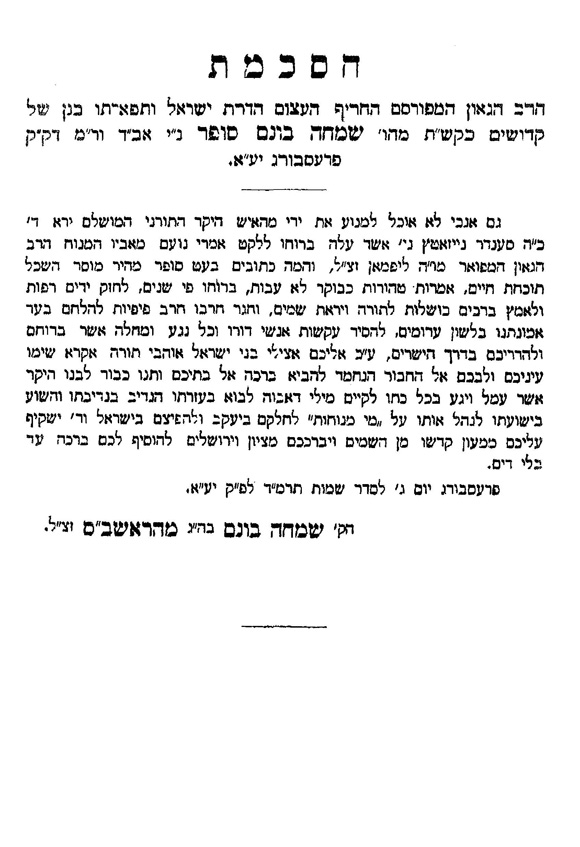
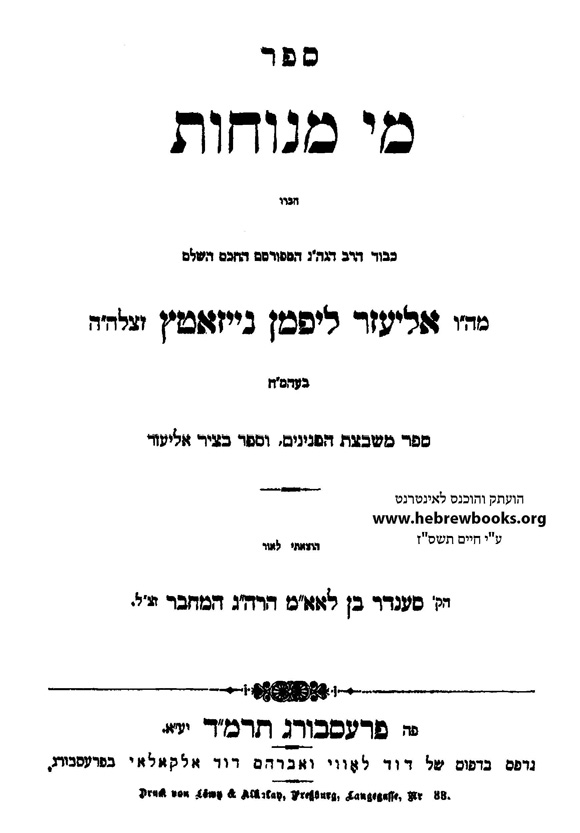
3. In the last post I cited an example where R. Shalom Messas was criticized for not understanding an Aggadah literally. More than one person thought that I should have cited sources showing how foolish it is to take bizarre aggadot literally. It is, of course, easy to cite such sources, beginning with the Rambam’s Introduction to Perek Helek.[13] Most of these are quite famous, so let me call attention to a book not so well known. It is R. Eliezer Lippmann’ Neusatz’ Mei Menuhot, published in 1884. Here is its title page.

Neusatz was a student of the Hatam Sofer, and this book appears with the approbation of R. Simhah Bunim Sofer (the Shevet Sofer).


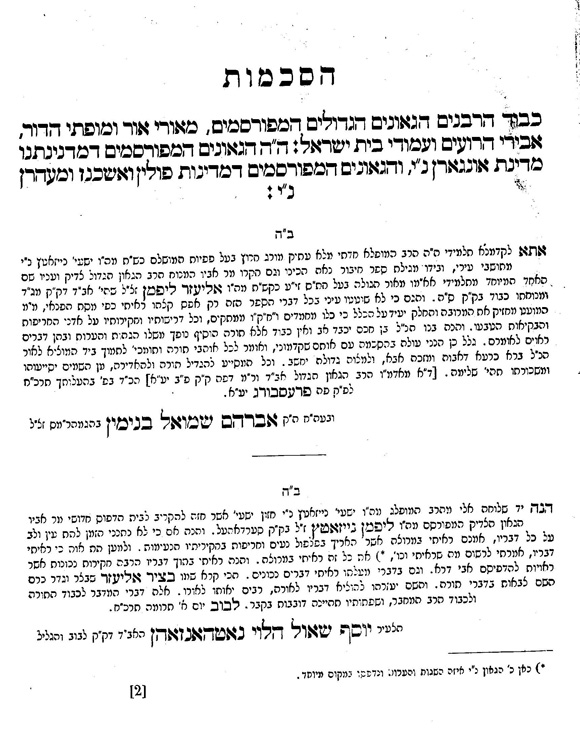
Here is the first page of the approbations to his book Be-Tzir Eliezer. Pay careful attention to how R. Abraham Samuel Sofer (the Ketav Sofer) describes Neusatz’ standing as a student of the Hatam Sofer.
On p. 16a, after citing Maimonides’ words that the majority err in understanding aggadot literally, Neusatz comments that this was the situation in earlier times, which were less religiously sophisticated than later generations. The proof that the earlier generations were religiously naïve is that belief in divine corporeality was widespread then. According to Neusatz, people who were so mistaken about God that they imagined him as a corporeal being would obviously not be able to understand Aggadah in a non-literal fashion. He contrasts that with the generation he lived in, which was able to properly understand Aggadah.

אמנם בדורנו זה נזדככו יותר הרעיונות ונלטשו הלבבות והמושגים האלהיים הנשגבים האלה מצטיירים בלבות המאמינים בטוהר יותר ורוב זוהר, ונתמעטו אנשי הכת הזאת, ותה”ל רובם יודעים שחז”ל כתבו אגדותיהם ע”ד משל ומליצה וחדות וכפי הצורך אשר היה להם לפי ענין הדורות אשר היה לפניהם, פנימיותם הם ענינים אמתיים נשגבים עומדים ברומו של עולם.
I assume that Neusatz would say that the traditional notion of the generations declining only refers to the scholars, as it is obvious from his words that when it comes to the masses the generations have been getting better.

Neusatz also has an interesting explanation as to why certain prophecies, in particular those of Ezekiel, are not written in proper grammatical Hebrew. This was already commented on by Abarbanel. Abarbanel simply attributes this to Ezekiel’s and Jeremiah’s unpolished Hebrew skills![14] He further claims that this is why there are an abundance of keri u-khetiv, ketiv ve-lo keri etc. in the book of Jeremiah. The original Hebrew had to be corrected!

Neusatz has a different approach to explain certain prophets’ apparent deficiencies in the Hebrew language. He explains that since the prophets were speaking to the lower classes, and they wanted their message to sink in, they adjusted their language accordingly. (Mei Menuhot, pp. 13b, 34b). This is also how he explains certain passages in the book of Ezekiel which would appear to be at odds with modest and proper speech. Since the prophet was speaking to the masses, he had to use their coarse language (p. 35a). This is no different than politicians today, who adopt a certain mode of speech to connect with the listeners. It also explains many of R. Ovadiah Yosef’s outrageous comments. In speaking to the masses he forgets who he is, and uses the sort of lower class language that allows him to connect with his listeners, but that is not acceptable for someone in his position.

Neusatz calls attention to R. Joseph Albo’s comment, Sefer ha-Ikarim 3:25, that even the Torah was written so as to speak to its various audiences, which included not just the wise people but also the foolish ones:

לפי שהתורה לא נתנה לחכמים ולמשכילים בלבד, אבל לכל העם מקצה גדולים וקטנים חכמים וטפשים, ראוי שיבואו בה דברים מוכנים [צ”ל מובנים כמ”ש במהדורת הוזיק] לכל.
Neusatz is also explicit that very few aggadot are actually the result of the Sages’ ruah ha-kodesh (p. 32a). He states that Maimonides’ astronomical views in the Mishneh Torah do not come from a holy source, but from the Greeks, and in our day must be rejected (p. 38a). He also acknowledges that at times the Sages’ opinions were based on the best scientific knowledge of their time, which we now know is mistaken (pp. 36a-36b, 38a-38b). On page 39b he discusses Maimonides’ rejection of astrology. The problem with Maimonides’ position is that the Talmud clearly accepts astrology. In Studies in Maimonides and His Interpreters I argue that Maimonides must have assumed that the greatest of the Sages rejected astrology. Yet the problem is that although Maimonides might assume this, is there any rabbinic source to justify this assumption? Neusatz argues that there is. There is a famous rabbinic statement in Shabbat 156a: אין מזל לישראל This means that Israel is not under the planetary influence. However, the statement is not a denial of the efficacy of astrology per se, and indeed assumes that the nations of the world are under the planetary influences. In very original fashion, Neusatz argues for a different understanding of the statement that he believes was shared by Maimonides:

והנה ידוע דעת הרמב”ם שהמזל אינו פועל כלל ונ”ל דס”ל שזה הוא כונת ר’ עקיבא ור’ יוחנן ורב ושמואל ורב נחמן ב”י בסוף מסכת שבת שאמרו אין מזל לישראל, וכונתם שאין ראוי לישראל עם חכם להאמין שמזל פועל.

In other words, אין מזל לישראל means that it is not proper for a smart people like the Jews to believe in the efficacy of astrology!

Neusatz also discusses Maimonides’ general attitude towards superstition, and argues that today, when all the superstitious beliefs have been proven false, it is a religious requirement to advocate Maimonides’ approach in these matters (p. 40b). As to why the Sages appear to believe all these superstitions, Neusatz assumes that they had to deal with the masses who were enmeshed in these notions, and that as long as the superstitious ideas were not idolatrous, the Sages were willing to tolerate them (p. 41ff. This is exactly Meiri’s view with regard to Zugot, but Neusatz had no way of knowing this as this section of the Meiri had not yet appeared in print.) Neusatz adopts the same view with regard to demons, which like Maimonides he too sees as non-existent (pp. 43ff.).[15]

Neusatz sees no harm in the Sages using common figures of speech if they never actually took them literally. Just as today we use expressions such as “the devil is in the details,” so too the Sages would refer to phenomena as due to a demon even though they didn’t believe this literally. To support this assumption, he brings a very interesting example where the Sages even used a mythological image (p. 45a). Pirkei de-Rabbi Eliezer, ch. 6, in speaking of the sun, writes: “The sun rides in a chariot and rises, crowned as a bridegroom.” This is obviously taken from the Greek myth of Helios, the god who drives the chariot of the sun across the sky every day. Yet despite this mythological origin, which Neusatz assumes must have been known to the Sages, the image appears in a Midrashic text. Neusatz writes:

ומי לא יבין? שרק על צד יופי הדבור והמשל אמרו כן לציירה כפי פעולתה, באשר מימי קדם ועד היום מפורסם משל זה לפעולת השמש ניתן לה מאת בעלי הממשילים (קראם הרמב”ם טלסמאות ובל”א מיטאלאגיע) ועד היום מציירים הממשילים את פעולת השמש בתמונה זו וכנודע.
It is in his discussion of demons that Neusatz brings amazing testimony from the Hatam Sofer, rejecting the authenticity of the vast majority of what is included in the book known as the Zohar.[16] Before quoting it, let me repeat that this book has the haskamah of the Hatam Sofer’s grandson, R. Simhah Bunim Sofer (the Shevet Sofer). Here is what Neusatz writes on p. 43b:
בפירוש שמעתי כן מפה קדוש אדומ”ו גאון ישראל קדוש ד’ מכובד מוהר”ר משה סופר זצוק”ל אב”ד ור”ם דק”ק פרעשבורג שאמר בפני רבים מתלמידיו, אלו היה יכולת ביד אדם להעמיד מדרשי רשב”י על טהרתן לבררם מתוך מה שנתחבר אליהם מחכמי הדורות שאחריו לא יהיה כולו רק ספר קטן הכמות מאד מחזיק דפים מעוטים.
The Hatam Sofer is often portrayed as both a religious extremist as well as lacking a critical sense. The first assumption, that he was an extremist, is absolutely false and is a creation of the nineteenth-century Reformers. I won’t go into it here, but suffice it to say that the Hatam Sofer was often a very lenient posek, the exact opposite of what people mean by “extremism”.

As for not having a critical sense, this too is false. I am not saying that he viewed matters as did R. Zvi Hirsch Chajes or R. Solomon Judah Rapoport,[17] but the quotation from Neusatz shows that the Hatam Sofer was much more complex than he was caricatured by his opponents. There are numerous examples that could be cited to illustrate this. In Limits of Orthodox Theology I mentioned that the Hatam Sofer leaned towards Ibn Ezra’s view that the entire last chapter of Deuteronomy was not written by Moses. He also wondered whether the Targum on Ruth was of Sadducean origin.[18] Another example relates to what was discussed in this post regarding the Jerusalem Talmud’s view that there is a mistake in the book of Jeremiah. (I neglected to mention that the J. Talmud there also states that there is a mistake in the book of Ezekiel.) According to the Hatam Sofer, the mistake in our book of Jeremiah is due to an erroneous emendation that dates back to biblical times.[19]

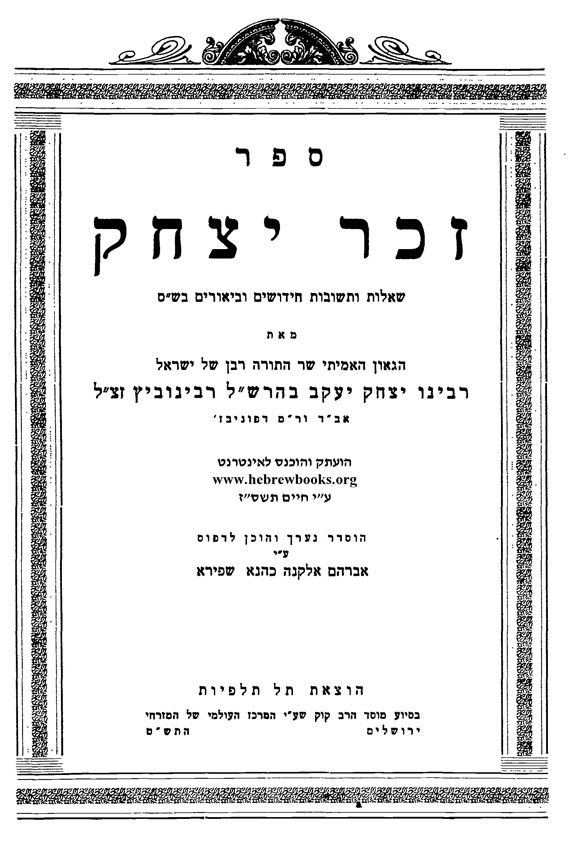
4. In my last post I quoted what R. Itzele of Ponovezh said about the superiority of the religious masses’ outlook to the Daas Torah of the gedolim. I had originally quoted this in an earlier post and referred to what R. Avraham Shapiro said about it. R. Avraham, before he became known as the Rosh Yeshiva of Merkaz ha-Rav and Chief Rabbi of Israel, had published R. Itzele’s teshuvot, Zekher Yitzhak, in 1949. Here is the title page of the book (taken from hebrewbooks.org).
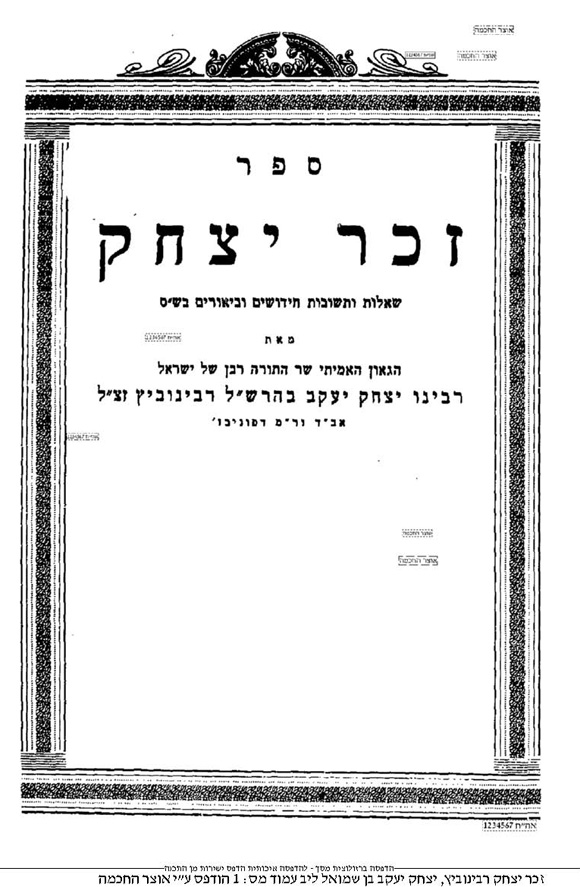
Unfortunately, the version on Otzar ha-Hokhmah has been censored. Here is the title page at it appears on Otzar ha-Hokhmah, with no indication as to who brought the book to publication.

The Otzar ha-Hokhmah version is also missing R. Avraham’s learned introduction. I have no doubt that Otzar ha-Hokhmah is innocent in this matter, and was unaware that the volume it put online had been tampered with. (If you have Otzar ha-Hokhmah there is actually no reason to use the first edition of Zekher Yitzhak, as a second edition, with an additional volume, was published by Machon Yerushalayim in 2000, and this is also found on the Otzar.)

All this is by way of introduction to saying that a couple of people wondered if R. Avraham had any interesting ideas in addition to being a posek and Talmudist.. Many people indeed only see him in the latter mold. I remember some years ago when I asked an acquaintance in Israel how it was possible that some people in Merkaz ha-Rav were willing to go against the Rosh Yeshiva, R. Avraham, and establish Yeshivat Har ha-Mor. It was explained to me that “if you want to know if something is muktzeh, then you should ask R. Avraham. But in terms of hashkafah, R. [Zvi] Tau is the one to follow.”

Yet I think this is an exaggeration, and those who are interested in R. Avraham can find lots of interesting things in his book Morashah, as well as in the two volumes published on R. Avraham by R. Yitzhak Dadon, Imrei Shefer and Rosh Devarkha. (Dadon is the man – ספרא וסייפא – who killed the terrorist who attacked Merkaz a few years ago.) I have also given two lectures on R. Avraham at Torah in Motion that can be downloaded.

R. Avraham knew an enormous amount about the history of great Torah scholars, and while he didn’t have a critical sense, he knew when a story was nonsense.[20] For example, R. Shalom Schwadron told a story about how when R. Kook, R. Isser Zalman Meltzer, and R. Moshe Mordechai Epstein were together once, they decided that each one should repeat a tractate of Talmud by heart.[21] That was the extent of their conversation. R. Avraham thinks that the story is, to put it bluntly, crazy. No normal person could sit and listen to someone else rattle off an entire tractate. Furthermore, are we supposed to think that these gedolim had no Torah to speak to each other about and that they would be happy to just sit and listen to the other repeat the Talmud? (Imrei Shefer, p. 269).

A valuable story is recorded in Imrei Shefer, p. 34. One of the students asked as follows: If when peeling a cucumber he mistakenly took off some of the cucumber itself, is that is regarded as ba’al tashhit? The students started laughing upon hearing this question, but R. Avraham became very serious. He replied:
זו שאלה של “עצבנות”, יש עצבנות ביראת-שמים, לכן מגיעים לשאלות כאלה. אדם נורמאלי מקלף וזהו! אסור לבחורים להגיע למצב של שאלות כאלה.
We see from here that R. Avraham was aware that there is a fine line between religious practice and obsessive-compulsive behavior. Many readers have probably come into contact with individuals who unfortunately have crossed the line. It is interesting to speculate if observance of halakhah can sometimes lead to obsessive-compulsive behavior or if it is simply that an obsessive-compulsive personality is able to function very well in the halakhic system. As for humrot and hiddurim, which many critics see as connected with obsessive-compulsive behavior, R. Avraham had a simpler approach. He believed that the humrot we see are simply because people have more money today than in the past. When you have money, you can adopt hiddurim that no one dreamed about years ago.[22]

Since many people who read this blog are very interested in R. Joseph B. Soloveitchik and his family, let me mention something fascinating in Imrei Shefer, p. 251. R. Yehoshua Magnes, one of R. Avraham’s leading students, is quoted as follows (and the information certainly come from R. Avraham): R. Moses Soloveitchik supported R. Isaac Rubenstein. The extremists wanted to put R. Moses in herem until R. Baruch Ber Leibowitz told them in no uncertain terms that one doesn’t put “the son of the Rebbe” in herem!

This is referring to the great dispute in Vilna over the chief rabbinate in the late 1920s. The Mizrachi decided to put forth their own candidate, Rubenstein, who emerged victorious. This was seen as a terrible slap in the face to R. Hayyim Ozer Grodzinski, who until then was regarded as the unofficial chief rabbi of Vilna. The election of Rubenstein was also a rejection of the tradition that, since the late eighteenth century, there was no chief rabbi in Vilna.[23]

This story, assuming it is true, answers a perplexity I had for some time. Making of a Godol, p. 749, relates how some Polish rabbis were so upset at R. Moses Soloveitchik that they threatened to put him in herem. In response to this threat, R. Baruch Ber is quoted as saying that one doesn’t put the son of the Rebbe in herem. The story quoted by Kamenetsky has to do with a rabbinical dispute between a certain Agudist rabbi and a Mizrachi shochet. We are told that R. Moses opposed R. Zvi Hanokh Levin’s support of the rabbi. Yet why would this occasion a herem? Others have assumed that the rabbis may have wanted to place him in herem for accepting the position at the Warsaw Takhkemoni, the Mizrachi school. Yet again, why would this lead to a herem? R. Hayyim’s great student, R. Shlomo Polachek, the Meitchiter, also taught at a Mizrachi school.

Assuming the information in Imrei Shefer is correct, all is understandable. If R. Moses supported R. Isaac Rubenstein, then the herem would make perfect sense. Here was an issue in which the entire rabbinic world had joined together to support R. Hayyim Ozer. The great dayan of Vilna, R. Henokh Eiges, the Marheshet, resigned from the Mizrachi on account of the slight to R. Hayyim Ozer’s honor. R. Aaron Rabinowitz, the son-in-law of R. Reines, the founder of Mizrachi, did likewise.[24] To support Rubenstein would thus be viewed as a terrible betrayal of rabbinic solidarity, which in the rabbinic mind would be deserving of a herem.

Why would R. Moses have supported Rubenstein? Presumably this was tied in with his opposition to Agudat Israel. It is known that he was quite opposed to the Agudah, claiming that in this opposition he was simply following in the path of his father, R. Hayyim .[25] In fact, this opposition explains another interesting point. In Keneset Yisrael 10 (1932), a journal published by the Hazon Ish’s brother and brother-in-law, there appears an article by “Shlomo Kohen.” Kohen was one of the Hazon Ish’s students, but the article was by the Hazon Ish. Why did the Hazon Ish not want to sign his own name to it? The article is directed against another article published by R. Moses Soloveitchik in Ha-Pardes, in which he cited the hiddushim of his son, R. Joseph Baer. As the Steipler explained, the Hazon Ish wanted to disprove what R. Moses wrote (in the name of his son) because R. Moses was associated with the Mizrachi (teaching at Takhkemoni) and he therefore wanted to diminish his stature (לבטלו).[26] In other words, the fact that the Hazon Ish decided to dispute with R. Moses (and he rarely disputed with contemporaries) was not because he so respected the latter, but the exact opposite.[27]

With regard to Mizrachi rabbis, let me quote something else repeated by R. Avraham Shapiro: The Hafetz Hayyim once wrote to a certain Mizrachi rabbi with all sorts of elaborate titles. When R. Velvel Soloveitchik was asked how the Hafetz Hayyim could write with such respect to a Mizrachi rabbi, R. Velvel responded that this is what happens when you don’t listen to any lashon ha-ra! (Imrei Shefer, p. 271). He said this as a criticism of the Hafetz Hayim. In other words, sometimes you need to listen to lashon ha-ra in order to know how to properly evaluate people. (R. Avraham was very upset with this story and doubted its veracity, although the comment is very much in line with how R. Velvel would express himself.)

Regarding Imrei Shefer, I was very happy to see on p. 267 that R. Avraham studied Kitvei R. Weinberg, which I published a number of years ago. Both volumes of this work are now available on hebrewbooks.org.

5. People continue to write to me about my earlier posts on R. Kook.[28] Many are fascinated with R. Kook’s position on sacrifices that I discussed here.
Let me therefore call attention to another recently published text, found in R. Tsuriel’s Peninei ha-Re’iyah, p. 212. (It earlier appeared in Meorot ha-Re’iyah, Haggadah shel Pesah, p. 225.). This is actually the text from which R. Kook’s famous words in Olat ha-Re’iyah, p, 292, are taken. There R. Kook envisions a future of vegetable sacrifices.


Olat ha-Re’iyah was published in 1939, after R. Kook’s death. Now that the original text of R. Kook’s words has been published, we can see how R. Zvi Yehudah did not merely “abridge” his father’s text, as Tsuriel puts it, but clearly censored it to soften its radicalism, which is a pattern seen again and again in R. Zvi Yehudah’s editing.

What appears in R. Kook’s original text is further elaboration about how in Messianic days the animals will be raised in intelligence to the level of man, and he even brings a biblical verse in support of this notion. Isaiah 43:20 reads: “The beasts of the field shall honor Me, the jackals and the ostriches.” The fact that animals are portrayed as honoring God shows that they will move beyond behavior based purely on instinct. Then R. Kook writes as follows, and pay careful attention to what I have underlined, which is undoubtedly the reason why R. Zvi Yehudah thought he had to censor the text.
אם כן יהיה כערך האדם עכשיו. על כן לא יהיה צריך לקרב מהם ולהקריב, ויהיה איסור בזה, ותהיה ההקרבה רק מנחה מהצומח, שהוא לא ישכיל עוד על שיעלהו בפועל. על כן תערב המנחה, ולא שאר קרבן מהחיים.

Here R. Kook isn’t just expressing a preference for vegetable sacrifices, but telling us that it will actually be forbidden to offer animal sacrifices.

Regarding Tsuriel’s Peninei ha-Re’iyah, some of the passages from R. Kook cited from manuscript are quite valuable. See e.g., p. 385, where R. Kook states that when it comes to a war to defend the Jewish people even the tribe of Levi goes out to fight. What this means, of course, is that R. Kook would be opposed to any draft exemption for yeshiva students.

In addition, Tsuriel has selected passages from R. Kook’s writings and arranged them in order of the various parshiyot, so that one can always find a good piece for a devar Torah. For parashat Metzora (p. 231), he quotes R. Kook’s statement in Ezrat Kohen, no. 21, that even if one expresses heretical thoughts, this doesn’t mean that he really is a heretic. Rather, it could be that he is simply trying to show that he is in line with what “the world” is saying, but it doesn’t mean that he really believes it.

This is just one more angle whereby R. Kook tries to defend the modern free-thinkers. His most famous defense is that modern heretics have the status of onsin, in that the environment today almost forces them into their false beliefs so that they cannot be held responsible for their views. He also states that those who express heretical beliefs are not really certain of their heresy, and it is only one who is certain in this who is to be regarded as a heretic.

With the publication of Shemoneh Kevatzim we see that R. Kook goes even further and completely removes the orthoprax individual from the status of heretic. I quoted the relevant passage here.
We see from R. Kook that one who holds a heretical belief, but lives as an observant Jew in his daily life, is regarded as part of the Torah community. As I put it in my earlier post: Two important things stand out. First, while not condoning orthopraxy, R. Kook states that one who is observant, despite the fact that he denies ikkarim, is to be regarded as an erring Jew, not as a heretic. R. Kook’s position is a complete rejection of the idea that people who are shomrei Torah u-mitzvot can be read out of the fold and be regarded as heretics because of their incorrect beliefs. The second important point is that he rejects the Rambam’s entire theological conception of Principles of Faith and aligns himself with the Ra’avad, showing once again that the Rambam’s position has not attained unanimity.[29]

Had R. Zvi Yehudah printed this text, we might have been spared some of the heresy hunting in the religious Zionist world, and discussions of whether one can drink this or that observant Jew’s wine due to the fact that he might have some heretical thoughts. In fact, it is only with the publication, uncensored, of R. Kook’s writings that the “lights” of his soul are revealed in all their grandeur. What other spiritual leader with unconventional views could declare that he is ready to fight the entire world for the truth as he sees it, to proclaim his views without any compromises and without worrying about what the “world” will say? While I greatly respect R. Herzog, R. Weinberg, and R. Soloveitchik, they certainly could never say the following (Pinkasei ha-Re’iyah [2010], vol. 2, p. 201):

“אם אני מוכרח להיות איש ריב לכל העולם מצד הנטיה של האמת העמוקה שבנפשי, שאינה סובלת שום הטיה של שקר, אי אפשר לי להיות איש אחר. וצריך אני להוציא מן הכח אל הפועל רק את יסודות האמת העקריים הצפונים ברוחי, בלא שום התחשבות עם מה שחושב העולם בכל הסכמותיו.” זהו הפתגם של דורש האמת, המתעורר בגבורתו העליונה.

See also ibid., p. 208, where we see his self-image as a prophet of old, and that no one other than he can see clearly what is taking place in the world:

מה יש עכשיו בעולם? וכי מפני שאין שום איש, ושום למדן ביחוד, רוצה להביט מה שיש עתה בעולם, וכי בשביל כך, גם אנכי לא אביט? לא! אני אינני משועבד להרבים. הנני הולך במסילתי, בדרך הישרה, ישר אביט.
R. Kook’s commitment to his path, despite the controversy that ensued, was a trait also seen in R. Shlomo Goren, with all the tragic consequences, both personal and professional. Perhaps the Lubavitcher Rebbe is the only one after R. Kook who was able to successfully chart a path undisturbed by the opposition, and without any need for compromise.

One other passage from R. Kook’s recently published Pinkasei ha-Re’iyah vol. 2, p. 207, is worth noting. While tolerance of opposing viewpoints is often viewed as characteristic of a watered-down commitment to one’s own belief, R. Kook adopts a different perspective:

הסבלנות בדעות, כשהיא באה מלב טהור ומנוקה מכל רשעה, אינה עלולה לקרר את להבת רגש הקודש שבתוכן האמונה הפשוטה, מקור אושר החיים כולם, כ”א להרחיב ולהגדיל את יסוד ההתלהבות המקודשת לשמים.


To be continued.
[1] For a different perspective, see the recently published Pinkesei ha-Re’iyah, vol. 3, p. 69, where R. Kook states that one might have expected non-Jewish philosophers, since they are not involved with practical mitzvot, to be able to attain a higher grasp of theological truths, as they can devote themselves exclusively to this. Yet R. Kook explains that this is not the case.
[2] In R. Soloveitchik’s Halakhic Man we also see his dissatisfaction with practical halakhic decision-making. His alternative to this is theoretical halakhic study, which is very different than what R. Kook saw as his goal. In the hasidic world, the communal rav was relegated to the role of halakhic technician, while the focus of spiritual leadership was the Rebbe, who did not involve himself in practical halakhic rulings.
[3] Together with the crackdown on sexual abuse, there have been other changes as well. In my youth there were teachers who would punish students physically. This was, in fact, the traditional method of disciplining students, and is mentioned in Makkot 2:2, Bava Batra 21a, Mishneh Torah, Hilkhot Talmud Torah 2:2, Rotzeah u-Shemirat ha-Nefesh 5:6, and Shulhan Arukh, Orah Hayyim 551:18, Yoreh Deah 245:10. See also the picture from the 1395 Coburg Pentateuch, of a teacher with his whip, available here.
It is clear from the rabbinic sources that the physical punishments were not designed to inflict real pain, although one wonders whether the picture from the Coburg Pentateuch reflects a harsher reality. See Elliot Horowitz, “The Way We Were: ‘Jewish Life in the Middle Ages,’” Jewish History 1 (Spring 1986), pp. 81-82. In any event, today, what parent will allow the teacher to lay a hand on his child, even if the pain is minor?
Even though, as mentioned, teachers were never supposed to inflict real pain, I think it is fair to say that the physical punishments over the generations sometimes did get out of hand (see next note). I recall vividly one rebbe who would squeeze kids’ arms and even throw them against the wall. Today, in every Modern Orthodox school and even some haredi schools, that type of behavior would be grounds for immediate termination. Regarding how students were physically punished in the great yeshivot, we have reports of Roshei Yeshiva and mashgichim who would slap students in the face. See e.g., Moshe Tzinovitz, Mir (Tel Aviv, 1981), p. 464; Shaul Stampfer, Ha-Yeshivah ha-Litait be-Hithavutah (Jerusalem, 2005), p. 335 n. 76. Even R. Naftali Zvi Judah Berlin, who was a very gentle person, would occasionally slap a student in the face. On one occasion this even led to the students going “on strike” (i.e., ceasing all Torah study) in protest against the Netziv’s action. They viewed the slap as an insult to the entire student body since this was the sort of thing one would expect a melamed to do in a heder, not the rosh yeshiva of the great Volozhin. The Netziv was forced to publicly apologize to the entire student body. See M. Eisenstadt, “Revolutzyah ba-Yeshivah,” Ha-Tzefirah, 1 Sivan 5676; Stampfer, Ha-Yeshivah ha-Litait, pp. 128-129, 149.
On at least one occasion, a student certainly deserved being slapped in the face. It happened at Telz in 1905. At this time there were two mashgichim, and as was often the case at the great yeshivot, the students were very opposed to the mashgichim. (A few years earlier the students had gone on strike due to the invasive actions of a previous mashgiach, R. Aryeh Leib Hasman. See Stampfer, Ha-Yeshiva ha-Litait, p. 334.). One of the students waited above and when given the signal poured a bucket of fish sauce upon the mashgiach. R. Eliezer Gordon, the Rosh Yeshiva, slapped the suspected student on the face. Simcha Assaf, who records the story, tells us that this was the only time Gordon ever did such a thing. See Assaf, “Shenot ha-Limudim sheli bi-Yeshivat Telz (5665-5668),” in Immanuel Etkes and Shlomo Tikochinski, eds., Yeshivot Lita (Jerusalem, 2004), p. 235.

I have seen haredi authors who argue that opposition to physical punishment in school is a sign that people have moved away from “Torah values” in favor of modern psychology. See R. Chaim Rapoport’s response to this approach in his wonderful discussion of the issue in Datche 41 and 41 (2008). See also R. Avraham Steinberg, Encyclopedia Hilkhatit Refuit, vol. 6 cols. 767-768.

Another change in our era is that signs of physical affection between a rebbe and student, which at one time were very important especially as the rebbe served as a father figure, are no longer acceptable. A student cannot even sit on his rebbe’s lap, as was done in years past. It is reported that when R. Hayyim Soloveitchik visited his great student, R. Baruch Ber Leibowitz, who at this time was serving as rosh yeshiva of Keneset Beit Yitzhak in Slobodka, R. Baruch Ber sat on R. Hayyim’s lap. Just like he sat on R. Hayyim’s lap when he was a young student, R. Hayyim wanted R. Baruch Ber to sit on his lap when he was a grown man. See Making of a Gadol, p. 87. The fact that we could never imagine something like this happening today shows how different our mindset is. There are loads of stories of rebbes kissing their students. R. Zvi Yehudah Kook was known in particular for this. See e.g., Iturei Yerushalayim, no. 55 (2011), p. 4. Here are three stories from R. Shlomo Riskin’s recently published memoir, Listening to God, which also bring us back to a more innocent time.
I couldn’t wait to share my discovery [of Darwin’s theories and how they could help explain the Torah] with my rebbe, Rav Mandel, that Monday morning. I brought him the book, and showed him the relevant passages—totally ignorant of the “red flag” raised in religious circles by the mere mention of Darwin. Rav Mandel barely took the book in his hand; he slapped my face, and then kissed my forehead. “Your interpretations are magnificent, but it is forbidden to read such heretical literature,” he said gently. I smarted at the slap, felt vindicated by the kiss, and continued to adore my rebbe. . . . “ (p. 51)
Riskin describes being tested by Dr. Samuel Belkin.
He asked me which Talmudic tractate I was studying, spoke to me “in learning,” and gave me a section of Gemara and the Tosafot commentary to read. He then came around the desk where I was sitting, kissed me on the forehead, and said to Tante, “you’re right, He can have a full scholarship to Yeshiva University.”(pp. 67-68)
After Riskin passed the examination to become a city rabbi in Israel, “Rabbi [Shaul] Yisraeli rose—and visibly moved—kissed me on the forehead.” (p. 369)
In general, I have to say that Riskin’s book is quite interesting. I must note, however, that in a number of places where he is critical of people or tells a story that might be embarrassing, Riskin refers to individuals by their initials. If he did so in order to leave the figures anonymous, he was not entirely successful, since in a few cases it is not that hard to figure out whom he had in mind.
[4] Unfortunately, refusal to protect children is not a new thing. See this post where I mentioned even allowing rapists to go free.
What is new is that parents are now beginning to stand up. Here is a passage from a nineteenth-century memoir from which we see that in the past even murder was covered up. (The case described is definitely not manslaughter, which is what is described in Makkot 2:2 and Rambam, Hilkhot Rotzeah u-Shemirat ha-Nefesh 5:6. Incidentally, the latter two sources are only speaking about a society in which teachers were permitted to hit the students, and have no applicability today vis-à-vis most of the Orthodox world.)
One of the angry teachers I mentioned was nicknamed David with the tangled hair, as his head was covered with a mass of knotted hair. He was hot-tempered and frightening, and often came to within an inch of killing a pupil. When particularly enraged, he would lift a child up and ferociously throw him to the ground, so that he landed like a corpse. That actually did happen once. After the funeral the parents of the deceased never dared accuse him of murdering their child. They accepted it as preordained that their son should die while learning Torah, and so did the rest of the community. No one considered the melamed a murderer. Even the sons of M.S. who made it their business to ferret out sinners in the town, in order to cause strife and contention, kept silent on this matter, and David the melamed kept on teaching as if nothing had happened.
Yekhezkel Kotik, Journey to a Nineteenth-Century Shtetl (Detroit, 2002), p. 145. On p. 431, David Assaf, the editor, calls attention to a different memoir which tells of a child dying as a result of his melamed’s beating. On p. 145, Kotik also speaks of another melamed who “would take all his anger out on that particular part of the boy’s anatomy that is generally not mentioned in print.”
(In some segments of the hasidic world the cover-ups unfortunately also continue. Had the New Square madman succeeded and killed the five people in the house he was intent on burning down, does anyone think that the community would have assisted the police in finding the murderer? In a future post I will mention cases of murder and attempted murder carried out for “pious” reasons.)
After my previous post on ultra-Orthodox tolerance of sexual abuse, there were some who doubted that there is any rabbinic support for this. Those who can read Hebrew, please read the following responsum from R. Menasheh Klein, Mishneh Halakhot, vol. 16, pp. 169-171.
According to Klein, there is never a time when sexual abuse can be reported to the police, even if a child is being continuously raped. That is because there are never two male witnesses who see the abuse. If someone does report the abuse, it is a mitzvah to kill the moser. If anyone has a difficult time understanding why a segment of the hasidic world time and again offers support for the perpetrator and ostracizes the victim, this is all the explanation you need. From their perspective, the victim who goes to the police is worse than the sexual abuser. Based on Klein’s understanding, I don’t think there is a “heter” for a woman who has been raped by a Jew to go to the police, because there is no halakhic evidence of a crime. (He also says that it is forbidden to turn in a murderer. In case anyone needs to be reminded how crazy this viewpoint is, I am writing these words only a few hours after the monster who killed Leiby Kletzky was identified.)

A friend insists that there is no difference between Klein’s position and that of Agudat Israel. This is not true at all. Whereas Klein states that someone can never be turned in to the police, the Agudah position is that a molester can be turned in, but only after a rabbi gives approval. The Agudah position continues to develop, and I have no doubt that in the end the Agudah will end up holding a position identical to that of the RCA. I also think that it is public pressure that will move Agudah in this direction, as public pressure has been responsible for all the adjustments in the Agudah’s position that we have seen until now.
Yet even without public pressure, the current Agudah position is so untenable, that it will have to be updated. For one, it asks people to violate the law. The law is clear that some people are obligated to contact the police when they suspect child abuse. By insisting that a rabbi be consulted before doing so, mandated reporters are being put in the position of being told by a rabbi to refrain from doing something that the law requires. Do the Agudah constituents realize that listening to the rabbi in these circumstances can open them up to both criminal and civil penalties?

As for the rabbis, I can’t imagine who would agree to be on the Agudah’s panel of rabbis that will examine accusations of abuse in order to determine if it is permitted to go to the police. If one of these rabbis rules that the evidence is not compelling and it is therefore forbidden to go to the police, and the rabbi is wrong, he opens himself (and the mandated reporter) to a lawsuit by the parents of the molested child. Whatever the ultimate verdict, the lawyer fees alone will end up bankrupting the rabbi. Is the Agudah prepared to set up a fund to defend rabbis sued by parents of molested children? Certainly not, which is why no rabbi who is thinking straight will ever agree to put himself in such a circumstance. The Agudah’s position also leaves the organization itself vulnerable to a lawsuit by parents of victims.

Finally, unlike so many of the cynics in our community, I don’t think the Agudah position is all about protecting rabbis, guilty or not. I really do believe that the Agudah recognizes that there is a problem. It is convinced that the rabbis it will charge with examining abuse cases will indeed make sure that molesters are turned in. The problem, however, is that we have seen all this before. We have seen over and over again that it is precisely the rabbis who have failed in this matter, often because they are not willing to turn on their own. It was precisely because of this that the community of laypeople rose up and said “No more.” One doesn’t need to be a prophet to see that by relying on individual rabbis to determine if an accusation of sexual abuse is credible, there will continue to be cover-ups. (Am I wrong in assuming that these cover-ups never would have happened if women were in charge? Would mothers ever have permitted child molesters to continue to prey on the young?)
The Agudah position is thus both a public relations and legal disaster in the making. The Church tried such an approach already and it doesn’t work. I don’t understand why such smart people in the Agudah don’t see how their new position is doomed to failure.
[5] See here where I attribute the rabbinic silence to the money Tropper was handing out. I also brought proof that even great rabbis are not immune to being influenced by money. Regarding this point, see the recent biography of R. Zvi Pesach Frank written by Shabbetai Dov Rosenthal, Geon ha-Hora’ah (Jerusalem, 2011),, vol. 1, pp. 410-411. A letter from R. Frank is published in which he criticizes members of the Israeli Chief Rabbinate (of which he was a member). The subjects of his criticism were gedolei Yisrael, and yet he accuses them of being improperly influenced by Israeli government money. He adds:
מי לנו גדול מהכהן הגדול שלא צירפוהו לדון בענין עיבור השנה, שהיה חשש נגיעה שמפני הקור יכריע שלא לעבר השנה
[6] See e.g., here.
[7] I hope to treat this phenomenon in great detail when I am able to complete my article on contemporary halakhic practices in opposition to the Shulhan Arukh.
[8] There are loads of sources that speak of the great weight to be assigned to the practices of the Jewish people, even when these practices appear to violate the textual halakhah. For one example, see R. Solomon Laniado, Beit Dino shel Shlomo (Jerusalem, 1986), Orah Hayyim no. 17 (p. 96): שכל מה שנהגו ישראל שכינה מוסכמת עמהם
Laniado (died 1793) was the chief rabbi of Aleppo.
[9] See my post here.
[10] Moshe Carmilly-Weinberger, ed., The Rabbinical Seminary of Budapest 1877-1977 (New York, 1986), p. 77.
[11] I would also like to mention a recent article by Lawee that deals with some issues relevant to earlier installments of this series, such as the possibility of errors in the biblical text. See Lawee, “Isaac Abarbanel: From Medieval to Renaissance Jewish Biblical Scholarship,” in Magne Saebo, ed., Hebrew Bible/Old Testament (Goettingen, 2008), vol. 2, p. 210, who calls attention to Ibn Ezra, Ex. 25:29, who claims that there is a mistake in the Book of Chronicles. He also notes Abarbanel’s commentary to I Kings 10:22, which suggests another error in Chronicles, due to Ezra misunderstanding a verse in the Book of Kings.
[12] Elsewhere, Ashkenazi speaks of Moses having access to historical records, but there he assumes that these records are accurate. See Epstein, Mi-Kadmoniyot ha-Yehudim, p. 136:
כי כל התורה ברוח הקדש כתבה משה וידע שמות אלופי אדום ומשכנותם ומלכיהם ידועה [!] גמורה מפי ספרים ומפי סופרים ונודע לו האמת ונכתב בספר.
[13] See also this earlier post of mine.
[14] See Abarbanel’s introductions to Jeremiah, p. 298, and Ezekiel, p. 434. In the latter source he writes:
הן אמת שיחזקאל הנביא לא היה בקי בלשון הקדש ולא בכתיבתו
For other references, see Eric Lawee, Isaac Abarbanel’s Stance Toward Tradition )Albany, 2001), p. 276 n. 46.
[15] On p. 46a he offers a different perspective which I don’t think can be brought into line with what he says earlier. Here he accepts the existence of some sort of demonic beings, and claims that the superstition is only that humans can interact with and influence them. Neusatz’ book was published posthumously, and it is possible that had the author been alive he would have worked out a more consistent theory.
[16] In the next issue of Milin Havivin, I deal with Orthodox views of the Zohar. In the meantime, I was surprised to find that R. Berel Wein describes the Zohar in an unsympathetic manner. Although some may claim that Wein was only presenting the history, his less than reverential attitude towards the book comes across very clearly, even if he didn’t consciously intend this. See the video here.

For another surprising piece by Wein (called to my attention by Mel Barenholtz), see here.
Wein describes Midrash as “legend.” While this might be a term used by academics (and is in the title of Louis Ginzberg’s great work), the Yeshiva World has always rejected the word as a proper description. Wein’s entire article can be seen as a reflection on the fact that rabbis, in their sermons, quote all sorts of Midrashim as if they are historical, which they are of course not. So what value do these “legends” have, and why should we use them to fill in the “missing parts” of the biblical text? That is the question Wein deals with.
In fact, Wein’s entire article, with its demand for truth in history and the need to abandon fantasy, is the sort that in today’s day and age could generate a herem. Here, for example, is one very provocative sentence: “Many times legend becomes myth. Myth is a sense of human recognition that the story being told is not factual but it nevertheless changes legend from history or biography into literature and philosophy – sometimes sacred holy literature and philosophy.” (emphasis added). And how about this paragraph, which uses the word “mythology,” certainly knowing the knee-jerk reaction it will provoke among people.

The Torah does not deal with myth per se. Yet the Flood and Noah’s ark, the Tower of Babel, the centrality of the land of Israel, factual as they all are in the biblical narrative, nevertheless were all combined to create a basis for the holy mythology of the Jewish people. In addition, the idea that the “events of the works and decisions of our founders, the fathers of Israel, are a sure guidepost for their descendants” helped strengthen a mythology that binds the Jewish generations together and gives us insights into the values of Judaism and historical events, past and present (emphasis added).

In speaking of the Flood, Noah’s Ark and the Tower of Babel, Wein states that they are factual “in the biblical narrative.” Does this mean to imply that they are really not historical events, but it is only in the biblical narrative that they are regarded as factual? Since these events, Wein tells us, are among the great myths of Judaism, and he just finished telling us that myth is not factual, this seems to be what he is saying.
[17] These two scholars would never have said, as did the Hatam Sofer, that Yiddish was invented by the medieval Jewish sages to keep Jews separate from non-Jews. See She’elot u-Teshuvot Hatam Sofer, Even ha-Ezer, vol. 2 no. 11. There are many other examples that show that the Hatam Sofer was still very much part of the medieval worldview, which is why I state that he is a complex figure. For instance, he still leaned towards Ptolemaic astronomy, centuries after Copernicus (although he acknowledged that the issue was complicated). See Eliezer Brodt’s post here.
Another example is the Hatam Sofer’s famous comment that he doesn’t understand the value of Jews training to be doctors in medical schools where they dissect non-Jewish bodies. Since Jews keep kosher, how can the information obtained from non-Jewish bodies be applicable to them? See Hiddushei Hatam Sofer, Avodah Zarah 31b. Yet I think it is more important is that in this very passage the Hatam Sofer also laments how there is no Jewish medical school.
[18] See Lishkat Soferim to Even ha-Ezer 17:43 (found in standard editions of the Shulhan Arukh).
[19] Derashot Hatam Sofer, vol. 1, p. 331b. This text is discussed here.
[20] The same was true with R. Moshe Feinstein. See R. Aharon Felder’s recently published Rishumei Aharon, pp. 18-19. This book has lots of interesting stories about R. Moshe. Felder is not afraid to point out how R. Moshe, unlike other Roshei Yeshiva, had a more moderate viewpoint when it came to attending college. See pp. 19-21. See also p. 21 for the following story, which shows R. Moshe as a real down-to-earth person, who was far removed from “frumkeit” and had little patience for the aspiring pietist:
פעם ניגש למו”ר זצ”ל חתן ביום חתונתו וביקש לדעת איזו כוונה צריך לכוין בשעת ביאת מצווה. פנה אליו מו”ר זצ”ל וענה “איני מאמין שתוכל לכוין כלל וכלל”. והוא לא הסתפק והמשיך לשאול שוב את שאלתו, אם אני יכול לכוין מה הכונה הראויה לאותו זמן? ומו”ר זצ”ל לא הגיב, ורק המשיך ללכת לדרכו.

For another such story, see p. 20 where he records how R. Moshe told a certain Rosh Yeshiva that it was inappropriate for him to refuse to be mesader kidushin just because there would be mixed seating at the wedding. See also p. 22 that R. Moshe refused to write a letter to the judge on behalf of one who was to be sentenced for drug dealing. R. Moshe told the criminal’s father that his son damaged people’s lives and therefore “Let him sit in prison.” On p. 28 he quotes R. Moshe’s positive view of R. Kook. On p. 73 he quotes R. Moshe that a male massage therapist can massage a woman if he does not have a continuing professional relationship with her (!), a man can cut a woman’s hair, and a male teacher or principal can be present when girls in the school sing as the assumption is that he is involved with other things and not paying attention.
What many will regard as a surprising pesak appears on p. 36:
מותר להיות Wine Tester ולטעום סתם יינם, באופן שפולט ואינו בולע
I assume this pesak is based on Rama, Shulhan Arukh, Yoreh Deah 108:5, who is speaking about יין נסך, implying that it is permitted to taste but not swallow סתם יינם. See also Pithei Teshuvah, Yoreh Deah 98:1, for the view that it is permitted to taste, but not swallow, things forbidden by the Sages.
(Regarding tasting without swallowing, see Shulhan Arukh, Orah Hayyim 567:1-3. Based on the Rama in 567:3 it would appear that it is permissible to chew gum on a fast day other than Yom Kippur.)
Although I can’t be certain, I find it hard to believe that R. Moshe would require the wine taster to make a blessing on the non-kosher wine. If so, then R. Moshe would presumably agree with those poskim who have ruled that one does not make a blessing on gum and that you can chew it before morning tefillah. See what I wrote here.
See R. Yitzhak Barda, Yitzhak Yeranen, vol. 2, no. 11, and R. Moshe Levi, Birkat ha-Shem, vol. 2, pp. 41ff., vol. 5, pp. 537ff., for complete discussions of the topic. R. Meir Mazuz also holds that one does not make a blessing on gum. See Or Torah, Tamuz 5771, p. 973. The logic of this viewpoint is explained by the Beit Yosef, Orah Hayyim 210:
ולי נראה דברכה לא בטעימת חיך תליא אלא באכילה תליא כדכתיב ואכלת וברכת ואכילה היינו הנאת מעיים כדברי הרא”ש ז”ל
Speaking of gum, I wonder if R. Moshe would agree with R. Yitzhak Abadi that all the standard gums (Wrigleys, Trident, etc.) are kosher. See Or Yitzhak, vol. 1, Yoreh Deah no. 24:
כפי שבררנו החלק הטעים והמתוק שבו אין בו שום שאלה, ומה שנשאר הגומי אח”כ וממשיכים ללועסו אין בו לא טעם ולא ריח, והרי הוא כעץ בעלמא ושרי ללועסו כל היום כולו אף אם עירבו בו מדברים האסורים.
The kashrut organizations assume that gum needs a hashgachah. Here is what R. Zushe Blech has to say on the subject
The need for reliable Hashgacha for gum stems from many ingredient concerns. Plasticizers can be pure lard or tallow and emulsifiers are also often made from animal fats. Flavors and glycerin can also be completely non-Kosher. Even if all of the ingredients in a Kosher gum were acceptable, the equipment on which the product is made requires a Kashering from non-Kosher productions. Although the gum itself is not swallowed, these fats and flavors migrate from the gum into the mouth.
See here. (What does Blech mean by “reliable Hasghacha”? Does it mean that hashgachot that disagree with his understanding are not “reliable”?)
Let’s leave flavors out, as none of the flavors in the major gums are non-kosher. Let’s also leave out the issue of equipment, since this is not a real halakhic concern (as anyone who has ever lived in a place other than Israel and America, and thus has to buy foods without hashgachah, is well aware.) The issue is glycerin, emulsifiers etc. I don’t understand why this should be a problem. Even assuming that it is forbidden to swallow these things as part of a food, why would it be prohibited to simply chew on these tasteless items? Is there any kashrut problem when my son chews on his pigskin baseball glove while waiting patiently for a ball to be hit to him?
Returning to Felder, I give him credit for not being embarrassed to tell us how he once asked R. Moshe the following idiotic question (p. 20):
פעם הלכתי עם מו”ר זצ”ל לניחום אבלים, ולפני שנכנסנו לרכב ביקש ר”מ אחד מישיבת “רבינו יצחק אלחנן”, אם יכול להצטרף לנסיעה כי בית האבלים היה בקרבת מקום לשכונה של הישיבה הנ”ל. ושאלתי את מו”ר זצ”ל האם מותר לנו לקחת את אותו ר”מ לאותה ישיבה? וענה לי “למה לא, הרי נמצאים שם הרבה גדולי ראשי ישיבה שמלמדים תורה”.
Could it be that Felder didn’t know that R. Moshe’s great student, R. Nissan Alpert, taught at YU, or that his son-in-law, R. Moshe Tendler, likewise did? Did he not know that R. Moshe had close relationships with many of the Roshei Yeshiva at YU, and was colleagues with them in Agudas ha-Rabbonim?
While on the subject of teachers at YU, here is a page of a letter, never before published, by R. Yaakov Kamenetsky. It was sent to his son, R. Nosson, whom I thank for giving me permission to publish it. (The notations on the side of the letter are by R. Nosson.) In the letter, R. Yaakov admits that it would have been better for him to teach at YU, since the YU musmachim have a much more significant role in American Orthodoxy than those he was teaching. However, what prevented him from doing so is how this would appear to his sons. They would wonder, if YU was good enough for him to be part of the faculty, why did he think it so important to send his sons to haredi yeshivot?
[21] Kol Hotzev (Jerusalem, 1999), pp. 178-179.
[22] Among my children’s generation, many kids believe that there is a halakhic requirement to have two sinks. Some of these kids have literally never been to a kosher home which doesn’t have this. If they saw such a home, they would probably assume that there must be a heter for one sink, but only for those who can’t afford to redo their kitchens.
[23] R. Joseph B. Soloveitchik wrote of the difficulties R. Hayyim Ozer had, and strongly identified with the latter. See his hesped for R. Hayyim Ozer in Divrei Hagut ve-Ha’arakhah (Jerusalem, 1982), p. 194:
הגאון ר’ חיים עוזר לחם על זה בחרוף נפש. הוא סבל הרבה בעטיה של שיטה זו, סבל יסורי נפש ורוח. בשעה שהרבה מאחינו נכונים היו למסור את החושן לידי זרים ולהסתפק בציץ. עמד הוא בפרץ ומחה נגד זה.
The truth is that R. Soloveitchik is incorrect when he writes עמד הוא בפרץ ומחה נגד זה R. Hayyim Ozer did not protest the slight to his honor, or lead the opposition to Rubenstein. It was the other sages, including the Hafetz Hayyim and the Hazon Ish, who took the reins in this matter. Regarding the Hazon Ish, see Binyamin Brown, Ha-Hazon Ish (Jerusalem, 2011), p. 53.
[24] See Aharon Sorasky, Rabban shel Yisrael (Bnei Brak, 1971), p. 115; Moshe Tzinovitz, Ishim u-Kehilot (Tel Aviv, 1990) p. 240. Rabinowitz was the father-in-law of R. Avigdor Zyperstein, who taught at YU. In Vilna, the center of European Jewish scholarship, an Agudah rav, Grodzinski, and a Mizrachi rav, Eiges, sat on the same beit din and worked closely together. In Europe, every small town had a rav. Sometimes the rav was an adherent of Agudah, and other times a follower of Mizrachi. But as far as the townspeople were concerned, that didn’t matter. He was the rav and if there were halakhic questions in the town he was the one to decide them. If you were an Agudist and the rav was a Mizrachi man, when you had a halakhic question you would go to your rav. The politics of the Jewish world did not interfere when it came to halakhah. Furthermore, the various Agudat Rabbanim in Europe (and also in the U.S.) welcomed all rabbis, regardless of where one stood in the Agudah-Mizrachi dispute. In the post-World War II world, however, the haredi world has entirely changed all this and rewrote the rules. They were able to convince their followers that unless a rav follows the haredi Daas Torah he is not a reliable rav, and therefore he should not be consulted on halakhic matters. In other words, the halakhic competence of a rav was made dependant on his political outlook. This is a complete break with Jewish tradition, as it existed in Europe. While some might regard this development as simply another example of haredi “shtick”, I think it is more significant as it illustrates once again that haredi Judaism can be just as modern and revolutionary as that which it sees itself as fighting against.
[25] See Zvi Weinman, Mi-Katovitz ad Heh be-Iyar (Jerusalem, 1995), pp. 52ff.
[26] E. Horowitz, Orhot Rabbenu (Bnei Brak, 2005), vol. 5, p. 169
[27] See Brown, Ha-Hazon Ish, pp. 55-56.
[28] One well-known haredi rav wrote to me as follows:
I just read your post . . . regarding the abolishment of animal sacrifices. Barukh sheKivanti l’Da’ato shel Harav Kuk when I once told my students at . . . (and advised them to keep it under wraps) that perhaps a future Sanhedrin will find a drash to do that. But I had a caveat in that our present moral sensitivities were formed during the Exile in which we were enslaved to general, non-Jewish thinking. Therefore, after the Messiah arrives and we are able to think independently, and until we are on own long enough to form our own, Jewish ideas, all we will be able to do is continue from where we left off at the Destruction of Ba’yit Sheni. Only after some time has passed may the Sanhedrin decide that animal sacrifices ought to be abolished. This approach explains why the Rambam sets down Hilkhot Korbanot though he may have been prepared to abolish them had he been sitting on the Sanhedrin. It’s for that interim time — between the arrival of Mashiah and whenever the Sanhedrin makes its Judaism-inspired [changes].
He then added the following critical note:
Within the blog you used a term which ruffled my sensibilities: “Messianic Judaism.” Simply because that term has been usurped and corrupted by Christians who call themselves “Messianic Jews,” you should have written “Messianic-Era Judaism”.
[29] R. Isaac Hutner is quoted saying something very similar to that of R. Kook.. See R. Yitzhak Alster, Olat Yitzhak (Jerusalem, 2003), vol. 1, p. 188 (referred to by Bezalel Naor, The Limit of Intellectual Freedom [Spring Valley, 2011]):
שאין דנים הכופר עפ”י מחשבתו ודבורו לחוד עד שעושה מעשה מומרות. וכך היה לשונו: איך וואלט ניט געפסקנט אויף אימיצר אז אעהר איז אן אפיקורס סיידן איך וואלט געזעהן א ריעותא אין זיין מצוות מעשיות, כאיטש אפילו אפיקורסוס איז נישט תלוי אין מעשים, אבער מעלע וואס א מענטש רעדט – ער גלויבט אליין נישט וואס ער רעדט


Le-Tacen Olam (לתכן עולם): Establishing the Correct Text in Aleinu

Le-Tacen Olam (עולם לתכן): Establishing the Correct Text in Aleinu[1]
By Mitchell First (mfirstatty@aol.com)
 
                    The Jewish obligation of עולם תקון (=improving the world) is widely referred to and it is traditionally assumed that the Aleinu prayer is one of the texts upon which this obligation is based.
                    This article will show that a very strong case can be made that the original version of Aleinu read עולם לתכן (=to establish the world under God’s sovereignty), and not עולם לתקן (=to perfect/improve the world under God’s sovereignty[2]). If so, the concept of עולם תקון has no connection to the Aleinu prayer.[3]
—–
                    It is reasonable to assume that Aleinu was already included in the Amidah of Rosh ha-Shanah (=RH) by the time of Rav (early 3rd century C.E.).[4] But no text of Aleinu is included in the Talmud, nor is a text of Aleinu included in any of the classical midrashim.[5] Therefore, we must look to later sources for texts of Aleinu.
                     When we do, we find that the reading לתכן is found in the text of the RH Amidah in the Siddur Rav Saadiah Gaon (d. 942),[6] and in the text of the RH Amidah in the Mishneh Torah of the Rambam (d. 1204).[7] Moreover, it is found in numerous prayer texts from the Cairo Genizah that include this line of Aleinu.[8] For example, it is found in: 1) a fragment of the RH Amidah first published by Jacob Mann in 1925;[9] 2) a fragment of the RH Amidah first published by Richard Gottheil and William H. Worrell in 1927;[10] 3) a fragment of the RH Amidah first published by Mordecai Margaliot in 1973;[11] and 4) a fragment of Aleinu first published by Mann in 1925.[12] It is found in many other Aleinu prayer texts from the Cairo Genizah as well.[13] (In the fragment of Aleinu first published by Mann in 1925, Aleinu is included in the Pesukei de-Zimra section of the Palestinian shaḥarit ritual.[14])
                     Furthermore, the reading לתכן survives in Yemenite siddurim to this day. It was also the reading in the original tradition of the Jews of Persia.[15]
                    Admittedly, the reading in Europe since the time of the Rishonim has been לתקן. See, for example, the following texts of Aleinu:
                      – Maḥzor Vitry of R. Simḥah of Vitry (daily shaḥarit and RH);[16]
                      – Siddur Ḥasidei Ashkenaz (daily shaḥarit and RH);[17]
                      –Peirush ha-Tefillot ve-ha-Berakhot of R. Judah b. Yakar (RH);[18]
                      –Peirushei Siddur ha-Tefillah of R. Eleazar b. Judah of Worms (RH);[19] and
                      –Sefer Arugat ha-Bosem of R. Abraham b. Azriel (RH).[20]
                   The three main manuscripts of Seder Rav Amram Gaon also read לתקן.[21] But these manuscripts are not from the time of R. Amram (d. 875); they are European manuscripts from the time of the later Rishonim.[22]
                   Earlier than Maḥzor Vitry, we have circumstantial evidence for the reading לתקן in comments on Aleinu that were probably composed by R. Eliezer b. Nathan of Mainz (c. 1090-1170). Here, in Hamburg MS 153,[23] the following explanatory comment about Aleinu is expressed (without a text of the line itself): [24] …בשמך יקראו וכולם מלכותך מתקנים העולם כל ויהיו
                   Another manuscript also largely composed of the comments of R. Eliezer b. Nathan has essentially this same reading, in two places.[25] Another manuscript, which is probably the Siddur of R. Eliezer b. Nathan, has a similar reading: [26] …בשמך  יקראו  וכולם .במלכותך  מתקנים  העולם כל  ויהיו
                    Admittedly, it cannot be proven that לתכן was the original reading. But this seems very likely, as לתכן is by far the better reading in the context. This can be seen by looking at all the other scenarios that are longed for in this section:
                                 הארץ מן  גילולים להעביר עוזך בתפארת  מהרה לראות י-שד במלכות  עולם לתקן /לתכן  יכרתון כרות  והאלילים ארץ רשעי כל אליך  להפנותבשמך יקראו בשר בני וכל יכירו וידעו כל יושבי תבל כי לך תכרע כל ברך תשבע כל לשון ולכבוד שמך יקר יתנו יכרעו ויפולו אלקינו ה׳ לפניך   ותמלוך עליהם מהרה לעולם ועד עול מלכותך את ויקבלו כולם בכבוד תמלוך עד ולעולמי היא שלך  כי המלכות
             Beginning with the second line, להעביר, every clause expresses a hope for either the removal of other gods or the universal acceptance of our God. With regard to the first line, properly understood and its mystical and elevated language decoded,[27] it is almost certainly a request for the speedily rebuilding of the Temple.[28] Taken together, this whole section is a prayer for the rebuilding of the Temple and the establishment of God’s kingdom on earth. This fits the reading לתכן perfectly.[29]
             It is appropriate that this section of Aleinu is fundmentally a prayer for the establishment of God’s kingdom on earth. Most likely, this section was composed as an introduction to the malkhuyyot section of the RH Amidah.[30]
             Moreover, we can easily understand how an original reading of עולם לתכן might have evolved into עולם לתקן, a term related to the familiar term העולם תקון. The term העולם תקון (always with the definite article) is widespread in early rabbinic literature.[31] It is found thirteen times in the Mishnah, and seventeen times in the Babylonian Talmud.[32] The alternative scenario, that the original reading was עולם לתקן and that this evolved in some texts into the unusual reading עולם לתכן, is much less likely.[33]
              Finally, the ב of י-שד במלכות seems to fit better in י-שד במלכות עולם לתכן (=to establish the world under God’s sovereignty) than in either of the two ways of understanding י-שד במלכות עולם לתקן.[34] Also, the use of the word עולם instead of העולם and the lack of an את before the object עולם perhaps fit the reading לתכן better. I leave a detailed analysis of these aspects to grammarians.
                                                    Conclusion
             There is no question that social justice is an important value in Judaism.[35] Moreover, classical rabbinical literature includes many references to the concept of העולם תקון, both in the context of divorce legislation and in other contexts. The purpose of this article was only to show that is almost certainly a mistake to read such a concept into the Aleinu prayer, a prayer most likely composed as an introduction to the malkhuyyot section of the Amidah, and focused primarily on the goal of establishing God’s kingdom on earth. Even if we do not change the text of our siddurim, we should certainly have this alternate and almost certainly original reading in mind as we recite this prayer.[36]


[1]  This essay is a revision of Mitchell First, “Aleinu: Obligation to Fix the World or the Text,” Ḥakirah 11 (Spring 2011), pp. 187-197, available here.
   I would like to thank Yehiel Levy for showing me his Yemenite siddur which read לתכן and inspired this research. I would like to thank R. Moshe Yasgur for sharing his thoughts and for always being willing to listen to mine. I would also like to acknowledge the assistance of Dr. Ezra Chwat of the Institute of Microfilmed Hebrew Manuscripts at the Jewish National and Hebrew University Library, and the assistance of Binyamin Goldstein. Finally, I would like to dedicate this article to my beloved wife Sharon, whose name has the gematria of תקון and who needs no improvement.
[2] The above is how this phrase is usually translated. But The Complete ArtScroll Siddur, p. 161, translates: “to perfect the universe through the Almighty’s sovereignty.” Others adopt this translation as well. See e.g., J. David Bleich, “Tikkun Olam: Jewish Obligations to Non-Jewish Society,” in Tikkun Olam: Social Responsibility in Jewish Thought and Law, eds. David Shatz, Chaim I. Waxman, and Nathan J. Diament, Northvale, N.J.: Jason Aronson, 1997, p. 61.
[3] One scholar who intuited that the original reading may have been לתכן is Meir Bar-Ilan. See his “Mekorah shel Tefillat ‘Aleinu le-Shabeaḥ,’ ” Daat 43 (1999), p. 20, n. 72.
   The articles by Gerald Blidstein and J. David Bleich in Tikkun Olam: Social Responsibility in Jewish Thought and Law assume that the reading is לתקן (see pp. 26, 61 and 98). But the article in this volume by Marc Stern mentions the alternate reading of לתכן, citing R. Saadiah (see p. 165, n. 24).
    In 2005, Gilbert S. Rosenthal wrote a detailed article about the concept of tikkun olam throughout the ages and merely assumed that the reading in Aleinu is לתקן. See his “Tikkun ha-Olam: The Metamorphosis of a Concept,” Journal of Religion 85:2 (2005), pp. 214-40.
[4]  The Jerusalem Talmud, at Avodah Zarah 1:2, includes the following passage: א”ר יוסי בי רבי בון מאן סבר בראש השנה נברא העולם?  רב,  דתני בתקיעתא דבי רב זה היום תחילת מעשיך זכרון ליום ראשון וכו’.   A very similar passage is found at J. Talmud Rosh ha-Shanah 1:3 (where the reading is בתקיעתא דרב).
The sentence from the liturgy referred to (…זה היום) is from the introductory section to the ten verses of zikhronot. A reasonable inference from these Talmudic passages is that Rav composed (at least) the introductory sections to zikhronot, malkhuyyot and shofarot. Aleinu
is part of the introductory section to malkhuyyot. Since the sentence from the introduction to zikhronot quoted corresponds to the present
introduction to zikhronot, it is reasonable to assume that their introduction to malkhuyyot corresponded to the present introduction to malkhuyyot, i.e., that it included Aleinu. Admittedly, Rav could have made use of older material in the introductory sections he composed. The fact that Aleinu has been found (in a modified version) in heikhalot literature is some evidence for Aleinu’s existence in this early period, even though the prayer is not specifically mentioned in any Mishnaic or Talmudic source. (Regarding the dating of heikhalot literature, see below.) On the version of Aleinu in heikhalot literature, see Michael D. Swartz,  “ ‘Alay Le-Shabbeaḥ: A Liturgical Prayer in Ma‘aseh Merkabah,” Jewish Quarterly Review 77 (1986-1987), pp. 179-190. See also the article by Bar-Ilan cited above. For parallels in later sources to the two passages from the Jerusalem Talmud, see Swartz, p. 186, n. 20. See also Rosh ha-Shanah 27a.
      A statement that Aleinu was composed by Joshua appears in a collection of Geonic responsa known as Shaarei Teshuvah (responsum #44). But the statement was probably a later addition by the thirteenth century kabbalist Moses de Leon. See Elliot R. Wolfson, “Hai Gaon’s Letter and Commentary on ‘Aleynu: Further Evidence of Moses De León’s Pseudepigraphic Activity,” Jewish Quarterly Review 81 (1990-91),
pp. 379-380. Statements that Aleinu was composed by Joshua are found in various Ashkenazic Rishonim. This idea seems to have originated with R. Judah he-Hasid (d. 1217).  For the references, see Wolfson, pp. 380-381.
        There is much evidence that Aleinu could not have been composed by Joshua. For example: 1) Aleinu cites verses from the prophet Isaiah (this will be discussed below); 2) ha-kadosh barukh hu was not an appellation for God in Biblical times; and 3) terms are found in Aleinu that are characteristic of heikhalot literature. Also, for almost the entire Biblical period, the word olam is only a time-related word. It is not until Dan. 12:7 and perhaps Eccles. 3:11 that olam means “world” in the Bible. (Olam definitely means “world” at Ben Sira 3:18.) See Kirsten A. Fudeman and Mayer I. Gruber, “ ‘Eternal King/King of the World’ From the Bronze Age to Modern Times: A Study in Lexical Semantics,” Revue des études juives 166 (2007), pp. 209-242. See also Daat Mikra, comm. to Psalms 89:3 and Eccles. 3:11, and R. Abraham Ibn Ezra, comm. to Ex. 21:6 and Eccles. 3:11. (Based on the language of the book, it is
very clear that Ecclesiastes is a late Biblical book See EJ 2:349.)
         Regarding the roots תקן and תכן, the root תקן does not appear in Tanakh until the book of Ecclesiastes, and the root תכן probably did not mean “establish” in the period of the Tanakh (see below).
[5] As noted, Aleinu has been found (in a modified form) in heikhalot literature. There are five manuscripts that include the relevant passage. But four of these only include Aleinu in an abbreviated form and are not long enough to include the phrase עולם לתקן/לתכן. See Peter Schäfer, Synopse zur Hekhalot-Literatur, Tübingen: J.C.B. Mohr, 1981, sec. 551, pp. 206-207. The only manuscript that includes the phrase reads לתקן. But this manuscript, N8128, dates from around 1500. See Ra‘anan S. Boustan, “The Study of Heikhalot Literature: Between Mystical Experience and Textual Artifact,” Currents in Biblical Research 6.1 (2007), p. 137.
    Regarding the dating of heikhalot literature, Bar-Ilan (Mekorah, p. 22, n. 85) estimates this literature as dating from the third through fifth centuries. See also more recently his “Shalshelet ha-Kabbalah be-Sifrut ha-Heikhalot,Daat 56 (2005), pp. 5-37. Moshe Idel, in the second edition of the Encyclopaedia Judaica (11:592) summarizes the subject as follows: Even though it is quite possible that some of the texts were
not edited until this period [=the geonic era], there is no doubt that large sections originated in talmudic times, and that the central ideas, as well as many details, go back as far as the first and second centuries.
[6] Siddur Rav Saadiah Gaon, eds. Israel Davidson, Simḥah Assaf, and Yissakhar Joel, Jerusalem: Rubin Mass, 1941, p. 221. Admittedly, the manuscript which forms the basis for this edition was not composed by R. Saadiah himself. It is estimated to date to the twelfth or thirteenth century.
Neither R. Saadiah nor Rambam recited Aleinu in the daily service.
[7] See the Seder Tefillot Kol ha-Shanah section at the end of Sefer Ahavah. I have looked at the Or ve-Yeshuah edition, the Frankel
edition, the Mechon Mamre edition (www.mechon-mamre.org), and the editions published by R. Yitzḥak Sheilat and by R. Yosef Kafaḥ. All
print לתכן. (The Frankel edition does note that a small number of manuscripts read לתקן.)
    In the standard printed Mishneh Torah, in the al kein nekaveh section of the RH Amidah (Sefer Ahavah, p. 154), only the first ten words were included (up to עוזך),  followed by a וכו׳.
[8] Most of the texts from the Cairo Genizah date from the tenth through the thirteenth centuries. See Robert Brody, The Geonim of Babylonia and the Shaping of Medieval Jewish Culture, New Haven: Yale Univ. Press, 1998, p. 32. All of the texts from the Cairo Genizah that I refer to can be seen at genizah.org.
[9] See his “Genizah Fragments of the Palestinian Order of Service,” Hebrew Union College Annual 2 (1925), p. 329. The fragment
is known as Cambridge Add. 3160, no. 10. When Mann published the fragment, he erroneously printed לתקן.
[10] See their Fragments from the Cairo Genizah in the Freer Collection, New York: The MacMillan Company, 1927, plate XLIII (opposite p. 194). The fragment is labeled F42 at genizah.org.
[11] See his Hilkhot Ereẓ Yisrael min ha-Genizah, Jerusalem: Mossad Harav Kook, 1973, p. 148. The fragment is known as Cambridge T-S 8H23.1.
[12] See above, pp. 324-325. See also, more recently, Ezra Fleischer, Tefillah u-Minhegey Tefillah Ereẓ-Yisre’eliyyim bi-Tekufat ha-Genizah, Jerusalem: Magnes Press, 1988, p. 238. The fragment is known as Cambridge Add. 3160,  no. 5. Neither Mann nor Fleischer printed the full text of Aleinu in this fragment.
[13] See the following fragments: Cambridge Or. 1080 2.46; Cambridge T-S Misc. 10.27, 34.5, and 34.23; Cambridge T-S NS 150.235, 154.19, 155.23, 157.6, 157.37, 157.176, 158.69, 195.55, and 273.38; Cambridge T-S AS 101.64; and New York ENA 1878.8. I was able to find only one fragment that read לתקן: Cambridge T-S NS 122.33. (An interesting fragment is T-S NS 153.64, 8R. Here, only the top line of the letter remains and it is hard to determine if it is the top of a כ or the top of a ק.)
    I have been able to examine most of the Aleinu prayer text fragments from the Cairo Genizah. I would like to thank Prof. Uri Ehrlich of Ben Gurion University of the Negev for referring me to them. (Not all of these Aleinu prayer text fragments were long enough to include the relevant passage.)
[14] Since the second word of the Aleinu prayer is לשבח, it was probably seen as fitting to include this prayer in the Pesukei de-Zimra section. A main theme of both Barukh she-Amar and Yishtabaḥ, as well as of the entire Pesukei de-Zimra, is שבח. See also Ber. 32a: le-olam yesader adam shivḥo shel HKBH ve-aḥar kakh yitpallel.
     A Palestinian practice of reciting Aleinu in Pesukei de-Zimra may also explain a statement found in several Rishonim (e.g., Sefer ha-Maḥkim, Kol Bo, and Orḥot Ḥayyim) in the name of Pirkei de-Rabbi Eliezer (a work composed in eighth century Palestine): מעומד לאומרו צריך לכך לשבח בעלינו יש גדול שבח. The statement is obviously not giving an instruction regarding the RH Amidah recited by individuals. Nor does the language of the statement (לאומרו) fit as an instruction to individuals listening to the repetition of the RH Amidah. The recital of Aleinu in a context outside of the Amidah seems to be referred to. (The statement is not found in the surviving texts of Pirkei de-Rabbi Eliezer.)
[15] See Shelomoh Tal, Nusaḥ ha-Tefillah shel Yehudei Paras, Jerusalem: Makhon Ben Ẓvi, 1981, p. 154 (RH). The Persian-Jewish prayer ritual followed that of R. Saadiah in many respects. At the end of the eighteenth century the Persian Jews were influenced to adopt a Sefardic prayer ritual and their own ritual was forgotten.
[16] Ed. Aryeh Goldschmidt, Jerusalem: Makhon Oẓar ha-Poskim, 2004, pp. 131 (daily shaḥarit) and 717 (RH). The earliest surviving manuscript of Maḥzor Vitry dates to the first half of the 12th century.
[17] Ed. Moshe Hirschler, Jerusalem, 1972, p. 125 (daily shaḥarit), and p. 214 (RH). (This work was published by Hirschler together with another work, Siddur Rabbenu Shelomoh; both are integrated into the same volume.) Siddur Ḥasidei Ashkenaz was compiled by the students of R. Judah he-Hasid (d. 1217) and presumably reflects his text of Aleinu.  Hirschler’s edition of this siddur is based on several manuscripts.
[18] Ed. Samuel Yerushalmi, Jerusalem: Meorei Yisrael, 1979, sec. 2, pp. 91-92. R. Judah flourished in Spain and died in the early thirteenth century. Aside from the text of Aleinu in the manuscript published by Yerushalmi including the reading לתקן, it is also clear from the various explanatory comments by R. Judah that he was working with a text that read לתקן.
[19]Ed. Moshe Hirschler, Jerusalem: Makhon Harav Hirschler, 1992, p. 659. R. Eleazar died circa 1230. The text of Aleinu is found in his commentary to the Aleinu of RH. In his commentary on the daily shaḥarit, only the first two words of Aleinu and the last two (timlokh be-kavod) are recorded. In his Sefer ha-Rokeaḥ, his references to Aleinu in both the RH Amidah and the daily shaḥarit are similarly very brief.
[20] Ed. Ephraim E. Urbach, Jerusalem: Mekiẓei Nirdamim, 1963, vol. 3, pp. 469-470. Sefer Arugat ha-Bosem was composed in 1234, in Bohemia. Aside from the text of Aleinu published here including the word לתקן, it is clear from R. Abraham’s explanatory comment (p. 469, lines 8-9) that he was working with a text that read לתקן.
     Other early European texts of Aleinu include the three texts of Aleinu in manuscript Oxford, Corpus Christi College 133 (late twelfth century; daily, RH and one other) and the text of Aleinu in manuscript Cambridge Add. 667.1 (early thirteenth century, daily). The former has לתקן in the first two; the third Aleinu does not include the second paragraph. I have not been able to check the reading in Cambridge Add. 667.1.
[21] See Seder Rav Amram Gaon, ed. Daniel Goldschmidt, Jerusalem: Mossad Harav Kook, 1971, p. 142.
[22] Ibid., introduction, pp. 11-13. A few fragments of the Seder Rav Amram Gaon have been found in the Genizah, but these are very short and do not include our passage.
[23] This manuscript is generally considered to be largely composed of the comments of R. Eliezer b. Nathan.    See, e.g., Urbach, Sefer Arugat ha-Bosem, vol. 4, p. 24 and the facsimile edition of this manuscript published by Abraham Naftali Ẓvi Rot, Jerusalem: 1980, pp. 21-30. The manuscript itself is estimated to have been copied in the fourteenth century (Rot, p. 21).
[24] See Rot, p. 20a (comm. to RH Aleinu).
[25] See Alter Yehudah Hirschler, “Peirush Siddur ha-Tefillah ve-ha-Maḥzor Meyuḥas le-Rabbi Eliezer ben Natan mi-Magenza (ha-Ravan),” Genuzot vol. 3, Jerusalem:1991, pp. 1-128.  In this siddur commentary (pp. 78 and 114), בשמך  יקראו  וכלם  מלכותך ‘מתקני  העולם כל ויהיו is found in the commentary to daily Aleinu in shaḥarit, and בשמך  יקראו  וכלם מלכותך מתקנין העולם כל ויהיו is found in the commentary to RH Aleinu (One should not deduce from this manuscript that R. Eliezer b. Nathan recited Aleinu daily in shaḥarit.)
[26] See Siddur Rabbenu Shelomoh, p. 212 (commentary on RH Aleinu). Hirschler published this work as the siddur of Shelomoh b. R. Shimson of Worms (1030-1096), but it is probably that of R. Eliezer b. Nathan. See, e.g., Avraham Grossman, Ḥakhmei Ashkenaz ha-Rishonim, Jerusalem: Magnes Press, 2001, pp. 346-348.
[27] Gershom Scholem recognized long ago that Aleinu includes several terms that are not only post-Biblical, but are characteristic of heikhalot literature. See his Jewish Gnosticism, Merkabah Mysticism and Talmudic Tradition, New York: Jewish Theological Seminary, 1965 (2d. ed.), pp. 27-28. He points to the terms yoẓer bereshit, moshav yekaro, and shekhinat uzo. Meir Bar-Ilan (Mekorah, p. 8) also points to the term adon ha-kol. All of this suggests that Aleinu was composed by someone with some connection to heikhalot literature, or composed at a time after terms originating in heikhalot literature came to be in normative rabbinic use. This explains how Aleinu easily came to be borrowed into heikhalot literature. Due to the common terms, the authors of this literature probably saw Aleinu as a text “related to their own hymnology.” Scholem, p. 28.
     In heikhalot literature, Aleinu is found in the singular form לשבח עלי, as a prayer of gratitude purportedly recited by R. Akiva on return from a safe journey to heaven. See the article by Swartz referred to above. (R. Akiva and R. Ishmael serve as central pillars and chief mouthpieces in this pseudepigraphic literature. See EJ 11:591, 2d. ed.).
     Meir Bar-Ilan, Mekorah, pp. 12-24, argues that Aleinu originated in heikhalot literature in the singular, and was then changed to the plural and borrowed into the RH service. I disagree, as do many others. (Bar-Ilan does not claim that Aleinu originated as this prayer of gratitude purportedly recited by R. Akiva. This would be very unlikely. There are too many themes in Aleinu that are out of context and extraneous under the assumption that Aleinu originated as this prayer of gratitude.)
[28] The idiom is based on verses such as Psalms 78:60-61 (צר ויתן לשבי עזו ותפארתו ביד) and 96:6 (במקדשו ותפארת עז), and Isaiah 60:7 (אפאר תפארתי ובית) and 64:10 (ותפארתנו קדשנו בית). This interpretation is probably implicit in the commentary of R. Judah b. Yakar. On לראות מהרה בתפארת עוזך, he writes: פני לראות  ונזכה ,אתה  עוזמו  תפארת  כי  (שם על =) ע״ש  .אפאר תפארתך ובית דכתי׳  המקדש  בית  בתפארת  ולראות  שכינה  See the Peirush ha-Tefillot ve-ha-Berakhot of R. Judah b. Yakar, part II, p. 91. R. Judah’s statements are adopted by R. David Abudarham in his commentary to the Aleinu of RH. See also R. Shemtob Gaugine, Keter Shem Tov, Kėdainiai, 1934, p. 104. Unfortunately, this interpretation of the phrase תפארת עוזך has generally been overlooked. Numerous are scholars who have written that the prayer includes no request for the Temple’s rebuilding.
    Scholem (p. 28, n. 18) notes the following passage found in other heikhalot texts: .עזו בתפארת ומבורך הדרו במושב שמו ברוך The parallel to הדרו מושב strongly suggests that עזו תפארת represents the physical Temple in this passage. For heikhalot texts with this passage, see Mordecai Margaliot, Sefer ha-Razim, Jerusalem, 1966, pp. 107-09, and Martin Samuel Cohen, The Shi‘ur Qomah: Texts and Recensions, Tübingen: J.C.B. Mohr, 1985, pp. 173 and 175.
[29] The use of the root תכן to mean “establish” does require some explanation. In Tanakh, the root תכן means to “weigh,”
“examine,” “measure,” or “place in order.” (At Psalms 75:4, עמודיה תכנתי, the root is commonly translated as “establish,” but even here it probably means something like “properly apportion” or “place in order.” See, e.g., the commentary of S. R. Hirsch.) תכן with the meaning “establish” is not found in the Mishnah or Tosefta.  But תכן may mean “establish” in the Dead Sea text 4Q511: שנה למועדי תכן (DJD VII, p. 221), and perhaps in other Dead Sea texts as well.
     In paytanic literature, an early use of the root תכן to mean “establish” is found in the piyyut Emet Emunatkha (תכנת עולמך ימים בששת כי). This piyyut is preserved in the Siddur R. Saadiah Gaon (p. 110) and in several Genizah fragments. It has a tetrastichic structure (as does Aleinu), and is generally viewed as a pre-classical piyyut, i.e., a piyyut from the late Tannaitic/early Amoraic period. See, e.g., Ezra Fleischer, Ha-Yotzrot be-Hithavutam ve-Hitpaḥutam, Jerusalem: Magnes, 1984, p. 55, n. 47. The Academy of the Hebrew Language, in its Historical Dictionary Project database (Ma’agarim), estimates the date of composition of this piyyut as the late second century C.E.
      In the Musaf Amidah for shabbat, תקנת, not תכנת, may be the original reading. See, e.g., Siddur R. Saadiah Gaon, p. 112 and the Genizah fragment quoted by Fleischer, Tefillah u-Minhegey Tefillah, p. 52. (For more sources on this spelling issue, see Maḥzor Vitry, ed. Goldschmidt,  p. 199, n. 1.)
      Probably, the use of the root תכן to mean “establish” arose based on the usage of the root at Psalms 75:4, or perhaps from the words תכן and תכון (both from the root כון) found numerous times in the Tanakh (Jer. 30:20; Ps. 89:22, 93:1, 96:10, and 141:2; Prv. 12:19 and 20:18; I Kings 2:12; I Ch. 16:30; and II Ch. 8:16, 29:35, 35:10 and 35:16).
[30] Aside from the fact that the theme of the section fits as an introduction to verses of malkhuyyot, the section ends with four words from the root מלך: ותמלוך עליהם מהרה לעולם ועד עול מלכותך את ויקבלו כולם .בכבוד תמלוך עד ולעולמי היא שלך  כי המלכות
     I have little doubt that the first section of Aleinu (which includes the words melekh malkhei ha-melakhim and malkeinu) was also composed at the same time. This is contrary to the view of many scholars who point to the two separate themes in the two sections as evidence of different authors. Aleinu is a short prayer, and in the earliest texts of Aleinu there is no division into sections. Therefore, our
presumption should be one of unitary authorship. Close analysis of the verses cited shows that both sections quote or paraphrase from the same chapter of Isaiah (45:20: u-mitpallelim el el lo yoshia and 45:23: ki li tikhra kol berekh tishava kol lashon; there are quotes and paraphrases of other verses from chapter 45, and from 44:24 and 46:9 as well.) This strongly suggests that both sections were composed at the same time. (I have not seen anyone else make this point.) Terms characteristic of heikhalot literature are found in both sections as well.
        While it cannot be proven that Rav (early third century) was the author of Aleinu, it has been observed that “in some of Rav’s homilies a tendency to a certain mystical thinking is discernible.” See EJ 13:1578 and the citations there, as well as the following statement of Rav at Ber. 55a: .יודע היה בצלאל לצרף אותיות שנבראו בהן שמים וארץ  Also, several Talmudic passages record Rav’s authorship or contribution to the texts of other prayers. Most of these passages are collected at Ismar Elbogen, Jewish Liturgy: A Comprehensive History, tr. Raymond P. Scheindlin, New York: Jewish Publication Society and Jewish Theological Seminary, 1993, pp. 207-208. Most relevant is Ber.12b where the הקדוש המלך and המשפט המלך changes for the Ten Days of Repentance are recorded in the name of Rav.
       Most recently, Ruth Langer is another who believes that the evidence points to authorship of both paragraphs of Aleinu around the period of Rav. She writes: In literary style, it is consistent with the earliest forms of rabbinic-era liturgical poetry from the land of Israel… See Langer, “The Censorship of Aleinu in Ashkenaz and Its Aftermath,” in Debra Reed Blank, ed., The Experience of Jewish Liturgy: Studies Dedicated to Menahem Schmelzer, Leiden and Boston: Brill, 2011, pp. 148-149. As Langer points out, although Rav gained prominence in Babylonia, he had also been a student of R. Judah ha-Nasi in Israel.
[31] העולם תקון was the correct classical term, even though it has now been replaced in popular parlance by עולם תקון. Rosenthal, p. 214, n. 1.
[32] Rosenthal, p. 214, n. 1. It is also found eight times in the Jerusalem Talmud and four times in the Tosefta. Most of the time, the term is used in the context of the laws of divorce, but it is found in other contexts as well (e.g., Hillel’s enactment of prozbol at M. Gittin 4:3). Rosenthal suggests that the concept originated in the context of the laws of divorce, and was later expanded into the other contexts. See Rosenthal, pp. 217-219.
[33] Admittedly, the root תקן can often be translated as “established.” But in many of these cases the context is that of establishing a legal ordinance or procedure, and a better translation would be “instituted.” On the other hand, the musaf Amidah for festivals includes the phrase בתקונו ושמחנו (the subject being the beit ha-mikdash) and this seems to be an example of the root תקן meaning “establish” in a non-legal context. Another such example is the phrase…ממנו לו והתקין found in one of the sheva berakhot (Ketubbot 8a).
     Nevertheless, I strongly believe that לתכן was the original reading in Aleinu. It is easily understandable how an original reading of עולם לתכן might have evolved into עולם לתקן; the reverse scenario is much less likely. Moreover, R. Saadiah’s text in the musaf Amidah for shabbat read שבת תקנת. Yet he recorded לתכן in Aleinu.
[34] As mentioned earlier, in the reading עולם לתקן, there are two ways to translate במלכות: “under the sovereignty” or “through the sovereignty.” If the translation is “under,” establishing a world under the sovereignty of God is a simpler reading than perfecting a world under the sovereignty of God. If one wants to advocate for the translation “through,” it requires investigation whether the prefix ב could have been used to mean “through” in the Tannaitic and Amoraic periods.
[35] See, e.g., Shatz, Waxman, and Diament, eds., Tikkun Olam: Social Responsibility in Jewish Thought and Law, and Jacob J. Schacter, “Tikkun Olam: Defining the Jewish Obligation,” in Rav Chesed: Essays in Honor of Rabbi Dr. Haskel Lookstein, ed. Rafael Medoff, Jersey City: Ktav, 2009, vol. 2, pp. 183-204. For some citations to Biblical verses on justice, see Rosenthal, p. 215, n. 2.
[36] R. Chaim Brovender suggested to me that after Aleinu shifted to becoming primarily a daily prayer,   reciting a statement about perfecting/improving the world would have been seen as appropriate. By the twelfth century, Aleinu was being recited as a daily prayer in shaḥarit in parts of France (see above, n. 16) and probably in parts of Germany and England as well. (For Germany, see above, n. 17, and for England, see Ms. Oxford, Corpus Christi College 133.)
    The recital of Aleinu in the evening prayer in Europe is a slightly later development. For some early references to this practice, see Sefer ha-Minhagot of R. Moshe b. R. Shmuel of Marseilles (early thirteenth cent.), published in Kobeẓ Al Yad 14 (1998), pp. 81-176, at p. 103, and Kol Bo, sec. 11, citing R. Meir of Rothenberg (thirteenth cent.). The recital of Aleinu in the afternoon prayer is a later development.
    Regarding the recital of Aleinu as a daily prayer in Palestine, see above, n. 14.


Marc B. Shapiro – Responses to Comments and Elaborations of Previous Posts III

Responses to Comments and Elaborations of Previous Posts III
by Marc B. Shapiro

This post is dedicated to the memory of Rabbi Chaim Flom, late rosh yeshiva of Yeshivat Ohr David in Jerusalem. I first met Rabbi Flom thirty years ago when he became my teacher at the Hebrew Youth Academy of Essex County (now known as the Joseph Kushner Hebrew Academy; unfortunately, another one of my teachers from those years also passed away much too young, Rabbi Yaakov Appel). When he first started teaching he was known as Mr. Flom, because he hadn’t yet received semikhah (Actually, he had some sort of semikhah but he told me that he didn’t think it was adequate to be called “Rabbi” by the students.) He was only at the school a couple of years and then decided to move to Israel to open his yeshiva. I still remember his first parlor meeting which was held at my house. Rabbi Flom was a very special man. Just to give some idea of this, ten years after leaving the United States he was still in touch with many of the students and even attended our weddings. He would always call me when he came to the U.S. and was genuinely interested to hear about my family and what I was working on. He will be greatly missed.
1. In a previous post I showed a picture of the hashgachah given by the OU to toilet bowl cleaner. This led to much discussion, and as I indicated, at a future time I hope to say more about the kashrut industry from a historical perspective.[1] I have to thank Stanley Emerson who sent me the following picture.
It is toilet bowl cleaner in Israel that also has a hashgachah. Until Stanley called my attention to this, I was bothered that the kashrut standards in the U.S. had surpassed those of Israel. I am happy to see that this is not the case. (In fact, only in Israel can one buy a package of lettuce with no less than six (!) different hashgachot. See here)
But in all seriousness, I think we must all be happy at the high level of kashrut standards provided by the OU and the other organizations. This, of course, doesn’t mean that we have to be happy with what has been going on at Agriprocessors. I realize that this is a huge contract, but it was very disappointing to see that the first response of the OU to the numerous Agriprocessors scandals, beginning with the PETA video, has been to circle the wagons and put out the spin. Any changes from the OU only came after public outrage, and if the hashgachah is eventually removed from Agriprocessors, it will once again be due to this outrage. To be sure, we no longer can imagine cases of meat producers locking the mashgiach in the freezer,[2] but it does seem that the company was being given pretty free reign in areas where the hashgachah could have been using more of its influence. (Let’s not forget that Agriprocessors needs the OU more than the reverse.) At the very least, we need some competition in the glatt kosher meat business. Agriprocessors has a near monopoly and as we all know, competition is what forces businesses to operate at a higher standard.
In fact, the entire glatt kosher “standard” should be done away with and turned into an option for those who wish to be stringent. This has recently been tried in Los Angeles, with the support of local rabbis, but I don’t know how successful it has been. The only way this can happen on a large scale is if the OU once again starts certifying non-glatt. The masses have been so brainwashed in the last twenty years that they will not eat regular kosher unless it has an OU hashgachah. There is no good reason – there are reasons, but they aren’t good – why the OU does not certify non-glatt. As is the case with the Chief Rabbinate in Israel, the OU should certify both mehadrin (glatt) and non-mehadrin.
It might be that people in Teaneck and the Five Towns don’t feel the bad economic times. Yet there are many people who are having difficulty making ends meet. It is simply not fair to create a system where people are being forced to pay more money for meat than they should have to. The biggest problem Orthodoxy faces, and the factor that makes it an impossible lifestyle for many who would otherwise be drawn to it, is the enormous costs entailed. Anything we can do to lower this burden, even if it is only a couple of hundred dollars a year–obviously significantly more for communal institutions–should be done.
Returning to Agriprocessors, while the current issue focuses on the treatment of workers, the problem of a couple of years ago focused on the treatment of animals. Yet the two should not necessarily be seen as so far apart. According to R. Joseph Ibn Caspi (Mishneh Kesef [Pressburg, 1905], vol. 1, p. 36), the reason the Torah forbids inflicting pain on animals is “because we humans are very close to them and we both have one father”! This outlook is surprising enough (and very un-Maimonidean), but then he continues with the following incredible statement: “We and the vegetables, such as the cabbage and the horseradish, are brothers, with one father”! He ties this in with the command not to cut down a fruit tree (Deut. 20:19), which is followed by the words כי האדם עץ השדה. This is usually understood as a question: “for is the tree of the field man [that it should be besieged of thee?] Yet Caspi understands it as a statement, and adds the following, which together with what I have already quoted from him will make the Jewish eco-crowd very happy.
כי האדם עץ השדה (דברים כ’ י”ט), כלומר שהאדם הוא עץ השדה שהוא מין אחד מסוג הצמח כאמרו כל הבשר חציר (ישעיה מ’ ו’) ואמרו רז”ל בני אדם כעשבי השדה (עירובין נד ע”א)
Finally, in Rabbi Shmuel Herzfeld’s op-ed on Agriprocessors in the New York Times (see here) he wrote as follows: “Yisroel Salanter, the great 19th-century rabbi, is famously believed to have refused to certify a matzo factory as kosher on the grounds that the workers were being treated unfairly.” Herzfeld was attacked by people who claimed that there is no historical source to justify this statement. While the story has been garbled a bit, the substance indeed has a source. I refer to Dov Katz, Tenuat ha-Mussar, vol. 1, p. 358. Here R. Yisrael Salanter is quoted as saying that when it comes to the production of matzah, one must not only be concerned with the halakhot of Pesah, but also with the halakhot of Hoshen Mishpat, i.e., that one must have concern for the well-being of the woman making the matzah.
אין כשרות המצות שלמה בהידוריהן שבהלכות פסח לבד, כי אם עם דקדוקיהן גם בדיני חשן משפט
2. In my previous post I wrote: “With regard to false ascription of critical views vis-à-vis the Torah’s authorship, I should also mention that Abarbanel, Commentary to Numbers 21:1, accuses both Ibn Ezra and Nahmanides of believing that the beginning verses of this chapter are post-Mosaic. Yet Abarbanel must have been citing from memory, since neither of them say this. In fact, Ibn Ezra specifically rejects the notion that the verses were written by Joshua.” I made a similar point in Limits of Orthodox Theology, p.106 n. 102.
I looked at Abarbanel again and would like to revise what I wrote. I don’t think it is correct to say that Abarbanel was citing from memory, since he quotes Nahmanides’ words. With regard to Ibn Ezra, I now assume that Abarbanel thinks Ibn Ezra is being coy. In other words, although Ibn Ezra cites a view held by “many” that Joshua wrote the beginning of Numbers 21, and then goes on to reject this view, Abarbanel doesn’t trust Ibn Ezra. He thinks that Ibn Ezra really accepts the “critical” view. I see absolutely no evidence for this. Ibn Ezra has ways to hint to us when he favors a critical view, and he never does so with this section. Furthermore, I am aware of no evidence that the “many” who hold the critical view are Karaites, as is alleged by Abarbanel.
What led Abarbanel to accuse Nahmanides of following Ibn Ezra in asserting that there are post-Mosaic verses in Numbers 21? As with Ibn Ezra, Abarbanel sees Nahmanides as hiding his critical view and only hinting to it. Numbers 21:3 reads: “And the Lord hearkened to the voice of Israel, and delivered up the Canaanites; and they utterly destroyed them and their cities; and the name of the place was called Hormah.” Yet as Nahmanides notes, it is in Judges 1:17 that we see the destruction of the Canaanites and the naming of the city Hormah. How, then, can the city be called Hormah in Deuteronomy when it won’t be conquered and named for many years?
Nahmanides writes that the Torah here is relating “that Israel also laid their cities waste when they came into the land of Canaan, after the death of Joshua, in order to fulfill the vow which they had made, and they called the name of the cities Hormah.” In other words, the Torah is describing an event, including the naming of a place, which will only take place a number of years later. This event is described in the book of Judges. The verse in Numbers is written in the past tense, which would seem to render Nahmanides’ understanding problematic. Yet as Chavel points out in his notes to his English edition, this does not concern Nahmanides. “Since there is no difference in time for God, it is written in the past tense, for past, present, and future are all the same to Him.”
This is certainly true with regard to God, but what about the Children of Israel? How are they supposed to read a section of the Torah that speaks about an event as having happened in the past but which in reality has not yet even taken place? These are problems that the traditional commentators deal with, but Abarbanel sees Nahmanides as departing from tradition and offering a heretical interpretation. He is led to this assumption because Nahmanides uses the ambiguous words “Scripture continued” and “Scripture, however, completed the account.” Why didn’t Nahmanides say that Moses wrote this? It must be, according to Abarbanel, that Nahmanides is hinting that this was written down after Moses’ death. In Abarbanel’s words:
כי הרב כסתה כלימה פניו לכתוב שיהושע כתב זה. והניח הדבר בסתם שהכתוב השלימו אבל לא זכר מי היה הכותב כיון שלא היה משה עליו השלום והדעת הזה בכללו לקחהו הראב”ע מדברי הקראים שבפירושי התורה אשר להם נמנו וגמרו שלא כתב זה מזה והרמב”ן נטה אחרי הראב”ע והתימה משלימות תורתו וקדושתו שיצא מפיו שיש בתורה דבר שלא כתב משה. והם אם כן בכלל כי דבר ה’ בזה.
From here, let me return for the third time to what some would see as an aspect of biblical criticism in Radak. To recap, in his commentary to I Sam. 4:1 Radak writes:
על האבן העזר: כמו הארון הברי’ והכותב אמר זה כי כשהיתה זאת המלחמה אבן נגף היתה ולא אבן עזר ועדיין לא נקראה אבן העזר כי על המלחמה האחרת שעשה שמואל עם פלשתים בין המצפה ובין השן שקרא אותה שמואל אבן העזר שעזרם האל יתברך באותה מלחמה אבל מה שנכתב הנה אבן העזר דברי הסופר הם וכן וירדף עד דן.
Dr. H. Norman Strickman convinced me that Radak means that the words “and pursued as far as Dan” are a later insertion, since the city was only named Dan after it was conquered in the days of Joshua (Joshua 19:47). In a comment to the post, Benny wrote:
There is no reason to assume that Radak is not referring to Moses prophetically writing the word Dan. It just means that in the time that the story took place, the name was not Dan. . . . I think that it is definitely possible that Radak understood that Moshe is the one who wrote “Et HaGilad Ad Dan”.
Dr. Yitzchak Berger wrote to me as follows:
I think the commenter ‘Benny’ was right about Radak’s view of Gen. 14:14. At I Sam 4:1 he’s probably merely contrasting the author-narrator’s [i.e. “sofer’s”–MS] perspective with that of the players in the story, concerning the phrases in both Samuel and Genesis (in the case in Samuel there would be no reason for him to introduce a later editor).”
As is often the case in these sorts of disputes, I find myself being moved by the last argument I hear. As I noted in the earlier post, Radak elsewhere insists on complete Mosaic authorship of the Pentateuch. Thus, it is certainly easier to read this text in a way that would not create a contradiction.
While on the subject of Mosaic authorship, let me also add the following. David Singer recently wrote an interesting article on Rabbi Emanuel Rackman.[3] With the recent passing of Rabbi Moses Mescheloff,[4] Rackman, born in 1910, might be the oldest living musmach of RIETS. If this is so, don’t expect this to be acknowledged in any way by the powers at YU.[5] The ideological winds have blown rightward in the last thirty years, and Rackman has moved leftward. He is thus no longer regarded as representative of RIETS or worthy of any acknowledgment.[6]

A similar thing happened at Hebrew Theological College in Skokie. Rabbi Eliezer Berkovits (died 1992) was, in my opinion, the most significant and influential person ever to teach on its faculty. (Unfortunately, they didn’t let him teach Talmud, only philosophy.) Yet not only does HTC currently have no interest in recognizing him, in 2001, some eighteen years (!) after the appearance of Not in Heaven, a very negative review appeared in the Academic Journal of Hebrew Theological College.[7] To show how insignificant Berkovits is in Skokie, neither the author, Rabbi Chaim Twerski, nor any of the editors, realized that his last name is not spelled Berkowitz! Were he alive today, can anyone imagine that HTC would allow him to speak? (It would be interesting to create a list of people who founded or taught at institutions and today would be persona non grata there. A few come to mind, and for now let me just mention R. Zev Gold, the outstanding Mizrachi leader who was one of the founders, and first president, of Yeshiva Torah Vodaas. Gold, who was also a rabbi in Scranton, was one of the signers of Israel’s declaration of independence.[8])
Some people pointed out that in Twerski’s negative review, Berkovits is never even referred to as Rabbi, only as Dr. (A cynic might add that in his zeal to use the title “Dr.” instead of “Rabbi” for those he doesn’t approve of, Twerski even gives R. Judah Leib Maimon a doctorate, referring to him as Dr. Maimon.) In the following issue, Twerski apologizes for any disrespect, noting that while some people took offense at how he referred to Berkovits, others “who know [!] him well have told me that he always preferred to be addressed as ‘Dr. Berkovits.'” I think this is a fair response. After all, would anyone criticize an author for referring to “Dr. Lamm”? Yet I must also say that someone reading the article will not learn that Berkovits was a great talmudic scholar, and I don’t even know if Twerski recognizes this.
Returning to Singer, in his article he writes that Rackman accepted the Documentary Hypothesis. I discussed this issue with Rackman some years ago and this is definitely not what he told me. The most he would say was that he would not regard someone as a heretic if he accepted biblical criticism. Yet he personally was not a believer in the theory. In support of Singer’s assertion to the contrary, he quotes the following passage from Rackman: “The most definitive record of God’s encounters with man is contained in the Pentateuch. Much of it may have been written by people in different times, but at one point in history God not only made the people of Israel aware of his immediacy, but caused Moses to write the eternal evidence of the covenant between Him and His people.” He also quotes another statement by Rackman: “[T]he sanctity of the Pentateuch does not derive from God’s authorship of all of it, but rather from the fact that God’s is the final version. The final writing by Moses has the stamp of divinity – the kiss of immortality.”
Singer misunderstands Rackman. There is no Higher Criticism here, no Documentary Hypothesis. What Rackman is saying is that the stories in the Pentateuch might have been recorded by various people before Moses, but that these stories were later included in the Torah at God’s command, with Moses being the final author. In both of these passages Rackman is explicit that the Torah was written by Moses. Rackman’s position in these quotations is very traditional, asserting that all that appears in the Torah is Mosaic. With this conception it doesn’t matter if, for example, the stories of Noah or the Patriarchs had earlier written versions passed down among the Israelites, since what makes them holy and part of the Torah is God’s command to Moses that they be included in the Holy Book. This was done by Moses’ “final writing.” I can’t see anyone, even the most traditional, finding a problem in this.
While on the subject of Rackman, let me make a bibliographical point. R. Moshe Feinstein, Iggerot Moshe, Yoreh Deah IV, no. 50:2 refers to:
המאמרים של רב אחד שמחשבים אותו לרב ארטאדקאקסי שנדפסו בעיתון שבשפת אנגלית . . . והנה ראינו שכולם דברי כפירה בתורה שבעל פה המסורה לנו.
R. Moshe goes on to further attack the heresy of this unnamed rabbi, who is none other than Rackman. This can be seen by examining Ha-Pardes, May 1973, p. 7, where R. Moshe’s letter first appeared. It is not a private communication but is described as coming from Agudat ha-Rabbonim of the United States and Canada, and R. Moshe signs as president of the organization. Earlier in this issue (it is the lead article) and also in the April 1973 Ha-Pardes, R. Simhah Elberg published his own attack on Rackman, referring to him as ראביי ר. Elberg refers to Rackman’s articles which appeared regularly in the American Examiner, and which so agitated the haredim – and also many of the centrist Orthodox. This paper then joined with the Jewish Week, and became known as the Jewish Week and American Examiner. Rackman continued to publish in the paper until around 2001. (His article discussing my biography of Weinberg was one of the last ones he would write, and it is reprinted in the second edition of One Man’s Judaism [Jerusalem, 2000], pp. 402-404.)
3. Many people were interested in the claim, quoted in an earlier post, that rabbis turned over their own children to become soldiers if these children were no longer observant. If something like this ever happened it would have been very heartless, and there were, of course, many children of gedolim who became non-religious. While in some cases the child choosing a different path led to estrangement with his father, in others, father and son remained close, and I think today everyone realizes that this is the only proper approach to take.
R. Jehiel Jacob Weinberg thought that it might be a good idea for a father to attend his son’s intermarriage, in order not to break ties completely. (Believe it or not, this statement was published in Yated Neeman.) Yet to see how different things were in years past, at least among some parts of our community, consider the following responsum by the important Hungarian posek, R. Jacob Tenenbaum.[9] The case concerned an Orthodox shochet whose son went to the בית האון (This means the non-Orthodox rabbinical seminary in Budapest, against which the Orthodox rabbis carried on a crusade.) The problem was that during his vacations the son came home to his parents’ house. Tenenbaum was asked if this meant that the shochet was disqualified and could no longer serve the community. The father pleaded that he loved his son, and Tenenbaum replied that התנצלות זה הוא הבל. Tenenbaum also rejected the father’s claim that if he doesn’t show love to his son, the latter will go even further “off the derech.”
Tenenbaum demanded that the father make a complete break with his son (that is, if the father wanted to be regarded as a Jew in good standing). The choice was clear: The father had to decide between loving his son and making a living (for if chose the former he would be blacklisted throughout the country):
ואם אביו יתן לו מקום בביתו או יתמכהו באיזה דבר בזה יגלה דעתו שגם בו נזרקה מינות [!] ובזה אין חילוק בין שו”ב לאיש אחר . . . אם יחזיק ידו או יתן לו מקום בביתו הנה ידו במעל הזה אשר בנו פנה עורף לדת ה’ ועל כן צא טמא יאמר לו, ושלא יוסיף עוד ראות פניו אם לא ישמע לדבריו לעזוב דרך רשע.
I know this sounds like a Hungarian extremist approach, but R. Kook had basically the same viewpoint. In Da’at Kohen no. 7, he too is asked about a shochet whose non-religious sons live at home. R. Kook replies that while technically the actions of the sons do not destroy the hezkat kashrut of the father, nevertheless, the matter is very distasteful (מכוער). Even if the father could not be blamed at all in this matter, nevertheless, it is a hillul ha-shem. Since the beit din has the power to legislate in matters beyond the strict law, “there is no migdar milta greater than this.” He explains the reason for his uncompromising viewpoint:
שלא ילמדו אחרים להפקירות עוד יותר, כשרואין שבניו של השו”ב הקבוע הם מחללים ש”ק, ע”כ לע”ד ברור הדבר, שכ”ז שבניו הם סמוכין על שולחנו, ואין פוסקין מחילול ש”ק, איננו ראוי להיות שו”ב קבוע, ומה גם בעדה חרדית.
If this is said about a shochet, how much more would it apply to a rav of a community. It is therefore easy to understand why non-religious children of some well-known rabbis are no longer welcome in their parents’ home. (Other well-known rabbis have a completely different outlook, and reject what they would categorize as the conditional-love approach of Rabbis Tenenbaum and Kook).
4. Since I have mentioned R. Jehiel Jacob Weinberg a few times, I must call attention to something that was pointed out to me by Rabbi Chaim Miller. Miller might be known to some readers for his wonderful editions of the Chumash and Haggadah with a commentary based on writings of the Lubavitcher Rebbe. He has also published the first volume of a multi-volume work on the Thirteen Principles.[10]
I have often been asked if Weinberg gave semikhah to the Lubavitcher Rebbe. There is such a story yet I always found it suspicious that it was never mentioned in the Rebbe’s lifetime. Furthermore, Weinberg never mentions this in his letters. (He does mention that R. Yosef Yitzhak Schneersohn loved him.) So when asked, I always replied that I didn’t believe the story to be correct, as there is no evidence. In fact, I thought that the story was created as a clever way of giving the Rebbe semikhah. There is no record of him receiving semikhah before he arrived in Germany or after he left, so it made sense to have him receive it during his time in Berlin. Once you assume that the semikhah is received in Berlin, who better than Weinberg to give it to the Rebbe? Yet I always assumed that that this was a legend and wondered if the Rebbe even had semikhah.
Rabbi Miller called my attention to the new book, Admorei Habad ve-Yahadut Germanyah, pp. 103ff., where R. Avraham Abba Weingort, who is completely trustworthy (and far removed from Habad), records the testimony of two other reliable people from Switzerland who knew Weinberg well. Although there is probably some exaggeration in the details of the story they tell, they report being told by Weinberg that he indeed gave semikhah to the Rebbe, and the circumstances of how this came about (including requiring that the Rebbe come to some of his shiurim at the Berlin Rabbinical Seminary).[11] I can now better understand why the Rebbe’s contact information given to the University of Berlin was the address of the Berlin Rabbinical Seminary.[12] From now on, whenever I am asked if the Rebbe received semikhah from Weinberg, I will reply yes.
5. In recent years a few volumes from the writings of R. Yehudah Amital have been translated into English, allowing many new people to be exposed to his thoughts. Here is a provocative passage from his newest volume, Commitment and Complexity: Jewish Wisdom in an Age of Upheaval, p. 48:
We live in an era in which educated religious circles like to emphasize the centrality of Halakha, and commitment to it, in Judaism. I can say that in my youth in pre-Holocaust Hungary, I didn’t hear people talking all the time about “Halakha.” People conducted themselves In the tradition of their forefathers, and where any halakhic problems arose, they consulted a rabbi. Reliance on Halakha and unconditional commitment to it mean, for many people, a stable anchor whose purpose is to maintain the purity of Judaism, even within the modern world. To my mind, this excessive emphasis of Halakha has exacted a high cost. The impression created is that there is nothing in Torah but that which exists in Halakha, and that in any confrontation with the new problems that arise in modern society, answers should be sought exclusively in books of Halakha. Many of the fundamental values of the Torah which are based on the general commandments of “You shall be holy” (Vayikra 19:2) and “You shall do what is upright and good in the eyes of God” (Devarim 6:18), which were not given formal, operative formulation, have not only lost some of their status, but they have also lost their validity in the eyes of a public that regards itself as committed to Halakha.
This reminds me of the quip attributed to Heschel that unfortunately Orthodox Jews are not in awe of God, but in awe of the Shulhan Arukh. In truth, Heschel’s point is good hasidic teaching, and R. Jacob Leiner of Izbica notes that one can even make idols out of mitzvot.[13] He points out that the Second Commandment states that one is prohibited from making an image of what is in the heavens. R. Jacob claims that what the Torah refers to as being in the heavens is none other than the Sabbath. The Torah is telling us that we must not turn it into an idol. In this regard, R. Jacob cites the Talmud: “One does not revere the Sabbath but Him who ordered the observance of the Sabbath.”[14]
I believe that the “halakho-centrism” that Amital criticizes has another pernicious influence, and that is the overpopulation of “halakhic” Jews who have been involved in all sorts of illegal activities. A major problem we have is that it is often the case that all sorts of halakhic justifications can be offered for these illegal activities. One whose only focus in on halakhah, without any interest in the broad ethical underpinnings of Judaism, and the Ramban’s conception of Kedoshim Tihyu, can entirely lose his bearings and turn into a “scoundrel with Torah license.” The Rav long ago commented that halakhah is the floor, not the ceiling. One starts with halakhah and moves up from there. Contrary to what so many feel today, halakhah, while required, is not all there is to being a Jew, and contrary to what so many Orthodox apologists claim, halakhah does not have “all the answers.” One of the most important themes in Weinberg’s writings is the fact that there are people in the Orthodox community who, while completely halakhic, are ethically challenged.
Since I already mentioned Rabbi Rakow, let me tell a story that illustrates this. I went to Gateshead to interview him about his relationship with Weinberg. When I got there I had a few hours until our meeting so I paid a visit to the local seforim store. I found a book I wanted and asked the owner how much it cost. He gave me a price, and then added that if I was a yeshiva student there was a discount. When I later met with Rakow I asked him if it would have been OK for me to ask one of the yeshiva students to buy the book at discount, and then I could pay him for it. He replied that there was certainly no halakhic problem involved. After all, the first student acquires the book through a kinyan and then I buy it from him. But he then added: “Yet it would not be ethical.”

Weinberg’s concerns in this area were not merely motivated by the distressing phenomenon of halakhically observant people who showed a lack of ethical sensitivity. His problem was much deeper in that he feared that this lack of sensitivity was tied into the halakhic system itself. In other words, he worried that halakhah, as generally practiced, sometimes led to a dulling of ethical sensitivity. Weinberg saw a way out of this for the enlightened souls, those who could walk the middle path between particularist and universal values. Yet in his darkest moments he despaired that the community as a whole could ever reach this point. This explains why he esteemed certain Reform and other non-Orthodox figures. Much like R. Kook saw the non-Orthodox as providing the necessary quality of physicality which was lacking among the Orthodox, Weinberg appreciated the refined nature of some of the non-Orthodox he knew and lamented that his own community was lacking in this area. It was precisely because of his own high standards that he had so little tolerance for ethical failures in the Orthodox community. Weinberg’s sentiments, which focused on inner-Orthodox behavior, were not motivated by fear of hillul ha-shem. It was simply an issue of Jews living the way they are supposed to. [15]

In his opposition to halakho-centrism, Amital finds a kindred spirit in R. Moses Samuel Glasner and cites the latter with regard to the following case. What should someone do if he has no food to eat, except non-kosher meat and human flesh. From a purely halakhic standpoint, eating non-kosher meat, which is a violation of a negative commandment, is worse than cannibalism. The latter is at most a violation of a positive commandment (Maimonides) or a rabbinic commandment according to others.[16] Yet Glasner sees it as obvious that one should not eat the human flesh, even though this is what the “pure” halakhah would require, for there are larger values at stake and the technical halakhah is not the be-all and end-all of Torah.[17]
Glasner writes as follows in his introduction to Dor Revi’i:
כל מה שנתקבל בעיני בני אדם הנאורים לתועבה, אפילו אינו מפורש בתורה לאיסור, העובר על זה גרע מן העובר על חוקי התורה . . . ועתה אמור נא, בחולה שיש בו סכנה ולפניו בשר בהמה נחורה או טרפה ובשר אדם, איזה בשר יאכל, הכי נאמר דיאכל בשר אדם שאין בו איסור תורה אע”פ שמחוק הנימוס שמקובל מכלל האנושי, כל האוכל או מאכיל בשר אדם מודח מלהיות נמנה בין האישים, ולא יאכל בשר שהתורה אסרו בלאו, היעלה על הדעת שאנו עם הנבחר עם חכם ונבון נעבור על חוק הנימוס כזה להינצל מאיסור תורה? אתמהה!
In other words, the Torah has an overarching ethos (Natural Law?) which is not expressed in any specific legal text, and this can sometimes trump explicit prohibitions.[18]
Glasner has another example of this: Someone is in bed naked and a fire breaks out. He can’t get to his clothes and has two choices: He can run outside naked or put on some women’s clothes. The pure halakhic perspective would, according to Glasner, require him to go outside naked, since there is no biblical violation in this. But Glasner rejects this out of hand:
ובעיני פשוט הדבר דלצאת ערום עברה יותר גדולה . . . כי היא עברה המוסכמת אצל כל בעלי דעה, והעובר עליה יצא מכלל אדם הנברא בצלם אלוקים.
While I don’t know if the Rav would agree with Glasner, he too acknowledged that ethical concerns are a part of halakhic determination, meaning that not everything is “pure” halakhah. “Since the halakhic gesture is not to be abstracted from the person engaged in it, I cannot see how it is possible to divorce halakhic cognition from axiological premises or from an ethical motif.” Yet he adds: “Of course, in speaking of an ethical moment implied in halakhic thinking, I am referring to the unique halakhic ethos which is another facet of the halakhic logos.”[19] I wonder, though, if the approach set out here stands in contradiction to how, in his famous essay, he portrays the Halakhic Man’s mode of thinking. Would Halakhic Man, whose values arise exclusively from the halakhic system, be able to write the following, which acknowledges a significant subjective element?
Before I begin the halakhic discussion of the subject matter I wish to make three relevant observations . . . I cannot lay claim to objectivity if the latter should signify the absence of axiological premises and a completely detached attitude. The halakhic inquiry, like any other cognitive theoretical performance, does not start out form the point of absolute zero as to sentimental attitudes and value judgments. There always exists in the mind of the researcher an ethico-axiological background against which the contours of the subject matter in question stand out more clearly. . . . Hence this investigation was also undertaken in a similar subjective mood. From the very outset I was prejudiced in favor of the project of the Rabbinical Council of America and I could not imagine any halakhic authority rendering a decision against it. My inquiry consisted only in translating a vague intuitive feeling into fixed terms of halakhic discursive thinking.[20]
How often have I seen Orthodox polemicists criticize this very approach?
Finally, with regard to the issue of cannibalism mentioned above, let me point to one more relevant source (I can’t resist). In a previous post I mentioned that since every topic in halakhah has been dealt with in such detail, scholars today have to find new areas to focus on. Because of this, large books constantly appear about all sorts of things that are found in the sources, but to which no one ever gave much thought in previous years. The example I gave was an entire book dealing with the halakhot of sex change operations. The halakhot of cannibalism is one of the last areas which hasn’t yet been given a book-length treatment. However, R. Yosef Aryeh Lorincz has recently published Pelaot Edotekha.[21] The author is a rosh kollel whose previous book won an award from the municipality of Bnei Brak (see here). He is also the son of Shlomo Lorincz, one of the elders of haredi politics. He raises the following question (before reading any further, make sure the digitalis is in easy reach): Is it permitted to eat the flesh and drink the blood of demons?! Let me quote some of what he says on the topic:
יש לעיין באותם השדים שיש להם דמות אדם ומתו מה דין בשרם ודמם האם אסורים באכילה, דפשוטו אינם אדם וגם אינם בהמה אלא בריה בפנ”ע ולא מצינו שאסרה תורה לבשר ודם דשדים, אולם להאמור לעיל דשד הוה מקצת אדם, א”כ הוה כעין חצי שעור ואסורים באכילה, עוד יש לעיין אם בשרו ודמו יש להם טומאה כמת עכו”ם, ואם אסורים בהנאה לשיטות דמת עכו”ם אסור בהנאה.
Whatever you may think about hashgachot on candles and toilet bowl cleaner, I am fairly certain that even if Lorincz can prove that demon’s flesh and blood is kosher, none of the kashrut organizations will be rushing to add their symbol to this product. But in all seriousness, I know that I am not the only one who thinks that it is very unfortunate that we have Torah scholars spending time on this sort of thing.
6. I have been asked to say something about the current conversion controversy. The halakhic problems will be sorted out by the poskim, but let me make a few comments about the historical issue. There have been a number of people who have stated that the lenient approach often associated with R. Uziel is a singular opinion, or that this view was original to him. That this is mistaken can be seen by anyone who examines Avi Sagi’s and Zvi Zohar’s book Giyur u-Zehut Yehudit. In fact, throughout most of Jewish history a lenient approach to conversion was the mainstream approach.
Now it is true that R. Herzog famously states that in earlier times one could be more lenient than today, because in a traditional society when someone converted he was immediately part of a community and was required to be observant.[22] Things are very different today when you can convert and move to a secular neighborhood in Tel Aviv. There is no communal pressure for you to be observant, and the convert can look around and see that the leaders of the Jewish people in Israel, Peres, Olmert and Livni, are not religious. In such a world, R. Herzog didn’t think we could rely on certain leniencies used in the past.

However, despite R. Herzog’s opinion, the lenient approach, which didn’t insist on a convert’s complete observance of mitvot remained popular in modern times. (Contrary to what has often been stated, the lenient approach, and this includes R. Uziel, always insisted on kabbalat mitzvot. The dispute concerns what “kabbalat mitzvot” means, and whether a formal acceptance, without inner conviction, is sufficient.) Until recent years the lenient approach was even a mainstream position, alongside the more stringent (and widespread) approach. Among the adherents of the lenient approach one must mention R. David Zvi Hoffmann, who was the final halakhic authority in Germany until his death in 1921. Almost every Orthodox rabbi in that country, and many in other parts of Western Europe, looked to him as their authority. Others who held this position include R. Unterman and R. Goren. In addition, the Israeli Chief Rabbinate batei din, which were full of haredi dayanim, until recently followed the lenient approach. Many non-Jews were converted in Israel by dayanim who knew perfectly well that these people were not going to live an Orthodox life. Some of them were even intent on marrying people who were living on secular kibbutzim.[23] No one ever challenged the validity of these conversions. The situation was similar in places outside of Israel. See R. Yitzhak Yaakov Weiss, Minhat Yitzhak, vol. 6, no. 107:
לצערנו הרב גם רבנים חרדיים ומומחים מגיירים כעין זה ומחשיבים אותה כבדיעבד.
Unlike what goes on today, in previous generations there were never any classes for future converts. In fact, according to R. Akiva Eger, these classes are improper, since one is not permitted to teach Torah to a non-Jew.[24] Now obviously, this is not the position we accept, but it does illustrate that in reality converts don’t need to know much about Judaism. R. Malkiel Zvi Tenenbaum writes similarly in dealing with a case from England where a man was with a non-Jewish woman and wanted to convert her. The man had stopped eating non-kosher and attended synagogue on Rosh ha-Shanah and Yom Kippur, but he was obviously not a completely observant Jew. Tenenbaum notes that even though it is possible that the only reason the woman is converting is so that she can remain with her husband–apparently she thought that this was in doubt due to his new religiosity– nevertheless, one should not be too exacting with her, other than telling her a few weighty and light mitzvot. This approach should be adopted because ex post facto the conversion will be fine, “and by doing this, we will save the Jew from living with her in a forbidden manner . . . but it is best that she learn everything [relating to Judaism] after she converts, and in particular in this case when we have to hurry to save the husband from sin.”[25]
Even R. Moshe Feinstein’s opinion regarding conversion is not uniform, and you can see changes in his view in the direction of leniency. But leaving that aside, although R. Moshe requires real kabbalat mitzvot, he acknowledges that a rejection of complete halakhic observance might not really be a rejection, because the person might not think that a particular law is really required. For example, what about a case where a woman converted in order to marry a Sabbath violator and was herself now a Sabbath violator? This is the exact sort of conversion that would be thrown out today. The fact that after the conversion she never observed Shabbat would suffice to show that there was no kabbalat mitzvot. Yet R. Moshe disagrees. He says that it depends on the woman’s mindset. In this case, perhaps she never intended on violating the halakhah, but she didn’t believe that Shabbat is really a law! And why should she, when she sees that most Jews don’t keep it? In R. Moshe’s words, she thought that observing Shabbat was hiddur be-alma, that is, something nice, but not required. This means that she never rejected the halakhah of Shabbat, she just didn’t know about it, and people are not required to know every halakhah before they convert. Therefore, R. Moshe concludes that the conversion is valid.[26] In another responsum,[27] R. Moshe explains that even if one rejects a particular mitzvah of the Torah, ex post facto the conversion is still valid:
ולכן צריך לומר שכיון שאיכא עכ”פ קבלת מצות אף שלא בכולן הוא גר ונתחייב בכולן אף שלא קבלם דהוה מתנה ע”מ שכתוב בתורה.
Anyone who reads responsa literature of the last hundred years often comes across cases where a man was intermarried and wanted to convert his wife, or wanted to convert his future wife. Often he had a child with the non-Jewish woman and wanted the child to be converted. A few different issues are discussed in these responsa, in particular nitan al ha-shifhah, but one thing you find very little discussion of is kabbalat mitzvot. The rabbis often give permission to convert the children even though the parents are not religious, and they give permission to convert the non-Jewish spouse even though there is no expectation that the person is going to lead a religious life. This obviously shows us that these rabbis had a different conception of conversion than what is today declared to be the only acceptable approach. Rabbi Yehudah Herzl Henkin[28] has recently called attention to Rabbi Abraham Price’s comments in this regard.[29] Price was the leading rav in Toronto, and he defends the lenient approach (which was being carried out all over the world). Yet today, these conversions would be thrown out. Here is the page from Price’s sefer.
In the recently published responsa of R. Eliezer David Rabinowitz-Teomim (the Aderet), Ma’aneh Eliyahu, no. 65, he discusses converting a Gentile who was involved with a Jewish woman. He raises the issue of whether it is proper to convert the man if he will not be observant. Even though the woman will be spared the sin of intermarriage, the man who is converted will now be violating the prohbitions of Niddah and Shabbat. This means that he was in a better place before he converted, as he was not obligated in these laws. The Aderet never assumes that the conversion won’t be valid because the man will be non-observant. Indeed, his entire responsum is based on the fact that it will be valid, which leads him to wonder if conversions like this are a good idea.
אם הם מדור החדש, וקרוב הדבר שלא תשמור לטבול בזמנה, ויחללו שבת, ויכשלו באיסור נדה החמורה, רחמנא ליצלן, ועוד ועוד, באופן כזה חלילה, צריך ישוב והתבוננות אם לטובלו לדת ישראל.
(There are many other responsa where halakhists show great annoyance that people who convert often don’t live a religious life, but very few of these halakhists mention anything about the conversions not being valid.)
Here is another example that nicely illustrates what I am talking about. It has not been quoted in any of the numerous discussions of the issue and can be added to the lenient side. Yet as I indicated, there is nothing unusual in this case as the approach seen here was very popular. R. Shlomo Sadowsky was a rav in Rochester and in 1918 he published his sefer, Parparaot le-Hokhmah. On page 63 he discusses converting a non-Jewish woman who is married to a Jewish man. In this case, he turned to R. Gavriel Zev Margulies, one of the leading poskim in America. (Joshua Hoffman wrote a wonderful masters dissertation on him.) The decision is made to convert her, and there is no mention of authentic acceptance of mitzvot. The halakhic concern focuses on a different matter, and the two rabbis are guided by the desire to help the man get out of the sin of intermarriage. Here is the responsum.

A few pages prior to this, Sadowsky has a responsum from 1906, when he was a rav in Albany. Here he discusses converting the son of a Jewish father and a non-Jewish mother. The mother had no interest in converting. Sadowsky agrees to convert the child who would, of course, be raised in an intermarried home without any Torah or mitzvot. He sent his responsum to the great R. Moses Danishefsky, the rav of Slobodka, and Danishefsky agreed with him. There is absolutely no discussion about the fact that the boy will be brought up without Torah observance. Both Sadowsky and Danishefsky assume that there is a benefit to being Jewish, even if one is being brought up in an intermarried home.[30] Here are the responsa from Rabbis Sadowsky and Danishefsky.

The technical issues are probably easier in this last case, as a child doesn’t need to have kabbalat mitzvot to be converted. Yet it is still significant that the issue of being raised in a non-religious home is not considered. There have been cases in Israel where the rabbinate refuses to convert children in situations like this, since the parents are not religious. The parents are thus forced to raise non-Jewish Hebrew speaking children, who of course will serve in the army and then marry Jewish Israelis.
For another example of converting women where there is no real expectation that they will be “observant” (by current standards), since their husbands were themselves not religious, see this responsum by R. Judah Leib Zirelson, from his Atzei ha-Levanon, no. 63.
I could cite a number of other sources, but it should be obvious by now that the lenient approach is hardly a daat yahid, identified only with R. Uziel. I believe that an examination of the responsa literature reveals that until recently this was a mainstream approach among both rabbis doing conversions and poskim who dealt with this issue. I am not saying that it was the dominant approach, only that it was widespread. As we all know, however, many converts of years past would not be accepted by batei din today. (Nothing I have mentioned so far should imply that R. Druckman’s beit din followed any of the sources mentioned so far. From what I have been able to determine, his beit din required a lengthy instruction period as well as attachment to an Orthodox family during this period, and also complete acceptance of mitzvot. For one relevant article, see R. David Bass in Tzohar 30, available here.)
There is another important source, a pre-modern responsum that is not mentioned by Sagi and Zohar and is directly relevant to the issue of revoking of conversions. It is cited by the Shas member of Kenesset (and author of seforim), R. Hayyim Amselem,[31] as part of his responsum against the revoking of any conversions. R. Simeon ben Tzemach Duran, Tashbetz, vol. 3, no. 47, writes as follows:
מי שלא נתגייר אלא שעה אחת וחזר לסורו לאלתר ועבד ע”ז וחלל שבתות בפרהסיא כמנהגו קודם שנתגייר ומין הוא ומן המורדים הוא, דלא קרינן ביה אחיך כמ”ש למעלה, ואפ”ה חשבינן ליה ישראל משומד וקידושין קידושין . . . וכן ראיתי בתשובה למורי חמי הרב רבנו יונה שכתב כן, וכן כתוב בספר העיטור ובספר אבן העזר, שמעשה הי’ בכותי שקידש ואצרכוה גיטא מר רב יהודה ומר רב שמואל רישי כו’, והדבר ידוע שגזרו עליהם להיות כעכו”ם גמורים כדאיתא בפרקא קמא דחולין.
In other words, in a case where a convert immediately after the conversion practices idolatry and violates Shabbat, the rishonim mentioned hold that the conversion is valid and the person has the status of a sinning Jew. Today, we would be told that such a conversion is completely invalid, as it is obvious that the convert never intended to accept Judaism. The proof of this is that immediately following the conversion he continued in his old ways. Yet these rishonim hold that the conversion is binding.
R. Shlomo Daichovsky, until recently a dayan on the Supreme Rabbinic Court, held this position. Eight years ago he expressed his opinion against R. Avraham Sherman and wrote as follows:[32]
נשותיהן של שלמה ושמשון עבדו עבודה זרה – כך מפורש בתנ”ך. גירותן היתה מפוקפקת מלכתחילה, כלשון הרמב”ם: ‘והדבר ידוע שלא חזרו אלו, אלא בשביל דבר’. בנוסף: ‘הוכיח סופן על תחילתן שהן עובדות עבודה זרה שלהן’. ועוד יותר: ‘לא על פי בית דין גיירום’. יש כאן שלושה חסרונות גדולים. אין לי ספק, כי אם היתה באה גירות כזאת לפני בית הדין ברחובות, היו פוסלים אותה, ללא כל בעיה. יתכן, וגם אני הייתי מצטרף לכך. אף על פי כן, רואה אותן הרמב”ם כישראליות לכל דבר. ומוסיף בהלכה י”ד: ‘אל יעלה על דעתך ששמשון המושיע את ישראל או שלמה מלך ישראל שנקרא ידיד ה’ נשאו נשים נכריות בגיותן’. כלומר, אסור להעלות על הדעת, אפשרות כזו. ובעצם, למה לא?
אין מנוס ממסקנה כי בדיעבד, אינו כלכתחילה. ולא ניתן לפסול גיור בדיעבד, לאחר שנעשתה.
R. Ovadiah Yosef believes that we can void a conversion, but only if there was (or should have been) a certainty before the conversion that the whole thing was a sham. But if there was no reason to think so, even if the convert did not become an observant Jew the conversion is valid. He writes (Masa Ovadiah, p. 438[33]):
“אם באמת היה הדבר גלוי וידוע מראש שאינם מקבלים עליהם עול תורה ומצוות, רק ע”ד האמור: ‘בפיו ובשפתיו כבדוני ולבו רחק ממני’, ואנן סהדי שלא נתכוונו מעולם לקיים המצוות בפועל, אז גם בדיעבד י”ל שאינם גרים. אבל אם לא היה כאן אומדנא דמוכח בשעת הגיור, אע”ג דלבסוף אתגלי בהתייהו, דינם כישראל מומר, שאע”פ שחטא ישראל הוא.
In the famous Seidman case, where R. Goren – based on R. David Zvi Hoffmann’s well-known responsum – converted a woman who was going to be living with a kohen after the conversion, R. Ovadiah agreed that the conversion was valid be-diavad. (See R. Shilo Rafael, “Giyur le-Lo Torah u-Mitzvot,” Torah she-Baal Peh 13 (1971), p. 131).
R. Yitzhak Yaakov Weiss was opposed to voiding conversions carried out by a valid beit din (Minhat Yitzhak, vol. 6, no. 107):
אם היה הגירות נעשה בפני בי”ד כשרים היינו מוכרחים לומר שהבי”ד בדקו היטב בשעת מעשה וראו שמקבלים בלב שלם, ע”כ אף שראינו שאח”כ אין מחזיקין במה שקבלו עליהם אמרינן דהדרו בהו ויש להם דין ישראל מומר
The rabbis at Kollel Eretz Hemdah were asked from Karlsruhe, Germany, about people who convert and continue to violate Shabbat and act no differently than before the conversion.[34] In other words, they fooled the Beit Din. Are they to be regarded as converts? The reply is that while le-hatkhilah one cannot convert people unless they accept to observe the Torah
אי-אפשר לבטל את הגירות של גרים שנתגיירו בבית-דין אורטודוקסי, אף על פי שלא היו כנים בבית-הדין ולא קיבלו על עצמם באמת לקיים את כל מצוות התורה, כל עוד שבאמת הם רוצים להיות יהודים, ורוצים להשתייך לעם ישראל.
As mentioned already, this is a matter that will have to be decided by the halakhic authorities. But I think that what I have written so far is sufficient to establish that there has been a great deal of distortion regarding this issue, often by well-meaning people. (In particular, I noticed that a number of writers, including talmidei hakhamim, have mistakenly claimed that the Bah is the only one to say that the Rambam didn’t require kabbalat mitzvot be-diavad.)
What is important to remember is that it is not just some modern Orthodox and religious Zionist rabbis who oppose the revoking of a conversion, but no less a figure than the Tashbetz. If today’s authorities disagree, that is their right, but it is simply wrong for haredi leaders to say that conversions have always required absolute commitment to mitzvah observance, and that lacking such commitment the conversions were always regarded as having no validity. As is often the case, there are different traditions. The adherents of the stricter approach are attempting to recreate the past, as if there has been only one approach. In fact, there is an even more radical view found in the rishonim. I refer to the Meiri’s position that be-diavad one can convert without a beit din. That is, following circumcision one can then accept the Torah and immerse all by oneself, and ex post facto it is a valid conversion.[35]
I understand that all the discussions about the revoking of conversions have been very difficult for converts. After all, they were taught that once they convert they are as good as any other Jew. They have begun to learn that matters are not so simple. What is one of these converts supposed to think when they see the heading of R. Menasheh Klein’s responsum, Mishneh Halakhot vol. 9, no. 237: גרים כשרים אין להם יחוס וראוי לזרע ישראל לרחק מהם ? 
He explains:
וודאי שיש מצוה לקרב ולאהוב את הגרים אבל אין זה מחייב להתחתן עמהם והרי משה רבינו קבל כמה גרים דכתיב וגם ערב רב עלה אתם ואפ”ה לא נתערבו בהם ולא התחתנו עמהם בני ישראל.
(By the way, the heading of the responsum following this is בענין נשים בעצם אם הם במדרגה אחת עם אנשים. Maybe on another occasion I will return to this, but I think everyone can predict what his conclusion is.)
This is a theme that is found in a number of his responsa.[36] In fact, it appears that if he had his way there would be a complete ban on conversions.[37] Since not every convert will be able to find another convert to marry, I guess he would advise having them marry the community’s losers, as no self-respecting Jew should marry a convert, at least not if you want your children to turn out right.[38] As to why the children of converts don’t turn out properly, Klein has his own theory.[39]
ודע דעלה בלבי מפני מה גרים לא יצליחו בניהם ע”פ רוב לפמ”ש דגר שנתגייר בידוע שנשמתו גם כן היתה מאותם שרצו לקבל התורה מסיני ולכן סופה שתתגייר, והנה כל זה נשמתו אבל נשמת זרעו שממשיך לא היו במעמד הר סיני ולכן אין זרעיו מצליחין . . . ומעתה מי פתי יסור הנה לישא אשה אשר יצאו ממנה בני סורר ומרה, ואם לפעמים ימצא שלא יצאו בדור הזה אולי עד עשרה דרי לא תבזה ארמאה ויחזרו ח”ו לסורם, ועכ”פ ע”פ רוב הכי הוא, והגע עצמך אם יאמרו לו שישא אשה חולנית שבעוד חמשה שנים תמות ורק על דרך נס יש אחת מיני אלף שתחיה או שע”פ רוב תלד בנים חולי גוף או רוח ודאי לא ישאנה . . . וכ”ש הכא שיצאו ממנו ח”ו דורות כאלו וכיוצא בה, מי הוא בעל אחריות שייעץ לאדם לישא אשה כזו.
He then quotes some negative things said about converts in the Zohar, and concludes as follows, in words that the Eternal Jewish Family[40] will never include in its literature and which are very hurtful:
ומעתה מי זה יכול ליעץ לאדם מישראל אשר נתחייבנו עליו ואהבת לרעך כמוך ואמרו ז”ל מה דסני לך לחברך לא תעבד והאיך נעבור על יעצנו רע ח”ו לזרע קודש משרשא קדישא וגזעא דקשוט להתערב ולתתגעל בגיורת המזוהמה בזוהמת הנחש . . . ולכן ודאי דכל מי שחש וחס על עצמו ועל זרעו יראה להדבק בטובים.
It is interesting that R. Moshe Sternbuch expresses the exact opposite approach to converts.[41] We can see the same sort of dispute between them with regard to baalei teshuvah, with Klein having a suspicious and at times negative view toward them, and Sternbuch having the opposite approach. But before one assumes that Klein’s outlook is just another example of the far-out positions he often takes, take a look at the following from R. Kook,[42] commenting on Berakhot 8a which states: “Some say it means: Do not marry a proselyte woman”:
כי ראוי לדאוג שיהיו תולדותיו זרע ברך ד’ בטבעם קשורים ג”כ בקשר טבעי עם ד’. אבל הגיורת, קשורה אינו כ”א בחירי ואיננו חזק כ”כ כהטבעי. ע”כ יש לחוש על קיומו, גם המדות הקדושות שהאומה הישראלית מעוטרות בהן חסרות הנה בהכרח, והמזג פועל על הבנים.
Finally, let me say something about RCA’s agreement with the Chief Rabbinate that all conversions already recognized by the RCA will be accepted in Israel. Unfortunately, I don’t believe that the Chief Rabbinate can deliver on this. That is because, as we have seen in the latest controversy, the dayanim are not bound by the Chief Rabbinate’s agreements. The Chief Rabbinate can accept a convert for its own purposes, but local dayanim have the autonomy to issue their own rulings, as we saw Rabbi Sherman do.
Furthermore, there is no guarantee that the agreement with the Chief Rabbinate will be upheld for a more fundamental reason: It violates the conscience and halakhic standards of the haredi world, which is currently taking over the religious court system. Let me explain what I mean. Many people who converted through RCA rabbis did not become completely observant. Some didn’t become observant at all. (I have already mentioned that this was the case with haredi rabbis as well.) If a dayan feels that such a conversion is invalid halakhically, the fact that the Chief Rabbinate made an agreement that all RCA conversions from previous years will be accepted is irrelevant. An agreement of this nature cannot override halakhah. So the dayan in question will be forced to reject this conversion no matter when it took place.
To show how difficult the situation can become, take a look at this article from Yated Neeman that appeared a few years ago.[43] I think we can get a good sense from it where we are heading with regard to conversion, and why the only solution is to have two separate court systems dealing with this matter. Yes, it is true that people converted by the Religious Zionist courts might not be accepted by the haredim, but so what? In the unlikely event that one of these converts or their children will want to marry a haredi, they can undergo a second haredi conversion. This is hardly a big deal, and certainly not reason enough for the Religious Zionists to entirely abandon their vision of halakhah, all in order to satisfy the haredi demands for a “single standard,” which by definition always means the haredi approach.
[1] In the meantime, see my article in the Forward. R. Menachem Genack responded here.
Contrary to Genack, the Modern Orthodox world would unquestionably still be eating non-glatt if it was available under (what they viewed as) reliable hashgachah. I also think everyone understood that my comments about the D symbol was not in criticism of identifying a product as dairy, but that the OU does not use the DE symbol (Incidentally, neither of these symbols existed when I was growing up. You knew if a product was dairy by looking at the ingredients, and one does not need to be concerned with the equipment unless you are specifically told – as you now are – that a product was made on dairy equipment. Even then, there are poskim who hold that you can ignore the DE and eat the product with meat, since despite what it says on the label, we don’t actually know that the parve food we are eating was produced within 24 hours of a dairy run.) Why do I think the D symbol instead of DE reflects a turn to the right?: I called the OU on three separate occasions and spoke to three different rabbis, and all of them explained that the reason DE is not used is because they have a fear that some small bits of milk might still be in the product. This is an incredible chumra, which incidentally has no real basis, as companies have to be very careful about not allowing milk into products which are non-dairy. (The threat of major lawsuits from people who are allergic to milk is a constant concern for the companies.) Furthermore, to claim that any such milk might exist in large enough quantities not to be batel is incredibly far-fetched. Despite raising these points in all three conversations, I was told that the organization chooses to be strict.
[2] R. Gedaliah Silverstone, who for many years was the leading rav in Washington, D.C. writes as follows (Tokhahat Hayyim, 1928, p. 14):
מעשה היה בעירי שטבח אחד הסגיר את הרב המשגיח בתיבת המקרה לערך חצי שעה ולא נתן לו לצאת, ואמרתי אז בדרוש על הטבח הזה שלכל הפחות היה לו פעם אחת בתיבת המקרה (שנקרא איז באקס) שלו חתיכה של בשר כשר.
For those who don’t read Hebrew: When the Mashgiach was locked in the freezer, Silverstone quipped that at least on one occasion there was a piece of kosher meat found there! See Yosef Goldman, Hebrew Printing in America 1735-1926 (Brooklyn, 2006), p. 765.
[3] “Emanuel Rackman: Gadfly of Modern Orthodoxy,” Modern Judaism 28 (May 2008), pp. 134-148.
[4] See here.
[5] When planning its ninetieth anniversary celebration in 1976, Yeshiva University was upset to find that Mordecai Kaplan was its oldest living graduate. This squelched any plans to make a big to-do in honor of the graduate. See Jeffrey S. Gurock and Jacob J. Schacter, A Modern Heretic and a Traditional Community (New York, 1997), p. 1.
[6] No one has yet written an article focusing on the Rackman-Lamm contest for election to the presidency of YU, and the historical significance of Lamm’s victory. I hope that a capable YU student takes upon himself this task. To do it right, he must interview the people still alive who were on the committee and can testify as to what led them to go with the younger and less distinguished Lamm. Until now, all we have had are rumors and fairy tales. One example of this is the following passage from R. Herschel Schachter’s Mi-Peninei ha-Rav (p. 170).
לפני כעשרים וחמש שנים, לאחר שנפטר הר”ר שמואל בלקין, והיו צריכים לבחור נשיא חדש לישיבה אוניברסיטה, החליט רבנו שאחד מהמועמדים לא היה ראוי לאותה אצלטא בגלל דיעותיו הבלתי-מסורתיות. רבנו כינס את כל הרמי”ם ביחד, וערך וניסח מכתב לועד-הנאמנים של הישיבה שהוא מתנגד מאוד להתמנותו של פלוני, וחתם את שמו למטה, ומסר את המכתב לשאר הרמי”ם שאף הם יחתמו. אחד מהרמי”ם פתח ושאל לרבנו, ומה כל הרעש הזה, מה פשעו ומה חטאתו של אותו פלוני. ענה רבנו ואמר, שיהודי המדפיס במאמר בעתון שלפי דעתו שני חלקי ספר ישעיה נכתבו על ידי שני בני אדם נפרדים, אפיקורס הוא, ואי אפשר למנותו כנשיא של הישיבה. והמשיך הלה לטעון ואמר, דהלא אף באברבנאל גם כן מצינו לפעמים דברים זרים אשר הם נגד מסורות רז”ל חכמי התלמוד. וענה רבנו ואמר, שאף את האברבנאל לא היה רוצה לראות כנשיא ישיבה-אוניברסיטה. ובזה נסתיים הויכוח. כל הרמי”ם שהיו נוכחים בשעת מעשה חתמו על מכתבו של רבנו, המכתב נמסר לועד הנאמנים, ונתבטלה מועמדותו של הלה.
I have it on very good authority (from conversations with two people who were intimately involved in the election process) that the event described here never happened. There might, however, be a kernel of truth in the story, as is often the case with such tales, and perhaps one of the readers can illuminate the matter. As for Rackman and Deutero-Isaiah, since he is not a Bible scholar I am certain that he never expressed his opinion in the way described here (I also hope that the Rav never said what is attributed to him. R Joseph Karo, Kesef Mishneh, Berakhot 3:8 refers to Abarbanel as הנשר הגדול)
What Rackman does say is as follows (One Man’s Judaism, pp. 248-249):
The Talmud itself was not dogmatic, but contemporary Orthodoxy always feels impelled to embrace eveery Tradition as dogma. The Talmud suggests that perhaps David did not write all the Psalms. Is one a heretic because one suggests that perhaps other books were authored by more than one person or that several books attributed by the Tradition to one author were in fact written by several at different times? A volume recently published makes an excellent argument for the position that there was but one Isaiah, but must one be shocked when it is opined that there may have been two or three prophets bearing the same name? No Sage of the past ever included in the articles of faith a dogma about the authorship of the books of the Bible other than the Pentateuch. . . . How material is it that one really believes that Solomon wrote all three Scrolls attributed to him? Is the value of the writings itself affected? And if the only purpose is to discourage critical Biblical scholarship, then, alas, Orthodoxy is declaring bankruptcy: it is saying that only the ignorant can be pious – a reversal of the Talmudic dictum.
The book about Isaiah he refers to is Rachel Margalioth’s The Indivisible Isaiah: Evidence for the Single Authorship of the Prophetic Book, published in 1964 by Yeshiva University’s Sura Institute. (She was the wife of famed scholar Mordechai Margalioth.)
[7] No one has yet written an article focusing on the Rackman-Lamm contest for election to the presidency of YU, and the historical significance of Lamm’s victory. I hope that a capable YU student takes upon himself this task. To do it right, he must interview the people still alive who were on the committee and can testify as to what led them to go with the younger and less distinguished Lamm. Until now, all we have had are rumors and fairy tales. One example of this is the following passage from R. Herschel Schachter’s Mi-Peninei ha-Rav (p. 170).
לפני כעשרים וחמש שנים, לאחר שנפטר הר”ר שמואל בלקין, והיו צריכים לבחור נשיא חדש לישיבה אוניברסיטה, החליט רבנו שאחד מהמועמדים לא היה ראוי לאותה אצלטא בגלל דיעותיו הבלתי-מסורתיות. רבנו כינס את כל הרמי”ם ביחד, וערך וניסח מכתב לועד-הנאמנים של הישיבה שהוא מתנגד מאוד להתמנותו של פלוני, וחתם את שמו למטה, ומסר את המכתב לשאר הרמי”ם שאף הם יחתמו. אחד מהרמי”ם פתח ושאל לרבנו, ומה כל הרעש הזה, מה פשעו ומה חטאתו של אותו פלוני. ענה רבנו ואמר, שיהודי המדפיס במאמר בעתון שלפי דעתו שני חלקי ספר ישעיה נכתבו על ידי שני בני אדם נפרדים, אפיקורס הוא, ואי אפשר למנותו כנשיא של הישיבה. והמשיך הלה לטעון ואמר, דהלא אף באברבנאל גם כן מצינו לפעמים דברים זרים אשר הם נגד מסורות רז”ל חכמי התלמוד. וענה רבנו ואמר, שאף את האברבנאל לא היה רוצה לראות כנשיא ישיבה-אוניברסיטה. ובזה נסתיים הויכוח. כל הרמי”ם שהיו נוכחים בשעת מעשה חתמו על מכתבו של רבנו, המכתב נמסר לועד הנאמנים, ונתבטלה מועמדותו של הלה.
I have it on very good authority (from conversations with two people who were intimately involved in the election process) that the event described here never happened. There might, however, be a kernel of truth in the story, as is often the case with such tales, and perhaps one of the readers can illuminate the matter. As for Rackman and Deutero-Isaiah, since he is not a Bible scholar I am certain that he never expressed his opinion in the way described here (I also hope that the Rav never said what is attributed to him. R Joseph Karo, Kesef Mishneh, Berakhot 3:8 refers to Abarbanel as הנשר הגדול)
What Rackman does say is as follows (One Man’s Judaism, pp. 248-249):
The Talmud itself was not dogmatic, but contemporary Orthodoxy always feels impelled to embrace eveery Tradition as dogma. The Talmud suggests that perhaps David did not write all the Psalms. Is one a heretic because one suggests that perhaps other books were authored by more than one person or that several books attributed by the Tradition to one author were in fact written by several at different times? A volume recently published makes an excellent argument for the position that there was but one Isaiah, but must one be shocked when it is opined that there may have been two or three prophets bearing the same name? No Sage of the past ever included in the articles of faith a dogma about the authorship of the books of the Bible other than the Pentateuch. . . . How material is it that one really believes that Solomon wrote all three Scrolls attributed to him? Is the value of the writings itself affected? And if the only purpose is to discourage critical Biblical scholarship, then, alas, Orthodoxy is declaring bankruptcy: it is saying that only the ignorant can be pious – a reversal of the Talmudic dictum.
The book about Isaiah he refers to is Rachel Margalioth’s The Indivisible Isaiah: Evidence for the Single Authorship of the Prophetic Book, published in 1964 by Yeshiva University’s Sura Institute. (She was the wife of famed scholar Mordechai Margalioth.)
[8] Here is a bit of Jewish Scranton trivia. Many people know that Harry Wolfson and R. Shraga Feivel Mendlowitz lived there. But did anyone know that R. Herschel Shachter was born in Scranton?
[9] Naharei Afarsemon, mahadurah tinyana, no. 15.
[10] See here.
[11] R. Pini Dunner writes: “I asked him [R. Yosef Tzvi Dunner] if he remembered the Rebbe from his time in Berlin (1932-36). He smiled and said he remembered him well – he was the rather modern-dressed young man with the neatly trimmed beard who stood at the back of the shiur room and who would talk in learning after almost every shiur with Rav Yechiel Yaakov Weinberg z”l.” See here.
[12] See Shaul Shimon Deutsch, Larger Than Life, vol. 2 (New York, 1997), p. 75.
[13] Beit Yaakov, vol. 2, p. 256.
[14] Yevamot 6b
[15] I think an important point, which I have not seen anyone make, is that the entire concept of hillul ha-shem has basically disappeared in the United States. This perhaps has had some impact on Orthodox misconduct. What I mean is that in years past people were held back from doing things because of a fear of how it would look to the non-Jewish world, i.e., it would lead to Jews and Judaism being degraded in their eyes. Today, very few Jews think like that. We live in a great country. If a Jew, or an Orthodox Jew, does something illegal, even if he is on the front page of the newspaper, the typical non-Jew does not take this as a reflection on Jews as a whole or on the religion – and we have had many examples to illustrate the empirical truth of this statement. People know that there are scoundrels in every religious group, and one should not judge another person or religion based on the actions of individuals. When we have reached this wonderful point, what room is there for hillul ha-shem as a motivating factor?
[16] See J. David Bleich, Contemporary Halakhic Problems, vol. 1 pp. 194-196.
[17] Ve-Ha’aretz Natan li-Venei Adam (Alon Shvut, 2005), pp. 38ff.
[18] In attempting to explain why there is no explicit prohibition against cannibalism in the Torah, R. Kook expresses a similar concept (Otzarot ha-Re’iyah [2002], vol. 2, p. 89):
לא הוצרכה תורה לכתוב עליו איסור מפורש, שאין האדם צריך אזהרה על מה שקנה לו כבר מושג טבעי בזה.
Weinberg speaks of cannibalism as being against “the will of the Torah,” even though not explicitly forbidden. See Seridei Esh, vol. 3, no. 127 (p. 342). See the discussion in Daniel Sinclair, “Musar u-Mishpat ha-Tiv’i be-Mishpat ha-Ivri: Akihlat Basar Adam ke-Mashal,” available here.
[19] Community, Covenant and Commitment, ed. N. Helfgot (Jersey City, 2005), p. 276.
[20] Ibid., pp. 24-25.
[21] (Bnei Akiva, 2008). The passage I refer to comes from vol. 2, pp. 125-126.
[22] See Pesakim u-Khetavim, Yoreh Deah nos.89, 92. R. Abraham Dov Ber Kahana Shapiro expressed the same sentiments. See Devar Avraham, vol. 3, no. 28.
[23] In referring to such a case, where after conversion the woman would live on a secular kibbutz where she would not be able to observe mitzvot, R. Yehudah Herzl Henkin writes (Bnei Vanim, vol. 2, p. 135):
אם היא סברה שסדורי החיים שבקבוץ לא איפשרו לה דהוי כעין אונס שעומד לבוא עליה לפי דעתה ואינו חסרון בקבלת המצוות אף על פי שלדינא אינו אונס שהרי לא נאנסה להשאיר בקבוץ.
[24] Teshuvot, vol. 1, no. 41.
[25] Divrei Malkiel, vol. 6, no. 19.
[26] Iggerot Moshe, Yoreh Deah I, no. 160. This notion, that even apparently obvious Jewish laws could be viewed by some people as not binding, has all sorts of ramifications and has often dealt with by poskim. One interesting example is Teshuvot Maharam Lublin, no. 15, where R. Meir of Lublin was asked about a man who was caught having sex with a Christian prostitute, and he was sentenced to death. He could escape this sentence by converting to Christianity. (The responsum, which was sent to the city of Apta, deals with a young man held prisoner by the “Ishmaelites” because he was found with an “Ishmaelite” prostitute. Obviously, R. Meir is speaking in code, as Muslims were not in large supply in Apta. I will speak more about this sort of code in a future post.) The local community wanted to know if they had an obligation to ransom him, as it could be that the imprisoned man had the status of a mumar le-teavon. R. Meir rejects this point and offers the following incredible justification:
ופרט בזמנינו זה בעו”ה שרבים נכשלים בעבירה זו שאין להחשיבה כמומר לתיאבון.
See also the famous responsum of R. Akiva Eger (Teshuvot, vol. 1, no. 96), who deals with otherwise otherwise religious Jews who shave with a razor. (While reading his words ask yourself if the community he describes sounds more like a haredi community or a Modern Orthodox one.):
י”ל דהשתחת בתער דנתפשט בעו”ה אצל הרבה לא חשב שזהו איסור כ”כ דלא משמע להו לאינשי דאסור, וכאשר באמת נזכר בג”ע שהשיב להמוכיח שהרבה אנשים חשובים עושים כן, וכיון דבאמת פשתה המספחת בזמנינו גם לאותן הנזהרים בשאר דברים נדמה להם דאינו איסור כ”כ.
R. Eliezer Papo, Pele Yoetz, s. v. hov, writes:
ע”פ מה דקיימא לן אומר מותר אנוס הוא ומאחר שדרך איש ישר בעיניו נמצא שהוא אומר מותר ואנוס הוא.
The last three sources mentioned are quoted by R. Zvi Yehudah Kook, Li-Netivot Yisrael, vol. 1 pp. 154-155.
[27] Iggerot Moshe, Yoreh Deah III, no. 106.
[28] See here.
[29] Mishnat Avraham, vol. 2, p. 274.
[30] R. Moshe Feinstein recognized the logic of this approach. See Iggerot Moshe, Yoreh Deah I, no. 158:
לא ברור הדבר במדינה זו שהוא זכות כיון שבעוה”ר קרוב שח”ו לא ישמור שבת וכדומה עוד איסורים. אך אפשר שמ”מ הוא זכות שאף רשעי ישראל עדיפי מעכו”ם.
Iggerot Moshe, Even ha-Ezer IV, no. 26:
וגם אף אם לא יתגדלו להיות שומרי תורה מסתבר שהוא זכות דרשעי ישראל שיש להם קדושת ישראל ומצותן שעושין הוא מצוה והעבירות הוא להם כשגגה הוא ג”כ זכות מלהיות נכרים.
R. David Horowitz, Imrei David, no. 172, also permits the conversion of the child, and holds out hope that the parents will do teshuvah (apparently even including the non-Jewish mother in this):
מה לנו להתחכם נגד מצות ד’ . . . מצינו כי אדם רע עשוי לעשות תשובה, וגם כאן נאמר כי עוד יבוא יום וישעה אדם אל עושהו ותפקחנה עיני עורים וידעו כי ערומים הם והרבה לחטוא.
[31] Or Torah, Tamuz 5768.
[32] See here.
[33] In Yabia Omer, vol. 10, Yoreh Deah no. 26, he decides that a particular conversion can be voided, and one of the reasons is subsequent non-observance. Yet this was not the main justification for his decision. In addition, this was a special case as it concerned an agunah.
[34] Be-Mar’eh ha-Bazak, vol. 3, p. 149
[35] Beit ha-Behirah, Shabbat 68a.
[36] See e.g., Mishneh Halakhot, vol. 10, no. 239:
ודאי דזרע אברהם יצחק ויעקב המיוחסים מתרחקים מן הגרים כפי האפשר הגם שמקרבים אותם מצד מצות ואהבתם את הגר אבל אין זה מצוה לנו להתחתן עמהם.
I certainly think he is going overboard when he writes (ibid., vol. 15, p. 151): ואין ממנים גר להיות שמש בביהכ”נ
[37] See ibid., vol. 16, p. 384: .ומשבח אני בזה מנהג הספרדים שאין מקבלין בקהלותיהם גרים He is referring to the Syrian ban on converts, which has its own racist elements, as in both the popular and even in some of the rabbinic mind of this community there is a stress on “pure Jewish blood.” This latter point is far removed from opposition to converts in order to prevent intermarriage, and leads to a shunning of all converts, even those converted as babies, as well as a shunning of children and even grandchildren of converts.
[38] ] See ibid., vol. 9, no. 239
[39] See ibid., vol. 10 no. 239.
[40] See here.
[41] Teshuvot ve-Hanhagot, Even ha-Ezer no. 728. See also ibid., vol. 2 no. 623, where he writes: עיקר היחוס הוא כששומרים מצוות.
[42] Ein Ayah, Berakhot 8a.
[43] Available here. The “so-called Orthodox rabbis” referred to in this article are Rabbis Gedaliah Dov Schwartz, Reuven Bulka and Shmuel Goldin. The RCA is described as an “organization of rabbis who call themselves Orthodox, but are known as modern.” The article also defames Rabbis Shear Yashuv Cohen and Shalom Messas. There are a number of falsehoods in the article, but let me just mention one: “The conversion was made for the purpose of marriage, and such types of converts are not to be accepted according to the halocho.” Yet the almost unanimous opinion of poskim, from all circles, is that when confronted with a possible intermarriage, one should convert the non-Jewish partner if all all feasible. The only dispute is how observant the convert must be in order to be accepted.


Young Rabbis and All About Olives

Young Rabbis and All About Olives

Marc B. Shapiro
I am currently working on a book focused on the thought of R. Kook, in particular his newly released publications. A book recently appeared titled Siah ha-Re’iyah, by R. David Gavrieli and R. Menahem Weitzman. It discusses a number of important letters of R. Kook. In addition to the analysis of the letters, each of the letters is printed with explanatory words that make them easier to understand. We are also given biographical details about the recipients of R. Kook’s letters. Here is the title page.
In reading the book, I once again found myself asking the question, how can intelligent people sometimes say nonsensical things? On p. 252 the book states that R. Menahem Mendel Cohen studied in yeshivot in Tiberias and Safed, and was appointed as chief rabbi of the Ashkenazic community of Cairo in 1896 when he was only ten years old!

How is it possible for anyone to write such a sentence, that a ten-year-old was appointed as a communal rabbi? Let me explain what happened here, but first, I must note that the name of the man we are referring to is not R. Menahem Mendel Cohen, but R. Aaron Mendel Cohen. Here is his picture, which comes from a very nice Hebrew Wikipedia article on him.

As for R. Cohen being appointed rabbi at age ten, whoever prepared the biographical introduction must have had a source which mistakenly stated that R. Cohen was born in 1886. Since this source also said that he became rabbi in Cairo in 1896, this means that he was ten years old was he was appointed rabbi. Yet we can only wonder how the authors did not see the obvious impossibility of a ten-year-old being appointed rabbi of Cairo, which should have led them to investigate a little further. Simply by googling R. Cohen’s name in Hebrew, the Wikipedia article will come up, and it tells us that R. Cohen was born not in 1886 but in 1866. Thus, instead of a ten-year-old rabbi he is now thirty years old.

With regard to young rabbis, let me repeat, with some slight edits, something I wrote in an earlier post here.

In terms of young achievers in the Lithuanian Torah world, I wonder how many have ever heard of R. Meir Shafit. He lived in the nineteenth century and wrote Sefer Nir, a commentary on the Jerusalem Talmud, when not many were studying it. Here is the title page of one of the volumes, where it tells us that he became rav of a community at the age of fifteen.

The Hazon Ish once remarked that the young Rabbi Shafit would mischievously throw pillows at his gabbaim![1]

Regarding R. Jacob Schorr [mentioned earlier in the original post] being a childhood genius, this letter from him to R. Shlomo Kluger appeared in Moriah, Av 5767.

As you can see, the letter was written in 1860 (although I can’t make out what the handwriting says after תר”ך). We are informed, correctly, that R. Schorr was born in 1853, which would mean that he was seven years old when he wrote the letter. This, I believe, would make him the greatest child genius in Jewish history, as I don’t think the Vilna Gaon could even write like this at age seven. Furthermore, if you read the letter you see that two years prior to this R. Schorr had also written to R. Kluger. Are there any other examples of a five-year-old writing Torah letters to one of the gedolei ha-dor? From the letter we also see that the seven-year-old Schorr was also the rav of the town of Mariampol! (The Mariampol in Galicia, not Lithuania.) I would have thought that this merited some mention by the person publishing this letter. After all, R. Schorr would be the only seven-year-old communal rav in history, and this letter would be the only evidence that he ever served as rav in this town. Unfortunately, the man who published this document and the editor of the journal are entirely oblivious to what, on the face of things, must be one of the most fascinating letters in all of Jewish history.

Yet all that I have written assumes that the letter was actually written by R. Schorr. Once again, we must thank R. Yaakov Hayyim Sofer for setting the record straight. In his recently published Shuvi ha-Shulamit (Jerusalem, 2009), vol. 7, p. 101, he calls attention to the error and points out, citing Wunder, Meorei Galicia, that the rav of Mariampol, Galicia was another man entirely, who was also named Jacob Schorr.

This is what I wrote in the prior post. Let me now add some additional information about R. Shafit, the fifteen-year-old communal rav. The first thing I want to point out relates to the city in which R. Shafit became rav at age fifteen. If you look at the title page you can see that its name is מיצד. This is actually an alternate way of spelling the city which is better known as מייצ’ט. Anyone who knows their Lithuanian rabbinic history will recognize this city as Meitchet (Molchad in English), made famous by the great R. Solomon Polachek, known as the Meitcheter Iluy. (R. Polachek was not actually born in Meitchet, but in a small town nearby.) There is so much to say about R. Polachek, but it will have to wait for a future post.

Returning to R. Shafit, although he is hardly a household name, in his day he was actually quite a well-known rabbi. He contributed to R. Israel Salanter’s journal Tevunah,[2] and those who study the Jerusalem Talmud know that his commentary is a very important work.[3] R. Adin Steinsaltz, who is from R. Shafit’s family, even took time away from his own work on the Talmud to publish from manuscript a commentary of R. Shafit on the Jerusalem Talmud. Here is the volume that appeared in 1979.


In the preface, R. Steinsaltz writes:

כל החכמים הלומדים בירושלמי בכל השיטות, למן חכמי בית המדרש נוסח ליטא העתיקה עד לאנשי המדע המובהקים, כולם כאחד הודו שפירוש “הניר” הוא מחשובי הפירושים שנכתבו אי פעם על התלמוד הירושלמי
I do not need go into more detail on R. Shafit since in 2014 Hillel Rotenberg published an entire book on him.[4] And while it is true that, as mentioned already, R. Shafit is not a household name, there are today people who celebrate his hillula. See here. In case you are wondering what a Lithuanian rabbi is doing with a hillula, R. Shafit was actually a Slonimer Hasid.

In response to my earlier comments about the young R. Shafit, Seforim Blog contributor R. Ovadiah Hoffman sent me another example of a young rabbi: Avigdor Aptowitzer. Aptowitzer, who was one of the twentieth-century’s leading academic scholars of rabbinic literature, is best known as the editor of R. Eliezer ben Joel Halevi’s halakhic work Ra’avyah, concerning which he published another important volume as an introduction to the Ra’avyah, and a book called Hosafot ve-Tikunim le-Sefer Ra’avyah (Jerusalem, 1936). 

According to Abraham Meir Habermann, when Aptowitzer was around seven years old his father, the rabbi of Tarnopol, became ill. Young Avigdor took the place of his father as rabbi. During the week he taught students and on Shabbat people carried him to the synagogue so that he could deliver the derashah.[5] As far as I know, this makes Aptowitzer the youngest person ever to serve as a communal rabbi, even though he was never officially appointed to the position.

It is also reported that R. Shimon Sofer, the son of R. Abraham Samuel Sofer (the Ketav Sofer), was so learned as a child that he received the title חבר from R. Judah Aszod when he was only nine years old.[6]

In speaking about young rabbis, it is also important to mention a passage in R. David Abudarham’s[7] commentary on the Haggadah, s.v. אמר רבי אלעזר הרי אני כבן שבעים שנה. Abudarham cites the Jerusalem Talmud, Berakhot 4:1, that R. Elazar ben Azariah was appointed nasi of the Sanhedrin at age 13. Our version of the Jerusalem Talmud has “age 16”, but the version cited by Abudarham appears in other early sources.[8]

Regarding age 16, R. Solomon Ibn Gabirol wrote his azharot for Shavuot when he was that old. At the beginning of the azharot he wrote (with great self-confidence, I might add):[9]

והנני בשש עשרה שנותי ובי שכל כמו בן השמונים
Avodah Zarah 56b tells about a child who learned Tractate Avodah Zarah when he was six years old. The Talmud describes how he was asked halakhic questions on the tractate, and his replies apparently signify that he was deciding halakhic matters at the age of six.

He was asked, ‘May [an Israelite] tread grapes together with a heathen in a press?’ He replied, ‘It is lawful to tread grapes together with a heathen in a press.’ [To the objection] ‘But he renders it yein nesekh [10] by [the touch of] his hands!’ [he answered], ‘We tie his hands up.’ [To the further objection] ‘But he renders it yein nesekh by [the touch of] his feet!’ [he answered], ‘Wine touched by the feet is not called nesekh.’  

Although not an example of a child rabbi, I think it is worthwhile to mention R. Jacob Berab’s statement that when he was only eighteen years old, and did not yet have a beard, he was the rabbi and halakhic authority for a community of 5000 families in Fez.[11]

Returning to Aptowitzer, R. Meir Mazuz directs a comment at him in a recent issue of his weekly Bayit Ne’eman.[12] In discussing the proper size of a kezayit, R. Mazuz notes that the Ashkenazic rishonim did not have any personal knowledge of olives, and thus did not know how big they were.[13] He cites R. Eliezer ben Joel Halevi, the Ra’avyah, who writes as follows:[14]

וכל היכא שצריך כזית צריך שיהיה מאכל בהרווחה, לפי שאין אנו בקיאין בשיעור זית כדי, שלא תהיה ברכה לבטלה
You cannot get any clearer than this that R. Eliezer, who lived throughout Germany, had no idea how big an olive was.[15] Yet in Aptowitzer’s note to the words לפי שאין אנו בקיאין בשיעור זית, he writes:

כלו’ אלא ע”י מדידה וחשבון, וכאן שבברכה אחרונה אנו עסוקין וכבר אכל ואי אפשר לחשוב ולמדוד, לכן יזהר שיאכל מתחילה שיעור גדול שאין להסתפק בו שהוא כזית
He explains the Ra’avyah to be saying that we do not know how large our portion of food is without measuring it. Since we are dealing with the final blessing and the food is already eaten and thus can no longer be measured, people should eat enough so that there is no doubt that they ate an olive’s worth and thus no problem with a berakhah le-vatalah.

It is hard to understand how Aptowitzer could have written something so obviously incorrect, as there is no doubt as to the passage’s meaning. R. Mazuz writes:

איזה “חכם”, שנכון שאחרי שכבר אכל את הזית לא יכול למדוד, אבל לפני שאכל הוא רואה את הגודל אז למה צריך לאכול בהרווחה?! אלא לא היו מכירים את הזיתים
Here is something else relevant to Aptowitzer. Nahmanides, Commentary to Genesis 31:35, writes (Chavel translation):

The correct interpretation appears to me to be that in ancient days menstruants kept very isolated for they were ever referred to as niddoth on account of their isolation since they did not approach people and did not speak to them. For the ancients in their wisdom knew that their breath is harmful, their gaze is detrimental and makes a bad impression, as the philosophers have explained. I will yet mention their experiences in this matter. And the menstruants dwelled isolated in tents where no one entered, just as our Rabbis have mentioned in the Beraitha of Tractate Niddah: “A learned man is forbidden to greet a menstruant. Rabbi Nechemyah says, ‘even the utterance of her mouth is unclean.’ Said Rabbi Yochanan: ‘One is forbidden to walk after a menstruant and tread upon her footsteps, which are as unclean as a corpse; so is the dust upon which the menstruant stepped unclean, and it is forbidden to derive any benefit from her work.’”

Baraita de-Masekhet Niddah is a strange work, with all sorts of extreme statements not found in mainstream rabbinic literature. This is not the place to review in any detail the various scholarly views about the text’s origin.[16] Suffice it to say that Saul Lieberman thought that the author was a sectarian, but not a Karaite.[17] Aptowitzer, however, took issue with Lieberman and argued that Baraita de-Masekhet Niddah is a Karaite forgery designed to insert Karaite views into the Rabbanite community, and also to make the Sages look like fools. As an example of the latter, Aptowitzer quoted the “halakhah” recorded in Baraita de-Masekhet Niddah that a kohen whose family member – by which it means one he lives with – is a niddah cannot offer a sacrifice or perform birkat kohanim.[18] Aptowitzer concluded that it is “very unfortunate” that some rishonim were misled by this forgery, thinking it an authentic work.[19]

Aptowitzer’s work, Mehkarim be-Sifrut ha-Geonim, in which he expressed this judgment, was published by Mossad ha-Rav Kook. R. Hayyim Dov Chavel also published his commentary on Nahmanides with Mossad ha-Rav Kook, and on the just-mentioned passage of Nahmanides to Genesis 31:35, R. Chavel quotes Aptowitzer’s view.

It is easy to see why, from a traditional perspective, what Aptowitzer said is problematic. After all, he posits that Nahmanides, one of the greatest of the medieval sages, was taken in by a heretic’s forgery. His apology, as it were, that Nahmanides and other medieval sages were not critical scholars, and thus it is not a cause for wonder that they were fooled in this matter, is not the sort of thing that will be seen as respectful in traditional circles. It is one thing to write about more recent sages being fooled by Besamim Rosh and the Yerushalmi on Kodashim, but when dealing with a figure like Nahmanides such a position is bound to be more controversial.

This is exactly what happened, and R. Chavel must have been subjected to criticism for citing Aptowitzer in this matter. In the second edition of his commentary, vol. 1, p. 554, R. Chavel backtracks from what he wrote. Had he been able to reset the type and delete the entire note from the text of the commentary I am sure he would have done so. However, he had to settle for a comment in the hashmatot u-miluim, which most people never bother to look at. He writes as follows:

על דעת בקורתית זו יש להוסיף: אף כי חכם גדול היה ר’ אביגדור אפטוביצר, ונאמן רוח לתורה ולחכמה, נתפס כאן לסברה בעלמא, שלא שזפה עינו החדה כי הברייתא הזאת (ברייתא דמסכת נידה) היא עדות מוכחת עד כמה גידרו קדמונינו עצמם להתרחק מטומאת הנדה. כטומאת הנדה היתה דרכם לפני (יחזקאל לו, יח). ואף שלא היו הדורות נוהגים למעשה בכל החומרות הנזכרות בברייתא זו, הלא כבר כתב ה”חתם סופר” [או”ח  סי’ כג] שאולי נשתנו הטבעים והמקומות, או כיון שדשו בה רבים שומר פתאים ה
As readers can see, R. Chavel’s point is completely dogmatic without any scholarly argument. 

Returning to Nahmanides’ comment to Genesis 31:35, he tells us that he will have more to say on this matter. This is found in his commentary to Leviticus 18:19, where he writes that the blood of menstruation “is deadly poisonous, capable of causing the death of any creature that drinks or eats it.” He further states:

If a menstruant woman at the beginning of her issue were to concentrate her gaze for some time upon a polished iron mirror, there would appear in the mirror red spots resembling drops of blood, for the bad part therein [i.e., in the issue] that is by its nature harmful, causes a certain odium, and the unhealthy condition of the air attaches to the mirror, just as a viper kills with its gaze.

I find it noteworthy that such a great figure as Nahmanides, who was also a doctor, was able to be taken in by these fairy tales. He certainly had never seen any red spots showing up on a mirror so why did he believe such a story without attempting to confirm its accuracy himself? I realize that in medieval times people were much more credulous, and repeated all sorts of far-fetched things that they heard.[20] Nahmanides himself repeats that people in Germany would make use of demons, and he had no reason to doubt this report.[21]

שמעתי בבירור שמנהג אלמניי”ו לעסוק בדברי השדים ומשביעים אותם, ומשלחים אותם ומשתמשים בהם בכמה ענינים
He also believed a report that travelers to the east had discovered the Garden of Eden, but were then killed by the flaming sword that guards the Garden.[22]

 ובספרי הרפואות היונים הקדמונים, וכן בספר אסף היהודי סיפרו כי אספלקינוס חכם מקדוני וארבעים איש מן החרטומים מלומדי הספרים הלכו הלוך בארץ ועברו מעבר להודו קדמת עדן למצוא קצת עלי הרפואות ועץ החיים למען תגדל תפארתם על כל חכמי הארץ, ובבואם אל המקום ההוא ויברק עליהם להט החרב המתהפכת, ויתלהטו כלם בשביבי הברק, ולא נמלט מהם איש
However, when dealing with red spots on a mirror this was something that Nahmanides could have easily confirmed, and yet instead he relied on what he heard, or perhaps read. In seeking to understand how Nahmanides could have been misled in this matter, it helps to be reminded of Bertrand Russell’s famous comment made with reference to Aristotle’s assertion that men have more teeth than women.

To modern educated people, it seems obvious that matters of fact are to be ascertained by observation, not by consulting ancient authorities. But this is an entirely modern conception, which hardly existed before the seventeenth century. Aristotle maintained that women have fewer teeth than men; although he was twice married, it never occurred to him to verify this statement by examining his wives’ mouths.[23]

Returning to the matter of olives, it is noteworthy that the halakhic authorities, including those in the twentieth and twenty-first centuries, who argued that olives have shrunk since the days of the Sages did not actually seek to prove this with historical evidence. Had they done so they would have found that the size of olives has not changed. However, concerning another measurement we find that the Steipler was indeed interested in what the historical record revealed. R. Avrohom Marmorstein and Jacob Djmal both called my attention to a letter of the Steipler that was recently up for auction. Here is the item from Kedem’s January 2018 auction catalog (catalog no. 59), pp. 269-270 (item no. 298).

This letter already appeared in Aleh Yonah (Jerusalem-Bnei Brak, 1989), p. 134.

We see that in trying to determine the size of a cubit, the Steipler actually wrote to the archaeology department at “the university” (i.e., Hebrew University). This sort of effort is exactly what is required when trying to investigate a matter such as this. Yet look what happened when this letter was published in the Steipler’s Karyana de-Igarta, vol. 2, no. 402. The section showing that the Steipler reached out to the academic world was simply deleted, with no indication given that anything has been removed from the letter.

Finally, it is worth mentioning the Hazon Ish’s position that although the various measurements go back to Sinai, the actual size of the measurements required in order to fulfill an obligation was established by the Sages. In other words, while the measurement of a kezayit is mi-deoraita, how big this olive is – as there are different size olives – was given to the Sages to be determined.[24]

וכשנאמרו שיעורין בסיני נאמרו על האומד ומה שנראה לו לאדם זהו שיעורו, ואמנם הדבר מסור לחכמים לקבוע גדרי השיעור לכל ישראל וכמו שאמרו חכמים כזית שנאמרו זה אגורי כשעורה זו מדברית כעדשה זו מצרית לא שנאמרה למשה כך אלא נאמרה סתם והיא הבינונית אלא חכמים עיינו בדבר וקבעו לכל ישראל שכזית אגורי ושעורה מדברית ועדשה מצרית הם הבינונים, וכשם שמסור לדעתו של רואה להכריע על הבינוני של הפרי בין חביריו הגדולים והקטנים כן מסור לחכמים לקבוע את המדידה שיש להגיד עליה שפירותיה הם הבינונים בהגלילים והארצות השונות
Regarding the kezayit measurement, there is one other point worth mentioning. Everyone knows that one is required to eat a kezayit of maror at the Seder. Nevertheless, the practice of the Ropshitz hasidim used to be precisely the opposite, as they were careful not to eat a kezayit of maror. This strange practice goes back to the founder of the Ropshitz dynasty, R. Naphtali Zvi Horowitz (1760-1827). (I don’t know if the practice continues today.) Not only is the lack of a kezayit problematic, but there is the other issue regarding whether one can even say a blessing on the maror with less than a kezayit

R. Aryeh Zvi Frommer deals with Ropshitz practice, and also mentions that he heard that R. Shalom of Belz and R. Ezekiel of Shinova also told people to eat less than a kezayit of maror and to make the blessing on it.[25] R. Frommer attempts to justify this practice halakhically, and he states explicitly that he is doing so in order that the actions of these hasidic masters not be in contradiction to the Mishnah, Pesahim 2:6, the meaning of which appears to be that a kezayit is the minimum amount required for maror.[26] He also notes that he wants to justify the practice of “most of Israel” who use horseradish for maror and also do not eat a kezayit. His justification is only of eating less than a kezayit of horseradish, so it does not seem that this will be of any help with regard to the view of the Ropshitzer, as his avoidance of a kezayit of maror apparently applied to all types of maror, even lettuce. 

Many people probably remember their grandparents telling them that in Europe they used horseradish for maror, but that unlike today there was no concept of being careful to eat a kezayit. If you had any doubts about what your grandparents reported, R. Frommer tells us the exact same thing. Are we to say that most Jews in Europe did not fulfill the mitzvah of maror? This is a conclusion that no rabbi wants to reach, and that is why R. Frommer is motivated to find some justification for the practice.

כנלע”ד ליישב דברי הצדיקים ז”ל שלא יסתרו למשנה מפורשת הנ”ל וליישב מנהג רוב ישראל שאוכלין למרור חריין פחות מכזית ומברכין עליו על אכילת מרור
R. Frommer was obviously concerned that what he wrote would be regarded as too radical. Thus, on the very last page of the book, where one finds the corrections, he stressed that his words were only a limud zekhut because most people do not eat a kezayit, but le-khathilah one cannot rule this way.

כ”ז כתבתי רק דרך למוד זכות מחמת שרוב ההמון ונשים נוהגין כן אבל לכתחלה אין להורות כן וכ”מ באבני נזר סי’ שפ”ג

R. Frommer has another relevant comment on this matter:[27]

ביום ג’ שמות חלם לי, שהגידו לי בשם הרה”צ ר’ פינשע ז”ל מפילץ דאף מי שמגיע לו יסורים ר”ל, סגי ביסורים כ”ש [כל שהוא], דלא עדיף ממרור דלא בעי כזית, ומה”ת סגי במשהו כמ”ש הרא”ש פ”י דפסחים סי’ כ”ה, כמו בזה סגי במשהו
There is no need for me to go into this matter in any detail, as it has been comprehensively analyzed in a wonderful article by Levi Cooper.[28] I would just like to call attention to some sources not mentioned by Cooper. 

1. R. Mordechai Shabetai Eisenberger, Berurei Halakhot (Netanya, 2006), no. 51, offers a halakhic justification for the Ropshitzer, and claims that it is only applicable to horseradish.

2. The following story, quoting R. Aaron Rokeach, the Belzer Rebbe, appears in Aharon Pollak, ed., Beito Na’avah Kodesh (2007), vol. 2, p. 482:

פ”א, בליל הסדר שנת תש”ט, נכח דודי הר”ר יוסף צבי וועבער ז”ל (לאחר שניצל מגיא ההריגה במלחמה  באירופה, וזכה לעלות ארצה אחר החורבן שם), והנה כ”ק מרן זי”ע נתן לו בידו מעט מאוד מה”מרור”. אחד מן הנוכחים שם, הרהיב עוז והעיר למרן זי”ע, ש”זה רק כל שהוא”. נענה מרן זי”ע והתבטא בלשונו “ער האט  שוין געהאט גענוג מרירות”! – (בשם בעל העובדא
3. The following story, that R. Joel Teitelbaum of Satmar refused to follow his father-in-law’s practice of eating less than a kezayit of maror, appears in Aharon Perlow, Otzroteihem shel Tzadikim al ha-Torah ve-ha-Moadim (2006 edition), p. 323, quoting Moshian shel Yisrael, vol. 4, p. 17:

בליל התקדש חג הפסח בעריכת הסדר היה המנהג בבית דזיקוב לברך על אכילת מרור בשיעור פחות מכזית, וכן נהגו גם בפלאנטש. אולם רבינו (כ”ק מרן אדמו”ר מסאטמאר) ז”ל נהג כפשטות לשון הפוסקים וכנהוג בבית אבותיו הק’ לאכול שיעור מרור כזית כדאיפסקא הילכתא. וכשהיה רבינו ז”ל סמוך על שולחן חותנו (מזיוו”ר – הרה”ק רבי אברהם חיים הורביץ מפלאנטש זצוק”ל) לא נתנו לו שיעור מרור כראוי. ורק פחות מכזית – כמנהגם – ולא רצו שרבינו ז”ל יתנהג אחרת ממנהגם. אבל רבינו ז”ל השכיל להכין ולהצניע מראש מקדם בכיס הגלימא שלו שיעור כזית לאכילת מרור, ובעת עריכת הסדר כשהגיע לקיים מצות אכילת מרור אכל רבינו כשיעור
  
4. Matityahu Gutman, Belz (Tel Aviv, 1912), p. 31, states:

רבי יהושע מבלז אמר: אבי היה פוסק, והוא אמר שאין צריך לאכול כזית מרור, ובתשובות הנדפסות בסו”ס אמרי נועם למועדים כותב שמקובל כך מזקנו הק’ מרופשיץ וכן היו נוהגין כל בני ביתו, מחמת אי בריאות

The words I have underlined are how later generations mistakenly attempted to reconcile the practice of the Ropshitzer and his descendants with the halakhah.

Excursus

Another proof that the medieval German sages never actually saw olives is provided by R. Hayyim Benish – the expert in all matters of halakhic measurements and times – in what is still probably the best discussion of the history and halakhah of the kezayit measurement (and he did not need an entire book to make his points). See Benish, “Shiur Kezayit: Berur Da’at ha-Rishonim ve-ha-Aharonim,” Beit Aharon ve-Yisrael 50 (Kislev-Tevet, 5754), pp. 107-116. 

R. Benish calls attention to a medieval Ashkenazic series of halakhic rulings published by Shlomo Spitzer in Moriah 8 (Sivan 5738). On p. 4, in discussing the size of an olive and the problem created by the medieval Ashkenazic assumption that two olives equal one egg, the unknown author writes:

ולי הכותב אינו קשה כי ראיתי זיתים בא”י ובירושלים אפילו ששה אינם גדולים כביצה
From this we see that the medieval Ashkenazic sages did not know what an olive looked like, and because of this they were mistaken in their assumption that two olives equal one egg. The author himself, who had journeyed to Eretz Yisrael and had seen actual olives, was able to correct his Ashkenazic contemporaries. Yet his statement that an olive is not even one sixth the size of an egg is not in line with the Rashba, Torat ha-BayitMishmeret ha-Bayit, Mossad ha-Rav Kook ed., vol. 2, col. 52 (bayit revi’i, sha’ar rishon), who had olives at his disposal and describes them as less than one fourth the size of an olive. (See R. Benish, p. 109, for the common view that according to Maimonides an olive is one third of an egg.) See also R. Jacob Moelin, Sefer Maharil, ed. Spitzer (Jerusalem, 1989), Likutim, no. 55, that whereas two olives equal one egg, three dried figs also equal an egg. In other words, he believed that a fig is smaller than an olive, which could only be said by someone who never saw an olive. Perhaps he never saw a fig either, but the measurement of three figs equaling one egg is held by the geonim and Maimonides. See R. Eliyahu Zini, Etz Erez, vol. 3, pp. 201-202.
There are, of course, different types of olives, and R. Benish, p. 114, has a chart with the different measurements. Regarding the anonymous medieval Ashkenazic author, who stated that an olive is not even a sixth the size of an egg, it is possible that when he returned to Germany he forgot the exact size, and recalled them as being smaller than they actually were.
The editor of Torat ha-Bayit, R. Moshe Brun, finds the Rashba’s statement that an olive is not even a quarter of an egg so significant that he remarks:

חדוש גדול חידש לנו רבינו בהלכות שיעורין, דיותר מד’ זיתים בכביצה
R. Benish concludes that the size of a kezayit is 7.5 square centimeters. Recognizing that this is a good deal smaller than what people are told today, he concludes with the following important words which explain why a kezayit by definition must be a really small size.[29] What he says would appear to be basic to all of the Sages’ measurements, but for some reason I was never taught this in yeshiva:

רבים יתמהו ודאי, האם בשיעור זעיר כל כך מקיימים מצוות אכילה הכתובה בתורה. תמיה זו יסודה בחוסר הבנה במושג שיעורי תורה בכלל, ובשיעור אכילה בפרט. בסיס השיעורים בכל מקום ומקום הוא השיעור המזערי ביותר שעליו ניתן לומר שיש לו מהות. וכמו שיעור רוחב אגודל במדות האורך – מדה מחייבת בענינים התלויים במדות אורך (כמו לאו דהשגת גבול. ראה רמב”ם הל’ גנבה פ”ז הי”א), ושיעור פרוטה, שיעור מתחייב בממון, למרות שהוא שיעור זעיר ביותר . . , ואם יקדש אשה בשיעורי ממון זה – מקודשת. וכן הוא ה”כזית” – שיעור אכילה: השיעור המיזערי ביותר שיצא מכלל פירור ויש בו חשיבות אוכל . . . ואין תנאי במצות אכילה שיהיה בו שיעור מיתבא דעתא או שביעה
See also Beit Aharon ve-Yisrael 53 (Sivan-Tamuz 5754), pp. 91ff., where R. Benish responds to criticisms of his article. On p. 96 he mentions that one person criticized him by saying that the information he wrote about should not be made public!

והנה אמר לי חכם אחד: לא חידשת במאמרך מאומה, הדברים הינם ידועים, אלא שנאמרו, אפילו ע”י גדולי הפוסקים, מפה לאוזן, ואתה הוצאת זאת שלא כדין ושלא לצורך לרשות הרבים
Finally, no mention of the size of an olive would be complete without referring to R. Natan Slifkin’s essay on the topic available here.
One complicating factor in any discussion of the kezayit is that R. Joseph Karo, Shulhan ArukhOrah Hayyim 586:1, writes:

שיעור כזית יש אומרים דהוי כחצי ביצה
R. Karo knew what an olive looked like, so why in his codification of the Passover laws would he record the view that it is the size of half an egg? Furthermore, why does he ignore the views of R. Isaac Alfasi, Maimonides, and R. Asher who held that a kezayit is less than this? And finally, how come in Orah Hayyim 210 when he discusses the kezayit he does not define it as half an egg? 

These points are all raised by R. Hadar Yehudah Margolin in support of R. Benish’s position that when, in the laws of Passover, R. Karo mentions the view that a kezayit is half an egg, this is only to be regarded as a humra. However, R. Karo himself holds that the basic law is that a kezayit is really the actual size of an olive (which is certainly smaller than half an egg). See Beit Aharon ve-Yisrael 51 (Shevat-Adar 5754), p. 119.

In the recently published De-Haziteih le-Rabbi Meir (Jerusalem, 2018), vol. 1, p. 399, we see that R. Meir Soloveitchik did not like the suggestion that medieval Ashkenazic sages did not know how big an olive was.

אמר על כך הגר”מ שהרי ההגהות מיימוניות (פרק א’ ממאכלות אסורות אות מ’) מביאים שרבינו תם נתקשה בסימני עוף טהור, ואז עף אל שולחנו עוף טהור, ועל ידי זה ידע את הסימנים. ומזה רואים כמה סייעתא דשמיא היה להם שלא יטעו לומר דבר שאינו נכון, וא”כ איך אפשר לומר שכיון שלא ראו זיתים לכן לא ידעו מה שיעור כזית
* * * *

My Torah in Motion 2019 summer trips will be to Morocco, Central Europe, and Greece. Information about them will soon be up on the Torah in Motion website.

Notes

[1] A. Horowitz, Orhot Rabbenu (Bnei Brak, 1991), vol. 1, p. 364. Horowitz adds that he asked the Steipler how they could appoint a fifteen-year-old rabbi when it says in Shulhan Arukh, Hoshen Mishpat that a dayan has to be eighteen-years-old. The Steipler replied that a rabbi is not a dayan, as he only decides halakhic questions and is not on a beit din. Horowitz also asked the Steipler about what appears in the Beit Yosef, that semikhah should not be given to anyone under eighteen. The Steipler replied that this is only a general rule, but there are exceptions.

Regarding eighteen as the minimum age of a dayan, contrary to what Horowitz states, this is actually not recorded as halakhah in the Shulhan Arukh. R. Karo writes as follows inHoshen Mishpat 7:3:

יש אומרים שאינו ראוי לדון אלא מבן י”ח ומעלה והביא שתי שערות. וי”א דמבן י”ג ומעלה כשר ואפילו לא הביא שתי שערות
This is actually a case of יש אומרים ויש אומרים, and according to R. Yitzhak Yosef the general rule in such a case is that the second opinion is the one we accept. See Ein Yitzhak, vol. 3, pp. 438ff. (Kelalim be-Da’at ha-Shulhan Arukh, no. 28).

Sefer Meirat Einayim explains the position that allows a thirteen-year-old dayan as due to the fact that being a dayan is only dependent on חריפותו ובקיאותו .
R. Kook refused to give semikhah to a young man as he believed that semikhah should only be given to one who was knowledgeable in the entire Torah (!). See his responsum published in Peri ha-Aretz 5 (1982), pp. 6-9.
[2] Tevunah (1861), nos. 39, 40.
[3] Sections of this commentary that have not yet appeared in print were recently offered for sale at an auction. See here.
[4] Ha-Gaon ha-Hasid Rabbi Meir Marim Shafit. See also the very nice story about R. Shafit recorded here.
[5] Habermann, Anshei Sefer ve-Anshei Ma’aseh (Jerusalem, 1974), p. 139.
[6] R. Asher Anshel Yehudah Miller, Olamo shel Abba (Jerusalem, 1984), p. 181.
[7] The common pronunciation of his name as “Abudraham” is a mistake. See here.
[8] See R. Menahem Kasher, Haggadah Shelemah, p. 17 n. 141.
[9] Israel Davidson, Otzar ha-Shirah ve-ha-Piyut (New York, 1924), vol. 1, p. 303. As Davidson notes, this is the correct version of the text.
[10] This is how the words are pronounced, not yayin nesekh.
[11] See R. Levi Ibn Habib, Teshuvot, no. 147 (Kuntres ha-Semikhah, no. 4), s.v. ומתחלה. R. Baruch Rabinovich, about whom I have written a good deal in recent posts (and more is to come) was appointed גאב”ד of Munkatch immediately upon his marriage, when he was only eighteen years old. See R. Nathan David Rabinowich, ed., Hashav Nevonim (N.Y.-Jerusalem, 2016), p. 9.

This post deals with young rabbis, not precocious children. However, regarding children wise beyond their years, I just came across the following from R. Hayyim ben Bezalel, Be’er Mayim Hayim (London, 1964), vol. 1, p. 165:

ואני בעודי נער כמו בן ז’ שנים פעם אחת בליל שבת של פרשה זו הסיבו יחד זקנים בעלי הוראה ונתנו ונשאו בזאת הקושיא והייתי מקשיב לקולם לאחר דבריהם אמרתי לחוות דעי גם אני ברשותם . . . והודי לי רבותיי והנהתי להם מאד

[11] No. 99 (18 Shevat 5778), p. 6 n. 35. Regarding R. Mazuz, I think readers will enjoy the song devoted to him that recently appeared.


Here are other songs devoted to him


Here is Lipa Schmeltzer on Sukkot 2018 singing before R. Mazuz and R. Shlomo Amar. The first song he sings is a poem that R. Mazuz wrote about Maimonides.

[13] R. Mazuz also shows that the medieval French sages never saw a date, and this explains why they describe it incorrectly. See Bayit Ne’eman, Orah Hayyim, no. 25 (pp. 135, 137-138).

[14] Berakhot no. 107.
[15] See Excursus.
[16] Interested readers can consult the numerous sources listed by R. Eliezer Brodt, Likutei Eliezer, pp. 38ff.
[17] Sheki’in (Jerusalem, 1939), p. 22.
[18] See R. Moses Sofer, She’elot u-Teshuvot Hatam Sofer, Orah Hayyim, no. 23, who discusses the matter of birkat kohanim, as it is also quoted by Rabad in his commentary to Tamid 33b from Sefer ha-Mikzto’ot. R. Efraim Zalman Margulies, Beit Efrayim, Orah Hayyim no. 6, explains the Ashkenazic practice of not reciting birkat kohanim every day as due to the concern that there might be a niddah in a kohen’s house. With reference to the notion that a kohen does not recite birkat kohanim if there is a niddah in his house, which as just noted is quoted by Rabad from Sefer ha-Miktzo’ot, R. Joseph Kafih writes (commentary to Moreh Nevukhim 3:47, n. 31):

והדעות הללו חדרו גם לשכבות מסוימות של היהדות והחלו להתנהג במנהגותיהם, ראה לדוגמא פירוש הראב”ד למסכת תמיד הפרק האחרון בשם ספר המקצעות
In other words, R. Kafih is in agreement with Aptowitzer that this is an example of sectarian ideas finding their way into the writings of rishonim

The late Yaakov Elman even saw Zoroastrian influence in a practice that would become part of the Niddah laws. He wrote the following here:

As to the non-elitist Babylonian Jews, we have a report regarding the ordinary Babylonian Jewish women. Rabbi Zera reports that the “daughters of Israel had undertaken to be so strict with themselves as to wait for seven [clean] days [after the appearance] of a drop of blood the size of a mustard seed [although biblically they are required only to separate for seven days from the onset of menstruation]” (Berakhot, fol. 31a; Megillah, fol. 28b; Niddah, fol. 66a). It is clear from Niddah (fol. 66a) that this stringency was a popular practice and not a rabbinic prohibition, probably in response to a “holier than thou” attitude perceived by the populace as emanating from their Persian neighbors. It seems that Babylonian Jewish women had internalized their Zoroastrian neighbors’ critique of Rabbinic Judaism’s relatively “easy-going” ways in this regard.
[19] Mehkarim be-Sifrut ha-Geonim (Jerusalem, 1941), pp. 166-168.
[20] Of course, in modern times people can also be quite credulous. Since we are discussing menstruation, here is another myth repeated by R. Hayyim David Halevi, Mekor Hayyim, vol. 5, p. 70:

וכבר הוכח שאחיזת יד האשה הנדה בפרחים ממהרת נבילתם
[21] Kitvei Ramban, ed. Chavel, vol. 1, p. 381. See also ibid., p. 149, that he believed it is possible for necromancers to raise the spirits of the dead.
[22] Kitvei Ramban, vol. 2, p. 296. Nahmanides wrote this in the thirteenth century when all sorts of tall tales were believed. Yet I still recall how surprised I was when told by a high school rebbe in the 1980s that he believed that the Ten Tribes were hidden somewhere on earth, waiting to be discovered. Perhaps relevant to this, R. Aharon Leib Steinman writes that the reason we cannot find the Sambatyon river is because of hester panim. See Ayelet ha-Shahar, Devarim, p. 190.
In general, it never ceases to amaze me how even very great figures have been taken in by phony stories. For one example (and I could provide a very long list of similar examples), here is a story about the power of the evil eye that R. Joseph Zechariah Stern records inZekher Yehosef, vol. 4, Tahalukhot ha-Agaddot, p. 13a. It actually upset me when I saw this, as I am a big admirer of R. Stern and was disappointed that he, too, readily accepted a phony story as fact.

ובענין עין הרע שנמצא באגדות הנה גם אנשים שאין להם חלק בתלמוד מחכמיהם ענו אמן על התאמתם וכנודע ע”פ מ”ע [מכתבי עת] כי הרופאים בע”מ פ”ב [בעיר מלוכה פטרבורג] עשו נסיון מבחינה שעשו שהניחו ככר לחם לפני אחד מחייבי מיתות ושהרעיבו אותו שלש ימים מקודם, ואותו חלק מהלחם שהניחו לפניו מבלי ליתן אותו לנגוע בו רק במבטי עיניו נהפך אח”כ לסם המות
This source, and the one from R. Steinman mentioned earlier in this note, are referred to in the recently published Otzar Hemdah (n.p., 2018), pp. 81, 150. See also ibid., p. 219, which cites R. Elijah David Rabinowitz-Teomim, Over Orah (Jerusalem, 2003), p. 237:

כבר נודע שבעת פריחת הגפנים אז גם היין שכבר הוא מכמה שנים במרתפים תוסס, (וכן אנו רואים בעת פריחת התבואות אז העיסה תוססת), ודבר זה נעלם מחכמי הטבע, אבל הכל רואים דבר זה בחוש, וא”כ ודאי שגם מה שכשאומרים דבר שמועה בשמו גורם ששפתותיו דובבות בקבר אין להתפלא כלל, אף שאין אנו מבינים דבר
How is it that R. Rabinowitz-Teomim can write that everyone sees the phenomenon with grapes and wheat he describes when the entire description is completely without basis? Otzar Hemdah, p. 219, cites a similar passage from R. Hayyim Joseph David Azulai,Homat Anakh (Jerusalem, 1986), parashat Matot (p. 67a):

הלא תראה היין שהוא במרתף ומונח בחבית סתומה בעת שדורכים הענבים אף שהוא רחוק מאד היין שבחבית מתנועע והוא פלא
Again, we have to ask, how is it that so many people believed that they saw something which never occurred?
[23] The Impact of Science on Society (London and New York, 2016), p. 6.
[24] Hazon Ish, Hilkhot Shabbat 39:1 (Kuntres ha-Shiurim).
[25] Eretz Tzvi, vol. 1, no. 85.
[26] I say the meaning “appears to be,” as there is a famous comment of R. Asher ben Jehiel, Pesahim, ch. 10, no. 25, which some understand to be suggesting a different approach to maror and the obligation of kezayit. See R. Aryeh Leib Gunzberg, Sha’agat Aryeh, no. 100; R. Mordechai Shabbetai Eisenberger, Berurei Halakhot (Netanya, 2006), no. 51; R. Samuel Pardes, Avnei Shmuel (Jerusalem, 1993), no. 13; R. Asher Weiss, Minhat Asher: Haggadah shel Pesah (Jerusalem, 2004), pp. 203ff.
[27]  Eretz Tzvi, vol. 2, p. 401.
[28] “Bitter Herbs in Hasidic Galicia,” Jewish Studies Internet Journal 12 (2013), pp. 1-40.
[29] See also R. Naphtali Zvi Judah Berlin, Meromei Sadeh, Pesahim 39a, who states that a kezayit is very small:
וזה ברור דשיעור כזית המבואר בשו”ע הוא שיעור קטן מאד


Yom Kippur Reading

First, we have Eliezer’s post discussing Teffilah Zakah, then we have his review of R. Yedidyah Weil’s Levushi Badim and its implications for Yom Kippur, Prof. Frimmer’s discussion about Sperber’s use of various leincies on Yom Kippur and whether they have broader application, Marc Shapiro’s discussion about the R. Soloveitchik Machzor (its towards the end of the post), a discussion about candles on Yom Kippur, the censorship of the statement that the Besamim Rosh is worthy of being burnt even on Yom Kippur, a wonderful example how some errronous customs get started – this one in particular invovled a butcher, a zuger and a barrel.