Review of Professor Daniel Sperber’s Netivot Pesikah

Review of Professor Daniel Sperber’s Netivot Pesikah by Eliezer Brodt
Professor Daniel Sperber, Modes of Decision – Methods and Approaches for Proper Halakhic Decision Making, Jerusalem, Reuven Mass, 2008, 207 pages; Hebrew.

פר’ דניאל שפרבר, נתיבות פסיקה ‘כלים וגישה לפוסק ההלכה’ ירושלים, תשסח, ראובן מס, 207 עמודים
Last week a new book from Rabbi Prof. Daniel Sperber arrived in stores, Netivot Pesikah. This is his third book which he authored in less than a year (see here and here for reviews on them). Before I begin I must say at the outset this book follows in the path of his most recent book Darkah Shel Halakha in that he discusses very sensitive topics and says things that many will take issue with. In this post I will not even attempt to deal with all that is discussed in this book as that would require its own book which others much better suited than I could do. What follows is a review of some of the points which he makes in this book including some of my own opinions for whatever they are worth. This is just some preliminary remarks as many topics contain much information and, in time, will be subject to their own posts.

This book is an expansion of essays that he has written in English first printed in the book Modern Scholarship in the Study of Torah, and later, reissued in a separate booklet “Legitimacy and Necessity: Scientific Disciplines and the learning of the Talmud.” This volume is an expansion of those essays including many additions and some new chapters never printed before. The first two parts of the book deal with what a Rav specifically needs to know and use modern day tools to reach proper conclusions in halakha. Sperber includes all kinds of samples to prove his points, including many examples from old texts and historical works. As Sperber writes in the introduction of his English edition:

This study seeks to demonstrate that there is a need to use scientific discipline when examining rabbinic texts. These texts include textual clarification based on manuscripts and early printed editions, philological studies to ascertain the exact meaning of difficult terms, seeing the text in its historical, sociological and literary settings and the use of material evidence to understand the physical aspects of an object discussed. Without the appreciation of these methodologies we often miss the main point of the text, and in some cases even err to the particular halachic implications.

He begins this latest volume with the following statement — which is really picking a fight in a quiet way — that it is well known that in the yeshiva world they mock the academic world saying they are concerned with what the Tanaim and Amoraim wore, whereas we are concerned with what they actually say. He says although it is certainly very important to know what they say, it is also very important to know what they wore. He shows a few examples that demonstrate this point that by not knowing what they wore, there were mistakes in understanding different areas of halakha such as in hilkhot tefilah and in hilkhot nidah.

Additionally, another example offered by Sperber, is from the laws of tying on Shabbat, where he ably demonstrates that if one has a full understanding of sailor knots, this knowledge allows one to fully understand the gemarah dealing with these issues. These examples, according to Sperber, show the importance in having this kind of knowledge. He than goes in to a lengthy discussion of what is known today as the scientific method of learning gemarah. Professor Sperber shows that this form scientific method of study is not new, rather, it dates to the times of rishonim. Further, he shows that there were great people such as the Sredei Eish who was involved with such methods and that if done properly this method is very important. In this section it is clear that even Professor Sperber is well aware of the great dangers of it and he does not know exactly how to go about mainstreaming it as opposed to the rest of this volume. A quote that Professor Sperber brings from R. Avraham E. Kaplan is appropriate here:

הוגי התלמוד שבארצות המערב מרבים להשתמש בסוד התיקון מתוך מציאות גירסאות. יש מהם שלא זזו מלחבבה, עד שבאו להעמיד את כל דרישתנ בתלמוד עליה בלבד. ויש גם בין חריפי המזרח ובקיאיו שסרו כאן קצת מן הדרך הנאות לצד שני שבדבר, הם הזניחו יותר מדאי את ענין הגירסות, לא כך היה דרך הקודש של רבותינו הראשונים ז”ל, הם הכניסו לתוך עמקי עיונם בגופי הלכות גם את הדיוק הגירסאי בלשון ההלכות, והרוצה בפירוש של אמת וצדק לצאת בדרך זו

From there he moves in to a whole discussion of the usage of manuscripts in general and specifically about the famous opinion of the Hazon Ish. Sperber’s discussion is based on on Professor Speigel works Amudim b’Tolodot Sefer HaIvri, but he adds many excellent sources to those of Speigel. Specifically, he shows how many gedolim disagreed with the Hazon Ish as is evident from the haskamot and usage of the work Dikdukei Soferim – an entire work devoted to using manuscript evidence to ascertain the correct text of the Talmud. Sperber quotes the Minsker Godol who praises the sefer Dikdukei Soferim. To this I would add two more quotes from R. Meir Halpern’s excellent book on R. Yerucham Leib Perlman, the Minsker Godol [R. Halpern taught the Minsker Godol’s son]: “כל אות ואות שבדברי חז”ל היתה חשובה ושקולה בעיניו לעשותת אותה יסוד ולהעמיד עליה בנין ולקחת ממנה ראיה לדין והלכה. ולכן היו חביבים בעיניו ספרי דקדוקי סופרים, וכמה וכמה פעמים היה מראה כי על פי שנוי קטן בנוסחא מתיישבים כמה דברי גדולי הראשונים, שהבאים אחריהם נתקשו בהם ולא ירדו לסוף דעתם ודחאום מהלכה”. (הגדול ממינסק, עמ’ 85) Elsewhere he writes: “כשעלתה בידו ליישב שיטת איזה מהראשונים על פי נוסחא ישנה שמצא בגירסת התלמוד, היה בעיניו כמוצא שלל רב ואין קץ לשמחתו. ולכן היו ספרי דקדוקי סופרים של הר”ר רפאל נטע רבינוביץ יקרים וחביבים לו”. (שם עמ’ 159)
Professor Sperber then continues with another topic, showing the need to know about different printings and printing mistakes. He shows how the knowledge of bibliography helps one come to a proper understanding of the topic of parashat Parah being d’oraitah — and it is somewhat ironic that on this very page there is a mistake where Sperber writes the name of the Prei Chadash as R. Yechezkial, where it should really say R. Chizkiyahu]. Professor Sperber writes that the teshuvot on the topic of smoking today should take in account that all the earlier literature on this topic is from a time when they did not realize the dangers of smoking.

In the second section he has thirteen excellent examples (including pictures) demonstrating how using manuscripts helps one come to a proper understanding of the Yerushalmi. He gets in to a discussion of mesorah, nussach hatefilah. This later point leads him in his notes to deal with all the different printings of the siddur of R. Jacob Emden as much was added in over the years which was not written by R. Emden until the new beautiful edition by Eshkol was printed. [Even Eshkol edition, however, is not perfect and does not fully reflect the opinions of R. Emden, but it is much better than previous siddurim that claimed to reflect R. Emden’s positions.] Sperber offers an example how censorship from the censors causes a wrong Pesak on topic of halakhot of lo sichanam. He has a small discussion about the Besamim Rosh, and a more lengthy discussion on how the proper dating of when the Rama died plays a role halakhically. He shows how a Kaarite explanation crept into many rishonim and how a mistake in Rabbeinu Yerucham without using manuscripts causes a wrong halakha. Finally, he has a lengthy discussion of the edited teshuvah of the Rama on yayin nessach. These are just some of the many topics one can find in this sefer.

The last two parts of the sefer are a continuation of his previous work Darkah Shel Halakha, including new information on topics discussed there on the feelings a posek must have to the people asking questions. (Sperber has a separate article on this topic, available here.) To illustrate the point he brings a beautiful story with R. Shlomo Zalman Auerbach, when after listening to a very complicated question, he told the person that he is sorry but that he can not answer him as he can not put himself in his shoes – it was towards the end of his life so he did not have enough strength.

The last part of Netivot Pesika are additional sources continuing from his Darkah Shel Halakha about how a posek should not to be overly machmir.

As always, Professor Sperber does not let us down with his breathtaking wide range of sources in his famous lengthy footnotes — 283 notes in total — quoting both from Hebrew and English sources. Of great interest to note is his tremendous Bikiut in all the seforim of R. Yaakov Chaim Sofer. This volume is also full of many nice stories and anecdotes to demonstrate his points. This book is much more organized than some of the other works of Professor Sperber, a complaint that many have voiced by some in the past. There are no tangents in tangents of tangents, as he sticks with each topic at hand.

One complaint I have with the book although he includes all the tools one needs to have today to render proper halakhic rulings, there is a glaring omission which I feel should be the few pages explaining how it is proper to learn Torah and that all the Torah sources are the first and most important things that one needs to master first. Only afterwards are these tools helpful and necessary, otherwise these tools alone will not help much.

When I finished reading Netivot Pesika I was stuck with the following feeling: A while ago when reading the excellent article of Dr. Shlomo Sprecher on mezizah b’peh I thought to myself that its lucky I am not a Rav, as this evidence is so hard to deal with. I never went to medical school and I have doctors saying each way and besides that I have the excellent documentation of Dr. Sprecher on this whole topic showing the whole historical development of this halakha convincing one how one can do it b’klei. This book also continues showing me how hard it is for one to become a Rav these days and anyone reading it thinking of pursuing such a career might change their minds.

My outcome after seeing all this unbelievable evidence would be that every rav has to make sure to carefully check up the sources he is using to reach his pesak and if it is related to issues of science or knowledge outside of learning to consult an expert of that particular field, but going to school would not teach one all of this as Sperber himself admits that how many languages could one learn already (pg 50) and still have time to learn Torah which is always supposed to be the main thing? There are many sources which show that one can learn other sciences, etc., and the great necessity of knowing them of reach proper conclusions in pesak.

One has to be aware of all these methods and maybe know how to check up manuscripts. But there is no way every topic that one would be able to research from scratch and suspect that everything up until now is a mistake. Besides, who has such libraries, even with the various computer programs, no one has all these manuscripts and early printings so readily available. The Rabannim would never get anywhere with issuing p’sakim. Rather, a rav has to be aware of the issues that Prof. Sperber raises and consult experts of each particular field, whether dealing with bankers or real estate agents to understand what the market is, to consult medical experts with regard to medical and fertility issues, electrical issues, scientists and the like.

Thus, if someone is dealing with questions of hilkhot Shabbat and electricity aside for having to master the extremely complicated topics of Grama he also has to understand electricity a bit besides for this he would have to understand how this particular product he is dealing with works exactly. Today many rabbanim are well aware of this so they are very careful to check into exactly understanding how products work before issuing a pesak to list one example.

One of the greatest poskim of the past century, R. Shlomo Zalman Auerbach, was famous for how he consulted experts and tried to understand the exact facts before issuing a pesak. This is evident in all his writings on all of the modern day issues. One example: In recent years there has been much written on the bottle cap opening of shabbat — it even has its own huge sefer (as virtually everything else does these days) on the topic! One of the rabbanim who has been involved with this topic for years is R. Moshe Yadler, author of Meor Hashabbat, where he has written on this topic and spent many hours speaking to many gedolim about it. When he was researching the topic he made sure to track down every type of bottle, he visited factories to see how bottles are made so that he would be able to understand exactly how it is made so he would be able to pasken properly. When he gives a shiur about this topic he comes with a bag full of all types of caps to demonstrate to the crowd the exact way it is made, etc. He told me once that he spoke to R. Shlomo Zalman Auerbach about this many times at one point and requested R. Shlomo Zalman Auerbach to put in writing his pesakim to which the latter did. But R. Shlomo Zalman Auerbach’s son told R. Yadler that his father sat for three days with a soda bottle in front of him the whole time he was writing the teshuvah and he kept on taking it on and off. Another of the many samples of this are the writings of R. J. David Bleich in his now five-volume Contemporary Halachic Problems, two-volume Jewish Bioethics and other works.

In conclusion I would like to quote a lengthy passage from one of my favorite books HaGodol m’Minsk that expresses an idea similar to Professor Sperber,on what a Rav should know – [I got to this book after hearing many times from my Rosh haYeshiva R. Zelig Epstein Shlita how great it is] I apologize for not translating it into English “אף שם אל לבו להשתלם בידיעת עניני העולם. ובאשר ידע כי התמדתו הנפרזה בתורה היא הגורמת לחסרונו זה, ומפני גודל שקידתו כמעט שלא דבר עם איש מלבד לענות שאלה באיסור והיתר או למי שבא לדבר בדברי תורה, והיו הכל נמנעמים מלבוא אל ביתו בראותם כי למשא הם עליו והוא מדבר רק בעל כרחו כאלו כפאו שד, ובו ברגע שמפנים שכמם ללכת הוא שב ללמודו בקול רם כמשפטו באופן שניכר ומורגש היה להם שבביאתם הם מבטלים את הרב מתורתו. . . לכן עלה על רוחו להשלים חסרונו בכל האפשר, ויאמר להנהיג תורתו מנהג דרך ארץ. ועל פי רמז מאתו וגלוי דעתא דניחא ליה, היו באים אליו לפרקים שניים מחשובי העיר. . . הם היו באים אליו בעידנא דמיפגר מתלמודו, והיו משעשעים אותו בשיחותיהם. זה מספר מעסקים ומסחרים שונים ומבאר פרטיהם ודרכיהם, וזה מדבר על גוי ועל אדם, מספר קורותיו והרפתקאותיו ומבאר דעותיו והשקפותיו. וכיון שנפרץ הגדר מעט, היו באים לפעמים גם אחרים מאנשי העיר בשיחם ושיגם. והרב היה מתענין ושומע ומתכוון לקנות ידיעה בעיני התבל והמציאות. אף היה מתיר לעצמו לפעמים ללכת עם אחד מאלה לטייל בסביבות העיר. ומדי עברו לפני בנין שונה ודבר לא רגיל היה שואל לדעת טיבו ומהותו. כן נמשך הדבר כשלשה ירחים לערך. הרב אמנם עשה חיל בלמודיו אלה ויעבור בהם את רבותיו אלה, שהיה קורא להן בדרך הלצה רבנן דאגדתא, מאיר דעובדי ובמשך הזמן הקצר הזה התעשר בידיעות רבות… והנה נשמט מזכרונו דבור אחד מהראשונים המדברים בזה ולא ידע לפי שעה מקומו והוצרך לחפש אחריו תלה את הדבר בביטול תורה של הפסקות האלה בשיחות וטיולים, ויצר לו מאד ויקט בפניו. וישב לחדר למודו ולקביעותו כבראשונה, והבקורים והטיולים חדלו… בעת זקנו אמר לי פעם אחת כד הוה בדיחא דעתיה רב אמר שמונה עשר חדשים גדלתי אצל רועה בהמה, ורבנו הקודש לא נתן לו רשות להתיר בכורות, ואני לקחתי לקח שלשה חדשים אצל בעלי הבתים והעולם לא נתנו סמיכתם לי על ידיעתי עניני הארץ. בכל זאת אוכל לומר כי הידיעות האלה שקינתי לי אז, הן הן שעמדו לי בכל ימי חיי, מהם אני שואף ויונק בכל עת שבא מעשה לידי”. (הגדול ממינסק עמ’ 59-63).
Many of these points were demonstrated a bit in the convention and than journal Beis Havad previously discussed on the blog. Professor Sperber, however, goes ahead and demonstrates it much more clearly via many excellent examples to prove each point.
The book is available in the U.S. at Beigeleisen and in Israel at Girsa books and directly from the publisher, Rubin Mass. The SOY Seforim Sale at Yeshiva University, has online ordering available (minimum order of $100), and has Darkah Shel Halakha and Netivot Pesika.


How the “Songs of the Day” Were Chosen

How the “Songs of the Day” Were Chosen

By David Farkas*

The morning prayer service concludes with the Song of the Day, the שיר של יום. All of them are taken from Tehillim, the Psalms. The question is, why were these particular Psalms selected for the different days of the week?

This question is squarely addressed by the Gemara. For this reason, understandably, most commentaries to the Siddur that address it simply refer to the relevant passage, and proceed no further. Yet, as we shall see, the matter does not quite end there alone.

The Custom

During the Temple period, when the daily Tamid offering was brought by the Kohanim, the Levites would accompany the service with song while the drink offerings were poured. Which songs? The Mishna in Tamid (7:4) tells us:

הַשִּׁיר שֶׁהָיוּ הַלְוִיִּם אוֹמְרִים בַּמִּקְדָּשׁ, בַּיּוֹם הָרִאשׁוֹן הָיוּ אוֹמְרִים (תהילים כד:א) לַה’ הָאָרֶץ וּמְלוֹאָהּ תֵּבֵל וְיֹשְׁבֵי בָהּ. בַּשֵּׁנִי הָיוּ אוֹמְרִים (מח:ב) גָּדוֹל ה’ וּמְהֻלָּל מְאֹד בְּעִיר אֱלֹקינוּ הַר קָדְשׁוֹ. בַּשְּׁלִישִׁי הָיוּ אוֹמְרִים (פב:א) אֱלֹקים נִצָּב בַּעֲדַת-קל בְּקֶרֶב אֱלֹקים יִשְׁפֹּט. בָּרְבִיעִי הָיוּ אוֹמְרִים (צד:א), קל נְקָמוֹת ה’ קל נְקָמוֹת הוֹפִיעַ וְגוֹ’. בַּחֲמִישִׁי הָיוּ אוֹמְרִים (פא:ב) הַרְנִינוּ לֵאלֹהִים עוּזֵּנוּ, הָרִיעוּ לֵאלֹקי יַעֲקֹב. בַּשִּׁשִּׁי הָיוּ אוֹמְרִים (צג:א) ה’ מָלָךְ גֵּאוּת לָבֵשׁ לָבֵשׁ ה’ֹ’. בְּשַׁבָּת הָיוּ אוֹמְרִים (צב:א) מִזְמוֹר שִׁיר לְיוֹם הַשַּׁבָּת, וכו’.

As one can see, each day a different Psalm was sung, including, in order, Psalms 24, 48, 82, 94, 81, and 93. On Shabbos the Levites would recite Psalm 92, מזמור שיר ליום השבת. This was the custom of the Levites during the times of the Temple.[1]

The selection of Psalm 92 for Shabbos appears relatively straightforward. Though the tannaim debate whether the “Shabbos” refers to Saturday or a future world to come, the connection of the Psalm to some kind of “Shabbos” is apparent on the surface and will not concern us here. But what about the remaining six weekdays? What connection do these Psalms have with the various days of the week?

The Gemara in Rosh Hashana 31a addresses the question head-on:

תניא רבי יהודה אומר משום ר”ע, בראשון מה היו אומרים, לה’ הארץ ומלואה, על שם שקנה והקנה ושליט בעולמו. בשני וכו’ – על שם שחילק מעשיו ומלך עליהן. בשלישי וכו’ – על שם שגילה ארץ בחכמתו והכין תבל לעדתו. ברביעי וכו’ – על שם שברא חמה ולבנה ועתיד ליפרע מעובדיהן. בחמישי וכו’ – על שם שברא עופות ודגים לשבח לשמו. בששי וכו’ – על שם שגמר מלאכתו ומלך עליהן. בשביעי היו אומרים (צב) מזמור שיר ליום השבת ליום שכולו שבת.

It is far from clear what these interpretations mean. Rashi gives an explanation for most of them. Other Rishonim, like Rabbeinu Chananel and Rabbeinu Bechaye (Exodus 29:40) offer additional explanations of the passage, or various nuanced differences of Rashi’s explanations. All, however, base their words on the sparse language of the Gemara.

And yet, an intellectually honest reader must admit, if only to himself, that these explanations seem, upon review, very forced. For example, Rashi explains that the Tuesday Psalm, which opens with the words
אֱלֹקים נִצָּב בַּעֲדַת קל,
was chosen because on this day God exposed the land masses, paving the way for animal and vegetative life and ultimately, for God’s assembly, Israel, which is situated on land. Thursday was selected because when Man sees the myriad species of birds that were created this day, his soul is uplifted, causing him to sing the words הַרְנִינוּ לֵאלֹקים עוּזֵּנוּ.

Can these ideas really be called the theme of the Psalm? Do these Psalms focus on the concepts mentioned by the Gemara, or are the phrases merely mentioned among the other verses? Could not one employ similar methods of drush to read the same concepts into almost any other Psalm?

While not exactly common, commentators will occasionally explain a Mishna differently from the Gemara, if it does not affect practical halacha.[2] Thus, the question must be asked: Is this passage in Rosh Hashana the last word on the subject?

Suggested Explanations – The Traditional Approach

As a matter of fact, it is not. Several attempts have been made to explain the connection between the days and the Psalms, independently of the Gemara. The following is a brief survey of these explanations, the first two of which can be found in a comprehensive book on the subject of the Song of the Day, by R. Peretz Shmuel HaLevi Mantel, entitled שירת שמואל – על אמרת שיר של יום (Bnei Brak 2003).[3]

The Chasam Sofer (R. Moshe Sofer, 1762–1839) in his collected Drashos (Vol. I, p. 12) references the Gemara’s explanations, and finds them “very forced”. ( הנה טעמים שאמר התנא דחוק מאד לכוון דבר יום ביומו). Instead, the Chasam Sofer posits that the seven days represent seven distinct periods of history. The first period was a time when God’s glory filled the earth, hence the Sunday Psalm speaks of לה’ הארץ ומלואה. In the second period wickedness began to prevail, and so God restricted His glory to Jerusalem and the Temple; hence, the Monday Psalm speaks of גדול ה’ ומהולל מאד בעיר אלוקינו הר קדשו . In the third period wickedness extended further and so God restricted his presence to the 4 cubits of halacha, or stated otherwise, to Judges; thus, the Tuesday Psalm speaks of אלוקים נצב בעתת אל בקרב אלוהים ישפוט. In a similar fashion the Chasam Sofer explains the ensuing days of the week – with no attempt to conform to the words of the Gemara.

The Vilna Gaon (1720 – 1797)) in his commentary to Tamid also offers an independent explanation, citing a statement in the Zohar to the effect that each Song of the Day corresponds to a thousand years of the eventual six thousand years the world is destined to endure, the final day of Shabbos referring to a time to come after the initial 6,000 year period. Having established this background, the Gaon adopts a similar approach as the Chasam Sofer in characterizing each thousand-year period, and then finding a reference in the Psalms to that period. Thus, for example, in the third thousand the Torah was given and holiness descended unto the world, hence the reference in the Tuesday Psalm to אלוקים נצב בעדת קל. In the fourth thousand the Temple was destroyed, prompting God to promise revenge, and hence the Wednesday reference to God as קל נקמות.

A problem with this approach, as noted by the aforementioned R. Mantel, is that there is actually no such passage in the Zohar. (In fact, as will be shown presently, the Zohar offers a completely different explanation, at least for the Monday Psalm.) The 6000-year duration of the world is well-known from various Talmudic passages, but there is no known statement connecting the Song of the Day to this tradition. Presumably, R. Mantel suggests, the Gaon was referring to Rashi’s statement in Avoda Zara 9a that “the six thousand years correspond to the days of the week, and Shabbos refers to the calm that will befall the world in the seventh thousand.” This statement, however, makes no connection whatsoever to the Songs of the Day.

In addition to the foregoing explanations, one can also find other suggestions that do not truly accord with the passage in Rosh Hashana. Some, like R. Tzadok HaKohen of Lublin (1823 – 1900) ostensibly make efforts to work their suggestions into the words of the Gemara, but it is quite apparent that they are really offering their own interpretations. The unique style of R. Tzadok makes his words sometimes difficult to understand, and almost impossible to translate, without copious explanatory notes. The interested reader is referred to the article שיר של יום בתורת ר’ צדוק הכהן by R. Yishayahu Hadari (סיני # נג, תשכ”ג עמודים עה-צא).

Finally, there are also individual explanations that, although structured to appear merely as commentary to the above Gemara, a close reading shows they are really the commentator’s own explanations. The Ben Ish Chai, for example, states that the Sunday Psalm is auspicious (a סגולה) for one’s livelihood, which is why it is recited communally after the evening prayers on Rosh Hashana and Yom Kippur. Thus, the first day of the working week is appropriate for its recitation. The Zohar (Vayikra 56b Margolios ed.) states that the Monday Psalm was selected for the second day because the sons of Korach who authored it sing for their brothers doomed to sit by the entrance of hell, which was created on the second day.[4] Rabbeinu Bechaye (Ibid.) asserts that the Thursday Psalm was selected because it speaks of God redeeming us from Egypt, and we find Biblical comparison of Pharoah to a crocodile; hence, the Psalm is recited on Thursday, the day such creatures were created.[5] As one can see, none of these explanations are actually founded on the words of the Gemara.[6]

From the foregoing, it is apparent that the passage in Rosh Hashana, though it looms large over all discussion on the topic, is not necessarily the last word. Even the greatest of Rishonim and Achronim have offered alternative explanations. Yet, while they are not based on the Gemara that actually addresses the question, all these explanations are still based on other Gemaras or Midrashim that seem to bear on the topic. However, there is another approach that must be explored as well.

The Non-Traditional Approach

The Bar Ilan University publishes a weekly D’var Torah, under the auspices of the official campus Rabbi. In a short, 2-page article for the 2008 edition of פרשת בחוקתי, Dr. Rachel Reich observes the following: In each of the Psalms for the week, the name of God appears in the numbered word associated with the day.

That is, the brief note of introduction to the Psalm (the כותרת, i.e, לדוד מזמור, מזמור לאסף, etc.) should be set aside, focusing only on the actual Psalm itself. On Sunday, the opening phrase is לה’ הארץ ומלואה – the name of God for the first day appears as the first word. On Monday, the Psalm begins גָּדוֹל ה’ וּמְהֻלָּל מְאֹד – again, the name of God for the second day appears as the second word. On Tuesday the phrase is אֱלֹהִים נִצָּב בַּעֲדַת-קל, the name of God again appears as the hyphenated third word for the third day. On Wednesday אֵל נְקָמוֹת ה’ קל נְקָמוֹת הוֹפִיעַ it appears as the fourth word for the fourth day. On Thursday it is הַרְנִינוּ לֵאלֹהִים עוּזֵּנוּ, הָרִיעוּ לֵאלֹקֵי יַעֲקֹב, the fifth word for the fifth day, and on Friday we have ה’ מָלָךְ גֵּאוּת לָבֵשׁ לָבֵשׁ ה’ֹ again, the name of God appears as the sixth word, on the sixth day.

This explanation is so simple and straightforward that one might perhaps doubt it for that reason alone. It can’t be that simple! And indeed, Dr. Reich herself acknowledges several problems with this solution. For one, these are not the only Psalms that have God’s name in the right spaces. For example, in Psalms 3 and 8 God’s name appears as the first word. In Psalm 9 it is the second word. Why, then, should these particular Psalms have been chosen among the others? It might also be noted that in some of these Psalms, the name of God also appears prior to the appearance under the word corresponding to the correct day. These indeed represent problems with the proposed solution.[7]

In an article I came upon years after writing this article, Rabbi Dr. Raymond Apple also cites Dr. Reich’s explanation.[8] While acknowledging the suggestion to be ingenious, Dr. ApplDe finds the suggestion too mechanical, and thinks it doubtful that the priests and poets of the First and Second Temples favored such “artificial devices.” Dr. Apple concludes, “There is no clear reason why particular psalms were designated to be recited on different days of the week” and “the reason why they were originally chosen remains a mystery.”[9]

Nevertheless, I believe Dr. Reich has hit upon the truth. Some might say that the very simplicity of the solution is itself the best indication of its truth.[10] Certainly, this explanation is not radically different from other Mishnayos that are explained by the Gemara by way of numerical explanations, such as gematriyos. The Mishna in Nazir (1:3) for example, positing thirty days as the default length of Nezirus, or Shekalim (1:3), requiring Kohanim to also contribute the annual half-shekel, are each explained by the Bavli and Yerushalmi respectively to be based on Gematrias of the word יהיה and זה. Thus, methodologically speaking, attributing an ancient practice to a numeric basis, even when the source Mishna doesn’t say so explicitly, is perfectly sound.

However, I also believe Dr. Reich is correct because there are other Talmudic passages that I think take the matter beyond doubt. Further, I do not think the questions she herself asks are problematic, and to the contrary, I think they work hand in glove together with the passage in Rosh Hashana to give us the complete picture we need.

Synthesis

A clue to the ultimate resolution lies, I believe, in how the Psalms are identified both in the Mishna and in the Gemara. Notice that each Psalm is identified only by the first line in the Psalm. Psalms are not always so identified in Rabbinic literature. In fact, they are often referred to by their nicknames: Thus, for example:

  • Psalm 91 is referred to as שיר של פגעים, ויש אומרים שיר של נגעים (Shavuos 15a).
  • Psalm 136 is referred to as הלל הגדול. (Taanis 19a).
  • 145 is referred to as אשרי, a word not actually part of the Psalm. (Brachos 4a)

In other words, Psalms are sometimes referred to by nicknames that reflect their character. By marked contrast, then, in the Mishna of Tamid and the Gemara of Rosh Hashana, where no character-defining name is given, and where the Psalm is identified only by the first line, we can infer that it is indeed only the opening line of the Song that is significant, because of the placement therein of God’s name.[11]

The clincher, though, I believe, comes from a passage at the end of Sukka (55a). There we find as follows:

תניא בחולו של מועד בראשון מה היו אומרים (תהלים כט:א) הבו לה’ בני אלים בשני מה היו אומרים (נ:טז) ולרשע אמר אלהים בשלישי מה היו אומרים (צד:טז) מי יקום לי עם מרעים ברביעי מה היו אומרים (צד:ח) בינו בוערים בעם בחמישי מה היו אומרים (פא:ז) הסירותי מסבל שכמו בששי מה היו אומרים (פב:ה) ימוטו כל מוסדי ארץ ואם חל שבת באחד מהם ימוטו ידחה.

In this passage the Gemara details the Psalms the Levites would sing during the Chol HaMoed service. But when referring to the relevant Psalm, the Gemara identifies it specifically by the verse within the Psalm that is alluded to. Again, contrast this with our Mishna and Gemara, which both only identify the Psalm by the first verse. This is especially apparent in the Thursday and Friday Psalms (81 and 82) which are mentioned both in this Chol HaMoed passage, and in the Song of the Day passage with which we began. They thus make for a clear contrast: For purposes of Chol HaMoed, they are identified by specific verses within the Psalm; but for the Song of the Day, they are identified only by their first verse. Thus, it is apparent that the Song of the Day was selected because of something in, and only in, the first sentence. Thus, one may be justified in thinking that the placement of the name of God in the first sentence is indeed the reason these Psalms were selected.[12]

The sole remaining question then, is why were these particular Psalms chosen, when there are other Psalms that also have God’s name appearing on the first or second or third word? It is here where the Gemara’s explanation comes in. If we are correct, then R. Akiva, the author of the passage in Rosh Hashana, almost certainly understood that the reason these Psalms were chosen was for the simple and easily-grasped reason that God’s name was said at the right point, exactly as posited by Dr. Reich. (There may even have been some kind of musical way of underscoring this point to the pilgrims gathered in the Temple.) But why those Psalms more than any other Psalm in which the name appears on the right word? It is because of the underlying reasons explained in the passage. Because, asכתבי קדש , the Psalms contain layers of inspired meaning, and R. Akiva saw the connection between these Psalms and the items created on the days in which they were to be read.

In short, what emerges from all this is that R. Akiva’s explanation in the Gemara is drush to the halacha embodied in the Mishna. The halacha of what song to sing is based on the simple and straightforward reason of where the name of God appears in the Psalm. Stated otherwise, perhaps, the halacha looks at the exterior form and format of the Psalm. The drush behind it, by contrast, explains why these Psalms were selected out of a number of other possibilities. By focusing on the character of the day, as reflected in the items created on the various workdays, it looks to the inner meaning, rather than the exterior. The halacha and the drasha come together, like the voices of the Levites themselves, in perfect harmony.[13]

*David Farkas is an attorney in Cleveland. His notes on the Talmud Bavli were recently published by Machon Aleh Zayis as HaDoresh Vi-HaMivakesh.

  1. Even today the custom continues, see Rambam סדר תפלות כל שנה (Warsaw-Vilna Ed.) stating: נהגו מקצת העם לקרוא בכל יום אחר תחנונים אלו שיר מזמור שהיו הלוים אומרים בבית המקדש באותו היום.The custom of the formal declaration preceding the actual Psalm, היום יום פלוני של שבת, entered the Siddur, like certain other customs, by way of the Kitzur Shla, and appears to be based on the comments of the Ramban in Shemos (20:7) urging the daily mention of Shabbos. See סדור עליית אליהו.
  2. See the comments of Tosfos Yom Tov to Nazir 5:5 אף על פי שבגמרא לא פירשו כן, הואיל לענין דינא לא נפקא מינה ולא מידי, הרשות נתונה לפרש וכו’.. The comments of Tosfos Yom Tov are actually based on the interpretation of Rambam there, and both are cited approvingly by Rashash to Pesachim 74a, who states “וכבר הרשנו הרמב”ם בפרק ה’ דנזיר משנה ה’ לפרש משנה נגד הגמרא היכא דליכא נפקותא לדינא, עיין שם בתוי”ט ועיין מה שכתבנו בברכות מ”ט ב במשנה שגם הגר”א ז”ל עשה כן.”
  3. This book was also cited by Eliezer Brodt on Seforim Blog here, https://seforimblog.com/2009/09/source-for-recitation-of-ledovid/ and see also Dan Rabinowitz’s article here https://seforimblog.com/2006/09/custom-of-reciting-ldovid-hashem-ori.
  4. See Shemos Rabbah (15:22)
  5. See Ezekiel 29:3 הִנְנִי עָלֶיךָ פַּרְעֹה מֶלֶךְ מִצְרַיִם הַתַּנִּים הַגָּדוֹל הָרֹבֵץ בְּתוֹךְ יְאֹרָיו. (I have translated תנים הגדול as “crocodile”. It might also be translated as serpent or sea monster.)
  6. The alternative explanations cited in this paragraph are all mentioned by R. Mantel in his comprehensive book mentioned above.With brilliant insight, R. Yechezkel Katzenelbogen (1667-1749) in שו”ת כנסת יחזקאל ס’ קט posits that the Tannaitic debate in the Gemara alluded to above over the meaning of the Song for Shabbos hinges upon whether or not King David, as the author of the Psalms, intended the selected Psalms to be associated with the various days of the week, or the Levites merely selected them based on their own interpretation of them. R. Yechezkel’s understanding is based on a very fine reading of the text, which, unfortunately, would require background well beyond the scope of this inquiry.
  7. Dr. Reich, after acknowledging these difficulties, concludes her article with a sincere request, “אם ידע מישהו להציע הסבר אחר לבחירת מזמורים המכונים שיר של יום, תבא עליו ברכה.” And indeed, the Dvar Torah drew a response several weeks later, in the פרשת נשא edition of the Bar Ilan weekly, from Dr. Gavriel Cohen. In addition to pointing out the significant flaw that Dr. Reich failed to mention the Gemara in Rosh Hashana, Dr. Cohen also notes that others had addressed the issue as well. It is from Dr. Cohen’s letter that I learned of Rabbi Mantel’s sefer, as well as the above-mentioned article of Rabbi Hadari. Dr. Cohen’s letter also references an explanation of Meir Hillel Ben Shammai, in a 91-page monograph entitled שיר של יום בעבודת התמיד. Ben Shammai claims, based on a reading of I Chronicles (16:7-36) that the Psalms mentioned in the Mishna were not exclusive, and in fact, the Levites would often change them to whatever they felt was appropriate This monograph, however, also fails to cite the Gemara (or any other commentator) on the topic, and I found it speculative and unconvincing.
  8. Jewish Bible Quarterly, Vol. 42, no. 2, April-June 2014.
  9. Id. Interestingly, Dr. Appel also cites the explanation of the Zohar, but without a source. As mentioned above, there actually isn’t any source for this Zohar. He does, however, cite secondary sources, Biurei Ha-Gra and Kehati to the Mishna in Tamid we began with.
  10. See various encyclopedia entries for the logical principle known as Occam’s Razor.
  11. To be sure, Rashi’s explanation of the passage too, perhaps based precisely on the above point, also focuses on the first line. However, the forced nature of Rashi’s interpretation still exists, and it is clear from other commentators cited above (including Maharsha on the passage) that they felt the explanation of the Gemara rests also upon other verses later in the Psalm.
  12. In a passage just before the passage we opened with in Rosh Hashana, the Gemara also refers to the Thursday Psalm (81) as הסירותי מסבל שכמו and not by citing the first verse. However, the Gemara there is referring to the second half of the Psalm, and thus the point is not as strong as the Chol HaMoed passage in Sukkah.
  13. I thank Dr. Eliezer Brodt for his review of this article and all the Torah I have learned from home over the years. Dr. Brodt drew my attention to the sources in fn.3, and also adds the following: על הנושא כולו ראה: יעקב שפיגל, ‘דרך קצרה בלשון תנאים ועל פשט ודרש במשנה’, אסופות ד (תש”ן) עמ’ ט-כו; חנן גפני, ‘פשט ודרש במשנה: לגלגוליה של מסורת מבית מדרשו של הגר”א’, סידרא כב (תשס”ז), עמ’ 5-19; הנ”ל, פשוטה של משנה


Mysteries of the Magical Fifth Passover Cup (II): The Great Disappearing Act

Mysteries of the Magical Fifth Passover Cup (II): The Great Disappearing Act

By Leor Jacobi

Years ago, as a Yeshiva Bochur, a Rabbi explained to me that, according to the GRA, the Cup of Elijah at the Passover Seder is really the Fifth Cup mentioned in the Talmud which there is a doubt about  Thus, it is Elijah’s cup because when he returns to herald the redemption, every Talmudic tequ will be solved. I found that the elusive Fifth Cup is not actually mentioned in the Talmud as we have it, but by most of the Rishonim, who all had a textual variant.

Later, as a Junger Mann, I found R. Menachen Mendel Kasher’s pamphlet on the Fifth Cup, also published in his Haggadot (generally abridged). Despite some intrinsic flaws, it is a masterful and ingenious integration of traditional and modern methods.

A few years ago, groundbreaking publications by my teacher, David Henshke, and my colleague, Eliezer Brodt, inspired me to build upon their foundation, concentrating on points which remain obscure or unsolved.

As there are quite a few of these, I divided up the study into seven chronological and thematic parts which I hope will evolve into book chapters eventually but also stand alone as they are. The first part of the envisioned series, on the magical genesis of the fifth cup, was accepted by a prominent journal that graciously agreed to have an early draft distributed here. Part four, on 19th century scholarship post-Levinsohn was recently submitted to another leading academic journal.

With the current social upheavals due to the Coronavirus pandemic in mind, thanks to the generosity of the editors of the Seforim Blog, we can forego delays and release a draft of part two in time for Passover. Hopefully, the virus will disappear faster than the fifth cup did! Please favor me with your feedback towards advancing the project and I will do my best to acknowledge any and all contributions.

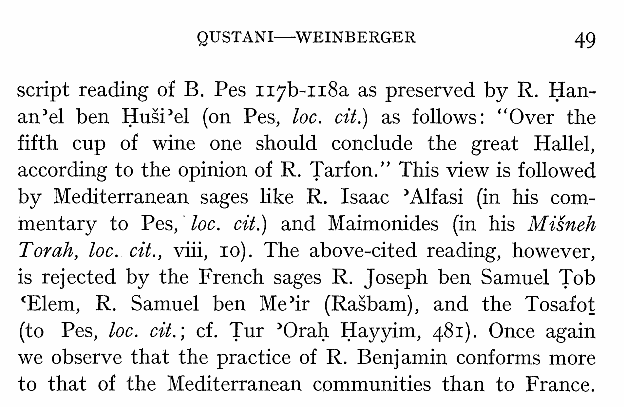
In a previous study on the genesis of the Fifth Cup, a primary textual variant of the Babylonian Talmud (Pesachim 118a) was identified as the source, an original teaching from the Talmudic Sages. Following the compilation of the Talmud, Babylonian Geonim not only received this textual variant, but actually drank the fifth cup themselves, with the apparent exception of Rav Hai Gaon, who also had the fifth cup Talmudic variant, but interpreted it as an optional practice, one which he did not follow. If the fifth cup was ordained in Babylon due to zugot, concern for even pairs arousing evil spirits, as explained in the prior study, perhaps Rav Hai inherited the original Palestinian custom of only four cups (zugot was only an issue in Babylon), as the Sages of Erez Israel did not believe in zugot. Alternatively, perhaps Rav Hai rejected the fifth cup as far as his own practice but not to the point of speaking out against it.

The fifth cup was widely observed among the Babylonian Geonim, and subsequently mentioned by Alfasi, Maimonides, and by Tur (14th century), the latter at length, with an entire siman (OḤ 481) devoted to it. 


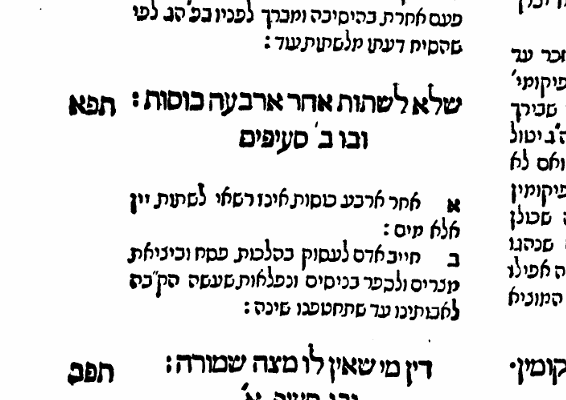
However, if we fast-forward to the 16th century, we find that, despite an extensive discussion in R. Joseph Karo’s monumental Bet Yosef the fifth cup disappeared completely in his Shulḥan Arukh. Following the order of Tur, R. Karo gave names to all of the simanim. Here, he adopted a side issue of the siman and made it the focus and new title: “Not to drink after the fourth cup”. 


Furthermore, none of the principal commentators on the Shulḥan Arukh (“nose kelim”, 16th-17th centuries) even noted its disappearance. Explaining the magical disappearing act of the fifth cup during the Middle Ages will be the focus of this study.

The disappearance has bothered modern scholars of rabbinic literature, who struggled to explain it, most notably R. Menahem Kasher. Several factors have been suggested to explain the elimination of the fifth cup. They include: 1) Deletion of the Talmudic text mentioning the fifth cup due to homoteleuton (skipping text from one similar word to another)[1], 2) Endorsement of this variant by Rashi and Rashbam, 3) Application of this variant by subsequent Ashkenazi scribes,[2] 4) Circulation of an abbreviated version of Rav Hai Gaon’s responsum (in Tur) which suggests that Rav Hai Gaon also received the “Rashbam’s” version of the Talmud which does not mention the fifth cup,[3] 5) A statement at the beginning of Tur that the fifth cup should not be drunk, probably explaining Rashbam’s opinion, but ambiguously stated, 6) the development of a stringency in Medieval Ashkenaz to refrain from all drinking after the fourth cup, with some including even water in the prohibition (see below) and 7) The publication of the Venice edition of the Talmud, in 1520-23 following Rashbam’s textual variant, with no mention of the fifth cup, all subsequent editions following in kind, almost certainly the edition consulted by R. Joseph Karo.

Despite this multitude of factors, they don’t adequately explain R. Joseph Karo’s editorial decision to completely delete such a well-entrenched custom as the fifth cup, mentioned by all three of his pillars, Alfasi, Maimonides, and Rosh.[4] I propose that an additional factor, barely recognized previously and never noted in this context, was the one that settled the matter conclusively in the mind of Maran.

Rabbenu Yonah Girondi (13th century) maintained that one should refrain from drinking extra wine so as to be able to study the laws of Passover and the story of the Exodous all night, as the Sages did in Bne Braq. Maharil cites Rosh (Asheri) as adding that the fifth cup was permitted due to the verse v’heveiti. However, our standard printed text of Rosh states that the fourth cup is permitted due to the verse v’laqaḥti

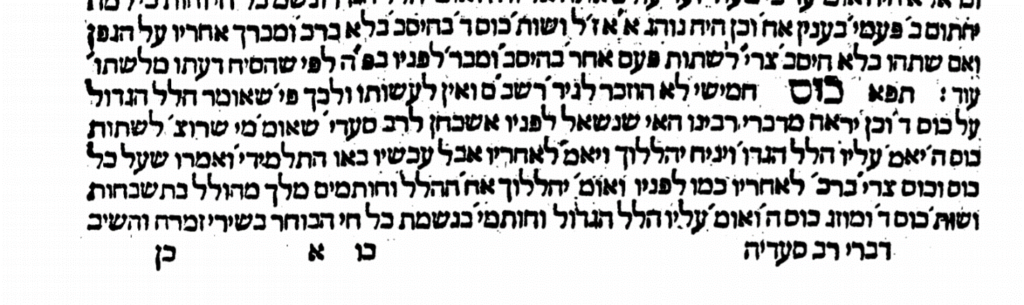
(אבל בכוס רביעי התירו שיש לו סמך מן הפסוק כנגד ולקחתי אתכם. (סימן לג…

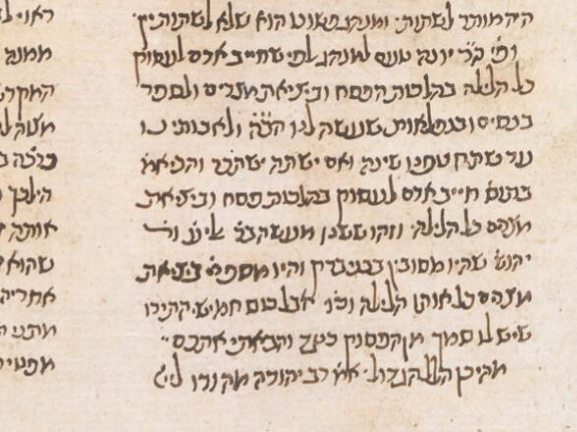
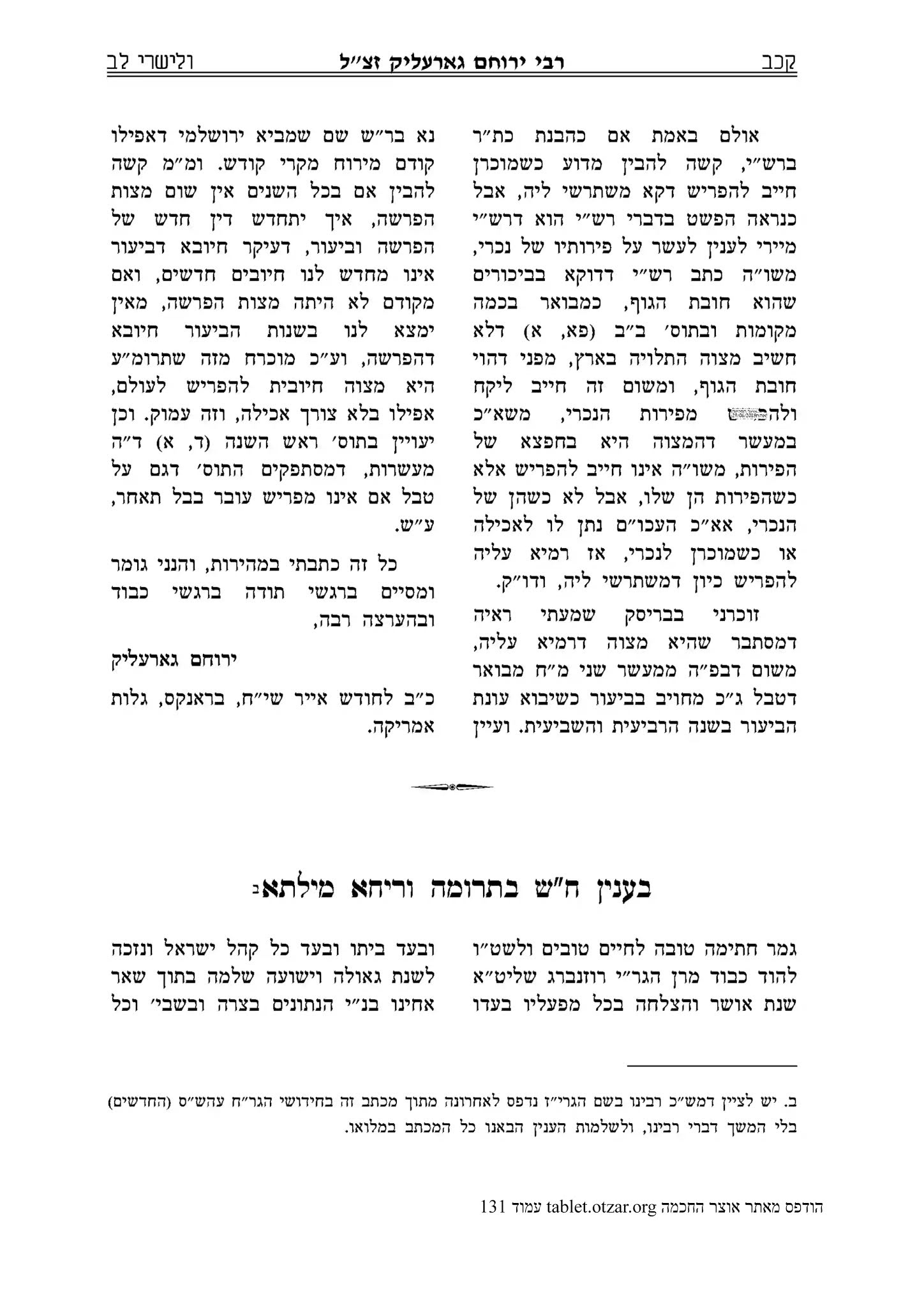
Rabbi Alter Hilewitz (1906-1994, author of halakhic works and editor of Encyclopedia Talmuditobjected that the printed text makes no sense and must have become corrupted.[5] There is no reason to permit the fourth cup after it has already been mandated in the Mishnah. The special dispensation must have been for the fifth cup and Maharil cited the genuine text version of Rosh.[6] R. Hilewitz’s hunch was correct, as we find in an early manuscript of Rosh (Asheri) written in Spain in 1325 during the lifetime of Rosh (from middle of 3rd line from bottom):[7] 


Rabbi Hilewitz

The corruption was a by-product of proliferation of the Rashbam’s text of the Talmud eliminating the fifth cup entirely. It probably represents an unintended stringency in interpretation of the prohibition on drinking excessively. Another correction we find in the manuscript is the attribution of the opinion. The manuscript attributes it to Rabbenu Yonah, corresponding to the attribution in Tur. However, the printed edition misattributes it to ר”מ, R. Meir of Rothenburg, master of Rosh.

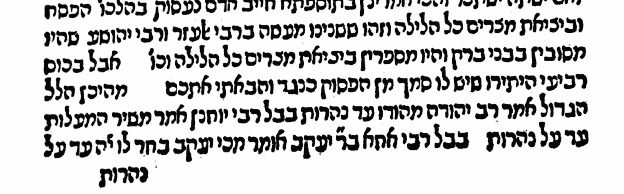
The text of Rosh which R. Joseph Karo relied upon was almost certainly that of the famous aforementioned Venice edition of the Talmud.[8] It reads:

.אבל בכוס רביעי התירו שיש לו סמך מן הפסוק כנגד והבאתי אתכם…


The text does not make sense. It is conflated. Either the fourth cup was permitted by the verse v’laqaḥti (as in the modern printed editions), or the fifth cup was permitted by the verse v’heveiti (as in the manuscript). The fourth cup could not have been permitted by the verse v’heveiti. The development was apparently a two-stage process and the Venice Edition represents the “missing link”, an intermediate stage in which the fifth cup was changed to the fourth cup but the verse remained intact. At this point, R. Joseph Karo or the later publishers could have corrected the text back to “the fifth cup”, restoring the original version in the manuscript. However, the tide was already turning towards the fourth cup Talmudic textual variant in Bet Yosef, with his decision to read Rashbam’s Talmudic textual variant into Rav Hai Gaon’s responsum.[9] R. Joseph Karo decided to keep “the fourth cup” and to ignore the word v’heveiti, or to mentally “correct” it to v’laqaḥti, exactly how the later printers chose to emend the text of Asheri.

One can speculate as to why Kasher, Benedict and subsequent Rabbinic scholars did not discover this source. R. Hilewitz’s observation was published in a 1945 newspaper article in Palestine. At the time, war was raging and R. Kasher was in America. Manuscript variants of the text of the Talmud have been studied and published on for years[10] and the last generation has brought us two editions of Tur prepared using manuscripts.[11] Even Tosafot Rosh is published from manuscripts in critical editions.[12] However, for some reason, manuscripts of Rosh are relatively uncharted territory, despite the centrality and rabbinic authority of the work. Perhaps (similar to Rashi’s Talmudic commentary, up until the groundbreaking work of my teacher, Aaron Ahrend) it is this very centrality that led its manuscripts to be ignored, as it was printed so early on, in the Venice Talmud, and so many times. 

Most significantly, the text is hidden from view. Tur clips off this section of the discussion and Bet Yosef does not cite it. However, once we return to the textual version that laid open before R. Joseph Karo on his desk, which he certainly meditated on, we can understand how he interpreted the abbreviated text of Tur and why he decided to delete the fifth cup.


Addendum: The Power of Piyyut

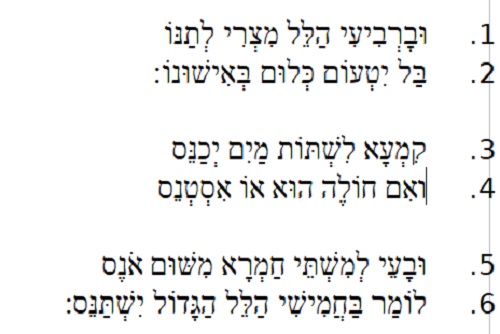
Shmuel of Evreux adopted a stringency not to drink even water after the four cups.[13] His source was the piyyut composed by R. Yosef Tuv Elem for a qerova recited on Shabbat ha-Gadol.[14] The last two stanzas at the end of the piyyut are the most famous today, for they are recited almost universally at the end of the Haggadah: “Hasal siddur Pesah”. The stanza preceding it is one mentions the fifth cup. There are two textual variants of this line interpretations of the piyyut. Three manuscripts read as follows:[15]


According to this text, line 3 states that it is permitted to drink water absolutely, in accordance with normative halakhah. Line 4 adds conditions for drinking wine, being sick or finicky, as described in line 5 with the recitation of Hallel ha-Gadol in line 6.

Medieval piyyut commentaries also follow this text, for example, the commentary by Samuel b. Salomo of Falaise:[16]

…קמעא, מעט, לשתות מים יכנס, לאחר סעודתו אם ירצה לשתות, ואם חולה הוא או אסטניס ובעי למשתי חמרא ואינו יכול לשתות מים, לומ’ בה’ על שם ‘ה הלל הגדול, ישתנס, יאזור

However, the textual variant followed by the Tosafot (Pesahim 117b) omits the vav at the beginning of line 4. Now the conditions of line 4 apply to line 3 as conditions for drinking water. Apparently from this piyyut, R. Shmuel of Évreux derived the stringency against drinking water after the Seder.[17] Tosafot for chapter Arvei Pesahim were based upon the Tosafot of R. Yechiel of Paris or a student of his, such as Rabbenu Peretz (Shalem Yahalom). R. Yechiel was in contact with R. Shmuel. R. Yechiel would attempt to refute R. Shmuel’s novel stringencies. Sometimes the refutation was accepted, such as cited by R. Peretz in his gloss to Smak 93, and sometimes not, as found in Orhot Hayyim, Hilkhot Tum’ah, vol 2, p. 602, and apparently in our case regarding the stringency of not drinking water. In this case, the development of a stringent shitta forbidding even the drinking of water likely shifted the goalposts of halakhic discussion away from the option of the Fifth Cup of wine. 

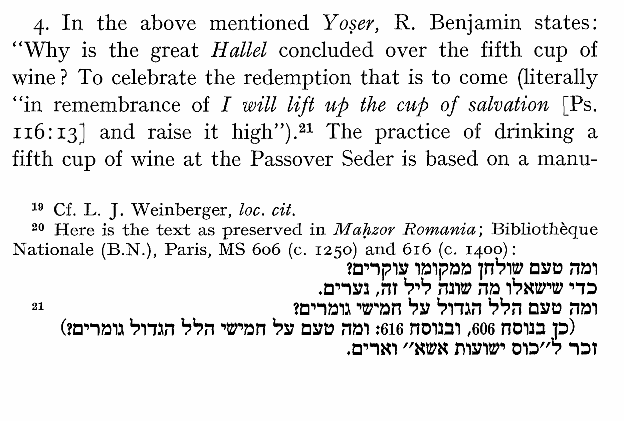
Finally, on the topic of piyyut, Leon J. Weinberger described a poem from R. Binyamin which mentions the fifth cup as a basic custom, an integral part of the Passover Seder. The piyyut was later published in its entirety by Ezra Fleischer.[18] According to Weinberger, it provides a messianic interpretation of the fifth cup, an aspect of the fifth cup that will become more evident during later periods to be discussed in chapters of this study yet to come. 


Editor Note: please see Eliezer Brodt’s earlier post on this subject: https://seforimblog.com/2013/03/the-cup-for-visitor-what-lies-behind/

[1] Henshke; also see here for another possibility and analysis of Talmudic manuscripts here.
[2] Kasher noted Rabbenu Tam’s fierce opposition in general to applying proposed emendations into the text of the Talmud itself, blaming Rashbam (his older brother) in particular. See Spiegel, Soloveitchik, briefly reviewed in my Jewish Hawking in Medieval France.
[3] Rav Kasher advanced this claim convincingly to explain the deletion by R. Joseph Karo. R. Avraham Benedict also advanced this claim, without crediting Kasher. As far as rendering a legal decision, Benedict took a diametrically opposite position. According to Kasher, now that we possess the full version of Rav Hai Gaon’s responsum, we see that R. Joseph Karo was led astray by an ambiguous text. Benedict considers R. Karo’s decision binding and the presence of the abbreviated version is ample justification.
[4] Noted especially by Kasher, also by Henshke.
[5] ‘Kos shel Eliahu’, Bamishor 245-6 (25.3.1945), p. 5.
[6] This version is also found in Abudraham (Seder ha-Haggadah u’Perisha, ed. S. Kroizer, Jerusalem 1963, p. 234), citing Rabbenu Yonah. Abudraham’s source was probably Asheri, but he did not generally cite secondary sources, as he himself stated in his introduction (p. 6.). See: L. Jacobi, “Talmudic Honey”, Fragments of the Novellae of R. David ben Saul of Narbonne”, Giluy Milta B’alma, 2/17/2016.

[7] British Library Add. 27293 f. 131v.
[8] Bomberg: Venice 1520-1523, p. 138b.
[9] Kasher, Benedict.
[10] Diqduqe Sofrim, Lieberman Instritute, Friedberg.
[11] Shirat Devorah; Ma’or.
[12] Mossad Ha-Rav Kook, Ofeq Institute.
[13] Cited by Mordechai, Hagahot Maimoniot (Ed. Constantinople, 6:11, “gedole Evreax”), Agur. Tosafot Pesachim 117b.
[14] See a letter from Pinchas Eliyahu Lawee in Kobetz Beit Aharon 15:5 (89, 1998), pp. 135–136.
[15] With only minor variants irrelevant for our purposes. Gabriel Wasserman shared with me his pilot edition of variants and Abraham Levine provided me with expert guidance in this study.
[16] Parma – Biblioteca Palatina Cod. Parm 3000 (de Rossi 378), f. 30a-35b. I was aided in locating piyyut commentaries by Elisabeth Hollender’s monumental Clavis.
[17] Another later piyyut follows this strict opinion, recently published by R. Jacob Israel Stal. See his note at page 33.
[18] Kobez al Yad 21 (1985), p, 31.


Review of My Father’s Journey by Sara Reguer

Review of My Father’s Journey by Sara Reguer (Academic Studies Press, 2015)
 
By Moshe Maimon
About a year ago, Seforim Blog readers were informed by Prof. Marc Shapiro of the publication of Sara Reguer’s book My Father’s Journey, and they were further advised that this book would be of great value to anyone interested in the history of the yeshiva movement and Eastern European orthodoxy (see here). The following review illustrates the contribution the book indeed makes to these fields of study.
This basis of this memoir is essentially a diary which affords readers a very intimate view into the mind of a Lithuanian yeshiva student in the period between the two World Wars. Interspersed between the pages of this fascinating document is a fair amount of interesting yeshiva lore, including little-known facts about prominent Torah personalities contemporaneous with the author’s father. In highlighting some of these passages, I hope to give the reader a sense of the value of this work, while also calling attention to certain historical facts that might enhance the reader’s understanding.
The book, based on a Hebrew memoir by Dr. Moshe Aharon Reguer, son of the famed Brisker dayan, R. Simcha Zelig Rieger,[1] is translated and supplemented with additional material culled from interviews conducted with Dr. Regeur by his daughter, Prof. Sara Reguer, and from family lore she preserved. Additionally, it is bolstered by her insightful comments filling in detail and providing background. To avoid confusion, different fonts have been employed to represent the different sources. The translated text of the memoir appears in italics, the interviews in plain script, and Prof. Reguer’s comments in bold typeface.
This arrangement is helpful in distinguishing between the actual memoir, written by Moshe Aharon Reguer as a young adult in 1926, and the remaining material that relates to a later period in his life. Dr. Reguer wrote his memoir from the perspective of a young man poised at an important crossroads in life. As the narrative moves into his later years, the story takes on a nostalgic, backward-looking tinge.  Prof. Reguer deftly weaves the diverse sources that capture these epochs into a beautifully coherent story.
Here I might suggest that care should have been taken to more clearly distinguish the places where the written memoir “pauses” to include later reminiscences by the author obviously not part of the original document. One example is the references to dates and events after 1926,[2] the year of the composition of the original memoir. There is no documentation for these comments which are printed together with the text of the original memoir. In some instances these secondary sources recount events already recorded in the memoir with occasional variations; to arrive at a clear understanding of what actually happened, the reader would benefit by being able to differentiate between the various sources. Take for example Moshe Aharon’s account of his farher (matriculation exam) in the Slutzker yeshiva.
First, from p. 65:
So I went to Slutzk and the Slutzker Rav Isser Zalman with Rav Aharon Kotler, his son in law, hired
a teacher for me: Rav Shach (who is now famous in Ponovezh), who was then known
as the Vabulniker”. We stayed together in an inn and he learned with me, and
after a short time he went to Rav Aharon and Rav Isser Zalman and told them “I
don’t wan’t to take any money – he doesn’t need a teacher!” So Rav Aharon said:
“so, he doesn’t need any help and can learn alone?” and he took out a gemara,
Bava Kamma 76, where there are two lines of gemara and a huge tosfot, and he
told me to prepare it alone. I did it in a few hours, and I knew it, and he
said: “you do not need a teacher!” at eleven years old!
The editor has already pointed out that the author came to Slutzk only after his bar mitzvah; consequently he was actually thirteen years old at the time, not eleven.[3] As we will soon see, the above-mentioned scenario is fraught with additional chronological inconsistencies. Compare it with the following incident on p. 84 which seems to be referring to an event that took place the following winter, more than a year later that the author’s given date:
Until mid-winter, I studied with the student Babulnikai, but one day the son in law
of Rav Isser Zalman, Rav Aharon Pines, the ilui of Sabislovitz, called
me and on his own assigned me a “kri’a” – a group of gemara with all the
commentaries, which I was to read and then be tested on. I remember that the
“sugya” was in Baba Kama, p. 10. He set a deadline at which point I came to be
tested. I knew the entire sugya backwards and forwards, and on the test I
performed so well in both breadth and depth that Rav Aharon Pines ordered that
I should study alone. This announcement made a strong impression on the
yeshiva, especially on the younger students, because it was a tradition that
even the best students were never told at such a young age – fifteen – to study
alone without help or supervision.
The core of the story is the same: young Moshe Aharon learned under the tutelage of an older, more advanced student (R. Shach)[4] until such time as a thorough test, administered by R. Aharon Kotler (Pines),[5] revealed that he was adept at independent study, and was encouraged thereafter to learn on his own. Yet other important details are different, including the identities of the parties. In the first version R. Shach initiates the test, while in the second version R. Aharon takes the initiative “on his own”. In the first version, the subject matter is an extremely difficult passage comprising one of the longest Tosfos in Shas, while in the second; it entails the knowledge of a complex but more conventional sugya. The most glaring discrepancy is the timing of this event: while the first version portrays this as having occurred within a short while after his arrival in yeshiva, the second version has it more than a year later – when the author was already fifteen years old. Which version is the true version?
The clue to unraveling the many discrepancies lies in the author’s parenthetical remark on p. 65 identifying R. Shach as the rosh yeshiva “who is now famous in Ponovezh.” This comment belies the fact that the passage was not included in the original document written in 1926 (when the young R. Shach was entirely unknown), but rather dates to a later time period, at least 30 years later, and likely some 40 some odd years after the events they describe.
Taking this into account it is not difficult to surmise that the later version is actually the original version and likely the more authoritative one inasmuch as it was written closer to the events they describe. The events were quite possibly conflated in the author’s mind when he recounted tales of his youth later in life, and that would likely account for the discrepancies in the details. People do not necessarily intend to set down the historical record in their reminiscences, and the mind has a way of selectively remembering events without explicit attention to historical accuracy – particularly when aided by the haze of nostalgia. Certainly there can be no blame in that; it is the job of the editor to point out what material was penned for the record and that which was recounted later in other contexts.
Here is another interesting tidbit recounted by the author that has likely been blurred by nostalgic reminiscence, and should not be taken as historically accurate. Regarding the closing of the Volozhin yeshiva in 1892, in the course of an interview (pp. 29-30) the author recounts an original version of the events leading up to it:
In those days the yeshiva was closed because one of the students massered (informed) and
wrote a letter signing the name of the Netziv, and in a second letter he wrote
that the Netziv is a spy and all the students are spies in Volozhin, and the
reason why he sent this is because – father told me – when he came in on Yom Kippur,
the Netziv recognized that he had eaten, which was true, and he came over and
gave him a slap in the face in the presence of everybody. And this he couldn’t
stand and he massered on the yeshiva, and they sent soldiers from Vilna
and they surrounded the yeshiva and they asked, “where is the Netziv?” and they
showed the Netziv the letter, and asked if it was his signature, and he said,
“yes it is my signature”. But at the trial in Vilna he recognized that this was
a forgery because in all of his letters, after he wrote “Netziv”, he never made
a dot and this was with a dot. And they believed him and he was free, but they officially
closed the yeshiva.
The editor concedes that there are other versions to the story, and refers the reader to the attendant literature, but grants that this is another variant. However, it is readily apparent that here too, two different episodes – the story of the informant and the story of the closing of the yeshiva – have been inadvertently blended. In reality, they had nothing to do with each other.
The story of the informant has been supplied by the son of the Netziv, R. Meir Bar-Ilan, in his classic memoir מוואלאזין עד ירושלים,[6] as well as in the biography he wrote on his father, רבן של ישראל.[7] There we are told that the episode occurred a few years before the Great Fire; a catastrophe which struck Volozhin in the summer of 1886. The closing of the Yeshiva, on the other hand, didn’t occur until 1892. It is also apparent that some of the details of the episode are more reliably preserved in R. Bar-Ilan’s recounting, who also preserves the identity of the addressee in the forged letter, one R. Yaakov Reinowitz of London. In his account the charge brought against the Netziv was not that of espionage, but rather that of dealing in counterfeit currency, and unlike in Dr. Reguer’s version, the clever detection of the forgery was brought to light with the evidence that the Netziv signed his name נפתלי צביהודה by using the last letter of צבי as the first letter of יהודה,[8] a detail which the forger was not scrupulous in copying.[9]
Additional information has come to light in the discovery of other letters written by the Netziv to this very R.
Yaakov Reinowitz.[10] R. Reinowitz, who served as a dayyan on London’s beit din, was close to the Netziv and would assist him with the raising of finances for the yeshiva.[11]  Apparently the forger was aware of this individual’s connection with the Netziv, as well as his financial involvement with the yeshiva, and therefore chose to address the letter to R. Reinowitz to make it seem more authentic. Among R. Reinowitz’ papers are some 40 letters from the Netziv, including two which have been described thus:
In 1879 Rabbi Berlin informed Reinowitz that officials of the Russian government
had searched the documents and correspondence of the yeshiva and taken away
‘all my correspondence with you’ – the reason being that ‘a vile person forged
a letter of a secret nature which I am supposed to have sent to you’. In his
next letter Rabbi Berlin said that the correspondence was returned after a few
hours and that nothing untoward happened except that they had a big fright.[12]
When seen together it is clear the Netziv is referring here to the aforementioned episode. These letters indicate that the event happened in 1879, a fact now conclusively proven with the availability of the Russian government’s file on the episode,[13] and in fact had no direct effect on the subsequent closure of the Volozhin yeshiva some thirteen years later (although the involvement of the government in the yeshivas internal affairs almost certainly did contribute in the long run).”
Here is a photo of Rabbi Reinowitz:
As to the identity of the culprit, R. Meir Bar-Ilan indicates that it was never proven conclusively. He cites several theories; including a report not unlike the one cited by our author in the name of R. Simcha Zelig, namely that it was the student who had been chastised for his Yom-Kippur indiscretions. This seems to have been the predominant theory; in R. Bar-Ilan’s recounting of the episode in his aforementioned biography, this is the only version presented. This is also the version recorded by R. Moshe Shmuel Shmukler-Shapiro in his ר’ משה שמואל ודורו,[14] where he even identifies the student who was chastised, and the year when the event occurred (1878). (Interestingly, according to R. Shmukler-Shapiro’s version, this student didn’t perpetrate the forgery himself, although his humiliation at the hands (or better, hand) of the Netziv was the catalyst for the subsequent act of revenge).
Further, in the above account, R. Simcha Zelig’s report has the student eating on Yom Kippur. According to R. Bar-Ilan, however, the nature of the student’s sin was appearing late to the prayers after having evidently bathed and combed his hair on the day of Yom-Kippur. Also noteworthy is the fact that R. Bar-Ilan mentions only that his father had angrily chastised the errant student but does not reveal, as does R. Simcha Zelig, that he had done so with a public and humiliating slap to the face. In this regard, R. Simcha Zelig’s version is also confirmed by R. Moshe Shmuel Shmukler-Shapiro in his ר’ משה שמואל ודורו,[15] although the student’s sin is described therein in accordance with R. Bar-Ilan’s version. It seems reasonable to me to assume that R. Bar-Ilan, out of concern for his father’s honor, knowingly softened the story and omitted mention of the slap in order to cushion the Netziv’s reputation in the eyes of the modern and westernized reader.
Another bit of family lore, recounted by Prof. Reguer on pp. 30-31, includes the legendary tale of R. Simch Zelig’s sagacious advice to the townspeople of Brisk, saying that in order to spare themselves from the damaging exploits of a wild first-born goat, it would be providential if the animal were to come to injury and thereafter be permitted for slaughter. The townspeople then organized a chase which resulted in the goat injuring its shoulder while attempting to escape, rendering it unfit for ritual sacrifice and henceforth permitted for slaughter.
This episode sounds too similar to an episode recounted by Dr. Reguer himself in 1973 in a letter to the editor of
the journal הדרום[16] to dismiss as a coincidence. The incident referred to there was a cause célèbre in Volzhin and was the source of a halakhic dispute between the two Rosh Yeshivas at the time, the Beis Halevi and the Netziv. Dr. Reguer writes:
את הדברים כפשוטם שמעתי
בילדותי מפי
אבי מורי זצ”ל הרב הגאון ר’ שמחה זעליג, הראב”ד בבריסק דליטא,
וכך היו הדברים: ליהודי אחד בוולוז’ין היה בכור תיש,
ומכיון לאחר שגדל דרכו היה להזיק, מסר יהודי זה את התיש לרשות הכהן, כדי שיוכל
להנות מן התיש. הכהן העניק לילדים מעדנים והם רדפו אחרי התיש וערכו לו ציד בבית הקברות
הנמצא במורד העיר. כאשר קפץ התיש מעל גדר התיל של בית הקברות
נפצע
ונמצא
מסורס.
ואז פרצה
המחלוקת
מכיון
שהכהן
היה
הגורם למעשה
סירוס
זה.
This version is also not without its ambiguities,[17] but unless we are to assume that these are two separate incidents, it is clear that the episode in question happened in Volozhin, and not in Brisk, and it is equally clear that R. Simcha Zelig was just the source for the story, but was not actually an active participant in this episode.
As mentioned, there are a number of valuable first-hand accounts of important pre-war Torah figures, most prominent among them: father of the memoirist and famed dayan of Brisk, R. Simcha Zelig Rieger, who was renowned as one of Lithuania’s foremost halakhic authorities until his tragic martyrdom in the Holocaust. In a manner characteristic of biographies written by close family members who make no attempt to portray their subjects as larger-than-life,[18] Moshe Aharon’s memoir, particularly the correspondence and photographs he includes, provides us with a close-up glimpse into this scholar’s saintly life.[19]
The book opens a window on the terrible hardships he had to endure throughout his life, and we can surmise the tremendous spiritual fortitude and determination he must have possessed in order to cope with his hard lot. Poverty and illness, compounded by having a married daughter living with her family in his home were part of R. Simcha Zelig’s daily tribulations, yet this saintly man utters no word of complaint. Even after suffering the humiliating experience of having his beard forcibly removed by the Soviets at the beginning of the Second World War, in a most harrowing encounter from which he only narrowly escaped with his life, R. Simcha Zelig had just this to say to his son: “we are all well” (p. 227).
Nothing deterred R. Simcha Zelig from his unfailing dedication to his life’s ideal of learning and teaching – not even the tragedy of losing children to illness, nor the intense pain of watching the defection of most of his adult children from their religious upbringing to a life of communism and socialism. In the face of it all, this humble genius continued unfailingly on his path, giving of himself unselfishly to anyone who needed him. While many biographies of gedolim tend to omit any references to wayward children, the correspondence included in this memoir, and especially the attendant analysis thereof, introduces the reader to the whole Reguer family. One can readily appreciate the extent to which R. Simcha Zelig went to maintain fatherly relations with all of his children – to the point of addressing his letters to every child and spouse, and even their infant children, by name.
Prof. Reguer highlights this tendency in her comments (p. 191), and further makes the astute observation that in these instances R. Simcha Zelig is careful to append the customary salutation שיחיה or שתחיה only to the names of the religious relatives; however, no explanation is given for this interesting behavior. Since this appendage is merely a blessing for long life, and is not indicative of one’s social or religious standing, it therefore strikes me as somewhat odd that R. Simcha Zelig, who went out of his way to show fatherly care and affection to these children, would omit this blessing in connection with them. Perhaps R. Simcha Zelig was only being sensitive to the irreligious outlook of those of his children who having broken with tradition would not appreciate this customary, religiously inspired, prayer on their behalf.
The family background is also instrumental in helping us understand how R. Simcha Zelig was able to countenance Moshe Aharon’s transition from the traditional Lithuanian yeshivas to the modern and Zionistic Tachkemoni yeshivas of Bialystock and Warsaw. Although the Talmudic departments in these yeshivas were headed by Brisker protégés of R. Simcha Zelig, namely the Iluy of Meicheit, R. Shlomo Polatchek, and R. Moshe Soloveitchik, they were by and large considered to be beyond the pale in the traditional Lithuanian yeshiva world.[20] In fact, according to Dr. Reguer (p. 147), R. Chaim of Brisk had actually sought R. Simcha Zelig’s help in dissuading R. Moshe Soloveitchik from accepting a position at Tachkemoni.
This transition eventually saw Moshe Aharon pursue an academic career first in Palestine[21] and later in America (a move which was to eventually spare him from the ravages of the Holocaust). While a letter from Moshe Aharon’s brother in law (p. 232) indicates that R. Simcha Zelig was unaware as to the secular nature of these studies, there can be no doubt that the author is correct in surmising (p. 145) that R. Simcha Zelig’s acquiescence to Moshe Aharon’s desire to pursue secular studies was a direct result of the outcome his earlier chinuch approach had had on Moshe Aharon’s older brothers.
Besides for his grandfather, the author was also privileged to study under various other great Torah personalities including the Alter of Slabodka (R. Nosson Tzvi Finkel), R. Shlomo Heiman, R. Aharon Kotler, R. Isser Zalman Meltzer and the dynamic young Rosh Mesivta of Karilov, R. Yechezkel of Trestina.
The latter was later to become famous in his capacity as Rosh Yeshiva in the preparatory mesivta in Slabodka and his well known by the title of his work Divrei Yechezkel, a classic work of lomdus in the yeshiva world. Yet, precious little is known about the Karilov chapter in his life,[22] and this memoir, with its focus on the Karilov yeshiva, provides a valuable contribution to his biography.
Special attention may be drawn to the lauditory description of his personality, as well as the unique relationship he shared with his students. Of particular interest is the depiction of the inspirational late-night hashkafa sessions he often held with his students (pp. 111-114).[23] Inasmuch as most people today know him only as R. Yechezkel Berstein,[24] or, as mentioned, by the title of his work Divrei Yechezkel, it would be beneficial to have that had the connection drawn out in the book.
The book contains various other tidbits concerning many of these personalities which readers will certainly find interesting. However, it is worth pointing out the difficulty involved in identifying them as sometimes various colloquialism are used in referring to these people. The difficulty is often exacerbated by the different spellings employed for some of these names. We have already seen that R. Shach has alternately been referred to as ‘the Vabulniker’ and ‘the student Babulnikai’. Apparently, in the Hebrew original, the author had spelled וואבולניקי – which he pronounced orally as ‘Vabulniki’ – as באבולניקאי which was transliterated as ‘Babulnikai’. Similarly R. Aharon Kotler has been called R. Aharon Pines, ‘R. Aharon of Svislovitzch’ and ‘the Iluy of Sabislovitch’. R. Shlomo Heiman too, is alternately referred to as ‘Rav
Shlomo Heiman Ha-pritizi’ or ‘Rav Shlomo of Poritz’.
Compounding the problem is the fact that each name is listed separately in the index, and instances where only the colloquialism is used without a last name are often not included. Perhaps this is because the index was produced with electronic search engines according to spelling and therefore did not combine various entries for one person when the spelling was different. Yet, what this gains in expedience and convenience is offset by the frustration one encounters when trying to search for references using a last name which doesn’t appear in all the occurrences. (I might add that it also makes for the inclusion of some unorthodox entries, such as ‘Sha’agat, Arye’).
If this book is republished it may be prudent for the sake of uniformity to streamline the names and titles used throughout the book. Similarly, care should be taken in the phonetic spelling of other Hebraic phrases such as רב דמתא (meaning the rabbi of the city) which has been spelled as ‘Rav Damta’ on p. 105, and thus appears to be someone’s name.
The author’s acquaintance with the Alter of Slabodka began when Moshe Aharon first joined the Slabodka yeshiva, which was then in Kremenchug during its exile during the First Word War. At the time, young Moshe Aharon was duly impressed by the Alter’s sagacious personality, but later this perception is tarnished somewhat, and at the end of the memoir he blames the Alter’s high-handed (und unfair) method in dealing with those whom he suspected of having secular leanings for his ultimate decision to leave the mussar world cultivated by the Slabodka yeshiva. One can’t help but wonder if this perception of the Alter wasn’t colored by the author’s own negative experience, fresh at the time of the writing. Perhaps with the the passage of time and the benefit of hindsight, as well as nostalgia, Moshe Aharon may have come to see things differently.
One thing that stands out about his description of the Alter is that he calls him ‘a great scholar’ (p. 95).
In Slabodka’s heyday at the turn of the century, owing largely to the Alter’s secretive ways and mysterious habits, this facet of his personality was not common knowledge and different students had different reads on it. R. Yaakov Kamenetzky was convinced that the Alter was indeed a great lamdan and scholar, while in a recent blog post Professor Marc Shapiro has quoted R. Yehiel Ya’akov Weinberg’s opinion to the contrary.[25] It seems that about 15 years later, with the passage of time, the Alter’s reputation as a superior talmid chacham had firmly taken root.
One personality that is conspicuously under-represented in the book is the Brisker Rav, R. Yitzchak Zev Soloveitchik (as well as, to a lesser extent, his brother R. Moshe). The Rieger and Soloveitchik family lived under the same roof in a multi-family dwelling owned by the Kehilla, and R. Simcha Zelig was exceptionally close with his own rebbe, R. Chaim of Brisk, as well as R. Chaim’s sons, R. Moshe and R. Yitzchak Zev. In fact, from a reference in a letter from R. Simcha Zelig to the author, printed at the end of the book (p. 197), it seems R. Simcha Zelig would exchange annual Rosh Hashana greetings with R. Moshe, as well as his son R. Joseph Ber – that is, the famed Rabbi J.B. Soloveitchik of Yeshiva University – long after the two had emigrated from Europe to America. The relevant portion of the letter reads:
I wrote a Rosh Hashana greeting to R. Moshe Azaliion [?] as I write every year and I wrote to
R. Moshe’s son a Rosh Hashana greeting and nothing came back to me as usually
did each year. Perhaps I don’t have their correct updated address. Perhaps they
moved.
Careful examination of the facsimile of the original letter, reproduced on p. 198, reveals that Azaliion is a mistaken transcription of the Yiddish ‘אזויא’ (meaning ‘just like’) and is not part of R. Moshe’s name. This leads me to believe that R. Simcha Zelig is referring to R. Moshe Soloveitchik, as well as his son R. Joseph Ber who also enjoyed a relationship with R. Simcha Zelig, having received from him a personal smicha, as well as various halakhic traditions. In a passage interpolated into the memoir on p. 45, Moshe Aharon acknowledges this fact and mentions that he asked the Rav’s son (I assume this means R. Joseph Ber’s son, Prof. Haym Soloveitchik) for a transcript of these traditions.[26]
Perhaps Moshe Aharon did not enjoy the same relationship with the Brisker Rav as did his father, possibly on account of the Brisker Rav’s rebbetzin, whom Moshe Aharon considered a difficult woman (p. 67). Later in the book, R. Simcha Zelig’s correspondence with his son reveals that Moshe Aharon also had some sort of altercation with R. Chaim’s older son, R. Moshe (p. 223). The editor surmises that this was on account of R. Moshe having left the Tachkemoni yeshiva, where Moshe Aharon was studying, before the latter could receive smicha from R. Moshe. This seems like somewhat of a stretch, and although we may never know the real reason behind it, to me the ambiguous phrase that R. Simcha Zelig writes in an effort to persuade his son to drop the fight: “you do not know a family without opportunities” (p. 220), lends itself to the interpretation that at stake was some sort of position for which Moshe Aharon may have been jockeying for at the time when both found themselves employed by Yeshiva College.
On a final note: as mentioned before, the original memoir was written in Hebrew and the published edition is an English translation of the original. While the translation on a whole is an excellent one, and results in a fluid compelling read, there are also readers who might enjoy reading the original and would appreciate the biblical and talmudical prose the author sometimes employs. One example of this is when the author refers to the land of Israel as “the land of the deer” (p. 138), which was certainly ארץ הצבי in the original. The biblical expression for Israel as ארץ הצבי appears in Daniel 11:16, and according to most commentaries is based on the verse in Ezekiel 20:6, where the context shows that צבי is not a reference to ‘deer’ (the animal) but rather ‘dear’ (as in ‘desired’).
From the facsimiles of the pages of the manuscript included in the book, one can get a sense of the rich expressive language the memoir was written in, and it is hoped that perhaps it will be printed in the original one day. For the time being we must be content with the artful and masterful work produced by Prof. Reguer, and even as it is we certainly owe her much gratitude for preserving for us this rich and valuable memoir.


[1]
Rieger or Riger are the common spellings, although a facsimile of a letter
containing the mailing address of Moshe Aharon Reguer (seemingly in R. Simcha
Zelig’s own hand) indicates that Reguer is indeed the correct spelling.
[2]
Such as this remark on p. 55: ‘many years ago I found out that he had moved to
Boro Park, I met him there but he did not understand what I was saying’.
[3] I
can’t help but wonder as to the nature of this mistake. Could it be that the
author was induced to believe his own fictitious birth date, postdating him by
two years, as described in the book on p. 23?
[4]The
reference to “the student Babulnikai” in the preceding paragraph should read
Vabolnika’i, meaning ‘hailing from Vabolnik’, a reference to R. Shach’s
hometown. See also p. 75 where he mentions his studies “with a student from
Bubolnik who lived with me”.  I will
address this example when discussing the pitfalls of phonetic transliterations
later.
[5] The
editor, who is seemingly unaware that this is the same episode as the above, also
does not indicate that she is aware that R. Aharon Kotler and R. Aharon Pines are
one and the same (Pinnes was the family name; R. Aharon later took on the name
Kotler to help him evade the draft, see Making of a Godol, second ed.,
p. 295). Adding to the confusion, the index too has separate entries for each
name, but more on that later.
[6] תל אביב, תשל”ט, עמ’ 85-87
[7] ניו יורק, תש”ג, עמ’ 115-116
[8]
This can even be seen today in the facsimiles of the Netziv’s surviving letters,
such as the one addressed to our very same R. Reinowitz, in Reuven Dessler’s שנות דור ודור,
vol. 4 (Jerusalem 2013), p. 497. Whether the Netziv’s used this unusual format
merely to give his signature an individualized flourish, or whether his intent
was to avoid spelling out יהודה – in keeping with the pious custom of
avoiding the written combination ofיו”ד  and ה”א which
form a divine name, it is significant to note that his signature was altered in
the posthumous publication of his writings by his family. There, at the
conclusion of each responsum, the Netziv’s name appears in its conventional
spelling. (In his
Making of a Godol, second ed., p. 887, R. Nathan Kamenetzky points to
another example of a famous rabbinic personality who signed his name with an
ellipsis; R. (Yisroel Eliyahu) Yehoshua Trenk of Kutna who signed his name as ישראליהושע).
[9] See
also the report of this episode by a student in Volozhin from that era, R.
Eliyahu Mileikowsky, in his שו”ת אהלי אהרן, תל אביב
תרצ”ו, עמ’ ריח-רכ.
Eliezer Brodt has further called my attention to the translation of this memoir,
with additional references, in an article by Genrich Agranovsky and Sid Z.
Leiman: Three Lists of Students, in Turim: Studies in Jewish History
and Literature
, Vol. 1 (N.Y. 2008, pp. 3-6 fn. 7).
[10] See
Eugene Newman, The Responsa of Dayan Jacob Reinowitz, 1818—1893, in Transactions
& Miscellanies (Jewish Historical Society of England),
Vol. 23
(1969-1970), pp. 22-33.
[11] I
have already referred in a previous note to another letter to him from the
Netziv in Reuven Dessler’s שנות דור ודור. See also a responsum addressed to him in
the Netziv’s משיב דבר, vol 2, #17. According to Eugene Newman, ibid, pp. 26-27,
responsa #23 and #25 in vol. 4 were also addressed to R. Reinowitz. His
signature on a ruling from the London beit din is also confirmed by the
Netziv in responsa #56 in the same volume.
[12] See
Eugene Newman, ibid, p. 31. Note that according to this account the Netziv’s
documents were returned to him after a few hours, whereas in R. Mileikowsky’s
account they were only returned to him many months later after the case against
him was officially dropped. A further discrepancy, though by no means a
contradiction, concerns the lingering danger and prolonged fear and anxiety in
R. Mileikowsky’s account, missing in the Netziv’s own telling.
[13] See
Agranovsky and Leiman, ibid, p. 2-3.
[14] ניו יורק, תשכ”ג, עמ’ 59-60
[15] See
also R. Nathan Kamenetsky’s study of similar episodes in his Making of a
Godol
, second ed., pp. 889-890.
[16] גליון לז, עמ’ 264
[17] See
R. Chaim Karlinsky’s response to this letter in the subsequent volume of הדרום, גליון לח, עמ’ 187.
[18] I
think it is this sort of attitude at play in an interview on p. 27 in which he
said that he was unable to even approximate his father’s age. Here the editor
notes that research shows that it was likely around 1863. I don’t know what
research she had in mind, but just by using material supplied in the book it is
easy to demonstrate the accuracy of the year 1864 that is often given as the
year of his birth (for example see his grandson Chaim Ber Gulevsky’s שבת שבתון p.
365 where his birthday is listed as 20 Adar 1864). On p. 236, the author’s
sister, Esther, writes in a letter to him that their mother was 77 at the time
of her passing in 1938. Earlier on p. 27 the author himself states that his
mother was 3 years older than his father. Now, had R. Simcha Zelig been born in
1863 he would have been 75 in the summer of 1938 and his wife would then have
to be at least 78.
[19]
Perhaps the editor takes this too far in constantly referring to R. Simcha
Zelig without the honorary ‘R.’ before his name. Noteworthy in this context; some
critics look askance at biographies of this sort, as the approach they take may
strike a somewhat presumptuous, all-knowing note, and their tone is often less
deferential to their subject. See R. Yisroel Miller In Search of Torah Wisdom
(Mosaica Press, 2012), pp. 59-60, who makes this point in the name of R.
Avigdor Miller concerning the biography of the Chafetz Chaim that was penned by
his son R. Leib (Consistent with this approach is R. Miller’s own account of
his repelling of his great urge to read up on R. Yisrael Salanter’s life out of
concern lest his reverence for R. Yisroel be diminished, see R. Y. Hamburger’s
biography Rav Avigdor Miller (Judaica Press 2016), p. 22). However,
often times the authentic human portrait painted by a son is unmatched in its
accuracy and detail, and by extension that much more evocative in its
portrayal. See also מגד גבעות עולם vol. 1 p. 48-49 where it is reported in the name of R. Mendel Zaks that
he preferred the Chafetz Chaim biography written by his student R. M.M. Yoshor
over that of his son R. Leib, because the former doesn’t attempt to explain the
Chafetz Chaim’s actions as does his son R. Leib. Presumably this is just
another way of expressing the sentiment quoted before in the name of R. Avigdor
Miller. Conversely, in the Artscroll biography of the late Rosh Yeshiva of
Torah V’daath, R. Avrohom Yaakov Pam (Rav Pam, Brooklyn, 2003, p. 13),
it is reported that he was fluent in R. Leib’s biography of the Chafetz Chaim
and would often quote from it. (Also worth noting is the fact that R. Yoshor
himself, in his introduction, relates with pride the fact that his work had
found favor even with the usually critical R. Leib). Ultimately, this harks
back to the age-old question of whether a hagiography is preferable to a
biography. See the excellent discussion on the topic that forms the
introduction to R. Nathan Kamenetsky’s Making of a Godol.
[20] It
is worth noting in this context a story I heard from the Rosh Yeshiva of the
Kaminetz yeshiva in Jerusalem, R. Yitzchak Sheiner, concerning a student who
aspired to join the Yeshiva in Radin. This student was disappointed to find out
that he failed his entrance examination with the Chafetz Chaim, and was told to
seek other arrangements. On his way out he chanced upon the Rosh Yeshiva of
Radin, R. Moshe Landinsky, who noticed his dejected look and asked what had
transpired. After hearing the story, R. Moshe advised him to return to the
Chafetz Chaim and ask to borrow money for the train fare from Radin to Lida.
Knowing of the Chafetz Chaim’s aversion to the modern yeshiva founded in Lida
by R. Yitzhak Yaakov Reines, this move was guaranteed to make the Chafetz Chaim
reconsider his rejection of this bachur. Sure enough, that is exactly
what happened, and the bachur was thereupon accepted to the Radin
yeshiva.
[21] As
an interesting aside, Prof. Reguer recounts on p. 157 how Moshe Aharon was
involved in the physical construction of Hebrew University’s Mount Scopus
campus, and even provides (among the unpaginated illustrations [corresponding
to p. 153]) a photograph of him posing with fellow students at the site. It
seems that many students in those days involved themselves in such activities,
and this is likely what Prof. Avigdor Aptovitzer had in mind when he wrote to
Shalom Spiegel after arriving in Palestine in 1939: “וגם נוכחתי שכמעט אי אפשר למצוא
תלמידים מסייעים שכל התלמידים במלאכה, מלאכה ולא חכמה, ונתקיים בהם אל תקרא בניך
אלא בוניך, בוניך ממש מלאכת הבנין והסעת אבנים” (Tarbitz, vol. 81, p. 463).
[22] See
R. Betzalel Devlitzky’s biography of him in ישורון, vol. 28, pp. 871-899. The Karilov
chapter is mentioned there on p. 876. This article was later expanded and
included in a recent edition of דברי יחזקאל (הוצאת מישור, בני ברק, תשע”ג).
[23]
This section has been summarized in Hebrew here.
[24] In
some sources the last name appears as Berenstein. It is likely that at some
point he altered his name in an attempt at avoiding the dreaded draft to the
Polish army.
[25] See
here.
See also R. Nathan Kamenetzky’s discussion on the topic in his Making of a
Godol,
second ed., pp. 775-778, where conflicting opinions are cited in the
name of various students.
[26] He
also received (through R. Simcha Zelig) various traditions from R. Chaim, and
he would sometimes relay these very traditions, as can be evidenced by
following the references indexed under his name in Aharon Rakeffet’s The Rav.


Rav Aryeh Tzvi Frommer HY”D: סנגורם של ישראל

 Rav Aryeh Tzvi Frommer HY”D: סנגורם של ישראל

A Closer Look At One of the Greatest Defenders of the Common Jew in Modern Times[1]
Rosh Yeshiva of Yeshivat Chochmei Lublin, Av Beit Din of Kozoglov, Author of Responsa Eretz Tzvi, Siach Ha-Sadeh, Doreish Tov Le’amo[2]

     By Alon Amar
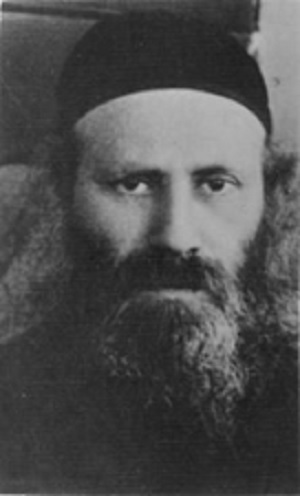
הכל מלמדין זכות” – משנה סנהדרין ד:א”

In the fall of 1933, immediately after the death of Rabbi Meir Shapira zt”l – Rosh Yeshivat Chochmei Lublin, an article appeared in the “Lubliner Tugenblatt” newspaper. The title reads “Who will be the next Rosh Yeshiva?” The article references multiple distinguished candidates for the prestigious appointment, including Rav Menachem Zemba hy”d and Rav Dov Berish Weidenfeld zt”l – The Tchebiner Rav. Interestingly enough, the eventual successor to Rabbi Meir Shapira, was not even mentioned in the article, though his greatness in Torah learning and piety was on par with those aforementioned geonim. Rav Aryeh Tzvi Frommer Hy”d (RATF), also known as The Kozoglover Gaon, was chosen as the next Rosh Yeshiva of Yeshivat Chochmei Lublin and served at its helm until it’s closure during World War II. His unique legacy expanded beyond the four walls of the yeshiva where he inspired and taught students. Through his responsa he engaged real-life issues creatively defending many customs of questionable halachic standing and created the mishna yomi program allowing all Jews, both scholars and laymen, to complete the entirety of Torah Sheb’al peh. His preoccupation with the spiritual needs of the full spectrum of jewry, and the creativity he employed for this task remain defining hallmarks of his inspiring legacy.

Brief Biography

RATF was born in Czeladź, Poland in the year 1884[3]. His father Hanoch-Hendel made his living as a tailor[4] and RATF’s mother Miriam-Kayla passed away when he was three years old.[5]He was sent to study in heder in the town of Wolbrum, residing by relatives of his mother. Some of his formative years of development in Torah learning occurred after leaving Wolbrum to study in the Yeshiva Ketana of Amstov, Poland[6]. The dean of the yeshiva, Rabbi Efraim Tzvi Einhorn zt”l recognized the unique abilities and challenges of the young orphan and took great care in supporting the young boy’s spiritual & physical development.[7] [8]
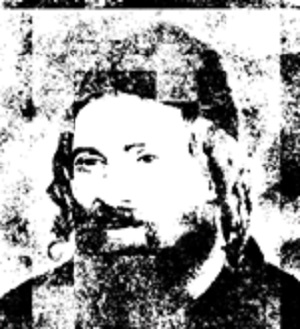
Rabbi Efraim Tzvi Einhorn Zt”l – Rosh Yeshiva Amstov, Poland

At the age of thirteen, RATF made his way to the court R’ Avraham Borenstein known as the “Avnei Neizer”[9] in Sochaczew (Sochatchov), Poland. Reb Leib Hirsch as RATF came to be known (Yiddish translation of Aryeh Tzvi), studied assiduously under the Avnei Neizer for five years developing a reputation as notable young Torah scholar in Poland and a close student of the venerable Avnei Neizer.[10] RATF was exposed to the unique combination of halacha, gemara, kabbalah and chassidut interwoven in the thought of the Avnei Neizer. At the time the Avnei Neizer was one of the leading poskim of the generation. RATF subsequently married Esther Shweitzer and spent the next eight years studying in the home of his father-in-law. Despite moving  away from his beloved rebbe, RATF maintained close ties with the Avnei Neizer, visiting on holidays as well corresponding on Torah topics.[11]

When the Avnei Neizer passed away in 1910, his son R’ Shmuel Borenstein[12], the “Shem Mi’Shmuel” was crowned the heir to his father’s chassidic court; becoming the second scion of the Sochatchov dynasty. On his father’s first yahrzeit, the Shem Mi’Shmuel established Yeshivat Beit Avraham in his memory. The Shem Mi’Shmuel appreciated the unique talents of RATF, and invited him to be the Rosh Yeshiva of Beit Avraham at the age of 27[13]. It was during this period of learning & teaching that RATF published his first work; Siach Ha’Sadeh. In it, RATF dealt with various talmudic topics with central themes of hilchot berachot & tefillah. The work came with laudatory approbations from leading scholars of the time including: Rav Meir Arik,[14] Rav Yosef Engel[15] and others.[16]RATF remained the Rosh Yeshiva of Beit Avraham, until the city of Sochatchov was destroyed in World War I.
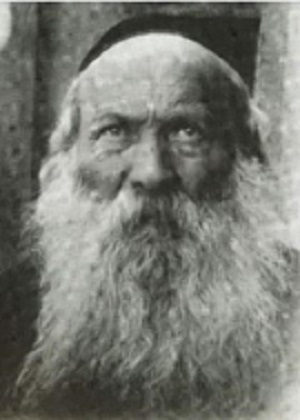
Rabbi Shmuel Borenstein Zt”l – (Shem Mi’Shmuel) The second Sochatchover Rebbe
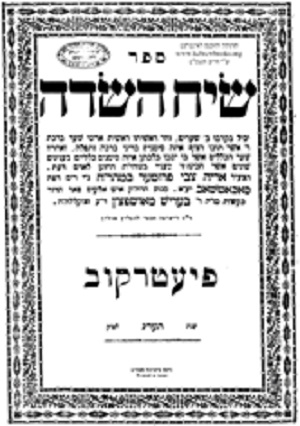
Cover page of Siach Hasadeh; Pietrikov 1912

The Frommer family had grown to a total of six children, relying on RATF as he sought his next job opportunity. His uncle, Rabbi Yitzchak Gottenstein, the rabbi of a small town in Poland, Koziegłowy (Kozoglov), had passed away and the community needed a new Rabbi. The community was small, and the financial opportunity was no greater. However, due to lack of alternatives this would be RATF’s next stop. There, RATF established a small yeshiva and continued his learning and teaching, jump-starting an environment of Torah learning and scholarship in the small town. Although his tenure there did not last particularly long, he would be forever known by the appellation; “The Kozoglover Gaon”.

After leaving Kozoglov[17], RATF headed to Zbeirtza, Poland. The community of Sochatchover chassidim that lived in the city of Zbeirtza, were “laymen” of an extraordinary caliber. Many of them students of the Avnei Neizer, providing context to appreciate the uniqueness and caliber of RATF and his erudition. RATF had developed into a combination of a classical scholar, chassid and tzadik that made him such a sought-after leader. He was knowledgeable in all areas of the revealed Torah as well as kabbalah and chassidut as is evident from his works. Additionally, he would arise at midnight to recite “tikkun chatzot” and study kabbalah late into the night away from the public eye. It was in Zbeirtza that his students began to compile notebooks with the teachings that RATF would share on shabbat & yom tov.[18]

Once again, the time came for RATF to migrate to the nearby town of Sosnovitz[19]continuing to gain admirers and students. It was at this time that Rabbi Meir Shapiro zt”l, founder of Yeshivat Chochmei Lublin and Rav of Lublin, expressed an interest in having RATF join the faculty of the yeshiva[20]. RATF deflected the requests due to his desire to remain close to his existing students and admirers. However, after Rabbi Meir Shapiro’s untimely death in October 1933, Yeshivat Chochmei Lublin was left without a leader. RATF decided to move to Lublin and became the second Rosh Yeshiva of Yeshivat Chochmei Lublin.
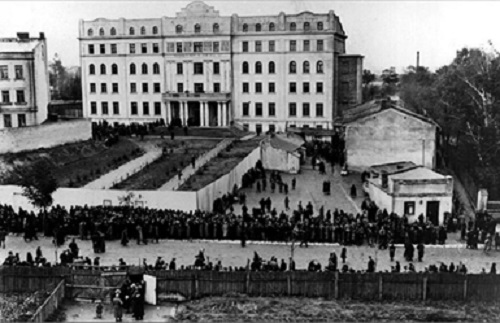
The funeral of Rabbi Meir Shapiro Zt”l at the Yeshiva of Chochmei Lublin

In a fascinating interlude in RATF’s life, he witnessed one of his lifelong dreams materialize; visiting Eretz Yisrael. RATF had a great yearning for the land of Israel.[21]He once remarked to his confidant and host in Tel Aviv, Rabbi Dovid Landa, that “a regular day in Eretz Yisrael contains the same holiness as yom tov sheni shel galuyot in the diaspora”.[22] His trip lasted four months while he visited Jerusalem, Meiron[23], Tel Aviv & Bnei Brak.[24] Afterward, he returned to his new position at the Yeshivat Chochmei Lublin. RATF experienced some of his most productive years of Torah learning & creativity at the helm of the yeshiva. After many years of narrowly avoiding personal financial collapse and constantly being forced to migrate throughout Poland, he had finally arrived at a place where his only concern was Torah.

It was during his tenure as Rosh Yeshiva of Yeshivat Chochmei Lublin that he published his second work, Responsa Eretz Tzvi,[25]in 1938. Eretz Tzvi, is a work of collected responsa, mostly concentrated on the orach hayim section of the Shulchan Aruch with certain discussions regarding Yoreh Deah and Even He’ezer as well. The volume was first published in Lublin, at a printer only steps away from the Yeshivat Chochmei Lublin.[26] A second printing was done in America in 1963 and a third re-printing by RATF’s nephew, Rabbi Dov Frommer in 1975 in Tel Aviv[27]. It is worth noting that a fourth edition including never before collected writings, as well as Siach Hasadeh, became the “second & third cheilek” of the responsa Eretz Tzvi as separate volumes. The collection includes responsa, letters &  glosses on various masechtot, and was printed in 2000 by Rabbi David Abraham Mandelbaum[28] [29]. Throughout Eretz Tzvi, RATF corresponds with many scholars including The Gerrer Rebbe, The Shem Mi’Shmuel of Sochatchov, Rabbi Meir Arik and the Bianer Rebbe on various topics of halacha. It is in this work that his unique approach combining halacha, aggadah and kabbalah is showcased. His creative methodology allowed for uncovering defenses of questionable customs, providing a limud zechut for the masses in many cases. In this way he served as a “Defender of Israel”[30].
Cover page of Responsa Eretz Tzvi; Lublin 1938

In 1938, on the occasion of the second completion of the Daf Yomi cycle, RATF introduced a study program that would complement Daf Yomi: Mishna Yomi[31]. Two mishnayot studied every day; enabling a participant in the Daf Yomi program to finish the entirety of the mishnah, even those tractates which did not include bavli commentary.

The second world war began, and Poland was overrun by the Nazi army. In 1939 RATF together with his family were forced to relocate to the Warsaw Ghetto[32]. It was reported[33] that RATF was leading Torah learning initiatives for the younger students in the ghetto. Additionally, even while in the ghetto he continued to comprise Torah novella as many of his glosses on his own responsa Eretz Tzvi were written during his time in the Warsaw Ghetto.

RATF was forced to take a job making shoes for the German soldiers on the Russian front provided by the “Shultz” company.[34] He worked alongside the third Sochatchover Rebbe – Rabbi Dovid Borenstein and the  Piasetzna Rebbe Rabbi Kalonymus Kalman Shapira[35] along with other great rabbis and scholars .[36]
RATF alongside his Rebbe. Rabbi Dovid Borenstein Zt”l – The third Sochatchover Rebbe

After the liquidation of the Warsaw Ghetto in the spring of 1942 the Frommer family was sent to the Majdanek death camp in Lublin, Poland only 123km away from his beloved Yeshivat Chochmei Lublin. It is documented that as he entered the gas chambers, the holy Kozoglover Gaon exclaimed “Thank G-d, for I am included in the sanctification of G-d’s great name!”.[37]
A newspaper article describing the experiences of Torah scholars in the Warsaw Ghetto.

Key Themes In The Thought of The Kozoglover Gaon

  1. הכל מלמדין זכות – סנגורם של ישראל 

The central theme in the halachic thought of RATF, is his focus on defending existing customs which are at odds with normative practice, often utilizing various non-traditional halachic arguments. RATF not only included kabbalistic and chassidic sources in normative talmudic & halachic discussions, but even allowed them to inform practical decisions in the realm of halacha. Eretz Tzvi strives to support rather than tear down shaky customs. RATF notes in his introduction to Eretz Tzvi when discussing his approach:

“That which we observed, that the students of the Baal Shem Tov zt”l abolished the practice of fasting and self- affliction [to atone for sins], and I am not worthy to enter into this discussion. Rather, I base myself on the mishna ”All may argue in favor of acquittal”[38]

[From this example, one could suggest that RATF saw himself as a halachic expositor of the way of the Baal Shem Tov, utilizing his halachic knowledge to apply the chassidic outlook of focusing on positive actions, rather than becoming mired in the guilt of sin.] Naturally, the very first responsa in Eretz Tzvi begins with this exact objective, foreshadowing the central theme of his halachic work:

“In defense of the widespread custom of wearing a tallit kattan which is smaller than the halachic size delineated in the Shulchan Aruch[39] which ostensibly precludes any fulfillment of the mitzvah tzitzit as many great scholars have protested about…as well as providing a limud zechut regarding the required length of tzitzit”[40]

One common conflict between chassidim and mitnagdim is their opposing halachic attitudes within the area of zmanei hatefillah. Perhaps the most well-known example of RATF’s limud zechut is the defense of the custom of some chassidim for beginning shacharit after 4 halachic hours into the day. The problem being the recital of berachot kriat shema, after their preferred time.  This poses a potential transgression of beracha levatala[41]. RATF defends this custom with various arguments. In the first part of the responsa in Eretz Tzvi[42], RATF begins by neutralizing the potential issue of beracha levatalah by positing that the prayer is considered a tefillat nedava, a voluntary prayer similar to the voluntary offering in the beit hamikdash. A voluntary tefilla is not bound by the common restrictions of an obligatory tefilla.

However, RATF is challenged to explain how one could put aside the halachically preferential time for praying and engage in a seemingly lesser level of voluntary prayer [chovah vs. nedavah]? To answer this secondary question, RATF utilizes the Shulchan Aruch Harav of Rav Shneur Zalman of Liadi – The Ba’al Hatanya.[43] The gemara[44]states that someone who is constantly engrossed in Torah learning (Torato um’nato [Rashbi V’chaveirav]) is not obligated to stop at the proper time and pray shemoneh esreih while engrossed in learning. Additionally, the Ba’al Hatanya adds that praying with the highest level of deveikut (divine cleaving) would take precedence over Torah learning, even for those who are described as torato um’nato.

RATF points out that from the Shulchan Aruch Harav we see that only a prayer with extraordinary intent and focus [A] trumps the Torah learning of someone who’s primary occupation is Torah learning [B] while an ordinary tefillah [C] would not obligated him to interrupt his studies to pray. ([A]>[B]>[C]) Utilizing a similar line of reasoning, we can assume that an individual who delays praying to attain the higher level of prayer will supersede the usual obligation of prayer service at the proper time. ([A]>[C])

Perhaps a more ambitious attempt at justifying the practice of some of the great chassidic masters with respect to zmanei tefillah, is another point in the same responsa. RATF quotes from the Ruzhiner Rebbe[45]who explains that prior to the sin of adam harishon in gan eden, the entire day was equally fit for prayer. However, the post-sin world is not fit for such a structure so the forefathers; Avraham (Shacharit), Yitzchak (Mincha) and Yaakov (Arvit) designated timeframes for each prayer. When the world reaches the ultimate redemption, the framework of zmanei tefillah will revert to their undefined framework similar to pre-sin existence. Utilizing a concept from the Rashba in Masechet Menachot[46] [regarding the halachic status of korban ha’omer], RATF suggests that since prayers of the tzadikim are focused on delivering the ultimate redemption (when the typical time boundaries will cease to exist) these prayers in and of themselves (even in our current pre-redemption era) are not bound by the usual rules and regulations.[47] Additionally, in two separate places RATF defends the practice of regular chassidim (not only great tzadikim as discussed above) who begin to pray Mincha in the time of bein hashmashot[48]employing the concept of safeik d’rabanan lkula.
Rabbi Avraham Mordechai Alter zt”l (seated)  – The “Imrei Emet” of Ger along with his grandson.. A common correspondent of RATF. (Hakira.org)

In another example of limud zechut RATF defends the custom of delivering mishloach manot late in the day of Purim such that it is already past nightfall. While this practice ostensibly has no grounds in halacha as the halachic day has ended, as RATF himself admits, he still uncovers a halachic reasoning for the custom.[49] RATF quotes an explanation from Rabbi Yaakov Yitzchak Rabinowitz, the Yid Hakadosh of Pshiske,[50] who defends the practice of beginning to pray mincha when the prayer will extend past the proper halachic time of shkiah. Rabbi Rabinowitz justifies it based on the gemara and Tosafot in Berachot[51]regarding the curse of Bilaam towards the Jewish people. It is mentioned in the Gemara that Bilaam knew the precise split-second at which Hashem became angry during the day and could fit in a quick curse at that opportune time. However, Tosafot asks “What curse could you fit in a split-second?” and answers that the word kalem (כלם) meaning “they should be cursed” could fit the time allotment. Tosafot offers a second explanation: “even if it was a longer curse, if Bilaam would begin his cursing of the Jewish people in the split-second that Hashem’s anger appears each day even if he would continue after that time it would take effect as well.” Therefore, proves the Yid Hakadosh quoted by RATF, we see from here that beginning a prayer or a mitzvah at the right time will allow one to finish after the allotted time.[52] [53]
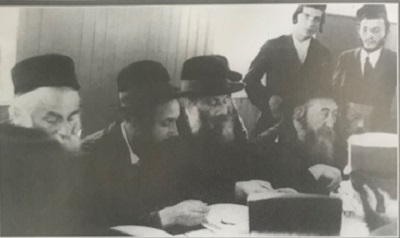
RATF (Third from left) administering a bechina at Yeshivat Chochmei Lublin

A limud zechut which came in an alternate form is RATF’s insistence on separating the strict halacha from that of middat hassidut or virtuous behaviour. In a correspondence[54] between RATF and the Imrei Emet of Gur (Rabbi Avraham Mordechai Alter), RATF discusses a specific type of lashon hara treated by the Hafetz Hayim in his work Shemirat Halashon. The Hafetz Hayim discusses the prohibition of speaking negatively about a person “even if he [the speaker] himself saw him [the transgressor] from close proximity doing something that is inappropriate according to the law”.  As a source, the Hafetz Hayim cites Rabbeinu Yonah in Shaarei Teshuva[55]:

”…perhaps the transgressor already repented from his evil ways, is distressed in his thoughts, and the heart knows the bitterness of his soul, and it is incorrect to reveal it.”

RATF points out that the exact words of Rabbeinu Yonah namely, “It is incorrect”, smack of middat chassidut and not strict halachic prohibition, and therefore takes issue with the Hafetz Hayim supporting his halachic decision on such grounds. RATF continues and writes “And since many people fail in this, one ought to find them a defense”.

It is interesting to note, that the work of Rabbeinu Yonah being discussed is the Shaarei Teshuva – a work not typically categorized as halachic. RATF did not object to the use of Rabbeinu Yonah’s “Shaarei Teshuva” on the grounds that it is a mussar work as opposed to a halachic one. One possible explanation is that RATF himself relies on and includes non-halachic sources to inform halachic decisions. RATF employs the full gamut of Torah thought in order to come to the defense of common practices and customs even if they infringe on pietistic sensibilities.[56]

Limud Zechut in Other Writings

As a young Rabbi, RATF published a short letter delineating the basic requirements of hilchot tefillah enabling his fellow Jews to fulfill the obligation of daily prayer. He published this letter anonymously, seemingly to avoid the appearance of haughtiness in a younger scholar lecturing the public.
Part of the letter that RATF published anonymously to remind the general public about the basic requirements of Teifillah in hopes  of zikui harabim

Lastly, in addition to his published works RATF published a kuntres or small pamphlet called Doresh Tov le’amo[57]. The work remained in manuscript and included a defense of “most Jews” who don’t have the requisite intent during the opening birchat avot of shemoneh esreih.  RATF writes that even if a person doesn’t understand the meaning of the words, if they are aware of the fact that they are praying “in front of Hashem” bedieved they fulfill their obligation. [RATF’s position is seemingly in opposition to the well-known position held of Rabbi Chaim Brisker[58]that in the first beracha of shemoneh esreih both the intent of standing in front of Hashem as well as the meaning of the words are necessary even bedieved.]


  1. Innovation Through Connecting all Areas of Torah

RATF utilized existing logic and concepts while applying them to previously unexplained passages and problems providing a framework of creativity that remains in line with tradition. We have already seen from the above mentioned responsa that RATF was open to utilizing kabbalistic and chassidic concepts in order to provide a limud zechut. RATF’s works do indeed draw from chassidut, kabbalah as well as gemara and rishonim. RATF describes his philosophy regarding new interpretations in Torah and their purpose: [59]

“As it is explained in the work Maayan Chaim as he discusses at length to provide support to those who produce Torah novella although it is not clear whether they are true & correct which would be a transgression according to the Zohar. In my humble opinion, the Zohar prohibits writing such novella only in a case where the logic being applied is not true, however if the logic and approach is true and found in earlier works, even if it is being applied in a novel way to explain a certain passage, even if the explanation is not correct this is not a transgression. For this is the honor of Torah and to demonstrate that there is nothing that is not hinted to in the Torah and everything can be “clothed” in Torah.”
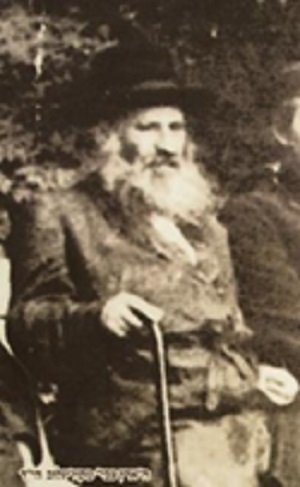
RATF in his later years

A great example of his propensity to cross-pollinate between disciplines is a discourse on Sukkot[60]. Regarding the libations of wine and water that took place on Sukkot he writes:

“One could suggest that the libations of wine and of water represent two separate ideas, oneg & simcha. The water libations represent oneg, as the concept of water is the source of all enjoyment as explained in Shaarei Kedusha[61]while wine represents simcha as [the Talmud] says “ein simcha ela b’yayin”. Additionally, we know that oneg & simcha are two separate ideas as explained in the Chatam Sofer’s novella (Shabbat 111a)[62] that on Shabbat there is an obligation of oneg while on Yom Tov there is an obligation of simcha…it would seem that the difference between these two emotions is that oneg involves the five senses while simcha involves only the heart/mind [lev]…and from simcha one arrives at dancing as is written in the Sefer Hakuzari, and the Maharal explains that our custom to raise our feet during Kedushah is to show that our soul naturally longs to take flight and similarly dancing which is initiated by simcha…on the other hand oneg is specifically in the engagement of the five senses as it says in Sefer Yetzira[63] which corresponds to oneg…and this is why all year round the only libation is that of wine representing simcha in the heart/mind however specifically on Sukkot after the forgiveness of sins [Yom Kippur] the body [and senses] are purified we are then given the libations of water representing the enjoyment of the senses as now these too can be used in cleaving to Hashem.”

In this passage RATF quotes from Talmud and a classical commentary as well as kabbalistic and chassidic sources interchangeably and unapologetically. The breadth and depth of RATF’s references adds a layer of relevance as he finds common themes in sifrei kabbalah along with classical rishonim and achronim. [64] In another passage, RATF describes his affinity for combining the hidden and revealed disciplines of Torah learning. He states:[65]

“It is my “way”, myself the pauper, to uncover (l’hamtzi) a source in the revealed Torah for the hidden…”

The word he uses is l’hamtzi which has double connotation of uncovering & creation. Through utilizing the spectrum of Torah literature RATF essentially creates new sources previously unrelated to the topic at hand through exposing them to his unique thought process.

See Responsa Eretz Tzvi[66] where he was asked by someone who accidentally turned on a light on shabbat and wanted to understand how much money he should give for atonement (kaparah). At the end of the discussion, [after finding a lenient opinion in estimating the modern equivalent of the monetary sums discussed in the gemara] RATF adds a reminder lest the questioner miss out on the true purpose of giving the symbolic amount to achieve “kaparah”.

However, the crux (ikar) of teshuva is the remorse and humility and lowliness that a person should be heartbroken that he desecrated the holy Shabbos. Additionally, it would be appropriate to take up oneself to assist the “Chevra Shomrei Shabbos” …for this is considered a tikkun of desecrating Shabbos.”       

RATF’s halachic thought utilized a maximalist approach in finding prooftexts and sources. Besides for the revealed and esoteric areas of Torah, we see from this last example that his responsa took the full religious experience into account.
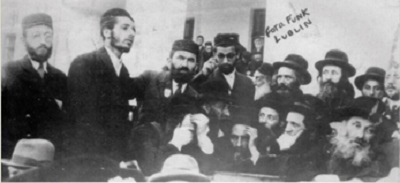
RATF (bottom right corner) at a an unspecified event in Yeshivat Chochmei Lublin. To his right, Rav M, Ziemba

  • Centrality of Torah for All Jews & Mishna Yomi

In a related theme to limud zechut & providing access to all areas of Torah, it is clear that RATF strived to include the full population of Jewry in his philosophy of learning Torah. It is interesting to note, as Rabbi S.Y. Zevin does in his review of Eretz Tzvi[67], that although RATF was the dean of a yeshiva which was typically focused on the abstraction of talmudic law, Eretz Tzvi is comprised entirely of questions that are practical in nature. He utilized his training in the disciplines of pilpul and sevara as a tool for dealing with everyday people & problems.

An initiative of RATF aiming to elevate the religious experience of common Jewry, was the Mishna Yomi program that he instituted. Upon the second inaugural Siyum Hashas in 1938, RATF created a new study program allowing every Jew to appreciate and complete the entirety of Torah. His initiative was both  complementary and supplementary to the Daf Yomi that was already instituted by Rabbi Meir Shapira zt”l. An adherent to the Daf Yomi schedule would complete the entire Talmud Bavli over the course of the seven-year cycle. However, there are many aspects of torah sheb’al peh left untouched due to the significant amount of mishnayot that have no Bavli commentary. RATF suggested that the geulah (ultimate redemption) is dependent on the Jewish people learning the entirety of the oral Torah. See below for his inspirational words when introducing the program explaining an interpretation provided by the gemara for a cryptic passage in Hoshea.[68]

“Though they hire among the nations, now I will gather them up” (Hoshea 8:10)

“Should they learn it all; then, “now I will gather them up” [the Geulah will come immediately]”(Bava Batra 8a)

One could understand the words of the gemara “It all” in two ways. Either A. All of Bnei Yisrael or B.  Each individual should learn all the mishnayot as they encompass all of the oral law. And there is support for this from the Zohar[69] that one of the methods of teshuva is to learn the entirety of Torah …as every part of Torah has a unique ability to offer salvation for a specific area in one’s life, however the ultimate geulah is the entirety of all individual salvations at once and therefore all areas of the Torah must be covered in order to glean all the unique salvations to arrive at the ultimate collective salvation [of the Jewish people]. It therefore says “אי תנא כולהו” [if they learn it all], utilizing both understandings [A. all of the Jewish people and B. the entirety of the oral Torah] …and this is the purpose of the “Mishna Yomi”, that every Jew young and old, scholar and layman, wealthy & poor can all take part in this great mitzvah.”

RATF felt that the geulah could be hastened through the entirety of the Jewish people learning all the mishnayot which encompasses the oral Torah.[70] It was seen as a great complement to the Daf Yomi, to the extent that there were printings of Talmud with both the Daf Yomi & Mishna Yomi schedule to allow for combined study.[71]

Although RATF conceived the Mishna Yomi prior to WWII, the concept needed a reaffirmation amongst post war Jews. Rabbi Yonah Stenzel, who was a student of RATF in the town of Sosnovitz and eventually emigrated to Tel Aviv and joined its rabbinate, re-instituted the concept of Mishna Yomi & Halacha Yomi in remembrance of those Jews that perished in the holocaust. In a few articles he is credited with creating the Mishna Yomi format, however RATF clearly introduced the concept before the war.

It is noteworthy that the specific vehicle chosen by RATF for bringing the ultimate redemption was Torah study. The gemara mentions other potential deeds that can bring the ultimate redemption in somewhat simpler ways.[72] The accessibility of Talmud Torah to the masses and the potential for each and every Jew to experience the entirety of Torah was RATF’s preferred initiative for bringing about greater spirituality in the community at large. It was through Torah that RATF saw his contribution in hastening the geulah.
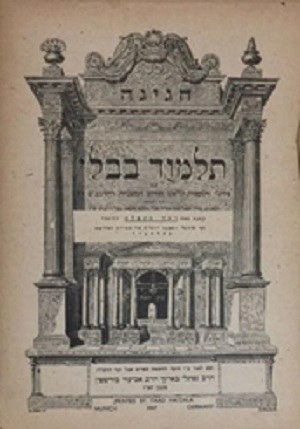
Tamud Bavli, Tractate Hagigah and Mo’ed Katan and Mishnayot Shvi’it – special edition for the students of the Daf Yomi and the Mishnah Yomi – Munich 1947

Conclusion

Halachically speaking, any city which is entirely idolatrous is classified in the gemara as an ir hanidachat and condemned to destruction. However, the gemara[73]mentions that if one of the houses within the city maintains a mezuzah on its doorpost the city should not be destroyed. An apocryphal story describes a city facing imminent destruction due to its idolatrous practices that had permeated every household. On the eve of the final verdict there was a Jew who arrived from another city and ran from door to door affixing mezuzot to all bare doorposts. I believe that on a symbolic level, one of the rabbis affixing figurative mezuzot to various embedded customs requiring limud zechut in the last century was the Kozoglover Gaon, Rabbi Aryeh Tzvi Frommer Hy”d.

The concept of limud zechut, that was RATF’s raison d’etre, allowed for needed leniency within the structure and framework of Orthodox Torah observance. At times, we need a limud zechut on our own individual behavior as well as for our various practices and customs as a community. Perhaps, even if the halachic conclusions of RATF aren’t the accepted practice, his willingness to defend questionable practices with the breadth of his learning utilizing both the revealed and esoteric sections of the Torah remind us the importance of limud zechut and our responsibility to engage others and ourselves through it’s lens.

**I would like to dedicate this article in memory of my grandparents:

    Norman Sebrow                                                              Jo Amar

יוסף בן מזל ז”ל                                               נחמן דוד בן צבי אייזק ז”ל

     Jeanette Sebrow                                                    Raymonde Amar

רוחמה בת אסתר ז”ל                                             יוכבד בת אשר זעליג ז”ל

[1] I am grateful to Rabbi Hershel Schachter שליט”א, who introduced me to the Torah of the Kozoglover Gaon amongst a variety of unique thinkers as a student in his shiur. Additionally, I would like to thank the following people for their insight and help in bringing this project from idea to reality: Rabbis Dovid Bashevkin, Yaacov Sasson, Danny Turkel as well as Moshe Rechthand. Lastly, R’ Eliezer Brodt for his insight and breadth of knowledge that he offered to help complete this project.

[2] RATF’s collected writings and teachings can also be found in Eretz Tzvi (Moadim & Al Ha’Torah)  compiled by Erlich, Yehuda; Tel Aviv, 1984. Additionally, his students in Yeshivat Chochmei Lublin compiled a collection of insights called Mekabtz’el.

[3] Frommer, Aryeh Tzvi. Eretz Tzvi, Bnei Brak, 1976, pp. 5–6.

[4] Soreski, Aharon. Geonei Polin Ha’achronim, Bnei Brak, 1982, pp. 182 According to other opinions his father was a coal salesman.

[5] Ibid.

[6] Ibid. pp. 184 RATF’s personality is described as being exceptionally bright while at the same time a שובב or a bit of a “troublemaker”. It was in the yeshiva in Amstov that Rabbi Efraim Einhorn, paid special attention to the young orphan and provided him with the fundamentals for development in learning. It was this special attention that RATF attempted to repay when Rabbi Einhorn’s grandson, Rabbi Moshe Krohn came to study with RATF in Zbeirtza. RATF took extra care to attend to all of Rabbi Moshe Krohn’s physical and spiritual needs.

[7] Regarding the level of studies at the Amstov yeshiva – see Ibid. pp. 185-186 The day began with a shiur from 5AM until 10AM when the yeshiva would pray shacharit.

[8] Some of the other well-known students of the yeshiva; Rabbi Shlomo Stenzel and the Rebbe of Radomsk: Rabbi Shlomo Henich Hacohen Rabinovitz.

[9]1838 -1910. A chassid and son-in-law of the Kotzker Rebbe, after the Rebbe passed away he became a Gerrer chassid. In 1883 he moved to Sochatchov where he founded his own branch of chassidut named after the city, and which gave him the title of “the Sochatchover Rebbe.” His responsa were collected posthumously and published as the Responsa – Avnei Nezer hence his title. He published the sefer Eglei Tal as well, which covers the 39 melachot of Shabbat.

[10] Geonei Polin Ha’achronim, pp.182

[11] Ibid. – As a testament to the esteem regarded by the Avnei Neizer for his student, see Responsa Avnei Neizer, Orach Chaim, 109 where his teacher writes the following. “Greetings to my beloved student, the Harif and Baki our teacher, Rabbi Leib Hirsch. From your letter I see that you have been meditating on my work…You said well and spoke truth. Wishing you great strength and courage in Torah and G-d willing, may you develop into a vehicle for chassidut and fear of Heaven…Abraham”

[12] 1855-1926. Published the work “Shem Mi’shmuel”. The only son of the Avnei Neizer, was both a son and close student of his father and maintained an extremely close relationship with his father until his death. After his father’s death, he was accepted as the next Socatchover Rebbe. He published his father’s works and led Socotchov Chassidut. He died at the age of 70. He was brought to burial in the same ohel (covered grave) as his father, the Avnei Nezer, in Sochaczew. His son, Dovid, succeeded him as third Sochatchover Rebbe.

[13] Bergman, Ben-Tzion. Michoel B’Achat, pp.44 – RATF was not the only one asked to lead the yeshiva. Rav Michoel Forschlager another prized student of the Avnei Neizer was sought along with RATF to lead the yeshiva. It was RATF who served as the dean of the yeshiva while Rav Forschlager was more directly involved with directing the studies of the young students. Among Rav Forschlager’s students were Rabbi Avraham Aaron Price, Rabbi Mordechai Gifter, Rabbi Yitzchak Hoberman and Rabbi Pinchas Hirschprung. Additionally, see the newly reprinted Toras Michael (Machon Avnei Choshen, 2016) a collection of Rav Forschlager’s torah novella.

[14] 1855-1926 – One of the great galician Torah scholars with works such as Imrei Yosher, Tal Torah. His students include the prolific Rav Reuven Margolies and founder of Daf Yomi and Chochmei Lublin Yeshiva – Rabbi Meir Shapiro.

[15] 1858-1920 – Rabbi and Av Beis Din in Krakow, Poland. Author of Gilyonei Ha’Shas, Beit Ha’Otzar. Himself a fascinating Torah scholar who utilized abstract thinking in his conceptual approach to Talmudic study. At the bris of RATF’s first born son, Rabbi Yosef Engel served as the sandak, while RATF himself was the mohel.

[16] Including Rabbi Moshe Nachum Yerushalimsk, 1855-1916. Another of the great Torah luminaries in Poland at the time.

[17] See “Rabbi Aryeh Tzvi Frumer From Kozhiglov: Head of the Rabbinical Court and Rosh Yeshiva: Center for Holocaust Studies” – the reason for his departure from the city as being due to a disgruntled wealthy man that RATF slighted by deciding against him in a din Torah. For another version of the story involving his neighbor being a priest see the introduction to the third printing of Reponsa Eretz Tzvi.

[18] Specifically, Rabbi Yitzchak Yaakov Erlich whose son R’ Yehuda ended up publishing the works of RATF Rav in Israel many years later.

[19] It is in Sosnovitz where Rabbi Yonah Stenzel (1904-1969) became a devoted student of RATF. Rabbi Stenzel, who also studied in Chochmei Lublin, eventually migrated to Tel Aviv where he re-stablished the study of Halacha and Mishna Yomit in memory of all those who perished in the Holocaust.

[20] It is important to emphasize the honor and prestige that even joining the student body of the yeshiva brought along with it. It was said that each student needed to know 200 folio of Talmud by heart to gain admission.

[21] See Responsa Eretz Tzvi I:25 in his letter to the Gerrer Rebbe “Who will give me wings of a dove, I will fly and settle (in the land of Israel), kiss its earth, embrace its stones may it be hastily in our days”

[22] See Geoneil Polin Ha’achronim pp.250

[23] See Eretz Tzvi I:27 where he mentions that a certain hiddush occurred to him in Meiron on Lag Ba’omer

[24] Geoneil Polin Ha’achronim pp.252: It is said that he after meeting with the Chazon Ish zt’l in Bnei Brak, the Chazon Ish praised his brilliant Torah mind saying that he had not met such a brilliant mind in many years.

[25] The name is used as a description of the land of Israel, in the book of Daniel for example (Chapter 11), from which he had recently returned. Additionally, Tzvi for his middle name.

[26] Yeshivat Chochmei Lublin was located at Lubitrovska 57, initially a vacant lot which Rabbi Meir Shapira secured from a wealthy donor. Eretz Tzvi’s first printing was at a press located footsteps away at Lubitrovska 62 as seen on the cover page.

[27] Geonei Polin Ha’achronim, pp 271. Reportedly, the copy used for the third printing was amongst many works that survived the destruction of the holocaust and arrived as part of a larger delivery to the misrad hadatot of Israel. It was this specific copy that had the glosses of the author in the margins. Among other works saved is RATF’s personal copy of Responsa Imrei Yosher with RATF’s glosses.

[28]Rabbi Mandelbaum is a notable scholar of all topics related to Yeshivat Chochmei Lublin and many of the great minds of Polish origin. Rabbi Mandelbaum added a new dimension to the Torah of RATF and many other geonim by collecting their dispersed writings and organizing them while also providing noteworthy glosses and footnotes in various reprintings. Rabbi Mandelbaum’s father was a student of RATF in Yeshivat Chochmei Lublin. Additionally, Rabbi Mandelbaum thanks Rav Shmuel Halevi Vozner Zt”l and other for sharing many of the items found in this second volume as he was in possession of various manuscripts and writings of RATF.

[29]  ‘ שו”ת ארץ צבי, חלק ב ה, Bnei Brak, 2000

[30] סניגורם של ישראל – This term is also used in reference to the great Rav Levi Yitzchak of Berditchev (1740-1809) who repeatedly strove to portray both Jews and Jewish issues in a positive light. For more on this topic see; Luckens, ‘Rabbi Levi Yitzhak of Berdichev’, Ph.D. thesis (Temple University, 1974) pp. 38 citing M. Wilensky, I, 122-131.

[31] His words were recorded and can be found in Eretz Tzvi Moadim pp. 276

[32] ארץ צבי עה”ת pp. 14

[33] Hidden in Thunder: Perspectives on Faith, Halachah and Leadership …, Volume 1, Esther Farbstein,

[34] ארץ צבי עה”ת pp. 14

[35] See http://www.daat.ac.il/daat/shoah/biton37.pdf  based on the daily journals of Hillel Zeidman

[36] [The Last Path for Torah Leaders in the Warsaw Ghetto]. Bais Yaakov (in Hebrew) (47): 7 – Testimony of Avraham Hendel. An additional story is told about Rabbi Aryeh Tzvi that he was desperately searching for someone to help him conduct a chemical experiment with the margarine that was given out at meals in the shoe factory – to test for any treif fat that could have been mixed in and thus prohibited to eat.

[37] Ibid.

[38] Reponsa Eretz Tzvi, Introduction

[39] Siman 17

[40] Eretz Tzvi,

[41] See Shulchan Aruch 58:6

[42] Responsa Eretz Tzvi I:36

[43] Talmud Torah 4:5

[44] Shabbat 10a

[45] Israel Friedman of Ruzhyn (1796 –1850), also called Israel Ruzhin, was a Hasidic rebbe in 19th-century Ukraine and Austria. Friedman was the first and only Ruzhiner Rebbe. However, his sons and grandsons founded their own dynasties, collectively known as the “House of Ruzhin”. These dynasties, which follow many of the traditions of the Ruzhiner Rebbe, are Bohush, Boyan, Chortkov, Husiatyn, Sadigura, and Shtefanesht. The founders of the Vizhnitz, Skver, and Vasloi Hasidic dynasties were related to the Ruzhiner Rebbe through his daughters.

[46] Menachot 4a

[47] It should be noted however, that RATF concedes that this line of reasoning would specifically apply to the great tzadikim whose prayers can be assumed bring the ultimate redemption closer vs. those of the typical petitioner.

[48] See Eretz Tzvi 1:1, 1:60

[49] 1:121

[50] Rabbi Yaakov Yitzchak Rabinowitz (1766–1813). A student of the Chozeh of Lublin (Ya‘akov Yitsḥak Horowitz) with whom he eventually parted ways. See Buber, Martin: Gog und Magog (1949; first published in English translation as For the Sake of Heaven, 1945). The Yid Hakadosh would become the teacher of Rabbi Simcha Bunem of Pshiskhe. See Rosen, Michael: The Quest for Authenticity.

[51] 7a s.a

[52] See Piskei Teshuvot, Purim, Siman 695:5 Note 24. Where this responsa of RATF is brought as an example of an opinion that defends the practice of starting the Purim feast close to the end of the day where most of it will take place after Purim although it was begun before the end of the day.

[53] Additionally, regarding the proof from Tosafot in Berachot referencing Bilaam. See Nefesh Harav (pp.114) that when Rav Joseph B. Soloveitchik heard this proof he laughed and Rabbi Shachter שליט”א explains that it was evident that he was not comfortable with this type of proof.

[54] See “From Principles to Rules and from Musar to Halakhah: The Hafetz Hayim’s Rulings on Libel and Gossip”, for Rabbi Dr. Brown’s discussion the works of the Hafetz Hayim at length and who discusses RATF’s discussion as well.

[55] Shaarei Teshuva, Sha’ar 3

[56] See below for further examples (non-exhaustive list) of limud zechut:

1.See Eretz Tzvi 34 – in defense of the custom for women of the time that didn’t daven everyday, when seemingly this is against the clear gemara (Berachot 20b) & Shulchan Aruch (O”C – 106:2) that women are obligated in tefillah. Rabbi Aryeh Tzvi provides additional support via comparison of tefillah to korbanot thus re-affirming the position of magen Avraham (ibid.) that suggests that the women will at some point request something from G-d and therefore fulfill their Torah obligation according to the Rambam.

  1. See Eretz Tzvi 53 54 – in defense of the common custom to make a borei pri hagefen on wine that includes significant amounts of water which are 6x the wine although this is seemingly at odds with the normative halacha as both the Shulchan Aruch YOD (siman 134) & Rama (YOD 204:5) conclude that one should not make a borei pri hagefen on such a wine.
  2. Eretz Tzvi 75 – in defense of the common custom in an area without an eiruv on Shabbat to use a minor to perform hotzaah.
  3. See Eretz Tzvi 94-95 with respect to finding support for those kohanim who fly on an airplane which might fly directly over graves of Jews thus exposing them to tumas kohanim
  4. Eretz TZvi 96 – in defense of the common custom to make seltzer on Shabbos –
  5. Eretz Tzvi 97 – in defense of the custom of certain chassidim to sit in the sukkah and make a bracha on shmini atzeret – though ostensibly at odds with the gemara.
  6. Eretz Tzvi 125 – finding support for creating a mikvah using snow in a place that no other type of mikvah would be possible.
  7. Eretz Tzvi 30 – in defense of the custom of the Ashkenazim in the diaspora who refrain from reciting the daily birchat kohanim
  8. Eretz Tzvi 35 – in defense of the custom for those washing netilat yadaim and the water does not cover most of their hand

[57] See Geonei Polin Ha’achronim, pp. 262

[58] See Chiddushei Rabbeinu Chaim Halevi al Harambam, Hilchot Tefillah as well as the he’arot of the Chazon Ish

[59] Eretz Tzvi (Torah commentary) Introduction

[60] Eretz Tzvi, Moadim, pp. 110, Sukkot תרפ”ה

[61] Kabbalistic work of the Ari’zal

[62] ד”ה ודע

[63] Chapter 2:7

[64] Another notable exchange is one that appears in the second volume of Eretz Tzvi where RATF engages in correspondence with none other than the Ishbitzer Rebbe, Rabbi Mordechai Yosef Leiner zt”l. It was in 1934 that the Ishbitzer Rebbe sent a question that was bothering him regarding a specific comment of Maimonides related to Hilchot Shevuot. RATF goes on to cite various chassidic and Kabbalistic sources and their bearing on the halachic issues. Thank you to Rabbi Josh Rosenfeld for pointing out this source, in his Sunday Responsa Series.

[65] Responsa Eretz Tzvi, I:12

[66] Siman 62

[67] Sofrim U’Sfarim, Tel Aviv, 1959, pp.189.  [Thank you to Rabbi Eliezer Brodt who brought this source to my attention]

[68] The discourse can be found in it’s entirety in Eretz Tzvi Moadim pp. 276.

[69] Zohar Chadash, Rut

[70] See also Eretz Tzvi, II: 72, 73

[71] This unique edition was printed in the framework of daily Daf Yomi and daily Mishnah. A combined calendar of Daf Yomi and the daily Mishnah is printed at the beginning of the book for the years to come: 5767-1912. The tablet is spread over four columns. Beneath the calendar of Daf Yomi, a special prayer was printed “after the end of a chapter from a daily mishnah.” This prayer was composed by Rabbi Yonah Stenzel zt “l, in memory of the Holocaust victims” who were killed for the sanctification of God … by the German oppressors. [Seen at Tzolman’s auctions (Bidspirit.org)]

[72] See Shabbat 118a – “If only [Bnei] Yisrael would keep two consecutive Shabbatot they would be immediately redeemed”

[73] Sanhedrin, 71a


Rav Gorelick, the Rav, and Revision by Omission

Rav Gorelick, the Rav, and Revision by Omission

By: Yaacov Sasson

Many readers of the Seforim Blog no doubt remember Dr. Shapiro’s post from 2009, in which he documented a back-and-forth from the pages of the journal Or Yisrael, regarding whether Rav Yerucham Gorelick zt”l taught Gemara at Yeshiva University.[1] As a refresher, Or Yisrael (Num. 50, Tevet 5768, p. 39) published a summary of a shiur given by Rav Mordechai Leib Gorelick (son of Rav Yerucham), regarding the publication of the Talmud with translation and elucidation (presumably referring to Artscroll). Rav Gorelick argued that such translations are inappropriate, as they make learning Gemara too easy, and learning Gemara requires hard work and toil (ameilus). Furthermore, Talmud study had always been reserved for the elite, not the masses, who studied other topics like Mishnayos and Ein Yaakov; daf yomi study for the masses was only approved reluctantly by the Chafetz Chaim. But it is inappropriate to print these crutches to enable the masses to study the Talmud, which they are incapable of studying on their own.[2]

In a follow up in that same issue of Or Yisrael (p. 42), Rav Yehuda Heller of London raised some doubt about whether Rav Leib Gorelick really said what was attributed to him in Or Yisrael. In the course of attempting to show that Rav Leib never made these claims against English translations and daf yomi, Rav Heller mentioned that Rav Leib’s father, Rav Yerucham, taught Gemara in YU for many years, even though the students there did not meet the very rigorous conditions that Rav Leib required to qualify for learning Gemara. From this, Rav Heller attempted to demonstrate that Rav Leib did not actually say what was attributed to him.[3]

Rav Heller wrote a further follow-up in a later volume of Or Yisrael (Num. 57, Tishrei 5770, p. 255), in which he said that Rav Leib Gorelick told him that his father did not teach Gemara in YU, and he only taught hashkafa there.[4] This statement understandably prompted quite a response, as Dr. Shapiro criticized Rav Leib and these revisionist comments rather harshly. A number of other websites also made note of this episode and added their own criticisms.[5] A follow-up letter written by a former student of Rav Yerucham was also published in Or Yisrael (Num. 58, Tevet 5770, p. 248), titled איך החי יכול להכחיש את החי , in which the writer states that he studied Gemara, Rishonim and Acharonim with Rav Yerucham, as did thousands of other students.

The claim that Rav Yerucham never taught Gemara at YU/RIETS is clearly false. Yet, it would appear that no one followed up with Rav Leib to clarify his statement, or to confirm that he actually made the seemingly impossible statement that had been attributed to him. In a conversation I had with Rav Leib Gorelick this past summer, I took the opportunity to ask him about this claim that his father never taught Gemara there, and only taught hashkafa. Rav Leib immediately informed me that he was misquoted, and his father certainly taught Gemara at YU/RIETS. What he said was that his father’s goal in teaching Gemara at YU was not to teach Gemara per se, but was to impart hashkafa, mussar, and emuna to the talmidim; in Rav Leib’s own words, “He wasn’t teaching them daf yomi.” Recall that the original context of these statements was regarding the propriety of Artscroll English translations enabling the masses to study daf yomi. It was in this context that Rabbi Heller brought Rav Yerucham’s position in YU as a proof, and Rav Leib was responding to this argument, all in the context of English translations and daf yomi. Regarding this point, he was arguing that his father’s position at YU is not relevant to teaching daf yomi to the masses, because his father was using the Gemara as a vehicle to impart mussar and hashkafa.

Interestingly, Rav Hershel Schachter has expressed similar sentiments, but from the perspective of a student (academic year 1957-1958) of Rav Yerucham Gorelick[6]:

Rabbi Gorelick used to give a shiur in the yeshiva, a regular shiur in Gemara, and he used to pepper his shiur with a lot of hashkafa, and a lot of mussar, emunah, he would say over a lot from the Nefesh Hachaim…The year that I was in Rabbi Gorelick’s shiur we learned Sanhedrin, I don’t remember anything that Rabbi Gorelick said about Sanhedrin, but I do remember all the Nefesh Hachaim’s that he said in the course of the year…I remember vertlach that he said from Rav Velvele on chumash…That’s what I remember from the year of learning by him. What he said on Gemara Sanhedrin I don’t remember. I remember what Rav Soloveitchik said, I don’t remember what Rabbi Gorelick said. But I remember all the Nefesh Hachaim’s that he said, and all the vertlach from Rav Velvele on the hagada, and all the vertlach on chumash that he said, and the stories that he told about Rav Velvele, that I remember, he used to tell over stories…”

If we could generalize from Rav Schachter’s experience, it would appear that Rav Yerucham Gorelick’s lasting impact on talmidim was mostly in line with how Rav Leib presented Rav Yerucham’s goals in teaching Gemara in YU.

There have been instances, however, in which Rav Gorelick’s association with YU has been omitted or glossed over. As an example, see the journal U’lYishrei Lev, volume 11, published in honor of the marriage of a son of Rav Shmuel Yeshaya Keller (son of the late Rav Chaim Dov Keller), to a granddaughter of Rav Chaim Ozer Gorelick, a great-granddaughter of Rav Yerucham.[7] This journal contains two letters from Rav Gorelick, which originally appeared in YU/RIETS Torah journals. One of them, shown below, בענין חש בתרומה וריחא מילתא , was originally printed in Beis Yitzchak volume 25 p. 241, and was discovered and arranged for publication by the late Rabbi Joshua (posthumously known as The Hoffer) Hoffman.[8]

There is no mention in U’lYishrei Lev that this letter was found and published in Beis Yitzchak. Similarly, the other letter in U’lYishrei Lev, במצות הפרשת תרומות ומעשרות, was originally published in Kol Zvi volume 2 page 107. It is noteworthy that, in addition to the more recent family connection by marriage, Rav Yerucham Gorelick was Rav Chaim Dov Keller’s rebbe in YU. It was Rav Gorelick who encouraged Rav Keller to go to Telz, and arranged for Rav Keller to learn b’chavrusa with Rav Mordechai Gifter.[9]

The aforementioned letter בענין חש בתרומה וריחא מילתא also appears in Mishor’s 5768 printing of חידושי הגרח על השס on page 32, surprisingly with the disclosure that the piece is taken from Beis Yitzchak.[10] I say surprisingly, because this volume does engage in revision by omission in other cases, specifically those having to do with the Rav, Rav Yosef Dov Soloveitchik. Here is a piece from that volume (page 302) on the topic of אין שליח לדבר עבירה, which is attributed to the very nebulous “Reshimos Talmidim”, but is copied word-for-word from Igros Ha-Grid Halevi, page 9, דה אכן, shown below.

Similarly, the piece in the Mishor volume (page 97) on מצות תקיעת שופר is once again attributed to the nebulous “Kisvei Talmidim”, yet is taken from Igros Ha-Grid Halevi, this time an amalgam of the pieces on page 33-34 and page 91, shown below. Most of the verbiage is taken from pages 33-34, while the phrases “אינו חל לגביה“ and “בכלל מתעסק“ are taken from page 91.

Another recent example of revision by omission as relates to Rav Soloveitchik appears in Yishurun, volume 41 (Elul 5779), in a biographical article on Rav Elya Baruch Finkel, on p. 388. There we are told of Rav Elya Baruch’s safek regarding Erev Shabbos Chanuka. The halacha (Rambam Chanuka 4:12) is that someone who does not have candles must even sell his garment in order to purchase Ner Chanuka. Rav Elya Baruch understood that there is no such requirement for Ner Shabbos according to the Rambam (see Yishurun volume 18 p. 675.[11] The article in Yishurun volume 18 also appears in Mishulchan Rabi Eliyahu Baruch- Moadim, volume 2, p. 283, where a note mentions that it was prepared for print by Rav Elya Baruch’s son.) The halacha (Rambam Chanuka 4:14) also states that someone with one candle on Erev Shabbos Chanuka should use it for Ner Shabbos, as Ner Shabbos takes precedence to Ner Chanuka. In the event that someone has no candles or money on Erev Shabbos Chanuka, he is obligated to sell his garment to buy a Ner Chanuka, but once he has the candle, he is supposed to give precedence to Ner Shabbos over Ner Chanuka, even though he is not obligated to sell his garment for Ner Shabbos. Rav Elya Baruch raised the question – should he use the candle for Ner Chanuka or for Ner Shabbos?

We are told in Yishurun that Rav Elya Baruch presented this question to גאון אחד who was נודע בכשרונותיו העילויים. This Gaon stated that there are three logical possibilities, and these possibilities are laid out in Yishurun volume 18 p. 677.[12] 1) He need not sell his garment, because even if he does he will be unable to fulfill Ner Chanuka, and it is as if he knows that if he buys the Ner Chanuka a lion will eat it, in which case he certainly need not sell his garment. 2) He should sell his garment and use the candle for Ner Chanuka 3) He should sell his garment and buy a candle for Ner Chanuka, but then use it for Ner Shabbos. This Gaon rejected the third possibility out of hand, and he was unsure how to decide between the first two possibilities.

This anonymous Gaon is none other than Rav Soloveitchik. I know this because the same story appears in the name of Rav Elya Baruch Finkel in the book “Read and Remember” by Rabbi Yirmiyahu Cohen, and there it names Rav Soloveitchik as the Gaon who laid out the three possibilities and rejected the third possibility.[13]

Ironically, “Read and Remember” has itself been the object of revision by omission. On p. 161, Rabbi Cohen relates that Rav Nochum Partzovitz was asked if a resident of chutz laaretz who is in Israel for the second night of Pesach could fulfill his mitzva by telling the story of Yetzias Mitzrayim to a resident of Israel, for whom it is not the seder night.

It seems to me that this piece from “Read and Remember” is obliquely referenced in Kuntres B’lev Yam Siman 41 number 2, page 629[14], by the current-day Rav Yaacov Moshe Shurkin, which is appended to the Shiurei Rabi Yaacov Moshe Shurkin of his grandfather (the magid shiur from Chaim Berlin); although this question is attributed to אחד מספרי מחברי זמנינו, with no more precise reference.

In this case, I imagine the omission of a specific reference is not due to hashkafic concerns, nor to the author cited being too modern, as R. Cohen is quite a kanai who is affiliated with Satmar and Natruna, and has written several books espousing anti-Zionism. I think it’s more likely in this case that the reference is obscured because it doesn’t “pas” to quote halachic material in a sefer from an English book.

Another example of revision by omission as relates to Rav Soloveitchik appears in R. Shimon Yosef Meller’s Harav MiBrisk volume 4, p. 17. The story about the Brisker Rav refusing to speak to a Rav who had helped Solomon Freehof is clearly taken without attribution from Rav Schachter’s Mipninei Harav, and Echad Mibnei Mishpachas Maran is obviously the Rav.

Rav Schachter’s omission of this particular Rav’s name is a different kind of omission, as that omission is because the story is rather critical of him. Rav Schachter often omits the names of Rabbanim towards whom Rav Soloveitchik expressed criticism. (This is in contrast to the prior examples of omission, where the omission is meant to prevent someone else from looking bad due to their association with the person or institution whose name is omitted, or because it doesn’t “pas” to cite that person or give him publicity.) I will follow suit and not mention the name of the Rav who helped Freehof, although his identity was first pointed out to me by my good friend Rabbi Dovid Bashevkin, and should be known to those who have thoroughly read through Dr. Shapiro’s “Saul Lieberman and the Orthodox.”

In R. Meller’s new biography of Rav Chaim Soloveitchik, Raban Shel Kol B’nei HaGolah (volumes 1 and 2), he appears to have reversed course somewhat, and does cite many times from Rav Schachter’s Nefesh Harav series, as well as from Ish Hahalacha, and other sources from Rav Soloveitchik. However, some sources still appear be out of bounds for citation. For example, the material from the government archive cited in Raban Shel Kol B’nei HaGolah volume 1 p. 396-399 appears to be taken without attribution from the updated version of Dr. Shaul Stampfer’s Hayeshiva Ha-Litait Be-Hithavuta. The Yesh HaSvurim mentioned on p. 400 who attribute the closing of Volozhin to the government’s concern about the chaos and machlokes in the yeshiva, rather than the government’s desire for secular education, would appear to be referring to Dr. Stampfer.

Another recent example of omission was brought to my attention by my father-in-law, R. Dovid Grosser, and is found in a recent appreciation of Rav Moshe Bick that appeared in Hamodia on September 9, 2020. “Immediately upon his arrival in New York, the young Rav Moshe spent his days in the “Poilishe shtiebel,” learning diligently. Eventually, he joined a suitable yeshivah, led by outstanding Gedolei haTorah… At that time, the renowned Gaon, Harav Shimon Shkop, zt”l, Rosh Yeshivah of Grodno, was in America for a fundraising visit and briefly served as a Rosh Yeshivah there… Subsequently, Harav Moshe Halevi Soloveitchik, zt”l, son of Harav Chaim of Brisk, zt”l, served as Rosh Yeshivah.”

I admit that I am perplexed by the purpose of this omission, as the references to Rav Shimon Shkop and Rav Moshe Soloveitchik make clear that this is referring to Yeshivas Rabeinu Yitzchak Elchanan. I don’t know what is gained by not mentioning the name, when it is clear which yeshiva Rav Bick attended. More misleading, however, is an Editor’s note about Rav Bick that appeared in the Jewish Observer (January 1991).

While it may be true that Rav Bick initially enrolled in Yeshivas Rabeinu Yitzchak Elchanan on the Lower East side before there was a college program, he certainly continued to learn there in Washington Heights, after the college was already operating. The move uptown occurred in January 1929, and Yeshiva College was founded in March of 1928, and graduated its first class in June of 1932.[15] Rav Moshe Soloveitchik only departed from Europe for America on September 18, 1929.[16] For Rav Bick to have learned under Rav Moshe, as the Jewish Observer mentions, he had to have been learning in RIETS in the uptown campus, and after the establishment of the college program. (I am not claiming that Rav Bick himself attended the college program, only that he learned in RIETS after the establishment of the college program, contra to the implication of the Jewish Observer.)

Returning to Rav Soloveitchik, one of the more well-known examples of revision by omission as relates to Rav Soloveitchik is Rav Chaim Dov Altusky’s Chiddushei Basra Al Chiddushei HaMasbir. As is well known, the “Masbir” refers to Rav Soloveitchik. (This has been documented previously on the Seforim Blog by Rav Nosson Kamenetsky.[17] See also Rav Shlomo Pick’s “The Rav: Biography and Bibliography” fn. 6, in BDD volume 6, where Rav Pick sharply criticizes Rav Altusky’s behavior.) As mentioned earlier in this post, Rav Schachter says he does not remember anything that Rav Gorelick said about Sanhedrin from his time in Rav Gorelick’s shiur. However, he did preserve many interesting haaros from Rav Gorelick at the time in his notes, and these have been published in the footnotes of my Shiurei Harav on Sanhedrin. Rav Schachter told me that Rav Gorelick would often ask him what the Rav said about a certain topic, and would then comment on what the Rav said, and these are the comments that Rav Schachter recorded at that time. Some of these comments are also reproduced in Rav Altusky’s Chiddushei Basra Al Chiddushei HaMasbir on Sanhedrin, which is based on Rav Schachter’s notes from the Rav’s shiur, without attribution to either. Rav Altusky, however, misunderstood some of Rav Schachter’s citations of Rav Gorelick. For example, on Sanhedrin 3a (p. 11), he cites an explanation in the name of “Rabeinu Yerucham”, but this is actually Rav Yerucham Gorelick’s explanation.

Rav Schachter attributed the explanation to רירוחם in his notes, and Rav Altusky misunderstood the reference.[18] By Sanhedrin 5b (p. 18), Rav Altusky apparently realized that these references were to Rav Gorelick, and he cites דודי הרהג רירוחם זל. (Rav Altusky’s mother was Rav Gorelick’s sister.)

For more on Rav Gorelick and his family, Rav Simcha Elberg wrote a beautiful appreciation of Rav Gorelick in his Einei Ha-eida. On p. 119, Rav Elberg writes that Rav Gorelick’s home was not an apartment with rooms; his home was a beis medrash. And the crowning achievement of Rav Gorelick’s life’s work was his home, in which he raised all of his sons to be Gedolei Torah Ve-yirah, as well as great marbitzei torah.

I would add that the aforementioned Rav Leib Gorelick is a great talmid chacham and lamdan. In my interactions with him, I have been astonished at his wide-ranging knowledge of even obscure rishonim and other seforim, as well as his analytic abilities. Listen here at approximately 1:35:15 to 1:38:13 where Rav Schachter cites a lomdish explanation from Rav Leib to explain the Rama in 472:4 who says that only women rely on the opinion of the Ravyah that heseiba is no longer required.[19] (Rav Leib has been suffering from some health problems lately and readers are asked to daven for Mordechai Leib ben Chana.[20])

Besides for Rav Leib, another son, Rav Tzvi Abba Gorelick was a Rosh Yeshiva at the Yeshiva Gedolah Zichron Moshe in South Fallsburg. Another son, Rav Chaim Ozer Gorelick, is author of sefer Otzar Chaim, and is currently Rosh Yeshiva of Yeshiva Gedolah of Spring Valley. I think the blog readers will find interesting this excerpt about Rav Chaim Ozer Gorelick, and the continuation about Rav Aharon Lichtenstein, from Alt un Nay in Yisrael, by Nissan Gordon, in 1964.

I will translate the excerpt for those readers who don’t read Yiddish:

The young bochurim and yungeleit who learn by Rav Berel, as Rav Velvel’s bechor is called in the Yerushalmi yeshiva world, sit and learn b’kvius in the Achva neighborhood shul, and to shiur they come to the Rosh Yeshiva’s house. And indeed here, in the illuy’ish chabura, who learn by Rav Soloveitchik, a cousin of our American Rav Soloveitchik from Boston and New York, I found a bochur’l from the Bronx, on whom the Yerushalmi lomdim testified, that he is among the best, if not the very best, student in the Brisker chabura. The bochur’l is called Chaim Ozer Gorelick, a name after the great Rav of Vilna, and a son of Rav Yerucham Gorelick from the Bronx, a Rosh Yeshiva in Yeshivas Rabeinu Yitzchak Elchanan and himself one of the b’nei aliyah in the world of lomdus and actions for Torah in America.”

It seems the original “best bochur in Brisk” was Rav Chaim Ozer Gorelick, who indeed became a great talmid chacham. The following is a translation of the ensuing conversation with Rav Berel about Rav Aharon Lichtenstein:

Do you correspond with your famous cousin in America?”, I asked a quick question to Rav Soloveitchik of Yerushalayim.

In Brisk we don’t write letters[21]”, came a fast answer with an addition, that he did meet with his cousin’s son-in-law, Rav Dr. Aharon Lichtenstein, when the young Rosh Yeshiva and scholar was on a visit in Israel. “We spoke in learning and he is a great lamdan”, did the Yerushalmi Soloveitchik notice about his cousin’s son-in-law, who is an assistant Rosh Yeshiva to his father-in-law in Yeshivas Rabeinu Yitzchak Elchanan, and a professor in Stern College.

Meaning that there is room for both, for Torah and worldly knowledge”, I tried asking Rav Berel, knowing the strong speaking out of the house of Brisk in Yerushalayim against learning anything other than Torah.

Sometimes succeeds…an exception…and from an exception we don’t bring a raya”, he didn’t leave me to wait long for his answer.

One final recent example of revision by omission that I want to call attention to, is from the journal Hamaor (Nissan-Iyar 5779, p.5). A piece from Rav Chaim Soloveitchik’s chiddushim is published there, which was written down in 1932 by his nephew Rav Yisrael Soloveitchik. The piece is an alternate version of the piece that was eventually published in Rav Chaim’s sefer, on Hilchos Chametz U’Matza Perek 6 about greira. We are told that Rav Yisrael attached the divrei torah to a letter from Erev Pesach 1932, and that he wrote to the recipient that it would be an Oneg Yom Tov for him to read.

What we are not told, however, is that this letter and accompanying divrei torah were sent to Rav Herzog, and are found in Rav Herzog’s archive.[22] (I had not yet come across this letter when I wrote my Seforim Blog posts on Rav Herzog’s archive.) Here is the first page of the letter, addressed to Rav Herzog, with the mention of the divrei torah from Rav Chaim, and then the first page of the divrei torah.

Additionally, the transcription in Hamaor contains numerous errors. I plan to publish an accurate transcription in my forthcoming sefer שש אנכי.

These are some examples of revision by omission that I have come across recently. I am certain that there are many more waiting to be discovered.

Regarding Rav Herzog, here are a few photos that the blog readers will enjoy, of Rav Herzog being mesader kiddushin at the wedding of a young Shlomo Gorenczik. The entire photo album is available in Rav Goren’s archive.[23] It is also noteworthy that the wedding seudah was separate seating.

Appendix: The Rav and Professor Saul Lieberman on the Langer Case

Related to Rav Goren’s archive, I know that the blog readers are especially interested in the Rav and Professor Saul Lieberman, so I thought I would make note of their positions on the Langer case, which to the best of my knowledge have not been noted yet.

The Rav addressed the Langer case in his well-known speech in 1975 on the topic of the Rabbi Rackman’s aguna plan.[24]

However, if you think that the solution lies in the reformist philosophy, or in an extraneous interpretation of the Halacha, you are badly mistaken. It is self-evident; many problems are unsolvable, you can’t help it. For instance, the problem of these two mamzerim in Eretz Yisrael – you can’t help it. All we have is the institution of mamzer. No one can abandon it – neither the Rav HaRoshi, nor the Rosh HaGola. It cannot be abandoned. It is a pasuk in Chumash: “לא יבא ממזר בקהל ה‘”. It is very tragic; the midrash already spoke about it, “והנה דמעת העשוקים“, but it’s a reality, it’s a religious reality. If we say to our opponents or to the dissident Jews, “That is our stand” – they will dislike us, they will say that we are inflexible, we are ruthless, we are cruel, but they will respect us. But however, if you try to cooperate with them or even if certain halachic schemes are introduced from within, I don’t know, you would not command love, you would not get their love, and you will certainly lose their respect. That is exactly what happened in Eretz Yisrael! What can we do? This is Toras Moshe and this is surrender. This is קבלת עול מלכות שמים. We surrender.[25]

The Rav is clearly referring to the Langer case, and he considered Rav Goren’s heter to be illegitimate. He refers to the Langers as two mamzerim, and he uses the Langer case as an example of something “unsolvable” and that “you can’t help it.” He seems to be using Rav Goren’s heter as an example of “an extraneous interpretation of the Halacha.” And according to the Rav, the more appropriate response would have been to surrender to halacha; that the attempted heter was a futile attempt to coax love out of dissident Jews. I have not seen this speech of the Rav mentioned in the context of the Langer case and I thought it appropriate to mention here.

It appears that Professor Lieberman felt differently. This is a heretofore unknown, and very fascinating letter that he wrote to Rav Goren supporting the heter, found in Rav Goren’s archive, with my transcription below.[26] (Rav Goren’s response to this letter is printed in “Saul Lieberman and the Orthodox, Hebrew section p. 9.) Lieberman’s cynicism in this letter is biting, and he seems to be rather hurt and bitter. The advice and observations that he shares with Rav Goren are obviously informed by his own experiences. I would ask if any readers (or Dr. Shapiro) have any idea which Gedolei Torah asked Lieberman to review Rav Goren’s psak. I am also not entirely clear on Lieberman’s explanation at the beginning of the letter as to why he is not offering a bracha. I think it is related to what he writes in his postscript from his wife, and that he viewed Rav Goren’s appointment with ambivalence because of the difficulty in the position, but any further suggestions from readers would be appreciated.

בעהי אור ליום גפרוישלח תשלג

לידינ הגאון הגדול וכווכומוהרר שלמה נרו

לא כתבתי לך ברכה מפני שלא היה לבי שלם אתי, אבל התפללתי בלב שלם שהיצליח את דרכך. היום קראו לי מרדיו ירושלים ובקשו ממני לחוות את דעתי על הפסק שלך ולמרות הלחץ עמדתי בשלי ואמרתי שלא חקרתי את הדבר ואין לי מה לומר. אבל לך אכתוב את האמת: יברך אותך הויישר כוחך. אני מכיר גם את תורתך ואת יראת שמים שלך, ובטוח אני שצדקת. לא אמרתי להם כן, מפני שחששתי שאגרום לך רעה. יאמרו הקנאים נמצא עוד רב קונסרבטיבי שמסכים להרב הראש—[27], מצא מין את מינו.

בהיותי בקיץ בירושלים לחצו עלי גדולי תורה מן הרבנים שאקרא את תשובתך בענין, וסרבתי בהחלט. אמרתי: אין לי פנאי. הבינותי את כוונתם. דע לך שבמקום שיש קנאה ושנאה שום דבר אינו מועיל. אף פעם לא תפייס את הקנאים, ובעיקר את המקנאים. אם תכנע להם תאבד את עולמך. אני מכיר יפה מה שעשית בצבא, ולוא נוצרת רק לשם זה כבר קנית את עולמך. אדם ירא שמים אמיתי יחשוב עשר פעמים לצאת נגדך אפילו אם יהיבטוח שלא כיוונת לאמת. עליך להחזיק בידידים שלך יפה, יפה, מפני שקל מאד לאבד ידיד (בפרט אם הוא איננו גדול בתורה ואינו בר דעת), ושונא מקנא לעולם לא תהפוך לידיד, וכל מה שתעשה בשבילו אינו אלא לשעה קלה. יבטל את תורתך ויכפור ביראתך. לך והצלח וישמור שומר ישראל עליך.

בכבוד ובאהבה,

שאול ליברמן

הגבשלי מבקשת למסור דרש להרבנית שתחי‘. רצתה גם היא לכתוב אלא שעדיין אינה מרגישה את עצמה בטוב. היא באמת שמחה על בחירתך, שהרי היא אינה יודעת מהו להיות רב בירושלים.

[1] https://seforimblog.com/2009/10/some-assorted-comments-and-selection-2/
[2] https://www.hebrewbooks.org/pdfpager.aspx?req=50519&st=&pgnum=39
[3] https://www.hebrewbooks.org/pdfpager.aspx?req=50519&st=&pgnum=42
[4] https://www.hebrewbooks.org/pdfpager.aspx?req=50521&st=&pgnum=255
[5] See R. Gil Student’s criticism here: https://www.torahmusings.com/2009/10/reb-yerucham-and-yu/. See also: http://theantitzemach.blogspot.com/2008/01/blog-post_13.html and https://machshavos.wordpress.com/2013/01/02/r-yerucham-gorelick-and-talmud-vs-hashkafa/.
[6] https://www.yutorah.org/lectures/lecture.cfm/741763/rabbi-hershel-schachter/remembering-rav-yeruchim-gorelik/ at approximately 5:08, 11:57 and 18:09
[7] https://matzav.com/engagement-of-grandchildren-of-rav-chaim-dov-keller-and-rav-yitzchok-sorotzkin/
[8] For a full collection of Rabbi Hoffman’s own divrei torah, see http://yeshivasbrisk.freeservers.com/netvort.html. For Rabbi Hoffman’s thesis on Rav Gavriel Zev Margolis, see http://repository.yu.edu/handle/20.500.12202/4899
[9] See Yated Ne’eman (English), August 21,2020, page 46-47
[10] My thanks to Rabbi Menashe Mazurek and Rabbi Avi Harari for bringing this reference to my attention
[11] https://hebrewbooks.org/pdfpager.aspx?req=46424&st=&pgnum=672
[12] https://hebrewbooks.org/pdfpager.aspx?req=46424&st=&pgnum=674. Here, the three possibilities, as well as the rejection of the third possibility, are attributed to “Gedolei Torah”.
[13] My thanks to my good friend Rabbi Nosson Rich for providing the scans from “Read and Remember”.
[14] https://www.hebrewbooks.org/pdfpager.aspx?req=50479&st=&pgnum=629
[15] https://www.yu.edu/about/history
[16] The Rav, volume 1, p. 9
[17] https://seforimblog.com/2012/12/a-letter-from-r-nathan-kamenetsky/
[18] Another error is on 7b (p.30), where Rav Altusky has a discussion about whether דינו לבקר משפט applies to ”אומות העולם”. This entire section is mistaken, because the Rav spoke about “איסור והיתר”, not ”אומות העולם”. Rav Schachter had written אוה in his notes and Rav Altusky opened the abbreviation incorrectly.
[19] See here.
[20] https://www.thelakewoodscoop.com/news/2020/12/tehllim-reb-leib-gorelick-to-undergo-emergency-surgery.html
[21] I assume he was referring specifically to social correspondence that they don’t write in Brisk, not torah correspondence.[22] https://www.archives.gov.il/archives/Archive/0b07170680024756/File/0b071706806d9fc7 on p. 49-53.[23] https://www.archives.gov.il/archives/Archive/0b07170684e17c68/File/0b07170687520f3c
[24] https://www.yutorah.org/sidebar/lecture.cfm/767722/rabbi-joseph-b-soloveitchik/gerus-mesorah-part-1/ at approximately 39:00 to 40:53.
[25] Transcription from https://www.torahweb.org/torah/special/2019/ryds_rietsalumni.html
[26] https://www.archives.gov.il/archives/Archive/0b07170684e17c68/File/0b07170685459764 on p. 281.
[27] I was expecting this word to be הראשי but there appear to be two hyphens at the end. Does it say הראשיי with two yud’s? I don’t believe that is a common spelling. I would be indebted to any reader who can explain what this means.