Change Has Come To Modena

Change Has Come To Modena

By Eli Genauer

I would like to thank S. of “On The Main Line” for his assistance and insightful comments.

The Kitzur Shelah by Rav Yechiel Michel Epstein, was first published in Fürth in 1683.[1] It was not truly an abridgement of the Shnai Luchos HaBris, but rather a Sefer which stood on its own. It was used for many years by people in smaller communities as a guide for what to do at different times of the year.[2] As many know, it is reputedly the source of the actual Pesukim recommended for the custom of saying Pesukim Lishemot Anashim. [3]

I have an old copy of this Sefer (Amsterdam 1707) whose title page looks like this:

In fact, this custom of reciting a Pasuk associated with one’s name is recorded there at the very end.

Chapter 5 of Post Sabbatean Sabbatianism by Rabbi Dr. Bezalel Naor goes into the reasons why Rav Yakov Emden blacklisted this book. It is based on the Hakdamah which uses the expressions Mashiach Ha’Amiti and Y’Mot HaMashiach, which equal 814 and is also the Gematria for Shabbetai Zvi.[4] The copy I have from 1707 comes with the original quotation marks, functioning like italics, on both Mashiach Ha’Amiti and Y’mot Hamashiach. (Starting from the third line from the bottom with the word V’Yizku.)

Detail:

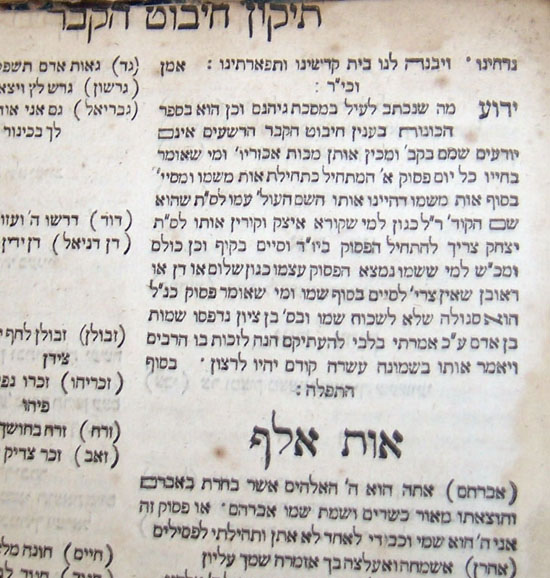
I was looking through the book to find the part that speaks about the Pesukim L’Shemot Anashim and found it at the very end. I was fascinated to see that immediately before the final section, Rabbi Epstein concludes his Sefer with a hope for the coming of Moshiach, and he refers to Moshiach as Nezer Rosheinu ( bottom line below).

I was curious about the words Nezer Rosheinu to describe Moshiach, and suspecting foul play, I did two things. Firstly, I wrote to Dr. Shnayer Leiman and asked him about the Kitzur Shelah and its use of the word Nezer Rosheinu. This is what Dr. Leiman answered (posted with permission).

“Briefly, Kitzur Shelah is a Sabbatian work. It is suffused with Sabbatian material, so one needn’t look for evidence just at the beginning and end. It was already identified as Sabbatian by R. Yehezkel Katznellenbogen in the first quarter of the 18th century. See also Krengil’s שם הגדולים השלם, vol. 2, p. 148, in הגהות עין חנוך, where the work is identified as Sabbatian.

נזר ראשינו (if that is the correct נוסח — one always need to check the first 3 editions; Amsterdam, 1707 is the 4th edition) is surely a reference to Sabbetai Zevi. The latter name in gematria totals 814, a sacred number for Sabbatians. נזר ראשינו adds up to 824. Either the author wrote נזר ראשנו which totals 814, and the printer misspelled it ראשינו; or, the total 824 stands for ה”ה שבתי צבי. Sabbatians regularly wrote ה”ה before his name. It is an abbreviation for המלך המשיח.

What really needs to be noted is that in a recent edition of קיצור של”ה (Ashdod, 1998), the offensive phrase has been censored and replaced.”

It appears then that Kitzur Shelah has Sabbatean allusions right from the Hakdamah ( which anyone can see for themselves by the use of Mashiach Ha’amiti, etc.) to the last lines which use the words Nezer Rosheinu. It is almost as if it is Koheles in reverse where “its beginning is words of Torah and its end is words of Torah” (Shabbat 30b).

I also did a search online putting in the words “Shabbetai Zvi” and “Nezer Rosheinu”. I got one pertinent hit and it brought up an entirely new issue. I found referenced an article from the Israeli publication HaMaayan published by Mossad Yitzchak Breuer in Tammuz of 5743 (1983).

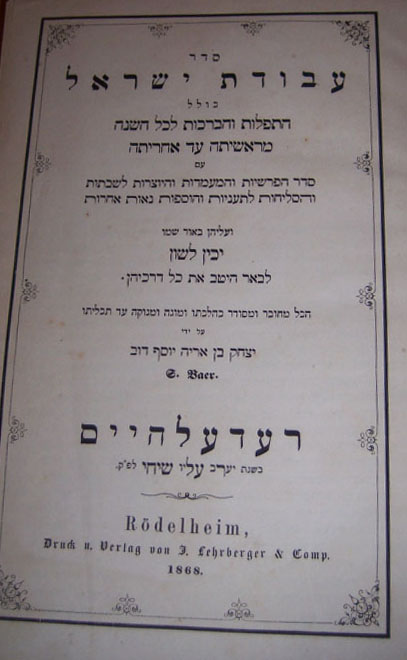
There we find an article by Rav Yosef Yehoshua Apfel (a Dayan in Leeds, and a noted Talmid of the Seridei Eish) on Yom Kippur Kattan, where he writes about the connection between Nezer Rosheinu and Shabbetai Tzvi. Rav Apfel references the famed Siddur Avodas Yisroel printed in 1868 by Dr. Yitzchak (Seligmann) Baer:

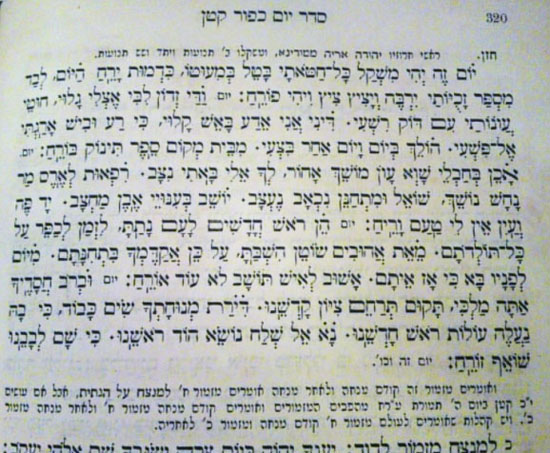
and specifically the Piyyut Yom Zeh Yehi Mishkal Kol Chatasai, included in the Yom Kippur Kattan service which appears there.

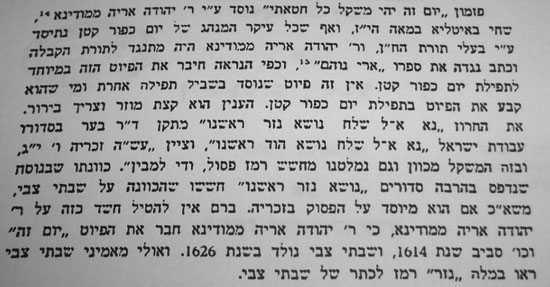
He writes as follows

Rav Apfel is at first puzzled a bit as to why Modena would write a Piyyut for a Kabbalistic service (“Ha’Inyan Hu K’tzas Muzar”). He then tells us that Dr. Baer changed the last line of the Piyyut by exchanging the phrase “נא א-ל שלח נושא נזר ראשנו” for “נא א-ל שלח נושא הוד ראשנו”. Dr. Baer explains his reasoning for this change: because he wanted to restore the proper meter, and because he wanted to save the Piyyut from having a “Remez Passul.” Rav Apfel understands this to mean a hint of Shabbetai Zvi. Dr. Baer did this even though, as Rav Apfel writes, Rabbi Yehuda Aryeh MiModena could not have been referring to Shabbetai Zvi, because the Piyyut was written around 1614, and Shabbtai Zvi was only born in 1626. Rav Apfel writes that the Nussach of “נא א-ל שלח נושא נזר ראשנו” appears in many Siddurim (בהרבה סדורים). I recently looked at many Siddurim at the Library of Congress and found this to be true, especially in ones published pre-1868.

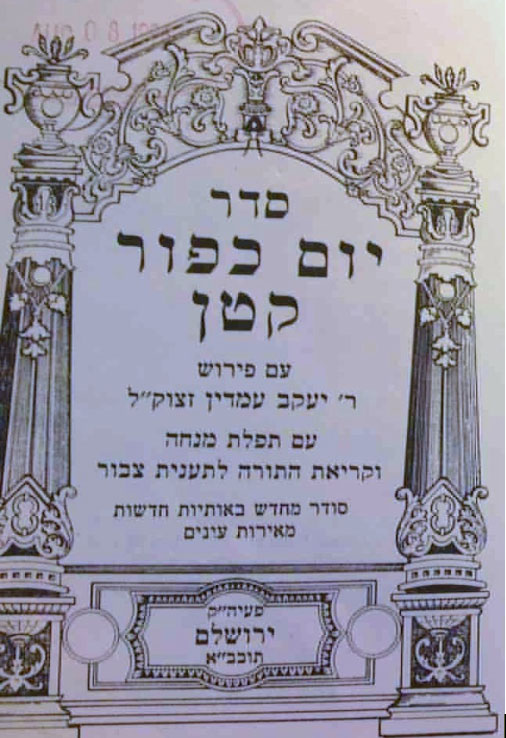
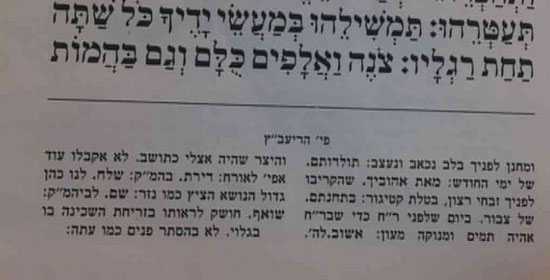
Rav Yakov Emden, who needed little prompting to find Sabbatean allusions, did not understand this phrase as referring to Moshiach, but rather to the Kohen Gadol. This booklet contains the Yom Kippur Katan service with the commentary of Rav Yakov Emden:

The Peirush of Rav Yaakov Emden on the words “נא א-ל שלח נושא נזר ראשנו” indicates as such. “שלח לנו כהן גדול הנושא הציץ כמו נזר”.

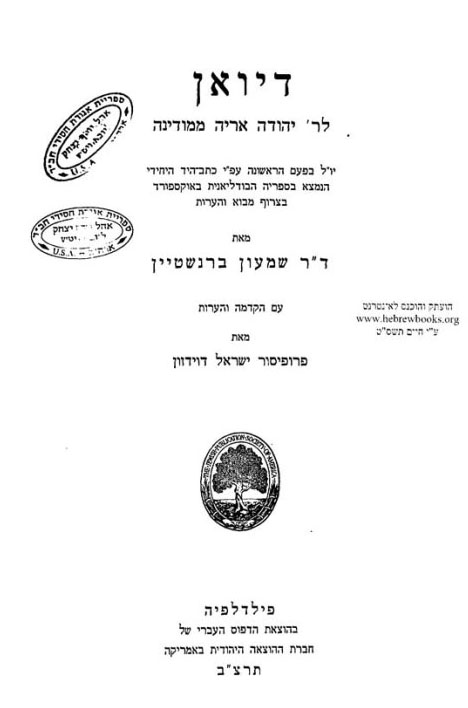
The phrase “נא א-ל שלח נושא נזר ראשנו” is also used in the following book which is generally based on Kisvei Yad of Modena found in the Bodleian Library, although this particular Piyut is not from a Ksav Yad. [5]

(דיואן – יהודה אריה ב”ר יצחק ממודינא, courtesy of Hebrewbooks.org)

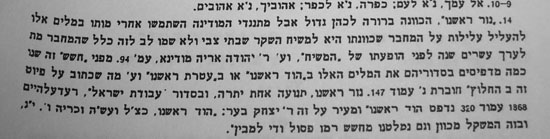
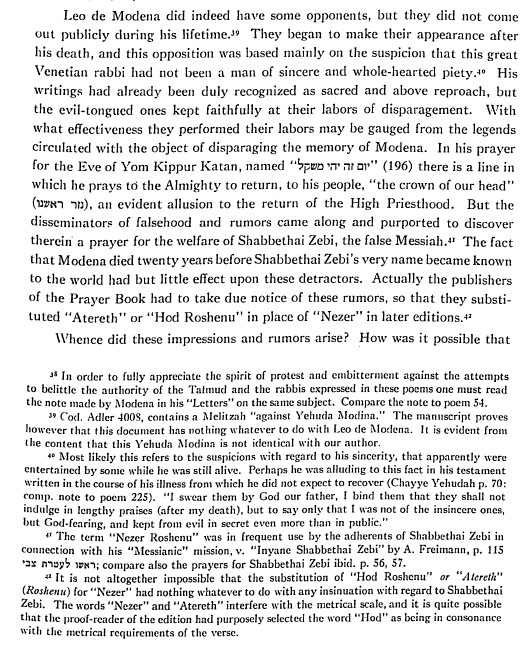
In this book, Professor Simon Bernstein takes on the change in phrase matter and writes[6]:

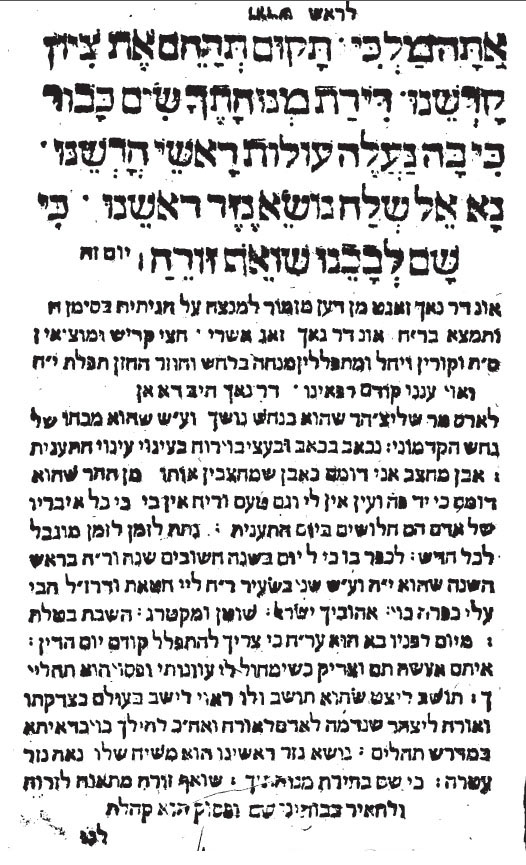
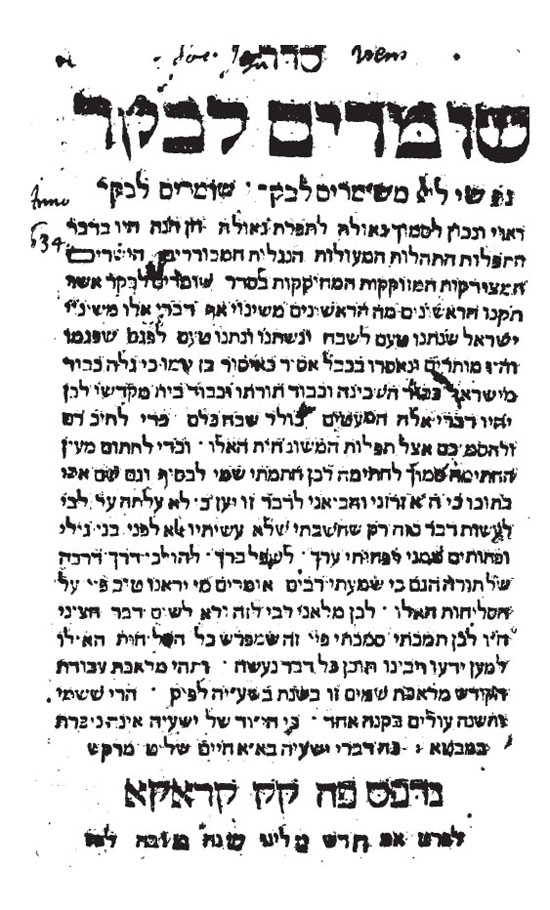
Probably the best proof as to what the original Nusach really was comes from a book named Seder Shomrim LaBoker printed in Cracow in 1626, only 12 years after the Piyyut was probably written.

As you can see, not only is the phrase Nosei Nezer Rosheinu used, the commentary actually explains that it refers to Moshiach and not to the Kohen Gadol (נושא נזר ראשינו הוא משיח שלו נאה נזר עטרה)!

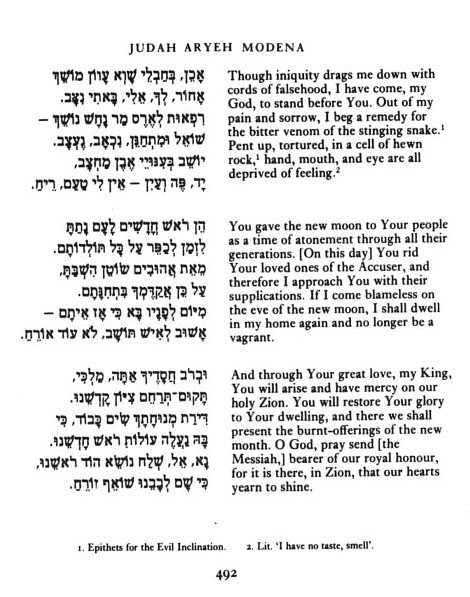
All the many Siddurim that I looked at in the post-1868 period also have the phrase which includes the words Nezer Rosheinu. The new ArtScroll Siddur printed in August of 2010 which includes for the first time the Yom Kippur Kattan service, has the Nussach of Nezer Rosheinu. It seems that in the end, that Nussach won out. The only one I could find who used Hod Rosheinu, following Dr. Baer, was T. Carmi in the Penguin Book of Hebrew Verse (1981):

I am not sure what Dr. Baer’s main reason for changing the Nussach from what seems was the normative one. Could it have mainly been the fixing of the meter and the Shabettai Zvi issue was brought along Agav Urchay?[7] He introduces his comment on his version of the text with the abbreviation כצ”ל . Does this mean that he had a written source for his version? In the introduction to his Siddur, Dr. Baer lists more than 25 post-1650 Siddurim that he consulted in the process of putting together his work. I am curious as to why he did not cite a source for this textual variation. As stated by Rav Apfel and Dr. Bernstein, it is clear that this phrase when written in 1614, did not originally refer to Shabbetai Zvi who didn’t “appear” until a few decades later. Was Dr. Baer reacting to a later development in history and changing the past to reflect the present? We have seen that quite often lately, and example of which was pointed out by Dr Shnayer Leiman above: “What really needs to be noted is that in a recent edition of קיצור של”ה (Ashdod, 1998), the offensive phrase has been censored and replaced”

[1] Encyclopedia Judaica, Keter Publishing House, Jerusalem, 1972. Article entitled “Epstein, Jehiel Michal Ben Abraham Ha-Levi” attributed to Dr. Yehoshua Horowitz
[2] Ibid.
[3] This matter is in contention and is based on the question of when the book was first printed. S. wrote me “When was the Kitzur first published? Like the Encylopedia Judaica, many sources state that the book was first published in 1683, Steinschneider contends that it was published in 1693. He claims that this is what the chronogram on the title page adds up to. Since this is a dispute about a yud, my guess is that he is correct. The first significant bibliographer before him, Julius Fuerst (Bibliotheca Judaica v. 1 pg. 246 under Eppstein) listed the year 1683. However, shortly afterward Steinschneider cataloged the Hebrew books in the Bodleian Library and there he writes that it’s 1693. He not only bases this on the chronogram, but also on the content of the haskamos. Following him is the next significant Jewish bibliographer, Isaac Benjacob, who in his Otzar Ha-seforim (pg. 535) agrees with Steinschneider. Whether or not Benjacob saw the book, I cannot say, but Steinschneider obviously did.

“What makes this interesting is that if this is true, then the Kizur Ha-shelah was actually published three years *after* the Sefer Ben Zion, (which lists actual Pesukim Lishmot Anashim) not seven years before. This would make the Ben Zion the first to list names and pesukim [that we know of so far].”

Be that as it may, here is an excerpt from the page on Names in my Kitzur Shelah (Amsterdam 1707):

[4] What I find fascinating is that the author of the Encyclopedia Judaica article cited above, completely ignores this point. He writes “It is very doubtful that he (Rav Epstein) had any associations with the Sabbatean movement, although he was suspected of it because of the wording of a certain passage in his Siddur”.
[5] Yom Zeh Yehi Mishkal, which is printed on page 199, is not from Modena’s Divan, which evidently didn’t include this pizmon. Rather, the poem was so famous that the editor evidently thought he simply had to include it. He copied it from a Siddur, the 1845 Prague edition of Seder Tefilat Yisrael edited by Wolfgang Wessely.
[6] In the Introduction to the Divan, Bernstein also writes:

[7] S.’s conclusion was that Dr. Baer’s primary concern was grammatical. There were at least two sources prior to him which alluded to a Sabbatean suspicion about Nezer Rosheinu in Yom Zeh Yehi Mishkal (and both of them reject it as absurd). If the concern was primarily about Sabbatianism, why then didn’t he change Nezer to Keter? The answer must be that this change would not fix the problematic meter, but Hod does. Thus under the cover of removing even a “Shemetz” of a doubt, despite it not even being a real issue, he makes the change which soothes his grammarian’s soul.


The sukkah on Shemini Atzeret controversy

The sukkah on Shemini Atzeret controversy
by William Gewirtz

Introduction: Arguments about eating in the sukkah on Shemini Atzeret outside of Israel have a long and somewhat baffling history.[1] While not the only example of practice in opposition to the Shulchan Aruch, it appears to be among the most argued. The gemara, Rambam, the Tur and the Shulchan Aruch, written in many locales, all seem to be as unambiguous as possible in requiring one to eat in the sukkah. The Gaon, incensed by the spreading Chassidic custom to eat outside the sukkah, perhaps lemigdar miltah, went so far as to mandate sleeping in the sukkah on the night of shemini atzeret, in opposition to the Maharil, the Magen Avraham and normative custom. Despite consensus among all major decisors to require eating in the sukkah, an undercurrent of opposition has existed from at least the times of the early rishonim. Support for that opposition has been based on a number of apparently legitimate points. However, despite some early and consistent opposition, despite the logic and halakhic rationale of those who did not sit in the sukkah, and despite the problematic nature of the gemara (as explained below), I hope to explain the basis for the concluding and declarative statement in the gemara: “we sit but do not make a berakha.” In fact, the assumption, explicitly found[2] as far back as the times of the rishonim, that the declarative ruling was interpolated at a later point, is fundamental to explain both sides of the controversy. Some, as early as the times of the rishonim, argue that we can discount such geonic interpolations in deference to the original text which, as will be demonstrated, concludes not to sit in the sukkah. My goal is to explain why the interpolation is to be followed despite its ostensible opposition to the remainder of the text. The major thesis proposed is that one has to differentiate between a period of doubt as existed in both the yerushalmi and bavli when rosh chodesh was declared based on the observation of witnesses and a later period when rosh chodesh was determined using a fixed calendar. The geonic interpolation into the text of the gemara occurred at that later point; its rationale and inconsistency with the texts of the gemara needs to be addressed from that perspective. If I am correct, then in the period when rosh chodesh was declared based on the observation of witnesses, as in the times of Rav Yochanon and Rav,[3] sitting in the sukkah was not always required. However, when the fixed calendar was in use, the rabbis (eventually) decreed that sitting in the sukkah on Shemini Atzeret was obligatory. It may well have been more akin to a gezairah required at their time versus a continuation of historic practice. The remainder of the paper focuses on:

  • An analysis of the primary texts of the gemarot that demonstrates opposition to sitting in the sukkah on Shemini Atzeret.
  • A conjecture that the level of doubt in the times of the gemara was minor.
  • Possible objections to sitting in the sukkah on Shimini Atzeret when not required and why they were perhaps considered overriding particularly given the level of doubt. Additionally, there are critical factors that differentiate Shemini Atzeret from other cases of yom tov sheni.
  • The interpolation by the geonim, and their insistence on sitting in the sukkah despite earlier halakhic rulings.
  • The objection to the gemara’s conclusion by some early authorities and their different practices.
  • Reasons that would exempt you from sukkah in general, would certainly exempt you on Shemini Atzeret; mitztayer and kabbalat penai rabbo are analyzed as bases for not sitting in the sukkah.
  • A summary and a modest proposal.

Section 1 – An analysis of the primary text of the gemarot demonstrates opposition to sitting in the sukkah on Shemini Atzeret. The sugya in the bavli masechet sukkah beginning on 46b contains three parts:[4] A. The disagreement of Rav Yochanon and Rav. R. Judah the son of R. Samuel b. Shilath citing Rav ruled: The eighth day which may be the seventh is regarded as the seventh in respect of the sukkah and as the eighth in respect of the benediction. R. Yochanon, however, ruled: It is regarded as the eighth in respect of both. B. Two approaches to interpreting the disagreement. FIRST APPROACH: That one must dwell [in the sukkah on the eighth day] is agreed by all, they only differ on the question of the benediction. According to him who regards the day as the seventh in respect of the sukkah, we also recite the benediction [of the sukkah], while according to him who holds that it is regarded as the eighth in respect of both, we do not recite the benediction [of the sukkah]. R. Joseph observed: Hold fast to the ruling of R. Yochanan, since R. Huna b. Bizna and all the notables of his age once entered a sukkah on the eighth day which may have been the seventh, and while they sat therein, they did not recite the benediction. But is it not possible that they were of the same opinion as he who laid down that once a man has recited the benediction on the first day, he has no more need to recite it? — There was a tradition that they had just come from the fields. SECOND APPROACH: (the ikka de’amri) There are some who say that the ruling that one must not recite the benediction [of the sukkah] is agreed upon by both, and that they only differ on the question whether one must sit [inthe sukkah]. According to him who ruled that it is regarded as the seventh day in respect of the sukkah, we must indeed sit in it thereon, while according to him who ruled that it is regarded as the eighth day in respect of both, we may not even sit in it thereon. R. Joseph observed: Hold fast to the ruling of R.Yochanan. For who is the authority of the statement? R. Judah the son of R. Samuel b. Shilath [of course], and he himself sat on the eighth day which might be the seventh outside the sukkah. C. A declarative ruling that “we sit but do not make a berakha.” And the law is that we must indeed sit in the sukkah but may not recite the benediction. A. The disagreement of Rav Yochanon and Rav: Rav states that Shemini Atzeret is treated as the seventh for “this” and the eighth for “that.” Rav Yochanon states it is the considered as the eighth for “this” and “that.” The two approaches differ as to what “this” and “that” refer.[5] B. Two approaches to interpreting the disagreement: The first alternative assumes that all agree that sitting in the sukkah is obligatory; the argument concerns whether to make a berakha. In this approach Rav is asserting that one makes a berakhaleishev ba’sukkah.” The phrase “the seventh for this” refers to this obligation for a berakha on sitting in the sukkah. “The eighth for that” refers to the fact that the other prayers of Shemini Atzeretkiddush and tefillah – mention only the eighth day and make no mention of Sukkot. Rav Yochanon asserts we make no reference to Sukkot, making no berakha when sitting in the sukkah on the eighth. It is the eight for “this” refers to sitting in the sukkah without a berakha; “the eighth for that” is interpreted identically to Rav. According to both opinions, “this” refers to whether or not a berakha is made when sitting in the sukkah on Shemini Atzeret. According to both opinions, “that” refers to the mention of only Shemini Atzeret in the prayers of the eighth day. This reading is rather forced in that there does not appear to be any disagreement about what holiday ought to be referred to in the various prayers and blessings of the eighth day. While the word “this” is informative, the word “that” is not. Stating both Sukkot and Shemini Atzeret in one prayer/blessing would be contradictory; declaring a day to be both Sukkot and Shemini Atzeret was never even raised as a possibility and for good reason. The first approach then quotes practice that supports the view of Rav Yochanon, suggesting that we are to follow the opinion of Rav Yochanon. The second approach assumes not making a berakha on sitting in the sukkah is undisputed; the argument is about even sitting in the sukkah. Thus the second part of the phrase – the eighth for “that” states that common view of both Rav and Rav Yochanon omitting a berakha on sitting in the sukkah. “This” refers to the obligation to sit in the sukkah. Rav maintains for “this” it is considered the seventh and hence one is obligated to sit in the sukkah. Rav Yochanon maintains it is the eighth for “this” as well with no obligation to sit in the sukkah. Note that in this approach of the ikaa de’amri, both parts of the sentence are informative. The second approach then also quotes practice that supports the view of Rav Yochanon, suggesting that we follow the opinion of Rav Yochanon Were the sugya to end at this point, the conclusion would be clear for two reasons. Each reason itself is two-fold, resulting from both a general principle as well as a detail present in this specific case.

  • First, generally, where there are two alternative approaches, the second, the ikaa de’amri, is assumed normative.[6] As well in this specific case, as indicated, the phrase of both Rav and Rav Yochanon is more informative in the formulation of the ikka de’amri.
  • Second, when there is a dispute between Rav and Rav Yochanon, we generally follow Rav Yochanon.[7]As well, in this specific case the text in both alternatives immediately includes an example of practice that follows the opinion of Rav Yochanon.

Taken together, we would assume to follow the second alternative and the opinion of Rav Yochanon – and not sit in the sukkah on Shemini Atzeret. According to many readings, this conclusion is made even more strongly by the yerushalmi.[8] While the bavli addresses the obligation to sit in the sukkah, the yerushalmi notes that one may not sit in the sukkah while making kiddush but one may enter the sukkah afterwards if he so desires. While some rishonim quote this yerushalmi as opposing the psak of the bavli,[9] others claim[10] that the yerushalmi is addressing a region of Israel where there was no doubt about what day the courts declared rosh chodesh. Rabbi Schacter, in support of the former opinion, observed that the yerushalmi uses the expression “leilai yom tov achron;” the plural, “leilai” is only relevant if there is a yom tov sheni on the ninth. Given this interpretation, the yerushalmi is making a rather strong point of equating the nights of the eighth and ninth, dismissing any possibility of an obligation to eat in the sukkah on the eighth.[11] C. A declarative ruling that “we sit but do not make a berakha:” Despite the reading of the gemara as outlined, the bavli concludes that “we sit but do not make a berakha.” This opinion is that of both Rav in the second alternative and Rav Yochanon in the first alternative. This ruling corresponds to two of four opinions quoted; the two alternative opinions – not sitting at all or sitting and making a berakha – are only supported by one amora and only according to one alternative. Despite that, this ruling is contradicted by the normal principles of psak where we would follow Rav Yochanon’s opinion in the second alternative, as well as the yerushalmi. The language of the gemarashemini safek shevii,” and in particular the various amoraim cited, place the gemara not in the period of calculation based on a fixed calendar, but still during a period where rosh chodesh was declared based on observation. During that period, yom tov sheni was observed because of real doubt and also, at some point, as a precaution even during those years where doubt did not exist. Given the establishment of a fixed calendar in 359 CE by Hillel II, it is not entirely clear in exactly what era yom tov sheni was firmly established and, more importantly, when it was extended to include sitting in the sukkah on Shemini Atzeret. It is entirely plausible, that this declarative ruling obligating sitting in the sukkah on Shemini Atzeret followed the period debated in the gemara by multiple centuries. This resolves the apparent contradiction in the text. Why this was not stated explicitly in the gemara is only problematic if one does not assume it was obvious. Section 2 – A conjecture that the level of doubt in the times of the gemara was minor. Returning now to the period of real doubt over which day was declared rosh chodesh, the question of why was sitting in the sukkah not considered mandatory? We will deal with a number of reasons that would argue against sitting in the sukkah in the next section. However, there are two factors that would reduce the level of doubt in the times of declaration based on observation.

  • First, atmospheric conditions in the Middle East around the beginning of Tishrai are normally excellent and the ability for a new moon crescent to be observed is very high.[12]
  • Second, the beit din had flexibility to reduce any doubt around Rosh HaShana. When necessary, the beit din could delay declarations of rosh chodesh Elul to guarantee that a moon’s crescent would always be present to be observed on the evening following the 29th of Elul.[13]

These two factors lowered the level of doubt considerably. In addition,

  • the late date in the month when Shemini Atzeret occurs and
  • the effort to determine Yom Kippur

would likely reduce the level of doubt even further. After fasting only on the 10th day of Tishrai as Yom Kippur, it is entirely possible that in spite of observing yom tov sheni on the first days of sukkot, the level of doubt was minimal and insufficient to overcome the objections covered in the next section.[14] Section 3 – Possible objections to sitting in the sukkah on Shemini Atzeret when not required and why they were overriding particularly given the level of doubt. Additionally, one can differentiate Shemini Atzeret from the more usual case of yom tov sheni on multiple grounds. There are two potential issues with sitting in the sukkah on Shemini Atzeret, tarti de’sasreh, acting in a contradictory manner[15] and violating the prohibition to add to a mitzvah, by adding an additional day of sukkah observance, particularly on Shemini Atzeret where sitting in a sukkah is not part of the observance.[16] In the case of sitting in the sukkah, a potentially neutral act, neither is violated if some aspect of performance is compromised; however, the degree of compromise required may be in dispute. Regardless of which of the two reasons[17] is invoked, in a case of limited doubt, one or the other or both may have been sufficient to make sitting in the sukkah on Shemini Atzeret either not obligatory or perhaps not even permitted without some restrictions. Both the yerushalmi and various opinions in the main text of the bavli, support this conclusion. At some point after a fixed calendar was established in the fourth century, a second day of yom tov was formalized (or maintained.)[18] As Rav Soloveitchik explained, an additional level of kedushat yom tov was applied to either an ordinary day (the day after a yom tov, isru chag) or the first day of chol hamoed because of sefaikah de’yoma. This additional level of kedusha, automatically invoked obligations for kiddush, tefillah, sippur yetziat mitzraim, etc. as well as prohibitions from work. Of course, such an approach could not be applied to Shemini Atzeret; it was already a holiday and one could not add to its kedusha, only change it. This was not done; note that we do not mention Sukkot nor do we observe the mitzvah of lulav. We simply sit in the sukkah without a berakha, something that is both different from a halakhic perspective from other observances of yom tov sheni that derive from the changed status of the day, and in Rav Soloveitchik’s opinion, less than satisfactory conceptually. He said, perhaps half-seriously, that despite his unwavering adherence to normative halakha, the position of the chassidim makes more sense. In any case, sitting in the sukkah is a unique observance with textual, historical and conceptual challenges. Section 4 – The interpolation by the geonim[19], and their insistence on sitting in the sukkah despite earlier halakhic rulings. I do not know the precise history of yom tov sheni. However, both reciting berakhot during yom tov sheni against normal halakhic practice,[20] as well as the assumed halakhic interpolation by the geonim requiring sitting in the sukkah on Shemini Atzeret may both have similar origin – the need to reinforce the observance of yom tov sheni. As Dr. Haym Soloveitchik points out,[21] the case of sukkah on Shemini Atzeret proves the wisdom of insisting on a berakha; the one mitzvah of yom tov sheni for which we do not recite a berakha, resulted in widespread non-observance. It seems more than likely that this interpolation was recognized as “outside the norm” if the practice during the period of doubt did not include sitting in the sukkah on Shemini Atzeret. Like berakhot, it may have been viewed as necessary particularly following a single day observance of Yom Kippur to strengthen the observance of yom tov sheni. One can only assume that the ruling’s discontinuity from the remainder of the text of the gemara was recognized and did not need elucidation; when first written, a then contemporary reader would recognize the change in practice. Section 5 – The objection to the gemara’s conclusion by some early authorities and their different practices. Given universal acceptance of the observance of yom tov sheni in the times of the rishonim, one would not have expected any deviation from the gemara’s definitive conclusion. Rabbi Schacter and Dr. Soloveitchik highlight a number of sources that illustrate the lack of universal acceptance of the gemara’s conclusion by Rashi’s rebbe and members of his family,[22] a distinguished member of the Maharil’s community,[23] and by a member of the Kolonymous family.[24] Citing the core sugya in the bavli and the yerushalmi, while certainly relevant does not in and of itself justify deviating from a clear conclusion even if it is of geonic origin. What is universally conjectured is that the cold climate of Northern Europe motivated a change. For the geonim omitting a berakha constituted enough of a heker to obviate either objection – either a tarti de’sasreh or violating a prohibition to add to a mitzvah by adding an additional day of sukkah observance. In a temperate climate, eating outside without a berakha renders sitting in the sukkah a more balanced act – clearly not a complete fulfillment of the obligation to sit in the sukkah, but, nonetheless, still honoring the institution of yom tov sheni shel galyot. However, in the cold climate of Northern Europe, even absent a berakha, either objection would, as it did in the times of real safek, make sitting in the sukkah (at least during kiddush) problematic. Note as well that the custom of returning to the sukkah during the day is consistent with this logic. During the day:

  • the temperature is milder,
  • there is no tarti de’sasreh from the recitation of kiddush, and
  • having been absent from the sukkah at night, as Rav Soloveitchik pointed out, creates a discontinuity of performance that renders sitting in the sukkah the following day a non-violation of adding to the mitzvah.

What is perhaps most surprising is that even after the period of the Tur and Shulchan Aruch, Rav Yosef Yuzpa, the dayan in Frankfurt am Mein around the end of the 16th and beginning of the 17th century, when Rav Isaiah Horowitz, the Shelah HaKadosh, was Rav, in his sefer Yosef Ometz was still able to state that a family, descendant of Troyes, who does not sit in the sukkah, “has on what to rely.”[25] Section 6 – Reasons that would exempt you from sukkah in general, would certainly exempt you on shemini atzeret; mitztayer and kabbalat penai rabbo are analyzed as bases for not sitting in the sukkah. Mitztayer would exempt one from sitting in the sukkah not just on Shemini Atzeret but also on Sukkot proper. However, mitztayer is likely not binary. At one extreme, by living unnaturally in the sukkah one may not even fulfill one’s obligation, regardless of intent, as would be the case in extreme cold or very rainy weather. If, however, it is somewhat uncomfortable given the elements, sitting in the sukkah may no longer be obligatory, while it would still remain a fulfillment of one’s obligation. It seems logical as well to differentiate further the notion of mitztayer as it might apply to Sukkot versus Shemini Atzeret. Perhaps a yet lesser degree of mitztayer, not sufficient to allow eating outside the sukkah on Sukkot, might nonetheless, be more than sufficient to override and invalidate the level of heker made by not reciting a berakha. I have not seen any discussion of this notion by poskim, despite its apparent logic.[26] By analogy, one might not be legally drunk, but nonetheless it would be wise not to drive a car. Similarly, one might argue for eating outside the sukkah on Shemini Atzeret in conditions that do not meet the halakhic definition of mitztayer on Sukkot proper. Thus, cold temperatures that might not justify eating outside the sukkah on Sukkot could nonetheless justify, and indeed perhaps mandate, not eating in the sukkah on Shemini Atzeret. Rav Soloveitchik, in an attempt to justify Chassidic practice, noted the importance of the night of Shemini Atzeret, following the “guten kvitel” that Kabbalists associated with the day of Hoshana Rabbah. Like the exemption accorded to the celebration of sheva berachot even on Sukkot, when the sukkah does not comfortably provide adequate room, one can argue that the large celebrations by Chassidim where they are mekabeil penai rabbom, would similarly provide an exemption. I would add that here as well, a lesser degree of need might again be seen as voiding any heker provided by just omitting a berakha. Of course, while this explains why a tisch was held outside the sukkah, it does not in any way justify a general practice of avoiding the sukkah that has become widespread in many Chassidic circles.[27] Section 7 – A summary and a modest proposal. The discussion in the gemara covered a period of history where there was real doubt about the declaration of rosh chodesh, although in the case of Shemini Atzeret, that doubt was minimal. In the face of minimal doubt, the reasons not to sit in the sukkah prevailed. The geonim, perhaps in order to strengthen the notion of yom tov sheini, instituted the practice that “we sit but do not make a berakha.” It is not my intent to give halakhic advice; some might suggest that perhaps we ought to not even ask a local rabbi as much as follow family practice. In any case, for those who eat in the sukkah, I would consider situations of partial mitztayer that might arise, where eating in the sukkah may not be appropriate. On the other hand, given widespread laxity, one might argue that the stringencies of the geonim and the Gaon might again be particularly relevant. Of course, most fundamentally for those whose ancestors ate outside the sukkah in Warsaw, conditions are rather different in Miami,[28] or even in Baltimore or Boston.

[1] Shiurim by Rav Joseph B. Soloveitchik ztl on the Bergen Torah Beis Medrash website, as well as by Rabbi Dr. Jacob Schacter on 10/02/2007 and by Rabbi Yosef Adler on 9/29/2009, both on the YU Torah website, provide important background. I benefited greatly from their analysis; elements of their perspective are reflected. Many of the sources referenced were assembled by Rabbi Schacter (including important sources cited by Dr. Haym Soloveitchik, whose seminal review essay is quoted extensively by Rabbi Schacter) in his comprehensive shiur on this subject. Most of the materials referenced below that are not available in standard editions of the gemara can be downloaded in the extensive maarei mekomot provided by Rabbi Schacter available on YU Torah in conjunction with his shiur.
[2] One might argue this was also known during the geonic period but assumed to be common knowledge.
[3] Certainly Rav Yochanon and Rav, the major disputants in the bavli as well as the text of the yerushalmi preceded the established use of a fixed calendar. We assume that the entire sugyah, quoting only Rav Yochanon and Rav and their students, was framed in the period prior to the determination of a fixed the calendar; the conclusions of the sugyah may have reflected practice that was followed for an even longer period.
[4] Translation below is from the Soncino Talmud.
[5] Analysis of the text of the gemara below, benefitted extensively from “Law and Custom in Hasidism” a translation by Shmuel Himelstein of Rabbi Dr. Aaron Wertheim’s original book, Ktav Publishing House, Hoboken, NJ. 1992, pages 279 – 286.
[6] See for example, Hasogot haRaavad, Taanit 11. Both the Rosh and Ran on Avodah Zarah 7a indicate that some geonim and rishonim always follow the second opinion. Others differentiate based on Torah, Rabbinic, monetary or religious law. For example, tosofot, s.v. Beshel Torah, in Avodah Zarah 7a, quotes Rashi in a case of an ikka de’amri as deciding according to the lenient view in cases of Rabbinic law. According to that view, given that sitting in the sukkah on Shemini Atzeret in times of Rav and Rav Yochanon may be a real safek with respect to Torah law, one might follow the stricter view, the first opinion. In the times of fixed calendar, however, presumably sitting in the sukkah on Shemini Atzeret is only Rabbinic, and we might also follow the second, more lenient view.
[7] Rif Baba Metziah, Chapter 4, 29a, in the dafei haRif.
[8] Sukkah Perek 4, halakha 5, 17b.
[9] Sefer HaPardes.
[10] Minhagim of Rabbeinu Yitzkhak MiDura.
[11] An uncontested view of the yerushalmi, versus contested views in the bavli, adds additional credence to a preference for the opinion of Rav Yochanon according to the second alternative – not to sit in the sukkah on Shemini Atzeret.
[12] Note that the gemara in Beitzah 4b-5a records a singular event where witnesses were delayed in coming on the 30th of Elul to declare that day as the 1st of Tishrai. In early times they [the Sanhedrin] admitted the testimony about new moon throughout the [whole] day. Once, however, the witnesses were late in arriving and the Levites erred in the chant. Given how rare it is for the moon to be obscured by clouds throughout the night in the environs of Jerusalem, normally, one could expect witnesses to arrive earlier in the day. The Hebrew of the text of the gemara – “pa’am achat” appears to denote a rare event.
[13] Perhaps in our fixed calendar Elul always has 29 days in commemoration of prior practice.
[14] Ritva, in complete opposition to this approach, assumed that prior to a fixed calendar, one would likely be dealing with standard case of doubt with respect to a biblical commandment and sitting in the sukkah would clearly be mandatory.
[15] The Ran, in his commentary on the Rif, adds the element of zilzul of Shemini Atzeret by acting in a manner that would equate a holy day to a day of chol hamoed. Zilzul adds an additional dimension; the activity is not just conflicting, a tarti de’sasre, but demeaning of Shemini Atzeret as well. Perhaps, unlike other cases of a tarti de’sasre, absent an element of zilzul, a day might legitimately have a dual character. Furthermore, my nephew, Joshua Blumenkopf, noted that tarti d’sasri is not an independent principle; it merely means that you cannot use two contradictory kulot at the same time, something not present in this case.
[16] Were it not Shemini Atzeret it would be no different than eating matzah on the eighth day of Pesach because of sefaikah de’yoma.
[17] A reason to justify sitting outside the sukkah on Shemini Atzeret, cited by Rabbi Werthheim, based on the Midrash Tanchuma, parshat Pinkhas, that one has to pray sincerely for rain, would appear to be more a rationalization than a halakhic factor.
[18] The history and details of this complex and controversial topic are not addressed. One could assume that detailed halakhot varied across the various possible periods of history including: the original period of uncertainty when rosh chodesh was declared based on observation, a later period where rabbinic rulings mandated yom tov sheni even prior to the period of the fixed calendar, the initial period of a fixed calendar and various later periods in the fixed calendar. Aligning various sugyot to those periods could shed additional light on this topic. For example, consider the gemara in Beitzah 4b. Is the gemara referring to a period when the fixed calendar was already established or is referring to an earlier period where knowledge of sod haibur was used to reduce doubt? The latter seems to be more consistent with language that refers to knowledge of as opposed to use of the sod haibur.
[19] The interpolation is often ascribed to Rav Yehudai Gaon.
[20] Not reciting berakhot on a minhag.
[21] Haym Soloveitchik, “Olam Ke-Minhago Noheg: Review Essay,” AJS Review 23:2 (1998): 223-234.
[22] Sefer HaPardes.
[23] Maharil – Minhagim, Hilkhot lulav – 6.
[24] Yekhusai Tannaim ve Amoraim, (ed. Y. L. Maimon), pages 329-330, cited by Dr. Soloveitchik, makes (a less complete version of) the textual arguments outlined in Section 1.
[25] Yosef Ometz – 1058.
[26] The Aruch HaShulchan attempts to justify various customs for only partially observance of sitting in the sukkah as creating a yet greater heker given cold temperatures.
[27] In addition to attribution of the trend to sit outside the sukkah on Shemini Atzeret to the Chassidic celebrations of the evening following Hoshana Rabbah, see as well Rabbi Dr. Aaron Wertheim’s “Law and Custom in Hasidism,” pages 279 – 286 for attribution to other kabbalistic sources.
[28] Miami is closer to the equator than cities in the Middle East.


Shaul Magid – ‘Uman, Uman Rosh ha-Shana’: R. Nahman’s Grave as Erez Yisrael

“‘Uman, Uman Rosh ha-Shana’: R. Nahman’s Grave as Erez Yisrael” Shaul Magid Indiana University/Bloomington Professor Shaul Magid is the Jay and Jeannie Schottenstein Chair of Jewish Studies at Indiana University. This text below was originally a talk delivered in Winnipeg, Canada, in commemoration of the 200th yahrzeit of R. Nahman of Bratslav. A revised and expanded version will hopefully be included in Interpreting Hasidism: Essays in Hasidic Textuality from The Baal Shem Tov to the Present. Special thanks to the editors (and readers) of the Seforim blog for their gracious consideration of this essay. His published volumes include Hasidism on the Margin: Reconciliation, Antinomianism, and Messianism in Izbica/Radzin Hasidism (Madison: University of Wisconsin Press, 2003), From Metaphysics to Midrash: Myth, History, and the Interpretation of Scripture in Lurianic Kabbala (Bloomington: Indiana University Press, 2008), and a volume tentatively entitled Interpreting Hasidism: Essays in Hasidic Textuality from The Baal Shem Tov to the Present.

There is a Talmudic adage that teaches: “evil-doers are dead even when they are alive; righteous individuals are alive even when they are dead.” Setting aside the obvious metaphoric intent of this comment, in the case of Rabbi Nahman of Bratslav who left this world on the intermediate days of Sukkot 200 years ago, this teaching has a more literal flavor. Nahman was one the few zaddikim who meticulously planned his death – suffering for years with tuberculosis – advising his disciples how to behave after his passing and urging them that if they visit his grave he will “pull them up from the netherworld by their sidelocks.” Almost immediately after his untimely death at the age of 39 and burial in Uman in the Ukraine, his gravesite became a place of pilgrimage for Bratslaver Hasidim, often under harsh weather conditions, vehement and often violent harassment by other Hasidic sects, and later harsher political realities. There were times when there was barely a minyan at his gravesite on Rosh ha-Shana, the most auspicious days of pilgrimage. Today there are close to 20,000 souls, religious, secular, men, women and children who flock to Uman on Rosh ha-Shana to pray at the grave of this enigmatic Hasidic master. The Ukrainian government recently refurbished an old military airstrip in Uman to accommodate the jumbo jets that arrive from Israel, Europe, and the US, and the city magistrate built hotels to accommodate pilgrims just for this two-day festival. Tonight I want to explore this seemingly odd phenomenon of Nahman’s grave, paying close attention to the strange but not unprecedented notion that this gravesite is considered, for Bratslaver Hasidim, not only a holy place but “Erez Yisrael.” Grave veneration and its significance in the larger schema of devotional life is shared by many religious traditions including Judaism. The Torah, beginning with the descriptions and the importance of the gravesites of the biblical characters in Genesis, culminating with the ambivalence about knowing the site of Moses’ grave at the end of Deuteronomy, emphasizes the sanctity of the grave as sacred space. The importance of the gravesite was not adopted by post-biblical Judaism as merely a theoretical notion but had practical implications as well. Rabbinic tradition understood the graveyard as a place of meeting between the living and the dead, thus serving as a place imbued with a highly charged spiritual energy where penitential prayers could more easily be efficacious. The rabbis believed both in the sacredness of the place (i.e., the graveyard) coupled with the more general notion (not limited to the space of the graveyard) that the righteous in heaven could serve as intermediaries and petition the celestial court for mercy. Maimonides codifies as law that if one wishes to ask forgiveness before Yom Kippur from someone who has died he or she should visit their grave and ask forgiveness there. The medieval kabbalistic tradition, from the Zohar through Lurianic Kabbalah in the sixteenth century, developed this rabbinic notion of the graveyard as a highly charged spiritual place to a holy site for pilgrimage, whereby the journey to the grave of the righteous was viewed as a holy ascent (e.g. Zohar). The graves of the righteous became the place where one could actually absorb the spiritual energy of the departed Zaddik by means of prostrating oneself on the grave. The Lurianic contribution to the development of this idea suggests that the grave of the righteous is a place of transparency between this world and the next whereby the living are transformed and purified by embodying the souls of the dead through bodily prostration on the grave. The earlier rabbinic and zoharic notion that the grave is the place where the dead interact with the living and prayers are more readily heard via the mediation of the parted one becomes, for Luria, something far more profound. The grave becomes the place where the worshipper is purified through contact with the dead/living Zaddik and transformed by embodying the soul of the Zaddik which hovers above the grave itself, freed from its corporeality of the physical body. This phenomenon of “soul hovering” is limited to the righteous ones who, having achieved otherworldliness in this life, are able to maintain a connection to this world after death. (This may be his reading of the talmudic passage cited above that the righteous are alive even after death.) The transparency model of the grave initially suggested by the rabbis becomes, for Luria, the place where the dead, as it were, embody the living and thus purify the living soul from sin and impurity. The pilgrimage model of the Zohar coupled with the transformative model in Luria serve as the foundation for R. Nahman of Bratslav’s theory of his grave as the transparent creative center, the place which holds the power of creation and the place from which redemption will ensue. Although grave veneration had already taken on a devotional component in the Zohar and more prominently in Luria’s re-construction of Judaism, the Bratslav tradition is unique in that its entire Hasidic ideology is centered around the grave of their venerated master Nahman of Bratslav. Although this idea only bears fruit in post-Nahman Bratslav literature, beginning with the first Rosh Ha-Shana after his death, it’s importance begins years before, soon after Nahman’s return from his journey to Erez Yisrael in 1798-99. It was only then that he began to speak simultaneously about his impending death and the importance of visiting his grave, all within the larger schema of the transformative experience of his journey to the Holy Land. His death, place of burial and the unique character of his grave become increasingly prominent in his teachings as his tuberculosis worsened and his death drew near. One familiar with zoharic literature will immediately notice that Nahman’s pre-occupation with the importance of his own death reflects the discourse of the Idrot, the opaque yet highly influential sections of the Zohar which focus on R. Shimon bar Yohai’s death at the hands of the Romans. It is somewhat surprising that post-Nahman Bratslav literature never makes mention of this highly charged and seemingly obvious connection. Perhaps it is due in part to the Bratslav position, inspired by Nahman himself, that he is an unprecedented figure in Jewish history, one who owes allegiance to no one. This is exhibited by the almost complete absence of any reference in his collected teachings, Likkutei MoHaRan, to any other Hasidic master, including his great-grandfather, the Baal Shem Tov. In any event, the connection between Nahman’s pre-occupation with his death and the discourse of the death of R. Shimon bar Yohai in the Zohar should not be underestimated precisely because the messianic impulse of the Zohar (Idrot), a phenomenon already documented by Yehudah Liebes, is alive in Nahman’s discussion as well. It is therefore curious that Liebes who does draw our attention to the messianic underpinnings of Nahman’s Tikkun Ha-Kelali (the Ten Psalms Nahman directed his students to recite daily as a tikun for sin) and its connection to Sabbateanism, never develops the extent to which the recitation of the prescribed Psalms which comprise Tikkun Ha-Kelali are meant to be recited at Nahman’s grave as part of the ritual of purification in conjunction with visiting his burial place (known as his “zion”). In my view this is of utmost importance in the Bratslav tradition precisely because Nahman’s grave represents a manifestation of the Holy Land, a place even more transparent than the land itself, which is quite peculiar and serves as a the basis of his messianic vision. My claim here is that Nahman’s grave as the centerpiece of the Bratslaver’s devotion life and Erez Yisrael as the center of Nahman’s spiritual life are inextricably intertwined. Although the correlation between his trip to Erez Yisrael in his development as a Zaddik has received close scholarly attention – a more nuanced understanding of Nahman’s relationship to Erez Yisrael, his vocation as an unprecedented Zaddik coupled with his messianic strivings, cannot be achieved without understanding the significance of his grave in his own mind as well as in the larger trajectory of Bratslav Hasidism. In fact, it is my belief that the significance of his grave as Erez Yisrael serves as the cornerstone of his entire ideational edifice and contribution to Jewish thought. As I mentioned above, earlier kabbalistic sources (rooted in more opaque rabbinic comments on the matter) present the grave as the transparent space between this world and the next, the place where one can embody the soul of the dead precisely because the soul is no longer confined by the physicality of the body. Nahman universalizes this idea by suggesting that the grave of the Zaddik as a transparent place also holds the potential to draw unmitigated mercy into the world, thus bridging the distance between exile and redemption. This is based on his utilization of the kabbalistic mapping of the emanation of divine effluence into the world as it relates to the death of a righteousness individual. His assumption is that death is the liberation from the confines of the Intellect or worldliness, and entry into the realm of Pure Spirit. Yet the deaths of all individuals are not identical. It is only the Zaddik who can draw this realm of Pure Spirit into the world, because the Zaddik, by means of what he has achieved in this world, easily traverses between this world and the next, even during his life. The transparency of the gravesite of the Zaddik is already forged by the devotion of the Zaddik during his life. Although others may benefit from the glory of the next world, their knowledge of and communication with this world ceases once they pass through the opaque and final barrier of death. But Nahman maintained that life and death for the Zaddik are not mutually exclusive categories. This attitude is exhibited in Nahman’s sarcastic remarks about the simpletons who he witnessed visiting the graves of their ancestors in Uman, crying and begging for mercy as if their ancestors could hear them. Only the Zaddik can hear prayer from the world beyond, Nahman comments, because the Zaddik has achieved the next world while still alive in this world. Hence, he describes his journey from life to death as “going from one room to the next.” This transparent space which is embodied in the grave of the Zaddik is also the creation point, the place where the finite and the infinite meet. (Likkutei MoHaRan 48). He develops this midrashic idea by taking the infinite-finite modality of creation and presenting it within the framework of creation and redemption. The sacredness of space, which is determined by its transparency, is simultaneously the place of creation and redemption because it is the place where Wisdom (Hokhma) is overcome by the higher dimension of Spirit (Keter), a movement whereby the finite is overcome by the infinite. This movement is only achieved and maintained by the true Zaddik (only Nahman!) who embodies this pure spirit during his lifetime. Nahman claimed to have achieved this state of purity as the result of his trip to Erez Yisrael in 1798. Thus, upon his return from Erez Yisrael he describes his experience as one of achieving “expanded consciousness’ (mohin d’gadlut), which is defined sometimes as “utter simplicity” (p’shitut) and complete loss (read: overcoming) of knowledge. This dimension of “not-knowing” always holds a higher and more refined status than “knowing” in Nahman’s highly anti-rationalist orientation. This new level of consciousness achieved during his brief but cathartic encounter with the Holy Land resulted in his utter abandonment of anything he had taught prior to his trip, which he determined was the product of Hokhma, or knowledge, as opposed to Keter, or Pure Spirit. Most of his teachings collected in Likkutei MoHaRan were delivered in the decade after his return from Erez Yisrael in 1799 until his death in 1810 (he remarked to his disciple R. Nathan that all his teaching from before his journey to the Holy land are null and void). The elevation of the Intellect to Spirit, which is nothing less than the overcoming of humanness and exile, was thus achieved by Nahman, in his own estimation, during the last decade of his life. This transformative experience is not attained merely by his presence in the Land, although the physical Land does play a central role. (e.g. Shivhei Ha-Ran where he stresses the literalness what he means by the Holy Land, “the houses” etc.). Such an achievement is the result, rather, of absorbing the Land (not merely encountering it), of becoming a human embodiment of Erez Yisrael thus enabling him to transport its sanctity beyond its physical boarders. This transference of sanctity from the Land to an individual is only true of the Zaddik who, as a pure vessel, can receive, be transformed and integrate that sanctity into his life. Much has been made of Nahman’s distinction between the physical Land of Israel and the “aspect” (behina) of Erez Yisrael, a spiritualized idea which may be related to but not identical with the Land itself. Discussions by Martin Buber and Eliezer Schweid about Nahman as a proto-Zionist rest on these slippery distinctions in his writings. I would suggest that these two formulations in Nahman’s writings are hinged together by means of the Zaddik in general and the Zaddik’s grave in particular. That is, the aspect of Erez Yisrael (behinat Erez Yisrael) arises when the Zaddik visits the physical Land, absorbs it, and transports its spiritual essence outside its borders. His teaching becomes the transmission of Keter (Spirit) rather than Hokhma (Knowledge), the result of his embodiment of Pure Spirit drawn from the Holy Land thus overcoming the more human and exilic dimension of Hokhma. However, this “new” Torah (his teachings after he returns from Erez Yisrael), which for Nahman is the true Torat Erez Yisrael – an idea originating in rabbinic literature but completely transformed in Nahman’s imagination, uprooted from any territorial limitations – is a necessary but not sufficient condition to complete the (redemptive) process from Erez Yisrael to behinat Erez Yisrael. His torah only prepares his listeners for what is to come. The completion of this transformative messianic process occurs via the death and burial of the unique Zaddik in the earth of Huz l’Aretz and the encounter of his disciples with the grave whereby they too absorb elements of this sanctity. His death and burial sanctifies the land outside of Erez Yisrael, widening the boarders of sanctity from the sacred place of Erez Yisrael to the new transparent place, which is the grave of the Zaddik. The spiritualization of the land (behinat Erez Yisrael) carries messianic implications which lie at the heart of Nahman’s discussion about his grave, accompanied by the liturgical formula of the Ten Psalms (Tikkun Ha-Kelali) which were initially given to be recited at his gravesite. (Liebes) There is an important distinction implicit in Nahman’s teaching between the Land itself and the aspect of the Land (behinat Erez Yisrael) which arises via the Zaddik’s interaction with it. When the true Zaddik visits Erez Yisrael, absorbs it and gives rise to the spiritualized aspect of Erez Yisrael (behinat Erez Yisrael) activating a spatial transparency, which the Land itself cannot produce without the aid of the Zaddik’s visit. In some sense, his visit to Erez Yisrael and his subsequent return to Huz l’Aretz (a component of great significance which we will see below) transforms not only the Diaspora, via his grave, but transforms the Land itself by released the spiritualized energy contained within it. The Land itself is thus brought to life, as it were, by the Zaddik’s visit, and it is the Zaddik who takes the sanctity of the Land beyond its borders. The notion that in the messianic era the entire world will become Erez Yisrael has precedent in medieval kabbalistic literature (e.g. Avraham bar Hiyya’s Megilat ha-Megaleh). Another important component in his journey to Erez Yisrael and subsequent return to the Ukraine is his acquisition of “Torat Erez Yisrael” which serves as the arc between his visit to the Land and his subsequent death and burial. In various places Nahman is said to have made the provocative statement that he had achieved Torat Avot, (lit. the Torah of the Patriarchs) a curious term which he never explains. Various accounts reflecting his new achievement resulting from his trip, one of which takes place on a Turkish warship just before Passover on which he and a disciple were traveling from Acre to Turkey. Being erev Pesah, Nahman was unsure whether they would reach port in time for the holiday and thus unsure whether they would be able to fulfill the mitzvah of eating matza. Nahman asserted that he was now (in the wake of his trip to Erez Yisrael), if necessary, able to fulfill mitzvot in a purely spiritual manner, that is, without physically performing the mitzvah itself. Although we are told they did arrive in time for the festival, this assertion may illuminate his opaque statements about achieving Torat Avot. Commenting on the talmudic claim that the Patriarch’s fulfilled the entire Torah, even erev tavshilin, a rabbinic decree utilizing a legalistic loophole permitting one to cook on Yom Tov for the upcoming Shabbat, many Hasidic texts speak of the a spiritualized Torah before Sinai whereby the biblical characters in Genesis (specifically Abraham) were able to fulfill the entire Torah because they were evolved enough to intuit divine will without the commandments. It is my feeling that this was the ideational foundation of Nahman’s statement on the Turkish warship mentioned above. His assertion about Torat Avot is a formulation of his more developed notion of Torat Erez Yisrael. He held that his becoming Erez Yisrael via his journey resulted in the acquisition of Torat Erez Yisrael which is the pre-Sinaitic Pure Spirit of Torat Avot, an embodiment of the sephirah Keter. The fact that (1) the Patriarchs largely dwelled in Erez Yisrael, (2) revelation was in Huz l’Arez, resulting in the suggestive dichotomy between Sinai and Zion, and (3) Moshe, the arbiter of Torah, never entered the Land of Israel, all play an important role in Nahman’s imaginative thinking. Torat Moshe or revelation as the Torah of Hokhma verses Torat Elohim, or Torat Erez Yisrael, which is the Torah of Spirit, is an idea implicit in R. Nahman’s discourse developed in a different manner by his great grandfather the Baal Shem Tov and later in Polish Hasidism, which was significantly influenced by Nahman’s Likkutei MoHaRan. His suggestion that his encounter with Erez Yisrael unlocked the spiritualized Torat Avot, which itself may be yet another layer of his more ambiguous behinat Erez Yisrael, is an idea which had far reaching influence. We find similar ideas in Zionist thinkers such as Abraham Isaac Ha-Kohen Kook and Aaron David Gordon, both of whom were influenced by the teachings of Nahman. Yet I maintain that these readers of Nahman mis-read his idea of Erez Yisrael precisely because they are not cognizant of the fact that this “new” component of sanctity whereby the Zaddik becomes the Land, necessitates returning to Huz l’Aretz to complete the messianic process. Hence his journey home, his subsequent teaching and his death and burial all congeal to push the impending messianic era toward fruition. Nahman’s view of himself as the true Zaddik, one who has no authoritative spiritual lineage precisely because he is sui generis, lies at the foundation of his thought. This claim was not only true of how he viewed himself vis-à-vis his contemporaries but more importantly his position as a figure in widest span of Jewish history. His uniqueness becomes manifest through his unprecedented journey to the Holy Land, a trip which he held introduced a new dimension into the exilic world. What I am about to suggest has no source in Bratslav literature and thus may be construed as speculative or, at best, midrashic in nature. However, it illuminates the extent to which his grave became the centerpiece of his entire life, the culmination of his journey, and the prism through which his messianic vocation must be seen. Nahman makes various comments throughout his writings about what he determined as his spiritual lineage, beginning with Moses, R. Shimon bar Yohai, R. Isaac Luria ending with his grandfather, the Baal Shem Tov. Yet Nahman maintains in subtle and not-so-subtle ways that he transcends them all, including Moses. Moses’ grave is unknown and will remain so. R. Shimon bar Yohai and Luria’s graves are both in Erez Yisrael. The grave of the Baal Shem Tov is in Hutz l’Aretz and, as opposed to Moses’ grave, became a shrine which Nahman visited many times in his youth. Although the graves of these masters were held in high esteem by Jewish pilgrims, according to the Bratslav tradition, none contained the sanctity and redemptive quality of Nahman’s grave in Uman. The reason for this, I believe, lies in Nahman’s journey to Erez Yisrael, the completion of which was his return and subsequent death in Huz l’Aretz. Moshe is born and dies in Huz l’Aretz, never entering the Land. R. Shimon bar Yohai resides in Erez Yisrael his entire life and is buried there. Luria is born in Erez Yisrael, spends most of his life in Egypt and returns to Erez Yisrael where he dies and is buried in 1570. The Baal Shem Tov is born in Hutz l’Aretz and attempts unsuccessfully to reach Erez Yisrael, dying in Mezybuzh. Of the four, only R. Nahman is raised in Hutz l’Aretz, reaches Erez Yisrael and successfully returns to Hutz l’Atretz to spread Torat Erez Yisrael and is subsequently buried in Uman. This cycle of immigration and emigration (aliya and yerida) is the focal point of Nahman’s life and, in my mind, is the foundation of his messianism. His journey is reminiscent of Rabbi Akiba’s to Pardes, to experience the sanctity of God’s glory and emerge unscathed. In Nahman’s mind, however, his return carries far greater weight. Whereas we are not told of any significant change in R. Akiba’s torah after his ascent into Pardes, Nahman’s journey resulted in the acquisition of Torat Erez Yisrael, an apprehension of the pre-Sinaitic Torat Avot, the rise of the spiritualized nature of Erez Yisrael s behinat Erez Yisrael and began the widening of the boarders of Erez Yisrael in the sanctification of his burial place in Uman. In the Bratslav tradition, conventional notions of grave veneration have been transformed, making the grave the transparent place where new light brightens the world, new Torah descends from behind the curtain of Sinai and the Zaddik as axis mundi absorbs and transforms the sanctity of the Land. In sum, I would suggest that the Bratslav pilgrimage tradition has at least three components that are unique to the phenomena of religious pilgrimage in general. First, the devotee’s pilgrimage to Nahman’s grave is predicated on Nahman’s own pilgrimage to Erez Yisrael. That is, one could ask, given Nahman’s insinuation that his trip gave rise to the importance of visiting his grave, why isn’t a trip to Erez Yisrael proper preferred to a pilgrimage to his grave. A preliminary answer may be that Nahman held that one who is not a Zaddik cannot achieve in Erez Yisrael what he achieved. A true journey to Erez Yisrael, one which could in some sense replicate Nahman’s journey, can only be accomplished by visiting the Erez Yisrael of his grave, the source of behinat Erez Yisrael. In fact, Nahman was adamant about not being buried in Erez Yisrael, fearing that his disciples wouldn’t visit his grave and thus the efficacy of his journey and return would be for naught. For him, the pilgrimage to his grave in Hutz L’Aretz is more important than the pilgrimage to the Land itself. His journey to the Land, resulting in his absorption and embodiment of Erez Yisrael, had at least two consequences that make his grave more prominent than the Land itself. First, it widened the boundaries of the Holy Land, a redemptive sign born out of previous kabbalistic literature that the messianic age will result in widening the boundaries of Erez Yisrael. Second, it activated the source of the sanctity of Erez Yisrael, behinat Erez Yisrael, a spiritualization of the Land which enabled the Land itself to fulfill its holy destiny. Finally, his grave became a representation of his messianic vocation. As both Art Green and Yehudah Liebes have noted, Nahman’s messianic vision was not centered on being the Messiah but, closer to the model of R. Shimon bar Yohai in the Zohar (Idrot), as forging the path toward revealing the Messiah. Just as the Zohar was viewed as the doctrine that unlocked the esoteric nature of Torah, Nahman’s grave was envisioned by him and then his disciples as unlocking the esoteric power of Erez Yisrael. Finally, his journey and subsequent teaching enabled the Land to speak, as it were, as his teachings reflected the true Torat Erez Yisrael, the Torah rooted in the Pure Spirit of Keter which is revives the pre-Sinai Torah of the Patriarchs. It may seem odd today that thousands of Bratslaver Hasidim leave their families behind and travel from Israel to the small city of Uman in the Ukraine to celebrate Rosh Ha-Shana. One would think Israel and not the Diaspora should be the spiritual destination of Jews during this time of year. But when asked about his impending trip from Israel to Uman for Rosh ha-Shana, the Jerusalemite Bratslav manhig Schmuel Shapiro obliquely responded, “From Erez Yisrael to Erez Yisrael.” I have tried here to shed some light on those five words.


Some Rosh ha-Shana Readings

For those interested in posts relating to Rosh ha-Shana, aside from the most recent post regarding gifting knives, we discuss some of the history and personalities relating to the controversy of blowing the shofar when Rosh ha-Shana falls on Saturday here and see this recent article as well. This post (in Hebrew) discusses the custom of refraining from meat on Rosh ha-Shana. The bulk of the commonly recited piyutim on Rosh ha-Shana are attributed to R. Eliezer ha-Kallir who is discussed here. And, finally, in this post, Dr. Shapiro discusses Adon Olam, the poem that many have the custom to say on Rosh ha-Shana (even if they refrain the rest of the year).


Dorshei Yichudcha: A Portrait of Professor Elliot R. Wolfson

Dorshei Yichudcha:
A Portrait of Professor Elliot R.
Wolfson[1]
by Joey Rosenfeld
Joey Rosenfeld is a
psychotherapist in St. Louis where he recently moved with his family. He
recently published his first sefer, sc’hok
d’yitzchak
on the Kabbalistic theme butzina d’kardinusa, or darkened light.
More of his writing can be found online at Residual Speech.
לאו כל
מוחא סביל דא[2]
Tasked with the formidable project of recounting Franz Rosenzweig’s life, Emmanuel Levinas apologized in advance
for speaking, as well, about Rosenzweig’s opus, The Star of Redemption. The reason for this, Levinas wrote, was not due to lack of distinction, rather it would be nearly impossible to separate the man from his work.[3] This sentiment can be applied equally to Elliot R. Wolfson and his vast oeuvre. Professor Wolfson’s breathtaking breadth of scholarship – starting from his Through a Speculum that Shines: Vision and Imagination in Medieval Jewish Mysticism[4] to his recent Giving Beyond the Gift: Apophasis and Overcoming Theomania[5] – can be said to touch upon every field within the Humanities, as well as significant areas within the Sciences. Trained in Philosophy and the field of Jewish Studies, with a focus on Jewish Mysticism, Wolfson’s erudition, astonishing at times, covers diverse fields such as Hermeneutics, Anthropology, Sociology, Bible, Literary
Criticism, Gender Theory, Psychology and Psychoanalysis, Poetics, Neuroscience, and Comparative Religious studies.[6] While many authors share a similar output as that of Wolfson; ten books, four edited volumes, and tens of essays; few share the unique and apparent unity-of-thought that flows through his body of work. Whether it is an in-depth analysis of occularcentrism within Medieval Jewish mysticism, the dynamics of truth as refracted through the temporal presence of beginning-middle-end, or the Eros of poesies and the poesies of Eros in Jewish Mysticism and Philosophical hermeneutics, Wolfson’s presence as an author, delicately weaving together a tapestry of sources is felt through his texts. This presence, however, is present through its absence. Wolfson occludes himself through and within his texts, thus coloring each of his works with the dialectical dance of concealment and disclosure. Through a speculum of sources, culled from all arenas of thought – ranging from the thirteenth-century masters of Ecstatic Kabbalah to the current leaders of Haredi-Mysticism; from the annals of Greek Philosophy to the most current Hermeneutic- Phenomenologists – Wolfson speaks through and beyond the language of his sources.
Born on the 19th of Kislev,[7] a day pregnant with mystical significance within the Hasidic community of Chabad,[8] Elliot R. Wolfson was raised in a traditional Orthodox Jewish home. With an Orthodox rabbi as his father who was both a pulpit rabbi and a Rosh Yeshiva,[9] young Elliot Wolfson “was surrounded by Jewish textuality” and “was exposed as a teenager to the Hasidic works of Nachman of Bratslav and Chabad. And both of those sects were quite present physically in my environment, so it wasn’t just book study, but I interacted with Hasidim from both of these groups. And that was really my initial entry into kabbalah, or Jewish mysticism,” as he explained in a 2012 interview.[10] Beginning with the Tanya at age thirteen, Wolfson recalls his first experience with the texts of Breslov at a Tikkun Leil Shavuot at the age of fifteen. After that, he began attending classes of the well-known mashpiah of Breslov, Rabbi Zvi Aryeh Rosenfeld.[11] At sixteen, Wolfson began studying Rav Kook’s Orot ha-Kodesh, along with the various works of The Ramchal, including Kelach Pitchei Hokhmah, Derekh ha-Shem, and Da’at Tevunot, etc., and a year later, at age seventeen, he began studying the works of The Maharal.[12]
Wolfson spent three semesters at Yeshiva University, where he had the privilege of hearing Rabbi Joseph B. Soloveitchik, at his “public lectures, which were masterful in their philosophical exegesis of Jewish texts. Indeed, I would have to say that it was from Soloveitchik that I drew inspiration for the possibility of rendering traditional sources in a philosophical key,” remembered Wolfson.[13] After his time at Yeshiva University, Wolfson transferred to a program at the CUNY Graduate Center in conjunction with Queens College. It was there, under the tutelage of Professors Henry Wolz and Edith Wyschogrod that he first immersed himself in philosophical study. The relationship with Wyschogrod, whom Wolfson considers to be “one of my most important teachers,” opened up new vistas in the world of continental philosophy, and continued to bear fruits, even after her passing in 2009.[14] It was at CUNY Queens that Wolfson focused his studies to the fields of hermeneutics, phenomenology and existentialism; three registers of thought that would influence his subsequent foray into the field of Jewish mysticism.
After finishing his studies at CUNY Queens, Wolfson made the decision to pursue graduate studies at Brandeis University in the field of Jewish studies with a focus on Jewish mysticism. It was there, under the tutelage of Professors Alexander Altmann, Marvin Fox, and Michael Fishbane, that Wolfson completed his dissertation work on the thirteenth-century Spanish kabbalist Moses de Leon.[15] Regarding Wolfson’s dissertation, one can glean from the following anecdote the deep sense of hermeneutical secrecy already stirring. Wolfson recounts, “an episode that occurred in one of the doctoral qualifying exams. The topic was Perushei Ma’aseh Bere’shit and Perushei Ma’aseh Merkavah in twelfth- and thirteenth-century philosophic and kabbalistic literature. At the end of the exam Professor [Alexander] Altmann asked, “So Mr. Wolfson, what is the secret of the chariot according to Maimonides?” And I said, “The secret is that there is no secret,” and he clapped his hands as a sign of approval.”[16] His dissertation became his first published work, The Book of the Pomegranate: Moses de Leon’s Sefer ha-rimmon.[17] Upon the completion of his graduate work, Wolfson eventually joined the faculty at New York University’s Skirball Department of Hebrew and Judaic Studies in 1987, and was awarded the Judge Abraham Lieberman Professor of Hebrew Studies at New York University in 1993, where he served until early 2014, when he moved to California and currently serves as the Marsha and Jay Glazer professor of Jewish Studies at the University of California, Santa Barbara.
On a more personal note, I have been gifted the opportunity to form a close relationship with Professor Wolfson over the past few years. While he was still in New York, I had the chance to sit and learn on two separate occasions of which I would like to recall. Through the help of my dear friend, Menachem Butler, a meeting was set up in Professor Wolfson’s NYU office.[18] Having previously read numerous works of his, I was prepared to meet a removed and rightfully proud scholar. Entering into Professor Wolfson’s cramped office, I was immediately taken-aback by the sheer amount of books and seforim that lined the shelves, desk and window sills. What was most wonderful, however, was not the quantity of books, but the quality, the difference and the scope of the works scattering his office. On Wolfson’s desk one could find the most current in haredi kabbalah, Heideggerian studies, gender theory as well as recently published works of Hasidut and the students of The Vilna Gaon. These contradictory volumes were not organized by topic, rather they sat, interspersed, erasing the imaginary demarcations separating one stream of thought from its other.
Having prepared a ma’amar from Rav Yitzchak Hutner’s Pachad Yitzhak (Pesach 74) to study, we quickly descended into the textual landscape wherein I experienced, for the first time, the embodiment of what Rosenzweig called sprachdenken, or speech-thinking.[19] The text, in which Rav Hutner describes the constitutive lack within language, opened the door to the inherent gap between what Levinas refers to as the ‘saying’ and the ‘said’. The evasiveness of the perfect word, the impossibility of speech to say what it truly means to be saying, opened the conversation to various overlaps and influences that jumped out from the text before us. Unbeknownst to me, we had encountered one of the fundamental issues at play in Wolfson’s hermeneutics. What stands out most in my memory, however, is not the depth and fluidity of his thinking, but rather a seemingly insignificant incident that occurred during our learning. Having been asked to read the text, I stumbled with the reading of various words. These were not mistakes, in which the word could be misconstrued for a different out-of-context word; these were slight mispronunciations which in no way affected the meaning of the text. While reading, Wolfson, in his quiet and humble voice corrected my pronunciation to ensure that the word be read carefully and correctly. Only afterwards did I recognize the hyper-focus to detail that Professor Wolfson highlighted in his corrections. It is this insistence on the truth, the guardedness with which he approaches each and every text, which marks Wolfson’s works through and through. This attention, what Benjamin (quoting Malebranche) called “the natural prayer of the soul,” has enabled Wolfson to truly-read as he reads-truly.[20]
On another occasion, shortly before he left for the West Coast, I had the merit of accompanying Wolfson on his last pilgrimage to the gravesite of the late Lubavitcher Rebbe, Rav Menachem Mendel Schneerson, known as the ohel. Arriving at the ohel wherein lay the graves of the Rebbe and his predecessor Rav Yosef Yitzhak Schneerson, in what appeared to be a preparatory pause, Wolfson turned around and gazed at the graves of the holy women of Habad, Rebetzeins Chaya Mushka and  Shterna Sarah. Mid-gaze, Wolfson whispered, “She was the wife of the RaShab.” Those words are what I remember most. Uttered with a sense of melancholic yearning, I believe Wolfson was taken back to a space beyond memory, to a place where thinkers like Shalom Dov-Baer Schneerson walked the earth. After spending some time inside the ohel itself, Menachem and I left to give Professor Wolfson privacy with the giants who so deeply impacted his life’s work. Afterwards we sat down to learn a ma’amar from the RaShab,[21] chosen at random. Learning the text – which was written by the RaShab himself – we continuously came across the notation ve’chu, similar to “etc.,” signifying the absence of some extended textual statement. What bothered Professor Wolfson was that seemingly, everything that needed to be expressed was already written. There was no apparent reason for the text to end in the open-ended manner of ve’chu. As Wolfson later explained to me, “Usually this notation is used as an abbreviation so that one does not have to repeat the conclusion of a biblical verse or a rabbinic dictum. The author assumes that the reader can fill in the unstated text. But in the Habad context this notation refers to the inference that the reader must make from what is stated, not a marker of something previously stated.”[22]
Professor Wolfson’s impact on the field on Jewish studies cannot be overstated. In a practical sense, Wolfson has taught and mentored numerous students who have subsequently become significant scholars in the field of Jewish Mysticism.[23] Professor Daniel Abrams, an early Wolfson student, has noted the multifaceted significance of Wolfson’s scholarship as an, “approach to mythopoesis (that) explores such major topics as gender and ontology, entering into dialogue with studies and concepts from philosophy, religious studies (and comparative religions), theology and feminist theory… This history and the various text editions and major studies Wolfson has published in recent years have unfolded into a very complex matrix of methodologies which are unique to his writing and which build upon various disciplines to which few have sufficient access. From rabbinic and kabbalistic anthropology to the ontological and symbolic status of the feminine, Wolfson has shown the tacit assumptions that define the hermeneutic horizons of kabbalistic literature.”[24]
In addition, the various themes that mark Wolfson’s scholarship reverberate throughout much of the current literature and scholarship on Jewish mysticism. His constant presence at conferences and various publications testifies to the massive impact he has had in the field. On a more personal level, his vast contribution to the study of Jewish mysticism is twofold. On the one hand, Wolfson has consistently shown a continuous flow of thought, uninterrupted by the temporal fissures between one publication to the next. Indeed, as it will be shown below, one could posit certain ideas that seem to serve as the foundational stone, the even ha-shisiya, throughout all of Professor Wolfson’s scholarship. On the other hand, Wolfson manifests the true rabbinic ideal of creativity, or hiddush within each work, thus creating a stream-of-thought that is coincidental in its opposition as it is oppositional in its coincidence. Regarding the latter aspect of Wolfson’s thought, Professor Jonathan Garb makes note of “[t]he sheer scope of hiddush, of innovation, in theory, in comparative study and in textual analysis, eclipses any sense of continuity. One may say that there are two ideal types of scholars: One who unfold their earlier conceptions, even if in interesting and deep ways, and those who constantly create new domains, thus becoming one of the founders of discourse that Michel Foucault has both described and personified.”[25] In agreement with Garb’s perception of Wolfson’s capacity to unfold new creases within Jewish studies and beyond, I respectfully disagree with the notion that “the sheer scope of hiddush” diminishes, or “eclipses any sense of continuity.” Wolfson’s scholarship is marked by a unique form of radical hermeneutics which creates a repetition that is interrupted by the incessant sense of re-creation.[26]
This radical creativity, which includes the grafting together of disciplines ordinarily assumed to be separate and distinct, has- at times- been met with a sense of resistance from others in Wolfson’s field. In a more insidious sense, Professor Wolfson’s work in the field of Jewish mysticism has been met through non-meeting, or what seems to be a conscious repression of the often uncomfortable themes that Wolfson textually uncovers. Recognizing this phenomenon early on in Wolfson’s career, Professor Pinchas Giller wrote: “[t]he focus of Wolfson’s work presents challenges to the status qua of the field, and these challenges have not gone unremarked. In addition to challenging scholarly peers, Wolfson has also consistently rejected the glib, platitudinous understandings of Jewish mythology and symbolism prevalent in work written for popular audiences. This eschewing of cant and easy cliché is consistent with the restless searching spirit evident in his scholarship.”[27]
In addition to the challenges Wolfson has engaged other scholars in; his erudition in all areas of Jewish thought has also impacted the reception and engagement with his scholarship. As opposed to the static status many thinkers hold within their area of expertise, Wolfson has consistently crossed the artificial demarcations separating one area from another. Professor Wolfson is equally erudite in modern Hasidic thought – evidenced by his work Open Secret on Rabbi Menachem Mendel Schneerson[28] – as he is in Zoharic scholarship as seen in his numerous articles devoted to questions of origin and the Zohar’s evocative mystical hermeneutics.[29] The dynamic ability to live, simultaneously, in the worlds of Maimonides[30] and Abraham Abulafia,[31] for example, has both elevated and alienated Wolfson from within the static walls of the academy, particularly in Israel. In this regard, Giller wrote: “Few scholars are so brazen as to speak authoritatively about more than one genre or time period. Wolfson seems to have violated the spirit of this social compact. The scope and volume of his writings have been viewed as evidence of a certain presumption, an ambition to rise to eminence without the sanction of Jerusalem.”[32]
Although the claim is authentic, namely, that Wolfson’s erudition stretches beyond the temporal limits of one time period or genre, the sense of “presumption” or academic arrogance is unfounded. Both in his scholarship and personal life, Wolfson exudes a certain lived-sense of humility.[33] The nullification of authorial-sense that allows Wolfson to speak through his sources as his sources speak through him is rooted in the modesty that marks both his life and his scholarship. As will be explained below, this modesty is deeply connected to Wolfson’s primary treatment of Jewish mysticism. The dialectic of concealment and disclosure, modesty and expression, reveals the chiasmic[34] sense of concealment as disclosure and disclosure as concealment. To reveal is to occlude that which cannot be disclosed, as concealment is to disclose that which must remain concealed. Wolfson’s work, far from being a “presumptuous” or arrogant expression of erudition, operates as a manifestation of modesty, secrecy and concealment that marks the nature of Jewish mysticism.
            Another critique aimed at Wolfson’s scholarship is the accusation of philosophical anachronism. The engagement of thinkers temporally removed from the time and space of early kabbalists has led some to claim that Wolfson’s work operates under a certain “obvious charge of anachronism.” In this regard, Wolfson notes that the vast body of his work is contained in “The field of my vision, so to speak, has been leveled, to the degree that is possible, by a focus on kabbalistic sources ranging from the twelfth to the twenty-first centuries, a large temporal swatch by anyone’s account. The use of German and French philosophers primarily from the nineteenth and twentieth centuries to interpret texts of traditional kabbalah, whose ideas may be ancient but whose incipient articulation in a Hebrew idiom is to be traced to a rich creative period from the twelfth to fourteenth century, demands a defense against the obvious charge of anachronism.”[35]
Regarding this claim, it is appropriate to paraphrase a notion depicted by Reb Zadok HaKohen of Lublin, a nineteenth century Hasidic thinker, regarding the nature of the accusatory gaze.[36] Often when an accusation is leveled against a particular individual, it is assumed that the accusatory claim points to a character defect. Through an act of psychological inversion, however, R. Zadok posits that the accusation- far from pointing to a defect in character- points towards the uniqueness of that individual.[37] This may be applied to Professor Wolfson’s creative capacity of posing thinkers, vastly removed by time and space, in dialogue with one another. The weaving of new constellations between thinkers hitherto unassociated marks Wolfson’s work with polyphonic sprachdenken, or speech-thinking.[38]  In this sense, Wolfson has paved new clearings along the path of Jewish mysticism. The utilization of philosophers, poets and religious thinkers from separate domains has given Wolfson the opportunity of translating[39] ancient kabbalistic ideas into a modern academic idiom. Far from the self-serving act of philosophical name-dropping, Wolfson’s engagement with these thinkers is an essential aspect of his thought’s unfolding. Equally erudite in the fields of continental philosophy as he is in Jewish mysticism, the often astonishing ease with which Wolfson weaves through the intertextual landscapes creates a vortex in which the kabbalists speak through the philosophers as the philosophers speak through the kabbalists.
Among the various thinkers with whom Wolfson has engaged in the infinite conversation, a select few stand out as constant presences in his scholarship.
First and foremost, Martin Heidegger’s philosophy and poetics have served as a speculum through which Wolfson has peered, moving through and beyond the Heideggerian notions of ontology, temporality, language, poetics, eschatology and dialectics of concealment and disclosure. Deeply aware of the controversies surrounding Heidegger’s dishonorable past; Wolfson has engaged the German philosopher’s thought while simultaneously recognizing his personal, political and even philosophical failures.[40] Wolfson has even hinted to the possibility of Heidegger manifesting certain traits of the biblical nemesis of the Jewish people, Balaam.[41] Much like Balaam who blessed the Jewish people through his attempt to curse them, Heidegger’s thought has provided fertile ground for Jewish thinkers, even as he was engaged in an insidious form of anti-Semitism.[42]
 Emmanuel Levinas is another thinker with whom Wolfson engages in philosophical dialogue, often resulting in the appreciation and acceptance of certain Levinasian notions while concurrently moving beyond the limit of his ethical and ontological premises. Critical of Levinas’s rhetorical and absolute renunciation of Heidegger’s thought, Wolfson clears a middle path through which the demarcations separating Levinas and Heidegger are written under erasure.[43]
 Another philosophical muse of Wolfson’s is Jacques Derrida. The Jewish father of deconstruction marks the pages of Wolfson’s scholarship, as well as his personal philosophical stance. Derrida’s utilization of James Joyce’s enigmatic statement, “Jewgreek is Greekjew, extremes meet?”[44] has given Wolfson a predecessor in his chiasmic dance of exclusion as inclusion and distance as closeness.[45] Derrida’s discussions on language, writing, absence, and negative theology have deeply influenced Wolfson’s scholarship.[46] In particular, the notion of the Derridian differance, or trace – a presence that is present through absence as it is absent through presence- has played a significant role in Wolfson’s development of such topics as zimzum and secrecy that play a central role in the Jewish mystical tradition. Professor Wolfson has stated that the Derridian trace plays a key and central role throughout most of his philosophical hermeneutics.[47] In addition to the philosophical themes wherein these thinkers overlap, the sociopolitical critiques that Derrida has leveled against Western ontotheology have impacted Wolfson’s approach to the Jewish mystical tradition.
The area in which this is most apparent is Wolfson’s claim that Jewish mystical texts and traditions operate within a closed, phallocentric system.[48] Echoing Derrida’s claim that Western thought has consistently worked within the economy of binary oppositions, while simultaneously privileging the masculine sense of presence and speech over the more feminized forms of absence and writing, Wolfson sees the Jewish mystical tradition as being a phallocentric discourse spoken through the mouths of male mystics. Wolfson has received much attention, not always positive, as a result of his stance.[49] Numerous scholars have attempted to take Wolfson to task, claiming that Jewish mysticism gives precedence to the feminine aspect of the Godhead, namely the shkina, and thus manifests a certain mystical feminism in which the patriarchal sense of privileging the masculine is overturned.[50] As Wolfson points out, the masculine in Jewish mystical texts represents the capacity to overflow, while the feminine reflects the passive capacity to receive. In this regard, Wolfson utilizes various thinkers within the French feminist movement, first and foremost the thought of the psychoanalyst and philosopher, Luce Irigaray, to elucidate his stance on gender-valence. Quite aware of the source material in which Jewish mystical texts apply an elevated, eschatological notion to the feminine, Wolfson has consistently pointed out that the inversion of hierarchal status is not equivalent to the undoing of essentialist and binary views of gender.  While the feminine may be elevated to its initial space of origin, in the spirit of the rabbinic dictum, “a woman of valor is the crown of her husband,” implying an overcoming of the diminution of the feminine vis-à-vis the masculine, the feminine is still endowed with masculine traits, thus maintaining the hierarchal status of gender even in its collapsing. While Wolfson is aware of the difficulty in accepting such an essentialist approach to gender performativity in the Jewish mystical tradition, he has stressed the need of critically analyzing texts through their anthropological and philological counterparts.[51] It is important to note, however, that while affirming the masculine-oriented nature of the tradition, Wolfson is by no means closing the text off beyond any redemptive stance.  In his later work,[52] Wolfson has shown that certain Jewish texts do clear a path through which the patriarchal, male-dominant notions inherent within the Jewish mystical tradition can be overcome. This eschatological advent of an undifferentiated state of non-duality, in which the feminine is no longer considered other, due to the fact that the masculine loses its privileged stance as the same, is rooted in the highest manifestation of the Divine-Plemora, namely Reisha-d’lo-ityada, or the unknown, or unknowable head. It is here, in this yet undefined state, not due to lack of definition, but rather inherently tied up in its own indefinability, that the promise of redemption lays.
In order to understand Wolfson’s concentration on the nature of the feminine, and the totalized system of Jewish mystical thought which appears to operate within a patriarchal framework, one needs to view his scholarly contributions through the lens of his personal and philosophical attitudes.  In this sense it is important to note the comments of Professor David Novak, in which he stated: “I have been trying to goad Elliot Wolfson, whom I consider to be the most philosophically interesting of today’s kabbalah scholars, into explicating kabbalah philosophically, that is, doing when speaking in the first person, because a philosopher has to speak in the first person. A philosopher has to say, “‘This is what I think is true.’ Wolfson’s explication of kabbalah is philosophical, but it has to be stated more clearly in his own voice, rather than in the voice or voices of his sources.”[53]
Although I categorically disagree with Novak’s claim that “a philosopher has to speak in the first person,” or that Wolfson’s thought need be “stated more clearly in his own voice,” the notion that Wolfson renders kabbalah in a philosophical key, as well as philosophy through a kabbalistic key is noteworthy. Throughout Wolfson’s writings, one senses a personal journey- perhaps even a wandering – through the labyrinthine pathways of text, context and pretext.[54]  Grafting together thinkers, divided by the fissures of temporal sway, Wolfson allows his “still small voice” to murmur beneath the magnificent edifices he erects. This voice, pregnant with a suffering unique to the mystical-hermeneutical quest, dances between the black and white fires that have become Wolfson’s plaything. The delicate balance between Wolfson’s personal, philosophical outlook and the scholarly body-of-text creates a third, wholly new path within the field of Jewish mysticism. Returning to the emphasis on the role of the feminine in Jewish mysticism, one theme- erupting from the silent voice- marks the pages of Wolfson’s scholarship, namely- an ethically and ontologically driven concern for the other.
In Wolfson’s own words: “If I were to isolate a current running through the different studies, it would be the search to resolve the ontological problem of identity and difference, a philosophic matter that has demanded much attention in various contemporary intellectual currents, to wit, literary criticism, gender studies, post-colonial theory, social anthropology, just to name a few examples. Indeed, it is possible to say, with no exaggeration intended, that there has been a quest at the heart of my work to understand the other, to heed and discern the alterity of alterity…What has inspired the quest for me has been the discernment on the part of the kabbalists that the ultimate being-becoming becoming being- nameless one known through the ineffable name, yhwh- transcends oppositional binaries, for, in the one that is beyond the difference of being one or the other, light is dark, black is white, night is day, male is female, Adam is Edom.”[55]
Wolfson’s concern for the other, the subject removed from the philosopher’s gaze, transcends the everyday concern for the sociopolitical standing of various groups. Disquieted by the hierarchies of power on a practical level,[56] Wolfson sees the othering of the other as a symptom of a more fundamental, philosophical issue. The feminine, for Wolfson, speaks for all that which has been relegated to the margins of alterity. These specters of presence, repressed by Western ontotheological discourse, have engaged Wolfson in a lifelong quest to disclose that which has been concealed from sight. Operating from within the position of kabbalistic texts, Wolfson has shown that “the ontological problem of identity and difference” rests at the center of the Jewish mystical tradition. Whether it is the dialectic of zimzum which discloses through concealment as it conceals through disclosure; the contradictory essence of the sefirot that operate concurrently as the finitude-of-infinity and the infinity-of-finitude; the eschatological hope for the advent of the messiah that is disclosed-through-its-foreclosure as it is foreclosed-through-its-disclosure; the speaking of the Name that is no-Name that may only be spoken through non-speaking; or the duality of secrecy that is secret-in-exposure as it is exposed-in-secret; Wolfson clears a path in which the identity of the same can only take root through the difference of the other, and vice versa.
 It is important to note, that although Wolfson employs a certain dialectical logic to highlight the oppositional relation between one thing and its other, by no means does he allow the dialectical pressure to find relief in a totalized synthesis. Like many philosophers engaged with continental or post-modernist thought, Wolfson is no longer comfortable relying on transcendentally prescribed truths, or “meta-narratives” to enclose the open-endedness of thought in the post-Hegelian epoch.[57] In contradistinction to many self-proclaimed post-Hegelian’s, however, Wolfson’s disavowal of the “synthesis which reconciles the two” does not stem simply from an external adherence to the populist philosophical zeitgeist. Rather, Wolfson’s insistence on keeping the dialectical movement in play stems from uncovering the limit of thought in which the identity-of-difference can only be expressed through the difference-of-identity. In other words, the divergent paths of separation may only unite through the separateness of their divergence. In this space of the excluded middle, each thing and its other remain distinct, with neither pole swallowing its other in an act of metaphysical violence. This limit of thought as Wolfson notes,[58] is representative of, “‘the mystery of the light of infinity’- which is predicated on the supposition that A and not-A are the same in virtue of their difference, or…shnei hafakhim be-nose ehad, ‘two opposites in one subject’.” Viewed in this light, Wolfson enters into, “the scandal of the coicidentia oppositourm such that the Yes can become a No and the No, a Yes, not by way of conflation but by juxtaposition, the disappearance of the very possibility of difference in the nonidentity of the identity of opposites; that is, opposites are identical by virtue of their opposition.”[59] It is at this limit-of-thought which is simultaneously the thought-of-limit where Wolfson sees the root of the mystical experience, or in the language of Maurice Blanchot, ‘the limit experience’.[60]
To enter into this paradoxical ‘place that is no place’[61] where opposites coincide in their opposition, Wolfson travels ‘a path from the side’ in which the necessary delimitations of logic are necessarily circumvented. In this sense, one may locate Wolfson’s thought within the sefirotic-space of keter, the super-rational will, or desire in which limits collapse while paradoxically upholding their limitations. Seen through the (dark)light of keter, Wolfson’s feverish[62] obsession with Nothingness becomes an essential aspect of his thinking, as well as lived-experience.[63]
 In the space of a Nothing that is a something that is no-thing, the normative, restrictive nature of language and thought must be transgressed. This transgression, however, is not a simple disavowal of language and thought, rather- it is the movement through and beyond the limit of these phenomenological modes-of-being. The dialectical play of keter – in which Nothing and Something, Ayin and Yesh, coincide so that the something-of-nothing, Atik Yomin, becomes the nothing-of-something, Arich Anpin – enables Wolfson to speak through the nothingness-of-language which is concurrently the language-of-nothingness, as he thinks imaginatively through imaginative-thinking. In other words, as opposed to the normative response to that which transcends identification, namely the Wittgensteinian ‘not-speaking’, Wolfson engages in a hermeneutics of ‘speaking-not’.[64] Deeply aware of language’s limit, Wolfson speaks through language towards its (n)ever receding horizon, thus transforming the nihilistic tendency of language’s shattering into an affirmation of that that which can never be affirmed.[65] The same can be said regarding Wolfson’s approach to rational thinking. Operating within the Aristotelian laws-of-logic, the Western ontotheological tradition has engraved a deep boundary separating that which can be thought and that which transcends the human capacity of thought. Wolfson, however, reaching the limit of thoughts interiority, “breaks on through to the other side,” wandering into the recesses of exteriorities (un)thought space. At the threshold, Wolfson relinquishes the bonds of ‘mental slavery’ and enters the luminous space of imaginal thinking.[66] Wolfson’s imaginative faculty enables him to think otherwise, beyond positivistic and perceivable reality. However, Wolfson’s approach to imaginationmuch like his approach to languageis far more complex than the mere denial of rational thought’s efficacy. Rigorously avoiding the fantastical flight into irrationality, Wolfson’s imaginal gleanings are marked by a strict set of laws, thus enabling the paradoxical play of imaginative-thinking and thinking-imaginatively. Similar to a dream in which the imaginary is grounded by the factual as the factual is grounded by the imaginary, Wolfson’s hermeneutics transform the black and white texts into a polyphonic expression of all that remains inexpressible.
Arriving again at the beginning, we can now comment on an essential aspect of Wolfson’s life-work, that is, the two forms of expression that walk along the path of his scholarship. The poetic hermeneutics that mark Wolfson’s theoretical work manifest, suddenly “with the turn of a breath” in his personal poetry.[67] In the ruins of language, Wolfson finds the openings through which his poetic breath may enter. Following in the trace of the poet Paul Celan, Wolfson speaks ‘every word through destruction’. The poems, often times difficult to read- not due to their opacity, but rather, due to the imaginal stirrings that are evoked- are an embodiment of the rabbinic idiom, “miut ha-machazik et ha-meruba,” the diminutive that encompasses the enormous.  The exilic nature of the poems leads the reader down the path that is no path, into the silent and lonely clearing where presence and absence dance. Reading Wolfson’s poetics along the furrows of his scholarship enables the reader to behold the embodied nature of Wolfson’s lived-thought. Along with his poetry, Wolfson is a seasoned artist whose paintings have been featured at various showings.[68] If poetry is the response to language’s limit, art is born from within rationalities foreclosure. Wolfson’s paintings depict the evanescence of color, the fleetingness of forms that get caught in the horizon of the frame. The kol of Wolfson’s poetics and the ohr of his aesthetics escort his philosophical hermeneutics into the space of the mystical experience.
Much like Wolfson’s triadic expression of scholarship, poetics and aesthetics, the written or marked space can only take the reader so far. The reader must engage with the texts through an act of hermeneutical inquisitiveness, opening themselves to what murmurs beneath the surface of the text. In this sense Elliot R. Wolfsons’s work not only opens upon a new path, but beckons the reader to join him.
Notes:
[1] The title of this essay, “Dorshei Yichudcha,” is taken
from the Ana BeKoach prayer attributed to R. Nechunya ben HaKanah. Translated
by Louis Jacobs as “Seeker of Unity,” this appellation is easily applied to
Professor Elliot R. Wolfson. The full context of this phrase in the prayer is
as follows, “nah gibor dorshei yichudcha ki-vavat shamrem” (“please protect the
seekers of Your unity like the apple of Your eye”). In his monograph on the
Hasidic mystic R. Aaron haLevi Horowitz of Starosselje, “The Seeker of Unity,”
Louis Jacobs records from R. Chaim Meir Hillman’s Beis Rebbe (1:26 fn.1) that when R. Dov Ber Schneerson, the
Mitteler Rebbe of Habad would repeat this verse, he would have his dear friend
and study partner, R. Aaron haLevi in mind. The reason, explained R. Dov Ber
was because R. Aaron delves so deeply into the secret of faith, “the raza
di-meheimanusa,” to the point where the demarcations of reality and Godliness
dissolve. See Louis Jacobs, Seeker of
Unity: The Life and Works of Aaron of Starosselje
(London: Vallentine
Mitchell, 1966), 7. See also Immanuel Etkes, “The War of Lyady Succession: R.
Aaron Halevi versus R. Dov Baer,” Polin
25 (2013): 93-133.
“Dorshei,” from the root darash, represents the
hermeneutical quest, the textual journey into that which lay within the words
themselves. “Yichudcha,” from the root yichud, represents the unity of all, the
source beneath the fragmentation of things that unites all that is different
within the difference-of-unity. The hermeneutical path that seeks to uncover
the unity of all is a proper description of Elliot R. Wolfson’s life and work.
[2]
Tanya, Chapter Twenty-Three.
[3] Emmanuel Levinas, Difficult
Freedom: Essays on Judaism
, trans. Seán Hand (London: The Athlone Press,
1990),  181.
[4] (Princeton: Princeton University Press, 1994).
[5] (New York: Fordham University Press, 2014).
[6] A complete listing of his articles and book chapters are
available on his personal website here, as well as here.
[7] See Elliot R. Wolfson, Open Secret: Postmessianic Messianism and the Mystical Revision of
Menahem Mendel Schneerson
(New York: Columbia University Press, 2009),
xii-xiii, where Wolfson recounts a conversation held between himself and an
older Lubavitcher Hasid at 770 Eastern Parkway regarding the significance of
this birthdate. Wolfson quotes the Hasid as ending the conversation with, “Pay
attention, this day bears your destiny.”
[8] Amongst all streams of Jewish thought, it is possible to
say that Habad Hasidus has played one of the most significant roles in Wolfson’s
thought. His Elliot R. Wolfson, Open
Secret: Postmessianic Messianism and the Mystical Revision of Menahem Mendel
Schneerson
(New York: Columbia University Press, 2009)  is considered by many the authoritative and
definitive work on the role of kabbalah in the late Lubavitcher Rebbe’s thought
and political/theological weichenstellung. See as well Elliot R. Wolfson,
“Revisioning the Body Apophatically: Incarnation and the Acosmic Naturalism of
Habad Hasidism,” in Chris Boesel, and Catherine Keller, eds., Apophatic Bodies: Negative Theology,
Incarnation, and Relationality
(Fordham: Fordham University Press, 2010),
147-199. For his in-depth discussion on the fifth rebbe of Habad, R. Sholom Dov
Ber Schneerson’s thought, see Elliot R. Wolfson, “Nequddat ha-Reshimu-The Trace
of Transcendence and Transcendence of the Trace: The Paradox of Simsum in the
RaShaB’s Hemshekh Ayin Beit,” Kabbalah
30 (2013): 75-120.
[9] Rabbi Wilfred Wolfson was an early student of Rabbi
Yaakov Yitzchok Ruderman at Yeshivas Ner Yisrael ( (Ner Israel Rabbinical
College), Baltimore, in the 1940’s. According to his son, Rabbi Wolfson was the
first rabbinic student from Ner Israel to be given permission to attend Johns
Hopkins University, where he studied with Professor William Foxwell Albright.
See Wilfred Wolfson, “Review of William Foxwell Albright, The Archaeology of Palestine,” The
Jewish Horizon
(March 1950): 18.
Rabbi Wilfred Wolfson served as the longtime rabbi of
Congregation Sha’arei Tefillah in Brooklyn and was a popular Rosh Yeshivah at
Yeshiva University/BTA in Brooklyn. Upon his death, Rabbi Wilfred Wolfson’s
collection of seforim was sent to the library at Ner Israel.
[10] Interview With Elliot R. Wolfson, July 25, 2012, in
Hava Tirosh Samuelson and Aaron W. Hughes, eds., Elliot R. Wolfson: Poetic Thinking (Leiden: Brill, 2015), 195.
[11] Rabbi Zvi Aryeh Rosenfeld is the one who is
single-handedly responsible for introducing the teachings of Breslov on the
American scene from the 1950s until his death in 1978.
[12] Email correspondence with Elliot R. Wolfson (16 July
2015). Teachings from Rav Kook, Ramchal, and Maharal are to be found throughout
Wolfson’s work.
[13] Interview With Elliot R. Wolfson, July 25, 2012, in
Hava Tirosh Samuelson and Aaron W. Hughes, eds., Elliot R. Wolfson: Poetic Thinking (Leiden: Brill, 2015), 196. For
his recent (and extensive) treatment of R. Joseph B. Soloveitchik’s thought,
see Elliot R. Wolfson, “Eternal Duration and Temporal Compresence: The
Influence of Habad on Joseph B. Soloveitchik,” in Michael Zank and Ingrid
Anderson, eds., The Value of the
Particular: Lessons from Judaism and the Modern Jewish Experience – Festschrift
for Steven T. Katz on the Occasion of his Seventieth Birthday
(Leiden:
Brill, 2015), 196-238.
[14] See Elliot R. Wolfson, A Dream Interpreted Within a Dream: Oneiropoiesis and the Prism of
Imagination
(New York: Zone Books, 2011), in which he dedicates the work,
“To the memory of Edith Wyschogrod, for showing me the way to the way of
nonshowing.” Wolfson adds the evocative Latin phrase, “somnium somnia quasi semper vives. Vive
quasi hodie moriebar
– ‎Dream as if
you’ll live forever. Live as if you’ll die today.”
For his extensive treatment of Wyschogrod’s thought, see Elliot
R. Wolfson, Giving Beyond the Gift:
Apophasis and Overcoming Theomania
(New York: Fordham University Press,
2014), 201-227. For Wolfson’s earlier work on Wyschogrod, see Elliot R. Wolfson,
“Apophasis and the Trace of Transcendence: Wyschogrod’s Contribution to a Postmodern
Jewish Immanent A/theology,” Philosophy
Today
55:4 (Winter 2011): 328-347; and for his article published in a
memorial festschrift for Wyschogrod, see Elliot R. Wolfson, “Kenotic Overflow
and Temporal Transcendence: Angelic Embodiment and the Alterity of Time in
Abraham Abulafia,” in Eric Boynton and Martin Kavka, eds., Saintly Influence: Edith Wyschogrod and the Possibilities of Philosophy
of Religion
(New York: Fordham University Press, 2009), 113-149.
[15] Wolfson published the following essays in honor of his
doctoral advisors, see Elliot R. Wolfson, “Mystical Rationalization of the
Commandments in the Prophetic Kabbalah of Abraham Abulafia,” in Alfred L. Ivry,
Elliot R. Wolfson & Allan Arkush, eds., Perspectives
on Jewish Thought and Mysticism
[=Alexander Altmann Memorial Volume]
(Reading: Harwood Academic Publishers, 1998), 311-360; Elliot R. Wolfson,
“Female Imaging of the Torah: From Literary Metaphor to Religious Symbol,” in
Jacob Neusner, Ernest S. Frerichs, and Nahum M. Sarna, eds., From Ancient Israel to Modern Judaism,
Intellect In Quest of Understanding: Essays in Honor of Marvin Fox
, vol. 2
(Atlanta: Scholars Press, 1989), 271-307; Elliot R. Wolfson, “‘Sage Is
Preferable to Prophet’: Revisioning Midrashic Imagination,” in Deborah A. Green
and Laura S. Lieber, eds., Scriptural
Exegesis: The Shapes of Culture and the Religious Imagination: A Festschrift in
Honor of Michael Fishbane
(Oxford: Oxford University Press, 2009), 186-210.
[16] Email correspondence with Elliot R. Wolfson (16 July
2015). Wolfson’s response confirmed the approached first taken by Professor
Altmann in his earliest essay, in Alexander Altmann, “Das Verhältnis Maimunis
zur jüdischen Mystik,” Monatsschrift für
Geschichte und Wissenschaft des Judentums, 80 Jahrgang
(1936): 305-330
(German), which appeared in English translation in Alexander Altmann,
“Maimonides’ Attitude toward Jewish Mysticism,” Alfred Jospe, ed., Studies in Jewish Thought: An Anthology of
German Jewish Scholarship
(Detroit: Wayne State University Press, 1981),
200-219. See Lawrence Fine, “Alexander Altmann’s Contribution to the Study of
Jewish Mysticism,” Leo Baeck Institute
Yearbook
34:1 (1989): 421-431, as well as Wolfson’s extensive discussion on
the Maimonidean secret in Elliot R. Wolfson, Abraham Abulafia — Kabbalist and Prophet: Hermeneutics, Theosophy and
Theurgy
(Los Angeles: Cherub Press, 2000).
[17] Elliot R. Wolfson, The
Book of the Pomegranate: Moses de Leon’s Sefer ha-Rimmon
(Atlanta: Scholars
Press, 1988). About this edition, Daniel Abrams has written: “No Hebrew word
processing paragraph today can link the base-text to the line numbers of the
edition, to the variant readings and to the editor’s notes. Such linkage has to
be done manually. See the most complex page layout of any camera-ready edition
prepared by a single scholar in the field of Jewish mysticism: Elliot Wolfson’s
The Book of the Pomegranate.” See Daniel Abrams, Kabbalistic Manuscripts and Textual Theory: Methodologies of Textual
Scholarship and Editorial Practice in the Study of Jewish Mysticism

(Jerusalem: Magnes Press, 2010), 69n169.
[18] I would like to thank yedidi Reb Menachem Butler for
his help in preparing this essay. More importantly, Menachem has played a
uniquely important role in my life, opening space for relationships otherwise
inaccessible. Echoing the sentiment expressed to me by Professor Michael
Fishbane shlita, Menachem is a shadchan in the truest sense of the word,
uniting worlds otherwise disparate. The indelible mark Menachem has imparted
onto and into the world of Torah and Jewish studies is unparalleled. It is
through Menachem that I came to meet Professor Wolfson, and through Menachem is
this essay possible.
[19] See below for Wolfson’s usage of Rosenzweigian sprachdenken.
[20] See Walter Benjamin, “Franz Kafka,” trans. Harry Zohn,
in Michael W. Jennings, Howard Eiland, and Gary Smith, eds., Selected Writings, vol. 2, 1927-1934
(Cambridge, Mass.: Harvard University Press, 1999), 812.
[21] I do not recall the exact ma’amar studied, but the topic was the paradoxical nature of simsum
in which concealment is disclosed through the disclosure of concealment.
[22] Email correspondence with Elliot R. Wolfson (17 July
2015).
[23] Among the numerous students Wolfson has supervised,
Professors Daniel Abrams, Jonathan Dauber and Hartley Lachter have become
scholars of Jewish Mysticism, often building upon the themes in Wolfson’s work.
See, for example, Daniel Abrams, The
Female Body of God in Kabbalistic Literature: Embodied Forms of Love and
Sexuality in the Divine Feminine
(Jerusalem: Magnes Press, 2004); Jonathan
Dauber, Knowledge of God and the
Development of Early Kabbalah
(Leiden: Brill, 2012); Hartley Lachter, Kabbalistic Revolution: Reimagining Judaism
in Medieval Spain
(New Brunswick, NJ: Rutgers University Press, 2015), and
others. Aside from his official students, Wolfson has mentored various scholars
in the field as well.
[24] Daniel Abrams, Kabbalistic
Manuscripts and Textual Theory: Methodologies of Textual Scholarship and
Editorial Practice in the Study of Jewish Mysticism
(Jerusalem: Magnes
Press, 2010), 13-14.
[25] Jonathan Garb, “In Honor of Elliot R. Wolfson, A Dream Interpreted Within a Dream,” NYU-Humanities Initiative (28 February
2012), available online here.
[26] This sense of radical hermeneutics is borrowed from
John D. Caputo, Radical Hermeneutics:
Repetition, Deconstruction and The Hermeneutic Project
(Bloomington: Indiana
University Press, 1987) and on his usage of this terminology, see Elliot R.
Wolfson, Language, Eros, Being:
Kabbalistic Hermeneutics and Poetic Imagination
(New York: Fordham
University Press, 2005), 473fn27.
[27] See Pinchas Giller, “Elliot Wolfson and the Study of
Kabbalah in the Wake of Scholem,” Religious
Studies Review
25:1 (January 1999): 23-28.
[28] Elliot R. Wolfson, Open
Secret: Postmessianic Messianism and the Mystical Revision of Menahem Mendel
Schneerson
(New York: Columbia University Press, 2009).
[29] For a compilation of Wolfson’s work on the Zohar, see
Elliot R. Wolfson, Luminal Darkness:
Imaginal Gleanings from Zoharic Literature
(Oxford: Oneworld, 2007).
Regarding the importance of Wolfson’s Zoharic scholarship see, Daniel Abrams, Kabbalistic Manuscripts and
Textual Theory: Methodologies of Textual Scholarship and Editorial Practice in
the Study of Jewish Mysticism
(Jerusalem: Magnes Press, 2010): 132-133,
353-359.
[30] On Maimonides, see, Elliot R. Wolfson, “Beneath the
Wings of the Great Eagle: Maimonides and Thirteenth-Century Kabbalah,” in Görge
K. Hasselhoff and Otfried Fraisse, eds., Moses
Maimonides (1138-1204): His Religious, Scientific, and Philosophical
Wirkungsgeschichte in Different Cultural Contexts
(Würzburg: Ergon Verlag,
2004), 209-237; and regarding the impact of Maimonidean negative theology on
early Jewish mysticism, see Elliot R. Wolfson, “Negative Theology and Positive
Assertion in the Early Kabbalah,” Da’at
32-33 (1994): V-XXII (English); Elliot R. Wolfson, “Via Negativa in Maimonides
and Its Impact on Thirteenth-Century Kabbalah,” Maimonidean Studies 5 (2008): 363-412. For a recent discussion on
the Maimonidean influence on the Neo-Kantianism of Hermann Cohen, see Elliot R.
Wolfson, Giving Beyond the Gift:
Apophasis and Overcoming Theomania
(New York: Fordham University Press,
2014), 14-33.
[31]  On Abraham
Abulafia, see Elliot R. Wolfson, Abraham
Abulafia—Kabbalist and Prophet: Hermeneutics, Theosophy, and Theurgy
(Los
Angeles: Cherub Press. 2000).
[32] See Pinchas Giller, “Elliot Wolfson and the Study of
Kabbalah in the Wake of Scholem,” Religious
Studies Review
25:1 (January 1999): 23-28.
[33] For an extensive treatment of humility in Jewish
thought, see Elliot R. Wolfson, Venturing
Beyond: Morality and Law in Kabbalistic Mysticism
(New York: Oxford
University Press, 2006), 286-316. See also the brief letter by Rav Aryeh
Kaplan, “The Humility of God,” The Jewish
Press
(27 January 1967): 45, called to my attention by Menachem Butler.
Regarding modesty as the prerequisite for truly engaging
Jewish mystical texts, see Elliot R. Wolfson, “From Sealed Book to Open Text:
Time, Memory, and Narrativity in Kabbalistic Hermeneutics,” in Steven Kepnes,
ed., Interpreting Judaism in a Postmodern
Age
(New York University Press, 1995), 145-178; and Elliot R. Wolfson,
“Secrecy, Modesty, and the Feminine: Kabbalistic Traces in the Thought of
Levinas,” in Kevin Hart and Michael
A. Signer, eds., The Exorbitant: Emmanuel
Levinas Between Jews and Christians
(New York: Fordham University Press,
2010), 52-73.
[34] On the usage of poetic-chiasmus in Wolfson’s work, a
motif that can be found countless times throughout his oeuvre, see Aaron W. Hughes, “Elliot R. Wolfson: An Intellectual
Portrait,” in Hava Tirosh Samuelson and Aaron W. Hughes, eds., Elliot R. Wolfson: Poetic Thinking
(Leiden: Brill, 2015), 1-33.
[35] See the prologue “Timeswerve/Hermeneutic
Reversibility,” in Elliot R. Wolfson, Language,
Eros, Being: Kabbalistic Hermeneutics and Poetic Imagination
(New York:
Fordham University Press, 2005), xv-xxxi, where he combats the claim of
anachronism through an in-depth depiction of hermeneutical temporality; Elliot
R. Wolfson, Wolfson, Alef, Mem, Tau:
Kabbalistic Musings on Time, Truth and Death
(Berkeley: University of
California Press, 2006), 1-55. For a similar approach to this issue, see Elliot
R. Wolfson, “Structure, Innovation, and Diremptive Temporality: The Use of
Models to Study Continuity and Discontinuity in Kabbalistic Tradition,” Journal for the Study of Religions and
Ideologies
6:18 (2007): 143-167. See the comments of Sergey Dolgopolski, The Open Past: Subjectivity and Remembering
in the Talmud
(New York: Fordham University Press, 2013), 342fn6.
[36] On Reb Zadok ha-Kohen of Lublin, see the various
scholarly studies by Professor Yaakov Elman, which are all noted in Dovid
Bashevkin, “In Your Anger, Please Mercifully Publish My Work: An Honest Account
of a Contemporary Jewish Publishing Odyssey” the Seforim blog (26 June 2015), available here, and earlier in Dovid Bashevkin, “Perpetual Prophecy: An
Intellectual Tribute to Reb Zadok ha-Kohen of Lublin on his 110th Yahrzeit,”
(with an appendix entitled: “The World as a Book: Religious Polemic, Hasidei
Ashkenaz, and the Thought of Reb Zadok,”), the
Seforim blog
(18 August 2010), available here.
[37] See Tzidkat ha-Tzadik, no. 70.
[38] Regarding Wolfson’s usage of Rosenzweigian sprachdenken, see Elliot R. Wolfson,
“Introduction,” to Franz Rosenzweig, The
Star of Redemption
, trans. Barbara E. Galli (Wisconsin: University of
Wisconsin Press, 2005), xvii-xx. See as well, Elliot R. Wolfson, “Foreword,” to
Yudit Kornberg Greenberg, Better Than
Wine: Love, Poetry, and Prayer in the Thought of Franz Rosenzweig
(Atlanta:
Scholars Press, 1996),  xi-xii.
For an extensive treatment on Rosenzweig’s thought, see
Elliot R. Wolfson, Giving Beyond the
Gift: Apophasis and Overcoming Theomania
(New York: Fordham University
Press, 2014), 34-89. For an earlier approach see, Elliot R. Wolfson, “Facing
the Effaced: Mystical Eschatology and the Idealistic Orientation in the Thought
of Franz Rosenzweig,” Zeitschrift für
Neure Theologiegeschichte
4 (1997): 39-81. See, as well, Elliot R. Wolfson,
“Light Does Not Talk but Shines: Apophasis and Vision in Rosenzweig’s
Theopoetic Temporality,” in Aaron W. Hughes and Elliot R. Wolfson, eds., New Directions in Jewish Philosophy
(Bloomington: Indiana University Press, 2009), 87-148.
[39] Regarding the central role translation as a hermeneutic
form of interpretation, see Elliot R. Wolfson, Language, Eros, Being: Kabbalistic Hermeneutics and Poetic Imagination
(New York: Fordham University Press, 2005), 1-45. For an earlier approach, see
Elliot R. Wolfson, “Lying on the Path: Translation and the Transport of Sacred
Texts,” AJS Perspectives 3 (2001):
8-13. For the influence of Hans Georg-Gademer’s interpretation theory on
Wolfson’s thought, see, Elliot R. Wolfson, Pathwings:
Philosophic and Poetic Reflections on the Hermeneutics of Time and Language
(Barrytown,
NY: Barrytown/Station Hill Press, 2004), 227-233.
[40] Regarding Heidegger’s Nazism, see Elliot R. Wolfson, Language, Eros, Being: Kabbalistic
Hermeneutics and Poetic Imagination
(New York: Fordham University Press,
2005), 420fn241 and for a recent approach to the publications of Heidegger’s
infamous “Black Notebooks,” see the interview with Elliot R. Wolfson by Aubrey
Glazer, “What does Heidegger’s Anti-Semitism mean for Jewish Philosophy?” Religion Dispatches (3 April 2014),
online here. For a similar approach deeply influenced by Wolfson’s
thought, see Michael Fagenblat, “The Thing that Scares Me Most: Heidegger’s
anti-Semitism and the Return to Zion,” Journal
for Cultural and Religious Theory
14:1 (Fall 2014), 8-24. For an earlier
attempt to reconcile Heidegger’s thought with Jewish thought, see, Marlène Zarader, The Unthought Debt: Heidegger and the Hebraic Heritage (Stanford:
Stanford University Press, 2006) and Jean-Francois Lyotard, Heidegger and ‘the Jews’, trans. Andreas
Michel and Mark Roberts (Minneapolis: University of Minnesota Press, 1990).
Regarding Wolfson’s engagement with Heidegger, see Aaron W.
Hughes, “Elliot R. Wolfson: An Intellectual Portrait,” in Hava Tirosh Samuelson
and Aaron W. Hughes, eds., Elliot R. Wolfson:
Poetic Thinking
(Leiden: Brill, 2015), 1-33. See also the
multi-page-footnote in Elliot R. Wolfson, “Eternal Duration and Temporal
Compresence: The Influence of Habad on Joseph B. Soloveitchik,” in Michael Zank
and Ingrid Anderson, eds., The Value of
the Particular: Lessons from Judaism and the Modern Jewish Experience –
Festschrift for Steven T. Katz on the Occasion of his Seventieth Birthday
(Leiden:
Brill, 2015), 208-212fn37.
It would be difficult to speak of all the places in which
Wolfson engages Heidegger’s thought, however see Elliot R. Wolfson, “Not Yet
Now: Speaking of the End and the End of Speaking,” in Hava Tirosh Samuelson and
Aaron W. Hughes, eds., Elliot R. Wolfson:
Poetic Thinking
(Leiden: Brill, 2015), 127-193; and Elliot R. Wolfson,
“Undoing the (K)not of Apophaticism: A Heideggerian Afterthought,” in Giving Beyond the Gift: Apophasis and
Overcoming Theomania
(New York: Fordham University Press, 2014), 227-260.
The specific impact Heidegger’s thought has had on Wolfson will be discussed in
a future essay.
[41] Elliot R. Wolfson, “Achronic Time, Messianic
Expectation, and the Secret of the Leap in Ḥabad,” in  Jonatan Meir and Gadi Sagiv, eds., Habad Hasidisim: History, Theology and Image
(Jerusalem: Merkaz Zalman Shazar, forthcoming in 2016), 27fn28.
[42] On Heidegger’s impact on Jewish thinkers, see Richard
Wolin, Heidegger’s Children: Hannah
Arendt, Karl Löwith, Hans Jonas, and Herbert Marcuse
(Princeton: Princeton
University Press, 2003).
[43] See Elliot R. Wolfson, Giving Beyond the Gift: Apophasis and Overcoming Theomania (New
York: Fordham University Press, 2014), 90-154; Elliot R. Wolfson, A Dream Interpreted Within a Dream:
Oneiropoiesis and the Prism of Imagination
(New York: Zone Books, 2011),
32-38, 297-302fn59-74; and Elliot R. Wolfson, Open Secret: Postmessianic Messianism and the Mystical Revision of
Menahem Mendel Schneerson
(New York: Columbia University Press, 2009),
251-252.
For an earlier approach to the influence of Jewish mysticism
on the thought of Emmanuel Levinas, see Elliot R. Wolfson, “Secrecy, Modesty,
and the Feminine: Kabbalistic Traces in the Thought of Levinas,” in Kevin Hart
and Michael A. Signer, eds., The
Exorbitant: Emmanuel Levinas Between Jews and Christians
(New York: Fordham
University Press, 2010), 52-73. See also Elliot R. Wolfson, Language, Eros, Being: Kabbalistic
Hermeneutics and Poetic Imagination
(New York: Fordham University Press,
2005), 432fn362. The specific impact that Levinas’s thought has had on
Wolfson’s will be discussed in a future essay.
[44] On Derrida’s Jewishness and the Jewishness of Derrida,
see John D. Caputo, The Prayers and Tears
of Jacques Derrida
(Bloomington: Indiana University Press, 1997), 230-263;
see Bettina Bergo, Joseph Cohen, and Raphael Zagury-Orly, eds., Judeities: Questions for Jacques Derrida
(New York: Fordham University Press, 2007); Gideon Ofrat, The Jewish Derrida, trans. Peretz Kidron (Syracuse: Syracuse
University Press, 2001); Geoffrey Bennington and Jacques Derrida, Jacques Derrida (Chicago: University of
Chicago Press, 1993), 292-297. For Derrida’s own treatment of the Jewishness of
his thought, see Jacques Derrida, Archive
Fever: A Freudian Impression
, trans. Eric Prenowitz (Chicago: University of
Chicago Press, 1996); and Geoffrey Bennington and Jacques Derrida, Jacques Derrida (Chicago: University of
Chicago Press, 1993).
[45] Wolfson utilizes the Derridian notion of
inclusion-through-exclusion to describe his relationship with the organized
aspect of Jewish religion. While this dialectic of presence/absence demands a
more significant treatment, see Wolfson’s autobiographical comments in Elliot
R. Wolfson by Aubrey Glazer, “What does Heidegger’s Anti-Semitism mean for
Jewish Philosophy?” Religion Dispatches (3
April 2014), online here; and Interview With Elliot R. Wolfson, July 25, 2012, in
Hava Tirosh Samuelson and Aaron W. Hughes, eds., Elliot R. Wolfson: Poetic Thinking (Leiden: Brill, 2015). For an
exhaustive treatment of antinomianism and hypernomianism as it relates to the
Jewish mystical tradition see, Elliot R. Wolfson, Venturing Beyond: Morality and Law in Kabbalistic Mysticism (New
York: Oxford University Press, 2006).
[46] On Derrida, see Elliot R. Wolfson, Giving Beyond the Gift: Apophasis and Overcoming Theomania (New
York: Fordham University Press, 2014), 155-200. For an earlier approach on the
influence of kabbalah on Derrida’s thought, see Elliot R. Wolfson, “Assaulting
the Border: Kabbalistic Traces in the Margins of Derrida,” Journal of the American Academy of Religion 70:3 (September 2002):
475-514. For an analysis of Derrida’s famous phrase, “there is nothing outside
of the text,” see Elliot R. Wolfson, “From Sealed Book to Open Text: Time,
Memory, and Narrativity in Kabbalistic Hermeneutics,” in Steven Kepnes, ed., Interpreting Judaism in a Postmodern Age
(New York University Press, 1995), 145-178.
[47] In private discussion with the author.
[48] Regarding the role of gender in Jewish mysticism, see
Elliot R. Wolfson, Circle in the Square:
Studies in the Use of Gender in Kabbalistic Symbolism
(Albany: State
University of New York Press, 1995). Aside from the essays compiled in this
volume, Wolfson has continued to devote much time and effort to this aspect of
his scholarship, see for example, Elliot R. Wolfson,  “Woman—The Feminine As Other in Theosophic
Kabbalah: Some Philosophical Observations on the Divine Androgyne,” in Lawrence
J. Silberstein and Robert L. Cohn, eds.,
The Other in Jewish Thought and
History: Constructions of Jewish Culture and Identity
(New York: New York
University Press, 1994), 166-204; Elliot R. Wolfson, “Crossing Gender
Boundaries in Kabbalistic Ritual and Myth,” in Mortimer Ostow, Ultimate Intimacy: The Psychodynamics of
Jewish Mysticism
(London: Karnac Books, 1995), 255-337; and Elliot R.
Wolfson, “Occultation of the Feminine and the Body of Secrecy in Medieval
Kabbalah,” in Elliot R. Wolfson, ed., Rending
the Veil: Concealment and Revelation of Secrets in the History of Religions
(New
York and London: Seven Bridges Press, 1999), 113-154. Many more sources could
be cited.
[49] Wolfson has responded to the various critics of his
stance in numerous places within his scholarship. See for example, Elliot R.
Wolfson, A Dream Interpreted Within a
Dream: Oneiropoiesis and the Prism of Imagination
(New York: Zone Books,
2011), 439fn65; Elliot R. Wolfson, Luminal
Darkness: Imaginal Gleanings from Zoharic Literature
(Oxford: Oneworld,
2007), 254fn26; Elliot R. Wolfson, Language,
Eros, Being: Kabbalistic Hermeneutics and Poetic Imagination
(New York:
Fordham University Press, 2005), 136, 486fn191; Elliot R. Wolfson, Pathwings: Philosophic and Poetic
Reflections on the Hermeneutics of Time and Language
(Barrytown, NY:
Barrytown/Station Hill Press, 2004), 248fn53; and most recently in Elliot R.
Wolfson, “Patriarchy and the Motherhood of God in Zoharic Kabbalah and Meister
Eckhart,” in Ra’anan S. Boustan, et al., eds., Envisioning Judaism: Studies in Honor of Peter Schäfer on the Occasion
of his Seventieth Birthday
, vol. 2 (Tübingen: Mohr Siebeck, 2013),
1049-1088, esp. 1058-1059fn30.
[50] See for example, Arthur Green, “Kabbalistic Re-Vision:
A Review Article of Elliot Wolfson’s Through
a Speculum That Shines
,” History of
Religions
36:3 (February 1997): 265-274; Melila Hellner-Eshed, A River Flows from Eden: The Language of
Mystical Experience in the Zohar
(Stanford, CA: Stanford University Press,
2009), 347-356.
[51] See Elliot R. Wolfson, Language, Eros, Being: Kabbalistic Hermeneutics and Poetic Imagination (New
York: Fordham University Press, 2005), 1-45.
[52]  See Elliot R.
Wolfson, Open Secret: Postmessianic
Messianism and the Mystical Revision of Menahem Mendel Schneerson
(New
York: Columbia University Press, 2009), 200-223; for the most recent
explication of Wolfson’s stance on this issue, see Elliot R. Wolfson, “Phallic
Jewissance and the Pleasure of No Pleasure” (forthcoming in 2015). It is
important to note that this is a rudimentary treatment of one of the more
complex areas in Wolfson’s thought. The potential capacity of undoing the gender-valence
inherent within the mystical tradition has yet to be fully unfolded. This will
be addressed in a future essay.
[53] Interview with David Novak, in Hava Tirosh Samuelson
and Aaron W. Hughes, David Novak: Natural
Law and Revealed Torah
(Leiden: Brill, 2013), 118-119.
[54] On the significance of walking/wandering in Jewish
mystical thought, see Elliot R. Wolfson, “Walking as a Sacred Duty: Theological
Transformation of Social Reality in Early Hasidism,” in Ada Rapoport-Albert,
ed., Hasidism Reappraised (London:
Littman Library, 1997), 180-207.
[55]  Elliot R.
Wolfson, Luminal Darkness: Imaginal
Gleanings from Zoharic Literature
(Oxford: Oneworld, 2007), xvi. For an
extended treatment of this theme, see Elliot R. Wolfson, Language, Eros, Being: Kabbalistic Hermeneutics and Poetic Imagination (New
York: Fordham University Press, 2005), 46-111. See also Elliot R. Wolfson,
“Ontology, Alterity, and Ethics in Kabbalistic Anthropology,” Exemplaria 12:1 (January 2000): 129-155.
[56] Wolfson has consistently avoided engaging current
sociopolitical issues in his scholarship. This stems from a focus on the
subterranean themes of the dynamic as opposed to the symptomatic expression of
current events.
[57] See Elliot R. Wolfson, “Not Yet Now: Speaking of the End
and the End of Speaking,” in Hava Tirosh Samuelson and Aaron W. Hughes, eds., Elliot R. Wolfson: Poetic Thinking (Leiden:
Brill, 2015), 182.
[58] Elliot R. Wolfson, “Nequddat
ha-Reshimu-
The Trace of Transcendence and Transcendence of the Trace: The
Paradox of Simsum in the RaShaB’s Hemshekh Ayin Beit,” Kabbalah 30 (2013): 92, and for an
in-depth analysis of this (non)logic, see 92-98.
It is possible to say that this form of logic that is not
one, the middle excluded by the formal laws of logic, rests at the center of
Wolfson’s thinking. This logic inherent to Wolfson’s treatment of Jewish
Mysticism – in which the identity of opposites is affirmed by the opposite of
identity- is inspired in part by the logic of the Middle Path, or ‘the logic of
not’ expressed in the Mahayana Buddhist tradition. See Elliot R. Wolfson, Open Secret: Postmessianic Messianism and
the Mystical Revision of Menahem Mendel Schneerson
(New York: Columbia
University Press, 2009), 109-114, 247-250; Elliot R. Wolfson, A Dream Interpreted Within a Dream:
Oneiropoiesis and the Prism of Imagination
(New York: Zone Books, 2011),
179-219; Elliot R. Wolfson, Wolfson, Alef,
Mem, Tau: Kabbalistic Musings on Time, Truth and Death
(Berkeley:
University of California Press, 2006), 158-170; Elliot R. Wolfson, Venturing Beyond: Morality and Law in
Kabbalistic Mysticism
(New York: Oxford University Press, 2006), 170-176,
232-247.
[59] Elliot R. Wolfson, Giving
Beyond the Gift: Apophasis and Overcoming Theomania
(New York: Fordham
University Press, 2014), xxiii.
[60]  Wolfson expands
on this notion in a lecture at the historic Rothko Chapel in Houston, “The Path
Beyond the Path: Mysticism and the Spiritual Quest for Universal Singularity,”
delivered on 7 April 2011), available online here.
See as well, Elliot R. Wolfson, Language,
Eros, Being: Kabbalistic Hermeneutics and Poetic Imagination
(New York:
Fordham University Press, 2005), 288-289.
[61]  See Elliot R.
Wolfson, Language, Eros, Being:
Kabbalistic Hermeneutics and Poetic Imagination
(New York: Fordham
University Press, 2005), 233-234.
[62]  The usage of the
word ‘feverish’ is inspired by the Derridian notion of fever as unending memory
of the immemorial futurity; see Jacques Derrida, Archive Fever: A Freudian Impression, trans. Eric Prenowitz
(Chicago: University of Chicago Press, 1996).
[63]  The topic of
Nothingness is found too frequently throughout Wolfson’s scholarship to source
exhaustively; for example, see Elliot R. Wolfson, “Nihilating Nonground and the
Temporal Sway of Becoming: kabbalisticly envisioning nothing beyond nothing,” Angelaki 17:3 (2012): 31-45; Elliot R.
Wolfson, “Negative Theology and Positive Assertion in the Early Kabbalah,” Da’at 32-33 (1994): V-XXII (English);
Elliot R. Wolfson, Open Secret:
Postmessianic Messianism and the Mystical Revision of Menahem Mendel Schneerson
(New York: Columbia University Press, 2009), 75-82, 113-115; Elliot R.
Wolfson, Giving Beyond the Gift:
Apophasis and Overcoming Theomania
(New York: Fordham University Press,
2014), 75-87; Elliot R. Wolfson, Language,
Eros, Being: Kabbalistic Hermeneutics and Poetic Imagination
(New York:
Fordham University Press, 2005), 173-186; Elliot R. Wolfson, Venturing Beyond: Morality and Law in
Kabbalistic Mysticism
(New York: Oxford University Press, 2006), 212-215;
Elliot R. Wolfson, Wolfson, Alef, Mem,
Tau: Kabbalistic Musings on Time, Truth and Death
(Berkeley: University of
California Press, 2006), 36-39, 167-168, 234fn12; and Elliot R. Wolfson, A Dream Interpreted Within a Dream:
Oneiropoiesis and the Prism of Imagination
(New York: Zone Books, 2011),
229-239.
[64]  See Elliot R.
Wolfson, “Nihilating Nonground and the Temporal Sway of Becoming: kabbalisticly
envisioning nothing beyond nothing,” Angelaki
17:3 (2012): 31-45.
[65]
To condense Wolfson’s thought on language into a paragraph, or even a
footnote is as impossible as it is improper. Few thinkers have engaged in the
linguistic path of (un)showing the limit of language while simultaneously
utilizing language in its own disavowal, as Wolfson has. Speaking from within
and beyond the philosophers of language, including but not limited to
Heidegger, Wittgenstein, Derrida, Levinas, Blanchot, Celan, Buber, Foucault,
Jabes, Kristeva, and Lacan; Wolfson has uncovered new, impossible vistas in
which the hermeneutics of language may be thought anew. To attempt a listing of
Wolfson’s thought on language would be to miss the liminal nature of what can
properly be called “Wolfsonian Language.” For an introduction, see Elliot R.
Wolfson, Language, Eros, Being:
Kabbalistic Hermeneutics and Poetic Imagination
(New York: Fordham
University Press, 2005), 1-44.
[66]  The primacy of
imagination in Wolfson’s scholarship has already been noted in Aaron W. Hughes,
“Elliot R. Wolfson: An Intellectual Portrait,”
in Hava Tirosh Samuelson and Aaron W. Hughes, eds., Elliot R. Wolfson: Poetic Thinking (Leiden: Brill, 2015), 1-33. See
as well Jeffrey J. Kripal, “The Mystical Mirror of Hermeneutics: Gazing into
Elliot Wolfson’s Speculum,” in Roads of Excess, Palaces of Wisdom:
Eroticism and Reflexivity in the Study of Mysticism
(Chicago: University of
Chicago Press, 2001), 258-298. This is testified by the fact that nearly all of
Wolfson’s published books contain some reference to the imaginative faculty.
For example, Elliot R. Wolfson, Language,
Eros, Being: Kabbalistic Hermeneutics and Poetic Imagination
(New York:
Fordham University Press, 2005); Elliot R. Wolfson, Luminal Darkness: Imaginal Gleanings from Zoharic Literature (Oxford:
Oneworld, 2007); Elliot R. Wolfson, A
Dream Interpreted Within a Dream: Oneiropoiesis and the Prism of Imagination
(New
York: Zone Books, 2011). For an overview of Wolfson’s thoughts on imagination,
see Elliot R. Wolfson, Giving Beyond the
Gift: Apophasis and Overcoming Theomania
(New York: Fordham University
Press, 2014), 1-14. The primary treatment of imagination can be found in Elliot
R. Wolfson, A Dream Interpreted Within a
Dream: Oneiropoiesis and the Prism of Imagination
(New York: Zone Books,
2011).
[67] Elliot R. Wolfson has published two poetry collections
thus far. Elliot R. Wolfson, Pathwings:
Philosophic and Poetic Reflections on the Hermeneutics of Time and Language
(Barrytown,
NY: Barrytown/Station Hill Press, 2004), and Elliot R. Wolfson, Footdreams & Treetales: Ninety-Two Poems
(New York: Fordham University Press, 2007). Wolfson’s third collection of
poetry, On One Foot Dancing, can be
found online here. For an in-depth analysis of Wolfson’s poetics, see
Barbara Ellen Galli, On the Wings of
Moonlight: Elliot R. Wolfson’s Poetry in the Path of Rosenzweig and Celan
(Montreal:
McGill-Queen’s University Press, 2007). For the sake of space, a discussion on
Wolfson’s poetry will be treated in a future essay.


[68] For an in-depth treatment of Wolfson’s aesthetics seen
through his scholarship, and vice versa, see, Marcia Brennan, Flowering Light: Kabbalistic Mysticism and
the Art of Elliot R. Wolfson
(Houston: Rice University Press, 2009). A
selection of Wolfson’s art are online here, which is prefaced with: “elliot wolfson has long been
preoccupied with the insights of jewish mystical traditions that approach an
imageless god through the mediation of an intensely visual symbolic imaginary.
his painted canvases communicate a corresponding sense that vision hovers ever
on the borders of appearing and disappearing, disclosure and hiddenness. as the
imagination seeks to give form to what remains nonetheless formless, the
quintessentially human endeavor of hermeneutics is already caught up in the
transcending eros of a divine creativity.”
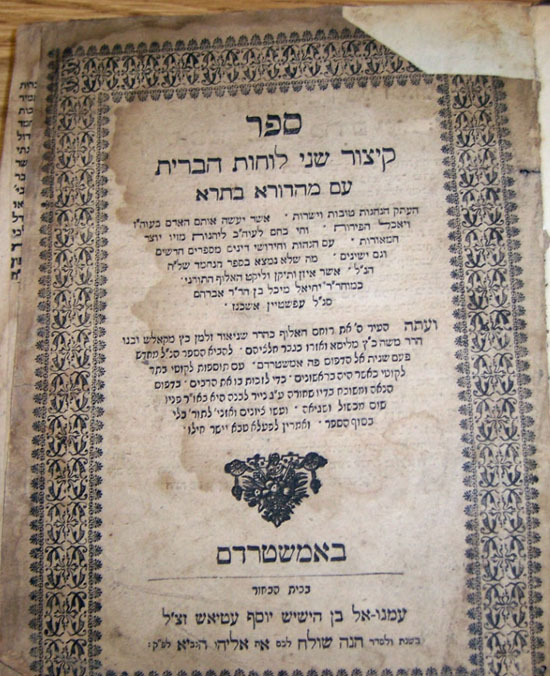
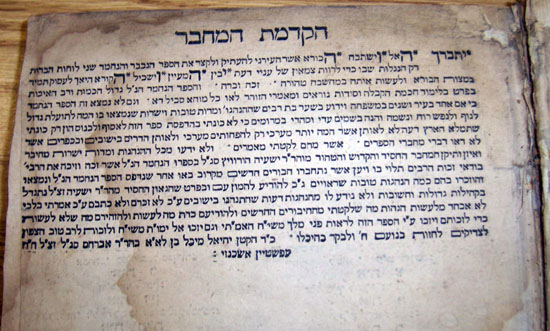

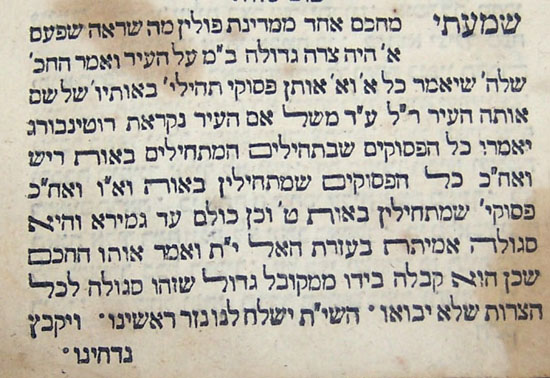
Finders Keepers? The Itinerant History of Strashun Library of Vilna, Pt I

Finders Keepers? The Itinerant
History of Strashun Library of Vilna

by Dan Rabinowitz
            Since the 1990s, the issue of reparation of items looted by the Nazis has become a high-profile issue, with numerous successful attempts at reuniting owners with their stolen possessions. The recent movie, Monuments Men, fictionalized the
Allies’ post-war efforts that led to the locating some of these looted treasures. While some of the best-known examples of these recovered treasures are related to art, gold, or Swiss bank accounts, Hebrew books were also part of the Nazi’s appropriation scheme and were included in the items recovered after World War II. Some of the books recovered belonged to a unique institution, the first Jewish public library, and tracing the journey of these books, up to present day, parallels that of its patrons, tortured, uncertain, and yet despite all odds, surviving.
 
Matisyahu Strashun the Library’s Architect and Founder
 
Matisyahu Strashun[1] was born in 1817 in Vilna.  His family was among the Vilna elite.  His father, Samuel Strashun (also known as Rashash), whose notes/annotations – he never published a stand-alone work – to numerous classic rabbinic works, including Midrash Raba, Mishna, and Maimonides’ Mishna Torah, and Talmud Bavli.[2]  In terms of breadth, the latter is most
impressive, as his notes cover nearly every single page[3] of the Talmud Bavli.[4]
Matisyahu too was a Talmudist, his comments to Baba Batra and Eruvin are incorporated into the Vilna edition of Talmud Bavli, and was proficient in the entire corpus of rabbinic literature.[5] Matisyahu espoused views that were consistent with the haskalah movement.[6] For example, Matisyahu supported Max Lilienthal’s controversial attempt to reform “the Jewish educational system within the Pale Settlement,”[7] and Matisyahu help found and financially supported two schools in Vilna aligned with the haskalah.[8] Matisyahu corresponded with leaders of the haskalah movement, Isaac Ber Levinsohn, among others, and Strashun’s articles appeared in both rabbinic as well as haskalah newspapers and journals.[9] And, his home was a salon of sorts for traditionalists and the maskilim of Vilna.[10]
Strashun was independently wealthy and derived his substantial income from commercial and banking activities rather than rabbinic activities.  Yet he was considered a leader of the Vilna community.  He served on a number of communal institutions including the Vilna Tzedakah Gedolah.  And, at his death, he donated over 50,000 rubles to charity (approximately $1 million today). Leading Eastern European rabbis, R. Yitzhak Elchonon Spector and R. Jacob Joseph (later Chief Rabbi of
New York) among them, eulogized Strashun.[11] Posthumously, a street in Vilna was named after him.[12]
Throughout his life, he was an avid book collector, and, at the time of his death, amassed a collection of over 5,700 books and manuscripts.[13] His collection included incunabula, rare and controversial works (e.g. Me’or Eynaim), and manuscripts – from his father in addition to other authors. As reflected in his outlook during his lifetime, Strashun’s collection included rabbinic and haskalah works and books in non-Hebrew languages.[14]
During Strashun’s lifetime, numerous printing houses and bookstores populated Vilna, providing access to most contemporary books, including in languages other than Hebrew.[15]  But, unfortunately, we do not have much information regarding how and when Strashun amassed his collection that extended well beyond those contemporary books, beyond that when he traveled he took the opportunity to seek out and purchase books. For example, when he took therapeutic trips to the spa he also took that opportunity to seek out and purchasing books.  In addition to Strashun’s spa trips, in 1857 he went on a Rabbinic tour of Eastern Europe and visited R. Shlomo Yehuda Rappaport (Shi”r) in Prague and R. Tzvi Hirsch Chajes.[16] But, R. Rapahel Nathan Rabinowicz, a book dealer and noted book collector, commented after visiting Strashun that while Strashun’s collection was larger than Rabinowicz’s, his collection was richer in rare and older books.[17]


STRASHUN’S COPY OF SHIR’S EREKH MILIM


STRASHUN MARGINALIA TO EREKH MILIM
Creation of the Vilna Jewish Public Library
 
At his death in 1885, Strashun left no direct heirs.  He did, however, provide for the disposition of his library in his will.  In the past, those with large libraries had sold or left it to relatives,[18] Strashun elected a novel approach, rather than an individual or individuals he bequeathed his library to the Vilna Jewish community writ large, with instructions to establish a stand-alone public library.[19] His vision for the library was modeled on “the non-Jewish libraries that he saw [20] in the Diaspora.”[21] To that end, Strashun provided not only the books but also the funds to support the creation and sustainment of the library.[22]  Immediately the impact of this decision was apparent. At his funeral, among other enumerated good deeds and scholarship mentioned was, “the large library he left after death for the benefit of the community,” and which will “provide a
lasting legacy beyond that of any actual blood descendants.”[23]
            The creation of a public library out of Strashun’s personal collection was not a swift one, for seven years following Strashun’s death “the books remained under
lock and key” and were available only to those with special access.[24]  It remained in this state even though there were trustees and enough money to cover its operations.[25] Although the
library did not open to the public, the trustees were not idle during this time; and in 1889, published a complete catalog of Strashun’s collection.  His collection was comprised of 5,753 items, 63 of which contained marginalia in his hand.[26]
The Library is Open to the Public
 
In 1892, the Library was finally opened to the public. At the time, however, it remained in Strashun’s home.[27]  For years
after the library was opened to the public, in legal documents, the listed owner was not the Vilna community but one of the Library’s trustees. Although Strashun’s intent was clear – that the Library belonged to the community and not a trustee or any other individual – the Library’s legal status clouded that directive. In the late 1890s, there was a successful campaign to correct that issue, and the community becomes the sole owner of the Library, fulfilling Strashun’s wishes regarding ownership.[28]
The Library & Its Impact on the Vilna Community
 
In 1902, the Library finally moved into a building of its own in the courtyard of the Great Synagogue of Vilna.[29]  From this
point forward, the Strashun Library would be one of Vilna’s most important institutions.
            The Strashun Library was a Jewish public institution and, to fulfill the needs of the public, additional steps were required beyond building and maintaining
infrastructure and clarifying ownership.
Specifically, although Strashun’s collection was substantial both in
terms of size and breadth, it was still the product of one man’s idea of a library.  For this reason, Hillel Noach Steinschneider, one of Vilna’s leading scholars and historians, pleaded with the public to donate books and ensure the completeness of the library and fulfill its mission of serving the entire community.  He acknowledged that Strashun amassed a very impressive private collection, but that for a public library his collection alone was insufficient because “it is lacking in books for people” whose interests did not align with Strashun’s.
That is, a public library is not only a place open for all but also one that provides value for all.  Consequently, the library’s composition must reflect the entirety of its audience and not a single collector. Apparently, this plea was successful,[30] many Vilna scholars donated their collections to the Library in addition to the general public, and, by the 1930s, the Library had grown to over 35,000 volumes.[31] Additionally, Vilna’s Tzedakah Gedolah organization also provided funds for acquisitions.  Books acquired through those funds contain a special stamp or receipt.
The Library was open seven days a week and became the central meeting location for the residents of Vilna.[32]  The Library’s visitors were representative of Strashun’s commitment to both traditional and modern ideas and ideals.  Patrons included “rabbis and talmudic scholars who were studying responsa and Halakhic
works” and who sat side-by-side with the “younger generation who were reading haskalah works.”[33] When dignitaries came to Vilna, the Strashun library
was a waypoint.[34]
 The intent was to have Herzl be the first visitor to the Library, however, the Russian government prohibited him appearing at the Library.[35]  Other famous Jewish personalities did visit and signed the guest book, known as the Golden Book, including Sholem Yankev Abramovitsh (Mendele Mokher Seforim), and Hayim Nachum Bialik, in addition to more traditionalists, R. David Friedman of Karlin, R. Shlomo Ha-kohen, and the Chafetz Chayim.[36] The Library was not only known for its visiting
Jewish celebrities, but also for its well-regarded holdings.  According to A.J. Heschel, it was the largest public Hebraic library in Eastern Europe reported holding over 40,000 volumes.[37]  On the one hand, the Strashun library was recognized as one of the greatest cultural institutions in Eastern Europe, on the other, like so many public institutions, the Library struggled to raise sufficient funds throughout the early part of the 20th century, consistently hampering its ability to maintain and build its
collections in addition to limiting its public access.[38]  But, it would not be funding that led to its demise but the Nazis and their campaign to appropriate Jewish cultural treasures.
The Nazi’s Looting of the Strashun Library
 
            During World War II, Vilna was occupied and controlled first by the Soviets, then the Lithuanian government, the Soviets again, and finally by the Germans.[39]  While under Lithuanian and Soviet rule, the Library had its share of challenges, but none
of those compared to the Nazi’s systematic campaign to identify, collect, and appropriate important Jewish treasures –specifically books – and, consequently, important libraries. The intent was that these pillaged libraries would supplement the already substantial Judaic holdings of Frankfort City Library.[40]  Immediately after the Nazis occupied Vilna, the Strashun Library as Vilna’s “oldest and perhaps most distinguished” library was identified as a target for this campaign.[41]
            Less than a month after occupying Vilna, the Nazis “enlisted” the Library’s librarian, Chakil Lunski, who had served in that capacity for over forty years, in addition to others, to select, identify and catalog important books including “the incunabula and manuscripts in the Strashun Library” to be sent back to Germany.[42]  Needless to say, Lunski was “distraught” that “he [was] supposed to help remove the treasures from ‘his’ Strashun Library that he protected for 45 years!”[43] Consequently, a number of books from the Strashun Library ended up in Frankfort, Germany.[44]


Post War Efforts to Reclaim Heirless Jewish Property 
 
            The Library’s building did not survive the war, but some of its books did.[45]  After WWII, the Allies recovered thousands of items the German’s looted and collected them at the Offenbach Depot outside of Frankfort.[46]  Much of what was recovered was likely heirless and the Allies faced with the dilemma of restitution. Initially, the Americans took the position that heirless property should return to the country from which it was looted.[47]  This position raised the specter of rare and important Judaica and Hebraica returning to Poland or even Germany.  This outcome was unacceptable to many Jews.[48]  Some elected to influence the fate of looted heirless books through traditional democratic means, others took matters into their own hands.[49]
Free For All? The Disposition of Other Significant European Libraries
 
The Strashun Library was by no means the only library identified at the Offenbach depot.  There were numerous other
libraries, both public and private that ended up at Offenbach, without any clear method of repatriation. This lack of clarity leads to inconsistent results at best.  Indeed, first-hand accounts of post-war Germany confirm the ad-hoc, doubtful legal grounds and sometimes completely lawless reparation regime in the post-war chaos.  In many instances, individuals made many of the decisions regarding disposition with little information and virtually to no oversight.
For example, Solomon B. Freehof, who himself amassed one of the greatest responsa collections in the 20th century, spent time in post-war Germany and encountered heirless property and describes attempts of repatriation. He indicates that
half of the heirless Jewish books recovered by the Allies went to the Jewish National and University Library (“JNUL”) at the Hebrew University (now the National Library of Israel),[50] which was “quite right” because some unnamed person or entity had determined “that clearly the [JNUL] should take the place of the vanished Jewish communities of Europe.”[51]
            Others agreed with Freehof that the natural repository for heirless books of European origin was the JNUL in Jerusalem.  Most notably, Judah Magnes, and the trustees of the JNUL wanted to recover and claim for the JNUL as much heirless Judaica as possible.  The JNUL dispatched Gershom Scholem, the eminent Kabbalah scholar, and bibliophile, to Europe to locate and return heirless property.  He discovered a significant number of important books and manuscripts in the Offenbach Depot
and did everything in his power, including employing very underhanded means, to repatriate items to Hebrew University.[52]
Initially, Scholem had a very difficult time securing authorization to even enter Germany and the Offenbach Depot.[53]  When he was eventually granted permission to view the contents of the Depot, it was with the explicit condition that he
could not remove any items.  But, for Scholem, some items proved too enticing.  Scholem identified a number of rare and important books and manuscripts.  He was concerned that if the disposition of these items were left to the Allied authorities the items would not end up in Jerusalem, but, instead, at the Jewish Theological Seminary, or some other institution, in the United States.  This was unacceptable to Scholem. To facilitate the transfer of these items to the JNUL, Scholem colluded with a Jewish American serviceman to smuggle the works out of Offenbach. Scholem placed the collection into five boxes but did not label
their contents and provided a fake name on the invoice.  The American serviceman personally ensured that the boxes were shipped to Paris, after which they were sent to the JNUL.  Eventually, the Allies found out about the theft, and demanded the return of the five boxes, even lodging a formal diplomatic complaint.  In the end, after much back and forth, the boxes remained at the JNUL.[54]
As germane here, eventually, the boxes’ content were cataloged and it was determined that a third of the works were not heirless – their ownership was clear and restitution was possible.[55]  Nevertheless, the content of the five boxes were incorporated into the JNUL.
Another example of unilateral ostensive benevolent restitution occurred with the “library of the prestigious Klaus synagogue of Mannheim, [that] ended up with U.S. Army Chaplin, Rabbi Henry Tavel.” Who, “on his own authority . . . shipped it to his alma mater, the Hebrew Union College in Cincinnati.”[56]
The Lost & Found: The Strashun Library Post-WWII
 
The determination regarding the disposition of the Strashun library after the Holocaust was no different from other heirless property, ad hoc and questionable.  Lucy Dawidowicz, worked for YIVO before WWII and spent time in Vilna.
After WWII, on behalf of the Jewish Distribution Committee after World War II, she went to the Offenbach Depot to assist with identification of heirless books.  Prior to coming to Offenbach, she had “promised [herself] that [she] would do [her] best to
safeguard the rights of possible owners and heirs.”[57]  And, when she came upon some of the remains of the YIVO collection,[58] she “was in a state of exaltation” and in a letter home wrote that she “had ‘a feeling akin to holiness, that [she] was touching something sacred.’”[59]
Dawidowicz also came upon books that she “could identify came from the Strashun Library.”  Whereupon she recalled “a
strange story” that the head of YIVO, Max Weinreich,[60] had told her “back in 1940.” Weinreich told her that during the brief period of time when the Soviets had returned Vilna to Lithuanian control, YIVO attempted to move its library out of Vilna.[61]  And, that “the trustees of the Strashun Library, also fearing for the sake of their library, asked the Vilna YIVO to ship [the Strashun Library] too.” Unfortunately, the shipment never occurred and both libraries remained in Vilna and ultimately plundered by the Nazis.
While the shipment never occurred, in Dawidowicz’s telling the attempted shipment was an irrevocable act with significant implications regarding the Library’s ownership.  She inferred that the Strashun trustees request to join the YIVO shipment also implicitly ceded ownership of the Strashun Library to YIVO. Thus, there she had no doubt regarding the proper disposition of the Strashun Library. Based entirely upon the “strange story” she heard, and even though according to her retelling the Strashun trustees had only intended YIVO to act as a shipper,[62] Dawidowicz told the Director of the Offenbach Depot that the heirless “remains of the Strashun Library ought to be considered as YIVO property.” She appealed to the Allied authorities and her position carried the day and the remnants of Strashun Library went to YIVO in New York.[63]
In a recent exhibit devoted to YIVO’s Strashun collection, the issue of the Strashun Library’s provenance is not discussed in any detail.  Instead, the book accompanying the exhibit simply states that all the remnants of the Strashun Library “were
rescued from the ruins of Europe and brought back to YIVO in New York in 1947.”[64] YIVO’s library catalog again implies that all the recovered books went to YIVO and links the disposition of the Strashun Library with that of YIVOs, the provenance note explains that “[t]he Strashun Collection, along with the YIVO Vilna collections, were liberated by the American Army, and
re-repatriated to YIVO in New York in April 1947.”[65]
            In reality, not all the remaining Strashun books went to YIVO, nor did everyone agree with the determination that YIVO was the rightful heir of the Strashun Library.
To be continued in Pt. II…


[1] For biographical information and sources see Tzvi Harkavy, Le-Heker Misphahot, (Jerusalem: Hotsa’at ha-Sefarim ha-Erets-Yisre’elit, 1953), 47-48 and n.79.
[2] A complete bibliography of his works, both published and unpublished, appears in Tzvi Harkavy, Le-Heker Misphahot, (Jerusalem: Hotsa’at ha-Sefarim ha-Erets-Yisre’elit, 1953), 45-46. Rashash’s comments on Rambam were printed in
Mekorei Rambam, first published in 1870 in Vilna, and while not a true stand-alone work, Rashash’s comments appear
alone, without the Rambam’s text.  See Mekorei ha-Rambam, Harkavy ed., (Jerusalem, Hatsa’at ha-Sefarim ha-Erets-Yisre’elit, 1957, Im ha-Madurah, and p. 59.
[3] For a list of the handful of pages he omitted, see Rafael Katzenellenbogen, Rash”sh le-Shitato, in Mekori Ha-Rambam Le-Rash”sh, ed. Harkavy, (Jerusalem, 1957), 64.
[4] For general biographical details on the Strashun family, see Frida Shor, From “Likute Shoshanim” to “The Paper Brigade” The Story of the Strashun Library in Vilna, (Tel Aviv: Ariel, 2012), 15-28, and the sources cited therein.  See also Shua Engelman, “Rabbi Samuel Strashun and his Haggahot on the Babylonian Talmud,” (PhD dissertation, Bar-Ilan University, 2009; Hebrew); regarding Samuel’s Talmudic annotations as compared to others, see Yaakov Shmuel Spiegel, Chapters in the History of the Jewish Book, Scholars & their Annotations (Ramat-Gan: Bar Ilan University, 2005), 421-22. Cf. Mordechai Zalkin, “Samuel and Mattiyahu Strashun: Between Tradition and Innovation,” in Mattiyahu Strashun, 1817-1885: Scholar, Leader, and Book Collector, (New York: YIVO Institute, 2001), 6-7.
[5] Moshe Shimon Anktokolski, Evel Kaved, infra n.12, 23.
[6] Mordechai Zalkin, “Samuel and Mattityahu Strashun: Between Tradition and Innovation,” in Yermiyahu Aharon Taub, ed., Mattityahu Strashun, 1817–1885: Scholar, Leader, and Book Collector (New York: YIVO Institute, 2001), 1-27. Samuel has made a very small number of comments that can be read to be consistent with ideas of the haskalah, but these do not approach Matisyahu’s active involvement with the movement, including his very public support of the movement.  Additionally, it is unclear if Samuel’s comments are simply limited to their specific context.
Indeed, the examples Zalkin provides regarding Samuel’s alignment with haskalah do not support Zalkin’s thesis. Id. at 25
n.10. First, Zalkin, cites Strashun’s comment in Gitten 6b, that “we find many amora’im who did not know how to read scripture” as proof of his “unorthodox” views.  But we find a similar statement from the medieval period.  See Tosefot, Bava Batra, 113a.  Zalkin’s second citation is to Rashas’s comments, Rosh ha-Shana 26a, “certain things that were uttered in a particular time and particular place are inserted by editors of the Talmud in their appropriate location in the text.” This misrepresents the Rashash.  Rashash is attempting to answer how the Talmudic sage, Levi, was unaware of an explicit verse as the TB in RH 26a implies.  Rashash explains that although there is no explicit mention of the time or place that this story occurred, Rashash posits that the story in Rosh Hashana occurred at the same time as another story with Levi, Yevamot 105a, where he had a moment of senility.
Rashash is not offering his opinion regarding the redaction of the Talmud, instead he is merely dating the story in Rosh ha-Shana. Finally, it is unclear the relevance of Zalkin’s third example, “you will find many contradictions between different locations is (sic) Rashi’s text.” Locating and alleging contradictions in Rashi is hardly remarkable.
[7] Zalkin, id., at 15.
[8] Shalom Pludermacher, Zikaron le-Hakham: Zeh Sefer Tolodot ha-Rav ha-Go’an, he-Hakham ha-Kollel Rabbi Matitayahu
Strashun Z’L
, in Mattiyahu Strashun, Matat-Ya, Haghot, Hidushim ve-He’arot Me’irot ‘al Midrash Raba Pri Eito Shel Matityahu Strahsun, (Vilna: The Widow and Brothers Romm, 1893), 15.
[9] A partial bibliography of Strashun’s articles appears in his Sefer Matat Yah (Vilna, 1893), 41-74 (Hebrew), available online here.  Reading, and certainly actively participating with, haskalah related newspapers was considered inconsistent with Ultra-Orthodox values and was grounds for expulsion from Volozhin Yeshiva. Shaul Stampfer, The Lithuanian Yeshiva, Revised & Expanded Edition,  (Jerusalem: The Zalman Shazar Center for Jewish History, 2005), 176.
[10] Aviva Astrinsky, “A Brief History of the Strashun Library,” in Yermiyahu Aharon Taub, ed., Mattityahu Strashun, 1817–1885: Scholar, Leader, and Book Collector (New York: YIVO Institute, 2001), i.
[11] Duberosh ben Aleksander Torsh, Me’arat ha-Makhpelah, shnei Hepadim . . ., (Warsaw, 1887), 50.
[12] Moshe Shimon Antokolski, Evel Kaved, (Vilna: be-Defus Avhram Tzvi Katzenellenbogen, 1886), 8; Tzvi Harkavy, Le-Heker Misphahot, supra n.1, 47.  During his lifetime he also donated to public institutions, among them, the yeshivot of Mir and Volozhin.  Id. at 24.
[13] Moshe Shimon Antokolski, Evel Kaved, supra n.12, 11.
[14] Mordechai Zalkin, supra n.6, 17-8.
[15] Hagit Cohen, At the Bookseller’s Shop, The Jewish Book Trade in Eastern Europe at the End of the Nineteenth Century,
(Jerusalem: The Hebrew University Magnes Press, 2006), 48-52.
[16] Shalom Pludermacher, Zikaron le-Hakham, 1893), 17. His meetings are reflected in Strashun’s ownership of their works.
See Likutei Shoshaim, nos. 386,1024,1178, 2522, 3352, 3650, 3781, 4377, 5399, 5592. Regarding other well-known Hebrew book collectors and their collections, see Alexander Marx, “Some Jewish Book Collectors,” in his Studies in Jewish History & Booklore, (New York, 1941), 198-237; Cecil Roth, “Famous Jewish Book Collections & Collectors,” in Essays in Jewish Booklore, (New York: Ktav Publishing House, 1971)330-35.
[17] “A Collection of Letter from Jewish Scholars to ShZH”H,” in Yad ve-Shem, reprinted in Yeshurun.
[18] David Oppenheimer’s library was the first library that was posthumously sold intact – to the Bodleian Library.  See
Alexander Marx, “Some Notes on the History of David Oppenheimer’s Library,” Revue des Études Juives 82 [=Israel Lévi
Festschrift] (1926): 451-460; Charles Duschinsky, “Rabbi David Oppenheimer: Glimpses of His Life and Activity, Derived from His Manuscripts in the Bodleian Library,” Jewish Quarterly Review 20:3 (January 1930): 217-247; Alexander Marx, “The History of David Oppenheimer’s Library,” in Studies in Jewish History and Booklore (New York: Jewish Theological Seminary of America, 1944), 238-255; and more recently in Joshua Teplitsky, “Between Court Jew and Jewish Court: David Oppenheim, The Prague Rabbinate, and Eighteenth-Century Jewish Political Culture (PhD dissertation, New York University, 2012); and Abraham Schischa, “Rabbinic Writings from the Collection of Rabbi David Oppenheim,” Yeshurun 31 (2014): 781-794 (Hebrew).
For other significant personal Hebrew libraries and their purchasing history, see Binyamin Richler, Hebrew Manuscripts: A
Treasured Legacy
(Clevland/Jerusalem: Ofeq Institute, 1990) 66-67.
[19] For earlier examples of private libraries see Nehemya Allony, The Jewish Library in the Middle Ages, Book Lists from the Cairo Genizah (Jerusalem:  Ben-Zvi Institute, 2006); S.D. Goitein, A Mediterranean Society (Berkley: University of California Press, 1967), vol. II, 206, 248; vol. V 3-4, 425.
[20] It is unclear whether Strashun meant this literally because while the 19th century witnessed the modern period of the public library, there were not any public libraries in Eastern Europe during Strashun’s lifetime.
[21] Shor, supra n. 4, at 26.
[22] Sefer Matat Yah, supra n. 9, at 35, listing Strashun’s bequests.
[23] Moshe Shimon Anktokolski, Evel Kaved, supra n.12, 17.
[24] Among those who had access during this time was Ya’akov Wallensky.  During this time, Wallensky was writing his supplement to Piskei Teshuvot on Yoreh De’ahPiskei Teshuvot itself is a collection of obscure and rare works discussing issues
appearing in Yoreh De’ah. Because Wallensky’s materials were even more obscure and rare, the only place he could access these was the Strashun Library. Ya’akov Wallensky, Daltei Teshuva, (Vilna, 1890), Introduction, 5-6, (link).
[25] Shor, supra n. 4, at 29
[26] Cf. Aviva Astrinsky, “A Brief History of the Strashun Library,” in Yermiyahu Aharon Taub, ed., Mattityahu Strashun, 1817–1885: Scholar, Leader, and Book Collector (New York: YIVO Institute, 2001), iii, who provides that his collection was only
comprised of 5,739 items.
[27] Shor, supra n. 4, at 29.  Regarding the conflicting reports of the Library’s locations during this period, see id., n.71.
[28] Shor, supra n.4, 32-3.
[29] While the Library moved to the new building in 1901, and its dedication ceremony occurred on April 14, 1902, it would not be until October 20, 1902, that the Library secured the necessary governmental permits to fully open to the public.  See Shor at 34-35.  The government license is reproduced in Layzer Ran, Jerusalem of Lithuania, vol. 2, (New York: Laureate Press, 1974),
346.
[30] Frida Shor, supra n.4, 51-65,174-87. See Berger, “The Strashun Library in Vilna,” in Zevi Scharfstein, ed., Hebrew Education and Culture in Europe Between the Two World Wars (New York: Ogen Publishing House of Histadrut HaIvrit BeAmerica, 1957), 513 (Hebrew), who discusses the varied subject matter of the Library’s collection.
[31] Id.
[32] According to one account, the Library had over 200 patrons daily, but only 100 seats, forcing people to share chairs and encounter waits of over a half-hour just to enter the Library.  Id. at 513.
[33] Ben Tzion Dinur, “Yerushalim de-Lita,” in Layzer Ran, Jerusalem of Lithuania, vol. 1 (New York: Laureate Press, 1974), XVI; but see the English translation of Dinur’s article that comingles the two groups and has both the Orthodox and younger generation studying “respona or modern Hebrew novels.”  Id. at XX.  It is unclear what accounts for this discrepancy in translation. Lucy S. Dawidwowicz, From That Place And Time, A Memoir 1938-1947, (New York: Bantam Books, 1991), 119, provides a remarkably similar account to Dinur’s (“On any day you could see, seated at the two long tables in the reading room,
venerable long-bearded men, wearing hats, studying Talmudic texts, elbow to elbow with bareheaded young men and even young women, bare-armed sometimes on warm days, studying their texts. The old men would sometimes mutter and grumble about what the world had come to. The young people would titter.”).
For a breakdown of the Library’s readership by type (i.e. students, academics and public intellectuals, workers, etc.), see Berger, supra n. 28, 514-15.
[34] See Shor, supra n. 4, 174, see also the description of David Wolfson’s Vilna visit, Israel Klausner, “The Zionist Movement in
Lithuania,” in Yahdut Lita (Tel Aviv: Am Hasefer Publishers, 1950), 522 (Hebrew). For a photo of one such visit, see Layzer Ran, Jerusalem of Lithuania, vol. 2 (New York: Laureate Press, 1974), 416.
[35] Shor, supra n. 4, 174-75.
[36] Berger, “The Strashun Library in Vilna,” at 519; Shor, MeLekutei, supra n. 4, 169; Khaykl Lunski in Yeshurin’s ‫ווילנע
(New York, 1935 – in Yiddish), p. 286-7
[37] Abraham Joshua Heschel, “Yerushalim de-Lita,” in Ran, Jerusalem, vol. I, XVII; David E. Fishman, The Rise of Modern Yiddish Culture (Pittsburgh, PA, University of Pittsburgh Press, 2005), 143, provides that the holdings of the Strashun Library prior to the Holocaust was comprised of “some forty thousand volumes.”
[38] See Shor, MeLekutei, 38-9; 42 (discussing a 1926 public appeal that the Library undertook where it described its financial condition as “dire and catastrophic”); id. at 43 (“The Strashun Library underwent many difficult financial periods throughout the nineteen years of Polish rule (10/9/1920- 9/19/1939).  But, it continued to major Vilna cultural institution.”).
[39] Shor, MeLekutei, 44-7.
[40] Sem C. Sutter, “The Lost Libraries of Vilna and the Frankfurt Institut zur Erforschung der Judenfrage,” in Lost Libraries, The Destruction of Great Book Collections Since Antiquity, ed. James Raven (New York: Palgrave Macmillan, 2004), 220-22.
[41] Id. at 223 & 224 discussing other Vilna Libraries that were targeted by the Nazis.  See also Dov Schidorsky, Burning Scrolls and Flying Letters (Jerusalem: Magnes Press, 2008), 165-201; David E. Fishman, The Rise of Modern Yiddish Culture (Pittsburgh, PA: University of Pittsburgh Press, 2005), 141-44; Frida Shor, supra n.4, 189-200.
[42] Sem C. Sutter, “The Lost Libraries of Vilna,” supra n.38, 224.
[43] Id. at 226.
[44] Berger, “The Strashun Library of Vilna,” at 517.  The books that were not deemed important we pulped or used as heating fuel. Schidorsky, supra 39, 182. The exact date of when the Strashun Library was transferred to Germany is unclear; however, it was some date after April 1943.  See David E. Fishman, supra n.39,173 n.9. Similarly unclear is the exact number of books that were sent to Frankfort.  Sem C. Sutter, “The Lost Libraries of Vilna,” supra n.38, 228.  But, according to Aviva Astrinsky, “almost all of the Strashun books were crated and shipped by rail to Germany.  Aviva Astrinsky, “Mattitayahu (Mathis) Strashun,” supra n.24, i.
[45] See Ran, Jerusalem, vol II, 522, for a photo of post-war building. For a discussion regarding the numbers of books that survived from the Strashun Library, see Frida Shor, supra n.4, 204-05.
[46]  Dov Schidorsky, supra n.39, 225, listing the countries and libraries who books were deposited at the Offenbach Depot. Sem C. Sutter, “The Lost Libraries of Vilna,” supra n.38, 229-32.
[47] Lisa Moses Leff, The Archive Thief: The Man who Salvaged French Jewish History in the Wake of the Holocaust (United
States:  Oxford University Press, 2015), 121.
[48]  Id. at 124-30, 136-40.
[49]  Id.
[50] Dov Schidorsky, supra n.39, 233, provides the numbers and location of heirless books returned by the Jewish Culture Reconstruction.  For a listing of U.S. institutions that received heirless cultural property from the Offenbach Depot, see Herman
Dicker, Of Learning and Libraries, The Seminary Library at One Hundred, (New York: The Jewish Theological Seminary, 1988), Appendix B. See also F.J. Hoogewoud, The Nazi Looting of Books and its American ‘Antithesis’. Selected Pictures
from the Offenbach Archival Depot’s Photographic History and Its Supplement,” Studia Rosenthaliana 26:1-2 (1992): 158-192; and F.J. Hoogewoud, “Dutch Jewish Ex Libris found among looted books in the Offenbach Archival Depot (1946),” in Chaya Brasz and Yosef Kaplan, eds., Dutch Jews as Perceived by Themselves and by Others (Leiden: Brill, 2001), 247-261.
[51] Solomon B. Freehof, On the Collecting of Jewish Books, (New York, NY: Society of Jewish Bibliophiles, [196-]), 17; regarding the books that Hebrew University received, and its efforts to locate and claim heirless works throughout Europe through its Otzrot Ha-Goleh committee, see Shlomo Shunami, About Libraries and Librarianship, (Jerusalem: Rubin Mass, 1969), 56-65; Zvi  Baras, A Century of Books, The Jewish National & University Library 1892-1992, (Jerusalem: Jewish National & Univ. Library,1992), nos. 94-101; Dov Schidorsky, supra n.39, 212-91.
[52] Dov Schidorsky, supra n. 39, 250-51.
[53] Id. at 248-50.  According to Scholem, Abraham Ya’ari, Scholem’s partner on behalf of Hebrew University and its Goleh ha-Otzrot program, returned to Israel, in part, because of the difficulty in securing the necessary authorizations to enter Germany.
Id. 248; 351.
[54] Id. at 250-51.
[55] Id. at 251 n.51.
[56] See  Druker, Of Learning and Libraries, 58.  Druker, however, concludes that Tavel’s unilateral decision “resulted in
no real harm.”  One wonders if any surviving heirs who had legal claims to the Manheim collection would reach the same conclusion.
[57] Lucy S. Dawidwowicz, From That Place And Time, A Memoir 1938-1947, (New York: Bantam Books,1991), 314-16.
[58] See David E. Fishman, supra n.39, 143-53 174 n.20, discussing the YIVO Library under the Nazis and its ultimate transfer to YIVO in New York.
[59] Id. at 318.
[60] For more information regarding Weinreich and YIVO, see id. at 126-39.
[61] Id.; for a fuller treatment of this attempt see Shor, From ‘“Likute Shoshanim”, 44.
[62] Aside from Dawidowicz’s telling, according to the documents that discuss YIVO’s efforts to save its library and the Strashun and the Lithuanian government’s response throughout this attempt, the Strashun Library is described as a Vilna community
library and not the property of one institution or another.  See Shor, From “Likutei Shoshanim”, at 44.
[63] Her argument has the perverse effect that the trustees attempt to save the library immediately resulted in completely losing control of the library.
[64] Aviva E. Astrinsky, Mattistyahu Strashun 1817-1885, Scholar, Leader, and Book Collector, YIVO, New York: 2001, ii, iv.  But, Astrinsky also indicates that YIVO recovered “a substantial part of the Strashun Library.”  Id. at i.  According to YIVO’s website, however, YIVO only received part of the Strashun Library and the remainder “were transferred to the library of the Hebrew University in Jerusalem. (link).
Similarly, Berger, “The Strashun Library in Vilna,” p. 517 claims that part of the Strashun Library went to YIVO and the other part to Hebrew University.
Beyond these unsupported statements, there is no evidence that any books from the Strashun Library were sent to the JNUL.  While the JNUL’s post-war efforts at obtaining heirless books are well documented, see supra, there is no mention of the Strashun Library.
Similarly, the JNUL catalog does not list any items whose provenance extends to the Strashun Library. It is possible that YIVO and Berger confused the JNUL with the Jerusalem Central Library discussed below.  Or simply conflated the Strashun Library with the numerous other European libraries that the JNUL successfully rescued.
[65] See, e.g., the YIVO catalog entry for Solomon Adret’s Hidushe Nidah leha-Rashba, Altona, [1737].