A Tribute to Rav Shlomo Elyashiv, Author of Leshem Shevo v-Achloma: On his Ninetieth Yahrzeit

A Tribute to Rav Shlomo Elyashiv,
Author of
Leshem Shevo v-Achloma:
On his Ninetieth Yahrzeit
by Joey Rosenfeld

Joey Rosenfeld is a psychotherapist in St. Louis where he moved with his family. He published his first sefer, sc’hok d’yitzchak on the Kabbalistic theme butzina d’kardinusa, or darkened light. He is currently working on a monograph of R. Shlomo Elyashiv and the philosophical and psychoanalytic themes in Leshem Shevo v-Achloma.

His first essay at the Seforim Blog, is entitled: “Dorshei Yichudcha: A Portrait of Professor Elliot R. Wolfson,” is available available here.


Here is buried
Holy anointing oil, the light of souls
A torch of holy fire, speaker of heights
Sent from on-high to reveal the concealed
Enlightened the darkness through Leshem Shevo v-Achlomot
The Rav like an Angel of God
Genius of the world signified and clear
Secrets of the world in the Torah of truth
Revealed and opened before him
Righteous pillar of the world, vessel of modesty
A great humility in his roots
Our great teacher supernal holiness
Master of secrets unique in his generation
Our teacher R. Shlomo Elyashiv zt”l nbg”m
Author of the holy books Ha”Kadosh v-Leshem Shevo v-Achloma
Called to the Heavenly academy
27th of Adar 1925 here in the holy city of Jerusalem
May his soul be engraved in eternal life
and may his merit protect us Amen

–Rav Avraham Yitzhak Ha-Kohen Kook’s handwritten epitaph for Rav Shlomo Elyashiv, from Rav Kook, which is made available here courtesy of the private collection of Reb Shlomo Gross.

Lurianic Mysticism

When R. Issac Luria (1534-1572) known as the Arizal, developed his theosophical system often referred to as Kabbalat Ha-Ari or Lurianic Mysticism, he initiated a revolution within the Jewish mystical tradition.[1] In the margins of his predecessor and teacher R. Moshe Cordevaro (1522-1570) and through a highly innovative form of Zoharic hermeneutics, the Arizal established a radical approach to the ancient theories of Jewish cosmology (tzimtzum, shevirat ha-keilim), theurgy (kaavanot) and eschatology (tikkun). Codified by his various disciples, primarily R. Chaim Vital (1542-1620) and R. Yisrael Sarug (1590-1610), the Lurianic system took form in the work Eitz-Chaim and the eight volumes of collected teachings known as Shemoneh-Shearim.[2] After the Arizal’s passing, it was generally agreed upon that the Lurianic corpus should, and would remain a closed system, one in which novelty and creativity from subsequent scholars was discouraged and even prohibited. The treatment of the Lurianic corpus as a sacred textual matrix in which creative hermeneutics are discouraged appears to stem from epistemological as well as philological phenomenon. On the epistemological register, the esoteric material being elucidated within the Lurianic system was viewed as an exceedingly sensitive body-of-work that demanded a high level of secrecy and concealment.[3] Only the most spiritually refined individuals were seen as worthy and capable of processing the complexities of the kabbalah. While the political secrecy surrounding the Arizal and his disciples was not a new phenomenon in the history of Jewish esotericism; the emphasis placed on character refinement, both spiritual and physical, for the sake of initiation into the ranks of talmidei ha-Ari is noteworthy. The danger of an unqualified and inexperienced student imposing his own imaginative interpretations upon the system was seen as a potentially catastrophic event with both spiritual and historical consequences.[4] On the philological register, the Arizal himself imposed strict prohibitions upon his disciples regarding the sharing or revelation of his insights, thus creating an economy of occlusion in which his ideas flourished within the strict contours of secrecy. Historically, the Arizal’s pedagogical methods perpetuated the veil of secrecy that kept his teachings hidden while simultaneously enabling them to be collected. Much like the rabbinic sages of the Talmud, R. Issac Luria maintained a strict orality while teaching his disciples. Continuing the rabbinic model wherein oral teachings are associated with a direct teacher-student relationship in which the risk of mistakes and misunderstanding is mitigated, the Arizal delivered his teachings in small groups, often prohibiting his students from textually recording his lessons. It wasn’t until the Arizal was near death that he allowed his disciple R. Chaim Vital to exclusively record his teachings posthumously.

Interpretations of the Lurianic system

While various attempts at interpreting the Lurianic system following R. Issac Luria’s passing did exist, it wasn’t until the seventeenth-century that authoritative schools of interpretation were born. Generally speaking one may categorize four primary approaches towards Kabbalat Ha-Ari in which the Lurianic system was expounded while simultaneously adhering to the strict prohibition of creating concepts that had not been directly recorded by R. Chaim Vital. While each school contained followers who differed from the founding member, the four major personalities associated with unfolding the Arizal’s system were R. Moshe Chaim Luzzatto (1707-1746) known as the Ramchal, R. Elijah of Vilna, known as the Gaon of Vilna (1720-1797), R. Shalom Sharabi (1720-1777) known as the Rashash, and R. Yisrael ben Eliezer (1700-1760), known as the Baal Shem Tov. Respectively, each school can be said to have utilized a different mode of hermeneutical interpretation in emphasizing what they viewed as the fundamental aspect of Lurianic Kabbalah, or Kabbalat Ha-Ari. For Ramchal and his Padua school[5] an emphasis was placed on unpacking the metaphorical nature of the Lurianic system for the purpose of revealing the various modes (hanhaagot) in which the Divine is manifest throughout history, culminating with the metahistorical eschaton in which all will be rectified (tikkun) and unified (yichud). For Rashash and the Jerusalem kabbalists of the Beit El Yeshiva[6] the emphasis was placed almost exclusively on the theurgical nature of religious phenomenology, expounding and developing a highly complex and intricate system of mystical intentions (kavaanot) associated with prayer and religious ritual. The Baal Shem Tov,[7] founder of the Hasidic movement along with his early students read and translated the intricate details of Kabbalat Ha-Ari unto the psychological register, transferring the locus of the Arizal’s system from the hidden depths of the Godhead to the hidden depths of the individual soul, thereby democratizing the once guarded secrets of concealed wisdom (chochmat ha-nistar). The School known as Kabbalat Ha-Gra or Lithuanian Kabbalah,[8] consisting of the Vilna Gaon and the select disciples who learnt directly or indirectly from him, emphasized the spiritual nature of temporality and history with a focus on the Messianic personalities who actively participate in the apocalyptic eschaton, as well as the biblical allusions towards the Lurianic system.

Fourfold of Kabbalistic PaRDeS

It has been suggested that these four schools of Kabbalistic interpretation be compartmentalized according to the fourfold structure of rabbinic hermeneutics known as PaRDeS[9]- an acronym for Peshat, the literal meaning; Remez, the allegorical meaning; Drash, the moral meaning; and Sod, the secret meaning. Generally speaking the gamut of Jewish esotericism-including Kabbalat Ha-Ari- represents the realm of Sod, and as such these four schools of thought would represent the specific substructure of PaRDeS as applied to the Sod of the general structure of PaRDeS. The Rashash and his school primarily engage the textual edifice of Kabbalat Ha-Ari, unearthing apparent contradictions within the system itself while reconciling them through an innovative theory of relativity (erchin) represent the literal approach (Peshat) to the Arizal’s system. The Gra and his school exemplify the allegorical approach (Remez) by utilizing the various forms of creative hermeneutics- primarily sacred numerology (Gematria) and acronyms (Roshei Tevot)- to uncover allusions and intimations signifying aspects of the Lurianic system within biblical texts. The attempt of the Ramchal and his school to uncover the latent meaning within the metaphors of the Arizal represents the moral approach (Drash) in which the externalities of the system are plumbed and simultaneously shed to reveal the inner kernel of meaning. Finally, the Baal Shem Tov and the Hasidic approach, by translating Lurianic ontology into psychological terms represent the essential secret (Sod) wherein the spiritual seeker finds the entirety of existence within themselves thus enabling a unique form of dynamic divine service.

R. Shlomo Elyashiv: Leshem Shevo v-Achloma

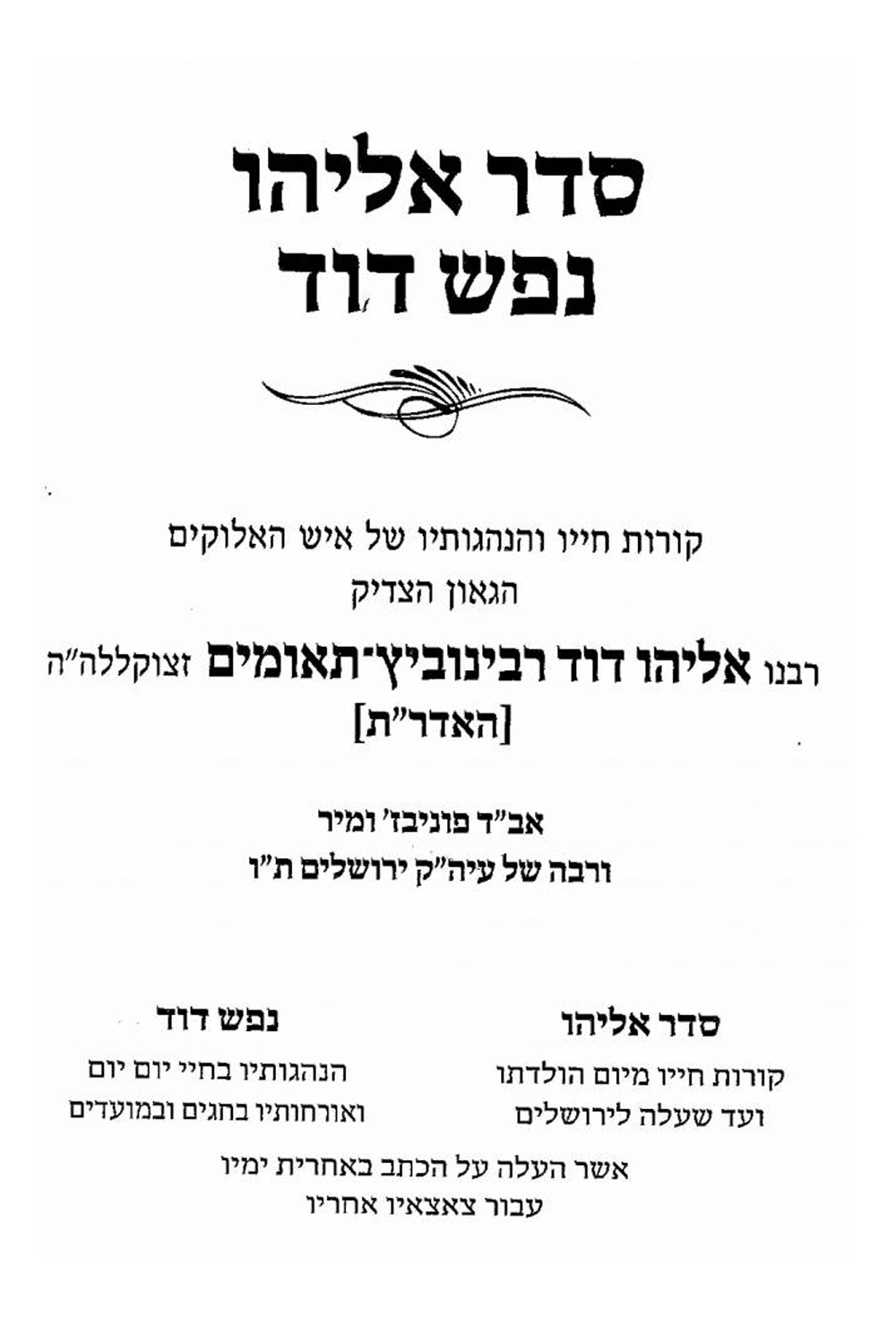
R. Shlomo Elyashiv (1841-1926) known as the Leshem after his vast body-of-work Leshem Shevo v-Achloma was a Lithuanian Kabbalist known for his adherence to the school of Kabbalat Ha-Gra.[10] Described as the fourth stage, or peh revieeh within the chain of talmidei ha-Gra, the Leshem formed a system in which the apparent contradictions between the Vilna Gaon and the Arizal were reconciled through a unique form of Kabbalistic analytics. R. Avraham Yitzhak ha-Kohen Kook, close friend and student of the Leshem described R. Elyashiv as applying Talmudic analytics (pilpul) onto the Lurianic corpus thereby clarifying and reconciling the various contradictions and textual ambiguities.[11] With an exhaustive knowledge of the gamut of Jewish esoterica- from the philosophic rationality of the rishonim to the complex intricacies of R. Chaim de La Rosa’s Torat Chachom[12]- the Leshem can be described as one of the most comprehensive as well as creative Kabbalistic thinkers of the late 19th and early 20th century. Born in Zagory, a small city in northern Lithuania, R. Elyashiv was raised studying Talmud with his father R. Chaim Chaikl Elyashiv until leaving home to study under the tutelage of R. Gershon Tanchum of Minsk where he became known for his Talmudic expertise. After his marriage to the daughter of R. Dovid Fein the Leshem went on to study at the Telshe yeshiva where his intellect and vast memory earned him the appellation of Telsher illui. While in Telshe the Leshem was introduced to chochmat ha-nistar by his teacher R. Yosef Reissen who then served as the Rav of Telshe. While learning in Telshe, R. Elyashiv became familiar with the fundamental texts of Jewish mysticism, learning the Pardes Rimonim of R. Moshe Cordevero as well as the Vilna Gaon’s commentaries on Sefer Yetzirah, Safra D’Tzniyuta and the Tikkunei Zohar. Only afterwards did the Leshem begin studying the system of the Arizal and it’s commentaries. R. Aryeh Levin who served as R. Elyashiv’s assistant after the latter’s move to Jerusalem includes within the curriculum the texts of R. Moshe Chaim Luzzato as well; however the distinctive relationship between R. Shlomo Elyashiv and the Ramchal’s school of Lurianic mysticism will be discussed below. After leaving Telshe, the Leshem settled in Shavel, Lithuania where he began to write what would become his vast oeuvre known as Leshem Shevo v-Achloma. In 1922, through the help of Rav Avraham Isaac haKohen Kook and Rav Yitzhak haLevi Herzog,[13] R. Shlomo Elyashiv moved to Jerusalem with his family where he eventually passed away on the 27th of Adar in 1926. While never accepting upon himself any form of communal leadership, the Leshem became known as the preeminent scholar of Kabbalah, through his written works, glosses, vast reaching editorial skills and the various rabbinic personalities with whom he studied and taught.[14]

Leshem Shevo v-Achloma: Overview of Texts

R. Elyashiv’s oeuvre generally referred to as Leshem Shevo v-Achloma is comprised of four separate yet highly integrated volumes.[15] While a comprehensive overview of each work is far beyond the scope of this essay, what follows is an attempt to describe the framework and context of each sefer. The four Kabbalistic works are Leshem Shevo v-Achloma: Hakdamot u-Shearim (1909); Leshem Shevo v-Achloma: Drushei Olam ha-Tohu (1911); Leshem Shevo v-Achloma: Klalei Hitpashtut v-Histalkut (1924); and Leshem Shevo v-Achloma: Chelek ha-Biurim (1935).

Leshem Shevo v-Achloma: Hakdamot u-Shearim

Known as Sefer Hakdo”Sh,[16] this work serves as an introduction to Kabbalat ha-Ari for the novice student, clarifying such concepts as Divine names, unity of God and the mystical anthropomorphization of God. In an attempt to simplify the complexities of Lurianic Kabbalah, R. Elyashiv sets forth a five staged multileveled process through which Ein Sof becomes manifest in/as reality. There is nothing particularly original in the Leshem’s depiction of a five stage process, an idea that is ever-present in the Lurianic system of partzufim. The novelty of Sefer Hakadosh, however, may be found in the Leshem’s configuration wherein the five partzufim; Arich Anpin, Abba, Immah, Zeir Anpin and Malchut are analogously aligned with the five-tiered revelatory process (seder ha-gilluim) in which the latent potentiality of existence emerges as the manifest actuality of creation. These stages, or orders-of-revelation are Ein Sof; Tzimtzum/Kav; Adam Kadmon; Atzilut; and the triadic unit Beriah,Yetzira and Asiya (BY”A). Working with certain Lurianic axioms as refracted through Rashash’s concept of hitklalut v-hitkashrut (integration and redistribution),[17] R. Elyashiv depicts a highly integrated system in which each general stage (seder klali) encompasses a subsystem (seder prati) wherein the five stages operate in a self-contained manner. Thus for example, the general partzuf of Abba- analogous to the revelatory stage of Adam Kadmon- contains within itself a subsystem comprised of every other partzuf and/or gillui. Far from a theoretical divergence into complexities, this multivalent system wherein each part contains the whole rests at the foundation of the Leshem’s system of integration (seder ha-klilut) and secret of unity (sod ha-achdut). The first seven gates of Hakadosh discuss each revelatory-stage in detail including the interconnection between each stage, thus engaging the reader in a textual excursion through the basic framework of the Lurianic system. The eighth gate in Hakadosh– titled Shaar ha-Poneh Kadim– comprises a work unto its own. Here R. Elyashiv undertakes the formidable task of elucidating the Kabbalistic system of R. Yisrael Sarug, commonly referred to as Olam ha-Malbush. While an overview of Olam ha-Malbush as refracted through the works of R. Naftali Hertz Bacharach and R. Menachem Azariah of Fano is far beyond the scope of this essay, R. Elyashiv’s decision to include R. Sarug’s depiction of “hidden mysteries that begin far beyond the worlds described in the writings of our master R. Chaim Vital,” is a significant gesture regarding the source and validity of the Sarugian system.[18]

Leshem Shevo v-Achloma: Drushei Olam ha-Tohu

Drushei Olam ha-Tohu – or Deah as it is known – is a monumental work that deals primarily with the Lurianic cosmological theme Olam ha-Tohu, the world(s) of chaos. Comprised of two parts, Sefer haDeah examines the primordial cataclysm known as the shattering of the vessels (shevirat ha-keilim). For the Leshem, this event- known as the death of the Edomite kings (mitat malchei edom) after the biblical account in parshat VaYishlach– serves as the pre-original opening through which the entirety of history unfolds. Far beyond a simple depiction, or elucidation of this Lurianic motif, part one discusses the “roots and foundations, existence and kingship, death and shattering” of the primordial kings, as well as “the ramifications that are born through this process, the source and the purpose of all this and the general process of rectification.”[19] According to R. Elyashiv the shevira was not an isolated event whose effects were limited to immediate consequences, rather, it serves as the traumatic source of everything that follows.[20] The stage of tohu– and all that transpires therein- is the constitutive break through which history gains its subjectivity. On a psychoanalytic register, not unlike Freud’s original seduction theory, the shattering of the vessels and the subsequent chaos represents the original trauma whose symptoms constitute the subject, as opposed to preexistent subject who experiences the symptoms. The worlds of tohu, resting at the beginning- before the beginning- accompany the historical process, concealed from sight, imposing and composing the ebb and flow of shevira and tikkun, shattering and rectification, which make up history.[21] Part one examines the roots of the necessarily imperfect tohu, from its most concealed source to its revealed manifestation as the existential condition of this-worldliness (olam ha-zeh or asiyah). Part two of Sefer haDeah, while similar to part one in that it deals with the various states of pre and post-shattered existence, is unique in both its conceptual arrangement as well as its area of focus. In part one the Leshem utilizes the complexities of the Lurianic system as well as the textual contradictions therein to slowly build his system. The second chelek assumes that the reader has a knowledge of these complex details and moves beyond the pratim to engage the biblical and historical manifestations of the framework described in the first chelek. R. Elyashiv sees the basic structure of shevira-tikkun, or chaos-order as a pattern that incessantly reasserts itself unto the stage of history. Moving from Adam ha-Rishon’s prelapsarian state, through the primordial serpent’s seduction, the Leshem illuminates the subterranean flow of Divine interpolation which he calls nora ahlilah based on the verse in Psalms (66:5), “Lichu u-riuh mif’alot Elokim nora ahlilah al bnei adam.” R. Elyashiv moves from Adam ha-Rishon’s expulsion from Eden to the narratives of Abraham, Isaac and Jacob, interweaving Lurianic interpretations with his distinctive focus on the delicate balance between the forces of tohu and tikkun. From there the Leshem goes on to describe the concealed essence of Knesset Yisrael’s movement from Egyptian servitude, the exilic wanderings in the wilderness, and the eventual climactic experience at Har Sinai. The Leshem continues clearing a path from Israel’s unconscious repetition of the shevira as embodied in the collective event of Cheit ha-Eigel towards the eschatological advent as depicted in the Rabbinic feasts of the righteous wherein the enigmatic Leviathan, Behemoth and Ziz Shadi take on immense Kabbalistic significance. The second chelek also includes an extensive treatment of the Talmudic narrative of the four who entered the Pardes as well as an analysis of R. Akiva and his nonlocal relationship with Moses. The Leshem closes Sefer haDeah with various maamarim that while related to the concepts expressed in Dea”h comprise a separate unit; these include Drush Eitz ha-Daat; Drush Sfeikot Iggulim vi-Yosher; and Drush Mi’ut ha-Yareiach.

Leshem Shevo v-Achloma: Klalei Hitpashtut v-Histalkut

Klalei Hitpashtut v-Histalkut- or Sefer HaKlalim as it is referred to- can be described as R. Elyashiv’s most difficult as well as significant work. Following the Arizal’s depiction of the dialectical process through which existence comes-to-be as described in Eitz Chaim- particularly Shaar Mati v-lo Mati and Shaar ha-Akudim- the Leshem builds a system wherein each stage of revelation contains within itself a subsystem of Hitpashtut, egression and Histalkut, regression. In laying out the framework of this work, R. Elyashiv describes a comprehensive system “In which we will speak regarding the weaving and concatenation of the worlds. From the heights of the most elevated world to the limit of the lower worlds, Briah, Yetzira and Asiyah.”[22] For the Leshem the constant ebb and flow in which existence is revealed in order to be concealed as it is concealed in order to be revealed marks the basic structural framework that enlivens reality.[23] The dialectical play of egression/revelation and regression/concealment that serves to produce each subsequent stage of existence opens into the fourfold process of Hitpashtut Alef; Histalkut Alef; Hitpashtut Beit; Histalkut Beit. Generally speaking, through the act of Hitpashtut, the prior plenitude- seen as infinite relative to the ensuing stage- undergoes a process of concealment, akin to the first Tzimtzum in that, paradoxically, the prior levels concealment allows the next level to transition from its covert potential within the previous level into the overt manifestation as the new stage in existence. Next, with the first Histalkut, the new level now revealed undergoes a process of regression where what has become manifest returns to its previous source, leaving behind a roshem, or trace thus engraving a potential space in which the new level will eventually concretize. While an overview of this complex dynamic is far beyond the scope of this essay the main goal for the Leshem is to show how each and every stage can trace “their roots and spacing within the world of Adam Kadmon, both the details and the details of the details. To show how they are all eternally rooted and unified there, from the initial thought until the limit of action.”[24] In emphasizing the significance of this system, there is no better description than the words of R. Elyashiv himself, printed on the title page of the sefer:

And the concept of the two Hitpashtiut and the two Histalkiut is as follows, for the Creator blessed be His Name has established the entirety of existence- the totality of which stems only from the surge of His blessed light that is revealed through His actions and his hanhagot from eternity to eternity- He has established it upon the concatenation of many stages, one below the other; and each stage is a totalized system and the entirety of a world, and that which is in this one is in that one as well, with each subsequent stage drawing from the preceding stage situated above it; and now each world has its source above it from which it is drawn and in/through which it exists; and upon this rests the two Hitpashtiut and the two Histalkiut, for the first Hitpashtut and Histalkut form the supernal source of each world that remains above, and the second Hitpashtut and Histalkut form the essential existence of each world in its physical space below. And now, these stem from the light of the Name Yud-Hei-Vav-Hei that shines in each and every world. The first Hitpashtut and Histalkut stem from the letters Yud-Hei of the Name, and the second Hitpashtut and Histalkut stem from the letters Vav-Hei of the Name.”[25]


Sefer Ha-Klalim is made up of two parts discussing each stage of existence and the fourfold process of Hitpashtut and Histalkut that occurs therein. The second chelek is primarily comprised of perek eighteen, anaf ten, or Chai Ani (Yud-Cheit, Anaf-Yud) which the Leshem describes as “the sum total of all of my teachings to show the interconnection of everything within A”K and A”K within everything.” Due to the highly complex nature of this system- running from the unconscious depths of the concealed Godhead to the existential reality of this-worldliness- the Leshem appended a chart in which the system of 52 integrated manifestations of the Tetragrammaton are codified and elucidated.

Leshem Shevo v-Achloma: Chelek ha-Biurim

In Chelek ha-Biurim R. Elyashiv undertakes the enormous task of writing a “wondrous and detailed elucidation of the entirety of the Holiest of Holy, the Arizal’s Eitz Chaim.” While numerous works have been written on Sefer Eitz Chaim, simplifying and clarifying the Lurianic system, the Leshem’s vision lay beyond the normative approach to the text. For the Leshem, R. Chaim Vital’s Eitz Chaim represents a work whose “words are blocked and closed off, concealed by ancient days, as R. Chaim Vital wrote in his introduction, that all that has been revealed to us is nothing but the revelation of a singular handbreadth through the concealment of thousands.” As such, a worthy depiction of the Lurianic mosaic assembled within the gates of Eitz Chaim demands a resistant reading in which the work is read against itself in the hopes of revealing that which has remained concealed within the text. Rooting himself in the “deep wells of the holy Ari and Gra from who’s milk I have suckled and from who’s water I have drawn and drank” the Leshem seeks to “reveal the cherished light and archival secrets…deep beyond depth, elevated beyond height” that rests at the core of Eitz Chaim. In order to do this, R. Elyashiv works through the text, opening that which was closed through an incessant mode of questioning. Taking no statement for granted, the Leshem examines each idea through a hermeneutics of suspicion where the content of Eitz Chaim is measured and compared to similar and dissimilar concepts throughout the Lurianic corpus. When contradictions and textual ambiguities arise, the Leshem utilizes his unique mode of Kabbalistic analytics (pilpul) in reconciling the opposing texts by clearing a new path in which both statements are seen as augmenting one another. Arming himself with Rashash’s conception of Kabbalistic relativity known as archin, R. Elyashiv interprets Eitz Chaim as a dynamic system whose parts can only be properly understood with an intimate knowledge of their particular context. While the Leshem did undertake the enormity of this task, we have only been left with a biur up to Shaar Ha-Nekudim, Perek Gimmel leaving the majority of Eitz Chaim without commentary. The hundreds of pages it took R. Elyashiv to explicate such a small fraction of Eitz Chaim leaves one pondering the sheer vastness of the Leshem’s vision.

Mitnagdic Kabbalah

From a historical perspective Rav Shlomo Elyashiv served an important role in bridging the gap that existed between the Lithuanian world of the yeshiva and baalei mussar and the world of Lurianic Kabbalah. Throughout his time in Lithuania the Leshem studied Kabbalah with R. Yisrael Meir haKohen Kagan,[26] R. Elya Lopian,[27] R. Yosef Leib Bloch,[28] R. Yitzchak Blazer,[29] R. Yeruchem Levovitz,[30] and R. Yosef Yuzel Horwitz.[31] A more significant, yet historically ambiguous relationship was the purported interaction between R. Elyashiv and the founder of the Mussar movement, R. Yisrael Salanter.[32] The Leshem’s engagement with the various rabbinic personalities-most of who served as leaders of Lithuanian yeshivot- may be viewed through one of two sociohistorical lenses. As an adherent of the school referred to as Kabbalat ha-Gra, R. Shlomo Elyashiv represented a dying breed of mitnagdic-mysticism.[33] While never engaging the political polemics surrounding the mitnagdic/hasidic debate, the Leshem was a strong advocate for a clear and exacting approach to the Lurianic corpus, in contradistinction to the “Hasidic” approach in which the Lurianic system underwent a form of imaginative and psychological revisionism. It is important to note that while the Leshem appears to have associated this mode of interpretation with the “Hasidic” explanation of Kabbalat ha-Ari, he by no means viewed it as a uniquely Hasidic phenomenon. Many of the critiques leveled by R. Elyashiv were in fact directed towards R. Naftali Hertz haLevi, author of Siddur ha-Gra be-Nigleh u-Nistar who represented “those who delve too deeply into the system of Ramchal, interpreting the words of the Arizal as imaginative principles (maareh ha-nevuah).”[34] Nevertheless, by associating with rabbinic personalities who represented the mitnagdic elite, the Leshem maintained his position as a Lithuanian mekubal, one who continued the path of the Vilna Gaon.

Messianic Mysticism

Another possible explanation for R. Elyashiv’s vast interactions with the rabbinic elite of his time has less to do with his spiritual/political predilections and more to do with the Kabbalistic subject matter itself. Following a long tradition in which the expansion and expression of Kabbalistic studies was seen as a fundamental stage within the Jewish eschatological process,[35] the Leshem viewed his historical situatedness as signifying his personal spiritual mission. The spiritual and historical significance as well as the strident dereliction of Kabbalah study that the Leshem saw in his generation may have influenced R. Elyashiv’s emphasis on teaching and sharing his knowledge of chochmat ha-nistar. In one text the Leshem decries what he saw as the rabbinic elite’s disregard of Kabbalah as follows:

And I am amazed with some of the wise ones of our generation (chochmei ha-dor), for they have no knowledge in this area whatsoever, how can they manage without engaging chochmat ha-emes, that is pnimiyut ha-Torah, and it is strange in their eyes to the point that they know nothing about it. And all of their answers and excuses are meaningless after what is written in Eruvin (55a), “it is not in heaven, and if it was in heaven you must ascend after her, and if she is beyond the sea, you must cross after her,” and it is apparent that this applies to all areas of Torah…including the esoteric aspect (chelek ha-nistar)…and the chelek ha-nistar transcends all other areas [of Torah].”[36]

Elsewhere, R. Elyashiv quotes from R. Yisrael Salanter in describing the unique historical moment in which the secrets of the Torah (sodot ha-Torah) were now accessible to all who were interested:

And permission has been granted to all those who engage this wisdom to understand these ideas, each according to their level. And specifically from the year taf-reish (1840)[38] and onwards as it is written in the Zohar (2:117), “and in the six-hundredth year of the sixth millennia, the gates of the higher-wisdom (chochma li-ailah) were opened,” and what [the Zohar] meant in writing “opened,” this means to say that permission has been granted to all those who yearn to cleave with the living God (Elokim Chaim), to engage chochmat ha-emes, to enter and to utilize the Name properly. And anyone who delves into this matter will be enlightened and find that this was not the case before the year taf-reish (1840), because then it was still hidden and enclosed, except for a few exceptional individuals, so have I heard in the name of the gaon and chossid R. Yisrael Salanter z”l, and all of this is rooted in the revelation of supernal light that is revealed above and egresses below, as it draws into this world (olam ha-zeh) additional light and the secrets of Torah are revealed in order to rectify (tikkun) the world for the eventual rectification.”[37]

Ignorance coupled with what the Leshem saw as a historically unique time in which sodot ha-Torah were accessible to all may have influenced R. Elyashiv’s drive to engage those rabbinic personalities hitherto unaffiliated with the Kabbalistic system.

R. Elyashiv and R. Avraham Isaac Hakohen Kook

Another significant relationship centered around R. Elyashiv’s expertise in Lurianic Kabbalah was the friendship between the Leshem and the first chief rabbi of Israel, R. Avraham Isaac Hakohen Kook.[39] Serving as a young Rav in the town of Zaumel, Lithuania, R. Kook sought to resolve the “questions and difficulties with some foundational ideas in chochmat ha-nistar” [40] that had arisen in his studies. With permission from the members of his community, R. Kook travelled to Shavel where he spent a month studying and learning from the elder Rav Shlomo Elyashiv. From that point on Rav Kook and the Leshem continued their relationship, exchanging letters, with R. Kook eventually procuring the documents necessary for R. Elyashiv and his family’s move to Jerusalem.[41] R. Kook saw the Leshem as a unique link in the chain of Jewish mysticism, reportedly commenting on the latter’s work Leshem Shevo v-Achloma: Hakdamot u-Shearim (Hakdo”Sh) that “from the time of R. Moshe Cordevaro there has been no sefer in chochmat ha-emet that grasps and expounds the subject matter like the sefer Hakdamot u-Shearim.”[42] Thanking the Leshem for sending his newly published manuscript, R. Kook wrote: “The house was filled with light upon the appearance of his holy book. I cannot convey to my soul-friend my feelings of inner happiness from the good light. In its yet unbound state, I have already devoured several pages, so enamored am I. It was sweet as honey to my mouth.”[43] R. Aryeh Levin, close student of R. Kook and assistant to R. Elyashiv in Jerusalem describes many nights during which the Leshem and R. Kook would study sifrei kabbalah from midnight until the early morning. R. Kook’s sense of a “divine bond in the depths of the heart”[44] existing between himself and Leshem was reciprocated by the elder R. Elyashiv who saw in the chief rabbi “a vast knowledge and unification of all variant Kabbalistic positions (shitot) and one who has earned the description of “no secret being removed from him” (kol raz lo anis leh).”[45] After the Leshem’s passing shortly after arriving in Jerusalem, R. Kook eulogized the great mekubal and composed the epitaph marking R. Elyashiv’s kever, a lasting testimony to their significant relationship.[46] While there has been no scholarly attempt at identifying the Leshem’s influence on the thought of R. Kook, the overlap in both thinkers approach to the spiritual significance of history as well as the utilization of R. Azriel of Geroni’s concept of the “potential (for) limitation within the unlimited (koach ha-gevul bi-bilti gevul)” is significant. It is important to note that while R. Kook and R. Aryeh Levin appear to have viewed R. Elyashiv’s approach to the Lurianic corpus as authoritative, this was not the case for R. Kooks other students comprising the chug ha-rayah. Both R. Yaakov Moshe Charlop[47] and the R. Dovid Cohen regarded the Leshem’s critical view of Ramchal’s interpretative reading of the Arizal as problematic. While the details of R. Elyashiv’s critical approach towards Kabbalat Ramchal will be discussed in a future essay, it appears that the critique of R. Charlop and R. Cohen, both deeply influenced by Ramchal, was more reactionary than substantive.

Leshem Shevo v-Achloma and the Kabbalists of Beit-El

Described by R. Yosef Chaim of Baghdad as the “lion of secrecy (Ari bi-Mistarim),”[48] it is surprising that R. Elyashiv’s vast body-of-work known generally as Leshem Shevo v-Achloma has been all but ignored by both the traditional and academic schools of Kabbalah study. Within the Haredi network of Kabbalah yeshivot the Leshem’s works are seen as important contributions towards the explication of the Lurianic system, but by no means have they entered the limited curriculum of primary texts comprising the “meforshei ha-Ari.” Only the glosses written by R. Elyashiv under the title ha”ShevaCh (Shlomo ben Chaikl) on the first half of Eitz-Chaim- compiled and printed in R. Menachem Menchin Halperin’s Hagaaot u-Biurim– have received treatment in the writings of sefardi mekubalim.[49] While greatly respected by the sefardic Kabbalists of his day- two works by R. Shaul Dweck ha-Kohen were printed with approbations from the Leshem[50]- his works did not enjoy the same treatment. Those following the sefardic approach to Kabbalat ha-Ari- namely the texts of R. Shalom Sharabi and his students- pay little or no attention to the texts of R. Elyashiv due to the fact that he is considered an adherent of the Vilna Gaon’s school whose focus on the allegorical nature of Kabbalat ha-Ari differs from the attempt to uncover the “depth of the practical meaning”[51] (omek ha-peshat). A point that remains to be shown however, is that while R. Elyashiv did not align himself with the interpretative approach of R. Sharabi and the Kabbalists of Beit-El; he engaged their texts both intellectually- composing a short peirush to Rashash’s Rechovot ha-Nahar[52]– and practically, editing R. Dovid of Agier’s Kuntreis Chasdei Dovid.[53] The Leshem’s respect and engagement with the system of RaSha’’Sh becomes clear with the following passage in which R. Elyashiv praises R. Sharabi’s interpretation regarding shvirat ha-Melachim as a process affecting each particular (prat) as opposed to the collective (Klal) understanding:

And the words of our teacher Rashash are alive and sustained, and who like him descends to the depths of the abyss, drawing depth from the depths on each statement of the Arizal. We have seen as well by all the great chochmei sefard who have followed him, in particular the great R. Chaim de la Roza in his work Torat Chochom which engraves a path following him at every point, raising vast treasures on all of his words.”[54]

With this level of admiration and engagement with the thought of Rashash the conscious ignorance on behalf of chochmei sefard of R. Elyashiv’ texts becomes more conspicuous. However, a recently rediscovered letter the Leshem wrote to R. Menachem Menchin Halperin helps shed light on the (non)relation between sefardi mekubalim and the Leshem:

And now my dear friend I will not refrain from informing you that which is within my heart, for I have seen how the great chochmei ha-sefardim- may the supernal sweetness be upon them eternally- align the teachings of our holy teacher R. Shalom Sharabi [in relation] to the teachings of the holy Ari, as they do regarding the oral law in relation to the written law. However in my opinion this does not stand with me. Because regarding the words of the holy R. Shalom may his merit protect us, here I will state that while in truth many of the teachings from his holy words are fundamental and essential regarding the depth of Torat ha-Ari without which it is difficult to grasp the truth; in general his approach is but one facet in the Torat ha-Ari, and it is possible to understand them properly, in my opinion, with other approaches as well, for there are many faces to Torah, and it is not necessary to understand them with his holy path (derech) alone. Furthermore his holy derech is sharp (charif) and very very deep and not every mind can handle this (lav kol moach savil da) and it is possible to understand based on a simpler and easier derech, as I have shown and seen in numerous places that God has graced me with.”[55]

From this letter it is clear that while R. Elyashiv held the Rashash and his derech in high esteem, by no means did he view it as the authoritative and essential approach to the writings of the Arizal. The Leshem’s opinion regarding the teachings of R. Sharabi runs counter to the hyper-essentialism with which the talmidei ha-Rashash viewed his approach. Whether or not this letter was known to the Kabbalists of Beit-El, R. Elyashiv’s stance may have influenced the disassociation from his writings.

Leshem Shevo v-Achloma and Kabbalat ha-Gra

Within the Ashkenazi world of Kabbalah, sifrei Leshem Shevo v-Achloma have experienced a significantly stronger engagement which has been both deeply respectful as well as revisionistic. Considered a student of the Vilna Gaon’s approach to kabbalah, R. Elyashiv differs from the other talmidei ha-Gra in that he had no direct line linking him to the Gra’s teachings. Both R. Chaim Volozhiner (1749-1821) and R. Menachem Mendel of Shklov (d. 1827), considered the main students of the Gra were taught the Lurianic system directly from him. R. Yitzchak Issac Haver (1789-1853), considered peh shlishi in the school of Kabbalat ha-Gra was a student of R. Menachem Mendel of Shklov, and devoted much of his effort towards developing a unifying system wherein the disagreements between the Arizal and the Gra were reconciled.[56] By grafting together the teachings of the Gaon with those of the Arizal in his Pischei Shearim, R. Haver attempts to show that the derech of the Gra is the derech of the Ari. Many of R. Haver’s other writings are direct peirushim on various works of the Vilna Gaon, thus emphasizing his place as an authoritative student. R. Haver’s main disciple, R. Yitzchak Kahane-Kellner- whose three-volume Toldot Yitzchak contains a commentary on the Gra’s peirush to Sefer Yetzirah– spent most of his later years creating institutions in Jerusalem whose sole purpose was to be the study and expansion of the Vilna Gaon’s kabbalistic writings. The Leshem on the other hand had no teacher linking him to the Vilna Gaon, nor did he devote any text to the primary treatment of Kabbalat ha-Gra. Although R. Elyashiv was deemed worthy of editing the writings of the Gra by R. Shmuel Luria of Mohilev and R. Dovid Luria, this did not translate into his works being treated and studied as fundamental texts within the system of Kabbalat ha-Gra.

Current Trends in Leshem Shevo v-Achloma Study

In recent years the writings of the Leshem have seen renewed interest within the Haredi world of Kabbalah study with newly edited editions as well as supplementary works being published. This development however can be divided into two schools of thought; one in which the texts Leshem Shevo v-Achloma are treated as a complex system in which the Lurianic system undergoes an intensive and analytic treatment, thus preserving the difficulty and detailed nature of the text; and one in which Leshem Shevo v-Achloma undergoes a process of simplification for the sake of popularization. Regarding the former, the texts of the Leshem are being edited and reprinted for the primary purpose of textual emendations. In addition, sources as well as footnotes have been added, directing the reader to the source material utilized by the Leshem. Furthermore, various seforim have been published in which the system of the Leshem is treated and clarified. A prime example of this approach is the recently published Yud-Gimmel Maarachot[57] in which the author elucidates the Leshem’s highly complex system of 52 integrated manifestations of the Tetragrammaton that serve as the basic infrastructure running from the recesses of Ein-Sof down to the coarse reality of this-worldliness. This is historically significant in the sense that never before have there been texts solely devoted to understanding R. Elyashiv’s system. With regards to the latter school, the Leshem’s texts have been combed with the redactors culling the philosophical and aggadic material discussing creation, free-will, and matters of faith while discarding the complex Kabbalistic subject matter. The primary example of this approach is the work entitled Shaarei Leshem Shevo v-Achloma (Barzani, 1993), in which R. Yehoshua Edelstein “collected, in full without any change from the holy books Leshem Shevo v-Achloma.”[58] This likkut has two parts; the first contains “a clarification of the fundamentals of faith and worship,” while the second discusses “the order of creation and concatenation (hishtalshlut) in time leading towards the full rectification, may it come speedily in our days.”[59] While the publisher acknowledges that this work serves only as an “opening of the gate to the works of the Rav who is like an angel of God (rav ha-domeh li-malach Hashem) the expert (gaon) in torat emet”[60] it appears to have taken the place of the primary texts for many and as such the actual works comprising Leshem Shevo v-Achloma have been overlooked.

R. Moshe Shapiro: The Popularization of Leshem Shevo v-Achloma

This phenomenon in which the texts of the Leshem undergo the “occasional deletion of a passage so as not to include matters of concealment (nistarot)”[61] for the sake of making them “equal to every searching ben-torah” has taken place primarily within the school of R. Moshe Shapiro and his students. Viewed by many within the Haredi world as the preeminent baal-machshava, R. Shapiro is purported to see in the Leshem– who he describes as “a giant, discordant with the nature of our lowly generation, sent to enlighten our eyes and enable us to grasp a miniscule taste of the depths of torah”[62]- a paradigm of authentic hashkafat ha-torah. In a letter reprinted in Shaarei Leshem[63] at the behest of the Leshem’s grandson R. Yosef Shalom Elyashiv, R. Shapiro explains the rational for publishing a collection of texts taken out of context as follows:

Many have been asking and searching, who will give us faithful waters to drink from the well of living water, the seforim of our master (the Leshem) that were given over closed (chatumim), and they are yearning to find an opening, one that does not engage the depth of the sugyot in the Zohar and writings of the Arizal. And it is known that many of the drushim open gates in the knowledge of God, the fundamentals of faith and yearning for redemption that each Jew is commanded to know, and in our generation in which the wicked ones surround us and things are “cheapened in the eyes of men” and anything that stands at the height of the world is cheapened and lowered to the dust, it appears to be a “time to act for God” (ait laasot la-Hashem), to open an opening for the masses to the enlightened writings that cleanse the eyes and heal the spirit, that they may swim in them so that knowledge be spread; and I know personally how wondrous the affect these writings have on those who learn them, and even on those who taste from the edge of their sweetness, their eyes shall be enlightened.”

R. Shapiro’s logic is clear, due to the spiritual dereliction of the generation two difficulties arise in learning Leshem Shevo v-Achloma properly. The first is practical in the sense that many have expressed interest in the philosophical aspects of the Leshem’s system without a prior knowledge of the Kabbalistic subject matter. Secondly, the spiritual climate in which the holy is “cheapened in the eyes of men” demands a paradoxical transgressive act for the sake of upholding the law, an “ait laasot la-Hashem.” By utilizing the rabbinic notion of ait laasot R. Shapiro enables himself to support the simplification of the Leshem’s work while simultaneously maintaining the non-ideality of such an undertaking. R. Shapiro’s ambivalence between the ideal sanctity of Leshem Shevo v-Achloma as a unique contribution to the Lurianic system and the real inability of many within the Haredi yeshiva world to grasp the complex subject matter is relieved through the utilization of ait laasot, a temporary disavowal in which the laws governing the revelation of Kabbalistic texts are held in abeyance.[64] Sociopolitical factors notwithstanding, the fact that R. Shapiro acknowledges the ideal treatment of the Leshem’s thought as a self-contained Kabbalistic system is apparent from his involvement with texts that maintain the Kabbalistic and highly complex nature of Leshem Shevo v-Achloma. For example, the abovementioned Yud-Gimmel Maarachot contains a letter of approbation in which R. Shapiro praises the author for “revealing to the light of the world the valuable pnimim in the sugya of yud-gimmel maarachot that our master the Leshem valued and held as the fundamental and root of creation and the revelation of atzilut within the worlds of adam-kadmon; these words are enlightening and deep, and they demand much effort to understand, and few actually learn them…” This ambivalence between the popularization of Leshem Shevo v-Achloma and the faithfulness to its complexities is not unique to R. Shapiro; R. Yehoshua Edelstein who compiled Shaarei Leshem has also published Maf’teach Leshem Shevo v-Achloma, a compendium of Kabbalistic sources- from both the Arizal as well as the Vilna Gaon- that appear within the thousands of pages comprising the Leshem’s system. In a letter printed at the beginning of Maf’teach, R. Shapiro describes the project as one “whose great significance need not be explained to those who learn such things,” again highlighting the ideality of approaching the texts in a faithful and accurate way. R. Yosef Shalom Elyashiv, grandson and occasional study partner of his maternal grandfather was in possession of a library that contained seforim with glosses and annotations written by the Leshem. Some of these glosses- primarily Kabbalistic in nature- have been printed in Gilyonot Leshem Shevo v-Achloma as well as a recent edition of the journal Yeshurin dedicated to the memory of the Leshem. In addition to R. Shapiro and his students, the late Haredi Kabbalist R. Yisrael Eliyahu Weintraub delivered classes on some of the Leshem’s writings, often advising novice students to study Leshem Shevo v-Achloma: Sefer Hakdamot u-Shearim as an introductory text.

R. Moshe Schatz: Leshem Shevo v-Achloma as Foundational Text

Within the Hasidic world of contemporary Kabbalah study, Rabbi Yitzchak Meir Morgenstern – rosh yeshiva of Yeshivat Torat Chochom – has consistently incorporated the works of the Leshem into his dynamic synthesis wherein the works of the Arizal, Rashash, Baal Shem tov and Gra are grafted together creating new constellations of thinkers who coalesce in a textual matrix described as “secret of secrets” (razin di-razin)[65]. It is R. Morgenstern’s teacher however, who serves as a significant scholar of Leshem Shevo v-Achloma. R. Moshe Schatz- born and raised in Brooklyn- sits in his cramped study in the Jerusalem neighborhood of Givat Shaul teaching the Leshem’s system to a wide range of students, many of whom have studied the Lurianic system extensively only to reach a point of confusion. In a process akin to Derridian deconstruction, R. Schatz leads his students through a process of deliberate unlearning in which the previously held assumptions regarding the Lurianic system are shed.[66] Once the student has moved beyond the preconceived notions that have compounded their confusion, R. Schatz begins to slowly work from the bottom up, elucidating and clarifying the fundamental ideas that the Kabbalistic system is built upon. For R. Schatz the Lurianic system – as refracted through the teachings of Rashash – is a complex structure in which specific concepts undergo a process of repetition through reconfiguration. Utilizing the Lurianic depiction of Partzufim, the works of the Arizal, Rashash, Baal Shem Tov, and the Vilna Gaon coalesce into a unified whole that is greater than the sum of its parts. Building a gestalt of sod, R. Schatz simultaneously reveals the unity that rests beneath the disparate manifestations of Kabbalah throughout history as he removes the commonly held assumptions of machloket that have marked the interpretive approaches of many scholars. According to R. Schatz, these basic concepts such as tzimtzum, reshimu and kav ha-yashar re/present themselves countless times throughout the system, generating a simple pattern in which the general concepts remain the same while the specific details change according to their relative position within the system. This notion of relativity, or archin as the Rashash termed it, has enabled R. Schatz to see in modern quantum physics a valuable model wherein the Lurianic system is mirrored. While R. Schatz utilizes the entirety of the Leshem’s system in explicating his understanding, it is Leshem Shevo v-Achloma: Klalei Hitpashtut v-Histalkut (Sefer ha-Klalim) that serves as the primary model for the dialectics of repetition and difference that permeate the Lurianic model. While writing extensively, R. Schatz’s primary publication is his Maayan Moshe (Jerusalem, 2013), an introductory work that serves to guide both the novice and expert towards “a clear understanding of Kabbalat ha-Ari and Rashash.” Maayan Moshe is comprised of three sections; the first serves as an overview of R. Azriel of Gerona’s treatment of the sefirotic arrangement in Biur Esser Sefirot as well as R. Meir ibn Gabbai’s Derech Emunah based on the Arizal and the Leshem; the second section contains a critical edition of both Biur Esser Sefirot and Derech Emunah with footnotes and textual emendations; the third and final section contains a previously unprinted (and now, recently-published) correspondence between R. Elyashiv and R. Naftali Hertz haLevi in which the Leshem clarifies his critique of “those who delve too deeply into the writings of Ramchal” as well as his literalist interpretation of the Arizal’s system. From the hitherto unpublished correspondence R. Schatz shows how indebted the Leshem was to the ideas expressed within the work of R. Azriel of Gerona, namely the conceptual description of Ein-Sof’s “potential (for) limitation within the unlimited (koach ha-gevul bi-bilti gevul),” which as stated above greatly influenced the Kabbalistic approach of R. Avraham Isaac Hakohen Kook as well. R. Schatz continues to teach the Leshem Shevo v-Achloma in a creative approach wherein the ideas of quantum physics, neuroscience and Kabbalat ha-Ari meld together in what he views- based in part on the Leshem’s mystical historiography- as the messianic union of “the lower wisdom of below and the higher wisdom from above.”

R. Meir Triebitz: The Leshem as Authentic Mitnaged

Another current teacher of Leshem Shevo v-Achloma within the Haredi yeshiva world is R. Meir Triebitz who serves as a maggid shiur at Yeshivat Machon Shlomo, a baal-teshuva institute in Jerusalem. R. Triebitz, who also serves as a posek for his community, completed his dissertation in mathematical physics at Princeton University before moving to Jerusalem to teach. Aside from the Talmudic course he teaches, R. Triebitz delivers classes on Leshem Shevo v-Achloma: Hakdamot u-Shearim as well as pertinent source materials from the Leshem’s writings. R. Triebitz’s approach is noteworthy in that he maintains that the Leshem’s system is one in which the Kabbalistic system is purified from any pantheistic and acosmic notions. As an adherent to the Vilna Gaon’s interpretation of Kabbalah, R. Triebitz views the Leshem as the last authentic Mitnagdic thinker, fighting both the Hasidic predilection towards pantheism as well as R. Chaim Volozhiner’s revisionism of the Gra’s radical materialism. In supporting his thesis, R. Triebitz highlights the Leshem’s usage of Maimonides’s Guide as well as his literalist approach to the Lurianic system as signifying his attempt to bridge the widening gap separating mysticism and rationality. Of note is R. Triebitz’s usage of philosophical texts- from Kant to Kripke – in an effort to contextualize the evolution of Kabbalistic theology.[67]

Leshem Shevo v-Achloma and the Academic Study of Jewish Mysticism

Within the academic field of Jewish mysticism the apparent ignorance of R. Elyashiv and his works is even more pronounced. While Gershom Scholem does include “Solomon Eliashov’s Leshem Shevo v-Achloma” among the works in which “the basic tenets of Lurianic Kabbalah are systematically and originally presented,”[68] there is no further treatment or analysis of the works. The only other place in which Scholem references the Leshem is in the context of the dialectical process of egression and regression that permeates the Lurianic system. Regarding the tzimtzum and residual reshimu, Scholem writes, that “Throughout this process the two tendencies of perpetual ebb and flow- the Kabbalists speak of hithpasthtuth, egression and histalthkut, regression- continue to act and react upon each other.”[69] In a note on this text Scholem directs the reader to R. Chaim Vital’s Eitz Chaim and adds that “This fundamental idea has been made the basis of the great Kabbalistic system propounded in Solomon Eliassov’s magnum opus Sefer Leshem Shevo v-Achloma. The third volume (Jerusalem 1924) called Klalei Hithpasthuth v-Histalthkut.”[70]

The next academic study that touched upon aspects of the Leshem’s thought was Mordechai Pachter’s 1987 essay Circles and Straightness.[71] In this study Pachter analyzes the Lurianic motif of iggulim v-yosher as described in the writings of R. Chaim Vital and refracted through the teachings of R. Moshe Chaim Luzzatto and R. Yitzchak Isaac Haver. In analyzing the textual contradictions that arise within the works of R. Vital, Pachter utilizes the Leshem’s analytic approach as recorded in Leshem Shevo v-Achloma: Chelek ha-Biurim to clear a path of understanding. While there are a few references to the Leshem’s position as a mitnagdic Kabbalist, primarily with regards to his stance on tzimtzum,[72] Pachter does not engage the Leshem beyond the complex details surrounding the topic of iggulim v-yosher.

Following Pachter’s limited treatment of the Leshem, Ron Wacks completed his Hebrew University master’s thesis, “Chapters in the Kabbalistic Doctrine of Rav Shlomo Elyashiv” (1995), in which the Leshem Shevo v-Achloma undergoes the first significant academic treatment. However, it is Eliezer Baumgarten’s master’s thesis “History and Historiography in the Doctrine of Rav Shlomo Elyashiv” completed at the Ben-Gurion University (2006) where the thought of R. Elyashiv is treated in a systematic and significant fashion. Baumgarten analyzes R. Elyashiv’s usage of the historical process, primarily the teleological emphasis that the Leshem placed on historical temporality. The source material’s utilized by the Leshem, including the writings of the Arizal, Vilna Gaon as well as R. Yisrael Sarug are analyzed as well. It is the relationship between R. Elyashiv and the works of the Ramchal however, that receives the most significant treatment. Baumgarten traces the history of the literal/figurative debate regarding the Lurianic system, touching upon the notion of metaphoric (mashal) versus literal (nimshal) approaches, a topic that will be discussed at length in a future essay. While Baumgarten’s work remains the most extensive and systematic treatment of the Leshem’s system, there is much that remains unanalyzed as well as unthought.

There has been some, albeit limited research regarding the Leshem’s relationship with other mainstream approaches to Lurianic Kabbalah including the sefardic school of Rashash as well as the Hasidic approach to the Arizal’s system. Regarding the former, Jonatan Meir has correctly pointed out R. Elyashiv’s critique of the students of Rashash, or the michavnim in that they saw in R. Sharabi’s approach the only legitimate interpretive stance towards Kabbalat ha-Ari.[73] While Meir does gesture towards R. Elyashiv’s simultaneous critique and admiration for the sefardi mekubalim, his comments are limited to the historical relationship between the two wherein the Leshem “came close to the group of mechavnim, and spent time learning in the Rechovot ha-Nahar yeshiva, even writing a warm letter of approbation for a sefer of kavvanot that was published through the yeshiva.”[74] What is left unexamined is the Leshem’s deep engagement with the system of Rashash, both on a theoretical as well as practical level, manifested through editing and publishing various texts from within the Rashash’s school itself. Meir notes that the instigating factor in the Leshem’s critique of the Rashash’s system was “a difference in approach regarding the relationship between the mashal and the nimshal”[75] within the Lurianic system. Elsewhere[76] Meir suggests that both R. Elyashiv as well as the R. Yehuda Leib Ashlag, the baal ha-Sulam, took issue with the school of Rashash for similar reasons. Namely, that the michavnim were unable to penetrate the depths of meaning within the Lurianic system that were now revealed, a phenomenon- at least for R. Elyashiv – that was symptomatic of the historical epoch. From both sources it appears that Meir conflates the Leshem’s historical/practical critique of the sefardi mekubalim– namely the hyper-essentialism with which they viewed Rashash’s teachings- and the exegetical/theoretical critique that he claims the Leshem held vis a vis the school of Rashah. For Meir the alleged exegetical/theoretical critique was based on a difference of approach regarding the relationship between mashal and nimshal in the Lurianic system, with the Leshem disagreeing with Rashash. While it is clear, as will be discussed in a future essay, that R. Elyashiv did clear a unique path regarding the literal nature of Lurianic Kabbalah in contradistinction to the figurative approach championed by “those who delve too deeply into Ramchal,” it is difficult to claim that the Leshem’s stance varied from the approach of Rashash.[77]

With regards to the (non)relationship between the Leshem and the Hasidic interpretation of Lurianic Kabbalah, Bezalel Naor, Kana’uteh de-Pinhas (2013) offers a hitherto unpublished correspondence between R. Pinchas Lintop and R. Avraham Isaac Hakohen Kook regarding R. Elyashiv’s Leshem Shevo v-Achloma: Hakdamot u-Shearim. As a Kabbalist, R. Lintop associated himself with the theoretical school of Habad and as such, took issue with the Leshem’s treatment of keilim within the world of Atzilut. While R. Elyashiv was in all probability unaware of R. Lintop’s critique, Naor serves as the Leshem’s surrogate in identifying what in Naor’s eyes serves as the distinguishing factor between R. Elyashiv’s mitnagdic-materialism versus Hasidic-acosmism, or pantheism. While Naor does present a coherent, and correct formulation of the differing opinions regarding the status of vessels (keilim) within the world of Emanation (Atzilut), his exegetical analysis in which the issue becomes analogous with the literal/figurative interpretation of tzimtzum is flawed. As will be discussed in a future essay, the Leshem’s understanding of tzimtzum as a literal event is a complex process resulting in a third category wherein tzimtzum must be viewed as both literal and figurative, or to borrow Elliot Wolfson’s locution it is both “figuratively literal as it is literally figurative.”[78] In addition, Naor’s approach appears to be narrow in scope, culling material from limited sources within the Habad school of Kabbalistic theosophy while quoting from only two sources within Leshem Shevo v-Achloma. From a sociohistorical perspective, Naor – correctly basing himself on R. Lintop’s letter in which the criticism of the Leshem is predicated on Hasidic texts as well as Ramchal’s system- appears to conflate R. Elyashiv’s critique regarding “those who delve too deeply into Ramchal”[79] with an assumed hostility towards Hasidut. While it is a legitimate to assume that as an adherent to the system of the Vilna Gaon, R. Elyashiv viewed Hasidut with a critical eye, I do not believe that the Leshem engaged in the harsh polemics that Naor would associate with him. Firstly, the textual evidence in which the Leshem even hints to Hasidut is extremely limited, with Naor’s main source being a letter written to R. Naftali Hertz HaLevi in 1883.[80] If R. Elyashiv, theoretically following in the footsteps of his spiritual predecessor, the Vilna Gaon, held the same beliefs regarding the danger and heretical leanings of the Hasidic movement, one would assume a more explicit and direct critique within his writings. Taking R. Elyashiv’s harsh criticism of Ramchal as an example,[81] it is apparent that the Leshem was not subtle when it came to those who misinterpreted the Lurianic system. Second, the Leshem quotes at times from texts written by Hasidic thinkers, a minuscule yet significant gesture when coming from the pen of a Mitnagdic Kabbalist.[82] While Naor is in all likelihood correct in that R. Elyashiv disagreed with the Hasidic approach to Lurianic Kabbalah,[83] it is reasonable to claim that the criticism was not nearly as severe as Naor, or R. Lintop for that matter, claim.

A positive exception to the ignorance of R. Elyashiv and his works within the academic study of Jewish Mysticism is Professor Jonathan Garb, who holds the Gershom Scholem chair in Kabbalah in the Department of Jewish Thought at the Hebrew University of Jerusalem. Garb, in his multifarious studies on twentieth-century Kabbalah has consistently gestured towards the significant impact the Leshem has had on individual thinkers as well as the field of Kabbalah study in general. While never offering a critical or comprehensive reading of the Leshem, Garb has pointed out certain significant aspects of R. Elyashiv’s unique approach to Lurianic Kabbalah. Of note is the Leshem’s particular stance with regards to the literal/figurative debate as applied to Kabbalat ha-Ari. As Garb notes in the name of R. Elyashiv, “The main sanctity and importance of the study of Kabbalah is to speak [to the realms] above, not below.”[84] Emphasizing the necessary demetaphorization of Lurianic mashal, the Leshem- as Garb correctly notes- highlights the ontological significance of Kabbalah study.[85] As opposed to the metaphorical readings in which the significance of the Kabbalah is limited to the historical or psychological influence leveled upon the subject,[86] R. Elyashiv calls for a metaphorically-literal reading wherein the Lurianic system maintains its transcendental quality. Garb is correct in pointing out that while the Leshem decries the strictly metaphorical reading of Lurianic Kabbalah, he by no means disregards the historical and psychological significance contained within an immanentist reading of the Kabbalah.[87] While most of Garb’s comments on the Leshem are relegated to tangential points or footnotes, the gesture towards his unique approach is noteworthy.

In situating R. Shlomo Elyashiv within the realm of modern Kabbalah scholarship, my aim is to point towards the significant impact – both historically and theoretically – the Leshem had on the world of Lurianic Kabbalah. While this essay has been primarily focused on the historical context of R. Elyashiv and his works, it is my hope that this serve as an introduction into the gates of the Leshem.[88]

Appendix A: R. Shlomo Elyashiv’s Approbation to R. Chaim Shaul Dweck’s Benayahu Ben Yehoyada: Tikkunei ha-Nefesh (Jerusalem, 1911):

Now it has come before me distinguished in tireless [effort] from the holy land in which God resides a flying scroll, sweet and pleasant, piercingly precious. A sefer enshrined in its clarity. Founded upon the purity of the soul, to purify her and sanctify her in the holy supernal light. And I have seen that it is a clarifying cornerstone, its foundations in the sanctified mountains, built and contained on wondrous and frightening unifications, built and founded upon these two holy Rabbis of Jerusalem, who are, the unique one of the nation- whose holiness is known by all- the holy Rabbi and godly mekubal, holy do we say regarding him, our teacher R. Chaim Shaul Dweck ha-Kohen, may God lengthen his days and years, and his viceroy the Rav, great in Torah and Hassidut in whom the wisdom of god rests our teacher R. Eliyahu Yaakov Lagimi may his days be lengthened and good, they are the builders of this holy edifice, a house for God, a palace for God. However, the essence of this sefer, its roots, branches and fruits belong to our master, the holy of holies, (the) Arizal himself from Sefer Shaar Ruach ha-Kodesh, but these chachamim I mentioned have revitalized her with additional light and great blessing, and they have done great work, holy work that has amazed me. For these yichudim that are in the Sefer Shaar Ruach ha-Kodesh, they contain various yechudim that remain closed off (Torah chatuma) and they necessitate clarification and explanation to unfold their essence, and some (yechudim) need workmanship in order to build them. Even the ones that are simple to understand, they too necessitate a clear order as to how to engage them practically; all of this has been rectified by these chachamim mentioned above, who accordant to their wisdom and righteousness have revitalized all of these yechudim collected from Shaar Ruach ha-Kodesh and concretized them within this holy sefer, and their wisdom has stood for them in ordering each and every yichud according to the desired intention, to the point that they no longer need any clarification as they remain open to all. They have also organized each and every yichud in an order appropriate for practical usage, and they have organized each yichud with the myriad Holy names that are applicable, and they have written them out explicitly in this sefer so that nothing is lacking for their practical utilization, one will find everything spread before their eyes in the opening of the gates to the holiness of God, and they need but to gaze with the proper intentions at the crowns of the letters that sparkle and shine the eyes in the holiness of the flaming fire of the godly flame. Furthermore, these chachamim have added crowning stones that shimmer with the spirit of God, for their essential goal is to reveal rectifications for the transgressive soul as the result of various transgressions, to reveal to them soul atonement, to save them from descent to the abyss and to enlighten them with the light of the face of the living King, and because it is impossible to rectify each transgression completely as if it never took place, until all of the blemishes that relate to the root soul and the myriad supernal lights are fully rectified, these chachamim have utilized their wisdom with regards to this as well, and they have taken from the teachings of our holy teacher R. Shalom Sharabi who is known for the wondrous teachings that have been revealed to him through supernal gates within the teachings of Arizal, and he has revealed each particular light that dwells in the chambers of the chariot, specifically with regards to the rectifications of the intentions of prayer and mitzvot; these chachamim have taken from his teachings as well and organized according to this the tikkun of each transgression correspondent to each specific light, to draw forth to each one (transgression) the light of yichud specific to each particular transgressions blemish, in order to perfect each tikkun as it applies to the root soul that is rooted in the holy of holies. There is no doubt that yichudim like these are included in our Sages statement (tb. Yoma 86b), “great is repentance wherein transgressions are transformed to merits”. Furthermore, these chachamim have included in this sefer various frightening yichudim that serve to draw forth upon oneself the holy supernal light, as the benefit of those who engage yichudim with purity and sanctity and who privatize their souls with God is known, and they have organized it all in the order necessary for practical engagement and they have intensified the process though all this. For this reason, there is no limit to the measurement of this sefer’s valuable elevation, for it is a jewel that knows no value, and it is worthy for all those in whose heart rests the fear of God to cleave to Him always and to serve as a stamp upon their hearts and a stamp upon their arms, for everything is contingent on the movement from below, as our Sages (Yumah, ch.3) have stated, “Man sanctifies himself a bit, and he is sanctified immensely, from below- he is sanctified above, in this-world- he is sanctified in the next”. These are the words written by the writer for the sake of this sefer’s holiness and practicality, for the merit of the masses, today the 8th of Adar, 1910,

Shlomo Ben R. Chaim Chaikal, author of Sefer Leshem Shevo v-Achloma

Appendix B: R. Shlomo Elyashiv’s Approbation to R. Chaim Shaul Dweck’s Eipha Sheleima al Otzrot Chaim (1907):

I have received what has been sent to me, a few leaves from the planted plaything, with numerous scents from the tents that God has planted, they are the works of the wondrous worker who seeks the concealed depths in all the proper measurements, with the full and righteous measuring stone (Eipha Sheleima v-Tzedek), clarifying and explaining the words of [the] Arizal in the holy and frightening Otzrot Chaim, and from what I have seen here and there, I have seen that it is a worthy and elevated sefer, great is the effort and great is the strength of this great man, the Rav of the land of Israel, the great Rav who contains vast measurements of valuable light, our teacher R. [Chaim] Shaul ha-Kohen may he live long and good days, his ability is great in deepening and widening these concealed teachings that stand at the apex of the world, in the supernal concealment, his strength is great to search and seek this concealed wisdom in her depths and heights, this is the Torah and this is its reward, to reveal the concealed wisdom, and may his wellsprings burst forth so that the masses may enjoy his light that enlightens the eyes of the wise, and to water the masses from his well, the well of living water that rests in the holy and frightening Sefer Otzrot Chaim. These are the words of he who speaks for the honor of the Torah and for the honor of this holy man, the godly mekubal, Kohen to the transcendent God, the wise author may his days be long and good, written and sealed bein ha-mitzarim, erev Shabbos kodesh, the 23rd of Tammuz of this year 1906, waiting with exhausted eyes for the comfort of Zion and Jerusalem,

Shlomo Ben R. Chaim Chiakal Elyashiv

Notes:
Thank you to yedidi Reb Menachem Butler a true “chaver le-dvar naaleh.” Thanks as well to Reb Shlomo Gross for all of his insight and help with this essay.

[1] On the academic history and theosophy of R. Isaac Luria and the Lurianic school of Kabbalah, see Lawrence Fine, Physician of the Soul, Healer of the Cosmos: Isaac Luria and His Kabbalistic Fellowship (Stanford University Press, 2003); Gershom Scholem, Major Trends in Jewish Mysticism (Schocken, 1978), 244-286; Ronit Meroz, ”Redemption in Lurianic Teaching,” (PhD dissertation, Hebrew University of Jerusalem, 1988; Hebrew); Moshe Idel, “‘One from a Town, Two from a Clan’: The Diffusion of Lurianic Kabbala and Sabbateanism: A Re-Examination,” Jewish History 7:2 (Fall 1993): 79-104; Elliot R. Wolfson, “Divine Suffering and the Hermeneutics of Reading: Philosophical Reflections on Lurianic Mysticism,” in Robert Gibbs and Elliot R. Wolfson, eds., Suffering Religion (London: Routledge, 2002), 101-163; Morris M. Faierstein, “From Kabbalist to Zaddik: R. Isaac Luria as Precursor of the Baal Shem Tov,” in Leonard J. Greenspoon and Ronald A. Simkins, eds., Spiritual Dimensions of Judaism Omaha (NE: Creighton University Press, 2003), 95-104; Shaul Magid, From Metaphysics to Midrash: Myth, History, and the Interpretation of Scripture in Lurianic Kabbala (Bloomington: Indiana University Press, 2008), Morris M. Faierstein, “Traces of Lurianic Kabbalah: Texts and their Histories,” Jewish Quarterly Review 103:1 (Winter 2013): 101-106, among other sources. See also my forthcoming essay, “Metaphoric Literality: The Leshem and Lurianic Kabbalah.”
[2] On the formulation of the Lurianic corpus, see Yosef Avivi,
Kabbalat HaAri (Jerusalem: Ben-Zvi Institute, 2008), three volumes.
[3] Regarding the complex dialectic of concealment and secrecy in Jewish mysticism, see Elliot R. Wolfson,
Language, Eros, Being: Kabbalistic Hermeneutics and Poetic Imagination (New York: Fordham University Press, 2005), 200-224; Elliot R. Wolfson, Open Secret: Postmessianic Messianism and the Mystical Revision of Menahem Mendel Schneerson (New York: Columbia University Press, 2009), 28-66.
[4] See Rav Chaim Vital,
Hakdamah li-Shaar HaHakdamot, printed in R. Chaim Vital Sefer Eitz Chaim (Jerusalem, 1985), 5-24; Rav Tzvi Hirsch Eichenstein, Tzur Me-Rah v-Asseh Tov (Bnei Shlishim, 2004); Louis Jacobs, Turn Aside From Evil and do Good: An Introduction and a Way to the Tree of Life (London: Littman Library, 1995).
[5] On Rabbi Moshe Chaim Luzzatto and his systematic approach to the Lurianic system, see Isaiah Tishby,
Messianic Mysticism: Moses Hayim Luzzatto and the Padua School, trans. Morris Hoffman (London: Littman Library, 2005); Jonathan Garb, Kabbalist in the Heart of the Storm: Rabbi Moshe Hayyim Luzzatto (Tel Aviv: Tel Aviv University Press, 2014; Hebrew); Mordechai Chriqui, Rehev Yisrael: Kabbalat R. Moshe Chaim Luzzatto (Machon Ramchal, 1995); and Elliot R. Wolfson, “‘Tiqqun ha-Shekhinah’: Redemption and the Overcoming of Gender Dimorphism in the Messianic Kabbalah of Moses Hayyim Luzzatto,” History of Religions 36:4 (May 1997): 289-332. For a socio-historical treatment of Ramchal and colleagues, see Elisheva Carlebach, “Redemption and Persecution in the Eyes of Moses Hayim Luzzatto and His Circle,” Proceedings of the American Academy for Jewish Research 54 (1987): 1-29; and Jonathan Garb, “The Political Model in Modern Kabbalah: A Study of Rabbi Moses Hayyim Luzzatto and His Intellectual Surroundings,” in Benjamin Brown, Menachem Lorberbaum, Avinoam Rosenak, Yedidia Z. Stern, eds., Religion and Politics in Jewish Thought: Essays in Honor of Aviezer Ravitzky, vol. 2 (Jerusalem: Israel Democracy Institute and Merkaz Zalman Shazar, 2012), 533-565 (Hebrew).
[6] For a historical overview of Rav Shalom Sharabi and his system of Kabbalistic theurgy, see Pinchas Giller,
Shalom Shar’abi and the Kabbalists of Beit El (Oxford: Oxford University Press, 2008); Jonatan Meir, Rechovot HaNahar: Kabbalah and Exoterica in Jerusalem (1896-1948) (Jerusalem: Hebrew University Press, 2011), 19-74. For an in-depth depiction of Sharabi’s approach to the Lurianic system, see Rav Yaakov Hillel, Ahavat Shalom: Yesodot u-Klalim bi-Torato shel Maran HaRashash (Ahavat Shalom, 2001). On Rav Yaakov Hillel, see Jonatan Meir, “The Boundaries of the Kabbalah: R. Yaakov Moshe Hillel and the Kabbalah in Jerusalem,” in Boaz Huss, ed., Kabbalah and Contemporary Spiritual Revival (Beer Sheva: Ben-Gurion University of the Negev Press, 2011), 163-180.
For a recent, massive work devoted to Rav Sharabi’s system, approach and relationship vis-a-vis other Kabbalistic schools, see Shmuel Ehrenfeld,
Yar’ucha Im Shemesh: Klalim bi-Derech Limmud Torat HaRashash (Yam HaChochma, 2014). The interface between the Rashash, psychoanalysis and the philosophy of Merleau-Ponty will be discussed in my forthcoming essay, “Hitklalut u-Hitkashrut: Individuation, Depth and Coming to be.”
[7] While the bibliography on Hassidut is immense, I will limit the sources to works that deal primarily with the Hasidic (re)vision of Lurianic Kabbalah, See Elliot R. Wolfson,
Open Secret: Postmessianic Messianism and the Mystical Revision of Menahem Mendel Schneerson (New York: Columbia University Press, 2009), 24-43, for a discussion of the transmutation of the Lurianic system unto a Hasidic/Messianic register. See Gershom Scholem, Major Trends in Jewish Mysticism (New York: Schocken, 1978), 325-350; Rachel Elior, The Paradoxical Ascent to God: The Kabbalistic Theosophy of Habad Hasidism (Albany: SUNY Press, 1993), 5-18; Naftali Loewenthal, Communicating the Infinite: The Emergence of the Habad School (Chicago: The University of Chicago Press, 1990); Rivka Schatz-Uffenheimer, Hasidism as Mysticism: Quietistic Elements in Eighteenth-Century Hasidic Thought, trans. Jonathan Chipman (Princeton: Princeton University Press, 1993); and Zvi Mark, Mysticism and Madness: The Religious Thought of R. Nachman of Bratslav (London and New York: Continuum Books, 2009), 28-60; 185-200.
[8] On the Kabbalistic school on the Vilna Gaon and students, see Immanuel Etkes,
The Gaon of Vilna: The Man and His Image (Berkeley and Los Angeles: University of California Press, 2002), 3-26; Yosef Avivi, Kabbalat HaGra (Jerusalem, 1993); Eliezer Baumgarten, “The Gra and His Disciples’ Attitude towards the Authority of the Ari,” Da’at 72 (2011): 53-74; Sid Z. Leiman, “When a Rabbi is Accused of Heresy: The Stance of the Gaon of Vilna in the Emden-Eibeschuetz Controversy,” in Ezra Fleischer, Gerald Blidstein, Carmi Horowitz, and Bernard Septimus, eds., Me’ah She’arim: Studies in Medieval Jewish Spiritual Life in Memory of Isadore Twersky (Jerusalem: The Hebrew University, Magnes Press, 2001), 251-263; Yehuda Liebes, “Tzidkat ha-Tzadik: The Vilna Gaon and His Students Relationship with Sabbatianism,” Kabbalah 9 (2003): 225-306 (Hebrew).
See also The Vilna Gaon and his Disciples, eds. Moshe Hallamish, Yosef Rivlin, and Raphael Shuchat (Ramat-Gan: Bar-Ilan University Press, 2003), especially the two articles by Mordechai Pachter, “The Gaon’s Kabbalah from the Perspective of Two Traditions,” 119-136, and Yosef Rivlin, “The Influence of Kabbalah and Zoharic Literature on the Gaon’s Writings and Commentaries,” 137-154, and Eliyahu Stern, The Genius: Elijah of Vilna and the Making of Modern Judaism (New Haven: Yale University Press, 2013), 196-198n19, and the review by Lawrence Kaplan at the Seforim blog (19 November 2013), available here. On R. Chaim of Volozhin, see Norman Lamm, Torah Lishmah: Torah for the Sake of Heaven in the Works of R. Hayyim of Volozhin and His Contemporaries (Hoboken, NJ: Ktav, 1989), 21-45; 286-295. On R. Menahem Mendel of Shklov, see Moshe Idel, “R. Menahem Mendel of Shklov and R. Abraham Abulafia,” in Moshe Hallamish, Yosef Rivlin, and Raphael Shuchat, eds., The Vilna Gaon and his Disciples (Ramat-Gan: Bar-Ilan University Press, 2003), 173-184 (Hebrew); Yehuda Liebes, “The Students of the Vilna Gaon, Sabbateanism, and Dos Pintele Yid,” Da’at (2003): 255-290 (Hebrew); Eliezer Baumgarten, “Rabbi Menahem Mendel of Shklov: Symbolic Interpretation within the Students of the Gra in the Eighteenth-Century,” in Israel Rozenson and Yosef Rivlin, eds., The Vilna Gaon’s Disciples in Eretz Israel: History, Thought, Reality (Jerusalem: Efrata College Publications, 2010), 23-54 (Hebrew). Regarding R. Yitzhak Isaac Haver, see Eliezer Baumgarten, “The Primordial Light and the Light of the Leviathan: Torah in the Teachings of R. Yitzhak Issac Hever Wildman,” Da’at 76 (2014): 83-110 (Hebrew). On R. Yitzhak Kahane-Kellner, see S.Y Popper, “Toldot ha-Michaber Baal Toldot Yitzhak,” in Toldot Yitzhak: Sefer Yetzirah im Biur HaGra (Machon HaGra, 2008), 32-44 (Hebrew).
[9] See Michael Fishbane,
The JPS Bible Commentary: Song of Songs (Philadelphia: Jewish Publication Society, 2015), 17-21; Moshe Idel, Absorbing Perfections: Kabbalah and Interpretation (New Haven: Yale University Press, 2002), 429-437; Elliot R. Wolfson, Language, Eros, Being: Kabbalistic Hermeneutics and Poetic Imagination (New York: Fordham University Press, 2005), 220-223. See also Lily Glasner, “The Jewish Pardes Metaphor as Reflected in the Magical Garden of a Christian Knight,” in Marcel Poorthuis, Joshua Schwartz, and Joseph Turner, eds., Interaction between Judaism and Christianity in History, Religion, Art and Literature (Leiden: Brill, 2009), 219-235.
[10] The biographical and historical information on R. Shlomo Elyashiv is limited. The works utilized in this effort are R. Aryeh Levin, “Toldot HaGaon HaKadosh Mechaber Sifrei Leshem Shevo v-Achloma,”
printed in Leshem Shevo v-Achloma: Chelek ha-Biurim (Barzani, 2010), 5-12; Rav Seraya Dublitzky, Kuntress Ari bi-Mistarim (Bnei Brak, 1951); Tzvi Hirsch Ferber, “Notes and Comments on the Works of the Vilna Gaon,” Talpiyot 5 (1951): 354-361, esp. 358-360 (Hebrew); and M.D. Chechick, “Aryeh d’Bei Illah: Perakim mi-Chayei HaMekubal HaGaon R. Shlomo Elya`shiv: In Honor of 100 Years Since the Publication of his First Sefer: Hakdamot u-Shearim,” Yeshurun 22 (2010): 781-796 (Hebrew). This volume of Yeshurun 22 (2010) was dedicated to the memory of Rav Sholmo Elyashiv. This volume included a reprint of Aryeh Levin’s classic biographical sketch on the Leshem; M.D. Chechick’s overview culling from materials printed on Rav Elyashiv, and an essay of The Leshem’s glosses to various seforim as well as hitherto unpublished letters. For an interesting discussion on R. Elyashiv’s writing-act itself, see Eliezer Brodt, Likkutei Eliezer, vol. 1 (Jerusalem, 2010), 69
While it is beyond the scope of this essay to discuss the role of Kabbalah in the psak of Rav Shlomo Elyashiv’s grandson, Rabbi Yosef Shalom Elyashiv, their relationship is noteworthy. See
Leshem Shevo v-Achloma: Klalei Hitpashtut v-Hitklalut, 6, where the Leshem thanks his grandson for his help with writing and arranging the texts. As a young child, Rabbi Yosef Shalom Elyashiv, son-in-law of Rabbi Aryeh Levin, was able to relocate in Jerusalem through the efforts of Rav Avraham Yitzhak Ha-Kohen Kook, who was a close friend of his grandfather and served on his eventual Mesader Kidushin. About Rav Yosef Shalom Elyashiv, see Avraham (Rami) Reiner, “Rabbi Yosef Shalom Elyashiv as a Halachic Decisor,” Modern Judaism 33:3 (October 2013): 260-300, and also Tzvi Hersh Weinreb, “Rav Kook & Rav Elyashiv,” Jewish Action (23 May 2013), online here for a review of Yisa Shalom: Choveret al Rav Kook v’Rav Elyashiv (2012).
[11] R. Moshe Zvi Neria, Likkutei ha-Re’ayah (Bnei Brak, 1990), 58.
[12] R. Elyashiv exhibits a succinct comprehension of R. Chaim de La Rosa’s highly complex
Torat Chachom in numerous places, see for example Leshem Shevo v-Achloma: Drushei Olam HaTohu, Chelek Alef, Drush Gimmel, Siman Hei, No. 7 (p.55). The author of Yir’ucha Im Shemesh, 899, recounts that Rav Elyashiv’s copy of Torat Chocham came into his possession and how the margins as well as the title page were filled with personal notations. For more on R. Chaim de La Rosa, see my forthcoming essay, “Hitklalut u-Hitkashrut: Individuation, Depth and Coming to be.”
[13] See Rav Avraham Yitzhak Ha-Kohen Kook, Igrot ha-Re’ayah (Jerusalem: Mosad ha-Rav Kook, 1961), 212-213 (no. 132). Rav Elyashiv’s letter to Rabbi Yitzhak Isaac ha-Levi Herzog is printed in Avraham Shapira, “Geulah ve-Mikdash,” Techumin 5 (1983): 437-438 (Hebrew).
[14] Rav Elyashiv edited and played a major role in printing various Kabbalistic texts. See the comments of Rav Aryeh Levin, “Toldot HaGaon HaKadosh Mechaber Sifrei Leshem Shevo v-Achloma,” 8-9, regarding Rav Elyashiv’s involvement in editing the works of The Vilna Gaon that remained in the library of Rav Dovid Luria, in the hands of Rav Shmuel Luria. According to M.D. Chechick, “Aryeh d’Bei Illah,” 785-786, the edition of Rav Levin’s
booklet that is found in The Gershom Scholem Collection at the National Library of Israel contains the following marginal note, “However, these seforim do not recall his (R. Elyashiv) name, and they specifically mention the names of others.” See however Ramchal, Daat Tevunot (Warsaw, 1889) and Rav Yitzhak Isaac Haver, Pitchei Shearim (1888) that contain mention to Rav Elyashiv’s editorial efforts. Regarding R. Elyashiv’s personal statement regarding his involvement in editing and publishing the Ramchal’s works, see Leshem Shevo v-Achloma: Drushei Olam HaTohu, Chelek Alef, Drush Hei, Siman Zayin, 162, (No. 8). Rav Elyashiv also edited and reviewed Rav Dovid of Aiger, Kuntress Chasdei Dovid and Rav Shalom Sharabi, Rechovot HaNahar, both printed in the back of Sefer Eitz Chaim (Barzani, 2008), see Menachem Menchin Halperin, “Hakdamat ha-Misader veha-Miaseif et ha-Hagaaot u-Biurim,” Eitz Chaim (Barzani, 2008), 4.
[15] All references to
Sifrei Leshem Shevo v-Achloma are based on the Barzani editions of the texts.
[16]
Leshem Shevo v-Achloma: Hakdamt u-Shearim has recently been reprinted by two separate editors, both appending their own footnotes and clarifications; Yehoshua Lipschitz, Hakdamot u-Shearim im Likkut Meir HaLeshem (Jerusalem, 2014) and Menachem Makover, Hakdamot u-Shearim: ha-Aruch ve-ha-Mevu’ar (Yerid HaSefarim, 2010).
[17] While the concept of the integration and redistribution of each level within all other levels is found in the Lurianic system as codified by R. Chaim Vital, it is my opinion that R. Elyashiv’s depiction of a highly complex equation of
hitklalut u-hitkashrut through which each stage undergoes the process of individuation is rooted in RaShaSh’s conception of this Lurianic idea. See Leshem Shevo v-Achloma: Hakdamot u-Shearim, Shaar Gimmel at length; compare to R. Sharabi, Hakdamat Rechovot HaNahar (Barzani, 2008), 2c-3b; Nahar Shalom (Barzani, 2008), 10a-b. Although R. Elyashiv makes no reference to RaShaSh’s conception of hitklalut u-hitkashrut in Shaar Gimmel of Hakdamot u-Shearim, the significance of this idea of the Leshem is apparent, see Leshem Shevo v-Achloma: Biur li-Rechovot HaNahar in Gilyonot HaLeshem (Jerusalem, 1987), 323-328. The Kabbalistic concept of hitklalut u-hitkashrut can be compared to what the French philosopher Gilbert Simondon has termed “collective individuation.” See David Scott, Gilbert Simondon’s Psychic and Collective Individuation: A Critical Introduction and Guide (Edinburgh: Edinburgh University Press, 2014), 27-66, as well as Carl Jung’s description of “psychological individuation,” see Frances Gray, Jung, Irigaray, Individuation: Philosophy, Analytical Psychology, and the Question of the Feminine (London: Routledge, 2004), 35-85. While Simondon and Jung depict the individuation process on the epistemological (Simondon) and psychological (Jung) register, R. Shalom Sharabi, and his disciple R. Chaim de La Rosa appear to be describing the complex dynamic of ontological individuation. For an insightful treatment of Jungian individuation as it applies to Lurianic Kabbalah and Hassidut, see Haviva Pedaya, “Guf ha-Nesirah ve-Individuation” in Dov Noy and B. Kahane, eds., El ha-Atzmi: Ta’halichei Individuation ve-Maavrei Hayim (Reuven, 2015), 297-332, and Haviva Pedaya, Psychoanalysis and Kabbalah (Yediot Sefarim, 2015), 69-84. See also my forthcoming essay, “The Whole is in the Part: Ontological Individuation in the Leshem and Rashash.”
[18] On the Kabbalistic teachings of R. Sarug/Saruq and his school, see Moshe Idel,
Golem: Jewish Magical and Mystical Traditions on the Artificial Anthropoid (Albany: SUNY Press, 1990), 134-154; Moshe Idel, “Between the Kabbalah of Jerusalem and the Kabbalah of Israel Sarug,” Shalem 6 (1992): 165-173; and Ronit Meroz, “Contrasting Opinions Among the Founders of Saruq’s School,” in Paul Fenton and Roland Goetschel, eds., Expérience, Écriture et Théologie dans le Judaïsme et les Religions du Livre (Leiden: Brill, 2000), 191-202. While the teachings of R. Sarug and the worlds of the Malbush were highly significant within the school of Kabbalat HaGra, it was R. Elyashiv who revealed the interdependency between Rav Chaim Vital’s writings and the writings of the Sarugian school, see Leshem Shevo v-Achloma: Hakdamot u-Shearim, 119-121, where R. Elyashiv offers an insight regarding the historical fact that R. Sarug’s writings were published before the writings of R. Chaim Vital, as well as the significance that the Vilna Gaon placed on the teachings of the Sarugian school. For a brief overview of R. Elyashiv’s engagement with R. Sarug’s system, see Eliezer Baumgarten, “History and Historiography in the Doctrine of R. Shlomo Elyashiv,” (MA thesis, Ben-Gurion University of the Negev, 2006), 16-19 (Hebrew). Regarding R. Naftali Hertz Bacharach’s Emek HaMelech, see the recently-printed letter by Rav Yosef Shalom Elyashiv in Yeshurun 22 (2010): 842 (Hebrew).
On the centrality of gevurot in the Leshem, from Olam ha-Malbush to Olam ha-Asiyah, see my forthcoming essay, “Expression, Intensification and Manifestation: Gevurot in the thought of the Leshem.”
See as well the brief comments of Rav Yitzchok Hutner regarding the
Leshem and the Sarugian writings of Rabbi Menachem Azariah of Fano, in Pachad Yitzchok: Iggerot u-Ketavim (Brooklyn: Gur Aryeh, 1998), 147 (no. 80) (Hebrew). See also Robert Bonfil, “New Information on Rabbi Menahem Azariah da Fano and His Age,” in Immanuel Etkes and Yosef Salmon, eds., Studies in the History of Jewish History in the Middle Ages and in the Modern Period: Presented to Professor Jacob Katz on his Seventy-Fifth Birthday by his Students and Friends (Jerusalem: Magnes Press, 1980), 98-135 (Hebrew); and Robert Bonfil, “Halakhah, Kabbalah and Society: Some Insights into Rabbi Menahem Azariah da Fano’s Inner World,” in Isadore Twersky and Bernard Septimus, eds., Jewish Thought in the Seventeenth Century (Cambridge: Harvard University Press, 1987), 39-61.
[19]
Leshem Shevo v-Achloma: Drushei Olam HaTohu (Barzani, 2006), 2. Recently a new edition of Sefer haDea”H, Chelek Alef was printed with notes and annotations from the editor, Yehoshua Lipschitz, Leshem Shevo v-Achloma: Drushei Olam HaTohu im Likkut Meir HaLeshem (Jerusalem, 2016).
[20] Ibid.,
“Maamar Klali al Yesod haSefer,” 3-12.
[21] Gershom Scholem’s interpretation of the
Shevira as the traumatic formation of history is similar to Rav Elyashiv’s treatment, see Gershom Scholem, Major Trends in Jewish Mysticism (New York: Schocken, 1978), 246-250; Elliot R. Wolfson, “Divine Suffering and the Hermenutics of Reading: Philosophical Reflections on Lurianic Mysticism,” in Robert Gibbs and Elliot R. Wolfson, eds., Suffering Religion (London: Routledge, 2002), 101-163; Harold Bloom, Kabbalah and Criticism (New York: Seabury Press, 1975), 24-49. Regarding Scholem’s conception of history and the influence it played on his Kabbalistic interpretations, see David Biale, Gershom Scholem: Kabbalah and Counter-History (Cambridge, Mass.: Harvard University Press, 1982), 94-147. See also my forthcoming essays, “Constitutive Trauma: A Psychoanalytic reading of Drushei Olam HaTohu” and “Afterwardness: The Temporality of Shevirat HaKeilim.”
[22]
Leshem Shevo v-Achloma: Klalei Hitpashtut v-Histalkut (Barzani, 2010), 1.
[23] The dialectical play of concealment and revelation within Jewish Mysticism is a key trope in the thought of Elliot R. Wolfson, which I described in an essay in Joey Rosenfeld, “Dorshei Yichudcha: A Portrait of Professor Elliot R. Wolfson,”
The Seforim Blog (21 July 2015), available here, as well as my forthcoming essay, “Difference through Repetition: The Dialectical Play of Egression and Regression in Klalei Hitpashtut v-Hitklalut.”
[24] For a comprehensive account of this process, see A. Fraenkel,
Nefesh HaTzimtzum, Volume 2: Understanding Nefesh HaChaim through the Key Concept of Tzimtzum (Jerusalem: Urim Publications, 2015), 35-58.
[25]
Leshem Shevo v-Achloma: Klalei Hitpashtut v-Hitklalut (Barzani, 2010), 3.
[26] M.D. Chechick, “Aryeh d’Bei Illah,” 787n16. See also Benjamin Brown, “Kabbalah in the Hafetz Hayyim’s Halakhic Work,” in Rachel Elior, ed.,
‘New Old Things’: Myths, Mysticism and Controversies, Philosophy and Halakhah, Faith and Ritual in Jewish Thought through the Ages, vol. 2 [=Jerusalem Studies in Jewish Thought 23] (Jerusalem: Hebrew University, 2011), 486-542 (Hebrew).
[27] See R. Elya Lopian’s
Lev Eliyahu, vol. 1 (Jerusalem, 2005), 12 (Hebrew).
[28] R. Yosef Leib Bloch quotes a private discussion held with R. Elyashiv regarding acosmic/materialistic view of existence, see R. Yosef Leib Bloch,
Shiurei Daat, vol. 1 (Jerusalem: Feldheim, 1975), 163-164 (Hebrew). R. Bloch refers to the Leshem as R. Shlomo Fine-Elyashiv after his father-in-law’s name.
[29] R. Aryeh Levin, “Toldot HaGaon HaKadosh Mechaber Sifrei Leshem Shevo v-Achloma,” 11.
[30] R. Yeruchem Levovitz,
Daat, Chochma u-Mussar, vol. 2 (Brooklyn: Daas Chochmah U’mussar Publications, 1972), 184 (Hebrew).
[31] Tzvi Hirsch Ferber, “Notes and Comments on the Works of the Vilna Gaon,”
Talpiyot 5 (1951): 358 (Hebrew).
[32] Curiously – and in my view, unfortunately – the purported encounter between R. Shlomo Elyashiv and R. Yisrael Salanter has been one of the most widely discussed topics within the small world of
Leshem scholarship. Regarding the historical ambiguity surrounding this (non)event, see Benjamin Brown, “Eineni Shayich Li Ki Eini Osek Be-Zeh – ‘It Does Not Relate to Me’: The Relationship Between R. Yisrael Salanter and Kabbalah,” in Maren R. Niehoff, Ronit Meroz, and Jonathan Garb, eds., ve-Zot le-Yehuda – And This Is For Yehuda: Studies Presented to our Friend, Professor Yehuda Liebes on the Occasion of His Sixty-Fifth Birthday (Jerusalem: Bialik Institute, 2012), 420-439; S. Hoffman, “ha-Im Nifgash Baal haLeshem Shevo v-Achloma im R. Yisrael Salanter?” Yeshurun 16 (2005): 838-841 (Hebrew); On Rav Yisrael Salanter and Kabbalah, see Iggerot u-Ketavim le-Rav Shlomo Wolbe, vol. 1 (Jerusalem, 2005), 49; Nathan Kamenetsky, “Al Pigishat haLeshem im R. Yisrael mi-Salant,” ha-Ma’ayan 46:3 (2006): 81-90 (Hebrew); Bezalel Naor, Kana’uteh de-Pinhas (Monsey: Orot, 2013), 114n58.
[33] Regarding
mitnagdic, or Lithuanian Mysticism, see Allan Nadler, The Faith of the Mithnagdim: Rabbinic Responses to Hasidic Rapture (Johns Hopkins University Press, 1999), 29-50. See footnote eight above.
[34] The correspondence between R. Shlomo Elyashiv and R. Naftali Hertz were recently reprinted in R. Moshe Schatz,
Maayan Moshe (Jerusalem, 2013), 254-273.
[35] See Gershom Scholem,
Messianic Idea in Judaism: And Other Essays on Jewish Spirituality (New York: Schocken Books, 1971), 37-49.
[36]
Leshem Shevo v-Achloma: Hakdamot u-Shearim, Introduction, 5.
[37]
Leshem Shevo v-Achloma: Drushei Olam HaTohu, Chelek Alef, Drush Hei (no. 4), 76.
[38] Regarding the eschatological significance of “the sixth millennia” in Jewish mysticism, see Haviva Pedaya, “The Sixth Millennium: Millenarism and Messianism in the Zohar,”
Da’at 72 (Winter 2012): 66-80 (Hebrew). On the year 1840 and its messianic significance, see Israel Bartal, “Messianism and Nationalism: Liberal Optimism vs. Orthodox Anxiety,” Jewish History 20:1 (March 2006): 5-17.
[39] See Jonathan Garb,
The Chosen Will Become Herds: Studies in Twentieth Century Kabbalah (New Haven: Yale University Press, 2009), 140n16. Eliezer Baumgarten, however, takes issue with Garb’s depiction of R. Elyashiv as R. Kook’s teacher, claiming that at best their relationship was one of mutual admiration; see Eliezer Baumgarten, “History and Historiography in the Doctrine of R. Shlomo Elyashiv,” (MA thesis, Ben-Gurion University of the Negev, 2006), 9n8 (Hebrew).
[40] R. Moshe Zvi Neria,
Be-Sdei ha-Re’ayah (Bnei Brak, 1990), 25-26 (Hebrew).
[41] R. Avraham Yitzhak ha-Kohen Kook,
Iggerot ha-Re’ayah (Jerusalem, 1996), 750 (Hebrew). This pilgrimage is discussed in Yehudah Mirsky, “An Intellectual and Spiritual Biography of Rabbi Avraham Yitzhaq Ha-Cohen Kook from 1865 to 1904,” (PhD dissertation, Harvard University, 2007), 100 and also, note 197.
[42] R. Moshe Zvi Neria,
Moadei ha-Re’ayah (Jerusalem, 2007), 422-423 (Hebrew).
[43] R. Avraham Yitzhak ha-Kohen Kook,
Iggerot ha-Re’ayah (Jerusalem: Mosad ha-Rav Kook, 1996), 236-237. The translation of this letter is found in Bezalel Naor, “Rav Kook and Rav Shlomo Elyashev (“Leshem”) (1841-1926),” Orot (20 October 2015), here.
[44] R. Avraham Yitzhak ha-Kohen Kook,
Iggerot ha-Re’ayah, vol. 2 (Jerusalem: Mosad ha-Rav Kook, 1996), 114 (Hebrew).
[45] R. Moshe Zvi Neria,
Likkutei ha-Re’ayah (Bnei Brak, 1990), 164 (Hebrew).
[46] See appendix for the handwritten epitaph written by Rav Kook. For a description of R. Elyashiv’s funeral procession, see M.D. Chechick, “Aryeh d’Bei Illah,” 791.
[47] Regarding R. Yaakov Moshe Charlap’s critique of the
Leshem, see Mei Marom al Shemoneh Perakim liha-Rambam, Vol. 1 (Jerusalem: Beit Zevul, 1981), 176-177; R. Y.L Sussman, me-Bechirei Tzadikei: Maamarim v-Iggerot, Reshamim v-Zichronot Me’at Ha-Tzaddik ha-Yerushalmi, HaRav Yosef Leib Sussman (Jerusalem, 2005), 172-173. With regards to R. Dovid Cohen’s view of the Sifrei Leshem Shevo v-Achloma, see R. Dovid Cohen, Kol haNevuah (Jerusalem, 1969), 219, 287, 291, as well as R. Dovid Cohen’s comments recorded in Klach Pitchei Chochmah im Pitchei haPardes: Biurei Nazir Elokim R. Dovid Cohen (Machon Ariel, 2004), 93-96. On the relationship between Rav Kook and R. Dovid Cohen, see the brief essay by my brother Josh Rosenfeld, “Seeker Finds Master—and Transcendence,” Tablet Magazine (14 August 2015), here.
[48] R. Moshe Zvi Neria,
Sichot ha-Re’ayah (Tel Aviv, 1978), 161-162 (Hebrew). See also Jonatan Meir, “Toward the Popularization of Kabbalah: R. Yosef Hayyim of Baghdad and the Kabbalists of Jerusalem,” Modern Judaism 33:2 (May 2013): 148-172.
[49] See R. Menachem Menchin Halperin, “
Hakdamat ha-Misader veha-Miaseif et ha-Hagaaot u-Biurim,” Eitz Chaim (Barzani, 2008), 3-4.
[50] See appendix for the text of these two
haskamot
[51] My thanks to Prof. Jonathan Garb for this phraseology.
[52] “
Leshem Shevo v-Achloma: Biur li-Rechovot HaNahar,” in Gilyonot HaLeshem (Jerusalem, 1987), 323-350.
[53] R. Menachem Halperin, “
Hakdamat ha-Misader veha-Miaseif et ha-Hagaaot u-Biurim,” Eitz Chaim (Barzani, 2008), 4.
[54]
Leshem Shevo v-Achloma: Drushei Olam HaTohu, Chelek Alef, Drush Gimmel, Siman Hei, no. 7 (p.55).
[55] The printed letter can be found in see Shmuel Ehrenfeld,
Yar’ucha Im Shemesh: Klalim bi-Derech Limmud Torat HaRashash (Yam HaChochma, 2014), 544-545.
[56] Regarding the Vilna Gaon’s school of Kabbalah, see footnote eight above.
[57] R. M.D Parchiah,
Kuntress Yud-Gimmel Maarachot (Jerusalem, 2015).
[58]
Shaarei Leshem Shevo v-Achloma (Barzani, 1993), 1.
[59] Ibid.
[60] Ibid.
[61] Anonymous,
Haggadah Shel Pesach im Likkutei Niglot Leshem Shevo v-Achloma (Jerusalem, 2000), Introduction.
[62] See Rav Moshe Shapiro’s approbation
printed at the beginning of Maf’teach Leshem Shevo v-Achloma (Jerusalem, 2002):

[63]
Shaarei Leshem Shevo v-Achloma (Barzani, 1993), 4.
[64] For an in-depth treatment of the paradoxical adherence of the law through its very disavowal, see Elliot R. Wolfson,
Venturing Beyond: Morality and Law in Kabbalistic Mysticism (New York: Oxford University Press, 2006), 186-286.
[65] On Rabbi Yitzchak Meir Morgenstern, see Jonathan Garb, “Mystical and Spiritual Discourse in the Contemporary Ashkenazi Haredi Worlds,”
Journal of Modern Jewish Studies 9:1 (March 2010): 17-36; Jonathan Garb, Yearnings of the Soul: Psychological Thought in Modern Kabbalah (Chicago University Press, 2015), 140-144; Aubrey Glazer, Mystical Vertigo: Contemporary Kabbalistic Hebrew Poetry Dancing Over the Divide (Boston: Academic Studies Press, 2013), 21-70; Elliot R. Wolfson, A Dream Interpreted Within a Dream: Oneiropoiesis and the Prism of Imagination (New York: Zone Books, 2011), 230-235, and Elliot R. Wolfson, “Afterword,” in Aubrey Glazer, Mystical Vertigo: Contemporary Kabbalistic Hebrew Poetry Dancing Over the Divide (Boston: Academic Studies Press, 2013), 270-273.
[66] For an autobiographical depiction of R. Schatz undergoing the same process of unlearning, see the introduction to Moshe Schatz,
Maayan Moshe (Jerusalem, 2013), Jonathan Garb, Yearnings of the Soul: Psychological Thought in Modern Kabbalah (Chicago: The University of Chicago Press, 2015), 122-123.
[67] Rabbi Meir Triebitz’s classes can be found online here
.
[68] Gershom Scholem, Kabbalah (New York: Meridian, 1978), 144.
[69] Gershom Scholem,
Major Trends in Jewish Mysticism (Schocken, 1978), 136.
[70] Ibid., 404n56. See also Daniel Abrams,
Kabbalistic Manuscripts and Textual Theory: Methodologies of Textual Scholarship and Editorial Practice in the Study of Jewish Mysticism (Jerusalem: Magnes Press, 2010).
[71] Mordechai Pachter, “Circles and Straightness: A History of an Idea (From Lurianic Kabbalah to the Teachings of Rav Kook),”
Da’at 18 (1987), 59-90 (Hebrew), translated and reprinted in Mordechai Pachter, Roots of Faith and Devequt: Studies in the History of Kabbalistic Ideas (Cherub Press, 2004), 131-185.
[72] Ibid., 143n26.
[73] Jonatan Meir,
Rehovot HaNahar: Kabbalah and Exoterica in Jerusalem (1896-1948) (Jerusalem: Yad Ben Zvi, 2011), 51.
[74] Ibid.
[75] Ibid. 51n137.
[76] See Jonatan Meir, “Wrestling with the Esoteric: Hillel Zeitlin, Yehudah Ashlag, and Kabbalah in the Land of Israel,” in Ephraim Meir and Haviva Pedaya, eds.,
Judaism: Topics, Fragments, Faces and Identities: In Honor of Professor Rivka Horwitz (Beer Sheva: Ben Gurion University of the Negev Press, 2007), 585-647, esp. 602-604 (Hebrew).
[77] Regarding the similarities between the
Leshem and Rashash’s approach to the literalist/figurative discussion regarding Lurianic Kabbalah, see Rav Yaakov Hillel, Ad ha-Gal ha-Zeh (Ahavat Shalom, 2004), 97-132 (Hebrew).
[78] See Elliot R. Wolfson,
A Dream Interpreted Within a Dream: Oneiropoiesis and the Prism of Imagination (New York: Zone Books, 2011), 200.
[79] See
Leshem Shevo v-Achloma: Drushei Olam HaTohu, Chelek Alef, Drush Hei, Siman Zayin (no. 7-8), 162.
[80] See Bezalel Naor,
Kana’uteh de-Pinhas (Monsey: Orot, 2013), 120n68. The publication of this volume was announced by Bezalel Naor at the Seforim blog (17 July 2013), here.
[81]
Leshem Shevo v-Achloma: Drushei Olam HaTohu, Chelek Alef, Drush Hei, Siman Zayin (no. 7-8), 162.
[82] See for example,
Leshem Shevo v-Achloma: Chelek ha-Biurim, Shaar Ach”P, Perek Gimmel (no. 5), 128. where the Leshem references R. Yitzchak Isaac Yehuda Yechiel Safrin of Komarno’s Zohar Chai, and Chelek ha-Biurim, Shaar TaNT”A, Perek Dalet (no.3), 203, where the Leshem references R. Eliezer Tzvi Safrin of Komarno’s Ohr Einayin. See also the letter printed in Yeshurun 22 (2010), 842, where the Leshem refers to R. Yaakov Tzvi Yalish, a close student and follower of R. Yaakov Yitzchak Horowitz- the Chozeh of Lublin- as “haGaon haChossid Baal Maalei haRo’im” when referencing his Kabbalistic encyclopedia Kehilat Yaakov, a worked adorned with Haskamot from Hasidic masters including the Divrei Chaim of Sanz, the Trisker Maggid and the Bnei Yissaschar.
[83] See for example the statement made by R. Yosef Leib Sussman in the name of R. Yaakov Moshe Charlop regarding the
Leshem’s animosity towards Hassidut, R. Yosef Leib Sussman, me-Bechirei Tzadikei: Maamarim v-Iggerot, Reshamim v-Zichronot Me’at Ha-Tzaddik ha-Yerushalmi, HaRav Yosef Leib Sussman (Jerusalem, 2005), 172-173.
[84] Jonathan Garb,
The Chosen Will Become Herds: Studies in Twentieth Century Kabbalah (New Haven: Yale University Press, 2009), 180.
[85] ibid, 181. See the text of a lecture by Garb, entitled: “Kabbalistic Cultures in Jerusalem in the Early Twentieth Century,” and available online here.

[86] See Garbs discussion on R. Elyashiv’s critique of “those who delve too deeply into the works of Ramchal” in Jonathan Garb,
Kabbalist in the Heart of the Storm: Rabbi Moshe Hayyim Luzzatto (Tel Aviv: Tel Aviv University Press, 2014), 328-331 (Hebrew).
[87] See Jonathan Garb,
Yearnings of the Soul: Psychological Thought in Modern Kabbalah (Chicago: The University of Chicago Press, 2015), 90-91.
[88] In future work, I shall discuss the theological and philosophical ideas that run beneath the Leshem’s system will move beyond the context into the subtext of R. Elyashiv’s mystical hermeneutics.


Jacob ben Elhanan Heilbronn – A Multi-faceted Erudite Scholar

Jacob ben Elhanan Heilbronn – A Multi-faceted Erudite Scholar

By Marvin J. Heller[1]

Jewish history and literature is replete with individuals of stature, men of repute, leaders in their generation, whose memory has not fared well over time. Their reputations and accomplishments notwithstanding, they are not well remembered today, excepting in rabbinic or academic circles. This is, of course, not only a Jewish phenomenon, but our concern is with one individual in particular, prominent in his time in the Jewish community, justifiably so, but, outside of the aforementioned circles is, for the most, forgotten today. Among those who were prominent in their time but are not well known by the general public is R. Jacob ben Elhanan Heilbronn.

Heilbronn (or Halpron), a late sixteenth and early seventeenth century rabbi, was a highly regarded Talmudic scholar, evident from the esteem in which he was held by his correspondents and in the approbations to his work, as well as being a mathematician. Heilbronn was the author, compiler, and translator of several varied books on different subjects, indicative of his erudition. In this article we will briefly recount Heilbronn’s life and career and then, in somewhat greater detail, describe his literary works. Mordecai Samuel Ghirondi and Hananel Neppi, suggest that Heilbronn was a student of R. Samuel Judah Katzenellenbogen (1521-97) the son of R. Meir Katzenellenbogen (Maharam of Padua, 1473–1565).[2] Born in Italy to an Ashkenaz family, Heilbronn studied in Prague, afterwards traveling through cities in Germany and Italy, earning his livelihood from teaching. Heilbronn was also a tutor, among his students were the children of R. Nehemiah Luzzatto in Venice, for whom Heilbronn included a eulogy in his Nahalat Ya’akov (below).[3]

Jacob Heilbronn’s brother was R. Joseph ben Elhanan Heilbronn, who eventually settled in and became a resident of Posen. Also a person of repute, today Joseph Heilbronn is considered a German Jewish scholar. However, not only is he also poorly recalled, when Joseph Heilbronn is remembered, it is often as Jacob Heilbronn’s brother. Joseph Heilbronn was the author of Em ha-Yeled (Prague, 1597) a popular elementary Hebrew grammar, among the earliest of children’s grammar books, reprinted several times. The title-page of Em ha-Yeled informs that it is concerned with the grammar of words, for a child of seven, to familiarize him with word structure, the letters comprising word structure, tenses, future and past, singular and plural, male and female. The purpose is so that he will be able to speak the holy tongue (Hebrew) clearly and to write grammatically. Joseph Heilbronn’s other works are Me’irat Einayim (Cracow or Prague, c. 1600), an index of the taryag mitzvot according to Maimonides; and Kol ha-Kore (Cracow c. 1602), brief rules of grammar for schools based on the work of R. Elijah Levita (Bahur, 1469-1549).[4]

Jacob ben Elhanan Heilbronn, after teaching Torah in several communities, eventually settled in Padua where he was engaged as rabbi. Padua, a city of some distinction, counted among its residence such distinguished sages as R. Samuel Archivolti (Arugat ha-Bosem, c. 1515–1611), R. Simhah Luzzatto (1583–1663), and was home to a medical school which admitted Jewish students and therefore attracted Jews throughout Europe.[5]

I

Turning to Heilbronn’s literary activity. His works are in Yiddish (Judeo-German), Hebrew, and even in Italian, reflecting the composition and needs of contemporary Jewry. The Yiddish texts, three are noted here, were all printed at the press of Giovani di Gara. That press, active from 1564 to 1611, printed more than 270 books, primarily in Hebrew letters, and only infrequently in non-Jewish languages. Of that number, almost a third are seventeenth century imprints. Di Gara published a wide variety of books, encompassing liturgical works, Bibles, responsa, haggadot, and important first titles by authors. Given the positive reputation of the di Gara press it is not surprising that Heilbronn chose to print several of his titles with the di Gara press.

Heilbronn’s Yiddish titles are set in Vaybertaytsh, a semi-cursive type generally but not exclusively reserved for Yiddish books, so named because these works were most often read by the less educated and women.[6] These books were clearly meant for an Ashkenazi audience, for books in Vaybertaytsh were certainly not directed or intelligible to a market outside that community, but also evidence that that market was sufficiently large enough to justify the publication of works for a particular element of rather than for the entire Jewish community.

Orech Yamim – We begin our review of Heilbronn’s literary activity with his translations into Yiddish of several short but substantial works. The first of these titles is Orech Yamim, an ethical work by R. Samuel ben Jacob Benveniste, one of the sages of medieval Spain. The words Orech Yamim appear in several biblical verses, but based on Benveniste’s references, the appropriate verse appears to be “With long life (orech yamim) I will satisfy him, and show him My salvation” (Psalms 91:16).

Orech Yamim is an ethical manual for parents and children emphasizing the education of children, as well as addressing the subjects of haughtiness and humility.[7] There is a dedication by Heilbronn to Rosa, wife of the official קצין R. Nehemiah Luzzatto of Venice.[8]

First printed in Constantinople (c. 1580), Orech Yamim has proven to be a relatively popular work; it has been reprinted several times in various locations and translated into different languages, most often Yiddish, beginning with this Venice edition in 1599. Approximately a year after this edition appeared a Hebrew edition was published, also in Venice.[9] The 1599 Yiddish edition was printed as an octavo (80: 16 ff.) at the Venetian press of Giovanni di Gara. This is in contrast to the c. 1600 Hebrew edition, also printed in Venice, but at the press of Daniel Zanetti as a sixteenmo (160: 7ff.).[10] There was, three centuries later, even an Arabic edition (Baghdad, 1929).

1599, Orech Yamim

1602, Dinnim ve-Seder

Courtesy of the National Library of Israel[11]

Keter Malkhut – In 1600, the di Gara press published Keter Malkhut, Heilbronn’s Yiddish translation of R. Solomon ben Judah Ibn Gabirol’s (Arabic Abu Ayyub Sulayman ibn Yahya ibn Gabirul; Latin Avicebron, c. 1021-1057) Keter Malkhut. issued in octavo format (80: 24 ff.) Keter Malkhut has been described as,

rhymed prose dealing in high style with the essence of God, the work of the creation, with a description of the “spheres,” and a confession of the low condition of man, prone to sin. . . ;.

Keter Malkhut opens with praise for the Creator and an account of His attributes: His unity, existence, eternity, and life and His greatness, power, and divinity. God is also described as “Light,” according to the neoplatonic image of the deity, “Thou art the supreme light and the eyes of the pure soul shall see thee” (tr. Lewis, 31). Nevertheless, Gabirol stresses that God and his attributes are not distinguishable: we refer to attributes only because of the limited means of human expression.[12]

There is a dedication to Kilah, the wife of the official קצין R. Mendel Ottolenghi, presumably a member of the renowned Italian family of that name.[13]

Dinnim ve-Seder (Seder Meliḥah) – In 1602, Heilbronn published Dinnim ve-Seder (Seder Meliḥah), an important work on the principles of salting meat. This edition, in Yiddish, is based on R. Moses Isserles’ (Rema, c.1525/30–1572) Torat Hattat, which in turn follows the Sha’arei Dura of R. Isaac ben Meir Dueren (late 13th century) with additions according to the customs of Polish and German Jewry. The Rema, among the foremost halakhic authorities and the leading decisor for Ashkenazim, is best known for his Haggahot or ha-Mappah, glosses on the Shulhan Arukh. Dueren, a German halakhic authority, resident in Dueren in Germany, was an authority on the laws of issur ve-hetter (dietary laws)..

The Rema’s purpose in writing Torat Hattat was that due to the popularity of Sha’arei Dura, a work of considerable brevity, people wish to learn it while [standing] on one foot. Torat ha-Hattat is not, however, merely a clarification of Sha’arei Dura, although arranged according to and following the former work, but its purpose, as Rema writes, is not only to add contemporary customs, to which Rema placed great weight, but to teach practical halakhah. Furthermore, many of the laws, particularly in the area of issur ve-hetter, as explained by R. Joseph Caro (1488 –1575) in his Shulhan Arukh, which had become widespread, are not applicable in these lands, that is Poland and other Ashkenazi communities.

Torat Hattat was first printed in Cracow in 1569, and reprinted in 1577 and 1590. This, the first Yiddish edition, was published by the di Gara press in octavo format (80: 8 ff.). It has a dedication to Moskita, daughter of R. Hezkiah Perinto. There is also a memorial address on the death of R. Avigdor Cividal (Zuidal, d. 18 Heshvan, [5]362 = November 18, 1601), rabbi in Venice.[14]

These three titles, translations of distinguished works into Yiddish by Heilbronn, are varied. Orech Yamim and Dinnim ve-Seder, while quite different in subject matter, the former an ethical manual emphasizing the education of children, as well as addressing the subjects of haughtiness and humility, the latter dealing with the principles of salting meat, are eminently practical works, addressing that part of the community that was less learned but had a serious need for the books’contents. In contrast, Keter Malkhut, while unquestionably a work of great value does not appear to fit the practical pattern of the two other works. Heilbronn’s motivation is publishing Keter Malkhut is unclear.

Even less clear is Heilbronn’s purpose in dedicating each of these works to apparently unrelated women, even if married and women of great virtue. That would appear, unless with good reason or of close relatives, to be inconsistent with Jewish values. One needs assume that Heilbronn, a respected rabbi, translator of an ethical work, had good reason for doing so, even if for reasons that are unclear, but were appropriate.

II

Kizzur Abrabanel – We turn now to Heilbronn’s Hebrew works.[15] The first of Heilbronn’s three Hebrew titles is Kizzur Abrabanel, an abridgement of Don Isaac ben Judah Abrabanel’s (1437–1508) commentaries on Pirkei Avot and the Pesah Haggadah. A noted statesman, biblical exegete, and philosopher, Abrabanel’s works encompass commentaries on the Torah, most books of the Bible, and philosophical works. Abrabanel served as an advisor and financier to kings in Portugal and Spain, electing to go into exile at the time of the expulsion of the Jews from Spain in 1492. Among his books are these commentaries on Pirkei Avot, entitled Nahalat Avot, and on the Pesah Hagadah, entitled Zevah Pesah.

Kizzur Abrabanel is an abridgement of Nahalat Avot and Zevah Pesah; it was published in 1604-05 in Lublin at the press of Zevi ben Abraham Kalonymous Jaffe as a quarto (40: 79, [1] ff.). Both titles, apart from the abridgement, were printed in Constantinople in 1505 and reprinted several times in the sixteenth century; Nahalat Avot was reprinted in Venice (1545, 1567) and Zevah Pesah was reprinted in Venice (1545), Cremona (1557), Riva di Trento (1561) and Bistrowitz (1592). Both works have proven popular, were republished several times, particularly Zevah Pesah.

Abrabanel’s style in those works, as in his other commentaries, is lengthy, deep and thorough, but eminently readable. Nevertheless, it is the length of his commentaries that made an abridgement attractive.

The title page describes Kizzur Abrabanel as having been written by Heilbronn, known by all as Hertzkes, who diligently sat in the tent of Torah where sat the sages full of mitzvot like a pomegranate and saw that lengthiness hindered others from doing so. Heilbronn, therefore, for the public good, abridged these works so that they could be quickly read. The title page is dated Wednesday, 25 Sivan 364 (June 2, 1604). The colophon dates completion of work to Friday, Rosh Hodesh Adar “and Jacob had scarcely gone out from the presence of Isaac ויהי אך יצא יצא יעקב מאת פני יצחק (365 = 30 Shevat = February 18, 1605) his father” (Genesis 27:30). On the verso of the title page is an approbation signed by eight geonim in Jaroslav. Next is Heilbronn’s introduction

the commentary of the great Rav, wonder of the generation [Don Yitzhak] Abrabanel on Avot and the Pesah Haggadah, a truly wonderful commentary, accepted by everyone, joining all the Mishnayot and ma’amarim together into one tent which was not done by other commentators, before and after. It was the desire of all to continually delve into and delight in it daily and “find rest for their souls” (cf. Jeremiah 6:16). . . .

1604, Kizzur Abrabanel

Courtesy of the National Library of Israel

Heilbronn continues that due to the lengthiness of Abrabanel’s commentary, perhaps excessively, people are unable to read and complete it, and therefore but “one from a city, and two from a family” (Jeremiah 3:14) even begin it and it lays in the corner of the house “all grown over with thorns, and nettles had covered it over” (Proverbs 24:31). He has therefore prepared this abridgement and taken the queries with which the Abrabanel customarily begins each section and placed them at the end of the work.

The text of Kizzur Abrabanel follows, in two columns, the text of each work in a square unvocalized font, followed by Abrabanel’s commentary in rabbinic letters. Kizzur Abrabanel is comprised of the commentary to Pirkei Avot, from 46b the commentary on the Pesah Haggadah, and at the end the queries with which the Abarbanel began topics in Avot (69a-75b) and the Haggadah (76a-79b).[16]

Despite being an attractive and functional volume, Kizzur Abrabanel has not, unfortunately, been reprinted, this being the only edition of Kizzur Abrabanel.

Nahalat Ya’akov – Our second Hebrew title is Nahalat Ya’akov, responsa and halakhic novellae. Nahalat Ya’akov was published in Padua in 1622 at the press of Gaspare Crivellari in quarto format (40: 51 ff.).

The title page of Nahalat Ya’akov has a six-part frame comprised of floral patterns. The text states that Nahalat Ya’akov is responsa on halakhic matters (dinim) concerning monetary issues, dietary laws (issur ve-heter), and commentary on various subjects in Tosafot and Rashi. These were collected and assembled from “elderly rabbis רבנן קשישי (Berakhot 30a, 46b) who were in his days,” and to whom he submitted queries and received responses, טו”ב (17) in number and enumerated by name on the following page. The title page has the Hebrew date שפ”ג ([5]383) and the Arabic numeral date 1622, indicating that it was printed in the final months of 1622, when the new Jewish year has begun and the secular year had not yet concluded.

1622, Nahalat Ya’akov

Courtesy of the Fales Library and Special Collections, New York University

The verso of the title page is blank. Folio 2a has the names of the rabbis, all distinguished, with whom Heilbronn corresponded, and whose responses make up a substantial portion of Nahalat Ya’akov. Among them are R. Abraham Menahem Kohen Rapa Porto (Rapaport, Minhah Belulah), Judah Katzenellenbogen, Avigdor Cividal, Mordecai Jaffe (Levush), and Isaiah Horowitz (Shelah ha-Kodesh), the last, along with R. Kalonymus ben Samuel ha-Kohen, providing approbations. There is an introduction in a single column in rabbinic type from Heilbronn, who writes that “‘Nahalat Ya’akov (the heritage of Jacob, Isaiah 58:14) your father,’ this is my portion from all my labors and exertions.” There is a dedication to his benefactor R. Simḥah Luzzatto.

Heilbronn entitles it Nahalat Ya’akov for two reasons: it is all that he has accomplished to be an inheritance to the children of Jacob; and secondly, all will see that in it are “words of delight; [and words of truth] written in proper form.” (Ecclesiastes 12:10). The text is set in two columns in square type. The volume concludes with an index. This is the only edition of Nahalat Ya’akov.

Shoshannat Ya’akov – Our final Hebrew title, Shoshannat Ya’akov, Heilbronn’s introduction to arithmetic with mathematic puzzles. It was published together with R. Eliezer ha-Gadol’s (R. Eliezer ben Isaac of Worms, 11th cent.) Orhot Hayyim. The combined work, with the title-page heading Orhot Hayyim, was published in Venice at the press of Giovanni Caleoni in 1623 as a sixteenmo (160: 12 ff.). Orhot Hayyim is a popular ethical will often erroneously credited to R. Eliezer ben Hyrcanus (1st-2nd cent.), but also appearing with R. Asher ben Jehiel (Rosh, c. 1250-1327as the author.

Shoshannat Ya’akov, our title of interest, is, as, noted above, an introduction to arithmetic with mathematic puzzles. The title-page emphasizes Orhot Hayyim, stating,

is the testament of R. Eliezer ha-Gadol, which he commanded his son Hyrcanus at the time of his passing. It was brought to press by R. Jacob Heilbronn for the public good. He has added at the end an addition of his own from his “wisdom and knowledge” (Ecclesiastes 1:16, 2:26) in arithmetic to be able to understand his fellow’s calculations and to write with allusions in the manner of esotery and appetizers of wisdom. This addition is entitled Shoshannat Ya’akov to instruct to teach the youth of the children of Israel knowledge and stratagem in concealed secrets. . . .

Shoshannat Ya’akov, includes, in addition to its arithmetic content, riddles and epigrams. Both works are set in a single column in rabbinic type, with Shoshannat Ya’akov beginning on 8a. It does not have a separate title page but rather a one-line header giving the title. At the end of the volume is verse by R. David ben Shemariah Morpurgo. An example of the contents in Shoshannat Ya’akov is the last entry (11a),

To speak in allusions so that those standing by the speaker will not understand except for his companion who knows the matter as do you but none other.

First, I will instruct you in the alef bet and afterwards how to arrange words with the five fingers of the right hand beginning with the thumb. . . .

1623, Orhot Hayyim / Shoshannat Ya’akov,

Courtesy of the Library of Agudas Chassidei Chabad Ohel Yosef Yitzhak

Moritz Steinschneider, likely referring to this work, writes informs that “arithmetical puzzles were framed in Germany by JACOB BEN ELIAKIM (613 [sic]) for primary instruction and an exercise of subtlety.”[17]

Orhot Hayyim has been frequently reprinted. This is, however, the only edition of Shoshannat Ya’akov.

III

Mitzvot Nashim – We conclude with Heilbronn’s most popular (successful) work, based on the number of times it was reprinted, that is, Mitzvot Nashim, or, in Italian,

Precetti da esser
imparati
dalle donne hebree

The above meaning precepts to be learned by Hebrew women, and continuing that it was composed by Rabbi Bini amin D’harodono (R. Benjamin Aaron ben Abraham Slonik, Solnik, c. 1550 – c. 1619) and that it was translated by Rabbi Giacob Halpron (Jacob Heilbron) into Hebrew for women with a fear of God. Precetti da Esser Imparati is a translation into Italian of R. Benjamin Slonik of Grodno’s (c. 1550 – c. 1619) Yiddish Seder Mitzvot Nashim (a lovely booklet for women). Precetti da Esser Imparati was published in Venice in 1616 at the press of Giacomo Sarzina as a 20 cm. book ( [10], 3-101, [11] pp.).

The title-page is followed by a dedication to Alla Molta Magnifica et Nobilissima Signora Osservandissima, La Signora Bona Consorte Delmolto Magnifico, & Nobelissimo Signor Lazero d’Italia Hebreo in Mantova (below, left). Again, a dedication to a woman, with the comment noted earlier.[18] It should be noted, however, that there is no impropriety suggested, as the dedications are not only done publicly but in books with approbations from highly regarded rabbis.

1616, Mitzvot Nashim – Precetti da esser imparati dalle donne hebree

Courtesy of the National Library of Israel

Mitzvot Nashim is on the three mitzvot specific to women, the laws of niddah, hallah, and lighting of Sabbath candles, which, if not observed, “are the three transgressions for which woman die in childbirth” (Shabbat 31b). The text, in Italian with occasional Hebrew, is comprised or one hundred thirty-seven chapters followed by a listing (below, right) of the mitzvot; 76 for niddah, 77-87 for hallah, and 88-101 for lighting Sabbath candles.

In his detailed work on Seder Mitzvot ha-Nashim, Edward Fram suggests Slonik’s efforts were educational rather than legislative in insuring proper observance of commandments. He had to consider that the book was for both readers and listeners, for both the pious and rebellious. Israel Zinberg, in his brief description of this title, describes it as being “in a tender, gentle tone ‘the little book for women’ teaches the Jewish wife and mother how she ought to conduct herself in her family life and religious-social life.” Most chapters are brief but several are quite lengthy and, in addition to the halakhic detail, include ethical, motivational and homiletic supporting material which certainly enhanced the books popularity.[19]

Slonik’s Mitzvot Nashim been a popular and much reprinted work. Four editions, beginning with a Cracow 1577 edition, are known for the sixteenth century, three printed in Slonik’s lifetime, and six are recorded for the seventeenth century, beginning with a Yiddish edition, Ein Schon Frauen Buchlein (Basle, 1602). Heilbronn’s Italian translation (Venice, 1616) has also proven to be popular and has been republished.[20]

IV

We began by noting that Jewish history and literature is replete with individuals of stature, whose accomplishments notwithstanding, are not well remembered today. Among those who were prominent in their time but are not well known by the general public today is R. Jacob ben Elhanan Heilbronn. A review of his life and accomplishments, particularly the books he authored and printed, suggests that he indeed was a person of accomplishment, deserving more than a passing glance. A peripatetic individual, Heilbronn appears in several locations in Europe before finally accepting a position as rabbi and settling in Padua.

It is his books that are of greatest interest and set him aside from many of his contemporaries. While his works, in most cases, are not original, they are of merit, being tri-lingual, in Yiddish, Hebrew, and Italian. They are generally adaptations of the successful and important works of others. In translating and abridging those works, Heilbronn has made them available to a much larger public, one that likely might not otherwise have had access to them. His books encompass ethical and halakhic subjects, even a mathematic work, in Yiddish, abridgements in Hebrew, and finally in Italian, making it clear that Heilbronn, in his selection of these works was erudite, and in his preparing them for a larger readership shows his concern for that public.

Admittedly, these books, abridgments and translations into Vaybertaytsh, are not such as to capture the imagination of intellectuals and academics, yet they demonstrate a concern and interest in the needs of the wider community that was, is often overlooked. Heilbronn did not do so. Indeed, Heilbronn, a rabbi in the fullest sense of the word, was, of a surety, a person of accomplishment and erudition, one concerned with the needs of his public.

[1] I would, once again, like to express my appreciation to Eli Genauer for reading the article and his comments.

[2] Mordecai Samuel Ghirondi and Hananel Neppi, Toledot Gedolei Yisrael u-Ge’onei Italyah ve-Hagahot al Sefer Zekher Tzadikim li-Berakhah (Trieste, 1853, reprint Brooklyn, 1993), p. 173 [Hebrew].

[3] Jacob Hirsch Haberman, “Heilbronn, Jacob ben Elhanan,” Encyclopaedia Judaica vol. 8, (2007) p. 766.

[4] Jacob Elbaum, Openness and Insularity. Late Sixteenth Century Jewish Literature in Poland and Ashkenaz (Jerusalem, 1990), pp. pp. 48, 264 [Hebrew]. Concerning Joseph Heilbronn’s Em ha-Yeled see Marvin J. Heller, The Sixteenth Century Hebrew Book: An Abridged Thesaurus II (Brill, Leiden, 2004), pp. 872-73.

[5] Concerning Hebrew printing in Padua see Marvin J. Heller, “‘There were in Padua almost as many Hebrew printers as Hebrew books.’ The Sixteenth Century Hebrew Press in Padua,” Gutenberg-Jahrbuch (Mainz, 2003), pp. 86-92, reprinted in Studies in the Making of the Early Hebrew Book (Brill, Leiden/Boston, 2008) pp. 121-30.

[6] Concerning the early use of Vaybertaytsh see Herbert C. Zafren, “Variety in the Typography of Yiddish: 1535-1635,” Hebrew Union College Annual LIII (Cincinnati, 1982), pp. 137-63; idem, “Early Yiddish Typography,” Jewish Book Annual 44 (New York, 1986-87), pp. 106-119. In the former article, Zafren informs that the first book in which Yiddish was a segment was major was Mirkevet ha-Mishneh (Sefer shel R. Anshel), a concordance and glossary of the Bible (Cracow, 1534/35). In the latter article he suggests that the origin of Vaybertaytsh, which he refers to as Yiddish type, was the Ashkenaz rabbinic fonts, supplanted by the more widespread Sephardic rabbinic type which prevailed in Italy (p. 112).

[7] Shimon Vanunu, Encyclopedia Arzei ha-Levanon. Encyclopedia le-Toldot Geonei ve-Ḥakhmei Yahadut Sefarad ve-ha-Mizraḥ IV (Jerusalem, 2006), p. 2175 [Hebrew]

[8] A. M. Habermann, Giovanni di Gara: Printer, Venice 1564-1610. ed. Y. Yudlov (Jerusalem, 1982), p. 92 no. 186 [Hebrew].

[9] Yeshayahu Vinograd, Thesaurus of the Hebrew Book. Listing of Books Printed in Hebrew Letters Since the Beginning of Printing circa 1469 through 1863 II.(Jerusalem, 1993–95), p. 261: nos. 870, 890 [Hebrew].

[10] Sixteenmo (sextodecimo) refers to the size of book page resulting from folding each printed sheet into sixteen leaves (thirty-two pages).

[11] The images of Orech Yamim and Dinnim ve-Seder were reproduced from the library site from microfilm, accounting for their darker appearance.

[12] Angel Sáenz-Badillos and Shlomo Pines, “Gabirol, Solomon ben Judah, Ibn,” Encyclopaedia Judaica, vol. 7 pp. 321-327.

[13] A. M. Habermann, Giovanni di Gara, p. 97, no. 196.

[14] A. M. Habermann, Giovanni di Gara, p.105, no .213.

[15] The description of the Hebrew books in this section are extracted, with modifications, from Marvin J. Heller, The Seventeenth Century Hebrew Book: An Abridged Thesaurus (Leiden/Boston, 2011), var. cit..

[16] Isaac Yudlov, Ginzei Yisrael, The Israel Mehlman Collection in the Jewish National and University Library (Jerusalem, 1984), p. 39 no. 125 [Hebrew with English Appendix]; idem, The Haggadah Thesaurus. Bibliography of Passover Haggadot From the Beginning of Printing until 1960 (Jerusalem, 1997), p. 6 no. 42 [Hebrew].

[17] Moritz Steinschneider, Jewish Literature: from the eighteenth century with an introduction on Talmud and Midrasch: A historical Essay (Hildesheim, 1967), p. 261.

[18] In all fairness, while these dedications do seem to stand out, particularly given seventeenth century and Jewish sensibilities, I must note that I too have dedicated books to women. My first book is dedicated to my wife, Shoshana; my second book is dedicated to my parents and to my in-laws, mention being made by name of both my mother and of my mother-in-law.

[19] Edward Fram, My Dear Daughter. Rabbi Benjamin Slonik and the Education of Jewish Women in Sixteenth-Century Poland (Cincinnati, 2007), pp. xvi-xvii, var. cit.; Israel Zinberg, A History of Jewish Literature VII (New York, 1975), translated by Bernard Martin, pp. 142.

[20] The  popularity of this work can be seen by recent auction history. Two editions of Mitzvot Nashim, Precetti da Esser Imparati, the 1616 Venice and the 1625 Padua, editions were sold at auction by Kedem Auction House on May 23, 2017 for $3300. An auction for the Italian 1616 edition by Kestenbaum & co on November 17, 2017, Auction 74 lot 204 estimated. price: $600 – $900 and realized $1,300. Three additional auctions, for the 1717 edition beginning with Virtual Judaica, February 25, 2014, Lot 38646, price realized 200.00; by Winner’s Auctions on November 29, 2017, Lot 357, estimate $200-300, price realized $180; and again by Kedem Auction House, Auction 013, on May 2, 2018, price realized $150.00.


Censorship: The Autobiography of R. Eliyahu David Rabinowitz, ADeReT

Censorship: The Autobiography of R. Eliyahu David Rabinowitz, ADeReT

There are a handful of rabbinic autobiographies, R. Yehuda Areyeh of Modena, Hayyei Yehudah, R. Yaakov Emden, Megillat Sefer, and a few others.[1]  One of the more recent rabbinic autobiographies is that of R. Eliyahu David Rabinowitz, otherwise known as Aderet.  This work, was first published in the journal, Ha-Peles edited by Aderet’s nephew, Eliyahu Akiva Rabinowitz.  Only a portion of the autobiography appears in Ha-Peles. However, the editor did give us the title of this work for posterity.  Although Aderet did not title the work, in Ha-Peles it appears under the title, Seder Eliyahu, this title remains today.[1a] In reality, Seder Eliyahu is one part of three part work, the second part, Nefesh David, records various customs (and has been reprinted a few times), and the third part, regarding how to handle Aderet’s body after his death, Achar Eliyahu or Acharei David, apparently was never written. 

Aderet’s autobiography was first published in its entirety in 1983 by Mossad ha-Rav Kook.   The Mossad received the manuscript from Aderet’s grandson.  As will become apparent, much of what was written, prior to 1983, regarding Aderet is lacking because  prior to its publication in 1983,  his autobiography was virtually unknown.  As an aside, the New Encyclopaedia Judaica reuses the article on Aderet from the original Encyclopaedia Judaica and is but one example of the shortcomings of the New Encyclopaedia, for more examples see Dr. Leiman’s critique here, and Dr. Havlin’s critique here, and Dr. Richler’s critique here of the New Encyclopaedia Judaica. 

The 1983 edition, however, has been out-of-print for years, and this year, some of Aderet’s desendents republished Seder Eliyahu (additionally, they also reprint Nefesh David in this volume).  The editors of this new edition thank Mossad ha-Rav Kook for allowing them to reprint this work.  But, in their introduction, they argue that Aderet “never intended to publish this work and allow others to read it, instead, it was meant for his family.” Seder Eliyahu, Jerusalem, 2010, at 7 (“Jer. ed.” or “New Edition”).  Based upon this assertion, the editors of this edition justify “removing various passages that were never intended for outsiders to read.”  Id. at 9.  They explain that whenever they removed text “three lines (- – -) serve to indicate missing text.”  Id.  As we shall see they are inconsistent at best at using the three dash device and many instances of removal are not noted. 

Regarding the claim that Aderet never intended this book to be published. The original publication in 1983 includes the entire text with no omissions.  Recall that this text was obtained by Mossad ha-Rav Kook from Aderet’s grandson, we have no indication that he objected to publishing the entire text.  Moreover, the first time the autobiography (partially) appeared in Ha-Peles much of the “offensive” material was included. Recall that Aderet’s nephew was the editor of Ha-Peles  and he saw no need to censore anything. Finally, although there may be some indications that an autobiography was merely written for family members and not intended for broader publication, this device is common in autobiographies.  R. Emden also implies that he didn’t intend his autobiography to be widely distributed, but as Dr. Schacter demonstrates, Emden wanted others to read it.[2]  Indeed, according to Schacter, R. Emden’s autobiography can be classified as “that of ‘autobiography as polemic.'”  As Emden writes of his purpose, “[i]n order that the sun of my righteousness should shine forth . . . [and because] many of [my enemies] libelous writings will certainly remain extant in the world for some time.  Therefore, necessity has compelled me to clarify my case before God and man. . . . Behold [this autobiography] will serve as a vindication for me, for my children and my descendants.”[3] Thus, “there is equally no question that the overriding primary impetus behind Megillat sefer was a desire on the part of Emden to clear his name and vindicate himself in his controversy with Eybeschutz,” and “[t]here is no doubt that it is the Emden-Eybeschutz controversy that serves as the ‘center of gravity’ for” Megillat Sefer.[4]  Of course, for R. Emden to be publicly vindicated, presumably the public would need to be aware of the work.[5]

With Emden’s motives in mind, it is important to distinguish Aderet’s work.  While Aderet includes descriptions of others in his work, and, at times, some of these descriptions are far from flattering, it does not appear that Aderet was looking for vindication or had a polemic motive in mind.  While Aderet did not get along with his constituents in Ponovitch, that dispute was mainly surrounding Aderet’s salary and how the community treated him.  Aderet wasn’t involved in any global disputes like the Emden-Eybeschutz controversy and thus Aderet wasn’t required to vindicate himself.  Moreover, Aderet ultimately came out on top, becoming Chief Rabbi of the Ashkenazim in Jerusalem.  Thus, he was well-respected and had no reason to resurrect his image – his image was already good.

Perhaps a better understanding of some of the material as it relates to others in Seder Eliyahu may be better understood by looking at Marcus Mosley’s comments[6] and quote from Rousseau: 

Autobiography operates upon an entirely different set of criteria. For the autobiographer, the significance of the other is determined solely by the role that he or she plays in the formation of the self, regardless of social standing. Thus Rousseau, in the “Neuchatel” variant of the preamble to the Confeinddow: “The relationships I have had with several people compel me to speak as freely of them as of myself. I can only succeed in making myself known by making them known also.” Many of the more decisive encounters with the other in the shaping of the autobiographer’s self occur in the years of childhood and adolescence. Parents, teachers, schoolmates, and domestic staff may thus achieve a prominence in the autobiography that would, in the memoir, be reserved for generals and prime ministers, renowned men of letters, and so on. This is not to say that the formative encounters with the other in an autobiography are restricted to the historically obscure. But when the great do drift in and out of the pages of an autobiography, it is often not on account of the qualities that granted them this status that they are recalled.
Thus, Aderet’s comments about others, most notably regarding R. Yitzhak Elchonon Spector, may be understood as merely providing insight into Aderet’s own life rather than commenting on R. Spector, for example.

The new edition of Seder Eliyahu, however, leaves out much of Aderet’s comments about others, depriving the reader of fully understanding the Aderet as well as distorting history.  We will provide all the examples of where the new edition has altered or removed material from the 1983 edition. 

Biography of Aderet

The basic outlines of Aderet’s biography are not in dispute.  Here are the highlights.  Aderet was born, with his twin, on the first day of Shavout in 1843.  His father was a rabbi and Aderet’s family were descendant from famous rabbinic figures from both his father’s and mother’s side.  When he was five, his mother died and his father remarried.  At twelve, Aderet began writing his first sefer, and began wearing tefflin for his entire twelth year.  At thirteen, he had his bar mitzvah and, contrary to the custom, was allowed to read the haftorah for the first day of Shavout. This haftorah is typically reserved for the rabbi or a talmid hakham due to the content of the haftorah.  But, Aderet’s father argued that it was appropriate for his son to read the haftorah.  Soon after his bar mitzvah he completed his first work with his twin brother, Shevet Achim.  At fifteen he became engaged to girl, and soon after was appointed rabbi of Ragali.  The engagement didn’t end well. His fiancee’s mother died and the step-mother was lax in her observance and the marriage was called off.  But, in due course, Aderet was engaged again to the daughter of a prominent family in Ponovitch.  This time, Aderet went through with the wedding.  He remained in Ponovitch, supported by his in-laws, and studied in a small bet midrash.  In 1875, Aderet was selected to be the rabbi of Ponovitch.  In 1893, the town of Mir approached Aderet to become its rabbi.  Aderet accepted.  Ponovitch, however, wanted its rabbi to remain, but, after receiving advice from various rabbis, eventually, Aderet left and went to Mir.  In 1901 he was invited and accepted to become Chief Rabbi of the Ashkenazim in Jerusalem.  On the 3rd of Adar I, 1905, Aderet died in Jerusalem.

Aderet is known as having a phenomenal memory.  He was also a prolific author, but much of his writings remained in manuscript.  In the last decade or so, many of his books have been published, a bibliography of which will appear soon. 

The above provides a basic outline of Aderet’s biography, but a close examination of his autobiography provides additional detail.    

Autobiography of Aderet

There are a few important gaps in Aderet’s biography that can be filled only by utilizing his autobiography.  For example, Aderet’s father’s second wife.  If one reads some of the biographies, she is mentioned only in passing.  But, Aderet explains she was no minor figure.  To the contrary, it appears that Aderet’s step-mother and his father had a horrible marriage.  Indeed, Aderet couldn’t stand her and he was especially bothered the way she treated his father.  After Aderet’s father died, Aderet immediately left town as he couldn’t bear remaining with her.  He turned down his father’s position as rabbi of Vilkomer because that would mean he would have to live in the same city as his step-mother.  Aderet recalls bitterly how he sped home once and therefore missed out on meeting various rabbis only to find out that his step-mother hadn’t told anyone he was coming and no one was there when Aderet returned causing him to miss meeting the rabbis and not seeing family.

Some biographies make it appear that Aderet had a great relationship with the people of Ponovitch.  These biographies point to the fact that when Mir approached him, Ponovitch tried its hardest to keep Aderet. But, in his autobiography Aderet explains how horrible the people of Ponovich were to him.  They paid him almost nothing and even that little amount wasn’t always timely.  He was so poor that he didn’t have his own bed and had to sleep on a few chairs.  Although Aderet had some of his children die and others were sick, for the most part, the people of Ponovitch made his life even more difficult.  The town didn’t help when he had sick children.  One particularly shocking incident was one of the Ponovitch community members became gabbi.  Aderet didn’t like waiting between Kabbalat Shabbat and Ma’ariv because waiting only meant that people ended up talking and not acting as one should in Shul.  The gabbi, however, wanted to talk and wanted a break.  Thus, when Aderet asked the hazzan to immediately begin ma’ariv, the gabbi told the hazzan “it’s not time yet.”  This type of maltreatment by the Ponovitch community members was not uncommon.  Therefore, when Mir came knocking, and, although Mir was a significantly smaller community, Aderet wanted to get out of Ponovitch and accepted Mir’s offer.

As Aderet was almost always looking to leave Ponovitch, he competed for a job in Riga.  And, although he was the most qualified candidate, the position was given to someone else. Aderet lost out on the position because R. Yitzhak Elchonon Spector backed Aderet’s rival.  Aderet was extremely upset at R. Yitzhak Elchonon and even sent a very nasty letter to R. Yitzhak Elchonon.  R. Yitzhak Elchonon’s reaction was that “the letter was so disrespectful that but for Aderet’s reputation as a talmid hakham, he [R. Yitzhak Elchonon] would see to it that Aderet couldn’t even get a job a beadle in a bet midrash.”  Aderet was so embittered by this episode he remarks that he never forgave R. Yitzhak Elchonon. This was not the only time Aderet had a falling out with R. Yitzhak Elchonon.  At a rabbinic conference, led by R. Yitzhak Elchonon, there was a miscommunication which R. Yitzhak Elchonon took personally.  As such, R. Yitzhak Elchonon refused to entertain anything else during the conference and the conference was totally unsuccessful. Aderet was appalled that R. Yitzhak Elchonon’s personal feelings didn’t allow the conference to produce anything of value. 

Aside from making Aderet’s life miserable, the treatment of the town of Ponovitch also forced Aderet to allow his son-in-law, R. Abraham Isaac Kook, to leave and take up his own rabbinic position.  Although Ponovitch had promised Aderet a higher salary, the town never came through and thus Aderet couldn’t support his daughter and son-in-law.  In his autobiography, he describes how heartbroken he was when his son-in-law and daughter left. 

Comparison of the New Edition and 1983 Edition of Aderet’s Autobiography


As noted above, the editors of the New Edition provide that they have removed material from Seder Eliyahu, and that they have noted any time anything is removed.  This is false.  Although it is true that the editors have removed material but they have not always noted when they did so.  At times removed material is noted by “- – – ” in the text, many times there is no indication that anything is missing.  Moreover, the editors are inconsistent when they alter the text.  That is, in correcting typos or when removing abbreviation, sometimes they note they are altering the text and other times they do not.  Of course, this omission is less serious than wholesale removal of text, but consistency is still important.  For example, in the 1983 edition many persons are only referred to in abbreviated form, while in the New Edition their full name is used; thus the original reads “my uncle רפ”ק” while in the New Edition it reads “my uncle Rabbi Pinchus Cantor.”  The editors don’t note that they have inserted his full name; however, whenever the text uses an abbreviation to refer to R. Shmuel Mohilever – “הגרש”מ” in the New Edition they provide his full name but do so in brackets indicating an insertion into the text. Compare 1983 ed. pp. 84 &  92 & Jer. ed. at 71 & 76. It is unclear why they decided to consistently indicate this insertion and not others.

Turning the censored materials. These materials can roughly be divided into three categories.  (1) materials that mention Zionism or are related to Zionism; (2)  in this category we include what is best described as negative comments about women and marriage; and (3) personal attacks or observations about other Rabbis.  We must note that many of these omissions have been cataloged here as well.

First Category – Zionism

Items from this category include material that appears in the footnotes to the 1983 edition as well as items in the text itself.  The New Edition resuses almost all the footnotes that appear in the 1983 edition but leave out information when that information relates to Zionism.  Thus:

1983 ed. (p. 17 n.5) provides a footnote when the text mentions R. Moshe Telsher “for more information see Sefer Zikhron le-[Rabbi Abraham Isaac Kook] 1945″  Jer. Ed. (p. 15) doesn’t include this note at all. 
1983 ed.  (p. 28 n.14) contains a citation to Maimon’s Sa’arei ha-Meah, Jer. ed. (p. 26 n. 17) removes citation no notation anything is missing.
1983 ed. (p. 29 n.16) explains that R. Mordechai Gimpel Yaffo “was one who espoused emigration to Israel and himself emigrated in 1888”, Jer. ed. (p. 23 n.19) removes this text without notation.
1983 ed. (p. 59 n.46) regarding R. Mordechai Elisberg, the note explains “one of the leaders of the Hovvei Tzion movement,” Jer. ed. (p. 57 n.55), removes this text, no notation.
1983 ed. (p. 72 n.57) regarding R. Shmuel Mohliver “was the head and founder of the Hovvei Tzion movement,” Jer. ed. (p. 69 n.68) removes this text, no notation.
1983 ed. (p. 102 n.78) explaining that the author of Chavush Pe’ar “is R. Kook,” Jer. ed. (p. 96) the note is missing.

We should noted that the editors of the Jerusalem edition didn’t excise every Zionistic mention.  Instead, they retain the sentence “the Hovvei Tzion chapter in Bialystok requested that I [Aderet] give a derasha.”  Jer. ed. at 81.  Similarly, Aderet describes how heart broken he was when his son-in-law and daughter had to leave because Aderet couldn’t support them and how happy Aderet was when he met up with his son-in-law later that year and spent time together.  In the text, however, Aderet doesn’t identify by name his son-in-law.  The New Edition retains the footnote from the 1983 edition which identifies the son-in-law as “The Gaon R. Abraham Isaac Kook ZT”L.”  Jer. ed. at 60 n.57.

Second Category – comments about women

The vast majority of these changes relate to women, and specifically, when there was martial discord or divorce.  There are essentially two women whose mention is censored, Adert’s step-mother and Aderet’s nephew’s first wife.  As mentioned above, Aderet had serious issues with his step-mother and he is very vocal about those problems in his autobiography.  Additionally, Aderet’s nephew’s first marriage didn’t work out.  The first wife was the daughter of R Eliezer the chief rabbi of Anchin but she was uninterested in leading a religious life and thus this marraige ended in divorce.  Whenever mention of either of these two women occurs in Seder Eliyahu the Jerusalem edition leaves them out.  Thus, there is no mention in the Jerusalem edition that Aderet didn’t get along with his step-mother and that the nephew’s first wife wasn’t religious. Rather than explain what is missing each time, as the excised portions are generally similar, we have indicated where a passage relating to Aderet’s feelings about his step-mother is missing and where the excised passage relates to the non-religious first wife of Aderet’s nephew.  We will, however, indicate where there is missing text and the editors of the new edition fail to note that they have removed text.

Step-mother
1983 ed. (18-19) lacking in Jer. ed. (16) noted with – – –
1983 ed. (23) lacking in Jer. ed. (21) no notation
1983 ed. (35) lacking in Jer. ed. (33) noted with – – –
1983 ed. (37) lacking in Jer. ed. (35) noted with – – –
1983 ed. (46) lacking in Jer. ed. (44) noted with – – –
Non-religious wife
1983 ed. (64) lacking in Jer. ed. (60) no notation
1983 ed. (71) lacking in Jer. ed. (68) noted with – – –

There is one final example that arguably fits in this category although it relates to neither of the above mentioned women.  Instead, this instance relates to Aderet spening time in Vienna and meet R. Shlomo Netar.  As part of their conversation R. Netar related some of his problems to Aderet.  One related to his wife who is described – in the 1983 ed. (42)- as “the really horrible woman, may God save us, who is the granddaughter of R. Simcha Bunim Peshischa (or so I [Aderet] recall).” This quote is lacking in the Jer. ed. but is noted with – – -.

We should note that much of the material regarding Aderet’s step-mother appears, in toto, in a separate biography of Aderet that is appended to the beginning of Hiddushei ha-Gaon ha-Aderet, Machon Kitvei Yad ha-Aderet be-Artzot ha-Brit, Israel, 2003.  This is somewhat ironic in that this biography is very careful what it mentions, or doesn’t mention.  Specifically, although Aderet’s son-in-law (and, ultimately, after the untimely death of Aderet’s daughter and remarrying Aderet’s niece, became Aderet’s nephew), R. Abraham Isaac Kook, wrote a fine biography of Aderet, Adar ha-Yakar, and Kook’s biography is used in the biography appearing in Hiddushei, R. Kook’s name is never mentioned.  That is, the mention of R. Kook was controversial (this may be related to the fact that the publisher of this volume is a member of the Satamar sect).[7]  But, regarding Aderet’s step-mother, all that material appears in the biography in HiddusheiSee Hiddushei, at pp. 4, 6, 8 and 10 almost all of which are taken, almost verbatim, from the autobiography. Thus, even without access to the autobiography, any reader can find the relevant passages. 

Third Category – personal observations or attacks on other rabbis

Some of these negative assesments relate to R. Yitzhak Elchonon although comments about other rabbis are also censored. 

1983 ed. (60-61) discussing Aderet’s failed bid to become Riga’s chief rabbi, and, specifically, how R. Yitzhak Elchonon sunk Aderet’s bid.  Additionally, Aderet notes that he sent R. Yitzhak Elchonon a very nasty letter explaining how disappointed Aderet was with R. Yitzhak Elchonon’s involvement and decision to pick someone else.  Jer. ed. (68) the entire story is missing and there is no notation anything was removed.  
1983 ed. (62) Aderet expresses his displeasure with some Ponovitch residents regarding salary negotiations and essentially calls them animals.  Jer. ed. (69) lacking the name calling, no notation anything is missing.
1983 ed. (78) Aderet records the comments of a beadle who questioned R. Yitzhak Elchonon’s authority.  Jer. ed. lacking but noted with – – – .
1983 ed. (79) Aderet meets someone who is wearing two pairs of teffilin neither of which are in their proper place.  Aderet goes on to explain while this person passed himself off as a miracle worker, in reality he was a fraud.  Aderet says the person “is the author of the book Kav Chen.”  This must be incorrect.  The author of Kav Chen, R. Noach mi-Koruv, died in 1855, but Aderet says this meeting took place in 1890. What is more likely is that Aderet was referring to the publisher of Kav Chen, R. Noach’s grandson, R. Hayyim Moshe Ze’ev.  In all events, rather than attempting to correct or ascertain who Aderet is referring to, the Jer. ed. (75) “solves” the problem by removing the passage “the author of the book Kav Chen” and replace it with – – -. 
1983 ed. (83) Aderet mentions “Leib Grabman” who involved the secular authorities in a communal dispute.  Jer. ed. removes “Leib Grabman” and replaced with – – -.  
1983 ed. (87-88) Aderet discusses a rabbinic conference he attended.  In attendence was also R. Yitzhak Elchonon who became personally insulted after a miscommunication.  As such, R. Yitzhak Elchonon refused to allow passage of any of the many “good ideas” the conference attendees offered.  To add insult to injury, in the Jewish press, R. Yitzhak Elchonon blamed the poor result on everyone else.  Jer. ed. (84) removes the entire story and replaced it with – – -.  
1983 ed. (91) Aderet describes some rather insulting behavior directed at him by members of the Ponovitch community, including the gabbi ignoring Aderet.  Jer. ed. (85) leaves out these stories and replaces them with – – -.
1983 ed. (93) after the Aderet leaves Ponovitch a very prominent member of the Ponovitch community died suddenly and “some people said his death was because he failed to show Aderet proper respect and to pay Aderet on time.  As such Aderet is said to have cursed the dead man and his family.”  Jer. ed. (86) removed and replaced with – – -.  
1983 ed. (98) discusses a plan, by persons unconnected to Aderet, to trick R. Yitzhak Elchonon that was ultimately unsucessful. Jer. ed. (91) removed and replaced with – – – .
1983 ed. (99) Aderet details how various rabbis/roshei Yeshiva of Mir weren’t completely honest with Aderet.  Aderet refers to these persons by name.  Jer. ed. (92) removed entirely and replaced with – – -.
1983 ed. (103-04) Aderet details attempts at thwarting him from becoming a teacher at Yeshivat Mir.  Jer. ed. (97) removed and replaced with – – -.  Inetrestingly, much of the background and history of this incident is found in Pinchus Lipschutz’s – the editor of Ya’ated Ne’eman – book Peneni Chen, Monsey, 2000, p. 17 (thanks to a Seforim Blog reader for this citation).  

Additional Comments Regarding Aderet’s Autobiography

Aside from the issues raised above, it should be noted that Aderet’s biography is full of facinating information both about him and his contemporaries as well as of general interest to students of Jewish history, custom, and law. While we intend to devote an entire post to the full contents of Seder Eliyahu we wanted to provide a few particularly interesting passages from Seder Eliyahu.  All of the following examples appear in both editions of Seder Eliyahu.  As mentioned above, Aderet, when he was in Vienna, met R. Shlomo Netar, who was also bookseller and who studied in the Yeshiva of Hatam Sofer.  R. Netar related that he was in class with Hatam Sofer’s son, R. Shimon Sofer (eventual author of Michtav Sofer), was in the same class.  R. Shimon Sofer “was often hit with sticks [by the teacher] and this was at the request of R. Shimon’s father,” Hatam Sofer.  1983 ed. at 42; Jer. ed. at 40.

A few halacha/custom related items.  Aderet records that when he travelled by ship, once the gangplank was lifted and the ship was underway he recited tefillat ha-derekh.  Someone on board the ship questioned this practice arguing that since the ship hadn’t left the city limits, one cannot recite teffilat ha-derekh.  Aderet, however, responded by distinguishing between normal overland transport and ships (and presumably airplanes).  Aderet explained that when going overland there is a fear that one may decide to return home thus one needs to wait until leaving the city limits, the point of no return.  But, once one is onboard a ship and the gangplank is removed one can’t leave and therefore one can immediately recite teffilat ha-derekh. 1983 ed. at 42; Jer. ed. at 40.

Another time, Aderet also advocated for a novel halachic position.  In this case, Aderet wanted to personally perform the circumcision of his son. But, the circumcision fell on Saturday, and, as Aderet hadn’t ever performed a circumcision previously, the rule is that one cannot perform their first circumcision on Saturday.  Aderet, however, argued that the prohibition on performing one’s first circumcision on Saturday applies if one is circumcising someone other than their own child. That is, as there is a unique obligation to circumcise one’s child that trumps the prohibition against performing the first circumcision on Saturday.  Aderet marshalled various sources that supported his position and presented his argument to R. Yosef Zechariah Stern (an equally impressive contemporary) who rejected Aderet’s argument.  Aderet concludes that he “decided to refrain from deciding law in way that runs counter to Shulchan Orach and thus would appear strange to the public.”  1983 ed. 52; Jer. ed. at 51.  

On one Saturday, there was a communal rift which resulted in the secular authorities confiscating the shul’s sefer torah.  Thus, the shul didn’t complete the weekly mandatory reading.  Although Aderet ended up hearing the reading in another shul, Aderet argued that the shul whose sefer torah was confiscated was required the next week to make up the reading it missed.  He argued this position to R. Aaron Halberstam, son of R. Hayyim Halberstam, the Sanzer Rav.  R. Aaron disagreed.  He explained that the torah reading obligation is communal in nature and so long as a community shul recited the proper reading, those in the community that missed it need not repeat it.  Aderet, however, argued that while one needs a minyan and thus is communal in nature, there is an individual obligation to read the weekly portion and if one shul didn’t hear the weekly portion then they need to recite it the next week.  [Hida in his diary/travelouge seems to support Aderet’s postion, see Ma’agel Tov ha-Shalem when he too missed the torah reading].  1983 ed. at 80; Jer. ed. at 77.

One final story relating to custom.  Aderet spends some time on why he picked particular names for his children. One name, however, is particularly noteworthy.  Aderet named one of his sons Mordechai Yonah.  Aderet explains that he picked Yonah because “of [his] mother’s name” Tova which is the Yiddish equivalent of Yonah.  This practice indicates that Aderet wasn’t bothered giving a boy a woman’s name or that naming for someone does not necessarly means using the same form as the original name.  1983 ed. at 51; Jer. ed. at 50.

Post Script Regarding Aderet’s Works & Works About Aderet

Besides for not using the Aderet’s autobiography at all or enough. It is worth pointing out that in the past recent years there has been a virtual explosion of the Aderet’s works which, until now, have remained in manuscript.  The Aderet authored over one hundred works although most still remain in manuscript and are scatered all over the world in various collections.

A few notable works of Aderet that have recently been published.  Mechon Ahavat Shalom has printed eight volumes of Aderet’s works, and, in addition, have published many shorter pieces  in their journal Mekabziel. Worth noting is the recent lengthy correspondence which Machon Ahavat Shalom printed between the Aderet and Yakov Reifman. Mechon Yerushalayim has printed three volumes of the Aderet’s comments on Humash aside from the many pieces they have printed in their journal Moriah. Additionally, there are some other volumes that have been printed from manuscripts. One worth mentioning is the Over Orach which was printed by Mechon Me’or the editor of this work proudly told me how he took out many pieces from this manuscript before printing it for the public as he felt it was not “kovod” for the Aderet. Now this censorship isn’t mentioned anywhere in the work.  Besides for the significance of the Torah found in these works which will be the subject of its own post including a in depth bibliography and description of the works. There is also much important material about Aderet’s life that can be gleaned from these recently published works. 

Below is a (non-comprehensive) list of articles discussing Aderet’s biography, although some are better than others:

Ehad be-Doro, vol. 1, 191-202
Seder Parsheyot le-Aderet, vol. 1, Machon Yerushalyim, Jerusalem, 2004, 329-99 (includes bibliography)
Shlomo Albert, Aderet Eliyahu, Jerusalem, 2003
Hiddushei ha-Gaon ha-Aderet, Machon Kitvei Yad ha-Aderet be-Artzot ha-Brit, Israel, 2003, Katzman 1-42.
Moshe Tzinovitz, Ishim u-Kehilot, Tel Aviv, 1990 128-30
Moshe Tzinovitz, Mir, Tolodot Yeshivat Mir, Tel Aviv, 1981, 175-83
Rabbotenu she-beGoleh, Jerusalem, 1996, vol. 1, 121-28
Asher Yetzaveh, Mechon Ahavat Shalom, Jerusalem, 2004, vol. 1, pp. 395-425 (Nefesh David is reprinted in this work, however, the editors fail to mention that they copied it from the 1983 ed.). 

  
Notes:
[1]  See Jacob J. Schacter, “History & Memory of Self:  The Autobiography of Rabbi Jacob Emden,” in Jewish History & Jewish Memory, Essays in Honor of Yosef Hayim Yerushalmi, eds. E. Carlebach, J. Efron, D. Myers, Brandeis University Press, 1998, 429 and nn. 6-8 discussing these autobiographies and providing additional examples. Emden’s autobiography, the Kahana edition is available online at here, and here with Gershom Scholem’s notes. Scholem penned his own autobiography (although it only covers a small portion of his life), Gershom Scholem, From Berlin to Jerusalem, tr. Harry Zohn, New York, 1980. Elliot Horowitz discusses Scholem’s autobiography in Horowitz’s article, “Confessions of a Jewish Autobiography Reader,” in JQR (n.s.), 95 (1), Winter 2005, pp. 74-80 & Saverio Campanini, “A Case for Sainte-Beuve, Some Remarks on Gershom Scholem’s Autobiography,” in Creation & Re-Creation in Jewish Thought, eds. R. Elior & P. Schafer, Paul Mohr Verlag, 2005, pp. 363-400.  More recently, Scholem’s diaries have also been published, Lamentations of Youth:  The Diaries of Gershom Scholem 1913-1919, ed. & tr. A.D. Skinner, Cambridge, Mass, 2007, a review appears here.   
Returning to Emden’s autobiography aside from the Kahana edition linked to above, there is another edition published by Abraham Bick-Shauli in Jerusalem in 1979, however, Schacter has serious reservations about this edition.  Schacter’s assesment of Bick-Shauli’s edition is that it “is absolutely and totally worthless.”  Schacter, id. at 446 n.13.  Of late, someone attempted to question the authenticity of Emden’s autobiography, Schacter’s comments are equally appropriate regarding this work as well.
Regarding Modena’s autobiography, see also Ariel Rathaus, “Leon Modena’s Autobiography & His Realistic Poetics,” in Italia, ed. Robert Bonfil, Conference Supplement Series, 1, Magnes Press, Jerusalem, 2003, 131-42. Of course, regarding Modena one should always consult Howard Ernest Adelman, Success & Failure in the Seventeenth Century Ghetto of Venice:  The Life of Leon Modena, 1571-1643, unpublished doctoral dissertation, Brandeis Univ., 1985, and this post by Yitzhak and this follow-up post on Ishim ve-Shitos. Modena’s autobiography is available in excellent editions in both Hebrew and English (part of which is online at Google books here), The Autobiography of a Seventeenth-Century Venetian Rabbi: Leon Modena’s Life of Judah, ed. Mark R. Cohen, Princeton Univ. Press, 1998 (English) & Sefer Hayyi Yehuda, ed. Daniel Carpi, Tel Aviv Univ., Tel Aviv, 1985. 
Additionally, regarding Jewish autobiography generally this discussion here, and see  M. Stanislawski, Autobiographical Jews, Essays in Jewish Self- Fashioning, Univ. Washington Press, 2004.  Thanks to both Menachem Butler and Eliezer Brodt for providing many of these sources.
[1a] The Ha-Peles piece has a very nice footnote where Aderet’s sister’s erudition is described.  “She knew Hebrew and the Talmudic language. During the winter, on Friday nights, she would sit by the fire and study the responsa literature of the rishonim, such as the responsa of Rashi, Rambam, Rosh and similar titles that don’t contain pilpul. She was fluent in many responsa.  She also studied the Sefer Hassidim daily.”  She was so well-versed in Sefer Hassidim that her father, when he was unsure of a citation in Sefer Hassidim would ask her. Eliyahu Akiva Rabinowitz also records that after Aderet published an article in Yagdil Torah she read it and asked an insightful question, which Aderet subsequently published, in her name, in Yagdil TorahSee ha-Peles, 720 n.2.
[2]  See id. at 438 and nn. 58-59 (Schacter offers citations to other similar works who employ this device).
[3] Id. at 431 quoting Megillat Sefer, Kahana ed. (“with slight corrections from the manuscript”) pp. 54-55. 
[4] Id. at 433.  
[5] Assuming that Schacter is correct regarding Emden’s motives, the lingering question is why wasn’t Megillat Sefer published during Emden’s lifetime or soon after? Emden had his own press and was not shy about publishing his own works that defended his position, no matter how controversial those works were.  Why didn’t Emden do the same with his autobiography?  Unfortunately, Schacter doesn’t address this question, perhaps in his forthcoming translation of Megillat Sefer, he will provide more background regarding the publication of Megillat Sefer.
[6] Marcus Mosley, “Jewish Autobiography:  The Elusive Subject,” in JQR (n.s.), 95, 1 (Winter 2005), 25.   
[7] The author of this biography, however, is not Satmar.  The author of the biography portion is R. Eliezer Katzman who is perhaps the only person who has demonstrated the similarities between various positions of R. Abraham Isaac Kook and the Satmar Rebbi.  See Eliezer Katzman,  in Ketonet Yosef, ed. D. Gotlieb et. al. New York, 2002.   


Elliott Horowitz – “”Most of all you’ve got to hide it from the kids…’ Reading Esther before Bed”

Elliott Horowitz teaches at Bar Ilan University and is co-editor of Jewish Quarterly Review.
This is his fourth contribution to the Seforim blog. We hope that you enjoy.
“”Most of all you’ve got to hide it from the kids…’:
Reading Esther before Bed”

Elliott Horowitz
“The problem of selecting Bible stories for the early grades is an especially difficult one,” wrote Emanuel Gamoran in his introduction to the first volume of Lenore Cohen’s Bible Tales for Very Young Children (2 vols, 1934-36), of which he was the editor. “Not all stories of the Bible are suited to the needs of little children,” continued Gamoran, who was an American Reform rabbi, and a disciple of the pioneer Jewish educator Samson Benderly,[1] “nor should all those children be told them in their entirety. In some instances certain details should be omitted.” In comes as little surprise, then, that in the second volume of Cohen’s Bible Tales the book of Esther contains only a single casualty – the evil Haman, who by the king’s order is hanged on the gallows he had prepared for Mordecai. No mention is made of the death by hanging of Haman’s ten sons, or of the more than 75,000 non-Jews killed, with the king’s permission, by Mordecai’s coreligionists. This was clearly one of those instances in which, according to Rabbi Gamoran, “certain details should be omitted.”
The identical omissions had been made three years earlier in a biblical anthology for children (The Children’s Bible: Selections from the Old and New Testaments) whose contents were “translated and arranged” by two distinguished non-Jews: Henry Sherman, who headed the “department of religious literature” at Charles Scribner’s Sons, which published the book, and Charles Foster Kent, who, as indicated on the frontispiece, was “Woolsey Professor of Biblical Literature in Yale University.”[2] The same editorial policy had earlier been followed by the American children’s writer Frances Jenkins Olcott (1873-1967) in her delightful Bible Stories to Read and Tell, published by Blue Ribbon Books in 1916.
Cohen and Gamoran, then, followed a venerable tradition in saving their “very young” readers from any knowledge of the sad fate of Haman’s sons. Yet they could arguably have followed the model of their British coreligionist Mrs. Philip Cohen in her two-volume Bible Readings with My Children (2nd ed., 1899). In her retelling of the book of Esther she acknowledged that not only Haman, but also his “ten sons were hanged on the gallows which their father had set up for Mordecai.”[3] Moreover, unlike Frances Olcott, who omitted mention of the permission given the Jews by Ahasuerus to defend themselves, and Messrs. Sherman and Kent, who included “the king’s “command that the Jews who were in every city should gather together and protect their lives,” but said nothing about the consequences thereof, Mrs. Cohen felt that it was safe to tell children that “the Jews, in defending themselves, killed numbers of their enemies.”
Mrs. Cohen’s justly popular anthology went through several editions, the fourth of which appeared in London in 1923. In that same year the future (but now lamented) Bible scholar Nahum Sarna was born in London. Not surprisingly, it was from that anthology that he acquired his earliest knowledge of Scripture. Reminiscing decades later about how he came to devote his life “to the study and teaching of the Hebrew Bible,” Sarna, then recently retired from Brandeis University, recalled that among his “earliest and most agreeable recollections is my father reading to me every Shabbat, with unfailing regularity from a little two-volumed work entitled Bible Readings with my Children by a Mrs. Philip Cohen. I am not certain, but I believe I was about three years old when the regimen began.”[4]
II
Bible Readings with my Children was not the first such anthology produced for Jewish children in Victorian England. Already in 1877 Ellis Davidson had published The Bible Reader under the explicit “sanction” of Britain’s Chief Rabbi Nathan Marcus Adler.[5] It was intended, as its subtitle indicated for the Use of Jewish Schools and Families, With the Addition of Questions on the Text, and Moral Reflections on Each Chapter. Davidson’s Bible Reader contained material from the popular book of Esther, but not much from the book’s brutal ending. Thus, anticipating Sherman and Kent’s Children’s Bible of 1930 readers were informed of the permission granted the Jews by Ahasuerus “to destroy, to slay, and to annihilate any armed force…that might attack them, with their children and their women,” but learned nothing of the consequences of that permission. Davidson did find a way to include the deaths of Haman’s sons, which both the Children’s Bible and Frances Olcott’s earlier Bible Stories later chose to omit, but he did so at the cost of changing the biblical story. They “were slain in battle,” and only afterwards hanged, wrote Davidson, “to show the people how utterly the whole house of Haman was degraded, and in order that future assaults might be prevented.”[6]
During the 1890’s two graduates of Oxford, each of whom had been at Balliol College when it was headed by the legendary Benjamin Jowett (1817-93), brought out their own biblical anthologies intended – at least in part – for young readers. The first of these to appear was John William Mackail’s Biblia Innocentium: Being the Story of God’s Chosen People Before the Coming of Our Lord…upon Earth, Written Anew for Children (1892). Mackail (1859-1945), who was born on the Isle of Bute and whose father was a minister of the Scottish Free Church, had overlapped as an undergraduate at Balliol with Claude Montefiore (1858-1938), who was a great nephew of the renowned Sir Moses. It is likely that they knew each other, since neither – unlike the bulk of their classmates – was an Anglican product of a posh “public school.” Both were also among the college’s most distinguished students; achieving “firsts” in the demanding course of study known as Greats (Literae Humaniores) in which their classmate George Nathaniel Curzon (a former Etonian and future viceroy of India) received only a “second.”[7]
In 1896 Montefiore, who was presumably familiar with Mackail’s Biblia Innocentium (which had appeared in a second edition in 1893) brought his Bible for Home Reading (1896), a two-volume anthology “with comments and reflections for the use of Jewish parents and their children. ” In certain respects Montefiore’s anthology followed the limitations that both his coreligionist Davidson and his former classmate Mackail had imposed upon themselves. No mention was made, for example, of the rape of Dinah in Genesis 34 or the subsequent massacre perpetrated by her brothers in Shechem. Yet with regard to the book of Esther Montefiore took a diametrically different approach. Whereas both previous Victorian anthologies, the one Jewish and the other Christian, had informed their readers of the permission granted the Jews to defend themselves but not of the bloody consequences thereof, Montefiore decided to include all the chpaters of Esther in their entirety despite what he acknowledged as the “religious and moral deficiencies.” These, he claimed, had been “ignored or explained away” by some, but also “exaggerated and falsely labelled” by others.” The best solution, he believed was to let readers, young and old, judge for themselves.
There were other ways of dealing with the book’s “religious and moral deficiencies” when presenting its contents to young readers. In his Story of the Bible: first published in 1904, Jesse Lyman Hurlbut (1843-1930), a Methodist Episcopal clergyman, reported not only that “Haman died upon the gallows that he made for Mordecai, but also that his sons “were put to death for their father’s evildoing.” He added, however, that this had been done “according to the cruel usage of those times.”[8] In contrast to Ellis Davidson’s clumsy attempt, in 1877, to make the hanging of Haman’s sons more palatable to his younger readers, Hurlbut, a native of New York, showed that it was possible to add without detracting.
Notes:
[1] On both Gamoran and Benderly, see Penny Schine Gold, Making the Bible Modern: Children’s Bibles and Jewish Education in Twentieth-Century America (Ithaca, 2004).
[2] H. A. Sherman and and C. F. Kent, The Children’s Bible (New York, 1933), 223-25.
[3] Mrs. Philip Cohen, Bible Readings with my Children, two volumes (rev. ed. London, 1899), II, 336.
[4] Nahum Sarna, “Ruminations of a Jewish Bible Scholar,” Bible Review 4:3 (June 1988). See also the obituary by Tom Long in the Boston Globe (25 June 2005).
[5] On Davidson, see Geoffrey Cantor, “‘From nature to nature’s God’: Ellis A. Davidson—mid-Victorian educator, moralist, and consummate Designer,” Jewish History 23:4 (December 2009): 263-388.
[6] On Davidson’s work and its treatment of the book of Esther, see Elliott Horowitz, Reckless Rites: Purim and the Legacy of Jewish Violence (2nd ed., Princeton, 2008), 24.
[7] On Montefiore at Balliol and the impact on the college of Jowett, see Horowitz, Reckless Rites, 25, and the sources cited there.
[8] Hurlbut, Story of the Bible: For Young and Old (Philadelphia, 1952).


Saul Lieberman and his Ketubah, Driving on Shabbat, an Unusual Marriage Practice, Girls born on Friday, and More

Saul Lieberman and his Ketubah, Driving on Shabbat, an Unusual Marriage Practice, Girls born on Friday, and More

Marc B. Shapiro

For a long time, I have had an interest in Saul Lieberman. It has been almost twenty years since my book Saul Lieberman and the Orthodox appeared.[1] I have also dealt with Lieberman in many Seforim Blog posts. A few years ago, I did a series of eighteen classes on Lieberman on Torah in Motion. You can watch the classes on Youtube here or listen to the podcasts here. A letter from Lieberman that has recently come into my hands allows me to turn to Lieberman again. Yet before doing so, I must note at the same time that I was researching, writing, and teaching about Lieberman, Aviad Hacohen also published a number of works on Lieberman. His latest is a lengthy article on Lieberman and the Lithuanian Torah world that appeared in the recently published Rabbi David Golinkin Jubilee volume titled Shir ha-Ma’alot Le-David. It can be read here. In his article, Hacohen includes this nice photograph of Lieberman speaking with R. Aharon Lichtenstein.

We can also look forward to Hacohen’s forthcoming volume of Lieberman’s letters which will be vital for any future scholarship on Lieberman.

While Lieberman was always careful not to do anything that would be at odds with the Orthodox rabbis, there was one exception to this, and that was his ketubah. In order to help solve the Agunah problem, Lieberman proposed including in the ketubah a clause that the husband and wife authorize the beit din to award compensation if either party refuses to come to the beit din to halakhically end the marriage. For those married under Conservative auspices, the beit din mentioned in the ketubah would be the newly formed beit din of the Rabbinical Assembly and the Jewish Theological Seminary.[2]

A lengthy letter from Lieberman to R. Isaac Herzog, dated November 22, 1954, was recently placed at auction, available here. I thank a student who purchased the letter and sent it to me, enabling me to see page 4 which is missing from the auction site. After this post appears, I will present the letter to a suitable archive for safekeeping. This letter is of great significance, as Lieberman explains what motivated him to develop his addition to the traditional ketubah. We are also given insight into how he viewed the Orthodox and Conservative rabbis. Those who wish can see the complete letter in one PDF here.

In the letter, Lieberman begins by saying that he had not written to R. Herzog—who was a very close friend[3]—because he did not want to create difficulties for R. Herzog by bringing him into the controversy swirling around his proposed ketubah. He explains that certain non-Orthodox rabbis had begun to perform marriages for women who were only divorced civilly. This led people to think that the obligation of a get was not a serious matter. Lieberman notes that in circumstances where the husband does not want to give a get, it is usually possible to convince him to do so. The problem is that these “menuvalim” demand so much money to issue the get, that the women are unable to pay this: ואין מי שיתבע את עלבון העלובות

Lieberman then turns to what in his time was a well-known agunah case. I do not wish to go into details but only mention that the woman involved was the famous Trude Weiss-Rosmarin, who after her experience became a critic of the Orthodox approach in Jewish marriage and divorce law. In Lawrence Grossman’s great new book, Living in Both Worlds: Modern Orthodox Judaism in the United States, 1945-2025, p. 204, he writes that Weiss-Rosmarin was “perhaps the first woman from an Orthodox background to publicly demand the wholesale revision of the system [of Jewish divorce law].” In Weiss-Rosmarin’s 1953 article, “Wanted: Equality for Jewish Women,”[4] and in her later article “The Agony of the Agunah,”[5] she called for batei din to assume the authority of issuing divorces instead of husbands. She further claimed that “Jewish law is male-made and inevitably the male prerogatives are protected at the expense of the rights of women. While Jewish law is chivalrous in certain areas, ‘chivalry’ is not enough for the modern woman.”[6] Because of her strong stand in the matter of agunah, Weiss-Rosmarin has even been called the “the first feminist Jew and the first Jewish feminist.”[7] You can read about her here.

Lieberman says that when he saw how the rabbis did not do anything to help Weiss-Rosmarin, that he came to the conclusion that he must do something. His answer to the agunah problem was his ketubah. If the beit din orders payments based on the ketubah, he believed that this would be upheld by the secular court. Lieberman states that originally he wanted the beit din that would be in charge of this to have: רבנים יראי שמים ובקיאים בדיני גיטין וקדושין. He even reveals that R. Abraham Price of Toronto agreed to serve on this beit din, which means that R. Price accepted the halakhic legitimacy of Lieberman’s ketubah. However, the Rabbinical Council of America threatened to put the Orthodox rabbis in herem if they joined Lieberman’s proposed beit din.[8] Lieberman adds that since the RCA did not allow for Orthodox rabbis to join this beit din, there was no longer any possibility that the beit din would be able to write gittin. Rather, its only role would be to compel the man who refused to give a get to do so. He tells R. Herzog that he reformulated the ketubah, so that any recognized beit din can compel the man to issue a divorce and also require monetary payments.

Lieberman adds that the Orthodox assertion that Conservative rabbis wish to involve themselve in matters of gittin is laughable. It is of interest how Lieberman distinguishes between Orthodox and Conservative rabbis, something that only comes across in the Hebrew words he uses for “rabbi”:

כל הצעקה של הרבנים שהרבייס הקונסרבטיביים רוצים להכנס לענייני גיטין היא מצחיקה

Lieberman continues that the Conservative rabbis have no need for the income they could get from doing gittin, and they can make more money from other things. They have not gotten involved in kashrut, which is less complicated than gittin and has much more money in it. Lieberman adds that the fact that the Conservative rabbis accepted his proposal is a very positive thing, since if any of them now perform a wedding before the woman has received a get, they will be expelled from the Rabbinical Assembly. All Conservative rabbis are therefore forced to explain to their communities that civil divorce is meaningless and the woman is still regarded as married.

Lieberman then tells about the “young rabbis” who were in an uproar about his proposal. By this he means the rabbis of the Rabbinical Council of America. He says that they were claiming that it is forbidden to alter any of the formulations used in the ketubah, and that this is based on the fact that it is also forbidden to alter the text of a get from what the Sages have decreed.[9] Lieberman notes that he did not pay them any mind, and was happy to let them show their ignorance in public. He adds that the RCA rabbis have now begun screaming that the beit din of the Conservative rabbis has permitted kohanim to marry divorced women and to drive to synagogue on Shabbat.[10] Lieberman says that this is completely false. To begin with, they do not have a beit din. What this apparently means is that the Conservative movement does not have a national beit din that could issue rulings for the movement. Lieberman adds that a number of Conservative rabbis, mostly his students, demanded that any rabbi who performs a wedding between a kohen and a divorced woman, or permits his congregants to drive on Shabbat, should be expelled from the Rabbinical Assembly. Yet at the convention of the Rabbinical Assembly this proposal was rejected.

Already in 1952 the Committee on Jewish Law and Standards permitted Conservative rabbis to perform weddings between kohanim and divorced women.[11] As for driving on Shabbat, the famous responsum that permitted driving to synagogue, and only to synagogue, on Shabbat, was authored by Rabbis Morris Adler, Jacob Agus, and Theodore Friedman. It was reprinted in Mordecai Waxman, ed., Tradition and Change: The Development of Conservative Judaism (New York, 1958). Here is part of the preface to the responsum from which you see background:

The responsum printed below is the collective effort of three men who prepared it for the approval of the Law Committee of the Rabbinical Assembly. It secured the support of a majority of the Law Committee and it was subsequently presented at a convention of the Rabbinical Assembly (1950). However, in conformity with the policy of the Assembly not to give approval to legal provisions which have not been unanimously approved by the Law Committee, it was not voted upon. It thus remains as the opinion of a group of men, but has no official status.[12]

Although the responsum did not have official status as a ruling of the Conservative Movement, because of the support it received on the Committee on Jewish Law and Standards—the new name of the Law Committee beginning in 1948—it was regarded by the Conservative Movement as a halakhically acceptable option.[13] The way the Committee worked is that “a unanimous opinion is recorded as such and becomes binding upon every member of the Rabbinical Assembly. Where there is a difference of opinion, the opinion which dissents from the majority becomes a minority opinion, and the minority opinion also may be followed by the members of the Rabbinical Assembly.”[14]

In a 2023 article that appeared on the Rabbinical Assembly website here, it states that the responsum “was approved by the Law Committee,” which must mean “approved” as an acceptable option.

The halakhic position advocated by Adler, Agus, and Friedman is summed up in this paragraph from the responsum:

Refraining from the use of a motor vehicle is an important aid in the maintenance of the Sabbath spirit of repose. Such restraint aids, moreover, in keeping the members of the family together on the Sabbath. However, where a family resides beyond reasonable walking distance from the synagogue, the use of a motor vehicle for the purpose of synagogue attendance shall in no wise be construed as a violation of the Sabbath but, on the contrary, such attendance shall be deemed an expression of loyalty to our faith.[15]

Since we are dealing with a halakhic teshuvah, they also had to come up with a way to permit driving to synagogue that could be in line with halakhic sources. The way they did this was by asserting that driving a car is only a rabbinic prohibition. When it comes to the electricity that the car uses, that was not a difficult point to argue, but how could they assert that combustion of gasoline to produce power is also only a rabbinic prohibition? Their solution is to claim that burning is only a Torah-prohibited act when used for the purposes that the Sages recorded, such as cooking, heating, or lighting. “Burning for the sake of power was not included in this list” (p. 369). They also claim that any heat produced by the car’s combustion of gas is not intended or desired so it is a pesik reisha de-lo niha leh “which is permitted by the latest authorities” (p. 369). For good measure they add that the combustion is a melakhah she-einah tzerichah le-gufah according to the opinion of Tosafot, since the combustion is not for the purpose of burning but in order to cause the car to move.

After concluding that driving a car on Shabbat is only a rabbinic prohibition, they then claim that rabbinic prohibitions can be set aside when they prevent the fulfillment of a mitzvah, in this case the mitzvah being attendance at synagogue which is “indispensable to the preservation of the religious life of American Jewry.”[16] It is important to remember that the permission to drive on Shabbat was only for the purpose of attending synagogue. In 1961 Friedman clarified that the permission to drive on Shabbat was only intended to apply to the synagogue one normally attends, not to allow people to drive to a bar mitzvah at another synagogue. This outlook was affirmed in a statement adopted by the Committee on Jewish Law and Standards.[17]

It continues to amaze me that the majority of the Committee on Jewish Law and Standards, and no doubt the overwhelming majority of all Conservative rabbis, supported the Adler, Agus, and Friedman responsum. In the responsum it states: “To continue unmodified the traditional interdiction of riding on the Sabbath is tantamount to rendering attendance at the synagogue on the Sabbath physically impossible for an increasing number of our people.” This was always a foolish argument. In the 1950s there were plenty of Orthodox synagogues that had members who drove to synagogue on Shabbat. There were even Orthodox synagogues that left the parking lot open. But they never officially said that this was permissible. They just looked the other way, and many of the children of those who drove to synagogue became completely observant. In fact, over time, a number of those who drove to an Orthodox synagogue also became observant, precisely because they were never told that it was OK to drive on Shabbat and instead were given a religious goal—Shabbat observance—to strive for. This is the exact model today of Chabad synagogues.

In Rabbi Robert Gordis’ dissenting opinion from the majority of the Committee on Jewish Law and Standards, he wrote: “All experience teaches that the task of winning back the erring and the estranged, heartrendingly difficult as it is, is more often successfully achieved by traditional religion than by its non-traditional forms.”[18] Gordis also states: “To modify Jewish law in order to bring it into conformity with their [Sabbath violators’] way of life is tantamount to amending the Constitution of the United States so as to harmonize it with the viewpoint of an anarchist. . . . Had there been a large number of Elisha ben Abuyas or general Sabbath violators in their day, the Rabbis would not have consulted them as to how Sabbath observance should be conceived of.”[19]

Why couldn’t the Conservative movement simply ignore the fact that people in the synagogue had driven there on Shabbat instead of seeking to offer halakhic justification? Were they afraid that if congregants felt that the rabbi viewed them as sinning by driving to synagogue, that the congregants would be inclined to join a Reform temple where they wouldn’t be judged? Did they really think that people would stop coming to synagogue if they did not permit driving on Shabbat? The authors of the responsum were certainly aware that the people who drove to synagogue on Shabbat did not restrict themselves to only driving there, but they also drove throughout the Sabbath to wherever they wanted to go. So, what in the end did they think would be accomplished by this responsum? How did they not see that once the permission was granted, that even rabbis and cantors would avail themselves of it rather than moving within walking distance of their synagogues?[20] In 2003 Rabbi Ismar Schorsch, chancellor of the Jewish Theological Seminary, said that the decision to allow driving to the synagogue on Shabbat was a mistake,[21] but by this time, there were hardly any Conservative rabbis in the United States who would agree with him.[22]

Returning to Lieberman’s letter, he notes that “the rabbi from Boston,” by which he means R. Joseph B. Soloveitchik, also attacked him—without mentioning Lieberman by name—regarding the proposed addition to the ketubah. This is interesting, as I am unaware of any public communication from the Rav in which he attacked Lieberman. However, in 1954 R. Emanuel Rackman, working “with the direction of” R. Soloveitchik, expressed opposition to the Lieberman Ketubah. Rackman would later claim that the Rav’s opposition was “mild” and that the Rav admitted that he would have been able to work out a mutually satisfactory version of the ketubah with Lieberman.[23] Also of note is that in 1959, R. Norman Lamm published a critique of the Lieberman Ketubah.[24] Knowing Lamm’s connection to R. Soloveitchik, it is hard to believe that he would have published this article without the Rav’s approval. It is noteworthy that at this point in the letter Lieberman also refers negatively to musmakhim of RIETS as רבייס.

Lieberman continues that he would never change a text established by the Sages, but there is no problem changing the ketubah’s language. He cites R. Simeon ben Zemah Duran that one is even allowed “to lie” in the ketubah (the quotation marks are found in the letter). The case of R. Duran is about a young woman who was not a virgin but they wrote “virgin” in the ketubah, and R. Duran says that there is no problem in doing this.[25][26]

Lieberman adds that the Rabbinical Council of America has an ally in their opposition to Lieberman’s ketubah, namely, Professor Mordechai Kaplan, who viewed Lieberman as more dangerous than all the Orthodox rabbis.

Lieberman concludes the main part of the letter that he is prepared to accept the ruling of a beit din in Israel. His condition is that the beit din be composed of R. Herzog, R. Isaac Zev Soloveitchik (the Brisker Rav), and a third rabbi that they would agree on. If they rule that his ketubah is forbidden, he will abandon it. Since the ketubah he prepared was for the Conservative movement, it mentioned that the parties have to come to the Conservative beit din. However, Lieberman says that one can insert the name of any beit din in the ketubah, “as longs as it is a beit din that does not accept bribery.”

The remainder of the letter contains comments on a Torah article of R. Herzog.

It is noteworthy that R. Herzog dealt with the Lieberman ketubah at a meeting of the Moetzet ha-Rabbanut ha-Rashit on March 10, 1955.[29]

In attendance at the meeting, representing the Rabbinical Council of America, were Rabbis David Hollander and Herschel Schacter. At the meeting, R. Herzog said that although Lieberman is a great Torah scholar, he is not a gadol ba-Torah that we are all obligated to listen to. He adds that he does not see Lieberman’s addition to the ketubah as halakhically problematic. However, he has strongly protested the notion that a Conservative beit din will have any involvement in this matter. In 1953 R. Herzog wrote to British Chief Rabbi Israel Brodie and mentioned that years before he had already suggested a proposal similar to that of Lieberman.

See also this 1953 letter to South Africa Chief Rabbi Louis I. Rabinowitz where he repeats what he told R. Brodie.

We see from both these letters that R. Herzog had no objection to Lieberman’s ketubah and even wondered if Lieberman’s proposal based on his own prior suggestion.[30]

Great Torah scholar that he was, the ability to stand up to voices on his right was not one of R. Herzog’s strengths. As such, it was not long before he was dragged into a strong condemnation of the Lieberman Ketubah. Here is how Amihai Radzyner sums up what happened:

It appears that Rabbi Herzog was not at all sure that the new clause in the ketubah posed a halakhic problem (unlike the Conservative rabbinical court issue) and therefore decided that the Rabbinate would discuss the matter further and consider issuing an official protest. Later, Rabbi Herzog formulated a relatively moderate objection, in which he expressed doubt regarding the halakhic claim that the new clause would inevitably lead to coerced (and thus invalid) divorce (גט מעושה). Herzog drafted a statement to this effect, which he sent to members of the Chief Rabbinate Council. The moderate nature of the statement did not please Rabbi Reuven Katz, who insisted that would “assist criminals, God forbid.” He demanded a stronger wording that would express solid opposition to this “serious matter.” His demands seem to have been heeded: the Rabbinate ultimately would issue a statement in which Rabbi Herzog would warn congregations in the U.S. of the grave danger posed by the Conservative ketubah, in accordance with the wishes of the American Orthodox leadership. This statement – an appeal to rabbis of the United States signed by Israel’s two Chief Rabbis – refers to the Conservative ketubah as the “defiant ketubah” (כתובה חוצפנית) and states that the amendment will not solve the problem of “chained women,” and also warns that the new language, in conjunction with the new rabbinical court, could lead to a rift within the Jewish people.[31]

Here is the statement of the Chief Rabbinate, which includes the attack on the Lieberman ketubah, that Radzyner refers to.

It would be great to see how R. Herzog explained to his good friend Lieberman why he was forced to issue the condemnation, complete with its derogatory description of the Lieberman Ketubah. Unfortunately, no such letter exists in the archive, but Lieberman well understood the pressures R. Herzog was under.

Here are some additional points relevant to my Saul Lieberman and the Orthodox.

1. Mesorat Moshe, vol. 3, p. 389: Someone asked R. Moshe Feinstein if you can rely on Lieberman’s Tosefta. R. Moshe replied that Lieberman is a religious Jew so there is no fear that he would alter the text of the Tosefta.

2. In September 2025 Legacy Judaica, see here, put this letter up for auction from R. Chaim Kanievsky.

He replies that there is no prohibition to use the works of Lieberman. Asked about purchasing works published by JTS, he replies that he does not know. See here where I published the letter from Lieberman recommending that R. Kanievsky receive the Rothschild Prize, and see also here.

See also R. Meir Mazuz, Makor Ne’eman, vol. 3, no. 1337, who permits use of Tosefta ki-Feshutah.

3. See Ha-Ma’yan64 (Tamuz 5784), p. 119 n. 27, that R. Amos Tabanchik reports that R. Elazer Shakh gave R. Noah Shimanovitz a copy of Tosefta ki-Feshutah as a present. Also of note is that the ArtScroll English translation of Mishnah, Kilayim 8:4 cites Tosefta ki-Feshutah.

4. In Saul Lieberman and the Orthodox, I mentioned that R. Shemaya Grunbaum, a Satmar hasid, published a letter from Lieberman in his book,Siyata di-Shemaya al Masekhet Shabbat (Jerusalem, 1970), pp. 159-160. He does not refer to Lieberman by name, but as “hakham ehad”. However, Lieberman’s identity is only slightly veiled, as R. Grunbaum leaves in the letter’s reference to Ha-Yerushalmi ki-Feshuto. He obviously intended that those “in the know” would recognize with whom he was corresponding.

After R. Grunbaum’s book appeared, he sent it to Lieberman and asked Lieberman to send him his recently published Sifrei Zuta/Talmudah shel Kesarin. R. Grunbaum also apologized that due to reasons beyond his control, he could not mention Lieberman by name and thus referred to him as “hakham ehad”.[32]

5. In Ha-Mashbir5 (2025), I published a few letters from Lieberman to Heschel. See here. In one of the letters, Lieberman offers some notes to Heschel’s Torah min ha-Shamayim. Here is Heschel’s reply to Lieberman’s letter.[33]

6. I am writing this right before Thanksgiving, so it reminded me that it is reported that Lieberman did not saytahanunon Thanksgiving. Shearith Israel in Manhattan also does not say tahanun on Thanksgiving. In fact, they say a partial Hallel, from הללו את ה’ כל גוים until the final הודו לה’ כי טוב.[34]

7. David Sarna reports that Lieberman did not accept the Manhattan eruv and that he would not allow a bat mitzvah girl to address the congregation at the JTS synagogue.[35]

* * * * * * * *

I want to call Seforim Blog readers’ attention to the wonderful Youtube channel of Kerem: Bein Torah le-Hokhmah here. The main feature is R. Yonason Marton’s daily daf yomi and other shiurim. While his shiurim are in Yiddish, the summaries available in the show notes on Youtube are in Hebrew. R. Marton’s shiurim are a unique combination of traditional lomdus and academic scholarship. In addition, Kerem has hosted numerous academic scholars whose videos are also on the Youtube channel. Kerem is a unique institution led by special people, and I wish it much success as it continues to grow.

Appendix

We routinely use the word “virgin” in the ketubah, together with the applicable monetary amount, unless the woman has been previously married. We even do so if the couple is living together. As mentioned, this is allowed because as long as the future husband knows the truth, it does not matter what is written in the ketubah. That this is the law has been affirmed in modern times by R. Moshe Feinstein[36] and many others. In fact, this is so well established that I think it is a “known truth” that before marriage the husband needs to know if his future wife is a virgin, and that the ketubah is invalid if he gets married without knowing the truth. Indeed, how could it be any different, as we see from Ketubot 11b that if the man marries a woman thinking she is a virgin and she is not, that it is a mekah taut?

It will therefore come as a surprise for many that this view is not accepted by all. For instance, R. Shalom Mordechai Schwadron[37] deals with a case of an orphan woman who not only was not a virgin, but who had a child out of wedlock. She later got engaged to a man who did not know about her past. R. Schwadron ruled that in the interests of peace they could write “virgin” in the ketubah and keep the husband in the dark. As for the incorrect monetary amount, R. Schwadron has a few suggestions on how to deal with this as well, including having the woman sign a document foregoing the extra ketubah money due a virgin. This document would have to be kept with the beit din as the husband would not be aware of it.

I think people will also be surprised by the following, not merely the ruling of R. Joseph Hayyim but the entire situation he describes, as it is so foreign from our experience. I apologize if what follows is a little too explicit, but everything comes directly from Rav Pealim, vol. 1, Even ha-Ezer, no. 2.[38] R. Joseph Hayyim describes the following case. A man betrothed a woman on the assumption that she was a virgin. At the time, her father, mother and all her relatives “knew” that she was a virgin. However, between the betrothal and the marriage her parents learned that she had been intimate a few times with another man.

The practice in Baghdad was that on the night of the wedding, after the bride and groom went into their room, female relatives of the bride and groom would sit outside the door. In addition, a few male relatives and friends of the groom would also be there. They were all waiting to see the dam betulim. After the husband finished his marital duty, he would get dressed, open the door, and leave.[39] The women would then come in to see the dam betulim. If they saw it, they would make the loud celebratory sound we have all heard from women from Arab countries, which is called zaghrouta. If they did not see the dam betulim, that meant the groom did not do his job properly, and he would come back to try again.[40]

In the particular case of the responsum, the parents of the woman came up with a trick to spare her embarrassment: The bride put blood on the sheet, but it was not her blood. However, someone who was close to the family of the bride knew the truth and was worried that the marriage was not halakhically binding. After all, the man married her under false pretenses as he thought she was a virgin, and so it was written in the ketubah.

R. Joseph Hayyim replies that the marriage is binding and the husband should not be told that he was fooled, as this will lead to great shame for the bride and her family. As for the matter of the ketubah, R. Joseph Hayyim says that the bride and her relatives must be told that in the event of her being able to collect the ketubah money, she can only claim that which a non-virgin is entitled to.

Both R. Schwadron and R. Joseph Hayyim are cited by R. Netanel Meoded in his own responsum where he concludes that one should not inform a man that the woman he is marrying, whom he thinks is a virgin, was sexually active before their engagement. See Mizrah Shemesh, vol. 2, no. 31.

R. Joel Roth, writing from a Conservative perspective, argues for removing the word betulta from the ketubah. See Roth, Hakol Kol Yaakov, ed. David Golinkin (Jerusalem, 2023), pp. 361ff.

Let me now turn to another strange thing. In previous centuries there was a belief among some that a girl who was born on Friday did not have betulim. Quite apart from the absurdity of the belief, the halakhic problem it would create is obvious, since as R. Abraham Zvi Klein notes, it would mean that with any woman whose birthday is unknown, there would be no ta’anat betulim because perhaps she was born on Friday. To this I would add, since there is no mention of this “medical” point in the Talmud or rishonim, it is shocking that anyone took it seriously. In R. Eliyahu Bar Shalom’s standard work, Mishpat ha-Ketubah,[42] he feels it necessary to write:

גם לנולדת ביום ששי יש כתובת בתולה ככל שאר הנישאות, אף שיש שמועה שאין לה בתולים

What is the origin of this belief? The first reference I found is in R. Isaac Lampronte of Ferrara’s (1679-1756) halakhic encyclopedia Pahad Yitzhak. R. Lampronte was also a doctor, so his recording of this medical legend is itself noteworthy.

In Pahad Yitzhak, s.v. na’arah, R. Lampronte mentions that in Italy the practice is that if a girl is born on Friday this fact is recorded, precisely in order to deal with the halakhic issue already mentioned. That is, if the husband will later assert that there was no dam betulim, this would not be regarded as a valid claim. R. Lampronte states that despite the Italian practice, he did not find any mention of the unique nature of girls born on Friday either in the Talmud or poskim, and that there is also no mention of it in scientific or medical works. He therefore claims that the assumption that girls born on Friday lack betulim should not be relied upon, as on the contrary, sometimes girls born on Friday indeed have belutim.

R. Hayyim Joseph David Azulai, who lived in Italy, also mentions the belief that girls born on Friday lack betulim. He says that he was told about this from distinguished people in Italy and Amsterdam. He also cites from the then unpublished section of Pahad Yitzhak just mentioned. As with R. Lampronte, R. Azulai is surprised by this biological assumption, because if it is true, the Sages would have mentioned something about it.[43]

Many people have cited the Pahad Yitzhak and Hida, however, the story does not end there. There was another great rabbi in Italy, R. Daniel Tierni of Florence (died 1814), author of the commentary on the Shulhan ArukhIkarei ha-Dat (הד”ט – playing on the abbreviation of his name). In his commentary to Yoreh Deah 21:10, he tells us that he saw additions that R. Lampronte made to the Pahad Yitzhak. These additions have not appeared in print, so we must be grateful for what R. Tierni preserved. Here R. Lampronte states that the entire matter is a complete falsehood, sheker gamur.[44] Yet R. Tierni adds that everywhere in Italy where he has lived, they are careful to record in the communal record whenever a baby girl is born on Friday to avoid problems when she later gets married. He notes that the non-Jews also do this. As for why there are girls born on Friday who have betulim, he explains this through astrology, and suggests that it depends when on Friday they are born, since only certain hours on Friday are under the rule of Venus.

As late as 1902, R. Isaac Raphael Ashkenazi (1826-1908), the rav of Ancona, writes that the practice of his city is to record the girls who are born on Friday, and he thinks this is what other communities should do as well.[45]

Riddles

It has been a long time since I included a riddle, and I now have a bunch of books that I can give away to those who get the right answers. If you have the answers, email them to me at shapirom2 at scranton.edu

1. Where do we find that Shammai not only disagrees with Beit Shammai, but also agrees with Beit Hillel?

2. In the days of the tannaim a certain item was unquestionablymuktzeh. However, in the post-talmudic period, some hold that this item is no longermuktzeh. What item am I referring to? Provide the actual source in the Talmud and later authorities to justify your answer.

I asked ChatGPT this question but the answer it provided was phony, complete with a non-existent citation from R. Moshe Isserles. I am sure ChatGPT will provide other answers, and perhaps one of them might be correct

* * * * * *

[1] This book began as an invited lecture in memory of Lieberman sponsored the Union of Traditional Judaism. One of the organizers of the event was Rabbi Ronald Price. I mention this because R. Price is the author of the newly published book, Divrei Halev: Thoughts of Rabbi Professor David Weiss Halivni on the Weekly Torah Portion. Here is part of the book’s description on Amazon:

Divrei Halev is the result of a multi-year collaboration between Rabbi Ronald D. Price and his teacher, the world-renowned Talmudic scholar Rabbi Professor David Weiss Halivni, of blessed memory. Nearly every week from 2008 to 2012, Rav Halivni shared a thought with Rabbi Price on the weekly Torah portion, which the student faithfully recorded. Divrei Halev includes over two hundred brief divrei Torah spread across all fifty-four parashiyot.

I was one of those privileged to write a blurb for the book, together with Professors Gershon Bacon Reuven Kimelman, David Novak, and Dr. Elana Stein Hain. In the interests of space, my blurb was edited, so here is a good opportunity to record my unabridged blurb.

Rabbi Halivni’s greatest contribution was of course his groundbreaking talmudic scholarship. Yet anyone who had the pleasure of davening with Rabbi Halivni on Shabbat, as I did in the late 1990s and early 2000s, saw a different side of him, that of a rav of a kehillah, a spiritual leader, whose spoken word on Shabbat was able to both enlighten and inspire. Those of us who were able to experience this, and those who never had the opportunity, owe a great debt to Rabbi Ronald Price for bringing the words of our teacher to life.

Regarding Halivni, see also what I wrote here.

Let me now share another story about Halivni. On Erev Pesah 2001 or 2002 I was walking to shul on the Upper West Side and I saw Halivni coming down the street. I asked what brought him to my neighborhood, as I knew he did not live in the area. He told me that he wanted to find a minyan that said Hallel after maariv. I took him to Ohab Zedek and was told that they do not say maariv. We started out in search of another shul and came upon the Chabad minyan on the Upper West Side, where we davened. I remember being very impressed by two things at this minyan. First, that the Chabad rabbi and at least a couple of other Chabad attendees knew who Halivni was. Second, how they treated him with the greatest respect.

[2] Subsequent to publication of my Saul Lieberman and the Orthodox, Monique Susskind Goldberg discussed Lieberman’s Ketubah in id. and Diana Villa, Za’akat Dalot: Pitronot Hilkhati’yim le-Be’ayat ha-Agunot bi-Zemanenu (Jerusalem, 2006), pp. 104ff. On p. 112, she also discusses a proposed adjustment to the ketubah by R. She’ar Yashuv Cohen.

Whether the Lieberman Ketubah could be civilly enforced was at the center of the famous 1980s N.Y. case, Avitzur vs. Avitzur. See here and here. Contrary to all the naysayers, the court upheld the legitimacy of the Lieberman Ketubah from the standpoint of American law. The National Jewish Commission on Law and Public Affairs, an Orthodox organization, got involved with the case together with the Jewish Theological Seminary to support the plaintiff whose husband had refused to appear before the beth din of JTS and the Rabbinical Assembly in order to give her a get. Nathan Lewin told me that R. Moshe Sherer, the head of Agudat Israel, asked Lewin to become involved with the case. Even though it did not focus on the Orthodox community, Sherer—and the Agudah rabbinic leadership he must have consulted—thought it was important that the principle that the government could, in certain circumstances, require people to go to beit din be upheld.

[3] According to Chaim Herzog, Lieberman was his parents’ closest friend. See Elijah J. Schochet and Solomon Spiro, Saul Lieberman: The Man and His Work (New York, 2005), p. 53. On this page, Schochet and Spiro write that “Lieberman enjoyed the respect of R. Yosef Shalom Eliashiv, the av beit din of Jerusalem.” If one consults the source they offer for this sentence, Yitzhak Raphael’s eulogy for Lieberman in Sinai 93 (Nisan-Iyar 5783), p. 91, one finds that Raphael’s actually refers to R. Elyashiv’s grandfather, the kabbalist R. Solomon Elyashiv.

[4] Congress Weekly, Aug. 17, 1953, cited in Regina Stein, “The Boundaries of Gender: The Role of Gender Issues in Forming American Jewish Denominational Identity, 1913-1963” (unpublished doctoral dissertation, Jewish Theological Seminary, 1998), p. 319.

[5] Conservative Judaism 20 (Fall 1965), pp. 51-54.

[6] Stein, “The Boundaries of Gender, p. 320.

[7] See Naomi Salfati, “On Feminist Judaism, Jewish Feminism and the Advancement of Women’s Roles in Jewish Tradition” (unpublished master’s dissertation, Hebrew University, 2014), p. 16, available here. Salfati discusses Weiss-Rosmarin’s article, “The Unfreedom of Jewish Women,” which also deals with the “unfairness of Jewish marriage laws to divorced and abandoned women.”

Weiss-Rosmarin is also known for her book Judaism and Christianity The Differences. In Alan Brill’s newly published A Jewish Trinity: Contemporary Christian Theology through Jewish Eyes, Weiss-Rosmarin’s approach, which is the “standard” view Jews are taught, is specifically rejected throughout the book. In the very first paragraph of A Jewish Trinity, Brill writes: “For many Jews and Christians, Weiss-Rosmarin’s basic unbridgeable theological divide between the religions remains a truism. This book rejects Weiss-Rosmarin’s simple zero-sum declaration by asking whether the Jewish theological vision and the Christian theological vision are fundamentally irreconcilable, or can the positions be conceptually bridged.”

[8] In a December 3, 1954, statement, the RCA and the Rabbinical Alliance of America condemned the Lieberman ketubah, stating that it had “the gravest implications to the sanctity of Jewish family life and represents the most disastrous disavowal of the principles of Jewish law.” See Benjamin Steiner’s important article, “The Lieberman Clause Revisited,” American Jewish Archives 69 (2017), p. 54.

[9] For criticism of the Lieberman Ketubah from another angle, see R. Eliezer Waldenberg, Tzitz Eliezer, vol. 5, pp. 23ff., vol. 21, no. 62. See also R. Joseph Elijah Henkin, “Tikun o Harisah,” Ha-Pardes, Shevat 5755, pp. 20-22. R. Isaac Herzog responded to this article, see Tehukah le-Yisrael al Pi ha-Torah, vol. 3, pp. 208-209.

At a 1953 gathering of Conservative rabbis and JTS faculty, Lieberman discussed his proposal, which he referred to as a takkanah. He said as follows, clearly exasperated with the American Orthodox rabbinate.

I saw that some of you were accused of being frightened by the Orthodox rabbis. I want to tell you that I am not frightened by them at all.

I want, therefore, to give you a point of information. In truth, they were frightened, and I want you to know why they were frightened. They weren’t afraid that the בית דין would issue some תקנות. No, not at all. They were afraid that the בית דין will issue תקנות in accordance with the law.

As a matter of fact, one of the very important members of the Orthodox rabbis said so in so many words: If this בית דין of the Rabbinical Assembly will issue a תקנה, that will be תקנתו קלקתו. It will be a great misfortune because they will get authority and that is the reason why they oppose this. Many of them think that that בית דין will begin to move in this line, the movement can become strong and it will affect them.

Now about this תקנה. I would like to tell you that this תקנה has nothing to do with the בית דין that will be established—and I hope it will be established soon; but this I would like to see you adopt immediately because it has a tremendous practical value.

David Golinkin ed., Proceedings of the Committee on Jewish Law and Standards of the Conservative Movement 1927-1970 (Jerusalem, 1997), vol. 2, pp. 810-811.

[10] These two points are mentioned by Rabbi Hollander at the meeting with the Moetzet Ha-Rabbanut ha-Rashit. See below. Hollander refers to Conservative rabbis permitting these matters, not a Conservative beit din.

[11] See here. The basis for the Committee on Jewish Law and Standard’s ruling was the responsum of Rabbis Ben Zion Bokser and Theodore Friedman published in Proceedings of the Committee on Jewish Law and Standards of the Conservative Movement 1927-1970, vol. 3, pp. 1459-1462.

[12] Waxman, Tradition and Change, p. 351.

[13] Regarding the change of name from Law Committee to Committee on Jewish Law and Standards, see here.

It is of interest that in 1992 the Conservative movement in Israel, known as Masorti, issued a ruling forbidding travel to synagogue by car on Shabbat in Israel. See here. See also Rabbi David Golinkin’s responsum on this matter here.

[14] Formulation of Rabbi Aaron Blumenthal in Proceedings of the Committee on Jewish Law and Standards of the Conservative Movement 1927-1970, vol. 3, p. 1464.

[15] Waxman, Tradition and Change, p. 361.

[16] Waxman, Tradition and Change, p. 370.

[17] Proceedings of the Committee on Jewish Law and Standards of the Conservative Movement 1927-1970, vol. 3, pp. 1186-1188.

[18] Waxman, Tradition and Change, p. 390.

[19] Waxman, Tradition and Change, p. 390. See also ibid., pp. 392ff. for Rabbi Ben Zion Bokser’s rejection of the permission to drive on Shabbat

[20] For the recent debate of the Committee on Jewish Law and Standards regarding use of an electric car on Shabbat, see here. In this article, Rabbi Danny Nevins is quoted: “Those who accept the 1950 CJLS minority position permitting people to drive to synagogue in a gas-powered car would be justified extending this permission to electric cars.” Yet as mentioned above, the 1950 CJLS position permitting people to drive to synagogue on Shabbat was the majority position, not the minority.

[21] See here.

[22] Regarding driving to synagogue on Shabbat, I think many will be surprised by some of the lenient views that have been expressed. Following this paragraph is a responsum from Kollel Eretz Hemdah’s Be-Mareh ha-Bazak, vol. 3, no. 38, in which they rule that it is permitted for a non-Jew to drive a Jew to synagogue on Shabbat if this is vital to keep the person connected to Judaism. They also state that this should not be done every week. According to what is stated at the beginning of the volume, all responsa published in the book were approved by R. Shaul Yisraeli.

R. J. Simcha Cohen suggested that for people who could not walk to synagogue in Century Village in West Palm Beach, that they could get on the bus that transports people along set routes within the community’s confines. This would only apply if the driver was not Jewish. See Cohen,Shabbat: The Right Way(Jerusalem, 2009), pp 181ff. He also includes R. Moshe Dovid Tendler’s letter opposing this leniency. R. Tendler writes: “The heter would destroy the sanctity of the Shabbos. It would be extended to other ‘good deeds’ like visiting parents, hospital patients, attending rallies and even earning money on Shabbos to pay yeshiva tuition.” R. Yosef Carmell, the head of Eretz Hemdah, also replied, and he followed the approach already approved by R. Yisraeli.

If the bus is clearly labeled as a ‘Shabbat bus,’ is announced as appropriate only for those too weak to walk on their own, and even then only to be used for transportation to and from shul, it could be positive, provided that someone familiar with the community feels it would be necessary. (One must, of course, verify that only non-Jewish drivers are used.) However, we would recommend monitoring public impression (not only before implementation but also after) so as to gauge whether people view this as either a religious farce or a sweeping abrogation of hilchot Shabbat (in which case the service should be discontinued).

We would also like to suggest the aforementioned ruling of Rav Yisrael, zt”l (Be-mareh ha-bazak IIII:38) of having the Shabbat bus run only occasionally (or perhaps alternate weeks, etc.) so as to stress that we are dealing with a she’at ha-dechak.

R. Carmell understood R. Cohen to be referring to a special Shabbat bus run by the Jewish community. But what he was referring to was the already existing bus that transports people, free of charge, to different places within Century Village.

Significantly, when asked by the community of Century Village, Boca Raton, R. Hershel Schachter gave his permission for people who can’t easily walk to take the communal bus to synagogue. See here.

See also R. Schachter, Nefesh ha-Rav, p. 233, that R. Soloveitchik opposed having a “Shabbat bus”. The Rav noted that although this could be justified halakhically, since driving to synagogue on Shabbat had become a symbol of the Reform and Conservative movements, this means that even driving to synagogue in a halakhically permissible manner is now forbidden.

R. Ben Zion Uziel earlier gave permission for Jews to use public transportation to go to synagogue, but only in a place where the majority of riders are non-Jewish. SeeMishpetei Uziel, vol. 1,Orah Hayyim, no. 9, Mahadura Tinyana, vol. 1, Orah Hayyim, no. 32.

At the end of his book, R. Cohen offers a different suggestion, namely, a rickshaw attached to a bicycle. He writes:

Accordingly, a rickshaw bicycle driven by a non-Jew would also not be prohibited because of the concern that he might repair the bicycle on Shabbat, since a Gentile may repair anything he wishes on Shabbat. . . Using all the methods mentioned above, one could arrange, well within the bounds of Halacha, for a bicycle rickshaw to transport Jews who are unable to walk to and from the synagogue on Shabbat. This would involve no Biblical violations at all.

In Hakirah 37 (2025), Avi Kadish published a memoir which describes how he became religious. He reports that R. Moshe Feinstein permitted him to ride to synagogue on Shabbat in the car driven by his father. This only happened twice, as Kadish’s father realized that his son was uncomfortable using the car. From then on, every Shabbat they walked the two hours fifteen minutes each way to synagogue. What makes R. Feinstein’s ruling so interesting, is that Kadish was over bar mitzvah age. (Kadish notes that R. Avraham Pam had also given such a ruling with regard to a katan.) Kadish publishes the following comment from R. Shabbetai Rapoport:

I see no halakhic novelty here. If your father was going to shul anyway, why should there be any reason to forbid you to go with him? Rav Moshe’s opinion was that there is no difference between partnership with a Sabbath violator and partnership with a gentile. The ḥumra that a passenger in a car causes more fuel to be burned is mentioned in his writing, but only as a ḥumra. Therefore, this ruling fits his halakhic methodology quite well. The [real] novelty is that he did not fear any criticism that might have arisen, and this is indeed characteristic and correct [of Rav Moshe].

I don’t understand R. Rapoport’s point. The novelty is that Kadish was receiving benefit from a melakhah done on Shabbat by a Jew.

R. Shlomo Zalman Auerbach has an interesting pesak in Minhat Shlomo, Orah Hayyim, no. 3 (end). He rules that one who accepts Shabbat early is able to be driven by a non-Jew, and in a “tzorekh gadol” can also be driven by a Jew. He says that there is no ziluta de-Shabbat involved.

הואיל וליכא בכה”ג זילותא דשבתא שהרי אצל כולם עדיין הוא חול

R. Yitzhak Yosef states that for someone who drives to synagogue on Shabbat, it is better that he arrange to be taken by a non-Jew, unless this will lead to communal problems (e.g., others who are currently walking to synagogue might now feel that it is OK to have a non-Jew take them). Thus, he requires a local rav who knows the situation to make such a decision. SeeYalkut Yosef, Hilkhot Shabbat, vol. 5, p. 61.

Regarding using an autonomous taxi on Shabbat, see R. Eitan Kupietzky in Ha-Ma’yan, Tevet 5784, pp. 35-42. According to R. Aharon Goldberg, R. Shlomo Zalman Auerbach’s grandson, R. Auerbach had no objection to use of a car on Shabbat if there are no halakhic violations with this car, and that this could actually enhance Shabbat observance. In response to the objection that use of such a car would destroy Shabbat as we know it, a concern that was at the center of the Hazon Ish’s approach to use of electricity on Shabbat, he replied:

ההלכה היא לא איך שנראה לנו, אלא אם זה מותר אז מותר!

See Aryeh Edrei and Amir Mashiah, “Arba Amot shel Halakhah: Ha-Rav Shlomo Zalman Auerbach,” in Binyamin Brown and Nissim Leon, eds. Ha-Gedolim (Jerusalem, 2017), pp. 720-721. Along these lines, a new pesak has recently appeared from R. Menachem Perl, the head of the Tzomet Institute. According to him, one can make use of an iRobot vacuum on Shabbat as long as it is activated before Shabbat. See here.

Because the world is changing so much when it comes to technology, I think that due to pressing circumstances the future will bring a number of lenient rulings regarding Shabbat. For example, the day is not far off when in major cities one will not be able to enter an apartment building, or even a private apartment in such a building, without using an electronic keypad or key card. It is hard to imagine that poskim will rule that Jews are not allowed to live in these buildings, as that would mean the end of Orthodox communities in many places.

[23] Stein, “The Boundaries of Gender,” pp. 331, 338.

[24] Norman Lamm, “Recent Additions to the Ketubah,” Tradition 2 (Fall, 1959), pp. 93-118.

[25] The case R. Duran discusses is of a girl who might not have even been twelve years old. She was kidnapped by non-Jews and brought to Tunis where she was redeemed (“bought”) by a Jewish man who proceeded to have sex with her. Another man then removed her from Tunis—he must have paid the first man—to bring her to her father. On the way he married her, and that is when the ketubah was written stating that the young woman was a virgin. By this time, she was checked by women and showed signs of physical maturity, and the halakhic significance of this is discussed by R. Duran. The fact that the girl was raped by her first “redeemer” is not even discussed as it is not relevant to the halakhic issue R. Duran focuses on.

In general, when one sees responsa that refer to sexual relations with young girls, one need not assume that we are dealing with a case of rape, as it is possible that the husband was also very young. See e.g., Teshuvot Hakhmei Tzarfat ve-Lotir, no. 14:

בועל בעילת מצוה ופורש בתנוקת מפני צחצוחי זיבה

See also ibid., no. 52.

[26] See Appendix.

[27] See Saul Lieberman and the Orthodox, p. 20, where I discuss Lieberman’s relationship with Kaplan, and that it seems that after the Agudas ha-Rabbonim put Kaplan in herem, Lieberman observed the herem. See also my earlier post here. See also here where I discuss the burning of Kaplan’s siddur and show that contrary to what has often been said, this was not sanctioned by Agudas ha-Rabbonim.

[28] Regarding Lieberman and the Brisker Rav, see the passage from R. Mordechai Elefant’s memoir I posted here.

[29] Israel State Archives, Chief Rabbinate files, 15796/2-גל, new file locator: 000ier0.

[30] The letters to Brodie and Rabinowitz are found in Israel State Archives, Herzog files 4255/11-פ, new file locator: 000bvq8. There is another letter to Brodie in Herzog, Tehukah, vol. 3, pp. 201-202. See also Herzog, Tehukah, vol. 3, p. 201, from a 1954 letter to Haim Cohn, where he again mentions Lieberman’s ketubah with reference to his own suggestion. This last reference and the manuscript letter to Brodie published here are mentioned in Amihai Radzyner, “Reform or Necessary Change: The Attempt to Translate the Ketubah into Hebrew and the Reactions to It,” Hebrew Union College Annual 93 (2022), p. 176 n. 111. However, he does not mention R. Herzog’s letter to Rabinowitz.

[31] Radzyner, “Reform or Necessary Change,” p. 176.

[32] This letter is found in the Saul Lieberman Archives, Arc. 76/6, Library of the Jewish Theological Seminary of America. I thank the Library for permission to publish this letter as well as the letter from Heschel to Lieberman below.

[33] This letter is found in the Saul Lieberman Archives, Arc. 76/6, Library of the Jewish Theological Seminary of America.

[34] This was confirmed by Zachary Edinger, Ritual Director at Shearith Israel.

[35] Sarna, Growing up Conservadox, pp. 30, 32.

[36] Iggerot Moshe, Orah Hayyim, vol. 4, no. 118.

[37] Teshuvot Maharsham, vol. 7, no. 152.

[38] In some communities there was even a practice after the wedding night of a public recitation of a blessing known as birkat betulim. Maimonides, however, saw this as a disgraceful breach of modesty as well as a berakhah le-vatalah. See Ezra Brand’s post here.

[39] He would leave and not return to her, because the practice in Baghdad was that husband and wife did not sleep alone in the same room until after she had gone to the mikveh. This was also the practice in Djerba (it no longer is), and there is a source for this in the rishonim. See R. Meir Mazuz, Asaf ha-Mazkir, pp. 299-300.

Regarding the Baghdad practice described by R. Joseph Hayyim, see Ketubot 12a:

In Judea, at first they would appoint for them two groomsmen [shushvinin], one for him and one for her, in order to examine the groom and the bride at the time of their entry into the wedding canopy [and thereafter, to ensure that neither would engage in deception with regard to the presence or absence of blood from the rupture of the hymen]. . . . In Judea, at first the groomsmen would sleep in the house in which the groom and bride sleep, [in order to examine the sheet on which the marriage was consummated immediately following intercourse].

[40] See Tosafot, Kiddushin 12b. s.v. mishum, that according to R. Tam, this custom is to be regarded as peritzut.

דהיינו פריצותא לפי שצריך או עדי ביאה או עדי יחוד ודבר מכוער שמעמיד עדים על כך

[41] See Roth, Hakol Kol Yaakov, ed. David Golinkin (Jerusalem, 2023), pp. 361ff.

[42] Vol. 3, p. 124.

[43] Ayin Zokher, ma’arekhet bet, no. 3.

[44] See, similarly, R. Joshua Solomon Ardit, Hina ve-Hisda, vol. 1, p. 164a. I saw this reference in Zev Wolf Zicherman, Otzar Pelaot ha-Torah, vol. 3, p. 926.

[45] Va-Ya’an Yitzhak, Even ha-Ezer, no. 8.


ArtScroll and More

ArtScroll and More
by Marc B. Shapiro
Continued from here.
1. As mentioned, I believe that on occasion ArtScroll is unaware that the text it is explaining is a censored text. Sometimes it might even be an internally censored text (i.e., censored by Jews so as to avoid difficulties with the non-Jewish authorities). This same problem is often found with aharonim. How about with rishonim? For example, was Rashi ever misled by an internally censored text? I would hesitate to say so but this is exactly what is suggested by R. Elijah David Rabinowitz-Teomim (the Aderet), though he piously prefaces his remarks with the words לולי דברי רש”י.
Sanhedrin 58b states:
Resh Lakish said: A heathen who keeps a day of rest, deserves death, for it is written, “And a day and a night they shall not rest” (Gen. 8:22), and a master has said: Their prohibition is their death sentence. Ravina said: Even if he rested on a Monday.
The Aderet sees it as obvious (פשוט) that the original version of Ravina’s statement was “Even if he rested on Sunday,” and this was changed to “Monday” due to fear of the Christians.[1] Rashi, however, offers an explanation as to why “Monday” is mentioned, meaning that if the Aderet is correct then even Rashi was misled by the altered text.[2]
As part of his explanation on this passage, Rashi also writes: אחד בשבת ששובתין בו הנוצרים. This is the authentic version of Rashi which appears in the early Talmud printings. It is also found in Steinsaltz and Oz ve-Hadar. The censored Vilna Talmud, followed by ArtScroll, omit the word הנוצרים.
Even in the censored Vilna Talmud the word הנוצרים appears in Ta’anit 27b where we find the following:

Our Rabbis have taught: The men of the Mishmar prayed over the sacrifice of their brethren that it may be favorably accepted, whilst the men of the Ma’amad assembled in their synagogues and observed four fasts, on Monday, Tuesday, Wednesday and Thursday of that week. On Monday [they fasted] for those that go down to the sea; on Tuesday for those who travel in the deserts; on Wednesday that croup may not attack children; on Thursday for pregnant women and nursing mothers, that pregnant women should not suffer a miscarriage, and that nursing mothers may be able to nurse their infants; on Friday they did not fast out of respect for the Sabbath; and certainly not on the Sabbath. Why did they not fast on Sunday? — R. Johanan said: Because of the Christians (הנוצרים). R. Samuel b. Nahmani said: Because it is the third day after the creation of Man. Resh Lakish said: Because of the additional soul. For Resh Lakish said: Man is given an additional soul on Friday, but at the termination of the Sabbath it is taken away from him, as it is said, “He ceased from work and rested” [shavat va-yinafash], that is to say, once the rest had ceased, woe! that soul is gone.

There is something very strange about this passage, and yet it is not noted in Soncino, ArtScroll, Koren, or by R. Zvi Hirsch Chajes whom I could have expected to pick up on it. I assume that most people read this passage without even realizing the problem, which for the rishonim was not a problem as I will explain. The Sages, in describing what went on in Second Temple days, make clear that the men of the Ma’amad did not fast on Sunday. R. Johanan, who lived in third-century Eretz Yisrael, says that this was because of the Christians. Rashi explains that the Christians “make this day [Sunday] their holiday.”[3] R. Gershom, in his commentary on the passage, writes that the Christians’ “holiday is on Sunday and if the Jews would fast they [the Christians] would be angered.”[4]
The problem with all this is that in the days of the Second Temple there was no significant Christian community for Jews to be concerned with. Furthermore, these early followers of Jesus would not have observed the Sabbath on Sunday.[5] I think the answer to this problem is that the talmudic sages regarded Jesus as a student of R. Joshua ben Perahyah who flourished in the latter part of the second century BCE (i.e., ca. 130-100 BCE). In other words, in the talmudic conception Jesus lived at least a century earlier than the historical record tells us, and the amoraim assumed that the Christianity as they knew it was also practiced centuries before. Robert Travers Herford writes: “R. Johanan transferred to the time of the Temple a feature of the religious life of his own totally different time.”[6] The predating of Jesus’ life was also shared by the rishonim, which explains why the chronological problem did not trouble them.
Ketubot 102b states:

If a man died and left a young son with his mother, [and while] the father’s heirs demand, ‘Let him be brought up with us’, his mother claims, ‘My son should be brought up by me’, [the son] must be left with his mother and may not be left with anyone who is entitled to be his heir. Such a case once occurred and [the heirs] killed him ער”ה.

What does ער”ה mean? The first thing to note is that these letters are not part of the original talmudic text. In talmudic manuscripts, the writings of the rishonim, and also the early printed editions in Pesaro and Venice, the uncensored text reads “killed him on the eve of Passover.”[7] Because this is the authentic reading, this is how it appears in Steinsaltz, Koren, and Soncino. ArtScroll, however, translates the last words of the passage as “They butchered him on the first evening of his stay,” reading ער”ה as ערב הראשון.
ArtScroll’s action is quite strange, as there is absolutely no question what the authentic reading of the text is. Not only does ArtScroll translate the false acronym, but it even offers an explanation of it. “They were so eager for his blood that he did not even last a single night with him. They killed him on the evening of his arrival.” This is wildly incorrect as the acronym ער”ה is simply a printer’s invention.
ArtScroll continues its explanation as follows:

The words ערב הראשון, the first evening, are not actually found in the Baraisa. Rather, the Baraisa contains an acronym – ער”ה – which is read as ערב הראשון (see Rosh; Mesoras HaShas). Another interpretation of this acronym reads it as ערב הפסח, on Pesach eve (Meiri; Hagahos Yavetz)

This note also needs to be corrected as there is no dispute among rishonim about how to how to read the acronym, as the acronym did not exist in the days of the rishonim. It is an invention of one of the printed editions. Thus, contrary to what the note states, Meiri never gave an interpretation of the acronym to mean ערב הפסח. Rather, these words were in his text of the Talmud, and they were also in the Rosh’s text of the Talmud and appear in the manuscripts of the Rosh. The printed version of the Rosh has been “corrected”, just like the text of the Talmud and Rif was “corrected”.[8]
Why did printed editions of the Talmud begin to use the acronym? This talmudic passage was cited by anti-Semites to support the blood libel, namely, that Jews would kill Christian children before Passover to use their blood.[9] Thus, this “correction”, like so many others, was designed to undermine anti-Semitic attacks against the Talmud.[10]       
Seth Leibowitz called my attention to the Stone Chumash, p. 407, where in the introduction to the Ten Commandments it states:

Rambam (Moreh Nevuchim II:32) comments that they only heard the first two [commandments] from God, but they could hear only the sound of the Divine voice, as it were, and could not understand the words He was saying. . . . Thus, the people experienced prophecy, for they heard God’s voice, but their faith in Moses was reinforced, because only he understood what God was saying.

The first thing to note is that the reference should be II:33 not II:32. The passage just quoted states that the people experienced prophecy. Does Maimonides say this? Guide 2:33 is a very difficult chapter and any interpretation given can be challenged with alternative perspectives. (See Yaakov Levinger, Ha-Rambam ke-Filosof u-khe-Fosek, ch. 3.) Yet I think I am on safe ground in saying that Maimonides does not believe that what the people as a whole experienced is to be regarded as prophecy. While Guide 2:33 might be ambiguous in this matter, the previous chapter, 2:32, states explicitly: “As for the Gathering at Mount Sinai, though through a miracle all the people saw the great fire and heard the frightening and terrifying voices, only those who were fit for it achieved the rank of prophecy, and even those in various degrees.”
Shem Tov explains:
ואחר שסלק הרב אלו הטעיות אשר יראה מהם שהשם ינבא כל איש מבני אדם, סלק מעלינו ספק גדול והוא מעמד הר סיני אשר אנשים ונשים סכלים ובלתי ראויים כל היו נביאים וזה יביא לחשוב שהשם ית’ ינבא כל מי שירצה מבלתי שיהיה מוכן, ואמר שאף שכלם היו רואים האש הגדולה ושומעים הקולות הנוראות המפחידות וזה היה על צד הפלא, לא הגיע למדרגת הנבואה אלא הראוי לה והראויים יתחלפו מדרגותיהם ג”כ
Finally, so that all the attention is not on ArtScroll, the following point was called to my attention by Benjamin Apfel. Here is the first page of Jastrow’s introduction to his dictionary. Read the last paragraph.

Here is the first page of Philip Birnbaum’s introduction to his translation of sections of the Mishneh Torah.[11]
The first paragraph is lifted from Jastrow. Would it have been so difficult for Birnbaum to simply add a note indicating that he was adapting Jastrow’s words?
2. In my post here I referred to selections from Rashbam’s commentary on Psalms that were recently printed from manuscript. This should be distinguished from Rashbam’s commentary on Psalms published in Vienna in 1816 by Isaac Satanow. Here is the title page which tells us that the manuscript comes from the royal library in Berlin.
This commentary on Psalms is a forgery. While the volume is attributed to Rashbam it was actually written by Satanow. Regarding this forgery, David Rosin writes as follows:[12]
הכי קרא שמו יצחק ויהי כצחוק בעיניו להתחפש במעטה רבנו שמואל ולעשות מעשהו ולעבוד עבודתו. זר מעשהו ונכריה עבודתו, כל השומע יצחק לו
3. In my post here I quoted R. Moses Isaac Ashkenazi in his Ho’il Moshe that King David is not to be regarded as a prophet as he only had ruah ha-kodesh. One of the commenters wrote:

Rashi Megilla 14a quotes a Halachot Gedolot which names David as [a] prophet. Rashi speaks specifically about prophets as opposed to Ruach Hakodesh, and excludes Daniel based on Megilla 3a.

 Another commenter was more strident:

Wonderful example how modern scholars have no place in the Torah world! As first commenter pointed out, Dovid Hamelech is prominent in the list of 48 neviim, and there are scores of sugyos based on the nevuah of DH. The makom mizbeach, etc. Pure AmHaaRatzus!

I am not sure if I am the am ha-aretz he is referring to, which in any case would be uncalled for since I never said that David only had ruah ha-kodesh and was therefore not a prophet. All I did was point out that R. Moses Isaac Ashkenazi said this. When I called the commenter’s attention to the fact that his strong words were directed against R. Ashkenazi, he wrote:

I wouldn’t start up with Hoil Moshe, but was pointing out the danger of someone reading this post, and then taking it at face value. For anyone fluent in Shas they will find numerous references to DH’s nevua. Ruach HaKodesh wouldn’t work for all the halachos we learn out from DH. . . . I do thoroughly enjoy your posts, but find them quite dangerous. I would prefer my children at least stick to Artscroll and have their basics –DH’s nevua – straight!

Now let me say something that I did not put in the comments because I want the entire audience to see it, not just the tiny group that reads the comments. The commenter just quoted is a perfect example of one who is certain of something, and certain that the opposing position is incorrect, and this leads to very harsh language. Let’s leave aside R. Moses Isaac Ashkenazi who is not an important scholar. All would agree that R. Moses Sofer, the Hatam Sofer, is important and certainly not an am ha’aretz (which is the term the commenter used). Yet the Hatam Sofer is explicit that David was not a prophet and only had ruah ha-kodesh, which is exactly what R. Ashkenazi states and what the commenter so harshly attacks. Here are the Hatam Sofer’s words in Torat Moshe ha-ShalemBa-Midbar, p. 74.

הנה לא מצינו לישראל מלך שיהי’ גם נביא משולח לעם כי אם משה רבינו ע”ה, דכתיב גבי’ (דברים ל”ג ה’) ויהי בישורון מלך, אבל שארי נביאים לא היו מלכים והמלכים לא התנבאו, ודוד המלך ע”ה רה”ק הו”ל ולא נבואה, ולכן אחז”ל (גיטין נ”ט ע”א) מימות משה עד רבי לא מצינו תורה וגדולה במקום אחד, דאלו כל הנביאים היו עליהם בגדולה השופט והמלך שבימיו, וכל המלכים אפי’ דוד ושלמה היו הנביאים שבדורם גדולים מהם בתורה . . . שהרי אין מלך נביא.

This notion, that the kings were not prophets (other than Moses), is also stated in Zohar, Terumah, p. 154a, and this is presumably the Hatam Sofer’s source. I don’t deny that there are other authoritative sources that contradict this, including passages in the Talmud. Some of them are cited by R. Reuven Margaliyot in his note to the Zohar, ad loc., and we can speculate as to why the Hatam Sofer preferred the Zohar over these other sources. I cite this only to show that commenters should be very careful before labeling something as am ha’aratzus, as you never know whom you might be insulting with this comment.

4. The latest book in my series with Academic Studies Press has recently appeared. It is Sara Reguer, My Father’s Journey: A Memoir of Lost Worlds of Jewish Lithuania. (Reguer is the granddaughter of R. Simcha Zelig Reguer, the dayan of Brisk.) Here is the book’s description.

Born into a leading Lithuanian-Jewish rabbinic family, Moshe Aron Reguer initially followed the path of traditional yeshiva education. His adolescence coincided with World War I and its upheavals, pandemics, and pogroms, as well as with new ideas of Haskalah, Zionism, and socialism. His memoir, recently discovered and here translated and published for the first time, discusses his internal struggles and describes the world around him and the people who influenced him. Moshe Aron Reguer wrote his memoir at the age of 23, on the eve of his departure for Eretz Israel in 1926. However, his story did not end there, but continued in British Mandated Palestine and the United States. He kept in touch with the family in Brest-Litovsk until the Nazis destroyed Jewish Lithuania, and some of their correspondence is included within this volume.

Anyone who is interested in Jewish Lithuania and the great yeshivot will find this book of value.

I also want to call attention to the recent publication of Menachem Kellner, Jewish Universalism, edited by Hava Tirosh-Samuelson and Aaron W. Hughes. Kellner’s work has made a great impact, not only in Jewish scholarship but among thinking Jews in general. This small volume is a wonderful read and contains an intellectual portrait of Kellner written by James A. Diamond as well as a lengthy interview with Kellner.

This book is number 12 in Brill’s Library of Contemporary Jewish Philosophers. Here is what has appeared so far and what if forthcoming (taken from the Brill website).

Published Volumes

Vol. 1: Eliezer Schweid: The Responsibility of Jewish Philosophy
Vol. 2: Jonathan Sacks: Universalizing Particularity
Vol. 3: David Novak: Natural Law and Revealed Torah
Vol. 4: Eugene B. Borowitz: Rethinking God and Ethics
Vol. 5: Elliot N. Dorff: In Search of the Good Life
Vol. 6: Judith Plaskow: Feminism, Theology, and Justice
Vol. 7: David R. Blumenthal: Living with God and Humanity
Vol. 8: Moshe Idel: Representing God
Vol. 9: Lenn E. Goodman: Judaism, Humanity, and Nature
Vol. 10: Avi Sagi: Existentialism, Pluralism, and Identity
Vol. 11: Elliot R. Wolfson: Poetic Thinking
Vol. 12: Menachem Kellner: Jewish Universalism

Forthcoming Volumes

Vol. 13: J. David Bleich: Where Halakhah and Philosophy Meet (est. October 2015)
Vol. 14: Michael Fishbane: Jewish Hermeneutical Theology (est. October 2015)
Vol. 15: Norbert M. Samuelson: Reasoned Faith (est. November 2015)
Vol. 16: Arthur Green: Hasidism for Tomorrow (est. January 2016)

5. The issue of truth-telling in halakhic matters, discussed in the last chapter of my new book, has been of interest to many people. I did not want to be too lengthy in my response to Aryeh Frimer here, because it was not my own independent post. So let me now add some more details. DG reminded me of the following source. According to R. Jacob Moellin, when the Talmud states that a law is rabbinic but a verse is brought as an asmachta, this was done so as to mislead the people into thinking that it is a Torah law so that they would observe it more carefully.[13] In other words, the Sages were engaging in falsehood for a higher purpose.

This is exactly the sort of thing that Frimer claimed is not part of mainstream halakhic thought, a point which I disputed. It also is very relevant to my discussion of the dispute between the Hatam Sofer and R. Zvi Hirsch Chajes regarding “raising the prohibition”. Here are the Maharil’s words, as quoted by his student.

כל היכא דאיתמר מדרבנן הוא וקרא אסמכתא בעלמא, הכי פירושו ודאי תקנתא דרבנן הוא והם יצאו ובדקו ומצאו להם סמך מקרא, וסמכו דבריהם עליו כדי להחזיקם שיהיו סבורים דהוא מדאורייתא ויחמירו בו, ולא אתו לזלזל ולהקל בדברי חכמים

In the notes to this text, the editor informs us that one of the manuscripts has a different version. Instead of כדי להחזיקם שיהיו סבורים it reads להטעות הבריות שהם סבורים. This text is even more explicit that the Sages were not being honest with the masses. This manuscript has a handwritten note explaining that instead of reading להטעות הבריות it should say להטעים לבריות because the word להטעות is a דבר מגונה . In other words, the person who made this “correction” was troubled by the explicit statement that the Sages would deceive people, even if it was for a higher cause.

If there is one thing people have learnt from my posts over the years, it is that whenever you find a passage that diverges radically from what others think is appropriate, you will find those who deny the passage’s authenticity. In this case, the most prominent of the deniers is R. Joseph Engel[14]:

לענ”ד לא מיסתברי כלל ולא אאמין כלל שיצאו מפה קדוש המהרי”ל ז”ל

R. Simhah Klein writes[15]:
וכי ישקרו חז”ל לחזק דבריהם שיהיו סבורין דהוא דאורייתא

However, R. Eliyahu Bohbut is not at all bothered by the claim of the Maharil that the Sages engaged in a form of deception vis-à-vis the masses. After quoting the passage he explains matter-of-factly[16]:

כלומר דאסמכתא באה כביכול “להטעות” את העם שיסברו דאיכא איסור דאורייתא “ויחמירו בו”

Regarding one of the other matters I discussed in the book, namely, so-called “Orthodox history”, the folllowing appears in Divrei David (p. 30a), a collection of teachings of R. David Moses Friedman, the first Chortkover Rebbe.

פ”א סיפרו לפניו על איזה מעשה שאדמ”ור מרוזין זי”ע סיפר אותו פעם בסינגון זה ופעם בסיגנון אחר אמר על זה מרן אדמ”ור זי”ע שהסיפורי מעשיות שמספרים הצדיקים הוא לפי מה שצריך באותו שעה

This is an acknowledgment that the stories told by the rebbes are not really history, as they are designed to serve the needs of the present. As I think most people today realize, haredi “historical” writing in general is as much about the present as the past, and it is precisely because of this that authors feel it is legitimate to cover up or even alter the historical record in order to best serve the religious needs of the present.

Finally, a few people have asked about what I wrote on p. 244, that the strand of Jewish tradition that countenances falsehood “deserves to be understood in a sympathetic manner as well”. This does not mean that people need to agree with those who countenance falsehood, and I certainly do not. However, in writing an academic study as opposed to a polemic, it is important to recognize that approaches that today we might regard as unacceptable, were viewed very differently in other times and cultures (and for some, these “other times and cultures” continue into our own day). I am interested in understanding what leads people to diverge so dramatically from a value that I regard as important. In my book I did not set out to judge them, but in a sympathetic manner, i.e, with a sensitivity to their worldview, attempt to understand them. (When I used the word “sympathetic”, I did not mean that I approved of what I was describing, only that I was sensitive to the motivations behind the approach.) By the same token, when I see that great figures from earlier years have written troubling things about non-Jews or women, I also approach this in a sympathetic manner, understanding that for these people, living in a vastly different time and often suffering under terrible anti-Semitism, it made sense that they would express certain thoughts that today pretty much everyone regards as unacceptable. One need not be a complete historicist to acknowledge that all people are influenced by their era, for good and for bad. This is what I mean by understanding in a sympathetic manner.

Coming Soon: R. Ysoscher Katz and Modern Orthodox Halakhah; The Nineteenth- and Early Twentieth-Century Dispute Regarding the Historicity of the Hanukkah Miracle; R. Steinman and the Messianic Belief; R. Mazuz’s Short-Lived Entry into Politics; and a response to R. Aharon Lopiansky’s article in Dialogue.


[1] See his note in Mekabtzi’el 36 (2009), p. 64.
[2] Was Maimonides ever misled by a censored text? According to R. Eliyahu Zini, Eretz Hemdatenu, p. 75, this was indeed the case. Mishneh Torah, Hilkhot Avodah Zarah 9:13 states:
 המוכר ביתו לעבודה זרה דמיו אסורין בהנייה ויוליך אותם לים המלח
As Kesef Mishneh and others point out, the origin of this halakhah is Gittin 44a. Yet the authentic reading there is המוכר ביתו לגוי (the Vilna Talmud has לעובד כוכבים). As Dikdukei Soferim ha-Shalem (Jerusalem, 2001), ad loc., informs us, לגוי is the reading in all surviving manuscripts and early printings. Meiri, ad loc., explains the halakhah as follows:
שהמוכר בית לגוי בארץ ישראל ר”ל לאחד מעובדי האלילים דמיו אסורים מתורת קנס על שנתן לעובדי האלילים חנייה בקרקע
Since Maimonides had the reading לעבודה זרה, R. Zini concludes that the talmudic manuscript he used had been altered. This is much more compelling than the explanation offered by Kesef Mishneh and Lehem Mishneh that Maimonides interpreted לגוי to mean לעבודה זרה.
Yet there is no doubt that R. Zini is incorrect. As has been pointed out by many, one who examines Tosefta, Avodah Zarah 7:2, will see that this, and not Gittin 44a, is the source for Maimonides, and Kesef Mishneh and Lehem Mishneh were simply unaware of this source. It is significant that לעבודה זרה appears even in manuscripts of the Tosefta. 

Regarding Tosefta, Avodah Zarah 7:2 and Gittin 44a, I assume that only one of the versions preserves the authentic text, but I don’t think we can determine which one it is. The only thing that remains to be explained is why Maimonides did not codify the halakhah in Gittin 44a. (It could be that his version of Gittin 44a was indeed the same as that which appears in the Tosefta, but this has nothing to do with censorship.)

[3] Kesef Mishneh, Hilkhot Melakhim 10:9, cites Rashi. You can see the uncensored text of Kesef Mishneh in the Frankel edition. The version of Kesef Mishneh that appears in older editions of the Mishneh Torah is a censored text, and instead of recording Rashi’s statement about Sunday, the following appears: או בע”ש ששובתים בו הישמעלים. For printers in the Christian world there was no problem speaking about Muslim beliefs and practices, so in this case the original statement, made with reference to Christians, was substituted with one referring to Muslims. The printers who made this “correction” had the same misconception as many today, namely, that Friday is a day of rest for Muslims. It is not. Friday is a day of gathering for prayer, but Muslims do not have a sabbath, i.e., a day of rest.
[4] Interestingly, I found an anonymous medieval Italian text that records a “minhag tov” not to eat meat on Sunday. One reason offered is kevod Shabbat, namely, by having meat so soon after Shabbat one lessens the special nature of this day in which meat is the main dish. (Obviously, meat was not regarded as an everyday meal in this author’s time and place.) The second reason is מפני קלון הנוצרים. What this means is that since Sunday is the Christians’ holy day, Jews should avoid eating a special food like meat on that day. See Minhag Tov, ed. Weiss (Budapest, 1929), p. 230, no. 47.
[5] See Reuven Kimelman, “Birkat ha-Minim and the Lack of Evidence for an Anti-Christian Jewish Prayer in Late Antiquity,” in E. P. Sanders, et al., eds., Jewish and Christian Self-Definition (Philadelphia, 1981), vol. 2, p. 242.
[6] Christianity in Talmud and Midrash (London, 1903), p. 172. His first name “Robert” never appears in his works, as he went by “R. Travers Herford”. I supplied the first name in full as I did not want people to assume that we are dealing with “Rabbi Travers Herford”. Herford wrote a number of works about the Pharisees. His positive portrayal of them was in opposition to the standard Christian view. This highly impressed R. Zvi Yehudah Kook, who suggested translating Herford’s works into Hebrew. See his letter here where he writes:
חשבתי אז להעירו ע”ד ספריו החשובים של החכם האנגלי הרפורד, – היודע ואוהב את היהדות באופן נפלא, –  ע”ד תורת היהדות הפרושית וערכה העולמי, כהמשכה האמיתי של הנבואה בחיוניותה הנמשכת עד היום. כדאי וחשוב מאד היה לתרגמם לעברית, בשביל הנוער שלנו המתחשב מאד עם דבריו של גוי, וביחוד לעומת הרבוי של תרגומי דברי תפלות, שזכו ומזכים בהם את ספרותנו החדשה. אולי יואיל כ’ לזכות במצוה זו בהתמחות זריזותו ושקידתו
Herford’s commentary on Pirkei Avot is full of interesting points. To give one example, he argues that the proper vocalization of אמרו  in Avot 1:5: באשתו אמרו קל וחומר באשת חבירו, is amaro, not amru. (R. Mazuz told me that this is definitely incorrect.)
[7] See Dikdukei Soferim ha-Shalem, ad loc., Saul Lieberman, Tosefta ki-Feshutah, Ketubot, p. 365.
[8] See R. Yonatan Binyamin Buchinger in Or Yisrael 46 (Tevet 5767), pp. 237ff., ibid. 48 (Tamuz 5767), pp. 240-241, ibid. 51 (Adar Sheni 5768), p. 246. The authentic text of the Rif, which reads ערב הפסח, is found in the Constantinople 1509 edition. See Hilkhot Rav Alfas, ed. Zaks (Jerusalem, 1969), vol. 2, p. 128.
[9] See Ariel Toaff, Blood Passover (available online) ch. 8 n. 8. (Unfortunately, this book continues to give ammunition to anti-Semites.)
[10] See F. H. Wettstein, Halifat Mikhtavim (Cracow, 1900), p. 97; R. Dovid Cohen, He-Akov le-Mishor (Brooklyn, 1993), to Ketubot 102b (p. 106); Soncino’s note, Ketubot 102b.
[11] Maimonides’ Mishneh Torah (New York, 1967).
[12] Introduction to his edition of Rashbam on the Pentateuch, p. xix. See also Reuven Elitzur, Degel Mahaneh Reuven (n.p., n.d.), pp. 365ff. Not knowing who Satanow was, R. Yisrael Yaakov Fisher of the Edah Haredit refers to him as ר’ יצחק מסטנוב ז”ל. See Even Yisrael, vol. 8, no. 9. I found the same lack of awareness in R. Aryeh Leib Neimark, Even Yaakov (Slutzk, 1910), p. 57b: יפה פירש החכם מהר”י סאטנאב
[13] Sefer Maharil, ed. Spitzer (Jerusalem, 1989), Likutim, no. 70 (p. 629).
[14] Beit ha-Otzar, vol. 1, kelal 190 (p. 118b).
[15] Peleitat Soferim 1 (2012), p. 87 n. 7.
[16] Shoshanat ha-Amakim (Jerusalem, 2008), p. 257.